NEW TRAILS
The train to Bauer left so early that Mary had
to take the first street-car passing the Post, in order
to reach the station in time. Gay had announced
her intention of going down with her, but did not
awaken until Mary, who occupied an adjoining
room, was nearly dressed and the maid was bringing
up a hastily-prepared breakfast, on a tray. But
Mary could not honestly share Gay's regrets at being
late. She had dressed noiselessly on purpose not to
waken her. She wanted to go alone in order to have
those last moments with Phil all to herself, and she
was so elated when she finally got away from the
house unaccompanied that she could have sung
aloud.
Her route took her through Alamo plaza again,
and the streets which still bore witness to the presence
of the Carnival. All the buildings were still
gay with bunting, and flags flapped merrily in the
morning sunshine. She wondered which would be
first to reach the station, and all the way down, Phil's
face was before her. She could see just the way he
would look, coming towards her through the crowd,
tall and distinguished and with such a jolly twinkle
in his handsome eyes. And he would call out,
"Hullo, little Vicar; I beat you to it!" or some
such friendly greeting as that.
She did not know that she was smiling to herself,
but it made no difference. There was no one to see,
for the men on the car were all hidden behind their
morning papers. When she reached the station only
a few people were in sight, and when she climbed
into the coach at the end of the long line of freight-cars,
there were not more than half a dozen passengers
aboard. All of them looked sleepy, and a
series of gentle snores attracted her attention to an
old countryman, curled up on a back seat with his
valise for a pillow.
On her way in she had passed through the waiting-room
and given a hasty look around to see if
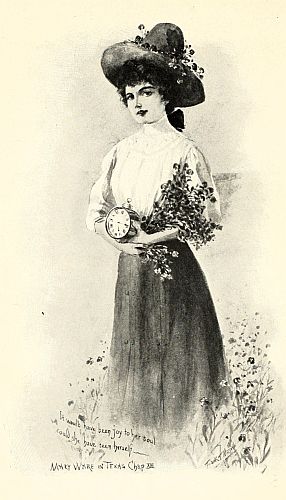
Phil were ahead of her. Glancing up at the clock she
found that she had ten minutes to spare. Three of
these passed in getting settled and in taking an inventory
of her fellow-passengers. Then she began
to hang out of the window and anxiously watch the
waiting-room door. She was growing uneasy.
Maybe the clerk had forgotten to call him. Maybe
he was "slumbering still," as Gay had prophesied.
He might have missed the car he should have taken,
or there might be a tie-up somewhere along the line.
A colored man hurried into the coach with a chunk
of ice for the water cooler. The conductor came
down the platform looking at his watch, and signalled
something to a brakeman. Mary put her head
out of the window again and looked anxiously up
and down, whispering in a flutter of nervousness,
"Oh, why doesn't he come? Why doesn't he
come? There's only a minute or two left and there
won't be time for a word."
She would not admit the possibility of his not
coming at all, until she heard the warning, "All
aboard!" the ringing of the engine bell, and felt the
jerk and jar which proclaimed all too plainly that
the car was in motion. She was so disappointed that
she could hardly keep the tears back. Her last
thought before falling asleep the night before and
the first one on awakening had been that she was
going to see the "Best Man" by himself a few moments,
without any talkative Roberta to absorb his
attention, or any other people to run away with the
conversation.
It was a very disconsolate little face that turned
towards the open window to hide its disappointment
from possibly curious neighbors. She found it hard
to wink the tears back when she was so deeply,
grievously disappointed. Her back was turned resolutely
towards the aisle and her arms were crossed
on the window-sill. In that position she could not
see the rear door of the car open and some one come
in from the back platform. He stood a moment, his
hat in one hand and a suit-case in the other, breathing
fast as if he had been running. Then after a
searching glance through the car, he went directly
down the aisle and stopped beside Mary's seat. Her
attitude, even to the droop of her hat-brim, proclaimed
her dejection so clearly that a smile twitched
the corners of his mouth. Then he said in a deep
voice, so deep that it was fairly sepulchral, "I beg
pardon, Miss. May I occupy this end of the seat?"
Startled by the strange voice so near, she turned
a very sober and unsmiling face to see what manner
of person had accosted her. Then she exclaimed,
in astonishment, "Why, Phil Tremont! How ever
did you get on without my seeing you? I looked and
looked and thought you must have gotten left!"
Then realizing that the train was well under way
and they had been carried some distance past the
station, she cried in alarm, "But you can't get off!
They're carrying you away!" She was almost
wringing her hands in her excitement.
"Well, I don't mind it if you don't," said Phil,
sitting down beside her and laughing at her concern.
"I'm going along with you. Something Miss
Roberta said last night on her way home started
me to thinking, and—the result was, I decided to
spend another day and night in Bauer. It's positively
my last appearance, however. I'll leave for
good in the morning."
What Roberta could have said to make such a
change in his plans was more than Mary could imagine.
She almost had to bite her tongue to keep
from asking, and Phil, knowing that he had aroused
her wildest curiosity, laughed again. But he wasted
no more time in teasing her.
"No, really," he said, "I was joking. A telegram
from my firm routed me out about six o'clock this
morning. They want me to go to St. Louis to see
some parties before returning to New York. I
figured it out that I could double things up there
so as to give me one more day here. But it took
me so long to figure it, that, by the time I had made
up my mind, there was only a moment to stuff my
things into my suit-case and call a taxicab. When
I got down to the station I saw I had about three
minutes in which to snatch a sandwich and a cup
of coffee at the lunch counter; but the coffee was
so hot I came near missing my train. Had to run
a block and swing up on the rear platform. If it
had been the regular express I couldn't have caught
it. Luckily it was a freight, so here I am."
He did not add that an unaccountable impulse to
go back to Bauer had seized him the night before
when he bade her good-night, or that the impulse
had been strengthened afterward by a casual remark
of Roberta's about Lieutenant Boglin. Roberta
thought she saw the first symptoms of a budding
romance on Bogey's part.
Not being given to the practice of analyzing his
feelings, Phil did not stop to ask himself why it
should make any difference to him what the lieutenant
thought of little Mary Ware, nor did he
realize at the time how much that remark influenced
his decision to spend one more day with her. Afterwards
he used to say that it was Fate and not himself
that was responsible for that journey; that it
was destined from the beginning he should chase
madly after that freight-train, catch it, and thereby
give himself four long uninterrupted hours in which
to grow better acquainted with her than he had ever
been before.
At the end of that time he knew why he had been
drawn back. It was that her real self, the depth
of whose charm he had not even half suspected,
should be revealed to him in the intimacy of this
conversation. It changed his whole attitude toward
her to find how much she had changed herself; how
she had grown and developed. In some ways she
was still the amusing child whose unexpected sayings
had first attracted him. She would always be
that, but she was so much more now; and, again, as
on the day he met her in the field of blue-bonnets, he
found himself watching her, trying to decide just
wherein her charm lay, and how it made her different
from any other girl he had ever known. Sometimes
he would almost lose what she was saying, puzzling
over the problem.
At the stone quarry, while they waited a long
time for the engine to switch off some empty cars,
and pick up some loaded ones, they left the coach
and walked up and down beside the track. They
were talking about Gay and Alex, and he laughed
at her outspoken honesty in expressing her opinion
about their delayed wedding.
"I think it's so sensible for them to wait till he's
got something saved up for a rainy day, when he's
nothing now but his practice. It's like providing a
sort of financial umbrella. Really, it is just like
starting out without a sign of an umbrella when
you know it's going to rain, and trusting to luck to
keep you dry, for people to marry with nothing to
depend on but an uncertain salary."
Phil laughed, as he answered, "What a little
pessimist you are, Mary. It doesn't always rain,
and people have married without such a provision
who lived happily ever after."
"But it does oftener than it doesn't," she insisted.
"Papa and mamma lived happily, and he
had only his practice as a young lawyer. But look
what we've been through since he died. Things
wouldn't have come to such a pass when his health
broke down if there had been something laid away
for such emergencies. Joyce and I have often talked
about it when we've had to pinch and work and
economize down to the last cent."
"So you'll never marry a man who has only the
shelter of a salary to offer you?" said Phil, teasingly.
"I didn't say that," answered Mary, her face
puckered up into a puzzled expression. "I don't
want to, and I don't think I would, but, honestly, I
don't know what I would do. I'm afraid that if I
loved a man as much as you ought to to be his wife
that I'd be every bit as foolish as anybody else, and
that I'd marry him even if I had to take in back
stairs to scrub for a living. But I do hope I'll have
more sense, or else he won't be that kind of a man.
It isn't that I mind work," she added, "but I'm so
tired of doing without and making over, and tugging
and pulling to make both ends meet. Do you know
what they call me at home? The Watch-dog of the
Treasury, and you can guess what I've had to be
like to earn such a name. I earned it, too, all right.
I fought over every penny, and I'd hate to keep
on in the same old rut all the rest of my days. It
would be so nice to look forward to a luxurious
old age."
She laughed when she had said it, but such a tired
little sigh came first, and that wistful look again in
her honest, straightforward eyes as she glanced up
at him, that he was seized with a sudden desire such
as no one else had ever inspired before, to pick
her up and carry her away from all her troubles;
to surround her with all the girlish pleasures and
pretty things she loved, and to humor every whim
all the rest of her life. But all he said was:
"And if you were a man I suppose you would
feel the same way about it."
"Oh, more so!" she cried. "The more I thought
of a girl the surer I'd want to be that she need
never face that rainy day unprotected."
She stooped to pick a tiny yellow star from a
clump of broom growing alongside the track, and
they walked on in silence a moment. Then he said,
with an amused side-glance at her:
"You can't imagine how funny it seems to hear
such common-sense, practical 'side talks on matrimony'
from an eighteen-year-old girl like you. I
feel as if I'd had a scolding from my grandmother,
and that I'll have to own up that I did it, but I'm
sorry and I'll never do it again."
"Did what?" queried Mary in surprise.
"Spent everything as fast as I made it. Had
money to burn and burnt it. I don't ask any better
salary than I've been receiving for several years.
Of course, when I go in by myself, that'll be another
matter. But I'll have to own up; out of it all, I've
saved practically nothing. I haven't spent it in
riotous living, and it doesn't seem that I've been
particularly extravagant, but it's gone. It just
slipped through my fingers."
"Oh, well, you," began Mary. "That's different."
"In what way is it different?" he persisted, when
she did not go on.
"Well, if a man doesn't mind getting wet himself
it's nobody's business if he takes chances. It's the
man who expects to—to have some one else to protect—who
ought to be ready for the possible
storms."
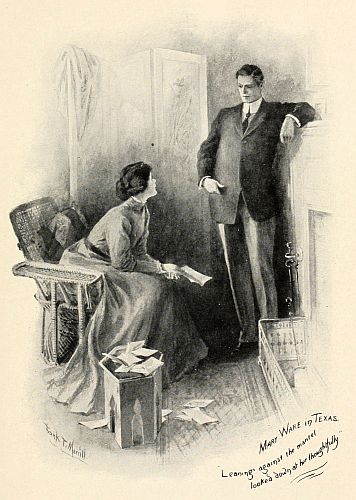
"But what makes you think that I'll always go
it alone?" insisted Phil. "That I'll never have any
one to—protect? That's what you seem to insinuate."
He was looking directly into her eyes, laughingly,
teasingly, and a wave of color swept over her face.
Roberta would have evaded the question, and turned
it off with a laugh. Mary was too simple and direct.
It was the moment she had long felt must confront
her some time. Her day of reckoning had come for
playing eavesdropper. No matter how hard she
fought against doing so, she knew she was going
to confess that she had been one, albeit unintentionally.
As he repeated his question with smiling insistence,
the words stuck in her throat, but the thought
uppermost in her mind called out to him by some
strange, telepathic power, and he understood as if
she had spoken.
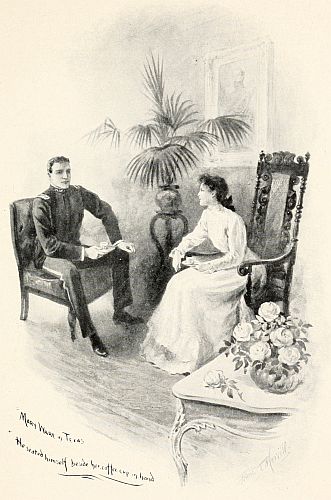
"You think," he said slowly, looking into her
eyes as if the written words were actually before him
there and he was reading them aloud, "you think
that it is on Lloyd's account. How did you know
about—that?"
It startled her so that he should read her thought
in such a way that she could only stammer in reply:
"I—I—heard you singing to her once at The
Locusts, that song you sang last night, 'Till the
stars are old,' and I thought if you cared for her as
it sounded both times, that there couldn't be anybody
else, ever!"
Phil turned partly away from her, and stared
off towards the hills a moment, his eyes narrowed
into a thoughtful, musing expression. Finally he
said, "I thought so, too, Mary, once. I thought it
for a number of years. That time will always be
one of the sweetest and most sacred of my memories.
One's earliest love always is, they say, like the
first white violet in the spring."
There was a long pause, then he finished the sentence
by turning around to her to say, significantly,
"But there's always a summer after every spring,
you know. Come on, we'd better be getting aboard
again. It looks as if they're about ready to start."
He helped her up the steps and followed her down
the aisle. While adjusting the window-shade before
she took her seat, he began to talk of other things,
and the subject was dropped between them. But
it was not dropped in Mary's mind. She had been
called on to adjust herself to a new viewpoint of
him so quickly that it left her mentally gasping.
With his own hand he had ruthlessly swept away
one of her dearest illusions. She had always believed
that no matter who else might forget, he
would always stand as a model of manly constancy.
What surprised her now was not his change of view.
It was her own. By that one sentence he had made
it perfectly clear to her that it was not reasonable to
expect him to go on mourning always for the "first
white violet." It was only natural that summer
should follow the spring.
But the puzzle now was, who was good enough
and sweet and high and fine enough to follow Lloyd?
Mary was positive that there was nobody. He might
hunt the whole world over, but she was sure he
would be doomed to disappointment in the end. Her
motherly concern over that was almost as great as
her sympathy had been when she thought of him as
doomed to carry a secret sorrow with him to the
grave.
After that the conversation was not so personal.
It was nearly noon when they reached Bauer, and in
that time they had exchanged views on enough subjects
to have filled an encyclopædia. Twice after
that they talked together alone. The first time was
when they went out in the boat just before sunset.
Mary wanted him to see Fernbank in all its glory
of fresh April greenness, with the little waterfalls
splashing their fine mist over the walls of delicate
maiden-hair.
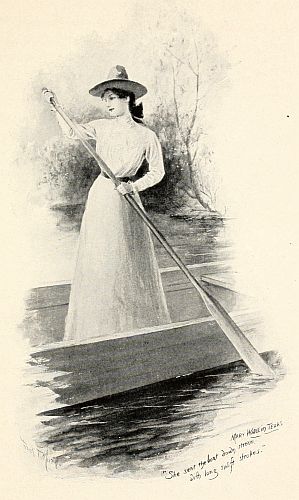
She insisted on poling the boat, although he protested
that it made him uncomfortable to sit still
and see her doing the work. He refused to go at all,
until she compromised by saying he might pole on
the way back.
"It isn't work," she insisted. "It's one of the
greatest pleasures I have, and about the only one
I've had in this benighted place."
"You always did love to 'paddle your own canoe'
and strike out and do things for yourself," he remarked,
as they shot swiftly up the stream. "By
the way, what are you going to do next? Will
you be starting back to Warwick Hall again in
September, now that Jack is sure of taking his old
position in the mines then?"
"No," was her decided answer. "We've scrapped
about that a lot lately. He insists that I must. But
it's this way. He's lost a whole year out of his life,
and although he's never said so, I know the time is
coming when he'll want to settle down and have a
home of his own. And he's the kind who'd never
ask a girl to marry him until he'd provided for
her future in case anything should happen to him.
Joyce's plans have been put back a year, too. She
has her heart set on going to Paris with Miss Henrietta
to study, just as soon as she can afford it. Of
course, Jack will pay back his part of what she's
spent on us this winter, but it will take a good while
for him to do it. I've made up my mind I'm not
going to stand in their way. I'll not be a drag on
either one of them. There's lots of things that I
can do. The summer is already provided for.
When Mrs. Mallory found that we are going to stay
on here till September, till Jack is strong enough to
go back to work, she made up her mind to stay, too,
no matter how hot it gets, because the children are
so happy here. They can't bear the idea of stopping
their lessons. They're beginning to learn to
read now, and are as wild over that as if it were a
new game. Mrs. Rochester says it does get frightfully
hot here in the summers, but that we can stand
it if we have the lessons in the morning instead of
afternoon."
"And then," asked Phil, "after that?"
"After that I don't know, but there'll be something.
It's all uncertain, but it's interesting just to
wonder what will come next. I'm like the wolf in
the last of the Mowgli stories."
She turned to glance over her shoulder as she
quoted, laughingly, "'The stars are thin,' said Gray
Brother, sniffing at the dawn wind. 'Where shall
we lair to-day? For, from now, we follow new
trails.' I don't know where the new trails will lead,
but from all that's happened in the past, I've faith
to believe that there'll be 'good hunting' in them."
"There will always be that for you," said Phil,
warmly. "You'll never strike one where you'll not
find friends and interests and—"
He started to say more, but checked himself, and
after an instant's pause, stood up, almost upsetting
the boat, and laughingly took the oar away from her,
insisting that he couldn't sit still another minute.
He had to work off some of his surplus energy.
What he had come near saying when he checked
himself was, "And you'll never strike a trail where
you won't be the bravest, jolliest, dearest little comrade
a man could have; one that he would never
tire of, one who could inspire him to do and be his
best."
The impulse to say all this came upon him so
suddenly that it startled him. Then a sober second
thought told him that after all she was scarcely more
than a child, that she had always looked upon him as
an elderly brother, and that it would be better not to
destroy that old intimate relationship until he was
sure of being able to establish a new one. A strange
feeling of humility took possession of him. It
suddenly seemed that he had so little to offer one
who could give so much. Even her opinion which
he had laughed at at the stone quarry, about providing
a financial umbrella, carried weight now, and
made him hesitate, no longer confidant of himself.
His strong, quick sweeps of the oar sent the boat
upstream at twice the speed it had been going before,
and Mary, from her seat in the stern, called out
that it was as good as flying, and that she'd have to
acknowledge that she'd never known before how
delightful it was to sit still and let somebody else
do the paddling. But that was because nobody else
had taken her along so fast.
At Fernbank they did not get out of the boat.
Phil took the seat facing her, while they drifted
around the deep pool for a little while. It was
almost twilight there, for the high bank shut out the
glow of the sunset, and it was deliciously cool and
green and still. Presently some remark of Phil's
made Mary exclaim:
"That reminds me, although I don't know why it
should, of something I've been intending to tell you,
that Joyce wrote recently. You've heard her talk
of little Jules Ciseaux, the boy who played such an
important part in her winter in France. He lived
in the house with the giant scissors on the gables,
and over the great gate, you know. Well, he's over
here in America now. He's always wanted to come
ever since Joyce told him so much about it. His
mother was an American and I think he was born
in this country. At any rate, he's here now, sightseeing
and trying to hunt up his mother's family.
"He's come into quite a large fortune lately, ever
so many hundred thousand francs. As he is of age,
he can do as he pleases. Joyce says he wants to come
out to Lone Rock to see us, because she used to entertain
him by the hour with tales of us, and he used
to envy us our good times together in the little
brown house at Plainsville. He never knew any
home life like ours. I'm wild to see him. Joyce
says he is charming! Such lovely manners, and such
a sensitive, refined face, like one's ideal of a young
poet. He's really something of an artist. Joyce
says he's done some really creditable work, and all
her friends have taken him up and are making it nice
for him while he is in New York."
"That is interesting," said Phil. "I'll look him
up as soon as I get back. Wouldn't it be romantic
if the friendship that started between them as children
should grow into something more? All those
inherited francs would provide the fine, large umbrella
which you seem to think is necessary."
"Oh, it never can be anything but friendship in
this case," exclaimed Mary. "Jules is two years
younger than Joyce."
"By the same token he is three years older than
you. Maybe it's Joyce's little sister he will be taking
an interest in."
"Humph! You're as bad as Norman!" replied
Mary, calmly. "That's what he said. He
thought he had something new to tease me about, but
he soon found out that it wouldn't work."
Despite her indifference, Phil thought of the possibility
again many times that night before he fell
asleep. Knowing the limited space of the cottage,
he had taken a room at the Williams House, despite
Mrs. Ware's protests, saying he would be over early
in the morning for breakfast. But it seemed for
awhile that breakfast-time would arrive before he
could fall asleep.
Things assume formidable proportions in the darkness
and dead quiet of the night that they never have
by day. Away after midnight he was still thinking
of what Mary had said about the young Frenchman
who had lately come into his fortune, and of
what Roberta had said about Lieutenant Boglin.
The face of the latter rose up before him. Not a
particularly good-looking face, he thought, but it
was a strong, likable one, and he had a sense of
humor which made him good company, and a
blarney-stone turn of the tongue that would take
with any girl. As for Jules Ciseaux, who had envied
the Wares their home life, Phil knew all about the
childhood of the lonely little lad left to the mercies
of a brutal caretaker. Jules would only need to see
Mary once, dear little home-maker that she was, to
want to carry her away with him to his chateau
beside the Loire.
Before Phil finally fell asleep he had decided just
what he would say to Mary next morning, and that
he would go early enough to make an opportunity to
say it. It was early when he went striding down
the road, across the foot-bridge, and took the short
cut through a meadow to the back of the Ware
cottage; but the preparations for breakfast were
well under way. When he reached the back porch,
screened by morning-glory vines, he saw the table set
out there, with fresh strawberries at each place,
wreathed in their own green leaves.
Judging from the odors wafted through the door,
chickens were broiling within to exactly the right
degree of delectable crispness, and coffee which
would be of amber clearness, was in the making.
But the noises within the kitchen were not to be interpreted
as easily as the odors. There was a banging
and scuffling over the floor, muffled shrieks and
broken sentences in high voices, choking with
laughter. Not till he reached the open window and
looked in could he imagine the cause of the uproar.
Norman and Mary were wrestling and romping all
over the kitchen, having a tug-of-war over something
he was trying to take away from her.
Unconscious of a spectator, they dragged each
other around, bumping against walls amid a clatter
of falling tinware, stumbling over chairs and coming
to a deadlock in each others' arms in a corner, so
full of laughter they could scarcely hold their grip.
"Dare me again! will you?" gasped Norman,
thinking he had her pinned to the wall. But wrenching
one hand free, she began to tickle him until he
writhed away from her with a whoop, and dashed
out of the door.
"Yah! 'Fraid cat!" she jeered after him.
"Afraid of a tickle!"
"You just wait till I get back with the milk," he
cried, catching up a shining tin pail that stood on
the bench, and starting down the path over which
Phil had just come.
"You'll have to hurry," she called after him.
"Breakfast is almost ready."
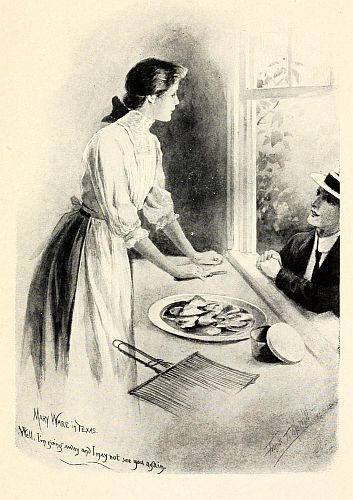
She stooped to open the oven door and peep at
the pan of biscuit within, just beginning to turn a
delicate brown. Then she looked up and caught
sight of Phil. He was leaning against the window
looking in, his arms crossed on the sill as if he had
been enjoying the spectacle for some time.
"For mercy sakes!" she exclaimed. "How long
have you been there?"
The coast was clear. Norman was well on his
way to the Metz place, and Mrs. Ware was helping
Jack get ready for breakfast. It was as good an
opportunity as Phil could have hoped for, to repeat
the speech he had rehearsed so many times the night
before. And she looked so fresh and wholesome
and sweet, standing there in her pink morning dress
with the big white apron, that she was more like
an apple-blossom than anything else he could think
of. He wanted to tell her so; to tell her she had
never seemed so dear and desirable as she did at
this moment, when he must be going away to leave
her.
Yet how could he tell her, when she was all
a-giggle and a-dimple and aglow from her romp
with Norman? Clearly she was too far from his
state of mind to share it now, or even to understand
it. After all, she was only a little girl at heart—only
eighteen. It wasn't fair to her to awaken
her quite yet—to hurry her into giving a promise
when she couldn't possibly know her own mind.
He would wait—
So he only leaned on the window-sill and laughed
at her for having been caught in such an undignified
romp, and asked her when she intended to grow
up, and if she ever expected to outgrow her propensity
for scrapping. But when he had joked
thus a few minutes, he said, quite suddenly and
seriously, "Mary, I want you to promise me something."
She was taking the chickens from the broiler and
did not look at him until they were safely landed in
the hot platter awaiting them, but she said lightly,
"Yes, your 'ighness. To the 'arf of me kingdom.
Wot is it?"
"Well, I'm going away and I may not see you
again for a long time. The chief wants me to take
a position, engineering the construction of a big dam
down in Mexico. It would keep me down there two
years, but it would be the biggest thing I've had yet,
in every way. Last night I just about made up my
mind I'd take it.
"While I'm gone you will be striking out into all
sorts of new trails, and I am afraid that on some of
them somebody will come along and try to persuade
you to join him on his, even if you are such a little
girl. Now I want to have a hand in choosing the
right man, and I want you to promise me that you
won't let anybody persuade you to do that till I
come back. Or at least if they do try, that you'll
send me word that they're trying, and give me a
chance to come back and have a look at the fellow,
and see if I think he is good enough to carry you
off."
"Why, the idea!" she laughed, a trifle embarrassed,
but immensely pleased that he should think
it possible for her to have numerous suitors or to
have them soon, and flattered that he should take
enough interest in her future to want to be called
back from Mexico to direct her choice.
"But will you promise?" he urged.
"Yes; that is not much to promise."
"And you'll give me your hand on it?" he persisted.
"Yes, and cross my heart and body in the bargain,"
she added, lightly, "if that'll please you any
better."
For all his gravity, she thought he was jesting
until she reached her hand through the window to
seal the compact.
"You know," he said, as his warm fingers closed
over it, "I've never yet seen anybody whom I considered
good enough for little Mary Ware."
Her eyes fell before the seriousness of his steady
glance, and she turned away all in a flutter of
pleasure that the "Best Man" should have said such
a lovely thing about her. It was the very thing she
had always thought about him.
Mrs. Ware came out just then, wheeling Jack in
his chair, and soon after Norman was back with the
milk, and breakfast was served out on the porch
among the morning-glories. "A perfect breakfast
and a perfect morning," Phil said. The 'bus which
was to call for him came while they were still lingering
around the table, and there was only time for
a hasty good-by all around.
"Come and walk out to the gate with me, Mary,
and give me a good send-off," he said, hurriedly
snatching up his suit-case.
Now in this last moment, when there was much to
say, neither had a word, and they walked along in
silence until they reached the gate. There he turned
for one more hand-clasp.
"Remember your promise," he said, gravely, as
his fingers closed warmly over hers. "I meant every
word I said."
"I'll remember," she answered, dimpling again as
if he had reminded her of a good joke; "and I'll
keep my word. Honest, I will!"
With that he went away, carrying with him a
picture which he recalled a thousand times in the
months that followed; Mary, standing at the gate
in the pink and white dress that had the freshness of
a spring blossom, with her sweet, sincere eyes and
her dear little mouth saying, "I'll keep my word!
Honest, I will!"
It was a long, long, hot summer that followed.
The drought dried up the creek so that the boat lay
idle on the bank. The dust grew deeper and deeper
in the roads and lay thick on the wayside weeds.
Even the trees were powdered with it; all the green
of the landscape took on an ashen grayness.
Meadows lay parched and sere. Walking ceased to
be a pleasure, and as they gasped through the tropical
heat of the endless afternoons, they longed for the
dense shade of the pines at Lone Rock, and counted
the days till they could go back.
But as soon as the sun dropped behind the hills
each day, and the breeze started up from the far-away
Gulf, their discomfort was forgotten. In the
wonderful brilliance of the starry nights when there
was no moon, or in the times when one hung like
a luminous pearl above a silver world, the air grew
fresh and cool, and they sat late in the open, making
the most of every minute. In the early mornings
there was that same crisp freshness of the hills
again, so one could endure the merciless, yellow glare
and the panting heat of the afternoons, for the sake
of the nights and dawns.
Even without that, however, they would have been
content to stay on, enduring it gladly, for Jack was
daily growing stronger; and to see him moving
about the house on his own feet, no matter how
falteringly at first, was a cause for hourly rejoicing.
Mary still played the part of Baloo with Brud and
Sister, starting early in the morning and taking them
over to the old mill-dam, in the shade of some big
cypress and sycamore trees. She was teaching them
to read and write, but there was little poring over
books for them. They built their letters out of
stones, and fashioned whole sentences of twigs;
wrote them in the sand and modelled them in mud,
scratched them on rocks with bits of flint, as Indians
do their picture language, and pricked them in the
broad sycamore leaves with thorns. By the end of
the summer they had enough of a vocabulary to write
a brief letter to their father, and their pride knew no
bounds when each had achieved one entirely alone,
from date to stamp, and dropped it into the box at
the post-office. His pride in them was equally great,
and the letter that he sent Mary with her final
check was one of the few things which she carried
away from Texas as a cherished memento.
She did not write often in her Good Times book.
There was so little to chronicle. An occasional
visit from the Barnaby's, a call at the rectory, a few
minutes spent in neighborly gossip in the Metz
garden; never once in the whole summer a happening
more exciting than that, except when the troops
from Fort Sam Houston were ordered out on their
annual "hike" and passed through Bauer in July.
Each of the different divisions camped a day and
a night in the grove back of the cottage, near enough
for the Wares to watch every manœuvre. The
Artillery band played at sunset when it was in camp,
and gave a concert that night in the plaza. When
the Cavalry passed through, Lieutenant Boglin
came to supper and spent the evening. Gay was
up for a day twice, and Mary went once to San
Antonio. That was all. Yet stupid as it was for
a girl of her age, and much as she missed young
companionship, Mary managed to get through the
summer very happily. All its unpleasantness was
atoned for one day in early September, when she
looked out to see Jack going down the road, straight
and strong, pushing his own wheeled chair in front
of him. He was taking it down to Doctor Mackay's
office to leave "for the first poor devil who needs
it," he said.
In the last few weeks he had discovered what he
had not known before, that the town was full of
invalids in quest of health, attracted from all over
the country by the life-giving air of its hills. He
had made the acquaintance of a number of them
since he had been able to ride around with the doctor.
Now, as he went off down the road with the
chair, with all of the family at the window to see
the happy sight, Mrs. Ware repeated to Mary what
the doctor had said about Jack's effect on his other
patients, and what the rector had told her of the
regard all the villagers had for Jack.
"The dear boy's year of suffering has done one
thing for the world," she added. "It has given it
another Aldebaran. Don't you remember in The
Jester's Sword—" She quoted it readily, because
ever since she had first seen it she had always read
Jack's name in place of Aldebaran's:
"'It came to pass whenever he went by, men felt
a strange, strength-giving influence radiating from
his presence, a sense of hope. One could not say
exactly what it was, it was so fleeting, so intangible,
like warmth that circles from a brazier, or perfume
that is wafted from an unseen rose.' That's what
one feels whenever Jack comes near."
"Yes, I know," assented Mary. "Even old Mr.
Metz tried to say as much to me about him. He
didn't choose those words, of course, but in his own
broken way he meant the same thing."
When the day came to leave, there was no one
to go with them to the station. The Rochesters
were away on their vacation, and it was too early
in the morning for the Barnabys to come in from
the ranch. They had bidden each other good-by
the day before, with deep regrets on both sides. It
seemed so good to both Mary and her mother to
see Jack attending to the tickets and the trunks in
his old way, so quick and capable. While he was
getting the checks, Mary walked down the track a
little piece to a place where she could look back at
the town for one more picture to carry away in
her memory.
How friendly and homelike and dear it seemed
now. Between the belfry of St. Peter's and the
gray tower of Holy Angels, rose the smoke from
many breakfast fires, and the windmills twirled merrily
in the morning sun. For all its dreariness she
was carrying away the recollection of a score of
happy times.
Over there was the free camp-yard, where their
little Christmas tree had spread such cheer. Further
on shone the spire of St. Boniface. She would
always think of it as she saw it Easter morning,
its casement windows set wide, and its altar white
with the snowy beauty of the rain lilies. There was
the meadow through which she had gone in blue-bonnet
time, to find Phil waiting under the huisache
tree, and there the creek, running on to Fernbank.
Nearer by she could see the windmill tower she had
so often climbed, sticking up over the roof that had
sheltered them during the ten months they had been
in Bauer. "Dear little old Bauer," she thought,
gratefully. She wouldn't have believed it in the
beginning if anyone had told her, that there would
be any regrets in her leave-taking when the time
came to go. How wonderfully it had all turned
out. The crooked had been made straight, and the
rough places smooth. She could face the future
gladly, buoyantly, now, no matter what it held, since
Jack was well again.
"Come on, Mary, it's time to go aboard!" called
Norman.
"You go on in, and save me a seat," she called
back. "Here come the children. I must wait to
speak to them."
She had bidden them good-by the night before,
and had not expected to see them again. They came
running, out of breath. Sister had a little bag of
animal crackers she had brought as a farewell offering,
and Brud proffered a companion-piece, a sack
of sticky red cinnamon drops. They had cried the
night before, and they were close to tears now, realizing
that something very rare and precious was
passing out of their lives. She took their offerings
with thanks that brought smiles to their dejected
little faces, then once more stooped to kiss them
good-by.
"From now, it's new trails for all of us," she
said, lightly, "and you'll write and tell me what you
find in yours, and I'll write and tell you about mine."
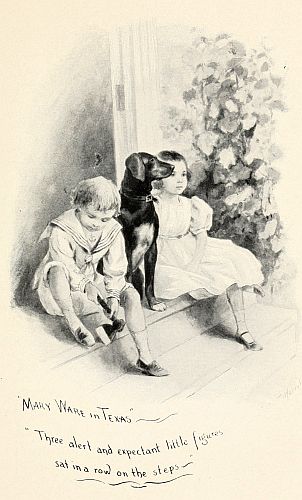
On the platform of the car she turned for a
last look at the three disconsolate little figures, waiting
to watch her start off towards those new trails.
There were three, for Uncle August had joined
them now, squatting mournfully beside them as if
he, too, were losing his best playfellow. The train
began to move slowly out. As she clung to the
railing to wave to them one more time, a mournful
little pipe followed her shrilly down the track. It
was Brud's voice:
"Good hunting, Miss Mayry! Good hunting!"
THE END.
BOOKS FOR YOUNG PEOPLE
THE LITTLE COLONEL BOOKS
(Trade Mark)
By ANNIE FELLOWS JOHNSTON
Each 1 vol., large 12mo, cloth, illustrated, per vol. $1.50
THE LITTLE COLONEL STORIES
(Trade Mark)
Being three "Little Colonel" stories in the Cosy Corner
Series, "The Little Colonel," "Two Little Knights of
Kentucky," and "The Great Scissors," put into a single
volume.
THE LITTLE COLONEL'S HOUSE PARTY
(Trade Mark)
THE LITTLE COLONEL'S HOLIDAYS
(Trade Mark)
THE LITTLE COLONEL'S HERO
(Trade Mark)
THE LITTLE COLONEL AT BOARDING-SCHOOL
(Trade Mark)
THE LITTLE COLONEL IN ARIZONA
(Trade Mark)
THE LITTLE COLONEL'S CHRISTMAS VACATION
(Trade Mark)
THE LITTLE COLONEL, MAID OF HONOR
(Trade Mark)
THE LITTLE COLONEL'S KNIGHT COMES RIDING
(Trade Mark)
MARY WARE: THE LITTLE COLONEL'S CHUM
(Trade Mark)
MARY WARE IN TEXAS
These eleven volumes, boxed as an eleven-volume set $16.50
THE LITTLE COLONEL
(Trade Mark)
TWO LITTLE KNIGHTS OF KENTUCKY
THE GIANT SCISSORS
BIG BROTHER
Special Holiday Editions
Each one volume, cloth decorative, small quarto, $1.25
New plates, handsomely illustrated with eight full-page
drawings in color, and many marginal sketches.
IN THE DESERT OF WAITING: The Legend
of Camelback Mountain.
THE THREE WEAVERS: A Fairy Tale for
Fathers and Mothers as Well as for Their
Daughters.
KEEPING TRYST
THE LEGEND OF THE BLEEDING HEART
THE RESCUE OF PRINCESS WINSOME:
A Fairy Play for Old and Young.
THE JESTER'S SWORD
| Each one volume, tall 16mo, cloth decorative | $0.50 |
| Paper boards | .35 |
There has been a constant demand for publication in
separate form of these six stories which were originally
included in six of the "Little Colonel" books.
JOEL: A BOY OF GALILEE: By Annie Fellows
Johnston. Illustrated by L. J. Bridgman.
New illustrated edition, uniform with the Little Colonel Books, 1 vol., large 12mo, cloth decorative $1.50
A story of the time of Christ, which is one of the author's
best-known books.
THE LITTLE COLONEL GOOD TIMES
BOOK
| Uniform in size with the Little Colonel Series | $1.50 |
| Bound in white kid (morocco) and gold | 3.00 |
Cover design and decorations by Peter Verberg.
Published in response to many inquiries from readers
of the Little Colonel books as to where they could obtain
a "Good Times Book" such as Betty kept.
THE LITTLE COLONEL DOLL BOOK
Large quarto, boards $1.50
A series of "Little Colonel" dolls,—not only the
Little Colonel herself, but Betty and Kitty and Mary
Ware, yes, and Rob, Phil, and many another of the well-loved
characters,—even Mom' Beck herself. There are
many of them and each has several changes of costume, so
that the happy group can be appropriately clad for the
rehearsal of any scene or incident in the series.
The large, cumbersome sheets of most of the so-called
doll "books" have been discarded, and instead each
character, each costume, occupies a sheet by itself, the
dolls and costumes being cut out only as they are wanted.
ASA HOLMES: Or, At the Cross-Roads. A sketch
of Country Life and Country Humor. By Annie
Fellows Johnston.
With a frontispiece by Ernest Fosbery.
Large 16mo, cloth, gilt top $1.00
"'Asa Holmes; or, At the Cross-Roads' is the most
delightful, most sympathetic and wholesome book that
has been published in a long while."—Boston Times.
THE RIVAL CAMPERS; Or, The Adventures of
Henry Burns. By Ruel Perley Smith.
Square 12mo, cloth decorative, illustrated $1.50
A story of a party of typical American lads, courageous,
alert, and athletic, who spend a summer camping on an
island off the Maine coast.
THE RIVAL CAMPERS AFLOAT; Or, The
Prize Yacht Viking. By Ruel Perley Smith.
Square 12mo, cloth decorative, illustrated $1.50
This book is a continuation of the adventures of "The
Rival Campers" on their prize yacht Viking.
THE RIVAL CAMPERS ASHORE
By Ruel Perley Smith.
Square 12mo, cloth decorative, illustrated $1.50
"As interesting ashore as when afloat."—The Interior.
THE RIVAL CAMPERS AMONG THE
OYSTER PIRATES; Or, Jack Harvey's Adventures.
By Ruel Perley Smith. Illustrated $1.50
"Just the type of book which is most popular with lads
who are in their early teens."—The Philadelphia Item.
PRISONERS OF FORTUNE: A Tale of the Massachusetts
Bay Colony. By Ruel Perley Smith.
Cloth decorative, with a colored frontispiece $1.50
"There is an atmosphere of old New England in the
book, the humor of the born raconteur about the hero,
who tells his story with the gravity of a preacher, but with
a solemn humor that is irresistible."—Courier-Journal.
FAMOUS CAVALRY LEADERS. By Charles H.
L. Johnston.
Large 12mo, With 24 illustrations $1.50
Biographical sketches, with interesting anecdotes and
reminiscences of the heroes of history who were leaders
of cavalry.
"More of such books should be written, books that
acquaint young readers with historical personages in a
pleasant informal way."—N. Y. Sun.
FAMOUS INDIAN CHIEFS. By Charles H. L.
Johnston.
Large 12mo, illustrated $1.50
In this book Mr. Johnston gives interesting sketches of
the Indian braves who have figured with prominence in
the history of our own land, including Powhatan, the
Indian Cæsar; Massasoit, the friend of the Puritans;
Pontiac, the red Napoleon; Tecumseh, the famous war
chief of the Shawnees; Sitting Bull, the famous war chief
of the Sioux; Geronimo, the renowned Apache Chief, etc.,
etc.
FAMOUS SCOUTS. By Charles H. L. Johnston.
Large 12mo, illustrated $1.50
Mr. Johnston gives us historical facts and biographical
sketches and interesting anecdotes of those heroes of early
pioneer days who made names for themselves among the
hardy adventurers who thronged the border. There are
tales of Gen. Israel Putnam; the celebrated Daniel Boone;
Kit Carson, the noted scout; Lewis and Clarke, the hardy
explorers; the world-renowned Buffalo Bill, and of many
other famous scouts, trappers and pioneers.
BEAUTIFUL JOE'S PARADISE: Or, The
Island of Brotherly Love. A sequel to "Beautiful Joe."
By Marshall Saunders, author of "Beautiful Joe."
One vol., library 12mo, cloth, illustrated $1.50
"This book revives the spirit of 'Beautiful Joe' capitally.
It is fairly riotous with fun, and is about as unusual
as anything in the animal book line that has seen the
light."—Philadelphia Item.
'TILDA JANE. By Marshall Saunders.
One vol., 12mo, fully illustrated, cloth decorative, $1.50
"I cannot think of any better book for children than
this. I commend it unreservedly."—Cyrus Townsend
Brady.
'TILDA JANE'S ORPHANS. A sequel to "'Tilda
Jane." By Marshall Saunders.
One vol., 12mo, fully illustrated, cloth decorative, $1.50
'Tilda Jane is the same original, delightful girl, and as
fond of her animal pets as ever.
THE STORY OF THE GRAVELEYS. By Marshall
Saunders, author of "Beautiful Joe's Paradise,"
"'Tilda Jane," etc.
Library 12mo, cloth decorative. Illustrated by E. B. Barry $1.50
Here we have the haps and mishaps, the trials and
triumphs, of a delightful New England family, of whose
devotion and sturdiness it will do the reader good to hear.
BORN TO THE BLUE. By Florence Kimball
Russel.
12mo, cloth decorative, illustrated $1.25
The atmosphere of army life on the plains breathes on
every page of this delightful tale. The boy is the son of a
captain of U. S. cavalry stationed at a frontier post in the
days when our regulars earned the gratitude of a nation.
IN WEST POINT GRAY
By Florence Kimball Russel.
12mo, cloth decorative, illustrated $1.50
"Singularly enough one of the best books of the year
for boys is written by a woman and deals with life at West
Point. The presentment of life in the famous military
academy whence so many heroes have graduated is realistic
and enjoyable."—New York Sun.
THE SANDMAN: HIS FARM STORIES
By William J. Hopkins. With fifty illustrations by
Ada Clendenin Williamson.
Large 12mo, decorative cover $1.50
"An amusing, original book, written for the benefit of
very small children. It should be one of the most popular
of the year's books for reading to small children."—Buffalo
Express.
THE SANDMAN: MORE FARM STORIES
By William J. Hopkins.
Large 12mo, decorative cover, fully illustrated $1.50
Mr. Hopkins's first essay at bedtime stories met with
such approval that this second book of "Sandman" tales
was issued for scores of eager children. Life on the farm,
and out-of-doors, is portrayed in his inimitable manner.
THE SANDMAN: HIS SHIP STORIES
By William J. Hopkins, author of "The Sandman:
His Farm Stories," etc.
Large 12mo, decorative cover, fully illustrated $1.50
"Children call for these stories over and over again."—Chicago
Evening Post.
THE SANDMAN: HIS SEA STORIES
By William J. Hopkins.
Large 12mo, decorative cover, fully illustrated $1.50
Each year adds to the popularity of this unique series
of stories to be read to the little ones at bed time and at
other times.
A TEXAS BLUE BONNET
By Emilia Elliott.
12mo, cloth decorative, illustrated $1.50
This is the story of a warm-hearted, impulsive and breezy
girl of the Southwest, who has lived all her life on a big
ranch. She comes to the far East for a long visit, and her
experiences "up North" are indeed delightful reading.
Blue Bonnet is sure to win the hearts of all girl readers.
THE DOCTOR'S LITTLE GIRL
By Marion Ames Taggart, author of "Pussy-Cat
Town," etc.
One vol., library 12mo, illustrated $1.50
A thoroughly enjoyable tale of a little girl and her comrade
father, written in a delightful vein of sympathetic
comprehension of the child's point of view.
SWEET NANCY
The Further Adventures of the Doctor's Little
Girl. By Marion Ames Taggart.
One vol., library, 12mo, illustrated $1.50
In the new book, the author tells how Nancy becomes
in fact "the doctor's assistant," and continues to shed
happiness around her.
CARLOTA
A Story of the San Gabriel Mission. By Frances
Margaret Fox.
Small quarto, cloth decorative, illustrated and decorated in colors by Ethelind Ridgway $1.00
"It is a pleasure to recommend this little story as an
entertaining contribution to juvenile literature."—The
New York Sun.
THE SEVEN CHRISTMAS CANDLES
By Frances Margaret Fox.
Small quarto, cloth decorative, illustrated and decorated in colors by E. B. Barry $1.00
Miss Fox's new book deals with the fortunes of the delightful
Mulvaney children.
SEVEN LITTLE WISE MEN
By Frances Margaret Fox.
Small quarto, cloth decorative, illustrated in colors by E. B. Barry $1.00
In this new story Miss Fox relates how seven little children,
who lived in Sunny California, prepared for the great
Christmas Festival.
PUSSY-CAT TOWN
By Marion Ames Taggart.
Small quarto, cloth decorative, illustrated and decorated in colors $1.00
"Anything more interesting than the doings of the cats
in this story, their humor, their wisdom, their patriotism,
would be hard to imagine."—Chicago Post.
THE ROSES OF SAINT ELIZABETH
By Jane Scott Woodruff.
Small quarto, cloth decorative, illustrated and decorated in colors by Adelaide Everhart $1.00
This is a charming little story of a child whose father was
caretaker of the great castle of the Wartburg.
GABRIEL AND THE HOUR BOOK
By Evaleen Stein.
Small quarto, cloth decorative, illustrated and decorated in colors by Adelaide Everhart $1.00
Gabriel was a loving, patient, little French lad, who
assisted the monks in the long ago days, when all the books
were written and illuminated by hand, in the monasteries.
A LITTLE SHEPHERD OF PROVENCE
By Evaleen Stein.
Small quarto, cloth decorative, illustrated in colors by Diantha Horne Marlowe $1.00
This is the story of Little lame Jean, a goatherd of
Provence, and of the "golden goat" who is supposed
to guard a hidden treasure.
THE ENCHANTED AUTOMOBILE
Translated from the French by Mary J Safford.
Small quarto, cloth decorative, illustrated and decorated in colors by Edna M. Sawyer $1.00
"An up-to-date French fairy-tale which fairly radiates
the spirit of the hour,—unceasing diligence."—Chicago
Record-Herald.
O-HEART-SAN
The Story of a Japanese Girl. By Helen Eggleston
Haskell.
Small quarto, cloth decorative, illustrated and decorated in colors by Frank P. Fairbanks $1.00
"The story comes straight from the heart of Japan.
From every page breathes the fragrance of tea leaves,
cherry blossoms and chrysanthemums."—The Chicago
Inter-Ocean.
THE YOUNG SECTION-HAND; Or, The Adventures
of Allan West. By Burton E. Stevenson.
Square 12mo, cloth decorative, illustrated $1.50
Mr. Stevenson's hero is a manly lad of sixteen, who is
given a chance as a section-hand on a big Western railroad,
and whose experiences are as real as they are thrilling.
THE YOUNG TRAIN DISPATCHER. By Burton
E. Stevenson.
Square 12mo, cloth decorative, illustrated $1.50
"A better book for boys has never left an American
press."—Springfield Union.
THE YOUNG TRAIN MASTER. By Burton E.
Stevenson.
Square 12mo, cloth decorative, illustrated $1.50
"Nothing better in the way of a book of adventure for
boys in which the actualities of life are set forth in a practical
way could be devised or written."—Boston Herald.
CAPTAIN JACK LORIMER. By Winn Standish.
Square 12mo, cloth decorative, illustrated $1.50
Jack is a fine example of the all-around American high-school
boy.
JACK LORIMER'S CHAMPIONS; Or, Sports
on Land and Lake. By Winn Standish.
Square 12mo, cloth decorative, illustrated $1.50
"It is exactly the sort of book to give a boy interested
in athletics, for it shows him what it means to always
'play fair.'"—Chicago Tribune.
JACK LORIMER'S HOLIDAYS; Or, Millvale
High in Camp. By Winn Standish.
Illustrated $1.50
Full of just the kind of fun, sports and adventure to
excite the healthy minded youngster to emulation.
JACK LORIMER'S SUBSTITUTE; Or, The Acting
Captain of the Team. By Winn Standish.
Illustrated $1.50
On the sporting side, this book takes up football, wrestling,
tobogganing, but it is more of a school story perhaps
than any of its predecessors.
THE RED FEATHERS. By Theodore Roberts
Cloth decorative, illustrated $1.50
"The Red Feathers" tells of the remarkable adventures
of an Indian boy who lived in the Stone Age, many years
ago, when the world was young.
FLYING PLOVER. By Theodore Roberts.
Cloth decorative. Illustrated by Charles Livingston Bull $1.00
Squat-By-The-Fire is a very old and wise Indian who
lives alone with her grandson, "Flying Plover," to whom
she tells the stories each evening.
COMRADES OF THE TRAILS. By G. E.
Theodore Roberts.
Cloth decorative. Illustrated by Charles Livingston Bull $1.50
The story of a fearless young English lad, Dick Ramsey,
who, after the death of his father, crosses the seas and
takes up the life of a hunter and trapper in the Canadian
forests.
LITTLE WHITE INDIANS. By Fannie E. Ostrander.
Cloth decorative, illustrated $1.25
"A bright, interesting story which will appeal strongly
to the 'make-believe' instinct in children, and will give
them a healthy, active interest in 'the simple life.'"
THE BOY WHO WON
By Fannie E. Ostrander, author of "Little White
Indians."
12mo, cloth decorative, illustrated by R. Farrington Elwell $1.25
A companion volume to "Little White Indians" continuing
the adventures of the different "tribes," whose
"doings" were so interestingly told in the earlier volume.
MARCHING WITH MORGAN. How Donald
Lovell Became a Soldier of the Revolution.
By John V. Lane.
Cloth decorative, illustrated $1.50
This is a splendid boy's story of the expedition of
Montgomery and Arnold against Quebec.
COSY CORNER SERIES
It is the intention of the publishers that this series shall
contain only the very highest and purest literature,—stories
that shall not only appeal to the children themselves,
but be appreciated by all those who feel with
them in their joys and sorrows.
The numerous illustrations in each book are by well-known
artists, and each volume has a separate attractive
cover design.
Each 1 vol., 16mo, cloth $0.50
By ANNIE FELLOWS JOHNSTON
THE LITTLE COLONEL (Trade Mark.)
The scene of this story is laid in Kentucky. Its heroine
is a small girl, who is known as the Little Colonel,
on account of her fancied resemblance to an old-school
Southern gentleman, whose fine estate and old family
are famous in the region.
THE GIANT SCISSORS
This is the story of Joyce and of her adventures in
France. Joyce is a great friend of the Little Colonel,
and in later volumes shares with her the delightful experiences
of the "House Party" and the "Holidays."
TWO LITTLE KNIGHTS OF KENTUCKY
Who Were the Little Colonel's Neighbors.
In this volume the Little Colonel returns to us like an
old friend, but with added grace and charm. She is not,
however, the central figure of the story, that place being
taken by the "two little knights."
MILDRED'S INHERITANCE
A delightful little story of a lonely English girl who
comes to America and is befriended by a sympathetic
American family who are attracted by her beautiful
speaking voice. By means of this one gift she is enabled
to help a school-girl who has temporarily lost the
use of her eyes, and thus finally her life becomes a busy,
happy one.
CICELY AND OTHER STORIES FOR GIRLS
The readers of Mrs. Johnston's charming juveniles
will be glad to learn of the issue of this volume for young
people.
AUNT 'LIZA'S HERO AND OTHER STORIES
A collection of six bright little stories, which will appeal
to all boys and most girls.
BIG BROTHER
A story of two boys. The devotion and care of Stephen,
himself a small boy, for his baby brother, is the theme of
the simple tale.
OLE MAMMY'S TORMENT
"Ole Mammy's Torment" has been fitly called "a
classic of Southern life." It relates the haps and mishaps
of a small negro lad, and tells how he was led by
love and kindness to a knowledge of the right.
THE STORY OF DAGO
In this story Mrs. Johnston relates the story of Dago,
a pet monkey, owned jointly by two brothers. Dago
tells his own story, and the account of his haps and mishaps
is both interesting and amusing.
THE QUILT THAT JACK BUILT
A pleasant little story of a boy's labor of love, and how
it changed the course of his life many years after it was
accomplished.
FLIP'S ISLANDS OF PROVIDENCE
A story of a boy's life battle, his early defeat, and his
final triumph, well worth the reading.
By EDITH ROBINSON
A LITTLE PURITAN'S FIRST CHRISTMAS
A story of Colonial times in Boston, telling how Christmas
was invented by Betty Sewall, a typical child of the
Puritans, aided by her brother Sam.
A LITTLE DAUGHTER OF LIBERTY
The author introduces this story as follows:
"One ride is memorable in the early history of the
American Revolution, the well-known ride of Paul
Revere. Equally deserving of commendation is another
ride,—the ride of Anthony Severn,—which was no less
historic in its action or memorable in its consequences."
A LOYAL LITTLE MAID
A delightful and interesting story of Revolutionary
days, in which the child heroine, Betsey Schuyler, renders
important services to George Washington.
A LITTLE PURITAN REBEL
This is an historical tale of a real girl, during the time
when the gallant Sir Harry Vane was governor of Massachusetts.
A LITTLE PURITAN PIONEER
The scene of this story is laid in the Puritan settlement
at Charlestown.
A LITTLE PURITAN BOUND GIRL
A story of Boston in Puritan days, which is of great
interest to youthful readers.
A LITTLE PURITAN CAVALIER
The story of a "Little Puritan Cavalier" who tried
with all his boyish enthusiasm to emulate the spirit and
ideals of the dead Crusaders.
A PURITAN KNIGHT ERRANT
The story tells of a young lad in Colonial times who
endeavored to carry out the high ideals of the knights
of olden days.
By OUIDA (Louise de la Ramee)
A DOG OF FLANDERS
A Christmas Story
Too well and favorably known to require description.
THE NURNBERG STOVE
This beautiful story has never before been published
at a popular price.
By FRANCES MARGARET FOX
THE LITTLE GIANT'S NEIGHBOURS
A charming nature story of a "little giant" whose
neighbors were the creatures of the field and garden.
FARMER BROWN AND THE BIRDS
A little story which teaches children that the birds are
man's best friends.
BETTY OF OLD MACKINAW
A charming story of child life.
BROTHER BILLY
The story of Betty's brother, and some further adventures
of Betty herself.
MOTHER NATURE'S LITTLE ONES
Curious little sketches describing the early lifetime, or
"childhood," of the little creatures out-of-doors.
HOW CHRISTMAS CAME TO THE MULVANEYS
A bright, lifelike little story of a family of poor children
with an unlimited capacity for fun and mischief.
THE COUNTRY CHRISTMAS
Miss Fox has vividly described the happy surprises that
made the occasion so memorable to the Mulvaneys, and
the funny things the children did in their new environment.
By MISS MULOCK
THE LITTLE LAME PRINCE
A delightful story of a little boy who has many adventures
by means of the magic gifts of his fairy godmother.
ADVENTURES OF A BROWNIE
The story of a household elf who torments the cook
and gardener, but is a constant joy and delight to the
children who love and trust him.
HIS LITTLE MOTHER
Miss Mulock's short stories for children are a constant
source of delight to them, and "His Little Mother," in
this new and attractive dress, will be welcomed by hosts
of youthful readers.
LITTLE SUNSHINE'S HOLIDAY
An attractive story of a summer outing. "Little Sunshine"
is another of those beautiful child-characters for
which Miss Mulock is so justly famous.
By MARSHALL SAUNDERS
FOR HIS COUNTRY
A sweet and graceful story of a little boy who loved
his country; written with that charm which has endeared
Miss Saunders to hosts of readers.
NITA, THE STORY OF AN IRISH SETTER
In this touching little book, Miss Saunders shows how
dear to her heart are all of God's dumb creatures.
ALPATOK, THE STORY OF AN ESKIMO DOG
Alpatok, an Eskimo dog from the far north, was stolen
from his master and left to starve in a strange city, but
was befriended and cared for, until he was able to return
to his owner.
By WILL ALLEN DROMGOOLE
THE FARRIER'S DOG AND HIS FELLOW
This story, written by the gifted young Southern
woman, will appeal to all that is best in the natures of
the many admirers of her graceful and piquant style.
THE FORTUNES OF THE FELLOW
Those who read and enjoyed the pathos and charm
of "The Farrier's Dog and His Fellow" will welcome
the further account 01 the adventures of Baydaw and
the Fellow at the home of the kindly smith.
THE BEST OF FRIENDS
This continues the experiences of the Farrier's dog
and his Fellow, written in Mr. Dromgoole's well-known
charming style.
DOWN IN DIXIE
A fascinating story for boys and girls, of a family of
Alabama children who move to Florida and grow up in
the South.
By MARIAN W. WILDMAN
LOYALTY ISLAND
An account of the adventures of four children and
their pet dog on an island, and how they cleared their
brother from the suspicion of dishonesty.
THEODORE AND THEODORA
This is a story of the exploits and mishaps of two mischievous
twins, and continues the adventures of the
interesting group of children in "Loyalty Island."
By CHARLES G. D. ROBERTS
THE CRUISE OF THE YACHT DIDO
The story of two boys who turned their yacht into a
fishing boat to earn money.
THE YOUNG ACADIAN
The story of a young lad of Acadia who rescued a little
English girl from the hands of savages.
THE LORD OF THE AIR
The Story of the Eagle.
THE KING OF THE MAMOZEKEL
The Story of the Moose.
THE WATCHERS OF THE CAMP-FIRE
The Story of the Panther.
THE HAUNTER OF THE PINE GLOOM
The Story of the Lynx.
THE RETURN TO THE TRAILS
The Story of the Bear.
THE LITTLE PEOPLE OF THE SYCAMORE
The Story of the Raccoon.
By JULIANA HORATIO EWING
STORY OF A SHORT LIFE
This beautiful and pathetic story will never grow old.
It is a part of the world's literature, and will never die.
JACKANAPES
A new edition, with new illustrations, of this exquisite
and touching story, dear alike to young and old.
A GREAT EMERGENCY
A bright little story of a happy, mischievous family
of children.
By OTHER AUTHORS
THE GREAT SCOOP
By MOLLY ELLIOT SEAWELL
A capital tale of newspaper life in a big city, and of a
bright, enterprising, likable youngster employed thereon.
JOHN WHOPPER
By BISHOP CLARK
The late Bishop Clark's popular story of the boy who
fell through the earth and came out in China, with a new
introduction by Bishop Potter.
RAB AND HIS FRIENDS
By DR. JOHN BROWN
Doctor Brown's little masterpiece is too well known
to need description. The dog Rab is already known and
loved by all.
THE SLEEPING BEAUTY: A Modern Version.
By MARTHA B. DUNN
This charming story of a little fishermaid of Maine,
intellectually "asleep" until she meets the "Fairy
Prince," reminds us of "Ouida" at her best.
SUSANNE
By FRANCES J. DELANO
Susanne is a story of a motherless little girl with a wonderful
voice who is taken to the city to be educated by a
rich aunt, but runs away from the city and returns home.
A CHILD'S DREAM OF A STAR
By CHARLES DICKENS
One of those beautiful, fanciful little allegories which
Dickens alone knew how to write.
THE DOLE TWINS
By KATE UPSON CLARK
The adventures of two little people who tried to earn
money to buy crutches for a lame aunt. An excellent
description of child-life about 1812, which will greatly
interest and amuse the children of to-day, whose life is
widely different.
LARRY HUDSON'S AMBITION
By JAMES OTIS, author of "Tobey Tyler," etc.
Larry Hudson is a typical American boy, whose hard
work and enterprise gain him his ambition,—an education
and a start in the world.
THE LITTLE CHRISTMAS SHOE
By JANE P. SCOTT WOODRUFF
A touching story of Yule-tide.
WEE DOROTHY
By LAURA UPDEGRAFF
A story of two orphan children, the tender devotion
of the eldest, a boy, for his sister being its theme and
setting. With a bit of sadness at the beginning, the
story is otherwise bright and sunny, and altogether
wholesome in every way.
THE KING OF THE GOLDEN RIVER
A Legend of Stiria. By JOHN RUSKIN
Written fifty years or more ago, and not originally
intended for publication, this little fairy-tale soon became
known and made a place for itself.
A CHILD'S GARDEN OF VERSES
By R. L. STEVENSON
Mr. Stevenson's little volume is too well known to need
description.
THE LITTLE COUSIN SERIES
The most delightful and interesting accounts possible
of child life in other lands, filled with quaint sayings,
doings, and adventures.
Each one vol., 12mo, decorative cover, cloth, with six or
more full-page illustrations in color.
Price per volume $0.60
By MARY HAZELTON WADE unless otherwise indicated
| Our Little African Cousin |
| Our Little Alaskan Cousin | By Mary F. Nixon-Roulet |
| Our Little Arabian Cousin | By Blanche McManus |
| Our Little Armenian Cousin |
| Our Little Australian Cousin | By Mary F. Nixon-Roulet |
| Our Little Brazilian Cousin | By Mary F. Nixon-Roulet |
| Our Little Brown Cousin |
| Our Little Canadian Cousin | By Elizabeth R. Macdonald |
| Our Little Chinese Cousin | By Isaac Taylor Headland |
| Our Little Cuban Cousin |
| Our Little Dutch Cousin | By Blanche McManus |
| Our Little Egyptian Cousin | By Blanche McManus |
| Our Little English Cousin | By Blanche McManus |
| Our Little Eskimo Cousin |
| Our Little French Cousin | By Blanche McManus |
| Our Little German Cousin |
| Our Little Grecian Cousin | By Mary F. Nixon-Roulet |
| Our Little Hawaiian Cousin |
| Our Little Hindu Cousin | By Blanche McManus |
| Our Little Hungarian Cousin | By Mary F. Nixon-Roulet |
| Our Little Indian Cousin |
| Our Little Irish Cousin |
| Our Little Italian Cousin |
| Our Little Japanese Cousin |
| Our Little Jewish Cousin |
| Our Little Korean Cousin | By H. Lee M. Pike |
| Our Little Mexican Cousin | By Edward C. Butler |
| Our Little Norwegian Cousin |
| Our Little Panama Cousin | By H. Lee M. Pike |
| Our Little Persian Cousin | By E. C. Shedd |
| Our Little Philippine Cousin |
| Our Little Porto Rican Cousin |
| Our Little Russian Cousin |
| Our Little Scotch Cousin | By Blanche McManus |
| Our Little Siamese Cousin |
| Our Little Spanish Cousin | By Mary F. Nixon-Roulet |
| Our Little Swedish Cousin | By Claire M. Coburn |
| Our Little Swiss Cousin |
| Our Little Turkish Cousin |
Obvious punctuation errors were corrected.
This text uses "Weinachtsbaum" instead of
"Weihnachtsbaum" many times and was left as printed.
The remaining corrections made are listed below and also indicated by dotted lines under the corrections. Scroll the mouse over the word and the original text will appear.
Page 21, "Jask" changed to "Jack" ("Well?" queried Jack as)
Page 68, "embarassment" changed to "embarrassment" (my perch with embarrassment)
Page 162, "to" changed to "too" (may as well go too)
Page 189, "that's" changed to "that" (and the next that she's)
Page 223, "irridescent" changed to "iridescent" (minutes. The iridescent)
Page 232, "palate" changed to "palette" (get out palette and brushes)
Page 246, "role" changed to "rôle" (in the rôle of)
Page 323, "corrider" changed to "corridor" (stood in the corridor)
Page 324, "sea" changed to "seat" (circular seat surrounding)
Advertising Pages:
Page 4, "Ceronimo" changed to "Geronimo" (Geronimo, the renowned Apache)
Page 4, "atc." changed to "etc." (Apache chief, etc.)
Page 14, "d scribing" changed to "describing" (sketches describing the early)
Page 20, Our Little Alaskan Cousins, "Nixon-Roule" changed to "Nixon-Roulet"
(Mary F. Nixon-Roulet)