MARY RUSSELL MITFORD The Tragedy of a Blue Stocking
Whole book · 48 sections
TRANSCRIBER’S NOTE
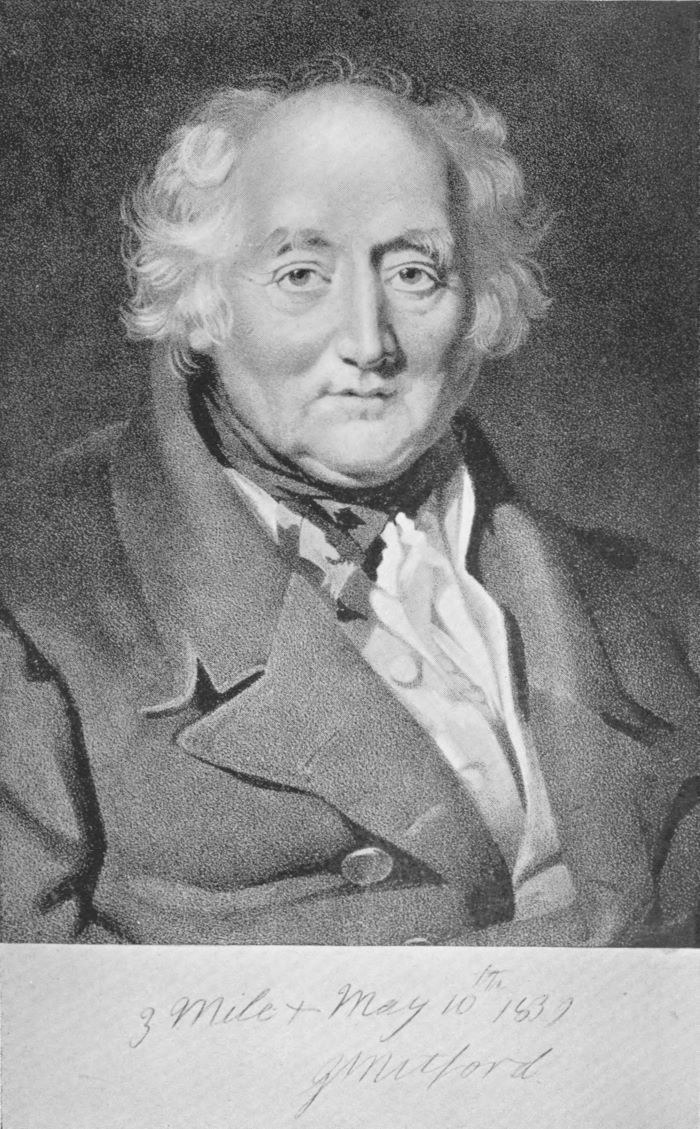
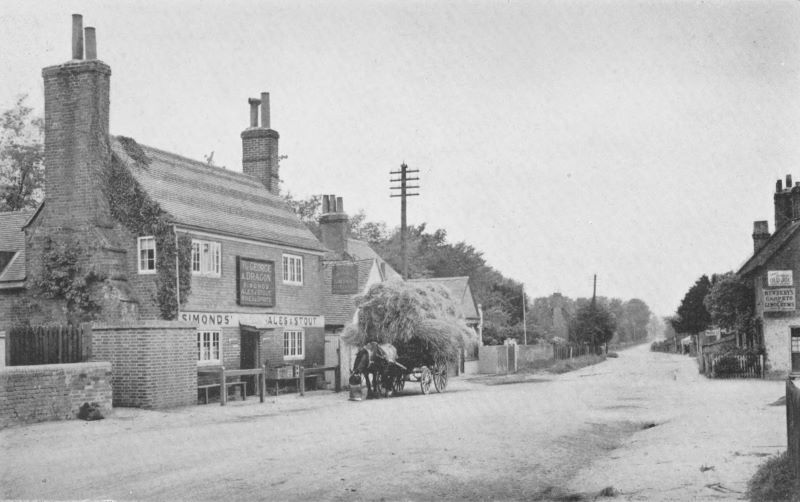
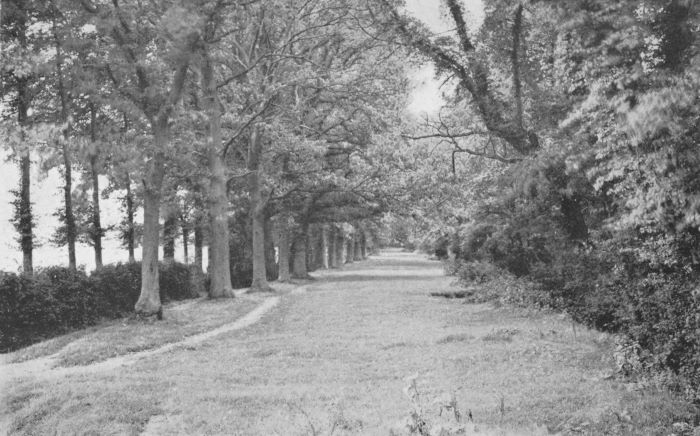
Handwriting on frontispiece and images on pages
62, 260, 300,
and 386 appears to be original to the images,
and has been retained in captions.
Footnote anchors are denoted by [number], and the footnotes have been
placed at the end of the chapter.
Original cover has the title “The Life and Friendships
of Mary Russell Mitford”, which did not reflect the title on the titlepage.
The new original cover art included with this eBook is granted to the public domain.
Some minor changes to the text are noted at the end of the book,
as well as an image of the original cover.
MARY RUSSELL MITFORD
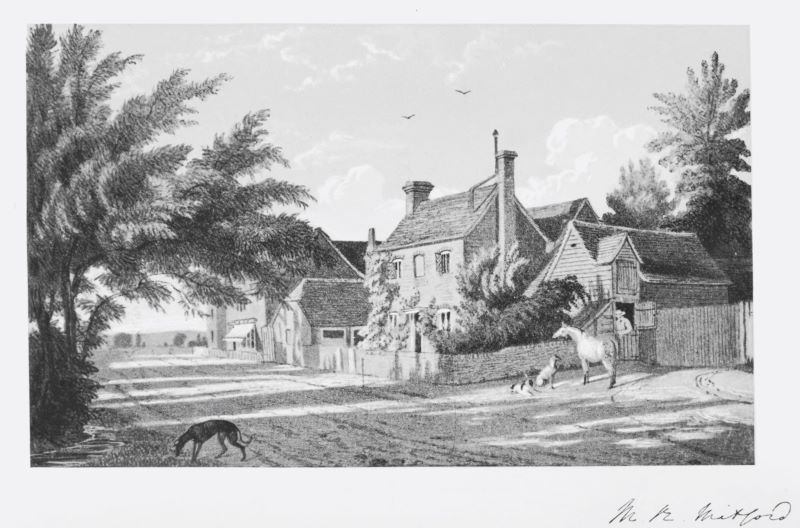
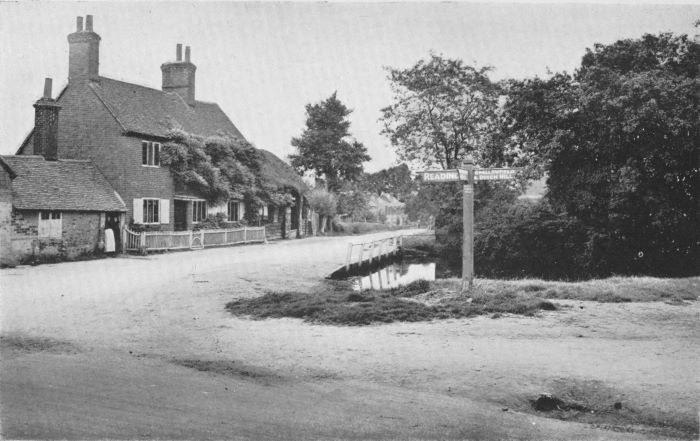
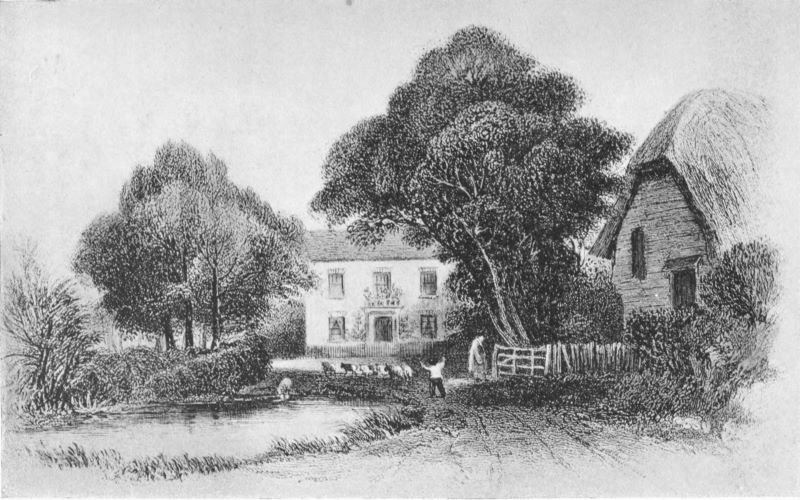
MY COTTAGE in “OUR VILLAGE”.
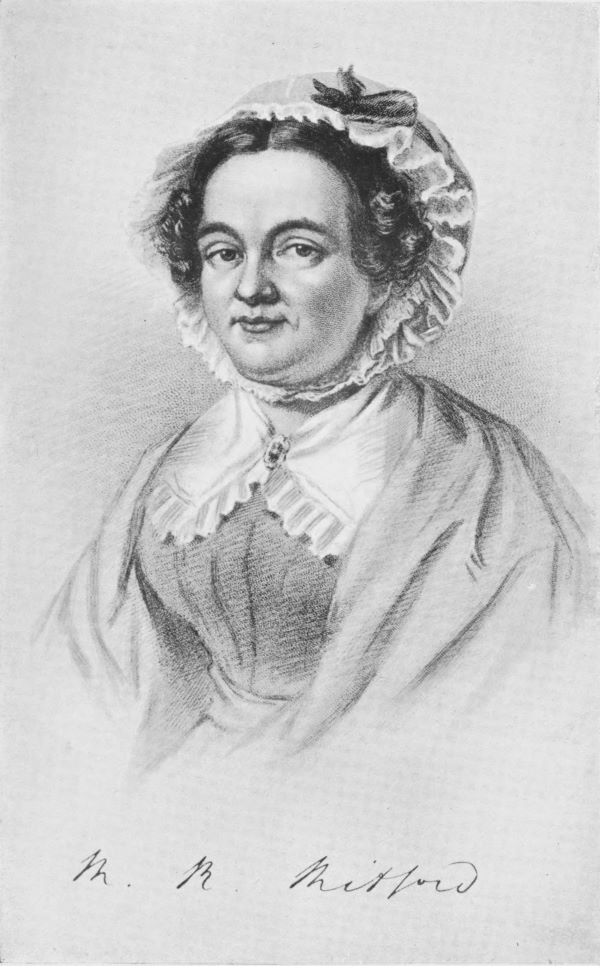
M R Mitford
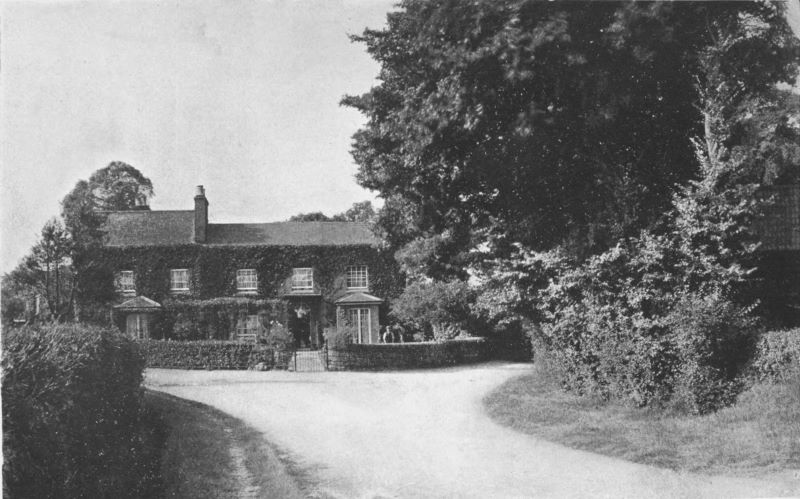
Miss Mitford’s Cottage at Three Mile Cross.
(From a lithograph published byMr. Lovejoy,
of Reading, while Miss Mitford was in residence.)
MARY RUSSELL MITFORD The Tragedy of a Blue Stocking
By
W. J. ROBERTS
(Author of “The Love Story of Empress Josephine,” “Literary
Landmarks of Torquay,” etc.).
Illustrated from Photographs by the Author and from
Contemporary Pictures.
LONDON: ANDREW MELROSE 3 YORK STREET, COVENT GARDEN, W.C.
1913
Dedication. To CONSTANCE, LADY RUSSELL, of Swallowfield Park,
I Dedicate this Book as a slight token of Gratitude
For the Help and Encouragement she
has so graciously afforded me
in its Compilation.
W. J. ROBERTS
London, March, 1913.
PREFACE
No figure in the gallery of Early Victorian
writers presents a character so charming
or so tenderly pathetic as that of Mary Russell
Mitford. Added to these characteristics is the
fact that her life was, in reality, a tragedy brought
about by her blind devotion and self-sacrifice
to an object which we are forced to regard as
altogether unworthy.
Miss Mitford’s name is not a familiar one to this
generation and it is with the desire to alter this
that the following pages have been written.
It would be impossible, within the compass of
a book of this size, to show forth Miss Mitford’s
life in its entirety: what we have done has been
to select from the records of her life and work
such incidents and such friendships as seemed
to us to portray her most faithfully. Whether
we have succeeded must be left to the reader to
judge.
In the compilation of the book many sources
of information have been drawn upon and the
author desires to acknowledge his indebtedness
to all who have so kindly helped him in his
labours. Chief among these has been Lady
Russell of Swallowfield, who, in addition to
supplying much material, has made the author
still further indebted by her acceptance of the
dedication of the book. Miss Rose G. Kingsley
has also to be thanked for copies of letters written
by Miss Mitford to her father, Charles Kingsley,
who lies buried at Eversley, in the neighbourhood
with which the book deals largely.
To Miss Josephine M. H. Fairless, Messrs. G. A.
Poynder, W. Smith, T. Rowland Kent, H. T.
Pugh, J. J. Cooper, J.P., and Alderman J. W.
Martin (all of Reading) the author’s best
thanks are tendered, as also to the Rev. J.
Henry Taylor, of Canterbury (Miss Mitford’s
“Little Henry”), the Rev. Alexander A.
Headley, Rector of New Alresford, Mr. Bertram
Dobell, the well-known bibliophile of London,
Mr. W. H. Greenhough, Chief Librarian to the
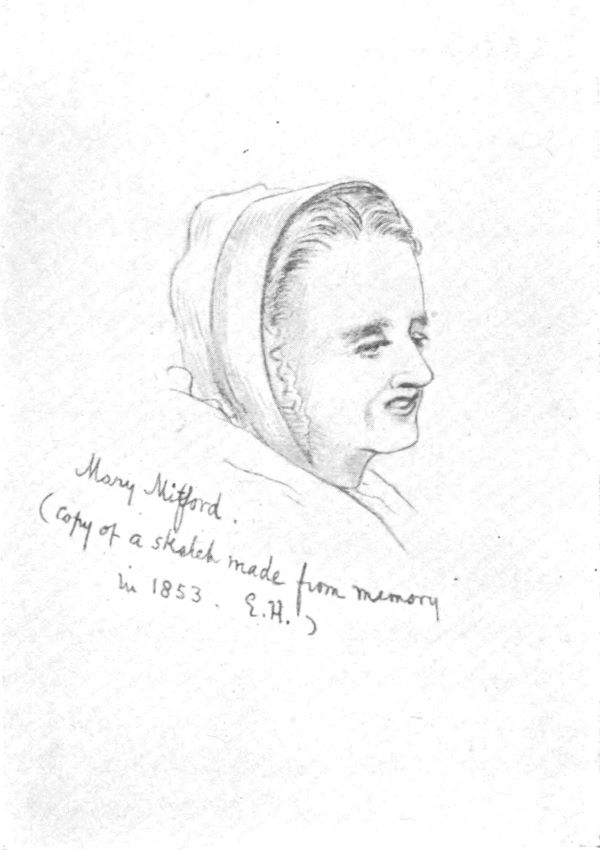
Borough of Reading, and W. H. Hudson, Esq.—the
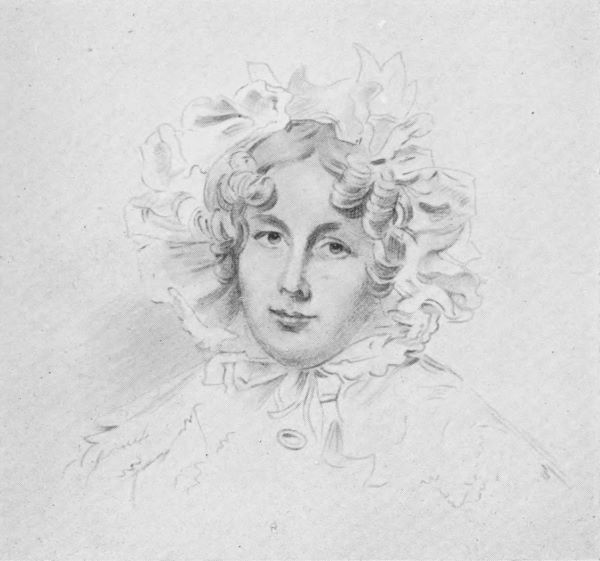
last named for his very kind loan of the pencil
sketch of Miss Mitford which figures in this book.
Within the stained but, happily, well-preserved
registers of the Church of St.
John the Baptist, New Alresford, Hampshire,
is an entry which runs thus:—
No. 211.
George Midford of this parish, Batchelor,
and Mary Russell of the same, Spinster.
Married in this Church by Licence this
Seventeenth day of October in the Year
One Thousand Seven Hundred and Eighty-five
by me, Will Buller,[1] Rector.
This Marriage was
{
George Midford,
solemnized between us
{
Mary Russell.
In the presence of
{
Jno. Harness,
{
Elizabeth Anderson.
It is a prosaic enough entry and yet, as we
shall endeavour to prove, it marked the beginning
of a tragedy composed of the profligacy
and wicked extravagance of one of its signatories,
of the foolish, docile acquiescence of the
other, and of the equally foolish and docile, but
incomprehensible, infatuation for the profligate
one which Mary Russell Mitford, the child of this
union, made the guiding principle of her life.
George Midford—or Mitford, as he subsequently
spelt his name—was the son of Francis Midford,
Esq., of Hexham (descended from the ancient
house of Midford,[2] of Midford Castle, near Morpeth),
and of his wife Jane, formerly Miss Jane
Graham, of Old Wall in Westmoreland, related
to the Grahams of Netherby.
He was born at Hexham, November 15, 1760,
received his early education at Newcastle School,
studied for the profession of medicine at the University
of Edinburgh, and was for three years
a house pupil of the celebrated John Hunter, in
London.
At the conclusion of his studies young Midford,
or Mitford as we shall henceforth speak of him,
went on a visit to a relative—Dr. Ogle, then
Dean of Winchester—through whom he obtained
an introduction to Miss Mary Russell, then living
alone in the adjacent town of Alresford.
Mary Russell was an heiress—ten years the
senior of George Mitford, being then in her thirty-sixth
year—and just recovering from a recent
bereavement in the death of her mother.
She was the daughter of Dr. Richard Russell,
a lineal descendant of the ducal family of Bedford,
Vicar of Overton and Rector of Ash—parishes
adjoining each other and near to Whitchurch
in Hampshire—who, as a widower, married
Miss Dickers, the daughter of a Hampshire
gentleman of considerable property, in the year
1745.
Childless by his first wife, the offspring of this
second marriage was a son and two daughters.
Of these the son and elder daughter died in
childhood, leaving Mary, who was born June
7, 1750, the sole heiress to the property of her
parents.
Dr. Russell eventually resigned the Vicarage
of Overton, but continued both his ministrations
and residence at Ash, where he died in 1783, aged
eighty-eight years.
At his death his widow and daughter—the
latter then thirty-three years of age—removed
to a pleasant and commodious house in the Broad
Street of that old-world and peaceful township
of Alresford, a town the houses of which, save the
inns, bear no distinguishing name and number,
the staid and sober life of whose inhabitants was
only relieved by the mild excitements of market-day
or by the noisy passage of the mail-coach as,
with clatter of hoof-beats and blast of horn, it
rattled gaily through, on its passage from London
to Winchester or vice versa.
Mrs. Russell only survived her husband for
a little more than two years and died on March
8, 1785, leaving her daughter with a fortune of
£28,000 in cash, in addition to house and land
property. In the admirable introduction to
The Life and Letters of Mary Russell Mitford
(published 1870, and contributed by the Editor,
the Rev. A. G. L’Estrange) we have a pen-portrait
of Mary Russell at this period of
her life which, in the absence of any other
form of portraiture, we cannot do better than
quote.
“In addition to these attractions [her inheritance]
she had been carefully educated by her
father; and to the ordinary accomplishments of
gentlewomen in those days had united no slight
acquaintance with the authors of Greece and
Rome. She was kind-hearted, of mild and lady-like
manners, of imperturbable temper, home-loving,
and abounding in conversation, which
flowed easily, in a soft and pleasant voice, from
the sources of a full mind. Her figure was good,
slight, active, and about the middle height; but
the plainness of the face—the prominent eyes
and teeth—the very bad complexion—was
scarcely redeemed by the kind and cheerful
expression which animated her countenance.”
To this excessively plain but undoubtedly
charming and accomplished woman was the
young surgeon introduced, “being easily persuaded
by friends more worldly wise than he to
address himself to a lady who, although ten
years his senior, had every recommendation that
heart could desire—except beauty.”
She certainly had every recommendation that
the heart of George Mitford could desire, for
“though a very brief career of dissipation had
reduced his pecuniary resources to the lowest
ebb, he was not only recklessly extravagant,
but addicted to high play.”
A few months later they were married.
“She, full of confiding love, refused every
settlement beyond two hundred a year pin-money,
out of his own property, on which he insisted”—words
written by Mary Russell Mitford,
many years after, and which would contradict our
statement of her father’s pecuniary embarrassment,
were they not discounted by the words of
the Rev. William Harness, who, writing on the
matter to a friend, says: “I hear that when
Mitford was engaged to his wife she had a set
of shirts made for him, lest it should be said
that ‘she had married a man without a shirt to
his back!’ Of course the story is not true;
but it expressed what folk thought of his deplorable
poverty and the impossibility of his making
that settlement on her, for which my father was
trustee, out of funds of his own, as Miss Mitford
suggests.”
And so they were married, the bride being
given away by her trustee, Dr. John Harness,
then living at Wickham, some few miles south
of Alresford.
Had the confiding wife misgivings, we wonder?
Or was it the excitement natural to such a
momentous event in her life that caused the
little hand to be so tremulous as it signed the
nervous characters, Mary Russell, beneath the
bold hand of her lord and master, on that eventful
October 17, 1785?
Henceforth, had she but known, she would
have need of all the comfort she might wring
from those fatalistic words, “Che Sarà, Sarà,”
the motto of the Bedfords, whose ancestry she
took such pride in claiming.
It had already been decided that Alresford
should witness the commencement at least of
the surgeon’s professional career, and seeing that
the house in Broad Street was commodious
and, what was more to the point, well-furnished,
there was no need to make a fresh home,
and it was there they set up housekeeping
together.
That the young man had good intentions is
fairly evident, for he continued his studies and,
in the course of a year or so, took his degree in
medicine which permitted him to practise as a
physician.
Thirteen months later a son was born to them,
but did not survive. In the Baptismal Register
of New Alresford Church is the entry:—
“Francis Russell, son of George and
Mary Midford, was privately baptized on the
12th, but died on the 23rd of November,
1786.”
It is important that this entry should be placed
on record, for while, in after years, Miss Mitford
speaks of herself as the only survivor of three
children, two sons having died in infancy, it has
been stated in print that “Mary Russell Mitford
was their only child.” On the other hand, although
careful search has been made, no record
of the baptism or burial of a third child has been
discovered in the Alresford registers, and we can
only assume, therefore, that this child must have
died at birth and on a date subsequent to that
of his sister.
Sufficient for us, however, is the entry in these
same registers:—
“Mary Russell, daughter of George and
Mary Midford, baptized February 29, 1788”—
the child having been born on December 16, 1787.
Of these early days we have, fortunately, a
picture left by the child herself. “A pleasant
home, in truth, it was,” she writes. “A large
house in a little town of the north of Hampshire—a
town, so small, that but for an ancient market,
very slenderly attended, nobody would have
dreamt of calling it anything but a village.[3]
The breakfast room, where I first possessed myself
of my beloved ballads, was a lofty and
spacious apartment, literally lined with books,
which, with its Turkey carpet, its glowing fire,
its sofas, and its easy chairs, seemed, what indeed
it was, a very nest of English comfort. The
windows opened on a large old-fashioned garden,
full of old-fashioned flowers, stocks, roses, honeysuckles
and pinks; and that again led into a
grassy orchard, abounding with fruit-trees. What
a playground was that orchard! and what playfellows
were mine! Nancy [her maid], with her
trim prettiness, my own dear father, handsomest
and cheerfullest of men, and the great Newfoundland
dog, Coe, who used to lie down at my
feet, as if to invite me to mount him, and then to
prance off with his burthen, as if he enjoyed the
fun as much as we did. Most undoubtedly I
was a spoilt child. When I recollect certain
passages of my thrice-happy early life, I cannot
have the slightest doubt about the matter, although
it contradicts all foregone conclusions, all
nursery and schoolroom morality, to say so.
But facts are stubborn things. Spoilt I was.
Everybody spoilt me—most of all the person
whose power in that way was greatest: the dear
papa himself. Not content with spoiling me
indoors, he spoilt me out. How well I remember
his carrying me round the orchard on his shoulder,
holding fast my little three-year-old feet, whilst
the little hands hung on to his pig-tail, which I
called my bridle (those were days of pig-tails),
hung so fast, and tugged so heartily, that sometimes
the ribbon would come off between my
fingers, and send his hair floating and the powder
flying down his back. That climax of mischief
was the crowning joy of all. I can hear our
shouts of laughter now.”
A pretty picture this, and one to which, as she
wrote of it, the tired old woman looked back as
on one of the few oases in a life which, despite
certain successes, was nothing short of a desert
of weariness and of struggle with poverty.
But apart from this boisterous love of play, the
little girl early developed a passion for reading,
fostered and encouraged, no doubt, by that “grave
home-loving mother,” who “never in her life
read any book but devotion,” in whose room,
indeed, it was matter for astonished comment to
find the works of Spenser.
At the age of three, little Mary showed a
remarkable precocity of intellect, and even before
she had reached that early age her father was
accustomed to perch her on the breakfast-table
to exhibit her one accomplishment to admiring
guests, “who admired all the more, because, a
small puny child, looking far younger than I
really was, nicely dressed, as only children generally
are, and gifted with an affluence of curls,
I might have passed for the twin sister of my own
great doll.”
On such occasions she would be given one or
other of the Whig newspapers of the day—the
Courier or Morning Chronicle—and, to the delight
of her father and the wonder of the guests,
would prattle forth the high-seasoned political pronouncements
with which those journals were filled.
Following this display there was, of course,
reward; not with sweetmeats, however, “too
plentiful in my case to be very greatly cared for,”
but by the reading of the “Children in the Wood”
by mother from Percy’s Reliques, “and I looked
for my favourite ballad after every performance,
just as the piping bullfinch that hung in the
window looked for his lump of sugar after going
through ‘God save the King.’ The two cases
were exactly parallel.”
But one day “the dear mamma” was absent
and could not administer the customary reward,
with the result that papa had to read the “Children
in the Wood,” though not before he had
searched the shelves to find the, to him, unfamiliar
volumes. Following which search and
labour he was easily constrained by the petted
child to hand over the book to Nancy, that she
might read extracts whenever called upon.
And when Nancy, as was inevitable, waxed
weary of the “Children in the Wood,” she
gradually took to reading other of the ballads;
“and as from three years old I grew to be four
or five, I learned to read them myself, and the
book became the delight of my childhood,
as it is now the solace of my age.”
FOOTNOTES:
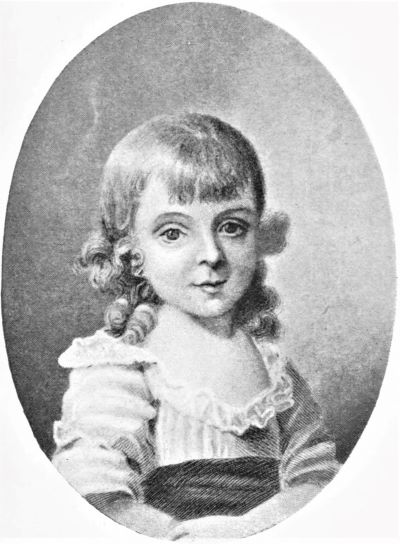
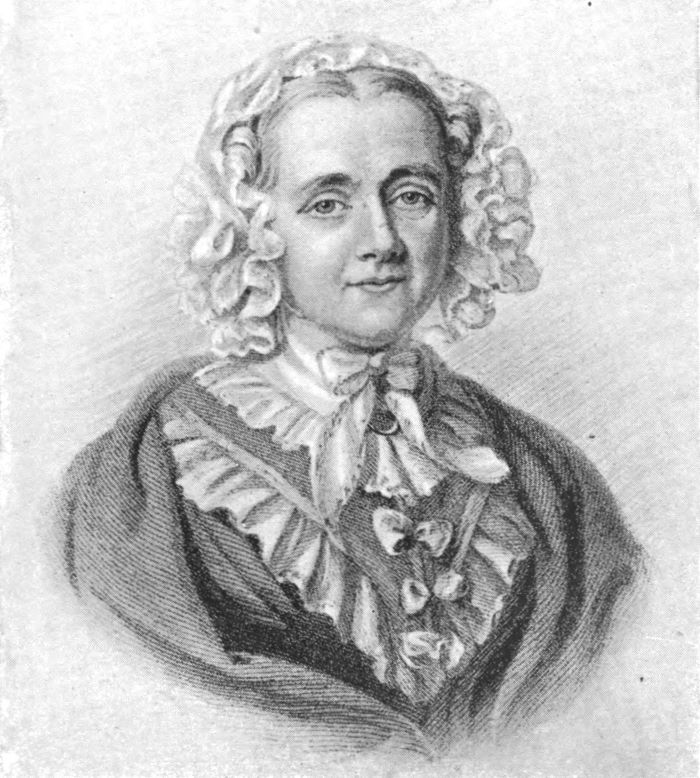
Mary Russell Mitford at the age of three.
(From a Miniature.)
With a child so apt it is not surprising that we
find no record of a governess or tutor during
these early years—that is, so far as general education
was concerned; but there was one item
of special education which the fond papa did
insist upon, an insistence which was the cause of
much grief to and some disobedience from the
spoilt girl.
“How my father, who certainly never knew
the tune of ‘God save the King’ from that of the
other national air, ‘Rule, Britannia,’ came to
take into his head so strong a fancy to make
me an accomplished musician I could never
rightly understand, but that such a fancy did
possess him I found to my sorrow! From the day
I was five years old, he stuck me up to the piano,
and, although teacher after teacher had discovered
that I had neither ear, nor taste, nor
application, he continued, fully bent upon my
learning it.”
Nevertheless, she did not learn it and, as we
shall see later, this fixed idea of her father’s gave
place to another equally futile.
Chief of her playmates at this time was William
Harness, the son of her mother’s trustee. He
would be brought over from Wickham in the
morning, and after a day of romps, be taken back
in his father’s carriage late in the afternoon.
Although two years the junior of Mary, William
was her constant and boon companion, and
remained to be her friend and counsellor through
life, although his counsels were, at times, very
wilfully disregarded.
Mutually genial of temperament, they sympathized
with each other’s tastes and pursuits,
particularly as these related to Literature and
the Drama. On one point only did they disagree,
and its subject was “dear papa.” By a sort of
intuition the boy must have, even in those early
days, come to regard the handsome, bluff, genial,
loud-voiced surgeon with something akin to suspicion,
a suspicion which was maintained and
fully justified in the years to come.
[1] Then also Dean of Exeter and, subsequently, Bishop of
that Diocese.
[2] Derived from the situation of the Castle keep, which
lies between the fords of the river Wansbeck, Northumberland.
[3] Many years afterwards, when appointed to the See of
Winchester, the late Bishop Thorold alluded to it as one
of a number of Town-Villages which he said he found so
peculiarly distinctive a feature of Hampshire.
CHAPTER II LYME REGIS AND TRAGEDY’S SHADOW
The picture, given us by Miss Mitford herself,
of those early days in the Hampshire
home, is one from the contemplation of which we
are loth to drag ourselves.
Again and again in her Recollections we note
how the memory was drawn upon to conjure up
some pleasant scene from the past. Of the town
itself her vision is of “a picturesque country
church with yews and lindens on one side, and
beyond, a down as smooth as velvet, dotted with
rich islands of coppice, hazel, woodbine, hawthorn
and holly reaching up into the young
oaks, and overhanging flowery patches of primroses,
wood-sorrel, wild hyacinths, and wild
strawberries. On the side opposite the church
in a hollow fringed with alders and bulrushes,
gleamed the bright clear lakelet, radiant with
swans and water-lilies, which the simple townsfolk
were content to call the Great Pond.”
Fortunately for us the hand of Time has
touched this old town gently. It is true the
picturesque country church has, by sheer force
of decay begotten of a hoary antiquity, given
place to one not less picturesque on the old site;
but the peaceful aspect of the streets and inns
remains, together with that commodious house
in the Broad Street which, excepting one slight
internal alteration, differs in nothing from the
house which Miss Mitford knew in her childhood,
the place of her birth.
With steep-pitched roof and painted front,
its old dormer-windows look out with a certain
grave dignity befitting the windows of a house
which enshrines such a tender memory, on the
town “through whose streets streamed Cavaliers
and Roundheads after the battle of Cheriton,”
on the downs where, a full hundred and twenty
years ago, the little mistress was wont fearlessly
to ride on her father’s favourite blood-mare,
seated on a specially-contrived pad and enclosed
so fondly by that same father’s strong and loving
arm.
Specially privileged and greatly esteeming
the privilege, we have wandered through the
rooms of this house; seen the breakfast room
round which were ranged the books of Grandpa
Russell’s library; seen the curiously contrived
sash-window—the like of which we have never
seen in any house before or since—fashioned so
cunningly that its entire height slides upward
into a recess quite out of sight; stepped through
the opening thus made on to the flagged pathway
leading by quaint outbuildings and stable
to the garden and orchard beyond, where, as we
have already noted, took place those dashing
rides on a human mount, with a powdered, beribboned
pig-tail in lieu of reins.
Small wonder is it that we looked on these things
with something akin to reverence, and certainly
with pity in our heart as we recalled how shamefully
those idyllic days were to end.
With a strong preference for country sports
and occupations, with a gay and careless temper
which all the professional etiquette of the world
could never tame into the staid gravity proper
to a doctor of medicine, and with that insidious
canker, the love of gambling, slowly devouring
any manliness he may have possessed, Dr.
Mitford gradually frittered away the whole of
his wife’s fortune, save a matter of £3,500 in the
funds, which, being in the hands of trustees, was
beyond his reach. Generous to a degree, and
with a blind confidence and belief in her husband’s
affection, Mrs. Mitford would not permit
any part of her property to be settled on herself,
and was therefore, to some extent, to blame for
the catastrophe which followed.
Thus, in a few short years of married life—at
the most nine—we find this professional man
forced to sell furniture and portions of his library
in order to meet current expenses and ease the
clamours of his creditors; forced, indeed, from
very shame, to quit the self-contained and therefore
intolerant town where bitter tongues were
wagging and scornful fingers pointing, and to
take up a residence in a distant seaside town,
where, if he ever hoped to retrench and reform,
and had he but given the matter a moment’s
consideration, he was scarcely likely to achieve
his object.
It was to Lyme Regis they went—this unduly
optimistic, noisy, sportsman-practitioner, with
his uncomplaining still trustful wife and their
six-year-old daughter, wide-eyed and wondering
why this sudden flight. The true import of this
removal was not to be hidden from this remarkably
intuitive child. “In that old, historical
town,” she writes in one of her reminiscent
moods, “that old town so finely placed on the
very line where Dorsetshire and Devonshire meet,
I spent the eventful year when the careless
happiness of childhood vanished, and the troubles
of the world first dimly dawned upon my heart—felt
in its effects rather than known—felt in
its chilling gloom, as we feel the shadow of a
cloud that passes over the sun on an April
day.” Strangely-sad words these, expressing the
thoughts of a child at an age when, not strong
enough to help and too young to be confided in,
it can do nothing but mark the change, questioning
the mother’s furtive tear while, rendered
more sensitive by reason of its own impotence,
it shudders in the cold atmosphere of vague yet
ill-concealed suspicion and mistrust.
Yet, mark the improvidence of this unstable
man; the house he took in Lyme Regis was,
“as commonly happens to people whose fortunes
are declining, far more splendid than that we had
inhabited, indeed the very best in the town.”
The house still stands with its “great extent
of frontage, terminating by large gates surmounted
by spread eagles.” It is now known as
“The Retreat,” and is in the Broad Street of
Lyme, proudly pointed to by the inhabitants as
the house once rented by the great Lord Chatham
for the benefit of his son’s—William Pitt’s—health,
and, twenty years later, by the Mitford
family.
Lyme Regis is the embodiment of much that
is interesting, historically and politically, but
particularly to us by reason of its literary associations.
Of “The Retreat” we have, fortunately,
a description written by Miss Mitford herself.
“An old stone porch, with benches on either
side, projected from the centre, covered as was
the whole front of the house, with tall, spreading,
wide-leaved myrtle, abounding in blossom, with
moss-roses, jessamine, and passion-flowers. Behind
the building, extended round a paved quadrangle,
was the drawing-room, a splendid apartment,
looking upon a little lawn surrounded by
choice evergreens, the bay, the cedar and the
arbutus, and terminated by an old-fashioned
greenhouse and a filbert-tree walk. In the steep
declivity of the central garden was a grotto,
over-arching a cool, sparkling spring, whilst the
slopes on either side were carpeted with strawberries
and dotted with fruit trees. One drooping
medlar, beneath whose branches I have
often hidden, I remember well.”
This great house, with its large and lofty rooms,
its noble oaken staircases, its marble hall, long
galleries and corridors, was scarcely the house
which a man anxious to mark time in an unpretentious
fashion was likely to choose. Nor,
had he stopped for one moment to consider,
would he have chosen Lyme Regis as a retreat,
for it was then practically at the height of its
fashionable prosperity, with its gay Assembly
Rooms, the resort of those on whom Bath and
Brighthelmstone were beginning to pall, and
who were henceforth to divide their patronage
between this Dorsetshire rendezvous and that
other, just awakened, resort still further westward
round the coast and destined, in the slow course of
a century, to become the imperiously aristocratic
Torquay.
No, indeed! this was no move the wisdom of
which was calculated to inspire in the breast of
Harness, the trustee, any restoration of confidence,
for those long galleries and corridors
were, quite naturally, “echoing from morning
to night with gay visitors, cousins from the
North, and the ever-shifting company of the
watering-place.”
It was a strange place wherein a laughter-loving
child should be sad. “Yet sad I was,” she says.
“Nobody told me, but I felt, I knew, I had an
interior conviction, for which I could not have
accounted, that, in the midst of all this natural
beauty and apparent happiness, in spite of the
company, in spite of the gaiety, something was
wrong. It was such a foreshowing as makes the
quicksilver in the barometer sink whilst the
weather is still bright and clear.”
How pitiful it all seems! how strangely
pathetic when, side by side with that description
of the insistent shadow, we set the written indictment
of him who was the cause of all the trouble—pathetic
because, though an indictment, it is
done so gently and breathes the very spirit of
forgiveness.
“Then ... he attempted to increase his
resources by the aid of cards, (he was, unluckily,
one of the finest whist-players in England), or
by that other terrible gambling, which assumes so
many forms, and bears so many names, but which
even when called by its milder term of Speculation,
is that terrible thing gambling still;
whatever might be the manner of the loss—or
whether, as afterwards happened, his own large-hearted
hospitality and too-confiding temper
were alone to blame—for the detail was never
known to me, nor do I think it was known to
my mother; he did not tell and we could not ask.
How often, in after-life, has that sanguine spirit,
which clung to him to his last hour, made me
tremble and shiver.”
Herein, perhaps, we may divine the reason for
the otherwise incomprehensible move from Alresford,
where the cost of living would be cheap[4]
as compared with the high prices obtaining at
fashionable Lyme! Nevertheless, although the
influence of the brooding shadow was insistent,
these days at Lyme Regis were not without their
excitement and pleasures.
“One incident that occurred there—a frightful
danger—a providential escape—I shall never
forget,” says Miss Mitford in her Recollections.
A ball at the Rooms was about to take place,
and a party of sixteen or more persons dressed
for it had assembled in the Mitford dining-room
for dessert, when suddenly the heavy plaster
ornamentation of the ceiling crashed down in
large masses upon the folk seated beneath.
Fortunately the only damage was to the flowers
and feathers of the ladies, the crystal and china,
and the fruits and wines of the dessert, together
with a few scratches on the bald head of a venerable
clergyman.
“I, myself,” she continues, “caught instantly
in my father’s arms, by whose side I was standing,
had scarcely even time to be frightened, although
after the danger was over, our fair visitors of
course began to scream.”
But it was in the planning and carrying out of
excursions in the neighbourhood that Dr. Mitford
showed to greater advantage, giving full play
to those characteristics which, as opposed to his
general selfishness, endeared him then and always
to children. Hand in hand with his little daughter,
vivacious and inquiring, the two would
sally forth in quest of glittering spars and ores,
of curious shells and seaweeds and of the fossils
which abounded in the Bay, the collection to be
finally carried home and laid out in a certain
dark panelled chamber which, after the book-room,
was the most favoured spot in all the
house to the little girl.
Sometimes these excursions would take them
towards Charmouth, at others to the Pinny
cliffs, where, “about a mile and a half from the
town, an old landslip had deposited a farm-house,
with its outbuildings, its garden, and its orchard,
tossed half-way down amongst the rocks, contrasting
so strangely its rich and blossoming
vegetation, its look of home and comfort, with
the dark rugged masses above, below and around.”
At other times they would pace together that
quaint old pier, the Cob, or ascend the hill to
Up-Lyme, whence they might watch the waves
swirling in sheets of green and spumey white in
the Bay below.
Very happy, on such occasions, was the child,
although the indefinable shadow dogged her, now
vague, now portentous.
At last, and little more than a twelvemonth
after their removal to Lyme, there was a hurried
flitting, following short and stormy interviews
with landlords, lawyers and others.
One fateful night “two or three large chests
were carried away through the garden by George
and another old servant.” Everything was to
be sold so that everybody might be paid. Save
a few special favourites among the books, the
library was left for disposal by auction, and a
day or two after, Mrs. Mitford and the child, with
Mrs. Mosse, the housekeeper and a maid-servant,
left Lyme and its shadow for London and a
shadow of more sinister bearing.
Dr. Mitford had gone before, leaving the little
party to travel post in a hack chaise. The
journey was full of discomfort to the distressed
women. At Dorchester, where they had hoped
to stay the night, they found the town so full
of soldiers, breaking camp, that there was no
accommodation for them, nor was there chaise
or horses wherewith to pursue the journey.
Finally, after searching all over the place, they
were able to obtain a lift in a rough tilted cart
without springs which bumped and jolted them
over eight rough miles to a small place whence
they might hope to proceed in the morning.
“It was my mother’s first touch of poverty;
it seemed like a final parting from all the elegances
and all the accommodations to which
she had been used. I never shall forget her
heart-broken look when she took her little girl
upon her lap in that jolting caravan, nor how the
tears stood in her eyes when we were turned
altogether into our miserable bed-room when we
reached the roadside ale-house where we were to
pass the night, and found ourselves, instead of the
tea we so much needed, condemned to sup on
stale bread and cheese.”
The next day they resumed their journey, and
at length reached a dingy comfortless lodging on
the Surrey side of Blackfriars Bridge, where,
with the cause of all the trouble, they found a
refuge from pressing creditors within the rules
of the King’s Bench. Here, like a certain
historic figure whose exploits were to be inimitably
recorded later, Dr. Mitford waited for
something to turn up, beguiling the time by
visits to Guy’s Hospital, where his friend and
fellow-pupil, Dr. Babington, was one of the
physicians, and by performing odd jobs for, and
being generally useful to the notorious “Dr.
Graham”—a famous quack who throve amazingly
at the expense of a gullible and doubtless
sensually-minded public.[5]
With her fortune gone and with only the
tattered but eloquent remnants of respectability
left to her, can we wonder that the educated
and refined daughter of an eminent divine should
wear a heart-broken look and weep bitter tears?
Her spirit was broken, and even Hope seemed to
have deserted her!
FOOTNOTES:
[4] The only two entries in the rate-books of Alresford,
relating to payments made by “George Mitford—Surgeon,”
are, under an assessment at 9d. in the pound, made in 1787—7s.;
and, under an assessment at 4½d. in the pound, made
in 1790—5s.
[5] Dr. Graham’s “Celestial Bed” for sterile couples is
numbered among the astounding frauds of the early nineteenth
century. To his “Temple”—first in the Adelphi
and later, as he grew wealthy and more daring, to Schomberg
House in Pall Mall—there thronged a heterogeneous mass of people,
some taking him and his nostrums seriously, while
others—the bulk, it is suggested—paid large sums for
admission to view Emma Lyon, afterwards Lady Hamilton,
pose, in scant drapery, as the Goddess of Hygiene. Not
the least of this charlatan’s astounding achievements are
his obscene and blasphemous pamphlets on the most delicate
subjects, which he circulated broadcast among the
class to which he knew they would appeal.
CHAPTER III READING AND SCHOOL DAYS AT CHELSEA — FOOTNOTES:
Dr. Mitford’s spirit was a sanguine one;
he could not believe that Dame Fortune
intended to frown on him and his for ever.
With much to commend it in a general way,
the possession of such a spirit may yet be a
menace, a positive danger. To a man of Dr.
Mitford’s character it was a danger. It led
him into the rashest of speculations; it launched
him upon the wildest of wild schemes and left
him, nearly always, a loser.
On one occasion, however, Fortune smiled on
him in so dramatic a fashion that thereafter his
belief in himself could never be shaken.
It happened some long time after the family
had been settled in the dingy London apartments
and, in accordance with his usual practice, the
Doctor had taken his little daughter to walk about
London—a never-failing source of delight to her,
both then and in later life.
“One day”—her own description of the event
is so expressive and circumstantial—“he took
me into a not very tempting-looking place,
which was, as I speedily found, a lottery-office.
It was my birthday, and I was ten years old.
An Irish lottery was upon the point of being
drawn, and he desired me to choose one out of
several bits of printed paper (I did not then
know their significance) that lay upon the counter.
“‘Choose which number you like best,’ said
the dear papa, ‘and that shall be your birthday
present.’
“I immediately selected one, and put it into
his hand; No. 2,224.
“‘Ah!’ said my father, examining it, ‘you
must choose again. I want to buy a whole
ticket; and this is only a quarter. Choose
again, my pet.’
“‘No, dear papa, I like this one best.’
“‘Here is the next number,’ interposed the
lottery-office keeper, ‘No. 2,223.’
“‘Ay,’ said my father, ‘that will do just as
well. Will it not, Mary? We’ll take that.’
“‘No!’ returned I obstinately; ‘that won’t
do. This is my birthday, you know, papa, and
I am ten years old. Cast up my number, and
you’ll find that makes ten. The other is only
nine.’
“My father, superstitious like all speculators,
struck with my pertinacity and with the reason
I gave, which he liked none the less because the
ground of preference was tolerably unreasonable,
resisted the attempt of the office-keeper
to tempt me by different tickets, and we had
nearly left the shop without a purchase, when
the clerk, who had been examining different
desks and drawers, said to his principal:—
“‘I think, sir, the matter may be managed
if the gentleman does not mind paying a few
shillings more. That ticket, 2,224, only came
yesterday, and we have still all the shares:
one half, one quarter, one eighth, two sixteenths.
It will be just the same if the young lady is set
upon it.’
“The young lady was set upon it, and the
shares were purchased.
“‘The whole affair was a secret between us,
and my father, whenever he got me to himself,
talked over our future twenty thousand pounds—just
like Alnaschar over his basket of eggs.
“Meanwhile time passed on, and one Sunday
morning a face that I had forgotten, but my
father had not, made its appearance. It was the
clerk of the lottery-office. An express had just
arrived from Dublin, announcing that No.
2,224 had been drawn a prize of twenty thousand
pounds, and he had hastened to communicate
the good news.”
Twenty thousand pounds! Dame Fortune
was indeed rewarding the optimist. Dr. Mitford
was nothing if not magnanimous, and although
he had presented the lottery ticket as a birthday
present to his daughter, and although it was due to
her persistence only that the winning number,
2,224, had been chosen, he at once claimed the
success as his own, and, when informing his
friends, added that he should settle the whole
amount on his daughter.
No trace of any such settlement can be discovered;
if it was made it was speedily annulled
and in the course of a very few years it had been
all squandered in the Doctor’s own reckless
fashion.
“Ah, me!” reflects Miss Mitford. “In less
than twenty years what was left of the produce
of the ticket so strangely chosen? What?
except a Wedgwood dinner-service that my father
had made to commemorate the event with the
Irish harp within the border on one side, and his
family crest on the other!”
The infinite possibilities of twenty thousand
pounds were not lost on the Doctor. Forthwith
he moved with his wife, child and few belongings
to Reading, then a fairly prosperous and
eminently
respectable town, swarming “with single
ladies of that despised denomination which is
commonly known by the title of old maids.”
At the period of which we are now writing
its commerce was practically confined to trading
in the products of the rural districts surrounding
it—principally in malt, corn and flour.
Being on the direct coach-road from London to
the West of England, it was, naturally, a great
and important centre for the carrying trade, as
witness whereof the many quaint old inns still
standing. An air of prosperity pervaded the
streets, for the ancient borough was just beginning
to rouse itself from the lethargy into which it
had drifted when its staple trade, the manufacture
of cloth, dwindled and died scarcely
a century before.
“Clean, airy, orderly and affluent; well
paved, well lighted, well watched; abounding
in wide and spacious streets, filled with excellent
shops and handsome houses,” is Miss Mitford’s
description of it, and she might have added that
it was once again comporting itself in the grand
manner as was proper to a town whose origin
is lost in the mists of antiquity, but whose records,
from the twelfth century at least, are
records of great doings of both Church and State.
In Miss Mitford’s day there were still many
picturesque examples of fifteenth-century domestic
architecture bordering the streets, while the
ruined magnificence of the Great Abbey, with
its regal tomb of Henry I before the High Altar,
lent it a touch of dignity the like of which few
other provincial towns could assume.
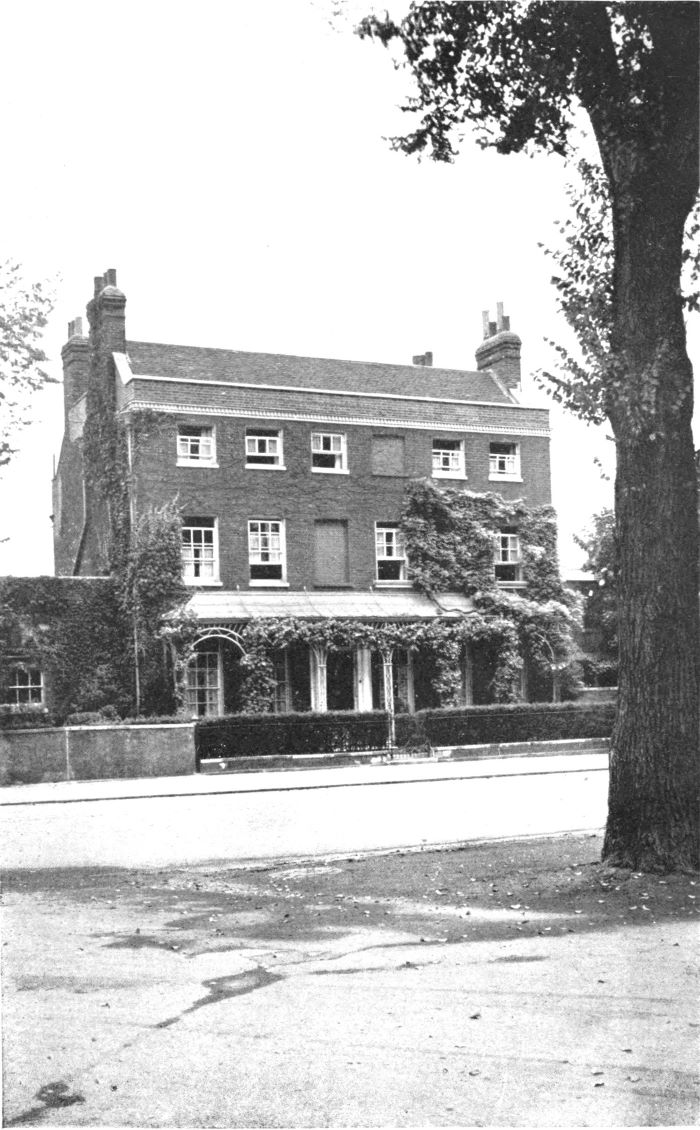
The move from London to Reading took
place in 1797, and the house they inhabited was
a new and handsome red-brick structure on the
London Road, fortunately still standing, and
now known as “Kendrick View.” Here, with
his phaeton, his spaniels and greyhounds, Dr.
Mitford proceeded to enjoy himself with, apparently,
no regard whatever for the future. The
swarms of old maids excelled in arranging card-parties
to which, by inviting the wives, they
managed to secure the presence and company
of the husbands. At these parties the Doctor
was an ever-welcome guest, for, as we have already
noted, he was one of the finest whist-players
of his time. Everything he did was performed
on a lavish scale. His greyhounds, for instance,
were the best that money could procure—no
coursing meeting either in the neighbourhood or
the country for many miles round was considered
complete unless the Mitford kennel was represented,
nor, as the Doctor was impatient of
defeat, did he consider the meeting a success
unless the Mitford kennel carried all before it.
Meanwhile, and when not engaged in the
mild excitements of cribbage and quadrille,
Mrs. Mitford paced the garden at the rear of the
house, “in contented, or at least uncomplaining,
solitude,” for even now, she could never be certain
whether, at any moment, the hazardous life
her husband was leading might not plunge them
once again into a miserable poverty; “a complaining
woman uncomplaining.”
Their daughter’s education now became a
matter of moment, for she was in her eleventh
year. Accordingly, she was entered as a boarder
at the school kept by M. St. Quintin, a French
émigré, at 22, Hans Place, Sloane Street, then
almost surrounded by fields, and even now,
although much altered, a pleasant enough situation.
“Kendrick View,” Reading, where the Mitfords lived, 1797-1805
M. St. Quintin and his wife enjoyed a reputation
of no ordinary character, and before venturing
on the Hans Place establishment had built up
a good connection and secured an equally good
name, in the conduct of the Abbey School at
Reading in a house adjoining what is known to
have been the Inner Gateway of the famous
Abbey. In this Abbey School—though not
under the tuition of Monsieur and Madame St.
Quintin—Jane Austen received much of her
education, as did also another famous author,
Mrs. Sherwood.
Their reputation in Reading was, doubtless,
the deciding factor in favour of sending Mary
Mitford to them in London, and that the decision
was a happy one there can be no question.
Little Mary, from her very early years, had
not enjoyed the best of health. As is common
with precocious children, she was somewhat
scrofulous; coupled with this she was further
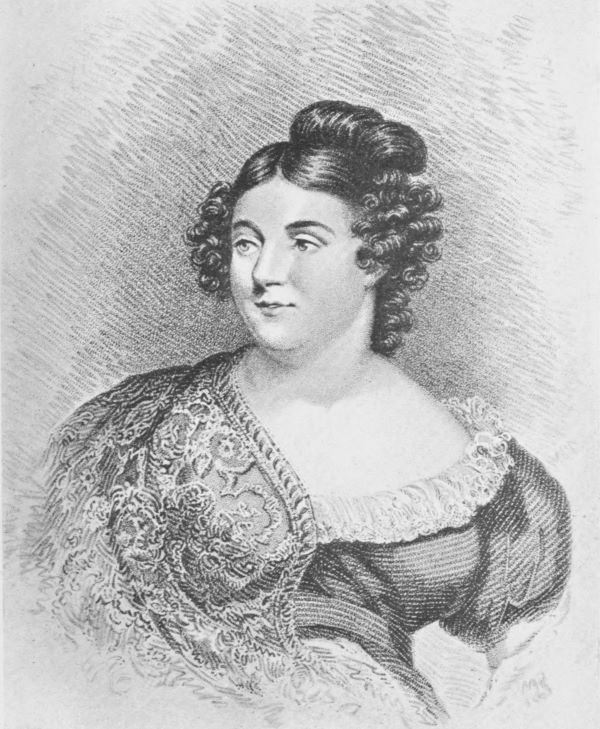
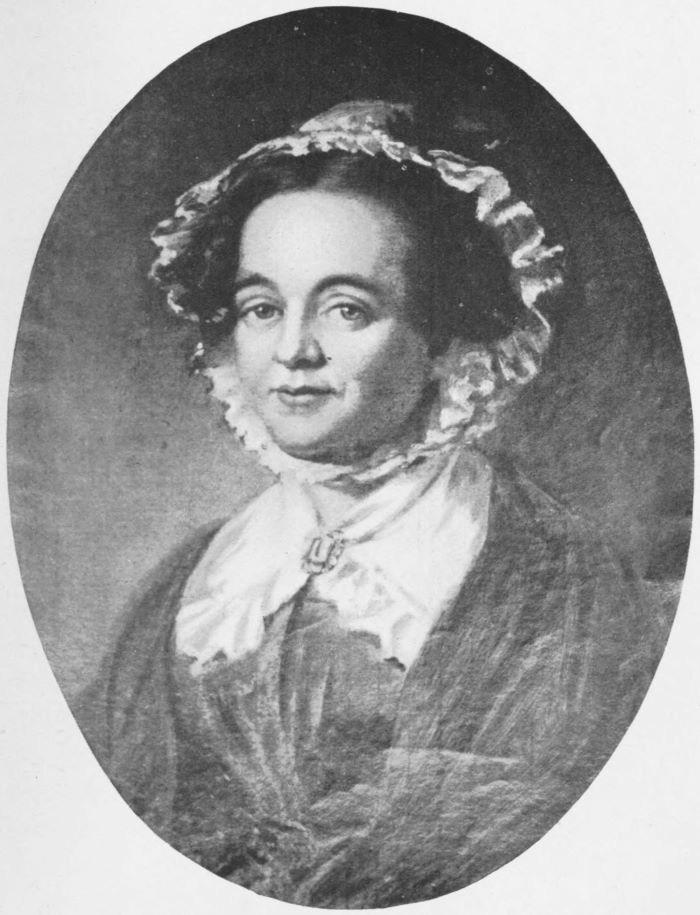
disadvantaged by being short and fat. Nor
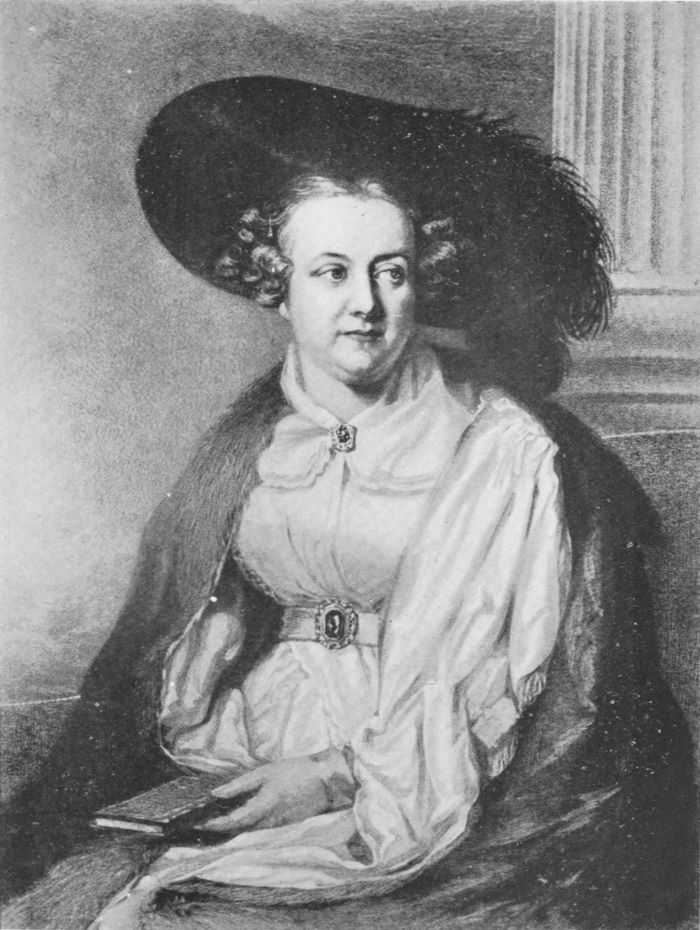
was she pretty. Her portrait, painted when she
was three years old, while it depicts an intelligent
face, shows nothing of the beauty usual in
children of that age. On the other hand, we
have it on the authority of those who knew her
well, that whatever defects of form and feature
she may have suffered were amply compensated
by the winsome smile, the gentle temper, keen
appreciation of life and all it had to give, and by
the silver-toned voice, all of which endeared
her to those who came under the spell of her
personality.
She was essentially the child of her parents,
combining the quiet acquiescent nature of her
mother with all the optimistic characteristics
of her father; and although, happily, she never
gave evidence of emulating her father in his
selfishness or those other worse attributes of
character which he sometimes displayed, the
fact has to be recorded that, occasionally, here
and there, among the originals of her letters to
her father is to be detected a certain coarseness
of thought and expression which go to prove
that even she was not altogether proof against
the influence of this unwise parent.
Monsieur St. Quintin’s establishment was well
calculated to interest the observant child, and
of her schoolmaster and his associates she has
given us an amusing and picturesque description.
“He had been secretary to the Comte de
Moustiers, one of the last Ambassadors, if not
the very last, from Louis Seize to the Court of
St. James’s. Of course he knew many emigrants
of the highest rank, and, indeed, of all ranks;
and being a lively, kind-hearted man, with a
liberal hand and a social temper, it was his delight
to assemble as many as he could of his poor
countrymen and countrywomen around his hospitable
supper-table. Something wonderful and
admirable it was to see how these Dukes and
Duchesses, Marshals and Marquises, Chevaliers
and Bishops, bore up under their unparalleled
reverses! How they laughed and talked, and
squabbled, and flirted,—constant to their high
heels, their rouge, and their furbelows, to their
old liaisons, their polished sarcasms, their cherished
rivalries! For the most part, these noble
exiles had a trifling pecuniary dependency;
some had brought with them jewels enough to
sustain them in their simple lodgings in Knightsbridge
or Pentonville; to some a faithful steward
contrived to forward the produce of some estate,
too small to have been seized by the early
plunderers; to others a rich English friend
would claim the privilege of returning the kindness
and hospitality of by-gone years.”
Many of them eked out a precarious living by
teaching languages, fencing, dancing and music;
while some, like Monsieur St. Quintin, were
fortunate in being able to found and carry on an
educational establishment on a somewhat large
scale.
Although shy and awkward, home-sick and
lonely, little Mary soon found much in the
Hans Place establishment to interest and amuse
her. Like all other similar establishments, it
contained an element of exclusiveness fostered
by the snobbish half-dozen great girls who,
being “only gentlemen’s daughters, had no
earthly right to give themselves airs.” These
the little country girl did not take seriously
enough to give her cause for trouble. But she
noticed them, nevertheless, and watched with
youthful contempt their successful attempts
to ostracize other less-favoured girls than themselves.
Her memories of such incidents are
epitomized very charmingly in her Recollections,
wherein she records the pathetic story of Mademoiselle
Rose, and the triumph over her tormentors
of the neglected, snubbed and shy
poor Betsy. It reads almost like a “moral
tale,” but is saved from the general mediocrity
of such effusions by its honest ring of indignation,
of sweet girlish sympathy with the suffering of
her fellow-pupil and governess, and of denunciation
of the thoughtless ones.
Mademoiselle Rose was the granddaughter of
an aged couple among the émigrés who gathered
at Madame St. Quintin’s supper parties. They
bore noted names of Brittany and had possessed
large estates, but now having lost these and their
two sons and been driven from their country,
they were dependent on the charity of others,
and on what their granddaughter Rose could
earn by straw-plaiting to make into the fancy
bonnets then in vogue. Mademoiselle Rose
deserves to live in our minds, she was so brave.
“Rose!” says Miss Mitford; “what a name for
that pallid drooping creature, whose dark eyes
looked too large for her face, whose bones seemed
starting through her skin, and whose black hair
contrasted even fearfully with the wan complexion
from which every tinge of healthful colour had
flown!” Even when she accompanied her grandparents
to the supper parties she always brought
her work, and rarely put it down during the
whole evening, so ceaseless was the toil by which
she laboured to support the aged couple now
cast upon her duty and her affection.
At length it became necessary to find some
other means of income apart from the straw-plaiting,
and so Mademoiselle Rose was installed
as a governess in the St. Quintin establishment,
“working as indefatigably through our verbs
and over our exercises as she had before done
through the rattle of the tric-trac[6] table and
the ceaseless chatter of French talk,” now and
again putting in a word for her straw-plaits
which in these new circumstances had to be
made during a scanty leisure, and her insistent
desire for the sale of which she made no effort to
conceal.
At this juncture arrived Betsy, a child of nine,
the daughter of a cheese-merchant in the Borough,
and therefore considered as fair game by the
vulgar and vain daughters of gentlemen. She came
with her father, who although he stayed but
five minutes, was so typical a John Bull in voice
and bearing that the elegant French dancing-master
who received him shrugged himself almost
out of his clothes with ill-concealed disgust.
“I rather liked the man,” says Miss Mitford;
“there was so much character about him, and,
in spite of the coarseness, so much that was
bold and hearty.”
The disgust of the dancing-master was not
lost upon him, for his parting injunction to the
mistress of the establishment was “to take care
that no grinning Frenchman had the ordering of
his Betsy’s feet. If she must learn to dance, let
her be taught by an honest Englishman.”
The conduct of both parent and dancing-master
was a cue indeed for the gentlemen’s
daughters, of which they quickly took advantage,
to the great discomfort of poor Betsy, who,
discarding Mary Mitford’s advances, sought
and found silent comfort with Mademoiselle
Rose. It was only silent comfort she obtained,
the comfort of suffering souls in sympathy with
each other, for neither knew the other’s language,
and the only solace they obtained was in working
together over the straw-plaits, in which Betsy
quickly became adept. By some means the
child was made aware of Mademoiselle Rose’s
story, which had then become more poignant by
reason of the fact that, although an opportunity
had presented itself, by arrangement with the
First Consul, for the re-admission of her grandparents
to France and possibly for the ultimate
recovery of some of their property, it could not
be grasped, as they were all too poor to bear the
expense. So poor Rose sighed over her straw-plaits,
and submitted. Shortly afterwards Betsy
was summoned home and begged permission to
take one of Rose’s bonnets to show her aunt,
with a view to purchase, a request which was
granted. Two hours later Betsy reappeared in
the schoolroom together with her father. The
scene which ensued must be told in Miss Mitford’s
own words.
“‘Ma’amselle,’ said he, bawling as loud as he
could, with the view, as we afterwards conjectured,
of making her understand him—‘Ma’amselle,
I have no great love for the French,
whom I take to be our natural enemies. But
you’re a good young woman; you’ve been kind
to my Betsy, and have taught her how to make
your fallals; and, moreover, you’re a good
daughter, and so’s my Betsy. She says that she
thinks you’re fretting because you can’t manage
to take your grandfather and grandmother
back to France again; so, as you let her help
you in that other handiwork, why you must let
her help you in this.’ Then throwing a heavy
purse into her lap, catching his little daughter
up in his arms, and hugging her to the honest
breast where she hid her tears and her blushes,
he departed, leaving poor Mdlle. Rose too much
bewildered to speak, or to comprehend the happiness
that had fallen upon her, and the whole
school the better for the lesson.”
In both the conduct of his establishment and
its curriculum, M. St. Quintin was very
thorough, and no doubt it was to this quality
that he owed the large measure of his success
as a schoolmaster. He himself taught the pupils
French, history, geography, and a smattering of
science, the scope of which was limited for the
very obvious reason that the tutor knew little
of the subject. He was ably seconded by Miss
Rowden, the Fanny Rowden who subsequently
endeared herself greatly to her precocious pupil
and, in course of time, succeeded M. St. Quintin,
upon his retirement, as mistress of the school.
She was responsible for the general course of study,
being assisted by special finishing masters for
Italian, music, dancing and drawing. In all of
these, save that of music, Mary Mitford became
a proficient pupil, so proficient indeed that she
often nonplussed her teachers by her intelligent
questionings.
“Our treasure,” wrote Mrs. Mitford to her
husband whilst she was on a short visit to the
school, “was much amused yesterday morning.
In her astronomical lecture, she not only completely
posed Miss Rowden, but M. St. Quintin
himself could not reconcile a contradiction which
she had discovered in the author they were
perusing. You cannot have an idea of the gratification
the dear little rogue feels in puzzling her
instructors.”
In the month previous to this she had again
successfully carried the day against her tutor in
an English composition of which the subject
was “The Advantage of a Well-educated Mind.”
In examining this M. St. Quintin observed a
word which struck him as needless, and he was
about to erase it when the pupil in her pretty,
meek way, an artless manner of which she
seems to have made good use in her childhood,
urged that it should be left standing. The tutor
was immediately perplexed and appealed to Miss
Rowden, who gave judgment in favour of the
pupil, suggesting that in the event of the disputed
participle being dismissed, the whole
sentence would need complete alteration. On a
more deliberate view of the subject, St. Quintin
agreed to the retention of the word and “with
all the liberality which is so amiable a point in his
character, begged our daughter’s pardon,” wrote
the proud mother.
The year 1802 found her the winner of the
prize for both French and English composition,
and so keen was her desire for knowledge that
two months later she wrote home to her mother
the information: “I have just taken a lesson in
Latin; but I shall, in consequence, omit some of
my other business. It is so extremely like Italian,
that I think I shall find it much easier than I
expected.” For this, Miss Rowden was immediately
responsible, so emulous was the child of
her governess; indeed, Miss Rowden’s influence
on the little girl was undoubtedly far-reaching
and must have laid the foundation of all her love
for literature which was so marked a characteristic
of Miss Mitford’s life. Truly, Miss Rowden
had in the child a wonderfully receptive soil in
which to plant the seeds of learning—we must
not forget the early precocious years and their
association with Percy’s Reliques and kindred
mental exercises—but she was a wise woman,
and fostered and encouraged her pupil to an extent
which would demand a tribute of praise
from the most superficial historian of Miss Mitford’s
life. The fact that Miss Rowden was at this
time diligently reading Virgil was sufficient stimulus
to her pupil to study to the same end, hence
the letter home announcing her decision. On
this occasion it would appear that Mrs. Mitford
entertained a doubt as to the wisdom of the
proposal, and consulted her husband, with the
result that a letter on the subject was forthwith
despatched to Hans Place.
“Your mother and myself,” wrote the Doctor,
“have had much conversation concerning the
utility of your learning Latin, and we both agree
that it is perfectly unnecessary, and would
occasion you additional trouble. It would
occupy more of your time than you could conveniently
appropriate to it; and we are more
than satisfied with your application and proficiency
in everything.”
In this, as in most other matters at this period
of her life, the child had her own way, and the
Latin lessons were continued—advantageously,
as the sequel will show.
On the whole, her life at Hans Place was of the
happiest, although, of course, the early days were
touched with the miseries of home-sickness
which are the common lot of all children in similar
circumstances.
“I was scarcely less happy,” she wrote in the
after years, “in the great London school than
at home; to tell the truth, I was well nigh as
much spoilt in one place as in the other; but as I
was a quiet and orderly little girl, and fell easily
into the rules of the house, there was no great
harm done, either to me or to the school discipline.”
Nevertheless, there is a lonely touch in one of
her early letters home from Hans Place. It is
dated September 15, 1799, and after thanking the
dear papa for certain parcels just received, goes
on to state: “My uncle called on me twice
while he stayed in London, but he went away in
five minutes both times. He said that he only
went to fetch my aunt, and would certainly take
me out when he returned. I hope that I may
be wrong in my opinion of my aunt; but I again
repeat, I think she has the most hypocritical
drawl I have ever heard. Pray, my dearest
papa, come soon to see me. I am quite miserable
without you, and have a thousand things to say
to you.”
A year later—November 30, 1800—she wrote
exuberantly in her pocket book: “Where shall
I be this day month? At home! How happy
I shall be, and shall be ready to jump out of my
skin for joy.”
Of her inability to master music, due to her
absolute lack of taste for it, we have already
spoken. Her first attempts were made on the
piano at the age of five, and so determined was
her father in the matter that, waiving all objections,
he insisted on her continuing to practise
right up to the date of her removal to the school
in Hans Place and for some years after.
The music-master at Hans Place was Mr.
Hook, the father of Theodore Hook, and a composer
of songs for the Vauxhall Gardens. He was,
so we learn, an instructor of average ability,
smooth-faced, good-natured and kindly, but
although these commended him to Miss Mitford
they aroused no enthusiasm in her for his art.
So he, like many others who had preceded him
in the thankless task of trying to teach little
Mary her notes, was promptly told by the
hasty father—who, unlike his daughter, was not
struck by Mr. Hook’s appearance or manner—that
he was no good and must be replaced by
some one more competent. This some one
promptly appeared in the person of Herr Schuberl,
at that time engaged in the special tuition of
two of Mary’s schoolfellows. He was an impatient,
irritable, but undoubtedly able man, and
before long amply avenged Mr. Hook, by refusing
to have anything more to do with the impossible
pupil.
This dismissal was, of course, hailed by the
child with great glee, for she began to entertain
the hope that the incident would put a stop for
ever to the attempts being made in regard
to her musical education. But her joy was
short-lived; her father was too pertinacious
to be so easily turned from his purpose, and believing
that the failure of his child was due to
incompetent teachers and to his own choice of
instrument, he decreed that she must learn the
harp.
Apart from any other consideration, this decision
had an advantage in that it was supposed
to afford the child an opportunity of learning
what was then designated as an “elegant accomplishment.”
So, a harp was installed at the
school, being placed for the convenience of the
tutor and pupil in the principal reception-room,
an apartment connected with the entrance-hall
by a long passage and two double doors, the
outer pair of which were covered in green-baize
and swung to with a resounding bang when let go
by the person who had opened them.
Being a reception-room, it was handsomely
fitted up with shelves upon which reposed a
number of nicely-bound books, chiefly of French
plays and classics. To this room was the unwilling
pupil sent each morning to practise alone the
exercises previously set her by the “demure little
Miss Essex,” the new music mistress; “sent
alone, most comfortably out of sight and hearing
of every individual in the house.”
But there was little of harp-practice, for before
long “I betook myself to the book-shelves, and
seeing a row of octavo volumes lettered Théâtre
de Voltaire, I selected one of them and had deposited
it in front of the music-stand, and perched
myself upon the stool to read it in less time than
an ordinary pupil would have consumed in getting
through the first three bars of ‘Ar Hyd y Nos.’
The play upon which I opened was ‘Zaïre.’
‘Zaïre’ is not ‘Richard the Third,’ any more
than M. de Voltaire is Shakespeare: nevertheless,
the play has its merits. I proceeded to other
plays—‘Œdipe,’ ‘Mérope,’ ‘Alzire,’ ‘Mahomet,’
plays well worth reading, but not so absorbing
as to prevent my giving due attention to the
warning doors, and putting the book in its place,
and striking the chords of ‘Ar Hyd y Nos’ as
often as I heard a step approaching; or gathering
up myself and my music, and walking quietly
back to the school-room as soon as the hour for
practice had expired.”
All of which was, of course, very naughty,
and scarcely what the dear papa, blissfully ignorant
away in Reading, would have desired! But
worse was to follow. In time Voltaire was exhausted,
and, hunting along the shelves, the
omnivorous Miss came upon the comedies of
Molière, which plunged her at once into the gaieties
of his delightful world, blotting out all thought of
present things—harp, music-books, and lessons—and
even demure little Miss Essex vanished into
thin air along with “Ar Hyd y Nos.” Fascinated
by the tribulations of “Sganarelle” or the
lessons of the “Bourgeois Gentilhomme,” she
was at length caught by none other than M.
St. Quintin, who found her laughing till she cried
over the apostrophes of the angry father to the
galley in which he is told his son has been taken
captive. “Que diable alloit-il faire dans cette
galère!” an apostrophe which, as she quaintly
wrote, “comes true with regard to somebody
in a scrape during every moment of every day,
and was never more applicable than to myself at
that instant.”
M. St. Quintin could not chide, for, apart from
his own adoration of Molière, an adoration he
did not extend to music, he was convinced that
no proficiency in any art could be gained without
natural qualifications and sincere goodwill. So
he joined in the tearful laughter, and when he
could compose himself, complimented rather
than rebuked the pupil upon her relish for the
comic drama. More than this, he spoke plainly
to the dear papa, with the result that the harp
and Miss Essex went together, that music was
henceforth abandoned, and the event crowned
with the gift of a cheap edition of Molière for the
wayward little maid’s own reading.
These were the foundations skilfully laid and
built upon by Miss Rowden. They marked the
beginnings of a distinct and strong literary taste
and a passion for the Drama which, had she and
her father but known at the time, were to furnish
and equip her for the stern battle of life in which
she was to engage, a battle for the bare necessities
of life for herself and the provision of luxuries for
the careless and thriftless parent upon whom she
doted and spent herself.
In August, 1802—she would then be fifteen
years of age—she writes to her father: “I
told you that I had finished the Iliad, which I
admired beyond anything I ever read. I have
now begun the Æneid, which I cannot say I
admire so much. Dryden is so fond of triplets
and alexandrines, that it is much heavier reading;
and though he is reckoned a more harmonious
versifier than Pope, some of his lines are so
careless that I shall not be sorry when I have
finished it. I shall then read the Odyssey. I
have already gone through three books, and
shall finish it in a fortnight ... I am now reading
that beautiful opera of Metastasio, Themistocles;
and when I have finished that, I shall
read Tasso’s Jerusalem Delivered. How you
would dote on Metastasio; his poetry is really
heavenly,” a letter which, apart from the excusable
conventional school-girl gush of its closing
words, is not only remarkable for its style, but
for its display of a critical faculty really astounding
in a girl of fifteen.
Later, in the same month, she wrote to her
mother: “I am glad my sweet mamma agrees
with me with regard to Dryden, as I never liked
him as well as Pope. Miss Rowden had never
read any translation of Virgil but his, and consequently
could not judge of their respective
merits. If we can get Wharton’s Æneid, we
shall finish it with that. After I have read the
Odyssey, I believe I shall read Ovid’s Metamorphoses.
I shall be very glad of this, as I
think they are extremely beautiful.... I am
much flattered, my darlings, by the praises you
bestowed on my last letter, though I have not the
vanity to think I deserved them. It has ever
been my ambition to write like my darlings,
though I fear I shall never attain their style.”
A week later, she followed this with another
in similar strain: “M. St. Quintin was perfectly
delighted with my French on Saturday. Signor
Parachiretti is sure that I shall know Italian as
well as I do French by Christmas. I know you
will not think it is through vanity that I say this,
who should not say it; but I well know you like
to hear that your darling is doing well, and I consult
more your gratification than false modesty in
relating it to you. I went to the library the
other day with Miss Rowden, and brought back
the first volume of Goldsmith’s Animated Nature.
It is quite a lady’s natural history, and extremely
entertaining. The style is easy and simple,
and totally free from technical terms, which are
generally the greatest objection to books of that
kind. I am likewise reading the Odyssey, which
I even prefer to the Iliad. I think it beautiful
beyond comparison.”
These few extracts from the letters not only
serve to show the singular thirst for knowledge
which the child possessed, but also indicate the
perfect understanding which existed between
the mother and child, resembling, as the Rev.
A. G. L’Estrange justly remarks, “those of one
sister to another.”
In return Mrs. Mitford retailed all the gossip
and news of Reading, giving the eager child the
fullest accounts of the dinners and suppers and
card-parties which formed a regular interchange
of courtesies between neighbours in that town
a century ago. These accounts, only intended
by the fond mother, as we may properly suppose,
to bridge the distance between school and home,
were carefully stored away in the wonderful
memory of their recipient, there to rest until,
many years after, they were revivified and placed
on record for all time—as we hope—in the pages
of Belford Regis, the work which, quite apart
from Our Village, has endeared its writer to
all ardent Reading lovers in that it affords them
a true and living picture of the ancient borough
as it was in the opening years of the nineteenth
century.
In regard to this correspondence between the
mother and daughter, it has been elsewhere remarked
that “no word of advice, moral or religious,
is ever mingled,” and the question: “Was
this wisdom?” is answered by the querist himself
that, ruling out the possibility of carelessness
or indifference as the motives which actuated
Mrs. Mitford and “knowing what a devoted
daughter Mary Mitford became, we may be well
induced to believe that her mother’s silence
on these more serious arguments originated in
deep reflection; and that she had judiciously
determined simply to attach and amuse her
child by her correspondence, and trusted to the
impressive persuasion of her example for the
inculcation of higher things.”[7]
With every desire to pay the sincerest tribute
to the learned editor in his difficult task, we are
inclined to disagree with him as to the wisdom
of Mrs. Mitford’s plan. If by “example” we are
to understand that the Christian virtues of forbearance
with a selfish and overmastering father
and fortitude in adversity are intended, then we
agree that Mary Russell Mitford well learned
her lesson, but—and herein is the basis of our
disagreement—had mother and daughter been
less content, for the sake of peace, to pander to
the every whim and caprice of Dr. Mitford, much,
if not all, of the miserable poverty of later years
would have been avoided, and the tragedy of
Miss Mitford’s life, with its last days of spiritual
doubts and fears, been averted. The result on
her father’s career may be speculative, but we
are inclined to hope that had the two women
more boldly asserted their claims to consideration,
the good that was in Dr. Mitford and which
is to be found in all men, would have been roused,
and the cruel selfishness of his life been checked
if not altogether effaced.
These letters from home undoubtedly gave
the fullest details of the daily occurrences, and
must occasionally have tickled the schoolgirl
immensely, if we may judge by one of the replies
which they evoked.
“I really think,” she wrote, “that my dearly-beloved
mother had better have the jack-asses
than the horses. The former will at least have
the recommendation of singularity, which the
other has not; as I am convinced that more
than half the smart carriages in the neighbourhood
of Reading are drawn by the horses which
work in the team,” a reply, the whimsicality of
which is only equalled by its pertness, when we
remember that the smart carriages alluded to
must have been the conveyances of the county
gentry whose estates in the neighbourhood and
whose lineage were not altogether insignificant.
At the same time it is a reply—and for this
reason is quoted—which marks the outcropping
of that characteristic which Miss Mitford possessed
and to which she often gave expression—an
abiding distaste for anything approaching
snobbery or self-assertion.
We have now come to the year 1802, a red-letter
year in the child’s life, inasmuch as its
close was to witness the termination of her school
career and that it brought to her the news that
her father had purchased a house in the country,
with land attached, where he intended to set up a
small farm as a hobby and, generally, to live the
life of a country gentleman. It is certain that
the child would receive with pleasure the news of
this projected change of residence, for despite
the attractions which her school-life in London
had for her, the interest she always displayed
in matters pertaining to the country, with its
free and open life, its close associations with
flowers and animals, and its comparative freedom
from restraint, could leave no doubt in
the minds of those who knew her as to the
choice she would make between life in town or
country, were such a choice offered her.
Nevertheless, she was undoubtedly happy at
Hans Place, enjoying to the full the companionship
and affection bestowed upon her by Miss
Rowden, and the deference of M. St. Quintin,
who regarded her not only as a prodigy but as a
distinct credit to his establishment. Nor was
this all, for her keen sense of humour and quick
perception of the ludicrous side of life, found
plenty of scope for their display in a school where
the tutors were of mixed nationality and the
scholars were drawn from various classes of
society.
There is evidence of this in a letter which
she wrote, some ten years later, to one of her
favourite correspondents, Sir William Elford,
wherein she describes a contretemps into which
the French governess precipitated herself, mainly
through over-zeal in her attempts to correct the
untidy habits of her charges and, incidentally,
in the hope of discomposing and so scoring off the
dancing-master, whom she did not like.
3 Mile † May 10th 1839
G Mitford
Doctor Mitford.
(From a painting by John Lucas, 1839.)
It was the custom to signalize the break-up
of a term by the performance of a Drama such as
Hannah More’s “Search after Happiness,” in
which Mary Mitford once took the part of Cleora;
or by a ballet, on which occasions “the sides
of the school-room were fitted up with bowers, in
which the little girls who had to dance were
seated, and whence they issued at a signal from
M. Duval, the dancing-master, attired as sylphs
or shepherdesses, to skip or glide through the
mazy movements which he had arranged for
them, to the music of his kit.” Doubtless the
exhibitions proper were carried out with the
utmost decorum by all concerned, seeing that a
critical public, consisting of fond parents, would
be assembled, ready to note, and later to comment
upon, any lapse in deportment or manners. It
was, however, in the rehearsals that opportunities
for fun occurred, and one such occasion forms
the basis of the description which we now
quote.
“Madame,” was a fine majestic-looking old
woman of sixty, but with all the activity of sixteen
and the fidgety neatness of a Dutchwoman.
She had, for days, been murmuring against the
untidy habits of the young ladies, and had
threatened to make a terrible example of those
who left their belongings lying about.
“A few exercise books found out of place
were thrown into the fire, and a few skipping-ropes
(one of which had nearly broken Madame’s
neck by her falling over it in the dark) thrown out
of the window. This was but the gathering of
the wind before the storm.” The storm itself
broke on the dancing-day and when all the pupils,
dressed for the occasion, were assembled in the
room. Then, to the consternation of all, Madame
appeared and bidding the young ladies follow
her, commenced a rummage all over the
house.
“Oh! the hats, the tippets, the shoes, the
gloves, the books, the music, the playthings, the
workthings, that this unlucky search discovered
thrown into holes, and corners, and everywhere
but where they ought to have been! Well, my
dear Sir, all this immense quantity of litter was
to be fastened to the person and the dress of the
unfortunate little urchin to whom it belonged.”
The task of apportioning the articles to the
delinquents was a severe one for the governess, to
whose inquiries the only reply obtainable was
“Ce n’est pas à moi,” with the result that she
had left on her hands a large quantity of hats,
gloves and slippers the ownership of which no one
would acknowledge. But there were many other
articles which refused to be thus abandoned, and
the result was a decorative effect more novel
than elegant. Dictionaries were suspended from
necks en médaillon, shawls were tied round the
waist en ceinture, and loose pieces of music were
pinned to the dancing frocks en queue. “I
escaped,” says the merry recorder of the incident,
“with a good lecture and a pocket-handkerchief
fastened to my frock, which, as it was quite clean,
was scarcely perceptible.”
Unfortunately for Madame, the dancing-master
was not due for an hour, the interval having to
be devoted to the drill-sergeant, whose astonishment,
when he arrived and viewed the odd habiliments
of the pupils, may well be imagined. And
to make matters more disconcerting for Madame
and more amusing for the culprits, she could not
speak a word of English, while the sergeant knew
no word of French; so, as drill could not be performed
by a squad so hampered by extraneous
accoutrements, the sergeant ordered their removal,
and Madame, we may well imagine, retired
discomfited.
FOOTNOTES:
[7] The Rev. A. G. L’Estrange’s Introduction to The Life
of Mary Russell Mitford, related in a Selection from Her
Letters to Her Friends. 3 vols., 1870.
CHAPTER V READING — FOOTNOTES:
The new place of residence which Dr. Mitford
acquired early in the year 1802, was
known as Grazeley Court, a rambling Elizabethan
structure of one-time importance, but which,
at the time of Dr. Mitford’s purchase, had fallen
into sad decay. Originally built for a country
gentleman the place had for some reason been
abandoned, slowly degenerating until at length
it was divided into a number of tenements
occupied by agricultural labourers, for which
reason and its supposed defective title the doctor
was able to secure it and an adjoining eighty
acres at the bargain price of a few hundred
pounds.
As we have already noted, the Doctor had a
certain predilection for country sports and pursuits,
although at the same time he was always
glad to embrace any and every opportunity
afforded him for the display of his peculiar skill
at cards with their concomitant excitements
and hazards. In these circumstances it is difficult
to understand why the residence at Reading
should have been given up, bearing in mind its
convenience as a centre for Town and the clubs
as well as for the coursing grounds of Hampshire
and Oxfordshire. Possibly the real reason was
that the Doctor had been indulging in that
frankness of speech which his daughter named
in conjunction with a rashness of action, as one
of his unfortunate characteristics; or, it may
be, that this was the occasion, to which Miss
Mitford refers in her Recollections, when he “got
into some feud with that influential body the
corporation.”
In any case the purchase was effected, and the
Doctor at once threw himself with zest into the
labour of making the house habitable according
to his own ideas. The situation was ideal.
Three miles southwards out of Reading by the
Basingstoke road, and one mile to the westward
of that important thoroughfare, from which
point it was reached by pleasant, overhung
by-lanes, the Court occupied the centre of a
large garden, at that time overgrown with rank
weeds, which gave on to a narrow lane over
which was afforded an extensive view to the
south. First came a stretch of common, picturesquely
dotted with patches of brake and
clumps of wild roses intermingled with honeysuckle;
in the middle distance were sundry
peeps at the snug hamlet of Grazeley, and beyond
these were the outlying billowy woodlands which
were then, as now, so delightful a feature of
the neighbouring countryside.
As might be expected of a house built amid
such surroundings in Elizabeth’s day—rumour
named it as of later Jacobean origin—it had a
certain romantic character. We read of its
“old sitting-room, with its large sunny oriel
window, and its small walls wainscoted in small
carved panels, and of the large oaken staircase,
with a massive balustrade and broad low steps;
of expansive fireplaces, with highly architectural
chimney-pieces adorned with old-fashioned busts
and coats-of-arms. Above all, there were two
secret rooms, in which priests and cavaliers had
been known to hide, and which could be well
secured by inward fastenings; the one in a
garret, where a triangular compartment of the
wall pushed in and gave entrance to a chamber
in the roof; the other, where the entire ceiling
of a large light closet could be raised, and access
obtained to a place of concealment capable of
containing six or seven fugitives.”
Such a house, in these our own times, would
be eagerly snapped up were it in the market,
and any amount of inconvenience suffered by
its owner rather than destroy the most insignificant
mark of antiquity. Possibly similar houses
were less rare in Dr. Mitford’s day; very probably
romanticism made no appeal to him, for he
quickly made up his mind to rase the whole
building to the ground and erect another according
to his own design and taste. His daughter,
then at school, hearing of the purchase and of
her father’s decision, added to it the weight of
her fifteen years of wisdom by expressing the
hope, in a letter to her mother, that “you will
be obliged to take down your house at the farm
as it will be much better to have it all new
together,” but she altered her opinion later on,
as did her parents, when it was too late to stop
the work of demolition.
If we may hazard a guess, we suspect that
this purchase afforded the Doctor an outlet for
that restlessness which was one of his characteristics,
and gave him an opportunity for another
prodigal expenditure of money. The scheme
was an imposing one. A new site was chosen
somewhat further back from the road than that
of the older one. The garden was cleared and
remodelled—no one could have objected to that,
as it was sadly in need of attention—but the
old wild hedge, with its delightfully rustic tangle
of thorns over which scrambled a profusion of
eglantines, honeysuckles and blackberries, had
to give place to a severe and imposing piece of
park paling, and the garden-space, once so open
and affording so expansive a view across country,
was converted into a plantation which, while
it effectually screened the inhabitants from the
gaze of the curious passer-by as effectually
obstructed the magnificent outlook which was
so pleasant a feature of the place. All this
was done that there might be massive gates
with a devious carriage-drive up to the door.
From start to finish it was decreed that no
expense was to be spared in making the new
house something to be wondered at and admired
by the County. Thus on April 29, 1802, the
first brick was laid with the ceremony due to
the illustrious event. Mrs. Mitford, who had
been easily persuaded, as indeed was usual, to
take the same view as her husband, gave a full
account of the proceedings in a letter which
she despatched next day to her daughter at
Hans Place.
“Yesterday we passed the day at our farm in
order to lay the first brick. I insisted on Toney
[Miss Mitford’s pet greyhound] being present,
and as her dear little mistress was not there,
she was to be, as far as she could, your substitute
by putting her little paw on the brick which
you should have laid had you been present. I
trust you will think this was no bad idea. All
the bells in Reading were ringing when we left
home on this important business; but, not to
arrogate too much to ourselves, and to confess
the truth, I believe it was Mr. J. Bulley’s generosity
which called forth their cheeriest sounds.
However, from whatever cause arising, we had
the full benefit of the peal.
“We got to our rural retreat about half-past
nine, both the men-servants attending us on
horseback. At ten o’clock your old Mumpsa
[the child’s pet name for her mother] laid the
first brick, and placed under it a medal struck
in commemoration of the centenary of the
Revolution of 1688. Your darling father then
placed another for himself, and a third for his
beloved treasure, which he made Toney put her
foot upon; and after the little rogue had done
so, you would have laughed to have seen how
she wagged her tail, and nodded her head upon
it, as much as to say she was very proud of being
admitted to have, not a finger, but a foot, in
the business. The men worked merrily on until
two o’clock, and then repaired to the public-house,
where two legs of mutton, and bread,
beer, and potatoes were provided for them.
There they enjoyed themselves for the rest of
the day, and this morning cheerily resumed
their labours.”
Having thus impressed the natives, including
the landlord of “The Bell,” with a sense of
the importance of the new owner about to come
among them, Dr. Mitford completed the business
by substituting the name “Bertram House”
for that of “Grazeley Court,” the reason for
which, did the curiosity of the neighbouring
aristocracy cause them to inquire, was to be
discovered in the fact that he was a scion of the
Mitfords of Bertram Castle, Bertram being the
original and ancient name of the family.
Judging by the very scant records of this
period at our command, it would appear that
the erection of Bertram House, and its completion
to Dr. Mitford’s satisfaction, must have
occupied nearly four years. This would give
Miss Mitford a clear three years of life among
the mild excitements which Reading then offered
before taking up residence at Grazeley in a
district which she was to immortalize—the term
surely needs no justification for its use—and
in which she was destined, save for a few notable
occasions when duty or considerations of health
called her away for short periods, to live out
her life to the end.
Her introduction to the gaieties of this respectable
Borough took place in the August of 1803,
when she would be nearly sixteen. The occasion
was the annual Race Ball, at which function it
was the time-honoured custom of the race-steward
to dance with the young ladies then
making their début, an ordeal almost as trying
to the débutante in those prim and decorous
days as a presentation at Court, especially if
the steward happened to be a total stranger to
her. Writing to her mother, towards the end
of her school career and commenting on this,
Miss Mitford added—possibly to gain courage
from the inditing—“I think myself very fortunate
that Mr. Shaw Lefevre[8] will be steward next
year, for by that time I shall hope to know him
well enough to render the undertaking of dancing
with him much less disagreeable.” In this
connexion we venture to suggest that on this
occasion Mr. Shaw Lefevre would have full
hands, when we remember that even at this
comparatively early date Miss Mitford’s figure
had already assumed generous proportions and
that she was short of stature into the bargain.
Naturally enough, the conclusion of school
life and the re-commencement of life at home
afforded the young girl the fullest opportunities
for observing, noting and commenting on persons
and events, a pastime in which she delighted.
Her pictures of the Reading of her day are
notable alike for their quaint fancies as for their
fidelity. Her picture of the town—which she
disguises under the name of Belford Regis—as
viewed from the southern heights of Whitley, is
one to which all true lovers of the old town turn
with pleasure even to-day.
“About this point,” she says, “is perhaps to
be seen the very best view of Belford, with its
long ranges of modern buildings in the outskirts,
mingled with picturesque old streets; the venerable
towers of St. Stephen’s [St. Mary’s] and
St. Nicholas [St. Laurence’s]; the light and
tapering spire of St. John’s [St. Giles’]; the
huge monastic ruins of the abbey; the massive
walls of the county gaol; the great river winding
along like a thread of silver; trees and gardens
mingling amongst all; and the whole landscape
enriched and lightened by the dropping elms
of the foreground, adding an elusive beauty
to the picture, by breaking the too formal outline
and veiling just exactly those parts which most
require concealment. Nobody can look at Belford
from this point, without feeling that it is
a very English and very charming scene; and
the impression does not diminish on further
acquaintance.”
Continuing, she compares the old romantic
structures in which our ancestors delighted—now,
unhappily, nearly all demolished—with,
what she calls, the handsome and uniform buildings
which are now the fashion; and she remarks
on the rapid growth which the town was
then making, “having recently been extended to
nearly double its former size.” What would she
have said, we wonder, could she have foreseen
the Reading of to-day with its palatial polished-granite-fronted
business emporiums controlled
from the Metropolis by great limited liability
companies whose insatiable appetites are devouring,
as their policy of grab is choking,
the life from the old-time burgesses; burgesses
who gloried in their town and whom their town
took pleasure in honouring; men whose places
are now filled by battalions of shopmen whose
fixity of tenure is so doubtful as to preclude
them from taking any part or interest, however
slight, in the town which shelters them? And,
in regard to the extension which she names with
so much pride, how she would gasp with astonishment
had she been told that Whitley, from
which she viewed the pleasant scene, would be
turned into dreary streets of uniformly built
villas, never deviating by so much as half a brick
from the monotony of the usual “desirable
residence”; that the old limits of the town,
beyond which she could easily descry the panoramic
revel of field and meadow, would be
extended for nearly two miles each way, almost
indeed to her beloved “Our Village,” and that
the population of 16,000—each unit placidly
pursuing its fairly prosperous calling—would be
transformed, seventy years later, into a struggling,
perspiring, more or less harassed army of 88,000,
the majority not daring, though they would not
admit the stern impeachment, to call their
bodies their own.
“The good town of Belford,” she later remarks,
“swarmed of course with single ladies ... and
was the paradise of ill-jointured widows and
portionless old maids. They met on the tableland
of gentility, passing their mornings in calls
at each other’s houses, and their evenings in
small tea-parties, seasoned with a rubber or a
pool, and garnished with the little quiet gossiping
(call it not scandal, gentle reader!) which their
habits required.... The part of the town in
which they chiefly congregated, the lady’s quartier,
was one hilly corner of the parish of St. Nicholas,
a sort of highland district, all made up of
short rows, and pigmy places, and half-finished
crescents, entirely uncontaminated by the vulgarity
of shops,” chosen, it is suggested, “perhaps
because it was cheap, perhaps because it was
genteel—perhaps from a mixture of both causes.”
A kindly satire this, and interesting because it
points so conclusively to a certain backwater
near the Forbury, and under the shadow of the
church of St. Laurence, which will be easily
recognized by many who remember how it
retained its character as a settlement for prim
old ladies, of the kind described by Miss Mitford,
until within quite recent times.
“Of the public amusements of the town, as I
remember it at bonny fifteen,” she continues,
“these were sober enough. Ten years before,
clubs had flourished; and the heads of houses
had met once a week at the King’s Arms for the
purpose of whist-playing; whilst the ladies,
thus deserted by their liege lords, had established
a meeting at each other’s mansions on club-nights,
from which, by way of retaliation, the whole
male sex was banished,” save one. “At the
time, however, of which I speak, these clubs
had passed away; and the public diversions
were limited to an annual visit from a respectable
company of actors, the theatre being, as is usual
in country places, very well conducted and
exceedingly ill attended; to biennial concerts,
equally good in their kind, and rather better
patronised; and to almost weekly incursions
from itinerant lecturers on all the arts and sciences,
and from prodigies of every kind, whether three-year-old
fiddlers or learned dogs. There were
also balls in their spacious and commodious
townhall, which seemed as much built for the
purposes of dancing as that of trying criminals.
Public balls there were in abundance; but at
the time of which I speak they were of less
advantage to the good town of Belford than
any one, looking at the number of good houses
and of pretty young women, could well have
thought possible.”
These few extracts—space forbids a larger
selection—are sufficient, we think, to prove
how keen was the observing eye and how critical
was the mind of Miss Mitford at this time when,—to
use her own phrase—“I was a very
young girl and, what is more to the purpose, a
very shy one, so that I mixed in none of the
gaieties,” a statement which seems to lend support
to the current saying that “the onlooker
sees most of the game.”
So far we have dealt with the Reading life as
dating from 1797, but it is important to note
that Miss Mitford speaks of a short residence in
the town when she was but four years of age,
and this would give us the year 1791. Unfortunately
no proof for or against this is available,
so far as we know, and we should scarcely have
thought it worthy of mention but for another
statement which she makes in her Recollections
the authenticity of which it would be well to
at least, attempt to clear up.
The statement has reference to the interest
which Samuel Taylor Coleridge evinced in one of
her earliest literary efforts, Christina; or, The
Maid of the South Seas, when it was being prepared
for press at about the year 1811. This
interest she ascribes to “Mr. Coleridge’s kind
recognition of my father’s exertions” in his
behalf and relates to that romantic period of the
poet’s life when, in the December of 1793, he
suddenly enlisted as a common soldier in the
15th Light Dragoons under the nom de guerre
of “Silas Tomkyn Cumberbatch.” We have it
on good authority that on December 4, 1793,
he was sent, with other raw recruits, to be drilled
with his regiment, then garrisoned at Reading,
from which date until his discharge on April
10, 1794, he clearly proved his unfitness for the
calling of a man-at-arms.
The story of his discharge has been variously
related, but all are agreed that his identity was
revealed by his being overheard by certain of
his officers reciting Greek lines, to say nothing
of the polish which, scholar as he was, he could
not disguise. The circumstance was sufficiently
unique in those days—the gentleman ranker
was a growth of later date—to occasion inquiries,
and these resulted in communications with his
friends, who came, identified, and bought him out.
One of these officers was Captain Ogle, eldest
son of that Dean of Winchester to whom, as we
have noted in the earliest chapter of this book,
Dr. Mitford was on the visit which resulted in
his introduction to Miss Russell.
Miss Mitford’s account of the event is somewhat
circumstantial, for she relates that as Dr.
Ogle was on a short visit to the Mitfords, the
opportunity of calling upon his father was gladly
embraced by the son, who, in the course of
conversation, recorded the unusual incident of
the learned recruit, with the result that “one
of the servants waiting at table” was “induced
to enlist in his place,” and the “arrangement for
his [Coleridge’s] discharge took place at my
father’s house at Reading.”
The dates relative to Coleridge’s enlistment
and discharge are incontrovertible, therefore in
view of the lack of evidence to support the idea
of the Mitfords being in Reading in 1794, we
are inclined to doubt—as others have doubted—the
authenticity of Miss Mitford’s narrative,
suggesting rather, that having heard this romantic
story, many years after—possibly from the
lips of Captain Ogle himself—she readily assumed,
with the licence of literary folk in general, that
the incident took place as she recorded it.
[8] He represented Reading in Parliament, 1802-1820.
CHAPTER VI BERTRAM HOUSE — FOOTNOTES:
Bertram House was at last finished and
the beginning of 1806 saw the Mitfords in
residence. In the matter of furnishing the
Doctor had spared no expense, everything being
new and of the latest pattern, in fact the best
that a fashionable London upholsterer could
supply. Of the pictures we know that the
walls were well covered and that the collection
included a Gainsborough, a pair of female heads
by Greuze, and a portrait of the Doctor by Opie.
We have already seen, in Mrs. Mitford’s description
of the stone-laying ceremony, that they
were attended by “the two men-servants on
horseback”; this hints at a fairly complete
retinue having been installed at the Reading
house, but it was considerably augmented when
the arrangements were completed at Grazeley.
Appearances counted for much in the district
and the Doctor was not the man to let slip such
a grand opportunity for ostentatious display.
His hospitality was profuse and indiscriminate,
resulting in a house-warming which extended
over quite a lengthy period. As an incentive—had
he need of one—Dr. Mitford had recently
been appointed as one of the County magistrates,
a tribute of appreciation from the Whigs, of
whose cause he was an earnest partizan, which
gave him an immediate rise in social status.
In time, of course, the family settled down
to a more or less ordered form of life, so ordered
indeed that the Doctor created as many excuses
as possible to cover his frequent journeys to
Town and his clubs. There was sport in plenty
to be had in the neighbourhood, and of this the
Doctor took full advantage, being a familiar
figure around the countryside with his gun and
spaniels. Then, too, there were the coursing
meetings—the famous meetings at Ilsley and
private matches arranged between friends—none
of which were considered complete unless
the Doctor were present or his famous kennel
represented. Throughout Miss Mitford’s letters,
occasionally to her father and often to friends,
there are frequent references to the greyhounds
whose names, in accordance with a custom prevalent
then and still fashionable, all began with
the letter M in token of their ownership. Thus,
to name only a few, we have Mia, Manx, Marmion
(a notable dog this, with an equally notable
son of the same name), Mogul, Miller, Moss-Trooper,
and Mopy. For all of these Miss Mitford
ever exhibited the greatest affection, and
in those cases where a spaniel grew too old to
follow the gun or a greyhound too stiff to be
matched, an asylum under Miss Mitford’s immediate
eye and care was immediately provided,
and the creature was henceforth looked upon as
her own.
Taking advantage of this motherliness to
dumb animals her father frequently handed over
to her some specially valuable dog from whose
later exploits as a courser he expected much.
Apparently, however, the real reason for the
supposed gift was not disclosed, with the result
that when the dog was eventually removed the
little mistress gave vent to her annoyance in no
measured tones.
“It is a most extraordinary thing,” she says in
one communication to her father, “that I never
can have a dog that I like but you immediately
take it from me and burthen me with the care
of some detestable brute whom you in your
eternal caprice fancy a good one. Observe, however,
that in giving up my own darling Mordor,
I bargain that that sulky, ungrateful, mangy beast
Marmion shall be sent off as soon as you come
home, and that I shall again have my sweet
Marian to pet and comfort me.”
This was not, of course, a serious outburst,
but merely the explosion of what she doubtless
considered a truly righteous indignation, for,
although she was no sportswoman, her love for
her father gave her an interest in his pursuits,
and she shared with him to the full the joy of
triumph and the sorrow of defeat, while to
disparage the Mitford kennel was to offer her a
personal affront. On the other hand, she was
quick to convey to the Doctor any item of praise
which she overheard or might have addressed to
her. “We called yesterday at the Fawcetts’, and
the old General said he had kept greyhounds and
seen many thousands, but had never had an
idea of perfect and consummate beauty until he
saw her” [a reference, in a letter to her father,
to Mia, one of the hounds].
She had a strong dislike to equestrian exercise—the
rides of babyhood across the Alresford
downs with her father could not count in this
connexion—and although every inducement was
offered her to ride, an inglorious fall from a
donkey quickly settled her convictions as to
her horsemanship, and her one and only riding-habit
was forthwith converted into a winter-gown.
Strictly speaking, the greater portion
of her time was spent at home with her mother,
receiving visitors or lying for hours at a time
on the sofa, where she would devour a great
quantity of books at a pace which, having regard
to the extraordinary knowledge she imbibed
from her reading, was truly astonishing.[9] At
other times the little green chariot, their favourite
equipage, would be ordered out, calls would be
returned and the drive be possibly extended to
Reading, where there would always be plenty of
shopping to do and calls to be made on the old
neighbours and friends who would have the
latest news from Town or the latest gossip of
their immediate circle to retail.
With a desire to augment his income, which
must have been seriously depleted by the building
operations and by the subsequent reckless expenditure
on the household, the Doctor now began
to indulge in a series of hazardous enterprises,
which, with all a gambler’s insistence, he pursued
intently the while they dragged him deeper and
deeper into the mire. One of these was an
extensive speculation in coal in which he engaged
with a brother of M. St. Quintin. For this he
supplied the whole of the capital in expectation
of a return of £1,500 a year, but the whole thing
was a failure and, with the exception of about
£300, the capital was lost. Another Frenchman,
a man of ingenious ideas but no money wherewith
to put them to practical use, found a ready
supporter in the Doctor, who was induced to
advance £5,000 on the strength of a paper scheme.
This man was the Marquis J. M. F. B. de Chabannes,
and his scheme, a supposed improved
method for the lighting and heating of houses,
was embodied in a booklet which he published
in 1803 with the comprehensive title of Prospectus
d’un Projet pour la Construction de Nouvelles
Maisons, Dont tous les calculs de détails procureront
une très-grande Economie, et beaucoup de Jouissances.
Unfortunately for its promoters, the
scheme did not catch on with the public, the
Marquis returned to France and the deluded
Doctor continued for years to spend good money
in the hope of recovering that which was irrevocably
lost by suing the Marquis in the French
courts, efforts which were all vain.
Meanwhile his fever for gambling grew apace
and his absences from home were more and
more frequent and prolonged, and the two women,
being left much to themselves, conceived the
notion of arranging and copying out for the
press a collection of verses composed by the
reverend father of Mrs. Mitford, Dr. Russell.
They took considerable pains with this, to which
was added a special preface by Mrs. Mitford,
and when the packet was ready it was forwarded
to Dr. Mitford, in Town, with a request that he
should find a publisher and get as much as he
could for it. Unfortunately, the sanguine editors
were disappointed, for no publisher sufficiently
enterprising could be found to accept the manuscript,
although sundry extracts did subsequently
find a certain publicity within the pages of the
Poetical Register.
Following closely upon this effort, and in the
May of 1806, Miss Mitford went for a few days
on a visit to London as the guest of Monsieur
and Madame St. Quintin, her old schoolmaster
and his wife. A short round of festivities had
been arranged for her benefit, including a visit
to the Exhibition of Water Colours, evenings
at the theatres and, what appears to have
been a great treat for the impressionable Miss,
some hours of two days which were spent at
Westminster Hall looking on at the trial of Lord
Melville[10] and listening to the speeches, and for
which the Doctor, then in Town and staying at
Richardson’s Hotel in Covent Garden, had procured
tickets. She had now been absent from
London for over three years and, no doubt,
extracted a great deal of pleasure from her visit
and its reunion with Fanny Rowden and Victoire
St. Quintin, M. St. Quintin’s sister, with both
of whom, together with the Doctor, the round
of sight-seeing was enjoyed.
Mrs. Mitford stayed at home, but was kept
well-posted in all the news by the inevitable
letters, full of critical details, from her dutiful
daughter. From one of these, dated from Hans
Place, May 12, 1806, we quote:—
“I have much to tell you, but it can scarcely
be compressed within the bounds of a letter.
On Thursday, after I wrote, Miss Ayrton, Miss
Carp, papa, and I went to the Exhibition. There
are some uncommonly fine pictures, and it is
even better worth seeing than last year. In
the evening, Victoire, Miss A. and myself went
with papa to the play to see The Provoked Husband
and The Forty Thieves. Miss Duncan in
Lady Townley is most admirable. I do not
much admire Elliston as her husband. The
Forty Thieves is a very magnificent spectacle,
but nothing more; for the language and music
are equally vulgar and commonplace. On Friday
morning we went to Oxford Street. I was
extravagant enough to give half a guinea for a
dress skirt for myself, which I wore the next
day to the trial. We were rather disappointed
in Mr. Romilly.[11] The speech in itself was
beautiful beyond description; but he wants
animation, and drops his voice at the end of
every sentence.... Miss Rowden, papa, and
I are going to see Henry the Eighth to-night, and
we are going to Westminster Hall to-morrow....
I shall hope to return Thursday or Friday;
for, though I am greatly amused here, I am
never quite happy without my dear, dear mother.”
Two days later this was followed by a still
more characteristic effusion. The second day
at Westminster Hall decided her that: “Mr.
Romilly is charming and interesting; but my
first and greatest favourite is Mr. Whitbread.
Mr. Plumer is rather an inelegant speaker, though
very animated. I have promised papa to write
some verses to Mr. Whitbread. He has even
superseded Mr. Fox in my good graces. I did
not tell you, I believe, that I had the happiness
of seeing Mr. Fox mount his horse on Saturday.
I shall never again contend for his beauty. He
was obliged to lean on two people, and looked
so sallow and pale in the face, and so unwieldy
in person, that I am obliged to yield our long-disputed
point.” Rather hard on poor Mr.
Fox, whom, hitherto, this exuberant young
person had worshipped as a hero, even to the
extent of removing her watch-stand from the
head of her bed that it might give place to a
bust of this gentleman which the Doctor had
sent from Town. On this occasion it was a
case of “Off with the old love and on with the
new” in double-quick time, for, continuing, she
says: “To make me amends my new favourite
is what even you would call exquisitely handsome;
a most elegant figure, and a voice which
I could listen to with transport, even if he spoke
in an unknown language. Mr. Plumer attacked
him with the most virulent irony and ridicule;
and Mr. W. stood with his face turned towards
him and leant upon the desk, smiling the whole
time, with the most fascinating good humour.
You know I am always an enthusiast; but at
present it is impossible to describe the admiration
I feel for this exalted character.”
We quote these extracts with no thought of
ridiculing the ardent partisan, but as a fore-shadowing
of that enthusiasm and that quick
impressibility which ever seemed to dominate
Miss Mitford’s life; characteristics which often
led her into excesses of transport at the discovery,
or supposed discovery, of some noble
trait in the characters of those who came within
her ken, only to be as quickly repented of;
often giving unintentional pain to others and
resulting in an infinitude of trouble and annoyance
to herself. Despite this temperamental
defect, however, and while her friends looked
on amazed at her infidelity, there was one to whom
she remained unwaveringly faithful to the end,
though this object of her great affection was the
least worthy of all who came into her life.
Mr. Whitbread, favoured man, was the immediate
recipient of some verses from his ardent
admirer. They reached him, ten days after his
Westminster display of elegance and fortitude,
through Dr. Mitford, to whom they were posted
from Bertram House under cover of the following
ingenuous letter: “May 24, 1806.—I claim
great merit, my dear darling, in sending you the
enclosed lines, for I am not satisfied with them;
but I would sooner mortify my own vanity by
sending you bad verses, than break my promise
by withholding them. I have called them impromptu
to excuse their incorrectness; and
though some may suspect them to be an impromptu
fait à loisir, you must not betray the
secret. From a perfect consciousness of my
own enthusiasm, I have been so much afraid
of saying too much, that I have fallen into the
opposite fault and said too little. However, I
had rather be thought anything but a flatterer,
though it be in my opinion impossible to flatter
Mr. Whitbread; for what language can equal
his merits? Do not impute the faults and
deficiencies in these lines to my laziness; for
I assure you they cost me an infinite deal of
trouble; but they are not good enough to show,
and I had rather you would return them to me
immediately. At all events, let me know how
you like them, and what you have done with
them.”
Not to be misled by the feigned artlessness
of his daughter’s concluding sentences, the Doctor,
as we have said, passed on the verses to Mr.
Whitbread, who was pleased to acknowledge
and eulogise them; and since they deserve it
we give them below:—
Impromptu on Hearing Mr. Whitbread Declare
in Westminster Hall, on Friday,
May 16, 1806, that He “Fondly Trusted
His Name would Descend with Honour
to Posterity.”
The hope of Fame thy noble bosom fires,
Nor vain the hope thy ardent mind inspires;
In British breasts, whilst Purity remains,
Whilst Liberty her blest abode retains,
Still shall the muse of History proclaim
To future ages thy immortal name.
And while fair Scotia weeps her favoured son,
By place corrupted and by power undone,
England with pride her upright patriot sees,
And Glory’s brightest wreath to him decrees.
[9] A list kept as a check on the Circulating Library account
for the years 1806 to 1811 inclusive, is a sufficient indication
of this, the number for one month alone totalling fifty-five
volumes and ranging through Fiction, Belles-Lettres, Travel
and Biography.
[10] Impeached for malversation in his office as Treasurer
of the Navy. The trial lasted sixteen days. Whitbread
led for the Impeachers; Plumer—afterwards Master of the
Rolls—ably defended and secured his acquittal.
CHAPTER VII THE TRIP TO NORTHUMBERLAND — FOOTNOTES:
With a proper and increasing pride in his
clever daughter, the Doctor now conceived
the idea of taking her with him on an
extended trip into Northumberland, thereby
affording her some acquaintance with the scenes
amidst which his family had lived for generations,
a trip which would serve the double purpose of
impressing the girl with a sense of the importance
of her ancestors and present relations and of
introducing her to the latter who, although they
must have heard of her, had never yet seen her.
The journey was begun on Saturday, September
20, 1806, the first stage, that from Reading to
London being by coach. From London they
travelled in the carriage of Nathaniel Ogle, who
personally conducted them to his own place in
Northumberland, from which they were to make
their various excursions in the district. Mrs.
Mitford did not accompany them, but was kept
well informed, as usual, by her daughter.
The first letter is dated from Royston, September
21: “We had a very long interval between
the parting from my most beloved darling
and the leaving Reading. The coach was completely
full; and it was fortunate papa had
secured a place on the box, where he continued
during the whole journey. The company in the
inside had the merit of being tolerably quiet;
and I do not remember any conversation which
lasted longer than a minute. I, certainly, ought
not to complain of their silence, as I was more
than equally taciturn, and scarcely spoke during
the whole way. I was quite low-spirited, but
never less fatigued by travelling. Both Mr. Joy
and Dr. Valpy[12] met us before we left Reading,
and M. St. Quintin and Victoire met us at the
Bath Hotel. As soon as Victoire left me, I
retired to bed, under the idea of pursuing our
journey early in the morning. It was, however,
half-past ten before Mr. Ogle got up, and we
did not leave town till twelve. We employed
the interval in going to the bookseller’s for a
Cobbett, and bought a Cary’s Itinerary, an
edition of Peter Pindar, and a few plays. The
Edition of P. P. which we bought cheap, remains
in town; but the others are our travelling companions.
We went by Enfield to see Mary Ogle,
and finding them at dinner we dined at Mrs.
Cameron’s; we then changed horses at Waltham
Cross; again at Wade’s Mill; and are just arrived
here, where we sleep to-night. Mr. Ogle is
extremely pleasant, and the carriage very convenient.
We went the two first stages on the
box of the barouche. I need not tell you, my
dearest darling, that we felt nothing so much
as the loss of your society; and I have wished
myself at home fifty times in the last twenty-four
hours, to be again with my dear mamma.”
Apart from the interest which, in these days,
is always attached to an old-time account of
stage-travel the letter is interesting by reason
of the variety of literature purchased for perusal
on the journey. The Cobbett referred to would
probably be Cobbett’s Political Register (then being
issued in parts), and intended for the Doctor’s
personal reading; he being not only an admirer
but an intimate friend of the outspoken reformer.
Cary’s Itinerary was, of course, the well-known
road-book and constant companion of all who
travelled in stage-coach days; though why Miss
Mitford was not content with her dainty, green-leather-covered
copy of Bowles’ Post-Chaise Companion
in two vols.—now a valued possession
of the author’s—is difficult to understand, unless
it was overlooked in the hurry and excitement
of departure. Peter Pindar’s Works, then just
completed in five vols., would be a valuable
addition to the library at home, but the purchase
of the plays is significant, proving the influence
which Fanny Rowden had exercised on the mind
of her pupil, inculcating a taste for the Drama
which was to be of lasting importance.
The next letter is written from Little Harle
Tower—a small place about fourteen miles from
Morpeth—and is dated Sunday Evening, September
28.—
“I arrived here with Lady Charles,[13] about
two hours since, my dearest mamma; and I find
from papa that in his letter to you to-night he
never mentioned that the irregularity of the post,
which never goes oftener than three times a week
from hence, will prevent our writing again till
Wednesday, when we go to Sir William Lorraine’s,
and hope to get a frank from Colonel Beaumont,
whom we are to meet there. It is only by Lord
Charles going unexpectedly to Morpeth that I
am able to write this, merely to beg you not to be
alarmed at not hearing oftener. I imagine papa
has told you all our plans, which are extremely
pleasant. Lord and Lady Charles stay longer
in the country on purpose to receive us, and have
put off their visit to Alnwick Castle that they
may take me there, as well as to Lord Grey’s,
Colonel Beaumont’s, and half a dozen other
places.”
The reference in this letter to a “frank” is
one which frequently occurs in Miss Mitford’s
correspondence. It was, as Sir Rowland Hill
once said, an “expedient for saving postage”—“discreditable
shifts” another writer called them.
In the days before the institution of Penny Postage—an event
which put an end to “franking”—Members
of Parliament enjoyed the privilege of
having their letters delivered and despatched free
of charge. To secure this, members had merely
to write their names on the covers to ensure free
passage through the post, and frequently furnished
their friends with packets of franks which
were placed aside for use as occasion required.
This latter expedient was, of course, a flagrant
abuse of the privilege, and in one year it was
computed that, had postage been paid on the
franked correspondence, the revenue would have
been increased by £170,000! In an endeavour
to check this abuse it was enacted that the whole
superscription must be in the handwriting of
the Member, and that the frank was only available
on the date (which it was necessary to name)
which was on the cover. While the regulation
certainly diminished the quantity of franking it
did not put an end to the use of the privilege by
other than Members, to whom it became the
custom to despatch an accumulated batch of
letters, intended for a number of people, with
explicit instructions as to their destinations.
The annoyance caused to Members, and the
general confusion which sometimes resulted from
this practice, may be better imagined than described.
Miss Mitford herself gives us an amusing
account of the troubles and trials of those who
both used and abused the franking privilege, in her
sketch on “The Absent Member,” in Belford Regis.
In the next letter which Miss Mitford wrote we
have a record of some amusing table-talk, essentially
feminine in character and which, undoubtedly,
greatly impressed the observant young person
who overheard it. It is addressed still from
Little Harle Tower, dated October 3, and after a
short description of the scenery, and the mud—which
caused her to beg to be excused from such
excursions in the future—she relates an account
of a dinner at Sir William Lorraine’s at which
Colonel and Mrs. Beaumont were of the party.—
“Mrs. B. was so polite as to express great
regret that, as she was going from home, she
could not see us at her house, but hoped, when
next we came to Northumberland, we should
come to see them at Hexham Abbey. She is a
very sweet woman.... Mrs. B. told Lady
Charles that they received last year a hundred
thousand pounds from their lead mines in Yorkshire;
and they never make less than eighty
thousand, independent of immense incomes from
their other estates. Mrs. B. was dressed in a
lavender-coloured satin, with Mechlin lace, long
sleeves, and a most beautiful Mechlin veil. The
necklace she wore was purchased by her eldest
son, a boy of eleven, who sent it from the jeweller’s
without asking the price. It is of most beautiful
amethysts; the three middle stones are an inch
and a half long and an inch wide; the price was
nine hundred guineas. Mrs. B. wished to return
it; but the Colonel not only confirmed the purchase,
but gave his son some thousands to complete
the set of amethysts by a bandeau and tiara,
a cestus for the waist, armlets, bracelets, brooches,
sleeve-clasps, and shoe-knots. All these she wore,
and I must confess, for a small dinner-party
appeared rather too gaily decorated, particularly
as Lady Lorraine’s dress was quite in the contrary
extreme. I never saw so strong a contrast ...
Colonel Beaumont is generally supposed to be
extremely weak, but I sat next him at dinner,
and he conducted himself with infinite propriety
and great attention and politeness; yet when
away from Mrs. Beaumont, he is (they say) quite
foolish, and owes everything to her influence.”
Added to this cryptic description—cryptic because,
read it how we will, we cannot be sure
that there is not a subtle touch of sarcasm in the
words—is a shrewd observation on another visitor
whom she calls Mr. M.
“I told you I was not enamoured of Mr. M.,
and I will now describe him to you.... He is
an oddity from affectation; and, I often think, no
young man affects singularity when he can distinguish
himself by anything better. He affects
to despise women, yet treats them with great
respect; and he makes the most extraordinary
exertions to provoke an argument, from which
he generally escapes by some whimsical phrase.”
The letter concludes with a long list of festivities
which are to take place in honour of her visit.
Following on these, they journeyed to Kirkley,
Mr. Ogle’s seat, whither it was originally intended
they should travel direct but were deterred from
so doing by the hospitality offered en route. As
a matter of fact their stay at Kirkley was a short
one, due to the same cause which had prevented
their earlier arrival.
The only letter addressed from Kirkley is
dated Wednesday morning, October 8:—
“We arrived here on Monday at about three
o’clock; received with great glee by the Squire,
and, after taking a short walk in the garden,
returned to dress. We had some time to wait
for Lord and Lady Charles, who did not arrive
before half-past five or near six, and even then
undressed. They had been detained by the axle-tree
breaking down, and the detestable roads.
Without their waiting to dress, we immediately
sat down to dinner and spent a most delightful
day. In the evening we found a manuscript play
which had been sent last year for Mr. Sheridan’s
perusal.[14] It is taken from a very striking story
in the Canterbury Tales, of which I have forgotten
the title.... I read it aloud to the ladies, and
the gentlemen played billiards, and occasionally
visited us. The play, which bears the name of
‘Sigendorf,’ is really extremely interesting, and
much better, as to language, than most modern
productions. Sheridan had never looked at it,
and Mr. Ogle lent it to Lady Charles.
“Yesterday morning, after a long walk, Lord
and Lady C. left us. We had an excellent dinner,
and amused ourselves in the evening with the
‘Liber Veritatis,’ which is, as you may remember,
a very expensive collection of two hundred of
Claude Lorraine’s sketches, published by Boydell.
“We are going in about an hour to Little
Harle ... for Mr. Ogle and papa remain here
together. We go to-morrow to Alnwick and
return the same night. To-morrow is expected
to be a very full day at the Castle, on account
of the Sessions Ball. The ladies—the married
ones I mean—go in Court dresses, without hoops,
and display their diamonds and finery on the
occasion.
“Mr. Ogle is quite a man of gallantry and makes
his house extremely pleasant. We talk of coming
to see him again next week, when my cousin Mary
and I are left to keep house alone at Morpeth,
and my uncle and aunt go to Little Harle Tower.”
From Morpeth, on October 11, was despatched
a very long letter, too long indeed for quotation
in full, but from which we must give a few extracts.
It begins:—
“In papa’s letter of yesterday, my dearest
darling mamma, he promised that I would write
you a long one to-day, and I certainly owe you
one in return for the very entertaining epistle I
received yesterday. After we left Kirkley, we
called at Belsay, and saw Lady Monck and the
little Atticus, who was born at Athens fifteen
months since. He is a very fine boy, very like
Sir Charles. Belsay is a very old castle, and its
eccentric possessor has done all he possibly
could desire to render it still more outré by stopping
up the proper road, and obliging us to approach
this fine specimen of Gothic architecture
through the farm-yard. We arrived at Little
Harle to dinner; and you would have been greatly
amused at my having my hair cut by Lord
Charles’s friseur, who is by occupation a joiner,
and actually attended with an apron covered
with glue, and a rule in his hand instead of scissors.
He, however, performed his office so much to my
satisfaction, that I appointed him to dress my
hair the next morning for my visit to Alnwick.
While I was thus employed, Lady Swinburne
called on purpose to see me. Lady Charles said I
was out walking. She is, you know, niece to
the Duke of Northumberland, and I regretted not
seeing her.
“Thursday morning we rose early and prepared
for our visit. I wore my ball gown, and
Lady C. lent me a beautiful necklace of Scotch
pebbles, very elegantly set, which had been
presented to her by the Duchess of Athole, with
brooches and ornaments to match. I kept my
front hair in papers till I reached Alnwick....
I would not attempt a description of Alnwick
Castle, my dear mamma, but I must tell you it is
by no means so very princely a residence as I had
imagined. The entrance is extremely striking.
After passing through three massy gateways, you
alight and enter a most magnificent hall, lined
with servants, who repeat your name to those
stationed on the stairs; these again re-echo
the sound from one to the other, till you find
yourself in a most sumptuous drawing-room of
great size, and as I should imagine, forty feet in
height. This is at least rather formidable; but
the sweetness of the Duchess soon did away every
impression but that of admiration. We arrived
first, and Lady Charles introduced me with particular
distinction to the whole family; and
during the whole day I was never, for one instant,
unaccompanied by one of the charming Lady
Percys, and principally by Lady Emily, the
youngest and most beautiful. We sat down
sixty-five to dinner, and I was within three of
the Duchess.... After dinner, when the Duchess
found Lady Charles absolutely refused to stay all
night, she resolved at least that I should see the
castle, and sent Lady Emily to show me the
library, chapel, state bed-rooms, etc. This dear,
charming Duchess is generally thought very
proud; and Lord Charles says he never knew
her so attentive to any young person before....
At nine we went to the Ball; and the room was so
bad, and the heat so excessive, that I determined,
considering the long journey we had to take, not
to dance, and refused my cousin Mitford of Mitford,
Mr. Selby, Mr. Alder, and half a dozen more
whose names I have forgotten. At half-past
ten we took leave of the Duchess and her amiable
daughters, and commenced our journey homeward,
after a most delightful visit.” On the journey
they lost their way and did not arrive at Morpeth
until seven o’clock in the morning. The letter
concludes:—“Seventy miles, a splendid dinner,
and a ball all in one day! Was not this a spirited
expedition, my darling? Papa is to be very
gay this week with Nat [Nathaniel Ogle]. He
left us to-day in excellent health and spirits.”
Mary Russell Mitford.
(From a drawing by Joseph Slater.)
Despite the temporary absence of the Doctor,
the gay doings of this triumphal march continued,
of which the fullest accounts were dispatched to
the delighted mother alone at Bertram House.
These brought letters in return giving, as usual,
all the news of the farm and of the progress of
events in Reading, which at that time was being
engrossed by the Greek Plays, performed with
remarkable ability by the boys of the Grammar
School under the direction of Dr. Valpy, and by
the excitement consequent upon the near approach
of a Parliamentary election. In reference
to this Miss Mitford wrote to her mother, possibly
with a sense of foreboding, for she knew her
father’s every weakness:—“I only hope Mr.
Shaw Lefevre will be well enough to canvass for
himself, without requiring papa’s presence, which
would be rather inconvenient at present.”
Doctor Mitford was still enjoying his gay week
with Nathaniel Ogle, the arrangement being that
upon his return to Morpeth and his daughter he
was to conduct her to Hexham, the place of his
birth. Meanwhile a short programme of sight-seeing
had been mapped out for Miss Mitford,
which would occupy the interval remaining before
the father and daughter had arranged to meet.
Unfortunately, however, the Doctor, upon receipt
of an intimation from Mr. Shaw Lefevre’s agent,
hurried off to Reading at a moment’s notice,
without so much as an apology to his host and
with only a hastily scribbled note to his daughter
in which he offered no suggestions as to what she
should do, practically leaving her to her own
devices both in excusing his erratic behaviour
and as to finding the means of returning home.
Nathaniel Ogle was furious, the friends in
Northumberland were amazed, while Miss Mitford
was both distracted and indignant. Between
her tears she at once wrote off to her father at
Reading, rebuking him with such dignity that,
had he possessed any sense of propriety he must,
upon reading it, have been thoroughly ashamed.
“It is with great reluctance, my dearest darling,
that I am compelled to say that I never have
experienced so disagreeable a surprise as in
receiving your letter yesterday. What could
possibly influence you to prefer Mr. Lefevre’s
paltry vanity of being at the head of the poll (for
of his election he was certain) to Nat Ogle’s
friendship and your daughter’s comfort? Lady
Charles leaves Little Harle on the 4th. On the
1st she is obliged to bring me to Morpeth; and
she says that she shall be miserable in the idea of
leaving me there, for your uncle, you well know, is
in a state which must be dreadful to any one,
and to a visitor most particularly so. You must
have seen, before you left Morpeth, that your
uncle’s faculties were very much decayed; and
Mary says that his fits of passion are such as to
give you the idea of being in a hospital for lunatics.
“Is this a time for me to stay, or my aunt to
receive me with any comfort? If you need any
other motive to return, I must tell you that Mr.
Ogle is extremely offended at your leaving him
in this manner; and nothing but your immediately
coming back can ever excuse you to him.
“I now implore you to return, and I call upon
mamma’s sense of propriety to send you here
directly. Little did I suspect that my father,
my dear, beloved father, would desert me in this
manner, at this distance from home. Every one
is surprised. They had thought that your parental
affection was the strongest sentiment of your
heart, and little thought it would yield so entirely
to your friendship for any one. I expect no
answer but a personal one, for it is utterly impossible
that you should have any motive to
detain you so strong as those I have given you
for your return.
“I have had a charming excursion, but I am
a great deal too much discomposed to give you
any particulars of it.... Pray return, my dear
papa. You and mamma have ever my warmest
affection, but you are rather out of favour at
present; yet I am still fondly my Ittey boy’s own
“M. R. MITFORD.”
Two days later she received a letter from her
father to say that he had set out for Bertram
House which called forth a protest, this time to
her mother, to whom she expressed surprise at
her father’s singular behaviour.
“Happy as you must always be to see that
dear, that most beloved of men, I am persuaded
that upon this occasion you would not be pleased
at his arrival. It has left me in a most awkward
situation, and Mr. Ogle, whom I have just left,
is extremely offended at his departure. In the
name of goodness, dearest mamma, persuade
my own darling to come back again directly....
It is surely a very odd thing for a young woman
to be left in this strange manner. I hope you
will be able to prevail upon papa to return immediately,
or he will lose a very excellent and
very attached old friend, and do no material
service to the new one, for whose sake he seems to
forget all other things and persons.... Much as
I love him, it is not from a capricious affection,
but from an unfeigned sense of propriety, that
I desire his return. Heaven bless you, my dearest,
best mamma! I am ever, with the fondest affection,
your and my dear runaway’s own
“MARY RUSSELL MITFORD.
“If papa happens to open this letter, he must
remember it is meant for mamma, and he must
not read it.”
It must be evident, from these letters, that Miss
Mitford very keenly felt the thoughtless conduct
of her father, not only on account of her own
predicament, but because it was creating a very
bad impression as to the Doctor’s own character
on the Northumbrian relatives and friends.
Fortunately the father’s absence did not put
a complete stop to the programme of excursions,
although it did much to mar the pleasure of them
for at least one member of the party. Details
of these excursions were embodied in a succession
of further letters to Mrs. Mitford and included
an account of a narrow escape from death upon a
very steep hill; a visit to Lord Tankerville at
Chillingham, where the proud owner personally
drove up his famous herd of wild white cattle
for his visitor’s benefit; a journey to Chevy
Chase, and another dinner at Alnwick Castle.
In one of these letters Miss Mitford again reverts
to her father’s escapade saying, “there never
was so hare-brained a thing done as his running
off in this manner,” concluding with “it is impossible
to describe how much I long to see my
mother, my own darling mother. Nothing can
exceed the affection which I am treated with here,
or the pains they take to amuse me; but if I
stay three weeks longer without seeing you I shall
be absolutely miserable. I must never marry,
that is certain, for I never should be able to
support an absence of three months from my
beloved parents.”
A week went by but still the Doctor did not
arrive, with the result that Miss Mitford wrote to
her mother suggesting that one of the maids be
sent off at once to bear her company in the coach
to London. The letter plainly indicates that she
was not only growing desperate but low-spirited.
“Do you know, my dear mamma, that in spite
of my little boy having so entirely forsaken and
forgotten me (for I have never received even a
note from him since his departure), I could not
leave the country without seeing his native place,
which Lady Charles assures me has no other
recommendation than that, as it is perhaps the
ugliest town in England. My cousin is so good
as to promise to take me there to-morrow if it is a
fine day.
“I hope you, my dear mamma, gave him a good
scolding for coming without me, for every one
else seems to have forgotten me. I think I
might slip out of the world now very quietly,
without being regretted even by my dog or
any one but my darling mamma. Luckily I
have no mind to try the experiment.”
The promised visit to Hexham took place the
next day.
“We dined at a very wretched inn, for I must
confess, in spite of the prepossession I felt in
favour of my dear Ittey’s native town, that
Hexham is a shocking gloomy place. After
dinner I had the pleasure of visiting the house
where my darling was born. It has been an
extremely good one, and still retains a very
respectable appearance; but it is now divided,
and on one side of the street door, which still
remains, is a collar maker’s shop, and on the
other a milliner’s. We entered the latter and
purchased three pairs of Hexham gloves, one for
papa, one for my dearest mamma, and one for
Ammy. I thought that, both as a memorial of
the town and of the house, you would like that
better than any other trifle I could procure. Our
return was very tedious and disagreeable; but I
was gratified on my arrival by finding a letter
from papa, directed to Morpeth, in which he
promises to be there as to-day. I cannot think,
my darling, why you did not send him off on
Wednesday, for the eating and drinking, and
bawling at the Election will do him more harm
than twenty journeys. Gog, he says, is very ill.
God forgive me, but I do not pity him. He
deserves some punishment for endeavouring to
play such a trick upon papa and me.”
Gog was the Mitfords’ nick-name for Mr. Shaw
Lefevre, on whom in her anxiety to find an
excuse for her father’s inexplicable conduct, Miss
Mitford strove to fasten the blame for the whole
incident. Her complaint was that, in a letter
which arrived after her father’s departure, he had
“pretended with great quietness and a profusion
of thanks to decline papa’s kind offer of coming
to his assistance at the time he must have known
that his agent had sent for him, and that he would
already be in Reading when his letter arrived
here: and to fancy any one would be deceived
by so flimsy a trick is not a little degrading to
our understandings.”
Dr. Mitford returned on November 2, after
an absence of exactly twelve days, and just in
time to throw himself, with his accustomed abandon,
into the turmoil of the Morpeth and Newcastle
elections, which closely followed each other
during the month. At the end of November, he
and his daughter, and Mr. Ogle, with whom he had
made his peace, travelled to London together,
and so home.
Thus ended the first and only visit Miss Mitford
ever paid to the North. In reality it was little
short of a triumphal tour for her, made memorable
by the excessive kindness which every one seemed
determined to lavish upon her. Apart from the
period she spent at school, it ranks as the outstanding
event of her life and would have been
entirely free from any shadow whatsoever but for
the incident in which her father was the central
and culpable figure.
With a readiness to overlook and condone all
his faults—and they were many—she seems to
have both forgiven and forgotten the episode,
content to dwell only on the brighter memories
with which the holiday abounded.
“Years, many and changeful, have gone by
since I trod those northern braes; they at whose
side I stood, lie under the green sod; yet still, as I
read of the Tyne or of the Wansbeck, the bright
rivers sparkle before me, as if I had walked
beside them but yesterday. I still seem to stand
with my dear father under the grey walls of that
grand old abbey church at Hexham, whilst he
points to the haunts of his boyhood. Bright
river Wansbeck! How many pleasant memories
I owe to thy mere name!”
It is one of her old-age memories of those wonderful
two months in the fall of 1806, and although,
as we know, her father was not by her side as she
describes, the picture may well stand as a fitting
close to the chapter.
[12] Rev. Richard Valpy, D.D., equally famous as a Greek
scholar and as Head-Master of Reading Grammar School.
[13] Lady Charles Aynsley, a wealthy first-cousin of the
Doctor’s.
[14] Richard Brinsley Sheridan. His second wife was a Miss
Ogle, and a cousin of Dr. Mitford. Miss Mitford thought
her “a vain woman.”
CHAPTER VIII LITERATURE AS A SERIOUS AND PURPOSEFUL OCCUPATION
Except for very brief intervals, when the
Reading races or some coursing meeting
engaged his attention, Dr. Mitford was rarely to
be found at home, with the result that the
“farm” was left very much to the men, with
such supervision as Mrs. Mitford might care, or
be able, to give it. Money was getting scarce
at Bertram House and the Doctor therefore
resorted, more than ever, to the Clubs, in the
hope that his skill at cards might once again
tempt the fickle Goddess at whose shrine he was
so ardent a votary. Nathaniel Ogle was his
crony and between them they went the round
of the gaming-tables with results which proved
that either the Doctor’s powers were on the wane
or that he was being subjected to frequent frauds.
It is a regrettable fact, but must be recorded,
that both Mrs. and Miss Mitford appear to have
been fully cognizant of his habits; whether
they knew the extent of his losses, or realized
what these losses meant with regard to their
future comfort is a debatable point, although
from what we are able to gather from the scant
records at our command we incline to the belief
that Mrs. Mitford was scarcely capable of either
controlling or influencing a husband of Dr. Mitford’s
temperament. Both by birth and upbringing
she was absolutely unfitted for the task.
Doubtless she had made her feeble remonstrances,
but these proving of no avail she resigned herself
to a policy of laissez-faire, in the belief, possibly,
that whatever happened, their condition
could never be as bad as in the black days which
followed the flight from Lyme Regis and her husband’s
confinement within the King’s Bench
Rules. If under similar conditions a man might
claim extenuating circumstances by urging his
wife’s apathy, then Dr. Mitford would assuredly
be entitled to our mercy, if not to our sympathy;
but, happily, the world has not yet sunk so low
as to condone a man’s misdemeanours on such
a ground, so that Dr. Mitford stands condemned
alone.
A series of letters addressed to him during
1807, to the care of “Richardson’s Hotel,” or
the “Star Office” in Carey Street, convey some
idea of the anxiety which his prolonged absence
was occasioning his wife and daughter at home,
while at the same time they give him tit-bits of
domestic news.
“As lottery tickets continue at so high a price,
had you not better dispose of yours, for I am
not sanguine with respect to its turning out a
prize, neither is mamma; but consult your better
judgment. I think you have to deal with a
slippery gentleman. You would do well to
introduce a rule, that whoever introduces a gentleman
should be responsible for him; that is,
supposing that you mean to continue to play
there; though my advice has always been, that
you should stick to Graham’s, where, if you have
not an equal advantage, you have at least no
trouble, and know your society. You have
always gained more there, on an average, than
with chance players like the Baron, or at inferior
clubs, like the one you now frequent.... I
need not say, my darling, how much we long again
to see you, nor how greatly we have been disappointed
when, every succeeding day, the journey
to Reading has been fruitless. The driver of
the Reading coach is quite accustomed to be
waylaid by our carriage.” The letter from which
this is an extract is dated February 11, 1807, and
begins with a lament over a caged owl, found
dead that morning, and gives news of the expansion
of a hyacinth which “I fear, if you do
not hasten to return, you will lose its fresh and
blooming beauty.”
The next letter dated February 15, records
the sudden drooping and destruction of the hyacinth
and contains a plea that the Doctor will
not waste money on the purchase of a fur cap
for his daughter, a gift he contemplated making
after seeing his kinswoman, Mrs. Sheridan, in a
similar head-dress. “Mrs. Sheridan’s dress is
always singular and fantastic,” continues the
letter, “but even if this masculine adornment
be fashionable, the season is so far advanced
that it would be impossible to wear it above a
month longer.”
But it must not be thought that these were
the only topics touched upon in the correspondence
between father and daughter. Some of
the letters reveal an extraordinary interest in
Politics which must, surely, have been unusual
among women a century ago. They also clearly
indicate that the same critical faculty which was
applied to literature by Miss Mitford was also
focussed on men and manners. “What Grattan
may be when speaking upon so interesting a
subject as places and pensions, I know not;
but when he was brought in last Parliament to
display his powers upon the Catholic question
(which is, I admit, to party men a subject of very
inferior importance), the House was extremely
disappointed. If I remember rightly, he was
characterized as a ‘little, awkward, fidgetty,
petulant speaker’; and the really great man
who then led the Opposition easily dispensed
with his assistance.... I perfectly agree with
you as to the great merit of Lord Erskine’s very
eloquent speech; and, as he was against the
Catholic question, his opinions will have more
weight with the country than those of any other
of the ex-ministers. I always thought Lord
Sidmouth a very bad speaker. His sun is set,
never, I hope, to rise again!”
Of Shaw Lefevre she evidently entertained a
poor opinion and appears to have been unable
to forgive or forget his supposed complicity in
the plot to bring the Doctor to Reading during
Election time.
“Mr. Lefevre sported some intolerably bad
puns, which were, I suppose, intended for our
entertainment; but they did not discompose
my gravity.” This was after a visit he and his
wife had paid to Bertram House, on which occasion
he must have had a chilly reception from
one, at least, of the ladies. She continues: “I
believe that he has no inclination to meet you,
and was glad to find you were in town. Little
minds always wish to avoid those to whom they
are under obligations, and his present ‘trimming’
in politics must conspire to render him
still more desirous not to meet you, till he has
found which party is strongest. That will, I am
of opinion, decide which he will espouse....
In short, the more I know of this gentleman the
more I am convinced that, under a roughness
of manner, he conceals a very extraordinary
pliancy of principles and a very accommodating
conscience. He holds in contempt the old-fashioned
manly virtues of firmness and consistency,
and is truly ‘a vane changed by every
wind.’ If he votes with the Opposition to-day,
it will only be because he thinks them likely to
be again in power; and it will, I really think,
increase my contempt for him, if he does not do
so.” Had poor Mr. Lefevre been anxious to
propitiate his little critic, and had he seen the
concluding sentence of her letter as above, he
must surely have been nonplussed as to the course
of conduct necessary to achieve that end!
During this year it is certain that Miss Mitford
began seriously to think of authorship in
the light of something more than a dilettante
pastime and the scribbling of heroic verses to
the notable men whom her father was constantly
meeting as he gadded about town.
Doubtless the haunting fear of impending disaster
had much to do with this, though possibly
she conveyed no hint to her parents as to the
real cause of her diligence. “We go out so much
that my work does not proceed so fast as I could
wish” is the burden of a letter she wrote towards
the end of May, “although,” she adds,
“I am very happy I have seen Lord Blandford’s,
my darling, as I should, if I had not, always
have fancied it something superior.”
Lord Blandford’s was the estate known as
“Whiteknights Park,” still existing on the
southern heights overlooking Reading. During
the twelfth century the land maintained a house
which was attached to the Hospital for Lepers
founded by Aucherius, the second Abbot of
Reading Abbey. It was purchased in 1798 by
the Marquis of Blandford (subsequently Duke of
Marlborough) who spent a considerable sum in
having the grounds laid out in the landscape
style. Miss Mitford was not only disappointed
but severely criticised the whole scheme, whilst
of the lake she wrote: “and the piece of water
looks like a large duck pond, from the termination
not being concealed.” With the perversity
of her sex—and it was a habit from which
she was never free—her later descriptions of
the place are quite eulogistic and she refers to
“These pure waters, where the sky
In its deep blueness shines so peacefully;
Shines all unbroken, save with sudden light
When some proud swan majestically bright
Flashes her snowy beauty on the eye;”
and she closes the Sonnet with—
“A spot it is for far-off music made,
Stillness and rest—a smaller Windermere.”
During this period she was also busily occupied
in transcribing the manuscripts of her old
friend and governess, Fanny Rowden, and was
most anxious for the success of that lady’s
recently-published poem entitled The Pleasures
of Friendship. With an excess of zeal which
ever characterized her labours for those she
loved, she was continually urging her father to
try and interest any of his friends who might
be useful, and to this end suggested that the poem
be shown to Thomas Campbell and to Samuel
Rogers. Of Samuel Rogers she confesses that she
can find no merit in his work, except “polished
diction and mellifluous versification,” but at the
same time records her own and her mother’s
opinion that Miss Rowden’s poem is a “happy
mixture of the polish of Rogers and the animation
of Campbell,” with whose works it must
rank in time.
With the exception of a short period during
the year 1808 the Doctor was still to be found
in London. This exception was caused by the
Reading Races at which the Doctor was a regular
attendant. On this particular occasion
young William Harness, son of Mrs. Mitford’s
trustee and then a boy at Harrow, was of the
party. He went in fulfilment of an old promise,
but the pleasure of his visit was considerably
lessened by the fact that he noticed how greatly
altered was the Mitford’s mode of living. It is
recorded in his Life that “a change was visible
in the household; the magnificent butler had
disappeared; and the young Harrow boy by no
means admired the Shabby Equipage in which
they were to exhibit themselves on the race-course.”
No hint of this state of things is to be found
in the letters of the period, nor can we trace even
the vestige of a murmur in them from the mother
and daughter who must have been torn with
anxiety. Here and there, however, there is a
suspicion of disappointment at the long absence
of the Doctor and his failure to fulfil promises
of certain return. Nearly every letter contains
some phrase indicative of this, such as: “I
hope Mr. Ogle will not long detain you from us”;
“Heaven bless you, my beloved! We long
for your return, and are ever most fondly,”
etc.; or,—“I have myself urged a request to
be favoured with the second canto [of Miss Rowden’s
poem] by your worship’s return; which
felicity, as you say nothing to the contrary, we
may, I presume, hope for on Thursday”; to
which was added, by way of reminder of their
many disappointed attempts to meet him in
Reading, “but you must expect, like all deceivers,
not to be so punctually attended to this
time as before.”
Miss Mitford was never the one to sit about
the house, crying and moping over wreckage,
the naturally corollary to which would have
been an upbraiding of the wrecker, and from
such an outrageous action—she would have so
considered it—she ever refrained. Rather she
preferred to apply herself more strenuously to
her literary work wherein she might not only
absorb herself but be laying the foundation of a
career which, in time, she trusted might resuscitate
their diminished fortunes and ensure a
regular competence.
Her most ambitious effort, at this period, was,
as she described it when submitting it to her
father in London, “a faint attempt to embalm
the memory of the hero of Corunna.” This,
we are given to understand, was written under
“mamma’s persuasions,” although the writer
considered it far above her powers. “I fancy
I am more than usually dissatisfied,” she goes
on to write, “from the comparison I cannot
avoid making between these and the exquisitely
beautiful performance I have lately been engaged
in examining,” a kindly reference of course to
Miss Rowden’s work.
The poem is dated February 7, 1809, is entitled
“To the Memory of Sir John Moore,” and is
signed “M. R. M.” It consists of thirty-four
lines, too long to quote here, but we cannot refrain
from giving the concluding stanzas because,
in view of subsequent events, they have
a peculiar literary significance:—
“No tawdry, ’scutcheons hang around thy tomb,
No hired mourners wave the sabled plume,
No statues rise to mark the sacred spot,
No pealing organ swells the solemn note.
A hurried grave thy soldiers’ hands prepare;
Thy soldiers’ hands the mournful burthen bear;
The vaulted sky to earth’s extremest verge
Thy canopy; the cannon’s roar thy dirge!
Affections sorrows dew thy lowly bier,
And weeping Valour sanctifies the tear.”
This, as we have shown, was written in 1809.
On April 19, 1817, eight years later, there appeared
in the Newry Telegraph (a small tri-weekly,
published in Ulster), under the simple head of
“Poetry,” what Byron called “the most perfect
ode in the language”—“The Burial of Sir John
Moore.” This poem was variously ascribed to
Byron, Campbell and a number of others, and
it was not until the year 1823 that it became
known that the real author was the late Rev.
Charles Wolfe, the curate of Ballyclog, in Tyrone,
who had just died of consumption at the early
age of thirty-two. Under ordinary circumstances
there could be nothing remarkable in the
fact of a notable occurrence, such as the burial of
a nation’s hero, inspiring two poets, at different
dates, to choose it as a theme. In this case
it is, however, very singular that the hurried,
rough burial of the hero should have resulted
in phrases almost identical in thought if not in
word, especially as it was almost impossible for
Mr. Wolfe to have seen Miss Mitford’s work.
As a literary curiosity we subjoin the verses of
Mr. Wolfe to which we refer:—
“Not a drum was heard, not a funeral note,
As his corpse to the rampart we hurried;
Not a soldier discharged his farewell shot,
O’er the grave where our hero we buried.
We buried him darkly at dead of night,
The sods with our bayonets turning;
By the struggling moonbeams misty light
And the lantern dimly burning.
No useless coffin enclosed his breast,
Not in sheet nor in shroud we wound him;
But he lay like a warrior taking his rest
With his martial cloak around him.
But half of our heavy task was done
When the clock struck the hour for retiring;
And we heard the distant and random gun
That the foe was sullenly firing.
Slowly and sadly we laid him down,
From the field of his fame fresh and gory;
We carved not a line, and we raised not a stone—
But we left him alone with his glory.”
Having given these two quotations we might
properly leave the matter, but for another curious
incident which occurred in 1852 when, being
engaged in preparing for the press her Recollections
of a Literary Life, Miss Mitford had her
attention drawn to a French poem which she
considered had either been translated from Mr.
Wolfe’s poem and applied to some other hero,
or that Mr. Wolfe, seeing this French poem,[15]
had translated it and applied it as an ode on the
burial of Sir John Moore. As to which was the
better poem of the two, she unhesitatingly declared
in favour of the French.
FOOTNOTES:
[15] “Les Funerailles de Beaumanoir.” Quoting this poem
in his Reliques, Father Prout (Rev. Francis Mahony) says:
“Nor is it necessary to add any translation of mine, the
Rev. Mr. Wolfe having reproduced them on the occasion of
Sir John Moore’s falling at Corunna under similar circumstances.”
CHAPTER IX THE FIRST BOOK — FOOTNOTES:
Monsieur St. Quintin’s venture as a
schoolmaster was so successful that he
was able, towards the close of the year 1808,
to retire in favour of Miss Rowden, who continued
to conduct the school with as much ability
and spirit as had her predecessor. When matters
were settled she invited Miss Mitford up to town
to enjoy the sights and participate in a round of
social functions. These were fully described in
letters to her mother beginning on May 20,
1809, and ending on June 4. They tell of an
“elegant dinner” to M. St. Quintin on the occasion
of his birthday and of an inspection of
Miss Linwood’s exhibition, which consisted of
copies, in needlework, from celebrated pictures
of both ancient and modern masters. This
exhibition was remarkable in every way and
was extremely popular for a number of years.
Miss Mitford describes it as having been fitted
up at “a most immense expense; upwards of
five thousand pounds. It is indeed very superb.”
The lighting and arrangement were so cleverly
carried out that visitors were frequently deceived
and quite believed that they were gazing on
original oil-paintings instead of needlework copies.
“I was at Hamlet’s” [the jewellers] “yesterday
with Fanny, and summoning to my aid all
the philosophy of a literary lady, contrived to
escape without purchasing anything—but it
was a hard trial. The newest fashion is beautiful.
Sets of precious stones of all colours, and
even gold and diamonds intermixed—without
the slightest order or regularity. The effect is
charming, but the price is enormous.” Like
a moth at a candle-flame Miss Mitford hovered
about Hamlet’s once more and was, apparently,
not philosophic enough to avoid the inevitable
singeing, for in the next letter she confesses—“Alas!
I boasted too soon about Hamlet’s,
and was seduced into spending half-a-guinea
on a ruby clasp,” a purchase which evidently
gave her pleasure, for she wore this clasp on every
possible occasion afterwards, and was always
careful to see that it was fastened in position
when she had her portrait painted.
Then there were more dinner-parties at the
St. Quintin’s and at Dr. Harness’s, varied by
visits to the Exhibition of Water Colours and
to the Haymarket Theatre to see A Cure for the
Heartache and The Critic.
“Yesterday we went to the play. Emery’s
acting was delightful. The ‘gods’ were so vociferous
for the second act of The Critic that the
performers were obliged to cut off some of the
exquisite dialogue in the first. What a delightful
thing it would be to have a playhouse without
galleries! These very people, who curtailed
some of the finest writing in the English language,
encored five stupid songs!”
Sunday afternoon found the party walking
among the fashionables in Kensington Gardens,
with the honour of an introduction to Lord
Folkestone, “papa’s friend,” who was all affability.
“The people absolutely stopped to look
at him; and well they might; for, independent
of his political exertions, the present race of
young men are such a set of frights, that he,
though not very handsome, might pass for an
Apollo amongst them.”
Miss Mitford was now in her twenty-second
year and was, doubtless, being quizzed by
mamma as to the state of her heart. The
matter does not appear to have been a subject
for serious contemplation with her; indeed the
question of love she appears to have regarded
with something like amused contempt. What
she describes as “a most magnificent entertainment”
was a ball at Mr. Brett’s, at Brompton,
to which she was invited, following a sumptuous
repast at another house. The ball was most
impressive. “There were five splendid rooms
open in a suite, and upwards of three hundred
people. The supper was most elegant; every
delicacy of the season was in profusion; and the
chalked floors and Grecian lamps gave it the
appearance of a fairy scene, which was still
further heightened by the beautiful exotics
which almost lined these beautiful apartments,”
all of which, they were told, had come
from Mr. Brett’s own hot-house and conservatory.
Her partners were numerous, handsome,
and also “elegant,” but “I do assure you,
dear mamma, I am still heart-whole; and I
do not think I am in much danger from the
attractions of Bertram Mitford”—her cousin,
and a young man upon whom both the Doctor
and Mrs. Mitford looked with considerable favour
as a probable and very desirable son-in-law.[16]
For ourselves, after reading between the lines
of Miss Mitford’s life, we strongly suspect that
if young William Harness had been able to
overcome his prejudice against the Doctor, and
proposed to his old playmate, he would have
been accepted. “Mr. Harness was never married,”
says his friend and biographer, the Rev.
A. G. L’Estrange, “but I have heard that there
was some romance and disappointment in his
early life. In speaking of celibacy, he was wont
to say, ‘There is always some story connected
with it.’” Whether this romance and disappointment
was connected with Miss Mitford
is a matter upon which we cannot speak with
certainty, but we are prepared to assert, upon
the first-hand authority of one who knew Miss
Mitford most intimately and was in the closest
relationship with her, that, after her father
(who was always first), William Harness was the
one man of her life—and this not merely because
of their similarity of tastes and pursuits upon
which marriage might have set a crown of greater
value than either ever achieved, or could have
achieved alone—the man to whom she regularly
turned for sympathy and counsel in the years which
followed her parents’ death, and to whom her
thoughts were constantly turning when her end
was near.
Speaking generally, we shall find that whenever
Miss Mitford writes of Love in her correspondence,
she does so half-disparagingly, a
matter of significance to all who recognize what
dissemblers women are on such a topic! M.
St. Quintin’s birthday was, also, the birthday
of his sister Victoire, who was at this time languishing
for love of a fickle young man. “Victoire
was in no spirits to enjoy it,” wrote Miss
Mitford. “Her lover has just gone into the
country for six months without coming to any
declaration. Of course it is all off; and she
only heard this dismal news the night before.
I doubt not but she will soon get over it, for she
is quite accustomed to these sorts of disappointments.”
A week later the topic was again
referred to. “‘The winds and the waves,’ says
the sagacious Mr. Puff, ‘are the established
receptacles of the sighs and tears of unhappy
lovers.’ Now, my dear mamma, as there is
little wind in this heated atmosphere, and as
the muddy waters of the Thames would scarcely
be purified by the crystal tears of all the gentle
lovers in the metropolis, it would almost seem
that my evil destiny has fixed on me to supply
their place; for, from the staid and prudent
lover of fifty, to the poor languishing maiden of
twenty-five, I am the general confidante, and
sighs and blushes, hopes and fears, are ‘all poured
into my faithful bosom.’ It is inconceivable
how that mischievous little urchin deadens
all the faculties. Mary Mitford [her cousin] was
bad enough, but even she was more rational
than Victoire at this moment.” Thus Miss
Mitford on the love-affairs of others.
This London visit, which resulted, we are told,
in “a total destruction of gloves and shoes, and
no great good to my lilac gown,” was brought
to an end in a perfect whirl of festivities and
sight-seeing. “As you and I do not deal in
generalities,” wrote Miss Mitford to her mother,
“I will give you my account in detail.... On
Friday evening I dined at the St. Quintin’s,
and we proceeded [to the Opera House] to take
possession of our very excellent situation, a pit
box near to the stage and next the Prince’s....
Young is an admirable actor; I greatly prefer
him to Kemble, whom I had before seen in the
same character (Zanga in The Revenge). His
acting, indeed, is more in the style of our favourite
Cooke, and he went through the whole of his
most fatiguing character with a spirit which surprised
every one. A curious circumstance happened—not
one of the party was provided with
that article, so essential to tragedy, yclept a
handkerchief; and had not papa supplied the
weeping beauties with this necessary appendage,
they would have borne some resemblance to a
collection of blurred schoolboys. To me, you
know, this was of no consequence, for I never
cry at a play; though few people, I believe,
enter more warmly into its beauties.... The
dancing of Vestris is indeed perfection. The
‘poetry of motion’ is exemplified in every movement,
and his Apollo-like form excels any idea
I had ever formed of manly grace. Angiolini
is a very fine dancer, but her figure by no means
equals Vestris’s, and I had no eyes for her while
he remained upon the stage.... It was one
o’clock before we returned; and at ten the next
morning Fanny and I set out to make our
round of visits in a very handsome landau
barouche.” These visits are then described,
and the hope expressed that she will meet
Cobbett, a meeting to which she was looking
forward. Continuing, she writes:—“To-morrow
we go first to Bedlam; then to St. James’ Street
to see the Court people; and then I think I shall
have had more than enough of sights and dissipation.
You cannot imagine, my dearest mamma,
how much I long to return home, and to tell you all
the anecdotes I have picked up, and pet my poor
deserted darlings. I would have given up any
pleasure I have partaken here to have seen the
dear bullfinches eat their first strawberries.
Did I tell you that the high and mighty Countess
D’Oyerhauser called on me immediately after
her return from Bath? She sets up for a femme
savante, attends the blue-stocking meetings at
Lady Cork’s, and all the literary societies where
she can find or make an entrance. She is,
therefore, in raptures at finding a fresh poetess,
and we are going there this evening. I must
tell you a good trait of this literary lady, who
can scarcely speak a word of English. She
was to meet Scott on Tuesday, and wanted to
borrow a Marmion, that she might have two
or three lines to quote in the course of the evening.”
Upon her return home Miss Mitford devoted
herself assiduously to her literary work, polishing
many of her earlier poems in preparation for a
volume which it was proposed should be published
early in the following year. Many of these had
politics for their theme and were written in
honour of the political friends of her father, such
as Colonel Wardle, Cobbett and Fox, while others
were devoted to portraying her love for flowers
and animals. To her father, still in London,
and now to be found at the Bath Hotel in Arlington
Street, was given the duty of arranging
the volume for publication, and, taken altogether
the little volume put both father and
daughter in a great flurry. It was decided
to call the volume Miscellaneous Poems, which
settled, a discussion arose as to whom it should
be dedicated. Various names were suggested
to be at last discarded in favour of the Hon.
William Herbert, the third son of the first
Earl of Carnarvon, and afterwards Dean of
Manchester. He was himself an author of distinction
with a leaning to the poetry of Danish
and Icelandic authors, some of whose works he
had translated. At first the Doctor objected to
certain adulatory poems addressed to himself, but
the objections were promptly met with an entreaty
that nothing should be curtailed or omitted.
“I speak not only with the fondness of a daughter,
but with the sensibility (call it irritability, if
you like it better) of a poet, when I assure you
that it will be impossible to omit any of the lines
without destroying the effect of the whole, and
there is no reason, none whatever, excepting
your extreme modesty, why any part of them
should be suppressed.”
A few days later the poet wrote off in a frenzy
of “excitement” because she could not compose
the “advertisement” which it was usual to prefix
to works of this kind—a sort of apology which
most people skipped and which might therefore
be omitted without hurt to the volume. “It
is usual,” she urged, “for people to give some
reasons for publishing, but I cannot, you know,
for the best of all possible reasons—because I have
none to give.” The matter was eventually settled,
to be followed by disputes as to the “quantity
of verses” which the Doctor thought necessary
to a proper sized volume. He was for asking
the opinion of literary friends such as Campbell,
but to this his daughter strongly objected. “If you
had known your own mind respecting the quantity
of poetry necessary for the volume, I should never
have thought of writing this immoral production.
As, however, I am by no means desirous of having
it hawked about among your canting friends,
I shall be much obliged to you to put your copy
into the fire. You need not fear my destroying
my own, for I think too well of it.... I am
not angry with you, though extremely provoked
at those canting Scotchmen. If any of my
things are worth reading, I am sure that poor
tale is; and who reads a volume of poems to
glean moral axioms? So that there is nothing
offensive to delicacy, or good taste, it is sufficient;
and I never should think of writing a poem
with a sermon tacked to its tail.”
At length the volume was printed, at a cost of
£59 for 500 copies. This work was entrusted
to A. J. Valpy, the nephew of Dr. Valpy, who had
just set up as a printer in London and required
immediate payment for the job. Both the author
and her father thought the sum excessive, especially
as it included an item of £4 for alterations
which the printer called “Errata,” much to Miss
Mitford’s annoyance, she claiming that they
were misprints and not, therefore, chargeable to
her. Much bickering ensued, and the young
printer was separately threatened with a horsewhipping
from the Doctor and with boxed ears
from Miss Mitford.
The publication of this book afforded the
Doctor a very good excuse for prolonging his
stay in the metropolis, for he could now plead
that his daughter’s welfare as an author demanded
it. That he did exert himself in her behalf is
certain, for we find her sending him “ten thousand
thanks for the management of the Reviews,”
although “I am sadly afraid of not being noticed
in the Edinburgh, the volume is so trifling.” This
was followed by a further “ten thousand thanks
for your attention to my commissions, and, above
all, for the books,” in which was included Crabbe’s
poem, The Borough, just published, and which
drew from Miss Mitford the exuberant statement
“it is a rich treat ... with all the finish and
accuracy of the Dutch painters,” while, “in
the midst of my delight, I feel a sort of unspeakable
humiliation, much like what a farthing
candle (if it could feel) would experience when
the sun rises in all his glory and extinguishes
its feeble rays.” Miss Mitford was an impulsive
creature, and in three days’ time, after she had
had an opportunity of thoroughly digesting The
Borough, she wrote:—“Crabbe’s poem is too
long and contains too gloomy a picture of the
world. This is real life, perhaps; but a little
poetical fairyland, something to love and admire,
is absolutely necessary as a relief to the
feelings, among his long list of follies and crimes.
Excepting one poor girl weeping over the grave
of her lover, there is not one chaste female
through the whole book. This is shocking, is
it not, my darling? I dare say he is some crabbed
old bachelor, and deserves to be tossed in a
blanket for his contempt of the sex.” It was
shocking of the critic too, for, ignoring her atrocious
pun on the poet’s name, she made a very
bad guess in quoting him as a bachelor, seeing that,
as was well known, he was not only a happy
father, but very fond of the society of the ladies.
It is pleasant to note that the Hon. William
Herbert accepted the Dedication of the volume,
which drew from him an appreciation in verse
composed of most flattering sentiments, in which
he paid a tribute to not only Miss Mitford’s
ability as a poet, but to her political leanings,
in describing which he contrived to include a compliment
to her father. He also hinted that the
fair writer would find a worthy subject for her
pen in the recent British Expedition to Copenhagen,
a subject about which much controversy
raged. These verses were dated March 29,
1810, inscribed “To Miss Mitford,” and began:—
“Fair nymph, my Arctic harp unstrung,
Mute on the favourite pine is hung;
No beam awakes the airy soul
Which o’er its chords wild warbling stole.”
After much more in this strain, he concluded
“Thou tuneful maid, thy ardent song
Shall tell of Hafnia’s bitter wrong:
My pen has force with magic word
To blast the fierce-consuming sword.
For not poetic fire alone
Is thine to warm a breast of stone;
But thou hast quaffed the purest rays
That round the patriot’s forehead blaze.”
This, of course, inspired a reply by return.
It is dated March 31, 1810, and, after paying
homage to “the gifted bard,” Miss Mitford concluded
with the modest lines:—
“For me—unskilful to prolong
The finely modulated song—
Whose simple lay spontaneous flows
As Nature charms, or feeling glows,
Wild, broken, artless as the strains
Of linnets on my native plains,
And timid as the startled dove,
Scared at each breeze that waves the grove;
Still may that trembling verse have power
To cheer the solitary hour,
Of Spring’s life-giving beauties tell,
Or wake at friendship’s call the spell.
Enough to bless my simple lays,
That music-loved Herbert deigned to praise.”
In a letter to her father she confesses that
although Mr. Herbert did her great honour in
thinking her adequate to deal with the Copenhagen
subject, she had no faith in her powers to
do so, adding, “And to tell you the truth (which
I beg you will not tell him), I do not think I
would write upon it even if I could. Cobbett
would never forgive me for such an atrocious
offence; and I would not offend him to please
all the poets in the world.”
The little volume was greeted very cordially
by the reviewers and secured its author a good
deal of compliment from her father’s political
friends when she occasionally ran up to town at
this time to give her father the chance of showing
her off. But while grateful to the reviewers, she
took exception to some of the conclusions they
drew from the political verses in the book.
“How totally reviewers have mistaken matters,”
she wrote to her father, “in attributing my
political fancies to you! They would have been
more correct if they had asserted a directly
contrary opinion; for Cobbett is your favourite
because he is mine,”—a doubtful compliment
to the father but quite characteristic of the
daughter.
It was well that Miss Mitford had so much
that was congenial and engrossing wherewith to
occupy her at this time, for the shadow was
again hovering over the home at Bertram House,
and creditors were beginning to be unpleasant
in their demands and threats. Hints of the
existing state of things were conveyed to the
Doctor from time to time and must have caused
great anxiety to Mrs. Mitford, who did not share
her husband’s and her daughter’s optimism.
“Do not forget that, if the tax money be not
paid early this week, you will be reported as a
defaulter; and your friends the ministers would
take great delight in popping you up.” This
was contained in a letter of March 17, 1810. A
week later a letter addressed to the Doctor at
the Mount Coffee House, states:—“A letter
came from Thompson Martin this morning which,
knowing the hand, mamma opened. It was to
request you would let him take the choice of your
pictures [in payment of taxes]. I wrote a note
to say, generally, that you had been in town
for the last two months, and were still there;
but that you would probably return next week
to attend the Grand Jury, and would undoubtedly
take an early opportunity of calling upon him.
Was not this right? You will collect from this
that we have received a summons from the
under-sheriff, which was given over the pale to
William this morning.” There is also, in a letter
of May 10, 1810, a suggestion of further trouble
of a pecuniary nature, although it is difficult
to say to what it refers. “And now let me give
you a little serious advice, my dear son and heir.
If those people do not give you a secure indemnity,
stir not a finger in this business. Let
them ‘go to the devil and shake themselves,’
for I would not trust one of them with a basket
of biscuits to feed my dogs. They have no more
honour between them all than you ‘might put
on the point of a knife, and not choke a daw
withal,’ so comfort yourself accordingly; treat
them as you would lawyers or the king’s ministers,
or any other fraternity of known rogues and
robbers.”
No matter how optimistic Miss Mitford may
have been, we cannot bring ourselves to believe
that she was not harassed by the importunate
creditors, or that her work did not suffer in
consequence. One effect of it all was, of course,
to make her re-double her efforts to write something
which would bring money into the family
coffers.
[16] Writing in 1818 to her friend, Mrs. Hofland, she jokingly
refers to an American—“a sort of lover of mine some seven
or eight years ago—and who, by the way, had the good
luck to be drowned instead of married”; but in this she is
scarcely to be taken seriously.
CHAPTER X A YEAR OF ANXIETY
While her first book was passing through
the press, Miss Mitford paid a series of
hurried visits to London, and it was during
the course of one of these visits that she was
introduced to a gentleman of wide sympathy
and of great culture and ability. This was
Sir William Elford, one of her father’s friends,
although the friendship was not of that character
which would blind the one to the other’s faults
and failings. He was a Fellow of the Royal and
Linnæan Societies, an exhibitor in the Royal
Academy, and Recorder of Plymouth, for which
borough he was representative in Parliament
for a number of years. At the time of this introduction
he was well over sixty, a man of an age
therefore with whom Miss Mitford was not so
likely to be reserved as with one of fewer years.
As a result of this meeting a correspondence was
started which continued for many years, during
which time Sir William encouraged his young
friend to write freely to him on any and every
topic which interested her. It is a remarkable
and interesting correspondence, as the occasional
extracts we propose to give will prove, although,
when he came to bear his share in editing these
letters, the Rev. William Harness spoke of them
as possessing “hardly any merit but high,
cold polish, all freshness of thought being lost
in care about the expression”; and again, “I
like all the letters to Sir W. Elford, which
(except when she forgets whom she is writing to
and is herself again) are in conventional English
and almost vulgar in their endeavour to be
something particularly good.” Nevertheless, he
confessed later “the letters improve as I go
on. Even those to Sir W. Elford get easier
and better, as she became less upon punctilio
and more familiar with him; in fact, as—with
all her asserted deference—she felt herself more and
more his superior in intellect and information.”
The first letter was dated London, May 26,
1810, and was addressed to Sir William Elford,
Bart., Bickham, Plymouth.
“My dear Sir,—
“Your most kind but too flattering letter
followed me here two days ago, and I gladly
avail myself of your permission to express my
heartfelt gratitude for the indulgence with which
you have received the trifling volume I had the
honour to send you.
“For the distinguished favour you mean to
confer on me” [a present of a landscape painted
by himself], “I cannot sufficiently thank you.
Highly valuable it will doubtless be in itself,
and I shall consider it inestimable as a proof
of your good opinion. Indeed, Sir William,
your praise has made me very vain. It is impossible
not to be elated by such approbation,
however little I may have deserved it.
“Will you not think me an encroacher if,
even while acknowledging one favour, I sue for
another? Much as I have heard of your charming
poetical talent, I have never seen any of your
verses, and, if it be not too much to ask, I would
implore you to send me at least a specimen. Forgive
this request if you do not comply with it,
and believe me, dear Sir, with great respect,
“Your obliged and grateful
“Mary Russell Mitford.”
This was not a bad beginning, although the
“high, cold polish” is unmistakable. Her request
was at once complied with, and emboldened
by her success Miss Mitford plunged forthwith
into a series of literary discussions which ran,
more or less steadily, throughout the whole of
this lengthy correspondence. The second letter—a
characteristic one—is particularly interesting
because it touches on her taste and predilection
for country sights and sounds and which found
the fullest expression in the one notable work
by which she is remembered.
“You are quite right in believing my fondness
for rural scenery to be sincere; and yet one is
apt to fall into the prevailing cant upon those
subjects. And I am generally so happy everywhere,
that I was never quite sure of it myself,
till, during the latter part of my stay in town,
the sight of a rose, the fragrance of a honeysuckle,
and even the trees in Kensington Gardens
excited nothing but fruitless wishes for our
own flowers and our own peaceful woodlands.
Having ascertained the fact, I am unwilling to
examine the motives; for I fear that indolence of
mind and body would find a conspicuous place
amongst them. There is no trouble or exertion
in admiring a beautiful view, listening to a murmuring
stream, or reading poetry under the shade
of an old oak; and I am afraid that is why I
love them so well.
“It is impossible to mention poetry without
thinking of Walter Scott. It would be equally
presumptuous in me either to praise or blame
The Lady of the Lake; but I should like to have
your opinion of that splendid and interesting
production. Have you read a poem which is
said to have excited the jealousy of our great
modern minstrel, The Fight of Falkirk?” [by
Miss Holford.] “I was delighted with the fire
and genius which it displays, and was the more
readily charmed, perhaps, as the author is a
lady; which is, I hear, what most displeases
Mr. Scott.
“I enclose you Robert Jeffery’s Lament, altered
according to your suggestions.... This little
poem is not inscribed to you, because I am
presumptuous enough to hope that at some future
period you will allow me to usher a book into
the world under your auspices. A long poem
is to me so formidable a task that I fear it will
scarcely be completed by next year (it is now
indeed hardly begun)—but when finished, I shall
make a new demand upon your kindness, by
submitting it to your criticism and correction.
I am quite ashamed of this letter. A lady’s
pen, like her tongue, runs at a terrible rate when
once set a-going.”
Having inveigled Sir William into a discussion
of Scott versus Miss Holford, the attack was
renewed in a subsequent letter wherein the
“extraordinary circumstance” is noted that
“the dénouement of Marmion and that of
The Lay of the Last Minstrel both turn on the
same discovery, a repetition which is wonderful
in a man of so much genius, and the more so as
the incident is, in itself, so stale, so like the
foolish trick of a pantomime, that to have used
it once was too often.”
Fortunately, or unfortunately, the correspondents
found themselves agreed as to the
respective merits of Miss Edgeworth, Miss Baillie
and Mrs. Opie, “three such women as have
seldom adorned one age and one country”
... although with regard to Miss Edgeworth
“perhaps you will think that I betray a strange
want of taste when I confess that, much as I
admire the polished satire and nice discrimination
of character in the Tales of Fashionable Life, I
prefer the homely pathos and plain morality of her
Popular Tales to any part of her last publication.”
At her father’s suggestion Miss Mitford was
now—the beginning of the year 1811—devoting
herself to the production of the long poem which
she mentioned in her second letter to Sir William
Elford. Its subject was the incidents on Pitcairn
Island following the Mutiny of the Bounty,
which had been revealed in 1808 by Captain
Folger. During the progress of its composition
the Dedication to Sir William Elford was submitted
to that gentleman for his approval, drawing
from him the very kind and flattering request
that it should be couched in less formal
language; “he says that he perfectly comprehends
the honour I have done him by my description;
but that he wishes the insertion of some words
to show that we are friends; for to be considered
the friend of the writer of that poem appears to
him a higher honour than any he could derive
from the superiority of station implied in my
mode of dedication.” The matter was eventually
settled to the satisfaction of all. Meanwhile
as each canto of the work was completed it
was submitted first to Sir William and then to
Coleridge, both of whom took great pains in
giving it a final touch of polish, especially the
latter, who prepared it for the press.
The Doctor, still in London and now at 17, Great
Russell Street, Covent Garden, concerned himself
with arranging for a publisher. He had
decided that Longmans should have the first
refusal of the honour, but Miss Mitford rather
favoured Mr. Murray because “he is reckoned
a very liberal man, and a more respectable
publisher we cannot have. I do not think
Longman will purchase it; so, even if you have
taken it there, it is probable Murray may buy it
at last.” Messrs. Rivington produced it eventually
under the title of Christina: or the Maid
of the South Seas, but not before there had been
an angry outburst at Coleridge for deleting an
Invocation to Walter Scott. Mrs. Mitford was
particularly angry and attributed the action to
“a mean, pitiful spirit of resentment to Mr.
Scott” on Coleridge’s part. “Were the poem
mine,” she continued with a vehemence quite
unusual with her, “I would have braved any
censure as to what he terms ‘bad lines,’ being
convinced he would have thought them beautiful
had they not contained a compliment to Walter
Scott. If our treasure follows my advice, whenever
she prints another poem she will suffer
no one to correct the press but herself: it will
save you infinite trouble, and be eventually of
great advantage to her works. It is certainly a
most extraordinary liberty Mr. C. has taken,
and will, I hope, be the last he will attempt.”
Miss Mitford did not share her mother’s indignation,
although, as she wrote in a postscript to
the above letter, “mamma has played her part
well. I did not think it had been in her. We
seem to have changed characters: she abuses
Mr. Coleridge, I defend him, though I must
acknowledge I do not think he would have
found so many bad lines in the Invocation had
not the compliment to Walter Scott grated
upon his mind. My only reason for lamenting
the omission is that it makes the poem look like
a pig with one ear; but it does not at all signify,”
which was quite true, for Christina enjoyed a considerable
popularity both here and in America,
where a call was made for several editions.
This success must have been very gratifying,
although any pecuniary advantage it brought
was immediately swallowed up in trying to
discharge the family’s obligations and to provide
for present dire needs. The situation was
indeed pitiful, especially for the two women,
who were forced to appear before their friends
with a smile at a time when their hearts were
heavy and desolation and ruin seemed inevitable.
A number of letters from Bertram House
to Dr. Mitford in London, during the year 1811,
give sufficient indication of the suffering they
were enduring, and this at a time when Miss
Mitford was exercising her mind in the production
of a work the failure of which would have been
a disaster. Under date January 21, 1811, she
wrote: “Mr. Clissold and Thompson Martin
came here yesterday, my own darling, and both
of them declared that you had allowed Thompson
Martin to choose what he would of the pictures,
excepting about a dozen which you had named
to them; and I really believe they were right,
though I did not tell them so. Nothing on earth
could be more perfectly civil than they were;
and Martin, to my great pleasure and astonishment,
but to the great consternation of Clissold,
fixed upon the landscape in the corner of the
drawing-room, with a great tree and an ass,
painted by Corbould, 1803. It had taken his
fancy, he said; and, though less valuable than
some of those you offered to him, yet, as he did
not mean to sell it, he should prefer it to any
other. I told him I would write you word what
he said, and lauded the gods for the man’s foolishness.
I have heard you say fifty times that the
piece was of no consequence; and, indeed, as it
is by a living artist of no great repute, it is impossible
that it should be of much value. Of
course you will let him have it; and I wish you
would write to inquire how it should be sent.”
These pictures were being taken in liquidation
of debts, an incident sufficient of itself to
wound the pride of a woman like Mrs. Mitford.
But, in addition to this, she found herself faced
with the problem of dismissing servants and
no money wherewith to settle up their arrears
of wages. It was one of the few occasions
on which her too gentle spirit rose in revolt.
Accompanying her daughter’s letter she sent a
note to her husband stating: “I shall depend
on a little supply of cash to-morrow, to settle
with Frank and Henry, as the few shillings I have
left will not more than suffice for letters, and such
trifles. As to the cause of our present difficulties,
it avails not how they originated. The only
question is, how they can be most speedily and
effectually put an end to. I ask for no details,
which you do not voluntarily choose to make.
A forced confidence my whole soul would revolt
at; and the pain it would give you to offer it
would be far short of what I should suffer in
receiving it.” A dignified, yet tender rebuke,
showing a remarkable forbearance in a woman so
greatly wronged.
Still worse was to follow, for at the beginning
of March Dr. Mitford was imprisoned for debt
and only secured his release by means of the
proceeds of a hastily-arranged sale in town of
more of his pictures, augmented by a loan from
St. Quintin. At the same time he was involved
with Nathaniel Ogle, “more hurt at your silence
than at your non-payment,” and was experiencing
difficulties in regard to certain land adjoining
Bertram House for which he had long been
negotiating—having paid a deposit—but a
transaction which Lord Shrewsbury, the owner,
hesitated to complete in view of the Doctor’s
unreliable position.
At length the anxiety became greater than
Mrs. Mitford could bear, and for a time she was
prostrated.
“I am happy,” wrote Miss Mitford, “that the
speedy disposal of the pictures will enable you,
as I hope it will, to settle this unpleasant affair.
Once out of debt and settled in some quiet
cottage, we shall all be well and happy again. But
it must not be long delayed; for my dear mother
must be spared a repetition of such shocks.”
Even so, the Doctor gave the waiting women
no information regarding the sale of the pictures
or the condition of affairs until Mrs. Mitford reproved
him for his neglect; but the reproof was
softened in her next letter, for she says: “I
know you were disappointed in the sale of the
pictures. But, my love, if we have less wealth
than we hoped, we shall not have the less affection;
these clouds may blow over more happily
than we have expected. We must not look for an
exemption from all the ills incident to humanity,
and we have many blessings still left us, the
greatest of which is that darling child to whom
our fondest hopes are directed.”
Moved at last to desperate action, Dr. Mitford
made an endeavour to sell Bertram House, with
the intention of removing to some less pretentious
dwelling, possibly in London. The property,
described as an “Elegant Freehold Mansion
and 42 Acres of Rich Land (with possession),”
was put up for sale by auction at Messrs. Robins’,
The Piazza, Covent Garden, on June 22, 1811,
but apparently the reserve was not reached, and
no sale was effected. Miss Mitford did her best
to straighten out matters, and indeed showed
uncommon aptitude for business in one whose
whole education had been classical. To her
father, then staying at “New Slaughter’s Coffee
House,” she wrote on July 5, “The distressing
intelligence conveyed in your letter, my best-beloved
darling, was not totally unexpected.
From the unpleasant reports respecting your
affairs, I was prepared to fear it. When did a
ruined man (and the belief is as bad as the reality)
ever get half the value of the property which
he is obliged to sell? Would that Monck”
[a near neighbour] “had bought this place last
autumn! At present the best we can do seems
to me to be, to relinquish the purchase of Lord
Shrewsbury’s land, and (if it will be sufficient
to clear us, mortgage and all) to sell all we have
out of the funds, and with that, and Lord Bolton’s
legacy, and the money in Lord Shrewsbury’s hands,
and the sale of the books and furniture, clear off
our debts and endeavour to let this house. If this
can be done, and we can get from three to four
hundred a year for it, we may live very comfortably;
not in a public place, indeed, but in a
Welsh or Cumberland cottage, or in small London
lodgings. Where is the place in which, whilst
we are all spared to each other, we should not be
happy? For the sale of the money in the funds,
or rather for Dr. Harness’s consent to it, I think
I can be answerable. It will not, four years hence,
be worth a guinea, and it would now nearly
clear the mortgage, and we should retain our only
real property. If the thousand pounds of Lord
Bolton, the six hundred of Lord Shrewsbury, the
three hundred at Overton, and the sale of stocks,
books, crops and furniture will clear all the other
debts, this may still be done. If not, we must
take what we can get and confine ourselves to
still humbler hopes and expectations. This
scheme is the result of my deliberations. Tell
me if you approve of it, and tell me, I implore you,
my most beloved father, the full extent of your
embarrassments. This is no time for false delicacy
on either side. I dread no evil but suspense.
I hope you know me well enough to be assured
that, if I cannot relieve your sufferings, both
pecuniary and mental, I will at least never add
to them. Whatever those embarrassments may
be, of one thing I am certain, that the world does
not contain so proud, so happy, or so fond a
daughter. I would not exchange my father,
even though we toiled together for our daily
bread, for any man on earth, though he could
pour all the gold of Peru into my lap. Whilst
we are together, we never can be wretched;
and when all our debts are paid, we shall be happy.
God bless you, my dearest and most beloved
father. Pray take care of yourself, and do not
give way to depression. I wish I had you here
to comfort you.”
The advertisement in the Reading papers,
announcing the sale of Bertram House, was, of
course, something in the nature of a surprise to
the County folk, although, doubtless, some of
them were sufficiently well-informed to know
that the Mitfords were in trouble. “There is no
news in this neighbourhood,” wrote Miss Mitford
to Sir William Elford, “excepting what we make
ourselves by our intended removal; and truly I
think our kind friends and acquaintances ought
to be infinitely obliged to us for affording them
a topic of such inexhaustible fertility. Deaths
and marriages are nothing to it. There is,
where they go? and why they go? and when
they go? and how they go? and who will come?
and when? and how? and what are they like?
and how many in family? and more questions
and answers, and conjectures, than could be
uttered in an hour by three female tongues, or
than I (though a very quick scribbler) could
write in a week.”
There was a very practical side to Miss Mitford’s
nature and, for a woman, a somewhat uncommon
disregard for the conventions, a disregard which
developed with her years. Consequently, what
people thought or said affected her very little,
and she devoted her mind rather to solving
difficulties than to wringing her hands over them.
That indolence of mind and body, of which
she was self-accused, she conquered, and though
domestic troubles were heaped about her, she set
to work on a new poem which was to be entitled
Blanch of Castile.
To her father she wrote: “I wish to heaven
anybody would give me some money! If I
get none for Blanch, I shall give up the trade in
despair. I must write Blanch—at least, begin
to write it, soon. I wish you could beg, borrow,
or steal (anything but buy) Southey’s Chronicle
of the Cid, and bring it down for me.”... A
week or so later she wrote: “I have now
seven hundred lines written; can you sound any
of the booksellers respecting it? I can promise
that it shall be a far superior poem to Christina,
and I think I can finish it by November. We
ought to get something by it. It will have
the advantage of a very interesting story, and a
much greater variety of incident and character.
I only hope it may be productive.”
Throughout the letters of this period it is
rather pathetic to notice the forced optimism of the
writer, especially in those addressed to her father.
Sandwiched between reports of progress with
Blanch are the most insignificant details of home,
of Marmion’s prowess with a rabbit; of the
ci-devant dairymaid Harriet, who, at the request
of her admirer, William, had consented to leave
her place at Michaelmas to share his fate and
Mrs. Adams’s cottage; of Mia’s puppies, and of
the pretty glow-worms which she would so
love to show the errant one had she the felicity
to have him by her side.
More than this, it is astounding to gather from
her letters to Sir William Elford that she was
keeping up her reading, expressing herself most
decisively regarding Scott’s new poems, the
preference for which in Edinburgh she deems
unlikely to extend southward; and then falling-to
at Anna Seward’s letters—The Swan of
Lichfield—just published in six volumes and
which she finds “affected, sentimental, and
lackadaisical to the highest degree; and her
taste is even worse than her execution....
According to my theory, letters should assimilate
to the higher style of conversation, without the
snip-snap of fashionable dialogue, and with more
of the simple transcripts of natural feeling than
the usage of good society would authorize.
Playfulness is preferable to wit, and grace infinitely
more desirable than precision. A little
egotism, too, must be admitted; without it, a
letter would stiffen into a treatise, and a billet
assume the ‘form and pressure’ of an essay.
I have often thought a fictitious correspondence
(not a novel, observe) between two ladies or
gentlemen, consisting of a little character, a
little description, a little narrative, a little
criticism, a very little sentiment and a great deal
of playfulness, would be a very pleasing and
attractive work: ‘A very good article, sir’
(to use the booksellers’ language); ‘one that
would go off rapidly—pretty, light summer reading
for the watering-places and the circulating
libraries.’ If I had the slightest idea that I could
induce you to undertake such a work by coaxing,
by teasing, or by scolding, you should have no
quarter from me till you had promised or produced
it.”
How light-hearted! And, moreover, how
strangely prophetic was this promised success for
the book written on the lines suggested, when we
remember the unqualified welcome given to a
delightful novel, a few seasons ago, which surely
might have been made up from this very prescription.
Had Mr. E. V. Lucas been delving
in Mitfordiana, we wonder, or was Listeners’ Lure
but another instance of great minds thinking the
same thoughts?
CHAPTER XI LITERARY CRITICISM AND AN UNPRECEDENTED COMPLIMENT — FOOTNOTES:
“As soon as I have finished Blanch to please
myself, I have undertaken to write a
tragedy to please Mr. Coleridge, whilst my poem
goes to him, and to Southey and to Campbell.
When it returns from them I shall, if he will
permit me, again trouble my best and kindest
critic to look over it. This will probably not be
for some months, as I have yet two thousand
lines to write, and I expect Mr. Coleridge to
keep it six weeks at least before he looks at it.”
This extract is from one of Miss Mitford’s letters
to Sir William Elford, dated August 29, 1811,
and it was not until exactly two months later
that she was able to forward the finished poem
for Sir William’s criticism.
It was a production of which her father thought
little at first, declaring that the title alone gave
him the vapours. Her mother and the maid
Lucy were half-blinded with tears when it was
read to them, but then, as Miss Mitford remarked:
“they are so tender-hearted that I am afraid it
is not a complete trial of my pathetic powers.”
In this case Sir William was the first to scan the
lines, an arrangement due possibly to the stress
of work then being engaged in by Coleridge and
Campbell—the former with lectures on Poetry
and the latter in the writing of his famous
biographical prefaces to his collection of the poets.
Eventually the book was produced in the December
of 1812, news of which, apart from any
other source, we glean from a letter of its author
in which she says: “ Blanch is out—out, and I
have not sent her to you! The truth is, my
dear Sir William, that there are situations in
which it is a duty to give up all expensive
luxuries, even the luxury of offering the little
tribute of gratitude and friendship; and I had
no means of restraining papa from scattering
my worthless book all about to friends and foes,
but by tying up my own hands from presenting
any, except to two or three very near relations.
I have told you all this because I am not ashamed
of being poor, and because perfect frankness is
in all cases the most pleasant as well as the most
honourable to both parties.”
It was fortunate that Blanch was finished, for
just as it was on the point of completion, Miss
Mitford was greatly excited over the prospect of
collaborating with Fanny Rowden in the translation
of a poem which would have given both a
nice sum in return for their labours. Unfortunately
the project came to naught and the work
was entrusted to a man.
From now, on to the close of the year 1815,
there is no record of any work of Miss Mitford’s,
unless we except one or two odes and sonnets
of which she said the first were “above her flight,
requiring an eagle’s wing,” while of the latter she
“held them in utter abhorrence.” Her time
really seems to have been taken up with an
occasional visit to London and into Hampshire
(where she inspected her old birthplace, Alresford);
with short excursions into Oxfordshire
(within an easy drive out and back from home),
and largely with a voluminous correspondence,
chiefly on literary topics, with Sir William Elford.
Fortunately this correspondence was not wasted
labour as she was able to embody a very large
proportion of it in the Recollections of a Literary
Life. Indeed, had she not specifically suggested
the plan of that work many years later, we should
feel justified in believing that, from the very outset,
it was to such an end that her correspondence
and literary criticism were directed.
Now that a century has passed since the letters
were written, it is interesting to peruse her comments
on such writers as Byron, Scott, Jane
Austen and Maria Edgeworth, all of whom were
publishing at that period. “I dislike Childe
Harold,” she wrote. “Not but that there are
very many fine stanzas and powerful descriptions;
but the sentiment is so strange, so gloomy,
so heartless, that it is impossible not to feel a
mixture of pity and disgust, which all our admiration
of the author’s talents cannot overcome.
I would rather be the poorest Greek whose fate
he commiserates, than Lord Byron, if this poem
be a true transcript of his feelings. Out of
charity we must hope that his taste only is in
fault, and that the young lordling imagines that
there is something interesting in misery and
misanthropy. I the readier believe this, as I am
intimate with one of his lordship’s most attached
friends, and he gives him an excellent character.”
The “intimate friend” alluded to was William
Harness who, from the Harrow schooldays onwards,
was chief among Byron’s friends; indeed,
Byron expressly desired to dedicate Childe Harold
to Harness, and only refrained “for fear it
should injure him in his profession,” Harness being
then in Holy Orders while Byron’s name was
associated with orgies of dissipation, to be followed
later by calumnious charges which Harness
nobly did his best to refute.
It is a tribute to Miss Mitford’s critical faculty
that she found little difficulty in probing the
mystery as to the authorship of Waverley, that
“half French, half English, half Scotch, half
Gaelic, half Latin, half Italian—that hotch-potch
of languages—that movable Babel called Waverley!”
as she termed it. “Have you read Walter
Scott’s Waverley?” she writes. “I have ventured
to say ‘Walter Scott’s,’ though I hear he
denies it, just as a young girl denies the imputation
of a lover; but if there be any belief in
internal evidence, it must be his. It is his by a
thousand indications—by all the faults and by
all the beauties—by the unspeakable and unrecollectable
names—by the hanging the clever hero,
and marrying the stupid one—by the praise
(well deserved, certainly, for when had Scotland
such a friend! but thrust in by the head and
shoulders) of the late Lord Melville—by the
sweet lyric poetry—by the perfect costume—by
the excellent keeping of the picture—by the
liveliness and gaiety of the dialogues—and last,
not least, by the entire and admirable individuality
of every character in the book, high as
well as low—the life and soul which animates
them all with a distinct existence, and brings
them before our eyes like the portraits of Fielding
and Cervantes.”
She was, however, at fault over Guy Mannering,
being thrown clear off the scent by Scott’s
cleverness in quoting a motto from his own
Lay of the Last Minstrel, an act of which Miss
Mitford evidently thought no author would be
guilty: “he never could write Guy Mannering,
I am sure—it is morally impossible!”
Pride and Prejudice and Sense and Sensibility
she joined with others in ascribing to any but
their real author, but when she learned that they
were Miss Austen’s she let her pen go with a
vengeance.
“A propos to novels, I have discovered that
our great favourite, Miss Austen, is my countrywoman;
that mamma knew all her family very
intimately; and that she herself is an old maid
(I beg her pardon—I mean a young lady) with
whom mamma before her marriage was acquainted.
Mamma says that she was then the
prettiest, silliest, most affected, husband-hunting
butterfly she ever remembers; and a friend of
mine, who visits her now, says that she has
stiffened into the most perpendicular, precise,
taciturn piece of ‘single blessedness’ that ever
existed, and that, till Pride and Prejudice
showed what a precious gem was hidden in that
unbending case, she was no more regarded in
society than a poker or a fire-screen, or any other
thin or upright piece of wood or iron that fills its
corner in peace and quietness. The case is very
different now; she is still a poker—but a poker
of whom every one is afraid.” Fortunately this
description was qualified: “After all, I do not
know that I can quite vouch for this account,”
especially as the consensus of opinion regarding
Miss Austen is entirely opposed to the above
description.
Miss Edgeworth she found too cold and calculating
as a writer: “I never can read Miss
Edgeworth’s works without finding the wonderful
predominance of the head over the heart; all
her personages are men and women; ay, and
many of them very charming men and women;
but they are all of them men and women of the
world. There is too much knowledge of life,
too much hardness of character—too great a
proneness to find bad motives for good actions,
too great a contempt for that virtuous enthusiasm,
which is the loveliest rose in the chaplet of youth;
and, to say all in one word, I never take up her
volumes myself without regretting that they
were not written by a man; nor do I ever see a
young girl reading them without lamenting that she
will be let into the trick of life before her time.”
Early in the year 1813 a letter was received
from Mr. and Mrs. Perry, inviting Miss Mitford
to stay with them at their house in Tavistock
Square. Mr. Perry was then Editor of the
Morning Chronicle, and the invitation was gladly
accepted, not only because Perry was a friend
of her father’s, but because the latter had assured
her that Tavistock House was the rendezvous
for many of the leaders in the political and literary
worlds. During this visit she met Mrs.
Opie—“thinner, paler, and much older, but very
kind and pleasant”—and Thomas Moore,—“that
abridgement of all that is pleasant in
man,”—with whom she had the “felicity” of
dining frequently. “I am quite enchanted with
him,” she wrote. “He has got a little wife
(whom I did not see) and two little children, and
they are just gone into Wales,[17] where he intends
to finish a great poem [ Lalla Rookh] on which he
is occupied. It is a Persian tale, and he says it
will be his fault if it is not a fine work, for
the images, the scenery, the subject, are poetry
itself. How his imagination will revel among the
roses, and the nightingales, and the light-footed
Almé!” Mr. Moore did not forget his little friend
and, a year later, gave her the added pleasure of
reading over a part of his manuscript, “and I
hope in a few days to see the whole in print.
He has sold it for three thousand pounds. The
little I have seen is beyond all praise and price,”
she wrote enthusiastically. These visits to town
were undoubtedly something more than mere
pleasure jaunts, for it is quite apparent that they
were undertaken with a view to keeping the
name and person of Mary Russell Mitford well
in the public mind and eye. Making her headquarters
at 33, Hans Place, the residence of
Fanny Rowden’s mother, she spent a whirling
fortnight during the summer of 1814, meanwhile
keeping Mrs. Mitford well-informed on all details,
however slight. Under date, June 16, 1814, she
writes: “Yesterday, my own dearest Granny,
was, I think, the most fatiguing morning I ever
underwent. Stuffed into a conspicuous place,
stared at, talked to, or talked at, by everybody,
dying with heat, worn out with flattery, I really
should have wished myself in heaven or somewhere
worse, if I had not been comforted by
William Harness, who sat behind me, laughing
at everybody, and more playful and agreeable
than any one I ever remember.” The occasion
was the Midsummer Breaking-up performance
at her old school, during which an ode she had
composed for another function was recited.
“We had no exercises,” she continued, “nothing
but music and recitations, which lasted nearly
four hours, and did them great credit. The
March of Mind was well repeated, and received,
of course, as verses commonly are in the presence
of the authoress. I was to have presented the
prizes; but to my great comfort Lady Caroline
Lamb arrived, and I insisted on giving her my
post.” Then follow particulars of a carefully-planned
programme of sight-seeing, finishing
with:—“How little people in the country know
of fashions! I see nothing but cottage bonnets
trimmed with a double plaiting, and sometimes
two double plaitings, and broad satin ribbon
round the edge. Gowns with half a dozen
breadths in them, up to the knees before, and
scarcely decent behind, with triple flounces, and
sleeves like a carter’s frock, sometimes drawn, at
about two inches distant, and sometimes not,
which makes the arms look as big as Miss Taylor’s
body. I like none of this but the flouncing, which
is very pretty, and I shall bring three or four
yards of striped muslin to flounce my gowns and
yours. Tell Mrs. Haw, with my love, to prepare
for plenty of hemming and whipping, and not to
steal my needles.... I have been to see Haydon’s
picture, and I am enchanted.... I saw, too, in a
print-shop, the beautiful print of ‘Napoleon le
Grand,’ of which you know there were but three
in England, and those not to be sold. Oh, that
any good Christian would give me that picture!”
Napoleon Bonaparte was one of her heroes, and
she could never bring herself to adopt the general
view of him held by the populace in this country.
Her friend M. St. Quintin wanted her to translate
some epigrams which he had composed against
the late Emperor: “Let Mr. St. Quintin know
that he has brought his pigs to the wrong market,”
was her reply to her father, who had offered her
the commission. “I am none of those who kick
the dead lion. Let him take them to Lord Byron,
or the editor of The Times, or the Poet Laureate,
or the bellman, or any other official character....
I hate all these insults to a fallen foe.”
Later, when the Bellerophon with Napoleon
on board—then on his way to exile—put into
Plymouth, Miss Mitford wrote to Sir William
Elford: “Goodness! if I were in your place, I
would see him! I would storm the Bellerophon
rather than not get a sight of him, ay, and a talk
with him too. You and I have agreed to differ
respecting the Emperor, and so we do now in
our thoughts and our reasonings, though not, I
believe, much in our feelings; for your relenting
is pretty much the same as my—(what shall I
venture to call it?)—my partiality.... But
though I cannot tell you exactly what I would do
with the great Napoleon, I can and will tell you
what I would not do to him. I would not
un-Emperor him—I would not separate him from
his faithful followers—I would not ransack his
baggage, as one would do by a thief suspected of
carrying off stolen goods—I would not limit him
to allowances of pocket-money to buy cakes and
fruit like a great schoolboy—I would not send
him to ‘a rock in the middle of the sea,’ like
St. Helena.”
But this is a digression. We left Miss Mitford
in London describing the Hans Place celebrations.
The next morning she was taken to the Freemasons’
Tavern, in Great Queen Street, to attend
the meeting of the Friends against the Slave
Trade, where she heard such notables as Lords
Grey and Holland, together with William Wilberforce
and Lord Brougham.
“Lord Grey had all the Ogle hesitation, and
my noble patron” [Holland, to whom her first
book was dedicated] “has my habit of hackering
so completely that he scarcely speaks three
words without two stops; but when we can get
at his meaning, it is better than any one’s. My
expectations were most disappointed in Brougham,
and most surpassed in Wilberforce. I no longer
wonder at the influence he holds over so large a
portion of the ‘religionists,’ as he calls them; he
is a most interesting and persuasive speaker.”
The great day, however, was Friday, June 24,
1814, when the members of the British and
Foreign School Society dined together, at the
Freemasons’ Tavern, on the occasion of their
anniversary meeting. The Marquis of Lansdowne
was in the chair, supported by the Dukes of
Kent and Sussex, the Earls of Darnley and
Eardley, and several other eminent persons.
Miss Mitford and a party of friends were in the
gallery “to hear splendid speeches and superlative
poetry, and to see—but, alas! not to share—super-excellent
eating.” Miss Mitford was
always a great believer in, and supporter of all
efforts which were made to facilitate the education
of the people, and on this occasion her ode
on The March of Mind, which she had specially
composed for this event, was set to music and
sung. “I did not believe my own ears when Lord
Lansdowne, with his usual graceful eloquence,
gave my health. I did not even believe it,
when my old friend, the Duke of Kent, observing
that Lord Lansdowne’s voice was not always
strong enough to penetrate the depths of that
immense assembly, reiterated it with stentorian
lungs. Still less did I believe my ears when it
was drunk with ‘three times three,’ a flourish of
drums and trumpets from the Duke of Kent’s
band, and the unanimous thundering and continued
plaudits of five hundred people.... Everybody
tells me such a compliment to a young
untitled woman is absolutely unprecedented;
and I am congratulated and be-praised by every
soul who sees me.”
This London visit, in Miss Mitford’s twenty-seventh
year, was an excellent piece of stage-management,
and if it was due to the exertions
of her father—and we may properly suppose it
was—it stands as one achievement, at least, to
his credit.
Home from these festivities, with the plaudits
of the crowd and the congratulations of her
friends still ringing in her ears, she had once again
to face the problem of depleted coffers and how
to set about the task of filling them. Each
succeeding year there was trouble about the payment
of taxes. “I do hope, my own dear love,”
runs one of the letters, “that you returned to
London yesterday, and that you have been
actively employed to-day in getting money for
the taxes. If not, you must set about it immediately,
or the things will certainly be sold
Monday or Tuesday. There is nothing but resolution
and activity can make amends for the
time that has been wasted at Bocking.” This
last sentence alludes to the Doctor’s absence
in Northumberland attending to the complicated
money matters of a relative. Just previous to
this Mrs. Mitford had written: “After sending
off our letter to you, yesterday, Farmer Smith
came to tell me what a piece of work the parish
made with him about our unpaid rates. They
have badgered him most unmercifully about
sending a summons and compelling payment, but
he is most unwilling to take any step that might
be productive of uneasiness to you.... You
will be astonished to hear that there is none of
the farmers more outrageously violent than
Mr. Taylor, who blusters and swears he will not
pay his rates if they do not exact the immediate
payment of yours.” The rates due at this time
were for two years—£46 8s. in all, for which the
Doctor had paid £10 on account.
Later on there is a promise of other, though similar
trouble, in a letter to the Doctor addressed in
great haste to him, and to three different localities,
as they were not sure of his whereabouts. “I
am sorry to tell you, my dearest father, that Mr.
Riley’s clerk has just been here with a law-paper,
utterly incomprehensible; but of which the intention
is to inform you that, if the mortgage and
interest be not paid before next Monday, a foreclosure
and ejectment will immediately take
place; indeed I am not sure whether this paper
of jargon is not a sort of ejectment. We should
have sent it to you but for the unfortunate circumstance
of not knowing where you are. The clerk
says you ought to write to Mr. Riley, and negotiate
with him, and that if the interest had been
paid, no trouble would have been given. Whether
the interest will satisfy them now I cannot tell.
No time must be lost in doing something, as next
Monday some one will be put into possession.”
What a sorry plight the mother and daughter
must have been in! No wonder that we read
the daughter’s request for “a bottle of Russia
Oil, to cure my grey locks.” And to make matters
worse, there was pending a Chancery Suit in
connection with the sale of Bertram House,
which so soured the Doctor that he would have
nothing done to the garden or grounds. The
gravel was covered with moss, the turf lengthened
into pasture, and the shrubberies into tangled
thickets—a picture of desolation which only
emphasized the misery of the financial outlook.
[17] Miss Mitford was wrong in this; Moore went to a cottage
near Ashbourne, in Derbyshire.
CHAPTER XII DWINDLING FORTUNES AND A GLEAM OF SUCCESS
Miss Mitford’s great and growing affection
for the simple delights of the country
is amply proved in some of the letters which she
wrote to Sir William Elford during the years
1812-1815, and in the publication of her poems
on Watlington Hill and Weston Grove. Of these
two works Watlington Hill is, on the whole, in
praise of coursing, although it also contains some
fine descriptions of scenery which all who know
the locality will recognize and appreciate. The
piece was originally published as a separate poem
and dedicated to “James Webb, Esq., and
William Hayward, Esq.,” two coursing friends
of her father’s, the last-named being the owner
of the Watlington Farm which Dr. Mitford made
his headquarters whenever a coursing meeting
was in progress in the district. In this form it
was published by A. J. Valpy, but later on was
embodied in a volume entitled Dramatic Scenes,
and published in 1827, by George B. Whittaker.
Weston Grove is a description of the place
of that name, near Southampton Water, then
the seat of William Chamberlayne, Esq., M.P.—another
friend of the Mitfords—to whom the
poem was inscribed. Neither of these works
had a great sale.
In addition to these Miss Mitford made, in 1813,
an attempt to produce a play entitled The King
of Poland, concerning which she wrote to her
father that “it will be in five acts instead of three,
and runs much more risk of being too long than
too short. My favourite character is a little
saucy page ... and who is, I think, almost a
new character on the English stage. We have,
it is true, pages in abundance, but then they
commonly turn out to be love-lorn damsels in
disguise. Now mine is a bona-fide boy during
the whole play.”
Late in the year 1815 we find her telling Sir
William Elford that she has “been teased by
booksellers and managers, and infinitely more
by papa, for a novel and a play; but, alas! I
have been obliged to refuse because I can only
write in rhyme. My prose—when I take pains,
is stiffer than Kemble’s acting, or an old maid’s
person, or Pope’s letters, or a maypole—when I
do not, it is the indescribable farrago which has
at this moment the honour of saluting your eyes.
This is really very provoking, because I once—ages
ago—wrote four or five chapters of a novel,
which were tolerably lively and entertaining,
and would have passed very well in the herd,
had they not been so dreadfully deficient in
polish and elegance. Now it so happens that
of all other qualities this unattainable one of
elegance is that which I most admire and would
rather possess than any other in the whole catalogue
of literary merits. I would give a whole
pound of fancy (and fancy weighs light), for one
ounce of polish (and polish weighs heavy). To
be tall, pale, thin, to have dark eyes and write
gracefully in prose, is my ambition; and when I
am tall, and pale, and thin, and have dark eyes,
then, and not till then, will my prose be graceful.”
In this outline of qualifications for the writing
of graceful prose Miss Mitford did herself scant
justice, as time has proved; for while her verse
is forgotten, it is her prose alone which has lived
and by which she is remembered. Had personal
bulk been the deciding factor, then, assuredly
she would have been ruled out, for in a previous
letter to Sir William—with whom, by the way,
she was now on such intimate terms that personal
matters of this sort were freely discussed—she
had informed him of the “deplorable increase
of my beautiful person. Papa talks of taking
down the doors, and widening the chairs, and new
hanging the five-barred gates, and plagues me so,
that any one but myself would get thin with
fretting. But I can’t fret; I only laugh, and
that makes it worse. I beg you will get a recipe
for diminishing people, and I will follow it; provided
always it be not to get up early, or to ride
on horseback, or to dance all night, or to drink
vinegar, or to cry, or to be ‘lady-like and melancholy,’
or not to eat, or laugh, or sit, or do what
I like; because all these prescriptions have already
been delivered by divers old women of
both sexes, and constantly rejected by their
contumacious patient.” And this she supplemented
by likening herself to “a dumpling of a
person tumbling about like a cricket ball on
uneven ground, or a bowl rolling among nine-pins.”
Of her prose, we shall find that her earliest
descriptive pieces were contained in the letters
sent to Sir William and, although they may lack
the grace of the later finished work written for
publication, they do, at least, prove their author’s
possession of “the seeing eye.”
“I am just returned from one of those field
rambles which in the first balmy days of spring
are so enchanting. And yet the meadows, in
which I have been walking, are nothing less than
picturesque. To a painter they would offer no
attraction—to a poet they would want none.
Read and judge for yourself in both capacities.
It is a meadow, or rather a long string of meadows,
irregularly divided by a shallow, winding
stream, swollen by the late rains to unusual
beauty, and bounded on the one side by a ragged
copse, of which the outline is perpetually broken
by sheep walks and more beaten paths, which
here and there admit a glimpse of low white
cottages, and on the other by tall hedgerows,
abounding in timber, and strewn like a carpet
with white violets, primroses, and oxlips. Except
that occasionally over the simple gates you
catch a view of the soft and woody valleys, the
village churches and the fine seats which distinguish
this part of Berkshire, excepting this
short and unfrequent peep at the world, you
seem quite shut into these smiling meads.
“Oh, how beautiful they were to-day, with all
their train of callow goslings and frisking lambs,
and laughing children chasing the butterflies
that floated like animated flowers in the air, or
hunting for birds’ nests among the golden-blossomed
furze! How full of fragrance and of
melody! It is when walking in such scenes,
listening to the mingled notes of a thousand
birds, and inhaling the mingled perfume of a
thousand flowers, that I feel the real joy of existence.
To live; to share with the birds and the
insects the delights of this beautiful world; to
have the mere consciousness of being, is happiness.”
That was her picture of Spring. She improved
as the year rolled on, and the next January gave
play for her pen in a description of hoar-frost.
“A world formed of something much whiter
than ivory—as white, indeed, as snow—but
carved with a delicacy, a lightness, a precision to
which the massy, ungraceful, tottering snow
could never pretend. Rime was the architect;
every tree, every shrub, every blade of grass
was clothed with its pure incrustations; but
so thinly, so delicately clothed, that every twig,
every fibre, every ramification remained perfect;
alike indeed in colour, but displaying in form
to the fullest extent the endless, infinite variety
of nature. This diversity of form never appeared
so striking as when all the difference of colour
was at an end—never so lovely as when breaking
with its soft yet well-defined outline on a sky
rather grey than blue. It was a scene which
really defies description.”
It was during this period, notably in 1812,
that Miss Mitford must, metaphorically speaking,
have begun “to feel her feet” in literary matters.
The adulation of her father’s friends in London,
backed up by the reviews, which were, generally,
favourable to her work, were sufficient proof
that she had a public and that, in time, she
might hope to secure something like a regular
and even handsome income from her pen. In
this she was encouraged by Sir William Elford,
who did all that was possible to impress upon
her the necessity for studied and polished work.
To this end he informed her that he was carefully
saving her letters, playfully hinting that they
might prove valuable some day. This may
account for the “high, cold, polish” which
William Harness deprecated. The hint was not
lost on her and drew from her an amusing and,
as events have proved, prophetic reply: “I
am highly flattered, my dear Sir William, to find
that you think my letters worth preserving. I
keep yours as choice as the monks were wont
to keep the relics of their saints; and about
sixty years hence your grandson or great grandson
will discover in the family archives some
notice of such a collection, and will send to the
grandson of my dear cousin Mary (for as I intend
to die an old maid, I shall make her heiress to
all my property, i.e. my MSS.) for these inestimable
remains of his venerable ancestor. And
then, you know, my letters will be rummaged
out, and the whole correspondence be sorted
and transcribed, and sent to the press, adorned
with portraits, and facsimiles, and illustrated
by lives of the authors, beginning with the
register of their birth, and ending with their
epitaphs. Then it will come forth into the world,
and set all the men a-crowing and talking over
their old nonsense (with more show of reason,
however, than ordinary) about the superiority
of the sex. What a fine job the transcriber of
my letters will have! I hope the booksellers
of those days will be liberal and allow the poor
man a good price for his trouble; no one but
an unraveller of state cyphers can possibly
accomplish it,”—this in allusion to the occasional
illegibility of her handwriting which elsewhere
she described as “hieroglyphics, which the most
expert expounders of manuscripts fail to decipher.”
Reference to her manuscripts recalls the trouble
some of them entailed on young Valpy, the
printer—really a long-suffering and estimable
young man—and his staff. For a writer so fully
aware of her shortcomings in this matter, as was
Miss Mitford, she was extraordinarily impatient
and exacting. Poor Valpy did his best according
to his lights—and these were not inconsiderable—and
was more than usually anxious in
the setting-up of Miss Mitford’s work, seeing that,
as she remarked in one of her letters, he had
“dandled me as an infant, romped with me as
a child, and danced with me as a young woman,”
but by reason of which, she unkindly concluded,
he “finds it quite impossible to treat me or my
works with the respect due to authorship.”
Judging by the hundreds of Miss Mitford’s
letters which we have handled, full of closely-written
and often indecipherable characters, we
are of opinion that she was singularly fortunate
in finding a printer able and willing to ascertain
their meaning. Her condolences with her friend,
Sir William, on his “press-correcting miseries”
are, though extravagant, very diverting and,
in these days of trade-unionism, throw an interesting
light on the personnel of Valpy’s little
establishment in Tooke’s Court. “I am well
entitled to condole with you, for I have often
suffered the same calamity. It is true that my
little fop of a learned printer has in his employ
three regularly-bred Oxonians, who, rather than
starve as curates, condescend to marshal commas
and colons, and the little magical signs which
make the twenty-four letters, as compositors;
and it is likewise true, that the aforesaid little
fop sayeth—nay, I am not sure that he doth
not swear—that he always gives my works to
his best hands. Now, as it is not mannerly for
a lady to say ‘you fib,’ I never contradict this
assertion, but content myself with affirming that
it is morally impossible that the aforesaid hands
can have that connection with a head which is
commonly found to subsist between those useful
members. Some great man or other—Erasmus,
I believe—says that ‘Composing is Heaven,
preparing for publication Purgatory, and correcting
for the press’—what, must not be mentioned
to ‘ears polite.’ And truly, in my mind,
the man was right. From these disasters I
have, however, gained something:—‘Sweet are
the uses of adversity’; and my misfortunes
have supplied me with an inexhaustible fund of
small charity towards my unfortunate brethren,
the mal-printed authors. For, whereas I used
to be a most desperate and formidable critic on
plural or singular, definite and indefinite, commas
and capitals, interrogations and apostrophes, I
have now learnt to lay all blunders to the score
of the compositor, and even carry my Christian
benevolence so far that, if I meet with divers
pages of stark, staring nonsense (and really one
does meet with such sometimes), instead of crying,
‘What a fool this man must be—I’ll read no
more of his writing!’ I only say, ‘How unlucky
this man has been in a compositor! I can’t
possibly read him until he changes his printer.’”
Nevertheless, and although there might be an
occasional author glad to shelter himself behind
such an excuse, the fact remains that the work
which emanated from Valpy’s press is entitled
to the highest encomiums—despite his three
Oxonians who, choosing the better part, preferred
to compose type rather than sermons.
There is no record that Miss Mitford published
anything from the year 1812—when Watlington
Hill appeared—until 1819, the interval being
occupied with various short trips to London,
most of which were, however, only undertaken
at the urgent request of friends who were keen
on offering hospitality and entertainment. But
for this hospitality and the assurance that the
visits would entail little or no expense, it is evident
that they could not have been indulged in.
The Chancery suit still dragged its weary length
along and the Doctor continued his lengthy
jaunts to town, each trip being followed by the
infliction of fresh privation on his wife and
daughter. The large retinue of servants which
had been installed when the family took possession
of Bertram House, had dwindled gradually,
until at last it was represented by one, or, at
most, two. There was no lady’s maid, and the
footman had been replaced by a village lad who,
when not waiting at table, had to make himself
useful in the garden or stable—the jobs he was
really only fitted for. The carriage-horses had
gone and were replaced by animals which could
be commandeered for farm-work; the result
being that, as they were oftenest on the farm,
they were rarely available for use in the carriage,
thus curtailing the pleasure of the ladies, both
of whom greatly enjoyed this form of exercise.
Finally, when the carriage required to be repaired
and painted, it was found that there was no
money in hand, so it was sold and never replaced.
Mrs. Mitford had the greatest difficulty in
getting sufficient housekeeping money wherewith
to meet their quite modest expenses, until at
last the tradesmen refused to supply goods unless
previous accounts were settled and ready money
paid for the goods then ordered. They were
really in the most desperate straits for money—the
daughter actually contemplated the opening
of a shop—and in one letter we are told that
Mrs. Mitford begged her husband to send her
a one-pound note, as they were in need of
bread! This represented actual want, and yet,
through it all, there was scarcely any diminution
in the kennel, the occupants of which were a
source of the greatest anxiety to Mrs. Mitford,
who frequently did not know whither to turn in
order to obtain food for them.
In perusing the letters which were written to
the various friends of the family during this
period, it is astonishing to find little or no evidence
of the distress under which the writer suffered.
Miss Mitford’s optimism was remarkable,
whilst her belief in her father was so strong that
even when she found that their miserable condition
was due to his losses at the gaming-tables,
she only commiserated him and blamed others
for cheating and wronging so admirable a man,
an attitude of mind which her mother shared!
It was towards the end of the year 1818 that
she seriously thought of turning her attention to
prose, encouraged by Sir William Elford, who
had been struck by her descriptions of the
neighbourhood in which she lived. She conceived
the idea of writing short sketches illustrative
of country scenes and manners, and
when she had executed a few of these to her own
and mamma’s satisfaction, they were submitted
to Thomas Campbell as possible contributions
to the New Monthly Magazine, of which he was
then the Editor. He would have nothing to
do with them, nor did he encourage the writer
to try them elsewhere. Nothing daunted, she
offered them to one or two other Editors, but
still met with refusal until she tried the Lady’s
Magazine, the editor of which had the good sense
not only to accept them but asked for more.
The result to the magazine was that its circulation
went up by leaps and bounds, and the name
of Mary Russell Mitford, hitherto known only
to a limited circle, became almost a household
word.
CHAPTER XIII LITERARY FRIENDS AND LAST DAYS AT BERTRAM HOUSE — FOOTNOTES:
“What have you been doing, my dear
friend, this beautiful autumn?” wrote
Miss Mitford to Sir William Elford, towards the
end of 1817. “Farming? Shooting? Painting?
I have been hearing and seeing a good deal
of pictures lately, for we have had down at
Reading Mr. Hofland, an artist whom I admire
very much (am I right?), and his wife, whom,
as a woman and an authoress, I equally love and
admire. It was that notable fool, His Grace of
Marlborough, who imported these delightful
people into our Bœotian town. He—the possessor
of Blenheim—is employing Mr. Hofland to
take views at Whiteknights—where there are
no views; and Mrs. Hofland to write a description
of Whiteknights—where there is nothing to
describe.[18] I have been a great deal with them
and have helped Mrs. Hofland to one page of her
imperial quarto volume; and to make amends
for flattering the scenery in verse, I comfort
myself by abusing it in prose to whoever will
listen.” The Hoflands were an interesting couple,
and Mrs. Hofland, in particular, became one of
Miss Mitford’s dearest friends and most regular
correspondents. She was already an author of
some repute and an extremely prolific writer.
In the year 1812 she wrote and published some
five works, including The Son of a Genius, which
had a considerable vogue. Previous to her marriage
with Hofland she had been married to a
Mr. Hoole, a merchant of Sheffield, who died
two years after their marriage, leaving her with
an infant four months old and a goodly provision
in funds invested. Owing to the failure of the
firm which was handling her money, she was left
on the verge of poverty and had a bitter struggle
to secure enough to live upon. A volume of
poems which she published in 1805 brought her
a little capital, with which she was enabled to
open a boarding-school at Harrogate; but in
this venture she failed, and then took to writing
for a living. In 1808 she married Mr. Hofland,
an event which crowned her troubles for, although
outwardly there was no sign of it, there
is every certainty that the overbearing selfishness
of Hofland and his lack of consideration for
any but himself, made their home-life almost
unendurable. It will, therefore, be understood
why so much sympathy came to exist between
Miss Mitford and her friend, seeing that they were
both suffering from an almost similar trouble,
although the matter was seldom mentioned
between them.
Mrs. Hofland was an extremely pious woman,
and she was also something of a busybody,
though possibly one whose interest in the affairs
of others was never unpleasant enough to cause
trouble. Hearing of the Elford correspondence,
she twitted Miss Mitford with having matrimonial
designs in that quarter, which drew from the
latter the clever retort: “The man is too wise;
he has an outrageous fancy for my letters (no
great proof of wisdom that, you’ll say), and marrying
a favourite correspondent would be something
like killing the goose with the golden
eggs.”
Another of the notables who came prominently
into Miss Mitford’s life at this period was young
Thomas Noon Talfourd, the son of a Reading
brewer. He had been educated at the Reading
Grammar School under Dr. Valpy, and “began
to display his genius by publishing a volume
of most stupid poems before he was sixteen.”
The description is, of course, Miss Mitford’s.
Nevertheless, he who wrote such detestable poetry,
“wrote and talked the most exquisite prose.”
Upon leaving school he was sent “to Mr. Chitty
a-special-pleading; and now he has left Mr.
Chitty and is special pleading for himself—working
under the Bar, as the lawyers call it, for a
year or two, when he will be called; and I hope,
for the credit of my judgment, shine forth like
the sun from behind a cloud. You should know
that he has the very great advantage of having
nothing to depend on but his own talents and
industry; and those talents are, I assure you,
of the very highest order. I know nothing so
eloquent as his conversation, so powerful, so full;
passing with equal ease from the plainest detail
to the loftiest and most sustained flights of
imagination; heaping with unrivalled fluency
of words and of ideas, image upon image and
illustration upon illustration. Never was conversation
so dazzling, so glittering. Listening
to Mr. Talfourd is like looking at the sun; it
makes one’s mind ache with excessive brilliancy.”
Miss Mitford’s prophecy as to Talfourd’s future
was more than fulfilled, and he came, at length,
not only to illumine the legal profession but to
shed a considerable lustre on literature and the
drama.
A year or two after the writing of the eulogy
just quoted, Talfourd was in Reading in a professional
capacity and caused a mild sensation
by his masterly and eloquent pleading. Miss
Mitford went, with her father, to hear him, and
was so moved that she wrote the following
sonnet:—
“On Hearing Mr. Talfourd Plead in the Assize-Hall
at Reading, on his first Circuit,
March, 1821.
Wherefore the stir? ’Tis but a common cause
Of cottage plunder: yet in every eye
Sits expectation;—murmuring whispers fly
Along the crowded court;—and then a pause;—
And then a clear, crisp voice invokes the laws,
With such a full and rapid mastery
Of sound and sense, such nice propriety,
Such pure and perfect taste, that scarce the applause
Can be to low triumphant words chained down
Or more triumphant smiles. Yes, this is he,
The young and eloquent spirit, whose renown
Makes proud his birth place! a high destiny
Is his; to climb to honour’s palmy crown
By the strait path of truth and honesty.”
During the year 1817, Sir William Elford lost
his wife. She was a most estimable woman, and
although her husband had, occasionally, called
on the Mitfords—turning aside, for that purpose,
from the main road which ran through Reading—in
his journeys from the west to London, she had
never made their acquaintance and only knew
of them by repute and what she gathered from
the voluminous correspondence which passed
between her husband and his literary friend.
News of this lady’s death drew from Miss Mitford
a charming letter of condolence which
must have proved to Sir William how large a
place he held in her thoughts: “Your very touching
letter, my dear friend, brought me the first
intelligence of the dreadful loss you have experienced.
I had not even any idea of danger, or
surely, most surely, I should never have intruded
on you those letters whose apparently heartless
levity I am now shocked to remember. I write
now, partly in
pursuance of your own excellent
system, to avoid, as much as may be, prolonging
and renewing your sorrow, and partly to assure
you of our sincere and unaffected sympathy.
We had not, indeed, the happiness of a personal
acquaintance with Lady Elford, but the virtues
of the departed are best known in the grief of
the survivors. To be so lamented is to have
been most excellent. And the recollected virtue,
which is now agony, will soon be consolation.
God bless and comfort you all!
“I hope soon to hear a better account both of
yourself and your daughters; but do not think
of writing out of form or etiquette. Write when
you will, and what you will, certain that few,
very few, can be more interested in your health
or happiness than your poor little friend.”
From this date the correspondence between
the two underwent a considerable change in tone
and feeling. It became less stilted, suggesting
to the unbiassed reader the idea that the existence
of Lady Elford had, hitherto, forced the young
person at Bertram House to mind her P’s and
Q’s, “which I detest having to do.” She may,
possibly, have adopted this freer style of writing
in the hope of diverting Sir William from thinking
of his bereavement. In any case the happier
style of writing thus begun was never abandoned,
and the consequence was that, thereafter, they
contained more of that life and spirit which her
friend Harness thought so characteristic of her
writings when she let her words drop without
any premeditation, at the prompting of her
emotions.
“I have lately heard a curious anecdote of
Mr. Coleridge,” she writes, “which, at the risk—at
the certainty—of spoiling it in the telling, I
cannot forbear sending you. He had for some
time relinquished his English mode of intoxication
by brandy and water for the Turkish fashion
of intoxication by opium; but at length the
earnest remonstrance of his friends, aided by his
own sense of right, prevailed on him to attempt
to conquer this destructive habit. He put himself
under watch and ward; went to lodge at an
apothecary’s at Highgate, whom he cautioned to
lock up his opiates; gave his money to a friend
to keep; and desired his druggist not to trust
him. For some days all went on well. Our
poet was ready to hang himself; could not
write, could not eat, could not—incredible as
it may seem—could not talk. The stimulus was
wanting, and the apothecary contented. Suddenly,
however, he began to mend; he wrote,
he read, he talked, he harangued; Coleridge was
himself again! And the apothecary began to
watch within doors and without. The next day
the culprit was detected; for the next day came
a second supply of laudanum from Murray’s,
well wrapped up in proof sheets of the Quarterly
Review.”
As a foil to this she tells, in the next letter, a
story of Haydon the painter—poor, embittered
disappointed Haydon, who, later, killed himself—which
she had just heard from Mrs. Hofland.
“He was engaged to spend the day at Hampstead,
one Sunday, with some of the cleverest
unbelievers of the age ... and being reproached
with coming so late, said with his usual simplicity,
‘I could not come sooner—I have been to church.’
You may imagine the torrent of ridicule that was
raised upon him. When it had subsided, ‘I’ll
tell ye what, gentlemen,’ said he, ‘I knew when
I came amongst ye—and knowing this it is not,
perhaps, much to my credit that I came—that
I was the only Christian of the party; but I
think you know that I will not bear insult, and
I now tell you all that I shall look upon it as a
personal affront if ever this subject be mentioned
by you in my hearing; and now to literature, or
what you will!’”
During 1818 Miss Mitford paid another short
visit to the Perrys at Tavistock House in Tavistock
Square, evidently arranged with the idea
of keeping their young friend well before the
public. “The party to-day consists of the Duke
of Sussex, Lord Erskine, and some more. I don’t
want to dine with them and most sincerely hope
we shall not, for there is no one of literary note;
but I am afraid we shall not be able to get off.”
They did not get off, and Miss Mitford “had the
honour of being handed into the dining-room
by that royal porpoise, the Duke of Sussex, who
complained much of want of appetite, but partook
of nearly every dish on the table.” Concerning
this lack of appetite, she subsequently
wrote to Sir William Elford: “Never surely did
man eat, drink, or swear so much, or talk such
bad English. He is a fine exemplification of the
difference between speaking and talking; for his
speeches, except that they are mouthy and wordy
and commonplace, and entirely without ideas,
are really not much amiss.” While on this visit
she must have heard from some candid friend
of Mr. Perry’s the following story of Hazlitt’s
revenge and, later, detailed it with great delight—for
she dearly loved a joke, even at the expense
of her friends.
Hazlitt had been contributing a series of
articles, on the English Stage, to various newspapers,
particularly to the Morning Chronicle,
of which, it will be remembered, Perry was the
Editor. Unfortunately Hazlitt’s “copy” came
pouring in at the very height of the advertisement
season, much to Perry’s disgust, who used
“to execrate the d—d fellow’s d—d stuff.”
But it was good “copy,” although the Editor
had no idea that its writer was a man of genius,
and having “hired him as you’d hire your
footman, turned him off with as little or less ceremony
than you would use in discharging the
aforesaid worthy personage,” because he wrote
a masterly but damaging critique on Sir Thomas
Lawrence, one of Perry’s friends. “Last winter,
when his Characters of Shakespeare and his lectures
had brought him into fashion, Mr. Perry
remembered him as an old acquaintance and
asked him to dinner, and a large party to meet
him, to hear him talk, and show him off as the
lion of the day. The lion came—smiled and
bowed—handed Miss Bentley to the dining-room—asked
Miss Perry to take wine—said once ‘Yes’
and twice ‘No’—and never uttered another word
the whole evening. The most provoking part
of this scene was, that he was gracious and polite
past all expression—a perfect pattern of mute
elegance—a silent Lord Chesterfield; and his unlucky
host had the misfortune to be very thoroughly
enraged without anything to complain
of.”
Reading was a place of great excitement during
the year 1818, the resignation of the Member, Sir
John Simeon, necessitating a general election.
This brought Dr. Mitford back from Town post-haste,
for he counted electioneering among his
special delights, as we have previously noted.
The occasion furnishes us with one of the few
recorded instances of Mrs. Mitford shaking herself
free from the cares of the household in order
to be with and carefully watch her haphazard
spouse. “Papa is going to stay in Reading the
whole election, and mamma is going to take care
of him. Very good in her, isn’t it? But papa
does not seem to me at all grateful for this kind
resolution, and mutters—when she is quite out
of hearing—something about ‘petticoat government.’”
The candidate was Fyshe Palmer, who not only
won the election but continued in the representation
of Reading for eighteen years. “He is,”
wrote Miss Mitford, “vastly like a mop-stick, or
rather, a tall hop-pole, or an extremely long
fishing-rod, or anything that is all length and no
substance; three or four yards of brown thread
would be as like him as anything, if one could
contrive to make it stand upright. He and papa
were riding through the town together, and one
of the voters cried out, ‘Fish and Flesh for
ever!’ Wit is privileged just now.”
Mr. Palmer’s wife was the Lady Madelina, a
daughter of the Duke of Gordon, and she and
Miss Mitford became very good friends. Miss
Mitford’s anxiety for Palmer’s success was due
not so much because of his politics as for the
promise he had given her of following in the footsteps
of his predecessor and keeping her well
supplied with “franks,” if elected. His promise
he, doubtless, intended to keep, but as Miss
Mitford despairingly wrote: “he has the worst
fault a franker can have: he is un-come-at-able.
One never knows where to catch him. I don’t
believe he is ever two days in a place—always
jiggeting about from one great house to another.
And such strides as he takes, too! Oh! for the
good days of poor Sir John Simeon! He was
the franker for me! Stationary as Southampton
Buildings, solid as the doorpost, and legible as
the letters on the brass-plate! I shall never see
his fellow.”
Some time after the election, when, indeed, it
was a thing forgotten, Dr. Valpy, the head-master
of the Grammar School, decided to have a Greek
play performed by the boys, and to this function
the Mitfords were invited. The play was the
Hercules Furens of Euripides and, of course, Miss
Mitford made fun of the whole performance,
especially of the last scene when, to slow music,
the curtain dropped on “Theseus and Hercules
in the midst of a hug which assuredly no Greek
poet, painter or sculptor ever dreamt of. That
hug was purely Readingtonian—conceived, born
and bred in the Forbury.” However, the play
was well received and became an annual fixture,
with Miss Mitford as the official reporter or, as
she put it, the “official puffer for the Reading
paper.”
The year was also notable for the arrival in
Reading of Henry Hart Milman as Vicar of St.
Mary’s, and of the Duke of Wellington, who came
in order to look over Strathfieldsaye, Lord Rivers’
estate, some distance beyond that of the Mitfords
along the Basingstoke Road, which the
Nation proposed he should accept as a tribute of
its gratitude. “His Grace comes to look at it
sometimes,” wrote Miss Mitford, “and whirls
back the same day. He is a terrible horse-killer.”
Towards the close of the year 1819 the Chancery
suit came to an end. Mr. Elliott—the
Doctor’s opponent and a Bond Street upholsterer—visited
Bertram House, saw Dr. Mitford, had
a straight talk with him and, as Miss Mitford
recorded, “this long affair of eight years was
settled in eight minutes.”
With the settlement an accomplished fact,
the Mitfords began to look about for an abode
of humbler pretentions. London was suggested
and promptly vetoed, as was also the idea of
settling in Reading. Finally they selected a
cottage at Three Mile Cross, situated by the side
of the Basingstoke Road and distant about a
mile from their old home. It was a wrench to
the ladies to leave Bertram House, despite the
fact that it had been the scene of so much distress
and want. “I shall certainly break my heart
when I leave these old walls and trees,” wrote
Miss Mitford, but the blow was softened by the
thought that she would still be able to wander
about the fields and lanes which were so familiar
and so dear to her, and, as was her wont on such
occasions, gave vent to her feelings in a little
sonnet:—
“Adieu, beloved and lovely home! Adieu,
Thou pleasant mansion, and ye waters bright,
Ye lawns, ye aged elms, ye shrubberies light
(My own cotemporary trees, that grew
Even with my growth); ye flowers of orient hue,
A long farewell to all! Ere fair to sight
In summer-shine ye bloom with beauty dight,
Your halls we leave for scenes untried and new.
Oh, shades endeared by memory’s magic power,
With strange reluctance from your paths I roam!
But home lives not in lawn, or tree, or flower,
Nor dwells tenacious in one only dome.
Where smiling friends adorn the social hour,
Where they, the dearest are, there will be home.”
Bertram House is a thing of the past, for there
is little left of the building which the Mitfords
knew. Another mansion occupies the site, and
only the trees and shrubberies remain as evidence
of Dr. Mitford’s folly; while the name, which
marked the Doctor’s proud descent, has been
erased in favour of the older title, Grazeley Court.
[18] Unfortunately they never received payment for this
work, which was left on their hands, and resulted in a
heavy loss.
CHAPTER XIV THE COTTAGE AT THREE MILE CROSS — FOOTNOTES:
It was during March of the year 1820 that the
removal to the cottage at Three Mile Cross
took place. Although it was attended with the
inevitable bustle and discomposure, it could not
have been, according to all accounts, a job of very
great difficulty, for most of the furniture and
pictures had been sold—sold at odd times to meet
pressing needs—and there was, therefore, little
to convey but the three members of the family,
such books as were left to them, together with
Mossy—the dear old nurse who had shared their
misfortunes right through from the Alresford
days—and Lucy the maid.
“Our Village” in 1913.
The Village of Three Mile Cross—A general view looking towards Reading.
We can almost picture the scene with the heavy
farm-wagon, broad-wheeled and lumbering,
crunching its ponderous way along the carriage-drive
and out through the gates, with some of the
dogs prancing and bounding, now before and now
behind, barking at the unusual sight. Having
cleared the gates there would be a turn to the
left, along a short stretch of narrow lane emerging
into the road from the village, where a sharp turn
again to the left would take them on beneath
over-arching elms—leafless and gaunt—over a
tiny bridge spanning a tributary of the Loddon,
past an occasional cottage where twitching parlour-blinds
would betray the stealthy interest of
the inmates in the passing of the folk from the
big house; on until the road branched, where
the right-hand fork would be taken, and so, by
a gentle curve, the wagon would emerge by the
side of the George and Dragon into the Basingstoke
Road. And now, with a crack of the whip—for
the last few steps must be performed in
good style—the wagon would sweep once more
to the left, where the finger-post, by the pond
opposite, pointed to Reading, and in a moment
or two draw up in the fore-court of the Swan,
there to unload into the cottage next door.
Mossy and Lucy would be waiting to receive
the goods, and the cobbler opposite would watch
the proceedings with more than usual interest,
for to him, that night, the village gossips would
surely repair for news, he being so favourably
placed for the garnering of it.
While the wagon is being unloaded we will
transfer ourselves again to Bertram House.
The dogs are scampering and scurrying in the
undergrowth of the now neglected shrubbery,
chasing leaves which the March winds scatter
crisply. The house is gaunt and cheerless as
houses always are on such occasions. Fitful
gleams of watery sunshine streak through the
trees across to the steps down which two sad
women take their slow way. The dogs bound
towards them and are greeted and stroked, the
while they curve their sleek and graceful bodies
in an ecstasy of delight.
Along the carriage-drive they walk, with its
surface all overgrown with weeds and marked
with the heavy wheels of the wagon, the tracks
of which, deeply cut in the yielding road, they
now follow. Once through the gates they turn
for a backward glance of “My own cotemporary
trees” and then a “long farewell to all.” At
the end of the lane they cast one sad look back—there
is pain in the eyes of both—then turning
they follow the wheel-marks until the cottage is
reached, the door flies open—for Mossy has been
watching for them—and all that the cobbler sees
of their arrival will force him to draw on his
imagination if his inquisitive neighbours are not
to be disappointed.
“Your delightful letter, my dear Sir William,”
wrote Miss Mitford shortly afterwards, “arrived
at the very moment when kindness was most
needed and most welcome—just as we were leaving
our dear old home to come to this new one.
Without being in general very violently addicted
to sentimentality, I was, as you may imagine, a
little grieved to leave the spot where I had passed
so many happy years. The trees, and fields, and
sunny hedgerows, however little distinguished
by picturesque beauty, were to me as old friends.
Women have more of this natural feeling than
the stronger sex; they are creatures of home
and habit, and ill brook transplanting. We,
however, are not quite transplanted yet—rather,
as the gardeners say, ‘laid by the heels.’ We
have only moved to a little village street, situate
on the turnpike road, between Basingstoke and
the illustrious and quarrelsome borough [Reading].
Our residence is a cottage—no, not a
cottage—it does not deserve the name—a messuage
or tenement, such as a little farmer who
had made twelve or fourteen hundred pounds
might retire to when he left off business to live
on his means. It consists of a series of closets,
the largest of which may be about eight feet
square, which they call parlours and kitchens
and pantries; some of them minus a corner,
which has been unnaturally filched for a chimney;
others deficient in half a side, which has
been truncated by the shelving roof. Behind is
a garden about the size of a good drawing-room,
with an arbour which is a complete sentry-box
of privet. On one side a public-house, on the
other a village shop, and right opposite a cobbler’s
stall.
“Notwithstanding all this, ‘the cabin,’ as
Bobadil says, ‘is convenient.’ It is within reach
of my dear old walks; the banks where I find my
violets; the meadows full of cowslips; and the
woods where the wood-sorrel blows. We are all
beginning to get settled and comfortable, and
resuming our usual habits. Papa has already
had the satisfaction of setting the neighbourhood
to rights by committing a disorderly person, who
was the pest of the Cross, to Bridewell. Mamma
has furbished up an old dairy, and made it into
a not incommodious store room. I have lost
my only key, and stuffed the garden with flowers.
It is an excellent lesson of condensation—one
which we all wanted. Great as our merits might
be in some points, we none of us excelled in compression.
Mamma’s tidiness was almost as diffuse
as her daughter’s litter. I expect we shall be
much benefited by this squeeze; though at
present it sits upon us as uneasily as tight stays,
and is just as awkward looking. Indeed, my
great objection to a small room always was its
extreme unbecomingness to one of my enormity.
I really seem to fill it—like a blackbird in a goldfinch’s
cage. The parlour looks all me.”
Any doubts which the cobbler opposite may
have entertained as to the status of the new arrivals—if,
indeed, particulars had not already
filtered through from Grazeley—must have been
dispersed by the Doctor’s action in at once removing
the terror of the Cross. More than this, he
had actually suspended the village constable—who
was also the blacksmith—for appearing
before him with a blood-stained head—an unwarrantable
offence against the person of the Chairman
of the Reading bench. Three Mile Cross
was to be purged; henceforth, it must behave
itself, for a real live magistrate had come to live
in the midst and, until the villagers found that
the Doctor’s bark was worse than his bite they
might shake with apprehension—and “they”
included the cobbler who stuck closer to his last
and was not to be tempted to anything more
than a knowing wink when the magistrate and
his family came under discussion.
“Borrow a little of the only gift in which I can
vie with you—the elastic spirit of Hope”—wrote
Miss Mitford to Mrs. Hofland at this time, and
in that sentence we catch a glimpse of this wonderful
woman who point blank refused to acknowledge
a shadow so long as but one streak of light
were vouchsafed to her.
“This place is a mere pied à terre,” she wrote,
“till we can suit ourselves better,” and her one
dread was that her father would elect to live in
Reading, to which town she had now taken a
sudden and violent dislike. “Not that I have
any quarrel with the town, which, as Gray said
of Cambridge, ‘would be well enough if it were
not for the people’; but those people—their
gossiping—their mistiness! Oh! you can imagine
nothing so bad. They are as rusty as old
iron, and as jagged as flints.” By which we may
quite properly infer that the affairs and dwindled
fortunes of the Mitfords were being openly discussed.
As a matter of fact, they must at this time
have been almost penniless, with nothing between
them and actual want but what they could obtain
by the exertions of the daughter with her pen.
Whatever the original intention of the Doctor
may have been as to the tenure of the cottage,
it has to be recorded that it lasted for thirty
years, witnessing the best and most successful
of Miss Mitford’s literary efforts and her short-lived
triumph as a dramatist; marking the
gradual decay and death of Mrs. Mitford, and
the increasing selfishness of the Doctor, the
results of which, when he died, were his daughter’s
only inheritance.
But, lest we should be accused of painting too
gloomy a picture, let us also joyfully record that
it was in this humble cottage and among the
flowers of its garden that there gathered, from
time to time, those truest friends who came from
far and near to pay homage to the brave little
woman who found comfort in the simple things
of life, and was happy only when she was permitted
to share her happiness with others.
Despite the pigs which came through the hedge
from the Swan next door and “made sad havoc
among my pinks and sweet-peas”; despite, also,
the pump which went dry “from force of habit,”
soon after they were installed, Miss Mitford was
not long before she had “taken root,” as she
called it, and begun again her work and her
correspondence.
Haydon, the artist, sent her a picture—his
study for the head of St. Peter—a delicate compliment
and, seeing that their walls were so bare,
a seasonable gift. “I am almost ashamed to
take a thing of so much consequence” wrote the
pleased recipient; “but you are a very proud
man and are determined to pay me in this magnificent
manner for pleasing myself with the fancy
of being in a slight degree useful to you. Well,
I am quite content to be the obliged person.”
Anxious to keep down all needless expenditure
we now read of the “discontinuance of my beloved
Morning Chronicle” and of inability to
accept invitations away because of “mamma’s
old complaint in her head” and “papa’s sore
throat, which he manages in the worst possible
manner, alternately overdoing it and letting it
quite alone; blistering it by gargling brandy
one day, and going out in the rain and wind all
the next; so that, to talk of going out, even to
you, seems out of the question. They really
can’t do without me.” On the other hand, and
remembering the mistiness, the rustiness and
flinty nature of the Reading folk, there was the
pathetic plea to Sir William Elford that he should
turn aside on his journeys to or from town, to
pay the cottage and its inhabitants a visit. “We
shall have both house-room and heart-room for
you, and I depend on seeing you. Do pray come—you
must come and help laugh at our strange
shifts and the curious pieces of finery which our
landlord has left for the adornment of his mansion.
Did you ever see a corner cupboard? Pray
come and see us or you will break my heart—and
let me know when you are coming.”
Three months later she wrote:—“I have grown
exceedingly fond of this little place. I love it
of all things—have taken root completely—could
be content to live and die here.... My method
of doing nothing seldom varies. Imprimis, I take
long walks and get wet through. Item, I nurse
my flowers—sometimes pull up a few, taking
them for weeds, and vice versâ leave the weeds,
taking them for flowers. Item, I do a short job
of needlework. Item, I write long letters. Item,
I read all sorts of books, long and short, new and
old. Have you a mind for a list of the most
recent? Buckhardt’s Travels in Nubia, Bowdich’s
Mission to Ashantee, Dubois’ Account of
India, Morier’s Second Journey in Persia. All
these are quartos of various degrees of heaviness.
There is another of the same class, La Touche’s[19]
Life of Sir Philip Sidney (you set me to reading
that by your anecdote of Queen Elizabeth’s
hair). Southey’s Life of Wesley—very good.
Hogg’s Winter Evening Tales—very good indeed
(I have a great affection for the Ettrick Shepherd,
have not you?). Diary of an Invalid—the best
account of Italy which I have met with since
Forsythe—much in his manner—I think you
would like it. Odeleben’s Campaign in Saxony—interesting,
inasmuch as it concerns Napoleon,
otherwise so-so. The Sketch Book, by Geoffrey
Crayon—quite a curiosity—an American book
which is worth reading. Mr. Milman’s Fall of
Jerusalem—a fine poem, though not exactly so
fine as the Quarterly makes out. I thought it
much finer when I first read it than I do now,
for it set me to reading Josephus, which I had
never had the grace to open before; and the
historian is, in the striking passages, much
grander than the poet, particularly in the account
of the portents and prophecies before the Fall.
These books, together with a few Italian things—especially
the Lettere di Ortes—will pretty well
account for my time since I wrote last, and convince
you of the perfect solitude, which gives me
time to indulge so much in the delightful idleness
of reading.”
The anecdote of Queen Elizabeth’s hair to
which Miss Mitford alludes in the preceding letter,
was one of which Sir William wrote in the previous
April. It was to the effect that two ladies
of his acquaintance had just paid a visit to Lord
Pembroke’s family at Wilton, and whilst there
one of them desired to see the Countess of Pembroke’s
Arcadie when, in perusing it, she discovered,
between two of the leaves, a long lock
of yellow hair, folded in an envelope in which
was written, in Sir Philip Sidney’s handwriting,
a declaration that the lock was “The faire Queen
Elizabeth’s hair,” given him by her Majesty. In
recounting this anecdote to Mrs. Hofland, Miss
Mitford remarked that “the miraculous part of
the story is, that at Wilton, amongst her own
descendants, the Arcadia should be so completely
a dead letter. I suppose it was snugly ensconced
between some of Sir Philip’s Sapphics or Dactylics,
which are, to be sure, most unreadable things.”
But, apart from this “idleness of reading,”
Miss Mitford was busily gathering material for
her articles in the Lady’s Magazine, roaming
the countryside for colour. “I have already
been cowslipping” she wrote. “Are you fond
of field flowers? They are my passion—even
more, I think, than greyhounds or books. This
country is eminently flowery. Besides all the
variously-tinted primroses and violets in singular
profusion, we have all sorts of orchises and arums;
the delicate wood anemone; the still more delicate
wood-sorrel, with its lovely purple veins
meandering over the white drooping flower; the
field-tulip, with its rich chequer-work of lilac
and crimson, and the sun shining through the
leaves as through old painted glass; the ghostly
field star of Bethlehem—that rare and ghost-like
flower; wild lilies of the valley; and the other
day I found a field completely surrounded by
wild periwinkles. They ran along the hedge for
nearly a quarter of a mile; to say nothing of the
sculptural beauty of the white water-lily and the
golden clusters of the golden ranunculus. Yes,
this is really a country of flowers, and so beautiful
just now that there is no making up one’s mind
to leave it.”
[19] Probably Miss Mitford meant T. Zouch’s Memoirs of
Sir Philip Sidney, published in 1809.
CHAPTER XV A BUSY WOMAN
This first year in the cottage at Three Mile
Cross was spent in a variety of ways by
Miss Mitford. In addition to her reading, she
was devoting herself to getting the garden into
trim and by taking extended walks in the neighbourhood,
particularly in exploring that beautiful
“Woodcock Lane”—happily still preserved and,
possibly, more beautiful than in Miss Mitford’s
day—so called, “not after the migratory bird so
dear to sportsman and to epicure, but from the
name of a family, who, three centuries ago, owned
the old manor-house, a part of which still adjoins
it.” A delightful picture of this lane, full of the
happiest and tenderest memories, is to be found
in Miss Mitford’s Recollections of a Literary Life.
It is too long for quotation here, but for its truth
to Nature we can testify, for we have ourselves
wandered down its shady length, book in hand,
marking and noting the passages as this and that
point of view was described, and looking away
over the fields as she must have looked—somewhat
wistfully, we may believe—to where the
smoke from the chimneys at Grazeley Court
curled upwards from the trees which so effectually
hide the building itself from view. While on
these walks, accompanied by Fanchon, the greyhound
and Flush, the spaniel, she would take
her unspillable ink-bottle and writing materials
and, resting awhile beneath the great trees, write
of Nature as she saw it, spread there before her.
Here, undoubtedly, she wrote many of those
pictures of rural life and scenery which, at present,
form the most lasting memorial of her life and work.
Woodcock Lane, Three Mile Cross.
The monotony—if there could be monotony
in such labour—was broken by a short, three-day’s
holiday at Richmond and London which
gave her a fund of incident wherewith to amuse
her friend Sir William in lengthy letters. Of the
sights she missed, two were the pictures of Queen
Caroline and Mrs. Opie, “that excellent and
ridiculous person, who is now placed in Bond
Street (where she can’t even hear herself talk)
with a blue hat and feathers on her head, a low
gown without a tucker, and ringlets hanging
down each shoulder. The first I don’t care if
I never see at all; for be it known to you, my
dear friend, that I am no Queen’s woman, whatever
my party may be. I have no toleration for
an indecorous woman, and am exceedingly scandalized
at the quantity of nonsense which has
been talked in her defence. It is no small part
of her guilt, or her folly, that her arrival has turned
conversation into a channel of scandal and detraction
on either side, which, if it continue, threatens
to injure the taste, the purity, the moral character
of the nation. Don’t you agree with me?
“I heard very little literary news. Everybody
is talking of ‘Marcian Colonna,’ Barry Cornwall’s
new poem. Now ‘Barry Cornwall’ is
an alias. The poet’s real name is Procter, a
young attorney, who feared it might hurt his
practice if he were known to follow this ‘idle
trade.’ It has, however, become very generally
known, and poor Mr. Procter is terribly embarrassed
with his false name. He neither knows
how to keep it on or throw it up. By whatever
appellation he chooses to be called, he is a great
poet. Poor John Keats is dying of the Quarterly
Review. This is a sad, silly thing; but it is true.
A young, delicate, imaginative boy—that withering
article fell upon him like an east wind. Mr.
Gifford’s behaviour is very bad. He sent word
that if he wrote again his poem should be properly
reviewed, which was admitting the falsity of his
first critique, and yet says that he has been Keats’
best friend, because somebody sent him twenty-five
pounds to console him for the injustice of
the Quarterly.”
Interspersed with these letters to Sir William
were many kindly, womanly epistles to Mrs.
Hofland and particularly to the painter, Haydon,
who, poor man, was always having a quarrel
with somebody; sometimes with the Academy
and sometimes with his patrons. True to her
sex, Miss Mitford was ever on the side of what
she considered were the weak and down-trodden,
and in this class she placed her friend Haydon.
“Never apologize to me for talking of yourself,”
she wrote to him; “it is a compliment of the
highest kind. It tells me that you confide in my
sympathy.”
In November public festivities to celebrate
Queen Caroline’s acquittal were held, and Three
Mile Cross, not to be outdone in demonstrative
sympathy, decided to illuminate. “Think
of that! an illumination at Three Mile Cross!
We were forced to illuminate. Forced to put
up two dozen of candles upon pain of pelting and
rioting and all manner of bad things. So we did.
We were very shabby though, compared with
our neighbours. One, a retired publican, just
below, had a fine transparency, composed of a
pocket handkerchief with the Queen’s head upon
it—a very fine head in a hat and feathers cocked
very knowingly on one side. I did not go to
Reading; the squibbery there was too much to
encounter; and they had only one good hit
throughout the whole of that illustrious town.
A poor man had a whole-length transparency of
the Duke of Wellington saved from the Peace
illumination, and, not knowing what to get now,
he, as a matter of economy, hung up the noble
Duke again topsy-turvy, heel upwards—a mixture
of drollery and savingness which took my fancy
much. And, certainly, bad as she is, the Queen
has contrived to trip the heels of the Ministers.”
As the year progressed, Miss Mitford made
another attempt at dramatic work, devoting her
energies to a tragedy on the subject of Fiesco,
the Genoese nobleman who conspired against
Doria. The idea of a play written on this theme
had originated during her recent short visit to
London, where she had witnessed an “indifferent
tragedy, of which the indifferent success brought
the author three or four hundred pounds.”
Schiller had, it will be remembered, already used
the subject, but this did not deter our author
from trying her ‘prentice hand on it. When it
was finished—she had worked very assiduously—it
was sent off to her friend Talfourd for his
advice and criticism, and in the hope that should
he approve it, he would be able to negotiate for
its production at one of the theatres. To Haydon
she wrote confiding her fears and hopes. “It is
terribly feeble and womanish, of course—wants
breadth—wants passion—and has nothing to
redeem its faults but a little poetry and some
merit, they say, in the dialogue. My anxiety is
not of vanity. It is not fame or praise that I
want, but the power of assisting my dearest and
kindest father.” Talfourd, most anxious to be
of service to his little friend—most anxious because
he knew much of the sad tragedy of the
last few years—managed to secure the interest
of Macready, the actor, who promised to consider
the manuscript.
Macready’s letter to Talfourd, transcribed for
the edification of Sir William Elford, is important
inasmuch as it affords some idea of that actor’s
readiness, at all times, to help any struggling
author who might appeal to him. He never
forgot his own early struggles and his fellow-feeling
towards others in desperate plight made
him wondrous kind. “Mr. Macready wrote
the other day to my friend and his friend [Talfourd]
who gave him my play, and this mutual
friend copied his letter for my edification. It
was, in the first place, the prettiest letter I ever
read in my life—thoroughly careless, simple,
unpresuming—showing great diffidence of his
own judgment, the readiest good-nature, the
kindest and most candid desire to be pleased—quite
the letter of a scholar and a gentleman,
and not the least like that of an actor. As far
as regarded my tragedy, it contained much good
criticism. Mr. Macready thinks—and he is right—that
there is too little of striking incident, and
too little fluctuation. Indeed, I have made my
Fiesco as virtuous and as fortunate as Sir Charles
Grandison, and he goes about prôné by everybody
and setting everybody to rights much in the
same style with that worthy gentleman, only
that he has one wife instead of two mistresses.
Nevertheless, the dialogue, which is my strong
part, has somehow ‘put salt upon Mr. Macready’s
tail,’ so that he is in a very unhappy state of
doubt about it, and cannot make up his mind
one way or the other. The only thing upon
which he was decided was that the handwriting
was illegible, and that it must be copied for
presentment to the managers. This has been
done accordingly, and Mr. Macready and they
will now do exactly what they like.”
The consideration of the manuscript was prolonged,
and it was not until the midsummer of
the following year (1821), that it was finally
returned on its author’s hands as unsuitable.
Meanwhile, her friends in London had been busy
in her interest and she was now working “as
hard as a lawyer’s clerk” in writing for the magazines—poetry,
criticism, and dramatic sketches.
Confessing to a “natural loathing of pen and ink
which that sort of drudgery cannot fail to inspire,”
she mentions that she now has no leisure,
“scarcely a moment to spare, even for the violets
and primroses.” The necessity for polish was
impressed upon her. “You would laugh if you
saw me puzzling over my prose. You have no
notion how much difficulty I find in writing anything
at all readable. One cause of this is, my
having been so egregious a letter-writer. I have
accustomed myself to a certain careless sauciness,
a fluent incorrectness, which passed very well
with indulgent friends, such as yourself, my dear
Sir William, but will not do at all for that tremendous
correspondent, the Public. So I ponder
over every phrase, disjoint every sentence, and
finally produce such lumps of awkwardness, that
I really expect, instead of paying me for them,
Mr. Colburn and Mr. Baldwin will send me back
the trash. But I will improve.... I am now
occupied in dramatic sketches for Baldwin’s
Magazine—slight stories of about one act, developed
in fanciful dialogue of loose blank verse.
If Mr. Baldwin will accept a series of such articles
they will be not merely extremely advantageous
to me in a pecuniary point of view (for the pay
is well up—they give fifteen guineas a sheet), but
excellent exercises for my tragedies. At the
same time I confess to you that nothing seems to
me so tiresome and unsatisfactory as writing
poetry. Ah! how much better I like working
flounces! There, when one had done a pattern,
one was sure that one had got on, and had the
comfort of admiring one’s work and exulting in
one’s industry all the time that one was, in fact,
indulging in the most comfortable indolence.
Well! courage, Missy Mitford! (as Blackwood’s
Magazine has the impudence to call me!) Courage,
mon amie!”
Nothing daunted by the failure of Fiesco, and
notwithstanding the pressure of work for the
magazines, Miss Mitford was devoting all the
time she could spare to a fresh tragedy, the subject
this time being the Venetian Doge Foscari. The
project was submitted to Talfourd’s judgment
and approved, and by October the finished play
was in his hands for presentation to the managers.
As ill luck would have it, Byron had been working
quietly at a play on the identical subject, and his
was announced on the very day that Miss Mitford’s
Foscari was to be handed to a manager
for his perusal. “I am so distressed at the idea
of a competition,” she wrote; “not merely with
his lordship’s talents, but with his great name;
and the strange awe in which he holds people;
and the terrible scoffs and sneers in which he indulges
himself; that I have written to Mr. Talfourd
requesting him to consult another friend
on the propriety of entirely suppressing my play—and
I heartily wish he may. If it be sent back
to me unoffered, I shall immediately begin another
play on some German story.”
Talfourd decided that the play should take
its chance, and in December had the satisfaction
of hearing that Macready, who had read it, had
passed it on to the manager with a strong recommendation
that it be accepted. In the construction
of the play and the development of the characters,
Miss Mitford had been guided by the
assumption that, in the event of its being accepted
the actors Kemble, Young and Macready would
take the leading parts. Unfortunately, however,
a little dissension between these actors just at
the critical moment, led to the secession of Charles
Kemble and to hesitancy in the case of Young,
with the result that Macready was the only one
left to fulfil the author’s original purpose. The
tragedy represented much hard work, for Macready
was, very properly, an extremely critical
man and before he would agree to submit the
play, had asked its author to revise one of the
acts at least three times—which she did, without
demur.
Late in December of that same year she
received an intimation that the play was rejected.
It was a heavy blow, for, although she had
half expected it from the outset, the prolonged
negotiations had led her to hope that her fears
would not be realized; and, she was counting
much on the pecuniary advantages of its production.
Talfourd softened the blow in his own
kindly way. He wrote:—“I have with great
difficulty screwed myself up to the point of informing
you that all our hopes are, for the present,
cruelly blighted. Foscari has been returned by
Mr. Harris to Mr. Macready, with a note, of which
the following is an exact copy:—
‘My dear Sir,—I return you the tragedy of
Foscari, and it is with regret that I am obliged
to express an opinion that it would not succeed
in representation. The style is admirably pure
and chaste, and some of the scenes would be
highly effective; yet as a whole it would be found
wanting in that scale by which the public weigh
our performances of the first class. Should the
ingenious author at any time bestow the labour
of revision and alteration on the tragedy, I should
be most happy to have a reperusal of it—Ever
yours, H. Harris.’ I am quite sickened at this
result of all your labours and anxieties. The only
consolation I can offer is, that Mr. Macready
assures me he never knew a refusal which came
so near an acceptance; for Harris has spoken
to him in even higher terms of eulogy than he
has written; and I have seen another letter
of Harris’s, about other plays, in which he puts
Foscari far above all others that he has rejected,
and in point of style and writing, above one of
Shiel’s [Richard Lalor Sheil] that is to be acted.
You see, he holds open a prospect of its being
reconsidered, if altered. Whether you will adopt
this suggestion is for your own decision; but
certainly this play has quite prepared the way
for most respectful attention to any piece you
may send in hereafter.”
Before proceeding to alter her play, Miss Mitford
took the precaution to secure and read
Byron’s Two Foscari, and was delighted to find
that he had dealt with the subject at a point
subsequent to her own, so that the plays were
not likely to clash. Furthermore, she found
little in Byron’s work to commend, and thought
it could scarcely meet with any success from
representation. “Altogether, it seems to me
that Lord Byron must be by this time pretty well
convinced that the drama is not his forte. He
has no spirit of dialogue—no beauty in his groupings—none
of that fine mixture of the probable
with the unexpected which constitutes stage
effect in the best sense of the word. And a long
series of laboured speeches and set antitheses will
very ill compensate for the want of that excellence
which we find in Sophocles and in Shakespeare,
and which some will call Nature, and I shall call
Art.” And as proof that her judgment was not
warped by petty jealousy—jealousy of Byron,
on her part, would indeed have been stupid—it
is interesting to recall the criticism which Macready
made in his “Diaries” some years after,
when seriously reading Byron’s Foscari with a
view to its adoption. Under date April 24, 1834,
he wrote:—“Looked into the Foscari of Byron.
I am of opinion that it is not dramatic—the slow,
almost imperceptible progress of the action ...
will prevent, I think, its success in representation.”
In June, 1835, he wrote:—“Read over
Lord Byron’s Foscari, which does not seem to
me to contain the power, or rather the variety
and intensity of passion which many of his other
plays do.”
Having satisfied herself that she had nothing
to fear from Byron’s work she once more applied
herself to her own in the endeavour to supply it
with those elements in which she and her kindly
critics knew it to be deficient—but it was a labour.
“I am so thoroughly out of heart about the
Foscari that I cannot bear even to think or speak
on the subject. Nevertheless, the drama is my
talent—my only talent—and I mean to go on
and improve. I will improve—that is my fixed
determination. To be of some little use to those
who are dearest to me was the only motive of my
attempt, and I shall persevere.”
CHAPTER XVI “GOD GRANT ME TO DESERVE SUCCESS”
Still working at high pressure with her
magazine articles, Miss Mitford was able
to give the promised attention to Foscari, and
in June, 1822, dispatched it with its new fifth
act—it was the seventh revision of this particular
act—to London and, this time, to Charles Kemble
for she now held the opinion that the play was
not exactly suited to Macready’s style. In the
meantime, it was her intention to write something
more ambitious “a higher tragedy, with
some fine and splendid character, the real hero
for Macready, and some gallant-spirited youth,
who may seem the hero, for Mr. Kemble.”
Having sent off the manuscript she tried hard
to forget it and to possess her soul in patience,
but now and again in her letters—very few,
now that she was so busy—there are indications
of her anxiety. “If my Foscari were to succeed
I should be tempted to have a pony-chaise myself”—this
because a friend had called and given
her the pleasure of a short ride—“I do so love
a drive in a pony-chaise! You know, everything
that I want or wish I always say ‘if Foscari
succeeds.’ I said so the other day about a new
straw bonnet, and then about a white geranium,
and then about a pink sash, and then about a
straw work-basket, and then about a pocket-book,
all in the course of one street.”
In August and September she paid flying
visits to town to see Kemble about the play and
found him so charming that she confessed—hoping
no one would tell Mrs. Kemble!—she
was the least in the world in love with him and
that he ranked second to Napoleon in her imagination.
He made her a promise that, subject
to the approval of Macready—then on an Italian
tour—he would produce the play the first of
the season. “Nothing I believe, is certain in
a theatre till the curtain is fairly drawn up and
let down again; but, as far as I can see, I have,
from the warm zeal and admirable character
of the new manager and his very clever and
kind-hearted lady, every reason to expect a
successful début. Wish for me and Foscari.
You have all my kindest and gratefulest thoughts,
though a tremendous pressure of occupation
will not allow me to express them so often as
I used to do.”
Unfortunately Kemble was unable to fulfil
his promise, Macready having arranged first for
the production of another play, “but,” said
she, “Charles Kemble, my dear Charles Kemble
says—almost swears—it shall be acted this
season, and with new dresses and new scenery.
There has been a terrible commotion in consequence
of C. Kemble’s reluctance to delay.
If it were not for my absolute faith in him I
should despair.”
Kemble kept his promise, as well as he was
able, by producing the play during the year
1826, but only at the expense of a quarrel with
Macready—a quarrel fanned by Mrs. Kemble
who, although Miss Mitford had written of her as
“the clever, kind-hearted lady” was subsequently
described in a letter to Talfourd, as making
statements “so artificial, so made up, so untrue,
so circular—if she had said a great deal less
without the fine words and the ‘Dear Madams’
I should have believed her much more.”
At this juncture, and before there was any
idea of the possibility of friction between himself
and Kemble, Macready had suggested to Miss
Mitford that she should write him a historical
play and went so far as to outline the plot. To
have such a suggestion from the great tragedian
was in itself sufficient to send her into an ecstasy—here
was proof positive of his belief in her—and
so, submitting the project for Talfourd’s
approval, and being urged by him to proceed,
she set to work at fever heat, towards the close
of 1822, on the play of Julian. It was strenuous
work and all the while the author was torn with
the fear that she would not be able to produce
anything worthy of Macready. Dr. Valpy was
being continually referred to for his judgment
on the various characters—whether they were
too weak or too strong—too prudish or too
improper—and Talfourd was besought to “speak
the truth, fearlessly, and say whether I shall
give it up.” At last it was finished and was
sent to Macready and Talfourd for their judgment
and criticism.
“My execution falls very short of your design,”
she wrote; “but indeed it is not for want of
pains—I think one reason why it is so ill done,
is the strong anxiety I had to do well—to justify
your and Mr. Macready’s kind encouragement—the
stimulus was too great.” Both Macready
and Talfourd made corrections and suggestions,
which the author duly acted upon and thereby won
unstinted praise from her two friendly critics.
“I hope you and he are as right in your praise,
as in your censure—but I confess that I am not
yet recovered from my astonishment at the
extent of your approbation—I am afraid you
overrate it—sadly afraid. And yet it is very
delightful to be so overrated. It would be a
shame if I did not improve with the unspeakable
advantage of your advice and your kindness
and all the pains you have taken with me.”
On Julian, which she characterized as worth
a thousand of Foscari, she was ready to stake
all her dramatic hopes and when, at length, in
February, 1823, Macready read the play in the
green-room and promised its production in ten
days or a fortnight, her delight was unbounded.
It was produced in the second week of March,
with Macready as the principal character, and
met with instant success. The author went
to town on a visit to her friend, Mrs. Hofland,
in Newman Street, that she might the better
enjoy the exquisite pain and pleasure of seeing
her play presented for the first time. Although
she had sent and received many messages to
and from Macready, through their mutual friend
Talfourd, she had not met him until this occasion
and it is no figure of speech to say that they
were each considerably struck with the other.
Miss Mitford’s verdict on the interview, conveyed
in a letter to Sir William Elford, was
“He is just such another soul of fire as Haydon—highly
educated, and a man of great literary
acquirements—consorting entirely with poets and
young men of talent. Indeed it is to his knowledge
of my friend Mr. Talfourd that I owe the
first introduction of my plays to his notice.”
The result to Miss Mitford in cash on the production
of Julian was £200, not a vast sum in
the light of present-day successes, but still very
fair considering that it only ran for eight days,
having to be withdrawn in favour of another
play. In any case the money was very acceptable
to the inmates of the little cottage at Three
Mile Cross. The endeavour to clear up outstanding
debts weighed heavily on Miss Mitford
and, short of a reserve for the barest necessities,
the whole of her income was being devoted to
that end. A few things of value had been saved
from the wreck of the Bertram House establishment,
notably some choice engravings, and those
were sent to Mrs. Hofland in London who had
promised to warehouse them until such time as
the owners, having acquired a larger house,
might send for them. Any hope of this contingency,
which Miss Mitford may have entertained,
had been dispersed by the year 1823,
and so we find her writing in June of that year
begging Mrs. Hofland to try and dispose of some
of the pictures to Messrs. Hurst and Robinson
and to arrange for the sale of the rest either at
Sotheby’s or Robins’s.
It was indeed a most anxious year, notwithstanding
the triumph of Julian and the fact
that its author was one of the most talked-of
women of the day.
Mary Russell Mitford.
(From a painting by Miss Drummond, 1823.)
During her stay in London to witness the
production of Julian and at one of her interviews
with Macready the two had discussed
another play project, various subjects for treatment
being suggested—among them that of
Procida (subsequently abandoned because Mrs.
Hemans was found to be at work on it), and
Rienzi which Miss Mitford very much favoured
but Macready did not as he thought her outline
of the plot would entail on her a greater strain
than she could stand. For a time the matter
was left in abeyance, as she had much, just
then, wherewith to occupy her mind. Kemble
was threatening her with a lawsuit if, as
she much desired, she withdrew Foscari—she
rather feared that its production after Julian
would do her no good—and she was so tossed
about, as she said, between him and Macready,
“affronting both parties and suspected by both,
because I will not come to a deadly rupture with
either,” that she got quite ill with worry. To
add to her miseries the editor of the Lady’s
Magazine absconded, owing her £40. “Oh!
who would be an authoress!” she wofully
wrote to her old friend Sir William. “The only
comfort is that the magazine can’t go on without
me [its circulation had gone up from two hundred
and fifty copies to two thousand since she had
written for it]; and that the very fuss they
make in quarrelling over me at the theatre
proves my importance there; so that, if I survive
these vexations, I may in time make something
of my poor, poor brains. But I would
rather serve in a shop—rather scour floors—rather
nurse children, than undergo these tremendous
and interminable disputes and this
unwomanly publicity. Pray forgive this sad
no-letter. Alas! the free and happy hours,
when I could read and think and prattle for you,
are past away. Oh! will they ever return?
I am now chained to a desk, eight, ten, twelve
hours a day, at mere drudgery. All my thoughts
of writing are for hard money. All my correspondence
is on hard business. Oh! pity me,
pity me! My very mind is sinking under the
fatigue and anxiety. God bless you, my dear
friend! Forgive this sad letter.”
It was truly a sad letter, so unlike the usually
bright, optimistic woman, that he would be
dense indeed who failed to read in it other than
evidence of a strain almost too great for this
gentle woman to bear. And what of Dr. Mitford
at this time? What was he doing in the matter
of sharing the burden which he alone, through
negligence and wicked self-indulgence, had thrust
upon his daughter? Truly he was now less
often in town and the famous kennel was in
process of being dispersed—there was neither
room nor food for greyhounds at Three Mile
Cross—but short of his magisterial duties, which
were, of course, unremunerated, his time was
scarcely occupied. At last the fact of his daughter’s
worn-out condition seems to have been borne
in upon him and in her next letter to Sir
William, dated in May, 1823, she has the pleasure
to record:
“My father has at last resolved—partly, I
believe, instigated by the effect which the terrible
feeling of responsibility and want of power has
had on my health and spirits—to try if he can
himself obtain any employment that may lighten
the burthen. He is, as you know, active, healthy,
and intelligent, and with a strong sense of duty
and of right. I am sure that he would fulfil to
the utmost any charge that might be confided
to him; and if it were one in which my mother
or I could assist, you may be assured that he
would have zealous and faithful coadjutors.
For the management of estates or any country
affairs he is particularly well qualified; or any
work of superintendence which requires integrity
and attention. If you should hear of any such,
would you mention him, or at least let me
know? The addition of two, or even one hundred
a year to our little income, joined to what I am,
in a manner, sure of gaining by mere industry,
would take a load from my heart of which I
can scarcely give you an idea. It would be
everything to me; for it would give me what,
for many months, I have not had—the full command
of my own powers. Even Julian was
written under a pressure of anxiety which left
me not a moment’s rest. I am, however, at
present, quite recovered from the physical effects
of this tormenting affair, and have regained my
flesh and colour, and almost my power of writing
prose articles; and if I could but recover my
old hopefulness and elasticity, should be again
such as I used to be in happier days. Could I
but see my dear father settled in any employment,
I know I should. Believe me ever, with
the truest affection,
“Very gratefully yours, M. R. M.”
A pathetic and tragic letter! At last the
scales had dropped from her eyes. And yet,
though the letter is, as it stands, an implicit condemnation
of her father’s laziness, it is overburdened
with affectionate praise of him and a
catalogue of virtues in all of which his life had
proved him notably and sadly deficient. Dr.
Mitford, regenerated, as presented by his daughter,
cuts a sorry figure; for him the art of
“turning over a new leaf” was lost, if indeed
he ever practised it. Proof of this was forthcoming
in the next letter addressed to the same
correspondent and written three months later!
“I hasten my dear and kind friend, to reply to
your very welcome letter. I am quite well now,
and if not as hopeful as I used to be, yet less
anxious, and far less depressed than I ever
expected to feel again. This is merely the
influence of the scenery, the flowers, the cool
yet pleasant season, and the absence of all
literary society; for our prospects are not otherwise
changed. My dear father, relying with a
blessed sanguineness on my poor endeavours, has
not, I believe, even inquired for a situation; and
I do not press the matter, though I anxiously
wish it, being willing to give one more trial to
the theatre. If I could but get the assurance of
earning for my dear father and mother a humble
competence I should be the happiest creature
in the world. But for these dear ties, I should
never write another line, but go out in some
situation as other destitute women do. It seems
to me, however, my duty to try a little longer;
the more especially as I am sure separation would
be felt by all of us to be the greatest of all
evils.
“My present occupation is a great secret;
I will tell it to you in strict confidence. It is the
boldest attempt ever made by a woman, which
I have undertaken at the vehement desire of
Mr. Macready, who confesses that he has proposed
the subject to every dramatic poet of his acquaintance—that
it has been the wish of his life—and
that he never met with any one courageous
enough to attempt it before. In short, I am
engaged in a grand historical tragedy on the
greatest subject in English story—Charles and
Cromwell. Should you ever have suspected your
poor little friend of so adventurous a spirit?
Mr. Macready does not mean the author to be
known, and I do not think it will be found out,
which is the reason of my so earnestly requesting
your silence on the subject. Macready thinks
that my sex was, in great part, the occasion of
the intolerable malignity with which Julian
was attacked.” [A scathing article on Julian
appeared in one of the magazines and was considered,
by both Macready and Miss Mitford,
to have been inspired, if not written, by Kemble.]
Continuing her letter Miss Mitford detailed
how she proposed to treat the subject and concluded
with another appeal for interest in securing
her father employment:—“Pray, my dear friend,
if you should hear of any situation that would
suit my dear father, do not fail to let me know,
for that would be the real comfort, to be rid
of the theatre and all its troubles. Anything
in the medical line, provided the income, however
small, were certain, he would be well qualified
to undertake. I hope there is no want of duty
in my wishing him to contribute his efforts with
mine to our support. God knows, if I could, if
there were any certainty, how willingly, how
joyfully, I would do all.... If I were better,
more industrious, more patient, more consistent,
I do think I should succeed; and I will try to
be so. I promise you I will, and to make the
best use of my poor talents. Pray forgive this
egotism; it is a relief and a comfort to me to
pour forth my feelings to so dear and so respected
a friend; and they are not now so desolate, not
quite so desolate, as they have been. God grant
me to deserve success!”
Again how pathetic! And how tragic is this
spectacle of a worn-out woman of thirty-six,
pleading for help and comfort, and promising,
like a little child, to be good and work hard;
and that notwithstanding her twelve hours a
day at the self-imposed task—which she now
finds to be drudgery—or the terror with which
she views this great opportunity now offered
her by Macready and which she dare not refuse
lest she be blamed for letting slip any chance
of earning money. And all that a worthless
father may be shielded and the real cause of the
trouble be obscured.
To add to her burdens—her mother was
taken suddenly and seriously ill shortly after
the above letter was written, necessitating the
most careful and vigilant nursing. Her complaint—spasmodic
asthma—was so bad that,
as the daughter recorded, “I have feared, night
after night, that she would die in my arms.”
Eventually she recovered, but meanwhile, of
course, all literary work had to be abandoned, not
only because of the constant attention which the
patient’s condition demanded but by reason of
the “working of the perpetual fear on my mind
which was really debilitating, almost paralyzing,
in its effect.”
CHAPTER XVII OUR VILLAGE IS PUBLISHED
With her mother now convalescent, the
year 1824 opened to find Miss Mitford
more composed in mind. She was still turning
over in her mind her friend Macready’s
great commission, but as he had bade her take
plenty of time, she occupied herself with gathering
together and polishing the Lady’s Magazine
articles on country life with a view to their publication
in volume form. Mr. George B. Whittaker,
of Ave Maria Lane—“papa’s godson, by-the-by”—was
the chosen publisher and we may be
certain that there was much fussing and discussion
between the parties concerned before the
details were finally arranged. Mr. Whittaker
was, according to his godfather’s daughter, “a
young and dashing friend of mine, this year
sheriff of London, and is, I hear, so immersed in
his official dignities as to have his head pretty
much turned topsy-turvy, or rather, in French
phraseology, to have lost that useful appendage;
so I should not wonder now, if it did not come
out, till I am able to get to town and act for
myself in the business, and I have not yet courage
to leave mamma.”
Had Mr. Whittaker known what was in store
for him he would probably have lost his head;
but neither author nor publisher had the faintest
notion that the modest volume, then projecting,
was to be the forerunner of a series destined to
take the world by storm and to be the one
effort—apart from dramatic and sonneteering
successes, which were to fade into obscurity—by
which alone the name of Mary Russell Mitford
was to be remembered.
Its modest title— Our Village—was the author’s
own choice, and it was to consist of essays and
characters and stories, chiefly of country life,
in the manner of the Sketch Book, but without
sentimentality or pathos—two things abhorred
by the author—and to be published with or
without its author’s name, as it might please
the publisher. “At all events,” wrote Miss
Mitford to Sir William, “the author has no
wish to be incognita; so I tell you as a secret
to be told.”
“When you see Our Village,” she continued,
“(which if my sheriff be not bestraught, I hope
may happen soon), you will see that my notions
of prose style are nicer than these galloping
letters would give you to understand.”
The excitement of preparing for the press
revived her old interest in life and stirred her
once again to indulge in that free and blithesome
correspondence which had been so unceremoniously
dropped when her domestic troubles seemed
so overpowering. Her introduction to Macready
had been followed by an introduction to his
sister whom, as usual, Miss Mitford found to be
all that was charming. In her impulsive fashion
she quickly divined the characters of both and
wrote of her impressions to her confidant, Sir
William. “They are very fascinating people,
of the most polished and delightful manners,
and with no fault but the jealousy and unreasonableness
which seem to me the natural growth
of the green-room. I can tell you just exactly
what Mr. Macready would have said of me and
Julian. He would have spoken of me as a
meritorious and amiable person, of the play as
a first-rate performance, and of the treatment
as ‘infamous!’ ‘scandalous!’ ‘unheard-of!’—would
have heaped every phrase of polite abuse
which the language contains on the Covent
Garden manager; and then would have concluded
as follows:—‘But it is Miss Mitford’s
own fault—entirely her own fault. She is, with
all her talent, the weakest and most feeble-minded
woman that ever lived. If she had put
matters into my hands—if she had withdrawn
The Foscari—if she had threatened the managers
with a lawsuit—if she had published her case—if
she had suffered me to manage for her; she
would have been the queen of the theatre. Now,
you will see her the slave of Charles Kemble.
She is the weakest woman that ever trode the
earth.’ This is exactly what he would have
said; the way in which he talks of me to every
one, and most of all to myself. ‘Is Mr. Macready
a great actor?’ you ask. I think that I should
answer, ‘He might have been a veryGREATone.’
Whether he be now I doubt. A very clever
actor he certainly is; but he has vitiated his
taste by his love of strong effects, and been spoilt
in town and country; and I don’t know that I
do call him a very great actor ... I have a
physical pleasure in the sound of Mr. Macready’s
voice, whether talking, or reading, or acting
(except when he rants). It seems to me very
exquisite music, with something instrumental
and vibrating in the sound, like certain notes
of the violoncello. He is grace itself; and he
has a great deal of real sensibility, mixed with
some trickery.”
The old Wheelwright’s Shop at “Our Village,” in 1913.
As far as it goes, and based on so slight an
acquaintance, the portrait is not much short of
the truth, as witness Macready’s own diaries
wherein, strong man that he was, he set down
all his faults and failings. But he was a much-provoked
man, the reason being that he never
did, or could, descend to the low level of his
tormentors. As for his being, or not being, a
great actor, Miss Mitford must be forgiven her
hasty judgment; posterity rightly disagrees
with her.
Spring was just merging into summer and the
thoughts of jaded and satiated townfolk
were turning to the consideration of green fields
and smiling meadows when the first modest
little volume of Our Village issued shyly forth
from George Whittaker’s office. “Cause it to
be asked for at the circulating libraries,” urged
the designing author of all her friends.
The book caught on; its pages were redolent
of the country; its colour was true and
vivid; it told of simple delights and did for
Berkshire what no author had ever previously
done for any place. Charles Lamb, then in the
full enjoyment of his fame as Elia, said that
nothing so fresh and characteristic had appeared
for a long time. Sir William Elford was delighted
but ventured the suggestion that the
sketches would have been better if written in
the form of letters, but this the author denied
by reminding him that the pieces were too long,
and too connected, for real correspondence;
“and as to anything make-believe, it has been
my business to keep that out of sight as much
as possible. Besides which, we are free and easy
in these days, and talk to the public as a friend.
Read Elia, or the Sketch Book, or Hazlitt’s
Table-Talk, or any popular book of the new
school, and you will find that we have turned
over the Johnsonian periods and the Blair-ian
formality to keep company with the wigs and
hoops, the stiff curtseys and low bows of our
ancestors. ‘Are the characters and descriptions
true?’ you ask. Yes! yes! yes! As true as
is well possible. You, as a great landscape
painter, know that in painting a favourite scene
you do a little embellish, and can’t help it; you
avail yourself of happy accidents of atmosphere,
and if anything be ugly, you strike it out, or if
anything be wanting, you put it in. But still
the picture is a likeness; and that this is a very
faithful one, you will judge when I tell you that
a worthy neighbour of ours, a post captain, who
has been in every quarter of the globe, and is
equally distinguished for the sharp look-out
and bonhomie of his profession, accused me most
seriously of carelessness in putting The Rose
for The Swan as the sign of our next door neighbour;
and was no less disconcerted at the misprint
(as he called it) of B for R in the name
of our next town. A cela près, he declares the
picture to be exact. Nevertheless I do not
expect to be poisoned. Why should I? I
have said no harm of my neighbours, have I?
The great danger would be that my dear friend
Joel might be spoilt; but I take care to keep
the book out of our pretty Harriette’s way;
and so I hope that that prime ornament of our
village will escape the snare for his vanity which
the seeing so exact a portrait of himself in a
printed book might occasion. By the way, the
names of the villagers are true—of the higher
sketches they are feigned, of course.”
The sales were beyond the wildest dreams
of the author and publisher, for it was well
reviewed in all the literary papers and discussed
in all the literary circles. “Where is Our Village?”
was the question folk were asking each other,
and when the secret leaked out, there was a
constant stream of traffic from here, there and
everywhere to the quiet village of Three Mile
Cross, whose inhabitants were the last of all to
discover that they had been “put into a book.”
What a theme for the cobbler over the way!
How he must have neglected his work to watch
the congratulating visitors who thronged the
cottage opposite, all asking the beaming and
delighted author “How she thought of it?”
and “Why she did it?” And when, at length,
a copy of the book itself found its way to the
parlour of the George and Dragon and the cobbler
saw himself as “the shoemaker opposite,” we
can almost fancy we catch the gratified light
in his eye and hear his astonished—“Well!
I’ll be jiggered!”
And since no letter to any of her numerous
correspondents ever contained so charming a
description, here let us quote from Our Village
its author’s picture of her own dwelling:—“A
cottage—no—a miniature house, with many
additions, little odds and ends of places, pantries,
and what-nots; all angles, and of a charming
in-and-out-ness; a little bricked court before
one half, and a little flower-yard before the
other; the walls, old and weather-stained,
covered with hollyhocks, roses, honeysuckles,
and a great apricot tree; the casements full of
geraniums (ah! there is our superb white cat
peeping out from among them); the closets (our
landlord has the assurance to call them rooms)
full of contrivances and corner-cupboards; and
the little garden behind full of common flowers,
tulips, pinks, larkspurs, peonies, stocks, and
carnations, with an arbour of privet, not unlike
a sentry-box, where one lives in a delicious green
light, and looks out on the gayest of all gay
flower-beds. That house was built on purpose
to show in what an exceeding small compass
comfort may be packed.”
That is Miss Mitford’s miniature of her village
home. Seeking it to-day, the literary pilgrim
would be sadly disappointed if he carried this
description in his mind. The walls have been
stuccoed—that ugliest of make-believes—and a
wooden sign The Mitford springs from between
the windows in an attempt—honest enough,
no doubt—to compete with its neighbour The
Swan, the sign of which swings all a-creak over
the garden-wall. It has lost its cottage aspect,
the windows are modern and even the chimney-pots
have been replaced by up-to-date pottery contrivances
and a zinc contraption which tries to
look ornamental but is not—in striking contrast
to the village shop next door which is still the
village shop as described by Miss Mitford, “multifarious
as a bazaar; a repository for bread,
shoes, tea, cheese, tape, ribands, and bacon”;
full of that delightfully mixed odour, a pot-pourri
of eatables and wearables, which always characterizes
such establishments; proudly ruled
by a Brownlow, one of a line of Brownlows
unbroken from long before Miss Mitford’s day.
Inside, The Mitford is less of a disappointment,
for most of the rooms remain unchanged, and
one quickly sees how truly its delighted owner
limned it when she wrote of its angles and in-and-out-ness.
Unhappily the garden behind has
been spoiled by the erection of a large hall
wherein the gospel is preached, light refreshments
may be partaken of, and the youth of the
village assemble o’ nights to tighten their muscles
on trapeze and horizontal bar. In Miss Mitford’s
day they achieved this end by following the
plough—but other times other manners, and
we are not for blaming them altogether. The
pity is—and it is our only grumble—that when
that truly noble philanthropist, William Isaac
Palmer, conceived the notion of honouring Miss
Mitford’s memory by preserving her residence,
he did not insist on a restoration which would
have perpetuated the external, as well as the
internal, features of the cottage.
Miss Mitford’s Cottage at Three Mile Cross,
as it is to-day (1913), with the sign of the Swan Inn on the one hand, and Brownlow’s
shop on the other.
Was Our Village its author’s announcement
to all and sundry, that come what might, whether
of want, drudgery, or disillusionment, she could still
carry her head high, look the world in the face—
and smile? Probably it was. A strong case can
be made out for the view that, apart altogether
from her love of rurality, Our Village was a
deliberate glorification of the simple life which
had been forced upon her, a deliberate pronouncement
that Home was still Home, though it had
been transferred from the magnificence of Bertram
House with its retinue of servants, to an
extremely humble cottage set between a village
“general” on the one side and a village inn
upon the other.
With all the success which now seemed to
crowd upon our author, the year was not without
its anxieties for, shortly after her mother’s
recovery, her father was taken suddenly ill and,
as was his wont on such occasions, required a
great deal of attention. He made a fairly
speedy recovery, however, and in July we read
of him and Mrs. Mitford taking exercise in a
“pretty little pony-chaise” the acquisition of
which the daughter proudly records—it was a
sign, however slight, of amended fortunes. Late
in the year, Dr. Mitford had a relapse and became
seriously ill, and even when convalescent was
left so weak that he was a source of considerable
anxiety to his wife and daughter. This illness
must have convinced Miss Mitford that it would
be futile to count upon her father as a bread-winner,
and that conviction seems to have
spurred her to work even harder than before.
The Cromwell and Charles play still simmered
in her mind, while there were a “thousand and
one articles for annuals” to be written, together
with the working-up of a new tragedy to be
called Inez de Castro. Not satisfied with all
that, she wrote in the July to William Harness,
asking whether he could influence Campbell,
then editing the New Monthly Magazine, to
engage for a series—“Letters from the Country,”
or something of that sort—“altogether different,
of course, from Our Village in the scenery and
the dramatis personae, but still something that
might admit of description and character, and
occasional story, without the formality of a
fresh introduction to every article. If you liked
my little volume well enough to recommend me
conscientiously, and are enough in that prescient
editor’s good graces to secure such an admission,
I should like the thing exceedingly.”
Talfourd wrote urging her to a novel, but this
she wisely declined, and commenced to work,
in great haste on still another tragedy which
had been suggested by a re-reading of Gibbon’s
Decline and Fall of the Roman Empire. It was
no new project, for she had written of it “in
strict confidence” to Sir William Elford more
than a year before, but it had been left to lie
fallow until an opportunity arose for its execution.
When the suggestion was made to Macready
he at once saw the possibilities in the theme and
promised to give the play his best consideration,
although he made the significant suggestion
that not only should the author’s name be kept
a dead secret, but that the play should be produced
under a man’s name because the newspapers
of the day were so unfair to female writers.
Luckily the haste with which she had started
on Rienzi soon subsided, and it was not ready
until 1826 when Macready took it and the Cromwellian
play with him on an American tour,
promising to do nothing with either unless they
could be produced in a manner satisfactory to
the author. The original intention had been to
produce Rienzi at Covent Garden that year,
but the idea was abandoned.
In the meantime preparations were well advanced
for a second series of Our Village, “my
bookseller having sent to me for two volumes
more.” Eventually the series extended to five
volumes, the publication of which ranged over
the years 1824 and 1832. Of these volumes there
appeared, from time to time, a number of most
eulogistic reviews, particularly noticeable among
them being those of “Christopher North” in
the Noctes Ambrosianae of Blackwood’s Magazine.
In reviewing the third volume he wrote:—“The
young gentlemen of England should be ashamed
o’ theirsells fo’ lettin’ her name be Mitford. They
should marry her whether she wull or no, for
she would mak baith a useful and agreeable wife.
That’s the best creetishism on her warks”—a
criticism as amusing as it was true.
CHAPTER XVIII MACREADY AND RIENZI — FOOTNOTES:
In the previous chapter we mentioned that
Rienzi was not ready until 1826 and that
its production at Covent Garden during that
year was postponed because of a disagreement
between Macready and Young. As a matter
of fact the play was finished to the mutual
satisfaction of its author, and her friends Talfourd
and Harness, early in 1825, but when submitted
to Macready he would only accept it on condition
that certain rather drastic alterations were made.
In this he was perfectly justified for, be it remembered,
he was not only an actor of high rank
but a critic of remarkable ability—a combination
of scholar and actor which caused him to be
consulted on every point connected with the
drama and whose judgment was rarely wrong.
Upon hearing his decision Miss Mitford appears
to have lost her composure—we will charitably
remind ourselves that she had put much labour
and thought into this play—and to have rushed
off to consult the two friends who, having read
the play, had already pronounced it ready for
presentation. Upon hearing Macready’s suggestions
Harness was considerably piqued, the more
so as in addition to his clerical duties, he was,
at this time, enjoying a considerable reputation
as a dramatic critic, his writings in the magazines
being eagerly looked for and as eagerly read
when they appeared. There is no doubt that
he, backed up by Talfourd, counselled Miss
Mitford not to adopt Macready’s suggestions,
but Macready was not the man to brook interference
from outsiders and told Miss Mitford
that not only must she alter the play in accordance
with his views, but without delay if
she required him to produce it. This naturally
placed the author in an awkward position
for she knew, as Macready knew, that he
was the person for whom the play had been
written and that, did he refuse it, there was
no other person on the English stage who
could, by any chance, do justice to it. To
refuse his request would mean a serious loss
to her, and so, humiliated for the moment, she
set to work in great haste to carry out Macready’s
wishes. It was done with an ill grace,
for it seemed to Miss Mitford as so much unnecessary
labour, especially as critics like Talfourd
and Harness had said so. It was unfortunate
that, in her bitterness, she overlooked the fact
that Macready was, under the circumstances,
entitled to every consideration, seeing he had
most at stake in the matter of reputation, etc.
The story of this little breeze got about—possibly
it only reached the ears of a few—but
it got about, and some person, some evil-disposed
person, fully cognizant of the feud which existed
between Kemble and Macready wrote an open
letter “To Charles Kemble, Esq., and R. W.
Ellison, Esq., On the Present State of the Stage,”
in which the writer urged these gentlemen to
exercise themselves and prevent the Drama
from “going to the dogs,” suggesting the cause
of and offering a remedy for the degeneration.
The article was published in Blackwood’s Magazine
for June, 1825, and bore indubitable evidence
of having been written by some person possessed
of an extraordinarily intimate knowledge of
Miss Mitford and her affairs. It began:—“Gentlemen,—It
will, I fear, appear to you as somewhat
officious that a stranger, possessing no
other skill in the mysteries of theatrical politics
than the constant perusal of every play bill,
and a very frequent seat in the middle of the
pit can afford him, should thus attempt to call
away your thoughts from the many anxious and
perplexing occupations in which you are engaged,
and demand your attention to his unsolicited
advice on the management of Covent Garden
and Drury Lane.” Having thus introduced
himself the writer proceeded to animadvert on
what he asserted was the decline in the public
taste for the legitimate drama, instancing the
fact that the managers had been forced to introduce
variety shows in order to keep up the
receipts; and he went on to say that “the
present depressed state of the national drama
is the fault of your Great Actors—I mean of
your soi-disantGreat Actors—of Messrs. Kean,
Young and Macready.” The arrogant pretensions
of these gentlemen were such as not to
allow an author to tell his story exactly as he
conceived it. “Would any play so written,
have a chance of being represented?” proceeded
the writer, arguing that it would not because
these actors refused to play any but the hero and
insisted on the author keeping down the minor
rôles.
“Are you not compelled to sacrifice the interest
of the author which ought to be your first concern,
whether you consider your duty to the
public or yourselves, to the caprice and absurd
vanity of your principal performers? The author
must obey the directions of the performer; the
whole order and process of the work is reversed;
and the dramatist is expected to mould his character
to fit the actor, instead of the actor modelling
his preparation to the conception of the
author.”
Up to this point the article, though offensive
to the actors named, was nothing more than
the outburst of a man who might be voicing a
public grievance; but he continued in a strain
which proved at once that he was something
more than a lover of and regular attendant at
the play—that he was indeed in the confidence
of one, at least, of the authors he was championing.
“The history of the lately rejected
tragedy of Rienzi is strikingly illustrative of
the evils that attend the operation of the
present system. The authoress, a person not
a little distinguished in the literary world,
had selected, for the exercise of her talent, a
passage of history which Gibbon has recommended
as peculiarly calculated for dramatic
representation. The plot was completed and
shown to Mr. Macready. He was delighted
with the production. The chief part was very
effective both in language and situation, and
only required a very few and slight alterations
to render it worthy the abilities of any of the
great actors. He wished an entirely new first
act; this was indispensable; that Rienzi might
be introduced striking to the earth an injurious
patrician, as Moses smote the Egyptian, because
this circumstance had peculiarly pleased Mr.
Macready’s fancy when a boy at school. To
make room for the introduction of this important
incident, the second and third acts, to the great
injury of the general interest and original arrangement
of the tragedy, were to be compressed into
one. The fifth act, which had been framed in
the most strict conformity with the truth of
History, was to be re-written; that the character
of Rienzi might, to the very dropping of the
curtain, hold its paramount station on the stage.
“All these alterations were to be made in a
fortnight. The authoress was then to return
to town with the play and superintend in person
the rehearsals and the getting-up of the piece;
but at all events the work must be ready in a
fortnight. In a fortnight the play was mangled
and distorted, and fitted to Mr. Macready’s
exaggerated and melo-dramatic measures of performing;
the author arrived in London to
attend the bringing-out of the play; she called
on Mr. Macready with the manuscript; to her
utter astonishment, he received her with the
greatest coolness:—‘There was no hurry for
the play. The managers had another piece at
the theatre, which must at all events be produced
first.’”
Having thus divulged details of a most intimate
character—circumstantial to a degree—the writer
proceeded to argue that this sort of treatment
must make authors of the front rank give up
dramatic work in disgust, and then wound up
with the suggestion that if these great actors,
with their absurd mannerisms, refused to abide
by a code which would banish the present bad
state of affairs, then let them go to the country
and in twelve months they would be completely
forgotten.
It will be readily conceded that the article
was extremely offensive towards Macready, and,
as he afterwards maintained, very damaging too.
He claimed that the damage it made to his
reputation resulted in the reduction of his income
by one-half and that it made him seriously consider
an immediate retirement from the stage—a
course which he abandoned only because of
his children and their dependence upon him.
The article was an anonymous one, signed
“Philo-Dramaticus” and by reason of the inner
knowledge it revealed of what were unquestionably
private conversations between Miss Mitford
and Macready, suspicion fell on William Harness.
Taxed with its authorship, he denied the accusation
and was not believed. The subject was one
upon which every one was talking; in club-land
and in stage-land the question was being
continually asked: “Who wrote the Blackwood
article?”
Poor Macready was sorely wounded and wrote
to Miss Mitford. The letter reached her at a time
when she was suffering from an abscess, confined
to her bed. She dreaded these embroilments;
she was for peace; but in this case
she was, to some extent, to blame in not acting
on Macready’s advice, without seeking the further
advice of her friends. Macready now desired
to learn from her whether she knew the author
of the malignant article, and whether she had
authorized the person to write so in her behalf.
The situation was difficult; how to answer these
queries she knew not. That she knew, or suspected,
the author, is without a doubt for she
must have written to that person on the point.
In her extremity she got her mother to write to
their mutual friend Talfourd and since it is so
important we quote it in full:—
“My dear Friend,—I am obliged to make
use of my mother’s hand to write to you having
been for a week past confined to my bed with
an abscess which prevents me turning on either
side—it proceeds from neglected inflammation,
I having taken it for a boil—There is no danger
I believe although much fever and very great
pain. The letter from Mr. Macready which I
got arrived this morning—I have not answered
it, nor shall I until I hear from you—What
can I say? You will see from the enclosed note
(which I send in strict confidence) he wrote the
article. I suspected William Harness and I
asked him and you see what he says—What
can I say? The statement, however inaccurate
in trifling matters, is yet substantially true as
you will know—although it is possible that had
I behaved with more patience and submission
(and I most sincerely wish I had) the result
might have been different—It is very rarely
that a quarrel takes place between two persons
without some touch of blame on either side—and
a sick bed is not a place to deny one’s faults—Still
the statement is substantially true and
was undoubtedly derived from my own information—in
which is bitterness of disappointment—although
the publication was so far from
being authorized by me that I do not know
anything that ever gave me more pain, but what
can I do? I cannot disavow my kind and
zealous friend William Harness—I cannot disavow
that part of the statement which is true—and
nothing less than an entire disavowal
would satisfy Mr. Macready, yet God knows how
I dread one of his long narratives—What can
I do? I have had to-day another most pleasant
note from Mr. Harness—They are delighted
with Charles I—Mr. Hope read it without laying
down and said: ‘It was a very fine play—that
Charles was excellent, and Cromwell excellent,
the Queen very good and the action quite sufficient.’
This is very pleasant from the author
of Anastatius—William does not say a word about
Cromwell’s cant, and if he, the clergyman, does
not mind it, I should hope that George Colman[20]
would not, especially as it is now a high tory
play. I shall tell William to send the MS. to
your house or Chambers (which?) as soon as I
know you are returned.
“It is certainly quite a new thing especially
Cromwell—For in spite of my having written
Charles up as much as possible, Oliver is the
life of the piece—God bless you my dear friend—
“Kind regards from all— “Ever yours, “M. R. M.”
“Could you write to Mr. M.? Would that
be prudent? I don’t know that it would—He
evidently wants a complete disavowal—I wonder
what he means to do—Do write me your
advice most minutely—And pray forgive the
trouble.”
Dismissing from our minds that portion which
deals with “Charles I” and what the critics
thought of it and confining ourselves to the
other matter, we shall plainly see that Miss
Mitford’s suspicions as to the author had undergone
a change by her receipt of the note from
the real culprit and as she mentions her original
suspicion regarding William Harness we may
permissibly infer that he and the culprit were
not one and the same. What Talfourd did with
the note which was submitted to him in strict
confidence is not known to us. Probably he
returned it to Miss Mitford. In any case the
letter from which we took our copy bore no
clue, and the identity of the person who wrote
the offending article cannot therefore be revealed.
It is, however, quite clear from the postscript
that Miss Mitford was apprehensive lest Macready
should resort to law and that is a view
which is strengthened by her appeal to Talfourd,
who was a lawyer, to write his advice most
minutely.
Whether Miss Mitford ever replied to Macready,
and, if so, what was its purport, are questions
which we can only surmise from a statement,
made by Macready, some years later, but we
do know that, for many years after, the great
actor nursed a grievance against Miss Mitford
and cherished a bitter resentful feeling against
Harness, believing the latter to be the person
who had written the Blackwood article. In his
Diary, after an interval of eleven years—i.e.
February, 1836—recalling his endeavours to be
of service to Miss Mitford he writes of her as
requiting him “by libel and serious injury,”
while throughout that and the following year
are many entries containing disparaging remarks
about her and her “inability to write a
play.”
Of Harness, in this same Diary, he wrote still
more bitterly. “I believe the Rev. Mr. Harness
was among my slanderers at the time” is a
reference to the old grievance, written under
date June 30, 1835. In the July following he
classes Harness with those “who gain their
livelihood and draw their gratifications from
the imagined triumphs of their envious and
malignant nature”; in March, 1836, he writes
of Harness’ “blackguardism and rascality” and
so on, frequently through the Diary until January
8, 1839. On this day Harness called on him by
appointment to discuss a play by Mrs. Butler
(Fanny Kemble) and, after the business was
transacted, Macready detained him by saying
there was another matter on which he wished
to speak with him. “I observed to him that
whatever faults of character might be ascribed
to me, I was incapable of doing any one an
injury wittingly; that my notions of honour
and virtue, such as they were, were strictly
revered by me, and if I had done him a wrong,
I held myself bound to expatiate [sic] it in every
possible way. I then mentioned to him the
libellous article which in June, 1825, had been
written against me in Blackwood’s Magazine;
the effect it had had in raising the Press against
me; the partial contradiction that Miss Mitford
had given it.... He was evidently much
embarrassed and seemed to suffer much; his
mode of expressing himself was confused and
rambling; he said that he must acknowledge
that he was inculpated so far as that he had
heard the story told by Miss Mitford, and had
communicated it to the writer of the article,
but that he had not written it.... I told
him that I was very glad to hear that he was
not the author, as I was happy to think well of
all men, and was very sorry that I had suspected
him of the fact. He was going away, when he
turned back, having passed the door, and said,
‘I think we ought to shake hands.’ I gave him
my hand, saying, ‘I was very happy to do so,’
and we parted. My heart was much lighter,
and I fear his was much, very much heavier, as
it is evident, though not the author, that he was
deeply implicated in that shocking transaction—that
assassination of my character. I think
of him with perfect charity, and with the most
entire and cheerful forgiveness.”[21]
Thus ended this extraordinary and lengthy
feud begotten of a trifling incident which unwisdom
magnified. Truly Miss Mitford might justly
doubt the proverb that “in multitude of counsellors
there is safety.” It was a sorry business
in which neither of the participants can be said
to have shone.
[20] George Colman the Younger, Examiner of Plays (1824-1836).
[21] The Diaries of William Charles Macready, 1833-1851,
edited by William Toynbee, London: Chapman and Hall,
Ltd., 1912, 2 vols.
CHAPTER XIX A SLAVE OF THE LAMP
The success of Our Village was really astonishing—it
had entirely caught the public
fancy. As proof of this we find in a letter to Sir
William Elford, dated February 19, 1825, the
statement that “Columbines and children have
been named after Mayflower [one of her favourite
dogs]; stage coachmen and postboys point out
the localities; schoolboys deny the possibility
of any woman’s having written the cricket-match
without schoolboy help; and such men as Lord
Stowell send to me for a key.” In addition to
all this proof of popularity it is fairly evident
that Campbell, who had originally thought the
sketches not dignified enough for the pages of
his New Monthly, must have relented somewhat,
for in the same year she sent him two articles to
the care of Mr. Colburn. This was probably
due to the representations of William Harness,
to whom, it will be remembered, Miss Mitford
addressed herself on the matter.
Then, not to be outdone in loyal devotion to
his friend, the woman of the hour, Haydon painted
her portrait and exhibited it among portraits
of other celebrities of the year. It was not a
flattering likeness—a reproduction of it is given
in these pages—and its reception, although
not particularly hostile, was not altogether
friendly. Haydon’s enemies—and he had many—sniggered
and passed on; Miss Mitford’s friends
nearly all commiserated her. “Now to the
portrait,” says she in a letter to her friend,
Mrs. S. C. Hall. “One friend of mine used to
compare it to a cook-maid of sixty, who had
washed her dishes and sat down to mend her
stockings; another to Sir John Falstaff in the
disguise of the old woman of Brentford; and a
third to Old Bannister, in Moll Flagon. I have
not myself seen it since it was finished, but there
must have been something very formidable about
it to put such comparisons into people’s heads.”
With her usual good-nature she would not suffer
Haydon or his work to be maligned, and so was
kept well occupied in defending him.
FOOTNOTES:
M. R. Mitford Mary Russell Mitford—The “Cook-Maid” portrait.
(From a painting by B. R. Haydon, 1825.)
“As for the picture,” she wrote to Mrs. Hofland,
“I shall always value it most exceedingly as a
high honour, and a great kindness, from such a
man.” To Sir William Elford, who, above most
other people, might hear the truth, she wrote:—“It
seemed a strong, unflattered likeness—one
that certainly would not be very calculated to
feed a woman’s vanity, or to cure the public of
the general belief that authoresses are and must
be frights. But really I don’t think it much
uglier than what I see every day in the looking-glass;
and I especially forbid you from answering
this observation by any flattery or anything
whatsoever.
“I am sorry that the portrait is not more complimentary,
because it vexes my father to hear
it so much abused, as I must confess it is, by
everybody but Miss J——, and the artist, who
maintain that it is a capital likeness—quite a
woman of genius, and so forth. Now, my dear
friend, I entreat and implore you not to mention
to any one what I say. I would not have Mr.
Haydon know it for worlds. It was a present, in
the first place, and certainly a very kind and
flattering attention; and, in the second, my
personal feelings for him would always make the
picture gratifying to me for his sake were it as
ugly as Medusa.”
Throughout the correspondence of this (1825)
and succeeding years there is a constant reference
to a projected novel—in a letter to William
Harness, dated April, 1825, Miss Mitford actually
gave a complete outline of the plot—but, sandwiched
between the information that the story
was progressing, there were frequent hints that
the writer was finding the task a little beyond
her powers and—were the truth told—her inclinations.
It was to the Drama she turned, believing
that there only could she win laurels and—what
was more to the point, just then—a freedom from
want and care for those she loved.
Her Tragedy of Charles I was constantly being
worked upon, for she was hoping that Kemble
would be able to produce it at Covent Garden
early in the next year, but in this, as in all other
literary work—it was the penalty exacted by
popularity—she was much hindered by callers—“deuce
take ’em,” she wrote, “for I am fairly
worn off my feet and off my tongue.” Furthermore
she could never resist the fascination of
letter-writing and, as she could never bring herself
to the inditing of a short note—the heavy
postal-charges of those days would have made
such a thing appear as the height of extravagance—her
epistles were generally very lengthy and
must have taken up much valuable time. One
of her letters to Haydon, during this year, contains
a most amusing defence of her own spinster
condition. “I have a theory, very proper and
convenient for an old maid, that the world is over-peopled,
and always hear with some regret of
every fresh birth. I hold old maids and bachelors—especially
old maids, for an obvious reason—to
be the most meritorious and patriotic class of
his Majesty’s subjects; and I think the opinion
seems gaining ground. Three persons in this
neighbourhood especially, all friends of mine, are
staunch in the creed; only, unluckily, their
practice does not quite accord with their principles.
The first, an old maid herself, I caught last
week in the act of presiding over a dozen of
country-town ladies, cutting out baby-linen for a
charity—‘The Maternal Society,’ save the mark!
Bounties upon babies! The second, an admiral
of the last edition, called on me on Saturday with
a very rueful face to announce the birth of a
daughter (he has a pretty young wife and six
children under eight years old).—‘Well,’ said I,
‘it must be endured.’ ‘Yes,’ said he, ‘but
who would have thought of its being a girl!’
The third, a young married woman, was brought
to bed this very morning of twins—a catastrophe
which I have been predicting to her this month
past.”
In the autumn, the play of Charles I was at
last finished and despatched to Kemble for his
consideration. Having read it, he wrote informing
the author that it was “admirable, though
somewhat dangerous,” and that he had sent it
for perusal to the licenser, George Colman, junior.
This official took three weeks to consider the
MS. and at length wrote to say “that, in consequence
of the exceedingly delicate nature of
the subject and incidents of Charles the First, he
had received instructions to send the manuscript
to the Lord Chamberlain” (The Duke of Montrose),
“that he might himself judge, on perusal,
of the safety of granting a licence.” The author
had already suffered so much from the jealousies
of rival actors that she viewed this new obstacle—the
possibility of trouble with the Licenser of
Plays—with the utmost apprehension. It was
one thing to have her production delayed through
the incompatibilities of actors—those could be
overcome, in time—but to feel that her work
bore within it matter for prohibition altogether
was a totally different thing. It meant that
she, to whom labour and time meant so much,
just now, might labour for months, valuable
months, only to find her offspring condemned
and killed at birth. And, as she rightly argued,
if she had offended in the case of Charles, she
might offend with other plays. The problem
was: how she was to avoid such a contingency
in future? and so she wrote off to William Harness,
asking whether he would advise her to write
the Licenser on the point. “I have a good mind
to write to Mr. Colman and ask. I would, if I
knew any way of getting at him. Certainly I
mean no harm—nor did I in Charles; and the
not licensing that play will do great harm to my
next, by making me timid and over careful....
You cannot imagine how perplexed I am. There
are points in my domestic situation too long and
too painful to write about. The terrible improvidence
of one dear parent—the failure of
memory and decay of faculty in that other who
is still dearer, cast on me a weight of care and
of fear that I can hardly bear up against. Give
me your advice. Heaven knows, I would write
a novel, as every one tells me to do, and as, I
suppose, I must do at last, if I had not the feeling
of inability and of failure so strong within me
that it would be scarcely possible to succeed
against such a presentiment. And to fail there
would be so irremediable! But it will be my
lot at last.”
Harness’s advice was that Colman should be
written to, and as by that time the Lord Chamberlain
had definitely refused to license the
Charles I play, Miss Mitford also embodied in
her letter a request to be informed whether it
was possible to alter that play in such a manner
as would make it licensable. This letter was
conveyed to Colman through the medium of a
mutual friend, a Mr. Rowland Stephenson, to
whom a reply was immediately forthcoming. It
will be apparent from a perusal of this reply
that Miss Mitford must have based her plea for
information on the fact that her domestic affairs
rendered the success of her work a more than
pressing necessity. Dated November 28, 1825,
and written from Brompton Square, Mr. Colman’s
letter was as follows:—
“My dear Sir,—
“It is much to be regretted that Miss Mitford
has employed her time unprofitably when so
amiable a motive as that of assisting her family
has induced her to exercise her literary talents;
but it would be idle and ungenerous to flatter
her with hopes which there is no prospect of
fulfilling.
“My official opinion of her tragedy is certainly
unfavourable to the author’s interests. I was,
however, so far from wishing it to prejudice the
Lord Chamberlain, that the play was submitted
to his perusal at my suggestion. He therefore
formed his own judgment upon it and decidedly
refused to license its performance.
“As to alterations—the fact is, that the subject
of this play and the incidents it embraces
are fatal in themselves—they are an inherent
and incurable disease—the morbid matter lies
in the very bones and marrow of the historical
facts, and defies eradication. Indeed it would
be a kind of practical bull to permit a detailed
representation of Charles’s unhappy story on a
public stage, when his martyrdom is still observed
in such solemn silence that the London theatres
are actually closed and all dramatic exhibitions
whatever suspended on its anniversary.
“I give Miss Mitford full credit for the harmlessness
of her intentions, but mischief may be
unconsciously done, as a house may be set on
fire by a little innocent in the nursery.”
Miss Mitford’s only comment on this to William
Harness was, “Is not this a precious morceau?
But there is no use in contending.” Then continuing
her letter, in which she congratulated him
on the publication of his edition of Shakespeare’s
works, she reverted to the troubles at home and
furnishes the first indication we have of the
senility of Mrs. Mitford. “Poor mamma’s failure
of faculty is very peculiar. You might see her
twenty times for twenty minutes, and yet not
perceive it; or, on the other hand, she might in
one twenty minutes show it a hundred times.
She mistakes one person for another—one thing
for another—misjoins facts—misreports conversations—hunts
for six hours together after a pin-cushion
which she has in her pocket, or a thimble
on her finger, and is totally absorbed in the
smallest passing objects. This is, in one respect,
fortunate, since it prevents her from foreseeing
greater evils. But then again, it deters her
from supporting me in any effort to mitigate
them. So that from her incapacity, and the
absolute inertness of my father in such matters—an
obstinacy of going on in the same way which
I cannot describe—I find myself compelled to
acquiesce in a way of living which, however
inexpensive, is still more so than we can afford,
for fear of disturbing and, perhaps, killing her. If
she were herself she would rather live on dry
bread in a garret than run in debt; and so would
I, merely as a question of personal comfort.”
This letter, as will be seen, bore no evasive
terms regarding Dr. Mitford; indeed, Miss Mitford
knew quite well that any attempt to hoodwink
William Harness concerning her father’s
habits of life was only so much wasted ink and
energy. In any case it is no edifying spectacle
here presented—an improvident father obstinately
persisting in a manner of living which
present income did not justify; an invalid mother
whose intellect was so weak that she had not the
power to notice that things were reverting to
the old bad ways; a daughter, struggling to
make ends meet, to keep the improvident one
satisfied and to withhold from the invalid the truth
which to know might mean her death; and, to
crown all, the fruit of her labours rejected at the
eleventh hour. Was ever woman so stricken?
But her cup of bitterness was not yet full, for
in December her publisher, George Whittaker,
stopped payment, though, fortunately, the embarrassment
was only temporary. Nevertheless
it presented to the distracted woman a new and
hitherto unthought-of possibility whereby her
endeavours to gain a livelihood might be frustrated.
So pressing were the needs of the household
that early in the year 1826 she paid a hurried visit
to town in the hope of collecting some of the
money due to her, but the result was very meagre.
Fortunately William Harness was able to come
to the rescue by acceding to her suggestion that
she should collaborate with him in the production
of some rather elaborate charades for which she
had a market in Blackwood’s Magazine. The
idea of the charades was first suggested to Mr.
Harness by some of his young lady friends at
Hampstead, where he was then living. They,
tired of the rather stereotyped form of charades,
asked him to furnish them with something requiring
a certain amount of care in the production,
with the result that he introduced a trifling
dramatic scene and dialogue to represent each
word. The fame of these Hampstead charades
soon spread and as a result came Miss Mitford’s
suggestion that she might place her dramatic
skill at his command and that their united efforts
should then go to Blackwood’s. At first Mr.
Harness demurred to the idea of magazine publication
and counselled his friend to keep her
charades until she could embody them in the
novel about which she was continually writing.
Her wish prevailed, however, and Harness undertook
to forward the “copy” on to Blackwood’s,
the proprietor of which was willing to pay ten
guineas a sheet for these contributions. Following
these, Miss Mitford entertained the project
of writing an opera—there was no end to her
schemes, though not all of them came to anything.
“I want to write a grand opera on the story
of Cupid and Psyche, with Weber’s music. Just
look at the story, and see how dramatic it is—how
full of situation and variety, both for dialogue
and poetry, for music and scenery; ...
I wish with all my heart you would ask Mr.
Kemble whether, if I were to put all my strength
into such an opera, he could get Weber to compose
the music, and whether Weber would like
the subject. It has seized my imagination most
strongly, and there would be no fear of the
licenser in this case.”
The October of 1826 saw the second volume
of Our Village published—Whittaker having survived
his business troubles; a small play,
Gaston de Blondeville awaiting Kemble’s reading;
a volume of Dramatic Scenes preparing for the
press, and the author anticipating an immediate
visit to town to witness the long-delayed production
of Foscari. For this event the Doctor
and his daughter took apartments at 45, Frith
Street, and these, Miss Mitford wrote, were
delightful. The Foscari was to be produced on
Saturday, November 5, and as the visitors
arrived in town on November 1, they employed
the interval in witnessing various plays and in
working themselves into a fever of excitement
lest Kemble should not recover from an attack
of hoarseness and lest the Duke of York—then
seriously ill—should succumb, in which latter case,
of course, the theatre would be closed. But the
Duke did not die and, as luck would have it,
the November number of Blackwood contained
a delightful review of Our Village and a laudatory
notice of the author. This was all to the
good. It stimulated the public interest, and
the consequence was a very full house on that
auspicious Saturday. How delightful it is to
read of well deserved success. Miss Mitford’s
letter home to her mother is infectiously exhilarating.
It was written after the play, late on the
Saturday night, so that no time might be lost
in the conveyance of the news and in order to
prevent the Doctor from rushing off then and
there to Reading and home to carry the news in
person.
“I cannot suffer this parcel to go to you, my
dearest mother, without writing a few lines to
tell you of the complete success of my play. It
was received, not merely with rapturous applause,
but without the slightest symptom of disapprobation,
from beginning to end. We had not a
single ‘order’ in the house, so that from first to
last the approbation was sincere and general.
William Harness and Mr. Talfourd are both quite
satisfied with the whole affair, and my other
friends are half crazy. Mrs. Trollope,[22] between
joy for my triumph and sympathy with the play,
has cried herself half blind. I am, and have
been, perfectly calm, and am merely tired with
the great number of friends whom I have seen
to-day ... Mrs. Morgan, Hannah Rowe, and
my own darling Marianne,[23] who stayed with me
during the whole of the time that the play was
acting, which I passed at George Robins’s.
Marianne is going with me on Monday to the
tragedy. Of course I shall now stay rather longer
than I intended, having the copyright of the
play and the volume of Dramatic Sketches to
sell, if I can. I quite long to hear how you, my
own dearest darling, have borne the suspense
and anxiety consequent on this affair, which,
triumphantly as it has turned out, was certainly
a very nervous business. They expect the
play to run three times a week till Christmas.”
It is an interesting circumstance to note that
the Epilogue—then considered indispensable—arrived
so late that the play proceeded without
it, and the manager proposed its omission altogether.
“It was simply an added danger,” he
said; “could do no good in the case of a failure,
and stopped the applause when the play was a
success.” It was the first occasion on which
such a decision had been given and acted
upon.
The proposed remuneration for Foscari was
excellent, and the copyright of the play, together
with the volume of Dramatic Scenes, were sold
for a good figure to Whittaker. The latter work
Miss Mitford had to complete, and in writing to
Sir William Elford, thanking him for congratulations
on Foscari’s success, she told him: “I
am just returned from passing a brilliant fortnight
in London ... and heard a great deal
more literary news than I have head to remember
or time to tell. For, alas! my dear Sir William,
the holiday time of our correspondence is past.
I am now a poor slave of the lamp, chained to
the desk as a galley slave to his oar, and am at
present triply engaged; for the monthly periodical
publications, which I have been too much
engaged to supply; to the Annuals, which, to my
sorrow, are just on, and have begun dunning
me again; and to my own bookseller, who has
bought my Dramatic Scenes.”
[22] Mrs. Frances Trollope, a noted author, died 1863.
[23] Marianne Skerrett—a connection of Macready’s. She
subsequently held a position in Queen Victoria’s household,
as superintendent of the Queen’s dressers.
CHAPTER XX MACREADY’S RESERVATION, AND LORD LYTTON’S PRAISE — FOOTNOTES:
Notwithstanding the success of Foscari
and the apparently overwhelming literary
output of its author during the year 1826, it is
fairly certain that the financial position of the
household at Three Mile Cross remained as before.
There had been, of course, the acquisition of the
pony and chaise—originally purchased so that
Dr. and Mrs. Mitford might take exercise in a
form they both enjoyed and, in the case of the
latter, certainly required—but this, so far as can
be ascertained, was the only extravagance in expenditure
that had been indulged in. The production
of Foscari—if the run lasted for twenty
performances—was to bring in £400, and the copyright
of the play and the sale of the Dramatic
Scenes was fixed at £150, a total of £550 as estimated
income at the end of 1826. Then there
were the regular payments from Blackwood’s,
and these, together with the odd items gathered
from the “Annuals”—the editors of which were
actually dunning Miss Mitford for contributions—must
have brought the receipts up to considerably
over £600, even if we estimate most
modestly. Such an income for a family of three
persons, plus the housekeeper, maid and odd-man
for stable and garden, living in a glorified
cottage in a tiny village, seems to us to represent
a very comfortable sum upon which to exist for,
let us say, twelve months.
And yet in June, 1827, we find Miss Mitford
writing to a friend: “We are as poor as poor
can be and are ourselves living on credit.” It is
true that she added, “we have only received one
hundred pounds from the theatre,” but, even
so, that would leave an estimated balance of
£300—a sum which would scarcely justify such
a family in living on credit. Where did the
money go? We confess to being nonplussed,
and can only suggest that the extravagance and
improvidence of Dr. Mitford were still to the
fore and still being acquiesced in and glossed over
by his daughter, for Mrs. Mitford could hardly
be held to blame now that she was unfitted to
exercise any control whatever over domestic
matters.
These are problems which will never be solved,
but of this we can be certain: that Miss Mitford
was still working as hard as ever to keep the
family ship afloat. A letter to William Harness,
written in March, 1827, gives an outline of a new
play, Inez de Castro, upon which, after consulting
her friends, she worked diligently, and was able
to send it up to Kemble during the year 1828.
In addition to this there was in active preparation
a third volume of Our Village, the
publication of which was arranged for by Dr.
Mitford in person. To him, then lodging at
“Old Betty’s Coffee House, behind the new
church, Strand,” his daughter wrote in February,
1828:—
“Nothing, my own dearest, was ever more
comfortable and satisfactory than the manner
in which you have managed this affair. Pray
write to George Whittaker directly. Of course
we must not take a farthing less than one hundred
and fifty pounds, when we are sure of it from
such a respectable quarter as Longman’s. I
never had the slightest hesitation in my liking
for that house, except their name for closeness;
but certainly this offer is very liberal. You have
done the business most excellently—just as I
thought you would.” (The Doctor was evidently
playing off Longman’s against his godson.)
“God grant you an equal success with the
dramatic affair! I am not the least afraid of
your management there. I’ll never write a play
again, for I daresay Longman’s people would give
a good price for a novel. If you can, without
inconvenience, will you bring me a bottle of eau-de-Cologne?—this
is a piece of extravagance
upon the strength of the fifty pounds; but don’t
buy anything else. And pray, my darling, get
quit of the dogs.”
The dramatic affair mentioned in this letter
evidently concerned the long-postponed production
in London of Rienzi, and as Dr. Mitford’s
prolonged absence in town seemed futile, his
daughter wrote, still to the care of “Old Betty’s,”
informing him that she could no longer bear the
suspense, and that she had written to Kemble
to say that she was coming to town immediately,
and would drive at once to his house, where, “if
he cannot see me then, I have requested him to
leave word when and where he will see me.”
The matter was evidently settled and the play
arranged to be produced at Drury Lane Theatre
on Saturday, October 11. Writing this information
to Sir William Elford a week or so before
the production, Miss Mitford said: “Mr. Young
plays the hero, and has been studying the part
during the whole vacation; and a new actress[24]
makes her first appearance in the part of the
heroine. This is a very bold and hazardous experiment,
no new actress having come out in a
new play within the memory of man; but she
is young, pretty, unaffected, pleasant-voiced,
with great sensibility, and a singularly pure intonation—a
qualification which no actress has
possessed since Mrs. Siddons. Stanfield[25] is painting
the new scenes, one of which is an accurate
representation of Rienzi’s house. This building
still exists in Rome, and is shown there as a curious
relique of the domestic architecture of the Middle
Ages. They have got a sketch which they sent
for on purpose, and they are hunting up costumes
with equal care; so that it will be very splendidly
brought out, and I shall have little to fear, except
from the emptiness of London so early in the
season. If you know any one likely to be in that
great desert so early in the year, I know that
you will be so good as to mention me and my
tragedy. I do not yet know where I shall be. I
think of going to town in about a fortnight, and,
if the play succeeds, shall remain there about
the same time.”
Mrs. S. C. Hall, in her Memories, gives us a
delightful picture of the flurry and bustle which
preceded the Rienzi production, a bustle which
was accentuated by an alteration of the date to
one week earlier. Miss Mitford was up in town
superintending the arrangements, lodging meanwhile
at the house of her friend, Mrs. Hofland,
in Newman Street. “Mrs. Hofland invited us
to meet her there one morning. All the world
was talking about the expected play, and all the
world was paying court to its author.
“‘Mary,’ said Mrs. Hofland to her visitors,
‘is a little grand and stilted just now. There
is no doubt the tragedy will be a great success;
they all say so in the green-room; and Macready
told me it was a wonderful tragedy—an extraordinary
tragedy “for a woman to have written.”
The men always make that reservation, my dear;
they cramp us, my dear, and then reproach us
with our lameness; but Mary did not hear it,
and I did not tell her. She is supremely happy
just now, and so is her father, the doctor. Yes,
it is no wonder that she should be a little stilted—such
grand people coming to call and invite them
to dinner, and all the folk at the theatre down-upon-knee
to her—it is such a contrast to her life
at Three Mile Cross.’
“‘But,’ I said, ‘she deserves all the homage
that can be rendered her—her talents are so
varied. Those stories of Our Village have been
fanned by the pure breezes of “sunny Berkshire,”
and are inimitable as pictures of English rural
life; and she has also achieved the highest walk
in tragedy——’
“‘For a woman,’ put in dear Mrs. Hofland.
She had not forgiven our great tragedian—then
in the zenith of his popularity—for his ungallant
reserve.”
It is pleasant to read that Macready could
praise this tragedy, although we cannot forget
that spiteful entry in his Diary, under date
November 24, 1836—“I have no faith in her
power of writing a play.”
Stilted or not, Miss Mitford was contented to
appear in a garb which spoke, all too plainly, of
the country cottage and country fashion.
“I certainly was disappointed,” continues
Mrs. Hall, “when a stout little lady, tightened
up in a shawl, rolled into the parlour in Newman
Street, and Mrs. Hofland announced her as Miss
Mitford; her short petticoats showing wonderfully
stout leather boots, her shawl bundled on,
and a little black coal-scuttle bonnet—when
bonnets were expanding—added to the effect of
her natural shortness and rotundity; but her
manner was that of a cordial country gentlewoman;
the pressure of her fat little hands (for
she extended both) was warm; her eyes, both
soft and bright, looked kindly and frankly into
mine; and her pretty, rosy mouth, dimpled
with smiles that were always sweet and friendly.
At first I did not think her at all ‘grand or stilted,’
though she declared she had been quite spoilt—quite
ruined since she came to London, with all
the fine compliments she had received; but the
trial was yet to come. ‘Suppose—suppose Rienzi
should be——,’ and she shook her head. Of
course, in full chorus, we declared that could not
be. ‘No! she would not spend an evening with
us until after the first night; if the play went ill,
or even coldly, she would run away, and never
be again seen or heard of; if it succeeded——’
She drew her rotund person to its full height, and
endeavoured to stretch her neck, and the expression
of her face assumed an air of unmistakable
triumph. She was always pleasant to look at,
and had her face not been cast in so broad—so
‘outspread’—a mould, she would have been
handsome; even with that disadvantage, if her
figure had been tall enough to carry her head with
dignity, she would have been so, but she was
most vexatiously ‘dumpy’; but when Miss Mitford
spoke, the awkward effect vanished—her
pleasant voice, her beaming eyes and smiles,
made you forget the wide expanse of face; and
the roly-poly figure, when seated, did not appear
really short.”
On October 4 Rienzi was played—played to
crowded houses, with audiences so rapt that a
pin might have been heard had one dropped in
the house. The author, fearful of failure, dare
not witness the first production, but remained
near at hand, praying for success from her inmost
soul, “for on it hangs the comfort of those far
dearer to me than myself.” It was Haydon who
was the first to bring her the news of success, and it
was a message the bearer of which she never forgot.
On October 20 she wrote informing Sir William
Elford that “the triumph has been most complete
and decisive—the houses crowded—and the
attention such as has not been since Mrs. Siddons.
How long the run may continue I cannot say,
for London is absolutely empty; but even if the
play were to stop to-night, I should be extremely
thankful—more thankful than I have words to
tell; the impression has been so deep and so
general. You should have been in London, or
seen the newspapers as a whole, to judge of the
exceedingly strong sensation that has been produced.”
“The reception of this tragedy,” wrote George
Daniel, the famous critic and Editor of Cumberland’s
British Theatre, “is a proof that, though
the public have been wont to feed on garbage,
they have no disinclination to wholesome food....
If in the character of Rienzi, Miss Mitford
has shown that she can write with masculine
energy, let Claudia bear witness that her wonted
dominion over the heart is still in full force; that,
with the power of agitating the soul by the fierce
conflict of contending passions, a fine sensibility,
a true pathos, a bewitching tenderness, are still
her own, to relieve and illumine the dark shadows
that veil the mysterious grandeur of the tragic
muse.
“The sentiments are just and noble; the
language is vigorous, picturesque and poetical.
“It was to be expected that the actor who
plays Macbeth and Hamlet with such skill and
effect as Mr. Young should be highly successful
in Rienzi. His performance was a fine specimen
of the Kemble school—chaste, vigorous and
grand. Miss Phillips proved herself fully equal to
sustain the character of the gentle Claudia. Her
excellence lies in the expression of tenderness.”
Congratulations poured in upon the author
from all quarters, and these, with countless invitations
to festivities in her honour, nearly turned
her head. Fulfilling a promise made at the
Hofland’s house to Mrs. Hall, she went to dinner
one evening during the run of Rienzi, and was,
unconsciously, the cause of much merriment,
fortunately suppressed. Mrs. Hall describes her
as not appearing to advantage that evening;
“her manner was constrained, and even haughty.
She got up tragedy looks, which did not harmonize
with her naturally playful expression.
She seated herself in a high chair, and was indignant
at the offer of a footstool, though her feet
barely touched the ground; she received those
who wished to be introduced to her en reine; but
such was her popularity just then, that all were
gratified. She was most unbecomingly dressed
in a striped satin something, neither high nor
low, with very short sleeves, for her arms were
white and finely formed; she wore a large yellow
turban, which added considerably to the size of
her head. She had evidently bought the hideous
thing en route, and put it on, in the carriage, as
she drove to our house, for pinned at the back
was a somewhat large card, on which were written
in large letters, ‘VERY CHASTE—ONLY 5s. 3d.’
I had observed several of our party passing behind
the chair, whispering and tittering, and soon
ascertained the cause. Under pretence of settling
her turban, I removed the obnoxious notice;
and, of course, she never knew that so many wags
had been merry at her cost.”
All very amusing; and yet, a picture which
cannot fail to evoke our sympathy for the little
woman so anxious to enjoy to the full her wonderful
hour of success.
The play ran for fifty nights and enjoyed a
truly remarkable sale in book form. In view
of the popularity of Rienzi and, possibly, because
she feared it might affect the run in some way,
Miss Mitford now begged Kemble to postpone
the production of Inez de Castro until some future
date, to which he, of course, agreed.
Meanwhile, and in the November of the same
year—that is, while Rienzi was still running—she
made preparations towards the writing of a
new play, founded on a German story, and to be
called Otto of Wittelsbach.
Upon her return to Three Mile Cross she was
again inundated with congratulations, both personal
and written, and this, of course, proved a
serious delay to her work, and, incidentally, led
to a temporary break in her correspondence with
her old friend, Sir William Elford. Conscience-stricken,
she sent him a pretty letter—an amusing
blend of contrition and excuse—on her birthday.
“Thinking over those whom I love and those
who have been kind to me, as one does on these
annual occasions, it occurred to me, my dear
friend, that I had most unkindly checked your
warmhearted interest in my doings. I was very
busy—not quite well—and overwhelmed, beyond
anything that can be conceived, by letters and
visits of congratulation. I am now quite well
again; and though still with much to do—much
that I ought to have done to make up—yet,
having fairly stemmed the tide of formal compliments,
I steal a moment to tell you and your
dear circle that Rienzi continues prosperous. It
has passed the twentieth night, which, you know,
insures the payment of four hundred pounds
from the theatre (the largest price that any
play can gain); and the sale of the tragedy
has been so extraordinary, that I am told the
fourth edition is nearly exhausted—which, as the
publisher told me each edition would consist of
at least two thousand, makes a circulation of
eight thousand copies in two months....
Heaven grant I may ever do as well again! I
shall have hard work to write up to my own
reputation, for certainly I am at present greatly
overrated.”
Among the many tributes of praise received by
Rienzi’s author none gave greater delight than
the one embodied in Lord Lytton’s Preface to
his novel, Rienzi, which first appeared in 1835.
“I cannot conclude,” it runs, “without rendering
the tribute of my praise and homage to the versatile
and gifted Author of the beautiful Tragedy
of Rienzi. Considering that our hero be the
same—considering that we had the same materials
from which to choose our several stories—I trust
I shall be found to have little, if at all, trespassed
upon ground previously occupied. With the
single exception of a love-intrigue between a
relative of Rienzi and one of the antagonist party,
which makes the plot of Miss Mitford’s Tragedy,
and is little more than an episode in my Romance,
having slight effect on the conduct and none on
the fate of the hero, I am not aware of any
resemblance between the two works; and even
this coincidence I could easily have removed,
had I deemed it the least advisable; but it
would be almost discreditable if I had nothing
that resembled a performance so much it were
an honour to imitate.”
[24] Louisa Anne Phillips; she was only sixteen when she
made her début.
[25] W. Clarkson Stanfield—the famous marine-painter.
CHAPTER XXI A GREAT SORROW
Prominent among the many and varied
characteristics of Miss Mitford’s life is the
remarkable and unfailing interest she ever displayed
towards struggling genius. Nothing gave
her more pleasure than news of some individual
who, possibly humbly born, was making a
strenuous fight for fame; while to be brought
into personal relationship with the struggler was
a circumstance which seemed at once to quicken
her mothering instinct, and it would not be long
before she became a self-constituted champion,
using her influence to secure the interest and
support of all who were likely to be of service to
her protégé.
For Haydon she had an unfailing regard and
would fight his battles with any who dared to
disparage him or his work in her hearing. Of
Talfourd’s achievements she was never tired of
talking and writing, even after he had forfeited
any claim to her interest by his stupid jealousy.
Lough, the sculptor, son of a small farmer in
Northumberland, excited her admiration when,
barely two years after he had left his father’s
cornfields, he achieved fame with his Statue of
Milo. And now, following her own success with
Rienzi, we find her interesting herself in young
Lucas, the painter, of whom she wrote to Harness:
“He is only twenty-one, was bound to Reynolds,
the engraver, and practised the art which he
was resolved to pursue, secretly, in his own room,
in hours stolen from sleep and needful exercise,
and minutes from necessary food. Last July
he became his own master, and since then he has
regularly painted. Everybody almost that sees
his pictures desires to sit, and he is already torn
to pieces with business. In short, I expect great
things of him. But what I especially like is
his character. I have seen nothing in all my
life more extraordinary than his union of patience
and temper and rationality, with a high and
ardent enthusiasm.” That was written in the
January of 1828. In the following November
she wrote to Haydon: “I am now going to tell
you something which I earnestly hope will
neither vex nor displease you; if it do, I shall
grieve most heartily—but I do not think it will.
The patron of a young artist of great merit (Mr.
Lucas) has made a most earnest request that I
will sit to him. He comes here to paint it—and
there is a double view; first to get two or three
people hereabout to sit to him; next to do him
good in London, by having in the Exhibition
the portrait of a person whose name will probably
induce people to look at it, and bring the painting
into notice. The manner in which this was
pressed upon me by a friend to whom I owe great
gratitude was such as I really could not refuse—especially
as it can by no accident be injurious to
your splendid reputation, that an ugly face which
you happen to have taken, should be copied by
another. There is a project of having the portrait
engraved, which would increase the benefit
that they anticipate to Mr. Lucas, and would be
so far satisfactory to us as it would supersede a
villainous print out of some magazine, from a
drawing of Miss Drummond’s, which is now selling
in the shops.” To this Haydon good-naturedly
replied that he would not be offended and that
he should be glad to be of use to Mr. Lucas, or
of any service to the print; but, as a matter of
fact, he was not at all pleased and was really
jealous of the young painter for a while.
Meanwhile the sittings for the Lucas portrait
took place, and by January of 1829 the picture
was advanced enough for its original to bestow
her praise. Sir William Elford was, of course,
among the earliest to learn the particulars. “The
portrait is said by everybody to be a work of
art. It certainly is a most graceful and elegant
picture—a very fine piece of colour, and, they
say, a very strong likeness. It was difficult, in
painting me, to steer between the Scylla and
Charybdis of making me dowdy, like one of my
own rustic heroines, or dressed out like a tragedy
queen. He has managed the matter with infinite
taste, and given to the whole figure the look of a
quiet gentlewoman. I never saw a more lady-like
picture. The dress is a black velvet hat,
with a long, drooping black feather; a claret-coloured
high gown; and a superb open cloak
of gentianella blue, the silvery fur and white
satin lining of which are most exquisitely painted
and form one of the most beautiful pieces of
drapery that can be conceived. The face is
thoughtful and placid, with the eyes looking away—a
peculiarity which, they say, belongs to my
expression.”
Assuming that these millinery and drapery
details were understandable to Sir William, the
catalogue must have given him something of a
shock, for he would assuredly wonder what had
come over his little friend, in the first place, to
have become possessed of such a heap of finery
and, in the second place, to have submitted to
being decked out in it.
The truth is that Lady Madelina Palmer—wife
of the Reading Member, Fyshe Palmer—had
taken a leading part in the arrangement for
this portrait and, determined that the author of
Rienzi should make a brave show, had dressed
up the homely figure in some of her own society
garments. The effect was worse than that of a
parlour-maid masquerading as the mistress, for
Miss Mitford had neither the figure nor the artificiality
which could set off the bedizenments of
a duke’s daughter. Poor Lucas—“the sweet
young boy,” Miss Mitford afterwards called him—fumed
inwardly when he saw what he had to
portray, daring not to criticize lest he offend the
owner of the clothes, who was near by. He stuck
manfully to his task, fretting at the bad taste
of the whole thing, only to cancel the picture in
the end. Fortunately an engraving of the picture
has been preserved, of which we are able to
present a copy in these pages. As a picture
it is undoubtedly graceful and admirably proportioned,
but as regards the tout ensemble it
must be regarded as a failure.
Mary Russell Mitford.
(From a painting by John Lucas, 1829.)
During the sitting Miss Mitford composed some
graceful lines to the painter, which are worthy of
quotation here, because apart from their intrinsic
value as a poetical tribute, they also contain
a piece of self-portraiture most deftly interwoven:—
“To Mr. Lucas
(Written whilst sitting to him for my Portrait, December, 1828).
“Oh, young and richly gifted! born to claim
No vulgar place amidst the sons of fame;
With shapes of beauty haunting thee like dreams,
And skill to realize Art’s loftiest themes:
How wearisome to thee the task must be
To copy these coarse features painfully;
Faded by time and paled by care, to trace
The dim complexion of this homely face;
And lend to a bent brow and anxious eye
Thy patient toil, thine Art’s high mastery.
Yet by that Art, almost methinks Divine,
By touch and colour, and the skilful line
Which at a stroke can strengthen and refine,
And mostly by the invisible influence
Of thine own spirit, gleams of thought and sense
Shoot o’er the careworn forehead, and illume
The heavy eye, and break the leaden gloom:
Even as the sunbeams on the rudest ground
Fling their illusive glories wide around,
And make the dullest scene of Nature bright
By the reflexion of their own pure light.”
During the year Dr. Mitford developed a most
curious and inexplicable dislike to his daughter’s
friends and acquaintances. Possibly he was
growing tired of the congratulatory callers, but
even so, he must surely have recognized that this
sort of thing was the penalty exacted of popularity.
“My father,” she wrote to William Harness,
“very kind to me in many respects, very
attentive if I’m ill, very solicitous that my garden
should be nicely kept, that I should go out with
him, and be amused—is yet, so far as art, literature,
and the drama are concerned, of a temper
infinitely difficult to deal with. He hates and
despises them, and all their professors—looks
on them with hatred and with scorn; and is
constantly taunting me with my ‘friends’ and
my ‘people’ (as he calls them), reproaching me
if I hold the slightest intercourse with author,
editor, artist, or actor, and treating with frank
contempt every one not of a station in the county.
I am entirely convinced that he would consider
Sir Thomas Lawrence, Sir Walter Scott, and Mrs.
Siddons as his inferiors. Always this is very
painful—strangely painful.
“Since I have known Mr. Cathcart I can say
with truth that he has never spoken to me
or looked at me without ill-humour; sometimes
taunting and scornful—sometimes more harsh
than you could fancy. Now, he ought to remember
that it is not for my own pleasure, but
from a sense of duty, that I have been thrown
in the way of these persons; and he should allow
for the natural sympathy of similar pursuits and
the natural wish to do the little that one so powerless
and poor can do to bring merit (and that of
a very high order) into notice. It is one of the
few alleviations of a destiny that is wearing down
my health and mind and spirits and strength—a
life spent in efforts above my powers, and which
will end in the workhouse, or in a Bedlam, as the
body or the mind shall sink first. He ought to
feel this; but he does not. I beg your pardon
for vexing you with this detail. I do not often
indulge in such repining.”
It is difficult to read such a letter without
experiencing a feeling of intensest indignation
against the almost inhuman selfishness of Dr.
Mitford, who, content to batten on the fruits of
his daughter’s industry, would yet make her
path more difficult by his unreasonable and
capricious jealousy. The incident can only be
likened to that of a brute creature biting the
hand that feeds him. And what, after all, was
the cause of this cruel conduct? Nothing other
than that his daughter was interesting herself
in a young actor whose welfare she hoped to
promote.
Contrast this episode with one of a few months
later, which Miss Mitford was delighted to relate—it
showed such admirable traits in the “dear
papa’s” character, and could not go unrecorded.
“Dash has nearly been killed to-day, poor
fellow! He got into a rabbit burrow so far that
he could neither move backward nor forward;
and my father, two men and a boy, were all busy
digging for upwards of two hours, in a heavy
rain, to get him out. They had to penetrate
through a high bank, with nothing to guide them
but the poor dog’s moans. You never saw any
one so full of gratitude, or so sensible of what
his master has done for him, as he is.... My
father was wet to the skin; but I am sure he
would have dug till this time rather than any
living creature, much less his own favourite dog,
should have perished so miserably.”
In the tragedy of Rienzi there are some fine
lines embodied in Rienzi’s injunction to his
daughter, which we cannot refrain from quoting
at this point:—
“Claudia, in these bad days,
When men must tread perforce the flinty path
Of duty, hard and rugged; fail not thou
Duly at night and morning to give thanks
To the all-gracious Power, that smoothed the way
For woman’s tenderer feet. She but looks on,
And waits and prays for the good cause, whilst man
Fights, struggles, triumphs, dies!”
Did we not know that Miss Mitford was
incapable of a harsh thought towards her father,
we should be inclined to read a satire into these
lines. Who smoothed the way for her? What
time had she wherein to wait and pray? Her
days she spent in treading the flinty path of duty,
made more rugged and hard by that one who,
had he done his duty, would have exerted himself
rather in smoothing the way.
Writing to Haydon late in the year to congratulate
him on a success, she said:—“Be quite
assured that my sympathy with you and with
art is as strong as ever, albeit the demonstration
have lost its youthfulness and its enthusiasm,
just as I myself have done. The fact is that I
am much changed, much saddened—am older in
mind than in years—have entirely lost that
greatest gift of nature, animal spirits, and am
become as nervous and good-for-nothing a person
as you can imagine. Conversation excites me
sometimes, but only, I think, to fall back with a
deader weight. Whether there be any physical
cause for this, I cannot tell. I hope so, for then
perhaps it may pass away; but I rather fear
that it is the overburthen, the sense that more
is expected of me than I can perform, which
weighs me down and prevents me doing anything.
I am ashamed to say that a play bespoken last
year at Drury Lane, and wanted by them beyond
measure, is not yet nearly finished. I do not
even know whether it will be completed in time
to be produced this season. I try to write it
and cry over my lamentable inability, but I do
not get on. Women were not meant to earn
the bread of a family—I am sure of that—there
is a want of strength.... God bless you and
yours! Do not judge of the sincerity of an old
friendship, or the warmth of an old friend, by
the unfrequency or dulness of her letters.”
Added to all this weight of work and the forbearance
exacted of her by her father, there was
the worry consequent upon Mrs. Mitford’s failing
health. Judging by the letters of the period it
is evident that the mother’s condition was growing
serious. Her mind was often a blank and,
as the winter drew on, there was a recurrence of
the asthma which sapped the little strength remaining
to her. “My mother, whom few things
touch now, is particularly pleased,” wrote Miss
Mitford to William Harness à propos of a visit
he had promised to pay them, and concerning
which she added:—“You don’t know how often
I have longed to press you to come to us, but
have always been afraid; you are used to things
so much better, and I thought you would find it
dull.”
On Boxing-Day, 1829, Mrs. Mitford’s condition
was very grave, for she was seized with apoplexy,
and had to be put to bed. There she lingered
hovering between life and death until the morning
of January 2, 1830, when she passed away, in
the eightieth year of her age. The account of
her last illness and death is amongst the most
touching things ever penned by her daughter—to
whom sentimentality was abhorrent. It
is too long for extensive quotation, but we cannot
forbear making a brief extract describing the
last sad moments.
“She was gone. I had kissed her dear hand
and her dear face just before. She looked sweet,
and calm, and peaceful: there was even a smile
on her dear face. I thought my heart would
have broken, and my dear father’s too.
“On Saturday I did not see her; I tried, but
on opening the door I found her covered by a
sheet, and had not courage to take it down....
On Thursday I saw her for the last time, in the
coffin, with the dear face covered, and gathered
for her all the flowers I could get—chrysanthemums
(now a hallowed flower), white, yellow
and purple—laurustinus, one early common primrose,
a white Chinese primrose, bay and myrtle
from a tree she liked, verbena, and lemon-grass
also. I put some of these in the coffin, with rosemary,
and my dear father put some.
“We kissed her cold hand, and then we followed
her to her grave in Shinfield Church, near
the door, very deep and in a fine soil, with room
above it for her own dear husband and her own
dear child. God grant we may tread in her
steps!... No human being was ever so
devoted to her duties—so just, so pious, so charitable,
so true, so feminine, so industrious, so
generous, so disinterested, so lady-like—never
thinking of herself, always of others—the best
mother, the most devoted wife, the most faithful
friend.... Oh, that I could but again feel
the touch of that dear hand! God forgive me
my many faults to her, blessed angel, and grant
that I may humbly follow in her track!...
She told Harriet Palmer (of whom she was fond)
that she meant to get a guinea, and have her
father’s old Bible—the little black Bible which
she read every day—beautifully bound, with her
initials on it, and give it to me. She told me,
when Otto should be performed, she wanted a
guinea—but not why—and would not take it
before. It shall be done, blessed saint!”
CHAPTER XXII “THE WORKHOUSE—A FAR PREFERABLE DESTINY” — FOOTNOTES:
“For my own part I have plenty that must
be done; much connected painfully with
my terrible grief; much that is calculated to
force me into exertion, by the necessity of getting
money to meet the inevitable expenses. Whether
it were inability or inertness I cannot tell, but
Otto is still but little advanced. I lament this
of all things now; I grieve over it as a fault as
well as a misfortune.”
So wrote Miss Mitford to William Harness on
January 9, 1830, the day following her mother’s
funeral. And truly there was plenty to be done
and she would need all her woman’s courage, for
now “the weight which Dr. Mitford had divided
between two forbearing women had to be borne
by one.”
A new volume—the fourth—of Our Village
was now almost ready for publication, for which
Whittaker agreed to give £150, and during the
month an agent from a publisher had called at
Three Mile Cross with a view to arranging for a
work to be entitled Stories of American Life by
American Writers, which were to be selected and
edited, with prefaces by Miss Mitford. The
suggested publisher was Colburn. This, of course,
necessitated a great deal of labour, in the midst
of which the negotiations for the American book
nearly fell through by reason of a quarrel between
the publisher and his agent.
It was a most trying period, for Dr. Mitford
grew more exacting day by day, demanding
more and more attention from his daughter, whom
he expected—nay, forced—to play cribbage with
him until he fell asleep, when, being released, she
read and worked far into the night. Then, to
make matters worse, the Doctor began to imbibe
more wine than was good for him—it will be
noticed that his creature comforts did not diminish—and,
whilst returning alone from a dinner-party
in the neighbourhood, was thrown out of
the chaise and the horse and vehicle arrived
empty at the cottage in the dead of night. His
daughter, who had been waiting for him, made
the discovery that he was missing and, rousing
the man and servants, they all set off along the
road to Shinfield, finding him lying stunned by
the roadside a mile away, “Only think,” wrote
his daughter, “what an agony of suspense it
was! Thank Heaven, however, he escaped uninjured,
except being stiff from the jar; and I
am recovering my nervousness better than I could
have expected.”
Very truly yours M. R. Mitford THE AUTHOR OF OUR VILLAGE
Miss Mitford “attended by a printer’s devil to whom she is delivering ‘copy.’”
(From a sketch in Fraser’s Magazine, May, 1831.)
The success of Rienzi in America, and the previous
re-publication in that country of a small
volume of the Narrative Poems on the Female
Character, had brought Miss Mitford’s name
prominently before the American people, and
towards the end of 1830 she was gratified by the
receipt of a long letter of congratulation from
Miss Catharine Maria Sedgwick,[26] an American
author of some repute in her day, who had,
that year, published a novel entitled Hope Leslie.
The letter mentioned the despatch of an author’s
copy of one of the writer’s books and asked for
particulars of the village and home-life of Miss
Mitford, whose volumes on Our Village were being
read with avidity across the Atlantic. It drew
a long and characteristic reply.
“I rejoice,” wrote Miss Mitford, “to find that
your book is not merely reprinted but published
in England, and will contribute, together with
the splendid novels of Mr. Cooper, to make the
literature and manners of a country so nearly
connected with us in language and ways of thinking,
known and valued here. I think that every
day contributes to that great end. Cooper is
certainly, next to Scott, the most popular novel
writer of the age. Washington Irving enjoys a
high and fast reputation; the eloquence of Dr.
Channing, if less widely, is perhaps more deeply
felt; and a lady, whom I need not name, takes
her place amongst these great men, as Miss Edgeworth
does among our Scotts and Chalmerses.
I have contributed, or rather, am about to contribute,
my mite to this most desirable interchange
of mind with mind, having selected and
edited three volumes of tales, taken from the
great mass of your periodical literature, and
called Stories of American Life by American
Authors. They are not yet published, but have
been printed some time; and I shall desire Mr.
Colburn to send you a copy, to which, indeed,
you have every way a right, since I owe to you
some of the best stories in the collection.” Then
followed a short description of the events which
led up to the removal from Bertram House to
the cottage at Three Mile Cross. “There was,
however, no loss of character amongst our other
losses; and it is to the credit of human nature
to say, that our change of circumstances has
been attended with no other change amongst our
neighbours and friends than that of increased
attentions and kindness. Indeed I can never
be sufficiently thankful for the very great goodness
which I have experienced all through life,
from almost every one with whom I have been
connected. My dear mother I had the misfortune
to lose last winter. My dear father still lives, a
beautiful and cheerful old man, whom I should
of all things like you to know, and if ever you do
come to our little England, you must come and
see us. We should never forgive you if you did
not. Our family losses made me an authoress
... and I should have abstained from all
literary offence for the future had not poverty
driven me against my will to writing tragic verse
and comic prose; thrice happy to have been able,
by so doing, to be of some use to my dear family.”
In response to the invitation contained in this
letter Miss Sedgwick did call at the cottage when,
some years later, she paid a visit to this country.
It was a visit ostensibly undertaken to see
the sights and meet the lions—particularly the
literary lions. The record of the trip was embodied
in two small volumes published in 1841
by Moxon, in London, and entitled Letters from
Abroad to Kindred at Home. Miss Sedgwick
possessed a telling style, picturesque to a degree,
and there can be no shadow of doubt that her
“kindred at home” were delighted to have her
spicy epistles, but they shocked Miss Mitford.
“If you have a mind,” the latter wrote to a
friend, “to read the coarsest Americanism ever
put forth, read the Literary Gazette of this last
week. I remember, my dear love, how much
and how justly you were shocked at Miss Sedgwick’s
way of speaking of poor Miss Landon’s
death; but when you remember that her brother
and nephew had spent twice ten days at our poor
cottage—that she had been received as their
kinswoman, and therefore as a friend, you may
judge how unexpected this coarse detail has been.
The Athenæum will give you no notion of the
original passage nor the book itself—for John
Kenyon, meeting with it at Moxon’s, cancelled
the passage—but too late for the journals, except
the Athenæum. Of course its chief annoyance
to me is the finding the aunt of a dear friend so
excessively vulgar. Do get the Literary Gazette—for
really it must be seen to be believed.”
We quote the extract from the Literary Gazette
of July 10, 1841.
“Our coachman (who, after telling him we were
Americans, had complimented us on our speaking
English, ‘and very good English, too’) professed
an acquaintance of some twenty years
standing with Miss M., and assured us that she
was one of the ‘cleverest women in England,’
and ‘the Doctor’ (her father) ‘an ’earty old
boy.’ And when he reined his horses up to her
door, and she appeared to receive us, he said,
‘Now you would not take that little body there
for the great author, would you?’ and certainly
we should have taken her for nothing but a kindly
gentlewoman, who had never gone beyond the
narrow sphere of the most refined social life....
Miss M. is truly ‘a little body,’ and dressed a
little quaintly, and as unlike as possible to the
faces we have seen of her in the magazines, which
all have a broad humour, bordering on coarseness.
She has a pale grey, soul-lit eye, and hair as
white as snow; a wintry sign that has come
prematurely upon her, as like signs come upon us,
while the year is yet fresh and undecayed. Her
voice has a sweet, low tone, and her manner a
naturalness, frankness, and affectionateness, that
we have been so long familiar with in their other
modes of manifestation, that it would have been
indeed a disappointment not to have found them....
The garden is filled, matted with flowering
shrubs and vines; the trees are wreathed with
honeysuckles and roses. Oh! that I could give
some of my countrywomen a vision of this little
paradise of flowers, that they might learn how
taste and industry and an earnest love and study
of the art of garden-culture, might triumph over
small space and small means. In this very
humble home she receives on equal terms the
best in the land. Her literary reputation might
have gained for her this elevation, but she started
on vantage-ground, being allied by blood to the
Duke of Bedford’s family.”
Speaking for ourselves, we are inclined to
disagree with Miss Mitford’s strictures. The
article is breezy, certainly, and short of the reference
to the ’earty old boy and to herself as “the
little body,” we confess to finding it little short
of a very kindly tribute. As to the concluding
sentence of the article, that was, perhaps, a case
of “drawing the long bow,” but then both Miss
Mitford and her mother frequently alluded to the
distant connection of the latter with the Bedford’s,
and the fact must have been mentioned by Miss
Mitford in her visitor’s hearing.
As a companion to the Stories of American
Life, Whittaker suggested a series of similar
stories for children, and it was upon this project
that Miss Mitford worked at the end of 1830 and
into 1831. The work was to comprise six volumes—three
for children over ten years of age and
three for those of ten and under, and the publication
was completed by the year 1832. Then,
as Dr. Mitford’s exactions were still great and
his purse had to be kept well filled, his daughter’s
mind turned once more to the Drama and to the
play of Charles the First, which lay neglected for
want of official sanction. The Duke of Devonshire
having, by this time, succeeded the Duke
of Montrose as Lord Chamberlain, Miss Mitford
made one more attempt to secure a licence for
the banned play. A letter—a veritable model
of courtesy and diplomacy—was despatched to
His Grace with a copy of the work in question:—
“My Lord Duke,—
“The spirit of liberality and justice to
dramatic authors by which your Grace’s exercise
of the functions of Lord High Chamberlain has
been distinguished, forms the only excuse for
the liberty taken in sending my tragedy of Charles
the First direct to yourself, instead of transmitting
it, in the usual mode, from the theatre to Mr.
Colman. To send it to that gentleman, indeed,
would be worse than useless, the play having
been written at the time of the Duke of Montrose,
and a licence having been refused to it on account
of the title and the subject, which Mr. Colman
declared to be inadmissible on the stage. That
this is not the general opinion may be inferred
from the subject’s having been repeatedly pointed
out by different critics as one of the most dramatic
points of English history, and especially recommended
to me both by managers and actors.
That such could not always have been the feeling
of those in power is proved by the fact that
there is actually a tragedy, on the very same
subject and bearing the very same title, written
some sixty or seventy years since by Havard
the player, in which John Kemble, at one time,
performed the principal character, and which
might be represented any night, at any other
theatre, without the necessity of a licence or the
possibility of an objection. It is the existence
of this piece which makes the prohibition of mine
seem doubly hard, and emboldens me to appeal
to your Grace’s kindness against the rigorous
decree of your predecessor.... I am not aware
that there is in the whole piece one line which
could be construed into bearing the remotest
analogy to present circumstances, or that could
cause scandal or offence to the most loyal. If I
had been foolish or wicked enough to have
written such things, the reign of William the
Fourth and the administration of Earl Grey
would hardly be the time to produce them.”
To this the Duke replied that he could not—consistently
with his established rule not to reverse
the decisions of his predecessor—license
the play, and so the matter was dropped for a
time.
Meanwhile active preparations were in progress
for the fifth and last volume of Our Village,
and, during the year, there was a mild rehearsal
at the cottage of a Scena, entitled Mary Queen
of Scots’ Farewell to France, which Miss Mitford
had composed at the instigation of a Reading
young man named Charles Parker, who had set
the Scena to music—“a sweet and charming
lad in mind and temper, a Master of the Royal
Musical Academy of London, not yet twenty-one,”
was Miss Mitford’s description of him.
This composition was declared, so the author
said, to be “as fine as anything in English music,”
and those who were privileged to hear the village
rehearsal were charmed with it, although they
heard it to disadvantage, “for it makes fifty
pages of music, and requires the united bands of
Drury Lane and the Royal Musical Academy
and above fifty chorus-women. The first five
lines (an almost literal translation of Mary’s own
verses,
‘Adieu! plaisant pays de France’),
are the air—then the blank verse in exquisite
recitative—then a magnificent chorus—then the
song again—and then a chorus fading into the
distance. No woman in England except Mrs.
Wood can sing it; so that whether it will be
performed in public is doubtful; but it is something
to have furnished the thread on which
such pearls are strung.” Unfortunately the composition
never did obtain a hearing, so far as
we can discover. Following this, and late in the
year 1831, with a view to helping forward the
fortunes of Mr. Parker, Miss Mitford became
again “immersed in music.” “I am writing an
opera for and with Charles Parker; and you
would really be diverted to find how learned I
am become on the subject of choruses and double
choruses and trios and septets. Very fine music
carries me away more than anything—but then
it must be very fine. Our opera will be most
splendid—a real opera—all singing and recitative—blank
verse of course, and rhyme for the airs,
with plenty of magic—an Eastern fairy tale.”
This was Sadak and Kalasrade, of which an
unkind but truthful critic wrote: “It was only
once performed. Wretchedly played and sung
as it was, it hardly deserved a better fate. The
music, by a now forgotten pupil of our Academy
of Music, was heavy and valueless, and the
dramatist, though graceful and fresh as a lyrist,
had not the instinct, or had not mastered the
secret of writing for music.” This, of course,
meant so much wasted time and energy at a
period when both were valuable and needed
conserving as much as possible.
It was unfortunate that the opera proved such
a failure, for on its success the Mitfords were
relying for the replenishment of their exchequer.
“Shall we be able to go on if the Opera is
delayed till February?” wrote Miss Mitford in
September, 1832, to her father, then staying at
the Sussex Hotel in Bouverie Street. She had
been busy during the spring and summer in
making up lost time on the preparation of the
last volume of Our Village. It was published in
the autumn, but as its author made no mention
of the matter in her letter to her father, we presume
that an advance payment on account had
been received and used. In the same letter she
alludes to a notice of objection to the Doctor’s
vote, “not on account of the vote, but for fear
it should bring on that abominable question of
the qualification for the magistracy. Ask our
dear Mr. Talfourd whether the two fields, forty
shilling freehold, will be enough, without bringing
out the other affair. In short, it worries me
exceedingly; and if there were any danger in it
one way or other it would be best to keep out
of the way and lose the vote, rather than do
anything that could implicate the other and far
more important matter.” In so far as the magistracy
was concerned it was astonishing that the
matter had never been questioned.
With her father in London—the seat of his
temptations—spending her hard-earned income,
she grew low-spirited and ill. Her complaint,
she explained in a letter to William Harness, was
one brought on by anxiety, fatigue or worry,
and she told him how she hesitated consulting
a physician, knowing full well that his prescription
would be “not to write.” The bread had to be
earned and the means secured which would give
her father plenty wherewith to enjoy himself.
Added to this were the “levees”—as she called
them—which she was forced to endure all day
long by reason of the folk who came from far
and near to call upon her. “Every idle person
who comes within twenty miles gets a letter of
introduction, or an introduction in the shape of
an acquaintance, and comes to see my geraniums
or myself—Heaven knows which! I have had
seven carriages at once at the door of our little
cottage—and this is terrible when one is not well.”
While the Doctor was still in London an offer
came from one of Miss Mitford’s cousins—a Mrs.
Raggett—suggesting that she should give up
authorship altogether and live with her and her
husband, the scheme being that Miss Mitford
should act as reader and secretary to Mr. Raggett,
who was nearly blind, and be a companion to his
wife. “The offer had great temptation,” she
told William Harness, “and I have no doubt
we should have been happy together, but it is
clear my father’s comfort would have been destroyed
by such an arrangement; the sacrifice
of his old habits—his old friends—the blameless
self-importance which results from his station as
Chairman of the Reading Bench—and his really
influential position in this county, where we are
much respected in spite of our poverty, would
have been far too much to ask or to permit. I
refused it therefore at once.”
To her old friend, Sir William Elford—not
often written to in these driving days—she wrote:
“I must be obliged to get out another book this
spring, although how I shall be able to write it
God only knows. I am glad you like my last
volume; I myself hate all my own doings, and
consider the being forced to this drudgery as
the greatest misery that life can afford. But
it is my wretched fate and must be undergone—so
long, at least, as my father is spared to me.
If I should have the misfortune to lose him, I
shall go quietly to the workhouse, and never
write another line—a far preferable destiny.”
[26] She was related to the President, General Jackson.
CHAPTER XXIII “MY OLDEST AND KINDEST FRIEND.”
“Nature has given us two ears, but only
one mouth—why do not we take the
hint?” was a sentence which Macready wrote
in his Diary when suffering the consequences of
some ill-advised, hasty utterance. If only Miss
Mitford, with her impulsiveness, had seen this
sentence and could have realized how wise was
the advice contained in it, she would have been
a happier woman in many respects. Too often
her eagerness to champion the cause of one of
her friends led her to embitter and estrange
another. Among her neighbours was a family
of the name of Merry, and one day, while Talfourd
was on a visit to the Mitford Cottage, Mr. Merry
called and in some way affronted the other.
This vexed the hostess considerably at the time,
and was referred to later, when she and the
Merrys met at an afternoon function at Bearwood,
the residence of Mr. Walter, of the
Times. There was a heated argument, and Miss
Mitford took up a resentful attitude, “certainly
with too much violence,” as she afterwards explained.
The occasion was ill-chosen for such
an altercation, and Mr. Merry was deeply offended.
Repenting at leisure, Miss Mitford wrote him an
apology, which he would not accept. For six
weeks he nursed his grievance, spreading the tale
of Miss Mitford’s offence among mutual friends.
Realizing at last how deeply she had offended,
Miss Mitford sent her old friend the following
letter, which we quote as an instance of her wholehearted
contrition.
“I cannot suffer you to leave our neighbourhood
for weeks, perhaps for months, without
making one more effort to soften a displeasure
too justly excited—without once more acknowledging
my fault, and entreating your forgiveness.
Do not again repulse me—pray do not! Life
is too short, too full of calamity, for an alienation
indefinitely prolonged—a pardon so long suspended.
I know you better, perhaps, than you
know yourself, and am sure that, were I at this
moment suffering under any great affliction,
you would be the first—ay, the very first—to
soothe and to succour me. If my father (which
may God in his mercy avert!) were dead; if I
myself were on a sick bed, or in prison, or in a
workhouse (and you well know that this is the
destiny to which I always look forward), then
you would come to me—I am sure of it. You
would be as ready to fly to my assistance then
as the angel of peace and mercy at your side”—[a
tender allusion to Mrs. Merry, who was deeply
grieved at the estrangement].—“But do not
wait for that moment; do not, for an error
which has been sincerely and severely repented,
deprive a melancholy and a most anxious
existence of one of its few consolations. Lonely
and desolate as I am—with no one belonging
to me in the world but my dear father—poor
in every sense, earning with pain and difficulty
a livelihood which every day makes more
precarious, I cannot afford the loss of your
sympathy. I say this without fear of misconstruction.
You will understand that what I
regret is the friendship, and intimacy, the everyday
intercourse of mind and of heart, on which
even you yourself—so much more happily placed—did
yet set some value. You did like me
once; try me again. You will find me—at
least I hope so—all the better for the rigorous
discipline which my mind has lately undergone,
the salutary and unwonted course of self-examination
and self-abasement.
“At all events, do not go without a few words
of peace and of kindness. I send you the last
flowers of my garden. Your flower seems to have
continued in blossom on purpose to assist in the
work of reconciliation. Do not scorn its sweet
breath, or resist its mute pleadings, but give me
in exchange one bunch of the laurustinus for
which I used to ask you last winter, and let it
be a token of the full and perfect reconciliation
for which I am a suppliant; and then I shall
cherish it—oh, I cannot tell you how much!
Once again, forgive me—and farewell.”
It is pleasant to record that this touching
appeal had, as of course it would, the desired
effect, and the old happy relationship was renewed.
The year was 1833 and, like many a previous
one, it was full of pecuniary worries and embarrassments.
Dr. Mitford was again giving trouble,
seeking to augment his income by some doubtful
investment for which he had, as usual, the tip
of some unscrupulous schemer, to whose class he
fell an easy prey. The matter fortunately came
to Miss Mitford’s knowledge, and she wrote off
in great haste to William Harness “to caution
you in case you should receive any authority,
from any quarter, to sell out our money in the
Funds, not to do so without communicating with
me. I have no doubt of my father’s integrity,
but I think him likely to be imposed on.”
This was a more serious matter than it at first
appears. The money in the Funds was left by
Dr. Russell for his daughter and her offspring
and could not therefore be touched without
authority from Miss Mitford, who was her
mother’s sole heir. How then did Dr. Mitford
propose to obtain its use? There is only one
answer and it is one which involves the integrity
which Miss Mitford did not question. Harness’s
reply was plain and to the point. “Depend
upon it the money shall never be touched with
my consent. It was consideration for your future
welfare which prevented my father’s consenting
to its being sold out some years ago, when you
had been persuaded, and wished to persuade
him, to your own utter ruin.” [This was during
the stressful time at Bertram House when,
with the consent of her mother, Miss Mitford
wrote to Dr. Harness imploring him to sell
out and give her father the use of the money.]
“That £3,000 I consider as the sheet-anchor of
your independence, if age should ever render
literature irksome to you, or infirmity incapacitate
you for exertion; and, while your father
lives, it shall never stir from its present post in
the Funds. After he has ceased (as all fathers
must cease) to live, my first object will be to
consult with you and my most intelligent money-managing
friends, and discover the mode of
making the stock most profitable to your comfort,
either by annuity or any other mode that may
be thought most advisable. Till then—from
whatever quarter the proposition may come—I
have but one black, blank, unqualified No for my
answer. I do not doubt Dr. Mitford’s integrity,
but I have not the slightest confidence in his
prudence; and I am fully satisfied that if these
three thousand and odd hundreds of pounds
were placed at his disposal to-day, they would
fly the way so many other thousands have gone
before them, to-morrow. Excuse me saying this;
but I cannot help it.”
This letter stands to the lasting credit of its
writer and affords ample proof of his steadfast and
unflinching devotion to his trust, failing which
the tragedy of Miss Mitford’s life would have
been deeper than it was. He alone had the power
of drawing out the best that was in Miss Mitford,
in getting her to express the moral and spiritual
side of her nature. Art, literature, the Drama
she could talk and write upon to other people, but
it was to William Harness that she would pour
out her convictions on the deeper things of life.
He sent her a book of his sermons, and although
it reached her at midnight (having been conveyed
from her friend by Dr. Milman to her
father, whom he met at a dinner-party), she
sat far into the night, reading and studying it,
and inditing a reply at three o’clock in the morning
while the mood was hot upon her.
“I have read it through—the second part
twice through. That second sermon would have
done honour to Shakespeare, and I half expected
to find you quoting him. There would be a
tacit
hypocrisy, a moral cowardice, if I were to
stop here, and not to confess, what I think you
must suspect, although by no chance do I ever
talk about it—that I do not, or rather cannot,
believe all that the Church requires. I humbly
hope that it is not necessary to do so, and that a
devout sense of the mercy of God, and an endeavour,
however imperfectly and feebly, to obey
the great precepts of justice and kindness, may
be accepted in lieu of that entire faith which, in
me, will not be commanded. You will not
suspect me of thoughtlessness in this matter;
neither, I trust, does it spring from intellectual
pride. Few persons have a deeper sense of their
own weakness; few, indeed, can have so much
weakness of character to deplore and to strive
against. Do not answer this part of my letter.
It has cost me a strong effort to say this to you;
but it would have been a concealment amounting
to a falsity if I had not, and falsehood must be
wrong. Do not notice it; a correspondence of
controversy could only end in alienation, and I
could not afford to lose my oldest and kindest
friend—to break up the close intimacy in which
I am so happy and of which I am so proud.”
This was in 1829. In the Spring of 1834 her
old friend sent another of his printed sermons,
which again she read and studied and which
drew from her some pronouncements on Disestablishment
and Disendowment of the Church
and on questions of Social Reform which cannot
but be read with interest to-day.
“It is a very able and conciliatory plea for
the Church. My opinion (if an insignificant
woman may presume to give one) is, that certain
reforms ought to be; that very gross cases of
pluralities should be abolished (it is too sweeping,
I think, to say all pluralities); that some
few of the clergy are too rich, and that a great
many are too poor; but (although not holding
all her doctrines) I heartily agree with you that,
as an establishment, the Church ought to remain;
for, to say nothing of the frightful precedent
of sweeping away property, a precedent which
would not stop there, the country would be
over-run with fanatics, and, in the rural districts
especially, a clergyman (provided he be not a
magistrate) is generally, in worldly, as well as
spiritual matters, a great comfort to the poor.
But our wise legislators never think of the
rural districts—never. They legislate against gin-shops,
which are the evil of great towns, and
encourage beer-shops, which are the pest of the
country, the cause of half the poverty and
three-fourths of the demoralization. But the
Church must be (as many of her members are)
wisely tolerant; bishops must not wage war
with theatres, nor rectors with a Sunday evening
game of cricket. If they take up the arms of
the Puritans, the Puritans will beat them.”
The reference in this letter to rectors and
Sunday cricket is most interesting in view of
the fact that only a few miles away, in the village
of Eversley, there had just arrived a new curate
who, as time went on, became the rector; and
who, among other things, shocked some of his
clerical brethren by actually encouraging manly
sports, such as cricket and quoits, on the village
green in the intervals between the Sunday services.
His name was Charles Kingsley and he was
destined to be numbered among the very dear
friends of Miss Mitford in her declining days.
The refusal—the just refusal—of William Harness
to entertain Dr. Mitford’s idea regarding
money matters, somewhat upset the latter’s
calculations, besides causing him to be more
importunate in his demands on his daughter.
There were, of course, certain sums coming in
regularly from the various magazines, but these
were not sufficient, and so both father and
daughter decided to take a bold risk and endeavour
to produce the prohibited play of Charles
the First at some theatre where the jurisdiction
of the Lord Chamberlain did not operate.
Dr. Mitford took the manuscript with him to
London in the May of 1834, where, by the kindness
of Mr. T. J. Serle—a noted playwright and
actor—he was introduced to Mr. Abbott, who,
having left Covent Garden Theatre and become
Manager of the Victoria Theatre in the Waterloo
Road, was a likely person to take up the project.
Mr. Abbott immediately accepted the play and
was extremely liberal in his terms—£200 to be
paid down and a fourth share of the profits if the
play ran for a certain number of nights. The
negotiations were somewhat prolonged, but by
the end of June the whole matter had been
arranged and Miss Mitford went to town to superintend
the rehearsals. The play was produced
in July, with Mr. Cathcart in the cast and with the
prologue both written and spoken by Mr. Serle.
It was a great success, despite the drawbacks
attendant on its production in a minor theatre
on the Surrey side of the Thames. Writing to
her friend Miss Jephson, the delighted author
said:—“The papers will of course have told
you that both I and my actor have been successful
... the thing is admirably got up, the theatre
beautiful, and Cathcart’s acting refined, intellectual,
powerful and commanding beyond anything
I ever witnessed.... They make a real queen
of me, and would certainly demolish my humility,
if I were happy enough to be humble, though I
feel that over-praise, over-estimation, is a far
more humbling thing—a thing that sends you
back on your own mind to ask, ‘Have I
deserved this?’ than anything else that can be.
For the first ten days I spent on an average
from four to six hours every morning in the
Victoria Theatre, at hard scolding, for the play
has been entirely got up by me; then I dined
out amongst twenty or thirty eminent strangers
every evening. Since that I have been to
operas and to pictures, and held a sort of
drawing-room every morning; so that I am so
worn out, as to have, for three days out of the
last four, fainted dead away between four and
five o’clock, a fine-lady trick which I never
played before, and which teaches me I must
return, as soon as I can, into the country, to
write another play and run again the same round
of fatigue, excitement and pleasure. After all,
my primary object is, and has been, to establish
Mr. Cathcart.”
Mary Russell Mitford.
(From a drawing by F. R. Say, 1837.)
Although the Duke of Devonshire could not
agree to licence the play, he was not averse to
accepting its Dedication to himself, acknowledging
it in a very gracious note to the author. Thus,
set on their feet once more, the little household
pursued a normal course of existence. The
Doctor went to London and his daughter plodded,
exhausted and overdone, at her new book, which
was to be called Belford Regis and be descriptive
of life and character in a country town—Belford
Regis being, of course, none other than the
adjacent town of Reading.
It was a project originally undertaken by its
author for no other purpose than to try her hand
at delineating the scenery and characteristics
of a town in the same way that she had treated
the country in Our Village. The original scheme
was for one volume, but the thing grew and the
characters afforded such scope to the writer
that, by the time it was published, it had
extended to three volumes.
While Dr. Mitford was in town—he went up
in the early part of 1835—he opened up negotiations
on the subject with Richard Bentley, the
publisher, and secured very good terms, with
the result that Bentley published Belford Regis:
or Sketches of a Country Town, late in the same
year. Charming and valuable as the book
may be for its picture of life in the Reading of
that day, it cannot compare in the slightest
degree with the similar work which preceded it.
It is slipshod as to style and is full of repetitions,
bearing all too plainly the marks of hurried compilation
and the harassed, overworked mind of
its author. Miss Mitford, recognized these faults,
but attributed them to another cause, viz., “its
having been sent up at different times; having
been first intended to appear in one volume,
then in two, and now in three volumes.”
It had a certain success; that was inevitable
with a book from Miss Mitford’s pen now that her
reputation had been established; but the success
was not maintained, and now Belford Regis is
looked upon as a literary curiosity by students
and with affection by all who claim a more than
passing interest in the town which it describes.
The critics of the day were divided in their
opinions; some preferred it to Our Village,
but most found fault with it in that it pictured
life as too bright and sunny. The author’s own
estimate was conveyed in a letter to Miss Jephson.
“In my opinion it is overloaded with civil
notes, and too full of carelessnesses and trifling
repetitions.... Nevertheless, I myself prefer
it to my other prose works, both as bolder and
more various and deeper in sentiment, and as containing
one character (a sort of embodiment of
the strong sense and right feeling which I believe
to be common in the middling classes, emphatically
the people) which appears and reappears in
several of the stories, giving comfortable proof
of the power to carry on a strongly distinguished
character through three volumes which, if I
do not comply (as I suppose I must) with Mr.
Bentley’s desire for a novel, will be very valuable.”
This project of a novel was one which Miss
Mitford thought upon as a sort of nightmare.
Longmans had proposed it years before but had
been met with a refusal, and now Bentley was
renewing the attack, though he did not succeed.
Altogether the year was one which should have
been regarded as prosperous. It saw the issue
of the fourteenth edition of the first volume of
Our Village and the issue of a two-volume edition
(five vols. in two), illustrated with woodcuts by
George Baxter, who visited Three Mile Cross early
in the year to take sketches under the author’s
supervision. It also saw the production of the
opera Sadak and Kalasrade at the Lyceum,
but this can hardly be accounted a success as
its performance was restricted to one night.
The publication of Belford Regis naturally inspired
the writing of many congratulatory letters
to its author and brought shoals of visitors to
the little cottage to see the author and her
flowers—the latter she had described in great
detail in the work. Among the visitors were
William and Mary Howitt, both of whom went
away charmed with all they had seen. Mary
Howitt told Miss Mitford that her study of the
development of intellect in the heroine of “The
Dissenting Minister,” might pass for the history
of her own mind, and that the author must
have lived much amongst rigid Dissenters to give
so exact a picture of the goings-on in the interior
of their families.
William Howitt paid his tribute in a delightful
account of his visit which appeared in the Athenæum
of August of that same year. It was
entitled, A Visit to our Village, and, although
Miss Mitford thought the praise was overdone,
she yet hoped her old friend, Sir William Elford,
would read it:—“It is at once so pretty and so
kind; the praise does not describe me as I am,
because I fall far short of the picture; but it is
just how I should wish to be—and how very
seldom does that happen!”
And, in addition to all this, the September
brought a commission from the editors of Chambers’
Edinburgh Journal. “It is one of the signs
of the times, that a periodical selling for three-halfpence
should engage so high-priced a writer
as myself; but they have a circulation of 200,000
or 300,000.” This was Miss Mitford’s passing
comment on the transaction, but it was to be of
far more lasting importance than she anticipated,
resulting as it did in a close friendship with
William Chambers and in a scheme of collaboration
in which she took a prominent part.
CHAPTER XXIV VARIOUS FRIENDSHIPS
With the publication of Belford Regis there
came slight periods of rest—rest, that
is, from the strenuous and wearing labour of
writing against time in the fulfilment of contracts.
During these temporary lulls in output
Miss Mitford wandered about in her small garden,
watching and tending her flowers as would
a mother her children. Her especial delight
was in the raising of seedlings, always a source
of keen pleasure to an enthusiastic gardener.
To print a catalogue of all her flowers would
fill a large chapter, they were so many and
varied, for scarcely a letter went to any of her
flower-loving friends but it contained some request
for a slip of this, or a cutting from that plant,
or else a word of thanks for a floral gift just
received. The popularity of the author of Our
Village was so universal and extended to so
many classes of the community that, to quote one
evidence alone, it was no rare thing to find a
new rose or a new dahlia figuring in contemporary
florists’ lists as the “Miss Mitford” or the “Our
Village,” a pretty proof, as the author herself
said, “of the way in which gardeners estimate
my love of flowers, that they are constantly
calling plants after me, and sending me one of
the first cuttings as presents. There is a dahlia
now selling at ten guineas a root under my name;
I have not seen the flower, but have just had
one sent me (a cutting) which will of course blow
in the autumn.” A delightful fancy, this, and
one which obtains to this day, as witness any of
the modern horticulturists’ lists.
It was to the culture of geraniums, however,
that she principally devoted herself, “and,” said
she, “it is lucky that I do, since they are comparatively
easy to rear and manage, and do not
lay one under any tremendous obligation to
receive, for I never buy any.” She was writing
to her friend, Miss Emily Jephson, in Ireland,
with whom she was in fairly regular correspondence,
although Miss Jephson had to share with
Sir William Elford the long periods of silence
which betokened their mutual friend’s slavery
with the pen at the little cottage. Referring to
these beloved geraniums, Miss Mitford wrote:—“All
my varieties (amounting to at least three
hundred different sorts) have been either presents,
or exchanges, or my own seedlings—chiefly
exchanges; for when once one has a good collection,
that becomes an easy mode of enlarging it;
and it is one pleasant to all parties, for it is a
very great pleasure to have a flower in a friend’s
garden. You, my own Emily, gave me my first
plants of the potentilla, and very often as I
look at them, I think of you.” One especially
fine seedling geranium she named the “Ion,”
a floral tribute to Serjeant Talfourd’s play, upon
which he was then working.
A portrait of Miss Mitford in 1837.
(From Chorley’s Authors of England.)
What a wonderful garden it was!—a veritable
garden of friendship wherein, as the quaint little
figure in her calico sun-bonnet pottered about,
picking off dead leaves and stained petals, she
actually communed with her friends whose representatives
they were. This was a pleasure her
father could not take from her, indeed, to his
credit be it recorded, it was a pleasure in which
he shared.
Talfourd’s play, of which mention was made
just now, was a work upon which he devoted odd
moments of leisure snatched from his busy life of
professional duties as one of the leading men of
his day at the Bar. Pope’s lines: “I left no
calling for this idle trade, no duty broke,” is
the fitting motto with which he headed his
Preface when the play was published in book
form, for, as he said, it was composed for the
most part on journeys while on Circuit, and
afterwards committed to paper, a process of
composition which, it may be readily conceived,
extended over a lengthy period. When published
it was dedicated to his old schoolmaster, the
Rev. Richard Valpy, D.D., as “a slender token
of gratitude for benefits which cannot be expressed
in words,” and in the course of the Preface
there were felicitous references to “the delightful
artist,” Mr. Macready, and to the “power and
beauty” of, among others, “the play of Rienzi.”
In Macready’s Diary, under date March 15,
1835, is the entry:—“Forster told me of Talfourd
having completed a tragedy called Ion. What
an extraordinary, what an indefatigable man!”
He was greatly pleased by the kind mention of
himself in the Preface, and on May 7 made this
significant entry in his Diary:—“Read Talfourd’s
tragedy of Ion; pleased with the opening scenes
and, as I proceeded, arrested and held by the
interest of the story and the characters, as well
as by the very beautiful thoughts, and the very
noble ones, with which the play is interspersed.
How delightful to read his dedication to his
master and benefactor, Dr. Valpy, and the
gentle outpourings of his affectionate heart towards
his friends and associates; if one did not
love, one would envy such a use of one’s abilities.”
The play was produced on May 26, 1836,
and was a great success, Macready admitting that
he had done better in the performance than he
had been able to attain for some time. May 26
was, curiously enough, Talfourd’s birthday, and
Miss Mitford was among the great host of friends,
invited to do honour to the play and its writer.
She went to town some days previous to the
event and was the guest of the Talfourds at their
house at 56, Russell Square. Her letters home
to her father, whom she had left there, are full
of the delights of her visit—the dinners and
the diners, among whom were the poets Wordsworth,
Rogers and Robert Browning (the last
then but a young and comparatively unknown
man), Stanfield the artist, Landor, Lucas and
William Harness.
After the performance the principal actors
repaired to Talfourd’s house, there to partake of
a sumptuous repast to which over fifty people—leading
lights in Art, Letters and the Sciences—sat
down. It was a great function, marked by
many complimentary speeches, as the occasion
demanded. Macready, of course, shared the
honours with Talfourd, and, in a moment of
exaltation, turned to Miss Mitford and asked
her whether the present occasion did not stimulate
her to write a play. It was an ill-chosen
remark, for she was then at the very height of
popularity as the author of the successful Rienzi,
but she quickly replied, “Will you act it?”
Macready did not answer, and Harness, who was
close by, chaffingly remarked to Miss Mitford,
“Aye, hold him to that.” “When I heard that
that was Harness, the man who, I believe, inflicted
such a deep and assassin-like wound
upon me—through Blackwood’s Magazine—I could
not repress the expression of indignant contempt
which found its way to my face, and over-gloomed
the happy feeling that had before been
there.” This was Macready’s written comment
on the incident, but how he had misjudged
Harness throughout this unpleasant affair has
been dealt with by us in a previous chapter.
Miss Mitford knew nothing of the bitterness
which her innocent reply had engendered and
fully enjoyed the round of festivities to which
she was invited. On the day following the
first performance of Ion, her friend Mr. Kenyon
called to take her to see the giraffes—they were
then being exhibited for the first time in this
country at the Zoological Gardens—and on the
way suggested they should call at Gloucester
Place for a young friend of his, “a sweet young
woman—a Miss Barrett—who reads Greek as I
do French, and has published some translations
from Æschylus and some most striking poems.
She is a delightful young creature; shy, and timid
and modest. Nothing but her desire to see me
got her out at all, but now she is coming to us
to-morrow night also.”
This occasion marks an important event in
Miss Mitford’s life—her introduction to Elizabeth
Barrett Barrett, which from that moment grew
and strengthened, a fragrant friendship which
lasted through life, much prized by both.
“She is so sweet and gentle,” wrote Miss
Mitford to her father, “and so pretty, that one
looks at her as if she were some bright flower;
and she says it is like a dream that she should be
talking to me, whose works she knows by heart.”
Writing next year to her friend Mrs. Martin,
Miss Barrett said of her literary friend: “She
stands higher as the authoress of Our Village
than of Rienzi, and writes prose better than
poetry, and transcends rather in Dutch minuteness
and higher finishing than in Italian ideality
and passion.”
Truth to tell, this visit to London was having
the effect of slightly exalting our gentle village
author; she found herself the very centre of
attraction, every one paying her homage. Talfourd’s
house was besieged by callers—not on
Talfourd—but on his guest. Wordsworth was
calling every day, chanting the praises of Rienzi
and the abilities of its author; the Duke of
Devonshire brought her “a splendid nosegay
of lilies of the valley—a thousand flowers without
leaves,” and begged her never to come again to
London without informing him and giving him
the opportunity of enjoying a similar pleasure.
Mr. and Mrs. Talfourd grew indignant; they
had not bargained for this when they invited
their quaintly-clad, old-fashioned friend from
Three Mile Cross to witness the triumph of
Talfourd and Ion! Talfourd was jealous, positively
jealous, and openly showed it by a marked
coolness towards his old friend, a coolness which
she pretended not to notice, although it hurt
her very much. “They are much displeased
with Miss Mitford,” wrote Macready of his
friends the Talfourds. “She seems to be showing
herself well up.” “William Harness says he
never saw any one received with such a mixture
of enthusiasm and respect as I have been—not
even Madame de Staël. Wordsworth, dear old
man! aids it by his warm and approving kindness”—was
Miss Mitford’s report to her father.
It was arranged that she should stay in London
in order to witness the second performance of
Ion, fixed for June 1, but on the morning preceding
this, while sitting at breakfast, Talfourd bitterly
complained of some depreciating comments on his
play which he had just read in one of the morning
papers. To soothe him Miss Mitford suggested
that he need not take such things too seriously,
adding that she thought the critics had been far
more favourable to his play than to her own;
at which he flamed out: “Your Rienzi, indeed;
I dare say not—you forget the difference!” and
behaved with such scorn and anger that his
guest was shocked, packed up her boxes and fled
to William Harness. “We have had no quarrel”—was
the report home—“no coolness on my
part. I behaved at first with the warmest and
truest sympathy until it was chilled by his
bitter scorn; and since, thank Heaven! I have
never lost my self-command—never ceased to
behave to him with the most perfect politeness.
He must change very much indeed before the
old feeling will come back to me.”
FOOTNOTES:
Mary Russell Mitford.
(From a painting by John Lucas, in the National Portrait Gallery.)
It was through Miss Mitford that William Harness
was first introduced to Talfourd, although,
judging by certain circumstances which arose
from time to time, we hold the opinion that
William Harness, who demanded more from his
friends than did Miss Mitford, never really appreciated
the acquaintance. Harness was for
ever questioning the other’s motives, and more
than once hinted his suspicions to Miss Mitford
who at once defended the other—as was her
wont. Talfourd’s jealousy was, let us say,
pardonable, but when it turned to venom, as it
did, we dare not condone. Meeting Macready
one evening of the following November, the
conversation turned on Miss Mitford and a new
play she was projecting and which Mr. Forrest,[27]
a rival to Macready, was to produce. “I have
no faith in her power of writing a play, and to
that opinion Talfourd subscribed to-night—concurring
in all I thought of her falsehood and baseness!”
These are Macready’s own words, but
fortunately Miss Mitford died without knowledge
of them, otherwise her faith in her old idol would
have been rudely shattered. Talfourd, of whom
she had ever spoken kindly; whose career she had
watched, glorying in his successes; who had himself
praised her talent for the Drama and urged
her to forsake all else for it, and now concurred
in another’s disparaging references to that same
talent—“concurring in all I thought of her falsehood
and baseness!”
This London visit closed with a dinner-party
at Lord and Lady Dacre’s—Lady Dacre was
a relative of the Ogles and therefore distantly
connected with the Mitfords. “It is a small
house, with a round table that only holds eight,”
wrote Miss Mitford, and, as she proceeded to relate
that fifty people assembled, and offers no further
explanation, we wonder how they were accommodated.
The company included Edwin Landseer,
“who invited himself to come and paint
Dash”—the favourite spaniel—“Pray tell Dash.”
Mr. Kenyon was also there—he had just
brought about the introduction to Miss Barrett,
and was consequently in high esteem—of whom
Miss Mitford told her friend Harness that he
had written a fine poem, “Upper Austria,” to
be found in that year’s Keepsake, as a test of
his sanity. “From feelings of giddiness, he
feared his head was attacked. He composed
these verses (not writing them until the poem of
four hundred or five hundred lines was complete)
as a test. It turned out that the stomach was
deranged, and he was set to rights in no
time.”
A wonderful fortnight this, with its introductions
to all the notables—“Jane Porter, Joanna
Baillie, and I know not how many other females
of eminence, to say nothing of all the artists,
poets, prosers, talkers and actors of the day.”
“And now I am come home to work hard,
if the people will let me; for the swarms of
visitors, and the countless packets of notes and
letters which I receive surpass belief.”
With the introduction to Miss Barrett a new
correspondent was added to the already large
list with whom Miss Mitford kept in touch, and
from the middle of the year 1836 the letters
between the two friends were frequent and
voluminous. The early ones from Three Mile
Cross display an amusing motherliness on the
part of their writer, containing frequent references
to the necessity of cultivating style and
clearness of expression, all of which Miss Barrett
took in good part and promised to bear in mind.
But in this matter of letter-writing Miss Mitford
was really expending herself too much—it was
a weakness which she could never overcome—and
the consequence was that she either neglected
her work or performed it when the household
was asleep. Then, still further obstacles
to a steady output arrived in the person of the
painter Lucas, who wanted to paint another
portrait of his friend, and was only put off by
being allowed to paint the Doctor, the sittings for
which were given at Bertram House, then in the
occupation of Captain Gore, a genial friend of the
Mitfords. The portrait was a great success,
every one praising it. “It is as like as the
looking-glass,” wrote the delighted daughter to
Miss Jephson. “Beautiful old man that he is!
and is the pleasantest likeness, the finest combination
of power, and beauty, and sweetness,
and spirit, that ever you saw. Such a piece of
colour, too! The painter used all his carmine
the first day, and was forced to go into Reading
for a fresh supply. He says that my father’s
complexion is exactly like the sunny side of a
peach, and so is his picture. Imagine how grateful
I am! He has come all the way from London
to paint this picture as a present to me.”
Following Lucas, came Edmund Havell, a
young and rising artist from Reading, a lithographer
of great ability. He came to paint
Dash—Landseer being unable to fulfil his promise
because of an accident. “Dash makes an excellent
sitter—very grave and dignified, and a little
conscious—peeping stealthily at the portrait,
as if afraid of being thought vain if he looked at
it too long.”
These were the diversions which Miss Mitford
permitted herself, and when they were over and
the approach of winter caused a natural cessation
of the hosts of visitors who thronged the
cottage during the fine weather, she devoted
herself with energy to a new book, to be entitled
Country Stories, for which Messrs. Saunders &
Otley were in negotiation.
[27] He was alleged to have instigated the riotous demonstration
against Macready in Boston, U.S.A., twelve years
later.
CHAPTER XXV THE STATE PENSION — FOOTNOTES:
Earlier in this book we told how Byron
had abstained from dedicating Childe
Harold to his friend William Harness for fear
it might injure the latter’s reputation. It was
a scruple which Miss Mitford shared with the
great poet, otherwise it would have given her
the keenest pleasure thus publicly to associate
her old friend and companion with one of her
dramatic works. Being now assured that her
prose was worthy as an offering, she proposed
that her new book, the Country Stories, should
go forth with William Harness’s name on the
Dedication page. She wrote him on the subject:—
“My dear William,—
“I have only one moment in which to
proffer a petition to you. I have a little trumpery
volume, Country Stories, about to be
published. Will you permit me to give these
tales some little value in my own eyes by inscribing
them (of course, in a few true and simple
words,) to you, my very old and most kind
friend? I would not dedicate a play to you,
for fear of causing you injury in your profession;
but I do not think that this slight testimony of a
very sincere affection could do you harm in that
way, for even those who do not allow novels in
their house sanction my little books.
Ever affectionately yours,
“M. R. Mitford.”
To this request, particularly gratifying to its
recipient, permission was immediately granted,
and the volume appeared with the following
Dedication:—
“To the Rev. William Harness, whose old
hereditary friendship has been the pride and
pleasure of her happiest hours, her consolation
in the sorrows, and her support in the difficulties
of life, this little volume is most respectfully and
affectionately inscribed by the Author.”
We, who have so far followed Miss Mitford’s
life, know how just a tribute was this dedication,
and at the same time we may be able, imperfectly
perhaps, to understand how true was her
reference to the sorrows and difficulties with
which she had been forced to contend. By
this time, under ordinary circumstances, she
might have hoped that her pecuniary difficulties
were wellnigh overcome; but this was not to be,
and in this year (1837) the liabilities of the Mitford
household were so overwhelming and the wherewithal
to meet them so slight that Miss Mitford
was reduced to the lowest depths of despair.
A view in Swallowfield Park, one of Miss Mitford’s favourite scenes.
Taking counsel with William Harness, she wrote
a touching appeal, in May, to Lord Melbourne,
begging the grant of a State Pension. It was
a piteous appeal, and concluded thus:—“My
life has been one of struggle and of labour, almost
as much withdrawn from the literary as from the
fashionable world; but I am emboldened to
take this step by the sight of my father’s white
hairs, and the certainty that such another winter
as the last would take from me all power of
literary exertion, and send those white hairs in
sorrow to the grave.”
Letters on the subject were also despatched
to the Duke of Devonshire, to Miss Fox and to
Lady Dacre in the hope that they would throw
the weight of their influence into the petition.
“Is all this right?” she asked William Harness.
“It may not succeed, but it can do no harm.
If it do succeed, I shall owe all to you, who have
spirited me up to the exertion. No woman’s
constitution can stand the wear and tear of all
this anxiety. It killed poor Mrs. Hemans, and
will, if not averted, kill me.”
The most strenuous efforts were made by
highly-placed friends to influence Lord Melbourne
in the petitioner’s favour, among them being
those already mentioned, Lord and Lady Radnor,
Lord Palmerston, “and many others whom I
have never seen, whose talents and character,
as well as their rank and station, render their
notice and approbation a distinction as well as
an advantage.” All this resulted in the granting
of the Pension, notice of which was conveyed to
the anxious one within a fortnight of the original
petition. In addition to this Miss Mitford received
private assurances that the sum granted—£100
per annum—was intended merely as an instalment,
and that it was hoped to settle it at £300
before long—a forlorn hope, as it happened!
Thus reassured, Miss Mitford renewed her
hopeful outlook on life, and the month following
was gratified by the receipt of an offer to edit
Finden’s Tableaux, a large and handsome quarto
publication of a style common to those days,
embellished with extremely beautiful full-page
steel engravings by the first artists, round which
were written descriptive poetry or prose by
writers chosen from the front ranks in Literature.
The production of these volumes was very costly,
being bound in full leather, lavishly tooled, and
they were primarily intended to lie upon drawing-room
tables for the amusement and pleasure of
visitors. Miss Mitford was, of course, delighted
with the offer and gladly accepted it, and one
of her first editorial letters was addressed to her
“Sweet Love,” Miss Barrett, requesting a poem,
the payment for which was to be £5. The poem
was supplied—it was entitled A Romance of
the Ganges, and was the first of a goodly number
of similar contributions which Miss Barrett
supplied to her friend’s order. “Depend upon it,”
wrote Miss Mitford, “the time will come when
those verses of yours will have a money value,”
a prophecy which, happily, was fulfilled.
Among the letters of the year is one to Miss
Jephson on the subject of Pickwick Papers.
This friend had acknowledged that she had not,
as yet, even heard of this successful work, then
being published in paper-covered monthly parts.
“So you never heard of the Pickwick Papers!
Well! They publish a number once a month and
print 25,000. The bookseller has made about
£10,000 by the speculation. It is fun—but
without anything unpleasant: a lady might read
it all aloud; and it is so graphic, so individual,
and so true, that you could curtsey to all the
people as you met them in the streets. I did not
think there had been a place where English
was spoken to which Boz had not penetrated.
All the boys and girls talk his fun—the boys in
the streets; and yet they who are of the highest
taste like it the most. Sir Benjamin Brodie
takes it to read in his carriage between patient
and patient; and Lord Denman studies Pickwick
on the bench whilst the jury are deliberating.
Do take some means to borrow it.”
During the year Miss Barrett’s broken health
gave cause for great alarm, and she was sent to
Torquay in the hope that a lengthy stay in the
salubrious climate of that town would restore her.
A continuous correspondence was maintained
between the two friends, and it is from one despatched
in July that we learn of a renewed illness
of Dr. Mitford and of the great strain imposed
on his daughter as a consequence. “I am now
sitting on the ground outside his door, with my
paper on my knee, watching to hear whether he
sleeps. Oh! my dearest love, at how high a
price do we buy the joy of one great undivided
affection, such as binds us heart to heart! For
the last two years I have not had a week without
anxiety and alarm, so that fear now seems to be a
part of my very self; and I love him so much
the more tenderly for this clinging fear, and
for his entire reliance upon me! I have not
left him for a drive, or to drink tea with a friend,
for a year.” Added to this trouble came the
discovery that serious dilapidations in the cottage
were becoming too bad to be overlooked,
and were an actual menace to the safety of the
inmates. The landlady, “a most singular compound
of miser and shrew,” refused to repair at
her own charge and, after carefully considering
ways and means, it was decided that the cost of
removing would be greater than that of the
necessary repairs, and so, to avoid further discomfort
to her father, Miss Mitford had the workmen
in and the place was renovated piecemeal,
a room at a time, necessitating the removal
of the furniture from room to room and causing
the wearied author endless worry and annoyance.
The year wore on and 1838 found the Mitfords
in a worse plight than ever, the expenses of
the renovations having depleted their finances
alarmingly and they owing money in many
quarters. William Harness was at last appealed
to to sell out the money in the Funds, and to let
Miss Mitford have £600, the balance to be devoted
to purchasing an annuity on her own and her
father’s life. The appeal was couched in such
agonized language that Harness agreed, and the
debts were paid, but no sooner were they cleared
off than Miss Mitford was taken seriously ill
with internal trouble, induced by excessive anxiety
and overwork, resulting in a double loss occasioned
by the doctor’s fees and by the enforced
cessation from work of the money-earner.
Even at this juncture Miss Mitford’s thoughts
were only for her father, and in offering thanks
to God that he had been spared to her, she also
bemoans her lot that she has not strength enough
to give her whole life to him, to read to him, to
drive out with him, to play cribbage with him,
and never be five minutes from his side! “I
love him a million times better than ever, and
can quite understand that love of a mother for
her firstborn, which this so fond dependence produces
in the one so looked to.”
It is quite evident from the few records of the
years 1838, 1839 and on, that Dr. Mitford’s
increasing age rendered him more and more
querulous and exacting in his demands upon
his daughter for attention and creature comforts.
“He could read, I think,” she wrote in 1840, “but
somehow to read to himself seems to give him
no pleasure; and if any one else is so kind as to
offer to read to him, that does not do. They don’t
know what he likes, and where to skip, and
how to lighten heavy parts without losing the
thread of the story. By practice I can contrive
to do this, even with books that I have never
seen before. There’s an instinct in it, I think.”
Fortunately the year was brightened by a reconciliation
with Talfourd, but then it was saddened
by the suicide of Haydon, who, embittered with
the world and largely in debt, sought relief
in this terrible fashion. And for Miss Mitford
the tragedy was heightened by the fact that, only
the week before, he had visited the cottage and
left a few valuables “in her charge,” as he said,
“for a short while.” Following this came news,
in the summer, from Miss Barrett at Torquay,
who had just sustained a tragic bereavement by
the death, from drowning, of her brother Edward.
He had gone out with a friend, sailing in the Bay
of which the sister had a magnificent and extensive
view from her windows in the Beacon
Terrace.[28] Delightedly watching the little vessel,
she was suddenly alarmed by noticing that the
occupants appeared to be in difficulties. A
sudden squall had arisen, and while the agonized
sister watched, impotent, from her invalid-chair,
the boat capsized and her brother and his friend
both perished.
The tragic news made a deep impression on
Miss Mitford’s mind; indeed she never forgot
the incident, and when, many years afterwards,
she was compiling her Recollections it was she
who first gave the story to the world, unconsciously
causing untold anguish to her friend,
to whom the merest reference to the catastrophe
or to Torquay was sufficient to render her prostrate
for days. “I have so often been asked
what could be the shadow that had passed over
that young heart, that, now that time has softened
the first agony, it seems to me right that the
world should hear the story.” When the book
was reviewed in 1852 the Brownings were living
in Paris and only became aware of the fact that
the “veil had been lifted from the private
life” of E. B. B. through the call of a journalist
employed on the Revue des Deux Mondes who had
been commissioned to write an article on the
Brownings and hesitated to quote the incident,
without permission, lest it should cause additional
pain to Mrs. Browning. The revelation of the
tragic episode, so long and so well kept from the
world, grieved and shocked Mrs. Browning beyond
measure and resulted in her sending a
letter of tender reproof to her dear friend who
had been so indiscreet. “You cannot understand,”
she wrote. “No, you cannot understand,
with all your wide sympathy (perhaps, because
you are not morbid, and I am), the sort of
susceptibility I have on one subject.... And
now those dreadful words are going the round
of the newspapers, to be verified here, commented
on there, gossiped about everywhere; and I,
for my part, am frightened to look at a paper as
a child in the dark.... I feel it deeply; through
tears of pain I feel it; and if, as I dare say you
will, you think me very foolish, do not on that
account think me ungrateful. Ungrateful I never
can be to you, my much loved and kindest
friend.”
Miss Mitford was, naturally, deeply distressed
to learn that her kindly-intentioned article had
caused mental suffering to her friend, and wrote a
most abject reply, which drew from Mrs. Browning
a missive tender and full of forgiveness,
which is among the gems of her published letters.
But this reference to the Brownings has
caused us to anticipate the years somewhat. We
must return to the year 1840, full as it was to
Miss Mitford of increasing trouble and anxiety.
The summer saw her threatened with a calamity
as to her beloved garden. It was now practically
her only pleasure and recreation, and she was
therefore deeply concerned to learn that their
shrewish landlady intended to sell the land
which it occupied and which the Mitfords rented
separately from the house. It comprised about
an acre, and they feared that some sordid speculator
would purchase it who, knowing the value
placed upon it by the tenants, would raise the
rent inordinately, a course which, in view of
their poverty, would mean its relinquishment.
Fortunately news of the sale came to the knowledge
of a friend, who purchased the ground and
handed it over to the old tenants rent-free for
so long as they required it.
The year 1841 was not less troublous than its
predecessor, for it opened with Dr. Mitford lying
seriously ill from a chill caught in the discharge
of magisterial duties against his physician’s advice
and his daughter’s pleadings. The occasion was
the Quarter Sessions at Reading, a combination
of business and pleasure—for convivial gatherings
succeeded the administration of justice—so dear
to Dr. Mitford’s heart. It was, indeed, astonishing—Miss
Mitford thought it matter for astonishment—that
on these occasions her father was
capable of exertions unaided, to perform which
at home he required the help of three persons.
The result was anguish of mind and body for
his daughter, who took upon herself the whole
duty of nursing the invalid. Rest and warmth
were prescribed, but all the daughter’s attentions
were rendered nugatory by the patient, who disobeyed
injunctions like a petulant child, persisting
in “getting out of bed, or up in bed, or
something as bad,” to be followed by periods
of irritability which nothing would soothe, not
even the being read to, an art in which the nurse
excelled. Under these circumstances literary work
had to be performed in moments snatched from
the bedside of the beloved parent or when, finally
exhausted, he sunk to prolonged slumber. Then,
fearful of disturbing him, his devoted daughter
sat on a low stool at the foot of the bed, with her
writing materials before her, with a chair for
table, composing and correcting into the small
hours of the morning until, as she said, she
nearly fainted.
The natural result was that, upon her father’s
recovery, she was stricken down from sheer
exhaustion and kept to her bed for weeks.
Convalescent, she went out in the pony-chaise for
an airing with Kerenhappuck her maid and companion,
during which a trace broke and the
pony bolted. They tore madly along the road,
past frightened men who could do nothing to
stop the brute, and with the maid sawing ineffectually
at the reins which, for greater power,
she had wound about her arms. Soon the turnpike-gate
was neared, adding to the fear of the
terrorized women, who dreaded lest the pony,
a famous hunter, would leap it, with results
too dreadful to think of. Fortunately the gate-keeper
saw them just in time and flung the gate
open. On they went in this mad fashion until,
by good fortune, the remaining trace pulled the
collar in such a way that the pony was nearly
choked and he was brought to a standstill.
“And since then,” wrote Miss Mitford, “I
have been very ill. I have not sent for Dr. May.
I seldom do, for it frightens my father. After all,
a wretched life is mine. Health is gone; but if
I can but last while my dear father requires me;
if the little money we have can but last, then
it would matter little how soon I, too, were
released. We live alone in the world, and I
feel that neither will long outlast the other. My
life is only valuable as being useful to him. I
have lived for him and him only; and it seems
to me, God, in His infinite mercy, does release
those who have so lived, nearly at the same time.
The spring is broken, and the watch goes down.”
With her energies thus reduced, work was at a
standstill; the brain refused to be driven, and
as no work meant no pay, the household once
again drifted into debt, adding fresh terrors to
the already over-taxed mind. Misfortunes never
come alone and, when the outlook was almost
too gloomy to be faced, the Findens stopped payment
for work done, a double calamity in that
this meant the closing of another source of employment.
Creditors became importunate and
threatening, and this resulted in another appeal
to William Harness that certain of the money
still available for use should be taken from
investment and devoted to the immediate and
pressing needs of the household. “Could you
know all I have to undergo and suffer, you would
wonder that I am alive—you would rather wonder
that I have lived through the winter than that I
have failed to provide the means of support for
our little household.... It has been all my
fault now, and if that fault be visited upon my
father’s white head, and he be sent to jail for
my omissions, I should certainly not long remain
to grieve over my sin, for such it is....
If you refuse, he may be sent to jail, which he
would not survive; or if he survived, it would
be with a spirit so broken that he would never
leave his arm-chair, which (to say nothing of the
misery) would totally disable me from working
in any way.”
The request was, of course, granted, but the
effect was to still further reduce the amount
which Harness hoped to hold in trust for the
daughter, who, as he knew well, was in no way
to blame.
Finally, to close this distressful chapter, this
year of misery, Miss Mitford sustained two accidents,
both severe, which left her almost a
wreck from shock.
The terrible calamity which marred Miss
Barrett’s health-seeking sojourn in Torquay
so unnerved her that it was feared her
reason would give way and that she would
succumb to her grief. Under these circumstances
it was decided to remove her without delay
back to Wimpole Street, the long journey, by
road, being undertaken in a specially-constructed
carriage in which a number of contrivances had
been embodied in order to avoid any jarring or
other inconvenience to the invalid. From that
date onward numberless letters passed between
the two friends—Miss Barrett with her burden
of sorrow and Miss Mitford with her load of
care and poverty.
The friendship was of such a character that
each wrote to the other with the greatest freedom
and there can be no doubt that this interchange
of ideas and outpouring of heart afforded a
blessed relief to both, and especially to Miss Mitford,
who had so few intimates among women.
Indeed we may safely affirm that it was to only
two people—William Harness and Miss Barrett—that
Miss Mitford ever really laid bare her true self.
Thus in the letters of 1842, a year destined to
rank as the most trying and painful in the whole
of Miss Mitford’s life, we find her telling out
frankly the full tale of her miseries.
“It will help you to understand how impossible
it is for me to earn money as I ought to do,
when I tell you that this very day I received
your dear letter, and sixteen others; that then
my father brought the newspaper to hear the
ten or twelve columns of news from India. By
that time there were three parties of people
in the garden; eight others arrived soon after—some
friends, some acquaintances, some strangers.
My father sees me greatly fatigued—much worn—losing
my voice even in common conversation;
and he lays it all to the last walk or drive—the
only thing that keeps me alive—and tells everybody
he sees that I am killing myself by walking
or driving; and he hopes that I shall at last
take some little care of myself and not stir beyond
the garden. Is not this the perfection of
self-deception? And yet I would not awaken
him from this dream—no, not for all the world—so
strong a hold sometimes does a light word
take of his memory and his heart—he broods
over it—cries over it!” This was written to
excuse herself from accepting an invitation to
town.
Later she details how, when her father was at
last got to sleep, she stole out of the house at
night with Flush, the spaniel, and the puppies,
for a scamper round the meadows. “How grateful
I am,” she added, “to that great, gracious
Providence who makes the most intense enjoyment
the cheapest and the commonest!”—truly
she was thankful for the small mercies—“And
my father tells me I am killing myself—as
if that which is balm and renovation were
poison and suicide.
“It is now half-past one and my father has
only this very moment gone into his room to bed.
He sleeps all the afternoon in the garden, and
then would sit up all night to be read to.” Then,
as if the cares of the household were not enough,
the Doctor invited “that gander feast, the Reading
Whist Club, out to dine; and then, between
helping to cook, and talking and waiting upon
the good folks, we got the stiffness rubbed out
of our bones in a wonderful manner.” The stiffness
alluded to was occasioned by being caught
in a storm while out driving, but it will be
noticed there is no mention of the expense of
this “gander feast,” arranged, as it was, simply
in order to satisfy that father, whom to cross
might result in his prostration and tears! “I
am content to die,” she wrote, “if only preserved
from the far bitterer misery of seeing my dear,
dear father want his accustomed comforts;
content, ay, happy, if that far deeper wretchedness
be spared.” It was indeed fortunate, in
a sense, that Miss Barrett was willing to read all
this and never question the attitude adopted
by her friend to this selfish father. Possibly it
was patent to all who knew Miss Mitford intimately
that to attempt to question the wisdom of
her self-sacrifice could only result in adding
pain to a heart already over-full with grief.
Happily, too, there were occasional breaks to this
almost incessant gloom. In July she wrote to
say how gratified she had been at learning from
a friend that, while travelling in Spain, and
being laid up with illness, longing for “some
English or English-like book, he received a
Spanish translation of Our Village. A real compliment,
and I tell you of it, just as I told my
father, because I know that it will please your
dear heart.”
Then in September she was greatly gratified
by receiving a respectful invitation to lay
the foundation stone of a new reading-room in
Reading. The invitation was accepted and the
pleasure enhanced by the insistence of the
“dear papa” that he should make one of the
party. The arrival of the Mitfords was not
less imposing than the ceremony itself, the four
persons absolutely necessary to help the Doctor
in and out of his very low carriage being sent
on beforehand to await his arrival, amid the
cheers of the assembled crowd. The function
was followed by a tea-party and concert, to which
the visitors stayed. “If ever I am ungrateful
enough to bemoan my isolated position, I ought to
think over the assemblage in order to feel the
thankfulness that thrilled through my very heart
at the true and honest kindness with which I
was received. It was an enthusiasm of man,
woman, and child—hundreds—thousands—such
as I can hardly venture to describe, and it lasted
all the time I stayed. Indeed, the pleasure
amounted to pain, so confusing was it to hear the
over-praise of which I felt myself unworthy.
But it was not the praise that was so touching,
it was the kindness, the affection. My father
cried, K——[29] cried, Dora Smith cried, I think
more than all, at the true, honest, generous
heartiness of the people.”
And there was yet another event to be recorded,
something so wonderful that news of it must,
perforce, be sent to the friend in London. The
Doctor, dining with a friend off a brace of grouse
sent by another friend, “took three glasses of
claret, and afterwards two glasses more; enjoying
them, not taking them, as he does the
gravy, medicinally; but feeling the pleasure,
the strange pleasure, that gentlemen do feel in
the scent and taste of fine wine, especially when
shared with a friend. And he called me again,
‘my treasure,’ always his favourite word for his
poor daughter. It rejoices my heart. Of course
its previous omission was accidental. I feel sure
now that he was not angry; but before, I had so
feared it; and it had so grieved me—grieved
me to the very bottom of my heart. So that,
if it had pleased God to take him then, I do
believe that I should have died of very
grief. I thought that I must have said something,
or done something, or left something unsaid
or undone, that had displeased him. Now, so
far as that goes, my heart is at ease, and it is
the taking off of a great load.”
This was written on November 20. A day or
two afterwards the Doctor grew suddenly worse,
so bad indeed that his daughter feared for his
life. The days were spent in watching and
praying by his bedside, with reading from St.
John’s Gospel, “which he and I both prefer,”
and with frequent visits from the Shinfield
clergyman, who must have noted what was,
possibly, hidden from the daughter’s eyes, that
the old man was sinking fast. By the last day
of November his condition was most alarming,
so much so that as Dr. May from Reading had
not arrived, Miss Mitford set off with Ben, the
gardener, in the pony-chaise to fetch him. It
was a Sunday evening, pitch-dark, and they had
to trust to the pony’s instinct to find their way.
Dr. May was not at home when they arrived, and,
after a fruitless wait for him, and receiving some
advice from the physician’s partner, they set off
home again at seven o’clock. The darkness was
still intense, so that they could see little before
them, and they had just reached a spot half-way
to home when two footpads sprung at them
from the hedge on either side the road. One
wrenched the reins from Ben, the other seized
Miss Mitford’s umbrella; the pony, plunging
from the tug at the reins, caused one of the miscreants
to swerve in the act of aiming a blow with
a bludgeon at Ben. The blow descended on the
pony’s flanks, making it dart forward with a
terrific plunge and then tear madly off home. The
suddenness of the whole thing threw off both
the men, one of whom fell beneath the chaise
and was run over. By a merciful Providence
no vehicle or other person was met on the road,
for Ben could not control the pony until the
cottage was neared, when the sagacious creature
slowed up of its own accord and stopped quietly
at the door.
No hint of this adventure reached Dr. Mitford,
lest the shock should make him worse, although,
naturally enough, Miss Mitford would gladly
have told him, so shaken and unnerved was she.
Weak and ill, the brave and unselfish woman
watched by her parent, tending and nursing him,
allowing no one to take the principal duties from
her; rarely sleeping, and then only when forced
to do so from sheer exhaustion, until at last,
early on the morning of December 11, the death
of her father released her from the long vigil.
“All friends are kind and very soothing,”
wrote the stricken woman to Miss Barrett,
“but not half so soothing as your sweet kindness,
my dearest. Oh! let me think of you as a most
dear friend—almost a daughter, for such you
have been to me.... Everybody is so kind!
The principal farmers are striving who shall
carry the coffin. Surely this is not common—to
an impoverished man—one long impoverished—one
whose successor is utterly powerless!
This is disinterested, if anything were so, and
therefore very touching, very dear. Perhaps I
have shed more tears for the gratitude caused
by this kindness and other kindnesses than for
the great, great grief! That seems to lock up
the fountain; this to unseal it. Bless you, my
beloved, for all your inimitable kindness! Oh!
how he loved to bless you! He seldom spoke
the dear name without the benediction—‘Miss
Barrett! dear Miss Barrett! Heaven bless her!’
How often has he said that! I seem to love the
name the better for that recollection.... I
am resigned—indeed I am. I know that it is
right, and that it is His will.”
The funeral was an imposing affair; “the
chief gentry of the country sent to request to
follow his remains to the grave; the six principal
farmers of the parish begged to officiate as his
bearers; they came in new suits of mourning,
and were so deeply affected that they could hardly
lift the coffin. Every house in our village street
was shut up; the highway was lined with farmers
and tradesmen, in deep mourning, on horseback
and in phaetons, who followed the procession;
they again were followed by poor people on foot.
The church and churchyard were crowded, and
the building resounded with tears and sobs when
the coffin was lowered into the vault. The same
scene recurred on the ensuing Sunday, when
every creature in the crowded congregation
appeared in black to hear the sermon—even
the very poorest wearing some sign of the mourning
that was so truly felt.” This was, as may
be easily inferred, Miss Mitford’s own account of
the proceedings, but, as Mr. H. F. Chorley pointed
out in his published volume of her letters,
although one cannot doubt the sincerity of the
report, it was one “utterly baseless on anything
like fact, or the feelings of those who knew
the whole story. Dr. Mitford was tolerated
because she was beloved. The respect paid
to his remains was not so much to them as to
her.”
When all was over, there came the inevitable
day of reckoning, and Miss Mitford had to face
an appalling list of debts accumulated by her
father’s extravagance, liabilities amounting to
close upon £1,000. The sum seems incredible
in view of Miss Mitford’s earnings and of the help
which had been periodically obtained from William
Harness in addition to the State pension.
How can such a condition of affairs be accounted
for? A clue is, we think, to be found in a letter
which Miss Mitford wrote to a friend some six
months before her father died. “At eighty, my
father is privileged to dislike being put out of
his way in the smallest degree, as company
always does, so that I make it as unfrequent as
possible, and the things that weigh upon me are
not an occasional bottle or two of port or claret
or champagne, but the keeping two horses
instead of one, the turning half a dozen people
for months into the garden, which ought to be
cultivated by one person, and even the building—as
I see he is now meditating—a new carriage,
when we have already two, but too expensive.
These are trials, when upon my sinking health
and overburdened strength lies the task of providing
for them;—when, in short, I have to
provide for expenses over which I have no more
control than my own dog, Flush.... It is too
late now for the slightest hope of change; and
his affection for me is so great, that to hint at
the subject would not only shock him, but perhaps
endanger his health.”
Thus, with a heritage of liabilities, Miss Mitford
came back from her father’s funeral to think
out some scheme of personal effort which would
not only give her something upon which to
exist but remove the stigma attaching to her
father’s name. When the true state of affairs
became public property her friends decided to
raise a subscription in the hope of clearing the
whole amount. Nothing short of complete satisfaction
to all creditors would content Miss
Mitford, who determined that “everybody shall
be paid, if I have to sell the gown off my back, or
pledge my little pension.”
The subscription project was taken up very
heartily, appeals, signed by many influential
people, being printed in the Times and Morning
Chronicle, and by the following March nearly
a thousand pounds had been received, with a
promise of further donations amounting to some
hundreds, the final idea of the promoters being
that not only should the debts be paid but that a
goodly amount should be handed over to Miss
Mitford wherewith to make a fresh start and to
provide an annuity. Writing on the subject to
Miss Jephson, Miss Mitford intimated that the
Queen was among the subscribers, but desired that
her name be not mentioned, “as she gives from
her private income, and fears being subjected
to solicitation (this adds to the compliment, as it
proves it is not a matter of form).” In addition
to this there were contributions from many of the
nobility and notables in the literary and artistic
world, thus testifying to the great esteem in
which Miss Mitford was held. It must have been
very gratifying to her to be thus remembered in
this her bitterest hour of need. Nor was this
the only evidence of goodwill, for many of the
neighbouring gentry vied with each other in
paying little attentions to the lone woman, in offers
of hospitality and in a hundred small and unostentatious
ways, which touched her deeply. “I
never before had an idea of my own popularity,
and I have on two or three occasions shed tears
of pure thankfulness at reading the letters which
have been written to, or about, me.... I only
pray God that I may deserve half that has been
said of me. So far as the truest and humblest
thankfulness may merit such kindness, I am,
perhaps, not wholly undeserving, for praise
always makes me humble. I always feel that I
am over-valued; and such is, I suppose, its
effect on every mind not exceedingly vainglorious.”
Perhaps the most touching of the many kindnesses
now showered upon her was that of Mr.
George Lovejoy, the famous bookseller of Reading,
who made her free of his large and very complete
circulating library and afforded her a
most lavish supply of books. The Library was
founded in the year 1832 by Mr. Lovejoy and
came to be regarded as the finest of its kind in the
Provinces. He was, himself, a man of considerable
learning and possessed amiable characteristics
which endeared him to all and sundry, especially
to the children, who were in the habit of appealing
to him to solve any problems which might be
bothering their small heads, whilst he was frequently
besieged by them for pieces of string
in the peg-top season. And not only did the
children consult him, for he gathered about him
quite a number of literary people to whom he
was indeed a counsellor and friend. His shop
was the rendezvous for the County, among the
most frequent visitors being Charles Kingsley—Eversley
being but fourteen miles distant—and
Miss Mitford, with any literary friends who happened
to be calling on her at the time. “In
general we can get any books we wish at the
excellent Reading library (Lovejoy’s); he, or I,
have all you mention,” wrote Miss Mitford to a
friend who had suggested certain books for
perusal.
Mr. George Lovejoy, Bookseller, of Reading.
“I have been too much spoiled,” she wrote
later; “at this moment I have eight sets of
books belonging to Mr. Lovejoy. I have every
periodical within a week, and generally cut open
every interesting new publication—getting them
literally the day before publication.” The Lovejoy
Library was noted from its earliest days for
the very fine collection of Foreign works which
it contained, and this alone would have made it
invaluable to Miss Mitford, whose love for French
and Italian literature was remarkable.
Then, too, Mr. Lovejoy undertook little commissions
for his friend when she required anything
obtained specially in London, getting his London
agents to enclose the goods in his book parcel
and, when received, despatching it by special
messenger to the cottage at Three Mile Cross.
Throughout the letters he is frequently referred
to as “Dear Mr. Lovejoy,” or “My dear friend,
Mr. Lovejoy. Nobody certainly ever had such
a friend as he is to me, and all his servants and
people are as kind as he is himself.”
So, with kind friends about her, Miss Mitford
strove to forget her sorrow and to devote herself
once more to literary work. Unfortunately, however,
the cottage was once again showing itself
the worse for wear, and it was a question as to
whether it should not be given up in favour
of some other habitation near at hand. It was
at length decided, at the suggestion of Mr.
Blandy, of Reading—who was at that time managing
Miss Mitford’s affairs under instructions
from William Harness—that, if the rent could be
adjusted to suit Miss Mitford’s purse, the cottage
should be renovated and she stay on. This was
all agreed to, and while the painters and decorators
were in possession, Miss Mitford departed
to Bath for a fortnight’s holiday.
Returning somewhat unexpectedly, she found
the workmen dawdling and the maid, who had
been left in charge, absent at the theatre, a state
of things which stirred her to great activity and
indignation, “and the scolding which I found it
my duty to administer, quite took the edge off
my sadness.”
CHAPTER XXVII LOVE FOR CHILDREN AND LAST DAYS AT THREE MILE CROSS
Love of little children was one of the noticeable
characteristics of Dr. Mitford’s life,
and it was one in which his daughter shared.
That she entered most fully into the games and
pursuits of the village youngsters is evidenced
in Our Village, where we obtain delightful little
portraits of Joe Kirby, Jack Rapley, Jem and
Lizzie, which sufficiently indicate the author’s
knowledge of the child-mind, to say nothing of
those breezy, hilarious descriptions of the slide
and the cricket-match.
Shortly after Dr. Mitford’s death there came
into her life a little boy named Henry Taylor—frequently
alluded to as “K——’s little boy”
in her letters, and as “little Henry” in the
Recollections, but not to be confounded with
the “little Henry” of Our Village, who was a lad
sometimes hired by the Doctor for the performance
of odd jobs.
Henry Taylor was born in Reading—the child
of K——, Miss Mitford’s companion and hemmer
of flounces—and at the mistress’s own request the
boy was brought to live at her cottage when he
was just upon two years old. He came as a new
and welcome interest into her life and, while she
petted and spoiled him, gave him wise and tender
counsel. “A little boy, called Henry,” she
wrote of him in her Recollections, “the child of
the house (son, by the way, to the hemmer of
flounces), has watched my ways, and ministered
unbidden to my wants and fancies. Long before
he could open the outer door, before, indeed, he
was half the height of the wand in question”
[her favourite walking-stick], “there he would
stand, the stick in one hand, and if it were summer
time, a flower in the other, waiting for my going
out, the pretty Saxon boy, with his upright
figure, his golden hair, his eyes like two stars, and
his bright, intelligent smile! We were so used to
see him there, silent and graceful as a Queen’s
page, that when he returned to school after the
holidays, and somebody else presented the stick
and the rose, I hardly cared to take them.
It seemed as if something was wrong, I missed
him so! Most punctual of petted children!”
Whilst the child was at boarding-school in
Reading, a rather serious outbreak of smallpox
in the town, and particularly in a house adjoining
the School, necessitated his being sent home to
the cottage without delay, though not, unfortunately,
in time to prevent his being infected.
He was extremely ill and his life, at times, despaired
of, the mother and Miss Mitford taking it
by turns to watch over and nurse him. In the
Recollections there is a most touching reference to
this incident, which proves how strong was Miss
Mitford’s affection for the child, how much a
mother’s heart was hers. Quoting from Leigh
Hunt’s poetry, she says:—“There is yet another
poem for which I must make room. Every
mother knows these pathetic stanzas. I shall
never forget attempting to read them to my
faithful maid, whose fair-haired boy, her pet and
mine, was then recovering from a dangerous illness.
I attempted to read these verses, and did
read as many as I could for the rising in the
throat—the hysterica passio of poor Lear—and as
many as my auditor could hear for her own sobs.”
And then she quotes those beautiful verses:—“To
T. L. H., six years old, during a sickness.”
“Sleep breathes at last from out thee,
My little patient boy;
And balmy rest about thee—
Smooths off the day’s annoy.
I sit me down and think
Of all thy winning ways;
Yet almost wish with sudden shrink
That I had less to praise.
To say he has departed,
His voice, his face is gone!
To feel impatient-hearted
Yet feel we must bear on!
Ah, I could not endure
To whisper of such woe,
Unless I felt this sleep ensure
That it will not be so.”
“Little Henry” is one of the few survivors
of those who knew Miss Mitford intimately, and
he has many tender memories of the kindly woman
who, as time went on, made him her constant
companion when she walked in the lanes and
meadows in and about the neighbourhood.
Woodcock Lane, of which we have already made
mention, was among her favourite haunts, and
thither she would take her way, with little Henry
and the dogs, and while she sat with her writing-pad
on her knee, would watch the eager child
gathering his posies of wild flowers. “Do not
gather them all, Henry,” was one of her regular
injunctions on these occasions, “because some
one who has not so many pretty flowers at home
as we have may come this way and would like
to gather some”; and sometimes she would add,
“remember not to take all the flowers from one
root, for the plant loves its flowers, and delights
to feed and nourish them”—a pretty fancy
which the child-mind could understand and
appreciate. “Never repeat anything you hear
which may cause pain or unhappiness to others”
was a precept which often fell from her lips when
speaking to the child and it was a lesson which
he says he has never forgotten and has always
striven to live up to in a long and somewhat
arduous life spent here and abroad. Miss Mitford
had a great and deep-seated objection to
Mrs. Beecher Stowe. It arose principally from
disapproval of certain derogatory statements
about Lord Byron and his matrimonial relations
which Mrs. Stowe had expressed to friends of
Miss Mitford’s and which, after Miss Mitford’s
death, were published in the work entitled Lady
Byron Vindicated. The reason for this attitude
of mind on Miss Mitford’s part is not difficult
to understand when we remember that her great
friend, William Harness, was among the earliest
and dearest of Lord Byron’s friends. Thus, when
Uncle Tom’s Cabin was published in this country,
Miss Mitford refused to give any credence
to the revelations it contained, and in this connection
it is interesting to record that it was
among the few books which she counselled the
boy not to read.
The “House of Seven Gables,” a view on the road to Swallowfield.
For the children in the village she had ever
a kind word and smile, inquiring why they did
this or that when playing their games, and
nothing delighted her more than to come upon a
game of cricket being played by the youngsters,
for then she would watch the game through,
applauding vigorously and calling out encouraging
remarks to the players, all of whom
referred to her as the “kind lady.”
During the year 1844 Queen Victoria paid
an unofficial visit to the Duke of Wellington
at Strathfieldsaye, and Miss Mitford conceived
the idea that it would please the Queen to be
greeted on the roadside by the village children.
With the co-operation of the farmers, who lent
their wagons, some two hundred and ninety
children were carried to a point near Swallowfield—some
few miles from Three Mile Cross along
the Basingstoke Road—each carrying a flag
provided at Miss Mitford’s expense and by the
industry of her maid, Jane, who was very skilful
at such work. The wagons were decked out
with laurels and bunting and made a very brave
show when the Queen, escorted by the Duke,
passed by them. “We all returned—carriages,
wagons, bodyguard and all—to my house, where
the gentlefolk had sandwiches and cake and
wine, and where the children had each a bun
as large as a soup-plate, made doubly nice as
well as doubly large, a glass of wine, and a mug
of ale”—rather advanced drinks for children,
but probably thin enough to do no harm. “Never
was such harmless jollity! Not an accident!
not a squabble! not a misword! It did one’s
very heart good.... To be sure it was a good
deal of trouble, and Jane is done up. Indeed,
the night before last we none of us went to bed.
But it was quite worth it.”
All this sounds very delightful and light-hearted
and truly the years seemed now to be
passing very gently and kindly with the warmhearted
woman who had, hitherto, suffered so
much.
There were, of course, the usual ailments due
to advancing age, which had to be endured, but,
with short trips to town and a long holiday
at Taplow, these ailments had no serious, immediate
effect on Miss Mitford’s general health.
In 1846 the dear friend, Miss Barrett, was
married to Robert Browning, an incident which
proved—so Miss Mitford recorded—that “Love
really is the wizard the poets have called him”.
There is no mention of a wedding-present being
despatched from Three Mile Cross—it will be
remembered that the marriage was a somewhat
hurried and secret affair, due to Mr. Barrett’s
opposition to the whole idea—but we do know
that when the happy couple left for Italy via Paris
they took with them Flush, the dog, which Miss
Mitford had sent as a gift to her friend some
years before. Flush was a character, and figures
very much in the Barrett-Browning correspondence
from 1842 to 1848; he died much loved and
lamented, and now lies buried in the Casa Guidi
vaults.
All the world knows what a wonderful marriage
that was—two hearts beating as one—and
how remarkable and romantic was the courtship,
the story of which, from Mrs. Browning’s own
pen, is so exquisitely told in Sonnets from the
Portuguese—the “finest sonnets written in any
language since Shakespeare’s,” was Robert Browning’s
delighted comment—“the very notes and
chronicle of her betrothal,” as Mr. Edmund
Gosse writes of them, when he relates how prettily
and playfully they were first shown to the husband
for whom they had been expressly written.
But—and this is why we make mention of them
here—before ever they were shown to the husband
they had been despatched to Miss Mitford
for her approval and criticism, and she urged that
they be published in one of the Annuals of the
day. To this suggestion Mrs. Browning would
not accede, but consented at last to allow them
to be privately printed, for which purpose they
were again sent to Miss Mitford, who arranged
for their printing in Reading—probably through
her friend, Mr. Lovejoy—under the simple title
of Sonnets: by E. B. B., and on the title-page
were the additional words:—“Reading: Not for
Publication: 1847.”
Miss Mitford often made complaint of the
number of visitors who thronged her cottage, but
now that she had none but herself to consider she
seems to have found her chief delight in receiving
and entertaining, in quiet fashion, the many
literary folk who made pilgrimages to her, visits
which were always followed by a correspondence
which must have fully occupied her time. This
year, 1847, brought Ruskin to the cottage through
the introduction of Mrs. Cockburn (the Mary
Duff of Lord Byron). “John Ruskin, the
Oxford Undergraduate, is a very elegant and
distinguished-looking young man, tall, fair, and
slender—too slender, for there is a consumptive
look, and I fear a consumptive tendency....
He must be, I suppose, twenty-six or twenty-seven,
but he looks much younger, and has a gentle
playfulness—a sort of pretty waywardness, that
is quite charming. And now we write to each
other, and I hope love each other as you and I
do”—Miss Mitford’s note on the visit, written to
another friend, Mr. Charles Boner, in America.
Miss Milford’s Cottage at Swallowfield.
(From a contemporary engraving.)
Hearing that William Chambers, the Edinburgh
publisher, was that year in London, an
invitation was sent to him to call at the cottage,
and while there he, his hostess and Mr. Lovejoy
discussed a project which had long been occupying
the minds of Miss Mitford and her bookseller-friend,
on the subject of “Rural Libraries.”
Mr. Chambers refers to the visit in his Autobiography.
“The pleasantest thing about the
visit was my walk with the aged lady among the
green lanes in the neighbourhood—she trotting
along with a tall cane, and speaking of rural
scenes and circumstances.... I see she
refers to this visit, stating that she was at the
time engaged along with Mr. Lovejoy in a plan for
establishing lending libraries for the poor, in
which, she says, I assisted her with information
and advice. What I really advised was that,
following out a scheme adopted in East Lothian,
parishes should join in establishing itinerating
libraries, each composed of different books, so
that, being shifted from place to place, a degree
of novelty might be maintained for mutual
advantage.”
In any case, this Mitford-Lovejoy project
was well considered and, after many delays, the
two friends issued a little four-page pamphlet
(now very rare) with the front page headed
“Rural Libraries,” followed by a circular letter
in which was set forth the origin of the scheme—due
to a request from the young wife of a
young clergyman in a country parish who
wanted to stimulate the parishioners to the reading
of sound literature—and an invitation to
interested persons to correspond with “M. R. M.,
care of Mr. Lovejoy, Reading.” The rest of the
pamphlet was occupied with a list of some two
hundred titles of books recommended, among
them being Our Village, the inclusion of which
caused Miss Mitford to tell a friend that she
“noticed Mr. Lovejoy had smuggled it in.”
Whether anything definite resulted from the
distribution of this pamphlet is not certain, but
the labour it entailed is a proof of the interest
which both Miss Mitford and her coadjutor had
in matters affecting the education of the people.
By the year 1850 the cottage again became
so bad as to be almost uninhabitable—“the
walls seem to be mouldering from the bottom,
crumbling, as it were, like an old cheese; and
whether anything can be done to it is doubtful,”
and, acting under Dr. May’s advice, it was decided
to leave the old place for good. The neighbourhood
was scoured in the endeavour to find something
suitable, and at last the very thing was
found at Swallowfield, three miles further along
the Basingstoke Road. “It is about six miles
from Reading along this same road, leading up from
which is a short ascending lane, terminated by the
small dwelling, with a court in front, and a
garden and paddock behind. Trees overarch
it like the frame of a picture, and the cottage
itself, though not pretty, yet too unpretending
to be vulgar, and abundantly snug and comfortable,
leading by different paths to all my
favourite walks, and still within distance of my
most valuable neighbours.”
The removal, “a terrible job,” involving,
among other items, the cartage and re-arranging
of four tons of books, took place during the third
week of September, 1851, just in time to enable
the household to get nicely settled in before the
winter.
“And yet it was grief to go,” she wrote.
“There I had toiled and striven, and tasted as
deeply of bitter anxiety, of fear, and of hope, as
often falls to the lot of woman. There, in the
fulness of age, I had lost those whose love had
made my home sweet and precious. Alas!
there is no hearth so humble but it has known such
tales of joy and of sorrow! Friends, many and
kind, had come to that bright garden, and that
garden room. The list would fill more pages than
I have to give. There Mr. Justice Talfourd
had brought the delightful gaiety of his brilliant
youth, and poor Haydon had talked more vivid
pictures than he ever painted. The illustrious
of the last century—Mrs. Opie, Jane Porter,
Mr. Cary—had mingled there with poets, still in
their earliest dawn. It was a heart-tug to leave
that garden.... I walked from the one cottage
to the other on an autumn evening, when
the vagrant birds, whose habit of assembling
here for their annual departure gives, I suppose,
its name of Swallowfield to the village, were circling
and twittering over my head; and repeated
to myself the pathetic lines of Hayley as he saw
these same birds gathering upon his roof during
his last illness:—
‘Ye gentle birds, that perch aloof,
And smooth your pinions on my roof,
Preparing for departure hence
Ere winter’s angry threats commence;
Like you, my soul would smooth her plume
For longer flights beyond the tomb.
May God, by Whom is seen and heard
Departing man and wandering bird,
In mercy mark us for His own
And guide us to the land unknown!’
Thoughts soothing and tender came with those
touching lines, and gayer images followed. Here
I am in this prettiest village, in the cosiest and
snuggest of all cabins; a trim cottage garden,
divided by a hawthorn hedge from a little field
guarded by grand old trees; a cheerful glimpse
of the high road in front, just to hint that there
is such a thing as the peopled world; and on
either side the deep, silent, woody lanes that
form the distinctive character of English scenery.”
CHAPTER XXVIII SWALLOWFIELD AND THE END
It will be remembered that some time after
the correspondence with Sir William Elford
had been well established, he suggested to Miss
Mitford that much of the literary criticism contained
in the letters was valuable and might be
edited with a view to publication. To this
Miss Mitford would not consent at the time,
for, although the idea appealed to her, she feared
that her rather outspoken comments on contemporary
authors might, if published during their
lifetime, lead to unpleasantness which it were
wiser to avoid. Many years had now elapsed
since the suggestion was made, and many changes
had, in consequence, taken place. The death
of a large number of the authors mentioned had
removed Miss Mitford’s principal objection. She
herself was now a comparatively old woman,
with a maturer judgment, whose criticism was
therefore more likely to command respect, and
as the death of her father had increased her
leisure for the performance of literary work—and
she was still unwilling to tackle the long-projected
novel—she arranged with Miss Elford
(Sir William being dead) to gather the letters
together and forward them to Three Mile Cross.
The task thus undertaken was both congenial
and easy, and by the time of her removal to
Swallowfield she had made such progress that it
was decided to publish without delay. Mr.
Bentley, who was approached on the subject, suggested
that the work be amplified and issued in
three volumes under the title of Recollections of
Books. Acting on this advice, Miss Mitford
completed the work, after she had settled herself
in her new home, and by 1852 the book was
published under the more imposing title of
Recollections of a Literary Life, and Selections
from my Favourite Poets and Prose Writers. It
was dedicated to Henry F. Chorley, one of a number
of young men whose dramatic and literary
talent had brought him under the author’s
notice some years before and which, as usual,
resulted in the establishment of a warm friendship
between the two. The book was much
sought after and, on the whole, was well
received, although certain of the critics thought
the title too ambiguous—a criticism which Miss
Mitford disarmed, somewhat, by admitting, in
the Preface, that it gave a very imperfect idea
of the contents. News of her removal took many
old friends to Swallowfield, anxious to see whether
the change was for the better. Ruskin was delighted
with it; so too, in a modified sense, was
young James Payn, “that splendidly handsome
lad of twenty-three—full of beauty, mental and
physical, and with a sensibility and grace of
mind such as I have rarely known.”
Miss Mitford’s Cottage at Swallowfield, in 1913.
Mr. Payn’s Literary Recollections, published
in 1884, contain some delightful pen-portraiture
of his old friend, whom he calls “the dear little
old lady, looking like a venerable fairy, with
bright sparkling eyes, a clear, incisive voice, and
a laugh that carried you away with it.” Here,
too, came Charles Boner from America, and Mr.
Fields, the publisher, the latter bringing with
him Nathaniel Hawthorne—“whom he found
starving and has made almost affluent by
his encouragement and liberality”—with each
of whom a constant correspondence was afterwards
maintained. Many of the letters to Mr.
Boner are to be found in his Memoirs, published
in 1871, while Mr. Fields gives a charming
reminiscent sketch of Miss Mitford in his Yesterdays
with Authors, published in 1872. Like
all the visitors to Swallowfield, Mr. Fields took
a great fancy to “little Henry,” and at Miss
Mitford’s own request he agreed that when the
boy should be fourteen years of age he should
be sent to America to be apprenticed to the
publisher’s business of which Mr. Fields was the
head. The arrangement was one which gave
the keenest delight to Miss Mitford, who was
most anxious that her little companion should
be properly and adequately provided for. Unfortunately
(or fortunately—for little Henry
eventually became a Missionary), the arrangement
fell through, but Miss Mitford did her
best to provide for the boy’s welfare by making
him her sole legatee.
Among the letters of 1851, written just prior
to her removal, Miss Mitford frequently mentioned
Charles Kingsley, who had by this time
made himself felt as a strong man in the neighbouring
village of Eversley, in addition to the
fame which his literary work had brought him.
“I hope to know him when I move,” wrote Miss
Mitford, “for he visits many of my friends.”
In another letter she remarked:—“ Alton Locke
is well worth reading. There are in it worldwide
truths nicely put, but then it is painful and
inconclusive. Did I tell (perhaps I did) that the
author begged Mr. Chapman to keep the secret?”
[of the authorship], “and Chapman was prepared
to be as mysterious as Churchill on the
‘Vestiges’ question, when he found Mr. Kingsley
had told everybody, and that all his fibs were
falsehoods thrown away!”
It was not long, however, before Mr. Kingsley
called at the cottage and commenced a friendship
which lasted until Miss Mitford’s death.
She found him “charming—that beau-ideal of
a young poet, whom I never thought to see—frank,
ardent, spirited, soft, gentle, high-bred
above all.” It was a friendship which ripened
rapidly, for Kingsley loved to discuss deep social
questions with this learned little woman who,
although at first she did not like his opinions,
came to see that he was not far wrong and indeed
developed into one of his most ardent supporters.
In the October of 1852, the first year of their
friendship, Kingsley wrote a sonnet which he
dedicated
“To the Authoress of ‘Our Village.’
“The single eye; the daughter of the light,
Well pleased to recognize in lowliest shade
Each glimmer of its parent ray, and made,
By daily draughts of brightness, inly bright;
The style severe, yet graceful, trained aright
To classic depths of clearness and repaid
By thanks and honour from the wise and staid;
By pleasant skill to blame and yet delight,
And hold communion with the eloquent throng
Of those who shaped and toned our speech and song;
All these are yours. The same examples here,
You in rich woodland, me on breezy moor,
With kindred aims the same sweet path along,
To knit in loving knowledge rich and poor.”
It was a beautiful tribute, which naturally
touched the warm heart of its recipient.
“Oh! my dear Mr. Kingsley,” she wrote,
“how much surprised and touched and gratified
I have been by that too flattering but most charming
sonnet! Such praise from such a person is
indeed most precious. I will not say that I
never dreamt of your sending any compliments
to myself, because I am sure that you would not
suspect me of such vanity, but I must tell you
how heartily I thank you, especially for the
lines which join us together in intention and
purpose.... I wonder whether you always
leave people liking you so very much more than
they seem to have a right to do! and whether it
is your fault or mine that I talked to you as if
I had known you ever since you were a boy!
Pardon the impertinence, if it be one, and believe
me ever
“Your obliged and faithful friend,
“M. R. Mitford.”
One result of the residence at Three Mile Cross,
amid the dilapidations of the later years, was
the acute rheumatism from which Miss Mitford
began to suffer before her removal and which, as
the years crept on, got a firmer hold of her
system. The consequence was that often, for
weeks at a time, she was not able to walk a step,
and had to be carried bodily downstairs by Sam,
her new man-of-all-work, assisted by K——,
whom he had married. This absence of walking
exercise was a great hardship, for it was among
her chief delights to ramble round the lanes with
the dogs, seeking the earliest wild blooms and,
with the aid of her favourite crook-stick, gathering
the honey suckle as it rioted in the hedge-tops.
So, with such exercise impossible, recourse was
had to the pony-chaise, wherein, with either Sam
or K——, for driver, they would amble quietly
around the countryside or into Swallowfield
Park, near by, where, if they were at home, there
was always a sure welcome from Lady Russell or
her daughters.
Mary Russell Mitford.
(From a painting by John Lucas, 1852.)
It was during one of these drives that the
accident occurred which was to render her still
more helpless and to hasten her end. It was
caused by the overturn of the chaise, which
threw the occupants with great force on to the
hard gravelled road. No bones were broken,
but the nerves of the hip and thigh were
bruised and shattered, and there was some injury
to the spine which, though not noticed at the
time, soon developed seriously. A long and
painful illness was the result, during which the
patient suffered the greatest agony, frequently
unable to move in order to change her position
while in bed. Lady Russell was a frequent and
daily visitor, coming through the mud and rain—for
it was winter—to bring comforts for mind
and body to her sick friend. The spring of
1853 saw a slight change for the better, and
among the old friends who came to visit the
invalid was Lucas, the painter, who succeeded
in getting his old patroness to sit for another
portrait. Miss Mitford was delighted with the
result—the expression she thought was wonderfully
well-caught, “so thoughtful, happy, tender—as
if the mind were dwelling in a pleasant
frame on some dear friend.” With the approach
of summer she had gained sufficient strength to
walk out into the garden, where, under a great
acacia tree, and near to a favourite syringa-bush,
she had a garden-seat and wrote, when not too
weary. Here, and in her bedroom, she worked
at last on the novel, so long put off. By the
end of 1853 it was in the printer’s hands, and
every effort was being made to publish it early in
1854. “ Atherton has twice nearly killed me,”
wrote Miss Mitford to William Harness, “once
in writing—now, very lately, in correcting the
proofs.” Talfourd, hearing of his old friend’s
illness, went to see her in March of 1854 and sat
by her bedside much affected at the change he saw
in her. “All the old friendship came back upon
both, as in the many years when my father’s
house was a second home to him. We both, I
believe, felt it to be a last parting”—and that,
indeed, it was, for Talfourd died, while delivering
a judgment, a fortnight later! The news of his
death was a severe shock to Miss Mitford.
Early in April, 1854, Atherton was published in
three volumes by Messrs. Hurst & Blackett, and,
to the author’s great delight, Mr. Hurst sent
her word that Mr. Mudie had told him the demand
was so great as to oblige him to have four hundred
copies in circulation. The Dedication was
“To her Dear Friend, Lady Russell, whose
Sympathy has Cheered the Painfullest Hours,
as her Companionship has Gladdened the
Brightest,” and in the Preface she set forth in
detail the awful sufferings which she was forced
to endure while writing the work, “being often
obliged to have the ink-glass held for me, because
I could not raise my hand to dip the pen in the
ink.”
Mary Mitford.
(copy of a sketch made from memory
in 1853. E. H.)
Mary Russell Mitford.
(From a pencil sketch lent by W. H. Hudson, Esq.)
Frequent letters from Mrs. Browning, in Rome,
came to cheer her, urging that, if the invalid
could not write herself, perhaps K——, could send
a line of news now and again. William Harness
came for a day and, finding his old playmate and
friend so distressed, stayed three weeks. He
could see, all too plainly, that the frail body
would not last long, and he also found that she
was troubled in spirit, troubled at her lack of
faith and by wandering thoughts which obtruded
in her prayers. Every day, and frequently
during the day, either Lady Russell or one of her
daughters came and sat with the invalid, being
sometimes accompanied by a mutual friend,
the Rev. Hugh Pearson, Rector of Sonning—a
parish nearly ten miles distant—who drove over
as often as he could be spared from his parochial
duties. To him, as to William Harness, Miss
Mitford talked long and earnestly on spiritual
matters, while he tried to remove her doubts and
bring comfort to her anxious soul. As a means
to this end he arranged to administer the Sacrament
to her, but was frequently put off because,
as she said, the thought of it agitated her so much.
“Be sure, dearest friend,” she wrote, “that I do
not fail in meditation, such as I can give, and
prayer. It is my own unworthiness and want of
an entire faith that troubles me. But I am a
good deal revived by sitting at the open window,
in this sweet summer air, looking at the green
trees and the blue sky, and thinking of His
goodness who made this lovely world.”
To William Harness she wrote, in August,
telling him that she had, at last, received the
Sacrament at Mr. Pearson’s hands, together with
Sam and her friend, Mrs. C. Stephens. “I wish
you had been here also,” she pathetically added.
Later, in September, she wrote—“I wish you
were sitting close to me at this moment, that
we might talk over your plans ... Swallowfield
churchyard, the plain tablet, and the walking
funeral have only one objection—that my father
and mother lie in Shinfield Church, and that there
is room left above them for me. But I greatly
dislike where the vault is—just where all the
schoolboys kick their heels. After all, I leave that
to you—I mean the whole affair of the funeral.
It is very doubtful if I shall live till October.
At present I am better ... and now put my
feet upon your chair. You will not like it the
less for having contributed to my comfort. I am
still as cheerful as ever, which surprises people
much.” So she lingered, writing whenever possible
to distant friends, keenly anxious to hear the
latest literary news and delighting in the knowledge
that a novel ( Philip Lancaster) had just
been dedicated to her.
Swallowfield Churchyard, wherein Miss Mitford lies buried.
To Mr. Kingsley she wrote:—“The kindness
of your letter, dearest Mr. Kingsley, and those
sweet words of sweet Mrs. Kingsley did me
literally good. My heart warmed to her from
the first, as the only realization I have ever seen
of my vision of a Poet’s Wife. May God in His
mercy restore her health and spare you long to
each other and to the world. There are few such
couples.”
In the autumn she received the following charming
lines from Walter Savage Landor, whom she
first met, many years before, at Talfourd’s dinner-table:—
“The hay is carried; and the Hours
Snatch, as they pass, the linden flowers;
And children leap to pluck a spray
Bent earthward, and then run away.
Park-keeper, catch me those grave thieves,
About whose frocks the fragrant leaves
Sticking and fluttering, here and there,
No false nor faltering witness bear.
“I never view such scenes as these
In grassy meadow, girt with trees,
But comes a thought of her who now
Sits with serenely patient brow
Amid deep sufferings. None hath told
More pleasant tales to young and old.
Fondest was she of Father Thames,
But rambled in Hellenic streams;
Nor even there could any tell
The country’s purer charms so well
As Mary Mitford.
“Verse! go forth
And breathe o’er gentle breasts her worth.
Needless the task ... but, should she see
One hearty wish from you and me,
A moment’s pain it may assuage—
A rose-leaf on the couch of Age.”
On January 7, 1855, Miss Mitford wrote to a
friend:—“It has pleased Providence to preserve
to me my calmness of mind, clearness of intellect,
and also my power of reading by day and
by night, and which is still more, my love of
poetry and literature, my cheerfulness, and my
enjoyment of little things. This very day, not
only my common pensioners, the dear robins, but
a saucy troop of sparrows, and a little shining
bird of passage, whose name I forget, have all been
pecking at once at their tray of bread-crumbs
outside the window. Poor pretty things! how
much delight there is in these common objects,
if people would but learn to enjoy them: and I
really think that the feeling for these simple
pleasures is increasing with the increase of
education.” On the next day she wrote to Mr.
Pearson, urging him to decide when he would
come and dine with a mutual friend, for “if
you wish for another cheerful evening with your
old friend, there is no time to be lost.”
Two days later, at five o’clock in the afternoon,
with her hand in that of Lady Russell, who had
been with her all day, she passed peacefully
away, so calmly that her friend was scarcely
conscious of the passing.
Thus ended the life of this remarkable woman—remarkable
alike for her versatile genius as for
her abiding faith in her father and the fortitude
with which she accepted and patiently bore the
many vicissitudes through which she was forced
to pass.
On January 18, 1855, she was laid to rest in
Swallowfield Churchyard, in a spot which she had
chosen. Originally it was not within the churchyard
proper, being on the fringe of Swallowfield
Park; but, to humour her, the railings were
diverted and the little plot was thus made available.
It was a simple funeral, the only mourners
at the graveside being her two executors—the
Rev. William Harness and Mr. George May, her
physician—and her two servants, Sam and his
wife, K——.
The grave is now marked by a simple granite
cross, the cost of which was borne by a few old
friends.
FINIS
Printed byButler & Tanner, Frome and London.
TRANSCRIBER’S NOTE
Illustrations in this eBook have been positioned between paragraphs
and outside quotations. In versions of this eBook that support
hyperlinks, the page references in the List of Illustrations lead to
the corresponding illustrations.
Obvious typographical errors and punctuation errors have been
corrected after careful comparison with other occurrences within
the text and consultation of external sources.
No attempt has been made to reconcile the spelling and hyphenation
between the author’s writing and Mitford’s.
Some hyphens in words have been silently removed, some added,
when a predominant preference was found in the original book.
Except for those changes noted below, all misspellings in the text,
and inconsistent or archaic usage, have been retained.
Pg. 9: “painting by Slater” changed to “drawing by Slater” to match illustration caption. Pg. 38: “eminnently” replaced with “eminently”. Pg. 189: “persuance” replaced with “pursuance”. Pg. 249: “soi-distant” replaced with “soi-disant”. Pg. 318: “hypocricy” replaced with “hypocrisy”.