E-text prepared by
Mary Glenn Krause, Sue Clark, SueM,
and the Online Distributed Proofreading Team
(http://www.pgdp.net)
The Bluebird Books
Josie and Mary Louise.
Mary Louise
Stands the Test
By
Edith Van Dyne
Author of
“Mary Louise,” “Mary Louise in the Country,” “Mary
Louise Solves a Mystery,” “Mary Louise and the
Liberty Girls,” “Mary Louise Adopts a
Soldier,” “Mary Louise at Dorfield.”
There were persons in Dorfield who said that
Mary Louise’s life was too easy; that Fortune
had smiled on her more than any one mortal
had a right to expect. Why should beauty,
charm, intelligence, and riches all belong to one
girl? Why should she have an enormously
wealthy grandfather whose one idea was to
gratify her every wish, when any other girl, if
she had any grandfather at all, was, perhaps,
forced to support him or, at any rate, never
got even a taste of the breast of the chicken
because of the troublesome old gentleman’s
predilection for that portion of the fowl? Why
should Mary Louise marry the best looking and
most promising young man who had settled in
Dorfield for many a year? To be sure, when
Danny Dexter first came to Dorfield at the close
of the World War, he was not considered so very
desirable by the mothers of the young women of
the town. Not one had cast her nets for him
and Mary Louise was considered quite quixotic
to have adopted the returned soldier with his
uncertain fortunes and scarred face. It was
looked upon as another proof of Mary Louise’s
unfailing luck that she should have discerned
the true worth of young Dexter through his
ragged uniform and unhealed scars.
Those persons who gave voice to such sentiments
concerning Mary Louise were ignorant of
the girl’s past history or they surely would have
felt that she had suffered enough as a child and
young girl to deserve some good fortune from
the Fate who is supposed to even up things
sooner or later. What that suffering was and
the adventures through which the young girl
had finally come victorious, are well known to
the true friends of Mary Louise. We will not
dwell upon them but bring our history down-to-date.
Colonel Hathaway was palpably failing. Anyone
could see it with half an eye, and poor Mary
Louise had to shut both eyes to keep from
acknowledging that her old grandfather had lost
not only his physical vigor, but that his mind
was growing feeble. His old friend and lawyer,
Peter Conant, who lived next door, had noticed
that there was something queer about the Colonel.
He had mentioned it to his wife Hannah,
and Hannah being very deaf, he had been
forced to mention it in such a loud tone that
his niece, Irene Macfarlane, who was in the
next room, could not help overhearing the
conversation.
“I heard what you said to Aunt Hannah,
Uncle Peter,” Irene said, wheeling herself into
the sitting room where her uncle and aunt had
settled themselves for the evening. Irene, Mary
Louise’s best friend, was a lame girl who went
everywhere in a rolling chair. “I heard some
of it and I simply had to come and hear more,”
she continued, her sweet face flushing and her
clear steady eyes filling with tears. “I have
noticed too that our dear old neighbor is not
quite himself and I’ve been so worried about it.”
“Does Mary Louise notice it?” asked her
uncle.
“I don’t know but she must think he talks
strangely,” answered Irene sadly. “Colonel
Hathaway has always been so kindly and genial
and now he seems suspicious and a little bitter.
He has taken an unaccountable dislike to Danny
lately. He picks on the poor fellow all the time.
You remember he used to think the world and
all of Danny even when he was so down and out
that he hired himself to the Colonel as a chauffeur.
Now he is doing splendidly and being
advanced right along at the automobile factory.
Laura Hinton says her father thinks he is the
most promising young man he knows—certainly
the best one in the factory.”
“Too bad! Too bad!” sighed Uncle Peter.
“We must never forget what our old friend
has been, and we must not deal harshly with him
in our hearts for what he is now. A mind diseased!
God grant it is merely a phase and will
pass.”
Aunt Hannah had been listening to the above
conversation with two ear trumpets, a method
she employed when anything very interesting
was being discussed.
“It may be a blood clot on the brain and he
may be as right as a trivet again,” suggested
Aunt Hannah, who always took a cheerful view
of life and even death when the persons for
whom she had prognosticated a perfect cure
finally passed away. “I knew a man once—”
But Irene, who had been busily engaged in
the next room on some sewing for the Higgledy
Piggledy Shop, could not wait to hear about the
man Aunt Hannah knew. Aunt Hannah always
had known some one who had been miraculously
saved from the calamity that was in question
and, as her stories were long and full of detail,
her husband and Irene did not always have time
to listen to them. She had a way of removing
her trumpet from her ear and there was no
answering her or holding back the flood of her
discourse. Once started, she talked on until she
had freed her mind.
Irene and her Uncle Peter had a tacit agreement
that one of them must always listen to
Aunt Hannah’s long reminiscences beginning
with “I knew a man,” or “I knew a woman,”
and, since Irene was busy with her sewing and
Peter was merely reading the paper, it was his
duty on this occasion to give ear to his wife’s
exhaustive and exhausting account of a man who
had been seemingly dead from a clot on the
brain and was in his coffin and the funeral under
way when he sat up and demanded kidney hash.
“Well I hope Jim Hathaway will demand kidney
hash and stop bedeviling Mary Louise’s
Danny,” sighed Mr. Conant. “Poor old Jim!
Poor old Jim!”
Mary Louise was very sad over her grandfather’s
feeling against her beloved Danny. The
change had come on gradually, so gradually
that Mary Louise could hardly tell when the old
man had adopted the critical attitude he now
held. In days gone by, he had looked at his
grandson-in-law with kindly benevolent eyes and
had always seemed glad to see him. He had
taken pride in the young man’s power of attracting
friends and keeping them, in his ability in
the automobile factory, and his rapid advancement.
Indeed, he had felt that in Mary Louise’s
marrying Danny Dexter he had not lost a daughter
but gained a son. Now that the old gentleman’s
mind was failing, he looked upon the
young man’s every word and action with jealous
suspicion. In place of the kind and benevolent
glances were sly, shifting eyes that seemed to
be trying to fathom some unbelievable wickedness
the young man was endeavoring to conceal.
Danny himself was the last to realize that he
was heartily disliked by Colonel Hathaway. He
was the least suspicious of mortals and not at
all inclined to think anyone was trying to insult
him. He had a real affection for the grandfather
of his darling Mary Louise and was grateful to
the old gentleman for having taken him upon
faith. Had the Colonel not given his consent
to his granddaughter’s marrying Danny before
he had proved himself altogether worthy of such
an honor? This confidence in him had added
zest to Danny’s determination to make good and
not to betray the trust Colonel Hathaway had
imposed in him. Danny had never wanted to
be a financial burden to the Colonel and had
insisted from the beginning that either he and
his bride should go to housekeeping for themselves
or he should be allowed to pay board for
both of them. Of course, it was out of the
question for Mary Louise to leave her grandfather
in his old age and when the matter of
board was broached the old gentleman had been
very much amused.
“My dear Danny,” he had expostulated,
“surely you will not take from me the pleasure
and delight of having you young people in my
home. As for board: I should pay you for
being willing to live in my big old house that
would be gloomy indeed without you. Say no
more about it, my son. I have money enough
and to spare and it is all to be Mary Louise’s
when I die—yours and Mary Louise’s I should
say.”
Danny had felt that any further insistence
on his part would have been in bad taste and
had let the matter drop, although it had never
been satisfactory to him to feel dependent on
anyone, even his wife’s beloved grandfather.
Mary Louise, never having known a father, had
looked upon Grandpa Jim as one and accepted
all things from him as naturally as a child does
from father or mother.
What a change had come about in one short
year! The first step in the uncomfortable situation
was when Colonel Hathaway became slightly
irritable with Danny. He seemed to begrudge
the time Mary Louise spent with her husband
and would say sadly, “I never see my granddaughter
since she married.” This was an
exaggeration, since Mary Louise was ever punctilious
in her care for Grandpa Jim and in her
anxiety to entertain him and make him happy.
Then began the gradual growth of this hatred
which seemed to be poisoning the system of the
once kindly old gentleman. First he would not
address a remark to Danny, to whom he had
hitherto talked freely, finding much amusement
in his long conversations with him. Danny overlooked
this in his old friend and redoubled his
efforts to find topics of interest. From not
addressing a remark to Danny, it was an easy
step to not answering him when asked a direct
question. At first Danny thought that Colonel
Hathaway was growing deaf and would shout
his questions into an indignant ear.
Then began a kind of sly indirect invective
against Danny. Colonel Hathaway never missed
a chance to say something derogatory concerning
his granddaughter’s husband. Loving the old
gentleman as they did and being accustomed
to look upon him as well nigh perfect, the
young couple were slow to realize the change
in Grandpa Jim. When they did realize that
his feeling for Danny was one of intense hatred,
they made a mistake in not discussing the matter
thoroughly with each other. But Mary
Louise was touchy about her grandfather’s
peculiar behavior and Danny’s feelings were
hurt, so that the question was the one thing
that they tacitly agreed to hide from sight.
The consequence was that a cloud no bigger
than a man’s hand had come in the otherwise
perfect and cloudless firmament of their love.
Once in the early days when Colonel Hathaway
had been strangely rude to Danny and loudly
exclaimed, “Pish! Tush! Rot!” when Danny
had advanced some inoffensive theory, the young
man had wonderingly remarked to his wife,
“What do you think is eating the Colonel?”
“I don’t know what you mean,” Mary Louise
had answered miserably and a little haughtily.
But Danny persisted:
“Why, what’s the matter with him? Why
did he jump on me so hard? I merely remarked
that, when the returned soldiers have once shed
their uniforms, they are not crazy about getting
back in them and parading up and down
like nigger minstrels. I guess I ought to know.
Anyhow, even if he disagreed with me, there
was no use in jumping on me so hard, both feet
down and chest extended.”
“You are mistaken. Grandpa Jim could not
be rude to you. He merely hated to have you
make fun of your country.”
“Fun of my country! Gee, honey, you are
all off, you and the Colonel both. I was talking
about parades, not my country.”
“All right, Danny dear, but please don’t say
things about Grandpa Jim,” and Mary Louise
slipped her hand in his.
From that day on, Danny never mentioned
the uncomfortable moments that he was forced
to spend in the presence of his host. He made
those moments as short as possible, sometimes
not even coming home to his meals, making the
plea of stress of business preventing him.
Poor Mary Louise was torn between two loves,
two duties. She adored Grandpa Jim. Had he
not been everything to her from the time she
was a baby? Could she forget the supreme
sacrifice he had made to her poor mother,
hounded from city to city, country to country,
falsely accused of having been disloyal to the
United States when all the time it had been
her father and mother who had been guilty of
treason? No! Never could she forget the
scene at Hillcrest Lodge after her mother’s
death when the knowledge of her grandfather’s
wonderful courage and unselfishness had come
upon her with full force. Then there was
Danny, her Danny, the same man to whom
she had given her first and last and only love;
Danny with his charming disposition and sweet
merry eyes; Danny, the returned and wounded
soldier, who had been the most popular man
in the regiment and looked upon as the bravest
and best. It hurt Mary Louise to the quick
that her grandfather should treat Danny as
he did, but she could not face the fact that
the old gentleman was not altogether himself.
It would have been better had she realized
the truth and talked the matter over with
Danny and her friends, but a mistaken idea
of loyalty to her beloved grandfather sealed
her lips and her ears. She would not discuss
it with them nor must they broach the subject
to her.
And so the young couple drifted along, as
devoted as ever but with the small cloud, no
bigger than a man’s hand, beginning to spread
over their bright sky.
CHAPTER II AT THE HIGGLEDY PIGGLEDY SHOP
The Higgledy Piggledy Shop had proved
even more successful than its owners had
dreamed possible even in their most wildly
sanguine moments. When Josie O’Gorman, the
detective’s daughter—herself a budding detective—had
gone into partnership with Elizabeth
Wright and they had opened the Higgledy Piggledy
Shop, it had been with the idea of building
up a business gradually. But the first six
months, indeed the first three months, had
demonstrated to them and to Dorfield that such
a shop was much needed in the town.
Elizabeth held up the secretarial end, doing
all of the typing, correcting manuscript for
would-be authors, writing club papers for aspiring
females, and, occasionally, even love letters
for bashful youths or maidens whose hearts were
bigger than their heads or whose love burned
too fiercely to make it safe for them to approach
too closely to such inflammable material as
scented note paper. Josie was the blanchisseuse
au fin who laundered the fine laces and
linen brought to the shop by their wealthy
clients. And she did most of the research work
in the books of reference from her father’s magnificent
technical library. Another one of her
duties was the matching of silks and wools. It
was one that she did not relish much, as clothes
and fancy work were her abomination, but her
eye was so sure that she never made a mistake
and Elizabeth found herself constantly making
slight errors in shades when she undertook to
do that part of the work.
The clipping bureau, that had been started
with some trepidation because of the outlay
necessary to subscribe to so many papers and
magazines to enable them to carry on the work
successfully, had developed into a thriving
branch of the business. It was really astonishing
to see how many persons were willing and anxious
to pay so that, if their names appeared
in print, they would be sure to know about it.
Irene Macfarlane still took entire charge of
the fine needlework, orders for which poured
in on the girls. She had not been content until
she had learned to put in an invisible patch as
well as the nefarious Hortense Markle whose
whereabouts was still a mystery to the detective
force. Certainly Hortense had been as much a
party to the frauds practiced by her husband
as Felix Markle himself; but she had seemingly
disappeared from the face of the earth. After
Mary Louise’s wedding, she had tripped away
from the festivities gowned in palest diaphanous
grey with stockings, slippers and gloves to match
and a picture hat that could have been identified
by everyone at the wedding, since it had been
noted and admired by all the guests as being a
work of real art. She had tripped away, and,
for all the police could find out, the earth might
have opened and swallowed her.
Josie always had a feeling that, sooner or
later, the Hortense Markle mystery would be
solved. She had the thought constantly in the
back of her busy brain, but, since the men who
were implicated in the wholesale robberies that
had been committed throughout the whole of
the United States, had one and all been caught,
the police seemed to feel that the woman was
not worth hunting for. Josie knew that it was
the genius of the woman as much as that of her
husband that had made the robberies so successful
and she knew also that a character like
Hortense Markle’s could not be downed but
would, in the course of time, assert itself in
other channels of wickedness. No doubt she
had left America and was in some foreign
country awaiting the release of her husband
from the penitentiary. The love she bore her
husband was the one good point in her character.
At least, it was the only good point Josie
was ready to grant her. With all Hortense’s
charm, wit and beauty, artistic taste, and efficiency,
she was, according to Josie and Mary
Louise’s other friends, rotten to the core.
What they could not forgive in the fascinating
Mrs. Markle was her treachery in regard
to Mary Louise, the beloved of Dorfield. Mary
Louise herself made excuses for the Markles,
but then Mary Louise always made excuses for
everybody.
“They were brought up wrong!” or, “They
must have been greatly tempted!” or perhaps,
“They inherited some weakness from their
ancestors!” she would say when the exciting
topic of the attempted robbery of all her wedding
gifts was under discussion, as it often was
at the Higgledy Piggledy Shop.
“Oh, gracious me, Mary Louise, you can’t see
straight for sheer goodness!” Josie exclaimed
at one of these occasions. “If the Markles
weren’t wicked—as wicked as his Satanic
Majesty—then their parents must have been,
to bring them up so badly; or, if not their parents,
at least some of their forbears from
whom they inherited their traits. The blame
has to go somewhere and it might just as well
be put on Felix and the fair Hortense as on
their dead progenitors. No doubt said Satanic
Majesty is able to entertain the whole bunch of
them in the lower regions.”
Mary Louise smiled and, taking from the
book shelves a well worn copy of the Rubaiyat
of Omar Khayyam, turned the leaves at random
and read bits aloud.
“With Earth’s first Clay They did the Last Man knead,
And there of the Last Harvest sow’d the Seed:
And the first Morning of Creation wrote
What the Last Dawn of Reckoning shall read.
* * * * * *
As under cover of departing Day
Slunk hunger-stricken Ramazán away,
Once more within the Potter’s house alone
I stood, surrounded by the Shapes of Clay.
Shapes of all Sorts and Sizes, great and small,
That stood along the floor and by the wall;
And some loquacious vessels were; and some
Listen’d perhaps, but never talk’d at all.
Said one among them—‘Surely not in vain
My substance of the common Earth was ta’en
And to this figure, moulded to be broke
Or trampled back to shapeless Earth again.’
Then said a Second—‘Ne’er a peevish Boy
Would break the Bowl from which he drank in joy;
And He that with his hand the Vessel Made
Will surely not in after Wrath destroy.’
After a momentary silence spake
Some vessel of a more ungainly make:
‘They sneer at me for leaning all awry:
What! Did the hand then of the Potter shake?’
Whereat some one of the loquacious Lot—
I think a Sufi pipkin—waking hot—
‘All this of Pot and Potter—Tell me then
Who is the Potter, pray, and who the Pot?’
‘Why,’ said another, ‘Some there are who tell
Of one who threatens he will toss to Hell
The luckless Pots he marr’d in making—Pish!
He’s a Good Fellow, and ’twill all be well.’”
“That expresses what I want to say better
than I ever could,” said Mary Louise. “I can’t
blame anybody very much because he or she may
have been marred in the making.”
“Right dangerous doctrine for us to practice
in regard to ourselves,” said Josie. “It’s all
right to feel that way about the other fellow, but,
if we get to feeling that way about ourselves and
excusing our every fault because we were made
that way, we’d be a mighty lopsided bunch. For
my part, I’d rather think of myself as wet clay—never
dried and baked—always wet and pliable,
and with it my own job to mould myself
into some kind of useful and even beautiful
shape. I don’t want to blame a soul but myself
for my shortcomings.” She put a book back in
place with a vigorous push.
Mary Louise had come to the Higgledy Piggledy
Shop to try to throw off some of the misery
and gloom she felt enveloping her. She
longed to tell Josie about her predicament, but
Elizabeth Wright was present and Irene had just
come gliding in her wheel chair from the dumb
waiter, an arrangement Danny had perfected
so that the lame girl could come to the shop
whenever she wanted to and not be dependent
on anyone to be carried up stairs. Entering
from the rear of the building, she merely wheeled
herself into the large dumb waiter and, with a
few pulls of the rope, landed on the second floor.
Mary Louise shrank from discussing her
trouble concerning her grandfather with Irene
because of the fact of her living next door and
of Uncle Peter Conant’s being such a friend of
Grandpa Jim. The poor girl had become very
sensitive and, because of Colonel Hathaway’s
feeling against Danny, feared perhaps his friends
were sharing that feeling. She was sure her
grandfather quite freely expressed his opinion of
Danny to anyone who would listen to him. That
in itself was very unlike Grandpa Jim, who had
always been reticent about his affairs even with
an old and tried friend like Mr. Peter Conant.
Josie has such a level head. Perhaps she could
suggest something to do. At least, it would be a
relief to talk it over with her. It seemed strange
and wrong for anything to have come into her
life that she could not discuss with Danny, but
she felt that it would be rank disloyalty to poor
Grandpa Jim if she mentioned the trouble to
him. It was plain to see that the young man was
puzzled and hurt by the Colonel’s treatment of
him and now was becoming irritated and impatient.
It seemed absurd to accuse Colonel
Hathaway of being not quite himself since the
stand he had taken in regard to his grandson-in-law
was the only evidence of it. He attended to
his affairs as usual, looking after his investments
with punctilious care, clipping coupons, seeing
that his property was kept up with all repairs
necessary, and reinvesting his money as bonds
matured. He had even made quite an extensive
sale of real estate, selling at a large profit and
investing the money to great advantage, so he
declared, in some mines. This particular investment
had caused Mary Louise more sorrow than
she had known before in all her life. It seemed
to the girl that even the death of her mother had
not brought such intense suffering.
The Colonel had come home after selling a
large number of bonds, loudly proclaiming, “I’ll
tie it up, too, so that rascal can’t get his clutches
on it. The worthless fellow!”
Mary Louise did not understand that her
Danny was the rascal and worthless fellow and
had asked in some astonishment “What rascal,
Grandpa Jim?”
And he had answered sadly, “You poor child,
I mean your husband.”
She had burst out crying and Colonel Hathaway
had taken her action as proof that she was
being abused by Danny and had continued his
invectives against that innocent and long suffering
young man. Vainly Mary Louise had endeavored
to stem the flow of his abuse.
“Women always take up the defense for their
worthless husbands,” he had said, “but it makes
no impression on me. He is a rascal and I don’t
care who knows I think so.”
Danny had overheard the remark and it had
added fuel to the fires of his resentment. He had
rushed from the house without waiting for dinner,
and Mary Louise regretted the fact that he
had given the front door an ear-splitting slam.
This gave Colonel Hathaway a real grievance
which be aired during the miserable meal that
followed. As soon as it was over, Mary Louise
had fled to the Higgledy Piggledy Shop.
“How is everybody?” called Irene as her
chair rolled smoothly across the floor. It was the
best one of its kind that could be bought and
moved so easily that the girl could wheel herself
many city blocks without the least fatigue. It
was a present from Colonel Hathaway, with
whom the lame girl was a great favorite. He
was constantly doing something kind for her.
“We are fine,” answered Josie, “and glad to
see you. A job of mending has come in that must
be done immediately. It beats me how rich people
wait until the last minute to attend to their
own affairs and then come with a great rush for
poor people to do their part. It is a set of real
lace curtains—exquisite things—but there are
many small breaks to be darned and Mrs. Sears
wants it rushed through as fast as possible so
they can be hung in time for the reception she is
giving next week. She might just as well have
brought them six weeks ago,” grumbled Josie.
“Well, I guess I can do them in time,”
laughed Irene. “Let me see them. Why, I’ll
have to appliqué these corners on net. Just see
how shot with holes they are! Anyhow, it is easier
to appliqué than to darn.”
“It all seems terribly hard to me. I can mend
only with hammer and nails and a glue-pot,”
declared Josie. “I suppose you want me to go
out and match the net. Let me see the mesh.”
“That would be mighty good of you,” said
Irene. “Do you want me to give you a tiny sample?
I could snip it off under the casing at the
top.”
“No, I can remember it! That’s the kind of
memory I have and so had my father. He had
a photographic mind and I seem to have one too.
Come on, Mary Louise, and go with me.”
Josie’s keen eye had seen from the first that
something was worrying her dear friend and she
divined that her advice and sympathy were
wanted and that Mary Louise had been disappointed
to find Elizabeth in the shop. She had
also detected a shade of annoyance at Irene’s
entrance. It had taken sharp perception indeed
to realize this, for Mary Louise’s manner had
been as courteous as ever with the other girls and
her greeting as affectionate. But little escaped
the sharp eyes and ears of Josie. The warp and
woof of the lives of her acquaintances were as
clearly defined in her mind as the net of the curtains
she was to match. Something was wrong
with the tapestry Fate was working
on
the life
of dear Mary Louise. Josie knew it for sure
and she determined to find out if possible and
to help her if she could.
CHAPTER III JOSIE INTERVENES
“What is it, honey?” asked Josie as they left
the rickety old building, the second floor of which
was occupied by the Higgledy Piggledy Shop.
“What’s what?” asked Marie Louise.
“What’s the matter?”
“The matter?”
“Yes, honey, you can’t fool your great-aunt
Josie! There is something that is making you
pale and thin and sad-eyed—something that
keeps your eyes swimming in tears half the time.
There is no use in pretending you didn’t come
down to the shop to see me alone if possible and
talk over something that is worrying you to
death. Now is there?”
Mary Louise smiled, “Well—y-e-e-s! But
how did you know?”
“By a pricking in my thumb, perhaps! Anyhow—out
with it!”
Mary Louise breathed a sigh of relief. It was
rather nice to have Josie be so direct and uncompromising
and businesslike. She had come to
see her in hope of getting a word alone with her,
but, when the opportunity arose, she had half
determined not to take advantage of it. She had
not known just how to begin and now Josie had
taken the bit between her teeth and there was
nothing to do but sit tight and let Josie have her
way.
“I know you hate to start but you’ll feel better
when once you begin. Is it something about
Danny?”
“Partly!”
“Anyone else?”
“Grandpa Jim!”
“Aren’t they getting along as well as they
used to?”
“Oh, Josie—I am nearly dead about the way
Grandpa Jim is treating Danny. I can’t make
it out at all. He used to be crazy about Danny
and wanted me to marry him and seemed to love
him like a real son—but lately he is so strangely
unkind to him.”
“How does Danny take it?”
“At first, his feelings were hurt and he didn’t
know what to do about it, but now he is angry
and impatient and just sees as little of Grandpa
Jim as possible. He hardly ever comes home to
dinner and, when he does come home, it is awful
because Grandpa Jim makes the most terrible
insinuations about money and all kinds of things
and Danny just flings himself out of the house
and then Grandpa Jim says he is neglecting me.
Whenever I go anywhere with Danny, Grandpa
Jim gets furious with him and says Danny
monopolizes me so that I have no time to give to
my poor old grandfather who has made every
sacrifice for me.”
“The Colonel is nutty, just plain nutty, I
think,” suggested Josie without mincing matters
in the least.
“Oh don’t say it! Please don’t say it!”
cried Mary Louise. “He is as clear headed as
can be and attends to his business just as he
always has and he plays chess with Uncle Peter
and can beat him as often as he gets beaten. A
man who was not quite in his right mind couldn’t
do that.”
“Well, honey, I should think you would rather
your old grandfather was off his bean a bit than
just plain mean and cantankerous. I fancy you
think I put it pretty baldly,” noticing how her
friend winced at her words, “but I see no other
way to put it. Have you talked it over with
Danny?”
“Oh, Josie, I just can’t talk it over with him
because it would be so disloyal to poor Grandpa
Jim! Think of all he has done for me! Think of
what he sacrificed for my mother and how he was
willing to go on and sacrifice himself forever for
me if it had not been for the wisdom of your
dear father.”
“Yes, honey, I am thinking of that. Don’t you
know your grandfather loves you better than
anybody in the world and he would die rather
than hurt you, that is, if he is in his right mind?
Don’t you realize that this poor old man who is
deliberately wounding you every moment of the
day—because he would ordinarily know that
there can be no wound deeper than the one he is
inflicting when he says hard things about your
husband—don’t you know that this is not your
real grandfather but a sick man, your grandfather
with his brain not functioning properly?
Just as my father refused to let your grandfather
go on sacrificing himself uselessly for your poor
mother, who had passed beyond his care and
solicitude, so I am trying to make you see that
you must not let your dear Danny be sacrificed
just because you refuse to face the truth.”
“Josie, you are hard on me!”
“So I am, but not as hard on you as you are
on yourself. Can’t you see, Mary Louise, you are
being as unfair to Grandpa Jim as you are to
Danny? Can’t you see that the real Colonel
Hathaway would die before he would do what he
is doing if he had his senses about him? He
really should see a doctor. Why don’t you get
that young Dr. Coles to look in on him?”
“It would make him furious. He likes Dr.
Coles but, if he should come to see him professionally
when he had not sent for him, he might
be rude to him.”
“Well a little rudeness isn’t going to kill a
nerve specialist. That’s what Coles is I believe.
Get him to come in a kind of friendly way and see
if he thinks your grandfather is normal.”
“You don’t think it would be underhanded?”
“Sure it would be underhanded! But sometimes
being underhanded isn’t such a bad thing
to be.”
So persuaded by the astute Josie, Mary Louise
agreed to stop at Dr. Coles’s office and have a
little talk with him concerning her grandfather.
“Don’t tell him what you think is the matter,”
Josie whispered while they waited their
turn to see the young doctor. “Just tell him you
are a little uneasy about the old gentleman and
for him to step around in a friendly way and
look him over. Then, when he gives his verdict,
you have a plain talk with Danny and make him
realize it is not the true Colonel Hathaway who
is behaving this way. Danny has disposition
enough to carry it off without a murmur if he
knows you know that your grandfather is
simply suffering from a slight—er—er—derangement.”
“All right! I’ll do what you say if Dr. Coles
thinks he has some brain trouble that is making
him do this way. I do hope Grandpa Jim’s
mind is not really failing.”
“Well, I’d a deal rather his mind would fail
than his own kind heart. I’d hate to think that my
dear old friend was just plain mean for meanness’
sake. I’d much rather think he was a bit
batty.”
Mary Louise sighed and smiled in spite of herself.
Josie was so simple and natural and spoke
her mind so honestly and directly that there
was no getting hurt with her, although it did
seem a little heartless for her to speak of Colonel
Hathaway as “off his bean” and a “bit
batty.”
Dr. Coles was as direct as Josie and immediately
grasped what Mary Louise wanted him to
do and promised to do it that very evening.
“I’ll make an evening call, coming in quite
naturally and asking to see you and Mr. Dexter
as well as the Colonel,” he suggested.
“Exactly!” put in Josie. “Stethoscopes and
blood pressure tests can follow later.”
“Now I feel better,” sighed Mary Louise
as they left the doctor’s office. “Let’s go get
an ice cream soda. I haven’t had the heart for
one for weeks.”
“You poor lamb!” laughed Josie. “One
does have to feel kind of perky for ice cream
sodas.”
The sodas were enjoyed, the net for the curtains
matched, and the two girls made their
way back to the Higgledy Piggledy Shop.
“Sorry to be so long but I fancy you have
been busy enough on the other darns,” said
Josie. “Anything happened?”
“Yes,” said Elizabeth, “a lady came in and
wanted a mourning bonnet made in a certain
way. You see ladies don’t wear bonnets any
more, not even old, old ladies. Everybody wears
hats. This dear old lady complained that she
was too old for hats and the girls in the stores
laughed at her for requesting an old-fashioned
bonnet. She had heard that we did anything
and came to us.”
“Too bad you had to turn her down.”
“But Josie, I didn’t. I just took the order
on a venture. I felt there must be somebody
we could get to do it. She left an old one to
be copied as to shape, but she wants the new
one trimmed a little more.” Elizabeth dived into
a box and produced a little rusty black crêpe
bonnet with a widow’s ruche and a package of
fresh new crêpe.
“She was a sweet old lady,” put in Irene.
“I wish I had time to do it for her, not that
I am much of a milliner.”
“Do let me do it,” begged Mary Louise.
“I just know I can although I haven’t made a
hat for years. I used to get the most gorgeous
results for my doll family. I make outrageous
inside stitches, but the outsides look fine.”
“Oh, would you? That would be scrumptious!”
exclaimed Elizabeth. “When can you
do it?”
“Right now! All I want is a thimble and
some scissors. I’ll run round to the five-and-ten-cent
store for a bonnet shape. I noticed
this morning that they had a window full of
them. I can get one nearly like this one and
then cut it down to be exactly like it. Let me
see how this one fits me so I can judge the size.”
Her hat was off in a moment and the sad little
bonnet put on over her pretty curls.
“It fits exactly!” she cried, making a little
moue at her image reflected in an antique gilt
mirror. Antique mirrors were among the wares
the Higgledy Piggledies dealt in.
Mary Louise was off in a jiffy, eager to make
the purchase and get to work. It made her
happier to have something definite to occupy
her until she could get the doctor’s verdict concerning
her grandfather and, also, until she
could have the heart to heart talk she was planning
to have with her Danny.
Irene shook her head sadly when her dear
friend’s eager footsteps died away as she flew
down the stairs to the street.
“Dear, dear child,” she said solemnly. “I
do wish she had not tried on that queer old
mourning bonnet.”
“It gave me a turn too,” confessed Josie.
“I wondered
if you felt funny about it,” said
Elizabeth. “My old nurse used to tell us that
it was the worst luck in the world to try on
mourning unless you were already wearing it.
Of course, she was an ignorant old woman but
she used to say it was a sure sign of trouble
coming. Were you thinking of that, Irene?”
“I am ashamed to say I was. Under those
wretched widow’s weeds there was something
about her sweet face, that certainly has been
pale and pensive lately, that made me feel
strangely superstitious—but I hate myself for
giving it room in my mind.”
CHAPTER IV MARY LOUISE—MILLINER
With deft fingers Mary Louise fashioned the
little bonnet. She had purchased a piece of
fresh white crêpe ruching which she tacked in
the front.
“Now, a lining to keep my huge stitches from
showing and there we are!” she cried.
“Lovely!” gasped Elizabeth. “I don’t see
how you did it. I can’t trim a hat to save
me. My mother can’t even trim a hat to look
like anything, although she thinks she can.
There is nothing Mother confesses not to be
able to do.”
The girls laughed. Mrs. Wright’s idiosyncrasies
were well known to the group. She
was a managing lady who had unbounded faith
in her own prowess and judgment.
“I guess I’ll take the bonnet to the little
old lady on my way home,” suggested Mary
Louise. “I’d like to see her try it on.”
“That would be fine,” said Josie, who had
been busily engaged all afternoon with her
laundering. “I’d go with you, but this last
dozen napkins must be polished off. Don’t they
look lovely and glossy? I just love to iron.
It is such wonderful work to let you think
while you are doing it.”
“Yes, and I’m afraid I’d think scorched
places on the fine damask,” laughed Elizabeth.
“What must Mary Louise charge the little old
lady?”
“Charge her! Why nothing, goose! Of
course, I did it just for the fun of doing it,”
blushed Mary Louise.
“Oh, that would never do,” put in Josie,
sternly. “Such a thing would ruin our trade.
In the first place, the little old lady won’t think
it is done right if it is free, and then she would
tell other persons that we do work for nothing
but it is not good and, before you know it, we’d
be overrun with charity practice. No indeed,
my dear Mary Louise, the bonnet must be paid
for and it must be well paid for. Of course, I
have no idea what it’s worth. What would you
have to pay to have such work done? You know,
Irene. Your aunt must have bonnets made.”
“Well, Aunt Hannah did have a bonnet made
only last week and it was not nearly so chic
as this one and she furnished all the material
and just the work on it cost four dollars.”
“Heavens! Four dollars! I couldn’t possibly
have earned four dollars in about two
hours. Why I could make a living at that rate,
even if I worked only two hours a day. It
couldn’t be worth that much!”
“Well, you know perfectly well, Mary Louise,
if you were having the work done, you wouldn’t
hesitate to pay twice that much,” scolded Josie.
“You’ve got to put yourself in the other fellow’s
place. Just pretend you need the money
and charge what it would be worth to a well
off young person like, say—Mrs. Danny Dexter.
You have to pay us a fifteen per cent commission
besides for letting you do the work. That
would only leave you three dollars and forty
cents.”
“Oh, what a funny Josie!” laughed Mary
Louise. “You know I’m not going to take any
of the money. It would be absurd when I’ve
had such a good time doing the little bonnet.”
“A good workman always has a good time
doing his work,” asserted Josie, who was quite
like her father in getting off wise little saws.
“You needn’t keep the money, but you are
obliged to take it and give us sixty cents. Business
is business and we want to get other business
from this very same little old lady.”
“I’ll wager she doesn’t have a new bonnet
more than every three years,” said Mary Louise,
smiling at Josie’s firm business methods.
“Perhaps not but she has many friends, I
am sure, and she will tell them and they will
tell their friends and so forth and so on.”
“How do you know she has a lot of friends?”
teased Elizabeth. “You didn’t see her and
Irene and I haven’t told you a thing about her,
not even her name.”
“Why, I could tell by her old bonnet—tell
easily enough. Don’t you know one of the first
things a detective studies is the psychology of
clothes? My father thought more of a pair of
old shoes found under the bed of a man who
was supposed to have committed a murder than
he did of all the mass of circumstantial evidence
the other sleuths were unearthing. He had the
opinion from the beginning that the wearer of
those old shoes had not committed a murder,
wasn’t capable of having committed that particular
murder, which was one of these low
down, sneaking murders. He said he might have
got angry and knocked a man down and killed
him that way, but a man who walked so straight
without running his heels down at all and who
wore out his shoe in a little round ring under
the ball of his foot, evidently not trying to walk
on his tip toes nor yet taking the precaution
to have rubber heels to walk easy, was not a man
to deliberately plan a foul, sneaking murder.
He hung on to those shoes and worked up the
case with that theory as a basis and, do you
know, he proved the man’s innocence in the
face of all kinds of damning evidence! Link by
link he knocked off the chain of evidence of
guilt until the man was free and the proper person
indicted and imprisoned for life.”
“And did the guilty one wear rubber heels
and run ’em down and wear off the toes of his
shoes trying to pussyfoot?” asked Mary Louise.
“No! He wore Louis Quinze heels and got so
many new shoes there was no reading character
from his shoes. The fact was, he was a she and
that was the reason he is serving a life sentence
instead of being hanged.”
“Well all I have to say is you are a very
delightful and amusing Josie. If Elizabeth and
Irene will divulge the name and address of the
little old lady who has so many friends, which
one can plainly tell by her old bonnet, then I
will take the bonnet there on my way home and
collect the money, sixty cents of which I’ll hand
over to the grasping proprietors of the Higgledy
Piggledy Shop.”
Josie smiled to see how much more cheerful
her friend was after the hours spent in making
herself useful. She felt too that Mary Louise
was happier in that she had seen Dr. Coles and
was to know something definite concerning her
grandfather’s condition. It was also easy to
understand that the determination to make a
clean breast of her troubles to Danny had put
new heart into the girl.
“Wait a minute! Let me make out a bill on
the Higgledy Piggledy paper,” suggested Elizabeth.
“It takes a hardened shopkeeper to hand
in a parcel and say, ‘Four dollars, please!’
while, if you have a bill with you, you don’t
have to say anything, but just present the bill
with an air of giving an invitation.”
Mary Louise went off carrying the bonnets,
old and new, in a neat parcel.
“It seems real funny,” she said to herself,
“actually to have earned three dollars and forty
cents for myself and sixty cents for the Higgledy
Piggledies. I am going to tell Danny about it
and he will be so amused. I believe I’ll take him
off tomorrow and treat him to lunch with my own
hard earned funds. I’d tell Grandpa Jim, too,
except that he would be sure to say Danny is not
making a living for me and I have to go out and
work my fingers to the bone. Poor Grandpa Jim!
Everything is distorted to him just now in
regard to Danny.”
The little old lady turned out to be exactly
what Josie had predicted—a gentle soul who
attracted friends. Mary Louise found her drinking
tea with four other old ladies, all of whom
examined the bonnet critically, at all angles,
and pronounced favorably upon its style and
workmanship. Mary Louise was devoutly thankful
that none of them could peep beneath the
lining and see her huge stitches. They looked
at her curiously. To be sure she did not seem
much like a milliner’s assistant with her handsome
duvetyn suit and rich furs, but her manner
was modest and impersonal and, when she
produced the bill, made out in Elizabeth’s best
style on the Higgledy Piggledy paper, the little
old lady paid it readily and seemed to think
it was very reasonable and all of the friends
seemed to think so too and eagerly took the
address of the Higgledy Piggledy Shop.
“I think I’ll get my year-before-last hat
done over,” said one. “It is so much more
suitable than this horrid hat my daughter-in-law
insisted upon my buying.”
“I intend to have a new one made, just like
Jane’s,” declared another. Jane was the name
of the little old lady—Mrs. Jane Kellogg.
“But that isn’t fair!” cried another. “Jane
doesn’t want a twin.”
“I wouldn’t mind at all,” said Jane gently.
“Susan and I used to dress alike when we were
girls. Do you remember, Susan?”
Susan did remember and Mary Louise took
her departure with a pleasant impression of
Mrs. Jane Kellogg and her friends drinking
tea together, happily reminiscent of their
girlhood.
“There’ll be a lot of bonnets to make for the
Higgledy Piggledy Shop before long,” she said
to herself. “I’ll help the girls out some more
and give the money to charity.”
CHAPTER V DANNY IS DRIVEN FROM HOME
As Mary Louise entered her home after delivering
the bonnet she was met in the hall by
Aunt Sally, the fat old negro cook who had
been with the Hathaway family off and on since
the Civil war and, before that time, had been
with them only on and never off, for as a
small child she had belonged to the Colonel’s
father. She, with the aid of Uncle Eben, her
husband, did most of the work of the great
house, not because Colonel Hathaway was not
willing to hire any number of servants, but
because the two old ex-slaves preferred to do
the work according to their own ideas. There
was supposed to be a housemaid, but no matter
how efficient and satisfactory this maid might
prove to Mary Louise, she never met the requirements
of Aunt Sally and consequently there was
a procession of housemaids coming and going.
Aunt Sally and Uncle Eben couldn’t and
wouldn’t leave and so the housemaids must.
Aunt Sally was goodness itself where white
people were concerned, but she was as hard
as steel in regard to her own race. Even
Uncle Eben came in for her criticism, though
she never let anyone else say anything derogatory
to her faithful mate.
“Eben air as good as nigger men goes,”
she would assert. “He ain’t ter say puffect,
but I reckon he air doin’ er his bes’ ’cordin’ ter
his ’telligence.”
Aunt Sally met Mary Louise as she opened
the front door and it was plain to see that
something had happened. The old woman had
been weeping and, as the young mistress entered
she gave a final dab to her eyes with the corner
of her apron.
“Why Aunt Sally, what’s the matter?”
“Lawd, honey chil’, they’s trouble a comin’!
Trouble a comin’! I knowed it when yo’ maw’s
pixcher fell off’n the wall las’ month—I knowed
it when I dreamed ’bout nesses full er aigs
an’ none er them cracked even, which air a sho
sign trouble air hatchin’ an—”
“But, Aunt Sally, please tell me what the
trouble is,” begged Mary Louise.
“I cyarn’t bear ter tell you, honey baby.
Me’n Eben an’ Marse Jim air been all time
tryin’ ter keep trouble ’way from you an’ now
I cyarn’t be the one ter tell it to you. Marse
Jim air sho the one what am a bringin’ it on
you an’ I’ll say it to his face right now an’ I’d
a said it to his face befo’ the wah, even if he
had a sol’ me down the river the nex’ minute
for my imperence. He mought sen’ me a packin’
now, but, befo’ Gawd, I’m a gonter tell it
to him.”
“Tell him what? Please speak out, Aunt
Sally!”
“Tell him he ain’t called on ter do no sich
confabbin’ as he done did.”
“Confabulating with whom? Mr. Danny
hasn’t been home, has he? It isn’t quite time
for him.”
“Yes, he done a been an’ he gone agin.”
“Gone! Gone where?”
“I ain’t sho wha’ he gone but, arfter sech a
bullyraggin’ as Marse Jim done give him, I
reckon there wa’n’t nothin fer him ter do but
light out.”
“Oh, Aunt Sally! Aunt Sally! What am I
to do?”
“Lawd love you, honey baby, yo’ ol’ Aunt
Sally ain’t got no ’vice ter han’ yer. I reckon’
you’ll have ter take it to the Lawd in prayer.”
“What did Grandpa Jim say?” asked Mary
Louise, trying to keep back the tears that were
forcing their way down her pale cheeks.
Aunt Sally was crying now.
“Oh, honey, I cyarn’t say sech things, even
in vain repetition! He done ’lowed that po’
Mr. Danny wa’ a fortune hunter an’ a dead
beat comed from a fambly er law breakers an’
he done come an’ stole yo’ love an’ tromple it
in the dus’. Now, he said, he wa’ neglectin’
er you mos’ shameful. He ’cused him er bein’
the cause er yo’ pale face an’ sad eyes.”
“What did poor Danny say?” sobbed Mary
Louise.
“He done arsk with a moughty stiff back
bone: ‘Air my wife make complaint er me?’
an’ I wa’ so ’stonished I couldn’t b’lieve my
years when Marse Jim up’n tol’ as big a lie
as the debble hisse’f could er fabricated. ‘Yes,’
he say, ‘yes, time an’ time ergin.’ I knowed it
wa’n’t the truth an’ I come moughty nigh
bustin’ in an’ a sayin’ so but I wa’ a mixin’
up a sponge cake at the time an’ you know,
honey chil’, how ’ticular I air ’bout keepin’ a
stirrin’ when oncet I gits a goin’ on sponge
cake?”
“Yes, I know,” Mary Louise nodded, sadly.
“But, oh, Aunt Sally, I do wish you had
stopped this one time.”
“Well, p’raps I should er, but habit’s habit.
Not only air I got that there habit ’bout sponge
cake but I also boast the habit er not wedgin’
in on other folks’s business, mos’ specially white
folks’s. They wa’ in the dinin’ room at the
time where Mr. Danny done come ter try an’
git you on the phome at that there Humpty
Dumpty Shop. He comed back an’ arsked me
whar’ you is an’ when I tol’ him, he pick up
the phome and, while he wa’ a tryin’ ter git
you, Marse Jim comed in. You had done gone
from the Humpty Dumpty Shop but he got ter
chattin’ a piece with one er yo’ gal friends,
Miss Josie, mo’n lakly. I heard him say, ‘Well
don’t let Mary Louise find out about it,’ kinder
laughin’ lak, an’ jes then Marse Jim comed in
an’ he yanked the phome out’n his han’. I seed
him do it from the crack in the pantry do’ what
Mr. Danny done lef’ open a bit the way men
folks has a way er doin’, black an’ white.
“‘Whe’fo’ you use the phome in my house
fer sech a vile nufarious comversation!’ he hollered
out an’ Mr. Danny jes’ stepped back an’
said real quiet lak, ‘Colonel Hathaway, you are
mistaken. You must have misunderstood me.
I merely said—’
“‘Never min’ what you said! I heard what
you said’ an’ then he started in tellin’ him mo’
things than you could er believed pos’ble. When
he done tol’ him you’d made complaint er him
time an’ time ergin, it looked lak Mr. Danny
jes’ give up. Befo’ then he’d kinder jawed
back but mos’ ’spectful lak cawnsiderin’ the
way Marse Jim wa’ a ladlin’ it out ter him.”
“What did he do then? Did he tell you where
he was going and when he’d be back?” asked
Mary Louise breathlessly.
“No, baby, he jes’ bulged through the do’
inter the hall an’ I hearn him a goin’ licksplittin’
up the step inter you-all’s room an’ then, in
’bout ten minutes, I hearn the front do’ bang
an’ that’s all ’cept’n that ol’ fool Eben said he
seed him gittin’ on a down town cyar an’ he
wa’ a carryin’ somethin’.”
Mary Louise closed her eyes for a moment and
steadied herself against a hall chair, then trying
to compose her trembling and convulsed
countenance, she made her way slowly up stairs.
She wanted to run but her feet seemed to have
leaden weights on them and it was with difficulty
that she advanced step by step clinging to the
bannister as to a life rope.
Slowly she opened the door to her pretty room,
the room that Grandpa Jim had taken such
delight in having all freshly done over for her
while she was on her wedding trip and to which
she had come home so happily and joyously. It
was a pink room, a soft shell-pink, and Mary
Louise had said that she felt as though she were
living in the heart of a rose. The woodwork
and the furniture were old ivory. The pictures
were all the daintiest imaginable water colors
and pastels. The hangings were of cretonne with
a design of roses in loose clusters. The floor
was covered with quaint rag rugs woven of
pastel shades. It was a charming room and
seemed like a bit of fairy land where one might
dream one’s life away.
The girl stood for a moment on the threshold
gazing into the room. It looked strangely
unfamiliar to her, as though it might have been
the room of some other person. Perhaps it
was Mary Louise’s room and she was not Mary
Louise. She crossed to the dressing table.
Such a lovely dressing table with dainty appurtenances
that might have been fit for a princess
had there been any princesses left to speak
of at that time! She picked up the silver backed
brush, Danny’s present to that person called
Mary Louise, the gay, happy girl who used to
occupy that room—used to look in that clear
mirror and brush her hair, such pretty curly
hair, every strand of which Danny said he loved.
She glanced at her image in the mirror and
started back in terror. It wasn’t Mary Louise
after all—not this person whose tragic red-rimmed
eyes gazed into hers. Those blanched
tear-stained cheeks could never have been the
cheeks of Mary Louise. Her cheeks were soft
and rosy. That trembling chin with its sagging,
convulsed muscles could not be the round
determined little chin that Danny used to stoop
over and kiss while her hair was being brushed.
Whose mouth was that, that pale gash in a
paler face? Mary Louise’s mouth was a cupid’s
bow and crimson and full of smiles with a row
of pearly teeth. She widened her mouth in a
piteous grin. The teeth were pearly but they
too seemed
to have lost their sparkle.
She picked up the folded piece of paper stuck
on the plump pink pin-cushion with a long hat-pin.
The pin had been thrust all the way through
the cushion, the point sticking out on the other
side.
“Josie would say that showed his state of
mind,” flashed through Mary Louise’s thoughts.
It seemed to her that the point that had so
fiercely penetrated the fat little cushion had
pierced her own heart.
She had known all the time she would find
a note stuck on her pin-cushion, had known it
from the moment Aunt Sally had told her
Uncle Eben had seen Danny get on a trolley
car and that he was carrying something. She
knew that something was a suit-case. Uncle
Eben knew it too and Aunt Sally knew it, but
she wouldn’t tell her young mistress for fear
of hurting her more.
The girl smoothed out the note which had
been hastily folded. She had to wipe her eyes
many times before she could decipher the penciled
scrawl which gave evidence even more
clearly than the hat-pin of Danny’s state of
mind. It was a boyish little letter but with a
tragic note running through it that almost
broke Mary Louise’s heart. His great and
abiding love for her was expressed in every
word but, at the same time, his deep humiliation
and anger at the treatment to which he
had been forced to submit at the hands of Colonel
Hathaway were evident. He told her he
had been driven from the house by her grandfather
and must, of course, leave. He did not
know wherein he had sinned, but he felt sure he
must have done something unpardonable, even
if unwittingly, to make his dear wife complain
of him as Colonel Hathaway had assured him
had been the case. If any one else had told
him such a thing, he would not have believed
him but, in spite of Colonel Hathaway’s treatment
of him, he could not doubt his word, knowing
him to be honorable above everything and
truthful—as truthful as his own Mary Louise
to whom a lie was impossible. He was going
away—it was best for all concerned—but it
would not be so very long. Perhaps Colonel
Hathaway would get over the rancor he now felt—perhaps
it could be in some way explained
to him that he had been mistaken. At any
rate, he felt that Mary Louise’s grandfather
had the prior claim on her and he would let the
old gentleman’s declining years be as happy as
possible. He could never enter the house again
unless Colonel Hathaway apologized to him and
offered some explanation of the astounding sins
of which he had accused him. If she had not
been so sure of her grandfather’s sanity, he
would believe that Colonel Hathaway was not
himself but, when he had suggested this to her,
she had been so grieved, so sure it was not the
case, he had felt she must know and he had given
up that idea which might have explained everything.
He only asked his dear little wife to trust
him and love him, if only a little, and to let him
know in what way he had sinned against her to
cause her to complain of him. If she had only
told him and not told some one else, even anyone
as close and dear as her grandfather! He did not
blame her though. He loved her so supremely
and trusted her so implicitly that he knew she
could do no wrong.
At this point in the letter Mary Louise felt
she could bear life no longer.
“It is my own fault! My own fault!” she
wailed. “I have not been truthful. I have done
the worst thing a person can do—I have lied
to myself. I have known all the time that
Grandpa Jim was not himself and I have refused
to admit it. I have wronged him and I have
wronged Danny. Now I will suffer all my life
for having been so blind, so blind because I
would not see.”
She composed herself and went on with the
letter. Danny was going away—going far
away, and to be gone for several months. His
firm had been talking to him about going to
China to establish an agency there and he had,
up to this time, refused, feeling he could not
part from Mary Louise, nor could he ask her
to leave her grandfather and go with him.
Now, it seemed wiser for him to go. There was
a big advancement in it and he would prosper
financially by the change. Colonel Hathaway
had spoken of him as being such a dead beat,
which was hard in that he had wanted from the
beginning to do what he could in the matter of
paying board for himself and his wife, but the
proposition had been laughed at by Colonel
Hathaway as absurd considering his own wealth.
Now of course, he realized his mistake in letting
the matter drop, although, at the time, if
he had insisted upon paying board, he would
have been guilty of very bad taste. He was
taking the train for Chicago that very evening
where he would see the president of the company
and then would go on to San Francisco, from
there to sail for China. He gave her an address
in San Francisco and hoped to find a letter
awaiting him there. That was all.
CHAPTER VI THE DOCTOR CALLS
Gone! Gone without seeing her! Gone without
waiting for an explanation! But what
explanation was there to make? He had tried
to talk the matter over with her and she had
refused, refused because she was so afraid of
being disloyal to her grandfather—afraid of
having to admit that the old gentleman was in
the wrong—afraid of having to admit that his
mind was failing and he was obsessed by a
strange dislike for a man to whom, in the past,
he had been as devoted as though he had been
of his own flesh and blood.
“Well, what now?” she asked herself.
“What must I do?” She looked around the
pretty room. There was little in it to remind
her of Danny. It had been designed for a
young girl’s room and had remained so. Those
pretty pink hangings and pastel shaded rugs
did not look very mannish. There was the high-boy,
in the drawers of which he kept his belongings;
there was the man’s wardrobe, that
Grandpa Jim had given him on his birthday.
She opened it and looked at his suits hanging
in a neat row.
“He has taken his tweed and the blue serge,”
she said, passing her hand over the row. “He
left his dinner coat. I wonder if he won’t need
it.” She pressed her cheek against the khaki
uniform that hung there among the civilian
clothes.
“Oh Danny! Danny! If you were only
back!”
She closed the door of the wardrobe and
turned, looking at the room again, the pretty
pink room with all of its feminine touches.
“I never did realize how little this was really
your home, Danny dear,” she said to his photograph
which stood on her dressing table.
“This was all the time just my room—this
was all the time just Grandpa Jim’s house. It
hasn’t been fair—it hasn’t been right! But
what must I do now?” The question kept on
dinging at her senses.
“Do!” she exclaimed as though she had
received some kind of inspiration from the smiling
boyish countenance on her dressing table.
“Do! I must go on loving Grandpa Jim and I
must protect Danny’s name and explain his
sudden departure and never let anyone know
what I am suffering. I must go about my business
and keep up so I won’t be a sad, broken
old woman when Danny comes home. I must
wash my face and powder my nose and get
ready for Dr. Coles. I must smile and pretend
I knew all the time Danny was going and I
wanted him to go because it will be such a
good thing for him. I must write him a wonderful
letter to San Francisco to speed him on
his way. I must face the fact that Grandpa
Jim is cra—, no not that awful word—but
just a little peculiar. I must even forgive him
for being so horribly cruel to my dear, dear boy.
He didn’t know what he was doing. I must be
brave! I must be worthy of Danny! I must
be worthy of poor Grandpa Jim, who has been
so wonderful all his life. Maybe Dr. Coles can
cure him.”
The determination to be brave worked wonders
for Mary Louise. She washed her face
vigorously, trying to remove all traces of tears,
but she felt like Lady Macbeth in the sleep
walking scene when she cried, “Out damned
spot!” and then later decided that all the perfumes
of Arabia would not sweeten that little
hand—only it was Mary Louise’s face that
refused to be washed clean of tears. She did
her best, however, and a little powder helped
wonderfully to conceal the ravages of convulsive
weeping. She changed her suit for a pretty
soft dinner gown of old rose, one that Danny
had especially liked and then she bravely
stepped forth to take up the burden of facing
life. She felt that she had never really faced
life before, even when she had gone through
such trials as a child and young girl. As she
remembered them, she was thankful that having
gone through with them had given her strength
to bear what was placed on her shoulders now.
“Danny first! Danny first!” she said to
herself as she went down the steps. “Nobody
must think for an instant or intimate that he
has left home because there is a cloud between
us. I must take the stand that everything is
all right and I approve of his going and it is all
for the best.”
She went to the kitchen first, where Aunt Sally
was grumbling and rumbling over her pots and
pans.
She overheard her saying to Eben, “Hi there,
nigger! Come here an’ take this here dinner
in befo’ it gits col’!”
“Well you come here an’ make room fer this
here piece er ice in yo’ ’frigerator befo’ it gits
hot,” was Eben’s retaliation. “You’m so dodblasted
’ticular ’bout yo’ ’frigerator you won’t
let me han’le it.”
“No, I won’t let you han’le it! They’s too
many li’l temptations in that there ’frigerator
ter be a tu’nin’ you loose in it. They’s trouble
enough in this here dommersile ’thout you a
eatin’ up the li’l lef’-overs what I mought be
a considerin’ er puttin’ in a pie or somethin’
er other.”
“Humph!” was all Eben deigned in reply.
“You mus’ ’scuse me, Eben, if I kinder light
you up,” said Aunt Sally. “I’s turrible upset
’bout our white folks.”
“You needn’t be worried about me, Aunt
Sally,” said Mary Louise, coming into the
kitchen. She was trying to smile and it might
have passed muster for a smile with anyone but
Aunt Sally, but the old woman knew her young
mistress too well not to realize that the smile
was forced.
“Mr. Danny has gone on a trip, just a business
trip. It was too bad I was away from home
but it is all right. He is well and he won’t be
gone so very long. He had to catch a train to
Chicago. You can just take his place from the
table, Uncle Eben. And, Aunt Sally, I have
asked Dr. Coles to come see Grandpa Jim this
evening, but he is supposed just to be calling
on the family so when he comes, whoever
answers the bell, just bring him into the living
room as though he were plain company, not a
doctor. You understand, don’t you?”
“Sho’ we understands, honey chil’. Is you
’lowin’ Mr. Danny will be home fer breakfus?”
“No, not for some time. I’ll let you know
in plenty of time to set the table for him.”
Mary Louise then went to find her grandfather.
“Gawd in heaven! She ain’t doin’ nothin’
but play-actin’ but the chil’s heart air breakin’.
Eben, she had a smile on her face lak folks have
what air gazin’ on their daid, that kinder smile
what makes you know they air a tryin’ ter let
the one what air jes’ gone know that they’s a
gonter take up the burden er life an’ bear it the
bes’ they kin. I tell you one thing, nigger, I’m
a gonter play-act too an’ th’ain’t nobody gonter
git nothin’ out’n me but what Miss Mary Louise
wants them ter git. Mr. Danny’s been called
away sudden lak on a business trip an’ we ain’t
quite sho jes’ when he’ll be back but Marse Jim
ain’t said nothin’ ter him as we knows about
an’ the fambly goose air a hangin’ high. If us
Hathaways ain’t a gonter hol’ up our haids
an’ keep a smilin’ I’d lak ter know who air a
gonter keep up the fambly name.”
“You done said a plenty!” agreed Uncle
Eben. “Us black folks ain’t gonter be weighed
in the balance an’ foun’ wantin’.”
“Ain’t it the truf?”
“Sally, you air a good ooman!”
“An’ you air a good man, Eben—that is as
fer as nigger men goes,” she added, but Eben
looked lovingly at his spouse, thankful for her
scanty words of praise and not at all minding
the string tied to his compliment.
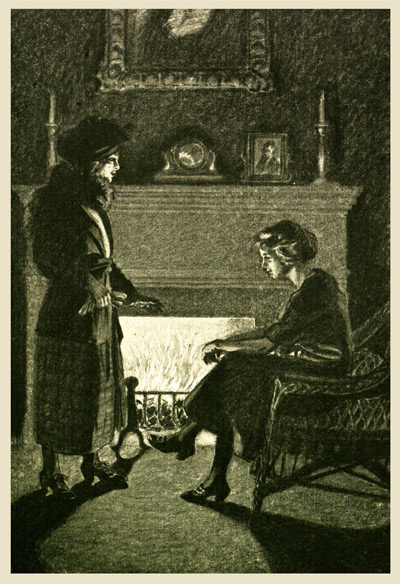
Mary Louise found her grandfather hovering
over the fire in the living room. She went up
and kissed him affectionately and then seated
herself on a low stool at his feet. The old man
put his hand lovingly on the bowed head.
“I have been reinvesting some funds for you
today, my child,” he said gently. “I sold all
of the real estate bonds I have bought in the last
years and am putting the bulk of the money into
some gold mines. I am going to put every cent
I can call in on these mines.”
“I know you are doing wisely, Grandpa Jim,
because you have such fine judgment. I am a
perfect little goose about business. I don’t see
why you don’t teach me something about investments
and things. I simply don’t understand
a thing.”
“You are right, child, I should teach you.
I know I can’t live forever but I want to fix it
so that rascally husband of yours can’t find a
cent.”
Mary Louise’s neck stiffened and her head
was held high. She turned and looked at her
grandfather, her face flushed and her eyes
flashing.
“Grandpa Jim, I love you dearly, but I ask
you to realize that Danny is my husband, the
man I love above all others and I cannot sit
here and listen to his being reviled.”
Colonel Hathaway looked a bit dazed and then
smiled in the eyes of his granddaughter.
“All right, honey, I reckon you are right.
Of course, I know how you feel about the wretch.
You told me yourself you despised him—but
then women are women.”
“I told you I despised him! Grandpa Jim,
what can you mean?”
“I was under the impression you had told
me that. Didn’t you come to my room in the
night and sit on my bedside in your pretty pink
wrapper and hold my hand and tell me Danny
abused you terribly?”
“Grandpa! Never! You must have had a
dream!”
“Well! Well! Too bad! I thought you did.
Perhaps I should not have told him you complained
of him then. Of course, I know you
would complain of him if you were not such a
lady. He is so ugly and so untidy.”
“Danny ugly and untidy! Why Grandpa
Jim, he is the pink of neatness and everybody
thinks he is the best looking young man in
Dorfield.”
“Tut! Tut! Let’s say no more about it.”
“Dinner am served!” announced Uncle Eben,
sticking his woolly pate in at the door.
Mary Louise helped her grandfather to his
feet and gently led him to the dining room. He
leaned on her heavily. Tenderly she placed him
in his chair. She understood now, without the
help of Dr. Coles, that her grandfather was
really failing. What would she not give to have
acknowledged it sooner! Well life must be
faced and, because she had made one big mistake,
there was no reason for going on slumping.
She smiled bravely as she explained to Colonel
Hathaway that Danny had gone on a business
trip and pretended not to hear him when he
muttered, “Good riddance of bad rubbish!—bad
rubbish!”
Dr. Coles came to call soon after dinner.
Colonel Hathaway received him with his usual
graciousness. The old gentleman was never
more charming than on that evening. He conversed
delightfully with his guest, recalling
anecdote after anecdote of the past. He showed
a remarkable memory for dates and events
going into minute detail several times, remembering
the time of day, the day of the week,
the day of the month and the year of some happening.
He never seemed saner to Mary Louise
than on that evening. Dr. Coles listened to his
stories with interest, speaking but little himself
and encouraging his unknowing patient to do
the talking.
From stories of the past Colonel Hathaway
suddenly switched to the present and then
plunged into a confused account of the recent
investments he had made in a gold mine.
“I have to make more and more money to
take care of my poor child here. Her husband
is absolutely a dead beat, you know,” he
remarked quite casually.
Mary Louise blushed furiously and was on
the point of saying something to try to set her
poor Danny right in the eyes of their visitor,
but Dr. Coles motioned to her to be quiet.
“He is gone now, gone for good I hope, but
poor little Mary Louise pretends it is only a
business trip. I can see she is concealing something
from me and, no doubt, he has taken all
her jewels with him or the family silver. He is
a wretched person, I can assure you, Dr. Coles.
I was never so fooled by anybody in my life.
Mary Louise and I were both fooled, but, thank
God, at last our eyes are opened to his perfidy!”
Dr. Coles knew and liked Danny immensely,
but he said nothing in his defense, only watched
his patient the more keenly.
“I am sorry to hear that. What has he
done?”
“Well he—he—I can’t recall now just what
it is—it is something very bad, though, you
may be sure.” The old gentleman smiled
pleasantly, totally unconscious of the fact that
he was wringing the heart strings of the creature
he loved better than his life.
“I see,” said the doctor thoughtfully. “I
must be going now.”
“Well, I’m sorry to have you go. I am going
to come to your office soon to have you look
me over, not that I am ill—never better in my
life,” he added hastily, “but I have a funny
way of going to sleep in spots here lately. No
doubt it is indigestion, and perhaps I must let
up on Aunt Sally’s good food.”
“No doubt! No doubt! Anyhow, come let
me look you over.”
Mary Louise followed Dr. Coles to the front
door.
“What do you think?” she asked anxiously.
“There is no doubt that his mind is failing
rapidly.”
“But see how sanely he talked about the
past!”
“That is often the case. Old persons seem
to be able to remember the most remarkable
things that happened in their youth and still the
present is often blurred. You noticed he could
not even remember what fancied grievance he
had against your husband. He was sure there
was something, but he could not remember just
what it was. It is common in such cases for the
person to take a strange unreasoning dislike
to some one, often the very person of whom he
has been most fond. I am glad it is your husband
and not you he has turned against.”
“Oh! Oh!” was all poor Mary Louise could
trust herself to say.
“I am also glad your husband has gone on a
business trip. His presence might irritate Colonel
Hathaway. This may be only a phase and
he may get over all his feeling against Mr. Dexter.
I am sure I hope it will be so. In the
meantime, if I were you, I should see that he
is kept quiet but amused; make him eat simple
nourishing food; have plenty of air but do not
let him take too much exercise.”
“Is there—is there danger of—of—his—his
dying?” she faltered.
“My dear young lady, no man can say. In
a case like this, sometimes the patient lives
for years, getting stronger and stronger in the
body as the mind weakens. Your grandfather
may get entirely well and live to remember this
obsession merely as one remembers a bad dream.
Have him come see me at my office soon and
call on me at a moment’s notice if you are the
least bit alarmed.”
CHAPTER VII A WIRELESS MESSAGE
Before Mary Louise went to bed that night,
she wrote a long letter to Danny, a letter full
of love and trust, a letter explaining the whole
thing and taking all the blame for the misunderstanding
that had arisen. She told him of
her grandfather’s mental condition, but did not
tell him of the possibility of its becoming more
and more serious. She wanted Danny to have
no fears concerning her welfare during his
absence. She wished him God-speed and assured
him of her undying devotion. The letter took
her hours to write and when it was completed
she slipped on a cloak and quietly letting herself
out the front door, ran to the corner to put
it safely in the mail box. It would have gone
just as soon if she had waited to give it to the
postman in the morning but she felt she must
let nothing interfere with its safe departure.
Now Danny would be sure to receive it before
sailing for China. At least, he would start with
the knowledge that she loved him as much as
ever and the cloud would be between them no
longer.
Mary Louise had never been on the street
alone at midnight and even to run the one
block to the corner seemed quite an adventure
for her.
“What would Danny say?” was in her
thoughts as she crept back into the house and
up the stairs to her room.
The weeks that followed were anxious ones
for her. The condition of Colonel Hathaway
became more serious. He was determined to
accomplish certain things in regard to his property
and that meant many trips to the business
end of the town and more exercise and excitement
than was good for him. Danny’s absence
seemed to put him entirely out of the Colonel’s
mind. He rarely mentioned him and then only
in the most casual way. His obsession became
that his dear old friend Peter Conant was trying
to make him change his will and leave all of
his property to Irene Macfarlane. He became
very indignant at the mention of Peter’s name
and reviled him constantly. This grieved Mary
Louise exceedingly, but she could not but confess
that she was glad Grandpa Jim was picking
on some one besides her Danny.
The day of Danny’s sailing came and went.
She had received a letter from him every day
since he left Dorfield, sometimes written on the
train, sometimes at a wayside station. On the
day of sailing, came a telegram saying he had
received her letter and was happier than he
had been for a long time. She then resigned
herself to the fact that she could not hear from
him for weeks and weeks. It takes a long time
to get to China and a long time for letters to
come from there.
The girls were lovely to her. All of them
knew the trials under which she was living,
but they respected her silence in regard to her
suffering and nobody said a word. All the time
she could spare from her grandfather she spent
at the Higgledy Piggledy Shop.
“It is so nice and cheerful and busy here,”
she said to Josie one day. “I used to think my
home was beautiful, but now it seems kind of
like a great mausoleum. Any more bonnets for
me to trim?”
Josie nodded cheerfully.
“Yes, two more! You seem to have the knack
of making mourning bonnets look cheerful.
How’s Colonel Hathaway feeling these days,
Mary Louise?”
Josie was the one person to whom Mary
Louise could talk concerning her affairs. She
had wanted to take Irene into her confidence
too but, since her grandfather had made the
absurd charges against his old friend Peter
Conant, she had hesitated to bring the subject
up with Irene. Irene felt a certain estrangement,
but her faith in Mary Louise was strong
and true and she was sure it would all come
right in the end. She could not help seeing the
burden her little friend was bearing and was
determined not to add to it one iota with foolish
hurt feelings and small jealousies, although her
feelings were a little hurt and she was a tiny
bit jealous that Josie should be the one to
share the troubles of Mary Louise. She knew
it was the case because often she found the
two girls whispering together in a corner of
the shop and always, when there was an errand
to be done, Mary Louise and Josie would go
together to attend to it. Irene only hoped she
could keep her hurt feelings from the knowledge
of Mary Louise and never let anyone know
that the green-eyed monster, Jealousy, had her
in his clutch.
At home it was dismal enough.
It was plain to see that Colonel Hathaway
was failing, failing not only in mind but in body.
His step had become slow and faltering and
his once steady hand shook with palsy. Still,
he made his way to the business part of town
every day and was occupied constantly with his
affairs. Peter Conant had offered repeatedly to
help him in any way, but had been rebuffed so
decidedly that he had become offended.
“James Hathaway can’t speak to me as he
did and not hurt me,” he had declared to his
wife.
“But, Peter, you and Irene both said he was
evidently not quite himself. You should remember
that.”
“That’s all very well to say, but he is smart
enough to go down town every day and sell
stocks and bonds. He ought to be smart enough
to know he can’t keep his friends if he is going
to abuse them as he abused me. I didn’t even
know what he was talking about.”
“Neither did he, goose!” insisted Aunt Hannah,
but Uncle Peter still refused to allow James
Hathaway to revile him without making a
protest.
“You thought and freely said that Danny
Dexter was too quick to get angry with the
Colonel,” Aunt Hannah continued. “You said
he should have sense enough to see that the old
gentleman was not quite himself, and now here
you are raising Cain about a slight rudeness on
his part.”
“Rudeness indeed! He said he could attend
to his affairs without interference from me. I
call that more than a slight rudeness. I’ll see
myself offering my services to him again. He
is presuming on his age to behave as he is
doing.”
“Well! Well! You are behaving as though
you were no age at all—not even six years
old,” declared Aunt Hannah, removing her ear
trumpet and laughing at her husband. When
Aunt Hannah considered an argument had gone
far enough she simply removed her trumpet
from her ear and that ended the matter as far
as she was concerned.
In spite of Mr. Peter Conant’s stern remarks
about never offering his services to Jim Hathaway
again, that very night he was not only
offering them but they were being accepted and
that most gratefully, if not by the Colonel, at
least by Mary Louise.
The old gentleman had come home from his
daily visit to the broker’s offices and had seemed
a little steadier on his legs than of late, a little
more cheerful and less inclined to hunt for
trouble than had been the case for the last few
months. He sat down in his big chair and
Mary Louise took her accustomed place on the
stool at his feet. She had brought home from
the Higgledy Piggledy a little crêpe bonnet
which she had been unable to finish that afternoon
and, since it was promised for the following
day, she determined to work on it a while
at home. There were only a few stitches to be
put in and a bit of ruching to be tacked across
the front.
The old man and the young girl sat thus for
a long time. Mary Louise was busily plying
her needle and the Colonel dozed and waked
and dozed again.
“Is that a bonnet for yourself, my dear?”
he asked, breaking the silence.
“Oh no, Grandpa Jim! This is a widow’s
bonnet.”
“Yes, I know! I remember your mother wore
one, although I did not approve, not at all—but,
my dear, you are a widow now.”
“Oh no!” cried Mary Louise hastily. “I’m
not a widow, Grandpa Jim. My husband is just
away for a little while, not for all time.”
“You are mistaken. He will never come
back.” The old man spoke with curt precision.
Mary Louise hesitated. She could not decide
whether it would be better to combat her grandfather’s
statement or whether, perhaps, it was
just as well to let him have his way in the
matter.
Suddenly the bell pealed forth.
“Callers! Do you want to see anyone,
Grandpa Jim?”
“Yes! Yes! Let them come in, just so it
is not that old reprobate Peter Conant.”
“Oh, Grandpa Jim. You can’t mean dear
Uncle Peter!”
“Of course I do. I was never so fooled by
anybody in my life as that man. He is underhanded
and sly, and—”
As Peter Conant was famed far and near for
his honesty, this made Mary Louise smile in
spite of herself. As well accuse Irene Macfarlane
herself of dishonesty or even Grandpa
Jim.
“A telespatch, missy,” said Eben, limping
into the room. “A telespatch collect fer Mrs.
D. Dexter, an’ the boy say sign right thar.”
Mary Louise scrambled to her feet.
“In a minute, Uncle Eben! The boy will
have to wait until I read my telegram. Why
it’s a wireless!” she cried excitedly. “A wireless
from Danny! Just think, Uncle Eben, a
message from way out in the middle of the
Pacific Ocean. It just says: ‘Love, Danny.’
But that is enough. Oh, Grandpa Jim, do you
know this is a wireless from Danny?”
“You mean your husband? A message from
the spirit world! Because he is dead, you
know—as dead as dead——”
The old man stood up, looking wildly in the
eyes of his granddaughter.
“I know he is dead—drowned, I think—because,
last night while I slept, I saw him in
the water—and if he is not dead why are you
making a widow’s bonnet for yourself?”
Suddenly Colonel Hathaway crumpled up and
lay in a pitiful heap on the floor. Mary Louise,
her nerves overwrought by the long strain under
which she had been living, gave a shrill scream,
but immediately controlled herself.
“Run quick for Mr. Conant, Uncle Eben, and
get Miss Irene too—tell her I need her. I’ll
telephone the doctor myself. Call Aunt Sally to
come to Grandpa Jim.”
Colonel Hathaway was stretched out on the
rug in front of the fire with Mary Louise doing
what she could to restore consciousness to the
tired brain, when Dr. Coles arrived.
The old man was carried to his room and
placed in his large old tester bed.
“I rather thought this might happen but did
not think it would be so soon,” the doctor told
Mary Louise. “Was there anything to excite
him especially?” he asked.
Mary Louise told him of the wireless message
she had just received from her husband and of
the statement her grandfather had made that
it was a message from the spirit world.
“Of course, it was proof that my husband
was well and thinking of me. That was all—but
Grandpa Jim takes such strange notions
lately and there is no turning him from them.
He said he had dreamed he saw Danny in the
water but that is no indication of an accident.”
“Certainly not!” assured Dr. Coles. “When
did your husband sail?”
“Ten days ago!”
“What was the name of his boat?”
“The Spokane!”
Dr. Coles said nothing but in his kind eyes
there was a depth of concern for the girl. He
looked at her a moment and then turned to the
inert form of the old man.
“His pulse is fairly good and I fancy he will
be coming around pretty soon,” he said briskly.
“I am going to send you a nurse immediately.”
“Oh, don’t send a nurse! Please let me
attend to him. I am as strong as can be. You
don’t know how much I can do.”
“Ah, yes, I do, but we don’t want to have
you doing all you can do. I really think a
nurse for a few days will be best.”
“And Irene Macfarlane is here to help me.
You don’t know what a help Irene is although
she can’t get out of her chair. She answers
the telephone and she does more little odd jobs
and Grandpa Jim has always liked her more
than anybody—until—until—but perhaps she
had better not try to help in his room because
he has had a strange obsession of late about
Irene and dear Uncle Peter Conant.”
“Is Miss Macfarlane here now?”
“Yes, Dr. Coles! Uncle Peter Conant and
Irene are both in the dining room waiting to
see what I need.”
“The telephone is in the dining room?”
“Yes!”
“Well, Mrs. Dexter, I’ll get you to sit here
a moment by your grandfather while I go telephone.
He is coming around soon I think, but
there is nothing for you to do except sit near
him. Call me if you need me.”
CHAPTER VIII THE PASSING OF THE COLONEL
Irene and her uncle were seated in the dining
room in hushed silence. They had come immediately
at Mary Louise’s summons. Mr. Conant
was bowed over, his gray head in his hands.
Occasionally, he emitted a deep groan and muttered
to himself:
“I never should have said it, even to Hannah—even
to Hannah!”
“Never mind, Uncle Peter—you were always
in your heart faithful to the poor Colonel,”
Irene would try to comfort him, and again they
would drop back into the gloomy silence.
As Dr. Coles came into the room, they greeted
him eagerly, “Any change? How is he now?”
“About the same—but his pulse is fairly
good. I think he will be coming around soon,
perhaps—of course, there is no predicting for
sure anything in cases like this—cases of any
sort in fact. My opinion of doctors is not very
great you know. They do their best but, when
all is told, they are a feeble lot.”
“But their best is very wonderful, sometimes,”
said Irene, “and Mary Louise has
great faith in you.”
“Poor child, poor child! Are you sure her
husband sailed on the Spokane, about ten days
ago?”
“Yes, I am sure! Isn’t that what she told
you?”
“Yes—but I hadn’t the courage to tell her
something that she will have to know. I saw a
late bulletin as I passed the newspaper office
on my way up here and it said the Spokane had
been signalling for help by wireless all during
yesterday and that it is feared she has been
wrecked. Of course, she may be all right by
now, but the latest report is that there is no
trace of her so far.”
“You mean Danny Dexter may be lost?”
gasped Irene.
“Yes—lost! It may be a false alarm but
I doubt it. Anyhow, we need not tell the poor
little wife yet, not until there is something definite
to tell her,” said the doctor sadly and Uncle
Peter groaned aloud.
“Brute! Brute that I am! I haven’t been
over here for days and weeks and all the time
my old friend was ill and here I was irritated
with him—I even blamed the poor child a little.
I felt somehow she was lacking backbone in
allowing the old man to ride over her so. I’m
a worm! A worm! Nothing but a miserable
boneless invertebrate.”
The doctor smiled at the incongruous epithets
Mr. Conant was so ruthlessly applying to himself.
Irene patted her uncle on the shoulder.
“Now Uncle Peter, let’s not worry about
what we might have done, but just do what is
to be done now. Suppose you go down to the
newspaper office and find out what they know
and stop and tell Aunt Hannah that I shall have
to stay over here for the night and get her to
send me a dressing gown and some toilet
things.”
“That’s right!” agreed the doctor, looking
at Irene with appreciation. “Now, Miss Macfarlane,
you get the nurse’s registrar on the
’phone and have them send us a good nurse
immediately. Mrs. Dexter insists that she can
do the nursing with your help, but I do not
intend to have her break herself down. She may
have more to stand than she realizes. Pray
God the report about the Spokane is false!”
A night of anxiety followed. Colonel Hathaway
was still unconscious when gray dawn
crept down the quiet city streets. In spite of the
arrival of a comfortably efficient nurse, Mary
Louise could not be persuaded to leave her
grandfather’s bedside.
“He might awake and ask for me,” she
declared over and over when she was told she
had better take a little rest.
As the first rays of the morning sun found
their way into his room, the old man opened his
eyes. In them was the expression of a wondering
child.
“What is the matter?” he whispered faintly.
“Oh, Grandpa Jim, good morning!” said
Mary Louise taking his hand in hers.
“Good morning, child! Aren’t you up early?
Where is my boy?”
“Who, Grandpa Jim?”
“My boy! Danny, of course! What other
boy have I? I have been having a horrid nightmare
that he and I had been having some misunderstanding.
I am glad morning has come
and it is all a dream. I can’t bear to have
trouble between Danny and me even in a dream.
Call him, Mary Louise! I must speak to him.”
“He is not here right now, Grandpa Jim,”
said Mary Louise, trying hard to keep back the
sob that was almost mastering her.
“Not here! Where on earth has the rascal
gone?”
How different was his manner of speaking of
Danny! A short time ago he would have called
him a rascal, meaning it, and with a hard tone
of voice; now his way of calling him a rascal
was purely loving and playful.
“Where has he gone, child? Not far I hope,
because I have a queer feeling about me somehow—a
feeling that perhaps I am not going
to be here very long and I must see Danny.
Where is he? Don’t hide anything from me!”
“He is—he is—on the water,” answered
Mary Louise slowly.
“Oh, now I seem to remember,” faltered
Colonel Hathaway. His voice was strangely
husky and Mary Louise had to put her ear
close to catch the words.
“I seem to remember something about a telegram—a
telegram sent collect. That wasn’t
much like Danny to send a telegram collect—”
“It was a wireless, Grandpa Jim, and perhaps
he could not prepay on shipboard.”
“Of course—of course—a wireless—I
remember now. Poor Danny, poor Danny. And
did you finish your bonnet in time?”
“In time for what, Grandpa Jim?”
“In time to wear. Well never mind if you
didn’t. You can buy plenty more. I have left
you everything, Mary Louise dear, everything—but
I wish I had left Danny something, not
that he will want it. He is an independent lad
and wanted to pay me board. Ha! Ha! That
was a joke indeed. But I liked the spirit in
him. I am going back to sleep now, honey.
Please tell Peter Conant to come see me a
little later in the day. I shall want his advice.”
The old man closed his eyes and, with a tired
sigh, sank into a state of coma.
He passed away a few hours later. His death
was quiet and painless. One moment he was
breathing gently and the next moment he was
not. Mary Louise stood bravely by. She was
able to thank the Creator that her poor grandfather
was not to live a life of misery, with
his once powerful mind gone. She repeated to
herself over and over his last sweet words and
was grateful beyond expression for what he
had said about her dear Danny.
“If Danny only knew!” she kept on repeating.
“If he only knew how much Grandpa Jim
really loved him.”
“He did know once,” Irene assured her.
Irene had been taken into her friend’s confidence
at last and they had had a heart to heart talk
about the whole wretched matter. “Perhaps
he knows now how the Colonel really felt about
him.”
“But he couldn’t know unless some one has
tried to reach him by wireless. Indeed I wish
we could.”
“Well, he may just sort of feel it. People
do sometimes,” Irene hastened to mend the break
she had made.
There was no doubt in the minds of Danny
Dexter’s many friends at Dorfield that the boat
on which he had sailed had gone to the bottom
with all on board unless some of them had taken
to lifeboats. Even then, the storm that raged
for days in that latitude from which the Spokane
had sent her agonizing S.O.S. calls had, without
doubt, done for those boats. It was reported
that no one could possibly have lived at sea in
an open boat during the terrible hurricane that
had swept the seas. Danny was given up for
lost and to Irene fell the sad task of breaking
the news to Mary Louise.
Colonel Hathaway’s funeral was over, the
simple impressive rites suitable for the fine old
character. The little peculiarities developed
during the last few months of his life were
entirely forgotten by the many friends who
sincerely mourned his loss. He had been a good
citizen, public spirited and generous, a fine
staunch friend and a man to whom the business
world looked with interest, as he had a genius
for making good investments. The papers were
full of his praises and appreciation of him was
on every tongue.
It was natural for Mary Louise to want to see
these newspaper notices and, in seeing the
papers, it was almost inevitable that she should
run across something about the possibility of
the Spokane’s being in distress, perhaps lost.
Up to that time there had been nothing said
about Danny Dexter’s being on the ill-starred
vessel, as it was not known generally to the
newspaper world. His old friend, Bob Dulaney,
the one who had figured so largely in the capture
of Felix Markle on Danny and Mary
Louise’s wedding day, of course, knew all about
Danny but, at the instigation of Irene Macfarlane
he had promised not only to keep his
own paper from mentioning Danny’s name in
connection with the Spokane but also to use his
influence to keep the news concerning Danny
out of the other papers. All of Mary Louise’s
friends agreed that she should be allowed to
recover from the shock of her grandfather’s
death before anything should be told her of the
possibility of Danny’s ship being lost.
“What shall we do about the newspapers
when she asks for them?” wailed Irene, who
had come to the Higgledy Piggledy for advice.
“While Danny’s name is not mentioned, we are
never sure when the Spokane will appear in the
telegrams from the Pacific coast. She is sure
to want to see everything that is written about
Colonel Hathaway.”
“Use the clipping bureau,” suggested Josie.
“What are we for but to save readers the
trouble of going over the whole paper to see
what is said about them?”
“Of course!” cried Elizabeth. “I’ll get
busy immediately.” She accordingly grabbed
up her long shears and began clipping items concerning
Grandpa Jim and then neatly pasting
them on the little printed slips in which the
clipping bureau had seen fit to indulge to give a
prosperous air to the business.
“I don’t believe for an instant that Danny
Dexter is dead,” declared Josie stoutly. “It
is simply unbelievable.”
“But don’t you think Mary Louise should
know the Spokane is reported lost?” asked
Irene.
“Of course! We have no right to keep it
from her much longer. Mary Louise is no child
although somehow she seems one. She is so
young and so gentle and there is a look to her
now that makes me feel as though I should like
to take her in my lap and hold her like a little
baby.”
Elizabeth and Irene could not help smiling
at the picture of Josie holding Mary Louise in
her lap, since Mary Louise was a good half head
taller than Josie but they all agreed that Mary
Louise seemed like a child.
“Matrimony doesn’t seem to have aged her
a single bit,” said Elizabeth.
“Her grandfather’s death has hit her terribly
hard and she is looking as pale as a ghost, but
somehow like a little child ghost,” sighed Irene.
“Dr. Coles says not to let her know about
Danny until it is a certainty—that there is no
use in harrowing her soul if there is the slightest
chance of his being alive.”
“Who is to tell her?” shuddered Elizabeth.
“I am,” said Irene.
“I don’t see how you can,” said Elizabeth.
“It would be a job that I just wouldn’t know
how to go about starting.”
“I am praying for strength and direction,”
said Irene, whose religion was such a vital part
of her that she spoke of it with a faith and
simplicity that was often surprising to others.
“Well I’m glad the poor girl has plenty of
money,” said Elizabeth. “I know money isn’t
everything but it’s a good deal. Anyhow, it
helps a lot to boost one over the rough places.”
“Maybe it does,” mused Josie, “But for
my part, I’d like to see Mary Louise without a
sou to her name. It would be good for the lamb
to have to start in and make her living tomorrow.
With her old grandfather gone and poor
Danny reported missing, what pleasure will
there be for her in that great house with not
even a bit of dusting to do? Aunt Sally and
Uncle Eben won’t let her do a lick of work about
the house and Mary Louise is very capable.
Just see how she pitched in and organized for
war work. I guess she’ll have to go in for
charity and then all of these boards and what
not will bleed her to death. That kind of work
is just a time-killer anyhow. What girls need is
jobs—good, hard-working, paying jobs.”
“But what could Mary Louise do if she had
to make a living?” laughed Elizabeth.
“Plenty of things!” declared Josie.
CHAPTER IX MARY LOUISE TOUCHES BOTTOM
Circumstantial evidence was all against the
Spokane. While nobody could say for certain
that she had committed the unpardonable sin
of going to the bottom, she could not prove an
alibi. One day she had been sending out signals
of distress by wireless and the next day, when
a philanthropic vessel had endeavored to find
her in the vicinity from which the appeals had
come, there was not a trace of her. Others had
joined in the search to no avail. She was
finally given up for lost and the search was abandoned.
Then and only then, did Dorfield awake
to the fact that the popular Danny Dexter had
been on the Spokane.
“Poor Mary Louise!” was heard on every
side, and then often was added, “Well, thank
goodness, she has plenty of money!”
It is strange how many persons seem to feel
that plenty of money will soften any blow.
Josie’s voice was the only one raised in complaint
that Mary Louise would have been better
off were she not so well off, but then even
Elizabeth had to admit that Josie was a wee
bit peculiar about worldly things. In spite of
the fact that the astute Josie was practical and
businesslike, she had an unworldly philosophy
worthy of Diogenes. Like that old gentleman,
she would have been perfectly happy with no
habitation but a tub but she would have put the
tub to more practical use than the ancient worthy
is reported to have done.
The time had come for Irene to break the
sad news to Mary Louise concerning her dear
Danny. It took every bit of character the lame
girl possessed to screw her courage up to the
point of breaching the subject.
“It wouldn’t be so hard if I didn’t love her
so much,” she said to herself, and then added,
“but it is because I do love her so much that I
am chosen to be the one to do it.”
Like all difficult things it was not so hard to
do when once she had started. Dr. Coles had
telephoned her that morning that he felt it was
hardly fair to keep Mary Louise in ignorance
any longer; and the evening before Bob Dulaney
had come to tell her that all hope of the Spokane
was given up, and that the storm on the Pacific
in that particular region had raged so fiercely
for several days that it was considered by those
experienced in such matters utterly absurd to
fancy for an instant that men in open boats
could have escaped drowning.
Bob Dulaney was grief-stricken. He had
been hoping against all reason that Danny had
escaped.
“I just can’t believe it! Old Danny Dexter!
Why, ‘Irene for all time,’ Danny was the
livest person I ever knew—so alive that I
simply can’t think of him as dead.”
“Irene for all time” was a name Bob had
for Irene—just a little joke of their own
brought about when he was introduced to her
by Danny. He usually called her by that funny
little title.
“Well, let’s not think of him as dead. Lots
of dead persons are more alive than live ones,
and lots of live ones are deader than dead ones.
Why shouldn’t we just think and speak of Danny
as alive? I think it will be a beautiful way to
remember him.”
“Oh, ‘Irene for all time,’ you are a comfort
to a fellow! I wish I could help you when you
have to break it to poor little Mary Louise. It
is hard on you to be the one but then it is a compliment
too. Everybody turns to you when
something difficult must be done.”
Irene smiled. It was pleasant to be approved
of and liked by this clean, clever young man.
Perhaps his kind approval was one thing that
made the difficult task a little easier than she
had dreamed possible.
Mary Louise was going over her grandfather’s
clothes and his personal effects. Irene found
her in a small cozy room down stairs, the room
where Grandpa Jim had loved to sit and smoke
and see his intimate friends. It was the same
room where Mary Louise’s wedding presents
had been when Felix Markle and his confederate
had so cleverly packed them all off. Mary
Louise had had all of her grandfather’s things
brought to this room and she was busily engaged
in going over piles of wearing apparel with a
view to giving away the things to persons who
might need them.
“I know Grandpa Jim would hate to see good
warm clothes go to waste, but it is hard to part
with some of these things that bring him back
so plainly.” She held up a broadcloth coat that
seemed to have retained the shape of the beloved
old gentleman.
“To whom will you give them, Mary Louise?”
asked Irene.
“I can’t bear to give them to anyone who
would look ridiculous in them. Uncle Eben, of
course, wants everything, but he is so short and
bow-legged and Grandpa Jim was over six feet.
I am giving him some of the things, but I can’t
contemplate Uncle Eben in a frock coat that
would almost touch the ground. There is a
nice old gentleman who lives around the corner,
old Mr. Curtiss. He hasn’t been here very long
and he doesn’t know many persons, but Grandpa
Jim struck up an acquaintance with him and
liked to talk of old times with him. He is from
South Carolina and has seen better days—not
that he ever mentions it, but one just surmises
he has. He is as poor as poor can be now.”
“Why I know him! Bob Dulaney introduced
me one day when we were sitting in the park.
Bob says he has a small job on his newspaper.
They send him out to interview a certain type
of politician and, besides that, he writes the
obituaries and, being well up on who’s who, he
keeps a little ahead on special articles about
great persons who are likely to die soon or
suddenly.”
“I think he would be a very suitable person
to wear Grandpa Jim’s things. He is tall and
dignified and the poor dear is so very shabby.
Do you think it would hurt his feelings?” asked
Mary Louise, tenderly patting the broadcloth
coat.
“I don’t think it could at all. He’d feel
honored, I believe, because giving things like this
is not like charity. Let me help you bundle
them up.”
Together the two girls worked, Irene folding
and wrapping the things as Mary Louise sorted
them.
“All of this pile goes to the Salvation Army;
these things to Uncle Eben and these to Mr.
Curtiss. I want Uncle Peter Conant to have
his silver-headed cane. His fur-lined overcoat
I have saved for Danny.”
Finally, the clothes were all neatly wrapped
and tied up, each with a label written in Irene’s
clear legible handwriting. It was difficult for
Irene to write evenly with her hand trembling
with emotion at the thought of the ordeal ahead
of her. She felt it would be best to wait for her
friend to get the business in hand finished before
she had anything more to bear, and so she
waited until the last string was tied, the last
bundle labeled, and Uncle Eben had come and
carried them all off to be delivered at his convenience,
before she broached the subject uppermost
in her heart.
“Mary Louise, I have something to tell you,”
she began.
“Yes, darling, I know you have.”
“Oh, you do?”
“I have known it all morning, ever since you
came in the room. I am ready to hear now.
What is it, Irene?”
For a moment Irene could not speak. She
shut her eyes and prayed for strength. If
Mary Louise could be so calm, it was not for
her to break down.
“Has it—has it something to do with—with
Danny?” For a moment Mary Louise
grasped a chair for support. Her breath came
in gasps. Then she gathered her forces, stiffened
up and smiled wanly. “I’ve felt it all
along. What is it? You can tell me dear—I
have touched bottom, as it were, in misery and
unhappiness and I can bear anything.”
“The Spokane is reported missing,” said
Irene softly.
“Missing,” Mary Louise half whispered.
“Tell me more.”
“She was sending out wireless calls for
help—”
“Ah! It was then that Danny sent me the
message. He must have known and tried to
get a word to me before—before.”
“Yes, dear!”
“And wasn’t it wonderful that it reached me?
And wasn’t it like Danny to do it? He knows—knew—wireless
telegraphy, you remember,
Irene? He learned it in his service overseas.”
“Yes, dear!”
Mary Louise spoke softly:
“What else do they know?” Her eyes were
dry and strangely brilliant.
“Nothing but that various vessels went to
the assistance of the Spokane but could find
no trace of her and a great storm, a hurricane,
had been raging for some time during and after
the Spokane’s wireless messages were received
and it is feared—it is believed—it is known
by persons who have had experience in such
things that lifeboats could not have weathered
such a storm. It is thought that all on board were—were
lost.”
“Nobody can tell though, for sure!” there
was a ring of hope in the poor girl’s voice.
“No darling, not for sure, but we are all of
us afraid there is absolutely no chance for
Danny to have been saved. Even Bob Dulaney
has given up hope—and you know Bob would
keep on hoping against hope. He came last
night to tell me I should tell you. Dr. Coles
telephoned this morning that it was hardly fair
to keep you in ignorance any longer.”
“You are all of you very good to me. My
words sound cold but I don’t mean them to.
I know how hard this has been for you, my dear.
It was just like you to take such a hard task
on yourself. I—I do thank you, Irene.”
Never a tear, scarcely a falter in the clear
voice! It was more tragic to have Mary Louise
take the news that way than it would have been
had she broken down and wept.
“You mustn’t feel too sorry for me, Irene.
Tell the girls they mustn’t either. I can bear
this trouble. Somehow I feel that I am not the
one who has to bear it. I have been very happy
with both Grandpa Jim and Danny and, now
that they are gone, I can remember the happy
times and be thankful for them. But oh, Irene,
the dreary, dreary years to come!” She leaned
back in her chair, for a moment she closed her
eyes and her mouth looked weary and drawn.
CHAPTER X A CONFERENCE OF FRIENDS
“It sounds just like poor old Job in the
Bible,” said Elizabeth Wright.
“Doesn’t it, though?” sighed Irene.
“Yes, and I bet Job didn’t have a thing on
our Mary Louise for patience,” put in Josie,
“but, of course, Job had that bunch of hot air
comforters who certainly must have tried his
patience. At least, Mary Louise is spared
them.”
“Don’t you think it,” corrected Irene.
“There has been a stream of visitors from
morning until night and some of them say the
most terrible things. I don’t see how Mary
Louise stands them but she always says they
mean it for the best and she is as polite as can
be to them. I’d send them all packing.”
This made Josie and Elizabeth laugh, as there
never was known a more courteous person than
Irene Macfarlane.
“What do you think the Job’s comforters
will say when they find out about Colonel Hathaway’s
affairs?” asked Elizabeth. “I haven’t
told a soul, but my family will have to know
sooner or later and then I bid to come stay for
a few days down here at the Higgledy Piggledy
until they stop talking it over and pumping me
with questions.”
“Uncle says it is the most astounding thing
that has ever occurred in the financial world of
Dorfield,” said Irene. “He has not given up
hope yet but is still searching for papers that
might indicate in some way where on earth
the money has gone. There is no doubt about
it that Colonel Hathaway was a very rich man
as his investments have always prospered but,
now that he is gone, there is absolutely nothing
to show where his money is. The brokers say
he has been selling steadily during the last few
months. He seems to have converted a great
many of his securities into cash. Nobody knows
why exactly except that he intimated to several
men that he was going to fix his money so Danny
could not get hold of it. Everybody realized the
Colonel was not himself and took what he said
about Danny with a grain of salt. Uncle is
afraid he invested a lot of his money in some
gold mine schemes that he talked about several
weeks ago. It is supposed to have been a wild-cat
mine with no chance of getting out what
money was put in. I don’t see how Colonel
Hathaway could have been bitten even though he
was a little out of his head. Uncle says he was
such an
astute business man.”
“Can’t Mr. Conant find any money at all?”
asked Josie.
“Nothing! Of course, the house is there and
all of its furnishings. It is on a huge lot which
may be valuable in time, but, just now, that part
of Dorfield is not so fashionable as it used to
be and Uncle Peter thinks it would be a pity to
sell it, as there is a chance of its being in demand
a little later for office buildings. Business is
slowly creeping that way. He is going to hold
on to his property until he can get his price.”
“In the meantime, what will Mary Louise
live on?” asked Elizabeth.
“Live on the wits that God gave her!”
cried Josie. “I am truly glad for this part of
poor Job’s troubles. It will be everything to
dear little Mary Louise that she must actually
begin to think about where her next meal is
coming from.”
“Josie! How can you say such a thing?”
demanded Elizabeth, shocked wonderment in her
voice and countenance.
“Easy!” laughed Josie. “Aren’t you a
million times happier since you are taking care
of yourself? Why shouldn’t it make Mary
Louise happier, especially now that she has so
much sorrow to overcome? I am as glad as glad
can be, and, while I am going to put my wits
to work as a friend first and as a detective second,
I am hoping I will take a long time to find
the lost treasure.”
“Well I never!” declared Irene in quite the
tone Aunt Hannah might have used. “I am no
worshiper of money, but I must say one can do
so much with money that the having of it must
be very pleasant. I shall never forget the wonderful
things Colonel Hathaway and Mary
Louise have done for me and it was because
they had money that they could do them. The
things gave them as intense joy as they did me,
too, and that is where the pleasure of having
money comes in for persons like the Colonel
and Mary Louise. There is my victrola and all
the magnificent records, representing the very
best in music! Here’s my rolling chair, such a
wonder of balance and ease that it moves at
the slightest touch and seems almost a part of
me! There’s my lovely long fur coat that makes
it possible for me to go out in winter. Before
I got it, I used simply to freeze because I
couldn’t take enough exercise to get up a good
winter circulation. I would stay in the house
like some old hibernating bear and I dreaded
winter, but now I love to see the first snow
flakes. Mary Louise is so accustomed to doing
lovely things for people that I don’t see how
she is going to get used to not doing them.”
“She is not going to stop,” declared Josie,
earnestly. “What she will do, perhaps will
not be so costly from a financial standpoint,
but it will mean sacrifices which will be more
costly in other ways. If I know our Mary
Louise, and I think I do, she will rise superior
to this disaster and come out stronger and finer
than ever.”
“Maybe you are right, Josie,” sighed Elizabeth,
“but all the same, money is money and
there is no substitute for it.”
“That’s just it, money is money and nothing
but money. I have been saying that all along.
Money is all right in its place, but it is a better
thing to work for than to have and I, for
one, am glad Mary Louise is going to have to
work for it for a while. It will do her good,
poor dear child! I know how good it was for
me, after my father died, to open up this shop
and get busy. It didn’t lessen my loss any,
but it gave me strength to bear it.”
Elizabeth and Irene were silent. They agreed
with Josie that it might be good for their friend
to have something to take her mind off her
terrible sorrow, but they did not feel that losing
all her worldly goods was necessary. She
might have adopted some orphans or endowed
a hospital. There were plenty of occupations
in which her money could have helped that
would have done just as well in alleviating sorrow
as this loss of fortune.
“Has Mrs. Burton sent a check yet for that
order we filled for candle shades?” asked Josie
as she looked over the firm’s books.
“No!” answered Elizabeth. “She has not.
She has been owing us for three months now.”
“Send another bill and stamp the cheerful
little ‘Please remit’ in red ink,” suggested
Josie, sternly. “She must think we are in business
for our health.”
“To hear you run down money one might
think we are,” teased Elizabeth.
“Not at all! I don’t run down money at all.
I run down money that is too easy—money
one doesn’t have to work for. I have some
myself that my father left me and I don’t
think near as much of it as I do of my share on
the commission the Higgledy Piggledy gets for
that order for candle shades Mrs. Burton keeps
forgetting to pay. I appreciate my father’s
working as he did to leave me some money, but
I appreciate a lot more his trying to teach me
a trade.”
“But Josie, while you have been philosophizing
about the most satisfactory methods of
obtaining happiness through lack of wealth, have
you thought of anything Mary Louise can do to
earn her living?” asked Irene. “Uncle Peter
and Aunt Hannah want her to come live with
us and Uncle Peter says what he has is as much
hers as his. He had a mighty strong feeling
for the Colonel and Aunt Hannah simply adores
Mary Louise—she always has. Of course, it
goes without saying what I think of her.”
“What does Mary Louise say?” asked Josie.
“She doesn’t say anything but just shakes
her head and asks to be allowed to wait. In the
meantime, we hate to think of her all alone in
that great old house. Aunt Sally and Uncle
Eben go off and shut themselves up in their
room over the kitchen and are dead to the
world when their duties are over for the day.
I begged her to let me stay with her, but she
seems to prefer to be alone.”
“I can readily see that she might want solitude
in which to adjust herself to new conditions,”
said Josie, thoughtfully, “but it isn’t
quite right. I thought, of course, you were
there.”
“I was at first but I had a feeling she didn’t
want anybody and, when I asked her, she very
gently told me that perhaps she was better off
alone. I thought at first she was grieving over
the loss of the money, but I believe now it has
made no impression whatever on her. In fact,
I don’t believe she realizes she is almost a poor
girl. Of course, the big house and lot are worth
a good deal but, in the meantime she has no
cash to go upon. Uncle wanted to put some to
her credit and do it secretly so she might never
know, but she was too foxy for him and went
over her grandfather’s bank books and saw his
last entry before Uncle Peter could attend to it.”
“I think I’ll call it a day and lay off,” said
Josie, “and go see Mary Louise. Will you
agree to anything I let the Higgledy Piggledies
in on, Elizabeth?”
“Of course! You can do a lot of talking
about the uselessness of money, but I trust you
not to lose any in the business. You are entirely
too astute.”
CHAPTER XI PLANS FOR THE FUTURE
There was one rule the great detective,
O’Gorman, had tried to instill in the mind of
his daughter Josie, and that was, if possible,
never to meddle in other folks’ affairs, but if,
by any chance, Fate so ordained it that you
must meddle, stick to it until those affairs were
settled and the meddling was no longer necessary.
Josie felt that, from the beginning, she
had put her finger in Mary Louise’s pie and
she must not draw it out until she could extract
some kind of plum for her little friend.
She did not ring the bell at the Hathaway
house but opened the great front door with the
latch-key Colonel Hathaway had given her on
her first visit to them and which he had insisted
upon her keeping and using as a member of the
family. She found Mary Louise hovering over
rather a forlorn fire in the den.
“Why do people always begin to economize
in coal as soon as they get a bit hard up?”
Josie asked herself. “It is a strange question
in psychology.”
She greeted Mary Louise cheerfully and seizing
the poker gave the sputtering coal a few
masterly punches which sent the flames leaping
up the chimney. Then she vigorously poked
out the ashes under the grate and, in a few
moments, the fire was burning as brightly and
cheerily as though the Colonel’s money had been
found and no tragic happenings had recently
taken place in that very house which the grate
helped to warm.
“That’s better!” laughed Mary Louise.
“Uncle Eben is so lugubrious about the coal’s
getting low and so strict lately in regard to
fires that I find myself shivering half the time.
Fires have always been Uncle Eben’s specialty
and, now that times are hard, his one idea is to
save coal. Uncle Eben and Aunt Sally are my
biggest problem right now, Josie.”
Josie smiled in what might almost have been
termed a self-satisfied way. Had she not
asserted but a few moments before to the girls
at the Higgledy Piggledy that Mary Louise would
still always be thinking of others?
“What are you planning to do with them,
Mary Louise?” she asked quite casually. Josie
had an idea that Mary Louise’s friends were
handling her too gingerly. Instead of asking
direct questions that called for direct answers,
they were dealing too much in innuendoes, afraid
all the time of intruding. She well knew that
Irene’s exquisite sense of propriety would keep
her from going into Mary Louise’s affairs until
she was asked to discuss them by Mary Louise
herself. Josie felt that the girl had brooded long
enough and the time had come to talk things
over.
“Now don’t you tell me if you’d rather not,
but it seems to me you might as well talk it out
with me. I’m a kind of father confessor anyhow,
you know, honey,” continued Josie.
“Why I want to talk it over, Josie dear. I
don’t want to burden anyone with my complicated
affairs but—”
“Burden anyone! Why you little goose!
Come on now, let’s decide what you are going
to do and then let’s do it.”
Mary Louise laughed, and her laugh sounded
quite merry and like her old self. “Josie, you
certainly do help me with your plain, straight
methods. You know, I fancy, that there is no
money to be found—none at all—and I am
penniless?”
“Yes, I know it, and I’m glad of it!”
“So am I! Wouldn’t that astonish Uncle
Peter? He is having a fit, poor man. He has
almost determined to begin digging around the
place here to try and unearth the treasure. Of
course, that is foolishness because we always
saw Grandpa Jim come in the house and, if he
ever left his room at night, I knew it and was
up like a flash for fear he was sick or
something.”
“Of course! Colonel Hathaway was not the
kind of man to dig holes and put money away.
He may have concealed his property somewhere
and it will turn up sooner or later. In the
meantime, it will be mighty bad business to let
it get out that we don’t know where the stuff is,
for that might bring down on your place a
swarm of treasure seekers who would prove
very annoying to you.”
“Uncle Peter thinks he invested most of it
in gold mines and he says he hopes to find
papers relating to the transaction somewhere.”
“Well now, go on and tell me what you mean
to do. You are going to have to make your
living and I, for one, think it is a good thing.
How are you going to make it?”
“Have you any suggestions?”
“Of course!” answered Josie laconically.
“That’s what I’m here for, not just idle
curiosity.”
Mary Louise laughed again and Aunt Sally,
in the kitchen, stopped a minute from her eternal
scrubbing—her only solace of late—and
dropped a tear in her bucket of hot suds, but
the tear was a kind of happy tear at hearing
once more the sound of laughter from her darling
young mistress.
“Listen ter that, Eben! That there li’l
perliceman gal air in the settin’ room. She sho
do cheer up our baby lamb.”
“Yes, an’ she done stirred up the fire too.
I ain’t a sayin’ the coal air a gonter las’ out
the month if’n we ain’t pow’ful ’ticular.”
“G’long, nigger! You all time talkin’ ’bout
coal. If’n you don’t look sharp, when yo’ time
comes, Peter’ll be a-sayin’ when you knocks on
the pearly gates, ‘Go on down ter perdition,
you Eben! You ain’t fit fer nothin’ but stokin’
nohow.’ You much better be makin’ hot, cheerful
fires fer po’ li’l Miss Mary Louise than
countin’ over yo’ lumps er coal. The Lord air
a gonter pervide. He knows as well as anybody
an’ better than mos’ that we-alls is quality
folk an’ he ain’t a gonter let us go col’.”
“You’s silly, Sally,” declared Eben, nimbly
skipping beyond reach of the deluge of hot suds
with which Sally retaliated. “‘Co’se you is
silly. Ain’t we been a-hearin’ many tales ’bout
kings and queens an’ sich what air a beggin’ in
the streets since this here war that done stirred
up the worl’ ter such a ixtent? If kings an’
queens air took ter beggin’, I don’t see why
you air so proudified as ter think we-alls air
safe.”
“Humph! Kings an’ queens ain’t nothin’
but furriners—some er them even low down
wops an’ sich. I wan’t a talkin’ ’bout kings an’
queens but ’bout sho’ nuf quality folks whose
amcestors comed from Virginny.”
And so the old couple wrangled in the kitchen
while Mary Louise and Josie continued their
talk in the den.
“What is your suggestion?” asked Mary
Louise.
“Bonnets and hats! A millinery department
of the Higgledy Piggledy! It will pay like preferred
stock in the best investment in the country.
At first, people will swarm there just to
see you being a milliner. You’ll have to submit
to being a nine days’ wonder and then, when you
do their things so well and put so much style in
their hats and bonnets, they will come back
because they like what you do. Why, honey,
you are going to be the successful business
woman of Dorfield.”
“Oh Josie!”
“Certainly you are! You have it in you to
be a success. Whatever you have undertaken,
you have pushed through with sureness until
you have reached the goal. Of course you have
been spoiled in a way by having money come too
easily but that isn’t going to hurt your business
career any. It may help it. It will give you a
larger outlook and keep you from being so all-fired
particular about small bits of money. I
think that is the trouble with so many women
who go into business. They have heard so much
about ‘taking care of the pennies and the dollars
will take care of themselves’ that they
spend too much time and thought over unimportant
sums and forget the other saying
‘Penny wise and pound foolish.’”
Josie was mounted on one of her hobbies and
she rode gaily on, clucking to her nag and switching
his flanks with proverbs and arguments until
Mary Louise was in a gale of merriment.
“Josie, Josie, you are too delicious!”
Aunt Sally stopped scrubbing and arose from
her knees.
“Jes’ listen ter that! Lawsamussy, if that
ain’t music ter my ol’ years! Git a move on
yer, Eben, you ol’ Virginia creeper! I’s
a-thinkin’ ’bout stirring up some waffles fer
supper. I ’lows our young mistress is done
sanctified her stomick sufficient with nothin’ but
toast an’ tea, tea an’ toast.”
“Well praise the Lawd! My back an’ front
air a stickin’ tergither fer lack er nourishment,”
declared Uncle Eben.
In a short while, the aroma of waffles was
wafted through the house.
“If my old nose don’t tell no lies—” quoted
Josie.
“I believe Aunt Sally is cooking waffles,”
finished Mary Louise. “Now you must stay
to supper, Josie.”
“Of course I will, if you truly want me.
In fact, I think I’ll stay whether you do or not.”
“It’s strange how dependent we are on food,”
mused Mary Louise a half hour later. Aunt
Sally had given the girls a cozy little meal by
the fire in the den. The dining room seemed
so big and gloomy now that there were no men
in the house.
“I believe I have not been eating enough.
Aunt Sally brings me something, but I am sure
that more than half the time I forget to eat it.”
“Just as I thought! You need a bossy, fussy
person more or less like me to egg you on. Now
start in and tell me what you are planning to
do with these expensive, although devoted, retainers
and this fine, extravagant house.” And
Josie settled herself comfortably in a big chair
by the fire on which Uncle Eben had deigned to
waste much coal.
“I simply don’t know—I plan and plan but
can’t fix on anything. Of course, Aunt Sally
and Uncle Eben will be sad at not living on
with me and declare they won’t leave me for the
wealth of Greasus as Eben calls Croesus.
There is no money in the bank, at least only a
tiny bit. Grandpa Jim used to have two
accounts, a checking account and a special
account, but he seems to have withdrawn the
special account and checked very closely on the
other. Thank goodness, there are no bills to
be paid! Grandpa Jim always kept bills paid
up to the minute.”
“That’s one reason I feel that you are going
to prove a good business woman. You have his
blood in your veins and his ways about you.
I see them cropping out constantly. Now, come
on and tell me what plans you have made,
even though you haven’t fixed on anything.”
“First, I think I’ll sell the car.”
“Which car?”
“The big new one, of course! Grandpa Jim’s
old car wouldn’t bring in thirty cents and it is
so precious to me somehow, I can’t bear to
think of getting rid of it. I feel more strongly
about it even than I did about his clothes. He
changed his clothes and got rid of them as they
wore out, but he hung on to his old car with
such pertinacity that I feel like still hanging on
to it. It has not been used for months but it’s
jacked up out there in the garage. Do you
think I am foolish?”
“No, my dear Mary Louise, I think you are
very sensible. Certainly, the new car would
bring in a tidy sum and give you bank account
enough to look around a bit. Have Eben and
Sally any savings?”
“Yes, they have been at no expense to speak
of for many years and they have always had
good wages. You know Grandpa Jim was always
lavish in such expenditures. The dear old
creatures have come and offered me their savings
and are quite outdone because I refuse to
touch them. In his will, Grandpa Jim mentions
them, leaving them a farm he owns in
Virginia and recommending that I see that
they are well taken care of. He left them
nothing but the farm but, thank goodness, that
is a tangible something. I want them to go live
on it and I believe they are beginning to look
forward to it with some pleasure.”
“Splendid! That is surely a solution as far
as the faithful retainers go. Now proceed!
How about the house?” Josie was determined
now, since she had started Mary Louise, she
would keep her going until her plans took some
shape and were in working order.
“Oh, the house! I can’t tell what to do about
it. It is all I have and Uncle Peter Conant says
a forced sale would be a great mistake, but if
I can just put off selling it for several years, it
might bring in a whole lot. I think I might
rent it.”
“Furnished?”
“Y—e—s! But, oh, how I’d hate it! It
would be awful to have strangers living with all
of our household goods.”
“Yes, so it would, but because persons are
strangers is no sign they are not pretty nice.
I myself would rather have my things used by
persons who could enjoy them than have them
stored in heartless warehouses where, no doubt,
the rats would gnaw holes in them and they would
do nobody any good. I’d rent the house furnished
for a goodly sum if possible and be careful about
the tenant. Don’t take one who is not responsible.
Storing furniture is like pouring money
down rat holes. It costs and costs and finally,
when you take the things out, they seem of so
little value you wonder what on earth you have
been paying for all the months or years. Sell
or rent, but don’t store unless it is for a given,
definite period. You have not thought of selling
all your things?”
“I just couldn’t yet. I feel like putting off
that evil hour for awhile. Grandpa Jim collected
the pictures and rugs and furniture with
such care. I can’t contemplate getting rid of
them even though I may need the money sorely.”
“Nonsense! You won’t need the money
sorely at all, not if you get busy and ship the
dear old darkeys and come stay with me at the
Higgledy Piggledy and begin to earn your salt
and plenty of good beefsteaks to sprinkle it on,
to say nothing of butter gravy and bread to sop
in it.”
“Oh Josie, you are so funny!”
“Well, settle with the faithful retainers this
very night. Call them now and let them know
you are going to break up housekeeping tomorrow
and they must pack up and start for their
farm in Virginia. There is no use in dragging
the thing out. Every day that this huge house
is kept running is draining your already depleted
bank account just that much more than it can
stand. Let’s begin tomorrow to sort and ‘pick
rags’ and get the house ready for a tenant.
There is a lot of work connected with it and
we’d best begin immediately.”
CHAPTER XII MARY LOUISE MOVES
In the language of Bob Dulaney and Billy
McGraw, “Little O’Gorman was a humdinger
when she got started.” Elizabeth was left to
run the Higgledy Piggledy Shop with some help
from Irene and Josie took up her abode with
Mary Louise to do what she called “pick rags.”
The house must be gone over from attic to cellar,
all useless and superfluous articles disposed of,
all of the rarest pictures, rugs, and ornaments
packed and sent to storage. What Mary Louise
needed in the way of furnishings for the simple
life she was to lead henceforth in the room that
was to be partitioned off for her in the Higgledy
Piggledy Shop, must be carefully and judiciously
selected. There was a mountain of labor ahead
of them but the girls pitched in with a will and,
at night Mary Louise found herself sleeping
better than she had for many weeks. Josie
refused to leave her friend alone.
“I am going to stay right here camped on
your trail until you are safely moved,” she
asserted and there was no changing her although
Mary Louise assured her she did not mind staying
alone.
Irene helped in many ways. It was wonderful
what the lame girl could do. She would wheel
her chair from room to room attending to small
matters that the more active ones had overlooked.
To her deft fingers was given the task
of packing the contents of the Colonel’s curio
cabinet; tiny carven figures in ivory and jade,
Phoenecian glass vases that had imprisoned the
sunlight of centuries gone by, filigreed silver and
gold ornaments set with rough-hewn jewels, bits
of priceless embroidery from ancient Mexican
convents, bronze Buddhas placid in their
unearthly homeliness. There was a little of
everything in the way of treasures in the Colonel’s
cabinet.
“The owner of such treasures cannot be
classed as poverty-stricken,” Irene said to Josie,
who stopped by her for a moment, her arms
loaded with books that were too precious to be
entrusted to any possible tenant no matter how
worthy he or she might prove.
“No, but Mary Louise could never sell them.
That’s the pleasure of owning things like that.
They are priceless and still worthless because
one could never part with them. A cabinet like
that always makes me think of honest love,
something quite intangible when one tries to
count its value in dollars and cents.”
Irene smiled. No matter how occupied Josie
was she could always stop for a bit of homily.
“You have in mind all the time the possibility
of coming across some clue to the Colonel’s
papers, haven’t you?” whispered Irene.
“Yes, indeed, but so far no sign of them! I
have even been around to see the dear old gentleman
to whom Irene sent some suits, thinking
something might be found in the pockets,
but nothing doing! I have also been over the
things sent to the Salvation Army. When this
house is finally turned over to a tenant, there
is not going to be an inch that I have not personally
inspected.”
“I know you are as thorough as can be and
I’ll wager anything that you will find some clue
before you have finished,” declared Irene, holding
up to the light a wonderful little twisted vase
of porphyry. “Just see these colors, Josie. It
seems almost wrong to wrap it away in tissue
paper so nobody can enjoy it. I wonder if dear
Mary Louise will ever have a suitable home again
where she can have her things around her.”
“Sure she will! Mary Louise is not the kind
to stay down. She has been in holes before
this and always come out and not a bit of dirt
sticking to her either.”
The most difficult thing to do was to get old
Aunt Sally and Uncle Eben off to Virginia.
They were loath to go when the time came in
spite of the fact that they confessed that they
were quite set up to be the owners of an excellent
farm with a comfortable house and good outbuildings,
situated in the county where both of
them had been born.
“We’ll cut some ice ’mongst them niggers
at big meetin’ time,” boasted Uncle Eben.
“Me’n Sally’ll go a drivin’ our own mule an’
maybe it’ll be two mules, not hitched side by
each but one a followin’ arfter tother, tandem,
lak circus parades.”
“You know I ain’t a goin’ ter no big meetin’
lookin’ lak no circus,” objected Aunt Sally.
“Well we ain’t bought the mules yit so I
reckon th’ain’t no use in disputin’ whicher way
we’ll hitch ’em up.”
The old couple finally got off. A whole box
car was necessary to hold their belongings, which
were freighted to them. Not only did they have
the furnishings of their own room but many were
the gifts from the big house added by Mary
Louise.
“The old house is too full anyhow,” she
insisted, “and I am sure no tenant would expect
or want so many things.”
Aunt Sally and Uncle Eben were made happy
with barrels of china and cooking utensils, also
quantities of canned vegetables and fruits Aunt
Sally had put up the summer before.
“Why doesn’t she keep some of those
things?” Irene asked. “She will have to buy
such things when she starts to housekeeping at
the Higgledy Piggledy.”
“No, let them all go! I believe it will be better
for Mary Louise to get down to rock bottom
and have to begin to think about the actual earning
of every necessity. If she has a lot of left-overs
to begin on, the bare bones of living will
still be an unknown skeleton to her and she
might just as well get down to plain, hard,
ossified facts.”
Irene smiled. She could not help thinking
that for a person who prided herself on being
practical, Josie certainly did let her theories run
away with her. It seemed to Irene that Mary
Louise had had jolt enough and now she might
be let down easily without having to hit this
much vaunted rock bottom with so much force.
When she suggested this, Josie was ready with
an answer to her argument.
“A ball can’t bounce back until it hits something
but will go on falling and we are more or
less like balls, my dear Irene. We can’t bounce
until we hit—we can’t regain our footing until
we have something to stand on. You wait until
our poor little rich girl turns into a rich little
poor girl and you are going to see wonders.”
Josie had her way and Mary Louise finally
moved to the Higgledy Piggledy with nothing
but her trunk and enough simple furniture to
fit in the small space partitioned off at the back
of the Higgledy Piggledy Shop for a sleeping
compartment similar to the one Josie occupied.
A tenant for the big house had not been found
but it was in perfect order ready to receive one.
The new automobile had been sold and the welcome
cash placed to Mary Louise’s credit at
the bank to defray all expenses in getting the
faithful Sally and Eben safe in Virginia with
their household goods and also in putting a
few necessary repairs on the big house, repairs
the Colonel had been contemplating for some
time, but had delayed in accomplishing.
The Colonel’s old car was left in the garage
at the big house.
“It will be safe enough there, poor old thing,”
sighed Mary Louise. “It looks real lonesome
with the new car gone. Grandpa Jim surely did
love his old car. He never enjoyed riding in
the new one as much as he did in his old rattle-trap.
The first time I realized that Grandpa
Jim was not getting along so well with Danny
was when he got irritated because Danny teased
him about his old car. I always teased him about
it and he used to tease himself at times and had
never minded when Danny joined in. He seemed
rather to like it. But one day he suddenly flared
up over the car and said—but never mind what
he said—it wasn’t Grandpa Jim saying those
things—I realize it all now and I believe
Danny knows too.”
“Certainly he does,” declared Josie with a
tone of conviction.
The big house had been securely closed, one
key left with the Conants in case a tenant might
want to see it, one with a real estate agent and
another in Mary Louise’s purse.
The old darkeys were gone and Mary Louise
entered into her new life as a business woman.
How strange it was! How different from
what her life had been less than one short year
ago.
At night she lay in her little bed and looked
up at the high ceiling dimly lit by the smouldering
fire in the front of the shop. How amusing it
was to sleep in a room with partitions reaching
only half way to the ceiling! It was like living
in a beauty parlor where one had one’s hair
shampooed. She felt she would not like to stay all
alone in such a place and wondered if it had
not been hard on Josie to be there by herself.
She remembered Josie’s tale of how the Markles
had come and entered the shop by means of a
skeleton key, stolen what they had thought to be
Detective O’Gorman’s wonderful thieves’ journal,
replacing it with blank pages neatly inserted
in the original covers; and how they had actually
come into her bedroom, thinking she was safely
off spending the night at the Hathaways’. Josie,
hiding under the bed, had heard their incriminating
talk and had carefully laid her net and then
left them to entangle themselves in its meshes.
What a clever little person Josie was! Mary
Louise, as she thought of her, had a feeling of
security as though all would finally be well if
she could remain under Josie’s wing.
“Grandpa Jim liked her and Danny liked her—they
trusted her so absolutely. I am glad
I am here with her.” Mary Louise closed her
eyes and, snuggling down in her little bed, was
soon lost to the world. She did not dream of
burglars but that Chinese idols, curiously carved,
and hideous bronze Buddhas were perched in
rows on the top of the partitions forming her
bedroom and they looked down on her with
benignant expressions on their quizzical countenances
and seemed to be watching over her and
guarding her. One great Buddha wagged his
forefinger at her and told her he would watch
over Danny too and she need have no fear, and,
in spite of being a very good little Christian
girl, she found that the heathen deity gave her
great comfort in her loneliness.
CHAPTER XIII JOSIE VISITS CHIEF CHARLEY
Before Mary Louise moved to the Higgledy
Piggledy, Josie felt it to be prudent to go see
her old friend, Captain Charley Lonsdale, the
chief of police.
“It isn’t exactly my business, Chief,” she
had said as she seated herself opposite the
important man in his sanctum sanctorum.
“That is, nobody has put the case in my hands,
but, somehow, I feel that I must make it my
business and I am sure you will think it is your
business as well.”
“Well, I’m listening,” smiled the chief.
The chief usually listened when Josie had anything
to say. He was an old-fashioned man who
felt and freely stated that “woman’s place was
in the home” and so forth and so on, but he
had to confess that Josie had proved herself to
be as able a detective as any he had even seen
and perhaps an exception should be made in her
favor and she should not be made to remain in
a home, especially since she did not have one
that could be rightly called by that name. It
would take a blind reactionary, indeed, not to
admit that Josie had managed the affair with
the rascally Markles with a genius worthy of
her father’s daughter.
Josie now took up the tale of the mysterious
disappearance of Colonel Hathaway’s fortune.
Captain Lonsdale had heard a rumor of there
not being as large an inheritance for Mary
Louise as her friends had hoped but the news of
the absolute dissolution of the fortune was a
blow to Colonel Hathaway’s old friend.
“It seems impossible!” he exclaimed. “Why
didn’t Peter Conant come to me with the matter
himself?”
“He is leaving no stone unturned and perhaps
he felt he would do all he could do first
before he gave the case over to you. I have
looked in every cranny in the house, and even
in the garage, but can find no clue to anything.”
“What does your majesty think I had better
do?” laughed the chief.
“First you must see that the house is
watched. I am sure such a thing as this will
get out sooner or later, perhaps is already
known, and, in a short while, the treasure seeking
will begin. I am anxious to get Mary
Louise out of the house and tonight she will be
safely moved to my quarters. She must not be
made more nervous than she is already.”
“Poor child! Poor child!” murmured the
chief. “I’ll see that the place is looked after.
Don’t have the telephone taken out. My men
may need it.”
“I’ll see to that, but I think it wisest not to
let Mary Louise know that her home is in danger
of marauders. She must rest in security for a
while at least.”
“Good girl! Is there no certainty of how
much Jim Hathaway put in those wild-cat gold
mines? He spoke to me of a gold mine, but I
know nothing of it.”
“None at all! There are no papers to be
found relating to his investment and, unless the
persons who were floating the stock are much
more honest than we dare hope to find them,
there is absolutely nothing to show that he has
ever invested a cent in the crazy scheme. We
don’t even know the name of the mines. He told
Mary Louise about them but she can’t remember
the name if she ever knew it.”
“Poor old Jim! He was so astute and keen
and to think of his coming such a cropper just
at the end. What is your theory as to his
behavior?”
“I haven’t any. My father used to say that
there was no use in having theories about persons
who were out of their senses. They never
behaved as you expected them to and, as soon
as you made sweeping assertions about what
they were likely to do or say, they went back on
you and did and said exactly the opposite. I certainly
would never expect a man like Colonel
Hathaway to go around hiding gold coin—”
“Gold coin! I thought it was papers that were
mislaid.”
“Papers as well, but there is no telling how
much gold he has put away somewhere. Mr.
Peter Conant says he has gathered from various
banks that Colonel Hathaway had been cashing
securities for months and months and always
demanding gold. He did it quietly and without
ostentation and no one suspected him of being a
bit off his head. Now, he must have put that
gold somewhere and we can hardly think that
all of it was invested in the mines that everyone
fears were spurious. Mr. Conant is trying to
locate the mines, but there seems to be no certainty
at all concerning them. The Colonel
talked about them quite freely but vaguely and
Mary Louise says she never questioned him
about them. She had an idea there were some
men in Dorfield who were pushing them, but she
never saw the men. Her grandfather would
come home every few days quite jubilant over
his wonderful and safe investments. Mary
Louise knows nothing about business beyond
being able to cash a check and keep her stubs
written up so that things balance more or less
at the end of the month. Her grandfather kept
her well supplied with cash and put a goodly
sum in the bank for her each month. She is
going to learn though.”
She told the chief of her plan for Mary Louise
to open a bonnet shop and he applauded the
scheme.
“I don’t wear ’em myself but every female
creature belonging to me is going to have a fling
at that bonnet shop before so very long,” he
boasted.
Josie smiled, knowing full well that the said
female creatures would buy their bonnets where
they chose regardless of the masculine verdict.
True to his word, the chief put a guard over
the old Hathaway home. Irene, from next door,
noticed a man across the street who seemed
quite interested in the big house and later on,
when Aunt Hannah went to the kitchen to see
that the back windows were securely fastened
for the night, she spied a man in the alley,
“snooping around” as she expressed it.
“It is nothing, mother,” shouted her husband.
“We have nothing he could want and
Irene tells me Mary Louise has sent all of her
valuables to the bank for safe keeping.”
“We have a perfectly new garbage pail and
an ash can without a break in it and, since the
war, ash cans are most expensive,” grumbled
Aunt Hannah. “A large one with a close fitting
top costs several dollars.”
“Well, I can’t think the man in the alley is
after our ash can but, if he is, he is welcome
to it. I have been carrying burglar insurance
for years and years and I must say I’d like to
get back a little of my money.”
So Aunt Hannah was reassured and left the
mysterious man in the alley to his possibly evil
devices.
In the morning the ash can and garbage pail
were safe and in their accustomed places, somewhat
to Aunt Hannah’s disappointment.
“There is a bent place in the bottom of the
ash can,” she confessed. “The ash men are so
rough with one’s things. I’d be very glad if
somebody would steal the old one and we could
have a brand new seven dollar one. I am sure
that bent place will soon come into a hole.”
CHAPTER XIV AN UNKNOWN ITALIAN
Josie’s warning to Captain Lonsdale was
given none too soon. The man Irene and her
aunt had seen prowling around the Hathaway
house was not the only one who made a tour of
inspection on the very first night Mary Louise
left her home. As the man, who was one of the
chief’s most trusted detectives, went in the
alley to get a good look at the rear of the
premises, the figure of a boy flattened itself
against the side of the garage where the ivy
grew thick and close and where the shadow was
not penetrated by the electric light at the corner
of the alley.
Had the trusted detective seen the boy in the
light, he would have reported him as about fifteen,
perhaps an Italian, with curly black hair
that escaped rebelliously from the confines of
the shabby cloth cap; a dirty face, pinched and
rather hungry looking, with great eyes of a
beauty almost unearthly but with something in
their expression that gave a lie to the first statement
of the lad’s being only fifteen. Anyhow,
the trusted detective did not see him, saw nothing
in fact but a large cat humped up on the roof
of the garage, and heard nothing but the
unearthly caterwauling from Tom, who was
probably singing a dirge incident to the cutting
off of supplies by the departure of Aunt Sally,
who always saved scraps for all the stray cats
of the neighborhood.
“Idiot!” the boy muttered under his breath
as the detective gave a cursory glance in the
back yard and then made his way to the front
again. “He might have found me if he had
had any sense, but sense is the last thing to
look for in a detective.”
If the detective lacked the sense that the boy
had asserted, he had, at least, the quality of
faithfulness and stuck to his job until daylight
when he was relieved by another man. Whatever
had been the purpose of the boy who
clung so closely to the shadow of the garage, he
had not been able to accomplish it on that night.
His object seemed to be to gain access to the big
house, but, unfortunately for him, the strong
light in the alley was thrown directly on the
back of the house, making it impossible to accomplish
his purpose with the tiresome detective
constantly tramping around, appearing when
least expected rather as though he suspected
something.
When daylight came the boy hooked a ride on
the back of an early milkcart, leaving the detective
none the wiser and unconscious that his
vigil had been shared by an interested person.
During the morning Josie made an excuse for
visiting the Hathaway house, stating she wanted
to borrow a book from the Colonel’s library.
Carefully she went over the house to make
sure nobody had entered since she and Mary
Louise had left it the day before. Everything
was as it had been, not a sign of meddlers! She
then went to the garage. Some one had been in
there, it was plain to see. The old-fashioned
lock, fastened by a large brass key, was easy
enough to open with a skeleton key. Not only
had it been picked, but Josie saw that some one
had been in the Colonel’s dilapidated old car
which now reigned supreme in the place where
the fine new car had been wont to shine with
polished supremacy. The scuffed cushions had
been ripped open and some one in feverish haste
must have searched in the stuffing. The back
of the car was full of the hair torn from the
inside of the cushions and springs and strips of
leather thrown on the floor gave evidence of a
thorough search having been made.
“I bet they didn’t find a thing,” grinned
Josie. “This doesn’t look like the leavings of
a successful hunt.”
Nevertheless, she made a close examination
of the garage, even going upstairs to the room
intended for a chauffeur. She then felt it
necessary to pay a visit to the chief. As usual,
he was in his inner office knitting his brows over
an intricate problem of how to catch wrongdoers.
“Well, General O’Gorman, how goes it?”
was his playful greeting.
“Who had the watch last night at the Hathaway
house?” Josie didn’t seem to want to play.
“Will Slater.”
“What kind of a man is he?”
“Honest as the day is long and never goes to
sleep when he is supposed to keep awake!”
“Well, he was asleep on his job last night,
although he kept walking around the block all
night.”
“What do you mean?” sternly.
“I mean that whoever watched the Hathaway
house was only watching with his legs and not
using his head at all.”
“Well?”
“Some one got in the garage and ripped open
the cushions in the Colonel’s old car. Of course,
the lost money was not there but, if it had been,
it would all have been got away with by now.”
“How do you know it wasn’t there?”
“Because I myself had already closely examined
the cushions, examined under the seats and
in the pockets, every place where papers might
have been hidden.”
The chief pressed his electric bell.
“Tell Slater to come to me as soon as he
comes in,” he told the man who came at his
summons.
“Excuse me, Chief,” Josie said earnestly,
after the man had left, “but please do not
get me in bad with Slater. My father used to
say that nothing was so hard to combat as an
antagonistic local police force and I’m sure,
if you let Slater know I have found out about
the garage being entered, he will have it in
for me. Isn’t he the man who let Felix Markle
escape when we had him for sure? If it hadn’t
been for that wonderful young newspaper chap,
Bob Dulaney, Markle would have been a free
man this day.”
“Strange to say he is a free man. I have
just got a report that he has broken jail and
is at large.”
Josie whistled, a form of astonishment she
occasionally permitted herself.
“Well what’s the use?” she asked wearily.
“What’s the use of nabbing these persons if
you hand them over to a set of boobs who can’t
keep them when once they get them? We can
look out for the female of the species now,
Chief. She is as certain to get back to her
Felix as a homing pigeon. There is that one
good thing about Hortense Markle. She is surely
crazy about her old man. I wonder if they
will begin operations around these parts. I
shouldn’t be surprised if they did. Dorfield
proved an easy mark up to a certain point.”
“No, no! They would hardly come back here.”
Chief Lonsdale spoke with conviction. “They
are too well known and they will, of course, be
on to the fact that I am possessed of the knowledge
that Markle has got out.” He spoke with
a certain pomposity that very much amused
Josie. However, she concealed her grin and
agreed with the chief.
“You won’t put Slater on to the fact that
the garage has
been entered, will you?”
The chief pondered.
“Not if you say so, but I can’t have my men
slighting their duty.”
“He didn’t slight his duty. I tell you he
kept tramping around the block steadily. Mr.
and Mrs. Conant saw him and Mrs. Conant
thought he was after her garbage can. Irene
Macfarlane saw him and told me he walked all
night. Of course, walking is not watching, but
I am sure Slater did his duty as he saw it.
The thing is, he has mistaken his calling and
ought to be a bill sticker whose object is publicity
of his business. You might caution him
a bit if he is to go on with the job and tell him
to keep in the shadows a little more and sometimes
turn and go the other way. My idea
is that not only do we want to keep any treasure
hunter from gaining access to the Hathaway
home but we also want to nab anyone who is
so inclined.”
“Of course!” said the chief shortly.
“See here, I haven’t offended you, have I?”
asked Josie with concern. “I thought you
wanted me to be frank.”
“Of course, of course! I guess I am more
mortified than offended,” confessed Captain
Lonsdale, who had a real affection for the daughter
of Detective O’Gorman, but who was naturally
a bit put out that this slip of a girl should
have caught one of his prize officers bungling.
He determined to give the man a stiff lecture
on detective work in general and the job of
patrolling a house liable to be broken into in
particular. It would be a sad affair if this
treasure, that must be somewhere, should be
found and carried off by thieves under the
very nose of the police force.
Josie left the police station, her head bowed
in thought. She went by the Hathaway house
again before she returned to the Higgledy
Piggledy Shop. Again she walked around the
yard and this time she closely examined the
outside of the garage.
“Umhum! Vine a little crushed where some
one pressed close to the wall,” she muttered.
Stooping she regarded the earth attentively.
“Small footprints! Tennis shoes, I should
say—either a boy or a woman. Fortunate
for Slater the light in the alley is so bright
that that one couldn’t enter the house without
being seen even by a sleep-walker. That’s what
Slater is—a sleep-walker!”
Josie O’Gorman whistled thoughtfully, stared
up at the silent house, and walked slowly
homeward.
A little later in the day, a dark haired boy
came down the alley walking jauntily and with
seeming nonchalance. In his hand he carried
a weapon known to boy-land as a “gumbo
shooter” or a “sling shot.” It is not quite
like the weapon used by David in the great
killing of Goliath of Gath. That was a sling
shot which must be twirled rapidly around and
then let fly. But it is a similar means of offense
and even more deadly.
The boy picked up pebbles, shooting at first
one object then another, apparently careless of
what he was doing. He stopped a moment,
looked up and down the alley and, selecting
a pebble with care as the shepherd might have
done when he prepared to kill the doughty
giant, he took accurate aim at the electric light
and the sound of shattered glass was the result.
Then, snuggling close to the high board fence,
he was around the corner before anyone saw
him and the light was not known to be broken
until night-fall. Even then nobody took the
trouble to report it and the rear premises of
the Hathaway house were in total darkness
soon after sunset.
CHAPTER XV THE TREATING TRYSTERS
It was astonishing how soon it was rumored
abroad that Mary Louise, who had always been
looked upon as an heiress, was almost penniless
and was working for her living. The
shock of her grandfather’s death and then of
her young husband’s shipwreck and drowning
had hardly been thoroughly discussed by the
know-alls of the town before they had to begin
on the remarkable fact that Colonel Hathaway
had, in some mysterious way, disposed of his
fortune. In the eyes of some, this loss of
fortune was even more serious than that of
the beloved grandfather and handsome, charming
young husband.
“With plenty of money she could have got
another husband, and as for a grandfather—well
it was a good thing he died when he did
or Mary Louise might have had to make a
living for him too,” asserted a worldly, heartless
Dorfield gossip.
“Plenty of money certainly softens the blow
of bereavement,” sighed another whose rich
trappings of woe proclaimed her as one who
knew of what she spoke.
“They say she is making hats at that funny
Higgledy Piggledy Shop,” proclaimed a third.
“Those girls do a right good business. I
could hardly get along without the Higgledy
Piggledies. I laugh about them, but I go to
them for all kinds of things. That amusing
little sandy-haired Miss O’Gorman told me that
they never turned down anything they were
asked to do. She said she would conduct a
funeral if she got the order for it—and I
believe she would. They do what they undertake
very well too. I have never had anybody launder
my best napkins so well. I am certainly going
to give Mary Louise an order for a hat. She
wears lovely ones herself and I am sure she
can make them if she tries.”
The speaker was a wealthy young married
woman who had the faculty of setting the fashion
simply because she had the courage of her convictions
and cared not at all what others thought.
Her taste was good and her pocketbook long,
and where she went her set was sure to follow.
Mary Louise was flooded with work the very
first week of her new enterprise.
“Don’t think this is a sample of what you
are to expect, honey, but realize that some of
these hats you are asked to make are nothing
but fools’ caps,” admonished Josie. “They
are for those who are coming to you out of
mere curiosity. A lot of the trade will stick
though, I am sure, because you are going to make
the most stylish and the loveliest hats in all
Dorfield. I am glad to see you are laying in
the very best materials too. That’s where your
having been rich will serve to your advantage.
You know, it is hard for persons who never
have spent money to begin and, when one has
been accustomed to the best, it is an easy matter
to supply others with what you have been
used to yourself. I’ll wager within a month
you are going to feel that, to do your customers
credit, you must take a trip to New York to
get the latest styles and, in not such a dim distant
future you will be running across to Paris
to get in touch with the last cry in the way of
millinery. I tell you, Mary Louise, you are
going to be a fine business woman before we
know it.”
Mary Louise smiled. She tried to do it cheerfully
and not let any sadness creep into her
expression. The girls were so good to her and so
encouraging. It seemed to be her duty to
respond to their kindness by trying to be happy.
She was happy in a way too, happier than she
had dreamed it possible she could ever be
again. She was busy from morning until night
with no time in her schedule to indulge in vain
regrets. First, the Higgledy Piggledy Shop
must be cleaned and their bed rooms made up
and the breakfast dishes washed. Elizabeth
Wright came to business in time to help with
the cleaning of the shop. There was such a
variety of wares that unless it was kept in
very good order there was danger of its having
the appearance of a junk shop, Josie
declared, and so the girls swept and dusted
and tidied up the place with meticulous care
every morning. By the time the customers
began to arrive, it was spotless and orderly
with a bright fire burning in the grate in the
front of the place and all traces of light housekeeping
removed from sight.
It began to be the fashion in Dorfield to meet
one’s friends at the Higgledy Piggledy Shop.
It was centrally located, in spite of the fact that
the building was more or less tumbled down and
very shabby, and it was proving a convenient
spot.
“I’ll just meet you at the Higgledy Piggledy,”
could often be heard among the gay set
in Dorfield.
“I’ve been thinking,” said Mary Louise one
evening late after the last customer had departed
and the girls had drawn up close to the fire for a
cheering cup of tea.
Elizabeth had decided not to go home but to
spend the night on a convenient Chesterfield
that had been sent to the shop to be sold on
commission, and Irene was to have tea with her
friends and later on Bob Dulaney was to come by
and wheel her home, a task in which he delighted.
“Well, what have you been thinking?” asked
Josie. “So have I been thinking and I still
am.”
“I have been thinking we are wasting an
opportunity here at the Higgledy Piggledy.”
“An opportunity for what?” beamed Josie,
whose theory that Mary Louise was by the way
of becoming a great financial factor in the business
world was still supreme with her.
“An opportunity for making money and for
becoming more—more useful to the community
in which we live,” blushed Mary Louise.
“We are listening?” from Josie.
“We are dying to hear,” smiled Elizabeth,
who was pleased with life anyhow that evening
since she had determined to get ahead of her
numerous family and their interminable questions
and arguments by simply staying away
from them.
The misfortunes of Mary Louise were the
subject uppermost in the minds of the Wright
family at that time and they had threshed the
matter threadbare, evidently talking of nothing
else during the day and then plying Elizabeth
with more and more questions when she came
home in the evening. Elizabeth would shut up
like a clam and would give them no satisfaction
whatsoever and then they would boldly assert
that matters were much worse even than they
had dared hope or Mary Louise’s friends would
not be so secretive. Staying away from them
seemed to be the only way to manage them and
stay away from them she determined to do.
Mary Louise stirred her tea thoughtfully
and began timidly to explain her statement
that the Higgledy Piggledies were wasting an
opportunity.
“Every afternoon, more or less of a crowd
gathers here just meeting one another. Now,
my idea is that a crowd should be utilized. After
they meet, what do they do? Go off to various
places and treat each other. I know because I
used to do it almost every afternoon of my life.
My plan is that they might treat each other
right here.”
“Hurrah!” cried Josie.
“By the time they come, I am about through
with my bonnet business and I could serve tea
easily, tea and cakes and sandwiches or cinnamon
toast or something light and easy. We
could start in a small way and then let the
supply grow with the demand.”
“Listen to our captain of finance!” and
Josie leaned over and patted Mary Louise’s arm.
“It sounds mighty sensible to me,” declared
Elizabeth.
“I could help a lot,” ventured Irene. “Aunt
Hannah says nobody can make such good toast as
I can because I sit right by it and watch it.”
“Everything you do, you do better than anybody
else,” said Mary Louise. “What do you
think of adding a tea service, girls?”
“We think: go to it!” cried Josie, delighted
to know that Mary Louise was interested enough
to plan for the welfare of the Higgledy Piggledies.
“I have all kinds of electric cooking things
that Danny gave me. Grandpa Jim, for some
reason, was opposed to them and I kept them
packed away. I’ll go home and get them out of
the attic and we can set up shop to-morrow
afternoon. I’ll bring the necessary china and
silver and table linen.”
“Don’t make it too fine,” cautioned Josie.
“Let’s name it the Higgledy Piggledy Electric
Treating Tryst,” suggested Elizabeth.
A knock on the door and Bob Dulaney and
Billy McGraw entered. Fresh tea was brewed
for the two young men and then they were told
of the scheme Mary Louise had evolved concerning
the Electric Treating Tryst.
“Nothing astonishes me,” confessed Billy.
“You girls take an old barn of a place and
turn it into a thriving business and actually
make a living, make a living as it were on other
persons’ laziness and now you are threatening
to feed the multitude. You can do anything!”
The misfortunes of Mary Louise had very
much affected Billy McGraw. He had been
devoted to Danny with an intense admiration
as well as affection for him. The news of his
death had been as sad a blow to him as it had
been to Bob Dulaney. When it was known that
the grandfather’s fortune had been mysteriously
dissipated, he had rushed to the poor little
widow with offers of unlimited financial assistance,
but Mary Louise had explained that she
was not in want and, thanking him sweetly and
gratefully, had, of course, refused all offers of
financial aid.
The two young men were glad indeed when
“Mrs. Danny,” as they called Mary Louise,
was moved from her big and now gloomy house
to the more cheerful and busy surroundings
offered by the Higgledy Piggledies.
“Where are you going to feed these hungry
swarms?” asked Bob Dulaney, who, in spite of
his poetical propensities, had a very practical
mind.
“Right here, I guess!” answered Mary
Louise. “Don’t you think there is room?”
“Perhaps, but it will be kind of higgledy
piggledy. I am wondering if we couldn’t use
some of this tremendous waste space that is up
above and swing a kind of balcony for the pink
tea place?”
“Sure we could!” declared Billy. “Why
not roof over the housekeeping apartments, or
rather, compartments, in the rear and make a
nice broad place above them for this new
venture?”
“Splendid!” breathed Mary Louise. “The
only thing I don’t like about it here is having no
roof to my room. Last night the little devil
from the Lincoln Cathedral perched himself on
the top of my partition and made faces at me
all night. I prefer the bronze Buddhas who
usually come and look down on me.”
“Well, you shall have a roof now,” said Bob
Dulaney with the brotherly tenderness he felt for
the little wife of his old friend, “and there will
be no room for Lincoln devils or bronze Buddhas
or even Humpty Dumpties.”
The very next day, late in the afternoon, the
same crowd of young men who had assisted in
the carpentry and plumbing of the Higgledy
Piggledy Shop, except that poor Danny, who had
been the ringleader and director in the former
enterprise, was missing, now came with lumber
and tools and noisily and quickly laid a floor
across the two bed rooms, bath room and kitchenette.
The long narrow windows that had given
more than enough light and air for the bed rooms
were now cut in half and served upper and lower
apartments.
Bob Dulaney arrived while the work was in
progress, bearing on his strong broad back a
small flight of stairs he had ordered made at
a factory.
“I’ll bring the bannisters to-morrow,” he
panted, as he leant the steps against the wall
leading to the balcony above. “I can’t drive a
nail straight myself and I remembered Edward
Everett Hale’s advice to a young man, ‘Never
do for yourself what some one else can do better
for you,’ so I just had some one whose business
it is to make steps make these and the same
genius is making some bannisters.”
Like magic the balcony was built and furnished,
the proper connections made for the
electrical appliances and even a diminutive sink
and water pipes accomplished by the amateur
plumbers.
Judicious advertising was done by the clever
Elizabeth and in a short while the girls were
kept very busy with their new venture. It had
looked as though the balcony scheme might make
it impossible for Irene to assist, as there seemed
no way to get her rolling chair to such an elevation,
but Bob Dulaney, again confessing himself
unable to cope with mechanics, had an expert
come and with longer ropes and more pulleys
extend the dumb waiter service to the “mezzanine
floor” as he expressed it.
Irene’s chair was stationed by the table on
which the various cooking appliances were placed
and she brewed wonderful, strong, clear coffee
in the electric percolator. Such crisp cinnamon
toast was never seen as that she made fresh for
each customer, and the golden brown waffles
tasted like ambrosia, so the enthusiastic treating
trysters declared.
To Mary Louise fell the task of serving as
well as assisting Irene in the cooking. Very
sweet and demure she looked in her black dress
with white organdie collar and cuffs and little
bibbed waitress’ apron. She had not trained the
many waitresses who had fallen out with Aunt
Sally without learning something of the art of
waiting herself. Her skill in serving astonished
her as well as her friends. She never slopped
the tea or coffee, never dropped the spoons,
never rattled the dishes, never forgot the napkins
or the water. In fact, she was so perfect
that a grand-dame, evidently a stranger in Dorfield,
who had come into the Higgledy Piggledy
Shop in search of novelties and had stayed to
tea, was so impressed by the pretty waitress
with the sad merry face and the pretty clever
hands that she had then and there offered her a
job and promised to pay her twice as much as
she was getting in her present position no matter
what that sum might be.
“Of course, it is amusing,” Mary Louise said
when she told her indignant partners of the
occurrence, “but it makes me feel rather comfy
to know that I can always make my living in
some way or other. The grand lady left her
card with me in case I should ever change my
mind. You girls had better be very nice to me
or I’ll go and take up with another mistress,”
she laughed.
CHAPTER XVI A TENANT FROM THE WEST
Chief Lonsdale’s talk to Slater had a very
salutary effect in that in watching the Hathaway
house he used eyes and ears as well as his heels
and did not confine himself to walking around
and around the block but made occasional trips
into the yard examining doors and windows and,
every now and then, standing in the shadow of
the building and listening attentively. Of course,
nothing happened to disturb the quiet of his
watch. Night after night the place was under
surveillance and morning after morning it was
reported that nothing of importance had happened.
The light in the alley was broken very
often and that caused some anxiety but it seemed
difficult to place the blame.
Once, Aunt Hannah Conant saw an Italian-looking
youth taking aim at the light with a
gumbo shooter but she knocked on her kitchen
window and scared him away. Irene met this
boy several times on her way to the Higgledy
Piggledy Shop. She looked at him a little
curiously the second time, for in some way he
was familiar to her, something about the set of
his head or the turn of his pale emaciated cheek.
He met her eye boldly and a little saucily, making
an almost imperceptible moue which made Irene
blush and drop her eyes.
“I can’t imagine where I have seen him before.
Perhaps he is like some picture—may
even have posed for some artist. So many of the
Italians are models,” she said to herself.
After that, the boy avoided her, never meeting
her face to face but, several times in the
dusk as she was on her way home, she saw his
shabby, if jaunty, back disappearing around the
corner or sliding up the alley. She didn’t mention
this to anybody, it seeming of no especial
importance. When Aunt Hannah spoke of the
boy with the gumbo shooter, she was inclined to
think it was the same one but, when one mentioned
anything to Aunt Hannah, she made so
much of it that Irene had fallen into the habit of
keeping minor matters to herself, and so she
made no attempt to identify the saucy boy.
A tenant was not found for the Hathaway
house in spite of its being very desirable from
many standpoints. It was large, comfortable, in
a good if not stylish neighborhood convenient
to the business section. There were many
boarding house keepers who were anxious to get
it, but Mr. Conant was opposed to Mary Louise’s
renting it to any of them.
“The wear and tear would eat up the profits,”
he would declare. “Give it away or burn it up
but don’t rent it for a boarding house.”
And so the great house with its luxurious furnishings
remained empty, sad and gloomy in its
isolation and desertion while its owner lived in
the Higgledy Piggledy Shop, a good part of the
day busily plying her clever needle fashioning
hats and bonnets for the ladies of Dorfield and,
after five o’clock, donning her little white apron
and serving tea and cinnamon toast, waffles and
hot chocolate to the hungry treating trysters.
Months went by. Spring was in the air. Electric
fans must be installed at the Higgledy
Piggledy to keep the balcony cool, the menu
changed somewhat to suit the weather. Business
was flourishing.
“If we could rent the big house we could
afford to put an awning on that old back porch
that is nothing more than a dirt catcher now,”
sighed Mary Louise, whose ideas for improvement
in the business made Josie clap her hands
with delight.
Josie was rather glad the big house had not
been rented. The loss of the Colonel’s money
was ever on her mind and she spent much time
studying the case and wondering if she could
have overlooked any spot in or about the house
where gold might have been concealed. Of one
thing she was sure and that was he could not
have buried it in the yard. Manual labor was
never Colonel Hathaway’s strong point and
Josie doubted that he could have handled a pick
and shovel any better than a new born baby.
She hoped she could give the place another
thorough going over before a tenant took possession.
Uncle Peter Conant scorned the imputation
that his old friend had concealed actual cash
anywhere. He was inclined to think he had
bought heavily in some gold mines he talked
about and then had mislaid all papers connected
with the deal. It was rather strange that no
clue to the gold mines could be found. The
Colonel seemed to have been the only purchaser
in stock of such mines. At least, Mr. Conant,
after diligent inquiry, could find out nothing
about anyone else being involved. The good
old man was sorely puzzled.
“Jim Hathaway always was close-mouthed
about his affairs but I was certainly an unneighborly
fool not to have questioned him some
about his business when I felt all the time he
was not quite himself. I was afraid of intruding.
Thinking about myself and not about
dear little Mary Louise!” he would reproach
himself.
Not many hours after Mary Louise had
spoken of the desirability of putting an awning
over the old back porch and enlarging their possibilities
for tea service, the telephone rang
with a message from a real estate agent saying
a tenant had been found for the Hathaway house,
a gentleman and his son. The gentleman was
blind and wanted a quiet retreat for a few
months. He was not willing to take a long lease
on the house, as he expected to go abroad a little
later on. Mr. Conant advised Mary Louise to
accept the proposition. Certainly a blind gentleman
and his young son could not do much
damage to a furnished house and it was better
to get some one in for even one month than let
the property lie idle, eating its head off with
taxes and insurance.
Mary Louise accepted the tenant joyfully.
“Now we can have an awning and some pretty
wicker furniture for the porch!” she exclaimed.
“The agent says he has insisted upon their
paying in advance.”
“When will the new tenants go in?” asked
Josie.
“Next week, I believe.”
“Have they seen the place?”
“No, they say they are willing to take it ‘as
is’ and are sure it will suit them. The agent
was quite jubilant over such pleasant people
wanting it. They have a Chinaman who cooks
for them. It seems they are western people who
are in Dorfield because of its climate. They know
nobody at all and are not anxious for acquaintances
because of the gentleman’s affliction. He
has not been blind long and is very sensitive
about it until he can learn to handle himself
with less awkwardness.”
“Poor fellow!” spoke up Irene. “Aunt
Hannah and I will try and be neighborly.”
“I know you will, dear, and then perhaps
they won’t want to go abroad but will just keep
the house for a long time. I am sure I’d rather
have you for a neighbor than go abroad,” said
Mary Louise affectionately.
Mary Louise had said all the time she wanted
to rent the big house but now that the thing
was accomplished her heart misgave her. It
seemed so final to have strangers in her old
home. All day the thought was buzzing in her
head, “My youth is dead and gone! I have no
home! I have no kin! I am alone.”
CHAPTER XVII A MYSTERIOUS MESSAGE
The day was a busy one. Spring hats were
being contemplated by old and young. There
was a rush of orders for Higgledy Piggledies
generally. Elizabeth had piles of typing on
hand, Irene must mend some priceless lace that
was to be laundered by Josie, and Josie, on top
of all the other things that must be attended to,
had a call from Chief Lonsdale that caused her
to put her hat on hind part before and actually
run to his office.
At five o’clock, work was put aside and there
was an inrush of treaters. For the first time,
Mary Louise’s hands shook and she slopped the
tea in the saucers and behaved like the tired
nervous little person she had a right to be.
“How can people eat so much at this time of
day when they are all going home to late dinners
or suppers?” she whispered to Irene,
who was sedately baking waffles.
“Don’t put that into their heads,” laughed
Irene. “But, honey, you are tired, aren’t
you?”
“No, not tired—just—”
“I know! Run on out doors. You need some
air. I can serve these few persons.”
“No, I’ll wait until after dark. I feel, somehow,
as though I could not face the light.” Mary
Louise forced back the tears that had been trying
all day to find the proper outlet.
Irene and Elizabeth had gone home and Mary
Louise was left alone in the shop. Josie telephoned
she would be late, not to wait supper
for her. Evidently there was important business
on hand with Chief Lonsdale.
“If you are lonesome, run on to Irene’s,”
suggested Josie. “I’ll come and pick you up
and we’ll come home together about ten.”
“Oh, no, I’m not the least bit lonesome,”
declared Mary Louise, stoutly. The fact was
she was pleased to be alone for a while with her
sad, sad thoughts. She could not bear to burden
her kind good friends with the sorrow that sometimes
enveloped her, and it was a relief to find
solitude when she might give way to her grief
without feeling that she was distressing anyone.
“I feel that I must see the old house once
more,” she said to herself, “just once before
strangers go in it.”
It was dusk. The key to the big house was
safe in her pocketbook. She put on her little
black hat with a widow’s ruche that, although it
was so becoming, gave a pathetic touch to her
sweet, pensive face.
The streets were almost deserted in the business
section of town. As Mary Louise walked
rapidly towards her old home, she saw two
figures about half a block ahead of her, a man
and a boy. They were walking slowly and the
man had one hand on the boy’s shoulder while in
the other he carried a cane with which he made
tentative taps on the sidewalk.
“They must be my tenants,” she thought.
“I wonder where I have seen them before. The
man stoops over like an old man but he doesn’t
really look so old. I am mighty sorry for him,
but I won’t stop and claim them as tenants this
evening.” She crossed the street and hurried
on. Glancing over her shoulder when she got
opposite to them she could see that the boy had
noticed her and said something in a low tone
to his father who straightened up and turned
his blue goggles in her direction.
“They must know I’m their new landlord,”
she said to herself. “I wonder how!”
The old home was very quiet and peaceful.
She crept in the front gate and lingered for a
moment on the porch. Then she walked down
into the garden and stood for a moment in the
very spot where, less than a year before, she
had stood with Danny while the wedding ceremony
was performed. Grandpa Jim had stood
right here; and here was Irene in her chair, her
face all aglow with love; and the bridesmaids
had been there on that spot prettily grouped in
their pastel-colored chiffon frocks; there had
stood Hortense, the perfidious Hortense.
“Poor Hortense! How could she have been
what she was? I wonder if she has known of
my suffering and if she has been sorry for
me,” she mused. “I have always felt sorry
for her. She loved her Felix and must have
suffered agonies untold when he was caught and
imprisoned. Josie tells me he has escaped. I
do hope they won’t catch him again and that
somewhere he and his ‘Pet’ are together.” She
smiled at the thought of Markle’s name for his
wife.
Slowly she approached the house again and,
fitting her key to the latch, opened the door and
walked in. It was as she and Josie had left it.
Everything was in perfect order. A soft sprinkling
of dust on the floors and furniture showed
up as she turned her flashlight here and there.
The dusk outside had deepened and the house
with its lowered shades and closed blinds was
in oppressive darkness. The electric light, gas,
and water had been turned off when she had
vacated. Mary Louise thought the telephone
service had been discontinued as well, for she
was not aware of the fact that Chief Lonsdale
and Josie had seen to it that the connection was
still on in case the man watching the house should
need it. Josie paid the bill each month, saying
nothing to Mary Louise about it. She had told
Mary Louise she would see to the telephone and
the girl had thought no more about it.
Suddenly the gloom and silence of the house
was cut by a sharp and prolonged ringing of the
telephone bell.
“How strange!” Mary Louise darted back
to the dining room where the telephone had
always stood and quickly took down the receiver.
“Yes, this is Colonel Hathaway’s residence—Mrs.
Dexter is at the ’phone—Long distance
wants her—? Where?—What—long distance?”
A strange clicking and buzzing—then:
“Here’s your party!”
“Hello!” from Mary Louise. “Yes, I am
Mary Louise—Who is it? I can’t hear very
well—Who do you say it is? Oh, I can’t
hear! I can’t hear! A little louder! Maybe
central can give better connection.”
All she could hear was a faint whisper that
seemed to come from another world, in fact, she
could not believe it was a human voice. So far
away and indistinct, it seemed to be but the pulsing
of her own veins, blood pounding against her
ear drums like the “sigh that silence heaves.”
The whisper seemed to say: “Are you well, my
beloved?”
“Yes!” she gasped, “I am well—” and
then she fell in a little crumpled heap on the
floor.
CHAPTER XVIII CLOSED FOR REPAIRS
Josie was closeted with Chief Lonsdale for a
long time. He had much interesting news to
impart to her. She was all attention as he read
a long communication from New York. She
whipped out a little blank book and began taking
notes in the cryptic characters taught her by her
father.
“I want to be sure not to forget a word,”
she apologized to the chief. “I tell you there
is going to be something doing before so very
long, here in old Dorfield. It isn’t such a sleepy
spot after all, in spite of its name.”
“No, not with the Higgledy Piggledies to keep
things lively,” laughed the chief. “How about
Jim Hathaway’s fortune? Anything turned
up there yet?”
“Nothing! Mary Louise, at last, has a tenant
for the big house and I am going there as soon
as you finish divulging things to me and make
another examination of the premises. I might
have overlooked some spot. Even girl detectives
make mistakes you know, Chief.”
“Sure they might, but I know one who doesn’t
make many,” he said, and Josie blushed in spite
of herself. Praise from the chief was pleasant
to hear.
“I’ll have to confess that I have had the place
gone over myself by two trusted and highly efficient
detectives,” he added, “and, after combing
it with a fine-tooth comb, they report there is no
sign of treasure or papers or anything to indicate
Hathaway has hidden anything there.
Conant and I decided we had better do it, not
that we didn’t trust you, my dear, but sometimes
even the most careful can overlook what is right
under their noses. You know that.”
“Of course, I know it and so you won’t mind
if I go after your men and make another
search?”
“Go as far as you like and good luck to you.
Who is the tenant?”
“A blind gentleman from the west. I don’t
know his name.”
“Well, I hope he will pay his rent and not
break up her things. Goodby, my dear, and keep
your eyes open on this subject we have had under
discussion, eyes open and mouth closed.”
“Yes, sir,” she said respectfully, although
such remarks did make her a bit weary.
“Mouth closed, indeed!” she said to herself
as she hurried off. “I bet he doesn’t send out
his male detectives with any such admonitions
and I bet they do more talking than the women.”
She stopped for supper at a small, cheap
restaurant where she hastily swallowed a sandwich
and a cup of coffee. She then stopped at a
drug store and bought new batteries for the
two large flashlights she had in the pockets of
her jacket. Fortified by the sandwich and coffee
and armed with the flashlights as well as the
small revolver she carried on dangerous missions,
she made her way to the Hathaway
house.
“It is a good thing I kept my latch-key,” she
said as she fitted it into the lock on the front
door. “Father used to say it was a good thing
to keep all the keys of all the places one could.”
Once in the building she turned on one of her
flashlights.
“Humph! Somebody been in ahead of me,”
she said to herself, examining the floor of the
hall. “Somebody and that body with small
feet!”
She turned on both flashlights to examine
more thoroughly the footprints in the dust.
“I bet Slater doesn’t know it, but I fancy he
has let up lately or will let up now that there is a
tenant coming in tomorrow.” She followed the
foot prints along the hall and into the dining
room. They led straight to where Mary Louise
lay in the little heap on the floor, the telephone,
with the receiver out, fallen beside her.
“God bless my soul!” exclaimed Josie. “She
was faint and tried to call some one. Poor child!
She shouldn’t have come here alone. The place
has proved too much for her.”
Tenderly she stretched out the slender figure,
placing a cushion from the den under her body,
thereby giving the heart a chance to function.
Then she grasped the telephone and, putting
back the receiver, she waited a moment and then
called up Dr. Coles, told him of Mary Louise’s
being in a faint, and received his assurance that
he would be there in a moment.
He was as good as his word and, almost before
Josie could count ten, he was at the door in his
car.
Mary Louise opened her eyes as he came in
and smiled wanly. She tried to say something.
“Never mind talking just yet, Mrs. Dexter,”
he said, his eyes full of compassion.
“Let’s get her home first,” suggested Josie.
“Home to the Higgledy Piggledy.”
“Can she be quiet enough there?” he asked.
“Yes, indeed, we can shut up shop until she
is herself again. She is better off right there.”
Dr. Coles carried her from his car up the
stairs and laid her on her little bed in her
pigeon-hole of a room.
“You are very good to me, Dr. Coles. You
remember how Grandpa Jim called the wireless
I got from Danny a message from the spirit
world—well I have had another—it was
strange, very strange. You see, the telephone
service had been discontinued at the big house
but, just as I entered the front door, the telephone
bell rang. It was strange that I was
there, but something had been driving me all day
to go home—it is rented now, tenants coming
in to-morrow. I was glad when Josie telephoned
she was not coming back to the shop for supper.
It gave me a chance to go home and go alone. I
felt I must see it once more. I wanted to be
alone—alone with those who have gone. It
seemed to me as though their voices were
calling me—”
“Yes.”
“When the telephone rang, I ran to it as
fast as I could. The house was almost dark but
I had my flashlight—I could hardly hear what
was said, but knew some one wanted me—I
thought it was a long distance message—”
“Was it?”
“Yes, a very long distance! Dr. Coles, it
seemed to be Danny. It wasn’t quite like him
because he sounded so far away. I couldn’t
really say for sure that it was a voice at all.
It might have been my imagination—it might
have been—I don’t know what—but oh, Dr.
Coles, it said—it said—‘Are you well, my
beloved?’ faintly but distinctly, and I tried to
answer but everything got black before me and
I didn’t know anything more until you came into
the room. Josie seemed to have some kind of intuition
that I had gone home because she found
me, didn’t she?”
Josie was controlling her sobs with difficulty
while Mary Louise was telling the doctor what
had happened. Josie never cried and it was a
novel experience to the girl to be overcome with
tears just when her dear Mary Louise needed
her most. But it was so pathetic to see her
little friend more or less out of her mind. She
was sure that was the case. The ghostly old
house, so full of memories, had got on her nerves
and the memory of her grandfather’s having
thought the wireless from Danny was from the
spirit world had come back to her and she had
fancied a message over the telephone.
Dr. Coles mixed up two doses of aromatic
ammonia and made Josie swallow one and the
patient the other. He then called Josie to the
front of the shop and told her Mary Louise must
be kept quiet for a day or so even if it meant
closing the shop.
Josie responded promptly:
“That will be all right. We’ll just put up a
sign. ‘Closed for repairs,’ and nobody will be
the wiser whether it is repairs on the place itself
or one of the inmates. I fancy we had better not
mention this to anyone, don’t you, Dr. Coles?”
“Perhaps it would be just as well. When
Mrs. Dexter gets stronger, she can talk about
it if she chooses. That is her affair. In the
meantime, I’ll be around in the morning. I am
giving her a sleeping powder to insure a good
night’s rest. Who are the tenants she says are
going in the old Hathaway house?”
“A blind gentleman and his young son. They
have a Chinese cook and hail from the far west,
so I hear.”
“Well, I hope they won’t give our poor little
friend any trouble. She has had enough. Fortunately
she is blessed with a robust constitution.
Her pulse is strong and I am not looking
for any trouble from this—this—whatever this
supposed telephone call might be called. She is
a very sensible young person and not at all
emotional. It was a thing that might have
happened to anyone who had gone through so
much in the last few months. The dark, mysterious
looking house and all the memories that had
crowded around her and then the thought of the
wireless message she got from her husband the
night her grandfather had that stroke—all of
these things might easily combine so that she
might fancy anything. Keep her quiet and
cheerful and let me know if you need me. I am
glad Mrs. Dexter has such a level-headed
friend.”
“Even though I gave way and cried?”
“Oh, that was good for you. I was glad to
see you do it. Now I can trust you not to go to
pieces after I leave.”
Mary Louise slept through the night, thanks
not only to the powder the doctor gave her but
to a kind of peace that had fallen on her. She
felt tired and had a sense of sweet restfulness
and protection. She no longer worried, no
longer sorrowed. The color returned to her
pale cheeks and the breath came softly and regularly.
Josie watched her anxiously until she
realized that all was well with her dear little
friend and then she went to sleep herself and
dreamed wonderful dreams about catching and
jailing evil-doers and finding Colonel Hathaway’s
lost fortune all by herself without the
aid of Captain Charley Lonsdale and his bungling
assistants.
CHAPTER XIX A MIDNIGHT CALLER
The blind gentleman with his son and the
Chinese cook moved into the Hathaway house
very quietly, so quietly that nobody saw them
when they came, although Aunt Hannah Conant
took particular pains to watch for them. They
must have come in while she was seeing to it
that the ice man didn’t track up her clean
kitchen. They had paid a month’s rent in
advance, procured the key from the agent, and
taken possession.
Aunt Hannah was very curious about them,
but, watch as she might, she could see no sign
of activity in the now occupied house.
“The idea of people calling themselves Christian
and having a heathen Chinese to do their
work!” she grumbled to Irene and her husband.
“I haven’t heard that they called themselves
Christian,” Peter Conant shouted in reply.
“Not Christians! Heavens! You don’t suppose
Mary Louise would rent to infidels? I
don’t think such a crime should be tolerated
in the United States of America.”
There was no stopping Aunt Hannah when
she took the bit of argument between her teeth
and removed her trumpet from her ear.
“I intend to go over and find out for myself,”
she insisted. “I fancy the blind man would be
glad of a little company, anyhow, even if he is
an unbeliever.”
“Will you just go and ask what their religious
opinions are, Aunt Hannah?” laughed Irene,
placing the trumpet in her aunt’s ear and holding
it there.
“No, but I’ll make a neighborly call and ask
them to come sit in my pew at church.”
“Chinese cook and all?” inquired her
husband.
“Why not? I do hope he’ll tuck in his shirt
though.”
Aunt Hannah Conant was as good as her word
and, after a few days, put on her bonnet and,
taking a pan of fresh rolls, hot from the oven
and wrapped in one of her best napkins, went
over to call on the blind gentleman and his son
and incidentally to find out what their religious
beliefs were and if the Chinese cook had been
converted to Christianity or still ate bird’s nest
soup and roasted rats.
She had to ring several times before the door
was opened.
“The rolls will get cold if they are not taken
in out of the air,” she grumbled.
Finally, the door opened just a wee crack and
the Chinaman’s face appeared. Aunt Hannah,
not having heard the approach of the domestic,
jumped as she realized his ugly face was so close
to hers.
“Oh!” she said. “I just came over to bring
your poor master some fresh bread and to call
on him,” and Mrs. Conant stuck her trumpet in
her ear and handed the snowy napkin of rolls
to the man.
“Thank ee, klindly, but mlaster not ploor and
not hungly.”
Aunt Hannah found herself alone with the
hot rolls clasped to her indignant bosom.
“Well I never! Of all the impertinence! I
have always been taking new neighbors some
little friendly offering. To think of this heathen
Chinese speaking to me in that way!” She
stalked home and was so wrought up and indignant
she forgot to take off her bonnet.
As for the Chinaman, he laughed until his
queue bounced up and down like a bell rope.
The blind gentleman, who had overheard his
reply to the would-be friendly neighbor, laughed
also and the son seemed to be equally amused.
“The only thing is I wish you had taken in
the rolls. I must say I should have liked a taste
of good homemade bread. Yours is atrocious,
Wink Lee.”
The Chinaman laughed and replied in good
English that the young master had better try
his hand at breadmaking; perhaps he could do
better.
The tenants had been in the Hathaway house
for four or five days. They seemed to be enjoying
the peace and quiet of the establishment.
The blind gentleman and his son were together
constantly and never ran out of conversation.
Sometimes they called Wink Lee to the library
and would hold long and rather intimate talks
with him. The books interested the son more
than anything in the house, but he did not read
much, only looked them over, taking down volume
after volume and running through the pages
slowly and laboriously.
Four days and four nights had the new neighbors
been in the house and never a peep had
Aunt Hannah Conant had at them except the one
glimpse she had been treated to of the heathen
Chinese’s evil countenance through the crack
in the front door. The shades all over the house
were kept down and, on the side next to the
Conants’,
the blinds remained closed.
“Anybody would think the whole bunch of
them were blind and not just the old gentleman,”
Aunt Hannah declared testily. “If there
is anything I hate it is unneighborly neighbors.”
“What difference does it make?” Mr. Peter
Conant would ask. “It is better to have neighbors
who mind their own business than ones
who run in your back door, for instance.”
“I’d like to see that pig-tail coming in my
back door. I’d put him where he belongs. ‘Not
hungly!’ when I took a pan of my very best
light rolls to the ungrateful turnupnosed
peacocks.”
On the fifth night of their occupancy at about
midnight the tenants were aroused by the sound
of a voice in the back yard calling softly, “Aunt
Sally! Uncle Eben! Please let me in!”
Gravel was thrown against the back upstairs
window.
There was no response to this pleading and
then the call was louder and more persistent,
“Aunt Sally! Uncle Eben! Wake up!”
Then the doorbell was rung, at first gently,
and then with more force.
After much delay, Wink Lee crept down the
front steps and opened the door just a tiny
crack.
“Uncle Eben, this is I! Don’t you know
me?”
“I’m not Luncle Leben.”
“Oh, then they have a new butler. Well,
let me in whoever you are.”
The would-be intruder was a tall young man,
shabby and travel-stained, but with an air of
breeding and a poise about him that would have
impressed any ordinary butler. But Wink Lee
was not an ordinary butler and was not at all
impressed. He merely slammed the door in the
young man’s face.
“Well, you chink, do you think for an instant
that I am going to leave? I’ll ring here all
night before I’ll give up.” He accordingly
pressed the electric bell with a determined finger.
The inmates stood this noise for about five
minutes and then, from a second story window,
came an indignant voice, “Leave this instant,
sir, or I shall call up the police.”
“Excuse me, madam,—I—I—used to live
here and am hunting my—wife—my wife—Mary
Louise—Mrs. Dexter.”
There was an involuntary exclamation from
the person above and then silence.
“Madame! Whoever you are—can’t you
tell me where my wife is?” he entreated.
After some delay the Chinaman appeared
again at the door.
“Mly mlaster say he no got no lidea where
your life is. He stlanger in lis town. Just
rent this house for one two month.”
“And your mistress—the lady who spoke
to me from the window—doesn’t she know Mrs.
Dexter?”
“Me glot no mistless. No lady in lis house.”
Again the door was shut, and Danny Dexter
was shut out for the second time from the house
he had called home.
Danny it was, not dead but alive, very much
alive and very hungry and nearly wild to see
his Mary Louise. The Spokane had gone down
with all on board, but Danny did not happen to
be aboard when she went down. He had taken
to one of the lifeboats with a party of passengers
who preferred braving the fierce sea to
the slow waiting for the ill-fated Spokane to
sink with a chance of help coming before she
was submerged. They had been picked up by
a schooner bound for the South Seas and it,
in turn, had been wrecked. They had with
difficulty reached an island that as far as they
could tell had never been reached before. There
they had been put to their wits to keep alive,
but had managed to do it until relief had come
in the shape of the usual trading vessel stopping
for water and also on the chance of doing
some business with natives if there were any.
San Francisco was reached at last by the
weary and homesick Danny and there he had
taken advantage of the first opportunity he
had had to communicate with Mary Louise since
the wireless he had sent her from the Spokane.
He longed so to hear her voice that he was
guilty of the extravagance of calling her on the
long distance telephone. The result was not
very satisfactory except that he had heard her
voice and a whispered “yes” that she was
well. He had told her he would be home in a
few days just as fast as the train could carry
him and for her to tell his firm he was all right
and sorry to have fallen down on his contract,
but there had been nothing except a buzzing
in the receiver and then he had been disconnected.
He had tried again, but the operator
had repeatedly assured him the line was busy
and she would call as soon as she could get the
party. His train left in half an hour, so he
could not wait for the telephonic connection.
It seemed a very strange thing for Mary
Louise to know he was coming, at least he
thought she must know it, as she had surely
been on the line, and still for her not even to
awaken when he rang the bell. She had certainly
been at the Hathaway house when he
called up only a few days before. Now, here
were perfect strangers in the home—not all
strangers, however, as the voice of the lady who
had spoken from the window was certainly
familiar. Whose could it have been? Where
was his Mary Louise?
CHAPTER XX SLATER MAKES AN ARREST
Danny’s first thought was that he would go
to Mr. Peter Conant’s next door and find out
where his little wife was and what was the
matter with things in general, but he felt it
would be an imposition on the kind neighbors
to rouse them at such a late hour. He himself
was weary with a fatigue that was staggering.
He had had a long and tiresome journey from
the Pacific coast with but little sleep owing to
the excitement of getting back to the United
States and the possibility of once more seeing
his darling Mary Louise. He might go dig out
Bob Dulaney and spend the rest of the night
with him. There was Billy McGraw—always
glad to see him! There were many friends who
would surely welcome him back with enthusiasm,
but Danny felt he had better snatch a nap
before trying to tackle anything more. He had
the terrible let-down feeling natural after the
strain he had been on for months.
He remembered the room in the garage where
he had lived when he first came to work for
Colonel Hathaway. Why not go there until daylight?
The door of the garage was locked, but
Danny knew of old how easy it was to draw
the hasp without disturbing the padlock. He
accordingly did it and entered the garage from
the rear. The arc light in the alley made the
place quite light as the doors swung open.
“Golly Moses! Where’s the big car? Nothing
but the Colonel’s old time-honored rattle-trap
left! Jacked up as though they meant to
keep it forever, too!”
He mounted the stairs to the tower room.
The place was bereft of furniture and swept
clean. Mary Louise had given Aunt Sally and
Uncle Eben all of the things that had been
there.
“Humph! I guess I’ll have to curl up in
the ‘old reliable’,” he grinned.
Danny Dexter had a passion for any kind of
an automobile. Even Colonel Hathaway’s old
relic had its appeal for him. He gave it an
affectionate pat.
“I wonder if the old fellow has come to his
senses,” he said to himself. “I sure do hope
so, but there is something mighty mysterious
going on around here. Who in the dickens was
that woman who spoke to me from the upstairs
window? The Colonel’s window at that! Why
did the chink say there was no lady in the house?
I wish I wasn’t so dead tired. I feel as I used
to in the trenches when I’d drop asleep under
fire. It would take a big explosion to rouse
me now. I wonder why the cushions have been
all busted up. I bet the old gentleman raised
some Cain
about that. Are the tires any good
yet? They haven’t been used for an awful long
time I fancy. Mary Louise never was much
on running this old car except to please her
grandfather.”
He caught hold of the front wheel and gave
it a shake. “Gee it rattles! Flabby on top—and
Jumping Jupiter! What’s that?”
There was a strange rattle and then a kind
of crash and something began to pour from the
tire over Danny’s feet. He jumped back and,
thanks to the light from the alley, he could see
what was happening. From the tire, which had
broken at the bottom, there came a stream of
gold, twenty-dollar gold pieces.
“This is something awful!” he cried. “I’ve
the delirium tremens without ever having a
drop to drink. I’ll have to let somebody know
about this, though, because it might be so and
maybe I haven’t ’em after all. If that chink
knew, he’d be out here raking it in. I wonder
what the lady with the rich voice would do
if she knew! I’ll be bound she wouldn’t be
quite so indifferent about a poor wanderer’s
comfort nor so snappy about calling the police.
Jimminy crickets! I know whose voice it was—Hortense
Markle’s! It has just come to me!
The plot thickens and deepens. No more thought
of sleep for you, Danny Dexter! You’ve got
to get a move on you.”
He found a gunny sack hanging on a nail
behind the door and he carefully shoveled up
the gold pieces into this. He did not stop to
count them nor will I endeavor to say how
many there were, but it was a bag full and so
heavy that he could swing the load to his back
only with difficulty.
Gently Danny lowered it to the floor.
“I’m not man enough to carry it,” he groaned,
“not until I get some eats, at least. If I
leave it here, the chink and the woman will
come and get it and, if I try to carry it off,
I’ll faint by the wayside. I wonder if the
other tires are gold mines too.”
Cautiously he felt of the others, but fortunately
the rubber had held better in those and,
although they too were full of something, it
did not come rolling out on the feet of the
young man. He found a slot had been cut
in each tire just large enough for a twenty-dollar
gold piece to be slipped in.
“I wish I could get hold of Josie O’Gorman.
She’s got sense to burn. I’ll run there as fast
as I can but, before I go, I’ll hide the treasure.”
He carefully lifted the bag into the car and
covered it with the old cushions and horse hair
that had been pulled from them.
Closing the door carefully and sticking the
hasp back into the holes from which he had
drawn it, he began to run down the alley.
“Stop!” called out a voice from the shadows
of the opposite fence. “Stop or I fire!”
“Well, I’ve stopped, now what do you want?
Can’t a gentleman run down an alley without
getting shot?”
The man stepped from the shadow and, turning
back the lapel of his coat, disclosed a star.
It was Slater, who still had his eye on the Hathaway
house, for his week was not quite finished.
Slater was a creature of habit and did not
like to break in on a week.
“A cop! Bless me if I’m not glad to see
you!”
“See here, none of your gaff, young man!
What would you be glad to see me about? Why
would a man who was evidently running away
from somebody be after being glad to see a
policeman? You come along here and report
to headquarters.”
“Gee, Captain, don’t stop me now, for the
love of Mike! There is going to be something
doing at the Hathaway house before so very
long and you stay here and guard the premises.
Don’t let anybody get out of the house back
or front and don’t let anybody go in the garage.
I tell you it is mighty important.”
“No doubt, but you come and tell your tale
to the chief. He knows what’s important and
what’s not. March!”
Danny had a feeling he had best obey the
man when he felt something poking in his ribs.
He was furious at the occurrence, but deemed
it wiser to keep quiet as to his real reason
for wanting the garage watched. The man was
so stolid one could not tell whether he was
to be trusted or not.
“Well, hurry up! I’ve got a lot of things to
do to-night besides call on Chief Lonsdale. I’ll
be glad to see the old boy, however.”
“You won’t see him until morning. The
chief doesn’t spend the night in his office.”
“Thunderation! Then let me telephone Miss
Josie O’Gorman! Morning may be too late.”
“Well, since Miss O’Gorman is on the case
as it were, I’ll take you by and let you have
a look in on her.”
“On what case?”
“The Hathaway case! You don’t know so
much after all if you don’t know about that.”
“No, I don’t know a thing. I just got here
about an hour ago.”
“Humph! You seemed to know how to get
in and out of a strange garage pretty well for
some one just got to town,” sneered Slater.
“Tell me what the Hathaway case is.”
“Never! What you don’t know won’t hurt
you. What do you want with Miss O’Gorman?”
“What you don’t know won’t hurt you
either,” retorted Danny.
“It’s a bit irregular for me to be taking
you around to little O’Gorman’s before reporting
at the police station. I’ve changed my
mind. Just turn in here, young man, and you
can call on the ladies tomorrow. I’ve got a
sure thing against you. I saw you come out
of the garage and carefully put the hasp back
in the door and then turn and run down the
alley.”
“Well, one thing, Mr. Policeman, if you
don’t get a move on you and put me in communication
with either Miss O’Gorman or the
chief of police, I bet you lose your job.”
They entered the police station. Contrary to
his usual habits, Chief Lonsdale was in his office,
although it was after one o’clock. Danny was
taken in to him immediately, much to the relief
of that young man.
“Hello, Chief Charley!” he cried.
“And who are you, young man? By golly
if it ain’t a ghost! Danny Dexter, what in
the name of heaven! Why boy, we have been
mourning you for drowned. What’s your charge
against this man, Slater!” he asked, his eye
twinkling.
“House breaking, your honor! I found him
sneaking out of the Hathaway garage and then
running down the alley like he’d done something
he hadn’t oughter.”
“Umhum! Well, you can leave him with
me, Slater. You did quite right according to
your lights. The Hathaway garage happened
to belong in his family, but you didn’t know
that. This is Colonel Hathaway’s grandson-in-law.”
“Well, why didn’t you say so?” Slater asked
Danny sullenly.
“Because what you didn’t know wouldn’t
hurt you,” retorted Danny. “But see here,
Chief,” he said turning to Lonsdale, “the Hathaway
garage ought to be watched and the house
has some very doubtful inmates that should
not be allowed to escape. I’m hunting my wife
and I’m so tired and hungry I’m ready to fall
down.”
“Well, well! Slater, get two more men and
run back double quick to the Hathaway house
and do what this young man says is necessary.
Don’t let anybody in or anybody out without
keeping track of them. Guard the garage carefully.
Go!”
Slater, a bit bewildered, left in a hurry to
execute his chief’s orders.
“And now, Danny, tell me all about it,”
asked Lonsdale, his hand resting affectionately
on the young man’s shoulder.
“First, tell me about my wife, about Mary
Louise.”
The story was quickly told. Danny was deeply
moved at the news of Colonel Hathaway’s death.
He was relieved to hear that Mary Louise was
with Josie, of whose heart and sense he thought
highly.
“And she is well?” he asked eagerly.
“She has been until the last few days, but
I heard she was a little under the weather
lately,” confessed Mary Louise’s old friend.
Danny then told the chief of the shower of
gold that had greeted him when he shook the
automobile tire.
“Well, by golly, all of us missed it!”
exclaimed Lonsdale. “Little O’Gorman made
a thorough search and some treasure hunters
went through the garage and I sent two of my
best men to go over the whole place again and
here you come hastening back from a watery
grave and the stuff knocks you down. I’ll send
immediately and have it gathered up. You must
go along too, Danny.”
“Not until I see my wife!” rebelled Danny.
“Well, you’d hardly wake her up this time
of night when she’s been ailing, besides.”
“Of course not!” Danny agreed ruefully.
“By the way, our old friend Markle has
broken jail and is at large again,” said the
chief. “That’s one reason why I am down
here to-night. There is reason to believe he
is headed this way. We are on the lookout
for him.”
“Well, I bet you I know where he is,” cried
Danny.
“I bet you don’t,” the chief retorted incredulously.
“He is in the Hathaway house, at least his
wife is.”
“No! A blind man and his son and a Chinese
cook are the only inmates of the old house.”
“Well, if I didn’t hear Hortense Markle’s
voice this night from an upstairs window, I’m
a Dutchman. That is one reason I wanted your
excellent Slater to let me come by myself to
report things and have him stay and watch the
premises but he was so pig-headed he would
come along.”
“Slater was doing his duty as he saw it,”
rumbled the chief. “But now we’d best get
busy. I tell you it would be a big feather in
the cap of the police force of Dorfield if they
got the Markles, man and woman, and also
unearthed the Hathaway fortune the same
night.”
Danny laughed. “Well, Chief, you can catch
the Markles, but I must say that the treasure
wasn’t buried and it simply gave itself away.
I don’t think we can give anybody credit for
it. I certainly don’t want to claim credit. I
simply was going to bunk in the old car for
the rest of the night and the twenty-dollar gold
pieces just rolled out over my feet. We’d better
go carry them off, however, or the Markles
will do it for us, since you won’t let me go
wake up my wife yet. You haven’t got a bit
of hot dog about you, have you? I’m starving.”
CHAPTER XXI FORTUNE SMILES AND FROWNS
The rest in bed had done Mary Louise good.
She felt quite herself again and was now able
to get up and be about. The shop had remained
closed for several days, days that all of the
girls had enjoyed. It seemed the minute the
public found out it was impossible to enter the
Higgledy Piggledy Shop, enter it must.
Mary Louise had said nothing more about
her telephone call from the spirit world. She
was sure she had been dreaming and, although
the doctor and Josie gave her every opportunity
to bring up the subject if she felt so
inclined, she hesitated to do it.
“They will think I am foolish,” she said to
herself. A strange unreasonable hope began to
take possession of her, however. She could not
explain it, but there it was.
Very early in the morning, the same morning
that had found Danny telling his story to
Chief Charley Lonsdale, the girls of the Higgledy
Piggledy were stirring. Josie was dressed and
starting to cook breakfast, and Mary Louise
was just pinning into place her white organdie
collar and settling her cuffs when there was
a double knock on the door.
“It must be a telegram or something—too
early for customers. Go to the door like a duck,
Mary Louise. The bacon is sure to burn if I
leave it a minute.”
Mary Louise tripped across the floor and
opened the door. There was not a sound and
Josie kept on frying bacon, turning it carefully
and patting it down to get the twists out of it.
“What is it, Mary Louise?” There was
no answer and so she turned around to see what
was the occasion of such silence and there was
her little partner wrapped in the arms of a
tall young man in a shabby serge suit.
“Well, of all the—Mary Louise, have you
gone nuts? What do you mean by such behavior,
you scamp?” She came to the conclusion that
Mary Louise was being murdered by a tramp,
and seizing the rolling pin with which she had
just been rolling out biscuit she rushed to the
defense of her friend. Before she struck, however,
she recognized Danny. Then she dropped
the rolling pin and began to hug him herself
with almost as much enthusiasm as Mary Louise.
Explanations could not be made in a moment.
Danny must tell over and over how he wasn’t
dead and Mary Louise must tell how she had
been making her living and about Grandpa Jim.
Then Danny put in a word concerning the gold
pieces that had come tumbling from the old
tire. The finding of the fortune did not seem to
be nearly so important to those young people as
some other things. Danny’s being so hungry
was much more important to Mary Louise.
Even Josie seemed to think the fact that she
had just laid in a supply of sliced bacon and
had a dozen eggs in the refrigerator and had
cut out enough biscuit for two meals, which
might make enough for one for Danny, was
of great import.
“I could kick myself for missing the treasure,”
cried Josie. “I thought I had looked
everywhere. Those stupid policemen too! I’m
glad they didn’t get ahead of me. Some one
else had been in there too. You noticed how
the cushions were all pulled to pieces didn’t you,
Danny?”
“Yes, and I bet I know who had been looking
for the money,” said Danny. “Hortense
Markle!”
He then told of hearing the familiar voice and
of his trying to place it and, finally, how it had
come to him.
“I am sure it was she,” he declared.
“But it is a blind gentleman and his son,”
faltered Mary Louise, who did not like to have
a bad opinion even of persons whom she had
never met. She had seen them once and the
helplessness of the poor blind man had appealed
to her.
“Yes, so they said, but I’ll wager anything
the poor blind man is Markle himself—”
“But the Chinaman! Who is he?” asked
Mary Louise.
“I’m not prepared to state, but my opinion
of him is he is no better than he should be
either.”
“They are guarding the house, aren’t they?”
asked Josie excitedly.
“Oh yes, but that Slater is an awful dub,”
said Danny.
“I hope they won’t let them get away,” said
Josie with an unusual animosity in her tone.
“Those Markles have done enough damage and
they were evidently at the Hathaway house hoping
to find the Colonel’s gold mine. They would
have carried off every coin if they could have
got their hooks on it.”
“I shouldn’t have cared,” said Mary Louise
dreamily. “Money doesn’t mean a thing to me.”
Danny felt for her hand under the little cutting
out table that served as a dining table for
the Higgledy Piggledy girls.
“I wish they would get away. The poor
things!” she continued. “Just think how long
it has been since Hortense has seen her Felix.”
Danny looked at his Mary Louise as though
she were plenty good enough to eat. If she
wanted the Markles to get away, he was willing
that they should, although he could but consider
them great rascals. As for the gold mine, they
were welcome to it. He could take care of his
little wife himself and wasn’t dependent on
anybody’s money. He was almost sorry he had
found it but, of course, since he had, he agreed
with Chief Lonsdale and Mr. Peter Conant that
it must be carefully guarded and taken to the
bank and reinvested for his Mary Louise.
After Mary Louise’s wedding when Hortense
Markle had tripped away and disappeared off
the face of the earth, as far as Dorfield could
ascertain (all of which is told in our last book
concerning the fortunes and misfortunes of
Mary Louise), she had donned male attire, had
cut off her pretty hair and changed her appearance
by the many artifices known to the underworld.
She had eked out a miserable existence,
picking up a living where she could find it.
But she had been able to keep in touch with
her dearly beloved Felix and he knew all about
how his Pet was faring. Finally, when he
escaped from the penitentiary, he had joined
her and disguised himself as a blind gentleman.
She, continuing in her role of fifteen-year-old
boy, had posed as his son. Wink Lee, whose real
name was George Parker, was a confederate,
old in crime. Having a peculiarly oriental face,
he could disguise himself as a Chinaman and
pass muster anywhere as one of that nation.
Of course, having an ear ever to the ground
for chances to acquire wealth, they had heard
of the rumor of Colonel Hathaway’s having concealed
piles of gold or securities somewhere
about his home. After having made repeated
unsuccessful attempts to enter the house and
search for the treasure they had finally rented
the place.
When Danny clamored for admittance, Hortense
had no idea of its being a person whom
she had known. She had heard Danny was dead
and thought, when the persistent person continued
to ring the bell after Wink Lee shut
the door in his face, that he was, of course,
intoxicated. Her Felix had not been well since
his stay in the penitentiary and she was anxious
not to have his rest broken. Hence her peremptory
dismissal of the intruder. Something told
her a moment afterwards that she had made a
mistake. She had suddenly recognized Danny’s
voice. Perhaps he had recognized hers.
The Hathaway house was no longer safe for
them. She roused Felix, called Wink Lee and,
even more quietly than they made their entrance,
the tenants made their exit. The poor blind
gentleman could see now and Wink Lee left
his Chinaman’s wig hanging behind the kitchen
door. He went off in a perfectly good suit of
Danny’s he had found packed away in the attic
and Hortense once more was a woman, but this
time she made herself look quite middle-aged by
a judicious use of padding to her charmingly
slender figure. She found a dress that had
belonged to Mary Louise’s mother also packed
away in the attic. It was of black bombazine.
A thick black veil helped the disguise wonderfully.
Swiftly and silently the trio dressed
and made ready to depart.
While Danny and Slater were interviewing
the chief, the tenants of the Hathaway house
were already on their way to the next town.
They had stopped just long enough to borrow
an automobile which was to convey them thither.
They borrowed without asking, a detail they
must have overlooked. They regretted exceedingly
that the old rattle trap in the garage was
too far gone to take.
All during the early morning the detectives
watched the house, back and front. There was
no sign of life in the mansion, but they understood
from the neighbors that the inmates were
seldom seen. Finally, word came from the chief
to go in and arrest the occupants. The bell was
rung even harder than Danny had rung it. The
back door was beaten on violently. They decided
to force an entrance.
The birds had flown. When the flitting had
occurred no man could say. Josie was sure it
was almost immediately after Danny’s talk with
Mrs. Markle.
“Of course that idiot Slater should have
stayed when you told him to, but these male
detectives are the limit for stupidity and pigheadedness,”
she declared.
Mary Louise was happy that they had escaped
and Danny was glad because she was glad. If
any of the ones interested could have seen a
middle aged couple in rather old fashioned
clothes on a train that was headed for the west
on the afternoon following the getaway, he
would have been sorry enough for the woman.
She was reading a Chicago paper and came
upon a glaring headline:
GOLD MINE FOUND IN
OLD AUTO TIRES
AT DORFIELD
She burst into tears.
“What is it, Pet?”
She handed him the paper.
“Well, well! We missed it that time. Next
time maybe we will have better luck. Don’t
cry, darling. We have each other anyhow.
Money isn’t everything.”
And in that sentiment, Danny and Mary
Louise were of one mind with Felix and Hortense
Markle.
Transcriber’s Note:
Spelling, dialect and hyphenation have been retained as published
in the original publication. Changes have been made as follows:
Page 30
Fate was working of the changed to
Fate was working on the
Page 40
I wonder if you felt funny changed to
I wondered if you felt funny
Page 56
they too seem to have lost changed to
they too seemed to have lost
Page 60
grandfather and go with him, changed to
grandfather and go with him.
Page 91
down the quiet city strees changed to
down the quiet city streets
Page 112
was such as astute business changed to
was such an astute business
Page 130
of our household gods changed to
of our household goods
Page 136
when she starts to houskeeeping changed to
when she starts to housekeeping
Page 154
the garage as been entered changed to
the garage has been entered
Page 187
“Somebody and that body with small feet! changed to
“Somebody and that body with small feet!”
Page 187
straight to where May Louise changed to
straight to where Mary Louise
Page 195
Chinee speaking to me in that changed to Chinese speaking to me in that
Page 197
side next to the Conant’s changed to
side next to the Conants’
Page 202
back to the United Stats changed to
back to the United States
Page 204
raised some cain changed to
raised some Cain