CHAPTER I
DOCTOR AND PATIENT
A little girl sat shivering in a corner of a reception room in the
fashionable Hotel Voltaire. It was one of a suite of rooms occupied by
Mrs. Antoinette Seaver Jones, widely known for her wealth and beauty,
and this girl—a little thing of eleven—was the only child
of Mrs. Antoinette Seaver Jones, and was named Alora.
It was not cold that made her shiver, for across the handsomely
furnished room an open window gratefully admitted the summer sunshine
and the summer breeze. Near the window, where the draught came coolest,
a middle-aged woman in a sober dress sat reading. Alora did not look at
this person but kept her gaze fixed anxiously upon the doorway that led
to the corridor, and the spasmodic shudders that at times shook her
little body seemed due to nervous fear.
The room was so still that every tick of the Dresden clock could be
distinctly heard. When Miss Gorham, Alora's governess, turned a page of
her book, the rustle was appallingly audible. And the clock ticked on,
and Miss Gorham turned page after page, and still the child sat bowed
upon her chair and eagerly eyed the passageway.
It seemed ages before the outer door of the suite finally opened and
a man moved softly down the passage and paused at the entrance of the
reception room. The man was white-haired, dignified and distinguished
in appearance. Hat in hand, he stood as if undecided while Alora
bounded from her seat and came to him, her eyes, big and pleading,
reading his face with dramatic intentness.
"Well, well, my dear; what is it?" he said in a kindly voice.
"May I see my mamma now, Doctor?" she asked.
He shook his head, turning to the table to place his hat and gloves
upon it.
"Not just yet, little one," he gently replied, and noting her quick-
drawn breath of disappointment he added: "Why, I haven't seen her
myself, this morning."
"Why do you keep me from her, Doctor Anstruther? Don't you know
it's—it's wicked, and cruel?"—a sob in her voice.
The old physician looked down upon the child pityingly.
"Mamma is ill—very ill, you know—and to disturb her
might—it might—well, it might make her worse," he explained
lamely.
"I won't disturb her. There's a nurse in there, all the time. Why
should I disturb my mamma more than a nurse?" asked Alora
pleadingly.
He evaded the question. The big eyes disconcerted him.
"When I have seen your mother," said he, "I may let you go to her
for a few minutes. But you must be very quiet, so as not to excite her.
We must avoid anything of an exciting nature. You understand that,
don't you, Lory?"
She studied his face gravely. When he held out a hand to her she
clung to it desperately and a shudder again shook her from head to
foot.
"Tell me, Doctor Anstruther," in low, passionate tones, "is my
mother dying?"
He gave an involuntary start.
"Who put that notion into your head, Lory?"
"Miss Gorham."
He frowned and glanced reprovingly at the governess, who had lowered
her book to her lap and was regarding the scene with stolid
unconcern.
"You mustn't mind such idle gossip, my dear. I am the doctor, you
know, and I am doing all that can be done to save your mother's life.
Don't worry until I tell you to, Lory; and now let me go to see my
patient."
He withdrew his hand from her clasp and turned into the passage
again. The girl listened to his footsteps as he approached her mother's
bedchamber, paused a moment, and then softly opened the door and
entered. Silence again pervaded the reception room. The clock resumed
its loud ticking. Miss Gorham raised her book. Alora went back to her
chair, trembling.
The front bedchamber was bright and cheery, a big room fitted with
every modern luxury. The doctor blinked his eyes as he entered from the
dim passage, for here was sunlight and fresh air in plenty. Beside the
bed stood a huge vase of roses, their delicate fragrance scenting the
atmosphere. Upon the bed, beneath a costly lace coverlid, lay a woman
thirty-five years of age, her beautiful face still fresh and unlined,
the deep blue eyes turned calmly upon the physician.
"Welcome, Doctor Anstruther," she said. "Do you realize you have
kept me waiting?"
"I am sorry, Mrs. Jones," he replied, approaching her. "There are so
many demands upon my time that——"
"I know," a little impatiently; "but now that you are here please
tell me how I am this morning."
"How do you feel?"
"I do not suffer, but it takes more morphine to quiet the pain.
Janet has used the hypodermic four times since midnight," with a glance
at the gray-robed nurse who stood silently by the table.
The doctor nodded, thoughtfully looking down her. There was small
evidence of illness in her appearance, but he knew that her hours were
numbered and that the dread disease that had fastened upon her was
creeping on with ever increasing activity. She knew it, too, and smiled
a grim little smile as she added: "How long can I last, at this
rate?"
"Do not anticipate, my dear," he answered gravely. "Let us do all
that may be done, and——"
"I must know!" she retorted. "I have certain important arrangements
to make that must not be needlessly delayed."
"I can understand that, Mrs. Jones."
"Then tell me frankly, how long have I to live?"
"Perhaps a month; possibly less; but——"
"You are not honest with me, Doctor Anstruther! What I wish to
know—what I must know—is how soon this disease will
be able to kill me. If we manage to defer the end somewhat, all the
better; but the fiend must not take me unaware, before I am ready to
resign my life."
He seated himself beside the bed and reflected. This was his most
interesting patient; he had attended her constantly for more than a
year and in this time had learned to admire not only her beauty of
person but her "gameness" and wholesome mentality. He knew something of
her past life and history, too, as well from her own lips as from
common gossip, for this was no ordinary woman and her achievements were
familiar to many.
She was the daughter of Captain Bob Seaver, whose remarkable career
was known to every man in the West. Captain Bob was one "forty-niners"
and had made fortunes and lost them with marvelous regularity. He had a
faculty for finding gold, but his speculations were invariably unwise,
so his constant transitions from affluence to poverty, and vice versa,
were the subject of many amusing tales, many no doubt grossly
exaggerated. And the last venture of Captain Bob Seaver, before he
died, was to buy the discredited "Ten-Spot" mine and start to develop
it.
At that time he was a widower with one motherless
child—Antoinette—a girl of eighteen who had been reared
partly in mining camps and partly at exclusive girls' schools in the
East, according to her father's varying fortunes. "Tony" Seaver, as she
was generally called in those days, combined culture and refinement
with a thorough knowledge of mining, and when her father passed away
and left her absolute mistress of the tantalizing "Ten-Spot," she set
to work to make the mine a success, directing her men in person and
displaying such shrewd judgment and intelligence, coupled with kindly
consideration for her assistants, that she became the idol of the
miners, all of whom were proud to be known as employees of Tony
Seaver's "Ten-Spot" would have died for their beautiful employer if
need be.
And the "Ten-Spot" made good. In five years Tony had garnered a
million or two of well-earned dollars, and then she sold out and
retired from business. Also, to the chagrin of an army of suitors, she
married an artist named Jason Jones, whose talent, it was said, was not
so great as his luck. So far, his fame rested on his being "Tony
Seaver's husband." But Tony's hobby was art, and she had recognized
real worth, she claimed, in Jason Jones' creations. On her honeymoon
she carried her artist husband to Europe and with him studied the works
of the masters in all the art centers of the Continent. Then,
enthusiastic and eager for Jason's advancement, she returned with him
to New York and set him up in a splendid studio where he had every
convenience and incentive to work.
So much the world at large knew. It also knew that within three
years Mrs. Antoinette Seaver Jones separated from her husband and, with
her baby girl, returned West to live. The elaborate Jones studio was
abandoned and broken up and the "promising young artist" disappeared
from the public eye. Mrs. Jones, a thorough business woman, had
retained her fortune in her own control and personally attended to her
investments. She became noted as a liberal patron of the arts and a
generous donor to worthy charities. In spite of her youth, wealth, and
beauty, she had no desire to shine in society and lived a somewhat
secluded life in luxurious family hotels, attending with much
solicitude to the training and education of her daughter Alora.
At first she had made Denver her home, but afterward migrated from
one middle-west city to another until she came to Chicago, where she
had now lived for nearly three years, occupying the most expensive
suite of rooms at the very exclusive Hotel Voltaire.
Alora fairly worshipped her beautiful mother and although Mrs.
Antoinette Seaver Jones was considered essentially cold and unemotional
by those who knew her casually, there was no doubt she prized her child
as her dearest possession and lavished all the tenderness and love of
which she was capable upon her.
Retrospectively, Doctor Anstruther considered this historical revue
of his fair patient as he sat facing her. It seemed a most unhappy fate
that she should be cut off in the flower of her womanhood, but her case
was positively hopeless, and she knew it and had accepted the harsh
verdict without a murmur. Bravery had always been Tony Seaver's prime
characteristic. To Doctor Anstruther it seemed that she might as well
know the truth which she had demanded from his lips.
"This disease is one that accelerates toward the end," he said.
"Within the past few days we have noted its more virulent tendency. All
we can do now is to keep you from suffering until—the end."
"And that will be—when?" she demanded.
"I think I can safely give you a week but——"
"Then I must act at once," she said, as he hesitated. "I must, first
of all, make provision for Alora's future, and in this I require your
help."
"You know you may depend upon me," he said simply.
"Please telegraph at once to my husband Jason Jones, in New
York."
The request startled him, for never before had she mentioned her
husband's name in his presence. But he asked, calmly enough:
"What is his address?"
"Hand me that small memorandum-book," pointing to the stand beside
him. He obeyed, and as she turned the leaves slowly she said:
"Doctor Anstruther, you have been my good and faithful friend, and
you ought to know and to understand why I am now sending for my
husband, from whom I have been estranged for many years. When I first
met Jason Jones he was a true artist and I fell in love with his art
rather than with the man. I was ambitious that he should become a great
painter, world-famous. He was very poor until he married me, and he had
worked industriously to succeed, but as soon as I introduced him to a
life of comfort—I might even add, of luxury—his ambition to
work gradually deserted him. With his future provided for, as he
thought, he failed to understand the necessity of devoting himself to
his brush and palette, but preferred a life of ease—of laziness,
if you will. So we quarreled. I tried to force him back to his work,
but it was no use; my money had ruined his career. I therefore lost
patience and decided to abandon him, hoping that when he was again
thrown upon his own resources he would earnestly resume his profession
and become a master, as I believed him competent to be. We were not
divorced: we merely separated. Finding I had withdrawn his allowance he
was glad to see me go, for my unmerciful scoldings had killed any love
he may have had for me. But he loved Lory, and her loss was his hardest
trial. I may have been as much to blame as he for our lack of harmony,
but I have always acted on my impulses.
"I'll give Jason Jones the credit for not whimpering," she resumed
thoughtfully, after a brief pause, "nor has he ever since appealed to
me for money. I don't know how well he has succeeded, for we do not
correspond, but I have never heard his name mentioned in the art
circles I have frequented. He remained in New York, I believe, and so I
chose to keep away from New York. A year or two ago, however, I met a
man who had known Jason Jones and who gave me his address. Here it is:
1744 East Sixty-seventh street. Will you make a copy of it,
Doctor?"
He nodded.
"What shall I say in the telegram?" he asked, writing the address in
his notebook.
"Tell him I am dying and seek a reconciliation before I pass away.
Beg him to come to me at once."
Dr. Anstruther jotted down the instructions underneath the
address.
"You must understand," she continued, "that Jason Jones is an
honorable man and in many ways a high-minded gentleman. I have lived
with him as his wife and I know that he is well fitted to care for our
child and to rear her properly. I have left my entire fortune to Alora,
but I have made Jason my sole executor, and he is to have control,
under certain restrictions, of all the income until Alora is eighteen.
I think he will be glad to accept the responsibility, both on Alora's
account and for the money."
"Doubtless, if he has not been a success as an artist since your
separation," remarked the doctor, drily.
"The man I spoke of said Jason was living in quite modest
circumstances. He said that although he had succeeded in selling a few
paintings they had brought rather insignificant sums—which
surprised me, as I know they must have possessed a degree of merit.
However, I may be mistaken in thinking his talent exceptional. Anyhow,
my experiment in leaving him to his own devices seems not to have
resulted as I had hoped, and I now am willing he should handle Alora's
income and live comfortably while he is educating her. She will
probably provide for her father when she comes of age, but I have not
included such a request in my will and I have endeavored, in case he
proves inclined to neglect her, to require the court to appoint another
guardian. That is, of course, merely a precaution, for I know his
nature is gentle and kind, and he adores—or at least he used to
adore children."
The doctor sat, notebook in hand, musing. The matter-of-fact,
businesslike way in which she referred to her marital relations and her
assumed unconcern over her own dreadful fate impressed the good man as
extraordinary. But he was relieved to know that little Alora, of whom
he had grown quite fond, was to have the guardianship of a parent, and
glad that the character of Jason Jones was above reproach. The man's
failure to succeed as an artist, while it might have been a source of
chagrin to his art-loving wife, did not lower him to any extent in Dr.
Anstruther's opinion.
"I suppose Alora does not remember her father?" he presently
remarked.
"She was about two years old when we separated."
"And you say your will is already drawn?"
"Judge Bernsted, my lawyer, has attended to it. It is now in his
possession, properly signed and witnessed."
"If Bernsted drew the will, it is doubtless legal and in accordance
with your wishes. But who witnessed it?"
"My nurse, Janet."
He glanced at the motionless figure of the attendant, who had
remained so inert at her post by the window that he had quite forgotten
her presence. She was a young woman, perhaps thirty years of age, and
not unprepossessing in appearance, in spite of her modest uniform.
Janet's one peculiarity was her downcast eyes. They were good eyes,
bright and intelligent, but she kept them veiled by their long lashes
and drooping lids. Dr. Anstruther attached no significance to this
trait, doubtless a habit of modest reserve acquired in her profession.
He had himself recommended the woman to Mrs. Jones, having frequently
employed her on other cases and found her deft, skillful and thoroughly
reliable. Janet Orme's signature to the will he regarded as
satisfactory, since Judge Bernsted had accepted it.
A moan from his patient suddenly aroused the doctor. Her face was
beginning to twitch spasmodically with pain. In an instant Janet was at
her side, hypodermic needle in hand, and the opiate was soon
administered.
"Send the telegram," muttered Mrs. Jones, still breathing hard;
"and, as you go out, Doctor, send Alora to me. I shall have relief in a
few moments."
"To be sure," he said, rising. "Lory has been begging to see you,
and I'll attend to the telegram at once."
CHAPTER II
MOTHER AND CHILD
The child crept softly to her mother's bedside, but once there she
impulsively threw her arms about "Mamma Tone's" neck and embraced her
so tightly that the sick woman was obliged to tear the little arms
away. She did this tenderly, though, and holding the trembling hands in
her own kissed both of Lory's cheeks before she said:
"I've news for you, dear."
"Are you better, mamma?" asked Lory.
"Of course not," was the calm reply. "You mustn't expect mamma ever
to get well, my darling. But that shouldn't worry you—not too
much, you know. One of the queer things about life is that it has an
end, sooner or later, and in mamma's case it comes to an end a little
sooner than you and I might wish it to."
"Oh, Mamma Tone!" An agonized cry, with the small hands clasped
tightly over her throbbing heart. But Tony Seaver did not flinch.
"The news I have will surprise you, Lory dear. Your father, who
loved you devotedly when you were a baby, but whom you have never known
till now, is coming here to see us."
Alora's eyes grew big with wonder, but other thoughts drove even
this strange news from her mind.
"I can't let you go, Mamma Tone," she wailed, sobbing; "I can't let
you die and leave me all alone!"
The woman's breast heaved. She was silent a moment and then said
quietly:
"Even kings and queens, sweetheart, have no command over life and
death. When it is too late to help it, we realize we have been born;
when it is too late to help it, we realize we must die. But why
complain, when it is the fate of all humanity? To be true to our
Creator, who directs all things, we must bow to His will without
protest. You will love your father, Lory, because he will love you; and
he is a good man, and kindly, so I believe he will make your life as
happy as I could have done."
"I don't want him; I want you, Mamma—I want
you!"
The mother sighed wearily and the alert nurse advanced and said to
the child in grave, cold tones:
"You must control yourself, Miss Alora, if you wish to remain."
The threat quieted the little girl at once.
"I'll be good, Mamma Tone," she whispered softly. "Talk to me, and
tell me what I must do."
So the dying woman talked to her, not of herself, but of Alora's
father, and of how she would like her child to conduct herself while
she grew in womanhood. She spoke of her will, and told Lory what it
meant to her and how she had safe-guarded her interests as well as she
was able. To this Lory listened intently and, although she still
trembled at times, she had Tony Seaver's blood in her veins and could
be brave in spite of the terrors that faced her. Dimly she realized
that her mother was suffering through the knowledge of their inevitable
parting, even as Alora was suffering, and felt she could comfort that
beloved mother more by controlling her grief bravely than by giving way
to it in her mother's presence.
Meantime, Dr. Anstruther had returned to his office and had written
and dispatched the following telegram:
"Jason Jones,
1744 East 67th
St.,
New York City.
"Your wife is dying at the Hotel Voltaire
and wishes reconciliation before she passes away. Come quickly, as any
delay may prove dangerous. Notify me by wire when to expect
you.
Edward Anstruther, M. D."
He left orders that the answer be delivered to him at his office or
residence, as soon as received, but the day and the night passed
without a word from Jason Jones. Dr. Anstruther telephoned the
telegraph office and was assured his message had been delivered to the
party in New York, as otherwise they would be notified to that
effect.
Knowing Mrs. Jones' dangerous condition, the good doctor was
worried, but the following morning brought the delayed answer:
"If necessary for me to come, you must send money for expenses."
It was signed "Jason Jones" and its tone and its demand annoyed Dr.
Anstruther exceedingly.
"Confound the fellow!" he exclaimed. "Any decent man would have
borrowed the money, or even pawned his watch and jewelry, to get to a
dying wife who calls for him. Either Mrs. Jones is mistaken in her
husband's kindly character or—well, he may have changed since
last she knew him."
He did not hesitate, however, to go to the office and send money by
telegraph to Jason Jones, furnishing the required sum from his own
pocket rather than allow Antoinette to see her husband's telegram. He
even sent more than was necessary, muttering to himself: "The poor
devil may have some bills to settle before he can get away, and in any
event she must not be disappointed because her impecunious husband
lacks a few dollars. I fancy the poor artist will be amazed to find
himself suddenly raised from poverty to affluence, for little Lory's
income will be enormous and he will have seven years, at least, to
enjoy it unrestrained. I hope," he added thoughtfully, as he drove back
to his office, "that Mrs. Jones has made no error in her judgment of
this man, for it is considerable power to place in anyone's hands and
Alora is such a dear that I want her properly taken care of."
When he made his next visit to his patient he said in answer to her
questioning look:
"Mr. Jones will be here to-morrow, I think. He will notify me of his
arrival and I will be here to meet him. I believe it will be advisable
for me to see him first, you know, in order
to—eh—eh—to post him a bit," he added, meaningly.
"Yes," she replied, "I fear it will be something of a shock to
Jason. Even though we have practically been strangers for years, he is
sure to be grieved and sympathetic. But do not bore him with
particulars, Doctor. Send him to me as soon as you have prepared him
for the interview."
CHAPTER III
ALORA'S FATHER
A man slouched into the lofty foyer of the Hotel Voltaire and paused
uncertainly, as if awed by the splendor of the place. A boy in uniform
hastened to relieve him of his hand baggage, which consisted of a
"roll-me-up" or "carryall" of brown canvas, strapped around the middle,
such as one often sees in traveling on the Continent. It seemed a much
used and abused affair and painted upon the ends were the dimmed
initials: "J. J."
This man was plainly dressed. His clothing was of the cheap, ready-
made variety, worn nearly to shabbiness and matched by a gray flannel
shirt with a flowing black tie, knotted at the throat, and a soft gray
hat that was a bit weatherstained. His shoes were shabby and unshined.
His whole appearance was out of keeping with the palatial hotel he had
entered.
Without relinquishing his baggage to the boy he asked sharply:
"Is Dr. Anstruther here?"
But now Dr. Anstruther, who had been impatiently waiting, espied the
arrival and after a glance at the initials on the traveling-roll said
in hesitating tones:
"Mr. Jason Jones?"
"Yes. You must be the doctor who telegraphed me."
"I am Doctor Anstruther."
"All right. Where's my wife?"
There was no especial anxiety in his tones, which were slow and
distinct and a trifle sharp. He seemed ill at ease and looked around
the foyer again, as if fearing he had entered the wrong place.
"I will lead you to her presently," replied the physician gravely;
"but first, sir, I must acquaint you with her condition, which is
serious. I have engaged a room for you here and if you will please
register we will go there together and talk undisturbed."
"All right," said Jason Jones. He registered at the desk and then
turned and announced: "I'm ready. Go ahead."
Those present in the foyer cast curious glances at the stranger as
he passed them and followed Dr. Anstruther to the elevator. The boy
accompanied them, now carrying the roll of baggage. The grandeur of the
room they entered, which was convenient to the suite of Mrs. Jones,
seemed to astonish the artist, although it was as simply furnished as
any the great hotel contained. However, he made no remark but removed
his hat, seated himself, and looked inquiringly at the physician.
"Mrs. Jones," began Dr. Anstruther, "is really dying. I cannot say
how long she may survive, but it is a matter of days—perhaps
hours. Her greatest anxiety at present is to be reconciled with you,
whom she has not seen or even communicated with for years."
"Did she say that?"
"Yes."
"And she wants to be reconciled?"
"She does."
"Rather a queer notion, that," remarked Mr. Jones, musingly.
"Very natural, I think, under the circumstances," stiffly replied
the doctor. "She has every confidence in you and admires your character
exceedingly, although it was her desire that you live apart."
The man's stolid countenance relaxed in a grin—a somewhat
scornful and unbelieving expression—but he did not speak. He was
not a very tall man; he was thin of figure and hardened of muscle; his
head was bald in front, giving him the appearance of a high forehead,
and the hair at the back and around the ears was beginning to gray. His
eyes were light blue; his nose was shapely and his jaws prominent and
tightly set in repose. His age was about forty.
"Mrs. Jones," continued the doctor, "knows that you are due to
arrive at this time and is eagerly counting the minutes; not that you
are so dear to her," he asserted in retaliation for the sneer upon his
hearer's lips, "but because she has important business matters to
arrange with you before she passes away."
"Business matters?"
"So she has told me. I believe," he said, after a brief period of
hesitation, during which he considered how best to handle this peculiar
artist, "that I will allow you to see your wife at once, that you may
learn her plans from her own lips."
Indeed, he had already decided that Jason Jones must have changed
materially, and for the worse, since Antoinette Seaver had known him.
Perhaps, when she had talked with the man, she would revise her opinion
of him and make other disposition of her finances and the guardianship
of her child. In that case it would not be well for him to give her
husband any inkling of her present plans. Having reached this
conclusion, Dr. Anstruther rose abruptly and said: "Come with me,
please."
Jason Jones made no demur. Without remark he followed his conductor
into the hallway and to the entrance to the suite occupied by his wife.
The governess had been instructed to take Alora out for a ride; there
was no one in the little reception room. Here, however, the doctor
halted, and pointing to the door at the further end of the passage he
said:
"That is your wife's sick chamber. Please enter quietly and remember
the danger of exciting Mrs. Jones unduly. Be gentle,
and—considerate."
Jason Jones nodded. A moment he regarded the door with curious
intentness, savoring of reluctance. Then he slowly advanced, opened it
and went in, closing the door softly behind him.
Dr. Anstruther seated himself in the reception room. The artist
puzzled him greatly, although he prided himself—through long
professional experience—on being able to read human nature with
some accuracy. This summons to his dying-wife ought to seem the most
natural thing in the world to Jason Jones, yet the man appeared dazed
and even bewildered by the event, and while he had once lived in
luxurious surroundings his later experiences must have been so wholly
different that the splendor of his wife's mode of living quite
embarrassed him. Yes, the contrast was sharp, it must be admitted; the
man had formerly shared Tony Seaver's immense wealth; he had enjoyed
the handsomest studio in New York; and then—back to poverty, to
drudgery, to a struggle for mere food and clothing! Years of hardship
were likely to have had a decided effect upon the character of a man
who was doubtless weak in the beginning; it would make him hard, and
bitter, and——
A shrill scream startled him. It came from the sick chamber and was
echoed by another cry—hoarse and terrified—in a man's
voice.
Dr. Anstruther sprang to his feet and hurried into the patient's
bedchamber.
"The woman's dead, Doctor," cried Jason Jones, standing in the
middle of the room. "She's dead!"
The physician hastened to the bedside, where Janet Orme, the nurse,
was bending over the still form. Pushing her away, Dr. Anstruther made
a hurried examination.
It was true; the woman was dead. At the very moment of reunion with
the husband from whom she had so long been parted, she had passed on to
another life, leaving reconciliation in abeyance.
Mrs. Antoinette Seaver Jones lay beneath her lace covered with
features contorted, mouth half open and eyes staring wildly. A paroxysm
of pain had carried her off, the good doctor well knew; the pain, and
the excitement of the moment. Very tenderly he bent down and closed the
eyes and pressed the lips together. He smoothed the lines from the
cheeks, so that the face became more natural in appearance. Then, with
a sigh—for he had become fond of this brave, beautiful
patient—he turned away to find Jason Jones and the nurse Janet
confronting one another in tense attitudes. The man stared wonderingly
into the nurse's face; Janet, her eyes now unveiled, returned the stare
with an expression that Dr. Anstruther could not fathom.
They seemed to feel the doctor's observation, for Janet turned her
back abruptly, while the man swung around and tiptoed hastily from the
room.
Dr. Anstruther looked at the nurse reflectively.
"Who was it that screamed? Was it you, or Mrs. Jones?" he asked.
She hesitated a moment.
"It was I," she replied. "I saw her face and knew that—that
the end had come."
It was a lie, and the nurse knew that the shrewd doctor recognized
it as a lie. But he made no comment and with a last regretful look
toward the bed he followed Jason Jones out.
CHAPTER IV
ALORA'S NEW LIFE
Time sears all heart wounds. The scars remain, perhaps, but as the
clock ticks on the ache is stilled and the soreness finally passes
away.
At first Alora was heart-broken over her mother's loss. She lived in
a sort of stupor for weeks after the funeral. Her father's presence she
accepted without comment or emotion, for it had been arranged by "Mamma
Tone." She did not consider, in those first weeks, whether she cared
for her newly found father or not. Her mother's statement that he was a
"good man" and would love Alora dearly was taken by the child as a
matter of fact, while her mother's injunction to love him and confide
in him in her stead was for the present ignored.
Indeed, during those first weeks Lory had no fault to find with her
new protector, for she saw little of him. Jason Jones retained his room
at the hotel and allowed Alora and her governess to inhabit the
handsome suite her mother had occupied, although they were much too
small for the big apartments. However, Lory would have felt
uncomfortable, just then, in any other place. Her mother's chamber was
closed and the curtains drawn, but every night before she retired to
her own little room the child would steal in, in the dark, and feel her
way to the empty bed and kiss the pillow on which her dear mother's
head had rested. Miss Gorham, the governess, was aware of these evening
excursions, but offered no objection. Indeed, the woman objected to
nothing that did not interfere with her own personal comfort and
convenience. Under the eyes of Mrs. Jones she had been prim and
dutiful, but there was no one to chide her now, however neglectful she
chose to be, and it was true that during these days the little girl
required no particular care. Alora resumed her morning studies with
meekness a week after her mother had been laid away, and in the
afternoons she rode or walked with Miss Gorham or received the callers
who came to "console poor Antoinette Seaver Jones' child."
Despite her haughty reserve, Mrs. Antoinette Seaver Jones had
accumulated a wide circle of acquaintances—if not
friends—who sincerely mourned her untimely death and would have
been glad to befriend her little girl were such services needed. But it
was known that Alora's father had now appeared to guard her welfare and
there was "so much money in the Jones family" that no financial aid was
required; therefore, these acquaintances could only call to see Alora
and profess their friendship.
The child listened gravely to their stilted praises of her mother
and accepted their platitudes in good faith. It was indeed comforting
to hear so many nice things said of her loved one.
Her father was never present on these occasions. He was by no means
a sociable man. Sometimes he came in for a few minutes, in the morning,
and sat down and stared at the girl in a way half curious and half
speculative, and said little, and presently went away as quietly as he
had come.
The nurse, Janet Orme, left on the day that Mrs. Jones died, and
Alora had almost forgotten the young woman when one afternoon she came
to see her. Janet no longer wore her nurse's uniform but was dressed in
ultra-fashionable apparel and to the child's amusement affected the
manners of a lady. She talked more with Miss Gorham than with the
little girl and was keen to know what arrangements had been made for
their future. Miss Gorham admitted that she had no idea of Mr. Jones'
intentions. Of course they could not remain long in this elaborate
suite; a smaller one would be more satisfactory in every way; but Mr.
Jones had not as yet mentioned the subject.
A few days afterward, during one of their walks, Alora was surprised
to see her father and nurse Janet riding past in a hired automobile.
The two seemed engaged in earnest conversation and neither noticed
Alora or her governess. Miss Gorham snorted rather disdainfully but
without remark, and Lory was not especially interested in the
matter.
Meantime, letters of administration had been issued to Jason Jones
and the control of his wife's—now Alora's—property legally
placed in his hands. Judge Bernsted attended to all the necessary
details and, while he did not admire the artist and secretly believed
he was unfitted for the task of handling so much money, he loyally
insisted that the dead woman's wishes be obeyed to the letter.
Dr. Anstruther had called on the attorney and had ventured to state
his misgivings concerning Jason Jones, pleading that Alora was likely
to suffer through the man's indifference and lack of culture, but Judge
Bernsted declared it was not his duty to criticise character but to see
that the wishes of his clients were obeyed. In this case doubtless the
man's wife knew him more intimately than anyone else and if she trusted
him, aware as she must be of his faults and virtues, it would be
presumptuous for anyone to try to break her will or otherwise interfere
with her carefully planned arrangements.
But Jason Jones was improving, in a way. He had bought new clothes
and a supply of linen, and although he did not wear them with the ease
of one accustomed to modish dress they certainly improved his
appearance. He was quiet and unassuming; he made no friends and few
acquaintances; he never mentioned himself or his personal history and
never referred to his wife except when forced to do so by some of "her
meddling friends"—well meaning people who sought his acquaintance
to condole with him or perhaps to attempt to "cultivate" him for
Antoinette Seaver Jones' sake. But these found him so unresponsive that
they soon left him alone.
The legal business, even though it progressed smoothly, required
time for consummation, so it was somewhat more than three months before
all the details were complete. Alora, a sad-faced child with no
especial interest in life, kept no track of time and plodded along in
her morning-studies and took her afternoon drives or walks in a
perfunctory manner that rendered Miss Gorham's duties light indeed. But
all this ended suddenly, and Jason Jones ended it.
He came to the rooms one morning and said to the governess in his
abrupt way: "Pack up."
"What do you mean, sir?" was the startled query.
"Just what I say. Get the child's things and your own ready to move
out of this place by Saturday. Also pack the personal belongings of
Mrs. Jones. Put them in separate trunks and boxes, so I can have them
stored. Do you understand me?"
"I—I shall need assistance," gasped the bewildered Miss
Gorham.
"Then get a maid—or a porter—or both—to help
you."
Alora was present and listened with awakening interest. A change of
any sort would be pleasant, she reflected.
"Where are we going?" she asked, as her father turned away.
It was the one question Miss Gorham wanted to ask, too, but Mr.
Jones left the room without reply.
Three days was little enough time to gather up and pack the
accumulation of years. The governess knew there were many big trunks in
the storeroom of the hotel belonging to Mrs. Jones, and these she
ordered brought up to the rooms. Then she procured two maids, told them
what and how to pack, and composedly resumed her reading.
"I am no menial," she told Alora, with a lofty air of superiority;
"these persons will do their work properly, I'm sure."
On Saturday morning Mr. Jones appeared again.
"Is everything ready?" he demanded.
"Ask Susan and Jane," replied Miss Gorham.
Susan and Jane declared everything was packed, even to the suit
cases and traveling satchels.
"But where are we going?" inquired the governess.
"You are going wherever you please," said Jason Jones. "I do not
require your services longer."
"You're going to discharge me?" she said, startled.
"You are already discharged."
"But who will look after poor Lory? Who will attend to her
education, and to—to—her comforts?"
"I will. Here is your money. I have paid you a week in advance, in
lieu of notice."
"A week? Pooh! I'm hired by the year," asserted the woman
defiantly.
"Have you a written contract?"
"No; a verbal contract is just as good."
"It won't hold in law. Take your traps and go—at once."
The governess looked at him. He was absolutely calm and determined.
Instinctively she knew that any protest would be unavailing.
Alora regarded the dismissal of her governess with as much unconcern
as her father displayed. Miss Gorham had been her companion for years,
but had never won the smallest corner of the girl's heart. Although she
was not aware of the fact, the woman's constant presence and lack of
interest in her had become oppressive. The child's first sensation, on
realizing their future separation, was one of distinct relief.
When Miss Gorham had gone, seeming to begrudge the terse "good-bye"
she gave her pupil, the girl's father quietly said: "Come, Alora," and
walked away.
She followed him to a waiting taxicab, in which had been heaped her
hand luggage and his own, and they drove away from the grand hotel
where she had lived in luxury for so long, and where so many indelible
memories had been impressed upon her childish mind, with as little ado
as if they had been transient guests.
When the cab drew up at a railway station, Alora asked:
"Are we leaving town, then, father?"
"Yes," he replied; "I am returning to New York."
She felt a slight sinking of the heart, just then, but it was
followed by a sense of elation. The old life, in which her adored
mother had played so prominent a part, was being abandoned forever, and
this troubled her, she knew not why.
But since Mamma Tone had gone away the old life had lost its charm
and become dull and stupid. Lory was not sure she could be happier
elsewhere, but her crushed and dispirited nature responded to the
suggestion of change. It was interesting to have something different to
look forward to.
The man beside her was no more congenial than Gorham had been, but
he was her father; he was the guardian selected by her dead mother, and
in obeying his wishes she might find her future life more grateful than
had been the dreadful dreary months since Mamma Tone had left her.
Somehow, Jason Jones seemed uneasy in the presence of his daughter.
During the journey to New York he rode most of the time in the smoking
compartment, only appearing to take Alora to the diner for her meals.
The child was equally uncomfortable in her father's society and was
well pleased to be left so much alone.
So, with very little questioning or conversation on either side,
father and daughter came to their destination and Alora found herself
deposited in a small suite of rooms on the third floor of a grimy and
dingy house in East Sixty-seventh Street—one of a long row of
similar houses that were neither residences nor business
establishments, but hovered between the two. There were several little
tin signs nailed beside the entrance and Lory noticed that one of these
read: "Jason Jones. Studio. 3rd Floor." It was an old sign, scarcely
legible, while others beside it seemed bright and new, and when the
girl had climbed laboriously up the three flights and the artist had
unlocked the door at the head of the stairs, with a key which he took
from his pocket, she found everything about the rooms she entered as
old and faded as the sign on the door.
CHAPTER V
IN THE STUDIO
The fact that it was beginning to grow dark prevented Alora from
observing all the tawdriness of her new home and what she saw inspired
her more with curiosity than dismay. The little girl had been reared
from babyhood in an atmosphere of luxury; through environment she had
become an aristocrat from the top of her head to the tips of her toes;
this introduction to shabbiness was unique, nor could she yet
understand that such surroundings were familiar to many who battle for
existence in a big city. The very fact that her father's humble flat
was "different" made it far more interesting to the child than new
apartments such as she had been accustomed to. Therefore she had no
thought, at this time, of protest. Her own little room contained a
small iron bed, one straight chair with a wooden bottom and a broken-
legged dresser over which hung a cracked mirror. The small rag rug was
worn threadbare.
While she stood in the doorway of this room, solemnly regarding it,
her father said over her shoulder:
"You won't need both those big trunks here, I'm sure. I'll store
them somewhere in the studio. Covered with drapes, they won't be
noticed. I can't imagine what that woman packed them with."
"My dresses," replied Alora. "Even then, I left a lot at the
Voltaire, for the maids to sell or give away. Mamma used to send them
to the Salvation Army."
"Two trunks of dresses ought to last for a good many years," he
remarked in a reflective tone.
"Oh, no indeed," said Lory. "Miss Gorham was about to engage a
dressmaker for me when—when—you said we'd go away. I'm
growing fast, you know, and I was to have a dozen or fifteen summer
frocks made, and a lot of lingerie."
"Then we moved just in time to save that expense," he declared,
setting his stern jaws together. "There's been a terrible waste of
money through that woman Gorham. We're well rid of her."
He turned away to the studio and the child followed him there. He
turned on the electric lights, which were not very bright, and Alora
took a look at the workroom and thought it seemed more comfortable than
the other rooms of the flat.
Her father began dusting and arranging half a dozen paintings of
various sizes, mounted on stretchers. None was finished; some were
scarcely begun. Lory tried to see what they represented. Perhaps she
had inherited from her mother a bit of artistic instinct; if so, it was
that which prompted her to shrug her small shoulders slightly and then
turn away to the window.
In the dimly lighted street outside a man drove up with the baggage.
Mr. Jones had purchased for himself in Chicago a new trunk—a
small and inexpensive one—and there were two big trunks and a
suitcase belonging to Alora. After these had been carried up and placed
in the studio—the only room that would hold them—her father
said:
"We will go out now and get some dinner. You won't need your coat,
for the restaurant is just around the corner."
Alora marveled at the restaurant even more than at the studio
furnishings. It looked a hundred years old and the atmosphere still
retained the fumes of much ancient cookery. The linen was coarse, the
plating worn from the forks and spoons through constant use, the dishes
thick and clumsy and well nicked. Alora was hungry and she ate what her
father ordered for her, although she decided it did not taste very
nice.
When they sat down a man from behind the counter approached them and
bending low said in a quiet tone:
"You know, Jones, it's to be a cash deal from now on."
"Of course," replied Alora's father, with a slight frown. "Also I'll
pay you the old account, if you'll make out the bill."
The man smiled, patted Alora's head—a liberty she indignantly
resented—and went back to his desk.
During the meal and, indeed, ever since their arrival in New York,
Jason Jones cast frequent puzzled glances into the face of his little
daughter, who until now had accepted her changed conditions with
evident indifference. But as they ate together in silence her small
features grew grave and thoughtful and her father shrank from meeting
the inquiring glances of her big eyes. Yet even now she made no
complaint. Neither did she ask questions. Her look was expectant,
however, and that was what embarrassed him.
After the dinner they went back to the dingy studio, where the man
lighted a pipe and sat opposite his small daughter, puffing uneasily.
They were both reserved; there was an indefinable barrier between them
which each was beginning to recognize. Presently Alora asked to go to
bed and he sent her to her room with a nod of relief.
Next morning they had breakfast at the same stuffy little restaurant
and afterward Alora unpacked some things from her trunks and put them
in the drawers of the broken-legged dresser. It seemed odd to have no
maid to wait upon her, but she was glad to have something to do. As she
passed to and from the studio she noticed that her father had resumed
work on a picture that represented two cows eating a broken pumpkin
that lay in a cornfield. He worked slowly and never seemed satisfied
with what he did, as if lacking confidence in his ability. Lory decided
he couldn't be blamed for that.
The child plodded drearily along in her new life for a full week.
Then she began to grow restless, for the place was hateful and
repulsive to her. But now an incident occurred that gave her new cause
for wonder.
One day the door opened and a woman walked into the studio. It was
Janet Orme, her mother's former nurse, but what a new and astonishing
Janet it was! Her silken gown was very "fashionable," somewhat too
modish for good taste, for it was elaborately trimmed and embroidered.
She wore considerable jewelry, including diamonds; her shoes were
elegant and her hose daintily clocked; her hat must have been a French
milliner's choicest creation. If good clothes could make Janet Orme a
lady, there was no question of her social standing, yet even little
Alora felt that Janet was out of her element—that she fell short,
in some vague way, of being what she was ambitious to appear.
"So," said the nurse, glancing around the room with frank disdain,
"this is where you hang out, Jason, is it?"
Alora's father confronted the woman with a menacing frown.
"What do you mean by coming here?" he demanded.
"I had two reasons," she answered carelessly, seating herself in the
only easy chair the room contained. "In the first place, I wanted to
see how a rich man lives."
"Well, you see, don't you?" a muttering growl.
"I certainly do, and I realize you are quite comfortable and ought
to be happy here, Jason—you and the millionaire heiress, your
daughter Alora."
As she spoke she turned to glance sharply at the child, who met her
look with disconcerting gravity. Alora's eyes expressed wonder, tinged
with a haughty tolerance of an inferior that struck home to Janet and
made her flush angrily.
"Your sneers," said Jason Jones, still frowning but now speaking
with composure, "must indicate that you have graduated from servitude.
I cannot admit that my mode of living is any of your business, Janet.
In these retired but respectable rooms I have worked and been contented
for years, until——"
"Until you came into your money and found you didn't have to worry
over your next meal," she interjected. "Well, that ought to make you
still more content. And that reminds me of the second object of my
visit. I want some money."
"So soon?"
"Don't try to crawfish; it was agreed you should give me a check
whenever I asked for it. I want it now, and for the full
amount—every single penny of it!"
He stared at her fixedly, seeming fearful and uncertain how to
answer.
"I cannot spare it all today."
"Humbug!" she snapped. "You can and will spare it. I must have the
money, or——"
Her significant pause caused him to wriggle in his seat.
"You're a miserly coward," she declared. "I'm not robbing you; you
will have an abundance for your needs. Why do you quarrel with Dame
Fortune? Don't you realize you can pay your rent now and eat three
square meals a day, and not have to work and slave for them? You can
smoke a good cigar after your dinner, instead of that eternal pipe, and
go to a picture show whenever the mood strikes you. Why, man, you're
independent for the first time in your life, and the finances are as
sure as shooting for a good seven years to come."
He glanced uneasily at Alora.
"Owing to my dead wife's generosity," he muttered.
Janet laughed.
"Of course," said she; "and, if you play your cards skillfuly, when
Alora comes of age she will provide for you an income for the rest of
your life. You're in luck. And why? Just because you are Jason Jones
and long ago married Antoinette Seaver and her millions and are now
reaping your reward! So, for decency's sake, don't grumble about
writing me that check."
All this was frankly said in the presence of Alora Jones, the
heiress, of whose person and fortune, her father, Jason Jones, was now
sole guardian. It was not strange that the man seemed annoyed and ill
at ease. His scowl grew darker and his eyes glinted in an ugly way as
he replied, after a brief pause:
"You seem to have forgotten Alora's requirements and my duty to
her."
"Pooh, a child! But we've allowed liberally for her keep, I'm sure.
She can't keep servants and three dressmakers, it's true, but a simple
life is best for her. She'll grow up a more sensible and competent
woman by waiting on herself and living; as most girls do. At her age I
didn't have shoes or stockings. Alora has been spoiled, and a bit of
worldly experience will do her good."
"She's going to be very rich, when she comes into her fortune," said
Alora's father, "and then——"
"And then she can do as she likes with her money. Just now her
income is too big for her needs, and the best thing you can do for her
is to teach her economy—a virtue you seem to possess, whether by
nature or training, in a high degree. But I didn't come here to argue.
Give me that check."
He walked over to his little desk, sat down and drew a check book
from his pocket.
Alora, although she had listened intently to the astonishing
conversation, did not quite comprehend what it meant. Janet's harsh
statement bewildered her as much as did her father's subject
subservience to the woman. All she realized was that Janet Orme, her
dead mother's nurse, wanted money—Alora's money—and her
father was reluctant to give it to her but dared not refuse. Money was
an abstract quantity to the eleven year old child; she had never
handled it personally and knew nothing of its value. If her father owed
Janet some of her money, perhaps it was for wages, or services rendered
her mother, and Alora was annoyed that he haggled about it, even though
the woman evidently demanded more than was just. There was plenty of
money, she believed, and it was undignified to argue with a
servant.
Jason Jones wrote the check and, rising, handed it to Janet.
"There," said he, "that squares our account. It is what I agreed to
give you, but I did not think you would demand it so soon. To pay it
just now leaves me in an embarrassing position."
"I don't believe it," she rejoined. "You're cutting coupons every
month or so, and you may thank your stars I don't demand a statement of
your income. But I know you, Jason Jones, and you can't hoodwink me,
try as you may. You hid yourself in this hole and thought I wouldn't
know where to find you, but you'll soon learn that you can't escape my
eagle eye. So take your medicine like a man, and thank your lucky stars
that you're no longer a struggling, starving, unrecognized artist.
Good-bye until I call again."
"You're not to call again!" he objected.
"Well, we'll see. Just for the present I'm in no mood to quarrel
with you, and you'd better not quarrel with me, Jason Jones.
Good-bye."
She tucked the check into her purse and ambled out of the room after
a supercilious nod to Alora, who failed to return the salutation. Jason
Jones stood in his place, still frowning, until Janet's high-heeled
shoes had clattered down the two flights of stairs. Alora went to the
window and looking down saw that a handsome automobile stood before the
house, with a chauffeur and footman in livery. Janet entered this
automobile and was driven away.
Alora turned to look at her father. He was filing his pipe and
scowling more darkly than ever.
CHAPTER VI
FLITTING
Once more they moved suddenly, and the second flitting came about in
this way:
Alora stood beside the easel one morning, watching her father work
on his picture. Not that she was especially interested in him or the
picture, but there was nothing else for her to do. She stood with her
slim legs apart, her hands clasped behind her, staring rather vacantly,
when he looked up and noted her presence.
"Well, what do you think of it?" he asked rather sharply.
"Of the picture?" said Lory.
"Of course."
"I don't like it," she asserted, with childish frankness.
"Eh? You don't like it? Why not, girl?"
"Well," she replied, her eyes narrowing critically, "that cow's horn
isn't on straight—the red cow's left horn. And it's the same
size, all the way up."
He laid down his palette and brush and gazed at his picture for a
long time. The scowl came on his face again. Usually his face was
stolid and expressionless, but Alora had begun to observe that whenever
anything irritated or disturbed him he scowled, and the measure of the
scowl indicated to what extent he was annoyed. When he scowled at his
own unfinished picture Lory decided he was honest enough to agree with
her criticism of it.
Finally the artist took a claspknife from his pocket, opened the
blade and deliberately slashed the picture from top to bottom, this way
and that, until it was a mere mass of shreds. Then he kicked the
stretcher into a corner and brought out another picture, which he
placed on the easel.
"Well, how about that?" he asked, looking hard at it himself.
Alora was somewhat frightened at having caused the destruction of
the cow picture. So she hesitated before replying: "I—I'd rather
not say."
"How funny!" he said musingly, "but until now I never realized how
stiff and unreal the daub is. Shall I finish it, Alora?"
"I think so, sir," she answered.
Again the knife slashed through the canvas and the remains joined
the scrap-heap in the corner.
Jason Jones was not scowling any more. Instead, there was a hint of
a humorous expression on his usually dull features. Only pausing to
light his pipe, he brought out one after another of his canvases and
after a critical look destroyed each and every one.
Lory was perplexed at the mad act, for although her judgment told
her they were not worth keeping, she realized that her father must have
passed many laborious hours on them. But now that it had dawned on him
how utterly inartistic his work was, in humiliation and disgust he had
wiped it out of existence. With this thought in mind, the girl was
honestly sorry him.
But Jason Jones did not seem sorry. When the last ruined canvas had
been contemptuously flung into the corner he turned to the child and
said to her in a voice so cheerful that it positively startled her:
"Get your hat and let's take a walk. An artist's studio is no place
for us, Lory. Doesn't it seem deadly dull in here? And outside the sun
is shining!"
The rest of the day he behaved much like a human being. He took the
girl to the park to see the zoo, and bought her popcorn and
peanuts—a wild extravagance, for him. Later in the day they went
to a picture show and finally entered a down-town restaurant, quite
different from and altogether better than the one where they had always
before eaten, and enjoyed a really good dinner. When they left the
restaurant he was still in the restless and reckless mood that had
dominated him and said:
"Suppose we go to a theatre? Won't you like that better than you
would returning to our poky rooms?"
"Yes, indeed," responded Alora.
They had seats in the gallery, but could see very well. Just before
the curtain rose Alora noticed a party being seated in one of the
boxes. The lady nearest the rail, dressed in an elaborate evening gown,
was Janet Orme. There was another lady with her, conspicuous for blonde
hair and much jewelry, and the two gentlemen who accompanied them kept
in the background, as if not too proud of their company.
Alora glanced at her father's face and saw the scowl there, for he,
too, had noted the box-party. But neither of the two made any remark
and soon the child was fully absorbed in the play.
As they left the theatre Janet's party was entering an automobile,
laughing and chatting gaily. Both father and daughter silently watched
them depart, and then they took a street car and went home.
"Get to bed, girl," said Jason Jones, when they had mounted the
stairs. "I'll smoke another pipe, I guess."
When she came out of her room next morning she heard her father
stirring in the studio. She went to him and was surprised to find him
packing his trunk, which he had drawn into the middle of the room.
"Now that you're up," said he in quite a cheerful tone, "we'll go to
breakfast, and then I'll help you pack your own duds. Only one trunk,
though, girl, for the other must go into storage and you may see it
again, some time, and you may not."
"Are we going away?" she inquired, hoping it might be true.
"We are. We're going a long way, my girl. Do you care?"
"Of course," said she, amazed at the question, for he had never
considered her in the least. "I'm glad. I don't like your studio."
He laughed, and the laugh shocked her. She could not remember ever
to have heard Jason Jones laugh before.
"I don't like the place, either, girl, and that's why I'm leaving
it. For good, this time. I was a fool to return here. In trying to
economise, I proved extravagant."
Alora did not reply to that. She was eager to begin packing and
hurried through her breakfast. All the things she might need on a
journey she put into one trunk. She was not quite sure what she ought
to take, and her father was still more ignorant concerning a little
girl's wardrobe, but finally both trunks were packed and locked and
then Mr. Jones called a wagon and carted away the extra trunk of
Alora's and several boxes of his own to be deposited in a storage
warehouse.
She sat in the bare studio and waited for his return. The monotony
of the past weeks, which had grown oppressive, was about to end and for
this she was very grateful. For from a life of luxury the child had
been dumped into a gloomy studio in the heart of a big, bustling city
that was all unknown to her and where she had not a single friend or
acquaintance. Her only companion had been a strange man who happened to
be her father but displayed no affection for her, no spark of interest
in her happiness or even comforts. For the first time in her life she
lacked a maid to dress her and keep her clothes in order; there was no
one to attend to her education, no one to amuse her, no one with whom
to counsel in any difficulty. She had been somewhat afraid of her
peculiar father and her natural reserve, derived from her mother, had
deepened in his society. Yesterday and this morning he had seemed more
human, more companionable, yet Alora felt that it was due to a selfish
elation and recognized a gulf between them that might never be bridged.
Her father differed utterly from her mother in breeding, in
intelligence, in sympathy. He was not of the same world; even the child
could realize that. And yet, he was her father—all she had left
to depend upon, to cling to. She wondered if he really possessed the
good qualities her mother had attributed to him. If so, when she knew
him better, she might learn to like him.
He was gone a long time, it seemed, but as soon as he returned the
remaining baggage was loaded on the wagon and sent away and then they
left the flat and boarded a street car for down town. On lower Broadway
Mr. Jones entered a bank and seemed to transact considerable business.
Lory saw him receive several papers and a lot of money. Then they went
to a steamship office near by, where her father purchased tickets.
Afterward they had lunch, and Jason Jones was still in high spirits
and seemed more eager and excited than Alora had ever before known
him.
"We're going across the big water—to Europe," he told her at
luncheon, "so if there is anything you positively need for the trip,
tell me what it is and I'll buy it. No frivolities, though," qualifying
his generosity, "but just stern necessities. And you must think quick,
for our boat leaves at four o'clock and we've no time to waste."
But Alora shook her head. Once she had been taken by her mother to
London, Paris and Rome, but all her wants had been attended to and it
was so long ago—four or five years—that that voyage was now
but a dim remembrance.
No one noticed them when they went aboard. There was no one to see
them off or to wish them "bon voyage." It saddened the child to hear
the fervent good-byes of others, for it emphasized her own
loneliness.
Yes, quite friendless was little Alora. She was going to a foreign
land with no companion but a strange and uncongenial man whom fate had
imposed upon her in the guise of a parent. As they steamed out to sea
and Alora sat on deck and watched the receding shores of America, she
turned to her father with the first question she had ventured to
ask:
"Where are we going? To London?"
"Not now," he replied. "This ship is bound for the port of Naples. I
didn't pick Naples, you know, but took the first ship sailing to-day.
Having made up my mind to travel, I couldn't wait," he added, with a
chuckle of glee. "You're not particular as to where we go, are
you?"
"No," said Alora.
"That's lucky," he rejoined, "for it wouldn't have made any
difference, anyhow."
CHAPTER VII
MARY LOUISE INTRUDES
It was four years later when on a sunny afternoon in April a
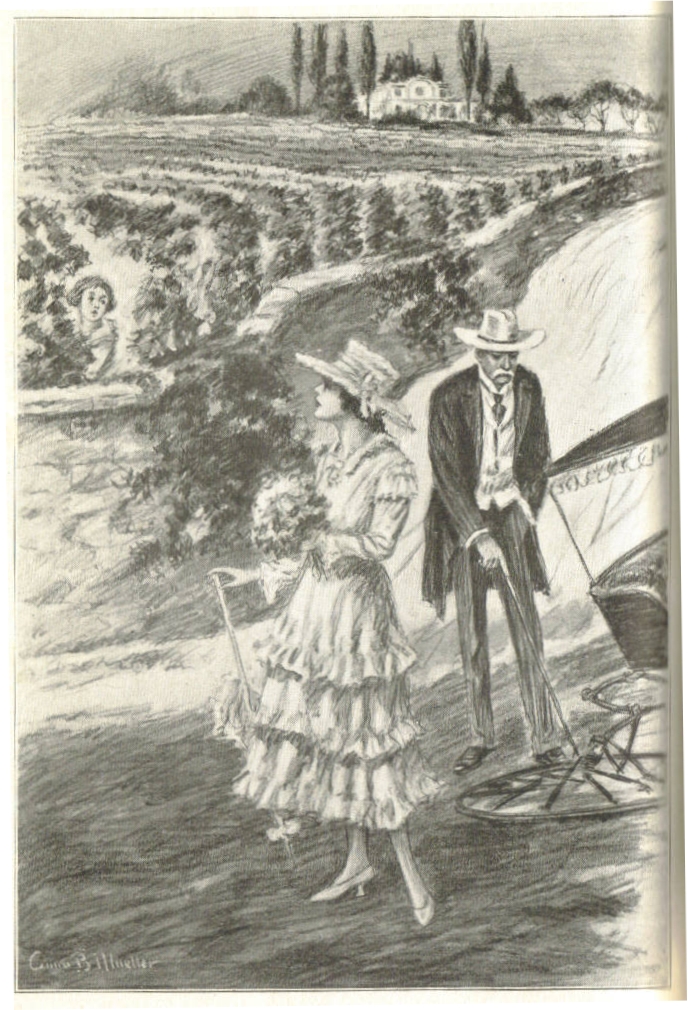
carriage broke down on the Amalfi Road, between Positano and Sorrento,
in Italy. A wheel crumpled up and the driver stopped his horses and
explained to his passengers in a jumble of mixed Italian and English
that he could go no farther. The passengers, an old gentleman of
distinguished appearance and a young girl as fresh and lovely as a
breath of spring, clambered out of the rickety vehicle and after
examining the wheel admitted that their driver spoke truly. On one side
the road was a steep descent to the sea; opposite, the hillside was
masked by a trellis thick with grapevines. The road curved around the
mountain, so there was no other vista.
"Here's a nice fix, Gran'pa Jim!" exclaimed the girl, with an amused
laugh. "Where are we and what's going to become of us?"
"That is somewhat of a complicated problem, Mary Louise, and I can't
guess it offhand, without due reflection," replied "Gran'pa Jim," whom
others called Colonel Hathaway. "I imagine, however, that we are about
three miles from Positano and five or six from Sorrento, and it's a
stiff walk, for old legs or young, in either direction. Besides,
there's our luggage, which I am loth to abandon and disinclined to
carry."
The driver interposed.
"Give-a me the moment, Signore—perhaps the hour—an' I
return to Positano for more carriage-wheel—some other. My Cousin
L'uigi, he leeve in Positano, an' L'uigi have a-many carriage-wheel in
he's shed. I sure, Signore, I getta the wheel."
"That is a sensible idea," said the old gentleman. "Make haste, my
man, and we will wait here."
The driver unhitched his horses from the vehicle and after strapping
a blanket on one of them for a saddle mounted it and departed.
"I take-a the two horse," he explained, "for one to ride-a me, an'
one for to ride-a the wheel."
They watched him amble away down the road and Mary Louise shook her
head and remarked:
"He will never make it in an hour, at that rate, Gran'pa Jim, and in
two hours the sun will have set and it will be dinner time. Already I
feel the pangs of hunger."
"Those who travel in Italy," said her grandfather, "should be
prepared to accept any happening in a spirit of resignation. A moment
ago we were jogging merrily along toward a good hotel and a savory
dinner, but now——"
"This entire carriage seems ready to fall apart," declared the girl,
standing in the road and viewing the ancient vehicle critically; "so
it's a wonder something didn't break sooner. Now, if we could get to
the other side of that trellis, Gran'pa Jim, we might find a shady spot
to rest while our charioteer is searching for a new wheel."
"There must be a gate, somewhere about," he answered, eyeing the
vine-clad barrier. "Come, Mary Louise, let us investigate."
A hundred yards down the road they came to some rude stone steps and
a wicket. The old gentleman lifted the wooden latch and found the gate
unlocked. Followed by Mary Louise, he entered the vineyard and
discovered a narrow, well-beaten path leading up the hillside.
"Perhaps there is a house near by," said the girl. "Shall we go on,
Gran'pa Jim?"
"Why not, my dear? These Italians are hospitable folk and we may get
a cake and a cup of goat's milk to stay our appetite."
So they climbed the hill, following the little path, and presently
came upon a laborer who was very deliberately but methodically
cultivating the vines with a V-shaped hoe. Seeing the strangers the man
straightened up and, leaning upon his hoe, eyed them with evident
suspicion.
"Good afternoon," said the old gentleman in Italian—one of the
few phrases in the language he had mastered.
"Oh, I speak the English, Signore," replied the man, doffing his
hat. "I am Silvio Allegheri, you must know, and I live in America some
time."
"Why, this is like meeting an old friend!" exclaimed Mary Louise,
winning the fellow instantly with her smile. "But why did you leave
America, Silvio?"
"Because I have make my fortune there," was the solemn reply. "It is
easy to make the fortune in America, Signorina. I am chef in the
restaurant in Sandusky—you know Sandusky?—most excellent!
In a few years I save much money, then I return here an' purchase an
estate. My estate is three miles across the hill, yonder, and there is
a road to it which is not much used. However, it is a fine estate, an'
I am rent it to my cousin for five hundred lira a year. Such good
business habit I learn in America."
"Why don't you live on your estate yourself?" inquired the girl.
"It is not yet the time," answered the man, with a shake of his
head. "I am but fifty-two years alive, and while I am still so young I
shall work for others, and save the money my estate brings me. When I
get old and can no longer work for the others, then I will go to my
estate an' be happy."
"Very sensible," commented the old gentleman. "And whom do you work
for now?"
"The student Americano, Signore; the one who has rented this
valuable estate. I am the Signore Student's valet, his gardener, and at
times his chef. I grease his automobile, which is a very small chug-
chug, but respectable, and I clean his shoes—when I can catch him
with them off. I am valuable to him and for three years he has paid me
fair wages."
"Is this a big estate?" asked Mary Louise.
"Enormous, Signorina. It comprises three acres!"
"And where is the house?"
"Just over the hill, yonder, Signore.
"Does the student Americano live here all alone?"
"With his daughter, who is the Signorina Alora."
"Oh; there is a daughter, then? And you say they are Americans?"
"Surely, Signorina. Who else would pay the great price for this
estate for three years? The land pays nothing back—a few oranges;
some grapes, when they are cared for; a handful of almonds and olives.
And there is a servant besides myself, my niece Leona, who is housemaid
and assists the young lady."
"This sounds promising," said Mary Louise, turning to her
grandfather. "Suppose we go up to the house? Are the people at home,
Silvio?—the Signore Student and his daughter?"
The man reflected, leaning on his hoe.
"I think they are both at the mansion, Signorina, although the
student Americano may not yet have returned from Sorrento. The road to
the mansion is beyond the hill, on the other side of the estate, so I
am not sure the Signore Student has returned. But you will find the
Signorina Alora there, if you decide to venture on. But perhaps you are
the friends of my employer and his daughter?"
"What is his name?" asked Colonel Hathaway.
"It is Jones. The American saying is Mister Jason Jones, but here he
is only called the Signore Student Americano."
"Why?" asked Mary Louise.
"Because his occupation is reading. He does nothing else. Always
there is a book in his hand and always he is thinking of the things he
reads. He does not often speak, even to his daughter; he does not have
friends who visit him. If you should call at the mansion, then you will
be the first people who have done so for three years."
There was something in this report—in the manner of the man as
well as his words—that caused the strangers to hesitate. The
description of "the Student" led them to suspect he was a recluse who
might not welcome them cordially, but Mary Louise reflected that there
was a daughter and decided that any American girl shut up on this
three-acre "estate" for three years would be glad to meet another
American girl. So she said abruptly:
"Come on, Gran'pa Jim. Let's call. It is possible that Americans
will have something better in the larder than cakes and goat's
milk."
The hilltop was reached sooner than they expected, and in a little
vale was the old mansion—a really attractive vine-clad villa that
might have stood a century or so. It was not very big, but there were
numerous outbuildings which rendered the size of the house proper
unimportant. As Mary Louise and her grandfather drew nearer they
discovered a charming flower garden, carefully tended, and were not
surprised to find a young girl bending over a rosebush.
CHAPTER VIII
MARY LOUISE MEETS ALORA
The two stood motionless a moment, looking at the girl, and Mary
Louise marked the graceful figure and attractive features with real
delight. The Signorina Alora, as the man had called her, was nearly her
own age—fifteen, Mary Louise judged her to be—and her
golden hair and fair complexion proclaimed her an American. But now the
girl's quick ears had detected presence, and she looked up with a
startled expression, half fearful and half shy, and turned as if to
fly. But in the next moment she had collected herself and advanced with
hesitating steps to meet them.
"Pardon our intrusion," said Colonel Hathaway, raising his hat. "Our
carriage broke down on the Amalfi road, a little while ago, and our
driver has gone to Positano for a new wheel. Meantime we were exploring
our surroundings and stumbled upon the path leading to this spot.
Forgive the trespass, if you will, and allow me to present my
granddaughter, Mary Louise Burrows. I am Colonel James Hathaway, of New
York, although we usually reside at a little town called Dorfield."
The girl's bow was stiff and awkward. She blushed in an embarrassed
way as she replied:
"I am Alora Jones, sir, and am living here for a time with my
father, Jason Jones. We, also, are Americans; at least, we used to
be."
"Then doubtless you are yet," responded the Colonel, with a smile.
"May we pay our respects to your father?"
"He—he is not home yet," she answered more embarrassed than
before. "He went to Sorrento for some books, this morning, and has not
yet returned. But perhaps he will be back soon," she added, seeming to
ponder the matter. "Will you not come in and—and have some
refreshment? In my father's absence I—I am glad to—welcome
you."
She glanced shyly at Mary Louise, as if to implore her to forgive
any seeming lack of hospitality and accept her coldly worded
invitation. No one could look at Mary Louise without gaining confidence
and the friendly smile and warm handclasp made Alora feel instantly
that here was a girl who would prove congenial under any circumstances.
Really, it would not take them long to become friends, and poor Alora
had no girl friends whatever.
She led them into a cool and comfortable living room and called to
Leona to fetch tea and biscuits.
"We are entirely shut in, here," she explained. "It seems to me
worse than a convent, for there I would see other girls while here I
see no one but the servants—and my father," as an afterthought,
"year in and year out."
"It's a pretty place," declared Mary Louise cheerfully.
"But it's an awfully dreary place, too, and sometimes I feel that
I'd like to run away—if I knew where to go," said Alora
frankly.
"You have lived here three years?" asked Colonel Hathaway.
"Yes. We left New York more than four years ago and traveled a year
in different places, always stopping at the little towns, where there
is not much to interest one. Then my father found this place and rented
it, and here we've stayed—I can't say 'lived'—ever since. I
get along pretty well in the daytime, with my flowers and the chickens
to tend, but the evenings are horribly lonely. Sometimes I feel that I
shall go mad."
Mary Louise marked her wild look and excited manner and her heart
went out in sympathy to the lonely girl. Colonel Hathaway, too,
intuitively recognized Alora's plaint as a human cry for help, and did
not need to guess the explanation. The man in the vineyard had called
her father "the Student" and said he was a reserved man and never was
seen without a book in his hand. This would mean that he was not
companionable and Alora's protest plainly indicated that her father
devoted small time, if any, to the cultivation of his daughter's
society.
"I suppose," remarked the old gentleman, "that Mr. Jones is so
immersed in his studies that he forgets his daughter lacks society am
amusement."
Mary Louise caught the slight, scornful smile that for a moment
curled Alora's lips. But the girl replied very seriously:
"My father dislikes society. I believe he would be quite content to
live in this little cooped-up place forever and see no one but the
servants, to whom he seldom speaks. Also, he ignores me, and I am glad
he does. But before my mother died," her voice breaking a little, "I
was greatly loved and petted, and I can't get used to the change. I
ought not to say this to strangers, I know, but I am very lonely and
unhappy, because—because my father is so different from what my
mother was."
Mary Louise was holding her trembling hand now and stroking it
sympathetically.
"Tell us about your mother," she said softly. "Is it long since you
lost her?"
"More than four years," returned Alora. "I was her constant
companion and she taught me to love art and music and such things, for
art was her hobby. I did not know my father in those days, you see,
for—for—they did not live together. But in her last illness
mamma sent for him and made him my guardian. My mother said that my
father would love me, but she must have misjudged him."
Colonel Hathaway had listened with interest.
"Tell me your mother's name," said he.
"She was Mrs. Antoinette Seaver Jones, and—"
"Indeed!" exclaimed the Colonel. "Why, I knew Antoinette Seaver
before she married, and a more beautiful and cultured woman I never
met. Her father, Captain Seaver, was my friend, and I met his daughter
several times, both at his mining camp and in the city. So you see, my
dear, we must be friends."
Alora's eyes fairly glistened with delight and Mary Louise was as
pleased as she was surprised.
"Of course we're friends!" she cried, pressing the girl's hand, "and
isn't it queer we have come together in this singular manner? In a
foreign country! And just because our carriage-wheel happened to
break."
"I thought your mother married an artist," said Mary Louise's
grandfather, reflectively.
"She did. At least, she thought Jason Jones was an artist,"
answered Alora with bitter emphasis. "But he was, in fact, a mere
dauber. He became discouraged in his attempts to paint and soon after
he took me to New York he destroyed all his work—really, it was
dreadful!—and since then he has never touched a brush."
"That is strange," mused the Colonel. "I once saw a landscape by
Jason Jones that was considered a fine conception, skillfully executed.
That was the opinion of so good a judge as Captain Seaver himself.
Therefore, for some reason the man's genius must have forsaken
him."
"I think that is true," agreed Alora, "for my mother's estimate of
art was undoubtedly correct. I have read somewhere that discouragement
sometimes destroys one's talent, though in after years, with proper
impulse, it may return with added strength. In my father's case," she
explained, "he was not able to sell his work—and no wonder. So
now he does nothing at all but read, and even that doesn't seem to
amuse him much."
The Colonel had now remembered that Antoinette Seaver Jones was a
woman of great wealth, and therefore her daughter must be an heiress.
What a shame to keep the girl hidden in this out-of-the-way place, when
she should be preparing to assume an important position in the
world.
"May I ask your age, my dear?" he said.
"I am fifteen, sir," replied Alora.
"And your father is the guardian of your fortune?"
"Yes; by my mother's wish."
"I suppose you are receiving proper instruction?"
"None at all, sir. Since I have been in my father's care I have had
no instruction whatever. That isn't right, is it?"
"What isn't right?" demanded a gruff voice, and all three turned to
find Jason Jones standing in the doorway.
CHAPTER IX
MARY LOUISE SCENTS A MYSTERY
Colonel Hathaway instantly rose.
"I beg your pardon," said he. "I am Colonel James Hathaway, an
American, and this is my granddaughter, Mary Louise Burrows. Our
carriage met with an accident on the main road below and we wandered in
here while waiting for repairs and chanced to meet your daughter. You
are Mr. Jones, I believe?"
He nodded, still standing in his place and regarding his visitors
with unconcealed suspicion. Under his arm he held several books.
"Who informed you that I was living here?" he demanded.
"I was wholly unaware of the fact," said the Colonel, stiffly. "I
did not know you were in Italy. I did not know such an important person
existed, strange to say, although I can remember that an artist named
Jason Jones once married Antoinette Seaver, the daughter of my old
friend Captain Robert Seaver."
"Oh, you remember that, do you?"
"This is the first time I have had the distinguished honor of
meeting you, sir, and I trust it will be the last time."
"That's all right," said Jason Jones, more cordially. "I can't see
that it's any of my affair, either way."
"We have been making the acquaintance of Tony Seaver's daughter,
Miss Alora Jones, in your absence. But we will not intrude farther, Mr.
Jones. Come, Mary Louise."
"Oh, don't go!" pleaded Alora, catching Mary Louise's arm. And just
then Leona entered with the tea and biscuits.
"Sit down, man," said Jason Jones in a less aggressive tone. "I've
no objection to your coming here, under the circumstances, and you are
our first visitors in three years. That's often enough, but now that
you are here, make yourself at home. What's happening over in America?
Have you been there lately?"
He laid his books on a table and sat down. But after that one
speech, which he perhaps considered conciliatory, he remained glum and
allowed the others to do the talking.
Colonel Hathaway had stayed because he noted the leading look in
Mary Louise's eyes. He was himself interested in Alora and indignant
over her evident neglect. For her sake he would bear the insolence of
his host, an insolence he recognized as characteristic of the man.
Alora, in her father's presence, lost her fluent speech and no
longer dared mention personal matters to her guests. Both Mary Louise
and her grandfather tried to lead Alora and Jason Jones to speak of
themselves—of their life and future plans—but the man
evaded direct answers and the girl had suddenly become silent and
reserved.
F
inally, however, Mary Louise had an idea.
"We are bound for Sorrento," said she, "where we intend to stay a
week at the Hotel Vittoria. Will you let Alora come to us for ever
Sunday, as our guest? We will drive here and get her the day after to-
morrow—that's Saturday, you know—and fetch her home on
Monday."
"No," said Jason Jones.
"Oh, why not, father?" pleaded the girl.
"You've no fit clothes. I don't want you hanging around Sorrento,"
he replied.
"It will be a nice change for your daughter and it will give us much
pleasure to entertain her," said Mary Louise.
"It's a capital idea," declared the Colonel positively, and looking
the other man straight in the eye he added: "I am sure you will
withdraw your objections, Mr. Jones."
The man dropped his eyes, frowning. But presently he said to
Alora:
"Go, if you want to. But keep out of the town. Don't leave the hotel
grounds."
"Why not?" asked his daughter in a defiant tone.
"It's not safe. I know Sorrento, and these rascally Italians would
be glad to steal you, if they had the chance, and then blackmail me a
ransom."
Mary Louise laughed.
"What a fine adventure that would be!" she exclaimed. "But we will
promise to guard Alora and keep her from the clutches of bandits. I
didn't know there were any left in Italy."
"To get rid of them you'd have to depopulate the country," said
Jason Jones. "It is no laughing matter, young woman, and—my
daughter is somewhat valuable."
CHAPTER X
MERE SPECULATION
The driver returned with the wheel. It fitted the axle but was some
two or three inches larger in diameter than the other rear wheel and,
moreover, it was flat on one side, so that when they started to
conclude their journey the motion of the carriage was something
startling—a "rock-a-bye baby ride" Mary Louise called it.
But the wheels turned and the carriage progressed and when they were
well on their way the girl said:
"What do you think of that man, Gran'pa Jim?"
"Do you mean Alora's father, Jason Jones?"
"Yes, of course."
"I am surprised at two things," said the old Colonel. "First, it is
curious that Tony Seaver, a rarely cultured woman, should have married
such a man, and again it is amazing that she should have confided her
daughter and her fortune to his care."
"Do you know," observed Mary Louise, sliding closer to him and
dropping her voice, although there was absolutely no chance of being
overheard, "I scent a mystery in that family, Gran'pa Jim!"
"That seems to be one of your regular diversions—to scent
mysteries," he replied. "And usually, my dear, the suspicion is
unwarranted. The most commonplace people frequently impress you with
the idea that they are other than what they seem, are leading double
lives, or are endeavoring to conceal some irregularity of conduct.
You've a faculty of reading the natures and characteristics of
strangers by studying their eyes, their facial expressions and their
oddities of demeanor, which is interesting psychologically but too
often——"
"You are unjust, Gran'pa!" declared Mary Louise indignantly. "Didn't
you yourself say there are two curious and surprising things about this
man Jones?"
"Not exactly. I said it was curious and astonishing that Antoinette
Seaver should have trusted so fully a man who impresses me as a churl.
His own child, little Alora, appears to dislike and even to despise
him, and——"
"There!" cried Mary Louise. "I'm vindicated. Your observations fully
justify my remark that there's a mystery in that family. Did you notice
the books he brought home and laid upon the table?"
"No," said Colonel Hathaway, rather bewildered.
"They were novels by Marie Correlli, H. G. Wells and O. Henry. A
student? Then a student of modern novels, a man who reads and reads to
keep his mind from dwelling on past history. He is a disappointed
artist, to begin with."
"That is certainly odd," rejoined the old gentleman, reflectively.
"The one picture I ever saw by Jason Jones was certainly good. I
remember that once when I was lunching with Bob Seaver—that was
Antoinette's father, you know—he told me his daughter was
interested in a young artist of exceptional talent, and he took me to a
gallery to show me what this man could do. I am not an art critic, as
you are aware, my dear, but this landscape of Jason Jones appealed to
me as delightful. Captain Bob knew art, and so did Antoinette, so it is
evident that Jones could paint, but for some reason became
dissatisfied with his work and abandoned it. Perhaps his ambition was
too lofty for human skill to realize, yet nothing less would content
him."
Mary Louise sat silent for a while. Then she asked:
"Did Jason Jones impress you as a man capable of a great ambition?
Would you guess him an artist who had once accomplished admirable
things?"
"Artists are always peculiar," stated her grandfather. "They must be
temperamental in order to be artists, and temperaments differ widely.
Had I not known something of Jason Jones' history I might have felt, on
making his acquaintance to-day, that he is not an ordinary man. For,
gruff and churlish though he proved, it is undeniable that he has
selected a charming and retired spot in which to
live——"
"Or to hide," she interrupted.
"Or that, with considerable wealth at his command, he lives simply
and unostentatiously, enjoying nature's choice gifts and content with
the simple life he leads, with only the society of his young
daughter."
"Whom he neglects and refuses to educate properly," declared the
girl. "What makes you think he is wealthy?"
"I know that Antoinette made millions, after her father died, from
the mines. By current report she retired and invested her money wisely,
in sound securities, which accords with her excellent business
reputation. Her daughter not being of age—let me see: she must
have been but eleven when her mother passed away—there would be a
guardian appointed for the heiress, and Alora told us that it was her
mother's wish that her father act as her guardian. So the conclusion is
evident that Mr. Jones has a large income at his command."
"All the more reason he should be generous, but he isn't spending
much of it," said Mary Louise.
"No; he is probably living simply in order that his daughter's
fortune may increase during the years of her minority. That is a point
in his favor, you must admit."
"Nevertheless," asserted the young girl, "I think there is something
wrong in the Jones family. It isn't due to Alora; she's a dear little
thing, wild and untamed but very lovable, I'm sure; so the fault must
lie with her boorish father. Allowing that once he was a big man,
something has mysteriously soured him and rendered his life hateful not
only to himself but to all around him."
"Look, Mary Louise; we're getting into Sorrento," said the Colonel.
"Here the road leaves the sea and crosses the plateau to the town.
You'll like Sorrento, I'm sure, for it is one of the quaintest places
in old Italy—and the hotel is really comfortable."
CHAPTER XI
ALORA SPEAKS FRANKLY
On Saturday forenoon the Colonel engaged a carriage—a
substantial one, this time—and with Mary Louise drove to Jason
Jones' villa, so that Alora might return with them in time for lunch.
They did not see the artist, who was somewhere about the grounds but
kept out of view; but Alora was ready and waiting, her cheeks flushed
and her eyes alight, and she slipped her foreign little straw satchel
in the carriage and then quickly followed it, as if eager to be
off.
"Father is rather disagreeable this morning," she asserted in a
sharp voice, when they were on the highway to Sorrento. "He repented
his decision to let me go with you and almost forbade me. But I
rebelled, and——" she paused; "I have found that when I
assert myself I can usually win my way, for father is a coward at
heart."
It pained Mary Louise to hear so unfilial a speech from the lips of
a young girl. Colonel Hathaway's face showed that he, too, considered
it unmannerly to criticise a parent in the presence of strangers. But
both reflected that Alora's life and environments were unenviable and
that she had lacked, in these later years at least, the careful
training due one in her station in society. So they deftly changed the
subject and led the girl to speak of Italy and its delightful scenery
and romantic history. Alora knew little of the country outside of the
Sorrento peninsula, but her appreciation of nature was artistic and
innately true and she talked well and interestingly of the surrounding
country and the quaint and amusing customs of its inhabitants.
"How long do you expect to remain here?" asked Mary Louise.
"I've no idea," was the reply. "Father seems entirely satisfied with
our quarters, for he has no ambition in life beyond eating three simple
meals a day, sleeping from nine at night until nine in the morning and
reading all the romances he is able to procure. He corresponds with no
one save his banker in America and sees no one but the servants and me.
But to me the monotony of our existence is fast becoming unbearable and
I often wonder if I can stand it for three years longer—until I'm
eighteen. Then I shall be my own mistress and entitled to handle my own
money, and you may rest assured I shall make up for lost time."
They let that remark pass, also, but later in the afternoon, when
luncheon was over and the two girls were wandering in the lovely
gardens of the Hotel Vittoria, while the Colonel indulged in an
afternoon siesta, Mary Louise led Alora to speak freely of her past
life.
"My grandfather says that your mother must have left you a good deal
of money," she remarked.
"Yes; mamma told me it was a large fortune and that I must guard it
wisely and use it generously to help others less favored," replied
Alora thoughtfully.
"And she left it all in your father's keeping?"
"Not the principal. That is all invested, and thank goodness my
father cannot touch it in any way. But the income is paid to him
regularly, and he may do as he pleases with it. I am sure mamma
expected I would have every reasonable wish gratified, and be taught
every womanly accomplishment; but I'm treated as a mere dependent. I'm
almost destitute of proper clothing—really, Mary Louise, this is
the best dress I possess!—and I've been obliged to educate
myself, making a rather poor job of it, I fear. I read the best of
father's books, when he is done with them, and note carefully the
manner in which the characters express themselves and how they conduct
themselves in society as well as in worldly contact. I do not wish to
be wholly gauché when I come into my kingdom, you see, and
the books are my only salvation. I don't care much for the stories, but
some of the good writers are safe guides to follow in the matter of
dialogue and deportment. Fortunately, father's books are all in
English. He doesn't understand much Italian, although I have learned to
speak the language like a native—like our native servants, you
know."
Mary Louise reflected on this confession. "I'm afraid, Alora dear,
that modern novels are not prone to teach morality, or to develop a
girl's finer intuitions," she said gravely. "I think you express
yourself very well—better than I do, indeed—but you need
association with those who can convey to you the right principles of
thought and thus encourage your mental development. Culture and
refinement seem to come more from association than from books, although
there is an innate tendency in all well-born people to acquire them
spontaneously. But there! you'll accuse me of preaching and, after all,
I think you've done just splendidly under rather trying
circumstances."
"You don't know how trying they are," declared Alora, with a sigh.
"Father and I are wholly uncongenial and we fight on the slightest
provocation. This morning our trouble was over money. I wanted a little
to take with me, for my purse hasn't a lira in it; but, no! not
a centisimo would he give up. He insisted that if I was to be
your guest you would pay all my expenses."
"Of course," said Mary Louise. "But what does he do with all that
big income? Is he saving it for you?"
"No, indeed! he's saving it for himself. Mamma told me, the last
time I saw her before she died, that if father was good to me, and kind
and loving, I could provide for him in some way after I came into my
money. She said she would leave the manner of it to my judgment. But he
isn't kind, or loving, or good, and knows very well that when I'm of
age he'll never see another cent of my money. So now he'd hoarding my
income for future use."
"Isn't it strange that your mother should have trusted him so
fully?" asked Mary Louise.
"Yes, it does seem strange. I remember her saying that he loved
luxury and all the comfort that money will buy, and so she wanted him
to have this income to spend, because he was my father and because she
felt she had ruined his career as an artist by surrounding him with
luxuries during their early married life, and afterward had embittered
him by depriving him of them. But the man doesn't know what luxury
means, Mary Louise. His tastes are those of a peasant."
"Yet once your mother loved him, and believed in him."
"I—I think she believed in him; I'm quite sure she did."
"Then his nature must have changed. I can imagine, Alora, that when
your mother first knew him he was hard-working and ambitious. He was
talented, too, and that promised future fame. But when he married a
wealthy woman he lost his ambition, success being no longer necessary.
After a period of ease and comfort in the society of his lovely
wife—for Gran'pa says your mother was very lovely—he lost
both the wife and the luxuries he enjoyed. A big man, Alora, would have
developed a new ambition, but it seems your father was not big. His
return to poverty after your mother's desertion made him bitter and
reckless; perhaps it dulled his brain, and that is why he is no longer
able to do good work. He was utterly crushed, I imagine, and hadn't the
stamina to recover his former poise. He must have been ten years or so
in this condition, despairing and disinterested, when the wheel of
fortune turned and he was again in the possession of wealth. He had now
the means to live as he pleased. But those years had so changed him
that he couldn't respond to the new conditions. Doubtless he was glad,
in a way, but he was now content merely to exist. Doesn't that seem
logical, Alora?"
Indeed, Mary Louise was delighted with her solution of the problem.
It was in keeping with her talent for deducing the truth from meagre
facts by logically putting them together and considering them as a
whole. It was seldom she erred in these deductions. But Alora seemed
unimpressed and noting her glum look Mary Louise said again: "Doesn't
all this seem logical, dear?"
"No," said Alora. "Father isn't the man to be crushed by anything.
He's shrewd enough, in his bourgeois way. Once, long
ago—back in New York—a woman made him give her money; it
was money, you know; and I have often thought he ran away from America
to escape her further demands."
"Who was the woman?"
"My mother's nurse."
"Oh. Was it her wages she demanded?"
"Perhaps so. I may have misjudged father in that case. But it seemed
to me—I was a mere child then—that it must have been a
larger sum than wages would have amounted to. Yet, perhaps not. Anyhow,
he left America right afterward, and when we had wandered a year or so
in various countries we settled down here."
"Won't he have to account for all the money he has spent and given
away, when you come of age?" inquired Mary Louise.
"No. Mother distinctly told me I was to ask for no accounting
whatever. Her will says he is to handle the income as he sees fit, just
as if it were his own, so long as he provides properly for his daughter
and treats her with fatherly consideration. That's the only reason he
keeps me with him, guarding my person but neglecting the other
injunctions. If he set me adrift, as I'm sure he'd like to do, I could
appeal to the court and his income would cease and another guardian be
appointed. I believe there is something of that sort in the will, and
that is why he is so afraid of losing me. But he gives me no chance to
appeal to anyone, although I sometimes think I shall run away and leave
him in the lurch. If I could get to Chicago and tell Judge Bernsted, my
mother's lawyer, how I am treated, I believe he could make the court
set aside my father's guardianship. But I can't get ten miles away from
here, for lack of money."
"How your dear mother would grieve, if she knew her plans for your
happiness have failed!" exclaimed Mary Louise.
Alora frowned, and somehow that frown reminded Mary Louise of the
girl's father.
"My mother ought to have known my father better," she declared
sullenly. "I must not criticize her judgment, for her memory is my most
precious possession and I know she loved me devotedly. But there is one
thing in her history I can never understand."
"And that?" questioned Mary Louise curiously, as Alora paused.
"My mother was an educated woman, well-bred and refined."
"Yes; Gran'pa Jim told me that."
"Then how could she have married my father, who is not a gentleman
and never could have impressed a lady with the notion he was one?"
Mary Louise hesitated, for to admit this would send her deductions,
so carefully constructed, tumbling in ruins. But Alora ought to know
the man.
"If that is true, dear," said she, "it is the strangest part of your
story; and, of course, we can only guess the reason, for the only one
who could have explained it properly was your mother."
CHAPTER XI
JASON JONES IS FRIGHTENED
When Alora had retired to her bedroom that night Mary Louise told to
her grandfather, who was her trusted confidant, all that the unhappy
girl had related.
"Of course," she added, "Alora's explanations dispel my half formed
suspicion that there is some mystery about Jason Jones. I now see that
you were right, Gran'pa Jim, to laugh at me when I suggested such a
thing, for in truth the man is easily understood once you become
acquainted with his history. However, I now dislike him more than
ever."
"In justice to Jason Jones," remarked the old Colonel, "we must
acquit him of being a hypocrite. He doesn't attempt to mask his nature
and a stranger is bound to see him at his worst. Doubtless Antoinette
Seaver understood the man better than we are able to and sixteen years
ago, or so, when he had youth, talent and ambition, his disagreeable
characteristics were probably not so marked. As for Alora, she is
strongly prejudiced against her father and we must make due allowance
for her bitterness. The feeling probably arose through her sudden
transfer from the care of a generous and loving mother to that of an
ungracious father—a parent she had never before known. A child of
eleven is likely to form strong affections and passionate
dislikes."
"Do you know," said Mary Louise, "it shocks me, this hatred of her
father. It seems so unnatural. I wish we could bring them to understand
one another better, Gran'pa Jim."
"That might prove a difficult task, my dear," he replied with a
smile, gently stroking her hair the while, "and I do not think we are
justified in undertaking it. How many times during our travels, Mary
Louise, has your impulsive and tender heart urged you to assume the
burdens of other people? You seem to pick up a trail of sorrow or
unhappiness with the eagerness of a bloodhound and I have all I can do
to call you off the scent. One small girl can't regulate the world, you
know, and in this case we are likely to see very little of Alora Jones
and her artist father. We will be nice to them during the few days we
are here, but we must soon move on or we'll never get home for your
birthday, as we have planned."
Mary Louise sighed.
"You're almost always right, Gran'pa Jim," she admitted; "but in all
our European travels I've not met so interesting a person as Alora, and
she's an American girl, which draws us still closer together. I'm going
to make her promise that when she's of age and her own mistress she
will let me know, and come to us for a visit. Wouldn't that be all
right, Gran'pa?"
He assured her it would be quite proper and that he also admired
Alora and was sorry for her.
On Sunday forenoon they went to the cathedral and in the afternoon
took a boat to the blue grottoes. In the evening there was a concert in
the hotel. All that day the two girls were arm in arm and chatting
together, developing their mutual liking, while the old Colonel trudged
along in their wake and was generally ignored in the conversation. On
Monday they planned an excursion to Capri, "For you won't mind if we
don't get you home until after dinner, will you?" asked Mary
Louise.
"Not at all," said Alora. "I want to make the most of this
vacation."
"Her father may mind, however," suggested the Colonel.
"I don't care whether he does or not," retorted the girl, tossing
her head. "He has no consideration for me, so why should I consider
him?"
"I don't like that attitude, dear," said Mary Louise frankly.
"I—I don't wish to be snippy, you know, but you should not forget
that he is your father."
"That," replied Alora doggedly, "is merely my misfortune, and I'm
not going to allow it to ruin all my life."
On Monday morning they had scarcely finished breakfast when Jason
Jones appeared at the hotel, having driven over from the villa in his
little automobile—a tiny foreign contrivance that reminded one of
a child's cart but could cover the ground with considerable speed. They
were sitting on the big piazza when Alora's father came striding up to
them with a white, fear-struck face. In his trembling hands he held the
morning Naples newspaper and without a word of greeting he said
abruptly:
"Have you heard the news?"
Colonel Hathaway rose and bowed.
"Good morning, Mr. Jones," said he. "I do not read the local
newspapers, for my knowledge of Italian is indifferent."
"So is mine," responded the artist, "but I know enough of their
lingo to make out that Italy has entered this fool war. She's going to
fight the Austrians," he continued, his voice shaking nervously, "and
do you know what that will mean, sir?"
"I can't imagine," replied the Colonel calmly.
"It means that presently we'll have all that horde of Germans
overrunning Italy. They'll conquer this helpless land as sure as fate,
and we'll all be burned out and tortured and mutilated in the fiendish
German way!"
"My dear sir, you are frightened without warrant," declared Colonel
Hathaway. "It will take some time to conquer Italy, and I cannot
imagine the Austrians acting as you suggest."
"Back of the Austrians are the Germans, and those Prussians are
worse than wild American Indians," insisted Jones. "If they got their
clutches on my daughter it would be more horrible than death and I
don't propose to leave her in danger a single minute. I'm going to quit
this country. I've come for Alora. We must pack up and catch the first
ship from Naples for America."
There was blank silence for a moment.
"I'm not afraid," said Alora, with a laugh, "but if it means our
getting out of this tiresome place and sailing for home, I'm glad that
Italy's gone into the war."
Colonel Hathaway was grave and thoughtful. The agitation of the
artist seemed to increase with every moment.
"When does the next boat for America leave Naples?" asked Mary
Louise.
"Tuesday," said Alora's father. "We've just time to pack our
possessions and leave."
"Time!" cried his daughter, "why, I can pack all my possessions in
an hour. Go home, sir, and fuss around as much as you like. I'll join
you some time this evening."
He gave her a queer look, hesitating.
"We are surely safe enough for the present," remarked the Colonel.
"The first act of war will be to send all the soldiers to the north
border. The fighting will be done in the Trentino for some time to
come."
"You don't know these people," said Jones, shifting uneasily from
one foot to another. "They're all brigands by nature and many of them
by profession. As soon as the soldiers are sent north, all law and
order will cease and brigandage will be the order of the day!"
"This is absurd!" exclaimed the Colonel, testily. "You're not
talking sense."
"That's a matter of opinion, sir; but I know my own business, and
I'm going to get out of here."
"Wait a week longer," suggested Mary Louise. "We are to sail
ourselves on the boat that leaves Naples a week from Tuesday, and it
will be nice for Alora and me to travel home together."
"No; I won't wait. Get your things, Alora, and come with me at
once."
"Have you made reservations on the boat?" inquired Colonel Hathaway,
refusing to be annoyed by the man's brusque words and rough
demeanor.
"I'll do that at once, by telephone. That's one reason I came over.
I'll telephone the steamship office while the girl is getting
ready."
"I will go with you," said the Colonel, as the artist turned
away.
While Jones used the telephone booth of the hotel Colonel Hathaway
conversed with the proprietor, and afterward with the hall porter, who
was better posted and spoke better English.
"This is outrageous!" roared the artist, furiously bursting from the
booth. "To-morrow's boat is abandoned! The government requires it as a
transport. Why? Why? Why?" and he wrung his hands despairingly.
"I do not know, sir," returned the Colonel, smiling at his futile
passion.
The smile seemed to strike Jones like a blow. He stopped abruptly
and stared at the other man for a full minute—intently,
suspiciously. Then he relaxed.
"You're right," said he coldly. "It's folly to quarrel with fate.
I've booked for a week from Tuesday, Hathaway, and we must stick it out
till then. Do you take the same boat?"
"That is my intention."
"Well, there's no objection. Now I'll go get Alora."
But Alora, hearing of the postponed sailing, positively refused to
return home with him, and Mary Louise, supporting her new friend, urged
her to extend her stay with her at the hotel. Strangely enough, the
more he was opposed the more quiet and composed the artist became. He
even ceased to tremble and an odd apathy settled over him.
"The hall porter," said the Colonel, "thinks this is the safest
place in Italy. The troops have been on the border for months and their
positions are strongly fortified. There is no brigandage outside of
Sicily, where the Mafia is not yet wholly suppressed."
Jones grinned rather sheepishly.
"All right, take his word for it," said he. "And if you'll be
responsible for the girl you may keep her till we're ready to sail.
Perhaps that's the best way, after all." Then, without a word of good-
bye, he entered his little motor car and started down the driveway.
"A strange man," said the Colonel, looking after him. "I wonder if
it really was the war that frightened him—or something
else—or if he was actually frightened at all?"
Alora laughed.
"You can't guess father, try as you may," she said. "Usually he is
cold as ice, but once in awhile he gets these wild fits, which I find
rather amusing. You can't understand that, of course, but if you were
obliged to live under the same roof with Jason Jones you would welcome
his outbursts as relief from the monotony of contemptuous silence."
CHAPTER XII
SILVIO'S GOLD
Jason Jones urged his little car to its best speed until he gained
his villa. Entering the ground, he was confronted by his factotum, the
Italian, Silvio.
He sprang out and approached the man.
"Is the prisoner safe?" he whispered.
"Certainly, Signore."
"Is she still in the grape-house?"
"With the wine presses, Signore."
"And she can't get out?"
"Unless she becomes small, like a rat, Signore."
Jones glanced around suspiciously, then fixed his gaze on a little
outbuilding of stone, with a tiled roof, which stood quite removed from
the others of the group.
"Has she screamed, or cried out?" he asked the man.
"Not since I put her in, las' night, Signore."
"Good. You've fed her?"
"The plenty. She eat very well. It's a nice lady, Signore."
"She's dangerous. Listen, Silvio: we must keep her there a week
longer."
"If I am jailer a week, I mus' double my price," he asserted,
shrugging his shoulders.
"Nonsense!"
"The lady will offer me more to let her out. She say so."
"What! You'd betray me?"
"Not if I have the gold—here, in my hand—now,
Signore."
Jones grew red and then white. He eyed the man wickedly. He scowled,
and Silvio smiled pleasantly. Silvio was big for an Italian; big and
brawny; as his smile faded his face assumed a look of stubborn
determination.
"So you want the gold now, Silvio?"
"At once, if it please the Signore. The gendarmes are ugly if the
law is broken. Their jails are not as pleasant as the grape-house. So
the gold must be twice the amount we had spoken of, Signore."
"And you will promise she shall not escape; that you'll keep her
safe until—until I tell you to let her go?"
"That is our bargain, Signore."
Jones sighed regretfully.
"Very well, then, Silvio," he said. "You're a robber—the son
of a brigand—the spawn of a bandit! But come with me to the
house, and you shall have your gold."
* * * * * * * *
Alora stayed all that week with Mary Louise, hearing nothing of her
father and almost forgetting her unhappiness in the society of her
delightful new friend. It was Sunday evening when the Colonel and Mary
Louise drove their guest over to the villa and the two parties did not
see one another again until they met on the deck of the steamer in
Naples on the following Tuesday morning.
The Joneses came aboard very quietly just at the last moment and at
the gang-plank Alora's father was confronted by a grimy Italian boy who
handed him a letter. Without pausing to read it, Jones hurried below,
and he kept his stateroom until the ship was well out in the blue
Mediterranean, on its way to Gibraltar and New York. But no one missed
him, for Alora and Mary Louise were happy at being reunited and Gran'pa
Jim was happy in seeing them happy.
CHAPTER XIII
DORFIELD
In one of the middle-west states there is a delightful little city
called Dorfield. It hasn't so many thousand inhabitants, but in all its
aspects and its municipal equipment it is indeed a modern city. It has
factories and a big farming community to support its streets of neat
and progressive shops, and at the west side of the business district is
a residence section where broad, wooded streets furnish the setting for
many cozy homes. Some of the houses are old and picturesque, and some
are new and imposing, but each has its flower-lit garden, its fruit and
shade trees and its little garage or barn tucked away in the back
yard.
When you come to Oak Street there is a rambling frame house on the
corner, set well back, where Peter Conant, the lawyer, lives with his
good wife and his niece Irene Macfarlane, who is seventeen. This is one
of the ancient dwellings of Dorfield, for the Conants are "old
inhabitants." Right next them stands a more modern and expensive, if
less attractive, mansion, with grounds twice as large and a velvet lawn
that puts the Conants' carelessly-cropped grass to shame. But the two
families are neighbors and friends nevertheless, for in the new house
lives Colonel James Hathaway and his granddaughter Mary Louise Burrows.
At least, they live there when at home and, although they seem
persistent ramblers, they are glad to have this refuge to return to
when wearied with traveling and sight-seeing.
One morning in June Mr. Conant was just seating himself at the
breakfast table when a messenger-boy delivered a telegram—a
"night letter" from New York. The lawyer, a short, thick-set man of
middle age, with a stern countenance but mild blue eyes, laid aside his
morning paper and read the telegram with his usual deliberation. Mrs.
Conant silently poured the coffee, knowing any interference would annoy
him. Irene, the niece, was a cripple and sat in her wheeled chair at
the table, between her uncle and aunt. She was a pleasant-faced, happy
little maid, consistently ignoring her withered limbs and thankful that
from her knees up she was normal and that her wheeled chair rendered
her fairly independent of assistance in all ordinary activities.
Everyone loved Irene Macfarlane because of her brave and cheery
acceptance of her misfortune, and her merry speech and spontaneous
laughter rendered her, as "Aunt Hannah" often declared, "the light of
the house." Irene was, moreover, an intimate and highly valued friend
of her next door neighbor, Mary Louise Burrows.
Mr. Peter Conant, sipping his coffee reflectively, read the lengthy
telegram a second time. Then he said, somewhat irritably and chopping
his words into distinct syllables, as was his habit at all times:
"I wonder why people imagine a lawyer's duties cover every phase of
life? My clients use me as a real-estate agent, a horse trader, a
purchasing agent, a father confessor, an automobile expert, a medical
adviser, and sometimes—in their simplicity—as a
banker!"
"What's wrong now, Peter?" inquired Mrs. Conant with wifely
sympathy.
"Colonel Hathaway wants to know—"
"Oh, is Mary Louise coming back?" cried Irene eagerly.
He frowned at her.
"What does the Colonel wish to know, Peter?"
"I object to this unwarrantable cross-examination," said he. "It is
customary to first allow one to state his case."
"Forgive me, Uncle Peter!"
"Take your time," said Aunt Hannah, composedly buttering the toast.
"You will, anyhow, and I'm sure Irene and I have both learned to curb
our feminine curiosity."
He glanced at the telegram again.
"Do you know if the Pelton place has been rented, my dear?"
"The Pelton place? Why, it wasn't rented yesterday, for I passed by
there and saw the rent sign still in the window. Mr. Harlan is the
agent."
"I know. And where can we find a female house-servant, Hannah?"
"Now, see here, Peter; it's all very well for you to keep your own
counsel, when there's a professional secret to be guarded, but if you
want any help from me you've got to open your mouth and talk out
plainly, so I can answer you in a sensible way."
"You're always sensible, Hannah," he observed, quite unruffled by
her demand. And then he ate a whole slice of toast and drank his coffee
and handed his cup for more before he spoke another word.
Irene devoted herself to her breakfast. She knew Uncle Peter's ways
and that it was useless to attempt to hurry him or force him to
explain, until he was quite ready to do so. Aunt Hannah bided her time.
Peter was a thoughtful man, and he was doubtless thinking. His wife was
not only a clever helpmate but was noted for her consideration of her
erratic spouse.
"The Colonel," said Mr. Conant at last, "has run across a man who
wants to make his home in Dorfield. A very sensible idea. The Colonel
met the man in Europe. The man——"
"What's the man's name?" inquired Mrs. Conant.
He referred to the telegram.
"Jones. Jason Jones."
"I never heard of him."
He looked at her reproachfully.
"Why should you, my dear? The Colonel found the man in Europe. We
live in Dorfield. The man, it seems, has a daughter——"
"Oh, goody!" cried Irene.
"Who has become a friend of Mary Louise, therefore the Colonel wires
to ask if there is a furnished house to rent at a modest price and if a
competent female servant can be secured for the man and his daughter.
He requests me to wire an answer promptly. That is the gist of the
telegram, although the Colonel, in his usual extravagant way, has paid
for more words than were required to express his meaning."
"And what are you going to do about it?" demanded Mrs. Conant.
"I am endeavoring to gain information from my wife."
"Very well. What does he mean by 'a modest price'? The Pelton place
is expensive. The rent is sixty dollars a month, while a comfortable
house like that of the Widow Harrington rents for fifteen dollars, with
good, solid furniture."
"Is Mrs. Harrington's house for rent?" he asked.
"Yes. She'll go to live with her married daughter as soon as she can
find a tenant. The poor creature needs the money, and her house is just
around the corner from here and her back yard backs up to the Colonel's
back yard. Now, the Pelton place is two blocks from here, and the
Peltons don't need the money, because they're already too rich and
aristocratic to live in Dorfield any longer."
"H-m-m!" murmured Mr. Conant. "It occurs to me that a friend of
Colonel Hathaway might desire a more luxurious home than that of the
Widow Harrington."
"Doesn't the telegram say 'a modest price'?"
"It does. I'll quote both places and let the man Jones take his
choice. And how about the female servant, Hannah?"
"Leave that to me; I can hire plenty. But if Mr. Jason Jones takes
the Pelton place he will want one kind of a servant, and if he takes
Mrs. Harrington's house he'll want a different sort."
He gazed at her admiringly and passed his cup again, saying:
"You've a logical mind, my dear. Had you been a man you might have
become a fairly good lawyer."
"No, Peter; not another drop. You've two cups already."
"Are you sure, Hannah?"
"Absolutely positive!"
"Then," said he, rising with a sigh, "I'll go to the office."
To Mr. Conant's disappointment, to Mrs. Conant's delight, to Irene's
satisfaction and the astonishment of all, Mr. Jason Jones selected Mrs.
Harrington's modest house and ordered it rented and prepared for his
arrival on the following Thursday. This was conveyed in a second
telegram from Colonel Hathaway, who requested the lawyer to inform old
Uncle Eben and Aunt Sally, the Colonel's own faithful colored servants
and caretakers, that he and Mary Louise would return home on the same
day.
"You see," said Aunt Hannah, triumphantly, "I sized the Joneses up
pretty well. It isn't necessary for a man to be rich to be a friend of
the dear Colonel, for he considers a man, rather than a man's
pocketbook."
"Yet a man who can afford to travel abroad, with his daughter,"
began Mr. Conant, argumentatively, "should certainly be able and
willing——"
"What do you know about him, Peter? Perhaps he has spent his ready
money in Europe and is now obliged to economize. Unless that is the
case, why does he come to a sleepy little town like Dorfield, which is
almost forgotten by the big world, to settle down?"
"
Why, he's the Colonel's friend," retorted the lawyer,
stiffly.
"And Mary Louise is his daughter's friend," said Irene. "That
accounts for it, of course, and they couldn't have picked a prettier
place. Dorfield may be sleepy, and quiet, and half forgotten by the
rest of the big world, but it's simply delightful as a residence.
Didn't Colonel Hathaway choose it for a home? And the Colonel could
afford to live at the Waldorf-Astoria, if he wanted to."
"I know why you are pleased, Irene," remarked Aunt Hannah, smiling
upon her niece. "You're going to have another girl friend."
"She won't be as nice as Mary Louise, though," was the reply.
"There's no girl in the world as sweet and lovely as Mary Louise!"
"Or one that innocently gets into more trouble," declared Mr.
Conant.
"That," said Aunt Hannah, "is because she can't let other people's
troubles alone."
CHAPTER XIV
HOME AGAIN
Mr. Conant, who was Colonel Hathaway's lawyer and confidential
agent, was at the train to meet his important client on his return to
Dorfield. The first to alight from the coach was the Colonel, who
greeted his lawyer with a cordial handclasp. Mary Louise kissed Peter
Conant upon his impassive cheek and presented him to a pretty young
girl who clung to her arm smiling, yet half bewildered by her arrival
in a strange town. There seemed no one else with the party and Mr.
Conant glanced over the crowd of passengers and said:
"Mr. Jones did not accompany you, then?"
"Why, yes; I suppose he's here," answered the Colonel carelessly. "I
believe he traveled another car."
"I don't see him anywhere," added Mary Louise. "I wonder if anyone
reminded him that this is the place to get off?"
"Never mind," said Alora; "if father can't keep track of himself,
let him go on to another station. I can't lose him for long, that's
certain."
"There he is, up ahead," announced Mara Louise. "He's quarreling
with his porter about something."
"To save the tip," suggested Alora, scornfully.
Mary Louise rushed to greet an old colorful man with snow-white
hair, who was picking up their hand baggage.
"Oh, Uncle Eben, I'm so glad to see again!" she exclaimed. "And
how's Aunt Sallie? And is my pony well? And are the goldfish still
alive? And——"
"Bress yo' soul, Ma'y Weeze!" said the delighted old servant,
"ev'body's well an' joyful to see you-all back ag'in."
The Colonel shook Uncle Eben's hands—both of them—in a
kindly but dignified manner. "I suppose the automobile is still
running, Uncle?"
"Not jes' dis yere minnit, Kun'l," with a glad chuckle, "but dat
car's gwine ter run jes' as soon as we-all gits aboahd. What yo' think
I's be'n doin' all winter, Kun'l, in dat lonesomeness house, 'cept
keepin' dat car greased up?"
"Did you grease it in the house, then, Uncle?" asked Mary Louise
gravely, but with twinkling eyes.
Old Eben chuckled again, for this was a happy hour for him, but
while he chuckled he led them to where the automobile stood waiting.
Behind the others slowly followed Jason Jones, carrying his own luggage
and eyeing every detail of his surroundings in the manner of a
countryman paying his first visit to town. He was inwardly sizing up
Dorfield as a place of residence. When Jones got into the car the
Colonel briefly introduced him to the lawyer.
"This is Mr. Jones, Mr. Conant."
He looked at the lawyer and gave a slight nod, and Mr. Conant's bow
was very stiff and formal. Already he had, with fair accuracy, grasped
the relationship of the man to the others. Alora Jones seemed a fine
girl—the right sort—and Mary Louise was evidently fond of
her. The Colonel barely tolerated the man Jones, whom he did not like,
for the daughter's sake. The girl herself lacked in respect for her
father, and this unfilial attitude seemed condoned by both Mary Louise
and the Colonel, which was evidence that there was something wrong
about Jason Jones. With such a cue for guidance, Mr. Conant decided he
had no use for Jason Jones, either.
Uncle Eben first drove the car to the Widow Harrington's cottage,
where Mrs. Conant awaited the new tenants to introduce them to their
servant and to assure them that everything was prepared for their
convenience. Then they drove to Colonel Hathaway's home, where Irene
was at the gate in her wheeled chair, a bunch of her choicest roses in
her hand, ready to welcome her friend Mary Louise and to be kissed and
hugged with girlish enthusiasm.
It was a happy homecoming, indeed, for Mary Louise. And Colonel
Hathaway breathed a deep sigh of relief as he entered his own
portals.
"From now on," he said to his granddaughter that evening, "I am
under no obligation to assist that impossible person, Jones, or to even
associate with him. For your sake, my darling, I have suffered the
infliction of his presence with fortitude, even going to the extent of
locating him in our beloved town of Dorfield, that you and Alora might
enjoy one another's society. But from this time forward Jason Jones is
to be a distant acquaintance rather than a companion. Congratulate me,
Mary Louise!"
"I do, Gran'pa Jim," she replied soberly, "and I thank you, too. It
has been a trial for both of us, but we've been really helpful to poor
Alora. I want to try to bring a little happiness into her life and
encourage her to become as sweet and lovable a girl as she has the
nature to be, and this could never have been accomplished had we
allowed her to drift in the sole companionship of her disagreeable
father."
CHAPTER XV
THE PUZZLE BECOMES INTRICATE
Alora formed an immediate friendship for crippled Irene Macfarlane,
first based on sympathy and afterward on genuine admiration. That one
condemned to pass her entire life in a wicker wheel-chair should be so
bright and cheerful, with no word of protest or even a reference to her
own misfortune, was deemed wonderful by Alora, and she soon found that
Irene had an excuse or explanation for every seeming annoyance her
friends suffered and delighted to console them. At the same time she
allowed no one to console her, because she declared she needed no
consolation.
Such a disposition invited confidence, and soon Irene knew more of
Alora's past history, including her trials and tribulations, than even
Mary Louise had yet learned, and was shocked and grieved at the girl's
vengeful defiance of her father, due to his neglect and coldness as
well as to his contemptible selfishness. But Irene had an excuse ready
even for the artist.
"Poor Mr. Jones!" she said one day, when the three girls were
together and had been discussing Alora's troubles; "think what a trial
must have been to him to be saddled with the care of a child he had not
seen since babyhood and had no especial interest in. As for affection
between them, it could not sprout nor grow because there was no mutual
understanding to germinate it. Your father's life, my dear, had been
wrecked by his separation from your mother and the money meant little
to him at that period of his life when you were left to his care. But
did he refuse the obligation so inconsiderately thrust upon him? No.
Although a man of reserved nature—almost a recluse—self
absorbed and shrinking from association others, he accepted the care of
an eleven year old child and, without being able to change his
disposition to suit her requirements, has guarded her health and safety
ever since."
"So that he can use my money," added Alora, with a shrug.
"But you admit that he doesn't squander money on himself."
"I don't know what he does with it. If he wants books, he buys them;
he bought a rickety automobile in Italy and never took me to ride in
it; but his extravagance seems to end there. I've read some letters
that he left around, showing that he is investing thousands in his own
name—what for, I can't guess, as he is too miserly ever to have a
use for it."
"Well, he may be intending to endow some deserving charity,"
suggested Irene. "And, as for his not loving you, Alora, I fancy you
have never tried to win your father's love."
"No one could love that man."
"You have never been able to get beneath his reserve. You came to
him from a luxurious life, a petted and pampered child, and his simple
tastes and unemotional nature repelled you from the first. Is it not
so?"
"I'm not sure, Irene. I needed sympathy and affection. Had my father
been different, had he shown love for me, or even fatherly
consideration, I would have responded eagerly. But he ignored me. There
has never been any companionship between us. He has guarded my personal
safety because I was of financial value to him. Once, when I contracted
a fever, he was really worried, and hired a skillful doctor and a
trained nurse; but he never entered my sickroom. When I was well, he
reproached me for costing him so much money. I told him it was my
money, and he was costing me more than I could ever cost him. I
reminded him he would have been a beggar, but for my income, and that
shut him up at once."
"There's the whole trouble," declared Irene. "Constant friction and
a lack of consideration for one another. Such remarks could not have
made him more gracious toward you, Alora, and you did not appreciate
his care in furnishing you with the means of recovery."
"Had I died," said the girl, "my fortune would have gone to a bunch
of third-cousins whom I have never seen. That would have stopped
father's right to the income, you see."
Irene sighed and Mary Louise smiled. It was almost impossible to
defend Mr. Jones consistently, with Alora present to accuse him.
The artist at first took little interest in his new home. The
cottage was small and not very cheerful, but it was cheap, and all that
Jason Jones seemed to care for was a place to stay that was not
expensive. He continued his reading and had a book in his hand from
morning till night. He seldom left the cottage except for a trip to the
public library or to a book-store, and never spoke to anyone unless it
was necessary.
Their maid was Jane Gladys O'Donnel, stout and good-natured, an
indifferent cook and rather untidy. She was twenty years old and the
eldest of a large and impoverished family. Her mother was a
laundress—"took in washin'"—and her earnings, with the
wages of Jane Gladys, must suffice to feed many hungry mouths. That was
why Mrs. Conant had hired Jane Gladys. Aunt Hannah knew the girl was
not very competent, but she was cheap, so Mr. Jones accepted her
without protest. Alora had lived so long abroad that she did not know
what a competent American housemaid is.
One forenoon—they had now been a month at Dorfield—Mr.
Jones was seated on the little front porch, reading as usual, when a
queer buzzing in the air overhead aroused his attention.
"What's that?" he called sharply, and Jane Gladys, who was dusting
in the little room behind him, replied:
"That, sor, is only Steve Kane's flyin' machine."
"A what?"
"A flyin'-machine, sor. Kane has a facthry fer makin' the crazy
things in the town yonder—over by the South Side."
"Indeed!" He got up and went into the yard to watch the far-away
speck in the sky that was humming so persistently. "Why, there's
another! There are two of them," he exclaimed, as if to himself.
"There might be a dozen, sor, 'cause there's a school for
airy—airy—airy-flyin' over by Kane's facthry, where they
teaches the folks to fly that buy the machines."
He stood a long time, watching the sky. When the last aeroplane had
disappeared he resumed his reading. But the next day he watched for the
machines again, abandoning his book to follow the course of the
flyers.
"Where did you say that factory is located?" he asked Jane
Gladys.
"Over by the gas works, sor, be the South Side. Ye takes the Ellem
street car, at the four corners. On a Sunday there be crowds a-watchin'
the air-divils."
He started to read again, but gave it up and glanced nervously up
and down the little porch. Jane Gladys noted this with surprise, for he
was usually quiet and unobservant, "like th' toad in th' garden, what
squats under a bush all day an' fergits he's alive till a fly lights on
his nose," as she expressed it to the family at home.
After lunch Mr. Jones went to town and after making inquiries took
the car to the aviation works and field. He watched the construction of
flying machines in the factory and saw one or two pupils take short
flights in the air. And Jason Jones was so interested that he was late
to dinner that evening.
Next day he was at the aviation field again, and from that time he
haunted the place, silent and composed but watching every detail of
manufacture and listening to the experts as they instructed the pupils.
These were not many—three altogether—although Stephen
Kane's aeroplane was now admitted to be one of the safest and most
reliable ever invented. And one day one of the instructors, noticing
the silent man who had watched so long, invited him to take a flight,
thinking perhaps to frighten him; but Jason Jones promptly accepted the
invitation and with perfect composure endured the strange experience
and returned to ground with heightened color but no other evidence of
excitement. Could Alora have seen him that day she would have acquitted
him of cowardice.
But Alora knew nothing of her father's odd fancy for some time after
he became interested in aeroplanes. She was not often at home during
the day, frequently taking lunch with Mary Louise or Irene and passing
much of her time in their company. She had no interest whatever in her
father's movements and Jane Gladys didn't think to mention the matter
to her, for "flyin'-machines" had ceased to be a novelty in Dorfield
and the sound of their buzzing through the air was heard many times a
day. But in turning over a pile of her father's books one day in his
absence, Alora found several treatises on aviation and was almost
startled to find that Jason Jones cared for any reading aside from
light novels.
She had been hunting, at the time, for a novel to read herself, so
turning from the aviation literature to a shelf of fiction she began
searching for an interesting title. Presently, as she drew out one of
her father's books, it opened by accident at a place where a letter had
been tucked in—a letter written on soiled and coarse paper of a
foreign make. It was addressed: "Sig. Jaysn Jones, at the Steamer
Hercules to sail for New York, U.S.A." Opening it, she found it signed:
"Silvio Alleghero."
That was their man-servant in Italy, so with a smile of anticipated
amusement she read the letter. It was brief, indeed, but the girl's
expression soon changed to a puzzled look, for the scrawl said:
"Honored Signore: At your command I have this
morning, three hours after your departure for Naples, allowed the
prisoner to escape."
"How funny!" she exclaimed, knitting her brows. "I can't remember
any prisoner at the villa. Perhaps it was the cat. It would be just
like Silvio to consider the release of a cat a important event."
She replaced the letter in the book and after selecting another
novel forgot Silvio's epistle entirely.
Another time, when Alora happened to be at home for their noon-day
luncheon and her father did not appear, Jane Gladys quietly remarked in
answer to her query that "th' ol' man was prob'ly over to the flyin'-
machine works."
"Does he go there often?" she asked in surprise.
"Why, he mostly lives there," asserted the maid.
Alora laughed, and afterward told Mary Louise, as a bit of humorous
gossip, that the man who had heretofore failed to find any interest in
life had at last succumbed to the fascination of the aeroplane.
"Well, I'm glad of it," said Mary Louise. "I've often wondered,
Lory, how your father could be so infatuated with novel-reading,
absorbing stories of human interest, if they have any interest at all,
with such avidity, while the real people all around him failed to
interest him at all. I have thought perhaps he read to keep his mind
from—from other things that it would make him unhappy to dwell
upon."
"I have thought so, too," replied Alora, musingly. "And this queer
fancy of his for a new and unusual invention may serve the same
purpose. But I, too, am glad he has found a diversion that will keep
him away from home. That barn of a cottage will become more homelike
without his eternal presence."
Peter Conant, the lawyer, had paid little heed to Jason Jones since
the latter's arrival in Dorfield. He had heard his wife and Irene
gossip about the girl and her father and state that Alora was an
heiress and Mr. Jones merely the guardian of her fortune until she came
of age, but his legal mind decided that the girl's "fortune" must be a
modest one, since they lived so economically and dressed so plainly.
Colonel Hathaway, who might have undeceived him in this regard, seldom
spoke to the lawyer of anything but his own affairs and had forborne to
mention Mr. Jones and his personal affairs in any way.
Therefore Mr. Conant was somewhat surprised when one morning Jason
Jones called at his office and asked for an interview. The lawyer was
busy that day, and attaching little importance to his caller he
demanded brusquely:
"Well, sir, what can I do for you?"
The man seated himself and glanced around the room before replying.
The big desk, littered with papers, the cabinet files and stiff chairs
seemed to meet his approval. In the outer office a girl was busily
clicking a typewriter.
"You are Colonel Hathaway's lawyer, I believe?" said Jones.
"I have that honor, sir."
"That's why I came to you. The Colonel is a prosperous man and has
judgment. I want your advice about investing some money."
Peter Conant regarded him with a speculative gaze. The thought
flashed through his mind that if Jones had any money to invest he might
better buy himself a new necktie and have his shoes repaired, or even
invest in a new dress for his daughter, who needed it. But he merely
said in his peculiar way of chopping each word off short as he uttered
it:
"How much have you to invest?"
"Not a great deal at this moment, but I am I constantly receiving
dividends and interest on my daughter's securities and so, if I am
going to live in Dorfield, I shall need a lawyer to advise me how to
reinvest the money, as well as how to make out the papers properly. I
don't want to make any mistakes and get robbed—even by my lawyer.
But I'll pay you a fair price. Perhaps I should explain that while the
income is derived from my daughter's property the investments are to be
made in my name."
"Why so?"
"The income belongs to me, by my dead wife's will, as long as Alora
is alive and in my keeping. When the girl is eighteen she will manage
her own affairs, and I'll be quit of her—and out of any further
income, as well. So I'm investing now to secure my future."
"I see. How old is your daughter at this time?"
"Fifteen."
"So you've three years more to grab the income."
"Exactly."
"How much money do you wish to invest to-day?"
"Twelve thousand dollars."
Peter Conant sat up straight in his chair.
"And you say this is but part of the income?"
"The estate is valued at nearly two million dollars."
The lawyer gave a low whistle of amazement. Beside this enormous
sum, even Colonel Hathaway's holdings shrank into insignificance.
"You surprise me," he said. "I imagine, then, that you can afford to
live somewhat better than you do."
"That is none of your business."
"True. Good day, Mr. Jones."
"Eh?"
"I won't accept you as a client."
"Why not, sir?"
"Thank you for asking. In the first place, I don't like you," said
Peter Conant. "Nor do I approve of your treating your daughter—a
great heiress—as you do, and hoarding all her enormous income for
your personal use. You're not toting fair. It is an unjust arrangement
and I'll have nothing to do with it."
Jason Jones sat still and stared at him.
"Good day, sir!" repeated the lawyer, curtly.
The man did not move. Peter turned to his papers.
"See here," the artist presently remarked; "let's come to an
understanding. I don't like you, either. You're insulting. But you're
honest, and I think I could trust you."
"I'm not especially honest," retorted the lawyer, "but I'm
particular. I don't need clients, and I don't want a client I'm ashamed
of."
Still the man did not offer to go. Instead, he reflected for awhile
in his stolid, unemotional way, while Peter Conant frowned and examined
the papers on his desk.
"I believe you'll see the thing in a different light if you read my
wife's will," said Jones. "I've brought a copy of it with me, thinking
it might help you to understand my affairs."
"Is it an attested copy?" asked the lawyer, turning around
again.
"Yes."
"Let me see it."
Mr. Conant decided to read the will, with the idea that he might
find in it some way to assist Alora. When he had finished the document
he was disappointed. Mrs. Antoinette Seaver Jones, a woman clever
enough to make a fortune, had been foolish enough to give her former
husband autocratic power over her money during her daughter's minority.
Had the man been a gentleman, the folly would have been mitigated, but
Jason Jones, in Mr. Conant's opinion, was a selfish, miserly,
conscienceless rascal. Enjoying a yearly income that was a small
fortune in itself, he had neglected to educate his daughter properly,
to clothe her as befitted her station in life or to show her ordinary
fatherly consideration. Affection and kindness seemed foreign to the
man's nature. He handed the will back and said:
"You have taken an unfair advantage of the confidence reposed in you
by your dead wife, who doubtless loved her child. Legally your actions
cannot be assailed, but morally they should ostracize you from decent
society. As I said before, I do not want your business. I'll have
nothing to do with you."
Jones remained unruffled.
"I'm a stranger in the city," he remarked. "Perhaps you will
recommend me to some good lawyer."
"No. There are a score of lawyers in town. Make your own
choice."
The man rose and put on his hat.
"I said you were honest, and I was right," he calmly remarked. "I'll
say now that you are a fool, and I'm right in that, also," and with
these words he walked away.
That was his only protest to the humiliating rebuff. He showed no
anger. He did not seem annoyed. He simply rode down in the elevator,
examined the directory, and selected another lawyer in the same
building.
CHAPTER XVI
ALORA WINS HER WAY
Mary Louise decided that Alora Jones improved on acquaintance. There
were many admirable traits in her character that had lain dormant until
developed by association with two girls of her own age who were
themselves gentle and considerate. It is true that Alora at times was
still headstrong and willful and unable to bridle her tongue when
irritated, but neither Mary Louise nor Irene ever reproved her by word
or look, so that she grew ashamed of her outbursts and when at home her
father aroused her to anger she fled to her girl friends and sought in
their companionship the antidote to her vexation. The two friends had
decided it was unwise to comment on Alora's unhappy family relations
and soon she discovered this and refrained from burdening them with her
home quarrels.
No one could witness Irene's patient resignation to misfortune
without admiring her character and being touched by her bravery and
gentleness, and association with this crippled girl was softening
Alora's hard and defiant nature wonderfully. Had the association
continued it might have redeemed the prospective heiress from many of
the faults she had acquired through years of neglect and rebellion
against fate, but the close triumvirate of girl friends was suddenly
dissolved, early in July, by no less a person than Will
Morrison—a wealthy and kindly natured gentleman who was a friend
of both the Conants and Colonel Hathaway.
Will Morrison had purchased a yacht; it was anchored in the
breakwater near the Chicago Yacht Club, and its owner intended making a
summer trip through the Great Lakes and cordially invited the Conants
and Irene, and Mary Louise and Colonel Hathaway to accompany his
party.
Unfortunately, Mrs. Conant at that time was ill. She had contracted
a lingering but mild form of spring fever that would keep her in bed
for weeks, and Irene, who was devoted to her aunt, would not leave her
to the mercies of a nurse. Mary Louise wanted to go, though, for the
Morrisons were delightful people and any yacht they purchased would be
sure to be safe and comfortable.
Since the Conants could not go, Mary Louise suggested to her
grandfather that they ask Will Morrison to invite Alora Jones, and the
Colonel approved the idea because he thought it would do Alora much
good to mingle with refined people such as were sure to form the yacht
party. So, when he answered Mr. Morrison's letter, he told him
something of Alora and asked permission to fetch her along.
"I'm not at all sure," he said to Mary Louise, "that Mr. Jones will
permit Alora to go with us."
"Nor am I," the girl replied; "but perhaps Alora can coax him to
consent. It might be a good idea for you to ask him, too, Gran'pa
Jim."
"My dear!" he remonstrated, "do you think I ought to hazard that
man's sneers and insults, even to favor your friend Alora?"
"No; I do not, Gran'pa Jim," she laughingly rejoined. "That was a
foolish suggestion, and I withdraw it. If Alora fails, I'll speak to
him myself. I'm not afraid of Jason Jones, and he doesn't growl at me
as he does at poor Lory."
They did not mention the proposal to Alora until the Colonel had
received a telegram from Will Morrison saying: "By all means invite
Miss Jones to join us. Knew her mother, once, and will be glad to have
her with us."
Alora was delighted at the prospect of a yachting trip and decided
at once that she would go, especially as Colonel Hathaway said she
would be Mary Louise's guest on the trip to Chicago and no money would
be needed for expenses. So she attacked her father in a somewhat
original manner.
Mr. Jones had conceived a passion for flying and had just purchased
an aeroplane. He was to begin his lessons at once and was so thoroughly
immersed in his strange fancy that he paid little heed to anything
else. His books were neglected. His former quiet life—amounting
almost to physical inertion—had given place to a nervous and all-
consuming desire to master the rather strenuous art of aviation. Alora
was quite unaware of this transformation, for as usual Jason Jones kept
his own counsel and followed his inclinations without conference with
anyone. The girl knew that her father haunted the aviation field, but
anything that kept him amused away from home was gratefully approved by
her.
Usually the two breakfasted together in silence. Lately Mr. Jones
had hurried through with the meal so as to get away, and he did not
return for lunch. So on this important morning Alora said casually:
"I'm going away for three or four weeks."
"Where to?" he asked sharply, suddenly rousing from his
abstraction.
"I'm going on a yachting trip with Mary Louise and Colonel Hathaway.
We're to be the guests of a Mr. Morrison and his wife, who own the
yacht."
"Morrison? Morrison?" he repeated suspiciously. Then, as if
relieved: "I don't know any Morrisons."
"Nor do I. They are old friends of the Hathaways and the Conants,
however."
"Well, you can't go. It's nonsense."
"Why?"
"Yachts are dangerous. I don't want you drowned."
"I'd be as safe on a yacht as I would be in this house," she
declared. "Do you think I intend to take any chances with my life?
Please remember that when I'm eighteen I shall have a fortune and be
able to lead an independent life—a pleasant life—a life in
sharp contrast to this one. Therefore, I'm going to live to enjoy my
money."
He gave her a shrewd look of approval. The argument seemed to appeal
to him. It quieted, to an extent, his fears for her safety.
"Anyhow," said Alora bluntly, "I'm going, and I dare you to stop
me."
He was silent a while, considering the proposition. Just now he
would be busy at the aviation field and in Colonel Hathaway's charge
the girl was likely to be quite safe. He was inclined to relax his
vigilance over his precious daughter, on this occasion.
"How long do the Hathaways expect to be away?" he inquired.
"Mary Louise says we will surely be home three weeks from the day we
leave."
"Surely?"
"Without fail."
"H-m-m. It's a risk. Something might delay you. Do you know what
would happen if you left me for sixty days or more?"
"Of course I do. That will of my mother's states that if at any time
my devoted father develops any neglect of me, or lack of interest in
his darling daughter, such as allowing me to become separated from him
for longer than sixty days at one time, the court has the privilege, at
its option, of deposing him as administrator of my estate and
appointing another guardian. The other guardian, however, is to be paid
a salary and the income, in that case, is to accrue to the benefit of
my estate."
"How did you learn all that?" he demanded.
"You left a copy of the will lying around, and I read it and made a
copy of it for myself. I now know my mother's will by heart. She
suggests that if we must live together, 'in loving companionship,' you
will probably have me educated by tutors, at home, and her objection to
girls' schools—I wonder why?—was the principal reason she
inserted the clause that we must never be separated. It would prevent
you from sending me away to school. But as for the tutors, I haven't
yet made their acquaintance."
"Tutors cost money," he said in a surly tone.
"I realize that; and while there is an abundance of money, the will
states that it is to be entirely in your control. But we've quarreled
on that subject too many times already, without your loosening your
grip on the dollars. To get back to our subject, I assure you I shall
not be gone longer than twenty-one days, and the trip won't cost you a
single penny."
"When did you propose going?"
"We take the noon train on Monday for Chicago."
He got his hat and left the house without another word, leaving
Alora exultant. She hurried over to tell Mary Louise the good news.
"Did he really consent?" asked Mary Louise.
"Well, he didn't forbid it," said the girl, "and that's the same
thing."
CHAPTER XVII
THE DISAPPEARANCE
The train was late getting into Chicago that Monday night. Colonel
Hathaway took Mary Louise and Alora to the Blackington, but the hotel
was so crowded that the girls could not get adjoining rooms. However,
they secured rooms just across the hall from one another and the
Colonel's room was but two doors removed from that of his
granddaughter, so the three were not greatly separated.
"Never mind, dear," said Mary Louise, as she kissed her friend good
night; "to-morrow we go aboard the yacht, and that will be our home for
a long time."
"What time will you breakfast?" asked Alora.
"Well, we're up late, and Gran'pa Jim likes to sleep mornings. Can
you fast until half-past eight, Alora?"
"Yes, indeed," with a laugh. "I'm used to somewhat early hours, so I
shall probably be dressed by seven. But I'll find plenty to amuse me
until you are up, and I'll knock on your door at eight-thirty."
But in the morning Alora failed to knock on Mary Louise's door, as
she had promised. The Colonel was ready for breakfast, having enjoyed a
good night's rest, and Mary Louise said to him:
"Alora probably slept later than she expected to. Shall I risk
wakening her, Gran'pa Jim?"
"I think so," he replied. "She has slept long enough, for a young
girl."
Mary Louise ran across the hall and knocked at the door of 216. She
knocked again, for there was no answer. She did not dare call out, for
fear of disturbing other guests of the hotel. The Colonel now came and
rapped upon the panels, but without any better result.
"I think she must have left her room and is perhaps in the parlor,
or in the hotel lobby," he said.
A chambermaid was passing through the hall and overheard the
remark.
"The party in 216 has been up a long time, sir," she asserted. "I
found the door ajar at six o'clock, and so I went in and made up the
room."
"Poor Alora!" exclaimed Mary Louise laughingly; "she was too excited
to sleep, and, as you say, we shall probably find her somewhere about
the hotel, enjoying the sights."
But they could not find the girl anywhere in the hotel. After a long
and careful search for her, Colonel Hathaway left word at the desk that
if his room or Mary Louise's room was called, to report that they would
be found in the breakfast room.
The old gentleman was distinctly annoyed as they sat down to
breakfast.
"The foolish girl is wandering about the streets, somewhere," he
complained, "and it was unmannerly to leave the hotel without
consulting me, since she is our guest and in my care."
Mary Louise's sweet face wore a troubled expression.
"It is not like Alora, Gran'pa Jim," she asserted in defense of her
friend. "Usually I have found her quite considerate." Then, after a
pause: "I—I hope nothing has happened to her."
"Don't worry," he replied. "She's a wide-awake girl and has a tongue
in her head, so she can't get lost. Why, Mary Louise, Alora knows the
city well, for she used to live in Chicago with her mother."
"Until she was eleven. That was four years ago. But I did not think
of her getting lost. The automobiles, you know, are so
thick——"
"Yes, dear; and there's the lake, and the railroad crossings, and
the street cars; but the chances are against our little friend's being
drowned or run over, especially so early in the day, when there isn't
much traffic. Again I ask you not to worry."
But Mary Louise couldn't help worrying. They lingered over the
breakfast, but Alora did not join them. Then they waited around the
hotel until nearly noon, without receiving a word from her. Finally
Colonel Hathaway, too, became nervous. He telephoned the central police
station to inquire if a young girl of Alora's description had met with
an accident. There was no record of such an accident, but in half an
hour a detective came to the hotel and asked for the Colonel.
"Tell me all the particulars of the young lady's disappearance,
please," he requested.
When he had received this information he said:
"Let us go to her room."
The key to No. 216 had not been turned in at the office, but was
missing. With a pass-key they unlocked the door of Alora's room and
found her suit case open, her toilet articles lying upon the dresser
and her nightrobe neatly folded ready for packing. Her hat was missing,
however, and the little jacket she wore with her tailored suit.
The detective touched nothing but examined the room and its contents
with professional care.
"Let us call the chambermaid who made up the room," he
suggested.
The woman was easily found and when she appeared the detective
asked:
"Did you fold this nightrobe, or did you find it already
folded?"
"Why, it was lyin' careless-like over the foot of the bed," said
she, "so I folded it up."
"Why didn't you hang it in the closet?"
"The clerk had notified me the room would be vacated to-day. So I
knew that when the young lady came back she'd want to pack it in her
grip."
"And at what time did you find the door ajar?"
"At six-ten, sir. I come on duty at six."
"You did not see Miss Jones?"
"No, sir—if that were the lady's name."
"You found no one prowling about the halls?"
"Didn't see a soul, sir."
"Thank you; that's all."
When she had gone the detective said to the Colonel in a reassuring
tone:
"I wouldn't worry, sir, although I'll admit this prolonged absence
of Miss Jones is puzzling. But perhaps she has gone to call on an old
friend and will presently return and apologize. I remember her
mother—a remarkable woman, sir—who used to live at the
Voltaire. She had a lot of friends in Chicago, did Mrs. Antoinette
Seaver Jones, so it's likely her daughter is looking some of them
up."
"I wish you would do all you can to locate her," pleaded Colonel
Hathaway. "The young girl was placed in my care by her father and I
feel personally responsible for her safety."
"She's safe enough, sir. No sign of a struggle in her room; no
report of an accident in the city. Went out of her own volition and
will probably come back the same way, when she's ready. I'm going back
to the office now, but I'll instruct our men to keep a good lookout for
Miss Jones. If we hear anything, I'll let you know at once. In the
meantime, if the girl happens to turn up, you must telephone me of the
fact."
He handed the Colonel his card and went away.
"This is dreadful, Gran'pa Jim!" exclaim Mary Louise. "That man
can't help us a bit. What do you think we ought to do?"
"Why, we've done all in our power, already, it seems to me," he
answered. "The police will keep a good lookout for Alora."
"I've no confidence in that detective."
"Why not, my dear? He seemed quite courteous and gentlemanly."
"But he isn't especially interested. He didn't probe far enough into
the case. He never asked why the key to Alora's door was missing, yet
the maid found the door ajar—half open," said Mary Louise. "Would
she take the key and leave the door open?"
"Why—no; that is strange, Mary Louise."
"The detective didn't inquire at the office whether the night clerk
had seen Alora pass through and go out. But I inquired, Gran'pa,
and the night clerk goes off duty at six o'clock, when the relief clerk
comes on, but neither saw any girl at all leave the office. No one was
in the hotel lobby, at that hour."
"That is strange, too! How could Alora get out, otherwise?"
"I can't guess. Gran'pa, I'm going to telegraph Josie O'Gorman, and
ask her advice," said Mary Louise.
"Do. It's a good idea, Josie might put us on the right track,"
approved the Colonel.
So Mary Louise went to the telegraph office in the hotel lobby and
sent the following message:
"Josie O'Gorman,
1225 F
Street,
Washington D.C.
"A girl friend has mysteriously
disappeared from the Blackington, where we are stopping. What shall I
do?
Mary Louise Burrows."
Two hours later she received this answer:
"Miss Mary Louise Burrows,
Hotel Blackington,
Chicago.
"Notify police at once. Keep cool. I'm
coming.
Josie O'Gorman."
Mary Louise felt tremendously relieved when she read this. Josie was
a girl of her own age, but she was the daughter of one of the most
celebrated secret service men in the employ of the United States
government, and John O'Gorman had trained Josie from babyhood in all
the occult details of his artful profession. It was his ambition that
some day this daughter would become a famous female detective, but he
refused to allow her to assume professional duties until she had become
thoroughly qualified to excel. He did not wish her to be ordinary, but
extraordinary, and Josie's talents, so far, had seemed to justify his
expectations. Mary Louise knew Josie very well and admired and loved
her, for in her amateur way Josie had once helped to solve a stubborn
mystery that threatened the happiness of both the old Colonel and his
granddaughter, and through this experience the two girls had become
friends. Josie O'Gorman was devoted to Mary Louise, who knew she could
rely on Josie's judgment in this emergency but had scarcely expected
her to come all the way from Washington to Chicago to render her
personal assistance.
In appearance the young girl—who was destined some day to
become a great detective—was not especially prepossessing. She
was short of form and inclined to be stout—"chubby," she called
herself. She had red hair, a freckled face and a turned-up nose. But
her eyes, round and blue and innocent in expression as those of a baby,
dominated her features and to an extent redeemed their plainness.
Mary Louise hurried to the Colonel.
"Gran'pa Jim," she cried excitedly, "Josie is coming!"
"That is very good of her," replied the Colonel, highly pleased.
"Josie is very resourceful and while she may not be able to trace Alora
she will at least do all in her power, and perhaps her clever little
brain will be able to fathom the mystery of the girl's
disappearance."
"She tells us to notify the police, but we did that at once. I don't
know of anything else we can do, Gran'pa, until Josie comes."
Colonel Hathaway communicated with the police office several times
that day and found the officials courteous but calm—prolific of
assurances, but not especially concerned. This was but one of a number
of peculiar cases that daily claimed their attention.
"I should hire a private detective, were not Josie coming," he told
Mary Louise; "but of course it is possible we shall hear of Alora,
directly or indirectly, before morning."
But they did not hear, and both passed a miserable, wakeful, anxious
night.
"There is no use in our consulting Alora'a father, for the present,"
remarked the old gentleman, next morning. "The news would only worry
him. You remember how very particular he was in charging me to guard
his daughter's safety."
"Yes, and I know why," replied Mary Louise. "Alora has told me that
if she is lost, strayed or stolen for sixty days, her father might be
relieved of his guardianship and lose the income he enjoys. Now, I
wonder, Gran'pa Jim, if Alora has purposely lost herself, with
mischievous intent, so as to get rid of her father, whom she
abhors?"
The Colonel considered this thoughtfully.
"I think not," he decided. "The girl is impulsive and at times
reckless, and doubtless she would like to be free from her father's
guardianship; but I am sure she is too fond of you, and has too much
respect for me, to run away from us without a word. Besides, she has no
money."
"Really," said Mary Louise despondently, "it is the strangest thing
I ever knew."
Josie O'Gorman arrived at the hotel at six o'clock in the afternoon,
having caught the fast train from Washington the evening before. She
came in as unconcernedly as if she had lived at the hotel and merely
been out to attend a matinee and greeted the Colonel with a bright
smile and Mary Louise with a kiss.
"My, but I'm hungry!" were her first words. "I hope you haven't
dined yet?"
"Oh, Josie," began Mary Louise, on the verge of tears, "this
dreadful——"
"I know, dear; but we must eat. And let's not talk or think of the
trouble till our stomachs are in a comfortable condition. Which way is
the dining room?"
Neither the Colonel nor Mary had eaten much since Alora's
disappearance, but they took Josie in to dinner, realizing it would be
impossible to get her to talk seriously or to listen to them until she
was quite ready to do so. And during the meal Josie chattered away like
a magpie on all sorts of subjects except that which weighed most
heavily on their minds, and the little thing was so bright and
entertaining that they were encouraged to dine more heartily than they
otherwise would have done.
But afterward, when they had adjourned to a suite that had now been
given them, and which included a cosy little sitting room, and after
the Colonel had been ordered to light his cigar, which always composed
his nerves, the O'Gorman girl suddenly turned serious and from the
depths of an easy chair, with her hands clasped behind her red head,
she said:
"Now to business. Begin at the beginning and tell me all there is to
tell."
"Haven't I written you something about Alora, Josie?" asked Mary
Louise.
"Never mind whether you have or haven't. Imagine I've forgotten it.
I want every detail of the girl's history."
So Mary Louise told it, with a few comments from her grandfather.
She began with their first meeting with Alora and her eccentric father
in Italy, and related not only all the details of their acquaintance
but such facts as Alora had confided to her of her mother's death and
her subsequent unhappy relations with her father and guardian. Alora
had often talked freely to Mary Louise, venting in her presence much
bitterness and resentment over her cruel fate—as she deemed it.
So, knowing Josie's desire to obtain the most seemingly trifling detail
of a case, Mary Louise told the story as connectedly and
comprehensively as possible, avoiding all personal comment so as to
leave Josie's mind free from prejudice.
During the recital Josie sat very still, with closed eyes, reclining
lazily in her chair and refraining from any interruption.
"Now, Colonel," she said, "tell me all that Mary Louise has
forgotten to mention."
"She has told you more than I knew myself," he declared. "Of course
we informed the police of our friend's disappearance and they sent a
detective here who went into the affair very carefully. Yet, so
far——"
"I know," said Josie, nodding. "I called at the police station
before I came here, on leaving the train. The detective is Al Howard,
and he's a nice fellow but rather stupid. You mustn't expect any
results from that source. To be sure, the department might stumble on a
clew, but the chances are they wouldn't recognize it, even then."
"I'm certainly surprised to hear that!" said the Colonel.
"Because you are ignorant of police methods. They mean well, but
have so much to handle, in a big city like this, that they exist in a
state of perpetual bewilderment."
"But what are we to do?" pleaded Mary Louise. "Tell us, Josie!"
"How do I know?" asked the girl, with a smile. "I'm just
Josie O'Gorman, a student detective, who makes as many
blunders—alas!—as a full-fledged 'tec.' But I thought I'd
be able to help, or I wouldn't have come. I've a personal interest in
this case, Mary Louise, because it's your case and I love you. So let's
get to work. Have you a photograph of Alora Jones?"
"No," was the reply.
"Then give me a word picture of her."
Both Mary Louise and the Colonel tried to do, this, and Josie seemed
satisfied.
"Now, then," she said, rising, "let's go to her room. I hope it
hasn't been disturbed since she left it."
"The police have taken the key and forbidden anyone to enter the
room."
"Quite proper. But we'll go there, just the same."
The room was but a few steps away, in the same corridor, and when
they arrived there Josie drew a bunch of slender keys from her purse
and unlocked the door with no difficulty. Having entered, she turned on
the electric lights and cast a curious glance around.
"Let's read Alora's room," said she, while her companions stood
listening. "To begin with, we see her night-dress nicely folded and her
toilet articles arranged in neat order on the dresser. Chambermaid did
that, for Alora is not neat. Proving that her stuff was just strewn
around and the orderly maid put things straight. Which leads to the
supposition that Alora was led away rather suddenly."
"Oh, do you think so?"
"She left the door ajar, but took the key. Intended, of course, to
lock her room, but was so agitated by what she saw or heard that she
forgot and just walked away."
"But no one saw her leave the hotel," observed Mary Louise.
"Then she didn't pass through the office, but through the less used
Ladies' Entrance at the side."
"That was not unlocked, they told me, until after seven
o'clock."
"Then she left by the servants' entrance."
"The servants'!"
"Quite likely. You'll say she didn't know anything about it, or
where it was; but the fact remains that Alora left the hotel. I'd like
to see that chambermaid. I believe you told me she comes on duty at six
o'clock in the morning. All right. I'll catch her at six a. m. to-
morrow."
"The detective interviewed her," stated Colonel.
"I know, and she answered all his questions. My questions will be
different. If Alora used the servants' entrance, she went out with a
servant or with someone who knew the ways of the hotel intimately."
"I don't see that," objected Mary Louise.
"Nor do I, but there lies our trail. Alora didn't pass out through
the office, nor did she make her exit through the less public Ladies'
Entrance. There are only two other ways to get out of here: through the
baggage door and by the servants' entrance at the rear, which lets into
an alley. The head porter will know whether Alora went out the baggage
door, but as it's usually very high—on a level with the platform
of a baggage-wagon—I don't believe she jumped it. That leaves the
servants' entrance as the probable exit for our missing one, and as she
was a perfect stranger to the arrangements of this hotel, she couldn't
have gone that way unless someone guided her. So our course is clear,
Mary Louise. Find out who enticed Alora from the hotel and it won't be
difficult to trace her and discover what has become of her."
"Enticed, Josie?"
"Had force been used, she would have screamed and attracted
attention. Let us say she was decoyed."
"You think, then, that Alora was kidnapped?"
"Let us reason. The girl couldn't have had an enemy in Chicago,
according to her history, for she was only eleven when she left here
and no one hates an eleven year old child. Having no enemy, she has
doubtless escaped personal harm. But Alora is an heiress, and a lot of
people in Chicago know that. You suggest kidnapping. Well, perhaps
that's the solution: held for ransom."
"That would be the first idea of Jason Jones!" exclaimed Mary
Louise. "He has always seemed afraid of such a thing."
"In that case, however, I do not believe her father would pay a
ransom," declared Colonel Hathaway.
"Oh, indeed he would!" asserted Mary Louise, emphatically; "we
mustn't forget that if Alora isn't found and restored to him within a
given time he will lose all her income for the next three years."
Josie looked at her friend admiringly. Then she laughed.
"You're a better detective than any of us," she remarked. "What I've
been groping for is the object of the abduction, and you've hit
the nail squarely on the head. Now we're getting down to brass tacks,
so to speak. The whole thing is explained by the one
word—'blackmail.' Girl disappears; papa is threatened with the
lose of thousands. Very well, Papa! pay up. Relinquish a part of the
income and you may keep the rest. Refuse, and you lose it all. Ergo,
papa pays."
"That certainly seems a logical conclusion," admitted the
Colonel.
"Then," said Josie, thoughtfully, "we must decide whether to put it
up to Mr. Jones, and let him pay, or to go on with the search."
"We'll go on!" exclaimed Mary Louise. "We may be wrong, and poor
Alora may be in danger, or suffering. We must rescue her as soon as
possible."
"The girl was in my care," said the Colonel, "and I feel responsible
for her safety. Moreover blackmail is a crime against society, and the
plot should be foiled even were we not interested in the victim of it.
I am anxious to find Alora before her father is approached."
"Then," Josie decided, "we will leave no stone unturned in our
efforts to locate and recover her. If we have diagnosed the case
correctly, we have to deal with a shrewd and unprincipled, if not
clever person. Cleverness, too, we may encounter, and then our task
will be doubly hard."
"Poor, dear Alora!" sighed Mary Louise. "It's a shame she should
suffer because some cruel person wants her father's money. The fortune
her mother left her has been a misfortune to her daughter,
instead of a blessing."
"Money," said Josie sententiously, "is a dangerous thing. Its
possession, or the lack of it, leads to four-fifths of the world's
crimes. The other one-fifth is charged to hatred and jealousy.
But—dear me!—here I am philosophizing, when I ought to be
thinking."
"Then think, Josie, and think to some purpose," pleaded Mary
Louise.
"If our hastily constructed theory is correct," remarked John
O'Gorman's daughter, "Papa Jones will soon hear from Alora's abductor,
with a financial proposition."
"I hope we shall find her before then," returned the Colonel
earnestly. "We ought not to delay an instant, with that idea in view.
Indeed, our theory may be quite wrong and Alora be in desperate need of
immediate assistance."
"Correct, sir," agreed Josie. "But we won't abandon our theory until
we evolve a better one and in following this lead we must first
discover who in Chicago is aware of the terms of the will of Antoinette
Seaver Jones. Also who is familiar enough with Papa Jones' love of
money to believe he can be successfully blackmailed. What information
can either of you give me along those lines?"
"Alora has talked to Irene a good deal about that dreadful will,"
replied Mary Louise, "Irene has repeated many of her statements to me.
Also Alora has frankly spoken to me, at times, and her queer history
has interested us all. But I cannot remember that any such person as
you describe is in any way mixed up with the story. Judge Bernsted drew
up the will for Alora's mother. He was her lawyer, and she trusted him
fully."
"She was justified," declared Josie. "I know of Judge Bernsted, by
reputation. He died a year ago."
"Then," continued Mary Louise, reflectively, "there was Mrs. Jones'
doctor, who was very kind to Alora and who also enjoyed her mother's
confidence. His name was Anstruther—Dr. Anstruther."
"He is a prominent physician in Chicago," declared Josie, who seemed
to know every important person of every locality, for this had been
part of her education. "It is impossible that Dr. Anstruther could have
any knowledge of this plot. Moreover, it doesn't seem to me like a
man's plot. I don't believe Alora would have accompanied a strange man,
under any circumstances, for she's knocked around the world enough to
have learned prudence. The crime is feminine. What woman knew of this
will, and was an intimate friend of Mrs. Jones, or of Mr. Jones?"
"Really," said Mary Louise, "I don't know."
"Nor you, Colonel?"
"I do not recollect hearing of any woman connected with the Jones
history—except Alora's former governess, a Miss Gorham, who was
discharged by Mr. Jones at the time he took his daughter from Chicago
to New York."
"That isn't such a bad clew!" Josie quickly returned, sitting up
straight and staring reflectively at the old gentleman. "Miss Gorham,
eh? Now, how long had she been Alora's governess?"
"For some years, I believe." It was Mary Louise who answered this
question.
"Then she doubtless knew the family secrets. Was Alora fond of
her?"
"I think not. She has told me that at the time they separated she
was glad to be rid of the woman."
"Then the woman may be the kind that would resort to blackmail.
Discharged from a good place, where she had drawn pay for years, she
would be angry. Brooded during the last four years on her imagined
wrongs and figured out a neat revenge. Had sized up Papa Jones and knew
he clung to money with a desperate grip and would pay some rather than
lose all. Couldn't get another job; was poor; had no money to chase up
Jones, but figured he would some time return to Chicago and give her an
opportunity play her game. Discovered that Alora had arrived at this
hotel, and——See here! What would prevent the former
governess, now in reduced circumstances, from being employed as a
servant in this very hotel? Perhaps as a night chambermaid. May have
seen Alora enter her room and recognized her former pupil. During the
long night she figured and planned how to take advantage of the
fortunate circumstances. Early in the morning, before she left here,
went to Alora and in some way induced the girl to go out with her.
Alora would accompany her old governess without suspicion.
So—there's the whole story, in a nutshell, rather cleverly
figured out."
"Oh, Josie, it must be true!" cried Mary Louise, who had eagerly
followed this plausible reasoning.
"And it may not," laughed Josie. "It's just a theory, and good
detectives distrust theories, which often befog clever brains. Still,
the deduction sounds mighty logical. I'm going to my room, now, to give
the suggestion some serious thought. I'll try to tear it to pieces, or
at least to pick holes in it. When I came away Daddy said to me:
'Josie, beware that imagination of yours. If it asserts itself, sit on
it.' Daddy was glad to have me tackle the case, and try to help you,
for these little affairs give me practice; but he hates to have me make
a flat failure. So, for dear old Daddy's sake, I'm not going to let any
good-looking theory lead me astray. Good night. You'd both better go to
bed, for I can see you had little sleep last night. But your strain
must now relax, for you've pushed the responsibility onto my poor
little shoulders and now it's up to me to worry."
CHAPTER XVIII
ON THE TRAIL
Josie O'Gorman loved mysteries for their own sake. She loved them
because they required solutions, and to solve a mystery is not only
interesting but requires a definite amount of talent. Since she was a
wee thing perched on her father's knee, Officer O'Gorman had flooded
her ears with the problems he daily encountered, had turned the
problems inside out and canvassed them from every possible viewpoint,
questioning the child if this, or that, was most probable. By this odd
method he not only enjoyed the society of his beloved daughter but
argued himself, through shrewd reasoning, into a lucid explanation of
many puzzling cases. To his pleased surprise, as little Josie grew
older she began to answer his questions, taking a part in his
professional arguments with himself, and from that time her training as
a detective began.
John O'Gorman had never been quite sure whether his fatherly
adoration unduly influenced him or whether Josie was indeed an
exceptionally talented girl; so, having firmly determined to train her
to become a girl detective, he had so far held her in leash, permitting
her to investigate various private cases but refusing to place her in
professional work—such as the secret service—until she had
gained experience and acquired confidence in herself. Confidence was
the one thing Josie lacked most. She took her mistakes too much to
heart.
The girl was full of enthusiasm, however, and now meant to untangle
the mystery of Alora Jones if it were possible to do so, both to please
Mary Louise and to enjoy the satisfaction of success. After saying good
night to her friends, and before going to her own room, the girl
wandered about the big hotel making casual inquiries and obtaining more
or less useful information. Afterward, she sat in her room and arranged
in her mind the complete history of Alora, so far as she was informed
of it, and made notes of all facts which seemed to bear on the present
problem.
Next morning she inquired for the housekeeper and found that lady
seated in her little office on the third floor of the hotel.
"I'm trying to trace one of the servants who left you Monday night,
or early Tuesday morning," she said, after informing the woman that she
was engaged in tracing the missing girl, Alora Jones. "I am not sure
what name you knew her by, but her real name was Gorham."
"No one has left us this week," returned the housekeeper, who seemed
disposed to converse freely with her visitor.
"Are you sure of that?"
"Why, I'm positive. We treat our help well and they seldom leave us.
I'm sure no woman employed in this hotel, down to the lowest kitchen
scullion, has resigned or been discharged during the last few
days."
"And there is no one still in your service named Gorham?"
"No one. It's an unusual name and I should have remembered it."
"Do any of the guests ever use the servants' entrance?"
"Certainly not. It is reserved exclusively for the employees. Some
of our guests have private maids, who occasionally use the rear
entrances, and Mrs. Tolliver's trained nurses are allowed to pass out
that way, too; but——"
She stopped abruptly, as if some new thought had occurred to
her.
"What is it?" asked Josie, who was watching her face.
"Why, I have just recollected that Mrs. Tolliver's night nurse did
not show up Tuesday evening, for some reason, and they were obliged to
telephone for another."
"Who is Mrs. Tolliver?"
"One of our permanent guests, who is suffering just now from a
severe attack of rheumatism. She employs two trained nurses, a day
nurse and a night nurse."
"And the night nurse left her post Tuesday morning and did not
return in the evening, as she was expected to do?"
"That's it, miss. Mrs. Tolliver was greatly annoyed, but fortunately
she was able to secure another nurse at once."
"What was the nurse's name—the one who abandoned her job
without notice?"
"Let me see. It wasn't Gorham. I'll call Alice, my assistant; I feel
quite sure that she will know."
Alice promptly answered the bell and on being questioned said:
"The nurse was Mrs. Orme. She'd been with Mrs. Tolliver ever since
she was took sick, and was the best nurse she's had."
"Why did she leave?" asked Josie.
"I don't know, miss, I'm sure. She were a quiet body, never sayin'
much to no one. But quite ladylike, she were, an' most of us liked
her."
"Can you describe her?"
"Well, she isn't tall—not so very tall, you know—an'
she's got a good form an' good manners. I take it she's about thirty-
five, an' handsome for her age. Good eyes, but mostly looks down an'
don't show 'em. Very neat an' tidy. Brown hair. She wore gray clothes,
you know—the reg'lar nurse's uniform."
"Do you know where Mrs. Orme lives?"
"No, miss; haven't the faintest idea."
"Who is Mrs. Tolliver's doctor?"
"The house physician, Dr. Pease. His office is No. 633, in this
hotel."
"Thank you, Alice."
Josie hunted up Mary Louise.
"Have you ever heard that a trained nurse named Mrs. Orme is in any
way connected with Alora's history?" she asked.
"No; I'm pretty sure Alora has never mentioned such a person. What
about her, Josie?
"I think Alora went away with her. Have you any description of Miss
Gorham, the governess?"
"Not especially," said Mary Louise, trying to remember. "Alora has
sometimes referred to her as 'Old Skinny,' but that doesn't mean
anything."
"It means she isn't Mrs. Orme, anyhow," answered Josie, in a
disappointed tone.
Mary Louise considered this in her usual careful way. She would like
to help Josie, if she could.
"Who do you suppose this Mrs. Orme could be?" she presently
asked.
"Some one whom Alora knew years ago, when her mother was alive. Of
course her name may not have been Orme, then, and she may not have been
a trained nurse. That's why I was inclined to connect her with
Gorham."
"Wait a minute, Josie! A nurse, do you say? Why, I remember
something about a nurse, no—Alora's mother's nurse. When we were
in Italy, where I first knew Alora, she told me that her father, at one
time when they lived in New York, had been forced to give money to a
woman, and Alora believed he had left America to escape this person's
further demands. When I asked who the woman was, she said it was her
mother's nurse; but I'm pretty sure she didn't mention her name."
Josie's freckled face now wore a broad smile.
"How simple any enigma proves when you have the key," she remarked,
with an air of relief. "The mystery is solved, my dear! It's all as
easy as A. B. C."
"In that case," said Mary Louise, more mystified than ever, "kindly
oblige me with the key."
"With pleasure. You haven't given me much time to forge a chain, so
I'll add each link as it occurs to me. Mrs. Jones, during her last
illness, had a nurse; a good nurse, too, in whom she had confidence.
When Mrs. Jones sent for her husband, from whom she had been estranged,
the nurse was aware of the action. When the husband came—Alora's
father—without doubt the nurse remained in the sick room during
the interview. Husband and wife quarreled, instead of making
up—this guess is justified by the man's disagreeable
disposition—and Mrs. Jones hastily wrote a codicil to her will
and gave it into the nurse's keeping, with instructions to deliver it
to her lawyer. Then the poor lady over-excited, lay back and died, and
the man Jason Jones—realized that his lack of diplomacy had
euchred him out of a big income for seven years. But he put up a job
with the nurse who held his fate in her hands in the shape of scrap of
paper. If she'd give him that codicil—no! that isn't
right—if she'd keep it to herself and not let anyone know of its
existence, Mr. Jones proposed to give her a share of the money. She
considered this easier than working and the bargain was struck. Isn't
that a logical chain of events, so far, Mary Louise?"
"But what a terrible thing to do, Josie!"
"Yes, human nature in its worst aspect selfishness, greed,
unscrupulousness—and still human nature. Well, the woman followed
him to New York and got some of the money, as Alora said; but the nurse
wanted more, and was likely to bleed the man more liberally than he
liked; so, being afraid of her, he ran away to Europe. Nurse spent her
money, couldn't find Jason Jones to get more, and so returned to
Chicago and practiced her profession again. Any dummy could figure that
out."
"I cannot see," responded Mary Louise, "how that accounts for
Alora's disappearance."
"Why, of course the woman knew all about the terms of the will. She
was nursing a Mrs. Tolliver in this hotel when she discovered Alora's
arrival. How she discovered it doesn't matter. In the morning, when the
day nurse arrived to take her place, she left Mrs. Tolliver and went
directly to Alora's room. The girl instantly recognized her and would
probably have a warm place in her heart for her mother's old nurse.
Decided to walk part of the way home with her so they could talk over
old times—you and the Colonel being still asleep—but was
enticed to the nurse's house and promptly locked up and held as a
weapon to force old Jones to pay up. This completes the chain. A woman
who would enter into such an ugly deal with Jason Jones as I have
described would not hesitate to capture Alora, especially as it proved
an easy thing to do."
Mary Louise drew a long breath. "If I could believe that theory,
Josie," she said, "it would relieve me of much worry, for I'd know
Alora is safe. But—what was it your father said about your
imagination?"
Josie laughed. "This isn't wholly imagination, you goose, for it's
based on a knowledge of human nature, as I've hinted. Also it's a
scientific matching of the pieces in the puzzle. Why, Mary Louise, in
this deduction we have all the necessary elements of the usual crime. A
woman—always look for a woman in a mystery, my dear—money,
the cause of four-fifths of all crimes, and a guilty man who is afraid
of being forced to disgorge his ill-gotten gains. Then we will add an
innocent girl who suffers through the machinations of others. Some of
my conclusions may not be exactly correct, but in the main the story is
absolutely logical."
"That's what you said last night, Josie, when you thought the
governess, Gorham, had abducted Alora."
"True, but I have later information which doesn't entirely upset the
theory but changes the actors in the drama. I don't say that further
investigations may not alter this present plot in some of its details,
but the main facts are too lucid and undeniable to get far away from.
I'm now going to interview the house physician and get Mrs. Orme's
address."
When she had gone, Mary Louise went to Gran'pa Jim with the tale of
Josie's latest discoveries and Colonel Hathaway was so impressed by the
theory that he decided to telegraph Peter Conant to catch the noon
train and come straight to Chicago.
"The complications suggested by Josie will require a lawyer's
advice," he said, "and Mr. Conant knows law and can advise us how to
handle the case when we have discovered where Alora is confined."
Meanwhile Josie went to the doctor's office and after waiting some
time, was finally admitted to his private room.
"I came to ask for the address of a trained nurse—a Mrs.
Orme—whom you recommended to Mrs. Tolliver," she began, her
innocent eyes regarding the physician gravely.
Dr. Pease frowned.
"I cannot recommend her again," said he. "Although she's a good
nurse, she is unreliable, and left my patient without notice when she
was badly needed."
"I merely want to find her," declared Josie. "I'm a stranger in town
and I've a letter of introduction to Mrs. Orme."
"I don't know her address. I got the woman through Dr.
Anstruther."
"Oh. May I telephone Dr. Anstruther, then?"
"I've no objection. There's a telephone in the outer office. But
you're not likely to catch him much before noon. Dr. Anstruther is a
very busy man."
Josie went to her own room to telephone. She telephoned Dr.
Anstruther's office at intervals all the morning, but did not succeed
in getting him until nearly two o'clock. Then he answered that he did
not know Mrs. Orme's address, having always secured her services
through the Sisters' Hospital.
Josie tried the Sisters' Hospital and learned that Mrs. Orme lived
in an apartment at 524 Morgan Avenue. She took a taxicab and drove
there, determining to obtain an interview with the woman by posing as a
nurse who desired assistance in securing employment. But disappointment
confronted her. Mrs. Orme had moved from the apartment ten days ago and
her present address was unknown.
"She has taken considerable pains to cover her traces," said Josie
to Mary Louise, when she returned from her futile trip.
"I hope you're not discouraged, dear," returned Mary Louise
anxiously. "The local detectives have done nothing at all, so you are
our only hope, Josie."
The embryo detective smiled sweetly.
"I'm not here on a pleasure trip," she said, "although I enjoy
travel and good hotel fodder as well as anyone. This is business, but
so far I'm just feeling my way and getting a start. You can't open a
mystery as you do a book, Mary Louise; it has to be pried open. The
very fact that this Mrs. Orme has so carefully concealed her hiding-
place is assurance that she's the guilty party who abducted Alora.
Being positive of that, it only remains to find her—not an
impossibility, by any means—and then we shall have no difficulty
in liberating her prisoner."
"But to find her; can you do that, Josie?"
"Certainly, with a little help from the police, which they will
gladly furnish. They know I'm Daddy's daughter, for I have already
introduced myself to them, and while they may be slow to take the
initiative they are always quite willing to aid in an affair of this
sort. Now, it stands to reason, Mary Louise, that the nurse didn't use
the streets to promenade with. Alora. That would have been dangerous to
her plans. There are so few people abroad in Chicago at six o'clock in
the morning that those who met the two would have noted and remembered
them. For the same reason Mrs. Orme did not take a street car, or the
elevated. Therefore, she took a cab, and the cabman who drove them will
know Mrs. Orme's address."
"But who was the cabman?" asked Mary Louise.
"That," said Josie, "is to be my next discovery."
CHAPTER XIX
DECOYED
The excitement of being once more in a big city rendered Alora Jones
wakeful on that eventful Tuesday morning following her arrival in
Chicago. At daybreak she rose and peered trough the window into a gray
and unimpressive side street; then, disinclined to return to bed, she
slowly began dressing.
Presently a sharp knock sounded upon her door. Somewhat surprised,
she opened it far enough to see a middle-aged woman attired in nurse's
uniform standing in the dim hallway.
"Miss Jones? Miss Alora Jones?" questioned the woman in a soft
voice.
"Yes; what is it?"
"I've a message for you. May I come in?"
Alora, fearful that Mary Louise or the Colonel might have been taken
suddenly ill, threw wide the door and allowed the woman to enter. As
the nurse closed the door behind her Alora switched on the electric
light and then, facing her visitor, for the first time recognized her
and gave a little cry of surprise.
"Janet!"
"Yes; I am Janet Orme, your mother's nurse."
"But I thought you abandoned nursing after you made my father give
you all that money," an accent of scorn in her tone.
"I did, for a time," was the quiet answer. "'All that money' was not
a great sum; it was not as much as your father owed me, so I soon took
up my old profession again."
The woman's voice and attitude were meek and deprecating, yet
Alora's face expressed distrust. She remembered Janet's jaunty
insolence at her father's studio and how she had dressed, extravagantly
and attended theatre parties and fashionable restaurants, scattering
recklessly the money she had exacted from Jason Jones. Janet, with an
upward sweep of her half veiled eyes, read the girl's face clearly, but
she continued in the same subdued tones:
"However, it is not of myself I came here to speak, but on behalf of
your mother's old friend, Doctor Anstruther."
"Oh; did he send you here?"
"Yes. I am his nurse, just now. He has always used me on his
important cases, and now I am attending the most important case of
all—his own."
"Is Dr. Anstruther ill, then?" asked Alora.
"He is dying. His health broke weeks ago, as you may have heard, and
gradually he has grown worse. This morning he is sinking rapidly; we
have no hope that he will last through the day."
"Oh, I'm sorry for that!" exclaimed Alora, who remembered the kindly
old doctor with real affection. He had been not only her mother's
physician but her valued friend.
"He learned, quite by accident, of your arrival here last evening,"
Janet went on, "and so he begged me to see you and implore you to come
to his bedside. I advised him not to disturb you until morning, but the
poor man is very restless and so I came here at this unusual hour. It
seems he is anxious to tell you some secret which your dead mother
confided to his keeping and, realizing his hours are numbered, he urges
you to lose no time in going to him. That is the message entrusted to
me."
There was no emotion in her utterance; the story was told calmly, as
by one fulfilling a mission but indifferent as to its success. Alora
did not hesitate.
"How far is it?" she quickly asked.
"A fifteen minute ride."
The girl glanced at her watch. It was not quite six o'clock. Mary
Louise and the Colonel would not appear for breakfast for a good two
hours yet and after breakfast they were all to go to the yacht. The
hour was opportune, affording her time to visit poor Doctor Anstruther
and return before her friends were up. Had Alora paused to give Janet's
story more consideration she might have seen the inconsistencies in the
nurse's statements, but her only thoughts were to learn her mother's
secret and to show her sincere consideration for her kindly old
friend.
Hastily completing her attire she added her hat and jacket and then
said:
"I am ready, Janet."
"I hope we shall find him still alive," remarked the nurse, a
cleverly assumed anxiety in her tone, as she took the key from inside
the door and fitted it to the outer side of the lock.
Alora passed out, scarcely aware that Janet had pretended to lock
the door. Halfway down the hall the woman handed her the key.
"Come this way, please," she said; "it is nearer to the carriage
which is waiting for us."
At the rear of the building they descended the stairs and passed
through an anteroom fitted with lockers for the use of the employees of
the hotel. No one happened to be in the anteroom at that moment and
they gained the alley without encountering a single person. Janet
quickly led the girl through the alley and soon they came to a closed
automobile which evidently awaited them. Janet opened the door for
Alora and followed the girl inside the car, which started at once and
sped along the quiet streets.
"You will find Doctor Anstruther very feeble," said the nurse, "for
he has suffered greatly. But I am sure it will give him pleasure to see
you again. I hope he will recognize you. I scarcely recognized you,
myself, you have changed so much since last we saw you at the Voltaire.
Your resemblance to your mother is quite marked, however."
And so, during the ride, she kept up a flow of desultory
conversation, intended to distract Alora's attention from the section
of the city through which they were passing. She spoke of Dr.
Anstruther, mostly, and answered such questions as Alora put to her in
a calm, unemotional manner well calculated to allay suspicion. The
woman kept her eyes veiled by her lashes, as of yore, but her face
seemed to have aged and grown harder in its lines. There was no hint
now of her former gay life in New York; she had resumed the humble
tones and manners peculiar to her profession, such as Alora remembered
were characteristic of her at the time she nursed her mother.
"This is the place," said Janet, as the cab came to a stop. "Let us
move softly, as noise disturbs my patient."
Alora had paid no attention to the direction they had driven but on
leaving the car she found herself facing a three-storied brick flat
building of not very prepossessing appearance. Then were several vacant
lots on either side of this building, giving it a lonely appearance,
and in the lower windows were pasted placards: "To Let."
"Oh; does Doctor Anstruther live here?" asked Alora, somewhat
astonished.
Without seeming to have heard the question Janet mounted the steps
and opened the front door with a latch-key. Alora followed her inside
and up two dingy flights to the third floor. Once she started to
protest, for the deadly silence of the place impressed her with a vague
foreboding that something was amiss, but Janet silenced her with a
warning finger on her lips and on reaching the upper landing herself
avoided making a noise as she cautiously unlocked the door. She stood
listening a moment and then entered and nodded to the girl to
follow.
They were in a short, dark passage which separated the landing from
the rooms of the flat. Janet closed the outer door, startling her
companion with the sharp "click" it made, and quickly opened another
door which led into a shabby living room at the front of the building.
Standing just within this room, Alora glanced around with the first
real sensation of suspicion she had yet experienced. Janet raised her
lids for a sweeping view of the girl's face and then with a light laugh
began to remove her own cloak and cap, which she hung in a closet.
"Come, child, make yourself at home," she said in a mocking,
triumphant voice, as she seated herself in a chair facing the
bewildered girl. "I may as well inform you that this is to be your home
for some time to come—until Jason Jones decides to rescue you.
You won't object, I hope? Don't get nervous and you'll find your
quarters very comfortable, if retired."
Alora, understanding now, first shuddered, then grew tense and cast
a hurried glance at the hall door behind her.
"Have you lied to me, Janet?" she demanded.
"Yes."
"And this is a trap? Doctor Anstruther is not sick? He did not send
for me? He is not here?"
"You have guessed correctly, Alora."
The girl wheeled and in a quick run reached the door to the landing.
It was fast locked.
"Help!" she cried, and stopped to listen; "help! help!"
"Come in and take off your things," called Janet, undisturbed by the
outcry. "This building hasn't a soul in it but ourselves, and you may
yell for help until you are hoarse without being heard. But don't be
frightened. I'm not going to hurt you. In fact, I'd like to make your
confinement as cheerful as possible. Can't you understand the
truth—that I am simply holding your person in order to force
Jason Jones to pay the money he owes me?"
CHAPTER XX
JANET'S TRIUMPH
Alora stood by the door, irresolute, wondering what to do. It
occurred to her that she was not much afraid of Janet Orme. She had
been trapped in order to bleed her father of money; it was all her
father's fault—his fault and Janet's.
"Suppose you help me get our breakfast," suggested the nurse,
coolly. "It will take your mind off your trouble and keep you from
brooding. I admit I'm hungry, and I'm sure you'll feel better for a cup
of coffee."
She passed into another room, as she spoke, and Alora, realizing the
hall door could not be forced by her puny strength, advanced into the
living room. There were three other doorways opening from this
apartment. She could hear Janet rattling dishes and pans, so the way
she had gone led into the kitchen. The other two doors she found gave
entrance to small bedrooms, neither having egress other than through
the living room. The furniture in all the rooms was cheap and tawdry
but fairly comfortable.
Alora sat down and tried to collect her thoughts. Janet got the
breakfast unaided and then came to summon her. Alora quietly walked
into the kitchen and sat down at a little table spread for two. There
was a dish of crisp bacon, some toast and coffee. Alora silently ate
and drank, determined to maintain her strength. Having finished her
meal she sat back and asked:
"Do you mind explaining what all this means?"
"No, indeed; I'm glad to explain," replied the woman, raising her
eyelids an instant to flash a glance of approval at her prisoner. "I
have already said that I was obliged to annoy you in order to reach
your father. The dear father is an elusive person, you know, and is
determined to avoid paying the money he owes me. I haven't been able to
locate him, lately, but I have located you, and you are mighty precious
to him because if he loses you he loses the income from your fortune.
Therefore it is my intention to hold you here until Jason Jones either
pays my demands or allows the probate court to deprive him of his
guardianship. The proposition is really very simple, as you see."
"Still," said Alora, "I do not quite understand. How did you know of
my value to my father?"
"I witnessed your mother's will," was the reply.
Alora remembered that this was true.
"But why does my father still owe you money? You were paid for
nursing my mother. And, if your demands are merely blackmail, why does
not my father defy you?"
"I'll tell you," answered. Janet. "It is a bit of ancient history,
but it may interest you. Your mother renounced your father when you
were scarcely a year old. I met Jason Jones soon afterward, and
believing,—as your own deluded mother did—that he would
become a great artist, I gambled with him on his career. In other
words, I supported Jason Jones with all my earnings as a nurse for a
period of six years and in return he signed an agreement which states
that one-half of all the money he received in the future, from whatever
source, must be paid to me in return for my investment. Doubtless we
both thought, at the time, that any money he got would come from the
sale of his pictures; neither could have dreamed that your mother would
call him to her on her death-bed and present sent him with your income
until you came of age—seven years' control of a fortune, with no
other obligation than to look after a child and keep her with him. But
the agreement between us covered even that astonishing event. Imagine,
if you can, Jason Jones' amazement when he entered your mother's sick
chamber to find me—his partner—acting as her nurse. He was
also annoyed, for he realized I knew the terms of the will and would
demand my share of his income. Can you blame me? He hadn't made good as
an artist and this was my only chance to get back some of the hard
earned savings I had advanced him. But Jason Jones isn't square, Alora;
he's mean and shifty, as perhaps you have discovered. He gave me some
money at first, when I followed him to New York, as you know; but after
that the coward ran away. That provoked me and made me determined to
run him down. I traced him to Europe and followed him there, but he
evaded me for a full year, until my money was gone and I was forced to
return to America. For nearly three years longer I worked as a nurse
and hoarded my earnings. Then, through your father's banker in New York
I managed to learn his address. The banker didn't tell me, but I did a
little spy work and in the bank's mail I found a letter in Jason Jones'
handwriting postmarked 'Positano, Italy.' That was all the clew I
needed and I went to Italy and soon located my man. I faced him in his
own villa—I believe you were away at the time—and when he
found he was caught he cringed and begged for mercy and promised to
give me all that belonged to me. He said he had a lot of gold in his
possession and he would pay me partly in gold and partly in drafts on
his New York banker. Then he left the room to get the gold and returned
with a husky Italian servant who seized and bound me and threw me into
a stone house used to store grapes, where I was kept a prisoner for
nearly ten days and treated like a dog.
"Finally the Italian released me, asserting that Jason Jones was on
his way to America. I followed as soon as I could get passage in a
ship, but your clever father had left New York before I arrived there
and I could not discover where he had hidden himself. Once more he had
beaten me."
Her voice was hard and angry. Alora was tempted to believe the
story, for many of its details she knew were true. She remembered, for
one thing, that queer letter from Silvio which she had discovered
tucked inside one of her father's books. It stated that, according to
orders, the Italian had "released the prisoner." So the prisoner had
been Janet, and Alora could well understand her determination to secure
revenge.
"It seems to me," she said, "that you should have taken your
contract with my father to a lawyer, and brought suit to recover the
money due you. Surely that would have been the easiest way to collect
it."
Janet's face grew red; her lashes dropped still further over the
eyes; but she answered after an instant's pause:
"I do not wish the world to know what a fool I was to support an
imitation artist for six long years. A lawsuit means publicity, and I
have a little pride left, I assure you. Besides," collecting her
thoughts as she spoke, "I cannot see the wisdom of dividing my share
with a lawyer when I can bring your father to terms myself. I know I
have executed a bold stroke in seizing you and making you my prisoner,
but it's a stroke that's bound to win. It was conceived last night, on
the spur of the moment. Lately I have been nursing in Chicago, where I
am better known than in New York and can get better wages. Since my
return from Italy I've been saving to renew the search for Jason Jones.
While nursing a Mrs. Tolliver at the Hotel Blackington, fortune
suddenly smiled on me. I chanced to examine the hotel register last
night and found you were registered with Colonel Hathaway's party. Your
room number was marked opposite your name, so I had you properly
located. During the night, while on duty in Mrs. Tolliver's room, I had
ample time to figure out a plan of action. I knew you were fond of old
Doctor Anstruther and so used his name for a lure. I had already rented
this flat; not with the idea of using it for a prison, but because it
was cheap and so isolated that I could sleep during the daytime without
being disturbed. I believe that's all that I need explain to you. Our
little adventure of this morning you will now be able to understand
perfectly. Also you will understand the fact that you must remain a
prisoner until my purpose is accomplished. I'm sorry for you, but it
can't be helped. Won't you have another cup of coffee, Alora?"
Alora had no answer ready. Janet's story did not satisfy her; she
felt that somewhere there was a flaw in it; but she decided to bide her
time.
CHAPTER XXI
THE PRICE OF LIBERTY
Alora, being in the main a sensible girl, strove to make the best of
her unpleasant predicament. She longed to notify Mary Louise that she
was safe and well and in answer to her pleadings Janet agreed she might
write a letter to that effect, with no hint that she was imprisoned or
where she could be found, and the nurse would mail it for her. So Alora
wrote the letter and showed it to Janet, who could find no fault with
its wording and promised to mail it when she went out to market, which
she did every morning, carefully locking her prisoner in. It is perhaps
needless to state that the letter never reached Mary Louise because the
nurse destroyed it instead of keeping her agreement to mail it. Letters
can be traced, and Janet did not wish to be traced just then.
The days dragged by with little excitement. Alora sought many means
of escape but found none practical. Once, while Janet was unlocking the
hall door to go to market, the girl made a sudden dash to get by her
and so secure her freedom; but the woman caught her arm and swung her
back so powerfully that Alora fell against the opposite wall, bruised
and half stunned. She was no match for Janet in strength.
"I'm sorry," said Janet complacently, "but you brought it on
yourself. I'm not brutal, but I won't be balked. Please remember, my
girl, that to me this is a very important enterprise and I've no
intention of allowing you to defeat my plans."
Usually the woman was not unpleasant in her treatment of Alora, but
conversed with her frankly and cheerfully, as if striving to relieve
her loneliness.
"Have you written to my father about me?" the girl asked one
day.
"Not yet," was the reply. "I don't even know where Jason Jones may
be found, for you haven't given me his address. But there's no hurry.
You have been missing only a week, so far. Jason Jones has doubtless
been notified of your disappearance and is beginning to worry. Of
course he will imagine I am responsible for this misfortune and his
alarm will grow with the days that pass. Finally, when his state of
mind becomes desperate, you will give me his address and he will hear
from me. I shall have no trouble, at that crisis, in bringing my
dishonest partner to terms."
"I can't see the object of waiting so long," protested Alora. "How
long do you intend to keep me here?"
"I think you should remain missing about fifty days, during which
time they will search for you in vain. Your father's search for you
will include a search for me, and I've figured on that and defy him to
find me. The Sisters' Hospital, the only address known to the
physicians who employ me, believe I've gone to some small Indiana town
on a case, but I neglected to give them the name of the town. So
there's a blind lead that will keep my pursuers busy without their
getting anywhere. It's easy to hide in a big city. Here you are very
safe, Alora, mid discovery is impossible."
Janet had abandoned her nurse's costume from the first day of the
girl's imprisonment. When she went out, which was only to a near-by
market and grocery, she wore an unobtrusive dress.
Every day seemed more dreary to Alora than the last. She soon became
very restless under her enforced confinement and her nerves, as well as
her general health, began to give way. She had been accustomed to out-
of-door exercise, and these rooms were close and "stuffy" because Janet
would not allow the windows open.
For twelve days and nights poor Alora constantly planned an escape,
only to abandon every idea she conceived as foolish and impractical.
She looked forward to fifty days of this life with horror and believed
she would go mad if forced to endure her confinement so long.
CHAPTER XXII
A COMPROMISE
"If I had any money of my own," Alora said to Janet Orme on the
morning of the twelfth day of imprisonment, "I would gladly pay it to
free."
Janet flashed a quick glance at her. "Do you mean that?" she asked
with ill-suppressed eagerness.
"I do, indeed," declared the girl, moaning dismally; "but I never
have a cent to call my own."
Janet sat still, for some time, thinking.
"I, too, wish you were free," she admitted, resuming the
conversation, "for my position as jailer obliges me to share your
confinement, and it's wearing on me, as it is on you. But you have
unconsciously given me a thought—an idea that seems likely to
lead to a compromise between us. I'm going to consider it seriously,
and if it still looks good to me I'll make you a proposition."
Saying this, she retired to her bedroom and closed the door after
her, leaving Alora in a fit of nervous trembling through half-formed
hopes that she might gain her release.
It was nearly an hour before Janet returned. When she came from her
room she stood before the girl for a time and seemed to study her face.
Alora was anxious and did not endeavor to conceal the fact. In her hand
the woman held a paper, which she presently laid upon the center-
table.
"I have decided to make you a proposition," she said, turning to
seat herself near the table. "If it interests you, all right; if it
doesn't, you may of course reject it. My offer is this: If you will
tell me where to find your father and will promise not to mention me to
him or to warn him of my intentions, and if you will sign this paper
which I have prepared, I will allow you to return to your friends to-
day. You are not especially fond of Jason Jones, I believe?"
"Not especially, although he is my father," returned Alora, eyeing
the woman expectantly.
"Then you can have no objection to my forcing him to disgorge my
share of his income, which you would not get in any event. I don't know
how much of an allowance he makes you, but——"
"I don't get any allowance," said Alora, "In fact, he gives me
nothing."
"Then my demands on your father will not affect your interests. Are
you willing to give me his address, and promise not to warn him?"
"Under the circumstances, yes."
"Very well. I accept your plighted word—your word of honor.
Now sign this paper and you may go."
She took the paper from the table and handed it to Alora, who read
as follows:
"For value received, in services faithfully
rendered and which I hereby freely and without coercion acknowledge, I
hereby promise and agree to pay to Janet Orme Jones on the day that I
attain my majority the sum of Fifty Thousand Dollars, which sum is to
be paid from my estate without recourse, equivocation or attempt to
repudiate the said obligation, inasmuch as I willingly admit the said
sum to be justly due the said Janet Orme Jones.
"(Signed:)................."
Alora read the paper twice, with, growing indignation. Then she
glanced up at her jailer and muttered questioningly: "Jones? Janet Orme
Jones?"
"A family name, my dear. The Joneses are so thick and so unimportant
that generally I do not use the name, but this is a legal document. I
hope you won't try to claim relationship," she added with a light
laugh.
"I'm not going to promise you so enormous a sum as fifty thousand
dollars, even to secure my liberty," said Alora. "It's out of all
reason—it's—it's—outrageous!"
"Very well," returned Janet, coolly; "that's your own affair. This
is merely a compromise proposition, suggested by yourself, as I told
you. Let us say no more about it."
Alora was greatly disheartened. After allowing her hopes to run so
high the disappointment was now doubly keen. Her defiance melted away
with the thought of all the weary days of imprisonment she must endure
until Janet was ready to act.
"I—I might agree to give you five thousand dollars,"
she ventured.
"Nonsense. I'm not gunning for small game, Alora. Did you but
realize it, I am quite considerate in exacting only fifty thousand.
Your estate is worth two millions. Your income is something like eighty
thousand a year, and this payment would leave you thirty thousand to
use the first year after you come into your fortune. I don't believe
you could spend thirty thousand in a year, when you are eighteen years
of age."
Alora turned away and going to the front window, looked through its
stained and unwashed panes into the gloomy street below. The sight
emphasized her isolation from the world. Her imprisonment was becoming
unbearable. After all, she reflected, in reckless mood, what did so
small a share of her prospective fortune weigh against her present
comfort—and health—and happiness?
Janet was stealthily watching her.
"Should you decide to sign the paper," said the nurse, "you must
make up your mind not to raise a row when pay-day comes. The money will
come out of your income, and instead of investing it in more bonds, you
will have invested it in your liberty. You won't be inconvenienced in
the slightest degree. On the other hand, this money will mean
everything to me—a modest competence for my old age and
relief from the drudgery of working. I've had a hard life, my girl, for
nursing is mere slavery to the whims of sick people. Consider, also,
that for six years Jason Jones squandered all my savings in trying to
paint pictures that were not worth the canvas he ruined. If I had that
money now I wouldn't need to descend to this disgraceful mode of
recouping my bank account; but, under the circumstances, don't you
think I am justly entitled to some of the Jones money?"
"You're going to get a lot from my father."
"True; but that is for his indebtedness, while this amount is for
your freedom. A scrape of the pen and you secure liberty, fresh air and
the privilege of rejoining your friends, who are probably getting
anxious about you. If you are the sensible girl I take you to be, you
won't hesitate."
Alora knew the woman was pleading her own case, but the arguments
appealed to her. She was weak and nervous and her longing for liberty
outweighed her natural judgment.
"I suppose I'm a fool, but——"
Slowly she approached the table where the written promissory note
still lay. Janet had placed a pen and inkstand beside it.
CHAPTER XXIII
MARY LOUISE HAS AN INTUITION
"I wish, Josie," said Mary Louise dolefully, "you'd let me help in
this search for Alora."
"I'd be glad to, dear, if I could think of a single thing you can
do," replied her friend. "Just now I'm on the most tedious task
imaginable—visiting the army of cab-drivers—horse and
taxi—here in Chicago and trying to find the one who carried a
woman and a girl away from the Blackington at six o'clock that eventful
Tuesday morning."
"Have you met with any success, at all?" asked Mary Louise.
"That question proves you're not fitted for detective work," Josie
laughingly asserted. "A moment's reflection would assure you that when
I found my man my search would be ended. Ergo, no success has yet
attended my efforts. I've interviewed a couple of hundreds, however,
and that leaves only a few hundreds left to question."
"But the whole thing drags terribly!" complained Mary Louise. "Days
are passing, and who knows what may be happening to poor Alora while
you are hanging around the cab-stands?"
Josie's face grew grave. In sober tones she said:
"I'm just as anxious as you are, Mary Louise. But this case is
really puzzling, because Chicago is such a big city that criminals may
securely hide themselves here for months—even for
years—without being discovered. Mrs. Orme was clever enough to
leave few traces behind her; as far as clews are concerned she might
have evaporated into thin air, taking Alora with her—except for
this matter of the cabman. That's why I am pinning my faith to this
search, knowing all the time, nevertheless, that Mrs. Orme may have
provided for even that contingency and rendered the discovery of the
cabman impossible. To do that, however, she would have to use a private
equipage, involving a confederate, and I believe she preferred to take
chances with a hired cab."
"What are the police doing?" inquired Mary Louise nervously.
"Nothing. They were soon discouraged and lost interest in the matter
when I took hold of the case. But I don't intend to get
discouraged. I hate to be 'stumped,' as you know, and it seems to me,
after careful consideration, that success may follow the discovery of
the cab-driver. I've not been neglecting other trails, I assure you.
I've obtained a pretty fair record of the history of nurse Orme. She
has the habit of drudging in sick rooms until she accumulates enough
capital to lead a gay life for a month or so, after which she resumes
nursing in order to replenish her purse. She's a good nurse and a wild
spendthrift, but aside from the peculiarity mentioned there's nothing
in her career of especial interest. The woman is pretty well known both
in New York and Chicago, for she squanders in the first city and saves
in the other, but of her early history there is no information
available. In her wildest moods she has never done anything to warrant
her arrest, yet the police have kept a suspicious eye on her for
years."
"Poor Alora!" wailed Mary Louise, miserably; "I wish I could do
something for her."
"You did a lot for her when you put me on her trail," declared
Josie, with conviction. "I've a hunch I shall win. I've wired Daddy
O'Gorman all about the case, but he says he can't advise me. In other
words, he's watching to see whether I make good or cave in, and I just
dare not fail. So keep your courage, Mary Louise, and muster all
the confidence you are able to repose in me. I may not know all the
tricks of the sleuths, but I know some of them. And now I'm off to
interview more cabmen."
Mary Louise sighed as her friend left her. She was indeed very
unhappy and restless during those days of tedious waiting. Peter Conant
had come to Chicago on the Colonel's demand, but Mary Louise couldn't
see how he was able to help them one bit.
"Of course," the lawyer had said in his terse, choppy manner,
"whoever abducted the girl is, criminally liable. We can put the party
in jail."
"When we get her," suggested Mary Louise impatiently. "The party is
Mrs. Orme; we have established that fact without a doubt; and, if we
could get her, we'd also get Alora."
"Just so," Peter replied; "and, between the O'Gorman girl and the
police, we ought to capture the woman soon. I have a degree of
confidence in Josie O'Gorman and somewhat more confidence in the
police."
"Do you think we should notify Jason Jones?" inquired Colonel
Hathaway.
"I have considered that, sir, in all its phases, and knowing the
man's peculiar characteristics I believe such a course is not as yet
desirable. Jones is so enthralled by his latest craze over aviation
that he would be no fit adviser and could render no practical
assistance in the search for his daughter. On the other hand, his
association would be annoying, for he would merely accuse you of
neglect in permitting Alora to be stolen while in your care. I have
seen a copy of his wife's will and know that the girl's loss may cost
him his guardianship and the perquisites that pertain to it. In that
case he will probably sue you for the loss of the money, claiming
Alora's abduction was due to your carelessness."
"He could not win such an absurd suit, however," declared the
Colonel.
"Still, he might be awarded damages," asserted the lawyer. "Juries
are uncertain; the law is somewhat elastic; judges are peculiar."
"Don't worry, Gran'pa Jim," said Mary Louise soothingly, as she sat
on the arm of his chair and rubbed the wrinkles from his forehead;
"there must be such a thing as justice, even in law."
"Law is justice," stated Mr. Conant, resenting the
insinuation, "but justice is sometimes recognized by humans in one
form, and sometimes in another. I do not say that Jason Jones could
collect damages on such complaint, but he assuredly would have a
case."
Mr. Conant had desired to return home after the first conference
with his client, but he admitted that his wife was recovering from her
indisposition and a kindly neighbor was assisting Irene in the care of
her, so he yielded to his client's urgent request to remain. Colonel
Hathaway was more alarmed by Alora's disappearance than he allowed Mary
Louise to guess, and he wanted Mr. Conant to spur the police to renewed
effort. In addition to this the Colonel and his lawyer usually spent
the best part of each day pursuing investigations on their own account,
with the result that Mary Louise was left to mope alone in the hotel
rooms.
The young girl was fond of Alora and secretly terrified over her
mysterious disappearance. She tried to embroider, as she sat alone and
waited for something to happen, but her nerveless fingers would not
hold the needle. She bought some novels but could not keep her mind on
the stories. Hour by hour she gazed from the window into the crowded
street below, searching each form and face for some resemblance to
Alora. She had all the newspapers sent to her room, that she might scan
the advertisements and "personals" for a clew, and this led her to
following the news of the Great War, in which she found a partial
distraction from her worries. And one morning, after her grandfather
and the lawyer had left her, she was glancing over the columns of the
Tribune when an item caught her eye that drew from her a cry of
astonishment. The item read as follows:
"The Grand Prize at the exhibition of American
paintings being held in the Art Institute was yesterday awarded by the
jury to the remarkable landscape entitled 'Poppies and Pepper Trees' by
the California artist, Jason Jones. This picture has not only won
praise from eminent critics but has delighted the thousands of visitors
who have flocked to the exhibition, so the award is a popular one. The
Associated Artists are tendering a banquet to-night to Jason Jones at
the Congress Hotel, where he is staying. The future of this clever
artist promises well and will be followed with interest by all admirers
of his skillful technique and marvelous coloring."
Mary Louise read this twice, trying to understand what it meant.
Then she read it a third time.
"How strangely we have all been deceived in Alora's father!" she
murmured. "I remember that Gran'pa Jim once claimed that any man so
eccentric might well possess talent, but even Mr. Jones' own daughter
did not believe he was a true artist. And Alora never guessed he was
still continuing to paint—alone and in secret—or that he
had regained his former powers and was creating a masterpiece. We have
all been sadly wrong in our judgment of Jason Jones. Only his dead wife
knew he was capable of great things."
She dropped the paper, still somewhat bewildered by the remarkable
discovery.
"And he is here in Chicago, too!" she mused, continuing her train of
thought, "and we all thought he was stupidly learning to fly in
Dorfield. Oh, now I understand why he allowed Alora to go with us. He
wanted to exhibit his picture—the picture whose very existence he
had so carefully guarded—and knew that with all of us out of the
way, afloat upon the Great Lakes, he could come here without our
knowledge and enter the picture in the exhibition. It may be he doubted
its success—he is diffident in some ways—and thought if it
failed none of us at home would be the wiser; but I'm sure that now he
has won he will brag and bluster and be very conceited and disagreeable
over his triumph. That is the man's nature—to be cowed by failure
and bombastic over success. It's singular, come to think it over, how
one who has the soul to create a wonderful painting can be so crude and
uncultured, so morose and—and—cruel."
Suddenly she decided to go and look at the picture. The trip would
help to relieve her loneliness and she was eager to see what Jason
Jones had really accomplished. The Institute was not far from her
hotel; she could walk the distance in a few minutes; so she put on her
hat and set out for the exhibition.
On her way, disbelief assailed her. "I don't see how the man did
it!" she mentally declared. "I wonder if that item is just a huge joke,
because the picture was so bad that the reporter tried to be
ironical."
But when she entered the exhibition and found a small crowd gathered
around one picture—it was still early in the day—she
dismissed at once that doubtful supposition.
"That is the Jason Jones picture," said an attendant, answering her
question and nodding toward the admiring group; "that's the
prizewinner—over there."
Mary Louise edged her way through the crowd until the great picture
was in full view; and then she drew a long breath, awestruck,
delighted, filled with a sense of all-pervading wonder.
"It's a tremendous thing!" whispered a man beside her to his
companion. "There's nothing in the exhibit to compare with it. And how
it breathes the very spirit of California!"
"California?" thought Mary Louise. Of course; those yellow poppies
and lacy pepper trees with their deep red berries were typical of no
other place. And the newspaper had called Jason Jones a California
artist. When had he been in California, she wondered. Alora had never
mentioned visiting the Pacific Coast.
Yet, sometime, surely, her father must have lived there. Was it
while Alora was a small child, and after her mother had cast him off?
He could have made sketches then, and preserved them for future
use.
As she stood there marveling at the superb genius required to
produce such a masterpiece of art, a strange notion crept stealthily
into her mind. Promptly she drove it out; but it presently returned; it
would not be denied; finally, it mastered her.
"Anyhow," she reflected, setting her teeth together, "I'll beard the
wolf in his den. If my intuition has played me false, at worst the man
can only sneer at me and I've always weathered his scornful moods. But
if I am right——"
The suggestion was too immense to consider calmly. With quick,
nervous steps she hastened to the Congress Hotel and sent up her card
to Jason Jones. On it she had written in pencil: "I shall wait for you
in the parlor. Please come to me."
CHAPTER XXIV
AN INTERRUPTION
"Before you sign this promissory note," remarked Janet Orme, as
Alora reluctantly seated herself at the table, "you must perform the
other part of your agreement and give me the present address of your
father, Jason Jones."
"He lives in Dorfield," said Alora.
"Write his street number—here, on this separate sheet."
The girl complied.
"Is it a private house, or is it a studio?"
"A cottage. Father doesn't paint any more."
"That is very sensible of him," declared the nurse; "yet I wonder
how he can resist painting. He has always had a passion for the thing
and in the old days was never happy without a brush in his hand. He had
an idea he could do something worth while, but that was mere delusion,
for he never turned out anything decent or that would sell in the
market. Therefore the money he spent for paints, brushes and
canvas—money I worked hard to earn—was absolutely wasted.
Does your father keep any servants?"
"One maid, an Irish girl born in the town."
"Still economical, I see. Well, that's all the information I
require. You have given your word of honor not to notify him that I
have discovered his whereabouts. Is it not so?"
"Yes," said Alora.
"Now sign the note."
Alora, pen in hand, hesitated while she slowly read the paper again.
She hated to give fifty thousand dollars to this scheming woman, even
though the loss of such a sum would not seriously impair her fortune.
But what could she do?
"Sign it, girl!" exclaimed Janet, impatiently.
Alora searched the note for a loophole that would enable her
afterward to repudiate it. She knew nothing of legal phrases, yet the
wording seemed cleverly constructed to defeat any attempt to resist
payment.
"Sign!" cried the woman. With pen hovering over the place where she
had been told to write her name, Alora still hesitated and seeing this
the nurse's face grew dark with anger. A sudden "click" sounded from
the hall door, but neither heard it.
"Sign!" she repeated, half rising with a threatening gesture.
"No, don't sign, please," said a clear voice, and a short, stumpy
girl with red hair and freckled face calmly entered the room and stood
smilingly before them.
Janet uttered an exclamation of surprise and annoyance and sank back
in her chair, glaring at the intruder. Alora stared in speechless
amazement at the smiling girl, whom she had never seen before.
"How did you get in here?" demanded Janet angrily.
"Why, I just unlocked the door and walked in," was the reply,
delivered in a cheery and somewhat triumphant voice.
"This is a private apartment."
"Indeed! I thought it was a prison," said the girl. "I imagined you,
Mrs. Orme, to be a jailer, and this young person—who is Miss
Alora Jones, I believe—I supposed to be your prisoner. Perhaps
I'm wrong, but I guess I'm right."
The nurse paled. The look she flashed from her half-veiled eyes was
a dangerous look. She knew, in the instant, that the stranger had come
to liberate Alora, but the next instant she reflected that all was not
lost, for she had already decided to release her prisoner without
compulsion. It was important to her plans, however, that she obtain the
promissory note; so, instantly controlling herself, she lightly touched
Alora's arm and said in her usual soft voice:
"Sign your name, my dear, and then we will talk with this
person."
Alora did not move to obey, for she had caught a signal from the
red-headed girl.
"I object to your signing that paper," protested the stranger,
seating herself in a vacant chair. "I haven't the faintest idea what it
is you're about to sign, but if I were you I wouldn't do it."
"It is the price of my liberty," explained Alora.
"Well, this is a free country and liberty doesn't cost anything.
I've a carriage waiting outside, and I will drive you back to the
Colonel and Mary Louise free of charge. You won't even have to whack up
on the cab hire."
The nurse slowly rose and faced the girl.
"Who are you?" she demanded.
"No one of importance," was the answer. "I'm just Josie O'Gorman,
the daughter of John O'Gorman, of Washington, who is a lieutenant in
the government's secret service."
"Then you're a detective!"
"The aforesaid John O'Gorman declares I'm not. He says I must learn
a lot before I become a real detective, so at present I'm just
practicing. Mary Louise is my friend, you know," she continued, now
addressing Alora, "and you are a friend of Mary Louise; so, when you
mysteriously disappeared, she telegraphed me and I came on to hunt you
up. That wasn't an easy job for an amateur detective, I assure you, and
it cost me a lot of time and some worry, but glory be! I've now got you
located and Mrs. Orme's jig is up."
The nurse moved softly to the door that led into the passage and
locked it, putting the key into her pocket.
"Now," said she, with another flash of those curious eyes, "I have
two prisoners."
Josie laughed.
"I could almost have sworn you'd try that trick," she remarked. "It
was on the cards and you couldn't resist it. Permit me to say, Mrs.
Orme, that you're a rather clever woman, and I admire cleverness even
when it's misdirected. But my Daddy has taught me, in his painstaking
way, not to be caught napping. A good soldier provides for a retreat as
well as an advance. I've been on your trail for a long time and only
this morning succeeded in winning the confidence of the cabman who
drove you here. Wasn't sure, of course, that you were still here, until
I saw Alora's face at the window a while ago. Then I knew I'd caught
you. The cab is a closed one and holds four inside, so I invited three
policeman to accompany me. One is at the back of this house, one at the
front door and the third is just outside here on the landing. Probably
he can hear us talking. He's a big man, that third policeman, and if I
raise my voice to cry out he could easily batter down the door you have
locked and come to my rescue. Now will you be good, Mrs.
Orme?"
The nurse realized her defeat. She deliberately took the note from
the table and tore it up.
"You have really foiled me, my girl," she said philosophically,
"although if you knew all you would not blame me for what I have
done."
"You've decided not to dig any money out of Alora, then?"
"It wouldn't matter to her, but I have abandoned the idea. However,
I shall insist on making Jason Jones pay me liberally for my
disappointment. Now take the girl and go. Get your things on,
Alora."
Josie regarded her thoughtfully.
"I had intended to arrest you, Mrs. Orme," she remarked; "but,
honestly, I can't see what good it would do, while it would cause Mary
Louise and the dear Colonel a heap of trouble in prosecuting you. So,
unless Miss Jones objects——"
"All I want it to get away from here, to be out of her clutches,"
asserted Alora.
"Then let us go. The woman deserves punishment, but doubtless she'll
get her just deserts in other ways. Get your things on, my dear; the
cab and the policemen are waiting."
Janet Orme unlocked the door to the passage. Then she stood
motionless, with drooping eyelids, while the two girls passed out.
Alora, greatly unnerved and still fearful, clung to the arm of her
rescuer.
When they had gained the street and were about to enter the closed
automobile she asked: "Where are the three policemen?"
"Invisible," returned Josie, very cheerfully. "I had to invent that
story, my dear, and the Recording Angel is said to forgive detectives
for lying."
She followed Alora into the car and closed the door.
"Drive to the Blackington, please," she called to the driver.
And, as they whirled away, she leaned from the window and waved a
parting signal to Mrs. Orme, who stood in the upper window, her face
contorted and scowling with chagrin at the discovery that she had been
outwitted by a mere girl.
CHAPTER XXV
JASON JONES
The Colonel and Peter Conant had just entered the drawing room of
the suite at the hotel and found Mary Louise absent. This was unusual
and unaccountable and they were wondering what could have become of the
girl when the door suddenly burst open and Josie's clear voice cried
triumphantly:
"I've got her! I've captured the missing heiress at last!"
Both men, astonished, rose to their feet as Alora entered and with a
burst of tears threw her arms around the old Colonel's neck. For a few
moments the tableau was dramatic, all being speechless with joy at the
reunion. Colonel Hathaway patted Alora's head and comforted the sobbing
girl as tenderly as if she had been his own grandchild—or Mary
Louise.
Josie perched herself lightly on the center-table and swinging her
legs complacently back and forth explained her discovery in a stream of
chatter, for she was justly elated by her success.
"And to think," she concluded, "that I never missed a clew! That it
was really the nurse, Mrs. Orme—Mrs. Jones' old nurse—who
stole Alora, according to our suspicions, and that her object was just
what I thought, to get money from that miser Jason Jones! Daddy will be
pleased with this triumph; I'm pleased; Mary Louise will be
pleased, and—By the way, where is Mary Louise?"
"I don't know," confessed the Colonel, who had just placed Alora,
now more self-possessed, in a chair. "I was beginning to worry about
her when you came in. She seldom leaves these rooms, except for a few
moments, and even then she tells me, or leaves word, where she is
going. I spoke to the clerk, when I returned, and he said she had left
the hotel early this morning, and it's now four o'clock."
Josie's smile faded and her face became grave.
"Now, who," she said, "could have an object in stealing Mary Louise?
Complications threaten us in this matter and the first thing we must do
is——"
"Oh, Alora!" exclaimed Mary Louise, who had softly opened the door
and caught sight of her friend. Next moment the two girls were locked
in an embrace and Josie, a shade of disappointment struggling with her
sunny smile, remarked coolly:
"Very well; that beats the champion female detective out of another
job. But I might have known Mary Louise wouldn't get herself stolen; no
such adventure ever happens to her."
Mary Louise turned to the speaker with an earnest look on her sweet
face.
"An adventure has happened to me, Josie,
and—and—I hardly know how to break the news."
She held Alora at arms' length and looked gravely into her friend's
face. Alora noted the serious expression and said quickly:
"What is it? Bad news for me?"
"I—I think not," replied Mary Louise, hesitatingly; "but
it's—it's wonderful news, and I hardly know how to break it to
you."
"The best way," remarked Josie, much interested, "is to let it out
in a gush. 'Wonderful' stuff never causes anyone to faint."
"Alora," said Mary Louise solemnly, "your father is here."
"Where?"
"He is just outside, in the corridor."
"Why doesn't he come in?" asked the Colonel.
"He needn't have worried about me," said Alora, in sullen tone, "but
I suppose it was the danger of losing his money that——"
"No," interrupted Mary Louise; "you mistake me. Jason Jones, the
great artist—a splendid, cultured man and——"
A sharp rap at the door made her pause. Answering the Colonel's
summons a bellboy entered.
"For Mr. Conant, sir," he said, offering a telegram.
The lawyer tore open the envelope as the boy went out and after a
glance at it exclaimed in shocked surprise: "Great heavens!"
Then he passed the message to Colonel Hathaway, who in turn read it
and passed it to Josie O'Gorman. Blank silence followed, while Mary
Louise and Alora eyed the others expectantly.
"Who did you say is outside in the corridor?" demanded Josie
in a puzzled tone.
"Alora's father," replied Mary Louise.
"Jason Jones?"
"Jason Jones," repeated Mary Louise gravely.
"Well, then, listen to this telegram. It was sent to Mr. Peter
Conant from Dorfield and says: 'Jason Jones killed by falling from an
aeroplane at ten o'clock this morning. Notify his daughter.'"
Alora drew a quick breath and clasped her hands over her heart.
Uncongenial as the two had been, Jason Jones was her father—her
only remaining parent—and the suddenness of his death shocked and
horrified the girl. Indeed, all present were horrified, yet Mary Louise
seemed to bear the news more composedly than the others—as if it
were a minor incident in a great drama. She slipped an arm around her
girl friend's waist and said soothingly:
"Never mind, dear. It is dreadful, I know. What an awful way to die!
And yet—and yet, Alora—it may be all for the best."
Josie slid down from the table. Her active brain was the first to
catch a glimmering of what Mary Louise meant.
"Shall I call that man in?" she asked excitedly, "the man whom you
say is Alora's father?"
"No," answered Mary Louise. "Let me go for him, please. I—I
must tell him this strange news myself. Try to quiet yourself, Alora,
and—and be prepared. I'm going to introduce to you—Jason
Jones."
She uttered the last sentence slowly and with an earnestness that
bewildered all her hearers—except, perhaps, Josie O'Gorman. And
then she left the room.
The little group scarcely moved or spoke.
It seemed an age to them, yet it was only a few moments, when Mary
Louise came back, leading by the hand a tall, handsome gentleman who
bore in every feature, in every movement, the mark of good birth,
culture, and refinement, and in a voice that trembled with, nervous
excitement the girl announced:
"This is Jason Jones—a California artist—the man who
married Antoinette Seaver. He is Alora's father. And the
other—the other——"
"Why, the other was a fraud, of course," exclaimed Josie.
CHAPTER XXVI
WHAT MARY LOUISE ACCOMPLISHED
I am quite sure it is unnecessary to relate in detail the scene that
followed Mary Louise's introduction or the excited inquiries and
explanations which naturally ensued. To those present the scene was
intensely dramatic and never to be forgotten, but such a meeting
between father and daughter is considered too sacred to be described
here.
Mary Louise's intuition had not played her false. She had found at
the Congress Hotel another Jason Jones, far different from the one she
had known, and a few questions elicited the fact that he was indeed the
father of Alora. So, as briefly as she could, she told him how another
man had usurped his place and seized all of Alora's income, at the same
time willfully depriving the girl of such comforts and accomplishments
as one in her position should enjoy.
"And to think," she added indignantly, "that he is not Jason Jones
at all!"
"I believe you are mistaken there," replied the artist thoughtfully.
"Jason is a family name, derived from one of our most eminent
ancestors, and in my generation it is also borne, I have learned, by
one of my second cousins, a Jason Jones who is also a painter and
aspires to fame as an artist. I have never met the man, but his
indifferently executed canvases, offered for sale under our common
name, formerly caused me considerable annoyance and perhaps interfered
with my career. But of late I have not heard of this Jason Jones, for
soon after my separation from my wife I went to Southern California and
located in a little bungalow hidden in a wild canyon of the Santa
Monica mountains. There I have secluded myself for years, determined to
do some really good work before I returned East to prove my ability.
Some time after Antoinette died I saw a notice to that effect in a
newspaper, but there were no comments and I did not know that she had
made me guardian of our child. That was like Antoinette," he continued,
in gentler tones; "she was invariably generous and considerate of my
shortcomings, even after we realized we were not fitted to live
together. Her renunciation of me seemed harsh, at first, for I could
not understand her ambitions, but in fact she drove me to success. I
have won the Grand Prize, after all these years of patient labor, and
from now on my future is assured."
"Have you never longed for your child?" asked Mary Louise
reproachfully.
"I have, indeed. In imagination I have followed Alora's growth and
development year by year, and one of my most cherished anticipations
when coming here was to seek out my daughter and make myself known to
her. I knew she had been well provided for in worldly goods and I hoped
to find her happy and content. If my picture received favorable comment
at the exhibition I intended to seek Alora. I did not expect to win the
Grand Prize."
* * * * * * * *
It was this newly discovered Jason Jones and his daughter—who
already loved him and shyly clung to this responsive and congenial
parent—who went to Dorfield with the Colonel and Mary Louise and
Peter Conant and Josie O'Gorman to attend the obsequies of the other
less fortunate Jason Jones. Mrs. Orme was there, too; Mrs. Janet Orme
Jones; for she admitted she was the dead man's wife and told them, in a
chastened but still defiant mood, how the substitution of her husband
for the other artist had come about.
"Many years ago, when I was nursing in a New York hospital," she
said, "a man was brought in with both arms broken, having been
accidentally knocked down by a street-car. I was appointed to nurse him
and learned from him that he was Jason Jones, a poor artist who was,
however, just about to win recognition. He showed me a newspaper
clipping that highly praised a painting then being exhibited at the
Metropolitan Museum of Art, which was signed Jason Jones. I know now
that it wasn't his picture at all, but the work of his cousin, but at
the time the clipping deceived me.
"I was ambitious to become something more than a nurse. I thought
that to be the wife of a famous artist would bring me wealth and a
position in society, so I married Jason Jones—without
love—and he married me—also without love—in order to
get my wages. He won where I lost, for during several years I foolishly
supported him with my savings, always expecting him to become famous.
At first he attributed his failures to his broken arms, although they
had healed perfectly, and I ignorantly accepted the excuse. It was only
after years of waiting for the man to prove his ability that I finally
woke to the truth—that he had no talent—and I then left him
to his own devices. In Chicago I sought to forget my unfortunate past
and found regular employment there in my profession.
"It was while nursing Mrs. Jones that I overheard her give to Doctor
Anstruther the supposed address of her husband, which had been
furnished her by a casual acquaintance, and tell him to wire Jason
Jones to come to her at once. I well knew a mistake had been made and
that she had given the doctor my own husband's address—the
address of an entirely different Jason Jones. My first impulse was to
undeceive her, but that would involve humiliating explanations, so I
hesitated and finally decided to remain silent. When the doctor had
gone to telegraph and the die was cast, I reflected that my husband,
whom I knew to be sunk in poverty, would ignore the request to come to
Chicago to be reconciled to his dying wife. My Jason wouldn't
care whether I lived or died and wouldn't have spent a cent to be
reconciled with me. For of course he would think it was I who asked for
him, since he would know nothing of Antoinette Seaver Jones or that she
was the wife of his distant relative, the other Jason Jones.
"He did, indeed, answer Doctor Anstruther by saying he would not
come unless his expenses were advanced, so the good doctor launched the
future deception by sending him ample funds. I knew of this action and
wondered what I ought to do. There would be a terrible mix-up when my
husband appeared, and I realized how disappointed the sick woman would
be. Knowing her condition to be dangerous, I feared the shock would
kill her, which it really did, for still I kept silent. I told myself
that I had not aided in the deception in any way, that it was a trick
of fate, and I could not be blamed. I thought that when Doctor
Anstruther met my husband there would be explanations and the truth
would come out, but somehow that did not happen. Jason Jones walked
into Antoinette Seaver Jones' room expecting to find me dying,
and saw a strange woman in the bed and his wife—in good
health—standing before him. He let out an oath in his surprise
and my patient, who had raised up in bed to stare at him, uttered a low
moan and fell back on her pillow, dead. I saw the tragedy and
involuntarily screamed, and Jason Jones saw she was dead and cried out
in fear. I had just time to recover my wits and whisper to him to keep
his mouth shut and I would make him rich when Doctor Anstruther hurried
into the room.
"The whole thing was unpremeditated up to that time, but now I
assisted fate, for I had witnessed Mrs. Jones' will and knew well its
contents. No one seemed to know there were two artists named Jason
Jones and everyone accepted my husband as Alora's father and the one
entitled to her guardianship and to profit by the terms of the
will.
"An hour after Mrs. Jones died I secured a secret interview with my
husband, who until then had been thoroughly bewildered, and explained
to him that the mistake in identity would, if he took prompt advantage
of it, give him the control of an enormous income for seven
years—until the child reached the age of eighteen. He was
fearful, at first, that the other Jason Jones would appear and
prosecute him for swindling, but as the husband of Antoinette Seaver
had not been heard from in years, even by his own wife, I induced him
to accept the risk. It was I who virtually put that income into my
husband's hands, and in return he agreed to supply me with whatever
money I demanded, up to a half of his receipts. But he proved that
there is not always honor among thieves, for after he had been made
legal executor of the estate and his fears had somewhat subsided he
endeavored to keep all the money for himself and begrudged me the one
or two instalments I forced him to give me. Strangely enough, this
formerly poverty-stricken artist now developed a love of
accumulation—a miserly love for the money itself, and hated to
spend any of it even on himself or on the girl to whom he owed his good
fortune. The coward actually ran away and hid himself in Europe, and I,
having spent all the money he had given me, with the idea I had an
inexhaustible fund to draw upon, was forced to turn nurse again.
"After three years I had saved enough to follow him to Europe, where
I located him at a lonely villa in Italy. Its very loneliness was my
undoing, for he made a husky servant lock me up in an outhouse and
there I was held a prisoner until Jason had again escaped to America.
He thought he could hide better in the United States and that I
wouldn't have the money to follow him there, but I had fortunately
saved enough for my return passage. By the time I got home, however, he
had completely disappeared and all my efforts failed to locate him. So
I returned to Chicago and again resumed my profession.
"You will say I might have denounced him as an impostor and made the
police hunt him up, but that would have ruined my chances of ever
getting another penny of the money and might have involved me
personally. Jason knew that, and it made him bold to defy me. I
silently bided my time, believing that fate would one day put the man
in my power.
"You know how I happened to find Alora in Chicago and how I lured
her to my home and kept her there a prisoner."
It was found that the dead man had made large investments in his own
name, and as he had left no will Janet declared that this property now
belonged to her, as his widow. Lawyer Conant, however, assured her that
as the money had never been legally her husband's, but was secured by
him under false pretenses, all the investments and securities purchased
with it must be transferred to the real Jason Jones, to whom they now
belonged. The court would attend to that matter.
"And it serves you right, madam," added Peter Conant, "for
concocting the plot to swindle Alora's father out of the money his dead
wife intended him to have. You are not properly punished, for you
should be sent to jail, but your disappointment will prove a slight
punishment, at least."
"So far as I knew," answered Janet, defending her crime, "Alora's
father was either dead or hidden in some corner of the world where he
could never be found. To my knowledge there was no such person
existent, so the substitution of my husband for him did him no injury
and merely kept the income out of the clutches of paid executors. Had
the right man appeared, at any time during these four years, to claim
his child and the money, he might easily have secured them by proving
his identity. So the fault was his as much as mine."
Jason Jones had personally listened to the woman's confession, which
filled him with wonder. While severely condemning her unscrupulous
methods he refused to prosecute her, although Mr. Conant urged him to
do so, and even carried his generosity to the extent of presenting her
with one of her dead husband's small investments, obtaining from her in
return the promise to lead an honest and respectable life.
It had been the artist's intention to return to his California
bungalow, but after the probate court had acknowledged him and
transferred to him the guardianship of his daughter, he decided to
devote the coming years to Alora and endeavor to recompense her with
fatherly devotion for the privations and unhappiness she had formerly
endured.
Alora did not wish to be separated from Mary Louise, so her father
purchased the handsome residence of Senator Huling, which was situated
directly opposite to that of Colonel Hathaway in Dorfield, and
succeeded in making it a real home for his daughter.
Josie O'Gorman went back to Washington well pleased with her
success, although she said with a little grimace of feigned regret:
"I did pretty well, for an amateur, for I tackled a tough case and
won out; but, after all, it was Mary Louise who solved the mystery and
restored Alora to her honest-for-true father."