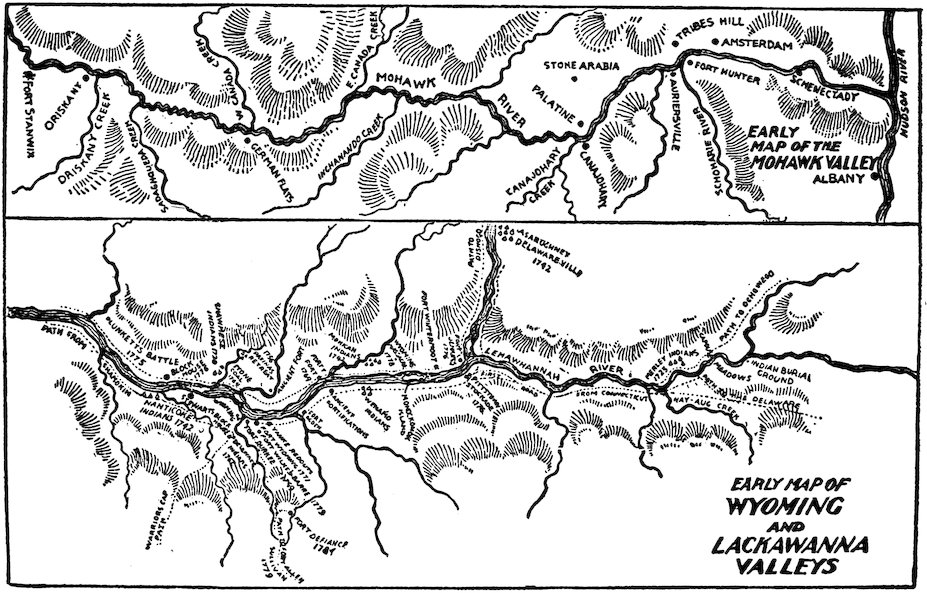
A Map Showing the location of the early settlements in the Wyoming and Mohawk River Valleys, which were the Scene of this drama of early pioneer life.—Mary Derwent.
WYOMING
On Susquehanna’s side, fair Wyoming!
Although the wild flower on the ruined wall,
And roofless homes a sad remembrance bring
Of what thy gentle people did befall,
Yet thou wert once the loveliest land of all,
That see the Atlantic wave their morn restore.
Sweet land! May I thy lost delights recall,
And paint thy Gertrude in her bowers of yore,
Whose Beauty was the love of Pennsylvania’s Shore.
Delightful Wyoming! beneath thy skies,
The happy shepherd swains had nought to do,
But feed their flocks on green declivities
Or skim perchance thy lake with light canoe,
From morn till Evening’s sweeter pastime grew,
With Timbrel, when beneath the Forest Brown,
Thy lovely maidens would the dance renew,
And aye those sunny mountains half-way down,
Would echo flagelet from some romantic town.
Then, where of Indian Hills the daybreak takes,
His leave, how might you the flamingo see
Disporting like a meteor on the lakes—
And playful squirrel on his nut-grown tree:
And every sound of life was full of glee,
From merry Mock-bird’s song, or hum of men;
While heark’ning, fearing nought their revelry,
The wild deer arched his neck from glades and then,
Unhunted, sought his woods and wilderness again.
Thomas Campbell.
FOREWORD — CHAPTER I THE VALLEY OF WYOMING
In issuing a new edition of Mrs. Ann S. Stephens’ historic
novel, Mary Derwent, Dial Rock Chapter, Daughters
American Revolution of West Pittston, in the upper
end of Wyoming Valley, deems it well to state, for a
new generation of readers, the circumstances that led to
its being written. In the early 50’s of the last century,
this brilliant and versatile author, then editor of Peterson’s
Magazine, Philadelphia, spent several successive
summers in West Pittston, at the beautiful and hospitable
home of Mr. Samuel Benedict, whose young son,
Frank Lee Benedict, was then winning his first recognition
as an author, and had already become associated
with the magazine under her editorship. During those
summers, Mrs. Stephens became deeply interested in the
history and traditions of Wyoming, studied every original
source of its history within reach; listened to the
story of the events of 1778 and the years preceding the
tragedy of that memorable year, from the lips of men
and women whose parents had escaped with their lives
at that terrible time. A lover of scenery, a close observer
alike of its broader aspects and its minute details,
and happily gifted with remarkable clearness of
vision “that,” as one biographer writes, “enabled her
to be very realistic in the transcription of natural scenery”—this,
added to her qualifications for writing the
one standard historic novel that has ever appeared
based upon Wyoming’s history, theme, incidents, characters
and setting of the story were ready when the call
came for “A Story of American Life in the Olden
Times,” by one of the periodicals of the day, which
offered a $400 prize for the one judged the best.
“Mary Derwent” was the winner of that prize. Its
first edition carries this Dedication:
To My Dear Friend,
Mrs. Samuel Benedict, of Wyoming Valley, in which
the principal historic events of my story transpired,
this book is affectionately dedicated.
Anna S. Stephens.
New York, June 1, 1858.
The book has gone through various editions; its latest
issue being in the uniform edition of her works, in 23
volumes, published in 1886, the year of the author’s
death. It was also republished serially in the Pittston
Gazette in 1878, at the time of the Centennial “In
Memoriam” gatherings around the Wyoming Monument.
But it has been for some years out of print and
its historic value, its accurate transcription of Wyoming’s
beautiful scenery and its vivid delineations, both
of character and events, has led to this new edition in
behalf of Dial Rock Chapter, Daughters of American
Revolution.
Susan E. Dickinson.
Scranton, Pa., March 10, 1908.
MARY DERWENT
A Tale of the Wyoming Valley in 1778
1
Monockonok Island lies in the stream of the Susquehanna,
where the Valley of Wyoming presents its
greenest fields and most level banks to the sunshine.
It is a quiet little spot, lying dreamily in the river,
which breaks and sparkles around it with a silvery
tumult. The Indians have gathered up the music of
these waters in a name that will live forever—Monockonok—rapid
or broken waters. You scarcely notice the
island amid the luxuriant scenery of Wyoming, it seems
so insignificant in its prettiness. Hedges of black alder,
hazel branches, and sedgy rushes stand in thickets, or
droop in garlands along its shores.
A few miles below Monockonok, between a curve of
the river and a picturesque sweep of the mountains,
lies the town of Wilkesbarre, a gem among villages set
in a haven of loveliness.
Two or three miles higher up may be seen the town
of Pittston, with its mines, its forges, its mills, and its
modern dwelling-houses, crowding close up to the heart
of the valley, in which the Lackawanna and the Susquehanna
unite among exhaustless coal beds and the
eternal beat of human industry.
For twenty miles below the Lackawanna gap, the
valley, though under partial cultivation for nearly a
2quarter of a century, seemed scarcely more than an unbroken
forest. The beautiful river in its bosom was
almost hidden beneath the huge black walnuts, the elms
and sycamores that crowded to its banks.
But with all this beautiful wildness, the strife of
disputed civilization had already been felt in the valley.
Indian forages were frequent, and the Connecticut
settlers had been twice driven from their humble
dwellings by the Pennsylvanians, who were restive at
the introduction of pioneers from the neighboring
States into this fertile region.
The blackened ruins of a dwelling here and there
left evidence of this unnatural contest, while stockades
and block-houses of recent erection, scattered along the
valley, gave picturesque proofs of continued anxiety and
peril.
From twenty to thirty houses occupied the spot where
Wilkesbarre now stands, while log-cabins were grouped
near the forts, each with its clearing, its young fruit-orchard,
and its patch of wheat or corn.
A single log-cabin, sheltered by a huge old elm with
a slope of grass descending to the water in front, and
a garden in the rear, enriched with variously tinted
vegetables, and made cheerful by a few hollyhocks,
marigolds, and sunflowers, stood like a mammoth bird’s
nest on Monockonok Island.
Two immense black walnuts, with their mastlike
trunks naked thirty feet high, stood back from the
house. The shore was broken up with clumps of sycamores,
oaks, maples, and groups of drooping willows,
while an undergrowth of dogwood, mountain-ash and
tamarisk trees chained into huge garlands by frost
grape-vines and wild clematis, were seen in picturesque
leafiness along the banks.
This log-cabin had been built years before, by a young
man who came with his mother and his two little orphan
girls to seek a home, and hide the deep grief occasioned
3by the loss of his wife in the wilderness. Derwent
took up his residence in Wyoming with the New England
settlers on their second return to the valley, when
it was almost as much inhabited by the Indians as the
whites.
Derwent struggled manfully in his new enterprise,
but it was with a broken spirit and by stern moral force
alone. His health, always delicate, sunk beneath the
labor of establishing a new home, and though he worked
on, month by month, it was as a Pilgrim toils toward
a shrine, patiently and with endurance rather than
hope.
Two little girls formed the sunshine of this humble
family, and the fairy island was made brighter by
their pleasant voices and graceful ways, as it was by
the wild birds that haunted it with music. In the
great indulgence of the invalid father, and the active
love of that dear old grandmother, they had early lost
all sense of orphanage, and were happy as the wild
birds, free as the striped squirrels that peeped at them
from the branches of the black walnut trees where
they loved to play.
Very different were these two children from infancy
up. Jane, the youngest, was a bright, happy little
creature, full of fun, eager for a frolic, and heedless
of everything else; endowed with commonplace goodness
and a pleasant temper, she was simply a bright,
lovable child. But Mary, who seemed younger by half
than her robust sister, was so fragile, so delicate, that
you dreaded to see the very winds of heaven blow upon
her, even when they left the spring blossoms unhurt.
Her large wistful eyes were full of earnestness. She
was so fair, so fragile, swaying as she walked, like a
flower too heavy for its stem, and with that look of
unutterable sweetness forever about the little mouth.
With Derwent Little Mary was an object of singular
tenderness, while the force and life of his warmer
4affections went to the younger child. He was their
only teacher, and during the years that he lived it was
a pleasant recreation to give them such instruction as
his own rather superior attainments afforded.
Thus in primitive happiness the little family lived
till Mary passed gently out of her childhood. There
was little visiting among the pioneers, and a stranger
seldom made way to Monockonok. An Indian sometimes
touched the island with his canoe in his progress
down the river; but this was always a happy event
to the children, who received the savages with childish
admiration, as if they had been orioles or golden
robins. At the sight of a canoe, Jane would run gleefully
to the river, waving kisses to the savage with
her hand, and flaunting out her apron as a signal to
win him shoreward. It was a singular fact, but the
Indians seldom obeyed these signals unless Mary was
by her side. A single gleam of her golden hair—a
glimpse of her bent form—would prove more effectual
than all her sister’s pretty wiles.
Why did these savages come so readily at her look?
What was the meaning of the strange homage with
which they approached her? Why did they never
touch her dress, or smooth her hair, or give her any
of those wild marks of liking which Jane received so
cheerfully? Why did they lay eagles’ plumes and the
skins of flame-colored birds at her feet, with so much
humility? Mary could never comprehend this, but it
filled her with vague awe, while the savages went away
thoughtfully, like men filled with a spirit of worship.
One other person sometimes visited the island, who
had a powerful influence over these children. This
man was an Indian missionary, who, following the path
of Zinzendorf, had made his home in the wilderness,
about the time that Derwent entered the valley. He
was evidently a man of birth and education, for even
the wild habits of the woods had been insufficient to
5disguise the natural refinement of mind and manners
which made the humility of his character so touchingly
beautiful.
This man came often to the island. Sometimes he
remained all night in the cabin. Sometimes he lingered
days with the family, teaching the little girls
those higher branches which their father could not
control, and planting a thousand holy thoughts in the
young minds, that lifted themselves to his knowledge,
as the flower opens its cup for the night dew.
Under these beautiful and almost holy influences the
children lived in their island home, each taking from
the elements around her such nutriment as her nature
craved, till Derwent, who had been ill since their first
remembrance, sunk slowly to his deathbed.
The last attack came suddenly, while the missionary
was absent among the Shawnees, far down the valley;
but scarcely had the little family felt the need
of his presence, when he appeared quietly and kindly.
All one night he remained with the sick man; their
conversation could be heard in broken fragments in
the next room, where the old mother sat weeping over
her grandchildren, holding Jane fondly in her lap,
while Mary sat upon the floor, so chilled with grief
that she did not feel the tender sorrow lavished upon
her sister, as neglect of herself. Like a pure white
lily broken at the stem, she sat wistfully gazing in
the distance, wondering what death was, vaguely and
in dreamy desolation. They were called at last, and
with a dying effort Jane was drawn to her father’s
bed, the last breath, the last blessing fell upon her.
Mary had no time; the father’s life was exhausted in
that one benediction.
The missionary led her forth into the open air. He
said but little, and his voice fell dreamily on the senses
of the child; but its first low cadence filled her soul
with infinite resignation. From that time Mary could
6never realize that her father had died, leaving no blessing
for her. It seemed as if the missionary had inhaled
the life from his departing soul, and turned it
all to love. The child recognized a double presence in
this holy man. Not even her grandmother was permitted
to kiss the forehead which his lips had touched.
Her brow became sacred from that time, and she would
shrink back with a cry of absolute pain if any one attempted
to disturb the kiss which was to her the place
of a lost blessing.
The missionary had many duties to perform, and
his intercourse with the island was sometimes interrupted
for months; but the little heart that clung to
him could live upon a remembrance of his teachings,
even when his presence was withheld. It was a wonderful
influence, that which his strong, pure soul had
obtained over the child. While these feelings were
taking root in the nature of one sister, the other was
working out her own life, and the grandmother took
up the duties imposed by her bereavement with great
resolution.
CHAPTER II THE CRUEL ENLIGHTENMENT
7
Grandmother Derwent had contrived to purchase
implements for spinning and weaving the coarse cloth,
which constituted the principal clothing of the settlers.
The inhabitants gave her plenty of work, and
produce from her farm supplied her household with
grain and vegetables.
Even the little girls, who under many circumstances
would have been a burden, were in reality an assistance
to her.
Jane was a bright and beautiful child, with dark
silky hair, pleasant eyes, and lips like the damp petals
of a red rose. She was, withal, a tidy, active little
maiden, and, as Mrs. Derwent was wont to say, “saved
grandma a great many steps” by running to the spring
for water, winding quills, and doing what Miss Sedgwick
calls the “odds and ends of housework.”
Jane led a pleasant life on the island. She was a
frank, mirthful creature, and it suited her to paddle
her canoe on the bosom of the river, or even to urge
it down the current, when “grandma” wanted a piece
of cloth carried to the village, or was anxious to procure
tea and other delicacies for her household.
When Mrs. Derwent’s quill-box was full, and “the
work all done up,” Jane might be found clambering
among the wild rocks, which frowned along the eastern
shore, looking over the face of some bold precipice
at her image reflected in the stream below; or, perchance,
perched in the foliage of a grape-vine, with
her rosy face peering out from the leaves, and her
8laugh ringing merrily from cliff to cliff, while her little
hands showered down the purple clusters to her
sister below.
Such was Jane Derwent, at the age of fourteen; but
poor little Mary Derwent! nature grew more and more
cruel to her. While each year endowed her sister with
new beauty and unclouded cheerfulness, she, poor
delicate thing, was kept instinctively from the notice
of her fellow-creatures. The inmates of that little
cabin could not bear that strange eyes should gaze on
her deformity—for it was this deformity which had
ever made the child an object of such tender interest.
From her infancy the little girl had presented a
strange mixture of the hideous and the beautiful. Her
oval face, with its marvellous symmetry of features,
might have been the original from which Dubufe drew
the chaste and heavenly features of Eve, in his picture
of the “Temptation.” The same sweetness and
purity was there, but the expression was chastened and
melancholy. Her soft blue eyes were always sad, and
almost always moist; the lashes drooped over them, an
expression of languid misery. A smile seldom brightened
her mouth—the same mournful expression of hopelessness
sat forever on that calm, white forehead; the
faint color would often die away from her cheek, but
it seldom deepened there.
Mary was fifteen before any person supposed her
conscious of her horrible malformation, or was aware
of the deep sensitiveness of her nature. The event
which brought both to life occurred a few years after
the death of her father. Both the children had been
sent to school, and her first trial came on the clearing,
before the little log schoolhouse of the village. Mary
was chosen into the centre of the merry ring by Edward
Clark, a bright-eyed, handsome boy, with manners
bold and frank almost to carelessness.
The kind-hearted boy drew her gently into the ring,
9and joined the circle, without the laugh and joyous
bound which usually accompanied his movements.
There was an instinctive feeling of delicacy and tenderness
towards the little girl which forbade all boisterous
merriment when she was by his side. It was
her turn to select a partner; she extended her hand
timidly towards a boy somewhat older than herself—the
son of a rich landholder in the valley; but young
Wintermoot drew back with an insulting laugh, and
refused to stand up with the hunchback.
Instantly the ring was broken up. Edward Clark
leaped forward, and with a blow, rendered powerful
by honest indignation, smote the insulter to the ground.
For one moment Mary looked around bewildered, as
if she did not comprehend the nature of the taunt;
then the blood rushed up to her face, her soft blue
eyes blazed with a sudden flash of fire, the little hand
was clenched, and her distorted form dilated with passion.
Instantly the blood flowed back upon her heart,
her white lips closed over her clenched teeth, and she
fell forward with her face upon the ground, as one
stricken by unseen lightning.
The group gathered around her, awe-stricken and
afraid. They could not comprehend this fearful burst
of passion in a creature habitually so gentle and sweet-tempered.
It seemed as if the insolent boy had crushed
her to death with a sneer.
Her brave defender knelt and raised her head to his
bosom, tears of generous indignation still lingered on
his burning cheek, and his form shook with scarcely
abated excitement.
At length Mary Derwent arose with the calmness of
a hushed storm upon her face, and turning to her inevitable
solitude walked silently away.
There was something terrible in the look of anguish
with which she left her companions, taking, as it were,
a silent and eternal farewell of all the joys that belong
10to childhood. The coarse taunt of the boy had been
a cruel revelation, tearing away all the tender shields
and loving delusions with which home-affection had so
long sheltered her. She did not know what meaning lay
in the word hunchback, but felt, with a sting of unutterable
shame, that it was applied to her because she was
unlike other girls. That she must never be loved as
they were—never hope to be one of them again.
The school-children looked on this intense passion
with silent awe. Even Jane dared not utter the sympathy
that filled her eyes with tears, or follow after
her sister.
So with terror and shame at the cruel discovery at
her heart, Mary went away. The blood throbbed in her
temples and rushed hotly through all her veins. An
acute sense of wrong seized upon her, and thirsting to
be alone she fled to the woods like a hunted animal,
recoiling alike from her playfellows and her home.
Through the thick undergrowth and over wild rocks
the poor creature tore her way, struggling and panting
amid the thorny brushwood, as if life and death
depended upon her progress.
A striped squirrel ran along the boughs of a chestnut-tree
and peered down upon her from among the
long green leaves and tassel-like blossoms. A flush
came to her beautiful forehead, and with a cry that
seemed in itself a pang, she tore up a stone to fling
at it. The squirrel started away, uttering a broken
noise that fell upon her sore heart like a taunt. Why
did the little creature follow her? Why did it bend
those sharp, black eyes upon her, with its head turned
so mockingly upon one side? Was she never to be
alone? Was the cruel animal still gibing at her through
the chestnut-leaves?
The squirrel darted from bough to bough, and at
last ran down the trunk of the chestnut. Mary followed
it with eager glances till her eyes fell upon the
11root of the tree. The stone dropped from her hand,
the angry color fled from her face, and stretching out
her arms with a cry that perished on her lips she
waited for the missionary to descend.
He came rather quickly, and the gentle serenity of
his countenance was disturbed, but still a look of unutterable
goodness rested upon it. When he reached
Mary her eyes were flooded with tears, and she trembled
from head to foot. His sympathy she could endure.
His very look had opened the purest fountains
of her heart again. She was not altogether alone.
“Crying, Mary, crying?” he said, in a tone of inquiry,
rather than of reproach. “Who has taught you
to weep?”
“Oh! father, father, what can I do? Where can I
hide myself?” cried the poor girl, lifting her clasped
hands piteously upward.
The missionary saw it all. For a moment the color
left his lips, and his eyes were full of trouble to their
azure depths. He sat down by her side, and drew her
gently towards him.
“And this has driven you so far from home?” he
said, smoothing her hair with one hand, which trembled
among the golden tresses, for never had his sympathies
been drawn more powerfully forth. “Who has
done this cruel thing, Mary?”
She did not answer, but he felt a shudder pass over
her frame as she made a vain effort to speak.
“Was it your playfellows at school?”
“I shall never have playfellows again,” broke from
the trembling lips which seemed torn apart by the
desolating words; “never again, for where does another
girl like me live in the world? God has made no playfellow
for me!”
The missionary allowed her to weep. He knew that
a world of bitterness would be carried from her bosom
with those tears.
12“But God has made us for something better than
playfellows to each other,” he said at last, taking her
little hand in his.
She looked at him wistfully, and answered with unutterable
sadness, “But I cannot be even that; I am
alone!”
“No,” answered the missionary, “not alone—not
alone, though you never heard another human voice—even
here in the deep woods you would find something
to love and help, too—never think yourself alone,
Mary, while any creature that God has made is
near.”
“But who will love me? Who will help me?” cried
the girl, with a burst of anguish.
“Who will love you, Mary! Do not I love you?
Does not your grandmother and sister love you?”
“But now—now that they know about this—that I
am a hunchback, it will be all over.”
“But they have known it, Mary, ever since you were
a little child. Well, well! we must not talk about
it, but think how much every one at home has loved
you.”
“And they knew it all—they saw it while I was
blind, and loved me still,” murmured the girl, while
great tears of gratitude rolled down her cheeks, “and
they will love me always just the same—you promise
me this?”
“Always the same, Mary!”
“Yes, yes—I see they have loved me always, more
than if I were ever so beautiful—they were sorry for
me; I understand!” There was a sting of bitterness
in her voice. The love which came from compassion
wounded her.
“But our Saviour loves his creatures most for this
very reason. Their imperfections and feebleness appeal
like an unuttered prayer to him. It is a beautiful
love, Mary, that which strength gives to dependence,
13for it approaches nearest to that heavenly benevolence
which the true soul always thirsts for.”
Mary lifted her eyes to his face as he spoke. The
unshed tears trembled like diamonds within them. She
became very thoughtful, and drooped slowly downward,
coloring faintly beneath his eyes, as maidens sometimes
blush at their own innocent thoughts when nothing but
the eye of God is upon them.
“But there is another love, my father; I have seen
it at the school and in the cabins, I have watched it
as I have the mountain flowers, and thought that God
meant this love for me, like the rest; but when I go
among other girls, no one will ever think that I am
one of them—no one but Edward Clark, and he only
feels pity-love for me; to all the rest I am a hunchback.”
A look of great trouble came upon the face of the
missionary. For some moments he did not answer, and
the poor girl drooped by his side. The blush faded
from the snow of her forehead, and she trembled all
over with vague shame of the words she had spoken.
His silence seemed like a reproach to her.
“My child!”—oh! with what holy sweetness the
words fell from his lips—“my child, it is true; this
love must never be yours.”
“Never!” echoed the pale lips of the child. “Never!”
“This dream of love, give it up, Mary, while it is
but a dream,” added the missionary, in a firmer voice.
“To many more than yourself it is a hope never, never
realized. Do not struggle for it—do not pine for it—God
help you! child—God help us all!”
The anguish in his voice thrilled her to the soul.
She bent her forehead meekly to his knee, murmuring:
“I will try to be patient—but, oh! do not look at
me so mournfully.”
He laid his hands softly under her forehead, and,
14lifting her face to his gazed mournfully upon it, as
if his soul were looking far away through her eyes into
the dim past.
“Father, believe me, I will try.”
His hands dropped downward at the sound of her
voice, and his lips began to move, as if unuttered words
were passing through them. Mary knew that he was
praying, and her face drooped reverently downward.
When or how this silence broke into words she never
knew, but over her soul went the burning eloquence
of his voice, carried heavenward by prayer—by the
wind, and the rush of the mountain stream. The very
breath lay still upon her lips as she listened, and she
felt more like a winged angel close to the gate of heaven
than the poor deformed girl, whose soul had, a few
hours before, been so full of bitterness.
CHAPTER III THE FOREST WALK
15
When the missionary arose from his knees—for to
that position he had unconsciously fallen—Mary stood
beside him, quiet and smiling.
“Come, my child,” he said, taking Mary by the hand,
and leading her up from the ravine. “It is almost
night, and you have wandered far from the island;
see, the woods are already dusky. The birds and
squirrels are settling down in the leaves; you would
have been afraid to go home in the dark.”
“I might have been lost, but not afraid,” answered
Mary, in a sad voice; “after this, darkness will be my
best friend.”
“But the forest is full of Indians, Mary, and now,
since the English have excited them against us, no
white person is safe after dark; I will go home with
you; but, after this, promise me never to come alone
to the woods again.”
“The Indians will not harm me,” answered Mary,
with a mournful smile; “they pity me, I think, and
love me a little, too. I am not afraid of them; their
tomahawks are not so sharp as Jason Wintermoot’s
words were this morning.”
As she spoke there was a rustling among the bushes
at their right, and through the purple gloom of the
woods they saw a group of Indians crouching behind
a rock, and glaring at them through the undergrowth.
One had his rifle lifted with a dusky hand, creeping
towards the rock; the others were poised for a spring.
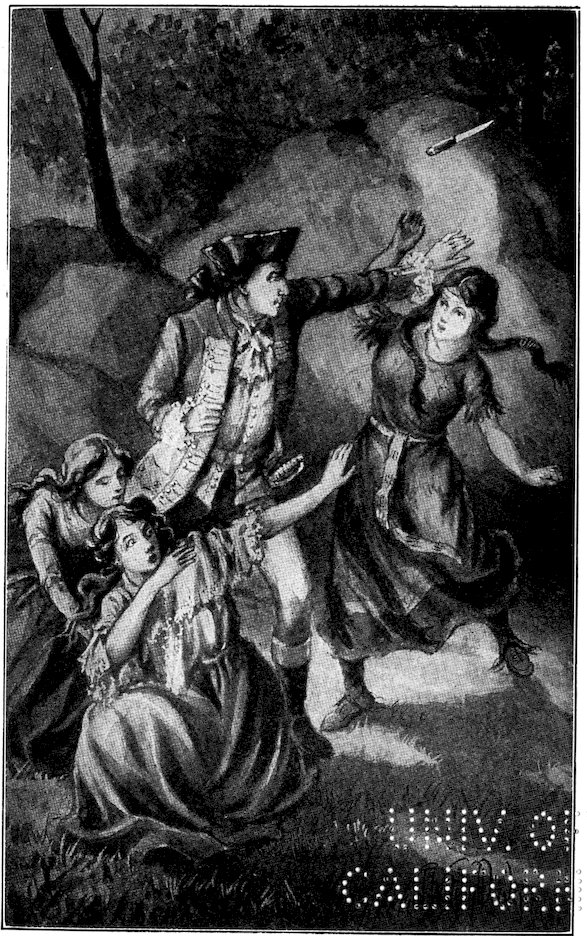
16Mary saw them, and leaped upon a rock close by, protecting
the missionary from the aim taken at his life.
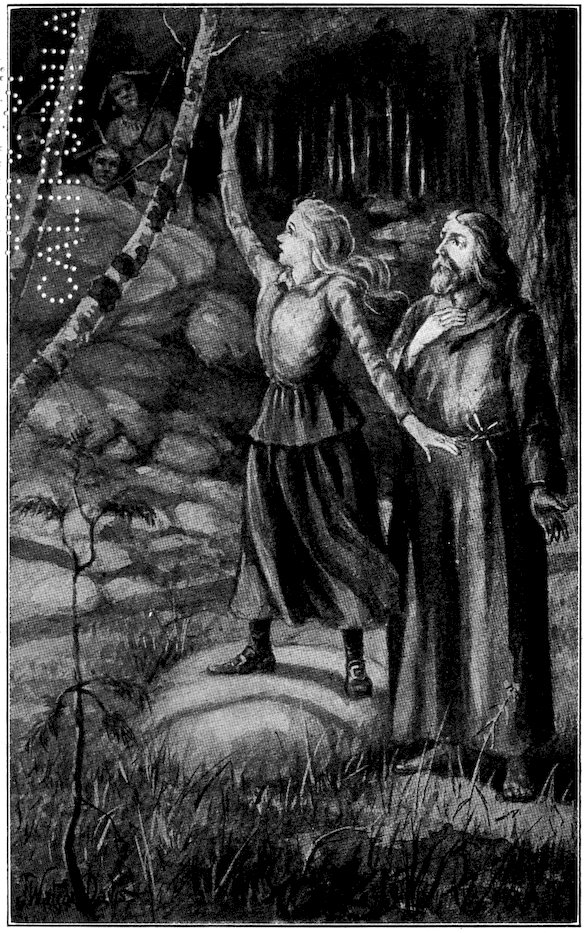
“Not him—not him!” she cried, flinging up both
arms in wild appeal; “shoot me! You don’t know how
I long to die.”
The Indians looked at each other in dismay. The
threatening rifle fell with a clang upon the rock, and
instead of an assault the savages crept out from their
ambush, lighting up the dusky ravine with their gorgeous
war-dresses, and gathered around the young girl,
like a flock of tropical birds surrendering themselves
to the charms of a serpent.
Mary met them fearlessly; a wild, spiritual beauty
lighted up her face. The Indians lost their ferocity,
and looked on her with grave tenderness; one of them
reached forth his hand, she laid hers in the swarthy
palm, where it rested like a snowdrop on the brown
earth; he looked down upon it, and smiled; her courage
charmed him.
“The white bird is brave, the Great Spirit folds his
wing over her which is pure like the snow,” he said,
addressing his companions in their own language.
Mary knew a little of the Shawnee tongue, and looking
up at the savage said, very gently:
“Why harm my father? The Great Spirit covers
him, also, with a wing which is broad and white, like
the clouds. Look in his face. Is he afraid?”
The Indians drew back, and looked fiercely at the
missionary, gathering up their rifles with menacing
gestures.
He understood their language well, and spoke to
them with that calm self-possession which gives dignity
to courage.
“My children,” he said, “what wrong have I done
that you should wish to kill me?”
The leading savage set down his gun with a clang
upon the rock.
17“You have sat by the white man’s council-fire down
yonder. The Great Father over the big water is our
friend, but you hate the Indian, and will help them
drive us through the wind gap into strange hunting
grounds.”
“I am not your enemy. See, I carry no tomahawk
or musket; my bosom is open to your knives. The
Great Spirit has sent me here, and He will keep me
free from harm.”
Unconsciously the missionary looked at the deformed
girl as he spoke. The Indians followed his glance, and
changed their defiant gestures.
“He speaks well. Mineto has sent his beautiful
medicine spirit to guard him from our rifles. The
medicine father of the Shawnees is dead, his lodge is
empty. The white bird shall be our prophet. You
shall be her brother, live in the great Medicine Lodge,
and dream our dreams for us when we take the warpath.
Do we speak well?”
The missionary pondered a moment before he spoke.
He read more in these words than one not acquainted
with Indian customs might have understood.
“Yes,” he said at last, “I will come to your Medicine
Lodge, and tell you all the dreams which the
Great Spirit sends to me. She, too, will love the Indians,
and dream holy dreams for them, but not here,
not in the Medicine Lodge. She must stay in Monockonok
among the broken waters. The Great Spirit has
built her lodge there, under the tall trees, where the
Indians can seek her in their canoes. Go back to your
council-fire, my children, before its smoke goes out. I
will light the calumet, and smoke with you. Now the
Great Spirit tells me to go with this child back to
Monockonok. Farewell.”
He took Mary Derwent by the hand, turned his back
on the menacing rifles without fear, and walked away
unmolested.
18Mary had wandered miles away from home; nothing
but the superior knowledge of her guardian could have
found her way back through all that dense and unequal
forest. It was now almost nightfall; but a full
moon had risen, and by its light this man, accustomed
to the woods, guided their way back towards the river.
But after the wildest of her excitement had worn away,
Mary began to feel the toil of her long walk. She did
not complain, however, and the missionary was unconscious
of this overtax of strength till she sank down
on a broken fragment of rock utterly exhausted. He
stopped in great distress, and bent over her. She
smiled, and attempted to speak, but the pale lids
drooped over her eyes, and the strength ebbing completely
from her limbs left them pale and limp. She
lay before him entirely senseless, with the moonbeams
falling over her like a winding-sheet.
Nothing but the angels of Heaven could see or understand
the look of unutterable thankfulness which
came to his noble features as the missionary stooped
and took the young girl in his arms. A smile luminous
as the moonlight that played upon it stole over
his whole face, and the words that broke from his lips
were sweet and tender, such as the Madonna might
have whispered to her holy child.
He took no pains to bring her back to life, but when
she did come to, soothed her with hushes, and laid her
head tenderly upon his shoulder till she fell asleep,
smiling like himself.
As he came in sight of Monockonok a swell of regretful
tenderness swept all his strength away more
surely than fatigue could have done. He sat down
upon a fallen tree on the bank just opposite the island
and looked down into the sweet face with a gaze of
heavenly affection. His head drooped slowly down,
he folded her closer, and pressed his lips upon the
closed eyes, the forehead, the lips, and cheeks of the
19sleeping child with a passion of tenderness that shook
his whole frame.
“Oh, my God, my God! forgive me if this is sinful!
my soul aches under this excess of love; the very fountains
of my life are breaking up! Father of heaven,
I am thine, all thine, but she is here on my breast,
and I am but human.”
Deep sobs broke away from his heart, almost lifting
her from his bosom; tears rained down his face,
and dropped thick and fast amid the waves of her hair.
His sobs aroused Mary from her slumber. She was
not quite awake, but stirred softly and folded her arms
about his neck. How the strong man trembled under
the clasp of those arms! how he struggled and wrested
against the weakness that had almost overpowered
him, and not in vain! A canoe was moored under a
clump of alders, just below him. It belonged to the
island, and in that Mary must be borne to her home.
He was obliged to row the canoe, and of course must
awake her. Once more he pressed his lips upon her
face, once more he strained her to his heart, and then
with loving violence aroused her.
“Mary—come, little one, wake up, wake up! See
how late it is! Grandmother will be frightened.”
“Let me alone—oh! please let me alone!” murmured
the weary child.
“No, Mary, arouse yourself; you and I have slept
and dreamed too long. There, there! look around. See
how the moonlight ripples upon the river! Look at
the island; there is a light burning in the cabin. They
are anxious no doubt at your long stay. Come, child,
let us be strong: surely you can walk to the river’s
brink.”
Yes, Mary could walk again; that sweet sleep had
given back her strength. She sat down in the canoe,
tranquilized and happier than she had ever hoped to
be again. The bitterness of the morning had entirely
20passed away. They floated on down the river a few
minutes. Then the missionary bent to his oars, and
the canoe shot across the silvery rapids, and drew up
in a little cove below the house.
The missionary stepped on shore. Mary followed
him.
“Are you happier now? Are you content to live as
God wills it?” he said, extending his hand, while his
eyes beamed upon her.
“Yes, father, I am content.”
“To live even without earthly love?”
Mary shrunk within herself—it takes more than a few
words, a struggle, or a single prayer to uproot a desire
for human love from a woman’s heart.
He did not reason with her, or upbraid her then,
but only said:
“God will find a way—have no fear, all human beings
have some road to happiness if they will but let
the Heavenly Father point it out. Good-night Mary.”
“Good-night,” responded the young girl, while her
eyes filled with grateful tears; “good-night, my father!”
He turned around, laid his hands on her head, and
blessed her, then stepped into the canoe and disappeared
along the path of silver cast downward by the
moon. The young girl smiled amid her tears. How
dark it was when he found her at noontide; how bright
when he went away!
Mary Derwent entered that log-cabin a changed being.
She scarcely understood herself, or anything that
had filled her life up to that day. Her own nature
was inexplicable. One great shock had thrust her forward,
as it were, to a maturity of suffering; her smile
became mournful and sad in its expression, as if the
poor creature had become weary of life and of all living
things. She never again joined in the childish sports
of her companions.
CHAPTER IV THE ISLAND COVE
21
The two sisters stood together under the willow trees
that overhung the little cove from which Mary
had landed with the missionary three years before.
Both had grown into girlhood since then, and both
had improved in loveliness; Jane in the bloom and symmetry
of her person—Mary in that exquisite loveliness
of countenance which touches the soul like music in a
sound, or tints in a picture. Jane Derwent was just
seventeen years old that day.
“And so you will go, Mary, dear—though this is my
birthday? I have a great mind to cut the canoe loose
and set it adrift.”
“And then how will your company get to the island?”
said Mary Derwent, raising her eyes to the blooming
face of her sister, while a quiet smile stole out from
their blue depths.
“I don’t care for company! I don’t care for anything—you
are so contrary—so hateful. You never
stay at home when the young folks are coming—it’s
too bad!” And Jane flung herself on the grass which
surrounded the little cove where a bark canoe lay rocking
in the water, and indulged her petulance by tearing
up the strawberry-vines which her sister had
planted there.
“Don’t spoil my strawberry-bed,” said Mary, bending
over the wayward girl and kissing her forehead.
“Come, be good-natured and let me go; I will bring
you some honeysuckle-apples, and a whole canoe full
22of wood-lilies. Do say yes; I can’t bear to see you discontented
to-day!”
“I would not care about it so much—though it is
hard that you will never go to frolics, nor enjoy yourself
like other folks—but Edward Clark made me
promise to keep you at home to-day.”
A color, like the delicate tinting of a shell, stole into
Mary’s cheek as it lay caressingly against the rich
damask of her sister’s.
“If no one but Edward were coming I should be
glad to stay,” she replied, in a soft voice; “but you
have invited a great many, haven’t you? Who will be
here from the village?”
Jane began to enumerate the young men who had
been invited to her birthday party; they held precedence
in her heart, and consequently in her speech;
for, to own the truth, Jane Derwent was a perfect
specimen of the rustic coquette; a beauty, and a spoiled
one; but a warm-hearted, kind girl notwithstanding.
“There are the Ward boys, and John Smith, Walter
Butler from the fort, and Jason Wintermoot——”
Jane stopped, for she felt a shiver run over the form
around which her arms were flung as she pronounced
the last name and saw the cheek of her sister blanch
to the whiteness of snow.
“I had forgotten,” she said, timidly, after a moment;
“I am sorry I asked him. You are not angry with
me, Mary, are you?”
“Angry? No! I never am angry with you, Jane. I
don’t want to refuse you anything on your birthday—but
I will not meet these people. You cannot guess—you
can have no idea of my sufferings when any
one looks upon me except those I love very, very dearly.”
“That is just what they say,” replied Jane, while a
flush of generous feeling spread over her forehead.
“What, who says?” inquired Mary, for her heart
23trembled with a dread that some allusion was threatened
to her person.
After her question there was a moment’s silence.
They had both arisen, and the deformed girl stood before
her sister with a tremulous lip and a wavering,
anxious eye.
Jane was quick-witted, and, with many faults, very
kind of heart. When she saw the distress visible in
her unfortunate sister’s face she formed her reply with
more of tact and kind feeling than with strict regard
to truth.
“Why, it is nothing,” she said; “the girls always
loved you, and petted you so much when we were little
children in school together that they don’t like it when
you go away without seeing them. They think that you
are grown proud since you have taken to reading and
talking fine language. You don’t have to work like the
rest of us, and they feel slighted, and think you put on
airs.”
Tears stole into the eyes of the deformed girl, and a
sudden light, the sunshine of an affectionate heart, broke
over her face as she said:
“It is not that, my sister. I have loved them very
much all these years that I have not seen them; but
since that day—— Sister, you are very good; and, oh!
how beautiful; but you cannot dream how a poor
creature like myself feels when happy people are enjoying
life together. Without sympathy, without companions,
hunchbacked and crooked. Tell me, Jane, am
I not hideous to look upon?”
This was the first time in her life that Mary had
permitted a consciousness of her malformation to escape
her in words. The question was put in a voice
of mingled agony and bitterness, wrung from the very
depths of her heart. She fell upon the grass as she
spoke, and with her face to the ground lay grovelling
at her sister’s feet, like some wounded animal; for
24now that the loveliness of her face was concealed her
form seemed scarcely human.
All that was generous in the nature of Jane Derwent
swelled in her heart as she bent over her sister.
The sudden tears fell like rain, glistening in drops upon
the warm damask of her cheeks and filling her voice
with affectionate sobs as she strove to lift her from the
ground; but Mary shrunk away with a shudder, and
kneeling down Jane raised her head with gentle violence
to her bosom.
“Hideous! Oh! Mary, how can you talk so? Don’t
shake and tremble in this manner. You are not frightful
nor homely; only think how beautiful your hair is.
Edward Clark says he never saw anything so bright and
silky as your curls—he said so; indeed he did, Mary;
and the other day when he was reading about Eve, in
the little book you love so well, he told grandmother
that he fancied Eve must have had a face just like
yours.”
“Did Edward say this?” murmured the poor deformed
one as Jane half-lifted, half-persuaded her from
the ground, and with one arm flung over her neck was
pressing the face she had been praising to her own
troubled bosom.
Poor Mary, though naturally tall, was so distorted
that when she stood upright her head scarcely reached
a level with the graceful bust of her sister, and Jane
stooped low to plant reassuring kisses upon her forehead.
“Did he say it, Mary? Yes, he certainly did; and
so did I say it. Look here.” And eagerly gathering
the folds of a large shawl over the shoulders of the
deformed, she gently drew her to the brink of the
basin, where the canoes still lay moored. “Look
there!” she exclaimed, as they bent together over the
edge of the green sward; “can you wish for anything
handsomer than that face? Dear, good Mary, look.”
25An elm-tree waved its branches over them, and the
sunshine came shimmering through the leaves with a
wavy light. The river was tranquil as a summer sky,
and the sisters were still gazing on the lovely faces
speaking to theirs from its clear depths, when a canoe
swept suddenly round the grassy promontory which
formed one side of the cove.
With a dash of the oar the fairy skiff shot, like an
arrow, into the basin, and its occupant, a young man
of perhaps two-and-twenty, leaped upon the green sward.
The sisters started from their embrace. A glad smile
dimpled the round cheek of the younger as she stepped
forward to meet the newcomer. But Mary drew her
shawl more closely over her person, and shrunk timidly
back, with a quickened pulse, a soft welcome beaming
from her eyes, and her face deluged with a flood of
soft, rosy color, which she strove to conceal with the
tresses that fell about her like a golden mist.
“I have just come in time to keep you at home for
once,” said the youth, approaching the timid girl, after
having gaily shaken hands with her sister. “I am sure
we shall persuade you——”
He was interrupted by a call from Jane, who had
run off to the other side of the cove; no doubt with the
hope of being speedily followed by her visitor.
“Come here, Edward, do, and break me some of this
sweet-brier; it scratches my fingers so.”
Clark dropped Mary’s hand and went to obey this
capricious summons.
“Don’t try to persuade Mary to stay,” said Jane, as
she took a quantity of the sweet-brier from the hands
of her companion. “She is as restless when we have
company as the mocking-bird you gave us; and which
we never could tame, besides,” she added, with a little
hesitation, “Wintermoot will be here, and she don’t
like him.”
“It were strange if she did,” replied the youth; and
26a frown passed over his fine forehead; “but, tell me,
Jane, how it happened that you invited Col. Butler
when you know that I dislike him almost as much as she
does Wintermoot.”
Jane looked confused and, like most people when they
intend to persist in a wrong, began to get into a passion.
“I am sure I thought I had the right to ask any one
I pleased,” she said, petulantly and gathering her forehead
into a frown.
“Yes, but one might expect that it would scarcely
please you to encourage a man who has so often insulted
your house with unwelcome visits; and Wintermoot—my
blood boils when I think of the wretch! Poor
Mary! I had hoped to see her enjoy herself to-day;
but now she must wander off alone as usual. I have a
great mind to go with her.”
And turning swiftly away from the angry beauty,
Clark went to Mary, spoke a few words, and they
stepped into his canoe together. But he had scarcely
pushed it from the shore when Jane ran forward and
leaped in after them.
“If you go, so will I!” she said angrily, seating herself
in the bottom of the canoe.
Mary was amazed and perplexed. She looked into
the stern, displeased face of the young man, and then
at the sullen brow of her sister.
“What does this mean?” she inquired, gently; “what
is the matter, Jane?”
Jane began to sob, but gave no answer, and they
rowed across the river in silence. The canoe landed at
the foot of a broken precipice that hung over the river
like a ruined battlement. Clark assisted Mary to the
shore, and was about to accompany her up the footpath,
which wound over the precipice, but Jane, who
had angrily refused his help to leave the boat, began to
fear that she had carried her resentment too far, and
timidly called him back.
27A few angry words from the young man—expostulation
and tears from the maiden, all of which a bend in
the path prevented Mary observing; and then Clark
went up the hill—told the solitary girl not to wander
far—to be careful and not sit on the damp ground—and
that he would come for her by sundown; the
young folks would have left the island by that time.
They were all going down to Wilkesbarre, to have a
dance in the schoolhouse. He and Jane were going, but
they would wait and take her home first.
Edward was almost out of breath as he said all this,
and he appeared anxious to go back to the canoe. But
Mary had not expected him to join her lonely wanderings,
and his solicitude about her safety, so considerate
and kind, went to her heart like a breath of summer air.
She turned up the mountain-path, lonely and companionless;
but very happy. Her eyes were full of pleasant
tears, and her heart was like a flower unfolding to
the sunshine. There is pleasure in complying with the
slightest request from those we love; and Mary confined
her ramble to the precipice and the shore, merely because
Edward Clark had asked her not to wander far.
She saw him land on the island with her sister while
half-sitting, half-reclining on a crag of the broken rock,
at whose foot she had landed. She saw the boat sent
again and again to the opposite shore, returning each
time laden with her former companions.
She was aroused by the rustling of branches over her
head, followed by a bounding step, as of a deer in flight;
then a young girl sprang out upon a point of rock which
shot over the platform on which she lay, and bending
over the edge gazed eagerly down upon the river.
Mary held her breath and remained motionless, for
her poetical fancy was aroused by the singular and
picturesque attitude of the figure. There was a wildness
and grace in it which she had never witnessed
before. At the first glance she supposed the stranger
28to be a wandering Indian girl belonging to some of the
tribes that roamed the neighboring forests. But her
complexion, though darker than the darkest brunette of
our own race, was still too light for any of the savage
nations yet seen in the wilderness. It was of a clear,
rich, brown, and the blood glowed through the round
cheeks like the blush on a ripe peach.
Her hair was long, profusely braided, and of a deep
black; not the dull, lustreless color common to the
Indians; but with a bloom upon it like that shed by the
sunlight on the wing of a flying raven. She appeared
to be neither Indian nor white, but of a mixed race.
The spirited and wild grace of the savage was blended
with a delicacy of feature and nameless elegance more
peculiar to the whites. In her dress, also, might be
traced the same union of barbarism and refinement—a
string of bright scarlet berries encircling her head, and
interwoven with the long braids of her hair, glanced in
the sunlight as she moved her head, like a chain of dim
rubies.
A robe of gorgeous chintz, where crimson and deep
brown were the predominating colors, was confined at
the waist by a narrow belt of wampum, and terminated
a little below the knee in a double row of heavy fringe,
leaving the flexible and slender ankles free and uncovered.
Her robe fell open at the shoulders; but the
swelling outline of her neck, thus exposed, was unbroken,
except by a necklace of cherry-colored cornelian,
from which a small heart of the same blood-red stone
fell to her bosom. The round and tapering beauty of
her arms was fully revealed and unencumbered by a
single ornament. Her moccasins were of dressed deer-skin,
fringed and wrought with tiny beads, interwoven
with a vine of silk buds and leaves done in such needlework
as was, in those days, only taught to the most
refined and highly educated class of whites. Mary had
never seen anything so exquisitely beautiful in its workmanship
29as that embroidery, or so brightly picturesque
as the whole appearance of the stranger.
For more than a minute the wild girl retained the
position assumed by her last bounding step. There was
something statue-like in the tension of those rounded
and slender limbs as she stood on the shelf of rock,
bending eagerly over the edge, with her weight thrown
on one foot and the other strained back, as if preparing
for a spring. All the grace, but not the chilliness, of
marble lived in those boldly poised limbs, so full of
warm, healthy life. There was spirit and fire in their
very repose, for after an eager glance up and down
the river she settled back, and with her arms folded
remained for a moment in an attitude of dejection and
disappointment.
A merry laugh which came ringing over the waters
from the island drew her attention to the group of
revellers glancing in and out of the shrubbery which
surrounded Mother Derwent’s dwelling. Flinging back
her hair with a gesture of fiery impatience, she sprang
upward and dragged down the branch of a young tree,
which she grasped for support while throwing herself
still more boldly over the very edge of the cliff.
Mary almost screamed with affright. But there was
something grand in the daring of the girl, which
aroused her admiration even more than her fear. She
knew that the breaking of that slender branch would
precipitate her down a sheer descent into the river.
But she felt as if the very sound of a human voice
would startle her into eternity.
Motionless with dread, she fixed her eyes, like a
fascinated bird, on the strange being thus hovering
over death, so fearless and so beautiful. All at once
those bright, dark eyes kindled, one arm was flung
eagerly outward—her red lips parted and a gush of
music, like the song of a mocking-bird, but louder and
richer, burst from them.
30Mary started forward in amazement. Before she
could lift her eyes to the cliff again, a low, shrill whistle
came sharply up from the direction of the island. She
caught one glance of those kindling cheeks and flashing
eyes as the strange, wild girl leaped back from the
cliff—a gleam of sunlight on her long hair as she darted
into a thicket of wild cherry trees—and there was no
sign of her remaining, save a rushing sound of the
young trees, as the bent limb swayed back to its fellows.
Again the notes, as of a wild, eager bird, arose from a
hollow bank on the side of the mountain; and, after a
moment, that shrill whistle was repeated from the
water, and Mary distinctly heard the dipping of an oar.
She crept to the edge of the rock which had formed
her concealment and looked down upon the river. A
canoe rowed by a single oarsman was making its way
swiftly to the island. She could not distinguish the
face of the occupant; but there was a band of red paint
around the edge of the canoe, and she remembered that
Edward Clark’s alone was so ornamented. It was the
same that had brought her from the island. Did the
signal come from him—from Edward Clark? What
had he in common with the wild, strange girl who had
broken upon her solitude? A thrill of pain, such as she
had never dreamed of before, shot through her heart as
she asked these questions. She would have watched the
landing of the canoe, but all strength suddenly left her,
and she sunk upon a fragment of stone, almost powerless
and in extreme suffering.
In a little more than an hour she saw the same solitary
rower crossing the river, but with more deliberate
motion. She watched him while he moored the canoe
in the little cove, and caught another glimpse of him
as he turned a corner of her dwelling and mingled with
the group of young persons who were drinking tea on
the green sward in front.
It was a weary hour to the deformed girl before the
31party broke up and were transported to the opposite
shore, where farm-wagons stood ready to convey them
to Wilkesbarre. The sun was almost down, and the
island quiet again when she saw two persons coming
from the house to the cove. She arose, and folding her
shawl about her prepared to descend to the shore.
Mary had walked half-way down the ledge when
she stopped abruptly in the path; for sitting on the moss
beneath one of these pines was the strange girl who had
so excited her wonder. Mary’s slow step had not disturbed
her, and unconscious of a witness she was unbraiding
the string of berries from her hair and
supplying their place with a rope of twisted coral.
The strings of scarlet ribbon with which she knotted it
on her temple were bright, and had evidently never been
tied before.
Mary’s heart beat painfully and she hurried forward,
as if some fierce animal had sprung up in her path.
An uncontrollable repulsion to that wild and beautiful
girl, which she neither understood nor tried to account
for, seized her. When she reached the shore the canoe
with Edward Clark and her sister seated in it was
making leisurely towards the mouth of the ravine, and
she sat down on the shadowy side of an oak, to await
their coming. Their approach was so noiseless that she
did not know they had reached the shore till the voice
of Edward Clark apprised her of it. He was speaking
earnestly to her sister, and there was both agitation and
deep tenderness in his voice—a breaking forth of the
heart’s best feelings, which she had never witnessed in
him before.
“No, Jane,” he said, in a resolute voice, shaken with
a sorrowful tremor; “you must now choose between that
man and me; there can be nothing of rivalry between
us; I heartily despise him! I am not jealous—I could
not be a creature so unworthy; but it grieves me to feel
that you can place him for a moment on a level with
32yourself. If you persist in this degrading coquetry you
are unworthy of the love which I have given you. Forgive
me, Jane, if I speak harshly; don’t cry—it grieves
me to wound your feelings, but——”
He was interrupted by a sound as of some one falling
heavily to the ground. He leaped from the canoe, and
there, behind the great oak, lay Mary Derwent helpless
and insensible.
“She has wandered too far, and exhausted herself,”
said the agitated young man as he bore her to the
canoe. “Sit down, Jane, and take her head in your lap—your
grandmother will know what to do for her.”
Jane reached forth her arms and received the insensible
head on her bosom. She turned her face petulantly
away from that of her lover, and repulsed him
with sullen discontent when, in his attempts to restore
Mary, his hand happened to touch hers.
“Set her down,” she said, pushing him indignantly
away. “Attend to your oars; we neither want your
help or your ill-natured grumblings. I tell you, Ned
Clark, you are just the Grossest creature I ever saw.
Take that for your pains!”
Clark did not answer this insolent speech, but gravely
took up the oars and pushed off.
They were half-way across the river when Mary began
to recover animation. Edward laid down his oar, and
taking her hand in his was about to speak, but she drew
it away with a faint shudder, and burying her face in
her sister’s bosom remained still and silent as before.
CHAPTER V THE TEMPTER AND THE TEMPEST
33
Tahmeroo, the Indian girl, was sitting under the pine
as Mary Derwent had left her. With the coral but
half twisted in her hair, she had paused in her graceful
task, and sinking gently back to the bank of moss which
formed her seat reclined on one elbow, with her long
tresses unbraided and floating in wavy masses over her
person. She was yielding to the repose of a soft and
dreamy reverie—new and very sweet to her wild, young
heart—when the sound of voices and the dash of an
oar aroused her. She started to her feet and listened.
The fire flashed back to those large dark eyes but late
so pleasant and soft in their expression, and a rich crimson
rushed to her cheek. The voices ceased for a moment;
then were renewed, and the rapid beat of the
paddle became still more audible.
Tahmeroo sprang forward and ran up to a point of
the hill which commanded a view of the river. The
little canoe, with its band of red paint, was making from
the shore, and in it sat Jane Derwent, with the head of
the deformed girl resting in her lap. The back of the
oarsman was towards the shore; his head was bent, and
the eyes, the beautiful eyes of Jane Derwent were fixed
on him with an expression which Tahmeroo’s heart, unlearned
as it was, taught her to understand. A storm
of surprise, anger and fear rushed through the heart of
the young Indian. The oarsman turned his head, and
the face was revealed. Then a smile, vivid and bright
as a burst of sunshine after a tempest, broke over her
features.
34Tahmeroo breathed deeply and turned away. It
seemed as if an arrow had been withdrawn from her
heart by the sight of that face. She hurried down the
hill towards a clump of black alders that overhung the
river’s brink and unmoored a light canoe hitherto concealed
beneath the dark foliage. Placing herself in the
bottom, she gave two or three vigorous strokes with the
paddle, and shot like a bird up the stream.
As Tahmeroo proceeded up the river the scenery, till
then half-pastoral, half-sublime, became more savage
and gloomy in its aspect. Huge rocks shot up against
the sky in picturesque grandeur; the foliage which
clothed them grew dusky in the waning light and fell
back to the ravines in dark, heavy shadows. A gloom
hung about the towering precipices, and the thick
masses of vegetation, like funeral drapery, swathing the
pillars and wild arches of a monastic ruin. It was the
darkness of a gathering tempest. There was something
sublime and almost awful in the gradual and silent
mustering of the elements.
Tahmeroo rested for a moment as she entered the
rocky jaws of the mountain, and as her frail bark rocked
to the current of wind which swept down the gorge she
looked around with a feeling of hushed terror. A
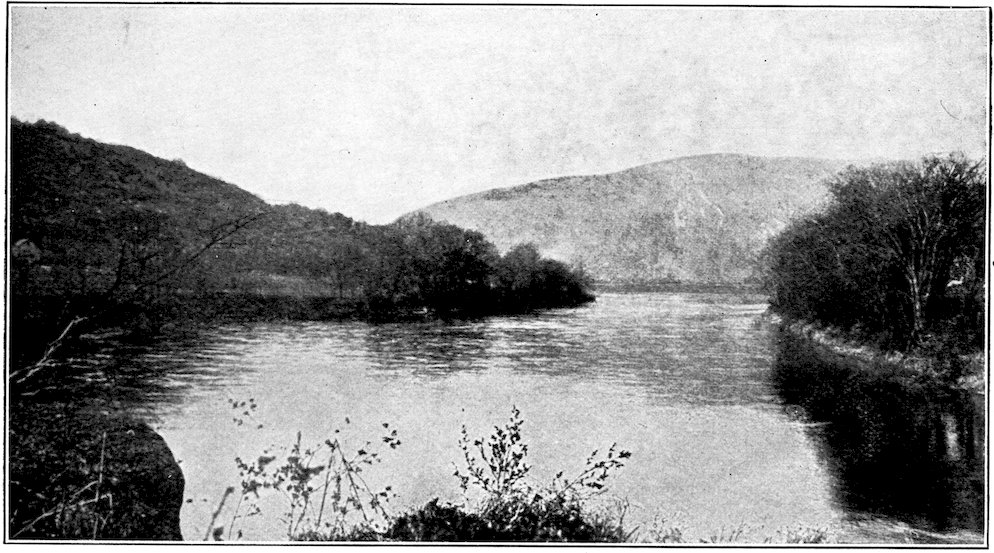
mountain, cleft in twain to the foundation, towered to
the sky on either hand—bold, bleak and sombre.
Through the rent, down hundreds of feet from the summit,
crept the deep river stealthily and slow, like a huge
serpent winding himself around the bulwark of a
stronghold. The darkness of the forests was so dense,
and the clouds so heavy, that there was nothing to distinguish
the outline of the murky waters from the majestic
ramparts through which they glided. All was
wild, solemn and gloomy.
As the Indian girl looked upward the clouds swept
back for a moment and the last rays of sunset fell with
a glaring light on the bold summit of the mountain,
35rendering by contrast the depths of the chasm more
dreary in its intense shadow.
The threatened storm had seemingly passed over, and
a few stars trembled in the depths of the sky when she
moored her canoe in a little inlet, washed up into the
mouth of a narrow ravine which opened on the river’s
brink.
Tahmeroo tore away the dry brambles and brushwood
which clothed the entrance of the defile, and made her
way through a scarcely defined footpath up the hillside.
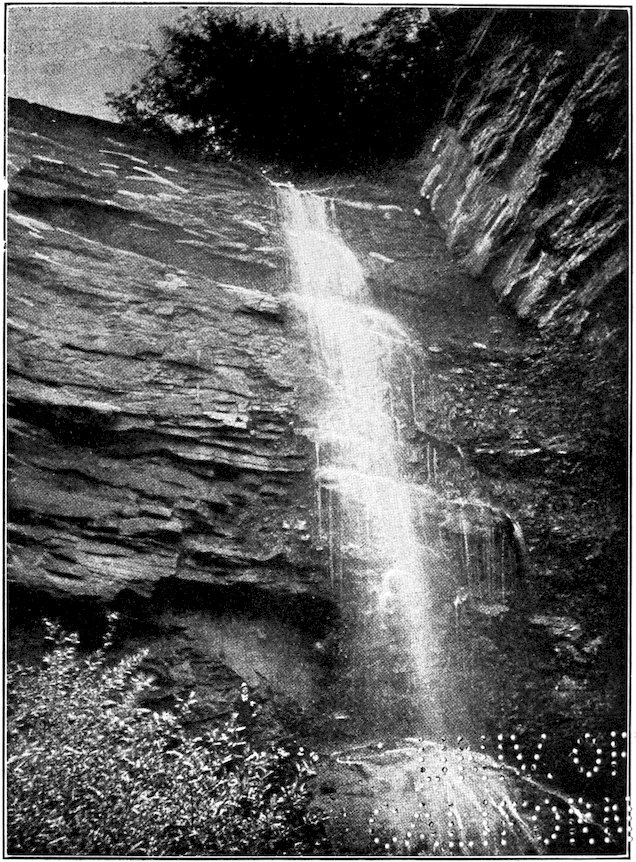
Through this ravine rushed a mountain torrent,
known to the Indians as the Falling Spring, which
filled the whole forest with its silvery tumult.
Tahmeroo kept close to the banks of this torrent,
helping herself forward by the brushwood and trailing
vines that grew thickly on its margin. Nothing less
surefooted than an antelope could have forced a passage
through the broken rocks and steep precipices which
guarded the passage of this stream up to its source in
Campbell’s Ledge. A little way from the river it
came, with a single leap, through a chasm in the rocks,
and lost itself in a storm of white spray among the
mossy boulders which choked up the ravine.
The storm had mustered again so blackly that Tahmeroo
could scarcely see her course, but lost herself
among the rocks and young pines below the fall. Still
she climbed upward, leaping from rock to rock, till the
sheer precipices that walled in the cataract on either
side obstructed her passage, and she stood poised half-way
up, uncertain which way to turn or how to move.
A flash of lightning revealed her position, kindled up
the young trees to a lurid green; gave the slippery
brown precipices to view, and shot in and out of the
foaming torrent as it leaped by like flashes of fire,
tearing a snowdrift into flakes again and scattering it
to the wind.
The lightning revealed her peril and her path. She
36sprang back from the precipice, from which the next
leap would have precipitated her downward with the
cataract into the depths of the ravine, and tore her way
into the bosom of the hills, keeping Campbell’s Ledge
on the right.
A less vigorous form would have fainted beneath the
toil of that mountain-pass; but the young Indian
scarcely thought of fatigue; for a dull, moaning sound
came up from the depths of the forest, like the hollow
beat of a far-off ocean; the pent-up thunder muttered
and rumbled among the black clouds, floating like
funeral banners above her, every other instant pierced
and torn with arrowy lightning. These signs of the
storm gathering so fearfully about the mountains terrified
and bewildered the Indian girl. Though a wild
rover of the forest, she had been gently nurtured, and
for the first time in her life was alone among the hills
after nightfall.
At length she stood on a high ledge of rocks, panting
and in despair; she had lost the path that led to the
Indian encampment, and found herself on the sweep of
a mighty precipice, far above the valley. After one
wild, hopeless look upon the sky, she sunk to the ground
and, burying her face in her hands, muttered, in a
trembling and husky voice:
“Tahmeroo has been wicked. She has acted a lie.
The Great Spirit is very angry. Why should she strive
to shut out his voice? Tahmeroo can die.”
While she spoke there was a hush in the elements and
the sound of many hoarse, guttural voices arose from
the foot of the ledge. The terrified Indian lifted her
head, and a wild, doubtful joy gleamed over her face
as the lightning revealed it, with the damp, unbraided
hair floating back from the pallid temples, the lips
parted, and the eyes charged with terror, doubt and
eager joy. She listened intently for a moment, then
sunk cautiously to the ground as one who fears to break
a pleasant delusion, and crept to the edge of the rock.
FALLING SPRING
37A dozen watch-fires flashed up in a semicircle, flinging
a broad light over the whole enclosure and gleaming
redly on the waving vines, the weeping birches, and the
budding hemlocks that intermingled along its broken
ramparts. A hundred swarthy forms, half-naked and
hideously painted, were moving about, and others lay
crouching in the grass, apparently terrified by the
tempest gathering so blackly above them.
The untrodden grass and fresh herbage told that this
hollow had recently been made a place of encampment;
yet, in the enclosure was one lodge, small and but rudely
constructed—a sylvan hut, more picturesque than any
cabin to be found in the settlements. How recently it
had been constructed might be guessed by the green
branches yet fresh on the half-hewn logs. A score of
savage hands had been at work upon it the whole day,
for the Chief of the Shawnees never rested in the open
air with the lower members of his tribe when his fierce
mother, his haughty wife, or beautiful daughter was
of his hunting party.
Tahmeroo had wandered upward from the path which
led to the encampment. She had madly clambered to
the highest chain of rocks which surrounded the enclosure,
when she should have made her way around
its base to the opening which gave egress to the forest.
She arose from the edge of the rock, where she had been
lying, high above the encampment, and was about to
descend to the path she had missed, when a sound like
the roar and tramp of a great army came surging up
from the forest. The tall trees swayed earthward, flinging
their branches and green leaves to the whirlwind as
it swept by. Heavy limbs were twisted off, and mighty
trunks, splintered midway, mingled the sharp crash of
their fall with the hoarse roar of the tempest. The
38thunder boomed among the rocks, peal after peal, and
the quick lightning darted through the heaving trees
like fiery serpents wrangling with the torn foliage.
The very mountain seemed to tremble beneath the
maiden’s feet. She threw herself upon the ledge, and
with her face buried in its moss lay motionless, but
quaking at heart, as the whirlwind rushed over her.
A still more fearful burst of the elements struck upon
the heights, lifted a stout oak from its anchorage and
hurled it to the earth. The splintered trunk fell with
a crash, and the topmost boughs bent down the young
saplings with a rushing sweep and fell like the wings
of a great bird of prey, above the prostrate Indian. She
sprang upward with a cry, and seizing the stem of a
vine swung herself madly over the precipice. Fortunately
the descent was rugged, and many a jutting
angle afforded a foothold to the daring girl as she let
herself fearlessly down—now clinging among the leaves
of the vine—now grasping the sharp point of a rock,
and dropping from one cleft to another. Twice she
forced herself back, as if she would have sunk into the
very rock, and dragged the heavy vines over her, when
a fresh thunder-burst rolled by, or a flash of lightning
blazed among the leaves; but when they had passed she
again swung herself downward, and finally dropped unharmed
upon the grass back of her father’s lodge.
The enclosure was now perfectly dark; for the rain
had extinguished the watch-fires and the lightning but
occasionally revealed a group of dark forms cowering
together, awed by the violence of the tempest, and rendered
abject by superstitious dread.
A twinkling light broke through the crevices of the
lodge; but Tahmeroo lingered in the rain, for now that
the fierceness of the storm was over she began to have
a new fear—the dread of her mother’s stern presence.
Cautiously, and with timid footsteps, she advanced to
the entrance and lifted the huge bear-skin that covered
39it. She breathed freely; for there was no one present
save her father, the great Chief of the Shawnees. He
was sitting on the ground, with his arms folded on his
knees, and his swarthy forehead buried in his robe of
skins. The heart of the Indian King was sorely troubled,
for he knew that the wing of the Great Spirit was
unfolded in its wrath above his people.
Tahmeroo crept to the extremity of the lodge and
sat down in silence upon the ground. She saw that
preparations had been made for her comfort. A pile
of fresh berries and a cake of cornbread lay on a stool
nearby, and a couch of boughs woven rudely together
stood in the corner heaped with the richest furs and
overspread with a covering of martin-skins lined and
bordered with fine scarlet cloth. A chain of gorgeous
beadwork linked the deep scallops on the border, and
heavy tassels fell upon the grass from the four corners.
The savage magnificence of that couch was well worthy
the daughter of a great chief.
Another couch, but of less costly furs, and without
ornament, stood at the opposite extremity. Tahmeroo
threw one timid look towards it, then bent her head,
satisfied that it was untenanted, and that her mother
was indeed absent. As if suddenly recollecting herself,
she half-started from the ground and disentangled the
string of coral from her damp hair. With her eyes
fixed apprehensively on the chief, she thrust it under
the fur pillows of her couch, and stole back to her
former position.
Tahmeroo had scarcely seated herself when the bear-skin
was flung back from the entrance of the lodge and
Catharine, the wife of the Shawnee chief, presented herself
in the opening. The light from a heap of pine knots
fell on the woman’s face as she entered; but it
failed to reveal the maiden where she sat in the shadowy
side of the lodge.
The chief lifted his head and uttered a few words in
40the Indian tongue, but received no answer; while his
wife gave one quick look around the lodge, then sallied
back, clasped her hands tightly and groaned aloud.
Tahmeroo scarcely breathed, for never had she seen
her mother so agitated. It was, indeed, a strange sight—those
small, finely cut features usually so stern and
cold, working with emotion—the pallid cheek, the high
forehead, swollen and knitted at the brows—the trembling
mouth—the eyes heavy with anguish. This was
a sight which Tahmeroo had never witnessed before.
And this was the stern, haughty woman—the white
Indian—who ruled the Shawnee braves with despotic
rigor—whose revenge was deadly, and whose hate was
a terror. This was Catharine Montour!
When Tahmeroo heard her name mingled with the
lamentations of her mother, she started forward, exclaiming,
with tremulous and broken earnestness:
“Mother, oh! mother, I am here!”
A burst of fierce thanksgiving broke from the lips of
Catharine. She caught her daughter to her heart and
kissed her wildly again and again.
“Thank God, oh! thank my God! I am not quite
alone!” she exclaimed; and tears started in the eyes that
had not known them for twenty summers.
Without a word of question as to her strange absence,
Catharine drew her child to the couch, and seeing the
bread and the berries yet untasted she forced her to
eat while she wrung the moisture from her hair and
took away the damp robe. She smoothed the cushions
of crimson cloth that served as pillows, and drawing
the coverlet of martin-skins over the form of her child
sat beside her till she dropped to a gentle slumber.
Then she heaped fresh knots on the burning pine and
changed her own saturated raiment.
The sombre chief threw himself upon the unoccupied
heap of furs, and Catharine was left alone with her
thoughts. Long and sad were the vigils of that stern
41watcher; yet they had a good influence on her heart.
There was tenderness and regret—nay, almost repentance—in
her bosom as she gazed on the slumbers of her
child—the only being on earth whom she dared to love.
More than once she pressed her lips fondly to the forehead
of the sleeper, as if to assure herself of her dear
presence after the frightful dangers of the storm. She
remained till after midnight, pondering upon past
events with the clinging tenacity of one who seldom allowed
herself to dwell on aught that could soften a shade
of her haughty character; at length she was about to
throw herself by the side of her daughter, more from
the workings of unquiet thoughts than from a desire for
rest. But the attempt disturbed the slumbering girl.
She turned restlessly on her couch, and oppressed by
its warmth pushed away the covering.
Catharine observed that the cheek which lay against
the scarlet cloth was flushed and heated. She attempted
to draw the pillow away, when her fingers became
entangled in the string of coral concealed beneath
it. Had a serpent coiled around her hand it could not
have produced a more startling effect. She shook it
off, and drew hastily back, as if something loathsome
had clung to her. Then she snatched up the ornament,
went to the pile of smouldering embers, stirred them to
a flame and examined it minutely by the light. Her
face settled to its habitual expression of iron resolution
as she arose from her stooping posture. Her lips were
firmly closed, and her forehead became calm and cold;
yet there was more of doubt and sorrow than of anger
in her forced composure.
She returned to the couch and placed herself beside
it, with the coral still clenched in her hand. Her face
continued passionless, but her eyes grew dim as she
gazed on the sleeper; thoughts of her own youth lay
heavily upon her heart.
Tahmeroo again turned restlessly on her pillow, her
42flushed cheeks dimpled with a smile, and she murmured
softly in her sleep. Catharine laid her hand on the
round arm, flung out upon the martin-skins, and bent
her ear close to the red and smiling lips, thus betraying
with their gentle whisperings the thoughts that haunted
the bosom of the sleeper.
Tahmeroo dreamed aloud. A name was whispered in
her soft, broken English, coupled with words of endearment
and gentle chiding. The name was spoken
imperfectly, and Catharine bent her ear still lower, as
if in doubt that she had heard aright. Again that name
was pronounced, and now there was no doubt; the
enunciation was low, but perfectly distinct. The mother
started upright; her face was ashy pale, and she looked
strangely corpse-like in the dusky light. She snatched
a knife from its sheath in her girdle, and bent a fierce
glance on the sleeper. A moment the blade quivered
above the heart of her only child, then the wretched
woman flung it from her with a gesture of self-abhorrence,
and sinking to the ground buried her face in
both hands. After one fierce shudder she remained
motionless as a statue.
It was more than an hour before that stern face was
lifted again; shade after shade of deep and harrowing
agony had swept over it while buried in the folded arms,
and now it was very pale, but with a gentler expression
upon it. She laid a hand on the rounded shoulder,
from which the covering had been flung, passed the
other quickly over her eyes and awoke the sleeper.
“Tahmeroo,” she said, but her voice was low and
husky, and it died away in her throat.
The maiden started to her elbow and looked wildly
about. When she saw her mother with the string of
red coral in her hand she sunk back and buried her
face in the pillow.
“Tahmeroo, look up!” said the mother, in a soft,
43low voice, from which all traces of emotion had flown.
“Has Tahmeroo dreams which she does not tell her
mother? The white man’s gift is under her pillow—whence
came it?”
A blush spread over the face, neck and bosom of
the young girl, and she shrunk from the steady gaze
of her mother. She was sensible of no wrong, save
that of concealment; yet her confusion was painful as
guilt. Catharine had compassion on her embarrassment,
and turned away her eyes.
“Tahmeroo,” she said, in a voice still more gentle
and winning, “tell me all—am I not your mother? Do
I not love you?”
The young Indian girl rose and looked timidly towards
the couch of the Shawnee Chief.
“Does my father sleep?” and her eyes again fell
beneath the powerful glance which she felt to be fixed
upon her.
“Yes, he sleeps; speak in English, and have no fear.”
Catharine went to the heap of blazing pine and flung
ashes on it; then returned to her daughter, folded her
to her bosom, and for half an hour the low voice of
Tahmeroo alone broke the stillness of the lodge.
Scarcely had Catharine interrupted the confession of
her child with a word of question. She must have been
powerless from emotion, for more than once her breath
came quick and gaspingly; and the heavy throbbing of
her heart was almost audible at every pause in that
broken narrative. Yet her voice was strangely cold and
calm when she spoke.
“And you saw him again this day?”
“Yes, mother.”
“Did he tell you to keep these meetings from my
knowledge?”
“He said the Great Spirit would visit me with his
thunder if I but whispered it to the wind.”
44“The name—tell me the name once more; but low, I
would not hear it aloud. Whisper it in my ear—yet the
hiss of a serpent were sweeter,” she muttered.
Tahmeroo raised her lips to her mother’s ear and
whispered, as she was commanded. She felt a slight
shudder creep over the frame against which she leaned,
and all was still again.
“You first saw this—this man when we were at the
encampment on the banks of Seneca Lake three moons
since, and I was absent on a mission to Sir William
Johnson: did I hear aright in this?” questioned the
mother, after a few minutes of silence.
“It was there I first saw him, mother.”
“Listen to me, Tahmeroo: were I to command you
never again to see this man, could you obey me?”
The young Indian started from her mother’s arms,
and the fire of her dark eyes flashed even in the half-smothered
light.
“Never see him? What, tear away all this light
from my own heart? Obey? No, mother, no. Put me
out from my father’s lodge—make me a squaw of burden,
the lowest woman of our tribe—give me to the
tomahawk, to the hot fire—but ask me not to rend the
life from my bosom. The white blood which my heart
drank from yours must curdle that of the Indian when
his child gives or takes love at the bidding of anything
but her own will! No, mother, I could not obey—I
would not.”
Catharine Montour was struck dumb with astonishment.
Was she, the despotic ruler of a fierce war-tribe,
to be braved by her own child? The creature she had
loved and cherished with an affection so deep and passionate—had
she turned rebellious to her power? Her
haughty spirit aroused itself; the gladiator broke from
her eyes as they were bent on the palpitating and half-recumbent
form of Tahmeroo.
The girl did not shrink from the fierce gaze, but met
45it with a glance of resolute daring. The young eaglet
had begun to plume its wing! There was something of
wild dignity in her voice and gesture, which assorted
well with the curbless strength of her mother’s spirit.
Catharine Montour had studied the human heart as
a familiar book, and she knew that it would be in vain
to contend with the spirit so suddenly aroused in the
strength of its womanhood. She felt that her power
over that heart must hereafter be one of love unmixed
with fear—an imperfect and a divided power. The
heart of the strong woman writhed under the conviction,
but she stretched herself on the couch without a word
of expostulation. Her own fiery spirit had sprung to
rapid growth in the bosom of her child; passions akin
to those buried in her experience had shot up, budded
and blossomed, in a night time. The stern mother
trembled when she thought of the fruit which, in her
own life, had turned to ashes in the ripening.
When Tahmeroo awoke in the morning the lodge was
empty. Her mother had left the encampment at early
dawn.
CHAPTER VI THE MISSIONARY’S CABIN
46
The history of Wyoming is interwoven with that of
the Indian missionary whose paternal care had so long
protected the family on Monockonok Island. Like
Zinzendorf, his life was one errand of mercy, alike to the
heathen and the believer. For years he had served as
a link of union between the savage life of the woods and
the civilization of the plains.
While a comparatively young man, he had come
among the Six Nations nameless and unarmed, with his
life in his hand, ready to live or die at his post. His
home was in the wilderness; sometimes he passed
through the white settlements, preached in their schoolhouses
and slept in their cabins; but it was always as a
guest; his mission lay with the forest children, and in
the wilds where they dwelt was his home.
Almost the entire portion of years which had elapsed
since his encounter with Mary Derwent in the hills, he
had spent among the savages that kept possession of
broad hunting grounds beyond the Wind Gap. But a
movement of the tribes toward Wyoming, where a detachment
of their own people from about Seneca Lake
had been appointed to meet them in council, filled him
with anxiety for his friends in the valley, and he came
back also to watch over their safety. He knew what the
settlers were ignorant of as yet—that the Shawnees were
about to unite with the Tories, whose leader lay at
Wintermoot Fort, and that great peril threatened the
inhabitants of Wyoming in this union.
This man was alone in a log-cabin which Zinzendorf
47had once occupied on a curving bank of the Susquehanna,
between Wilkesbarre and Monockonok Island.
His face, always sad and merciful, now bore an anxious
expression. The patient sweetness of his mouth was a
little disturbed. He was pondering over the hostile attitude
threatened by the Indians against the whites, and
that subject could not be otherwise than a painful one.
The hut was small, and but for recent repairs would
have been in ruins. It consisted only of one room. A
deal-box stood in one corner, filled with books and rolls
of manuscript. Two stools and a rude table, with a few
cooking utensils, were the only remaining furniture.
The missionary sat by the table, implements for writing
were before him, and the pages of a worn Bible lay
open, which, after a little while, he began to read.
It was a picture of holy thought and quiet study; but
the crackling of branches and the sound of approaching
footsteps interrupted its beautiful tranquillity.
The silvery flow of water from a spring close by was
broken by the sound; the birds fluttered away from
their green nestling places in the leaves, and a half-tamed
fawn, which had been sleeping in a tuft of fern-leaves,
started up, gazed a moment on the intruder with
his dark, intelligent eye, and dashed up the river’s bank
as she crossed the threshold of the lowly dwelling.
The missionary looked up as the stranger entered, and
a feeling of astonishment mingled with the graciousness
which long habit had made a portion of his nature. He
arose, and with a slight inclination of the head placed
the stool, on which he had been sitting, for her accommodation.
The intruder bent her head in acknowledgment of
the courtesy, but remained standing. She was a woman
majestic in her bearing, of well-developed form, and
somewhat above the middle height; her air was courtly
and graceful, but dashed with haughtiness approaching
to arrogance. She had probably numbered forty years;
48her face, though slightly sunbrowned, bore traces of
great beauty, in spite of its haughty expression. The
mouth had been accustomed to smiles in its youth, and
though an anxious frown clouded the broad forehead,
it was still beautifully fair. The missionary had spent
his life amid the aristocracy of European courts, and
had passed from thence to the lowly settlement, and to
the still more remote Indian encampment; but there was
something in the appearance of this strange woman that
filled him with vague uneasiness, and he looked upon
her with a sort of terror. Her air and dress were not
strictly those of any class with which he had as yet become
familiar. There was wildness mingled with the
majesty of her presence, and her rich and picturesque
attire partook at once of the court and the wigwam.
Her long, golden, and still abundant hair was
wreathed in braids around her head, and surmounted
by a small coronet of gorgeous feathers. A serpent of
fine, scaly gold, the neck and back striped and variegated
with minute gems, was wreathed about the mass
of braids on one side of her head, and formed a knot of
slender coils where it clasped the coronet. There was
something startlingly like vitality in these writhing folds
when the light struck them, and the jewelled head shot
out from the feathers and quivered over the pale temple
with startling abruptness. There was an asp-like glitter
in the sharp, emerald eye, and the tiny jaw seemed full
of subtle venom. It was a magnificent and rare ornament
to be found in the solitude of an American forest;
yet scarcely less remarkable than the remainder of the
strange woman’s apparel.
A robe of scarlet cloth, bordered with the blackest
lynx fur, was girded at the waist by a cord of twisted
silk, and fell back at the shoulders in lapels of rich
black velvet. Above the fur border ran a wreath of
embroidery, partly silk, partly wampum, but most exquisitely
wrought in garlands of mountain flowers, with
49tiny golden serpents knotting them together and creeping
downward, as it were, to hide themselves in the fur.
It had loose, hanging sleeves, likewise lined with velvet,
beneath which the white and still rounded arm gleamed
out in strong contrast.
A serpent, mate to the one on her head, but glowing
with still more costly jewels, coiled around the graceful
swell of her right arm, a little below the elbow, but its
brilliancy was concealed by the drapery of the sleeve,
except when the arm was in motion. She wore elaborately
wrought moccasins lined with crimson cloth, but
the embroidery was soiled with dew, and the silken
thongs with which they had been laced to the ankle had
broken loose in the rough path through which she had
evidently travelled.
The missionary stood by the table, while his visitor
cast a hasty glance around the apartment and turned
her eyes keenly on his face.
“I am not mistaken,” she said, slowly withdrawing
her gaze. “You are the godly man of whom our people
speak—the Indian missionary?”
The man of God bent his head in reply.
“You should be, and I suppose are, an ordained minister
of the church?” she resumed.
“I am, madam.”
His voice was deep-toned and peculiarly sweet. The
woman started as it met her ear; a gleam of unwonted
expression shot over her features, and she fixed another
penetrating glance on his face, as if some long-buried
recollection had been aroused; then, satisfied with the
scrutiny, she turned her eyes away, and drawing a deep
breath spoke again.
“I ask no more than this; of what church matters
little. But have you authority to perform marriages
after the established law?”
“I have; but my services are seldom required. I
mingle but little with the whites of the settlement, and
50Indians have their peculiar forms, which, to them, are
alone binding,”
“True,” replied the woman, with a slight wave of
the hand; “these forms shall not be wanting; all the
bonds of a Christian church and savage custom will
scarcely yield me security.”
She spoke as if unconscious of a second presence, and
again abruptly addressed the missionary.
“Your services are needed in the Shawnee encampment
a few miles back in the mountains. A guide shall
be sent for you at the appointed time. Stay in this
place during the next twenty-four hours, when you will
be summoned.”
The missionary, though a humble man, was by no
means wanting in the dignity of a Christian gentleman.
He was displeased with the arrogant and commanding
tone assumed by his singular visitor, and threw a slight
degree of reproof into his manner when he answered.
“Lady, if the welfare of a human being—if the safety
of an immortal soul can be secured by my presence, I
will not hesitate to trust myself among your people,
though they come here on an errand I can never approve;
but for a less important matter I cannot promise
to wait your pleasure.”
“Rash man! do you know who it is you are braving?”
said the woman, fixing her eyes sternly on his face.
“If your life is utterly valueless, delay but a moment in
following the guide which I shall send, and you shall
have the martyrdom you seem to brave! Catharine
Montour’s will has never yet been disputed within
twenty miles of her husband’s tent without frightful
retribution.”
The missionary started at the mention of that name,
but he speedily regained his composure, and answered
her calmly and with firmness.
“Threats are powerless with me, lady. The man who
places himself unarmed and defenceless in the midst of
51a horde of savages can scarcely be supposed to act
against his conscience from the threat of a woman, however
stern may be her heart, and however fearful her
power. Tell me what the service is which I am required
to perform, and then you shall have my answer.”
The haughty woman moved towards the door with an
angry gesture, but returned again, and with more courtesy
in her manner seated herself on the stool which had
been placed for her.
“It is but just,” she said, “that you should know the
service which you are required to perform. There is
in the camp now lying beneath Campbell’s Ledge a
maiden of mixed blood, my child—my only child; from
the day that she first opened her eyes to mine in the
solemn wilderness, with nothing but savage faces around
me, with no heart to sympathize with mine, that child
became a part of my own life. For years I had loved
nothing; but the tenderness almost dead in my heart
broke forth when she was born, the sweet feelings of humanity
came back, and the infant became to me an idol.
In the wide world I had but one object to love, and for
the first time in a weary life affection brought happiness
to me. You may be a father; think of the child who
has lain in your bosom year after year, pure and gentle
as a spring blossom, who has wound herself around your
heart-strings—think of her, when dearest and loveliest,
stolen from your bosom, and her innocent thoughts
usurped by another.”
“Forbear—in mercy forbear!” said the missionary,
in a voice of agony that for an instant silenced the
woman.
Catharine looked up and saw that his eyes were full
of tears; her own face was fearfully agitated, and she
went on with a degree of energy but little in keeping
with the pathos of her last broken speech.
“A white, one of my own race, came to the forest
stealthily, like a thief, and with our Indian forms, which
52he taught her to believe were a bond of marriage among
his people, also lured the heart of my child from her
mother. Now, I beseech you, for I see that you are kind
and feeling—I was wrong to command—come to the
camp at nine to-night, for then and there shall my child
be lawfully wedded.”
“I will be there at the hour,” replied the missionary,
in a voice of deep sympathy. “Heaven forbid that I
should refuse to aid in righting the wronged, even at
the peril of life.”
“My own head shall not be more sacred in the Shawnee
camp than yours,” said Catharine, with energy.
“I do not doubt it; and were it otherwise I should not
shrink from a duty. I owe an atonement for the evil
opinion I had of you. A heart which feels dishonor so
keenly cannot delight in carnage and blood.”
“Can they repeat these things of me?” inquired
Catharine, with a painful smile; “they do me deep
wrong. Fear not; I appear before you with clean hands.
If the heart is less pure it has sufficiently avenged itself;
if it has wronged others, they have retribution;
has not the love of my child gone forth to another?
Am I not alone?”
“Lady,” said the missionary, with deep commiseration
in his look and voice, for he was moved by her energetic
grief, “this is not the language of a savage. Your
speech is refined, your manner noble. Lady, what are
you?”
There are seasons when the heart will claim sympathy,
spite of all control which a will of iron may place upon
it. This power was upon the heart of Catharine Montour.
“Yes, I will speak,” she muttered, raising her hand
and pressing it heavily to her eyes. The motion flung
back the drapery of the sleeve, and the light flashed
full on the jewelled serpent coiled around her arm. The
missionary’s eyes fell upon it, and he sallied back
53against the logs of the hut, with a death-like agony in
his face.
Catharine Montour was too deeply engrossed by her
own feelings to observe the strange agitation which had
so suddenly come upon the missionary. She seated herself
on the stool, and with her face buried in her robe
remained minute after minute in deep silence, gathering
strength to unlock the tumultuous secrets of her
heart once more to a mortal’s knowledge.
When she raised her face there was nothing in the
appearance of her auditor to excite attention. He still
leaned against the rude wall, a little paler than before,
but otherwise betraying no emotion, save that which
a good man might be supposed to feel in the presence
of a sinful and highly gifted fellow-creature.
She caught his pitying and mournful look fixed so
earnestly upon her face as she raised it from the folds
of her robe, and her eyes wavered and sunk beneath
its sorrowful intensity. There was a yearning sympathy
in his glance, which fell upon her heart like sunshine
on the icy fetters of a rivulet; it awed her proud
spirit, and yet encouraged confidence; but it was not
till after his mild voice had repeated the question—“Lady,
confide in me; who and what are you?”—that
she spoke.
When she did find voice it was sharp, and thrilled
painfully on the ear of the listener. The question
aroused a thousand recollections that had long slumbered
in the life of this wretched woman. She writhed
under it, as if a knot of scorpions had suddenly begun
to uncoil in her heart.
“What am I? It is a useless question. Who on
earth can tell what he is, or what a moment shall make
him? I am that which fate has ordained for me:
Catharine Montour, the wife of Gi-en-gwa-tah, a great
chief among his people. If at any time I have known
another character, it matters little. Why should you
54arouse remembrances which may not be forced back
to their lethargy again? I ask no sympathy, nor seek
counsel; let me depart in peace.”
With a sorrowful and deliberate motion she arose
and would have left the cabin, but the missionary laid
his hand gently on her arm and drew her back.
“We cannot part thus,” he said. “The sinful have
need of counsel, the sorrowing of sympathy. The heart
which has been long astray requires an intercessor with
the Most High.”
“And does the God whom you serve suffer any human
heart to become so depraved that it may not approach
his footstool in its own behalf? Is the immaculate
purity of Jehovah endangered by the petition
of the sinful or the penitent that you offer to mediate
between me and my Creator? No! if I have sinned,
the penalty has been dearly paid. If I have sorrowed,
the tears shed in solitude have fallen back on my own
heart and frozen there! I ask not intercession with
the being you worship; and I myself lack the faith
which might avail me, were I weak enough to repine
over the irredeemable past. I have no hope, no God—wherefore
should I pray?”
“This hardiness and impiety is unreal. There is a
God, and despite of your haughty will and daring intellect
you believe in him; aye, at this moment, when
there is denial on your lips!”
“Believe—aye, as the devils, perchance; but I do not
tremble!” replied the daring woman, with an air and
voice of defiance.
The missionary fixed his eyes with stern and reproving
steadiness on the impious woman. She did
not shrink from his glance, but stood up, her eyes braving
his with a forced determination, her brow locked
in defiance beneath its gorgeous coronet, and a smile
of scornful bitterness writhing her mouth. Her arms
were folded over her bosom, flushed by the reflection
55of her robe, and the jewelled serpent glittered just over
her heart, as if to guard it from all good influences.
She seemed like a beautiful and rebellious spirit thrust
out forever from the sanctuary of heaven.
A man less deeply read in the human heart, or less
persevering in his Christian charities, would have
turned away and left her, as one utterly irreclaimable,
but the missionary was both too wise and too good
thus to relinquish the influence he had gained. There
was something artificial in the daring front and reckless
impiety of the being before him, which betrayed
a strange, but not uncommon, desire to be supposed
worse than she really was.
With the ready tact of a man who has made character
a study, he saw that words of reproof or authority
were unlikely to soften a heart so stern in its
mental pride, and his own kind feelings taught him
the method of reaching hers. This keen desire to learn
something of her secret history would have been surprising
in a man of less comprehensive benevolence,
and even in him there was a restless anxiety of manner
but little in accordance with his usual quiet demeanor.
His voice was like the breaking up of a fountain
when he spoke again.
“Catharine,” he said.
She started at the name—her arms dropped—she
looked wildly in his eyes:
“Oh! I mentioned the name,” she muttered, refolding
her arms and drawing a deep breath.
“Catharine Montour, this hardihood is unreal; you
are not thus unbelieving. Has the sweet trustfulness
of your childhood departed forever? Have you no
thought of those hours when the young heart is made
up of faith and dependence—when prayer and helpless
love break out from the soul, naturally as moisture
exhales when the sun touches it? Nay,” he continued,
with more powerful earnestness, as he saw her eyes
56waver and grow dim beneath the influence of his voice,
“resist not the good spirit, which even now is hovering
about your heart, as the ring-dove broods over its desolated
nest. Hoarded thoughts of evil beget evil. Open
your heart to confidence and counsel. Confide in one
who never yet betrayed trust—one who is no stranger
to sorrow, and who is too frail himself to lack charity
for the sins of others. I beseech you to tell me, are
you not of English birth?”
Tears, large and mournful tears, stood in Catharine
Montour’s eyes. She was once more subdued and humble
as an infant. A golden chord had been touched in
her memory, and every heart-string vibrated to the
music of other years. She sat down and opened her
history to that strange man abruptly, and as one under
the influence of a dream.
“Yes, I was born in England,” she said; “born in a
place so beautiful that any human being might be
happy from the mere influence of its verdant and
tranquil quietness. No traveller ever passed through
that village without stopping to admire its verdant and
secluded tranquillity. Back from the church stood
the parsonage, an irregular old building, surrounded
by a grove of magnificent oaks, through which its
pointed roof and tall chimneys alone could be seen
from the village. A tribe of rooks dwelt in the oaks,
and a whole bevy of wrens came and built their nests
in the vines. With my earliest recollection comes the
soft chirp of the nestlings under my window, and the
carolling song which broke up from the larks when
they left the long grass in the graveyard, where they
nested during the summer nights.
“My father was rector of the parish, the younger son
of a noble family. He had a small, independent fortune,
which allowed him to distribute the income from
his living among the poor of the village. My mother
was a gentle creature, of refined and delicate, but not
57comprehensive, mind. She loved my father, and next
to him, or rather as a portion of himself, me. As a
child, I was passionate and wayward, but warm of
heart, forgiving and generous. My spirit brooked no
control; but my indulgent father and sweet mother
could see nothing more dangerous than a quick intellect
and over-abundant healthfulness in the capricious
tyranny of my disposition. I was passionately
fond of my mother, and when she sometimes stole
to my bedside and hushed me to sleep with her soft
kisses and pleasant voice I would promise in my innermost
heart never to grieve her again; yet the next
day I experienced a kind of pleasure in bringing the
tears to her gentle eyes by some wayward expression
of obstinacy or dislike.”
CHAPTER VII MY FATHER’S WARD
58
“When I was fifteen, an old college associate died
and left my father guardian to his son and heir. This
young gentleman’s arrival at the parsonage was an
epoch in my life. A timid and feminine anxiety to
please took possession of my heart. I gave up for his
use my own little sitting-room, opening upon a wilderness
of roses and tangled honeysuckles that had once
been a garden, but which I had delighted to see run
wild in unchecked luxuriance, till it had become as
fragrant and rife with blossoms as an East India jungle.
“It was the first act of self-denial I had ever submitted
to, and I found a pleasure in it which more
than compensated for the pain I felt in removing my
music and books, with the easel which I had taken
such pains to place in its proper light, to a small
chamber above.
“Heedless of my mother’s entreaty, that I would remain
quiet and receive our guest in due form, I sprang
out upon the balcony, and winding my arm around
one of its pillars, pushed back the clustering passionflowers,
and bent eagerly over, to obtain a perfect view
of our visitor. He was a slight, aristocratic youth,
with an air of thoughtful manliness beyond his years.
He was speaking as he advanced up the serpentine
walk which led to the balcony, and seemed to be making
some observation on the wild beauty of the garden.
There was something in the tones of his voice,
a quiet dignity in his manner, that awed me. I shrunk
back into the room, where my mother was sitting, and
59placed myself by her side. My cheek burned and my
heart beat rapidly when he entered. But my confusion
passed unnoticed, or, if remarked, was attributed
to the bashfulness of extreme youth. Varnham was
my senior by four years, and he evidently considered
me as a child, for after a courteous bow on my introduction
he turned to my mother and began to speak
of the village and its remarkable quietude. I returned
to my room that night out of humor with myself, and
somewhat in awe of our guest.
“The history of the next two years would be one of
the heart alone—a narrative of unfolding intellect and
feeling. It was impossible that two persons, however
dissimilar in taste and disposition, should be long domesticated
in the same dwelling without gradually assimilating
in some degree. Perhaps two beings more
decidedly unlike never met than Varnham and myself,
but after the first restraint which followed our introduction
wore off he became to me a preceptor and most
valuable friend.
“Two years brought Varnham to his majority. His
fortune, though limited, was equal to his wants; he
resolved to travel, and then take orders, for he had
been intended for the church. It was a sorrowful day
to us when he left the parsonage. The lonely feelings
which followed his departure never gave place to cheerfulness
again. In four weeks from that day my father
was laid in the vault of his own loved church. My gentle
mother neither wept nor moaned when she saw the
beloved of her youth laid beside the gorgeous coffins of
his lordly ancestors. But in three weeks after, I was
alone in the wide world; for she was dead also.
“Two weary, sad nights I sat beside that beautiful
corpse, still and tearless, in a waking dream. I remember
that kind voices were around me, and that
more than once pitying faces bent over me, and strove
to persuade me away from my melancholy vigils. But
60I neither answered nor moved; they sighed as they
spoke, and passed in and out, like the actors of a
tragedy in which I had no part. I was stupefied by
the first great trouble of my life!
“Then the passion of grief burst over me. I fell to
the floor, and my very life seemed ebbing away in
tears and lamentations. Hour after hour passed by,
and I remained as I had fallen, in an agony of sorrow.
I know not how it was, but towards morning I sunk
into a heavy slumber.
“When I again returned to consciousness Varnham
was sitting beside my bed; physicians and attendants
were gliding softly about the room, and everything
was hushed as death around me. I was very tired and
weak; but I remembered that my mother was dead,
and that I had fainted; I whispered a request to see
her once more—she had been buried three weeks.
“Varnham had heard of my father’s death in Paris,
and hastened home, to find me an orphan doubly bereaved,
to become my nurse and my counsellor—my
all. Most tenderly did he watch over me during my
hours of convalescence. And I returned his love with
a gratitude as fervent as ever warmed the heart of
woman.
“I knew nothing of business, scarcely that money
was necessary to secure the elegances I enjoyed. I
had not even dreamed of a change of residence, and
when information reached us that a rector had been
appointed to supply my father’s place, and that Lord
Granby, the elder brother of my lamented parent, had
consented to receive me as an inmate of his own house
I sunk beneath the blow as if a second and terrible
misfortune had befallen me.
“The thought of being dragged from my home—from
the sweet haunts which contained the precious
remembrances of my parents—and conveyed to the
61cold, lordly halls of my aristocratic uncle nearly flung
me back to a state of delirium.
“There was but one being on earth to whom I could
turn for protection, and to him my heart appealed
with the trust and tender confidence of a sister. I
pleaded with him to intercede with my uncle, that I
might be permitted still to reside at the parsonage—that
I might not be taken from all my love could ever
cling to. Varnham spoke kindly and gently to me;
he explained the impropriety, if not the impossibility
of Lord Granby’s granting my desire, and besought me
to be resigned to a fate which many in my forlorn
orphanage might justly covet. He spoke of the gaieties
and distinction which my residence with Lord Granby
would open to me, and used every argument to reconcile
me to my destiny. But my heart clung tenaciously
to its old idols, and refused to be comforted.
“It was deep in the morning—my uncle’s coroneted
chariot was drawn up before my quiet home. The sun
flashed brightly over the richly studded harness of
four superb horses, which tossed their heads and pawed
the earth impatient for the road. A footman in livery
lounged upon the doorsteps, and the supercilious coachman
stood beside his horses, dangling his silken reins,
now and then casting an expectant look into the hall-door.
“It was natural that he should be impatient, for
they had been kept waiting more than an hour. I
thought that I had nerved myself to depart; but when I
descended from my chamber, and saw that gorgeous
carriage, with its silken cushions and gilded panels,
ready to convey me to the hospitality of one who was
almost a stranger, my heart died within me. I turned
into the little room where I had spent that night of
sorrow by my mother’s corpse; I flung myself on the
sofa, and burying my face in the pillows sobbed aloud
62in the wretchedness of a heart about to be sundered
from all it had ever loved. Varnham was standing
over me, pale and agitated. He strove to comfort me—was
prodigal in words of soothing and endearment,
and at length of passionate supplication. I was led to
the carriage his affianced wife.
“My year of mourning was indeed one of sorrow and
loneliness of heart; I was a stranger in the home of
my ancestors, and looked forward to the period of my
marriage with an impatience that would have satisfied
the most exacting love. It was a cheap mode of
obliging the orphan niece, and Lord Granby presented
the living which had been my father’s to Varnham,
who had taken orders, and was ready to convey me
back a bride to my old home.
“Had my relative lavished his whole fortune on me
I should not have been more grateful! My capacities
for enjoyment were chilled by the cold, formal dullness
of his dwelling. I panted for the dear solitude
of my old haunts, as the prisoned bird pines for his
home in the green leaves. We were married before
the altar where my father had prayed, and where I
had received the sacrament of baptism. The register
which recorded my birth bore witness to my union with
Varnham, the only true friend my solitary destiny had
left to me. We entered our old home, rich in gentle
affections and holy memories. I was content with the
pleasant vistas of life that opened to us.
“Our united fortunes were sufficient for our wants.
We determined to live a life of seclusion, study, and
well-performed duties, such as had made the happiness
of my parents. Filled with these innocent hopes I
took possession of my old home, a cheerful and contented
wife. We saw but little company, but my household
duties, my music, painting, and needlework gave
me constant and cheerful occupation, and three years
of almost thorough contentment passed by without
63bringing a wish beyond my own household. At this
time a daughter was born to us, and in the fulness of
my content I forgot to ask if there was a degree of
happiness which I had never tasted.
“The fourth year after my marriage another coffin
was placed in the family vault beside my parents—that
of James, Earl of Granby. My cousin, Georgiana,
scarcely outlived the period of her mourning; and, at
the age of twenty-two, I, who had never dreamed of
worldly aggrandizement, suddenly found myself a
peeress in my own right, and possessor of one of the
finest estates in England, for the Granby honors descended
alike to male and female heirs, and I was the
last of our race.
“At first I was bewildered by the suddenness of my
exaltation; then, as if one burst of sunshine were only
necessary to ripen the dormant ambition of my heart,
a change came over my whole being. A new and
brilliant career was opened to me; visions of power,
greatness, and excitement floated through my imagination.
The pleasant contentment of my life was
broken up forever.
“Varnham took no share in my restless delight; his
nature was quiet and contemplative—his taste refined
and essentially domestic. What happiness could he
look for in the brilliant destiny prepared for us? From
that time there was a shadow as of evil foreboding in
his eye, and his manner became constrained and regretful.
Perhaps with his better knowledge of the
world he trembled to find me so near that vortex of
artificial life into which I was eager to plunge myself.
“He made no opposition to my hasty plans—nay, admitted
the necessity of a change in our mode of living;
but that anxious expression never for a moment
left his eyes. He seemed rather a victim than a partaker
in my promised greatness. From that time our
pursuits took different directions. I had thoughts and
64feelings with which he had no sympathy. When an
estrangement of the mind commences, that of the heart
soon follows.
“Again that splendid carriage stood before our
home, ready to convey us to the pillared halls of my
inheritance. There were few, and those few transient,
regrets in my heart when, with a haughty consciousness
of power and station, I sunk to the cushioned
seat, swept proudly around that old church, and away
from the sweet leafy bower in which I had known so
much happiness.
“Everything rich and beautiful had been lavished by
my predecessor in the adornment of Ashton. Paintings
of priceless worth lined its galleries, and sculptured
marble started up at every turn to charm me
with the pure and classic loveliness of statuary. Tables
of rare mosaic—ancient tapestry and articles of virtu
gathered from all quarters of the globe were collected
there; my taste for the arts—my love of the beautiful—made
it almost a paradise, and it was long before I
wearied of the almost regal magnificence which surrounded
me. But after a time these things became
familiar; excitement gradually wore away, and my now
reckless spirit panted for change—for deeper draughts
from the sparkling cup which I had found so pleasant
in tasting.
“As the season advanced I proposed going up to
London; Varnham consented, but reluctantly; I saw
this almost without notice; the time had passed when
his wishes predominated over mine.
“I am certain that Varnham doubted my strength to
resist the temptations of a season in town. It was a
groundless fear; there was nothing in the heartless
supercilious people of fashion whom I met to captivate
a heart like mine. I was young, beautiful, new,
and soon became the fashion—the envy of women, and
the worshipped idol of men. I was not for a moment
65deluded by the homage lavished upon me. I received
the worship, but in my heart despised the worshippers.
“Varnham did not entirely relinquish his rectorship,
but gave its emoluments to the curate who performed
the duties, reserving the house which we both loved,
to ourselves. He went down to the old place occasionally,
and though I never accompanied him, it was
pleasant to know that the haunts of my early love
were still kept sacred. When the season broke up I
invited a party to Ashton, but Varnham persuaded me
to spend the month which would intervene before its
arrival, at the parsonage. I was weary with the rush
and bustle of my town life, and willingly consented to
his plan.
“Our house was shut up, the servants went down to
Ashton, and Varnham, one friend and myself settled
quietly in our own former home. The repose of that
beautiful valley had something heavenly in it, after
the turmoil of London. Old associations came up to
soften the heart, and I was happier than I had been
since coming in possession of my inheritance.
“The friend whom Varnham invited to share the
quiet of the parsonage with us had made himself conspicuous
as a young man of great talent in the lower
house; yet I knew less of him than of almost any distinguished
person in society. We had met often in
the whirl of town life, but a few passing words and
cold compliments alone marked our intercourse. There
was something of reserve and stiffness in his manner,
by no means flattering to my self-love, and I was
rather prejudiced against him than otherwise from his
extreme popularity.
“There was something in my nature which refused
to glide tamely down the current of other peopled
opinions, and the sudden rise of young Murray with
his political party, the adulation lavished upon him by
the lion-loving women of fashion only served to excite
66my contempt for them, and to make me withhold from
him the high opinion justly earned by talents of no
ordinary character.
“When he took his seat in our travelling carriage, it
was with his usual cold and almost uncourteous manner;
but by degrees all restraint wore off, his conversational
powers were excited, and I found myself listening
with a degree of admiration seldom aroused in
my bosom to his brilliant offhand eloquence. Varnham
seemed pleased that my former unreasonable prejudices
were yielding to the charm of his friend’s genius—and
our ride was one of the most agreeable of my then
pleasant life.
“It was not till after we had been at the parsonage
several days that the speeches which had so suddenly
lifted our guest into notice came under my observation.
I was astonished at their depth and soundness. There
was depth and brilliancy, flashes of rich, strong poetry
mingled with the argument—a vivid, quick eloquence
in the style that stirred my heart like martial music.
By degrees the great wealth of Murray’s intellect, the
manly strength and tenderness of his nature, revealed
themselves. His character was a grand one; I could
look up to that man with my whole being, and grow
prouder from the homage.
“A love of intellectual greatness, a worship of mind,
had ever been a leading trait in my character. In that
man I found more than mind. He was strong in principle,
rich in feeling—deep, earnest feeling—which a
great soul might battle against if duty commanded,
and restrain, but never wholly conquer.
“We had mistaken each other, and there lay the danger.
I had believed him cold and ambitious. He had
looked upon Lady Granby as a frivolous, selfish woman,
who would be forever quaffing the foam of life, but
never reach the pure wine; one with whom it was
hardly worth while to become acquainted.
67“A few days in the old parsonage house sufficed to
enlighten us both. There I was natural, gentle, loving—glad
to get among innocent things again. In those
little rooms I forgot everything but the pleasure of
being at home. Weeks passed before I knew why that
home had been turned into a paradise to which all previous
memories were as nothing.
“I think he recognized the evil that was creeping
over us first, for he began to avoid me, and for a time,
though in the same house, we scarcely spoke together.
But he loved me, spite of his struggles, his sensitive
honor, his iron resolves; he loved me, his friend’s wife,
but he was strong and honorable. The mighty spirit
which had taken possession of his heart unawares
could not all at once be driven forth, but it had no
power to overcome his integrity. He was too brave
and loyal for domestic treason.
“This nobility of character was enough to chain my
soul to his forever. I did not attempt to deceive myself;
well I knew that the sweet but terrible power
growing up in my life was a sin to be atoned for with
years of suffering, for souls like ours must avenge
themselves for the wrong feelings more certainly than
ordinary natures find retribution for evil deeds.
“When the first knowledge came upon me that I loved
my husband’s friend it overwhelmed me with consternation.
The danger of a thing like this had never
entered my thoughts—my heart had been asleep—its
awaking frightened me. Mine was not a mad passion
that defies human laws and moral ties, or that deceives
itself with sophistry. Never for a moment did I attempt
to justify or excuse it. I knew that such love
would have changed my whole being to gentleness, holiness,
humility, anything bright and good, had freedom
made it innocent; but I never once thought of breaking
the ties that bound me. If I was a slave, my own will
had riveted the chains upon my wrist; I was not one
68to tear them off because the iron began to gall me.
“No, no; the love that I bore him was deep and fervent,
but not weak. It might kill, but never degrade
me. I believed it then; I am certain of it now. I have
trampled on my heart. It has been crushed, broken,
thrust aside—but the love of that man lives there yet.
I struggled against it—tortured my heart into madness—fled
with this clinging love into the depths of
the wilderness—to the wilderness, but it lives here yet—it
lives here yet.”
Catharine Montour pressed one hand upon her heart
as she spoke; her face was pallid with an expression
of unutterable pain. Her eyes seemed to plead with
the missionary for pity.
He answered that appeal with looks of sorrowful
compassion.
“There was confidence between us at last; each knew
that the other suffered, and that the other loved.
“I have said that Murray was an honorable man, but
his love was a tyrant, or it would never have been expressed.
He was no tempter, nor was I one to be
tempted. It was in his goodness that our strength lay,
for we were strong, and in every act of our lives faithful
to the duties that chained us.
“Murray seized upon this passion with his grasping
intellect, and strove to force it into friendship, or into
that deceptive, Platonic sentiment which is neither
friendship nor love. My heart followed him—my mind
kept pace with his—anything that did not separate us,
and which was not degradation, I was strong enough
to endure. We could not give up each other’s society;
that we did not attempt, for both felt its impossibility.”
CHAPTER VIII STRUGGLES AND PENALTIES
69
“Varnham was absent when our confession was first
looked, then breathed, and at last desperately uttered.
He had been gone more than a week, making preparations
for our return to Ashton. Had every action of
our lives been counted during that time, the most austere
moralist could have detected no wrong. The sin
with us was too subtle and deep for human eyes, even
for our own. We could not believe that feelings which
had no evil wish might be in themselves evil. But
when my husband returned, the pang of shame and
regret that fell upon us should have been proof enough
of wrong. When had we ever blushed and trembled
in his presence before?
“We were alone, Murray and myself, in the little
boudoir which I have mentioned so often. He was
sitting on the sofa, to which my husband had so tenderly
lifted me on the night before my mother’s funeral,
reading one of my favorite Italian poets. I sat a little
way off, listening to the deep melody of his voice, watching
the alternate fire and shadow that played within
the depths of his large eyes, the clear, bold expression
of his forehead, and the smile upon his lips, which
seemed imbued with the soft poetry that dropped in
melody from them.
“I had forgotten everything for the time, and was
lost in the first bewildering dream which follows, with
its delicious quietude, the entire outpouring of the
soul; when thought itself arises but as sweet exhalation
from the one grand passion which pervades the
70whole being; when even a sense of wrong but haunts
the heart as the bee slumbers within the urn of a
flower, rendered inert and stingless by the wealth of
honey which surrounds it.
“Murray had been bred in society, and could not so
readily fling off the consciousness of our position. A
shadow, darker than the words of his author warranted,
settled on his brow as he read, and more than once
he raised his eyes from the page in the middle of a
sentence, and fixed them with a serious and almost
melancholy earnestness on my face. Then I would interrupt
his thoughts with some of the pleasant words
which love sends up from the full heart, naturally as
song gushes from the bosom of a nightingale. He
would muse a moment after this and resume his book,
allowing his voice to revel in the melody of the language,
then hurry on with a stern and abrupt emphasis, as one
who strives by rapidity of utterance to conquer painful
thoughts.
“The sudden recoil of my heart was suffocating,
then its deep, heavy throbbing grew almost audible. I
felt the blood ebbing away from my face and a faintness
was upon me. Murray started and grasped my
hand with a violence that pained me.
“‘Lady Granby, be yourself; why do you tremble?
Have we in wish or act wronged this man?’
“‘No—no; the angels of Heaven must bear us witness—but
I have a secret here; and oh, God! forgive
me; I am not glad to see him.’
“‘And I,’ he said, turning pale, ‘am I the cause of
this terror?—indeed, lady, it is better that we part
now—this weakness——’
“The very thought of his departure drove me wild.
‘I am not weak—nor wicked either,’ I said, with a
proud smile; ‘see if I prove so?’
“Then wringing my hand from his grasp I deliberately
opened the sash-door and went out to meet my
71husband. He was already upon the balcony, and
sprang forward to greet me with more eager affection
than I had ever witnessed in him before. During one
moment I was drawn to his bosom unresistingly. I
was faint with agitation. He must have felt me tremble,
but evidently imputed the emotion to joy at his
sudden return; with his arms about my waist he drew
me into the room. Oh! how thoroughly I loathed the
hypocrisy which one forbidden feeling had imposed on
the future! Murray nerved himself for the interview,
and stood up, pale and collected, to receive his late
friend. When he saw my position, a faint flush shot
over his forehead, but his forced composure was in
nothing else disturbed.
“I put away my husband’s arm and sunk to a seat,
overwhelmed with a painful consciousness of the moral
degradation I had heaped upon myself.
“Murray went up to London on the next day; a few
brief words of farewell were all that could be granted
me. I went away by myself and wept bitterly.
“The society of my husband grew wearisome, and yet
I said again and again to myself: ‘We have done him
no wrong; this love which fills my heart never was his—never
existed before; it is pure and honorable.’ As
I said this, my cheek burned with the falsehood. Was
not deception itself a sin? Oh! how many painful apprehensions
haunted my imagination. For two days I
was tormented by shadowy evils. My mornings were
full of inquietude, and my sleep was not rest. Then
came his first letter, so considerate and gentle, so full
of manly solicitude for my peace of mind. I flung
aside all doubt and self-distrust. Happiness sprung
back to my heart like a glad infant to its mother’s
bosom. The earth seemed bursting into blossom
around me. Again I surrendered my spirit to its first
sweet dream of contentment, and strove to convince
myself that feelings were harmless till they sprang
72into evil actions. When my intellect refused this sophistry
I resolutely cast all thought aside.
“Murray joined us at Ashton. Among the guests
who spent Christmas with us was a young lady of refined
and pleasant manners, the orphan of a noble
family, whose entailed property had fallen to a distant
heir on the death of her father. Thus she was
left almost penniless, dependent on a wealthy aunt, who
seemed anxious to get rid of her trust with as little
expense as possible.
“My sympathy was excited in the young lady’s behalf,
for her coarse relative supplied her but sparingly
with the means of supporting her station in society,
and in her vulgar eagerness to have the poor girl settled
and off her hands was continually compromising
her delicacy and wounding her pride.
“Louisa was reserved, and somewhat cold in her disposition,
but my feelings had been enlisted in her behalf,
and I contrived every little stratagem in my
power to supply her want of wealth and to shield her
from the match-making schemes of her aunt.
“Being much in my society, she was thrown into
constant companionship with Murray. He did not at
first seem interested in her, for she was retiring and
not really beautiful, but by degrees the gentle sweetness
of her character won its way to his heart, and
he seemed pleased with her society, but there was
nothing in the intimacy to alarm me. I was rather
gratified than otherwise that he should be interested
in my protégée.
“When we again took up our residence in town I
occasionally acted as chaperon to Miss Jameson, but
as my hope centered more trustfully around one object,
my taste for general society diminished, and I
surrounded myself with a small circle of distinguished
individuals, and mingled but little in the dissipations
73of the world, where her aunt was continually forcing
her to exhibit herself. I was still interested in her,
but the repulsive coarseness of her relative prevented
a thorough renewal of the intimacy which had existed
while she was yet my guest.
“A year passed by, in which had been crowded a
whole life of mingled happiness and misery, a dreamy
tumultuous year that had been one long struggle to
preserve the love which had become a portion of my
soul, and to maintain that integrity of thought and
deed, without which life would be valueless.
“The blow fell at length; Murray was about to be
married. He did not allow me to be tortured by public
rumor, but came and told me with his own lips.
“I had been very sad all the morning, and when I
heard his familiar knock at the street-door, and the
footsteps to which my heart had never yet failed to
thrill approaching my boudoir, a dark presentiment
fell upon me, and I trembled as if a death-watch was
sounding in my ears. But I had learned to conceal my
feelings, and sat quietly in my cushioned chair, occupied
with a piece of fine needlework when he entered.
“He was deeply agitated, and his hand shook violently
when I arose to receive him. Mine was steady.
I was not about to heap misery on the heart that had
clung to me. He spoke of those days at the parsonage;
of the dreams, those impossible dreams, out of
which we were to win happiness, innocent happiness
to ourselves—a happiness that should wrong no one,
and yet fill our whole lives. He spoke of it all as a
dream—a sad, mocking delusion, which was like feeding
the soul on husks. It was in vain, he said, to deceive
ourselves longer; the love which had existed—he
did not say still existed—between us must inevitably
perish under the restraints which honor and conscience
74imposed. We were sure of nothing, not even
of those brief moments of social intercourse which
society allows to those who have no secret feelings to
conceal.
“I neither expostulated nor reasoned, but with a
calmness which startled myself I inquired the name of
my rival.
“It was Louisa Jameson, the creature whom I had
cherished even as a sister. No matter; I had nerved
myself to bear all. If my heart trembled, no emotions
stirred my face. He had not yet proposed, but he
knew that she loved him, and her position was one to
excite his compassion. Still he would not propose unless
I consented. He had come to throw himself on
my generosity.
“I did consent. Measuredly and coldly the words
were spoken, but they did not satisfy him. He would
have me feel willing—his happiness should not be secured
at the expense of mine, if from my whole heart
I could not resign him. No advantage should be taken
of a freedom rendered only from the lips.
“For three whole hours I remained numb and still.
At last my maid came to remind me of a ball and supper
to which I was engaged.
“I arose and bade her array me in my gayest apparel.
Never do I remember myself so beautiful as on
that night. There was fever in my cheek, the fire of a
tortured spirit—a wild, sparkling wit flashed from my
lips, and among the gay and the lovely I was most gay
and most recklessly brilliant.
“Murray called in the morning, for we were to be
friends still. I had suffered much during the night,
but I put rouge on my pallid cheeks, and with forced
cheerfulness went down to receive him. He appeared
ill at ease. Perhaps he feared reproaches after I recovered
from the first effect of his desertion, but the
anguish it had wrought was too deep for tears or weak
75complaints; when the death-blow comes, we cease to
struggle.
“I ascertained that Miss Jameson’s aunt had refused
to bestow a fortune with her niece, and I knew that
Murray was far, far from wealthy enough to meet the
expenses of an establishment befitting his rank. I could
not bear that his fine mind should be cramped by the
petty annoyances of a limited income, nor his wife
forever crushed beneath the humiliating consciousness
of poverty. Varnham never allowed himself to exceed
his own little income, and the revenues of the Granby
estates far exceeded our general expenditure. It was,
therefore, easy for me to raise a sum sufficient to endow
my rival, and thus indirectly secure a competence to
him.
“I gave orders to my agent that twenty thousand
pounds should be immediately raised for me. When
the sum was secured I went privately to the house of
my rival, and, with little persuasion, induced her parsimonious
relative to present it to Miss Jameson as the
gift of her own generosity. I knew that my secret was
safe, for she was a worldly woman and was not likely
to deprive herself of the éclat of a generous deed by
exposing my share in it.
“Then I thought of Varnham for the first time in
many days, not as the husband I had been estranged
from, but as the kind, good friend who had watched
beside me, and loved me amid all my sorrows. I was
not wholly in my right mind, and reflected imperfectly
on the step that I was about to take. Mr. Varnham was
at Ashton, and I resolved to go to him, but with no definite
aim, for I was incapable of any fixed plan. But he
was my only friend, and my poor heart turned back to
him in its emergency of sorrow with the trust of former
years. I forgot that it had locked up the only well-spring
of sympathy left to it by the very course of its
anguish.
76“I flung a large cloak over my splendid attire, and
while my carriage was yet at the door entered it and
ordered them to proceed to Ashton. We travelled all
day; I did not once leave my seat, but remained muffled
in my cloak, with the hood drawn over my head, lost
in the misty half-consciousness of partial insanity. I
believe that the carriage stopped more than once, that
food and rest were urged on me by my servants, but I
took no heed, only ordering them to drive forward, for
the rapid motion relieved me.
“It was deep in the night when we reached Ashton.
Everything was dark and gloomy; but one steady lamp
glimmered from the library window, and I knew that
Varnham was up, and there. The library was in the
back part of the house, and the sound of the carriage
had not reached it.
“I made my way through the darkened hall and entered
my husband’s presence. For one moment the
feverish beating of my heart was hushed by the holy
tranquillity of that solitary student. There was something
appalling in the sombre, gloomy magnificence of
the room in which he sat. The noble, painted window
seemed thick and impervious in the dim light. The rich
bookcases were in shadow, and cold marble statues
looked down from their pedestals with a pale, grave-like
beauty as I entered.
“Varnham was reading. One small lamp alone shed
its lustre on the rare Mosaic table over which he bent,
and threw a broad light across the pale, calm forehead
which had something heavenly in its tranquil smoothness.
I was by his side, and yet he did not see me.
The solemn stillness of the room had cleared away my
brain, and for a moment I felt the madness of my intended
confidence. I staggered, and should have fallen
but for the edge of the table, which I grasped with a
force that made the lamp tremble.
“Varnham started up astonished at my sudden presence;
77but when he saw me standing before him, with
the fire of excitement burning in my eyes and crimsoning
my cheeks, with jewels twinkling in my hair and
blazing on my girdle, where it flashed out from the
cloak which my trembling hand had become powerless
to hold, he seemed intuitively to feel the evil destiny
that I had wrought for myself. His face became pale,
and it was a minute before he could speak. Then he
came forward, drew me kindly to his bosom and kissed
my forehead with a tenderness that went to my heart
like the hushing of my mother’s voice. I flung myself
upon his bosom and wept with a burst of passionate
grief. He seated himself, drew me closer to his heart,
and besought me to tell him the cause of my sorrow.
“I did tell him—and then he put me from his bosom
as if I had been a leper, with a cry of rage, bitter rage
on the lips that had never till then known aught but
blessings; not against me—no, he could never have denounced
me—but on Murray. Then I bethought me of
the evil that might follow. I arose from the floor and
fell before him, where he stood, and tried to plead and
to call back all I had said. He lifted me again in his
arms, though I felt a tremor run through his whole
frame as he did so; he told me to be comforted, said
many soothing words, and promised never to reproach
me again, but he said nothing of him, and when I again
strove to plead in his defence he put me sternly away.
Then I went wholly mad.
“I can never describe the cold, hopeless struggle of
my heart to retain the delusions which haunted my
insane moments when my intellect began to resume its
functions. It seemed as if some cruel spirit were gradually
tightening the bonds of earth about me, and
ruthlessly dragging me back to reason, while my spirit
clung with intense longing to its own wild ideal.
“It was a sad, sad night to me when that star arose
in the sky and sent its pure beams down to the bosom
78of my acacia, and I knew that the clear orb would
henceforth be to me only a star—that the realms which
I had located in its distant bosom were but the dream
of a diseased fancy that would return no more with its
beautiful and vivid faith which had no power to reason
or doubt.
“But we can force the fantasies of a mind no more
than the affections of the heart. My disease left me;
then the passions and aspirations of my old nature
started up, one after another, like marble statues over
which a midnight blackness had fallen. And there in
the midst, more firmly established than ever, his image
remained—his name, his being, and the sad history of
my own sufferings had, for one whole year, been to me
but as an indefinite and painful dream. But sorrow
and insanity itself had failed to uproot the love which
had led to such misery. Can I be blamed that I prayed
for insensibility again?”
CHAPTER IX THE LOST YEAR
79
“Varnham had watched me for one year as a mother
guards her wayward child. But the sudden illness of
a near relative forced him from his guardianship. In
my wildest moments I had always been gentle and submissive,
but I was told that he left me with much reluctance
to the care of my own maid, the housekeeper,
and my medical attendant. They loved me, and he
knew that with them I should be safe. When I began
to question them of what had passed during my confinement,
they appeared surprised by the quietness and
regularity of my speech, but were ready to convince
themselves that it was only one of the fitful appearances
of insanity which had often deceived them during my
illness. They, however, answered me frankly and with
the respect which Varnham had ever enjoined upon
them, even when he supposed that I could neither understand
nor resent indignity.
“They told me that on the night of my arrival at
Ashton they were all summoned from their beds by a
violent ringing of the library bell; when they entered,
my husband was forcibly holding me in his arms,
though he was deadly pale and trembling so violently
that the effort seemed too much for his strength. At
first they dared not attempt to assist him; there was
something so terrible in my shrieks and wild efforts
to free myself that they were appalled. It was not
till I had exhausted my strength, and lay breathless
and faintly struggling on his bosom that they ventured
to approach.
80“I must have been a fearful sight, as they described
me, with the white foam swelling to my lips, my face
flushed, my eyes vivid with fever, and both hands
clenched wildly in the long hair which fell over my
husband’s arms and bosom, matted with the jewels
which I had worn at Murray’s wedding. At every
fresh effort I made to extricate myself, some of these
gems broke loose, flashed to the floor and were trampled
beneath the feet of my servants, for everything was
unheeded in the panic which my sudden frenzy had
created.
“‘Oh! it was an awful scene!’ exclaimed the old
housekeeper, breaking off her description and removing
the glasses from her tearful eyes as she spoke. ‘I was
frightened when I looked at you, but when my master
lifted his face, and the light lay full upon it, my heart
swelled, and I began to cry like a child. There was
something in his look—I cannot tell what it was—something
that made me hold my breath with awe, yet
sent the tears to my eyes. I forgot you when I looked
at him.
“‘We carried you away to this chamber and when
we laid you on the bed you laughed and sung in a
wild, shrill voice that made the blood grow cold in my
veins. I have never heard a sound so painful and
thrilling as your cries were that night. For many
hours you raved about some terrible deed that was to
be done, and wildly begged that there might be no
murder. Then you would start up and extend your
arms in a pleading, earnest way to my master, and
would entreat him with wild and touching eloquence
to let you die—to imprison you in some cold, drear
place where you would never see him again, but not to
wound you so cruelly with his eyes.
“‘I knew that all this was but the effect of a brain
fever—that there could be no meaning in your words.
Yet it seemed to me that my master should have striven
81to tranquillize you more than he did. Had he promised
all you required, it might have had a soothing influence;
for you were strangely anxious that he should give a
pledge not to hate or even condemn some person who
was not named. Yet, though you would at moments
plead for mercy and protection with a piteous helplessness
that might have won the heart of an enemy to compassion,
he stood over you unchanged in that look of
stern sorrow which had struck me so forcibly in the
library. He scarcely seemed to comprehend the wild
pathos of your words, but his composure was stern and
painful to look upon.
“‘At last you appeared to become more quiet, but
still kept your eyes fixed pleadingly on his face and a
wild, sweet strain breathed from your lips with a rise
and fall so sad and plaintive that it seemed as if half
your voice must have dissolved to tears and a broken
heart was flowing away in its own low melody.
“‘While the music yet lingered about your lips you
began to talk of your mother, of a stone church where
she had first taught you to pray—of a coffin, and a
large white rose-tree that grew beneath a window
which you had loved because her dear hand had
planted it; then you besought him to bring some of
those roses—white and pure, you said—that they might
be laid upon your heart and take the fever away; then
none need be ashamed to weep when you died, and
perhaps they might bury you beside your mother.
“‘It was enough to break one’s heart to hear you
plead in that sad, earnest way, and I saw, through the
tears which almost blinded me, that my master was
losing his self-command. The veins began to swell on
his forehead, and a tremulous motion became visible
about his mouth, which had till then remained as firm
and almost as white as marble. He made a movement
as if about to go away; but just then you raised your
arms and, winding them about his neck, said: “Nay,
82Varnham, you will not leave me to die here. Let us
go to our own old home. I will be very quiet, and
will not try to live—only promise me this: bury me
beneath the balcony, and let that lone, white rose-tree
blossom over me forever and ever. I cannot exactly
tell why, but they will not let me rest beside my mother,
so my spirit shall stay among those pure flowers in
patient bondage till all shall proclaim it purified and
stainless enough to go and dwell with her. Kiss me
once more, and say that you will go.”
“‘My master could but feebly resist the effort with
which his face was drawn to yours; but when your lips
met his he began to tremble again, and strove to unwind
your arms from his neck; but you laid your head
on his bosom, and that low, sad melody again broke
from your lips, and your arms still wound more clingingly
about him at every effort to undo their clasp.
“‘He looked down upon the face that would not be
removed from its rest; his bosom heaved, he wound his
arms convulsively about your form for a moment, then
forced you back to the pillow, and fell upon his knees
by the bedside. His face was buried in the counterpane,
but the sound of his half-stifled sobs grew audible
throughout the room, and the bed shook beneath the
violent trembling of his form. I beckoned the maid,
and we stole from his presence, for it seemed wrong to
stand by and gaze upon such grief.
“‘When we returned you were silent and apparently
asleep. He was sitting by the bed, and his eyes were
fixed on your face with the same mournful, forgiving
look with which I have seen him regard you a thousand
times since. He spoke in his usual gentle way, and
told us to tread lightly, that we might not disturb you.
It was many hours before you awoke. My master was
concealed by the drapery; you started up with a wild
cry, and asked if he had gone to do murder. He caught
you in his arms as you were about to spring from the
83bed, and with gentle violence forced you back to the
pillows again. Then he waved his hand for us to draw
back, and spoke to you in a solemn and impressive voice;
but the last words only reached me. They were:
“‘“I have promised, solemnly promised, Caroline—try
to comprehend me and be at rest.”
“‘Your fever raged many days after that, and you
were constantly delirious, but never violent, and that
frightful dread of some impending evil seemed to have
left you entirely. Your disease at length abated, and
the bloom gradually returned to your cheek, but every
new mark of convalescence only seemed to deepen the
melancholy which had settled on my master.
“‘When the physicians decided that your mind
would never regain its former strength, but that it
would ever remain wandering and gentle, and full of
beautiful images as the fever had left it, my master
became almost cheerful. He would allow no restraint
to be placed upon you, and gave orders that you should
be attended with all the respect and deference that had
ever been rendered to your station. He never seemed
more happy than while wandering with you about
the gardens, and in the park; yet there were times
when he would sit and gaze on your face as you slept,
with a sad, regretful look that betrayed how truly he
must have sorrowed over your misfortune. There was
a yearning tenderness in his eye at such times, more
touching far than tears. I could see that he struggled
against these feelings, as if there existed something to
be ashamed of in them, but they would return again.’
“All this and much more my good housekeeper said
in answer to the questions which I put to her as my
reason began to connect the present with the past. She
did not hesitate to inform me of anything that I might
wish to know, for she had no belief in my power to
understand and connect her narrative. I had often
questioned her before, and invariably forgot her answers
84as they fell from her lips; but every word of this
conversation was graven on my memory, and if I have
not repeated her exact language, the spirit and detail
of her information is preserved.
“There was one subject that my housekeeper had
not mentioned—my child. At first my intellect was too
feeble for continued thought, and I did not notice this
strange omission. Besides, some painful intuition kept
me silent; the very thought of my own child was
painful.
“At last I questioned her.
“‘Where,’ I said, ‘is my daughter? Surely, in my
illness he has not kept her from me?’
“The old woman became deadly pale; she turned
away, repulsing the subject with a gesture of her
withered hands, which terrified me.
“‘My child!’ I said; ‘why are you silent? What
have you done with her?’
“Still the old woman was speechless; but I could see
tears stealing down her face.
“‘Bring her hither,’ I said, sick with apprehension;
‘I wish to see how much my daughter has grown.’
“The old woman flung herself at my feet. Her hands
gathered up mine and held them fast.
“‘Do not ask—do not seek to remember. Oh! my
lady, forget that you ever had a child!’
“‘Forget—and why? Who has dared to harm the
child of my bosom, the heiress of my house?’
“She hid her face in my lap; she clung to my knees,
moaning piteously.
“A vague remembrance seized upon me—that pale
form shrouded in its golden hair—my heart was like
ice. I bent down and whispered in the old woman’s
ear:
“‘Who was it harmed my child?’
“She lifted her head with a wild outbreak of sorrow—my
question almost drove her mad.
85“‘Oh! lady, my master would let her come to your
room—we were not to blame; you had always been so
sweet-tempered and loving with her that we had no
fear.’
“She stopped short, frightened by my looks. I whispered
hoarsely:
“‘My child! my child!’
“That horrible pause was broken at last. She lifted
her hands to heaven, the tears streamed down her face
like rain.
“‘Do not ask—oh! my lady, I beseech you, do not
ask.’
“‘My child—my child’
“I could feel the whispers lose themselves in my
throat; but she understood them, and her own voice
sunk so low that, had not my soul listened, the terrible
truth could not have reached it.
“‘With your own hands you destroyed her—with
your own hands you dashed her from the window!’
“Slowly from heart to limb the blood froze in my
veins; for two days I lay in rigid silence, praying only
for death. No, not even insanity would return. As
yet I had only spent the holiday of my error. God
would permit my brain to slumber no longer.
“I had but one wish—to escape that house, to flee
from everything and everybody that had ever known
me. It was no mad desire—no remnant of insanity.
I reasoned coldly and well. Why not? utter hopelessness
is wise.
“I dreaded but one thing on earth—the return of my
husband. We never could be united again. He would
not find the helpless being he had left, but a proud
woman, whose heart if not her life had wronged him.
He would not find the mother of his child, but its innocent,
wretched murderer. I felt how bitter must be the
news of my returning reason to the man who had forgiven
the errors of my real character, because they had
86been so painfully lost in a visionary one, which disarmed
resentment only from its very helplessness. I understood
all Varnham’s generosity, all his extraordinary
benevolence; but I knew also that he was a proud man,
with an organization so exquisitely refined that the sins
of an alienated affection would affect him more deeply
than actual crime, with ordinary men. I felt that it
was impossible for me ever to see him again.
“My plan for the future was soon formed. I resolved
to leave England forever. My heart sickened
when I thought of mingling in society, of meeting with
people who might talk to me of things which would rend
my heart continually with recollections of the past.
The love which had been the great error of my life
still held possession of my heart with a strength which
would not be conquered. Could I go forth, then, into
the world? Could I live in my own house, where everything
was associated with recollections of that love—where
every bush and flower would breathe a reproach
to the heart which still worshipped on, when worship
was double guilt and double shame? Could I look upon
the spot where my child had perished, and live? No,
I resolved to leave all, to break every tie which bound
me to civilized man, and to fling myself into a new
state of existence. I thought, and still think, that it
was the only way by which I could secure any portion
of tranquillity to my husband. It would be terrible for
him to believe that I had died by my own hands, but
much more terrible if he returned and, in place of the
mindless being who had become so utterly helpless, so
completely the object of his compassion, found the
woman who had wronged him fully conscious of her
fault, yet without the humility and penitence which
should have followed his generous forgiveness. There
was too much of the pride of my old nature left. I
could not have lived in the same house with the man I
had so injured.
87“The Granby property was unentailed, with the exception
of one small estate which went with the title.
Immediately on coming into possession of the estates
I had made a will, bequeathing the whole vast property
to my child, and making my husband her trustee; but,
in case of her death, all was to revert to him. He knew
nothing of this; but the will was consigned to the hands
of honorable men, and I was certain that it would be legally
acted upon. In raising the sum which I devoted
to Murray my agent had sold stocks to more than quadruple
the amount. This amount had been paid to me,
but in the excitement of my feelings I had neglected to
place it with my banker and had left it in an escritoire
at our town house, where was also deposited the most
valuable portion of my jewels. I had no arrangements
to make which could in any way reveal the course I
had determined to pursue.
“There was one subject which I had not yet ventured
to mention. My cheek burned and my heart beat quick
when I at last brought myself to inquire about Murray.
He was living a secluded life at a small cottage near
Richmond. It was all I cared to learn.
“The second night after the conversation with my
housekeeper I stole softly to the room of a sleeping
housemaid and dressed myself in a suit of cast-off
clothing which was not likely to be missed; then, with
a few guineas which I found in my desk I went cautiously
out, and left my house forever.
“Along the edge of the park ran a stream of small
magnitude, but remarkable for its depth. On the brink
of this stream I left a portion of the garments I had
worn; then departed on foot for the nearest post-town,
where I procured a passage to London. I found my
house closed, but entered it with a private key and took
from my escritoire the money and jewels which had been
left there more than a year before.
“The third evening after leaving Ashton I stood in
88front of a beautiful cottage, separated from the thickly
settled portions of Richmond by pleasure grounds,
rather more spacious than is usual in that neighborhood,
and still farther secluded by groups of ornamental
trees. A light broke softly through the wreathing
foliage which draped the windows of a lower room and
I could distinguish the shadow of a man walking to
and fro within.
“I knew that it was Murray, and that I should see
him once more that night, yet my heart beat slow and
regularly, without a throb to warn me of the deep feeling
which still lived there in undying strength. I had
no hope, and entire hopelessness is rest. I inquired for
the housekeeper, and told her that I had been informed
she wished to hire a housemaid; that I was without a
place, and had come all the way from the city to secure
one with her. I knew that she could not find it in her
heart to send me back to London late at night and alone,
and, as I anticipated, was invited to stay till morning.
“When the kind housekeeper was asleep I stole from
her chamber and sought the apartment where I had seen
the light. It was a small room, partly fitted up as a
study, and partly as a parlor. Books and musical instruments
lay scattered about; a few cabinet pictures
hung upon the walls, and a portrait of Murray looked
down upon me from over the mantelpiece as I entered.
A lamp was still burning, and an open work-box seemed
to have been pushed from its station on the table, directly
beneath it, to make room for a small book of
closely filled manuscript which lay open, as if it had
just been written in. A pen lay by, and the ink was
yet damp on the unfinished page. Even across the room
I knew the handwriting; the impulse to read which
seized upon me was unconquerable. I held my breath,
for the stillness around was like a hush of a tomb, and
the characters seemed to start up like living witnesses
89beneath my eyes as I bent over the book. Thus the page
ran:
“‘They tell me she is mad—that her fine mind is
broken, and her warm heart unstrung forever. They
say this, and comment and speculate upon causes in
my presence, as if I could not feel. I sit with apparent
calmness, and listen to things which would break a
common heart.
“‘The soft smile of my wife is ever upon me, the
cheek of my boy dimples beneath my glance if I but
raise my eyes to his innocent face, and yet there are
times when I cannot look upon them. The image of
that noble and ruined being is forever starting up between
me and them. I did not intend this when I took
upon myself the right to regulate the destiny of a fellow-being—madness—no,
no, I never thought of that!
I did not dream that my own nature—but why should
I write this? Yet I cannot keep these feelings forever
pent up in my heart.
“‘It was terrible news! Why did that officious physician
come here to tell me there was no hope, and
this day above all others in the year? Was it any
reason that he should wound me with this news, because
I was known to be a friend of the family—a friend
truly? How coldly the man told me that she could
never recover her reason! It was like the slow stab
of a poignard; my heart quivered under it. Just then
my wife must come with her innocent and loving voice
to give me the good-night kiss before she left me. Poor
thing! she little dreamed of the melancholy tidings
which caused me to return her caress so coldly. I will
try and seek rest, but not with them; sometimes I wish
that I might never see them again. I must be alone
to-night!’
“It was but the fulfillment of my own prophecy. I
knew that he could not be happy; that he never would
90be again; never even tranquil till he believed me in my
grave. My resolution was more firmly established, I
would not live a continual cause of torment to him. I
had no desire that he, too, should be miserable; in my
most wretched moments the feeling had never entered
my heart.
“The rustle of silk caused me to start from my position
as I was bending over the book. It was only the
night wind sweeping through an open casement that
sent the curtain, which had dropped over it, streaming
out like a banner into the room. I stood upright, silent
and breathless; for, on a low couch, which the
window drapery had half-concealed till now, lay Grenville
Murray. The lamp shone full upon his face, and
even from the distance I could see the change which a
year of mental agitation had made in it.
“I went softly to the couch, knelt down, and gazed
upon him with a hushed and calm feeling, like that
which a mother might know while bending over the
couch of a beloved, but wayward, child. Twice the
clock chimed the hour, and still I knelt by that couch
and gazed on that pale, sleeping face, with a cold, hopeless
sorrow which had no voice for lamentation.
“A third time the clock beat. I bent forward and
pressed my lips to his forehead for the first time in my
life. Oh! how my heart swelled to my lips with that
one soft kiss. It seemed breaking with solemn tenderness—such
tenderness as we give to the dead before
the beloved clay is taken from us forever. My lips
were cold and tremulous, but he did not awake beneath
the pressure, and I did not repeat it, nor look on him
again. I knew we were parting forever, but had no
power to look back.
“I passed from the house slowly, and with a solemn
feeling of desolation, as one might tread through a
graveyard alone, and at midnight.
“In the disguise which had served me so well I
91sailed for America. I had no wish to mingle with my
race, but took my way from New York to the valley
of the Mohawk and sought the presence of Sir William
Johnson. To him I revealed myself and as much of my
history as was necessary to ensure his co-operation in
my plan for the future. Under a solemn promise of
secrecy, which has never been broken, I entrusted my
wealth to his agency and procured his promise of an
escort to the tribe of Indians then located in his neighborhood.
Among these savages I hoped to find perfect
isolation from my race; to begin a new life and
cast the old one away forever; this was more like rising
from the grave into another life than anything
human existence had to offer. I remained some months
in the Mohawk Valley, waiting for news from England.
I was anxious to hear that my efforts at concealment
had been effectual and that my friends really
believed me dead. News came at last that shook my
soul to its centre once more. Varnham, my husband,
was dead. He would not believe in my destruction,
and after strict search traced me to London, and on
shipboard, spite of my disguise.
“He put my property in trust, and taking the next
ship that sailed followed me to America, with what
purpose I never knew. The ship was lost, and every
soul on board perished.”
CHAPTER X QUEEN ESTHER
92
“The Shawnee Indians had long been governed by a
woman, whose name was both feared and respected
through all the Six Nations. I need not dwell either
upon her cruelty or her greatness. Had Elizabeth, of
blessed memory, as sarcastic history names her, been
thrown among savages, she would have been scarcely
a rival to this remarkable chieftainess. The same indomitable
love of power—the same ferocious affections,
caressing the neck one day, which she gave to
the axe on the next—the same haughty assumption of
authority marked Queen Esther, the forest sovereign,
and Elizabeth, the monarch of England. Both were
arrogant, crafty, selfish and ruthless, proving their
power to govern, only as they became harsh and unwomanly.
“Queen Esther was the widow of a great chief,
whose authority she had taken up at his grave, and
never laid down during twenty-five years, when Gi-engwa-tah,
her eldest son, had earned a right to wear
the eagle plume and fill his father’s place on the warpath
and at the council table. The great secret of this
woman’s power over her tribe lay in her superior intelligence
and the remnants of an early education; for
she was a white woman, brought in the bloom of girlhood
from Canada, where she had been taken prisoner
in the wars between the French and the Six Nations.
Her father was a governor of Canada, and she had
been destined to fill a high station in civilized life, but
she soon learned to prefer savage rule to all the remembrances
93of a delicately nurtured childhood, and,
wedded to a native chief, flung off the refinements of
life, save where they added to her influence among the
savages.
“Her name, like her history, was thrown back upon
the past—the very blood in her veins seemed to have
received a ferocious tint. She was, doubtless, from the
first, a savage at heart. Because this woman was, like
myself, cast out by her own free will from civilized
life, I sought her in her wild home, and, under an
escort from Sir William Johnson, claimed a place in
her tribe. The lands around Seneca Lake were then
in possession of the Shawnees. Queen Esther occupied
a spacious lodge at the head of this lake and had put
large tracts of land under cultivation around it.
“Around this dwelling she had gathered all the refinements
of her previous life that could be wrested from
rude nature or animal strength. Her lodge possessed
many comforts that the frontier settlers might have
envied. The lands were rich with corn and fruit. Her
apple orchards blossomed and cast their fruit on the
edge of the wilderness. The huts of her people were
embowered with peach-trees, and purple plums dropped
upon the forest sward at their doors. In times of peace
Queen Esther was a provident and wise sovereign. In
war—but I need not say how terrible she was in war.
Beautiful as I have described it, was the country of the
Shawnees when my escort drew up in front of Queen
Esther’s lodge. She came forth to meet me, arrayed
in her wild, queenly garb and treading the green turf
like an empress. She was then more than sixty years
of age, but her stately form bore no marks of time;
there was not a thread of silver in her black hair, and
her eyes were like those of an eagle—clear and piercing.
“She read Sir William’s letter, casting glances from
that to my face, as if perusing the two with one thought;
then, advancing to my horse, she lifted me to the ground
94and gave me her hand to kiss, as if I had been a child
and she an emperor who had vouchsafed an act of
gallantry. ‘It is well,’ she said. ‘You shall have a
mat in my lodge. Gi-en-gwa-tah shall spread it with
his own hands, for we of the white blood bring wise
thoughts and sweet words to the tribe, and must not
work like squaws. When women sit in council the braves
spread their mats and spear salmon for them. This is
my law.’
“I answered promptly that I had brought gold, knowledge
and a true heart into the wilderness; that all I
asked was a corner in her lodge, and permission to rest
among her people; to learn their ways and be one of
them till death called me away.
“‘It is well,’ she answered. ‘This letter says that
you have fled from many tears, and brought wisdom and
gold from over the big waters. Come, I have a robe
embroidered with my own hand, and plumage from
flame-colored birds, with which my women shall crown
you before my son comes from the war-council of the
Six Nations. My eyes are getting dim, and I can no
longer string the wampum or work garlands on the
robes my women have prepared for my needle. You
shall be eyes to me; when my voice grows weak you
shall talk sweet words to the warriors, and they will
obey me still. When I am dead, struck down with the
white frost of age, then you shall be queen in my place;
I will teach the chiefs to obey you. Have I spoken
well?’
“She waited for no answer, but led me into the lodge,
brought forth a robe of embroidered skins such as
clothed her own stately person, and clothed me in it with
her own hands. If she used any other ceremony of
adoption, I did not understand it, nor indeed how much
this act portended. Queen Esther was a shrewd woman,
ambitious for herself and her tribe. She knew well the
value of the gold which I had deposited with Sir William
95Johnson, and how rich a harvest my coming might
secure to them.
“Queen Esther kept her promise. Her influence
placed me at once in a position of power. She never
asked my name, but gave me that which she had cast
aside on renouncing her own race—Catharine Montour.
“I was among the children of nature, in the broad,
deep forests of a new world. I had broken every tie
which had bound me to my kind, and was free. For
the first time in my life I felt the force of liberty and
the wild, sublime pleasures of an unshackled spirit.
Every new thought which awoke my heart in that deep
wilderness was full of sublimity and wild poetic
strength. There was something of stern, inborn greatness
in the savages who had adopted me—something
picturesque in their raiment, and majestic in their wild,
untaught eloquence, that aroused the new and stern
properties of my nature till my very being seemed
changed.
“The wish to be loved and cherished forsook me forever.
New energies started to life, and I almost scorned
myself that I had ever bowed to the weakness of affection.
What was dominion over one heart compared to
the knowledge that the wild, fierce spirits of a thousand
savage beings were quelled by the sound of my footsteps?—not
with a physical and cowardly fear, but with
an awe which was of the spirit—a superstitious dread,
which was to them a religion. Without any effort of
my own, I became a being of fear and wonder to the
whole savage nation. They looked upon me as a spirit
from the great hunting-ground, sent to them by Manitou,
endowed with beauty and supernatural powers,
which demanded all their rude worship, and fixed me
among them as a deity.
“I encouraged this belief, for a thirst for rule and ascendency
was strong upon me. I became a despot and
yet a benefactress in the exercise of my power, and the
96distribution of my wealth. Did one of those strong,
savage creatures dare to offend me, I had but to lift
my finger, and he was stripped of his ornaments and
scourged forth from his nation, a disgraced and abandoned
alien, without home, or people, or friends. On
the other hand, did they wish for trinkets, or beads, or
powder for the rifles which I had presented to them,
they had to bend low to their ‘White Prophetess’ as she
passed; to weave her lodge with flowers, and line it with
rich furs; to bring her a singing-bird, or to carry her
litter through the rough passes of the mountains, and a
piece of smooth bark, covered with signs which they
knew nothing of, was sent to Sir William Johnson, and
lo, their wants were supplied.
“This was power, such as my changed heart panted
for. I grew stern, selfish and despotic, among these
rude savages, but never cruel. Your people wrong me
there; no drop of blood has ever been shed by me or
through my instrumentality; but my gold has brought
many poor victims from the stake, who falsely believe
that my vindictive power had sent them there;
my entreaties have saved many a village from the
flames, and many hearths from desolation, where my
name is spoken as a word of fear.
“The eldest son of Queen Esther was a noble. He
came of his father’s race, with something of refinement,
which his mother never could entirely cast aside, blended
with it. From her early recollections Queen Esther
had given him fragments of a rude poetical education,
and this, with the domestic refinement of her lodge,
had lifted him unconsciously above the other chiefs of
his tribe.
“He not only possessed that bravery which won the
admiration of his people, and was essential to their respect,
but in his character were combined all the elements
of a warrior and a statesman. Independent of this
superior knowledge, his mind was naturally too majestic
97and penetrating to yield me the homage which was
so readily rendered by the more ignorant of his tribe.
“It is painful to dwell on this period of my life.
Suffice it, again I heard the pleadings of love from the
untutored lips of a savage chief. I, who had fled from
the very name of affection as from a pestilence—who
had given up country, home, the semblance of existence
that my heart might be at rest, was forced to listen to
the pleadings of love from a savage, in the heart of an
American wilderness. A savage chief, proud of his
prowess, haughty in his barbarous power, came with a
lordly confidence to woo me as his wife. My heart recoiled
at the unnatural suggestion, but I had no scorn
for the brave Indian who made it. If his mode of wooing
was rough, it was also eloquent, sincere, manly;
and those were properties which my spirit had ever
answered with respect. No; I had nothing of scorn for
the red warrior, but I rebuked him for his boldness, and
threatened to forsake his tribe forever should he dare
to renew the subject.
“A month or two after the kingly savage declared his
bold wishes a contest arose between the Shawnees and a
neighboring tribe, and the chief went angry to the warpath.
One day his party returned to the encampment,
bringing with them three prisoners, a white man, his
wife and child. My heart ached when I heard of this,
for I dared not, as usual, entreat the chief for their
release, nor even offer to purchase their freedom with
gold. His disappointment had rendered him almost
morose, and I shuddered to think of the reward he
might require for the liberation of his prisoners. I had
full cause for apprehension.
“From the day that I rejected her son, Queen Esther
had kept proudly aloof from me. She did not deign to
expostulate, but guarded her pride with stern silence,
while a storm of savage passions lowered on her brow,
and sounded in her fierce tread, till her presence would
98have been a terror to me had I been of a nature to fear
anything.
“This woman seemed to rejoice at the idea of wreaking
the vengeance she would not express in words on my
helpless compatriots, and prepared herself to join this
horrid festival of death in all the pomp of her war-plumes
and most gorgeous raiment. For the first time
in my life I humbled myself before this woman, on my
knees, for she was one to exact the most abject homage.
I besought her to save my countrymen from death.
“She met my entreaties with a cold sneer that froze
me to the heart.
“‘It is well,’ she said, wrapping her robe around her
with a violence that made its wampum fringes rattle like
a storm of shot. ‘The woman who refuses the great
chief of the Shawnees when he would build her a lodge
larger than his mother’s, should be proud, and stand up
with her face to the sun, not whine like a baby because
her people do not know how to die.’
“Her air and voice were more cruel than her words.
I saw that my intercession would only add to the tortures
that I was powerless to prevent, for if the mother
was so unrelenting what had I to expect from the son?
“Queen Esther tore her garments from my clasp, and
plunged into the forest to join her son.
“I shudder even now, when I think of the horrible
sensation which crept over me, as the warriors went
forth from the camp, file after file, painted and plumed
with gorgeous leathers, each with his war-club and
tomahawk, to put three beings, of my blood and nation,
to a death of torture.
“I dared not plead for their release in person, but
sent to offer ransom, earnestly appealing to the generosity
of the chief in my message. He returned me no answer.
I could do nothing more, but as the hours crept
by, my heart was very, very heavy; it seemed as if the
sin of blood were about to be heaped upon it.
99“The night came on, dark and gloomy as the grave.
The whole tribe, even to the women and children, had
gone into the forest, and I was alone in the great lodge—almost
alone in the village. There was something more
appalling than I can describe in the dense gloom that
settled on the wilderness, in the whoop and fierce cries
of the revelling savages, which surged up through the
trees like the roar and rant of a herd of wild beasts
wrangling over their prey.
“Not a star was in the sky, not a sound stirred abroad—nothing
save the black night and the horrid din of
those blood-thirsty savages met my senses. Suddenly, a
sharp yell cut through the air like the cry of a thousand
famished hyenas, then a spire of flame darted up from
the murky forest, and shot into the darkness with a clear,
lurid brightness, like the flaming tongue of a dragon,
quivering and afire with its own venom. Again that
yell rang out—again and again, till the very air seemed
alive with savage tongues.
“I could bear no more; my nerves had been too madly
excited. I sprang forward with a cry that rang through
the darkness almost as wildly as theirs, and rushed into
the forest.
“They were congregated there in the light of that lurid
fire, dancing and yelling like a troop of carousing
demons; their tomahawks and scalping-knives flashed
before me, and their fierce eyes glared more fiercely as
I rushed through them to the presence of their chief.
The dance was stopped by a motion of his war-club, and
he listened with grave attention to my frantic offer of
beads or blankets or gold to any amount, in ransom for
his prisoners. He refused all; but one ransom could purchase
the lives of those three human beings, and that I
could not pay. It was far better that blood should be
shed than that I should force my heart to consummate a
union so horrible as mine with this savage.
“I turned from the relentless chief, sorrowing and
100heart-stricken. The blood of his poor victims seemed
clogging my feet as I made my way through the crowd
of savage forms that only waited my disappearance to
drag them forth to death. Even while I passed the
death-fire, fresh pine was heaped upon it, and a smothered
cry burst forth from the dusky crowd as a volume
of smoke rolled up and revealed the victims.
“They were bound to the trunk of a large pine, which
towered within the glare of the death-fire, its heavy
limbs reddening and drooping in the cloud of smoke and
embers that surged through them to the sky, and its
slender leaves falling in scorched and burning showers
to the earth, whenever a gust of wind sent the flames
directly among its foliage.
“The prisoners were almost entirely stripped of clothing,
and the lurid brightness shed over the pine revealed
their pale forms with terrible distinctness. The frightened
child crouched upon the ground, clinging to the
knees of his mother, and quaking in all its tiny limbs as
the flames swept their reeking breath more and more
hotly upon them. The long, black hair of the mother
fell over her bent face; her arms were extended downward
towards the boy, and she struggled weakly against
the thongs that bound her waist, at every fresh effort
which the poor thing made to find shelter in her bosom.
There was one other face, pale and stern as marble, yet
full of a fixed agony, which spoke of human suffering
frightful to behold. That face was Grenville Murray’s.
“My feelings had been excited almost to the verge of
renewed insanity, but now they became calm—calm
from the force of astonishment, and from the strong resolve
of self-sacrifice which settled upon them. I turned
and forced my way through the crowd of savage forms,
rushing toward that hapless group, and again stood before
their chief. I pointed toward the prisoners now
concealed by the smoke and eddying flames.
“‘Call away those fiends,’ I said. ‘Give back all that
101has been taken from the prisoners. Send them to
Canada, with a guard of fifty warriors, and I will become
your wife.’
“A blaze of exultation swept over that savage face,
and the fire kindled it up with wild grandeur. I saw
the heaving of his chest, the fierce joy that flashed from
his eyes, but in that moment of stern resolve, my heart
would not have shrunk from its purpose though the
fang of an adder had been fixed in it. The chief lifted
his war-club and uttered a long peculiar cry. Instantly
the savages that were rushing like so many demons toward
their prey fell back and ranged themselves in a
broad circle around their chief.
“He spoke a few sentences in the Indian tongue.
Words of energetic eloquence they must have been to
have torn that savage horde from their destined victim’s,
for like wild beasts they seemed athirst for blood.
When the chief ceased speaking, the tribe arose with a
morose gravity that concealed their disappointment,
and dispersed among the trees; the mellow tramp of
their moccasins died away, and fifty warriors alone
stood around their chief, ready to escort the prisoners
to a place of safety.
“I drew back beneath the concealment of a tree, and
secure in my changed dress, saw them lead forth the
prisoners. I heard the sobs of the happy mother as the
boy clung, half in joy and half in affright, to her bosom.
I saw tears stand on the pale and quivering cheek of
the father, as he strove to utter his gratitude. I heard
the tramp of the horses, and the measured tread of the
fifty warriors come faintly from the distance; then the
fire which was to have been the death-flame of Grenville
Murray and his household, streamed up into the solitude,
and in its red glare I stood before the savage whose slave
I had become.”
CHAPTER XI THE MARRIAGE CONTRACT
102
Toward sunset, on the same day that witnessed Catharine
Montour’s interview with the missionary, Mary
Derwent wandered alone into the forest, for her spirit
more than ever felt the need of solitude. With a strong
religious principle, which had gradually strengthened in
her young heart during her daily communion with the
high things in nature, she had striven to conquer the
sweet impulses of love that are the heritage of womanhood,
and to lend all her soul toward that heaven to
which the missionary had so tenderly pointed her.
She wandered through the forest, indulging in a tranquil
happiness which had never visited her before. The
flowers seemed smiling with a new beauty as she turned
aside, that they might not be trodden into the moss by
her footsteps; the birds seemed vocal with a sweeter
music, and the air came balmy to her lips; yet the day,
in reality, was no finer than a hundred others had been.
Mary lingered awhile on the shelf of rocks, which we
have described in a former chapter, as overhanging the
Susquehanna, nearly opposite Monockonok Island, before
she went down to the canoe which she had moored at its
base. It seemed as if this spot was henceforth to be a
scene of adventure to her, for scarcely had she been there
a moment, when the copsewood above her head was agitated,
as it had been on the previous day, and a young
man, of two or three and twenty, stepped cautiously out
upon the platform which shot above the shelf on which
she stood, and where the Indian girl had previously appeared.
103Mary sank back to the birch, where she could command
a full view of his person without being herself
seen. He was scarcely above the middle height, and of
slight person, but muscular, and giving, in every firmly
knitted limb, indications of strength greater than his
size would have warranted. The face was one which
might have been pronounced intellectual and striking.
His forehead, low and broad, was shaded by hair of the
deepest brown; the nose, a little too prominent for
beauty, was thin and finely cut, and the large black eyes
full of brilliancy, which was a part of themselves
rather than a light from the soul, gave a masculine spirit
to his head, which redeemed the more earthly and
coarser mould of the mouth and chin.
He was expensively dressed for the period and condition
of our country, but his neckcloth was loosened at
the throat, as if to refresh himself with air after some
severe physical exertion, and his richly laced hand-ruffles
hung dripping with water over a pair of wrists
which were by far too slender and white ever to have
submitted to much labor. His garments throughout
were dashed with waterdrops, and he had evidently been
rowing hard upon the river. He wiped away the perspiration
which stood in large drops on his forehead,
and looked cautiously about, till his eyes settled in a
long, anxious gaze up the stream.
In its side position Mary obtained a more perfect view
of his face, and her heart throbbed with a painful feeling
of surprise, for she recognized the matured lineaments
of Walter Butler, a Tory officer, who had visited
the valley some months before and was the intimate
friend of young Wintermoot, the young man who had
so cruelly insulted her deformity when both were school-children.
In his previous visit Butler had by many a
rude outrage and insolent speech shocked the moral
sense of the inhabitants, and it was an evil sign when he
and the Wintermoots were sheltered under the same
104roof. The poor girl shrunk timidly behind the birch,
for she was terrified and afraid of being discovered, but
she did not withdraw so far as to prevent herself watching
his movements.
After waiting a few moments, he went down, so as
to preclude all possibility of being observed from the
island, and uttered the same sharp whistle that had answered
the Indian girl’s summons on the previous day.
Mary almost started from her concealment with surprise,
when the brushwood was again torn back, and a strange
woman, singularly attired, stepped down on the platform,
and stood directly before the young man as he
arose from his stooping position.
Butler started back almost to the verge of the precipice,
when he found himself thus unexpectedly confronted.
His face became crimson to the temples, and
he looked with an air of extreme embarrassment, now on
the strange woman, then on the path which led from the
precipice, as if meditating an escape. The strange
woman kept her eyes fixed keenly upon his movements;
when he stepped a pace forward, as if about to leave
her presence, she made a detaining motion with her
hand.
“You were expecting Tahmeroo, the Shawnee maiden.
I am Catharine Montour, her mother.”
The blood suddenly left the young man’s face. He
bit his lips impatiently, for a half-checked oath trembled
upon them; but his confusion was too overwhelming for
any attempt at an answer. After a moment’s pause,
Catharine, who kept her piercing gaze steadily fixed on
his face, drew forth the string of red coral which had
been given to her daughter, and said:
“Last night my daughter told me all that you bade
her conceal; from your first meeting on the shores of
Seneca Lake, down to the crafty falsehood of this pledge,
I know everything.”
The crimson flush again spread over the young man’s
105face, his eyes sunk beneath the scrutiny fixed upon him,
and he turned his head aside, muttering:
“The beautiful witch has exposed me at last,” then he
looked Catharine Montour in the face with an affectation
of cool effrontery, and said:
“Well, madam, if Tahmeroo has chosen to confide in
her mother, I do not see anything remarkable in it, except
that I should be sought out as a party in the
affair.”
“Young man,” exclaimed the unhappy mother, in a
voice of stern and bitter anguish, which made even his
heart recoil, “you know not what you have done—you
cannot dream of the wretchedness which you have
heaped on a being who never injured you. I can find
no words to tell how dear that child was to me, how completely
every thought and wish was centred in her pure
existence. I had guarded her as the strings of my
own heart—every thought of her young mind was pure—every
impulse an affectionate one—I will not reproach
you, man! I will try not to hate you, though, Heaven
is my judge, I have just cause for hate. Listen to me—I
did not come here to heap invectives on you——”
“May I be permitted to ask what you did come for?”
interrupted Butler, with a cool effrontery, which was
now real, for his awe of Catharine Montour abated when
he saw her sternness giving way to the grief and indignation
of a wronged mother. “I really am at a loss to know
why you should address me in this strange manner. I
have not stolen the girl from your wigwam, nor have I
the least intention of doing so foolish a thing. You
have your daughter, what more do you require?”
Catharine Montour drew her lips hard together, and
her frame shook with a stern effort to preserve her composure.
“I would have justice done my child,” said she, in a
voice so low and calm, yet with such iron determination
in its tone, that the young man grew pale as it fell upon
106his ear; and though his words continued bold, the voice
in which they were uttered was that of a man determined
to keep his position, though he begins to feel the
ground giving way beneath his feet.
“This demand, in the parlance of our nation, would
mean that I should submit to a marriage with the girl,”
he said; “but even her mother can hardly suppose that
I, a descendant of one of England’s proudest families,
should marry with a Shawnee half-breed, though she
were beautiful as an angel, and amiable as her respected
mamma. You have evidently seen something of life,
madam, and must see how impossible it is that I should
marry your daughter, yet in what other form this
strange demand is to be shaped, I cannot imagine.”
Catharine Montour forced herself to hear him out,
though a scornful cloud gathered on her forehead. Her
lips writhed, her eyes flashed with the angry contempt
which filled her soul against the arrogance and selfishness
betrayed in the being before her.
“It is a legal marriage, nevertheless, which I require
of you,” she said. “Listen before you reply—I have
that to offer which may reconcile you even to an union
with the daughter of a Shawnee chief. You but now
boasted of English birth and of noble lineage. You are
young, and one’s native land is very dear; you should
wish to dwell in it. Make my daughter your wife—go
with her to your own country, where her Indian blood
will be unsuspected, or, if known, will be no reproach,
and I pledge myself, within one week after your marriage,
to put you in possession of fifty thousand pounds
as her dowry—to relinquish her forever,” here Catharine’s
voice trembled in spite of her effort to speak
firmly, “and to hold communion with her only on such
terms as you may yourself direct. Nay, do not speak,
but hear me out before you answer. I make this offer
because the happiness of my child is dearer to me than
my own life. I cannot crush her young life by separating
107her from you forever; better far that I should become
childless and desolate again. Take her to your
own land; be a kind, generous protector to her, and there
is wealth in England that will make the amount I offer
of little moment. For her sake I will once more enter
the world, and claim my own. But deal harshly with
her—let her feel a shadow of unkindness after you take
her from the shelter of my love, and my vengeance shall
follow you to the uttermost ends of the earth. Give me
no answer yet, but reflect on the alternative should you
refuse one who has but to speak her will, and a thousand
fierce savages are on your track by day and by night,
till your heart is haunted to death by its own fears,
or is crushed beneath the blow which sooner or later
some dark hand will deal in the requital of the disgrace
which you have put upon the daughter of a Shawnee.”
Before Butler could recover from his astonishment at
her extraordinary proposal, Catharine had disappeared
among the brushwood. He stood as if lost in deep
thought for several minutes after her departure, then
walked the platform to and fro with an air of indecision
and excitement, which was more than once denoted by
a low laugh, evidently at the singular position in which
he found himself placed. Once he muttered a few indistinct
words, and looked towards the island with a
smile which Mary was at a loss to understand. There
was something of the plotting demon in it, which made
her tremble as if some harm had been intended to herself.
When Catharine Montour returned, Butler was the
first to speak. “Should I be inclined to accept your
proposal,” he said, “and to speak candidly, your
daughter is beautiful enough to tempt a man to commit
much greater folly; how can I be certain of your power
to endow her as you promise?”
Catharine drew up her heavy sleeve and displayed
the jewelled serpent coiled around her arm.
108“This is some proof of my power to command wealth;
at the encampment you shall be convinced beyond the
possibility of a doubt.”
“But how am I to be secure of personal safety, should
the proof be insufficient to satisfy me, or should I see
other reason to decline this strange contract. Once in
the power of your savage tribe, I shall have but little
chance of independent choice.”
Catharine made no reply, but a smile of peculiar
meaning passed over her face. She took a small whistle
from her bosom, blew a shrill call and stood quietly enjoying
the surprise of her companion, as some fifty or
sixty red warriors started up from behind the shattered
rocks and stunted trees that towered back from the
precipice on which they stood, each armed with a rifle
and with a tomahawk gleaming at his girdle.
“Were compulsion intended, you see I am not without
power; were I but to lift this hand, you would be in
eternity before it dropped to my side again; but fear
nothing; go with me to the encampment, and on the
honor of an Englishwoman, you shall be free should I
fail to return and make good my promise.”
“You give me excellent proofs of freedom,” said the
young man, glancing at the dusky faces lowering on him
from, the shrubbery on every side.
Catharine stepped forward, and spoke a few words in
the Indian tongue. Directly each swarthy form left its
station, and the whole force departed in a body over the
back of the precipice. Directly a fleet of canoes was
unmoored from the sheltering underbrush that fringed
the shore, and shot away up stream towards the Lackawanna
gap. When the tramp of their receding feet died
away in the forest, Catharine returned to the young
man.
“You must be convinced, now, that no treachery is
intended; that you are free to decide.”
“I do not exactly fancy the idea of being forced to
109take a wife, whether I will or not; and at best, all this
looks marvellously like it. But without farther words,
I accept your proposal, on condition, however, that
Tahmeroo is suffered to remain with her people till I
may wish to retreat to England.
“There is an aristocratic old gentleman in the valley
of the Mohawk, who calls himself my father; he might
not fancy the arrangement, were I to introduce my
Indian bride to the companionship of his wife and
daughters. Arrange it that she remains with the tribe
for the present, and settle the rest as you will.”
Catharine gave a joyful start, which she strove in
vain to suppress. The happiness of keeping her child
a little longer made every nerve in her body thrill; but
she grew calm in an instant, and coldly consented to
that which she would have given worlds to obtain, but
dared not propose.
Butler spoke again.
“Now, madam, I entreat you to return to the camp.
I give my honor that I will follow in a half-hour’s time,
but in mercy grant me a few minutes’ breathing-space.
The thought of this sudden marriage affects me like a
shower-bath; it is like forcing a man to be happy at the
point of the bayonet. Think of having a half a dozen of
those savage-looking rascals for groomsmen—rifles, scalping-knives,
and all. I wish my dear, stern old father
were here to give the bride away; the thought of his
fury half reconciles me to the thing, independent of the
thousands. Who, under heavens, would have thought
of seeking an heiress among a nest of Shawnee
squaws?”
The latter part of his speech was spoken in soliloquy,
for Catharine had departed at his first request, without
any apparent suspicion of his good faith. The concealed
girl was both surprised and touched to observe
that tears were streaming down the face which had appeared
so stern and calm but a moment before.
110“She is left to me a little longer—I could have
blessed him when he said it.”
Mary heard these words as the extraordinary woman
passed, and her pure heart ached for the unhappy
mother.
Butler remained on the rock till Catharine Montour
had entirely disappeared; then he darted down the hill,
and before Mary dared to venture forth from her concealment,
his canoe was cutting across the river toward
Monockonok Island.
Mary stood almost petrified with astonishment when
she saw the direction he was taking. “What had Walter
Butler to do in the vicinity of her home?” Her heart
throbbed painfully as she connected this question with
the conversation which she had overheard between her
sister and Edward Clark, on the previous day. She
stood motionless till his canoe shot into the little cove
where her own was always moored, and when a sharp
whistle sounded from that direction, she bent breathlessly
forward with her eyes fixed intently on the door
of her own dwelling. It opened, and her sister, Jane,
came out with her sun-bonnet in her hand, and walked
swiftly toward the cove.
But the poor deformed girl pressed her hands hard
upon her heart, and groaned aloud, when her suspicions
were thus painfully confirmed. She sank upon the
ground, and burying her face in her hands, prayed fervently
and with an earnestness of purpose that brought
something of relief to her fears. For half an hour she
sat upon the rock with her pale face looking toward the
island, watching the cove through the tears which almost
blinded. Her silent, anxious sorrow was more like that
of an angel grieving over the apostasy of a sister spirit,
than that of a mortal suffering under the conviction of
moral wrong in a beloved object. She saw her sister
slowly return to the house, and remarked that she
stopped more than once to look after Walter Butler, as
he urged his canoe toward the precipice again. Mary
buried her face in her hands, and held her breath, as
his footsteps smote along the neighboring path, and were
lost in the forest.
Campbell’s Ledge and Scoville’s Island
111Catharine Montour sat in the door of her lodge at the
foot of Campbell’s Ledge. The encampment was almost
deserted. Few women ever followed the warriors when
they were called to a distant council-fire, and the men
had gone into the forests on the opposite shore of the
river, to meet their brethren from the Wind gap. The
Tories from about Fort Wintermoot were to join the
council, and from her high lodge Catharine could see a
hundred council-fires gleaming out from the dense foliage
which clothed the opposite hill.
The night was overcast, the moon and stars floated in
soft gray vapors overhead, or were covered with black
clouds sometimes sending pale ghastly gleams upon the
mountains, and again whelming everything in darkness.
Catharine was accustomed to the gloom of the forest,
and her spirit always rose to meet the storms that swept
over it; but now there was really no tempest, nothing
but sombre stillness all around. The winds muttered
and moaned along the mountain side. The waters
rushed heavily down the valley, and those council-fires
were suggestive of scenes more gloomy still. Like the
black clouds overhead, they were full of brooding destruction.
But more sombre than all was the heart of Catharine
Montour. On the morrow she was to resign all right
over her only child to a man against whom her whole
soul revolted. A bad, cruel man, whose name had even
now become a terror wherever his foot had trod. She
knew well that his influence among the Indians had always
been pernicious; that as the war of the Revolution
gathered strength, he had instigated the various savage
tribes to participate in the contest and urged on cruelties
that even savage warfare had not yet invented. A
112thousand times would that woman have died rather than
given her daughter up to his wicked power, but here her
supremacy was at fault. Tahmeroo loved the man,
and the mother had suffered so bitterly in her own life
from thwarted affection, that she dared not interpose a
stern authority over the wishes of her child, otherwise
the heathenish bond that already united those two persons
would have been rent asunder, though she had died
in the effort.
But now she had tenderness for her child, and the
savage ambition of the Shawnee chief to contend against.
It had long been his policy to unite his daughter with
some white leader of power, for he was sufficiently educated
himself to feel how unfit she would become for
the savage life in which she was born; besides he wished
to strengthen his political alliance with the whites and
Col. John Butler, the father of this young man, was well
known to the Indians as an officer of high authority
among the Tories. His Tioga Rangers carried terror
wherever they went, and the Shawnees had fought side
by side with them in the Revolution too often for any
doubt of their leader or his son. In acts of bravery,
stern revenge and subtle diplomacy, such as the savages
respected most, Walter Butler surpassed his father;
and when Catharine looked toward the council-fires, she
knew well that this young man was there, pouring his
poisonous counsel into the listening ears of her people.
How terribly that poison might work against herself, she
did not yet know. In fact many events had transpired
in the tribe during her absence from the settlement on
Seneca Lake, of which she was not fully informed.
Her grim mother-in-law, Queen Esther, had been busy
during her late sojourn in the Mohawk Valley, and the
effects of her crafty statesmanship were felt among the
struggling revolutionists during the entire war. In
this bold bad youth the cruel woman had found an ally,
wicked and relentless as herself; in the war-councils of
113the Shawnees, and at the council-table of the whites he
was her firm supporter.
Queen Esther had never forgiven Catharine’s first refusal
of her son; the indignity galled her savage pride.
To this was added jealousy of the influence and power
which the younger woman had soon obtained over the
chief and his tribe. In the intelligence, beauty, and
stern will of Catharine, Queen Esther found a rival
whom she could neither overpower, despise, or intimidate.
Both as a white woman and an Indian princess,
she soon learned to regard her daughter-in-law with
intense hate.
Like her son, Queen Esther had resolved to strengthen
herself by an alliance with Tahmeroo and some partisan
of her own. The chief loved his daughter with all the
strength of his rude and poetic nature, and readily listened
to anything that promised to give her happiness,
and which should also forward these purposes.
When he learned from the crafty old queen that Tahmeroo
had met the young white chief, Walter Butler, on
the lake shore, while out in her canoe, and that an
attachment had sprung up between them, both his ambition
and his affections were aroused. Notwithstanding
the great influence that Catharine had obtained over
him, the pride of manhood was strong within him, and
his own right of action he yielded to no one. In this
Indian blood and breeding spoke out. Over his wife,
his child, and his tribe, he kept dominion. Against his
will even Catharine was powerless.
When he questioned Tahmeroo, and learned how completely
the young white man had wound himself around
her heart; when Butler himself, knowing well how
lightly such ties were regarded by his own people, came
and asked his daughter in marriage, according to the
usages of the tribe, Gi-en-gwa-tah, regardless of the
mother’s absence, gave his child away, and adopted the
young man as a Shawnee brave. With the Indians
114these ceremonies were solemn rites—with Walter Butler
only one of the wild adventures he delighted in.
Directly after this heathen marriage, that section of
the tribe which inhabited the head of Seneca Lake went
to meet their brother Shawnees, who still remained on
the Susquehanna. A swift runner was sent to inform
Catharine Montour of the movement, and when she rejoined
the warriors of her tribe, they were encamped in
the Lackawanna gap, where a lodge had already been
erected for her.
On the day of her arrival, and before she knew anything
of these events, Tahmeroo had stealthily left the
camp and made her way down the river in search of Butler.
She knew well that some special ceremony was
necessary to a marriage among the whites, and shrunk
with terror from the very thought of confiding what had
passed to her mother, till these forms were added to
the Indian customs that already united them.
Butler had pacified her entreaties by the gift of coral,
which Catharine took from under her pillow, and which
led to that midnight explanation, and afterward to her
interview with the missionary.
And now the unhappy woman sat waiting for the
time of her sacrifice to arrive. As the shadows gathered
darker and darker around her, Tahmeroo stole
softly to the door and sat down on the turf at her feet;
an hour back Catharine had spent some time in arraying
her child for the ceremony that was to follow the
breaking up of the council. With but silent indignation
at the wrong that had been done her by the chief
and his mother, she had performed her task. Of all her
unhappy life this hour was filled with the heaviest and
deepest trouble to that unhappy woman. Tahmeroo
nestled close to her mother, took one hand in hers very
tenderly, and laid her cheek in the palms.
“Mother, why are you so sad? Tahmeroo is very
115happy, but when she begins to smile this mournful look
turns her joy into sighs.”
Catharine turned her heavy eyes on that beautiful
face. How strange it looked! The costly raiment which
had displaced her savage costume seemed unnatural
alike to mother and child.
“And you are truly happy, my child? say it again.”
“Very happy!” answered the maiden, smiling.
“And you love this man very—very much?”
“Oh, so much, dear mother!”
“I am glad of this my child. I have no hope for you
except in this love.”
“No hope save in this love! Then your whole life
may be full of hope. Without this love, Tahmeroo
would die; for it fills all the world to her. Oh, mother,
I did not know how beautiful the earth was till he
came; the water down which his canoe passes grows pure
as I look; if his hand touches a flower, it brightens to a
star under my eye; the winter-berries turn to gold as
he gathers them for me; I could kneel down and kiss the
moss which his foot has walked over; the sound of his
moccasins, away off in the forest, makes my heart leap
for joy. Is not this love, mother?”
Catharine sobbed aloud; every sweet word that fell
from her child brought its memory to stab her.
“Speak to me, mother; are you offended that I love
him so much?”
Catharine writhed in her chair; it seemed as if she
must die. Had she fled to the wilderness only to crucify
her heart over again in the person of her child? Were
the consequences of one error to follow her forever and
ever? She lifted her clasped hands to heaven, and
wildly asked these questions as if the lurid stars could
answer her from the blackness that covered them. “Are
you sorry that I love him so?” said Tahmeroo, weeping
softly.
116Catharine buried her face in both hands, while a
struggle for composure shook her whole frame.
“See, see,” whispered Tahmeroo, pointing toward the
opposite mountains, “the council-fires have gone out.
There, now that the moon gleams, I can see their canoes
on the water. In a few moments he will be here.”
Catharine looked suddenly up.
“Come,” she said, taking Tahmeroo by the hand, “we
must be ready.”
As she spoke, a noise in the brushwood made her pause
and listen; directly a man came forward, walking
quietly toward the lodge.
Even in the darkness Tahmeroo could see that her
mother turned pale.
It was the missionary who, punctual to his appointment,
had found his way to the encampment. He sat
down in the dim lights of the lodge. No one spoke; for
he, too, seemed impressed by the solemn sadness of the
hour. The next ten minutes were spent in dead silence—you
could almost have heard the wild bound of Tahmeroo’s
heart, when sound of coming footsteps came up
from the forest. Still no word was spoken. The pine
knots heaped on the hearth gleamed up suddenly, and
sent a ruddy glow over the lodge, revealing a strange,
strange picture.
Catharine Montour sat on the couch of scarlet cloth
and soft furs, robed in the same dress which she wore
in the morning. Her arms were folded over her bosom,
and her eyes dwelt sadly on the ground, though at
every noise from without they were directed with a
sharp, anxious look towards the door, that changed to
a dull troubled glow, as if the approaching footsteps had
something terrible in them.
Tahmeroo nestled to her mother’s side, and looked
wonderingly around the lodge; now upon the missionary,
who sat in a rude chair opposite, with his face shaded by
his hand, then on her own strange dress, with a sort of
117shy curiosity; she did not quite recognize herself in that
rich satin and those yellow old laces. Indeed her
dress would have been remarkable to any one, either
savage or civilized. Her Indian costume had been replaced
by a robe of gold-colored satin, of an obsolete
but graceful fashion, which had prevailed twenty years
before in England. A chain of massive gold was interwoven
among the braids of long hair, for the first time
enwreathed about her beautiful head, after the fashion
of the whites; and a pair of long filagree earrings broke
the exquisite outline of her throat on the other side.
There was something a little stiff and awkward in the
solemn stillness of those around her, and in the strangeness
of her dress, which kept her bright eyes on the
ground, and sent the smile quivering from her lips as
the tramp of feet came nearer and nearer to the lodge.
While the inmates of the lodge remained waiting in
silent anxiety, a shadow fell across the opening, and
Butler appeared before them with his clothes in much
disorder, and evidently fatigued from his long walk
through the forest.
Tahmeroo sprang impulsively to meet him; the wild
joy of her Indian blood revelled in her cheek, and sparkled
in her dark eyes, till they met her mother’s reproving
look, and felt the pitying gaze which the missionary
fixed upon her. Then she shrunk back to her seat,
blushing and trembling as if her natural joy at seeing
the man she loved were something to be reproached for.
“Ha, my jewel of a red skin, have they made you
afraid of me already?” said Butler, approaching her
with a reckless kind of gaiety in his demeanor, and without
appearing to observe the presence of any one except
herself—“but why the deuce did you allow them to
trick you out in this manner? You were a thousand
times more piquant in the old dress. Come, don’t look
frightened, you are beautiful enough in anything. Pray,
what are these good people waiting for?”
118Then turning to Catharine Montour, who had risen at
his bold approach, he said, with insolent familiarity:
“Thank you, my stately madam, for sending away your
nest of Shawnee friends, though you have made me
expend a great deal of fierce courage for nothing. I
had prepared myself to run the gantlet bravely among
the red devils. Thank you again—but I hope my
solemn father-in-law is to be present, I left him camped
around a burning circle of pitch and hemlock, settling
all creation over his calumet.”
Catharine listened with a frowning brow to his flippant
speech, without deigning to answer.
“Upon my soul, this is pleasant,” said the young man,
turning to the missionary. “I am invited to my own
wedding, but find only faces that would make tears unnecessary
at a funeral. Faith, if this is considered a
cordial reception into the wigwam of one’s father-in-law,
I’ll retire.”
The missionary looked gravely in his face, but did not
speak; while Catharine arose with a frowning brow, and
thrusting her hand under the pillows of the couch, drew
forth a crimson-velvet casket, encrusted with gold, and
set with three or four exquisitely painted medallions,
each in itself a gem. She then drew an ebony box from
under the couch, and unlocked it with some difficulty,
for the spring turned heavily from disuse. This box she
proceeded to open, though her hands looked cold as
death, and her face was like marble as she lifted the lid.
Butler kept his eyes fixed on her movements, while he
continued his unbecoming freedom of speech.
“Upon my honor,” he whispered, glancing at the
happy face of Tahmeroo, and drawing her towards him,
“that smile is refreshing after the gloomy brow of your
august mother. Pray, my dear——”
He broke off suddenly, for that instant the Shawnee
chief swept aside the bear-skin from the door of his
lodge and stood in the opening, with his council-robe
119gathered in cumbrous drapery about his imposing person,
and his high, dusky brow crowned with a coronet of
scarlet feathers, whence a plume shot up from the left
side of his head. He was entirely unarmed, and held
his calumet loosely in his right hand.
With a single stride he confronted the young man so
abruptly that he drew back, catching his breath.
“Young brave,” he said, in pure, stern English,
“when the chief of the Shawnees bows his head to a
woman, all other men speak low and look on the
ground, listening for her voice. You speak fast. Your
words come like the mountain brook that is shallow and
breaks into foam, which is not good to drink. It is not
well.”
The stern grandeur of this rebuke brought the blood
into Butler’s face. He muttered something about a cold
reception, but threw aside the flippant air which had
been so offensive. It was not for his interest, or safety
either, to brave the haughty Shawnee in his own encampment.
Catharine Montour came forward. She had several
old documents in her hands, title deeds and letters
patent, written on vellum, with broad seals, and the
yellow tinge of age bespeaking their antiquity. These
documents she placed in Butler’s hands.
A keen, hungry greed broke into the young man’s eyes
as he read. Once or twice he turned his look from the
parchment to Catharine’s face, with increasing wonder
and respect.
“And all this you consent to resign in behalf of Tahmeroo,”
he said, “or rather, in behalf of her husband.”
“So far as the law permits, I resign it to my
daughter,” answered Catharine.
A flush stole over the young man’s forehead; he knew
by her voice that she comprehended all his meanness.
But he was now more anxious than Catharine herself
120for the ceremony that gave so much wealth to his control;
and this eager wish increased when he saw the
casket open in her hand. She raised a necklace and a
bracelet of magnificent diamonds from among the gems
which it contained, and held them out for his inspection.
“Make yourself certain of their value,” she said, in a
dry, business tone, that had something of sarcasm in it,
“for they are the security which I am about to offer,
that my draft on Sir William Johnson shall be honorably
met in a week from this date.”
“I see that you intend to make a business transaction
of the affair,” replied Butler, carelessly receiving the
jewels, which, however, he scrutinized with a closeness
which betrayed a rapacious interest in their worth.
Catharine placed the casket in his hands with a smile
of keen contempt.
“After you are fully satisfied of their value, this
reverend man will receive them in trust. He has my
sanction to deliver them to you three weeks from this
day, should the draft which you hold in your hand remain
at the time unpaid. Are you content with this
arrangement?”
“I know little of the value of jewels,” replied Butler,
slowly closing the casket, “but should suppose that these
might be sufficient security for the money.”
“Perhaps this gentleman’s opinion will satisfy your
doubts,” and taking the casket from Butler’s hand,
Catharine again touched the spring and held it before
the missionary.
“No, no; I am not a judge,” exclaimed the missionary,
drawing back in his chair and pushing the casket away;
but after a moment he looked up more composedly and
said: “Excuse me, lady, I need not examine the
jewels; from what I saw of them in the young gentleman’s
hand, I am certain that they are worth more than
the sum named.”
121“Are you convinced?” said Catharine, again turning
to Butler.
“Perfectly—let the ceremony proceed.”
With a kingly gesture, the chief lifted the bear-skin
again, and taking Tahmeroo by the hand, led her out
upon the turf in front of her mother’s lodge. Here a
scene of wild grandeur presented itself. The whole encampment
was surrounded by warriors in full costume,
and glittering with arms. The Shawnees had risen from
their council-fires, and moved in single file through the
woods to the foot of Campbell’s Ledge. Here they
wound themselves, rank after rank, round the encampment,
till the chief and his family were hedged in by a
living wall. Those in the front rank held torches of
pitch pine knots kindled at the dying council-brands,
which flamed up in one vast girdle of fire, lighting up
the savages in their gorgeous dresses, the dense forest
trees in the background, and throwing smoky gleams on
the bold face of the ledge itself.
The eyes of the Shawnee chief flamed up with natural
triumph as he stood upon the forest sward, which those
broad lights were turning to gold under his feet, and,
with a wave of his hand, motioned Butler to his side.
“White brave,” he said, “two moons ago I led my
daughter to your wigwam, and, in the face of our tribe,
she became your wife. It was well. But Catharine
Montour is not content; she mourns that her child was
given away, and she not there to rejoice. She says that
your people have other laws, and that a wife given by
the Shawnees is not a wife with our white fathers.
Catharine is wise, and speaks well. The white brave
shall make Tahmeroo his wife before his white brother
here, who takes his law from the Great Spirit himself.
Warriors, draw near and listen, while the young white
brave makes his vow.”
The chief placed Tahmeroo’s hand in Butler’s, and
122grasped them both in his own, while he waved one arm
on high, thus commanding the warriors to draw near.
There was a stir among the savages; rank glided into
rank, circle closed upon circle, till a triple ring of
torches encircled the young pair, and a sea of waving
plumes, wild faces, and sharp, glittering eyes, surged
back into the forest. All this concourse of men stood
motionless, obedient to the lifted hand of their chief.
Catharine Montour came forth from the lodge, pale
and rigid, as if she were going to execution; after her
walked the missionary, with a movement so still that it
seemed a shadow gliding over the grass. He took his
place before the young couple, opened his prayer-book,
and commenced the ceremony. There was a slight delay,
for Butler was unprovided with a ring. Catharine
drew one from her finger, and gave it to the missionary.
He touched her hand in receiving this ring. It was
cold as ice.
It was a wonderful sound in the heart of that dense
forest, the voice of a devout Christian giving that solemn
marriage benediction, girded round by savages who had
scarcely ever heard of the true God in their lives. But
a strange sight it was when the haughty chief, the proud
English lady, the minister, and that newly married
couple sank gently to their knees, and all that tribe of
savages fell to the earth also, with their swarthy foreheads
in the dust, while the voice of that good man rose
clear and loud, piercing the heavens with its solemn
eloquence. Even the savages looked at each other with
awe, and trod stealthily as they broke up in bands, and
moved back toward the woods.
It was, indeed, a holy hour; for, though blood, flame,
and rapine marked the course of that tribe for years
after that august ceremony, the Indians sometimes grew
less relentless when a cry for mercy reminded them of
the marriage of their chief’s daughter. When all was
over, the missionary departed noiselessly as he came.
123The chief was disappointed when he looked round and
saw that he was gone. He had munificently prepared
a present of furs and wampum, which he desired to
present, after the fashion of the whites. Catharine Montour
saw nothing; she was still prostrate on the earth.
Butler went away soon after the missionary, scarcely
deigning to make an excuse for his absence or name the
time of his return. Tahmeroo gazed after him till great
tears gathered in her eyes. Then a sudden thought—a
quick pain; and, while her father gave orders to his
warriors, and her mother bowed herself in the dust, she
darted into the woods. Still dressed in those singular
wedding garments, she forced her path through the forest
along the mountain stream, and down the steep
ramparts of Falling Spring, till she came out upon the
river. Fragments of golden satin and rich lace were
torn from her dress, and left clinging to brushwood and
thorns in her passage, but she took no heed; the Indian
blood in her veins was all on fire with jealousy. As
she reached the foot of Falling Spring, a canoe shot out
from the ravine through which its waters plunged to the
river. She saw the waves glitter in its track, sprang
downward, unmoored her own little craft, and flew along
the windings of the Susquehanna like a sparrow hawk.
CHAPTER XII THE CHERRY-TREE SPRING
124
Mary Derwent returned home with a mournful determination
to seek the confidence of her sister—to inform
her frankly of the knowledge she had obtained,
and, if possible, to save her from, the consequences of her
unprincipled encouragement of Walter Butler, when her
faith was pledged to another.
She found Edward Clark and her sister seated by the
only glazed window of the cabin, conversing cordially as
usual. But, as the evening wore on, she observed that
Jane grew petulant and restless. Two or three times
she went to the door, looked out hurriedly, and returned
without any obvious reason. She would not sit
down by Clark again, but when he addressed her, answered
him impatiently, as if his society had all at
once become irksome.
Once Edward made some allusion to a farm which his
father had promised to give him when he settled for life,
and spoke of the kind of house he intended to build,
asking Jane’s opinion.
She answered abruptly that she was tired of farming
and hard work of all kinds; indeed, she hoped the time
would come when she need not be obliged to live in a log-house,
and spoil her hands by washing dishes from morning
till night.
Young Clark looked a little surprised at this sudden
outbreak of discontent, but laughingly told the spoiled
beauty that she should have a two-story frame house,
with glass windows in every room when his ship came
125in from the moon, and the Indians were all driven from
Wyoming.
Jane was about to return some saucy reply, but that
instant a shrill whistle came up from the river, which
brought a torrent of crimson into her face, and she
looked wistfully at the door without daring to approach
it.
Mary understood it all, and her pure heart ached
within her. She blushed even more deeply than her
sister; and when Jane attempted to speak carelessly of
night birds which roosted on the island, her face grew
troubled, like that of an angel who sees a beloved companion
ready to fall.
Clark observed this embarrassment without suspecting
its cause, while Mother Derwent droned on with her flax-wheel,
and talked about the comfort of living upon an
island where the wolves could only bark at you from
the opposite shore, thus unconsciously aiding in her
granddaughter’s deception.
After a time, Clark mentioned Walter Butler, and
observed that he had seen him on the river that day;
something in Jane’s manner seemed to excite his attention
that moment, for he asked, a little suspiciously, if
the young Tory had landed on the island.
Jane crimsoned to the temples again, but answered
promptly, that she had not seen Mr. Butler in a week—that
was, since her birthday.
This direct falsehood smote Mary to the heart; tears
swelled to her eyes till she could hardly discern the
beautiful face of her sister through the mist.
Filled with these unquiet thoughts, Mary went to her
little bedroom, that she might weep and pray alone. As
she closed the door, her sister was asking Edward Clark
how far it was from Wyoming to Canada, and if all the
handsome ladies there wore silk dresses and had hired
people to wait on them?
Mary closed the door and went to bed, but she could
126not sleep; for the first time, the sweet voice of her sister,
as it sounded through the thin partition, brought disquiet
to her affectionate heart. She heard Edward
Clark leave the house about ten o’clock, but it was more
than an hour before Jane came to bed. When, at
length, she felt the familiar touch of her cheek, it was
heated with feverish thought. The deformed lay within
her sister’s arms, apparently asleep, but deliberating on
the most effectual method of opening the subject which
lay so heavily on her heart, when that whistle which had
haunted her footsteps continually since the night before
again sounded from the cove with a shrillness that cut
to her heart like a dagger.
Jane caught her breath, rose suddenly to her elbow,
and listened, while her frame trembled till it shook the
bed. After a few minutes, during which the whistle
sounded sharply again, she crept softly from the bed,
put on her clothes, and stole from the house. Mary
was so shocked and confounded that it was several
minutes before she could collect her thoughts sufficiently
to decide what course to pursue. At last she
arose, and hastily dressing herself, ran down to the
cove.
The trees hung in leafy quiet over the green sward,
and the moonbeams shed their radiance on the waters
as they rippled against the bank; no human being was
in sight, but a strange canoe lay rocking at its mooring
by the side of her own, and the murmur of distant voices
came faintly from the direction of a spring which supplied
the household with water.
The moonlight lay full on the overhanging trees as
Mary approached, and, in the stillness, the voices she
had heard became each moment more distinct. She
paused in the shadow which fell across the footpath
where it curved down into the little hollow. Her sister.
Jane, was sitting on a rock just within the moonlight,
127which flickered through the boughs above, and by her
side, with her hand in his, was Walter Butler.
He was speaking, and Mary’s heart swelled with indignation
as she listened to his words.
“Take your choice,” he said, “remain here and become
the wife, the drudge, of Edward Clark—condemn
these beautiful hands to perpetual toil; milk his cows,
cook for his workmen, be content with the reward of a
homespun dress, now and then, to set off this form,
which a king might look upon with admiration; accept
this miserable life if you choose. But do not pass by
the offer I make, without thought; for it is wealth, ease,
luxury, in fact everything that beauty craves, against
neglect and drudgery. I offer the heart of a man who
knows how to estimate your beauty—who will deck it in
gold and robe it in silks—who will provide servants to
do your bidding, and surround you with such elegance
as you never dreamed of. It is no idle promise, Jane,
for I have become rich, very rich, independent of my
father. What are you crying for? can I offer more than
this?”
“Oh, no,” replied the infatuated girl; “I was thinking
of poor old grandma—dear, dear Mary; what will
they do when I am gone—what will Edward Clark
think of me?”
“Edward Clark again! and that old woman and selfish
girl who have made you a slave. Will you never
stop whimpering about them?—have I not promised that
you shall send them money?”
“They would not take it; I am sure they would not
touch a cent of your money. Indeed, I cannot help
feeling bad when I think of leaving them in this manner.
When we are married you will bring me back sometimes,
won’t you?”
“Yes, when we are married I will certainly bring you
to see them; have no fear of that. It is now past twelve,
128and we must be many miles hence before daybreak.
Come, dry these tears and go with me to the canoe—we
are losing time—what good is there in all these tears?
they only spoil your beauty; come, come.”
As Butler spoke, he placed his arm round the weeping
girl and drew her, with some violence, along the footpath;
but they had scarcely reached the bend which
led into the open moonlight when Mary Derwent stood in
the way.
“The little Hunchback, by all the furies!” exclaimed
Butler, girding the waist of his companion with a firm
arm and attempting to drag her forward, though she
struggled in his embrace, and with tears and sobs entreated
him to free her.
“Jane—sister! you will not go with this wicked man;
listen to me before you take this dreadful step! Ask
him where he obtained the money which he but now
boasted of. Jane, I have never, in the whole course of
my life, told you a falsehood. Believe me now—this
wicked man dares not deny what I say. He is another
woman’s husband! I heard him make the promise—I
saw him on his way to perform that promise! Jane, it
is a married man for whom you were about to forsake
us. Let him deny it if he dare.”
“Out of my path, lying imp! before I trample your
shapeless carcass under my feet!” cried Butler, through
his shut teeth.
But the undaunted girl kept her station, and her
stately voice told how little effect his taunt on her deformity
had made.
“I have told no lie,” she exclaimed boldly, “and you
dare not accuse me of it. Last evening I heard all that
passed between you and the strange white woman who
lives among the Shawnees. Jane, look in that face. Is
there no guilt there?”
“You do not believe this,” said Butler, still attempting
to draw the wretched girl away.
129“Yes, I do!” cried Jane, with sudden vehemence, and
leaping from his grasp she flung her arms around Mary
where she stood, and urged his departure with a degree
of energy that he could no longer contend against.
Baffled and full of rage, he loaded them both with bitter
imprecations, and pushed out into the stream. Locked
in each other’s arms, the sisters saw him depart; one
shedding tears of penitence and shame, the other full
of thanksgiving.
As they stood thus, unable to speak from excess of
feeling, the young vines were torn apart just above
them, a pair of glittering eyes looked through, and a
voice that made them cling closer to each other broke
upon the night, sharp and wild as the cry of an angry
bird.
“Look up, that I may see the pale face that comes
between Tahmeroo and her love!”
With a wild bound that tore the vines before her into
shreds, Tahmeroo leaped down among the loose rocks,
and seizing Jane Derwent by the shoulder, dragged her
up the path into the moonlight; for the clouds that had
tented her wedding with their gloom were swept away
now, leaving the sky clear, full of stars, and pearly with
the glow of a full moon.
Jane Derwent shrunk and cowered under those flashing
eyes. She was forced to her knees among the
stones, and held there, while Tahmeroo perused her
face, lineament by lineament, as if it had been a book
in which her own destiny was written. A fierce, angry
fire burned in those black eyes, and that mouth, so
beautiful when it smiled, writhed and trembled with
terror, scorn, and bitter, bitter hate. She clutched her
hand on the poor girl’s shoulder till its nails penetrated
the skin; with the other hand she groped at her girdle,
and drew a knife from its glittering sheath at her side;
for this remnant of her savage dress she still retained.
Jane crouched down to the earth, shielding herself
130with both uplifted hands; her shrieks rang out, one
upon another, till the opposite rocks echoed them back
like demons.
This terror exasperated the young Indian to still
keener madness. She drew back the knife with a force
that lifted her clear of the form grovelling at her feet,
the next instant it would have been buried in the white
neck—but Mary Derwent sprang upon her, seized the
uplifted arm and dragged it downward.
“Would you kill her? This is murder—she has never
wronged you!”
Tahmeroo’s rage broke fearfully over the gentle girl
as she clung to her arm; for one instant it seemed
checked by the agony of that lovely face; but another
cry from Jane brought the fury back; her eyes rained
fire; she tore her arm from the grasp of those poor
little hands; again the knife quivered on high—again
she drew back to give a sure blow.
But a stronger arm than Mary’s grasped her now.
The knife was torn from her with a force that sent
her reeling down the bank—its blade flashed over her,
struck with a sharp clink against the stones, rebounded
and plunged into the spring, sending up a storm of diamonds
as it fell.
“Tahmeroo—woman—squaw—how dare you touch
this girl!”
Butler lifted Jane from the earth as he spoke, and
holding her with one arm, thus confronted his young
wife, as she rose from the stones-where he had dashed
her.
She could not speak; her face was blanched; specks of
foam settled on her marble lips; her eyes were lurid with
smouldering fire, and all her limbs quivered like those
of a dying animal.
At last her voice broke forth.
“You have struck Tahmeroo, and for her.”
“Tahmeroo—woman—squaw—how dare you touch this girl!” said Butler.
131Something more than anger spoke in that voice—it
had the dull hollow sound of desolation.
“Squaw—traitoress—half-breed!—go back to your
wigwam before I lay you dead at the girl’s feet!”
The Indian girl withered under this fiendish speech;
she fell forward, grovelling, with her face to the earth,
and lay there like a drift of autumn leaves, through
which the wind is moaning. Her lamentations broke
forth in the Indian tongue, but the tones were enough
to win tears from marble.
Mary Derwent knelt down and took the drooping
head upon her lap; the anguish in that face as it was
turned to the moonlight went to her gentle soul.
“Oh, me! you have killed her; cruel, cruel man!”
she said, lifting her eyes to the lowering face of Butler,
who was striving to reassure Jane Derwent, passing by
the sufferings of his wife with reckless scorn. “She
cannot speak; every breath is a moan.”
“Let her rest, then; no one wants her to speak, the
young tigress! My poor Jane, the dagger was quivering
over you when I came up. I shudder to think what
might have happened but for your cries; had I been
a little farther off, your cries could not have reached
me, and I should have lost you eternally. Look up, dear
one, now that I have saved your life it is mine, all
mine.”
Tahmeroo evidently heard these words; she struggled
to get up, but sank back again, moaning out: “No, no,
Tahmeroo is his wife!”
“You hear,” said Mary Derwent, looking up at her
sister, who, still trembling with terror, clung to young
Butler with all her strength, and seemed soothed by his
expressions of tender interest. “This poor girl is his
wife, his cruel words are killing her. Leave his arms,
sister; stand up alone, and look upon the woman you
have both wronged, asking God to forgive you!”
132“Come, come, with me now. Let the crooked little
witch preach on. You are not safe here—the moment
I leave you, this pretty fiend will find her knife again.
She will not let you live a week. See how your sister
tends her as if she, not you, had been hurt! Leave
them together, sweet one; we can reach the canoe before
they miss us. I shall leave Wyoming at once. Horses
are ready for us down at Aunt Polly’s tavern; before
daylight we shall reach the Blue Mountains.”
Butler whispered these words into Jane Derwent’s
ear, drawing her down to his side as he spoke, and enforcing
his entreaties with covert caresses.
Half overcome with terror, half with these entreaties,
the unhappy girl yielded herself to the power of his
arm, and they both fled towards the shore.
CHAPTER XIII THE MERITED LESSON
133
Tahmeroo heard the movement, sprang to her feet,
and away, almost throwing Mary down the steep, with
her first impetuous leap.
Recovering from the shock, Mary followed her, calling
desperately after her sister.
In his hurry to reach the spring, Butler had dragged
his canoe half-way up the bank, and it took a few moments
to shove it into the water again. Frightened and
weak, Jane had seated herself on a loose boulder, and
eagerly watched him as he tugged at the little craft.
By this time Tahmeroo confronted her husband,
dragged the canoe desperately from his hold, and with
the strength of a lioness, sent it shooting into the river.
The canoe was out of reach in a moment—for the
quick current seized it, and it was soon dancing down
its own silver path on the “broken waters,” leaving the
baffled villain and his victim helpless on the shore.
Butler ground his teeth. If he did not again load
the poor Indian with rude epithets, it was from excess
of rage. Tahmeroo was neither fierce nor weak now.
The iron of her nature was taking its white heat; all
the fiery sparks had been shot forth, but she was dangerous
to trifle with just then, even without arms, and so
still.
Mary was pleading with her sister.
“You are wronging her, degrading yourself—throwing
away your good name forever,” she said. “The
poor feeling he calls love was given to her once, and you
see how he outrages her now. Even though he had the
134power to make you his wife, her fate would be yours,
Jane.”
Jane turned her back upon the gentle pleader, repulsing
her with both hands.
“That young Indian is not his wife, I say,” she
answered petulantly, and weeping, as much from annoyance
as any remorseful feeling. “It takes something
more than a savage pow-pow in the woods to bind an
officer of the king. What does it amount to if she does
call herself his wife?”
“Nothing, nothing whatever,” said Butler, interposing,
while Tahmeroo stood proudly silent. “Such contracts
never last beyond the moon in which they are
formed. If the Shawnee chief would insist on giving
me his daughter, am I to blame? Such hospitality is a
habit of his tribe.”
“And dare you say that this is all the bond which
unites you with this poor girl?” questioned Mary, with
great dignity.
“Dare I say that?—of course I dare. She knows it
well enough—can you think me a fool?”
“Yes,” said a voice, which made the audacious young
man start, “if cruelty and falsehood are folly, you are
the worst of fools. How dare you stand up in the face
of high Heaven and disclaim vows yet warm on your
lips? Jane Derwent, for your father’s sake, believe me.
This very evening I, invested with sacred power by the
church, married Walter Butler to this young girl. He
came from the Lodge, where this ceremony was performed,
directly here. I was myself coming to the
island, thinking to rest in your cabin till morning, but
his arm was strongest and he reached the shore first.”
“You hear him—you will believe this now!” said
Mary tenderly, leaning over her sister.
Jane began to sob.
“What is the difference, supposing he speaks the
truth?” said Butler, also bending over her. “I love
135you, and have the means of performing all my promises.
Who will know or care about this forest hawk in our
world?”
Jane Derwent was weak and miserably vain, but not
vicious. Butler had enlisted no really deep feeling in
his behalf. Indeed, but for her terror of the Indian
girl, it is doubtful if she would have followed him to
the shore. She had been taught from childhood up to
regard the missionary with reverence, and never for
an instant dreamed of doubting his word. Arising with
an angry gesture, she put Butler aside and submitted
herself to the caressing arm of her sister.
“Go to your wife,” she said, with a burst of mortification.
“She is only too good for you. I am sorry for
her and despise you—a pretty creature you intended
to make of me.”
“Not at all, my dear. It was the Lord that made
you a pretty creature to begin with, or I should never
have troubled my head about you. After all, I dare say
the whole thing would have turned out more plague
than pleasure.”
“Or profit, either,” said the missionary, with the
nearest approach to sarcasm that his heavenly voice or
features could express. “Remember, for the present,
I am that poor girl’s trustee; wrong her by another
word, and the draft upon Sir William Johnson shall
be cancelled. Before morning I will deliver it back,
with the casket of jewels in my bosom, to the lady whose
munificence you have abused. Gold cannot re-kindle
the love that would give happiness to this unfortunate
child, but it shall save her from cruelty.”
“Upon my word, old gentleman, you should have been
a lawyer; among that hive of red skins up yonder. I
really thought praying your vocation, but you are rather
hard upon my harmless enterprise. I only wanted to
torment little hunchback here, who has been following
me round like a wildcat the whole week; there was
136nothing serious in the matter, I assure you, upon the
honor of a gentleman.”
The missionary regarded him for a moment in dead
silence; the audacity of this falsehood was something
new to him. It is probable he would have rebuked this
coarse attempt at deception, but Tahmeroo came
proudly up at the instant, and for her sake he refrained.
During this entire conversation the Indian bride had
kept aloof, standing alone on the banks of the cove;
as she moved towards them Butler’s last speech fell
upon her ear. She drew a deep breath, and listened
for more. The light shone full upon her face; it was
pale, but very beautiful, with the new hope his words
had aroused—her eyes shone like stars. All the spirit
of her fathers lay in the movement of that slender form.
With the elasticity of sudden hope she came back to
her old life.
Butler was eager to retaliate upon Jane, to convince
the missionary and appease his bride. With that quick
transition of manner which rendered him almost irresistible
at times, he met Tahmeroo half way.
“There,” he said, holding out both hands, “have I
punished you enough, my fiery flamingo? Did you
think I could not see that you were following my canoe
all the time? But for that I should have been in the
fort long ago; why, child, had it not been for my seeming
wrath, you would have killed that silly girl yonder,
and that would have set every patriot in the valley on
your track.”
She stood looking at him, the haughtiness dropped
away from her figure, and her lips began to tremble.
“Tahmeroo’s heart is like a white flower on the rocks;
it opens to the rain, but folds itself close when thunder
comes,” she said at last. “Speak again, that she may
know how to answer.”
He knew that she was trembling from head to foot;
137that a passionate outbreak of forgiveness lay under
those figurative words.
“What shall I say, Tahmeroo?—what is there to explain,
where two people love each other as we do?”
She gave him her hand then—she gathered both his
against her heart, that he might feel how loudly it was
beating.
Butler cast a triumphant look on Jane. It pleased
him that she witnessed the passionate love, the ready
forgiveness, of that spirited young creature.
“Did you think, sir,” he said, leading his bride up
to the missionary, “that any man could earnestly seek
another while a being like this belonged to him?”
Poor Jane, she was no match for the audacity of this
man, but fairly burst into tears of mortified vanity. It
was a salutary lesson, which no one wished to render
less impressive than it proved.
Tahmeroo stood by her husband in silence. All her
sensitive modesty had returned, and she was restless,
like a wild bird eager to get back to its cage.
The missionary did not reply. He seemed to have
forgotten what had gone before, and stood mournfully
gazing on that young face.
“God be thanked if I have saved her one pang,” he
murmured, in answer to some thought that arose at the
sight of her beauty.
But the young man became impatient.
“Tahmeroo waits to take leave of you, reverend sir.
I trust this reckless escapade has done us no harm in
your good opinion. The young lady there will tell you
it was but a wild freak to annoy her sister, and to
punish Tahmeroo a little for the jealousy which sent her
off like a wild hawk upon the night. I trust you will
not think it worth while to mention the affair to my
august mother-in-law before we meet again in the valley
of the Mohawk!”
138“I understand,” answered the missionary briefly,
“and inform you that the power to enforce the conditions
of your marriage contract rests with me, so let the
fact of your visiting this island remain among ourselves.”
“You are generous, sir,” answered Butler, covering
the bitterness of his defeat under an appearance of
grateful feeling. “Come, Tahmeroo, show me your
craft, and I will take you back to the Ledge. My poor
canoe is half-way to Wilkesbarre by this time, I dare
say.”
He wound his arm around the young Indian exactly
as he had supported Jane Derwent a few minutes before,
passed by that astonished girl with a careless nod
of the head, and in this fashion was about to leave the
cove; but Tahmeroo disengaged herself from his arm,
and came back with a wild grace that touched the missionary
to the heart. She knelt down before him, and
bent her head for a blessing, as she had bowed at his
feet once before that night.
He did not touch her head; some unaccountable feeling
kept him from that; but he lifted both hands to
heaven and blessed her fervently. Tahmeroo arose,
passed Jane quickly, and, taking Mary’s hand, with
a look of ineffable gratitude laid it against her heart.
“When the war storm comes, Tahmeroo will remember
the white bird.”
With a throb of affection, for which she could not account
even to herself, Mary wound her arms around that
bending neck, and drew the Indian girl close to her
bosom. For an instant those two hearts beat against
each other with full heavy throbs. When Mary unlocked
her arms, it seemed as if a portion of her own life
had been carried away, leaving her richer than ever.
Before she had time to wonder at this, Tahmeroo and
her husband had disappeared.
Jane Derwent might well have trembled, had she
139known the vindictive feelings that man took away with
him.
Mary Derwent arose early in the morning. She had
not slept over night, but strove with many a gentle
wile to soothe the indignant grief of her sister, and win
for her the sleep that forsook her own eyelids. All
night long she heard the missionary walking up and
down the outer-room, with a sad, heavy step, as if some
painful subject kept him from rest. At daybreak the
front door closed, and his tread rose softly up from
the green sward as he passed down to the water.
Mary stole out of bed and followed him. Jane had
dropped asleep at last, and lay with the tears still
trembling on her closed lashes and hot cheeks. Both
anger and penitence for the time were hushed in slumber.
Thus the deformed girl left the cabin unmolested,
and overtook the missionary just as he was getting into
his canoe.
“May I go with you?” she said, bending her sweet,
troubled face upon him as he took up the oars.
“Why did you follow me, child?” he answered. “It
is very early.”
“I do not know—I was awake all night—something
told me to follow you. They are all asleep and will not
miss me—please take me in. I want to feel the wind
from the river—our room has been so close all night
that I can’t breathe.”
The missionary grew thoughtful while she was speaking;
but at last he smiled, and bade her step into the
canoe. She placed herself at his feet, sighing gently,
as if some pain had left her heart.
“Is it far?” she asked, looking up stream toward
Campbell’s Ledge.
The missionary had told her nothing of his object; but
he answered as if there had been some previous appointment
between them.
“Last night they were encamped under the Ledge.”
140“And you will tell this white queen what happened—you
will keep that bad man away from Monockonok?”
“It is for this I seek the camp; but why did you
follow me?—how did you guess where I was going?”
“I don’t know. That strange lady never spoke to
me—never saw me in all her life; but I want to look
at her again. She seemed standing by the bed all
last night, asking me not to sleep. Sometimes I could
almost see her crimson feathers wave and hear the
wampum fringes rattle on her moccasins. I think that
no shadow was ever so real before.”
“And it was this strange fancy that sent you out
so early?”
“Yes, for it was a fancy. I could see, as the day
broke, that grandmother’s crimson cardinal, which
hung again the wall, had flung its shadow downward;
but the idea of that strange lady had sunk into my heart
before the light told me what it was. I longed to hear
her voice again, to see her with the sunlight quivering
about her head. Indeed, sir, she was like a queen
standing there upon the rock. I caught my breath
every time she spoke.”
“And yet she did not speak to you?”
“No; I was out of sight, behind the brushwood. She
did not know that a poor creature like me existed—how
should she?”
The missionary bent heavily to his oars; drops of perspiration
rose to his forehead; he beat the water with
heavy, desperate pulls; but it was long before he answered.
They landed at Falling Spring, and made their way
into the hills. A trail was broken through the undergrowth,
where the Indians had passed up to the ledge
the night before. Here and there a blackened pine-torch
lay in the path, and fragments of rude finery
clung to the thorn bushes.
141The missionary moved on, buried in thought. Mary
followed after, panting for breath, but unwilling to
lag behind. At last he noticed that she mounted the hill
with pain, and began to reproach himself, tenderly
helping her forward. She saw that he grew pale with
each advancing step, and that his hand hung nervously
as he took hers, in the ascent. Why, she could not
think. Surely he did not fear the savages then, after
having stood in their midst the night before.
At last they came out upon a pile of rocks that overlooked
the encampment. The whole basin, so full of
savage life ten hours before, lay empty at their feet; not
a human being was in sight; trampled grass, extinguished
torches, and torn vines betrayed a scene of
silent devastation. In the midst of it all stood
Catharine Montour’s lodge, drearily empty. The bear-skin
was torn down from the entrance; the rich furs
that had lined it were all removed; it was a heap of
bare logs, through which the morning winds went whispering—nothing
more.
The missionary and Mary Derwent looked wistfully
in each other’s faces; a dead feeling of disappointment
settled upon them both.
“They are gone,” he said, looking vaguely around;
“gone without a sign; we are too late, Mary.”
“It is dreary,” said the deformed, seating herself
on the threshold of Catharine’s lodge; “I had so hoped to
find the white lady here.”
All at once she shaded her eyes with one hand, looking
steadily westward.
“See! see!”
“What, my child?”
Far off, up the banks of the Susquehanna, she saw
glimpses of moving crimson and warm russet breaking
the green of the forest. The missionary searched
the distance, and saw those living masses also.
“It is the whole tribe in motion—another dream
142vanishing away,” he said, following the train with a
look of indescribable sadness. “Let us descend, Mary;
this is not God’s time, but it will come.”
Mary sat upon a fragment of rock, gazing up the
river, with a feeling of keen disappointment; she had
hoped to see that stately white woman again, and to
have said one more kindly word to the young Indian
bride; but there was no chance of that left. Even as
she gazed, those living waves swept over a curve of the
hills, and were lost in the green west. The girl sighed
heavily, and stood up to go.
They went silently down the mountain together, and
then as silently floated with the current of the river
till their little shallop once more shot into the cove at
Monockonok Island.
Jane was still asleep when her sister entered their
little room; but an angry frown gathered on her face,
and she muttered discontentedly as Mary strove to
arouse her. When they came forth, Mother Derwent
had the breakfast ready, waiting before the kitchen fire.
The spider was turned up before a bed of coals, and
the johnnycake within rose round and golden to the
heat; a platter of venison steaks stood ready on the
hearth, and the potatoes she was slicing into the hot
gravy which they had left in the long-handled frying-pan
hissed and browned over the fire, while the old
lady stood, with the handle in one hand and a dripping
knife in the other, waiting for the family to assemble
around the little pine table set out so daintily in
the centre of the kitchen.
Jane came from her room sullen and angry. The old
lady was a little cross because no one had volunteered
to help her get breakfast, and, as the best of women
in those olden times would, scolded generally as she
proceeded with her work.
“It was very strange,” she said, “what had come
over the young people of that day—the smartness had
143all gone out of them. When she was a girl, things were
different—children were brought up to be useful then.
They never thought of having parties, and dressing in
chintz dresses—not they. An apple-cut or a log-rolling
once a year, was amusement enough. True, some
families did get up an extra husking, or quilting frolic,
but when such excessive dissipation crept into a neighborhood,
the minister took it up in his pulpit, and the
sin was handled without mittens.”
Jane sat down by the window, moody and restless.
At another time the old granddame might have croned
on with her complaints, and the girl would scarcely
have heard them, she was so used to this eternal exaltation
of the past over the present, which always has been,
and always will be, a pleasant recreation for old ladies;
but now Jane was fractious, and disposed to take offense
at everything; so she broke into these running complaints
with a violent burst of weeping, which startled
the old dame till she almost dropped the frying-pan.
The dear soul was quite unconscious that she had been
scolding all the morning, and Jane’s injured looks
startled her.
“Are you sick, Janey dear?” she inquired kindly.
“No, Janey was not sick—but she wished she was
dead—that she had never been born—in short, she
didn’t know what people were born for at all, especially
girls that couldn’t help being good-looking, and
that nobody would let alone. If she had only been laid
by her dear, dear father under the cedar trees the whole
world wouldn’t have been bent on persecuting her, especially
her grandmother!”
This touched the old lady’s heart to the centre. She
forgot to stir the potatoes, and let them brown to a
crisp in the pan. Indeed, she went so far as to rest
that long handle on the back of a chair, and forsook her
post altogether.
“Why, Janey, what is all this about, dear? Grandma
144wasn’t scolding you, only talking to herself in a promiscuous
way about things in general. Don’t cry so—that’s
a darling. Come, now, grandma will get you
something nice for breakfast—some preserved plums.”
“No, Jane had no desire for preserved plums; she
only wanted to die; it was a cruel world, and she didn’t
care, for her part, how soon she was out of it. Everybody
was set against her. Mary did nothing but find
fault, and as for Edward Clark—well, of course, some
one would be slandering her to him next. The missionary
himself might do it—ministers always must be
meddling with other people’s business. She shouldn’t
be surprised if Clark were even to believe that she
didn’t care for him, but was disappointed that Captain
Butler had demeaned himself into marrying that little
good-for-nothing squaw, who had been chasing after him
so long. In fact, such was her own opinion of human
nature—she shouldn’t be astonished at anything, not
even if the missionary, who had more silver on his head
than he would ever get into his pocket, should fall in
love with Mary.”
At this, Grandma was horrified. How could Jane
think of anything so dreadful?—but then, poor child,
she was out of temper, and said whatever came uppermost—of
course, it meant nothing, and Jane must not
think she was scolding again—nothing of the sort.
But Jane did think grandma was scolding. Perhaps
it was right that she, a poor orphan, who had only one
dear grandmother in the wide, wide world should have
that grandmother set against her. This was her destiny,
she supposed, and submission was her duty; she only
hoped nobody would be sorry for it after she was dead
and gone, that was all.
How long Jane Derwent might have kept up this
state of martyrdom it is difficult to say, but just as
she was indulging in another outbreak of sorrowful
self-compassion, Mary came up from the cove, looking
145pale and concerned. She had been to call the missionary
to breakfast, and found him bailing out his
canoe, ready to start from the island. He had spoken
few words in leaving, but the hands which touched her
forehead, as he blessed her, were cold as ice. She felt
the chill of that benediction, holy as it was, at her heart
yet; the sorrow upon her face startled Jane into a little
natural feeling. She forgot to torment that kind old
woman, and condescended to approach the breakfast
table without more tears.
“Where is the minister?—why don’t he come to breakfast?”
inquired Mrs. Derwent, looking ruefully at the
crisp little pile of potatoes left in the frying-pan.
“I’ve had the table sot out a hull hour, and now everything
is done to death. I wonder what on earth has
come over you all!”
“The minister has gone away,” answered Mary, and
the tears welled into her eyes as she spoke.
“Gone away! marcy on us! and without a mouthful
of breakfast. Why, gals! what have you been a-doing
to him? He ain’t mad nor nothing, is he?”
Mary smiled through her tears. The very idea of
petty anger connected with the missionary seemed
strange to her.
“Oh, grandma, he is never angry,” she said; “but
he seems anxious and troubled about something.”
“Worried to death by them Injuns, I dare say,”
muttered the granddame, with a shake of the head that
made her cap-borders tremble around the withered face.
“They’ll scalp him one of these days, for all the pains
he takes.”
“No, no; they love him too well—you don’t really
think this, grandma,” cried Mary, turning pale with
sudden terror.
“Well, no; I suppose he stands as good a chance as
the rest of us; but that isn’t saying over-much, for I
tell you what, gals! there’ll be squally times in the
146valley afore another year goes over our heads, or I lose
my guess. All these ’ere forts and stockades ain’t
being built for nothing.”
Jane started up in affright. “You don’t think they
mean to attack us at once?—that they are camping
under the ledge in order to pounce upon us unawares,
do you, grandma? Oh, I wish I was away! I
wish I’d gone while there was a chance! They’ll scalp
me the very first one—I can almost feel that horrid
Indian girl’s knife in my hair!”
“Don’t fear,” said Mary; “they have left Campbell’s
Ledge. I was up there at daylight, and found the
camp empty.”
“You up there at daylight, Mary? What for?” cried
Jane, flushing with angry surprise. “Who did you go
to see?”
“I went with the missionary.”
“And who was he after, I should like to know?”
“I believe, Jane he wished to speak with the young
girl whom he married to Walter Butler last night, and
perhaps to her mother, the strange white lady, also.”
“And what about?—what business has that man with
Walter Butler’s affairs? I should think he’d meddled
enough already,” cried the angry beauty.
“It was not Butler, but his wife whom the minister
went in search of.”
“His wife!” cried Jane, with a magnificent curve of
the lip, and a lift of the head that Juno might have
envied. “What does an Indian wife amount to in the
law?”
“A great deal, if she has been married by the law.”
“But I don’t believe one word of that; Butler isn’t
such a fool; he only said it to torment me, to—to—”
Jane lost herself here, for the keen look which Grandmother
Derwent turned upon her brought caution with
it.
“Well, gals, what on earth are you talking about? I
147don’t want the name of that Tory captain mentioned under
my cabin roof. His place is with the Wintermoots,
the Van Garders, and Van Alstyns—birds of a feather
flock together. While I live, the man that makes himself
friends with the off-scouring from York State had
better keep clear of Monockonok Island.”
Jane bit her lips with vexation, but she said nothing;
for when the old woman waxed patriotic there was no
opposing her, and even the beautiful favorite feared
to urge the conversation farther.
Mother Derwent stepped to the door, and shading her
eyes with one hand, looked up and down the river. Her
kind old heart was distressed at the idea of the missionary
going away without his breakfast. She saw his
canoe at last gliding along the opposite shore and
turned briskly around.
“There he is, neither out of sight nor hearing yet.
Mary, run upstairs and shake a white cloth out of the
garret window. You, Jane, bring me the tin dinner-horn.
I’ll give him a blast that shall bring him back,
depend on’t.”
Mary ran to make the signal, and Jane took down
a long tin dinner-horn from behind the door, which
Mother Derwin blew vigorously, rising on tiptoe, and
sending blast after blast upon the water, as if she had
been summoning an army. The missionary heard the
sound, and saw Mary with her white signal at the window.
He waved his hand two or three times, sat down
again, and directly disappeared in a bend of the shore.
Mary watched him with a heavy heart. It seemed
as his canoe was lost to her sight that half her life
had departed forever, and he, looking mournfully back,
saw the snowy signal floating from the window, with a
gush of tender sorrow. It was like the wing of an angel
unfurling itself with vain efforts to follow him.
CHAPTER XIV AUNT POLLY CARTER
148
But old Mother Derwent was not altogether disappointed.
As if answering the blast of her horn a
female appeared on the opposite shore, signalizing for a
boat with great vigor. Mary could only see that the
woman wore a short scarlet cloak, and that the brilliant
cotton handkerchief flaunting so impatiently was large
enough for a sail to any craft on the river.
Jane had withdrawn sulkily into the bedroom. She
was by no means pleased with the efforts her grandmother
was making to bring the missionary back; in her
heart she was beginning to detest the good man.
When Mary came down and saw there was no one
else to answer the stranger’s signal, she went at once
to unmoor her pretty canoe, and was soon across the
river.
“Oh, is it you, my pet?” cried a cordial voice, as
she neared the shore. “I thought mebby Jane would
be on hand to row me across. Is grandmarm to hum,
and how’s your sister? Purty well, I hope?”
Mary’s face brightened. The visitor was Aunt Polly
from the Elm-tree tavern on the Kingston shore, a welcome
guest at any house from Wilkesbarre to the Lackawanna
gap, but a woman who seldom, left the shelter of
her own roof, and her presence so far from her home
might well be a matter of wonder.
“Why, Aunt Polly, is it you? How glad grandma
will be,” said Mary, looking up from her seat in the
canoe with pleasure in her eyes.
“Yes, it’s me sure enough, safe and sound. I’ll just
149take the bits out of Gineral Washington’s mouth, and
let him crop a bite of grass while I go over and say
how-do-you-do to grandma. See how the old feller eyes
that thick grass with the vilets in it! There, old chap,
go at it.”
As she spoke, the old maid went up to a huge farm
horse, cumbered with a saddle much too narrow for his
back, which bore unmistakable evidence of its Connecticut
origin; for the horns curved in like those of
a vicious cow, and the stirrups were so short that a
tall rider, like Aunt Polly, was compelled to double her
limbs up till they formed a letter A under her calico
skirt whenever General Washington had the honor of
carrying her in state upon the wonderful mechanism
of that side-saddle, which was the pride and glory of
her house.
“There, now,” she said, unbuckling the throat-latch,
and slipping the bridle, bits and all, around General
Washington’s stumpy neck, which she patted with great
affection. “Go in for a feed, and no mistake, Gineral;
only keep to the bank, and, mind you, don’t roll on that
saddle—it couldn’t be matched on this side the Green
Mountains, I tell you, now.”
General Washington seemed to understand all this
perfectly, for he gave his great lumbering head a toss
which signified plainer than words that he understood
the value of that saddle quite as well as his mistress, and
knew how to keep his peace, if it came to that, without
being lectured about it. He whinnied out his satisfaction,
in answer to Aunt Polly’s caresses, and trotted off
with great dignity toward a little rivulet on the bank,
where the grass was green as emeralds, and the violets
blue as a baby’s eyes.
“There,” said Aunt Polly, looking after him as he
rolled heavily along, with the flesh quivering like a
jelly under his sleek hide, “isn’t he a picterful sight?
Why, Mary dear, that hoss knows more than two-thirds
150of the men in Wyoming. Now, that saddle is jest as
safe on his back as if it was hung up by the stirrup in
my kitchen—he’s a wonderful critter, is Gineral Washington.”
With her head half turned back, in proud admiration
of her steed, Aunt Polly let herself down the bank,
talking all the time, and at last sat down in the bottom
of the canoe, gathering her scarlet cloak around
her, and covering her ankles decorously with the skirt
of her striped dress. Then, with a gentle dip of the
oars, Mary headed her little craft for the island.
Mother Derwent was both pleased at and annoyed by
the sight of her visitor—pleased, because Aunt Polly
Carter was born in the same old Connecticut town with
herself; and annoyed, that she, the very best cook and
housekeeper in Wyoming, should find a spoiled breakfast
on the hearth—potatoes browned into chips, venison
steaks with all the gravy dried up, and the johnnycake
overdone. It was a terrible humiliation, and Mother
Derwent felt as if she had been detected in some shameful
act of negligence by her old friend of the Elm-tree
tavern.
“Just in time,” exclaimed Aunt Polly, taking off her
cloak and untying her bonnet; “I was afraid breakfast
’ed be over afore I got here. Gracious goodness!
Miss Derwent, don’t you see that johnnycake’s burnt to
a crisp?—here, give it to me—half cold too, dear, dear—never
mind, good soul! it might a-been worse—there,
take it this way, and beat it between both hands a
trifle—oh, that tea smells something like, oh, ha—you
haven’t forgot to cook a meal of victuals yet; you and
I can give these Pennsylvanians a lesson any day, Miss
Derwent.”
Grandma explained how the breakfast had been kept
waiting till it was quite spoiled; but Aunt Polly would
listen to nothing of the kind—everything was excellent,
the tea drawn beautifully, and the butter perfection.
151As for the preserved plums and crab-apples, she had
tasted nothing equal to them in years; they had the
real Connecticut flavor—quite put her in mind of old
times.
They had all been seated at the table some minutes
before Jane made her appearance. She was still moody,
and received Aunt Polly with distrustful reserve, which
the good lady did not seem to regard in the least, but
went on with her breakfast, tranquil as a summer’s
day.
After they arose from the table there was a world
of questions to ask, and experiments to try. Aunt
Polly took pride in exhibiting all her accomplishments
before the young girls. She sat down at the flax-wheel,
arranged the threads in the flyers, and directly the whole
cabin was filled with their hum.
“Look here, girls, and see how an old housekeeper
can spin. Why, long before I was your age I had yards
and yards of homespun linen out in father’s spring
meadow, whitening for my setting out. I’ve got a great
chest full of that ’ere identical linen in my house this
minute, that’s never been used, and never will be till
I’m settled for life.”
Now, as Aunt Polly was a middle-aged woman when
she left Connecticut, and had lived at the Elm-tree
tavern twenty-five years, this idea of settling for life-which,
of course, comprised a husband, who might
also be landlord to that establishment—struck the young
girls at once as so improbable that they both smiled.
Aunt Polly knew nothing of this, but kept spinning
on—tread, tread, tread—now dipping her fingers in the
dried shell of a mock-orange, that hung full of water
to the distaff, and daintily moistening the flax as it ran
through them—now stopping to change the thread on
her flyer, and off again—hum—hum—with a smile of
self-satisfaction that was pleasant to behold.
After this little display, the good landlady tried her
152hand at the loom, where a linen web was in progress of
completion; but finding the quill-box empty, she called
out with her cheerful voice for Jane to come and wind
some quills, for she was dying to try her hand at the
shuttle, if it was only to show them how things were
done when she was a girl.
Jane could not altogether resist this good humor;
still she came forward, half pouting, dragged the lumbering
old swifts out from under the loom, banded her
quill wheel, and soon supplied the empty shuttle, which
Aunt Polly was so impatient to use.
Now there was a clatter indeed; the treadles rose and
fell with grating moans beneath those resolute feet;
the rude gearing shrieked on its pulleys; the shuttle flew
in and out, now darting into the weaver’s right hand—now
into the left, while the lathe banged away, and
the old loom trembled in all its timbers.
“That’s right—look on, girls,” cried the old maid with
enthusiasm. “It’ll be a good while, I reckon, before
either of you can come up to this; but ‘live and learn’
is a good saying. Your grandmother and I’ve seen the
time when we broke more threads with awkward throws
than we knew how to mend with two thumbs and eight
fingers. Just see this shuttle fly—isn’t it beautiful?
Oh, girls, there’s nothing like work—it keeps the body
healthy, and the soul out of mischief. Wind away,
Janey, it’ll do you lots of good; we’ll keep at it till
Miss Derwent has washed up the morning dishes; an
extra yard’ll help her along wonderfully—that’s the
music—keep the old wheel a-going—more quills—more
quills!”
Jane took a double handful of quills from her lap
and brought them to the loom. While Aunt Polly was
putting one in her shuttle, she looked keenly in the
young girl’s face, shook her head, and went to work
again more vigorously than before. Mary saw this, and
was satisfied that the old maid had some deeper object
153in her visit than these experiments with her grandmother’s
wheel and loom.
But Aunt Polly went on with her work, becoming
more and more excited with every fling of the shuttle.
She let out her web and rolled her cloth-beam eight or
nine times before her enthusiasm began to flag.
“There,” she said at last, laying the empty shuttle
daintily upon the cloth she had woven, and forcing herself
out from the slanting seat, “if anybody wants an
evener yard of cloth than that, let them weave it, I say.
Now, Janey, come and show me your garden, and let’s
see if it’s as forward as mine. I’ve had lettuce and
peppergrass up this week.”
Aunt Polly strode toward the door as she spoke, and
Jane followed her.
“Now,” said the old maid, facing round as they
reached the garden, “you needn’t suppose that I took
Gineral Washington from the plough, and come up to
Monockonok just to see you all. I should have waited
till after planting-time for that; but I heard something
last night that worried me more than a little, and I
want to know what it means, for we marriageable females
ought to stand by each other. How comes it,
Jane Derwent, that the young men in my bar-room talk
about you with their loose tongues, and dare to drink
your health in glasses of corn whiskey which they sometimes
forget to pay for?”
“Who has done this?” questioned Jane, firing up,
“and if they have how can I help it?”
“I’ll tell you how it was, Jane Derwent. Last night,
nigh on to morning, Walter Butler and young Wintermoot,
with three or four other rank Tories from the
fort, came to my house, banging away at the door for us
to get up and give them something to drink. Now, I
hate these young fellers worse than pison, but one can’t
keep tavern and private house at the same time when
a sign swings agin your door; any loafer has a right to
154call you out of bed when he pleases. Well, they
knocked and hammered till I woke up the bar-keeper,
and sent him down with orders to make their sling
weak, and get rid of them the minute he could; but,
mercy on us, gal, they had come down the river like a
flock of wolves, and was just as easy to pacify. The
amount of whiskey they drank among them in less than
an hour no one would believe that hadn’t seen it. There
was nothing but a board partition between me and the
bar-room; so I heard every word they said, and considering
that I was a respectable female that might be called
upon to accept an offer of marriage any day, their conversation
was not exactly what it should have been.”
“And they mentioned me—you said that?”
“Mentioned you? I should say they did—Butler,
Wintermoot, and all the rest of em. I declare it made
my blood bile to hear the language they used.”
“Will you tell me what it was, Aunt Polly—me, and
no one else, for I would not have grandma and Mary
know it for the world?”
“Yes—that is what I came for. Young Wintermoot
began first—teasing Butler because he’d tried to run
away with you, and had to give it up after you’d both
started, when a little hunchback and a sneak of a minister
said he mustn’t. These were his exact words.
Then another set in and wanted to drink success to the
next time in bumpers of hot toddy. Directly there was
a crash of glasses and a shout, and in all the noise I
heard your name over and over. Some were laughing;
some said you were a beauty and no mistake, while
Butler talked loudest, and said he was sure to get you
away from the hunchback yet, spite of all your pride
and ridiculous nonsense.”
“He said that, did he?” cried Jane, biting her lips
with silent rage.
“Yes, he said that, and more, yet. When one of the
155fellows asked what the pretty squaw would do, he
laughed, and answered, as well as he could for hiccuping,
that after he’d got some money that he expected
from Sir John Johnson, she might go to Amsterdam,
or where she could find more fire and less water, for all
he cared. Then he went on telling how he had left her
in the woods above Falling Spring, only a few hours before,
crying like a baby because he would not stay and
tramp back to Seneca Lake with her tribe.
“The young Tories received all this with bursts of
laughter, joking about his squaw wife, and telling him
what a fool he was to let you go when once a’most off.
They said it was clear enough you didn’t want to go
with him, that he’d got the mitten straight out, because
you liked Edward Clark better than him, and so
he had married the squaw out of spite.
“That set him to swearing like a trooper; he said
there wasn’t a word of truth in it, that you were crazy
in love with him, and would follow him like a dog to the
ends of the earth, wife or no wife, if you could only
escape from the island, and no one the wiser—more,
he said that he left you crying your eyes out that very
night because he went off with the Indian girl instead
of you.”
“It was false—there was not a word of truth in it,
Aunt Polly. I hope I may drop down dead in my
tracks if there was,” cried Jane, trembling with rage
and shame. “I was glad to see him go; Mary can tell
you as much.”
“Then you have seen him?” questioned Aunt Polly—“then
he was on the island last night, as he said?”
“I can’t help his coming to the island, Aunt Polly;
every one comes here who has a boat, if he pleases; but
I can say nobody wanted Walter Butler. He’s been
a-visiting the Wintermoots off and on for three or four
months. I invited him and the Wintermoots to my
156birthday party, and was a fool for my pains; but as
for liking him, the Tory, the young outcast, I—I——”
Here Jane burst into a torrent of angry tears. Aunt
Polly began to dry up this sorrow tenderly with her
great cotton handkerchief, which seemed large enough
to block up a mill-sluice.
“Don’t cry, Janey, don’t cry, that’s a dear. There,
there, I shan’t tell anybody but yourself about the
scamp’s boasting, not even Edward, though his father
is my cousin.”
“No, don’t, Aunt Polly, don’t tell him, of all people
in the world.”
“Why—why, Janey dear? How red you are! Tell
me, you and Edward ain’t keeping company, nor nothing,
are you?”
“Yes, we are, Aunt Polly, and have been this ever so
long. He would kill that hateful villain if he knew half
that he said at your house last night.”
“But he shan’t know it, child; you, and I, and Mary
will settle that affair amongst ourselves, to say nothing
of grandma, who would be worth us all if it came to a
running scold.”
“Don’t—don’t say a word to Mary or grandma,”
cried Jane, in breathless fear; “but you have not told
me all yet.”
“No, Jane; what is to come makes the old Connecticut
blood bile in my veins. I swan to man! it was all I
could do to keep from jumping out of bed, and going
in amongst them, when they sot down, and made up
a plot to carry you off—them young Wintermoots was
to do it, and meet Butler in the Blue Mountains after
he’d got a heap of money that he expected from Sir
John Johnson. I suppose that’s the son of Sir William
Johnson, the old reprobate who had so many Injun
wives in the Mohawk Valley, as if one wife wasn’t
enough for any man in a new country where women
folks are scarce. Well, as I was a-saying, Butler told
157’em to go over to the island some night, and whistle
like that—here he sent a long whistle through the partition
that made me e’en a’most start up in bed, and the
young Wintermoots practised on it like schoolboys
learning their a-b-abs till they filled the hull house
like a nest of blackbirds and brown thrashers.
“Butler told ’em that you’d spring out of bed like
a hawk from its nest the moment you heard that, and
if they only flattered you a little, and told you for
earnest that he didn’t care a king’s farthing for the
Indian girl, and wasn’t married to her, only Indian
fashion, you’d be off with them, and glad enough to
go.”
“He did, ha? he thinks I’ll follow him. Never mind,
Aunt Polly. Let him come—let them whistle. Oh, how
I wish I was a man.”
“Yes,” said Aunt Polly, thoughtfully, “men have
their privileges. It’s something to be able to knock a
chap down when he deserves it, and then, agin, when a
man’s heart is full he can speak out, and not let his
feelings curdle like sour milk in a pan. Yes, Janey,
I think it would be pleasant if some of us could be men
once in a while; but human nature is human nature,
and it ain’t to be expected.”
“And this was all these wicked men said?” questioned
Jane, who had lost half this speech in her own
bitter thoughts.
“Yes, for when their plot was laid, they left the
house. I peeped through the window, holding the
valance close, that they could not see my nightcap, you
know, and watched them shake hands before Butler
mounted his horse. He rode off down stream, and the
other fellers turned up the road towards Wintermoot’s
Fort.”
“And this was all?”
“All that belongs to you; but now I’ve a word to say
to Mary; by that time Gineral Washington will be tired
158of cropping vilets, I reckon, and we’ll be jogging down
stream again.”
“Mary! what can you want with Mary?—not to tell
her——”
“By no manner of means, Janey. If you want anybody
else to help you, arter what I’ve told about these
chaps, the truth is, you ain’t worth helping anyhow.
A gal that can’t take care of herself when once warned,
wouldn’t be kept back from ruin if a hull meeting-houseful
of jest sich angels as our precious Mary was
standing in the way. No, I don’t mean to torment
that heavenly critter with any sich wickedness; but
yet I’ve got a few words to say to her, and you’ll oblige
me by going to the cabin and sending her out here at
onst.”
Jane was glad to obey. This interview with the old
maid had not been so pleasant that she wished to prolong
it; so she went and summoned Mary.
That gentle girl went into the garden a little anxious,
for the excitement of the last night had found its reaction,
and she was ready to tremble at the fall of a
leaf.
The change that had come over Aunt Polly was a
beautiful proof of the influence of a character like that
of Mary Derwent. With Jane the old maid had been
peremptory and dictatorial, feeling very little respect
for the wayward girl—she expressed none; but for
Mary her heart was filled with a world of tender reverence.
She touched her daintily, as she would have
plucked a snowdrop, and spoke to her in a low, earnest
voice, such as she would have used in prayer, had she
been much inclined to devotion.
“Mary,” she said, laying one hard hand lightly on
the maiden’s shoulder, “a strange thing happened to
me this morning. As Gineral Washington and I was
on our way up stream, a woman came out from the
beach-woods on the flats, and stopped right in the road,
159afore that knowing animal and me, as if she wanted to
say something; but she didn’t speak, and the Gineral
sort o’ shied at fust, for the red dress, all glittering
with wampum, was enough to scare any hoss.”
“Had she a scarlet dress on, a crown of feathers
around her head, and a glittering snake twisted in her
hair?” inquired Mary, quickly.
“That’s her to a T. I shall never forget the sharp,
red eyes of that sarpent; a live rattlesnake couldn’t
have eyed the Gineral and I more fiercely. I waited a
minute, to give the woman a chance, if she wanted to
speak, but she was searching my face with her eyes, as
if she wanted to look me through afore she opened her
lips. I was a’most tempted to up whip and ride straight
over her; but the Gineral seemed to have his own idee—not
a huff would he lift. I shook the bridle like all-possessed,
and chirruped him along, as if he’d been a
nussing baby; but there he stood stock-still in the road,
a-eyeing the strange woman jest as independent as she
was eyeing him and me.”
“And did she say nothing?”
“By-an’-by she spoke, and though it was afore sunrise,
it seemed as if a bust of light broke over her face,
it lit up so.
“‘Can you tell me,’ she said, ‘where I can find a
small island that lies in the river about here? I have
passed one or two, but there are no houses on ’em, and
the one I want has a cabin somewhere near the shore.’
“‘Maybe you want Monockonok,’ says I, ‘where old
Miss Derwent lives?’
“‘Yes,’ says she, ‘that is the island and Derwent is
the name. She has two daughters, I believe.’
“‘Two granddaughters,’ says I.
“‘Granddaughters, are they? And de you know
these girls?’ says she.
“‘Well, yes, I reckon so,’ says I, ‘and mighty smart
gals they are. Jane’s a beauty, without paint or whitewash,
160I can tell you; and as for Mary——’ But no
matter what I said about you, my dear; it wasn’t all
you deserved, but——”
“No matter—oh, there was no need of saying anything
about me,” murmured the deformed, shrinking
within herself, as she always did when her person was
alluded to.
Aunt Polly paused abruptly, and began to whip a
sweet-briar bush near her with great vigor. She had
but a vague idea of all the keen sensitiveness her words
had disturbed, but that was sufficient; her rough, kind
heart was troubled at the very idea of giving pain to
that gentle girl.
“Well, I only said if ever there was an angel on
earth, you was one; but I’m sorry as can be, now; I
wouldn’t ’a’ said so for the world if I’d thought you
didn’t like it,” pleaded the old maid with deprecating
meekness. “You know, Mary Derwent, I always
thought you was the salt of the ’arth—that’s the worst
I will say of you any how, like it or not.”
“But the woman, Aunt Polly—the strange lady with
that living serpent around her head—what did she want
of Jane and me?” inquired Mary, keenly interested in
the subject. “What could she mean by inquiring about
grandmother?”
“Not knowing, can’t tell, Miss Mary. She fell to
thinking, with her hand up to her forehead—a purty
hand it was, too—afore I’d done talking; at last says
she:
“‘That is the one I wish to speak with.’
“‘Which,’ says I, ‘Miss Jane?’
“‘No,’ says she, ‘the golden-haired one that you’ve
been telling me about.’
“‘Well,’ says I, ‘what of her, marm;? I’m just a-going
over to Monockonok, and can show you the way,
if you want to see her.’
“‘No, not just now,’ says she, ‘I’ve something else
161to attend to first; but if you see this girl, tell her to
meet me, near sunset, at the spring where she went so
late last night—she will understand you.’
“‘Well,’ says I, ‘if I may be so bold, what do you
want with Mary Derwent?’
“‘I wish to speak with her,’ says she, with a wave
of her hand that made Gineral Washington back off
sideways; ‘only give my message, good woman, and
here’s a guinea for you.’
“Here she took a piece of gold from her pocket, and
held it out.”
“But you did not take it, Aunt Polly?”
“Didn’t take it! trust me for letting a bright golden
guinea slip through these fingers when it can be honestly
come by—of course I took it.”
Here Aunt Polly drew forth a shot-bag from her enormous
pocket, untied the towstring, and exhibited a
quantity of silver and huge copper pennies, and from
among them, daintily folded in a dry maple-leaf, she
took a bright piece of gold.
“There it is, harnsome as a yaller bird,” she cried
exultingly. “Look at it, Mary—I don’t mind your
holding it a minute or so in your hand. I’d like to see
any woman in Wyoming match that!”
“I never saw a golden guinea before,” said Mary,
scanning the coin with innocent curiosity. “It is very
beautiful; but somehow, Aunt Polly, I can’t help wishing
you hadn’t taken it.”
“Well, if you think so,” said the old maid, eyeing
the gold with a rueful look, “if you really think so,
Mary Derwent, jest give it back to the lady when she
comes. I don’t want to be mean, nor nothing, but—but—no,
give it here—I can stand a good deal, but as
for giving up money when it’s once been in my puss,
that’s too much for human nature to put up with.”
She snatched eagerly at the gold, and, with a grim
smile upon her mouth, and a flush about her eyes,
162hustled it back into her shot-bag, tied the strings with
a jerk, and crowded the treasure down into the depths
of her pocket, uttering only a few grim words in the
energetic operation.
“There now—I’d like to see anybody strong enough
to get that ’ere money-puss out of this ’ere pocket,
that’s all!”
Mary felt how impossible it was for the old maid to
release her hold on money, when she once got it in her
grasp; so with a faint smile, which made the stingy old
soul flush about the eyes once more, she turned the subject.
“At sunset, did you say, Aunt Polly?”
“Yes, at sunset to-night, and you wasn’t to fail—I
promised that much.”
“Can I tell Jane or grandmother?” inquired Mary,
thoughtfully.
“Not on no account. The lady—for anybody that
dressed up like that, with a pocket full of gold, must
be a lady, anyhow you fix it—the lady—says she:
‘Tell Mary Derwent to come alone,’ and, says I, ‘she
shall, if my name’s Polly Carter.’ When my word is
giv, it’s giv—so you must go down to the spring all
alone, jest at sundown, Mary Derwent.”
“Yes, I’ll go,” said Mary, looking wistfully into the
distance; “of course, I’ll go.”
“That’s a good gal—I was sure you would. Now,
I’ll jest say good-by to Miss Derwent, and Gineral
Washington and I will make tracks for home.”
Aunt Polly strode away up the garden, muttering to
herself:
“Wal, I’ve killed two birds with one stone, and
catch’d a goldfinch to boot. That ’ere side-saddle
wasn’t mounted for nothing. If vartue al’es gets rewarded
in this way, I’ll keep Gineral Washington a-going.”
163These muttered thoughts brought the old maid up to
the cabin, and she called out from the threshold:
“Jane, remember what I was a-saying, now do.
When will you all come and take tea with me? Shall
be proper glad to see you any time—the sooner the better.
Good-bye, Miss Derwent; good-bye all.”
Here Aunt Polly gave a comprehensive sweep of the
hand, including grandma in the house, Mary in the
garden, and Jane, who stood by her on the door-stone.
“Good-bye all. Come, Janey, set me on the other
side, and I’ll speak a good word for you to the beaus
when they come to my tavern.”
Jane tied a handkerchief over her head, followed the
old maid to the cove, unmoored her canoe, and soon
reached the western shore.
Aunt Polly shook her by the hand, repeated a word
of grim advice, then mounted the bank and threw out
her handkerchief as a signal to Gineral Washington.
That inestimable beast had made the best of his time,
and would willingly have stayed longer; but seeing his
mistress’s gorgeous signal fluttering in the air, like the
mainsail of a schooner, he made one more desperate
crop at the rich herbage, and came trotting decorously
forward, with the foam and short grass dropping from
his mouth at every step.
Aunt Polly replaced the bit, let out an inch of the
girth, to accommodate the animal’s digestive organs,
mounted a hemlock stump, littered all round with fresh
chips, and, after coaxing Gineral Washington into the
right position, seated herself grimly on the side-saddle
and rode away.
CHAPTER XV THE SERPENT BRACELET
164
Mary Derwent was restless and dreamy all day after
Aunt Polly left the island. Spite of herself, she was
sad—no cause existed now—Jane was safe at home,
sorry for her indiscretion, at heart, no doubt; Butler,
she hoped and believed, had left the valley—certainly
there was nothing to apprehend nor much to regret—yet
tears lay close to those beautiful eyes all the day
long. She pined to hide herself in some quiet place,
and cry all her fancied trouble away. The strange
woman was before her every moment; she could not,
with any force of will, put that picturesque image aside;
it came, like the shadow from some wild dream, and
took full possession of her.
She went to the spring early, just as the first golden
waves of sunset began to ripple up the west. The blossoming
crab-apples flung a rosy tint above her, and the
soft whispers of the spring, as it ran off among the
stones, sounded sad and tearful as the breath in her
bosom.
There was no sound, for the Indian moccasin treads
lightly as a leaf falls, and Catharine Montour stood
close by the young girl before she was aware of any
human approach.
Mary lifted her face suddenly, and there, revealed by
golden gleams of light that penetrated the boughs, she
saw that strange face, surmounted by the serpent whose
blood-red eyes glittered on her like a venomous asp
about to bite.
Mary was the first to speak.
165“You are the lady who wished me to be here?”
Her voice scarcely rose above the whispering waters,
but Catherine heard it distinctly. Still she did not
speak at once—some unaccountable emotion checked the
breath on her lips.
“Yes; I asked a woman who said she was coming here
to give my message. You are very kind to answer it
so promptly.”
These were not the words Catherine had intended to
say; but the gentle, almost holy presence of that young
girl changed the whole current of her feelings. She
came haughtily, as an inquisitor who had suffered
wrong, but remained overpowered by the meek dignity
of her reception.
“I had seen you once before, lady, and was glad to
come.”
“Seen me, child, and where?”
“At the ledge, on the opposite shore, when you met
Walter Butler.”
“And you heard that conversation?”
“Yes. I could not help it. Before it was possible
to get away you had said everything.”
“Then you know that he is married to my daughter?”
“I know that he is married to a young Indian girl,
who may be your daughter. The missionary told me of
the marriage, but nothing more.”
“And your sister—for it is of her I wish to speak,
it is her I warn—did she know this?”
“She knows it now.”
“Yet last night Tahmeroo, my daughter, the bride of
Walter Butler, found your sister here under these very
branches, planning to elope with him.”
“I know it,” answered Mary, shrinking together, and
turning pale as if she, not Jane, had been in fault—“I
know it; but that is all over now.”
“Do not be so sure of that, my poor child; there is
no security against treachery and weakness; but if you
166are already informed that Walter Butler is married by
every law that can bind two persons for life, my errand
here is half done. Last night my unhappy child came
to the camp wild with the torture that wicked man had
inflicted. I will not speak harshly of your sister: if
her folly works sharper than wickedness, it is not your
fault; but my business here was to warn her of the
danger she is braving. I did not wish to see a person
whose folly has already irritated a temper not particularly
placable, but sent for you, because my child told
me of your kindness—your true, generous courage. I
wished to thank you—to impress you with the danger
that hangs over your family if Tahmeroo receives farther
wrong or insult here.”
“I would rather die than think it could happen
again,” answered Mary Derwent, with gentle earnestness.
“My sister is so young—so very, very beautiful,
that she is not content with the love of a single heart,
as one who has nothing pleasant about her might be.
It is only a fancy—a wild dream with her. I’m sure
you would believe it could you see how dearly she is
loved by—by one, oh! so much superior to this Captain
Butler.”
“Then your sister is beloved—she is engaged, perhaps?”
“Beloved—oh, yes!” answered Mary, in a voice so
sweetly mournful that the haughty soul of Catharine
Montour thrilled within her. “They are engaged, too,
I believe. You know it would be impossible for him
to live near Jane and not wish to marry her. As for
him, of course she cannot help loving him—who
could?”
The last two words were uttered in a sigh so deep and
heart-broken that Catharine felt it thrilling through her
own frame. Her forest life had never possessed the
power to dull or break that one string in her heart; it
was sensitive and tremulous as ever. She understood
167all that Mary was suffering, and back upon her soul
rushed a tide of sympathy so earnest and delicate that
for a time those two beings, so opposite in all things
else, felt painfully together—the one sad from memory,
the other suffering under the weight of a cruel reality
eternally present in her own person.
Unconsciously Catharine’s right hand fell upon the
beautiful head, which bent under it like a flower on its
stalk.
“Poor, poor child!” she murmured, and tears kept
resolutely from her eyes, broke forth in her voice: “I
know well how to feel for you.”
“No, no,” answered Mary. “One so grand—so like
a queen, could not feel as I do; I never expect it. In
the wide world there is not another girl like me. I
sometimes feel as if the angels would only give me pity-love
after I am dead, and then there would be no heaven
for me either.”
“And are you so lonely of heart?” inquired Catharine,
seating herself on the stone before Mary, and taking
both her pale little hands with a kindly clasp.
“You and I should feel for each other; for the same
rugged path lies before you that I have trod.”
“The same—oh no, lady! You are straight and
proud as a poplar. You don’t know what it is to go
through life with your face bent to the ground, and the
heart in your bosom warm and full of love, like other
people’s.”
“Poor soul, and does this thought trouble you so?
Are you indeed worse off than I have been, and so patient,
too? Has the wilderness no hiding-place for human
suffering?”
“I don’t know,” said Mary, filled with her own
thoughts. “It seems as if I never could hide away;
people are sure to find me out and stare at me. I think
there is no place but the grave where one would be
sure.”
168Catharine could not speak; tears overmastered her
and fell down her face like rain.
“Poor soul,” she said, “how can I comfort you?”
“I don’t know,” said Mary. “The minister sometimes
tries to comfort me, but I’m afraid he has gone
away for a long time; when he tells me that I can be
useful, and make others happy just as I am, this trouble
goes off a little. Oh! ma’am, I wish you could know
the minister; or if you really care about making a poor
girl like me feel better, talk as he does.”
“Alas!” said Catharine, “I am not humble and good,
like him; but I can pity these feelings, and be your
friend—a more powerful friend, perhaps, than he is,
for I can protect you and yours from the hatred of the
Indians.”
“Oh, but the Indians are my friends now; they love
me a little, I am sure, for they smile when I speak to
them, and call me pet names, as if I were a bird; perhaps
it is because the minister likes me so much.”
“No; it is because—because of your——”
“Of this,” said Mary, interrupting her with a frightened
look, and touching her shoulder with one hand.
“Is it only pity with them, too?”
Catharine looked upon that pale spiritual face with
ineffable compassion. She understood all the sorrow
that rendered it so painfully beautiful.
“No, my child, it is not pity with them, but homage,
adoration. That which you feel as a deformity, they
hold to be a sacred seal of holiness which the Great
Spirit sets upon his own. With them you, and such as
you, are held only as little lower than the angels. This
superstition may yet be your salvation, but a time is
coming when even that will not be enough to protect you
from harm.”
“What! would the Indians kill me—is that it?”
“They are savages, and hard of restraint; but I think
169that nothing human could be found to harm a creature
so good and so helpless.”
“Then you think they could not be brought to kill
me?” said Mary, with a look almost of disappointment.
“Why, you speak sadly, like one who wishes death.”
Mary shook her head.
“No, I dare not wish death; but if the Indians wanted
any one, and must have a life, they couldn’t find any
person so ready to go, I’m sure.”
“This is very mournful,” said Catharine, drawing
Mary’s head, with all its loose golden hair, to her bosom.
“I wish the missionary, or any one else were here to
console you. I am struck mute. Yet Heaven knows, if
my own life could remove the cause of your sorrow, I
would lay it down this moment. Do you believe me,
child?”
“Oh, yes; but is this love or pity?”
“Pity is a gentle feeling, but it would not urge one to
a sacrifice like that. Love, compassion, sentiment—I do
not know what it is; but I solemnly say to you, Mary
Derwent, in twenty years I have not felt my heart
swell with feelings like these—not even when my own
child was first laid in my bosom.”
“It is love!—this is love!” cried Mary, joyfully winding
her arms around Catharine Montour’s neck, and laying
her cheek close to the proud woman’s face. “I
think—I am sure this is love!”
“God knows it is some holy feeling that has overtaken
me unawares.”
“Yes, yes; love is a holy feeling!”
“But this is the first time you and I have ever met.”
“Is it? I don’t remember this moment—my thoughts
will not take the thing in; but I am sure we shall never
be strangers again—that we never were strangers in all
our lives. At first I was afraid of you; now I should
like to follow after you like a wild bird, that you would
feed sometimes with crumbs from your hands, and call
170me by pretty pet names. I should like, of all things, to
watch over you in the night, and keep everything still,
that you might dream sweet dreams. That beautiful
girl, your daughter, should not care for you more than I.
Is not this love, dear lady?”
“It is something very heavenly,” said Catharine
Montour. “I dread to have it pass away, and yet it
must!”
“Must! And why?”
“Because all things beautiful do pass away—love
with the rest, nothing is immortal here.”
“But yonder,” said Mary, pointing upward, where
a young moon rode the sky like a golden shallop laden
with pearls.
“I know nothing of that,” answered Catharine, with
momentary impatience. “It is at best a land of dreams
and conjectures to us all, but we will not talk of that
deep mystery—the future—my child. I would not willingly
disturb any belief that can make you happier. I
can dream no longer, hope no more—mine will be a life
of wild action, and then——”
“And then——” repeated Mary, turning her pure
eyes upward, “and then, there is a God above, and rest,
eternal rest—yet eternal action too, with his angels.”
“Who taught you these things; surely this is not the
language of a frontier settlement?”
“I don’t know,” said Mary, with sweet thoughtfulness,
“such ideas spring up most naturally, I should
think, in the woods which God alone has touched; men
teach us words, but thought comes to us, I am sure, as
flowers spring from the grass; we scarcely know when
they shoot, bud, or blossom, till their breath is all
around us. I cannot remember, lady, that any one
ever taught me to think.”
“Not the missionary?”
“Perhaps it might have been unawares—but no, he
told me once, I remember, that God himself sent me
171many thoughts that other children never have, in order
to be company for me when I sit alone in the woods.
So, after all, dear lady, the missionary understands what
they mean, and tells me; that is all. The thoughts come
from God himself.”
Catharine Montour was weeping, for that gentle girl
had found the well-spring of her nature; laying her
cheek down upon those golden tresses, which remained
on her bosom, silent from tender reverence.
“Are these thoughts so strange that you wonder at
them?” asked Mary.
“Yes, they are very strange to me now.”
“Don’t let them be strangers after this, dear lady;
when you send them away, as I did once, it is like
turning angels out of doors.” Catharine sobbed for
the first time in years and years.
“When they come swarming around your heart,” continued
Mary, “let them in, for they are pleasant company,
and, better than all, crowd so much trouble out.”
“Alas!” said Catharine, covering her face with both
hands in a burst of sorrow, “it is long since these
thoughts have visited me.”
“That is because you keep the door shut against
them, I dare say; but it is open now, or you would not
cry so; gentle thoughts always follow tears, just as
violets start after a brook overflows.”
Catharine stooped forward with one hand to her brow;
she could not realize that tears were dropping so fast
from her eyes, or that any human voice possessed the
power of unlocking such feelings of tenderness in her
soul. She who had become iron, scarcely recognized her
own identity when the old nature came back. Mary
grew anxious at her long silence.
“Have I offended you, lady?” she said, pressing her
timid little hand on that which lay in Catharine’s lap.
“Offended me! Oh, no, no.”
“Please look up then; while you stoop, the shadows
172fall around you like a mourning cloak, and I grow
chilly; hark! what is that?”
Catharine Montour started up, for a low cry like that
of some wild animal in pain sounded from the water.
“It is my Indians,” she said, hurriedly; “they are
restive at this long stay—I must go now or they will
come in search of me.”
“But not far—not forever, lady; I have only seen you
twice in all my life; but it seems as if a stone had fallen
on my heart when I think that you may never come
back.”
“I will come back, trust me I will. How and when it
is impossible for me to say; but, rest certain, we shall
meet again, and that for good to us both.”
“But soon—oh, tell me that it will be soon.”
“I cannot say; these are wild times on the frontier,
and worse may be expected; but if danger comes I shall
not be far from you; rest sure of that.”
Mary looked—oh, so wistfully—into the lady’s face.
“And will there be danger for you?”
“None, child! but you and the inhabitants of this
valley will be forever in peril. Stay, put back the
sleeve from your arm, undo this bracelet, a gleam of
moonlight strikes the spring just here—so!”
As she spoke, Mary touched the clasp pointed out,
and directly one of the serpent bracelets uncoiled from
Catharine’s wrist, as if it had been a living thing, and
she wound it on Mary’s arm, above the elbow, shutting
the spring with a noise that sounded like a hiss.
“It will guard you,” she said, eagerly. “There is
not a Shawnee savage who does not hold that sign sacred,
nor one among the Six Tribes who will not protect its
wearer—keep it on your arm night and day, till we meet
again.
“I came here to learn all that relates to your sister’s
acquaintance with Walter Butler, to warn her of the
peril which will surely follow her reckless daring, if
173she even sees him or speaks with him again; but somehow
you have led my thoughts far from the subject, and
there is no time for much that I intended to say. But
I have no fear that, under your influence, this girl can
wrong my daughter.”
Before Mary could speak, a long kiss was pressed on
her forehead—a rustling of the branches as they swayed
to their places, and she was alone—more alone than she
had ever been in her life.
CHAPTER XVI THE OLD JOHNSON HOUSE
174
In the Mohawk Valley, about four miles north of
Fonda, stands to this day the first baronial mansion ever
erected in the state of New York. Its present proprietor,
Mr. Eleazer Wells, has, with unusual good
taste, preserved the old mansion with all its historical
associations undisturbed, and even in this age of republican
palaces, the old Johnson House would be considered
a noble mansion. Its broad front, flanked at
each end by massive block-houses of stone, perforated
near the roof with holes for musketry, has an imposing
appearance. The broad entrance hall, with heavy balustrades
winding up the stairs, all hacked by savage
tomahawks; its high ceilings; its rooms wainscoted with
panel work, and ornamented with elaborate carving—all
speak of former wealth and power.
In 1775–6 this mansion was occupied by Sir John
Johnson, the heir of Sir William, its first proprietor,
whose loyalty to the crown, and cruelty to the patriots
of the Revolution, are on record forever in the history of
the great period of our national struggles. Then the
hall was surrounded with forests, deep, broad, and
seemingly boundless as the ocean. Sir William had
hewed an estate out of this wilderness, which lay upon
a gentle slope, like a beautiful glimpse of Arcadia, surrounded
and framed in by the woods.
The season had deepened since the Indians were encamped
in the Wyoming Valley. The cultivated trees,
then in blossom all over the country, had set their fruit;
Indian corn was half a foot high; and the wheat fields
175looked like meadows ready for the scythe. The thickets
around Johnson Hall had cast off their flowers, and
were now heavy with leaves and swelling nuts. The
whole region was beautiful, as if no war existed in the
world.
It was just after dusk on one of these late spring days,
when a horseman, with two or three Indians in his train,
rode up to the front of this mansion, inquired for Sir
John Johnson, and dismounted, like a person well acquainted
with the premises, and certain of a cordial
reception. The Indians followed him to the front portico,
and sat down on the steps, waiting in solemn patience
for his return.
Walter Butler entered the hall unannounced, and
opening a side door, stood some moments on the threshold
before its inmates became aware of his presence.
It was after dusk; but Sir William Johnson had carried
all the aristocratic arrangements of his European life
into the wilderness, and those habits were strictly followed
up by his son. Thus, late as the hour was, Sir
John remained at table with a guest who shared his
hospitality, and as the wine passed sluggishly between
them, the two men conversed together with more earnestness
than is usual at the dinner table.
Butler was well acquainted with Sir John—a handsome
youngish-looking man, who sat at the head of the
table, a little flushed either with wine or some excitement
of suppressed temper, and apparently doing the
honors of his own house with unusual constraint. The
other person, who sat quietly picking over the nuts on
his plate—for the meal was evidently at its conclusion—was
a tall man, a little past middle age, and of a calm,
lofty presence, difficult to describe, except by its contrast
with the restless and somewhat coarse manner of
the frontier baronet. The repose of his appearance was
perfect; yet there was a faint red on his cheek, and a
scarcely perceptible curve of the lip, that betrayed
176deep though well curbed emotions, which had received
some shock.
Butler had never seen this man before, and his presence
was by no means agreeable; the interview which he
desired with Sir John was of a kind which rendered witnesses
unpleasant, and for an instant he paused in the
door, hesitating to enter. Sir John supposed it was a
servant, and went on with his conversation.
“No,” he said, a little roughly, “you on the other
side can hardly be expected to understand the necessity
of these measures. It is easy enough making speeches
in the House of Lords or Commons—humanity serves
well to round off an eloquent period with, I dare say—but
we live in the midst of dangers; the war is a real
thing to us; we do not study it out on a parchment
map, while lolling in a cushioned easy-chair, but tramp
after the rebels through swamps and over mountains.
If we burn their cabins, they retaliate on our halls—nothing
is safe from them. Why, the very plate off
which you are dining will be stowed away in the block-house,
under a guard of muskets, for safe keeping, the
moment it leaves the table.”
“The loss of your plate, Sir John, costly as it is,
would be a trifle, compared to one burning cabin, where
the bones of women and children are found in the
ashes,” said the stranger, casting a careless glance at
the gold and silver plate glittering on every part of
the board. “I would consent to dine upon a wooden
trencher, all the days of my life, if that could save one
of these innocent families from destruction. I repeat
it, Sir John, the savage warfare commenced in this
neighborhood is shocking to humanity. If the rights
of our king can only be maintained by hordes of savages,
let them go; the loyalty of an enlightened people will
never be secured by barbarisms, at which even the
better educated savage revolts. This league with the
177Six Nations is inhuman, nay, a statesman would say,
worse—it is bad policy.”
“It holds the traitors in fear, at any rate. They dare
not be insolent when the war reddens their hearths.”
“As a Commissioner of the King, Sir John, I protest
against the introduction of savage tribes into His Majesty’s
army. It may be carried out in violence to this
opinion, for in war men become ruthless; but so far as
I have influence with the Ministry this odious policy
shall not prevail.”
Butler, regardless of the low breeding exhibited by
the act, stood in the door, and listened to this conversation;
but as the stranger ceased speaking, Sir John
looked up, and called out cheerfully, like one who gets
a much-needed ally:
“Ha, Butler, is it you? Come in—come in; we are
just discussing a subject with which you are more
familiar than I am. Mr. Murray, this gentleman belongs
to the king’s army—Capt. Walter Butler, of the
Tryon Rangers. As half his father’s forces are Indians,
he will be able to speak advisedly on the question
we were discussing, or, I am afraid, almost disputing.”
The two gentlemen saluted each other rather distantly.
Then Butler turned to his host and said, with a dash of
offhand impudence:
“No war or politics for me, Sir John. I came on a
very different errand; so cut the field and give me some
dinner, unless your negroes in the kitchen are hacking
away at the venison and roast-beef as usual, before the
master is through with his dessert.”
Sir John laughed, knocked on the table with the
handle of his knife, and ordered the black slave, who
obeyed the summons, to see that something was sent up
from the kitchen fit for a gentleman to eat.
The slave grinned till his white teeth glittered again,
and went lazily towards the kitchen. Meantime Butler
178went into the hall, threw his hat and whip on a table,
and strode back with his spurs ringing on the sanded
floor, and his fine hair half escaping from the crimson
ribbon that gathered it in a queue behind.
“I beg ten thousand pardons,” he said, throwing himself
on a seat, and leaning his elbow on the table, with
his back half turned upon the stately guest. “Pray,
congratulate me, Sir John. I forgot to tell you that it is
a married man you have the honor of entertaining.”
“Hallo, Butler, what is this? Married—what—you?
Nonsense!”
“True as the Gospel, upon my honor.”
“But the bride—where on earth did you find the
bride?”
“Among the wigwams. Like your honored father,
Sir John, I have a fancy for picturesque women. My
wife is a half-breed—no, I am too deep—she is a white
on her mother’s side, and half Indian in the paternal
line, but bright as a hawk, sharp as steel, and moves like
a panther.”
“And you have married an Indian girl—absolutely
and lawfully married her?”
“Absolutely and lawfully married her,” answered
Butler, taking a knife from the table, tapping the
cloth with its silver handle, and nodding his head, as if
he were beating time to music. “Handcuffed for life.
No jumping the broomstick in this affair; none of that
Indian hospitality which your father installed, but a
downright, honest marriage, done to a turn, by an ordained
minister of the church, and served up with this
order, which you will please countersign or cash without
delay.”
Sir John took the document extended to him, and
read it with evident surprise.
“Catharine Montour; it is her signature and secret
mark. In Heaven’s name, where did you get this
document, Butler?”
179“From the lady’s own fair hand. You recognize her
writing, it seems, and I hope hold possession of the
needful mentioned. Rather a good speculation for a
clasp of the hands, locked by a dozen words of nonsense,
ha!”
“I do not comprehend.”
“You understand the draft, and that is the most
important thing just now, Sir John; as for the rest,
it is a pill which I can swallow without the help of
friends.”
Sir John laid the draft down upon the table, and
began to smooth the paper with both his hands, regarding
it with a puzzled, doubtful look, like one who cannot
make up his mind how to act.
“There is no doubt regarding the funds, I hope,” said
Butler, growing meanly anxious at this hesitation.
“No,” was the hesitating reply; “but have you any
knowledge of the position in which a marriage with
Catharine Montour’s daughter places you?”
Now, Butler had no information on this subject, nor
had he ever heard it mentioned; but he saw by Sir
John’s manner that some mystery was kept from him,
and, with characteristic cunning, hinted at a knowledge
which he did not possess.
“Have I any knowledge of my position? Now, that
is too good, Sir John; can you possibly suppose me fool
enough to marry the girl with anything unexplained?”
“Then you know who Catharine Montour really was,
and to what her daughter is heiress?”
“Know? of course. Do I look like buying a pig in a
poke?”
“Complimentary to your bride, at any rate; but I
am glad Lady Granby has been frank at last.”
Butler started, but his surprise was nothing to the
effect the announcement of that name made upon the
king’s commissioner. He started from his chair with
the sharp spasmodic movement of a man shot through
180the heart. His forehead contracted, his lips grew white
as marble. Sir John shrunk from the terrible expression
of that face.
“Lady Granby—Lady Granby!”
The words dropped from his lips like hail-stones when
a storm is spent. He began to shake and quiver in all
his limbs, then fell into his chair, with one elbow on the
table shrouding his face. Sir John and Butler looked at
each other in dumb astonishment; the sudden passion of
that man was like the burst of a volcano which gives
forth no warning smoke. The silence became oppressive.
“Did you ever know the lady?” inquired Butler, who
respected no man’s feelings, and never allowed laws of
etiquette to interfere with his curiosity.
Murray withdrew the hand slowly from his face, and
looked at his questioner with dull, dreamy eyes for some
moments. The eager curiosity in that face brought back
his thoughts; he was not a man to expose his heart long
under a gaze like that.
“Yes,” he said, leaning back in his chair, “The
Granby title is among the most ancient in our country,
and the more remarkable because the entail extends to
females of the blood as well as males.”
“Ha!—is that so, Johnson?” inquired Butler, quickly.
“Yes. This fact was among the secrets entrusted to
my father, and transmitted to me.”
“And the estates must be very large to allow of accumulations
like the deposits in your custody,” said
Butler, keenly alive to his own interests.
“I believe they are among the finest in England,” said
Sir John, drily.
Butler started up, and walked the room, urged into
action by selfish excitement. Murray again shaded his
face with one hand, while Sir John examined the draft
once more.
“Are you sure,” inquired Butler, at last, “are you
181sure, Sir John, that this lady was legally married to
Queen Esther’s son? for, after all, everything depends
on that.”
Sir John smiled a little sarcastically. Butler was too
coarse in his selfishness not to be understood. Murray
again looked up. He evidently felt a keen interest in
the question.
“She was legally married, I fancy. Whatever might
have been the cause which drove her to the wilderness,
Lady Granby was not a person to degrade herself knowingly.”
“You fancy, Sir John! I should like to have some
security besides a man’s fancy where an inheritance like
this is concerned. You are certain, sir, that the property
is entailed—that female heirs come in, in
short——”
“In short,” interrupted Sir John, with cutting sarcasm,
“I have no fear that your interests are in peril,
unless there is some informality in her mother’s marriage;
your wife is the legal heiress of the Granby
estates.”
Butler sat down again, struck breathless by this unexpected
good fortune, so far beyond his wildest hopes.
“You mistook my meaning,” he said, even his coarse
nature becoming conscious of the revolting light in
which his conduct must appear to any observer; “I was
thinking of Tahmeroo—she is too lovely a flower to waste
her bloom in the wilderness.”
“You grow poetical, sir,” said Sir John, laughing;
“your wife’s perfections are dawning upon you with
new force.”
Butler did not appear to notice this remark, but went
on with his own train of reflection.
“Then were Catharine Montour dead, no power could
deprive Tahmeroo of the Granby estates and titles?”
“None, sir; the daughter of Gi-en-gwa-tah, the Shawnee
chief, will be Countess of Granby.”
182Murray started anew at that name so rudely uttered,
his hand clenched itself on the arm of his chair, and a
spasm of wounded pride contracted his forehead. With
a powerful effort he mastered himself once more, and
leaned back in his seat, with his face turned from the
light, and listening with apparent calmness to their
conversation.
“And the rents,” said Butler, “the income—you have
an idea of its amount?”
“Have you never ascertained?” asked Sir John.
“Not exactly—you see, Catharine Montour dislikes to
speak of anything connected with her past life, and it is
difficult to get a clear answer from her concerning the
actual amount of the property.”
“Then, sir, I, of course, am not at liberty to betray
anything which she sees fit to keep secret.”
“But there can be no treason in asking a question concerning
a fortune which will one day be my own?”
“There may be none in your asking, if you think it
proper,” returned Sir John; “but it certainly would be
treachery in me to expose anything which the lady desires
to remain untold.”
“You inherit all of your father’s chivalry,” retorted
Butler, insolently. “Doubtless he had good reason for
keeping the lady’s secrets.”
A flush shot up to Sir John’s forehead, and his lips
compressed themselves suddenly; but, restraining his
anger, he replied, with unmoved courtesy:
“I trust that I possess the chivalry which should be
the birthright of every true gentleman. As for my
father, no man trifles with his name or memory here.”
“Well, that is vastly fine; but plain speech in these
days helps a man along faster than the chivalry of all
the old crusaders could do,” said Butler, carelessly.
“Out in the woods here, fine speeches and poetic sentiments
are thrown away.”
“That depends entirely upon the person with whom
183one chances to come in contact. I have seen as true
gentlemen in the wilds of this new world as I ever met at
the court of a European sovereign.”
“Of course,” returned Butler, laughing; “you and I
live here, you know, following your grand old father’s
example.”
Sir John’s lip curled, for this attempt at playfulness
was even more distasteful to him than the man’s previous
conversation had been, and without reply he resumed
the scrutiny of the document which Butler had
placed in his hands.
“What the deuce could have put it into Catharine
Montour’s head to come out here and marry my dusky
father-in-law?” continued the young man. “She must
have been mad—or worse——”
“Doubtless she is a better judge of her own actions
than either you or I,” replied Sir John, losing all patience
with his guest.
“Oh, I’ll wager that she had some good reason,”
sneered Butler, irritated by the other’s haughtiness,
and his own failure at discovering the amount of fortune
which he hoped one day to claim. “Women don’t
do those out-of-the-way things unless they are forced.
Now, be honest, Sir John, and tell me why this woman
left a high position and great wealth in her own country,
and came here to act the part of a Shawnee squaw in
the valley of the Mohawk.”
“There are many good motives which might have
prompted an act like that,” said Sir John, gravely;
“the good which she could do among those ignorant
savages—the forbearance and cessation from cruelty
which she is able to teach them——”
“Stuff and nonsense! Catch an old bird with chaff,
if you can! No, no, I’m not fool enough to believe that
Catharine Montour came over here for any such reason!
There’s some confounded mystery somewhere, and sooner
or later I’ll get to the bottom of it. Take my head for a
184target, if you don’t find that my Lady Granby had
played out her game in England, and found it convenient
to disappear from among the haughty dames of
England.”
“Stop, sir!” exclaimed a low voice, that made both
listeners start, as if a thunder-clap had burst over their
heads. “Couple the Lady Granby’s name with insult
again, and it is to me that you must answer for it!”
Murray had risen from his seat, and stood before
the astonished man with burning eyes and a brow of
iron.
“What the deuce have I said?” muttered Butler.
“You have said that which I cannot allow to remain
unanswered, Captain Butler,” answered Sir John, with
more dignity than he had yet assumed. “One portion
of your question I can answer without betraying confidence
which was sacred with Sir William, and rests
so with me. You ask why a high-born English lady
forsook her own land to become the wife of an Indian
chief? Why she left England, I am not at liberty to
say; but, upon the honor of a gentleman, it was from no
unworthy act or motive—her career had been a proud
and blameless one, as this gentleman can, doubtless,
testify; but the deeper reasons which influenced this expatriation
no human being except herself has ever possessed
the power to explain.”
“Nor why she took up with a swarthy Indian, when
she got here—that is one of her delicate mysteries also,
I dare say,” retorted Butler, growing insolent under the
stern glances turned upon him by the English Commissioner.
“Come, come, Johnson, it’s hardly worth while
exhausting eloquence on the subject; the whole affair has
given me a picturesque little wildcat of a wife, who loves
me like a tempest. Better than this, she promises to
make me a potentate one of these days, unless the lady-mother
outlives her, which may happen after all, for
she has the vigor and health of a tigress. As for disinheriting
185her child, or anything of that sort, she hasn’t
the power, thank my stars! But the main question is
left out, after all: how and where was Catharine Montour
married to the Shawnee chief? Was it a ceremony
which our English laws hold valid? If not, my wild
bird has nothing but her pretty plumage after all.”
“Do you consider this nothing?” said Sir John, holding
up the draft.
“Faith, I don’t know. It seemed a good deal when I
presented it; but now that I have learned how much remains
behind, it seems as if my queenly mamma had
treated me rather shabbily.”
“Sir John, forgive me, but you have not answered
Captain Butler’s question: by what train of circumstances
was a lady so delicate in all her tastes as Lady
Granby led into a union with a savage? Surely it
could not have been of her own free will,” said the
commissioner.
“If a martyr ever went to the stake of his own will—if
self-abnegation of any kind is free—this lady did
voluntarily marry the Indian chief. It was a sublime
sacrifice, which every true man must regard with homage—an
act of chivalric humanity of which few women,
and scarcely a man on earth, would have been capable.”
“I can well believe it,” exclaimed Murray, with kindling
eyes.
“Then she was decidedly married,” cried Butler,
faithful to his mercenary instincts, and hunting that
one fact down like a hound.
“I saw her married myself, on the steps of this very
mansion, where she stood like a priestess between two
races—for the hall was crowded with whites, of which
my father, Sir William, was the head; while on the
lawn, in the thickets, and all around, belting the forest,
three thousand warriors were gathered. The whole
Six Nations were represented by their bravest chiefs.
It was a sight to remember one’s lifetime. The red sunset
186streamed through the forest trees, only a little more
gorgeous than the savage groups that camped under
them. The windows of the Hall blazed with gold; the
whole interior was illuminated. In the flower-beds and
thickets the Indians grouped themselves like flocks of
orioles, flamingos, and restless ravens. It was the most
picturesque sight I ever beheld.”
“But Caroline—Catharine Montour—what of her?”
exclaimed the commissioner, losing his self-control; “was
all this savage pomp assembled to witness the sacrifice
of that noble creature?”
“Yes; in the midst of it all she stood, white as death
and firm as stone, her hand in that of the chief—a fine,
noble-looking fellow he was, too, with just enough of
white blood in his veins to save the whole thing from
being repulsive. Indeed, in my whole life, I have seldom
seen a man of nobler presence. On the mother’s
side, you are already informed, he was nearly white;
from her he had learned many of the gentler graces,
both of manner and costume, which made his appearance
rather picturesque than savage. Instead of a
blanket or skin robe he wore a hunting-shirt of some
rich color, heavy with fringes and embroidery; his
hair was long to the shoulders, black and glossy as a
crow’s wing. After all, a woman of good taste might
have been excused for admiring the fellow for his own
sake.”
The commissioner writhed in silence under this description;
his eyes burned with deep fire; his very fingers
quivered with suppressed excitement.
“And she was married thus?” he questioned, in a
hoarse whisper.
“Yes, it was done bravely before the whites assembled
in my father’s hall; before the Six Nation, swarming
upon the grounds. Her lips were white as snow when
the vow passed them; her eyes burned like a she-eagle’s
when her young is threatened; she clenched the chief’s
187hand till even he must have felt the pain. Yes, it was
bravely done; she had promised, and no entreaty could
move her to reconsider the matter. Sir William, who
was not much given to sentiment, besought her with
tears in his eyes to desist; the women who crowded the
hall wept like children; but she stood firm; I can almost
hear her deep, ringing voice now, as she answered the
priest.”
“Then it was a marriage by the priest!” almost
shouted Butler, dashing the handle of his knife down
on the table, till the plate rang again.
“She had pledged herself to become the chief’s wife,
and was a Christian—how could she keep her vow, except
by Christian rites. He had honorably fulfilled her
conditions—she as honorably redeemed her promise.”
“What were those conditions?” inquired the commissioner,
and his voice became lower and hoarser each
moment.
“The redemption of three white prisoners from torture.”
“Three prisoners—three?”
“Yes, a gentleman, his wife, and child, taken on the
Canada frontier.”
“And when was this?”
Sir John mentioned the date rather carelessly; he
was pouring out a glass of wine, and did not observe the
wild anxiety with which his guest awaited this answer.
“Oh, my God—my God!”
His arms spread themselves on the table, his face
fell between them, while a terrible burst of passion shook
him from limb to centre.
“Oh, my God—my God!”
It was all he could say; the words were suffocating
him as they rose.
The host and Butler looked at each other in silent
amazement. An earthquake could not have surprised
them more. Even Butler was awed by an outbreak of
188feeling, the more impressive because of the apparent
composure that had preceded it.
At last Murray lifted his head; every feature was
quivering with emotion—joy, regret, sharp pain, and
wild triumph struggled there.
“Gentlemen,” he said, “it was I—it was my wife and
child whose lives Lady Granby bought by the horrible
sacrifice. Till to-night I was ignorant of all this—ignorant
that she yet lived. You will not wonder that
I am unmanned.”
“But she never mentioned your name, Mr. Murray,”
said Sir John.
“Perhaps she did not know. She might have done
as much for strangers even; upon the broad earth there
does not exist a woman so capable of great sacrifices.”
Butler laughed, and looked meaningly at his host.
“I dare say it was no great sacrifice, after all,” he
said. “By Sir John’s account, the Indian was as handsome
as a young Apollo——”
“Stop!”
The word flew from Murray’s lips like a hot bolt,
his eyes flashed fire.
“Another word against that lady, here or elsewhere,
and I will hold you to a sharp account, young man!”
Murray passed around the table as he spoke, laid his
hand with a heavy pressure on Butler’s shoulder, and
bowing to Sir John, passed from the room and the
house. Before either of the gentlemen left behind had
recovered from their surprise, the sound of a horse’s
hoofs galloping down the hard carriage road warned
them of Murray’s abrupt departure from the Hall.
“Well, upon my word, this is high tragedy!” exclaimed
Butler, recovering from his stupor of cowardly
astonishment. “What the deuce did I say that need
have aroused a tempest like that?”
“Common decency, sir,” said Sir John, for a moment
189yielding to his better feelings, “should have prevented
your expressing such doubt of any woman; least of all,
of one who is the mother of your wife.”
“Well, well, let it rest—we won’t quarrel. I have no
reason to think hardly of the Countess of Granby. Relations
should agree,” he continued, uttering the name
with pompous pride, as if feeling that the title reflected
honor upon him. “Come, Sir John, let’s talk seriously.”
“Concerning what, sir?”
“This fortune, of course—these estates.”
“I can give you no farther information, Mr. Butler;
any future knowledge that you may desire must be obtained
from Catharine Montour herself.”
Butler pushed back his chair with a muttered oath,
then remembering how impolitic a quarrel with Sir John
might prove, he drew towards the table again and
smoothed his forehead, endeavoring to fall into a more
friendly and familiar style of conversation, an effort in
which he was not at first seconded by his companion.
“Well, let the wigwam rest for once; we have talked
about these things long enough,” he said, with a great
effort, wrenching his thoughts from the Granby estates.
“What does this crusty Don want at Johnson Hall,
when he leaves it with so little ceremony?”
“Oh,” answered Sir John, firing up, and draining
glass after glass of wine while he was speaking; “he is a
sort of commissioner from the king, sent to keep us all
in order—our mode of warfare does not suit his taste,
he was just making an eloquent protest against bringing
Indians into the service, as you came in.”
“And be hanged to him!” cried Butler, filling his
glass. “Why, we might as well strike our tents at once;
the savages work beautifully—besides they make capital
scapegoats when we wish to indulge in a little of their
amusements; upon my word, Johnson, there’s a sort of
relish in their way of scalping and roasting a traitor
190when he comes in, that has its charm; do away with the
savages! why, that would be throwing aside buckler and
cloak, too.”
“I told him so plainly enough,” said Sir John, whom
the wine was making more and more social. “Why,
Schuyler himself could not have preached mercy with
more eloquence; he a king’s commissioner. I wish the
Indians had roasted him when they had the chance—to
come here lecturing me, a Johnson, of Johnson Hall; as
if I had not been outraged and insulted enough by
General Schuyler and his minions at Guy Park.”
“Is it true, Sir John, that Schuyler forced you into
giving up the stores and ammunition which had been
gathered here at the Hall?”
“Forced is a strong word, captain,” answered Sir
John, turning red with the humiliating remembrances
brought up by the rough question; “he required my
word of honor not to act against Congress, and demanded
the arms, stores, and accoutrements held by our
friends, and the Indians. I refused to comply, and he
marched upon the Hall; I sent for our Indian allies, and
for you. My messenger found Queen Esther almost
alone in the Seneca Lake encampment. The whole
tribe were gone to hold a council-fire in Wyoming.
You were away, no one could guess where. After this
fashion, Captain Butler, was I sustained by my friends.”
“Faith, I had no idea of Schuyler’s movement till the
escort came in with Catharine Montour, who would
force me to stay and get my hands tied; but the very
day after our wild wedding I was on the road,” said
Butler.
Sir John grew more and more excited.
“I could have driven the traitors back with my brave
Highlanders, without going beyond the estate, for he
started with only seven hundred men, but the Tryon
county militia turned out like wasps, and increased his
force to three thousand; with no hopes of reinforcement
191from you or your father, my Indian allies absent,
and no time for preparation, I was compelled to negotiate,
and to a certain extent succumb, but it was only
for a time; to-morrow you must ride over to Fonda and
collect our forces. Brant is hard at work among the
Senecas. Where have you left Gi-en-gwa-tah with his
warriors?”
“They are on the lake by this time.”
“That is good news, we will soon have them at work;
my tenants are all under arms; I expect Brant to join
us in a few days, with an account of his organization.
We will give the rebels a hot reception the next time
they venture into this county, or——”
Sir John broke off with a quick exclamation; the loud
gallop of a horse approaching the house brought both
the baronet and his guest to their feet.
“What is that?” said Sir John, listening; “surely not
the Hon. Mr. Murray returning—no, no, he would keep
the road; but this fellow rides over everything. Now
that hoof strikes the turf, now the gravel; it can be no
good tidings that bring any one here in such hot haste
at this hour. I must learn at once what it means.”
He rose hurriedly from his seat, and Butler followed,
but before they reached the door it opened, and one of
Sir John’s slaves, a faithful and confidential old servant,
entered the room, evidently in great agitation and
fear.
“What is it, Pompey?” Sir John asked.
“There is a man wants to speak to massar right off;
something very ’portant: them consarned Whigs is up
again.”
“Call him in—be quick, Pomp!” exclaimed Sir John.
“What can these traitors be at now?” he continued, as
the servant left the room to execute his order.
“I thought you would get into difficulty with them
about this time,” replied Butler; “they begin to suspect
that you haven’t kept that extorted promise very faithfully—your
192Highlanders have come out too boldly, and
begun to worry the enemy—they are sure of re-enforcements.”
“A promise made to a set of traitors!” said Sir John,
scornfully; “only wait till the time comes that I can
crush them like so many vipers; miserable rebels!”
Before Butler could answer, the door was opened
again, and Pompey ushered into the room a man whose
disordered garments betrayed the haste in which he had
arrived.
“Your errand?” cried Sir John, imperiously—“don’t
waste words, but speak out!”
“The rebel Congress has taken measures against
you,” returned the man, bluntly, “and a company of
soldiers are on their way here to take you prisoner.”
“This does look like earnest,” said Butler, with a
prolonged whistle; “what is the cue now, Sir John?”
“How near are they?” inquired the baronet.
“They will reach here in an hour, at the farthest—you
have no time to spare.”
“An hour—so, so! We shall see—they haven’t caught
the fox yet! Where is Mr. Murray, Pomp?”
“Gone, massar; the commissioner rode off half an
hour ago; said he wasn’t gwine to come back.”
“Confound him!” muttered Butler; “he’d be little
help, I fancy. What shall you do, Sir John—no chance
to stand a fight.”
“Fight—no! Curse them, they have left me neither
arms nor ammunition; there’s nothing for it but to decamp
in double-quick time, and take our revenge after.”
“Who has command?” asked Butler.
“Congress ordered General Schuyler to take measures,
and he commissioned Colonel Dayton with the command
of the expedition.”
“Which will prove a fruitless one, unless my lucky
star has deserted me,” said the baronet. “Here, Pomp,
193I can trust you. Collect all the plate, and put it in the
iron chest that stands in my office.”
“What are you going to do with it?” inquired Butler.
“Bury it deep, as I wish these infernal rebels were.
You don’t think I intend to leave it for them, do you?
Be alive Pomp; I’ll bring you the papers and valuables
out of my chamber, and do the work yourself quietly,
without saying a word to any one.”
“Yes, massar—trust old Pomp for that.”
“I know I can, you sooty villain; you are one of the
few men, black or white, in whom one can place confidence.”
“Tank yer, massar,” and the old slave grasped his
hand with fervor. “Now, do yer get off, and leave me
to manage eberyting; dem rebels ain’t cute enough for
dis yer chile, I’se willin’ to bet; ha, ha!”
“Take care of yourself, Pomp—I must leave you behind.
What’s that, now?” he cried, breaking off hurriedly.
“Another swift rider,” said Butler. “Can it be the
rebels?”
“Quick, massar—don’t lose a minute!”
“It isn’t them,” interrupted the messenger; “I rode
like the wind—they cannot have so nearly overtaken
me.”
“See who it is, Pomp—some friend, perhaps—if it
only proves so, I should like to give them a hot welcome.”
Before the negro could obey, the door was flung open,
and a muscular, powerful man strode into the room.
“Brant!” exclaimed both gentlemen at once.
“Yes, Brant,” returned the man, in a deep, stern
voice. “Like a fool, I left the Indians to follow me, or
we would give the rascals down yonder hot work.”
“Then you have brought me no help, Colonel?”
194“Not fifty men; you must run for it this time.”
The savage uttered the words in a tone of sullen wrath
which betrayed his deep hatred of the Whigs. His hand
clutched unconsciously over the hilt of his knife, and a
terrible frown settled upon the heavy darkness of his
forehead. He was a picturesque object in spite of the
evil expression of his features. Like his manner, the
dress that he wore was a singular mingling of the
Indian costume and the attire of the whites. Under his
frock of deer-skin was buttoned a military vest, doubtless
the spoil taken from some one of his numerous victims,
and over his shoulders was flung an Indian blanket,
worn with the grace of a regal mantle. His long, black
hair fell in dull masses about his neck, and from under
his shaggy brows blazed his unquiet eyes with a deadly
fire from which the bravest might well have recoiled.
“Do you go with me, Brant?” asked Sir John.
“Yes, Brant will be your guide. Queen Esther is not
many miles away with a portion of her tribe; you will
find protection among them.”
“Is Catharine Montour there?” interrupted Butler.
“No, she rests at Seneca Lake; the young woman whom
you have made your wife is with her. Sir John, you
have no time to lose in useless questions—is all ready?”
“In one moment. Here, Pomp, come to my chamber.”
They went out; and in a few moments Sir John returned,
prepared for flight.
“Choose your best horse,” said Brant; “we must take
to the forest at once, for there we have friends.”
They followed him into the hall, through the open
door of which were visible their horses, ready for a
start.
“Stop!” exclaimed Brant, “I must leave a sign behind.”
He mounted the stairs, and brandishing his tomahawk,
began making deep gashes in the balustrade at a
distance of about a foot apart.
195“What the deuce are you doing?” exclaimed the men,
in astonishment.
The renegade made no reply, but continued his work
to the top of the staircase.
“The house is safe now,” he said, as he came down
again. “Should it be attacked by the Indians during
your absence, they will leave it uninjured.”
“You leave a stern mark, Colonel,” said Butler,
glancing up at the hacked wood.
“That Brant always does—he will leave a more lasting
one, though, on these rebels before long.”
The party hurried into the open air and mounted their
horses, but before they could gallop away, Pompey
rushed out and grasped his master’s bridle.
“It’s all safe, Massar John,” he whispered; “let ’em
come now as soon as they like; this chile has matched
’em.”
“That’s a fine fellow—hold them at bay, Pompey—I
shall see you again—keep a good heart.”
“Good-by, massar—come back ’fore long—old Pompey’ll
keep dem ’ere silver platters, and milk-jugs, and
all de cetras safe as de dead folks in ’em graves—you
can ’pend on dat, massar.”
“Good-by, Pomp—good-by!”
They put their horses into a gallop, and rode away
through the forest. For many moments no one spoke,
and the only sound that arose was the smothered beat of
their horses’ hoofs on the turf, and the mournful shiver
of the leaves, as the wind sighed through them. Brant
took the lead, tracking the narrow path as unerringly
as if it had been a highway. Suddenly he checked
his horse, and made a signal to his companions to
halt.
“The rebels are coming,” he said; “they have got on
our traces.”
They listened; the heavy tramp of steeds came up
from the distance.
196“They will overtake us!” exclaimed Sir John; “what
are we to do, Brant?”
“Let them pass—we will baffle them yet—follow me—we
know the woods, at any rate.”
He turned aside from the path, and urged his horse
through the underbrush, followed by his companions,
until he reached a little dell, through which a brook
crept with a pleasant gurgle.
“They will go on, and so miss us,” he said, reining in
his horse. “If we had only our guns now!”
Nearer and nearer came the tramp of the horses—rushing
past the dell in hot pursuit, and growing fainter
in the distance.
“They have gone by,” said Butler. “Oh, for a good
rifle—I’d have one shot!”
“We must take another path,” said Brant; “keep a
tight rein, gentlemen.”
While he was glancing around in the starlit gloom for
some trace to guide his course, there came up a sudden
cry from the depths of the forest; the trees were illuminated
by torches, and in an instant they were surrounded
by their pursuers.
“This way,” shouted Brant; “they are upon us!”
He urged his horse through the woods, closely followed
by his companions. Butler was last; his horse
slipped in ascending the bank, rolled over, carrying his
rider with him. The rest fled, ignorant of his misfortune,
and before he could free himself from his saddle
the pursuers had surrounded him.
“Is it the baronet?” asked one.
They flashed a torch in his face, and at the sight of
those features a simultaneous cry went up:
“The Tory Butler! Tie him fast!”
Butler struggled and attempted to draw back; he was
speedily overpowered by numbers; his hands tied, and
himself bound upon a horse. After a brief consultation,
197they resigned the pursuit of Sir John, and turned
to retrace their steps, with the prisoner in their midst.
When the fugitives drew rein, to breathe their horses,
they perceived for the first time that Walter Butler was
missing.
“They have caught him!” exclaimed Sir John.
“Fool!” said Brant, contemptuously. “He deserves
hanging, but I am sorry it happened; Queen Esther likes
him, and I would rather encounter a troop of fiends
than her tongue, when she learns what has happened.”
“But we are not to blame—we were powerless to assist
him, and——”
“As if that would change her mind! No, no; I can
promise you a hot welcome. But it is not for her interest
to risk a serious quarrel with us, and her majesty
looks to that, I can tell you.”
They rode on for another hour in security, and on
reaching a break in the forest, the camp-fires of the
Indians became visible in the valley below.
“Here we are,” said Brant; “now for Queen Esther.”
They rode into the camp, and Brant was received by
the savages with demonstrations of joy.
“Where is the queen?” he asked, in the Shawnee
dialect.
“Yonder is her tent—she is still watching.”
“Follow me, Johnson,” said Brant; “we must pacify
the old tigress before she shows her teeth.”
“But I am not in fault.”
“Make her believe it then!”
“But she will not dare——”
“She would dare everything! But you are in no
danger—only be ready to receive every sort of invective
that a woman’s tongue can invent, or the fury of a she-panther
give birth to.”
They moved towards the tent; Brant seized his companion
by the arm and drew back, for that moment the
198heavy matting which fell before the tent was flung suddenly
aside, and Queen Esther stood before them—not
fierce and wild, as Sir John had expected to find her, but
with the sharp, cool look of a person so used to adventure
that nothing could surprise her. Though a tall
woman, she was scarcely imposing in her person, for a
life of sharp action had made her nerves steel, and her
muscles iron; of flesh she had only enough to bind these
tough threads of vitality together. The rest was all intellect
and stern passion.
As if in scorn of all those wild or gentle vanities,
which are beautiful weaknesses in the sex, both in the
wigwam and drawing-room, Esther allowed no bright
color or glittering ornament to soften the grey of a
stern old age, which hung about her like a garment;
her doe-skin robe, soft, pliant, and of a dull buff color,
had neither embroidery of wampum or silk; her leggings
were fringed with chipped leather; and over her shoulders
was flung a blanket of fine silver-grey cloth,
gathered at the bosom by a small stiletto, with a handle
of embossed platina, and a short, keen blade that glittered
like the tongue of a viper, and worn as a Roman
woman arranged her garments in the time of the
Cæsars. Her hair was white as snow, silvery as moonlight,
and so abundant, even at eighty years of age,
that it folded around her head in a single coil, like a
turban. The high, narrow forehead, the aquiline nose,
curved with time, like the beak of an eagle, and the
sharp, restless eyes, stood out from beneath this woof
of hair stern and clear, as if chiselled from stone.
The very presence of old age rendered this woman majestic.
She paused a moment in the entrance of her tent;
a torch burnt within, sending its resinous smoke around
her, as she appeared clearly revealed, with a background
of dull crimson—for the tent was lined with
cloth of this warm tint, and she stood against it, like
199a grey ghost breaking out from the depths of a dusky
sunset.
“Are you friends or enemies?” she inquired, shading
her eyes from the smoky torch-light with a hand
that looked like a dead oak-leaf.
“Who but friends would dare to enter Queen Esther’s
camp at night?” answered Brant, stepping forward.
“You and I are on the same hunt; our warpaths cross
each other here, that is all.”
“Ha, Colonel Brant, this is well! I had dispatched
a swift runner in search of you. Schuyler has sent a
force of armed men into Tryon County, and the settlements
are astir. Gi-en-gwa-tah was away when the
news came, but I have brought his warriors forward.
Our spies send word that they threaten the master of
Johnson Hall.”
“He is here,” said Brant, pointing to Sir John; “we
got news of Dayton’s approach just in time to fly.”
“In time to fly! Were there no armed men upon
the estate, that you should sneak away from your ancestral
hall, like a dog which fears the lash? This
was not the way that your father defended himself,
young man.”
“There were but three of us, besides the servants,”
said Brant, laying his hand heavily on Sir John’s arm,
to prevent the sharp reply which sprang to the baronet’s
lips; “there was no time to summon the tenants; even
your new grandson, Walter Butler, counselled escape
to the forest, where we can organize at leisure and sweep
down upon the rebels when they least expect us.”
“Walter Butler—the husband of my granddaughter—and
is he with you?”
Esther spoke without emphasis, and with an intonation
sharp as the ring of steel; there was neither softness,
anger nor surprise in that voice. She turned her
keen glance from Brant to Johnson, questioning them
both.
200“He was with us a few minutes ago,” answered Sir
John, whose indignation was aroused by this cutting
composure, “but an ambush scattered us in the woods,
and he has not come in yet.”
A cold glitter shot into Queen Esther’s eyes; her lips
sunk with a quick pressure, and almost lost themselves
between the contracted nostrils and the protruding
chin. She beckoned to the Indian who had stood sentinel
before her tent, uttered a few words of his own
language in a whisper, that sounded like the suppressed
hiss of a snake, and, with a slow sweep of the hand,
passed from before her guests suddenly and softly, as
a cloud precedes the tempest.
“A cold reception this,” said Sir John, when his
hostess was swallowed up in the night. “Is her serene
highness about to grill us for the loss of her cub?”
“From her quietness I should think it likely,” said
Brant. “When her majesty grows polite and silky, it
is a sure proof that she intends to strike. Like a leopard,
she never shows her nails in earnest till the paw
falls. She is a wonderful woman—the only person in
all the Six Nations whose influence can oppose mine!”
“But you cannot really think she intends us any
harm,” said Sir John, whose bravery was not always
bullet-proof.
“Don’t trust her! If she finds out, or fancies that
we have got Butler into this scrape she will make smooth
work of it. I have seen her shave off a head, as if it had
been an over-ripe thistle, with her own hand. Her
tomahawk is sharp, and quick as lightning. It is the
only thing she is dainty about: the head is burnished
with gold, and the ebony handle worn smooth as glass
is richly veined with coral and mother-of-pearl. That
which other women lavish on their persons she exhausts
upon her arms. But for your comfort, Sir John, if
Queen Esther ornaments them like a woman, she wields
201them like a man. No warrior of her tribe strikes so
sure a blow.”
“But she will not dare!”
“I should not wonder if the Earl of Essex said as
much when he lay in the Tower; but his faith did not
prevent Elizabeth, whom I can’t help thinking a good
deal like our savage queen here, chopping off his head.”
“But you are powerful—more powerful among the
savages than she can be—and I——”
“Yes, with three thousand warriors at my back; but
just now my body-guard is scattered, and if this lady-tiger
chooses to tie us up to the next tree, and give her
people a human barbecue, I could only fight single-handed
like yourself.”
“Hark! they are gathering now,” said Johnson, turning
pale. “How quietly she does her work!”
Brant listened, and cast a sharp glance around the
encampment. A low, humming noise came from its
outer margin, like that of a hive of bees swarming; he
began to be really alarmed.
“Surely she is not so mad!” he muttered, grasping
the handle of his tomahawk. “A man would not dare—but
this creature has enough of her sex to be uncertain,
if nothing more.”
The noise that had startled him, instead of increasing,
died away. He looked keenly forward; a train of human
beings swept out from the heart of the camp, headed
by a single horse, whose tramp echoed harshly back from
the mellow sound of a hundred pair of retreating moccasins.
“By the great Medicine, she has left the camp!” almost
shouted Brant. “I tell you, Sir John, that woman
would shame the bravest officer in your king’s army.”
As he spoke a savage came forward and addressed
Brant. A tent had been pitched near that of Queen
Esther, and she had politely left an invitation that he
202and the baronet would take possession of it, and rest
after their journey.
“This does not look like auto-da-fe,” said Sir John,
preparing to accept the invitation.
“The more for this politeness,” was the answer, “as
I told you. Queen Esther carries the etiquette of her
father’s court even into her son’s camp. The daughter
of a French governor, the widow and mother of savages,
is always courteously cruel. We shall see what all this
means when she returns.”
“Why wait for that? Supposing we take to the
woods again. My cousin Guy must be in force somewhere
in the district; I have no fancy for hospitality
like this.”
“Take to the woods!” cried Brant, with a scornful
laugh—“what, run from a woman? Not I; besides,
Sir John, just look at this fellow—with all his sullen
civility, he is nothing more nor less than a guard set
to watch us. So make the best on’t; till the fate of
that scoundrel Butler is ascertained, we are nothing
more nor less than prisoners.”
“But what if the rebels have killed him?”
“No danger,” cried Brant, with a scornful lift of the
shoulder, which made all the fringes on his hunting-shirt
rattle again; “the fellow wasn’t born to be killed
in honest battle! he’ll turn up somewhere, depend on’t.
So as the tent is ready, and our guard of honor set,
let’s take a little rest while the old silver headed dame
settles our fate.”
Brant strode off to the tent as he spoke, followed by
Sir John, who was not a little crestfallen and apprehensive.
Up to this time he had met the Indians as a
monarch musters his vassals, on the steps of his father’s
hall, with wealth, power, and a vast tenantry to back
him. Now he was a fugitive, separated from his followers,
in the hands of a woman exasperated by the loss of
203her favorite, and evidently filled with scorn of his
cowardly desertion both of the home of his ancestors,
and the companion of his flight. It was an unpleasant
position, and one which Brant maliciously rendered
more distressing by his cool review of the dangers that
surrounded them. The crafty and brave Indian gloated
over the cowardly fears of his companion, for in the
depths of his heart he both hated and despised his
white allies. It was his happiness to torment them
whenever the opportunity arose. Though a willing tool
in their hands, he was not a blind one.
Meantime Queen Esther swept on with her train of
warriors into the forest. A savage ran before her
horse, searching out the trail with his keen eyes. He
was one of the Indians that had followed Brant from
the Hall. As she rode along, Queen Esther questioned
this man in a cautious voice till she had gathered all
the information he possessed.
“So you took shelter in the deep cut, and he was
lost? Wheel to the left; there is a shorter cut—they
will return to the Hall. On!”
Quick and sinuous as a serpent might alter his course,
the train of savages swept on one side, and darted off
in a run, following their stern leader. For a full hour
they kept forward, steady, silent, and swift, threading
the wilderness as a flash of lightning cuts through a
storm cloud.
“Hist!”
It was the Indian scout who came running back with
one hand uplifted.
“Hist—hist!” The word ran like a serpent’s hiss
through the whole train, and every moccasin rested in
its track.
Queen Esther dismounted, and a savage tied her horse
to a tree. Again that low hiss ran through the line,
and it swept forward. Scarcely a branch swayed,
204scarcely a stick of brushwood crackled: the wind sighing
in the tree-tops made a louder noise than all that band
of fierce human beings.
Crash, tramp, crash—the sound which the scout had
detected came sharp and clear now. Hoofs beat the
turf, oaths rang on the air. The rush of a quick progress
swept back louder and louder. In the oath, Queen
Esther detected the voice of Butler.
“Ha!” she said, sharply, “he is alive. Faster, faster;
but more silently. Are your rifles ready?”
She was answered by the sharp click of flints. Again
that silent sweep of human beings. They moved more
boldly now for the close beat of hoofs bore down the
faint noise of their moccasins.
Again Esther whispered the word of command. The
cavalcade were in sight. One horseman, carrying a
lantern on his saddle-bow, revealed the rest. With a
sudden manœuvre a detachment of savages, headed by
Queen Esther, threw themselves in front of the party.
Quick as thought, the rest fell into place, surrounding
the enemy with a triple hedge of men—a wall of
rifles bristled around the doomed group.
The leader was taken by surprise and reined back his
horse. The motion exposed his left side; crack! a bullet
passed through him. The horse reared, plunged, and
fell dead, striking against his nearest companion. Before
the revolutionists could reach their holsters, it was
too late. Some turned to fly, but the flash of muskets,
shedding lurid fire among the green leaves, met them
everywhere. A few broke the lines, and rushed away,
wounded and bleeding. Three or four escaped unhurt,
and fled like madmen into the deep forest. Queen
Esther took no prisoners, but shot down her enemies
in their track. Shrieks of pain and sharp cries of defiance
answered to the storm of her bullets. Her blood
rose, the fiery serpent in that woman’s heart crested
itself. She shrieked to her followers, urging them on,
205and flinging her scalping-knife into the melée, called
aloud for trophies.
Stern and terrible was that conflict, the more terrible
because it occupied but a few minutes. The candle that
burned in that lantern where it had dropped, was not
the fraction of an inch shorter, and yet more than
twenty souls had been torn out of life in that brief
time.
“Now,” cried Queen Esther, cutting the thongs that
bound Butler’s wrists, and sheathing her red scalping-knife,
“catch their horses, mount and follow me to the
camp. Some few stay behind, and kill those who are
not quite dead. Remember, every rebel’s scalp is worth
a piece of silver and a bottle of firewater—on!”
She took the stiletto from her bosom, pricked her
black steed on the shoulder, and was carried away, with
Butler by her side, sweeping that train of red warriors
like a whirlwind through the darkness.
A few hours after, they came thundering into the
camp; Queen Esther dismounted, without a flush on her
cheek or a quickened breath to tell of the dreadful work
she had done. Just as gravely and coldly as she had
left the camp, she preceded Butler to the tent provided
for her guests. Brant stood in the entrance with exultation
in his eyes.
“I expected as much,” he said. “In the whole Six
Tribes there is no warrior like Queen Esther. You see,
Sir John, our heads are safe; the victorious are always
generous. Well, Butler, I did not expect to see you
again to-night.”
“And so left me to be rescued by a woman. I thank
you,” said Butler sullenly.
Brant’s massive features broke into a smile.
“Tush,” he said; “a man who suffers himself to be
taken prisoner by a handful of rebels deserves no better.
I am not leagued with your white troopers to pick
up the fools that drop off in a skirmish; men who surrender
206without even a blow of the fist should be left
to the women.”
“Take care!” answered Butler, fiercely; “you have
indulged in these taunts more than is wholesome for
you. At any rate, you are not hired to insult the king’s
officers.”
“Hired!” said Brant; “hired!”
“Yes, hired; do your people bring in a scalp which is
not paid for in so much gold or silver? It is a better
business than trapping mink, and so you take it.”
Not another word passed between those two men,
but their fierce eyes met as Butler turned upon his heel
and left the tent, and that glance told of the mortal
enmity which must henceforth exist between them.
Still they slept under the same blanket for an hour or
two before the day broke that morning.
CHAPTER XVII THE LAKE BY STARLIGHT
207
A thousand stars shone upon Seneca Lake; clear
stars that smiled goldenly alike on scenes of strife,
such as we have left, and pictures of thrifty peace, to
which we now turn.
On the shore lay Catharinestown, the Shawnee village,
one of the most lovely spots in the world. All
the land between the shore and that charming cluster
of lodges was richly cultivated; fruit trees stood thick
where the hemlocks and oaks had fallen. If a grove
or thicket was left here and there, it was the result of
Catharine Montour’s fine taste, for her gold had served
to turn the wilderness on that lone shore into a paradise,
and her own poetic spirit had shed beauty on everything
she touched. Thus grape-arbors screened the
humbler lodges, and bowers of peach-trees drooped
over the unseemly wigwams. What Sir William Johnson
had done for his estate in the Mohawk Valley,
Catharine Montour, in less time, and with better taste,
had accomplished at the head of Seneca Lake.
If she had achieved nothing more than this advance
in civilization, the life of that unhappy woman had not
been utterly thrown away since she came to the wilderness.
With her benevolence, her gold, and those wonderful
powers of persuasion, with which no woman was
ever more richly endowed, she had softened many a
savage heart, and won many a rough acre of forest into
smiling culture. The large stone mansion which Queen
Esther haughtily denominated her palace was by far
the most imposing building in the settlement. But
208nearer the brink of the lake, and sheltered by a grove
of sugar-maples, was a smaller lodge of hewn logs, on
a foundation of stone, with a peaked roof and deep
windows, neatly shingled and glazed. The walls were
covered on one end by a massive trumpet vine, that
crept half over the roof, where its burning flowers lay
in great clusters through all the late summer weeks.
Wild honeysuckles, sweet-brier, and forest-ivy crept over
the front, and a majestic tulip-tree sheltered it with a
wealth of great golden blossoms when these were out of
flower. Thus, with the rude logs clothed with foliage,
the windows brilliant with pure glass, and no uncouth
feature visible, Catharine Montour’s residence was far
more beautiful than that of her fiercer mother-in-law,
and a stranger might well have marvelled to see anything
so tasteful in the neighborhood of an Indian
settlement.
From this dwelling, Catharine Montour and her
daughter looked out upon the lake on that starlit night.
Queen Esther and the chief had each gone forth with a
detachment of warriors to their separate warpaths.
Thus, but a few of the tribe remained at home, and
these were under Catharine’s direct control, for the
younger brother of Gi-en-gwa-tah had accompanied the
chief, and no meaner authority was acknowledged in the
tribe.
It was a pleasant scene upon which Catharine gazed.
A hundred canoes, each with a burning torch at its
prow, lay, as it were, sleeping upon the waters. At
her command, the warriors left behind by her mother-in-law
and husband had gone out to spear salmon,
and she was watching the picturesque effect of the
canoes on the water, with a gentle thrill of admiration
of which her heart had been incapable a few months
before. Tahmeroo was at her feet, resting against her
lap, and looking—oh, how wistfully!—far beyond the
group of canoes with their flaming lights, that fell
209like meteors on the waters. Her heart, poor girl, was
full of wild longings and those vague fears which always
follow want of trust in a beloved object.
They had been silent a long time; one watching the
fishers, the other looking far beyond them into the still
night.
“Mother!”
Catherine Montour started, and withdrawing her eyes
from the lake, looked with a kindly glance into the
earnest face lifted to hers.
“Well, my child?”
“Is it possible—oh, tell me, mother—mightn’t he come
to-night?”
“My poor child!”
“Why do you call me poor child, mother, and with
that voice, too? Is it because you fear that he will not
come?”
“Not that, Tahmeroo. I dare say he will be here before
long; for your sake, I hope so.”
“And only for my sake, mother; is there no love in
your heart for my husband?”
“I love you, child,” said Catharine, with a tender
caress.
“And not him! Oh, mother, try and love him a
little, if it is only for my sake.”
“Be content; I shall give him all the love he merits,
and more for your dear sake.”
“It is a long, long time, since he went away from
Wyoming. We have been here one entire week; indeed,
it seems like years. Johnson Hall is not so far
away that he cannot come back any time now—is it,
mother?”
“No, my child; he might have been here to-night.
But your father left us soon after he did, and has not
yet been heard of.”
“Has he been gone so long? I did not know it,”
said Tahmeroo, innocently.
210Catharine sighed; had she, too, become of so little
account with her child?
“The chief has gone through a part of the country
thick with enemies,” she said, probing that young heart
with jealous affection.
“But he is wise and brave”, answered Tahmeroo,
proudly. “The very glance of our chief’s eyes would
send an enemy from his path.”
“But there is war on every side now. It may be a
long, long time before he comes back to the lake.”
“Oh, no; when Walter comes he will send all our
warriors to help the great chief.”
Again Catharine sighed. It was hard to see the very
soul of her child carried off by that bad man. Tahmeroo
did not heed the sigh, but started up suddenly,
catching her breath with a throb of keen delight.
“Look, mother, look away, away off where the
shadows are thick. The stars cannot strike there, and
yet I see light—one, two, three, a hundred—the black
waters are paved with them—oh, mother, he is coming.”
“You forget,” said Catharine, straining her eyes to
discover the lights which Tahmeroo saw at once with the
quick intelligence of love. “It may only be Queen
Esther returning with her detachment of warriors—Heaven
forbid that she has found an enemy.”
“No, mother, no. I am sure those torches are lighting
him home. Let us meet him. The stars are out,
and all the lake is light with our salmon fishers. It is
warm and close here—my canoe lies among the rushes—come
mother, come, I will carry you across the lake
like a bird.”
Catharine arose with a faint smile and followed her
daughter to the shore.
With eager haste, Tahmeroo unmoored her little
craft, and rowing round a sedgy point, took her mother
in. The salmon fishers lay in a little fleet a few rods
211off, reddening the waves with their torches. At another
time Catharine would have paused to rock awhile
on the waters, and watch the Indians at their picturesque
work, as she had done a hundred times before;
but Tahmeroo was full of loving impetuosity; she cut
through the crimson waters—saw spear after spear
plunged into their depths, and the beautiful fish flash
upward and descend into the canoes without notice.
How could such scenes interest her when the distant
shores were lighted by his presence? Away she sped,
turning neither to the right nor left, but on and on,
cleaving the silver waters like an arrow, and wondering
why the distance seemed so much greater than it
ever was before.
At last a fleet of canoes came rounding a point—cast
a ruddy light over the forest trees that fringed it in
passing, and floated out on the broad bosom of the
lake. In the foremost canoe sat a young man with his
hat off, and the night winds softly lifting his hair.
“It is he! oh, mother, it is he!” said Tahmeroo. All
at once her strength forsook her—the oars hung idly in
her hands, and her face fell forward upon her bosom.
She remembered how coldly Butler had parted from
her, and became shy as a fawn. Like a bird checked
upon the wing, her canoe paused an instant on the waves,
then turned upon its track, and fled away from the
very man its mistress had sought in such breathless
haste.
But she had been recognized. A shout followed her
retreat; two canoes shot from the rest, and pursued her
like a brace of arrows.
“Tahmeroo! Tahmeroo!”
It was his voice—he was glad to see her; never had
so much cordial joy greeted her before. She dropped
the oars, crept to her mother’s bosom, and burst into
a passion of tears—oh, such happy, happy tears! That
212moment was worth a lifetime to her. A canoe darted
up. The Indian girl felt herself lifted from the arms
of her mother and pressed to her husband’s bosom.
As Catharine relinquished her child, a hand clutched
the other side of her canoe, and turning quickly she
saw Gi-en-gwa-tah stooping toward her, while the cold
grey face of Queen Esther peered up on her from behind.
Catharine was chilled through by that face, and
cowered down in the boat, afraid almost for the first time
in her life—and why? The Indian chief was grave and
kind as ever; as for the old queen, she was smiling.
Butler and Sir John Johnson went to Catharine’s
lodge, while Esther marched up to the settlement at the
head of her warriors.
In the interior of her house Catharine had gathered
so many beautiful objects which appertained to her
civilized life, that it appeared more like the boudoir of
some European palace than a lodge in the backwoods
of America; books, pictures, and even some small specimens
of statuary stood around; draperies of rich silk
flowed over the windows; and while his tribe maintained
most of their savage customs, no prince ever
dined on more costly plate and china than did the Shawnee
chief when he made Catharine’s lodge his home.
With her face all aglow with happiness, Tahmeroo
hurried back and forth in the room where her mother
sat with her guests, preparing the evening meal with
her own hands, for Catharine seldom allowed any personal
service that was not rendered by her daughter;
it was the one thing in which her affection had ever
been exacting.
Tahmeroo loved the gentle task which affection imposed
on her. With lips smiling and red as the strawberries
heaped in the crystal vase she carried, the
young girl brought in the luscious fruits and cream,
glancing timidly from under her black lashes to see if
Butler was regarding her. He looked on, well pleased.
213How could he help it? Bad as he was, the wild grace
of that young creature would make itself felt even in
his hard heart. And Tahmeroo was happy. She did
not dream, poor child, that a new power had been added
to her attractions since Butler had learned that she
was heiress to a title and the vast wealth he could never
hope to touch, except through her. Three weeks before,
the selfish man would have laughed at the idea
of a wild, bright girl like that breaking her heart from
his indifference; now her life was very precious to him,
and there was no degree of affectionate regard which
he would not have feigned, rather than see her cheek
grow a shade paler.
Catharine saw this, and her heart rose against the
man whom she was forced to acknowledge as her son;
but Tahmeroo was satisfied. Of the inheritance that
might sometime be hers, she knew nothing, and cared
less; her husband’s love was all the treasure she coveted
on earth.
Butler saw Catharine’s eyes following him, and
struck with a malicious desire to retaliate on her, broke
out, just as they were all seated at the table, with a rude
allusion to the English commissioner who had visited
Johnson Hall on the evening before its master was
driven away.
“Oh, dear lady, I forgot to tell you,” he said; “Sir
John had the honor of entertaining an old friend of
yours the day before he left the Hall; a person who
knew you well in England, he said; and who professes
that it was to purchase his life you married the chief
here.”
“Captain Butler,” exclaimed Sir John, with sharp
indignation; “by what right do you repeat conversation
heard at my table?”
“Hallo, have I been blundering, and told tales in the
wrong presence? I am sure Murray spoke of the whole
thing openly enough.”
214A low cry broke from Catharine; but one, for she
seemed frozen into stone by that name. Every feature
was hushed and cold; her very hands looked hard and
chiselled, like marble.
The chief glanced at her, a slow fire rose and burned
in his eyes. His savage heart was stung with memories
to which those few cruel words had given a bitter
interpretation. No king upon his throne was ever
prouder than that stern chief.
“Surely, that stately old potentate was not a former
lover,” said Butler, glorying in her anguish; and urged
on, both by malice and self-interest, to wound that
proud spirit in every possible way; but his coarseness
overshot its mark—Catharine arose, bent her head in
calm courtesy, and saying, in a low, sad voice:
“I cannot forget that you are my daughter’s husband,”
moved quietly out of the room.
The chief arose also and left the house. He wandered
in the woods all night, while she lay fainting
and still as marble on her chamber floor; but the bolt
was shot, and no one ever knew how terrible was the
anguish of that night.
The next day Catharine and the chief recognized each
other as ever. But alas! in their souls they never met
again.
For weeks and months after this, Butler made his
home in the Shawnee camp, till at last the war raged
too hotly, and he went once more to his murderous
work.
CHAPTER XVIII WALTER BUTLER’S CAPTURE
215
In a lonely, deserted spot, on the outskirts of the little
village called the German Flats, stood a dreary-looking
board house, inhabited by a man named Shoemaker,
who enjoyed the unenviable reputation of being
a Tory in disguise.
One evening in the early part of the month of August,
in 1777, this man and his family were gathered
about their supper-table, in one of the lower rooms of
the house. The heat of the weather precluded the idea
of fire, but after the fashion of many farmers of that
period, the hearth was filled with blazing knots of
pitch pine, which served to illuminate the apartment
in place of candles. The evening meal of samp and
milk was just concluded, and they were moving back
from the table, when a cautious knock sounded at a
door in the rear of the house.
Seated at the table with the family was a workman,
a staunch Whig, who had for some time watched his
employer with vigilance, and the slightest occurrence
of an unusual nature was enough to rouse his suspicions.
He saw Shoemaker start when the knock was repeated,
and, rising hastily, offered to open the door.
“Keep your seat,” exclaimed the farmer; “I open
my own doors, and don’t thank any man to be putting
on airs, as if he was the owner.”
“Some neighbor, I dare say,” suggested the wife, as
her husband walked towards the door in answer to a
third signal.
216“They’re mighty afeard of coming in,” muttered the
Whig, moving restlessly in his chair.
“Manners is manners,” retorted the old lady, sententiously.
“You don’t expect strangers to pull the
string without knocking; if you do, I don’t.”
As she spoke, the farmer opened the door; a few
whispered words passed between him and some one
outside; but instead of ushering the visitor into the
house, he stepped out and closed the door behind him.
Before those within could express their surprise, except
by looks, Shoemaker returned, slamming the door,
and saying, with a rough laugh:
“Who do you think it was, but that tarnal Jim Davis,
come up here, thinking to find Betsy Willets that
he was sparking last winter. That are was the rap he
used to give by way of sign, to call her out. I told
him she wasn’t here now, and sent him off about his
business.”
If Shoemaker thought by this to quiet his suspicious
friend—he had only awakened a new uneasiness, for
during several months back, Master Sim had regarded
the aforesaid Betsy with wistful appreciation.
“Consarn the fellow’s impudence!” he exclaimed,
springing to his feet; “if I don’t larn him better manners
than to be knocking after gals that like his room
better’n his company, my name isn’t Sim White.”
He made a stride towards the door, with the look of
a man quite ready to extinguish the claims of half a
dozen rivals; but the farmer caught his arm.
“Jest set down and mind your business—I’ll have
no muss about my house—set down, I say.”
“Wal,” muttered Sim, sinking slowly into his chair
again, and ejecting his tobacco with great violence
among the blazing pine knots, “only wait till I meet
him with that new Sunday coat of his on—ef I don’t
embroider it off for him in fine style, I miss my calculation—that’s
all I’ve got to say.”
217“Don’t be a fool,” expostulated Shoemaker; “never
quarrel about a gal—you don’t know where you’ll find
yourself. I wish you’d go down to the tavern for me,
and ask Jacob Harney to come up here to-morrow; if
he wants that grey mare of mine, he’s got to take her
now.”
“It’s getting late,” suggested Sim.
“You can stay all night, and come back in the morning.
Consarn me, if I don’t believe the fellow’s afeard
of meeting Jim Davis.”
Sim disdained to reply either to this taunt or the
housewife’s laughter; but, planting his old straw hat
firmly on his head, was going out of the back door.
“That’s a new fit of yourn,” called out the farmer;
“don’t you know that t’other door leads to the road,
you blockhead you!”
Sim turned back without a word, and passed out of
the door Shoemaker had named; but once in the road
he stopped and looked back at the house.
“There’s something wrong,” he muttered. “Old Ike
Shoemaker, you ain’t cute enough yet for this chap,
by a long shot. I’m bound to see what’s going on
here; that wan’t Jim Davis, no how; the darned old
Tory has got some mischief afloat, and I’m a-goin’ to
find it out.”
He turned and hastened down the road, for at that
moment the door opened, and the farmer’s wife appeared,
looking eagerly around, evidently to discover
if he were lingering about the house. Sim walked
quickly on, and waited till everything should once
more be restored to tranquillity before he ventured to
return and verify his suspicions.
As soon as they believed him gone, Shoemaker
opened the back door and gave a low whistle. Instantly
a number of men started up in the gloom and
filed into the stoop, moving very cautiously. Shoemaker
grasped the hand of their leader, and drew
218him into the room. When the flame of the pine knots
fell upon his face, it exposed the features of Walter
Butler.
“What on earth, captain!” exclaimed Shoemaker,
looking out in astonishment at the group of men.
“I will explain all to you,” returned Butler; “but
first you must find some place for my men—we are too
many to stay in this open room—we want some supper,
too.”
“Up this way,” said Shoemaker, opening a door that
exhibited a stairway leading to an upper story. “Light
a dip, Sally—I’ll take ’em up; they’ll be safe there;
and the old woman will find ’em some supper, I guess.”
Butler made a signal, and a band of twenty-eight
men, fourteen whites and fourteen savages, with arms
concealed under their blankets and outer garments, entered
the room, and passed almost noiselessly up the
staircase.
As they mounted the stairs, unremarked by any of
the occupants of the room a human face appeared at
the window and looked cautiously through a gap in the
curtain, watching every movement with keen vigilance.
When the farmer had seen the men safely stored
in the loft, he closed the door behind them and returned
to the room, where Walter Butler had thrown
himself into a chair, like one wearied by a long march.
“Why, captain, who’d a-thought of seeing you here?”
said Shoemaker, taking a seat near him, and lighting
his pipe, with all the phlegm of his Dutch ancestors.
“You oughtn’t to come on a fellow so sudden; you
might have been ketched as easy as not, if I hadn’t had
the gumption to get rid of a fellow who was here.”
“Well, we’re safe now, at all events,” said Butler,
carelessly; “there’s nothing to be gained, if we don’t
dare all; my men and I have been in greater peril than
this during the last few days, I can tell you, Shoemaker.”
219“Why, where do you come from?”
“From Seneca Lake, where the Shawnees have made
their headquarters most of the time for the past year.
The old queen don’t lead off as she used to, but she’s
out again now.”
“But what brings you to this place—what on earth
do you expect to do here?”
“Give us some supper before you ask me to open
my mouth; I am fairly worn out.”
“Hurry up, old woman!” said Shoemaker. “While
she’s about it, captain, here’s what’ll set you all right,”
he continued, producing from a cupboard a bottle of
rum and a couple of tin cups.
Butler poured out a quantity of the spirits, and
drank it off at a swallow.
“That has the right flavor,” he said, wiping his lips;
“we haven’t had a drop since yesterday.”
In the meantime the farmer’s wife had been busy
frying a large platter of ham and pork, and, assisted
by her daughter, began spreading a homespun cloth
upon the table, to prepare Butler’s meal. A liberal
portion of this savory food was carried to the men
above stairs; and when all was ready, Butler seated
himself before the table, with the keen appetite of a
man who had not tasted food for twelve hours.
“Fall to, captain,” said Shoemaker, pushing the
bread and butter within his reach; “the victuals arn’t
handsome much, but I guess you’ll find ’em good, especially
after a long fast.”
Butler’s appetite proved that hunger had given a
keen relish to the humble fare, and the farmer smoked
his pipe in silence, until his guest pushed back his
plate, and filled his glass again from the bottle of
spirits.
All this while the face at the window was intently
regarding them. Picking loose the putty from one of
the window-panes with his fingers, Sim took the glass
220softly out, as the old woman and girl prepared to
leave the room, and the two men drew close together,
and began their conversation. Thus, with his ear close
to the opening, he listened to all that passed.
“So you can’t understand what brings me here,” Butler
said, sipping his rum. “You see, I’ve doffed my
regimentals,” he added, pointing to the hunter’s frock
which he wore, “and am ready for any kind of work.”
“I wouldn’t ’a’ known you, I do believe, cap’n. Wal,
fine feathers do make fine birds, and no mistake. You
look like one of us now.”
“Wesson is in command of Fort Dayton, isn’t he?”
Butler asked.
“Yes, and keeping a sharp look-out. You don’t mean
to attack him, do you?”
“No; but before morning I intend to sack old Davis’s
house—he’s got some papers of Sir John Johnson’s
that we must have, and we may as well take his
useless life along with them.”
“Wal, I guess the neighborhood can spare him,” said
the farmer, indifferently. “He’s one of the worst rebels
in the district. Jest set fire to his haystacks while
you’re about it—I’d like to see ’em burn.”
“His house isn’t near the fort, is it?”
“No; it’s on the other road, and stands as much
alone as mine does; you won’t have any difficulty about
settling his hash.”
“I’ll have the papers, if I murder and burn the whole
settlement!” exclaimed Butler, with an oath.
“Wal, they’d do the same by you if they ketched
you. It isn’t a week since I heard old Davis himself
say he’d hang you if ever he laid hands on you.”
“Let him look to himself!” muttered Butler, all the
ferocity of his nature breaking forth in his glance.
“My men shall tie him hand and foot, and burn him in
his own house.”
“When will you start?”
221“About midnight. By that time the whole neighborhood
will be quiet, and my men refreshed—we’ve
had a long march, and they are tired enough, but always
ready for this kind of work.”
“There’s no trouble about it,” said Shoemaker; “we’ll
make it as merry as a wedding.”
The face which had long watched them disappeared
from the window, and the fugitive fled lightly down
the road towards the fort.
“Will you, indeed?” muttered Sim White, as his
long legs measured off the ground at a tremendous
pace. “We’ll see about that! I’ve got you this time,
you old Tory; I haven’t watched you two months for
nothing! Old Davis, indeed! and to think I wanted to
lick Jim—only jest wait a little!”
The two men continued their conversation in fancied
security. At length Butler flung himself upon a rude
settle, with his Indian blanket under his head for a
pillow, and fell into a heavy slumber. The farmer remained
in his chair, but after a time his head fell forward,
the pipe dropped from his fingers, and he also
sank into a quiet sleep.
Sim White made no pause for breath until he reached
the little block-house which was dignified by the name
of fort. His violent knocking speedily aroused the
sentinels, and the door was cautiously opened.
“A pooty set of fellers,” exclaimed Sim, as he rushed
in panting and exhausted, “to be snoozing here, while
all our lives are in danger! Call up Colonel Wesson!”
“What is it, Sim?” echoed a dozen voices.
“The Tories and Injuns are at us, that’s all!” returned
Sim. “Call the colonel, you darned blunder-heads!”
“Here I am!” exclaimed a manly voice, and the commander
appeared from the inner room. “What has happened?”
Sim explained in a few energetic words the scene
222that he had witnessed, and the projected attack upon
Davis’s house.
“You hain’t got no time to lose,” continued Sim.
“There’s twenty-eight of ’em, Injuns and Tories, and
that Walter Butler at their head, and old Ike Shoemaker
is as bad as any, cuss him! Only let me get
my grip on him! Only to think that I’ve lived in his
house a’most a year, and he a flat-footed Tory all the
time!”
Colonel Wesson quickly arranged the plan of action,
and in a few moments the men he selected were in
marching order.
“All you’ve got to do is to surround the house,”
said Sim. “The men are up in the loft, and there’s no
winder for ’em to fire out of. We’ll have them like
so many rats in a haystack.”
“Come on, men,” said the colonel. “Sim, do you go
with us?”
“Go with you? Wal, now, that’s a pooty question,
ain’t it? When did you ever know Sim White to
shrink out of a fight with the bloody Tories? Give
me a pitchfork, or a scythe, or anything that comes
handy. I’ll stick ’em, or mow off their heads to the
tune of Yankee Doodle. Go with you? I wonder what
you mean by that!”
“We’ll look you up a gun, Sim,” said the colonel,
laughing; “you’ll find that more useful.”
“I ain’t no ways perticler about the weapon,” replied
Sim; “all I ask is a shy at old Ike. Ef I don’t stuff his
pipe down his piratical old throat, I hope I may have
to sarve crazy George to the end of my days, that’s
all!”
“Shed as little blood as possible, men,” said Colonel
Wesson; “and, by all means, take Walter Butler alive.”
“Yes, sir,” said Sim; “there’s an old rope in Shoemaker’s
barn, that they tie the kicking heifer with—the
noose in it’ll fit that feller’s neck to a T.”
223“We are all ready,” said the colonel. “File out,
men—steady and quiet. Forward, march!”
Walter Butler still slept upon the wooden settle, moving
restlessly in his slumbers, and uttering broken exclamations
which betrayed how even his dreams took
a share in the cruel and bloody projects he had formed.
The farmer dozed quietly upon the hearth, the pine
knots had burned almost to ashes, and the kitchen was
wrapped in gloom, save when the dying embers crackled
and sent up a lurid flame for an instant, only to die out
and leave the gloom and stillness deeper than before.
Up the road came that little band of faithful Whigs,
in stern and silent indignation against the men who had
so often laid waste their peaceful homes, and scattered
ruin and desolation wherever they passed.
The troops surrounded the house with noiseless caution,
but still there was no sound within. The door
had been left unfastened in their secure carelessness,
and yielded without an effort to the assailants’ touch.
Suddenly there was a tread of heavy feet—the room
was bright with the glare of torches, and Walter Butler
sprang to his feet from a troubled dream, to find
himself in the sure grasp of the men he had so often
persecuted.
“The rebels are on us!” he shouted. “Here, men,
men!”
This cry was echoed by a war-whoop from the Indians
above, but as the foremost of his men burst upon
them, he fell dead, pierced by a bullet from one of
the Whigs. Another and another shared the same
fate, and the savages and Tories retreated in confusion
to their place of concealment.
Walter Butler struggled with the desperate energy
of a man fighting for his life; striking aimlessly with
his hunting-knife, but he was speedily overpowered
and thrown upon the floor.
Shoemaker, as soon as he could collect his wits, had
224sought refuge in the pantry, but Sim White speedily
discovered his hiding-place, and dragged him back into
the kitchen, where he fell upon his knees, writhing and
supplicating in abject fear.
“I’m not to blame—I’m an innocent man!” he cried.
“Don’t kill me, don’t kill me, Sim White; it’s agin
nature that you should kill a man you’ve sat at table
with.”
“Shut up!” said Sim, giving him a vigorous shake;
“nobody wants yer cussed old life, you ain’t worth
killin’!”
Butler shouted again to his men with loud curses;
once more they essayed to force a passage into the
room, but the foremost fell under the unerring aim
of the Whigs, and they retreated again. Before the
Whigs discovered it, they had found means of egress
through the only window the loft contained, and escaped,
leaving their leader behind.
“Cowards!” cried Butler, writhing himself free from
the grasp of his captors and seeking to draw his pistols,
“I’ll sell my life dearly, any way!”
Again he was overpowered, flung upon the settle, and
tied securely hand and foot, so that he could only vent
his rage in impotent blasphemies.
Sim stood guard over the farmer, who besought him
in vain to be released.
“Only let me go, Sim; I’ll tell you the whole. I will,
sartin as you live.”
“As if I didn’t know the hull—didn’t I hear every
word you said? Jim Davis, indeed, you pesky varmint.
Shut up, not a word out of yer Tory head!”
“Just let Jim Davis lay his hands on you, that’s all!”
added another; “he’ll settle your affair sudden, now I
tell you.”
Walter Butler lay writhing in ineffectual efforts to
free himself; his struggles attracted Sim’s attention.
“Somebody hold the old chap a minute,” he said;
225“while I get the halter for the captain, the noose ’ill
fit his neck as well as any other wild colt’s.”
Colonel Wesson checked them in their project.
“He is here taken on our ground—a spy, and worse
than a spy. Mr. Butler must be brought before a court-martial,”
he said; “we will give him a fair trial. You
have no right to commit murder.”
“Who wants to commit murder?” said Sim. “I only
meant to noose him, that’s all. Here, old shaking bones,
stand up and have your hands tied—come along.”
“Oh, don’t, don’t!” shrieked the trembling coward.
“Let me go—I’ve got a wife and child!”
At this moment the mother and daughter rushed into
the room, where they had remained concealed, quaking
with fear, and besought Colonel Wesson to spare his
life.
“We shall not harm him,” replied the soldier; “but
he must go with us; his fate is in the hands of others.”
“They’ll hang me! They’ll hang me!” groaned the
farmer.
“Of course they will,” said Sim, consolingly; “but
it’s quick over! Set fire to old Davis’s haystacks, will
you? you pesky old weasel!”
Conducting their prisoners, the party returned to the
block-house, where a court-martial was speedily formed,
to decide upon the fate of Walter Butler.
He listened in sullen silence to the arguments, smiling
ferociously when different acts of his cruelty were cited,
and exhibiting a callous unconcern, which was the effect
of desperation rather than manly courage.
He was sentenced to be hung as a spy at daylight,
and when the court-martial broke up, was placed in
rigid confinement during the few hours which must
elapse before his death. After his removal, Colonel
Wesson debated the validity of their sentence, and
deemed it more prudent to grant the prisoner a reprieve,
and have him removed to Albany, where the
226Commander-in-chief might control his fate. This was
received with disfavor by the Whigs, but Wesson’s arguments
finally prevailed, and it was decided that instead
of meeting his sentence at daybreak he should be
conveyed at once, under a strong guard, to Albany.
The old Tory, Shoemaker, was condemned to receive
a score of lashes, and left to return home. Sim listened
to the sentence with the utmost glee, and made strange
confusion amid the solemnity of the scene, by offering
to apply the lashes with his own hand.
When morning dawned, Walter Butler was sent forth
from the settlement a prisoner. For once his cruel
schemes had failed; and as he possessed only the courage
of a weak, wicked man, he looked forward, with inward
trembling, to the doom that awaited him.
For a year he pined in the close confinement of a
jail; at the expiration of that time he was reported ill,
and through the intercession of his father’s friends
among the patriots, he was still closely watched, but allowed
more liberty of action, and surrounded by the
comforts and luxuries which his sensuous nature found
so essential, in spite of the training and capability for
enduring hardships, which a long residence in the backwoods
had given him.
CHAPTER XIX THE WIFE’S STRUGGLE
227
Many months had elapsed since Walter Butler’s capture,
and no tidings of him had reached his young Indian
wife, left mourning in her home on the borders of
Seneca Lake.
Catharine Montour believed that he had deserted her
child, for she knew him to be a man capable of any deed,
however despicable, and though her heart was wrung
with anguish by the sight of Tahmeroo’s suffering, she
could not regret his absence, feeling that the misery of
desertion was nothing compared to that which the poor
girl might have been forced to endure from his indifference
and cruelty.
Queen Esther had exhibited no astonishment at Butler’s
absence, but in truth her lion-like heart was stirred
by many conflicting emotions, all overpowered by a
strong desire to avenge the slight which he had dared
to put upon her grandchild. So, amid them all, Tahmeroo
found little comfort, and wore away the time
as best she might, concealing her sorrow with all the
fortitude of her savage nature, though her altered face
and wasted form betrayed the grief preying within.
At length her father returned from the warpath, and,
after much persuasion, consented to go forth and seek
for tidings of the absent husband. Even his stern nature
was moved by his daughter’s suffering, and, collecting
a band of his warriors, he set forth, promising ere
long to return with tidings which should relieve the
girl’s wretchedness.
On the fourth day of his absence Tahmeroo went up
228to the great stone house where Queen Esther dwelt in
almost regal state. The old woman was absent, and
Tahmeroo sat down in a deserted apartment, to await
her return. She crouched upon a low stool in a darkened
corner, not weeping, but hiding her face in her
hands, and bearing her suffering with the silent endurance
natural to her Indian blood. She could not believe
that Butler had deserted her, and, still confident
of his love, could she but discover his residence, would
gladly have crept to him with the affection which nothing
could shake, and besought him to return. That
strong love had completely subdued the passionate
pride of her nature, and, rather than be parted from
him, she would have sold herself a slave in his behalf,
asking only the sunshine of his presence and the glory
of his love. That wild devotion had so mingled itself
with the religious creed her mother had taught the girl
that it became a part of her religion, and only death
could have torn it from her heart.
There she sat in the gloomy chamber, motionless as
a figure carved from stone, her garments falling over
her bosom in stirless folds, as if no pulse beat beneath.
A touch roused her, she sprang to her feet and glared
around with her feverish eyes, thinking it might be her
father who had returned, but when she met her granddame’s
steely glance she fell back to her seat in the
apathy of deeper despair.
Queen Esther had entered the room with her usual
panther-like movement and approached her unheeded.
She stood for a moment regarding her in silence, her
withered hand still resting upon the girl’s shoulder. If
any feeling of sympathy stirred in that stony bosom
her hardened features were incapable of expressing it,
and her cold eyes looked down upon the unhappy girl
in unmoved sternness.
“Arise, Tahmeroo,” she said at length, in her clear,
metallic voice; “a chief’s daughter should not crouch
229down and weep like a puny pale face. Wrestle with
your sorrow, and if you cannot cure it, tear the heart
from your bosom.”
“I am not weeping,” replied the girl, sullenly; “Tahmeroo
has no tears, and she is not afraid to meet her
grief—is not Queen Esther’s blood in her veins?”
“Brave girl! Wait—wait—we will lie in ambush for
our prey, and when we catch him, Esther’s knife shall
avenge her grandchild’s wrongs.”
“No, no!” shrieked the affrighted creature, grasping
the old woman’s uplifted arm; “you will not harm him,
promise me that you will not—have mercy!”
“Did Esther ever fail to avenge a wrong? Does Tahmeroo
think the old queen in her dotage that she talks
to her of mercy? To an insult there is but one answer—a
bullet, flames, or the knife!”
“Then I swear by the Great Spirit that you shall kill
me, too; the knife that drinks his blood shall be sheathed
in mine; then let Queen Esther carry it next her bosom,
if she will.”
Her form was thrown back in wild energy, all the fire
and beauty returned to her face, before so pale and
spiritless. The woman looked at her with exultation
which she seldom exhibited.
“The blood of the Shawnee chief is hot in his daughter’s
bosom,” she said, proudly. “Let Tahmeroo have
patience, the white brave may yet return; he is no
traitor, and he loves our wandering life; he hates the
rebels, too, and in his cabin hang many war-scalps, with
pale hair streaming from them.” Tahmeroo heard only
a portion of these words and her heart clung to that
cold assurance as if it had been a prophecy.
“He will return!” she exclaimed; “I know he will
return—perhaps he may come back with the chief; he
has been delayed by sickness, or——”
“Death!” said Esther.
The word fell like a blow on the heart of her listener.
230“No, he is not dead,” she sobbed. “Tahmeroo would
have known it; the dream-spirit would have revealed it
to her—say that he is not dead.”
A wild animal would have been softened by the anguish
of her tone, but Esther only waved her off, saying,
coldly:
“We shall know; let Tahmeroo be patient.”
The tramp of horses sounded from without, and
through the casement Tahmeroo saw her father dismounting
before the door, in the midst of his warriors.
She rushed into the broad hall, but Queen Esther
drew her back with a fierce grasp.
“Shame!” she hissed; “will the chief’s daughter expose
herself to her father’s braves, like the burden-women
of her tribe?”
She flung Tahmeroo aside, as she might have thrown
down one of the young panther cubs, which she fed
daily from her own hands.
The chief Gi-en-gwa-tah entered the room with his
usual stately tread, and in spite of her grandmother’s
warning frown Tahmeroo sprang towards him, extending
her hands in mute supplication.
“What news does the chief bring to his daughter?”
Queen Esther asked in the Shawnee dialect, for she seldom
spoke her own language, carrying her hatred of the
race even to an aversion of their tongue.
“The white brave is alive,” Gi-en-gwa-tah replied.
“Then, why does he not come?” asked Esther, sternly.
“Speak, father,” pleaded Tahmeroo; “is he sick?
where is he? let me go to him!”
“Tahmeroo questions like a foolish maiden,” he said,
reprovingly, “and gives the chief no time to answer.”
“The girl is anxious,” Esther said, sternly, with a
woman’s true spirit of contradiction, rebuking the chief
for severity which she herself would have shown had
he remained silent. “Where is the young pale face?
speak.”
231“A prisoner among the rebels,” returned Gi-en-gwa-tah.
Tahmeroo fell forward with a low moan, and lay upon
the floor writhing in silent anguish. Even the chief’s
dark face softened, and though nothing enraged Queen
Esther so violently as any display of weakness, she spoke
no word of chiding, but raised the girl and placed her
on a seat.
“Where—where?” gasped Tahmeroo, as soon as she
could speak.
“In Albany—there he has been for months, confined
in jail under sentence of death.”
“Save him, oh, save him!” pleaded Tahmeroo. “You
are a great warrior, my father; you will save him!
Grand-dame—queen—bring back Tahmeroo’s husband
or let her die, now.”
“If he is killed, we will avenge him!” hissed Esther,
clutching the hilt of the hunting-knife which she wore
in her girdle. “Look up, Tahmeroo, we will have blood
for blood!”
“That will not give him back to me,” said Tahmeroo,
shuddering; “blood, always blood—I am sick of vengeance—I
want my husband.”
“We can do nothing,” Esther replied; “nothing yet—Tahmeroo
must be patient; she knows that the young
chief is true to her.”
“Who dared think otherwise?” exclaimed Tahmeroo,
with passionate defiance. “Let all beware—Tahmeroo
can revenge also, not herself, but her husband. I must
find him,” she continued, shrinking again into her
womanly weakness; “he shall be set at liberty. Father,
father, is there no way?”
“Let Tahmeroo leave us for a while,” said Esther;
“the chief cannot counsel with children.”
“But you will free him—you are very powerful?”
“We can do nothing yet, but we can revenge his
death!”
232Tahmeroo hurried away, horror-stricken by the oft-repeated
word, and flew down the road towards the lake.
Her mother’s house was upon the border of the water,
and full three miles distant; but Tahmeroo never paused
for breath, speeding along with the grace and swiftness
of a young doe. There was a terrible pressure at her
heart, but hope had once more begun to revive in it;
she knew where her husband was, and could not believe
that those so-all-powerful as she deemed her own family,
could be without ability to save him.
Catharine Montour was seated in her lonely house,
brooding over the sad thoughts which for months had
returned to torture her with greater force from the few
vague words which Butler had dropped that night, half
in wantonness, half in revenge. Her conversation with
the missionary had opened her long-silent heart, and
amid the solitude of her life she was forced to listen to
its troubled beatings. She had lost much of the indomitable
will which had so long supported her, and the barbarous
cruelty by which she was surrounded became
every day more painful and revolting; as her own noble
nature resumed its sway, she grew kind and gentle as
a child but very sad.
Those cruel words which Butler had flung like a dagger
at her heart were harder to bear than all beside.
Murray was still alive—the evil chances of their destiny
might bring them once more together, and that meeting
would be as painful as if all the long weary past had
been obliterated and the early vitality of their suffering
brought back upon them. Catherine was worn out with
struggles; her former pride and courage had forsaken
her, and she longed to creep away to some quiet haunt
where she might die alone.
The hard spirit of infidelity which she had forced
upon her soul was shaken off; she could no longer delude
herself with the false belief with which she had
long endeavored to silence the pleadings of her conscience,
233and the familiar truths taught her in childhood,
which were coming back to her soul, like a flock
of doves to their desolated nests, had not yet acquired
strength enough to afford her comfort.
When the door opened, and Tahmeroo rushed into
the room, pale and agitated, she looked dreamily up,
like one whose thoughts come back, with an effort, from
afar, unfolded her hands from the loose sleeves of her
robe, and smiled a sad welcome.
“Mother—oh, mother!” exclaimed the girl, “the chief
has news—my brave is a prisoner among the rebels.”
Catharine Montour felt almost a pang of disappointment;
she knew that his desertion or death would be
nothing to what must come. Tahmeroo’s pride would,
in a measure, have aided her to bear the former; but
there was no refuge from his coldness or neglect. His
safety seemed to her a misfortune.
“Speak, mother—comfort Tahmeroo, she is very
wretched! Will you not help her—will you not save
her husband? The granddame talks of vengeance, but
your child pines for her mate—you are merciful and
good—oh, help me!”
“Alas, my poor bird!” Catharine said, folding her to
her heart, “I am powerless; the rebels are our enemies,
and I cannot go into their camps.”
“But he is in their city—in Albany.”
“There, least of all—they would only imprison me
also.”
“What is imprisonment or death!” cried Tahmeroo.
“I would dare everything to be near him! Go with me,
mother—go with me!”
“It is impossible—the chief would never consent; besides,
we should rather do harm than good. I will write
to Sir John Johnson, who is in Canada; he may have
captives that he can exchange for your—for Butler.”
“But weeks and months will be wasted, and I must
find him at once.”
234“But there is no way; be calm, child—you cannot.”
“Mother, I will! The blood of great warriors beats
in Tahmeroo’s heart; she will dare everything—danger,
death—to free her husband!”
“Listen to me, Tahmeroo, and try to understand;
don’t tremble and look so wild! The means that you
propose could be of no avail. You must wait until we
hear from Canada; then we shall be able to decide what
is best.”
“I cannot—oh, I cannot!” cried Tahmeroo, with a
sudden burst of grief. “Nobody has any pity on me—none
of you ever loved, or you would not treat Tahmeroo
so coldly.”
Catharine’s arms released their hold and fell to her
side; a sickly pallor gathered about her mouth, and her
sad eyes grew dim.
“Everywhere the same!” she murmured, “everywhere!
Life, life, if we could only escape it—cast it
forth!”
“What do you say, mother? How white your lips
are. Oh, you do pity Tahmeroo—hold me to your heart
again, and tell me that you pity me!”
Catharine took the unhappy girl to her bosom in a
long embrace, and Tahmeroo wept for a time in silence.
But soon her impatience came back, and again she began
pleading for aid to send after her husband.
“Let a band of warriors go to their city,” she said;
“we will burn it to ashes, if they refuse to give him up!”
“Oh, Tahmeroo!” shuddered Catharine; “do not become
a fiend like the rest—let not my own child be an
added curse to me! Think of the bloodshed, the innocent
lives that would suffer; the loving hearts—hearts
like your own—that would be tortured!”
“Forgive me, mother; but ah, I suffer so! I seem
going mad! Then the whole tribe will pity me, for when
the Great Spirit tortures a brain with fire, they can
pity.”
235She fell at her mother’s feet, with renewed prayers
and supplications; but Catharine was powerless, and
though she pitied her child, she was so worn out by the
struggles of the past months that she had no energy left.
She arose at length, and pushing Tahmeroo gently away,
walked slowly out of the room.
The girl stood for some moments in despairing silence;
then a gleam of hope brightened over her face.
“I will go,” she exclaimed aloud, “I will go myself
to Albany—at least, I shall be near him. And the young
pale face of Wyoming—the Great Spirit has given her
strange power—I will go to her, she will help me.”
Before her mother returned to the apartment, Tahmeroo
had disappeared—whither, no one knew. Half
a dozen of her father’s warriors quitted the settlement
with her; but they left no trail in the forest by which
her route could be traced.
CHAPTER XX HOUSEHOLD TALK
236
The brightness of a sunset in early May settled on
Monockonok Island. It was now the spring of 1778—that
year so eventful in the annals of Wyoming—but as
yet there was no warning of the fell tragedy which
afterwards desolated that beautiful spot.
In the tidy kitchen of their little cabin Mother Derwent
was seated at her work, while her two granddaughters
sat by. The old lady’s wheel was flying
round with a pleasant hum, and the placid expression
of her wrinkled face betrayed thoughts that had gone
back to pleasant memories of the past. Mary Derwent
sat by the window, a Bible lay open on her lap, from
which she had been reading loud; and the spring breeze
fluttered through the casement, making restless lights
on her golden hair, and rustling with a musical sound
among the worn leaves of the sacred volume. The past
year had somewhat changed Mary; her look of patient
sorrow had given place to one of undisturbed resignation;
those soft blue eyes had cleared themselves from
every mist, and if there was no joyousness in their
depths, neither was there a trace of human grief—they
were pure and serene as violets that have caught their
hue by looking up to heaven.
On a low stool at her feet sat her sister Jane, occupied
with some feminine needlework; but her skill seemed
often at fault, and she would put her work on Mary’s
lap, with pretty childish petulance, asking for help.
Mary would look up from her reading, take the work,
and by a few dexterous touches of her nimble fingers,
237set it once more in order; then restore it with a kind
smile to the beautiful girl, whose mind seemed diverted
by pleasant fancies from her task oftener than was at
all compatible with its progress.
Jane, too, looked happier and more quiet, the loveliness
of her face was no longer disfigured by the discontent
which had formerly brooded over it. The holy
influence of Mary’s life had wrought its effect on her
wavering character. The pure soul of one sister had
buoyed up the weak girlishness of the other; from the
calm strength of her sister’s mind Jane caught rays of
light, full of serenity and trustfulness. With no tempter
by, and good influences all around her, Jane had
thrown off much that had been reprehensible in her
character, and was now more reasonable and considerate
than she had ever been in her life.
The afternoon wore on, and Jane hovered restlessly
over her work, like a bird longing to forsake its nest
for the free air, ever and again glancing towards the
winding road of the Kingston shore, which was visible
from the window.
“There, Mary,” she said, at length, unable longer to
control her impatience, “I have almost finished it.
Don’t you think I might as well leave off till to-morrow—my
fingers do ache so?”
“You have been very industrious this afternoon,”
Mary said smiling. “I really think you have earned
your liberty.”
“Besides,” said Jane, “it is almost sundown.”
“And then?”
The color spread over Jane’s forehead, and she laid
her head on Mary’s knee, twisting her apron-strings
with girlish modesty, born of real love, which she now
really felt for her affianced husband, though she replied
as if her sister had spoken plainly.
“Yes; Edward Clark is coming. Oh, Mary——”
She broke off abruptly, and turned her face still
238more away, while the color deepened on her cheek.
“What is it, Janey?”
“He is coming, because—that is, I promised——”
“Well—tell me what you promised.”
Grandmother Derwent’s wheel hummed on, and she
heard nothing of their conversation.
“When he was here Sunday,” continued Jane, with
that desperate haste with which one rushes into a difficult
revelation, “he made me promise to name the day
the very next time he came, and he will be here in an
hour.”
The pulses of Mary Derwent’s heart grew faint and
tremulous, but she forced back the rising emotion, her
face grew clear as moonlight, and when she answered,
her voice was soft, but with a touch of sadness in
it.
“And is that so difficult?” she asked. “Have you
not learned by this time what will make your chief happiness?”
“Yes, yes, and I have to thank you for it, Mary.
You have taught me to be a better girl; I never will
be wayward again—indeed I won’t. But I can’t make
up my mind to set the time—I know I can’t.”
Mary laid her hand caressingly upon her white forehead,
and brushed back the long tresses from it.
“When can you be ready—how long will it take?”
“Oh, I can be all ready by July,” returned Jane,
eagerly; then checking herself, she added, “at least I
think so. I want to whiten another web of cloth, and
Aunt Polly Carter has promised me a rag carpet,
though, when it comes to the point, I don’t believe she
can find it in her heart to give one away.”
“Then you must tell Edward that you will be ready
in July,” Mary said, seriously, not heeding the petty
details to which her sister’s mind had wandered. “And
oh, remember, Jane, this is one of the most serious
moments in your life. Do not leave a single consideration
239unweighed before you make this decision. It is
an important thing to do, my sister.”
“Don’t look so sober and talk so gravely—please
don’t! I have thought about it a great deal—I know
I shall be happy as—as——”
She paused again, but this time Mary made no effort
to urge her completion of the sentence. She sat in
dreamy silence, with her eyes bent upon the rushing
waters. Jane went on with an effort, and a great seriousness
came over her, when she added:
“As Edward Clark’s wife.”
Even her volatile nature was moved by the enunciation
of those solemn words which fell—oh, with such
desolation—on Mary’s ear. For many moments Jane
sat in silence, hiding her face in the folds of her sister’s
dress.
Suddenly the sound of oars broke up through the stillness,
and Jane started to her feet with a bustle that
roused Grandmother Derwent from her reverie.
“I know who’s coming,” she said; “there’s only one
pair of oars on the river that can make Janey jump
so.”
Jane was hastening out of the room, but she upset her
basket, and was forced to pause and collect its scattered
contents, so that, blushing crimson, she had the full
benefit of the old lady’s speech.
“It was rather different when Walter Butler used
to come. Jane ain’t the same creetur she was in them
days.”
“Oh, Grandmother, you are too bad!” exclaimed the
poor girl, letting her basket fall, fairly running out
of her room, though not quick enough to escape the
audible tone in which the good woman continued her
reflections.
“Well, it’s the truth; she’s worth a hundred times
what she was then, and does double the work. I like
Edward Clark; nobody need be any more industrious
240than he is, and if his wife ain’t as happy as the day is
long, it’ll be her own fault, I am sure of that.”
Jane had escaped, and Mary, after quietly putting
aside the disordered work, threw a light shawl over her
head, and went out. She was in no mood to witness
the oppressive happiness of those two young beings, so
full of life, and strength, and hope. She felt the need
of solitude, and stole quietly out to the humble grave
beneath the cedar-tree, which had been from childhood
her favorite haunt for thought and prayer when these
melancholy feelings came over her.
The gorgeousness of the sunset fell around her, and
sitting down by her father’s grave, Mary’s heart went
up in a silent prayer for strength and resignation.
When she lifted her head again, she saw the missionary
standing a little way off, regarding her with the
beaming affection which his face always wore when he
looked upon her.
Mary went towards him without the slightest surprise
or embarrassment, and laid her hand in his, which
closed over it with a mute caress.
“I thought you would come yesterday,” she said,
leading him to their accustomed seat under the shadow
of the trees, “but I was disappointed.”
“I was occupied, my child, and had not a moment to
spare, but I thought of you a great deal, and felt that
you would be expecting me. Have you been well—is
all at rest within? You were praying, I think, child,
when I came up.”
“But not in grief,” Mary replied, with heavenly sadness;
“only I am a weak creature and need to pray
more than other people; if I don’t, strange thoughts
are sure to crowd into my heart and I get quite frightened
at myself.”
“Poor child!” returned the missionary; “poor chosen
lamb, how little you know of yourself! And is all
well at home—Janey?”
241“She is well—oh, sir, she is going to be married very
soon.” Mary uttered the words untremulously, and
if the missionary noted the flutter at her heart he made
no comment.
“I am glad,” he said; “I never felt that she was
really safe; young Butler may return at any time, but,
once married to Edward, we need have no fear.”
“She will be happy,” said Mary, “very happy; he
loves her and she loves him, you do not know how much!
She is not so childish now—she grows quite womanly
in her ways, and works till grandma does nothing but
boast of her industry. This is all very pleasant and our
home is so quiet now, one can rest in it.”
“And you, Mary, what are you going to do?”
Mary looked startled—what was she to do? The
thought had so seldom presented itself that she was
astonished by its strangeness.
“Do?” she repeated. “Live with grandma; what
else can I do?”
“But the time will come when she will no longer need
your care, or feel your affection.”
“Then I shall stay with Jane—no, I think that could
never be, at any rate, for a long time; but I have you;
perhaps, if grandmother left me, you would not mind
it if I came to live with you.”
“What! in the wilderness?”
“Yes, I love the woods best.”
“An angel might love you for a companion,” murmured
the missionary; then he added, aloud, “but have
you never thought of a more extended field of usefulness?
Is there nothing higher for which your mind and
acquirements fit you?”
“No, never; but it was wrong of me,” she said, reproachfully.
“I am afraid I have been very idle—what
must I do? Is there anything I can do?”
“You have left nothing undone, my child; you have
been everything to your grandmother, a guardian angel
242to your sister. But the time may come when they
will not need you.”
“Then I shall come and ask what I am to do—you will
teach me and help me, I know that well enough.”
“Always, child, darling, always!”
Mary clasped her hand over his again, and they
stood, side by side, looking across the waters into the
fading glory of the sunset. The crimson and gold died
slowly away, the sombre tints of twilight struggled with
the clear blue of the evening sky, a few stars came out
and trembled on the horizon, as if eager to wing their
flight towards the pale moon that had been riding the
heavens a full hour, looking like a faded cloud amid
the brightness of the setting sun.
The plash of oars disturbed them as they stood there.
Mary looked quickly around.
“It cannot be Edward going so soon,” she said; “I
did not know that any one else was on the island.”
There was the soft tread of moccasins on the grass,
and before either could move, Tahmeroo, the Shawnee
chief’s daughter, was standing before them.
Mary uttered an exclamation of joy and surprise;
the Indian girl threw herself forward, as if to kneel
at Mary’s feet, but the gentle girl stretched forth her
arms and drew the young Indian to her bosom with a
fervent embrace. The missionary stood silent and pale
during that prolonged caress, his hand extended almost
as if he would have repulsed the savage and forced
Mary from her clinging arms.
“I began to think you would never return,” murmured
the deformed, when the Indian girl raised her
head; “I am so glad to see you once more!”
“Yes, it is many, many moons; but Tahmeroo has
never forgotten the young pale face. Tahmeroo has
great trouble, and she comes to you for help, to you and
this good prophet,” she continued, turning toward the
missionary.
243“What can we do for you?” Mary asked.
“Much—the white medicine is very powerful; he will
help me, and you, too, you will not send Tahmeroo
away miserable, and without some hope of seeing her
lord again.”
The missionary looked at her earnestly, and the stern
pallor of his face softened. That short year had
wrought a great change in the poor girl. The habitual
brown of her cheek had given place to a sickly pallor,
her temples were hollow and sunken, and her black eyes
blazed with a strange brilliancy, which betrayed the
consuming fever within. Her dress looked travel-stained,
and there was a carelessness about her attire
widely at variance with the picturesque neatness which
had formerly characterized her.
The unrest of the heart was in her face, painful
always to remark in the young, doubly painful when
breaking through the wild beauty of that youthful savage.
She understood the impression which her altered
lineaments made upon her observers, and said, with a
forced smile:
“Tahmeroo is a girl no longer; sorrow has forced the
freshness out of her heart, as the thunder tempest beats
the breath out of the wild rose.”
“What has happened to you?” questioned Mary.
“Your mother, your noble mother?”
The missionary started, and echoed the words “Your
mother?”
“Catharine Montour is well, though she may be pining
for her child; but he, my husband, they have taken
him prisoner; Tahmeroo has not seen him for months;
they will kill him, perhaps, before she can reach the
spot. No one would help save him, not even my mother,
so I fled hither.”
“I had heard of this,” whispered the missionary; “he
was taken nearly a year since, and put in prison as
a spy.”
244“A spy!” repeated Tahmeroo, overhearing the last
word; “he serves his king. Those that have captured
him are miserable rebels. But let them beware—it is
Gi-en-gwa-tah’s son that they have imprisoned; the
children of Queen Esther never forget nor forgive.”
Her face darkened with passion, and would have been
absolutely forbidding, had not womanly tenderness for
her husband softened its hardness.
“Shame, Tahmeroo!” exclaimed the missionary.
“You must know that such thoughts are wrong; your
mother has taught you that they offend the Great
Spirit.”
“Forgive me, oh forgive Tahmeroo!” she cried, throwing
herself on the ground at his feet, and clasping
his knees with her wasted arms. The missionary struggled
for an instant, as if her touch were unpleasant
to him, but she held him firmly. “Tahmeroo is very
wretched, oh speak some comfort to her—a good prophet
finds consolation for every one, Catharine Montour says—oh,
take pity on her child.”
The missionary raised her gently, and for the first
time held her hand firmly in his clasp, though his form
shook with emotion. Mary’s tears were falling like
gentle rain as she bent over the suffering girl, and the
missionary placed Tahmeroo’s head upon her bosom,
saying, softly:
“Ay, comfort her, little one; it is but right!”
Tahmeroo remained motionless for many moments; at
length she raised her head, and wiping away the teardrops
with her long black hair, strove to relate her
story more connectedly.
“I came all the way from Seneca Lake to find you,”
she said. “No one could help me—our great medicine
men could only pity me when asked for counsel. My
father had power to revenge his loss, but that did not
bring him back. Catharine, my mother, who was once
brave as a lion when Tahmeroo was wronged, even in
245a little thing, now looked on with heavy eyes, and
when I pleaded with her, said—oh, with such cruel stillness:
‘It is better thus, my child; his presence here
must ever be a curse to me and mine.’ Such words
stung me like wasps—my heart burned—I remembered
you, a sweet medicine spirit, whom even our enemies
love. I left my grandmother’s lodge in the night,
caught a horse, and fled.”
“And you will,” she said in conclusion, while the
tears of her spent gust of passion rolled slowly down
her cheeks; “you will help the Indian girl, for you are
good and powerful. When you ask, his enemies will
give him up.”
“My poor child!” returned the missionary; “I can
see no way to help you.”
“If they will only let her see her husband once more,
Tahmeroo would be a slave to his enemies.”
“But he is in prison; you cannot get near him.”
“But the white prophet will ask, and the prison door
will be left open, that Tahmeroo may steal in.”
“Yes, I will write to General Schuyler; he will hardly
refuse to let a wife see her husband.”
Tahmeroo fell to kissing his hands, while the tears in
her eyes flashed like diamonds.
“You will write. They will take pity on me, and let
me hear him speak.”
“But they will not let you remain with him.”
“But I will stay in sight of his prison; I will sell
myself as a slave—do anything, if they will only let
me stay near him.”
The missionary sat down upon the ground, and taking
from his coat the little case of writing materials which
he always carried about him wrote a few lines and gave
them to Tahmeroo.
“Read them,” he said; “I can do nothing more.”
“It is enough, enough! Bless you, bless you!” exclaimed
Tahmeroo, seizing his hand and pressing it to
246her lips. The missionary withdrew it gently and rose
to his feet.
“And when do you start?” Mary asked.
“Before the evening stars look into the water Tahmeroo
will be far away.”
“Come home with me first, and get some food and
rest,” Mary urged, taking her hand.
“Tahmeroo has no need of food and rest.” She laid
one hand on her heart, and finished the sentence with a
mournful bend of the head.
“Do not go to-night—stay with me.”
“The pale medicine is very kind, and Tahmeroo loves
her, but she must go; some of her father’s warriors wait
near the old camping-ground, and will show her the
way.”
“But you must not seek your husband in that dress.
The Shawnees are enemies to the people you seek; to go
in their costume would be dangerous. Mary, see to
this; one of your sister Jane’s dresses will answer.
Take the poor stranger into the cabin and prepare her
for the journey.”
With gentle hospitality Mary led the young Indian
away. Fortunately, the old lady had gone down to the
spring to dampen some cloth she was whitening there,
and, as we have seen, Jane was rambling upon the opposite
shore with her lover.
The missionary was right, Jane’s dresses fitted Tahmeroo
very neatly, and fifteen minutes after she entered
the little bedroom, arrayed in her own gorgeous raiment,
she came forth as pretty a country girl as one
would wish to see; carrying her own clothes tied up in
a little bundle, for she could not be persuaded to leave
them behind.
“But you will come back again,” said Mary, with
tears in her eyes, as they once more stood by the missionary
under the cedars.
“Or sleep,” said Tahmeroo, pointing to the earth
247with a significant gesture; “for when the corn shoots
green you will call for help, and Tahmeroo will keep
her ears open.”
“But the distance is great—you will perish on the
way.”
“Farewell! Tahmeroo must follow her heart. She
has her rifle, and knows how to shoot. Son of the
Great Spirit, lay your hand once more upon her head;
it will give me courage.”
She bowed her head before the missionary, and he
lifted his eyes to heaven, full of devout pity for that
poor creature, who had been so hardly tried.
“Farewell!”
Without a word more, Tahmeroo turned from the
spot, sprang into her canoe, and pushed it out of the
cove, a few vigorous strokes of her lithe arms sending it
far up the river.
Once she looked back and waved her hand; Mary saw
the signal through her blinding tears, and waved her
shawl in return. The Indian girl did not cast another
glance towards them; but bending all her energies to
the task kept her little craft on its course up the stream.
Mary and the missionary stood watching her until
a bend in the shore shut the canoe from sight; then
they turned and walked slowly towards the house, inexpressibly
moved by the sight of that poor girl’s wretchedness
and fortitude.
CHAPTER XXI THE JAIL AT ALBANY
248
An Indian girl—no uncommon thing in the streets
of Albany in the days of the Revolution—stood patiently
waiting before the entrance to the jail at Albany.
She had remained in the same spot at least six hours,
without moving from the stone abutment against which
she leaned, or turning her eyes from the door, with its
iron knobs and enormous lock, which was sunk deep
into the gable-end of that old building. The hot noonday
sun had beat upon her head; she drew the crimson
shawl a little more over her face, but gave no signs
of moving. The quaint gables threw their lacework
shadows down where the sun had been; but she took
no heed. It was only when some step approached near
the jail, or a sound came from within, that she gave
signs of the quick life burning in her bosom.
Three or four times during that day had Tahmeroo
beat her hands against that cruel door, hoping madly
that some one might come and let her in. But prison
portals do not yield readily to human impatience, either
from within or without, and the poor girl had nothing
left but that long watch, where she stood motionless,
though on the alert, full of fiery impatience, but of
stubborn resolution too.
As she stood upon this steady watch, a horseman rode
up the street, followed by a servant. Instead of galloping
on, as so many had done during the day, he drew up
before the jail, flung his bridle to the attendant, and
going up to the door which Tahmeroo was eyeing so
wistfully struck it a blow with the loaded handle of his
riding-whip.
249Tahmeroo sprang forward when she heard the bolts
begin to move, but she was an instant too late. A dark
passage within engulfed the visitor, and the door swung
back to its lock again with a loud jar, which made the
poor girl almost cry out, so great was the shock of her
disappointment.
The servant saw the anguish in her face, and being a
good-natured fellow, with nothing else to employ him
at the moment, moved towards the jail, and kindly inquired
what she wanted.
“I only want that door to open and let me in,” she
said, casting a pitiful look at the entrance, from which
she had been so cruelly excluded.
“And who is it you want to see, my purty red bird?
Now, I tell you what, it’s easier getting into that door
than getting out again, as many a poor feller can tell
you. Who is it you are after?”
“I want to see my husband.”
“Your husband?”
“Yes, Captain Walter Butler.”
“Hallo! and you are his wife? Why, the general has
just gone in to see with his own eyes if the Tory spy
is as sick as he pretends.”
“Sick—is he sick, did you say?” cried Tahmeroo,
turning of an ashen paleness.
“Don’t turn so pale—don’t fret about it—I’ve an idea
its all sham; but the general will soon find out—it
isn’t easy cheating him.”
“But he is sick—I must see him this moment—do you
hear? this moment—tell me where I can carry this letter;
they told me the gentleman was not here, but I will
go where he is—I’ll follow on, and on, forever to find
the man that has power to pass me through that door!”
“Let me look at the letter.”
Tahmeroo gave it to him, trembling with impatience
to be off.
“Why this is to General Schuyler himself! All right—just
250wait here and give it to him as he comes out—don’t
be afraid; for all his grand looks, he’s tenderhearted
as a baby. Come, come; don’t get so down in
the mouth; it’ll all turn out right somehow—things always
do.”
“And was that the man who holds my husband in
prison?” said Tahmeroo, flushing with indignation.
“By what right—how dares he?”
“Hush—hush!—that talk’ll never do; soft words are
better than bullets here; just let them bright tears creep
into your eyes again, if you can just as easy as not;
they’ll do more for you than a hull artillery of curses.”
Tahmeroo scarcely heard his advice, but stood with
the letter in her hand, keenly watching the door. She
placed herself directly between the restive war-horse
and the entrance to the jail. At last there was a clang
of bolts, a sudden swing of the ponderous door, and
Tahmeroo saw in the darkness beyond two men who
paused together in that gloomy arch for a moment’s
conversation.
One of these men the Indian girl recognized at once,
by the glitter of his uniform and the singular dignity
of his countenance, which in breadth of forehead and
the grave composure, which marks a well-regulated
character, was not unlike that of General Washington
himself.
After a moment Schuyler stepped out of the darkness.
He was then forty-four years of age; a period when
the impulses of youth are mellowed, but not hardened,
in the bosoms of truly great men.
“Now—now!” whispered the attendant.
Tahmeroo held her breath, and went slowly forward,
her bright, steady glance fastened on the general’s face,
till their very intensity drew his glance that way.
“What is this?” he said, stopping short with the missionary’s
letter in his hand, but perusing that young
face with a penetrating glance before he opened it.
251“A letter from——, ha! I understand it now—and
have you come all this distance to see your husband?
so young, too!”
Tahmeroo could only point to the door with her
trembling finger.
“My husband—he is there—oh, make them open the
door. Tahmeroo has no breath to speak with till they
let her in yonder.”
Schuyler smiled, turned upon his heel, and knocked
again at the prison door. It was promptly opened.
“Conduct this young woman to Captain Butler’s
room; she is his wife,” he said, addressing the jailer.
“See that no one treats her rudely—but this one interview
must be enough; to-morrow the young man will be
removed to the custody of a private family, where his
health can be cared for; he frets like a caged panther
here.”
Turning to Tahmeroo, before he mounted his horse,
the general said in a kindly, paternal way: “Now
make the best of your time, my poor girl; it is well you
caught me here, for I should have been off to the camp
again in less than an hour.”
Tahmeroo could not speak; she saw the door open,
and casting back one brilliant glance of gratitude darted
through.
Schuyler smiled quietly, muttered, “Poor thing, poor
thing!” once or twice, and mounting his horse, rode
away.
“My husband—Walter!”
Butler sprang to his feet, with an exclamation of
delight. He was prostrate on a low camp-bed when
she entered, as General Schuyler had left him, apparently
exhausted by illness.
“Tahmeroo, my hawk—my pretty rattlesnake.”
“Oh, you are sick; you are dying!” cried the heart-stricken
wife, losing all strength and dropping on her
knees by the bed he had just left.
252“Hush, hush! child—don’t make all this outcry. It
isn’t sickness at all; see, I am strong enough to lift
you.” And taking the young Indian in his arms, he
bore her across the small room and returning again,
sat down on the bed, still holding her in his embrace.
She did not speak, she did not weep; to breathe then
and there was happiness enough for her.
“Ah, but you cheat Tahmeroo. Your face is white
as snow; you, you——”
“I tell you I am well, never better in my life,” he
whispered, hurriedly; “but my only chance of escape
lay in seeming ill. I have petitioned again and again to
see General Schuyler, but until to-day he never came.
I have made my face white and my voice weak for him.
It has done its work, Tahmeroo; to-morrow I shall be
taken from this gloomy place, and confined in a private
family, from which there is some chance of escape.
Now, are you satisfied that I am not dying?”
Tahmeroo laughed, and clasped her hands hard to
keep from clapping them, in her joy. Her eyes shone
like diamonds. The whole thing fired her Indian blood,
which delighted in craft almost as much as in courage.
“And I shall go with you—I shall see you every day.
Oh, I remember now—that proud man said that I must
only come this once—only once.”
“Don’t cry; don’t begin to tremble after this fashion.
An Indian wife should be brave,” said Butler, terrified
by her agitation.
She lifted her head, and shook back the hair from her
temples with a gesture of queenly pride.
“Tahmeroo is brave. See, if you can find tears in
her eyes.”
“That’s right; now listen. Since you have come in I
have thought of something. If you only had an old
dress with you, such as white people wear; but these
things are too fanciful; they will never do.”
As the door opened Tahmeroo darted forward exclaiming, “My husband—Walter.”
253“How! you want a poor dress, stained by water and
faded by the sun; is that it?”
“Exactly; but this toggery can never be brought
into the right condition.”
“Look; will this do?”
Tahmeroo untied a little bundle which she had carried
under her shawl, and displayed the dress Mary
Derwent had given her, worn and faded by a long
journey on horseback; and which, notwithstanding the
missionary’s advice to the contrary, she had exchanged
for her own more brilliant costume, before visiting her
husband.
“Do! it is just the thing. Put it up—put it up, before
the jailer comes in. Now listen—thank Heaven,
you can read. In this paper you will find the name of
a family with which they intend to confine me. The
people excused themselves from taking me to-day from
want of help. Servants are not easily got in Albany
these times—do you comprehend?”
“Yes,” answered Tahmeroo, taking up his thoughts
quick as lightning. “I am to put on this dress, comb
back my hair, look like a white girl used to work, and
be a servant to these people. Then, then—some night,
after all are asleep, I must watch the sentinel, give
him firewater, or take the flint from his gun, and then
away for the forest.”
“My brave, bright girl!”
Tahmeroo went on:
“My warriors are in the neighborhood, waiting with
their horses—I have gold in my dress—I am strong,
proud—it seems as if all our warriors were fighting for
you, and I leading them on, this moment!”
She fell into his arms, trembling for very joy.
He held her to his heart—it was not all base when
that noble creature lay against it. He kissed her
warmly. There was a world of selfishness in that kiss,
but Tahmeroo guessed nothing of that.
254“Now go, my lark, go—search out the house they
intend for my prison. To-morrow I shall find you
there.”
Tahmeroo arose; she was in haste to be at work; the
idea of saving her husband made her forget that he
was eager to send her away. No one but the jailer saw
her when she departed; but he wondered at the splendor
of her beauty, which seemed to have heightened tenfold
since she entered the building.
A middle-aged gentleman and lady sat in one of those
quaint parlors, which occupied the gable-front of an
old Dutch house, such as may be seen in Albany, as
relics of a past age, even to this day. The room was
neat, almost to chilliness; blue tiles ornamented the
chimney-piece; blue tiles ran in a border round the
oaken floor; the gentleman’s coat was of blue; his stockings
were seamed with blue and his dame’s linen dress
was striped with the same color. Thus they sat in this
coldly-tinted apartment, after dinner, conversing together
about the strange guest they had consented to
receive into their house, at the urgent request of General
Schuyler, who believed that close confinement had
really endangered Butler’s life, and wished to be humane;
while he was not willing to set a man so dangerous
at perfect liberty.
While the good Dutchman and his wife were talking
over the difficulties of this arrangement, which became
more important from the fact that their only maid-servant
had left her place, on hearing of the new claim
likely to be made on her labors, a staid old man, who
had been detailed to guard the prisoner when he came,
entered the room and announced a country girl from
across the river who wished to hire herself out.
This was a piece of good fortune which neither of the
occupants of the parlor had expected—for servants
were not to be had for the asking, when so much wild
255land lay ready for tillage, and labor was mostly applied
in building up homes for the working classes.
While they were quietly congratulating themselves,
the applicant came into the room. She was a plain, and
rather shabbily dressed girl—singularly handsome, notwithstanding
the poverty of her raiment—who entered
the parlor with the free grace of a fawn, and spoke
in accents which would have appeared far too pure for
her humble appearance with any one to whom the English
language was a native tongue.
The Dutchman, fortunately, understood very little
English, and the country girl was profoundly ignorant
of Dutch; so as the conversation was necessarily carried
on between the soldier and the girl, the matter of
reference was easily settled. In half an hour after her
entrance, the maid was busy at her work in the kitchen.
The next day Butler was brought to his new prison,
seeming very feeble, and scarcely strong enough to walk
to the chamber, far up in the peaked roof, which had
been assigned for his safe keeping. The soldier observed
that he looked earnestly at the new maid-servant
in passing upstairs, and that a smile quivered on his
lip when he saw her. But this was not strange; older
eyes than his might have kindled at the sight of that
beautiful face; it almost made a fool of the tenderhearted
soldier himself.
After the prisoner had been installed in his chamber,
the new servant would linger there a little, after serving
his meals, and once the sentinel fancied that he saw
the two whispering together as she sat down the dishes;
but when the rustic beauty came out she was sure
to drive all suspicion from his head with an arch smile
that intoxicated him more deliciously than the best
corn whisky he ever drank.
On the third day what little heart the poor fellow
had left after his first interview was completely gone;
256and when she came up at nine o’clock, and asked him,
with a charming smile, to step down into the kitchen
and taste a mug of hot punch with lemon in it, which
she had just been brewing, it required all his patriotism
to refuse; and he apologized for doing his duty,
with humility, as if it had been a sin.
The new servant pouted at first, but took better
thought and suffered herself to be appeased; so, as a
pledge of perfect reconciliation, after the little quarrel,
she proposed to run to the kitchen and bring the jug
of punch up to his post, where he might drink and
smoke at his leisure, while she filled the glass.
This was a charming arrangement, and the sentinel
enjoyed it amazingly; he drank of the punch, and
tried the Dutchman’s best pipe, which the maid brought
surreptitiously from the parlor, after the master had
retired to bed. Thus he drank and smoked till everything
became foggy around him, and he seemed to be
encompassed by half a dozen pretty girls, all serving
out punch for him, to say nothing of any number of
grotesque pipes that danced under his nose, and a whole
stock of muskets that crowded round his own trusty
shooting-iron, which rested against the door.
After this singular phenomenon, the trusty sentinel
kept his post with great pertinacity—but he was sound
asleep, and breathing like an engine under a double
head of steam.
Then the chamber-door was softly unlocked, and the
pretty maid-servant gave a signal to some one within.
Directly Butler appeared, ready dressed, and, treading
softly over the sentinel, followed his Indian wife down
stairs, out of the house, and along the narrow streets
of Albany.
A quick walk to the outskirts of the town, a low
whistle, and out from a piece of woods came half a
dozen mounted savages, leading two horses, forest bred,
and swift as deer.
257Tahmeroo leaped upon one, Butler mounted the other,
and away for the Valley of Wyoming, where Butler
knew that his father would soon meet him with an
avenging army.
CHAPTER XXII THE GATHERING STORM
258
The year of 1778 marked a terrible epoch in the
annals of our Revolution. Sir John and Guy Johnson,
with the Butlers and other native Tories of New York
State, had vigorously co-operated with Brant, Queen
Esther and Gi-en-gwa-tah, whose united influence gave
almost the entire strength of the Six Nations to the
British. With all these unnatural combinations at work
on the frontier—with Brant perpetrating his barbarities
on one hand, Sir John Johnson sweeping down
from his refuge in Canada, devastating wherever he
went, and the regular army too busily occupied on the
seaboard for any hope of succor from that source, the
isolated towns and villages of what was then the “far
west” became the scenes of the most ruthless system
of warfare ever perpetrated among civilized nations.
But all the cruelties that had commenced in 1777 were
nothing compared to those now in preparation, when
the savages were ready to take up arms in masses, after
their own ruthless fashion, and the exiled Royalists,
driven out from their homes, had become more vindictive,
if possible, than their savage allies.
The Valley of Wyoming was that year peculiarly exposed.
Its strongest men were serving in the general
army, but those who were left not only foresaw the
peril which lay before them, but prepared against it to
the extent of their ability. Wintermoot’s Fort was
nothing less than a stronghold of the enemy, and the
resort of Tories who had fled or wandered from the
259interior of New York, for the real natives of the valley
were true patriots, almost to a man.
With prompt energy these men went to work,
strengthening their defences. Block-houses, already
made, were put in repair; stockades were planted, new
forts were built, till the river above and below Wintermoot’s
Fort was, to every possible extent, fortified
against the common enemy.
But this military work was done in connection with
the usual agricultural labor. While forts were building,
seed was put into the earth, and on the first of July,
1778, every acre of land as yet redeemed from the wilderness
was rich with a springing harvest.
Each farmer, as he worked, held himself ready for
military duty. Ready to seize his axe or scythe at the
blast of a horn, or the summon of a conch-shell, in the
hand of an old woman or child, if peril threatened
either, and lay down life, if need was, in their defence.
In those days men carried their muskets to the meadow,
or plough-field, regularly as they went to work.
The women of Wyoming rose and took their places
bravely upon the hearthstone, ready to defend the children
who clung to their garments, when the son or
father fell upon the door-step. They worked like their
husbands; impending danger gave them quick knowledge,
and women whose ideas of chemistry had never
gone beyond the ash-leech and cheese-press fell to manufacturing
saltpetre. They tore up the floors of their
cabins, dug up the earth, put it in casks, and, mingling
the water, drained through with ash-lye, boiled it above
their fires, and when the compound grew cold in their
wash-tubs, saltpetre rose to the top, and thus a supply
of gunpowder was obtained. Nor did the women of
Wyoming stop here. While the young men were carried
off to the Continental army, and old silver headed men
were left to till the earth and muster in companies for
defence, delicate women and fair young girls took to
260the field and worked, side by side, with the old men,
whose strength was scarcely greater than their own.
It was a brave, beautiful sight, which the American
woman of our twentieth century will do wisely to remember.
That doomed valley might well be on the alert. The
Six Nations had receded entirely from the solemn
pledges of neutrality and, in connection with Brant, the
Johnsons, and Colonel John Butler, were fighting upon
the upper waters of the Susquehanna. Many of the
Tories from about Wintermoot’s Fort had fled to them
with complaints of harsh treatment from the patriot
Whigs. In vain these doomed people had petitioned
Congress for help. Then, as now, Congress was slow
to act, while the enemy was prompt and terrible.
Thus lay the Valley of Wyoming when our story
returns to it.
The first signal of the mustering storm came suddenly
one afternoon, about the first of July, when Walter
Butler, whom every one had thought a close prisoner
at Albany, appeared at the head of eight or ten mounted
savages, and, with his young Indian wife galloping by
his side, swept up the valley towards Wintermoot’s
Fort.
The very hardihood of this appearance among his
bitterest enemies probably secured his safety, for, before
the astonished inhabitants could realize the amount
of his audacity, and while the glitter of her rich Indian
dress was before their eyes, his cavalcade thundered
into the fort, and a clamorous shout from those
within attested the satisfaction with which he was received.
A long wooden bridge at this time connects Wilkesbarre
with the Kingston side of the Susquehanna; a
spacious and most excellent hotel stands on the sweep
of the road where it winds over from the former place,
and engine-whistles may be heard shrieking almost every
261hour as some train rushes fiercely up the valley, dashing
over coal beds, sweeping across the broad river, at its
juncture, and away where the Indian war-trail was first
laid along the Lackawanna; but, in 1778, there was
neither bridge nor hotel, unless a low log-house, fronted
by a magnificent elm, and made of consequence by a
log-stable, a huge haystack and a shingle roof, might
be called such. A public house it certainly was intended
to be, for a rudely painted sign hung groaning
and creaking among the thick leaves of the elm, and
the chickens which congregated about the haystack were
always seen to flutter and creep away into hiding-places
whenever a traveller was seen to emerge from the shaded
road which leads across the Wilkesbarre mountains, a
kind of timidity seldom observed at private houses, except
at the approach of a travelling minister or a schoolmaster
who boards about.
There was little of refinement, but everything essential
to comfort, in the interior of Aunt Polly’s tavern,
for to that respected female the log-building with its
sign belonged. Two small square rooms, separated by
a board partition, were divided off from the kitchen; one
was the dormitory of Aunt Polly herself, while the
other, which served the chance wayfarer as bed-chamber,
dining and sitting-room, had the usual furniture of
splint chairs, a small looking-glass, surmounted by a
tuft of fresh asparagus—a fireplace filled with white-pine
tops, a bed decked with sheets of the whitest homespun,
and a coverlid of blue and white yarn, woven in
what Aunt Polly called orange quarters, and doors and
windows.
Later in the evening which witnessed Walter Butler’s
return, a gentleman was impatiently pacing this little
room, and more than once he opened the door which led
to the kitchen, to hurry Aunt Polly in her preparations
for supper. This restless impatience in her guest put
Aunt Polly somewhat out of patience.
262“She was doing as fast as she could,” she said, “and
she did hate to be driv.”
Still, at each interruption, the good lady dipped an
unfortunate chicken, with more desperate energy, into
the kettle of hot water that stood on the hearth before
her, and tore away the dripping plumage, handful after
handful, with a zeal which might have satisfied the most
hungry traveller that ever claimed hospitality at her
door. An iron pot, filled with potatoes, and a tea-kettle
hung, like a brace of martyrs, in the blazing fire, and
everything was in fair progress for a comfortable meal
when the young man entered the kitchen, as if weary
of remaining alone, and began to chat with Aunt Polly
while she dissected the unfortunate fowl after it came
out, clean and featherless, from the hot bath in which
she had plunged it.
“I see you keep everything clean and snug as usual,
Aunt Polly,” he said, looking about the apartment
where, however, might be observed greater marks of
confusion than was common with the thrifty old maid.
“Nothing to brag of,” replied Polly, shaking her head
and looking at the loom which stood in one corner with
a web of rag carpeting rolled on the cloth beam. A
quill wheel and a rickety pair of swifts were crowded
against the heavy posts, the one unhanded, and the other
with a few threads of tow-yarn tangled among the sticks,
and a skein of cut rags falling heavily around them.
“I don’t know how it is, Captain Butler, but you al’es
make me fling everything to sixes and sevens when you
come. Now, I meant to have wove a yard on that are
carpet afore night—anybody else would have took up
with a cold bite; but you’re awful dainty about victuals,
captain, and al’es was.”
“Well, never mind that, Polly; you know I am always
willing to pay for what I have. But, tell me, is
there no news stirring in the valley? I see you have
got a new fort over the river—who commands there?”
263“Who but Edward Clark, your old schoolmate;
though I rather think that there won’t be much watch
kept up there this week—the captain’s got better fish
to fry. You hain’t forgot how reg’lar he went a-sparking
to old Mother Derwent’s, have you?”
As Aunt Polly received no answer she busied herself
stirring the simmering members of the fowl with a
large wooden spoon, while her auditor began to pace
the floor with a brow that grew darker and a step that
became heavier each instant.
The landlady wiped the perspiration from her face
and looked rather inquisitively at him.
“Why, what has come over you?” she said; “you
look as black as a thunder-cloud all tu once.”
“This week. Did you say that Edward Clark and
Jane Derwent were to be married so soon?”
“Yes—they’ll have a wedding on the island afore
Sunday, or I’ll lose my guess.”
“What day and hour—do you know the hour?”
“Why, no—I don’t s’pose they’re particular to a
minute.”
“So the rebel dog thinks to have Jane Derwent at
last, does he!” exclaimed Butler, pausing angrily in his
walk, and bending his flushed brow on the landlady;
then turning away he muttered between his teeth:
“By the Lord that made me, I will spoil his fun this
once!”
“Lard a-marcy! how mad you look,” said Aunt Polly.
“You a’most make my hair stand on end—but the
first sight of you was enough for that; why, we all
thought you were dead and hung long ago.”
“And were rejoiced at it, I dare say?”
“Can’t pretend to answer for the men folks, not al’es
knowing exactly where to find ’em, but for my part,
men’s too scarce in this region for us women folks to
want ’em hung.”
“But I dare say your precious patriots, as they call
264themselves, would hang me high as Haman if they had
the chance, which I don’t intend to give ’em, though I
was fool enough to come here.”
“Why, they haven’t any right to touch you, captain.
York State laws ain’t good for nothing here, are they?”
“None, that I would not answer back with a shower
of bullets,” answered Butler, fiercely; “so, once for all,
keep quiet about my being here, or anything I have
said; it will prove the worse for you if you don’t.”
“Why, how you talk—there ain’t no mischief a-brewing
agin the valley, is there, captain? Edward Clark
would not be persuaded to leave the fort, if it was to
get married, if he thought so.”
Butler paid no attention to her question, but made a
rapid succession of inquiries about the family on Monockonok
Island, and craftily gathered from the old
maid a pretty accurate account of the military force
now in the valley. At last a noise from without, which
Aunt Polly evidently did not hear, made him start
and listen. He took out his watch, and hastily replacing
it, muttered something in an undertone, and left
the house, regardless of the supper which he had been
so impatient for a few minutes before.
“I wish to gracious Sim White was here; I rather
guess my hay will suffer if the captain feeds his own
hoss,” said the old maid, as the door closed; “the feller
thinks no more of a peck of oats than if it was cut-straw.
I wish he’d make haste tho’, the victuals is
purty near done, and I begin to feel kinder hungry
myself. Oh, I’d a’most forgot—these Tory fellers al’es
want tea—just to spite us, I reckon; but a tavern is a
tavern, and while my sign swings on that are elm-tree,
travellers shall have just what they ask for when I’ve
got it.”
With these words Aunt Polly opened a rude closet,
took out a small tin canister containing the unpopular
herb, and filling the little round top, smoothed it off
265with her finger, and “put the tea to drawing.” Then
spreading a snowy tablecloth in the best room, she
placed thereon the nicely cooked fowl, the smoking potatoes,
a plate of bread and a ball of golden butter, and
gave the finishing touch to her table by saucers of
preserved crab-apples and wild plums placed on each
corner. After all was ready, she seated herself by a
little waiter, scarcely larger than a good-sized snuffer-tray,
and as she placed and replaced the milk-cup and
sugar-bowl, muttered her impatience for the return of
her guest.
“I wonder what on ’arth keeps him so—I could ’a’
foddered my whole stock afore this. Walter Butler
didn’t use to be so long tending his horse afore he
eat, himself. Dear me, the gravy is gitting thick about
the chickens—the fried cabbage is stun cold, and the
tea’ll be drawn to death! I do wish—oh, here he
comes!”
The old maid brightened as she heard footsteps coming
through the kitchen, and snatching up the tea-pot,
she began pouring out the half-cold beverage into the
little earthenware cups which were only produced to
regale the Tory guests who graced her house.
“Do come along, and set to, captain—your supper is
gitting stun cold,” she said, without raising her eyes
from the tea-cups. “I’ve been awaiting this ever so
long.”
“I hope that I have made no mistake, my good
woman,” replied a strange voice from the door, in
answer to her hospitable invitation; “I supposed this
to be a public house.”
Aunt Polly set down the tea-pot, her hands dropped
to her lap, and her eyes grew large with astonishment;
a tall, stately gentleman stood in the doorway, where she
had last seen her younger guest; he was evidently of
higher rank, and of far more dignified and lofty carriage
than any person who had ever before sought the
266shelter of her roof. His hat was in his hand, and a few
grey hairs silvered the dark locks about his high forehead.
The expression of his face was that of stern decision,
yet there was a softness in his smile as he observed
the astonished landlady, which made it almost
winning. He advanced into the room with a courteous
ease, which Aunt Polly could feel much better than
understand.
“I hope I am not mistaken—at least, you will not
refuse me a portion of this tempting dish?” he said,
laying his hat and riding-whip on the bed.
By this time Aunt Polly had recovered her speech.
“There is no mistake, this is a tavern that advertises
feed for man and hoss, and does all it promises,” she
said, with an accession of pompous hospitality; “so set
by, and help yourself to such as there is. I’ve kept
public house here these ten years. Don’t stand to be
axed, if you want supper—it’s all ready, I began to
think that I had cooked it for nothing. You take tea
I s’pose from the looks of your coat.”
The stranger seated himself at the table, and took the
proffered cup.
“You have prepared for other guests?” he observed
as she arose to get another cup and saucer from the
closet.
“Yes—Captain Butler will be in purty soon, I
reckon; but there’s no calculating when.”
The stranger looked up with a degree of interest when
the name was pronounced. “Is it of Captain Walter
Butler you speak?” he inquired.
“Yes, his name’s Walter, and an awful smart feller
he is, too—but the worst sort of a Tory. Do you know
him? if I may be so bold.”
“Can you tell me how he escaped from confinement,
and by what means he reached the valley?” inquired
the stranger, without seeming to heed her question.
Aunt Polly broke into a crackling laugh, one of those
267sharp cachinnations which sometimes frightened her
poultry from the roost.
“How did he escape? I only wondered how anybody
managed to keep him. Why, he’s a fox, an eel, a
weasel. Of all them Hudson and Mohawk Valley chaps
that hive at Wintermoot’s Fort he’s the cutest. They
says he’s made lots of money lately in making believe
he married one of the handsomest little squaws that you
ever sot eyes on; some say that he is married in rale
downright ’arnest; but I don’t believe all I hear—it’s
been a kind of Indian scrape—a jumping over the
broomstick, I s’pose. He rode through the valley with
her this afternoon as bold as a lion, followed by a lot
of wild Injuns. The hull biling on ’em may be a-coming
down on us, for all I know.”
“But the mother of this Indian girl—is she in the
valley?”
“Catharine Montour? is that the person you want
to ask about? ’cause if it is, I saw that identical woman
once, and a rale, downright lady she is. I’ve got the
gold guinea she gave me in my puss yet.”
“And you saw her?”
“Yes, with these two eyes, and that’s more than most
folks can say. She came out on Gineral Washington
and I—that’s my hoss, sir, not the commander-in-chief—jest
as the angel stood before Balaam. At first I
thought that I was struck dumb, and the gineral’d have
to speak for me, whether or no.”
“But the lady—how did she look? changed, older—was
she beautiful?” cried the man, while a quiver of
agitation ran through his voice—up to this time so
calm and measured.
“Harnsome? I suppose you mean by all that. Wal,
yes, I should carculate that a’most any one would ’a’
called that lady harnsome enough for anything. She
wasn’t so young, mebby, as she had been; but, marcy
on us! no queen on her throne ever looked grander.”
268“And did she seem happy—content?”
“Wal, that’s difficult saying; wimmen don’t tell out
all that’s in their bosom at once. She looked sort of
anxious, but there’s no telling what it was about; but
if you stay in these parts long, and my out-room is
empty if you want it—you’ll likely as not see her yourself;
when the young Injun gal is here, Catharine Montour
can’t be far off. The hull tribe camped under
Campbell’s Ledge a year or two ago, and held a grand
council with the Injuns about the Wind Gap. I hope
they won’t come for anything wuss the next time.”
“And did you converse with this lady?”
“Yes; I reckon what was said atween us might ’a’
been considered convarsing. She sent a message to
Mary Derwent, and I carried it. The talk was purty
much all about that.”
“And this is all you can tell me of her?” said the
stranger, in a tone of bitter disappointment, which interested
the old maid more and more in his behalf.
“It is all I know, sartainly; but if you want to hear
more about her, the Injun missionary’ll tell you all
about her. He was up to the camp when they held that
council-fire, and talked with her face to face——”
“And where can this missionary be found?”
“Well, jest now, that would be hard to say; he’s been
in the valley, off and on, all last year; but a month or
two ago he went away to Philadelphia to tell the Congress
and Gineral Washington to send our own sojers
back to take care of us, if they can’t afford nothing
more. But he ought to be back about this time, and I
shouldn’t wonder if you found him at his old place, in
Toby’s Eddy. He’s got a cabin down there, in the very
spot where the rattlesnake scared off the Injuns when
they went to kill Mr. Zin—Zin—Zin——”
“Zinzendorf, probably that is the name,” said the
traveller, smiling gravely. “I remember the circumstance.
So, you think it possible that I might find the
269minister at Toby’s Eddy? Can you tell me what direction
to take?”
“Keep on down stream till you come to a spot where
the river gives a bend like this.” Here Aunt Polly
bent her elbow into an angle, which she endeavored in
vain to torture into a curve which should describe that
magnificent crescent formed in the banks of the Susquehanna,
and known as Toby’s Eddy.
“When you reach the spot, you’ll know it by the
great sycamore trees with their white balls; ask somebody
to show you the missionary’s cabin. You couldn’t
miss it if you tried.”
The stranger thanked her gravely, and laying a piece
of gold on the table went out quietly as he had entered.
Aunt Polly started up, and going to the back door,
cried vigorously across the bed of young cabbages for
Sim White, the hired man, who had lived with her all
winter, to hurry up and bring out the gentleman’s
critter. But while the words were on her lips she heard
the tramp of a horse, and running to the front window
saw her guest riding at a brisk pace down the river.
“Well, if this don’t beat all creation,” said the old
maid, laying the guinea in her palm, and examining
it on both sides with delight. “I wonder who on ’arth
he can be!”
Muttering these words, the landlady drew forth her
shot-bag from a corner cupboard, and after examining
the gold pieces already there, with loving curiosity, laid
her new treasure beside it.
“Now, there’s luck in that,” she said, tying the shot-bag
up with a grim smile. “I wonder what’ll come
next. It never rains but it storms. The gold has come,
and now I must take a run on something else. I wonder
where Sim White has hid himself. If Captain Butler
don’t want this ’ere chicken, I don’t know any one that
has a better right to it than Sim.”
As she was covering the dish, to set it down by the
270fire, Aunt Polly happened to glance towards the back
window, and there, much to her surprise, she saw the
face of her hired man, Sim White, peering curiously in.
“There now, if that ain’t too much,” she said, flushing
to the eyes with the force of a new discovery that
had just dawned upon her. “If the critter ain’t getting
jealous arter all; well, now, I never did! He thought
that grand-looking gentleman a beau of mine. Just as
likely as not—well, I won’t let him know that I ketched
him peeking, anyhow.”
Aunt Polly busied herself about the fire—acting upon
this generous resolution, till the door softly opened, and
Sim thrust his head cautiously in, and gave a sharp
look around the room. Aunt Polly smiled with grim
satisfaction, and began to punch the fire vigorously,
though she could not resist the temptation to cast side
glances towards the door all the time.
“Where is he?—hush! speak in a whisper—where is
the eternal rascal gone to? I’ve got a dozen stout fellows
out in the yard, armed to the teeth with scythes
and pitchforks, and a beautiful halter hitched to a beam
in the barn, all ready. I shan’t trust to the law this
time; it ain’t worth a towstring, or his hash’d ’a’ been
settled long ago—come, speak out, where is he?”
Now, Aunt Polly was rather pleased with the idea of
Sim’s jealousy; but when it took this ferocious form,
and she thought of her guests being strung up one by
one to a beam in her own barn, the whole thing began
to take a form that she did not quite relish.
“Mr. White,” said she, with great dignity, “what do
you mean? Can’t I speak to a traveller in my own
kitchen, but you must talk of scythes and pitchforks,
and halters, too?”
Sim did not answer, but went peering about the
kitchen, opening closets and looking under tables, until
he landed in the out-room, where his search was continued
still more vigilantly. At last he opened the door
271of Aunt Polly’s bedroom and stepped in. The white
valance in front of the bed was in motion; his eyes
began to glisten. He had no doubt that the object of
his search was there. Daintily lifting the edge of the
valance between his thumb and forefinger, he stooped
and looked under. It was only to meet the glaring
green eyes of Aunt Polly’s cat, who had inadvertently
disturbed the valance, and thus led Sim White into a
dilemma; for as he dropped the muslin, and was about
to rise from his stooping position, Aunt Polly stood
before him, towering in wrathful indignation.
“Mr. Simon White, what do you mean?”
“I mean to find out if that eternal scamp is hid away
in this ’ere house or not,” answered Sim, looking desperately
around the little apartment. “He’s my prisoner.
I took him myself at German Flats just afore
I come here to live. If them fools in Albany have let
him loose, I’ll tighten him up again in short order.”
“Who on ’arth are you talking about?”
“Why, that Butler, to be sure; only let me lay my
hands on him, that’s all.”
“Why, Captain Butler went off an hour ago,” said
Polly, in accents of deep mortification.
“Which way?”
“I don’t know; he slid off without saying good-bye!
I was just saving his supper for you.”
“And I’ve had all this trouble for nothing, consarn
the fellow!”
“Come now, ain’t you a’most ready to go out?” said
Aunt Polly, sliding up to the bed, where her nightcap
crowned one of the posts. Snatching it off and dexterously
concealing it behind her, she muttered to herself:
“I wouldn’t ’a’ cared so much if it had only had a ruffled
border.” Then she added, rather tartly: “Come,
the chicken’ll be stun cold.”
Sim turned and followed her to the kitchen. He was
terribly disappointed at the failure of his attempt to
272regain his prisoner, and sent away the farmers, who had
gladly rallied to his aid, with a crestfallen look, which
was more than equalled by Aunt Polly’s downcast
countenance. She was unusually cross all the evening,
poured any quantity of water into the tea-pot, set away
the preserves before Sim had tasted them, and altogether
acted in a very unaccountable manner indeed.
CHAPTER XXIII THE FIRST SKIRMISH
273
The vague rumors that had reached the inhabitants
of Wyoming, no one could exactly tell how, filling each
household with alarm, were not without foundation.
A force of eleven hundred strong, under the command
of Colonel John Butler, consisting of Tory Rangers, a
detachment of Johnson’s Royal Greens, and six hundred
savages, picked warriors from the Shawnee and
Seneca tribes, had already crossed Genesee county.
They had embarked from Tioga Point in canoes, which
were abandoned at the mouth of Bowman’s Creek,
where the whole body was encamped on the second of
July.
Queen Esther, Gi-en-gwa-tah, and two or three Seneca
chiefs commanded the savage forces. Catharine Montour
was in the army, for she had been warned by one
of the Indians who had aided in Walter Butler’s escape
from Albany that he had proceeded at once to Wyoming
with his wife, and would await the appearance of his
father at Wintermoot’s Fort.
The hopes of seeing her child, and a harassing terror
lest that angel girl on Monockonok Island might come
to harm in the savage warfare impending over the valley,
had forced her into scenes from which her very soul
revolted, and she opened her eyes with terror as each
day carried the fearful war-whoop of her tribe nearer
and nearer that peaceful region.
From the encampment at Bowman’s Creek scouts
were sent forward, and a small detachment of warriors
swept down the river in the night, headed by Queen
274Esther’s youngest son, a handsome brave, who, eager
to earn the first eagle’s plume in the coming fight—having
won this privilege from the grim queen and his
lofty brother—set forth on his errand of blood.
Like a flock of redbirds on the water, the chief and his
warriors floated down the Susquehanna, each with a
rifle at his feet, and a tomahawk or a sharp knife glittering
in his girdle.
Their persons glowed with war-paint; their sinewy
arms bent to the oars. Now and then, as they passed
through the sloping mountains, a faint whoop broke on
the waters, betraying their impatience for contest.
But as they reached the rocky jaws of the Susquehanna
all was still as death; no flock of birds ever flitted
over that stream more silently. About a mile above
Fort Jenkins they took to the shore. This fort was in
the hands of the patriots, and the chief thirsted to strike
a leading blow in the contest. Instead of proceeding
to Wintermoot’s Fort, he drew his warriors from the
river, and clearing the stockades like a pack of wolves,
took the fort by surprise.
But brave men lay waiting behind those rough logs—old
men of cool courage and nerves of iron. Three of
their number fell dead in front of the fort, where, unconscious
of danger, they had been conversing in the
starlight. The savages rushed on to complete their
work, but they were met with a blaze of musketry, so
sudden and furious that half a dozen stalwart forms fell
upon the men they had murdered. Then the crack of
a single rifle—a shrill cry—the youngest son of Queen
Esther leaped into the air, and fell dead upon the sward
he had been so eager to bathe with blood.
The skirmish had not lasted half an hour when that
band of savages retreated, under shelter of the night,
and laying the body of their chief in a canoe, floated
down the river with a low, monotonous death-chant,
which was lost in the deep solitude of the woods. When
275they came opposite Wintermoot’s they again lifted their
chief and bore him among them into the fort, still wailing
out that mournful death-song.
The garrison was aroused; armed men came out and
bore the body of the dead brave into the inclosure.
Tahmeroo, who lay awake, waiting the return of her
husband, heard the death-wail of her tribe, and followed
the sound, pale with apprehension. A group of warriors
sat upon the earth, with their faces buried in their
robes; the death-song was hushed, but the silence of
those stout hearts was more solemn even than the
mournful voices had been.
In the centre of this group she saw the prostrate
form of a chief, with his gorgeous war-robes lying in
heavy masses around him. The Indian girl held her
breath and crept forward, looking fearfully down into
the face of the dead. It was her father’s brother! She
asked no questions, but crouched down on the earth
among those silent warriors, and was still as the dead
she mourned.
After a little, a young warrior rose from the circle
and went out; no one spoke, no one looked up; but
they all knew that he was departing to bear to Queen
Esther tidings of her son’s death.
Slowly and with mournful steadiness the lone savage
crept up the river; he broke the profound stillness
of the mountains with the death-cry as he passed along;
the lonely whip-poor-will answered him from the woods;
and between the pauses of its melancholy wail the
sleepless owl hooted him for not dying instead of his
chief. It was daybreak when he reached the encampment
at Bowman’s Creek. Queen Esther was lying
awake in her tent; indeed no one could tell if the old
woman ever slept; come upon her at any time in the
night—no matter with what tidings—and she was sure
to meet you with those vigilant glances that seemed
never to relax an instant. When the warrior lifted
276the mat from her tent, and stood so solemnly in the
light of her dying fire, she prolonged that look, till it
seemed to cut into him like steel. All at once a gleam
of cruel trouble shot into the glance; those stony features
moved, and a spasm of agony locked them closer
than before. The smoky light could not alone have left
those shadows on her face; they were the color of ashes.
He laid the tomahawk, red at the edge, the keen scalping-knife,
and the rifle that had belonged to her son
down at the old queen’s feet. There was a rustle under
her robes, as of dry boughs in winter, and her head
drooped slowly forward on her bosom, while her fierce
eyes gleamed down on the implements of death colder
and sharper than they.
The following morning Aunt Polly rose at an early
hour and went vigorously about her multifarious duties,
preparing breakfast for herself and Sim, helping to milk
the cows, and setting the house in order generally.
Thoughts of much importance were evidently weighing
with great force upon Aunt Polly’s mind, for all
through breakfast she was very absent-minded, though
her manner to Sim was unusually gentle—even bordering
on tenderness.
“Now, Sim,” she said, when he rose from the table,
“have Gineral Washington saddled by the time I get
the dishes washed, for I’m going right over to the
island.”
“So Jane Derwent and Clark are really goin’ to be
married?”
“And it’s the best thing for ’em! When a man has
made up his mind to ask a woman to have him, what’s
the use of putting it off till the Day of Judgment? He
may as well speak up at once.”
Sim assented with a dubious shake of the head; and
with his thoughts reverting to the fickle Betsy, remarked
sententiously that women were onsartin creeturs.
“Some on ’em,” replied Aunt Polly, “but not all!
277I like a woman that can make up her own mind; but,
just mind this, Mr. White, if a man wants a wife that’s
good for anything he mustn’t marry a little fool of
fifteen or sixteen—no gal is fit to get married under
thirty-five.”
Sim nodded his head.
“Did you ever see my settin’ out, Sim? If it
hasn’t been used long afore this, it wasn’t for want of
offers.”
Sim never had seen this wonderful setting out, and
Aunt Polly promised to show it to him at some future
time. Finally he sauntered away about his work, and
Aunt Polly began clearing up the table. When everything
was in order, she sat down before the loom, in
which was the unfinished rag carpet that she had promised
to Jane Derwent as a wedding present. She unrolled
from the ponderous beam the yards which were
completed and looked at them admiringly.
“There never was a neater carpet,” she said, “never;
that orange in the warp is as bright as a guinea, and I
never see a purtier blue. I don’t believe, arter all, it
would fit any room in Edward Clark’s new house, and
I don’t see what Jane wants of it; young folks shouldn’t
begin life by being extravagant.”
She folded the carpet slowly up, regarding it with
covetous eyes.
“I guess,” she continued, slowly, “I’ll look out a
counterpane for her; she’ll like it just as well, and it’s
a better wedding present; folks can get along without
a carpet, but they must have bed kiverin’.”
She went up to a spare chamber, and opened the chest
of drawers in which were safely packed the various
articles appertaining to her own much-lauded “setting
out.” There were piles of linen and bed-clothes, all
getting yellow from disuse; from the latter she selected
a blue and white yarn counterpane and spread it over
the bed.
278“Wal, that is dreadful purty! I kinder hate to part
with it; mother helped me make it, and I don’t feel
as if ’twould be exactly right to give it away. I’ll
give Janey a pair of sheets and ruffled pillow-cases instead.”
She took out the sheets and pillow-cases, smoothing
down the ruffles and admiring their fineness. They
looked more elegant than ever, and Aunt Polly decided
that the sheets alone would be present enough, so she
refolded the pillow-cases and put them back in the
drawer, where they had formerly reposed. Still she
was not satisfied, and wavered a long time between a
woolen blanket and the sheets; but Jane’s bridal stock
was doomed to want both. Aunt Polly’s eye fell upon
a roll of articles which seemed intended for the decoration
of a baby’s cradle; even in her chaste solitude the
old maid fingered them with decorous hesitation.
She unrolled the bundle and took up two patch-work
quilts exactly alike, and pieced from gorgeous scraps of
calico by her own fair hands. She compared and measured
them, to see that there was no difference, and
finally chose the one that proved a fraction of an inch
narrower than the other.
“It’s big enough,” she murmured, absently; “it’ll
cover a child a year old, and that’s as much as any one
could reasonably ask for.”
Having made her decision, she seemed more at ease
in her mind, laid the other things carefully away,
sprinkled fresh lavender over them, and turned the key
once more upon her treasures, taking up the quilt with
a jerk and hastening down stairs, as if she feared to
remain longer, lest she should lock that up too.
Before Sim brought General Washington out of the
barn, Aunt Polly was in readiness. She had heroically
picked her finest bell-necked squash, and stood on the
stoop in front of her house, her monstrous poke bonnet
sitting up on her head, with a defiant air, and grasping
279in her hand that enormous vegetable, which might have
been scooped out as a drinking-cup for one of the giants
of the olden time.
At length Sim appeared, leading the old white horse
up to the stump which served as a mounting-block, on
which Aunt Polly established herself, with her skirts
held closely about her, as if she were preparing for a
dive.
“Gineral Washington looks like a picter,” she said,
regarding the old horse admiringly. “Wal, I always
did say, Sim White, that you could curry a horse better
than any other man in Wyoming; why, the old feller
shines like a looking-glass; I can’t bear a man that is
careless with a horse; I wouldn’t marry him if he had
ten bags of golden guineas, for if he can’t treat a dumb
creetur well, what would he do to a wife?”
“Are you going to Mother Derwent’s right off?” Sim
asked, somewhat heedless of Aunt Polly’s remark.
“Yes, I am; I want to see that they’ve got everything
all right. Now, make the Gineral side up, and help me
on.”
The old maid rested one hand on the horn of the
saddle and the other upon Sim’s shoulder, who put his
stalwart arm about her waist, and before she could make
any resistance, if she had felt so inclined, lifted her to
her seat.
“Wal, if I ever!” she exclaimed, indignantly, though
the corners of her mouth worked with suppressed pleasure.
“I never did see such a man—ain’t you ashamed?—get
away now—suppose anybody had come by and
seen you!”
“You see I couldn’t help it, Aunt Polly.”
“Aunt Polly!” shrieked the old maid, in anger and
defiance. “Miss Carter, ef you please—that’s my
name! You’re a mannerly feller, ain’t you? Pretty
age you are, to be calling me such a name! Get away
with you, and if that garden ain’t all weeded afore I
280get back you needn’t expect many good words from me.”
“Now don’t get into a passion,” said Sim, either
really anxious to mollify her, or impelled by a desire to
escape his task; “I didn’t mean no harm; the boys and
gals call you so.”
“Wal, you ain’t a boy, nor a gal neither; there’s grey
in your hair, plain enough to be seen!”
“Now, don’t be mad,” said Sim, catching hold of her
bridle, as she manifested some intention of riding
away; “I’ll never let my tongue slip again; come, Miss
Carter!”
The old maid put her hand on his shoulder, and said,
with her blandest smile:
“Put the squash in my lap, Sim, and hang the bundle
on the horn; you may call me Polly—I don’t mind
that, though I don’t know,” she added, with virtuous reflection,
“whether it’s just the thing afore people are
married.”
“It can’t do no hurt,” returned Sim, sagely turning
his tobacco over in his mouth, “even if they don’t intend
to get married.”
“Yes, it can!” retorted the spinster. “No man shall
ever call me Polly that don’t want to marry me right
out, now, I tell you!”
Sim retreated a little, and did not exhibit that eagerness
to pronounce the euphonious syllable which Aunt
Polly seemed to expect, and she chirruped to General
Washington with renewed displeasure.
“Are you a-coming up to the wedding?” she asked,
sharply.
“I s’pose so; Edward Clark wanted me to play the
fiddle for them to dance a little.”
“Wal, I jest wish you wouldn’t go—it makes it very
unpleasant for me.”
“Why on ’arth shouldn’t I go, Miss Carter?”
“They all laugh at me so,” said Aunt Polly, with
interesting confusion.
281“What do they laugh at you for—’cause I choose to
fiddle?”
“Your actions, I suppose,” she replied, indignantly;
“’tain’t likely I’ve told ’em all the things you’ve said
to me. If I had, I know my friends would insist on
my settling things right off—but I’m hard to coax, very
hard, Sim.”
Her hand went down on his arm again, and this
time Sim rather took it of his own accord.
“Are you?” he said, doubtfully; “I guess not very
hard—be you, Aun—Polly?”
“Oh, Sim, you shouldn’t have spoken out so sudden—women
is sensitive creeturs. Wal, I don’t know; I
wouldn’t say yes to any other man, as plenty of ’em
could tell you from experience; but since it’s you, Sim,
there, just let out that stirrup-leather a trifle.”
She gathered the skirts decorously around her feet
while Sim performed this duty, and rested her hand on
his shoulder in settling herself again. Sim looked a
little puzzled, and somewhat unappreciative of the
honor Aunt Polly had bestowed upon him; but he passed
it off with better grace than could have been expected,
and even called her outright by her baptismal appellation.
“I’m goin’ now,” said the old maid, crimsoning with
delight. “I shall have to get some of the gals to come
and stay a while with me. It wouldn’t be proper for
us to be alone in the house, you know. I guess we’ll
have to hurry things, too, on their account; for they
can’t none of ’em stay away from home long. Good-bye,
Sim; never mind the garding—good-bye. Get up,
Gineral Washington. Come over early, Sim—and oh,
you’ll find some new gingerbread in the stone crock.
I’ve put out a nice dinner for you. Good-bye, Sim.”
She rode off, and left Sim standing in the road, buried
in deep thought.
“Wal,” he said at length, putting a fresh morsel of
282tobacco in his mouth, and speaking aloud, “she seems
to think it’s all settled; and I don’t know as I much
mind, either way. I’d kind o’ like to show Betsy Willets,
too, that I don’t care a rush for her marryin’ Jim
Davis—consarn her! The old maid’s worth having,
any way; this is just as good a farm as there is in all
Wyoming, and the tavern stand ain’t so bad as it might
be. A feller might go farther and fare worse. Besides,
’tain’t manners, dad used to say, to look a gift horse in
the mouth—so, if she’s suited, let it go.”
Sim gave his head a philosophical shake and turned
towards the barn, whistling Yankee Doodle as he went.
There were a few tremulous variations now and then,
which threatened to subside into Old Hundred, as an
image of the faithless Betsy would present itself; but
Sim solaced his mind by glancing about the neat,
thrifty-looking premises, and fell to whistling harder
than before, conscientiously repeating the parts which
he had slurred over with a firmness that would have
satisfied Aunt Polly herself.
The old maid rode on up towards the river, and as
she reached the turn of the highway, leading to Forty
Fort she spied, in advance of her, a troop of soldiers on
horseback and on foot, proceeding towards the fort.
“What on airth!” exclaimed Aunt Polly, urging General
Washington on; “what are they about?”
She rode without hesitation towards the little band,
and discovering an acquaintance in the leader, called
out:
“Why, Captain Slocum, what’s up now?”
“Nothing very important, Miss Carter,” he replied.
“There were some men shot at Fort Jenkins last night,
and Walter Butler, with a troop of Injuns, is in the
valley. We must be on our guard.”
“Aint a-going to have a fight to-day, are we?”
“I can’t tell; it may come any minute.”
“Wal, do your duty, Captain Slocum; do your duty!”
283said Aunt Polly, assuming the tone in which she had
heard revolutionary speeches delivered. “Wyoming
expects every man of ye to stand up to the mark—take
care of the widows, the orphans, and perticlarly of such
young females as haven’t yet secured their natral protectors.”
“We will do our best, Miss Carter,” returned the
captain, concealing a smile, and glancing reprovingly
towards his men, who looked more amused than moved
by Aunt Polly’s eloquence.
“I know you will; I can trust you, captain,” replied
the old maid, approvingly, as if she felt that a great
responsibility rested upon her shoulders. “If you want
a hoss, captain, send for Gin’ral Washington, you’re
welcome to him; the old feller has stood fire too
many training days to be afraid of Tories or Injuns
ither.”
“Thank you; if we have occasion, I’ll send for him,”
said the captain, trying to move on, a manœuvre difficult
to execute, for Aunt Polly had stationed herself
directly in front of the troop.
“Do; and oh, captain,” checking the general, as he
seemed inclined to give way to the soldiers, “if you want
a treat for your men, I’ve got a keg of Jamaica spirits
in my cellar that’s a leetle ahead of anything you’ve
tasted lately—you’re welcome to it.”
“That is very kind of you,” replied Slocum, while
his men listened with lively interest; but he had rashly
interrupted Aunt Polly.
“Let ’em drink all they want,” she said. “I know
you’re too much of a man to cheat me out of a gill,
captain. I can trust you—Sim White’ll show you
where it is.”
“Forward, men!” exclaimed the commander; “we’re
losing time here.”
“Law bless me, don’t run over a body!” cried Aunt
Polly; “the Gin’ral and I ain’t Tories, captain.”
284But the men pushed on, heedless of her expostulations,
and the old maid was forced to give way.
“Don’t forget the rum!” she shrieked after them.
“You and I’ll settle for it to-morrow, captain.”
She rode on without farther interruption until she
came opposite the island. She dismounted with the
bell-necked squash under her arm, took a small bundle
carefully off the saddle, loosened the girth a little, and
sent the general up the bank with a pat of her hand.
A vigorous and prolonged call speedily brought Mary
Derwent out of the house, and in a few moments her
little canoe had reached the shore where Aunt Polly
stood.
“You see, Mary, I’ve come over early,” she said; “I
thought you’d have lots to do. Here, ketch this bundle;
handle it carefully, it’s something for Janey. I guess I
wish I’d taken the saddle across, too, for it might be
stolen by some of them rascally Tories.”
“Are they around again?” Mary asked, anxiously.
“Yes, so Captain Slocum told me. I met him and his
men a-goin’ to Forty Fort. I told ’em their duty, and
they looked quite sober about it.”
“I fear that terrible times are coming,” said Mary,
sadly; “the Valley has never been in such confusion as
it is now. Edward Clark could only stay with us a few
moments last night, and won’t be back till evening.”
“That’s right!” exclaimed Aunt Polly. “’Tisn’t
proper for him to come till the minister does. I never
was married myself, but I know what ought to be done
as well as anybody—there’s nothing like being prepared,
one never knows when an offer may pop up.”
She looked very meaningly at Mary, but the poor girl
was too anxious and troubled to take notice of the
peculiarity of the old maid’s manner.
“Don’t say a word to trouble grandma and Jane,”
she said, when they reached the island; “it will do no
good.”
285“Of course not; when did you ever know me to speak
the wrong word at the wrong minute? Give me that
squash, Mary; handle it keerful—that’s it.”
She walked towards the house, and Mary, having secured
the canoe, followed at a slower pace. Within the
little kitchen there was a savor of chickens roasting, and
various other eatables preparing for the evening.
Mother Derwent was frying doughnuts when Aunt Polly
entered, and she wiped her floury hands on her checked
apron, in order to return her friendly greeting with due
cordiality.
“Wal, Jane,” said the old maid, turning to Jane,
who was rolling out pie-crust with great diligence;
“how do you do? You see, we all have to come to it,
first or last—but, law! the thought takes away my
breath. I never can bear it as you do.”
“Why, Aunt Polly, do you think of getting married,
too?” said Jane, laughing.
“Stranger things than that have happened,” returned
the spinster. “Men are sich determined critters,
there ain’t no getting rid of them when once they get
sot on a thing—a body has to say yes, whether or no.”
“Who is the man that torments you so much?” Jane
inquired, laughing merrily.
“No, you don’t—you can’t surprise no secrets out of
me!” Aunt Polly turned away her face in pretended
confusion, to Jane’s great amusement; at length she
recovered, and taking the squash from the table, where
she had placed it, she held it towards the old lady.
“How are you off for pies, Miss Derwent?”
“Wal, pretty well; we’ve got lots of strawberries and
raspberries, and some dried pumpkin.”
“Dried punken!” repeated the old maid, with awful
disdain; “jest try that are squash; dried punken, indeed!
This’ll just finish you up—now get me a knife,
and I’ll have it sliced in short order.”
286The day wore on in busy employment for all, though
Mary’s heart was full of evil forebodings, which she did
not breathe aloud, and she heard little of the running
stream of talk which Aunt Polly kept up all the while
her hands were so actively employed.
At length the old maid drew Jane mysteriously into
the inner room, and pointed to a bundle laying on the
bed.
“There’s a present for you, Janey,” she whispered;
“don’t say nothing about it. You’re just as welcome
as can be.”
Before Jane could express her thanks, Aunt Polly
had untied the package, and held up before the astonished
girl a small patch-work baby quilt, valuable as a
curiosity, and with a rising sun in gay colors forming
the centre.
“I knew I couldn’t give you nothing more useful,
nor purtier,” she continued, complacently, while Jane
stood looking at her in confused surprise. “’Tain’t
no common quilt—that was a part of my own settin’
out; I pieced it with these two hands. I’ve got another
jest like it, only the middle is pink and blue; but I had
to keep that,” sinking her voice to a whisper, “for
’tain’t best to leave oneself quite destitute.”
Jane tried to murmur something, but between suppressed
mirth and confusion she was dumb.
“You see, it’s so much better for you than that carpet
we talked about, that ain’t near done, and I’m so
slow; besides, young folks oughtn’t to cosset themselves
up with such things. Scrubbing floors is the wholesomest
work you can have, and I really think carpets are
unhealthy; they make you ketch cold every time you
go into the air.”
Jane expressed her perfect satisfaction with the gift,
and Aunt Polly fell into a confidential conversation with
her, and before they returned to the kitchen had revealed
her intended marriage with Sim White, under
287promise of proposed secrecy. Jane was faithful to her
pledge, but as Aunt Polly, in the course of the afternoon,
was closeted with Mary and the old grandmother,
each in her turn, and confided the interesting news to
both, under the same vow of solemn silence, Jane’s fidelity
did not meet with its due reward.
Before four o’clock everything was prepared, and the
whole house set in order.
“Wal,” said Aunt Polly, glancing with pride at the
rows of pies and huge piles of doughnuts and cakes; “if
anybody wants nicer fixin’s than these, let them get ’em
up, that’s all. If ever I get married—not that I say
I’m goin’ to—but if I ever should, I won’t have no
stingy doin’s—good eatin’ and plenty of it’ll be had,
now I tell you.”
At last Mary escaped, to obtain a few quiet moments
for reflection; and Jane retired to the other room, to
give the finishing touches to the simple bridal attire
spread out upon the coverlet. Aunt Polly and Grandmother
Derwent sat down in front of the door, to indulge
in a quiet chat, and when the girls were fairly out
of sight, Aunt Polly took sundry surreptitious pinches
of snuff from the old lady’s box, by no means with the
air of a novice, but like a woman refreshing herself
after a season of rigid self-denial.
CHAPTER XXIV THE CHIEF’S BURIAL
288
For a full half-hour Queen Esther sat motionless in
the chill of that appalling silence, her eyes fixed upon
the weapons of death at her feet with a dull glare, more
terrible than the fiercest rage of passion.
She rose slowly, at length, laid the rifle and scalping-knife
carefully aside, and clutching the tomahawk of her
dead son in her hand, passed noiselessly out of the tent.
At the entrance she met the chief, Gi-en-gwa-tah, motioned
him to follow with a stern gesture of command,
and moved on towards the roused encampment, issuing
her brief orders in a voice hard as iron.
From the seclusion of her own tent, Catharine Montour
watched the hasty preparations for departure, and
her heart sank at the sight of those rigid faces, as the
old queen and her son went out, for she understood only
too well what their calmness portended.
She dared utter no word of remonstrance; the bravest
heart would have shrunk from offering consolation
to that grim woman. It was still dark as midnight, and
the smouldering fires cast a lurid glare around, lighting
up the stern visages flitting like shadows among the
tents, while the waning moon trembled like a crescent
of blood on the verge of the western horizon, a sign of
approaching carnage and warfare.
At length a detachment of warriors, armed with rifles
and tomahawks, and hideous with war-paint, broke out
from the great mass, and mounting their horses, remained
stationary on the outskirts of the camp. Queen
Esther’s horse was led out, flowing with gems torn from
289the persons of former victims; her tomahawk glittered
at the saddle-bow, and the head of her steed was decorated
with raven’s plumes, that waved slowly to and
fro with every motion of his proud neck. Catharine
saw the old Queen come forth again from her tent,
grasping in her hand the weapon which her son had
wielded in his last battle. Passing with stern composure
through the group of Indians, she planted one
hand upon the saddle, and with a single effort of her
sinewy arm lifted herself to the seat. With no sound
but the muffled tread of their horses on the short turf,
the band swept on, with that silent woman leading them
on, and were lost in the darkness beyond.
The great body of Indians and the army of whites encamped
at a little distance still kept their position,
though preparations for departure were evident among
them—carried on by the Indians in sullen quiet, far
more terrible than the shouts and oaths which came up
from the Tory tents.
Catharine Montour watched all, heard all, but still
she did not move. The chief did not at once approach
her tent, and though a sickness like that of death was
on her, she knew that the slightest remonstrance would
only increase the Shawnee’s thirst for vengeance. She
did not stir from the spot until everything was ready for
their departure and her horse was led up to the entrance
of her tent.
Swiftly the detachment, with Queen Esther for their
leader, swept down the rocky path which led towards
the Susquehanna. After a ride of about twenty miles,
they came out upon the river, opposite the foot of Campbell’s
Ledge, and, crossing the stream there, continued
their course into the valley, only pausing while Esther
dispatched a scout in advance, to see that their way
to the fort would be unobstructed.
She had halted just where the Falling Spring came
leaping down the steep precipice, white and spectral in
290the gathering day. Beyond loomed up the giant masses
of the Ledge, and at her feet the river flowed in its
pleasant quietness, bearing no warning of ill to the
doomed inhabitants of the valley.
During the absence of their scout the silence was unbroken;
the warriors were banded together in portentous
impassibility; and Queen Esther, with her horse
drawn a little distance apart, the reins falling loosely
upon his neck, sat with her eyes fixed upon the tomahawk
still grasped in her hand. The Indian returned,
and at his signal the party swept down the war-trail,
which ran in nearly the same course that the roadway
of the present day takes, following the river in its
sinuous windings.
Just above Pittston the Susquehanna and Lackawanna
meet, and at their point of union a little island,
picturesque even now, rests on the bosom of the waters.
The band paused on the shore of the Susquehanna, in
sight of this island. A scow, used by the inhabitants
of the region as a common means of transportation across
the stream, was unmoored, and the whole band were
rowed over to the opposite shore. Again they paused,
and waited until the main force of Tories and savages
came up, with Gi-en-gwa-tah at their head, and Catharine
Montour in their midst.
At the chief’s command, the body of Indians swam
their horses over to the little island, their leader guiding
the steed on which Catharine rode, and commenced
immediate preparations for the rearing of her tent.
On swept the Tories, headed by Queen Esther and
her band, over the smooth plains, then green with rustling
forests, and keeping within sight of the river.
When the dawn broke, grey and chill, Wintermoot’s
Fort, the stronghold of the Tories, loomed before them,
surrounded by bristling stockades and fortified outworks.
At their approach the gates were thrown open, and
291the whole army swept into the inclosure. Those within
the fort crowded around, in eager curiosity, to gaze
upon the old queen, but she seemed unconscious of their
glances, dismounting at once from her horse, and following
the commander of the fort into the room where
the body of her son had been carried.
Tahmeroo was sitting on the floor by the corpse, but
she did not raise her head when the door opened, and
Queen Esther moved towards the bench where the body
lay, without paying any heed to the presence of her
grandchild. She stood over the dead chief without any
sign of emotion; her frame never once relaxed—not a
muscle moved, not an eyelash quivered; her motionless
right hand fell at her side, with the gleaming tomahawk
still clutched between her clasped fingers.
The Indians entered the room, took up the body and
bore it forth, with a low death-wail that sounded ominously
drear in the solemn stillness which came over all
within the fort.
Among that group of awe-struck gazers stood Grenville
Murray. He had come into the fort a few hours
before, and had vainly attempted to instill some idea of
mercy into the ferocity of the Indians and Tories, but
the pacific measures which he pleaded were as much unheeded
as if they had been made to wolves in the forest.
The train bearing the dead chief passed through the
inclosure, and Queen Esther followed, erect and still,
looking neither to the right nor the left, while Tahmeroo
crouched behind—horror-stricken and pale.
“Will she take him away?” Murray whispered to the
commander.
“Yes; for burial.”
“But she is partly a white woman; surely she will
not allow him to be buried in this heathenish fashion.”
“Do you think Queen Esther a saint?” sneered the
leader; “the scalping-knife is her religion!”
Murray stepped forward and stood before the queen.
292She looked up, neither in anger nor surprise, when he
ventured thus to confront her:
“Madam,” he said, in a low tone, “I am informed
that there is a clergyman in the neighborhood—will
you not wait here until he can be summoned? At least,
let your son be buried with the rites of your country’s
faith.”
“The wilderness is my country,” she replied, in a
voice the more startling from its iciness; “my son was
an Indian brave; no mummeries of the pale faces shall
desecrate his grave.”
She passed on without giving him an opportunity to
reply, and the procession moved out of the fort, down
to the bank of the river, where several canoes had been
procured for the removal of the corpse.
Into the bark with the dead man stepped Tahmeroo
and the old queen. The rowers bent to their task, and
the canoe swept up the current. The Indian girl sat
down by the body of her relative, but the old queen
stood upright in the stern of the boat, the rising sun
gilding the faded dun of her robes, and gleaming balefully
over the murderous weapon in her hand.
A tent had been erected on the lower part of the
beautiful island, and in the doorway stood Catharine
Montour, watching the approach of the three canoes.
The Indians, with their chief, were grouped about the
shore, and as the canoes came in sight they struck up a
death-song, in answer to the chant from the boats, prolonged
by the women into a mournful wail which, accustomed
as she was to such scenes, made Catharine’s
blood run cold.
The boats came up, the old queen remained standing
on the shore, while Tahmeroo sprang forward and was
silently clasped to her mother’s bosom. It was the first
time they had met since the girl’s flight in search of
her husband, but there was no time given for joy, and,
293without a word, they stood side by side while the
mournful ceremonies proceeded.
At the lower extremity of the island may be seen, to
this day, a group of four willow trees, with their trunks
distorted and bent, and when the wind is low the long
branches sway to the ground with a sorrowful music,
which sounds like a requiem prolonged from that funeral
wail.
Under the shadow of those trees they dug the young
chief’s grave and laid him therein, his face covered
with war-paint and his most precious possessions by
his side. Rifle and scalping-knife were placed reverently
down, but when they searched for the tomahawk
Queen Esther took her own decorated weapon from an
Indian near by and flung it beside the body, standing
erect as ever while the earth was thrown in and the
grave filled quickly up.
When all was over, obeying her imperious motion,
the tribe withdrew to a little distance, and she stood
alone by the head of the grave, with her right hand
stretched over it—once her lips moved faintly, then
shut and locked themselves closer than before; but in
that moment of fearful self-communion Queen Esther
had registered a terrible vow.
As the groups broke up, Butler landed in his canoe
and came towards them. Passing Catharine and Tahmeroo
with a hasty nod, he approached Queen Esther
and whispered in her ear:
“The man I told you of is at the fort; they tell me
he spoke with you—the missionary also is near. Queen
Esther need not go beyond her own camp-fires to discover
the instigator of this deed.”
The queen returned no answer, but a slight shiver of
the tomahawk proved that his fiendish whisper had produced
its effect, and Butler moved away. Though their
conference lasted scarce a second, and their glances
294never once wandered towards the place where she stood,
Catharine Montour felt that the first threads of some
plot against her safety and life had been formed above
the grave of the young warrior.
She laid her hand on Tahmaroo’s arm and entered
the lodge, trembling so violently from weakness and
nervous agitation that she was unable to stand. The
girl sat down, chilled by her husband’s coldness, and
awaiting his entrance with impatience, the more harassing
from a mournful consciousness that she occupied
no place in that reckless man’s heart.
After a little, Queen Esther collected her own band
of warriors and left the island, retracing the path
towards Wintermoot’s Fort. Butler and the chief, Gi-en-gwa-tah,
held a conversation together upon the shore,
during which the gloomy brow of the Indian grew constantly
darker, and the fire in his eyes kindled into new
ferocity. At length he turned away from the young
man, and entering his wife’s tent sat down in sullen
quiet.
Catharine Montour sat apart, with her eyes fixed in
painful apprehension on the wrathful face of the chief.
There was nothing of the fierce courage in her demeanor
that had formerly characterized it; a most astonishing
change had been gradually wrought in her mind and
person since the day which witnessed her interview
with the missionary, and more visibly after Butler’s
return from Johnson Hall, with intelligence of Murray’s
presence in America. The healthful roundness of her
person had fallen away, and her features had sharpened
and grown of a cold paleness, till they seemed as if
chiselled from marble. Her cheeks were hollow, her
high forehead was changed in its lofty and daring expression,
a calm sadness had settled upon it, and her
eyes, formerly fierce and keen almost as a wild eagle’s,
were full of gentle endurance, at that moment disturbed
by apprehension and fear, but by no sterner emotion.
295Never in the days of her loftiest pride had Catharine
Montour appeared so touchingly lovely, so gentle and
so woman-like, as on that evening. She had been pleading
for her people with the fierce chief—pleading that
vengeance should not fall on the inhabitants of the
neighboring valley in retribution for the death of a
single brave. But the Shawnee had taken other counsellors
to his bosom within the year. Since the fierce
pride of Catharine’s character had passed away, her
influence over him had decreased; while that of Butler
was more thoroughly established, and Queen Esther had
regained all the supremacy which for a season had
yielded to the influence of his wife.
When almost as stern and unyielding as himself, Catharine
might command—now she could but supplicate.
The higher and better portion of her nature was, like
her history, a sealed book to him; he could understand
and respect strong physical courage, but the hidden
springs which form the fearful machinery of a highly
cultivated woman, making weakness in some things a
virtue, and even fear itself lovely, he could not comprehend.
A terrible suspicion had been instilled in his
proud nature, and he mistook her utterly; his nobility
of character, which was lifted above either savage or
civilized cunning, had made him the dupe of a bad man.
When moral goodness began to predominate in Catharine’s
character, he mistook its meek and gentle manifestations
for cowardice, and she became to him almost
an object of contempt. There was no longer any power
in her patient perseverance and persuasive voice to win
his nature to mercy; the daring spirit which had formerly
awed and controlled his had departed forever beneath
the gradual deepening of repentance in her heart.
Tahmeroo joined earnestly with her mother’s pleading;
but he answered only with abrupt monosyllables,
and even with their voices in his ear his sinewy fingers
worked eagerly about the haft of his knife, conveying
296an answer more appalling than the fiercest words could
have given. There had been silence for some time.
Catharine Montour sat with one hand shading her
troubled brow, pondering on some means of preventing
the bloodshed which she had so much cause to apprehend,
and sorely repenting that she had ever instigated the
Indians to take up arms in the dispute waged between
England and her colonies. Tahmeroo stole away to a
corner of the tent, and resting her cheek on the palm
of her hand, listened for the footstep of her husband,
hoping with all the faith of affection that he would second
her mother’s plea for mercy; and nestling closer and
closer down, as she thought of the mother and infants
whom her father’s warriors had already murdered, and
whose scalps hung with their long and sunny hair
streaming over the door of the lodge.
“Oh, if Butler would but come in!” she murmured,
while tears started to her eyes, brought there by her
mother’s sorrow and the pain which his absence during
the whole night had produced, increased by the lonely
vigil which she had kept over the body of her relative—“He
can do anything with the tribe.”
As she spoke, the mat was flung aside, and her husband
stood before her. Tahmeroo sprang joyfully to
his bosom, and kissed his cheek, and lips, and brow, in
all the abandonment of a happy and most affectionate
heart; nor did she mark the stern and malignant expression
of the face she had been covering with kisses,
till he hastily released himself from her arms, and without
returning her greeting, advanced to the chief, to
whom he whispered again.
A fiendish light broke to the Shawnee’s eye; he arose,
thrust a tomahawk into his belt, and taking up his rifle,
went out. Butler was about to follow, but Tahmeroo
again stood before him, extending her arms with an imploring
gesture.
“You will not go away yet,” she said. “You have
297scarcely spoken to me since we reached Wyoming—don’t
go yet!”
“Stand out of the way, foolish child!” he exclaimed,
rudely pushing her aside. “I have other matters to
think of!”
The Indian blood flashed up to Tahmeroo’s cheek, her
eye kindled, her form was drawn to its proudest height
as she stood aside and allowed her husband to pass out.
Catharine had started to her feet when the Shawnee
went out, and now stood pale as death; so much agitated
by her apprehensions that the rudeness offered to her
daughter escaped her notice. But as Butler was hurrying
through the doorway she stepped forward and
grasped his arm with an energy that caused him to turn
with something like an oath at what he supposed the
importunity of his wife. Catharine took no heed of his
impatience.
“Butler,” she said, “I fear there will be more bloodshed;
for sweet mercy’s sake, appease the chief. You
have the power; oh, do not lose the opportunity. I
think it would kill us all were another scalp to be
brought in——”
She broke off suddenly, and shrunk back with a sick
shudder, for a gust of wind swept the long hair which
streamed from a female scalp over the entrance, directly
across her face. Butler took advantage of her
emotion to make his escape.
“Have no fear, madam,” he said, freeing his arm
from her grasp, and brushing the scalp carelessly back
with his hand, as he went out; “you shall have no
cause. I must hasten to the council at the fort.”
Catharine Montour comprehended him; but, too sick
for reply, drew back to her daughter’s couch, and sat
down, faint and quite overcome. There had been something
horrible in the feeling of that long, fair hair as
it swept over her face; her nerves still quivered with
the thought of it.
298“Mother,” said Tahmeroo, rising from the ground,
where she had cast herself, and winding her arms around
Catharine, “oh, mother, comfort me—do comfort me, or
my heart will break!”
Catharine pressed her lips upon the forehead of the
young wife, and murmured:
“What troubles you, my child?”
She looked fondly and affectionately on the grieved
face which lay upon her bosom as she spoke, and her
heart ached when she saw how disappointments, regrets,
and checked tenderness had worn upon its former
rich beauty. The wrung heart had spread a sadness
over those features, as the worm in the bosom of a
flower withers all its surrounding leaves.
Tahmeroo burst into a passion of tears at her mother’s
question.
“Did you not see him, mother?—how he pushed his
own wife aside, as if she had been a wild animal—did
you not see him thrust her away without a kiss, or one
kind word? Oh, mother, my heart is growing hard. I
shall hate him, mother.”
Catharine laid her hand on the throbbing forehead
of her daughter, and remained in a solemn and serious
thought. At length she spoke in a deep and impressive
voice.
“No, my child, I did not see this rudeness, for my
thoughts were on other things—but listen to me, Tahmeroo.
Since the day that you were first laid in my
bosom, like a young bird in the nest of its mother, my
heart has hovered over yours, as that mother-bird guards
its youngling. I have watched every new faculty as
it has sprung up and blossomed in your mind. I have
striven to guide each strong passion as it dawned in
your heart; your nature has been to me as a garden,
which I could enter and cultivate and beautify, when
disgusted with the weedy and poisonous growth of
human nature as I have found it in the world; as I
299have found it in my own heart; but there is one thing
which I have not done. I have laid no foundation of
religion and principle in this young soul; I had become
an unbeliever in the faith of my fathers. I acknowledged
no God, and resolutely turned my thoughts from
a future. My spirit had erected to itself one idol—an
idol which it was sin to love, and double sin to worship
as I worshipped.
“I will not show to you, my child, the progress of a
life—a wretched destiny which was regulated by one
sin; a foible most men would call it, for human judgment
fixes on acts, not on that more subtle sin, a train
of unlawful thoughts; I will not show to you the working
of that sin; it is the curse of evil that its consequences
never cease; that thought is interlinked with
thought, event with event, and that the effects of one
wrong creep like serpents through the whole chain of
a human life, following the perpetrator even in the
grave.
“My own destiny would be a painful illustration of
this truth—might be the salvation of many in its moral,
but when did example save? When did the fall of one
human being prevent the fall of another? Why should
I expose my own errors, in hopes to preserve you, my
child, from similar wrong? What you have just said
startles and pains me; I know your nature, and know
that you will never cease to love the man whom you
have married; indifferent you will never be—a sense of
wrong indignation, if indulged in, may make the love
of your heart a pain—may sap away the good within
you, engender all those regrets that poison the joy of
affection.
“Tahmeroo, struggle against this feeling; you little
dream of the terrible misery which it will bring to you.
Bear everything, abuse, insult, neglect—everything, but
cast not yourself loose from your only hope. Your
safety lies in the very love which, though it make the
300bitterness of your life, is its safeguard, too. In your
own heart is the strength you must look for, not in his.
If he wrongs you, forget it, if you can—excuse it, if
you cannot forget it. Think not of your own rights too
much; where struggling is sure to bring misery, it is
better to forbear. I could say much more, for my
heart is full of anxiety and sorrow. I know not why,
but my spirit droops, as if your head were on my bosom,
and your arms about me for the last time forever.”
Catharine stooped down and kissed the tremulous lips
of her child. She was answered back with a gush of
gentle tears.
“Weep on, my daughter; I love to see you shed such
tears, for there is no passion in them. I cannot tell
you how dearly I love and have ever loved you, for deep
feeling has no words; but we shall part soon; there is
something in my heart which tells me so—the grave
will come between us, and you will be left with no
stronger guide than your own warm impulses.
“Kiss me once more, and listen. Should we be
parted by death, or should Butler claim my promise to
send you to England, go first to the missionary, and
convey to him the little ebony box at the head of your
couch; tell him all that I have said to you, and ask him
to become a protector and a friend to Catharine Granby’s
child. Tell him that since the night of her daughter’s
marriage she has been a changed woman—that the voice
of his prayer that night awoke memories which will
never sleep again—awoke answering prayer in a bosom
which had almost forgotten its faith. He will listen to
you, my child, and when I am gone you will find a safe
and wise protector in him. He will teach you how to
regulate your too enthusiastic feelings. Promise that
you will seek this good man when I am taken away—do
you promise, Tahmeroo?”
“I will promise anything—everything, mother; but
301do not talk so sadly—your voice sounds mournful as
the night wind among the pines.”
Tahmeroo said no more, for her heart was full; but
she laid her cheek against her mother’s, and remained
in her embrace silent and sorrowful.
CHAPTER XXV THE WHITE QUEEN’S GIFT
302
While these events were transpiring, the morning
wore on at Mother Derwent’s cottage in the quiet which
we have before described. But while Aunt Polly and
the old lady held their cheerful conversation by the
door, the sound of drums and shrill fifes came from the
distance, and confused sounds rose from about Wintermoot’s
Fort. The two women started up in affright.
Jane Derwent rushed, half-dressed, from the inner room,
trembling with terror. Mary was aroused from her
solitude, and came forth very pale, but self-possessed
and calm.
“Do not be alarmed,” she said, “it will probably only
lead to a skirmish.”
“Oh, if Edward should be out!” exclaimed Jane.
“If he is,” returned Mary, solemnly, “God takes care
of those who perform their duty—trust to him, sister.”
“If anything should happen to him!” said Jane,
weeping; “I have treated him so bad, teased him so
dreadfully!”
“Law, Janey, don’t fret!” urged Aunt Polly; “it
does the men good to tease ’em afore you’re married,
soon enough to give up after the knot is tied.”
“Hark!” exclaimed Mother Derwent. “Hear that
shout.”
“I wish we knew,” said Mary; “if I were only on the
shore.”
“Don’t go, Mary!” pleaded Jane; “I shall die if you
leave me. Besides, I ain’t dressed—oh Mary, do help
me; it’ll all turn out well enough, I dare say—come.”
303“Yes, go,” said Aunt Polly, smoothing out her dress;
“I’ll stay with grandma.” Mary followed the agitated
girl into the little bedroom which they had occupied
since their childhood. The room was neatly arranged.
Mother Derwent’s best blue worsted quilt, with the
corners neatly tucked in at the foot posts, covered the
high bed, and the white linen pillows lay like snow-heaps
upon it. The old lady’s best patch-work cushion was
placed in the arm-chair which stood in a corner, and a
garland of Princes’ pine hung around the little looking-glass, before which Jane Derwent stood “with a blush
on her cheek and a smile in her eye,” arranging the
folds of her white muslin bridal dress over a form that
would not have seemed out of place in a palace.
“Mary, shall I tie this on the side or behind?” inquired
the blooming girl, holding up a sash of the most
delicate blossom color, with the usual volatility of her
nature, forgetting her alarm in the pleasant excitement
of the moment. Mary lifted her face from the wreath
of wild roses which she was forming for her sister’s
hair, and smiled as she answered; but it was a smile
of soft and gentle sadness, patient and sweet as the
breath of a flower, though her cheek was pale with
anxiety, for she felt that something terrible was close
upon them.
“Let me tie it for you,” she said, laying the wreath
on the pillow, and removing a handful of roses from
her lap to a basket which stood on the rude window
seat. “There, now sit down, while I twist the roses
among your curls.”
Jane sunk gracefully to her sister’s feet, while she
performed her task. When the last blossom was entwined
on her temple, the bride raised her beautiful
face to her sister’s with an expression of touching love.
“Oh, Mary, should I have been so happy, if it had not
been for you? How glad I am that you persuaded me
to tell Edward about that bad man!”
304Mary did not answer in words, but her eyes filled
with pleasant tears, she bent down and laid her cheek
against that of the bride, and they clung together in
an embrace full of love and sisterly affection.
While they were talking, a boat put off from the opposite
shore, and, as Jane looked out, she saw Edward
Clark and the missionary land on the island. Edward
ran towards the house in breathless haste.
“Oh, Mary, that’s him and the minister. Please go
out first, sister, while I get my breath.”
But while she was speaking, Edward Clark ran
through the kitchen, and dashing into the bedroom
flung his arms around Jane, who stood with her lips
apart, lost in astonishment.
“Jane, dear Jane, forgive me! Oh, how beautiful you
look! But it cannot be. Mary, Mary, the wedding is
all broken up. Wintermoot’s Fort is swarming with
Tory troops. The woods are full of Indians! Get
ready, I beg of you—get into my boat, and make the best
of your way to Forty Fort. The Tories have already
taken Fort Jenkins; but we shall give them hot work
before they get hold of another block-house. Jane,
dear Jane, look up—don’t tremble so! come, be a brave
girl, like Mary. Grandmother—Grandmother Derwent,
do you know what I am saying? Aunt Polly Carter,
you ought to have some courage; do come and help
them off! Keep close to the east bank of the river till
you get opposite the Fort, then land, and run for your
lives. Jane, Jane, in the name of Heaven, do not
faint!”
“Edward, Edward, what is it—how can we go—what
must we do?” exclaimed Jane, throwing her arms
around his neck, wild with terror.
“Our marriage, it cannot take place to-day. The
valley is full of enemies. Our people are half-way to
Wintermoot’s; I must go back at once—every man is
needed,” he repeated, breathlessly.
305“They will kill you—they will kill you, and us!”
shrieked the bride.
“Hush, Jane!” and Mary drew her sister away; “this
is no time for tears; Edward has need of all his
strength.”
At that moment the missionary came in.
“Away!” he cried, addressing Clark; “why do you
loiter here? your friends are on the move by this time.
Away, I tell you! Leave the family to me.”
A scene of confusion followed. Jane Derwent sank
fainting in the arms of her sister, and all Mary’s energies
were tasked to recover her from that death-like
swoon.
“God save her!” cried Edward Clark, pressing a
kiss on the forehead of his betrothed, and hastening
away.
“Oh!” exclaimed Aunt Polly; “if I only knew where
Sim White was!”
“I saw him last at Forty Fort,” replied Clark, rushing
past her.
“Then I’m a-goin’ there, too!” she exclaimed.
“Here, Grandma Derwent, give me a sun-bonnet, a
handkerchief, or somethin’. ’Tain’t no use to spile my
best Sunday bonnet.”
“We’ll all go!” cried Mrs. Derwent; “we shall be
safe there. Mary, Mary Derwent!”
“What shall we do?” cried Mary, who heard this
call from the next room, turning to the missionary—“how
must I act? She is quite senseless, and I cannot
carry her.”
“Give her to me,” answered the minister. “Go and
get something to wrap around her.”
A mantle hung on the wall. Mary left her sister to
the minister, and reached up to take the garment down.
Her sleeves broke loose in the effort, and fell back
from her arms, exposing the jewelled serpent that
Catherine Montour had clasped around it. The missionary
306saw the jewel, and gave a start that almost dislodged
Jane from his hold.
“Where—tell me, child—where did you get that?”
he said with a sort of terror, as if he had seen a living
snake coiled on the snow of her arm.
“She gave it to me—the white queen whom they call
Catharine Montour.”
“Where and when?”
“One night—the very next, I remember now, after
Walter Butler tried to persuade her. You know all I
would say. This strange lady sent for me to meet her
at the spring.”
“And you went—you saw her?” cried the minister,
forgetting the danger of the insensible girl in his arms—everything
in the question.
“Yes, I saw her. She talked to me—ah, how kindly!—and
at the end, clasped this on my arm. Now I remember,
she told me if danger threatened me or mine
from the Indians, to show them this, and it would save
us.”
“Trust to it—yes, trust to it, and remain here in
safety. This strange lady is in the valley; her tents
are pitched on the little island in the mouth of the
Lackawanna. Her jewel must have power among the
savages.”
“I feel certain of it,” answered Mary, dropping her
arm, and leaving the mantle on the wall. “I would
risk more than my life on that noble lady’s word.”
The missionary looked on her earnestly, and evidently
without knowing it, for his eyes filled with tears, which
he made no effort to hide.
“You saw her, and she saw you? Was she kind—was
she gentle?”
“Oh, very kind—very gentle. If I dared, perhaps I
might say more than kind, for she held me against her
heart almost all the time we were talking, and once I
am sure she kissed my hair.”
307“Stay here; trust to her promise till I come again,”
said the minister, laying Jane on the bed, and preparing
to leave the room.
“I will stay,” answered Mary, bending over her sister,
and kissing her lips, which were just beginning to
crimson with new life.
As the missionary passed through the kitchen Aunt
Polly ran after him.
“If you’re going over just set me across. Gineral
Washington is on t’other side, and I can’t leave him
among the Tories anyhow. We’ll set Mother Derwent
and the gals afloat, and then every one for his self, says
I. There, Miss Derwent, don’t patter round, looking
for sun-bonnets any longer. I’ll risk the other rather
than wait. Mary—Mary Derwent, I say!”
The missionary did not appear to understand her,
but passed through the room as if she had not spoken.
Mary left her sister for an instant, and entered the
kitchen.
“Come, get ready and go with me,” cried the old
maid. “Mrs. Derwent and Janey can pull down in the
canoe, and I’ll take you behind me on the Gineral.”
“No,” replied Mary; “we are safe here—the Indians
have always liked me. Be calm, grandmother; you are
in no danger—we will stay here. I may be able to assist
those on the shore if the battle goes against us.”
“I’m gone!” cried Aunt Polly, dashing forward after
the missionary. “The Tories ain’t a-goin’ to scare me!
I hope to goodness Captain Slocum’ll fight in the rear;
I shall never git my pay for that ’ere rum if he don’t
turn up safe.”
She followed the missionary, and placed herself in his
boat just as it was putting off, leaving old Mother Derwent
weeping helplessly on the hearth, and Mary encouraging
her sister, full of serene fortitude, and praying
silently for the safety of the neighbors and friends
who were marching to the fight.
308And now the cry of mustering battle rose like wildfire
through the valley. The farmers forsook the fields,
mechanics left their workshops, and armed with such
weapons as presented themselves, gathered in companies,
eager to drive out their invaders. Women left their
cabins, and with their children sought the shelter of
various forts, or armed themselves like the men, and
stood at bay on their own thresholds. It was one of
these companies, filing off towards Forty Fort, the most
extensive fortification on the river, which Aunt Polly
had met on her way to Monockonok Island. Col.
Zebulon Butler, a staunch patriot and an officer of the
Continental army, had chanced to return home on a
visit to his family at this awful period, and was, by
unanimous consent, made commander-in-chief. Colonels
Denison and Dorrance volunteered their aid, and that
day came five commissions from the army, accompanied
by the missionary, who having attained intelligence of
the invasion, went to urge their presence. Thus the
raw recruits were officered by experienced men, and
there was hope from delay, for Captain Spralding was
already on his march to the valley with a well-drilled
company.
With these advantages and hopes there arose a division
of opinion in the council at Forty Fort; but the
impetuous and inexperienced carried the day, and the
opinion of the brave commander was overruled. Alas!
for that council and the men who controlled it! The
fatal order was given. In a body the patriots were
about to storm Wintermoot’s Fort, hoping to surprise
its garrison.
Having decided their own fearful destiny, this band
of martyrs marched out of the fort and mustered under
the clear sun, which they would never see rise again.
FORTY FORT
309It was a mournful sight—those old Connecticut
women standing in front of the block-house ready to
say farewell and call God’s mercy down upon the heads
their bosoms had pillowed, in some cases, for fifty years;
heads too grey for the general service for which their
sons had gone, but not too grey for defence of those
grand old wives and mothers, who, fired with patriotism
and yet pale with terror, stood to see them go.
Seldom have troops like those gone forth to battle.
No fathers and sons marched side by side there, but
grandfathers and grandsons, the two extremes of life,
stood breast to breast on that fateful day. Congress
had drawn the strength and pith of the valley into its
own army and left it cruelly defenceless. Thus each
household gave up its old men and boys, while the
mothers, already half-bereaved, looked on with trembling
lips ready to cry out with anguish, but making
mournful efforts to cheer them with their quivering
voices. Lads, too young for battle, saw their elder
brothers file off with reckless envy, while the little
grandchildren, who looked upon the whole muster as a
pleasant show, clapped their hands in glee, more painful
still, and followed the grey-headed battalion with sparkling
eyes.
Younger women, with husbands in the wars, strove
to console their mothers, but dropped into silence with
the vague words upon their lips, while the children
tugged at their garments and clamored for one more
sight of the soldiers.
When all were gone—when the hollow tramp of those
moving masses could no longer be heard, the women
looked at each other with a vague feeling of desolation.
The bravest heart gave way then; one woman threw an
apron over her head, that no one might see her crying;
another looked upon the earth with her withered hands
locked, and tears finding mournful channels in the
wrinkles of her quivering face; another sat down on the
ground; gathered her children around her, and wept in
their midst, while two or three strove to dash their fears
away with wild attempts at boastfulness and defiance,
310and the rest fell to work preparing to receive the fugitives
who were every moment applying for admission
to the fort.
Thus the day wore on. For some hours everything
outside the fort was still as death, but a little after noon
that dull tramp of feet came back, measured and stern,
and a little girl who had climbed to a loop-hole in the
fort called out that she saw the “sogers going through
the trees, with their guns and bayonets a-shining like
everything”; and again, that she saw “Colonel Zeb.
Butler on his great brown horse, with his cocked hat on,
and a grand feather dancing up and down—oh, beautifully!”
“What next, what next—who goes next?” cried the
granddame; “look, Hetty, do look if you can see grandpa
anywhere.”
“No, grandma,” cried out the child, in great glee,
“but there’s Colonel Denison, and Leftenant Dorrance,
and Leftenant Ransom, all with their swords out. Oh,
Aunt Eunice, Aunt Eunice! here comes Captain Durkee.”
“My son—my son!” cried an old woman in the crowd,
while the tears coursed down her face, “look again,
Hetty dear, and tell me just how he seems.”
“I can’t, Aunt Eunice, ’tain’t no use; here comes
Captain Bidlack ahead of his company. Oh, here’s a
lot of folks I know—Mr. Pensil and Mr. Holenback,
and there goes Mr. Dana, and, oh dear! oh dear! there’s
Uncle Whitton looking this way.”
“My husband—my husband!” cried a fair young girl,
only three weeks a bride; “here, Hetty, catch my handkerchief
and shake it out of the port-hole; he’ll know
it and fight the harder.”
“Do, Hetty darling; that’s a purty gal; do look once
more for Captain Durkee. There,” continued the old
woman, appealing to the crowd around her with touching
deprecation, “I hain’t hardly had a chance to speak
311to him yet. Mebby you don’t know that when the Continentals
wouldn’t give him leave to come hum and
take care of his old marm, he just threw up his commission,
and there he is a volunteer among the rest on
’em; so du give me one more chance—du you see him
yet, Hetty?”
“Yes, Aunt Eunice, I kinder think I see his feather
a-dancing over the brush.”
“And not his face? Oh, dear! if I could only climb;
will some on ye help me? Du now, I beg on ye.”
The poor old woman made a struggle to climb up the
rude logs, but fell back, tearing away a handful of
bark and bringing it down in her grasp.
“They’ve all gone now,” cried out the child; “I can’t
see nothing but some cows agin the sky, follering arter
’em.”
“Following arter ’em—Lord ’a’ massy upon us then!”
whispered the old woman, drawing a heavy breath, and
she turned with a deadly paleness on her face, without
addressing the child again.
“There they all go on the run now—hurrah—hurrah!
Won’t the Injuns catch it—hurrah!”
All the little voices in the fort set up an answering
shout as the child clambered down from her post. The
younger women received this infant battle-cry as an
omen. Their faces, hitherto so anxious, flushed with enthusiasm;
those who had wept before, started up and
went to work at random, tearing up old sheets and scraping
lint, while a group of little boys built a fire within
the stockade, and went to work vigorously, moulding
bullets from hot lead they melted in the iron skillets,
which were yet warm from cooking the last household
breakfast.
The women knew that the troops had moved up
stream, and would go on till they met the enemy; so,
with their hearts leaping at every noise, they waited
in terrible suspense for the first shot. Thus two hours
312crept by—two long, terrible hours, that no human being
in that fort ever forgot. Two or three times little
Hetty climbed up to her look-out—the loop-hole, but
came down in silence, for nothing but the still plain met
her search. The third time, however, she called out,
but with less enthusiasm than before:
“Here comes somebody down the cart-road, full trot,
on a great white horse; oh, it’s Aunt Polly Carter, with
her go-to-meeting bonnet on, a-riding like split; I guess
somebody ’ed better let her in; for she’s turning right
up to the fort.”
“She comes from up stream; she must ’a’ seen the
army; some one run and tell the guard to let her in,”
cried a score of voices; “she’s got news—she’ll bring
news.”
With a clamor of eager expectation, the women rushed
up to meet Aunt Polly, who, in defiance of all military
laws, rode General Washington within the stockade, and
close up to the fort. She was greatly excited; her huge
bonnet had taken a military twist, and loomed out from
one side of her head, giving her grim features to full
view; a large cotton shawl, flaming with gorgeous colors,
was crossed over her bosom and tied in a fierce knot
behind; she carried a long walnut switch in her right
hand, worn to a tiny brush at the end, for in the excitement
of that ride she had beaten General Washington
into a hard gallop every other minute.
“Have I seen ’em?—of course I have, and a wonderful
sight it was—hull battalions of sogers a-moving
majestically.”
“Did you see my son—was the enemy near—can they
surprise Wintermoot’s Fort?”
“Don’t ask me, neighbors—don’t say a word!” cried
Aunt Polly, dismounting from General Washington, and
turning from one eager inquirer to another, “for I
don’t know much more than you do; but this is sartin,
them Tory Butlers know what they’re about; they’re
313outside the fort, and drawn up in battle array; I never
could ’a’ got through the sogers if it hadn’t been for
Captain Walter Butler; he knew me at the first sight,
and made some of his men ride by Gineral Washington
till we got this side his army.”
“How many are there—did you see any Indians?”
“I couldn’t begin to calkerate; yes, I did see a lot of
Injuns skulking in the swamp; but, seeing the Tories
with me, they didn’t shute.”
“But our side, our side—where did you meet them?”
“About half-way, marching right straight on—Sim
White and all—every man of ’em ready to die for his
country. Mr. White couldn’t do more than slip out of
the ranks, to tell me how he come to be there, instead
of waiting on me hum from Miss Derwent’s to-night,
when Captain Durkee called arter him.”
“Then you saw my son?” whispered Mrs. Durkee,
drawing close to the old maid; “how did he look? Du
tell me!”
“Brave as a lion, Miss Durkee; except Sim White
there wasn’t a man to match him in the hull company.
‘Fellow citizens, do your duty,’ says I, stopping Gineral
Washington as they come in sight.”
“‘We will—God help us, and we will! Tell our
women folks at Forty Fort to keep a good heart; every
man here’ll die in his tracks afore the enemy reaches
them.’”
Aunt Polly drew the back of her hand across her
eyes as she said this; her words were answered by a
simultaneous sob; even the children began to look wistfully
at each other through their tears.
“By-and-by,” said Aunt Polly, “you’ll hear ’em beginning.
Lord ’a’ massy on us! that’s a shot.”
A low cry ran through the crowd; then a drawing in
of the breath, and a deep hush. Faces, tearful before,
became suddenly pale now; the old women locked their
withered hands, and sent dumb prayers to Heaven;
314the children huddled together and began to cry.
“That’s an awful sound,” said Aunt Polly, looking
over the crowd. “Let every mother as has got a son
up yonder, and every woman as has got a husband tu
lose, kneel down with me and say the Lord’s Prayer;
we women folks can’t fight, and I don’t know nothing
else that we can do. Lord ’a’ massy on us!”
They fell upon their knees—old women, young wives,
and little children—uttering broken fragments of
prayer, and quaking to the sound of each volley that
swept down the forest. At first the shots fell steadily
and at intervals; then volley succeeded volley; hoarse
cries, the more terrible from their faintness; then the
awful war-whoop rose loud and fierce, sweeping all
lesser sounds before it.
The words of prayer froze on those ashen lips; wild
eyes looked into each other for one awful moment; the
horror of that sound struck even anguish dumb; the
shots died away, fainter and fainter; a moment’s hush,
and then louder, shriller, and approaching the fort,
came another whoop, prolonged into a sharp yell.
Old Mrs. Durkee rose from her knees; her voice rang
out with tearful clearness over the crowd:
“Mothers, orphans, and widows, lift your faces to
Heaven, for nothing but Almighty God can help us
now.”
CHAPTER XXVI THE BATTLE-FIELD
315
Fired with stern enthusiasm, three hundred men—a
large proportion of them grey-haired and beyond their
prime, the rest brave boys—had filed out from the fort
and organized on the banks of a small stream, which
winds its way from the mountains and falls into the
Susquehanna, above Kingston. Six companies marched
from the fort, and here the civil officers and justices
of the court from Wilkesbarre joined them. After a
brief consultation, Captain Durkee, Ransom and Lieutenants
Ross and Wells, were sent forward to reconnoitre.
As their horses thundered off, the Wyoming
companies approached separately, and filed into
columns; there was the pallor of stern courage in every
face; a gleam of desperate energy in every eye.
The march commenced; steadily and eagerly that little
body of patriots moved forward; the hot sun poured
down upon them; the unequal plain broke the regularity
of their march; but the steady tramp of their approach
never faltered; the youngest boy in the ranks grew
braver as he passed the fort where his mother watched,
and turned his face to the enemy; old, grey-headed
men lifted their bent frames and grew eagle-eyed as they
looked back towards the shelter of their dames, and
onward for the foe.
Late in the afternoon they came in sight of Wintermoot’s
Fort. The enemy was prepared to receive them:
Colonel John Butler and his Rangers occupied the
banks of the river between them and the fort, and all
the black, marshy plain, stretching to the mountains,
316was alive with savages, led on by Gi-en-gwa-tah and
Queen Esther. Indian marksmen stood at intervals
along the line, and Johnson’s Royal Greens formed on
Colonel’s Butler’s right.
The Butlers had chosen their own battleground—a
level plain, covered with shrub oaks and yellow pines,
with patches of cultivation between.
The Americans halted. For one moment there was
a dead, solemn pause. Col. Zebulon Butler spurred his
horse, and rode in front of his lines; he lifted his
hand—his voice rang like a trumpet from man to man.
“Men, yonder is the enemy. We came out to fight,
not for liberty, but for life itself, and, what is dearer,
to preserve our homes from conflagration, and women
and children from the tomahawk. Stand firm the first
shock, and the Indians will give way. Every man to
his duty!”
There was no shout, no outcry of enthusiasm, but a
stern fire burned in those old men’s eyes, and the warrior
boys grew white with intense desire for action.
The brave leader wheeled his horse, and fronted the
enemy. His sword flashed upward—three hundred uncouth
weapons answered it, and the battle commenced,
for against all that fearful odds the Americans fired
first, obeying their orders steadily, and advancing a step
at each volley.
The Tory leader met the shock, and thundered it
back again. His plumes and military trappings were
all cast aside; a crimson handkerchief girded his forehead,
and he fought like any common soldier, covered
with dust and blackened with smoke, while his son,
who held no other command, galloped from rank to
rank, carrying his orders.
But notwithstanding the fierce valor of their leader
and the discipline of those troops, the charge made by
men fighting for their wives and little ones was too
impetuous for resistance. The British lines fell back
317after the third charge. He threw himself before them
like a madman, rallied them, and gained his own again.
Then the fight grew terrible on both sides; the Americans,
brave as they were, began to feel the power of
numbers.
A flanking party of Indians, concealed in the shrub
oaks, poured death into their ranks. In the midst of
this iron rain Captain Durkee was shot down, leading
on his men. The Indian sharp-shooters saw him fall,
and set up a fiendish yell that pierced the walls of
Forty Fort and made every soul within quake with
horror.
The strife was almost equal. On the left wing the
force under Colonel Denison fought desperately against
the Indians, but they outflanked him at last, and, pouring
from the swamp, fell like bloodhounds on his rear—a
raking fire swept his men.
Thus beset by the savages behind and the Tories in
front, he thought to escape the iron tempest by a change
of position. In the heavy turmoil, his order was mistaken,
and the word “retreat” went hissing through
his ranks. It flew like fire from lip to lip, striking
a panic as it fell. The British lines already wavered,
another moment and they would have yielded. But
that terrible mistake gave them the victory. As Denison’s
division fell into confusion they rallied, pressed
forward, and the battle became a rout.
In vain Zebulon Butler plunged into their midst,
and riding like a madman through a storm of bullets, entreated
them to rally.
“Don’t leave me, my children!” he cried; “one blow
more—a bold front, and the victory is ours!”
It was all in vain. The ranks were already scattered,
the Indians leapt in among them, like ravenous wild
beasts. The captains were cut down while striving to
rally their companies. Tomahawks and bullets rained
and flew after them as they fled. Some were pierced
318with stone-headed lances; some fell with their heads
cleft; some broke away towards Forty Fort, or, making
for the river, plunged in, and struggled against the rushing
stream for their lives.
No beasts of prey were ever hunted down like those
unhappy men. They were shot down everywhere—in
the grain fields, in the swamp. Regardless of all cries
for mercy, they were chased to the river bank, dragged
out from the bushes in which they sought to hide themselves,
even back from the waves, or beaten and slaughtered
among the stones which smoked with the warm
blood poured over them. Thus the pursuit raged opposite
Monockonok Island. Towards Forty Fort scenes
of equal horror were perpetrated. The Indians rushed,
leaping and howling, like hungry wolves, over the plain,
cutting off retreat to the fort, and those poor fellows
who turned that way were shot and hewed down in
scores, or dragged back prisoners, and hurled among
the savages for future torture.
For a long time Catharine Montour and her daughter
remained absorbed in painful reflection amid the silence
of the tent; then, as their thoughts began to revert to
surrounding objects, the stillness reigning upon the
island roused them at the same moment.
“Mother, how is this? I hear no sound abroad!” exclaimed
Tahmeroo, starting from her mother’s arms,
and looking apprehensively in her face.
Catharine rose to her feet, and went out into the
camp. The island was wholly deserted, save by a few
squaws and the usual guard around her tent. In a
moment she returned with something of former energy
in her manner.
“There is treachery intended here,” she said; “not
an Indian is on the island. This bloodshed must be
prevented. Hark! there are shots. I hear distant
319drums—that yell! God help the poor souls that must
perish this day!”
“But what can we do, mother? The fight rages now!”
“Give me time to think,” returned Catharine, clasping
her hands over her forehead, and striving to force
back her old fortitude.
“Oh, may God help me! that angel girl on the island!
Tahmeroo, we must save her. I have promised—but
the warriors leave me—that bracelet may not be
enough!”
“Mother, I will preserve her life with my own—let
us go, for this will be a terrible day. Come, mother,
come!”
“Listen!” exclaimed Catharine; “I hear the sound of
oars.”
“It may be Butler—oh, if it is!” cried Tahmeroo,
the thought of her husband always uppermost in her
mind.
Catharine hastened towards the entrance of the tent,
but at that moment the hangings were put aside, and
the missionary stood before them.
“Woman—Lady Granby!” he exclaimed, “what do
you here?—death and blood are all around—beware
that it does not rest on your soul. Stop the progress
of your savages—save the innocent.”
“My God! I am helpless!” broke from Catharine’s
lips. “Go, Tahmeroo, go at once and find the queen
or the chief—hasten, if you would not have this murder
on our heads. Oh, sir, I am almost powerless here;
but what a weak woman can do, I will.”
Tahmeroo bounded away like a wild animal, while
Catharine sank into a seat, unnerved as she had not
been for years.
“This is no time for weakness,” exclaimed the missionary,
almost sternly; “you have grown too familiar
with scenes of blood to shrink here, ‘lady.’”
320“But I am unusually helpless now,” she said, despondingly;
“my power is gone.”
“Is not Gi-en-gwa-tah your wedded slave?—is not
your will a law among his people?”
“It was while I was reckless and strong to maintain
it; but now, alas! I am only a poor weak woman!
Since we first met on the banks of this river, thoughts
have awakened in my bosom which had slept for years.
This terrible life shocks me to the soul, and the chief
despises what he deems cowardice. Queen Esther has
regained her old power, and Walter Butler, my child’s
husband, urges them on like a demon. They have
left me here without a word; Heaven only knows what
the end will be.”
“You must do something—do not give way; there
is not a moment to spare; human life is at stake!”
“It is like a dream,” said Catharine, vaguely; “the
present is gone from me—your voice carries me back—back
to my early youth. Where did I hear it then?”
“This is no time for dreams, lady,” cried the missionary.
“Only rouse yourself—come away. Do you hear
those shots—that yell?”
But Catharine yielded more completely to the power
which dulled her senses—she could realize nothing:
years rolled back their troubled tempest from her brain;
she was once more in her English home. Even the
war-whoop of her tribe could not arouse her.
“Will you not move?” groaned the missionary. “The
whole valley will be slaughtered—that innocent child on
the island will be killed. A second time, Caroline, as
you value your soul, save her!”
“That child—the girl with an angel’s face, and that
form,” said Catharine, dreamily, but with a look of affright,
as if she were just awakening. “Bless her,
Heaven bless that angel girl!”
“Can you realize nothing? Then I must say that
which will waken, or drive you wholly mad! Woman—Lady
321Granby—fly—save that girl—for, as there is a
God to judge between us two, she is your own daughter.”
Catharine sat motionless, staring at him vaguely with
her heavy eyes.
“I have no daughter but Tahmeroo,” she said; “and
she is only half my child now.”
“I tell you, Mary Derwent is your daughter—the
child whom you nearly killed in your insanity! and believed
dead.”
Catharine started up with a cry, so long and wild
that it made the missionary start almost with terror.
“And you,” she gasped; “you——”
“I am Varnham, your husband!”
She fell back with the dull heavy fall of a corpse,
burying her face in her robe. The missionary raised
her, trembling, and shrinking both from her and himself.
“Caroline—my—wife—look up. Or has God been
merciful, and is this death?”
“My husband—my husband—is dead; he is dead—drowned,
in the deep, deep unfathomable sea, years
and years ago.”
“Caroline, do not longer deceive yourself. Look at
this picture, this ring; do you recognize me now?”
“And Heaven has not blasted me!” she moaned. “I
live still!”
“Your daughter—our child—Caroline! They will
murder her!”
“My daughter!” She rose to her feet again and repeated
the words with a gasp, as if she were shaking
a great weight from her heart. “My daughter!”
“Save her. The battle rages close by the island
where she lives. Go with me; your presence alone will
protect her.”
The anguish of his tone might have roused marble
to consciousness; it brought back Catharine’s tottering
reason.
322“Child—Mary—daughter—I will go, I will go. At
least, we can die together! I and that child whom the
angels loved, but would not take.”
She rushed from the tent, followed by Varnham.
They met Tahmeroo, who had just landed.
“They are near the fort,” she cried, “fighting like
wolves. The chief and Queen Esther are in the thickest
of the battle, and Butler, too, my husband—oh, my husband!”
“Fly to her, and say her mother is coming, Varnham.
Man, or ghost, help me,” cried Catharine. “I cannot
speak—I cannot even have your forgiveness; but we
will save her, and then God may be good, and let us
die.”
He rushed to his canoe without a word, and sped
down the waters like an arrow from a bow. All of
Catharine’s strength came back. With resolute command
she put off the madness which had begun to
creep over her, and turned to Tahmeroo.
“Follow me to the island near the fort. There is a
young girl there. Oh, my God, my God! let me see her
once more! Let me call her my child, and die.”
They pushed off in their canoe, and kept steadily
down the stream until within a mile of the island.
The sun was setting, and the crimson of the sunset
deluged the western sky, but the whole horizon was
dark with smoke. The report of firearms—the echo
of bullets—the shrieks of the dying filled the air with
clamor and surged heavily over the waters.
“My husband, my husband!” moaned Tahmeroo.
Catharine never spoke, but watched eagerly for a
sight of the island. She scarcely breathed, and her
eyes were terrible in their strained gaze.
At that moment a party of Indians appeared on the
western shore. They pointed to the canoe with angry
gestures. Suddenly they sprang into the water like
wild beasts and swam towards the canoe.
323“Mother,” cried Tahmeroo, “they are coming here.
Queen Esther has sent them to murder us!”
A dozen hands grasped the frail bark, and dusky
faces, terrible with war-paint, glared on the two women.
“Back!” exclaimed Catharine, rising up in her canoe
and drawing her knife; “dare to disobey me, and you
shall be sent from the tribe. Catharine Montour has
spoken.”
“The chief commands; Catharine Montour must go
on shore.”
“Yes, on the island yonder, but nowhere else. Tell
Butler, your white chief, that he will find me there.”
They wrested the knife from her grasp, and sprang
into the canoe, offering no harm to either of the two
women, but urging the boat to the shore, heedless of
cries and expostulations.
“God, oh God, my child!” groaned Catharine from
between her clenched teeth; “lost, lost!”
When they reached the shore, the savages forced
them out of the boat, and with their tomahawks stove
it to atoms. Then they rushed off with a whoop that
apprised their employer of his triumph.
“This is Butler’s work!” cried Catharine. “They
are lost!”
“No, mother; come, we will go on foot—it is not far—there
may be a boat near the island.”
They hastened along the shore with frantic speed
through the gloom of the coming night, pausing neither
for words nor breath, clasping each other’s hands closer
as the breeze bore nearer and nearer the sounds of
conflict.
The storm of battle was over, but the scenes that
followed were more terrible by far than the first shock
of arms had been; for now murder ran red-handed over
the plains, and the demons of victory were, like wild
beasts, ravenous for more blood.
324Along that vast plain there was but one hope of
escape; a broad swamp, teeming with Indians, lay between
them and the mountains, who covered the ground
above Forty Fort, and cut off the wretched men who
turned that way; but Monockonok Island was almost
in a line with the battlefield, and, though the river was
swollen from a late freshet, to a good swimmer a passage
was not impossible; from thence they escaped up a
gully in the hills on the other side; and to this point
the patriots made, in the frenzy of desperation.
As Catharine Montour and Tahmeroo came down the
river, urged to breathless speed by the shrieks of dying
men and the fiendish yells of their captors, fugitive
after fugitive fled to the water; some were shot down
before their eyes; some making superhuman efforts,
swam for the island, and, dashing across, either escaped
or perished on the other side; the savages followed
them like demons; but their human game was too
thick in the bushes of the shore for individual pursuit
upon the river and when a man escaped that way the
painted hounds sent a derisive yell after him, and
turned to other bloody work.
The Tories were more relentless still; to them kindred
blood gave zest to murder, and many a brother
fell on that awful shore by the hands that had helped
rock his cradle.
To this spot Grenville Murray came, while Catharine
was toiling towards it in the gathering twilight. He
had appealed to the Butlers, and expostulated with the
savages, but all in vain; he might as well have attempted
to force bloodhounds from their scent as persuade
these monsters from their horrid work. So desperately
were they urged by insatiate passion that torches were
applied to their own fort, that the red glare of conflagration
might give them light for more murder when
the sun refused to look down upon their sickening cruelties.
325Hopeless of doing good, and shocked to the soul by
scenes into which he had been inadvertently thrown
Murray turned to the island, hoping to find the missionary
there, and unite with him in some project to save
the prisoners yet left alive.
As he stood upon the shore, looking vaguely for
some means of conveyance, a figure rushed by him,
plunged into the water, and swam for life towards the
nearest point of land; a half dozen Indians bounded
after the man, shrieking and yelling out their disappointment.
Directly a young man, black with powder
and fierce as a tiger, sprang in among the savages, crying
out:
“Have you got him? Give me the scalp—twenty-five
guineas to the man who holds his scalp!”
The Indians pointed to the struggling man, now but
dimly seen in the smoky twilight; Butler uttered a fierce
oath, snatched a rifle from the nearest savage, and,
levelling it with deliberate aim, fired—sending an oath
forward with the bullet.
The fugitive sank, and his disappearance was greeted
with another yell from the savages; but a moment after
the head reappeared, and Edward Clark struggled up
the banks of the willow cove and went towards the
cabin, staggering either from exhaustion or some
wound.
“I’ve missed him!” cried Butler, tossing the rifle
back to its owner; “but we’ll save that island, and all
that’s on it, for our night carouse. There is a little
hunchbacked imp that you may have for your own
humors, but as for that young rascal, and a girl that
we shall find there, I don’t give them up to any one.
Now off again; here are more rats creeping to the
river.”
Murray had stopped behind a tree as the party came
up and rushed away again, yelling and whooping as
they went. He was about to throw off his coat, and
326attempt to spring into the river, and make for the
island, when he was startled by footsteps and the quick,
heavy breathing of persons in his neighborhood. He
peered among the thick trees that towered around
him, but could discern no one, though the sound of murmuring
voices came distinctly to his ear.
“Thank God!” said a clear, female voice, in accents
of deep feeling, “thank God! the horrid work has not
commenced here; let us hasten to the fort—we may
yet be in time!”
“No, mother, no,” replied a voice of sadder melody;
“if there is more bloodshed, it will be done on that
little island. If my husband has a part in this, the
fair girl whom I have seen gliding among the trees
yonder, day by day, waiting his coming, that girl will
be his victim; she must have angered him in some way.
That beautiful girl was to have been married to-night,
mother. Can you think why Butler should seek vengeance
on her? Oh, you do not know all! You have
not heard him whisper her name in his sleep, sometimes
mingling it with endearments, and again with curses.
You have not felt his heart beating beneath your arm,
and know that it was burning with love, or hate born
of love, for another. But why do we stand here? I
do not wish her to die, and he shall not take her alive.
Let us go and give them warning; is there no boat—nothing
that will take us over?”
“Alas, no! what can we do?”
“Mother, help me pull off my robe; I can swim.”
“Father of heaven! No; the distance is beyond your
strength—the water is very deep!” exclaimed the first
voice, in alarm.
“Mother, he shall not kill that angel girl—he shall
not have the other. I am very strong; I can swim to
that island; see, now the lights stream upon the water;
it does not look so dangerous. Let me try!”
327“Is there no other way?” exclaimed the answering
voice. “I cannot consent to this risk; it may be death
to you, my child!”
But while the words were on her mother’s lips Tahmeroo
flung off her robe, and with a wild leap, plunged
far out into the waves, calling back:
“Stay there—do not move—I will come back with a
canoe.”
“My child—oh, Father of mercies! she is lost!”
“Not so, madam; she is light and self-possessed—have
no fear,” said Murray stepping out from the
shadow in which he had stood.
Before Catharine could turn, or had distinctly heard
his voice, a man rushed by her, with the bound of a
wild animal, and plunged into the river. Catharine
caught one glimpse at the wild face, but before she
could catch her breath he was struggling with the current
and his pursuers stood upon the bank. The men
were both white, though the ferocity of fifty savages
broke from the eyes which glared down upon the water,
where that old friend was struggling.
“Come back, Lieutenant Shoemaker—come back!”
cried the man upon the bank; “the current is too swift—you’ll
be lost; come on shore and I’ll protect you.”
The fugitive turned. That man had fed at his table;
partaken of his wealth and his kindness; he belonged to
the Tory army, and a word from him was safety. He
was almost sinking, but these words of sweet charity
brought him to life again; and swimming back to the
shore, he held up his trembling hand to be dragged from
the water. Windecker, for that was the demon’s name,
grasped the hand, whirled his tomahawk aloof, and buried
it in that noble forehead, uplifted in gratitude
towards him!
Catharine Montour uttered a shriek of horror; the
fiend turned his face towards her with a sickening laugh,
328and, lifting the body of his benefactor half from the
water, dashed him back, reddening the waves with his
blood, and shouting:
“That’s the way to serve traitors!”
All this happened so suddenly that the horror was
perpetrated and the assassin had fled while Murray and
Catharine were stunned by the shock.
When the atrocity came upon her in its force, Catharine
sat down on the earth, sick and trembling, while
Murray drew his sword, to cut the murderer down; but
he plunged into the bushes and rushed off towards the
fort, which was now one vast cloud of lurid smoke.
Murray returned to the bank just as Tahmeroo shot
across the river in Mary Derwent’s little craft, which
she found in the cove.
“It was bravely thought of!” exclaimed Murray,
stepping into the boat and drawing Catharine after
him; “they must search for other boats, and this will
give us time. Hah! they have completed their work at
the fort. See!”
As he spoke, a volume of dusky light surged heavily
across the river, and a spire of flame shot upwards,
quivering and flashing, and flinging off smoke and embers,
till the forest trees and the still waters gleamed
red and dusky for miles about the burning fort. The
poetry of Catharine Montour’s nature was aroused by
the fierce solemnity of this scene.
“See!” she cried, starting to her feet in the canoe,
and pointing down the river, where the fire reflected
itself like a vast banner of scarlet, torn, and mangled,
and weltering in the waters. “See! the very river seems
aflame—the woods and the mountains, all are kindling
with light. Can a day of judgment be more terrible
than that?”
She stood upright as she spoke, with one hand pointing
down the stream. Her crimson robe floated out on
the wind, and the jewelled serpent about her brow
329gleamed like a living thing in the red light which lay
full upon her. As she stood there, the very priestess
of the scene, her extended arm was grasped until the
gemmed bracelet sunk into the flesh, and a face, pale
and convulsed, was bent to hers.
“Woman—Caroline—Lady Granby! speak to me.”
The words died on Murray’s lips; he remained with his
grasp still fixed on her arm, and his eyes bent on her
face, speechless as marble.
A wild, beautiful expression of joy shot over Catharine
Montour’s face; her heart leaped to the sound of
her own name, and she started as if to fling herself
upon his bosom. The impulse was but for an instant;
her hand had quivered down to her side, but while his
eyes were fixed on her face, it became calm and tranquil
as a child’s. She released herself gently from his
grasp and sat down.
“Grenville Murray,” she said, in a clear, steady
voice; “for more than twenty years we have been dead
to each other; do not disturb the ashes of the past.
My child—my first-born child is in danger on that island.
Help me to save her, and then let us part again
forever and ever!”
The words were yet on her lips when a bullet whistled
from the shore, and cut away the ruby crest of the
serpent which lay upon her temple.
She fell forward at Murray’s feet, stunned, but not
otherwise injured. A moment, and she lifted her head.
“Who was shot? Was he killed?” she muttered,
drawing her hand over her eyes, and striving to sit upright.
“The gentleman is safe, mother,” said Tahmeroo,
“and I—you hear me speak?—and I am well.”
“Bless you, my brave girl! Grenville Murray, why
are we here? There is death all around us! On, on!”
Murray had regained his self-command; he took up
the oar which Tahmeroo had dropped, and urged the
330canoe forward with a steadiness that belied his pale
face and trembling hands. Bullet after bullet cut along
their track before they reached the island; but the distance
became greater, and the aim of their pursuers
was more uncertain.
They reached the little cove and sprung on shore.
But they had scarcely touched the green sward, when
the flames rushed up from the burning pile in a bright,
lurid sheet of fire, revealing the opposite shore, and
the forest far beyond, as if a volcano had burst among
the mountains.
“Mother, look yonder!” said Tahmeroo, in a voice
full of terror, which arose to little above a husky whisper,
and she pointed to the opposite shore, where it
lay in the full glare of the burning fort. A swarm of
red warriors were gathered upon the steep banks, and
lay crouching along the brink of the river, like a nest
of demons, basking in the fire-light; and there, on the
spot which they had just left, she saw her husband,
standing with arms in his hands, stamping with rage
as he saw them from the distance.
“We have landed on the wrong side of the island,”
said Catharine Montour, after a hasty glance at the
demons swarming on the shore, and securing the cable
of another boat that lay moored in the cove. “Tahmeroo,
remain with this gentleman and warn the people
at the house while I take the boat to the opposite side—there
will be no escape within the range of their rifles.”
“Caroline—Lady Granby, this must not be,” said
Murray, evidently forgetting their relative positions in
the deep interest of the moment. “How are you to
escape the rifle-balls which those fiends may level at
you? for they are mad with blood, and fire on friends
and foes alike. I will take the boats round while you
and this young woman warn the people up yonder.”
The familiar name which Murray had unconsciously
used melted like dew over the heart that listened; but
331Catharine struggled against the feeling which almost
made a child of her, even in that hour of danger. The
thoughts of other years were swelling in her bosom,
but there was calmness and decision in her voice as she
answered him.
“The danger would be alike to either,” she said; “nor
could one person row the canoe and secure the others
at the same time. I will go with you. My child, hasten
to the house and warn them of their danger—keep within
the bushes as you pass; send them down to the shore in
small numbers; and, mark me, avoid bustle or appearance
of alarm. Do you understand, and have you courage
to go alone?”
The unhappy young woman stood with her face turned
towards the shore; tears rolled down her cheek and
dropped on her clasped hands while her mother was
speaking.
“Yes, mother, I understand, and will save that poor
girl—though he kill me, I will save her. I know the
path; I have trodden it before,” she replied, in a sorrowful
and abstracted voice.
A low howl, like the prolonged cry of a pack of
hungry wolves, fired her to action once more. She
looked on her mother. “They have found some means
of crossing,” she said; “they will murder us when they
see us warning their prey; but I will do it. Kiss me,
mother—farewell!”
One wild kiss, a quick embrace, and Tahmeroo dashed
up the path with the bound of a wild deer.
Catharine Montour turned wildly to her companion.
“That cry! In—in!” she cried, vehemently, springing
into the canoe. “They are upon the water; let
them fire upon us if they will. Give me an oar; I can
use one hand. Father of heaven! Did you hear that
shout?”
Murray saw that no time was to be lost. He sprang
to her side and steered round the island as rapidly as
332her impatient spirit could demand, though his superior
coolness kept them from danger which she would have
braved. By rowing close within the shadows of the
island he escaped observation from the Indians; and
those two persons who had been a destiny each to the
other, sat alone, side by side, without speaking a word,
and with scarcely a thought of each other. The lives of
more than fifty persons were in peril, and among them
Catharine had two children—the Indian girl, already on
her path of mercy, and the gentle deformed, whom she
was to call child for the first time.
They landed on the eastern shore of the island. Murray
was drawing the canoes half on land, while Catharine
dashed forward, expecting every instant to meet
Tahmeroo with the family she had come to save. But
instead of the females she sought, a half dozen men,
white as death, with bloodshot eyes and hair erect with
terror, dashed by, aiming for the gully on the eastern
shore. They were fugitives from the battle, and reeled
with the terrible exhaustion of swimming the river as
they passed her with wild, staggering bounds.
They saw her Indian dress, swerved with a despairing
cry, and fell upon their faces.
“On, on!” cried Catharine, waving her hand as she
ran towards the house; “I am no enemy. In the name
of heaven, save yourselves!”
They started up again, and rushed to the river—saw
the canoes half in the water, half upon the land—pushed
them into the stream, dashed Murray aside, and
sent him reeling back against the trunk of a tree, when
he attempted to interfere, and, tumbling over each other
in desperate haste, pushed off, leaving the family on the
island, and those who had come to save them, in a more
desperate situation than ever.
CHAPTER XXVII THE WARNING AND FLIGHT
333
All that day Mary Derwent, her grandmother, and
sister remained alone in the house. They heard the
mustering battle, the sharp strife, and the scattering
horrors of the rout that followed. Towards nightfall
the plain grew foggy from the smoke which began to
rise and spread from the smouldering fort. The yells
and sharp rifle-shots came close to the shore and rang
with horrible distinctness over the island.
The two girls were on their knees by the window,
looking out between the fragments of prayer which fell
from their pale lips, and quaking from soul to limb, as
the savage yells came nearer and nearer the shore.
Mother Derwent was affected differently, and, bringing
down an old rusty rifle that had belonged to her son,
set to work and scoured out the lock, and wiped the
muzzle with a piece of oiled deer-skin, which she afterwards
wrapped around her bullets when she was ready
to load; and such a charge it was—what with powder,
wadding, buck-shot, and bullets, the old rifle was as
good as a cannon, only it was a great deal more likely
to beat the old woman’s brains out by vicious recoil
than pour all that amount of lead upon the enemy.
Still, Mother Derwent waxed valiant as the danger
grew near, and, with every war-whoop, put in a new
charge, pushing it down with a stick from her swifts,
which was the best ramrod to be found, and waited
for another whoop to load again.
“Come, gals, don’t be sitting there, scared to death;
that ain’t no way to act in wartime. Don’t you see
334my ammunition’s give out a’ready? Bring out the
pewter tea-pot, and I’ll melt it down. Oh, marcy on
us! here they are!”
The girls started up, looking wildly out of the window.
A man came up the footpath, bounding towards the
house, his clothes dripping wet, and water streaming
from his hair.
“It is Edward Clark!” shrieked Jane Derwent, rushing
towards the door.
“It is Edward,” whispered Mary, with a throb of
exquisite thankfulness.
Mother Derwent only heard footsteps rushing towards
her cabin. Planting herself on the hearth, she
lifted the rifle to her shoulder, and stood with her face
to the door, ready to fire whenever the enemy appeared.
But the door burst open, and while she was tugging
at the obstinate trigger, Edward Clark rushed by her,
calling out:
“Flee to the east shore, one and all. A horde of
savages are making for the river!”
While he spoke, half a dozen more fugitives came
rushing up, followed by others, till fifteen or twenty
men, too exhausted for swimming, and without other
hope, turned at bay, and proceeded to barricade themselves
in the cabin.
“You will not let them murder us?” gasped Jane
Derwent, clinging to her lover with all the desperation
of fear.
The young man strained her to his bosom, pressed a
kiss upon her cold lips, and strove to tear himself from
her arms; but she clung the more wildly to him in her
terror, and he could not free himself.
“Jane,” said a low, calm voice from the inner room,
“come and let us stay together. The great God
of heaven and earth is above us—He is powerful to
save!”
Jane unwound her arms from her lover’s neck, and
335tottered away to the foot of the bed where her sister
was kneeling. There she buried her face in her hands
and remained motionless; and none would have believed
her alive, save that a shudder ran through her frame
whenever a rifle-shot was heard from the river. A few
moments of intense stillness—then a loud, fierce howl,
appallingly near, and several rifles were discharged in
quick succession. A paler hue fell on every stern face
in that little phalanx; but they were desperate men, and
stood ready for the death—pale and resolute.
The door was barricaded, and Edward Clark stationed
himself at the window with his musket, and kept his
eye steadily fixed on the path which led to the cove.
But with all their precaution, one means of entrance
had been forgotten. The window of Mary Derwent’s
bedroom remained open; and the basket of roses lay in
it, shedding perfume abroad, sweetly as if human blood
were not about to drench them.
The hush of expectation holding the pulsations of
so many brave hearts caused Jane, paralyzed as she was
with fear, to raise her face. Her eyes fell on the window—a
scream broke from her, she grasped her sister’s
shoulder convulsively, and pointed with her right hand
to a young Indian woman who stood looking upon them,
with one hand on the window-sill. When she saw those
two pale faces looking into hers, Tahmeroo beckoned
with her fingers; but Jane only shrieked the more wildly,
and again buried her face in the bed-clothes.
Mary arose from her knees, and walked firmly to the
window, for she recognized Tahmeroo. A few eager
whispers passed between them, and Mary went into the
next room. There was a stir, the clang of a rifle striking
the hearth, then the valorous woman rushed into
the bedroom.
Tahmeroo had torn away the sash, and had leapt in—forcing
the bewildered girl through the opening. When
her charge was on the outer side, the young Indian
336cleared the window with the bound of an antelope, and
dragged her on, calling on the rest to follow.
“Let the fair girl keep a good heart,” whispered the
Indian, urging her companion to swifter speed; “if we
have a few moments more, all will be saved.”
The words were scarcely uttered, when a blood-thirsty
yell broke up from the cove: the war-whoop, the war-whoop!
“The boats are waiting—be quick! more can be done
yet,” cried Catharine Montour, as she rushed up from
the river towards the house.
Oh, it was a horrid fight—that which raged around
Mother Derwent’s dwelling the next moment. A swarm
or fiends seemed to have encompassed it, with shouts
and yells, and fierce, blood-thirsty howling. The whizz
of arrows, the crash of descending tomahawks, and the
sharp rifle-shot, mingled horribly with the groans, the
cries, and oaths of the murderers and the murdered.
The floor of that log-house was heaped with the dying
and the dead, yet the fight raged on with a fiercer and
more blood-thirsty violence, till the savages prowled
among the slain like a host of incarnate fiends, slaking
their vengeance on the wounded and the dead, for want
of other victims.
Through all this carnage the Moravian missionary
passed unscathed, searching for his child. Many a fiery
eye glared upon him; many a hatchet flashed over his
head; but none descended. Another tall and lordly
man there was, who rushed in the midst of the savages
and strove in vain to put an end to the massacre. They
turned in fury upon him. He snatched arms from a
dead Indian, and defended himself bravely. Savage
after savage rushed upon him, and he was nearly borne
to the ground, when Catharine Montour sprung in the
midst, with a bound of a wounded lioness, and flinging
her arms about him, shouted:
“Back, fiends! back, I say. He is our brother.”
337The descending knife recoiled with the fierce hand
that grasped it, and the savage darted away, searching
for a new victim. That instant Queen Esther sprang
upon them, the bloodless grey of her face looking more
horrible from a glare of smouldering fire that broke
up from the kitchen behind her.
She had just flung her tomahawk, but wrenched the
stiletto from her torn robe. It flashed upward, quivered,
and fell noiselessly as a blasted leaf descends.
Catharine gasped heavily—again the knife descended.
Murray felt a sharp pang, but so keen was the agony
of feeling that woman on his bosom, so close, and yet
so far away, that he was ignorant when the poniard entered
his side.
He cleared the door with one spasmodic leap; and,
as the dwelling burst into flames behind him, rushed
toward the spring with his bleeding burden, nor slackened
his speed till her arms relaxed their clasp, and her
face fell forward on his breast. He felt the warm blood-drops
falling upon his bosom, and pressed her closer to
him, but with a shudder, as if they had been dropping
upon his bare heart.
Down the tortuous path he staggered growing deathly
sick as he sat down, folding her madly in his arms. He
thought that it was the beat of her heart against his
that made him so faint; but it was his own life ebbing
slowly away through the wound Queen Esther had given
him.
Meantime Tahmeroo urged her companion forward
with an impulse sharpened by the sounds of conflict
which followed them. Half-mad with contending feelings,
Jane Derwent struggled in her conductor’s hold,
and would have rushed back in search of those she had
left, could she have freed herself. But the young Indian
kept a firm grasp on her arm, and dragged her resolutely
toward the boats, regardless of her entreaties.
They were too late; the canoes had put off.
338When Mary saw her sister on her way to safety, she
turned back and went in search of her grandmother,
whom she found at bay on the hearthstone. She seized
her by the arm, and pointing to the cellar door, dragged
her down the ladder, closing the entrance after her.
A hatch door opened into the garden, and through this
the old woman and the girl fled into the open air.
The savages were rioting there, whirling firebrands
snatched from the hearth, and striving to kindle the
heavy logs into a conflagration. They saw Mary, in her
floating white dress, and fell back, gazing after her
with dull awe through the smoke of their smouldering
brands. Her deformity saved the old woman, for to
them it was a mark from the Great Spirit, and to harm
her would be sacrilege.
So the old woman and the angel girl passed through
the savages unharmed; but there was more danger from
the Tories, who shamed the heathen red men with
coarser barbarities than they yet knew, for family ties
were sacred to the Indian.
As the two females fled shorewards, many fugitives
ran across the outskirts of the island, hiding among the
vines and willows, or recklessly aiming for the eastern
shore.
Among the rest, two men passed them; both were
white and one was pursuing the other with desperate
fury. One faltered and fell as he passed her, staggering
to his knees as the other came up.
“Brother—brother! In the name of her who bore us,
do not kill me!” shrieked the wretched man, looking
with horror on the uplifted tomahawk. “I will be your
slave—anything, everything, but do not kill me,
brother!”
“Infernal traitor!”
The words hissed through his clenched teeth; the
tomahawk whirled in the air, and came down with a dull
339crash! The fratricide fled onward—a brother’s life
had not satiated him.
Mary turned sick with horror.
“On, grandmother, on!” she called; “they will kill
her, too, our sister!”
Jane saw them coming, sprang to her sister’s arms,
and began to plead in a voice of almost insane agony.
“Oh, Mary, let us go back and try to find him; we
may as well all die together—for they will murder us!”
Tahmeroo parted them abruptly, and springing into
the water, waded to a log which lay imbedded among
the rushes, and rolled it into the current. It was
scarcely afloat when a party of Indians came in sight,
and, with a fierce whoop, rushed towards the little
group. Tahmeroo sprang back upon the bank, pointing
to the log.
“See, it floats! Fling yourself upon it—I will keep
them back!”
She did not wait to see her directions obeyed, but
walked firmly towards the savages.
Those three females made their way to the floating timber!
Mary and Jane forced the old grandmother on it
first, then placed themselves firmly on either side of her,
and with a branch of driftwood, which Jane snatched
from a thicket, pushed out on the deep river. The current,
swift and strong, bore them onward, and with a
terrible sense of vastness, they floated off into the night,
leaving shrieks, the rattle of shot, and red flames, roaring
and quivering where that old home had been.
The night had set in, but that red conflagration
kindled up the waters and the dense woods with its lurid
glare, which played about the bridal garments of the
young girl, and that beautiful head, crowned with
flowers, in fantastic contrast. The battle was over, but
the yell of some savage, as he sprang on his victim,
sounded horribly through the gathered stillness, and
340made those hapless females shrink closer together on
their frail support.
Shuddering, and half-paralyzed by these horrors, and
those they had just escaped, the little group drifted
hopelessly on. But now a new fear crept over Mary,
for she alone noticed the danger. As the pores of the
timber gradually filled, its size became insufficient for
their weight; every moment it was sinking lower and
lower in the water. At first she was appalled, but after
a moment the sublime bravery of her soul came back.
The timber was heavy enough for two—the old granddame
and that beautiful sister should be saved—as for
her——
She looked down into the waters—deep, deep; the
crimson of the distant fires warmed them up like blood;
she could not give herself to them there; it was like
bathing in a new horror. But soon the log floated
nearer the shore, and carried them into deep shadows.
“Grandmother—Jane!”
“What, Mary, dear—are you frightened?” said the
old woman.
“You speak strangely—has the cold chilled you
through, sister?” questioned Jane, shivering herself in
the chill night air.
“Grandmother—sister—you know where to go; when
you come opposite Kingston, do your best to get on
shore; run to Aunt Polly Carter’s tavern, and hide till
there is some chance of escape over the mountains. Do
you listen, Jane?”
“Yes, yes; but you are with us—you will tell us
how to act then.”
Mary did not speak for a moment; a sob rose to her
lips, but made no sound.
“It is well to understand,” she said, faintly.
“Grandmother?”
“Yes, Mary, but hold on; your arms fall away—you
will slip off—hug me closer, Mary.”
This Rock marks the spot where Queen Esther slaughtered the Patriots in the battle of July, 1778.
341The arms clung around her with sudden tightness;
that pale face fell upon her shoulder, and a kiss touched
her withered neck; one hand groped farther, and caught
eagerly at Jane Derwent’s dress.
“Jane—oh, sister Jane!”
“Don’t, Mary; you almost pull me off.”
The hand fell back.
“Mary—Mary—for mercy’s sake, hold tight! Oh,
dear—oh, Mary—Mary!”
“What—what is it? Grandmother, you make me
tremble with these cries. Mary, don’t frighten her so—she’s
old.”
“She’s gone—God forgive us two—she’s gone—slipped
off—drowned!”
Jane uttered a wild cry, and seizing the timber with
both hands, strove madly to hold it back; but the current
had them in its power, and mercilessly bore them
on.
A cloud of white rose upon the water as they swept
downward, sending back cries and shrieks of anguish.
It sunk and rose again, this time nearer the shore.
Then some human being, Indian or white, dashed
through the brushwood, leaped into the stream, striking
out for that mass of floating white. A plunge, a long, desperate
pull, and the man was struggling up the bank,
carrying Mary in his arms.
It was the missionary! He held her close to his
heart; he warmed her cold face against his own, searching
for life upon her lips, and thanking God with a burst
of gratitude when he found it.
Mary stirred in his embrace. The beat of her arms
on the waters had forced them to deal tenderly with her;
and the breath had not yet left her bosom. For a moment
she thought herself in heaven, and smiled pleasantly
to know that he was with her. But a prolonged
yell from the plain, followed by a slow and appalling
death-chant, brought her to consciousness with a shock.
342She started up, swept back her hair, and looked off
towards the sound. There she met a sight that drove
all thoughts of heaven from her brain. A huge fragment
of stone lay in the centre of a ring, from which
the brushwood had been cut away, as an executioner
shreds the tresses of a victim, in order to secure a
clear blow. Around this rock sixteen prisoners were
ranged, and behind them a ring of savages, each holding
a victim pressed to the earth. And thus the doomed
men sat face to face, waiting for death.
As she gazed, Queen Esther, the terrible priestess of
that night, came from her work on Monockonok Island,
followed by a train of Indians, savage as herself, and
swelled the horrid scene. With her son’s tomahawk
gleaming in her hand, she struck into a dance, which had
a horrid grace in it. With every third step the tomahawk
fell, and a head rolled at her feet! The whole
scene was lighted up by a huge fire, built from the brushwood
cleared from the circle, and against this red light
her figure rose awfully distinct. The folds of her long
hair had broken loose and floated behind her, gleaming
white and terrible; while the hard profile of her face
cut sharply against the flames, like that of a fiend born
of the conflagration.
Mary turned her eyes from this scene to the missionary:
he understood the appeal.
“I will go,” he said; “it may be to give up my life
for theirs.”
“And I,” said Mary, with pale firmness—“God has
smitten me with a great power.”
She touched her deformed shoulder, as an angel might
have pointed out its wings, and sped onward towards the
scene of slaughter—her feet scarcely touched the earth.
The missionary, with all his zeal, could hardly keep
pace with her.
Queen Esther’s death-chant increased in volume and
fury as the chain of bleeding heads lengthened and
343circled along her tracks. Life after life had dropped
before her, and but two were left when Mary Derwent
forced herself through the belt of savages and sprang
upon the rock.
“Warriors, stop the massacre—in the name of the
Great Spirit, I command you!”
She spoke in the Indian tongue, which had been a
familiar language since her childhood; her hand was
uplifted; her eyes bright with inspiration; around her
limbs the white garments clung like marble folds to a
statue.
Queen Esther paused and looked up with the sneer of
a demon in her eyes. But the Indians who held the men
yet alive withdrew their hold, and fell upon their faces
to the earth.
The two men crouched on the ground, numb with
horror; they did not even see the being who had come to
save them.
The missionary bent over them and whispered:
“Up and flee towards Forty Fort.”
They sprang up and away. The Indians saw them,
but did not move. Queen Esther heard their leap, and
ended her chant in a long, low wail. Then she turned in
her rage, and would have flung her tomahawk at the
angel girl, but the Indians sprang upon the rock and
guarded her with their uplifted weapons. Superstition,
with them, was stronger than reverence for their
demon queen.
The rage of that old woman was horrible. She
prowled around the phalanx of savages like a tigress;
menaced them with her weapons with impotent fury,
and, springing on her horse, galloped through the forest
by the smouldering fort and across the plain, until she
came out opposite the little island where her son was
buried. Her horse paused on the brink of the stream,
white with foam and dripping with sweat, but she struck
him with the flat of her tomahawk and he plunged in,
344bearing her to the island. Here she cast her steed loose,
staggered up to the new-made grave, dropped a reeking
tomahawk upon it, and fell down from pure physical
exhaustion, bathed with blood, as a fiend is draped in
flame.
As the aged demon took her way to that grave, the
angel girl turned to her path of mercy. For that night
the massacre was stayed. To the Indians she had appeared
as a prophetess from the Great Spirit, who had
laid his hand heavily upon her shoulder as a symbol
of divine authority.
CHAPTER XXVIII THE ISLAND GRAVE
345
The morning broke, with a quiet, holy light, through
the thicket of crab-apple and wild-cherry trees which
overlaced the spring in the centre of the island; and
there, upon the blooming turf beneath, lay the form of
Catharine Montour. Her eyes were closed, and the violet
tint of exhaustion lay about them. The feathers
which composed her coronet were crushed in a gorgeous
mass beneath her pale temple, and her forehead was
contracted with a slight frown, as if the serpent coiled
around it were girding her brow too tightly. Ever and
anon her pale hands clutched themselves deep into the
moss, and her limbs writhed in the agony of her wounds.
The pale, haggard face of Grenville Murray lay upon
the moss where he had fallen when she dropped away
from his arms, as it had done the whole night; and
Varnham, the missionary, sat a little way off, looking
mournfully on them both. There was a solemn and
awful sorrow in his silence; yet something of cold sternness.
He could not look on that pale, haughty man so
near his wife, without some thought of the evil that had
been done him.
On the swell of the bank, a short distance from the
spring, crouched another miserable being. Tahmeroo
sat upon the ground, looking upon her mother, in dreary
desolation.
The expression of pain gradually cleared from Catharine
Montour’s face, and at last her eyes unclosed and
turned upon Murray. She saw the death-drops on his
346forehead, and, struggling to her elbow, took his cold
hand.
“Lady Granby, speak to me! In the name of God,
I pray you, speak before it is too late. Say that I am
forgiven!” he murmured.
There was a depth of agony in that voice which might
have won forgiveness from the dead. Catharine Montour
strove to speak, her lips moved, and her eyes filled
with solemn light. Murray fell back and gave up her
hand. Must he go into eternity with a doubt upon his
soul!
“Caroline,” said a low, broken voice, and a face full
of anguish bent over her, “forgive this man, as I do,
before he dies.”
The hand which Varnham took was cold, but it moved
with a faint clasp, and her eyes, which had opened
again, turned with a confident and gentle expression
upon the missionary’s. A soft and almost holy smile,
like that which slumbers about the sweet mouth of an
infant, fell upon the lips of Catharine Montour, and a
pleasant murmur, which was more than forgiveness,
reached the dying man’s ear.
“Great God, I thank thee that thou hast vouchsafed
me the grace to forgive this man!” burst from the
missionary; his face fell forward upon his bosom, and
he wept aloud, as one who had found the great wish of
a lifetime.
Murray turned his eyes, now freezing with death,
upon Catharine’s face; he saw that smile, and over his
own features came a light that for one moment threw
back the ashen shadows gathering there.
Varnham moved gently to his side, took the cold hand,
and held it till it stiffened into the marble of death.
Catharine watched his face as it saddened, shade by
shade with the ebbing pulses that quivered under his
touch. When she saw that all was over, a cold chill
crept through her frame, the lids closed heavily over
347her eyes, and she was almost as lifeless as the man who
had been her destiny.
Varnham laid the hands of the dead reverently down,
and, lifting Catharine Montour in his arms, rested her
head upon his bosom, while he called on Tahmeroo for
water. She ran down to the spring, formed a cup with
her two hands, and sprinkled the deathly face. But
there came no signs of consciousness. She seemed utterly
gone. Varnham knew that her heart was beating,
for he felt it against his own, and for the moment a
faintness crept over him; he forgot where he was, and
that death lay close by; all the years and events that
had separated those two souls floated away like mist;
he bent down and whispered: “Caroline, my Caroline!”
as he had done a thousand times when she was
insane and unconscious as then of the love which had
not died, which never could die.
“Caroline, my Caroline.”
His head was bent, and his trembling lips almost
touched her forehead; he heard nothing, saw nothing;
an exclamation of surprise and alarm broke from Tahmeroo,
but he was all unconscious of it till the form of
Catharine Montour was torn from his arms by the chief,
Gi-en-gwa-tah, who folded her to his broad chest, casting
a look of sovereign disdain over his shoulder as he
bore her away. A company of fifty Indians had followed
him to the island, and when Varnham rose, dizzy
with the sudden attack, they swarmed around him, offering
no violence, but cutting off his retreat. When
they left him at liberty again, he was alone with the
body of his forgiven enemy.
In a little out-house that had escaped the flames Varnham
found a spade and pickaxe. He left the body with
Tahmeroo, and, going down to the old cedars, dug a
grave with his own hands. Then, with the assistance
of the Indian girl, he bore the body away, and laid it
in the cold earth with unuttered prayers and awful
348reverence. The sods with which they heaped the earth
that covered him were green, and the night dew was
still upon them. But a drop fell upon that grave more
pure than all the dew that trembled there. It was the
tear of a man who had learned to forgive, as he hoped
to be forgiven.
There was no hope for the people of Forty Fort, the
stockade at Pittston had surrendered, Fort Jenkins was
already taken, and from Wilkesbarre the inhabitants
were fleeing to the hills. Thus, helpless and hopeless,
the fugitives who had succeeded in reaching the fort
with the women and children already there, had no
choice between the terms of capitulation offered by
Colonel John Butler and another massacre.
While the plain was strewn with the dead bodies of
men who had marched forth from those gates so valiantly
the day before, they were thrown open that the
triumphant enemy might pass in. At the command of
their colonel, the patriots came slowly forward and
stacked their arms in the centre of the stockade. The
women and children clustered in miserable groups, and
stood in dead silence, waiting for the murderers of
their sons and husbands.
The victors approached with beating drums and flying
colors, divided in two columns. The Tories were
headed by the Butlers, while in at the south gate
marched the savages, with Queen Esther and Gi-en-gwa-tah
at their head.
The faces of the Whigs were marked by the Indians
with black paint, in order to insure their safety. The
children retreated from this savage kindness with loud
outcries; the pallid women passed before their captors,
shrinking with horror from their touch.
“Ain’t you ashamed, wimmen of Wyoming?” cried
Aunt Polly Carter, marching boldly up to the tall savage
who distributed the war-paint. “What are ye
349skeered at? I never expected to have the mark of Cain
sat on my forehead by a wild Injun; but if I must, I
must! Here, Mr. Copperhead, make it good and black.
I don’t want no mistake, if any of your chiefs should
take a notion for more scalps; and I say, Mr. Injun,
hold your head down here, while I whisper something.
If you could just put an extra dab on, to let your
men folks know I’m engaged, if they should want to
marry any of our wimmen, I’d be much obleeged to
you.”
The Indian, who did not comprehend a word of all
this, crossed his blackened stick on her cheek, gave her
a push, and was ready for the next trembling creature
that presented herself. As Aunt Polly took her place
among the marked women, a little boy pulled her by the
dress, and whispered that he had just seen Gineral
Washington with an Injun on his back.
“Gineral Washington—my hoss—you don’t say so?”
“Yes, Aunt Polly, his own self, with a big Injun
a-riding him.”
“He shan’t ride him out of the fort, anyhow,” exclaimed
Polly. “Captain—Captain Walter Butler—I
call on you to help me get my hoss back. One of them
’ere red fellers has stole Gineral Washington right afore
my two eyes.”
“I am afraid you will have to buy him back,” replied
Butler, laughing. “What can you give?”
“Give! I shan’t give nothing for what’s my own now
I tell you.”
“Then, I am afraid, you and the General will have
to part.”
The savages began to march out of the fort, and Aunt
Polly followed in hot haste.
“Captain! captain!” she shrieked, “make the bargain
for me—do; that’s a good soul!”
Butler addressed a savage near him in his own
tongue, and turned again to the old maid.
350“Give him some money, Miss Carter, and you can
have the horse.”
“Money! pay money for a hoss that I’ve owned these
twen—this long time!— Wal, that is a purty how-de-do,
I must say.”
But Butler’s remonstrances and the sullen look of the
Indian proved that she could not obtain the faithful
animal on any other terms. That moment, the General
looked towards his mistress, and, recognizing her
with a low neigh of delight, Aunt Polly could not withstand
that appeal. She put her hand in her bosom
and drew forth an old shot-bag, as ruefully as if it
had been her own heart, untied it, and took out the
two guineas, her chief treasures. She eyed them ruefully,
and was about to thrust them into the bag again,
when the General, sagacious animal, whinnied. Aunt
Polly grasped one of the pieces, and thrust the rest
into her bosom.
“Perhaps you could persuade him to take a string of
beads, or some gew-gaw instead,” whispered Butler,
rather pitying her distress.
“Lawful sakes,” cried the old maid, joyfully. “I’ve
got just the purtiest string; stand in front of me, captain,
and turn your back, while I loosen my dress, so as
to get ’em off.”
Butler obeyed, laughing heartily, and Aunt Polly
hurriedly untied a string of bright blue glass beads, and
held them up before the Indian, who gave a humph of
delight, and snatched them from her hand, at the same
moment. Aunt Polly darted towards the General,
slipped the bridle over her arm, and rushed back into
the fort with the old horse trotting behind her; she
reached a safe corner, and sat down on the ground,
fairly hysterical with tears and laughter.
“Oh, Gin’ral, Gin’ral Washington, I should have
died if I’d lost you—I know I should! He! he! only to
think how I cheated the feller—poor old Gin’ral, you’re
351thin as a shad! A string of old blue beads, that wasn’t
worth ten coppers—try agin, when you want to cheat
a born Connecticut woman, you red varmint you.”
When the Tories and savages had fairly disappeared
Aunt Polly was among the first to leave the fort.
“Wal,” she said to the bystanders, as she mounted
on the General, with the aid of a broken bench, “I’ve
lost my saddle; but, thank goodness, I can ride bare-back.
But where’s Captain Slocum? he hain’t said a
word about that ’ere rum.”
The unhappy inmates of the fort were too much occupied
with their own griefs to heed these pathetic lamentations,
and Aunt Polly rode briskly away, muttering
confusedly of her losses, and her delight at rescuing the
General at so little cost.
Her heart sank when she drew near her own house,
for she had passed nothing but smoking cabins all the
way; but a sudden rise of ground revealed it, standing
and unharmed. As she galloped up to the door, Sim
White, looking really glad, came out to meet her, while
Mother Derwent and Jane appeared in the doorway.
“All safe!” cried Aunt Polly, springing to the
ground. “Where’s Mary, and the minister?”
“Mary is on the bed, worn out with last night’s
work,” began the old lady, but Aunt Polly did not
pause to hear her out.
“Sim, take the Gin’ral, feed him well—and, Sim—you
may kiss me. I don’t care if Grandmother Derwent
and Jane do see you.”
Sim gave her a hearty embrace, and they all entered
the house, where Aunt Polly related all that had happened,
and, bringing out a blacking-brush, insisted on
marking all their faces like her own.
But this quiet lasted only a few hours. The Indians,
in total disregard of the terms of the capitulation, began
plundering and setting on fire all the houses in the
district.
CHAPTER XXIX THE DOUBLE WEDDING
352
In a few hours after Aunt Polly’s return home, the
missionary came to the tavern, looking more haggard
than he had ever appeared before. He inquired in a
tremulous voice after Mary, and when he found her
lying pale and exhausted on Aunt Polly’s bed, but with
an expression of sublime thankfulness on her face, the
tears absolutely swelled into his eyes.
“Are you ill—are you hurt?” inquired the young
girl, reaching forth her hand.
He shook his head mournfully.
“And the lady—that beautiful white queen—did you
find her at last? I was almost sure that she passed me
as I ran towards the river; but you could not believe it.
Oh, tell me, did you hear nothing about her or the
Indian girl?”
“I saw them both; one is unhurt, the other——”
“The other—not her, not her! Oh, do not tell me
that she has come to harm!”
“I found her wounded—not mortally, I hope and believe;
but she was forced from me while insensible, and
carried away by the savages; but God is merciful, my
child, and she has learned to trust in Him.”
Mary had turned her face on the pillow, and was
weeping bitterly.
“Mary, my child, be comforted.”
His voice thrilled her soul with its sorrowful tenderness.
“My child! Oh, that is a sweet, holy word. She
called me her child in the same way, and my heart trembled
within me, as it does now.”
353The missionary stretched forth his arms, as if to
gather the gentle girl to his bosom, but checked himself
with an effort that shook his whole frame, and
seating himself by the bed, began to talk hopefully to
her.
“You are safe here, at least for the present,” he said.
“Young Butler has taken this house under his protection
from some kindness to the landlady; but your sister
Jane will endanger everything. Clark has escaped to
Wilkesbarre; he must not rest there—Butler would burn
every house in the village to reach him. Tell your
sister to be in readiness for instant flight. I will seek
for Edward Clark, bring him here, and perform the
marriage ceremony, that they can depart in company,
and join the unhappy fugitives that are now in the
mountains.”
Mary arose at once.
“We will be ready,” she said, with quiet firmness.
“No, not you, or the old lady; for you, there is no
danger.”
“But my sister?”
“She will be with her husband, and I have need of
you.”
A faint flush rose to Mary’s cheek. Spite of danger
and death, her heart would betray its secret in that
delicate color.
“I have great need of you, for we must seek out that
strange lady together.”
Her eyes brightened.
“Seek her? can we ever hope to know who she is, and
why she affects every one so strangely?”
“Yes. You shall learn everything soon, Mary—only
be patient and trust in me a little longer. Now, farewell
for an hour or so. Tell Jane to have all things in
readiness against my return.”
“We will obey you,” she replied; and without speaking
to the rest, he left the house.
354When Aunt Polly heard the object of his visit she was
greatly excited. If it were dangerous for an individual
to remain single in such perilous times, she thought, for
her part, that one person was just as much to be considered
as another.
She wasn’t so certain of her house being kept over
her head, and if her visitors couldn’t feel safe without
getting married, she certainly should be scared out of
her seven senses. Just as if Butler wouldn’t have
as much spite against any other single woman as Jane
Derwent—indeed!
Sim, who had just come from the barn, where he had
bountifully provided for General Washington, heard the
latter part of this speech with some dismay, but recovered
himself immediately, and signified that he was
ready to stand up to the mark whenever Miss Carter
spoke the word.
Directly there was such a rummaging in the old chest
of drawers, upstairs, as hadn’t been known since they
first held that setting out. Half a dozen old silk dresses
were taken out and tried on; a new pair of morocco
shoes were fitted over the fine homespun stockings, provided
for this interesting occasion thirty years before,
and, after a reasonable delay, the energetic spinster
made her appearance clothed in a light green silk, with a
waist three inches long under the arms, and a skirt
gored like an umbrella cover. The dainty fashion with
which she entered the room where Jane Derwent sat, in
her soiled and dreary-looking white dress, would have
made even the missionary smile, had he been there,
heavy as his heart was.
“I calkerlate they won’t find us back’ards in getting
ready, Jane,” she observed, seating herself with great
dignity; “you don’t happen to know if Mr. White has
gone upstairs—do ye?”
Here Sim appeared at the door, with his best homespun
355coat on, and a broad ruffle, plaited by Miss Polly’s
own fingers, fluttering from his bosom like a fan.
Aunt Polly rewarded this prompt devotion with an
approving nod, settled the skirt of her dress, and observed
to Jane that the minister seemed to be a long
time in coming.
Jane answered with a faint smile that deepened to
a look of sorrowful delight as she saw Edward Clark
and the missionary coming through the door-yard gate.
Mrs. Derwent and Mary came in, and a brief ceremony
united the couple whose wedding had been so fearfully
disturbed the day before.
Then Aunt Polly arose, and observed to the minister
that, seeing as everything was so unsartin in wartime,
he might as well kill two birds with one stone.
The missionary was too much troubled for a smile,
but gravely performed the required ceremony which
made Miss Polly Carter Mrs. Simon White, and placed
that inestimable lady on the pinnacle of human felicity,
even in that region of death and sorrow.
Two horses had been provided for Clark and his
bride, and within half an hour after their marriage
they were on their route to the mountains, over which
half the inhabitants of the valley were wandering, houseless,
wretched, and desolate, soul and body.
Aunt Polly, whose fears had entirely left her after
she became Mrs. White, insisted upon supplying Jane
with a warm shawl and a homespun dress, with a
pillow-case full of biscuits, dried beef, and doughnuts.
Indeed, that little ceremony had so completely opened
her heart that she made no objections when the missionary
proposed to fill a flour-bag with similar food,
which he would place upon the back of General Washington,
and himself convey to the mountains, for without
such help he knew well that starvation must fall
upon the unhappy fugitives.
356A few hours after, the newly married couple and the
missionary were deep in the Pocono Mountains—the
young people flying for their lives, the minister eager to
carry help to those who were ready to perish. It was
after dark when they came upon the great body of
fugitives, and oh! it was a terrible sight! More than a
hundred women and children, with but one man to
guide them, were struggling up the steep ascent of the
hills, some pausing to look upon the valley they had
left, which their burning homes made a wilderness
of fire, others rushing wildly forward towards the
gloomy swamp where so many were to perish, afraid
to look behind them lest some savage might spring from
the thicket and snatch the little children from their
arms. Women, so young in widowhood that they could
not yet realize their loneliness, would turn with vague
hope to see if the beloved one was not following them
into the wilderness. Old women, more helpless than the
little ones, would toil up those steep ascents with uncomplaining
patience.
Among the group came a mother carrying a lifeless
infant in her arms, where it had died against her bosom.
She could not stay behind long enough to dig a grave
for the little one, and so folded the precious clay to her
heart and toiled onward. These wretched women had
fled from their burning homes without time for preparation;
most of them were without food, and now the
pangs of hunger gnawed away the little strength that
terror had left to them. One by one the faint and the
feeble dropped off and were left to perish. Children
wandered away into the swampy grounds, and never
came forth again. Old people sat down patiently on
the rocks and fallen trees, and saw themselves abandoned
without complaint.
As the missionary and his companions penetrated the
mountains, they found these wretched beings perishing
in their path. The minister raised them up, fed them
357from his stores of food, and let them ride, by turns,
upon the horses, from which the young and strong dismounted.
When they came up with the main body, it had halted,
for rest. The little ones were clamoring for food, while
the widowed mothers had nothing but tears to give in
answer to their cries.
Into this scene of misery the minister brought his
horse, laden with food, and while the tears stood in his
eyes, distributed it. This kindness gave life and hope
to them all.
At midnight the whole company lay down to rest, and
the sleep of exhaustion fell upon them. Then, in the
stillness of the woods, rose a wail, the faint, faint voice
of a human soul born in the midnight of the wilderness,
amid tears and desolation. It was a mournful sound,
the first cry of human innocence trembling along that
track of human guilt. When the weary sleepers awoke,
and prepared to move on, that pale mother folded this
blessed sorrow to her bosom, and prepared to keep her
place with the rest, but Jane gave up her horse to the
sufferer, and toiled on, side by side with her young
husband, made happy, almost for the first time in her
life, by conferring help on others.
At daybreak the missionary, having distributed his
last morsel of food, bade the unhappy wanderers farewell,
and returned, with a heavy heart, to the valley.
At last the Tories, accompanied by their leaders and
a greater part of the Indians under the command of
Gi-en-gwa-tah and Queen Esther, marched out of the
valley. Mingling with the mournful savageness of the
scene there was much that was droll and ludicrous.
The squaws who followed the retiring invaders were
decked with the spoils taken from the burning houses,
the more fortunate wearing five or six silk and chintz
dresses, one over the other, and above these dropped
the scalps taken from their victims, which served as
358hideous fringes to their new costume. Many of them
were mounted on stolen horses, and one old woman
rode proudly in advance upon the identical side-saddle
which had so long been the chief treasure of Aunt
Polly’s mansion; upon her head were perched half a
dozen head-dresses of every size and hue, the old maid’s
immense bonnet crowning the whole, its yellow streamers
floating out on the wind with every movement of
the delighted wearer.
Catharine Montour, still in the dull delirium of fever,
was carried on a litter in their midst, but neither the
chief nor Queen Esther ever approached it. The old
queen, from time to time, cast glances of malignant
passion towards the unconscious victim of their cruelty,
while Gi-en-gwa-tah rode on in stern impassibility.
Tahmeroo rode by her husband’s side, and as he
smiled upon her, she forgot all the suffering and horror
of the past days, looking up into his face with proud
affection, and bending to catch each passing glance.
Butler treated her kindly now, and her love for him
had recovered its first bewildering intensity; but at
length her presence wearied him—he wished to converse
with the chief and Queen Esther. Before the discovery
of the secret which made her so precious to him, Butler
would have sent her rudely away; but now he employed
art instead of cruelty.
“You ought not to leave your mother so long,” he
said; “she may rouse up and require something.”
“I have been cruel,” said Tahmeroo, with a pang of
self-reproach. “Will you ride back with me?”
“I will join you very soon, my red bird; but now I
must talk with the chief.”
Tahmeroo looked disappointed, but he patted her
cheek and smiled so kindly, that she would have gone
to the ends of the earth at his bidding. Without a
word she rode back to the side of her mother’s litter,
and kept her station there.
359Butler’s eyes followed her, and his glance rested with
malignant cruelty upon the litter.
“They say she is better,” he muttered; “why didn’t
she die, and make an end of it? Then Tahmeroo would
have been Lady Granby, and I an English landholder,
with an income that dukes might envy. She shall not
stand between me and this fortune; I’ll pay her off,
too, for all her scorn and hatred!”
He galloped up to Queen Esther as she rode, in
gloomy silence, at the head of her warriors. The fury
still smoldering in her eyes showed that her vengeance
was not yet satisfied. Bloodshed only made her crave
more, and she awaited a new opportunity to wreak her
hate upon the people who had deprived her of a son.
“They tell me Catharine Montour is better,” Butler
said, abruptly, as he drew his horse close to hers, that
their conversation could not be overheard.
Queen Esther did not reply, but her lips compressed
until the hooked nose and projecting chin almost met.
“You must be satisfied now that my suspicions are
true—she is a traitress, and was from the beginning.”
“And will meet the fate of all traitors!” returned
Esther, in a voice of terrible composure.
“But the chief is so blindly attached to his wife that
he will not allow you to punish her as she deserves.”
“Allow me!” The gladiator rushed into the woman’s
eyes. “I am Queen Esther; who dares dispute my will?
I would drive Gi-en-gwa-tah himself out of the tribe
if he opposed me!”
“Pleasant old devil!” muttered Butler; “I think I
shan’t have much trouble in waking her up!” He
bowed his head, saying aloud: “I know that Queen
Esther is all-powerful.”
“You leave us soon?” she asked, without heeding his
flattery.
“Yes. I must accompany my father and his men to
Niagara—we shall find work enough there.”
360“Go; if you return with new victories, you will be
welcome.”
“Never fear; I shall do my best. Tahmeroo stays
behind; she would only be in my way. I hope when I
get back I shan’t find Catharine Montour with all her
old insolence and power opposed to you.”
Queen Esther laid her hand on his arm; her lips
moved, but she checked her utterance, though the light
in her eyes revealed the murderess in her soul. Making
a gesture to Butler, signifying that their conference had
ended, she rode on, followed by her troops.
On the fifth day the armies separated; the Tories,
under the command of the two Butlers, marching in the
direction of Niagara, while the Indians continued their
course towards Seneca Lake.
Tahmeroo was wild with grief at parting from her
husband, but he promised a speedy return, and quieted
her with elaborate kindness. After he had left them,
Catharine required all her care, and she had little time
to brood over her loneliness.
Catharine Montour’s condition was a most critical
one, and for days she hovered between life and death;
but the chief never inquired after her, or paused, except
for their accustomed rest. When Catharine came back
to consciousness, she was far away from Wyoming. For a
while she believed that all had been a dream; but at
length thought came more clearly back, and with it
remembrance. She started feebly up, with a faint cry
for her child.
Tahmeroo heard the voice, and parting the curtains
of the litter, said:
“I am here, mother.”
“Not you,” murmured the sufferer—“it is not you I
call for.”
She fell back on the pillows, too weak for words, powerless
even to think collectedly. Day after day she remained
thus, with life struggling feebly for supremacy,
361listening to Tahmeroo’s conversation, or the hollow
tramp of the savages who bore her swiftly on. She
only remembered that Murray was dead, his cold face
seemed lying forever on the pillow close to hers. She
had a child—a husband—both lived, and she was separated
from them, perhaps to all eternity. It was better
thus, she felt almost a sense of relief in that rapid
retreat—another meeting with husband or child, or even
a clear thought of one who had been so closely linked
with her past history, would have brought back the
madness which a free life in the forest had so long kept
at bay.
What mournful hours she spent thus! Unable to
wrestle with her anguish, it lay like a weight upon her
heart—every beautiful hope that had brightened her
other life was dead, eternally dead, now. It was well
that she could look upon her early years almost as another
existence, and the broad ocean which rolled between
her and that distant home as the tideless sea that
separates time from eternity. When her fever would
return and fill her mind with strange fancies, she believed
that it was indeed eternity in which she groped;
that the darkness must be everlasting. At such times
she would call aloud upon Mary, her angel child, and,
as that face seemed to rise before her in its loveliness,
she would grow calm again, and fall asleep, taking those
features into her dreams to brighten their dreariness.
A fortnight elapsed before they reached the settlement
at Seneca Lake. Catharine was borne to her house, accompanied
by Tahmeroo; but Queen Esther went directly
up to her gloomy palace, and the chief joined
the general encampment of his tribe.
The summer months waned and deepened into the gorgeous
brightness of autumn before Catharine Montour
was able to leave her house. After that, accompanied
by Tahmeroo, she would take short rambles in the forest,
or the Indian girl would pile a bed of skins in her
362canoe, and row her about the lake for hours, seeming
by instinct to understand her mood, talking to her in
that pleasant young voice, or bending over her oars in
silence, and allowing Catharine to recline in thought
upon her couch whenever she saw her disinclined for
conversation.
The girl became dearer than ever to the chastened
woman, but Catharine would not think of her as her
daughter—with that name rose the image of the pale
girl far away, and her heart yearned towards her with
all its remaining life. Tahmeroo was henceforth her
friend, her young sister, but never again her child. To
her, the thought was sacrilege.
Catharine’s strength came slowly back, but her hard,
proud nature was gone forever. She had grown meek
and humble as a child; grateful for affection, almost
timid in her new womanliness. Gi-en-gwa-tah was absent,
and Queen Esther kept aloof. This was a great
relief, for in the silence of her home she could sometimes
forget the reality around her. She suffered continually,
but it was no longer the stern, bitter conflict
of former days—her heart bowed beneath the rod of
the chastener and found solace in new and holier
aspirations.
Keen self-reproach she was also forced to endure,
though her marriage with the chief had been an innocent
one, for she had solemnly believed her husband
dead, it pressed upon her soul like a premeditated sin.
Besides, Murray’s terrible death tortured her continually.
In the stillness of that awful night he had told
her of his regrets, his broken life and loveless age.
His wife and child were dead, and with the curse of
unrest upon him, he had come a second time to America,
accepting a commission from the ministry, but with no
belief that she was yet alive.
Since the day of his marriage he had never seen her,
363and when the fact of her existence, and of the terrible
sacrifice she had made for his sake, was so coarsely revealed
to him at the table of Sir John Johnson, he had
started at once to find her and crave the forgiveness
without which he could never hope for rest.
He had reached Seneca Lake two days after the tribe
set forth for Wyoming, and following rapidly as possible
met her there; but only to die.
With mournful distinctness Catharine remembered
every word those dying lips had uttered. She knew
that her husband had appeared with the first dawn, and
that they three were together again, sitting silently in
the valley of the shadow of death. These terrible memories
kept back her strength. Queen Esther’s poniard
seemed still in her bosom, rusting closer to her heart
each day. She had but one wish on earth, an unquenchable
thirst for the company of her child. To
accomplish this, she would go on her knees to Varnham,
and then die.
Late in the fall, while Catharine was yet very feeble,
she was startled by the sudden presence of Butler in
the settlement. He had come with a troop of soldiers
to convey his wife into Canada, where she was to be
left under the care of Sir John Johnson and his lady,
while his father’s troop lay on the frontier.
Butler did not deign to soften this cruel blow to the
woman whose child, and sole companion, he was tearing
away; but sent for Tahmeroo to meet him at her grandmother’s
mansion. The young wife, selfish in her joy,
ran eagerly to Catharine’s chamber.
“Oh, mother, he has come; I shall see him this very
hour—he loves me, he loves me—and will take me with
him now.”
Catharine listened in pale silence. Was nothing on
earth to be left for her? Must she be utterly deserted
and alone with her sorrow?
364Tahmeroo’s better nature arose at once.
“But my mother; how can I leave you, so ill, so sorrowful?
Tahmeroo will not forsake her mother.”
“You will start to-night!” said Queen Esther, abruptly
entering the lodge.
“It is sudden—I am not prepared to part with Tahmeroo
at an hour’s warning,” said Catharine.
“You go to-night,” repeated Esther, addressing Tahmeroo
as if her mother were not in the room.
Tahmeroo’s proud spirit revolted at this tyranny, and
she replied with flashing eyes:
“Tahmeroo is the chief’s daughter. Queen Esther
has no power to drive her out of her father’s tribe; she
will not go if Catharine Montour wishes her to remain.”
“Traitor, and child of a traitor,” muttered Esther;
but Tahmeroo turned to her mother.
“Shall I go or stay, mother? I will do as you bid
me.”
Catharine looked at her with sad affection; she saw
the wild hope breaking through all the anger in those
flashing eyes, and would not quench it.
“Go where your heart is,” she replied, “and be
happy.”
“But you will miss me?”
“I shall know that you are happy; it will not be for
long—you will soon come back again.”
Queen Esther turned abruptly and left the lodge.
An hour passed in sorrowful conversation. Then
they were disturbed by the appearance of Butler’s soldiers,
leading Tahmeroo’s horse in their midst. The
girl clung, weeping, to her mother.
Catharine pressed her once more to her bosom.
“Go,” she murmured; “and if we never meet again,
remember how fondly I have loved you, and all that I
have said.”
Tahmeroo sprang on to her horse with a burst of
tears, and rode away. Catharine stood watching her
365from the door of her lodge. As the train reached a
turn in the path, Tahmeroo checked her courser, and
looked back, waving her hand in a last farewell. Catharine
returned the signal, and the band disappeared,
leaving the childless woman gazing sorrowfully after
them through the windings of the forest.
Still Gi-en-gwa-tah was absent with the body of his
warriors, which, at Colonel Butler’s request, were active
on the frontier of Canada. For the time Queen Esther
was supreme in the settlement.
CHAPTER XXX THE FATHER AND THE DAUGHTER
366
An Indian war-trail lay along the southern bank of
Seneca Lake, scarcely discernible now that the snow
was deep, and the trees shivering in the wind; but a
man accustomed to the woods might have found sure
indications of a path in the deep notches cut in the larger
trees at equal distances, and in the broken boughs
of hemlock and pine that fell here and there like
banners over the buried path.
Through the still woods, and across the glittering
snow, came a small party on horseback, toiling onward
with a dull, patient movement, which was evidently the
result of a long journey and severe weather. The
party consisted of three men and a female, so muffled
in fur, and shielded from the cold that it was impossible
to judge of their condition. The female seemed like
a little child, she sat so low on the horse; but the face
which looked out from its hood of dark blue silk was
more like that of a cherub than a human being.
Two men rode in front; one was evidently a guide,
the other led a horse on which a canvas tent was packed,
while the third, who seemed master of the party, kept
close to the female, and every moment or two caught
her horse by the bridle when he sank through the snow,
or carefully folded the fur mantle about her form, that
she might not be chilled by the keen wind which kept
the naked trees above them in a continual wail and
shiver, inexpressibly saddening.
“Are you very cold, my child?” inquired the man,
looking with tender anxiety into that lovely face.
“Cold—no. This fur mantle is warm. I am not
367near so chilled as I was yesterday, when the storm
overtook us,” she replied.
“Do not be discouraged. This stretch of snow is like
a desert, but the guide says we cannot be more than
twenty miles from the settlement now, and part of the
way is along the shore, where the Indians will have
beaten a path. If our horses do not break down under
all this heavy toil, we shall be there to-night.”
“My father,” said Mary Derwent, with a slight quiver
in her voice, for her heart rose painfully with the question,
“who is the lady whom we are searching for?
Was it her name you called upon when we seemed
perishing in the storm? Why is it that my breath comes
quick when I think of her, and that I seem so lonesome
when you speak as if she might be dead? Who is she,
father—what am I to her?”
“She is your mother, Mary.”
“My mother?”
“She is your mother, and was once my wife; for, as
truly as there is a God to bless you, Mary, I am your
father, not in name alone, but in the sight of Heaven.”
Mary was not even surprised, she could not remember
the time when the man supposed to be her father had
been half so dear as the one before her. She reached
out her hand, took that outstretched by the missionary,
and, bending forward, kissed it with tender reverence.
“My father!”
The word never sounded so holy and sweet before;
tears swelled to the missionary’s eyes; a drop or two
trembled on Mary’s lashes, and froze as they fell away
like pearls thrown up by the troubled waters of her heart.
“And now may I talk of my mother?—my mother,”
she repeated, with a gush of ineffable tenderness—“that
is a new word.”
“It is a holy name, my daughter; when you were
born it kept me from thinking if the angels had any
music as sweet.”
368“But my mother? I cannot understand—Jane—my
grandmother?”
“They have been very kind, and Jane believes you to
be her sister. The old woman kept my secret faithfully;
Derwent was my loyal friend to the last.”
“But why was it a secret—why did this lady, my
mother, let me live all these years and never speak to
me but once?”
“She did not know that you were alive. She believed
you resting in the tomb of her family in England,
sent there by her own hand.”
“But why should any one keep a parent from her
child—a poor, little girl, so helpless as I am, from the
sight of her own mother?”
“I could not find her. For years and years I travelled
through these forests, searching for her in every savage
tribe, for she was not in her right mind, Mary, when she
fled from her home; and I would have given my life
to have carried her back to her country, and guarded
her helplessness again. But she had taken another
name—the name which that terrible Queen Esther had
cast off, but by which she was still known among the
whites. At first I hoped to find my lost wife in this
Catharine Montour, but they spoke of her as a half-breed,
already grey with age, and it was not till the council-fire
at Wyoming that I found your mother bearing
the cast-off name of that terrible woman.”
“But you saw her then?”
“Yes, as the dead might come back and find the living
forever lost to them. She had heard of the shipwreck
in which I was reported to have been cast away, and
believed herself free. Mary, she must have been insane
still, wildly insane, for against her own wishes, and
fired with terrible magnanimity, she became the wife of
Gi-en-gwa-tah, the Shawnee chief—the mother of that
wild girl who came to us on the island.”
369Mary shuddered. “Oh, this is terrible! My mother,
my mother!”
“She believed me dead—she believed that you, my
child, had perished by her own hand, for in the wild
fancy that you were an angel that could help her up to
heaven, she seized you in her arms one day and dropped
you from the high window of the room in which we had
confined her. We took you up, crushed and senseless,
maimed, hopelessly maimed for life.”
“And she—did my own mother do this?” said Mary,
looking down at her person. “Was I straight like other
children before that?”
“Paradise itself had not a more lovely child. She
never saw you again till you lay upon her bosom at the
spring on Monockonok Island, without knowing that you
were her own child. I did not tell her then—how could
I say to the wife of that stern chief—to the mother of
that wild forest maiden: ‘Behold! here is the husband
and child whom you believed dead, rising up in judgment
against you for this unnatural marriage?’ It
would have driven her mad again. Still, I would have
done it, after prayer and reflection—for it was a solemn
duty; but when I sought for her at the foot of Campbell’s
Ledge she was gone. Mary, I was ill after that,
very ill for a long time, and unable to follow her; but
we met face to face in that terrible massacre, and I
told her all.”
“Then she knows that I am her child; she will be
wondering where I am, waiting for me.”
“Mary,” said the missionary, regarding her excitement
with a troubled look, “Mary, your mother was
terribly wounded on the island that night—wounded
twice—for while the battle was raging she learned that
her husband and child lived—then Queen Esther’s
poniard struck her down.”
“Oh, my mother—my mother!” cried Mary.
370“Let us be calm; I have heard from her twice; she
was slowly recovering.”
“Oh, God is very good to us! In a little time I shall
see her! we will take her away from these savages; no
one shall tend her but myself; I am her oldest child;
never till now did I know what a mother was; how
pleasant the sound, when you can say father, and know
it has a meaning. Father, when I was so lonely, why
did you never say: ‘Mary—Mary Derwent, you are
my own, own child?’ I could have borne everything
after that.”
“I dared not. The love of one being had filled my
soul with the sin idolatry; God allowed me to be smitten
through my heart and through my pride; but I
could neither cast off the love nor the resentment which
a wrong that has no name, and which you could never understand,
fastened like a viper on my heart. I dared
not give up my soul to another worship, and thus offer
a feeble service to my God. Besides, but you will not
comprehend this, the very sight of you filled me with a
tenderness so painful that I had no power to speak.
Until I had ceased to hate my enemy I could not love
her child without a pang of self-reproach.”
“But you love me now?”
The missionary smiled.
“Love you! I thank my God there is nothing but
love in my heart—love and forgiveness. I ask but to
place you in her arms, and leave the rest with Him.”
Mary looked eagerly forward; the night was closing
in; and through the leafless hickory and beech trees a
red sunset streamed along their path.
“It cannot be far off,” she said, with kindling eyes;
“let us keep on, father—all night, if it takes so long.
I shall never get warm again till her arms fold me.
Look, the moon is rising; shall we get off and walk by
its light? the snow-crust is strong enough to hold us,
371though our horses sink through it. Father, I feel as if
some one wanted me and I must come.”
Varnham dismounted, and left their horses with the
guides. He, too, was stricken with a sudden impulse to
press forward and penetrate towards the lake. They
walked on at a rapid pace across the gleaming snow-crust,
where all the naked branches and innumerable
twigs of the forest were pencilled by the moonlight; the
hacked oaks guided their way; and the winds in the
distant hemlocks moaned after the father and child as
they passed.
The first snow of winter had fallen, and lay heavily
upon the forest. The lake was frozen, till it shone like
a sheet of rock crystal. The Indians left behind by the
chief amused themselves in skating, and catching fish
through holes cut in the ice. Gi-en-gwa-tah had not yet
returned, and Catharine received no tidings of Tahmeroo.
Once she sent to Queen Esther’s house to make
inquiries, but the old woman vouchsafed no answer;
and Catharine was left alone with her feebleness and
her weary heart.
One day she sat in her lonely lodge, looking out upon
the lake. The wind moaned through the forest; the
air was keen and sharp with sparks of frost; flakes of
snow came down at intervals, but it was too cold for a
heavy fall. Catharine Montour was more oppressed
than usual; there was a strange trouble at her heart, and
she felt that danger menaced her—or, possibly, her
child, in some more terrible form. For herself she did
not fear; but the thought of harm to Tahmeroo or Mary
wrung her heart with anguish. The day wore on, and
the night followed cold, still and icy. The moon was
high in heaven, flooding the frozen lake with silver, and
turning the snow-wreaths to garlands of pearls. Still
Catharine sat looking forth, listening to the dirge-like
moan of the pine forest with dreary thoughtfulness.
372All was strangely still; the silence had something
awful in it. The coldness about the watcher’s heart
grew deeper, till it seemed as if the frosty air from
without had penetrated to her soul. The silence became
insupportable at length; she arose and passed through
the different rooms; not an attendant was in sight; she
looked out, searching for the guard which always surrounded
her lodge; it had disappeared; not an Indian
was to be seen.
The stillness seemed to increase—even the low wind
died away, and the beating of her own heart sounded to
Catharine like the ticking of a clock in the gloom. The
fire had died down, and the apartment was lighted only
by the moonbeams that crept in at the casement, and
poured their ghostly pallor upon the floor.
Catharine could endure it no longer—torment, death,
anything, were preferable to that fearful suspense. She
folded a fur mantle about her and went out, taking the
path which led to the settlement. Midway between the
Indian village and Queen Esther’s mansion she saw the
flame of a council-fire turning the snow golden with its
brightness; seated about it were the old men of the
tribe, whom the chief had left behind, with Queen
Esther in their midst.
Catharine drew nearer, and from the rise of ground
upon which she stood looked fearfully down upon the
scene.
It was a strange sight: that blazing council-fire
streaming far up in the heavens; that circle of stern
warriors gathered about it, silent and motionless, with
that grim woman in their midst, evidently speaking,
though she made no movement or gesture. In the outskirts
of the group hovered some young men and women
of the tribe, with signs of awe breaking through the
natural impassibility of their features.
Catharine drew closer still, and concealed from view
by a massy hemlock, listened to what was passing.
373“Drive her forth!” said the old queen, in her low,
terrible voice; “a traitress and a craven. She has
wronged your chief, and now only waits to sell his tribe
to the rebels.”
“She shall die!” exclaimed the prophet of the tribe,
who had always been Catharine’s secret enemy; “the
great medicine has had a vision—the white woman shall
no longer stay in the tribe she wishes to sell!”
“Let her die!” echoed a score of stern voices.
“No,” returned Esther, “sudden death were too
sweet; drive her forth into the wilderness; let the cold
and the wild beasts destroy her, and leave her bones to
bleach without a grave.”
“The queen speaks well,” returned the prophet; “it
shall be so.”
“This very night!” exclaimed Esther. “Let the
tribe go in a body to her lodge—let her be dragged
forth and driven into the forest, followed by the curses
of the people whose queen she has braved—whose chief
she has betrayed.”
A low murmur of approval ran through the group,
and the whole tribe gathered nearer the council-fire,
like a pack of wolves on the scent of blood.
The warriors rose in a body and filed into rank; but
before they could take a step in advance, Catharine
came out of the shelter of the tree and confronted
them.
“You need not seek her like wild beasts hunting their
prey,” she said; “Catharine Montour is here!”
There was an instant hush as Catharine Montour
stepped, with that calm, sad face, into their midst.
Even those savage hearts were awed by her fearless
dignity; but Queen Esther was less human, and her voice
woke again the fierce passion which her artful address
had aroused.
“She braves the Shawnee chiefs because they are
old!” exclaimed the fiendish woman. “She comes
374among you with her hands dyed in the blood of your
people—Gi-en-gwa-tah’s brother fell by her treachery.”
Catharine lifted her hand. “I have done you much
good; my wealth has been freely spent in your service;
will the chiefs listen?”
“That gold,” cried Esther, “belongs to Tahmeroo, the
daughter of your chief; but while this woman lives
she cannot touch it. When she is gone the young white
brave will give you all. She has kept it to herself—her
lodge is full of bright things, which she shares with
no one, not even with the widow of your old chief.
Your queen speaks no lie, ask her if Gi-en-gwa-tah’s step
has sounded in her lodge since we fought at Wyoming.
Let her be driven forth!”
The women took up the cry, crowding about the handful
of warriors, and forcing them on. Catharine stood
calmly confronting them—nearer gathered those stern
faces—horrible eyes glared into her own, but she met
them unflinchingly.
“Away with her!” shrieked Esther; “the voice of her
agony will be sweet to the murdered brave.”
“Let it come; I have not sought death, but life is
a burden to me now; you thought to revenge yourself,
but I thank you for this release from heavy trouble;
what matters the way? it is brief at best.”
“Drive her forth!” cried the old queen, roused to insane
fury by the composure of her victim.
The whole tribe rushed towards Catharine with yells
and execrations. She made no effort to fly, but was
borne helplessly along by the heaving mass. Balls of
snow and ice were hurled at her, the sharp fragments
struck her on the temples, but she made no outcry.
Her long hair broke loose and streamed on the wind,
while the serpent that girded her forehead flashed in the
moonlight, the raised head with its open jaws seemed to
hiss defiance at her pursuers.
375Her silence and her meekness only added to Esther’s
rage, though the chiefs began to feel respect for her
courage.
“Faster,” shrieked the queen, “faster! drive her deep,
deep into the woods, where no trail or path can lead her
out again.”
Thus fiercely urged, the savages swept on, dragging
their victim rudely over the snow. They passed the outskirts
of the settlement, and plunged into the forest,
sinking kneedeep into the crusted snow at every step.
When all her strength was exhausted, and they were
compelled to drag her forward like a corpse, they flung
her down upon the white earth and retreated, singing
a low death-song as they left her to die.
She had fallen in the depths of a hemlock grove; thick
green branches wreathed with snow drooped over her,
swayed heavily by the sobbing wind. No moon could
penetrate there; even the snow looked inky in those
dense shadows.
A savage, less fiendish than the rest, came back,
planted his burning torch in the snow, and went away;
its red light streamed over her locked features. She
felt the warmth, and struggled to get up. The motion
shook the jewelled serpent from her head which uncoiled
itself from her temple and lay writhing upon the snow
like a living reptile creeping away from the flame.
She could not stand erect; she had no strength to cry
aloud; but as all the terrors of that lonely death fell
upon her, struggled fully, and answered the wind with
her sobs. They had torn the fur mantle from her shoulders,
and left her wrapped only in that crimson robe.
The cold penetrated her to the heart, sharp particles of
frost cut across her face. Her blue lips quivered above
her chattering teeth. She crept towards the torch, and
holding her purple hands on each side of it in piteous
helplessness, strove to warm them; but they fell numbly
376down, and with a faint instinct she drew them under
the flowing sleeves of her robe, and lay motionless, with
death creeping steadily to her vitals.
“What is that, father? what is that shining like a
fallen star through the hemlocks? See how that little
column of smoke trembles through the leaves?”
Varnham turned from his path and the two bent
their steps to the hemlock woods, following the light.
Why did that pale man hold his breath as he moved forward?
Why did Mary shiver audibly beneath her warm
mantle? They had not yet seen that deathly face, the
serpent scattering its mocking brightness on the snow, or
the crimson robe that lay in masses over those frozen
limbs. But a few steps more, and the torch revealed all
this. The father and child looked at each other in
mute horror. It lasted but a moment. Varnham
swept back the hemlock branches and lifted his wife up
from the snow. Mary took off her mantle and folded it
around those heavy limbs, while the strong man gathered
her to his heart and strove to warm that purple mouth
with the life that sobbed and quivered through his own
lips.
It was all in vain. The love which possessed no power
over her youth, though it shook his soul to the centre,
had not force enough to arouse his wife from that numb
death-sleep. She opened her eyes once, after he bore
her out to the moonlight, and, for an instant, Varnham
felt her heart beat against his own. A cry of exquisite
pain broke from him, then a tender young voice sobbed
out:
“Mother—mother!”
A gleam of light stole over Catharine’s face. It
would have been a smile, but those features were frozen
into marble, and had lost all power of expression; but
the eyes had meaning in them still. They turned upon
that angel face, and, filling with lovelight, froze in their
sockets.
“Mother—mother!” cried Mary, falling on her knees beside the lifeless form.
377Mile after mile Varnham carried his marble burden
through the forest and across a bend of the lake, till he
stood, in the grey of that cold winter’s morning, in the
hall of Queen Esther’s dwelling.
A troop of Indians, fresh from the warpath, were
drawn up before the entrance, and among them was Gi-en-gwa-tah,
mounted on his war-horse. The chief never
would wear paint, like meaner men of his tribe, and
those who looked on him attentively, saw that his face
was haggard and his eagle eyes heavy.
Queen Esther met him at the door.
“Mother,” he said, “you and the young brave have
talked with serpent tongues. The Great Spirit has been
whispering in my heart, and it beats loud. Gi-en-gwa-tah
will be just. Let his white queen speak for herself.”
As he spoke, Varnham glided by him, bearing the dead
body of Catharine Montour in his arms. The Indians
who had come out of the lodge with Esther sat down
and covered their faces with signs of penitence, but
the old queen stood up, cold and firm as a rock.
“Gi-en-gwa-tah is weak, like a girl, but Queen Esther
can take care of her son’s honor. See, yonder is the
woman whose serpent words killed his brother. Last
night the Council drove her out to die like a wolf.”
The chief sprang from his horse, and, striding into
the hall, fell down before the body of Catharine Montour;
the anguish quivering in that stern face struck
pity even into those savage bosoms; his chest heaved,
his eyes grew large, wandering from the dead to his
mother, with such wild sorrow that even she turned
away, half-repenting what she had done.
All at once he fell upon his face, and burst into a passion
of grief which shook his frame like a thunder gust.
Once and again the storm swept over him, then he arose,
terrible in the majesty of his grief, and, passing the old
queen, mounted his war-horse. A small golden bugle,
the gift of Catharine Montour, hung over his bosom; he
378lifted it and sent forth a blast which brought every warrior
in the settlement around him.
“Warriors,” he said, “this is no longer my home.
That woman is not my mother, but the murderess of my
wife. Let every man who went with her into the forest
last night step to her side. Neither they nor their leader
are longer of our tribe. I leave her to the Great Spirit,
whose curse shall hang about her as lightning strikes an
old hemlock dead at the top. Warriors, let us depart.”
The chief wheeled his horse, the tribe fell into order,
and while Queen Esther stood like a pillar of stone, with
the last human feeling in her bosom struck dead at the
root, the whole tribe save those who had partaken of
her crime, filed into the war-trail, from which they
never returned again.
CHAPTER XXXI THE INHERITANCE
379
“Look, look, Tahmeroo, yonder is your home! To
the right, to the left, on either side, from horizon to
horizon the land is yours!”
It was Walter Butler’s voice, exultant and loud, addressing
his wife as they came in sight of Ashton.
Tahmeroo leaned out of the carriage, and looked
around with a glow of proud delight. How different
this scene from the broad forests of her native land—how
calm and beautiful lay the hills and fields, rolling
westward from the eminence upon which they had
paused! A thousand blossoming hedges chained them
together, as it were, with massive and interminable garlands.
She saw clumps of trees, vividly green cascades
and brooks meandering towards the one bright stream
which cut the lands in twain. Upon the opposite hillside
stood a mansion, vast, stately and old, towering upwards
from a park of fine oaks, and chestnuts heavy
with flowers. A prince might have looked proudly on
a domain like that without asking for more.
“And is this all mine—my own, to do with as I
please?” said Tahmeroo, turning her brilliant eyes from
the landscape to Butler’s face. “That pretty village,
the old church, and all?”
“Yes, my red bird, you are mistress here—everything
is yours.”
“Not so,” answered Tahmeroo, and her bright eyes
filled. “What is Tahmeroo without her husband? it is
his, everything—Tahmeroo wants nothing but his love.”
380“But words cannot convey property, my bird; it takes
yellow parchment and wax, and the signing of names, to
change an estate.”
“But there must be plenty of parchment in that
grand old house, and, thank the Great Spirit, Tahmeroo
can write beautifully, like Catharine her mother. She
will not shame the white brave in his new home—he
shall yet be a great chief among these proud people.”
“And you will do this willingly, my wild-rose?” cried
Butler, with a glitter of the eyes, from which even the
confiding wife had learned to shrink. “It will be easily
done; the entailed portion of the estates are large
enough for any woman; as for the rest——”
“Let the man drive quick, that we may find the
parchment,” answered Tahmeroo, eager to sacrifice her
wealth.
Butler repeated her orders to the coachman, and the
carriage, with its outriders—for Butler took state upon
himself immediately on reaching England—dashed forward,
and soon drew up before the lordly old mansion.
The door swung open—a crowd of servants stood ranged
in the hall, and as Tahmeroo entered the mansion a score
of voices hailed her as the lady of Ashton.
The next day Butler went back to London, in order to
take legal steps for the transfer of his wife’s property.
For three weeks Tahmeroo wandered restlessly through
the apartments of her new home, which had all the loneliness
of the forest without its freedom. She was like a
wild bird, and fled with shy timidity from the attendants
when they came to take her orders. How often during
those weeks did she sigh for her own savage home at the
head of Seneca Lake.
At last Butler returned, accompanied by a couple of
the worst class of London lawyers, and a company of
reckless young men, who he persuaded Tahmeroo were
necessary witnesses to the transfer she was so anxious
to make. These men, who came down more out of curiosity
381to see the wild forest girl who had turned out a
countess than from any other motive, were assembled in
the library, a vast apartment, whose tarnished gilding
and faded draperies bespoke the long disuse that had
fallen upon its magnificence.
Tahmeroo, in her wildwood innocence, received her
husband’s guests with genuine Indian hospitality. She
was eager to complete the deeds which would make her
lord a chief among them, and was bright with thankfulness
for this opportunity to prove her love.
The entail of the Granby estates covered only an unimportant
portion of the property, and when Tahmeroo
was so eager to sign the deed which put Butler in possession,
she was divesting her rank of all its appurtenances,
and sweeping the property of a proud old family
into the hands of a profligate and ruffian.
Still it was a beautiful sight when that true-hearted
woman came into the room, arrayed with just enough of
her former gorgeousness to give effect to her modern
garment. A band of her own raven hair wreathed her
head with a glossy coronet; her robe of crimson brocade,
scattered over with bouquets of flowers, flowed in warm,
rich folds about her person. She came in with all the
stateliness of a queen, and the wild grace of a savage,
her cheeks glowing like a ripe peach, and her eyes bright
with affectionate triumph. She gloried in the sacrifice
when the legal men told her how important it was.
A few smiling dashes of the pen, and the great bulk
of Tahmeroo’s wealth was swept away, and with—more
terrible for her—all the power she possessed over the
kindness of her husband.
That night—that very night—while the ink was
scarcely dry upon those parchments, he turned sullenly
from her when she spoke of the happy life they should
lead in that beautiful home, and muttered something
which cut her to the heart about encumbrances being attached
to everything he touched.
382When the deeds were signed which made Tahmeroo
her husband’s slave again, the young landholder and his
guests sat down for a grand carouse, over which that
queenly young wife was to preside.
The very presence of these men in the house was an
insult to its mistress; but what did she know of that?
With all her pride and natural refinement she had yet
to learn that civilization sometimes exhibits phases at
which the savage would blush. But ignorant as she was
of all this, with the intuition of a delicate nature, she
felt the coarseness of their manners and the absence of
all that respect with which her father’s tribe had ever
surrounded her. Looking upon her as a beautiful wild
animal, the guests put no restraints upon themselves,
but following their host’s example called on her to fill
their goblets, and made free comments on the beauty of
their cup-bearer, recklessly unconscious of the proud nature
they were attempting to degrade.
No squaw of burden in her tribe could have been
treated with more coarse contempt than Butler heaped
upon that noble young creature before that reckless
group rose from the table. At last, wounded and outraged,
she scarcely knew how or why, the young Indian
turned from them with a hot cheek and eyes full of indignant
tears and left the room, refusing to come back
when Butler, flushed with wine and insolent with triumph,
called after her.
The rioters about the board set up a drunken shout,
and levelled coarse jeers at their host.
“By Jove!” said one, “she moves off like a lioness
in her jungle; you will find her hard to tame, Butler.”
“What a haughty glance she cast back upon us,” said
another, looking at Butler over his wine-glass as he
drained it; “you’ll find that handsome animal difficult
to break in.”
“Shall I?” answered Butler, hoarse with rage; “she
383has given me the whip-hand to-night; come, see how I
will use it.”
They all started up and reeled from the table, crowding
into the hall.
Tahmeroo, urged by the force of habit, had flung open
the outer door with her own hands, and was going
through into the night air. She could not breathe within
doors; her proud spirit was all in arms against her husband’s
guests; even yet she never dreamed of blaming
him; it seemed so natural to be his slave.
As she stepped on the stone terrace, followed by a
stream of light from the hall, the young men came out
of the saloon, and, seeing her, were about to advance;
but, as they looked beyond, the outline of two carriages
dimly appeared in front of the mansion, and a group of
five persons were at that moment mounting the steps.
Tahmeroo sprang forward with a cry of delight, embraced
some one passionately, and fled to her husband’s
side with the swiftness of a deer.
“It is the white angel! the beautiful—beautiful——”
She broke off, all in a glow of delight, for that moment
Varnham entered the hall, leading Mary Derwent by the
hand. They were followed by a young man, with a female
leaning on his arm, and behind them all came an
old lady, who looked half-terrified by the magnificence
into which she had been introduced.
Butler looked on this intrusion dumb with astonishment,
for the whole group was known to him. At last,
rage brought back his speech; with a flushed face and
unequal step he advanced to meet the young couple, for
there his fury concentrated itself.
“Edward Clark, and you, Jane Derwent, I do not
know what has brought you here, or how you have
crossed the Atlantic, but permit me to say that this
house is mine, and it receives no guests whom I do not
invite.”
Before Clark could answer, Varnham stepped back
384and confronted the angry man, with Mary on his arm.
“You mistake,” he said, gently; “this house belongs
to Lady Granby’s daughter; you cannot be its master.”
Butler broke into an insulting laugh, and beckoned
Tahmeroo with his finger.
“It did belong to Lady Granby’s daughter; but my
squaw will tell you that it is now deeded to me, and
these gentlemen can prove that it was done by her own
free act.”
“Indeed,” said Varnham, casting a compassionate
glance on Tahmeroo; “but she will fail to give you any
claim here. This young lady is Lady Granby’s daughter,
born in her first and only legal marriage; even your
wife has no right at Ashton, save as the half-sister of
the young countess.”
Here Mary reached out her hand towards Tahmeroo,
with a look of tender humility, as if she begged pardon
for being the elder and the legal child of their common
mother.
Tahmeroo did not take the hand, but drew close to
Butler; she could not quite comprehend the scene.
Again Butler laughed, but hoarsely and with a
troubled abruptness.
“And you expect me to believe this; you——”
“Not without proof; one of you,” said Varnham,
turning to the servants that now came crowding into
the hall, “one of you call the housekeeper, if she is yet
alive.”
An old woman, whose hair was folded, white as snow,
under her cap, came into the hall, and, shading her eyes
with one hand, fell to perusing his features with a disturbed
manner.
“Mrs. Mason!”
She knew the voice; the hand dropped from her eyes,
and tears began to course down her cheek.
“My master—my master!”
The oldest servants, who had held back till then,
385crowded forward, smiling and crying in the same breath.
“The master—oh, the master has come back!”
Butler grew pale; the very earth seemed slipping from
under his feet.
“Who are you, and what right has this crooked imp at
Ashton?” he demanded.
“I am the husband of Caroline Lady Granby; you see,
these good people all recognize me.”
“We do—we do—every one of us; his hair has grown
white, and his forehead is not so smooth, but there is the
old smile, and the old look of the eye; God bless the
master.”
“And you will know this face, too,” said Varnham,
removing Mary’s bonnet, and allowing the golden hair
to fall over her shoulders; “she is my child—little
Mary.”
The servants began to weep; some covered their faces;
others came forward on tiptoe and tenderly examined
those beautiful features. The old housekeeper sunk to
her knees, and drew the face down to her bosom; then
she looked up wistfully at Varnham; he understood all
she desired to ask, and turned his eyes sorrowfully on
his child’s mourning-dress.
A quiet awe stole over the group of servants; they
asked no more questions.
Gravely and quietly, like one who takes up a pleasant
duty, the young countess of Granby assumed the great
power of her birthright. Her father had spent half his
life in striving to introduce the blessings of civilization
among the savages; but in remedying the evils which
civilization had yet left untouched in that rich domain,
both he and the gentle Mary found ample scope for all
the benevolence of their great hearts.
While Edward Clark managed the estates, and his
young wife brought all her sprightliness and beauty into
the household of her sister—for so she still called the
Lady of Ashton—the lovely girl herself moved about
386her own mansion, in her simple dress of black silk or
velvet, more like a spirit of mercy than the mistress of
a proud name and broad lands. Her tastes continued
simple and child-like as ever, and when she appeared in
public it was to be greeted with such love as a beautiful
spirit—let the form which clothes it be what it will—is
sure to command from the good.
CHAPTER XXXII THE ASHES OF POWER
387
After a few weeks of desperate struggle, Butler gave
up all hopes of maintaining the rights he had so haughtily
assumed, and departed abruptly for America, leaving
his wife at Ashton, for a time unconscious of his
desertion.
But when she knew that he was gone, no wild bird,
torn from its mate, ever became so restless in its thralldom
as she did in that princely mansion. She pined
without ceasing, and, refusing all food, sat down with
her face shrouded, after the manner of her race, and refused
to be comforted.
In vain both Varnham and Mary strove to persuade
the unhappy young creature to stay with them, and
share the wealth which Catharine Montour’s violent
death had undoubtedly prevented her dividing. The
forest girl could not be made to comprehend the value
of property. As for gold, she scarcely knew its use, or
that the beautiful objects with which her mother had
been surrounded, did not come naturally to those whom
the Great Spirit favored, as leaves grew upon the summer
boughs. She pined for the presence of her husband,
and smiled with scorn when any one sought to
console her for his absence with gold which she did not
want and lands that bore blossoms and grain, rather than
the mighty old forest trees, under which her father’s
warriors had hunted all their lives.
At last a strange belief came upon her that Butler
had not intentionally left her behind. She had known
him called away suddenly to battle, when he had no
388time to warn her. Was not this occasion urgent, as
those had been? She would not doubt it, in the faith
of her great love she trusted in him still. One morning,
when Mary went up to her sister’s chamber, hoping to
comfort her, she found the room empty. Tahmeroo had
left Ashton in the night, and followed after her husband.
Across the ocean she came into her own beautiful,
wild country. She was told that Butler might be found
in the Mohawk Valley, leading his Indians on to battle
again; and to that point she bent her way. Wherever
a fight had been, or a body of savages gathered, she came
in breathless haste, searching for the man who had cast
her off.
In October, 1781, the poor Indian wife found herself
on the banks of a creek, deep in the forest, with an escort
of two or three Indians who had been detached from
their companions, and were glad to take charge of their
chief’s daughter.
There had been a skirmish on this stream during the
day, and from some of the fugitives Tahmeroo had
learned that her husband was in command of the Indians.
Without a thought of the dangers she was sure
to encounter in a running fight of this kind, the young
wife kept on her route, led forward by scattering shots,
till the woods, now dun with withered foliage, were filled
with the cold gloom of the coming night. As she moved
on, the wind rose, filling the air with dead leaves, and
above that came the rush and flap of wings. The patter
of stealthy feet, and the low growl of wolves, disturbed
by the approach of human beings.
A little hollow was before her, full of shadows, and
with a black cloud of crows gathering over it.
Tahmeroo rode to the brink of the hollow, and looked
down, stooping over the bent neck of her horse. From
the side of a rock, around which a little stream of water
was creeping, three ravens soared upwards, flapping
their heavy wings, and roosting on a tree-branch sullenly
389eyed her approach. She did not heed them, for
by the rock was a mass of blackness more terrible than
the ravenous birds to her. She dropped slowly down
the side of her horse, crept across the rock and bent
over.
When her escort reached her, she lay with her face
downward, and her eyes open, as they had looked on
the dead body of her husband, but those eyes saw nothing,
and when the savages lifted her up, she felt nothing—all
the world was dark to her then.
As if Gi-en-gwa-tah’s curse had fulfilled itself, the settlement
at Seneca Lake had atoned for the massacre of
Wyoming, and now lay desolated; the beautiful grounds
were black with ruin, the charred trunks of the dead
trees rose in black groups where life and greenness had
been. Heaps of stone lay where the houses had stood,
and a few bark wigwams, in which the broken remnants
of Queen Esther’s followers still sheltered themselves,
were all that Sullivan’s avenging troops had left
to the old queen.
The mansion which she had called her palace was a
heap of ruins, but some of the walls remained, and one
of the largest rooms had been roofed over with plank
and slabs, thus giving shelter to that terrible woman,
who lay like a sick lioness on a buffalo skin in the centre,
smitten by her son’s curse, and struggling with that
dogged old age which chains the passions it cannot
quench.
On the broken door-step sat a group of savages, looking
gloomily into the yawning hall. They dared not intrude
on the sick woman without a summons; but sat
listening, not for moans or complaints—those they
never could expect—but for a sound of the death rattle,
which must soon follow the appalling stillness in which
she rested.
As she lay thus, picking perpetually at the fur on the
buffalo robe, with a keen glare of the eyes, as if that
390work must be done before she could enter eternity, a
figure glided past the Indians on the door-step and entered
that death-chamber. It was Tahmeroo, her grandchild,
but so haggard and lifeless that the Indians, whom
she passed, had not known her.
The old woman turned her eyes that way, but kept
picking, picking, picking at the fur.
All at once she seemed to comprehend that one of her
own kindred stood beside her. She raised herself up on
one hand; the snow-white hair swept back from her face,
leaving it stony and ashen. Up and up, inch by inch,
she struggled, shaking like a naked tree in the winter,
till she stood upright.
“Tell him that you saw his mother die upon her feet.
He struck her with a curse, but death is not so strong.
I grapple with him, face to face, tooth and tooth; but a
child’s curse who can bear!”
She reeled heavily, flung out her clenched hands, striving
to balance herself, but fell with a dull crash. There
was a sound in her throat, like the muffled rattle of
chains in a dungeon, and the old queen lay across her
buffalo robe stiff and dead.
All that day and night a death-chant rose and swelled
through those ruins. The blackened trees, dead, like
their owner, shivered as the wind passed them burdened
with that mournful wail. That little group of Indians,
broken off from the great tribe by the curse of their
chief, buried their queen among the blackened ruins,
covered her grave with ashes, and sat down by it in
patient desolation.
Then Tahmeroo glided among them like a ghost.
“Old men,” she said, in the gentleness of solemn grief,
“sit no longer in the ashes of my father’s curse. Gi-en-gwa-tah
will listen to Catharine Montour’s child when
she tells him all the sweet words which her mother left
behind. Gather up the dried fruit and corn in your
wigwams, and follow me to the great-waters, where the
391tribe are planting young trees and building new lodges.”
The Indians arose in dead silence and filed away. As
they gathered the scant provisions from their wigwams,
the death-chant was hushed, but when they struck into
file again, and Tahmeroo placed herself at their head,
it broke forth once more, and went moaning down the
banks of the lake, deeper and deeper into the wilderness,
till a sob of wind carried the last sound away.
THE END
TRANSCRIBER’S NOTES
Silently corrected obvious typographical errors and variations in spelling.
Retained archaic, non-standard, and uncertain spellings as printed.