Eighteen years had gone by since the family were all together on
mission ground. That was in the summer of 1861. In the summer of 1858,
Alfred had graduated at Knox College, Illinois; and Isabella returned
with him from the Western Female Seminary, Ohio. They gladly arrived
at home, in borrowed clothes, having trod together “the burning deck”
of a Mississippi River steamboat. All were together then. That fall,
Martha went to the Western Female Seminary, and was there when the
school building was burned in 1860. After that she came home, and
Isabella went back to graduate. In the meantime, Alfred had become a
member of the Theological Seminary of Chicago. And so it happened that
all were not at home again together until the summer of 1861. Then
came the Sioux outbreak, and the breaking-up of the mission home.
Though a new home was made at St. Anthony, and then at Beloit, it
never came to pass that all were together at any one time.
Then new home centres grew up. Alfred was married in June, 1863.
Isabella was married in February, 1866, and very soon sailed for
China. Martha was married in December of the same year, and went to
live in Minnesota. The dear mother went to the Upper Home in March,
1869. Alfred moved to the mission field at Santee Agency, Nebraska, in
June, 1870. Anna was married in October of the same year and moved to
Iowa. While Martha, the same autumn, removed to open the Missionary
Home at the Sisseton Agency. In May, 1872, a new mother came in, to
keep the hearthstone bright at the Beloit home. In February of 1872,
Thomas went to Fort Sully to commence a new station, and was married
in December of the same year. Meanwhile Henry, Robert, and Cornelia
were growing up to manhood and womanhood, and getting their education
by books and hard knocks. Henry was married in September, 1878, and
Robert was tutor in Beloit College, and Cornelia a teacher in the
Beloit city schools.
At these new home centers children had been growing up. At Kalgan,
China, there were six; at Santee, Neb., five; at Sisseton, D. T.,
four; at Vinton, Iowa, three, and at Fort Sully, D. T., one.
Another sister had also come at the Beloit home.
And now the Chinese cousins were coming home to the America they had
never seen. So it was determined that on their arrival there should be
a family meeting. But where should it be? Every home was open and
urged its advantages. But Santee Agency, Nebraska, united more of the
requisite conditions of central position and roomy accommodations.
And, besides, it was eminently fitting that the meeting should be held
on missionary ground. And so from early in July on to September the
clan was gathering.
First came Rev. Mark Williams and Isabella, with their six children,
fresh from China, finding the Santee Indian reservation the best place
to become acclimated to America gradually. Father Riggs and Martha
Riggs Morris, with three of her children, from Sisseton Agency,
arrived the 18th of August. On the 27th came Anna Riggs Warner, with
her three children, from Vinton, Iowa. Mother Riggs with little Edna
arrived on the 29th, from Beloit, Wis. Mr. Wyllys K. Morris and Harry,
their eldest son, came across the country by wagon, and drove in
Saturday evening, the 30th of August. Thomas L. Riggs and little
Theodore, with Robert B. Riggs, and Mary Cornelia Octavia Riggs, and
their caravan, did not arrive from Fort Sully until Tuesday afternoon
of the 2d of September. Alfred L. and Mary B. Riggs, and Henry M. and
Lucy D. Riggs were of course already there, as they were at home, and
the entertainers of the gathering.
Now the family were gathered, and this is the Roll:—
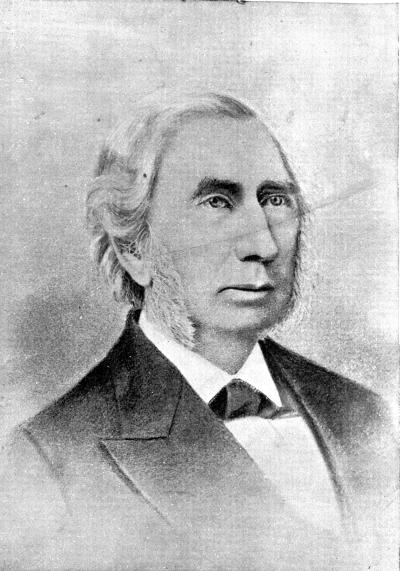
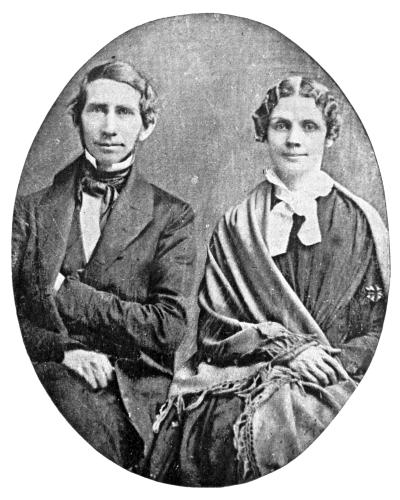
Stephen Return Riggs, born in Steubenville, Ohio, March 23, 1812;
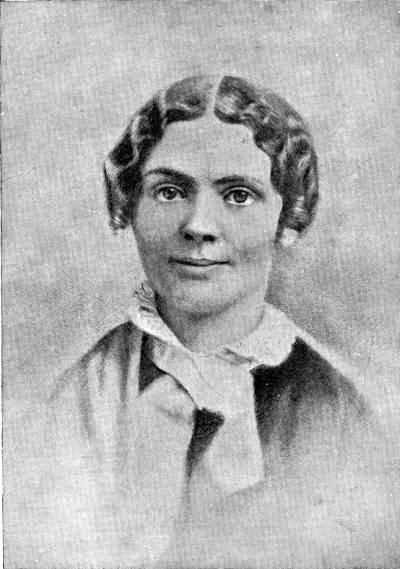
married, February 16, 1837, to Mary Ann Longley, who was born November
10, 1813, in Hawley, Mass., and died March 22, 1869, in Beloit, Wis.
I. Alfred Longley Riggs, born at Lac-qui-parle, Minn., December 6,
1837; married June 9, 1863, to Mary Buel Hatch, who was born May 20,
1840, at Leroy, N. Y.
Children: Frederick Bartlett, born at Lockport, Ill., July 14, 1865;
Cora Isabella, born at Centre, Wis., August 19, 1868; Mabel, born at
Santee Agency, Nebraska, September 11, 1874; Olive Ward, born at
Santee Agency, Nebraska, June 13, 1876; Stephen Williamson, born at
Santee Agency, Nebraska, April 28, 1878.
II. Isabella Burgess Riggs, born at Lac-qui-parle, Minn., February 21,
1840; married February 21, 1866, to Rev. W. Mark Williams, who was
born October 28, 1834, in New London, Ohio.
Children: Henrietta Blodget, born at Kalgan, China, September 25,
1867; Stephen Riggs, born at Kalgan, China, August 22, 1870; Emily
Diament, born at Kalgan, China, May 26, 1873; Mary Eliza, born at
Kalgan, China, August 3, 1875; Margaret and Anna, born at Kalgan,
China, May 30, 1878.
III. Martha Taylor Riggs, born at Lac-qui-parle, Minn., January 27,
1842; married December 18, 1866, to Wyllys King Morris, who was born
in Hartford, Conn., September 11, 1842.
Children: Henry Stephen, born at Sterling, Minn., June 21, 1868;
Philip Alfred, born at Good Will, D. T., August 4, 1872, and died at
Binghamton, N. Y., August 18, 1873; Mary Theodora, born at Good Will,
D. T., July 31, 1874; Charles Riggs, born at Good Will, D. T., June
21, 1877; Nina Margaret Foster, born at Good Will, D. T., May 30,
1879.
IV. Anna Jane Riggs, born at Traverse des Sioux, Minn., April 13,
1845; married October 14, 1870, to Horace Everett Warner, who was born
January 10, 1839, near Painesville, Ohio.
Children: Marjorie, born at Belle Plaine, Iowa, September 29, 1872;
Arthur Hallam, born in Vinton, Iowa, October 28, 1875; Everett
Longley, born in Vinton, Iowa, July 15, 1877.
V. Thomas Lawrence Riggs, born at Lac-qui-parle, Minn., June 3, 1847;
married December 26, 1872, to Cornelia Margaret Foster, who was born
in Bangor, Me., March 19, 1848, and died August 5, 1878, at Fort
Sully, D. T.
Child: Theodore Foster, born near Fort Sully, D. T., July 7, 1874.
VI. Henry Martyn Riggs, born at Lac-qui-parle, Minn., September 25,
1849; married September 24, 1878, to Lucy M. Dodge, who was born at
Grafton, Mass., February 29, 1852.
VII. Robert Baird Riggs, born at Hazelwood, Minn., May 22, 1855.
VIII. Mary Cornelia Octavia Riggs, born at Hazelwood, Minn., February
17, 1859.
Stephen R. Riggs married, May 28, 1872, Mrs. Annie Baker Ackley, who
was born March 14, 1835, in Granville, Ohio.
IX. Edna Baker Riggs, born at Beloit, Wis., December 2, 1874.
The sons and daughters brought into the original family by marriage
contributed much to the success of the reunion. The cousins will not
soon forget the inimitable stories of Uncle Mark. Horace E. Warner
wrote a charming letter, proving conclusively that he was really
present; while Uncle Wyllys must have gained the perpetual remembrance
of the boys by taking them swimming. Mary Hatch Riggs was the
unflagging main-spring of the whole meeting. Lucy Dodge Riggs presided
hospitably at the “Young men’s hall,” where many of the guests were
entertained; and the new mother, Annie Baker Riggs, won the love of
all.
It would not have been a perfect meeting without seeing the face of
John P. Williamson, the elder brother of the mission. Then, too, there
was our friend Rev. Joseph Ward, whose home at Yankton has so often
been the “House Beautiful” to our missionary pilgrims. We were also
favored with the presence of many of our missionary women: Mrs. Hall
of Fort Berthold, Misses Collins and Irvine, from Fort Sully, and
Misses Shepard, Paddock, Webb, and Skea, of Santee. The children will
long remember the party given them by Miss Shepard in the Dakota Home,
and the picnic on the hill.
It is impossible to give any adequate report of such a reunion. The
renewal of acquaintance, taking the bearings of one another’s
whereabouts in mental and spiritual advance, is more through chit-chat
and incidental revelations than in any of the things that can be told.
And so we gather in as memorials and reminders some of the papers read
at the evening sociables, and some paragraphs from reports of the
reunion published in the Word Carrier and Advance. First, we will
have Isabella’s paper, the story of that long journey home—By Land
and by Sea:—
“Ding lang, ding lang, ding lang! Hear the bells. The litters
are packed, the good-bys spoken. Thirteen years of work in
sorrow and in joy are over. ‘Good-by. We will pray for you all;
do not forget us.’
“Down the narrow street, past the closely crowded houses of
more crowded inmates, beyond the pale green of the gardens, on
the stony plain, and our long journey is begun.
“Eight hours and the first inn is reached, we having made a
twenty-five-mile stage. Over rocks and river, fertile lake-bed;
desert plain, and through mountain-gorge, we creep our way,
till, on the fifth day, the massive walls of Peking loom up
before us.
“Here there are cordial greetings from warm hearts, and willing
hands stretched out to help. Best of all is the inspiration of
mission meeting, with its glad, good news from Shantung
Province.
“By cart and by canal boat again away. At Tientsin we ride by
starlight, in jinrickshas, to the steamer. How huge the
monster! How broad seems the river, covered here and yonder,
and again yonder, with fleets of boats!
“We ensconce ourselves in the assigned state-rooms, and little
Anna’s foster-mother keeps a vigil by the child so soon to be
hers no more. ‘Farewell, farewell.’
“Gray morning comes, and the ponderous engine begins his work.
We move past boats, ships, steamers, past the fort at Taku, out
on the open sea. No one sings, ‘A Life on the Ocean Wave,’ or
‘Murmuring Sea,’ for our ‘day of youth went yesterday.’ The
enthusiasm of early years is gone. Instead, I read reverently
the 107th Psalm, verses 23, 31. Then with the strong, glad,
spray-laden breeze on one’s face, it is fitting to read, ‘The
Lord on high is mightier than the noise of many waters, yea,
than the mighty waves of the sea.’ ‘Let the sea roar, and the
fullness thereof. Let the floods clap their hands ... before
the Lord.’ ‘The sea is his and he made it.’ ‘The earth is full
of thy riches. So is this great and wide sea. There go the
ships: there is that leviathan, whom thou hast made to play
therein.’
“Five days, and we steam up through the low, flat, fertile
shores of Woo Sung River to Shanghai.
“Ho for the land of the rising sun! Two days we sail over a
silver sea; yonder is Nagasaki, and now a heavy rain reminds us
that this is Japan. On through the Inland Sea. How surpassingly
beautiful are the green hills and mountains on every side.
“At Kobe we receive a delightful welcome from Mr. C. H.
Gulick’s family, and on the morrow we meet our former
co-laborer in the Kalgan work, Rev. J. T. Gulick. Ten days of
rest, and our little Anna is herself again. She is round and
fair and sweet, and every one laughingly says she is more like
our hostess than like me.
“Again away, in a floating palace, fitly named City of Tokio.
We glide out of sight of Japan, with hearts strangely stirred
by God’s work in that land.
“One sail after another disappears, until we are alone on the
great ocean. Water, water, water everywhere.
“Our days are all alike. Constant care of the children and
thoughts of home and beloved ones keep hand and heart busy. The
events of each day are breakfast, tiffin, and dinner, daintily
prepared, and faultlessly served by deft and noiseless waiters.
We think it a pleasant variety when a stiff breeze makes the
waves run high. The table racks are on, yet once and again a
glass of water or a plate of soup goes over. We turn our plates
at the proper angle, when the long roll begins, and
unconcernedly go on.
“One day of waves mountain high, which sweep us on to our
desired haven. On the eighteenth day we see the shore of
beautiful America. How the heart beats! So soon to see father,
brothers, and sisters! Thank God. Aye, thank him too for the
manifold mercies of our journey.
“How strange and yet familiar are the sights and sounds of San
Francisco. The children’s eyes shine as they plan and execute
raids on a toy store.
“There is yet the land journey of thousands of miles. By night
and by day we speed on; across gorge, through tunnel and
snow-shed, over the alkali plains, over fertile fields to
Omaha.
“At last we arrive in Yankton, and a cheery voice makes weary
hearts glad. ‘I am Mr. Ward. Your brother Henry is here.’ Ah,
is that Henry! How he has changed from boyhood to manhood!
“‘Over the hills and far away.’ Here we are! How beautiful the
mission houses look! And the dear familiar faces! Rest and home
at last for a little while. ‘For here have we no continuing
city, but we seek one to come.’”
But journeying may be done much more quickly by thought, and spirit
may go as quick as thought. So here is the account of Horace E.
Warner’s thought journey to the family meeting:—
“If there has seemed to be any lack of interest on my part in
the family reunion, it is only in the seeming. For my decision
to stay at home was made with deep regret, and after the slaying
of much strong desire. But, aside from the gratification which
it would have given me to see you all, and which I hope it would
have given you to see me, I do not think the idea of the meeting
is impaired by my absence. Only this—I feel as though I had,
not wilfully nor willingly, but none the less certainly, cut
myself off from that sympathy—in the Greek sense—which I stood
in much need of, and can ill afford to miss.
“I suppose you are now all together with one accord in one
place, so far as that is possible. To be all together would
require the union of two worlds. And this may be, too,—shall
we not say it is so? But if the dear ones from the unseen world
are present, though you can not hear their speech nor detect
their presence by any of the senses, can not you feel that I am
really with you in some sense too? Of course, the difference is
great, but so also the difference is great between the meeting
of friends in the natural body and the spiritual body. If the
mind, the soul, constitutes the man rather than the animal
substances, or the myriad cells which make up his physical
organization, why may not I leap over the insignificant barrier
that divides us? As I write, this feeling is very strong with
me. It is vague and indefinite, but yet it seems to me that I
have been having some kind of communication or communion with
you. At all events, my heart goes out strongly toward you all
with fervent desire that the meeting will be full of joy and
comfort—of sweetest and spiritual growth—the occasion of new
inspiration, new courage, new hopes. It is not likely that
there can be any repetition of it this side of the ‘city which
hath foundations.’
“So the memories of this meeting should be the sweetest, and
should cluster thick around you in the years of separation.
This much I must perforce miss. For though I do truly rejoice
in your joys, and partake with you of the gladness of the
meeting after so long a time; yet it is only by imagination and
sympathy that I make myself one with you, and of this the
future can have no recollection.”
Now we will let others give their thoughts of the meeting, as it
seemed to them from outside. And, first, a few words from Rev. John P.
Williamson of Yankton Agency:—
“The first week in September, 1879, will long be remembered by
the Riggs family, and by one or two who were not Riggses. From
the east and the west, from the north and the south, and from
across the mighty Pacific, they gathered at the eldest brother’s
house, at Santee Agency, Nebraska, for a family reunion. It was
forty-two years last February since Stephen Return Riggs married
Mary Ann Longley and came out as a missionary to the Dakotas;
and now in his sixty-eighth year, his step still light, and his
heart still young, he walks in to his son’s house to find
himself surrounded by nine children, three sons-in-law, two
daughters-in-law, and nineteen grandchildren; with himself and
wife making a company of thirty-five, and all present except one
son-in-law.
“This roll may never be as interesting to universal mankind as
that in the tenth chapter of Genesis, but it is almost extended
enough to evolve a few general truths. If we were to pick these
up, our first deduction would be that like begets like. This
man has certainly given more than his proportion of
missionaries. And why, except that like begets like? He was a
missionary, his children partook of his spirit, and became
missionaries. We heard some mathematical member of the company
computing the number of years of missionary service the family
had rendered. The amount has slipped our memory, but we should
say it was over one hundred and fifty.
“Our other deduction would be that the missionary profession is
a healthy one. Here is a family of no uncommon physical vigor,
and yet not a single death occurred among the children, who are
in goodly number. True, the mother of the family has finished
her work and crossed the river to wait with her longing smile
the coming children, but another ministers in her room, who has
added little Aunt Edna to the list, to stand before her father
when the rest are far away.”
Next, we have the observations of Rev. Joseph Ward of Yankton:—
“Families have their characteristic points as well as
individuals. The family of Rev. S. R. Riggs, D.D., is no
exception to this. Their characteristics all point in one
direction. It is notably a missionary family. It began on
missionary ground forty-two years ago at Lac-qui-parle, Minn.
From that time until the present the name of the family head has
always appeared in the list of missionaries of the American
Board. One after another the names of the children have been
added to the list, until now we find Alfred, Isabella, Martha,
Thomas, Henry, attached to the mission; and doing genuine
missionary work, though not bearing a commission from the board,
are two more, Robert and Cornelia.
“What place more suitable for the meeting together of father,
children, and children’s children—thirty-four all told,
counting those who have joined the family by marriage—than
Santee Agency, Nebraska, a mission station of the A. B. C. F.
M.
“Though not of the family, I was honored by an invitation to
attend the meeting, assured that a ‘bed and a plate would be
reserved for me’; and so, on the first Tuesday of September, I
stood on the bank of the Missouri, opposite the agency, waiting
for the ferry-man to set me across. I came at the right time,
for presently the delegation from Fort Sully drove their two
teams to the landing, and in a moment more Rev. J. P.
Williamson, with his oldest daughter, from Yankton Agency,
were added to our number.
“They came from the east and the west and the north. These from
Sisseton, these from Sully, and these from the land of Sinim,
for the oldest daughter and her husband, Rev. Mark Williams,
have been for thirteen years in Kalgan, Northern China, and now
for the first time come back to see the father and the
fatherland. The personal part of the meeting I have no right to
mention. I speak only of its missionary character. The very
prudential committee itself, in its weekly meetings, cannot be
more thoroughly imbued with a missionary spirit than was every
hour of this reunion. And how could it be otherwise? All the
reminiscences were of their home on missionary ground, at
Lac-qui-parle, at Traverse des Sioux, and at Hazelwood. Did
they talk of present duties and doings? What could they have
for their theme but life at Kalgan, at Good Will, at Santee,
and at Sully! Did they look forward to what they would do after
the family meeting was over? The larger part were to go two
hundred miles and more overland, to attend the annual meeting
of the Indian churches at Brown Earth. And, besides, how to
reach out from their present stations and seize new points for
work was the constant theme of thought.
“Wednesday evening there was a gathering of the older ones and
the larger children. The father read a sketch recalling a few
incidents of the family life. The reading brought now laughter
and then tears. Forty-two years could not come and go without
leaving many a sorrow behind.
“The mother, who had lived her brave life for a third of a
century among the Indians, was not there. A beautiful crayon
portrait, hung that day for the first time over the piano, was
a sadly sweet reminder of her whose body was laid to rest only
a year ago among the Teetons, on the banks of the Upper
Missouri. Then another paper of memories from one of the
daughters, lighted with joy and shaded with sorrow, a few words
of cheer and counsel from the oldest son, and a talk in Chinese
from the Celestial member, were the formal features of the
evening.
“As I sat in the corner of the study and heard and saw, there
came to me, clearer than ever before, the wonderful power there
is in a consecrated life. Well did one of them say that if they
had gained any success in their work, it was by singleness of
purpose. ‘This one thing I do’ could well be the family motto.
They have not been assigned to a prominent place in the work of
the world, but rather to the most hidden and hopeless part.
But, by their persistence of purpose, they have done much to
lift up and make popular, in a good sense, missionary work in
general, and particularly work for the Indians. It is a record
that will shine brighter and brighter through the ages. Eight
children and thirteen grandchildren born on missionary ground,
and a total of one hundred and fifty-eight years of missionary
work.
“But the end is not yet. They have just begun to get their
implements into working order. Their training-schools are just
beginning to bear fruit. Most fittingly, a few days before the
gathering began, came a large invoice of the entire Bible in
Dakota, the joint work of Dr. Riggs and his beloved friend and
fellow-worker, Dr. Williamson, who has just gone home to his
rest. At the same time came the final proof-sheets of a
goodly-sized hymn and tune book for the Dakotas, mainly the
work of the eldest sons of the two translators of the Bible.
The harvest that has been is nothing to the harvest that is to
be. Dr. Riggs may reasonably hope to see more stations
occupied, more books made, more churches organized in the
future than he has seen in the past. When the final record is
made, he will have the title to a great rejoicing that he and
his family were permitted by the Master to do so much to make a
sinful world loyal again to its rightful Lord.”
Martha’s paper, which was read on that occasion, is a very touching
description of a missionary journey made under difficulties, six years
before, from Sisseton to Yankton Agency.
“GOING TO MISSION MEETING.
“As I sit on the doorsteps in the twilight, the little ones
asleep in their beds, I hear a solitary attendant on the
choir-meeting singing. His voice rings out clearly on the night
air:—
“‘Jesus Christ nitowashte kin
Woptecashni mayaqu’—
singing it to the tune, Watchman.
“That tune has a peculiar fascination and association for me,
and my thoughts often go back over the time when I first heard
it.
“It was in the month of roses, in the year ’73, that, in
company with some of the Renvilles and others, I undertook a
land journey to the Missouri. I had with me the lad Harry, then
five years old, and a sunny-haired boy of nearly a year, little
Philip Alfred. He never knew his name here. Does he know it
now? Or has he another, an ‘angel name’?
“The rains had been abundant, and the roads were neither very
good nor very well traveled. So some unnecessary time was spent
in winding about among marshes, and we made slow progress. More
than once we came to a creek or a slough where the water came
into the wagons. The Indian women shouldered their babies and
bundles as well, and trudged through, with the exception of
Ellen Phelps and Mrs. Elias Gilbert. Their husbands were so
much of white men as to shoulder their wives and carry them
across. Being myself a privileged person, I was permitted to
ride over, first mounting the seat to the wagon, holding on for
dear life to the wagon-bows with one hand, and to the
sunny-haired boy with the other.
“By the end of the week we had only reached the Big Sioux,
which we found up and booming. I was crossed over in a canoe
with my two children, the stout arms of two Indian women
paddling me over. Then we climbed up the bank, and waited for
the wagons to come around by some more fordable place down
below. While waiting, I talked awhile with Mrs. Wind, who had
been a neighbor of ours on the Coteau. Her lawful husband, a
man of strong and ungoverned passions, had grown tired of her
and taken another woman. So Mrs. Wind, who had borne with his
overbearing and his occasional beatings, quietly left him. This
was an indignity her proud spirit could not brook. She went to
the River Bend Settlement to live with her son, and there I saw
her. I said to her, ‘Shall you go back to the hill country?’
‘No,’ she said; ‘the man has taken another wife, and I shall
not go.’ I have since heard of her from time to time, and she
still remains faithful.
“The Sabbath over, we went on again re-inforced by the
delegation from Flandreau. Reaching Sioux Falls in the
afternoon, we avoided the town, and went on to a point where
some one thought the river might be fordable. But alas! we
found we had been indulging in vain expectations. The river
was not fordable, and canoe or ferry-boat there was none. But
necessity is the mother of invention. The largest and strongest
wagon-box was selected, the best wagon-cover laid on the
ground, the boat lifted in, and, with the aid of various ropes,
an impromptu boat was made ready. Long ropes were tied securely
to either end, poles laid across the box to keep things out of
the water, and then the boat was launched. The men piled in the
various possessions of different ones and as many women and
children as they thought safe. Then four of the best swimmers
took the ropes and swam up the river for quite a distance,
coming down with the current, and so gaining the other shore.
This occupied some time, and was repeated slowly until night
came on, finding the company partly on one side and partly on
the other. The wagon, in which we had made our bed o’ nights,
not being in a condition for sleeping in, as the box lay by the
river-side all water-soaked, Edwin Phelps and Ellen, his wife,
kindly vacated theirs for our benefit, themselves sleeping on
the ground. When the early morning came, the camp was soon
astir, and, breakfast being hastily despatched, the work of
crossing over was renewed. I watched them drive over the
horses; the poor animals were very loath to make a plunge, and
some of them turned and ran back on the prairie more than once
before they were finally forced into the water. When most of
the others were over it came my turn to cross. The so-called
boat looked rather shaky, but there was nothing to do but to
get in and take one’s chance. So I climbed in, keeping as well
as I could out of the water, which seemed to nearly fill the
wagon-box. Some one handed the two children in, and, holding
tightly to them, I resigned myself to the passage. At one time
I heard a great outcry, but could not distinguish any words,
and so sat still, unconscious that one of the ropes had broken,
rendering the boat more unsafe still. At last I was safely
over, thankful enough. When finally every thing and everybody
were across, and the boat restored to its proper place, we
started on our way, at about ten o’clock in the morning. To
make up for the late starting, the teams were driven hard and
long, and the twilight had already gathered when we stopped for
the night. After I had given my children a simple supper, and
they were hushed to sleep, I looked out on the picturesque
scene. The great red moon was rising in the sky, and in its
light the travelers had gathered around the camp-fire for
their evening devotions. As I walked across to join them, they
were singing:—
“‘Jesus Christ, nitowashte kin
Woptecashni mayaqu’—
“Jesus Christ, thy loving kindness
Boundlessly thou givest me’—
to the tune Watchman. It struck my fancy, and I seldom hear it
now without thinking of that night, and of the sunny-haired boy
who was then taking his last earthly journey, and who has all
these years been learning of the goodness of the Lord Jesus
Christ in all its wonderful fulness. An incident of one day’s
travel remains clear in my mind. The lad Harry often grew tired
and restless, as was not strange, and so sometimes he was
somewhat careless too. In an unguarded moment, he fell out, and
one of the hind wheels passed over his body. How I held my
breath until the horses could be stopped and the boy reached!
It seemed a great marvel that he had received no injury. It was
surely the goodness of the Lord that had kept him from harm.
“On Wednesday we came into Yankton, where I bought a quantity
of beef, wishing to show my appreciation of the labors of the
men in our behalf. So when camp was made at night the women had
it to make into soup, and, almost before it seemed that the
water could have fairly boiled, all hands were called to eat of
it, and it was despatched with great celerity.
“The next afternoon a fierce storm broke over us, and we were
compelled to stop for an hour or more, while the rain poured
down in torrents and the heavens were one continual flame of
light. When again we started on, every hole by the road-side
had become a pool, and the water was rushing through every low
place in streams. The rain retarded our progress greatly, yet
we came in sight of the Yankton Agency before noon of the next
day. Just as we reached it, we found a little creek to cross,
where a bridge had been washed away the night before. The banks
were almost perpendicular, and we held our breath as we watched
one team after another go down and come up, feeling sure that
some of the horses would go down and not come up again. But,
to our great relief, all went safely over. And very soon we had
arrived at the mission house occupied by Rev. J. P. Williamson
and family, and were receiving the kindly welcomes of all. The
hospitality there enjoyed was such as to make us almost forget
our tedious journey thitherward.
“From my traveling companions I had received all possible
kindness, yet in many ways I had found the journey quite
trying. It was not practicable to vary one’s diet very much,
with the care of the little ones just large enough to get into
all mischief imaginable. So I remembered with especial
gratitude Edwin and Ellen Phelps, who used now and then, at our
stopping-places, to borrow the boy, so helping me to get a
little rest or to do some necessary work which would otherwise
have been impossible. At that time Edwin and his wife had no
children, and their eyes often followed my boy with yearning
looks. Since then the Lord has given them little ones to train
for his kingdom, and they are happy.
“But of that little sunny-haired baby boy we have naught but a
memory left—and this consolation:—
“‘Christ, the good Shepherd, carries my lamb to-night,
And that is best.’
“And this:—
“‘Mine entered spotless on eternal years,
Oh, how much blest!’”
During the meeting the tastes and needs of the children were not
forgotten, but Aunt Anna held them attent to her memories of the old
home-life, written for the grandchildren.
“Shut your eyes, and see with me the home place at
Lac-qui-parle—a square house with a flat roof, a broad stone
step before the wide-open door—cheery and sunshiny within.
Welcome to grandfather’s home!
“To the right, in the distance, is the lake Mdeiyedan, where,
like a tired child, the sun dropped his head to rest each
night. Between us and the lake was a wooded ravine, at the
foot of which, down that little by-path, was the coolest of
springs, with wild touch-me-nots nodding above it, and a little
further on a large boulder on which we used to play.
“It seems to us as if we had but just come in from a long
summer’s walk, with our hands full of flowers, and each and
every one must have a bouquet to set in his or her favorite
window. The wind, blowing softly, brings with it a breath of
sweet cleavers, and—well, so I must tell you what I remember.
“I can not stop to tell you of all the little things that made
our home pleasant and lovely in our eyes; or of the dear mother
who had it in her keeping, for I know all the grandchildren are
waiting for their stories.
“Well, I will begin by telling the wee cousins about the family
cat, Nelly Bly, and one of her kittens, Charlotte Corday.
Kittens have some such cunning ways, you know, but Nelly Bly
was one of the knowingest and best. She and her kitten were as
much alike as two peas in a pod—jet-black, and with beautiful
yellow-green eyes. Nelly Bly used to curl herself up to sleep
in grandpa’s fur cap, or sometimes in grandma’s work-basket;
and if she could do neither, she would find a friendly lap. One
day poor pussy chose much too warm a place. Grandma had started
up the kitchen fire, and was making preparations for dinner
when she heard pussy mewing piteously—as she thought, in some
other room. She went to the doors one by one to let pussy in,
and no pussy appeared, but still she heard her mewing as if in
pain. What could grandma do? She was neither down cellar nor
up-stairs. She would look out-of-doors—but no—just then pussy
screamed in an agony of pain. Grandma ran to the stove, opened
the door, and pussy, as if shot out from a cannon’s mouth, came
flying past us—her back singed and her poor little paws all
burned. I can’t tell whether she learned the moral of that
lesson or not, but I know she never was shut up in the oven
again.
“Yet not so very long after, when the old house was burned,
Nelly Bly and Charlotte Corday found a sadder fate. Poor little
kittens!—we spent hour after hour searching for their bones,
but with small success, and then we buried them with choking
sobs and eyes wet with childish tears.
“Do not let me forget to tell you of Pembina and Flora, nor of
the starry host that bedecked our barn-yard sky—every calf,
however humble, was worthy of a name. There were our oxen,
Dick and Darby, George and Jolly, and Leo and Scorpio, who used
to weave along with stately swinging tread under their burden
of hay. Then Spika and Denebola, Luna and Lyra—all worthy of
honorable mention. Flora, gentle, but with an eye that
terrified the little maid who sometimes milked her,—so, with
wise forethought, a handful of salt was sometimes thrown into
the bottom of her pail. You will hardly believe it, but she
grew to be so fond of her pail that she found her way into the
winter kitchen and anticipated her evening meal. How she ever
got through two gates and two doors is a mystery still.
“And there was Pembina—how well we remember the day when
grandpa brought home a new cow, and how we all went down to
meet him, and named her and her calf, Little Dorrit, on the
spot. She was the children’s cow par excellence, and
blessings on her, we could all milk at a time. She had several
bad habits, one of which was eating old clothes and paper, or
rubbish generally. Once I remember she made a vain attempt at
swallowing a beet, and if grandpa had not come in the nick of
time to beat her on the back she would have been dead beat.
“Our horses, too, were a part of the family. There were Polly
and Phenie, short for Napoleon Bonaparte and Josephine—Fanny
and Tattycoram (we had been reading Dickens then).
“I remember hearing our own mother tell of the ox they had when
they lived at Traverse des Sioux, their only beast of burden,
and how he used to stand and lick the window-panes, and how
when the Indians shot him she felt as if she had lost a friend
and companion.
“If these stories of our dear animal friends grow too tiresome,
I might remember about the Squill family at Hazelwood—how they
all, including Timothy and Theophilus, contributed something
every week to a family paper. I wonder if Theophilus remembers
writing an essay for—with red ink from his arm—and how
Isabella said, ‘Now, be brave, Martha, be brave!’ when she was
letting herself down from the topmost round of the ladder—and
how Isabella, when beheading the pope in her fanatical zeal,
split her forefinger with a chisel.
“These are a very few only of the rememberings—some of them
are too sacred and too dear to speak about—but even these
little incidents seem endeared by the long stretch of years.”
Some memories of former days were revived for the older children,
and imparted to the younger ones, by the Father’s Paper:—
I REMEMBER.
As one grows old, memory is, in some sense, unreliable. It does not
catch and hold as it once did. But many things of long ago are the
things best remembered. Often there is error in regard to dates. The
mind sees the things or the events vividly, but the surroundings are
dim and uncertain. What is aimed at in this paper is to gather up, or
rather select, some events lying along the family line and touching
personal character.
The family commences with the mother. I remember well my first visit
to Bethlehem, Ind., where I first met Mary, with whom I had been
corresponding, having had an introduction through Rev. Dyer Burgess.
That was in the spring. My second visit to the same place was in the
autumn of 1836, when the school-mistress and I went on to New England
together.
FIRST VISIT TO MASSACHUSETTS.
Of that journey eastward, and the winter spent in Hawley, I should
naturally remember a good many things: How when the stage from Albany
and Troy put us down in Charlemont, we hired a boy with a one-horse
wagon to carry us six miles to Hawley. But when we came to going up
the steep, rough, long hill, such as I had never climbed before, the
horse could only scramble up with the baggage alone. How we reached
the Longley homestead in a real November storm, only a few days before
Thanksgiving, and were greeted by the grandparents, ninety years old,
and by the father and mother and brothers and sisters—all of whom,
except Moses, have since gone to the other side. How only a day after
our arrival I was waited upon by a committee of the West Hawley
church, and engaged to preach for them during the winter. How every
Saturday I walked down to Pudding Hollow and preached on Sabbath, and
usually walked up on Monday, when I did not get snowed in. How the
first pair of boots I ever owned, bought in Ohio, proved to be too
small to wade in snow with, and had to be abandoned. How the old
family horse had a knack of turning us over into snow-drifts. How on
our first visit to Buckland, the grandfather Taylor, then about
ninety-five years old, when he was introduced to Mary Ann’s future
husband, a young minister from the West, asked, “Did you ever think
what a good horseman Jesus Christ was? Why, he rode upon a colt that
had never been broke.” How the old meeting-house on the hill, with its
square pews and high pulpit, creaked and groaned in the storm of our
wedding day, February 16, 1837. How we left in the first days of
March, when the snow-drifts on the hills were still fifteen feet deep.
March, April, May passed, and the first day of June we landed at Fort
Snelling, in the land of the Dakotas.
When another three moons were passed by, and we had seen St. Anthony
and Minnehaha, and made some acquaintance with the natives, I remember
we took passage, with our effects, on board a Mackinaw boat for
Traverse des Sioux. The boat was in command of Mr. Prescott, who
accommodated us with tent-room on the journey, and made the week pass
comfortably for us. From Traverse des Sioux to Lac-qui-parle we had
our first experience of prairie traveling and camping. It was
decidedly a new experience. But we had the company of Dr. Williamson
and Mr. G. H. Pond, while we commenced to learn the lesson.
AT LAC-QUI-PARLE.
The long, narrow room, partly under the roof, of Dr. Williamson’s log
house, which became our home for nearly five years from that
September, is one of the memories that does not fade.
On the 6th of December I remember coming home from Mr. Renville’s,
where we had been all the afternoon obtaining translations. Then there
was hurrying to and fro, and the first baby came into our family of
two. From that time on we were three, and the little Zitkadan-Washta,
as the Indians named him, grew as other children grow, and did what
most children don’t do, viz., learn to go down stairs before he
did up, because we lived upstairs, and all children can manage to go
away from home, when they can’t or won’t come back of themselves.
In those years our annual allowance from the treasury of the board was
$250. This was more than the other families in the mission had
proportionally. But it required considerable economy and great care in
expenditure to make the ends meet. Not knowing the price of quinine,
and thinking four ounces could not be a great amount, we were much
surprised to find the bill $16. But Dr. Turner of Fort Snelling kindly
took it off our hands.
Once we were discussing the question of how much additional expense
the baby would be, when I said, “About two dollars.” Thereafter Mr. S.
W. Pond, who was present at the time, called the boy “Mazaska nonpa.”
A PLEASANT TRIP.
In the second month of 1840, our three became four. And when the
leaves came out and the flowers began to appear, the mother had a
great desire to go somewhere. But the only place to go was to Fort
Snelling. And so, leaving Chaskay and taking Hapan, we crossed the
prairie to the Traverse des Sioux in company with Mr. Renville’s
caravan. The expectation was that the fur company’s boat would be
there. But it was not; nor even a canoe, save a little leaky one,
which barely aided us in crossing the St. Peters. The journey through
the Big Woods was over logs and through swamps and streams for
seventy-five miles. We had two horses but no saddle. Our tent and
bedding and such things as we must have on the journey were strapped
on the horses. The mother rode one,—not very comfortable, as may be
supposed,—but the baby girl had a better ride on a Dakota woman’s
back. At the end of ten miles, “le grand canoe” was found, in which
they took passage. That ten miles was destined to be remembered by our
return also; for there where the town of Le Sueur now stands our bark
canoe finally failed us, and, without an Indian woman to carry the
baby, we walked up to the Traverse, through the wet grass. Altogether,
that was a trip to be remembered.
One other thing comes to my mind about our first “little lady.” There
was only one window in our upstairs room. On the outside of that the
mother had a shelf fixed to set out milk on. One morning, when every
one was busy or out, the little girl, not two years old, climbed out
of the window and perched herself on that shelf. It gave us a good
scare.
JOURNEY TO NEW ENGLAND.
In the first month of 1842 our family of four was increased to
five. And when the summer came on, we took a longer journey, which
extended to New England. This time Hapan was left behind and
Hapistinna and Chaskay were the companions of our journey. The
grandmother in Hawley saw and blessed her grandchild namesake Martha
Taylor. “Good Bird” says he remembers picking strawberries in the
Hawley meadow, where his uncle Alfred was mowing, in those summer
mornings.
NEW STATION AT TRAVERSE DES SIOUX.
A whole year passed, and we came back to the land of the Dakotas, to
make a new home at Traverse des Sioux, to experience our first great
sorrow, and to consecrate our Allon-bach-uth for the noble brother
Thomas Lawrence Longley. That was a garden of roses, but a village of
drinking and drunken Sioux; and more of trial came into our life of a
little more than three years spent there than in any other equal
portion. There our Wanskay was born, and started in life under
difficulties. Our family of five had now become six. Provisions of
a good quality were not easily obtained. But it happened that wild
rice and Indian sugar were abundant, and the laws of heredity visited
the sins of the parents on our third little lady child. But, with all
the disadvantages of the start, the little “urchin” grew, and grew,
like the others.
SENT BACK TO LAC-QUI-PARLE.
Trouble and sorrow baptize and consecrate. The many trials attendant
upon commencing our station at Traverse des Sioux and the oaks of
weeping there had greatly endeared the place to the mother; and when,
in September of 1846, the mission voted that we should go back to
Lac-qui-parle, she could not see that it was duty, and went without
her own consent. It was a severe trial. In a few months she became
satisfied that the Lord had led us. What of character the boy Hake,
who was born in the next June, inherited from these months of sadness,
I know not, but as he came along up, we called him a “Noble Boy.” The
family had then reached the sacred number seven.
In the year that followed we built a very comfortable
frame-house—indeed, two of them—one for Mr. Jonas Pettijohn’s
family—comfortable, except that the snow would drift in through the
ash shingles. Some of the older children can, perhaps, remember times
when there was more snow inside than outside. We were up on the
hill, and not under it, where Dr. Williamson and Mr. Huggins had built
a dozen years before; and consequently the winter winds were fiercer,
though we all thought the summers were pleasanter. In this house our
sixth child was born, who has no Dakota cognomen. We shall call him
Ishakpe. The half-dozen years in which we made that house our home
were full of work, broken in upon by a year spent in the East—myself
in New York City chiefly. Henry, who could say to enquirers, “I was
two years old last September,” and Isabella were with their mother in
Massachusetts and Brooklyn—Martha and Anna in the capital of
Minnesota, and Thomas at the mission station of Kaposia; Alfred, I
believe, was at Galesburg, Ill.
EDUCATING THE CHILDREN.
It has been a question that we often discussed, “How shall we get our
children educated?” The basis of allowance from the treasury of the
board had been on the principle of the Methodist circuit riders. The
$250 with which we commenced was increased $50 for each child. So that
at this time our salary was either $500 or $550. It was never greater
than the last sum until after the outbreak in 1862. We lived on it
comfortably, but there was very little margin for sending children
away to school. And now we were reaching that point in our family
history when a special effort must be made in that direction. Before
we went on East in 1851, the mother and I had talked the matter
over—perhaps some good family would like to take one of the children
to educate. And so it was, more than one good offer was received for
the little boy Henry. But our hearts failed us. Mrs. Minerva Cook of
Brooklyn said to me, “You are afraid we will make an Episcopalian of
him.” So near was he to being a bishop!
MISSION HOUSE BURNED.
Many remembrances have to be passed over. The last picture I have of
those mission houses at Lac-qui-parle is when, on the 3d of March,
1854, they were enveloped in fire. The two little boys had been down
cellar to get potatoes for their mother, and, holding the lighted
candle too near to the dry hay underneath the floor, the whole was
soon in a conflagration, which our poor efforts could not stop. The
houses were soon a heap of ashes, and the meat and many of the
potatoes in the cellar were cooked. The adobe church was then our
asylum, and the family home for the summer.
BUILD AT HAZELWOOD.
While occupying the old church and making preparations to rebuild,
Secretary S. B. Treat visited us. After consultation, our plans were
changed, and we erected our mission buildings at Hazelwood,
twenty-five miles further down the Minnesota, and near to Dr.
Williamson’s and the Yellow Medicine Agency. During the eight years
spent there, many things connected with the family life transpired.
First among them worthy to be noted was the rounding out of the number
of children to eight—“Toonkanshena,” so called by the Indians—just
why, I don’t know—and Octavia the Hakakta. In those days our Family
Education Society had to devise ways and means to keep one always,
and sometimes two, away at school. By and by, Zitkadan-Washta
graduated at Knox College, and Hapan and Hapistinna at the Western
Female Seminary and College Hill respectively. How we got them through
seems even now a mystery. But I remember one year we raised a grand
crop of potatoes, and sold 100 barrels to the government for $300 in
gold. That was quite a lift. And so the Lord provided all
through—then and afterward. Nothing was more remarkable in our family
history for twenty-five years than its general health. We had very
little sickness. I remember a week or so of doctoring on myself during
our first residence at Lac-qui-parle. Then, the summer after our
return there, the fever and ague took hold of two or three of the
children. The mother also was taken sick suddenly in the adobe church,
and Dr. Williamson and I had a night ride up from Hazelwood. At this
place (Hazelwood) the baby boy Toonkanshena was sick one night, I
remember, and we gave him calomel and sent for the doctor. But the
most serious sickness of all these years was that of my “urchin” and
Henry, both together of typhoid fever. I have always believed that
prayer was a part of the means of their recovery.
QUARTER OF A CENTURY.
When the summer of 1862 came, it rounded out a full quarter of a
century of missionary life for us. Alfred had completed his seminary
course, and in the meantime had grown such a heavy black beard that
when he and I sat on the platform together, in a crowded church in
Cincinnati, the people asked which was the father and which the son.
While waiting in Ohio for the graduating day of Hapistinna to come, I
ran up to Steubenville, where I was born, and walked out into the
country to the old farm where my boyhood was spent. The visit was not
very satisfactory. Scarcely any one knew me. Everything had greatly
changed.
THE OUTBREAK.
The memories of August 18, 1862, and the days that followed, are
vivid, but must in the main be passed over. I can not forbear,
however, to note what a sorry group we were on that island on the
morning of the 19th. How finally the way appeared, and we filed up the
ravine and started over the prairie as fugitives! How the rain came on
us that afternoon, and what a sorry camping we made in the open
prairie after we had crossed Hawk River! How the little Hakakta girl,
when bed-time came, wanted to go home! How, when the rain had leaked
down through the wagon-bed all night upon them, Mrs. D. Wilson Moore
thought it would be about as good to die as to live under such
conditions! How Hapistinna and Wanskay wore off their toes walking
through the sharp prairie-grass! How we stopped on the open prairie to
kill a cow and bake bread and roast meat, with no pans to do it in!
And how, while the process was going on, we had our picture taken! How
many scares we passed through the night we passed around Fort Ridgely!
How thus we escaped, like a bird from the snare of the fowler,—the
snare was broken, and we escaped. How, when the company came to adjust
their mutual obligations, nobody had any money but D. Wilson Moore!
How those women met us on the top of the hill by Henderson, and were
glad to see us because we had white blood in us! How on the road we
met our old friend Samuel W. Pond, who welcomed our family to his
house at Shakopee!
FAMILY IN ST. ANTHONY.
The memories of the campaign of the next three months may be passed
over, as having little connection with the family. But I remember the
night when, with more than three hundred condemnations in my
carpet-bag, I had a long hunt at midnight for the little hired house
in which the mother and children had re-commenced housekeeping. The
three years in St. Anthony were ones of varied experiences. Wanskay
had gone down to Rockford. Hapan and Hapistinna taught school and kept
house for the mother by turns. The three boys went to school.
The War of the Rebellion was not over, but it was nearing its end, as
we soon knew, when one day the noble boy Thomas brought in a paper for
me to sign, giving my permission for his enlistment. I had heard and
read so much of boys of sixteen going almost at once into the hospital
that I threw the paper in the fire.
WHAT WILT THOU HAVE ME TO DO?
The missionary work among the Dakotas was so broken up, the clouds
hung so heavily over it, that I very seriously entertained the
question of giving up my commission as a missionary of the American
Board, and turning my attention to work among white people. In my
correspondence with Secretary Treat I proposed a kind of
half-and-half work, but that was not approved. Finally I wrote a
letter of withdrawal, and sent it on to Boston. But the prudential
committee were slow to act upon it. In the meantime, Rev. G. H. Pond
came over and gave me a long talk. He believed I should do no such
thing; that the clouds would soon clear away; that the need of work
such as I could give would be greater than ever before. And so it was.
To me Mr. Pond was a prophet of the Lord, sent with a special message.
I wanted to know the way. And the voice said, “This is the way; walk
in it.” With new enthusiasm I then entered upon the work of meeting
the increasing demand for school-books and for the Bible.
At the very beginning of the year 1865, having completed my three
months’ work at the Bible House in New York, in reading the proof of
the entire New Testament in Dakota, and other parts of the Bible, as
well as other books, I returned to our home in St. Anthony to find the
mother away at the water-cure establishment. We remember that as a
year of invalidism, of sickness. But the skilful physician and the
summer sun wrought such a cure that in the autumn we removed to
Beloit. Here, with comparative health, she had three and a half years
of added life.
THE MOTHER CALLED AWAY.
Among the new things that took place in Beloit in the year 1866 was
the marriage of Hapan and Hapistinna, the one starting off for the
far-off land of the Celestials, so-called, and the other to the
frontier of Minnesota. Wanskay was then our housekeeper, and the three
boys were in school. By and by the time came for the mother to be
called away. It was a brief sickness, and she passed from us into the
Land of Immortal Beauty. It was a comfort to us that our first-born,
Zitkadan-Washta, was residing near by that winter and spring of 1869.
As I remember it, three children were far away, and five gathered
around the mother’s grave. Now, looking back over the ten years passed
since that time, I seem to say:—
“My thoughts, like palms in exile,
Climb up to look and pray
For a glimpse of that heavenly country,
That seems not far away.”
This is a good point to close and seal up the Memories. For the rest,
a few words may be sufficient. Manifestly, as a family, God has been
with us all the way, and the blessings of the Lord Jehovah have been
upon us. Forty-two years ago we went out—two alone—into the
wilderness of prairie; and now we have become one, two, three,
four, five, six, or more bands.
Sabbath, September 7, wound up the precious weeks; and Sabbath evening
was the transfiguration of the whole. May its blessed memories
tenderly abide in all our hearts! For a year or more, we had looked
forward to the family meeting that was to be; but now we look back and
remember with growing pleasure the meeting that was. As the wagons
clattered away on Monday morning, they broke the charmed spell, but
each one went his own way richer than he came.
A. L. R.