I.
Certain branches of the human family present physical peculiarities and
aptitudes for certain climates which others do not. The one thrives and
arrives at perfection, whilst the other languishes and dies.
Floras and Faunas have well-defined limits of latitude, beyond which they
decline and become extinct, and in some countries we observe certain
limitations as to longitudes. “There are tropical trees that become shrubs
in our zone, and the flowers of our meadows have their types in the
tapering trunks of other climes.”
How rapidly the beautiful varieties of domestic animals deteriorate and
disappear when removed from the localities and conditions in which they
attained their excellence. The handsome Swiss cattle when carried to the
plains of Lombardy, and the remarkable varieties of the English herds when
removed to Central France, quickly lose their characteristics of form and
superiority. Under the tropics the sheep loses its silken fleece, and the
noble qualities of the dog greatly change.
Even the insect world changes greatly in every twelve degrees of latitude,
and an alteration, almost total, appears in double the space.
The influence of climate and locality, which exercises so positive a power
in the vegetable kingdom and animal reign, affects man likewise, and would
be as distinctly marked were it not resisted by the forces of the
intelligence. We find under certain parallels of latitude more energy of
mind and greater activity of body than at others; we observe this more
distinctly with particular races or varieties than with others, thus
indicating that all have not the same aptitudes: again, through a
combination of organic and social laws, types adapted to certain pursuits
spring up in every civilized country, these types distinct from either
varieties or species. We also see the sharp characteristics of races, when
migrating, become less distinct, and mixtures increase, and the inferior
races disappear, like “the elementary language or the primitive forms of
the social state.”
The observed limit of range of the Hindoo and the African, in the Old
World, is not beyond 30° of the equator, and in a lower latitude than 36°
the European colonies have never prospered, never succeeded, in their
attempts for empire. Where now are the countless hosts of Romans, Gauls,
and Vandals that have occupied Northern Africa in past times? The
ethnologist of to-day cannot discover a feature, hardly a trace even, of
the language of the conquerors remaining among the present tribes of
occupation. Even the Roman has vanished, and the only vestige of the
Carthaginian and Numidian is shown by the scattered and diminished
Bergers. These varieties contended with the climate, and were gradually
absorbed by the stronger native tribes.
The Mongols once held Central Europe, the Goths ruled Italy. Where are
they? There is no longer Vandalic blood in Africa or Gothic blood in
Italy.
In later times the strong, the fierce and dauntless Northmen held the
Sicilies, and as the incorruptible Varingar guarded and upheld with their
fearless swords the waning empire of the effeminate Greeks at the
Dardanelles. Where are they and their descendants? The only traces are
seen among the tombstones at Palermo, or in the Runic inscriptions which
they sacrilegiously sculptured with their long blades of steel upon the
flanks of the marble lion of the Piræus.
II.
In the year 1600 hardly a European family could be found along the
headlands and indentations of the coast which form the southern limit of
the Slave States of America.
Since that time the countless multitudes of the red men who inhabited the
forests of these lands have disappeared, and other races from an older
world and other climes have taken their places, increasing in numbers with
as great rapidity as the other declined.
We have seen here the swarthy sons of Nubia, under the fostering care of
Slavery, or under the mysterious and unexplained influences of climate,
increase with such rapidity, that the ratio for the last decade (previous
to the war), if continued for a century, would give a black population of
more than forty millions. Strange spectacle in the movement of races!
Here we see, almost during the memory of living men, a distinct race
disappear, and a new nation of totally opposite character rise up, as if
by magic, in their vanishing footsteps. How prophetic was the speech of
the Indian chief to his tribe, when he beheld with dismay the steady
progress of the white men who lived upon the cereals! “I say, then,”
exclaimed the red man, “to every one who hears me, before the trees above
our heads shall have died of age, before the maples of the valley cease to
yield us sugar, the race of the sowers of corn will have extirpated the
race of flesh-eaters.”
III.
This rate of increase observed among the blacks of our Slave States is not
seen among the population of the West India Islands, where singular
oscillations are exhibited, and the statistics of the past two centuries
have inclined two of the most eminent European statisticians to assert
that in a century the negro will nearly have disappeared from these
islands.
Observations at Martinique and Guadaloupe certainly warrant the inference.
In Cuba the blacks decreased four or five thousand during the period of
1804 to 1817.
This decrease or stand-still in the progress of the race in these regions
may have been caused by conditions, moral or physical, wholly within the
control of man.
There are animals who will not propagate and continue their species whilst
in a state of servitude, and it is reasonable to believe that the same
moral causes affect the condition of enslaved mankind. Naturalists have
shown how the evils of Slavery degrade animals, and Buffon has pointed
out the deep and conspicuous impressions it has made upon the camel.
IV.
Since the discovery and forcible entrance of the golden Empire of Mexico,
and the display of her marvellous mineral treasures by the bold Cortez and
his companions, we have seen a constant stream of the Spaniards and the
affiliated nations of the Latin race pouring across the Atlantic to the
new worlds which were given to the house of Castile and Leon by the
sublime genius of the Genoese, following the stars and the traditions of
the Northmen.
Wealth and the baseless fabrics of martial glory were the alluring objects
of this migrating column of men.
“Hast thou gold?” exclaimed they to the Mexican princes. “I and my
companions have a malady which is only cured by gold.”
After these four centuries of occupation of the elevated plains and
table-lands of Mexico, where the mean temperature does not exceed 77°
Fahrenheit, and where the mildness of climate, the wealth of a wonderful,
prolific nature, excite the ambition and the cupidity of men; and after
the long efforts at colonization, in which the parent country was almost
exhausted by the drain of her best blood,—Spain finds that the
predictions of Dr. Knox are rapidly being realized, and that only 600,000
Europeans and their hybrid descendants, and but 8000 Spaniards of pure
blood, can be found of all the numberless hosts that have embarked for
these lands. Spain halts, and reflects upon this report of her scientific
commission, which shows a decrease of one half since the estimate of
Humboldt, in 1793; whilst France, always blind to reason whenever the
eagles of glory desire to expand their wings, persists in her useless
occupation of Algeria, where Gaul has again and again vainly endeavored to
rear her colonies in times past; and she now attempts to unfurl her
standards and establish her institutions on those Mexican shores where the
blood and energy of a stronger and better adapted people have been
expended in vain. Idle effort! The elements of nature are stronger than
the will of men; neither do they give way to the desires or attacks of
human ambition.
There are geographical boundaries which races cannot pass in pursuit of
wealth or the dreams of ambition. A single generation will not determine
the law of expansion and decay.
V.
In this connection it will be proper to glance over the past, among those
phenomena which men have observed, and those laws which the Creator has
thus far revealed to us for guidance in the procession of races or the
march of intellect.
In the mysteries of the material world everything is governed by fixed and
positive laws. Not a flower appears in the field to gladden the hearts of
men but what rises up with invariable structure, and blooms at definite
periods. Not a sparrow falls to the earth but in accordance with Nature’s
law. Not a star shines in the firmament but in unison with the great and
illimitable designs of God. Everywhere do we observe harmony in space, in
movement; everywhere visible signs of a beneficent, protecting Creator. It
is the same with the enormous forms of living animals as with the
insignificant shapes of the insect world: all play their part in the
problem of Nature. Size is nothing with the Creator; form is nothing.
Perchance
“the poor beetle, that we tread upon,
In corporal sufferance feels a pang as great
As when a giant dies.”
VI.
History indicates mysterious laws in the progress of the typical stocks of
the human families; and it shows, in the colonization of the past, how
frail are human calculations in migration and settlement unless based upon
science. “It is not unknown to me,” said the Roman soldier, two thousand
years ago, when about to attack the remnant of the army of Brennus, that
had passed over into Asia Minor, and conquered the land by the fierceness
of their attack, and the terror of their name,—“it is not unknown to me,”
said Manlius, “that of all the nations inhabiting Asia, the Gauls have the
highest reputation as soldiers.
“A fierce nation, after overrunning the face of the earth with its arms,
has fixed its abode in the midst of a race of men the gentlest in the
world. Their tall persons; their long, red hair; their vast shields, and
swords of enormous length; their songs also when they are advancing to
action; their yells and dances, and the horrid clashing of their arrows
while they brandish their shields in a peculiar manner practised in their
original country,—all these are circumstances calculated to strike
terror. But let Greeks, and Phrygians, and Carians, who are unaccustomed
to and unacquainted with these things, be frightened by such. The Romans,
long acquainted with Gallic tumults, have learned the emptiness of their
parade. Our forefathers had to deal with genuine native Gauls; but they
are now a degenerate, a mongrel race, and in reality what they are named,
Gallogrecians. Just so is the case of vegetables, the seeds not being so
efficacious for preserving their original constitution as the properties
of the soil and climate in which they may be reared, when changed, are
towards altering it. The Macedonians who settled at Alexandria, in Egypt,
or in Seleucia, or Babylonia, or in any other of their colonies scattered
over the world, have sunk into Syrians, Parthians, or Egyptians.
“What trace do the Tarentines retain of the hardy, rugged discipline of
Sparta? Everything that grows in its own natural soil attains the greater
perfection: whatever is planted in a foreign land, by a gradual change in
its nature degenerates into a similitude to that which affords it nurture.
Brutes retain for a time, when taken, their natural ferocity; but after
being long fed by the hands of men, they grow tame. Think ye then that
Nature does not act in the same manner in softening the savage tempers of
men? Do you believe these to be of the same kind that their fathers and
grandfathers were?
* * * “By the very great fertility of the soil, the very great mildness
of the climate, and the gentle dispositions of the neighboring nations,
all that barbarous fierceness which they brought with them has been quite
mollified.”
And finally the Romans themselves, in spite of their sanitary measures,
became from year to year more alien in blood from the genuine stock of
Romulus and Remus, until the distinctive characters of the conquerors of
the earth finally disappeared.
The Latins, Sabines, and primitive Etruscans pressed constantly upon them
with the irresistible force of destiny. When Scipio Æmilianus was
interrupted in the forum by this mongrel populace, he exclaimed, “Silence,
false sons of Italy! Think ye to scare me with your brandished hands, ye
whom I led myself in bonds to Rome?”
When the fierce and hardy Northmen descended into Southern Europe, they
carried along with their laws a chastity and a reserve that excited
universal surprise. But these virtues were not of long continuance there;
the climate and the customs of the new society soon warmed their frozen
imaginations, and their laws by degrees relaxed, and their manners even
more than their laws.
The giants of the North many times swept down over the plains of Italy,
and regenerated with fresh and pure blood the puny breeds of degenerate
Rome, but they have since disappeared, and their descendants are no longer
to be found in these countries.
VII.
In relation to the futile efforts of Spain in Mexico, the ethnologist Knox
exclaims, “Neither climate, nor government, nor external influences ever
alter race. They may and they do affect them, and in time destroy them,
but they never give rise to a new race. In half a century the dreams of
Humboldt, of Canning, of Guizot, and other profound statesmen, have come
to a close, and Nature once more, as I long ago predicted, asserts her
rights.”
Naturalists, from Hippocrates to Buffon, have believed that climate, heat
and cold, dryness and humidity, the qualities and abundance of
nourishment, have power to modify men and animals, but “neither climate,
nor government, nor external circumstances ever give rise to a new race.”
The generous qualities once gone, are departed forever, and their loss can
rarely be retrieved. Where is the instance of a fallen man, class, or
nation?
“The history of nations,” writes the Registrar-General of England,—“the
history of nations on the Mediterranean or the plains of the Euphrates and
Tigris, the deltas of the Indies and Ganges, and the rivers of China,
exhibits the great fact: the gradual descent of race from the highlands,
their establishment on the coasts, in cities sustained and refreshed for a
season by emigration from the interior—their degradation in successive
generations under the influence of the unhealthy earth, and their final
ruin, effacement, or subjugation by new races of conquerors. The causes
that destroy individual men lay cities waste, which, in their nature, are
immortal, and silently undermine eternal empires.
“A thousand years scarce serve to form a state;
An hour may lay it in the dust: and when
Can man its shattered splendors renovate,
Recall its virtues back, and vanquish time and fate?”
VIII.
During this period of two centuries of colonization the European races
have attempted to perpetuate their families upon these lands in question.
They brought with them strong physical forces, and a high degree of mental
cultivation. Mental strength will endure extremes of climate to a singular
degree, but even this gradually yields to cosmic influences. It is a
well-observed law of Nature that man must be organized in harmony with the
condition of climate, otherwise he perishes. This scale of the strength of
resisting opposing forces depends greatly upon the purity of the blood and
the cultivation of the mind, whose remarkable powers of resisting disease
have been observed and pointed out by Malte-Brun, Goethe, Kant, and other
philosophers.
Europeans may visit and remain for limited periods in almost every portion
of the globe. The deadly miasms of Central America, the pestilential
atmospheres of Central Africa, and the frozen mists of either pole, are
braved by the inquiring travellers of the civilized races, but not with
impunity.
Intelligent and educated men may live for a while as gentlemen of leisure,
in the midst of malarial climates, almost without perceptible effect, but
the moment they apply their forces to the cultivation of the earth, Nature
asserts her rights.
Yet during the period of the rich man, whilst he lives without physical
labor, in ease, contemplation, and contentment, degeneration is slowly but
surely taking place. The law of fecundity proves it, as with the Mamelukes
in Egypt, as observed by Volney.
The English race loses its energy, according to Farr, in two or three
generations in the lowlands of the West India Islands and in Southern
Asia. The Duke of Wellington believed that every English family in Lower
Bengal would die out in the third generation.
IX.
The laws of nature as regards influences of climate, food, and society,
have operated less upon the condition of the rich slaveholder than the
poorer white, who has struggled for existence, contending with the poverty
of sterile or abandoned soils, and the hostile influences of climate, and
the sneer of the slave and his master. The rich man has resisted the
opposing forces of the elements with less apparent changes, whilst the
poor man has succumbed to the influences and sadly degenerated, but the
poor white still possesses the rough nobility and majesty of natural man,
whilst the rich slaveholder, with his perverted ideas of honor, virtue,
and justice, has gained the merited contempt of mankind. For the one,
civilization has the sympathetic feeling of compassion; from the other,
Nature herself recoils in horror.
This degeneration of the poor white is no mystery. Their poverty of blood
and weakness of mind were not engendered by the insalubrity of climate,
nor even by the sterility of the soil alone. Deny to any race, class, or
community free social condition, freedom of thought, the expansion of the
mind, the liberty of political and religious ideas, and it is sure to
degenerate, and in time to perish.
The doctrine of Adam Smith and the theory of Malthus as to the fatal
necessity of starvation, are in some measure correct, but they are
mistaken in the view that human fecundity tends to get the start of the
means of subsistence, for on the contrary it keeps pace with it.
We find that the fishes in the lakes, and the wolves in the forests,
increase in exact ratio to the amount of food furnished. Nature regulates
the fecundity of animals and human beings when society neglects it.
X.
The influences of climate, of food, of temperature, of domesticity upon
the variation of species is well known. These mediate and external causes
act with more vigor when the immediate and internal causes favor the
effect. “All the mechanism of the formation of varieties,” says Flourens,
“turns upon these two internal causes—the tendency of the species to
vary, and the transmission of the acquired variations.” Cultivated plants
and domesticated animals, when deprived of the modifying influence of man,
return to the state of nature, and undergo new modifications, alterations,
degenerations, even so far as to disguise and conceal the primitive type.
A few generations suffice to restore a variety to the primitive stock
without retaining any of the organic elements which would debase it.
The more the influence of civilized man makes itself felt, the more the
superior species overpower, absorb, or modify the inferior species.
The more rude the people and the less polished their societies, the more
powerful and rapid will be the influences of climate. Civilized men are
continually exercising their talents to conform their conditions to the
necessities of the time and place, and by their ingenuity remedy the
defects, and by the resisting powers of a cultivated and occupied mind
resist many of the morbid influences of climate. But plants and animals
succumb at once if not protected by man.
XI.
During the more than two centuries of occupation of these southern lands
there appear sufficient data to form, perhaps, some definite ideas of the
success or failure of colonization, and the vague and doubtful process of
acclimation. These evidences, thus far, are decidedly in favor of the
black man. For he has multiplied with astonishing rapidity, and preserved
his physical forces, and during this long and brutalizing term of his
servitude he has not exhibited the ferocity of his master, save when
hunted down like the beasts of prey, as in Hayti; neither has he sunk so
low in the scale of true humanity as those who have held him in bondage.
The hungry and maimed soldier of the republic, escaping from the murderous
prison-dens of the rebels, always found a crust of bread, a protecting
shelter, and a kind word from the humblest and most oppressed of these
beings.
Never were they betrayed by the black man, although the reward was large.
Never were they denied assistance, although the penalty was death.
Although history seems to forbid, we are not of that class of men who
maintain that there are inferior races, intended by nature for servitude;
for we believe that every race contains the elements of greatness, and
that there is a common destiny to all. And we cherish the idea that there
is a better future even for the black man among the civilized nations of
the earth. The singular aptitude of the black man for music, which is the
language of the soul; his deep, sincere, immovable veneration for the
precepts, the faith, the hope of Christianity, do not indicate a race lost
to the nobler impulses, or to the benign influences of civilization, nor a
people abandoned and accursed by Providence. God has gifted every living
creature with the instinct of self-preservation; he has endowed all
animated creatures of the human form with the love of the beautiful, with
the desire of developing and perfecting their innate powers, and of
leaving on earth some act, some memorial worthy of imitation or
remembrance. He who declines to help his fellow-creature in the struggle
for social existence, in the effort for happiness, knowledge, and
immortality, is less than a man.
The problem of civilization is left mostly to the free will of men, and
God blasts and crumbles into dust only those nations who have abused the
gifts and privileges of nature, and who, when arriving at the height of
prosperity and power, have disregarded and despised those principles of
morality and religion which form the true base of all society. How all the
noble aspirations may be crushed and the instincts perverted; how from a
species of voluntary insanity, by our own fierce passions, and by a
strange desire of mutual destruction, men rush on to contest and to ruin,
is well illustrated by the past of the slave faction.
XII.
It is evident that the black man has not deteriorated during his sojourn
in these countries; on the contrary, he has improved in physique: the
repulsive Congo type has changed, and the Circassian features appear. It
is the result of the law of contact and example; it is the effect of
civilization.
Has the white man gained in similar ratio? Go to the cotton fields and
rice lands, and learn a lesson from the instructive contrast of the gaunt
and apathetic white laborer, with the sturdy, well-developed, lively
black. You will then observe that these vast alluvial lands, which rank in
richness and fertility with the best on the globe, must be consigned to
waste by reason of insalubrity, if not cultivated by races of men who are
congenial to the soil and climate. There is no white race who can
cultivate these lands, and enjoy life and establish society with any
duration. Malaria would forbid, if other conditions were favorable.
The littoral lands of the lower tier of Slave States, which are composed
of post tertiary and alluvial soils, tertiary sands and secondary chalk
marls, can be tilled in safety and with economy and with gain only by the
black man. Below the upper terraces and the slopes of the mountain ranges
of the northern limits of these States, where we find the primary and
metamorphic rocks and their debris, the white laborer cannot descend
without contending with the full force of his nature, with disease,
degeneration, and premature death.
There are now in the States of Florida, Alabama, Mississippi, and
Louisiana thirty millions of acres of arable land yet belonging to the
United States, unsold and unoccupied. In all England there are but seven
million acres of uncultivated land.
XIII.
Malaria, that curse of the Circassian race, which is the chief source of
the inefficiency and mortality of their efforts of colonizations in
semi-tropical climes, exerts but little influence upon the negroes, and
hence they are admirably qualified for the occupation of pestilential
soils.
It appears from the statistics of the English that remittent and
intermittent fevers, which prove the great source of inefficiency and
mortality among the white troops in tropical climes, exert comparatively
but little influence upon the blacks.
The writer has observed the fatal effects of the pernicious fevers upon
the white inhabitants of the low coasts of Georgia and South Carolina, and
has seen men perish in a single night from the deadly action of the
miasms, whilst the negroes were unaffected.
During the English expedition up the Nile nearly all the whites were
prostrated by fevers, and none of the native blacks were affected. After
the French landed at Vera Cruz the yellow fever found great numbers of
victims among the Europeans; but according to the report of the
inspector-general, Regnaud, not one of the 600 negro soldiers and sailors
from the West Indies, though hard at work there, were attacked, or rather
not one of them died. There are hundreds of similar examples to illustrate
the theory.
We cannot escape the mephitism of the soil. So long as we respire the air,
so long shall we receive into the system the deleterious vapors by the
respiratory apparatus, which is the most perfect of the absorbing agents:
the time of effect is determined only by the health, the strength, and
vigor of our forces. The destroying elements may take effect at once, or
they may be resisted for a long, though definite period of time. Malaria
alone has a wide range among the causes of human misery, and it is
believed to cause more than half of the mortality of the human families on
the globe.
Its deadly action, in depopulating cities and provinces, is well attested
in history, and its effect upon the intellectual expansion is still more
marked; sadness, languor, paludal cachexia, scrofulous, deformed, and
short-lived offspring, are among its train of evils. In the Roman states
alone, sixty thousand perish every year from this paludal influence. These
deltas of the Southern States are among the greater miasmatic foyers of
the world, and are as deadly in their miasms as the Campagna of Italy or
the Sunderbunds of Hindostan.
XIV.
There are many reasons to induce the belief, that if properly directed,
the blacks may attain distinction in social life and progress, and a
higher degree of perfection in physical development. The skeleton of the
negro is firmer and heavier, the bones being larger and thicker than that
of any other race; but physiologists observe that the muscular development
does not correspond to the strong dimensions of the frame. This deficiency
of nature may be explained by the want of proper nutrition, or to physical
causes within human control, for all proportions in nature are harmonious.
Two of the most admirable boxers that have appeared in the British arena
were blacks, and the dark, swarthy hue of the famous wrestler, Marseilles,
reminds how common is the tinge of African blood in South France, Spain,
and Italy.
While statistics appear to exhibit the physical superiority of the blacks
in the low countries, they also prove how prone to pulmonary disease are
they when migrating to the uplands, or higher latitudes, and how fearful
the mortality. Thus Nature, it seems, offers serious barriers to their
progress, and boundaries within which they must confine themselves or
perish.
XV.
It has been urged that the intermingling of the freed blacks with the
whites in these States will produce a variety of people more vicious, and
less willing to be controlled by the social laws, than either pure race.
Of this there is but little danger, as ethnology will show. There will not
be, under any ordinary circumstances, any intermingling of the two races,
for the law of ethnic repugnance is too great. The strong ethnic
antipathies will keep them apart. The possibility of the intermixture of
families and races so widely remote is as rigidly limited as the law of
chemical proportions, and the absorption of the minor quantity is
inevitable. Give both races the same field for expansion in these States,
and the white race will soon find itself in the minority, both of numbers
and in physical strength; for, according to natural laws, the stronger
blood always absorbs the weaker when there is unobstructed action, and
especially when climate favors vastly one of the contending types.
There are to-day four or five times as many centenarians among the blacks
as there are among the whites of the cotton regions.
In consideration of this subject of miscegenation, let us review the
phenomena that have been brought to light by the naturalists who have
studied hybridity among animals, and recall a few facts from history to
support the experimentalists.
XVI.
In the animal world, in the wild state, hybrids are rarely if ever
produced, and it is only from the experiments of the naturalists that the
law of hybridity has been explained.
We see the bipartites appear, when two kindred species mix together under
the influence of man, these animals partaking of the qualities of both.
The horse and the ass; the ass, zebra, and hermione; the wolf and the dog;
the dog and the jackal; the goat and the ram; the deer and the axis, &c.,
unite and breed; but these artificial species are not durable, and they
have only limited fecundity. “The mongrels of the dog and the wolf are
sterile from the third generation. The mongrels of the jackal and the dog
are so from the fourth. Moreover, if we unite these mongrels to one of the
two primitive species, they soon revert completely and totally to that
species.
“The mongrel of the dog and jackal contains more of the jackal than the
dog. It has the straight ears, the pendent tail; it does not bark; it is
wild. It is more jackal than dog. This is the first product of the crossed
union of the dog with the jackal. I continue to unite the successive
produce, from generation to generation, with one of the two primitive
roots,—with that of the dog, for example.
“The mongrel of the second generation does not bark yet, but it has the
ears pendent at the tip: it is less wild.
“The mongrel of the third generation barks: it has pendent ears, raised
tail: it is no longer wild. The mongrel of the fourth generation is
entirely dog. Four generations, then, have sufficed to restore one of the
two primitive types—the dog type; and four generations suffice also to
restore the other type—the jackal type. Thus, when the mongrels produced
from the union of two distinct species unite together, either become soon
sterile, or they unite with one of the two primitive stocks, and they soon
revert to this stock; in no case do they yield what may be called a new
species, that is, an intermediate, durable species.
“Whether, then, we consider the external causes,—the succession of time,
years, ages, revolutions of the globe, or internal causes,—that is to
say, the crossing of the species, the species do not alter, do not change,
nor pass from one to the other; the species is fixed.” Such are the
conclusions of the admirable efforts of Flourens.
“The imprint of each species,” says Buffon, “is a type, the principal
features of which are engraved in characters ineffaceable, and permanent
forever; but all the accessory touches vary; no individual perfectly
resembles another.”
XVII.
Among the human families, the law of hybridity, which has been pointed out
so clearly by Flourens, has also its fixed and inflexible rules; these
rules have not been so well studied with men as with animals, but it is
believed to have its limit at the seventh generation. At all events, the
experiments of human hybridism, and acclimation in strange latitudes, have
always in time ended in disaster; and that such will always be the fate of
the attempted union of different races in unfavorable climes, have been
the views of Humboldt, of Canning, of Guizot, and other profound
statesmen. We observe among the races in savage life a natural repugnance
to unite: as for instance, the negroes and the fairer people of the
Philippine and Polynesian Isles show no disposition to unite; and though
living side by side, in the same country, for a long period, they have not
produced an intermediate race. Neither do the Eskimos nor the Red Men,
neither do the Caffres nor the Hottentots mix, for in the state of nature
the law of ethnic repugnance is supreme. It is only in the artificial and
depraved states of society that hybrids appear, and their existence is of
short and fixed duration.
The apparent duration and perfection of the Coulouglis, the bipartates of
the Bergers and Turks, may be an exception to the general rule. But the
results of the mingling of human families, widely separated, is generally
very decided.
The Creoles, produced by the African with the Spaniard, Italian, and the
Southern French, possess considerable durability, but disease and
degeneration soon appear when the black mingles with the blood and humors
of the more northern nations. With all these mixtures there is a profound
characteristic, which constitutes the unity, identity, and reality of the
species, which is, continuous fecundity; and this characteristic never
varies: it is immutable. The mulattoes live less time than the black or
the white race, and their offspring perish readily, and are rarely
prolific, except when united with stronger individuals of either primitive
type, to which they soon return.
XVIII.
The blacks have been too degraded to more than conceive of liberty, too
debased to think of resistance to the forces that crushed them, and they
have neither observed, nor sought for opportunities, to throw off their
chains and sweep over the lands, like a destroying element, with the
accumulated wrongs of centuries. Yet there were black men among them who
were capable of high cultivation. The long contact with the superior white
race had recast the faculties of their mind, and had altered perceptibly
the rugged contour of their forms and features.
The writer observed with wonder in the regiment of black men which formed
part of the column of the desperate assault upon Fort Wagner, beautiful
heads, whose classic and regular outlines recalled the finest of the
antique.
We believe with the writer in the “Revue des Deux Mondes,” that contact
with the white races has given the negro the lines of the Caucasian form,
and that the Congo type can disappear or become greatly modified.
These changes in the typical form, which we have since observed elsewhere,
appear to have taken place sometimes without the admixture of the blood of
the whites.
That the black men in the United States army fought well, no one will
deny; that they conducted themselves admirably in the murderous assaults
at Fort Wagner, or under the destroying fire at Olustee, and in many other
conflicts, every one possessed of any candor will admit. When we consider
the degradation whence they suddenly rose, and the steadiness and
firmness, and the manly bearing they exhibited after the few lessons of
military training, we are compelled to render thanks to them for their
efforts in the struggle for national existence, and to admit the
probability of their attaining that degree of intelligence, wisdom, and
virtue which distinguish the true citizen. That these men will attain the
standard of intellect of the Caucasian, we neither expect nor believe; but
we do maintain, that in the nature of every race, however debased by
prejudice, and the avarice of superior society, there exists the element
of honesty, virtue, truth, and a horror of wrong, which may be developed
and turned to the good of all society, in repelling and resisting the
force of machination, the intrigue which arises from disappointed
ambition, or the insatiable lust of more favored and less considerate
classes.
No one acquainted with the history of the commerce of human beings will
wonder at the present condition of the blacks, or that they have not risen
in the scale of social and intellectual advancement. For, looking back to
the primitive ages we may see how the human species have been depressed in
servitude, and how the very same families, who carried the arts and
sciences to celestial limits, were affected by this influence. Persons of
the same blood and inheritance as the best families of Greece and Rome,
were often reduced to slavery, and they sank rapidly under its debasing
effects. They were tamed like the black man of the South; “like brutes, by
the stings of hunger and the lash; and their education was so conducted as
to render them commodious instruments of labor for their possessors. This
degradation of course depressed their minds, restricted the expansion of
their faculties, stifled almost every effort of genius, and exhibited them
to the world as beings endued with inferior capacities to the rest of
mankind. But for this opinion there appears to have been no foundation in
truth or justice. Equal to their fellow-men in natural talents, and alike
capable of improvement, any apparent or real difference between them and
some others must have been owing to the mode of education, to the rank
they were doomed to occupy, and to the treatment they were appointed to
endure.”
After all, the world appears to be a vast arena, where the good and the
bad are gathered together, and men are left to their own efforts, whether
to rise up in that scale of intelligence and virtue which conducts to
immortality, or to grovel deeper into the depths of degradation, where
there is nothing but death and annihilation. The vault of heaven grows in
immensity as we gaze into its limitless expanse, whilst the shadows and
attractions of earth fade away from view, or allure only those who have
forsaken nature.
XVIII.
Have the European races advanced in these latitudes in strength of mind
and body with equal ratio as the black man? We think not. Let us consider.
The qualities of plants and vegetables are often affected by external
influences, so as to assume different characters, and the impressions upon
the leaves and the fruits are distinctly marked. These alterations,
degenerations, and modifications may disguise the primitive type so far
that it is no longer recognizable. We observe these properties among all
organic bodies, among those of the animal and as well as of the vegetable
world. The vine and its golden extracts are very much dependent upon these
influences.
The exquisite bouquet, the soul-inspiring qualities of the best varieties
of wine, cannot be acquired by the efforts of man at pleasure; without the
generous nature of the soil, the rays of sunlight, and the inspiring
breezes of favored localities and climes, the extract of the pressed grape
is without that flavor and force which warm into life the brilliancy of
the imagination, the nobility of the soul.
There is also a marked effect of soil and climate upon the odor of
plants, and in their narcotic constituents. Does not the same law affect
man?
The Italian violets grow sweeter as we climb the Alpine slopes; the
mignonette blooms with greater perfection and perfume as we approach the
shores of the lowlands of the Mediterranean. We find the finest types of
the human race among the uplands and the mountains; below, on the low
coasts and river margins, where pestilences are generated, the physical
and mental forces do not fully expand, and we find there neither liberty,
virtue, nor science.
Dr. Rusdorf, in his work on the influence of European climate, regards the
temperate zone as the brain-making region, and attempts to prove it by
physiological deductions. The brain of the Caucasian, he says, determines
the superiority over the other races, and it is the standard of the
organism. This, he maintains, is produced by the richness of albumen in
the blood, which is also dependent upon the oxygen of pure air. The
extensive observations of the English Registrar-General show indisputably
that the elevation of the soil exercises as decided an influence on the
English race as it does on the native races of other climes and soils.
They also show that the finest animals are raised in the healthiest
districts. We see that certain heights above the plains are remarkably
exempt from maladies which devastate nations inhabiting lower levels.
Cholera, remittent fever, yellow fever, and plague, disappear at
well-defined degrees of elevation.
At Vera Cruz, and along its latitude, the yellow fever vanishes at the
height of three thousand feet above the Gulf shores.
The Prussian, in his “Medicinische Geographie,” appears to indicate with
great degree of certainty the limits and altitudes of the three zones,
into which he classifies the catarrhal, the dysenteric, and the scrofulous
diseases. The scrofulous zone ceases at an altitude of two thousand feet
above the level of the sea, and here, he says, there is no pulmonary
consumption, scrofula, cancer, or typhus fever. “It is,” says Babinet,
“the climate of each country which permits or arrests the development of
the human race, which, joined with the industry of populations, imposes
limits to the numerical force of each meteorological district, and which
subsists four million of men in fertile Belgium, which is no more than a
small fraction of the territory of France, whilst Siberia can with
difficulty nourish a part of that number with an extent which is
twenty-six times that of France.” “All over the world, physical
circumstances,” exclaims Draper, “control the human race.”
XIX.
It is vain to assert that the atmospheres of the maritime or the low
levels do not affect the physical and mental condition of men; and after
all, Fontenelle was right when he maintained, in a curious paradox, that
inspiration is a barometer that varies, which mounts to genius or descends
to absurdity, according to the inconstancy of the weather; that there are
unhealthy countries, full of mists, winds, tempests, that never produce
clear understandings; and, on the contrary, there are lands with beautiful
skies and fields filled with sunlight and roses which give out flashes of
divine light.
Nearly all of the Grecian lyrists were born in the enchanting climates,
and among the beautiful scenes of the Asiatic shore or the isles of the
Ægean Sea. Most of the eminent men of Italy rose from similar
inspirations, which Michael Angelo observed when speaking of Vasari in
terms of admiration. Historians say that the sun was never softer, the
heavens brighter, the roses more prolific, the winds more perfumed, than
in the dawn of the eighteenth century, which produced that “wild garland
of beautiful women who recalled by their graces, their genius, the
courtesans of Greece,” which gave birth to those philosophers who gave a
new impetus to liberty and religion.
XX.
According to some writers, the unequal distribution of solar heat over the
earth is the cause of marked differences in national character; others
refer the distinctive effects to the quality of the air they breathe.
Arbuthnot maintains that air not only fashions the body, but has also had
great influence in forming language; that the close, serrated method of
speaking of Northern nations was due to coldness of the climate, and
hesitation of opening the mouth; whilst the sweet, sonorous phrases of
temperate climes, like those of the Mediterranean, were due to the
mildness of climate, where the vocal organs could be exposed without
danger. “It is incontestable,” also writes Alfred Maury, in his “Earth and
Man,” “that climate has upon the mode of government a considerable
influence, because it exercises an immediate effect upon the character of
individuals. In the warm countries, under an enervating atmosphere, where
all inclines to effeminacy and idleness, the soul has not that energy and
that force of will necessary to a people who wish to be free. Under a
severe and cold climate, to the contrary, the character acquires more of
energy, and the body more of activity. The passions are less violent, and
leave to the reason a freer exercise. In the hot climes the instincts are
impetuous, and they pass from an extreme of dejection to a state of
exaltation which produces revolutions, insurrections, but which do not
establish the independence. For, to the contrary, these violent crises
introduce retaliation; and in the sanguinary conflicts, the power of an
individual, although tyrannical, appears as a benefit, or is accepted as a
necessity.”
XXI.
The anger of the European has always raged with undefinable fury, when
once aroused, in these southern latitudes, and especially in the regions
in question. The spirit is the same, whether we review the cruel and
useless extermination of the Indians in Cuba or Florida; the massacres of
the Mexicans by the merciless Spaniards; the internecine slaughter of the
French, English, and Spaniards along the coasts of South Carolina,
Georgia, and Florida; the extermination of whole tribes, like the
Yemassee, or the forced removal of the red men from the broad lands of
their birthplace and inheritance. All show the implacable depth of his
avarice or his ire. It was not merely the honor of subjugation, of
conquering strange races, that was the object of the politics, and that
excited the emulation of these iron-mailed and iron-hearted men and their
descendants: it seems to have been an irresistible desire to immolate
human races, to glut with blood that thirst for destruction which arises
from depraved and burning hearts.
It was the same spirit, under the mask of avarice, that tore the
well-behaved Creeks and Cherokees from the homes of their ancestors, and
banished them to the prairies of the West; that hunted down the last
Seminole in the everglades of Florida, where there are to-day twenty
millions of acres of land unsold and unoccupied.
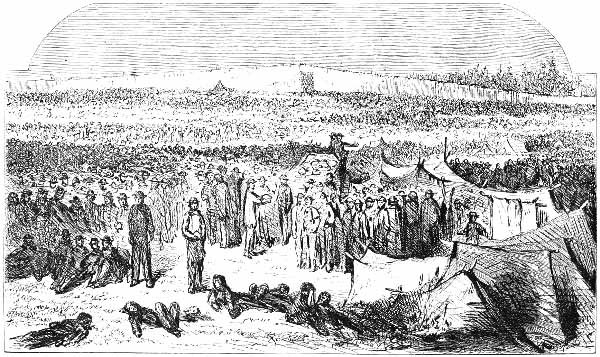
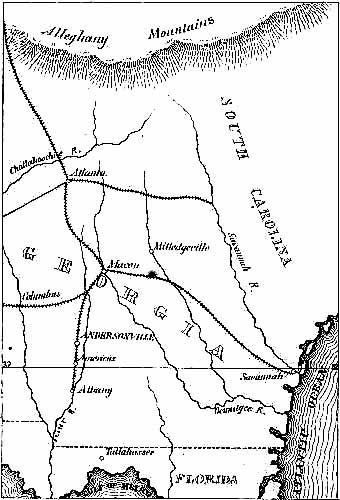
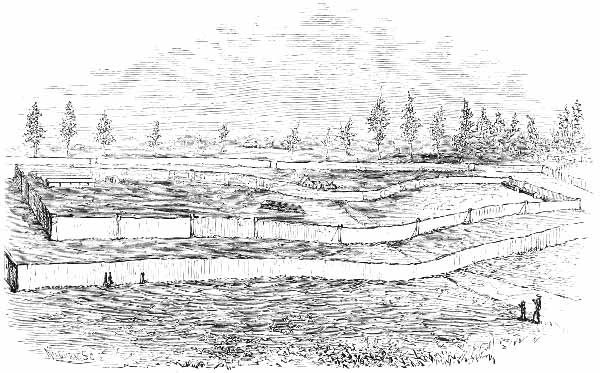
It was the same spirit that, in later times, recklessly and ruthlessly
destroyed, at Camp Sumter, an army of freemen, under the pretence of
treating them as prisoners of war.
XXII.
Yet this depraved fury does not appear to have been natural to the soil,
climate, or the native races, as observed by the early navigators;
although Ponce de Leon received his death-wound from them when he sought
the fountain of youth in the everglades of Florida, and De Soto
encountered fierce opposition from the red men of the forest when he
pursued his way towards the Appalachian mountains in search of the mines
of gold. But nevertheless the Europeans were treated almost always with
kindness whenever they approached the Indian with good intentions.
Contrast the present time and the people with the period and the natives
when the great Navigator discovered the adjacent isles. “Nature is here,”
he exclaims, “so prolific, that property has not produced the feelings of
avarice or cupidity. These people seem to live in a golden age, happy and
quiet, amid open and endless gardens, neither surrounded by ditches,
divided by fences, nor protected by walls. They behave honorably towards
one another, without laws, without books, without judges. They consider
him wicked who takes delight in harming another. This aversion of the good
to the bad seems to be all their legislation.”
These people with natural sentiments have passed away, and new races, with
strange and repulsive ideas, have taken their place. “Like the statue of
Glaucus, that time, the sea, the storms have so disfigured that it
resembles less a god than a ferocious beast, the human soul, altered in
the bosom of society by a thousand causes rising without cessation, by the
acquisition of a multitude of creeds and errors, by the changes produced
in the constitution of bodies by the continual shock of passions, has
caused a change in appearance almost unrecognizable; and we sooner find,
instead of the being acting always by certain and invariable principles,
instead of that celestial and majestic simplicity in which the Creator has
left his impress, the deformed contrast of the understanding in delirium,
and of the passion which pretends to reason.”
XXIII.
Wherever society forms and sustains itself, there must be adopted certain
rules and laws to maintain it.
These seemingly arbitrary laws represent the interests, the passions, and
opinions of those who establish them, and they differ widely, according
to the nature of the men and the climate which they inhabit.
The inhabitants of hot climes and the cold zones present strange contrasts
in their natural ideas of justice, as well as in instincts and appetites.
The Turk regards intemperance as a crime, and polygamy as a virtue. The
Englishman looks upon the one with complaisance, but regards the other
with horror. Thus reason yields to physical force, or to the differences
of climate; and what men call virtue in one clime, loses its force and
beauty in another. Yet there are natural laws older than the empires of
force or reason; more ancient than society itself; more powerful and
sublime than the passions and interests of men. These laws of kindness, of
mercy, of friendship, like elementary language, come from divination.
Nature has planted certain instincts in the bosoms of all the different
races of the globe alike; and these become developed according to
cultivation, or debased according to degrading influences. The good of
society may define the measure between good and evil, but it cannot
extinguish the principles, or obliterate the sharply defined distinctions.
The will of the Creator has manifested itself clearly in the workings of
the natural world, if it has not been revealed to us in those tablets
which fell from the skies.
XXIV.
The benign influences of society, the exercise of politeness and reason,
inspire polished and agreeable manners; yet, in the midst of these, we
find men who think barbarity to be one of their rights; and they abuse
their fellow-creatures without pretext, and commit murder without
necessity, which is a degree of ferocity below that of the carnivorous
animals; for they destroy life only when impelled by the motives of
hunger. Societies of men are institutions of nature, and they are founded
upon the principles of mutual obligations. Society relapses into barbarism
when the golden rule of “doing as we would be done by” is violated; when
individual liberty is lost; and when man treats his fellow-man as property
under the right of force, and therefore without legal relations.
Constitutions are the indices of the education and the aspiration of
nations, and they keep pace with the onward march of intelligence. These
become altered and modified, as the intellect and hearts of men expand;
and it is nothing but bigotry that believes in the inviolability, the
perfection of the doctrines and tenets of men in the present or the past.
The wise man, says the old proverb, often changes his opinion, the fool
never.
XXV.
Slavery appears to be coeval with war; and war is as ancient as the human
race. Plutarch believed that there had been a time, a golden age, when
there were neither masters nor slaves. The human mind, at the time when
Plutarch wrote, was almost controlled by the empire of force. The
selfishness and superstition of society fettered the nobility of nature,
and healthy reason could not assume its rightful sway.
The depth of the philosophical reasoning, the degree of humanity of one of
the brightest periods of antiquity, may be comprehended from the
“Politics” of Aristotle, when he says, “To the Greeks belongs dominion
over the barbarians, because the former have the understanding requisite
to rule, the latter, the body only to obey. For the slave, considered
simply as such, no friendship can be entertained, but it may be felt for
him, as he is a man.” Some of the ancient nations, the most enthusiastic
in the dreams of liberty, were the most savage and stern in their laws
concerning their slaves; and they adhered to their brutal doctrines in
defiance of nature with singular tenacity. The right of life and death
over the slave was one of the fundamental principles of the society of the
Athenians, Lacedemonians, Romans, and Carthaginians.
Strange condition of society among men who cultivated the arts and
sciences so successfully! Yet it does not appear that any legislator
attempted to abrogate servitude.
Stranger still that the glorious period of the reign of democracy at
Athens should not have brought with it the universal freedom of men, when
liberty was the divine ideal of its aspirations.
XXVI.
Not until the star of Christianity rose above the horizon of the pagan and
superstitious world, softening the hearts of men and revealing to them a
new life, did Slavery vanish from among refined and generous societies,
under the charter, Pro amore Dei, pro mercede animæ. And never has it
reappeared, except among those nations who have become debased from
avarice, or depraved by ambition. When cupidity allows fanaticism to blind
the mind with the belief that savages or negroes can be more easily
converted to Christianity whilst in slavery than in freedom, then there is
an end to social progress. Yet such were the ideas of Louis XIII. when he
consigned the negroes of his colonies to Slavery. And such has been the
creed of the slaveholders and breeders of America. The monstrous doctrine
imposed itself upon the understandings of the slave faction, as the
superstitions of the false prophets have fettered and crushed the minds of
the pagan nations. It has debased their natural sentiments, as well as it
has depressed and perverted their natural talents and virtues. “In the
same manner,” said Longinus, “as some children always remain pygmies,
whose infant limbs, fettered by the prejudices and habits of servitude,
are unable to expand themselves, or to attain that well-proportioned
greatness which we admire in the ancients, who, living under a popular
government, wrote with the same freedom as they acted.”
XXVII.
We may learn from the history of the past, if we will not accept the data
of the present, how climate, food, domesticity, or recognized customs of
society may alter the minds and dispositions of men; how they may
gradually build up governments, founded upon monstrous ideas, and yet in
unison with the compunctions of their conscience. Ascribe the origin to
any cause you will, it does not alter the revolting facts, nor lessen the
repulsiveness of the absurdity, nor the enormity of the crime. Volney
believed “that the social institutions called Government and Religion
were the true sources and regulators of the activity or indolence of
individuals and nations; that they were the efficient causes which, as
they extend or limit the natural or superfluous wants, limit or extend the
activity of all men. A proof that their influence operates in spite of the
difference of climate and soil is, that Tyre, Carthage, and Alexandria
formerly possessed the same industry as London, Paris, and Amsterdam; that
the Buccaneers and the Malayans have displayed equal turbulence and
courage with the Normans, and that the Russians and Polanders have the
apathy and indifference of the Hindoos and the Negroes. But, as civil and
religious institutions are perpetually varied and changed by the passions
of men, their influence changes and varies in very short intervals of
time. Hence it is that the Romans commanded by Scipio resembled so little
those governed by Tiberius, and that the Greeks of the age of Aristides
and Themistocles were so unlike those of the time of Constantine.”
Volney observes that “the moral character of nations, taken from that of
individuals, chiefly depends on the social state in which they live; since
it is true that our actions are governed by our civil and religious laws,
and since our habits are no more than a repetition of those actions, and
our character only the disposition to act in such a manner under such
circumstances, it evidently follows that these must essentially depend on
the nature of the government and religion.”
Says Addison, “In all despotic governments, though a particular prince may
favor arts and letters, there is a natural degeneracy of mankind, as you
may observe from Augustus’s reign, how the Romans lost themselves by
degrees, until they fell to an equality with the most barbarous nations
that surrounded them. Look upon Greece under its free states, and you
would think its inhabitants lived in different climates and under
different heavens from those at present, so different are the geniuses
which are formed under Turkish slavery and Grecian liberty.
“Besides poverty and want, there are other reasons that debase the minds
of men who live under Slavery, though I look on this as the principal. The
natural tendency of despotic powers to ignorance and barbarity, though not
insisted upon by others, is, I think, an unanswerable argument against
that form of government, as it shows how repugnant it is to the good of
mankind and the perfection of human nature, which ought to be the great
end of all civil institutions.”
“Liberty should reach every individual of a people, as they all share one
common nature; if it only spreads among particular branches there had
better be none at all, since such a liberty only aggravates the misfortune
of those who are deprived of it, by setting before them a disagreeable
subject of comparison.”
“The pride of Athens,” writes Mirabeau, “and the jealousy of the Greeks,
banished forever the liberty of those countries, so long fortunate.”
Such is and always was our world, covered from time to time with
conquerors and slaves, because the conquering, in forging the irons of the
unhappy, with which they bound them, sharpen those which must bind them in
turn.
Such is and always will be man, from time to time despot and slave, for
man, denaturalized by servitude, becomes readily the most ferocious of
animals if he escapes an instant from oppression. There is but one step
from the despot to the slave, from the slave to the despot, and the chain
becomes them alike.
XXVIII.
There are strange forces constantly at work: civilizations spring up,
disappear, and sometimes, but rarely, return again after a sleep of ages:
it seems as though genius laid fallow for a period, like the golden
grains.
The Greek mind teaches the Arabs under the Caliphs of Bagdad and Cordova,
and in turn the Arabian influence instructs the reviving European mind
after the dark ages. The fall of Constantinople crushed the Greek mind
completely. The genius and the “godlike men” of Rome vanished under the
influence of the strong blood of the Goths, and the flourishing nations of
the African shore have yielded so completely to physical and moral causes,
that we justly doubt the story of their magnificence, their power, their
intelligence.
We see the effete races infused with the fresh blood; the vigorous juices
of the Scandinavians march forward with unparalleled pace to the triumphs
of reason and philosophy. The pure, warm, healthy vitality of the North
recalls to life the exact sciences, the laws of reasoning, and philosophy,
and æsthetics, which, arising from Grecian genius, had slumbered for a
thousand years.
XXIX.
In the slave lands of America a high order of intellect was proclaimed;
but when analysis approached, it sank into mediocrity, or vanished into
dust, like the forms in the ancient tombs when exposed to the light of
heaven. Slavery has produced nothing but horror. The flashes of light that
have burst forth through its mists have been the expiring efforts of
genius. Here the sciences have always languished and declined to take
root, for they are the offspring of genius and reason. The arts never
appeared, for the spirit of imitation never arose. To cultivate the
sciences, there is need of exalted desire, which comes from healthy and
prosperous races or from celestial fire. Here there was the barbarity of
ignorance; the only desires were to increase the enormities of their
crimes, by the spread and general adoption of Slavery, and to conceal its
proportions and influences beneath a cloud of mental darkness, which is
frightful to contemplate, when placed in comparison with intelligent
communities like New England, Belgium, and Prussia.
They thought to perpetuate an aristocratic power, and transmit the
inheritance of Slavery as a blessing, but they forgot that in the
formation of happy nations and states humanity forms the broad base; they
forgot that ambitious and avaricious families quickly degenerate and
disappear completely from the earth. The vicissitudes of political life
hasten that decline which is commenced by riches and rank, when supported
by morbid ideas and sentiments.
The noble families of Athens and Corinth, the patrician body at Rome,
vanished so rapidly as to excite the surprise of the nations they
governed. The names of the descendants of the founders of Venice, written
in the Libro di Oro, are no longer to be found among the living in Italy.
The same law is silently at work in our times.
XXX.
The inequalities of the earth’s surface are like the rugosities of the
human brain: the depths of the one contain the richest and most
inexhaustible treasures of mineral wealth, as the wrinkles of the other
collect the stores of mental lore. As the surface of the brain becomes
less marked and rugged, the strength and scope of the mind vanish, and
approach the standard of the lower animals; and likewise, as the elevated
lands of the earth shrink in form, and sink into the level of the plain,
so the characters of the races who inhabit them lose force and elevation.
Sometimes the minds of men are the reflections of the beauties and
sublimities of nature. Sometimes men become degraded, and nature then does
not inspire.
XXXI.
The lofty and diversified mountain range, or system of ranges, known as
the Appalachian or Alleghany, rises or reappears in the State of New York,
midway between the Atlantic coast and the shores of those fresh-water
seas, Erie and Ontario. It then stretches down south-westward, with its
adjacent spurs, through the great States of Pennsylvania and Virginia;
then, dividing, it forms, with its eastern range, the western and northern
limit of North and South Carolina and Georgia; and with the western it
intersects Tennessee, forming that beautiful basin known among the white
men as East Tennessee, but among the traditions of the red men as the
Garden of the Manitou—their God. In Northern Alabama, the separated
ranges seemingly unite; and passing southward, towards the central portion
of the State, the mountain summits gradually contract, and finally sink
into the level of the great alluvial plains, which stretch away, without
undulation, to the shores of the Gulf. These huge masses of rock,
dislocated and elevated like the Vosges and the Hartz Mountains at the
close of the carboniferous or devonian period of the earth’s age, contain,
with the adjacent and connecting bands,—which are composed of the
silurian, primitive, and metamorphic ledges,—most of the accessible
mineral wealth of the republic. And the collective beds of iron, coal,
marble, zinc, copper, and gold are unsurpassed in similar extent and
richness by the mines of any country of the known world, with the
exception of those wonderful deposits of ores and minerals among the
unexplored and almost inaccessible recesses and plateaus of the Sierra
Nevada or the Andes.
With the exception of the northern extremity of this mountain group, these
mines of natural wealth may be said to have been unexplored. Below the
rich and populous State of Pennsylvania, the hum of human industry ceases;
for we then pass into the paralyzing shadow of Slavery. This Slavery
forbade the development of the earth’s treasures, as well as the
enlightenment of the minds of the poor and ignorant whites. The forges of
Vulcan would have hammered out and broken into fragments the chains of
that bondage which not only oppressed the fettered blacks, but debased,
with its corroding influence, the competing labor of the white man.
The slaveholders concealed this immense natural wealth from the eyes of
science from motives of policy; and rather than incur the hazard of
revolution, by educating the masses of their own people, they preferred to
neglect their natural advantages, and to send to distant and even foreign
lands the products of their fields and their system, to be worked up into
the marvellous fabrics of human ingenuity and skill. This same State of
Virginia, which is the real gateway to the empires of the West, and which
is not surpassed in natural physical advantages by any equal extent of
territory on the globe, is the most ignorant of all of the States of the
republic. Ninety thousand of its native-born free people, over twenty
years of age, before the war could not read nor write; whilst sterile and
stormy Maine, with her cold lands and colder skies, contained but two
thousand of the same class, out of a population more than half as great.
And New England, with a population of almost three times as great as the
free people of Virginia, is ashamed by the number of seven thousand
illiterate natives past the age of twenty. Who will wonder at the display
of barbarity and audacity when the statistics of education and ignorance
are exhibited? “Education and liberty,” says Mirabeau, “are the bases of
all social harmony and all human prosperity.”
Which can civilization curse the most, London or Amsterdam? the Dutch who
introduced Slavery, or the English who thought Virginia a good place to
“colonize aristocratic stupidity,” and who sent colonists, who were,
according to the historian, “fitter to breed a riot than to found a
colony.” The condition of the present day shows how rigidly the first
instructions have been observed and enforced. “Thank God,” writes one of
its early governors to the English Privy Council, “thank God there are no
free schools or printing, and I hope we shall not have any these hundred
years! for learning has brought disobedience and heresy and sects into the
world, and printing has divulged them and libels against the best
government. God keep us from both!”
XXXII.
And so these mines, and fields, and forests, remain to the present day,
unsurveyed, unexplored and unknown, save to a few wanderers of science.
In Northern Alabama, where the terminating slopes of this upheaval of
rocks disappear beneath the level of the vast cotton fields, which number
their acres by the million, there appear enormous deposits of iron ore, of
extraordinary richness and depth, lying in juxtaposition with
corresponding beds of limestones and coal.
Here is alone sufficient material for the iron fingers and forges and the
steam power to fabricate the vegetable growths, the harvests of the vast
and fertile plains of the entire South, and to build up with enduring form
those great and thriving cities which are seen in the dim vista of the
future of the Mississippi Valley, with its hundred millions of people.
These elevations, when denuded of their immense primeval forests of pine
and oak, will be covered with constant verdure, affording sure sustenance
to numberless flocks and herds of kine, which will require less care than
the cattle of the plains of Texas or the pampas of Peru, since Nature,
with her caverns and narrow valleys, will afford shelter from the
destructive storms of winter and the chilling blasts of spring.
Between the two great spurs of the divided mountain range which encompass
the head-waters and tributaries of the Tennessee, appears the garden spot
of the Republic: the soils, enriched by the decomposition of the blue
limestones, are here of great strength and endurance; the innumerable
streams are of sufficient force and volume to satisfy the wants of
industry and mechanics, whilst the lofty mountains, which rise to the
height of seven thousand feet above the ocean, with their broad and
impressive shadows, temper the atmospheres, so that the body can labor and
the mind expand.
To the natural beauties of the landscape art has yet added nothing: from
the teeming harvests of the valleys, from the massive ledges of minerals,
man has yet detracted nothing.
Nature here is almost inexhaustible.
No wonder that the dying Indian returns to the region of the Hiwassee to
end his days on earth, impelled by an irresistible desire to behold once
more the wonders and beauties of natural scenery, which are preserved
among the fading traditions of the tribes that have been banished to the
far off western frontiers.
XXXIII.
From beneath the eastern aspect of the mountains of Alabama, a broad belt
of metamorphic rocks bursts forth, and trends to the north-eastward,
following the mountain ranges in almost parallel lines through the States
of Georgia, South and North Carolina, and disappearing in Virginia beneath
the waters of the Potomac. These lands of decomposed mica and talcose
schists contain throughout their broad extent particles of gold; and some
of the narrow and circumscribed fields are unsurpassed in their
undeveloped richness by any of the known gold fields of similar extent in
the world. These auriferous soils, owned or controlled by the slaveholder,
have yielded, by the superficial scratchings and washings of the slave and
the poor white, during the period since the discovery of the precious
metal, about forty millions of dollars. There are not less than one
hundred millions more within the reach and grasp of skilled and determined
labor.
Along beside, and traversing through and through these golden rocks and
sands, occur immense bands of itacolumite, known, from its flexibility, as
the elastic sandstone. They stretch from Alabama to the interior of North
Carolina, bursting forth now as great flexible bands of stone, and then
bulging out as entire mountains. This singular formation is the same that
has been recognized in Brazil, Ural Mountains, and Hindostan, as the
matrix of the diamond; and here, nearly one hundred of the precious gems
of fine water have been picked up from the earth, from time to time, by
the careless observer.
XXXIV.
This upheaval of the earth’s surface, reminding the geographer of the
Italian peninsula, vaguely perhaps in form, in natural fertility and in
purity of climate, is destined to play an important part in the future
advancement of the Republic. For here is the heart of the eastern portion
of the continent, geographically, climatologically, and mineralogically.
Here Nature is too prolific to be long neglected by the cupidity or the
ambition of men, when the barriers and obstructions of inquiry and
settlement, which have been reared against the advance and design of
civilization by the Slave Faction, shall have been removed. When the tide
of European emigration, which steadily brings to the New World the pure
blood and youth of races, turns its stream of industrial life towards
these valleys, mountain slopes, and terraces; when the laws of
alimentation are understood and properly observed; when the spire of the
school-house rises in the vista of every landscape, or points the way at
every cross-road,—then we may expect to see a new variety of the human
race appear, possessed of remarkable physical strength and beauty, and
whose ideas and efforts, typical of the healthy and developed mind, will,
like the influences of New England and Scandinavia, give fresh impulse and
impress to the civilizations of the earth.
XXXV.
Races of men—nations—even the lesser communities, during the periods of
their social existence, erect monuments, or leave, unwillingly sometimes,
traces of their progress, their advancement, their culture, as memorials
for the admiration, or as the objects of horror for the contempt, of
future generations.
The gigantic pyramids and sphinxes of Egypt tell of the civilization of
their extinct founders; the airy and graceful columns, with the wonderful
sculptures of the Parthenon, disclose the degree of the perfection and the
delicacy of the Greek mind. Rome, though long since vanished from among
the nations of the earth, has left the impress of her force, grandeur, and
wisdom in those laws which now direct the tribunals of men; the lofty and
colossal structures of the temples of the Rhine are the emblems of faith
as well as the masterpieces of the Gothic heart and intellect; even the
mysterious and history-forgotten Druids have left their rude reminiscences
in those weird circles of enormous and cyclopean rocks, beyond which all
is darkness.
Thus men perpetuate their memories among the annals of the earth. But
after their long period of existence and progress, what have the Slave
Faction left for the historian to contemplate with satisfaction? for an
attentive world to study, imitate, and admire? What beyond this appalling
cloud of ignorance have they left as legacy to the poor white? What
besides misery, violence, and crime have they bequeathed to the black man?
With what treasures, in the estimation of mankind, have they enriched
themselves, or left as inheritance to their degenerate offspring?
The history of this remorseless party, its selfish and sordid aims, its
cruel results, will always find place among the annals of civilized man so
long as the noblest acts of men are admired, and so long as the dark deeds
of cruelty appall and overshadow our better nature. Thermopylæ, Marathon,
and the holy sites where Liberty has struggled for existence, and where
men have risen above the trammels of their earthly natures, will be
remembered no longer than this field of blood and torture among the
obscure forests of Georgia.
XXXVI.
Who will say that Nature and Liberty were the genii who directed the
labors of the leaders of the Rebellion?
Soil, climate, hereditary traditions, and customs of society, give to a
people the fierceness and gentleness of character, as well as the
perfection of mind and body. This fatal Stockade, with the silent mound of
earth which contains its harvest of death, is a fair and just exponent of
the bigoted and selfish policy that struck down the Flag of the Republic;
of that cruel and unearthly spirit which has despised all the “attachments
with which God has formed the chain of human sympathies,” and which,
without a tear of remorse, has strewn the Atlantic Ocean with a broad
pathway of human bones!