That there may be types of life of some kind on
Mars is, I should think, quite likely.
Sir Robert Ball.
In the following chapter are presented abstracts
from memoirs, communications, etc., of a
few among the many astronomers and observers
who have recognized the markings on the planet,
and, in many cases, have made drawings of them.
Before presenting these few brief records, I have
compiled, from Camille Flammarion's great work
on Mars, the names of those astronomers whose
drawings he reproduces in this monograph, for
such it is. A brief examination of Flammarion's
volume will give one an idea of the extent and
variety of work which has already been accomplished
in interpreting the surface features of
Mars, and the number of astronomers who have
made contributions to the subject.
Flammarion divides these observations into
three periods; the first, beginning with the rude
drawing of Fontana, in 1636, followed by
Huyghens, in 1659, Cassini, in 1666, and many
others up to Harding, in 1824. In this period
the drawings were rude, though a number of the
more conspicuous features were established, and
above all, the existence of what was interpreted
as snow in the white polar caps. Astronomically
many points were determined, such as an
approximation of the period of revolution, the
distance of Mars from the Sun, the diameter of
the planet, its mass, the inclination of its axis,
the eccentricity of its orbit, its period of
rotation, etc.
The second period begins with the remarkable
work of Beer and Mäedler, in 1830 and subsequent
years. To them belongs the honor of being
the first astronomers to make a chart of the
planet. An advance standard was set for future
studies, and the work which followed revealed
details in the surface markings never before
suspected. The second period, from 1830 to 1877,
includes the observations and drawings of Beer
and Mäedler, 1830; Sir John Herschel, 1830;
Galle, 1837; Warren de la Rue, 1856; Webb,
1856; Secchi, 1858; Liais, 1860; Schmidt, 1862;
Lockyer, 1862; Phillips, 1862; Lassell, 1862;
Knott, 1862; Kaiser, 1862; Dawes, 1864;
Franzenne, 1864; Williams, 1867; Proctor, 1867;
Lahardeley, 1871; Burton, 1871; Wilson, 1871;
Gledhill, 1871; Flammarion, 1873; Terby, 1873;
Green, 1873; Trouvelot, 1873; Lohse, 1873;
Holden, 1875.
The third period extends from 1877 to 1892,
when Flammarion published his book. The
following drawings are given: Flammarion,
1877–88; Paul and Prosper Henry, 1877;
Neisten, 1877–79–81–88; Terby, 1877–79–88;
Van Ertborn, 1877; Cruls, 1877; Dreyer, 1877–79;
Lohse, 1877–79–83–84; Green, 1877;
Schiaparelli, 1877–79; Maunder, 1879; Konkoly,
1879; Boeddicker, 1881–84; Burton, 1882;
Trouvelot, 1884; Knoble, 1884; Denning, 1886;
Perrotin and Thollon, 1886; Proctor, 1888;
Perrotin, 1888; Holden and Keeler, 1888;
Wislicenus, 1888–90; W. H. Pickering, 1890;
Williams, 1890; Giovannozzi, 1890; Guillaume,
1890.
It is impossible to follow these various drawings
of Mars from the earliest ones of the first
period, many of little value, to the slow yet
certain advance as seen in the more detailed
drawings of the second period, without realizing
the gradual improvement of the telescope, coupled
with a greater number of observers endowed
with better eyesight and impelled by deeper
interest in the work. In the third period, culminating
with the great work of Schiaparelli,
and confirmed by the remarkable observations of
Perrotin and Thollon, we see the results of still
more arduous devotion to the work; a great
advance in telescopes, with better definition, and,
in the case of the observations at Nice and
Milan, a steadier atmosphere through which to
observe. Flammarion brought his work up to
1892.
Lowell's work on Mars, though of a kind with
Schiaparelli, is, in every circumstance accompanying
it, so remarkable that we may well consider
the standard now set by him as the beginning
of another period; and this period will fix a
standard which will consist in securing observers
who, in the language of Sir David Gill, have a
special faculty, an inborn capacity, a delight in
the exercise of exceptional acuteness of eyesight
and natural dexterity, coupled with the gift of
imagination as to the true meaning of what they
observe. With this standard established, there
must also go a perfect telescope for definition,
mounted on an elevation a mile and a half or
more above the level of the sea, in a region of
the clearest and steadiest atmosphere in the
world.
One cannot help reflecting on these various
drawings presented in Flammarion's work, and
wondering what the results would have been if
all these astronomers could have had telescopes
as incomparable as that at Flagstaff, perched on
some high mountain peak with a clear and
steady atmosphere continuous for weeks, and,
superadded to all these advantages, independent
fortunes to enable them to transport their telescopes
thousands of miles south when a favorable
opposition of Mars occurred at a low altitude.
The astronomers who have advanced certain
theories to explain the markings may be counted
as admitting their existence, whatever they may
be. Among the other astronomers to be referred
to are, first, those who admit the markings,
and have in all likelihood seen them; second,
those who have observed and made drawings of
the markings; and, third, those who have drawn
them and admit, or at least do not deny, their
artificiality.
Miss Agnes M. Clerke, an astronomical writer
of great merit, who has written a most lucid
and comprehensive "History of Astronomy in
the Nineteenth Century," says: "The canals of
Mars are an existent and permanent phenomenon."
Mr. Thomas Lindsay, of Toronto, read
some notes before the Astronomical Society of
that city in regard to the phenomenon of the
so-called doubling of the canals and the explanation
advanced that it was due to errors in
focusing. "It had been stated by several English
observers that, by racking the eyepiece
within or without the focus, all the phenomena
might be produced." In the case of Mars, however,
he asks: "How is it possible that all the
observers had their telescopes unadjusted, and, if
any one had, would he not be immediately aware
of it?" Mr. Lindsay thought that the theory
was too obviously opposed to the simplest kind
of common sense to merit a moment's consideration.
Mr. John A. Patterson, in his Presidential
address before the Astronomical Society of Toronto,
in speaking of Mars, said the discoveries
rest on the bed rock of scientific evidence; and,
after speaking of the supposed spectroscopic evidence
that there was no atmosphere in Mars, refers
to the polar snow caps, their melting, and the
lines of vegetation that are supposed to mark
the margin of the canals, and he asks: "Is it possible
that all these may be consistent with no
vapor floating above the surface? Is it sound
philosophy to conclude that the condition of
things on our own little world gauges the
possibilities and relations that exist in our sister
world? Dame Nature does not turn out all her
products in one pattern."
Mr. Denning, in the "Astronomische Nachrichten,"
No. 3926, gives the result of his observations
on Mars in 1903. He says the canals,
without doubt, are objective features; changes in
the appearance of these markings he attributes
to vaporous condensations. One rotation period
of the planet satisfies the observation of all
the markings, thus proving them to be definite
features of the planet's surface rather than drifting
vapors such as are seen when observing
Jupiter and Saturn. In spite of these admissions
Mr. Denning, in 1905, while repeating his convictions
as to the objectivity of the canals, denied
their sharp outline. Of the ten canals he drew,
eight were discovered by Schiaparelli, and two
were discovered by Lowell. Denning observed
these lines with a ten inch reflector. Schiaparelli
compared them in sharpness to lines of a steel
engraving. It rests with the reader to judge who
is most likely to be correct in his description of
the character of the lines—Mr. Denning with a
ten inch reflector, in a poor atmosphere, or Schiaparelli
and Lowell, with a twenty-six and a
twenty-four inch refractor, respectively, in a far
superior atmosphere.
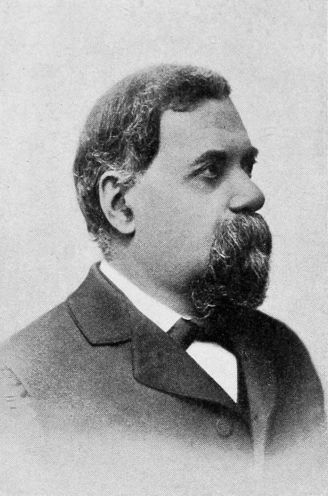
Among the many who have seen and drawn
the canals comes first, of course, Professor Schiaparelli,
the discoverer of them. It is only necessary
to state here that he first detected these
enigmatical markings, which he named canali,
in 1877. In the opposition of 1879, he not only
confirmed the discoveries of 1877, but added new
canali, and for the first time saw the curious
process of doubling, or gemination.
Astronomers in various parts of the world
searched in vain for these markings, and despite
the exalted character and remarkable work of
the distinguished Italian in other lines of astronomic
research, it was feared that, in this instance,
Schiaparelli had been the victim of an hallucination.
It is true that from the time of Huyghens,
in 1659, a few astronomers, such as Secchi,
Schroeter, Kaiser, and Dawes, have detected and
drawn a few faint lines which seemed to be
identical with the canali of Schiaparelli. It was
not until 1886, however, that Perrotin and
Thollon with a twenty-nine inch refractor of the
Nice Observatory, first began to confirm the
discoveries of Schiaparelli, and since that time
observers in various parts of the world have
detected and drawn these remarkable lines. The
cumulative testimony of these men as to the
veritable existence of these markings cannot be
set aside.
It seems strange that nine years should elapse
before an astronomer with an interest in the
subject, coupled with an acute vision and the
patience to observe assiduously, should arise to
confirm the existence of these markings, but in
another chapter I have called attention to the
little interest astronomers have manifested in
planetary markings of any kind. It has been
shown elsewhere that acute vision, with a clear
and, above all, a steady atmosphere, are the chief
essentials in making out the markings. It is
curious to note the attitude of some astronomers,
who, having seen the canals and even drawn
them, denied their veritability. Their explanations
cover "illusions due to the property of light
itself, the inability of the eye to maintain its
mechanism of accommodation, the behavior of air
waves, temporary alteration of the focus of the
eye, undetected astigmatism," etc., etc. But, to
return to the astronomers who have drawn them.
On the unfavorable opposition of 1888, Schiaparelli
declares that "the canali had all the
distinctness of an engraving on steel, with the
magical beauty of a colored engraving." He
furthermore says: "As far as we have been able
to observe them hitherto, they are certainly fixed
configurations upon the planet, the Nilosyrtis has
been seen in that place for nearly one hundred
years and some of the others for at least thirty
years."
In this connection it is interesting to quote
from Schiaparelli who, until many years after
he discovered the canals of Mars, had no doubt
of their natural origin. As late as 1893, he still
considered them natural. In speaking of the
canals, he says: "It is not necessary to suppose
here the work of intelligent beings; and in
spite of the almost geometric appearance of
their whole system, for the present we incline to
believe that they are product of the evolution of
a planet, much as on the Earth is the English
Channel, or the Channel of Mozambique." This
extract may be found in a memoir in "Natura
ed Arte," 1893, page 22. On page 24 of the
same memoir Schiaparelli illustrates the elasticity
of his mind and a thoroughly unprejudiced
attitude by saying: "Their singular aspect,
and the fact that they are drawn with absolute
geometric precision, as if they were the product
of rule and compass, have induced some people
to see in them the work of intelligent beings,
inhabitants of the planet. I should be very
careful not to combat this supposition, which
involves no impossibility." (The italics are ours.)
His comparison of the Martian lines with the
English Channel and the Channel of Mozambique,
if he means any resemblance in form and not
in the manner of formation, is most unfortunate,
for on the whole face of the Earth he could not
have mentioned surface features more totally
unlike any feature of the Martian surface, as
drawn by him, than these two channels: the
English Channel, 100 miles wide at its mouth
and 200 miles long, tapering to the Straits
of Dover; the Mozambique Channel, hour-glass
shaped, 1,100 miles long, and, at its narrowest
part, 260 miles wide, and at either end nearly
700 miles wide. Had he
suggested the Red Sea,
1,200 miles long, or the
Straits of Malacca, 350
miles long, a nearer resemblance
to the canals
of Mars might have been
seen, though even here
it would be impossible to
find their counterparts
in Mars. These channels are merging with the
ocean, are nearly half the width of their length,
and enlarge at both ends, while the canali of
Mars run for hundreds of miles as straight as
ruled lines. How slight the resemblance is may
be appreciated by comparing the following figure
of the Earth (Fig. 1), upon which the Red Sea,
the English and the Mozambique Channels and
the Straits of Malacca are indicated.
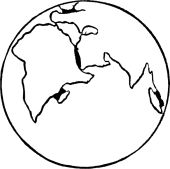
Fig. 1.
In 1897 Schiaparelli becomes still more convinced
of their artificiality. In his Memoir XXV,
in the Reale Academia del Lincei, in speaking of
the canals, he says: "This whole arrangement
presents an indescribable simplicity and symmetry
which cannot possibly be the work of chance."
In a letter to Mr. Lowell, dated December 4,
1904, he writes: "Your theory of vegetation
becomes more and more probable." Mr. A.
Stanley Williams, in the "Observatory" for
June, 1899, in a paper entitled "Notes on
Mars," described the appearance of certain
canals, regions, etc., in great detail. He notices
that at the crossing of the canals a little dark
spot occurs, a feature, he says, which was first
elucidated by Professor Lowell in 1894. Mr.
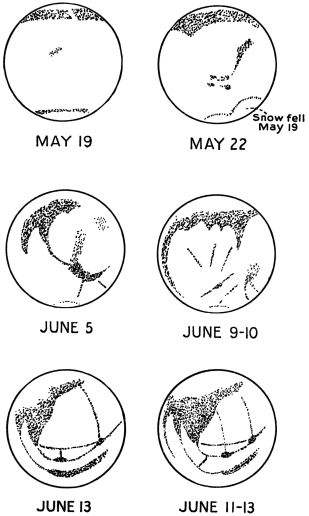
Williams also noticed the black streak bordering
the northern snow cap, which Mr. Lowell in his
book on Mars has interpreted as a body of water
resulting from the melting snow.
In the Quarterly Journal of the Astronomical
Society of Wales, the Rev. Theo. E. R.
Phillips publishes an excellent drawing of Mars
in color. In this drawing he shows a large
number of regions, a number of canals, and
other features which, he says, "came out with
the clearness and sharpness of an engraving,
and bore no resemblance to the 'diffused streaks'
or amorphous smudges one sees for the canals
in imperfect seeing." In this drawing the polar
snow caps show with remarkable vividness.
Professor W. H. Pickering, in a continuous
record of observations on Mars, published in the
"Annals of the Lowell Observatory," records
under August 20: "The dark north canals are
also noticeable, and, had they looked as they
now do, could not possibly have been missed on
the 16th."
Dr. Phil. Fauth has, with a seven inch objective,
drawn and published sixty-three drawings of
Mars in which a great many canals are shown,
a list of which he presents in his memoir on the
subject.
The lamented Perrotin, for some time Director
of the Nice Observatory, in company with
M. Janssen, at Meudon, observed Mars through
the great equatorial (32-2/3 inch), and published
the results in the "Comptes Rendues" (Vol.
CXXIV, No. 7). He describes the several zones,
the northern equatorial zone "being more particularly
the zone of the extraordinary canals,
the discovery of which we owe to Schiaparelli,
and to which we ourselves, by our publication,
in 1886, called the attention of the astronomical
world."
The London "Nature," March 17, 1904, in
noting the death of M. Henry Perrotin, speaks of
him as one of the ablest advocates of astronomical
science. He devoted much time to Mars.
"Aware that he was working at the extreme
limit of visibility, and knowing the tendency for
self-deception to creep in and impair the value
of such delicate observations, he sought opportunities
of making similar measures and records
with different instruments, and under varied
conditions, in order to remove, so far as possible,
the evils of bias and partiality from the results
of his researches."
Dr. Terby of Louvain, in a memoir entitled
"Physical Observations of Mars," a translation of
which appeared in the "Astronomical and Astrophysical
Journal," No. 106, identifies many of
Schiaparelli's canali and other details depicted
in Schiaparelli's map of Mars. In conclusion
Dr. Terby says: "After what we have seen we
dare affirm that henceforth the progress of areography
will be in the hands of those alone who,
freeing themselves from the shackles of doubt,
will resolutely engage in the way traced by the
celebrated astronomer of Milan. A new era has
begun in the study of Mars by the discovery of
canals and their doubling, and by the micrometric
determination of one hundred and fourteen
fundamental points on the map, an era
succeeding to that which was inaugurated a half
century ago by the construction of the first two
hemispheres and by the approximate fixing of
fourteen points by Mäedler." Dr. Terby further
says: "But these results have an incontestable
value in the presence of the incredulity with
which certain astronomers still consider the
beautiful discoveries of Milan. Who would
believe it? In spite of the beautiful drawings of
M. Perrotin one reads still that the discoveries
of M. Schiaparelli have not been confirmed by
the largest instruments."
In "Astronomy and Astrophysics," No. 108,
is published a series of contributions on Mars by
Professors Edward C. Holden, William H. Pickering,
C. A. Young, Lewis Swift, George C.
Comstock, E. E. Barnard, and H. C. Wilson.
All of these men are astronomers and all are
connected as directors or observers with various
observatories in the United States. Many sent
sketches, most of them saw the canals, all saw
the polar snow caps and darker regions. To
say that these astronomers were sketching details
which existed only in their imagination is
simply preposterous.
Professor Herbert A. Howe, Director of the
Chamberlin Observatory, at Denver, in his "Elements
of Descriptive Astronomy" says: "If we
have simply to answer the question, 'Would a
man, as constituted at present, if transported to
Mars find it possible to exist there?' The most
probable answer is, 'No.' While one must not
be dogmatic, it may be said, with some assurance,
that the man would gasp a few times and
die. However, it is conceivable that manlike
beings might find a home there." Mr. Howe
could have said without being dogmatic that a
man thus transported would die of what is
known as Caisson disease.
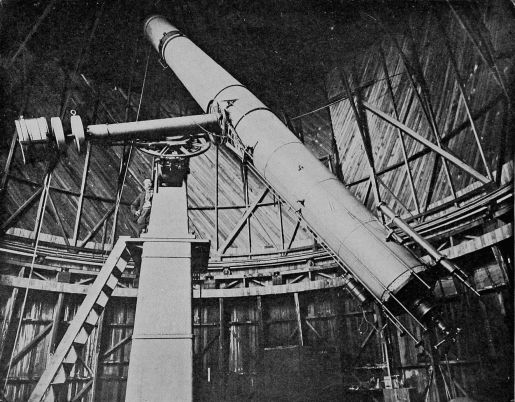
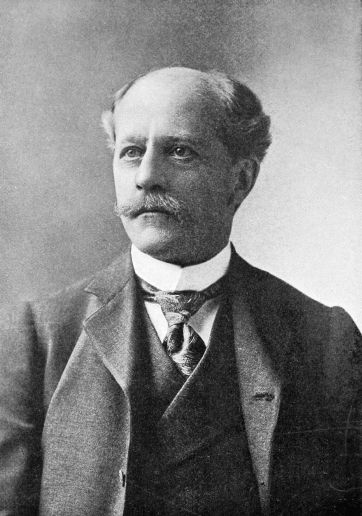
Among those who assert that the canals are artificial
we have Professor Percival Lowell as pre-eminent.
He has erected an observatory in the
region of one of the clearest atmospheres in the
world, has furnished it with the finest telescope
that Clark ever made, and for the chief purpose
of studying the surface features of Mars. In his
interesting book on Mars he has presented the
results of his observations in so lucid and convincing
a manner that a reviewer of the English
edition of the work, in an English astronomical
journal, is led to write: "We may say at once
that we feel bound to accept these observations
as sufficient evidence of the real existence of the
markings without expressing an opinion as to
what they may be." The reviewer ends by
saying: "Indeed, there is a subtle deftness in
the way Mr. Lowell deals with his observations
which gives the impression that he has been
there and seen it all, and it is really hard to say
why we cannot accept his conclusions. It is
probable, because we are shy to receive new facts
at a first statement. In time, no doubt, we
shall be willing to accept his deductions (or
facts) as to the markings. We were about to
advance objections, but they seem poor, and
really it is a case where each person must read
and form his own ideas—but by all means
read."
We have already presented a summary of his
observations. We may add here, however, an
extract from his book on the solar system. In
this Mr. Lowell says of Mars: "What we see
hints of the existence of beings who are in advance
of, not behind us in the journey of life,"
and again: "Life on Mars must take on a very
different guise from what it wears on the Earth.
It is certain there can be no man there—that is
as certain as anything can be. But this does
not preclude a local intelligence equal to, and
perhaps easily superior to, our own. We seem to
have evidence that something of the sort does
exist there at the present moment and has made
imprint of its existence far exceeding anything
we have left on Mother Earth."
George W. Morehouse, in his "Wilderness of
Worlds," says: "Taken all together we must
regard Mars as probably an inhabited world and
very similar to the Earth."
Mr. Hector Macpherson, Jr., member of the
Astronomical Society of France, in his interesting
book "Astronomers of To-day," says, in regard
to Mr. Lowell's book on Mars: "He does
not ask us to believe anything fantastical or
extravagant. His hypothesis has been framed to
account for all the various Martian features.
At present we can only say that it is the most
comprehensive and probable theory yet advanced
to explain the phenomena of the red planet."
Professor Todd, Director of the Astronomical
Observatory at Amherst College, in his book on
Stars and Telescopes, in referring to drawings of
a region in the southern portion of Mars, known
as the Solis Lacus, and a complicated drawing of
another region, says: "Whether one views this
marvellous and intricate system as a whole, or in
some portion of high detail, it is difficult to
escape the conviction that the canali have, at
least in part, been designed and executed with a
definite end in view."
There are many who do not deny the existence
of some forms of life on the planet, but are not
prepared to admit the existence of intelligent
creatures. Sir Robert Ball expresses himself as
follows: "That there may be types of life of
some kind on Mars is, I should think, quite
likely."
The number of astronomers above quoted, who
have seen and drawn the canals, might be
augmented, but a sufficient number have been
cited to show that the evidence of the presence
of these markings does not rest with a few,
furthermore, some of these observers can only
interpret the markings as the result of intelligent
action. It may be urged that among those
quoted are some whose opinion may not have
great weight since they are not professional
astronomers. One must insist that the study of
planetary markings as well as the interpretation
of their meanings comes not only within the
province of planetary astronomers, but that any
broad-minded man, with an acute eye and familiar
with the sciences connected with the surface
features of the Earth, is quite competent to make
observations of his own and to judge of the
merits of the question.