OF the great blank that came into my life I can recall but little. I
have dim memories of the strange fancies I had during that time, but how
long it lasted I cannot say, or at least I had no clue when at last
reason reasserted itself. I have cause to believe since that it must
have been nearly two years. I do not think I was unhappy during that
time, and I suppose I had more than my natural strength and skill for
hunting. Often Azolta and Zolca, and sometimes Paul, were with me in my
distorted imaginings, but these ghosts never came at the same time; even
a madman could not imagine that.
When my senses returned—and they came back suddenly—my first discovery
was that I was lying on the sand of a strange shore. I looked around,
but all was new to me. I remembered everything of the flood that had
happened, but it seemed only yesterday that it had occurred. How then
did I come where I was?
I rose and began to pace the beach. I was naked, but beside me, where I
had been lying, was the old cutlass covered with rust. The tide was low,
and had left many large pools in the rocks; looking into one of these I
started with dismay, for I thought I was the victim of magic.
My hair, long and matted, hung down my back; my beard had grown far down
my breast, and both hair and beard were white as the foam of the sea! I
was burnt a deep brown by the sun, and my eyes seemed to look back at me
from the glassy water with an unnatural brightness. This is what
Nature’s mirror showed me, and I could scarcely credit my senses.
I walked up and down, and exhausted myself in speculations regarding
this wondrous transformation, but could only at last come to the
conclusion that I had been wandering about in a demented condition for
some time. But for how long? And above all where was I?
It was early in the morning, and the sun was on my right hand as I
looked seaward. I was, then, on the northern coast of Terra Australis,
and must have made my way up with some mad idea of reaching Java.
I found a pile of shell-fish I had collected, and a smouldering fire; so
that I must have been amongst the Papoos and got fire from them, and
carried a burning stick with me always, after their fashion.
I roasted the shell-fish on the coals and ate them with satisfaction,
for I was hungry. Searching about I came on a spring of fresh water,
emerging from the bank where it met the beach. Of this I drank heartily,
and then, climbing the bank, looked around at the new country where I
found myself. An open plain, with many of the tall, white mounds on it
made by the ants, ran back for some distance, and beyond, many miles
away, rose a lofty tier of mountain ranges higher than any I had yet
seen in Terra Australis. These lay to the south; had I crossed that
great barrier during my madness? I know now that I must have done so.
There was no smoke to be seen anywhere, no sign of life, and I returned
to the beach and sat down to try and think out the past. But, beyond the
point I have recounted, my memory failed me, and I found that it only
fatigued me to try and piece my scattered fancies together.
I desisted, and went along the shore to gather food. I was fortunate
enough to find a large fish, stranded by the tide, in a hole in a flat
rock, and in addition easily obtained a large quantity of shell-fish.
I returned to my lair where the fire was smouldering, gathered wood to
keep it burning all through the night, and when darkness fell, lay down
to sleep on the sand. All fear or dread of loneliness had departed, I
felt almost contented as I lay and watched the beautiful southern
constellations, until sleep gradually stole over me, and I slumbered
dreamlessly until morning. The air was soft and balmy, and the sun just
rising when I awoke. There was a little ripple on the water and I stood
gazing out on the peaceful scene, and drinking in the fresh morning air.
I felt strong and well, refreshed by my night’s sleep, and turned to go
and hunt for my breakfast.
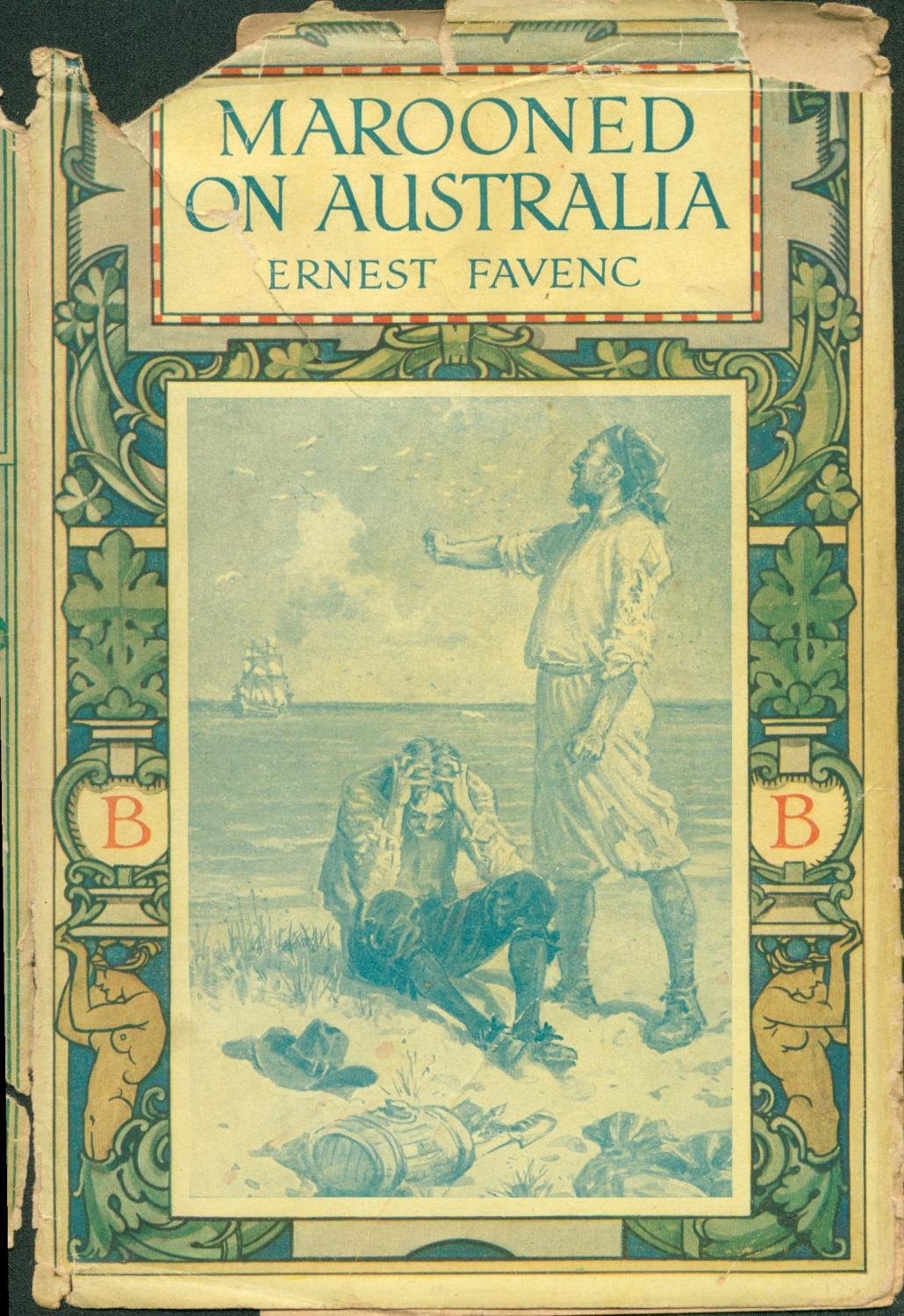
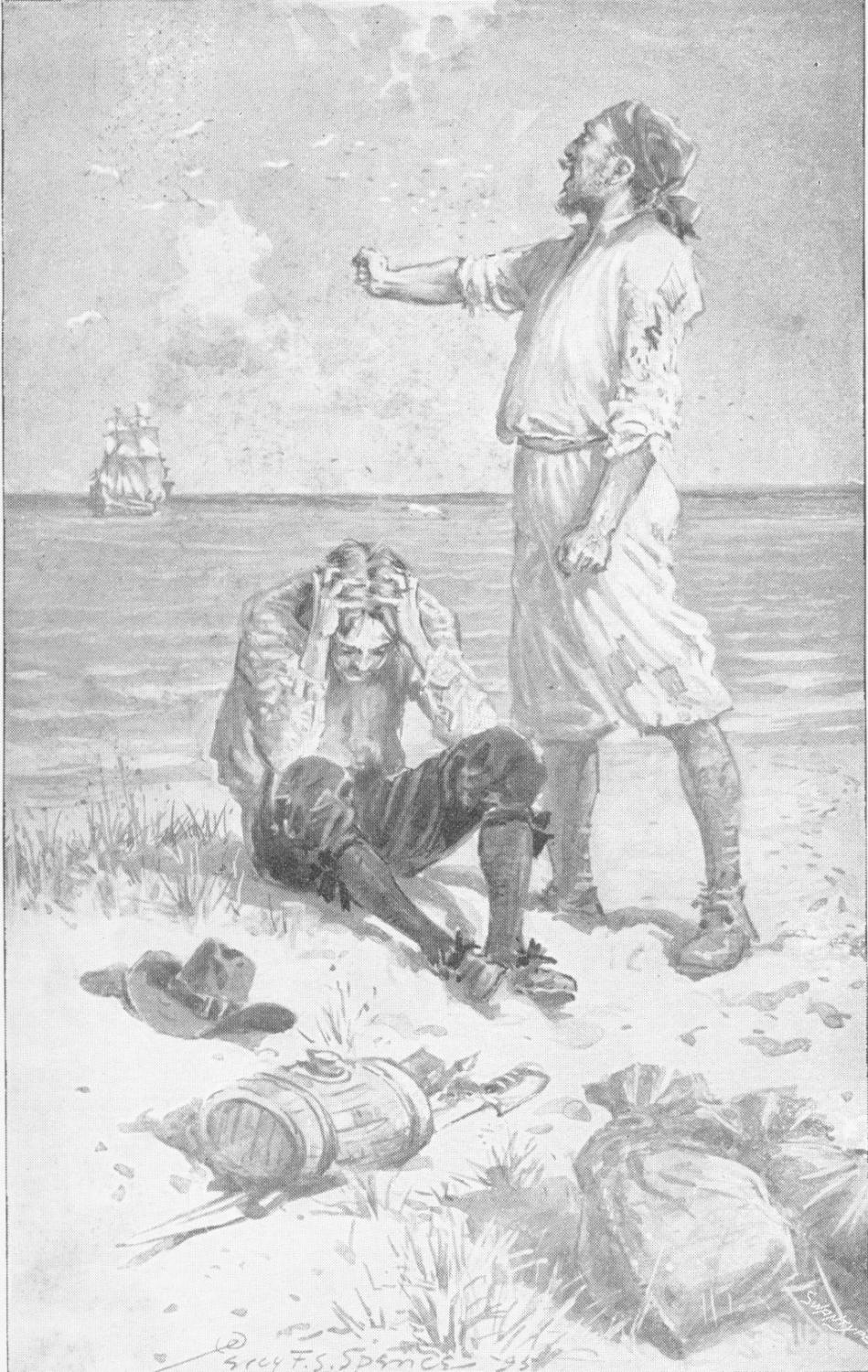
But what was that! I gasped with astonishment and then—shouted for joy!
Three large ships, standing close inshore, were coming up slowly from
the eastward. I ran to my fire and piled all the wood on I had, then
gathered green boughs, bushes, and anything that would make a good
smoke. I worked hard at this until I had a dense column of smoke
ascending in the now calm air; for the light breeze had fallen on the
land, although out at sea the ships seemed to still carry it, for they
were nearly abreast of me before it dropped altogether, and they furled
their sails and anchored.
I felt confident they would send ashore for water, even if my smoke did
not attract them, which they might put down to the Papoos. I was right;
two or three boats were soon coming towards the land.
As the foremost one neared the shore I went to meet it. The men lay on
their oars, and stared at me with fear and amazement; and no wonder, for
I must have presented a strange figure indeed, with bronzed body,
flowing white hair and beard, and in my hand the rusty cutlass.
I shouted to them in Dutch, and the officer immediately ordered the men
to pull in.
“Who are you?” he demanded.
“I am Diedrich Buys,” I returned, “and have been living in another part
of this country for many years.”
“Diedrich Buys! Why, we have orders, I believe, to call at your
settlement and see if you require anything.”
“My settlement exists no longer,” I replied sadly, and shortly told the
officer of the calamitous flood that had overwhelmed us.
“You must come on board to De Witt at once,” he said. “Is there any
water about here?”
I pointed out the place and, after directing the men to it, we were
rowed back to the ship, the officer handing me a large cloak to cover
myself with.
Once on deck the officer led me to a dignified looking man, who with the
others was staring at me in some amazement.
“Captain De Witt,” he said, “this is Herr Diedrich Buys, whom I have
been fortunate enough to rescue from these barren shores.”
De Witt stepped forward, and shook me warmly by the hand.
“I see,” he said, “that some terrible misfortune must have happened; but
before you say anything, you must first be clothed and refreshed.”
At a word from him the officer conducted me to a large, roomy cabin,
under the high poop. Here a sailor brought in a tub, which he filled
with salt water, and the officer, who had gone away, returned with a
suit of clothes, shoes, and linen. I enjoyed the bath, and found that
the clothes fitted me to perfection. When nearly dressed, the captain’s
servant came to the door, bringing with him comb and scissors. He cut my
luxuriant locks off, and reduced my beard to the short, pointed peak now
worn.
When I emerged from the cabin, and saw myself in a large mirror there
was in the main cabin, I could scarce believe in the transformation.
Refreshment had been provided, and after partaking of some the officer
who had brought me on board came down to conduct me on deck. I saw him
give a start at my appearance, then he laughed cordially.
“Truly, Herr Buys, you look more like the man described by Captain
Hoogstraaten than you did some short time back.”
I smiled in return, and we went on deck.
Here we found the captains and some of the officers of the other two
ships, who had been signalled to come on board. Grave, dignified men
they all were, as befitted the scientific navigators of a great maritime
nation.
De Witt presented me to them, and I told my tale. There were many
expressions of sorrow and sympathy at the extinction of such an
interesting race.
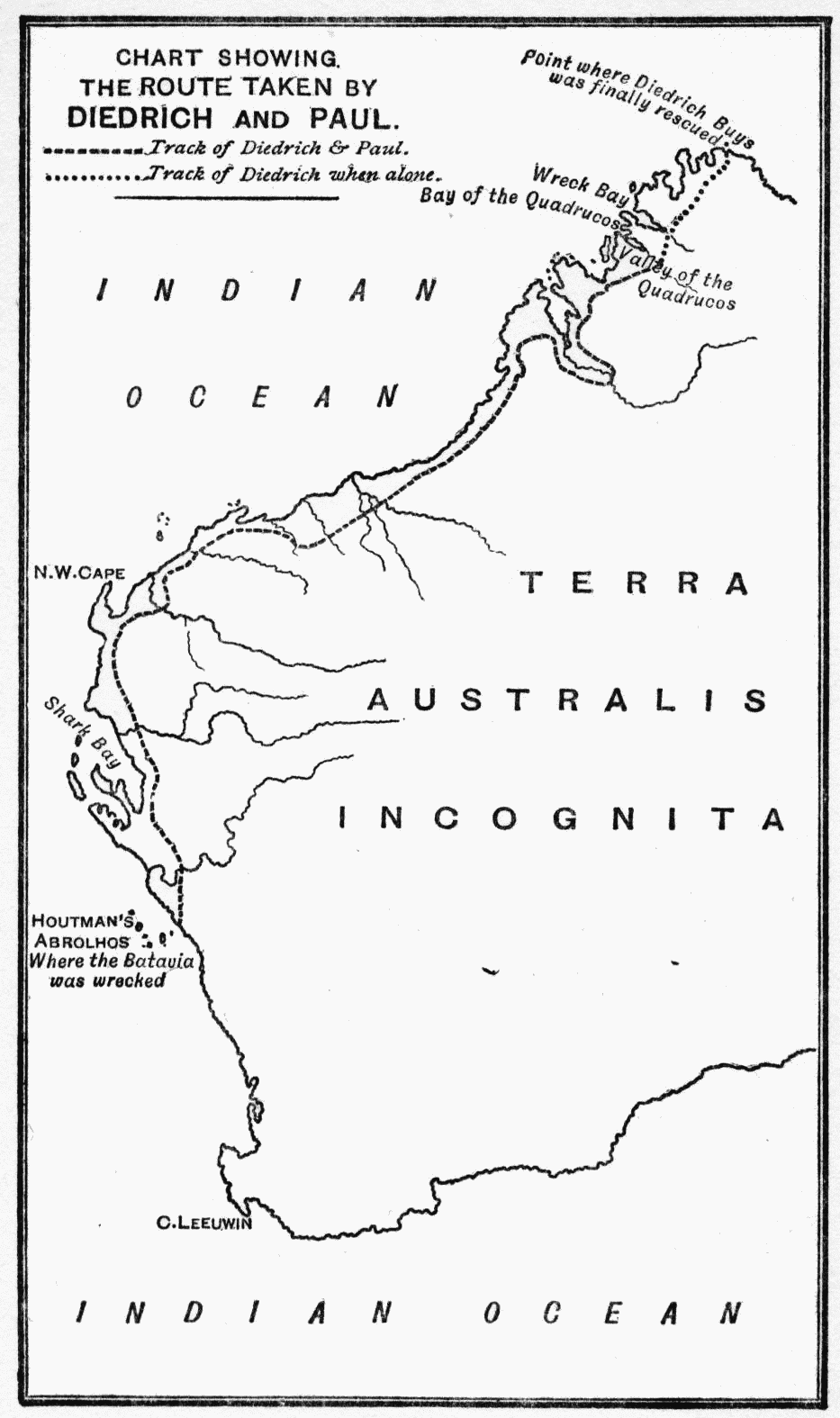
The chart compiled by Hoogstraaten was then produced, and our situation
found. The valley of the Quadrucos was marked on it, and we found that,
if I had come in a straight line, I must have come over three hundred
miles, whereas I probably wandered about and made it three or four times
as much.
On inquiry, I learned that Hoogstraaten had left the Company’s service,
and now lived on his estate in Holland.
The ships being watered, and a fair wind having sprung up, we made sail,
and in time came to Wreck Bay. Here we landed, and found that it had
suffered like the other bay, and that every vestige of the old
encampment had been obliterated. Making sail once more we finally
reached the bay of the Quadrucos, and I piloted the ships in.
De Witt and the others landed to visit the valley, but I could not bear
to go. Instead, I made a journey to the graves of my lost ones; I found
them untouched, and knelt down and shed some bitter tears over them.
The party which had gone to the valley did not return until late, as I
had told them of the upper portion, where probably the cocoa-nut trees
had not been destroyed. This proved to be the case, and we were able to
obtain a good supply from there for all the ships.
De Witt told me that, but for knowing the truth, he could not have
believed that the town had ever existed. Luxuriant grass, up to a man’s
waist, now grew all over the site. The only relics they had found were
two or three of the roughly-made Quadruco swords. We visited the
batteries, and De Witt had the two brass cannons conveyed on board his
vessel.
“These are your private property, Herr Buys,” he said, “and it is no
good leaving them here for the Mongols; the Company will pay you good
rix-dollars for them when we reach Batavia.”
Next morning early we sailed, and I said farewell for ever to the bay
where I had undergone so many vicissitudes, and to the desolate land of
Terra Australis or New Holland, as I now heard it was called.
As De Witt’s discovery-voyage had been on the north coast of the great
continent, and he had only been instructed to call at the Quadruco Bay
to see how we were progressing, his work was over, and we shaped a
straight course to Batavia.
I was cordially welcomed by the Governor, who obtained for me a passage
in a homeward-bound ship, and furnished me with letters to influential
people in Holland. Having bade good-bye to my many kind friends, I
sailed for home.
The voyage was uneventful; and after some months I found myself once
more in my native Harlem.
I put up at a tavern and made inquiries as to my family. Alas! I found
that a sickness, which had visited the town some years back, had carried
off my father, mother, and elder brother—in fact, they had died soon
after Hoogstraaten’s visit. My father’s estate, which was somewhat
considerable, had descended, in my absence, to my young brother, who was
but a child when I left home in the ill-fated Batavia. I turned my
steps towards my home and asked for my brother.
I was shown into his private office. I found him a young man with a
somewhat hard face, who gazed curiously at me and asked my business.
“I am your brother Diedrich,” I replied, “just returned from Batavia.”
He sprang up from his chair, to welcome me, as I foolishly thought, but
it was quite otherwise.
“I know no brother Diedrich!” he cried. “There was one of our family of
that name, but he is an outlaw, and dare not show his face in Holland.
You are some impostor who has heard of him, and come here to claim my
property.”
“I never thought of your property,” I returned hotly. “I am no impostor,
and no outlaw; I have long since been pardoned for a crime I never
committed.”
“I will not listen to you,” he said nervously; “I do not believe you.
When we last heard of my brother he was living with a tribe of savage
Indians in some wild country, and he is there still. Leave this house,
or the servants shall thrust you out.”
I stepped up to him in red-hot rage.
“Since this is my reception I will assert my rights. I will leave my
house now, and when I return it will be you who will have to leave. Look
here!” I went on, drawing from my pocket the letters I had from the
governor of Java, which I had not yet delivered; “does an impostor
usually carry such credentials as these?” and I showed him the
superscriptions, and the great seal of the Company on the back.
He blenched visibly, and muttered something about “forgeries”. I gave
him a look of contempt, and left the house.
I was cut to the heart. From savages, from strangers, from everyone,
even pirates, I had received gentle, kindly treatment, and now my own
brother, my sole relation, cast me out as an impostor seeking to rob
him.
A handsome, richly-dressed man came by and gazed curiously at me, as
many people did on account of my dark face and white hair and beard. He
turned, followed, and spoke to me.
“What ails it, friend?” he asked, in a cordial voice. “You look like a
stranger, and one who has travelled far and suffered much, and in such
men I am always interested.”
I looked at him, but there was nothing in his face but the most manly
sympathy.
“True! I have travelled farther than most men, and suffered more,” I
replied; “but never so much as I have during the last half-hour.”
He gazed earnestly at me, and then at the house I had just left.
“That is the house of the merchant Buys,” he said, “and you—surely it
cannot be that you are Diedrich, of whom my dear friend, Captain
Hoogstraaten, has so often told me.”
“I am Diedrich Buys,” I replied.
He held out both hands and shook mine warmly.
“I am Count Van de Burg,” he said, “and you must at once return home
with me, and tell me your tale at leisure.”
I accompanied him to his mansion, and on the way asked after
Hoogstraaten.
“He lives on his estate outside of Amsterdam,” he returned, “where we
will soon visit him, and also see the great chart of his voyages laid
down in the Groote Zaal in the Stadhuys of that city.”
The count, I found afterwards, was an enthusiatic patron of
oversea-discovery. He was the soul of generosity, and no broken-down
sailor or penniless adventurer ever appealed to him for assistance in
vain.
I have little more to add. Hoogstraaten heard my account of the disaster
with the most profound grief and sorrow.
My brother, when he found what friends I had, surrendered at discretion;
but I merely took enough of my father’s property to supply my simple
wants.
I live near Hoogstraaten’s estate, and he and Count Van de Burg are the
only friends I have, or want; for my heart is far away in two graves in
the lonely land of Terra Australis.