Footnotes have been collected at the end of the text, and are
linked for ease of reference.
Minor errors, attributable to the printer, have been corrected. Please
see the transcriber’s note at the end of this text
for details regarding the handling of any textual issues encountered
during its preparation.
Information from the title page has been added to the blank cover image
and, so modified, is placed in the public domain.
Any corrections are indicated using an underline
highlight. Placing the cursor over the correction will produce the
original text in a small popup.
Any corrections are indicated as hyperlinks, which will navigate the
reader to the corresponding entry in the corrections table in the
note at the end of the text.
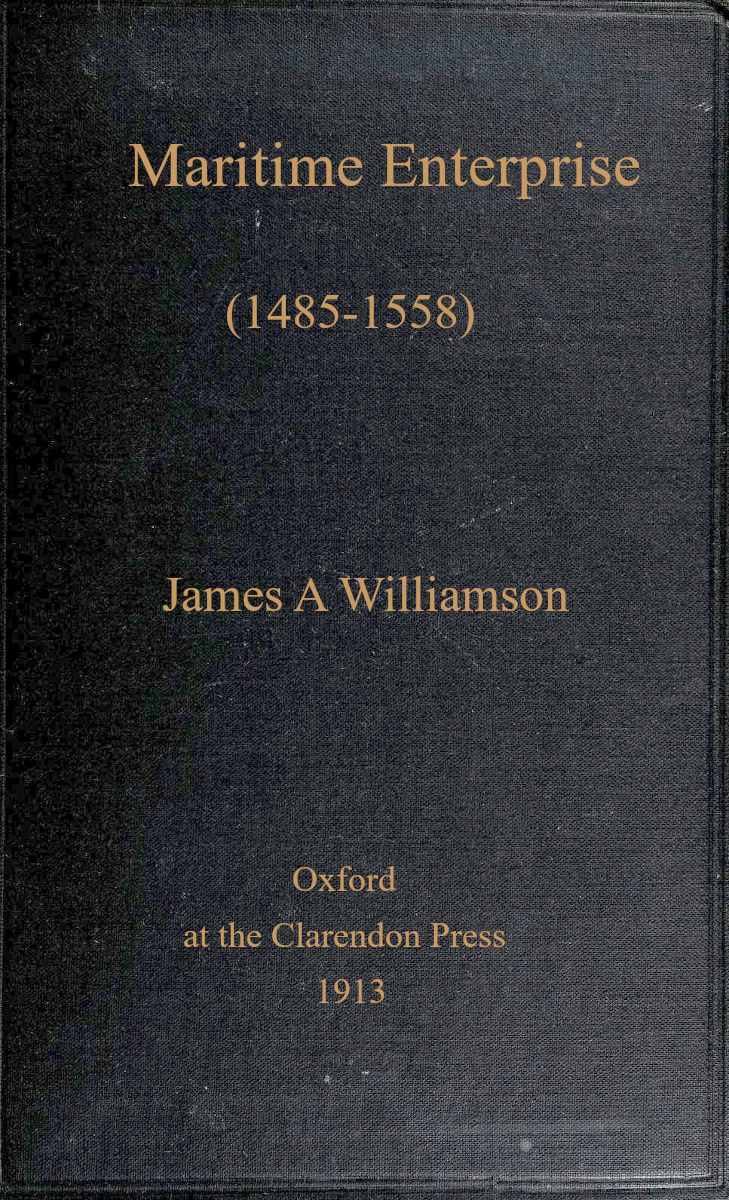
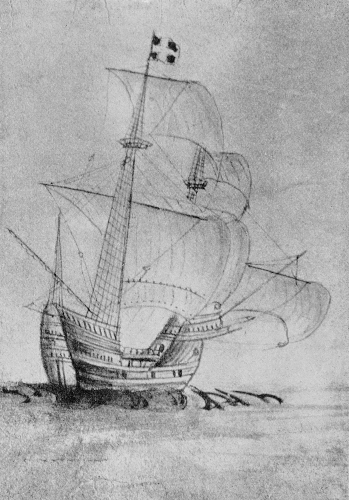
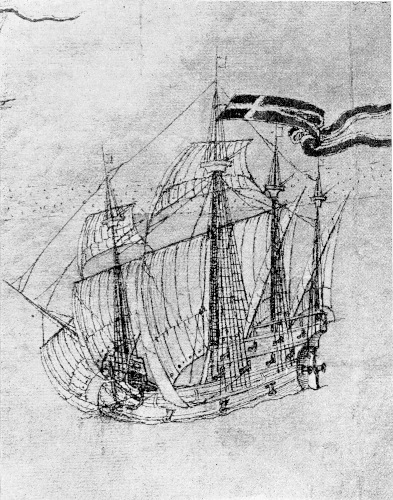
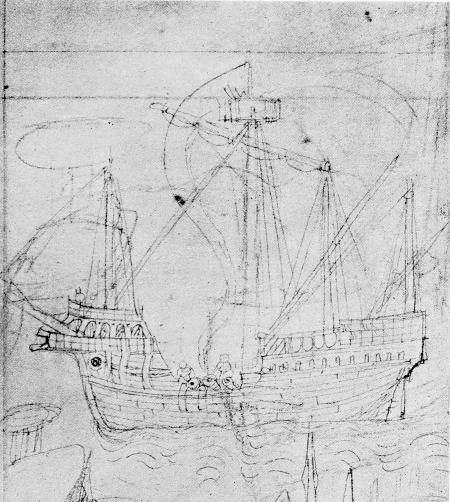
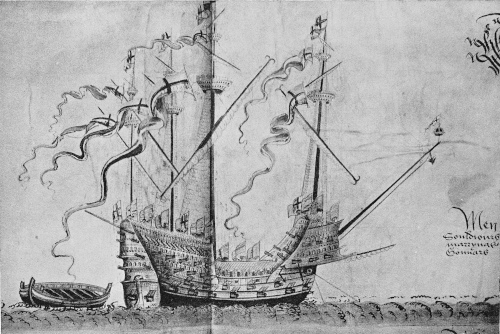
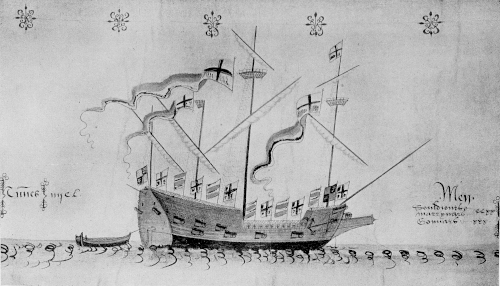
WARSHIP, Period 1514–45. From Cott. MS. Aug. 1. i. 18. Frontispiece
MARITIME ENTERPRISE
1485–1558
BY
JAMES A. WILLIAMSON
OXFORD
AT THE CLARENDON PRESS
1913
OXFORD UNIVERSITY PRESS
LONDON EDINBURGH GLASGOW NEW YORK
TORONTO MELBOURNE BOMBAY
HUMPHREY MILFORD M.A.
PUBLISHER TO THE UNIVERSITY
PREFACE
5
The subject of English maritime enterprise during the
period 1485–1558 falls naturally into two divisions—discovery
and trade. The former has engaged the attention
of numerous historians in the last thirty years, their
works centring mainly on the voyages of the Cabots
with subsequent exploring adventures more or less summarily
treated. Commerce, on the other hand, has been
somewhat neglected as a factor in that great development
of the powers of the English nation which made itself
evident in the sixteenth century. The only exhaustive
book on the maritime trade of our country in the period
in question is that of G. Schanz,[1] published in German
in 1881, and never translated into English. This work
stops at the year 1547.
The object of the present work is to present a comprehensive
picture of English maritime affairs from the
accession of Henry VII to that of Elizabeth; to trace
out such lines of policy as are visible in the existing
records; and to elucidate certain incidents concerning
which disputable ideas, or no ideas at all, are current.
With regard to the Cabot voyages, no new evidence
is adduced, but a scientific criticism and analysis of that
already known has been attempted; leading, in the
author’s opinion, to the partial rehabilitation of the
character of Sebastian Cabot. The evidence in favour
of his independent exploration in the North-West seems,
6when properly discriminated from other matters with
which it has been unjustly confused, too strong to be
neglected.
The later voyages of discovery under Henry VII, and
those under Henry VIII, have been as deeply entered
into as the scanty surviving evidence permits. The debt
which our maritime expansion owes to the last-named
monarch is emphasized by the fact that most of the
projects of his reign owed their origin to his initiative,
acting in despite of popular apathy.
With the trading voyages to Brazil, the African coast,
and the North-East the new era of national expansion
was entered upon. On these matters the Record Office
possesses numerous documents which supplement the
printed sources of information. The negotiations concerning
the Guinea voyages furnish an illustrative sidelight
on the actual influence exercised by King Philip
over the conduct of English affairs.
In the chapters on commerce under Henry VIII and
his two successors the development of the various branches
of trade, and their relation to diplomacy, have been outlined,
but many details have been necessarily omitted.
The circumstances attending the fall of the Hansa in
England are here fully stated for the first time.
For purposes of reference a chapter on the naval
history of the period has been added. The connexion
between the naval service and the mercantile marine
was perhaps closer in Tudor times than at any subsequent
period. Officers, men, and ships served alternately in
the one and the other; and the navy itself was more
of the nature of a marine militia than of a regular force.
The reign of Henry VII marks the opening of the
modern era in the history of the English nation, the
period in which, from being an agricultural and military
people, we have become transformed into a maritime
and commercial community, with interests stretching far
beyond the shores of our immediate neighbours on the
continent of Europe. Throughout the Middle Ages all
the strivings and ambitions of England were concentrated
on the conquest, by force of arms, of the surrounding
countries—of the remaining parts of the British Isles at
first, and afterwards of France. With a hardy and
independent peasantry and a fierce and warlike baronage,
it could scarcely have been otherwise. English kings
found themselves obliged, for their own preservation, to
put themselves at the head of such movements, and those
of them who were unable or unwilling to do so were
continually menaced by the turbulent elements to which
they refused an outlet.
This system of violent expansion, successful in the
cases of Ireland and Wales, and not seriously pursued
in that of Scotland, proved to be its own destruction
when applied to France. Although a military conquest
might endure for a time, it was impossible that England
could permanently absorb a nation larger than itself, of
different blood, language, and manners of thought, in
the same way that Wales had been absorbed. When
14Henry V commenced his wonderful career of conquest
the sentiment of nationality was already too well established;
and the long struggle, which ended forty years
later in the expulsion of the English from France, consolidated
that sentiment, and rendered the renewal of
such an attempt for ever impossible of success. But
just as France had developed from a mere geographical
area into a nation in the modern sense of the word,
so also had England, although much remained to be
done before her development could proceed on truly
national lines. The Wars of the Roses, protracted, with
intervals of peace, for thirty years, cleared away much
of the remaining débris of feudalism; and at their close
Henry VII came forward as the first king of modern
England. The old ideals, the old national instincts, and
the old social order had gone, or were in process of
dissolution; and the work of his reign consisted in forming
new ones and giving direction to that universal
awakening of the human mind which now first began
to make its influence felt in the practical affairs of the
English nation.
As with all changes of deep-rooted and far-reaching
importance, its results were slow to manifest themselves,
and were scarcely apparent to many of the greatest
minds of the time, bred up to the old order, yet nevertheless
working unconsciously in the furtherance of the
new. The king himself, who did more than any other
man to usher in the new era, and whose policy has been
followed, with intervals of retrogression, almost to our
own time, may well have been unaware how greatly he
differed from his forerunners, and there is nothing in
his recorded utterances to show that he realized the
significance of the change that was taking place. In
15fact, as compared with many of the more flamboyant
statesmen who followed him, he must have appeared
slow and conservative, a survival of mediaevalism rather
than a man of the Renaissance. Like the evolution of
the natural world, that of imperial Britain has been
largely unconscious, and measures which owed their
origin to expediency and the needs of the moment have
frequently hardened into enduring elements of the
national system. Let us then examine, from this point
of view, one aspect of the reign of the first Tudor—his
commercial policy; bearing in mind that, although he
himself was concerned only with the immediate welfare
of his family and country, his work was of such a character
as to serve as the foundation for an edifice upon which
the passage of four Centuries has not yet placed the
topmost stone.
European commerce, down to the age of the great
geographical discoveries, hinged upon two great trade
routes and two great producing areas, the one of manufactured,
and the other of raw, material. To these four
dominant factors all subsidiary avenues and crafts owed
their origin and continued existence. The two primary
trade routes were: first, that connecting, by way of the
Levant and the nearer East, the Italian cities with
the vaguely known and fabulously portrayed wealth of
southern Asia; and second, that by which the hardy
merchants of the Hanseatic League conveyed the produce
of the Baltic shores, of Scandinavia, of the wide plains
of Muscovy, and through them the far-fetched wares of
Persia and Cathay, to western Europe, which region,
stimulated by amenities whence the indolent mind of
Asia drew no profit, inevitably became the centre of the
world’s progress. Nothing for nothing being a universal
16law, Europe had to find something of her own to exchange
for the furs of the North and the spices of the East.
The cities of the Rhine delta supplied, in great part,
the indispensable quid pro quo, by devoting themselves to
a variety of manufactures amongst which that of cloth
assumed a position of paramount importance. Here,
then, arose the first producing area necessary to the
balance of the mediaeval trading system; England constituted
the second and equally indispensable one, for
she alone, secured by the sea from the worst scourges
of war, could supply the raw material for the cloth
industry. The generous wool-sacks of England became
her title of entry into the ranks of the progressing nations
of the world.
Already, before the dawn of the new era, England had
begun to manufacture a portion of her wool into rough,
inferior qualities of cloth, but, until the awakening under
the Tudor dynasty, she cannot be said to have realized
the possibilities of her position. The Hanse merchants
and the Italians were in possession of the bulk of her
foreign commerce, and only a few subsidiary trades were
in the hands of Englishmen, whose education and ability
in such matters were inferior to those of the foreigners.
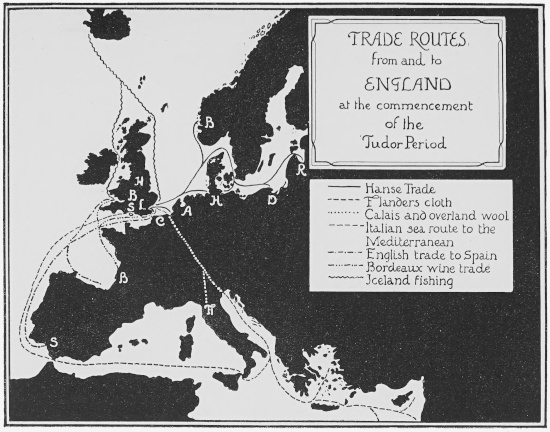
TRADE ROUTES from and to ENGLAND at the commencement of the Tudor Period.
A more detailed consideration of the lines of communication
with which England was immediately concerned
reveals four main commercial avenues, all forming
part of the great general system already described: the
trade with Germany and the Baltic, chiefly controlled
by the great Hansa, whose tentacles spread from Riga
to the Rhine; the export of half-made cloth to Flanders,
shared between the Hansa, the Flemings, and the English
Merchant Adventurers; the wool export, to Calais by
the English Staple Merchants, and overland to Italy
17by the Venetians and Florentines, who maintained business
houses for that purpose in London; and the long
sea route for wools, wines, and spices, to and from the
Mediterranean, again monopolized almost exclusively by
the Italians. In addition there were minor, but nevertheless
much frequented, trades to Spain for wines and
oils, to Gascony for wines, and to Iceland for stock-fish.
The two last mentioned were more exclusively in the
hands of Englishmen than any of the others.
These mediaeval trade routes, although destined to be
profoundly modified by the great extension of the limits
of the world as known to Europeans, remained of paramount
importance for more than a century to come,
and Henry VII set himself to the policy of ousting
foreigners from their control, and of fostering, by every
means known to his statesmanship, the mercantile enterprise
of his own people.
One of the shrewdest business men who ever sat upon
a throne, he had no doubt studied and admired the
commercial system of Venice. That state, which existed
solely by means of and for the purpose of trade, maintained
her ascendancy by a fiscal policy which combined
rigorous protection with a species of socialism undefiled
by any morbidly altruistic ideas. All the familiar weapons
of modern protection—preferential duties on goods from
Venetian dependencies, navigation laws to encourage
Venetian shipping, retaliatory tariffs against rivals, and
reciprocal arrangements with such as were disposed to
be reasonable—were to be found in the armoury of
Venice, and were applied with an unquestioning assurance
as to their efficacy, only possible in an age when the
doctrines of free trade were yet unborn.
In addition there was in Venice an absolutely complete
18subordination of the individual to the interests of the
State. If the export or import of a certain article was
considered prejudicial to the welfare of the city, that
trade was stopped forthwith; if the clothworkers of
Venice were short of raw material, shipmasters coming
from England were ordered to load with wool and
nothing else; if the State galleys for the Flanders
voyage had difficulty in completing their cargoes, those
who preferred to ship their goods in private vessels were
forced to pay half or quarter freights to the official ships
as well; since it was desirable that Venice should possess
a large commercial navy, the overland conveyance of
certain wares was forbidden or subjected to paralysing
duties. Such are a few examples of the working of an
undemocratic republic, of a type which may never be
seen again, but which was eminently suited to the needs
of its time. And the secrets of the success of this
unparalleled interference by the State with individual
rights? They were two: first, magnificent discipline,
ready obedience enforced by severe penalties; and
second, an elasticity of method, an instant variation of
policy to meet varying conditions, which could only have
been carried out by an assembly of level-headed, patriotic
merchant-statesmen, such as filled the benches of the
Venetian senate.
Henry VII, then, had before him a pattern of successful
mercantile policy, but he was under no illusions
as to his powers of enforcing such a discipline on England.
Although he far exceeded him in subtlety of mind, he
lacked the ferocious mastery of men which his son was
afterwards to display. He had to make up his mind to
work slowly and cautiously, to be content to sow that
others might reap, to lay sure foundations for the greatness
19of his family and of the country with which its
interests were bound up.
Generally speaking, the policy of the Middle Ages had
been, in the interests of cheapness, to encourage foreign
merchants of all kinds to bring their goods to England,
and to establish factories in her ports; in many cases,
even, aliens had been granted privileges exceeding those
of native traders, and consequently the trade of England
was largely in foreign hands. Henry soon gave signs
that this policy of cheapness was to be abandoned. His
first Parliament passed an Act[2] prohibiting the import
of Bordeaux wines in other than English vessels, manned
by English crews. To avoid friction, the too sudden
application of this law was mitigated by the frequent
granting to foreign merchants of licences to break it.
But these were exceptions; the rule remained, and the
grants of licences gradually diminished.
While determined to advance the general interests of
his subjects, he was always ready to conclude commercial
treaties conferring a mutual exchange of benefits; and
he sought, wherever possible, to draw mercantile advantages
from his handling of purely political matters. The
commercial relations of England and the Netherlands
form an illustration in point. In 1493 there was a serious
quarrel on account of the support given to Perkin Warbeck
by Margaret, the widowed Duchess of Burgundy
and sister of Richard III. Henry’s retaliation to her
vindictive encouragement of his enemies consisted in
ordering the cessation of all intercourse, and the removal
of the Continental head-quarters of the Merchant
Adventurers from Antwerp to Calais. Uninterrupted
trade with England was essential to the prosperity of the
20Netherlands, where a large proportion of the craftsmen
were employed in dyeing and finishing the rough English
cloth. There was on both sides great distress in commercial
circles, and unemployment due to the loss of
trade; but the inconvenience thus caused, while considerable
in England, was intolerable in the Netherlands,
and the result was the negotiation of the famous Magnus
Intercursus of 1496, followed by supplementary treaties
in 1497 and 1499.[3] By these treaties tariffs were reduced,
fishing rights regulated, and many vexatious restrictions
abolished; in addition, Henry secured the political
object for which he had undertaken the struggle. When
the English cloth merchants returned to Antwerp they
were received with public demonstrations of joy.
The English king, although willing to make concessions
when such were inevitable, showed himself remorseless
in seizing an accidental advantage. In January 1506 the
Archduke Philip, who had succeeded to the throne of
Castile on the death of Queen Isabella in 1504, set out
from Flanders to Spain by sea. In the Channel he
encountered a furious storm, and, after all on board had
given themselves up for lost, his fleet reached the shelter
of Weymouth. Contrary to the advice of his captains,
he went on shore. The country people, seeing the
arrival of strange ships and armed men, gathered to
resist an enemy, but, finding him to be a friend, they
made him welcome. Sir Thomas Trenchard, a most
astute gentleman of the neighbourhood, offered him
entertainment, and sent off post haste to acquaint King
Henry of the prize which fortune had cast on his shore.
21Philip now realized his rashness and would have been
glad to depart, but was earnestly entreated by Trenchard
and his friends to stay and speak with the king. Fearing
that if he insisted their courtesy would give place to
force, he put a good face on the matter and professed
himself delighted to remain. Henry sent the Earl of
Arundel, with many lords and knights, to bring him to
Windsor with his wife Juana.
He was paraded through London and, as the price of
his liberty, had to agree to a commercial treaty which
settled outstanding questions in such a one-sided way,
and admitted English cloth at such a cheap rate to the
Netherlands, that the defrauded Flemings named it the
Malus Intercursus.[4] In those times shipwrecked voyagers
received scant compassion, and Henry was only taking
the same advantage on a large scale as his unscrupulous
subjects took on a smaller one when they stole the
cargoes from stranded ships. Philip died without ratifying
the treaty of 1506, the details of which were not
completed until after he left the country, and relations
became unsatisfactory in consequence. Margaret proposed
to resume trade on the terms of the Magnus
Intercursus, but Henry was unwilling to forgo his hard
bargain. Finally, a compromise between the treaties
of 1496 and 1506 was agreed upon, the customs payable
by Englishmen in the Netherlands remaining on the
basis of the latter. The question of the legal validity
of the Malus Intercursus remained unsettled, the matter
being postponed from time to time by the issue of provisional
ordinances for its maintenance. As late as 1538
the Netherlanders were still demanding its abrogation.[5]
22An important trade existed between England and
Spain and, at the beginning of Henry’s reign, it was
largely in the hands of Spanish merchants, a number
of whom resided in London. The customs duties
had long been in an unsettled state, and were the
subject of an arrangement included in the Treaty of
Medina del Campo, 1489.[6] It was provided that the
subjects of either country might travel, reside, and
carry on business in the other without a passport,
and should be treated in every way as native citizens.
Customs duties were to be reduced and all letters of
marque (i. e. private reprisal for injuries) revoked. There
were also other clauses intended for the suppression of
piracy, a subject which will be referred to later.
That such treaties were often broken is proved by
their frequent renewal; and indeed, the signing of
a treaty was more often the signal for a commencement
of wranglings as to its interpretation, than a token of
settlement. In the case in point it had been agreed
that customs were to be reduced to what they had been
thirty years before. The intention was plain, but Henry
discovered that the English duties had been higher at
the date mentioned than at the time of the treaty, and
he promptly increased them, although the Spaniards
protested that they had lowered theirs. The dispute on
this point dragged on for many years, and references to
it occur at intervals in diplomatic correspondence until
the marriage of the Prince of Wales and Katherine of
Aragon. A curious fiscal argument occurs in a letter
from Henry to the Spanish sovereigns in 1497.[7] He says
that the effect of the high duties is that Spaniards sell
their goods at a high price in England, and so are enabled
23to obtain more English cloth with the proceeds than
they could otherwise do. Thus the duties are paid by
the English, not the Spaniards. An excellent sermon—for
other people—on the disadvantages of protection!
Although anxious to foster English trade and enterprise
to the utmost, Henry could not afford to neglect
his dynastic interests, and the latter were of paramount
importance in his dealings with Spain. His title was
weak and his enemies strong, and, during the first part
of his reign, it seemed quite likely that he would perish
in a feudal revolution as four of his predecessors had done
in the space of a century. To remedy the instability of
his throne he was sometimes obliged to make use of
commerce as a weapon or a bribe, as opportunity offered.
An instance of the first was seen in his dealings with the
Netherlands; the negotiations for the Spanish marriage
were an example of the second. The proposals and
hagglings with reference to this marriage dragged on for
years. Henry was eager for it. He was, in a sense,
a parvenu among the kings of Europe, and he felt that
it was a vital matter for him to establish his family
among them. Ferdinand and Isabella, on the other
hand, had great hesitation in allowing their young
daughter to be exiled among the English, whom the
Spaniards regarded as being socially and morally inferior
to themselves. In addition to this personal objection
they had another. They wished to procrastinate until
Henry should have disposed of his pretenders and given
proofs of the firmness of his throne. Hence his extreme
eagerness to lay Perkin Warbeck by the heels, which
embroiled him with the Netherlands in 1493. The
marriage being the keystone of his policy, he left no
means unused to bring it about, and so we find commercial
24relations employed by him as a screw with which
to extort the reluctant acquiescence of Spain. In 1496
he declared that he would come to an understanding
on the question of the duties after the alliance and
marriage should have been concluded. In 1497, in the
letter already quoted, he promised that Spanish traders
should have preferential treatment as against the Italians
in celebration of the happy arrival of the princess in
England, an event which was still to be delayed, as it
proved, for more than four years to come. One more
instance of the intimate connexion of politics and trade
may be given. In 1504 the Spanish Government prohibited
the export of goods from Spain in foreign vessels
so long as there were any Spanish ships unemployed, but
in consideration of the position of the now widowed
Katherine in England and of their desire to recover her
or her dowry, the English were exempted from the
application of this law.[8]
With Venice Henry VII was never on bad terms,
although for several years a brisk tariff war was waged
between the two powers. It arose from the action of
Venice in imposing an additional export duty of four
ducats per butt on malmsey wines loaded by aliens at
Candia. This was done under pretext of discouraging
the pirates of that region, but in reality for the purpose
of favouring Venetian shipping. Henry retaliated by
making Venetians pay 18s. per butt extra duty on
importing these wines into England, and by fixing a
maximum selling price of £4 per butt. A butt of
malmsey contained 126 gallons, and a gallon of the
wine thus cost about 7½d. in England. The differential
25duty and the maximum selling price threatened to squeeze
the Venetians out of the market, but the king went
further. He entered into negotiations with the Florentine
Government with a view to the establishment of an
English wool-staple at Pisa.[9] This would have constituted
the latter city the distributing centre for English
wool in the Mediterranean, and Venice would have been
deprived at a blow of an important branch of her trade.
The proposal seriously alarmed the Venetians, and they
threatened to discontinue the dispatch of the annual
trading fleet to England. It would have been manifestly
impossible for them to bring cargoes of spice to
England if they were debarred from loading wool in
return, especially as the export of specie from England
was prohibited. The Pisa project was probably not
seriously intended and was not persisted in, although
the appointment in 1494 of two English consuls in that
city, with full authority over English merchants, indicates
that considerable business was done there.[10] In the
end, after lengthy but quite dispassionate negotiations,
such as befitted business-like powers, Henry carried his
point and the wine duties were reduced.[11]
The prohibition of the export of money, and also of
gold and silver plate, from the realm was typical of the
economic ideas of the time. Gold was looked upon as
wealth in itself rather than as a means of exchange, and
this notion was strengthened as time went on by the
enormous apparent advantages which Spain derived from
her American conquests. It was an error which led Spain
to ruin, and would have been equally fatal to England
26if she had had the same opportunity to go astray. Fortunately,
Englishmen found themselves excluded from
the gold-bearing regions, and were driven to trade and
eventually to colonization instead.
To be successful as a merchant under the conditions
which obtained in the days when individual effort was
beginning to displace the rigid guild-system of the
Middle Ages, a man had need of alert wits, a stout heart,
and capital sufficient to enable him to withstand the
violent fluctuations of fortune. Even in times of peace
the risks were great, although undoubtedly the profits
of the successful were proportionate. Shipwrecks were
necessarily frequent on unlighted and practically uncharted
coasts; the trade routes were infested with
pirates and privateers; and commercial treaties were
broken almost as soon as made. The cautious trader,
before venturing his goods into a foreign country, was
careful to procure a licence or safe-conduct from the
Government, and even this did not always protect him.
If he could obtain the patronage of a powerful person,
he might contrive to avoid the payment of customs dues.
In 1492, when Henry VII imposed the prohibitive duties
on Candia wines, the Venetian merchants in London
were advised to distribute forty or fifty butts of the
wine, or their cash equivalent, as bribes in getting the
matter set right. Even State-owned vessels were not
secure from molestation, when sufficiently far from home.
In the same year, 1492, we read that Henry, being at
war with France, detained the Flanders galleys of Venice
to act as transports for his troops.[12] A powerful Government
might secure compensation for such an infringement
of its neutrality, but private merchants would have stood
27little chance of doing so. Conditions such as these
caused success to depend entirely on individual qualities;
and when once they took to the sea Englishmen were
not slow to develop that character for resource and
audacity which stood them in such good stead in the
long war with Spain at the end of the sixteenth century.
An incident which occurred in 1505 shows how little
reliance could be placed upon treaties by the persons
whom they were designed to benefit. On the strength
of an undertaking by the Spaniards, already mentioned,
that notwithstanding the navigation law the English
might freely export goods from Spain, a fleet of English
merchantmen went to Seville, with cargoes of cloth,
intending to come back with wine and oil. On arriving
there, they were forbidden by the local authorities to
export anything, and returned professing themselves
ruined. Their spokesmen petitioned the king, ‘with
much clamour’, for redress. Henry sent for de Puebla,
the Spanish ambassador, whom he suspected of duplicity
in the matter, and subjected him to a storm of furious
abuse. De Puebla must have passed a bad quarter of
an hour, but, as he remarked, he did not so much mind
as there was no witness to the interview. He explained
that the treaty, by a mistake, had not been proclaimed
in Andalusia. He wrote at once to King Ferdinand and
asked him that right might be done. A few days later
he reported that some members of the Privy Council
had visited him on the same matter and that he had
had a most unpleasant interview with them. He again
begged Ferdinand to give satisfaction, as the English
sailors were such savages that he went in fear of being
stoned by them if reparation were not made.[13]
28Piracy, as has already been noticed, was of common
occurrence, and was a great hindrance to sea-borne trade.
Surprising as it may seem, it was cheaper to send goods
from London to Venice by the overland route, up the
Rhine and across the Alps, than it was to send them by
sea. This was partly owing to the huge expenses incurred
for defence against pirates. One Venetian captain,
reporting his safe arrival in London, mentioned that,
fearing to be attacked, he had shipped a hundred extra
hands and twenty-two gunners, and that by their aid he
had beaten off the attack of a Norman pirate. Perhaps
the greatest piratical coup of the time was the capture
on August 21, 1485, of the entire fleet of Flanders
galleys. They were assailed off Lisbon by a force of
French ships, commanded by an officer in the service
of the French king. After a desperate fight, lasting
twenty hours, in which over four hundred Venetians
were killed and wounded, four large galleys surrendered.[14]
An enormous booty was taken from them, and no one
seems to have been punished for the affair. In fact, the
deed was justified on the ground that Venice was under
a papal interdict and therefore outside the law. Pirates
were particularly active in the Channel and, besides
roving the high seas, were sometimes bold enough to
enter English harbours in search of prey. In 1495 some
Frenchmen sailed up Southampton Water and raided
the Venetian galleys which were at anchor off the town.
They seized, among others, the commander of the fleet
and the Venetian consul in England, and held them to
ransom, exacting 550 ducats for each.
Piracy was the more difficult to suppress because there
was often a very slight distinction between merchant and
29pirate. Unscrupulous persons frequently combined the
two callings as opportunity offered. To check the abuse,
a clause was inserted in some of the commercial treaties,
to the effect that the owners of vessels, before leaving
a foreign port, were to deposit a sum of money as
a guarantee of good behaviour, sometimes twice the
value of the ship and cargo. Another remedy for the
victims of piracy was but an aggravation of the disease.
It consisted in the granting of letters of marque or
reprisal to the injured parties, thus allowing them to
take the law into their own hands. Naturally, the scope
allowed them by these letters was very liberally interpreted
by the holders, who seem even to have regarded
them as negotiable property. An extreme instance was
the seizure on the Rhine of certain Milanese merchants,
bound for England with their goods, at the instigation
of the Emperor Frederick III. This was done on the
ground that letters of reprisal against Milan had been
granted by a former king of England to a certain merchant,
then deceased. His heirs had apparently transferred
their rights to the German sovereign.
The extent to which navigation was dependent on the
weather is difficult to realize in these days. Communication
between England and Spain was almost at a stand-still
in the winter. A letter of 1496 mentions that during
the first three months of that year the seas had been so
rough that few vessels had been able to leave Spanish
ports. One courier had been detained two months and
another three without any chance of leaving. The
diplomatic correspondence between England and Spain,
which was dispatched almost exclusively by the sea route,
was always much diminished in volume during the winter
months, and letters sometimes took many weeks to reach
30their destination. When Queen Isabella of Castile died
and the Archduke Philip, her successor, proposed to
travel by sea from Flanders to Spain, he was advised
that the voyage could only be made in safety between
May and the middle of August. He chose to undertake
it in the winter, with the consequence already described.
In two months of the year 1498 fifty ships are said to
have been wrecked on the coasts of Portugal and Spain.[15]
When the perils of the sea were so great, the trades
of pilot and chart-maker, often combined by the same
individual, were of great importance. In the absence of
official charts of coasts and harbours, the man with local
knowledge, who could safely guide a ship to port, was
much sought after by merchants, and a pilot of good
repute could naturally command good prices for his ‘sea
cards’. In regulating these matters Spain was in advance
of England. When voyages became longer and more
frequent, owing to the extension of American discoveries,
a proper system of examining and licensing pilots was
established. An office for the purpose was instituted at
Seville, and in 1519 Sebastian Cabot, who had by that
time left the service of England, was put in charge of
it with the title of Pilot-Major. All charts and reports
of new discoveries were sent in to this office, and the
information contained in them was embodied in a
standard map, which was thus kept up to date. The
Guild of the Holy Trinity, originating early in the reign
of Henry VIII, represented an attempt to organize the
craft of pilotage on similar lines in England, but it was
long before English pilots attained to the standard of
the Spaniards in theoretical knowledge.
CHAPTER II MERCANTILE ORGANIZATION
31
It was the universal tendency of the Middle Ages for
trades and industries to organize themselves, more or
less rigidly, for the purpose of mutual defence and
assistance. Such organizations accomplished their object
by successfully defending the interests of the calling
when isolated individuals would have fallen easy victims
to tyranny; but the success was concomitant with
a stifling of individuality and a stereotyping of personal
relations, which were the bane of mediaeval times, and
against which the Renaissance was in large measure
a revolt.
In England the great London Companies, with their
counterparts in other towns, became the arbiters of
internal industry; while the greater part of such over-sea
traffic as was not in foreign hands became grouped
into two combinations of which the members were
known as the Merchants of the Staple and the Merchant
Adventurers.
Of these, the Merchants of the Staple were the first
established, dating back to the thirteenth century, a time
when raw wool and tin were practically the only exports
of England. At the beginning of the Tudor period
they formed a close corporation, under royal patronage,
and had in their hands the entire business of exporting
unmanufactured wool, wool-fells, and hides to Calais, at
which place their dépôt or ‘staple’ had long been fixed.
32Thither the cloth manufacturers of the Low Countries
resorted for the purchase of their raw material.
A very heavy export duty was imposed on wool,
yielding from one-third to a half of the total receipts
from all customs, and serving the additional purpose of
fostering home manufacture by making the raw material
more expensive to the foreigner than to the Englishman.
The entire expense of maintaining the garrison and fortifications
of Calais was defrayed from the wool duty.
This political tie between the Crown and the Staplers
caused the interests of the latter to be well looked after
by the king, although their relative importance inevitably
declined as the export of manufactured goods increased.
Their monopoly gave them the entire handling of the
wool export for Flanders and the Rhine, all other persons
being forbidden to engage in it. Italian merchants,
however, were allowed to export wool to their own
states, provided that none was sold north of the Alps;
and other traders, both Englishmen and foreigners, were
granted licences from time to time to ship wools to the
Mediterranean. The export duties were so adjusted
that, generally speaking, non-Staplers paid double as
much as Staplers. Henry VII's contemplated extension
of the Staple system to Pisa, and the alarm occasioned
in Venice thereby, have been referred to in the previous
chapter.
The Wool Staple was a typically mediaeval device,
harsh and inelastic, and its privileges were doomed to
be submerged in the rising tide of manufacturing enterprise.
The growth of the latter continued to absorb the
surplus of wool until none was left for export. Political
events assisted the change: the loss of Calais in 1558
was a crushing blow; and although, by transference to
33a Flemish town, it was sought to maintain a foreign
dépôt, the conflict between England and Spain at the
end of the century deprived it of a permanent resting-place.
The manufactures of the Netherlands, and consequently
their demand for raw material, also languished
on the outbreak of their struggle for independence under
Philip II. The decline of the Staple was quite appreciable
even before the death of Henry VII. The average
annual customs paid on wool during the first five years
of his reign amounted to £16,800; for the last five
years the figure fell just short of £10,000.[16] The corresponding
averages on all other wares were £17,500
and £29,000 respectively, a very convincing testimony
to the efficacy of the king’s policy. There is no evidence
that the decreased export of wool was in any
way due to a smaller output. To judge from social
writers on the period the tendency was all the other
way; the conversion of arable land into sheep farms
being one of the gravest domestic problems of the
time, owing to the consequent falling off in the demand
for agricultural labour. The unexported wool
must, therefore, have been taken up by the native cloth-makers,
and the striking increase in non-Staple trade was
the result.
The Merchant Adventurers were a society organized
on similar lines to the Staple, but perhaps not so strictly
disciplined, and including all traders engaged in the
export of cloth to the Netherlands. According to tradition
they dated from the reign of King John,[17] but they
34received their first undoubted charter of incorporation
from Henry IV in 1407.[18] This charter, renewed by
successive kings, remained in force until 1505, when the
society was reconstituted by a grant from Henry VII.
The preamble stated that, owing to injuries sustained
abroad by lack of proper governance, new regulations
were necessary. The merchants were therefore empowered
to meet and choose a governor and twenty-four
assistant governors from among ‘the most sadde, discreete
and honest persones’ of their number. The
Governor and Assistants were to have full power of
control over the English merchants resorting to the Low
Countries. Thirteen was fixed as the number forming
a quorum for the transaction of business, and any one
refusing to take office when elected was liable to a fine
of £20.[19] An additional grant in the next year gave
power to the Governor and Council to fine and commit
to prison those who disobeyed their commands. This
constitution worked fairly well for the next fifty years,
although complaints were sometimes made of the indiscipline
of the merchants. Unlike the Staplers at Calais,
the Merchant Adventurers were resident, when abroad,
under the jurisdiction of a foreign prince, which rendered
them more difficult of control. During the restraint of
the Flanders trade, prior to the Magnus Intercursus, they
were ordered to shift their head-quarters to Calais;
‘notwithstanding, the said Low Countries were by disordered
persons so furnished with the said woollen
commodities that very few merchants repaired to Calais,
35either to buy the same or to bring foreign commodities
thither to be sold’.[20]
Shortly afterwards an attempt was made by the richer
members of the Company dwelling in London to squeeze
out the minor traders by making them pay heavy sums
for admission to membership. But it proved a failure,
being contrary to the general spirit of the age. The
prosperity of the smaller seaports was threatened, and
the aggrieved parties complained to the king. An Act
was therefore passed in the Parliament of 1497 by which
the fee for a licence was limited to ten marks, on payment
of which sum any Englishman might trade. Thus
the Merchant Adventurers were saved from petrifying
into an exclusive band of privileged monopolists such as
the Staple had become. With their freer and more
elastic organization, they moved with the times, and
remained in the forefront of commercial enterprise
throughout the Tudor period. The expansion of their
business brought them into conflict with the Hanseatic
League, whose decline, as far as its hold upon England
was concerned, was thenceforward inevitable. The
Merchant Adventurers proved unsparing enemies, never
letting slip any chance of discrediting their rivals, and
instigating the Government to annoy them whenever
opportunity offered. The course of the struggle and the
final success which crowned the efforts of the English
merchants will be described in a subsequent chapter.[21]
It is important to emphasize at this point the difference
36between the cloth manufacture in England and in the
Netherlands. The greater part of the cloth at this time
exported by the Merchant Adventurers was of a coarse,
heavy variety, which had not been subjected to the
various finishing processes of rowing, shearing, dyeing, &c.
in which the Flemish craftsmen were more expert. The
Flemish industry was twofold: it consisted in completing
the manufacture of English cloth, and also in making
the lighter and more expensive fabrics such as chamlets,
crapes, and serges, from raw wool purchased at Calais.
This ‘light drapery’ manufacture was not introduced
into England until late in the sixteenth century, being
greatly assisted by Elizabeth’s wise policy of encouraging
Philip’s revolted subjects to settle in this country,
bringing the secrets of their craft with them.
The export and import duties of this period form an
interesting subject. Broadly speaking, they fall into two
main divisions: the ‘subsidies’, otherwise known as
tonnage and poundage; and the ‘customs’. The subsidies
were a set of variable duties, granted to the
king for life at the beginning of his reign, and consisting
of tonnage, or import duty per tun of wine; poundage,
a duty per pound sterling value on most other goods
exported or imported; and wool duties, levied on
exported wool. The customs, as distinct from the subsidies,
were fixed duties of ancient origin, primarily levied
on the strength of the royal prerogative, and were continued
without much alteration[22] by the tactful Tudors,
who had no wish to raise a discussion on their legality.
It remained for James I to strain the prerogative by
arbitrarily increasing the old customs rates, and thus to
precipitate a struggle which ended in the abolition of
37the levying of imposts by royal authority, and established
the dependence of all duties on parliamentary grant.
The principal and original object of the duties was
undoubtedly the raising of revenue during the wars of
the Plantagenet kings; but, as time went on, they came
to be used as instruments of protection for those classes
of merchants who were particularly favoured by the
Crown. As will be shown, the royal favour, previous to
Tudor times, was not reserved exclusively for Englishmen.
The protective function of the duties was that
which Henry VII sought to develop, in the interests
of English trade; and modifications were introduced in
the subsidies whenever it seemed expedient.
The following table gives the duties levied on some
of the principal classes of merchandise and payable by
Englishmen and foreigners respectively at the beginning
of the reign. The subject is a somewhat obscure one,
and authorities are contradictory on certain points. The
customs are taken from Arnold’s Chronicle,[26] where they
38are included in a list of which the exact date is not given.[27]
Since, however, the customs were practically invariable,
the point is not one of great importance. The subsidies
are those granted by the Parliament of 1485.[28] They
remained in force during the king’s life, with certain
modifications due to political exigencies.
The wool duties were on exports only and the wine
duties on imports only. The poundage was levied on
exports as well as imports. The following goods were
exempted from paying poundage: woollen cloth exported
by Englishmen; wool, woolfells and hides
exported (taxed by the special wool duties); corn, flour,
fish, flesh, bestall,[29] and wine imported; and victuals
exported for the garrison of Calais. Goods were valued
for poundage on their original cost, on the oath of the
merchant or his servant, and fraudulent declaration was
punished by forfeiture.
The wool duties were by far the heaviest in amount,
and, to lighten the excessive strain on the capital resources
of the merchant, it was provided that half the duty
should be paid within six months after shipment, and
the other half within twelve months. If the wool were
lost at sea, by wreck, piracy, or war, a similar quantity
might be shipped duty free.
By the Act of 1485 which granted the subsidies for
the reign, the Hanse merchants, who had hitherto been
exempt from paying the wine subsidy, were specially
included as being liable to that duty; but their other
existing privileges, which were considerable, were continued
unaffected. By another Act it was provided that
if a foreigner had become a naturalized Englishman he
39should nevertheless continue to pay duties as a foreigner.
On the other hand, to foster English shipping it was
laid down that if an Englishman shipped his goods in
a ‘carryke or galley’, that is, in a foreign ship, he must
pay duties on the foreign scale. A study of these duties
shows how great a measure of protection was afforded
to English trade.
One of the most important of the colonies of foreign
merchants settled in England was the London branch
of the Hanseatic League. This, the greatest mercantile
corporation in history, originated, like its smaller counterparts
in England, in the association of merchants from
various German towns for the purpose of mutual protection
and co-operation while trading to foreign
countries. After many vicissitudes, it attained in the
fourteenth century to the status of a sovereign power,
maintaining a formidable fleet and waging wars with the
northern nations in defence of its interests. The London
‘factory’ was one of its largest oversea branches, and,
during the fifteenth century, saw its pre-eminence
threatened by the gradual growth of native mercantile
enterprise, as evidenced by the rise of the Merchant
Adventurers. The rivalry thus engendered was intense,
but the Hanse merchants were able to take advantage
of the internal dissensions in England, and a long period
of privateering and reprisal was ended by an agreement
which they extorted from Edward IV. In 1473 and
1474 treaties were signed by which the rights of the
Hansa to trade in England under more advantageous
terms than other foreigners, and even, in certain cases,
than Englishmen, were recognized. Their group of
warehouses and dwelling-places in the Steelyard, ‘commonly
called Guildhall Theutonicorum’, was also secured
40to them in perpetuity, under the jurisdiction of officers
appointed by themselves.[30]
As manufactured woollen goods formed a principal
item of their business, it is illustrative to give in detail
a list of the duties on those and other articles, in which
their privileged position is apparent:[31]
Article.
Englishmen.
Spaniards.
Hansa
Others
Custom
Subs
Custom
Subs
Custom
Subs
Custom
Subs
Cloth, without ‘greyn’, per cloth
14d.
nil
14d.
nil
12d.
nil
33d.
12d.
Cloth, half ‘greyned’
21d.
nil
21d.
nil
18d.
nil
49d.
12d.
Cloth ‘in greyn’
28d.
nil
28d.
nil
24d.
nil
66d.
12d.
Single worsted, per piece
1d.
1d.
1d.
1d.
1d.
1d.
1½d.
12d.
Double worsted, per piece
2d.
1d.
2d.
1d.
2d.
1d.
3d.
12d.
Every bed, single worsted
5d.
1d.
5d.
1d.
5d.
1d.
7½d.
12d.
Every bed, double worsted
9d.
1d.
9d.
1d.
9d.
1d.
13½d.
12d.
Wax, per cwt.
12d.
nil
12d.
nil
12d.
nil
12d.
12d.
Wines, per tun
nil
36d.
24d.
36d.
24d.
nil
24d.
36d.
It will be seen that, although the Spaniards received
very nearly equal treatment with Englishmen, the Hansa
had in nearly every case more advantageous terms, and
was thus enabled to sell its goods at a lower price or at
a better profit than native merchants. It must be borne
in mind also that the trade in cloth with Spain was
comparatively small.
With their position thus strengthened, the members
of the Hanseatic League began to oust English traders
41from the Baltic, the German ports, Scandinavia, and
even Iceland. The English traffic with the last mentioned
country was further threatened with utter extinction
by a quarrel with the King of Denmark, who forbade
Englishmen to resort thither, although the prohibition
was not made entirely effective.
On the accession of Henry VII public opinion demanded
that he should diminish the privileges of the
Hansa, wrung, as they had been, from Edward IV at
a time when England was weak from a protracted civil
war, and certain, if unchecked, seriously to hinder the
expansion of native trade. He was unable, however, to
denounce the treaty of 1473–4, as he dared not risk
open war with a maritime power which could retaliate
by assisting his numerous enemies to invade his realm.
He therefore adopted a policy which, while ostensibly
upholding its legal rights, sought every opportunity to
nullify them in practice in favour of his own subjects.
Accordingly, in the first year of his reign, in spite of
protests, he granted a charter to the Hansa, renewing
its privileges as secured by the treaty.[32] The settlement
of the Iceland dispute was next effected. In 1489 Henry
dispatched ambassadors to Denmark who, in the following
year, concluded a treaty with that country, by which
peace was restored, trade was resumed on its former
basis, and the prohibition of English voyages to Iceland
was removed.[33]
This was a blow at the Hansa of which it could
not legitimately complain, although it abolished at a
stroke its threatened supremacy in the fish trade,
which, in pre-Reformation days, was relatively much
more important than it has since become. It was
42followed up by a series of annoyances in the matter of
the interpretation of treaties and customs laws. The
Easterlings[34] retaliated with restrictions on English trade
with Prussia. A diet was held to adjust differences at
Antwerp in 1491. A long list of grievances against the
English administration was presented, which may be
taken as illustrative of the policy pursued towards the
Hansa at all times when there was no special reason to
desire its goodwill. Ships and goods, it was alleged,
were robbed in an English port; Hanse vessels were
arrested for shipping cloth to Antwerp and for exporting
unwrought cloths; the Act of Parliament granting subsidies
was interpreted as overriding the treaty privileges
of the League; the Lord Mayor arbitrarily fixed prices
in London, and was guilty of other unjust practices;
the Hansa suffered under the Navigation Acts prohibiting
the import of Bordeaux wine and Toulouse
woad in other than English ships; unlawful customs
were exacted on certain articles, and the import of
others was forbidden; the privileged duty rates were
only allowed on goods coming from the Hanse towns,
full duties being exacted on goods from other countries;
the customs officers overestimated the value of Easterlings'
goods and, when the duties were paid, delayed
clearance so that English merchants might be first
in the market on the other side; arbitrary charges
were made for convoy, the Easterlings being forced
to pay although they had not asked for protection;
and Hanse vessels unlading at Hull were forced to take
in cargoes at the same place, although frequently such
cloths as they wanted were not obtainable there.[35]
43The above practices were plainly unjust, but were of
such a nature, proceeding as they did from the universal
ill will of all grades of officials and underlings, that only
the strongest and most determined of governments
could have put them down. That of Henry VII had
no desire to exert itself in this direction, and undoubtedly
connived at the oppression. The only outcome of the
diet was a formal reaffirmation of the treaty of 1474,
with a mutual promise of better conduct and a provision
for settling damages and stopping piracy.
During the quarrel with Margaret of Burgundy, in
1493, when all trade with the Low Countries was prohibited,
the Steelyard merchants were forced to deposit
£20,000 as security for their observance of the order.[36]
At this time they were so intensely unpopular in London
that it was unsafe for a German to walk in the streets
alone. A rumour was spread that they were continuing
to trade with Flemish ports in spite of the prohibition,
and popular hatred rose to boiling-over point. A mob
of the unemployed and discontented gathered with the
intention of sacking the rich warehouses in the Steelyard.
The Easterlings defended themselves bravely, and were
partially successful in beating off the assault, although
they afterwards claimed that much damage had been
done. While the issue was still in doubt the Lord Mayor
assembled the magistrates and officers of the city; and,
at the approach of the forces of order, the rioters fled.
About eighty apprentices and workmen were captured
and locked up in the Tower. They were all subsequently
released.
Commercial hostilities continued on both sides, and
were the subject of renewed diets at Bruges in 1497
44and 1499.[37] The Hansa brought forward similar grievances
to those already enumerated. They complained, in addition,
of being subjected to the oppressive jurisdiction of
the Admiral’s Court, which at that time took cognizance
of all marine cases. They also claimed damages for the
riot of 1493 and for various piracies. The English
retaliated by putting in a much larger bill of damages,
and asserted that they had been expelled from the Hanse
towns, and that their house at Danzig had been confiscated.
The English had more to gain than to lose by
the continuance of bad relations, for their interests in
the Baltic were not nearly so extensive as those of the
Hansa in England. Henry held firm in his contention
that legislation, such as that affecting the import of
Bordeaux wine and Cologne silk and the export of cloth,
was binding on all merchants resorting to England,
special privileges notwithstanding. Further than this
he did not care to go. The English merchants would
have been glad to see him expel once and for all the
tenants of the Steelyard, but he never liked to commit
himself to a position from which there was no retreat;
and he could not forget that the Hansa, driven to
desperation, would be a formidable enemy. He had
done enough to set English North Sea traffic on its legs;
and the continued prosperity of the Merchant Adventurers
is no bad testimonial to the soundness of his
cautious policy.
The Spanish and Italian merchants in London were
less unpopular than the Easterlings, and received considerably
better treatment. Their competition was not
45so vital to English interests, and there were political
reasons for dealing with them in a more civil manner.
Harshness and insolence could not be displayed towards
Spain, since the matrimonial alliance with that country
was the keynote of Henry’s policy, to which mercantile
considerations had necessarily to be subordinate. However,
by careful and persistent pressure, he was able to
place English trade to the south on as satisfactory a basis
as that to the east. He was certainly fortunate in the
choice which the Spanish sovereigns made of a representative
in England.
Dr. de Puebla, who filled that office during the greater
part of his reign, was a mean and venal figure, amenable
alike to flattery, bullying, and bribes; and the king was
able to read him like a book and play upon all his weaknesses
in turn. His infidelity to his employers made it
easier for Henry to enforce the Navigation Laws, already
referred to, by which the Gascony trade was placed
exclusively in English hands; and to strengthen the
position of English merchants in Spain by getting the
better of the bargain in most of the tariff negotiations.
De Puebla was so miserly that he lived in a disorderly
house for the sake of cheapness, and was well known as
seizing every opportunity of getting himself and his
servants fed at other people’s expense. But in spite of
his conduct he enjoyed the confidence of Ferdinand and
Isabella, who were certainly not ignorant of his shortcomings.
Their motive in continuing him in his post
seems to have been that, although Henry VII despised
the man, he had also a certain regard for him, and
occasionally confided intentions to him to which no one
else was made privy. The Spanish sovereigns even went
to the length of investing him with absolute judicial
46powers over all the Spanish merchants in London. The
subjects of his jurisdiction hated him, and complained
bitterly that he used his authority to extort bribes.
They asserted further that he could have had the objectionable
tariff dues lowered if he had chosen, but that
he had sold their interests to the English Government.[38]
Of the truth of the latter accusation there is no doubt.
In Henry’s Privy Purse accounts there are entries of
payments to de Puebla of £66 15s. on two occasions,
and of £20 on another, it being stated that they were
‘in reward’. Henry VII was not the man to disburse
such large sums unless in consideration of value received.
Judging by other entries, however, the bribing of ambassadors
seems to have been a common practice.
To the merchants of the various Italian cities Henry
was generally gracious in his manner. The fierce competition
which embittered relations in the north was
absent, for England was not yet ready to take a preponderating
share in Mediterranean trade. On the other
hand, the Italians, and more particularly the Venetians,
were in a position to cut off the supply of certain articles
such as malmsey wines, spices, and other eastern goods,
which had almost become necessaries to England, and
which could not be obtained elsewhere. Friendly relations
were established with Milan, and the Milanese
merchants were taken under the king’s especial safe-conduct.
In 1488 the Venetians, Genoese, Florentines,
and Luccans petitioned that the export duties on wool
and tin might be diminished. Since there was then
little or no shipment of those articles to Italy in English
bottoms, the king granted their request, and made
alterations in the customs and subsidies amounting to
47a net reduction of 10s. per sack on wool and 12d. per £
value on tin.[39]
The Venetian factory in London was never subjected
to the treatment which the merchants of the Steelyard
received. The organization of this Venetian colony has
many points of interest. It consisted of numerous
merchants who were permanently resident in England,
and were under the governance of a consul whose judicial
powers were far more extensive than those of a similar
official at the present time. The English law then took
no cognizance of the disputes and crimes of foreigners
in cases in which no Englishman was implicated. Hence
the Italians were left to maintain order among themselves
in the same way as the Spaniards and the Germans;
and the Venetian consul represented among his compatriots
the full majesty of their country’s law. He was
also responsible for exacting the numerous fines and dues
which, in addition to the English customs, were constantly
imposed and varied by the strict regulations of
the Venetian Senate.
A very firm control was exercised by the home government,
and the consul himself, although he had disciplinary
powers over the merchants, was carefully supervised in his
turn. A regular service of couriers, travelling overland
through Europe, maintained touch with the authorities
in Venice, and the captains of the annual fleets of Flanders
galleys were also charged with the duty of reporting on
the affairs of the colony. In 1491, when it was suspected
that certain of the merchants in London were covertly
opposed to the policy of the Senate in maintaining
a tariff war with Henry VII, the captain of the Flanders
fleet was instructed to find out who the culprits were,
48and to report them in order that the Government might
make a notable example of their presumption.[40] The
factory had its corporate responsibilities as well as its
rights: when some prominent Venetians were captured
by French pirates at Southampton, the London factory
was commanded to pay their ransoms, a duty which
a state less careful of the welfare of its citizens would
have allowed to fall on their own families. The consuls
were sometimes slack in exacting the payment of dues,
such as the additional 5d. in the £ which merchants
had to pay when they preferred to send their goods to
Venice overland rather than by sea. To remedy this,
supervisors were appointed to audit the consul’s accounts
and generally to keep him up to the mark.
In all these matters the strict discipline was apparent
which permeated the whole state of Venice. It even
extended to the control of the movements of privately
owned merchant ships. A decree of 1497 gives detailed
instructions to the captains of two such ships. They
were to load wool, cloth, and tin in London; the
numbers of their crews and the freights they were to
charge were specified; they were to take no aliens' goods
until all the goods of Venetians were shipped; and they
were to sail in close company on the voyage. The
masters were enjoined to obey these instructions under
a penalty of 500 ducats and ten years' suspension of their
licences.[41]
The management of the Flanders galleys, which have
been so frequently referred to, vividly illustrates the
centralized system of Venice. This fleet, which sailed
annually with fair regularity for more than two centuries,
consisted of large, oared ships which were the property
49of the State. When the time came for preparing for
the voyage a public auction was held, at which the cargo
space was disposed of to the highest bidders. The cargoes
were thus the property of private merchants, although
the conduct of the voyage was in the hands of the
Government. The latter appointed the captains and
gave instructions as to ports of call, the time to be spent
at each, and similar matters. Each galley was manned
by about 180 rowers, 30 archers, and numerous officers,
merchants, servants, musicians, &c. After making calls
at various Mediterranean ports the fleet proceeded to
the Channel, where it divided, part going on to Flanders,
and the remainder making for London, Sandwich, or,
latterly, Southampton. Here the cargoes of Levant
wines, silks, spices, and other eastern goods were disposed
of, while the crews dispersed over the country to hawk
the petty merchandises of their own which they were
allowed to carry on board. Return freights of wool,
cloth, hides, and tin were shipped; the English portion
of the fleet then awaited the Flanders section, and the
voyage home was made in company. The usual time
taken was twelve months or a little longer. The Flanders
galleys first sailed in 1517, and their last voyage was in
1552; towards the end of this period the sailings became
very irregular, owing to wars in Italy and the gradual
decline of the old trade routes.[42]
Before the close of the epoch now under discussion
the great geographical discoveries which ushered in the
oceanic era of commerce began to make their effects
evident. In the last decade of the fifteenth century
Columbus discovered the West Indies, Cabot voyaged
to North America, and Vasco da Gama arrived at Calicut
50after the first passage round the Cape of Good Hope
recorded in modern history. The Spanish discoveries
poured into Europe a stream of the precious metals
which upset the economic arrangements of every country,
and, by creating a period of industrial unrest, broke up
the old, stagnant organizations of the Middle Ages, and
released a flood of energy which altered the face of the
world. The Portuguese voyages to India soon proved
that the sea route was far superior to the overland
system of trading with the East, by which the Italian
cities had risen to greatness. The western and northern
nations, with free access to the Atlantic, were now the
nations of the future; and the Mediterranean, which
had for ages been the centre of civilization, began to
decline. It is one of the ironies of history that Genoa
and Venice owe their decay in large part to the achievements
of their own offspring, Columbus and Cabot.
CHAPTER III THE CABOT VOYAGES—JOHN CABOT, 1497 AND 1498
51
The subject of the Cabot voyages is one of the most
puzzling in history, ranking indeed with the identity of
Shakespeare as a battle-ground for the exponents of
conflicting theories. The trouble arises from the fact
that, while John and Sebastian Cabot actually lived and
performed important discoveries in the dim days of
England’s awakening from the sleep of mediaeval ignorance,
few of their contemporaries felt sufficient interest
in their exploits to write down a clear account of them
for the benefit of posterity. Consequently the contemporary
records are vague, ambiguous, and wofully
incomplete, leaving (when purged of all uncertainties)
little more of absolute truth than that John Cabot made
two voyages across the Atlantic in 1497 and 1498, discovering
some part of what is now British North America
in the course of the first of them.
The progress of discovery in the sixteenth century
produced numerous historians to narrate its annals.
These men, living for the most part in Spain and Italy,
had to turn for their information, in default of access
to State archives, to such survivors of the exploits themselves
as they were able to get into touch with. John
Cabot had died soon after his great discovery, and, since
his men were for the most part English, not one of them
came in contact with any of the historians of southern
Europe. The latter had therefore to seek information
52from Sebastian Cabot, his second son, who entered the
service of Spain in 1512, lived in that country for five
and thirty years, and returned to pass the last decade
of his life in England, dying at a great age in 1557.
Sebastian Cabot, then, not only moulded the foreign
version of his story, but also in England was the sole
link between the late fifteenth century, when men of
letters took no interest in ocean voyages, and the mid-sixteenth,
when the country was beginning to realize
that her future lay upon the water. Thus the first
‘expansionist’ writer in England, Richard Eden, sat at
Sebastian’s feet and drank in his stories of ancient discovery,
which in this way secured acceptance as the
whole truth and nothing but the truth until the sceptical
nineteenth century began to institute a more searching
inquiry.
Sebastian Cabot was a vain egoist, fond of giving vent
to mysterious, bombastic utterances containing a maximum
of self-praise and a minimum of hard fact. So,
when appealed to by the historians for information on
North American explorations, he said nothing of his
father’s two voyages of 1497 and 1498, in which he may
have taken part, and the details of which he must have
been familiar with, but described instead a subsequent
expedition, which he had himself commanded, in search
of a north-west passage round America to Asia. The
sixteenth-century histories therefore contain no mention
of John Cabot, and the accounts found therein have no
bearing whatever on his two voyages.[43] A recognition of
this fact is essential because it has been very generally
believed that there were only two Cabot voyages, whereas
there were actually three; and that Sebastian, in describing
53himself as commander of a north-western expedition,
was talking of the original discovery in 1497 or of the
following voyage in 1498, and taking the credit of them
to himself. In reality, Sebastian Cabot was telling the
truth in describing his own voyage, and merely suppressing
the truth in saying nothing of his father’s. In
other words, he was not so great a liar as he has been
painted.
Turning first to John Cabot’s discovery of North
America, by him thought to be eastern Asia, in 1497,
and his second voyage to the same region in 1498, it
will be convenient first to state the sources of information,
and afterwards to examine the conclusions to which
they lead.
On March 5, 1496, Letters Patent were granted to
the Cabot family by Henry VII, to the following effect:
Permission to John Cabottus and to Ludovicus,
Sebastianus, and Sanctus his sons to take five ships at
their own charges, to navigate in any seas to the east, north,
or west, and to occupy and possess any new found lands
hitherto unvisited by Christians. They were to voyage
only from and to the port of Bristol, and were to be
exempt from the payment of customs on goods brought
from the new lands. No other subjects of the king were
to trade to the new lands without licence from the
Cabots. In return for these privileges one-fifth of all
profits were to be paid to the king.
News of the project reached the ears of de Puebla, the
Spanish ambassador in England, who transmitted it to
his sovereigns. His letter to them is lost, but their
reply, dated March 28, 1496, was as follows:
‘You write that a person like Columbus has come to
England for the purpose of persuading the king to enter
54into an undertaking similar to that of the Indies, without
prejudice to Spain and Portugal. He is quite at liberty.
But we believe that the undertaking was thrown in the
way of the King of England by the King of France
with the premeditated intention of distracting him from
his other business. Take care that the King of England
be not deceived on this or in any other matter. The
French will try as hard as they can to lead him into
such undertakings, but they are very uncertain enterprises,
and must not be gone into at present. Besides,
they cannot be executed without prejudice to us and
to the King of Portugal.’[44]
The remainder of 1496 was consumed in preparations
or, less probably, an unsuccessful voyage was made in
that year. In any case, John Cabot set out in 1497,
found land on the other side of the ocean, and was back
by the beginning of August. The following letters
describe the voyage:
Lorenzo Pasqualigo to his brothers in Venice, August
23, 1497.
'The Venetian, our countryman, who went with a ship
from Bristol in quest of new islands, is returned, and
says that 700 leagues hence he discovered land, the
territory of the Grand Cham. He coasted for 300 leagues
and landed; saw no human beings, but he has brought
hither to the king certain snares which had been set to
catch game, and a needle for making nets; he also found
some felled trees, wherefore he supposed that there were
inhabitants, and returned to his ship in alarm.
'He was three months on the voyage, and on his
return he saw two islands to starboard, but would not
land, time being precious as he was short of provisions.
He says that the tides are slack and do not flow as they
do here. The King of England is much pleased with
this intelligence.
55'The King has promised that in the spring our countryman
shall have ten ships, armed to his order, and at his
request has conceded him all the prisoners, except such
as are confined for high treason, to man his fleet. The
King has also given him money wherewith to amuse himself
till then, and he is now at Bristol with his wife, who
is also Venetian, and with his sons; his name is Zuan
Cabot, and he is styled the Great Admiral. Vast honour
is paid him; he dresses in silk, and these English run
after him like mad people, so that he can enlist as many
of them as he pleases, and a number of our own rogues
besides.
'The discoverer of these places planted on his new
found land a large cross, with one flag of England and
another of S. Mark, by reason of his being a Venetian,
so that our banner has floated very far afield.
Raimondo de Soncino to the Duke of Milan, August
24, 1497.
‘... Also some months ago His Majesty sent out
a Venetian, who is a very good mariner, and has good
skill in discovering new islands, and he has returned safe,
and has found two very large and fertile new islands;
having likewise discovered the seven cities, four hundred
leagues from England, on a western passage. This next
spring, his majesty means to send him with 15 to 20
ships.’[46]
Raimondo de Soncino to the Duke of Milan, December
18, 1497. From the State Archives of Milan. Printed
for the first time in English in Narrative and Critical
History of America, edited by Justin Winsor, Cambridge,
Mass., 1886, vol. iii. The Cabot section is by Charles
Deane, F.S.A.
56
‘Most illustrious and excellent my lord:
‘Perhaps among your Excellency’s many occupations,
it may not displease you to learn how his Majesty
here has won a part of Asia without a stroke of the sword.
There is in this Kingdom a Venetian fellow, master
John Caboto by name, of a fine mind, greatly skilled in
navigation, who seeing that those most serene kings, first
he of Portugal, then the one of Spain, have occupied
unknown islands, determined to make a like acquisition
for his Majesty aforesaid. And having obtained royal
grants that he should have the usufruct of all that he
should discover, provided that the ownership of the same
is reserved to the crown, with a small ship and 18 persons
he committed himself to fortune; and having set out
from Bristol, a western port of this kingdom, and passed
the western limits of Hibernia, and then standing to the
northward he began to steer eastward (sic), having (after
a few days) the north star on his right hand; and having
wandered about considerably, at last he fell in with
terra firma, where, having planted the royal banner, and
taken possession on behalf of this king, and taken certain
tokens, he has returned thence. The said Master John,
as being foreign-born and poor, would not be believed,
if his comrades, who are almost all Englishmen and from
Bristol, did not testify that what he says is true. This
Master John has the description of the world in a chart,
and also in a solid globe which he has made, and he (or
the chart and the globe) shows where he landed, and
that going towards the east (sic) he passed considerably
beyond the country of the Tanais. And they say that
it is a very good and temperate country, and they think
that Brasil wood and silks grow there; and they affirm
that the sea is covered with fishes, which are caught not
only with the net, but with baskets, a stone being tied
in them in order that the baskets may sink in the water.
And this I heard the said master John relate, and the
aforesaid Englishmen his comrades say they will bring
so many fishes that the kingdom will no longer have
57need of Iceland, from which country there comes a great
store of fish called stockfish. But Master John has set
his mind on something greater; for he expects to go
further on towards the East (Levant), from that place
already occupied, constantly hugging the shore, until he
shall be over against an island, by him called Cipango,
situated in the equinoctial region, where he thinks all
the spices of the world, and also the precious stones,
originate; and he says that in former times he was at
Mecca, whither spices are brought by caravans from
distant countries, and that those who brought them, on
being asked where the said spices grow, answered that
they do not know, but that other caravans came to their
homes with this merchandise from distant countries, and
these again say that they are brought to them from
other remote regions. And he argues thus—that if the
Orientals affirmed to the southerners that these things
came from a distance from them, and so from hand to
hand, presupposing the rotundity of the earth, it must
be that the last ones get them at the north towards the
west, and he said it in such a way that, having nothing
to gain or lose by it, I too believe it, and what is more,
the King here, who is wise and not lavish, likewise puts
some faith in him; for since his return he has made
good provision for him, as the same Master John tells
me. And it is said that, in the spring, his Majesty
aforenamed will fit out some ships, and will besides give
him all the convicts, that they will go to that country
to make a colony, by means of which they hope to
establish in London a greater storehouse of spices than
there is in Alexandria; and the chief men of the enterprise
are of Bristol, great sailors, who, now that they
know where to go, say that it is not a voyage of more
than fifteen days, nor do they ever have storms after
they get away from Hibernia. I have also talked with
a Burgundian, a comrade of Master John’s, who confirms
everything, and wishes to return thither because
the Admiral (for so Master John already entitles himself)
58has given him an island; and he has given another
one to a barber of his from Castiglione of Genoa, and
both of them regard themselves as counts, nor does my
Lord the Admiral esteem himself anything less than
a Prince. I think that with this expedition there will
go several poor Italian monks, who have all been promised
bishoprics. And, as I have become a friend of the
Admiral’s, if I wished to go thither I should get an
archbishopric. I humbly commend myself,
‘Your Excellency’s
‘Very humble servant,
Raimundus.’
The next two letters mainly concern the second voyage,
that of 1498:
Pedro de Ayala to Ferdinand and Isabella, July 25,
1498.
‘I think your Majesties have already heard that the
King of England has equipped a fleet in order to discover
certain islands and continents which he was informed
some people from Bristol, who manned a few
ships for the same purpose last year, had found. I have
seen the map which the discoverer has made, who is
another Genoese like Columbus, and who has been in
Seville and Lisbon asking assistance for his discoveries.
The people of Bristol have, for the last seven years,
sent out every year two, three or four light ships (caravelas)
in search of the island of Brasil and the seven
cities, according to the fancy of this Genoese. The
King determined to send out ships because, the year
before, they brought certain news that they found land.
His fleet consisted of five vessels, which carried provisions
for one year. It is said that one of them, in which
one Friar Buil went, has returned to Ireland in great
distress, the ship being much damaged. The Genoese
has continued his voyage. I have seen, on a chart, the
direction they took and the distance they sailed; and
59I think that what they have found, or what they are in
search of, is what your Highnesses already possess. It
is expected that they will be back in the month of
September. I write this because the King of England
has often spoken to me on this subject, and he thinks
that your Highnesses will take great interest in it.
I think it is not further distant than 400 leagues. I told
him that, in my opinion, the land was already in the
possession of your Majesties, but though I gave him my
reasons, he did not like them. I believe that your
Highnesses are already informed of this matter, and I do
not now send the chart or mapa mundi which that man
has made, and which, according to my opinion, is false,
since it makes it appear that the land in question was
not the said islands.’[47]
De Puebla to Ferdinand and Isabella, July 25 (?), 1498.
Printed in the Hakluyt Society’s Journal of Columbus,
1893.
‘The King of England sent five armed ships with
another Genoese like Columbus to search for the island
of Brasil and others near it. They were victualled for
a year. They say that they will be back in September.
By the direction they take, the land they seek must be
the possession of your Highnesses. The King has sometimes
spoken to me about it, and seems to take a very
great interest in it. I believe that the distance from
here is not 400 leagues.’
A second charter, granted on February 2, 1498, also
bears upon the second voyage:
Petition of ‘John Kabotto, Venetian,’ for a charter
in the following terms, which was accordingly granted:
Authority and power to John Cabot ‘that he by him,
his deputie, or deputies sufficient’ may take six ships,
up to 200 tons burden, and voyage to ‘the lande and
60isles of late founde by the seid John’. All subjects of
the King to give every assistance in their power to Cabot
for the furtherance of the enterprise.
The successful return of John Cabot in 1497 has
some traces in the records of official business:
Grant from the Privy Purse of Henry VII, August 10,
1497, ‘To him who found the New Isle, £10’.[48]
Pension grant of £20 per annum to John Cabot,
December 13, 1497.
‘Henry by the grace of God, etc. to John, Cardinal
Archbishop of Canterbury etc., Our Chancellor, greeting.
We let you wit that we, for certain considerations us
specially moving, have given and granted unto our well-beloved
John Calbot of the parts of Venice an annuity
or annual rent of £20 sterling, to be had and yearly
perceived from the Feast of the Annunciation of Our
Lady last past, during our pleasure, of our customs and
subsidies coming and growing in our port of Bristol, by
the hands of our customers there for the time being,
at Michaelmas and Easter, by even portions. Wherefore
we will and charge you that under our Great Seal
ye do make thereupon our letters patent in good and
effectual form. Given under our Privy Seal, at our
palace of Westminster, the 15th day of December, the
13th year of our Reign.’[49]
Together with this may be taken the authorization for
the immediate payment of the pension, which would
seem to have been delayed, dated February 22, 1498.[50]
Both these documents are printed by Mr. C. R. Beazley
in his John and Sebastian Cabot (1898).
Memoranda of loans of £20 to Launcelot Thirkill of
London, ‘going towards the new island’, March 22,
611498; £30 to Thomas Bradley and Launcelot Thirkill,
‘going to the New Isle’, April 1, 1498; and 40 shillings
and five pence to John Carter, ‘going to the new isle’.[51]
Launcelot Thirkill’s name appears again in a document
of 1501, which shows that he returned safely from this
voyage (the second), if indeed he actually performed it.
In this category also falls the important discovery
made in 1897 among the Westminster Chapter Archives,[52]
consisting of the accounts of the Customers of Bristol for
the years 1497–8 and 1498–9. These accounts show that
John Cabot’s pension of £20 was paid during the years
named. He is mentioned by name, and the customers
deduct the amount of the pension from the total receipts
which they hand over to the Exchequer officers.
A manuscript chronicle, of unknown authorship, in
the British Museum,[53] contains a reference to the second
voyage, ostensibly written before its return:
'This yere (1498) the Kyng at the besy request and
supplicacion of a straunger Venisian, which by a chart
made hymself expert in knowyng of the world, caused
the Kyng to manne a ship wt. vytaill and other necessaries
for to seche an Iland wheryn the said straunger
surmysed to be grete comodities. Wt which ship by
the Kyng’s grace so rygged went iij or iiij moo owte of
Bristowe, the said straunger beyng conditor of the said
fleete, wheryn divers m’chants as well of London as
Bristow aventured goods and sleight m’chandises, which
dep’ted from the west cuntrey in the begynnyng of
somer but to this p’sent moneth came nevir knowledge
of their exployt.'
62Stow and Hakluyt both quote from a manuscript
chronicle, then in the possession of the former, but now
lost. Hakluyt says it was written by Robert Fabyan.
Stow’s version (1615 edition, p. 481), almost identical
with Hakluyt’s except as regards the name of the explorer,
runs thus:
'1498, an. reg. 14. This yeere one Sebastian Gabato,
a Genoa’s sonne, borne in Bristow, professing himself to
be expert in knowledge of the circuit of the world and
islands of the same, as by his charts and other reasonable
demonstrations he showed, caused the King to man and
victual a ship at Bristow to search for an Iland, which
he knew to be replenished with commodities. In the
ship divers merchants of London adventured small stocks,
and in the company of this ship, sayled also out of
Bristow three or foure smal shippes fraught with sleight
and grosse wares, as course cloth, caps, laces, points and
such other....
'1502, ann. reg. 18. This yeere were brought unto
the King three men taken in the new found Ilands, by
Sebastian Gabato, before named, in anno 1498. These
men were clothed in beasts’ skins, and eate raw flesh,
but spake such a language as no man could understand
them, of the which three men, two of them were seen
in ye King’s court at Westminster two yeares after,
clothed like Englishmen, and could not be discerned
from Englishmen.'
Hakluyt’s version adds at the end of the 1498 extract:
'And so departed from Bristow in the beginning of
May, of whom in this Maior’s time returned no tidings';
and at the end of the 1502 extract: ‘but as for speach,
I heard none of them utter one word’. (The Mayor
referred to was William Purchas, whose term of office
expired at the end of October 1498.) Hakluyt printed
this extract from the now lost Fabyan chronicle in
63his Divers Voyages (1582), and again in his Principal
Navigations (1599). The two versions differ in two
respects: in Divers Voyages the name of John Cabot
is omitted, he being simply designated ‘a Venetian’;
while the bringing of the savages to England is placed
in the eighteenth year of Henry VII's reign instead of
the fourteenth as in Principal Navigations. Stow’s own
extract, as has been seen, calls the explorer Sebastian
Gabato. The variations were intentional rather than
accidental, as it was the habit of both editors to amend
their material where they considered it to be in error,
without drawing attention to the fact. The truth probably
is that Hakluyt had no warrant for his alteration
of the date of the arrival of the savages, other than his
ignorance of later voyages and consequent assumption
that Cabot must have brought them. It is now known
that other expeditions were made in the early years of
the sixteenth century, and that these savages were most
probably kidnapped by one of them, thus having nothing
to do with the Cabots.
The final piece of evidence bearing on John Cabot is
that contained in an inscription on a map of the world
published in 1544, and attributed, with fair certainty, to
Sebastian Cabot himself. An example of this map came
to light during the nineteenth century, and is now at
Paris. The inscription relating to the Cabots was translated
by Hakluyt from a copy of the map which was
in the possession of Queen Elizabeth at Westminster.
Copies of it were numerous in England in Elizabeth’s
time.
‘In the yere of our Lord 1497 [1494 in Paris copy],
John Cabot a Venetian, and his sonne Sebastian (with
an English fleet set out from Bristoll) discovered that
64land which no man before that time had attempted, on
the 24th of June, about five of the clocke early in the
morning. This land he called Prima Vista, that is to
say, First seene, because as I suppose it was that part
whereof they had the first sight from the sea. That
Island which lieth out before the land, he called the
Island of S. John on that occasion, as I thinke, because
it was discovered on the day of John the Baptist. The
inhabitants of this Island use to weare beastes skinnes
and have them in as great estimation as we have our
finest garments. In their warres they use bowes, arrowes,
pikes, darts, woodden clubs, and slings. The soile is
barren in some places, and yeeldeth little fruit, but it
is full of white beares, and stagges farre greater then
ours. It yeeldeth plenty of fish, and those very great,
as seales, and those which commonly we call salmons:
there are soles also above a yard in length: but especially
there is great abundance of that kinde of fish which the
savages call baccalaos. In the same Island also there
breed hauks, but they are so blacke that they are very
like to ravens, as also their partridges, and egles, which
are in like sorte blacke.’
The two Letters Patent granted by Henry VII afford
some information as to the Cabot family and the intentions
of the king. Owing to their length and verbosity
they have been merely summarized here, but they have
been frequently printed in extenso. In the first of them
occurs the only mention of the name of Sebastian Cabot
in strictly contemporary documents (contemporary, that
is, with the voyages). It has been deduced that, since
Sebastian was evidently the second son and at least
a year older than Sanctus, and since the name of a minor
would not appear in such a charter, Sebastian must have
been twenty-two years old at least in 1496. Another
point to be noticed is that permission was given to sail
65to the east, the west, or the north, but not to the south.
Henry VII was on friendly terms with both Spain and
Portugal, and wished to remain so; he was therefore
careful not to allow Cabot to trespass on their routes,
although he was quite aware that the end in view—i.e.
the discovery of a sea-passage to Asia—was identical
with theirs. He was not prepared to risk a quarrel for
an unachieved advantage, but was evidently ready to do
so if a lucrative trade were proved to be possible; otherwise
he would not have engaged in the adventure at all.
The second charter is evidently intended to supplement,
but not to supersede, the first. It omits the
provisions as to customs, monopoly, and payments to the
king, and confines itself to the details of the second expedition.
It is valuable as proving beyond doubt that John
Cabot commanded on the first voyage, and was successful
in finding land. There is no mention in it of any of his
sons, and no other document for nearly fifty years
associates Sebastian with John’s discoveries, the next
joint reference to the pair occurring in the map of 1544.
This, however, is no proof that Sebastian did not sail
on these expeditions, and the point must be regarded
as doubtful.
It should be noted that the terms of the first charter
are such that it holds good for an indefinite time, and
that no new grant was really needed for making further
voyages. Therefore the fact that no third charter exists
does not preclude the possibility of voyages having taken
place other than those of 1497 and 1498.
The six contemporary letters, all of them unknown
until the latter half of the nineteenth century, are the
most valuable authorities remaining for the deeds of
John Cabot. The evidence they afford is of the highest
66class, since they are written by observant third parties,
and not by the explorer or his sovereign for the purpose
of glorifying their own achievements. In particular, the
letters of Pasqualigo and Soncino, which give the greatest
amount of information on the first voyage, represent the
conclusions formed by intelligent bystanders with no
personal interest in the affair, and writing with the sole
object of giving useful news to the recipients. They are
therefore free from the taint of possible bias and self-interest,
which is inherent in the later statements of
Sebastian Cabot, and any misstatements they contain
are the result of ignorance rather than intention.
The Venetian colony in London was rich and numerous,
and its members must naturally have taken a deep interest
in the exploit of their countryman. Pasqualigo was an
important member of it, and probably became personally
acquainted with Cabot or some of his followers. His
letter has an air of accuracy, and the details given,
although meagre, are not fanciful, with the exception
of the distances, which are probably loose statements
of members of the crew. Considering that Cabot was
only three months on the voyage, it is hardly possible
that he could have coasted for 300 leagues.
There is a great contrast between the two letters of
Soncino. The first, written soon after the arrival of
Cabot in London, is evidently based on hearsay and
rumour, and contains no fact of importance. The second
dispatch of Soncino is a news-letter written several
months after the return of the 1497 expedition, and
shows that in the interim the writer has taken great
pains to obtain full information on the subject. The
letter is a model of clearness and businesslike arrangement.
The writer gives authorities for his statements;
67he has talked with Cabot and with members of his crew;
he has listened to the explorer’s demonstrations, probably
in the presence of the king and the court; he gives
some idea of Cabot’s character and personality, and the
amount of credence which should be paid to him; and
when he falls back on rumour he is careful to insert
‘it is said’. He has evidently displayed such an intelligent
interest that Cabot has offered him a place in the
next expedition. Full value may therefore be assigned
to the facts in his letter. When Soncino speaks of sailing
to the east, he means of course the west. He had in
mind that the new land was thought to be the Far East
although reached by a western route.
The letter from Ferdinand and Isabella is useful as
showing the jealousy of Spain at the projected enterprise
even before it had started. The same sentiment is again
strongly expressed in Pedro de Ayala’s letter two years
later, and, although it does not appear from the available
documents that any official remonstrance was addressed
to Henry VII, Spanish disapproval must, nevertheless,
have had its share in causing the gradual abandonment
of American enterprises in the early years of the sixteenth
century.
Ayala’s letter, written after the sailing of the second
expedition, is the only one of the series which contains
any positive facts as to that expedition. It has an
unsatisfying air of vagueness and, as regards the first
voyage, is not nearly so precise as Soncino’s long account.
This is partly due to the fact that the details of the
matter were already known to the Spanish sovereigns,
and there was thus no need to enter deeply into them.
One point in the letter has been made the basis of
a rather revolutionary theory as to the second expedition,
68namely, that John Cabot was in Seville and Lisbon
during the winter of 1497–8, recruiting men for his
second voyage. This theory is built upon the general
statement that Cabot had sought assistance in those
places. An interpretation which makes him do so in
1497–8 is hardly allowable. In the first place we know
that he could get plenty of men in England, where also
investors came forward readily and the greatest enthusiasm
prevailed; secondly, it is not likely that he would
have trusted himself in Seville at that time, having
regard to the feelings of the Spanish Government on
the subject; and thirdly, a winter voyage to the Peninsula
was a risky undertaking if the traveller were pressed
for time. In the then state of navigation he might
easily be detained for weeks and months by bad weather;[54]
and John Cabot could not afford to risk the postponement
of his expedition for a year, with its possible abandonment,
or the appointment of another to command it in
his stead. On the contrary, the natural and probable
interpretation of the statement is that Cabot had sought
a hearing for his plans in Spain and Portugal before
coming to England; and even at that, it is quite a ‘by
the way’ remark and lacks corroboration. The same
may be said as to the caravels annually sent out from
Bristol; Ayala was not in England during the period
referred to, and was probably repeating a piece of current
gossip.
The few facts he relates of the 1498 voyage rest on
surer ground, as having occurred under the writer’s more
immediate attention. The five ships are mentioned elsewhere,
and that number is thus probably correct. The
‘Friar Buil’ referred to was possibly a Spanish spy: it is
69singular that his name alone of all the adventurers is
thought worthy of mention to the Spanish sovereigns.
Unless such an obscure man was an agent of theirs, it is
difficult to see what interest they could have had in hearing
of him. The assertion that Cabot’s charts were falsified
entirely lacks confirmation, and there is no ground for
believing it. Ayala was suspicious and prejudiced, and
ready to impute dishonest intentions to England. It is
noticeable that in affairs quite separate from this one he
took up a more hostile attitude towards Henry VII than
did his superior, de Puebla. He had a great admiration
for Scotland, in which country he had been ambassador,
and this may have engendered a corresponding hatred
of England.
The information, such as it is, afforded by the rewards
to John Cabot and the loans to his associates in the
second expedition is, of necessity, absolutely trustworthy.
The documents in question were written for immediate
business purposes, with no idea of their ever being used
to elucidate the story of the discoveries.
The unfinished account of the 1498 voyage, given in
the anonymous British Museum chronicle, has evidently
some near relationship to that contained in the lost
Fabyan manuscript copied by Hakluyt and Stowe. It
is probable that Fabyan based his account on the former
chronicle, adding the note on the savages from his own
knowledge, but not troubling to relate the fate of the
1498 voyage. This in itself gives ground for presuming
that the expedition in question returned in safety without
achieving any striking results. If none of the vessels
ever came back, a possibility that has been suggested,
Fabyan would hardly have refrained from commenting
on such a sensational occurrence. As it is, he merely
70records the fact that they had not returned by the end
of October 1498, and there leaves the matter. Existing
editions of Fabyan contain no reference to the Cabots.
The famous map of 1544, of which the only copy
now known to exist is in the Bibliothèque Nationale of
Paris, is generally agreed to be the work of Sebastian
Cabot, or at least, based on information supplied by him.
The inscriptions upon it, descriptive of various countries,
are in Latin or Spanish, the majority in both. Typographical
considerations indicate that it was not printed
in Spain—the printer does not use the Spanish tilde over
the n—and Antwerp has been suggested as the most
likely place of origin. The inscription given above,
relating to the Cabot discovery, was translated by
Hakluyt from a similar map which he saw at Westminster,
and Hakluyt’s translation agrees very closely with a
modern translation from the Paris map, showing that
they are from one and the same source. The voyage
described is obviously the first one, but the local colour
as to the natives and their habits must have been supplied
from later experiences, as the contemporary letters
expressly assert that John Cabot saw no inhabitants on
the first expedition. The date of the discovery is given
on the Paris map as MCCCCXCIIII (1494), but this
may be explained as a careless error for MCCCCXCVII,
due to bad writing. It should be noted that this inscription
is the earliest authority for the statement that land
was sighted on June 24 at 5 a.m., and that the island of
St. John was discovered and named on the same day.
There seems to be no good reason why the statements
on the map should not be believed, other than that
they proceed from a tainted source. Sebastian Cabot’s
reputation for veracity is certainly under a cloud, even
71when he is acquitted of giving false information about
his explorations. In other matters he undoubtedly lied
freely and frequently.[55]
The ground being now cleared by a necessary, if
tedious, appraisement of values, it is possible to relate
what is known of John Cabot’s voyages.
It had been owing to a mere accident that Christopher
Columbus had not sailed under the English flag on his
first epoch-making voyage to the west. In 1485, after
vainly attempting to interest the sovereigns of Portugal
and Spain in his ideas, he had dispatched his brother
Bartholomew to England, to lay his plans before
Henry VII. But Bartholomew Columbus had suffered
disaster on his journey. After being robbed by pirates
in the narrow seas, he was further delayed by sickness
and poverty before being able to lay his brother’s case
before the king. When he was at length successful in
doing so, Henry listened with sympathy and promised
assistance, but, being preoccupied with other matters,
he postponed the adventure until too late. When he
did finally make up his mind to take the affair in hand,
it was only to hear that Christopher Columbus had
already sailed from Palos in the service of Ferdinand
and Isabella.
Henry had missed a great chance, partly through his
own fault, and must have realized his mistake when
news began to spread through Europe of the discovery
of rich islands on the western route to Cathay, as all men
supposed the new land to be. It was considered at
the English court a thing ‘more divine than human’ to
72have reached the Far East by way of the west, and the
anticipations of the advantages of the new discovery
must have exceeded even the reality. Throughout the
Middle Ages the imagination of all who were capable
of thought had been stimulated by glowing accounts of
the riches and wonders of the East. The experiences of
Marco Polo and many another wanderer of lesser fame
had been spread broadcast through Europe; such adventures
lose nothing in the telling, and indeed the material
civilization of Asia compared not unfavourably with that
of mediaeval Christendom; hence to reach Cathay
became the ambition of many a restless mind. The
Venetians and the Genoese were content to trade with
the Asiatic merchants who brought their goods overland
to the ports of the Levant. The Portuguese navigators,
excluded from the Mediterranean, pushed successively
further and further down the coast of Africa in the hope
of finding a way round it into the Indian Ocean. They
had not yet succeeded when, in 1495, Columbus returned
with his report of rich islands to the west, and it was
universally believed that he had solved the problem in
the simplest possible way.
To the western nations of Europe this news was more
especially important, and so, when John Cabot petitioned
Henry VII, three years later, for permission to make
similar discoveries, he obtained a patent from that king
without difficulty. Cabot was of Genoese birth, although
a naturalized citizen of Venice, and he had been for some
years settled at Bristol. He had taken part in the Venetian
trade to the Levant, and had on one occasion
travelled as far as Mecca. At that place, a busy centre
of exchange for eastern goods, he questioned the merchants
as to the source of the supply of spices, drugs,
73perfumes, rare silks, and precious stones, in which they
dealt. They replied that these goods were transported
by successive caravans from a vast distance, and that they
themselves had never visited the countries that produced
them. This suggested to Cabot a similar train of reasoning
to that of Columbus: it was evident that the long
land journey and the laborious transport and exchange
from hand to hand must immensely add to the original
cost of the produce which Europe valued so highly;
great wealth was therefore in store for the man and the
country which should first find a practicable sea route
to the orient. Cabot, like Columbus, based his plans on
the sphericity of the earth, and came to the conclusion
that the shortest way to the east was by the west. It
is unknown whether it was in consequence of these ideas
that he came to England. It may well have been so,
for it was evidently of little use to urge such plans in
Venice. The Italian merchants stood to lose instead of
gaining by any alteration of the trade routes, and, moreover,
could be cut off from access to the Atlantic at the
pleasure of the power which could block the straits of
Gibraltar. Whatever his reasons, John Cabot came to
Bristol, bringing his wife and family with him. In after
years his son Sebastian, when it suited him to make himself
out an Englishman, claimed to have been born in
Bristol; but as Sebastian cannot have been born later
than 1474, and John was not naturalized as a Venetian
till 1476, it is hardly possible that Sebastian’s statement
was true. The year 1476, therefore, is the earliest possible
date for John Cabot’s arrival in Bristol, and the
probability is strong that he did not settle there for
several years after that.
Bristol was the largest seaport of the west of England,
74and, in the fifteenth century, a most important branch
of its trade was with Iceland, whence the Bristol ships
fetched quantities of stockfish. It is possible that traditions
of early Norse voyages to ‘Vineland’ still lingered
in northern regions and were picked up by the Bristol
sailors. There were other legends current of lands to
the west: the island of Brasil, marked on many mediaeval
maps; the blissful isle of St. Brandan, actually supposed
to have been visited by a shadowy Irish saint of antiquity;
and the Seven Cities, said to have been founded
by Spanish bishops fleeing from the fury of invading
Moors when the Cross fell before the Crescent on the
banks of the Guadalete. Moved either by these traditions
or by the new scientific reasonings of men like
Cabot, the Bristol merchants undoubtedly felt an interest
in the possibilities of the unexplored Atlantic. There
are rumours of their having sent out ships towards the
west before 1497, but unfortunately they rest on no
solid basis of proof.
Things were at this stage when, in the winter of
1495–6, Henry VII visited Bristol, and we may suppose
that John Cabot took the opportunity of petitioning the
king for a charter which should place the enterprise on
a more regular footing. On March 5, 1496, the patent
was drawn out, in the terms already described. For
reasons unknown, more than a year elapsed before John
Cabot started on his first recorded voyage. He set out
in the early summer of 1497 in a small ship with a crew
of eighteen men, mostly Englishmen of the port of
Bristol. In addition to Cabot, and possibly his sons,
there were among the crew two other foreigners, one
a Burgundian, probably a Netherlander, and the other
a Genoese. A document, generally known as the
75Fust MS., and now destroyed, gave the name of Cabot’s
ship as the Matthew, and the dates of the voyage as
May 2 (departure) and August 6 (return). Authorities
are at variance as to the authenticity of the Fust MS.
The use of the word ‘America’ in a record ostensibly
written several years before that name was first invented
seems to brand it as an imposture, but it may have been
written up in the form of a year-to-year chronicle
several years after the date contained in it, and still
have embodied true information. The dates given tally
approximately with what is known from other evidence.
After leaving Bristol the explorers passed the south of
Ireland, and then steered northwards for an indeterminable
time—‘a few days’—Cabot’s intention apparently
being to reach a certain parallel of latitude, and then to
follow it westwards. He knew that the further north he
went, the less would be the distance to be traversed,
owing to the decreasing circumference of the earth and
the general lie of the land of eastern Asia, which was
roughly known. When he had made sufficient way to
the north, he turned westwards, and, after considerable
wandering, sighted land. The ‘wandering’ may simply
mean that he sailed westwards for a long time, or that
he was diverted to the north or south. In any case the
wording is so vague that the actual course cannot be
even approximately laid down.
In the map of 1544 it is stated that the landfall was
in the neighbourhood of Cape Breton, and that it was
made on June 24 at 5 a.m.; also, that an island near
the land was visited on the same day and named the
Island of St. John. The doubts cast on the authenticity
of this inscription have already been considered. On
the whole, Cape Breton seems the likeliest place for the
76landfall, although the most learned authorities are hopelessly
at variance on the point, some favouring Cape
Breton, others Newfoundland, and others Labrador.
With the knowledge at present available the problem
must be pronounced insoluble. The date, June 24, is
a little late, as it allows less than half the total duration
of the voyage for the coasting and return journey; but
this is not impossible if the coasting was restricted and
the return was made with more favourable winds than
the outward passage. We know, from an absolutely
trustworthy source, that Cabot was back in London by
August 10, and thus probably at Bristol some days earlier.
The land discovered had a temperate climate. In
view of Sebastian Cabot’s accounts, which have sometimes
been read as applying to this voyage, it is important
to notice that no mention is made of ice or any extraordinary
length of day, points which would certainly
have been remarked by Pasqualigo or Soncino, if they
had been narrated by the returning crew. An immense
quantity of fish was encountered off the coast.
After planting the flags of England and Venice at the
place where he first landed, John Cabot coasted for some
distance. Probably the 300 leagues of Pasqualigo’s letter
is a mistake, being incompatible with the total duration
of the voyage. It has been suggested that ‘leagues’
should read ‘miles’. The direction of the coasting,
whether northwards or southwards, is likewise not stated.
Cabot saw signs of habitation, but no actual inhabitants;
and doubtless he was not anxious to see any, for a crew
of eighteen all told would not furnish a landing party
with which he could confidently face all comers. This
first voyage was merely for the purpose of reconnoitring
and preparing the way for a greater enterprise. It was
77a pity that the reconnaissance was not more thorough,
for it might have saved much disappointment afterwards.
As it was, Cabot was firmly convinced that he had
reached the north-eastern coast of Asia, ‘the territory
of the Grand Cham’, which the Spaniards were thought
to be on the track of, although they had not yet arrived
there. However, provisions began to run short, and he
turned his ship homewards, passing on the way two
islands which he had not time to explore. He arrived
at Bristol in the early days of August.
John Cabot travelled at once to London to lay his
report before the king. He carried with him his charts
and a globe with which to demonstrate his discoveries;
and he was so far successful in convincing the prudent
and parsimonious monarch of the value of the new land
that the latter made him an immediate grant of £10
from the Privy Purse (ten to twelve times as much in
modern money), and later allotted him a pension of
£20 a year. The royal sanction, if not a more substantial
aid, was promised for a much larger expedition to sail
in the following year for the purpose, not only of exploring,
but also of founding colonies and trading posts.
Cabot and his contemporaries were still under the impression
that he had found the east of Asia. He admitted
that he had only touched the fringe of the golden land,
but he asserted that he had only to sail with a larger
and better-found expedition, with provisions to last for
a year’s voyage, and to follow the coast westwards and
southwards to the tropic region, to arrive at the wonderful
island of Cipango,[56] the source of the world’s supply
78of spices and precious stones. He had a persuasive
tongue, and his arguments were absolutely convincing
to the minds of all who heard them, from the cool and
calculating king to the hard-headed merchants of London,
and still more to hot-blooded adventurers, whose ears
already tingled with wondrous tales of the Spanish Indies.
He was everywhere sought after and fêted. He dressed
in silk and assumed the title of Admiral. In their own
imagination he and all his men were princes and nobles;
to the surgeon of the Matthew he gave an island; to
a Burgundian among his crew he gave another.
From London, Cabot went back to Bristol, there to
be lionized and to make preparations for the adventure
of the following year. On February 3, 1498, the king
issued a second patent, made out this time to John Cabot
alone, without mention of his sons, empowering him to
take six ships and pursue his discoveries on much the
same terms as those of the first patent. It is not evident
that the State contributed anything to this fleet beyond
a cheap and convenient permission to take convicts from
the gaols to do the hard work of the proposed colony.
Most probably Henry VII was a shareholder in his
79private capacity, as he seems to have been as much
convinced as any of his subjects of the profits that were
to accrue.
But soon the king was to receive a significant hint of
trouble from a quarter whence he doubtless expected it.
Even before Cabot had obtained his first patent, in 1496,
Spanish jealousy had been aroused at the prospect of
a voyage to the west. De Puebla had evidently reported
what was going forward to his sovereigns, and in their
reply to him occurs the statement that such enterprises
‘cannot be executed without prejudice to us and to the
King of Portugal’. Evidently they were prepared to
take their stand on the Bull of Alexander VI, which
divided between Spain and Portugal all the undiscovered
parts of the world, and which had been confirmed by
the Treaty of Tordesillas between those two nations in
1494. Whether de Puebla communicated this protest
to Henry or not we do not know. Probably he did not,
as he always showed himself extremely anxious to curry
favour with that monarch. But in 1498 Pedro de Ayala,
another Spanish agent, was also in London, and to him
the king frequently spoke of the new voyages in order
to sound him as to the opinion of the Spanish court.
De Ayala claimed stoutly that the lands which the
English were trying to discover were already in the
possession of Spain, and he gave his reasons, which, he
says, the king did not like. Henry, however, could not
afford to quarrel with Spain, and from this time forward
he seemed to become half-hearted in his approval of
western projects.
With regard to John Cabot’s second voyage, only the
intentions of the explorer and the circumstances of his
start from Bristol are known. The former were as
80follows: Sailing with several ships laden with English
manufactured goods—‘coarse cloth, caps, laces, points,
and such other’—he proposed to return to the land
which he had discovered on the first voyage, and thence
to follow the coast which, as he had observed, trended
towards the south-west, until he arrived in the tropical
latitudes. There he expected to find, over against the
land, the rich island of Cipango—the island replenished
with great commodities of the chronicles—and in it to
establish, if not a colony in the true sense of the word,
at least a permanent trading post. This is evidenced
by the proposal to take several priests, and also the
convicts, who would be useless on the voyage, but would
do the hard work of planting a new settlement. The
programme was naturally very distasteful to the Spaniards,
since the position of Cipango, in John Cabot’s ideas,
must have been in the same latitude as their own discoveries,
although lying further to the west.
Everything in the contemporary letters, and also in
the chronicles, points to the fact that Cabot, in common
with every other thinking man in 1497–8, had no suspicion
of the existence of the separate continent now called
America, and that he intended to make for the tropical
region of the coast of eastern Asia. Indeed, it is inconceivable
that he, a much-travelled man, who had experience
of tropical climates and their products, should have
sailed northwards to look for spices, unless we are to
assume that he knew that America was not Asia and was
consequently looking for a north-west passage. That
assumption a careful reading of the evidence renders
untenable. This matter of the intended destination of
the second voyage is the point at which the commonly
received versions of the Cabot problem go astray, the
81accepted theory being that the second expedition was
an attempt to force a passage round the north of the
new continent and so into the Pacific. But it cannot
be too strongly emphasized that John Cabot had not
the remotest intention of sailing round the north of
what he took to be Asia, since such a course, if persisted
in, would have brought him, according to his charts,
back to the North Sea and the British Isles!
All preparations being complete, he sailed from Bristol
in the beginning of May 1498. He had with him his
own ship, manned and victualled, if the chroniclers are
to be believed, at the king’s private expense, and three
or four smaller vessels fitted out by the merchants of
London and Bristol, some of whom had also been financed
from the Privy Purse. Pedro de Ayala states that the
fleet numbered five in all, and also reports, but only as
a rumour, that one of them put back to an Irish port in
consequence of damage, sustained presumably in a storm.
The ships were provisioned for a year, and Cabot expected
to be home again by September. In the outcome, however,
nothing had been heard of him as late as the end
of October.
Here unfortunately our knowledge of John Cabot
leaves the realm of sober fact, and degenerates into mere
theory and speculation. History is totally silent as to
the progress of this voyage, launched with such a great
acclaim; as to its vicissitudes, as to the date, place, and
circumstances of its ending, nothing whatever is known.
It is only through the cumulative effect of side-winds,
none of them absolutely conclusive, that it can be
deduced that Cabot’s squadron reached the American
coast, and that he himself, with part at least of his men,
returned in safety.
82First, as to his personal survival. This was always
considered extremely doubtful until the discovery of the
Bristol Customers' accounts for 1497–9, which prove
beyond doubt that, until Michaelmas 1499, annual
pension of £20 was still being paid. It is conceivable of
course, that the pension was being drawn by an accredited
agent, his wife for example, so that there is no positive
proof that he was in Bristol during that year. But it
may, as a minimum, be confidently asserted that he was
not known to be dead, since in that case no agent could
have drawn the pension without obtaining fresh official
papers. Hence, either Cabot returned in safety from
the 1498 voyage, or else no word had been heard of his
fleet for nearly eighteen months. The balance of probability
is certainly in favour of the former alternative.
One of the persons to whom loans were granted from
the Privy Purse was Launcelot Thirkill, of London, ‘going
towards the new island’. A later document shows this
man to have been in England in 1501. Consequently,
if he accompanied the fleet, as he evidently intended,
some part of it must have returned in safety.
THE NORTH ATLANTIC. From the map of Juan de la Cosa, 1500. The earliest map showing English discoveries.
A still more probable testimony to the return of
Cabot’s expedition, and to its having coasted extensively
on the other side of the Atlantic, is furnished by the map
of the Spanish pilot, Juan de la Cosa, drawn up in the
year 1500. It is a map of the world as known at the
time, and includes a part of the east coast of North
America, with flags marking the places visited by the
English. The flags are intended to represent the English
standard, and some of the names, although translated
into Spanish, are such as English explorers might have
given; others are unintelligible. They are as follows,
reading from south-west to north-east:
83
Mar descubierto por Yngleses, cavo descubierto, C. de
S. Jorge, lagofor, anfor, C. de S. Luzia, requilia, jusquei,
S. Luzia, C. de lisarto, menistre, argair, fonte, rio longo,
ilia de la trenidat, S. Nicolas, Cavo de S. Johan, agron,
C. fastanatra, Cavo de Ynglaterra, S. Grigor, y verde.
The map is so unlike the real coastline that it is impossible
to identify definitely any of the places mentioned.
In addition, there are no lines of latitude or longitude.
The most plausible interpretation is that ‘Cavo de
Ynglaterra’, the most northerly point marked on the
mainland, is Cape Race, and that the southernmost flag
represents a point on the coast of Virginia or Carolina,
possibly Cape Hatteras. However, this is mere guesswork,
as is shown by the divergent views taken by equally
competent authorities. The only indisputable information
obtainable from the map is the fact that the English
did actually coast along a large part of the North
American littoral before the year 1500. It is practically
certain that the map embodies the geographical knowledge
gained in John Cabot’s second voyage, since the
amount of coasting shown is too extensive for the first
voyage, the southernmost English flag being placed more
than three-quarters of the entire distance down from
the Cabo de Ynglaterra to the point of Florida. The
only fact which weakens the value of the map’s evidence
for the 1498 voyage is the possibility that it embodies
information from Sebastian Cabot’s expedition, which, as
will be shown, probably took place in 1499. It is possible
that la Cosa had seen the charts of the latter when he
drew his map in 1500.
But the most illuminating light is thrown on the
voyage of 1498 by a careful reading of the descriptions
of Sebastian Cabot’s adventure given in the next chapter.
84These accounts indicate that Sebastian had grasped the
great fact that the transatlantic land was a separate
continent, altogether distinct from Asia. From whence
did he derive his information? Without reasonable
doubt, from his father’s voyage of 1498. It is practically
certain, although definite proof is lacking, that John
Cabot acted in accordance with his expressed intentions,
and sailed westwards to his former landfall. Thence he
turned to the south-west and followed the land towards
the tropics, exploring the coast, and seeking eagerly for
signs of the wealthy and civilized Asiatics whom he
expected to find there. The islands of Columbus were
considered as merely a half-way house on the route to
Asia, and Cabot was confident that his newly-discovered
coast would lead him far to the west of their position,
which the king’s instructions had doubtless enjoined him
to avoid. It may be imagined, then, how his heart sank
when day followed day and brought no sight of oriental
shipping on the sea or cities on the land; and when no
inhabitants could be encountered save wandering bands
of savages, who lived by the chase, and had nothing of
value to exchange for the goods in his ships’ holds. The
coast, too, trended more and more to the southwards,
taking him in the direction of the Spanish possessions
and rendering illusory the hope of finding Cipango, for
which there was evidently no room between them and
it. Gradually Cabot must have realized that the new
land was not a part of Asia, since it corresponded with
none of the known facts about that continent; and,
with the realization, the purpose of his voyage was gone.
To find a way to Asia by the west would necessitate the
finding of a passage through this strange and desolate
land, and, until that was effected, all hope of profitable
85trade had to be abandoned. Whether an attempt was
made to discover such a passage, or whether the expedition
sailed straight back to England, is unknown. In
either case the result, as judged by the shareholders in
the venture, was complete failure.
It is easy to understand how, after this great disappointment,
involving the shattering of a lifetime’s
convictions, John Cabot had no heart for further voyages,
but lived quietly at Bristol on the king’s pension until
death overtook him at the close of the fifteenth century.
Such is the theory of the 1498 voyage to which all
the ascertained evidence points. It explains the silence
of contemporary chroniclers, who did not think such
a financial failure worthy of mention; it explains the
cessation of the interest of the London commercial world
in transatlantic ventures; and it explains also the
motives of Sebastian Cabot in the voyage which has now
to be considered, and the meaning of his narrations,
which have long been considered to be little more than
a collection of impudent falsehoods.
CHAPTER IV THE CABOT VOYAGES—SEBASTIAN CABOT, ? 1499
86
The voyage of Sebastian Cabot is described in narratives
of which the details were presumably furnished by
himself, in the works of various historians of the sixteenth
century. As in the previous chapter, the necessary
extracts will be given first, followed by a consideration
of the conclusions to which they lead. Many other
authors, besides those quoted, mention Sebastian Cabot;
but, since they merely reproduce earlier accounts without
providing any new evidence of their own, it is unnecessary
to refer to them here.
Peter Martyr, in his Decades of the New World, of
which the first part, containing the notice of Cabot,[57]
was published at Alcala in 1516, says:
‘These North Seas have been searched by one Sebastian
Cabot, a Venetian borne.... Hee therefore furnished
two ships in England at his owne charges, and first with
300 men directed his course so farre towards the North
pole, that even in the moneth of July he found monstrous
heapes of ice swimming in the sea, and in maner continuall
daylight, yet saw he the land in that tract free
from ice, which had been molten by the heat of the
Sunne. Thus seeing such heapes of yce before him, hee
was enforced to turne his sailes and follow the West, so
coasting still by the shore, that he was thereby brought
so farre into the South by reason of the land bending
87so much southwards, that it was there almost equall in
latitude with the sea Fretum Herculeum, having the
North pole elevate in maner in the same degree. He
sailed likewise in this tract so farre towards the West,
that hee had the Island of Cuba on his left hand, in
maner in the same degree of longitude. As hee travailed
by the coasts of this great land, (which he named Baccalaos),
he saith that he found the like course of waters
toward the West, but the same to runne more softly
and gently then the swift waters which the Spaniards
found in their navigations Southward.... Sebastian
Cabot himselfe named these lands Baccalaos, because
that in the seas thereabout hee found so great multitudes
of certaine bigge fishes much like unto Tunies (which
the inhabitants call Baccalaos) that they sometime stayed
his shippes. He found also the people of those regions
covered with beastes’ skinnes, yet not without the use
of reason. He also saith that there is great plentie of
Beares in those regions, which use to eate fish.... Hee
declareth further, that in many places of these regions
he saw greate plentie of Copper among the inhabitants.
Cabot is my very friend, whom I use familiarly, and
delight to have him sometimes keepe mee company in
mine owne house. For being called out of England by
commandment of the Catholique King of Castile, after
the death of King Henry the seventh of that name in
England, he was made one of our councill and Assistants,
as touching the affaires of the new Indies, looking for
ships dayly to be furnished for him to discover the hid
secret of Nature. Some of the Spaniards deny that
Cabot was the first finder of the land of Baccalaos, and
affirm that he went not so far westwards.’
Lopes de Gomara, Historia General de las Indias, 1554.[58]
‘Sebastian Cabot was the first that brought any knowledge
of this land for, being in England in the days of
King Henry VII, he furnished two ships at his own
88charges or, as some say, at the King’s, whom he persuaded
that a passage might be found to Cathay by the North
Sea.... He went also to know what manner of land
those Indies were to inhabit. He had with him three
hundred men, and directed his course by the track of
Iceland, upon the cape of Labrador, at 58 degrees—though
he himself says much more—affirming that in
the month of July there was such cold and heaps of ice
that he durst pass no further; that the days were very
long, and in manner without night, and the nights very
clear. Certain it is that at 60 degrees the longest day
is of 18 hours. But considering the cold and the strangeness
of the unknown land, he turned his course from
thence to the west, refreshing themselves at Baccalaos;
and following the coast of the land unto the 38th degree,
he returned to England.’
Giovanni Battista Ramusio, Navigations. Three
volumes published at Venice in 1550, 1559, and 1556
respectively.
(α) In vol. i occurs the following relation by a ‘Mantuan
gentleman’,[59] whose name has never been discovered
(Eden falsely identified him with Galeacius Butrigarius,
Papal Legate in Spain), speaking to a company of Venetians
in the house of Hieronimus Fracastor:
‘Finding himself in the city of Seville a few years ago,
and desiring to know about those navigations from the
Castillians, he was told that a distinguished Venetian
was there who had knowledge of them, named Sebastian
Caboto, who knew how to make marine charts with his
own hands, and understood the art of navigation better
than any one else.... Caboto said: ... “My father
died at the time when the news came that the Genoese,
Christopher Columbus, had discovered the coast of the
Indies, and it was much discussed at the court of King
Henry VII, who then reigned, saying that it was a thing
89more divine than human to have found that way never
before known to go to the east where the spices grow.
In this way, a great and heartfelt desire arose in me to
achieve some signal enterprise. Knowing by a study of
the sphere that if I should navigate to the west, I should
find a shorter route to the Indies, I quickly made known
my thought to his Majesty the King, who was well
content, and fitted out two caravels for me with everything
needful. This was in 1496, in the commencement
of the summer. I began to navigate towards the west,
expecting not to find land until I came to Cathay, whence
I could go on to the Indies. But at the end of some days
I discovered that the land trended northwards, to my
great disappointment; so I sailed along the coast to
see if I could find some point where the land turned,
until I reached the height of 56 degrees under our pole,
but finding that the land turned eastward, I despaired
of finding an opening. I turned to the right to examine
again to the southward, always with the object of finding
a passage to the Indies, and I came to that part which
is now called Florida. Being in want of victuals, I was
obliged to return thence to England, where I found
great popular tumults among the rebels, and a war with
Scotland. So that there was no chance of further navigation
to those parts being considered, and I therefore
went to Spain to the Catholic King and Queen Isabella,
who, having heard what I had done, took me into their
service, and provided for me well, sending me on a voyage
of discovery to the coast of Brazil. I found a very wide
river, now called La Plata....”
(β) In the preface to the third volume, Ramusio gives
the following note on Sebastian Cabot. From Hakluyt’s
translation.[60]
‘It is not yet thoroughly known whether the lands
set in fiftie degrees of latitude to the north be separated
and divided by the sea as islands, and whether by that
90way one may goe by sea unto the country of Cathaia:
as many yeeres past it was written unto me by Sebastian
Gabotto, our countrey man a Venetian, a man of great
experience, and very rare in the art of navigation and the
knowledge of cosmographie, who sayled along and beyond
the land of New France at the charges of King Henry
the seventh, King of England: and hee advertised mee
that, having sailed a long time West and by North,
beyond those Ilands unto the latitude of 67 degrees and
an halfe, under the North pole, and at the 11 day of
June, finding still the open sea without any manner of
impediment, he thought verily by that way to have
passed on still the way to Cathaia, which is in the East,
and would have done it if the mutinie of the ship master
and the mariners had not hindered him and made him
returne homewards from that place.’
André Thevet, Les Singularités de la France Antarctique,
Antwerp, 1558. Thevet reproduces the outline of
previous accounts, and adds that Cabot landed three
hundred men at some undefined place in the north, to
found a colony. They nearly all perished of cold:
‘Vray est qu’il mist bien trois cens hommes en terre,
du coste d’Irelande au Nort, ou le froid fist mourir
presque toute sa compagnie, encores que ce fust au moys
de Juillet.’
Jean Ribault,[61] writing in 1562, mentions 1498 as the
date of Sebastian Cabot’s voyage.
Richard Eden, Decades of the New World, 1555, preface,
leaf C 1.
‘But Cabot touched only in the north corner and
most barbarous part thereof, from whence he was repulsed
with ice in the month of July.’
91Antonio Galvano, Discoveries of the World to 1550,
Lisbon, 1563. Latest edition, Hakluyt Society, 1862.
Hakluyt published this translation in 1601.
‘In the yeere 1496 there was a Venetian in England
called John Cabota [the name is probably an interpolation
of Hakluyt’s], who having knowledge of such a new
discoverie as this was, and perceiving by the globe that
the islands before spoken of stood about in the same
latitude with his countrey, and much neerer to England
than to Portugall or to the Castile, he acquainted King
Henrie the seventh, then King of England, with the
same, wherewith the saide King was greatly pleased, and
furnished him out with two ships and three hundred
men: which departed and set saile in the spring of the
yeare, and they sailed westward til they came in sight
of land, in 45 degrees of latitude towards the north, and
then went straight northwards till they came into sixty
degrees of latitude, where the day is 18 howers long,
and the night is very cleere and bright. There they
found the aire cold, and great islands of ice, but no
ground in seventy, eighty or hundred fathoms sounding,
but found much ice, which alarmed them: and so from
thence, putting about, finding the land to turne eastward,
they trended along by it, discovering all the bay
and river named Deseado, to see if it passed on the other
side; then they sailed back again till they came to
38 degrees towards the equinoctial line, and from thence
returned into England. There be others which say that
he went as far as the Cape of Florida, which standeth
in 25 degrees.’
Alonzo de Santa Cruz, Islario General de todas las
Islas del Mundo, a manuscript first printed by F. R. von
Wieser, Innsbruck, 1908. Writing to Charles V, Santa
Cruz says:
‘This land was called Labrador because a labrador
(ploughman or landowner) from the Azores gave information
92and intelligence of it to the King of England at
the time he sent to explore it by Antonio Gaboto the
English pilot and the father of Sebastian Gaboto, your
Majesty’s present Pilot Major.’
Further on he speaks of the Baccalaos ‘first explored
by the English pilot Antonio Gaboto, by command of
the King of England’.[62]
It will be seen that the principal detailed accounts are
those of Peter Martyr, Gomara, Ramusio, and Galvano.
Peter Martyr’s account was the earliest published
(1516) and has the best right to be considered as correctly
reproducing Sebastian’s own claims, since it was written
by a man who was personally known to him and who was
in frequent friendly communication with him. Circumstances
of both time and place thus point to Martyr as
the most trustworthy witness of Sebastian Cabot’s statements
during the first years of his residence in Spain.
As will be seen from the analysis given below, practically
all the important details common to more than one
account are found in his work, and it may be safely
assumed that every serious historian subsequent to him
was acquainted with it, more especially as it was written
in Latin and thus accessible to all men of education.
Gomara, writing a few years after Sebastian Cabot
had left Spain, repeats the main features of Martyr’s
account. He may have known Sebastian personally, but
does not expressly say so. His attitude is critical and
somewhat suspicious, and he shows that he is not a mere
93blind reproducer of all he is told by his reduction of
the northern limit of the voyage claimed by Sebastian.
It should be remarked that the latitude of 58° N. is
Gomara’s own figure and not Cabot’s, because this has
been advanced as proof that Cape Farewell in Greenland
was the point reached. There is no real evidence that
Sebastian’s northward wanderings took him far away
from the Labrador coast; and the fact that in early
maps, including that of 1544, Greenland and Labrador
are confused with one another, or rather, represented
as continuous, points the other way, since, if Sebastian
had crossed Davis Strait, he would have known that
they were distinct.
Ramusio’s two relations, (α) by the Mantuan gentleman,
and (β) in the preface to volume iii, are not of
nearly such high value. In particular, the Mantuan
gentleman’s story is quite untrustworthy. It is a report
by Ramusio of a discourse delivered some years before
he wrote it down, and in which the narrator in his turn
was speaking from memory after the lapse of several
years. Ramusio himself admits that his recollection is
confused on the matter, and the consequence is that he
makes the Mantuan gentleman put statements into the
mouth of Sebastian Cabot with which that individual
would never have insulted the intelligence of his hearers.
The assertion that Queen Isabella, who died in 1504,
helped Sebastian to fit out the expedition with which
he explored the River Plate in 1526, does not encourage
much trust in the remainder of the account. Two of
its implications also contradict one another. Cabot is
first made to say that he believed the new land to be
Cathay, and immediately afterwards he speaks of trying
to find a passage through it, because it trended northwards.
94But if it trended northwards it must also have
trended southwards if followed in the opposite direction,
and, assuming it to be Cathay, he had only to go that
way to arrive at the coast of India, his goal. Other
obvious misstatements, as to the date of John Cabot’s
death, and the reasons for the abandonment of the
enterprise in England, which have caused so much
damage to Sebastian’s reputation for truthfulness, occur
in this story. Considering the third-hand and ‘hearsay’
character of the same, it is hardly fair to put its inaccuracies
down to his account. It evidently suffered
by the carelessness of one or both of the avenues by
which it has been preserved.
Ramusio’s statement in the preface to volume iii has
a slightly better life history, but here again he is quoting
from memory, avowedly faulty, of a letter written several
years before, and apparently not preserved by him.
However, the details given are scanty, the only remarkable
one being that Sebastian Cabot could have made
the north-west passage, but was prevented by a mutiny.
Such a plausible explanation of failure is quite consistent
with Sebastian’s character. On the whole, Ramusio
exhibits very little critical faculty, and has done Sebastian
a great disservice by reproducing such nonsense as the
Mantuan gentleman’s story.
The brief references in the manuscript of Alonzo de
Santa Cruz effectually clear up one point, namely, the
suggestion that Sebastian tried to deceive his contemporaries
in Spain by claiming his father’s exploits as his
own. There could never have been much probability in
such a charge, in view of the number of persons who
must have been living during the period 1512–47 with
personal recollections of all the circumstances; and it is
95definitely and finally swept away by Santa Cruz’s allusion,
as a matter of common knowledge, to the explorations
of John Cabot.[63]
The remaining account of any length is that of Antonio
Galvano, published in 1563, but written before 1557,
the date of his death. It is not, on any serious point,
at variance with Peter Martyr, but includes some details
peculiar to itself. Galvano was a man of grave and sober
character, and moreover, an experienced voyager. His
judgement, in any conflict of evidence, is more likely to
be reliable than that of Ramusio.
A correct view of the statements in all these accounts
is best obtained by summarizing them and placing the
results side by side in the following manner:
Points of Agreement:—
Two ships were employed (Martyr, Gomara, Ramusio
α, Galvano).
Three hundred men were carried (Martyr, Gomara,
Galvano).
The general direction of the voyage was to the
north-west (Martyr, Gomara, Ramusio α and β, Eden).
Galvano says they went westwards to land in 45°, and
then northwards to 60°.
Ice was encountered in July (Martyr, Gomara, Eden).
Ice without mention of date (Galvano).
After making land, the expedition coasted northwards
(Martyr, Gomara, Ramusio α and β, Galvano).
It then turned back and sailed along the coast southwards
and westwards (Martyr, Gomara, Ramusio α,
96Galvano). Eden appears to deny this, but probably
unintentionally.
Extraordinary length of day was observed (Martyr,
Gomara, Galvano).
A passage was being sought through the new land to
Cathay (Ramusio α and β. The other accounts are
not explicit on this point.
Points of difference:—
Highest north latitude attained: 58°, ‘he himself
says much more’ (Gomara); 56° (Ramusio α); 67½°
(Ramusio β); 60° (Galvano).
Lowest south latitude attained: ‘latitude of Gibraltar’,
36° (Martyr); 38° (Gomara); latitude of ‘Florida’—say
25–35° (Ramusio α); 38°, ‘others say 25°’ (Galvano).
The ships were fitted out at Cabot’s own charges
(Martyr); ships fitted out at the king’s charges (Ramusio
α and β, Galvano). Gomara uncertain.
A north-west passage was discovered (Ramusio β);
further progress north was impossible (Gomara, Ramusio
α, Galvano).
Date of voyage: 1498 (Ribault); 1496 (Galvano);
1496 (Ramusio α).
Facts inconsistent with what is known with certainty
of John Cabot’s voyages:—
Sebastian Cabot was in command; two ships were
employed; the voyage was into Arctic seas primarily,
and only turned southwards when further progress north
was impossible.
Statements obviously incorrect:—
Ferdinand and Isabella jointly dispatched Sebastian
on the River Plate voyage (Ramusio α);[64] date of John
97Cabot’s death (Ramusio α); date of Sebastian Cabot’s
voyage (Ramusio α and Galvano); the American coast
trends eastwards at 56° N. (Ramusio α).
In considering the accounts thus summarized, we are
struck first by the importance and the inter-corroborative
nature of the points on which unanimity is displayed,
and secondly by the relative unimportance (so far as
concerns the general outline of the story) of the points
of difference. It is precisely on such points as latitude
and date that men, writing in good faith, would be
liable to err from defect of memory. The single serious
discrepancy is the statement by Ramusio that a northwest
passage was found, while the other writers assert
that it was impossible to find such a passage. But
Ramusio, as has been shown, was not very careful as to
his facts, and Sebastian Cabot may well have been in
a boasting mood when he wrote his letter to him.
Sebastian was undoubtedly prone to misstatements on
minor points, such as the place of his birth and his
discoveries in the art of navigation, and in this respect
he was neither above nor below the general standard of
morality displayed by the adventurers of his time. With
this exception, the above analysis shows that Ramusio’s
‘Mantuan gentleman’ is responsible for practically all
the demonstrably impossible elements in the story. The
reasons for disregarding him have already been fully
entered into.
The conclusion is thus inevitable that the extracts
under consideration present a report of a voyage that
did actually take place, and that the following were the
principal details of it: Sebastian Cabot was the commander;
two ships were employed, with large crews;
98the general direction was westwards and northwards from
England; so much progress was made into Arctic seas,
by coasting northwards along the American shore, that
quantities of ice were encountered in the height of
summer; the object of the expedition was to find
a passage through the American continent to the land
of Cathay beyond, and thence to the Indies in the tropic
latitudes; owing to ice, or mutiny, or both, further
northern progress had to be abandoned; and finally,
Sebastian Cabot skirted the whole coast of North America,
from the neighbourhood of the Arctic circle down to
Delaware Bay, or even to the southern point of Florida,
and thence returned to England.
It is evident at a glance that this cannot possibly be
a description of John Cabot’s first voyage. Facts are
known with absolute certainty relating to that voyage
which are quite incompatible with Sebastian’s story.
On reference to the very meagre, but yet undoubted,
details in existence with regard to the 1498 voyage, it
becomes equally evident that Sebastian Cabot was not
speaking of that either, when he furnished material to
the sixteenth-century historians. From first-class sources
it has been seen that John Cabot sailed in command
in 1498; that he conducted five ships; that he
imagined the opposite shore to be that of Cathay; that
he intended to make his former landfall, and then sail to
the south-west, instead of to the north; and that his
goal was the Isle of Cipango in the tropic seas, and not
a by-him-undreamed-of passage in the Arctic.
Undoubtedly, then, Sebastian Cabot’s voyage was not
identical with that of 1497, or with that of 1498. It
must have been subsequent to those expeditions, since
its commander was in possession of geographical knowledge
99which can only have been gleaned by John Cabot
in 1498. Two considerations point to its having taken
place in 1499 or 1500, with the balance of probability
in favour of the former year. On March 19, 1501,
Henry VII granted to a Bristol syndicate a new charter
for western exploration, in which it was distinctly laid
down that no foreigner, under colour of any former
grant, should resort to the new-found lands without the
permission of the present patentees. This seems to
preclude with certainty the possibility of any Cabot
voyage for several years to come, for the new company
continued its operations until 1505, and possibly longer.
Another indication, from a Spanish source, points to
1499 as the probable date. A Spanish adventurer, Alonzo
de Hojeda, put to sea on a voyage of discovery in May
1499. He explored the coast of Venezuela, steering
thence to Hispaniola, and returning to Spain in the
spring of 1500. On June 8, 1501, he obtained from the
Spanish sovereigns a patent for a second voyage, empowering
him to take ten ships and prosecute further
discoveries on certain conditions, among which appear
the following:[65]
‘That you go and follow that coast which you have
discovered, which extends east and west, as it appears,
because it goes towards that part where it has been
reported that the English were making discoveries; and
that you set up marks with the arms of their Majesties
or with other signs that may be understood, such as
may seem good to you, so that it may be known that
you have discovered that land, in order that you may
stop the discoveries of the English in that direction....
‘Likewise their Majesties make gift to you, in the
100island of Hispaniola, of six leagues of land ... for what
you have accomplished in discovery, and for the exclusion
of the English from the coast of the mainland, and the
said six leagues of land shall be yours for ever....’
Navarette, writing of Hojeda’s first voyage, says it is
certain that the explorer encountered some Englishmen
near Coquibacoa on the coast of Venezuela;[66] but he
gives no authority for the statement, and such authority
has been searched for in vain. Possibly the patent quoted
above was the origin of his assertion. In any case the
patent deserves serious consideration, showing, as it does,
that the Spanish Government was genuinely alarmed at
the progress of English exploration on the mainland of
America. If it is to be credited that Hojeda did encounter
an English expedition on his first voyage, that
expedition must have been Sebastian Cabot’s, as the
dates do not allow of the possibility that Hojeda ran
across John Cabot in 1497 or 1498. If Hojeda met
Sebastian Cabot, it is most unlikely, in view of the
latter’s accounts of his voyage, that it was on the coast
of Venezuela. The most probable time and place of
the intersection of the routes of the two explorers was
in the autumn of 1499 and in the vicinity of the island
of Hispaniola. Hojeda seems to have arrived at that
place on September 5, staying there for a considerable
time before resuming his voyage; and it is quite possible
that Sebastian Cabot touched there on his homeward
passage from Florida, although he would naturally not
mention the circumstance in after days when in Spanish
service.
But, however interesting these possibilities may be,
101there is not sufficient proof for them to be regarded as
facts, and their truth or falsity does not affect the credit
due to Sebastian Cabot for his determination to turn
his father’s disillusionment to account. A man of good
education, and of a subtle, reflective mind, he realized,
as did other cosmographers much earlier than is commonly
supposed,[67] that the new-found land was veritably
a separate continent, and lay as an obstacle between
Europe and the coveted spices of the East. Hence his
voyage into the Arctic—the first voyage in search of
the North-West Passage, a quest which has formed an
integral part of English history almost to our own time,
and of which the first act has been buried under such
an accumulation of misunderstanding and controversy as
to pass almost unrecognized. Whether the voyage took
place in 1499 or later; exactly how far north Sebastian
reached; whether he actually entered Hudson’s Strait;
and whether he encountered Hojeda in the West Indies
after giving up the northern quest, are points which
cannot be decided with the evidence at present at disposal.
Certain it is, however, that his was the first
attempt to pass from the Atlantic to the Pacific, an
achievement which Magellan was to accomplish by
a different route twenty years later.
Much has been made of Sebastian Cabot’s suppression
of his father’s discoveries. It cannot be denied that he
showed a strange want of generosity on the point, his
first recorded reference to them being found in the map
of 1544. But the neglect to mention a fact which is
common knowledge is not so serious a fault as the withholding
a secret generally unknown. From the references
102to John Cabot made by Alonzo de Santa Cruz, it would
seem that Charles V was perfectly aware that John, and
not Sebastian, was the original discoverer, as indeed any
one who troubled to inquire into the matter could
hardly fail to be when so many contemporaries of the
fact were still living. The wretchedly slipshod and perfunctory
methods of the sixteenth-century historians are
certainly as much to blame as Sebastian, who had a
financial motive for taking advantage of the confusion
when he claimed, in his old age, the gratitude of England
for the services of his family.
That Sebastian Cabot was nothing but a charlatan
and a ‘glib reciter of other men’s tales’ is highly
improbable. If he had been such, he would surely have
appropriated the 1497 and 1498 voyages to his own
credit, and would have made his story agree closely with
all the undoubted details of those exploits, with which
he was necessarily familiar. If he had really intended to
represent himself as the sole discoverer of America, what
possible motive could he have had in arousing suspicion
by altering the number of ships from one or five, as the
case might be, to two; in maintaining the deception well
knowing that his master, Charles V, and many others
were cognisant of it; and finally in giving his whole case
away and acknowledging himself a liar by publishing the
inscription on the map of 1544? His real fault was his
egotistic silence on achievements which were not his
own, a fault which served his turn at the time, but
afterwards brought its own punishment by damaging his
reputation to an even greater extent than he deserved.
Most modern writers[68] have assumed that he claimed
103to have commanded one or both of the first two voyages,
and they have put forward, as an explanation of the
discrepancies, the suggestion that he named the Arctic
as the scene of his chief efforts in order to please his
Spanish masters. The latter were (on this hypothesis)
bound to admit that England had made some discoveries,
but preferred to have them located in a frigid and comparatively
useless region rather than in more temperate
zones. The obvious and fatal objection to this reasoning
is that Sebastian, while asserting that he had been in
the Arctic, also claimed to have coasted down to Virginia
or Florida during the very same voyage, thus giving
England just as good a title to those regions by right of
discovery as if his first landfall had been made there.
The conclusion is, therefore, that there were three
distinct Cabot voyages of which evidence has survived;
the first two, under John Cabot, made upon a false
conception, and the third, under his son, upon a true
conception, of the nature of the newly discovered
continent; and that the search for the North-West
Passage was begun by Sebastian Cabot.
CHAPTER V AN EARLY COLONIAL PROJECT
104
After the Cabot voyages, which were, financially,
a failure, nothing more is heard of American enterprises
originating in England until March 19, 1501. On that
date Henry VII granted a patent ‘to our beloved
subjects Richard Ward, Thomas Ashehurst, and John
Thomas, merchants of our town of Bristol, and to our
beloved João Fernandes, Francisco Fernandes and João
Gonsalves,[69] squires born in the islands of Surrys (Azores)
under the obedience of the King of Portugal’, giving
them authority to explore any regions of the earth
for the purpose of discovering any countries hitherto
unknown to Christians. The patentees were further
empowered to set up the king’s standard on all places
by them newly discovered, and to occupy such places
as his vassals and governors, making laws and enforcing
the obedience of all who should resort to those regions.
During ten years following the grant of the patent they
were to have a monopoly of trade with their discoveries,
other persons being forbidden to engage in it without
obtaining their licence and that of the king, and then
only on condition of paying to the patentees one-twentieth
part of the value of the goods shipped. Certain
exemptions from customs duties on small quantities
of goods were granted to the masters and mariners
employed by the patentees, who were themselves entitled
105to import one shipload of merchandise duty free at some
time within the first four years after the grant of the
patent. If foreigners persisted in intruding into the
dominions of the patentees the latter were given leave
to expel and punish them at their discretion, even if
they were subjects of a friendly power. They were
also granted, jointly and singly, the rank and privileges
of Admiral, with power to exercise the same in the new
lands. A significant clause provided that no foreigner,
under colour of any concession formerly granted under
the Great Seal, should resort to the new lands without
the licence of the patentees. Finally, the three Portuguese
mentioned in the patent were to be naturalized
and have all the rights and privileges of Englishmen,
except that they were to continue to pay customs duties
on the same scale as foreigners.[70]
A study of the terms of the charter, the original of
which is in Latin and of great length, shows that the
foundation of a permanent colony, and not merely the
dispatch of a trading expedition, was contemplated.
The clauses, much elaborated in the original, relative to
the rights of legislation, power to exclude foreigners,
and administrative authority of the patentees, all point
to this conclusion, although there is very little evidence
that they were ever carried into effect. The locality is
not mentioned, but it must have been somewhere on
the coast of Greenland or North America between the
Arctic Circle and the extremity of the peninsula of
Florida, limits which are sufficiently wide, but which
are necessitated by the extreme vagueness and the contradictory
nature of the indications of the site of the
106projected settlement. The permission to expel foreigners
by force of arms is interesting as showing that Henry VII,
on paper at least, was in a less conciliatory mood than
usual towards the Spaniards, at whom and the Portuguese
the clause was levelled. The express revocation of any
previous grants under the great seal could only apply
to the patents obtained by the Cabots in 1496 and 1498,
which were now annulled, most probably on account of
the failure of those navigators to achieve any commercial
success by their voyages.
The somewhat incongruous combination of Bristol
merchants and Portuguese adventurers may be accounted
for by the assumption that the former provided the
capital and the business management of the affair, while
the latter supplied the navigating skill and experience of
similar enterprises. João Fernandes, at least, possessed
such experience. On October 28, 1499, he had been
granted a patent by King Manuel of Portugal, authorizing
him to make voyages to the North-West and giving him
the captaincy of any islands he might discover; and
certain expressions used in another patent obtained by
him in 1508 imply that he had previously made voyages
in the same direction.[71] The Portuguese, in general, thanks
to their persistent attempts to find an eastern route to
Cathay, were much more advanced in the art of conducting
exploring expeditions than were the English of
that period, and they had very quickly followed in the
track of the Cabots to the coast of North America itself.
The two brothers, Gaspar and Miguel Corte Real, as
important in Portuguese history as the Cabots in our
own, perished in the North-West in 1501 and 1502
respectively; while Portuguese fishermen flocked to the
107Baccalaos, or Newfoundland banks, in such numbers that
in 1506 an import tax was levied in Portugal on fish
from that region.[72] On the other hand, England was in
its infancy as a maritime nation, and its sailors, using
inferior ships, charts, and navigating methods, had been
hitherto accustomed only to coasting voyages and very
short open-sea passages, such as were necessitated by the
trade to Iceland and Spain.
It would appear that a commencement of the American
enterprise was made in 1501, soon after the granting of
the patent. It was usual to set out on such expeditions
in the early summer so as to enjoy the maximum of good
weather, and also to take advantage of the longest days
when examining a new coastline. The only positive
evidence of a voyage having been made in 1501 is an
entry in Henry VII’s Privy Purse accounts[73] on January 7,
1502: ‘To men of Bristol that found the Isle, £5.’
Scanty as it is, this entry may be taken as proving conclusively
that a voyage was made in 1501. It was
customary to make such donations on the arrival in
England of the persons concerned: John Cabot had
received a similar gift within a few days of his return
from his first voyage in 1497; and the obvious inference
here is that the Anglo-Portuguese syndicate dispatched an
expedition in 1501, news of the safe arrival of which came
to England at the end of that year. It is uncertain
whether a colony was planted and messengers sent back
with news to England, or whether the first voyage was
made simply for the purpose of exploring and choosing
a suitable site. It should be noted that the phrase
108employed does not necessarily imply that the new land
was an island in the usual acceptation of the word;
most newly discovered regions were commonly referred
to as islands until exploration proved their continental
nature.
A series of three documents, all referring to the last
week of September 1502, imply the arrival of another
ship or fleet from the new land at that time. A Privy
Purse entry of September 23: ‘To a mariner that brought
an eagle, 6s. 8d.’, may or may not relate to the enterprise;
but another of September 30 is more explicit:
‘To the merchants of Bristol that have been in the
Newfound land, £20.’ The third piece of evidence is
the grant, on September 26, 1502, of pensions of £10
each per annum to Francisco Fernandes and João Gonsalves,
‘in consideration of the true service which they
have done unto us to our singler pleasure as capitaignes
unto the newe found lande’.[74] Here again the phraseology
is tantalizingly vague, and leaves us completely in
the dark as to the real nature of the undertaking. It
would apply equally well to a colony, a trading voyage,
or a voyage of exploration. Two facts may, however,
be deduced: first, that something of real importance
had been accomplished, as is shown by the unwonted
liberality of the king, whose habitual parsimony became
accentuated in his later years; and, secondly, that João
Fernandes severed his connexion with the enterprise at
this time or earlier, since he is not recorded as obtaining
either gratuity or pension.
109Indeed, the next step of which we have evidence is
a reconstruction of the whole syndicate and the grant
of a new patent by the king on December 9, 1502.[75]
The number of the patentees was now reduced to four,
namely, Hugh Elyot, Thomas Ashehurst, João Gonsalves,
and Francisco Fernandes. Nothing is known of the
causes of this change, by which three of the original
adventurers dropped out and one new one was introduced;
but it may safely be assumed that it was not
due to an entire lack of commercial success, since that
would probably have resulted in the winding-up of the
whole concern.
The new patent was very similar in its terms to the
old one, with the following exceptions: In the general
licence to conquer and colonize, a special exception was
made of the lands of the King of Portugal and any other
‘principum, amicorum & confoederatorum nostrorum’;
the period during which the patentees might have a
monopoly of trade was extended to forty years; two
shiploads, instead of one, might be imported duty
free; and Gonsalves and Francisco Fernandes were now
placed on a complete equality with Englishmen as
regards the payment of customs. Richard Ward, John
Thomas, and João Fernandes were expressly debarred
from exercising privileges granted in the patent of
1501, which was thus, for practical purposes, cancelled.
The clause aiming at the rights of the Cabots was not
repeated.
On the whole, the new patent was more favourable
than the old, and the contrast seems to be intentionally
emphasized between the status of the four new patentees
and that of Ward, Thomas and João Fernandes, who
110were now excluded. The conduct of the latter had
evidently been as displeasing to the king as that of the
former had been satisfactory.
An entry in Stow’s Chronicle with reference to these
expeditions has already been discussed in connexion with
the Cabot voyages. It states that in the year 1502 three
men were brought to the king, who had been taken in
the new-found islands. They were clothed in skins, ate
raw flesh, and spoke an unintelligible language. Two of
them were to be seen at Westminster two years later,
when they resembled Englishmen in clothing and appearance.
These men must have arrived in the ships which
returned in September 1502.
The new patent granted by Henry VII was followed
by a renewal of the energies of the adventurers, and
a Privy Purse entry of November 17, 1503, indicates the
arrival in England of ships at that time. Like the
others, it affords very little information, merely recording
the payment: ‘To one that brought hawkes from the
Newfoundland Island, £1’. Another entry, ‘April 8,
1504, to a prest that goeth to the new island, £2,’ points
to a fresh sailing soon after that date, although there is
no information as to the corresponding homeward voyage
in the autumn. The Privy Purse accounts afford only
one more piece of evidence, and that is of doubtful
bearing on the subject. On August 25, 1505, we find
entered: ‘To Clays going to Richemount with wylde
catts and popyngays of the Newfound Island, for his
costs, 13s. 4d.’, and on the same date, ‘To Portyngales
that brought popyngais and catts of the mountaigne
with other stuf to the Kinges Grace, £5.’ The word
‘popinjays’ was generally used to mean parrots, and no
clear instance exists of the word being applied to any
111other bird.[76] Parrots are not now to be found in the
northern part of North America, but one species at least
existed on the shores of Lakes Erie and Ontario at the
beginning of the nineteenth century,[77] and it is quite
possible that Indians in Newfoundland and Labrador
bartered them to Europeans in the time of Henry VII.
Hence the extract in question need not be absolutely
rejected as applying to the present subject.
The interesting and valuable transcripts of Privy Purse
accounts in Add. MS. 7099 cease at the year 1505.
They are continued to the end of the reign by a manuscript[78]
in the Record Office (first entry, October 1, 1505),
but there is no further mention of donations to American
adventurers. At this point, therefore, all contemporary
information ceases. The enterprise may have been continued
during the succeeding years, but it was certainly
not very long before it was abandoned, as certain statements
of a later date tend to prove.
About the period 1517–19 a play in rhymed verse was
printed, entitled The New Interlude of the Four Elements,
of which the only known copy is at present in the British
Museum.[79] The page which should bear information as
to its origin is missing, and the date given above is
arrived at on internal evidence. The following lines
vaguely refer to the early transatlantic voyages (spelling
modernized):
In common with all the other evidences of these
obscure transactions, the language here employed is
vague and disputable, although it does undoubtedly
show that the colony, if it ever existed, no longer did
so at the time of writing. The voyage which failed
owing to the cowardice of the mariners was possibly one
undertaken in the early years of Henry VIII, of which
other hints survive.[80] It was entered upon ‘by the
King’s noble consent’, that is, the then king, Henry VIII,
and not the late one, Henry VII, who is spoken of in
a different manner further on, where the original discovery
is attributed to him. The author had seemingly
no detailed knowledge of the successive voyages of the
period 1501–5. His identity is not revealed; it would
be most interesting to know who he was in view of
the imperialistic notions he expressed at such an early
date.
Robert Thorne, a member of an important family of
Bristol merchants, writing in the year 1527, refers to
his father, also named Robert Thorne, ‘which, with
another merchant of Bristowe, named Hugh Eliot, were
the discoverers of the newe found lands, of the which
there is no doubt, as now plainly appeareth, if the
mariners would then have been ruled, and followed their
114pilot’s mind, the lands of the west Indies, from whence
all the gold commeth, had been ours. For all is one
coaste, as by the carde appeareth, and is aforesaide.’
Robert Thorne, the younger, was a strong advocate of
the possibility of a northern passage over the pole to
Asia, but, in this instance, he is evidently referring to
a voyage down the North American coast in the direction
of Florida and Mexico ‘whence all the gold commeth’,
and which his own map, accompanying his book, shows
to be ‘all one coast’ with the north-western lands. It
is impossible to say which voyage it was which thus
failed on account of mutiny; perhaps the last Privy
Purse entry, with regard to popinjays and wild cats, had
some connexion with it. It is worthy of remark that
three separate authorities give stories of early voyages
which came to nothing on account of the insubordination
of the crews; namely, Sebastian Cabot as reported by
Ramusio, the New Interlude, and Robert Thorne; but
it is not necessary to refer all these stories to the same
source and make them all apply to the same voyage.
The excuse was obviously a convenient one to make,
and must certainly have occurred to many a disappointed
adventurer whose own lack of constancy had been perhaps
as much to blame as that of his men.
A confirmation of the association of the elder Thorne
with the American adventurers is furnished by a Record
Office paper showing that on January 7, 1502, Robert
and William Thorne and Hugh Elyot, of Bristol, were
granted a bounty of £20 by the king in consideration
of their having bought a French ship of 120 tons.[81]
A consideration of Robert Thorne’s map leads to the
115question of the locality to which the Bristol syndicates
made their mysterious expeditions. The map shows the
whole of the Old World together with South America
and the eastern coast-line of North America. It is the
last-mentioned part which concerns the present subject.
In the latitude of the coast of Portugal, and extending
to about the same length, appears a peninsula corresponding,
in shape and relative position, to Nova Scotia
together with Cape Breton. To the north of it is a long
and important indentation, which evidently represents
the Gulf of St. Lawrence. Above this the coast extends
northwards for about 8° until another gulf is reached of
even larger size. Newfoundland is not indicated as
a separate island, but is massed with the land to the
north of the St. Lawrence. The second or northern
gulf is puzzling, and two explanations of it may be given.
One is that it represents Davis Strait, separating Labrador
and Greenland, and that therefore the land to the north
of it is Greenland, wrongly drawn as forming part of the
American continent. The other is that it is intended
for Hamilton Inlet, a gulf occurring in the Labrador
coast in the latitude of 54°. The latter is the more
satisfactory explanation of the two, more especially as
a land resembling Greenland is shown separately on the
map, although much too far to the east. Huge discrepancies
in longitude, however, are characteristic of
all maps of the period. The size of the gulf, as drawn,
gives no help, since it is too small for Davis Strait and
too large for Hamilton Inlet. In latitude it corresponds
more nearly with the latter. We may take it then that
Robert Thorne was not confusing Greenland with
America, and that the northern part of his map represents
the coast of Labrador. On this land is inscribed ‘Nova
116Terra laboratorum dicta’, and along the coast, ‘Terra
hec ab Anglis primum fuit inventa’.[82]
Here is a conclusive solution concerning the destination
of the voyages, if only we may assume that Robert
Thorne was fully acquainted with the doings of his
father and his fellow adventurers.[83] In all probability he
was, but, failing definite proof on the point, we must
look for other evidence.
THE NORTH ATLANTIC. From the map of Robert Thorne, 1527.
Two considerations point to the fact that the English
territory was not Newfoundland or Nova Scotia: firstly,
that Thorne’s map does not recognize the existence of
Newfoundland as separate from the mainland; and,
secondly, that the patent of 1502 expressly forbade the
grantees to intrude into the lands of the King of Portugal.
In the years 1500, 1501, and 1502, the brothers Corte
Real, as has been mentioned, made voyages to North
America, and explored the coasts of Virginia (taken in
its widest sense), Newfoundland, and southern Greenland.
On the Cantino map, which was drawn up for
the purpose of recording their discoveries, Newfoundland
is denominated ‘Terra del Rey de Portugall’, and an
inscription on the map asserts that the explorers did not
land in Greenland, contenting themselves with viewing
the coast from a distance. Now, the coast of Virginia
was generally agreed to be outside the Portuguese half
of the globe as defined by the Bull of Alexander VI and
the Treaty of Tordesillas. Consequently, Portuguese
energies were concentrated on Nova Scotia and Newfoundland,
117which lay in more easterly longitude, the
actual difference also being greatly exaggerated in their
maps.[84] These two regions, therefore, must be taken to
be the ‘lands of the King of Portugal’ which the
patentees were to respect.
The brief notice, already quoted, in Stow’s Chronicle,
as to the savages brought home by one of these expeditions,
may also be used in support of a more northerly
site. It is not stated that they were brown or red men,
but on the contrary, that after two years’ residence in
England they resembled Englishmen in appearance. The
word Eskimo means an eater of raw flesh,[85] and this is
precisely one of the characteristics that observers noticed
about them. Both Indians and Eskimos are found in
Labrador, but Eskimos do not live in any countries
further south. Thus it may be concluded that the ships
returning in 1502 came from Labrador or some other
northern region. There is no evidence that the English
discoveries were anywhere to the south of Newfoundland.
No maps can be found which give support to the idea, and
the voyages which alarmed the Spanish Government at
the time of Hojeda’s early expeditions have been shown
to have been those of the Cabots. The voyage in which
Robert Thorne’s father failed to penetrate to the West
Indies was thus probably an isolated venture, failing for
the reason he gives, and not repeated.
It was quite possible for a fairly lucrative trade to
have been carried on in the southern part of Labrador.
As far north as 54° the timber is plentiful and well
suited for ship-building purposes. In Dawson’s work on
Labrador, already cited, it is stated that ‘Dr. Grenfell
118reports trees at the head of Sandwich Bay from which
60 feet spars might be made’, and such trees were not
obtainable in western Europe. Although no agriculture
is possible, the country swarms with game and the rivers
with fish, so that, given friendly relations with the natives,
a trading post would have been able to support life
during the long winter. In addition to timber, furs,
then so much in demand in Europe, might have been
exported. The fishery on the coast is still very important
at the present day, and that of Newfoundland was certainly
worked soon after the first discovery by the Cabots.
The English traders may have acted as middlemen,
buying from the fishermen and selling in England, as
they did afterwards in Elizabeth’s time. The coast of
Labrador is rugged and forbidding, but at the heads of
the deep inlets the climate is milder and the conditions
more suitable for Europeans. Two of these inlets suggest
themselves as likely sites for a settlement—Sandwich Bay
and Hamilton Inlet. The former is in latitude 53½°;
it is 25 miles long and 6 miles wide, and contains several
good harbours. The latter is in latitude 54° and reaches
150 miles inland, with an average width of 14 miles,
narrowing in one place to one-third of a mile.
The only alternative to Labrador is Greenland, with
which the scanty evidence in some respects agrees. But
for what possible reason could four or five voyages in
successive years have been made to Greenland except for
purely explorative purposes? It must be borne in mind
that, although a passage to Asia was no doubt the ultimate
goal of the adventurers, the expeditions nevertheless
had to pay expenses or the enterprise would have come
to an abrupt end. The Cabot experiences had sickened
King Henry of financing explorers, who came home with
119nothing but geographical knowledge in their ships’ holds.
Greenland provided none of the produce which could
be found in southern Labrador, and must on that account
be ruled out. The evidence of Thorne’s map, as already
interpreted, also militates against Greenland. We are
therefore driven to the conclusion that the balance of
evidence places the English sphere of influence on the
coast of Labrador. Whether or not a colony was established
is unknown; all that can be said is that the
patents contemplated the formation of one. Some sort
of merchandise must have been obtained, but the trade
was not sufficiently lucrative to warrant a continuation
of the business after a few years’ experience; for the
liability to losses by accident in these northern seas was
no doubt considerable.
The mainspring of the whole affair was undoubtedly
the persistent belief in the existence of a practicable
channel leading to Cathay and India, the discovery of
which would have given England the possession of the
shortest route and an immense advantage over all rivals.
And here is most likely the clue to the colonizing ideas
set forth in the patents; for such a passage, when
discovered, would need to be fortified if its use was to
be monopolized by the English.
After preliminary investigations, which held out strong
hopes of success, if we may judge from Henry’s liberality
to the Portuguese and the Bristol men in 1502, insuperable
obstacles were encountered, and no clear evidence survives
of anything being done later than 1504 or, at latest,
1505. The enterprise had, unfortunately, no chronicler,
and the details of its audacities and its heroisms have
fallen into complete, though undeserved, oblivion.
CHAPTER VI THE GROWTH OF COMMERCE
120
The death of Henry VII and the accession, in April
1509, of his son, then in his eighteenth year, inevitably
caused great changes in nearly all departments of the
state. The new king was a typical child of the Renaissance
in its most exuberant aspect. Young and enthusiastic,
he bubbled with energy both of body and mind,
and was at once the champion of the tiltyard and an
earnest worshipper at the shrine of the new learning.
He was surrounded by nobles whose natures were as
fiery as his own and who were impatient of the restraints
of a sober and prosaic régime. Thus circumstanced, like
a generous rider bestriding a mettled steed, it was natural
that he should seize the first opportunity of playing
a part in the shifting and treacherous politics of Europe,
from which his father had ever remained watchfully
aloof.
The old dream of Continental conquest, which seemed
to have been finally abandoned by Henry VII, was again
revived; and the country was soon resounding with the
noise and rumour of warlike preparations. England,
Spain, the Emperor, and the Pope united in an alliance
to which the sanctity of the spiritual partner gave the
name of the Holy League. Henry was eager to do his
share. In 1512 he dispatched the Marquis of Dorset to
the Biscayan coast of Spain with an English force which
was to join hands with the Spaniards and, advancing
121east and north, to achieve the reconquest of Guienne.
The outcome was disastrous. Deserted by its Spanish
allies, the English army fell a prey to its own indiscipline
and lack of experience, and returned without having had
one serious encounter with the enemy. Next year Henry
himself took the field, invaded the north of France,
routed the French at the Battle of the Spurs, and
received the surrender of Tournay and Terouenne. But
in the meantime the other members of the Holy League
had achieved their own objects by expelling the French
from Italy. Having done so, they unhesitatingly made
peace, leaving Henry in the rôle of confiding dupe to
pursue unaided his conquest of France—a task for which
his resources were manifestly inadequate. It was his
first practical experience of the faithless diplomacy of
the time, and the romantic strain noticeable in his earlier
character received a permanent check when he realized
how he had been used as a tool by such a veteran pair
of schemers as Ferdinand of Aragon and Maximilian the
Emperor.
Accordingly, peace was made with France in 1514,
and for seven years Europe enjoyed an uneasy tranquillity
which was but the prelude to fiercer storms. During
the war Thomas Wolsey had climbed to a position of
supreme authority under the king, which he was able
to retain for close on fifteen years. Until 1528 the policy
of Wolsey was the policy of England. In the main he
was mediaeval in his outlook, as befitted the last English
representative of a type which was so essentially a product
of the Middle Ages, the statesman-ecclesiastic.
Although advanced in his appreciation of the balance of
power, his ideas were centred rather on royal marriages
and intrigues at Rome than on colonies and maritime
122expansion. His outlook was that of a man oblivious of
the marvellous opening-up of the world which was going
on around him and of the part which his country might
play therein. Until quite the end of his ascendancy
there is no authenticated voyage of discovery or attempt
to penetrate new markets with the produce of industry.
In the long run this was not disadvantageous. An
enduring empire was only to be built upon a basis of
consolidated experience and battleworthiness which
England had yet to acquire, and which the reign of
Henry VIII was in large part to supply. In spite of
initial mistakes, Wolsey and his master steadily increased
the prestige of the nation. They trained up a new
generation of diplomatists, able to fathom and cope with
the designs of the continental masters of the craft; they
increased the navy and encouraged the practice of warlike
exercises by the people; they strengthened the executive
until treason counted the cost before it showed its head,
and legitimate adventures became the only outlet permissible
to turbulent spirits.
Meanwhile commerce, no longer the prime object of
governmental care, was allowed to pursue its course
practically without the assistance or hindrance of diplomacy,
along the lines which Henry VII had laid down.
The North Sea, the Bay of Biscay, and the Mediterranean
afforded for the time an ample field for the training of
Englishmen in the arts of trade and seamanship. They
saw the world, and rubbed shoulders with the nations
of Europe; acquiring in the process a pride in themselves
and a talent for dealing with their fellow men, which
have been incalculable but nevertheless important factors
in their subsequent development. The sixteenth century
is the first of the great tradition-building periods of
123English history. The tradition which it produced, and
which flourishes in a tarnished form to the present day,
was that Englishmen were unsurpassed as fighters,
explorers, traders, and money-getters by every means,
fair or foul, upon the sea. And this tradition rests, not
only upon the deeds of the great names which History
records in her most lurid passages, but also upon the
accumulated exploits of the infinite number of small
men, but for whom the Drakes and the Hawkinses, the
masters of the sea, would never have been. Hence the
activities of the numerous undistinguished units producing
such notable results would, taken in the mass,
appear worthy of study. During the years immediately
under consideration, the commercial side of the story
predominates over the exploring and fighting side.
For thirty years the policy of protection—the efficacy
of which no sane person dreamed of doubting—was
maintained. In the first Parliament of the reign a subsidy
Act was passed, granting tonnage, poundage, and
wool duties for the king’s life. The provisions were
practically identical with those of the corresponding Act
under Henry VII. The customs, as distinguished from
the subsidy, were continued unchanged. Henry VII’s
fiscal system thus passed on intact to his successor. It
is significant that the usual clause was again inserted
providing for the maintenance of the privileges of the
Hansa. There was as yet no thought of the abolition
of the greatest obstacle to England’s commercial advancement.
No modification of the imposts occurred until 1539,
although laws were made at various times for the regulation
of trade. The Government of Henry VIII, if at
times unjust, was seldom corrupt, and generally sought
124to strike a fair balance between the interests of the
manufacturer, the consumer, and the trader. Hence we
find Acts for such purposes as forbidding the import of
foreign-made hats and caps and fixing the prices of the
home-produced article, for forbidding the export of foodstuffs,
and for ensuring that the more expensive kinds of
cloth should not be exported unless fully manufactured.
The practice of granting bounties for the construction
of new shipping was continued. In 1509 a licence was
granted to a merchant to carry a cargo to Bordeaux
and bring another home, duty free, in consideration of
his having built a vessel of 120 tons, and for the encouragement
of others to do likewise. Highly detailed legislation,
of which the above are examples, although crude and
irritating to modern ideas, shows at least that the Government
was taking an interest in the welfare of the classes
of its subjects who were affected. No doubt the initiative
came usually from the Commons, and the countenance
given to it by the king made them more disposed to
support him in other matters.
Broadly speaking, English commerce was in the happy
condition of having no history until some years had
elapsed after the fall of Wolsey. In the year 1534 an
innovation of the utmost importance to its constitutional
status was appended to an Act relating to the import of
French wines.[86] It consisted of a clause stating that the
Act in question, together with others relating to export
and import, might be contrary to certain treaties; and
that the king might therefore repeal such Acts by proclamation,
and revive them from time to time as he
thought fit. This conferred upon the Crown a power
which, if wisely used, might be of great advantage to
125England’s interests, but which was also capable of abuse
by a government actuated by corrupt motives. In any
case such facility for suddenly changing the conditions
of trade was undesirable, as tending to increase the
insecurity which was the bane of the time. The constitutional
import of the Act was far-reaching: it implied
that a treaty was of superior validity to an Act of Parliament,
and consequently gave to the executive, which
makes treaties, a power of legislation which it had never
possessed since Magna Charta. This Act is not to be
confused with the better-known one of 1539 which gave
to all the king’s proclamations the force of law, and
which was repealed by the first Parliament of Edward VI.
The first experiment on a large scale in the use of the
power thus acquired was not altogether happy in its
results. At the opening of the year 1539 the country
was in an extremely critical position. Revolution within
and invasion from without were threatening to overturn
the Tudor throne. Large sections of the community
were enraged at the dissolution of the monasteries, and
still more at the desecration of venerated objects like the
shrine of St. Thomas at Canterbury, or the numerous
wonder-working roods and madonnas which had pandered
to the emotions of the superstitious. Open rebellion, it
is true, had met with a terrible retribution at the hands
of Thomas Cromwell, who now filled Wolsey’s place;
but it had been crushed by fraud rather than force, and
was ready to burst into fresh flame at the hint of foreign
assistance. And seldom had the time seemed more
auspicious for the conquest of our island by a foreign
coalition. In June 1558 Charles V and Francis I had
made a peace having every aspect of solidity; and six
months later they entered into an agreement which was
126tantamount to a joint rupture of diplomatic relations
with England. Scotland would be certain to join such
a promising enterprise, while treason at home was to be
stirred up by Cardinal Pole, who, armed with the thunders
of a papal bull, was moving heaven and earth to procure
the ruin of the sacrilegious king and to avenge the
slaughter of his own friends and relatives, a large batch
of whom had been executed at the end of 1538.
Henry saw that some sacrifice must be made to avert
the storm. Besides fortifying the coasts, drilling troops,
and terrifying the seditious by an exhibition of the
utmost savagery of the law, he determined on a concession
which should render peace with England more
profitable than an attempt to crush her. On February
26, 1539, proclamation was made that, for the space of
seven years from April following, foreign merchants were
free to trade with England on payment of such customs
and subsidy only as were paid by the king’s own subjects.[87]
The only branch of trade excepted from the
concession was the export of wool, on which the old
duties were maintained. Here was free trade at a single
stroke, or what practically amounted to it, since the
duties paid by natives were very low. Heavy as the
sacrifice was, it was justified by the occasion and by the
result. Before the lapse of many weeks the international
tension was relieved, and the country was able to breathe
freely once more. The principal effect of the move was
to buy off the hostility of Charles V, whose Flemish
subjects were the chief gainers by it. It must be remembered
that the change applied to exports as well as
imports. The result was that the Flemish cloth dealers
were enabled to ship their supplies from England on the
127same terms as the Merchant Adventurers, whose mart
at Antwerp was thus in danger of being superseded by
a similar centre for Flemish buyers in London. In
addition to conciliating the emperor, it is also probable
that the new policy caused some alleviation of the
internal situation in England. The lower total sum paid
in duties and the increased freedom of competition
among importers must have caused a fall in the prices
of foreign products. But the effect produced in this
direction may easily be exaggerated, since England was
then, in the matter of necessaries, practically self-supporting.
It soon became evident that the inauguration of a free-trade
policy was intended as a merely temporary expedient
to tide over a difficult situation.[88] The prosperity of
England’s rising commerce was threatened, and with it
the fulfilment of her destiny among the nations. Protection
was essential to her merchants if they were to
elbow their way to a foremost place amid the jostling
crowd of Flemings, Easterlings, Bretons, Spaniards, and
Italians who thronged the marts of Europe. The serious
effects of the change were immediately evident in the
falling-off of the number of ships engaged in the cloth
export. Flemish buyers in London used Flemish bottoms
in preference to English. Yet a healthy mercantile
marine was vitally necessary to national security at a
period when the regular navy had to be largely supplemented
by merchant vessels in time of war. Accordingly,
128it was not long before Henry looked round for a convenient
pretext for the evasion of his pledge. He was
now no longer the chivalrous youth of the Holy League.
Hard experience had taught him many a lesson in the
game of statecraft as played by the rulers of the Renaissance,
and he counted it folly to sacrifice his country’s
commerce when the need for sacrifice had passed. In
fact, to one who reads the history of the sixteenth
century, it seems matter for surprise that the great
powers should ever have been at pains to make commercial
treaties or pledges, their infringement being of
almost daily occurrence.
The virtual revocation of the free trade edict of 1539
was effected in the summer of 1540. In the Parliament
which sat from April to July of that year—Thomas
Cromwell’s last Parliament—an Act[89] was passed which
had a more important bearing on English shipping than
any since the Navigation Acts of Henry VII. Those
Acts were cited and re-enacted. In addition, it was
provided that, in view of ‘the no little detriment and
decay that hath and is likely to ensue to the navy’ by
reason of the late concession, all foreigners who might
wish to avail themselves of its advantages must in future
ship their goods in English bottoms. This astute move
placed the commercial rivals of England on the horns
of a dilemma; for, if they persisted in trading on equal
terms with the Merchant Adventurers, the measure of
their success would be also the measure of the growth
of a new carrying trade which would be of enormous
advantage to our naval resources. The English merchants
would also receive some compensation for the loss of
their privileged position, since they were themselves the
129owners of most of the ships which carried their wares,
and would thus participate in the new monopoly. The
day of the shipowner as a distinct class, with interests
opposed to those of the manufacturer, had not yet
arrived.
Lest extortionate profits should be exacted by owners
of shipping, the Act further proceeded to fix maximum
rates of freight from London to the principal ports of
Europe, varying for different commodities. From the
details given it is evident that, apart from the Staplers’
trade of wool, woolfells and hides, the only article of
export of any importance was cloth. Cloth, in a partly
or completely manufactured state, was sent to Flanders
for distribution throughout western Germany, to Denmark,
France, the Peninsula, and the Mediterranean.[90]
The control of the cloth export to eastern Germany
and the Baltic was vigorously contested between the
English and the Easterlings. In spite of oft-renewed
efforts of the former, their position at Danzig and the
neighbouring ports was very precarious, and the Hansa
held the bulk of the trade. The imports were more
varied: from Flanders came velvet, chamlet, fustian,
Cologne hemp or thread, madder, nails, hardware, hops,
together with Mediterranean or ocean-borne produce
such as sugar, almonds, currants, prunes, dates, and
pepper; Denmark sent wheat and rye, flax, canvas,
pitch and tar, ‘compters,’ ‘osmonds’,[91] bowstaves, iron,
wax, feathers, and fish; wines and woad (used in dyeing
cloth) were obtained from Bordeaux; wines, raisins, figs,
oil, and salted meats, from Spain; and sweet wines,
130spices, carpets, rare textiles, gems, and other eastern
goods, from the Mediterranean. When it is remembered
that any large transference of cash was forbidden by the
laws of almost all nations, it will be realized that the
output of cloth and wool must have been enormous to
balance such a long list of costly imports. To return to
the Navigation Act, one more provision of which is of
interest: it was laid down that shipowners were to post
a notice in Lombard Street giving, for the information
of shippers, the dates of sailing and ports of destination
of their vessels.
Loud-voiced indignation abroad was the immediate
consequence of the passage of this great measure. The
Flemings were the hardest hit, more especially as the
Easterlings, rivals of theirs as well as of the English,
were exempt from its operation, being enjoined to use
English ships only when none of their own were available.
Chapuys, the imperial ambassador, wrote bitterly: ‘Two
years ago, when in fear of war and stoppage of trade,
the King issued an edict placing foreign merchants on
the same terms as English for customs, etc. Now, seeing
no more danger of war, and wishing to increase his own
shipping, he has issued an ordinance forbidding merchants
to ship goods in other than English bottoms. It concerns
most the people of Antwerp.’[92]
A prolonged diplomatic conflict was inevitable, for
Henry was not disposed to withdraw from his position
unless circumstances should compel him to do so. The
threatened internal conflagration had been smothered;
also, the good relations between Charles V and Francis I
showed signs of giving place once more to the usual
state of hostility habitual to those sovereigns. The
131financial disadvantages of the free trade policy were
illustrated by a document drawn up in September 1540.[93]
It showed that the loss to the revenue, consequent on
the reduction of foreigners’ payments, was £15,450 in
the space of eighteen months. Of this total London
was responsible for £14,000, it being thus evident that
the great bulk of foreigners’ traffic passed through the
capital.
Reprisals were immediately resorted to by the Imperial
Government. In the Netherlands an edict was promulgated
forbidding the lading of English ships when
any others were available. England retorted by prohibiting
the employment of Flemish ships by Englishmen
in any circumstances whatever. Chapuys repeatedly
urged his master to revive the old Spanish laws against
the import of ‘untrue’ cloths and the freighting of
foreigners’ ships in Spanish ports, but it would seem
that this was only partially, if at all, carried out. Henry
had a yet stronger card to play, and, early in 1541, he
forbade by proclamation the export of wool and undressed
cloth, thus starving the Flemish craftsmen of raw material,
and reviving the evils of the suspension which preceded
the Magnus Intercursus of 1496. The dispute dragged
on until the summer of 1542, when the attitude of
France rendered imperative a political agreement between
England and the Empire. Charles could not face the
prospect of a new war with France with England hostile;
on the other hand, the Queen of Hungary, Regent of
the Netherlands, began to talk of reopening the whole
question of commercial relations between England and
her subjects, which relations still rested on the basis of
the hated Malus Intercursus of 1506.
132Neither side had now anything to gain by being
obdurate. Accordingly, Chapuys and Gardiner, Bishop
of Winchester, two of the ablest diplomatists of the time,
were employed to settle the commercial question as
a preliminary to a closer union between the two enemies
of France. It was agreed that the objectionable edicts
on either side should be revoked, and that the emperor’s
subjects, both in Spain and the Netherlands, should be
exempt from the operation of the Navigation Act.[94] This
was certainly a surrender of the main point at issue by
the English Government; it must be remembered, however,
that the original free trade concession was not
perpetual, but would expire automatically in 1546.
When that date arrived, as a matter of fact, it was not
renewed. The Flemings were still inclined to cavil at
details of the settlement, but commercial interests had
now to bow to politics, and ere long Henry and Charles
were making war in person on the soil of France. So
unbrilliantly ended the fiscal struggle caused by the first
departure from the commercial policy of Henry VII.
Apart from the above incident, the record of commerce
under Henry VIII shows a steady progress along familiar
lines rather than the introduction of any startling innovations.
Many factors contributed to this result. Owing
to rivalry with France, the country, on the whole, maintained
the traditional alliance with the House of Burgundy,
of which the emperor was now the heir and the
representative. Since he was also King of Spain, the
maintenance of amity with him forbade any widespread
oceanic enterprises. With the Hansa, too, Henry was
unwilling to quarrel, although the extension of the cloth
export was certain to bring on trouble with them sooner
133or later. There were good reasons for deferring the evil
day as long as possible: the Hanse community in London
was rich and law-abiding, and could be unconstitutionally
taxed without making effective protest—towards
one forced contribution alone they paid £1,000;[95] also
they could supply naval stores, the rigging for ships, and
even ships themselves in time of need. Thus the English
merchants had to be content with a share only of the
North Sea trade, together with an increasing interest in
the Peninsula and the Mediterranean. The mediaeval
commercial system had not, in fact, been developed to
the fullest extent of its possibilities. Until that had been
done extensions elsewhere were not worth fighting for.
But expansion, although containing no novel elements,
was nevertheless extremely rapid within the prescribed
limits. The increase of culture and social intercourse
with foreign countries raised the standard of living among
the well-to-do, and demanded a full share of the luxuries
rendered accessible by the progress of discovery. The
court of Henry VIII was incomparably more splendid
than that of his father, or of any previous king. Many
of his courtiers were newly promoted men without
sufficient inherited wealth to support their position, and
greedy to employ any means of augmenting their incomes.
Hence the steady conversion of agricultural land into
sheep farms producing England’s most valuable raw
material. The temporary effect of the change was famine,
unemployment, rise of prices, and discontent; but in
the long run the gain was superior to the loss. Labour,
cast adrift from the fields, employed itself in the cloth
industry, and the very increase of the foreign-bought
luxuries of the rich is witness of the growth of the
134manufactures which were bartered for them. The true
significance of the time is observable from the standpoint
of the present day. A nation of Boeotians, of ploughmen,
country squires, and great feudal magnates, could
never have founded a colonial empire beyond the seas;
it failed permanently to hold a military empire close at
hand in France. A nation, on the other hand, which
had transformed some of its ploughmen into craftsmen
and mariners, its squires into merchant venturers, and
its nobles into fighting admirals and projectors of plantations,
was fit to seize and possess the waste places
of the earth, and to build a world-enveloping power
on the proceeds of a world-wide commerce. Of this
process the reign of Henry VII was the seed-time; his
son’s saw the first pushing of the young plant above the
mediaeval clay.
One aspect of the commercial life of the time is particularly
striking—the ubiquitous tyranny of officialism.
Every transaction, from the greatest down to the most
trivial, was the subject of endless regulation and supervision.
The making and selling of cloth, the packing of
wool, the times and seasons for shearing and winding, the
date and place of vending, the qualifications of persons
competent to buy and sell, the sailing of merchant ships,
the lading and unlading of the same, were constantly interfered
with by king, Parliament, Privy Council, and hordes
of officials. For the adjustment of such matters statute
was piled upon statute, and ordinance upon ordinance.
In the period 1485–1558 at least a dozen Acts were passed
‘for the true making of woollen cloth’. When made, it
had to be sent to London and sold only at Blackwell
Hall after passing a theoretically searching scrutiny for
quality or ‘trueness’. Nevertheless, the very iteration
135of the statutes shows that they failed largely of their
effect. Corruption was rampant in the civil service, and
pessimists were always to be found lamenting the steady
deterioration of the produce of English craftsmen. Cloths
above a certain value might only be exported fully
wrought, in order that English dyers, fullers, and shearmen
might not suffer unduly from foreign competition;
but changes in the currency and the continuous rise of
all prices rendered laws on this subject obsolete very
soon after they had been passed, and necessitated frequent
amendments. In the same way the sale of wool
by the farmers was stringently regulated so that the
Staplers might have an advantage over other Englishmen,
and they in their turn over foreigners. Maximum
selling prices were decreed for wines and other foreign
produce: when some Portuguese ships brought cargoes
of sugar to the Thames, a paternal Government sent to
Antwerp to inquire the retail price of the luxury prevailing
there, and, on the strength of this information,
fixed it at 7d. per pound in London.
Clearing a cargo from an English port was a complicated
process. When the goods were brought down
to the wharf they were taken over by the packer and his
underlings, whose duty it was to pack them and enter
them at the custom-house, giving a true inventory of
the contents of the bales. The merchant having paid
the duties to the customers, the latter sent ‘cocketts’
or tallies for the same to the searcher, who searched the
ship to see if they were true. If the searcher detected
the presence on board of any goods not accounted for
in the cocketts, the goods in question were forfeit, the
official himself taking half their value and the State the
other half. It was the searcher’s duty also to see that
136the victuals provided were sufficient for the voyage. He
next mustered the passengers, being empowered to take
4d. per head for all such as were aliens. Everything
being satisfactory, he gave a bill of discharge to the
purser of the ship, and charged a fee for his services—2s.
4d. for a Flemish ship, 3s. 4d. for a Hamburger, and
5s. 4d. for a Spaniard or Portuguese.[96] Each kind of
merchandise—wools, wines, cloth, &c.—had its special
weighers, packers, gaugers, collectors, and overseers necessitated
by the wide range of duties, embracing practically
every article of outward and inward trade.
The laws relating to the export of wool and woolfells
limited the trade to the merchants of the Staple and to
Italians exporting direct to the Mediterranean. Other
persons wishing to take wool out of the country had to
obtain licences from the Crown, and to pay heavily for
the privilege. Such licences were freely granted, particularly
for the south of Europe, and formed a lucrative
source of revenue. For example, in 1514 the sum of
£800 was paid for a licence to ship 1,000 sacks of wool.
Other licences were granted for the entire or partial
evasion of duties: £1,200 was paid for the right to ship
60006000 broadcloths at a reduced rate; and two Florentine
capitalists secured freedom from customs on all their
merchandise for five years by paying £1,000 down at
a time when the king was pressed for money.
This over-regulation of trade was in accordance with
the ideas of the time. The science of administration was
in an early stage of development, and it was a prevalent
delusion that a theoretically perfect system was the thing
to aim at, without much regard being paid to the practical
possibility of working it. Thus the administrative
137machine staggered under a load of complications which
would have taxed the resources of the most ideally honest
and industrious officials, and the result was that jobbery
and corruption flourished on an extensive scale. To the
men of the sixteenth century all this seemed perfectly
natural. They cheerfully submitted to inquisitorial
tyrannies which would be revolting to moderns with
their hypersensitive ideas of personal liberty. There was
no demand for real freedom of trade (in the non-fiscal
sense), and no realization of the enormous waste caused
by the existing system. From its very extravagance, the
red-tapeism of the sixteenth century failed to produce
the effects on national character which are so justly
feared from a similar cause at the present day. On the
contrary, the principal characteristic of the subjects of
the Tudors was a very healthy spirit of initiative, paying
scant respect to the undoubted terrors of the law, and
only held in check on English soil by the most ruthless
of governments, while it rendered the sea a happy
hunting ground for unscrupulous adventurers.
The twin evils of the time, as far as legitimate trading
was concerned, were piracy and the arbitrary behaviour
of practically all governments towards the merchants
trading in their ports. Both were largely due to the
constant wars between France and the Empire, in which
struggles England occasionally took a share. As the
sixteenth century progressed, religious strife also played
its part in stirring up international animosity and providing
a pretext for evil-doing on the sea. A period of
nearly fifty years elapsed between the accession of
Henry VIII and that of Elizabeth. During twenty-five
of those years either England, France, Spain, or the
Empire, and at times all four, were at war. Moreover,
138the wars were so distributed as to leave comparatively
short intervals of peace between them, so that there
was not time for international order to be fully re-established
before the next contest began. In addition
to the rivalries of the greater powers, there were struggles
between England and Scotland; between the Hanseatic
League and the north-eastern nations; and between
the advancing wave of Mohammedan conquest and the
Christian powers in the Mediterranean. The insecurity
arising from the above causes constituted an enormous
impediment to maritime commerce. The operations of
regular warships were supplemented by the devastations
of privateers. Letters of marque were freely issued, and
merchantmen perforce went armed, becoming belligerents
themselves on the slightest provocation. Very early in
the century we find that it was customary for English
vessels trading to Aquitaine to be equipped with artillery.
Embargoes and restraints of trade, unjust taxes and
extortions of all kinds, were everyday occurrences. The
most harmless merchandise was regarded as contraband of
war, so that a neutral ship became a fair prize if suspected
to contain so much as an ounce of goods belonging to
a merchant of a hostile nation. When once a vessel had
been seized, even on the most flimsy pretext, it became
a tedious and almost hopeless task to secure its release.
As a consequence, the tendency towards individualism,
characteristic of the Renaissance, was largely checked in
the sphere of international commerce, and incorporated
trading in European waters secured a fresh lease of life.
The merchantmen, on all frequented routes, sailed in
large fleets for mutual protection, this custom extending
even to the short voyages of the Merchant Adventurers
to Antwerp and of the Staplers to Calais, although in
139their cases there were additional reasons for the practice.
But although the great organizations maintained their
sway, and a new one—that of the English merchants in
Spain—was formed, the principle began to show signs
of disintegration. In the reign of Edward VI the Government
found it necessary to issue an order prohibiting
from the Flanders trade all who were not members of
the Merchant Adventurers’ Company. Later, the aid
of the Privy Council had to be invoked to put down
a schism in the Company itself, caused by the impatience
of central control displayed by the younger members.[97]
The same period saw the virtual ruin of the Steelyard,
the head-quarters of the Hansa in England. Its privileges
were revoked in 1552 and were never permanently
restored. The trade of Bristol and the now rising
western seaports had always been more or less free.
And finally, the fall of Calais in 1558 sealed the doom
of the Staplers, whose monopoly failed to take root when
transferred to a Flemish town. The great corporations
of the future were for oceanic, not European, trade;
they were rendered necessary by the same causes as their
more local prototypes, and, like them, decayed or disappeared
when they had played their parts as pioneers,
and the conditions were ripe for individuals to take their
place.
Merchants as a class advanced greatly in power and
consideration under Tudor rule. It became a common
thing for them to be admitted to the honour of knighthood,
and to be employed in political and diplomatic
140positions of trust. The records of such families as the
Thornes, the Gonsons, the Hawkinses, and the Greshams
show that the career open to talents was a well-established
possibility of sixteenth-century life. Naturally, the
representatives of the old order were jealous of the
advance of the new. The old nobility hated the upstarts
at court and council whom the Crown delighted to
favour in order to dissipate the last remnants of feudal
power. Even Thomas Cromwell, himself of the merchant
class, recognized the force of this feeling when at the
height of his power. In his ‘Remembrances’ for the
year 1535 occurs an entry: ‘That an act be made that
merchants employ their goods continually in trade, and
not in buying land. That craftsmen shall use their
crafts in towns, and not take farms in the country. That
no merchant shall purchase more than £40 worth of
land a year.’ Another entry shows that the same idea
was running in his mind in 1539, and throws an illuminating
side-light on the state of political science when
the cleverest politician of his time thought it possible to
change the current of a vast social tendency by means
of an Act of Parliament. In 1554 a worthy conservative,
basking in the genial warmth of Mary’s rule, wrote of
the Merchant Adventurers: ‘To such a pride are those
kind of men become by reason of the disorder of Princes,
as all seemeth to them reason that necessity maketh to
be sought for at their hands; so as, contrary to nature
and all God’s forbode, the merchant is now become the
prince, and who needeth aid at their hands shall so pass
therein, as he shall feel the tyranny they have....’
He seemed indignant and surprised at the change in the
balance of social forces, yet, almost at the same time,
a Venetian observer remarked that there were among
141the Merchant Adventurers and the Staplers many individuals
worth from fifty to sixty thousand pounds
sterling.[98]
In spite of increasing intercourse, hatred of foreigners
lurked always in the English mind. Early in the reign
of Henry VIII a petition begged the king that the
swarms of aliens—‘Frensshemen, Galymen, Pycardis,
Flemyngis, Keteryckis, Spanyars, Scottis, Lumbardis, and
dyvers hother nacions’, a truly terrifying list—be
restrained from trading with England; and in 1517 the
same sentiment blazed into action with even greater
fierceness than on the occasion of the assault on the
Steelyard in 1493. Inflamed by the sermons of a popular
preacher, the London mob attacked the foreign quarters
of the city on the night of April 30. Although forewarned,
the Government failed to prevent the outbreak,
and considerable damage was done to the French and
Flemish colonies. The Italians, having taken measures
for their own defence, suffered little harm. The rioting
was finally put down by the Lord Admiral and his
father, the Duke of Norfolk, who gathered troops outside
the city, forced the gates which the rioters had
locked, and scoured the streets, taking numerous prisoners.
According to one account, some sixty persons were hanged
for their share in this affair. A Portuguese ambassador,
arriving in London in the midst of the tumult, narrowly
escaped with his life. The severity of Henry VIII on
this occasion, which was known as the Evil May Day,
is in striking contrast with the clemency of his father
in 1493.
The commercial and maritime sections of the community
did not escape the far-reaching effects which
142the Reformation exercised on all phases of the national
life. In fact, those effects were developed in a more
striking manner among the seafaring class than perhaps
in any other. The constant intercourse with the Low
Countries, and, through the medium of the Hansa, with
Germany, caused an importation of the new ideas into
the south-eastern districts of England long before any
suspicion had fallen upon the orthodoxy of the king.
Indeed, throughout the reign of Henry VIII, the revolution
in the religious ideas of the above-mentioned classes
constantly outran that in the official views. At the outset
a champion of the Pope, Henry never departed very
far from the old beliefs so far as ritual and clerical
practice were concerned. He had no love for the spiritual
motives of the Reformation, and merely desired, for
secular reasons, to substitute his own authority for that
of the successor of Peter, while maintaining everything
else as little changed as possible. If there had been no
contemporary reformation on the Continent, Henry VIII
would scarcely have been reckoned by history as more
uncatholic than Henry II of England or Louis XIV of
France. Circumstances, however, caused him to tolerate
Protestant teachings at times, and before his death the
new doctrines, superposed on the still surviving remnants
of Lollardism, had gained a firm hold on the country.
As long as Wolsey retained his supremacy there was
no indication of change from above. On May 12, 1521,
there was a great burning of Lutheran books by the
hangman in St. Paul’s Churchyard. The king and the
principal dignitaries of the Church were present, and the
popular mind was so impressed that some years elapsed
before open advocation of reform was heard. The
spread of Protestantism was specially to be looked for in
143London and the other ports trading across the North Sea,
and the Steelyard was early a centre for its propagation.
In February 1526 Wolsey instituted an inquiry into
the spiritual condition of that establishment. Various
German merchants were examined. Among other
questions the suspect was asked whether he had ever
read or possessed any books by Martin Luther, and, if
so, what he thought of them; whether he believed the
Pope to be head of the Church; whether he had eaten
flesh on prohibited days; and why a certain mass was
no longer celebrated in the Steelyard.[99]
By his long and obstinate struggle with Rome Henry
alienated the feelings of the Catholic nations, and was
insensibly drawn into sympathy with the Lutherans.
The results were out of all proportion to the cause.
Rigorous Spanish orthodoxy began a persecution of
Englishmen in Spain. Merchants were imprisoned,
tortured, and fined for asserting the royal supremacy.
The centuries-old alliance with the Netherlands and
Spain was gradually undermined, and the seeds were
planted of that bitter hatred between Englishman and
‘Dago’ which ultimately emboldened the former to
challenge the claim of Spain and Portugal to the monopoly
of Asia and the New World. The more immediate
results of the cleavage were to be seen in the threatened
invasion of 1538–9 and in a generally increasing ill will
in international relations, augmented by the audacity of
English sea-rovers. Gone were the suave correspondence
and fawning ambassadors of Henry VII and Ferdinand;
in their place were tariff wars, wilful misunderstandings,
and carping, querulous diplomatists like Chapuys, leading
by natural development to the assassination plots of Alva
144and Mendoza. That affairs might have followed such
a course without the intervention of the Reformation is
probably true; but this was not evident to contemporary
thinkers, and at least it may be said that religious hate
embittered the struggle and rendered it more desperate
in its character. The extent of the feeling against the
reactionary power of the Hapsburgs may be gauged by
the intensity of the indignation against Mary’s Spanish
marriage.
In another aspect the Reformation produced effects
on the future expansion of England. It undoubtedly
modified for the better certain national characteristics.
When information became current in England as to the
nature of the Spanish administration in America, the
cruelty with which the natives were treated was emphasized
and possibly exaggerated. The barbarities of
the Spaniards provided a moral sanction for the privateering
adventures of the English, and, to mark their abhorrence
of the practices of their enemies, it became a point
of honour with the better sort of Englishmen to be just
and humane in their dealings with native races. This
effect, however, was scarcely evident during the period
now under consideration, and belongs more properly to
the age of Elizabeth.
Before his death Henry VIII made certain arrangements
for the carrying on of the government during his
son’s minority. He wished that his own policy, intermediate
between Catholicism and Protestantism, and
averse from any violent breach with past traditions,
should be maintained; and his will provided for the
establishment of a council of regency in which adherents
of both parties should find a place. No sooner was the
breath out of his body, however, than the Protestants
145asserted their ascendancy and, under the leadership of
the Earl of Hertford, uncle of the new king, proceeded
to achieve the Reformation with the utmost violence
and lack of foresight. Hertford assumed the titles of
Duke of Somerset and Lord Protector of the Realm, an
office the creation of which Henry, mindful of sinister
precedent, had been desirous to avoid.
Somerset, although bold and ambitious, was essentially
a weak ruler. After the first glamour of a military
triumph over Scotland, which brought in its train a
political defeat, his true character began to appear. He
had no power of control over his unscrupulous subordinates,
and his best personal quality, a natural kindliness
and reluctance to punish, enhanced the evils of his
rule. Authority was everywhere weakened; industrial
and religious discontent were stirred up by the greed of
the new nobility, who plundered the Church and enclosed
common lands to the detriment of the poor. In commercial
life corruption began to increase. The new
Government, unlike that of the late king, was accessible
to the demands of the various ‘interests’, irrespective
of damage to the common weal, and the need of money
made it particularly partial to the views of the Merchant
Adventurers.
On November 9, 1547, the Council decided to suspend
the statutes relating to the export of unwrought cloths
above a certain price, and to permit the free export of
all cloths by Englishmen, and also, for a limited period,
by the Hansa. The effect was, of course, to benefit the
trader at the expense of the craftsman. That this was
not part of a settled policy, but merely the prompting
of expediency, is shown by another decision to repeal
the Navigation Acts of Henry VII with regard to the
146importation of Bordeaux wine and woad. Owing to the
high price of those commodities it was decreed that the
trade should be open to aliens between February and
October of each year. The Merchant Adventurers were
not interested in the Bordeaux trade, and the inference
is obvious that they brought pressure to bear on the
Government to secure a privileged position for themselves,
while the western shipowners, having no incorporation
and no collective power of bribing the Council, saw
their interests go to the wall. Both these changes were
injurious to the general welfare of the country. It was
particularly injudicious at a time of economic stress to
remove any measure of protection to native industry;
and the same may be said of the weakening of the mercantile
marine by the reversal of a policy which had
been successfully maintained for over half a century.
The proverbial spice of good, however, was intermingled
with the evil, and the way was prepared, by the same
means, for the overthrow of the Hanseatic monopoly,
again at the instance of the Merchant Adventurers.
This was done, not by Somerset, who shrank from such
a far-reaching stroke, but by his successor, Northumberland,
the friend and patron of Thomas Gresham, now
rising to the leadership of the forward party in the English
mercantile world.
One of the worst effects of the corruption of the
administration was the steady depreciation of the coinage
throughout the reign of Edward VI. It placed Englishmen
at a disadvantage abroad, and, by lowering the
rate of exchange, involved the Government in the very
financial difficulties for which it was intended to be the
remedy. One of its consequences was a rapid rise of
prices, that of wool increasing threefold in the space
147of six years.[100] In spite of tardy reforms the tendency
could not be checked. The price of wool was a governing
factor of that of cloth and, indirectly, of all other commodities.
The result was that cloth was ‘falsified’ to
a greater extent than ever before, a new Act to the
contrary notwithstanding, and foreign competition began
seriously to affect the prosperity of English industry.
We read that trade with Flanders decayed, that much
cloth was now made in other countries of Spanish wool,
and that crowds of workmen were thrown out of employment.
One remedy proposed was the holding of free
marts in England on the lines of those in the Flemish
and German cities. Southampton and Hull were suggested
as suitable places, also London and Calais; but
nothing was done before the death of Edward, and the
idea was then allowed to drop.
The keynote of the reign of Edward VI is unrest and
chaos, religious, political, and economic. In the latter
connexion it should be noted that the country was now
with difficulty finding sufficient supplies of food. As
early as 1533 it had been necessary to pass an Act forbidding
the export of corn, cattle, pigs, sheep, &c., unless
for the garrison of Calais or by special licence. The
extension of the wool and cloth trade was thus being
paid for by some loss of economic independence. Already
a large part of the food supply consisted of fish brought
by the Iceland fishing fleet and the ships of various
foreign nations; and by the end of Henry’s reign England
was importing corn with fair regularity from the German
and Baltic ports. In 1550 a scheme to obtain 40,000
quarters of wheat from Danzig alone is mentioned in
Edward’s diary. At the same time it would seem that
148the Peninsula was more in need of foodstuffs than was
England. In spite of the Act of 1533 a considerable
illicit export of grain went on from Bristol. A letter
from Cadiz in 1538 mentioned that much victual was
received there from the west of England and that the
price of wheat was 20s. a quarter—certainly a much
higher figure than the average price in England at the
time. To remedy this leakage a new Act was passed in
1542–3 with the special intention of regularizing the
Bristol export, followed by another in 1554–5 of more
general application. By the latter it was enacted that
corn might be exported without special licence only
when the price of wheat did not exceed 6s. 8d. per
quarter, rye 4s., and barley 3s. It is probable that actual
prices were seldom as low as these.
One symptom of the great commercial changes which
the sixteenth century was unfolding in its progress was
the gradual falling-off in the once active intercourse
between England and the Mediterranean. That sea
itself, once the most distant goal of English ambition,
was beginning to lose its pre-eminence as the centre of
the world’s activities. Two causes accounted for its
decline. The more obvious was the extension of Turkish
power, which destroyed the trading posts of Venice, and
slowly but surely closed the old trade routes through
Egypt, Syria, and the Black Sea. The Turks as a nation
had no genius nor appreciation for commerce, and,
although certain contemptuous exceptions were made,
their general attitude was that of non-intercourse with
Christian nations. The power of Venice was thus cut
off at its source; that of Genoa had already fallen at
the hands of the Adriatic city, and Italian traders came
less and less frequently to northern seas. The less
149immediate, but in the long run more effective, cause
of the decay of the Mediterranean was the increasing
volume of the Portuguese traffic to Asia round the Cape
of Good Hope. Once this route was established—and
it became regularly frequented very soon after its discovery—its
superiority was evident, and the track of the
most important commerce in the world was permanently
changed. Antwerp, whither the Portuguese forwarded
their cargoes, became the entrepôt of the north, to be
succeeded in its turn by London when the fires of
religious fury had devastated its wharves and warehouses.
During the early years of Henry VIII the Flanders
galleys visited England with fair regularity. In 1522
they were arrested at Southampton, partly in consequence
of complications arising out of the war with France.
Complaints were made that the galleys now came to
England empty, owing to the scarcity of spices in late
years, that the merchants would not pay ready money
for wools, and that their wine measures were smaller than
formerly. Henry required the Signory to give an undertaking
to send the fleet annually, and the Venetians professed
willingness to comply.[101] But the truth was that
their commerce was languishing. The great galleys could
no longer find cargoes. A futile effort was made to
revive their old importance, and then, after 1532, they
are heard of no more. Privately owned Venetian ships
occasionally found their way to England after that date,
and English vessels still continued to voyage through the
‘Straits of Marrok’ until the beginning of Elizabeth’s
reign. The sea-borne trade then died away for a generation,
to be precariously renewed towards the close of the
century.
150The remnants of Anglo-Venetian commerce were
mainly conducted by the overland route. The Venetian
colony in London was principally occupied in dispatching
wool this way, paying the enormous duties exacted
from foreigners rather than buy from the Staplers at
Calais. The latter practice was contrary to the policy
of the Senate; in 1532 they severely censured some
citizens who were guilty of it.[102] The influence which
the Merchant Adventurers and the Staplers were able
to exert on the Government during the period following
the death of Henry VIII seriously affected the Italian
merchants in London. In 1557 Giovanni Michiel, the
Venetian ambassador, reported that they were in a fair
way to being forced to quit England altogether, owing to
the prohibition of the export of wools through Flanders.
A similar matter had in the previous year elicited a complaint
from the whole of the Italians resident in London.
They had been in the habit of exporting, via Antwerp,
a considerable quantity of cloths and kerseys for the
Levant. The Government, in the interests of the Merchant
Adventurers, had ordered them to desert Antwerp
and make Bergen their entrepôt. The English shipowners,
indeed, contended that they ought not to trade overland
at all, but to ship through the Straits of Gibraltar.
Finally a grudging permission was given for a certain
amount of cloth to be sent through Antwerp, provided
that none of it was sold this side of Italy.[103]
MAP OF BRITISH ISLES, NORTH SEA, AND BALTIC. Venetian, c. 1489. From Egerton MS. 73, f. 36.
The accession of Mary, in 1553, followed by the
execution of Northumberland, produced no permanent
changes in commercial policy. The tonnage, poundage,
and wool duties granted for the reign by the first Parliament
151differed scarcely at all from those of Edward VI
and his two predecessors. The Hansa recovered its
privileges for a short time, only to be again deprived of
them before the end of the reign. Relations with the
Netherlands, strained during the Protestant régime,
improved after the marriage of the queen with Philip
of Spain. But these affairs are of little interest compared
with the projects for more extended enterprise which
now began to be seriously entertained for the first time.
The really significant events of the period are the voyages
of Sir Hugh Willoughby and his successors in search of
a North-East Passage to Cathay, the opening up of an
important trade with Russia, and the expeditions of
English merchants to the Gold and Ivory Coasts in
search of a more lucrative traffic than home waters could
offer them. In fact, the old pelagic system of commerce
was now developed as fully as foreign competition would
admit; and the sky was white with the dawn of the
oceanic era, with the progress of which the greatness of
the Anglo-Saxon race has marched hand in hand.
CHAPTER VII THE FALL OF THE HANSA
152
During the reign of Henry VIII the Hanseatic League
enjoyed its last days of prosperity in England. Its ancient
privileges, confirmed and regularized by treaty with
Edward IV, and precariously maintained in face of the
unsparing encroachments of Henry VII, continued to
be enjoyed in practically undiminished form throughout
the life of the second Tudor; being, in fact, justified in
the king’s estimation by the services, and still more by the
potential disservices, which their possessors had it in
their power to render to the English State.
In the first Parliament of the reign, therefore, a short
Act was passed for the maintenance in statu quo of the
rights of the Steelyard; and similar Acts were repeated
at intervals by succeeding Parliaments. In practice,
however, the general privilege thus conferred was not
held to be immune from modification by the operation
of statutes dealing with particular branches of trade.
Of this order were the laws governing the manufacture
and export of cloth, which were to the following effect:
In the session of 1511–12 the old Acts[104] forbidding the
export of any but fully-wrought cloth were resuscitated,
with the proviso that they should not apply to the
cheaper qualities below the value of four marks per piece.
Two years later the law was amended by a new Act, of
which the preamble set forth the interests of the various
153parties concerned: the weavers, scattered over the face
of the country, and producing in their cottages the raw,
undressed fabric; the dyers, fullers, shearmen, and other
craftsmen who, as the names of their callings imply,
completed by their several processes the manufacture of
the finished article, and in whose interest the prohibition
of the export of unwrought cloth had been made; and
the exporters, merchants who stood to lose by the
restrictions imposed. But let the statute-book speak for
itself and throw light on the most ancient of our manufactures
as practised four centuries ago:
‘Which act, [that of 1511–12, fixing the limit of cheap
cloths at 4 marks] put in execution, shall not only turn
to the abatement of the King’s customs, but also grow
to the utter undoing of his subjects the clothmakers and
merchants conveyers of the said cloths, forasmuch as
wool is risen of a far greater price than it was at the
making of the said act; for where a cloth was then
commonly sold for 4 marks, it is now sold for 5 marks;
and also, by the said act, the merchants should be bound
to dress every white cloth above the value of 4 marks
on this side the sea after they have bought them; which
white cloths so dressed when they be brought into the
parts beyond the sea and there by the buyers of them
dyed and put in colours, then they must be newly dressed,
barbed, shorn and rowed; and so they shall be less in
substance by themself, and the worse to the sale, and
sold for less price by 10 or 12 shillings apiece beyond the
sea, than if they were at first undressed.’
Accordingly it was now enacted that every white cloth
under the price of five marks might be exported undressed,
but that all of greater value must undergo
complete manufacture at the hands of English craftsmen.
The continuous increase in the bulk of the precious
metals in circulation, and the consequent rise in prices,
154rendered a new alteration necessary in 1535. An Act of
that year repeated the above preamble almost word for
word, but fixed the price limits of ‘cheap cloths’ at
£4 for white cloths and £3 for coloured.[105]
The Easterling merchants, in common with other
exporters, were included in the scope of these Acts.
That they considered them as an infraction of their
liberties is proved by a complaint on the subject addressed
to King Henry from Lubeck in 1517.[106] But it was idle
for them to expect exceptional redress in a matter which
affected English merchants as hardly as themselves.
Economic change was producing terrible problems of
beggary and unemployment, and it was essential to
maintain a certain amount of protection for English
industry.
Of more importance was another grievance exposed in
the same complaint. This was that the Easterlings were
only permitted to import, at their privileged rates of
duty, the merchandise of their own cities. The dispute
arose from the ambiguity of a phrase in a Latin treaty
which gave the Hanse merchants the right to import
suae merces. The English contention was that the words
applied only to articles actually produced in the Hanse
towns; the Hansa, on the other hand, claimed that the
phrase covered all goods, however acquired. The matter
was of some moment and considerable sums were involved,
since barter, rather than manufacture, was the essence
of the existence of the League. Its cities were rich and
powerful, not because they gave shelter to thousands of
skilful artisans, but because they formed the European
extremity of a trade route which passed through Poland
into Russia, and thence tapped the products of the Near
155and Middle East. But the time was unfavourable for
the League to commence a serious controversy with
England. A period of European peace had succeeded
the war of the Holy League, and bade fair to continue
indefinitely. Henry VIII was thus in no pressing need
of ships or naval stores, and was disposed to be obdurate
rather than compliant. German merchants were imprisoned
in connexion with marine depredations dating
back as far as 1511. On renewed protests by the
Magistrates of Stralsund, backed by some neighbouring
potentate, Wolsey said to their ambassador in the
presence of many notable persons: ‘Your reverence has
presented to us the letters of an unknown prince. He
may be most Christian and powerful, as you say, but he
is unknown to us, and we do not wish to have anything
to do with him.’[107]
The Easterlings, however, were stubborn men, and
were not prepared to submit tamely to such arrogant
treatment. They were determined to maintain their
privileges, which, as they said, they had bought with
their money and blood. The dispute dragged on until
1520, when a diet was appointed to meet at Bruges to
negotiate for a settlement. One of the English commissioners
was Thomas More; another was John Hewster,
Governor of the Merchant Adventurers at Antwerp. In
September the diet met, but the representatives of the
League offered excuses for being unready to begin business.
Discussion of their privileges was not what they
desired, since any modification would almost certainly
be to their prejudice; what they asked was a sweeping
reaffirmation of all their claims, however obsolete. Such
was not the intention of the English commissioners, who
156took the initiative, presented extensive claims for injuries
inflicted, and pressed the Easterlings to state exactly the
names of the towns belonging to the League when the
privileges were first granted. The latter demand touched
the Hansa in its weakest spot. It was basing its claims
on grants of privileges of very ancient date; yet it was
undeniable that the scope of the League had been vastly
extended since that date, and therefore that the whole
of its relations with England ought in justice to be
reconsidered. Its representatives at the diet had no
answer to make; they could only profess themselves
much shocked at the League’s integrity being doubted,
and declare that such a suggestion had never been raised
before. With such irreconcilable motives on either side
a final settlement was impossible. The same questions
continue to recur at intervals throughout the remainder
of the history of the Hansa in England. Some minor
concessions were agreed upon and the acerbity of the
dispute was smoothed down.[108] A new European war was
by this time looming on the horizon, a fact which
rendered free access to the naval resources of the Baltic
essential to England. The commercial question was of
secondary importance, and could wait.
As may have been seen, the relations between
Henry VIII and the Hansa depended, broadly speaking,
on the fluctuations of foreign politics. When the prospect
was peaceful and the country seemed secure, he
was inimical to the Easterlings and openly favoured
Englishmen at their expense; when danger threatened,
he had to conciliate them on account of their strength
in ships and seamen. There was at that time little
structural difference between warships and merchantmen,
157and it was a simple matter to convert the one into the
other. Hence on military grounds alone the enmity of
the League was not to be despised.
Thus, with alternations of calm and storm, the denizens
of the Steelyard pushed their fortunes, ever ready to
seize an advantage and, if we are to believe jealous
English accounts, steadily increasing their business and
pressing hard on the younger and more tender commerce
of England. As time went on, it is evident that the
shackles on their activities, feeble as they were, were
nevertheless gradually tightened. An Act of 1523 forbade
the sale of white cloth to aliens except under
certain conditions. In 1526 the Easterlings resident in
London were proceeded against for heresy; and, in
times of peace, all the oppressive laws in the statute-book
were sharply enforced against them. Towards the
end of 1535 they were subjected to a temporary restraint
and sequestration of property, by reason, as Chapuys
says, of the seizure of some English ships by the Swedes.
After a few weeks, however, the matter was arranged
and trade was resumed.[109] In 1540 the Council of Lubeck
forwarded an extensive list of grievances to Henry, of
which the following were the most important:[110]
1. Contrary to ancient grants they are now forbidden
to load undressed cloth.
2. Whereas they were formerly free to export to
England whatever they pleased (wines excepted), special
licences are now demanded.
3. They are held responsible for losses sustained by
English subjects within their princes’ territories.
4. Contrary to the treaty of 1474, they are subjected
to the jurisdiction of the Admiral’s Court.
5. Unjust and dishonest conduct of customs officials.
158As was usual in time of peace, the English exporters
had the ear of Henry and his Council, and strained
relations continued for some time longer. In September
1540 it was rumoured that the entire privileges of the
Easterlings were to be revoked and that they were on
the point of leaving the country.[111] But the time was not
ripe for such a step, and Henry held his hand. In the
great Act ‘For the maintainance of the Navy’, passed
in the summer of the same year, wherein it was laid down
that foreigners wishing to trade on payment of reduced
customs must ship in English bottoms, it was expressly
provided that nothing in the Act should be construed
to the prejudice of the Hanse merchants. In their case
it was merely enjoined that they should lade in English
ships when none of their own were available. Whatever
benefits the Act conferred on English merchants were
also shared by the Easterlings, for, while leaving their
own privileges intact, it curtailed those of other foreigners,
thus leaving them in a relatively better position. In
spite of this, charges and countercharges continued for
some time to pass between England and the League.
In 1542 some Englishmen complained to the Privy
Council of injuries sustained at the hands of the inhabitants
of Danzig. Representatives of the London Easterlings
were summoned to answer the complaint, and alleged,
first, that the charges were untrue, and secondly, that
there were no Danzig men in their company. But
corporate privileges were naturally held to entail corporate
responsibility; and it was pointed out to them
that, even though there might be no Danzig men in
the London Hansa, as members of the same company
they were liable, and must induce the Danzig authorities
159to make restitution.[112] Although this system of corporate
responsibility bore hardly on individuals, it was the only
available check on arbitrary proceedings, and maritime
trade would have been an impossibility without it.
By this time there was on both sides a sufficient
accumulation of grievances to warrant the holding of
another diet to clear the air. It was fixed to take place
at Antwerp in 1542. But the League made the customary
excuses when it came to the point. What they feared
most was a searching discussion of their whole position.
They were conscious that, whatever a parchment signed
and sealed seventy years before might say, their privileges
were an absurdity in the light of common sense, and that
any modification could only be in one direction. Accordingly
the Consuls and Senators of Lubeck wrote to Henry
thanking him for appointing a day for the diet, but
begging to be excused from sending representatives as
the wars rendered Antwerp an unsafe meeting-place.[113]
This persistent evasion of discussion shows the weakness
of their position. The morale of the attack was with
the English merchants and, even in an age when morality
went for very little in public matters, their sense of
injustice rendered the reduction of the preposterous
advantages enjoyed by a company of aliens only a matter
of time. For the moment, however, the inevitable conclusion
was again postponed. A new war was in progress
with Scotland and in prospect with France, and, as usual,
naval and military necessities rendered peace with the
Hansa indispensable.
The fact that the League’s naval power was never
used against Henry VIII must not be allowed to obscure
160the fact that it could have been so used, and that, if it
had been, the consequences to him would have been
most serious. As it was, in this last French war of his,
the navies on either side of the Channel were practically
equal; the French, indeed, were superior in material
strength. Thus the king simply could not afford to
quarrel with the League, and, instead of pressing the
matter of the diet, he appears to have made extensive
concessions. Such is the implication to be derived from
a letter from Lubeck dated April 6, 1543, in which it
is stated that the Hanse towns are greatly indebted to
Henry and will never do anything to his prejudice.[114]
Two years later several Hanse vessels served in his fleet
against the French.
So ended the last passage of arms between the League
and Henry VIII. Friendly alliance persisted thenceforward
to the end of the reign. In 1544 a large consignment
of ships, rigging, and stores was received from
Danzig for the use of the Navy.[115] Henry was treacherously
treated by the emperor, who made an unexpected peace
with France in 1544. The hostile relations which resulted
between England and the Imperial Government placed
the Merchant Adventurers in difficulties in the Netherlands.
Oppressive taxes were imposed on them and, for
a time, they and their goods were under arrest.[116] From
these troubles the Hansa made its profit, and was soon
absorbing an ever-increasing share of the cloth export
to Antwerp, a trade which the Merchant Adventurers
had always regarded as peculiarly their own. When
Henry died the prosperity of the London Hansa was at
161its highest point, and formed a striking contrast to the
ruin which overtook it a few years later. Broadly considered,
it seems surprising that such an undoubted
anachronism should have survived so far into the noon-day
of Tudor rule. The explanation, as has been shown,
is to be found in the wars of Henry VIII and the relative
weakness of his navy as compared with the demands he
made upon it. His personal position was so elevated
and commanding that he seldom needed to stoop to
ignoble truckling with factions, as did the rulers who
immediately succeeded him. From his lofty standpoint
he viewed the interests of the nation as a whole, and
placed its safety above the more sectional desire of the
merchants to score off their foreign rivals. Consequently
he seems to have been over-generous in his treatment
of the Hanseatic League, to have failed to realize that
it must be crushed before England could take a leading
place among the maritime nations. But it is doubtful
if precipitate action would better have advanced the
interests of English commerce than did the policy actually
pursued. When the time was ripe the inevitable happened,
and our trade was free to expand without the
drag of privileged competition within our gates.
The accession to power of the Duke of Somerset did
not produce any immediate change in the position of
the Hansa, although doubtless the Merchant Adventurers
were quick to see that their chance had come with the
troublous times of a minority. The Act granting tonnage
and poundage for the reign contained a clause in favour
of the ancient privileges of the Steelyard, but with
a proviso for their maintenance during the existing
Parliament only. For the time being the prospect of
trouble with Scotland and France forced Somerset to
162hold his hand, if indeed he had any intention of yielding
to the demands of the League’s enemies. The Protestant
sympathies of the new Government tended rather towards
alliance with the German powers. Within two months
of Henry’s death a proposal was on foot to lend 50,000
crowns to the Duke of Saxony and the Free Towns, to
be repaid by the latter in cables, masts, anchors, pitch,
and other naval stores;[117] and in the same year the
suspension of the statutes limiting the export of unwrought
cloth, and the permission of the free export of
the same by Englishmen, was extended to the Hansa
also for a limited period. This favourable treatment
continued even after the deposition of Somerset, during
the two years from the autumn of 1549 to autumn
of 1551, in which Warwick was consolidating his power.
Thus, when the Hanse establishment at Hull was being
oppressively used by the civic authorities, letters were
addressed to the Mayor and Jurats enjoining them to
cease their aggressions and to refrain from imposing new
imposts.[118] Hitherto the only measure suggestive of
hostility to the Hansa had been an Act passed in 1548
to suppress ‘colouring’. This was a method of defrauding
the customs and consisted in the passing of the
property of others through the custom-house as their
own by those who paid reduced duties, as did the Easterlings.
The offence was extensively charged against them,
probably with good reason.
Apparently, therefore, the death of Henry had made
no difference to the position of the Hansa; and their
privileges, which even he had never seriously challenged,
seemed more strongly rooted than ever. During these
163years their business, by all accounts, increased to an
enormous extent. It is to be hoped that they made
some sacrifice to Nemesis, in the shape of insurance
against the evil times that followed. The very weakness
of the Government, which seemed their best guarantee,
was in the end to be the cause of their ruin. By the
year 1551 the administration was in serious financial
difficulties, and was resorting to such desperate measures
as the wholesale debasement of the coinage. English
credit diminished abroad, and the rate of exchange at
Antwerp fell alarmingly. Thomas Gresham, a protégé
of Warwick’s, was sent to the Low Countries to exercise
his business genius in remedying matters;[119] at the same
time the Merchant Adventurers were called upon for
extensive loans, and, backed by Gresham, they were
clamorous for the revocation, in return, of the privileges
of the Hansa. That momentous step was accordingly
resolved upon by Warwick, not as the culminating act
in a piece of patriotic diplomacy, but as a stake thrown
on the table by an irresponsible gambler, risking what
is not his own. That the consequences were not immediately
disastrous may be admitted, but the country was
scarcely in a strong enough position for such a risk to
be taken, as the feebleness of the fleet in subsequent
actions was to demonstrate. The suppression of the
Hanse privileges was necessary and desirable; but it
should have been deferred to a time when the English
navy was strong enough to maintain unaided the command
of the narrow seas. Such undoubtedly would have
been the policy of Henry VIII.
Warwick was now on the point of consummating his
triumph over the rival faction of Somerset, crippled,
164though not destroyed, two years before. In October
1551 he was created Duke of Northumberland by the
pliant young king. The second and final arrest of
Somerset followed, and his trial on fabricated charges
began on December 1. On January 22, 1552, Somerset’s
head fell on the scaffold and Northumberland was henceforth,
in fact though not in name, supreme ruler of
England.
Meanwhile the tragedy of the London Hansa was
proceeding concomitantly with that of the great protector.
The first hint of its impending fate was contained
in an order sent on December 12 to the Clerk of Chancery
to search for the last letters patent granted by the king
to the Steelyard men, ‘about January was twelvemonth’,
and to send a copy of the same for immediate consideration.[120]
As compared with the prolonged diplomatic
struggles which the Hansa had already survived, its suppression
was accomplished with surprising rapidity. On
the 29th the alderman and some of the merchants of
the Steelyard were summoned before the Council.[121] The
information laid against them by the Merchant Adventurers
was recited and a copy delivered to them in
writing. Briefly, the charges were as follows: That
there was no definition of the exact extent of the League,
and that thus it was enabled to admit whom it liked to
its liberties, to the detriment of the revenue and of the
trade of the English merchants; that the Steelyard men
‘coloured’ foreigners’ goods extensively; that their
export of English cloth to the Low Countries and elsewhere,
and the import of goods from neutral countries,
constituted an infraction of their original privileges,
which provided only that they should deal in suae merces,
165a phrase interpreted by the English as meaning the produce
solely of their own territories; and that the treaty
of 1474, providing that Englishmen should enjoy similar
privileges in German ports, had not been adhered to.[122]
It is probable that, although they had been living
under the shadow of some such crisis for over half
a century, the blow fell unexpectedly at last. No preliminary
warning of a categorical nature is discoverable
in the surviving evidence, and it is natural to suppose
that Northumberland, Gresham, and the governing
clique of the Merchant Adventurers concerted their
measures in secrecy. The whole process of trial and
judgement certainly reads like a foregone conclusion.
The Easterlings took nearly three weeks to consider their
reply, which they presented on January 18, 1552. The
Solicitor-General and three other lawyers were appointed
to deal with it, and the matter was before the Council
on January 25 and February 9. The advocates of the
rival corporations argued their several cases, the Hansa
showing ‘divers writings and charters’, which, however,
were not thought to be of sufficient force. The hearing
was adjourned to the 18th, when the Merchant Adventurers
made their retort to the defence and nothing
remained but for judgement to be pronounced.[123] Judgement
was not slow to follow, since the case had been
decided before ever it was opened, and it was desirable
to make an end before the arrival of ambassadors known
to be on their way from the Baltic towns. These latter
must, in bare courtesy, be listened to, and their eloquence
would but delay the inevitable result.
166Accordingly, on February 24, 1552, the decision was
promulgated in a document which still rests among the
Public Records, endorsed in Cecil’s hand as ‘The Decree
against the Styllyard’. The Calendar of Foreign State
Papers gives the pith of it as follows:
1. The pretended privileges are void because the
merchants have no sufficient corporation to receive the
same.
2. These privileges extend to no certain persons or
towns, but they admit to be free with them whom they
list, to the annual loss to the customs of nearly £20,000.
3. Even were such privileges good according to the
law of the land, which they are not, they had only been
granted on condition that the merchants should not avow
or colour any foreign goods or merchandise; a condition
which the merchants have not observed.
4. For more than a hundred years after these alleged
privileges were granted, the Hanse merchants exported
no goods except to their own countries, nor imported
any but the produce of the same; whereas now they
do so to the Low Countries, Flanders, and elsewhere,
contrary to the terms of a recognisance made in the
time of Henry VIII.
5. These privileges, which were at first beneficial to
the merchants, without any notable injury to the realm,
have now by their exceeding of the same grown so
prejudicial to the state that they may no longer without
great hurt thereof be endured.
6. The treaty of reciprocity, made after the forfeiture
of the alleged privileges by war, in the time of Edward IV,
whereby the English should have similar liberties in
Prussia and other places of the Hansa, has been daily
broken, especially in Danzig, by the prohibition of
Englishmen to buy and sell there: and though divers
requests for redress of such wrongs have been made, no
reformation has ensued.
Wherefore, until the merchants can prove better and
167more sufficient matter for their claim, all their liberties
and franchises are seized and returned into the king’s
hands; reserving to the merchants the ordinary privilege
of trading, common to those of other nations.[124]
The privileges thus lost were considerable, arising
principally from the adjustment of the duties. On all
foreign wares coming into the country, wines excepted,
the Easterlings paid only 3d. in the £ as subsidy or
poundage, while Englishmen paid 12d. and other
foreigners 20d. For the export of cloth Englishmen
paid no subsidy, the Easterlings paid 12d.per piece, and
other foreigners as much as 6s. 4d.[125] Here the English
exporters had a slight advantage, but insufficient to
neutralize the discrimination of 9d. in the £ on imports.
The 12d. per cloth paid by the Hansa was not very
ruinous when compared with the value of the goods—the
average price of a piece of cloth for export being
about £5. To the other foreigners the cloth duties
proved almost prohibitive, with the result that in one
year the Hansa shipped 44,000 cloths out of England as
against 1,100 shipped by all other aliens.[126]
The great offence of the Easterlings was undoubtedly
this successful competition of theirs with the Merchant
Adventurers in the cloth export to the Low Countries.
It would seem that, although they had practised it to
some extent as far back as the time of Henry VII, they
168had enormously increased their operations during the
last years of Henry VIII and throughout the reign of
his son, a period in which the English had been in bad
odour with the Imperial Government. But the Merchant
Adventurers claimed a monopoly in this direction quite
as ancient as that of their rivals—dating back, in fact, to
the reign of Edward I, if we are to believe Thomas
Gresham—and they can hardly be blamed for striking
hard when the turn of political intrigue put it into their
power to do so. The numerous lists of grievances against
the Easterlings all emphasize the unprecedented increase
of this branch of their business, and when, under Mary,
their liberties were partially restored, it was with special
safeguards against their selling cloth in Antwerp. If
they had been prepared to recognize that their day of
power was past, and peaceably to forgo this traffic,
they might long have continued unmolested in London,
dealing on favourable terms in the special products of
Germany and the Baltic. But their obstinate insistence
on a treaty close on a century old, and embodying
privileges more ancient still, granted when social,
economic, and national conditions had all been widely
different, was certain not to pass unchallenged in the
new age of national awakening.
The new edict was rapidly put into execution. On
February 27 the Council sent letters to the customers
of London and Hull ordering them to exact from the
Easterlings the ordinary customs as paid by other aliens.
No trace can be found of similar instructions being sent
to Lynn, from which it would appear that the Hanse
dépôt at one time existing in that place had already been
abolished. On the following day the expected ambassadors
arrived from Hamburg and Lubeck to plead their
169cause, the task of dealing with them being committed
to the Lord Chancellor and a committee of nine. On
May 1 an answer was delivered which confirmed the
former judgement in all points. The Government was
determined to stop the Hanse export of cloth, and strict
injunctions were issued to prevent any one else from
‘colouring’ their goods. Later, after renewed representations
from the ambassadors, or ‘orators’ as they
were styled, they relented so far as to allow the export
at the old rates of a certain quantity of cloths, not
exceeding 2,000 in number, which had been purchased
before the restraint.[127] An entry in the king’s journal
noting the above concession, concludes with the following
words, which seem to signify that the Government was
still disposed to negotiate: ‘... in all other points the
old decree to stand, till by a further communication
the matter should be ended and concluded.’ Again,
in October, it was resolved by the Council, ‘that the
matter (of the Hansa) shall be more fully heard in the
Exchequer’. Second thoughts were evidently giving rise
to misgivings as to the possible disadvantages of open
war with the League.
The Hansa, in fact, never accepted defeat nor relaxed
their efforts to secure a reversal of the decree. On
September 7, 1552, Sigismund Augustus, King of Poland,
wrote to Edward VI on behalf of the citizens of Danzig,
setting forth the intolerable burdens to which they were
subjected and desiring the restoration of their ancient
liberties.[128] But on the main point the Government held
firm. No agreement was arrived at, and the ‘restraint’
170continued until after the death of Edward, which event
took place in July 1553.
With the opening of Mary’s reign the prospects of the
Hansa brightened for a short time, only to be extinguished
again before its close. The queen was naturally not
prejudiced in favour of any policy of Northumberland’s,
and she found good reasons for treating the Easterlings
more leniently. Gresham, as a strong adherent of the
duke’s party, fell under a cloud, from which he only
emerged when found to be indispensable to the new
Government. He was not reinstated in his position at
Antwerp until the middle of November.[129] The emperor,
with whose son Mary was already contemplating marriage,
was opposed to the infliction of extreme penalties on those
who were theoretically his subjects. His Flemings also
were afraid that if the Merchant Adventurers were freed
from all competition they would raise their prices at
Antwerp. Influence was accordingly brought to bear upon
the queen, with the result that orders were given for the
restraint to be removed in September 1553, after a duration
of nineteen months.[130] In spite of this the usual
Act granting tonnage, poundage, &c., for the reign,
passed in October, made no mention of the restoration
of the Hanse privileges, and the customers of London
continued to exact from them the usual duties payable
by aliens. On complaint being made to the queen, she
issued definite instructions that the Easterlings were to
pay no more than in the time before the restraint. She
further ruled that they should be allowed to export
unwrought cloths up to the value of £6 per piece, the
171suspension of the statutes on this matter, which took place
in 1547, having lapsed.[131]
The Hansa was now better off than it had been for
many years, but the improvement was destined to be
fleeting. The Merchant Adventurers did not accept the
reversal of their good fortune without a struggle. They
accumulated evidence of the malpractices of their enemies
and clamoured their discontent with a vigour and pertinacity
which showed that the Easterlings would never
again enjoy an unchallenged supremacy in the North
Sea trade. In December 1554 an indictment was drawn
up, setting forth in detail the injuries suffered by the
Crown and the merchants of England by reason of ‘the
usurped trade and traffic which the Easterlings many
years have used and yet do use’. It is typical of numerous
complaints current at the time, and contains most of the
stock charges and arguments against the Hansa, amongst
which the question of the cloth export holds a preponderating
place. Some of the details must be accepted
with reserve: party statements, even in our own moral
age, are not apt to be over-scrupulous in the handling
of figures:
Beginning with a specification of the reduced duties
restored since the lifting of the restraint, it went on to
deplore the ‘decay’ of English shipping and mariners
caused by the carrying trade of the Easterlings: where,
in former times, thirty or forty large English ships would
have been freighted at once, now only three or four
small crayers were required. Next, the decay of the
cloth manufacture, the diminishing sales at Blackwell
Hall, the rise of prices of all commodities, the fall of the
rate of exchange on Antwerp Bourse, and, in fact, all
172the commercial evils of the time, were ascribed to the
same ‘usurped’ trade. The English merchants trading
to the Low Countries were, in common with everything
else in this gloomy screed, ‘much decayed’, and likely
within few years to be utterly undone. The resident
Germans being, by the rules of the Steelyard, bachelors,
and the Englishmen having wife and children to support,
the latter were again at a disadvantage. Their
grievances beyond the seas were still more bitter. The
Hansa, paying lower import duty, could afford to undersell
them everywhere. Severe laws and exactions had
driven out those Englishmen who formerly had warehouses
in various German and Baltic ports. Not content
with that, the Easterlings had followed them into the
Low Countries, and had made great sales of English and
foreign wares there. At Hamburg they had established
a rival mart for English cloth which they caused to be
dressed in that city, thus throwing English craftsmen
out of work. The Hamburg mart, being nearer than
Antwerp to the interior of Germany, was threatening
to do away with most of the English trade to Antwerp.
Figures were then given in support of the foregoing
and other charges. Thirty-one Hanse merchants had
between them shipped 11,200 cloths to Antwerp in
eleven months of the year 1554; thirty-four had in the
same period sent 23,250 cloths to Hamburg, Lubeck, and
other German towns. Twenty-seven persons, being only
‘shippers (skippers) and mariners’, had brought cargoes
to England, but had taken no merchandise away in
return; they must, therefore, have taken money out of
the realm. Thirty-eight Dutchmen, not members of the
Hansa, were mentioned, who had exported largely from
England during the restraint, but who had not since
173shipped a single cloth; from which it was deduced that
the Easterlings must now be colouring their goods. The
charge of colouring was further supported by a tabulation
of exports and imports showing that the Hansa had sent
out of the country in eleven months goods to the value
of £154,366 more than those they had brought in;
since it was certain that they had not brought specie to
anything like that amount, it was concluded that they
must have coloured cloths for the Flemings and other
heavily taxed aliens. But for this, the same cloth would
have been purchased from the Merchant Adventurers at
Antwerp. To cap the whole indictment, it was urged
that the Easterlings studiously avoided chartering English
shipping: during the period named they had freighted
about forty vessels, not one of them English.[132]
The complaint was backed by a petition from the
Merchant Adventurers to the Council, deploring the
falling-off of their trade and asking for the following
remedies: that the Hansa be forced to define precisely
its own extent; that it be allowed to export to its own
cities, only coloured cloths, ‘dyed, rowed, barbed, shorn,
and fully dressed unto the proof’; and that its trade
in English goods to the Low Countries be prohibited.[133]
The petitioners pointed out that it was not sufficient
merely to restrain the traffic to Antwerp, but also that
in white cloth to the North German ports. The finishing
of such cloth was becoming a rising industry in that
region, while English and Flemish craftsmen were losing
work. The inclusion of the Flemings in the argument
was possibly a bid for the favour of King Philip, who,
however, consistently supported the Hansa. But Philip
174had by no means an overwhelming influence in the
conduct of English affairs. The queen, no doubt, usually
gave way to him, but the Council, while rendering
unlimited lip-homage, generally contrived to thwart his
desires when they ran counter to their own; and, as
time went on, their independence increased. Such at
least was the case with regard to maritime and commercial
matters.
The efforts of the Merchant Adventurers were crowned
with success. On March 25, 1555, the Council issued
orders that, pending the holding of a diet, the Hansa
should export no cloth whatever to Antwerp, and to
other places only one white cloth for every three coloured
ones.[134] If they wished to make any shipments in excess
of the above limits they were to pay the ordinary aliens’
customs rates. With regard to imports, they might
import £1 worth of ‘foreign’ goods for every £3 of the
produce of their own countries. This order was to
continue in force until a diet should otherwise determine
the matter.[135]
Thus, after eighteen months’ unrestricted enjoyment
of their old privileges, the Easterlings found them once
more virtually suppressed by an edict almost as severe
as that of 1552. There could be no mistake as to the
intention of the proposal for a diet. Its only result
would be to tear up the treaty upon which their position
was based, and to regularize their reduction to the status
of ordinary aliens. They therefore refused to have anything
to do with it. Yet they did not despair of securing
a modification of the latest sentence and, twelve months
175later, an embassy arrived in London with proposals for
a settlement. The ambassadors pointed out that their
own cities produced little or nothing which could be
sold in England, most of their merchandise being brought,
by the travail of their merchants and sailors, from the
remotest regions of the North and East. Accordingly
they asked that the term ‘foreign goods’ (exoticae merces)
might be interpreted to mean the goods of France,
Spain, and Italy, and that they might be free to import
other merchandise without restriction. With regard to
the export of cloth from England, they declared that
the distinction between white and coloured cloth was
intolerable and, if persisted in, would exclude the
majority of Easterlings from commerce with this country.
They asked therefore for the restoration of their ancient
liberty of exporting to their own cities any cloths, white
or coloured, and, if under the value of £6, unwrought.
The emphasis laid upon this demand makes it evident
that cloth finishing was indeed a growing industry in
North Germany, as the Merchant Adventurers had
alleged, and that a supply of the rough fabric, obtainable
only in England, was indispensable. In return for the
above concessions the Hansa was willing to undertake to
abstain altogether from selling English cloth in the Low
Countries, merely reserving the right to export via
Antwerp to its own cities without opening the packages
in transit. The letter to Sir William Petre, in which
the above proposals were enclosed, ends with a half-threatening
recommendation that moderation and friendship
would prove the better course, and that the English
would do well not to make themselves unpopular on
the Continent.[136]
176The Hanse demands were countenanced by King
Philip[137], who, as Regent of the Netherlands, was by no
means satisfied that his subjects’ interests were identical
with those of the English. In deference to her husband,
Mary determined to make a show of concession, although
it would seem that she had by this time been entirely
won over to the Merchant Adventurers’ point of view.
An answer was returned to the following effect: That
Their Majesties were mindful of the ancient friendship
between England and the Hansa, and were desirous to
increase the same, but that the rights claimed had not
in former times been generally admitted. As long as
they had been used in moderation it was not a matter
of much importance, but of late they had been excessively
used, to the great prejudice of the revenue and
merchants of England, and could no longer be tolerated.
Therefore Their Majesties’ proposal was that a diet
should be held in London within one year, for the
settlement of all questions in a manner useful to both
parties. In the meanwhile the absolute prohibition of
the export of white cloth should be removed, the liberty
of exporting one white cloth for every two coloured
ones being substituted.[138] Nothing is here said about
Antwerp, but it is evident from other sources that the
Hansa was held to its offer to abstain from trading there.[139]
An agreement was concluded on the above lines on
March 25, 1556, exactly a year after the second revocation
of the privileges. It was to endure for one year
only, or until the conclusion of the diet if held sooner.
177At the same time the Easterlings of the London establishment
were granted relief from certain oppressive
proceedings of the Lord Mayor, and were given the
right to buy cloth in warehouses adjoining the Steelyard
instead of at Blackwell Hall.[140]
In spite of all losses and interruptions the trade of
the Hansa showed a wonderful vitality. By the end
of 1556 they were shipping cloth through Antwerp in
such quantities that their enemies could not help suspecting
that they meant to ‘utter’ some of it there.
The Council threatened to bind them over in the sum
of £20,000, but they begged off and escaped with a strict
admonition to do nothing fraudulent.[141] The drawback
to all such agreements as that under which they were
working was that the resources of the administration
were insufficient for the supervision of intricate mercantile
processes. Consequently it was as easy to evade—or
be suspected of evading—a commercial treaty, as it
became in later days to smuggle goods without paying
duty. The fires of hatred and suspicion were now
thoroughly kindled, and it was not long before England
and the League were again at variance.
As always, the Hansa was strongly averse to the proposed
diet for a final settlement, and the allotted year
in which it was to be held slipped by without any steps
being taken. Conscious that the diet was a trap which
would mutilate still further their diminished privileges,
they postponed the evil day as long as possible, trusting
doubtless that international complications would arise to
save them, as had happened so often on previous occasions.
The year elapsed and no delegates appeared. Nevertheless,
on April 12, 1557, the Council resolved that,
178notwithstanding the expiry of the last settlement, judgement
should be suspended for five weeks longer, during
which period they might export 2,000 cloths, on the
understanding that the diet should commence without
delay.[142] This produced yet another embassy. It arrived
before the end of the same month, and we read that
Sir James Tregonwell was appointed to conduct the
negotiations. They were hopeless from the first; the
points of view of the two parties were irreconcilable,
and in less than a month the ambassadors were taking
their departure, leaving the business on the same footing
as before.[143] Again, in October, the queen was corresponding
direct with Lubeck, still pressing the question
of the diet. The concessions of March 1556 had long
expired, but the Easterlings were still carrying on a
languishing trade on the same terms as other aliens. It
was a situation their pride could not submit to, and by
the end of the year all intercourse was at an end between
England and the League.
The first hostilities emanated from the latter. During
the summer all English ships arriving at Danzig were
arrested, compelled to land their cargoes, and to pay
extortionate duties on the same, forbidden to load anything
in return, and only allowed to depart on the
merchants taking oath that they would go home in
ballast without purchasing grain anywhere else. It was
alleged that fifty-five English vessels were served in this
way. At Hamburg also the English were molested.
Finally, on August 24, a decree of the Council of the
Hansa at Lubeck proclaimed the banishment of all
English ships, men, and goods from the Hanse towns.[144]179Negotiations were still continued by letter, but the
expulsion was enforced, as is shown by a missive from
the Duke of Schleswig to the queen. Writing on
January 1, 1558, he suggested that several places in his
dominions might be found suitable for the trade of
English merchants, in consequence of the suspension of
intercourse between England and the Hansa.
The quarrel threatened to entail serious consequences
to England and Spain in their war with France. A
shortage of corn in England emphasized the closing of
the Baltic marts and increased popular discontent against
the Government. Serious fears were entertained[145] of
a maritime league between the Hansa, Denmark, and
the French; and King Philip was unceasing in his
recommendations of peace. But he had shown only too
thoroughly his utter callousness towards English interests,
and no attention was paid to his advice. Another
embassy from the Hansa appeared in March 1558, but
failed as the others had done. No permanent agreement
was to be expected before the conclusion of a general
European pacification, in which all the international
questions which had been ripening for half a century
might receive consideration. England and Spain had
for the past two years been fighting France. As far as
England was concerned, the war represented the last
chapter in the history of the great Burgundian alliance,
which, after enduring for a century and a half and
bringing numerous benefits, was now ending in shame and
ruin. France had indeed been worsted on the Flemish
frontier, but England had sustained the disastrous loss of
Calais. On all sides there was a genuine weariness of strife.
180The peace congress opened at Arras and concluded its
labours at Câteau Cambrésis, from which place the treaty
took its name. To the conferences the Hansa sent
representatives,[146] and the English envoys received instructions
to conclude a peace with them if terms could
possibly be arranged.[147] But still both sides remained
obstinate. The larger questions were settled or in process
of settlement, while the commercial matter seemed
insoluble. At this juncture the death of Mary introduced
fresh factors into the problem, which proved not
to be auspicious to the Hansa. One of the promoters
of the original revocation of the Hanse privileges, Sir
William Cecil, was called to a prominent position in the
counsels of the new queen. Acting doubtless on his
advice, Elizabeth maintained a firm attitude, resolving
to secure once and for all the equitable treatment of
English commerce in the North Sea.
In the ‘considerations’ delivered to the Parliament
of 1559 it is recommended that ‘the Queen’s Highness
in no wise restore to the Steelyard their liberties; for
they not only intercepted much of the English merchants’
trade but, by concealment of strangers’ goods, robbed
the Queen of customs 10,000 marks a year at least, which
was so sweet to them that, as some of them confess,
they gained in Queen Mary’s time among solicitors above
£10,000 in bribes’.[148] Elizabeth pursued the line of policy
here indicated. On July 2, 1559, she wrote to the
Council of Lubeck saying that she had consulted the
councillors of Queen Mary, who had informed her that,
during the reign of Edward VI, the privileges had been
withdrawn by the Crown in consequence of abuse.
181Although Queen Mary, out of regard for them, had
introduced certain just modifications, they had neglected
to observe them, and had behaved with great cruelty
to England, publicly forbidding intercourse. The late
queen might have retaliated, but did not, satisfying
herself with imposing certain reasonable conditions on
the intercourse of the Hanse towns with England. These
regulations had again been violated, and the former acts
of ingratitude and inhumanity repeated. She (Elizabeth)
would not proceed to interdict all intercourse, but would
continue things as Queen Mary left them. If they had
reasons against this they were to declare them.[149]
Here was obviously an invitation to the Hansa to come
to terms, although the terms must be those formulated
by England. Accordingly, after further delay, the long
struggle was finally settled in 1560. The Easterlings were
given the liberty of exporting cloth to their own states
at the same duty as paid by Englishmen, provided that
they sent none to the Low Countries or Italy. Goods
imported by them into England from other than their own
states were to pay 1d. less in the £ than those imported by
other foreigners; while cloths exported by them to other
than their own states were to pay 12d. per cloth less.
Counter-balancing privileges were secured for Englishmen
in the Hanse towns.[150] Thus the two great questions of
the cloth export and the carrying trade were settled substantially
in favour of England, an auspicious opening
to a reign which was to witness a hitherto unprecedented
expansion of her maritime interests. Shorn of a great
part of their ancient privileges, and with their pride
humbled by defeat in a long-contested struggle, the
182tenants of the Steelyard lived peaceably in London for
nearly half a century more, until their final expulsion
in 1598. By that time England had become so relatively
great and the Hansa so small that the eviction of the
Easterlings was accomplished with no more stir than
would have accompanied the seizure by the bailiffs of
a private debtor’s house.
CHAPTER VIII THE ENGLISH IN THE NORTH SEA
183
The first half of the reign of Henry VIII was
undoubtedly the palmiest time in the history of the
Merchant Adventurers. Under Henry VII their position
in the North Sea had been firmly established by the
series of treaties which that monarch had concluded with
the Netherlands and by his unbending attitude towards
the Hansa. Their constitution had also been settled on
a permanent basis by the failure of the attempt of the
ring of London capitalists to form a small and exclusive
society and by the new charter of incorporation granted
in 1505. Thus at the outset of the new period which
commenced in 1509 they had only to push on their
expansion along lines already laid down, and to gather
strength for the culminating struggle with the Hanseatic
League which has been described in the previous chapter.
The earlier wars and politics of Henry VIII had little,
if any, prejudicial effect on the North Sea merchants.
French sea-power did not often manifest itself east of
the Straits of Dover, while that of Scotland was so vastly
inferior to the forces it had to face that it constituted
little hindrance to English trade. It is true that the
piracies of Andrew Barton and his associates created
a great stir at the time; but it is probable that the
actual damage done was small in proportion, and English
warships were able to make the occupation of the rovers
much more risky than was that of their quarry. The
184cardinal point of Henry’s policy, previous to the Reformation,
was friendship with the Empire. As long, therefore,
as this state of affairs endured, Englishmen enjoyed
comparatively favourable treatment in the Netherlands.
The ties of self-interest united the two countries;
England requiring a market for her surplus produce of
cloth and wool, and the Flemings needing raw or semi-manufactured
material for the refined products of their
craftsmen, who supplied the wealthy of the whole of
northern Europe with delicate garments, velvets, tapestries
and metal ware. The cargoes shipped into England
from the Low Countries were now also beginning to
include the spices, drugs, sugar, and other oriental
luxuries[151] which had hitherto been brought by the carracks
and galleys of the Italian merchant states.
The warlike preparations consequent on Henry’s entry
into the Holy League were largely furthered by supplies
drawn from the Netherlands. The craft of gunfounding
was in its infancy in England, and most of the heavier
weapons were obtained from the foundries of Mechlin.
Hans Popenruyter of that town supplied forty-eight
heavy guns in 1512, the largest weighing nearly two
tons.[152] At this time the ships of the Merchant Adventurers
sailed as usual, proceeding in company for greater
safety, and being convoyed or ‘wafted’ by warships
detailed for the purpose.
When peace was restored the good relations between
England and the Netherlands continued until 1515, when
a dispute with reference to the interpretation of treaties
arose. The intercourse between the two countries was
185still based on the great treaty of 1496, supplemented by
later ones, and more especially that of 1506, which was
so unpopular with the Flemings. The young Prince
Charles, afterwards the Emperor Charles V, who succeeded
Margaret of Savoy as Regent of the Netherlands
in 1515, determined to better the position of his subjects,
and denounced the validity of the treaties on the ground
that they terminated with the death of the contracting
parties. New duties were imposed and English merchants
complained that they were worse treated in the Low
Countries than in Spain and Portugal. Charles, or rather
his guardians and councillors, attempted artificially to
revive the decaying prosperity of Bruges by so arranging
tolls and dues as to compel the English to resort only
to that place. However, the English, as had been
abundantly shown in the reign of Henry VII, had in
the last resort the whip-hand, and rumours of a new
cessation of intercourse brought about an agreement in
July to postpone the whole matter for six years until
Prince Charles should come of age, and in the meantime
to maintain the operation of the original treaties. In
spite of this, the unfriendly treatment of the English
continued, and a complaint of 1516 mentions that tolls
were exacted at different places on the same goods,
damage was done by customs officers in examining goods,
and that Englishmen were hindered in buying and
generally obstructed by officials. Some of the disputes
were settled in 1517, and others were provided for in
an agreement between the English merchants and the
town of Antwerp, signed on June 1, 1518. In 1520
a general commercial treaty, to endure for five years,
was signed between England and the emperor. It provided,
in the main, that intercourse and duties should
186continue on the former basis. The vexed question of
the Malus Intercursus of 1506 was again left unsettled.[153]
The inconveniences of trade above described were
normal to the time and, in spite of them, the relations
between England and the Netherlands during the first
part of Henry’s reign may be described as good. In
1525, however, owing to the overwhelming success of
Charles in his war with Francis I, culminating in the
capture of that monarch at Pavia on February 24, the
balance of Europe was in danger of being upset, and
a change of policy was initiated in England which
entailed far-reaching consequences. Wolsey’s new plan
was an alliance with France, to be sealed if possible by
a royal marriage. The idea of a divorce from Katherine
of Aragon was taken up eagerly by Henry, but received
in his mind a direction totally unforeseen by Wolsey.
Henry was soon intent, not on a marriage with a French
princess, but on a union with Anne Boleyn, a lady of
his own court. When it is remembered that Charles V
was a nephew of the king’s existing wife, it will be seen
that the divorce proposals could not fail to have a bad
effect on the relations between England and the Imperial
dominions.
Moreover, owing to the course which affairs took, the
whole question of the religious position of England was
opened up, to the detriment of the papal power. Charles
was committed to the pope’s side in religious affairs in
Germany, while Spain, also under his rule, was fanatically
Catholic. Hence a fresh cause of strife appeared between
him and England. The divorce case began in the middle
of 1527, and, from the first mention of it, the emperor
187showed himself violently hostile. A hint of the possibilities
of retaliation on the English side to any imposition
of commercial disabilities was contained in a proclamation
by the mayor of Calais on July 13. It was announced
that English and foreign merchants might trade at Calais
on the same terms as at Antwerp, and that the governor
and Fellowship of the Merchant Adventurers should have
the same jurisdiction at Calais as formerly at Antwerp.[154]
This could not fail to recall to the Flemings their sufferings
during the restraint of 1493 when a similar transference
had taken place. The prospects, however, became
worse instead of better, and in March 1528 a panic was
caused by reports of the detention of all English merchants
in Spain and Flanders. There was a general
paralysis of trade, workmen were discharged, and large
stocks of cloth remained unsold at Blackwell Hall. It
required all the skill of the Government to ‘quench the
bruit’ and restore confidence.[155] The crisis slowly passed
away and the Merchant Adventurers returned to Antwerp.
A diet for settling grievances was held at Bourbourg,
near Dunkirk, in 1532. Another similar period
of depression and fear of war with the emperor occurred
in 1535. The worst crisis of all, that of 1538–9, has
already been considered in a previous chapter.
The organization of the Merchant Adventurers was
of political as well as commercial importance. Their
colony at Antwerp, with its governor and council of
twenty-four, constituted an English outpost in the Low
Countries almost if not quite as valuable as Calais, and
without the disadvantage of requiring a large military
outlay for its maintenance. Just as the possession of
Calais enabled English wool to be sold at a vast profit
188to the Crown, so, until the competition of the Hansa
became severe, the produce of English craftsmen was
disposed of at Antwerp on more favourable terms than
could have been obtained by a less centralized organization.
The merchants themselves were an intelligent and
respected class, and their governor was usually selected
for the possession of such qualities in the highest degree.
Consequently it is frequently found that there was the
closest understanding between him and the home Government,
to which he was able to make himself useful in
many ways. Valuable information was sometimes acquired
by the merchants and transmitted before it
reached the ears of the regular diplomatic representative.
They were also especially well placed for keeping a watch
on the movements of political exiles and traitors of all
kinds. In 1533 John Coke, the Secretary of the Merchant
Adventurers, was in constant correspondence with Cromwell,
sending him information as to disloyal books and
speeches about the king’s marriage with Anne Boleyn.
A few years later John Hutton, the governor, acted as
Cromwell’s political agent at Antwerp, while in the
troubled times of Edward VI and Mary the tie became
closer, and financial aid was commonly rendered by the
one party, to be paid for by official attacks upon its
rivals by the other.
The circumstances of the time required the maintenance
of strict discipline in the Company, and for this
purpose the governor was by the charter of 1505 endued
with full powers. In 1536 a merchant was condemned
to pay a fine of £150 for ‘misshipping’ cloths; and in
the following year William Castlyn, one of the most
prominent members of the Company, was fined 100
marks for shipping certain kerseys to Flanders in ships
189other than those appointed to be used.[156] Here it may be
remarked that it was usual for the merchants to accumulate
their stocks of cloth in London until the date
of the mart at Antwerp was at hand, and then to ship
all their cargoes at the same time in certain ships specified
for the purpose. As many as sixty vessels sometimes
composed one fleet, although they seldom exceeded 100
tons in burden. This dispatching of merchantmen in
large fleets was a characteristic of all branches of maritime
trade and afforded a convenient means of protection and
supervision.
In spite of the powers to fine and imprison enjoyed
by the governor, discipline was not easy to maintain,
and the misfortunes due to the growing hostility between
Henry and the emperor did not conduce to the better
conduct of the English in the Netherlands. In 1542
a letter from the deputy governor complained of the
growing decay of good order and the violation of their
privileges, showing that internal dissension went hand in
hand with attacks from without. The office of governor
was vacant, and there was a difference in opinion between
the merchants at Antwerp and those in London as to
the filling of the post. Two successive appointments
made by the Antwerp section were annulled by the
London head-quarters, who finally called in the aid of
the Privy Council. The latter addressed a strongly-worded
letter to the refractory brethren at Antwerp.
The London party were described as ‘ancient, grave
and substantial men’ to whose choice the young and
inexperienced at Antwerp ought to submit. The latter
were further upbraided for wishing to have as their
governor ‘one most unfit’ (John Knotting), who had
190been living as a naturalized citizen of Antwerp and
abjuring his own nationality. The letter concluded by
charging them to accept William Castlyn, the London
candidate, without demur, in default of which John
Knotting and the secretary were to repair to London
for an investigation of the case.[157] The chief leader of
the older or London party in this affair was Sir Richard
Gresham, father of Thomas Gresham, the future founder
of the Royal Exchange. The division of the Company
into two factions, here indicated, became more or less
chronic, and it was perhaps inevitable that such should
be the case. In a period of change the interests of the
older men, whose fortunes were made, lay rather in
keeping things as they were and resisting any alteration
of the rules of the game, while the young members,
impatient to be rich, must frequently have been guilty
of actions offensive to their more conservative seniors.
As will be remembered, the critical state of international
politics in the years 1538–9 caused Henry VIII
to proclaim that for the space of five years foreigners
might trade with England on payment of the same
duties as were exacted from native merchants. This
edict was modified in 1540 by an Act of Parliament
which stated that foreigners availing themselves of the
privilege must ship their goods in English bottoms.
The resulting quarrel with the Imperial Government
prejudiced the position of the Merchant Adventurers,
more especially as, in the end, Henry was obliged to
exempt the Flemings from the operation of the Act.
Scarcely was this dispute settled than another arose
owing to the imposition by the Regent of the Netherlands
of a new duty of 1 per cent. on the value of all
191exports, payable in addition to existing duties. The new
tax—called the centième—was for the purpose of defraying
the expenses of the war against France, and at first the
English Government was not inclined to cavil at it. The
merchants, however, viewed the matter differently and
made strenuous protests. Finally, since an alliance was
in process of formation between England and the Empire,
the matter was compromised by the Merchant Adventurers
paying a benevolence of £1,000 and being excused
from the duty on goods sent into England.[158] The new
alliance was not of long duration; in 1544 Charles made
a separate peace with France, leaving Henry to continue
the war alone. The English were furious at the trick
played on them, and English warships and privateers
exercised little discrimination in making prizes of any
vessels suspected of carrying an ounce of French goods.
The Flemings complained of the damage thus done to
their shipping and, in retaliation, all the Merchant
Adventurers at Antwerp were placed under arrest on
January 6, 1545.[159] The arrest lasted for some time, and
the Easterlings improved their opportunity by obtaining
a firm grasp on the cloth export, from which it was
afterwards found so difficult to dislodge them. It is
true, of course, that they had exported cloth to the Low
Countries before, but it was during these years of hostility
between Henry and Charles V that their competition,
coupled with the disadvantages under which the English
merchants laboured, threatened in the end to extinguish
altogether the trade of the latter. As early as August
1538 a letter from Antwerp complained that, although
money was plentiful and good sales had been made, the
192Easterlings had been beforehand with cloth shipments,
‘which hath skatched us in our sales more than two
thousand pound’.[160] In any case English cloth, by whomsoever
sold, was able to hold its own against anything
of the same sort which the Netherlands could produce,
because it could be sold ready finished at Antwerp for
less price than the Flemings had to pay for a proportionate
amount of the raw wool at Calais.
The arrest of the Merchant Adventurers in 1545 seems
to have done more harm than good to the Flemings.
An English emissary, writing to the Council from Antwerp,[161]
describes the consternation produced, all the
merchants remaining ‘in a marvellous stay, the Bourse
unhaunted, their hearts damped and made cold with
fear that they had never to recover again such things as
were taken upon the seas. All the inhabitants of this
town shrunk at it, fearing the utter decay of their traffic.
Great numbers of fullers, shearmen, dyers, and others
thought their livings were utterly bereaved from them,
so that if it had continued a little longer it would have
brought a wonderful alteration of things here. This
little arrest hath made many to confess to me that it
were better for this country to have twenty years’ war
with France than one with England, in so great fear
were they of it’. The arrest was over and cloth was
again being dispatched to Flanders by the middle of
May.
The course of events and the financial necessities of
the Government in the reigns of Edward and Mary
threw considerable political power into the hands of the
Merchant Adventurers. The way in which they availed
193themselves of it to secure the downfall of the Hansa has
been described in the previous chapter.
The strife of factions among the Adventurers at this
time became accentuated. On account of a dispute with
the city of Antwerp they were ordered in 1547 and
1548 not to resort to that town, but to make Bergen-op-Zoom
their temporary head-quarters. Some of them
disregarded the injunction and even talked of electing
a new Governor and Secretary, a sharp reprimand
from the Privy Council being necessary to bring them
to order.[162] A letter from Thomas Chamberlain, the
Governor, in this connexion, is worth quoting:
‘And thus it is to be seen that the very folly and
rashness of our merchants is our disturbance, who do
daily bring over clothes to Bruges by stealth, notwithstanding
my lord’s grace’ (Somerset) prohibition and
stay of their ships; and also do buy at Antwerp contrary
to their own statute and ordinance, whereby they have
forfeited large sums, of the which the King’s Majesty
ought to have his third part; and till his highness do
take the same and make them smart, they will never
keep order, but for their own private lucre undo, if they
might, the common weal; for their fashion is even when
they make their statutes and swear to observe the same,
even forthwith by collusion and colour to break the same,
generally saying, that every man transgressing shall cause
a general pardon among them, and thus they mock with
God and the world and are perjured daily, that it is
pity to think thereon, and that any such should have to
do with them....’[163]
In 1553 the quarrel broke out afresh, and representatives
of the two factions, called respectively the
194‘Old Hanze’ and the ‘New Hanze’,[164] were before the
Council, which sided, on Thomas Gresham’s recommendation,
with the former.[165] The New Hanze were
convicted of behaving in a disorderly manner, trying to
subvert the government of the Fellowship, and endangering
its privileges. They were commanded to make
humble submission to the Governor and the ringleaders
to receive punishment.[166] Gresham, although himself a
member of the Company, was acting primarily in the
financial interests of the Government. For that purpose
his principal object was to raise the rate of exchange,
expressive of the state of English credit, on the Antwerp
Bourse. To attain it he sought to handicap the foreign
capitalists, his adversaries, by manipulating the cloth
export, restraining or permitting it as occasion demanded.
Hence he was all in favour of maintaining strict discipline
among the Adventurers. In a letter to Northumberland
in 1553 he deplored their lack of experience and suggested
a rigid insistence on an eight years’ apprenticeship.
He himself, he continued, had been made to serve that
time by his father’s wisdom, although he might have
evaded it.[167] Gresham’s character had much of the masterful
audacity typical of Tudor statesmanship, and he used
his authority with a high hand when the unruliness of
195the merchants threatened danger to his plans. He succeeded
in raising the exchange for the £ sterling from
16 to 22 shillings Flemish, and at the latter figure
liquidated debts contracted at the former.[168]
Although the Merchant Adventurers had succeeded
in ousting their rivals of the Steelyard from the Low
Countries, their own position was by no means secure
during the reign of Edward VI. There was continual
friction with the Imperial Government, whose conduct
became so irritating at one time that Sir Thomas
Chamberlain, English agent at Brussels and a former
Governor of the Company, advised that the merchants
should be withdrawn altogether from the country, ‘for
truly these people will never know what they have of
us until they lack us,’ although he remarked elsewhere
that the English misfortunes were chiefly due to their
own insatiable greed and disorder. The anti-Protestant
policy which Charles V instituted in 1548, and the severe
measures by which he enforced it in the Netherlands,
formed another disturbing factor in his relations with
England.[169] In 1550 a rupture was thought to be imminent
on this account, and the merchants were advised to
withdraw their goods little by little from the country.
With the accession of Mary, however, the danger temporarily
passed away, although it was destined ultimately
to cause a profound modification of England’s industry
and of the direction of her maritime expansion. The
merchants themselves were not very deeply imbued with
Protestantism; or, if they were, means were found of
196converting them, since a report of 1556 mentions that
all those then at Antwerp were Catholics with the
exception of four, against whom proceedings were to be
taken.[170]
The marts of the Low Countries had for long provided
a sufficient outlet for England’s surplus products, but
circumstances were presently to arise which should drive
English enterprise farther afield. The civil troubles in
the Netherlands, which began soon after the death of
Mary and the overthrow of the Catholic régime in
England, and became ever more acute until they exploded
into a war of eighty years’ duration, did much to blight
the commerce and industry of the southern provinces.
The northern or Dutch states which rose to pre-eminence
in their place with such astonishing rapidity were not
a manufacturing community, and had very little need
of English cloth and wool. At the same time the German
ports and the Baltic became more accessible owing to
the decay of the Hanseatic League and the opening up
of relations with Russia by Chancellor and Jenkinson.
Thus the death of Mary, though not of itself of immediate
importance, may be conveniently regarded as synchronizing
with the relative decline of the old Flanders trade.
That trade, while still extensive for many years, was no
longer of primary importance. The capital and energies
of the bolder mercantile adventurers were henceforth to
be employed in penetrating the farther limits of the
North Sea, and still more in oceanic enterprises to the
West and the tropic East.
Long before the opening up of communications with
Russia—in fact, throughout the period now under discussion—a
197regular trade was maintained with Sweden,
Denmark, and Danzig, and also at intervals with the
north German ports. This traffic was free to all English
merchants and was not subject to the jurisdiction of
the Company of Merchant Adventurers. The latter, it
is true, sometimes exerted their influence to induce the
Government to secure better treatment for the English
at Danzig, but only because certain individuals of their
Company were trading in their private capacity to that
place.
The principal article of English export to the above-named
regions was cloth. In return many articles of
absolute necessity to an increasingly maritime nation—canvas,
hemp, ropes, pitch, and spars—were obtained,
together with supplies of grain and fish, for which there
was a growing demand as food prices steadily rose in
England.
At all times the traders encountered hostility from the
Hansa, which, as they were not effectively incorporated,
they were less able to cope with than were the merchants
in the Low Countries. On the other hand, they suffered
less from arbitrary exactions and oppressive restraints
imposed for political reasons, since England, until the
end of Mary’s reign, took practically no interest in the
international dealings of the northern powers. The
English dépôt at Danzig was always of considerable
importance, as is evidenced by the trouble they took to
maintain it in the reign of Henry VII. The damage
mutually suffered by the reprisals which then took place
convinced both parties that tranquillity was more profitable
to them, and peace was maintained for nearly fifty
years. Danzig was the principal source of the supply
of naval stores, and furnished on occasion not only
198materials but ships ready built. One such consignment
was received during the war of 1544.[171] Again in 1556
a large quantity of naval stores was procured at that
place. A letter from the Council to the English merchants
on this occasion is interesting as showing the
extent of their operations. Whereas, it pointed out, they
had bought up all the hemp and cable yarn in that city,
and had also secured the promise of the rope-makers to
work exclusively for them during the next six months,
they were commanded to desist from such practices until
such time as William Watson, who was coming to buy
for the navy, should be furnished with what he required.[172]
The possibilities opened up by the employment of capital
in large masses were evidently well realized, as indeed
other instances prove.
During the cessation of intercourse with the Hansa in
1557–60 the Duke of Schleswig wrote to the queen to
point out the suitability of various places in his dominions
for English trade. Some communication with North
Germany was essential owing to the scarcity of grain
in England, and a deputation of merchants went to
Schleswig in the summer of 1558 to inspect the ports
and make arrangements for commerce.
The reopening of the communications with the Hanse
towns early in Elizabeth’s reign placed the North Sea
and Baltic trade on a far more favourable footing than
had ever before been the case. For the first time the
English could do business in the northern ports on
something like equitable terms and with some assurance
of security; a steady increase of the volume of traffic
was the result.
199An important source of food supply was the Iceland
fishery, which in the sixteenth century was regularly
frequented by English vessels, mainly from the east coast
ports. Bristol, which in the Middle Ages had had a foremost
share in the traffic, seems to have dropped out
altogether in Tudor times. The Bristol fishermen, like
those of Normandy and Brittany, preferred the Newfoundland
banks—the Baccalaos of the Cabots—which,
although more distant, produced more plentiful supplies
of fish. No mention of Bristol ships going to Iceland is
to be met with under Henry VIII or his two successors.
It was customary for the fishing fleet to rendezvous
at some point on the east coast before the end of April
and to proceed in company past the Scottish coast, and
thence through the Pentland Firth or between the
Orkney and Shetland Islands. The ships were laden
with food to last the crews for the summer, supplies of
salt for the preservation of the intended cargoes, and
possibly also with cloth and other manufactured articles
for trade with the natives. In time of war with Scotland
it was necessary for the fleet to be wafted or convoyed
until clear of the coasts of the northern kingdom, and
even then stragglers were frequently snapped up. On
arrival at the destination fishing for cod and ling was
carried on throughout the summer or until the holds
were full, and the return voyage was made before the
end of September with the same precautions as before.
The English had by no means a monopoly of the
fishery, and the various nations of the North Sea which
sent out competing squadrons found them troublesome
neighbours on the coast. In 1532 an extensive affray
occurred between the English and the Hamburgers, and,
in this or other affairs of the same kind, forty or fifty
200Englishmen were slain. On remonstrances being made
to Frederick of Denmark, who, as sovereign of Iceland,
was apparently expected by Henry VIII to preserve order
on the coast, he replied by charging the English with
being the authors of all the trouble. They claimed a
fishing-place which had never been theirs; they reduced
the people to bondage; they refused to pay tribute, and
stole fish.[173]
Olaus Magnus, in his History of the Goths and Swedes,
has a paragraph on the same subject:
‘Of the mutual slaughter of the merchants for the
Harbours of Iceland.
‘It is a miserable spectacle of factors that fall foul one
upon the other, either at home or abroad, and kill
one another for gain, or put all their merchandise in
danger to be lost, or to revenge their Kindred....
Amongst these the chief, as it is supposed, are the
Bremers, or the cities of the Vandals, the Rostochians,
Vismarians, and Lubeckers. And lastly the merchants
of England and Scotland, who so stifly contend for the
primacy and privilege of the Iceland ports to ride in, as
if they fought a fight at sea; and so wound one another
for gain, that whether one or the other gets the Victory,
yet there is always ready one of the officers of the
Treasury, who knows how to correct them both sufficiently,
both in their moneys and bodies, either by
ordinary or extraordinary Exaction.’[174]
The Scots, too, had need to look to their defences
when the fleet was passing along their coast; for the
fishermen, as James V complained in 1535, were in the
habit of plundering the islands and catching the unfortunate
inhabitants on the way north, to serve as slaves
201during the fishing season, and be landed again on the
homeward voyage in the autumn.[175] The suggestion of
slave-hunting is supported by an existing indenture of
apprenticeship to an east-coast mariner of a boy, nine
years old, brought from ‘Lowsybaye’ in Iceland. It
was a rough trade with more than the usual maritime
hardships of those times. In 1542, Norfolk, writing to
the Council on some proposal to utilize the returned
Iceland fleet for Government service, remarked that when
the cargoes were discharged the vessels stank so horribly
that no man not used to the same could endure it.
An interesting letter is preserved from the commissioners
at York to the Council during the Scottish war
of 1542. A design was on foot for a raid on the Orkneys
and Shetlands, an idea which the commissioners wrote
to discourage. Touching the isles of ‘Shotland and
Orkeney’, they said, they were informed that Shotland
was so distant that Englishmen who went yearly to Iceland
dared not tarry on those coasts after St. James’s tide.
They must pass through the Pentley Firth, the most
dangerous place in Christendom, and Scottishmen who
knew it best dared not venture to pass it at this season
(October). Orkney was also very dangerous and full of
rocks; the people lived by fishing and had little to
devastate save oats and a few beasts, which were so wild
that they could only be taken by dogs. The enterprise
would not quit a tenth part of its cost, besides the
danger of losing the ships.[176]
An accurate estimate of the extent of the Iceland
trade is obtainable from certain lists which still exist
of ships engaged. In 1528, 149 ships sailed for Iceland,
202exclusively from east-coast ports, which contributed
as follows:[177] London, 8 ships; Harwich, Ipswich,
Manningtree, Dedham, Sudbury, and Colchester, 14
ships; Woodbridge, 3; Aldborough, Sysewell, and
Thorpe, 6; Dunwich, Walderswick, Southwold, Easton,
and Covehythe, 32; Lowestoft, 6; Yarmouth, 30;
Claye, Blakeney, and Cromer, 30; Wells, 6; Lynn, 10;
and Boston, 4. Another list[178] shows that, in 1533, 85
ships returned from Iceland, belonging to the same ports,
of which the southernmost was London, and the most
northerly, Boston. These vessels were all small, ranging
from 30 to 150 tons, although the latter figure was
exceptional, 100 tons being the usual limit. In July
1557, owing to the naval activities of the French, it was
necessary to furnish a squadron to protect the homeward-bound
Iceland fleet. In addition to nine queen’s ships,
twenty private vessels were demanded from ports on the
east and south coasts as far westward as Dartmouth and
Plymouth.[179] A force of this strength, in the then debilitated
state of the national defences, would only have
been employed to protect a convoy of the highest value.
On the other hand we find, in the lugubrious times
of Edward VI, a complaint of the decay of the fishing
industry. Whereas, it runs, in the twentieth year of
Henry VIII (1528) 140 ships went to Iceland, now only
43 go, and a proportionate decrease is indicated in the
fishing in the North Sea itself.[180] The causes assigned are
non-observance of fish days owing to the progress of
Protestantism, lack of enterprise on the part of the
fishermen, and burdensome regulations as to sales.
203The Catholic reaction under Mary caused a revival
of the trade, which special legislation in the next reign
attempted to maintain by enjoining the eating of fish
on certain days, although the religious incentive no
longer existed.
As has been indicated, the Bristol mariners preferred
to do their fishing on the coasts of Newfoundland and
Labrador, and desisted from the Iceland voyage after
the opening up of the new regions. There is no categorical
authority for this view, but it may be deduced
from the non-appearance of Bristol in the documents
quoted above and from the undoubted presence of
English craft on the American coast quite early in the
sixteenth century. The obscure operations of the Bristol
adventurers subsequent to the Cabot discoveries have
already been considered. The New Interlude, of
approximately the date 1519, also refers to the Newfoundland
fishery, while John Rut, in 1527, although he
found only foreigners fishing there on his arrival, spoke
of fishing as a matter of course and no novelty to the
English. The first statutory mention of an English
fishery in Newfoundland is contained in an Act of 1541–2
for the prohibition of the practice of buying fish at sea
instead of catching it, which was alleged to be deleterious
to the common weal. This Act was not to extend to
the buying of fish in Iceland or ‘Newland’. In a map
drawn up for Henry VIII, in 1542,[181] Newfoundland is
inscribed: ‘The new fonde londe quhar men goeth
a fisching.’ Again, in an Act of 1548, there occurs
a reference to fishing by Englishmen in Newefoundelande’.
Thenceforward the traffic was well established,
and has given to the Newfoundland and Labrador coasts
204the claim to be the oldest of English settlements beyond
the seas. From the beginning, however, the French,
Spaniards, and Portuguese were keen competitors. In
1542 a French fleet of from 80 to 100 small vessels,
returning from the fishery, were nearly all taken by the
Spaniards; and to the present day St. Malo and other
western ports of France send out every year wooden
sailing craft which fish all the summer on the Newfoundland
banks and return to divide the spoil in the autumn,
the men being paid according to the profits of the trip.
A few notes are necessary with reference to the affairs
of the Staplers. During the reign of Henry VIII the
Staple continued to conduct its business in the time-honoured
manner. All wool for the consumption of the
north of Europe was exported to Calais from London
and other ports, while that intended for the Mediterranean
was sent, at double duties, by the Italian merchants
of London into the Low Countries, and thence via the
Rhine to Italy. Occasionally English subjects, not
belonging to the Staple, obtained licences to export
wool ‘beyond the Straits of Marrok’, the duty payable
being usually the subject of special arrangement with
the Crown.
It would seem that, in 1544, an attempt was made by
some of the Staplers to export wool to Italy themselves,
probably by the overland route, and that this was stopped
by the Company. This at least is the most probable
inference to be drawn from a curious letter written at
Venice by one Henry Bostoke to John Johnson, merchant
of the Staple of Calais.[182] The writer refers to the success
205of the voyage, ‘having long since made wholesale of our
goods to an honest reckoning as the occasion required;
not perceiving but that we should have made better
reckoning hereafter if the laudable ordinance of our
Company had permitted the continuance of this said
voyage, whereof the impeachment, I beseech Jesus, may
not in process of time be more prejudicial to the whole
generality than now disprofit to our masters in particularity’.
The letter is very vague, the writer refraining
from stating the nature of his commodities and the route
by which they had reached Venice; but the reference
to ‘our’ Company addressed to a merchant of the Staple
is fairly conclusive, and indeed there was no other
company which could have exercised jurisdiction over
Englishmen in Venice. The Merchant Adventurers
concerned themselves only with the Low Countries and
did not interfere with the doings of their members
elsewhere, while the Englishmen who traded in general
cargoes to the Mediterranean were free-lances without
any incorporation.
The keystone of the whole system of the Staple was
the retention of Calais, so conveniently placed for buyers
from France, the Netherlands, and Germany. An Act
of 1515 provided that the Mayor and Fellowship of the
Company should retain the customs and subsidies on all
wools from England, paying the king £10,000 yearly in
lieu of the same. The Company were to defray the
expenses of the Staple, the town, and the fortifications,
while the king was to pay the wages of the garrison. This
Act, which was to endure for twenty years, superseded
one of similar import passed by Henry VII. At its
expiry another was passed in 1535–6, the preamble of
which shows that the defences of the town had fallen
206into great decay and weakness. Corruption was rife, and
the merchants were inevitably niggardly in their expenditure
on them, for they trusted that in case of danger the
whole power of the country would be put forth to save
them. The system of farming the duties was continued,
but in course of time the bargain ceased to be profitable
to the Staplers, owing to the decrease in the shipments
of wool. In 1551 a petition on the subject complained of
the great burdens imposed on the merchants and of the
increasing competition of wool sent from Spain to the
Netherlands.[183] The payments due to the king, it was
represented, amounted to more than the receipts from
the customs. The remedy suggested for Spanish competition
was to allow only low-priced wools to be shipped
to Calais, to prohibit absolutely any export to other
places, and to be content with a reduced custom, so
that the clothmakers who had been draping Spanish wool
might get ‘as good pennyworth’ at Calais as they had
been getting from the Spaniards.[184] The customs were
not reduced, but the suggested restriction of non-staple
export was carried out, and in the reign of Mary the
Italian merchants were on the point of quitting London
in despair of obtaining leave to buy wools.
CALAIS IN THE FIRST HALF OF THE SIXTEENTH CENTURY. From Cott. MS. Aug. I. ii. 70.
The monopoly which had endured for so long was
gradually breaking up under the stress of changing conditions;
and the loss of Calais in 1558 dealt it a blow
from which it never recovered. The amount of wool
exported was in any case bound to decrease with the
growth of home manufactures,[185] so that the decay of the
207Staplers’ business must not be regarded as a commercial
loss to England: it was simply a diversion of the channels
of wealth into a new direction. Long-rooted organizations
die hard, and the Staplers survived precariously
for many decades after the fall of Calais, holding their
marts at various places in the Low Countries; but in
course of time England, far from continuing to export
wool, became a wool-importing country, the native output
being insufficient to keep pace with the growth of
manufacture. The completion of the change is marked
by an Act of 1660, prohibiting all export of wool, and
containing no mention whatever of the once mighty
Staple.
CHAPTER IX FRANCE, SPAIN, AND THE MEDITERRANEAN
208
The trade between England and France during the
first half of the sixteenth century falls into two divisions:
the local cross-channel traffic between Normandy and
Brittany and the southern ports of England, and the
wine trade with Bordeaux. There was at that time no
regular commerce between England and the Mediterranean
coast of France. Of the two sections above
mentioned the second was by far the more important,
since Bordeaux was the outlet for the merchandise of
southern France, which could not be obtained elsewhere,
while the northern seaboard of that country, similar in
climate to the south of England, differed little from it
in agricultural products, and had, if the weaving of sail-cloth
in Brittany be excepted, no surplus manufactures
to dispose of. Hence the elements of an important
commerce with it were wanting.
The Bordeaux trade was one of the oldest channels of
English enterprise beyond the seas. The town itself,
coming under the authority of English kings with the
accession of Henry II, in 1154, had survived all the
vicissitudes of war until 1453, when the defeat of Talbot
at Chatillon involved its permanent transference to the
Crown of France. During the three centuries of English
rule continual commerce was maintained with Bristol,
London, and the intervening ports on the English coast,
and the taste for Bordeaux wines became a national
209habit. As the cloth manufacture increased in England,
another valuable commodity, used in dyeing and known
as Toulouse woad, was also in demand, and was obtained
exclusively from Bordeaux. The loss of the town at the
disastrous close of the Hundred Years’ War did not, like
that of Calais in 1558, involve any diversion of trade,
since it did not coincide with any industrial or economic
changes such as those which exterminated the wool
export. The Bordeaux trade, therefore, was continued,
but seems largely to have passed out of English hands
during the Wars of the Roses, which, or the rumours
of which, recurred sporadically from 1455 until the
accession of Henry VII.
It was natural that in a period of unrest and anarchy
commercial interests should be neglected by governments
engaged in a struggle for bare existence; and thus
we find the preamble of Henry VII’s Navigation Act
of 1489 lamenting the great decay of English shipping
engaged in the wine trade. It has been said that preambles
to Acts of Parliament invariably exaggerate the
grievances which they design to amend, but this one
at least must have had some foundation in fact, as is
evidenced by the diminished volume of Bristol trade at
the beginning of Henry’s reign and the rapid recovery
of English shipping which resulted from his policy. The
Act itself, which extended and rendered permanent a
temporary measure of 1485, provided that Gascony wines
and Toulouse woad should only be imported into England
in English, Irish, or Welsh bottoms manned by crews
of the same nationalities. Its importance cannot be
over-estimated. It remained in full operation for more
than sixty years, and, besides producing a mercantile
revival, it provided a training-ground for the seamen
210and navigators whose services were so essential to the
defence of the realm in the stormy times of the sixteenth
century. It must be remembered that, in the days when
the Mediterranean trade was in its infancy, the voyages
to Bordeaux and Spain were the only ones habitually
made by the English outside the North Sea, and that
they demanded the use of larger ships than were commonly
employed by traders from east-coast ports. In
addition, such a policy had its moral significance; it
was a blow to foreigners, and it gave Englishmen a sense
of privilege which was gratifying to their pride; it
supplied at once a cause and a testimony of the relations
of enthusiastic admiration which undoubtedly existed
between the Tudor sovereigns and their seafaring
subjects.
The traffic thus re-established flourished continuously
under Henry VII and his son. The French wars of the
latter produced interruptions, but their actual duration
was not of great extent, and the merchants on either
side were only too eager to resume business as soon as
politics allowed. Every autumn, as soon as the vintage
was complete, the wine ships set out from all English
ports between London and Bristol, together with a few
from Wales and Ireland, and, uniting into fleets for
protection from the voracious rovers who infested the
havens of the French coast, sailed across the tempestuous
Bay to the mouth of the Gironde. There they were
obliged to anchor and send ashore the chambers of their
cannon so that no surprise attempt might be made on
the richest port of France, some of whose citizens looked
back with regret on the golden days of English rule, when
business was brisk and taxes few. The last stage of the
journey then commenced with the toilsome seventy miles’
211struggle with the swift yellow stream before anchor
could be dropped in front of the embattled walls of the
wine city.
In a busy year, when the whole wine fleet had arrived,
there were as many as seven or eight thousand Englishmen
in the town at one time—merchants, factors, clerks,
and seamen—and no doubt they made the place exceedingly
lively; it must have been a depressing winter for
the Bordelais when war prevented their coming. After
two or three months spent in completing cargoes by the
leisurely business methods of the time, the homeward
voyage was begun in January or February.[186] The sailor
of early Tudor times probably differed little from the
type described by Chaucer a century before:
A schipman was ther, woning fer by weste:
For ought I woot, he was of Dertemouthe.
He rood upon a rouncy as he couthe,
In a gowne of faldyng to the kne.
A dagger hanging on a laas hadde he
Aboute his nekke under his arm adoun.
The hoote somer had maad his hew al broun;
And certainly he was a good felawe.
Ful many a draught of wyn had he y-drawe
From Burdeuxward, while that the chapman sleep.
Of nyce conscience took he no keep.
If that he foughte, and hadde the heigher hand,
By water he sente hem hoom to every land.
But of his craft to reckon well his tydes,
His stremes, and his dangers him besides,
His herbergh, and his mone, his lodemenage,
Ther was non such from Hulle to Cartage.
Hardy he was and wys to undertake;
With many a tempest hadde his berd ben shake.
212He knew wel al the havenes, as they were,
From Scotland to the Cape of Fynestere,
And every cryk in Bretayne and in Spayne;
His barge y-clepud was the Maudelayne.
It had been in accordance with Henry VII’s indirect
methods of taxation to grant licences to foreigners to
infringe the navigation laws, for which licences they
were obliged to pay sums of ready money. The expenses
of the first war with France, coupled with the temporary
restraint of English trade to Bordeaux which it involved,
tempted his successor to do the same to such an extent
that serious discontent was aroused among the mercantile
community, and a discontinuance of the practice was
demanded. Accordingly, Parliament passed an Act in
1515 revoking all licences granted to foreigners to import
French wines and woad in foreign ships. Thenceforward
the grant of such licences became much less frequent,
and the English monopoly was more firmly established.
It is indicative of the inertness with regard to commercial
matters which prevailed in France that such an arrangement
should have continued so long unchallenged. For
French merchants were included in the scope of the
law; they could not send their own wines to England
save in English ships. They were also subjected, in
common with other foreigners, to irritating restrictions
in England, of which the most irksome was the prohibition
of taking more than ten crowns in money out of
the realm. In pursuance of this law, they complained,
they were searched to their shirts on departure.
In 1531 the Navigation Act of Henry VII was amended
by a new Act providing that all existing regulations
should be maintained, and with the addition that no
wine was to be imported from France between Michaelmas
213and Candlemas (February 2). The reason for this
was apparently to discourage navigation at the dangerous
season of the year by preventing the too early return of
keenly competing merchants. The French took offence
at the interference with trade, and detained several
English ships by way of reprisal. Henry VIII explained
that his action was due to the numerous losses of ships
on the voyage, but promised to remove the offending
regulation, as he was empowered to do by a later Act
of 1534.[187] An international crisis due to religious changes
was impending, and he was obliged to conciliate the
French. He even spoke of abrogating the Navigation
Act altogether, although it is not likely that he really
intended to do anything of the kind. There is evidence,
however, that the administration of the laws was relaxed
and infractions connived at. The new Navigation Act
of 1540 expressly referred to those of 1489 and 1531 and
stated that, although they had been neglected, they were
now to be fully confirmed and regulations as to prices
and freights enforced. For every tun of wine from
Bordeaux the freight was fixed at 18s., and no one was
allowed to retail French wine in England at more than
8d. per gallon. A tun contained 252 gallons and might
thus be sold for more than £8, so that the freight was
not excessive as compared with the value of the goods.
The import duty, or tonnage, was also comparatively
slight, being but 3s. per tun.
In September 1542 the third French war of Henry VIII
was in sight, and was heralded by acts of commercial
hostility. The French, who had hitherto not protested
against the last Navigation Act, suddenly discovered that
they were injured by it, and a proclamation was issued
214that no goods were to be brought from England to
France except in French ships.[188] This was copying
English methods with a vengeance. The French proclamation,
if enforced, would have involved the stoppage
of the wine fleet, as, Englishmen being forbidden to
export money, they could not pay for French wines if
they were not allowed to do so with English goods.
Nevertheless, the situation became more easy for a time,
and the wine fleet sailed as usual. On their return in
January 1543 sixteen of the laden vessels were taken by
four Scottish privateers who waited for them in the
neighbourhood of Brest. Orders were sent for those
which had not yet left the Gironde to wait until an
escort could be provided.[189] In April 1543 war with
France had become a certainty, and Henry refused to
allow twenty French ships with wine and woad to proceed
up the Channel to the Netherlands, as it would
put such a large sum of money into the enemy’s pockets.
The Netherlands Government had requested a safe-conduct
for the wine, as it was for the use of the army which
was to act against France, but the king maintained that he
personally would rather drink beer, or even water, than
permit his own subjects to have wine from the French, to
say nothing of allowing it to pass to oblige foreigners.[190]
In 1551–2 the first breach in the Tudor navigation
policy was made by the selfish and improvident Council-government
of which Northumberland was becoming
the moving spirit. An Act of that year effected a partial
repeal of previous laws by allowing the importation of
wine and woad in the ships of any friendly nation between
215February 1 and October 1. Of course the English still
had the privilege of selling, without competition, the
first cargoes of the season which were brought home in
December and January, but it was nevertheless very
injudicious to remove any measure of protection from
English shipping at a time when the naval defences of
the country were being allowed to deteriorate. The
reason alleged for taking this step was the dearness of
wine and woad; the probable explanation being that the
London retailers brought pressure or bribery to bear upon
the Council, while the seamen and merchants engaged
in the Bordeaux trade had no such corporation to stand
up for their interests as had those who did business with
the Low Countries. An Act of 1563 restored the full
navigation law of Henry VII, and thenceforward there
is no record of any subsequent legislation with regard to
this traffic, from which it would appear that the English
monopoly was allowed gradually to die out. As other
liquors obtained a greater hold upon public favour, French
wines lost their relatively important position; while
changes in the methods of dyeing rendered obsolete the
use of Toulouse woad in the cloth industry.
The commercial intercourse between England and
Spain, of ancient origin and the subject of careful
negotiations on the part of Henry VII, continued to
expand under his successor until religious cleavage
arising between the two nations threatened it with
extinction. It was advantageous to both countries,
although the Spaniards complained that all the gold
which changed hands went from Spain to England and
nothing but cloth came in return. The reign of
Henry VIII opened with the Anglo-Spanish Alliance
216against France, in which the sea power of both England
and Spain was utilized to blockade the French coast.
Although Henry was bitterly mortified at his desertion
by his ally in 1514, he smothered his resentment so far
as to conclude a commercial treaty in the following year,
which repeated the agreement made by his father in
1489. Commerce in each country was to be free, without
necessity for licence or safe-conduct.[191] ‘Freedom’ of
trade meant, of course, not the abolition of duties, but
a guarantee of fair treatment.
Casual and isolated traders visited the northern ports
of Spain, more especially during the period of the English
expedition to the north-east corner of that country in
1512, but internal communication in the Peninsula was
so bad that the products of the south were only accessible
to ships reaching the ports of Andalusia. Accordingly,
the majority of English merchantmen sailed to
Cadiz, to San Lucar at the mouth of the Guadalquivir,
and to Seville higher up the same river. The hereditary
lords of San Lucar were the Dukes of Medina Sidonia,
who, before the centralization of government had been
effected, exercised an almost regal authority. English
trade became sufficiently important to justify the merchants
in asking for extensive privileges, which were
granted by the then duke, Don Alonzo Perez de Guzman,
on March 14, 1517. The charter set forth that, in accordance
with the petition of the English trading to his
town of San Lucar de Barrameda, the duke granted them a
piece of ground on which to build a Church of St. George;
protection from the customs officials of Seville, Cadiz,
and Xerez, who oppressed them because they preferred
to land goods at San Lucar; restriction of the duties to
217amounts agreed upon in previous privileges; a promise
to enforce payment of debts by Spaniards to Englishmen,
the latter having suffered losses through the partiality
of the law courts; protection to the English so that
they might not be killed or molested, nor their goods
sequestered; permission to the English to carry weapons
by night and day; and several other minor concessions.[192]
Some expressions in the document indicate that the
English had already a governor and council, although
the original charter of incorporation, if one ever existed,
is not to be traced. Henceforward, San Lucar became
the English head-quarters in Spain, being suitably situated
for tapping the wealth of the southern part of the
country, for the collection of merchandise from the
Canaries and the West Indies, and for the transhipment
of Mediterranean produce to English bottoms.
Matters proceeded smoothly until the divorce of
Henry from Katherine of Aragon and the political
reformation in England sounded the death-knell of the
old friendship between the two countries. During this
period Englishmen made fortunes in the Spanish trade,
as may be judged from the example of Robert Thorne,
who left £17,000, although he died comparatively young.
Some of them even maintained factors in the jealously
guarded Spanish colonies in the west. But ere long
religious hatred was permanently to affect their position
in the country. As early as 1528 a rupture was thought
to be imminent between England and Spain, and the
English were advised to withdraw their goods.[193] The
expected struggle was avoided, but the merchants took
steps to strengthen their position by a closer union
218among themselves and by obtaining renewed promises
from the Spanish Government. On September 1, 1530,
Henry VIII granted a licence to his subjects trading in
Spain and Andalusia, who desired to associate for mutual
relief and redress of grievances, to assemble once a year,
or oftener if need were, and to elect one or more councillors
with twelve ‘ancient and expert persons’ to be
their assistants. The meeting might be held at Seville,
Cadiz, or San Lucar, and the merchants of London,
Bristol, and Southampton were to be represented. The
councillor or governor (only one was actually elected
at a time) was to be paid for his services and to be
removable at the pleasure of his constituents. He and
the twelve assistants were empowered to levy imposts
and make ordinances for the welfare of the Company.[194]
It will be seen that, in its general outlines, the constitution
of the Spanish Company resembled that of the
Merchant Adventurers. There was no hint of monopoly;
any Englishman might engage in the trade so long as
he paid the prescribed fees to the governor.
Confirmation of the above licence was obtained from
Charles V, and the next step was to demand a renewal
of the Duke of Medina Sidonia’s privileges of 1517,
which had apparently not been maintained. On October
15, 1530, Richard Cooper, the newly-elected governor
of the English, appeared before the justice of San Lucar
and demanded fulfilment of the grant, which the judge
ordered to be publicly proclaimed on two successive days.[195]
The Church of St. George had already been built.
In the years following the incorporation of the Company
the position of the English in Spain was not a happy
one. They became unpopular with the people and still
219more with the Church. According to Spanish complaints
the quality of English cloth fell off considerably, while
an English letter of 1538 confesses that, owing to the use
of many devices to defraud the customs, English credit
was not so good as it had formerly been. Reference
has been made, in the chapter devoted to Henry VII’s
commercial policy, to a Spanish Navigation Act prohibiting
the lading of foreign ships while native ones
were lying idle in Spanish ports. Originally, the English
were exempted from the operation of this law, but
their privilege seems to have lapsed after the death of
Henry VII. The law was not continuously enforced,
but was revived from time to time after lying dormant,
much to the hindrance of English trade. Another law,
the enforcement of which was continuously held as
a threat over English heads, forbade the import of ‘false’
cloths into Spain. The Spaniards frequently asserted
that all the English cloth of this period was ‘false’ in
the sense of the statute. It was not to the interest of
Spain to put either of these laws into constant operation,
but they served nevertheless as excellent pretexts for
a sudden embargo on English trade. Such stoppages
became increasingly frequent as time went on.
In spite of all disadvantages the volume of traffic was
considerable. The Andalusian trade resembled that to
Bordeaux, in that the bulk of the English vessels made
their outward voyage in the autumn, arriving about the
middle of October. The trading season was determined
by the nature of the commodities obtained, the chief of
which were wines, raisins, figs, oil, and salted meats.
In one month sixty English ships were expected to arrive
on the Andalusian coast.[196]
220On April 24, 1539, the merchants at San Lucar
assembled in the Church of St. George and confirmed
the election of William Ostrigge or Ostrich, chosen as
governor in the previous December. In accordance
with the charter of Henry VIII they invested him with
full powers of administration, and fixed a scale of dues
to be paid to the Company by all English and Irish
traders.[197] It was not long before Ostrich, who proved
himself a capable governor, had matters of the utmost
importance to deal with. Already, as early as 1534,
Englishmen in Spain had been troubled by the Inquisition.
In 1539 and 1540, the former of which years
had been a time of the utmost tension between England
and the Empire, there was a regular epidemic of persecution.
Henry VIII had now finally repudiated the
authority of the Pope, had abolished the smaller monasteries,
had put down the Catholic rising known as the
Pilgrimage of Grace with the utmost barbarity, and was
in process of exterminating the remaining religious houses.
His minister, Thomas Cromwell, was a known supporter
of the Protestants, and was negotiating a matrimonial
alliance intended to link England with the cause of the
Protestant princes of Germany. Spanish bigotry had
therefore every incentive to a savage persecution of such
Englishmen as it could lay hands upon; and Charles V,
who alone had the power to prevent it, held his hand
and allowed matters to take their course.
In March 1539 it was reported, although the story
221lacks confirmation, that three English merchants were
burnt in Spain, and that the Pope had granted remission
of sins to any one who should kill an English heretic.[198]
A letter from Henry VIII to Wyatt, who had been sent
as ambassador to Spain in 1537,[199] explained that Flemish
and Spanish ships had been arrested in England because
‘in sundry parts of the sea coast of Spain, English subjects
are much molested at the instigation of slanderous
preachers suborned thereto by the Bishop of Rome’s
adherents’.[200] Relations were temporarily ameliorated by
the inauguration, in April 1539, of the free trade policy
by which foreign merchants had their duties reduced to
the same amounts as those paid by Englishmen. But in
January of the next year Wyatt wrote from Spain that
the king should warn all English merchants that they
traded to Spain at their own risk, for that there was
a power there which depended upon their adversary the
Pope. The Emperor refused to modify the action of
the Inquisition.[201] Wyatt went so far as to threaten that
if the Inquisition did not cease from troubling Englishmen
commerce with Spain must cease.
The usual method of entrapping an Englishman was
to engage him in conversation with regard to the Pope’s
authority over Christendom. If he admitted it he was
infringing the Act of Supremacy, which declared Henry
to be the supreme head of the Church in England; if
he denied it he was haled before the inquisitors, a heretic
confessed. It speaks much for the loyalty and patriotism
of Englishmen that they held firm on what was to
most of them a purely political quibble, even when the
222shores of England were far away, and the dungeons of
the Holy Office gaped close at hand.
The case of Thomas Pery furnishes a good illustration
of inquisitorial methods. Writing from a Spanish prison
to one of Cromwell’s servants, he describes how a priest
got him into argument as to whether the king were
a good Christian or no. On his maintaining that he was,
he was arrested and taken to the Castle of Triana in
Seville. He underwent numerous examinations, with
and without torture, on the matter of the king’s orthodoxy,
and was also pressed to say whether he thought
the suppression of the monasteries was good or bad.
Finally he, with four other Englishmen whom the Holy
Office had seized for the same cause, were forced to do
public penance, and sentenced to six months’ imprisonment
with forfeiture of all their goods. At the time of
writing, he says, he was in prison without a blanket or
garment to his back.[202] Ultimately, however, he was
released, and came home to England to lay his complaint
before the Council. The latter communicated with the
Emperor, but it does not appear that any compensation
was ever recovered.
William Ostrich convened a meeting of the merchants
at San Lucar to protest against the treatment they were
receiving, and a detailed complaint was transmitted to
England. Thomas Pery and his companions had by this
time been released, and had related their sufferings in
person at San Lucar:
‘The said Thomas doth allege and say that by force
of torment he was compelled to declare and say as the
judge would he should say.... Divers merchants of
England, prisoners with the said Thomas, have declared
223before divers of us that they were present when the said
Thomas was so tormented.... Furthermore it shall
please you to understand here, that of long time past
and unto this day, all we that hereunder have firmed
our names have lived and do live in great peril and
fear of our persons and goods, and not only we but all
others of our nation trading these parts of Andalusia,
for fear of the extreme punishment and cruel intreating
of the fathers of the Inquisition and their deputies, which
be in all places where our trade doth lie.’[203]
Matters were not improved by the passing of the
English Navigation Act of 1540, limiting the free trade
privilege granted to foreigners in the previous year to
those who shipped in English vessels. However, after
a prolonged diplomatic struggle, in which either side
fired off all its heavy guns, consisting of embargoes,
restrictions, and revivals of obsolete statutes, Henry
agreed to exempt both Spaniards and Flemings from
the Act. A new alliance against France was shortly
afterwards concluded between England and the Empire,
and the Inquisition relaxed its activities against the
heretic islanders. This early persecution in Spain was
undoubtedly the germ of much that bore great fruit in
the next generation. The sons of the men of 1540 were
the sailors and merchant adventurers of Elizabeth’s reign;
and their contemptuous hatred of the Spaniard did not
arise exclusively from the events of their own day. The
seafarers also became, on the whole, the most staunchly
Protestant section of the community, which may be
accounted for, on the principle of contrariety, by the
torments inflicted on those who, while not themselves
Protestants, denied the Pope’s supremacy. It cannot be
pretended that any man in Henry’s reign experienced
224any religious fervour in asserting that his king was
supreme head of the Church. Thomas Pery and his
friends upheld the royal supremacy because they were
loyal Englishmen who were commanded so to do; but
their sufferings at the hands of the Papists engendered
a hatred of the Catholic form of priestcraft, and inclined
them to a corresponding sympathy with Protestantism.
The new alliance between Henry and the emperor
was not of long duration. After making war in concert
with the English in 1544, and failing to achieve any very
decisive results, the emperor unexpectedly made peace
with France at Crespi on September 18. England was
left to carry on the struggle alone. In 1545 and 1546
the war was largely naval, the privateers of both countries
ravaging the Channel and the Atlantic coasts of Europe,
to the great annoyance of neutrals. Relations with
Spain again became bad, particularly after the capture
by an English privateer of an enormously rich Spanish
ship from the West Indies, an act which, although
justified by specious excuses, was nothing but rank
piracy. As a result, orders were given in March 1545
for the arrest of all English merchants and ships in
Spain. The arrest was of long duration, extending over
more than eighteen months; in fact the affair was not
satisfactorily cleared up before Henry’s death. The
Inquisition again began to arrest Englishmen, who were
refused a hearing in the civil courts on the ground that
they were heretics. In June an Englishman was sentenced
to be burnt at Seville, and a ship’s captain who was
driven by stress of weather into San Sebastian was
promptly seized by the Holy Office.[204]
225When Henry VIII died the Council, under the control
of the Protector Somerset, effected a settlement of the
quarrel with Spain, and trade was resumed. The English
at San Lucar obtained a restoration of their privileges
after lodging a complaint in 1548 to the effect that
the functions of their governor had been usurped by a
Spaniard, who was collecting the dues rightfully belonging
to their Company.[205] The troubles with France during
the reigns of Edward VI and Mary rendered the Spanish
voyage very unsafe. In 1552 the Council ordered that
the ships should return from Spain in companies of not
less than ten or twelve at a time.[206] Privateering, once
set on foot by the French war of 1544–6, was not stamped
out until the close of the century; and the privateers
never hesitated to become pirates if the stakes were
sufficiently large.
Under Mary and a restored Catholic régime in England
there was naturally a period of better relations; and,
surprising as it may seem, throughout the long period
of veiled hostilities prior to the dispatch of the Armada,
English merchantmen continued to resort to Spanish
ports. John Hawkins, in 1568, actually put into Vigo to
refit on his return from his disastrous third voyage, when
his fleet was scattered by the Spaniards at St. Juan de
Ulloa. In spite of the war to the death which was
carried on in American waters, trade was maintained in
Europe until 1585, when a treacherous attempt to seize
English ships at Bilbao at length precipitated an official
declaration of war.
Some light is thrown on the conditions of English
residence in Spain and the Indies by a relation in Hakluyt
226of the adventures of one Robert Tomson, a merchant
who went to Seville in the year 1553. He was possessed
with a desire to wander and see the world, but first
determined to make himself master of the Spanish tongue.
For this purpose he resided for a year at the house of
John Field, an Englishman, who had lived at Seville for
close on twenty years, and who had a wife and family
in that city. Seeing the ships arrive with rich cargoes
from the Indies, Tomson determined to make his way
thither, and persuaded Field to share in the enterprise.
Field purchased a licence for himself, his family, and his
friend to sail in the next fleet for New Spain. They
made all preparations for departure, providing their own
victuals and necessaries for the voyage. Before sailing,
however, the fleet was stayed by the king’s command,
and the two Englishmen, unwilling to wait, shipped
themselves in February 1555 in a caravel going from
San Lucar to the Canaries, where they knew the Indies
fleet would touch for water.
At Grand Canary they found some Englishmen, factors
of Anthony Hickman and Edward Castlyn, merchants of
London, who gave them good entertainment. After
they had waited nearly eight months the Indies fleet at
last appeared. Tomson and Field went aboard a ship
of Cadiz, belonging to an Englishman named John
Sweeting, residing in that city, and commanded by
another Englishman, Leonard Chilton, son-in-law of
Sweeting. One of the other passengers in the same ship
was also an English merchant. The fleet touched at
San Domingo and then proceeded to San Juan de Ulloa,
the principal port of Mexico. Before reaching that
place, however, the ship in which the Englishmen had
taken passage sprang a leak and foundered in a gale
227at sea, all her people being rescued by one of her
consorts.
On April 16, 1556, Tomson and his friends landed in
Mexico, much distressed by the loss of all their goods
in the shipwreck. They were very generously treated
by a Spaniard, an old friend of John Field’s, who lent
them clothes, horses, and money for their journey to the
city of Mexico. Disaster still dogged their footsteps.
On the road Tomson fell sick with an ague, from which
he did not recover for six months; while John Field
and three of his family died of the same disease soon
after reaching the capital. On his recovery Tomson fell
in with a Scotsman, Thomas Blake, more than twenty
years resident in the country, and by his assistance
obtained employment with a rich Spaniard, who had
been one of Cortes’s original conquistadores. After twelve
months’ prosperity Tomson was foolish enough to give
vent at a dinner-table to some Protestant opinions. An
ill-wisher reported his words to the Bishop of Mexico.
He was arrested and kept seven months in prison, and
then, together with an Italian also charged with heresy,
was forced to do open penance in the great church at
Mexico. The Italian was sentenced to imprisonment
for life, and Tomson for three years. They were sent
down to the coast and put aboard a ship bound for
Spain, but the Italian contrived to escape at one of the
islands of the Azores by swimming ashore. He ultimately
made his way to England and died in London. Tomson
served his sentence in the Inquisition at Seville, and, on
his release, was fortunate enough to marry the heiress of
a rich Spaniard who had died on the homeward voyage
from Mexico. He says: ‘The marriage was worth to
me 2500 pounds in bars of gold and silver, besides jewels
228of great price. This I thought good to speak of, to
shew the goodness of God to all that put their trust in
him, that I ... should be provided at God’s hand in
one moment, of more than in all my life before I could
attain unto by mine own labour.’ And here, to the
chink of the precious metal, his story ends.
What is particularly striking in this account is the
number of Englishmen encountered by this one traveller
in the Spanish seas and colonies. When the Indies were
first discovered Castilians alone were permitted to resort
to them. After the death of Isabella they were thrown
open to all Spaniards; and it would appear that in
later days Englishmen had little difficulty in making
their way unobtrusively wherever they wished so long
as they sailed under the Spanish flag, and were sound
on religious matters. Other Englishmen, known to have
been early voyagers to Spanish America, will be referred
to in the next chapter.
Throughout the Middle Ages Englishmen had intermittently
engaged in mercantile adventures to the
Mediterranean, although it was not until the end of
the fifteenth century that any regularly frequented trade
was begun.[207] The stirrings of the Renaissance in England
and the accompanying social changes developed a growth
229of the demand for luxuries such as only the East could
supply. Prior to 1498, the year of Vasco da Gama’s
epoch-making voyage to Calicut, the only avenue of
approach to the marts of eastern merchandise lay through
the Straits of Gibraltar. The discovery of the sea voyage
to Asia was destined to revolutionize utterly the conditions
of the trade, but the change was slow to accomplish
itself, and for half a century to come the Mediterranean
route was able to hold its place in competition with the
long, dangerous navigation round half the circumference
of the globe. Consequently it seemed well worth while
to contemporary Englishmen in the days of the early
Tudors, ignorant as they were of the vast significance of
the discoveries of their time, to make strong efforts to
capture a share of the traffic of the Levant.
Hitherto the galleys of Venice and the carracks of
Genoa had supplied practically all the eastern goods
which England could pay for with surplus wools and
cloth, but early in the reign of Henry VII we find
evidence, in his tariff dispute with Venice, of a regular
voyage of English ships to Candia, Chios, and possibly
other Venetian dependencies, to load cargoes of the
sweet malmsey wines which were becoming popular in
England. The proposal, at the same period, to establish
an English wool staple at Pisa has already been described.
If carried out, it would have caused an immense disturbance
to trade and would probably have ruined the
whole Italian colony in London, with diplomatic consequences
which Henry must have had little desire to
face; but the project was no chimaera, and was sufficiently
within the scope of practicabilities to cause
intense alarm to the Venetian Government, who concluded
the quarrel with Henry on his own terms.
230Once established and diplomatically supported, English
commerce throve exceedingly in the Levant. Many of
the most prominent commercial families—the Gonsons,
the Lockes, and the Greshams—took part in it. Hakluyt,
speaking on the authority of the old ledgers of the
merchants concerned, relates that, as early as 1511,
‘divers tall ships of London ... with certain other
ships of Southampton and Bristol, had an ordinary and
usual trade to Sicily, Candia, Chios, and somewhiles to
Cyprus, as also to Tripoli and Beyrout in Syria’. The
goods which they took out with them were hides and
various kinds of cloth, while the homeward cargoes consisted
of silks, chamlets, rhubarb, malmseys, muscadels
and other wines, sweet oils, cotton wool, Turkey carpets,
galls, pepper, cinnamon and other spices, everything in
fact which advancing material civilization, spurred on by
the quickened imagination of the time, could demand.[208]
An extensive use was also made of local Mediterranean
shipping, which seems to imply the presence of numerous
resident English merchants or their factors in those
regions.[209]
Concomitantly with the advance of English trade in
the Mediterranean, the mercantile marine of Venice
declined under stress of wars with the Turk and the
Italian powers who were jealous of her success. The
Flanders galleys came less and less frequently to England,
ceasing altogether before the end of the reign of
Henry VIII. The commerce of Genoa had already
231fallen before the attacks of her great rival, and the trend
of events rendered impossible any revival of Italian seaborne
trade. Consequently the English vessels not only
bore the goods of their own merchants, but also developed
a carrying traffic on behalf of the Italian factors and
agents in London, who had to forward in some way the
wools and rough fabrics which provided employment for
the population of the great cities, indispensable now that
their commerce was deserting them.[210] When the Mediterranean
trade became well established, consuls were
appointed at Chios and Candia with full authority over
English merchants while in port,[211] but otherwise the
trade was absolutely free, and there was never anything
resembling an incorporation of the merchants interested
until the granting of a Charter to the Turkey Company
by Queen Elizabeth in 1581. By that date the conditions
had entirely changed; the trade had languished
and had then been revived, while the hostility of Spain
and the necessity of negotiating with the Turks had
rendered co-operative working and mutual support with
capital and armed force essential to success.
In the first half of the century, on the other hand,
Turkish sea power was not yet at its height in the
Mediterranean, while the length of the voyage and the
diversity of the places visited made it difficult for the
merchantmen to sail in fleets. At that period the ships
generally proceeded alone or, at most, in pairs, and the
immense risks were no doubt compensated by corresponding
profits. The freedom of trade did not, of
course, extend to raw wool and the other articles constituting
232the Staplers’ monopoly, for which special
licences had to be obtained. So lucrative was the trade
that these licences were sought after by the most prominent
men in the land, and maritime adventure must
have received a great stimulus from their participation.
In 1510 a syndicate composed of Sir Edward Howard,
son of the Earl of Surrey, Sir Thomas Knyvet, Charles
Brandon (afterwards Duke of Suffolk and brother-in-law
of the king), and Sir Edward Guldeford obtained permission
to export wool, leather, lead, tin, &c., for three
years in a ship called the Mary and John of London.[212]
Sir Edward Howard was killed in the attack on Brest
in 1513, but we find his brother, Thomas Howard, Lord
Admiral and Duke of Norfolk, engaging in the same
trade about 1540, when he had a factor at Chios.
Voyages such as these, which occupied on an average
a full year from departure to return, necessitated the
use of larger ships than were customary in the older and
more local trades. It was obviously more economical to
employ one well-armed and capacious vessel with a large
crew than to send two or three smaller ones which would
be liable to part company on a long trip, and would be
much more open to peril from storms and pirates. The
same considerations had caused the Venetians to build
merchantmen of 1,000 tons burden, and they undoubtedly
assisted in the development of naval architecture in
England which was so remarkable between the accession
of Henry VII and the defeat of the Armada. There was
more essential difference between the unwieldy basin-shaped
‘cog’ of the fifteenth century and the vessels with
which Drake outmanœuvred the Spaniards, than there was
between Drake’s ships and those of Nelson at Trafalgar.
233In times of peace the ships of the navy, heavily armed
and stoutly built, were sometimes employed on Mediterranean
voyages. The Regent, afterwards lost in the fight
off Brest in 1512, was sent with wool to Italy in 1510;
and as late as 1552 two king’s ships, the Jesus of Lubeck,
of 800 tons, and the Mary Gonson, of 600, were chartered
by merchants for £1,000 for a voyage to ‘Levants-end’.[213]
In 1515 the Christ, a ship which had served against the
French in the war just concluded, made a most unfortunate
voyage to the Mediterranean. She was chartered
by three London merchants and laden with wools and
other merchandise for Italy. After leaving London she
was driven by a storm on the coast of Zealand, arrested
for tolls by the authorities, and released after much
delay on security being given. Proceeding on the voyage,
she was captured by the Moors off the Barbary coast.
The ship and cargo were of course hopelessly lost, and
the crew were held to ransom, for the payment of which
a certain John Hopton received a licence to gather alms
for three years in England.[214]
This begging to raise the ransom of captive friends
was a common custom. In 1510 two Provençal merchants
were licensed to ask alms for the ransom of nineteen of
their comrades who still survived out of twenty-eight
taken by the Turks two years previously; and indulgences
were granted by the Pope to all who should aid them.
Another instance was that of Isabella Lascarina, ‘a gentlewoman
of Greece’ who was trying to raise 1,300 ducats
for the ransom of her four children, taken by the Turks
ten years before. As long as the Turkish power flourished
234in the Mediterranean the aid of the charitable continued
to be invoked for such cases.
Hakluyt, writing at the end of the century, was able
to get into touch with a veteran survivor of these early
voyages, and obtained from him many interesting particulars.[215]
This man, John Williamson by name, was
living in 1592 in the parish of St. Dunstan’s in the East,
and had sailed as cooper in one of Gonson’s ships. In
1534, he says, a voyage to Candia and Chios was made
by two ships named the Holy Cross, of 160 tons, and
the Matthew Gonson, of 300 tons. The latter was commanded
by Richard Gonson, a son of William Gonson,
the paymaster of Henry VIII’s navy. Richard Gonson
died at Chios in the course of this, his first voyage. The
two vessels brought home cargoes consisting of the usual
Levant goods, together with some ‘very excellent muscatels
and red malmesey, the like whereof was seldom
seen before in England’. The double journey occupied
a full year, and was the last made by the Holy Cross,
‘which was so shaken in this voyage, and so weakened,
that she was laid up in dock, and never made voyage
after’. In 1535 the Matthew Gonson made another
voyage alone, commanded this time by Captain Richard
Gray, who afterwards died in Russia. William Holstocke,
who in later days rose to be Controller of Elizabeth’s
navy, sailed as purser, having been the captain’s page
in the previous voyage. The ship was evidently well
armed, for the crew numbered 100 and included six
gunners. There were also four trumpeters who all
deserted at Messina, ‘and gat them into the galleys
that lay near unto us, and in them went to Rome’.
The voyage was finished in eleven months, and in that
235time only one man died of sickness. The Matthew
Gonson was still trading to the Mediterranean in
1553.
Another narration,[216] that of Roger Bodenham, captain
of the Barke Aucher, goes more into detail, and gives
a vivid picture of the perils of Mediterranean trading.
Leaving Tilbury on January 6, 1551, after long delay
by reason of contrary winds, they proceeded in charge
of a pilot to Dover, whither Sir Anthony Aucher, the
owner, had journeyed to bid them farewell. On the
11th they arrived at Plymouth, whence they departed
two days later and sighted Cape Finisterre on the 16th.
On January 30 they entered the harbour of Cadiz, discharged
part of their cargo, and took in fresh goods, not
leaving that port until February 20. After being delayed
five days by contrary winds among the Balearic Islands,
they passed in sight of Sardinia and arrived at Messina
on March 5, discharging ‘much goods’ there. Thenceforward
the dangerous part of the voyage was entered
upon as ‘there was no going into Levant, especially to
Chios, without a safe-conduct from the Turk’. The
principal owner of the cargo, a foreigner named Anselm
Salvago, had promised to obtain such a safe-conduct and
have it ready for the ship at Messina, but it was not
forthcoming, and Bodenham was obliged to go on to
Candia without one. There he was assured he would
find a safe-conduct to continue the voyage to Chios,
the destination of most of the merchandise. Reaching
Candia without mishap he was again disappointed, and
on sending a messenger to Chios to ask for a safe-conduct,
received answer that the Turks would give none. As
a fleet of Turkish galleys was then at sea he announced
236his determination not to proceed any further, in spite of
the urging of the merchants who owned the cargo.
Certain small Turkish vessels which were in the port
made sail that day for Turkey, carrying the news that
a rich English ship was in Candia and intended to remain
there. Perceiving that this might afford a chance of
slipping through to Chios, Bodenham changed his plan
and made sail the same evening, trusting that the Turks
would not be on the look-out for him. He had some
trouble to induce the crew to set out on such a risky
enterprise, but finally won them all over except three,
whom he sent ashore. At the last moment they also
begged so hard to be received on board again that he
was constrained to take them with him. When in the
midst of the Archipelago the wind failed and he was
obliged to anchor for ten or twelve days at an island
called Micone, where he picked up a Greek pilot who
undertook to bring the ship to Chios. The voyage was
resumed, and Chios was sighted in the afternoon, but
Bodenham decided to stand off for the night as he preferred
to enter the port in the morning. A number of
small Greek vessels, however, which had accompanied
him from Chios, decided to make for the harbour that
night. Shortly after they had parted company three
‘foysts’ full of Turks were seen preparing to attack
them. The Greek pilot, who had a son in one of them,
entreated Bodenham to go to the rescue. This he did,
and the pirates were driven off by a single effective shot
from one of his guns.
Next morning the Barke Aucher was lying off the mole
of Chios, and Bodenham sent in his boat with word to
the merchants that if they wanted their goods they must
come out and fetch them, as otherwise he would take
237them back to Candia. Finally he allowed himself to be
persuaded, and entered the harbour on receiving a bond
from the city for 12,000 ducats as a guarantee of his
safety for twenty days. He was making haste to get his
business done, fearing the approach of the Turkish fleet,
when some of the citizens informed him privately that
he was in great danger, and that they had no means nor
intention to defend him, living as they did entirely at
the mercy of the Turk. Bodenham, realizing the condition
of affairs, determined to make off at once, but the
merchants, who had not completed their cargoes, tried
to prevent him by instigating the crew to demand
payment of their wages and an opportunity to spend
the same ashore. The men, who had before been so
backward in face of danger, were now in a reckless
mood, and there was fresh trouble before the ship could
depart.
To continue in the captain’s own words:
‘But God provided so for me, that I paid them their
money that night, and then charged them, that if they
would not set the ship forth, I would make them to
answer the same in England, with danger of their heads.
Many were married in England and had somewhat to
lose, those did stick to me. I had twelve gunners: the
master gunner, who was a mad-brained fellow, and the
owner’s servant had a parliament between themselves,
and he upon the same came up to me with his sword
drawn, swearing that he had promised the owner, Sir
Anthony Aucher, to live and die in the said ship against
all who should offer any harm to the ship, and that he
would fight with the whole army of the Turks and never
yield. With this fellow I had much to do, but at the
last I made him confess his fault and follow mine advice.
Thus with much labour I got out of the mole of Chios
into the sea by warping forth, with the help of Genoese
238boats and a French boat that was in the Mole; and
being out, God sent me a special gale of wind to go my
way. Then I caused a piece to be shot off for some of
my men that were in the town, and with much ado they
came aboard, and then I set sail a little before one of
the clock.’
He was only just in time, for, not two hours afterwards,
seven Turkish galleys arrived to capture the ship, and
next day a hundred more. A great fleet in fact, consisting
of 250 sail, was at sea with the intention of
proceeding against Malta. Three days afterwards Bodenham
got into Candia, which proved to be a safe refuge.
The Turkish fleet sailed past in sight of the town, but
the inhabitants had made good preparations for defence,
and they were left undisturbed. After loading with
wines and other goods the Barke Aucher set sail for
Messina, rescuing by the way some Venetian vessels
which were being attacked by Turkish galleys. From
Messina she sailed in safety through the Straits to Cadiz
and thence home to London. Richard Chancellor, afterwards
the first Englishman to reach Moscow, was one
of the crew, as was also Matthew Baker, who became
chief shipwright to Queen Elizabeth.
Anthony Jenkinson, another pioneer of Russian and
Asiatic travel, was also engaged in the Mediterranean
trade in his earlier years. In 1553 he obtained a patent
from the Sultan Solyman, granting him full liberty
to travel and trade throughout the Turkish dominions,
with protection for his factors and goods. But, notwithstanding
the Sultan’s goodwill, from this time onwards
the traffic declined, probably owing to the lawless
state of the Levant waters; and Hakluyt relates that
it was ‘utterly discontinued, and in manner quite forgotten,
239as if it had never been, for the space of twenty
years and more’. But about the year 1575 some London
merchants sent two representatives overland through
Poland to Constantinople to obtain a fresh safe-conduct,
whereupon trade was resumed and the Turkey Company
received its letters of incorporation from the queen in
1581.
CHAPTER X VOYAGES AND PROJECTS OF DISCOVERY UNDER HENRY VIII
240
During the reign of Henry VIII, although English
prestige increased and commerce became firmly established,
it must be confessed that commensurate progress
was not made in discovery and oceanic enterprise. The
king himself was intermittently anxious to promote such
undertakings, but the preoccupations arising from Continental
politics proved too strong for him. His hostility
to France involved the maintenance of the old alliance
with the Netherlands and Spain; and while that alliance
endured England was barred from all the more profitable
parts of the New World.
Also, there was as yet no real public interest in discovery;
England was not awake to matters that were
common knowledge and subjects of eager discussion in
the Peninsula, in France, Italy, and even in inland
Germany. Although diligent chroniclers and accomplished
men of letters existed in Henry’s England, we
look in vain for a Hakluyt, or even a Richard Eden, to
record for us the details of such minor adventures as
were actually attempted. Hakluyt himself in after years
lamented ‘the great negligence of the writers of those
times, who should have used more care in preserving of
the memories of the worthy acts of our nation’. Closely
connected, either as cause or result, with this indifference
was a deplorable want of the knowledge necessary to
241success. As seamen the Englishmen of the time were
unsurpassed, but with a few honourable exceptions, such
as Robert Thorne and William Hawkins, they took no
interest in the advance of navigation and cosmography.
Thorne is the only Englishman in the reigns of the first
two Tudors who is known to have written on such
matters. Consequently the lack of an enthusiastic, well-informed
leader was even more detrimental to the
accomplishment of important discoveries than was the
want of public support. The adventures of the reign
of Henry VIII illustrate the truth that expansion must
be national and spontaneous if it is to produce permanent
results; the early attempts of the Cabots and their
Bristol contemporaries had been allowed to die of neglect,
and it was not until the revival of oceanic enterprise,
first by William Hawkins and afterwards by the merchant
companies who sent fleets to West Africa and the White
Sea, that world-wide interests became a regular factor
in English life and history.
The first recorded project of the reign is an alleged
voyage to the North-West by Sebastian Cabot and Sir
Thomas Pert or Spert in 1516. Its actual occurrence is
doubtful, and rests primarily on the authority of Richard
Eden, who, in the dedication to his Treatise of the Newe
India, published in 1553,[217] says: ‘Our Sovereign Lord
King Henry VIII, about the same year of his reign
(i. e. 1516 or 1517), furnished and sent forth certain ships
under the governance of Sebastian Cabot, yet living,
and one Sir Thomas Perte, whose faint heart was the
cause that voyage took none effect.’ This is the sole
definite and express statement that such a voyage took
242place. Purchas, it is true, refers to it, but he evidently
copied Eden and had no independent knowledge. It has
been suggested that Ramusio’s note in the preface to his
third volume (see Chap. IV, pp. 89–90), and also the lines
in the New Interlude (Chap. V, pp. 111–13), refer to this
expedition, but it must be allowed that they apply
equally well to other voyages. The doubt as to their
intention thus destroys any value they might have as
evidence of the occurrence of a voyage in 1516.[218] In
favour of Eden’s statement it must be remembered that
Sebastian Cabot was in England in 1553 and was personally
known to the author, who probably derived his
information from him direct. But Cabot, as is evidenced
by other incidents in his career, had no scruple in distorting
the truth when it suited his purpose, and it was
certainly to his interest to magnify his services to England
at a time when he was living on the bounty of the English
Crown, and was engaged in promoting fresh northern
explorations.
The ascertained record of the doings of Cabot throws
little light on the matter. He was in England in May
1512, when he was paid twenty shillings for making
a map of Gascony and Guienne for the use of the expedition
sent to Biscay under the Marquis of Dorset for the
invasion of those provinces. This is his first reappearance
in history after the voyages at the end of the fifteenth
century. Whether or not he had lived in England during
the interval is unknown. He accompanied Dorset’s
expedition to Spain, and transferred himself to the
service of King Ferdinand, by whom, on October 20,
2431512, he was appointed a naval captain. He then took
up his abode at Seville. His residence in Spain can be
continuously traced until November 13, 1515, after which
date no further mention of him occurs until February 5,
1518, when he was appointed Pilot Major of Spain by
the Government of Charles V, Ferdinand having died
in January 1516. He is thus quite unaccounted for
during the years 1516 and 1517. It is possible that,
thinking his prospects in Spain unpromising, he returned
to England on the death of Ferdinand.[219]
The movements and employments of Thomas Spert
can be much more satisfactorily traced. As a mariner
in the service of Henry VII he had carried dispatches
between England and Spain.[220] He served, evidently with
credit, in the navy during the war of 1512–14. In
1512–13 he was master of the Mary Rose, one of the
most important fighting ships in the fleet. On the
approaching completion, towards the end of the latter
year, of the Henry Grace à Dieu, the largest vessel then
constructed in England, he was transferred to her as
master. On November 10, 1514, he was granted an
annuity of £20, which was confirmed in January 1516.[221]
Again, on July 10, 1517, he was granted the office of
ballasting ships in the Thames, which office he was to
hold during pleasure at a rent of £10 a year.[222] This
militates strongly against one part of Eden’s story,
namely, that it was Spert’s misconduct which spoiled
the success of the voyage of discovery. The office was
244evidently one of profit, and would hardly have been
granted to one who had recently disgraced himself. But
indeed the whole theory of Spert’s connexion with a
voyage of discovery at this time is effectively killed by
a document in the Record Office which has not hitherto
been quoted in this connexion. It is a manuscript book[223]
showing the issues of various stores to the masters of the
king’s ships, and it proves beyond doubt that between
1515 and 1521 Thomas Spert never vacated his post as
master of the Henry Grace à Dieu. There are entries
showing his presence in that ship on April 7 and July 3,
1516, and on April 28 and September 17, 1517, which,
together with the grant on July 10 of the last-mentioned
year, are conclusive evidence that he could not have
made a voyage to America at the period in question.
What is known of the remainder of Spert’s career
shows that he continued in high favour. He served in
the war of 1522–5 and was consulted by the admiral as
to the best way of cutting out some Scottish privateers
in Boulogne harbour. He remained master of the Great
Harry until 1530. His next promotion was to be ‘Clerk
Controller’ of the king’s ships. By the year 1533 he had
been knighted.[224] In 1542 he was granted lands in Essex,
and he is last heard of in 1544 as the owner of a ship
245called the Mary Spert, which was serving with the fleet
against the French.[225] It is probable that he died soon
afterwards; it may be deduced from Eden’s remarks
that he was not living in 1553.
On the whole this voyage of 1516 must be ranked as
of extremely doubtful authenticity. Spert certainly had
nothing to do with it, but there is nothing in the known
evidence to render it impossible that Sebastian Cabot
had. On the other hand, it has left no contemporary
record in official papers, and the chroniclers of the reign
are absolutely silent with regard to it. The most feasible
conclusion is that the story was the combined product
of the credulity of Richard Eden and the senile romantic
tendencies of Sebastian Cabot.
Whatever may have happened in 1516, there is no
doubt that Henry’s mind was running on schemes of
western discovery; and in 1521 a new design was mooted
whose details rest upon much surer authority.[226] Early in
that year two members of the Privy Council, Sir Robert
Wingfield and Sir Wolston Brown, were deputed to lay
the king’s proposals before the Livery Companies of
London. The plan was as follows: the Companies were
to furnish five ships of not more than 120 tons each for
a voyage to ‘the Newefound Iland’, and to be responsible
for the victualling and wages; the king was to find the
tackle and ordnance and ‘bear the adventure of the said
ships’, whatever that may mean; the City of London
should have control of the whole enterprise, although
other towns might participate—Bristol had already
promised two ships; ten years’ exclusive monopoly of
246the new trade was offered, with exemption from customs
for the first thirty months. As will be seen from what
follows, the expedition was evidently to be placed under
the command of Sebastian Cabot, although his surname
is nowhere mentioned.
The germ of the enterprise was most probably the
departure in 1519 of Magellan’s squadron for the discovery
of a south-west passage into the Pacific. The
actual existence of that passage was not yet known, for
Magellan’s Victoria did not return until 1522 with the
news of the discovery of the Strait of Todos Sanctos and
the circumnavigation of the globe. All that Henry knew
was that the Spaniards were challenging the Portuguese
monopoly of trade with eastern Asia; and he doubtless
felt at liberty to do the same if he could find a north-west
passage past the new-found lands which English
enterprise had explored in his father’s reign. Most
probably King Henry knew of Sebastian Cabot’s former
attempt in this direction—we may fairly assume that
a man of his learning would be acquainted with Peter
Martyr’s Decades of the New World, published in 1516,
even if he had as yet no personal knowledge of Cabot
himself—and it was natural that he should wish to
entrust the command of the new expedition to a man
with previous experience of the task.
The cautious merchants of the Livery Companies,
however, showed little eagerness to adventure their ships
and money in a scheme which had already proved
financially unsound within the memory of many of them.
Moreover, any success which might be obtained would
inevitably be more to the profit of Bristol than of
London. The seamen and merchants of the former port
were more accustomed to distant enterprises, and their
247geographical position would give them as much advantage
in a north-western trade as it did in the traffic with
Bordeaux and Spain. Accordingly, the Companies hung
back and advanced objections. The wardens of the
Drapers said that they had no authority to bind their
fellowship to any outlay; also that there were in their
Company ‘but few adventurers, saving only into Flanders,
whereunto requireth no great ships’. If the king would
supply the vessels they would do their best to find
a cargo, but they feared trouble with Spain, which
would entail perilous consequences to their legitimate
trade.
The Drapers seem to have taken the lead in opposing
the design. In a communication to the Mercers they
suggested that it would be advisable to have more
information from English mariners with respect to the
route proposed, ‘although it be further hence than few
English mariners can tell. And we think it be too sore
adventure to jeopard five ships with men and goods unto
the said Island upon the singular trust of one man called,
as we understand, Sebastian, which Sebastian, as we hear
say, was never in that land himself, all if he makes report
of many things as he hath heard his father and other
men speak in times past.’[227] Also, they continued, even
248if Sebastian had been there, and were the most cunning
navigator imaginable, it would be a great risk to venture
five ships in the event of his death or of a separation of
the fleet, in which case four ships at least would be in
peril by lacking a pilot. They concluded by objecting
that it was impossible to victual the ships for a whole
year. The other eleven Companies gave a partial and
grudging acquiescence. They were willing to find two
ships and ‘they supposed to furnish the third’, but they
desired a longer respite. The king and the Cardinal,
however, would be content with no half measures. The
Lord Mayor was sent for to speak with the king. ‘His
Grace would have no nay therein, but spake sharply to
the Mayor to see it put in execution to the best of his
power.’ But passive hostility triumphed; a few niggardly
subscriptions were collected and then the whole matter
was allowed to drop. As far as is known, not a single
vessel put to sea.
It is plain that the ‘Sebastian’ of the Drapers’ protest
was Sebastian Cabot. The reference to his father is
sufficiently conclusive, and the contention is borne out
by two other circumstances. In 1524 Sir Thomas Lovell
died, and among the debts paid after his death occurs
the following item: ‘18 Feb. (year not stated), to John
Goderyk, of Foly, Cornwall, draper, for conducting
Sebastian Cabot, master of the pilots in Spain, to
London, at our testator’s request, 43s. 4d.’[228] This of
course might possibly relate to the dubious voyage of
1516, especially as, in that event, his coming to England
in February would tally very well with the death of
King Ferdinand on January 23. But the supposition is
rather far-fetched, and is further vitiated by the fact
249that Cabot was not Pilot Major until 1518. It seems
more likely that Cabot’s visit to England was in connexion
with the 1521 project. Again, when he was
plotting to betray his geographical secrets to the Venetian
Government, Cabot made the following statement to
their envoy Contarini at Valladolid in December 1522:
‘Now it so happened that when in England three years
ago, if I mistake not, Cardinal Wolsey offered me high
terms if I would sail with an armada of his on a voyage
of discovery. The vessels were almost ready, and they
had got together 30,000 ducats for their outfit. I
answered him that, being in the service of the King of
Spain, I could not go without his leave, but if free permission
were granted me from hence, I would serve
him.’[229] Allowing for Sebastian’s constitutional inaccuracy
in the matter of dates, which in this case expands twenty-one
months to ‘about three years’, there is here fairly
trustworthy evidence on the question. We are not, of
course, obliged to believe that Sebastian failed to take
the command from the motive of high principle which
he describes. Henceforward he had no further concern
with English enterprises until his final reappearance in
England in 1548.
In 1525 Henry was in treaty with another foreign
navigator, Paolo Centurioni the Genoese, to whom he
promised the leadership of an expedition for the discovery
of new countries. Centurioni came to London,
but died there before the plan took practical shape;
and the affair was again in abeyance for lack of a skilled
leader.[230] Centurioni’s idea was apparently to open up
250communication with Asia by way of Muscovy and the
North-East—a foreshadowing of Willoughby’s expedition
of 1553.
The idea of a northern passage to the Pacific was
again revived in 1527. In that year Robert Thorne,
a Bristol merchant then residing at Seville, addressed to
King Henry a Declaration of the Indies,[231] in which he
exhorted him again to take in hand the promotion of
northern exploration, not only because the Spaniards
and the Portuguese had already monopolized the western
and eastern routes, but also ‘because the situation of
this your realm is thereunto nearest and aptest of all
other: and also for that you have already taken it in
hand ... though heretofore Your Grace hath made
thereof a proof and found not the commodity thereby
as you trusted, at this time it shall be no impediment.
For there may be now provided remedies for things then
lacked, and the inconveniences and lets removed that
then were cause Your Grace’s desire took no full effect,
which is, the courses to be changed, and followed the
foresaid new courses.’ Thorne appealed to the honour
of the king and the nation not to be left behind in the
race. He minimized the danger of Arctic voyages, and
enlarged on the advantages to mariners of the perpetual
daylight of the Arctic summer. He argued that the
Arctic seas were everywhere navigable, and suggested
a route to eastern lands right over the Pole itself. ‘For
they, being past this little way which they named so
dangerous, which may be two or three leagues before
they come to the pole, and as much more after they
pass the pole, it is clear that from thenceforth the seas
and lands are as temperate as in these parts.’ After
251passing over the Pole, he continued, three routes lay
open to navigators: they might turn towards eastern
Asia, reaching Tartary, China, Cathay, the Moluccas,
and so home by the Cape of Good Hope; or they might
decline to the west and go down by ‘the back side of
the new found land, which of late was discovered by
Your Grace’s subjects, until they come to the back side
and south seas of the Indies occidentals’, and then
through the Straits of Magellan to England; but if
they should take a middle course between these two,
‘and then decline towards the lands and Islands situated
between the Tropics and under the Equinoctial, without
doubt they shall find the richest lands and islands of the
world of gold, precious stones, balms, spices, and other
things that we here esteem most, which come out of
strange countries; and may return the same way. By
this it appeareth Your Grace hath not only a great
advantage of the riches, but also your subjects shall not
travel half of the way that other do, which go round
about as aforesaid.’
Thorne also expressed his ideas in greater detail to
Doctor Lee, Henry’s ambassador at that time in Spain.[232]
He enclosed a map, which Hakluyt has preserved, and
entered into elaborate calculations to show that the
northern route to the Pacific was much shorter than
those used by either the Spaniards or the Portuguese.
He referred to the Spanish expedition which had sailed
from Seville in the previous year for the Spice Islands,
and mentioned that he and his partner had invested
1,400 ducats so as to have an excuse for sending two
Englishmen to accompany it and report on those regions.[233]252He claimed that his father and Hugh Elyot were the
original discoverers of Newfoundland, and that they
would have reached the Indies but for a mutiny.
That the book to Dr. Lee was written in the first
quarter of 1527 is evidenced by a reference to Cabot’s
squadron of 1526 as having sailed ‘in April last past’,
but there is no clue to the month of the letter to the
king. Hence it cannot be stated with certainty that the
expedition which we have next to consider was a consequence
of that letter.
Whether it was or not, the fact remains that two
ships were commissioned in 1527 and placed under the
command of John Rut, a master mariner who, like Spert,
had served in the navy during the French wars. Grafton’s
Chronicle has a brief entry relative to their departure:
‘This same month (May, 1527) the king sent two fair
ships, well manned and victualled, having in them divers
cunning men, to seek strange regions; and so forth they
set out of the Thames the 20th day of May; if they
sped well you shall hear at their return.’ In spite of
which promise, the Chronicle makes no further mention
of them. Hakluyt attempted to glean some further
information about this voyage, with very little success.
Martin Frobisher and Richard Allen told him that one
of the ships was called the Dominus Vobiscum, and that
a canon of St. Paul’s, whose name they did not know,
but who was a great mathematician, was a promoter of
the enterprise and went with it in person: and that,
‘sailing very far north westward, one of the ships was
253cast away as it entered into a dangerous gulf, about the
great opening between the north parts of Newfoundland
and the country lately called by Her Majesty Meta
Incognita. Whereupon the other ship, shaping her course
towards Cape Breton and the coasts of Arambec, and
oftentimes putting their men on land to search the state
of those unknown regions, returned home about the
beginning of October of the year aforesaid.’
Although Hakluyt was ignorant of the fact, however,
two letters from members of the expedition were in
existence, and Purchas printed one of them in his
Pilgrims.[234] This, the first letter on record from America
to England, is worth quoting in full for the quaintness
of its style and the unconscious picture which it affords
of the mind of an early Tudor seaman. Purchas remarks:
‘John Rut writ this letter to King Henry in bad English
and worse writing, Over it was this superscription:
“Master Grube’s two ships departed from Plymouth
the 10 day of June, and arrived in the Newfoundland
in a good harbour, called Cape de Bas, the 21 day of July:
and after we had left the sight of Selle (Scilly), we had
never sight of any land, till we had sight of Cape de Bas.”’
The letter itself runs thus:
‘Pleasing your honourable Grace to hear of your
servant John Rut, with all his company here, in good
health, thanks be to God, and your Grace’s ship the
Mary Gilford, with all her ... thanks be to God: And
if it please your honourable Grace, we ran in our course
to the northward, till we came into 53 degrees, and
there we found many great islands of ice and deep water,
we found no sounding, and then we durst not go further
to the northward for fear of more ice; and then we
cast about to the southward, and within four days after
254we had one hundred and sixty fathom, and then we
came into 52 degrees and fell with the mainland. We
met with a great island of ice, and came hard by her,
for it was standing in deep water; and so went with
Cape de Bas, a good harbour and many small islands,
and a great fresh river going far up into the main land,
and the main land all wilderness and mountains and
woods, and no natural ground but all moss, and no
inhabitation nor no people in these parts: and in the
woods we found footing of divers great beasts, but we
saw none, not in ten leagues. And please your Grace,
the Samson and we kept company all the way till within
two days before we met with all the islands of ice, that
was the first day of July at night, and there rose a great
and a marvellous great storm, and much foul weather;
I trust in Almighty Jesu to hear good news of her. And
please your Grace, we were considering and a writing
of all our order, how we would wash us and what course
we would draw, and when God do send foul weather,
that with the Cape de Sper she should go, and he that
came first should tarry the space of six weeks one for
another, and watered at Cape de Bas ten days, ordering
of your Grace’s ship and fishing, and so departed toward
the southward to seek our fellow: the third day of
August we entered into a good haven, called St. John,
and there we found eleven sail of Normans, and one
Brittaine, and two Portugall barks, and all a fishing, and
so we are ready to depart toward Cape de Bas, and that
is twenty five leagues, as shortly as we have fished, and
so along the coast till we may meet with our fellow,
and so with all diligence that lies in me toward parts
to that islands that we are commanded by the Grace of
God, as we were commanded at our departing: And
thus Jesu save and keep your honourable Grace, and all
your honourable Rever(ences), in the Haven of Saint
John, the third day of August, written in haste, 1527.
‘By your servant John Rut to his uttermost of his
power.’
255Purchas continues: ‘I have by me also Albert de
Prato’s original letter, in Latin style, almost as harsh as
the former English, and bearing the same date, and was
indorsed: Reverend. in Christo Patri Domino Domino
Cardinali & Domino Legato Angliae: and began
Reverendissime in Christo Pater salutem. Reverendissime
Pater, placeat Reverendissimae paternitati Vestrae
scire, Deo favente postquam exivimus a Plemut quae
fuit x Junii, &c. (the substance is the same with the
former and therefore omitted). Datum apud le Baya
Saint Johan in Terris Novis, die x Augusti, 1527. Rever.
Patr. vest. humilis servus, Albertus de Prato. (The name
written in the lowest corner of the sheet.)’
How were these letters dispatched to England? Probably
by one of the fishing vessels which was on the point
of returning to Europe. It was evident that Rut had
no immediate intention of turning back. The ‘Master
Grube’ of the endorsement must certainly be a perversion
of Rut’s name. It is impossible that there should
have been two independent pairs of ships both departing
from Plymouth on the same day and both making the
same landfall in Newfoundland at the same time. Unfortunately
Purchas’s editing was very careless, as witness
his remark that Rut’s and de Prato’s letters were of
the same date; and, in spite of his assurance of their
identity in substance, one cannot help suspecting that
important details may have been contained in de Prato’s
letter.
From quite a different source we hear of the further
adventures of Rut and his vessel. Herrera in his Historia
General,[235] under the erroneous date of 1519, says that
a Spanish caravel encountered an English ship off the
256island of Porto Rico—a ship of three masts and about
250 tons. Gines Navarro, the Spanish captain, thinking
it was a Spanish ship, was going aboard when he was
met by a pinnace with twenty-five armed men and two
guns. They said they were English, and had set sail
with another large ship to find the land of the Grand
Cham, and that a storm had separated them. They had
been in a high latitude and had encountered great icebergs,
and turning further south they had come into
a hot sea, and lest it should melt their pitch they had
made for the Baccalaos, where they found fifty ships
fishing—Spanish, French, and Portuguese. They landed
there to make inquiries of the Indians, who killed the
pilot, a Piedmontese. Navarro asked them what they
were doing in those islands, to which they replied that
they wished to make a report to their king, and to
trade. They asked him to show them the course for
San Domingo. When they arrived at that island they
were fired upon, and so did not land. They went back
to Porto Rico and traded with the inhabitants, and then
disappeared. The ship had sixty men with plenty of
guns and merchandise. Oviedo’s Historia General das
Indias gives a corroborating account under the correct
date, 1527, and adds that, as nothing more was heard of
this ship, she was supposed to have been lost.[236]
Such, however, was not the case, for, in the autumn
of 1528, John Rut, still in the Mary Gilford, was engaged
in bringing wine from Bordeaux to England.[237] There is
no further trace of the Samson, and it is probable that
she was lost, although Frobisher’s story that she foundered
in Hudson’s Strait does not agree with John Rut’s
257northernmost latitude of 53°.[238] Before setting out on his
voyage John Rut received, on May 24, 1527, a grant of
an annuity of £10.[239] This is two days later than the
sailing date from London given in the Chronicles, but
the discrepancy is not serious, for England was not finally
lost sight of until June 10.
In reviewing the evidence above set out, it is evident
at once that here was another quest of the North-West
Passage. John Rut’s letter, describing the attempt to
force a way northwards through the icebergs of Davis
Strait, and its reference to the islands which he had
received instructions to make for—evidently not the
islands of the new-found land, but far beyond them—point
to that conclusion; and the story told to the
Spanish captain, as to seeking the land of the Grand
Cham, is conclusive. We may therefore set this down
as the third authenticated English expedition for the
discovery of the northern route to Asia, those of Sebastian
Cabot and the Anglo-Portuguese syndicate being the
first and second.
On closely comparing the above accounts with Robert
Thorne’s letter to the king, it is evident that the voyage
of John Rut was not an attempt to put Thorne’s theories
into practice, but rather a revival of Sebastian Cabot’s
old plan of finding a passage by closely hugging the
supposed northern shore of America. Thorne, on the
other hand, wished to send his expedition over the Pole
itself, and such a course would have taken it well to
258the east of Iceland and Greenland, and would, in fact,
have lain almost at right angles to that actually followed
by Rut. Hence it becomes certain, either that Thorne’s
ideas were modified by the king’s advisers in London,
possibly by Albert de Prato, who seems to have been
a man of learning, or that Thorne’s letter was written
after the unsuccessful return of the surviving vessel. It
must be remembered that, although the Book to Dr. Lee
is dated by internal evidence early in 1527, there is no
such clue to the date of the letter to the king. Also,
certain expressions quoted from the letter as to the
advisability of following new courses, if literally construed,
are consonant with the recent return of an
expedition which had failed on the old course. On the
whole, then, it must be left in doubt whether Thorne
may claim the honour of being the author of the voyage
of 1527.
Yet another mystery is the identity of the Italian
pilot who, according to the Spanish captain’s account,
was killed by Indians. There is absolutely no confirmatory
evidence that such a man accompanied the
expedition. It is more probable that, apart from Rut,
there was no pilot in the ordinary sense of the word as
then used, and that Albert de Prato was the man referred
to. There is no proof of his return from the voyage,
and it is quite possible that, in the conversation between
the English and the Spaniards, with an imperfect command
of each other’s languages, a man with a knowledge
of geography and astronomy might have been described
as a ‘pilot’.
A brief account of the Thorne family may be of
interest, especially as an incomplete article on them
appears in a recent authority on the subject, the Dictionary
259of National Biography. The father of the Robert
Thorne who wrote the treatises above considered was
another Robert Thorne, who, at the opening of the
sixteenth century, was a prosperous merchant of Bristol.
According to his son he accompanied Hugh Elyot on
a voyage of discovery to the North-West about the year
1502, although his name does not appear in the charters
granted for that purpose by Henry VII. In 1510 he
was one of a group of Bristol men who were appointed
to act as commissioners for the office of admiral in their
town.[240] In 1514 he was mayor of Bristol,[241] and in 1523
was returned as Member of Parliament for that city,[242]
dying in London shortly afterwards. He was evidently
dead at the time his son was writing, in 1527. A Bristol
historian, however, states that he died in 1519, in which
case the M.P. of 1523 must have been Robert Thorne
the younger (J. Latimer, Sixteenth Century Bristol, 1908;
authorities not given). He was buried in London in
the Temple Church, and his epitaph runs as follows:
Epitaphium M. Roberti Thorni, sepulti in Ecclesia Templariorum Londini.
Barrett, writing in 1789, speaks of this epitaph as still
existing in his time.
260Robert Thorne the younger was born in 1492[244] and
was four years senior to his brother Nicholas Thorne.[245]
They were both merchants, and carried on their father’s
business, which seems to have been principally with the
ports of Andalusia. Robert had a house in Seville and
resided there for some years. The Thornes and other
English merchants traded with the Canary Islands and
even with the West Indies, sending their goods by way
of Spain. Hakluyt, who was in possession of some of
their ledger books and letters, mentions that in 1526
they dispatched two English agents in a Spanish ship to
Santa Cruz in Teneriffe with a cargo of cloth and soap,
with instructions to sell the goods in the Canaries.[246]
From the same source we learn that an Englishman
named Thomas Tison acted as a kind of secret factor
for them in one of the West Indian islands, and distributed
the goods which they shipped in Spanish vessels.
Tison, the first recorded Englishman to reside in the
West Indies, was a Bristol man who served as a mariner
against the French in 1514. He is mentioned in Robert
Thorne’s will, and returned in safety from the Indies,
as we find him doing business at Cadiz in 1534.[247]
Robert Thorne the younger was held in great estimation
in Seville. Dr. Lee, writing to Wolsey in 1526,
mentions that the emperor had spoken to ‘a right
toward young man as any lightly belongeth to England,
called Thorne’. His geographical writings show him to
have been a man of learning and originality of mind,
while his distant enterprises, and especially his investment
of a large sum in Cabot’s fleet of 1526 so that
Englishmen might accompany it, indicate a breadth of
261view and a generous willingness to take risks for great
results, in keeping with the best traditions of English
commercial enterprise. In 1532 he was again in England,
and, with his brother and others, set about the founding
and endowing of a grammar school in Bristol. Before
the completion of this purpose, however, he died unmarried
on Whit-Sunday of the same year. The inventory
of his goods, drawn up by his brother Nicholas, shows
that his fortune amounted to nearly £17,000, a large
sum for those days.[248] In his will,[249] made shortly before
his death, he made numerous bequests to his sisters, his
business friends and servants, and his brother. He left
£400 towards ‘the making of a free school of St. Bartholomew
in Bristol’. A reference to ‘Pawle Withipole, my
master’ suggests that he belonged to the Company of
Merchant Adventurers, of which body Withipole was
then a prominent member. Barrett (p. 650) says that
Thorne was buried in the Church of St. Christopher,
London, with the following epitaph, for which he does
not mention his authority:
262Nicholas Thorne outlived his brother several years,
taking a prominent part in the affairs of his native city.
He was a friend of Thomas Cromwell’s, and engaged in
business transactions on his behalf. In 1536–7 he built
a merchant vessel for Cromwell, which was named the
Saviour and made her first voyage to Andalusia.[251] He
was evidently of the Catholic party in Bristol, to judge
from some very insulting and disparaging references to
him in a Protestant letter of 1539.[252] In 1544 he became
mayor of Bristol, and in the following year we find him
appealing on behalf of some English merchants who had
suffered ill-treatment at San Sebastian.[253] He died in
1546 at the age of fifty,[254] leaving two sons, of whom one
was named Nicholas.
One other voyage to the North-West remains to be
chronicled under Henry VIII. In the year 1536 a certain
Master Hore of London, a man learned in cosmography,
and apparently of good position and fortune, was possessed
with the desire to make a voyage to North America. He
263was joined by others of the same mind, including Armigil
Wade or Ward, who afterwards held an official position
under Henry VIII and Edward VI. With the king’s
consent and good will two ships, the Trinity and the
Minion, were fitted out, and 120 persons embarked, of
whom 30 were gentlemen, many of them being lawyers
of London. They departed from Gravesend at the end
of April 1536.
Hakluyt,[255] the authority for this voyage, received a
personal relation of it from Thomas Butts, one of the
participators, who survived until his time; and the
editor’s cousin, also named Richard Hakluyt, furnished
him with an account he had personally received from
Oliver Dawbeny, another survivor. After leaving Gravesend
the explorers were more than two months at sea
before reaching Cape Breton. Thence they coasted
north-eastwards along the Newfoundland shore, visiting
an island which they called the Island of Penguins, on
account of the numbers of birds they saw there. Black
and white bears were also encountered. They failed to
get into touch with the natives, who fled at their approach,
and soon their stock of food became exhausted.
As time went on the agonies of famine became so acute
that, when scattered over the country in search of food,
some of the members of the party were killed by others
and their flesh cooked and eaten. Hore did his best to
stop these excesses, gathering the whole company and
exhorting them to perish rather than ‘be condemned
everlastingly both body and soul to the unquenchable
fire of hell’. Nevertheless, they were again on the point
of casting lots to see who should be killed when a French
ship arrived in the bay, well stocked with food. She
264was attacked and captured by the starving Englishmen,
who victualled themselves and set sail immediately for
home. Meeting with much ice on the way, they arrived
at St. Ives at the end of October. Butts, as he told
Hakluyt, who made a journey of 200 miles to obtain his
narrative, was so changed by hunger and misery that
his parents failed to recognize him.
Some months afterwards the Frenchmen who had been
relieved of their victuals arrived in England and complained
to King Henry; but he, after inquiring into the
matter, ‘was so moved with pity that he punished not
his subjects, but of his own purse made full and royal
recompense unto the French’.
This expedition can hardly claim to rank as a serious
voyage of discovery; it was rather of the nature of
a tourist’s cruise under very incompetent guidance. It
was not promoted by sailors but by landsmen, who,
whatever their book-knowledge, had very little practical
experience of voyaging. The necessity for cannibalism
in a country swarming with game and a sea teeming
with fish could hardly have arisen in an expedition
organized by other than amateurs. There is no mention
of any purpose of trading or searching for a passage to
the North-West. Hore’s associates, as Hakluyt says, were
mainly ‘gentlemen of the Inns of Court and of the
Chancery, and divers others of good worship, desirous
to see the strange things of the world’. It was not from
such a party that any useful results could be expected,
lacking, as it did, the essentials of success: clearly defined
purpose, strong leadership, and knowledge tempered by
experience.
As far as is now known, no other English ship set out
to solve the problem of the north until 1553, the date
265of Willoughby’s departure in search of Cathay by the
north-east. That the matter was not entirely forgotten
we are reminded by a passage in Chapuys’s correspondence
with the Queen of Hungary. Writing on May 26, 1541,
he says:
‘About two months ago there was a deliberation in
the Privy Council as to the expediency of sending two
ships to the northern seas for the purpose of discovering
a passage between Iceland and Engronland (Greenland)
for the northern regions, where it was thought that,
owing to the extreme cold, English woollen cloths would
be very acceptable and sell for a good price. To this
end the King has retained here for some time a pilot
from Seville well versed in the affairs of the sea, though
in the end the undertaking has been abandoned, all
owing to the King not choosing to agree to the pilot’s
terms, so that for the present at least, the city of Antwerp
is sure of not losing the commerce of woollen cloth of
English manufacture.’[256]
There is no reason to suppose that the pilot of Seville
was Sebastian Cabot, as has been suggested. The professional
training which the Spanish pilots received before
being granted their certificates produced numerous competent
navigators, many of whom would have been
superior in theoretical knowledge to the master mariners
of England, and therefore able to render good service
in Arctic exploration.
The majority of the North Atlantic voyages already
considered were for discovery with an ultimate view to
trade; but towards the end of Henry VIII’s reign
certain adventurers undertook purely trading expeditions
to regions already explored and partially occupied by the
Portuguese. Hakluyt relates that William Hawkins, of
266Plymouth, father of Admiral Sir John Hawkins, and one
of the principal sea captains of the west of England,
made three voyages to the coast of Brazil in 1530 and
the years following.[257] Details are given of only two of
the voyages, which were made in a vessel of 250 tons
called the Paul, of Plymouth. Of the first, no information
is forthcoming, unless it was on this occasion that
Hawkins touched at the coast of Guinea on his way out,
buying ivory and the other produce of the country.
This circumstance is so vaguely described as to be applicable
to any or all of the expeditions. On the second
occasion such good relations were established with the
natives of Brazil that they consented to allow Hawkins
to take one of their chiefs to England, leaving as a hostage
one of the crew, Martin Cockeram by name. This is
the man whom Kingsley introduces in Westward Ho!
as conversing, in extreme old age, with the captains
assembled on Plymouth Hoe when news was brought of
the approach of the Armada. There was nothing impossible
in such a situation, since Hakluyt, writing in 1599,
says: ‘Martin Cockeram, by the witness of Sir John
Hawkins, being an officer of the town of Plymouth, was
living within these few years.’
The Brazilian chief was brought to England and presented
to Henry VIII at Whitehall. The whole court
was astonished at his appearance, ‘for in his cheeks were
small holes made according to their savage manner, and
therein small bones were planted, standing an inch out
from the said holes, which in his own country was
reputed for a great bravery. He had also another hole
in his nether lip, wherein was set a precious stone about
the bigness of a pease. All his apparel, behaviour and
267gesture were very strange to the beholders.’ After nearly
a year in England, Hawkins, according to his promise,
set sail to Brazil once more to take him back. But he
was destined never to see his native shores again, for,
‘by change of air and alteration of diet’, he died at sea.
Nevertheless the natives were so impressed with the
honourable dealings of the English that they accepted
their explanations without demur and restored the hostage
unharmed.
From his third voyage Hawkins returned with his ship
freighted with the commodities of the country, which
are not further specified. The exact locality, also, to
which his journeys were made, is unknown. Hakluyt
tells no more of William Hawkins, but he has brief
notices of other adventurers to Brazil at about the same
period. He was informed that ‘this commodious and
gainful voyage’ was frequently made by numerous
Southampton merchants, and, in particular, by Robert
Reneger and Thomas Borey in 1540; also that one
Pudsey, of Southampton, made a voyage to Baya de Todos
Santos in 1542, and built a fort not far from it.
The details of another Brazil voyage have recently
come to light among the Admiralty papers at the Record
Office.[258] On March 7, 1540, the Barbara of London set
sail from Portsmouth under the command of John
Phillips. She captured a Spanish bark off Cape St. Vincent,
and later on a caravel also. Arriving at the coast
of Brazil on May 3, Phillips first traded and afterwards
fought with the natives, losing many of his crew. After
this unsatisfactory experience he sailed homewards by
way of the West Indies. At San Domingo he fought
268with two Spanish vessels, one of which he captured.
On his return to Dartmouth, in August of the same year,
he and the surviving members of his company were
arrested for piracy at the instance of Chapuys. The
result of their trial is unknown. Fuller evidence on these
transactions is believed to exist in Spain, and it is to be
hoped that it will soon be made public.
With regard to Hawkins’s further operations, a letter
exists from him to Thomas Cromwell in 1536, to the
following effect:
‘Most honourable and my singular good lord: so it
is that I durst not put myself in press to sue unto your
good lordship for any help or succour to be obtained at
your hands in my poor affairs, until such time (as) I had
first put my ship and goods in adventure to search for
the commodities of unknown countries, and seen the
return thereof in safety; as, I thank God, hath metely
well happened unto me, albeit by four parts not so well
as I suppose it should if one of my pilots had not miscarried
by the way. Wherefore, my singular good lord,
I now, being somewhat bold by the reason aforesaid,
but chiefly for the great hope and trust I have in your
accustomed goodness, I most humbly beseech your good
lordship to be mean for me to the King’s highness, to
have of His Grace’s love four pieces of brass ordnance
and a last of powder, upon good sureties to restore the
same at a day. And furthermore, that it may please His
Grace, upon the surety of an hundred pound lands, to
lend me £2000 for the space of seven years towards the
setting forth of three or four ships. And I doubt me
not but in the mean time to do such feats of merchandise
that it shall be to the King’s great advantage
in His Grace’s custom, and to your good lordship’s honour
for your help and furtherance herein....
269If the above refers to trading voyages to Guinea and
Brazil, as seems reasonably probable, it would appear
that Hawkins had given up going in person with a single
ship, and was acting as manager of a fleet of vessels which
were sent out under employed captains in the manner
of a modern shipping company. The trade was evidently
thought worthy of cultivation.
Another sidelight on the Brazil trade is thrown by
a letter of Chapuys to Charles V.[260] Writing on January 2,
1541, he says that to obviate piracy he will try to get
it enacted that no armed ship shall sail from the ports
of England for Brazil and such countries without giving
security not to attack the emperor’s ships. This supports
the theory of the regular traffic which Hakluyt
described as being carried on from Southampton at the
time. It is significant also of the growing interest in
strange lands that in 1541 a request was made by the
Privy Council that Englishmen might be allowed to
accompany the next Portuguese navigation to Calicut
to buy spices for English consumption. Needless to say,
it was not granted. During this period French adventurers
were also making voyages to Brazil. Francis I
forbade the enterprise to his subjects in December 1538,
but withdrew his prohibition in 1540. Early in the next
year the English envoy in France reported that the
Portuguese ambassadors were daily suing for the stay of
the ships that were being permitted to sail to Brazil.
If they persisted in going, he added, they were likely
to suffer, as the Portuguese had sent many armed vessels
thither. It is strange that we have no record of similar
protests being made in England, especially as a Portuguese
ambassador was in the country at the time. Whether
270they were or not, it would seem that the Brazil voyages
were discontinued during the ‘forties’ of the sixteenth
century. The reason was probably to be found in the
renewal of war with France and the unsettled state of
the narrow seas quite as much as in Portuguese remonstrances
or warships. On the outbreak of war the large
vessels suitable for transatlantic voyages would be requisitioned
for the fleet; and thenceforward for many years
Hawkins and the others found piracy, thinly disguised
under letters of marque, more profitable than trade.
A few facts relating to Hawkins and Reneger may be
of interest. The former was a supporter of Cromwell,
and acted as one of his numberless correspondents—to
use no harsher word—on the affairs of his part of the
country. There was a bitter feud, for reasons now
unknown, between Hawkins and a faction headed by
Thomas Bolle, who was mayor of Plymouth in 1537.
In the previous year the parties had been summoned
before Sir Piers Edgecumbe, and had agreed to waive
their differences and live together in peace according to
the old customs of the town. Bolle, however, wrote to
Cromwell, in 1537, protesting against Hawkins’s conduct
and accusing him and his friends of disturbing the peace
of the place. He further asked that the Hawkins faction
might be expelled from the town council. Hawkins
evidently triumphed in this affair, for he was chosen
mayor in 1538–9, at which time he and his friend
James Horswell, who had previously been banished, were
engaged in taking over Church property for the Government.
The war of 1544 brought him to the front in a new
capacity. In September of that year a commission was
made out for Hawkins, Horswell, and John Elyot, empowering
271them to proceed to sea and annoy the French
with four, six, or eight barks at their own charges, and
also to impress such mariners, gunners, victuals, and
artillery as they needed. In May 1545 Hawkins was
denounced by a Spaniard for ‘colouring’ French goods.
He was also charged, jointly with Thomas Wyndham,
with capturing a ship belonging to the Spaniards. He
apparently paid little attention to the charge, for, two
months later, he was committed to prison by the Council
for selling the Spaniards’ goods. Next year another
privateer of which he was part owner—the Mary Figge—took
some goods illegally. The owners of the Mary
Figge were slow to disgorge, and the personal authority
of the king had to be called in to coerce them. Henry,
in spite of his tigerish fierceness towards any others who
withstood him, could always find a soft place in his
heart for his sailors who erred from over-boldness; and
he ordered that they should be given another chance to
make amends before being punished. As Hakluyt relates,
Hawkins was ‘for his wisdom, valour, experience and
skill in sea causes, much esteemed and beloved of King
Henry’. He gradually attained a kind of official position,
being entrusted with the construction of a fort at Plymouth
and with the supply of victuals for the fleet. He
was Member of Parliament for his town in 1539, 1547,
and 1553. He died at the end of the latter year or at
the beginning of 1554. Energetic, versatile, able to turn
his hand to politics, trade, discovery, or war, headstrong
and quarrelsome, defiant of the law in an age of dreadful
penalties, and yet withal patriotic and humane to the
weak, it is a pity that our knowledge is so scanty of
a career which was so typical of the new, progressive
Englishmen of the Renaissance.
272Robert Reneger at Southampton was something of
a counterpart to William Hawkins of Plymouth. Like
him, he was not content with petty coasting voyages
and European trade hampered by the surviving shackles
of mediaevalism. Like him also, he abandoned the lucrative
Brazil trade for still more lucrative privateering
when the renewal of the wars rendered the western seas
of Europe a treasure-ground for the brave. In 1543 he
obtained letters of marque against the French, after
entering into a recognisance not to attack the Emperor’s
subjects. Nevertheless, in March 1545, he and his son
John Reneger, with four ships and a pinnace, captured
off Cape St. Vincent a Spanish treasure-ship homeward
bound from Hispaniola with gold, pearls, and sugar, and
worth the dazzling sum of 29,315 ducats. Such a prize,
foreshadowing the exploits of the Elizabethans, must
have furnished an object-lesson on the wealth of the
Spanish Indies which was never forgotten by the seamen
of the southern shores of England.
ENGLISH WARSHIP, TEMP. HEN. VIII. From Cott. MS. Aug. I. ii. 70.
The immediate consequence was almost a war with
Spain. All English merchants and ships in that country
were arrested and were not released for many months.
Reneger asserted that he had only made just reprisal for
the confiscation of a prize of his in Spain; and the
Spaniards complained that he, although a known pirate,
was swaggering at court as though he had done a meritorious
deed. No doubt his merit consisted in a judicious
distribution of shares of the plunder, after the manner
of Drake in later times. Henry, who loved success and
the man that gained it, and who was angry at the conduct
of the Emperor in other matters, did not make any
real attempt at enforcing reparation. It was only after
his death that the Council compelled a partial restitution,
273and the affair was patched up. The richness of
the prize may be gauged from the fact that the bribe
of bullion offered to the king alone was worth at least
£5,000 in modern currency. It was this sum (13 lb. 3 oz.
of gold and 131 lb. 5 oz. of silver) which the Council
ordered Reneger to restore. He is last heard of as
Controller of the Port of Southampton in 1556.[261]
CHAPTER XI THE AFRICAN VOYAGES
274
In the days of Queen Elizabeth, when Michael Locke
and Martin Frobisher were contemplating the revival of
the search for the North-West Passage, a certain James
Alday wrote to the former, asking to be employed in
the project.[262] As a recommendation he put forward the
claim to have ‘invented’ the trade to the coast of
Barbary in the reign of Edward VI. Sir John Lutterell
and other merchants, he said, appointed him to command
the first expedition to that land in the year 1551. But
a great epidemic of the sweating sickness broke out;
most of the promoters of the voyage died, and Alday
himself was struck down. The ship, called the Lion of
London, a vessel of 150 tons, was then at Portsmouth.
Thomas Wyndham assumed the command and, leaving
Alday behind, took her out to the Atlantic coast of
Morocco to a port named Santa Cruz. There he traded,
presumably with success, and returned, bringing with
him two Moors of noble blood to England. Such is all
that is now known of the opening voyage of the African
trade, which assumed great importance in the decade
which followed.
Thomas Wyndham was the son of a Norfolk knight
who had served at sea against the French, and who
became a councillor and vice-admiral under Henry VIII.
He himself also served in the navy, taking part in the
275fighting against the French and Scots in 1544–5, and
filling spare moments with piracy as did William Hawkins
and others of Henry’s officers. In 1547 he was vice-admiral
in the fleet which accompanied Somerset’s army
up the east coast to the Battle of Pinkie. His next
exploit was the Barbary voyage above described. By all
accounts he was a fierce, masterful man, making more
enemies than friends among his equals, but always able
to command the loyalty of his crews; just the type of
character of which the service and personality of King
Henry bred such numerous examples, and whose traditions
were handed on to the golden age of Elizabeth’s
sea captains.
A second voyage to the Barbary coast was set forth
in 1552, on a larger scale, and its history was written
by Hakluyt[263] from the relation of James Thomas, Wyndham’s
page on the expedition. Three vessels, the Lion,
150 tons, the Botolph, 80 tons, and a Portuguese caravel
of 60 tons purchased at Newport in Wales, the whole
fleet manned by 120 persons, sailed from Bristol at the
beginning of May 1552 with Wyndham in chief command.
Sir John Yorke, Sir William Gerard, Sir Thomas
Wroth, Francis Lambert, and other London merchants,
were the promoters or ‘adventurers’, as the investors
were then called. After a prosperous passage, which
occupied only a fortnight, the fleet arrived at Zafia on
the coast of Barbary, in 32° latitude. Some goods were
there set on shore to be conveyed to the city of Morocco,
and they then proceeded to Santa Cruz, where the Lion
had been in the previous year. A French ship was already
in the port on their arrival, and hastened to take refuge
under the walls of the town, a precaution which was not
276unjustifiable in view of the reputation for piracy which
the English had by this time established at sea. The
townspeople, mistaking their intentions, at first fired on
them, but on recognizing them as having been there
before, received them amicably. Three months were
spent at this place before cargoes were completed, consisting
of sugar, dates, almonds, and molasses.
On the return voyage the ships stood well out into
the ocean in order to get a west wind for England. The
Lion sprang a leak, and it was decided to make for
Lancerota in the Canary Islands to effect repairs. Part
of the Lion’s cargo was unloaded on the island, some of
the men being set to guard it. The inhabitants took
note of these proceedings and, seeing that the caravel
was not of English build and supposing that she had
been unlawfully acquired, made a sudden attack on the
shore party. Some of the latter were captured and
seventy chests of sugar were carried off. Seeing this,
Wyndham sent three boats full of men to the rescue
and put the Spaniards to flight, killing many and making
prisoner the governor of the island, an old gentleman
of seventy. After this, both sides having suffered losses,
a parley ensued and a mutual restoration of prisoners
was agreed upon. In addition, the Spaniards gave an
acknowledgement of the damage inflicted which, it was
decided, was to be recovered from the Spanish merchants
residing in London.
The leak being mended the voyage was resumed. As
the English were leaving the roadstead a Portuguese
armed fleet sailed in, but did not give chase. The
Portuguese had already taken great offence at the English
trading on the African coast, and threatened to treat
as belligerents any Englishmen found there. When it
277came to fighting, however, they were generally very
faint-hearted, and they never succeeded in capturing
an English ship.
After seven or eight weeks’ sailing Wyndham and his
fleet reached Plymouth, and thence proceeded to London,
arriving at the end of October 1552.
The experience gained in these voyages emboldened
those interested to attempt a much more distant adventure,
having for its object the acquisition of cargoes
more valuable than dates and sugar. There was in
London at that time a Portuguese refugee named Antonio
Anes Pinteado. He is described as a skilled pilot and
captain, who had formerly served on the coasts of Brazil
and Guinea, and who was therefore well acquainted with
the intricacies of the navigation in the latter region.
The cause of his quarrel with his own country is not
known, but he was so much in dread of his compatriots
that he would not venture unaccompanied into their
society even in London; neither was he to be deceived
by the fair promises made him by the Portuguese Government,
which doubtless was eager to stop the mouth of
one who knew so much. This man placed his services
at the disposal of the African adventurers, and was
engaged by them to guide an expedition to the coasts
of Guinea and Benin, where gold, ivory, and other rare
commodities were obtainable. With him went Thomas
Wyndham, who assumed the chief command. It does
not plainly appear whether Pinteado was intended to
have any share of the control of the expedition beyond
what his duty as pilot entitled him to; if such was the
intention of the promoters it was soon overruled by
Wyndham, who kept the Portuguese in a strictly subordinate
position.
278The sole existing account of the voyage is not very
satisfactory. It was written by Richard Eden and published
by him in his Decades of the New World in 1555.[264]
It is marred by the deep prejudice against Wyndham
and a corresponding bias in favour of Pinteado displayed
by the writer. Eden, although he did his contemporaries
good service by arousing their interest in travel and
geography, was one of those unhappy people who can
discover nothing good in their own country and have
nothing but censure for the acts of their own countrymen.
His temperament can best be illustrated by a
quotation of his own words. In the preface to the work
above mentioned, after a general eulogy of the Spaniards
and King Philip and a severe condemnation of those
Englishmen who resented that monarch’s intrusion into
the affairs of England, he proceeds: ‘Stoop, England,
stoop, and learn to know thy lord and master, as horses
and other brute beasts are taught to do. Be not indocible
like tigers and dragons, and such other monsters noyous
to mankind.... But oh, unthankfull England and void
of honest shame! Who hath given the face of a whore
and the tongue of a serpent without shame to speak
venomous words in secret against the anointed of
God ...’, with a great deal more to the same effect.
To such a man Wyndham, asserting his authority, was
an insane tyrant, ‘a terrible Hydra, with virtues few or
none adorned’; while Pinteado, a renegade and traitor
to his own country, selling that country’s most cherished
secrets to its rivals, was ‘a wise, discreet and sober
man, ... a man worthy to serve any prince, and most
vilely used’. A realization of Eden’s infirmity is necessary
to a just appreciation of his account of the voyage.
279On August 12, 1553, not quite a month after Mary’s
accession, the little squadron consisting of two ships and
a pinnace set sail from Portsmouth. The ships were the
Lion, which had made the two Barbary voyages, and of
which Wyndham was part owner, and the Primrose, the
pinnace being named the Moon. The two last-mentioned
belonged to the navy and were lent for the expedition.[265]
The three vessels were manned by 140 men, including
several of the merchants who had ‘adventured’ the
voyage. Most of them were destined never to return.
They touched first at Madeira, where wines were bought
and duly paid for. Here they encountered a great
Portuguese galleon, full of men and guns, expressly sent
to prohibit their voyage; but, on a closer view, she
refrained from interfering with them, and they proceeded
unmolested. At this point the disagreements between
Wyndham and Pinteado began. Eden implies that
hitherto they had had equal authority, the fleet ‘having
two captains’, an improbable arrangement. However
that may have been, Wyndham was henceforth supreme,
and was evidently backed by the officers and crews, while
the merchants, if we are to believe Eden, sided with
Pinteado. Voyaging in leisurely fashion so as not to
arrive on the coast before the end of the hot season,
and touching at various islands on the way, they at length
reached the River of Sestos in the westernmost part of
Guinea, known as the Grain Coast (the modern Liberia).
They did not tarry to load the ‘grains’ of the district,
although cargoes of them were frequently brought to
Europe by the Portuguese;[266] but, ‘by the persuasion or
280rather inforcement of this tragical captain’, they pushed
on to the Gold Coast, and there traded on either side
of the Castle of Mina, the head-quarters of the Portuguese.
The position of the latter on the Guinea coast at this
time somewhat resembled that of the English and French
on the coast of Coromandel at the opening of Clive’s
career, with the exception, of course, that the Portuguese
officials were the servants of the Government and not
of a trading company. There was no effective occupation
of the hinterland or even of the entire coast, but at
various places along the latter were Portuguese forts and
trading stations, of which Mina, not far from the modern
Cape Coast Castle, was the chief. Other places on the
coast were ruled over by native chiefs in a state of
vassallage to the Portuguese, whose hold over them was
not sufficiently rigorous to prevent them from trading
with the English and French. Thus there was no colony
in the sense in which the word was applied to the Spanish
settlements in America, but merely a chain of commercial
‘factories’. Liberty of trade among the Portuguese
themselves was restricted to those who had the royal
licence for that purpose, a fact which redoubled their
annoyance at the invasion of their preserves by others.
Wyndham did not touch at Mina itself, but exchanged
his wares with the native chiefs, obtaining in all about
150 lb. weight of gold, a sum which in itself would have
cleared all the expenses of the expedition and have paid
a handsome profit besides. Eden asserts that it was
Wyndham’s unbalanced brain which then caused him to
leave this lucrative trade and push on to Benin to seek
281pepper. But, judging from the accounts of later voyages,
it is probable that no more gold was then forthcoming,
or that the demand for English goods had slackened.
Only one other expedition of which we have particulars
secured more than 150 lb. of gold, the supply being
limited; and the natives were always very grasping and
prone to take offence. The record of Wyndham’s career
certainly gives no ground for the supposition that he
would forsake the certainty of gold for the possibility
of pepper.
The decision to make for Benin was the prelude to
a series of disasters. Pinteado opposed it owing to the
lateness of the season, and a violent scene was the result.
‘Wyndham ... fell into a sudden rage, reviling the said
Pinteado, calling him Jew, with other opprobrious words,
saying: This whoreson Jew hath promised to bring us
to such places as are not, or as he cannot bring us unto:
but if he do not, I will cut off his ears and nail them to
the mast.’ Pinteado submitted, and piloted the fleet to
the river of Benin,[267] up which he himself with Nicholas
Lambert and other merchants proceeded for some sixty
leagues in the pinnace. Having completed this distance,
they left the pinnace and travelled thirty miles inland
to the town of a native king, by whom they were civilly
received. The king could speak Portuguese, and promised
to buy all their merchandise in exchange for pepper.
In the course of a month eighty tons of pepper were
collected, and the merchants were assured that more
would be obtained until the fleet should be fully laden.
In the meantime the inaction and the climate were
producing dire effects on the crews left at the mouth of
the river. The men ate without moderation of the
282tropical fruits, and drank the liquor exuding from the
trunks of palm trees, ‘and in such extreme heat running
continually into the water, ... than which nothing is
more dangerous, were thereby brought into swellings
and agues’, so that they sickened and died at a terrible
rate, sometimes four or five in a day. This could not
go on for long without entailing utter extermination to
an expedition which numbered only 140 men to begin
with. Therefore, a month having elapsed, Wyndham
sent word to Pinteado and the others to return immediately,
contenting themselves with such cargo as the
pinnace could bring down. But they failed to comply,
and wrote instead, telling of the quantity of pepper
which they hoped to secure. Wyndham replied with
a peremptory order to come back at once, under threat
of being left behind; then, in desperation at their
callous disregard of the sufferings of the crews, he lost
control of himself and ‘all raging, brake up Pinteado’s
cabin, brake open his chests, spoiled such provision of
cold stilled waters and suckets as he had provided for his
health, and left him nothing, neither of his instruments
to sail by, nor yet of his apparel; and in the meantime
falling sick, himself died also.’
On receipt of the second summons Pinteado had
started for the coast to expostulate, the other merchants
still remaining up the river. Before his arrival Wyndham
was dead. The surviving officers and men were
thoroughly exasperated, and gave him a very bad time
with copious abuse and threats of violence. In vain he
asked to be allowed to fetch his companions from the
interior. They would stay for nothing, and refused even
to let him remain behind with the ship’s boat and an
old sail, with which he promised to bring Lambert and
283the others back to England. Eden’s account is very
confused, and there is no mention of the pinnace having
come down the river again, the messages having evidently
been conveyed by smaller boats, possibly by natives. If
the merchants still had the pinnace their case would not
be altogether desperate. There is no information as to
their ultimate fate.
Before commencing the homeward voyage one of the
ships was abandoned and sunk for lack of men.[268] A week
afterwards Pinteado, who had been degraded to a menial
position, fell sick and died ‘from very pensiveness and
thought, that struck him to the heart’; and when the
remaining vessel at length reached Plymouth scarcely
forty men were left of all those who had set forth.
The lessons enforced by the disasters of this voyage
were taken well to heart by subsequent adventurers.
The succeeding expeditions confined themselves to the
Guinea coasts, and left Benin severely alone. They were
also careful not to remain on the coast after the beginning
of the season of extreme heat, and, as they probably
took greater personal precautions against disease, we hear
of very little mortality thenceforward. The importance
of the information supplied by Pinteado cannot be overestimated.
The arrival without a hitch on the Grain
Coast, the successful trading in the neighbourhood of
Mina, the finding of the native town 150 miles up the
Benin river which none of the English had ever seen
before, all point to the fact that the expedition was
availing itself of the experience that the Portuguese had
taken a century to gather. It is no wonder that Pinteado,
lending himself to such a purpose, went in fear of his
284life, as his admirer tells us, from his own countrymen.
No provocation can justify a man in betraying his
country’s interests, and we cannot feel much commiseration
for his melancholy end; he was a traitor receiving
a traitor’s wages. Eden’s denunciations of Wyndham’s
character as a commander are largely discounted by the
fact that he was in command at all. He was a tried
man, and his record was known; no company of merchants
would have entrusted him with their lives and
goods if he had been the irresponsible maniac whom
Eden depicts. No doubt he was jealous of his authority,
and rightly so, for a hazardous adventure cannot be
conducted on republican lines. In the days when success
at sea depended primarily on the captain’s personal
powers of discipline, harshness was often the only justifiable
course, as Drake and many another were to prove.
Terrible as had been the personal sufferings in Wyndham’s
last voyage, the commercial possibilities of the
Guinea coast had been proved to be most encouraging.
A strong syndicate was therefore formed to send out
another expedition in 1554, including among others the
names of Sir George Barnes, Sir John Yorke, Thomas
Locke, Anthony Hickman, and Edward Castlyn. Five
vessels were prepared—the Trinity, 140 tons, the John
Evangelist, 140, the Bartholomew, 90, and two pinnaces,
one of which foundered before getting clear of the English
coast—the whole being placed under the command of
John Locke. Locke was a merchant rather than a sailor,
and the arrangement was thus analogous to that which
obtained then and long afterwards in the navy, when
the captain of a ship was commonly a soldier, the master
being responsible for the handling of the vessel. This
was the same John Locke who had made a pilgrimage
285to Jerusalem in the previous year, of which Hakluyt
prints a very entertaining account. Eden again supplies
the story of this voyage and, having no quarrel with any
individual concerned, gives a much more intelligible
description of what occurred.[269]
The squadron sailed from the Thames on October 11,
1554, was detained for a fortnight at Dover by adverse
winds, and again for three or four days at Rye. After
touching once more at Dartmouth the English coast was
finally lost sight of on the night of November 1. Thence
a fair passage was made to Guinea, the first point of
which, Cape Mensurado, was sighted on December 21.
Next day they entered the River of Sestos, the principal
haven on the Grain Coast, and remained there for a week,
trading for grains. Five more days were spent at the
mouth of another stream, the Rio Dulce, 75 miles to
the south-eastward, and altogether 630 butts of grains
were obtained. On January 3, 1555, the expedition made
sail along the coast to the eastward, passing Cape Palmas
which marks the division between the Grain Coast and
the Ivory Coast. Apparently no stay was made at the
latter on the outward passage, for by the 11th they had
reached Cape Tres Puntas, which similarly divides the
Ivory Coast from the Gold Coast. Fifteen miles to the
west of Cape Tres Puntas there was a Portuguese fort
named Arra. Their head-quarters, the Castle of El
Mina, lay about 90 miles to the eastward of the same
cape, and well in the middle of the Gold Coast.
Very successful trading was done at the native settlements
on either side of El Mina, and altogether 400 lb.
of gold was secured—the greatest haul recorded by any
single expedition. In particular, they were well received
286at a town called Cape Corea (probably Cape Corso, the
present Cape Coast Castle), where a native chief named
Don John maintained his independence against the
Portuguese. At another place, called Samma, however,
the negroes were in possession of two or three cannon,
with which they fired at the English after taking a hostage.
The hostage was detained, and the ships had to go on
without him. During this time the Trinity had proceeded
still further east to the limits of the Gold Coast, and,
the others having overtaken her, the homeward voyage
was begun from Perecow Grande, otherwise called
Egrand, the easternmost port of all. Although it is not
specifically mentioned, considerable trading must have
been done on the Ivory Coast while the ships were
slowly beating westwards against wind and current; for
Eden relates that there were 250 tusks among the cargo
brought home, and there was no time for these to have
been obtained on the outward passage. Also, at some
town not named, Robert Gainsh, master of the John
Evangelist, kidnapped five natives, who were brought
home as slaves.[270] This had an unfavourable effect on the
attitude of the natives towards succeeding expeditions.
Up to this point Eden follows closely the log of the
pilot who gave him the account of the voyage, but here
he diverges into a dissertation on elephants, and gives
only very meagre details of the homeward passage.
Although the latter was begun in the middle of February,
it was April 22 before the latitude of 9° was reached,
but this was a common experience. Wind and current
made it extremely difficult for ships rigged in the fashion
of the time to get away from the Guinea coast, and
287even when that had been accomplished, the course had
to be laid well out into the ocean, and contrary winds
were met with until the Azores were passed. The
expedition arrived in England at some time in July or
August 1555. Eden does not give the date, but says
the passage took twenty weeks and that twenty-four men
died on the way home. Financially, it must have been
a dazzling success; the value of the grains and ivory is
difficult to estimate, but the gold alone was easily worth
£20,000 in the currency of the time, and none of the
large ships had been lost.
When these transactions became known in Portugal
intense indignation was aroused; already, before the
return of John Locke, a protest had been lodged, and
on July 18, 1555, the Privy Council sent instructions to
the authorities of London and Bristol to stop all voyages
to Guinea until further orders.[271] This did not mean
that the Portuguese view was already accepted, but
simply that no decision on the matter had yet been
arrived at. The chief factors in the situation were these:
King Philip, still remaining in England since his marriage
in the previous year, was a supporter of the Portuguese
monopoly, based as it was on the papal bull which
divided all extra-European lands between Spain and
Portugal; it was clear to him that if English merchants
carried their point in this affair, a challenge of his own
monopoly in the west was certain, sooner or later, to
arise. The Council, next in importance so far as effective
influence went, were naturally desirous of encouraging
the efforts of their fellow countrymen, but at the same
time stood in considerable awe of Philip and would not
go to the length of defying his clearly expressed commands.
288Finally, the queen, priest-ridden, harassed, and
miserable, but yet at bottom a patriot, was torn between
reverence to the decree of Rodrigo Borgia and a consciousness
that, in obeying that decree, she was betraying
the nation whose crown she wore. While the decision
was still in suspense Philip sailed, early in September,
for the Netherlands, whence he still continued to exercise
his authority over the affairs of England. The Portuguese
ambassador, Lopez de Sousa, continued to urge his suit,
and the queen committed the negotiations to the Council,
which had arrived at no conclusion as late as October 21.[272]
A week later they transmitted a copy of his allegations
to Philip, together with their own opinion thereupon.[273]
The Portuguese statement was to the following effect:[274]
News had been received that in January of this same year,
1555, three large English merchant ships (evidently John
Locke’s squadron) had visited the coasts of Guinea, which
were either in the possession of the King of Portugal or
under his protection, and had forcibly exchanged their
merchandise with the natives for huge quantities of gold
and ivory, of which commodities they had wellnigh
stripped the whole country; in which process they had
stirred up the resentment of the natives against the
Portuguese. This trade was only permitted under
restrictions to the King of Portugal’s own subjects, those
who infringed the regulations being severely punished.
The ambassador was therefore to demand the punishment
of the Englishmen concerned, the handing over of
any Portuguese who should have assisted them, the
289restitution of the treasure, and a proclamation forbidding
such enterprises in future under the severest penalties.
MAP OF GUINEA AND BENIN, 1558. From Add. MS. 5415. A. 7.
Such was the position, based on the world-dividing
bull of Alexander VI, taken up by the two nations of
the Peninsula, and now for the first time flaunted in all
its arrogance in the face of an English Government.
The Government, already discredited in the eyes of the
country, and entangled in the net of the Counter-Reformation,
lacked the insight and the courage to take
up the challenge. For many a year to come it was to
be left to private men, with the fear of the gallows
before them, to assert the right of Englishmen to sail
all seas and do business in all lands, the prohibitions of
popes and emperors notwithstanding. The reply of the
merchants opens with words which might serve as the
title-deed of a commercial empire.
‘First we say we be merchants who, by common usage
of the world, do use traffique in all places of the world,
as well Asia and Africa and Europa, and have never been
restrained from resort to any places.... And following
this our accustomed usage we have of late resorted to
sundry places both towards the south and north parts
of the world, in both which we find the governors and
the people of the places well willing to receive us friendly
and gently. Amongst other places, our factors did about
two years past resort to sundry places where we found
several princes or governors, and with them traffiqued,
exchanging merchandises for merchandises, and from
them returned quietly, thinking that without any offence
we might use there (where we found no resistance) the
same liberty that we use and do find in all other places
of the world.’
After their return, they continued, they prepared to
set forth another expedition to the same place, but were
290stayed by the Council and commanded not to enter any
dominion of the King of Portugal or any other prince
without his permission; which command their factors
punctually obeyed, not landing in any place where the
said king had a town, fortress, or officers or other persons
that forbade them. Their factors did not land in any
force, but awaited in their ships the resort of the people
to them, and even then did not trade with them until
the people assured them that they were no subjects of
the King of Portugal. The inhabitants offered them
ground to build upon if they wished to land and fortify
the country, and the assistance of slaves in the work
without any charge.[275] Their factors were also with a king
of those parts, ‘a prince of power’, whom they call the
King of Bynne, in whose country they traded after
obtaining his licence; and they left behind them there
three English merchants to further view the country,
bringing with them also certain men of that country to
England, and promising to return in a short time.[276]
Accordingly, they made preparations for another voyage
at the beginning of this last summer, but were again stayed
by command of the king and queen, the King of Portugal
saying that his subjects were wronged by these navigations,
and promising to show proofs in six weeks or two
months at latest. They obeyed this second command,
and in the meantime had heard that three ships had sailed
from France to those countries, and that two others
were preparing to sail. Upon which they continued
291their preparations, and, if the voyage were now stayed,
they would be ruined. They concluded by begging to
be allowed to continue the voyage, and offered to bind
themselves not to visit or do violence to any of the
possessions or merchants of the Portuguese, nor to trade
with any country without its ruler’s consent.[277]
The Council, as has been said, forwarded to King
Philip a copy of the ambassador’s statement, and put
before him at the same time their own advice as to the
course to be pursued, namely, that the merchants were
within their rights in making these voyages, and ought
not to be debarred from the same, especially as they
were also being made by the French. Their opinion
was, then, that the merchants should be allowed to proceed
at their own risk, after giving the sureties which
they themselves had offered for their good behaviour.
The intercession of the Council, and also that of the
queen, was unavailing: Philip, seeing the great principle
involved, was obdurate, and commanded that the voyage
should be stayed. In a later communication (December
17, 1555),[278] he expressed a wish to have the merchants
compensated, but took no active steps to secure that
end. A memorandum of the Council’s affairs, however,
suggests that the queen herself paid them the costs of
the goods which they had provided for the trade.[279] On
December 30 Edward Castlyn, Jeffrey Allen, Rowland
Fox, and Richard Stockbridge were summoned before
the Council to hear its reluctant decision. By the
queen’s command they and all other merchants concerned
were to bring their ships to such places as were
292convenient, and there to discharge all the wares they
had provided for the Guinea trade, such as were not
vendible in any other place; receipts should be given
and compensation paid. As to their other expenses, the
matter of compensation should be considered.[280]
The queen at the same time wrote a letter to the King
of Portugal acquainting him with the above decision.[281]
The Venetian envoy, in a dispatch to his Government,
states that the queen interceded with the ambassador of
Portugal to consent to the Guinea voyage being made
‘this once only’, but that he would not agree. He adds
that two or three ships had nevertheless gone secretly.[282]
The official prohibition of the Guinea trade was more
ostensible than real. The Council had no intention of
stopping it—possibly some of its members were financially
interested—and was not prepared to go further than
a purely paper submission to the demands of Philip and
the Portuguese. Even the steps taken to prevent the
individual voyage of Castlyn and his associates were not
effectual; for although metal basins and sham jewellery
formed part of the cargoes taken to Guinea, there was
also generally a considerable quantity of cloth, which
would not come under the description of goods not
vendible elsewhere, and which would therefore not be
surrendered. Such being the attitude of the Council,
that of the customers and port authorities throughout
the country may well be imagined. When large armed
vessels were being manned and provisioned for long
voyages and laden with goods which would find a market
in no European port, they shut their eyes, or looked
another way. And so, besides the three remaining Guinea
293expeditions of Mary’s reign of which Hakluyt has preserved
the particulars, there are traces of several others,
doubtless quite as successful, which King Philip, with all
his influence over the queen, was quite unable to prevent.
While the official decision had been still under consideration,
and while the ships of the syndicate already
mentioned had been under a provisional arrest pending
a final prohibition, another expedition had slipped off
to Guinea on September 30, 1555, sailing from Newport
in the Isle of Wight. It was under the command of
William Towerson, a merchant of London, and was
probably unconnected with the venture of Castlyn and
his friends, of whom no mention is made. Towerson,
who is himself the narrator of the voyage,[283] refers to the
presence of other merchants in the ships, but it is very
likely that he himself was the principal adventurer. This
time there were only two ships, the Hart, of 60 tons, commanded
by John Ralph, who had sailed with Locke in
the previous year, and the Hind, commanded by William
Carter, and probably not much larger, since Towerson
himself sailed in the Hart. After finally clearing from
Dartmouth on October 20 they made a fair run down
to the Canary Islands, which were sighted on November 6.
Thence standing in to the main land they fished in
14 fathoms and caught a quantity of sea bream. A day
or two later they saw six Portuguese caravels fishing in
the neighbourhood of the Rio del Oro in the present
Spanish territory to the south of Morocco, and overhauling
one of them they took various stores out of her
which they liberally paid for.
On December 12 they sighted the Guinea coast, and
on the 15th entered the River St. Vincent, eight leagues
294to the eastward of the River of Sestos. They found it
impossible to beat back to the latter river on account
of the winds and currents which set always to the eastward.
In the River St. Vincent they obtained a small
quantity of grains and ivory, but found the inhabitants
very greedy and no profitable trading to be done. After
coming very nearly to blows they departed and sailed on
towards the Ivory Coast, doubling Cape Palmas on the
23rd. During the ensuing week they bought ivory in
a river lying about 40 miles to the east of the cape,
and on January 3, 1556, they sighted Cape Tres Puntas,
the westernmost boundary of the Gold Coast. Arriving
at the town of Samma, where last year a man had been
kidnapped and the ships fired upon, they went in
cautiously and were able to do little trading at first,
but afterwards obtained a fair quantity of gold there.
They next proceeded to Don John’s town, beyond the
Mina, and after some bartering the sons of that chief
attempted to betray them to the Portuguese. Some of
the Hart’s men narrowly escaped an ambush, whereupon
cannon were mounted in the ships’ boats, which sailed
in close to the shore and engaged in an artillery duel
with the Portuguese upon a hill. The English suffered
no damage. At another place they found the negroes
distrustful because some of them had been carried off
by the master of the John Evangelist in the previous
voyage.
From January 14 to February 4, however, they did
excellent business on the more easterly portion of the
coast, taking several pounds of gold daily. On the latter
date, having taken stock of the provisions, and finding
them running low, and finding also that the beer, without
which no sailor at that time considered himself
295properly fed, was turning sour, they decided to begin
the return voyage. One entry in Towerson’s log is
significant as pointing to the existence of other clandestine
expeditions at this time: ‘The fifth day we
continued sailing and thought to have met with some
English ships, but found none.’ He had evidently
received information of their presence on the coast.
Towerson made a better homeward passage than did
his predecessors. By February 13 he was clear of Cape
Palmas, having passed the whole of the Gold and Ivory
Coasts in nine days. He had found by experience, he
says, that from two hours after midnight until eight in
the morning the wind blew off the shore from the north-north-east,
although all the rest of the time it was at
south-west. On March 22 he had reached the latitude
of Cape Verde, and a month later that of the Azores.
On May 14, 1556, both his vessels dropped anchor at
Bristol after a most prosperous voyage. Apparently not
one man died in either crew. He does not give the total
amount of the treasure secured, but a reckoning up of
the various daily takings mentioned shows a total of
about fifty tusks and 130 lb. of gold. Considering the
small size of the two ships employed, and consequently
of the general working expenses, this must have yielded
an excellent return on the outlay.
The successful return of the Hart and the Hind was
the signal for renewed preparations for further Guinea
adventures, and for a fresh outburst of activity on the
part of the Council, ostensibly intended to frustrate
the same. On July 7, 1556, orders were sent to all
customers, &c., not to permit any one to ship goods for
‘Mina, Guynye, Bynney or any other place thereabouts
within the King of Portingales dominions’; and on the
29628th the command was repeated with instructions for
warning to be given to all merchants. Again on August 8
the Council addressed a letter to Anthony Hussey,
Governor of the Merchant Adventurers in the Low
Countries, to the effect that they had heard that Miles
Mordeyne, a London merchant, had prepared a cargo
in Flanders to be sent to Bristol and thence to Guinea.
Hussey was to make search for the wares and sequester
them until further orders, sending particulars as to their
condition and value. On the same date they also sent
word to the Mayor and Customers of Bristol to arrest
and unload two ships which certain merchants contemplated
setting forth for Guinea. The cargoes had been
secretly conveyed to the Welsh coast to be loaded. Miles
Mordeyne, who was apparently at Bristol, was to be sent
before the Council. On September 22 Giles White and
Thomas Chester were held to bail in £500 as a guarantee
of their appearance when called upon in the matter of
sending two ships from Bristol to Guinea.[284]
These measures give the impression that the Council
was actually in earnest; but the fact remains that, in
spite of them, Towerson and others were able to sail
once more for Guinea in this same autumn. If there
had been any genuine desire to put a stop to these
enterprises nothing would have been easier than to
imprison the adventurers on their return and to confiscate
their spoils. The fact that this was never done
leads to the conclusion that the Council was merely
making a show of zeal to deprecate Philip’s anger.
Towerson, on his second expedition,[285] had to use more
precaution than formerly in order to get safely away.
297The Tiger, of 120 tons, his principal ship, was equipped
at Harwich, and sailed from thence to Scilly on September
14, 1556. At Scilly he was to meet the Hart and
a pinnace of 16 tons which had been prepared at Bristol.
These may have been the two vessels which the Council
professed itself so anxious to arrest. The Hart and the
pinnace failed to appear at the rendezvous, at which
the Tiger arrived on the 28th. After waiting for some
time Towerson in the Tiger put back to Plymouth,
being joined there by his consorts shortly before the
middle of November, and on the 15th of that month
the whole squadron set sail for Africa nearly two months
after the intended time of departure. The nature of
the intrigue which finally set them at liberty can only
be imagined, as no clue has survived, but it is difficult to
suppose that they departed otherwise than with the
knowledge and connivance of the Council.
As was usual, a fairly quick outward passage was made,
the Guinea coast being sighted on December 30. The
inaccuracy of the prevailing methods of calculating longitude
is illustrated by the fact that the River of Sestos,
the intended landfall, was overshot by some 150 miles.
Shortly after reaching the coast the sails of three ships
and two pinnaces were seen to windward. The English
prepared for action, manœuvred to recover the wind,
and then gave chase. The strangers likewise cleared for
action and, when ready, offered battle ‘very finely
appointed with their streamers and pendants and ensigns,
and the noise of trumpets very bravely’. When within
hailing distance, however, it was discovered that the
opposing fleet was manned, not by Portuguese, but by
Frenchmen, bound upon the same errand as the English;
and, instead of fighting, an alliance was struck up, both
298sides agreeing to trade without cutting prices and to
support each other against the Portuguese. The French
ships were from Havre, Rouen, and Honfleur, under the
chief command of Denis Blondel. He informed Towerson
that they had been six weeks upon the Grain Coast with
very little result, apparently fearing to push on to the
Gold Coast on account of reports of a Portuguese armed
fleet at Mina. They had fallen upon a single Portuguese
vessel of 200 tons in the River of Sestos, and had burned
her, only three or four of the crew being saved. Blondel
seemed extremely glad of the presence of the English,
and offered to share his victuals with them and act under
their orders in all things.
For the first fortnight of January 1557 they all proceeded
slowly along the Ivory Coast, arriving at Cape
Tres Puntas on the 14th. A small quantity of ivory was
picked up on the way, but for the most part the negroes
were shy of trading. At one point they attempted
elephant hunting on their own account, without success.
Their methods certainly read as if they were designed
rather for the assault of a city than of an elephant:
thirty men were landed, ‘all well armed with harquebusses,
pikes, long-bows, cross-bows, partizans, long
swords, and swords and bucklers: we found two elephants,
which we stroke divers times with harquebusses
and long-bows, but they went away from us and hurt
one of our men’.
At a native town where they were well received the
negroes told them that they had witnessed a fight of
two ships against one a month before; and further on
they received definite intelligence of the presence of
another English ship on the coast, which had brought
back one of the negroes kidnapped by Robert Gainsh two
299years previously. The Frenchmen also asserted that they
knew of five other French vessels making the same voyage.
The combined squadrons were now past Cape Tres
Puntas and doing daily business with the inhabitants of
the Gold Coast, who seem at this time to have been in
a state of hostility towards the Portuguese. On January
25, while they were anchored off Samma with most of
the ships’ boats and merchants ashore, five Portuguese
ships suddenly appeared. Guns were fired, the crews
hastily embarked, and anchors were weighed; but by
this time night had fallen and nothing could be done
but prepare for action on the following day. In the
morning it was seen that the Portuguese had anchored
near the shore; the English and French did likewise,
‘within demiculverin shot of them’. It was not for
them, in their rôle of peaceful traders, to commence hostilities,
but the challenge was sufficiently obvious. Night
again came on without further developments taking place.
Next day both sides made sail, but the allies gained
the wind of the Portuguese and gradually bored them in
towards the shore until they were forced to tack and
make for them. The allies tacked also and stood out to
sea ahead of the enemy; then, when they had sufficient
room to fight, they took in their topsails and waited.
The Portuguese came up one by one, the first being
a small bark well armed and very fast, which exchanged
broadsides and then passed on ahead. Next came a
caravel, which did some damage to the French admiral’s
ship. After her came the Portuguese admiral in a large
ship, whose fire was ineffective owing to the guns being
carried too high, followed by two caravels more. Towerson
says that the Tiger ‘was so weak in the side, that
she laid all her ordinance in the sea’, which seems to
300mean that the wind laid her over so much that sufficient
elevation could not be given to the guns. The Portuguese,
being to leeward, were just as badly off, since they
could only fire over their enemies’ heads. Accordingly
the Tiger and the Espoir, Denis Blondel’s ship, made an
attempt to board the Portuguese admiral. The Espoir
missed her and fell astern, missing also the two caravels
which followed. The other two Frenchmen stood aloof,
and the Hart was far behind. Nevertheless, the Portuguese
made no offer to stop and fight Towerson, but
stood on out to sea. He chased them for two hours,
and they then turned shorewards again, hoping to catch
the French admiral, who for some unexplained reason
was close to the land. He was caught under the lee of
the whole Portuguese squadron, received all their broadsides,
and would have been boarded but that the Tiger
stood in to his assistance. The Hart and the other two
French ships meanwhile looked on and did nothing.
The French admiral was still full of fight and, with the
Tiger, regained the wind of the enemy and chased them
till nightfall.
Next day the whole fleet reunited, with the exception
of one Frenchman who had fled. The master of the
Hart excused himself, saying that his ship ‘would neither
rear nor steer’. The French admiral had half his crew
sick or dead, and the other Frenchmen said they could
do no more fighting. The English pinnace had to be
burnt owing to her bad state of repair. However, the
Portuguese had likewise had enough of it, and troubled
them no more.
Trade was now resumed, and the allies sailed slowly
down to the eastern part of the Gold Coast, where the
natives were more amenable and the greater part of the
301profits of the voyage were obtained. Business went on
throughout the month of February, entirely undisturbed
by the Portuguese. The English kept to the leeward
or eastward of the French, doubtless skimming the cream
off the trade; and when one of the Frenchmen attempted
to push on ahead of them he was fired on and reduced
to obedience. After this incident Towerson makes no
further mention of the French, and it is evident that
the allies parted company here or soon afterwards. At
the end of February a native chief called King Abaan
sent friendly messages, inviting them to make a settlement
and build a fort. His town was said to be as large
in circuit as London, and with 1,000 ricks of corn outside
the walls. After doing business at this place they
began to retrace their course along the coast, passing
a fort where they saw the five Portuguese ships at anchor.
Next day they were surprised at anchor by a new fleet
just out from Portugal, consisting of a ship of 500 tons,
another of 200, and a pinnace; but they were able to
escape without fighting. The Hart was badly handled,
and her captain was reproved by Towerson.
The new arrivals brought the enemy up to a strength
of seven fighting ships against the English two, and it
was folly to expect that any more undisturbed trading
could be done. Towerson therefore sailed for England
on March 4. On the 18th the Hart parted company,
intentionally as was thought, her master having taken
offence at his reproof. The Tiger’s perils were not yet
past; on April 23, when nearing English waters, they
were set upon by a Frenchman of 90 tons, who, judging
them weak from a long voyage, laid them aboard and
commanded them to strike sail. ‘Whereupon’, to quote
Towerson’s words, ‘we sent them some of our stuff,
302crossbars and chain shot and arrows, so thick that it
made the upper work of their ship to fly about their
ears, and we spoiled him with all his men, and tore his
ship miserably with our great ordinance, and then he
began to fall astern of us, and to pack on his sails and
get away: and we, seeing that, gave him four or five
good pieces more for his farewell; and thus we were
rid of this Frenchman who did us no harm at all.’ On
April 29, 1557, having failed to double the Land’s End
for Bristol, they arrived instead at Plymouth after an
exceptionally quick passage. The daily takings of gold
on the coast for this voyage amounted to 76 lb., but the
figures for some of the trading are not given, so the total
must have been actually greater.
There is no record of any official notice being taken
of Towerson’s return, nor of further proclamations being
issued against African voyages. The Government was
preoccupied with other things; a war was beginning
with France (formal declaration, June 7), and Philip’s
influence and pretensions were becoming more and more
unpopular in the country. It was therefore not a fitting
time to punish Englishmen for distant trading adventures.
The difficulty in obtaining large ships, caused by the war,
may have been the reason that Towerson did not begin
his third voyage until January 30, 1558[286], instead of
setting out in the autumn as was usual. In the winter
most of the vessels of the fleet were put out of commission,
a piece of economy which resulted in the loss
of Calais; and Towerson sailed for Guinea with the
Minion, the Christopher, the Tiger, and the Unicorn,
303a pinnace. The Count of Feria, Philip’s representative
in England, wrote to his master that two of the above
were queen’s ships and among the best she had, and
that they sailed with the knowledge and approval of
William Howard, the Lord Admiral. He added that the
adventurers gave out that they were going to Barbary,
and distributed 3,000 ducats in bribes, being in reality
bound for Guinea.[287]
The day after leaving England they fell in with two
Danzig ships coming from Bordeaux with wines. They
examined them strictly on suspicion of carrying French-owned
cargo, and, in spite of denials, convicted them.
But considering the lateness of the season they did not
think well to take them back as prizes to an English port,
and, having despoiled them of such goods as they needed,
including eight guns, they let them go. On February 12
they entered the roadstead of Grand Canary to repair
the pinnace, which had broken her rudder. While they
were there a Spanish fleet of nineteen sail, bound for
the Indies, came in. Compliments were exchanged, but
afterwards a misunderstanding arose owing to the English
refusing to strike their flag. The Spaniards fired upon
them, but the Admiral apologized, declaring that it had
been done without his orders.
On March 10 they arrived at Rio das Palmas on the
Grain Coast. Going on from thence to the River of
Sestos they heard news of six French ships on the coast,
and decided at once to make for the Mina region lest
the French should spoil their trade. Picking up some
ivory on the way, they reached Hanta on the Gold Coast
on March 31. Next day five Portuguese ships were
304sighted, but no action took place till after dark, each
side cautiously manœuvring to get to windward of the
other. In the night Towerson in the Minion, having
got the wind of the Portuguese admiral, fought with
him for about two hours, shooting him several times
through the hull, while the Portuguese were only able
to fire into the Minion’s rigging. After this the Portuguese
sheered off and attacked the Christopher without
doing much damage. Next morning the enemy were
nowhere to be seen; it was decided to seek for and fight
them before continuing to trade, but after two days’
fruitless search the plan was given up and the squadron
returned to the coast.
Here they heard that some French ships were in the
vicinity, and, England and France being now at war,
decided to attack them. On April 5 they saw three
Frenchmen and gave chase. They were successful in
capturing one of 120 tons, the Mulet de Batuille, and
in her 50 lb. 5 oz. of gold. Arriving at Egrand, the
easternmost place on the Gold Coast, they found the
French prize to be leaky, and were obliged to spoil and
sink her. Towerson now proposed to go on to Benin,
but the majority of the company refused. The fleet
then separated to trade at various places on the coast,
agreeing to rally on the Minion if attacked. At this
time the men began to be sickly, and six died. Having
sold all her cloth at Egrand the Minion sailed westwards
on May 10, picking up the Christopher and the Tiger
on the way. Both reported little trade, and the negroes
in general seemed hostile and suspicious. For another
six weeks they continued on the coast, trading at some
places and being repulsed at others, until victuals began
to run short. The crews of the Tiger and the Christopher305were willing to attack the Portuguese ships at Mina and
so supply themselves, but the Minion’s men would not
consent for fear of hanging when they should reach home.
At Samma the natives refused to supply either gold or
food, having made an agreement with the Portuguese,
and the English therefore burned the town. Next day,
June 25, they set sail for England.
Great difficulty was experienced in getting away from
the coast. Six days after sailing they again sighted land
and found themselves 18 leagues to leeward of the place
they had started from, owing to the extraordinary
strength of the current. It was now decided to head
southwards as far as the equator before attempting to
beat to the westwards, and on July 7 they arrived at
the Island of St. Thomé. A stay of nearly a month was
made at this island before, on August 3, a fresh start
was made and the homeward passage was begun in
earnest. The shortage of victuals became more serious,
and on the advice of a Scot, taken prisoner in the French
ship, they called at the Isle of Salt, one of the Cape
Verde group. They obtained a few goats and a quantity
of fish and sea-birds. The Scot went ashore on the island
and was not seen again: it was supposed that the
inhabitants found him asleep and carried him off. On
August 24 the master of the Tiger reported his ship
leaky and his men too weak to keep her afloat. There
were now only thirty sound men in the whole fleet.
A fortnight later the Tiger had to be abandoned in mid-ocean,
in latitude 25° N. Still the long voyage was
protracted, and the latitude of Cape St. Vincent was not
reached until October 6. The Christopher being now
very weak, it was agreed to put into Vigo and send for
more men from England. But a fair wind sprang up,
306and Towerson decided to make one more effort to reach
home, fearing that, once in Vigo, the treasure would
never be allowed to go out again. Two guns were fired
to warn the Christopher, and the Minion sailed on. The
Christopher appeared to be following, but, the next
morning being foggy, they lost sight of her. Towerson
mentions that he concluded at the time that she had
either outsailed them or gone back to Vigo, but he
strangely omits to state which supposition turned out
to be correct, and we are left quite in the dark as to
the Christopher’s fate. At the time they parted company
there were only twelve men in health in the two ships.
After losing most of her sails in a great south-westerly
gale, the men being too weak to handle them, the Minion
arrived at the Isle of Wight on October 20, 1558.
The total amount of gold and ivory obtained on this
voyage cannot be stated owing to want of clearness in
the account, but it would appear that it was not nearly
such a successful venture as the previous ones, although
more capital was involved. The truth was that, between
the French and the English, the Guinea trade had been
somewhat overdone, and the huge profits of the first
adventurers could not be expected to continue. The
Portuguese had hitherto restricted their own trade on
the coast for this very reason, but now the negroes were
becoming spoiled and inclined to play off one competitor
against the other. One new thing was certainly revealed
by these voyages, and that was that the Portuguese were
impotent to make good their boasted monopoly. A
simple process of reasoning led Englishmen to ask if the
Spaniards were in the same case; and it was not long
before an affirmative answer was to be supplied by
Hawkins and Drake.
CHAPTER XII THE NORTH-EAST PASSAGE AND THE WHITE SEA
307
Shortly after the death of Henry VIII there reappeared
in England that mysterious and elusive figure
which has so often flitted across the page of this history—Sebastian
Cabot. Although he had passed thirty-five
years in the service of Spain, had received high pay and
honour, had been appointed to the command of an
important expedition, and had been forgiven for his
mistakes and incapacity on his return, he was never
really content, and was for ever ready to plot and intrigue
that he might skip from the service of one master to
that of another. But Sebastian Cabot was not the subtle
and calculating villain that he has often been painted.
The key to his unending restlessness was nothing more
nor less than an egregious vanity, a never-satisfied desire
to be praised, looked up to, consulted, a morbid fear
that he was falling in the esteem of his fellows. Hence
his offers to betray secrets which he never possessed, his
boasts of exclusive knowledge in astronomy and navigation
which he never revealed, and his tacit acquiescence
in the attribution to him by contemporary historians of
the honour of being the original discoverer of North
America. Yet with all his hollowness he was a useful
man: he probably knew as much of the scientific side
of navigation and geography as any man living, although
he professed to know much more; and in the course
of his long career he could not have failed to acquire
308a very perfect knowledge of the details of Spanish methods
of exploration and discovery.
For some ten years at least he had been contemplating
the re-transference of his services to England. In
November 1538 he approached Sir Thomas Wyatt,
Henry VIII’s envoy in Spain, with a request to be
recommended to the king. Wyatt’s memorandum runs:
‘To remember Sebastian Cabote. He hath here but
300 ducats a year, and he is desirous, if he might not
serve the King, at least to see him, as his old master.’
This touching manifestation of affection failed of its
effect. Henry showed no inclination to outbid the
emperor for Cabot’s expensive talents, and no more is
heard of the intrigue until 1547. On October 9 of that
year, some eight months after the accession of Edward VI,
the Council made out a warrant for £100 ‘for transporting
one Shabot a pilot to come out of Hispain to
serve and inhabit in England’.[288] The sum was far too
large for the expense of the journey alone; possibly
some bribery was needed to get Cabot out of the country.
The affair was still not cleared up nearly two years later
when an entry occurs relative to this same sum of £100,
the warrant for which was to be ‘taken up by exchange’
by Henry Ostrich, a member of a business house which
had dealings in Spain.
The date of Cabot’s flight can only be approximately
stated. It almost certainly took place in the summer
or autumn of 1548. On the 6th of January of the
following year King Edward, or rather the Protector
Somerset, granted him an annual pension of £166 13s. 4d.,
payable quarterly, the first instalment to date from
Michaelmas, 1548; which date was doubtless near the
309commencement of his service in England.[289] Cabot had
probably given out that he had travelled to England on
private business. He certainly made no resignation of
his office of Pilot Major of Spain. Consequently more
than a year elapsed before the emperor troubled to ask
for his return. In November 1549 Sir Philip Hoby
wrote from Brussels that the emperor had expressed
a desire for Cabot to be sent back. Five months later
the Council replied that they were not detaining him
in England, but that he refused of his own accord to
leave; and that as he was an English subject they could
not compel him. With this the matter dropped. Cabot
was frequently described by writers of the latter half of
the sixteenth century as an Englishman by birth, although
there is little doubt that he first saw the light in Venice.
He himself lied freely on the point as occasion demanded,
and at this period it was obviously to his interest to pose
as an Englishman.
His position and occupations in England at this time
are obscure. Hakluyt states that he was ‘Grand Pilot’
of England, but there is no other evidence that such
an office then officially existed. The adventurers of the
Council doubtless entertained schemes of diverting some
of the wealth of the new worlds into the coffers of their
own State. The long stagnation of the English mind
on such subjects was at last breaking up, as many contemporary
events indicate; and mid-century England
was virgin ground for the boastings and mystifications
of the old intriguer, who revelled in the impression he
310produced on the unsophisticated islanders. The esteem
in which he was held is proved by several passages in
Eden and Hakluyt. But the only project, prior to that
of the north-east voyage to Cathay, of which even a hint
survives, is that referred to in a letter from Cabot to
Charles V, informing him of a design of the Duke of
Northumberland to fit out an expedition to Peru in
co-operation with the French.[290] Needless to say, the
scheme was never put into execution. Cabot was simply
amusing his credulous hosts while at the same time
ingratiating himself with the emperor by betraying them.
It almost looks as if he had in view at this time yet
another change of employers. His one real achievement
during his declining years did not take shape until the
last year of Edward’s reign.
The general progress of discovery and the growth of
English manufactures led to the project of finding a
passage to Cathay by the north-east. Theoretically there
were four ways of reaching from Europe the shores of
eastern Asia, which were still regarded as the most
desirable mercantile goal in the world. The most
practicable route, via the Cape of Good Hope, had been
discovered and monopolized by the Portuguese, and no
ship of any other nationality had yet traversed it. The
Spaniards had opened up the corresponding western
voyage through the Straits of Magellan or South-West
Passage, although they did not use it to anything like
the same extent, preferring to reach the Pacific by
transhipment across the isthmus of Panama. Frequent
attempts, English for the most part, had ended in nothing
311but discouragement for those who dreamed of a North-West
Passage through the ice-strewn gate of Davis
Straits. The fourth method only then, through ‘the
north east frostie seas’, remained to be tried. Few
practical men could at this stage have put any trust in
the facile theory of Robert Thorne that it was possible
to sail due north over the Pole itself. But the coast-line
of northern Russia and Siberia was entirely unexplored,
and, on the principle of omne ignotum pro magnifico, it
seemed to offer a glorious solution of the great problem.
Some expansion of the field of England’s commerce was
imperatively needed, for the old European markets were
now being exploited to the fullest possible extent, and
the increasing luxury of living, coupled with the industrial
unrest due to the transformation of the land system,
rendered an extension of oversea trade essential to the
salvation of the country. The new England of the
Renaissance, seething with restless energies which waited
to take shape and direction, was incapable of living in
a state of economic isolation from the rest of the world.
In the months preceding the spring of 1553 a strong
combination of capitalists, courtiers, and merchants was
formed for the prosecution of the Cathay enterprise.
It included the Marquis of Winchester, the Earls of
Arundel, Bedford, and Pembroke, Lord William Howard,
Sir William Cecil, Sir John Gresham, Thomas Gresham,
Sir George Barnes, and about two hundred others.[291]
None of the documents relating to the Company prior
to the first voyage are now known to exist with the
exception of Sebastian Cabot’s ordinances for the
312guidance of the commanders. From a reference in the
latter, however, it is evident that a charter of incorporation
was granted by Edward VI, and that the government
of the Company was regularly constituted. Article 20
of the ordinances, relating to the disposal of merchandise,
provides that an inventory shall be ‘presented to the
Governor, Consuls and Assistants in London, in good
order, to the intent the King’s Majesty may be truly
answered of that which to his Grace by his grant of
incorporation is limited’. It would appear by this that
in return for granting a monopoly the king was to have
a share of the profits. Sebastian Cabot acted as chief
expert adviser to the new company, and, in consideration
of his services, he was appointed its first Governor, in
which position he was confirmed by the subsequent
charter granted by Philip and Mary in 1555. His dimly
reported adventures in search of the North-West Passage
under Henry VII were no doubt supposed to give weight
to his opinions on the North-East, although in reality he
was as ignorant as was every one else on the subject.
The Company raised, for the setting out of the first
voyage, a capital of £6,000 divided into £25 shares.
The subscribing of a single share entitled an investor to
membership.
It is important to emphasize the fact that this new
company of ‘Merchants Adventurers of England for
the discovery of lands, territories, isles, dominions and
seignories unknown’ was an organization quite distinct
from and independent of the old Merchant Adventurers
who exported cloth to the Low Countries. The term
‘merchant adventurers’ was of general and not particular
application, although, during the time when there was
only one such society in London, it had naturally tended
313to be used as a proper noun. The fact that by force of
circumstances the name of the new combination was
soon changed, and that it came to be called the Russia
or Muscovy Company, has perpetuated the error as to
its origin, from which serious misconceptions have arisen.
One of these is the story that Sebastian Cabot was
Governor of the Low Countries Merchant Adventurers,
and that, in that capacity, he took a leading part in the
struggle with the Hansa which ended in the abolition of
that society’s privileged position in England. This supposition,
first advanced in Campbell’s Lives of the British
Admirals, and repeated by subsequent writers, is unsupported
by any contemporary evidence, and is manifestly
absurd. The Governor of the Low Countries Merchants
had to reside at Antwerp, their head-quarters. Antwerp
being Imperial territory, Cabot would not have dared
to set foot in it after 1548. Moreover, the names of
the Governors of the old Merchant Adventurers during
Cabot’s presidency of the new company are traceable in
the State papers of the time: from 1548 to 1558 Thomas
Chamberlain, William Dansell, and Anthony Hussey successively
filled that office. They were London merchants,
intimately acquainted with the cloth trade, and exercising
administrative control over the business of their fellows
in Antwerp. It is obvious that Cabot lacked the qualifications
for such a duty. The whole legend falls to the
ground when it is realized that there were now two
companies of Merchant Adventurers.
From a crowd of eager applicants Sir Hugh Willoughby
was selected to be Captain-General of the first expedition,
mainly on account of his good record of war service
and his commanding appearance. Richard Chancellor,
a protégé of Sir Henry Sidney, was appointed chief pilot
314and second in command. Little is known of Willoughby’s
previous career, except that he had served on land in
the Scottish wars. Chancellor was a professional seaman
who had been with Roger Bodenham in the adventurous
voyage of the Bark Aucher to the Mediterranean in 1551.
At the same meeting at which these appointments were
made it was decided that the voyage must begin before
the end of May in case the way should be barred by ice
before the passage had been effected. It is evident that
both the length of the Arctic winter and the distance to
be traversed before the eastern flank of Asia should be
turned were grossly underestimated; otherwise the
voyage would certainly have been postponed till the
next year. But none of the geographical factors of the
project were known, and, after a vain attempt to extort
information from the dense stupidity of two Tartar
stableboys who had somehow found their way to London,
and who were interrogated before the assembled adventurers,
the issue had to be left to the fates.
The fleet consisted of the Bona Esperanza, 120 tons,
the Edward Bonaventure, 160 tons, and the Bona Confidentia,
of 90 tons. Each ship was accompanied by
a pinnace and a boat. Willoughby sailed in the Esperanza,
having with him six merchants, including his kinsman
Gabriel Willoughby, and a crew of thirty-one, of whom
three were discharged at Harwich before clearing from
the English coast. Chancellor was captain of the Edward
Bonaventure, with Stephen Borough as master and John
Buckland mate. His crew numbered thirty-seven, among
whom were William Borough and Arthur Pet, both in
the forecastle. He had also with him ten landsmen—merchants,
gentlemen adventurers, and a chaplain. The
Confidentia was commanded by Cornelius Durforth, with
315three merchants and twenty-four officers and men. The
pinnaces were manned by drafts from the ships to which
they were attached.
Cabot’s ordinances[292] contain many interesting details.
They embody the experience gained in more than half
a century of Spanish exploration, with modifications
suitable for the special circumstances of the voyage.
Loyalty and goodwill in executing orders are prominently
insisted upon. The Admiral is to submit all important
matters to the decision of a Council of Twelve in which
he is allowed a double vote. The fleet is to be careful
to keep together and the commanders are to go on board
the Admiral’s ship as often as he shall require. Logs are
to be kept by every person capable of writing and to be
compiled into a common ledger to be preserved for
record. The Admiral and Council have power to reduce
in rank inefficient officers and to set delinquents on shore
in any English port. Morning and evening prayers are
to be read daily, and no blasphemy, swearing, lewd talk,
dicing, card-playing, or other devilish games to be permitted.
The merchants are only to trade with the
consent of the captains, councillors, and head merchants,
or a committee of four of them. Petty merchants must
show their accounts to the head merchants, and all goods
must be carefully packed and not opened until the end
of the voyage. No person may engage in private trade
until the Company’s interests are first satisfied. In
dealing with strangers all must be careful not to enter
into any discussion about religion. Persons may be
enticed aboard the ships to give useful information, but
no violence must be used, although it is recommended
316to make them drunk if possible. Strangers must not be
offended by arrogance or ridicule. If invited to festivities
the landing party should go in force and well armed.
News is to be sent home whenever possible, especially
in the event of the passage being found. The last article
contains an impressive warning against ‘conspiracies,
partakings, factions, false tales, and untrue reports’, and
an exhortation to behave always as loyal and honourable
men, ‘with daily remembrance of the great importance
of the voyage, the honour, glory, praise, and benefit
that depend ... upon the same, toward the common
wealth of this noble realm, the advancement of you the
travailers therein, your wives and children’.
The twelve councillors were Sir Hugh Willoughby,
Richard Chancellor, George Burton, head merchant,
Richard Stafford, minister, Thomas Langlie, merchant,
James Dalabere, gentleman, and the masters and mates
of the three ships.
No better planned and equipped expedition had ever
before left an English port on a voyage of discovery.
The commander was a man of rank and good repute,
while the chief navigator was a practical seaman and no
mere book-learned amateur. The crews were of the best
that could be found, and acted up to the spirit of their
instructions; there is no hint of insubordination in any
accounts of the voyage, although the bitterest hardships
were encountered. In addition to Chancellor there were
in the Bonaventure alone three men who afterwards rose
to eminence in their profession and commanded important
expeditions. The ships were the largest that could
conveniently be used, for, although greater tonnage was
common in the navy, big vessels were not yet a success
for trade and exploration, being too unhandy for navigation
317on uncharted coasts. The Admiral was furnished
with letters of friendship and recommendation from
Edward VI to all princes and potentates inhabiting the
north-east parts of the world as far as the empire of
Cathay. For reasons obvious enough now, the attempt
to force a passage to Asia was foredoomed to inevitable
failure, but that failure was due to no fault in the promotion
or execution of the voyage. It resulted from
a want of the knowledge which was only to be obtained
from actual trial and experience.
All preparations being complete, the fleet departed
from Ratcliff on May 10, 1553. The next day, towing
down the river, they passed Greenwich with great pomp,
the mariners all attired in their uniform of sky-blue
cloth, kept for such occasions, and the ships discharging
their ordnance in a salute to the king, who was then
lying sick in the palace. The Privy Councillors looked
out from the windows, ‘the courtiers came running out,
and the common people flocked together, standing very
thick upon the shore ... but, alas, the good King Edward,
in respect of whom principally all this was prepared, he
only by reason of his sickness was absent from this show,
and not very long after the departure of these ships the
lamentable and most sorrowful accident of his death
followed’.
Proceeding in leisurely fashion out of the estuary and
along the East Anglian coast, it was not until the 23rd
of June that the voyage fairly commenced with a final
clearance from Orford Ness. After getting well away
from the land, a course was steered due north until the
27th. Then, westerly winds preventing them from
touching at Shetland, after much ‘traversing and tracing
the seas by reason of sundry and manifold contrary
318winds’, they came to the southern end of the Lofoten
Archipelago on the coast of Norway. Touching at
various points they arrived on August 2 at the island
of Senjen in latitude 69½°. A skiff put off from the land
and informed them of their whereabouts, promising also
that a pilot should be furnished next day to conduct
them round the North Cape to Vardo, the Danish
stronghold which marked the furthest outpost of European
civilization in the North-East. Beyond Vardo all
was unknown.
Before the promised pilot could come aboard a sudden
and violent storm arose and scattered the fleet far out
to sea. The night came on and the wind so increased
that Willoughby was forced to heave to. In the morning
he was rejoined by the Confidentia, but the Edward
Bonaventure, Chancellor’s ship, was nowhere to be seen.
At this point the story of the expedition forks into two,
for Chancellor and Willoughby never met again. It will
be convenient first to follow to their conclusion the
fortunes of the latter.
As it had been agreed that in case of a separation
Vardo should be the rendezvous, Willoughby, with the
Esperanza and the Confidentia, set about finding his way
thither. The gale abating on August 4, he sailed north-east
by north, but soon found that he was quite out of
his reckoning and that his charts were incorrect. With
frequent changes of direction owing to varying winds,
but all the time making headway eastwards, he sailed
on until August 14, when land was discovered in latitude
72°. His course cannot with any certainty be laid
down; on some days the distance traversed is not stated
in the log, the eccentricities of the compass in northern
latitudes render untrustworthy the bearings given, there
319was then no accurate method of calculating longitude,
while such factors as currents and leeway caused serious
errors in an attempt to estimate the distance by dead
reckoning. The one certain datum is the fact that the
land discovered lay in 72°. Latitude was then usually
ascertainable within a degree of correctitude; William
Borough’s chart of these regions, drawn up a few years
later, contains no error greater than ¾°, and only one
in any way approaching that. Therefore it is evident
that Willoughby, on August 14, 1553, discovered Novaia
Zemlia, probably in the neighbourhood of Moller Bay.[293]
Between it and Greenland there is no other land in
latitude 72°. Willoughby’s error in longitude may be
judged from the fact that he thought it to be 480 miles
east by north from the island of Senjen on the coast of
Norway; actually it is about 700 miles. The prospect
was desolate in the extreme: ‘Early in the morning we
descried land,’ he says, ‘which land we bare with all,
hoising out our boat to discover what land it might be:
but the boat could not come to land, the water was so
shoal, where was very much ice also, but there was no
similitude of habitation.... Then we plyed to the
northward the 15, 16 and 17 day.’ There was no occasion
here for the use of the king’s friendly letters to princes
and potentates, but the explorers did not lose heart.
The last quoted phrase seems to imply that Willoughby
took this land to be a promontory of the continent and
that he was seeking to find the passage round it to the
northward, having by this time given up the idea of
320meeting Chancellor at Vardo. However, after three
days’ ‘plying’ or beating to windward, the Confidentia
was found to be leaking, and, putting about, they ran
70 leagues before the wind to the south-south-east to
seek a harbour for her repair.
From hence onwards the actual course is altogether
conjectural; the daily distances are seldom given, and
no more latitudes are mentioned. But the general
direction was now westwards, and it is evident that the
quest for the passage had been given up for that year.
The object was now to return to some safe wintering
place on the coast of Norway. On August 23 land was
sighted on a west-south-westerly course, low-lying and
deserted, and running west-south-west and east-north-east.
This was probably the coast to the west of Cape
Ruskoi and the Petchora River. After coasting westwards
for some distance they drew off into the sea, and
seem next to have sailed south-westwards into Cheska
Gulf. Land was again seen on the 28th, barren as before
and running north-eastwards to a point, after which it
turned to the west. This can only be identified with
Kaninska Island, the eastern arm of the entrance to the
White Sea. The explorers landed in a neighbouring
bay and saw signs of human habitation, although no one
appeared. On September 4 they lost touch with the
coast by reason of contrary winds, but regained it on
the 8th. It was probably during this interval that the
entrance to the White Sea, where Chancellor had already
found safety, was passed and missed. From September 8
to the 17th they coasted north-westwards along the
dreary shore of Lapland, and finally, turning back for
a short distance, they entered on the 18th a haven known
as the River Arzina, which they had noted a day or two
321before. It was some six miles long by one and a half
wide, and was full of seals and large fish, while on the
land were seen bears, deer, foxes, and other beasts, but
no sign of man. After spending a week in this place
they decided to winter there as the weather had become
too bad to admit of further exploration. Groups of men
were sent out in three directions to search for inhabitants,
but all alike returned ‘without finding of people or any
similitude of habitation’. With these words closes the
log of Sir Hugh Willoughby, written by his own hand,
and found a year later by Russian fishermen in the cabin
of the Bona Esperanza.
The details of the sufferings and death of the sixty-three
men who formed the crews of the Esperanza and
the Confidentia are unrecorded: not one of them survived
the long Arctic winter. The only other document
besides the log of which we have any record was a will
made in January 1554 by Gabriel Willoughby, from
which it was evident that Sir Hugh and most of his crew
were still alive in that month. The will came into the
possession of Samuel Purchas, by whom it was kept as
a relic, but it has long since disappeared. They certainly
did not die of starvation, for, when the ships were visited
in 1555 by agents of the Company, a considerable quantity
of provisions was recovered. Henry Lane, writing from
Russia many years afterwards, ascribed their fate to
‘want of experience to have made caves and stoves’.
At that we must leave it. A wildly imaginative description
by Giovanni Michiel, the Venetian agent in London,
forwarded to his Government in 1555, says: ‘The
mariners now returned from the second voyage narrate
strange things about the mode in which they (i.e. Willoughby
and his men) were frozen, having found some
322of them seated in the act of writing, pen still in hand,
and the paper before them; others at table, platter in
hand, and spoon in mouth; others opening a locker, and
others in various postures, like statues, as if they had
been adjusted and placed in those attitudes. They say
that some dogs on board the ships displayed the same
phenomena.’ Other statements in the same letter are
demonstrably false, and it need only be said that the
above account is extremely unlikely to be true.
Chancellor, in the Edward Bonaventure, had better
fortune. After losing sight of Willoughby in the storm
of August 2, he steered for Vardo as had been pre-arranged.
Reaching that place without difficulty he
waited a week for the other two ships and then decided
to proceed on the voyage without them. The pluck and
loyalty of Chancellor and his crew are altogether admirable.
If they had not exhibited those qualities in the
highest degree the whole project would have ended in
complete failure, and a disastrous check would have been
sustained by the exponents of the new movement of
maritime expansion just when, for the first time, there
was some sign of national interest aroused. After the
separation from the rest of the fleet Chancellor’s company
became, according to Clement Adams, ‘very pensive,
heavy and sorrowful’, and an incident which took place
at Vardo was not calculated to raise their spirits. They
encountered there certain Scotsmen who, hearing of their
intention to seek the North-East Passage, did their best
to dissuade them, magnifying the dangers of the northern
seas and omitting no arguments to divert them from
their purpose. The Scotsmen, if they had been resident
for any length of time at Vardo, must have spoken with
good reason, and what they said was believed by the
323English to be inspired by pure good will and without
envious intent. Chancellor stood firm, however, and
‘holding nothing so ignominious and reproachful as
inconstancy and levity of mind, and persuading himself
that a man of valour could not commit a more dishonourable
part than, for fear of danger, to avoid and
shun great attempts, he was nothing at all changed or
discouraged with the speeches and words of the Scots,
remaining stedfast and immutable in his first resolution:
determining either to bring that to pass which was first
intended, or else to die the death’.
His men rose to his own height of resolution, and the
most hearty good will prevailed between captain and
crew. Accordingly, about the middle of August they
set forward once more, arriving at length at the entrance
of the White Sea. It does not appear whether or not
he believed this to be the mouth of the passage. In any
case, ignorant as he was of the shape and extent of the
northern coast of Asia, it was his duty to explore it,
especially as it ran southwards at first and then curved
to the east in the Bay of Mezen. Having penetrated far
into this great gulf the explorers sighted a boat full of
fishermen, the first men seen since leaving Vardo. They
fled in terror at the sight of the strange English ship,
of a size and loftiness hitherto undreamed of by their
simple minds. Chancellor manned his boat and overtook
them, finding them ‘in great fear as men half
dead’. He reassured them by his gentleness and courtesy,
the report of which was spread abroad and caused ‘the
barbarous Russes’ to flock round the ship with offers of
food and welcome. At this point the English learned,
somewhat to their surprise, that they had discovered the
dominions of the Czar. There is no hint in Sebastian
324Cabot’s instructions of any such result being contemplated.
A marginal note to a later account of Russian
adventures in Hakluyt says that they arrived first at the
village of Newnox (Nenoksa), twenty-five miles west of
St. Nicholas and somewhat further from St. Michael
(Archangel).[294]
News of their coming was at once sent to the Czar
Ivan, not yet called the Terrible, whose authority was
so respected, even in those remote regions, that the
natives dared not buy the Englishmen’s goods without
his permission. In the meantime Chancellor, who at
once realized the commercial possibilities of his discovery,
was eager to set out for Moscow to deliver in person to
the Czar his king’s letters of recommendation. The local
authorities were still awaiting instructions, pending the
arrival of which they made excuses to defer the journey.
At length they yielded on Chancellor’s threat to depart
forthwith by the way he had come. They provided him
with sledges and post-horses with which he and a few
companions set forward over the snow-covered plains to
the south. On the way he encountered the messenger
returning from the Czar with a letter couched in cordial
terms and injunctions to the inhabitants to defray all
the expenses of the journey. Such was the weight of
Ivan’s word that the Russians quarrelled and fought for
the honour of supplying horses to the travellers.
Twelve days after arriving at Moscow Chancellor was
summoned before the Czar. He was conducted through
an outer room, wherein sat a hundred courtiers in cloth
of gold, into the presence chamber filled with a hundred
and fifty more. Ivan sat on a lofty throne, with crown
and sceptre and a most regal countenance. Nothing
325abashed, the sailor strode up to him and saluted after
the English fashion, and then presented the letters of
Edward VI. The emperor, having read the letters, conversed
a little with him and commanded him and his
companions to dinner. The meal was served in high
state, with impressive ceremonies and massive vessels of
gold; but the English were quick to detect barbarian
squalor beneath barbaric display. They were greatly
impressed, however, by the hardiness of the people, and
by the iron discipline which prevailed throughout the
land; also by the military power of the Czar, concerning
which they gave credit to exaggerated reports.
Chancellor made good use of his opportunities. His
account of Russia and that of Clement Adams (based
entirely on reports of this first voyage) are full of useful
and generally correct information on the cities, government,
laws, religion, and products of the country, to an
extent that is wonderful when one considers that at the
outset he was utterly ignorant of its language and almost
of its very existence. In his bearing toward the Czar
and his ministers he remembered always that he was the
representative of England, and that his conduct would
mainly determine the attitude which they would take up
towards his country. His combined modesty and dignity
caused him to be favourably treated from the first, and
secured valuable privileges for the Company.
After a stay in Moscow of unknown duration,
Chancellor and his comrades returned to the Bay of
St. Nicholas, where his ship had been laid up for the
winter. He was the bearer of a letter from Ivan to the
English sovereign, dated February 1554, in which a
cordial invitation was extended to Englishmen who
should wish to trade with Russia. The Czar promised
326them his protection and complete freedom to buy and
sell in any part of his dominions. As soon as navigation
became possible the Edward Bonaventure set sail for
England, arriving in the summer of 1554, after having
been robbed on the way by Flemish pirates.
Chancellor’s return with tidings of a promising new
outlet for English trade created a great stir in commercial
circles. The quest of the North-East Passage
was for the moment forgotten, and a second expedition
to the White Sea was prepared for 1555. In February
of that year the Company obtained a fresh charter of
incorporation from Philip and Mary, in supersession of
that granted by Edward VI. Sebastian Cabot, as having
been ‘the chiefest setter forth of this journey or voyage’,
was confirmed in the office of Governor. Four consuls
and twenty-four assistants to the Governor were to be
elected yearly by the shareholders, meeting in London
or elsewhere. The first list of appointments to these
offices was stated in the charter. Among the four consuls
were Anthony Hussey, Governor of the Low Countries
Merchant Adventurers, and Sir George Barnes, whom
we have already seen as an adventurer in the African
voyages. Sir John Gresham was one of the assistants,
as were also Sir Andrew Judde, Miles Mordeyne, and
others who took an active part in the Guinea trade.
The Governor, consuls, and assistants were to have full
administrative powers over the merchants of the Company.
It is interesting to note how naturally the English
tradition of representative government took its place in
the affairs of these mercantile societies. The constitutions
of the old Merchant Adventurers, of the Staplers,
and of the various provincial merchant guilds, were very
similar to the one now under consideration. The habits
327of thought which they kept alive were undoubtedly
a factor in preventing England from becoming an absolute
monarchy after the example of her Continental neighbours.
The charter proceeded to grant power to the
Company to acquire real estate in England, to plead in
the courts, to make statutes for its own governance, to
impose penalties for the enforcement of the same, to
proceed with the discovery of new lands and to conquer
them in the name of the English Crown, and finally,
to enjoy a monopoly of the newly instituted trade with
Russia, in which all other persons were forbidden to
engage.
The 1555 expedition consisted of two ships, the Edward
Bonaventure and the Philip and Mary.[295] They sailed from
London at the end of May. The instructions were for
the former to go to the White Sea while the latter
stopped at Vardo, there to collect a cargo of fish and
train oil. Richard Chancellor was in chief command,
sailing in the Edward. With him were Richard Gray
and George Killingworth, appointed to be agents for the
Company in Russia. John Brooke was to fulfil a similar
duty at Vardo. Killingworth must have been a man of
striking appearance: Henry Lane records that on one
occasion, when dining with the Czar, ‘The prince called
them to his table to receive each one a cup from his
hand to drink, and took into his hand Master George
Killingworth’s beard, which reached over the table, and
pleasantly delivered it to the Metropolitan, who, seeming
to bless it, said in Russe: This is God’s gift. As indeed
328at that time it was not only thick, broad and yellow
coloured, but in length five foot and two inches of
a size.’ The agents were ordered to go with Chancellor
to the Czar, to present the queen’s letters, and to obtain
from him a grant of privileges. They were also to set
up warehouses in Moscow or other towns and sell their
goods to the best advantage. They were to use all
diligence in inquiring about the route from Russia to
Cathay, and in obtaining news as to Willoughby’s fate,
of which nothing was yet known in England.
All this was duly carried out. The Edward’s cargo
was unladen at St. Nicholas, and the goods transported
up the Dwina to Colmogro (Kholmogori), and thence
to Vologda, where they were warehoused. Vologda was
about half-way between St. Nicholas and Moscow. At
the end of September Chancellor, with four others, set
out for the capital to perform their errand to the Czar.
They were as well received as on the previous occasion,
and it was agreed that they should establish factories at
Colmogro and Vologda, the one fifty and the other five
hundred miles up the Dwina. The Czar made a formal
grant of privileges, including freedom from tolls and
customs, freedom from arrest, and recognition of the
jurisdiction of the Chief Agent of the Company over all
Englishmen in Russia.
After the departure of Chancellor in the previous
year the bodies of Willoughby and his men had been
discovered in their ships at Arzina by Russian fishermen.
The vessels were still lying at the same anchorage, and
were now visited by some of Killingworth’s men, a considerable
quantity of the cargoes being recovered. It is
possible that Willoughby’s body was sent home. His
ships, for lack of sufficient seamen, had to be left for
329another year.[296] Richard Chancellor, with the agents,
remained in Russia for the winter, but the Edward
Bonaventure was sent home before the navigation closed.
She picked up the Philip and Mary at Vardo, and they
arrived together in the Thames at the beginning of
November.[297]
Next year (1556) the Edward and the Philip and Mary
were again sent out, in company with a pinnace called
the Serchthrift under the command of Stephen Borough.
The latter was not intended to trade, but to pursue the
north-eastern discovery towards the River Obi. The
two large ships had surplus crews for the manning of
Willoughby’s vessels, the Bona Esperanza and the Bona
Confidentia, found in the previous year. They left Ratcliff
on April 23. Soon afterwards occurred one of the
last recorded incidents in the life of Sebastian Cabot:
‘The 27th, being Monday, the right worshipful
Sebastian Cabota came aboard our pinnace at Gravesend,
accompanied with divers gentlemen and gentlewomen
who, after they had viewed our pinnace and tasted of
such cheer as we could make them aboard, they went
on shore, giving to our mariners right liberal rewards:
and the good old gentleman Master Cabota gave to the
poor most liberal alms, wishing them to pray for the
good fortune and prosperous success of the Serchthrift
our pinnace. And then at the sign of the Christopher,
he and his friends banqueted, and made me (Stephen
Borough) and those that were in the company, great
cheer: and for very joy that he had to see the towardness
of our intended discovery, he entered into the dance
himself amongst the rest of the young and lusty company:
which being ended, he and his friends departed
most gently, commending us to the governance of
almighty God.’
330This was his last personal appearance on the page of
history. All that remains thereafter is a document or
two relative to his pension, and a reference to his death
by his friend Richard Eden. The latter event almost
certainly took place towards the end of 1557, when he
must have been at least eighty-two years of age.
The Serchthrift and the two large vessels made a
prosperous voyage to the north. In the mouth of the
White Sea Stephen Borough with the Serchthrift parted
company to go on his own business, whilst the others
proceeded to St. Nicholas. Borough’s little vessel was
excellently suited for exploring the shallow waters and
sandy coasts lying to the north-east of the White Sea.
Her tonnage is not stated, but she was able to float in
five feet of water. Yet her cabin was sufficiently large
to admit of the entertainment of several people at once.
She was fully rigged with three masts, and carried a skiff
upon her deck. Probably she approximated to the type
which in Latin countries was called a caravel. Her crew
numbered ten, including Stephen’s brother William.[298]
Although he bade farewell to the Edward Bonaventure
on May 31, it was not until June 22 that Borough’s
voyage was fairly begun. In the interval he explored
the southern shore of the Bay of Mezen and anchored
in the Kola River. A fleet of Russian ‘lodias’ or fishing-boats
collected in the estuary, bound for the summer
fishing off the Petchora. They were undecked, fitted
with oars and sails, and were of even lighter draught
than the Serchthrift, although they carried twenty-four
men each. The skipper of one of them, Gabriel by
name, was very friendly and rendered useful services to
331the English. On June 22 all sailed in company, rounding
Cape St. John, the northern arm of the bay. Two days
later the Serchthrift was in peril of being wrecked on
a lee shore. Gabriel, whose craft had reached shelter,
came out in a skiff to render aid. He lent them his own
anchor and another which he had borrowed, their own
being too heavy, and, these anchors being taken seawards
and dropped by the skiff, they were able to warp off the
shore.
On July 9 they rounded the cape called Kanin Nos
and proceeded to Morgoviets, thence pushing on to the
mouth of the Petchora, which was reached on the 15th.
At this point Borough observed the variation of the
compass to be 3½° W. Five days were spent in the
Petchora. On July 21, the day after leaving, the Serchthrift
was in great peril from ice, being hemmed in by
a monstrous floe only half an hour after first sighting it.
After six anxious hours she got clear. An easterly course
was followed a little to the north of the seventieth
parallel until the 25th, on which date the small islands
which lie to the south of Novaia Zemlia were discovered.
Borough named them St. James’s Islands. The variation
was here 7½° W. A Russian vessel passing by gave them
some information as to the River Obi, the intended goal
of the voyage, and they plied eastwards against a head
wind until July 31. On that date they arrived at the
Island of Vaigats, the most easterly point they were
destined to reach. In its neighbourhood they remained
for more than three weeks, experiencing very bad weather,
storms, rain, and fog. They encountered some Samoyedes
who lived in deer-skin tents and worshipped idols; and
Richard Johnson, one of the crew, wrote a graphic
description of their wizardry and ‘devilish rites’. He
332was left behind among these savages for the winter, but
the manner of his return to civilization does not appear.
At length, on August 22, Stephen Borough determined
to give up the hope of further progress for that year.
The winds were continuously unfavourable, the ice was
increasing, and the nights were becoming dark. He
turned his sails westwards therefore, doubling Kanin Nos
on August 30, and reaching Colmogro, where he wintered,
on September 11. He intended to pursue his discoveries
further in the following year, but was sent instead to
look for traces of the ill-fated vessels lost on the Norwegian
coast in the autumn of 1556, as will be described
below. Nothing further was done towards the solution
of the north-eastern problem until the abortive expedition
of Pet and Jackman in 1580.
In the meantime the two trading vessels sent out in
1556 had reached St. Nicholas and there discharged their
cargoes. The extra hands were sent to take possession
of Willoughby’s derelict ships, and brought them also
into the bay to be loaded for England. When all were
ready to sail for home Richard Chancellor came down
to St. Nicholas, bringing with him a Russian ambassador
for England, Osep Nepea, Governor of Vologda. Both
took passage in the Edward Bonaventure, which carried
also sixteen other Russian passengers and £20,000 worth
of goods. The Bona Esperanza had a cargo worth £6,000
and ten more members of the ambassador’s suite. The
ladings of the Bona Confidentia and the Philip and Mary
are not specified. The homeward voyage was disastrous.
Violent storms drove the fleet on to the Norwegian
coast: the Philip and Mary struggled into Trondheim
and passed the winter there, not arriving in the Thames
until April 18, 1557; the Bona Confidentia was seen to
333split on a rock at the entrance to the same port, and
perished with all hands; while the Bona Esperanza was
never heard of again. The Edward Bonaventure alone
continued the voyage, only to meet her fate on the
Scottish coast. On November 10, 1556, after a four
months’ passage, she was driven on a lee shore at Pitsligo
in Aberdeenshire in the darkness of a winter’s night.
Chancellor, intent on saving the ambassador, took to the
boat, placing him in it with seven of his compatriots.
But it was swamped before reaching the shore; the
ambassador was saved, but the other seven Russians
perished, together with Chancellor and several of the crew.
It would appear that those who stuck by the ship saved
their lives; for the remaining nine of the ambassador’s
suite survived, as also did John Buckland, the master of
the vessel. The hungry Scots of the coast plundered the
wreck, not £500 worth of goods being ever recovered.
The death of Richard Chancellor was a great loss to
his country. He had been successful as seaman, explorer,
and diplomatist. His courage in face of misfortune on
the first voyage and his admirable conduct at the court
of the Czar had alone made the success of the new
company possible, and entitle him to take a worthy
place among the great Englishmen of his age.
As soon as the news of the wreck reached London the
Company obtained letters from the queen to the Regent
of Scotland, and dispatched Dr. Lawrence Hussey to
conduct the ambassador to England and to recover the
ship’s cargo. Mary of Guise, the Regent, did her best
to obtain restitution of the stolen goods, but her efforts
were for the most part unavailing; a few small packages
of wax were given up by the poorer sort of Scots, ‘but
the jewels, rich apparel, presents, gold, silver, costly furs,
334and such like, were conveyed away, concealed and utterly
embezzled’. Finding the business hopeless, Hussey set out
with the ambassador, crossing the Border on February 18,
1557, and drawing near London on the 27th. The Czar’s
representative was accorded a most magnificent reception,
entering London like a conquering king. Twelve
miles out of the city he was met by eighty merchants
in costly apparel and chains of gold, who conducted him
to a house in the suburbs. Next day the members of
the Russia Company, as it may now be called, to the
number of 140, led him into the city. At the gates
he was met by Lord Montague with 300 mounted men,
representing the queen, and by the Lord Mayor and all
the aldermen, who took him through crowded streets
to his lodging in Fenchurch Street. At various points on
the route he was the recipient of costly presents. Business
was not immediately proceeded with, as it was necessary
to await the arrival of King Philip from the Netherlands.
At length, on March 25, Osep Nepea had his first
formal audience of their Majesties, and the negotiations
for a treaty were commenced. It appears from a Venetian
report—a source, however, which we have seen to be
very untrustworthy in this connexion—that, besides discussing
commercial matters, the ambassador requested
a loan of artillery and ammunition for the Czar, and that
the Swedish ambassador protested strongly, threatening
war.[299] No trace of any military question appears in any
other evidence as to the negotiations. Among the Cecil
papers are some memoranda for a treaty with Russia.[300]
The concessions proposed for the Muscovites were very
similar to those granted by Ivan to the English; but,
in fact, the treaty was rather ornamental than useful.
335There was no necessity for it, for the simple reason that
no subjects of the Czar were likely to resort to London
for many a year to come. Russia’s sole outlets to the
ocean were at that time the shores of Lapland and the
White Sea; her sailors were nothing more than fishermen,
and their craft were quite unsuited for a voyage
to England, being for the most part undecked rowing-boats;
while her merchants were landsmen and not
seamen, accustomed to carry their goods for immense
distances over the rivers and plains, but having none of
the knowledge or inclination requisite for a sea-borne
commerce. Hence the intercourse between the two
countries was necessarily very one-sided, and the privileges
already granted by the Czar were all that was needed in
the shape of diplomatic regulation. The real utility of
Osep Nepea’s visit was to learn something of the power
and civilization of England, and to open up an interchange
of civilities between the two courts.
An interesting glimpse of the Muscovite at Mary’s
court is afforded by a letter from Josse de Courteville,
one of Philip’s Flemings, to the President Viglius:
‘Je tiens que vous aves esté adverty de l’arrivée du
Moscovitte en ce royaulme, que l’on dict estre passé par
la Mer Froide et que l’on tenoit innavigable. La royne
l’a faict icy tarder jusques a l’arrivée du roy; et aujourd’huy
a-t-il esté mené vers Leurs Majestés, au droict
costel de l’evesque de Londres, accompagné de plusieurs
chevaliers de l’ordre et autres, accoustré, assez à la
turquesque, d’ung habillement long jusqu’en terre, de
velour pourfillé d’or, et sur la teste force pierreryes....
Il y marchoit quatre de ses serviteurs devant luy, accoustrés
à l’advenant d’une mesme fachon, et deulx
derrière, qui portiont chascun ung fardeau que aucuns
disiont estre sables, aultres aultre chose, pour en faire
336présent à Leurs Majestés. Et, comme je me voulus
enquérir du surplus, j’eus nouvelles du partement de ce
courier, qui ne me sembloit se debvoir oublier; et par
ainsy je suis forcé vous laisser le compte à demy.‘[301]
The Company had prepared four ships for the Russian
voyage in the spring of 1557, three of which had already
been used in the voyages to the Guinea coast. They
were the Primrose, the John Evangelist, the Anne, and
the Trinity. In the first-named went as admiral Anthony
Jenkinson, who was henceforward to take a foremost
place in the exploration of Russia and Central Asia.
Osep Nepea also took passage in the Primrose, bearing
a letter from Philip and Mary to the Czar, together
with numerous costly presents for himself and his master.
Their Majesties’ letter gave a summary of the commercial
treaty which the ambassador had concluded, and
expressed the customary hopes of amity and good will
between the two nations. The Russian merchants—if
any should ever come to England—should have liberty
to come and go, and carry on their business in all parts
of the kingdom, selling their goods wholesale or retail
without impediment. While in England they should be
under the special protection of the queen, and should
be free from the payment of the taxes and dues which
all other foreigners had to pay. They might set up
warehouses in London and other cities. For their greater
security the Lord Chancellor should be assigned as their
judge and legal adviser, and should decide impartially all
disputes. The letter concluded by giving a testimonial to
the conduct and ability of Osep Nepea, who would be able
to describe at greater length the matters referred to.[302]
THE ENGLISH DISCOVERIES IN THE NORTH-EAST. From William Borough’s Chart of Northern Navigation, Royal MS. 18 D. iii. 124.
337With the departure of the ambassador and the arrival
in Russia of Anthony Jenkinson, the story of the Russia
Company enters on a new phase. The business of the
Company, in spite of the maritime disasters of its early
years, was now firmly established. It had three principal
factories, at Colmogro, Vologda, and Moscow; and a
third agent, Henry Lane, was sent out in 1557 to assist
the two already appointed. Numerous subordinate
merchants and apprentices were employed, and craftsmen
of various kinds—rope-makers, coopers, skinners—were
set to work at the establishments in Russia so that
freight might be saved by exporting manufactured goods
instead of raw material. A regular service of letters
through Poland and Danzig was established.
After Stephen Borough’s voyage in 1556 the search
for the sea passage to Cathay was for a time discontinued,
but the marvellous journeys of Anthony Jenkinson by
land more than maintained the reputation of the Company
for the promotion of discovery. His adventures,
however, and the further history of the Company, fall
mainly in the reign of Queen Elizabeth and outside the
scope of this work. One point deserves to be emphasized:
King Philip, by giving his full countenance and support
to the north-eastern discoveries, had tacitly admitted
that the papal division of the globe was not by him
considered as extending to the Arctic regions. Once the
literal interpretation of the great bull was broken down,
it was impossible to say where the line should be drawn,
and the way was prepared for the retreat of Spain from
an untenable position to the more reasonable one of
maintaining her monopoly in the lands already colonized
by her.
CHAPTER XIII SHIPS AND MEN. ENGLISH PORTS
338
The fifteenth and sixteenth centuries witnessed great
developments in English shipbuilding. In the former
the feeble, untrustworthy vessels of the Middle Ages
were improved and strengthened until they were sufficiently
sound for regular voyages to all the waters of
Europe, the Mediterranean included; and in the latter
an ocean-going type was evolved, capable of keeping the
sea for weeks and months at a stretch, and of making
such voyages as those of Drake and Cavendish, which
constituted an astonishing advance on anything that had
previously been possible.
At the commencement of this improvement in shipping
England lagged far behind her competitors. The Venetians
were regularly voyaging to the North Sea for at
least two centuries before there was any established
English trade to the Mediterranean. The Portuguese
had commercial posts on the Guinea coast a hundred
years before Wyndham sailed the first English vessel
there; and their successive advances on the route to
India, spread over a long period of years and culminating
in Vasco da Gama’s arrival at Calicut in 1498, gave them
a long start in the acquisition of the experience necessary
to the advance of shipbuilding. Yet by the end of the
sixteenth century the positions were reversed, and English
ships were excelled by none in durability and handiness
339and general efficiency for the purposes for which they
were designed.
It would seem that this rapid advance in excellence
was largely due to the interest in the navy displayed by
Tudor governments. The development of the warship
preceded in most respects that of the merchantman;
and, owing to the peculiar conditions of the time, every
merchantman which was to be of use for anything beyond
mere coasting had to be provided with some fighting
gear. For distant voyages in fact, such as those to the
Mediterranean, merchants preferred to charter a man-of-war
from the State whenever one was available.
Throughout the period in question England was exposed
to constant wars or threatenings of war with France or
Spain, with the result that the improvement of fighting-ships
was vigorously pressed. The fleet became a leading
care of the State to an extent never before dreamed of;
and the mercantile marine, fostered by a system of
bounties, shared in the general enlightenment, and
steadily extended the scope of its activities to the
accompaniment of an unprecedented advance in the
construction of ships and the study of all things pertaining
to shipping.
Mediaeval vessels fall largely into two classes: the
long, low and narrow galley; and the short, broad,
almost basin-shaped sailing-ship, propelled usually by
a single square sail. In northern waters the galley,
common until the twelfth century, gradually gave place
to the sailing-ship, on which all progress was concentrated,
so that by the close of the Middle Ages the oared
vessel was practically extinct outside the Mediterranean.
In that sea, however, natural conditions were more
favourable to the galley, which survived side by side
340with the sailing-vessel and which, although costing more
in working expenses, was preferred for its swiftness and
reliability.
In England the first great improvement of the mediaeval
sailing-ship consisted in fitting two or more masts in
place of the one which had hitherto been considered
sufficient. The exact date of this advance is unknown,
but it probably occurred before the beginning of the
fifteenth century, when the increasing frequency of
voyages to Bordeaux and Iceland began to demand more
navigable vessels for their safe accomplishment. A natural
concomitant of this change was an increase of length
and a modification of the extreme basin-shape of the
single-masted cogs, which were only suited for short,
fair-wind trips across the narrow seas to France or
Flanders. At some time also in the same century
occurred the introduction of the lateen sail in place of
the square sail on the aftermost mast of the ship. This
device doubtless came from the Mediterranean, where
small craft were fitted exclusively with such sails.
A modification in the shape of the hull, which was
destined to be of long enduring influence, was due to
the needs of warfare. In early vessels there was no
raised poop or forecastle, but the deck ran in unbroken
sweep from prow to stern, at which extremities the
timbers of the side curved upwards to a point. For
fighting purposes it became customary to fit such ships
with raised platforms or castles, built on temporarily at
either end, and occupied by archers, slingers, and stone-throwing
engines. The latter, from such a high vantage-point,
could do great execution on an enemy’s decks and
could, moreover, assist in repelling boarders from the
waist of their own vessel. The efficacy of the new departure
341was speedily proved, and it became permanently
incorporated into the design. Ships were now built
with a strong square forecastle and ‘summercastle’, as
the after-edifice was named, as integral parts of the
structure. The additional weight thus placed at either
end necessitated an increase of length to avoid excessive
pitching. The pitching motion was nevertheless very
severe, as was proved when a full-sized model of Columbus’s
caravel, the Santa Maria, was sailed across the
Atlantic in 1893.[303]
In a late fifteenth-century manuscript in the British
Museum,[304] the author of which died in 1491, there are
numerous illustrations of ships which may be taken as
representing the state of marine construction at the
opening of the Tudor period. On folio 5 is a drawing
of a sailing-ship, probably the type of vessel with which
the longer voyages, such as those to Bordeaux or Spain,
were made. She has a platform-shaped forecastle, not
of excessive height, and a long poop sloping upwards
towards the stern. The masts are three in number,
the foremast being very short and the mainmast twice
its height. Each of these is intended to carry one
square sail, although the mainsail only is shown. The
mizen-mast is short and carries one lateen sail. There
is a bowsprit but no sprit-sail such as was afterwards used.
None of the drawings in this manuscript shows any signs
of a sprit-sail yard on the bowsprit; and it is possible
that they had not been introduced at that date, although
they were in use before the close of the century. The
same may be said of top-sails and topmasts; they occur
342nowhere in these drawings, but they were certainly fitted
to warships built for Henry VII not long after his
accession. The drawing on f. 5 has been frequently
reproduced, but generally so badly as to make it appear
that the ship has only two masts instead of three.
On f. 25 of the same manuscript is a very clear drawing
showing a large ship in harbour with sails furled. This
vessel has a short, high forecastle and a long poop rising
in two tiers. The bowsprit and foremast are short. The
mainmast is high and very thick, while there are two
mizen-masts each with a yard for a lateen sail. When
two mizen-masts were fitted to a ship the foremost was
called the main mizen and the aftermost the bonaventure
mizen. This is the earliest drawing showing a four-masted
ship which has been met with. On the other side
of the sheet (f. 25b) the same vessel is shown in a storm
at sea. There are guns on deck in the waist and a row
of oval openings in the poop and forecastle which are evidently
intended for ports for smaller pieces. On f. 18b
is a representation of a sea fight, one ship engaging two
others at close quarters. Long-bows, cross-bows, spears,
and stones are the principal weapons used; and marksmen
are placed in the tops to sweep the enemy’s decks. The
mainmasts, and occasionally the other masts, of ships
of the time were fitted with circular tops for fighting and
look-out purposes, and large enough for two or three
men to stand in. At a later period small guns were
mounted in them. All the vessels in this manuscript
show an immense advance on the old mediaeval cog, and
indicate the great improvements which had been going
on during the fifteenth century.
WARSHIP, c. 1485. From Cott. MS. Jul. E. iv. 6, f. 25.
As was natural during a period of more extended
voyages, the size of merchant ships tended to increase.
343Nine vessels trading between England and Spain in the
time of Henry VII, of which the tonnage is mentioned
in the State papers, show an average of 142 tons, the
largest being 220 tons. The Italians generally built
their ships larger than this, and, although we read that
in 1488 there was no ship of 1,000 tons in Venice, the
reference seems to imply that ships of that size were by
no means unknown. The statements as to tonnage must,
however, be taken as of very loose application, the same
ship being sometimes given as 50 per cent. or more larger
than at others. The Henry Grace à Dieu, for example,
Henry VIII’s great warship, varies between 1,000 and
1,500 tons, and the Mary Rose, which was of 400 tons
when built, is described as of 600 three years later. In
English ships the unit of measurement was the tun of
Bordeaux wine, which contained 252 gallons and occupied
about 60 cubic feet of space.[305] When there was a question
of hiring merchantmen for war purposes, for which
payment was made by the ton, the owner’s estimate was
apt to differ considerably from that of the government.
In the French war of 1512–13 the navy lists contain
numbers of merchantmen whose tonnage varies so
astonishingly as to suggest that their hulls were capable
of inflation and deflation like balloons.
The cost of building ships was very low in comparison
with modern figures, although it rose rapidly with the
influx of gold from America in the sixteenth century.
Two small warships, the Mary Fortune and the Sweepstake,
were built for Henry VII at a cost of £110 and £120
respectively.[306] At the opening of Henry VIII’s reign the
Mary Rose, 400 tons, and the Peter Pomegranate, 300,
344together cost £1,016 fully equipped for sea;[307] while the
Henry Grace à Dieu, the largest ship of her time, cost
£8,708 in 1514.[308] Privately owned ships were chartered
by the State at 3d. per ton per week.
A French manuscript of 1519[309] affords some information
as to the shipping of that date. It is a translation
in French of Caesar’s wars, to illustrate which a large
map of France is provided as a frontispiece. Following
the contemporary custom, the cartographer has inserted
drawings of ships in the surrounding seas. One of these,
placed near the mouth of the Garonne, represents a large
merchantman. She has a curved stem and rounded,
swelling bows, shaped like a bellying sail and surmounted
by a flat, platform-shaped forecastle which overhangs
the water. The waist has greater freeboard than that of
a warship, and the poop is small and square. No guns
are visible, and the hull is evidently designed for stability
and carrying capacity rather than speed and fighting
convenience. There are three pole masts, each with a
round top and one square sail. There are no topmasts and
no bowsprit. Three other sailing-ships are shown on
the same map. Their hulls are of the same type as the
one already described, but they have only one mast each.
As this was a work dealing with ancient history it is
probable that the artist purposely drew the oldest-fashioned
craft he was acquainted with. He had some
archaeological instinct, as is evident from the semi-Roman
costumes which appear in other illustrations; and he
recognized that it would be inappropriate to place guns
in the ships, not one of which possesses them. If this
345view is correct the manuscript is interesting as providing
one of the many lost connecting links between the
mediaeval and modern types of sailing-ship.
Robert Thorne’s map of 1527, appended to his book
to Dr. Lee, bears a spirited drawing of a sailing-vessel
approximating more to the man-of-war type. She has
a square, overhanging forecastle, a low waist, and a high,
narrow poop. The fore and main masts are lofty, and
are each provided with top-sails, while the short mizen
has one lateen sail. It is not apparent whether this was
intended to represent an English or Spanish vessel.
Thorne was an Englishman, but the drawing was made
at Seville and is placed in a part of the ocean to which
no English ship had then penetrated.
One more example of the none too numerous drawings
of merchantmen may be quoted. In a Book of Hydrography
designed in 1542 by a Frenchman, John Rotz,
for Henry VIII,[310] occur numerous beautifully painted
maps embracing all parts of the world. On one, representing
the North Atlantic, a merchant vessel is seen
near the coast of Portugal. The hull, evidently built
for carrying capacity, is on very full lines, and the fore
and after castles are small in proportion. The mainmast
carries two sails, but the fore and mizen masts have only
one each, that on the latter being a lateen. There is
a bowsprit but no sprit-sail. This may possibly represent
a Portuguese carrack of the type with which they voyaged
to the East Indies. Such vessels were subsequently
developed to (for that time) an enormous size. One
captured by the English in 1592, named the Madre de
Dios, was of 1,600 tons burden.
346The facts considered above serve to indicate that,
although little is known with exactitude about the
merchant vessels of early Tudor times, it is at least
certain that they were by no means identical in design
with the warships. The latter, as will be seen, mounted
large numbers of guns—over 100 in many cases—and this
fact influenced their design to an extent quite unnecessary
in trading craft, which were far less heavily armed. The
principal features in the development of the latter from
their mediaeval prototypes were: increasing length,
relatively small size of the ‘castles’, and an increasing
number of sails and spars, together with the introduction
of topmasts.
The ship’s boats were usually three in number, the
‘great boat’, the long-boat, and the skiff or jolly-boat.
They were probably carried on deck in the waist, and
must have been hoisted by tackles from the yard-arms,
since davits were not then used for the purpose. The
great boat was often towed. Hakluyt gives an account
of a voyage to the Mediterranean by the Matthew Gonson
in 1535, as narrated by one of the crew. He says that they
towed their great boat all the way from Chios to the
Straits of Gibraltar, implying that she was then hoisted
aboard. As this boat was big enough to carry ten tuns
of water it is difficult to imagine how it was done.
1
2
TWO MERCHANTMEN. 1. From Robert Thorne’s map, 1527. 2. From Harl. MS. 6205, date 1519.
Although, as we have seen, four-masted ships were
known long before the end of the fifteenth century, the
merchantman of Tudor times was usually equipped with
three. In short vessels the masts were rigged in a fan-shape,
the foremast inclining forwards, the mainmast
upright, and the mizen raking towards the rear so as to
give greater distance between the sails. The latter
tended to increase in number, the use of top-sails and
347sprit-sails beneath the bowsprit becoming common in
the reign of Henry VII. An additional spar, projecting
from the stern of the ship in the same manner as the
bowsprit from the bow, and named the ‘outligger’, was
fitted to receive the sheet of the lateen sail on the mizenmast.
With top-sails, topmasts were introduced, but the
latter were fixtures in the sixteenth century and not
strikeable at sea. To diminish rolling in heavy weather
it was customary to lower the main- and fore-yards down
to the deck, as is depicted in various drawings. Top-gallant-masts
and sails were fitted to warships—the Henry
Grace à Dieu had them on three of her four masts—but
it does not appear that any merchant ship had them until
a much later date. Although there is some evidence that
reefing was known in very early times, it was not extensively
practised at the period in question. The purpose
of reefing is to reduce the sail area in high winds, but
among Tudor seamen a contrary device was favoured.
The sails were cut smaller than the maximum size
possible, and were lengthened in light winds by lacing
to their lower borders additional pieces called bonnets.
As many as three bonnets were sometimes supplied for one
sail,[311] but two was the more usual number. They were
applied to the main- and fore-sails and also to top-sails.[312]
Jibs and stay-sails, and fore-and-aft rigging generally,
were entirely unknown at this time, the nearest approach
to any such thing being the lateen. In consequence it
was much harder than at present to make headway
against contrary winds, as an example of which the
difficulty invariably experienced by English traders in
348getting away from the Guinea coast may be cited. The
shape of the hulls was such as to offer great resistance to
the wind, and the leeway must have been excessive.
Towards the middle of the century, when the size of
the forecastle had somewhat diminished, it would seem
that it was possible to heave the ship to without showing
any sail at all: Sir Hugh Willoughby’s journal, describing
the gale encountered off the Norwegian coast, says,
‘... the wind increasing so sore that we were not able
to bear any sail, but took them in, and lay a drift, to the
end to let the storm over pass’.
More distant voyages demanded a long-overdue
improvement in the science of navigation. The finding
of latitude was rendered a comparatively simple matter
by the successive inventions of the astrolabe, the cross-staff,
and the quadrant.[313] The astrolabe, which came into
use prior to the age of the great discoveries, remained in
favour throughout the sixteenth century, being described
by Martin Cortes in his Breve Compendio de la Sphera
in 1556. An astrolabe which was used by Sir Francis
Drake is preserved in the museum at Greenwich. Cortes’s
astrolabe consisted of a metal ring, of which 90 degrees
were graduated, and a metal pointer turning on a pin
in the centre. The pointer had aperture sights at either
end, and when moved until the sun could be seen through
both apertures it indicated his elevation above the
horizon in degrees on the graduated part of the ring.[314]
The cross-staff was invented early in the sixteenth century,
349but never entirely superseded the astrolabe until
both were rendered obsolete by the quadrant, an invention
of John Davis at the end of the same century. With
these instruments latitude was ascertainable with fair
accuracy; in skilful hands the error was usually less than
one degree. The same could not be said about longitude,
in which huge errors were unavoidable by any method
then known. Longitude remained then and long afterwards
an insoluble problem, and many charts of the time
made no effort to indicate it.
Of contemporary foreign vessels the most interesting
is the caravel, as being the type with which Columbus
made his great voyages across the Atlantic, and which
had a considerable influence on the design of the Tudor
man-of-war. The caravel, which the Spaniards found
most suitable for their early ocean navigations, had little
in common with the short, broad merchantmen of the
narrow seas. It was built with a high, tapering poop,
a low waist, and a high, overhanging forecastle, rectangular
in plan, and serving to break the force of a head
sea. The high castles and general handiness of design
rendered it an efficient fighting vessel, and it was probable,
as Mr. Oppenheim has pointed out, that it was for this
reason that Henry VII was eager to employ such craft
in preference to English-built ships on the rare occasions
when he needed to mobilize a naval force.[315] But the
caravel, probably as lacking sufficient cargo capacity, did
not find favour with English shipbuilders, and as late as
1552 was still distinctively a foreign type. In that year
the London merchants who sent out Thomas Wyndham on
a trading voyage to Barbary bought a Portuguese caravel
of 60 tons to form part of his squadron. The inhabitants
350of the Canary Isles, recognizing from a distance that
she was not an English ship, made an attack on the
expedition as they concluded that she had been wrongfully
acquired.
The carrack, unlike the caravel, is not an easily identifiable
type, and the word seems to have been applied to
any large and bulky vessel. In one navy list the Henry
Grace à Dieu appears as the ‘Imperyall (or Gret)
Carrick’,[316] but this is exceptional, and the term was
generally used only of foreign ships. In its particular
application, if it can be said to have had one, it signified
first the trading-ships of Genoa,[317] which ceased to come to
England after the fifteenth century, and afterwards the
great East Indiamen of the Portuguese. The act granting
tonnage and poundage in 1485 provides that if an Englishman
ship his goods in a ‘carryke or galley’ he shall pay
the same duties as a foreigner. The carracks in this case
meant Genoese, and the galleys Venetian, vessels.
1
2
TWO CARRACKS. 1. From Royal MS. 20. E. ix. 2. From Add. MS. 5415. A. 7.
Another non-English ship was the hulk, the large,
clumsy merchantman of the Hanse towns. William
Towerson, sailing for Guinea in January 1558, captured
two ‘hulks of Dantzick’ in the Bay of Biscay. They made
no attempt at resistance against his three vessels, and
were released as not worth keeping by reason of their
poor sailing qualities: ‘they sailed so ill that, having
all their sails abroad, we kept them company only with
our foresails, and without any topsails abroad, so that in
every two days sailing they would have hindered us more
than one’—which seems to argue that the Germans built
351their ships solely with an eye to capacity. Henry VIII
hired several hulks from the Hansa for use against the
French in 1545. His fighting instructions for an anticipated
action in that year directed that they should be
placed in the front line and used to break up the order
of the enemy before the onset of the men-of-war in the
second line.[318]
Turning to warships, we find ourselves on much surer
ground. Detailed inventories exist of several of the
crack ships of Henry VII and Henry VIII, and carefully
executed drawings of the same period are numerous.[319]
In the evolution of the warship the paramount factor
was the rapid development of artillery. The guns
mounted in ships were at first small and of little penetrative
power. Consequently it was essential to place them
where they could do the greatest execution on an enemy’s
decks and against his rigging. The tactical idea in the
use of the gun was mainly to employ it in the same way
as the long-bow and the cross-bow; to kill the enemy’s
crew rather than to sink his ship. Hence we find in the
warships of Henry VII large numbers of ‘serpentines’,
small guns weighing about three hundredweight and
throwing a half-pound ball, grouped in the castles of the
ship, which were built very high to accommodate them in
two or three tiers. At the same time a few heavier guns,
throwing stone balls, were placed in the waist. These
were too low down to reach the greater part of the hostile
deck at close quarters, and must therefore have been fired
at the hull. The collective weight of all these guns was
352very great and, to secure stability and structural strength,
the ship’s sides had to be sloped inwards from the water-line
so that the weight should be more centrally carried.
This ‘tumblehome’ in high-built ships was so great
that the width of the deck on poop and forecastle was
often less than half the width at the water-line. It served
another purpose in rendering boarding more difficult,
for, even if two vessels were touching at the water-line,
their decks were necessarily several feet apart. The
most easily accessible part was the waist, which was
defended by nettings and by guns placed in the castles
on purpose to sweep it with ‘hail shot’, the forerunner
of grape and canister.
The armament of the Sovereign, built in 1488, was as
follows:[320] In the forecastle, above deck, 16 serpentines,
and below deck, 24; in the poop, 20 serpentines; in the
‘somercastle’ (apparently a quarter-deck, one stage lower
than the poop), above deck, 25 serpentines, below deck,
21 together with 11 stone guns; in the waist, 20 stone
guns; in the stern, over the rudder, 4 serpentines.
Total, 110 serpentines and 31 stone guns. The Regent,
built about the same time, was most likely a larger vessel,
as she carried 225 guns. In her case their distribution
is not known.
Although Henry VII had these two first-class warships
built, he did not maintain a large navy, and at his death
there were apparently only seven royal ships.[321] His
successor, bent on a more adventurous foreign policy,
began to strengthen the fleet from the very commencement
353of his reign. The Mary Rose and the Peter Pomegranate
were built in 1510, and the Henry Grace à Dieu
was laid down at the end of 1512 to replace the Regent,
burnt in action off Brest earlier in that year.
An incident which took place in April 1513 probably
had a great effect on the armament of the Henry Grace
à Dieu. The English fleet was blockading the French in
Brest and seeking in vain for some means of bringing the
enemy to action. As a reinforcement a squadron of six
French galleys was ordered round from the Mediterranean
under the command of a brave and able officer named
Prégent de Bidoux. Three of these galleys, according
to contemporary letters, were armed with one heavy gun
each, obtained from the Venetians, and of such a size as had
never before been seen in France. It was asserted that
a single shot from such a gun would be sufficient to send
any ship to the bottom. The boast was soon, to a great
extent, substantiated. Arriving off Brest on April 22,
Prégent made a bold dash through the blockading fleet
and succeeding in getting into Blanc Sablons Bay. In
the process his formidable guns sank one English ship
outright and crippled another, striking her through in
seven places so that there was great difficulty in keeping
her afloat. This was a minimum estimate of the damage,
as admitted by the English themselves; a neutral account
stated that two ships were sunk, and Prégent himself
claimed to have destroyed four large ships and two
transports, which was certainly a gross exaggeration.[322]
354The construction of the Henry Grace à Dieu could not
at this date have been at a very advanced stage, since she
was not ready for sea until June 1514; and it is fair to
assume that the demonstration of the effectiveness of
a few heavy guns provided by the above action was
responsible for the mounting of several such in the Henry.
Be that as it may, the tendency was henceforward to
reduce the number of light pieces carried in the upper
works of a ship and to transfer the weight of armament
to a hard-hitting battery placed on the level of the waist
and in a fighting deck below the waist. The Henry Grace
à Dieu is the first ship known to have been provided with
a tier of guns below the main deck. She was armed in
1514 with 136 small guns, and the following heavier pieces,
the exact dimensions of some of which are not ascertainable:
stone guns, 4; ‘great pieces of iron of one making
and bigness,’ 12; ‘great iron guns of one sort that come
out of Flanders,’ 4; ‘great Spanish pieces of iron of
one sort,’ 2; stone guns on wheels, 18; miscellaneous
large guns, 4; great brass culverins, 2; a great brass
bombard on four wheels; and a great brass curtall on
four wheels: total, 48 heavy guns.[323] It is doubtful
whether the stone guns should be ranked as heavy
weapons. They were evidently larger than serpentines,
to judge from their position in the Sovereign’s armament
already described; but it is unlikely that they were
identical with the ‘canon petro’ of the latter half of the
century, which fired a 26 lb. shot. They were probably
in 1514 medium-sized pieces, and if we deduct them from
the above total, the undoubtedly heavy guns of the Henry
numbered 26. The culverin was of 5½ inches calibre,
355and threw an 18 lb. ball; according to a paper of 1513
the weight of the shot fired by the curtall was 60 lb.,
while the missile of the bombard was of 260 lb. and
required a charge of 80 lb. of powder.[324] It is somewhat
hard to believe that the Henry ever used such a gun at
sea; and in another list of almost the same date the
bombard is omitted.[325] By the end of the reign the Henry
had been re-armed, her heavy guns then numbering 19,
and consisting of 4 cannon, 3 demi-cannon, 4 culverins,
2 demi-culverins, 2 cannon-petro, and 4 sakers.[326] The
weight of shot ranged from 60 lb. for the cannon down
to 6 lb. for the saker.
The same policy of reducing the number of guns,
increasing their weight, and carrying them lower, was
pursued in the case of other ships built during the reign,
with the consequence that the excessive height of the
castles was no longer necessary; and after 1540 several
vessels were built practically flush-decked. These ships,
which varied from 150 to 300 tons, were described
as galleys, but the word was not intended in its usual
sense. They were fully-rigged sailing-ships and, although
they may have been occasionally assisted by the use of
sweeps, it was not their principal means of propulsion.
They probably owed the name to their speed and handiness
as compared with the high-built, older-fashioned
vessels. An illustration[327] of one of them, the Tiger,
built in 1546, appears as the frontispiece of Oppenheim’s
Administration of the Royal Navy. She carries about
twenty large guns, of which fourteen are placed on the
broadsides below the main deck. The king himself was
356greatly interested in the efforts made to improve warships.
The following extract from a letter of Chapuys, an
eminently reliable authority, demonstrates his responsibility
for the innovation just described:
‘The King has sent to Italy for three shipwrights
experienced in the art of constructing galleys, but I fancy
he will not make much use of their science, as for some
time back he has been building ships with oars according
to a model of which he himself is the inventor.’[328]
The smaller examples of this class were known as
‘rowbarges’. They did good service against the French
galleys in the war of 1544–6, and were used for policing
the Channel in times of peace. They are thus described
by Martin du Bellay, a contemporary French
writer:
‘Il y a une espèce de navires particulières dont usoyent
noz ennemis, en forme plus longue que ronde, et plus
estroitte beaucoup que les gallères, pour mieux se régir
et commander aux courantes, qui sont ordinaires en ceste
mer; à quoy les hommes sont si duits, qu’avec ces
vaisseaux ils contendent de vitesse avec les gallères, et
les nomment remberges.’
In the larger ships the type of hull gradually developed
into that familiar in numerous pictures of the Armada
period: low forecastle, very little higher than the waist,
and moderately high poop, the guns being mounted on
the main deck and in one or more fighting decks below
it. This build, although increased in size, remained
substantially unaltered in its main proportions until the
middle of the eighteenth century.
Although the hulls of ships were undergoing great
modifications, the style of rigging warships remained
357practically unchanged during the period under review.
The Sovereign of 1488 had four masts, the fore and main
having topmasts and top-sails, and the mizen and bonaventure
mizen being rigged with one lateen sail each. A
sprit-sail was carried under the bowsprit. The Sovereign
was in all respects an excellent ship, and probably in
advance of the general standard of her time. As late as
1525, when her timbers were old and rotten, the authorities
were recommended to have her rebuilt because ‘the
form of this ship is so marvellous goodly that great pity
it were she should die’.[329] Apparently the advice was
not carried out, for she disappears from view about this
time. The Henry Grace à Dieu carried topmasts and
topgallantmasts and three sails on the fore-, main-, and
mizen-masts, and a topmast and two sails on the bonaventure
mizen; also a sprit-sail under the bowsprit, which,
for practical purposes, was a fifth mast.[330] But the Henry
was exceptional in most respects, and the rigging of the
Sovereign became the standard type for sixteenth-century
warships.
The great picture at Hampton Court depicting the
embarkation of Henry VIII at Dover in 1520 shows
the Henry and several warships of the time, but the
technical accuracy of the artist is open to great doubt.
Five ships appear on a large scale, and their hulls are all
so suspiciously alike that they suggest the idea that they
were all drawn from the same original. The only differences
are in a few minor details of carving and colouring.
Two of the ships carry four masts and the remainder
three; and it is noticeable that not a single lateen sail
is shown in the whole fleet, the mizen-masts having square
sails like the fore and main. This is almost certainly
358incorrect.[331] Such guns as can be seen are arranged in
precisely the same way in every case, and the whole
picture gives the impression that the artist was drawing
conventional ships without much study of the real thing,
and was concentrating his care on the numerous gorgeously
dressed individuals who are seen on the decks
and in the foreground.
THE HENRY GRACE À DIEU. From a MS. at Magdalene College, Cambridge.
The fighting record of the Henry Grace à Dieu is not
particularly brilliant. She was completed just too late
to take part in the war of 1512–14. In 1522 war was
again declared against France, and she was sent to sea
in the fleet commanded by Sir William Fitz-William.
He reported that she sailed as well and rather better than
any ship in the fleet, weathering them all save the Mary
Rose; and, although it was only the beginning of June,
he went on to talk about laying her up for the winter.
She was evidently something of a nuisance, and the
admiral was anxious to be rid of her. There had been
so much boasting about this marvellous ship that the
French were certain to make her the especial object of
their attacks, and the king would have been furious if
she had been lost. On June 8 she lost her bowsprit,
foremast, and maintopmast in a gale in the Downs, and
a week later was brought round to Portsmouth to be laid
up. Special precautions were to be taken against a
French raid; two barks were kept scouting round the
Isle of Wight, assisted by an elaborate system of beacons,
sentinels, &c. Later on 1,000 marks were spent on a dock
and fortifications for the Henry at Portsmouth, and it
359does not appear that she went to sea in 1523, after which
year the war was virtually over.[332] In 1526, when laid
up at Northfleet, it was reported that she was costing
£200 a year in wages alone, and more than that in cables,
hawsers, and other stores, and that a dock would have to
be built at a cost of £600.[333] The next war was that of
1544–6. In the former year the naval operations were
unimportant, and the Henry took no part in them;
but in 1545 an immense French fleet was collected in the
Channel, and for a time England lost the command of
the sea. The English fleet was concentrated at Portsmouth,
the Henry Grace à Dieu being the flagship. The
king was dining on board when, on July 19, the approach
of the French was signalled. Indecisive fighting at long
range took place, and the French then withdrew. Another
cannonade, with the like result, took place off the Sussex
coast on August 15, and with this the war services of
the Henry concluded. She was accidentally burnt at
Deptford in 1553. Her career was typical of those of
most of the large fighting ships of the time. All of them,
both English and French, were considered too valuable
to be committed to a decisive action, or to be sent to
sea in any but the finest weather; and such exploits as
were performed went to the credit of lighter and more
easily handled craft.
In the wars of this period the French galleys on more
than one occasion proved exceedingly useful to their
side; but all attempts to popularize this type of vessel
in England were failures. As has been explained, the
numerous craft so described in the navy lists were for the
most part not true galleys, but light sailing ships. In
3601544, however, a galley was constructed on Mediterranean
lines and named the Galley Subtile or Row Galley.
She was of 200 tons, carried a crew of 250, and mounted
31 guns.[334] A drawing in the British Museum shows her
fitted with a pointed beak or ram, and one mast with
a huge lateen sail. She served on the Scottish coast in
1544, when Edinburgh was sacked, and in the actions
against the French in the following year.
Artillery in the sixteenth century was in a state of
transition. Originally, after first rudimentary experiments
with wood, ropes, and leather, guns were built
up by binding longitudinal strips of metal into cylindrical
form with numerous metal rings, on the principle
of the construction of a cask. Guns made in this way
were mounted in Henry VII’s warships, and the system
continued in vogue until the latter half of the century.
At the same time cast-brass and cast-iron guns were beginning
to be made abroad; many of them were imported
into England, and they were used in forts and ships side
by side with the built-up guns.
Practically all the larger pieces for sea use were loaded at
the breach. The method consisted in having a detachable
section, from one to two feet long, called the chamber,
which was taken off the remainder of the barrel to be
loaded. When charged with powder the chamber was
replaced at the rear end of the barrel and fixed in position
by a wooden wedge hammered in between it and a projection
on the carriage of the gun, the shot having been
previously placed in the barrel itself. The gun was then
fired by means of a linstock and priming powder scattered
over the touch hole. Three chambers were supplied
with each gun in the time of Henry VII, but the number
361was afterwards reduced to two. The indistinct accounts
of naval encounters give the impression that the rate of
fire was not nearly so rapid as might have been expected,
and the breech-loading system was rapidly displaced
by muzzle-loaders towards the end of the sixteenth
century. A large built-up breech-loader, recovered
by divers in 1836 from the wreck of the Mary Rose
(1545), is to be seen at the United Services Museum in
Whitehall.
Guns of cast brass were said by ancient authorities not
to have been made in England until 1521, nor cast iron
until 1543, but these dates are probably much too late.
In 1516 payment of £33 6s. 8d. was made to John Rutter
of London ‘for hurts and damages by him sustained in
a tenement to him belonging, wherein the King’s great
gun called the Basiliscus was cast’.[335] If a great gun could
be cast in England in 1516 it is reasonable to suppose
that some experience had first been gained in casting
smaller ones. The wrought guns of this period were
embedded in solid elm carriages and fastened down by
iron rings; but several cast metal examples exist which
were fitted with trunnions in the modern fashion.
During the war of 1512–14 the Government purchased
large numbers of guns at home and abroad. Humphrey
Walker, an English gun-maker, supplied fifty pieces in
1512. The principal foreign place of manufacture was
Mechlin, where Hans Popenruyter turned out heavy
weapons in great quantities. He delivered twenty-four
curtalls weighing about 1¼ tons each in 1512, also twenty-four
serpentines averaging about ½ ton. The individual
guns were all of slightly different weights and were all
named with such appellations as The Sun Arising,
362Virago, Mermaid, Rat, Snake, Dragon, &c.[336] The heavier
weapons were for land service, and assisted at the sieges
of Tournay and Terouenne in 1513.
A paper of 1513[337] gives some interesting information
about the various classes of guns in use: A minion fired
an 8 lb. shot; a lizard, a 12 lb. ditto, with 14 lb. of
powder; culverins, ‘novemburghs’, and apostles were
20-pounders; while a curtall fired a 60 lb. and a bombard
a 260 lb. missile. The latter could only be fired five
times a day, presumably on account of over-heating.
The rates of fire of the others were very slow, none of
them exceeding forty times a day. The powder was
largely purchased abroad, although some was made in
England; it cost 3½d. or 4d. a pound, and was of very
poor quality. A Venetian description of England in
1557 mentions that there were then 600 iron and 250
brass guns in the Tower.[338] Since the private ownership
of cannon was not encouraged, this fact goes far to
explain the non-success of all rebellions against the
Tudor throne.
The crews both of warships and merchantmen were
much more numerous in proportion to the size of the ship
than they have since become. Many improvements
tending to greater manageability were then unthought of.
On long voyages also, allowance had to be made for
serious sickness and mortality, which was almost invariably
experienced. The Matthew Gonson of 300 tons, which
voyaged to the Levant in 1535, carried 100 men, and it
was recorded as remarkable that only one died. On
tropical voyages, such as those to Guinea in the reign of
Mary, it sometimes happened that more than half the
363crew never returned. Overcrowding and poorness of
the victuals were partly responsible. The food supplied
in English warships consisted only of biscuit, beef, fish,
and beer, and it is unlikely that merchantmen were
better found. A French victualling list, however, is
somewhat more varied, including biscuit, fresh bread,
flour, cider, beer, wine, salt and fresh flesh, mutton,
bacon, butter, peas, fish, and verjuice.[339] The wages in
1512 were as follows: Admiral, 10s. per day; captain,
18d. per day; lodesman (pilot), 20s. per month; sailors,
5s. per month and 5s. worth of victuals.[340] The subordinate
officers were paid the same as the sailors and, in addition,
divided among themselves a number of ‘deadshares’
proportionate to the size of the ship. In merchant
vessels private trading by all members of the crew, at any
rate on long voyages, was a recognized custom, and they
were allowed a certain amount of space in the hold for
their goods. It is referred to in the charter granted by
Henry VII to the Bristol syndicate in 1501, in the accounts
of the Guinea voyages, and in the instructions to Sir Hugh
Willoughby in 1553.
A large trading-ship was commanded by a captain,
appointed by the merchants owning the cargo, and
having general control over the conduct of the voyage,
the ports of call, dates of sailing, &c, and by the master,
who navigated the ship and controlled the crew. The
captain was not necessarily a professional seaman, as the
master, of course, invariably was. The composition of
the crews in a well-found merchant fleet is illustrated
by Hakluyt’s account of Willoughby’s expedition. In
addition to the officers above mentioned, the Edward
Bonaventure, the largest ship, carried a master’s mate,
364a minister, a master gunner and his mate, two gunners,
a surgeon, a boatswain and his mate, four quartermasters,
a steward and his mate, a cook, a cooper and
a carpenter, together with twenty-one sailors. Most
merchantmen also carried a purser. The Matthew Gonson,
in the voyage already referred to, had six gunners and
four trumpeters. The officers of the Tudor merchant
service were recruited from the more educated seamen,
or from boys who went to sea as ‘gromals’ or pages, the
equivalent of the modern apprentice. Sebastian Cabot’s
instructions for the North-East voyage enjoin that the
boys are ‘to be brought up according to the laudable
order and use of the sea, as well in learning of navigation,
as in exercising of that which to them appertaineth’.
The seamen were by no means the most illiterate class
of men in the community. Several distinguished men,
such as William Borough, rose from the forecastle; and
the numerous relations in Hakluyt by persons in inferior
positions indicate a comparatively high standard of
education among seafaring men. There were no official
certificates or examinations, and a man had to depend
for advancement on the reputation he acquired among
his fellows. Consequently it was easier for able men to
come by their own than in the days of paper qualifications.
The level of theoretical knowledge was not,
however, very high; and in this respect England was
inferior to foreign nations, which largely accounts for
her comparative failure in exploration during the first
half of the sixteenth century.
The subject of discipline in merchantmen is somewhat
puzzling. The master of a ship had apparently no
statutory control over his crew; his powers of discipline
must have been largely those inherent in the cunning
365of his own right hand. Certain customary punishments,
such as putting in irons, seem to have been recognized;
one of Willoughby’s men was ‘for pickerie ducked at the
yard’s arm and so discharged’ before the expedition
cleared the English coast. But insubordination was
common on long voyages, and often forced the captain
and master to change their plans and forgo occasions
of profit. Even in the navy things were sometimes no
better. William Knight, writing in 1512 of the expedition
to Spain, complains of ‘the ungodly manners’ of
the seamen, who robbed the king’s victual while the
soldiers were sea-sick.[341] The loss of the Mary Rose in
1545 was undoubtedly due to the state of anarchy prevailing
on board. Her captain, when told of the
danger arising from the open ports on the lee side, remarked
that he had a set of rascals he could not rule; the
ports were left open, and the sea poured in and sank
the ship.
Piracy, the bane of European waters, flourished exceedingly
during this period of constant struggle among the
western powers. After the peace between England and
France in 1514, a joint attempt was made by the two
countries to put a stop to it. In 1517 it was arranged
that a commission of three or four suitable persons
should sit at Calais to hear French complaints, and that
a similar court should hear English grievances at Boulogne.
Judgement was to go against all persons who should
neglect to appear when summoned.[342] Some attempt was
made to put the above into practice, but anything short
of an international arrangement was foredoomed to
failure, for, when hard pressed, the freebooters changed
their flag—French pirates pretended to be Scots, and
366vice versa—and it was impossible to obtain any redress.
The general state of public opinion also rendered it
improbable that port officials would be very eager to do
justice on their own countrymen in behalf of foreigners.
In England piracies were judged by the Admiralty
Court, the tribunal consisting of the Lord High Admiral
or his representative, the Master of the Rolls, and another
judge, proceedings being opened at the place nearest to
that at which the offence took place.[343] An Act of 1536
strengthened the hands of the court, permitting it to pass
sentence of death, and depriving pirates of benefit of
clergy.
The evil increased as time went on, and during the
war of 1544–6 assumed gigantic proportions. Privateers,
under pretext of cruising against the enemy, snapped up
any neutral vessels of value, and the signing of peace did
very little to repress their activities. The weakness of
the Government in the next reign encouraged them to
greater audacity, and the Lord Admiral Seymour was
accused of abetting them. The Act of Attainder by
which he was condemned to death[344] stated that he had
‘maintained, aided, and comforted sundry pirates, and
taken to his own use the goods pyratuslye taken against
the laws’. It was not until long afterwards that the
Narrow Seas became reasonably safe, for the French wars
367of religion, the revolt of the Netherlands, and the Anglo-Spanish
war continued to produce hordes of privateers
throughout the remainder of the sixteenth century.
During the period 1485–1558 the principal seaports
after London were Southampton and Bristol. The
customs receipts at Newcastle and Boston were both
in excess of those at Bristol, but, as they were mainly
derived from the extortionate duties on wool, none of
which product was exported by the western city, they
over-represent the true volume of traffic at those ports.
Throughout the whole of this period the tendency was
for London to increase its business at the expense of the
other ports, many of which steadily decayed in importance
although the volume of the country’s total trade
was increasing. Since the duties continued practically
unchanged, the sums paid at the various ports afford,
when certain allowances have been made, a fair means
of estimating their trade.
The growth of London as a port is illustrated by the
following figures: during the first five years of Henry VII
the average annual customs payments, exclusive of wool
duties, amounted to £7,274; during the last five years
of the same reign, £12,359; and during the years 1533–8,
the last such period in which, for various reasons,[345] a just
comparison can be made, £17,962. In half a century,
then, the general trade of London was considerably more
than doubled. The wool duties show a steady decline,
due, not to a smaller output, but to the increase of the
home manufacture of cloth which left less raw material
368available for export. The wool averages for the same
three periods were £10,515, £7,206, and £4,217.[346]
Southampton suffered great misfortunes owing to
changing conditions. During the latter part of the
fifteenth century the town enjoyed great prosperity as
the sole English port to be visited by the Flanders galleys
of Venice and the great carracks of Genoa, bringing
valuable cargoes of eastern goods, and departing with
their holds full of English wool. As time went on this
traffic almost entirely ceased, and Southampton, unlike
London, failed to benefit by the growth of the North
Sea trade. Consequently, after enjoying a maximum
period of prosperity in the closing years of Henry VII,
during which time she bade fair to rival London, the
southern seaport experienced a steady and irretrievable
decay under his successor. The average receipts at
Southampton for 1485–90 were £5,449; for 1504–9,
£10,341; and for 1533–8, £3,232. The quantity of
wool exported by the Staple from Southampton was
very small, and does not appreciably affect the above
figures.
So serious had the distress of Southampton become
that in 1530 an Act of Parliament[347] was obtained for the
purpose of releasing the town from certain dues to the
Crown which it found itself unable to continue paying.
The preamble sets forth the cause of its decline, attributing
it to the cessation of the ‘petie custom of merchandise
which of old time was accustomed to be levied
of the goods of strangers repairing thither in carreckis
of Jeane (Genoa), laden with Jean woade; and in
369gallies of Florence and Venyse laden with spicis; and now
by the time of many years past since that Tolowes
(Toulouse) woade hath been usually brought into this
realm, and that the King of Portugal took the trade of
spices from the Venyzians at Calacowte, few or no such
carreckis, galeis ne other shippis have repaired unto our
said town with woad or spices, nor be like to repair hereafter’.
The trade of Southampton, it was stated, had
also suffered from the wars with France. Many persons
of substance had forsaken the town, and others were
preparing to follow. The melancholy state of affairs
here described is borne out by the figures and may be
taken as correct; unlike the majority of such preambles,
which were very prone to wail about ‘change and decay’,
and must be received with caution.
Although the great state galleys came no more to
England, occasional Venetian merchantmen still continued
to make the voyage through the Straits of
Gibraltar, more especially after the restriction of the wool
export by the overland route in the reign of Mary. In
order to help Southampton as much as possible it was
ordered that they were to discharge cargoes exclusively at
that town. This was opposed by the London merchants,
but the privilege of Southampton was successfully upheld.
In 1558 the Council further commanded that all malmseys
brought to England were to be unloaded there,
under penalty of 20s. per butt.[348]
Bristol, whose trade lay principally in the direction
of Bordeaux and the Peninsula, missed a great opportunity
in not persevering with the explorations of the
Cabots and their obscure successors in the time of
370Henry VII. Unlike many lost chances, it presented
itself once again, and the days of the town’s greatest
prosperity came when trade with America was opened
up in the following century. During the early Tudor
period Bristol fairly maintained its position without
experiencing any such fluctuations of fortune as those
which assailed Southampton. The average customs
receipts for the first and last five years of Henry VII and
for the period 1533–8 were respectively £1,175, £1,051,
and £1,306. At the commencement of this time Bristol
exported considerable quantities of corn to Spain, but
as sheep-farming developed the price of food in England
increased, and the export had to be restricted. An Act
of 1543 permitted it only under certain conditions.[349]
In the Middle Ages a Staple had existed at Bristol;
but, although it continued to elect mayors and officials,
it had become entirely unimportant by the middle of
the fifteenth century.[350] The trade of Bristol, in fact,
became free to all individuals, notwithstanding various
attempts to form a close corporation to the exclusion of
outsiders. In 1500 one such company was formed with
Hugh Elyot, the Newfoundland pioneer, as one of its
members, but it failed to prosper. Again, in 1552, a
charter was obtained incorporating a Bristol Society of
Merchant Venturers, to the exclusion of non-members
from the use of the port. Being unaccompanied by
penalties it proved useless. In 1566 confirmation was
obtained, and the monopoly was backed up by an Act
of Parliament; but owing to great opposition the scheme
was dropped in 1571.[351] On many occasions Bristol
371displayed a progressive spirit; it was natural, therefore,
that an attempt to impose mediaeval restrictions on its
enterprise should be successfully resisted.
Of the other seaports, Exeter and Dartmouth, closely
approaching Bristol in importance, and Plymouth and
Fowey, with about half its volume of trade, remained
fairly steady in their returns. Poole, sharing to some
extent the misfortunes of Southampton, declined. Hull,
Ipswich, Newcastle, and Boston, all of which depended
mainly for their revenues on the dwindling export of
wool, show a more or less serious falling-off in their
customs receipts, although, since the cloth export was
on the increase, it is probable that their total bulk of
shipping was undiminished. It must be remembered
that the duties on exported cloth were nothing like so
heavy as those on raw wool. It is certain, however, that
the enormous increase of London’s business was partially
at the expense of the prosperity of the smaller ports.
As merchant vessels grew in tonnage and draught they
naturally resorted more and more to the safer harbours,
and many of the minor havens dwindled to the status
of mere fishing villages. An Elizabethan document[352]
gives a list of all the seaports of the country by counties;
seventeen are enumerated in Sussex alone, where it would
be difficult at the present day to find more than half
a dozen. The same tendency has extinguished numerous
east coast seaports.
CHAPTER XIV THE NAVY, 1485–1558
372
Henry VII raised himself to the throne at the close
of a period of naval decadence which corresponded with
that of English commerce and prestige, and which, in
common with the last mentioned, was a result of the
feudal anarchy characterizing the expiry of the Middle
Ages. The rulers of the country during the minority
of Henry VI—and for practical purposes his minority
lasted until his deposition—sold off the powerful fleet
which his father had established, and relied upon hiring
vessels for the very modest naval undertakings of the reign.
The Yorkist kings never enjoyed sufficient breathing-space
from internal disorders to do much for the re-establishment
of the nation in its proper place in the
councils of Europe, but their intentions undoubtedly
outran their accomplishments, and they took some steps
towards the acquisition of a royal fleet. Between 1461
and 1485 eleven ships were purchased by the Crown, and
one, the Grace Dieu, was built. They were mostly of
small size and indistinguishable in design from merchantmen,
in which capacity the purchased vessels began their
careers. They were probably adapted for naval service
by the mounting of guns and strengthening of the upper
works.
Of these vessels Henry VII acquired six with the
crown, the others having disappeared from the navy list
before his accession. His own reign is not remarkable for
373important naval operations, and his additions to the
fleet, although of unprecedented quality, were not
numerous. He built two first-rate ships of large size
and heavy armament, the Regent and the Sovereign, and
also two smaller craft, the Sweepstake and the Mary
Fortune, which were provided with numerous oars in
addition to a full equipment of masts and sails. They
were probably intended for the policing of the Narrow
Seas and the extermination of the enemies of commerce.
By purchase or capture, Henry VII also acquired three
other ships of minor importance.[353]
A short war against the Scots in 1490, in which the
enemy captured several hired merchantmen from the
English and lost one warship to them; an expedition
under Sir Edward Poynings two years later against a nest
of pirates which had terrorized traders and used the town
of Sluys as a base; and a demonstration against the
Scottish coast from Berwick to Edinburgh in support of
an invading army which penetrated no farther than
eight miles from Berwick in 1497, represent the only
naval events of the reign. Of the fighting in 1490 no
details are known beyond the general result above stated.
Poynings’ expedition against Sluys was entirely successful,
the place falling to the combined attack of the English
by sea and the Elector of Saxony, acting in the interest
of the Archduke Maximilian, on land. In the Scottish
campaign of 1497 the Regent and other new ships, besides
hired merchantmen, were employed under the command
of Lord Willoughby; but for political reasons the
commanders on both sides were unwilling to close, and
374there is no record of any fighting at sea. On land the
only result was the destruction of a few border strongholds.
The reign of Henry VIII was destined to be of greater
naval importance than any previous one in English
history; and from the date of his accession he set vigorously
about building or buying ships in preparation for
the reconquest of France which was the dream of his
earlier years. Before the end of 1512 eight vessels, large
and small, had been laid down, and nine others bought.
These, added to the fine ships left by Henry VII, formed
a powerful fleet, which was steadily increased in force
to the very end of the reign. On the day of Henry’s
death, the Royal Navy consisted of more than fifty ships
averaging over 200 tons in burden.
The first war against France and Scotland was preluded
by the celebrated action between Sir Andrew Barton,
the Scottish rover, and the brothers Edward and Thomas
Howard, sons of the Earl of Surrey. Barton with two
ships, the Lion and the Jennet Purwyn, haunted the
trade routes leading to the Flemish ports, and robbed,
according to English allegations, all merchants who fell
into his hands, although his own profession was that he
was simply making reprisals against the Portuguese for
injuries inflicted on his father many years before. He was
undoubtedly a pirate under very thin disguise. In June
1511, Henry commissioned the Howards to bring Barton
to justice, and they put to sea with two ships, of which
the names and strength are unknown, for that purpose.
There is no strictly contemporary description of the
fight which ensued; the most probable account is that
furnished by Hall’s Chronicle,[354] copied by Holinshed and
375later writers. An Elizabethan ballad, although erroneous
in many details, preserves the spirit of the encounter
amid a mass of legendary embroidery.
Hall states that the Howards sailed in separate vessels
and were parted by chance of weather. Lord Thomas
Howard fell in with Barton in the Downs, and chased
him until he brought him to action. Barton, in the Lion,
defended himself bravely, blowing his whistle to encourage
his men; but at length the English boarded, and the
Scots made their last stand on the hatches. Barton was
taken prisoner, so sorely wounded that he died soon
after, and the remnant of his crew surrendered. In the
meantime Sir Edward Howard had chased and taken
the Jennet Purwyn, which surrendered after an equally
desperate resistance. The two prizes were brought to
Blackwall on August 2, 1511, and were both added to
the navy. The prisoners were released on acknowledging
their piracy. James IV was ‘wonderfull wrothe’
on hearing of this action, and it was one of the causes
which determined him to make war on England two
years later. On the eve of Flodden, Lord Thomas
Howard, who was then serving with the army, sent him
a message to the effect that he had come to render him
an account of the death of Andrew Barton.
In January 1512, king and Parliament decided on war
with France, and preparations for equipping a fleet were
at once entered upon. Its first duty was to keep the sea
passage open for the transit of the land army to the north-east
of Spain, whence it was intended to launch an invasion
of Aquitaine. By an arrangement with Ferdinand
of Spain it was agreed that the English Navy should hold
the sea from Calais to Brest, while that of Spain should
blockade the remainder of the western coast of France
376down to the Pyrenees. Sir Edward Howard, the younger
of the two brothers who had accounted for Andrew
Barton, was appointed admiral, his command to consist of
18 ships and 3,700 men.[355] He was under twenty-four years
of age and endowed with dauntless spirit and energy,
marred, however, by a lack of patience and ability to play
the waiting game which circumstances were eventually
to demand of him. His subordinate captains were his
equals in courage, but, as was inevitable in a hastily
improvised force, they did not at all times work in
concert; although the latter defect was not apparently
due to any lack of goodwill.
Before the fleet put to sea, the king made a banquet
to all the captains, who took oath to perform their duty
faithfully.[356] The French were not yet ready, and the first
cruise was an unopposed parade through the Channel,
resulting in the capture of fishing-boats and merchantmen.
In June the army left for Spain under the Marquis of
Dorset, Howard proceeding to the neighbourhood of
Brest to beat down any attempt at interception. Far
from any such intention, the French were unable to
preserve their own coast from insult, the English landing
and marauding on three successive days. When the army
had completed its passage to San Sebastian the fleet
returned once more to Portsmouth at the end of July.
By this time the French had made some progress with
their preparations, and early in August had concentrated
a fleet of twenty-two sail at Brest. Howard sailed again
to look for them, and a general action, the only one of
the war, took place on August 10, 1512, in Bertheaume
Bay. The largest French ships were the Louise, in which
was the admiral, René de Clermont, and the Cordelière,
377commanded by a Breton gentleman, Hervé de Porzmoguer.
On the English side were the Regent, commanded
by Sir Thomas Knyvet, with Sir John Carew
as his chief subordinate; the Mary Rose, in which
Howard sailed in person; and twenty-three others.
After a preliminary cannonade René de Clermont and
the majority of his captains turned tail and fled back to
Brest, only the Cordelière and another vessel called the
Nef de Dieppe remaining to retrieve the honour of their
flag. The latter vessel retired after fighting for seven
hours; but the Cordelière, grappled by the Mary James,
the Sovereign, and the Regent, fought to a finish. The
unequal combat was drawing to its inevitable close when
by some means, which eye-witnesses are not agreed upon,
the Cordelière took fire. The Regent, closely locked with
her foe, shared the same disaster, and the two mightiest
ships of England and France were destroyed together.
Porzmoguer, Knyvet, and Carew all perished, together
with the majority of their men. Of the 700 in the
Regent, 180 were saved; of the Frenchman’s crew,
probably superior in numbers, only six survived. Perhaps
the most intelligible and—from the circumstances of
author and recipient—most trustworthy account of the
affair is that written by Wolsey to the Bishop of Worcester
on August 26:
‘And to ascertain you of the lamentable and sorrowful
tidings and chance which hath fortuned by the sea, our
folks, on Tuesday was fortnight, met with 21 great ships
of France, the best with sail and furnished with artillery
and men that ever was seen. And after innumerable
shooting of guns and long chasing one another, at the
last the Regent most valiantly boarded the great carrack
of Brest, wherein were four lords, 300 gentlemen, 800
378soldiers and mariners, 400 crossbowmen, 100 gunners
(these figures are undoubtedly exaggerated), 200 tuns of
wine, 100 pipes of beef, 60 barrels of gunpowder, and 15
great brazen curtaulds with a marvellous number of shot
and other guns of every sort. Our men so valiantly
acquitted themselves that within one hour’s fight they
had utterly vanquished with shot of guns and arrows the
said carrack, and slain most part of the men within the
same. And suddenly as they were yielding themselves, the
carrack was (at) once a flaming fire,[357] and likewise the
Regent within the turning of a hand. She was so anchored
and fastened to the carrack that by no means possible she
might for her safeguard depart from the same, and so
both in fight within three hours were burnt, and most
part of the men in them. Sir Thomas Knyvett, which
most valiantly acquit himself that day, was slain with a
gun. Sir John Carew, with divers others whose names be
not yet known, be likewise slain.... Sir Edward hath
made his vow to God that he will never see the King in
the face till he hath revenged the death of the noble and
valiant knight Sir Thomas Knyvett.’[358]
There was no pursuit of the remainder of the French,
but, although the English had suffered as much material
loss as their foes, their command of the sea was assured,
and the fruits of victory thus remained with them.
After ravaging the environs of Brest and scouring the
Channel for prizes, the English fleet returned to port
at the end of August, and was for the most part demobilized
for the winter. In the late autumn Dorset’s
expedition, having achieved nothing, returned from
Spain, again without molestation. Its failure was due
379to bad organization, lack of discipline, and the failure of
Ferdinand to fulfil the lavish promises which he had
made at the commencement of the undertaking.
During the winter some of the minor ships were kept
cruising in the Channel, while the dockyards were busy
in repairing the remainder and constructing new vessels,
one of which was the famous Henry Grace à Dieu. The
latter was not finished in time to take part in this war.
The French also made efforts to strengthen their Channel
fleet. At some time in the autumn of 1512 a squadron
of galleys arrived at Brest from the Mediterranean,
under the command of Prégent de Bidoux. After completing
his crews Prégent set out for a raid on the English
coast, but was driven by various misfortunes to give up
the design and put into St. Malo. While he was still
there, Sir Edward Howard put to sea (April 10, 1513)
and speedily drove the French sailing fleet into Brest,
thus separating it from the galleys.
A strict blockade of Brest was now instituted under
circumstances of great difficulty and danger for the
English. The fleet was very poorly supplied with food,
and the sailing of the victuallers with replenishments was
unreasonably delayed. In addition the French were
riding securely in the harbour and refused to come
out and fight, while reinforcements from other ports,
together with Prégent’s galleys, were daily expected.
Thus at any time the blockaders might find themselves
in decisively inferior force. More important still, a
strong westerly gale would entail the ruin of the fleet,
driving under the guns of Brest such vessels as might
escape destruction on the coast. Howard’s letters, while
exposing to the full the disadvantages under which he
laboured, breathe a spirit of confidence and assurance
380of victory. Hall states, although the story lacks documentary
corroboration, that when the French were
securely bottled up in Brest, the Admiral wrote to King
Henry, ‘to come thither in person, and to have the
honour of so high an enterprise: which writing the
King’s council nothing allowed, for putting the King in
jeopardy upon the chance of the sea. Wherefore the
King wrote sharply to him to accomplish that which
appertained to his duty.’[359] True or false, the story is
quite characteristic of Howard’s temperament. He
treated war as the field for the display of the fantastic
knight-errantry of the mediaeval romances rather than
as the struggle between two nations for material advantages.
As time went on it became apparent that, unless the
English could get at their enemy, the unfavourable conditions
described above would force them to relinquish
the blockade. An attempt was made to sail into the
harbour and engage the French even under the guns of
the forts; but one ship was lost by striking a submerged
rock, and the others drew back. The captain of the
wrecked vessel, Arthur Plantagenet, an illegitimate son
of Edward IV, called upon our Lady of Walsingham
when in danger of drowning, and made a vow that if
he escaped he would eat neither fish nor flesh till he had
seen her. As he must have subsisted exclusively on
bread and beer if he had remained with the fleet, Howard
made him the bearer of dispatches to the king, and thus
put him in the way of fulfilling his vow.[360]
The next incident was the sudden appearance of
Prégent de Bidoux with his six galleys and four smaller
craft. In spite of instructions given in anticipation of
381the event, he forced the blockade and made his way,
not into Brest itself, but into Blancs Sablons Bay, after
sinking one English ship and disabling another. It is
evident that the fighting powers of the galleys had been
under-estimated. Prégent anchored his galleys in a narrow
cove with rocks on either hand. Batteries were mounted
on the rocks, and the water was so shallow that only
rowing boats could approach. Two plans for capturing
this position suggested themselves. The first was the
landing of a large force on an unprotected part of the
coast, which force should march overland ‘and so come
unto the backside of the galleys’. Orders had actually
been given for this enterprise when a long-expected fleet
of victuallers was seen approaching, and the captains,
probably because they had no choice in the matter,
immediately set their starving men to work in transferring
the supplies. For some reason unknown, Howard
did not return to his original intention, but decided
instead to make a frontal attack on the galleys by dashing
into the narrow bay with all the small craft and ships’
boats at his disposal. Once in, he relied upon his luck
and his leadership to expel the enemy from their ships,
to get the latter under way, and to bring them out in
the teeth of the cross-fire from the batteries. Without
a full knowledge of all the conditions it is unjust to
condemn him for rashly giving away his life and those
of his men. Much more impossible-sounding things
have been done by English sailors, achievements which
have owed their success to their very audacity, but it
must be admitted that in Howard’s case there is ground
for suspicion that pique rather than sober judgement
actuated him. An English captain tried to dissuade
him, while a Spaniard, Alfonso Charran, urged him on;
382and one can imagine that Howard’s fiery temper may
have been stung by an insinuation that the English
dared not do what Spaniards had the courage for.
On Sunday, April 25, the attack was made, the large
ships in the meantime continuing the blockade of Brest.
Howard himself went in a rowbarge with Charran and
eighty men. Other boats were commanded by Lord
Ferrers, Sir John Wallop, Sir Henry Sherburne, Thomas
Cheyne, and Sir William Sidney. At four o’clock in
the afternoon they pulled in, Howard’s boat leading by
a considerable distance. In spite of a storm of arrows
and shot from the batteries he reached Prégent’s galley
and climbed aboard. His men threw an anchor into the
galley and so held on, but before more than sixteen
persons had had time to follow the Admiral, the cable
parted and the boat drifted away. Those who had
boarded were killed or jumped overboard, and Howard
was seen alone on the galley’s deck, waving his arm and
crying: ‘Come aboard again! Come aboard again!’
Then seeing that there was no hope he took his whistle
from about his neck and hurled it into the sea; and
immediately afterwards the pikes thrust him against the
rail and so overboard. The Spaniard Charran, his evil
councillor, shared his fate. The men in the first boat,
dismayed by what had occurred, made no further effort.
The remaining boats arrived after Howard’s death, which,
in the smoke and confusion, they had not perceived.
They made a gallant though ill-combined attack, and
lost many men. Sir Henry Sherburne and Sir William
Sidney boarded Prégent’s galley, but were driven off.
Then, seeing the Admiral’s boat retiring, and supposing
him to have abandoned the attack, they drew off likewise,
and only on reassembling outside did they discover
383their loss. Next day some of the captains went ashore
with a flag of truce and parleyed with Prégent: what
he told them destroyed the hope that the Admiral was
taken prisoner, and rendered his death indisputable.[361]
The words of Sir Edward Echyngham, one of his
officers, constitute his best epitaph: ‘Sir, when the
whole army knew that my lord Admiral was slain, I trow
there was never men more full of sorrow than all we
were; for there was never noble man so ill lost as he
was, that was of so great courage and had so many
virtues, and that ruled so great an army so well as he
did, and kept so good order and true justice.’
Lord Ferrers succeeded temporarily to the command,
and led the fleet back to Plymouth before a week had
passed. The retirement would have been inevitable even
had Howard lived, for the shortage of provisions had now
become unendurable, and sickness had also broken out.
Discipline, never very strong in an irregular force, went
utterly to pieces; for, after the Admiral, there was no
other officer combining rank and character in a sufficient
degree to exercise real command. The king was very
angry at the failure, and wrote a severe letter to the
captains. He appointed Lord Thomas Howard Admiral
in succession to his brother, and ordered him to return
at once to the Breton coast. Lord Thomas reported
that his men were in great fear of the galleys and ‘had
as lief go to Purgatory as to the Trade (Brest water)’.
However, he promised to lead them there if victuals
were forthcoming. After a month’s delay it was decided
not to return to Brest, but to keep a select force in the
384Narrow Seas for the preservation of the communications
of Henry’s army invading the north of France. In spite
of their misfortunes, the English had demonstrated their
superiority to the French at sea, and it would have been
folly to have wasted more ships and men in continuing
to blockade Brest without a chance of bringing the enemy
to action. After the loss of the Cordelière the French
sailing fleet never showed the least inclination to leave
the shelter of its ports and contest the command of the
Channel.
There was a promise of some revival of naval interest
in the war in the latter half of 1513, when, after Henry
had commenced his Continental campaign, James IV of
Scotland declared war and allied himself with France.
The small Scottish fleet was sent southwards and joined
that of France, but their combined operations were
ineffectual, and most of the Scottish ships returned to
their own country after a few weeks had expired. The
small naval force which England had kept afloat for the
guarding of the Straits of Dover was deemed sufficient
to deal with the allies; and the Lord Admiral did not
think it necessary to go to sea, fighting instead on land
at Flodden.
THE GRAND MISTRESS, Built 1545. From Add. MS. 22047.
In the spring of 1514 Prégent de Bidoux raided the
Sussex coast with his galleys. Landing by night he
burnt Brighton, which the chronicler calls ‘a poor
village’, but which a contemporary drawing[362] shows to
have been something more. The drawing in question
was thought by the editor of the Letters and Papers of
the Reign of Henry VIII[363] to represent Prégent’s raid,
although it is inscribed with the date 1545 in a sixteenth-century
385hand. It represents the town of Brighton in the
form of a hollow square, with a green in the middle and
houses on three sides of it, the shore forming the fourth.
To the west is the village of Hove, separated by an intervening
stream. The French galleys are thrust ashore on
the open beach, where also the fishing-boats of the natives
are seen in flames. Numerous French warships are
cruising near the coast, doubtless to cover the landing
of the galleys. The town is partly on fire, but reinforcements
appear marching down a high road from the
interior, summoned by the smoke of the beacon blazing
in the ‘towne fyre cage’. The whole is beautifully
drawn and coloured, and seems to be the work of a sailor.
The details of the ships are minutely correct, and the
artist does not commit the error, almost invariably made
by the landsman-limner of the period, of making the
wind blow two ways at once. Holinshed says that
Prégent was finally driven off by a force of archers,
losing one of his eyes as the result of an arrow wound.
Although, apart from the above manuscript, there is no
contemporary description of the burning of Brighton, it
undoubtedly took place, since there is a reference to
avenging it in a letter of June 5, 1514. The revenge
consisted in a similar raid by Sir John Wallop on the
coast of Normandy, in the course of which, with a force
of only 800 men, he burnt twenty-one towns and villages
and numerous ships.
This was the last act of the war, peace being signed
shortly afterwards. On the whole the English had no
reason to be ashamed of the deeds of their youthful
navy. The right spirit was in the officers and men,
although inexperience had betrayed them into many
errors, and the business organization, in spite of Wolsey’s
386talent, had been lamentably weak. Prégent’s galleys had
certainly borne off the palm for general efficiency and
enterprise. The secret of their success was to be found,
not in any advantages which might be possessed by the
galley itself, but in the exceptional ability of their commander.
On later occasions galleys failed to come up
to the expectations which had been formed of them on
the experience of this campaign. As to the behaviour
of the French sailing-ships, it had been, with one or two
brilliant exceptions, beneath contempt.
For the ensuing eight years, Wolsey’s policy was supreme
in the State, and peace reigned between France and
England. During this time the navy was strengthened
by the completion of the Henry Grace à Dieu and other
first-class vessels.[364] In 1522 Henry, in spite of his gorgeous
conference with Francis II at the Field of the Cloth of
Gold, entered into an alliance with the new Emperor
Charles V. On May 29, while Charles was in England,
war was again declared on France; and soon afterwards
the Emperor, secure in the knowledge that the English
fleet would ensure him a safe passage, set sail for Spain.
Ford Thomas Howard, now Earl of Surrey, and later,
by the death of his father, Duke of Norfolk, still filled
the office of Admiral, although a great part of the
operations of the fleet were conducted by the Vice-Admiral,
Sir William FitzWilliam. The fact that Surrey
was invested with the supreme command of the Imperial
fleet as well as of that of England testifies to the prestige
the navy had gained in the previous struggle with
France.
387The war of 1522–5 produced no such stirring incidents
as had that of 1512–14. The English fleet, coupled with
the marine forces of the empire, was so immeasurably
superior to that of its enemies that the latter did all in
their power to avoid an engagement. Large numbers of
French and Scottish merchantmen were captured or
burnt, and a very imperfect blockade of the northern
ports of France was maintained. It was fortunate for
the allies that the Government of Francis I had allowed
the French navy to fall into decay, for on the English
side, although the country had never before possessed so
many powerful fighting ships, there was the utmost
slackness and inefficiency in the civil administration of
the fleet. Although the war had been reckoned as
a certainty for quite a year before it actually broke out,
the naval preparations were hopelessly inadequate. Not
only was there a deficiency of accumulated provisions,
but also of such essentials as casks and rigging, without
which no fleet could remain at sea for more than a few
days at a time.[365] All food, both solid and liquid, had to
be carried in casks, of which an enormous number was
required. Yet such was the confusion in the administration
that some time after war had been declared Surrey
was complaining that he could not move, as some of his
ships had victuals for only eight days, and the majority
for not more than a fortnight.
The French, however, missed their opportunity, and
did nothing in the Channel. In July 1522 Surrey got
to sea, and sacked Morlaix. In August he landed at
Calais and ravaged the Boulogne district to the accompaniment
of horrible atrocities. Every farm, village,
church, and castle in the Boulonnais was destroyed.[366]388But for Francis the main interest in the war was elsewhere,
and there was practically no opposition. In spite
of this Surrey was unable to capture Boulogne itself.
By the middle of October the raid was over, and he was
back at Calais.
In 1523 the fleet was better able to keep the sea, and
in the autumn another feeble invasion of Picardy was
attempted, this time under the king’s brother-in-law,
the Duke of Suffolk. After a perfectly futile march
into the interior, ending in the capture of an unimportant
town, which could not be permanently held, Suffolk
returned as Surrey had done in the previous year.
Scarcely ever has the military art descended so low in
England as during this war of 1522–5. Meanwhile
Henry and Wolsey had been experiencing the greatest
difficulty at home in raising money for the inefficient army.
After 1523 the war, as far as England was concerned,
perished of sheer inanition. The one side was supreme
at sea, but weak on land, the other was able to fight on
land, but powerless at sea; and neither possessed the
means of bringing its strength to bear upon the other.
In 1524 nothing was done; and in 1525 peace was signed
with France, bringing to a close the most purposeless
war in English history.[367]
The third and final maritime war of Henry’s reign
opened with hostilities against Scotland in 1543. In the
latter half of that year naval actions occurred in the
North Sea involving the capture of several merchantmen.
War with France was also imminent. In April Henry
refused licence for twenty shiploads of wine to pass from
Bordeaux to the Netherlands; but serious fighting did
not take place until 1544. In May of that year a great
389English fleet under Lord Lisle, with land forces commanded
by Hertford, appeared in the Forth. It took
and burnt Leith and disembarked the army, which
thereupon captured and partially destroyed the city of
Edinburgh, although the castle held out. Scotland being
thus for some time to come put out of action, Henry himself
crossed to France with a large army. Assisted by
Lisle’s fleet, he laid siege to Boulogne, which surrendered
in September. Desultory naval operations continued in
the Channel almost to the end of the year.
But the English were not to hold undisputed the
command of the sea. For the first time in modern
history, France made a supreme effort and, by the
summer of 1545, had concentrated in the Channel a fleet
which was indubitably stronger in material than that
of her enemy. All the fighting ships, both royal and
private, of the northern and western coasts of France
were collected in the Seine ports, and a strong squadron
of twenty-five galleys was ordered round from the
Mediterranean. The admiral of the whole fleet was
Claude d’Annebaut, Baron de Retz, the galleys being
commanded by Polain, Baron de la Garde, and Strozzi,
Prior of Capua. England was certainly in a critical
position, for Charles V, who had been her ally in the
previous year, had made a separate peace with France at
about the same time as Boulogne fell, and was now, owing
to the irrepressible activity of the English privateers,
distinctly hostile in his attitude. In retaliation for
depredations suffered by his subjects at sea he had
ordered the arrest of all English merchants and ships in
his dominions.
The French plan was to sweep the Channel by superior
force, to occupy the Isle of Wight, and use it as an
390advanced base for the blockade and destruction of Portsmouth
and with it the English fleet. In the meantime
Francis I himself with the land forces of France was to
retake Boulogne, cut off in this manner from all hope of
succour from England. If Boulogne fell, there appeared
to be nothing to prevent a similar reduction of Calais
and the enforcement of a humiliating peace upon
England. The destination of the great armament was
kept secret: Henry could not guess whether it was
intended for Scotland, the Thames, Portsmouth, or any
intermediate point on his coast. Consequently he was
obliged to disperse his forces over the whole country and
postpone concentration until the blow actually fell.
With regard to Scotland he was particularly uneasy,
more especially as a strong body of French troops
had already been sent to that country to operate upon
the northern border of England. It has been calculated
that the land troops under arms in England
during the summer of 1545 numbered more than
120,000 men.[368]
The weather during the early summer was rough and
stormy and unsuited for the use of the great ‘high-charged’
battleships which formed the principal hope of
England’s defence. Indeed, until the French should put
to sea, there was no service upon which they could be
wisely employed; for the casualties inevitable in a sustained
blockade of the Seine would but increase their
original inferiority in numbers, and such a blockade
would not have prevented the great French fleet from
leaving harbour when ready. Accordingly, the king’s
ships were concentrated at Portsmouth, while the lighter
and more seaworthy privateers of the western ports
391ranged the Channel and the Bay of Biscay down to the
coasts of Spain itself. Their commissions empowered
them to ‘annoy the enemy’, which they did very
effectively, almost contriving in the process to convert
the neutral Spaniards and Netherlanders into allies of
the French. Only one enterprise was undertaken by the
regular navy against the fleet in the Seine, and that—an
attempt to damage it by means of fireships—failed
owing to misadventures and change of weather.[369]
At length the French armada was complete. It set
sail from Havre on July 16, after losing one of its greatest
ships, the Caraquon, by an accidental fire.[370] Martin du
Bellay, a contemporary observer, says it consisted of
150 ‘gros vaisseaux ronds’, 60 auxiliary craft, and the
25 Mediterranean galleys. In addition to the normal
ships’ companies, there were a number of soldiers for
the occupation of the Isle of Wight, and of siege troops
presumably for use against Portsmouth.
In England the fleet had been made ready with the
greatest energy, although the unexpected defection of
the emperor in the previous year had left it to face
a foe conscious of superiority and certain of victory.
A list of ships drawn up in April 1545 shows that there
were then available twenty-nine king’s ships, five prizes
taken in the Narrow Seas, two ships belonging to Lord
Lisle and one to Sir Thomas Seymour, and twenty hired
merchantmen, of which three were supplied by the
Reneger family of Southampton.[371] This total of fifty-seven
sail had been increased by the middle of July to
about eighty. The imperial minister, writing on July 24,
392says there were that number at Portsmouth, forty of
them being ‘large and beautiful’.[372] Thus the French
armament, exclusive of the galleys, was quite double as
strong as that of England; and in certain circumstances,
as the event was to prove, the galleys were capable of
hitting very hard.
At the time the French set sail the weather fell very
calm and hot, and so continued for several days. On
the evening of the 18th they were seen sailing round
the eastern end of the Isle of Wight, the galleys in
advance and the sailing-ships behind. Four of the galleys
were sent forward to reconnoitre, but were driven back
by a force of small craft sent out from Portsmouth.
The French then anchored for the night, most probably
in the neighbourhood of Ryde. The position occupied
by the English is somewhat difficult to determine. There
are two detailed accounts of the battle of the following
day; one, written from the French side, by Du Bellay,
and the other from the English, by Van der Delft, the
imperial ambassador. In addition there is an engraving
in the British Museum from a contemporary painting,
now destroyed, giving a panoramic representation of the
scene.[373] From these sources it would appear that the
English fleet was at anchor outside the inner harbour
of Portsmouth, in a position covered on the left by forts
and batteries on the shore towards Southsea, and on the
right by shoals. The only approach was from the front
by a narrow channel.
On the morning of July 19 there was no wind, and
the French galleys were sent forward to cannonade the
393anchored English fleet. Some of them entered the outer
harbour and for more than an hour kept up a hot fire,
doing considerable damage. Du Bellay claimed that the
Mary Rose was sunk by their fire, and that the Henry
Grace à Dieu was so knocked about as to be kept afloat
with difficulty. Neither of these statements was correct.
The Mary Rose was sunk by accident, and the Henry
was at sea shortly afterwards none the worse for the
fight. But undoubtedly the situation, if prolonged,
would have been most serious for the English. Their
ships were becalmed at anchor, while the galleys, with
free power of movement, were extremely difficult to
hit. The method of mounting the big guns of the time
allowed for very little lateral adjustment, and no elevation
or depression, so that unless the ship could be
manœuvred the enemy might take up a position in which
it would be impossible to bring guns to bear on him.
Fortunately a land breeze sprang up and the lighter
English sailing craft immediately dashed out upon the
galleys. The latter had outstayed their welcome, and
just missed suffering severely for it. The English row-barges
were among them before they could get clear of
the harbour. Once a sailing craft could range alongside
a galley, that galley was doomed, for her oars would be
smashed without the least damage to her opponent.
Accordingly, there was nothing for it but instant flight.
Since the galleys carried no guns pointing astern, they
were at a great disadvantage, and the French sailing fleet
had to advance to their rescue.
Lord Lisle now saw the chance of fighting a battle
on his own terms, in which his smaller fleet would be
assisted by the fire of the land batteries. His heavy
ships immediately moved out to join action with the
394French. In the process occurred one of the famous
disasters of the English Navy. The Mary Rose, the vice-admiral,
having discharged her guns on one side, went
about to fire the other broadside, and, the ports on the
discharged side not having been closed, as apparently
they should have been, their lower edges dipped below
the water as the ship heeled. In a moment the catastrophe
happened; the sea poured in and heeled the
ship still further until she capsized and sank so rapidly
that only some thirty of a crew of five hundred were
saved. Sir George Carew, the captain, was among the
lost. A trustworthy authority states that the need for
closing the lee ports was well known, but that owing to
indiscipline no one thought proper to attend to it.
Undismayed by this disaster, the English presented
a bold front to the enemy, and showed perfect willingness
to continue the action. But d’Annebaut was not
prepared to fight both fleet and forts at the same time,
and, having rescued the galleys, the French retired to
their former anchorage off the Isle of Wight.[374] The
action was renewed at long range on the following day,
but neither side would surrender the advantage of position
and consequently there was no decisive result.
PLAN OF PORTSMOUTH, c. 1545. From Cott. MS. Aug. I. ii. 15.
There was now no doubt as to the intentions of the
French, and every nerve was strained to concentrate
decisive forces at the point of danger. The king and the
Privy Council had already moved down to the neighbourhood
of Portsmouth before the French had arrived, and
the king was aboard the Henry Grace à Dieu when their
approach was first signalled. On July 20 orders were
395sent to the western privateers to make all speed to
Portsmouth.[375] Some sixty sail of small but active fighting
ships would thus be added to the English strength. At
the same time the officials at the Tower were instructed
to send down all the large ordnance and ammunition in
that fortress.[376] The levies of the southern shires were
also set in motion, but, as the event fell out, their services
were not needed, and before long they were met by orders
to disband, as the danger had passed away.
Time was now in favour of England. If a week were
allowed to elapse in inaction on the part of the French,
Portsmouth would be safe and the invasion would have
failed. On the French side other factors pointed to the
same conclusion. Disease in its most terrible forms had
broken out in their crowded ships, and the maintenance
of a blockade long enough to allow of the capture of
Boulogne was an impossibility. Already the great ship
Maitresse, strained by the seas and shaken by the discharge
of her own guns, had been beached and abandoned
to save her from the fate of the Mary Rose. D’Annebaut
was not the man to hold on in face of difficulty as Howard
had done at Brest in 1513. He seems to have realized
that prompt action was the only alternative to eventual
failure, and, after vainly seeking to draw the English
into the open by landing and burning villages in the
Isle of Wight, he proposed the desperate plan of sailing
his whole fleet into Portsmouth harbour and attempting
to carry the town by a coup de main. His pilots represented
to him that the thing was an impossibility, that
his ships, passing the narrow entrance in single file,
would be smashed by the fire of the batteries on their
flank, and that tides and shoals would prevent any
396retreat. After sending in a boat party to assure himself
of the truth of these arguments, he submitted to the
inevitable and began to think of withdrawal.[377]
Meanwhile there had been sharp skirmishing in the
Isle of Wight. The smoke of the burning villages could
be seen from Portsmouth, but the French were by no
means unopposed. Small bands of native archers, perfectly
acquainted with the country, ambushed them in
the woods. Reinforcements were sent across, apparently
by favour of the negligence of the French fleet, until
8,000 English troops were in the island, and a large
force would have been necessary for its conquest.
D’Annebaut’s next move was to leave the Isle of
Wight on July 21 and anchor his fleet along the western
shore of Selsey Bill. His reasons for this move are not
clear. It would seem that his original position was more
advantageous until he should be forced by necessity to
retire to France. He has been criticized for not permanently
garrisoning the Isle of Wight, since he had
a large number of supernumerary troops on board his
fleet. But he was probably justified in not doing so.
With no strong, well-provisioned fortress in which to
hold out, the most powerful force imaginable would have
been driven to surrender in course of time when deprived
of the support of the fleet. With the imperfect firearms
of that day improvised earthworks were not a sufficient
defence, especially within a few miles of such an arsenal
as Portsmouth.
Lord Lisle detected the weakness of the French
anchorage off Selsey Bill and made plans to attack when
the first south-westerly wind should place the enemy on
a lee shore.[378] But he was preoccupied with attempts to
397refloat the Mary Rose, and, before the plan could be
put into execution, the French received warning and
slipped off in time to escape annihilation. D’Annebaut
sailed for Boulogne, and landed his troops to assist in the
siege, which was making very poor progress.
The great plan had now definitely failed, and its failure
was undoubtedly due in the first place to the terrible
mortality from plague, typhus, and kindred scourges,
which afflicted the French crews, packed to suffocation
as they were in their narrow quarters in sultry weather,
and most probably badly fed. In a lesser degree the
failure was ascribable to admirable leadership on the
English side, although this would not have availed to save
Boulogne if the French had been in a state to maintain
a blockade for the necessary time. The Fabian conduct
of the English fleet was exactly suited to the occasion;
and the credit for it is due rather to Henry VIII himself
than to his Admiral, who did nothing of his own initiative
if he could by any possibility obtain instructions from
the king.
D’Annebaut, after landing his sick and provisioning
his fleet, was soon at sea once more. But by this time
the West of England ships had come in,[379] and Lisle was
at the head of a fleet strong enough to go in search of
the French. On August 11 he received orders to put to
sea, the French being reported to be off Rye to the
number of 200 sail. The two fleets sighted each other
on the 15th off Shoreham. As before, the galleys formed
the advanced guard of the French, and were engaged
by the lighter English sailing craft. The English fleet
was drawn up—if a set of fighting instructions dated
a few days earlier was followed—in the manner of a land
398army of the period: the first-class ships in the centre,
preceded by a line of armed merchantmen, and guarded
on either flank by the auxiliaries. The merchantmen
thus answered to the cannon in a land battle, breaking
the enemy’s ranks in preparation for the advance of the
main body—the infantry on land—behind. The light
craft on the wings played the part of cavalry, guarding
the flanks of their own fleet and taking advantage of
confusion among the enemy. The plan was very pretty
on paper, but it is doubtful if it would have stood the
test of practice by a fleet untrained to manœuvre in
concert, and a much simpler procedure was actually
adopted in the Armada fights in 1588.[380] In the present
instance, the battle was never fairly joined. The galleys
maintained a brisk cannonade against the row-barges and
privateers, getting, on the whole, the worst of the
encounter. The French ‘great ships’ held off, hoping
that the galleys would do all the work. Towards evening
the weather became worse and the galleys were much
knocked about. Both fleets anchored for the night
within a league of one another; and next morning at
dawn Lisle saw his enemies’ topsails disappearing beneath
the horizon. Finding the galleys useless in anything but
a calm, they had decided to give up the enterprise and
retire to Havre.[381]
The English made sail to the Narrow Seas, and a few
days later Lisle, apprehending no further danger for the
moment, quitted the fleet. He was present in person
at a meeting of the Council at Woking on August 24.
In September he raided the Normandy coast, burning the
399town of Tréport and thirty ships, and retiring without
molestation. Thus the French, for all their superiority
of force, had again surrendered the command of the
Channel. But the victory had not been attained without
great sacrifice. The fishermen of all the southern shires
had been impressed into the service, and were now dying
by hundreds from the same epidemics which had scourged
the French. Their wives and daughters were obliged to
take the boats out in search of a living; and it was
a common occurrence for a boat ‘manned’ by a dozen
women and a boy to be chased into port by a French
privateer. The mortality in the fleet was so great that,
as soon as it was ascertained that the French acknowledged
defeat, haste was made to discharge the majority of the
crews. The privateers compensated by their energy for
the timid tactics of the great ships. They scoured the
Channel and the neighbouring seas and were seldom
scrupulous as to the ownership of the property they took.
Privateering as a lifelong profession dates from this war.
It was never thoroughly put down until the following
century.
In 1546 naval operations were renewed, centring
principally round the siege and relief of Boulogne; but
the French were relatively much weaker than in the
previous year, and the captured fortress remained in
English hands. The war terminated in June with a
French acknowledgement of powerlessness to do anything
further.
On a general view it is evident that Henry VIII’s
naval policy was justified by success. If it was his object
to create a fleet sufficiently powerful to render England
immune from invasion and to secure respect for her
sea-borne commerce, it must be admitted that that
400object was gained. Although the Continental powers
were very much more formidable than they had been
at the opening of his reign, he was generally able to
take the offensive and to fight on the enemy’s ground.
Scotland, too, was rendered easier to deal with by the
vulnerability of Edinburgh to a stroke from the sea;
and the oft-dreaded Franco-Scottish combination was
seldom effective owing to the interposition of an English
fleet between the allies. Henry died in January 1547,
and a list[382] made a year later shows that there were then
in the navy 6 ships of 500 tons and over, 19 between
200 and 500 tons, 4 between 100 and 200, and 24 of less
than 100. The total tonnage of the 53 vessels was
11,268, and they carried between them 7,780 men and
2,087 guns. If the total of guns seems disproportionately
large, it must be remembered that many of them were
small weapons such as swivels and hailshot pieces, which
might almost be reckoned as small arms.
During the eleven years covered by the reigns of
Edward VI and Mary, the history of the navy shows
a steady decline, not so much in strength of ships and
guns as in leadership, administration, and the moral
qualities making for success. On paper, especially under
Edward VI, this decline is not evident; indeed, a list
of 1552 shows that only five of Henry VIII’s ships had
dropped out, while others had been acquired in their
places. But a formidable roll of battleships was of little
value if the ships themselves were allowed to rot untended
in docks and harbours, or were chartered by merchants
for twelve-months’ voyages to the Levant or the African
coast. This charge of improvidence against the administration
is fully borne out by its inability, increasing as
401time went on, to send large fleets of first-class ships to
sea as Henry VIII had done. Details of deterioration
are wanting, and it can only be deduced from its results;
but it is certain that in the last eighteen months of
Edward’s reign, three large fighting ships were sent on
distant commercial ventures, and it is probable that
other transactions of the same kind took place, of which
the evidence has perished. The three ships referred to
were the Jesus of Lubeck (700–800 tons) and the Mary
Gonson (600), chartered for a Levant voyage in February
1552[383]; and the Primrose, which, together with the
Moon (pinnace), was lent to Thomas Wyndham and his
co-adventurers for their Guinea expedition in 1553.[384]
To the credit of Edward’s guardians, on the other
hand, must be placed the establishment of the rudiments
of a naval base in the Medway, afterwards Chatham
dockyard, and the inauguration of a special department
for victualling the ships of the fleet.[385]
At the outset of Edward’s reign, the Protector Somerset[386]
determined on a fresh invasion of Scotland for the
purpose of securing the consent of the Scots to a marriage
between their infant queen and the young king of
England. The expedition was on a more ambitious scale
than that of 1544, consisting of a fleet under Lord Clinton
keeping pace with a marching army under the Protector.
The latter routed the Scots at Pinkie (September 10,
1547) and again took Leith and Edinburgh; while the
fleet ravaged the coast and destroyed all the Scottish
shipping it could find. But the political result of the
invasion was failure, for the young queen was sent off
402to France by way of the Irish Sea in the following
summer, and her escort succeeded in eluding the English
who were keeping strict watch in the North Sea and the
Channel.
During these events France, in a state of scarcely
veiled hostility, had maintained a fleet of galleys under
Strozzi in her northern waters. The war became regularized
when the French began to raid the Sussex coast
and to concentrate troops in the neighbourhood of
Boulogne in 1549. In consequence of the former operations
instructions were given to Thomas Cotton, in May
1549, to patrol the Channel. With the commission of
Vice-Admiral he was to take six small craft of the row-barge
type and one shallop, and with them to drive the
enemy from the Sussex coast, to ‘traverse the seas’
between the Isle of Wight, Portland, and the Channel
Islands, to supply the latter with munitions of war, and
to keep watch on Brest, where great preparations were
said to be in progress. He was particularly enjoined not
to molest neutral shipping.[387] Early in August a sharp
action was fought in the neighbourhood of the Channel
Islands, but whether by Cotton’s squadron or not is not
clear. It is vouched for by Fox the Martyrologist and
by the writers of chronicles of the time, but has left no
trace in official documents, either English or French.
The substance of the accounts is that a fleet of French
galleys was sent to reduce the Islands and that it was
beaten back by an English squadron with the loss of
1,000 men.[388] Boulogne was able to hold out until the
spring of 1550. By that time the English Government,
403hampered by lack of money and by anarchy at home,
had come to the conclusion that its retention was not
worth the efforts involved. In March they agreed to
surrender the fortress for a large money payment, and
peace was restored between England and France for the
next seven years.
A feature of the naval history of this period was the
series of changes in the chief command of the fleet.
During Edward’s reign the office of Lord Admiral was
successively held by Warwick (formerly Lord Lisle);
Seymour, brother of the Protector Somerset (executed
March 1549); Warwick again, and Clinton. Mary on
her accession appointed Lord William Howard, who held
office until 1558, when he was superseded by Clinton.
One of the charges against Seymour was his connivance
at piracy. In this connexion a letter addressed to him
in September 1548, by John Graynfyld, a privateer
captain, is of some interest. At the date mentioned war
had not been declared with France, and the man was
legally a pirate. He describes how his bark and three
others had sailed from the Cornish coast to that of
Brittany, and had there separated ‘each to seek their
adventure, as the manner is of venturers’. Graynfyld
himself, being alone within half a league of Pointe de
Penmarch, sighted twenty-seven sail of Normans and
Bretons. Nothing dismayed by the odds, he gained the
wind of them, waited until twelve of them had passed,
and then set on the thirteenth, which was armed with
six pieces of ordnance. She only escaped him by going
ashore in Audierne Bay. He served two others in the
same way. While thus engaged, another of the enemy,
of 95 tons and with a crew of twenty-six men, got to
windward of him. But Graynfyld rose to the occasion,
404boarded the French ship and took her, after slaying her
captain in the fight.[389] A more convincing testimony to
the reckless audacity of the sixteenth-century privateers
would be hard to find.
Under Mary the navy sensibly decreased in strength
and efficiency, and it may safely be said that it had
never since the beginning of the Tudor period passed
through such a period of discouragement as that of the
years 1557–8. Even the paper strength of the fleet was
not maintained. The Henry Grace à Dieu was accidentally
burned at Woolwich on August 25, 1553. The
Primrose was sold in 1555, together with nine smaller
craft, some of them fetching such ridiculous prices as
£8 and £10 apiece,[390] showing the utter state of decay
into which they had been allowed to fall. Other ships
disappeared also in the reign with the net result that,
although six new craft were acquired, there were at
Mary’s death only twenty-six royal ships with a total
tonnage of 7,110, a decrease of 36 per cent. from
Henry VIII’s total. Mr. Oppenheim does not agree
with censures on Mary’s naval administration. He points
out that thirteen of the ships left by Henry VIII were
row-barges of 20 tons, and that it was mainly this class
of vessel which was disposed of. But the fact remains
that England lost command of the sea in the winter of
1557–8, at a time when the French had no overwhelming
force afloat, and that the failure to relieve Calais was due
to the fact that not one of the ‘great ships’ officially
borne on the strength of the fleet was in condition to
put to sea at the time of need.
War with France opened in the summer of 1557. In
that year Lord William Howard cruised in the Channel
405with a fleet including six ships of 200 tons and over, the
largest being the Jesus of Lubeck, described as of 700
tons.[391] His proceedings were uneventful, and all the
large vessels were laid up at the beginning of winter.
At the end of the year disquieting news began to arrive
with startling suddenness in England. On December 22
Lord Grey of Wilton reported from Guisnes that French
preparations were on foot, although their object was not
ascertainable. On the 26th Lord Wentworth, the commander
at Calais, wrote that five French warships, with
forty other sail and large numbers of troops, were gathering
at Boulogne and Abbeville. On the last day of 1557
Calais, with its garrison of 800, was invested by 30,000
men.
The Government had taken the alarm by the 29th of
December and, if the Narrow Seas had been held by
such a force as Henry VIII had been accustomed to keep
there in the winter, would have been in time to relieve
Calais, which held out until January 8. But such force
was lacking: a paper of December 29 shows that the
‘Ships and Barks already in the Narrow Seas’ were five
in number, their combined crews numbering only 400
men.[392] It is true that instructions were given for the
immediate preparation of eight other vessels with crews
amounting to 1,000 men,[393] but it was too late. The
unready ships could not be rigged and manned in time,
and their commander, Sir William Woodhouse, only
received his final sailing orders on the very day the
French entered Calais.[394] In the meantime the Earl of
406Rutland had collected a few hoys and fishing boats at
Dover, and in them had attempted to transport reinforcements
to the beleaguered town. But the French covering
fleet beat them off, and he was obliged to leave Calais
to its fate.[396]
Calais had been lost by default of those responsible
for the naval and military administration of the country.
A fortnight after its fall the queen sent orders to Lord
Howard to put the navy into an effective state, equipping
the regular ships and forcibly borrowing the services of
as many merchantmen as he should require. Howard
was superseded by Clinton early in 1558, and by mid-summer
the latter was at sea. He made the usual raid
on the Brittany coast in July, burning Le Conquêt and
effecting nothing against Brest. At the beginning of
August he was back at Portsmouth. On July 13 a
squadron detached from his fleet had interfered with
decisive effect in a battle fought on the shore at Gravelines
between the French and some of Philip’s Netherland
troops. The ships stood in and played with their heavy
guns upon the French until the latter gave way. But
this was the only event to lighten the gloom of the close
of Mary’s reign, and was a trifling exploit as compared
with the fall of Calais. Fortunately the depression of
English affairs proved to be only temporary, and with
a new sovereign and a wiser government misfortunes
were retrieved, and the nation was able in the years to
come to make triumphant progress along the path mapped
out for it by the first two Tudors.
3. Foedera, xii, pp. 578–91, 654, 713–20; Cotton MSS., Galba C ii. 249:
‘A Brief of so much of the Intercourse of 1499 as concerns Merchant
Adventurers, with their opinions touching the same.’
18. Thomas Gresham, writing to Northumberland in 1553, speaks of
sending a copy of their privileges dated 1296, but the document does
not now exist (Cal. S. P. Dom. 1547–80, p. 51).
19. Cotton MSS., Tib. D viii, f. 37. Printed by Schanz.
21. Ancient histories of the Merchant Adventurers: Harl. MSS., 597,
ff. 211–15, a general sketch written in the reign of Elizabeth; Stowe MSS.,
303, ff. 99–107, written in the time of Charles II, of very slight value;
A Treatise of Commerce (printed), by John Wheeler, 1601, much fuller
and better informed than the other two.
23. Staple articles: in their case ‘Englishmen’ means members of the
Staple, and ‘Aliens’ includes such Englishmen as exported cargoes of
wool, &c., to the Mediterranean.
24. A sack of wool contained 14 tods, each of 28 lb. weight, or 392 lb. in
all (Lansd. MSS., 152, f. 239).
25. Excluding cloth. Cloth duties are given separately below.
31. Arnold’s Chronicle, pp. 193–6. But compare the details of Hanse
privileges in 1552 (inf. p. 167). There is no evidence that any alteration
was made in the duties, and Arnold’s figures must therefore be
received with caution.
55. See Harrisse’s John and Sebastian Cabot (1896) for an account of
Sebastian’s intrigues with Venice, and other discreditable affairs.
56. Evidently Japan. 'Zipangu is an island in the eastern ocean, situated
at the distance of about 1500 miles from the mainland or coast of Manji.
It is of considerable size; its inhabitants have fair complexions, are well
made, and are civilized in their manners.... They have gold in the
greatest abundance, its sources being inexhaustible, but as the king does
not allow of its being exported, few merchants visit the country, nor
is it frequented by much shipping from other parts. To this circumstance
we are to attribute the extraordinary richness of the sovereign’s
palace, according to what we are told by those who have access to the
place. The entire roof is covered by a plating of gold, in the same manner
as we cover houses, or more properly churches, with lead. The ceilings
of the halls are of the same precious metal; many of the apartments
have small tables of pure gold, of considerable thickness; and the windows
also have golden ornaments. So vast indeed are the riches of the palace,
that it is impossible to convey any idea of them. In this island there
are pearls also, of a pink colour, round in shape, and of great size, equal
in value to, or even exceeding in value, the white pearls.' The Travels
of Marco Polo, Everyman’s Library, pp. 323–4.
57. Hakluyt, vii. 150. All references to Hakluyt, unless otherwise stated,
are to the edition in twelve volumes printed by Messrs. Maclehose for
the Hakluyt Society in 1903. The above passage was taken by Hakluyt
from Richard Eden’s translation.
61. No French copy of Ribault’s work is known to exist. It was published
in English in 1563, with the title ‘The Whole and true discoverie of
Terra Florida’. Reprinted by Hakluyt in Divers Voyages (Hakluyt
Society’s edition, 1850, pp. 91–115).
62. By ‘Antonio’ Cabot Santa Cruz evidently meant John, as the context
shows. His mistake in the name arose from his copying Ziegler’s
version of Peter Martyr. Jacobus Ziegler (Strasburg, 1532) reproduced
Martyr’s account of the northern voyage, attributing it to ‘Antonio’
Cabot. Apparently Ziegler did not know there were two Cabots.
63. The date of this manuscript is generally given as 1560, but, from
internal evidence, it must be earlier. F. R. von Wieser, in his preface
to the Innsbruck edition (1908), comes to the conclusion that it was
completed in 1541.
64. Isabella died in 1504 and Ferdinand in 1516. Cabot sailed for the
River Plate in 1526.
65. Navarette, Coleccion de los Viajes, Madrid, 1825–37; (original
patent printed in full).
66. Navarette, iii. 41: ‘Lo cierto es que Hojeda en su primer viaje
halló á ciertos ingleses por las immediaciones de Coquibacoa.’
67. On this point see Harrisse: Discovery of North America (1892),
pp. 102–24.
68. The principal modern works on the Cabots are: S. E. Dawson,
Voyages of the Cabots, 1894; H. Harrisse, Jean et Sébastien Cabot, 1882,
and John and Sebastian Cabot, 1896; G. E. Weare, Cabot’s Discovery of
North America, 1897; C. R. Beazley, John and Sebastian Cabot, 1898;
G. P. Winship, Cabot Bibliography, 1900; H. P. Biggar, Voyages of the
Cabots and Corte Reals, 1903. Of these authors Mr. Winship is the only
one who takes the view that there were three voyages, and he inclines
to the belief that Sebastian’s voyage took place in 1508–9.
69. One of these three Portuguese is in all probability the ‘labrador’
mentioned by Santa Cruz as having taken intelligence of discoveries
to Henry VII.
70. Patent printed in full in introduction to Hakluyt Society’s Divers
Voyages, ed. by J. W. Jones.
71. H. Harrisse, Évolution Cartographique de Terre-Neuve, p. 41.
73. Add. MSS., 7099, a manuscript copy of the original accounts, which
are not now available.
74. First printed by Harrisse in John and Sebastian Cabot (1896). The
actual document is an appropriation for the pension and bears date
December 6, 1503, but contains a reference to the first grant on the
date given above.
79. Reprinted by the Percy Society, 1848, ed. J. O. Halliwell.
80. The evidence that the voyage in question really took place is extremely
doubtful. See Chap. X.
81. M. Oppenheim, Administration of the Royal Navy, p. 38.
82. The inscription alone is insufficient to identify the country with
modern Labrador, for it is certain that some early cartographers applied
the name to Greenland.
83. Robert Thorne the elder did not die until some time between 1519
and 1526, so that his son, writing in 1527, had had every opportunity
of hearing his story from his own lips.
84. A fine facsimile of the Cantino map is exhibited in the British Museum.
85. Stanford’s Compendium, 1897: ‘Labrador’, by S. E. Dawson.
88. Cromwell has been credited with the intention of ‘stapling’ the
cloth trade in London, i.e. with deliberately supplanting the Merchant
Adventurers’ mart at Antwerp by an emporium in London. It is hardly
likely that he would have adopted such a suicidal policy otherwise than
on compulsion. The more probable explanation seems to be as here
stated. Chapuys’s letter quoted below (p. 130) appears conclusive.
97. Acts of the Privy Council, iv. 279, 280. This affair, obviously relating
to the Merchant Adventurers, is referred to in the preface as concerning
the Steelyard owing to a mistaken interpretation of the word ‘Hanze’,
here used in its generic sense of a corporation or union of merchants.
122. R. O., State Papers Dom., Ed. VI, vol. xiv, No. 10, and other R. O.
MSS.
123. Journal of Edward VI, pp. 59, 61; A. P. C., iii. 460, 475.
124. This document is assigned in the Calendar to the year 1553, but it
obviously belongs to the sequence of events of 1551–2. At the end of
the original (R. O., S. P. For. Ed. VI, vol. xi, ff. 147–9) occur the words:
‘This decree was made and given at Westmr. the xxiiii of February in
the sixt year of the reign.’ The sixth year of Edward VI extended from
January 29, 1552, to January 28, 1553. See also the Journal of Edward VI
and A. P. C., iii. 487–9.
151. The Portuguese shipped a considerable quantity of their East Indian
merchandise to Antwerp, which formed the distributing centre for
northern Europe.
164. See Transactions of the Royal Historical Society, vol. xvi (1902),
pp. 19–67. In an article by W. E. Lingelbach on the organization of
the Merchant Adventurers the suggestion is put forward that the Old
Hanze and the New Hanze were two separate grades of merchants with
differing privileges. Certain not very precise indications point to such
an arrangement, but, on the other hand, there is no hint of any such
thing in the Charter of Incorporation of 1505 or in any other document
of the same type.
165. In the previous autumn the Council, on receiving a loan of £30,000
from the Company, had promised to suppress disorders (R. O., S. P. Dom.,
Edw. VI, vol. xv, No. 13).
169. John Wheeler, however, in his Treatise of Commerce (1601), states
that the Emperor refrained from establishing the Inquisition at Antwerp
in 1550, for fear it should drive the English out of the city.
182. R. O., S. P., Henry VIII, § 195, f. 176; digest in Letters and
Papers, xix, part i, No. 85.
183. The Spaniards established a wool dépôt at Bruges: Kervyn de
Lettenhove, i, p. 152.
184. R. O., S. P. Dom., Edw. VI, vol. xiii, No. 81.
185. Under Henry VIII the wool export decreased by 50 per cent. as
estimated on the average number of sacks exported in the first five and
last five years of the reign.
186. Add. MSS., 11716 (Letters and Papers, ii, No. 3521) contains a contrast
between the treatment of merchants in France and in England,
embodying many of the above details.
187. Various references in Letters and Papers, ix and x.
197. Harl. MSS., 297, f. 249. There is in the Record Office (S. P. Misc.,
No. 107) a manuscript volume containing transcripts of the proceedings
on April 24, 1539, the Letters Patent of Henry VIII in 1530, the privileges
granted by the Duke of Medina Sidonia, the complaint of the merchants
on March 15, 1548, and of certain negotiations with Spain at the end
of Elizabeth’s reign.
207. In the Parliament of 1514–15 an amendment was passed to an Act
of Richard III which rendered it obligatory on all merchants bringing
goods from the Mediterranean to import therewith a proportionate
number of bowstaves. Certain Englishmen had been proceeded against
for failing to comply with this law, and the amendment made it plain
that it was henceforth only to apply to aliens. This seems to indicate
that in the time of Richard III there were few or no Englishmen engaged
in the Mediterranean trade, since no discrimination was thought necessary
in the original Act. If Richard III’s Act had been intended to
apply to both Englishmen and aliens it would most probably have been
expressly so stated.
209. In Hakluyt’s pages some of these factors are mentioned by name:
William Heith, factor of John Gresham at Candia; John Ratcliffe, factor
of the same in Portugal; William Eyms, factor of Sir William Bowyer,
the Duke of Norfolk and others at Chios; Robert Bye and Oliver Lesson,
also factors at Chios.
210. Various references to this trade: Letters and Papers, i, pp. 46 and
120; xiv, part i, No. 538, &c.
218. To make Ramusio, iii, Preface, apply to 1516, it is further necessary
to assume a misprint in his work, as he distinctly says that the voyage
he describes took place under Henry VII.
219. For Sebastian Cabot’s career in Spain see Harrisse, John and Sebastian
Cabot (1896), which contains a syllabus of documents relating to him.
220. R. O., Book of King’s Payments (T. R. Misc., Bk. 214): ‘Ann.
21 Hen. VII Aug. 7th. Item to Thoms Perte maryner in rewarde that
come from the king of Castill, x sh.’
221. Letters and Papers, ii, No. 1462, and p. 875.
223. Exchequer T. R. Misc. Bks., vol. x. The entries relating to Spert
all resemble the following: ‘The herry gce diew. Delyv’de the xxvij
daye of September anno dicto [7th year of Henry VIII] to thoms spte
for the herry gce diew iiij cabulls....’
‘The herry gce diew, the katryn fortune and the gabryell riall. Delyv’de
to thoms spte [and the other two masters] the vijth. daye of ap’ll anno
dicto [7th year of the reign] vj barells tarre.’ In no case is any other
person but Spert designated as the master of the Henry Grace à Dieu.
224. His knighthood has been disputed, but two official documents speak
of him as Sir Thomas Spert (Letters and Papers, vi, No. 196. xvii,
No. 1258).
226. Wardens’ Manuscript Accounts of the Drapers’ Company, vol. vii, 86–7.
Printed in extenso in Harrisse, Discovery of North America, iii. 747.
227. This passage has been regarded as fatal to the connexion of Sebastian
Cabot with a voyage in 1516, and even to his claims to have made discoveries
under Henry VII. As regards the former, it is quite compatible
with an expedition which returned without discovering land, which is
precisely what Eden hints at. On the latter point it is to be remarked
that the third Cabot voyage (that of Sebastian in search of the North-West
Passage) ended in failure and obscurity and was overshadowed by
the expeditions of the Bristol syndicates; thus it is not surprising that
the London Drapers were able to profess a very convenient ignorance
of it. They could hardly do the same about John Cabot in view of the
notoriety of his discovery in 1497, and the brilliance of his reception
in London in that year.
230. Agostino Giustiniani, Castigatissimi Annali, Genova, 1537, lib. vi,
f. cclxxviii. Quoted by Harrisse in John and Sebastian Cabot (1896),
pp. 337–8.
232. The Book made by Master Robert Thorne, Hakluyt, ii. 164–81.
233. This was Sebastian Cabot’s expedition, which never passed the
Straits of Magellan, but turned instead into the River Plate. The two
Englishmen were Roger Barlow and Henry Latimer. There is no record
of their personal adventures, although the details of the voyage are well
known. See Harrisse, John and Sebastian Cabot (1896).
238. The author of an article in the English Historical Review (vol. xx,
p. 115) suggests that it was the Samson and not the Mary Gilford which
visited the West Indies, but there seems to be no satisfactory proof of
this. The balance of evidence certainly points to the loss of the
Samson in the North-West.
249. Robert Thorne’s will is copied in an Elizabethan hand on the back
of folio 209 of Cotton MS., Vitellius A xvi, a city chronicle which was
printed by C. L. Kingsford in 1905. The will is not included in the
printed edition.
250. The Dictionary of National Biography states: (1) that Nicholas
Thorne was the father of Robert, and the participator in Hugh Elyot’s
voyage; and (2) that Robert Thorne junior died in 1527 at Seville.
The latter statement is evidently due to the fact that the inventory of
Thorne’s goods, drawn up by his brother, is calendared in the Letters
and Papers under the date 1527. There is nothing in the document
itself (R. O., S. P. Hen. VIII, § 40, f. 219) to indicate its date. On the
other hand, the will (Vitellius A xvi, f. 209b) distinctly says, ‘Anno 1532
on whitsonday dyed Robart Thorn’. The grant in connexion with the
Grammar School on March 2, 1532 (Letters and Papers, v, No. 909),
shows that Robert Thorne junior was living at that date, and also speaks
of Robert Thorne deceased. The possibility that the Robert Thorne
of Seville and the Robert Thorne who died in 1532 were two different
men is negatived by a comparison of the inventory with a signed letter
(R. O., S. P. Hen. VIII, § 81, f. 151) by Nicholas Thorne. The handwriting
of both is identical, showing that the inventory was written by
Nicholas, and therefore that it referred to the goods of his brother who,
as the will shows, died in 1532.
251. Letters and Papers, vi, No. 1696; xii, No. 233; xiv, part ii, No. 172.
261. The above notes on Hawkins and Reneger are drawn from numerous
references in the later volumes of Letters and Papers, and from the Acts
of the Privy Council.
265. Strype, Memorials, ii. 504. Strype says the two ships were lent to
Wyndham and his associates in 1552, and were intended for the voyage
in search of the North-East Passage.
266. Stanford’s Compendium (1907) says that the ‘grains’ of this coast
were pepper. Eden, although he describes them as ‘a very hot fruit’,
speaks of pepper as a distinct article further on.
275. This evidently refers to John Locke’s voyage, and tallies with Eden’s
account, except that the latter does not mention the offer of land for
a settlement.
276. This would seem to relate to Wyndham’s visit to Benin. No other
place-name is mentioned in any of the voyages which bears any resemblance
to ‘Bynne’. If such is the case, it throws a fresh complexion
on Eden’s story of the abandonment of the merchants.
286. The date of this voyage is given, by a misprint, in the 1598–9 editions
of Hakluyt as 1577. Modern reprints have perpetuated the mistake.
The date is correctly given in the 1589 Hakluyt as 1557, that is 1558
by our present style of beginning the year on January 1.
287. Kervyn de Lettenhove, Les Pays-Bas et l’Angleterre, i. 152: ‘Los
navios ... eran dos de la Reyna y los mejores que Su Majestad tenian.’
289. Hakluyt, vii. 156–7. Some confusion has arisen as to the year of
this patent, but it is perfectly clear. ‘The sixt day of Januarie, in the
second yeere of his raigne. The yeere of our Lord 1548’ is January 6,
1549, by the present style. Edward VI succeeded to the throne on
January 28, 1547.
290. Navarette, Colección de Documentos inéditos para la historia de la
España, iii. 512. The letter is here dated November 15, 1554, but was
probably written at least two years earlier. Northumberland was executed
on August 22, 1553.
291. Charter of Philip and Mary, February 6, 1555, and Cal. S. P. Dom.
Addenda, Mary, p. 439. The latter is a list of the members in May
1555. It includes the names of three women among the adventurers.
292. The authorities for these voyages are to be found, unless otherwise
indicated, in Hakluyt (Maclehose ed., 1903), vol. ii.
293. Purchas, xiii. 6, thinks that Spitzbergen was the land found. The
lowest point of Spitzbergen is in 76½°. It is impossible that Willoughby
could have committed such a serious error in latitude.latitude. Moreover,
Spitzbergen is due north of Senjen.
295. The Venetian agent (Venetian Cal. vi, No. 89) says three. The error
arose from the name of the Philip and Mary, which the Italian doubtless
took to be two vessels. The instructions for the voyage leave no doubt
that only two ships were sent. See also Henry Lane’s letter (Hakluyt,
iii. 332).
296. The Venetian envoy wrongly states that they were brought home
in 1555.
311. Inventory of the Sovereign: Oppenheim, Naval Accounts and Inventories,
p. 210.
312. Robert Thorne’s drawing, 1527, shows a bonnet on main-topsail.
313. For information on this subject see Laird Clowes, History of the
Navy, i, chap. xiii.
314. For detailed description of method of making and using an astrolabe,
see Cortes, Breve Compendio de la Sphera y de la Arte de Navegar,
chap. viii.
315. Naval Accounts and Inventories, Introductions, p. xxi.
317. In Laird Clowes’s History of the Navy, i. 413, there is an illustration
of a Genoese carrack from a drawing said to have been made in
1452; but it has every appearance of being at least a century later
in date.
319. See Oppenheim’s Naval Accounts and Inventories of Henry VII;
inventory of the Henry Grace à Dieu in the same author’s Administration
of the Navy; drawings of warships in Add. MSS., 22047; Archaeologia,
vi. 208; Volpe’s picture at Hampton Court, &c.
320. Naval Accounts and Inventories, pp. 216–17. The armament here
given is that mounted in 1497 when the ship was chartered for a voyage
to the Levant by some merchants of London.
322. A. Spont, Letters and Papers relating to the French War, 1512–13,
pp. 51, 52, 133, 140, 146. This work is a collection from all sources of
original documents concerning the war.
As far as can be traced, this is the first occasion on which a ship is
recorded to have been sunk by gun fire.
323. Chapter House Book xiii, printed in Administration of the Royal Navy,
pp. 372–81.
331. A careful reading of the available inventories supports the idea that
square sails were not at this period carried on the mizen-masts. The
sails on fore and main are described as fitted with two sheets, while those
on the mizen had but one.
332. Letters and Papers, iii, Nos. 2302, 2308, 2320, 2355. &c.
343. R. G. Marsden, Select Pleas in Court of Admiralty, Introd., p. lvi.
The Admiralty Court had other duties: ‘All contracts made abroad,
bills of exchange (which at this period were for the most part drawn or
payable abroad), commercial agencies abroad, charter parties, insurance,
average, freight, non-delivery of or damage to cargo, negligent navigation
by masters, mariners or pilots, breach of warranty of seaworthiness,
and other provisions contained in charter parties; in short, every kind
of shipping business was dealt with by the Admiralty Court’ (Ibid.,
p. lxvii).
353. For full details of naval administration under Henry VII, see M. Oppenheim,
History of the Administration of the Royal Navy, and Naval
Accounts and Inventories.
357. Another account says that a gunner of the Cordelière, desperate at
the approaching surrender, fired the magazine. If the figures as to
survivors are correct they give support to the idea that the French ship
blew up while the Regent burned.
361. Echyngham’s account. Prégent’s own description of the fight tallies
with the above. The English loss was about 120 killed, number of
wounded unknown.
364. The Great Elizabeth, 900 tons, bought 1514; the Katherine Pleasance,
100, built 1518; the Mary Gloria, 300, bought 1517; the Mary and
John, bought 1521; the Mary Imperial, 120, built 1515; the Trinity
Henry, 250, built 1519.
372. Du Bellay says the English had only sixty ships on July 18.
373. Brit. Mus. Maps, 3, Tab. 24, No. 2. The original painting was at
Cowdray House, Midhurst, and was burnt with that building at the end
of the eighteenth century.
374. Froude, iv. 425–6; Van der Delft to Charles V, Spanish Cal. viii,
No. 101; Du Bellay, p. 554. Froude’s account is based mainly on Du
Bellay; Van der Delft’s letter was unknown at the time he wrote.
391. R. O., S. P. Dom., Mary, vol. x, No. 67. This paper is small and
mutilated, but does not look as if any large portion were missing. It
may or may not represent a complete list of the ships employed.