The Project Gutenberg eBook, Marion Harland's Complete Cook Book, by
Marion Harland
Note:
Images of the original pages are available through
Internet Archive. See
https://archive.org/details/marionharlandsco00terhiala
In the section Pickled nutmeg melons, melons change to mangoes part way
through, viz.
“Lay the _mangoes_ in strong brine for three days. Drain off the brine
and freshen in pure water for twenty-four hours. “Green” as you would
cucumbers—that is, have a kettle lined with green vine leaves, and
lay the _mangoes_ evenly within it, scattering powdered alum over the
layers. A piece of alum as large as a pigeon’s egg will be enough for
a two-gallon kettleful. Fill with cold water; cover with vine leaves,
three deep; put a close lid or inverted pan over all, and steam over
a slow fire five or six hours, not allowing the water to boil. When
the _mangoes_ are a fine green remove the leaves and lay the melons in
cold water until cold and firm.”
This has been corrected.
Marion Harland’s
Complete Cook Book
MARION HARLAND
Marion Harland’s Complete Cook Book
A PRACTICAL AND EXHAUSTIVE MANUAL OF
COOKERY AND HOUSEKEEPING
CONTAINING
THOUSANDS OF CAREFULLY PROVED RECIPES—PREPARED FOR THE
HOUSEWIFE, NOT FOR THE CHEF—AND MANY CHAPTERS
ON THE CARE AND MANAGEMENT OF THE HOME—THE
FINAL EXPRESSION OF HER
LIFE’S EXPERIENCE
By MARION HARLAND Author of
Common Sense in the Household, Etc.
NEW EDITION, REVISED AND ENLARGED
INDIANAPOLIS
THE BOBBS-MERRILL COMPANY
PUBLISHERS
Copyright 1903 The Bobbs-Merrill Company
June
Copyright 1906 The Bobbs-Merrill Company
March
PRESS OF
BRAUNWORTH & CO.
BOOKBINDERS AND PRINTERS
BROOKLYN, N. Y.
To My Fellow Housekeepers, North, East, South and West:
Thirty-one years ago I wrote, dedicated to you, and sent to
press, Common Sense in the Household.
The daring step was taken in direct opposition to the advice of
all who knew my purpose. I was assured that I should lose the
modest measure of literary reputation I had won by novels, short
stories and essays if I persisted in the ignoble enterprise.
One critic forewarned me that “whatever I might write after
this preposterous new departure would be tainted, for the imaginative
reader and reviewer, with the odor of the kitchen.”
He may have been right. I do not know nor do I care whether
his judgment or mine was the better. I gave my first cook-book
to you because I knew from my own experience, as a young, raw
and untaught housekeeper, that you needed just what I had to
say. The hundreds of thousands of copies which have been sold,
the thousands of grateful letters received from my toiling sisters,
testify to that need and that to me was appointed the gracious
task of supplying it.
Under the impulse of a conviction as solemn and as strong I
offer you now a work embodying the best results of mature
Housewifery. Or, as I would rather name it, Housemotherhood.
Before I put pen to paper I stipulated that the contract with the
publishers of The Complete Cook Book should contain a
clause forbidding me to prepare and issue any book of a similar
character during the next ten years.
Whatever I have to say to you through the medium of a
printed and bound volume in all these years must be said here.
I have had this thought in my mind with the writing of every
page. In every page, in every line, in every word I have done
my best to serve you. I know you well enough to be assured that
you will not forget this. If such a thing might be I would have
every dish compounded according to my directions a souvenir to
each of you of one who has given thirty-odd of the best years of
a busy life to the task of dignifying housewifery into a profession,
and ennobling the practice of it in your eyes.
For the fair degree of success which has followed these efforts
I am thankful. Thankful, too, to those of you whose appreciation
of my aim and my work has held up weary hands and stayed
the failing heart.
This talk, made purposely as “familiar” as if I were face-to-face
with each of you, is not a valedictory, but an au revoir.
The book in your hands contains the gleanings of an active decade.
Housewifery keeps pace with other professions in the
swinging march of an Age of Wonders. I have faith in it and in
myself to believe that I shall go on with the fascinating work of
accumulating. I add, hopefully, I have also faith in you that, in
the future as in the thirty years overpast, you will aid me in that
accumulation.
Marion Harland.
MARKETING
Mutton and BEEF may be called the Marketer’s Perennials.
They are in season all the year round.
In buying mutton see that the fat is clear, very firm and white;
the flesh close of grain, and ruddy. Buy your meat fresh, even if
you mean to hang it in the cellar for a week—or longer in cold
weather. “Begin fair!”
The best cuts of mutton are loin, saddle and leg. French
chops are cut from the rib, the fat taken off and several inches of
the bone cleaned from meat. They are nice to look at, good to
eat—and expensive. You can do the trimming at home when
you have once seen it done and save the extra cent or two paid
for the word “French.” Loin chops are cheaper and usually
more tender and better-flavored.
A more economical piece than the leg for the housewife who
does her own marketing is the fore-quarter. You can bone and
stuff part of it for a roast; the chops are almost as good as those
cut from the loin, and the bones, when removed, make good
stock for broth. The meat is really more juicy and sweet than
that of the leg, and the cost from two to three cents a pound
less.
Lamb is in season from May to November. What is sold under
that name in winter is undersized mutton, and usually tough
and dry.
Beef—the Englishman’s main-stay—is quite as important in
the American kitchen. Seek, in purchasing, for rosy, red meat,
“shot” with cream-colored suet, dry and mealy, and a good outer
coat of fat. Press the meat hard with the tip of your thumb.
If it be flabby, and, after yielding to pressure, retains the dent,
let it alone.
The rib roast is a choice cut. It is more comely when the
bones are removed, the meat rolled and bound into a round. In
which case insist upon having the trimmings sent home. You
pay for them, and, when you order soup-meat, for that as well.
Have the bones cracked, buy one pound of coarse lean beef for
perhaps ten cents, and you have foundation for a good gravy
soup, or stock enough for several hashes and stews.
The round costs about two-thirds as much as a rib-roast and
half as much as a sirloin, and serves admirably for à la mode
beef, or a pot-roast.
The sirloin steak is far more economical than a porterhouse.
Remove the bone before cooking. This cut often contains really
more of the coveted tenderloin than the porterhouse, and the rest
of the steak is more tender, as a rule, than the dearer cut. Have
the steak cut at least an inch thick.
Summer FRESH PORK is less desirable than winter lamb. It
should be barred from the market after the first of May, and not
allowed there before December first, if then. The lean should be
pink, the fat pure white and solid, the skin like white, translucent
parchment. That it is cheap and “goes far” recommends it to
many people.
The chine, the spare-ibiss and loin are the best cuts for roasting.
Pork chops are popular, and pork tenderloins much affected,
even by epicures. Children and invalids should never touch
unsalted pork at its best estate.
Veal comes into market earlier than genuine spring lamb, and
is seasonable all the summer through. Be sure it is not that
most objectionable variety of what is rated by dieticians as a decidedly
objectionable meat—known in slang usage as “bob-veal.”
No calf should be slaughtered until at least six weeks old. The
meat should be a clear, pale red, the fat very white, the texture
firm. Veal may be innutritious, but the knuckle and, indeed, all
the bony parts are invaluable for soups, containing much gelatinous
matter. The breast, the fillet and loin are the most popular
roasting pieces. Veal chops are really better eating and cheaper
than the cutlet, and should be better known to the frugal housewife.
A calf’s head, scraped free of hair and well-cleaned, may be
bought in country markets for fifty cents, and can be made
into a dainty dish fit for John and John’s unexpected friend.
Sweetbreads are an acknowledged delicacy, and liver, properly
cooked, will be approved by all.
By the way, lamb’s liver costs less than calf’s liver, and is
more toothsome.
In choosing POULTRY, slip your bare forefinger under the wing
where it joins the body and press hard with the nail. If the skin
breaks easily, the fowl is probably young. Then try the tip of
the breast-bone. If the cartilage gives readily and springs back
slowly, the signs are still favorable. Next, look for hairs on the
body and hard horny scales on the legs; for scrawny necks and
a livid hue in the flesh—all unfavorable indications. Tough
fowls should be cheaper far than tender. If your market-man
calls them frankly “fowls,” commend his honesty, and if you
contemplate a fricassee or chicken pie, reward his integrity by a
purchase. Chickens may be “fowls,” yet good,—that is, nourishing
and amenable to judicious “tendering.”
A veteran housewife, with a reputation to support, tells me
she has but one method of securing really excellent meats for her
table: “When a market-man sells me tough flesh, or superannuated
poultry, or ancient fish, I give him warning. At the second
offense, I transfer my custom to another dealer. The rule
works well!”
It is especially useful when one would be certain of getting
FRESH FISH. Now that fish and oysters are bedded in ice until
the wiliest connoisseur may be mistaken in their age, it behooves
the housemother to know, first of all, that she is dealing with a
man with a conscience as free from reproach as she would have
her halibut, salmon and oysters.
CARE OF HOUSEHOLD STORES
Apples, POTATOES, TURNIPS, CARROTS, BEETS, etc., if stored in
bins or barrels, should be picked over every week. The defective
should be thrown away, and if there be any sign of sweating, the
good should be spread out on the floor for a day or two to dry
before they are repacked. Fruit should be handled with care.
Bruises are incipient decay.
Particularly FINE FRUIT—apples and pears—should be
wrapped, each separately, in soft, unprinted paper and, when
packed, covered with fine, dry sand. Thus protected, they will
keep plump and sweet for months, and need no overhauling
meanwhile.
When practicable, keep VEGETABLES in large quantities elsewhere
than in the cellar under your dwelling. Putrefying roots,
cabbages and apples were responsible for much of the winter and
spring diseases that puzzled our forefathers and mothers. Even
now many a farmhouse reeks with “cellar smells,” as subtile and
dangerous as sewer gas.
Keep EGGS in a cool place, yet not where they will be liable to
freeze. If you store them in large quantities, pack in dry salt,
the small end down. As an additional precaution, grease the
shells, and pour melted lard upon the topmost layer of salt.
Dried beans and peas should be kept in wooden or tin boxes
with close tops.
Have canisters with tight lids for COFFEE AND TEA, and keep
them shut. Coffee loses strength and flavor when exposed to the
air. Tea softens and molds.
In buying CRACKERS give the preference to those packed in tin
cases. If they come in paper boxes, set these in tin receptacles,
or in stone crocks with snugly fitting tops. Never throw away a
tin cracker-box. It is always useful.
After CHEESE is cut, wrap in tin-foil, or in soft (unprinted)
paper and keep in tin, or in stoneware.
Crusts, bits of toast, broken crackers and stale slices
of bread should be kept in the kitchen closet until perfectly dry;
then set in a moderate oven for an hour before crushing them
with a rolling-pin. Keep these crumbs in a glass jar with a close
top. They are invaluable for breading chops and croquettes,
and for scallops.
Brown FLOUR by the quantity, and when cool put into glass
jars ready for use.
Salt cakes and hardens in damp weather. Store it in your
warmest and driest pantry. In very wet weather mix a little
corn starch with that you put into the table salt-cellars.
Flour can not be kept too dry, nor can Indian oatmeal, and
all kinds of sugar. Pulverized sugar is as susceptible to humidity
as salt. Tin boxes are absolutely necessary for keeping it
tolerably free from lumps.
Spices, pepper and dried herbs must also be shut up closely,
and never be kept in open receptacles. Some brands of BAKING-POWDERS
actually effervesce when exposed for days at a time to
the open air. All are injured seriously by such exposure.
For all these staples and ingredients, have closely-fitting lids—and
keep them on!
Store DRIED FRUITS in stone jars with covers; CANNED FRUITS
AND PICKLES in glass jars; tumblers of JELLY AND MARMALADE
should be kept in the dark. The light acts chemically upon the
contents. If your storeroom be light, wrap jars and tumblers
in thick paper tied on with strings.
As soon as MEAT comes home from market remove every bit
of the brown paper enveloping it, and lay upon a clean dish near
the ice—never upon it. Fish does not suffer from contact with
ice. Meat does, becoming flabby and viscid. If your refrigerator
is so arranged that you can hang the meat up, that the air
can get at all sides of it, it will keep far better than when laid
on a platter.
A good meat preserver is a box, as large as you can make room
for in the refrigerator, the top and bottom of which are of wood,
the sides of wire netting. Stout hooks are screwed into the inside
of the top, and one of the netted sides is hinged, like a door.
Meat hung in this box will remain untainted and sweet much
longer than when hung upon the side of the refrigerator. If
you have a cool cellar, keep the meat box, thus prepared, upon a
shelf in the darkest corner. The netting excludes insects, yet
allows the air to enter, and by drying the surface forms an impervious
coating which will keep in the juices.
Get large tin boxes for BREAD AND CAKE. Scald them frequently,
drying thoroughly in the sun, and have clean, dry
cloths in which to wrap each fresh batch of cake and baking of
bread and biscuits.
It is an excellent plan to make cotton bags in which to put
LETTUCE, CELERY, TOMATOES, SPINACH and other green things you
wish to store in the refrigerator. The shelves and ice-box are kept
clean, the esculents fresh. Many housewives have adopted the
expedient within a few years, and none has abandoned it after
a trial. The bags are of coarse, light cotton cloth, or of cheese-cloth,
and go into the weekly wash.
Table butter, wrapped in dampened cheesecloth squares,
keeps sweet and firm. These squares are as large as a child’s
pocket handkerchief, and hemmed to prevent raveling. Half a
dozen will last a year, unless the “hired gurrel” takes them for
dish-cloths.
Butter, made into balls for the table, should be kept in a bowl
of cold water in the refrigerator, and the water changed every
morning.
Keep in your own mind, and so far as you can, impress upon
the conscience of servants, that whatever has been once in the refrigerator
must be returned to cold storage, unless used. Meats
soften and taint, butter turns rancid, fruits and vegetables decay
when this precaution is neglected.
KITCHEN UTENSILS
It is not my purpose to discourage the housewife by a list of
culinary furniture.
The readers of “Uncle Tom’s Cabin” may recall that Mr. St.
Clair declared the evolution of irreproachable course dinners
through such means as his negro cook employed in a smoky little
kitchen with scanty store of pots and kettles—to be “nothing
short of genius.” I have, before now, visited kitchens environed
with pot-closets, where hung a glittering assortment of every
conceivable patented “indispensable”—and sat down in the dining-room
to greasy, watery soups, scorched meats, soggy bread
and curdled custards.
It is well to have a plentiful supply of tools. If there be not
sense and skill behind them, failure is a foregone conclusion.
The object of this brief chapter is to tell our housemothers
how to keep such pots and kettles, griddles and pans in working
order, and how to make them last a reasonable time.
To begin with—get good ware. The clumsy iron vessels that
gathered grime and soot over the fires kept up by our grand-dames
have been pushed aside by lighter and cleaner utensils of
various sorts. Coppers—that must be as bright outside as they
were within, and gathered unto themselves murderous verdigris,
if not cleaned before each using, with salt and scalding vinegar—were
banished, and righteously, long ago, in favor of galvanized,
porcelain, granite, agate-iron and nickel-steel-plated wares that
neither rust nor green-mold. These wares are as easily kept
clean as stone china, and if less durable than iron and copper
that descended from mother to daughter and even down to the
third generation, last reasonably well when properly handled.
Pots, kettles and the like should be set upon the range—not
thumped and banged. A nicked cooking utensil is a disgrace to
the handler thereof.
Cracks and scaling-off are still oftener the result of sudden
overheating and of allowing an empty vessel to stand over the
fire. The teakettle boils dry, the soup seethes and simmers until
bones and meat stick to the bottom of the pot. To complete
the wreck, the ignorant or indifferent cook snatches off the misused
utensil and runs with it to the sink, turning the cold-water
faucet upon the heated metal. Yet the mistress marvels at the
semi-yearly necessity of replenishing kitchen tools!
Never put away a vessel which is not both clean and dry.
Wash with hot water, good soap, and household ammonia. Use
mop and soap-shaker, if you would spare your hands and do justice
to bottoms, seams and sides of pot and pan. Rinse off the
suds, wipe and set, upside down, upon the range for thirty seconds
to make assurance doubly sure.
Hang up everything that furnishes the semblance of a loop
by which it may be suspended. And always in its own place, so
that you could find each in the dark.
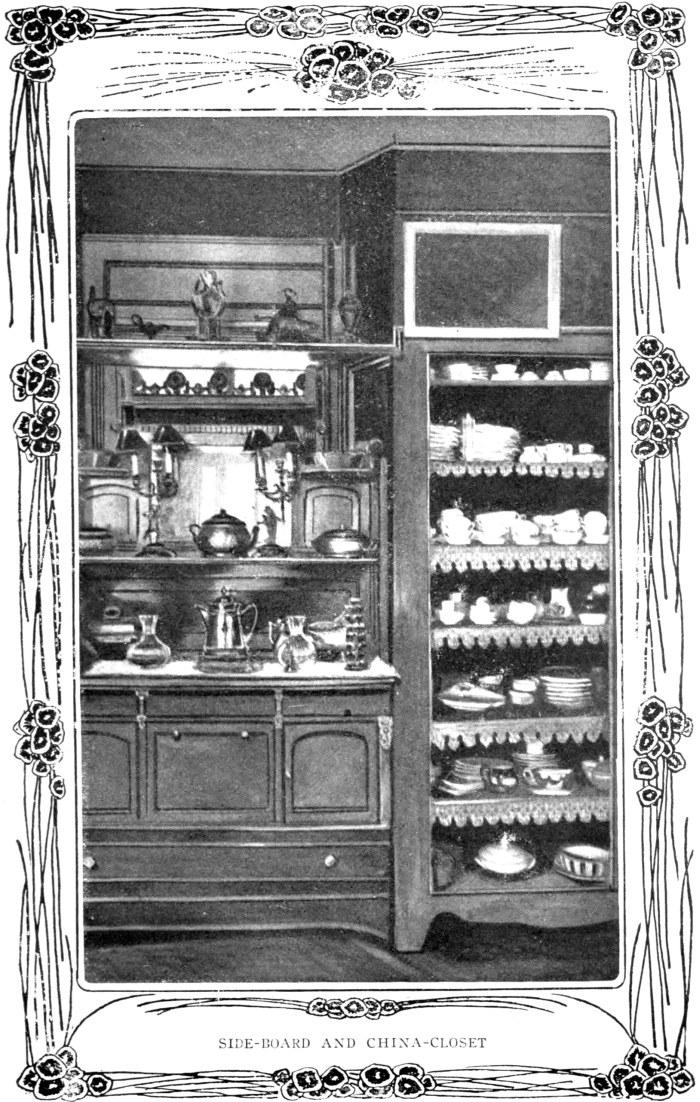
Cover the shelves of the crockery closet with strips of scalloped
oilcloth that come for the purpose, and the shelves on
which you keep metal pie-plates and pans with stout paper,
pinked at the edges.
If you use tin milk-pans, have them seamless, scald daily with
boiling water into which you have stirred a little baking soda,
rinse with pure water and stand in the sun.
Wooden ware should be scrubbed with a clean, stiff brush
and soda-and-water, rinsed well, wiped and dried near the fire
or in the open window.
Buy three qualities of dish-towels—the finest for glass, silver
and china; the second best for crockery used in kitchen work;
the third for heavy kettles, griddles, etc., and have them washed
every day. Even when no grease adheres to them they have a
musty odor if used several times without washing.
Rub gridirons and griddles with dry salt before each using,
wiping it off with a clean towel.
Never undertake to polish your stove until it is quite cold,
and do not rekindle the fire too soon when the polishing is done.
Next to the range, or stove, the sink is the most important feature
of the kitchen.
“Let me see a woman’s sink, and I will tell you what sort of
a manager she is!” was the saying of a shrewd housemother who
had seen much of life and of cooks.
The waste-pipe should be flushed every day when the water
in the boiler is hottest. During the flushing two tablespoonfuls
of strong ammonia should be poured down the grating over the
waste. Once a week in summer add a handful of crushed washing-soda.
And keep the sink, itself, clean all the time!
Grease should never accumulate upon the sides and in the
corners; tea leaves and other débris never be clotted over the vent.
A stout whisk-brush must hang above the sink and be used
freely in scrubbing it. When the whisk becomes stained and
flabby, burn it up and get another. A dirty brush, mop or dish-cloth
makes—not removes—dirt.
Follow these directions, and if the outer drain-pipes are properly
built, you will have no occasion to employ disinfectants and
deodorizers.
The old New England kitchen was the family sitting-room in
winter, and in thousands of farm-houses, this is still the custom.
Since no device can make the sink and its appurtenances ornamental,
or passably comely, have a tall folding screen that may
be drawn in front of it when the day’s work is done. The mistress
who never sits in her own kitchen, but wishes that her maids
should have a pleasant resting-place in the evenings, may offer
the screen for their use. The better class of “girls” will appreciate
the kindly thought.
CHEMISTRY IN THE KITCHEN
Here again I shall be brief and practical. Nobody would read
this page were I to prate learnedly (apparently) of proteids,
phosphates, dextrine, hyposulphites and computed chemical and
dietetic values. The purpose of the honest cook-book is to help,
not hinder.
A few facts relative to chemical effects and changes in every-day
cookery should be tabulated.
For example, the mission of the much-used and oft-abused
bicarbonate of soda—familiarly called “baking-soda”—is imperfectly
apprehended by those who handle it most frequently.
The average cook does this handling heavily. “Soda makes
bread and biscuits rise,” is the sum of her knowledge and the aim
of her practice in this direction.
Soda should be measured as accurately as if it were a potent
drug, and never used except in combination with an acid. Even
then, lean to the side of mercy in measuring. One even teaspoonful
of soda to two rounded teaspoonfuls of cream of tartar,
one even teaspoonful of soda to two cupfuls of buttermilk, or
“bonny clabber,” one even teaspoonful of soda to one cupful
(one-half pint) of molasses, cause what may be considered an
equitable effervescence, liberating gases that lighten dough and
batter without making them unwholesome. The “greeny-yellowy”
streaks in farmhouse quick biscuits are poisonous, but the
alkali is not in fault. Soda should never be driven in single
harness.
The first stage of incipient decomposition is acidity. If, when
a slightly-suspected fowl or cut of meat is to be boiled or stewed,
a teaspoonful of soda be thrown into the pot as soon as the boil
begins, violent effervescence will attest the presence of the disturbing
acid. This subsiding will leave the meat free from unpleasant
taint.
Beefsteak and chops, which are just a trifle “touched,” may be
restored to sanity by a bath of soda and water, well rubbed in.
Butter that has suffered in quality through the neglect of the
maker in not working all the milk out may be made tolerable for
kitchen use by working it over in iced water in which a little soda
has been dissolved. After which the butter should be wrapped in
a salted cloth with a lump of charcoal in the outer fold.
Ammonia is another beneficent agent in correcting natural or
artificial deficiencies. A bottle of household ammonia should
be as invariably an adjunct to the kitchen sink and that of the
waitress’s pantry as the soap-dish. It “kills” grease by a chemical
combination with it, and lends luster to silver by the same.
Dry soda, laid upon a burn or scald, heals, but not merely by
excluding the air. Flour would do that as well. The alkali acts
directly upon the decomposing skin and vitiated juices of the
flesh. The sting of a bee, wasp or hornet is formic acid; that
of a mosquito something akin to it. Ammonia, applied instantly,
neutralizes the venom and eases the smart.
In the composition of salad dressing, stirring the oil, vinegar,
salt, pepper and dash of mustard together, long and skilfully,
makes a chemical emulsion smoother and more palatable than the
hasty slap-dash mixture too often served as “French dressing.”
Bread-dough which has begun to sour can be brought to terms
by working into the batch a little saleratus dissolved in boiling
water, which is then allowed to become lukewarm before it is
kneaded faithfully through the dough. A like solution should be
beaten hard into griddle-cake batter that has a pungent smell.
Vinegar and lemon juice are invaluable aids in the business of
“tendering” tough meats. Beefsteak, covered for some hours
with vinegar or lemon juice, and olive oil, is made eatable by the
action of the acid upon the fibers which are further “suppled”
by the oil.
Vinegar put into the water in which a fowl or mutton is boiled
will serve the same purpose, and a dash of vinegar in boiling fish
removes the strong oily taste that would otherwise cling to it.
Powdered alum stirred into turbid water—an even tablespoonful
to four gallons—will cause a precipitate and a settlement.
The clear water may be drawn off cautiously and used for washing
and even for drinking, having no perceptible taste of the
alum.
A bag of powdered charcoal sunk in a pork barrel will keep
the brine sweet through the winter, without blackening it or the
meat.
Javelle water, invaluable for removing mildew and rust-stains,
may be made at home in the following manner:
Place four pounds of bicarbonate of soda in a large granite or
porcelain-lined can, and pour over it four quarts of hot water.
Stir with a stick until the soda has dissolved, add a pound of
chloride of lime and stir until this also has dissolved.
Allow the liquid to cool in the pan, strain the clear portion
through thin cloths into wide-mouthed bottles or jugs and cork
tightly for use.
The part that contains the sediment may also be bottled and
used for cleaning sinks, kitchen tables, etc.
An excellent detersive for cleansing and sweetening a kitchen
sink is washing soda. Dissolve a couple of handfuls in hot water
and when boiling hot pour down the drain.
To prevent oil-lamps from smoking or giving forth a disagreeable
odor, boil the wicks in vinegar, then dry in the sun.
CARVING — To carve a roast of beef — To carve a leg of lamb or mutton — To carve poultry — To carve fish
The present mode of serving meats after the manner of the
table d’hôte—the carving done in the kitchen, and the results
placed upon the platter to be served to the guests by butler or
waiter—has in large measure done away with the demand for
hints to the master or mistress of the home upon the art of carving.
To those who adhere to the earlier custom, directions can
be merely outlines; for the single means by which one may become
an adept as a carver is in the repeated practice which is required
for skill in any work of manipulation.
A prerequisite to carving is appropriate implements. The
knife, the edge of which has been dulled upon the bread-board,
or hacked in the offices of the kitchen, where it has been employed
as the scullion’s tool, may puncture and tear, but it will
not carve. In the hand of even the most skilful it is exasperation.
The mistress of the home owes it to the head of the table, as
well as to the ease of mind of her guests, to see that the carving
set—the knife and its companion fork—shall be in the best condition
for their work.
This will depend upon the form in which the roast is placed
upon the platter. If it include several ribs, furnishing sufficient
room for a base of bone, it may be so put before the carver
that he may cut perpendicularly in thin slices, passing the knife
in a line parallel with the ribs. If, however, the roast be laid
upon the side, as is usual, the same direction is to be observed
as to the cutting in lines parallel to the ribs.
Where a tenderloin roast is to be carved—having but the one
large bone which divides the tenderloin from the more solid portion—there
is little choice whether the knife is drawn with or
transversely to the grain: the tenderness of the meat is assured
in either case. It may be more convenient to sever entirely the
tenderloin from the firmer part of the roast before beginning to
slice. This will leave the carver at liberty to serve a portion of
each quality of the meat to every guest, as the tenderloin may
not be of sufficient size to serve to all.
If the small ribs—which are generally taken off for chops—are
left with the leg, the carver is free to ask the preference of
each guest for the rib or solid slice. The chops may be detached
by drawing the point of the knife between the ribs, and—if the
butcher has properly done his part—in severing the light cartilage
at the backbone, as in parting vertebræ. The fleshy portion
of the leg will be more tender if cut in slices at a right angle
with the bone, as one would carve a ham; that is, across the grain.
Some carvers, however, prefer to cut lamb or mutton with the
grain, as it enables them to serve a portion more or less thoroughly
cooked, according to the preference of those to be helped.
These directions apply equally to carving a haunch of venison.
The fowl—whether turkey, chicken or duck—should be placed
on its back upon the platter. This will permit the carver to
transfix the breastbone firmly with the fork; for, upon the
stanchness of the hold here will depend the success of all further
operations. The wing from the nearer side should first be dissevered
by a gash of the knife underneath the socket. This, if
the fowl be tender, is easily accomplished with a single cut. The
first and second joints of the leg may next be separated, and the
second or upper joint removed from its junction with the body,
as was the wing. This is easily effected by a slight cut and pressure
of the bone outward. The sidebone may be taken off by
running the blade directly along the backbone; for it adheres only
by a filament of skin and the soft fat that attaches to it on this
line.
These joints having been taken off, the breast is now entirely
exposed, and further carving is a very simple matter. The removal
of the leg has laid bare the cavity, from which the dressing
may be lifted with a spoon, and the cutting of a few slices
from the breast, near the neck, will open the crop with the stuffing
usually placed there to plump the fowl. The main joint and
the pinion of the wing may be severed by cutting the cartilage at
the junction of the two bones.
There is an art in carving fish, and it is confined to a single direction.
It is to open with a knife at the back, drawing the
blade the whole distance from head to tail just above the backbone,
and pressing the meat loose from its fastening. Portions
may then be served by cutting transversely with the backbone.
Fish so carved is freed from the intricate mass of small bones
which are sure to mingle with the flesh if it be cut in any other
way. The head, if not already removed, should first be taken off,
and the collar or shoulder-bone lifted from the fish.
SERVING AND WAITING
If a butler be engaged to do the family serving and waiting,
he understands his business, or he should not apply for the place.
The rules written out here are for the benefit of households
where but one or, at the most, two maids are kept. I assume
that the waitress takes charge of the table after the mistress has
once shown her how it is to be set.
By the way, I hope you call her a “maid,” not a “girl.” The
latter word has been so rubbed and soiled by persistent usage on
the part of domesticated foreigners, who shed the name of “servant”
as soon as they stamp upon American soil, and by the handling
of would-be “genteel” housewives, that people of refinement
hesitate to touch it. What the old-fashioned New Englanders
called “hired help” would shake the dust off the soles of the
shoes they are not yet quite used to wearing, were you to allude
to them as “servants.” “Maid” sounds well, bearing to their
tickled ears a certain dignity not unsuited to their new estate.
Beginning with the first meal of the day, we will suppose a
cereal, fruit, one dish of meat, bread and butter, potatoes, hot
muffins, tea and coffee—a typical American breakfast, in fact.
A fruit-plate, holding a doily, on which is a finger-bowl half-filled
with water, cold in summer, tepid in winter, is set for each
person. If fruit that requires paring or cutting is to be eaten,
lay a fruit-knife on the plate. If oranges are served, add an
orange-spoon. At the right of the plate are the water tumbler,
a knife, with the sharp edge toward the plate, and a cereal-spoon,
bowl upward. At the left should be the bread-and-butter
plate, the fork, tines upward, and a folded napkin.
In front of each plate are a pepper-cruet and a salt-cellar.
In the center of the board have a bowl of flowers, or something
green and growing, all the year round. At the foot, carving-knife
and fork, a steel or other “sharpener,”
and a tablespoon; unless you have
a polished table, cover it with a neat breakfast-cloth,
using napkins (“serviettes”) to
match. If your table-top be at all presentable,
lay a hemstitched or embroidered
square of linen—sold as a “breakfast or
luncheon square”—in the center, and under
each plate a doily of the same style.
A thick mat to protect the varnish against
the heated meat dish; a carafe, or glass pitcher, of ice-water on
each side of the table, and the tea and coffee equipage at the head,
complete the preparations for serving.
The basket, or dish of fruit, is handed from the sideboard
where are arranged tablespoons, the glass or silver tub of broken
ice to replenish glasses, and, if there are no carafes on the table,
a pitcher of iced water, with a relay of knives and forks in case
an extra supply should be required on account of accidents.
At the last minute, before the mistress is told at the sitting-room
door that “breakfast is on,” the glasses are filled with iced
water, a firm ball of butter and a freshly-cut slice of bread are
laid upon the small plate at the left of each place.
When the family and guests are seated, the waitress, dressed
in a neat gingham or print gown, a clean apron, with bretelles,
bib and full skirt, and a white cap pinned above orderly hair
(not used to cloak unkempt elf-locks), passes the fruit basket or
dish to the mistress of the house from the left side; then to each
person at table.
The fruit eaten, let the waitress, beginning as before, at the
head of the table, take from the right side of each person, plate,
knife and spoon in one hand, finger-bowl in the other, and remove
to a side table, or to the “waitress’s pantry,” where they
are to be washed. Never pile plates and saucers upon one another,
or upon a tray. The habit is slovenly and lazy. Still
more displeasing is the scraping of plates at the side table, or
within hearing of the eaters.
If the cereal be cooked, it is usually served by the mistress of
the house. In this case set the hot dish upon a mat beside or
before her, when you have put a cereal saucer with a plate under
it before each person. Have a tray, with a napkin or doily
within it, ready to receive each saucer as it is filled; offer to the
eaters from the left, and when all are served pass sugar and
cream on the tray.
When the cereal has been discussed, remove first the dish,
then the saucers, and bring in hot plates, quickly and dexterously
setting one before each person. They should have been warmed
through slowly in the kitchen, but not be so hot as to draw the
varnish through the doilies. Next set the dish of hot meat,
chicken or fish, in front of the carver. As each portion is laid
upon a plate, the plate is set upon the tray you hold. Taking
the plate in your hand when you reach the mistress of the house,
set it down before her from the right.
There need be no confusion in this much-debated question of
“left and right” if the waitress will bear in mind one simple rule:
When plate, cup or other article is to be taken from the tray
by the eater, or he is to help himself from an offered dish, the
waitress must stand on his left, that he may use his right hand
freely. What the waitress puts upon the table with her own
hand must be done from the right.
For example, the plate with meat on it is set down from the
right of the person who is thus served. He takes his cup of
coffee and helps himself to sugar and cream from the left.
Before the waitress leaves the breakfast-room for the
pantry, if she does not remain throughout the meal, let her
replenish glasses with water and ice, pass bread or muffins
a second time, and if cups are emptied, offer her
tray to take them back to the head of the table to be
refilled. Should she begin to wash plates and saucers
in the adjoining pantry to save time, let this be done very
quietly. The rattle of china is not a musical accompaniment
to table-talk.
The manner of setting the table and waiting at luncheon is
substantially the same as at breakfast. Dinner demands certain
variations, while the general principles are the same.
The waitress of to-day has a dinner uniform, decorous in all,
becoming to a large majority of women. She wears a black
gown, deep white cuffs and collar, and an apron of finer material
and somewhat more ornate in fashion than in the forenoon.
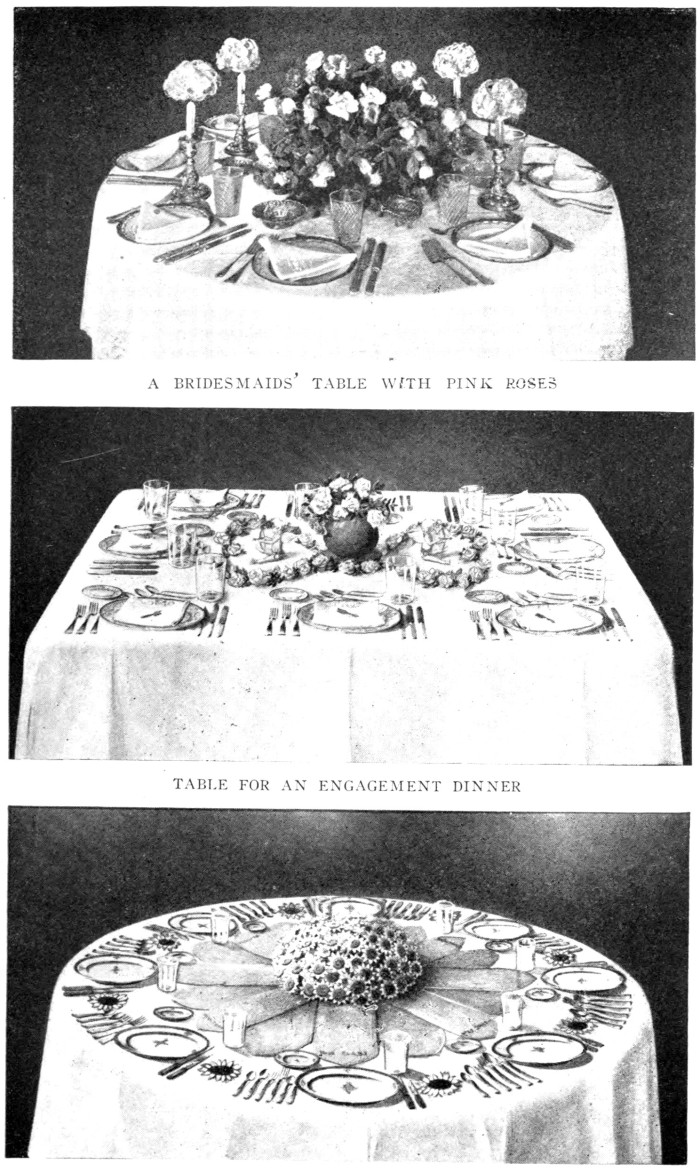
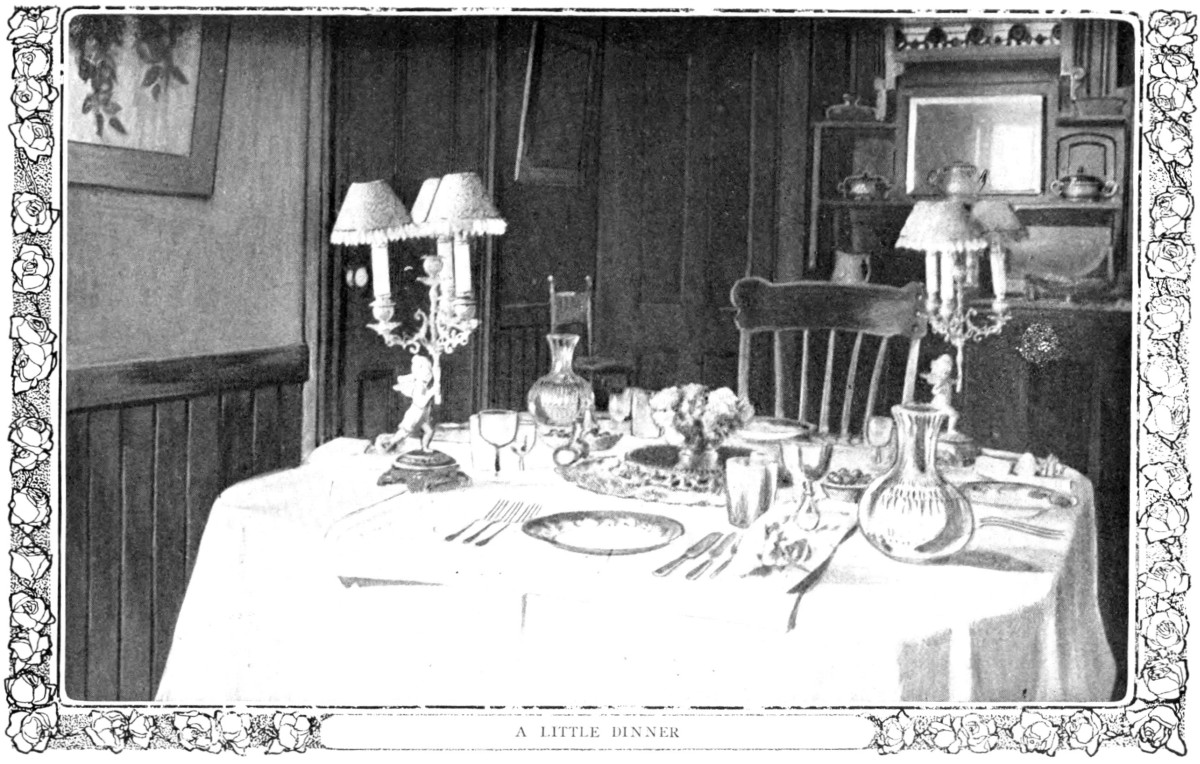
Under the damask table-cloth is laid a covering of felt made
for this purpose—sold as “table-felt,” or a “silence-cloth.” The
linen cover lies more smoothly over this and appears to be of
better texture than when spread upon bare boards. Besides the
damask table-cloth, a “carving square” is laid at the foot of the
table, and under it a thick mat on which the hot dish may stand.
On this are carving-knife, fork and “steel;” also tablespoon and
gravy ladle, leaving room between for the large dish. A cold
plate stands at each place, to be taken up when the hot is set
down by the waitress. At the right of the plate lie the soup-spoon,
bowl uppermost, two knives, edges turned toward the
plate, and a fish-knife (if there is to be fish) beyond the dinner-knives.
A tumbler for water, and, if wine is used, glasses for
this, stand also on the right, a little beyond the array of knives.
Some prefer to lay the soup-spoon at right angles to the
knives, and back of where the plate is to be.
At the left of the plate have two large forks; then one for fish,
and outside of this an oyster-fork, if there are to be raw oysters.
The napkin, folded flat, and inclosing a slice of bread, cut thicker
and narrower than for breakfast, lies also on the left.
Plates for the several courses are in array on the sideboard,
except such as must be brought hot from the kitchen. Salad
plates and those for dessert stand in order. Saucers for ices are
set upon plates lined with doilies. Fruit plates are also supplied
with doilies, on which are finger-bowls half-full of water.
A side table is reserved for vegetable dishes. They are not
placed upon the principal table now, even at the daily family dinner.
Pickles and olives are on the dinner-table; carafes of water,
and always flowers.
Some housewives have soup served in hot plates directly from
the kitchen. If the tureen be used instead, the mistress preferring
to pour it out herself, have a carving-cloth at that end of the
table also. The soup ladle lies at her right. As she ladles out
the soup it is set on the waitress’s tray. She takes it off with
her hand and puts it from the right before any guest who may
be present; then the family in turn. At a dinner party, those on
the right of the hostess are served first. The soup-plate is set
upon the cold plate in front of the eater, and when removed is
taken from the right, leaving the lower stationary cold plate in
its place, until the fish comes, when it is exchanged for a hot one.
In clearing the table after each course the soup-tureen, and in
its turn the large dish at the foot of the table go out first, the
soiled plates afterward.
Before the dessert is brought in, crumb the table, using a
clean folded napkin, when you have cleared the cloth of salt,
pepper, pickles, etc.
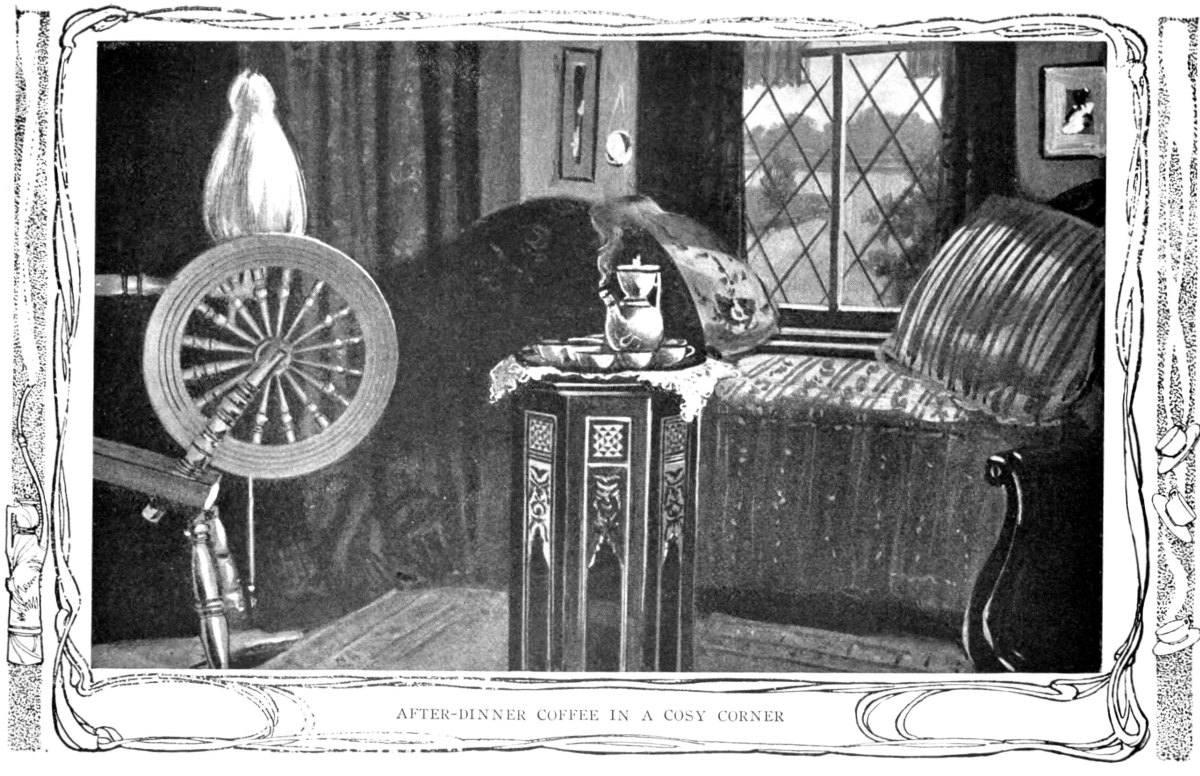
After the sweets comes the coffee. This is often sent to the
guests into the drawing-room. In this case, the waitress covers
a large tray with a white napkin, arranges the filled cups, smoking
hot, upon it, sets the sugar in the middle and takes the whole
into the room where the party is assembled.
Liqueur-glasses follow the coffee, and are also carried into
drawing-room or library. In announcing to the mistress, in
sitting-room or elsewhere, that a meal is ready, the waitress says,
“Breakfast is on,” or “Luncheon is ready,” or “Dinner is
served”—according to modern usage. One frightened unfortunate,
on duty at a trial-dinner party, filled the hostess with
confusion, the guests with secret amusement, by rattling off all
three formulas in a breath.
It is impossible to write out rules that will meet every form
and exigency of “entertaining.” The hostess who, having mastered
the leading principles here given, trains her waitress into
the daily practice of them, insisting that her family shall be
served three times a day in the right order, and as punctiliously
as if a state banquet were the business of the hour, need fear no
embarrassing “situations,” no matter how large the number, nor
how important the stations of her guests.
AMONG THE LINENS
Everything commonly classed under this head should be carefully
aired before it is put away. Even when this duty has been
conscientiously performed, real linen, made of pure flax, has
marvelous properties for absorbing humidity. And humidity
is the parent of that relentless foe to housewifely peace—mildew.
Table-cloths, napkins and linen sheets that have been packed
securely—as the owner supposed—in closets, drawers and chests,
sometimes present to our horrified eyes a collection of small
blotches, like dark freckles, and as ineradicable, and the folds,
when opened, smell musty. The walls of the closet were not
quite dry, or the chest has stood in a damp room, or the sideboard
drawers have gathered must in an unaired basement dining-room.
It is a matter of common prudence to overhaul the contents of
linen closets, and especially linen drawers and chests, once a
month, if only to make sure that the contents are keeping well.
At the same time be on the lookout for rents, broken threads and
thin places.
Never buy cheap linen. If you can not afford the finest, you
may secure that which is “all linen,” round-threaded and evenly
woven. A little practice in the purchase of these treasures will
initiate you into the art of judicious choosing. Having bought
good “material,” take care of it. A break in a table-cloth or napkin,
or towel, if neatly darned, will give you several more weeks
of wear out of it—perhaps months. Hemstitched articles are
liable to “give” first in the drawn work, and a stitch here in time,
saves ninety.
You may keep napery in drawers, if more convenient than elsewhere,
or upon shelves in a roomy sideboard. When at all practicable
have a light, airy closet for bed linen. My own linen-room,
built to order, has a southern window, unshuttered,
through which the sun streams all the afternoon on fine days.
Except in wet weather this window stands open for an hour of
every day—not longer, lest dust should blow in.
Suffer another personal paragraph:—Not a sheet, towel or
pillow-case is taken from this closet except by myself. Each
pile has place and meaning. Each set of towels belongs to an
especial apartment. Heavy bath towels; soft damask for the
leastest baby’s use; big, rough huckaback for the boys’ lake baths,
and the orderly heaps of different styles and textures, every one
marked with embroidered letter or monogram designating chamber
or owner—are known familiarly to but one person in the
family.
I modestly commend this rule to each housemother. Let the
linen shelves be the especial charge of some one particular keeper.
If not yourself, one of your daughters. This is rendered almost
necessary by the system of rotation that should regulate the use
of sheets, pillow-cases, counterpanes and towels. Those which
come from the wash this week should be kept by themselves.
In laying out clothes for the beds, and towels for the various
rooms, select from the bottom of the pile of those laundered one,
two or four weeks ago, working gradually upward, week by
week, until all have gone through the wash and consequently, all
are evenly worn. Never make up a bed with freshly washed
linen, no matter how well aired it may seem to be.
Sheets, pillow-cases, towels, table-cloths—all folded linens—should
be laid upon the shelves with the open and hemmed ends
toward the wall, the round folds outward. The effect is neater
to the eye, and articles are more easily taken out.
There should be no smell in this airy closet except the indescribable
sweet sense of freshly laundered linen—not strong
enough to be called an odor. Lavender, scented grasses, and
dried rose leaves are poetical in the writing and the hearing
thereof, but the sleeper between smooth cotton or linen sheets
sickens of artificial smells. They are neither “goodly,” nor
wholesome.
THE CHILDREN
Our forefathers and foremothers were dressed, in infancy,
precisely like their fathers and mothers. As we see by the portraits
treasured among our curios, they were abridged copies of
the adults of a hundred years ago. Parents were then consistent
in feeding their progeny with food they considered convenient
for themselves.
When the royal father ate fermenty for breakfast it is upon
record that a baby prince, suffering from marasmus, was nourished
(!) upon barley, boiled soft with raisins. They sat up to
late functions—those wretchedly dissipated princelings—and the
cotter’s children went to bed at the same time with himself.
He who doubts whether or not our times are better than the
former would be converted to steadfastness of conviction by
patient study of the nursery habits of the late eighteenth and early
nineteenth centuries.
We have children’s outfitters nowadays, who fashion garments
utterly unlike those worn by be-corseted, be-trained, and
be-pantalooned grown people. The cotter’s wife clothes her boys
in knickerbockers and blouses, her girls in loose waists and brief
skirts, all designed expressly—although she does not know it—to
allow free and healthful growth of the immature creatures.
I wish I could add that reform as radical and commonsensible
had been wrought in children’s diet, and children’s hours of rest
and sleep.
Mothers who have thought deeply upon these matters and
acted upon meditation, appreciate the hygienic law that children
require sleep to promote growth, as well as to repair the waste of
waking—which are working—hours. If an adult needs seven
hours’ slumber, the infant of days—under seven years of age—
requires ten to satisfy wants his senior has outgrown. Up to
the age when the child ceases to add inches, if not cubits, to his
stature yearly, provision must be made for the steady drain upon
vital and nerve forces.
The aforesaid canny mothers call in the little ones from play
before sundown in summer, bathe them, endue them in nightgowns
and pajamas, put dressing-gowns over these, and loose
slippers upon the tired feet, then set them down to a supper of
bread and milk, or buttered bread with a dash of jam or jelly,
and good, sweet milk, with once in a while a plain cooky as an
afterthought. Supper over and prayers said, the darlings are
laid in bed by the time the west begins to blush at the sun’s
nearer approach. In winter, the six o’clock supper is served in
the nursery or dining-room, and the bairnies disposed of comfortably
to themselves and to the rest of the household before
“grown-uppers” sit down to the “hearty” supper or dinner dividing
the working day from an evening as busy, and sometimes
almost as long.
To borrow from the slang dictionary—the child needs the ten
or twelve hours’ sleep in his business of growing tall and robust,
steady of nerve and sane of mind. Furthermore, he needs food
adapted to his needs. Plenty of cereals; plenty of milk; plenty
of ripe fruit in the season thereof; meat once a day; nourishing
broths and a few green vegetables. No fried things whatsoever;
neither tea nor coffee. No pastry; no mince pie nor plum pudding,
nor highly seasoned entrées. Time enough for these delicacies
when the inches (and feet) are all in, the muscles in splendid
working order, the gray matter of the brain “all there,” and
ready to do the duties of a man’s brain for fifty years to come.
One branch of a child’s education, sorely neglected in tens of
thousands of homes, is mastication. As soon as he cuts his teeth
teach him why they were given him. Make him chew everything
he takes into his mouth. Able dieticians are proclaiming boldly
that milk should be chewed, a mouthful at a time, if one would
not have it change to curd about the diaphragm. The child’s
meat should be finely minced for him until he can cut it up for
himself, and bolting be reckoned as a breach of decent behavior.
He may forget the truism that “gentlemen eat slowly” after he
joins in the great American rush for fortune. Obedience to it
for a term of years will lay the foundation of sound digestion.
He will have a better chance of long life and no dyspepsia, than
if he had been allowed to gulp down milk by the glassful without
drawing breath, and to gobble steaks and chops in two-inch
chunks.
Insist that the child shall behave decorously at the table, as well
as eat properly, from the time he can comprehend an order conveyed
in the simplest language. Do not let him make porridge
of his soup by crumbing bread into it, or churn crackers into
mush in his milk, or dip toast into his cocoa, or work vegetables
and gravy into a mound, using the knife as a trowel. He should
be reproved for sipping soup and other liquids audibly, and for
loud inspirations after drinking. Line upon line and precept
upon precept, gently but regularly enforced, will make a well-bred
boy of him. And right habits learned in childhood last a
lifetime.
There is common sense in each of the conventions at which
vulgarians scoff.
DIET AND DIGESTION
The second depends upon the first. The two make up a whole
which is Health.
“Food values” is so emphatically a technical term that I would
not employ it here if it did not express just what I mean, when
used untechnically.
What we eat has many and differing values. It is possible,
without degenerating into dietetic cranks, to appraise them properly
and to apply the knowledge thus gained to the building up
of these bodies of ours and the consequent up-building of the
immortal better part they encase.
Digestions are so many and so diverse, the one from the other,
that it is rank folly to prescribe bills-of-fare warranted to agree
with everybody.
Take, for example, milk. It has won from the ablest writers
on dietetics the title of the One Perfect Food for the human
race. Specialists on dyspepsia prescribe an almost exclusive
milk diet for obstinate cases. In typhoid fevers it is the specific
regimen. One man consumes inordinate quantities, by advice,
to increase adipose tissue. A woman lives upon skim milk, swallowed
very slowly, to reduce her flesh. And so on through multifarious
cases—all acting upon the recommendation of experts.
All the time, as each of us knows, certain stomachs can not
digest milk, or even retain it long enough to test its nutritive
properties, while in others it causes intense heartburn and engenders
bile.
Toast and tea are the stock invalid diet, the civilized world
over. Yet Medical Daniels (M. D.’s) are rising up by the score
to protest against ruining stomachs with tannic acid and burdening
digestive organs by forcing what is no better than dry
sawdust upon them.
Chocolate is freely prescribed as digestible, and so nutritious
that one could live and not lose flesh, eating nothing else, for
weeks together.
I am acquainted personally with ten people at least, to whom
any form of chocolate is poisonous and abhorrent to every sense.
Natives of the land where the cocoa palm grows virtually subsist
upon the nuts, and many in other lands devour the imported
cocoanut with impunity. The fatty flesh acts upon some stomachs
with the virulence of glass filings, producing terrible cramps
and even convulsions.
A noted teacher of culinary lore strenuously recommends our
native nuts, walnuts, filberts, hazelnuts, chestnuts, and so forth,
raw, and cooked in various ways as a substitute for meat. The
innovation is daring, and opposed to the conclusion based upon
the observation and experience of scores of other writers, to the
effect that nuts are hurtful to six people out of ten, the oils, and
the cells which contain the oils, difficult of digestion by any save
the strongest stomach.
It is much the fashion with writers upon domestic economy
to extol fish as more economical and more easily digested than
flesh, besides being rich in the phosphates needed to repair the
waste of brain force.
Some people who would scout the imputation of invalidism
can not eat even fresh fish without experiencing symptoms not
unlike ptomaine poisoning. I recall the case of one woman who
was extremely fond of oysters, yet dared not touch them for fear
of fatal consequences. I once saw her faint away an hour after
she had eaten half a dozen.
Who shall decide when dietists and individual digestions
disagree so radically as is indicated by these and hundreds of
other examples? And by what standard of gastronomic morality
shall we gage personal conduct in the government of appetite?
Since man must eat to live, and an unimpaired digestion is wealth
inestimable—what shall we eat?
Certain combinations of materials are manifestly iniquitous.
Cooked fats, fried fats in particular; soggy bread, especially
when fresh from the oven; hot cakes, (“sinkers”), viscid with
griddle grease and swimming in butter; tough doughnuts, reeking
with lard; leathery pie-crust; underdone fish and rare pork
and veal; cabbage that has been cooked in but one water; turnips
that have been left in the ground until they are stringy pith;
tough meats of all kinds that resist mastication; unripe fruits—none
of these should ever enter human mouths, or be imposed
upon the long-suffering digestive apparatus.
The housemother who studies wisely the properties of the
fare she puts before her family will adjust food-values to the
several needs of those to whom she ministers. The child of weak
intestines must have neither oatmeal, hominy, nor mush for his
breakfast cereal. Rice, rightly cooked, thickened milk, well
boiled, and arrowroot porridge, will heal irritation, and, as it
were, tighten the tension of the machine. He may not indulge
in the apple-sauce and cracked wheat which are better than laxative
drugs to his hale brother.
A bilious girl should not drink milk unqualified by a dash of
lime water, and never take coffee. Her languid, appetiteless
mother will be refreshed in nerve, stimulated in brain, by a demi-tasse
of strong coffee taken without cream after her dinner. It is
doubtful whether or not creamed coffee is a wholesome beverage
for any one. It is an established fact that the addition of cream
works a chemical change, and for the worse, in that which,
taken clear, is a valuable digestive agent.
An important branch of the mother’s profession is to acquaint
herself with the stomachic idiosyncrasies of each member of
her household. Certain compounds and some simples do not
agree with one person, while others thrive upon them. To be
cognizant of the peculiarities of each constitution is to be forewarned
of the danger of gastronomic experiments. Lay down as
a positive law that it is wrong—a sin against the body given by
God—to eat what one is sure will disagree with one. Tabulate
for your own convenience a code of “kitchen physic.”
To wit, that Indian meal is laxative; oatmeal, heating; wheat-flour,
binding; that tea is slightly astringent, and coffee, creamed,
a gentle aperient; that sweets and rare beef engender gouty acid
in those disposed to rheumatism and constitutional headache;
that candies and other confectionery ferment into sharp acid in
an empty stomach, and should, therefore, never be eaten unless as
a dessert. The same is true of pickles. Except when eaten in
combination with meats and other oily foods, they are actively
unwholesome. The schoolgirl habit of champing pickled cucumbers
and pickled limes, as a starving pauper might gnaw a crust,
is pernicious and disgusting. The skins of raisins and grapes are
indigestible. Figs are a well-known cathartic, a fact the housemother
should avail herself of where a doctor, if summoned,
would prescribe a drug. It is always better to control digestive
irregularities by diet than by medicines, each of which is a poison
which cures one ill by creating another.
Pears dispose one to constipation. Ripe peaches and ripe apples
regulate the bowels in a vast majority of cases; an orange,
eaten at bed time, is a gentler agent than Rochelle salts, and does
as good work.
The veteran practitioner who insisted fifty years ago that “cupboard
cures” were safer and surer than those wrought by materia
medica was in advance of his age. The twentieth century is just
growing up to his standard.
I have spoken of qualifying milk with lime water for bilious
people. Other articles of food unwholesome to some constitutions
may be modified with wholesomeness by the use of certain
condiments which act as correctives to hurtful qualities.
For example, nuts may be eaten freely when salted. Thus
treated they are introduced at dinner as digestive agents and appetizers.
When accompanied by fruits, nut-oils are readily assimilated
by the gastric juices. Hence, nuts and raisins go naturally
together upon the menu.
Cayenne pepper makes oysters and fish a safe enjoyment for
those with whom they disagree actively if this be not used, and
lemon-juice further counteracts the evil effects of fish-oil and the
dreaded ptomaine.
THE IMPROMPTU LARDER
Some of her friends call it “The Emergency Pantry.” The
owner objects to the term because it conveys an idea of bandages
and styptics. Whereas, the cozy closet devoted to the comfort
of possible guests—to be welcomed and fed, although unexpected—contains
substantial food and appetizing delicacies.
She belongs to the great and growing host of suburbanites dependent
upon peripatetic butcher and baker, and the nearest
“general store.” The keeper of the typical general store never
orders so much as one jar of marmalade or a pound of fancy biscuits
until the last is sold, and has never a twinge of mortification
in saying: “Just out! Expect new lot next week.”
So our hospitable housewife stocks and keeps filled her reserve
shelves.
John has a way of bringing home a chance guest to dinner
when the notion strikes him, and Mrs. Notable’s town friends
have their way of happening to be in dear Mary’s neighborhood
about lunch time, and, having come all the way out from town,
it is hardly worth while to go home when there are afternoon
calls to be paid in the suburbs. When one of these calls chances
to be upon Mrs. Notable, afternoon tea must be served. Mrs.
Notable’s daughters join theater and concert parties, going early
into the city and coming out late and hungry. Iced lemonade,
ginger ale, cake and sandwiches refresh them and their attendants
in summer, and on winter nights something hot and savory
from “mother’s chafing dish.”
Back of all this stands mother’s Impromptu Larder. One shelf
holds the best brand of canned soups, chicken, tongue and boned
ham; another sardines, anchovies in oil, anchovy paste and pâté
de foie gras, soused mackerel, and mackerel with tomato sauce.
Baked beans, plain, and baked beans with tomato sauce, have
honorable place among potted foods; also dainty jars of fancy
cheeses, ready for use at a second’s notice, and bottles of grated
Parmesan. Olives, including pimolas, stand in line with “pin-money
pickles” and catsups. There is a brave array of homemade
jellies, marmalades, brandied and pickled peaches; a case
of imported ginger ale, bottles of domestic liqueurs, and glass
cans of apple-sauce and tomatoes, put up in Mrs. Notable’s own
kitchen. A fair proportion of each kind of pickle and preserve
is set aside for the Impromptu Larder and not touched for family
consumption.
Fancy biscuits of many sorts have several shelves for their own;
sweet and unsweetened cheese biscuits, sea-foams and snowflakes
and zwieback; hard crackers and soft crackers; plain
wafers, fruit wafers and cream wafers; lady-fingers and ginger-snaps—make
a goodly show to the eye and stay the mistress’s
surprised soul when the impromptu luncheon or supper must be
more sudden and abundant than usual.
“My strong tower!” she once called this pantry, laughingly.
In winter she finds room for nuts, raisins, apples and oranges;
in autumn, for baskets of grapes. These last named may be
called “transients,” the supply being renewed frequently.
Mrs. Notable is not a rich woman. She is obliged to make each
dollar do the full work of one hundred cents. To this end she
keeps an “expense book,” setting down every article purchased
and the cost thereof.
In the account of necessary outlays that for replenishing the
stores in the strong tower is registered under the head of “HOSPITALITY.”
FAMILIAR TALK — BREAKFAST
Common sense would decide that we should begin the day with
the glad alertness with which the sun smiles at us over horizon,
or housetops. He rejoices as a strong man ready—that is, rubbed
down, supple and light—to run a race.
There are still writers of “goody” books and works on hygiene
who extol the morning mood. According to them, the whole human
machine is then at its best. The head is clear, the stomach
is vigorous, the spirits are buoyant, life is a joy.
In reality—the reality of the every-day life of respectable people
who have not tarried long at the wine, or eaten Welsh rarebits
over night—the hard pull of the day is at the beginning.
The head of the average man or woman ought to be clear, the
digestive organs active, limbs and joints in excellent working
order. There should not be what one comedian describes as a
“dark-brown, fuzzy taste” in the mouth, or the feeling that the
cranium is stuffed with cotton wool, and the diaphragm should
not loathe all manner of food.
But such things are. Where one man tells you that breakfast
is the best meal of the day, fifty account the ceremony of the
earliest meal of each new day as a hollow mockery. A celebrated
judge left upon record the saying: “No man should be hanged
for a murder committed before breakfast.” Another, almost as
famous, openly and officially declared his unwillingness to condemn
a prisoner convicted of manslaughter of whom his physician
had testified that he was a chronic dyspeptic. “A dyspeptic,”
urged the judge, whose own diet had consisted of mush and milk
for ten years, “is never quite sane.”
Not one of his three daily meals is “comfortable” to him whose
alimentary apparatus is out of order. To one in tolerable health
the business of “stoking” the engine for the drive of the forenoon
should not be irksome.
Thus common sense and hygienic general principles. Now for
facts.
A brilliant woman summed up the popular judgment on the
subject in an after-luncheon speech before other literary women,
in the assertion that “the human machine needs to be wound up
and lubricated and regulated by bath and breakfast before it is
fit to work with other machines, or, indeed, to go at all. Breakfast,
partaken of in the company of one’s nearest and dearest, is a
blunder of modern civilization. It is an ordeal over which each
should mourn apart.”
A young man of education and breeding, who lives in bachelor
chambers with three other “good fellows,” confesses that, while
the seven o’clock dinner hour is always full of cheer and good-will,
the four friends seldom exchange a syllable at the breakfast
table beyond a brief salutation at entering the room, and a curt
“good day,” in separating to their various places of business.
“Thanks to this sensible silence, we have lived together three
years without quarreling,” he wound up the story by saying.
“Every man is a brute until he has had his morning coffee.”
Much of this is talk for talk’s sake, and some of it is Temper.
It is not easy for one to get full command of oneself before
the relaxed nerves are braced by tea or coffee, and the long-empty
stomach is brought up to concert pitch by food. If we have slept
too heavily, we are stupid; if too little, irritable.
I admit that the American’s first meal of the crude day, with
the accompaniment of the rush for car, or boat, or train, that
turns out—or in—dyspeptics by the hundred thousand yearly, is
not conducive to domestic happiness, or the preservation of table
etiquette. The householder, devouring porridge, two cups of
scalding coffee, rolls, steak and fried potatoes, at discretion, with
one eye on the clock, and both feet braced for the jump and run
he knows are imminent if he would catch the train, is in the first
or fortieth stage of what a witty essayist diagnoses as “Americanitis.”
His children’s railroad speed of deglutition and the
scurry for school are along the same lines of discomfort and disease.
Upon the mother’s hands and head rests the responsibility of
“getting them off for the day,”—a battle renewed with each morning
until she “fairly loathes the name and the thought of breakfast.”
The remedy for the domestic disgrace—for it is nothing if not
that—is so simple that I have little hope it will be respected, much
less accepted.
It is, get up fifteen minutes earlier in the morning!
The plain truth is that your system is not “ready for breakfast,”
when you announce that you are. The racer, to whom
Scripture compares the smiling God of Day, never takes the first
lap at a rush. He warms gradually to his work, having at the
outset paid as diligent heed to the “Make ready!” as to the “Go!”
If you rise usually at seven, have the hot water and cleaned
boots brought to the door at a quarter before seven, and get up
when you are called. A brisk bath and a smart rubbing with a
crash towel, preceded by fifty gymnastic strokes, such as arm-swinging
and general flexing of the muscles; twenty-five deep
breaths that pump the morning air down to the bottomest well of
your lungs and clear the respiratory passages of effete matter
lodged there during the night—these, with a general disposition
to speak charitably toward, and to speak civilly to companions
and competitors in the race, correspond to “make ready.” Clean,
supple, and in good heart, come to the table as to preliminary refreshment
you have time and appetite to enjoy.
At least seven-tenths of the twaddle over the horrors of the
family breakfast are affectation and indolence. Breakfasting in
bed is an imported fashion, and to my notion, is not a clean
practice. The tray brought to an unaired room, a tumbled bed
and an unwashed body, looks well in French engravings, but is a
solecism in an age of hygienic principles, much ventilation and
matutinal baths. The inability to be in charity with one’s fellow
mortals, to smile genially and to speak gently before the world
is well started upon its diurnal swing, and the complainant’s
physical system is toned and tuned and oiled by eating, is degrading
in itself. The confession of it is puerile.
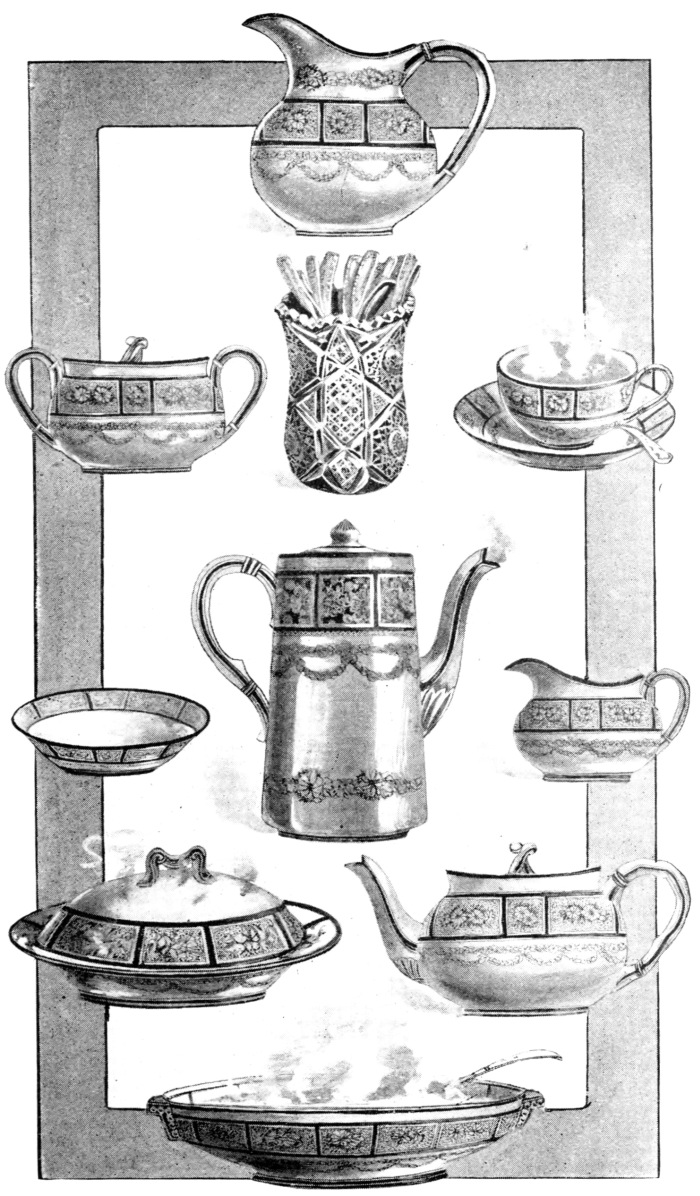
BREAKFAST EQUIPAGE
Force yourself to speak pleasantly if you can not at once bring
your spirits up to the right level. Study to be a man, or a woman,
although breakfastless. To be thrown in the first round of the
day by the sluggish flesh and the devil of ill-humor, before the
world has a chance to grapple with you, is cowardly and sinful.
One word of friendly counsel to my fellow brain-workers, who
are also sister-women, may not be amiss in this connection:
Never write or study in the morning until you have broken
your fast. A physiologist of note estimates that the draft on the
nervous forces and the eyesight of working on an empty stomach
is equivalent to the labor of lifting thirty pounds dead weight.
However this may be, stay that long-suffering organ with a few
morsels—a slice of bread and butter, moistened by a cup of tea,
if your rising is in advance of that of the rest of the household
and you meditate an hour’s work before the family breakfast.
The imported fashion of beginning breakfast with fresh
fruit has become an American custom. The assuasive effect of
the generous juices upon the coat of the stomach, usually clogged
at early morning with a mucous deposit, is a wholesome
preparation for digestive processes—a “toner” to just-awakened
energies. To commit suddenly to the long-suffering
stomach, as yet inert, and but dimly aware of
what is expected of it, a “feed” of beefsteak, potatoes and hot
breads, is always an unwelcome surprise. Sometimes the abused
organ turns with the proverbial blind wrath of the patient, and
revenges itself, if not speedily, surely and fiercely. It would fain
be awakened kindly and gently. To this end, stay it with oranges,
comfort it with apples and grapes.
1. Cut in half, crosswise, and dig out the pulp with a silver or
gold orange spoon.
2. They are yet nicer prepared beforehand by running a sharp
knife on the inside, close to the rind, thus severing the membranes
that divide the lobes. Take these membranes out carefully, leaving
the pulp in the two cups of the halved orange. It can be
then eaten as easily as a custard could be. Set on ice until you
are ready to serve.
3. Peel the oranges; separate the lobes and cut each into three
pieces. Serve in a chilled glass dish, passing powdered sugar
for those who like it.
Breakfast fruits are far more wholesome when eaten without
sugar.
Keep them on ice for an hour before sending to table, even in
winter, and scatter cracked ice over and among them. This has
the double advantage of cooling and of cleansing them. Pass
grape scissors with the dish of fruit.
Peaches, pears and apples
Wash and dry pears and apples with a soft cloth. Have a
silver fruit knife at each plate, and let the eaters pare the fruit
for themselves. Peaches should be left with the fur (and bloom)
on.
These should never in any circumstances be sugared in the dish.
Let each person sweeten his portion for himself, after which they
should be eaten immediately, before the sugar has time to draw
out the juice and thereby wither the berries.
Strawberries should be eaten at breakfast with the caps on.
Choose the finest fruit for this meal, using the stem as a handle,
and dipping the berry into powdered sugar, if not sweet enough
to be eaten without.
Never wash these, or strawberries, unless they are intolerably
gritty. Water is ruin to flavor and integrity, where the more
delicate berries are concerned. Set on ice for an hour or more before
sending to table. Pass sugar for those who wish it, and in
helping out each portion avoid bruising the berries. “Mashed”
berries suffer an instant change in flavor. The air begins at once
to act chemically upon the liberated juices.
Wash, drain and leave on ice for two hours. Pass sugar with
huckleberries for such as wish it. They are better without at
breakfast. Gooseberries are always eaten without. The large
English varieties are delicious and very healthful.
If cream be eaten with breakfast fruit, it should be as an after-course—or
dessert. It loses character and effect as an assuasive
and persuasive agent.
Cantelopes and nutmeg melons are prime favorites as an introductory
step to the weightier business of the morning meal. They
deserve their popularity.
Cut those of small and medium size in half; scrape out the
seeds and put a lump of ice in each half. The larger may be divided
into thirds, and a piece of ice laid upon each piece. Pass
salt and pepper, also sugar with them. Many epicures prefer to
eat them au naturel.
In the late winter or early spring-time, when apples are scarce
and dear, and oranges have not yet come to their full plenteousness
and flavor, the human system needs anti-bilious food. Our
foremothers compounded a villainous preventive against spring
“humors,” of sulphur and molasses, stirred together to a cream
and administered before breakfast to each shuddering creature
who had pains in the bones, headache and nausea at rising, and a
general sensation of good-for-nothingness. “Advanced” matrons
added cream of tartar to the villainous preventive, and gave their
families to drink of cream-of-tartar lemonade. According to
these wise and worthy women, “spring fever” was as inseparable
from the opening season as robin song and pussy willow.
Even now, cooling medicines are advised by physicians and believed
in by families. The careful student of hygiene, a science
the prime principle of which is prevention, and not cure, shows
us a more excellent way. The kindly fruits of the earth never
merit their name more truly than when winter is going and
spring-time is coming; when benevolent bile, balked in its rightful
channels, becomes a baleful agency to be fought as an acknowledged
foe. In fruit and in succulent vegetables we find our cooling
medicines, “indicated” by the great physician, Nature. If
fresh fruits be wanting, we must accept substitutes.
Wash, scrape and cut the stalks into inch lengths. Leave in
cold water for an hour. Put over the fire in the inner vessel of
a double boiler, set in cold water, bring to a boil and simmer
gently until tender and clear. Keep the inner vessel closely covered
that the steam may do its work. Remove from the fire,
sweeten to taste—not heavily—turn into a bowl and cover until
cold.
As a breakfast dish, this is refreshing and most wholesome.
Cooked as above, you get the benefit of the anti-bilious juices,
undiluted by water. Set on ice for an hour before eating. Some
add a handful of sultana raisins to the raw rhubarb.
Wash and soak for two hours. Drain, put over the fire with
just enough cold water to cover them, and cook tender. Turn
out and cover until cold. Put on the ice for an hour before sending
to the table. No sugar should be added to prunes when they
are to be eaten at breakfast time.
They are slightly laxative and anti-bilious.
The unfortunate few who can not begin breakfast with acid
fruits “may, with pleasure and profit, conclude the meal with
oranges, apples, grapes or melons.” One family I know of eats,
the year around, fresh uncooked fruit as a last course to the
breakfast that is invariably inforced with oranges, melons or
grapes, each in its season.
And there is not a dyspeptic among them!
BREAKFAST CEREALS — Oatmeal — Hominy — Cracked wheat — Milk porridge — Meal-and-flour porridge — Brewis (as made by our grandmothers) — Rice — Indian meal mush — Farina
Some dietetists, who are neither cranks nor simpletons, disbelieve
in cereals of whatsoever sort as a first course at breakfast.
They urge that to spread a hot poultice all over the lining of the
stomach is to relax and weaken that organ; that it goes to sleep,
as it were, and is too inert to dispose properly of the rest of the
meal.
Others are strenuous in the belief that the act of chewing is
necessary to the proper assimilation of even semi-solids, and
since few people think of chewing porridge, the value of it as
nutriment is doubtful.
There is force in the latter demur. Children should be taught
to chew porridge of all kinds, also bread and milk. One zealous
dietist insists that milk—“the one and only perfect food”—ought
to be masticated. The motion of the jaws excites the salivary
glands, he says, causing the flow of a secretion most favorable
to digestion.
As to the “hot poultice,” there is a grain of reason in the objection.
As I have explained in urging the propriety of beginning
breakfast with fruit, the coat of the stomach is masked,
after the sleep of the night, by a thin mucus, which interferes
with the task of the digestive agencies. If fruit is not eaten, a
draft of cold water, not iced, will do the work in part. A few
swallows of really hot water are better still. A sip of tea or
coffee—or, perhaps, best of all, vichy, apollinaris or other good
mineral water, may precede the nourishing cereal.
That it is nourishing when the stomach gets hold of it, is undeniable.
Oatmeal builds up bone, and muscle, and brain; Indian
meal mush and hominy are gently laxative and cooling to the
blood; preparations of wheat are less laxative, and therefore
safer in hot weather, and for teething children, than oatmeal in any
form. Rice boiled tender in milk is both palatable and wholesome.
Each and all of these should be eaten with cream, and except
as a dessert, never with sugar. Children who are trained to eat
porridge and milk, or cream, without sugar, find the addition of
this unpleasant. It certainly tends to acidity of the stomach.
Every cereal, with the exception of rice, that needs any cooking
needs a great deal of it. Soaking over night is indispensable to
the excellence of most of them. Four hours of boiling make oatmeal
good; eight hours make it better; twenty-four hours make
it “best.”
Soak over night. Even the varieties which are advertised “to
require no soaking, and but fifteen minutes’ cooking,” are improved
by this process. Turn a deaf ear to the charmer who
would persuade you to the contrary. “Steam cooked” is often a
delusion and a snare. Put your oatmeal into the inner vessel
of your farina kettle, cover deep in cold water, put on the lid and
set at the back of the range at bedtime. In the morning add boiling
water, salt to taste, and draw to the front, filling the outer kettle
with hot water. Cook steadily for an hour and as much longer
as you can. My own taste is for oatmeal boiled to a jelly. It is
as far superior to the ordinary preparation of the cereal as
creamed cauliflower is to Dutch cabbage.
Send to table and eat with cream.
Never throw away oatmeal “left-overs.” Cook again, and yet
again, always in a double boiler.
Soak all night; cover with boiling water, slightly salted, in the
morning, and cook for an hour. A delicious preparation of hominy
is effected by cooking it in plenty of salted water until tender,
turning off the water and supplying its place with cold milk.
Bring to a boil and serve.
Cook as you would oatmeal. An hour’s boiling suffices.
Heat a pint of milk to boiling. Into a pint of cold milk stir
four tablespoonfuls of flour, and when this is smooth stir it into
the hot milk. Cook in a double boiler for an hour, add salt to taste,
and serve with cream.
Mix together two tablespoonfuls of Indian meal and the same
quantity of flour, wet them with cold water, and stir into a cup of
boiling water. Cook in a double boiler for half an hour, stirring
often. Add salt, and beat in slowly a pint of scalding milk, cook,
stirring constantly for fifteen minutes longer. Serve with cream.
Dry bread in the oven and crush with the rolling-pin into
crumbs. Heat two cups of slightly salted milk, and when it boils,
stir in a cupful of the dried crumbs. Add a tablespoonful of
butter, and cook, beating steadily for five minutes. Serve hot
with cream, or an abundance of sweet milk.
Wash a cupful of rice in two waters, then drop it slowly into
two quarts of salted boiling water. The water should be at a
galloping boil. Do not stir the rice once during the twenty minutes
in which it must cook steadily. At the end of that time test
a grain to see if it is tender, and if it is, turn the rice into a
colander; shake this hard that the air may reach all the kernels,
and set in the open oven five minutes before dishing. Each
grain should stand separate from the rest.
This is the South Carolinian way of cooking rice, and the one
and only right way.
Moisten a cupful of corn-meal with enough cold water to make
it into a paste. Stir this paste into a quart of salted, boiling
water, and cook, beating it hard and often, for an hour at least.
If the mush becomes too stiff, add from time to time more boiling
water.
A good, inexpensive cereal, which seldom appears upon the
breakfast table. Yet it should have honorable mention.
Soak overnight. In the morning, stir it into boiling water,
slightly salted, and cook half an hour, stirring up well from the
bottom.
Each patented breakfast cereal has its champion. It would be
invidious to name any of them here. Nearly all are founded
upon wheat, corn, rye, barley or rice. Each is accompanied by
full directions for the preparations of the same for the table.
Oatmeal, rice, mush, farina—any of the cereals that must be
cooked before they are eaten—are delicious and nutritious when
committed to the “hay-store” of which we are hearing so much.
The soaked cereal is cooked for five minutes after the boil begins,
and the bubbling pot, closely covered, is set immediately in a
nest made by hollowing out the hay with which a box is packed.
The hay is pressed closely all around the pot, an old quilt is
spread over all and the whole left untouched for five, six or ten
hours. The cereal will be hot when served, and tender beyond
compare.
BREAKFAST BREADS — Potato sponge bread (No. 1) — Bread with plain sponge (No. 2) — Milk bread (No. 1) — Milk bread (No. 2) — Whole wheat bread (No. 1) — Whole wheat bread (No. 2) — Graham bread (No. 1) — Graham bread (No. 2) — Old-fashioned rye bread — Rye and Indian bread — Steamed Boston brown bread — “Salt-rising” bread (No. 1) — “Salt-rising” bread (No. 2) — Sweet potato bread — Buttermilk bread — German coffee bread — Graham bread without yeast — HOT BREAKFAST BREADS — Breakfast rolls (No. 1) — Breakfast rolls (No. 2) — Parker house rolls — Vienna rolls — Raised apple biscuits — Sally Lunn — Dried rusk — Caraway biscuits — Egg biscuits — French rolls — Fruit rolls — Hot cross buns — Currant buns — Raised muffins — English muffins — English crumpets (No. 1) — English crumpets (No. 2) — QUICK BISCUITS, ETCETERA — Milk biscuits — Milk-and-water biscuits — Quick Sally Lunn — Potato biscuits — Graham biscuits — Virginia beaten biscuits — MUFFINS AND THEIR CONGENERS — Whole wheat muffins — Oatmeal muffins — Sally’s muffins — Risen brunette muffins — Graham puffs — Graham gems (No. 1) — Graham gems (No. 2) — Rice muffins — Graham muffins — Popovers — WAFFLES — Risen waffles — Rice waffles — Quick waffles — GRIDDLE CAKES — Buckwheat cakes (No. 1) — Buckwheat cakes (No. 2) — Quick buckwheat cakes — Sour milk buckwheat cakes — Whole wheat griddle-cakes — Lizzie’s flannel cakes — Huckleberry griddle-cakes — Feather griddle-cakes — Rice griddle-cakes — Peas griddle-cakes — French pancakes — Sour milk griddle-cakes — Stale bread griddle-cakes — Hominy griddle-cakes — Sweet corn griddle-cakes — Corn-meal and graham griddle-cakes — Graham griddle-cakes — VARIOUS BREAKFAST BREADS OF INDIAN MEAL — Corn bread made of northern meal — Corn bread made of southern meal — Indian meal crumpets — Steamed corn loaf — Sour milk corn bread — Sour milk corn-meal griddle-cakes — Buttermilk corn bread — Corn-meal gems — Two-and-two Indian meal muffins — Johnny-cakes — Corn pone — Hominy cake — Corn waffles — DIVERS KINDS OF TOAST — Buttered toast — German toast — Baked milk toast — Cream toast — Fried toast — Tomato toast — Anchovy toast — Sardine toast — Cheese custard toast — Oyster toast — Mushroom toast — Ham toast
Beginning with the most important and difficult form of
bread-making, I offer three methods of preparing and baking the
wholesome home-made loaf, fondly recollected by those whose
early lives were spent in regions where bakers’ sawdusty cubes
and parallelograms were not delivered at the back door in lieu
of the genuine staff of life.
Boil and mash, while hot, four potatoes of fair size, beating
into them a tablespoonful, each, of cottolene or other fat and of
white sugar. Beat smooth, adding, gradually, one and one-half
pints of lukewarm water. Strain through a colander upon a
pint of sifted flour. When you have a lumpless batter, add
half a cake of compressed yeast, dissolved in four tablespoonfuls
of warm water.
This is your sponge. Set in a moderately warm place in a
bread-bowl with a perforated cover. If you have not this cover,
throw a double fold of mosquito net or cheese-cloth over the bowl.
In four hours in summer, and six in winter, the sponge should
be light and the top broken by air bubbles. Have ready in another
deep bowl or tray five pints of dried flour of the best quality,
sifted with a tablespoonful of salt. Hollow a space in the
middle and work the sponge gradually into the flour with a
clean, cool, bare hand, well floured to hinder the dough from
sticking to it.
The dough should be just stiff enough to handle. When you
can lift it to the kneading-board without spilling, it is ready.
Rinse the bowl out with a little warm water and work into the
dough in order to get all the sponge. Flour the board and
knead the ball of dough, always working from the outside of the
ball toward the middle. After ten minutes’ hard work, turning
the dough over and over and around and around, the dough
should be so elastic that if you deal it a smart blow with your
fist the indentation will fill up again instantly.
Return to the mixing bowl, cover and leave as before, out of
drafts in a steady temperature. When it has risen to double
the original bulk—in four or six hours—return to the board and
knead again, quickly and vigorously, for eight or ten minutes.
Make into loaves and set to rise in pans, filling each half-full.
Cover with a cloth, let all rise for an hour, or until the pans are
two-thirds full, and bake.
Have a steady fire, with coal enough to last until the baking is
over. See that the ovens are “just right” by holding your naked
arm in one. If you can hold it there comfortably for one whole
minute and not more, you may put in the bread. Or try the
oven with a little flour put upon a tin plate and set well back in
the closed oven. It should be delicately touched with brown in
five minutes if the oven be right.
In ten minutes open the oven door very cautiously, and if you
see the pans filled to the top, cover with light-brown “grocer’s
paper” to prevent the crust from hardening before the heart of
the loaf is done. Ten minutes before the hour for baking is up
remove the papers and let the top crust brown.
Turn out the loaves carefully upon a cloth, propping them
against a pan or other clean object, that they may not get sodden
in cooling. Do not put into the bread-box until they are entirely
cold. The box should have a cloth in the bottom, and another
thrown over the bread before the box is closed.
Chop a tablespoonful of cottolene or other fat, or butter, into a
quart of flour; wet with a quart of warm water; add a tablespoonful
of sugar, and half a yeast-cake dissolved in warm water.
Beat all together hard for ten minutes, as you would cake batter.
Cover, and set aside to rise as with potato sponge. In the morning
work into two quarts of salted flour and proceed as directed
in last recipe.
Sift two quarts of flour with a tablespoonful of sugar and an
even teaspoonful of salt. Have ready a pint of boiling water
into which you have stirred an even tablespoonful of butter.
Add, while the water is boiling, two cups of milk, and take from
the fire at once. When a little more than blood-warm, stir into
the milk-and-water half a cake of compressed yeast, dissolved
in half a cupful of warm water. Make a hole in the sifted flour,
pour in the mixture and work quickly with a wooden spoon to
a soft dough. Flour your hands, make the dough into a manageable
ball and knead hard and steadily for ten minutes. Let
the dough rise to double the original bulk in your covered bread-bowl,
make into loaves when you have kneaded it for five minutes,
and proceed as already directed.
Sift two quarts of flour into a large bowl and stir into it a
teaspoonful, each, of salt and sugar. Into this flour stir a pint
of warm milk, to which has been added a scant tablespoonful of
melted butter, a pint of warm water, and half a yeast cake dissolved
in a gill of blood-warm water. Work to a dough; turn
upon a floured pastry-board and knead for fifteen minutes. Put
the dough in the bread-raiser and set to rise over night. Early
in the morning divide into loaves, knead each for five minutes,
put the loaves into greased pans and set in a warm place to rise
for an hour before baking in a steady oven. Cover the bread
for the first half-hour it is in the oven. It should be baked in
an hour.
Dissolve a cake of yeast in half a cupful of warm water. Pour
two cups of boiling water upon two cups of milk, and stir into
them a teaspoonful, each, of salt and sugar. When they are
about blood-warm add the yeast. Into this stir a quart of whole
wheat flour. Of course, flour varies in its thickening powers,
but there should be enough to make a good batter. Beat hard
for five minutes, then stir in more flour until you have a dough
that is as soft as it can be handled. Knead for ten minutes on
a floured board and set to rise for three hours. Knead again
for five minutes; make into loaves and let these rise. When
light, bake. If the loaves are small they will bake in three-quarters
of an hour.
One tablespoonful of cottolene or other fat and the same of
sugar. One cup, each, of boiling water and of hot (not boiling)
milk. One yeast-cake dissolved in half a cup of warm water.
One cup of white flour and three cups of whole wheat flour, or
enough to make a soft dough. Knead for ten minutes; cover
and let it rise until it is twice its original bulk. Make into small
loaves; let it rise for an hour, or until very puffy, and bake.
Set a sponge over night, as for white bread, and in the morning
work into it a cup of salted whole wheat flour, three cups of
graham flour and three tablespoonfuls of molasses. Knead long
and hard, and set to rise. When very light make into loaves
and set in a warm place for an hour longer. Bake in an even
oven. The loaves should be covered with thick wrapping-paper
during the first half-hour they are in the oven, then allowed to
brown. This bread is especially nice when made with a potato
sponge, keeping fresh and sweet much longer than when the
plain sponge is used.
Make a sponge as for white bread, over night, and in the
morning add to it three scant tablespoonfuls of molasses and
enough graham flour to make a soft dough. Knead thoroughly,
and after forming into loaves and putting these into well-greased
pans, set them to rise. When risen, bake in a tolerably hot oven.
Dissolve half a cake of yeast in a quarter-cup of lukewarm
milk, with a small teaspoonful of white sugar. Pour this into
a wooden bowl, add a pint of lukewarm water, a heaping teaspoonful,
each, of salt and caraway seed, and a pint of rye flour.
Stir well with a wooden spoon and set to rise in a warm place for
two hours. When sufficiently risen it will be full of bubbles.
Add then flour enough to make a very stiff dough. Beat this for
at least ten minutes and set to rise for two hours more. Knead
on a floured board, let it rise in the pan again until it begins to
crack. Dip your hand in cold water, wet the loaf and put it into
the oven. It must bake one hour. Do not open the door for ten
minutes after it goes in. The oven should be very hot at first,
and as soon as the bread is browned it should be covered with
stout paper.
If you like, you may omit the caraway seeds. Some people
dislike them exceedingly. Others would not relish rye bread
“all of ye olden time” without them.
Make a soft sponge of potatoes, or a plain sponge. (See
Bread No. 2.) When light, sift together two cupfuls of rye
flour with one of Indian meal, a teaspoonful of salt, an even
teaspoonful of soda. Make a hole in the middle, pour in the
sponge, and when the ingredients are thoroughly incorporated
beat in half a cupful of molasses. Should the molasses thin the
dough into a batter, add rye flour. Knead until it is as light as
a rubber ball, set aside in a covered bread-bowl and let it rise
six hours. Work ten minutes more, make into loaves, and when
they are well up in the world bake in a slow oven. The loaves
will require three hours to bake properly. Cover with paper for
the first two hours.
The dear old grandaunt from whom I got this ancient and
honorable recipe had baked her “rye and Indian” for fifty years
in the brick oven of a homestead two hundred years old. She
covered her loaves with leaves from an oak near the door. The
oak overshadowed a well dug in 1640.
Mix thoroughly a cup, each, of graham flour, wheat flour and
corn-meal, and stir in a teaspoonful of salt. Warm together a
cup of milk, in which is dissolved a small teaspoonful of baking
soda, and a teacupful of molasses. Pour over the mixed flours
and meal a cupful of boiling water, and then add the warmed
milk and molasses. Beat hard and long, and turn into a greased
pudding-mold with a closely-fitting top. Cook in an outer vessel
of boiling water for three hours. Remove from the water, take
the cover from the mold and set in the oven for ten or fifteen
minutes, or until the bread is dry about the edges. Turn out,
wrap in a napkin, and send to the table.
(An old Virginia recipe)
Dissolve a half-teaspoonful of salt in two cups of scalding
water, and beat in gradually enough flour to make a very soft
dough. Beat for ten minutes, cover and set in a very warm
place for eight hours. Now stir a teaspoonful of salt into a pint
of lukewarm milk and add enough flour to make a stiff batter
before working it into the risen dough. Mix thoroughly, cover,
and set again in a warm place to rise until very light. Turn into
a wooden bowl and knead in enough flour to make the batter of
the consistency of ordinary bread dough. Make into loaves and
set these to rise, and, when light, bake.
(Contributed)
Put a quart of warm water,—not scalding hot, but at blood-heat,—into
a pitcher, deep and of narrow mouth. Beat into it
one teaspoonful of sugar, one-half teaspoonful of salt, a lump of
soda not larger than a pea and (not necessarily, but preferably)
a tablespoonful of corn-meal, with enough flour to make a rather
thick, but not really stiff, batter. Set your pitcher, well covered,
into a stone jar or other deep vessel, and surround it with blood-warm
water, setting it where such temperature will be quite
evenly maintained. Never allow it to reach scalding heat. In
two and a half hours, or, at the very most, three and a half, you
will have foaming yeast. Now take a pan of flour, make a hole
in the center, pour in the foaming yeast with as much water,
gradually mixed with the yeast and flour, as will make the number
of loaves desired. Do not make the dough very stiff. It
should quake visibly when the pan is shaken. Cover well with
dry flour and clean cloths, set in a warm place (temperature 80
degrees or 100 degrees Fahrenheit, or thereabouts), and, as soon
as light, knead into loaves, which will soon rise enough for baking.
Do not delay baking after the last rising, or your bread may have
a slightly sour taste. Bake thoroughly, and no better or more
wholesome fermented bread could be asked for.
Dissolve one cake of compressed yeast in one-fourth cup of
lukewarm water, add one cup of scalded milk (blood-warm), one
tablespoonful of salt, one-half cup of sugar and one full cup of
sweet potato, roasted, scraped from the skins, worked to a cream
with three tablespoonfuls of melted butter, then allowed to cool.
Beat all together until light, and stir in with a wooden spoon
flour to make a soft dough. Throw a cloth over the bread-bowl
and set in a warm place until well risen. Make into small
loaves; let them rise for an hour, and bake in a brisk oven.
This is also a Virginia recipe. You may substitute Irish for
sweet potatoes if you like.
Into a chopping-bowl put a quart of flour which has been sifted
three times with half a teaspoonful of baking powder, the
same quantity of baking soda, and a quarter of a teaspoonful of
salt. Chop into this flour a heaping tablespoonful of butter until
the shortening is thoroughly incorporated. Work in gradually
a pint of buttermilk—or enough to make a soft bread dough.
Turn into a greased bread tin and bake in a steady oven for an
hour. Cover with paper for the first half-hour, that the bread
may have an opportunity to rise before the crust forms. Turn
out and send to the table while very hot. Cut with a sharp
knife into slices, which must be generously buttered. While perhaps
this bread is not to be recommended to people who suffer
from weak digestions, it will be liked by those whose gastric
apparatus is in proper working order.
If you can not get buttermilk, loppered milk will do as well.
Heat a cup of milk to scalding, but do not let it boil. Stir into
it while hot two tablespoonfuls of cottolene (never lard), or
butter, two tablespoonfuls of sugar and a little salt. Let it
cool to blood-warmth, when add half a yeast-cake dissolved
in one-quarter cup of blood-warm milk, and flour to make a
stiff batter. Cover, and let rise until light. Add one-half cup
of seeded raisins, cut into pieces. Spread one-half inch thick
in a buttered dripping-pan; cover and let rise. Brush with
melted butter, and sprinkle with sugar and cinnamon. Bake in
a moderate oven for half an hour. Cover for half of that time
with thick paper.
To three and one-half cups of graham flour add two cups of
sour milk, one cup of New Orleans molasses, a pinch of salt and
one teaspoonful of soda dissolved in hot water. Bake in a slow
oven one hour.
Hot breads—comprising griddle-cakes, biscuits, muffins, Sally
Lunns and crumpets—may not be wholesome for everybody. I
seriously incline to the belief that they are not, especially in
warm weather, and if partaken of too freely.
But the best types of these are good, and their appearance upon
the board where John had looked for stale bread, or charred
toast, is a means of breakfast grace not to be underrated by the
wise housewife. She is a canny woman who runs down into the
kitchen for ten or fifteen minutes on a stormy morning, or when
the bread is especially dry, or John is “a wee bit blue,” and tosses
up (always by rule and measure) ingredients that come out of
a quick oven, puffy, hot, delicious, to gladden the boys’ hearts
and give their father pleasanter food for consideration than business
worries. If the men of any family were called upon for
their opinion of what a dietetic crank, better versed in anatomy
and chemistry than in courtesy, once anathematized at my breakfast
table as “rank poison, madam! and nothing short of a sin!”
they would say of his tabooed hot breads—“Naughty! but nice!”
One John—who hankers for the buckwheat cakes and sausage
of his boyhood as the wanderers in the wilderness, their souls
a-weary of manna, lusted for Egyptian flesh-pots—maintains,
upon fairly tenable hygienic principles, that warm bread is made
unwholesome because it is not masticated properly.
“We chew stale bread,” he says. “We bolt griddle-cakes and
muffins because they are soft and easily swallowed. Give the
salivary glands a chance to act upon them and they will not
harm you.”
The prescription is easily tried.
Sift a quart of flour with a half-teaspoonful of salt and a teaspoonful
of sugar, rub into it a tablespoonful of butter, add a
cup of warm milk and a third of a yeast-cake that has been dissolved
in three tablespoonfuls of warm water, and knead this
dough for twenty minutes. Set to rise for six or eight hours,
make into rolls, put these into a greased baking-pan, and let
them rise for half an hour longer before baking.
Sift a quart of flour and stir into it a saltspoonful of salt, a
teaspoonful of sugar, a cup of warm milk, two tablespoonfuls
of melted cottolene or other fat, and two beaten eggs. Dissolve
a quarter of a cake of compressed yeast in a little warm milk
and beat in last of all. Set the dough in a bowl to rise until
morning. Early in the morning make quickly and lightly into
rolls, and set to rise near the range for twenty minutes. Bake
for about an hour.
One cup of scalded milk (not boiled) left to cool until a little
more than blood-warm, one-half yeast-cake dissolved in four
tablespoonfuls of warm water, one tablespoonful of butter, three
cups of flour, or a little less, one even tablespoonful of sugar, one-half
teaspoonful of salt.
Melt the butter in the milk, add salt, sugar and yeast with
rather less than half the flour. Make a sponge of these ingredients,
beat hard for five minutes and set in a warm, sheltered
place to rise.
It should be quite light in an hour and a half in winter, an
hour in summer. Work in the rest of the flour until you have
a soft dough. Knead three minutes and set to rise with a folded
cloth over the bowl to exclude the air. When it has doubled its
original bulk, turn out upon your kneading-board, and work
quickly, but lightly, with fingers, not fists, for one minute. Roll
with quick strokes and few into a thick sheet, rub over with
melted butter (not hot). Roll up and knead one minute longer
to incorporate the butter. Pull off bits of the dough three times
as large as a walnut, and roll on the board into the desired shape.
Arrange close together in the baking-pan. Cover and let them
rise for half an hour, again doubling their size; then bake in a
brisk, steady oven. Twenty minutes should suffice. When they
have been in five minutes cover with whitey-brown grocer’s
paper. Five minutes before the time is up take this off and
brown.
Set a plain bread sponge at six o’clock in the evening. At
bedtime make out a dough as directed for home-made bread.
Cover in your mixing-bowl and set in a moderately warm place
until six o’clock next morning. Make into round rolls as large
as a small egg; set in a floured baking-pan so far apart that they
will not touch as they rise; cover and leave for an hour. Just
before they go into the oven cut half through the middle of each
with a floured, sharp knife. Bake in a moderate oven to form a
good crust. Cover at the end of ten minutes with paper. Remove
this fifteen minutes later and brown.
(An old Virginia recipe)
One cup of scalded milk left to become blood-warm; one
tablespoonful of butter melted in the milk; one tablespoonful of
sugar; one-half teaspoonful of salt; one-half teaspoonful of
baking-soda; one-half cake compressed yeast, dissolved in warm
water; one cupful of grated apple; enough flour for making
soft dough.
Mix the sugar with the butter and milk, and add the yeast.
Sift salt twice with a cupful of flour. Make a hole in the middle
and pour in the liquid. Beat into a batter and let it rise four
hours. When light, sift the soda twice with another cupful of
flour; grate the just-pared apple into the batter and beat in before
it can change color. Finally, work in the sifted flour and soda.
Let it rise for an hour, make into round, flat cakes with your
hand; set close together in a pan, and when very light bake in
a moderate oven. They are very good split open while hot, and
buttered and sugared.
Sift together a pint of flour, a half-teaspoonful of salt and the
same of powdered sugar.
In a large bowl beat stiff two eggs, pour on them a half-cup
of warm milk, three tablespoonfuls of butter, melted, and a quarter
of a tablespoonful of baking soda dissolved in a tablespoonful
of hot water. Now slowly beat in the sifted flour and a quarter
of a yeast-cake dissolved in half a cup of warm water. Whip
to a smooth batter, and turn into a large greased mold to rise.
In the morning set the mold in a steady oven and bake for half
an hour, or until a straw pierced through the center of the loaf
comes out clean. Turn out and serve at once.
(An old Dutch family recipe)
Mix together a pint of milk, four tablespoonfuls of melted butter,
a teaspoonful of salt and a half-cake of yeast dissolved in a
half-cup of lukewarm water. Add enough flour to make a thick
batter, beat it in well, cover the bowl containing this, and set in
a warm place for two hours. Now work in the beaten eggs, and,
when these are incorporated, add enough flour to make a dough
that can easily be rolled out. Set to rise for two hours longer,
then turn upon a floured board, roll out and cut into round biscuits.
Lay in a baking-pan and set these near the range to rise
for half an hour. Bake, and when done leave in the open oven
to dry out. See that the fire is so low that the rusk will dry, not
brown or burn. If you can spare the oven so long leave the rusk
in it for six or eight hours; then set in a dry closet for several
days before using. When you wish to use them lay in a deep
bowl, pour iced milk upon them and let them soak until soft.
Serve very cold with butter.
They are delicious for summer-morning breakfasts.
(Contributed)
Sift together three pints of flour, one teaspoonful of salt and
one and one-half teaspoonfuls of baking-powder. Rub into this
four tablespoonfuls of shortening. Add two tablespoonfuls of caraway
seed, two eggs, well beaten, and one pint of milk. Mix this
into a smooth, firm dough. Knead quickly; roll out to about a
quarter of an inch in thickness and cut with a large biscuit-cutter.
Prick with a fork, lay on greased baking tins and bake in a hot
oven fifteen minutes.
(Contributed)
Sift together a quart of flour and two teaspoonfuls of baking-powder.
Rub into this a piece of butter the size of an
egg. Add two well-beaten eggs, one teaspoonful of sugar and
one teaspoonful of salt. Mix together quickly with one cup of
milk or more if needed. Roll to one-half inch thickness, cut into
biscuits and bake at once in a quick oven twenty minutes.
(Contributed)
To three cupfuls of sweet milk add a cup of shortening and
one-half cake of compressed yeast and one teaspoonful of salt.
Add flour enough to make a stiff dough. Let this rise over
night. In the morning add two well-beaten eggs; knead thoroughly
and let rise again. Make into balls about as large as
an egg and then roll between the hands. Place close together
on well buttered pans. Cover, let rise again, then bake in a quick
oven to a delicate brown.
(Contributed)
Sift two cupfuls of flour, two teaspoonfuls of baking-powder,
one-half teaspoonful of salt thoroughly together and mix with
two-thirds cup of milk. Roll to a quarter of an inch thickness.
Brush over with two tablespoonfuls of melted butter. Mix together
one-third cupful of stoned raisins, chopped fine, two
teaspoonfuls of citron, chopped fine, two teaspoonfuls of sugar
and one-third teaspoonful of cinnamon. Spread this mixture
over the dough, roll up like a jelly roll, cut in pieces three-fourths
of an inch in thickness, and bake in quick oven fifteen
minutes.
(Contributed)
To three cups of milk add flour enough to make a thick batter.
Into this stir one cake of compressed yeast dissolved in
warm water. Set this to rise over night. In the morning add
a few spoonfuls of melted butter and one-half spoonful of
grated nutmeg, one saltspoon of salt, one teaspoonful of soda,
and flour enough to make a stiff dough like biscuit. Knead well
and let rise five hours. Roll to one-half inch thickness, cut in
round cakes and put in buttered baking pans. Let stand until
light. Make a deep gash in each with a knife. Bake in moderate
oven till light brown. Brush over the top with the beaten
white of an egg and powdered sugar.
Warm a cupful of cream in a double boiler, take it from the
fire and stir into it a cupful of melted butter which has not been
allowed to cook in melting. Beat three eggs very light, add
them to the cream and butter, then stir in a cupful of sugar.
Dissolve a half-cake of yeast in a couple of tablespoonfuls of
water, sift a good quart of flour, make a hollow in it, stir into it
the yeast and then, after adding to the other mixture a teaspoonful,
each, of powdered mace and cinnamon, put in the flour and
yeast. Beat all well for a few minutes, add a cupful of currants
that have been washed, dried and dredged with flour, pour into
a shallow baking pan, let it rise for several hours until it has
doubled in size, bake one hour in a rather quick oven. Sprinkle
with fine sugar when done.
In a quart of warm milk dissolve thoroughly half a yeast-cake.
Stir into this two tablespoonfuls of sugar, a teaspoonful of salt,
and a tablespoonful of melted cottolene or other fat. Add
enough flour to make a quite stiff batter—not dough—and set to
rise over night. In the morning whip into the batter four well-beaten
eggs and turn into heated and greased muffin-tins. Bake
at once.
Bring a pint of milk to the boiling point and stir into it a teaspoonful
of cottolene or other fat. Set aside until the mixture
is lukewarm, then add two cups of flour into which a teaspoonful
of salt has been sifted. Now beat in half a yeast-cake dissolved
in a quarter of a cup of warm water, and set the batter aside to
rise all night. In the morning add a cup of sifted flour, and with
floured hands make lightly into round muffins and set to rise in
greased muffin-tins for half an hour. Slip the rings and their
contents on to a greased griddle and bake, first on one side, then
on the other, until done.
Mix together three gills of lukewarm water, a half-teaspoonful,
each, of salt and sugar and a teaspoonful of melted butter;
then dissolve a quarter of a yeast-cake in this mixture. Into
this stir enough flour to make a very stiff batter. Beat for ten
minutes, adding as you do so enough lukewarm milk to make
batter just stiff enough to be poured slowly from the bowl.
Grease shallow muffin-rings, place these on a soapstone griddle,
and when hot pour the batter into them to the depth of a quarter-inch
and bake slowly, not turning until brown on the under side.
Then turn for just a few minutes.
On baking-day take a pint of dough from your bread-bowl
an hour before breakfast. Put into a bowl and make a hole in
the middle. Have ready two eggs beaten very light, and work
them into the dough. Then thin it with milk and water to the
consistency of griddle-cakes; beat it well, let it rise until breakfast,
bake them on a hot griddle, butter and send to the table hot.
One quart flour, three cups of milk, one tablespoonful mixed
butter and cottolene or other fat, one heaping teaspoonful of
baking-powder, half-teaspoonful of salt. Sift the salt with the
flour, chop in the butter and cottolene or other fat, add the baking-powder
and the milk and mix to a soft dough. Handle as
little as possible. Roll out into a sheet an inch thick, cut into
rounds and bake in a floured pan.
Make as in the preceding recipe, but using one and one-half
cups of milk and the same quantity of water. Some housewives
prefer these to the all-milk biscuits, alleging that the milk tends
to make the dough heavy.
A quart of flour sifted twice with a teaspoonful of baking-powder,
one cupful of milk, one-half cupful of melted butter,
four eggs, beaten light; one teaspoonful of salt. Add the sifted
flour last, in great handfuls, stirring all the time, as long as you
can use a spoon. The dough should be very soft; in fact, almost
a batter. Bake in a mold with a funnel in the middle, and eat
while hot.
Boil and mash six or eight potatoes. While warm, lay on a
floured pastry-board, and run the rolling-pin over and over them
until they are free from lumps. Turn into a bowl, wet with a
cup of sweet milk, add a teaspoonful of melted butter; when
well mixed work in half a cup of salted flour, or just enough to
make a soft dough. Return to the board, roll out quickly and
lightly into a thin sheet, and cut into round cakes. Bake in a
quick oven. Butter as soon as they are done, laying one on top
of the other in a pile. Eat before they fall.
The excellence of potato biscuits depends very greatly upon
the softness of the dough, light handling, and quick baking. If
properly made, they will be found extremely nice. They are a
favorite Irish dish.
Stir together in a chopping-bowl a pint of graham flour and
a half-pint of white flour. To this add a teaspoonful of salt, one
of sugar, and two rounded teaspoonfuls of baking-powder. Mix
thoroughly, and chop into the mixture two tablespoonfuls of
cottelene or other fat. Add a pint of milk, and if the mixture is
then too stiff to handle, add enough water to make into a soft
dough. Turn upon a floured board, roll out, and cut into biscuits,
handling as little and as lightly as possible. Bake in a steady
oven.
One pint of flour, one cup of water, one teaspoonful of salt.
Mix into a stiff dough; transfer to a floured block of wood and
beat with a rolling-pin, steadily, for ten minutes, shifting the
dough often and turning it over several times. In the olden
days half an hour was the regulation time, but ten minutes are
enough if one has a strict eye to business. Cut into round cakes,
prick with a straw and bake in a brisk oven.
Into a quart of whole wheat flour stir a teaspoonful of salt and
two teaspoonfuls of baking-powder. Beat three eggs light and
stir them into three cups of rich milk. Add these to the flour,
stir in a tablespoonful of melted cottolene or other fat, and beat
very hard for at least five minutes. Turn into greased muffin-tins
and bake in a quick oven.
(Contributed)
To one cup of oatmeal mush add one-half cup of milk, one
well-beaten egg, one teaspoonful of butter, one tablespoonful of
sugar and one cup of flour in which has been sifted two teaspoonfuls
of baking-powder. Stir well together and bake in hot
muffin-pans.
One egg; a tablespoonful of sugar; one-quarter cup of butter.
Beat all together thoroughly. Add one cup of milk, a little salt
and one cup of flour into which is sifted two teaspoonfuls of baking-powder.
Now add enough flour to make a batter a little
stiffer than for griddle-cakes. Bake in well-buttered, hot muffin-tins.
Cream together two tablespoonfuls of brown sugar and one
tablespoonful of butter and add to it three cups of warm (not
hot) milk. Sift into a bowl three cups of graham flour and one
of white, with a teaspoonful of salt. Pour into this the butter,
sugar and milk mixture and add a cup of warm milk in which
half a yeast-cake has been dissolved. Beat thoroughly and set
in a warm place to rise for at least six hours. Butter muffin-tins,
half fill with the mixture, and set on a stool by the range to rise
for fifteen minutes before baking in a steady oven.
Thoroughly beat the yolks of four eggs, and whip the whites to
a stiff meringue. To the yolks add a pint of milk, a teaspoonful
of salt, three teaspoonfuls of melted cottolene or other fat, and a
tablespoonful of sugar. Sift two teaspoonfuls of baking-powder
into a quart of graham flour and stir this gradually into the milk
and yolks. Beat until all lumps are gone and you have a smooth
batter, then, with a few strong strokes, add the stiffened whites
of the eggs. Half fill deep heated muffin-tins with the batter and
bake at once in a hot but steady oven.
Into a quart of warm milk stir four eggs that have been beaten
only a little, add a tablespoonful, each, of melted butter and
sugar. Add now, gradually, three cupfuls of graham flour that
has been sifted with a heaping teaspoonful of baking-powder.
Beat very hard for seven or eight minutes and bake in greased
and heated gem pans.
Into a pint of warm milk whip three unbeaten eggs, one tablespoonful
of melted butter and a teaspoonful of sugar. Gradually
stir in a cup and a half of graham flour and beat hard for
several minutes. Turn into heated gem pans, and bake in a very
hot oven. Serve immediately.
Make a batter of a quart of milk, three beaten eggs, a tablespoonful
of melted butter, a teaspoonful, each, of salt and sugar,
and two cups of prepared flour. Mix thoroughly and beat in a
cup of cold boiled rice. Beat very hard and bake in a quick oven.
Rub to a cream a tablespoonful of sugar and two of butter.
Into this beat four eggs. Sift a teaspoonful of baking-powder
into three cups of graham flour, add the butter and egg mixture,
and beat very hard. Turn into heated and greased muffin-tins
and bake in a very hot oven.
Two cups of flour, sifted twice with one teaspoonful of baking-powder;
half a teaspoonful of salt; two cups of milk; one egg,
beaten very light. Beat for four minutes and bake in hot, buttered
pâté, or gem pans, in a brisk oven. Serve at once.
Four eggs; two cups of milk; three tablespoonfuls of melted
butter; one tablespoonful of sugar; three cupfuls of flour, sifted
with half a teaspoonful of salt; one-half yeast-cake dissolved in
warm water. Beat well and long; set in a warm place to rise
and bake in waffle-irons.
One cup of boiled rice; one pint of sweet milk; two eggs; one
teaspoonful of baking-powder; one teaspoonful of salt; a tablespoonful
of butter and flour to make a thin batter. Sift salt,
baking-powder and one scant cup of flour twice together; add
milk and eggs, beat in butter and rice. Beat two minutes.
Two cups of flour sifted twice with one teaspoonful of baking-powder
and the same of salt. Three eggs; one tablespoonful of
butter or cottolene or other fat. Two cupfuls of milk.
Beat the yolks smooth, add the milk, and turn this upon the
prepared flour. Whip lightly and quickly for one minute, add the
stiffened whites and drop by the spoonful into heated and greased
waffle-irons.
If you can get a soapstone griddle, use no other. Cakes are
baked—not fried—upon it, and are thereby made comparatively
wholesome. Set the griddle at the side of the range to heat gradually
at least one hour before you begin to bake the cakes. If
heated suddenly it is liable to crack. Clean with dry salt, then
wipe with a clean cloth and it is ready for use. Never allow a
drop of grease to touch it.
If you have an iron griddle, lubricate with a bit of salt pork,
leaving just enough grease on the surface to prevent sticking.
The popular prejudice against griddle-cakes is founded mainly
upon the fact that dough or batter soaked in grease is abhorrent
to dietetic ethics.
Soapstone and iron griddles alike need tempering or seasoning
in order to do their work well. They are seldom “just right” at
the first trial. Give them time and handle them patiently.
Mix together a quart of buckwheat flour, four tablespoonfuls
of yeast, a handful of Indian meal, two tablespoonfuls of New
Orleans molasses, a teaspoonful of salt and enough water to make
a thin batter. Beat hard and set to rise in the warm kitchen.
A pint of this may be left over in the morning after the baking
of the cakes and used as a sponge the following night, the flour,
etc., being added. If the batter seems sour, add a very little
baking-soda. This batter may be kept in a stone crock for a week
or longer.
One cup of milk and same of boiling water; two tablespoonfuls
of molasses; half cake of compressed yeast dissolved in warm
water; one-half teaspoonful of salt; two cups of buckwheat flour,
or enough for a good batter.
Beat five minutes, and set in a warm place to rise. In the
morning beat hard for one minute; if it be sour, add a little soda,
and let it rise near the fire for half an hour before baking.
Two cups of buckwheat and half a cup of corn-meal; two cups
of warm milk and half a cup of warm water; two tablespoonfuls
of molasses, two teaspoonfuls of baking-powder; one even teaspoonful
of salt.
Mix milk, water and molasses together. Sift meal and flour
three times with the baking-powder and salt. Make a hole in
the center of the flour, stir in the milk and water quickly and
lightly until you have a good batter—not too stiff—and bake.
Make as in preceding recipe, substituting loppered milk or
buttermilk for sweet, and a rounded teaspoonful of baking-soda
for the baking-powder.
Sift a quart of whole wheat flour, a teaspoonful of baking-powder
and one of salt well together. Stir into this a tablespoonful
of melted butter, a tablespoonful of sugar, two beaten eggs
and two cupfuls of milk. Beat all together and bake upon a
soapstone griddle.
Two cups of flour; two cups of sweet milk; one egg; one teaspoonful
of baking-powder; a generous pinch of salt. Beat the
egg very light; add the milk and, lastly, with just enough beating
to mix all together, the flour, sifted twice with salt and baking-powder.
Bake at once.
After several years trial of this simple recipe, I can recommend
it unhesitatingly as the best, cheapest and most wholesome way
I know for preparing breakfast cakes. The excellence of the
cakes depends upon quick mixing and baking. A soapstone
griddle, which is never greased, should be used.
Waffles may be made in the same way mixed a little thinner by
using less flour.
(Contributed)
To one cup of milk add one-half teaspoonful of salt, one teaspoonful
of baking-powder, one tablespoonful of sugar and two
well beaten eggs. Add sufficient flour to make a batter. Stir into
this one pint of huckleberries rolled in flour. Fry on hot griddle.
Butter them hot and serve.
Add to a pint of water and milk a teaspoonful of salt, a half-teacupful
of yeast and flour enough to make a batter. Let stand
all night. In the morning add one cupful of thick sour milk, two
eggs well beaten, one level tablespoonful of butter, one level teaspoonful
of soda and flour enough to make the consistency of
pancake batter. Let stand twenty minutes and then bake.
Scald one pint of milk and let stand until cold. Then add one-half
cake of compressed yeast, one teaspoonful of salt, one cup
of boiled rice and about one and one-half cups of flour. Beat
continuously for three minutes. Cover and let stand in warm
place till morning. In the morning beat two eggs separately
until they are very light. Add first the yolks and then the whites.
Mix thoroughly and let stand fifteen minutes and then bake on
hot griddle.
Take two cups of cooked green peas and rub through a
strainer. Pour into this one cup of boiling milk. Add a teaspoonful
of butter and one of sugar and one of salt. When cold
add one egg beaten till light and one cup of flour into which has
been sifted three level teaspoonfuls of baking-powder. Fry on a
soapstone griddle.
To the yolks of three eggs add one cup of milk, one-half teaspoonful
of salt and one teaspoonful of sugar. Pour one-third
of this mixture on one-half cup of flour and stir to a smooth
paste; then add the remainder of the mixture and beat well. To
this add one-half teaspoonful of salad oil. Pour enough of the
batter into a hot buttered frying-pan to cover the pan. When
brown turn and brown the other side. Spread with butter and
jelly, roll up and sprinkle with powdered sugar.
Into a quart of loppered milk stir a quart of flour, a teaspoonful
of salt and two beaten eggs. Mix thoroughly, then add as much
flour as will be needed to make a good batter. Last of all, add a
teaspoonful of baking soda dissolved in a tablespoonful of hot
water. Bake at once on a very hot griddle.
Let two cupfuls of dry bread crumbs soak for an hour in a
quart of milk. Into this beat a tablespoonful, each, of molasses
and melted butter, a teaspoonful of salt and three well-beaten
eggs. When thoroughly mixed, add half a cupful of flour which
has been sifted with a half teaspoonful of baking-powder. Bake
on a soapstone griddle if possible.
One cup of cold boiled hominy beaten to a smooth paste with a
tablespoonful of melted butter, then whipped light with the yolks
of the eggs; two eggs, whites and yolks beaten separately; one
cup of milk; one tablespoonful of flour sifted twice, with an
even teaspoonful of baking-powder and a teaspoonful of salt;
one tablespoonful of molasses. Stir molasses into the milk, add
to the hominy, butter and yolks; lastly, put in prepared flour and
the whites of the eggs.
One cup of sweet corn fresh or canned, chopped fine and run
through a vegetable press; one cup of hot milk; one tablespoonful,
each, of butter and sugar; half teaspoonful of salt; one cup
of flour sifted twice with a rounded teaspoonful of baking-powder
and a little salt; two eggs. Mix as you would hominy cakes.
Two cups of corn-meal and one cup of graham flour. The
flour should be sifted three times with one even teaspoonful of
baking-powder and a little salt. One quart of scalding milk.
One tablespoonful of butter and the same of molasses, stirred to
a cream. One even teaspoonful of salt. Two eggs—whites and
yolks beaten separately.
Scald the meal with the milk, beat in butter and molasses and
let it cool to blood warmth before adding the beaten yolks and
the prepared flour alternately with the stiffened whites. If too
stiff, thin with cold milk. Beat hard and bake. Wholesome and
palatable if properly made.
Two cups of graham flour; two tablespoonfuls of butter, or
one of butter and one of cottolene or other fat; one of molasses;
three cups of milk; four eggs; one teaspoonful of baking-powder
and twice as much salt sifted twice with the flour; half a cup of
white flour mixed thoroughly with the brown. Stir shortening
and molasses to a cream, beat in the yolks of the eggs, then the
milk, a little at a time, lastly the mixed flour alternately with the
whites of the eggs. The batter should be like thick cream before
you bake it.
Two cupfuls of corn-meal; one cupful of flour; two and a half
cupfuls of milk; three eggs; a tablespoonful, each, of butter and
white sugar; one teaspoonful of salt; two teaspoonfuls of baking-powder.
Melt the butter and stir it into the eggs, which should have
been beaten very light, and after sifting the salt, sugar and baking-powder
with the meal and flour, put in the milk, eggs and
butter. Beat hard and bake for half an hour in a greased pan
in a steady oven.
Beat two eggs light; stir half a cupful of cold boiled rice into
a pint of milk and add to the eggs, rice and milk a tablespoonful
of melted butter. Sift a teaspoonful of salt into two cups of
Indian meal; stir all together and bake in shallow pans. Eat hot.
This is the Southern batter bread, or “egg bread.”
Heat a quart of milk to scalding and pour it gradually upon
two full cups of corn-meal. When thoroughly mixed, stir into
this a tablespoonful of granulated sugar and a quarter of a yeast-cake
dissolved in a little warm milk. Cover the bowl or batter
with a clean cloth and set to rise. Early in the morning add a
tablespoonful of melted cottolene or other fat and beat hard for
a moment before pouring the batter into muffin-tins. Set near the
range for twenty minutes and bake.
Mix together in a bowl a pint of corn-meal and a half-pint of
flour. Make a hole in the center of the mixture and pour into this
three large cupfuls of sour milk. Beat hard and stir in a tablespoonful
of melted butter, two tablespoonfuls of sugar and a
teaspoonful of baking-soda dissolved in a tablespoonful of boiling
water. Beat for several minutes, turn into a greased mold with
a tightly-fitting cover and steam for two hours. Turn out upon
a platter, set in the oven for five minutes, and send to the table.
Mix together in a bowl three cups of corn-meal and one cup of
graham flour. Stir in a teaspoonful of salt, a tablespoonful of
sugar, a tablespoonful of melted butter and three cups of sour
milk. Now beat in three eggs, whipped light, and a small teaspoonful
of soda dissolved in a little boiling water. Beat for five
minutes, then pour into a greased mold with a funnel in the
center. Bake for an hour, or until a straw comes out clean from
the thickest part of the loaf.
One-half cup of white corn-meal and the same of flour; one and
a half cups of loppered milk or buttermilk; one tablespoonful of
molasses and the same of melted butter; one rounded teaspoonful
of soda and half as much salt sifted twice with flour and meal;
one egg beaten very light. Beat molasses and butter to a cream;
add the milk, the egg, lastly the prepared meal and flour. Beat
hard one minute.
Two cups of buttermilk; three well-beaten eggs; two scant
cups of Indian meal (white); one rounded teaspoonful of soda;
one tablespoonful of sugar.
Beat the eggs separately, sift the soda twice through the meal
and add one teaspoonful of salt. Beat the ingredients well together,
adding the whites last of all. Bake in a moderate oven in
muffin-rings, with a large spoonful of the batter to each, and
cook to a golden brown.
Dinah’s corn bread
Sift two cups of corn-meal twice with an even teaspoonful of
soda and as much salt. Beat two eggs very light. Mix one teaspoonful
of sugar in three cups of buttermilk or loppered milk,
add the eggs and a tablespoonful of melted butter, lastly, the
prepared flour. Have ready three well-greased deep jelly-cake
tins (warmed), divide the batter between them and bake in a
quick oven. Eat hot.
Sift together a half-cup of flour, a cup of Indian meal, a teaspoonful
of baking-powder and a half-teaspoonful of salt; into a
pint of milk whip three beaten eggs, a tablespoonful of melted
cottolene or other fat and two tablespoonfuls of granulated sugar.
Make a hole in the meal and flour mixture and gradually pour the
liquid into this, beating steadily. Beat hard for about five minutes,
pour into greased and heated gem pans and bake in a good
oven. Remove from the tins and send immediately to the table.
One full cup, each, of Indian meal and white flour; two cups of
milk; two eggs; two tablespoonfuls of melted butter; two teaspoonfuls
of sugar; two even teaspoonfuls of baking-powder;
two saltspoonfuls of salt. Sift meal and flour together three
times with baking-powder and salt. Add beaten yolks to the
milk, then the butter and sugar beaten together, lastly the prepared
flour and meal. If too stiff thin with milk. Bake in hot
muffin-tins or in gem pans.
(Contributed)
Sift with two-thirds of a cup of flour, one tablespoonful of
sugar, two teaspoonfuls of baking-powder and one teaspoonful
of salt. Pour two cups of boiling milk over two cups of cornmeal
and when cool add two tablespoonfuls of melted butter, the
yolks of two eggs well beaten and the sifted flour. Beat the
mixture and just before putting in the oven add the whites of two
eggs whipped light and dry. Bake in a shallow pan and serve
hot.
(Contributed)
Mix with cold water one quart of sifted corn-meal, one teaspoonful
of salt and one tablespoonful of melted butter. Mold
into oval cakes with the hands. Bake in a hot oven in well-greased
pans. The crust should be brown.
(Contributed)
Take one cupful of hot boiled hominy, add one teaspoonful of
salt and yolks of two well-beaten eggs. Add slowly one cupful
of milk, one cupful of corn-meal and the whipped whites of two
eggs. Bake in a flat tin in a hot oven twenty or thirty minutes.
(Contributed)
Sift together one cup of white flour, one cup of corn-meal, two
teaspoonfuls of baking-powder and one-half teaspoonful of salt.
Beat the yolks of three eggs until thick, add one and a fourth
cups of milk and stir into the flour mixture. Then add one tablespoonful
of melted butter and the whites of three eggs beaten
stiff. Bake on a hot waffle-iron and serve with caramel sauce.
Cut the crusts from thin slices of stale bread and toast them
over a clear fire to a delicate brown; spread lightly with butter
and pile upon a hot plate; keep in the open oven until sent to the
table.
Pare the slices and cut into strips twice as wide as your middle
finger and about as long. Toast quickly on both sides, butter
lightly and serve very hot.
Trim off the crust from slices nearly half an inch thick; toast
to a uniform light brown. Have on the range a pan of boiling
water, salted. As you remove each slice from the toaster dip
quickly into the boiling water and lay in a well-buttered pudding
dish; buttering the toast while smoking hot and salting each slice.
When all the soaked toast is packed into place, cover with scalding
milk in which has been melted a tablespoonful of butter.
Cover closely and bake fifteen minutes.
This is so far superior to the usual insipid preparation of milk
toast that no one who has eaten the first can enjoy the poor
parody.
Toast, and proceed as in last recipe, but dipping each slice in
hot salted milk instead of water, and when in the dish covering
with a mixture one-third milk, two-thirds cream, made very hot.
Add a pinch of soda to the cream to prevent curdling.
Cream toast, baked, is delicious and nutritious. Either of these
dishes can be made of graham bread.
Cut rather thick slices of stale bread round with a cake cutter;
spread upon a platter and pour over them a mixture of one cup
of milk with an egg beaten into it, then salted slightly. Turn
the slices until saturated, drain carefully and fry as you would
doughnuts in deep hot cottolene or other fat, turning when half
done. Lay scrambled or poached eggs or a nice mince upon them
for breakfast.
Prepare precisely as directed in recipe for baked milk toast,
but pour over the pile of slices in the dish a rich strained tomato
sauce, lifting the toast with a fork, that the sauce may get at
each piece. Cover and bake. Serve in the dish as an accompaniment
to chops, omelet or hash.
Cut stale bread into strips an inch and a half wide and three
inches long; toast, butter and spread with anchovy paste, as a
foundation for scrambled or poached eggs.
(Contributed)
Butter rounds of toast and set in the oven to brown. Drain
the oil from a box of sardines and flake with a silver fork. Put
into a saucepan one tablespoonful of butter, one teaspoonful of
lemon juice and one-half teaspoonful of onion juice. Stir until
hot and then add the flaked sardines. Stir until the fish is hot.
Spread on the hot rounds of bread and serve at once.
(Contributed)
Sprinkle hot toasted bread with grated cheese. Set in the
oven until the cheese melts. Take out and arrange in layers in
a pudding dish and pour over it an unsweetened custard. Put in
a moderate oven until the custard is done. Serve at once.
(Contributed)
Put twelve oysters into a saucepan with their own liquor and
one-quarter teaspoonful of white pepper, one glass of milk and
two cloves. Boil for three minutes. Mix one ounce of butter
with one-half ounce of flour; put this in a pan and stir well. Add
one teaspoonful of lemon juice and, when boiling, pour the mixture
over the toast and serve.
(Contributed)
Cut the stems of mushrooms fine and stew in a little milk.
Slice, in quarters, the tops. Cook five minutes in plenty of butter.
Then add cream enough to make a sauce; sprinkle with salt and
pepper. Let the stems simmer until tender, adding some cream,
if needed. There should be sauce enough to moisten the toast.
Pour on toast and serve.
(Contributed)
Mince the lean of two slices of cooked ham very finely. Beat
the yolks of two eggs, mix with the ham, adding enough cream or
stock to make it soft. Keep it on the fire long enough to warm
through, stirring all the time. Have ready some buttered toast
cut in rounds. Lay the ham mixture neatly on each piece.
EGGS — Boiled eggs (No. 1) — Boiled eggs (No. 2) — Poached eggs — Eggs poached in milk — Scrambled eggs — Scrambled eggs in cups — Fried eggs — Fried eggs with brown sauce — Deviled eggs — Mince of tongue and eggs — Mince of ham and eggs — Savory eggs — A curry of eggs — A simple omelet — An English omelet — Omelet with tomato sauce — A bread omelet (baked) — Omelet aux fines herbes — Oyster omelet — Baked mushroom omelet — Daffodils — Nesting eggs — Cheese omelet — Baked soufflé of eggs (No. 1) — Eggs and tomatoes — Olla podrida omelet — Scrambled eggs with cheese — Scrambled eggs with asparagus tops — Rice omelet — Fish omelet — Frizzled beef and eggs — Ham omelet — Egg croquettes — Eggs in cases — Minced eggs — Scalloped eggs — Shirred eggs
“The following method of determining the age of eggs is practised
in the markets of Paris. About six ounces of common
cooking salt is put into a large glass, which is then filled with
water. When the salt is in solution an egg is dropped into the
glass. If the egg is only one day old, it immediately sinks to
the bottom; if any older it does not reach the bottom of the glass.
If three days old, it sinks only just below the surface. From
five days upwards it floats; the older it is the more it protrudes
out of the water.”—German Newspaper.
Be sure the water is at a rapid boil. Wash the eggs in
warm water, leaving them in it just long enough to take off the
chill. If you put them on to boil while cold you must allow
twenty seconds for the shells to get warm. Boil steadily three
minutes and a half, take out, wrap in a warmed napkin and send
immediately to table.
Wash in warm water; lay in boiling water and remove the
saucepan promptly from the fire to the side of the range where
it will hold the heat, but can not possibly boil. Cover closely and
leave thus for seven or eight minutes, according to the size of the
eggs. It will be of a custard-like consistency all through, and be
far more digestible than when the white is firm and the yolk soft.
Add a little vinegar to the water in which you poach eggs, to
prevent the whites from spreading. Breaking each one into a shallow
cup about a quarter of an hour before it is to be cooked is
also a good plan.
EGGS
OMELET
BAKED EGGS
Be sure the water is boiling and free from specks. If you have
no egg-poacher, use a clean frying-pan. Fill with boiling water;
draw to the side of the range, slip the eggs, one by one, upon the
surface, set carefully back over the fire and boil gently three minutes,
or until the whites are firm. Take up with a flat perforated
spoon, lay upon rounds of buttered toast, trim off ragged edges
and dust lightly with salt and white pepper. Celery salt gives a
pleasant flavor to poached eggs, and some relish a drop of onion
juice upon each.
Proceed as with those poached in water, using boiling milk instead.
When done, transfer to slices of hot buttered toast laid
upon a platter and pour over all a white sauce—plain drawn butter,
or butter drawn in stock of some kind. Chicken stock is
particularly good for this.
Have a tablespoonful of butter hissing hot in the frying-pan.
Break six eggs into a bowl; add, without breaking the eggs, two
tablespoonfuls of cream, or, if you have none, of milk in which
half a teaspoonful of corn-starch has been wet; add pepper, salt,
and a little finely minced parsley; turn all into the pan, and stir
incessantly in all directions, until you have a creamy mass.
Turn out upon buttered toast or into a hot water dish and
serve before the mass hardens.
With a rather large tin “shape” cut round out of slices of stale
bread an inch thick. With a small “shape” cut more than half
through these rounds and dig out the crumb carefully, leaving
bottom and sides a quarter of an inch thick. Set in a pan on the
upper grating of the oven to crisp. When of a delicate brown,
butter the insides and edges of the “cups” and leave in the oven
three minutes longer. Arrange on a dish and fill with scrambled
eggs prepared as in the last recipe.
Fry slices of bacon quickly, take out the meat and keep it hot;
strain the fat that ran from them, add a tablespoonful of cottolene
or other fat or dripping, bring to a boil and break into the pan
as many eggs as you need. Slip a spatula under each, as soon
as it is fairly “set” and reverse it dexterously if you like “turned”
eggs.
Trim ragged and discolored edges, arrange in the center of a
hot platter and lay the bacon about them.
Put a good lump of butter into the frying-pan, and when it
hisses sharply, cook the eggs as directed in the last recipe. When
done, dish and keep them hot over boiling water. Now put two
more tablespoonfuls of butter into the pan; fry brown, then add
one tablespoonful of vinegar and a little onion juice with pepper
and salt. Boil the whole together for two minutes, pour it over
the eggs, and serve.
Boil six eggs hard, cut carefully in half, and take out the yolks.
Rub these to a paste with two tablespoonfuls of melted butter,
one-half teaspoonful of Chili sauce, and a saltspoonful, each, of
salt, pepper and French mustard. Form this mixture into balls
that will fit into the halved whites. Set these halves on end on
a hot platter, put a yolk-ball in each, and keep hot while you
make the sauce to pour about them. To make this, cook together
a teaspoonful of butter and one of flour, and pour over them a
half pint of hot milk with a pinch of soda stirred in it. When
this sauce is thick and smooth, add to it one beaten egg and a
tablespoonful of finely minced parsley. Remove immediately
from the fire and pour around the eggs.
Boil a fresh calf’s tongue, let it get cold, and mince fine. Heat
a half-pint of soup stock, and cook together in a frying-pan a
tablespoonful of butter and one of browned flour. On this pour
the hot soup stock, and cook until you have a thick, brown sauce.
Into this turn the chopped tongue, and toss and stir until smoking
hot. Season with a teaspoonful of tomato catsup, a teaspoonful
of onion juice, salt and pepper. Have ready slices of toast on a
heated platter, pour the hot mixture over these; put a poached
egg in the center of each slice of toast, and serve.
Kidneys are delicious cooked in this way.
Prepare as above, but using cold boiled and minced ham in
place of the tongue. A mixture of cold liver and ham is very palatable.
Dissolve a pinch of soda in a cup of cream and heat the cream.
In another vessel heat a pint of stock. Turn into the stock six
beaten eggs, season to taste with salt, pepper and minced parsley;
cook until the eggs begin to thicken, stirring all the time; add the
cream and serve on slices of lightly buttered toast.
Put into a saucepan one tablespoonful of butter, and when this
has melted, stir into it a tablespoonful of flour mixed with a teaspoonful
of curry powder. When these are thoroughly blended
with the butter pour slowly into the saucepan a cupful of veal,
mutton or chicken stock, half a teaspoonful of onion juice, and
season with salt. Stir until you have a smooth sauce, then lay in
it six hard-boiled eggs cut into slices about half an inch thick.
Cook until the eggs are thoroughly heated.
(Contributed)
Beat the yolks and whites of six eggs separately, and stir
three tablespoonfuls of milk into the yolks. Melt a tablespoonful
of butter in a hot frying-pan. Stir the yolks and whites very
lightly together; pepper and salt them, and turn the frothed
mass into the frying-pan. Keep the omelet from sticking to the
bottom and sides of the pan by frequently slipping a knife or
cake-turner around the sides and under the bottom of the egg
mixture. When the omelet is set, slip it off upon a hot platter,
and, as you do so, fold it over quickly and lightly. Serve at once.
Break six eggs, and separate the yolks from the whites. Beat
the yolks until they are thick. Add a saltspoonful of salt to the
whites, and whip them until they are very stiff. Now, with quick
strokes, lightly stir the whites into the yolks. Have a tablespoonful
of butter melted in a frying-pan and turn the beaten eggs
into this. With a knife keep the omelet loosened from the sides
and bottom of the pan, and take care that it does not scorch on
the bottom. When “set” slip the omelet upon a hot platter, and,
as it leaves the pan, fold it over upon itself, sprinkle with salt,
and send at once to the table.
Make what is known in cookery as a “white roux” by cooking
in a saucepan a tablespoonful of butter and one of flour, and,
when they bubble, pouring over them a cupful of strained and
seasoned tomato juice. Keep this sauce hot while you make an
omelet by the foregoing recipe; dish it, and after it is on the platter
pour the tomato sauce over and around it.
Soak three tablespoonfuls of stale crumbs in a cupful of milk
for two hours. Beat six eggs—whites and yolks separately
—very light. Into the yolks stir the soaked crumbs, and season
the mixture with salt and pepper. Last of all, stir in with a few
light strokes the stiffened whites. Butter a deep pudding dish,
pour the mixture into this, set it on the lower grating of a quick
oven and bake until light and brown. Sift brown crumbs over
the top and serve the omelet as soon as it is removed from the
oven.
Chop finely parsley, thyme, summer savory, chives, or any
green herbs you fancy; make two tablespoonfuls in all; season
with paprika and celery salt. Make an omelet in the usual way,
pour into the pan, and, before it forms, sprinkle the herbs over
the surface, stirring gently to mix them. Cook then as you
would a plain omelet. A parsley omelet is made according to this
recipe, using no herbs except parsley.
Before putting your omelet over the fire, have ready the filling.
Chop a dozen oysters into tiny bits. Stir together over the
fire a large spoonful of butter and one of flour. When smooth
and bubbling draw to the side of the range and add gradually
three tablespoonfuls of cream (with a pinch of soda), and the
same quantity of strained oyster liquor. Set back over the fire
and stir until it boils. Season with paprika and salt; add the
chopped oysters, and bring again to a boil. Set in boiling water
while you make the omelet. When this is ready to fold over,
cover with the cooked oysters, fold, and turn out upon a very
hot dish.
Clam omelet is made in the same way.
Peel and cut into quarters a dozen fresh mushrooms and put
them into a saucepan with a tablespoonful of butter, pepper and
salt to taste, and a few drops of lemon juice. Cover the pan and
simmer slowly for ten minutes. Add one cupful of thickened
chicken or veal stock, and cook slowly ten minutes longer. Then
stir in six eggs, well-beaten, turn into a buttered bake-dish, sift
browned crumbs over the top, and set upon the upper grating of
a quick oven until the eggs are “set.” Five minutes should be
enough. Serve at once in the bake-dish.
Chop the whites of six hard-boiled eggs fine, then run through
a vegetable press. Have ready a cup of drawn butter, seasoned
with pepper, salt and onion juice. Mix the whites with this, and
keep hot over boiling water. Have ready eight rounds of toast,
buttered and slightly moistened with gravy—chicken, veal or
turkey. Arrange on a hot platter and cover each round with the
white mixture, flattening it on top.
Run the yolks through the press, reducing them to a yellow
powder, season with salt and pepper, and put a spoonful in the
center of each white round.
Boil six eggs hard, and throw into cold water. When cold,
strip off the whites and shred them into long straws. Heat a flat
dish—one that will bear fire—and arrange the shreds around
the inner edge. Have ready a handful of celery (shredded like
the eggs), which has been stewed tender in a little milk, then seasoned.
Lay this inside of the lines of white shavings, and put a
few spoonfuls of melted butter over both. Set in the oven until
very hot.
Pick to pieces a cupful of cold boiled or baked fish, and run
the yolks of the eggs through the colander or vegetable press.
Mix with the fish, moisten with drawn butter, and mold into
egg-shaped balls. Dispose these neatly within the “nest,” and
pour over them a cupful of drawn butter to give the desired
whiteness. Shut up in the oven for a few minutes to get them
heated through, and serve.
This is a less elaborate dish than would seem at first reading.
DAFFODILS
SCALLOPED OYSTERS
CHICKEN OMELET
If you have stewed celery left from yesterday’s dinner, and cold
fish, the rest is easy enough.
Chicken or other meat may be substituted for the fish.
Make a plain omelet, and when nearly done, strew powdered
Parmesan cheese over it. Fold, transfer to a hot dish, strew more
cheese on top, and hold a red-hot shovel near enough to scorch the
cheese.
Scald a cup of milk, putting in a tiny pinch of soda. Beat the
yolks of six eggs until light and creamy, and the whites till stiff
enough to stand alone. Add one-half teaspoonful of salt, a dash
of pepper and one rounded tablespoonful of butter to the milk
and stir it into the yolks; then beat in the whites very quickly.
Pour into a deep, buttered pudding dish and bake in a moderate
oven ten minutes, or to a delicate brown. Serve immediately in
the bake-dish.
Baked eggs soufflé (No. 2)
Beat six eggs light, whites and yolks separately. Heat one cupful
of milk, add one teaspoonful of corn-starch, one-half teaspoonful
of salt, and the whipped yolks of the eggs. Cook in a
saucepan until as thick as cream, add the whites, beaten stiff, put
into a well-buttered frying-pan, set in a hot oven and bake well
until browned slightly, then slide off upon a hot platter.
Cook a tablespoonful of butter and one of flour together in a
saucepan until smooth and hot. Add a cupful of tomatoes,
canned or raw, chopped fine, and strained from the juice. Season
with paprika, celery salt, a half teaspoonful of sugar, and a teaspoonful
of onion juice. Cook five minutes. Have ready on a
bowl six eggs, beaten—whites and yolks together; take the saucepan
from the fire and add the contents gradually to the eggs.
Set back over the fire, stir for one minute, or until the eggs are
set, and serve in a hot, deep dish.
Make a roux of one tablespoonful of butter and the same of
browned flour in a deep frying-pan. When hissing hot stir in
one cupful of canned tomato, one-half cupful of canned mushrooms,
sliced fine, the same quantity of minced ham, tongue or
chicken. Season with onion juice, paprika and salt to taste. Let
it simmer five or eight minutes, then stir in four beaten eggs.
Stir carefully as it thickens, and when the eggs are set serve on
buttered toast.
(Contributed)
Break ten eggs and slip them into a saucepan. Beat them with
one-fourth of a pound of butter, one-fourth of a pound of grated
cheese and salt and pepper to taste. Butter a saucepan and
when hot, pour in the mixture and allow it to cook for five minutes
over a light fire, stirring all the while. When the mixture
becomes quite thick, pour into a deep dish, and serve with fried
toast.
(Contributed)
Cut the tender tops of asparagus into pieces one-half inch long.
Cook them in salted water for about ten minutes, then let them
drain. Scramble the eggs and when they are cooked add the
asparagus tops and serve on toast. Lobsters, cooked and cut into
dice, may be substituted for the asparagus tops.
(Contributed)
To one cupful of cold boiled rice add one cupful of warm
milk, one tablespoonful of melted butter, one teaspoonful of salt
and a dash of pepper; mix well and add three well-beaten eggs.
Heat a tablespoonful of butter in a frying-pan and when hot
pour in the omelet and set the pan in a hot oven. When it is
thoroughly cooked fold it double, turn out on a hot dish and
serve at once.
(Contributed)
Make about a half pint of white roux, add a piece of butter
about the size of an egg, twelve shelled and cooked shrimps; season
with salt and pepper; let it cook for two or three minutes,
stirring all the time, then add half of a green sweet pepper,
chopped fine, and cook for one minute. Make an omelet of six
eggs; when brown, turn up and fill with this mixture. Serve at
once on a hot platter.
(Contributed)
To every half pound of chipped beef allow half a pint of milk,
one tablespoonful of butter and one tablespoonful of flour. Put
the butter into a frying-pan; when hot add the beef and stir for
about two minutes, or until the butter begins to brown, then
dredge in the flour. Stir well, add the milk and a little pepper,
and just before taking from the fire whip in two well-beaten eggs.
(Contributed)
Make an omelet in the usual way; pour into an omelet pan
and before the egg sets sprinkle over the top one teacupful of
finely minced, cold, cooked ham.
(Contributed)
Cut hard-boiled eggs into one-quarter inch dice. Add one-fourth
as many chopped mushrooms and turn into a thick white
sauce. When cold, mold into croquettes, dip into egg, then in
bread crumbs and fry in deep fat.
(Contributed)
Make little paper cases of buttered writing paper; put a small
piece of butter in each and a little chopped parsley or onion;
pepper and salt. Put the cases upon a gridiron over a moderate
fire of bright coals, and when the butter melts break a fresh egg
into each case. Strew over them a few buttered bread-crumbs,
and when almost done glaze the tops with a hot shovel.
(Contributed)
Chop up, but not too fine, four or five hard-boiled eggs. Put
over the fire, in a saucepan, one tablespoonful of butter, and when
it begins to bubble, stir into it one tablespoonful of flour; cook
one minute, then add one cupful of hot milk. When it cooks
thick like cream, put in the minced eggs. Stir it for a few
minutes, and serve garnished with sippets of toast.
(Contributed)
Slice in rings twelve hard-boiled eggs. Cover the bottom of a
well-buttered baking dish with fine bread-crumbs; over this
put a layer of eggs, some small pieces of butter and sprinkle
with salt and pepper. Alternate in this way until the dish is filled,
being careful to have bread-crumbs on top. Add two tablespoonfuls
of rich milk or cream and bake in a moderate oven.
Butter small “nappies” and drop an egg carefully into each,
taking care not to break the yolk. Set the nappies in a pan of
boiling water on the range, and cook until the white is set. Put
on each egg a bit of butter, and a dash each of pepper and salt.
Serve at once.
FAMILIAR TALK WHO RULES THE HOME?
The question is seldom put so baldly. Indulgent husbands yield
the point in verbal gallantry. Politic wives make it a point of
conscience and etiquette to speak of their husbands as owners
of house and contents and lawful directors in all pertaining
thereunto. At heart, the complaisant Benedict knows his will to
be potent, if not supreme, in home and family. The wedded Beatrice
is secretly conscious that she can wind her boastful Benedict
about her taper finger, and he will not suspect.
An old, old ballad, warbled with sly smiles by our foremothers,
thus sums up her view of the matter:
“Now, sisters, since we’ve made it plain
That the case is really so,
We’ll even let them hold the rein,
But we’ll show them the way to go!”
Honest John, while his sinewy fingers feel the taut rein between
them, believes himself master of the situation. He pays
for house, food and servants, and often works hard for the
money that secures these for his family. Upon general principles
he has a right to know that the money is wisely spent and husbanded;
a right to be well lodged and fed and made as comfortable
when at home as his means will allow. If he sees furniture
abused, food badly—hence unwholesomely—cooked, and needless
waste in any department, he has an unquestionable right to direct
his wife’s attention to the existing state of things, and insist
that it be amended. On the other hand, in giving his wife his
name, he has made her the managing, as he is the financial, partner
of the firm matrimonial.
She is not his hireling.
Failure to comprehend this vital truth wrecks the happiness of
more married couples than incompatibility of temper, fickleness
and intemperance, all put together.
A reasonably good wife earns so much more than her own
living that the surplus ought to go to her credit. If not in
money, in a hundred other ways. When John stoops to captious
surveillance of her methods, and personal inspection of her work,
he degrades her to the position of a suspected menial, and sinks
his manhood into Bettyishness. “Bettyishness,” according to lexicographers,
is the synonym for “womanishness,” and for John
to be “womanish” is to be unmanly; Mary would rather have him
savage, now and then.
I saw a spotless reputation discounted the other day, and many
rare, amiable traits of disposition shrivel as waste paper in the
fire, under a single sarcastic utterance of a society woman who
had her own reasons for disliking the person under discussion.
“Yes!” she said, dubiously, to the praise an elderly matron
had given an excellent son and brother. “But, then, he is such
a ladylike person!”
The epithet was apt. Not one of us could deny it. Every
woman present, while she laughed, would have preferred to have
her husband called a brute.
John takes ugly risks when he tempts his hitherto loyal spouse
to name him to her confidential self as “Bettyish,” “Miss Nancy-ish”
or a “Mollycoddle.” They all mean the same thing. As a
sloven he may be forgiven in consideration of the solid manliness
back of personal carelessness. We wink at rusty shoes, and collars
awry, and tousled hair, and missing sleeve-links. For the
same reason we condone crossness, and even a touch of savagery.
When he comes home “in a temper,” he has had a trying day
down town, or he is hot, or headachy, or hungry. Womanly ingenuity
is set to work to soothe down the inclement mood, and
womanly love glides to the front with the mantle of tenderest
charity to hide the fault from others, and put it out of our own
minds when it is past.
I know a man—squarely-built, robust and keen-eyed—who
carries the keys of the store-room, and lends them to his wife at
night and morning to give out the supplies needed for the daily
meals. He registers in day-book and ledger every pound of butter
and box of crackers and quart of vinegar brought into the
house, with the date of purchase.
I knew another (who ceased from his labors ten years ago),
who visited kitchen, pantries and store-room several times every
week to see that everything was clean and orderly. He used to
smell milk-pans, run a critical finger around the insides of kettles
and pots and inquire into the destination of scraps—and all without
a blush or misgiving. In each case it was, of course, impossible
to keep servants who could get any other place. Wives
belong to the class that can not give warning.
If either of these men would have tolerated the apparition in
his counting-room or office, at stated, or irregular, periods of his
wife—bent upon inspection of accounts and sales, the clerks undergoing
examination, or standing as witnesses of his humiliation—then
he was justified to his conscience for his policy of
home rule.
Mary would go to prison for her John, and to the scaffold with
him. She springs to arms in his defense if her nearest of kin dare
to intimate that he is not the pink of perfection she would have
them believe. His grossest eccentricities are graces so long as
they are masculine.
But let him prowl into the pantry, peep into the bread-box,
criticize the arrangement or derangement of china-shelves, pull
open linen drawers, spy out dusty rungs of chairs, take down,
sort, and hang in better order the contents of clothes-hooks and
hat-racks—and he may shift for and shield himself. With lofty
scorn the wife of his immaculate shirt bosom leaves him to the
fate he deserves.
In which course there is some reason and a little unreason.
For which of us does not draw upon John’s sympathies in her
domestic distresses? He must not undertake the management of
Bridget, or Daphne, or Marie. These be womanish matters, in
which a man should not intermeddle. It may be the most temperate
of suggestions, such as, “My dear, I don’t like to find
fault, but if you would speak to Margaret about meddling with
the papers upon my table when she dusts the library?” It is a
distinct trespass upon wifely preserves. Margaret is under the
protection of her mistress’ wing. The interests and credit of the
two are identical. But there comes a day when the league snaps
in two, like scorched twine. The maid gives warning, and company
is expected, and the mistress “did think she had a right to
expect better things from Margaret, after all the kindness she
has shown her in sickness and in health, and the excellent wages
she has given her, and here, at the most inconvenient time she
could have chosen, the creature is deserting her!”
Thus runs the torrent of talk into the ears of a man who
left a much worse complication behind him in his office when
he set his face toward home and imaginary peace. Had he
found fault with Margaret a week ago, he would have been a
“Molly.” Should he withhold sympathy from the mistress to-day,
to the extent of commending the ingrate’s past services, and wondering
if there may not be possible palliation somewhere for her
present behavior—he is unfeeling, and—“a MAN!” When a
woman brings out the monosyllable in that accent, she may as
well go a semi-tone higher and say, “Monster!”
To be explicit, John must dance when his spouse puts the pipes
to her lips, and not presume to mourn but at her lamenting. As
her sister, my sympathies topple dangerously toward her. As an
impartial chronicler I can not deny that much may be said in his
defense, even when he is convicted of womanish meddling. He
is but a passenger upon the domestic craft in fair weather, a paying
passenger, who is expected, nevertheless, to be smilingly content
with his accommodations, to eat as he is fed, sleep upon the
bed as it is made, and to complain of nothing until the sea gets
rough, and another and a stout hand is needed on deck and in
the rigging.
The principle should work well both ways, or it will go to
pieces of its own weight.
A modern Peter Magnus, always on the alert for coincidences,
once called my attention to the singular fitness of the height of
the fish season and the coming of Lent.
“It happens uncommonly convenient, at any rate. How very,
very awkward it would be if there were no fish in the market
just when the Church forbids meat!” prosed my interlocutor,
whose nationality I need not specify.
I might have replied, had there been any hope of his seeing
the point of the story, with the anecdote of one of his countrymen
who invited me to view the total eclipse of the moon through
his telescope, and, while I gazed, remarked upon the happy accident
that this particular eclipse “had taken place at the full of
the moon.”
Dame Nature adjusts kindly and cleverly all seasons and happenings
to the need of her children. Fish, easily digested and rich
in phosphates, are in their delicious prime as winter suddenly relaxes
her hold upon our world and our systems. We needed fats
to keep up animal fats in cold weather. The first warmer days
ease the taut running-gear of muscles, nerves and digestive apparatus.
She cries, “’Ware meat!” peremptorily. However deaf
we may be to the Church’s behest, we can not afford to disregard
the Great Mother’s.
The breaking up of winter, the general letting down of physical
energies and the abundant supply of food precisely adapted
to the season’s needs, form a “coincidence” that the most stupid
must perceive. The like principle of demand and supply might,
one might imagine, be recognized in the matter of breakfast
foods. Fish, rightly cooked, tempts the appetite and does not
overload the stomach. Another recommendation which should
have weight with commuters and “hustlers,” is that the yielding
fibers require less strenuous mastication than those of steaks,
chops and rashers.
The truism that as a nation we are inordinate flesh-consumers
is tattered by much wear. Since vegetarianism comes as a hard
lesson to the mass of our race, and the exacting palate demands
more definite flavors than those of eggs in any form, resort to
crustacean and finny delicacies should follow as a matter of
course and of common sense.
Sturgeon is known in England as the “Queen’s Own Fish.”
Hiawatha names him as the “King of Fishes.” The American
epicure has transferred this title to the more delicately flavored
salmon. If a vote of native-born gourmands of all ranks of
society were taken, I think the shad would be the elect favorite—the
dainty queen of fishes, the more royal for the wealth of roes
that bespeak her prime.
Have your fish cleaned and split down the back. Wash and
wipe dry. Have ready a clean oak or hickory plank, about two
and one-half inches in thickness and of such a length that it will
go easily into your oven. Set it in the oven until it is heated
through. Rub your shad on both sides with an abundance of butter,
and sprinkle with salt and pepper. Lay it, open side up, on
the hot plank and fasten it firmly into place by putting a tin tack
at each of the four corners. Lay the plank on the upper grating
of the oven, and rub the fish with butter every few minutes until
done. You can tell when this point is reached by testing with a
fork. Carefully withdraw the tacks and slip the fish upon a hot
platter. Serve with melted butter, and garnish with slices of
lemon and sprigs of parsley.
Split the fish down the back, wash, wipe dry, and lay it open
on a well-greased gridiron. Broil over clear coals, taking care
to turn the fish often, as it burns easily. If the shad is a thick
one it will take about twenty minutes to cook thoroughly. Remove
carefully from the gridiron, lay on a hot fish platter, butter
well and sprinkle with pepper and salt. Pass with the fish a
sauce made in the following manner:
Rub to a cream three tablespoonfuls of butter and two teaspoonfuls
of lemon juice. Whip into this two teaspoonfuls of
finely minced parsley. The sauce should be light green in color.
Keep in a cold place until time to serve it with the fish.
Mrs. S. T. Rorer, whose authority on culinary counsels few
dare dispute, says: “Shad, being rich in oils, should never be
fried.”
In tide-water Virginia, where shad are eaten in their perfection
and within a few hours after they are drawn from the river,
frying is a most popular method of preparing them. Some cooks
there rid the fish of all suspicion of an oily taste by holding it up
by the gills and pouring a pint or so of boiling water over it.
After the shower-bath it is immediately laid in ice water to keep
the flesh firm. Then have the shad split down the back, and cut
each half of the fish into four pieces. Wash quickly and wipe
dry. Roll in beaten egg and cracker crumbs, lay the pieces, side
by side, on a platter and set in the ice-box for two hours. Fry to
a golden brown in deep, boiling cottolene or other fat. Drain
all the grease off in a colander; arrange the fish in neat order on
a folded napkin laid in the bottom of a fish platter. Garnish with
slices of lemon and sprigs of parsley. Serve Bechamel sauce with
the fish.
Flake the remains of yesterday’s fish into bits with a silver fork.
There should be about a cupful of the picked fish. Cook together
a tablespoonful of flour and one of butter and pour upon
them a cup of milk. Stir to a thick sauce; pour this gradually
upon the beaten yolks of two eggs, mix well, add the flaked fish,
season to taste, and turn upon a platter to cool and stiffen. When
the mixture is cold and firm form it into small croquettes and roll
these, first in cracker dust, then in beaten egg, and once again in
cracker dust. Set aside in a cool place for two hours, and fry
in deep boiling cottolene or other fat brought slowly to the boil.
Serve with sliced lemon.
Pick cold shad into bits, removing skin and bones. Put two
tablespoonfuls of butter into a frying-pan and fry a sliced onion in
this. Remove the onion, stir in a tablespoonful of browned flour,
and, when this is blended with the butter, pour upon it slowly a
cup of clear beef-stock. Stir to a smooth sauce, season with pepper
and salt, a very little kitchen bouquet, and a half-cup of
tomato liquor. When smooth and as thick as cream, add the fish,
stir and toss for a moment and remove from the fire. Turn into
scallop shells, sprinkle with crumbs and bake, covered, for twenty
minutes; then uncover and brown.
Parboil the roes in salted water as soon as they are taken from
the fish. Cook ten minutes and leave in ice water until cold and
firm. “Marinade” them in bath of lemon juice and salad oil for
one hour. Wipe lightly and broil to a nice brown, turning several
times. Pass with lemon sauce.
Parboil as directed, let them get chilled in ice water, wipe dry,
roll in beaten egg and salted cracker crumbs and fry in deep hot
cottolene or other fat heated gradually to the boiling point before
the roes go in.
Parboil and blanch. When perfectly cold break up and pass
through a colander or vegetable press. Season with lemon juice,
kitchen bouquet, paprika and salt. Have ready a cup of rich
drawn butter. Stir the roes into it, beat up well, pour into scallop
shells or pâté-pans, sift fine crumbs over the top and bake
quickly upon the upper grating of the oven.
Proceed as with the scallops, except that you make the drawn
butter rather thicker, and add a well-beaten egg, together with a
tablespoonful of fine crumbs, to give the croquettes consistency.
Let the mixture get perfectly cold; mold into croquettes, roll in
egg and cracker crumbs and leave on the ice over night. In the
morning renew the crumbs and fry in deep hissing cottolene or
other fat which has been brought gradually to the boil.
Clean, wash and dry the smelts. Roll in salted and peppered
flour, and leave in a cold place for an hour to get firm. Fry in
deep cottolene or other fat to a light brown, laying each in a hot
colander as you take it from the pan, to drain off the grease.
Serve in a hot dish. A pretty way of serving them is to fringe
several thicknesses of white tissue paper at both ends, and lay
in the bottom of the dish, the fringe showing beyond the heap of
fish. Serve with—
Heat (not melt) three tablespoonfuls of butter until you can
beat it to a cream. Whip into it the strained juice of one large
or two small lemons, with a heaping tablespoonful of finely-minced
parsley. It should be like a light-green cream when
done. Fill with this mixture the halves of lemons, from which
all the pulp and inner skin have been scraped, and garnish the
dish of smelts with them, serving one of the “cups” with each
portion of fish.
Clean, wipe inside and out, pepper and salt; roll in egg and
cracker crumbs and fry in deep, hot cottolene or other fat, always
recollecting to heat this gradually to boiling point before the fish
go in.
Or, having cleaned and dried them, roll in salted and peppered
meal; then fry.
Cook as directed in last recipe. It is always well to have the
fish on ice for an hour or more after they are egged and breaded,
or rolled in meal.
Mince cold boiled or baked salmon, haddock, cod, or any other
firm-fleshed fish. Season to taste and mix well with a little rich
drawn butter, made quite thick with corn starch. Spread upon
a broad platter, and, when stiff, cut into the desired shape with
a tin “form.” Roll in fine crumbs, then in egg and in cracker
crumbs again; leave on the ice to get firm, and fry in deep, boiling
cottolene or other fat which has been heated slowly.
Are made in the same way.
Have the steaks cut nearly an inch thick. Wipe with a damp
cloth and lay in salad oil for an hour. Drain and put upon a
gridiron over a clear fire. Broil slowly, rubbing with butter from
time to time. They will take at least twenty minutes to cook,
and must be watched carefully that they do not scorch. When
done, put upon each steak a generous lump of butter and sprinkle
with salt and pepper.
Flake cold boiled salmon and moisten it with a gill of cream,
a half-gill of milk and two beaten eggs. Stir in a handful of
fine crumbs, the juice of half a lemon, a tablespoonful of butter,
salt and pepper to taste, and a tablespoonful of minced parsley.
Mix thoroughly, turn into a greased pudding-dish, and bake in
a steady oven for about three-quarters of an hour, then turn out
upon a hot platter. Serve with a white sauce. You may also
boil this in a covered mold.
With a silver fork flake the contents of a can of salmon, or
two pounds of fresh salmon, into bits—removing all pieces of
skin and bone—and season to taste with salt, pepper and a few
drops of lemon juice. Cook together a tablespoonful, each, of
butter and flour, and when they bubble pour upon them a cup of
milk. Stir to a smooth, white sauce, add slowly a raw egg, then
turn in the salmon mixed with two tablespoonfuls of fine crumbs.
When the salmon is heated remove from the fire and set aside to
cool. When cold, form into croquettes, roll these in beaten egg
and cracker crumbs and set in the ice-box for an hour before
frying in deep, boiling cottolene or other fat, which has been
heated gradually.
With a silver fork pick into bits the contents of a can of
salmon, rejecting all particles of skin and bone. Make a sauce
of a half-pint of milk, thickened with a white roux, and turn the
salmon into this. Stir and toss over the fire until smoking-hot;
season to taste, put into a greased pudding-dish. Strew thickly
with crumbs, dot with bits of butter and bake for twenty minutes.
Haddock is not popular among “good livers” in the United
States. For some reason it is ranked as a second-hand and
plebeian fish. Yet it can be made good although cheap.
Clean, wash and wipe well, and gash the back with a sharp
knife. Then “marinade” as you would his patrician brethren:
i. e., cover him with salad oil and vinegar, or lemon juice, and
let him lie in the bath for an hour. Wipe and broil, turning
when half done. Transfer to a hot dish, anoint with butter,
lemon and chopped parsley, and send to table.
Two pounds of what the cooks call “the thick of the fish” will
make four fillets, about four inches long by two wide. Skin
each piece with a sharp knife; trim into shape and leave in a
marinade of oil and vinegar with a tablespoonful of minced
chives, or, if you have none, a tablespoonful of onion juice.
Let the fillets lie there for an hour. Then drain well, roll in a
good batter, afterward in fine crumbs, and fry in deep, boiling
cottolene or other fat. Drain upon hot tissue paper, and send
to table very hot. Send around tomato sauce with it.
May be cooked in the same way.
Rub well with salad oil and lemon juice on both sides, wipe,
and broil over a clear fire, turning three times. Pepper and salt,
lay upon a hot dish and butter well. Send Bearnaise sauce
around with it. (See Sauces.)
Marinade for an hour; drain, roll in salted flour, then in beaten
egg, lastly in salted and peppered crumbs. Leave on ice for an
hour, and fry in clarified dripping, or in cottolene or other fat.
FISH
FRIED PERCH
FRIED SMELTS
HALIBUT STEAK
Clean, wash and wipe dry. Roll in white cornmeal or in flour,
and lay aside in a cold place while you fry slices of fat salt pork
quickly almost to a crisp. Strain the fat and return to the pan;
lay in the fish and brown, turning once. When done, remove to
a heated, covered dish and keep hot over boiling water. To the
fat left in the pan add a tablespoonful of butter and a little
boiling water; boil up and stir in a tablespoonful of flour. When
it begins to bubble add four tablespoonfuls of cream with a tiny
pinch of soda. Stir until smoking-hot, and strain over the fish.
Skin and clean; lay the fish in very cold water for a few minutes,
then wipe them dry. Dredge thoroughly with flour, or roll
them first in beaten egg, then in cracker crumbs, and fry to a
delicate brown.
Have them carefully skinned, wash well, wipe perfectly dry,
roll in cracker or bread crumbs, dip in well-beaten egg, then
roll again in the crumbs and fry in butter to a golden brown.
Skin and wash well, drain; lay in boiling water for five minutes.
Put over the fire in enough warm milk to cover them and
simmer until tender. Then drain, and lay in a hot dish, buttering
well. In another saucepan make drawn butter, using milk
instead of water; season with salt, paprika and minced parsley,
with a dash of lemon juice; remove from the fire and stir in two
well-beaten eggs. Cook one minute, stirring all the time, and
take from the range. Pour over the frogs’ legs, cover, and set
over hot water for a few minutes before serving. They will be
found delicious.
Skin and lay in a marinade of lemon juice and salad oil, with a
dash of onion juice or of minced chives, for one hour. Heat two
tablespoonfuls of butter in a saucepan, add a teaspoonful of
minced onion, one minced tomato and one green pepper chopped
fine. Cook for five minutes. Add the frogs’ legs, cover closely
and cook ten minutes. Add a little browned flour and cook until
tender. Season and serve.
Chop a dozen clams and boil them for five minutes in their
liquor; drain, and add to them two tablespoonfuls of fine crumbs,
a tablespoonful of butter, salt and pepper to taste, and a gill of
milk in which a heaping teaspoonful of cornstarch has been dissolved.
Stir constantly over the fire until the mixture boils,
then add a gill of cream; stir for a moment longer and pour upon
the toast.
Slice an onion and fry it to a light brown in a large spoonful
of butter. Strain out the onion and put the hot butter back upon
the fire. Chop two large (peeled) tomatoes fine, season with
salt, half a teaspoonful of sugar, a good dash of paprika and the
same of nutmeg. Stir into the hissing butter; stir for three
minutes, and add a teaspoonful of butter rolled in half as much
flour. Have ready the clams, drained and chopped fine, and mix
them with the butter and tomatoes. Fill buttered scallop-shells,
or clam-shells, or a buttered pudding-dish with the mixture; sift
fine-crushed cracker over all, dropping tiny dabs of butter on
top, and cook until delicately browned.
Drain the clams and dry them by laying them on a soft napkin.
Season with a dust of paprika. Beat two eggs light in a soup-plate
and have ready in another deep plate an abundance of
cracker crumbs. Dip each clam in the egg, and then in the
crumbs, until thoroughly coated. Lay side by side on a large
platter and set in a cold place for an hour. Fry in deep, boiling
cottolene or other fat to a golden brown, drain in a colander,
then transfer to a hot platter. Garnish with slices of lemon
and sprigs of parsley.
Drain the liquor from two cupfuls of soft clams and set aside
while you chop the clams fine. Moisten two cupfuls of cracker
crumbs with equal parts of clam liquor and milk, season with
paprika and a tablespoonful of melted butter, and lastly, add
three beaten eggs, and the chopped clams. Mix thoroughly, and
turn into a greased pudding-dish. Bake until brown and serve
from the dish in which the scallop was cooked.
Make a batter of a pint of flour sifted twice with an even teaspoonful
of baking-powder and half as much salt; one cup of
milk, half a cup of clam liquor and two well-beaten eggs. Chop
two dozen soft clams fine; season with salt and pepper, add to the
batter, and drop by the tablespoonful into deep, boiling cottolene
or other fat which has been heated slowly. They are made more
digestible and, to my taste, more palatable by cooking the batter,
as you do griddle-cakes, upon a soapstone griddle.
Parboil in hot salted water for five minutes; drain and set
them upon ice to get cold and firm. Roll them in salted flour,
next in beaten egg, then in fine crumbs. Set on ice for half an
hour and fry in deep, boiling cottolene or other fat, which has
been gradually heated to the boil.
Stew the scallops in just enough oyster liquor to cover them.
(Your fish merchant will give you all the oyster liquor you want
and be glad to get rid of it.) Bring gradually to the boil, after
which cook two minutes. Have ready in another vessel a roux
made by stirring into a great spoonful of hissing hot butter a
tablespoonful of white flour and a teaspoonful of curry powder.
Add to these, when smooth and all a-bubble, the hot liquor from
the scallops, a little at a time, keeping the spoon busy until all is
in. Lastly, put in the scallops; boil one minute and serve. Garnish
with rice croquettes, serving these instead of plain boiled
rice. Send around sliced lemons with this dish. The lovers
of scallops will enjoy it.
Remove the fringe, or loose shell, from each side of the crab,
and the sandbag; then cut off the eyes. Wash the crabs well,
dry and sprinkle with salt and pepper and roll in flour. Fry in
butter, turning frequently. When nicely browned they are done.
Flake cold boiled cod into bits with a silver fork. Cook together
a tablespoonful of flour and one of butter, and pour upon
them a cup of milk. Season to taste and, when smooth, stir in
the flaked fish. Stir and toss until very hot, add salt and pepper
and serve.
If salt cod be used, shred it finely and soak six hours. Boil
half an hour and let it cool. Mash potatoes to a cream; allow
half as much potato as you have fish. Mix and heat by setting
in a pan of boiling water over the fire, stirring frequently. When
hot, beat in an egg, whip the mixture smooth; let the paste get
cold, make into cakes or balls, roll in flour and set on ice. Of
course, this should be done over night. In the morning fry in
deep boiling beef dripping, clarified, or in cottolene or other fat.
Cold fresh cod makes delicious “balls.” Proceed as with the
salt, leaving out the soaking, and salting to taste.
Wash and go all over the fish with a stiff whisk to dislodge
salt crystals. Put on to soak in warm water, exchanging this
three hours later for warmer, and leave all night. In the morning
cover with hot water and set at the side of the range. Half
an hour before breakfast drain and put into boiling water to
which a tablespoonful of vinegar has been added, and boil gently
for twenty-five minutes. Drain and lay upon a hot dish. Cover
with a white sauce into which a finely-chopped boiled egg has
been stirred, and serve. You may substitute tomato sauce for
white, if you like. It is very nice when milk is used instead of
water in boiling it.
Soak and proceed as in the last recipe. Early in the morning
take the fish from the hot water, cover with ice-cold water for five
minutes; wipe dry, “marinade” in olive oil and lemon juice for
half an hour, drain and broil. Serve with sauce tartare.
Skin, clean well, taking especial heed of the fat, which must
be removed to the last bit. Cut into short pieces, marinade in
salad oil and vinegar for an hour; roll, first in salted flour, then
in beaten egg, then in rolled cracker, and fry in deep, boiling
cottolene or other fat. Drain, dish and garnish with parsley
and lemon.
Skin and clean; cut into short lengths, lay in cold water for
half an hour; then put over the fire in cold water, just enough
to cover them, and cook slowly for half an hour, or more, according
to their size. A large eel may require an hour to make
it tender. Turn off the water, cover the eels with a good white
sauce seasoned with paprika, onion juice, salt and minced parsley;
simmer five minutes and serve.
Soak over night when you have washed it well. In the morning
lay in hot water for half an hour, then in ice-cold water for ten
minutes, wipe dry and grill on a gridiron over a clear fire. It is
most appetizing. Pass corn bread with it.
Wash the fish thoroughly, leave in cold water for three-quarters
of an hour, then lay in scalding water for five minutes.
Wipe very dry, rub butter and lemon juice well into the fiber of
the fish and broil over a clear fire for fifteen minutes. Serve
with a hot butter sauce, or with sauce tartare.
Wash a piece of smoked salmon in several waters, and soak it
for an hour. Cover with lukewarm water in a saucepan and simmer
for twenty minutes. Drain and wipe very dry, then broil on
a buttered gridiron until browned on both sides. Transfer to a
hot dish, rub with butter, sprinkle lightly with pepper and
minced parsley, garnish with sliced lemon, and serve.
Wash, soak and parboil the salmon as in the former recipe.
Wipe very dry, roll in egg and cracker dust, and set in a cold
place for an hour before frying in hot salad oil or in cottolene or
other fat. Serve with sauce tartare.
FAMILIAR TALK WHERE WE EAT
“We eat to live; we do not live to eat,” is a time-stained saying.
It is almost invariably uttered complacently, and seldom
in absolute sincerity. There is something wrong, physically,
with the man who “does not care what he eats.” There is a twist
in the moral make-up of the woman who finds catering for the
appetites of those she loves “a wretched bore, don’t you know?”
Next in importance to the “house-place” in the estimation of
the wise and tender mother of the home comes the dining-room
where, three times a day, she has her brood under the wings of
her comforting, provident and nourishing love. Whatever may
be said as to the merits of the “food products” that fly at the
masthead of the company the motto—“Tell me what you eat,
and I will tell you what you are”—there is a potent grain of truth
in the legend.
So much of a man’s temper and morals during the day depends
upon what he has had for breakfast that the mother may
well give serious thought to the composition of the meal. So
much depends upon where and how he eats his breakfast, that
the wonder grows in the philosophic mind that the eating-room
and the appurtenances thereof are a third-rate consideration with
so many otherwise excellent managers.
The housemother who can let sunshine into the morning meeting-place
of the family scores an important point in favor of the
success of her pious scheme. Since this can not always be, her
aim should be to simulate the blessed sunbeams as far as she can.
Walls of pale buff, the flash of a gilt frame here, and a bit of
bright drapery there; yellow silk sash curtains, and, on the sideboard,
the glitter of silver and glass will go far to relieve the
depressing influence of an apartment where the sun never falls.
Thanks to the ingenious florist whose name is preserved in the
“Wardian case,” it is quite possible to have a window-garden in
the dining-room on the shady side of the house. A stanch
framework of wood, filled in with glass on the sides and on the
hinged top, with a zinc-lined bottom on which are spread first a
layer of broken flower-pots or other crockery, mixed with charcoal,
and on this a stratum, two inches deep, of garden mold,
supply the foundation for the undertaking.
Stock with ferns, tradescantia, English and German ivy, fill
the spaces between the roots with moss, water well, and close.
Your gardening is done for the season, except that, once a day—say
while you are at breakfast—the lid is raised a little way to
admit a supply of air, and once in a fortnight it would be well
to water the plants. Shield from the sun, which, striking
through the closed glass, would scald the succulent greenery that
will soon fill the case. Hang the canary’s cage above it for an
added touch of cheer.
Always have flowers upon the family table. A pot of ivy, a
geranium, a fern borrowed from some other room at meal times,
will serve the desired end if you can not afford cut flowers in
winter. If you have no window plants, manage to get a vase of
evergreen sprays—something to lift the gracious ceremonial of
eating together above the sordid commonplace. If you “eat to
live,” let that living be comely and pleasant.
There is no excuse nowadays for setting a table with coarse,
thick stoneware, even when there is no “company” (hateful
phrase!) present. Graceful designs may be had in ware so
cheap as to be within the reach of any woman who can spread
a table of her own.
In the matter of napery, modern fashion comes benevolently
to the help of the poor in purse. Have the top of your table
polished with a mixture of raw linseed oil and turpentine—three
parts of oil, one of turpentine—rubbed in long and well. Then
set for breakfast and for luncheon with a linen square—embroidered
or simply hemstitched—laid diagonally to the table corners,
in the middle, with doilies of the same under the plates; a carving-cloth
before the master of the house, and a tray-cloth before
the mistress. The effect is pleasing and decorative, the more
agreeable to the housewifely eye because the weekly wash is materially
lessened thereby.
If your table has not a polished top, you would better have for
breakfast and luncheon one of the pretty colored lunch-cloths
with napkins to match, which come in divers patterns and at
varying prices.
If your china-closets are insufficient to hold all your china, and
especially if the walls of the room are ungracefully bare, run a
shelf a foot wide near the ceiling and set in graceful array upon
it some of your pretty and odd pieces. The device elevates them
to the dignity of a bric-a-brac, relieves the burdened closet shelves
and produces a frieze-like effect that will further detract from
the business-like look of the apartment.
Tax your ingenuity in every way to make the place tempting
to eye and to thought, as well as to appetite. A place where one
is disposed to linger over one’s meals for social converse and
social enjoyment, instead of bolting food in hungry silence, preparatory
to bolting from the place he calls “home,” through custom
and courtesy, to return not until the approach of the next
feeding time.
Since the dining-room chairs are higher than those in the sitting-room
and parlor, women of medium height sit with their
feet barely touching the floor, and short women dangle their toes
helplessly and painfully, the weight of the lower limbs depending
from the weary spine.
Provide for each of the shorter sex a footstool or hassock, and
reap your reward in the shallowed lines in brow and cheek, the
happier light in the eyes, the cheerful ring in the voice.
BREAKFAST MEATS — BREAKFAST BACON — Bacon and apples — Bacon and polenta — Bacon and sweet peppers — Barbecued ham — Home-made sausages — Sausages and apples — “Frankfurters” — Broiled pork chops — Curried pork cutlets — TRIPE — Boiled tripe — Stewed tripe — Fried tripe — Stewed tripe and oysters — Stewed tripe and celery — BEEFSTEAK — Beefsteak with onions — Chateaubriand steak — Hamburg steaks — Chilli con carni (No. 1) — Chilli con carni (No. 2) — Beef cakes — Stew of beef’s liver — KIDNEYS — Brown stew of kidneys — Savory kidneys — Fried kidneys — Broiled kidneys — Stewed kidneys — Kidneys sautés — Kidneys à la brochette — SWEETBREADS — Broiled sweetbreads — Fried sweetbreads — Broiled sweetbreads with mushrooms — Sweetbread cutlets — Creamed sweetbreads — LIVER — Liver and bacon — Broiled liver en brochette — Fried liver — Mince of liver — CHICKEN — Fried chicken — Virginia fried chicken — Fried chicken with cream gravy — Broiled chicken — SOME WAYS OF COOKING COLD CHICKEN — Chicken fritters — Chicken omelet — Chicken mince on the half-shell — Creamed chicken — Imitation terrapin — Turkey croquettes — Turkey scallops — Stewed calf-brains — Brain fritters — Fried brains — Broiled veal chops — Fried veal chops or cutlets — Veal cutlets and bacon — Lamb chops — Barbecued lambs’ tongues — Mince of mutton — Minced mutton and tomato toast
Mrs. Mary J. Lincoln—than whom there is not a more
trustworthy authority upon everything pertaining to cookery—says
in a sprightly chapter upon breakfast bacon:
“It has been offered me frequently in thick slices, swimming
in grease, browned almost to blackness, and salt as the briny
waves. You will seldom find a market-man who will take the
time and pains to slice it as thin as it should be, even though
they are supposed to have knives especially adapted for thin
slicing. For that reason I prefer always to buy it by the strip,
and slice it as needed.
“With a strong, sharp knife, begin at one end, trim off the
outside strip of lean, the smoked edges and the rind, down about
three or four inches; then shave off in thinnest possible
slices, as thin as can be cut, and have them whole. When you
come to the rind, trim off more of it if more slices are needed.
Some prefer to turn the strip over and slice from the lower side
down to the rind, but not dividing from the rind until sufficient
is sliced. But whichever way you do it, keep the strip entire—that
is, do not cut off three inches, or half a pound, and then
trim and slice that amount, for the last slice will be quite difficult
to hold firmly enough to slice uniformly.
“It can be cut thin much easier if very cold. By wrapping
it securely in thick brown paper and changing the paper frequently,
it may be kept in the refrigerator without affecting the
other food.
“Have a smooth frying-pan hot, and everything else ready.
Lay in the bacon and turn it frequently as it changes to the
transparent stage, moving it about so all portions will cook
equally. The heat should be sufficient to cook it quickly, but
not to brown it. As soon as it loses the transparent appearance
and begins to crisp, draw it from the liquid fat toward the edge,
and you will soon tell by the way it dries off and the sound
whether it is cooked enough to be crisp.
“Tilt the pan so the fat will run down away from the bacon,
and let it drain thoroughly in the pan. By watching and turning
it carefully, every piece will be of a uniform light and color,
more or less curly, crisp as a Saratoga potato, and so dry and
free from grease that it might be picked up with gloved fingers
and leave no stain.
“It is less likely to brown when a little of the fat from a previous
frying, or a bit of lard, is put in the pan first, as this keeps
the bacon from sticking to the pan.”
I seldom borrow a recipe, for two reasons: First, because I
have a few old-fashioned prejudices as to the rights of proprietorship
in such products; secondly, because, to be frank, I
seldom find one upon which I think I could not improve in the
matter of simplicity and directness. I could not write out more
clearly my ideas on the subject of cutting and cooking breakfast
bacon than my distinguished fellow-laborer has expressed them.
I hereby grant her permission to honor me by abstracting the
same number of words from any of my printed pages.
This is a favorite southern dish, and good enough to be transplanted.
Slice bacon thin and fry it crisp. Transfer to a platter and
keep it hot while you fry thick slices of unpeeled sweet apples
in the bacon fat. When these are tender, drain and put in the
center of a hot platter. Lay the fried bacon about the edge of
the dish, sprinkle sugar over the apples, and serve.
Wet a cupful of fine Indian meal with two cupfuls of cold
water and stir it into a quart of boiling water. Add a teaspoonful
of salt, beat up hard, and let it cook steadily for two hours,
stirring up often to prevent lumping. Should it thicken too
much, add boiling water.
When done, pour out into a broad platter and set aside until
perfectly cold and stiff. If you are to have it for breakfast, cook
it over night. Cut in squares, triangles or rounds, roll in raw
meal (salted), and fry in plenty of boiling dripping or cottolene
or other fat to a delicate brown. As each piece is done, transfer
to a hot colander to drain. Serve in the center of a hot dish,
with thin slices of fried bacon laid about it.
A pretty way of varying a plain but excellent dish is to pour
the hot polenta into fancy molds wet with cold water, leaving
it there until you are ready to cook it, when turn out and fry.
Cut the stem ends from green sweet peppers, handling very
cautiously, lest the seeds should touch the walls of the peppers
and make them “hot.” With a small sharp knife extract core
and seeds and throw them away. Cut the peppers into rings,
lay in ice-cold water slightly salted for half an hour. Fry sliced
bacon in a clean pan, take up and keep hot. Dry the peppers by
patting between two clean cloths and fry until clear and tender
in the fat left in the pan. Arrange the peppers in the center of a
hot dish, the bacon around them.
Fry slices of cold boiled ham on both sides. Transfer to a
hot dish. Cook together in a frying-pan four tablespoonfuls of
vinegar, a teaspoonful of granulated sugar, a teaspoonful of
French mustard, and a dash of paprika. Stir until very hot and
pour over the fried ham. If raw ham be used, cook for fifteen
minutes in a frying-pan in boiling water to which has been added
a tablespoonful of vinegar; lay in cold water for ten minutes,
wipe dry and fry as directed.
Grind in a sausage-mill or meat-chopper six pounds of lean,
fresh pork and three pounds of fat. Mix with this twelve teaspoonfuls
of powdered sage, six, each, of black pepper and of
salt, two teaspoonfuls, each, of ground cloves and of mace, and
one nutmeg, grated. When the seasoning is well mixed with
the meat, pack all down in stone jars and pour melted cottolene
or other fat on top to exclude the air, or put into long bags of
stout muslin. Dip these in melted grease and hang in the cellar.
They may be made in small quantities and used at once, and
are much better than those we buy in market or shop.
Lay the sausages (“bulk sausage meat” is best) in a frying-pan,
cover with hot water and bring quickly to a fast boil. At
the end of five minutes pour off the water and fry on both sides,
turning twice. Lift them, drain over the pan, and lay in a hot
colander in the open oven, while you fry sliced and cored apples
in the fat that ran from the sausages in frying.
If you use link sausage, prick each before boiling.
Cover with boiling water and boil slowly until they rise to the
surface of the water. Drain and rub over with a mixture of butter,
lemon juice and made mustard.
Are too heavy as breakfast food for any stomach save that of
a hod-carrier or ditcher. But people will eat them in the “killing”
season, and should have them properly cooked.
Trim away the fat and the skin from the small end; broil over
clear coals, and thoroughly, for fear of trichinæ. Pepper and salt
to taste. Send around tomato catsup with them.
Cutlets and spare-ribs are cooked in like manner.
Broil as in foregoing recipe and keep hot (covered) over boiling
water. Heat a tablespoonful of butter in a frying-pan, and
as soon as it hisses fry in it a tablespoonful of minced onion.
When the onion has browned, strain it from the fat, return the
latter to the pan, and pour in a cupful of boiling water, with half
a cupful of apple sauce. Stir while it simmers for ten minutes.
Cook two minutes, and pour over the chops. Leave covered
in the oven for five minutes and serve.
A much-maligned article, meet for good men’s tables. It is
despised and set at naught by people who should know better,
because it is rarely cooked daintily. At its proper estate under
the hands of a cook who recognizes its real worth it is said to be
both nourishing and digestible. It is certainly palatable, if tender
and properly prepared. Buy from your butcher the prepared
tripe—that is, tripe which has been thoroughly cleaned and
is ready for boiling. No matter how you intend to cook it, boil
it first.
Lay the tripe in a saucepan and cover with cold water. Set
at the side of the range, where it will come slowly to a boil, and
simmer steadily for at least four hours. Drain, and set in a cool
place until wanted.
Cook as in the preceding recipe, but cut the tripe in half-inch
squares. At the end of four hours drain off all the water except
a gill; add to this a cup of stewed and strained tomatoes, a dash
of onion juice, salt to taste and a pinch of paprika. Rub together
a heaping teaspoonful, each, of butter and flour, and stir
into the tripe mixture. Stir until the sauce is smooth and thick.
Some persons like a teaspoonful of Parmesan cheese added to
this stew just before it is served.
Lay cold, boiled tripe in a mixture of equal parts of salad oil
and vinegar for two hours. Drain in a colander for fifteen minutes.
Dip in egg, then in cracker crumbs, and set in a cold
place for several hours. Sauté in a frying-pan to a light brown.
Or you may dip squares of cold boiled tripe into good fritter
batter and fry in deep cottolene or other fat. When done, drain
free of grease and serve with a sauce made according to the following
recipe:
Into the yolk of an egg beat very slowly, a few drops at a time,
a half-cup of salad oil. When as thick and smooth as cream
add, still slowly, two tablespoonfuls of vinegar, a coffeespoonful
of French mustard, a tablespoonful of minced parsley and salt
and paprika to taste.
Drop three dozen oysters into their boiling liquor, cook for
just one minute, and drain. Cut cold boiled tripe into pieces of
uniform size. Put it over the fire with enough water to cover
it and simmer for three-quarters of an hour. Drain off the
water. Have ready a pint of fresh, scalding milk in a double
boiler and drop the tripe into this. Cook for fifteen minutes;
add two teaspoonfuls of flour rubbed into the same quantity of
butter, and stir until smooth and thick. Season to taste, add the
oysters and cook until they are heated through. Last of all, stir
in very slowly one beaten egg, and remove at once from the fire.
Cut into inch pieces enough celery to make a cupful, and stew
tender in salted, boiling water. Drain and set aside while you
stew the tripe, first in water, then in milk, as in the recipe for
tripe and oysters. Instead of adding the oysters to the thickened
milk, stir in the stewed celery, and cook for a minute before
serving.
Rub the hot gridiron with a bit of suet before you lay the steak
upon it. The fire should be clear and hot, and yourself at leisure
to watch and to turn quickly when the meat begins to drip.
There are houses in which a flavor of creosote would seem to be
inseparable from a broiled steak. Turn swiftly to keep the
smoke from it, and the juices in. Try with the point of a keen
knife at the end of ten minutes. If the center of the steak be
ruddy, and not purple, and the outside of a fine brown, it is done.
Remove to a hot platter, pepper and salt and butter well on both
sides. Fit a close cover on the dish and set in the open oven for
five minutes to draw the juices to the surface.
Cook as just directed. Have ready three tablespoonfuls of
minced onions, cooked for five minutes in hot butter. They
should be tender and clear, but not crisp. After the steak is
dished spread the hot onion thickly over it, let it stand in the
open oven, with a close cover over it, five minutes.
Broil a neatly-trimmed tenderloin steak, transfer to a hot dish,
butter generously and cover with broiled mushrooms cut into
quarters.
Chop a pound of lean beef very fine, and stir into it a beaten
egg, a teaspoonful of onion juice, salt and pepper to taste, and a
pinch of mace. Mix well, mold into flat cakes, dredge with
salted flour, set on the ice for an hour, roll again in flour, and
sauté in good dripping or butter.
(A Mexican dish.)
Beefsteak (round), one tablespoonful of hot dripping, two
large red peppers (dry), two tablespoonfuls of rice, one-half pint
of boiling water, salt, onions, flour.
Cut steaks into small pieces. Put into a frying-pan with hot
dripping, hot water and rice. Cover closely, and cook steadily
until tender. Remove seeds and part of rind from red peppers.
Cover with the chilli water, add garlic and thyme. Simmer until
cold, then squeeze them in the hand until the water is thick and
red. If not thick enough, add a little flour. Season with salt
and a little onion if desired. Heat and pour sauce on the meat.
Serve very hot.
Provide for it two pounds of steak, six red chillies, two cloves,
one tablespoonful of flour, a little garlic, thyme, dripping.
Seed the chillies and cover with boiling water. Soak until tender
and then scrape the pulp into water. Cut steak in small pieces
and fry brown in dripping or butter; add flour and brown it.
Cover with the chilli water, add garlic and thyme. Simmer until
the meat is tender and the gravy of the right consistency.
Scrape round steak, season to taste with salt and pepper; form
with the hands into small, flat cakes and broil over a quick fire.
Cut one pound of liver into slices. Chop a quarter of a pound
of fat salt pork. Spread a layer of the pork in the bottom of
the inside kettle of a double boiler. Cover the pork with slices
of liver, sprinkle this with a teaspoonful, each, of minced onion
and parsley, add more pork, more liver, onion and parsley until
all the ingredients are in the pot. As you do this, sprinkle each
layer lightly with pepper. Pour a half-pint of seasoned weak
stock over all, cover the pot closely and keep the water in the
outer pot at a gentle boil for two hours and a half. Now strain
out the meat and keep hot while you return the gravy in the pot
to the fire and thicken it with a brown roux. Boil up once and
pour the gravy over the liver.
First of all, they must be perfectly fresh. If not, they have an
odor, and a peculiar “tang” that the unfortunate eater never forgets,
and which causes him to feel an aversion for kidneys henceforth
and forever. Care should also be exercised in removing all
bits of fat and gristle. Last of all, cook the kidneys in a savory
way and spare no pains to make them appetizing.
Split the kidneys, wash them, drain and cut into small pieces
of uniform size. Pour cold water over these and set at the side
of the range, where they will come slowly to a boil. Just before
the boiling point is reached turn off the hot water, substitute cold,
and bring to the boil. Drain the kidneys and keep them hot
while you cook together a tablespoonful of browned flour and
the same quantity of butter. When these are blended pour upon
them a scant teacupful of salted boiling water, and stir until
thick and smooth. Now add salt and pepper, a teaspoonful of
kitchen bouquet, the same quantity of Worcestershire sauce, a
half-teaspoonful of lemon juice and a tablespoonful of currant
jelly. Turn the kidneys into this and stir until very hot.
Skin and slice three pairs of lambs’ kidneys. Cut into halves
fourteen canned mushrooms. Heat together a cup of bouillon
and a half-cup of the liquor from a can of mushrooms. Cook
together in a saucepan a tablespoonful, each, of butter and
browned flour, and when these bubble pour upon them the bouillon
and mushroom liquor. Stir to a thick sauce and add a teaspoonful
of Worcestershire sauce, the same quantity of tomato
catsup, a half-teaspoonful of onion juice, salt to taste and a dash
of paprika. Now stir in the mushrooms and sliced kidneys.
Cook for five minutes after the boil is reached, stirring constantly.
Cut three pairs of lambs’ kidneys into halves. Fry eight thin
slices of bacon until done; remove from the fire and keep hot
while you fry the halved kidneys in the bacon fat. Cook slowly
for ten minutes, turning often. Remove the kidneys and keep
hot with the bacon while you stir a teaspoonful of Worcestershire
sauce and the same quantity of catsup into the gravy left in
the pan.
Put crustless slices of toasted bread on a platter, lay the kidneys
on these, pour the gravy over them and dispose the crisp
slices of bacon about the edge of the platter.
Cut the kidneys into thick slices. Melt a little butter and
stir into it a saltspoonful of mustard and a dash of lemon juice.
Dip each slice of kidney in this, roll in cracker dust, and set aside
until this coating stiffens. A half-hour will be long enough.
Broil on a small gridiron over a clear fire, turning often that
the kidneys may not burn. Be sure they are thoroughly done.
Serve very hot.
Cut the kidneys in halves, remove all the fat and cover the
kidneys with hot water, bring to the boil and drain. Cover with
more hot water, again bring to the boil and drain. Repeat this
process a third time. Remove them from the liquor, slice thin,
and thicken the gravy with browned flour rubbed smooth with
two teaspoonfuls of butter. Return the kidneys to the gravy,
and when very hot add pepper, salt, two tablespoonfuls of mushrooms,
minced, two teaspoonfuls of Worcestershire sauce, a little
lemon juice, and two tablespoonfuls of sherry. Serve immediately.
Split the kidneys, trim off all fat and cut each kidney into
quarters. Melt three tablespoonfuls of butter in a frying-pan,
sprinkle the kidneys with pepper and salt and roll each piece in
flour before laying it in the frying-pan. Cook, turning often,
until brown. Lay upon a hot platter and add to the grease in
the pan a wineglassful of sherry, a quarter of a teaspoonful of
onion juice and a tablespoonful of mushroom catsup. Boil this
sauce up once, and pour it over the kidneys.
Split the kidneys, put over the fire in cold water, and bring to
a rapid boil. Drain, wipe and slice each half. Cut the same
number of thin slices of bacon the same size and freed from rind
and hard lean. Arrange the bacon and kidney slices alternately
on small skewers or stout straws, and broil them quickly. Send
to table on the skewers.
Said a maid to me once: “Indeed, mem, I niver see sich another
as yersel’ for cookin’ wild things and innards!”
The “wild things” to which she referred were quail, woodcock
and hare, while the “innards” of which she spoke with such
scorn were sweetbreads, kidneys and brains. I may remark,
en passant, that the lower classes seldom like viands most prized
by the epicure, and the cooking of them, to be done properly,
must be performed by the mistress—not the maid—unless the
latter be an accomplished cook.
Wash a pair of sweetbreads, throw them in boiling salted
water, and cook for ten minutes. Drain, and lay in iced water
until thoroughly cold. This process is called “blanching” the
sweetbreads, and should be done as soon as the perishable dainties
are brought home from the butcher’s. Wipe them dry, rub
with butter, and broil them over a clear fire. Watch them that
they do not scorch. When done, put them on a hot dish, pour
a little melted butter over them, sprinkle lightly with salt and
pepper and serve.
Blanch and split each sweetbread in half, lengthwise. Dip in
beaten egg, roll in cracker crumbs, and set in a cold place for
this coating to harden. At the end of an hour, fry in deep cottolene
or other fat brought slowly to a fast boil.
Blanch the sweetbreads and cut them in half, lengthwise.
Grease a small gridiron, lay the split sweetbreads on this, and
broil over a clear fire, turning frequently and watching carefully
lest they scorch. When done, lay on rounds of crustless toast,
rub thoroughly with butter, salt and pepper to taste, and cover
with minced mushrooms fried in butter.
Parboil, blanch and mince enough sweetbreads to make two
cupfuls. Put into a saucepan with a little white stock and bring
to a boil. Thicken with a white roux, and when smooth stir in
gradually two beaten egg yolks; then turn the mixture upon a
dish to cool and stiffen. Form with floured hands into cutlets,
and fry in deep, boiling cottolene or other fat.
Blanch and cut two pairs of sweetbreads into neat dice. Cook
together in a saucepan two tablespoonfuls, each, of butter and
flour, and pour upon them a pint of cream. Stir to a smooth
sauce, add the sweetbreads and cook, stirring steadily until very
hot. Season with salt, pepper, and a teaspoonful of minced
parsley.
It is not known to all housewives, even to those who practise
economy from necessity or from choice—sometimes from both—that
lamb’s liver, which costs one-fourth as much as calf’s liver,
is quite as palatable—some say better than the more expensive
viand. The hint may be borne in mind in studying the following
recipes.
Slice the liver, sprinkle each slice with salt and pepper, and
roll in salted flour. Set on ice while you fry twice as many thin
strips of bacon as you have slices of liver. Remove the bacon
from the pan and lay in the floured liver. Fry slowly until done,
turning often. It should cook for at least fifteen minutes. Drain
the liver, holding each piece over the pan that the grease may
drip off, and arrange on a heated platter, the bacon around it.
Cut the bacon thin and the slices of liver into pieces of the
same length and width. Run a wooden skewer or stout straw
through each piece of liver and, alternately, through a slice of the
bacon. Proceed in this way until each slice of bacon is fastened
to a slice of liver, and each skewer is full. Lay on a broiler and
broil over a clear fire. When done lay the liver and bacon, still
skewered together, on a hot platter.
Cut the liver into strips half an inch wide and four inches long.
Heat two tablespoonfuls of butter—or dripping—in a frying-pan
and fry a sliced onion in it. Strain out the onion. Have
ready the liver, peppered and salted and rolled in flour. Put
this into the fat and cook, turning once. Take up the liver and
keep hot over boiling water. Stir into the fat left in the pan
two tablespoonfuls of tomato sauce, one teaspoonful of kitchen
bouquet, and a heaping teaspoonful of browned flour wet to a
paste in cold water. Add salt and paprika to taste, boil up once,
put in two tablespoonfuls of sherry and pour over the liver.
There is no nicer way of cooking liver for breakfast.
Chop, very fine, one pound of calf’s liver. Put one tablespoonful
of butter in a saucepan, add the liver with two tablespoonfuls
of chopped bacon; cover and cook gently for one hour.
When nearly done add a half-teaspoonful of salt, a quarter-teaspoonful
of pepper, and two tablespoonfuls of boiling water.
Serve on a platter upon buttered toast.
Joint a tender chicken as for fricassee. Dip each piece in
beaten egg, then roll in salted cracker dust until thoroughly
coated. Set aside for an hour before frying in boiling cottolene
or other fat to a golden brown. Be sure to fry long enough for
the thickest pieces of chicken to be cooked all the way through.
Prepare the chicken as directed in the last recipe. Fry half
a pound of bacon, sliced thin. When crisp, but not burned,
strain off the fat and return to the pan. Keep the bacon hot
while you fry the chicken (prepared with egg and cracker dust)
in the fat, turning twice. Should there not be fat enough, add
dripping or cottolene or other fat. When done, arrange upon a
hot dish and garnish with the bacon.
(A Maryland dish.)
After dishing the chicken cooked as in foregoing recipe, strain
the fat again, stir in a lump of butter rolled in flour that has been
slightly browned, and, when it bubbles, a small cup of hot cream
or milk to which a pinch of soda has been added. Stir for two
minutes to prevent scorching, add a tablespoonful of minced
parsley and pour over the chicken.
Use none but undeniably young chickens for broiling. Clean
well and split down the back. Lay for an hour in a marinade of
salad oil and lemon juice, if there is any doubt on this point.
If certain of your subject, wash over with butter and lay upon
a greased and heated gridiron, breast uppermost. The fire should
be red and strong. Broil about ten minutes to the pound, lifting
when it begins to drip and turning four times to insure thorough
cooking. When dished it should be sprinkled with pepper and
salt and well buttered.
Cook a heaping tablespoonful of flour in one tablespoonful of
hot butter and one cup of chicken stock, added gradually. Season
with celery salt and pepper and pour half of this sauce into
a small, shallow, buttered pan. Chop one cupful of cold chicken
quite fine, season and spread it evenly over the top of the sauce
after it has thickened. Cover with the remainder of the sauce,
place on ice, and when very cold and hard cut into rounds or
squares. Dip them quickly into batter and fry in deep, hot cottolene
or other fat, or in clarified chicken dripping.
These should be prepared over night. The fritters will keep
their shape if left a long time before the paste is cut up.
Beat four eggs very light, season with salt and pour into a
greased frying-pan. Have ready a cupful of minced chicken
(heated) and a pint of hot white sauce in which a tablespoonful
of minced parsley has been stirred. When the omelet is “set”
and ready to be removed from the pan, sprinkle over it the
minced chicken, fold it over and transfer to a hot platter. Pour
the white sauce about the omelet.
Cut fine sweet peppers in half lengthwise; remove core and
seeds, taking care not to touch the sides of the peppers, and soak
for an hour in cold water slightly salted.
Mince fine the cold meat of a chicken and add it to one-fourth
as much fine crumbs as you have chicken; moisten with gravy
or sauce; fill the peppers, sprinkle fine crumbs over the top, dot
with bits of butter, bake half an hour covered, then brown.
Make a white roux of two tablespoonfuls of butter and half as
much flour; when it bubbles add a cupful of cold chicken cut into
dice, a teaspoonful of onion juice, salt and pepper to taste and
enough stock to keep all from burning. Cook for ten minutes before
stirring in two hard-boiled eggs chopped fine and a cup of
rich milk heated with a pinch of soda stirred in.
Proceed as directed in last recipe, adding at the last, the
juice of half a lemon and a glass of sherry. Boil up and serve
at once.
Mince enough cold roast turkey to make two cupfuls, season
with salt, pepper and a half pint of oyster liquor. Put into a saucepan
and make scalding hot. Thicken a cupful of hot milk with a
tablespoonful of white roux, stir it into the turkey mince, and
when the boiling point is reached remove it from the fire. When
cold and stiff form into croquettes, crumb these and set on the
ice for two hours before frying to a golden brown in deep, boiling
cottolene or other fat, or in clarified chicken drippings, if you
have it.
Mince remnants of cold turkey rather coarsely and mix with it
one-third as much stuffing or bread crumbs. Moisten with
gravy, oyster liquor or stock, season well; fill scallop shells or
pâté pans with the mixture, cover with fine crumbs, with dots
of butter over all and bake in a quick oven.
Heat a great spoonful of butter in the frying-pan and when
hot, stir in a tablespoonful of flour. Add a gill of cream with salt
and pepper, chopped parsley and a teaspoonful of kitchen bouquet.
Put a pinch of soda into the cream. When heated, put in the
brains, which have been previously blanched and cut into large
dice. Cook ten minutes, stirring constantly, and serve hot.
Blanch the brains by boiling them in salted water for ten minutes.
Throw into ice-cold water and leave there for half an
hour. When cold, mash to a paste with a wooden spoon. Stir
into them two eggs, beaten light, a tablespoonful of melted butter,
a half-teaspoonful of salt and enough flour to make a fritter batter.
Beat hard for three minutes and drop this mixture into deep,
boiling cottolene or other fat. When golden brown in color,
drain free of grease in a hot colander. Serve very hot.
ENTREES
LAMB CHOPS
CROQUETTES
CHICKEN SCALLOP
Blanch as above directed, leave in cold water until firm, and
wipe dry. Slice into pieces of uniform size; pepper and salt,
roll in beaten egg, then in fine crumbs. Do this over night. In
the morning roll again in egg and cracker-dust; leave on the
ice for half an hour and fry quickly in hot cottolene or other fat.
Drain free from fat and serve hot. Pass thin slices of crisp
toast with them.
Trim neatly and broil over a clear fire, turning several times.
Allow ten minutes to the pound. Transfer to a hot dish and
cover with a mixture of butter, lemon juice and minced parsley.
Cover and set in a hot oven for a few minutes before serving.
Dip in egg, then in cracker crumbs, and set on ice until morning.
Repeat the process, leave on ice for half an hour and fry
in deep, hot cottolene or other fat. Drain, dish and send to table
with tomato sauce.
Chop raw lean veal fine, season well with celery salt and pepper,
and with your hands mold into oval shape. Roll in egg and
fine crumbs and leave on ice all night. In the morning fry thin
slices of bacon, remove them to a hot dish and fry the cutlets
slowly in the fat left in the pan. Drain, arrange on a platter and
lay the bacon about them. Pass tomato sauce with them.
Trim off the fat, broil carefully and arrange them around a
mound of mashed potatoes. Garnish with a garland of parsley
laid about the base of the mound.
Open a can of lambs’ tongues and spread on a platter. Sprinkle
with salt, pepper and a little onion juice. Lay in a sauce made
by stirring together three tablespoonfuls of salad oil and one of
vinegar. Let them stand in this mixture over night. In the
morning heat a little butter in the frying-pan, lay the tongues in
this and sauté, turning often.
Chop the meat fine, removing bits of fat and gristle. Season
with salt, pepper and a little onion juice. (It is always better to
grate, than to slice onions for seasoning.) Mix with the minced
meat one-fifth of its bulk of fine bread crumbs wet with the gravy
and work in the beaten yolk of a raw egg to “bind” the mixture.
Mold into flat cakes, dip these into a beaten raw egg, then in
cracker crumbs and set in a cold place over night. Fry quickly,
as you would doughnuts, in deep cottolene or other fat (never in
lard) made very hot. Take up as soon as they are done, drain off
every drop of fat and lay upon rounds of lightly browned toast
in a heated dish. Garnish with sprigs of parsley.
Make three cups of good well-seasoned tomato sauce, thickened
with a heaping teaspoonful of flour rubbed into one of butter.
Keep hot in a double boiler set at the side of the range.
Toast slices of bread, butter them, spread on a platter and put
a tablespoonful of tomato sauce on each. Into the remainder
of the tomato sauce turn two cupfuls of minced mutton, put the
saucepan over the fire, stir until the meat is thoroughly heated,
season to taste and pour upon the toast.
BREAKFAST GAME — Broiled rabbit — Barbecued rabbit — Smothered rabbits — Venison steak — Broiled quails and woodcock — Small birds — Breakfast stew of squirrels
Have your butcher skin and clean the rabbit, remove the head
and open it from end to end on the under side. Wipe it inside
and out with a damp cloth and lay it open on a greased gridiron.
Cut gashes across the back that the heat may penetrate to the
thickest part. Broil over a clear fire, turning often. It should
cook for about twenty minutes. Transfer to a hot dish, rub with
butter, sprinkle with salt and pepper and serve.
Cook precisely as in the last recipe and keep hot on a platter
while you make a sauce of two tablespoonfuls of vinegar, two of
melted butter, a dash of salt and a teaspoonful of French mustard.
Pour this sauce over the hot rabbit and send to table. This
is a delicious and savory dish.
Skin and clean a pair of rabbits; lay in a covered roaster; pour
a cup of boiling water over them and cook, covered, until tender.
Baste five or six times with a mixture of butter and water
mixed with a teaspoonful of onion juice. When the rabbits are
done transfer to a platter and keep hot, while you thicken the
gravy in the pan with a tablespoonful of browned flour rubbed
up with one of butter. Cook one minute, add two teaspoonfuls
of vinegar, a saltspoonful of paprika and a generous teaspoonful
of made mustard. Boil up once, pour over the rabbits and leave,
covered, over hot water five minutes before serving.
Grease your gridiron thoroughly before laying your steak upon
it. Broil the steak, turning frequently over the fire of clear coals.
As it is better rare, do not cook the venison too long. When done
lay the meat upon a hot platter, put upon it several spoonfuls of
butter and a little currant jelly, cover and set in the oven long
enough to melt the butter and to soften the jelly, then send immediately
to the table.
Clean and split down the back. Wash carefully and dry inside
and out with a clean cloth. Leave on ice half an hour and broil
over a clear hot fire. Dish, pepper and salt, put a piece of butter
upon, and lay under each bird a round of delicate toast.
Can be cooked in the same way.
Clean and joint a pair of large gray squirrels; lay in vinegar
and water for an hour; wipe dry and brown them slightly in pork
fat in which a sliced onion has been fried. Pack the squirrels in
a pot, pour over them the fat and onion from the frying-pan and
a cup of weak stock. Cover closely and simmer until tender.
Season with pepper, celery salt and kitchen bouquet; thicken with
browned flour rubbed to a paste with butter, boil up and serve.
Stew the squirrels tender overnight, seasoning and thickening
the gravy when you warm them up in the morning.
Pare the potatoes and cut into small dice. Cook tender in
boiling water, salted. When clear, but not broken, turn off the
water and cover with hot milk into which you have stirred a lump
of butter rolled in flour. Simmer for ten minutes, add a tablespoonful
of finely-minced parsley, boil up once and serve.
Cook as in last recipe, but when ready for the milk turn the
stewed potatoes into a buttered pudding dish, cover with the
milk, butter and flour and bake, covered, half an hour. Then uncover
and brown.
This dish is particularly good if a little onion juice and about
a tablespoonful of minced celery be mixed with the potatoes just
before they are put into the bake-dish. The dice should be very
small.
Cut a dozen cold boiled potatoes into very small dice. Thicken
a cupful of hot milk with a tablespoonful of flour, rubbed into one
of butter. Season to taste and stir the potato dice into this sauce.
Stir for just a minute; turn into a greased baking-dish and brown
in a good oven.
Cut a dozen cold boiled potatoes into dice of uniform size.
Shred two onions very thin and put them into a frying-pan with
two tablespoonfuls of butter. Fry the onion to a light brown;
add the potatoes and fry until delicately colored, stirring frequently.
Strew with chopped parsley and serve.
Into a pint of hot mashed potatoes stir a tablespoonful of butter,
a beaten egg, salt and pepper and enough cream to make the
potatoes of the proper consistency to be formed into croquettes.
Roll in egg and cracker crumbs and set in the ice-box for an hour
before frying in deep cottolene or other fat to a light brown.
Drain in a hot colander.
Beat two cupfuls of mashed potatoes to a cream with milk, salt
and pepper and two tablespoonfuls of melted butter. Beat three
eggs light and whip them into the potato mixture. Have a buttered
frying-pan heated, turn the omelet into this and cook until
set; turn out upon a hot platter.
Chop cold boiled potatoes evenly and rather coarsely. Put a
tablespoonful of butter or of good dripping into a frying-pan and
when hot stir the potato-dice into it, tossing and shaking until
they are smoking hot. Pepper and salt and dish.
An equal quantity of sweet potato dice mixed with the white
will make the dish still better.
Boil potatoes of uniform size until just done. Sprinkle with
salt. When cold roll in beaten egg and cracker crumbs and
set in a cold place for an hour. Fry in deep, boiling cottolene or
other fat, or in dripping to a golden brown.
Slice green peppers crosswise and remove the seeds and tough,
white membrane. Melt a little butter in the frying-pan and fry
the sliced peppers in this. They are an appetizing accompaniment
to fried fish.
Mince enough cold chicken to make a cupful and stir into it two
tablespoonfuls of minced ham and one of melted butter. Season
to taste. Cut the stems from green peppers so that they will
stand upright. Cut off the tops of the peppers, remove the seeds
and membrane and fill with the minced chicken and ham. Stand
the peppers on end in a baking-pan, pour about them a cup of
chicken stock and bake half an hour.
Six large raw potatoes grated fine; three eggs; a scant teaspoonful
of soda; salt to taste. Mix as pancake dough and fry
in plenty of cottolene or other fat previously heated gradually
to a boil.
Cut the eggplant into slices nearly three-quarters of an inch
thick, peel these and lay them in a bowl of cold, salted water,
putting a plate on them to keep them under the surface of the
liquid. At the end of an hour remove the vegetables from the
water and wipe dry on a clean cloth. Dip each slice in beaten
egg, then in cracker crumbs and lay on a platter. Set in the ice-box
for an hour and fry to a golden brown in deep boiling cottolene
or other fat. Drain in a colander lined with tissue paper and
pile on a folded napkin on a hot platter.
Cut the eggplant in slices half an inch thick, peel and leave
for an hour in cold, salted water, as in the preceding recipe.
Wipe the slices dry and lay in a bath of five tablespoonfuls of
salad oil and two teaspoonfuls of vinegar. At the end of fifteen
minutes remove the eggplant, drain in a colander, sprinkle each
slice with salt and pepper, lay on a gridiron and broil over a clear
fire. Cook for five minutes on one side before turning the broiler.
Serve very hot.
Cut firm tomatoes into thick slices, but do not peel them.
Sprinkle each slice with salt, dip into a beaten egg and then in fine
cracker dust. Set in a cold place for an hour and fry in boiling
cottolene or other fat, or in butter.
Cut large, firm tomatoes into half-inch slices, sprinkle with
salt and pepper and dip in fine bread crumbs. Put into a greased
broiler and broil over a clear fire until heated thoroughly. Spread
with soft butter and serve at once.
Wash and wipe ripe tomatoes. With a very sharp knife cut
them in half and lay, skin side down, upon a buttered broiler.
Cook over a clear fire until done; arrange squares of toast on a
hot platter and lay the broiled tomatoes on this toast—half a
tomato to each slice. Handle carefully that they may not break.
Sprinkle with pepper and salt and pour melted butter over all.
Cut large, firm tomatoes into thick slices. Do not peel. Rub
an oyster broiler lightly with butter, lay on it the slices of tomato
and broil over a clear fire. Have ready a sauce made by working
a teaspoonful, each, of minced parsley and of lemon juice into
two tablespoonfuls of butter. Sprinkle the tomatoes with pepper
and salt, put the sauce on them, let them stand covered in the
open oven or plate-warmer for a couple of minutes, or until the
butter is melted, and serve.
Prepare tomatoes as in the preceding recipe, omitting the sauce.
Keep them hot while you broil or fry thin slices of bacon to a
delicate crisp. Arrange the tomatoes on a dish, lay a slice or two
of the bacon on each piece of the tomato and serve. This is an
excellent breakfast dish.
If for any reason it is not convenient to broil the tomatoes,
they may be fried in butter or in olive oil, drained dry and served
in the same fashion.
Cut the unpeeled tomatoes into half-inch slices and lay in sweet
oil for five minutes. Transfer the slices carefully to a fine wire
broiler and cook to a delicate brown. When done, sprinkle with
salt and pepper, lay on slices of crisp toast and pour a white sauce
over and around all.
Wipe green tomatoes with a damp cloth, cut them into slices
half an inch thick, dip in beaten egg and cracker crumbs, set in
the ice-chest for half an hour and then fry in butter to a delicate
brown. Drain from grease and serve on a hot platter.
Peel, lay upon a buttered broiler and cook over clear coals, allowing
three minutes to each side of the mushrooms. Transfer
to thin slices of crustless toast, put a bit of butter and a dash of
salt and paprika on each mushroom and set in an oven just long
enough to melt the butter.
Melt a great spoonful of butter in an agate frying-pan. Peel
the mushrooms and cut off their stems, scraping these last. Lay
the mushrooms with their scraped stalks in the frying-pan and
cook, turning often, until done. Serve very hot.
Slice bread thin, cut off the crusts and toast on both sides to a
delicate brown, then butter and keep hot in the oven. Heat a
cup of beef stock in the saucepan. Rub together a tablespoonful
of butter and the same quantity of browned flour and stir it into
the beef stock. When you have a very thick brown sauce add
salt to taste and a half cupful of green peppers which have been
seeded, freed from the tough white core and minced very fine.
Stir to a paste, remove from the fire and spread upon the slices
of hot toast. Set in the oven long enough to become very hot
and crisp, and serve.
Warm three cups of cold boiled hominy by setting the vessel
containing it in an outer vessel of boiling water. When hot, add
a saltspoonful of salt and a tablespoonful of melted butter, beat
the hominy smooth and turn into small muffin-tins to get cold and
to form. When very stiff, turn the forms over, roll each in
beaten egg and cracker dust and set all in a cold place for an
hour. Fry in deep, boiling cottolene or other fat.
(Contributed)
Cut raw potatoes in cubes. Wipe them dry and fry in deep fat
until a light brown. Salt, drain on brown paper and serve hot.
FAMILIAR TALK WITH MARTHA IN HER KITCHEN
(Time—The cook’s “afternoon out.”)
It is the Christian duty of every housemother in this comfort-loving
land to provide a commodious, well-appointed kitchen and
laundry, where daily household work is done, and clean, airy, comfortable
chambers for workers, where they may take rest in sleep
when that work is over. I should fail in observance of the Golden
Rule if I were to oblige them to work where I could not work,
or to sleep where slumber would be an impossibility to me.
My own preference for a kitchen floor-covering is really good
linoleum of conventional design and light in color, therefore
cheerful in effect. Many housewives insist upon oiled hardwood
or painted floors. Not one cook in twenty takes proper care of
an oiled floor, and paint soon wears off. It is economical to buy
a prime quality of linoleum, and to lay the same pattern on
kitchen, laundry and hall. When it wears out in one room it can
be replaced from another. Inlaid linoleum will last for years.
Thick, strong rugs should be laid before the range and by the
tables, one under the table at which the servants eat. Linoleum is
cold to the feet, and one takes cold readily when over-heated.
I read, last year, that kitchen tables are now, as “a taking novelty,”
covered with zinc. Over a score of years ago I covered
what may be called the work-tables in my kitchen with this useful
metal, tacking it neatly under the edges, lest a loose point might
tear hands or clothes. I have kept it up ever since. The tabletops
are cleaned easily; they never “take” grease or stain of any
kind, and they outwear wood by many years.
Another invaluable invention which I wish I could place in
every kitchen is a sheet-iron hood and asbestos curtain, fitted to
the top of the recess enclosing the range. It works so easily upon
pulleys that a little finger could pull it down. When raised, it is
entirely out of the cook’s way; when down, it shuts in the range
like an impervious screen. Sliding doors in the center allow
one to look into pots and kettles simmering behind it, when oversight
is advisable. If left closed, it will lower the temperature of
the kitchen twenty degrees within two hours. It cost twenty
dollars when new, twelve years ago. If I could not get another,
twelve hundred dollars would not buy it.
I long ago discarded the old-fashioned tin and iron cooking
utensils in favor of agate-nickel-steel ware, which is as easily
washed as crockery bowls and plates; is light and neat in appearance;
never rusts, and is altogether satisfactory. All of my kettles
have covers, and we use covered roasters—another boon to
housewives—for cooking meats. They keep in flavor and juices,
and lessen the labor of basting.
Always have a rocking-chair convenient into which the cook can
drop for rest between the times of active duty, and one apiece
for maids in the laundry. For yourself, follow the rule I laid
down imperatively a quarter-century ago in Common Sense in
the Household—“Never stand at your work when you can
sit.” A chair suited in height to the mixing table will save you
many an ache in the feet, back and head.
Do not allow servants to jumble their table crockery, etc., up
with pots, saucepans, kettles, colanders and the like. There is no
reason why the dresser or closet in which the kitchen tableware
is kept should not be as daintily arranged as the dining-room
buffet. It should hold no commerce with the pot closet.
The servants’ chambers must be furnished with iron bedsteads,
good mattresses, plenty of clean blankets and white spreads. The
“honeycomb” spreads are absurdly cheap and easily washed. The
rest of the appointments of the dormitories need not be elaborate.
If they are neat and comfortable the occupants are more likely
to try and make them attractive. When one pins up a crucifix
over her bed, her mother’s or sister’s photograph against the wall,
or even a colored lithograph of a patent medicine—notice it pleasantly.
It means that she is catching the home feeling. Muslin
curtains cost next to nothing. Hang them up at her window;
give her a pretty cover for her bureau-top and a plain one for her
washstand, and plenty of towels. The Golden Rule works well
here—where does it not?
RANGE-SCREEN PARTLY RAISED
I read a little story many, many years ago—before you were
born, I think—a slight, commonplace affair, that has furnished
two generations of busy housewives with a hard-worked mot
de famille.
Excuse the foreign phrase! We have none in English that
exactly translates it. “Household word” comes nearer to it than
anything else, without quite covering it.
The tale was of a fidgety housekeeper of the sort stigmatized
in the rough parlance of the sensible vulgar as “nasty particular.”
A friend, calling upon her soon after breakfast, found her fairly
beside herself with worry because guests she had expected at noon
had telegraphed that they would be with her at eleven o’clock that
morning. Distracted Martha “could never in the world be ready
for them. There was so much to do that she did not know what
to take hold of first. It was enough to drive a woman out of her
senses,” etc., etc., etc.
“But what have you to do?”
“Do! Do! Do! Why—everything!”
The visitor drew off her gloves.
“I will stay and help you. Shan’t I get the spare room ready?”
A gesture of disdain.
“As if I would have put that off until today!”
“Can I help about luncheon?”
“Well! I should be ashamed of myself if the cook hadn’t her
orders and materials and all before this!”
“Perhaps I could dust the parlors? or polish silver? or—”
glancing around the perfectly appointed dining-room, where the
luncheon table was already laid—“I might arrange the flowers in
the vases?”
It finally transpired that the frantic and “forehanded” hostess
could specify but one thing that remained to be done before everything
should be in order for the visitors. She had “butter-balls
to make” for luncheon. She always kept the paddles in ice-water
for hours beforehand.
I was young then and read the little story aloud to my mother—a
woman blessed with a keen sense of humor and as keen a perception
of the fitness of things. She adopted the phrase on the
spot. “Butter-balls to make” became with us the synonym for
needless hurry and flurry and worry. When used interrogatively,
it was the cabalistic formula that caused a precipitate and a settlement
of many a muddy whirl of anxieties, the open sesame to a
“chamber the name of which was Peace.”
Half of the perturbations that chase the housemother “clean out
of her wits” are as purely imaginary as those that beset the heroine
of our wee scrap of a story. That other American Martha
who cried out on Monday morning: “Washing to-day! Ironing on
Tuesday! Baking on Wednesday! Bless my life, half the week
gone and nothing done!” is hardly a caricature of the national
housewife. Worry is a whirlwind that throws the weightier
matters of the law of life out of plumb, and raises such a dust of
minor duties and possible hindrances that the blinded victim can
see nothing aright.
One of the fixed principles of the universe is that two objects
can not occupy the same place at the same time. Another, which
we are more slow to admit, is that no two duties are cast for one
and the same instant. The throngs of homely tasks that obscure
our toiler’s vision in the anticipation of “another day’s work,”
drifting and dancing in the light of the new day—a flood of
elusive moths—have really sequence and order. Let her take
hold of her astral or inner self, by the shoulders, and hold her
steady until she can weigh and classify the importunate atoms.
The pretty fairy-tale of the tasks set for Graciosa by her wicked
stepmother supplies another and a pat illustration. The poor girl
had to sort a roomful of feathers of all colors and sizes. After
laboring vainly for hours, she called tearfully for her fairy lover,
who, with one stroke of his wand, laid each kind in a separate
heap from the rest.
RANGE-SCREEN LOWERED TO SHUT IN HEAT
Your wand—and my wand—dear Martha, is the cool, long
breath of sober reflection that gives us time to say: “All these
things can not be done at once. Some of the less important can
be laid over into the convenient season which must fall into the
lot of even an American housekeeper. I must keep each in its
place. I will”—a strong “will,” a long “will,” and many “wills”
altogether—“I will think of but one thing at a time, and do it
as if there were nothing else in the world for me to do.”
The discipline of thought and nerves that must attend upon
such a moral and mental effort will train lawless impulses and
teach concentration of thought as well as the much-vaunted
higher mathematics could. Work need not, of necessity, be
worry. Industry does not imply haste.
“Count five and twenty, Tattycoram!” entreated Mr. Meagles,
when the foundling’s temper was likely to get away from her.
In the same tone of affectionate warning, I pass on my homely
test of facts and values—“Butter-balls to make!” First, make
sure of what you really have to do, and to do today. Secondly,
having screened and sifted the mass, assort the ore before you begin
to smelt it—and yourself!
In place of counting five and twenty, accept my formula—“Draw
ten deep breaths” before you make up your mind that you
have not time for one.
The world is full of fresh air and it owes us all we can take in
leisurely and thankfully.
No matter how heavy your burdens, your experience reflects
that of hundreds of others. It may be a mean kind of misery
that loves company. The knowledge that others are fighting
and toiling bravely along the same line with ourselves; that
others have conquered the circumstances which oppose us, braces
us for renewed effort. What woman has done, woman may do
again.
You are far from being hopelessly “mired;” you have what is
called “a good fighting chance” for life and usefulness. You
have one tremendous advantage, a solid foothold to begin with, in
the certainty that you are in the right path.
The confident assurance of this is half the battle. The other
half is in doing your work as it comes to your hand. Don’t cultivate
“a long reach.” It never pays. You “don’t get ahead one
inch.” Perhaps God means for you to move by quarter-inches.
He has ten thousand ways of disciplining His children, and so
teaching them to make the very best of themselves. It is as certain
as that He rules the heavens, that He knows just what sort
of training is good for you. Your husband, your children, your
home, are your working capital, a loan from Him—your talents,
if you like that figure better. They are more than worth all the
labor and the worries that fall into your lot.
Husband, children, home, work and worry fill to-day full.
Hence the folly, and the danger, and the sin of “the long reach.”
The one coming guest whom you should never welcome is to-morrow’s
possible troubles. The children are not to be educated today,
nor is John ill or dead at the present moment, and the “lonesome”
maid does not go until her month is up. The faith that
removes mountains wears short-sighted glasses and brings them
to bear upon the work in hand.
This is not preaching, but practical philosophy. Try how it
will work for a week—then a month—then a year.
Keep your house as well as you can for John, for the babies,
for yourself, and let the neighbors run theirs to suit themselves.
Comparisons, according to Dogberry, are “odorous.” Comparison
of this sort savors of discontent and trouble. Mind your own
business and take your business in sections.
“Magnify your office.” You are as important in your kingdom
as was Queen Victoria in hers, and have not one worry where
she had a thousand.
Dust may be disease in embryo, and should be done away with
by the use of all reasonable means. Overwork and worry kill
more women in one year than the neglected deposit upon picture
cords slays in a century. “Let all things be done decently and in
order” is a capital working motto, but reserve the right of private
judgment in determining what constitute order and decency.
Study what you can leave undone, or what may be laid over for
another day with least discomfort to yourself and others.
Spare yourself, and study Slighting (so-called) as a Useful,
Life-lengthening Art.
THE FAMILY LUNCHEON
Fifty years ago luncheon expressed the most desultory and
haphazard meal possible to enlightened humanity. School children
carried lunch-boxes and parcels in the corners of book-bags when
they left home after breakfast. Picnic, berrying and nutting
parties stowed away bountiful luncheons in baskets and hampers.
There were three meals a day, breakfast, dinner and supper, or in
New England, tea. Households in which people sat down, even
upon “occasions,” to a luncheon set forth in orderly fashion upon
a table, to be eaten in courses with knives and forks, were as
few as those in which afternoon tea was served.
The change that, by pushing the dinner hour nearer the close of
day has made expedient, if not needful, a substantial noon-day
meal, has come about naturally and gradually. The down-town
of men workers and the up-town of homes have receded from
each other until the head of the house can no longer spare time to
dine at home at midday. And the stately sequence of soup, fish,
meat and sweets is a tedious sham when there are no men to be
cooked for. In the country the increasing army of commuters have
but two meals at home during the week day. Wives, compassionately
reminiscent of the hasty bit and sup that stays their stomachs
during a day’s shopping, assume that the respective Johns fare no
better. John’s breakfast is a touch-and-go affair. He shall have
abundant recompense for that and the wretched sandwich and
lukewarm coffee that mocked fainting Nature at the noon spell.
By these and others stages luncheon has become an American
institution, and has come to stay. It is, to most women, the pleasantest
meal of the day, even when partaken of at home, with
none present but “the children” and the grown women of the
household. It breaks up the monotony of daily tasks; it is eaten
without flurry or hurry, because with little ceremony. “Pick-up”
dishes and accidental entrées figure conspicuously in the menu,
things for which men, as a rule, care little and their wives and
daughters much. Tea and toast, cake and preserves can be enjoyed
without fear of bantering comment, and a harmless dish
of gossip can be uncovered without provoking severe strictures.
The family luncheon is the best medium I know of for acquiring
the valuable French art of concocting entrées out of “left-overs.”
Some Johns have a rooted dislike for “made dishes,”—a prejudice
which, I may remark, adds sensibly to the sum of household
expenses. It would double them but for the canny housewife’s
use of cold cuts and scraps for the midday meal “just for the
children and myself.”
Women don’t cook for themselves! But for the saving clause
“the children,” our economist would starve herself upon toast
and tea. Being a mother she brings forth strengthening soups,
savory stews and relishful compositions of fish and vegetables
out of most unpromising materials, unconsciously becoming a
culinary artist.
The Ladies’ Luncheon, which has grown into one of the most
important of modern social functions, will be considered later.
LUNCHEON DISHES — OYSTERS — Fricasseed oysters — Deviled oyster pâtés — Creamed oysters — Broiled oysters (No. 1) — Broiled oysters (No. 2) — Broiled oysters with brown sauce — Brown sauce for broiled oysters — Scalloped oysters — Oyster scallops — Fried oysters — Oysters creamed and baked — Stewed oysters — Oyster stew — Oysters fried in batter — Steamed oysters — Panned oysters — Creamed panned oysters — Deviled panned oysters — Curried oysters — Oyster pie or pâtés — Oyster cocktails (No. 1) — Oyster cocktails (No. 2) — Oysters with mushrooms — Pigs in blankets — Baked oysters — Oysters with macaroni — Oysters sautés — Scalloped clams — Roast clams — Creamed clams — Clam pâtés — Deviled clams (No. 1) — Deviled clams (No. 2) — Lobster à la Newburg — Lobster timbales — Lobster cutlets — Creamed lobster — Curry of lobster — Note — Scalloped lobsters — Deviled lobster — Deviled crab — Crabs and champignons — Crabs en coquille (No. 1) — Crabs en coquille (No. 2) — SHRIMPS — Buttered shrimps — Shrimps en coquille — Scallop of shrimps and mushrooms — Curried shrimps — Shrimps and eggs — Maryland terrapin — SARDINES — Baked sardines — Broiled sardines — Canapés of sardines — Grilled sardines — Sardines in cups — Anchovies au lit — Anchovy toast — Anchovy croutons — Caviar in saucers — Caviar strips — A curry of salmon — Salmon mayonnaise — Scallop of salmon — Beauregard cod — Baked smelts with oyster forcemeat — Baked smelts — Creamed shad — A “pick-up” of fish — Fish scallop — Baked chowder — A “Cape Cod folks” tid-bit — Halibut and cheese scallop — Deviled halibut or cod — EGGS — Curried eggs — Banana toast — Egg timbales — Baked omelet — Deviled eggs — Omelets cachés — Chicken or turkey timbales — Scallop of chicken and eggs — A savory mince — Larded sweetbreads (roasted) — Larded sweetbreads (fried) — Sweetbread pâtés — Timbales of sweetbreads — Sweetbreads en nid — A baked mince — Curried beef — Curried veal — Curried lamb or mutton — Curried chicken — Mince of veal garnished with eggs — Mince of lamb and rice — An Italian hotch-potch — Stew of mutton and peas — Mince turnovers — Beef with sauce piquante — Larded beef — Beef loaf — Veal loaf — Pressed veal — Jellied tongue — Jellied chicken — Beefsteak and sherry sauce — Mock roast chicken — Stewed rump steak — Rump steak and tomatoes — Mutton mince with tomatoes — Porterhouse steak with oysters — Savory stew of beef — Roulades of beef — How to use up the cold tongue — Galantine — Chipped smoked beef — Brains on toast — Mock pâté de foie gras — Savory ham — Cottage pie — Breaded tongue with tomato sauce — Steamed beef — Irish stew — Veal loaf (raw meat) — Peppers stuffed with giblets
Drain the liquor from a quart of oysters and bring to the boiling
point. Stir into it two tablespoonfuls of cracker crumbs
rolled very fine. Set at the side of the range while you scald a
half pint of cream in which you have dissolved a tiny pinch of
soda. Meanwhile melt three tablespoonfuls of butter in a saucepan
and cook the oysters in this until their edges “ruffle,” when
they must be removed and laid on tiny slices of toast on a hot
water dish. Turn the melted butter remaining in the saucepan
into the oyster liquor and pour this slowly, stirring all the time,
on the hot cream, season with salt and paprika, and pour immediately
over the oysters and toast.
Drain the liquor from a quart of oysters. Chop the oysters and
mix with them a cup of cracker crumbs, two tablespoonfuls of
melted butter and enough oyster liquor to soften the whole.
Season with salt, paprika and a few drops of Tabasco sauce, with
a teaspoonful of tomato catsup. Butter small pâté-pans, fill
these with the mixture, sprinkle cracker crumbs on top, and bake.
Drain the liquor from a quart of oysters.
Cook together three tablespoonfuls of butter and two of flour,
and when they bubble pour upon them a cupful of oyster liquor
and a cupful of rich milk (cream is better), in which you have
dropped a bit of soda the size of a pea. Stir until the sauce
thickens, then turn into it the oysters. Cook until the oysters are
heated through; add, a few drops at a time, the beaten yolks of
two eggs, keeping your spoon moving all the time. Do not allow
it to cook a minute after the last drop of egg is added.
There are several methods of broiling oysters. For all of them
a good large oyster is needed. I give the simplest method first.
Dry your oysters on a towel; sprinkle them with salt and a
little red pepper and lay them within an oyster-broiler. Turn
them so that they may brown on both sides, put them on a hot
dish, dress at once with butter, and serve as soon as this has
melted.
Drain and dry your oysters, sprinkle them with salt and pepper
and roll them in bread-crumbs. Broil them over a clear fire, turning
them until they are brown. Serve on buttered toast. Put a
bit of butter on each oyster and squeeze on it a few drops of
lemon juice.
Sprinkle large drained oysters with salt and pepper, dip in
beaten egg, then roll in cracker-dust, and lay on the ice for an hour
before cooking upon an oyster-broiler over a clear fire to a delicate
brown. Put on a hot platter and cover with a brown sauce.
Cook together a scant tablespoonful, each, of butter and
browned flour; pour upon a half pint of cleared consommé; season
with salt, pepper, a dash of Worcestershire sauce, a little
mushroom catsup and a few drops of kitchen bouquet. Add a
dash of lemon juice and serve.
Drain the oysters and dispose in a buttered bake-dish in the
following order:
In the bottom have a light layer of crushed cracker crumbs;
season with paprika and salt, drop bits of butter upon them and
wet with oyster liquor and milk mixed in equal quantities. Now
comes a layer of oysters, similarly seasoned, next a layer of
crumbs. Go on thus until the dish is full or the materials are
used up. The top layer should be crumbs with a double allowance
of butter. Cover closely and bake half an hour, then uncover
and brown lightly.
Prepare as above, but bake in pâté-pans or in shells, covering
each with fine crumbs. In tide-water Virginia, notably near Williamsburg,
the first capital of the state, large, fluted shells are
dug up many feet below the surface, which, when cleaned, make
the best possible receptacle for scalloped oysters. All who have
eaten fresh oysters, just from York river, cooked in these fossil
remains, will agree with me that they are incomparably savory.
Send sliced lemon around with them.
They must be large, plump and fresh. Drain well; spread upon
a clean, soft towel, and cover with another, patting them gently
to dry them on both sides. Roll each over and over in salted
cracker-crumbs; set on the ice for an hour; dust more crumbs
over them, and fry, a few at a time, in boiling hot butter, cottolene
or other fats.
Drain, garnish with parsley and serve.
Heat a large spoonful of butter in a clean frying-pan, rub in a
tablespoonful of flour, and stir to a white roux. Remove to the
table. Season with salt and white pepper. Have ready pâté-pans
or scallop-shells arranged in a baking-pan; put three or four fine
oysters in each, cover with the white sauce and cook in a quick
oven about eight minutes, or until the oysters “ruffle.” Serve in
the shells. The white sauce should be thick, as the liquor from
the oysters will thin it.
Drain in a colander one quart of oysters. Put the liquor over
the fire in a saucepan, with a good tablespoonful of butter. Add
half as much boiling water as you have liquor, pepper and salt to
taste, and bring to a boil. As soon as this is reached, put in the
drained oysters and cook quickly. When they “ruffle”—in five
minutes or thereabouts—add half a cupful of milk heated in another
vessel with a tiny bit of soda to prevent curdling, and half
a teaspoonful of corn-starch wet with cold milk, stirred in. Pour
upon the oysters, cook for one minute and dish.
Most stewed oysters are cooked into insipid toughness.
Heat the liquor from a quart of oysters to boiling. While it is
growing hot put over the fire in another vessel a pint of milk.
When this is heated stir into it a tablespoonful of butter rolled
in as much flour. Drop the oysters into the hot liquid and let
them cook until they ruffle. Pour the milk into the saucepan
with the oysters, season to taste with salt and pepper, and serve.
This is the old-fashioned stew and is better than many more
modern inventions.
Make a rather thick batter of one egg, a cupful of milk and
about half a cupful of flour, sifted twice, with a scant half teaspoonful
of baking-powder and half as much salt. Drain fine
oysters, roll each in flour, let them stand half an hour, then dip
in the batter and fry in boiling butter, cottolene or other fat.
Drain off every drop of grease in a hot colander and serve.
Wash shell oysters and arrange, flat side up, in the steamer.
Cover closely, and set over water at a hard boil. In twenty-five
minutes lift the steamer from the fire. If the shells gape, the
oysters are done. Pry off the lower shell, put a bit of butter on
each, and send at once to table. Pass salt and pepper and sliced
lemon with them. They are delicious if eaten piping hot, preserving
the flavor far better than stewed or panned oysters can
hold it.
Fit rounds of buttered toast into the bottom of pâté pans; lay
on these as many oysters as the pans will hold, season with salt
and pepper, lay a dot of butter upon each panful and set in your
covered roaster to cook in a quick oven about ten minutes, or
until the oysters “ruffle.” Serve in the pans.
An appetizing luncheon or supper dish.
Cook as in last recipe, and when the oysters are done add to
each pan a large teaspoonful of cream heated to scalding, putting
in a tiny pinch of soda to prevent curdling.
Instead of the cream you may make a dish of
When ready for the table add to each pan a dozen drops of
Tabasco sauce, stirred into a saltspoonful of French mustard
and the same quantity of lemon juice. Beat together, stir lightly
into the oysters with a fork, heat one minute and serve.
Into two tablespoonfuls of white roux stir a few drops of onion
juice and a teaspoonful of curry powder. Add a cupful of scalding
oyster liquor, and, when well incorporated, pour over broiled
or fried oysters laid upon toast in a chafing-dish. Rice croquettes
are nice served with this dish.
Make pastry shells or a pie shell of puff paste, bake, and when
cold, fill with a filling made thus: Cook together a tablespoonful,
each, of butter and flour; pour on them a cup of cream and a gill
of oyster liquor and stir to a smooth sauce. Drop in the oysters
and cook, stirring steadily until the edges begin to curl; remove
from the fire and beat in gradually the yolk of an egg. Pour into
the pastry shells and set in the oven until the pastry and contents
are very hot.
Into a tablespoonful of tomato catsup stir a half tablespoonful
of grated horseradish, a half tablespoonful of Worcestershire
sauce, a tablespoonful of lemon juice, a quarter teaspoonful of
Tabasco sauce, half a tablespoonful of vinegar and a saltspoonful
of salt. Set in the ice for an hour. Into very cold little
glasses put five small oysters that have been chilled, and fill the
glasses with the cold sauce.
For six of these provide thirty small oysters. Make a sauce by
mixing together a tablespoonful, each, of lemon juice and tomato
catsup, a teaspoonful of grated horseradish, a pinch, each, of salt
and cayenne pepper and six drops of Tabasco sauce. Have all
very cold, and the cocktail or claret glasses thoroughly chilled
before you put five oysters in each and divide the sauce equally
between them. Lay a slice of lemon on top of each cocktail.
(Contributed)
Drain about twenty-five oysters, put them into a hot pan with a
teaspoonful of butter and toss them until they are plumped and
ruffled on both sides. Then place them in a hot dish. To the
oyster liquor add the juice of half a pint of chopped mushrooms
and enough milk to make a pint. Thicken this with a tablespoonful
of flour moistened with a little milk and cook three minutes;
stir in the mushrooms and cook two minutes longer; add a half
teaspoonful of salt, a half teaspoonful of lemon juice, a teaspoonful
of onion juice, the beaten yolks of two eggs and a heaping
tablespoonful of butter. Put in the oysters and as soon as the
preparation reaches the boiling point turn into a hot dish.
(Contributed)
Take large oysters and allow them to remain in the following
dressing: The juice of two lemons, half a teaspoonful of salt and
a dash of cayenne pepper. Now wrap each oyster in a thin slice
of bacon and fasten with a toothpick, fry in a little butter until
the bacon is crisp. Have nicely browned slices of toast and lay
the oysters on them. Garnish with parsley and serve.
(Contributed)
Select nice large oysters. Wash and scrub the shells free from
sand. Put them into a baking-pan and bake in a hot oven until
the shells open. Carefully remove the upper shell; put a bit of
butter on each oyster, sprinkle with salt and pepper and serve
in the under shells.
(Contributed)
Put about four ounces of macaroni in plenty of boiling salted
water and cook for twenty minutes. Take out and drain well.
Into a buttered baking-dish put a layer of the macaroni, then a
layer of oysters, dot with bits of butter, season with pepper and
salt; follow this with another layer of macaroni, another of oysters
and seasoning, and finish with a layer of macaroni sprinkled
thickly with grated cheese. Bake in a moderate oven twenty
minutes.
Drain the oysters well, season with pepper and salt, roll in fine
bread crumbs, and brown in a little clarified butter in a spider.
Serve on a hot platter.
Select one dozen large clams in the shell and two dozen soft
ones. Use care not to injure the shells which are to be used in
cooking. Clean the shells well and put two soft clams into each
one. Add to each a touch of white pepper and one and a half teaspoonfuls
of minced celery. Cut into small dice a few slices of
bacon and add four of these to each shell; sprinkle bread crumbs
over the top, put a piece of butter on top of each and bake in the
oven till brown.
Wash the clams and lay them unopened in a bake-pan, and set
on the top of the very hot range. Cook until the shells open wide,
then remove the upper shell and transfer the lower—with the
clam and juice still in it—to a hot platter. Squeeze upon each
clam a few drops of lemon juice and serve in the shells. Pass
tomato catsup or chili sauce with them.
Drain the liquor from a pint of opened clams, and set the clams
and liquor on the range in separate double boilers to heat. Cook
together a large tablespoonful of butter and the same of flour
until they bubble, then pour upon them the heated liquor and
cook until smooth and thick. Have ready in another vessel a
pint of hot cream, in which a pinch of soda has been dissolved.
Pour this gradually upon a beaten egg, and return to the fire for
a minute, stirring constantly. Add the chopped and heated clams
to the thickened liquor, season with paprika, stir gradually into
the hot eggs and cream, and pour upon squares of lightly buttered
toast.
Drain the liquor from a quart of clams. Cook together a tablespoonful
of butter and one of flour, and pour upon them a cup of
hot milk (in which a pinch of soda has been dissolved) and a
cup of clam liquor. Stew until you have a smooth, thick sauce,
and then add the chopped clams. Add a beaten egg, drop by
drop, and when well mixed remove from the fire, season and set
aside to cool. Line pâté pans with good puff paste, fill with the
clam mixture, put pastry over the tops and bake to a light brown.
Serve hot.
Steam in the shell as you have been told how to steam oysters.
When they gape, open, saving all the liquor in a bowl. Cut off
the dark end of each clam and set aside while you strain the liquor
and bring it quickly to a boil. Season with paprika, butter, lemon
juice and a few drops of Tabasco sauce; put in the clams and as
soon as they are smoking hot, turn into a heated covered dish.
Send around buttered bars of graham bread, or strips of buttered
toast, or hot crackers, buttered lightly.
Take two dozen clams from the shells, drain and chop. Scald a
cup of rich milk and thicken it with two tablespoonfuls of flour
rubbed into one of butter; remove from the fire, add gradually
the beaten yolks of three eggs, paprika and celery salt to taste,
a few drops of lemon juice and the chopped clams. Wash the
clam shells, fill with this mixture, and set in a pan in the oven for
ten minutes. Serve very hot.
Stir a pinch of baking soda into a pint of cream; put this, the
beaten yolks of three eggs, and a wineglassful of sherry in a
double boiler and cook, stirring, until thick. Now add a pint of
lobster meat, seasoned with salt and cayenne, and stir until smoking
hot; then serve.
Mix together a cup of cold boiled lobster, minced very fine,
eight blanched and chopped almonds, and season with celery salt
and white pepper. Stir in a half pint of whipped cream and
the whites of four eggs beaten very stiff and work in an ordinary
Hollandaise sauce. Turn into timbale molds and bake.
Two cupfuls of minced lobster seasoned with a quarter teaspoonful
of salt, a dash of paprika, and one teaspoonful, each, of
lemon juice and minced parsley. Moisten with one cup of thick
drawn butter and the beaten yolk of one egg. When cool, shape
into cutlets; egg and crumb them, let them stand for one hour on
ice, then fry in deep, hot butter.
Two cups of boiled lobster meat, cut into dice. Season with
paprika, salt and lemon juice. Heat a great spoonful of butter in
a saucepan and turn in the lobster dice. Toss until smoking hot,
add half a cup of cream, heated (with a bit of soda), then beat into
it the whipped yolks of three eggs. Stir for one minute, and dish.
Send hot, buttered crackers around with it.
Heat a tablespoonful of butter in a frying-pan, and cook in it a
tablespoonful of sliced onion. Strain out the onion, return the
butter to the pan, and stir to a roux with a level tablespoonful of
flour and a teaspoonful of curry powder. Add four tablespoonfuls
of cream, heated (not forgetting the pinch of soda); lastly two
cupfuls of lobster meat, cut into dice. Stir steadily until very hot,
and dish.
All of these preparations of lobster may be made with canned
lobster, although they must always be inferior in flavor to those
made from the fresh fish. If canned lobster be used, drain off
every drop of the liquor and have the meat as dry as possible before
it goes into the manufacture of the proposed dish.
(Contributed)
Cover the bottom of a baking-dish with fine bread-crumbs. On
this put a layer of lobster and season with pepper and salt; add
another layer of crumbs, another of lobster and so on, until the
dish is filled. Moisten with milk, strew with bits of butter and
bake about twenty minutes.
Two cups of lobster meat, cut into dice. Reserve the coral,
rubbing it to a paste with butter and lemon juice. Heat two
tablespoonfuls of butter in a saucepan, add the lobster meat highly
seasoned with paprika, French mustard, ten drops of Tabasco,
or double the quantity of Worcestershire sauce and salt. As
soon as it bubbles turn in the coral paste and let it just come to a
boil before serving.
Pick the meat from boiled crabs, taking care not to break the
shells. Flake the meat and mix with it a tablespoonful of melted
butter, cayenne and salt to taste and a tablespoonful of lemon
juice. Return to the shells, sprinkle with bread crumbs and bits
of butter, and bake.
Two cupfuls of crab meat, cut into dice, and half a can of champignons
(mushrooms), cut into dice of the same size. Make a
roux in a frying-pan of two tablespoonfuls of butter and one
heaping tablespoonful of flour, stirred until smooth. Mix the
crab meat and champignons well together, season with paprika,
salt and a dash of onion juice; turn into the smoking roux; cook
three minutes; remove from the fire; add quickly three tablespoonfuls
of cream, heated, with a pinch of soda; set over the
fire for one minute, add a glass of sherry, and serve hot.
Lobsters cooked in this way, substituting the fresh mushrooms
for the canned, are delicious.
Two cupfuls of crab meat, cut into neat dice, and set on ice until
needed. One heaping tablespoonful of flour and an even
tablespoonful of butter. Four tablespoonfuls of cream. Salt,
cayenne, ten drops of Tabasco sauce or twice as much Worcestershire.
A little boiling water. Pinch of soda in the cream.
Make a roux of butter and flour. Season the crab meat and
stir into the roux, thinning with just enough boiling water to
make the mixture manageable. When smoking-hot, take from
the fire, beat in the hot cream and fill crab shells with the paste,
rounding to suit the shape of the shell. Sift fine crumbs, salted
and peppered, over each, put bits of butter on top, and brown on
the upper grating of the oven.
(A Cuban dish.)
Prepare as directed in foregoing recipe, but mix with the crab
meat the pulp of three tomatoes, cut into bits and drained dry, a
green pepper, seeded and minced, and four tablespoonfuls of the
inside of an eggplant (boiled and cold), cut small; also half a cup
of fine bread (not cracker) crumbs. Season with paprika, salt,
and a teaspoonful of onion juice. Stir into the roux over the
fire, adding a little boiling water if too thick, until very hot, when
remove to a table and beat in the whipped yolks of two eggs. Fill
your crab shells, sift fine crumbs on top, dot with butter and cook,
covered, ten minutes before browning upon the upper grating.
SWEETBREAD CUTLETS AND SARATOGA
POTATOES, GARNISH OF CELERY TOPS
CRAB SCALLOPED IN SHELL GARNISHED
WITH LETTUCE AND LEMON
LOBSTER CUTLETS AND WHIPPED POTATO
The wee shell-fish are comparatively little known in many parts
of the United States except as they come in cans. Even in this
shape they lend themselves to many pleasing combinations convenient
for luncheons and picnics.
Open the cans several hours before they are to be used, turn
out the contents into an open bowl, rinse in cold water, drain and
set on ice, or in some very cold place.
Heat two tablespoonfuls of butter in a saucepan; add a teaspoonful
of flour, and, when bubbling hot, a tablespoonful of tomato
sauce, paprika and salt to taste, and a teaspoonful of onion
juice. Boil one minute and add a can of shrimps, washed and
drained. Stir the mixture four minutes over a brisk fire and
serve.
Pass thin slices of buttered brown bread with them.
Prepare as directed on preceding page, in crabs en coquille, No.
1. They are very good.
Cook precisely as in recipe on preceding page, for crabs and
champignons.
Make a roux of one heaping tablespoonful of butter and a little
less flour; thin with one small cupful of boiling water; add an
even tablespoonful of best curry powder and one teaspoonful of
onion juice. Stir for one minute and add a can of shrimps,
washed and drained. Cook five minutes and serve.
(A Cuban dish.)
Make a roux of one large tablespoonful of butter and one of
flour; when it bubbles add a teaspoonful of onion juice and twice
as much green sweet pepper, minced fine, with salt and a saltspoonful
of sugar. Boil up and stir in a can of shrimps, previously
washed and drained. Cook for five minutes; remove to the
table and mix in gradually, stirring all the time, four eggs which
have been beaten just enough to break the yolks. Return to the
fire and stir until the eggs begin to “set.”
Boil the terrapin until the skin on the claws is sufficiently soft
to rub off at the slightest touch. Take from the shell, and remove
every particle of entrails and lungs. Place the meat in a
chafing-dish. Add butter, pepper and salt, the quantity of each
depending on the quantity of flesh. Let it simmer until the essence
and butter reach the consistency of light gravy. Serve hot.
If desired, add a little good sherry while eating, but not while
cooking. Use no spices, dressing or other ingredients that can
detract from the flavor.
The adaptability of the sardine to a variety of preparations that
are appetizing and delicious is not generally recognized by the
housekeeper. The tiny fish may be used as the foundation of
many nice, light dishes, and during the heated months form a
pleasing variety upon the heavier lunch or supper dishes composed
of meat. It is always well to open a box of sardines an
hour or two before the contents are to be used. Drain the fish
from the oil in which they are packed, as this is too rich to be
digestible, and does not improve the flavor of the fish. In buying
sardines, choose the more expensive quality rather than the
cheap, so-called sardines, which are often only American minnows
packed down in oil.
Toast crustless slices of graham bread and butter them. Put
the drained sardines on a tin plate, squeeze over them a few drops
of lemon juice and sprinkle with fine cracker crumbs. Set the
plate in the oven and bake the fish for ten minutes. Transfer the
sardines to the toast, and keep hot while you make the following
sauce:
Strain a half-pint of liquor from a can of tomatoes and put it
into a porcelain-lined saucepan to heat. Rub together a teaspoonful
of butter and one of flour, stir these into the tomato liquor,
and, as the sauce thickens, add a half-teaspoonful of onion juice
and a teaspoonful of granulated sugar, salt and pepper to taste.
Boil up once and pour over the sardines and toast.
You may, if you like, substitute white bread for brown, and
omit the tomato sauce entirely.
Drain the sardines free from oil and lay them on a fine oyster-broiler.
Broil over a clear fire for five minutes. Butter heated
saltine wafers, and lay a sardine on each of these. Squeeze four
drops of lemon juice and two drops of onion juice on each fish
and send to the table very hot.
Cut thin bread into crescents or triangles. The crescent is the
true canapé shape. Toast the bread. Flake sardines fine with a
fork; work into them a teaspoonful of melted butter, a teaspoonful
of lemon juice, a pinch of salt and four or five drops of Tabasco
sauce. Spread the toast first with butter, then with the sardine
mixture, place on a tin plate, cover, and set in the oven until
very hot.
Cut as many strips of bread as you have sardines, making each
piece a little longer and broader than the fish. Toast or fry
these. Roll your sardines in egg and then in fine cracker crumbs,
and fry to a light brown. Lay a sardine on each strip of toast
and garnish with lemon and parsley.
Sardine eggs (cold)
Boil six eggs hard and throw into cold water. Remove the
shells and cut the eggs in halves, removing the yolks. Pound
these yolks to a paste with a tablespoonful of salad oil, and work
into this paste eight skinned and minced sardines. Now add a
teaspoonful of lemon juice, and a saltspoonful, each, of salt, pepper
and mustard. Form into balls, and fit these into the halved
whites of the eggs, trimming off the bottoms of the whites so
that they will stand on end. Serve garnished with water-cress,
and with or without a mayonnaise dressing.
Sardine eggs (hot)
After making out the “eggs” as directed in foregoing recipe,
put into a saucepan with a broad bottom and closely fitting lid, and
set in a pot of water at a hard boil on the range. Do not let the
water get into the inner vessel. In twenty minutes they should
be heated through. Transfer to a hot dish and pour over them
a hot Bearnaise sauce. (See Sauces.)
Cut rounds of stale bread more than half an inch thick. Press
a smaller cutter inside of the larger round half way through the
bread. Scrape out the crumb from the inner round, leaving
sides and bottom whole. Set upon the upper grating of a hot
oven until crisped to a light brown. Turn and toast the bottom
of the cups; then butter well. Skin and behead eight sardines.
Scrape to a smooth pulp and mix with this sauce:
Make a roux of a large tablespoonful of butter and nearly as
much flour, thin with a few spoonfuls of boiling water, season
with a teaspoonful of anchovy paste and one of Worcestershire
sauce; stir in the sardine pulp, and when it begins to bubble fill
the buttered bread cups, which should have been kept hot. Send
around sliced lemon with them.
Toast thin rounds of bread; butter and cover thickly with the
yolks of hard-boiled eggs, run through the vegetable press. Make
a hollow in the mass of powdered egg and lay a curled anchovy in
the little pit thus formed.
Set in a hot oven for five minutes, and serve.
Cut the crust from slices of bread and toast to a light brown.
Butter lightly, and spread with anchovy paste. Lay the toast
upon a hot platter in the oven while you make a sauce by cooking
together a tablespoonful of butter and the same quantity of
browned flour, and when they are blended pouring upon them
a pint of beef stock. Stir to a smooth, brown sauce, add a teaspoonful
of kitchen bouquet, six stoned and chopped olives, pepper
to taste, and a very little salt. Pour this sauce over and
around the anchovy toast.
Cut white bread into three-inch triangles, and fry them in butter
to a pale brown. Drain, and spread each lightly with anchovy
paste, and on this lay a slice of tomato. Dust with salt and pepper
and serve cold.
Prepare rounds of bread as directed for “Sardines in Cups,”
and keep hot while you make the filling thus:
Two tablespoonfuls of caviar, one teaspoonful of lemon juice,
one-fourth teaspoonful of curry powder, and the same of paprika.
Put all into a saucepan over the fire and stir until quite hot; then
put it into the hot and crisped “saucers.”
Cut an equal number of slices of brown and of white bread—quite
thin—and butter on one side. Trim into neat oblongs and
spread the white bread with caviar. Fit a brown strip over each
piece thus prepared, press lightly and firmly together, and lay,
log-cabin-wise, in a tray lined with a doily.
Open a can of salmon two hours before using, and remove all
bits of skin and bone. Pour two tablespoonfuls of olive oil into
a frying-pan and fry in it a minced onion. When the onion is
brown stir into the oil a tablespoonful of flour mixed with a teaspoonful
of curry powder, and when these are blended add a large
coffee-cupful of boiling water. Season and stir for a moment,
and turn the salmon into the mixture. Cook for two minutes and
serve. Pass sliced lemon with this dish.
Have boiling in a kettle a gallon of salted water to which a gill
of vinegar has been added. Lay carefully in this two salmon
steaks and let them boil very slowly. Test with a silver fork, and
when done, but not at all broken, lift carefully from the water and
drain. Set aside until cool, then keep on the ice until wanted.
Lay the steaks on a cold platter and pour a very thick mayonnaise
over them. Spread this smooth with a knife that the steaks
may be covered. Garnish with an abundance of water-cress.
Open a can of salmon several hours before it is needed. Remove
all bits of skin and bone, and flake the fish into small pieces.
Make a white sauce and stir the salmon into this. Pour into a
buttered pudding-dish, cover thickly with bread crumbs and bits
of butter, and bake.
Boil a pound of cod the day before it is needed and let it get
cold. Flake to pieces with a silver fork, removing all bits of
skin and bone. Next day heat a pint of fresh milk in a double
boiler, thicken this with a teaspoonful of flour rubbed into one of
butter, and stir in the flaked fish. Season to taste and cook for
five minutes. Turn upon squares of buttered toast. Have ready
four hard-boiled eggs, the yolks powdered, the whites cut into
rings. Sprinkle the yellow powder over the fish and lay the
white rings about the edge of the platter.
Choose fine, large smelts of uniform size. Clean, wash and
wipe, and fill them with a forcemeat made of one part fine
crumbs, three parts finely-minced oysters, seasoned with paprika,
a little minced parsley, salt and a tablespoonful of melted butter
to a cupful of the forcemeat. Sew the fish up with fine thread
and long stitches; lay in your covered roaster with a little boiling
water under the grating and bake twenty minutes, basting once
with butter when nearly done. Serve with lemon sauce.
They make a delicious fish course for luncheon. The threads
should be clipped carefully that the fish may not be torn as they
are drawn out before serving.
Clean, wipe, roll in melted butter, then in cracker dust, set on
ice to stiffen for an hour, and cook fifteen minutes in your covered
roaster. Send sliced lemon around with this dish.
(Contributed)
Make a white sauce by cooking together a tablespoonful of butter
and a heaping one of flour, and, when they are blended, pouring
upon them a pint of unskimmed milk. Add a few drops of
onion juice, then pour slowly upon the beaten yolks of two eggs.
Season with salt, pepper and a teaspoonful of minced parsley.
Into this sauce stir a pint of cold, cooked shad that has been freed
of bones and flaked very fine. Turn into a greased pudding-dish,
sprinkle with crumbs and bake for twenty minutes or until heated
through.
This is a good dish for Saturday when you are gathering up
left-overs to clear decks for the Sunday which is to begin the new
week.
A cupful of cold, cooked fish—cod, halibut, salmon or any other
firm fish; the same quantity of cold, cooked macaroni, cut into
small bits; half a cupful of tomato sauce, one cupful of oyster
liquor, which any fish dealer will give you; a heaping tablespoonful
of butter and the same of flour, a teaspoonful of onion juice
and the same of minced parsley. Salt and paprika to taste.
Heat the butter in a saucepan; stir in the flour, and, when it
bubbles, the tomato sauce, the oyster liquor and the seasoning.
Boil up once, add fish and macaroni; heat to a bubble without
stirring, and turn into a deep dish.
Prepare as above, but instead of stewing turn all into a buttered
pudding-dish as soon as macaroni and fish are added to the hot
sauce; strew crumbs on top, stick bits of butter over it and bake,
covered, half an hour. Then brown.
Fry a small sliced onion in a large spoonful of butter; strain and
return butter to the frying-pan. Have ready two pounds of cod
or other firm fish cut into inch squares; put into the hot butter and
toss and turn until they are well coated; pack the fish in a buttered
bake-dish alternately with slices of parboiled potatoes, fat salt
pork, minced fine (about half a pound in all), bits of butter rolled
in flour, minced parsley and two tomatoes chopped. Season a
large cupful of oyster liquor with paprika and salt, and pour over
all. Cover with split Boston crackers that have been soaked in
milk for half an hour, fit on a lid and bake, covered, one hour.
Then brown. A savory family dish.
Soak two pounds of salt cod over night. In the morning wash
and scrub it with a whisk to remove lingering crystals of salt and
cover with hot water in which an onion has been boiled. Let it
stand in this until the water is cold. Take out the fish and lay
between two towels until perfectly dry. Broil then on both sides,
turning twice; lay it in a hot water dish; break to pieces with a
fork, and cover well with hot drawn butter, seasoned with pepper,
lemon juice and minced parsley. Let it stand (covered) for ten
minutes over the hot water before serving, and you will be surprised
by the excellent dish contrived of such homely materials.
Have ready two cupfuls (less, if you happen not to have as
much) of cold, cooked halibut, flaked rather coarsely with a fork.
Make a good white sauce—drawn butter—based upon milk instead
of water. Butter a bake-dish and fill it with alternate layers of
the fish, sauce and grated cheese (very mild), using altogether
about four tablespoonfuls of the latter, and cover the top with
crumbs. Bake half an hour in a quick oven, and serve hot.
Keep covered until ten minutes before serving, when brown.
Pick cold, cooked fish into bits with a silver fork. Make a
forcemeat of bread-crumbs, the yolks of two eggs run through
colander or vegetable press, a tablespoonful of melted butter, one
of minced parsley, a teaspoonful of onion juice, paprika and salt.
Mix with the fish, wet up with oyster liquor and fill scallop shells
with the mixture. Cover with fine crumbs, pepper and salt them,
put a dot of butter upon each scallop and bake quickly to a light
brown.
Boil seven eggs hard and throw into cold water to loosen the
shells. Remove these without tearing or breaking the eggs, and
cut round in slices nearly half an inch thick. Have ready in a
saucepan a large cup of gravy from which the fat has been removed.
Chicken gravy or stock is especially nice for this purpose.
Season well with a teaspoonful of onion juice, half a cupful
of strained tomato sauce, with pepper and salt. Boil up,
thicken with two tablespoonfuls of browned flour and a teaspoonful
of curry powder, and simmer together three minutes.
Arrange the sliced eggs upon a chafing-dish or hot-water dish,
pour the curry sauce over them; set in the hot oven for three or
four minutes, covered, to get heated through, and send to table
in the hot-water dish.
Serve boiled rice with it.
Is a pleasing accompaniment to curried eggs.
Remove the crust from graham bread and cut it into thin
slices. Spread one piece with thin slices of banana and lay another
slice of bread upon this. Press the two pieces together that
they may not fall apart, and toast quickly to a light brown. Keep
hot in the oven until wanted, as these sandwiches are not good
when cold.
Beat six eggs light and stir into them a half-pint of rich milk,
a pinch of soda and salt and white pepper to taste. Pour into
greased muffin-pans; set these in an outer pan of boiling water,
and bake until the egg is “set.” Turn the timbales out upon a
platter and pour a rich brown sauce around them.
Break five eggs, the whites and yolks separately. Soak the
crumbs of a slice of white bread in a half-cupful of milk for ten
minutes. Beat the yolks of the eggs thoroughly and whip the
whites stiff. Stir the bread and milk into the yolks, add a teaspoonful
of salt and a saltspoonful of white pepper, and stir in
the whites of the eggs lightly—just enough to mix them. Turn
into a well-greased pudding-dish and bake in a quick oven. Do
not let the omelet crust over too quickly, but put a piece of paper
over the top for a few minutes. Uncover and brown.
Boil a dozen eggs hard, throw into cold water, and at the end
of half an hour remove the shells. Cut the eggs carefully in
half, extract the yolks and rub these to a paste with three tablespoonfuls
of salad oil, two tablespoonfuls of vinegar, a half-teaspoonful
of made mustard, a dash of paprika, two or three drops
of Tabasco sauce, and salt to taste. Form this paste into balls,
put the balls back into the halved whites and fit the whites into
place. Run a wooden toothpick through the two halves of each
egg to hold them together. Wrap every egg in waxed or tissue
paper to keep it from becoming dry. Eat cold, with or without
mayonnaise dressing.
Wash and wipe six large, smooth tomatoes of uniform size.
Cut a piece from the blossom end of each and lay aside. Scoop
out the pulp carefully, not to break the walls of the tomato. Set
together in an open pudding-dish and put this into a brisk oven
until the tomatoes are smoking-hot, but not until they break and
collapse. Have ready the pulp you have extracted, minced and
stewed, seasoned with butter, pepper, salt, a little onion juice and
sugar. Drain off most of the juice. Beat four eggs light, add
four tablespoonfuls of cream, a tablespoonful of butter heated to
a roux with one of flour, mix quickly with three tablespoonfuls
of the drained tomato, and fill the tomato shells with them. Fit
on the tops and set in a shallow pan upon the top grating of a
quick oven. Five minutes should cook them. Slip a spatula under
each tomato, transfer to a hot platter and serve at once.
Pass thin slices of brown bread with them.
Boil eight eggs very hard and leave them in cold water for
two or more hours. Take the shells off, cut in half, and extract
the yolks. Chop the whites before running them through a vegetable
press. Now mix with them four heaping tablespoonfuls
of the breast of chicken or turkey minced as finely as possible;
season with half a teaspoonful of onion juice, paprika and celery
salt to taste, and mix to a white paste with the whites of three
eggs beaten to a standing froth. Have ready enough buttered
“nappies” or pâté pans to hold the mixture; fill them, set in a pan
of hot water and bake twenty minutes in a quick oven.
Turn out upon a hot platter; pour a good white sauce about the
base, heap a teaspoonful of the powdered yolks on the top of each
and serve.
The yolks are prepared by running through a colander or, better
still, a vegetable press.
Strew fine, dry, buttered crumbs over the bottom of a buttered
baking-dish, then put in a layer of cold, cooked chicken cut into
small dice. Cook a teaspoonful of chopped onion in a tablespoonful
of butter till slightly colored, add a cupful of milk, and when
hot stir in half a cupful of dry bread-crumbs. Add a teaspoonful
of chopped parsley and a little salt and paprika. Let it cool until
blood-warm, then stir in two well-beaten eggs, and pour the mixture
over the meat. Cover with fine crumbs. Place in the oven
and bake, covered, half an hour. Serve in the dish in which
it is baked.
Use any cold meat you have left over, except beef—poultry,
lamb, veal, mutton, will do—and a little ham chopped and mixed
with the other meat. Add one-third bread-crumbs soaked in
stock or gravy and season well. Stir in a saucepan until very
hot. Prepare “cups” of stale bread by cutting round, then with
a smaller cutter marking out an inner circle, from which scrape
out the bread, leaving bottom and sides whole. Dip these in a raw,
sugarless custard made of a cupful of milk and two beaten eggs,
and let each absorb all it will hold. Fry in hot cottolene or other
fat to a light brown, drain, fill with the mince, which should be
quite soft, drop a raw egg upon each, and set in the oven until
the egg is “set.”
Blanch the sweetbreads. With a sharp skewer make holes
in them and run through these openings narrow strips of salt
pork. Let the bits of pork project half an inch on each side.
Lay the sweetbreads in a covered roaster, pour about them a pint
of cleared and seasoned soup stock, cover closely and cook for an
hour, then transfer to a hot dish. Thicken the gravy in the pan,
season and pour it about the sweetbreads.
Prepare as in the last recipe, but instead of roasting dip in egg,
then in crumbs; set on ice for an hour and fry in boiling butter.
Make shells of rich puff paste, bake them, and fill, while hot,
with a mixture made according to the following recipe:
Cut a pair of blanched sweetbreads into small dice. Cut ten
canned mushrooms into quarters and mix them with the sweetbreads.
Add eight blanched and chopped almonds and six olives
cut into tiny pieces. Heat a cup of cream and thicken it with a
teaspoonful of cornstarch rubbed into one of butter. When
smooth and thick add the sweetbreads, olives, etc. If too thick
now, thin the mixture with a little mushroom liquor. As soon
as all the ingredients are heated through remove from the fire
and turn into the shells.
Blanch and chop two pairs of sweetbreads until as fine as powder,
then rub them very smooth with the back of a silver spoon.
Work into this paste a gill of sweet cream and the beaten yolks of
two eggs. Season with salt and white pepper, and beat long and
hard. Butter small timbale molds or “nappies,” and pour the
mixture into them. Set the molds in a pan of hot water and bake
in a hot oven until “set.” Loosen the contents of the nappies
with a sharp knife, and turn out the molds upon a hot dish. Pour
a white sauce about them.
Follow directions for larded sweetbreads, and keep hot. Make
a “nest” for them of cold boiled ham shredded into bits hardly
larger than coarse straw; cold roast chicken, turkey or veal,
and cold boiled spaghetti in four-inch lengths. Arrange upon
a hot platter to simulate a nest, pour a little scalding, well-seasoned
gravy over them, and set the dish in a hot oven about
five minutes. Have ready a large cupful of rich tomato sauce,
strained and thickened with a roux of butter and flour, and seasoned
with salt, paprika and onion juice. Lay the sweetbreads
upon the “straw,” and pour the boiling tomato sauce over all.
Mix together two cupfuls of minced cold lamb, chicken or veal,
one cupful of chopped ham and one cupful of fine bread-crumbs.
Moisten thoroughly with well-seasoned soup stock. Turn into a
greased bake-dish and set in the oven until heated through.
Break upon the top of the mince as many eggs as will lie side by
side on it, sprinkle with salt and pepper, return to the oven and
bake until the whites are set and firm. Send to table in a pudding-dish.
Melt three tablespoonfuls of butter in a frying-pan and cook in
it for five minutes an onion, sliced. Remove the onion, and stir
into the melted butter two tablespoonfuls of browned flour, mixed
with a tablespoonful of curry powder. Cook until they bubble,
then pour on them a pint of beef stock. Stir until you have a
thick, brown sauce. Season with salt and mix with it two cupfuls
of cold roast beef cut into dice. Toss and stir until the meat is
heated through. Have ready on a platter a hollowed mold of
boiled rice, and pour the meat and sauce in the center and about
the base of this.
Cut three pounds of lean veal into dice an inch square. Fry a
sliced onion in two tablespoonfuls of butter until it begins to
color. Strain out the onion; heat the butter to hissing, put in
the meat cubes and shake over the coals until heated through and
slightly browned. Turn the contents of the frying-pan into a
pot, rinsing out the pan with a cupful of boiling water, just
enough to cover the meat. Sprinkle over all three tablespoonfuls
of finely-minced salt pork and some chopped parsley,
cover closely and stew gently for two hours, or until the veal is
tender. Drain the meat free from gravy in a colander and keep
hot over boiling water. Return the gravy to the fire; add salt
if necessary. Have ready in a cup a great spoonful of browned
flour, wet to a paste with cold water. When smooth, add a teaspoonful
of curry, and stir in well before adding both to the hot
gravy. As it begins to boil put in the meat; cook gently (covered)
ten minutes, and serve.
Always serve boiled rice with curry, the same person helping
both. A large spoonful of the rice is put upon the heated plate,
and the curry poured over it. Bananas that have been chilled
upon the ice are a most grateful accompaniment to curry of any
kind. One is given to each person, who peels and slices it with a
silver knife.
Make in the same way, substituting either of these meats for
veal. If you like, stir a little currant jelly into the gravy.
Joint the chicken as for frying, divide the breast and the back
into two pieces, and proceed as with a curry of veal. It is particularly
nice and popular with all who have been gently led on
to appreciate a savory curry.
A “toss-up” of veal
Make a roux of one tablespoonful of butter and the same of
flour; when very hot and bubbling, add a little onion juice, pepper
and salt, four tablespoonfuls of hot milk (cream if you have
it), with a pinch of soda heated in it; lastly, six tablespoonfuls of
rich, strained tomato sauce. Stir in two cupfuls of cold veal, cut
into dice, and the moment it begins to boil remove from the fire
to a hot dish.
Make the mince as directed in foregoing recipe, but somewhat
stiffer; season highly, bring to a boil and mold in the middle of a
hot platter. Against this hillock of mince lay fried eggs, neatly
trimmed, and outside of these curled strips of fried breakfast
bacon. This dish will be much improved by the addition of half
a can of mushrooms, minced fine.
This is very much like the mince just described, the main difference
being that a cupful of cold boiled rice and a green sweet
pepper minced fine are added to the meat and tomato sauce. You
may also substitute poached eggs for fried, and ham for bacon.
Any of the dishes just mentioned make savory a plain family
luncheon, and may be easily prepared at little expense by the
housewife who keeps a bright lookout for available “left-overs.”
which became a favorite with us under the general name of
“Frittura” during the winters we spent in Florence.
I suppose that it was a weekly clearing-house for all manner of
leavings from roast and boiled meats, but it was good! Calf’s and
poultry livers; cold mutton, lamb and veal; calf’s brains; now and
then oysters; small artichokes; sprigs of cauliflower; potatoes;
celery—all cooked, cut into small pieces, seasoned, rolled in flour,
next in egg, again in flour, and fried; first the meat, then the vegetables,
in boiling oil, and drained,—were duly sorted, but served
upon one and the same dish—very hot.
Cut three pounds of lean mutton into dice. In a pot fry six
slices of fat salt pork; when crisp, remove them with a skimmer
and lay in the grease the mutton, dredged with flour and half
an onion sliced. Cook for five minutes, then cover with cold
water and simmer until the meat is very tender. Remove the
meat, lay it on a platter, sprinkle with salt and pepper and keep
it hot while you thicken the gravy in the pot with a brown roux,
and season it to taste with a tablespoonful of tomato catsup, a teaspoonful
of kitchen bouquet and salt and pepper to taste. Now
add the contents of a can of peas. These peas should have been
drained and exposed to the air for an hour. Bring the stew to a
boil, cook for five minutes, return the meat to the pot for a minute,
then pour all into the hot platter.
Two cupfuls of flour, sifted twice with one rounded teaspoonful
of baking-powder and half as much salt. Chop into it two tablespoonfuls
of butter, and wet up with a cupful of milk, quickly
and lightly. Roll into a sheet less than a quarter-inch thick,
and this into squares about six inches across. Put into the
middle of each square a large tablespoonful of minced poultry,
veal, ham or lamb—or a mixture of these well-seasoned and wet
with gravy. Double the paste into a triangle, enfolding the meat;
pinch or print the edges to hold them together, and bake.
They are good hot or cold.
Cut slices from yesterday’s roast of beef, mutton or veal. Put
into a saucepan three tablespoonfuls of butter, a teaspoonful of
vinegar, a half-teaspoonful of kitchen bouquet, a tablespoonful of
tomato catsup, a teaspoonful of made mustard, and salt and pepper
to taste. Stir these ingredients well together and lay the
sliced meat into the sauce thus prepared. Turn the meat over
and over until heated through, and serve with the sauce poured
over it.
With a sharp knife make through a round of beef incisions an
inch apart. Into the holes thus made stick long strips of fat salt
pork. Rub the meat with a dressing made of equal parts of oil
and vinegar, seasoned with salt and pepper. Let the meat lie in
this for eight hours. Put the meat into a covered roaster, pour a
pint of beef stock around it and roast for four hours. Set away
in the gravy with a weight on the top. When cold, slice very
thin and serve.
Mix together three pounds of chopped raw beef, one-quarter of
a pound of minced salt pork, one cup of cracker dust, two teaspoonfuls,
each, of salt and pepper, and moisten all with two
beaten eggs and a teaspoonful of onion juice. Work in two
tablespoonfuls of melted butter, and pack in a greased mold.
Cover; set in a roasting-pan of boiling water, and cook in a
steady oven for two hours. Let the loaf get cold in the mold before
turning out.
Chop two pounds of cold cooked veal very fine, and work into
it a teaspoonful, each, of salt, pepper and onion juice, a dozen
chopped olives and as many minced mushrooms. Wet with a
half-pint of veal or chicken stock. Pack in a greased mold and
cook as in the preceding recipe. Have the loaf very cold before
turning it out.
Boil two pounds of lean veal in enough water to cover it.
When cold, remove the meat from the liquor, skim the grease from
the latter and chop the meat fine. To the chopped veal add a
cupful of minced boiled ham and two hard-boiled eggs, chopped.
Season the veal liquor with celery salt, pepper, a little tomato
catsup and a dash of nutmeg. Make the chopped meat very
moist with this liquor and press the mass hard into a buttered
mold. Cover and set in the oven for half an hour. Remove from
the oven; keep in a cool place for twenty-four hours, and turn
from the mold upon a chilled platter.
Boil a tongue, and when cold place it in a brick-shaped mold.
Into a pint of seasoned and heated beef stock stir a half-box of
soaked gelatine, and when this is dissolved pour the stock around
the tongue in the mold. When cool, set on the ice until the jelly
is very firm. Turn out on a cold platter.
Boil a chicken the day before it is to be used. When the liquor
is cold skim from it every bit of fat.
Soak a half-cup of gelatine in a cup of cold water for two
hours. Remove all skin from the chicken and cut the meat into
neat dice. Cut two dozen canned French mushrooms into halves.
Stone and halve one dozen large olives.
Bring to a boil and strain a pint of the chicken liquor; stir into
it the soaked gelatine, and set aside to cool. As it begins to
thicken prepare your chicken loaf in the following manner: In
a buttered mold lay a stratum of the chicken, sprinkle with pepper
and salt, and a few halved olives and mushrooms, pour upon
this the thickening, but still liquid, jelly. Then add more chicken,
mushrooms and olives; pour upon them more jelly, and proceed
in this manner until the mold is full. Set in a cool place for
twenty-four hours before using. Lay a warm cloth for a moment
about the mold, then invert it upon a chilled platter. This
loaf is delicious served with lettuce and mayonnaise.
Broil a porterhouse steak over a clear fire until done. Lay on
a hot platter. Make a sauce of a cupful of beef bouillon, thickened
with a tablespoonful of brown roux, and when this is smooth add
to it a wineglassful of sherry, a tablespoonful of onion juice and
a half-cupful of French mushrooms, cut in half. Boil up once and
pour over the steak.
Boil and chop fine the giblets from three chickens saved from
roast or fricassee. Trim the fat from a good-sized, but not thick,
round steak. Make a forcemeat in the following manner:
Mix together the chopped chicken giblets, two hard-boiled eggs,
chopped fine, and a half-cupful of fine bread-crumbs. Moisten all
with chicken stock. Lay the steak upon the table, cover thickly
with the forcemeat and roll it up, as you would a sheet of music,
tying it in shape with stout strings. Melt two tablespoonfuls of
butter in a frying-pan and cook the steak in this just long enough
to brown it lightly. Remove the meat from the pan and put
over the fire in a large pot. Add to the fat in the pan a tablespoonful
of browned flour and pour upon it two cups of chicken
stock. Stir to a smooth sauce, season to taste and pour over the
steak in the pot. Cover closely and simmer for an hour and a
half. Transfer the meat to a hot platter, remove the string, and
pour the sauce over it.
Trim the fat from the edge of a thick rump steak, and put the
steak over the fire in a large pot. Pour over it a cup of cold
water, cover closely and set at the side of the range, where it will
simmer for three-quarters of an hour after it reaches the boil.
Remove the meat from the pot and transfer to a baking-pan;
season the gravy and pour it over the top, and cook for fifteen
minutes longer, basting three times during the process. Remove
the steak to a hot platter and set in the open oven while you add
to the gravy a cup of soup stock and thicken it with a little
browned flour rubbed to a paste with a spoonful of butter. Season
with kitchen bouquet, celery salt and a half-teaspoonful of
good sauce. Add a dozen canned mushrooms cut in half. Cook
one minute and pour over the steak.
With a sharp carving-knife split a thick rump steak, thus making
two thin steaks. Spread the lower half of this with bits of
butter, a little minced ham and a cupful of tomatoes. (Use the
canned tomatoes, straining off the juice and using it for the
sauce.) Lay the upper half of the steak, sandwich-wise, upon the
lower, and fasten the two together with small, stout skewers.
Lay the meat in a covered roasting-pan, dash a cup of boiling
water over it, and cook, allowing twenty minutes to each pound.
Transfer to a hot dish, remove the skewers and pour over the
steak a savory tomato sauce.
Make three cups of good tomato sauce thickened with a heaping
teaspoonful of flour rubbed into one of butter. Keep hot in
a double boiler set at the side of range.
Toast slices of bread, butter, spread on a platter, and put
a tablespoonful of tomato sauce on each. Into the remainder of
the tomato sauce turn two cupfuls of minced mutton, put the
saucepan over the fire, stir until the meat is thoroughly heated,
season to taste and pour upon the toast.
Broil a fine tender steak on both sides and transfer it to a hot
dish. Pepper and salt well, then rub into the steak a mixture of
butter rubbed to a cream with the juice of half a lemon.
Put one pint of oysters into a saucepan without any of the
liquor. Stir until the edges ruffle, add one tablespoonful of butter
creamed with an equal amount of flour and cooked to a roux.
Pour over the hot steak and serve at once.
Cut two pounds of raw lean beef into very small strips, almost
like straws, with a keen blade. Put into a saucepan; cover with
cold weak stock, or, if you have none, with cold water, and cook
slowly two hours. Put into another saucepan a cupful of
rich brown stock, one small onion chopped fine, a little grated
nutmeg, cayenne pepper and the juice of half a lemon; boil these
ingredients a few minutes and mix with the beef, adding a little
browned flour if necessary. Dish upon a hot platter, lay triangles
of fried toast about the base, and serve.
Cut two pounds of lean steak into pieces about five inches long
and half as wide, and less than half an inch thick. Make a forcemeat
of cooked sausage, chopped fine, and mixed with one-fourth
as much fine, buttered and seasoned bread-crumbs. Place two
tablespoonfuls of this mixture on each piece of meat, roll them
into the shape of a small cylinder, and sew both ends with fine
thread. Let them brown in butter in a frying-pan, then put them
into a saucepan with the juice of a lemon, two cupfuls of brown
stock, a carrot and an onion, sliced, and salt and pepper to taste.
Cover closely, and cook for two hours. Transfer to a hot platter,
clip and draw out the thread; thicken the gravy left in the saucepan
with browned flour, add a little Worcestershire sauce and a
glass of sherry; boil up once and pour over the roulades.
Cut cold boiled beef-tongue into dice. Make a roux in a saucepan
with two tablespoonfuls of butter and the same amount of
flour, salt, pepper, and the juice of half a lemon. Add a cupful
of strained tomato. Simmer slowly for ten minutes. Strain, return
to the saucepan, lay in the tongue and let it stand where it will
keep hot without boiling for five minutes. Serve in a hot platter.
This is still better if made of fresh beef’s tongue.
Cut a strip of lean veal from the loin or the breast, about six
inches wide and twice as long. Prepare a forcemeat of cooked
ham, chopped mushrooms, any scraps of poultry you may have,
the yolks of two hard-boiled eggs, one-third as much crumbs as
you have meat, season with paprika and grated onion.
Lay this forcemeat in the center of the veal, roll up carefully,
wrap in cheese-cloth and sew up closely. Lay it in a plate in a
kettle, cover with cold water, add one-half teaspoonful of salt, one
bay leaf and a sprig of thyme, cover and boil for fifteen minutes.
Then put it at one side of the fire where it can only simmer for two
hours. When done set aside, with a plate upon it and a heavy
weight upon the plate, until next day. Clip the threads, unwrap
the meat and serve, garnished with cress and nasturtiums. Cut
perpendicularly.
Shred the beef into thin straws. Make a white sauce, lay in
the beef and simmer for five minutes. Then stir in a beaten egg,
a little onion juice and pepper. Stir until the egg is set, and
serve upon toast.
Scald and blanch the brains, beat smooth, add three eggs and
beat hard. Have ready a tablespoonful of butter in a frying-pan
hissing hot; turn in the mixture and stir steadily for three
minutes. Serve upon rounds of toast.
Baked calf’s liver (larded)
Lard with strips of fat salt pork, inserted perpendicularly. The
lardoons should project on both sides. Cover the bottom of a
saucepan with minced pork, place the liver on it; add a carrot,
two small onions, a half-dozen stalks of celery, all chopped fine;
the juice of a lemon and a quart of strong stock; cover the saucepan
and bake slowly for two hours and a half, basting often with
the liquor in the pan. When done remove the liver, and put into
the oven for a few minutes to brown; make a rich gravy of the
remainder of the gravy in the pan; put the liver in the center of
the dish, strain the sauce and pour over it.
When poultry is in full season and the weather is cold, save
the giblets from half a dozen fowls, boiling them, salting slightly
to keep them and setting them in a cold place. When you have
enough, chop them, rejecting tough portions, and run through a
vegetable press. Work to a smooth paste with melted butter,
season with paprika, salt, and a dash of onion juice. Pack down
in small jars, pour melted butter over the top, and keep in a cool,
dry place. If you will boil a few mushrooms in salted water,
strain, cut them into coarse dice and intersperse throughout the
paste, you will have a veritable imitation of the famous Strasburg
pâtés.
You may substitute calf’s, lamb’s or pig’s liver for those of
fowls if you can not get the latter.
Fry slices of boiled ham on both sides. Transfer to a hot dish.
Cook together in a frying-pan four tablespoonfuls of vinegar, a
teaspoonful of granulated sugar, a teaspoonful of French mustard,
and a dash of paprika. Stir until very hot, and pour over
the fried ham.
(Contributed)
Chop cold meat very fine. To each cupful add one saltspoonful
of salt and one-and-a-half saltspoonfuls of pepper, a pinch of summer
savory and one-half cupful of stock. Put into a baking dish
and cover with a crust of mashed potatoes. Brush over the top
with milk and bake in an oven to a golden brown.
(Contributed)
Take six slices of cooked tongue, one-half can of tomatoes, one
slice of onion, three tablespoonfuls of butter and a bit of bay leaf,
three tablespoonfuls of flour, one-third cupful of bread-crumbs and
one egg. Cut the tongue in slices about one-half inch thick. Dip
into the crumbs, then in the egg and then in the crumbs again, and
sauté in butter. Place on a dish and pour around it a sauce made
by cooking together the tomatoes, onion and bay leaf fifteen minutes.
Season with salt and pepper.
(Contributed)
Select a piece of lean beef, wipe well with a cloth wrung out of
cold water; remove all pieces of fat and gash with a sharp knife.
Put the meat into a stone crock, sprinkle with salt and pepper and
put in a few cloves. Cover with a tight lid. Cook in an oven
slowly for several hours allowing no steam to escape. When
done the meat will be very tender.
Take a pound of meat from the neck of beef or mutton and cut
into neat pieces. Stew gently, and about an hour before it is done
season and add two onions cut into dice and two carrots also cut
into dice. About half an hour before the meat is done add two
potatoes and three stalks of celery cut into dice. Serve on a platter,
putting the vegetables around the meat.
Put three pounds of raw veal and one-fourth pound of salt pork
through the meat chopper; add to this one teacupful of fine bread
crumbs, one tablespoonful of butter, three beaten eggs to which
four tablespoonfuls of cream have been added, one teaspoonful of
pepper, three teaspoonfuls of salt and two teaspoonfuls of powdered
sage. Mix well together and form into a loaf. Bake in a
mold two and a half hours, basting with butter and water.
Extract the seeds from large sweet green peppers, and cut the
latter into halves. Pour boiling water over them to mellow their
pungency. Leave them in this until they are cold and set them
on ice to get firm. When ready to cook them fill each half with
minced giblets seasoned and moistened with gravy. Put the
halves together, fasten in place with skewers or toothpicks, set
in a bake-dish; pour in enough stock to prevent scorching and
bake, covered, twenty minutes.
FAMILIAR TALK LIVING TO LEARN
When one is too old to learn anything, his day of life is virtually
over, so far as usefulness to his kind goes. The ten or
twenty years left to him upon earth are a blunder on the part of
some one, and we know that the Creator and Father of us all
makes no mistakes. In the eloquent (and pessimistic) description
of old age from the pen of the royal preacher-poet, we read that
the aged shall be afraid of that which is high. The shrinking from
new emprises, characteristic of the days when the almond-tree
shall blossom and the knees that upbear (or keep) the house, shall
tremble, is excusable when physical infirmity has enfeebled nervous
forces and digestion. There is no excuse except this for the
cessation of mind-growth.
This may sound didactic. It is written with a purpose. Given
a sane mind in a sane body, and learning should go on indefinitely.
The man or woman of mature years leaves off lessons
because he chooses to get out of the habit of study. The prejudice
against old cooks—said by one authority to be either drunk
or crazy as a class—is founded upon this disinclination to learn
novel methods. She who honestly aspires after excellence never
thinks that she has reached it. When, in saying, “that is not MY
WAY,” a cook believes that she has put an end, not only to controversy,
but to any suspicion that the world may have moved an
inch or two since she learned her trade—she registers herself
among the incurables.
The mistress who yields to the earliest manifestations of an
inclination to draw the dead line in housewifely progress is weakly
indulgent or blindly foolish. In one wealthy family, not a
hundred miles from a great city, “a valued old servant” played
the tyrant for over a score of years. Little by little, the employers,
mindful of her long term of faithful service, admitted
her pleas that this or that new-fangled way was opposed to her
habits and inclination, until family bills of fare were monotonous
to boredom, the style of serving that of a preceding generation.
At last Elizabeth died and was buried at the master’s expense.
“It’s dreadful, I suppose,” piped the youngling of the long-suffering
band on the way home from the funeral. “But it ought
to be some comfort that we won’t be obliged to have rice pudding
three times a week any more.”
Faithful Elizabeth had her epitaph.
Nothing is more solemnly and sadly sure in this rushing age
than that he who does not keep up with it will be thrown down
and trampled out of sight. It is a trifle, apparently, when a
woman tabooes oil in salad dressing because she “has never been
used to putting it in,” when she thinks mint sauce a “trashy”
accompaniment to roast lamb, and “won’t hear of hot sauce with
cold pudding,” or whipped cream as an accompaniment to ice-cold
raw tomatoes. When the vegetable dishes must all be set on the
table with the meat, “as she has always had them,” and lettuce
be cut up and dressed in the kitchen at the cook’s convenience,
instead of being served, crisp and cool, from the deft fingers of
some member of the family who is “up in salads.”
Each protest is a symptom of decadence which is wilful, not
inevitable. She has stopped learning because she has “stopped.”
In time, mental muscles become stiff, but disuse is the cause of the
change.
“I account that day lost in which I have learned no new thing,”
said an aged sage.
Our housewife may lay the saying to heart. If there be a better
way than hers of doing anything—from making pickles to
giving a wedding supper—she should be on the alert to possess
herself of it. It is not true that it is easier for young people to
keep themselves and their houses abreast of the times than it is for
their elders. The first step that counts in the downward road is
the tendency not to take any step at all. To stand still is to be
left.
Many who believe that they cultivate the seeing eye, the hearing
ear, and the willing, receptive mind, live and die without
learning the great truth that the mighty thing we call Life is made
up of minute matters. They see and admire the coral reef that
heaves a back a mile long out of the surf, and give never a
thought to the coral builders.
A man who thinks much and observes much, once told me that
one essential difference between a man’s work and a woman’s is
that he grasps general principles while she gives her attention
to details.
A man, according to this authority, is an impressionist painter,
handling his brush boldly, dashing in broad effects of light and
shadow, while a woman finishes each object carefully, sometimes,
after the manner of the Dutch school of painting, showing the
very hairs upon the brawny peasant’s arm.
(I may be excused for saying, in passing, that, being a woman,
I founded upon his general principle the particular moral that one
sex supplements the other, and that the Creator meant the work
of the world to be done by them in concert.)
He had turned from his desk to talk with me and, while talking,
looked ruefully at an inky forefinger.
“I should keep some pumice stone, or acetic acid, or acetate of
soda, or ammonia, here to remove ink-stains,” he said. “I always
spill ink in filling my fountain pen.”
A box of matches was in a pigeonhole; a wet sponge, used for
stamping and sealing letters, was close to the disfigured hand.
I bade him wet the match and rub it upon the stain until it disappeared—the
work of a minute. The sulphur in the ever-convenient
match acted upon the black spots without blackening the
skin, whereas any one of the four detersives he had mentioned
would have left a hard, disagreeable sensation upon the cuticle.
He was all right as to the principles. The one driblet of practical
wisdom was for the moment worth them all.
A bright young woman whom I am glad to know, has written
a little book entitled, “First Aid to the Young Housekeeper.”
It includes scores of things which everybody ought to know, and
which everybody else, especially the writer of household manuals,
takes it for granted that the housewife does know. It is intelligent
attention to this very matter of detail that constitutes the
“finish” of work of whatever kind. One of the “Sunday books”
of my childhood was a series called “The Week,” a story of
English cottage life. I can recall many sentences and the whole
story in substance. One remark was to this effect: “Mary was a
good housekeeper; Nanny an indifferent. Nanny’s hearth was
free of ashes and cinders, but dusty in the corners. Mary’s was
not only swept, but pipe-clayed. Mary’s kettle was bright and
black; Nanny’s clean, but brown and dull.”
That is, Nanny had mastered general principles; Mary looked
to details.
I read last week in a woman’s corner of a daily paper a letter
from a grateful housewife whose hall carpet had been deluged
by the kerosene from a broken lamp. By the advice of a visitor
she promptly covered the great spot with dry oatmeal. When
this was swept off in the morning not a trace of the oil remained.
“My husband explains this by saying that the oatmeal is at
once an alkali and an absorbent,” she writes. “I pass the useful
knowledge on.”
A careless servant knocked a lamp from the table in the bedroom
of my summer cottage and the matting got a full quart of
the best kerosene. I had the floating oil wiped up with a clean,
soft cloth, opened the windows, shut the door, and let no one
enter the room for twelve hours. Not a trace of grease remained
at the end of that time. The volatile oil had effaced itself. The
alkaline absorbent was not needed.
“We are all fond of cauliflower; my husband and sons like
young onions in the season,” said the mistress of a big house.
“We can not have either of these vegetables cooked on account
of the odor. It fills the house from cellar to attic.”
A housewife who lives in a tiny city flat has both of these
dishes whenever she likes. The vegetables are put over the fire
in cold water; a little salt is thrown in, and the pot is left uncovered.
If these rules be strictly obeyed, the rising odor during
cooking will be scarcely perceptible.
A physician, driving with his wife through a lonely country
neighborhood, heard screams issuing from the open door of a
cottage and went in to see if he could be of use. A child had
upset a kettle of boiling water upon its legs and feet and was in
agony from the scald.
“Have you linseed oil and lime water in the house?” asked
the doctor.
Before the distracted mother could say that there was neither,
the doctor’s wife said, “Do you burn wood in any room?”
There was a wood-stove in the parlor. There is always lard
in the country pantry. In three minutes an ointment of lard and
soot from the stovepipe was beaten up and spread upon old linen;
in five minutes the scalds were covered with it. The relief was
speedy; the cure complete in a day or two.
The wise housewife gleans a great store of precious driblets
against the hour and minute of need. Such study of details is
like sweeping up gold filings. The separate particles are nominally
valueless, compared with the mastery of great principles.
When massed and assorted, they go far toward making life easy.
A suggestive German fable is of a trooper who saw a loose
horseshoe on the ground as he was going into battle, got down,
picked it up and hung it about his neck by a string. In the first
charge a bullet struck the horseshoe and glanced aside harmlessly.
“Ha!” said the trooper. “Even a little armor is a good thing,
if rightly placed.”
The horseshoe was “a detail.”
GENERAL DIRECTIONS — Oyster croquettes — Lobster croquettes — Chicken croquettes — Turkey croquettes — Veal croquettes — Veal and spaghetti croquettes — Chicken and macaroni croquettes — Rice croquettes — Croquettes of brains — Veal and ham croquettes — Potato croquettes — Hominy croquettes — Fish and potato croquettes — Beef croquettes — Potato and nut croquettes — Celery croquettes — Oyster-plant croquettes — Sweetbread croquettes — Mushroom croquettes
CROQUETTES
(Which the housewife is particularly requested to read)
Two things are essential to the excellence of croquettes. The
mixture composing them must not be too stiff. The fat in which
they are cooked must be boiling when they go in, and deep enough
to float them. If these conditions are neglected, you will have a
pasty, sticky compound, soaked with grease and misshapen, perhaps
scorched on the under side. The hot fat should form a crust
instantly which prevents the fat from touching the interior of
the croquette.
Always make out croquettes at least a couple of hours before
they are to be cooked; roll in egg, then in fine crumbs, or in
cracker-dust; arrange upon a floured dish, not touching one another,
and leave upon ice, or in a very cold place to stiffen.
Cook twenty-five oysters in their liquor until they just begin to
ruffle, remove from the fire, drain (reserving half a cupful of the
liquor), and chop fine. Stir together over the fire two tablespoonfuls
of flour and two of butter and pour on them a half-cupful of
cream with a pinch of soda in it, and the half-cupful of oyster
liquor. When beaten to a smooth sauce add slowly the beaten
yolk of two eggs, then the chopped oysters, salt and pepper and a
pinch of grated nutmeg. Remove at once from the fire and set
aside to cool. When very cold form into croquettes.
(Contributed)
Two cupfuls of minced lobster seasoned well with paprika, salt
and a little mace. One-fourth the quantity of bread-crumbs, i. e.
about half a cupful. Four tablespoonfuls of cream, heated (with
a pinch of soda), and thickened with a teaspoonful of butter rolled
in flour. Make a thick paste of the mixture; let it get stiff and
cold; make into croquettes, roll in egg and cracker-crumbs; set on
the ice for an hour; roll again in cracker-dust and fry in deep,
hot cottolene or other fat, which has been heated slowly. Drain,
garnish with lemon and parsley and serve.
Cook together in a saucepan a tablespoonful of flour and one
of butter until they are blended. Pour upon this white roux a
cupful of rich milk, and when you have a smooth white sauce stir
in a cupful and a half of minced boiled or roast chicken. Season to
taste with celery salt, white pepper and a dash of nutmeg. Cook
until well heated, then add the yolks of two eggs and cook for
just two minutes before removing from the fire. Set aside until
cold and stiff; mold into croquettes, roll in cracker-dust, in beaten
egg and yet again in cracker-dust, and set on the ice for two
hours before frying.
Make in the same way, but mince more finely, as the meat is
firmer and harder.
Make a forcemeat of two cupfuls of minced veal, two tablespoonfuls
of bread-crumbs, one scant teaspoonful of salt, one-quarter
teaspoonful of paprika, one-eighth teaspoonful of mace, one
teaspoonful of onion juice, a tablespoonful of butter and the yolks
of two raw eggs. Stir in a saucepan over the fire until the mixture
is heated through, and set aside to cool. When cool, make
up into croquettes, dip in beaten egg, roll in egg and fine crumbs
and fry. Serve with tomato sauce.
Mix together a cupful, each, of cold cooked veal and of cold
boiled spaghetti, both minced fine. Season with salt, paprika and
onion juice. Stir into a cupful of drawn butter, well thickened;
cook together in a saucepan until smoking hot, when add the yolk
of a raw egg and a tablespoonful of Parmesan cheese (powdered).
Form into croquettes, dip into beaten egg, roll in breadcrumbs
and fry in smoking hot cottolene or other fat, or dripping
until brown. Serve with tomato sauce.
Make as directed in the foregoing recipe, omitting the cheese.
A nice sauce for either of these dishes is stewed and strained
tomatoes, thickened with a tablespoonful of butter rolled in flour
and cooked one minute before a large tablespoonful of grated
Parmesan cheese is stirred in.
Beat an egg light and stir it into a cupful of boiled rice; add a
teaspoonful, each, of sugar and melted butter, salt to taste, add
enough cream to form the mixture into croquettes of the right
consistency. Dip each croquette into beaten egg, then in cracker-dust
and set all for two hours in a cold place before frying in
boiling cottolene, or other fat, to a golden brown.
Calf’s, or lamb’s or pig’s brains may be used for this dish.
Wash the brains in cold water, put them over the fire in boiling
water, cook for two minutes, drain and lay in ice-cold water
until cold and stiff.
Beat them into a paste. Have ready some thick drawn butter
and beat into the brains until the paste is smooth and stiff enough
to handle; add, then, flour to stiffen it yet more; season with pepper,
salt and a little very finely minced parsley; flour your hands,
make the paste into croquettes; roll in egg and cracker-crumbs;
set on the ice for two hours—or more—and fry in deep boiling
cottolene or other fat. Drain and serve.
Mince enough cold veal to make a cupful when chopped; mix
with it half as much cold boiled ham and one-fourth as much fine
crumbs. Rub the yolk of a hard-boiled egg through a colander
or vegetable press, and add to the mixture. Season with pepper
and onion juice and moisten with thickened gravy or with drawn
butter. Lastly, whip in a raw egg to bind the mixture and make
into croquettes. Roll in egg and in crumbs, set aside to form and
stiffen, and fry.
Work to a paste two cupfuls of mashed potatoes and a tablespoonful
of melted butter. Season with salt and pepper and beat
light with a raw egg. Form into balls or croquettes; roll in egg
and then in cracker-dust; let them stand on ice until stiff and fry in
deep, boiling cottolene or other fat. Drain off every drop of fat
and serve hot.
Make precisely as you would potato croquettes, beating hard
until the mixture is entirely free from lumps, hominy being more
adhesive and cohesive than potato.
One cupful of cold cooked fish picked to pieces with a fork, and
one-third the quantity of mashed potato worked to a stiff cream
with a little drawn butter and seasoned with pepper, salt and
a dash of Worcestershire sauce. Make into croquettes; roll in
egg, then in cracker-crumbs; let them get cold and firm and fry
in deep, hot cottolene or other fat.
Two cups of minced cold roast beef or steak—(never corned
beef). One-quarter as much mashed potato. Season well with
pepper, salt and onion juice, with a little very finely minced parsley.
Enough gravy to moisten the mixture and a raw egg to
bind it.
Work together well, mold into cones, cover with egg and cracker-dust;
let them get chilled for two hours and fry in deep, boiling
cottolene or other fat, or dripping.
Blanch the kernels of two dozen English walnuts, or twice that
number of pecans, by pouring scalding water over them and leaving
them in it until the skins crack and curl. Strip them bare,
spread on a dish, sprinkle lightly with celery salt and paprika, and
let them get perfectly cold. When crisp, pound in a mortar, or
chop and crush fine. Mix with them two cupfuls of mashed potatoes,
into which you have worked a little cream, butter and salt
while hot. Beat into the mixture the raw yolk of an egg. Mold
into croquettes; set aside until stiff; roll in egg and then in
cracker-crumbs, and fry. Dry in a hot colander and serve at once.
Cook together a tablespoonful of flour and one of butter, and
when they bubble pour upon them a cupful of milk. When this is
thick and free from lumps pour it gradually upon the beaten yolks
of two eggs. Now add a cupful of celery cut (not chopped) into
tiny bits, season with celery salt and white pepper and turn out
to cool. When cold form with floured hands into small croquettes,
roll these in cracker-dust, then in beaten egg, again in
cracker-dust and set aside for an hour before frying in deep, boiling
cottolene or other fat, always brought gradually to the boil.
(Contributed)
Boil, mash and season the oyster-plant, mold into shapes, sprinkle
with bread-crumbs, dip in egg and again in crumbs and fry
in hot fat.
(Contributed)
Take four sweetbreads, removing pipes and membranes soak
for an hour in cold salted water. Plunge into boiling salted water
to which has been added a tablespoonful of vinegar; cook twenty
minutes. Drop again into cold water to harden. Chop them
very fine and season with salt and pepper and a teaspoonful of
grated onion. Add the beaten yolks of three eggs, a tablespoonful
of butter, one-half cupful of cream and enough fine bread-crumbs
to make soft enough to roll into balls. Dip in egg and then in
bread-crumbs and fry in hot fat to a nice brown. Take up and
drain on brown paper. Serve hot with sliced lemon.
Mince fresh mushrooms fine with a keen blade; season with
pepper and salt; add a tablespoonful of fine crumbs to each cupful
of the chopped mushrooms; work in a little melted butter and
the beaten yolk of an egg. When the mixture is cold form into
croquettes and set on the ice until you are ready to cook them.
Roll in egg and cracker crumbs and fry in deep fat.
WITH THE CASSEROLE — Casserole of chicken — Casserole of rice and liver — Casserole of potato and cheese — Casserole of lamb or mutton chops — Mock casseroles of chicken — Creamed chicken — Creamed chicken and macaroni — Scallops of turkey or chicken — Philadelphia scrapple
The French name “casserole” has a certain amount of terror
for the American housewife. The foreign word startles her and
awakens visions of cooking as done by a Parisian chef, or by one
who has made the culinary art his profession. She, a plain, every-day
housekeeper, would not dare aspire to the use of a casserole.
And yet the casserole itself is no more appalling than a saucepan.
It is simply a covered dish, made of fireproof pottery, which
will stand the heat of the oven or the top of the range. And the
dainty cooked in this dish is “casserole” of chicken, rice, etc.,
as the case may be. Like many another object of dread this, when
once known, is converted into a friend.
Clean and joint a tender spring chicken. Put into a frying-pan
three tablespoonfuls of butter and fry in this a small onion and a
carrot, both cut into tiny dice. When these vegetables are lightly
browned, turn into the casserole, add to them two cupfuls of clear
soup stock, in which three bay leaves and a little thyme have been
boiled and then removed. In this consommé lay the jointed
chicken, put the closely-fitting cover on the casserole and set it
in a steady oven. It should cook for an hour. At the end of this
time stir into the chicken a dessertspoonful of tomato catsup. Recover
and cook for half an hour longer. Then add two dozen
small French mushrooms which have been previously stewed for
ten minutes, lastly, a glass of sherry. Season the whole to taste
with pepper and salt and leave uncovered in the oven long enough
for the chicken to brown. Fresh mushrooms are, of course, better
than canned when you can get them.
Boil a cupful of rice in a quart of water until reduced to a soft
paste. Mash this rice paste smooth with two tablespoonfuls of
butter and salt and pepper to taste. Line a well-greased casserole
with the mixture, pressing the paste firmly against bottom and
sides, and leaving a large hollow in the center. Set in a cold place
until stiff and firm. Meanwhile boil a pound of lamb’s liver, drain
and chop fine. Heat in a saucepan two cupfuls of soup stock, season
with a teaspoonful of kitchen bouquet, thicken with browned
flour and stir into this sauce the minced liver. Fill the hollow in
the center of the rice with the liver mixture, sprinkle with breadcrumbs
and set in the oven to brown.
Boil a sufficient number of potatoes to make three cupfuls when
mashed. Return the mashed potatoes to a saucepan and stir over
the fire, as you add slowly the beaten yolks of three eggs. When
the smoking mass is hot and stiff, turn it into a greased casserole
and press firmly against the sides, leaving a hollow in the middle
about the size of a kitchen teacup. Brush the top and sides of the
potato with the white of an egg and set in the oven until glazed
and firm. Meanwhile, heat in a frying-pan or chafing-dish six
tablespoonfuls of grated Parmesan cheese in a gill of milk and
when hot add to it the yolk of an egg, a pinch of salt and a dash
of paprika. When this cheese-sauce is thick and hot, remove the
casserole from the oven, fill the hollow in the middle of the potato
with the cheese mixture, sprinkle cracker-crumbs over the
top of the potato and cheese and return to the oven to brown.
Serve in the casserole and at once.
Trim the chops neatly, removing every bit of fat and skin. In
the bottom of the casserole put a layer of pared and shredded tomatoes;
sprinkle with salt, pepper, a little sugar and a teaspoonful
of onion juice. Lay three or four chops upon the tomatoes; season
them with salt and pepper; arrange about them small pellets
of parboiled potato, cut with a gouge, after the manner of
Parisian potatoes,—also a dozen or so champignons (canned
mushrooms). Now, more tomato, seasoned as before, then more
chops, potatoes and mushrooms, until all are used up in this
order. The upper layer should be tomatoes. Pour in a generous
cupful of stock—bouillon, consommé, mutton broth, or whatever
you have; cover and cook steadily for two hours if the casserole
be large.
When the meat is tender to the trial-fork, pour off the gravy
carefully into a saucepan, thicken with browned flour; add the
juice of half a lemon, a teaspoonful of kitchen bouquet and a glass
of brown sherry. Pour back over the contents of the casserole,
set in the oven for three minutes, covered, and serve in the dish.
An elegant dish can be made of unpromising chops by following
these directions.
Select large, smooth, tart apples of good flavor and of uniform
size. Remove core with corer. Mince cold chicken fine, season
with salt, a dash of cayenne, pinch of powdered thyme, one-half
cupful of bread-crumbs, moistened with three or four teaspoonfuls
of sweet cream. Fill each apple and bake in oven. Serve hot or
cold with mayonnaise as a salad.
Carve enough meat from a cold roast chicken to make a pint
when cut into small dice. Cook together in a saucepan a tablespoonful,
each, of butter and flour; when they are blended pour
upon them a cup of white stock, and when this is thick, a cup of
milk. Stir to a smooth sauce and add the minced chicken. Season
to taste; cook until the meat is very hot and serve.
Cut cold boiled or roast chicken into small dice of uniform
size, and into half-inch lengths half the quantity of cold, cooked
macaroni. Make a good white sauce, season highly with paprika,
salt and a suspicion of onion juice. Beat two eggs light and stir
into them four tablespoonfuls of cream, heated, with a pinch of
soda. Mix well with the chicken and spaghetti; put over the
fire in a frying-pan, or broad saucepan, and stir and toss until
smoking hot. Serve in a deep dish.
Chop the meat fine and to two cupfuls add a tablespoonful of
butter, two tablespoonfuls of bread-crumbs, half a cupful of boiling
water, salt and pepper to taste. Put these all into a saucepan
and stir while heating. Lastly, put in two raw eggs, beaten light,
and take from the fire. Fill baking cups two-thirds full of the
mixture, set in a pan of boiling water and bake about twenty-five
minutes. Turn out carefully into a heated dish and pour white
sauce around them.
(Contributed)
Take a cleaned pig’s head and boil until the flesh slips easily
from the bones. Remove all the bones and chop fine. Set the
liquor in which the meat was boiled aside until cold, take the cake
of fat from the surface and return the liquor to the fire. When it
boils, put in the chopped meat and season well with pepper and
salt. Let it boil again and thicken with corn-meal as you would
in making ordinary corn-meal mush, by letting it slip slowly
through the fingers to prevent lumps.
Cook an hour, stirring constantly at first, afterward putting
back on the range in a position to boil gently. When done, pour
into a long, spare pan, not too deep, and mold. In cold weather
this can be kept several weeks. Slice and sauté in butter or dripping.
CHEESE DISHES FOR LUNCHEON — A fondu of cheese — Rice and cheese pudding — Cheese rice — Tomatoes and cheese — Cheese straws — Cheese puffs — Cheese fritters — Egg and cheese timbales — Cheese soufflé — Cheese ramakins — Cheese biscuits — Cheese crackers — Cheese fingers — Cream cheese — Deviled crackers and cheese — Creamed cheese golden buck — Nonpareil Welsh rarebit — Macaroni in cheese shell — Cream celery in Edam cheese shell — Cheese rings — Baked cheese — Cheese cutlets — Cheese dates
Grate cheese and crush broken and dried bread and crusts into
fine crumbs. There should be two cupfuls of these to one of cheese.
Wet the crumbs with two cupfuls of milk in which has been dissolved
a bit of soda no larger than a Lima bean. Beat two eggs
light, whites and yolks apart; whip the yolks into the soaked
crumbs with a tablespoonful of melted butter. Season with salt
and a dust of cayenne, add the frothed whites, deftly and rapidly;
bake in a greased pudding dish in a brisk oven, keeping the dish
covered until the fondu has puffed high and is crusty on top.
Then brown lightly and serve at once, as it soon falls. Pass
crackers and pickles with it.
Boil a cupful of rice tender; drain dry in a hot colander; set at
the side of the range for ten minutes. Mix, then, with two beaten
eggs, a tablespoonful of butter, pepper and salt to taste. Line a
well-greased dish with this paste, leaving a hollow in the middle.
The walls of rice should be about an inch thick. Set in the hot
oven for five minutes. Have ready a cupful of hot milk; stir into
it a tablespoonful of butter rolled in flour, half a cupful of grated
cheese, a generous pinch of paprika, with salt to taste, and a pinch
of baking-soda. Lastly, and quickly, add a beaten egg. Pour
this mixture into the hollowed rice, sift fine crumbs over it, and set
covered in the oven. At the end of ten minutes uncover and
brown slightly. Serve at once, as it falls into heaviness with
standing.
Boil a cupful of rice in two quarts of water. When tender, turn
into a colander, drain, shake hard and stand at the side of the
range ten minutes to dry. Now stir into the rice, first, a tablespoonful
of melted butter, then four tablespoonfuls of Parmesan
cheese and a dash of cayenne pepper. Serve very hot.
Cut the stem-end from large tomatoes, and with a small spoon
scoop out the insides. To two tablespoonfuls of the tomato pulp
add a teaspoonful of bread-crumbs and the same quantity of
cheese crumbled into bits. Season to taste and return this mixture
to the tomatoes. Replace the stem-ends and bake the tomatoes for
twenty minutes in a roasting-pan. Transfer to a hot platter and
serve.
To a half pint of prepared flour add two ounces of grated Parmesan
cheese, moisten with the yolk of an egg and enough milk to
make a paste that can be rolled out. Roll into a thin sheet and cut
into narrow “straws.” Bake to a delicate brown. While they are
hot sift grated cheese over them.
In a saucepan of boiling water melt two tablespoonfuls of butter.
When the water and butter are boiling, stir into them four
tablespoonfuls of flour, wet with a little cold water, and four
tablespoonfuls of grated cheese. Cook for three minutes, stirring
all the time. Remove from the fire, and when the mixture is cold
add two eggs and beat hard for fifteen minutes. Line a baking-pan
with greased paper and drop the mixture upon it, a spoonful
at a time, leaving ample space between each puff for the swelling
caused by baking. When puffed up and brown they are done and
must be eaten at once.
Make small sandwiches of buttered white bread (from which
the crust has been removed) sliced thin and thin slices of cheese.
Press each sandwich firmly, that the two pieces of bread may not
separate in the cooking, and drop into boiling fat. Fry to a golden
brown and remove to a colander lined with tissue paper.
Beat six eggs very light and add to them a gill of warm milk,
in which a pinch of soda has been dissolved, five tablespoonfuls of
grated cheese and a pinch, each, of paprika and salt. Butter small
timbale molds, or pâté pans, fill with the egg mixture and set in a
baking-pan of boiling water until the egg is set. Turn out carefully
on a hot platter and pour hot tomato sauce about them.
Serve at once, as they soon fall. A nice luncheon entrée.
Cook together in a saucepan two tablespoonfuls, each, of butter
and flour, and when they are blended pour upon them a half
pint of milk. Stir to a smooth white sauce and stir into this eight
tablespoonfuls of grated cheese, a saltspoonful of salt, a pinch of
baking-soda and a dash of paprika. Have ready beaten four eggs,
white and yolks separate. Remove the cheese mixture from the
fire and gradually beat into it the yolks of the eggs; last of all,
fold in lightly the stiffened whites. Turn the mixture into a
greased pudding-dish and bake in a steady oven to a golden
brown. Serve immediately.
Cut slices of bread very thick, pare off the crusts and press
a round cake-cutter half-way through the middle of each slice.
Take out the crumb enclosed in this circle. Butter the bread and
set in the oven until dry and crisp. Now fill the hollow in each
slice with a mixture made of a tablespoonful of butter, four tablespoonfuls
of grated cheese, a tablespoonful of cream and a little
salt and pepper. Set for five minutes in a hot oven.
Cook together in a small saucepan three tablespoonfuls of butter
and four of flour. When these are blended pour upon them a
half pint of boiling water and stir until thick and smooth; add
four tablespoonfuls of grated cheese, a dash of celery salt and
of cayenne pepper. Cook, stirring constantly, until very thick;
remove from the fire and add, slowly, two beaten eggs. Beat
for ten minutes and drop by the spoonful upon a greased baking-pan.
Drop these cakes so far apart that they will not touch
each other. Lay a sheet of brown paper over the top of the
pan and set in a hot oven for ten or fifteen minutes. When the
biscuits are puffed up and seem nearly done, remove the paper
and brown them. Slip a thin-bladed knife carefully under the biscuits
to loosen them from the pan and serve at once, as they soon
fall.
On buttered crackers lay slices of American cheese cut thin;
arrange in a baking-pan and set in the oven until the cheese is
melted. Serve hot. A little cayenne sprinkled upon the crackers
is liked by many.
Cut puff-paste into strips as long and as wide as your middle
finger, sprinkle with a layer of cheese (grated), press upon this
another strip of pastry, sprinkle with more cheese and bake in a
quick oven.
To every quart of rich milk you use allow a pinch of salt and a
teaspoonful of rennet, taking care to buy that which is not flavored
in any way. When it is solid, turn into a bag and let it drip.
When it is well drained so that all the whey is taken from the
curd—it may take more than a day for this, and in that case you
must change the bag at the end of the first twelve hours—take it
out, chop the curd fine, put it into a cheese box and press two
hours. Wrap in two or three folds of tissue paper or in tinfoil,
to exclude the air.
Butter thin crackers—water, butter, cream or saltine—dip each
lightly into hot milk and lay in a buttered bake-dish. Sprinkle
the layers with salt and paprika and every other layer with a
spatter of French mustard. Cover each layer with dry, grated
cheese. The topmost layer should be soaked crackers dotted with
butter. Finally, pour in a cup of milk, heated, with a pinch of
soda. Cover closely for the first half-hour of baking, then brown
delicately.
This is a good way of using cream cheese which has become
a little dry after the tinfoil has been removed.
Rub three tablespoonfuls of cream cheese to a paste with a teaspoonful
of butter; salt and pepper it and work in a tablespoonful
or two of cream, enough to make it quite soft. Set in a pan of
boiling water over the fire and stir until hot, when add a beaten
egg, cook one minute and spread upon buttered crackers.
Half a pound of soft grated cheese; one gill of ale; two eggs;
one tablespoonful of butter; one teaspoonful of lemon juice and
the same of Worcestershire sauce and half a spoonful of celery
salt. A pinch of cayenne and one of mustard.
Put a broad saucepan over the fire and melt the butter. When
it hisses stir in the cheese, then, still stirring, the dry seasoning.
Have ready the eggs beaten separately and very light, before you
stir them together in a bowl with a few swift strokes. Add three
spoonfuls of the hot mixture to these, rapidly, then pour the eggs
(now warmed by the hot cheese) into the saucepan, never letting
the spoon rest. In one minute more add the sauce and lemon
juice and put upon rounds of hot, buttered toast.
CHEESE AND EGG-ENTREES
CREAMED MACARONI IN PINEAPPLE CHEESE SHELL
STUFFED EGGS
FONDU OF CHEESE
COVERED CHEESE DISH FOR LIMBURGER, ETC.
Break macaroni into two-inch lengths and boil until tender
in plenty of salted water; then drain and blanch by pouring cold
water over it. After it has been blanched cut into pieces not over
a half inch long. Have ready a cheese-shell, one from which the
cheese has been thoroughly scooped out. These shells, which
are frequently thrown away, make a nice receptacle for serving
macaroni. Stand the shell on a piece of waxed paper and this
in a baking-pan. Put two tablespoonfuls of butter and two of
flour in the saucepan, mix and add a pint of milk, stir until
boiling, mix in the cold macaroni and stir over the fire until
it is just heated through; add a teaspoonful of salt and saltspoonful
of pepper and pour the mixture into the shell; cover with
a piece of greased paper and leave in the oven fifteen minutes.
Lift the shell carefully, putting it on a round plate and send to
the table. This process imparts a most delicate cheese flavor and
makes a sightly dish. If baked too long, it will become soft and
fall apart. For that reason the macaroni must be hot when poured
into the shell. If the shell is carefully cleaned, it may be used
several times.
Cut the cleaned celery stalks into inch-lengths and cook until
tender in boiling water, slightly salted. For three cupfuls of the
cut celery allow a pint of white sauce, using the water in which the
celery was cooked, with the cream, as the liquid. Turn into the
shell of an Edam cheese, cover with half a cupful of fine cracker-crumbs,
mixed with two tablespoonfuls of melted butter and let
it brown in the oven. Send around powdered cheese with this
dish.
(Contributed)
Prepare a dough as for cheese straws, but cut it out with a
doughnut cutter, brown slightly in a moderate oven. Draw several
cheese straws through the opening in each ring and serve
with salad.
(Contributed)
Dissolve three ounces of butter in a gill of hot water. Melt
three ounces each of American and Gruyère cheese. Stir all together
until creamy, then add enough sifted flour to make a stiff
paste and the beaten yolks of two eggs. Mix the whole thoroughly.
Mold with two buttered tablespoons, slip on greased
paper, and when all are molded set in a moderate oven. When
slightly brown brush them over with the whites of the eggs beaten
stiff. Return to the oven for one minute. Take up on a hot
dish, dust with pepper and fill the center with grated cheese.
(Contributed)
To the well-beaten yolks of three eggs add one tablespoonful of
cream and one ounce of grated Parmesan cheese and season with
mace and cayenne. Beat until very light and add one tablespoonful
of Béchamel sauce. Pour into a buttered pan and steam over
hot water until firm. When cold cut in shapes with a fancy
cutter, dredge with grated cheese and fry in boiling fat to a delicate
brown. Serve at once on fried bread.
Cut large dates two-thirds around lengthwise, and extract the
seeds, leaving the back of each uncut to form a hinge. Fill them
with cream cheese rubbed soft with butter, bring the sides together
to hold in the filling, and pile upon a glass dish.
They are a nice accompaniment to afternoon tea.
THE TOAST FAMILY — Toast, pure and simple — Brown bread toast — Deviled toast — Tomato toast — Celery toast — Sandwiched toast — Toasted crackers — Toasted anchovy crackers — Anchovy toast
Pare the crust from thin slices of bread, cut each slice in two
and toast to a golden brown over a clear fire; butter lightly; pile
together and throw a napkin over them. The sooner they are eaten
the better. This toast is the accompaniment to scores of breakfast
and luncheon dishes.
Is especially good and goes well with oysters and certain salads.
Is best when made of stale whole wheat or of graham bread.
Toast as just directed and spread with a mixture made by creaming
together a great spoonful of butter with a quarter-teaspoonful,
each, of lemon juice, dry mustard and paprika. Sift, if you
like, dry grated cheese over each round of toast thus deviled and
set for one minute upon the upper grating of a hot oven. Eat at
once.
Make a pint of well-seasoned tomato sauce. Toast crustless
slices of bread; butter and dip each slice in hot, salted milk, then
put the slices in layers in a pudding dish. Put a spoonful of tomato
sauce on each layer, and when the dish is full, pour the remaining
sauce over all. Cover and set in the oven for ten minutes,
then send to the table. It will be found very good.
Stew inch-lengths of celery until soft; run through a vegetable
press; mix with a thin white sauce, seasoning with paprika, salt
and a dash of onion juice; boil up once and put into a pudding
dish with alternate layers of lightly toasted bread which have
been dipped into the salted water poured off from the boiled celery.
Cover and set in the oven for ten minutes, then serve in
the bake-dish. A pleasant accompaniment to chicken or veal
croquettes.
Cut bread into very thin slices and remove all the crusts. Butter
lightly, and between every two slices lay an extremely thin
shaving of chicken or cold roast veal. Press the slices of bread
firmly together, lay on a toaster and toast each to a delicate
brown. Serve at once. These are especially nice with cucumber
salad.
Butter seafoam or snowflake crackers and dust with celery salt
and a little paprika. Set in the oven until very hot, then serve.
Spread crackers with anchovy paste and set in the oven until
very hot before sending to the table.
Cut thin slices of bread into rounds; toast delicately on both
sides, lay a coiled anchovy on each round and set in the oven for
three minutes to heat.
LUNCHEON VEGETABLES — Hashed potatoes, browned — Potato scallop — Potato chips — Potato strips — Potatoes on the half-shell — Potato puff — Potato drop cakes — Sweet potatoes au gratin — Sweet potato puff — Pea pancakes — Buttered rice — Tomatoes farcies — Tomato caps and saucers — Scallop of tomatoes and eggs — Rice and cheese pudding — Pilau of green peppers — Scallop of sweet peppers and ham — Buttered rice with peppers — Boston baked beans — Baked beans and tomatoes — Fried cucumbers — Mushrooms on toast — Baked mushrooms — Dried mushrooms and eggs — Sauté green tomatoes
Pare, wash and cut eight fine potatoes into small cubes, not
more than half an inch square. Put these over the fire with two
tablespoonfuls of minced celery and half as much grated onion.
Salt to taste, and cook until tender but not broken; drain off the
water and turn the potatoes into a buttered dish. Have ready a
cupful of hot milk, into which stir a large tablespoonful of butter
rubbed into one of flour. Do not cook them together, but add a
tablespoonful of finely-minced parsley, and pour over the potatoes.
Cover and bake fifteen minutes, then brown upon the upper grating
of your oven. Serve in the bake-dish.
The celery and onion impart a most agreeable flavor to the
dish.
Work gradually into your cold mashed potato a cupful of
warmed milk (in which has been dissolved a pinch of soda) until
you have a smooth mixture; season with pepper and salt, add an
egg beaten very light, and bake briskly in a well-greased pudding
dish. Serve in the dish before it has time to fall.
Pare, slice very thin with a sharp knife and throw into ice
water for an hour. Dry between two towels, and cook until delicately
colored in deep, boiling cottolene or the best salad oil, slightly
salted. Drain perfectly dry, toss upon hot tissue paper for an
instant and serve in a deep dish lined with a napkin, which is
drawn over the potatoes.
Prepare in the same way, after cutting into long, thin strips,
the length of the potato.
Bake large, smooth potatoes of uniform size until they yield to
the pinching fingers. Divide each carefully in half, lengthwise;
scrape out the interior, taking care not to break the skin; mash
the potato with a little hot milk and melted butter until you can
beat it to a cream; salt and pepper, beat in two tablespoonfuls of
grated cheese (Parmesan is best) for two cupfuls of potato, and
return to the waiting shells. Set in the oven until hot through
and slightly browned. Serve in the skins.
They are very good.
Beat a cupful of mashed potato to a soft, creamy mass, with a
cupful of warm milk and an even tablespoonful of butter. Have
ready two eggs, whipped light, and add to the “cream.” Pepper
and salt to your liking; turn into a warmed and buttered pudding
dish; set in a quick oven and bake, covered, for half an hour,
then brown. Serve at once before it falls.
Pare, wash and grate six good-sized raw potatoes; press out the
water, add three well-beaten eggs and a heaping tablespoonful of
flour, with salt to taste. Beat well, and drop by the great spoonful
in deep, hot cottolene or other fat. Fry to a delicate brown.
Peel and slice cold, boiled sweet potatoes. Grease a pudding
dish, put a layer of potatoes in the bottom of it, sprinkle with salt,
pepper, sugar and bits of butter. Put in more potatoes, sprinkle
these as you did the others, and when the dish is full pour over the
contents a gill of boiling water, in which a tablespoonful of butter
has been melted. Strew with fine crumbs, sprinkle with salt and
pepper, and bake, covered, for twenty minutes. Uncover and
brown.
Into two cupfuls of boiled and mashed sweet potatoes beat
three tablespoonfuls of melted butter, a cupful of milk and four
beaten eggs. Salt to taste, beat hard and turn into a greased
pudding dish. Bake to a golden brown.
Open a can of green peas several hours before you wish to
use them, drain in a colander and cover with cold water until you
are ready to cook them. Boil tender in water slightly salted,
drain, and while hot rub through a colander or vegetable press.
Work in a teaspoonful of butter, with pepper and salt to taste.
Stir for a minute, and let the paste get cold. Beat two eggs light
and add to the cold paste, alternately with a cupful of milk. Sift
half a teaspoonful of baking powder twice with four tablespoonfuls
of flour, and stir into the mixture.
Drop upon a soapstone griddle as you would griddle cakes.
Eat while hot, as a vegetable. Peas left over from yesterday
are nice made up in this way.
This, too, is a nice “made-over entrée.” Boil rice in the usual
way, and, after draining well, press while warm into a bowl or
mold. Next day turn it out carefully upon a pie plate and set in a
quick oven. When it is hot all through draw to the door of the
oven and butter abundantly. Shut the oven door and brown
lightly. Butter again and sift a thick coating of grated cheese
(Parmesan, if you have it) over all. Leave in the oven for a few
minutes to melt the cheese, and heap irregularly with a meringue
of the whites of two eggs beaten up with a pinch of celery salt.
Brown very lightly, slip a spatula under the mold and transfer
carefully to a hot platter.
It is a pretty yet a simple side dish, good and easily made.
Carefully peel large, firm tomatoes, and scoop out the centers.
In the hollow thus left in each tomato put a layer of minced ham.
Set the tomatoes in a bake-pan, sprinkle with salt and pepper,
put a bit of butter upon the top of each and cook for ten minutes.
Then drop upon the mince in each tomato a raw egg; dust with
salt and pepper and cook until the eggs are “set.”
Cut the tops from large, ripe tomatoes, and scoop out the insides
with a small spoon. Keep these insides for the sauce, to be
used later. Make a mince of cold roast beef or mutton, moisten
it with a rich gravy, season to taste and half fill the hollowed
tomatoes with this mixture. Set in a covered roasting-pan and
bake for twenty minutes in a steady oven. Meanwhile, strain the
tomato pulp, heat it and make of it a sauce thickened with two
teaspoonfuls, each, of flour and butter, rubbed to a paste. Season
to taste. Toast rounds of crustless bread, lay these on a platter
and pour the tomato sauce over and around them. Keep hot until
the tomatoes are ready. When these have cooked for twenty minutes
remove the cover of the roaster and drop into each half-filled
tomato a raw egg. Replace the cover and bake just long
enough to “set” the eggs. Upon each round of toast lay a stuffed
tomato, sprinkle with pepper and salt and send to the table.
Into a pint of stewed tomatoes stir a generous cupful of fine
bread crumbs, a tablespoonful of melted butter, a half teaspoonful
of sugar, pepper and salt to taste. Mix thoroughly and turn into
a greased pudding dish. Upon the top of this scallop break as
many eggs as will lie upon it side by side. Sprinkle with salt,
pepper and bits of butter and bake until the eggs are set.
Boil a cup of rice until each grain is tender and stands alone.
Now beat in gradually five whipped eggs and a cup of milk, in
which have been stirred two tablespoonfuls of grated cheese.
Stir over the fire for a minute and pour the mixture into a greased
pudding dish. Bake in a good oven for half an hour.
Cut green peppers lengthwise, removing the seeds with care,
lest they make the green shells too hot. Fill the halves with
boiled rice, into which has been stirred a tablespoonful of melted
butter for a cupful of the boiled rice, and two tablespoonfuls of
grated Parmesan cheese, with salt to taste. Mound the rice
smoothly and high, and after the pilau has cooked ten minutes in
a covered pan brown lightly. Serve hot.
Cut each pepper lengthwise into quarters and remove the seeds
carefully, lay in iced water for fifteen minutes, then drain. Cut
each quarter in half. Butter a pudding dish and put in the bottom
of it a layer of minced ham, on top of this a layer of cut
peppers; sprinkle thickly with fine crumbs and moisten all thoroughly
with seasoned stock. Now put in more ham, another layer
of peppers and crumbs, liberally dotted with bits of butter and
sprinkled with salt. Bake, covered, in a good oven for half an
hour, then uncover and cook ten minutes longer.
Cook an even cupful of rice fast in two quarts of salted boiling
water for twenty minutes, or until tender, but not broken. Drain
in a colander, and set in an open oven to dry off for five minutes.
Have ready one large, or two small green sweet peppers, seeded
carefully and chopped fine. Put a heaping tablespoonful of butter
in a frying-pan; when it hisses add the minced peppers; toss
and stir over the fire until smoking hot all through. Put the rice
into a dish and pour the contents of the frying-pan all over
it, loosening the mass with a fork to allow the sauce to penetrate
it.
Soak one quart of beans over night in warm—not hot—water.
In the morning cook them until the skin curls on a bean when you
blow upon it. Pack them in an earthen pot. Score the skin of
a pound of streaked salt pork, and almost bury it in the beans.
Pour over this one dessertspoonful of molasses, mixed with as
much vinegar, a good pinch of pepper and a teaspoonful of mixed
mustard. Cover closely and bake six hours in a good oven.
Soak and boil as directed in the last recipe. Then put the
beans into a deep pudding dish; bury a piece of pork (parboiled)
in the center and pour over them a large cupful of stewed and
strained tomatoes seasoned with pepper, sugar, onion juice and a
good lump of butter, but not thickened. Cover closely and cook
for three hours, if the dish be large.
Peel and slice cucumbers and lay in a dressing of equal parts of
oil and vinegar for ten minutes. Drain and dip in beaten egg,
roll in cracker crumbs and fry in deep cottolene or other fat.
Drain and serve hot.
Peel and broil fresh mushrooms, spread them with butter, dust
with salt and pepper, and serve them on rounds of toast. Or
you may cut the mushrooms in quarters, put them in a double
boiler with a tablespoonful of butter and cook until tender. They
may then be seasoned to taste and poured, sauce and all, on
rounds or triangles of crustless toast.
Peel and stem large mushrooms. Line a deep bake-dish with
thin slices of toast, each of which has been dipped for an instant
in seasoned beef stock. Fill the dish with layers of mushrooms,
sprinkling each layer with salt, paprika, and bits of butter. When
the dish is full, pour over all a gill of stock, and bake, covered, for
twenty minutes. Uncover and cook for five minutes before sending
to the table.
Wash the dried mushrooms, boil until tender and drain the
water off. Put into a pan to fry in butter for about ten minutes,
sprinkle a very little caraway seed on them, and salt to taste.
Break a few eggs over them.
Select firm, smooth tomatoes that are fully grown, but which
have not begun to redden. Wash, and without paring, cut into
disks a quarter of an inch thick. Sprinkle with salt, pepper and
sugar, dust with flour and sauté in hot butter. Drain and garnish
with thin slices of fried bacon.
SANDWICHES — Ham sandwiches — Chicken sandwiches — Brunette sandwiches — Lamb or mutton sandwiches — Beef sandwiches — Egg sandwiches — Walnut sandwiches — Peanut sandwiches — Water cress sandwiches — Cottage cheese sandwiches — Sardine sandwiches — Salmon sandwiches — Olive sandwiches — Salad sandwiches — Nasturtium sandwiches — Raisin sandwiches — Chocolate sandwiches — Hash sandwiches — Date and nut sandwiches — Fig and nut sandwiches — Ginger sandwiches — Marmalade sandwiches — Cheese and nut sandwiches — Lettuce sandwiches — Sweetbread sandwiches — Lobster sandwiches — Hot ham sandwiches — Tongue sandwiches — Mint sandwiches — Anchovy sandwiches — Club sandwiches — Tomato sandwiches
The day has passed and forever when a sandwich meant two
thick slices of bread, enclosing what the boys call a “hunk” of
cold meat. Now the popular delicacy is made of bread cut to
wafer-like thinness and shorn of all suggestion of crust. The
“filling” may be simple or composite, as taste may dictate, and the
ingenious housewife will devise many delicious combinations to be
spread between the two layers of her sandwiches.
Chop lean ham fine and beat into each cupful of the minced
meat a tablespoonful of salad oil, a teaspoonful of vinegar, a saltspoonful
of French mustard, six olives chopped fine, and a teaspoonful
of minced parsley. Work all to a paste and spread on
thin slices of white bread.
Mince the white meat of a roast chicken and mix it with half a
can of French mushrooms, chopped fine, and a half cupful of
chopped English walnuts. Season to taste with pepper and salt,
and moisten with melted butter. Put the mixture between slices
of whole wheat bread.
Slice Boston brown bread very thin, butter lightly, and spread
with Neufchâtel or with cottage cheese. Have ready crisp lettuce-leaves,
dip each in a bowl of French salad dressing, then lay on the
already spread brown bread. Press another slice of buttered
brown bread on this, and the sandwich is ready. These sandwiches
must be kept in a moist atmosphere until it is time to serve
them.
Mince cold roast lamb, or tender mutton fine, and season with
salt, pepper and tomato catsup. Add a few minced olives and
make all into a paste with mayonnaise dressing. Spread between
thin slices of bread. Cut these sandwiches into diamond shapes.
Chop rare cold roast beef very fine, taking care to use only
the lean portions of the meat. Sprinkle with salt, pepper and a
saltspoonful of horseradish. Mix and make into sandwiches with
thinly-sliced graham bread. These may be eaten by persons of
delicate digestion, and are both appetizing and nourishing.
Mash the yolks of hard-boiled eggs to a powder and moisten
with olive oil and a few drops of vinegar. Work to a paste, add
salt, pepper and French mustard to taste, with a drop or two of
Tabasco sauce. Now chop the whites of the eggs as fine as possible
(or until they are like a coarse powder) and mix them with
the yolk paste. If more seasoning is necessary, add it before
spreading the mixture upon sliced graham bread.
Shell English walnuts. Blanch and chop, and to every tablespoonful
of nuts allow a good half tablespoonful of cream cheese.
Rub well together and spread on thin slices of crustless white or
graham bread.
Shell and skin freshly-roasted peanuts and roll them to fine
crumbs on a pastry-board. Add salt to taste, and mix the powdered
nuts with enough fresh cream cheese to make a paste that
can be easily spread on unbuttered bread. Keep in a cold, damp
place until wanted.
Season water cress with salt, pepper, and a few drops of vinegar,
and chop coarsely. Mix with creamy cottage cheese and
spread on thinly-sliced white bread.
Cottage cheese, spread upon a slice of buttered bread, and covered
with a leaf of lettuce dipped in oil and vinegar, then with
the second buttered slice, makes a nice relish.
Wipe the fish, skin, take out the backbone and rub to a smooth
paste with a little butter and lemon juice. Add a dash of cayenne,
or a few drops of Tabasco sauce, and spread between thin
slices of brown bread.
(Contributed)
Remove the skin and bones from a can of salmon, shred with a
silver fork and add the crumbled yolks of six hard-boiled eggs.
Season to taste and add any good salad dressing. Spread on thin
slices of brown bread.
(Contributed)
Take equal parts of large and stuffed olives. Mince fine, mix
with a little thick mayonnaise, and spread on thin slices of buttered
bread.
(Contributed)
Take finely-chopped chicken or veal, season with salt, pepper
and a dash of onion juice. Add a little mayonnaise and spread
the mixture on thin slices of bread lined with crisp lettuce leaves.
Butter thin slices of white bread, place between them the petals
of nasturtium flowers or the very young leaves. Place the flowers
so that they will show along the edges of the bread and decorate
the plate with the leaves and flowers.
(Contributed)
Make a paste of large seeded raisins and candied lemon peel
chopped fine and moistened with lemon juice. Spread on lightly-buttered
thin slices of bread. Serve with a cup of good tea.
(Contributed)
Melt a small piece of butter in a saucepan; grate into it bitter
chocolate and season with granulated sugar. When the chocolate
is thoroughly melted take from the fire and cool. Moisten with a
little thick cream and spread on thin slices of slightly buttered
bread.
(Contributed)
Cut pieces of bread into uniform sizes, dip them in beaten egg,
to which a little milk and a pinch of salt has been added. Fry to
a light brown in hot butter. Make a highly-seasoned hash of
chopped meat and potatoes. Cook in stock until heated through.
Arrange toast on platter, putting a spoonful of hash on each
piece and covering with another piece of toast.
(Contributed)
Remove the stones and the thick skin which surrounds them
from the dates, then chop them fine. Add half as much finely-chopped
English walnut or pecan meats; moisten with creamed
butter, add a pinch of salt and spread between two thin slices of
bread.
(Contributed)
For fig sandwiches use the recipe for dates and nuts, substituting
figs for dates.
(Contributed)
Cut thin slices of plain gingerbread. Spread with soft cream
cheese. Put between the slices a thin slice of preserved ginger.
(Contributed)
Toast slices of bread, spread while hot with butter, fill with a
thick marmalade and serve hot.
(Contributed)
Take equal parts of grated cheese and English walnuts pounded
to a meal and moisten with thick cream. Season to taste and
spread between thin slices of buttered bread.
(Contributed)
Lay between two thin slices of buttered bread a crisp lettuce
leaf, on which has been spread a thin layer of salad dressing.
(Contributed)
Put cold boiled sweetbreads through a potato ricer, moisten
with half as much whipped cream, season with salt, cayenne and
lemon juice. Spread on thin slices of buttered bread and cut in
fancy shapes.
(Contributed)
Season the finely-chopped meat of a lobster with a few drops of
Tabasco sauce, lemon juice and oil and spread upon thinly-buttered
bread.
(Contributed)
Butter thin slices of bread. Broil some very thin slices of ham,
put between the slices of bread and serve hot.
(Contributed)
Make a dressing one part mustard and five parts butter, add
salt and pepper to taste and a little cayenne. Butter the bread
with the dressing and lay between the slices thin slices of cold
tongue.
(Contributed)
Pulverize one tablespoonful of mint leaves; pour over them two
tablespoonfuls of boiling water. Let it stand for about a half an
hour. Soak half an ounce of gelatine in one tablespoonful of
water. Dissolve it over hot water. Strain the mint into the gelatine
and when cool add a pint of rich whipped cream and a pinch
of salt. Let this stand in a mold until perfectly cold and firm.
Slice in thin slices and put between dainty slices of bread.
(Contributed)
Spread thin slices of bread with a very little butter. Cover this
with a thin layer of anchovy paste. Mince finely some olives and
use for filling.
(Contributed)
Toast slices of bread a nice brown, and while hot spread with
butter and put between the slices a lettuce leaf, some cold baked
chicken cut in thin slices, a few chopped olives and pickles, some
slices of hot crisp bacon, a layer of salad dressing, another lettuce
leaf and the other slice of toast.
These are very nice for Sunday evening supper.
Slice graham, or, better still, whole-wheat bread, thin, pare off
the crust, butter on one side, spread with minced ripe tomatoes—drain
off superfluous juice and sprinkle with salt, pepper and
sugar. Serve at once. The tomatoes should be ice-cold and
minced quickly. They are delicious and popular.
TEMPTING PREFIXES TO LUNCHEON — Grape fruit — Fruit baskets — Oyster cocktails — Raw oysters — Raw clams — Caviar crisps — Clam wafers — Anchovy toast — Anchovy bars — Deviled crackers — Hot-house grapes — Jack Frost grapes
This is among the most popular of appetizers to be served at a
luncheon. Cut the fruit in half, crosswise, and with a sharp knife
remove all the bitter white membrane that divides the lobes. Fill
the space thus left with as much granulated sugar as the fruit
will hold. Set on the ice until very cold.
Cut oranges in half so cleverly as to leave a wide strip from the
upper half of the rind attached to the lower, like the handle of a
basket, or the “bale” of a bucket. Should you break it at one
side you can, after filling the cup or basket, put a neat stitch in
and tie a bow of narrow ribbon over the join.
Empty the lower cup entirely to the white inner lining. Set
on the ice while you prepare the filling. Cut the orange pulp
into neat, clean bits; mix with crystallized cherries, atoms of
marrons glacés or of blanched nuts, add fine white sugar and a
little liqueur, or if you prefer, sherry. Fill the baskets and leave
half buried in cracked ice until you are ready to set them on the
table.
Set each basket upon a chilled plate, laying an orange spoon
beside it.
If you do not care to take the trouble of leaving the handle on,
make bowls of the halved fruit. They are a delicious introduction
to a company luncheon.
Bury small oysters in the ice until needed. Have the tall, slender
glasses in which they are to be served laid in the ice also that
they may be thoroughly chilled. Make a sauce of two tablespoonfuls
of tomato catsup, a dozen drops of Tabasco sauce, the juice
of a lemon, a saltspoonful of grated horseradish and a dash, each,
of salt and paprika. Add two tablespoonfuls of oyster liquor,
mix thoroughly and set on the ice until very cold.
Put five oysters in the bottom of each chilled glass, pour the
sauce upon them, and serve.
Lay, when opened, on the deeper of the halved shells that the
liquor may not escape. Have a bed of finely-cracked ice in each
plate, fix five oysters in each bed, with a piece of lemon in the
middle. Pass grated horseradish in vinegar with them, and small
crackers, or buttered bars of graham bread.
Are served in the same way.
Remove the crusts from slices of white bread and cut into strips
an inch wide and three inches long. Toast to a light brown and
set aside to cool. Open a small can of caviar and rub into the
contents a tablespoonful of salad oil and a teaspoonful of lemon
juice. If the paste is not soft enough add more oil. Spread the
crisp toast with this paste, garnish with sprigs of parsley, and
serve cold.
Chop a dozen soft clams very, very fine, and season with pepper
and a few drops of lemon juice. Add to them the beaten yolk of
one egg and enough finely-rolled cracker crumbs to make a soft
paste. Spread seafoam wafers thickly with this paste, lay them
in a baking pan and set in the oven for five or ten minutes, or until
the wafers and paste are very hot and the batter is quite stiff.
Serve at once.
GRAPE-FRUIT PREPARED FOR LUNCHEON
CAVIAR TOAST GARNISHED WITH CELERY AND LEMON
OYSTER COCKTAILS
Cut the crust from a loaf of graham bread and slice, then cut
each slice in half and toast on both sides. Spread lightly with
butter. Open a jar of anchovies and lay one of the tiny fish on
each strip of graham toast, squeeze a few drops of lemon juice
upon it, sprinkle with paprika and set in the oven until very hot.
Butter narrow saltine wafers, spread them with anchovy paste,
and set them in the oven long enough to become very hot. Serve
two on each plate.
Butter seafoam wafers, sprinkle lightly with paprika, then drop
upon them a very little grated Parmesan cheese, and set in the
oven until they brown delicately about the edges.
Cut the larger bunches into smaller, all of uniform size. Lay
on ice until just before luncheon when, tie a dainty bow of ribbon
of a harmonizing color with the grapes, upon each bunch.
Divide a large bunch of selected grapes into smaller bunches of
even proportion. With a camel’s-hair brush varnish each grape
thoroughly with the white of an egg. Dust carefully with granulated
sugar. Tie to each cluster a bow of narrow white ribbon.
SALADS — French dressing — Mayonnaise dressing — Cream dressing — Sour cream salad dressing — Boiled salad dressing — Chicken salad — Turkey salad — Lobster salad — Crab salad — Oyster salad — Shrimp salad — Shrimp and tomato salad — Crab and tomato salad — Shrimp salad and tomato aspic — Salmon mayonnaise — Sardine salad — Egg salad with sardine mayonnaise — Egg salad with boiled dressing — Simple lettuce salad — Lettuce and tomato salad — Water cress salad — Potato salad (No. 1) — Potato salad (No. 2) — Cauliflower salad — Beet salad — A macedoine salad — A fruit salad — Apple and nut salad — Apple and celery salad — Orange salad — Bean and beet salad — A pretty and palatable salad. — Nasturtium salad — Dandelion salad — Cabbage salad — Cold slaw — Cucumber salad — Cucumbers with lemon juice — Daisy salad — Tongue salad — Tomato aspic — Tomatoes with whipped cream — Tomato and corn salad — Tomato and peanut salad — Iced tomato salad — Clam salad — Pear salad — Hot potato salad — Asparagus and shrimp salad — Asparagus salad — Endive salad — Sweetbreads and cucumber salad — Spinach salad — Lenten salad — Apple and cress salad — Strawberry salad — Banana salad — Veal salad — Cherry salad — Peach salad — Ham salad — Sweetbreads with celery salad — Green bean salad — Pea salad — Nut salad
In a Familiar Talk, some pages back, I have alluded to the
“Woman with a Way,” who will not use oil in salad dressing.
A story which stuck to an eminent magazine publisher to the end
of his busy career was of a new cook whose salads won the unqualified
approval of her master, who was a gourmand in a
gentlemanly way. She had been serving perfect mayonnaises
and well-adjusted French dressings for a fortnight, when one of
the children fell ill and the doctor prescribed a dose of castor oil.
The mother recollected distinctly the purchase of a bottle not
long before, but it could not be found. Bridget heard the inquiry
going the rounds and came to the front.
“Castor ile—is it ye are wanting? And it is mesilf that was
thinking this morning, as I had a right to spake to yez, mem, to
order more. I put the lasht dhrop inter the castor yisterday.
Salad every day uses a dale of ile.”
Bridget knows better now, and her mistress’s taste is so far
cultivated by much use of salad oil that she insists upon having it
“pure.”
An airy waitress, in the second day of her trial week in my
household, complimented me patronizingly upon the judgment
which led me to select “the best brand.”
“There’s no better oil on the market to my way of thinking than
the Borducks!” holding a bottle up to let the light fall through the
slow liquid amber of “Huile de Bordeaux.”
The oil of Bordeaux is good, when not doctored upon this side
of the water. There are olive groves in other foreign lands that
send thousands of gallons of pure oil to America to be mixed with
cheaper oils, returned to the bottles bearing foreign labels, and
palmed off upon the most credulous public upon the globe as the
yield of the royal olive.
Pure salad oil, when it has any perceptible odor, should have a
faint “nutty” perfume; it should taste like the ripe olives from
which it was expressed; in color it should be palest, tenderest
green; it should blend readily and harmoniously with condiments
and with the body of the salad.
Rub the inside of a bowl with a clove of garlic. Measure into
a bowl six tablespoonfuls of oil, two of vinegar, two saltspoonfuls
of salt, and one of pepper. Mix thoroughly before pouring over
the salad.
Into a chilled soup plate drop the yolk of an egg drained free
of all the white, squeeze upon it a teaspoonful of lemon juice and
stir in with a silver fork until well mixed. Now add gradually
a few drops of salad oil, stirring steadily. As the dressing thickens,
add the oil more freely until you have used half a pint.
Season with a dash of paprika, a half teaspoonful of salt, a saltspoonful
of mustard, and a generous tablespoonful of vinegar.
In making your chicken salad allow a cupful of celery cut into
bits to every two cups of the chicken dice, and make a cupful of
mayonnaise for five cupfuls of the salad.
Beat three eggs, yolks and whites together, until they are very
light; add one teaspoonful of salt, a pinch of red pepper, half a
saltspoonful of mustard mixed with a little water, and, lastly,
three or four tablespoonfuls of rich, sweet cream.
Have a cupful of rich sour cream very cold, then beat hard for
five minutes, adding, as you do so, a tablespoonful of powdered
sugar and a half teaspoonful of lemon juice. This dressing is
delicious served with chilled cucumbers, sliced thin.
Into three well-beaten eggs stir a cupful of vinegar, a tablespoonful
of sugar, two saltspoonfuls of salt, a dash of paprika, and
a small teaspoonful of French mustard. Beat thoroughly, turn into
a saucepan, stir steadily until the boil begins, and add a teaspoonful
of butter. When this melts remove the dressing from the fire.
Beat for two minutes and set aside to cool. When cold put in
the ice-box, where it will keep a week or ten days.
Cut cold, boiled chicken into small dice. With two cupfuls of
this meat mix a cupful of celery cut into dice. Sprinkle all with
salt and pepper. Into three tablespoonfuls of oil stir a tablespoonful
of vinegar. Pour this over the chicken and celery and
toss until well mixed. Line a chilled bowl with crisp lettuce
leaves, fill with the chicken salad and pour mayonnaise dressing
over all.
Is made in like manner, rejecting the dark meat of the legs,
unless it is very tender.
Pick out the meat from a fresh, well-boiled lobster. Cut with
a sharp knife into small dice, taking care not to tear the meat.
Set on ice while you make a good mayonnaise, which, in turn,
must go on the ice. Have ready one-third as much celery as you
have lobster, cut into half-inch lengths. Mix together in a bowl,
sprinkle with cayenne and salt and stir lightly into it a cupful of
mayonnaise. Line a chilled bowl with crisp lettuce, arrange the
salad within this; garnish with the lobsters’ claws and hard-boiled
eggs cut into lengths lengthwise. Set on ice until it goes to
table.
Is made in the same way, omitting the eggs from the garnish.
Choose small oysters for this salad. If you can not get these,
cut each oyster in half, but do not chop them. Drain the liquor
from the oysters, and to every cupful of these add a cupful of crisp
white celery cut into half-inch bits sprinkled lightly with salt.
Mix and stir mayonnaise dressing through the mixture. Line a
chilled bowl with lettuce leaves, fill with the oyster salad and pour
a rich mayonnaise over all. Garnish with stoned olives.
For this dish you can use either the fresh or the canned shrimps.
If the former, they must be shelled. If the latter, they must be
taken from the can several hours before they are to be used and
set on the ice. Line a salad bowl with crisp lettuce leaves, lay
the shrimps upon these and cover with mayonnaise dressing.
Serve at once.
Cut the tops from ripe tomatoes and remove the insides. Fill
the tomato shells with cold boiled shrimps, with their backs up;
set each tomato upon a leaf of lettuce and pour mayonnaise dressing
over all. A pretty salad.
Carefully strip the skin from six large, firm tomatoes, and remove
the centers. Fill the hollowed vegetables with the chopped
and seasoned meat of six boiled crabs. Set the stuffed tomatoes
in the ice for several hours. Lay on crisp lettuce leaves, and put
a spoonful of mayonnaise dressing upon each tomato.
Strain the liquor from a can of tomatoes through coarse muslin.
Put over the fire, season with salt and paprika and the strained
juice of a small onion. When it boils skim well and pour over
half a box of Coxe’s gelatine, which has been soaked three hours
in a cup of cold water. Set away to form into a jelly.
When ready to use it line a salad dish with lettuce, arrange the
contents of a can of shrimps (strained) upon the leaves, and
spoonfuls of tomato jelly upon the shrimps. Send around French
salad dressing with it.
Boil eight eggs hard, throw into cold water; peel and lay in ice.
Make a cup of mayonnaise and rub into it five large clean-cut
pieces of canned salmon. Slice the eggs, lay them on lettuce
leaves and pour over them the salmon mayonnaise.
Drain the oil from a box of sardines and squeeze three drops
of lemon juice on each fish. Lay crisp lettuce leaves in iced water
for half an hour, then shake free of moisture and lay on a chilled
platter. On each leaf lay a sardine, and upon this pour a spoonful
of thick mayonnaise dressing. Garnish the edge of the platter
with cold boiled beets cut into star shapes. Serve with crackers
and cream cheese.
Boil eight eggs hard, throw into cold water; peel and lay in the
ice. Make a cup of mayonnaise and rub into it four sardines
that have been skinned and mashed to a paste. Halve the eggs,
lay them on crisp lettuce leaves and pour a spoonful of the sardine
mayonnaise over all.
Beat smooth the yolks of three eggs with one teaspoonful of
sugar, a half teaspoonful of mustard, one-half teaspoonful of salt,
dash of celery salt, one cup of vinegar and one cup of milk,
added alternately to prevent curdling, and two tablespoonfuls of
oil; put into double boiler and cook to the consistency of thin
custard, stirring all the time. Let it get perfectly cold. Line a
chilled dish with lettuce leaves, heap hard-boiled eggs, cut into
quarters, upon these and pour over them the dressing.
Unless you have an exceptionally deft and cool-fingered cook
or waiter, make the salad on the table yourself. Have, first, a
finger-bowl passed quietly to you, into which dip your fingers,
drying them on your napkin. While you do this the waitress or
butler should set before you the oil, vinegar, pepper and salt,
with salad spoon and fork and a small bowl, in the bottom of
which is a tablespoonful of finely-minced green chives. If you
have not these, the inside of the bowl should have been rubbed
well with garlic. Mix in the bowl of the spoon a teaspoonful of
salt with half as much pepper; fill the large spoon with vinegar,
mixing salt and pepper well in this; turn into the mixing bowl;
then fill the spoon three times with oil. Stir and toss until the
ingredients are thoroughly incorporated. Two larger bowls
should be ready at hand, one empty, the other heaped with crisp,
cold lettuce leaves. Pick these apart lightly with the tips of your
fingers and put into the empty bowl. When all are in pour the
dressing over the lettuce, tossing lightly and quickly with salad
fork and spoon. Pass at once with heated crackers and fancy
cheese of some kind.
After tearing the lettuce apart, lay, as on a bed, tomatoes pared
and sliced, or cut into eighths. Pour the dressing over them.
Salad should never be touched with one’s own knife, but divided,
if need be, with the fork. It should not be necessary to
remind people who know anything of the by-laws of dining and
lunching as received by polite society, that it is awkward and unconventional
to hash tender lettuce, celery or cress with knife
and fork, clinking against the plate in a castanet accompaniment
to table talk. Yet it is done in our sight and hearing almost every
day.
Tear apart gingerly, pile in a bowl, and pour a French dressing
over it. Some like to dip it into salt, as celery is eaten, without
other dressing.
Cut cold-boiled potatoes into tender slices and mix with them
two raw white onions, minced, and a tablespoonful of chopped
parsley. Season with salt and pepper to taste, and two tablespoonfuls
of salad oil mixed with a dessertspoonful of vinegar.
Toss and turn, and put into a salad bowl. Set in the ice for two
hours. Just before sending to the table stir into the salad a half
cupful of mayonnaise, and pour the rest of the dressing over the
top of the salad.
Peel eight potatoes that have been boiled in their skins and allowed
to cool. Slice the potatoes into a bowl and add to them a
chopped onion, which has been scalded after it was minced. Season
the potato and onion with salt and pepper to taste. Pour
upon them five tablespoonfuls of oil and two of vinegar. Toss
up well and let them stand an hour before serving.
Cut a young cauliflower into clusters, boil tender, drain and
lay in the ice until very cold. Arrange on leaves of lettuce and
serve with mayonnaise dressing. A delicious salad.
Boil eight young beets tender; drain, and lay in iced water
until thoroughly chilled. Drain once more and scrape off the
skins. Pour into a bowl six tablespoonfuls of salad oil with one
tablespoonful of vinegar, and stir into them two saltspoonfuls,
each, of salt and pepper. Stir this dressing thoroughly. With a
sharp knife cut the chilled beets into tiny dice of uniform size,
and as you do so drop these dice into the French dressing in the
bowl. When all the beets are cut, turn them over and over in the
dressing that they may become well coated. Set the bowl and
its contents on the ice for an hour, or until very cold. Line a
chilled salad bowl with crisp lettuce leaves. Drain all the dressing
from the beets into a small glass bowl. Upon each lettuce
leaf put a spoonful of the beet dice. When serving, put a spoonful
of dressing upon each leaf.
One cup of green peas, boiled and cold, and the same of string
beans cut into half-inch lengths, well cooked and suffered to get
cold. One cup of celery cut into inch-lengths. One-half cup of
boiled carrots, cut into tiny dice, also cold. One cup of red
beets boiled and cut into small dice. Leave all these ingredients
in the ice-box until chilled and stiff. Have ready a chilled glass
or silver bowl—a shallow one is best; heap the beets in the center,
arrange next to them a ring of celery dice, then the beans,
next the carrots, lastly the peas—all forming a mound. Pour
over this a good French dressing, garnish with a wreath of nasturtium
blooms about the base and set on the ice until needed.
Pass, if you like, a mayonnaise dressing with it. The true salad
lover will, however, prefer the French dressing alone. It is a
beautiful salad and easily made. If you can not get celery in
summer, substitute boiled corn cut from the cob to make the
white ring.
Pare four juicy, sweet oranges, peel off every bit of the white
inner skin from the fruit it incloses, pull the lobes apart, and cut
each into four pieces.
Scald a cupful of English walnut kernels, strip away the bitter
skin and let the kernels get dry and cold. Mix with the bits of
orange, set on the ice for an hour, heap in a glass salad dish lined
with crisp lettuce and cover with a good mayonnaise dressing.
Some consider a tablespoonful of celery cut into small pieces
an improvement to this dish.
Scoop the inside from fine, smooth, tart apples, and fill them
with a mixture of cut-up celery and walnut meats, blanched and
chopped, the whole well moistened with mayonnaise. Slices of
pippins are sometimes mixed with watercress and covered with
French dressing, making a piquante salad that is especially good
with roast duck.
Cut enough crisp celery into small bits to make a cupful. Lay
in iced water. Peel and cut four large apples into small dice,
dropping these into water as you do so. Drain the celery and
sprinkle it with salt. Drain the apples, mix with the celery, and
pour over all a thick mayonnaise dressing. Serve very cold.
Peel and divide the oranges into lobes, then cut each of these
into three pieces. Have ready four tablespoonfuls of blanched
English walnut kernels, cold and firm, for the same number of
oranges. In serving, put a leaf of lettuce upon each plate, a
great spoonful of the cut oranges upon the leaf and on this last
a spoonful of nut-meats. Pour a good mayonnaise over all.
Boil a half cupful of small kidney beans. There should be a
cupful when cooked. Cook until soft a pint of tender string
beans, cut into inch-lengths. Boil tender four large, or six small
red beets. Let all get stone-cold. Cut the beets, then, into tiny
dice. In the center of a glass dish heap the beets, next the white
beans, and, as an outer circle, the green. Edge with white “heart”
lettuce leaves, and pour a French dressing over all.
FRUIT SALAD IN BANANA-SKIN
CHICKEN SALAD MANTLED WITH
CREAM MAYONNAISE AND GARNISHED
FRUIT SALAD GARNISHED WITH
MARRONS GLACÉS
If you use dried white beans they must be soaked for six hours
before boiling.
Cut fine the heart of a large bunch of celery, mince a tablespoonful
of parsley and six blades of chives. Mix with a French
dressing, stir in lightly the petals of a dozen large nasturtium
blossoms; line a salad bowl with crisp lettuce, and put this mixture
in the center. Garnish elaborately with nasturtium leaves
and blossoms.
Pick the young tender leaves of the dandelion, wash and lay in
ice water for half an hour. Drain, shake dry and pat still drier
between the folds of a napkin. Turn into a chilled bowl, cover
with a French dressing, toss the greens over and over in this and
send at once to table.
This is very wholesome—and palatable—to those that like it!
Shred a small white cabbage very fine. Heat a gill of vinegar,
add to it a tablespoonful of butter, a tablespoonful of sugar, and
a dash of celery salt and white pepper. Bring to a boil, stir in the
shredded cabbage, and stir until very hot. Have ready a half cupful
of milk, in which a pinch of soda has been dissolved, and stir it
slowly into three beaten eggs. Boil until it is like thick cream.
Pour this mixture over the hot cabbage, mix well together, season
to taste, and turn into a chilled bowl. Bury in the ice until very
cold.
Shred a white cabbage fine. Heat a cup of milk. Heat, also,
a gill of vinegar, and when this last is boiling, stir into it a tablespoonful,
each, of butter and sugar, a teaspoonful of celery essence,
two saltspoonfuls of salt and one of pepper. When boiling
hard, stir in the shredded cabbage, and as soon as this is really
hot, remove it from the fire. Pour the scalding milk slowly upon
two beaten eggs and cook, stirring steadily until thick, then pour
upon the cabbage and toss until well mixed. Set in the ice for
two hours. Serve very cold.
Select small, firm cucumbers of uniform size. Wash well in
cold water. Dry thoroughly. Make two incisions in the top of the
cucumber about an inch from each end and about one-half inch
deep. Next cut lengthwise from one incision to the other carefully
and remove the top. Scoop out the pulp and mix with salt.
Then chop some celery fine (if celery is out of season substitute
cabbage), and some blanched walnut meats, also chopped. After
the cucumber pulp has stood about an hour in the salt drain off
the water and add the celery and the nuts. Mix thoroughly with a
French dressing, and about twenty minutes before serving fill
up the shells, placing a piece of parsley in each end.
Lay fresh cucumbers in the ice for twelve hours. Peel and
slice very thin, and send immediately to the table covered with
crushed ice. As you dish them put some of the ice on each plate
and pour over the cucumbers a dressing made of two parts of
salad oil and one part of lemon juice, with salt and paprika to
taste.
Cut two-inch rounds of cream or Neufchâtel cheese one-half
inch in thickness, and place on crisp lettuce leaves. Put the yolks
of two hard-boiled eggs through the vegetable-press and place
a teaspoonful of this yellow powder in the center of each round.
Serve mayonnaise or French dressing in a separate bowl.
Make a good French dressing. Dip into it firm, crisp lettuce
leaves. Have ready cold boiled tongue, cut as thin as writing
paper. Lay a slice upon each leaf, and serve with heated and
buttered crackers. You can substitute ham for the tongue.
Soak a half-box of gelatine in a half-pint of water for an hour.
Bring to a boil the liquor drained from a quart can of tomatoes,
and add to it a teaspoonful of onion juice, two teaspoonfuls of
sugar, a bay leaf and a teaspoonful of minced parsley, with pepper
and salt to taste. Simmer for twenty minutes, add the gelatine,
stir until dissolved, and strain through flannel into a jelly
mold. Serve when firm, garnished with lettuce and pour over all
a mayonnaise dressing. This jelly—in culinary phrase, “aspic”—lends
itself agreeably to many combinations of salad, being susceptible
of countless variations.
Carefully peel and halve ripe tomatoes and lay them on the ice
for several hours. Transfer to a chilled platter, sprinkle with
salt, garnish with lettuce leaves and put a great spoonful of
whipped cream upon each tomato half.
Pour boiling water over large, smooth tomatoes to loosen the
skins, and set on ice. When perfectly cold, gouge out the center
of each tomato with a spoon, and fill the cavity with boiled corn
cut from the cob and left to get perfectly cold; then mix with
mayonnaise dressing. Arrange the tomatoes on a chilled platter
lined with lettuce, and leave on ice until wanted. Pass more
mayonnaise with the salad.
Prepare the tomatoes as in the last recipe. Have ready a pint
or more of roasted peanut meats, blanched by pouring boiling
water over them, then skinned, and when cold pounded finely
and mixed with mayonnaise dressing. Fill the tomatoes with
this. Serve on lettuce leaves.
(Contributed)
Cook a quart of raw tomatoes soft, strain and season with nutmeg,
sugar, paprika, a pinch of grated lemon peel and salt.
Freeze until firm; put a spoonful upon a crisp lettuce leaf in each
plate, cover with mayonnaise and serve immediately. It is still
prettier if you can freeze it in round apple-shaped molds.
Canned tomatoes may be used if you have not fresh.
(Contributed)
Remove the skins and black heads of cold clams. Marinade
for ten minutes in a French dressing and serve on a bed of
shredded lettuce.
(Contributed)
Peel and slice five sweet, ripe pears, sprinkle with fine sugar,
and add a little maraschino or ginger syrup. Serve with a little
cream. Or pare and slice enough ripe, sweet pears to make one
pint; add one-half cupful of blanched and chopped almonds, one-fourth
of a cupful of powdered sugar and the strained juice of
two lemons. Serve in a cup of lettuce leaves made by placing
together the stem end of two lettuce leaves taken from the inside
of a head of lettuce.
(Contributed)
Put into a frying-pan one-fourth of a pound of bacon, cut into
dice; when light brown take out and sauté in the fat a small
onion cut fine. Add one-half as much vinegar as fat, a few
grains of salt and cayenne and one-half as much hot stock as
vinegar. Have ready the potatoes boiled in skins. Remove the
skins and slice hot into the frying-pan enough to take up the
liquid. Add the diced bacon, toss together and serve.
(Contributed)
To one cupful of shrimps add two cupfuls of cold cooked
asparagus tips, and toss lightly together. Season with salt and
pepper. Make a dressing of the yolks of three hard-boiled eggs,
rubbed through a sieve, and sufficient oil and vinegar to make the
consistency of cream, using twice as much oil as vinegar. Pour
over the asparagus and shrimps.
(Contributed)
Asparagus tips heaped on lettuce leaves and served with
French, mayonnaise or boiled dressing, poured over all, make a
very good salad.
(Contributed)
Use the well-blanched leaves only. Wipe these with a damp
cloth. Pour over this a French dressing and serve with roasted
game.
(Contributed)
Marinate one pair of sweetbreads in French dressing. Chill
thoroughly. Drain and mix with equal parts of sliced cucumber;
cover with French dressing into which has been stirred whipped
cream.
(Contributed)
Select the young, tender leaves from the center of the stock;
wash carefully, drain and chill and serve with French dressing.
(Contributed)
Line the bottom of the salad-dish with crisp lettuce leaves.
Fill the center of the dish with cold boiled or baked fish, cut into
pieces, and pour over it a pint of mayonnaise dressing. Garnish
with rings of hard-boiled eggs.
(Contributed)
Pare and cut into small pieces four medium-sized apples. Pour
over this a French dressing. Pick carefully the leaves from a
bunch of cress. Arrange around the outside of the salad-dish
and heap the apples in the center of the dish.
(Contributed)
Choose the heart from a nice head of lettuce, putting the stems
together to form a cup. Put a few strawberries in the center and
cover with powdered sugar and one teaspoonful of mayonnaise
dressing.
(Contributed)
Sliced bananas, served in the same manner as the strawberries
in the above recipe, make an excellent salad.
(Contributed)
Use equal parts of well-cooked cold veal cut into small pieces,
and finely-chopped white cabbage. Marinate the veal for two
hours. Drain and mix with the cabbage. Season with salt and
pepper, and a little chopped pickle, and cover with mayonnaise
dressing.
(Contributed)
Stone a pint of large cherries, being careful not to bruise the
fruit. Place a hazelnut in each cherry to preserve the form.
Chill thoroughly, arrange in a salad dish on lettuce leaves and
pour over all a cream mayonnaise dressing.
(Contributed)
Pare a quart of ripe yellow peaches, and cut into thin slices;
slice very thin a half cupful of blanched almonds. Mix the fruit
and nuts with two-thirds of a cupful of mayonnaise, to which has
been added one-third of a cupful of whipped cream. Serve immediately
on lettuce leaves.
(Contributed)
Mix equal portions of minced, well-cooked ham and English
walnuts or almonds. Serve with mayonnaise on lettuce leaves.
(Contributed)
Wash the sweetbreads thoroughly and let them stand in cold
water half an hour. Boil in salted water twenty minutes and then
put in cold water again for a few minutes, to harden. To one
cupful of minced sweetbreads add one cupful of diced celery and
one-half cupful of chopped nuts. Cover well with mayonnaise
dressing to which some whipped cream has been added.
(Contributed)
Select fresh string beans and boil until tender in salted water.
Or use a good quality of canned string beans. Arrange on a dish
and serve with mayonnaise dressing.
(Contributed)
Drain and press through a sieve a can of green peas. Dissolve
one box of gelatine in one-fourth of a cup of cold water and
stir over a hot fire until heated. Take from the fire and add one-fourth
teaspoonful of onion juice, one-half teaspoonful of salt,
and a dash of pepper. Serve very cold with the following dressing:
Put into a double boiler the yolks of two eggs, two tablespoonfuls
of stock and two tablespoonfuls of oil. Stir until thick,
take from the fire and add slowly one tablespoonful of tarragon
vinegar, one chopped olive and two teaspoonfuls of chopped
parsley.
Blanch almond kernels, and when cold and crisp shred into
shavings. Mix with these an equal quantity of English walnuts,
broken into bits, and pecan kernels. Stir a good mayonnaise
dressing into the mixture and heap within curled lettuce leaves.
LUNCHEON FRUITS, COOKED AND RAW — Stewed rhubarb — Rhubarb and raisins — Rhubarb and dates — Rhubarb and figs — Stewed gooseberries — Hot green apple sauce — Cold apple sauce — Stewed apples — Baked sweet apples — Stewed prunes — Steamed prunes — Stewed prunelles and sultanas — Dried apples and peaches — Stewed cherries — Raw cherries — Sugared cherries — Glacé cherries — Pineapple and orange — Creamed peaches — Grapefruit and strawberries — Strawberries and cream — Raspberries and cream — Bartlett pears and cream — Bananas and cream
Select only good, firm stalks, and reject those that are withered.
Lay them in cold water for an hour, and cut into half-inch pieces.
Put them over the fire in a porcelain-lined saucepan and strew
each layer plentifully with sugar. Pour in enough water to cover
all, and bring very slowly to a boil. Let the rhubarb stew gently
until it is very tender, then remove from the fire. When cold,
serve with plain cake.
For every cupful of raw rhubarb cut into inch lengths add a
third as much of raisins seeded and cut in half. Cook until soft,
as directed in last recipe.
Stone a quarter of a pound of dates, cover with hot water, and
cook five minutes. Add three cupfuls of raw rhubarb, cut into
inch lengths, and cook, closely covered, until the rhubarb is tender.
Sweeten to taste and set aside to cool in a covered bowl,
after which set on ice until needed.
Soak a quarter-pound of figs in warm water for two hours.
Cut into small pieces and cook as previously directed with three
cups of raw rhubarb, cut into inch lengths, until the rhubarb is
tender. Eat cold.
This dish is cooling to the blood, gently laxative and pleasing
to the taste.
Remove the tops and stems from one quart of gooseberries,
wash and drain. Put them into a saucepan with barely enough
boiling water to cover them. Let them stew until tender. Dissolve
one cupful of sugar in one-half cupful of water and boil to a
syrup, then mix it with the fruit and set away to cool.
Agate-nickel-steel ware is altogether the best in the market for
stewing acid fruits. They should never be cooked in tin or in
iron, and unless copper has just been cleaned with vinegar to
remove all suspicion of verdigris, the use of it is dangerous. I
can not say too much of the ware I have named. It is easily kept
clean, durable and safe.
Utilize in this way early windfalls and unripe summer apples,
proverbially dear to the heart of the small boy and harmful to
his digestive organs.
Pare and slice thin with a silver knife or with a fruit-knife of
Swedish bronze. The crude acid forms an instant and unpleasant
combination with steel. As you slice, drop into cold water to
keep the color. Cook in an agate-nickel-steel saucepan, with
just enough boiling water to keep the apples from burning to the
bottom. Fit on a close lid and do not open the pan for half an
hour, lest the steam escape. Shake up, and sidewise, every ten
minutes to insure uniform steaming. When the half-hour is up
open the saucepan, and if the apples are soft rub quickly through
a colander of the same ware with the saucepan. Beat in sugar
to taste, also a lump of butter—about a tablespoonful to a quart
of the stewed fruit; turn into a covered bowl and serve hot. Pass
thin graham bread and butter with it.
It is wholesome, anti-bilious and palatable.
Make in the same way of ripe, tart apples, a seasoning with
mace or nutmeg to taste. When it has cooled set on ice until
wanted.
Pare and core a dozen tart, juicy apples. Put them into a
saucepan with just enough cold water to cover them. Cook
slowly until they are tender and clear. Then remove the apples
to a bowl, and cover to keep hot; put the juice into a saucepan
with a cupful of sugar, and boil for half an hour. Season with
mace or nutmeg. Pour hot over the apples and set away covered
until cold. Eat with cream.
Wash and core, but do not pare them. Arrange in a deep
pudding-dish; put a teaspoonful of sugar and the tiniest imaginable
bit of salt into the cavities left by coring; pour in a half
cupful of water for a large dishful of apples; cover closely and
bake in a good oven forty minutes or until soft.
Eat ice-cold, with cream and sugar.
Wash dried prunes and soak them for at least five hours in
cold water. Put them into a saucepan with enough water to
cover them and simmer very gently for twenty minutes. Now
add sufficient granulated sugar to sweeten liberally, and simmer
until the prunes are tender. Take from the fire and set aside to
cool. Eat with plain cake.
Soak as directed above. Place them in a covered roaster and
steam steadily for two hours. Make a syrup in a separate vessel
with the water left from the soaking. This recipe is especially
suited to those who desire but little sugar in prunes, as but little
sweetness can be added to the prunes in steaming.
Never boil prunes, as the flavor is thereby injured. When
cooked as directed, if the syrup is not heavy enough to suit, remove
the prunes from the syrup and boil the syrup down to the
required consistency.
Prunelles are more than subacid, and need the modifying influence
of sweeter fruits. Allow equal parts of prunelles and of
the small sultana raisins. Wash the fruit in tepid water, and
soak it in enough cold water to cover it for several hours, on the
back of the range. Draw them forward where they will simmer
gently until soft. Add sugar to taste, let the syrup boil up once,
then set away to cool.
The prejudice against the dried apple of commerce is pronounced,
and founded upon traditions we should have outlived.
The kiln-dried fruit of to-day is a respectable edible and capable
of excellent results. It is especially good if mixed with equal
parts of dried peaches, soaked for three hours in just enough
tepid water to cover the fruit (having been first washed); then
put over the fire with the water in which they were soaked, and
simmer tender. Rub through a colander, add sugar, cinnamon
and cloves to taste, and let the mixture get perfectly cold.
None of our small fruits are more injured by transportation
than these same luscious and ruddy lobes. If you must buy
cherries which are brought from a distance and are, of necessity,
several days old, cook them if you regard the welfare of the digestive
organs of your family. The verse that tells us “cherries
are ripe” would be more reassuring if it also informed us that
they were recently picked.
Wash and pick over carefully; put over the fire in a “safe”
saucepan, such as I have already indicated, with just enough
water to prevent burning, cover closely and stew until soft, but
not broken. Strain off the liquor; set aside the cherries in a
covered bowl, add three tablespoonfuls of sugar to each pint of
the juice, return to the fire; boil fast for half an hour and pour
over the fruit. Keep covered until cold.
To be eaten at their raw best they should be kept in the ice-box
until needed. Then they may be served with their stems
still on in a glass bowl with fragments of ice scattered among
them.
Use large, firm cherries for this dish. Have in front of you a
soup-plate containing the whites of three eggs mixed with five
tablespoonfuls of cold water, another plate filled with sifted
powdered sugar at your right, the bowl of cherries at your left.
Dip each cherry in the water and white of egg, turn it over and
over in the sugar and lay on a chilled platter to dry. When all
are done sift more powdered sugar over the fruit and arrange
carefully on a glass dish.
Select firm, sweet cherries from which the stems have not been
removed. Into a perfectly clean porcelain-lined saucepan put a
pound of granulated sugar and a gill of cold water, and boil to a
syrup. Do not stir during the process of cooking. Try the
syrup occasionally by dropping a little in cold water. When it
changes to a brittle candy it is done. Remove the saucepan at
once from the fire and set it in a pan of boiling water. Dip each
cherry quickly in the hot syrup and lay on a waxed paper to dry.
If the syrup shows signs of becoming too thick, add more boiling
water to that in the outside pan. When all the cherries have been
“dipped” stand them in a warm place to dry.
Cut the top from a pineapple and carefully remove the inside,
so that the shell may not be broken. Cut the pulp into bits, mix
it with the pulp of three ripe oranges, also cut very small, and
liberally sweeten the mixture. Smooth off the bottom of the
pineapple shell so that it will stand upright, refill with the fruit
pulp, put on the tip and set in the ice for three hours.
Lay large, ripe free-stone peaches on the ice for several hours,
peel, cut them in half and remove the stones. Whip half a pint
of cream light, with two tablespoonfuls of powdered sugar.
Fill the hollows left by the stones to heaping with the whipped
cream. Keep in the ice-box until time to serve the fruit.
Cut grapefruit in half and remove the tough fiber and part of
the pulp. Chop this pulp and add it to mashed and sweetened
strawberries. Refill the grapefruit rinds with the mixture, and
set on the ice for an hour or two.
Cap the berries, one at a time, using the tips of your fingers.
The practice of holding capped berries in the hollow of the hand
until one has as many as the space will accommodate, is unclean
and unappetizing. Cap them deftly and quickly, letting each fall
into a chilled bowl, and do this just before serving, keeping in a
cool place until they are ready to go to table. Pass powdered
sugar and cream, also ice-cold, with them.
Follow the directions given in last recipe.
Select sweet, ripe pears and lay them in the ice for two hours.
Do not peel until just before they are needed. Pare deftly and
quickly, slice, sprinkle with sugar, cover with cream and serve.
Bananas are very good treated as the pears were in the last
recipe. It is a good plan to bury these in the ice until wanted for
dessert. Then the hostess may, at the table, quickly peel and
slice them into different saucers. Bananas thus prepared do not
have time to become discolored from exposure to the air.
SWEET OMELETS — Apple sauce omelet (baked) — Jam omelet — Omelet soufflé — Orange omelet — Omelet with marmalade — Queen Mab omelets
Beat the yolks of seven eggs light; stir into them five tablespoonfuls
of powdered sugar and a cupful and a half of sweetened
apple sauce. Beat long and hard, stir in the stiffened whites,
beat for a minute longer and turn into a greased pudding-dish.
Bake, covered, for about ten minutes, then uncover and brown.
Serve at once with whipped cream. It is also good served with
a hot sauce made by the following recipe:
Into a pint of boiling water stir a half-cupful of sugar, and when
this dissolves add a teaspoonful of butter, the juice and the
grated rind of a lemon and the stiffened white of an egg. Beat
for a minute over the fire, but do not let the sauce boil.
Beat the yolks of five eggs light with a heaping tablespoonful
of powdered sugar. Into this stir a teaspoonful of corn-starch
dissolved in three tablespoonfuls of milk, then the stiffened whites
of the eggs. Cook in a frying-pan until set; spread with strawberry
jam, fold and serve as dessert.
Beat the yolks of five eggs very light, adding, gradually, four
tablespoonfuls of powdered sugar. In another dish whip the
whites to a standing froth. With a few long strokes blend the
two; pour into a buttered bake-dish and bake quickly. Sift powdered
sugar on the top at the end of two minutes, and very
quickly, as the omelet will fall if the oven stands open even a
few seconds. Serve at once in the bake-dish.
(Contributed)
Beat the yolks of five eggs together until thick and lemon-colored.
Add five tablespoonfuls of orange juice, the grated
rind of one orange and five tablespoonfuls of powdered sugar.
Then fold in lightly the beaten whites of four eggs. Put a little
butter in an omelet pan, and when hot pour in the omelet mixture
and spread in evenly. Let it cook through, but not harden.
Fold the edges over and turn out upon a hot dish. Serve with a
dressing of sliced oranges and powdered sugar.
(Contributed)
Beat the yolks of three eggs very light. Then fold in the
whites beaten dry. Turn into an omelet pan in which one
teaspoonful of butter has been melted. Spread the omelet evenly
and cook over a slow fire to set the eggs. Then put in the oven
until done. Spread one-half of the omelet with marmalade, fold
and serve on hot platter.
Beat four eggs, the yolks as smooth as cream, the whites to a
standing froth. Into the yolks whip three tablespoonfuls of
powdered sugar. Mix all together, add a tablespoonful of thick
cream, whip lightly and pour into buttered “nappies,” filling each
half-way to the top. Set in a pan of boiling water in a quick
oven and bake five minutes, covered. Turn out upon a hot platter,
sift powdered sugar over them and serve at once.
FAMILIAR TALK A commonsensible talk with the nominal mistress of the house
There is not that household in the land where servants are
employed which is not measurably dependent upon them for
peace of mind as well as for comfort of body. Every housewife
who reads this will recall the sinking of heart, the damp depression
of spirit, which has suddenly overtaken a cheerful mood
when the kitchen barometer beckoned “storm” or “change.”
Such an overtaking is not an affliction, but it sometimes comes
dangerously near to sorrow. The independent maid of all work
has it in her power to alter the family plans with a word, when
that word is “going.” Should she elect to stay, her lowering
brows and sharp or sullen speech abash a mistress who quails at
little else. In wealthier households a domestic “strike” involves
panic, disorder and suffering.
I know of a wet-nurse whose abandonment of her infant
charge, without a word of warning, at ten o’clock one Saturday
night, caused a long and terrible illness, resulting in infantile paralysis.
A cook who had lived in one family for three years resented
the arrival of unexpected guests, packed her trunk and left
her mistress to get dinner. The lady was in delicate health and
all unused to such work. She became overheated and exhausted,
took a heavy cold, which ripened into pneumonia, and died three
days after the cook’s desertion.
I need not multiply illustrations of the helplessness of American
housewives in the face of such disasters, and the possibility
that these may befall any one of us. We have no redress. The
women who helped organize the “Protective League” know this.
The law does not protect the employer. Public opinion gives her
no support. The cook whose fit of temper cost a kind mistress
her life was recommended to me within a month after an event
that should have shocked the moral sense of every housewife in
the community, and recommended by a friend of the murdered
woman and of myself. When I exclaimed in surprise, I was told:
“We can not be judges of our neighbors’ domestic affairs.”
There is no class spirit among us. For some reasons this is a
matter of congratulation to us and the public. All that is needed
to make the opening gulf between mistresses and maids impassible
is organization on our part, which signifies open war. It
is, nevertheless, I note in passing, patent that there should be a
code of honor among us with regard to employment of those
who have proved absolutely untrustworthy in other households.
We are not true to one another in this matter, and our employées,
who are held together by the unwritten laws of a union,
none the less strong because nameless and informal, know this as
well as we do. The knowledge is one of the most potent weapons
in their armory.
Let this pass for the present. I would direct your attention,
my sister-worker in the home missionary field, to the brighter
side of the vexed question.
After forty years’ careful study of this matter of domestic
service—study carried on in other lands as well as in our own—I
record thankfully my conviction that the domestics in well-regulated
American homes are better cared for, better paid and
more thoroughly appreciated than any other class of working
women in this country or abroad. I record, likewise and confidently,
that the proportion of faithful, valued and even belovéd
domestics among us is much larger than that of indifferent or
worthless. Most cheerfully and thankfully I add to this record
that, personally, I have a list of honest, virtuous, willing workers,
whose terms of service in my family varied from three to
thirteen years, and who went from my house to homes of their
own, bearing with them the cordial esteem of those they had
served. Nor is my experience singular, even in these United
States. It is so far from being exceptional that I deprecate, almost
as an individual grievance, any attempt to organize those
who should be our coworkers into a faction that considers us as
“the opposition.” It is a putting asunder of those whom a mutual
need should join together.
Backed by my two-score years of experiment and action, I dare
believe that a leaf or two from my book of household happenings
may be of service to younger women and novices in the profession
which absorbs the major part of our time and strength.
To begin with—beware of discouragement during the early
trial-days of the new maid. Be slow to say, even to yourself:
“She will never suit me!” The first days and weeks of a strange
“place” are a crucial test for her as for you, and she has not your
sense of proportion, your discipline of emotion and your philosophical
spirit to help her to endure the discomforts of new machinery.
Looking back upon my housewifely experiences, I am moved
to the conclusion that the domestics who stayed with me longest
and served me best were those who did not promise great things
in their novitiate.
One—“a greenhorn, but six weeks in the country”—frankly
owned that she knew nothing of American houses and ways. She
was “willing to learn,” and—with a childish tremble of the chin—“didn’t
mind how hard she worked if people were kind to her.”
I think the quivering chin and the clouding of the “Irish blue”
eyes moved me to give her a trial. She did not know a silver
fork from a pepper cruet, or a tea-strainer from a colander, and
distinguished the sideboard from the buffet by calling the one the
“big,” the other the “little dresser.” She had been with me a
month when I trusted her to prepare some melons for dessert,
giving her careful and minute directions how to halve the nutmeg
melons, take out the seeds and fill the cavities with cracked ice,
while the watermelon—royal in proportions and the first fruits
of our own vines—was to be washed, wiped, and kept in the ice-chest
until it was wanted.
At dinner the “nutmegs” appeared whole; the watermelon had
been cut across the middle and eviscerated—scraped down to the
white lining of the rind—then filled with pounded ice. The
succulent sweetness, the rosy lusciousness of the heart, had gone
into the garbage can.
Nevertheless, I kept blue-eyed Margaret for eight years. She
stands out in my grateful memory as the one and only maid I
have ever had who washed dishes “in my way.” Never having
learned any other, she mastered and maintained the proper
method.
The best nursery-maid I ever knew, and who blessed my household
for eleven years, objected diffidently at our first interview to
giving a list of her qualifications for the situation. She “would
rather a lady would find out for herself by a fair trial whether
she would fit the place or not.” I engaged her because the
quaint phrase took my fancy. She proved such a perfect fit that
she continued to fill the place until she went to a snug home of
her own.
What may be called the New Broom of Commerce has no misgivings
as to her ability to fill any place, however important.
Upon inquiry of the would-be employer as to the latter’s qualifications
for that high position, the N. B. of C. may decline to accept
her offer of an office which promises more work than “privileges.”
But she could fill it—full—if she were willing to “take
service” with the applicant.
One of the oddest incongruities of the new-broom problem is
that we are always disposed to take it at its own valuation. With
each fresh experiment we are confident that—at last!—we have
what we have been looking for lo! these many years. She is a
shrewd house-mother who reserves judgment until the first awkward
week or the crucial first month has brought out the staying
power or proved the lack of it.
Officious activity in unusual directions is a bad omen in the New
Broom of Commerce. In sporting parlance, I at once “saw the
finish” of one whom I found upon the second day of service with
me washing a window in the cellar. She “couldn’t abide dirt nowhere,”
she informed me, scrubbing vehemently at the dim panes.
I had just passed through the kitchen where a grateful of fiery
coals was heating the range plates to an angry glow. All the
drafts were open; the boiler over the sink was at a bubbling
roar; upon the tables was a litter of dirty plates and dishes; pots,
pans and kettles filled the sink.
It is well to have a care of the corners, but the weightier matters
of the law of cleanliness are usually in full sight.
I once knew a woman who, deliberately, and of purpose,
changed servants every month. She said no new broom lasted
more than four weeks, and when one became grubby and stumpy
she got rid of it. Her house was the cleanest in town and her
temper did not seem worse for friction.
Another woman who, strange to tell, lived to be ninety years
old, “liked moving” and never lived two years in one and the
same house. She maintained that she kept clear of rubbish by
frequent flittings, and enjoyed rubbing out and beginning again.
Personally, I should have preferred a clean, lively conflagration
every three years or so, but she throve upon nomadism.
In minor details of housewifery, as in more important, make
up your mind how you will manage the home and turn a deaf ear
to gratuitous suggestions from people whose own households
would be better conducted if their energies were concentrated.
Let one example suffice: A so-called reformer felt herself
called in (or out of) the Gospel of Humanity, the other day, to
inveigh in a parlor lecture upon the unkindness and general unchristianliness
of the maid’s cap and apron which all would-be
stylish mistresses insist upon. “Have I, a Christian woman in a
republic,” cried the oratress, “the right to put the badge of servitude
upon my sister woman, because, having less money than I
have, she is obliged to earn her living? Do I not tend to degrade,
instead of elevating her?
“Of a piece with the cap and apron is the black dress, now ‘the
thing’ for girls in domestic service. Why should not Bridget and
Dinah exercise their own right in dress as well as I?”
These questions have been put to me many times by women who
think and act for themselves without regard to arbitrary conventionalities.
I am so well assured that most conventionalities have a substratum
of common sense that I am slow to condemn any one of them.
I dispute, at the outset, the insinuation that black dress, white
cap and apron are a badge of servitude. I know no more independent
class of women than trained nurses, no more arbitrary
men than railway officials. I should certainly never consider the
distinctive garb of the Sisters of Charity—Protestant or Roman
Catholic—as degrading. The idea of humiliation attached to the
uniform of housemaid and child’s nurse in the mind of employees
or employer is founded upon the conviction that domestic service
demeans her who performs it. This is precisely the prejudice
which sensible, philanthropic women are trying to beat down—a
prejudice that has more to do with the complications of the
servant question than all other influences combined. If I hesitate
to ask a maid entering my service to wear the uniform of her
calling, I intimate too broadly to be misunderstood that there is
something in that service which would demean her were it generally
known that she is in it.
I had one maid, years ago, who would not run around the
corner to grocery or haberdasher’s without taking time to put on
her Sunday coat and hat, and to lay off her apron. When I spoke
to her of the absurdity and inconvenience of this, she confessed,
blushingly, that the porter at the grocery was “keeping company
with her,” and “it was nat’ral a gurrel should want to look her
best when she was like to see him.”
“Ah,” I said, “doesn’t he know what your position is in my
house? Has he never seen you in cap and apron?”
“Shure, mem! Every day when he fetches the groceries.”
“Then, if he is a sensible fellow, he will respect you all the
more for not pretending to be what you are not. Since he knows
what your business is, show him that you are not ashamed of it.
You are as respectable in your place as he is in his—as I am in
mine—always providing that you respect your service and yourself.”
Call the distinctive dress of your maid a “uniform,” not a
livery. Point out to her the examples of trained nurses, of railway
conductors, of the very porters who “keep company” with
her; the policemen she admires afar off; the soldiers, whose brass
buttons dazzle her imagination. Remind her that saleswomen in
fashionable shops wear the black gown, white apron, deep linen
collar and cuffs and pride themselves upon looking their best in
them. Especially make her comprehend (if you can, for the ways
of the untrained mind are past finding out), that she has an honorable
calling and need not be ashamed to advertise it.
Congratulate yourself, above all, that a sensible fashion holds
back Bridget and Dinah from the “exercise of their own taste in
dress.” The modification of that taste wrought by the neat and
modest costume prescribed by a majority of modern housewives
may be in itself a good thing, sparing the eyes of spectators of her
toilettes when she becomes “Mrs.” and independent, and the purse
of the porter, or truckman, or mechanic, who will have to pay
for them.
I have laid stress upon the advantages of long terms of service,
to maid and to mistress. Like all other good things it has its
perils and its abuses to be avoided.
Two-thirds of the scandals that poison the social atmosphere
steal out, like pestilential fogs, through servants’ gossip. We
discuss “the girl” in our bedchambers, and if so much stirred up
by her works and ways as to forget what is due to our ladyhood,
compare notes in the parlor as to these same works and ways.
Being well-bred women, the traditions of our caste prevent us
from making domestic grievances the staple of drawing-room
conversation and the marrow of table-talk. The electroplated
vulgarian never calls attention more emphatically to the absence
of the “Sterling” stamp upon her breeding, than when she chatters
habitually of the virtues and the faults of her household
staff.
On the other hand, the most sophisticated of us would be
amazed and confounded if she knew what a conspicuous part
She plays in talk below stairs and on afternoons and evenings
“out.”
Thackeray, prince of satirists, puts it cleverly:
“Some people ought to have mutes for servants in Vanity
Fair—mutes who could not write. If you are guilty—tremble!
That fellow behind your chair may be a Janissary with a bowstring
in his plush breeches pocket. If you are not guilty, have a
care of appearances, which are as ruinous as guilt.”
We should be neither shocked nor confounded that these things
are so. If we are mildly surprised, it argues ignorance of human
nature, and of the general likeness of one human creature to another,
that proves the whole world kin. When mistresses in
Parisian toilettes, clinking gold spoons against Dresden as they
sip Bohea in boudoir or drawing-room, raise their eyebrows or
laugh musically over the latest bit of social carrion in “our set”—Jeames
or Abigail, who has caught a whiff at a door ajar, or
through a keyhole, is the lesser sinner in serving up the story in
the kitchen cabinet. The domestics are in, yet not of, the employer’s
world, living for six and a half days of the week among
people with whom they have no affinity by nature or education.
Where we would talk of “things,” the lower classes discuss what
they name “folks.” Their range of thought is pitifully narrow;
the happenings in their social life are few and tame. What wonder
if they retail what we say and do and are, as sayings, doings
and characters appear to them?
What would be extraordinary, if it were not so common, is
the opportunity gratuitously afforded in—we will say, guardedly—one
family out of three for the collection of material for these
sensations of the nether story. I speak by the card in asserting
that the influence gained by the confidential maid over her well-born,
well-mannered, well-educated mistress is greater than that
possessed by any friend in the (alleged) superior’s proper circle
of equals.
Without taxing memory I can tell off on my fingers ten gentlewomen,
in every other sense of the word, whose intimate confidantes
are hirelings who were strangers until they entered the
employ of their respective mistresses(?). We need not cross the
ocean to listen with incredulous horror to insinuations and open
assertions as to the hold a gigantic Scotch gilly acquired over a
royal widow. Our next-door neighbors on both sides and our
acquaintances across the way are in like bondage.
I have in mind one of the best and most refined women I ever
knew whose infatuation for her incomparable Jane was the
laughing-stock of some, the surprise and grief of others. Jane
disputed the dear soul’s will, oft and again; gave her more advice
than she took, and, behind her back, ridiculed her unsparingly—as
many of the mistress’s friends were aware. The dupe would
resign the affection and society of one and all of her compeers
sooner than part with Jane.
Another “just could not live without my Mary.” The remote
suggestion throws her into a paroxysm of distress. Her own
husband knows it to be necessary to warn her not to tell this and
that business or family secret to Mary, knowing, the while, in his
sad soul, the chances to be against her keeping her promise not
to share it with her factotum.
Ellen is the bosom friend of a third; Bridget is the right hand,
the counsellor and colleague of a fourth. A fifth confides to her
second-rate associates that her faithful Fanny knows as much of
family histories (and there are histories in the clan) as she does,
and that she—the miscalled mistress—takes no step of importance
without consulting her.
Perhaps one man in five hundred is under the thumb of his
employee, and then because the underling has come into possession
of some dangerous secret, or has a “business hold” upon
him.
Have wives more need of sympathy? or are they less nice in the
choice of intimates, and more reckless in confidences?
LUNCHEON CAKES — Huckleberry shortcake — Currant shortcake — Hot strawberry shortcake — Cold strawberry shortcake — Scotch shortcake — Orange shortcake — German coffee cake (No. 1) — German coffee cake (No. 2) — Potato cake — Huckleberry cake — Apple cake — Springleys (No. 1) — Springerlein (No. 2) — Currant bun — Cinnamon buns — Parkin — Grandmother’s apple cake — Bun loaf — Fruit cake (No. 1) — Fruit cake (No. 2) — Fruit cake (No. 3) — Christmas fruit cake — Pound cake — Grafton cake — Gold cake — Silver cake — Chocolate loaf cake (No. 1) — Chocolate loaf cake (No. 2) — Cocoanut and citron layer cake — Old-fashioned sponge cake — A good cup sponge cake — Boiled sponge cake (No. 1) — Boiled sponge cake (No. 2) — Raisin bread — Water crackers or wafers — Pork cake — Kleiner — Poverty cake — Jelly roll — Angel cake — Devil’s food — Sunshine cake — Orange layer cake — Filling for orange cake — Almond cake — Chrysanthemum cake — Daisy cake — Lemon cake — White mountain cake — Filling for white mountain cake — Mocha cake — Filling for Mocha cake — Thanksgiving citron cake — Minnehaha cake — Filling for Minnehaha cake — Marshmallow layer cake — Filling for marshmallow cake — Plain loaf cake — Nut cake — Sour cream cake — Bride’s cake — Cream cake — Marble cake — One egg cake — Caramel cake — Currant cake — FROSTINGS FOR CAKES — Boiled frosting for cake — Frosting for plain loaf cake — Chocolate frosting for layer cake — Milk frosting — Frosting made with yolks — VARIOUS FILLINGS FOR CAKE — Marshmallow filling — Soft white filling for layer cake — Caramel filling (No. 1) — Caramel filling (No. 2) — Raisin filling — Cocoanut filling — Custard filling — Fig filling — Almond filling — GINGERBREADS — Molasses gingerbread (No. 1) — Molasses gingerbread (No. 2) — Hard gingerbread — Soft gingerbread — Raisin gingerbread — Aunt Nelly’s gingerbread — Gingerbread, “such as mother used to make” — Sour milk gingerbread — Currant gingerbread — Honey gingerbread — SMALL CAKES — Almond macaroons — Cocoanut macaroons — Currant cookies — Oatmeal cookies — German almond cookies — Sponge cookies — Lemon cookies — Spice cookies — Caraway cookies — Fanny’s cookies — Sand cookies — Peanut cookies — Alma’s drop cakes — Vanilla cookies — Cocoanut cream puffs — Filling — Molasses cookies — Ginger jumbles — Gingersnaps (No. 1) — Gingersnaps (No. 2) — Pfeffernüsse — White peppernuts — Brown peppernuts — Peppernuts (No. 4) — Peppernuts (No. 5) — Icing for peppernuts — Vanities (No. 1) — Vanities (No. 2) — Anise cakes — Hermits — Plain cookies — Eggless cookies — THE DOUGHNUT AND CRULLER FAMILY — Quick doughnuts — Sour milk doughnuts — Mother’s doughnuts — Ideal crullers — Mary’s crullers — Buttermilk crullers — Sunnybank crullers — Date crullers
Sift two heaping teaspoonfuls of baking-powder and one of
salt into a quart and a pint of flour. Chop into this two tablespoonfuls
of cottolene or other fat and two of butter. Beat two
eggs light and add them to a pint of sweet milk. Make a hole
in the flour, pour in the milk and egg, and mix with a wooden
spoon. Turn out upon a pastry board and roll into two sheets,
about a third of an inch in thickness. Line a greased biscuit-pan
with one sheet, cover it three-quarters of an inch thick with
huckleberries, strew these with granulated sugar, fit the upper
sheet of dough on the pan and bake in a steady oven until done.
Cut into squares and send to table. Split, and eat with butter
and sugar.
Mash a quart of ripe red currants and stir into them two cups
of granulated sugar. Cover and set aside for half an hour.
Make a dough as for quick biscuit, only using a tablespoonful
more butter than usual. Roll into a large round biscuit about
ten inches in diameter. Bake, and, as soon as done, split open,
spread with butter and then with half the sweetened currants.
Replace the top of the biscuit and pour the remainder of the currants
and juice over and around the shortcake. Serve at once.
Mash a quart of berries, sweeten them with plenty of granulated
sugar, and let them stand for an hour and a half.
Into a pint of flour sift a teaspoonful of baking-powder, and
half a teaspoonful of salt. Chop into this one tablespoonful of
butter until it is thoroughly incorporated. Add enough milk to
make a dough that can be easily handled. Turn this upon a
floured pastry-board, roll lightly into a huge biscuit as large as
a pie-plate. Put into a greased pan and bake in a quick oven.
When done, split open quickly, spread with butter, then thickly
with the mashed berries, put the two halves together again, pour
the remaining mashed berries over the entire cake, and serve
very hot.
Cream two tablespoonfuls of butter with a cup of powdered
sugar. Beat three eggs light, add to them a quarter of a cup
of cream, and stir into the creamed butter and sugar. Beat long
and hard before adding a cupful of flour sifted twice with a
teaspoonful of baking-powder. Grease three jelly-cake tins, half-fill
with the batter and bake in a quick oven. When cold, remove
the cakes from the tins, spread each layer with halved strawberries,
sprinkle with sugar and pile on a dish. Serve with an
abundance of cream.
(Contributed)
Cream a half-pound of fresh butter with a quarter-pound of
sugar, and work into it with the hands a pound of flour. Knead
long, then turn upon a pastry-board and press into a flat sheet
half an inch thick. Cut into squares and bake until light-brown
and crisp.
(Contributed)
Sift into one and one-half cupfuls of flour one-half cupful of
corn-starch, one level teaspoonful of baking-powder and one-half
teaspoonful of salt. Rub into this with the tips of the fingers
one-third of a cup of butter and moisten with milk enough to
make a soft dough. Divide the dough in halves and spread over
the bottom of two tins. When done butter the cakes, sift over
each powdered sugar, and put between them thin slices of peeled
oranges.
Two cupfuls of scalded milk, one cupful of water, one yeast-cake
(one-cent size), one cupful of sugar, one-half cupful of butter,
two eggs, a little salt.
Cream sugar and butter, add milk and yeast dissolved in the
water, the salt and eggs, well-beaten. Thicken with enough flour
to make a batter that can be stirred with a spoon. Beat well
and set to rise for about three hours. When light, add enough
flour to enable you to roll it out. Roll about an inch thick, and
place in long, shallow pans. Set to rise. When light, drop over
the top bits of butter about the size of a hickory-nut, and sprinkle
generously with sugar and a little cinnamon. Bake about thirty
minutes.
To two cupfuls of soft bread sponge that has been allowed
to rise, add one-half cupful of warm milk, a little salt, one-quarter
cupful of melted shortening, two eggs, beaten with three-quarters
of a cup of sugar. Add one-half grated nutmeg, some raisins
or currants, and as much warmed flour as can be worked in with
a spoon. Put it into a greased tin and let it rise. When very
light, moisten the top with milk, sprinkle with sugar and cinnamon,
and bake in a slow oven forty minutes. Cover with brown
paper until almost done.
Two cupfuls of white sugar, one cupful of butter, four eggs,
one-half cupful of milk, one cupful of potatoes, one teaspoonful,
each, of cinnamon and cloves, one-half cup of chocolate, two cups
of flour, two teaspoonfuls of baking-powder, one cup of almonds.
Blanch and chop almonds; grate cold boiled potatoes; beat eggs
separately, adding whites last. Bake in a shallow pan in a moderate
oven, and cover with caramel frosting.
Sift a scant quart of flour twice with two teaspoonfuls of
baking-powder. Cream together one cupful of butter and two of
sugar, add to them five beaten eggs, a cup and a half of milk, a
half-teaspoonful, each, of powdered cinnamon and nutmeg and
the prepared flour. Last of all, stir in a cupful of huckleberries
thoroughly dredged with flour. Bake in greased muffin tins in
a steady oven.
This excellent cake is better when twenty-four hours old than
when freshly baked.
Cream together a half-cupful of butter and two cupfuls of sugar,
and beat into them a half-cupful of milk and five whipped eggs.
Last of all, add three cupfuls of flour into which have been sifted
two small teaspoonfuls of baking-powder. Bake in layers. When
cold, make the filling by heating in a double boiler a cupful of
apple sauce, adding sugar to taste, and then beating in gradually
the yolks of two eggs and the juice of a lemon. Cook, stirring,
for a minute, and set aside until cold before spreading on the cake.
(A German recipe.)
Beat one pound of granulated sugar for ten minutes with four
eggs, leave for an hour, then add one tablespoonful of lemon extract,
and one teaspoonful of hartshorn. Work in enough flour
(about two pounds) to make it stiff enough to roll out. Powder
the forms with flour before using, so as to prevent sticking. Cut
apart and lay on a smooth slab until morning. Sprinkle anise
seed in the bottom of the tins before putting cakes in. Bake in a
quick oven and watch very closely in order to keep them from
burning.
(An old German recipe.)
One cup of powdered sugar, rolled fine, sifted and warmed.
Four large eggs. Grated rind of one lemon. One pound of
flour thoroughly dried and sifted three times. One-half teaspoonful
of baking-powder sifted thoroughly with the flour.
With a silver or wooden spoon stir the sugar and eggs steadily
for one hour, stirring one way, add rind of lemon, flour and baking-powder,
mix quickly into a loaf-shape without much handling.
Set aside in a cool place for two hours. Flour your baking-board
lightly—take a small piece of dough, which by this
time must be stiff enough to cut with a knife, roll out to about
a quarter of an inch thick. Put about two tablespoonfuls of
flour in a small cheese-cloth bag and with this lightly dust the
mold. Press the dough on the mold, lightly but firmly with the
finger tips, then turn the mold over and carefully remove. With a
cutter cut off surplus dough, put with remainder and proceed as
before. Use as little flour as possible in rolling out. Put a cloth
on the table, sprinkle it with anise-seed, lay the cakes on this and
stand them for twelve hours in a cool room. Bake in a moderate
oven in lightly-buttered pans. This recipe will make from sixty-five
to seventy-five cakes.
Warm a cupful of cream in a double-boiler, take it from the
fire and stir into it a cupful of melted butter, which has not been
allowed to cook in melting. Beat three eggs very light, add them
to the cream and butter, then stir in a cupful of sugar. Dissolve
a half-cake of yeast in a couple of tablespoonfuls of water, sift
a good quart of flour, make a hollow in it, stir into it the yeast
and then, after adding to the other mixture, a teaspoonful, each,
of powdered mace and cinnamon, put in the flour and the yeast.
Beat all well for a few minutes, add a cupful of currants that
have been washed, dried and dredged with flour, pour into a
shallow baking-pan, let it rise for several hours, until it has
doubled in size; bake one hour in a rather quick oven; sprinkle
with fine sugar when done.
Save a cupful of bread dough from the second rising. Cream a
half-cupful of butter with a half-cupful of sugar, stir in a well-beaten
egg and work these into the dough. Now add a half-teaspoonful
of cinnamon, a teaspoonful of soda, dissolved in a little
hot water and a half-cupful of cleaned currants, dredged with
flour. Knead for several minutes, form into buns, set to rise for a
half-hour, then bake.
Mix together three pounds of oatmeal, a pound and a half of
molasses, a half-pound of butter creamed with a half-pound of
sugar, a dash of ginger and as much baking-soda as will lie upon
a shilling, dissolved in a little boiling water. Mix thoroughly
and bake in flat pans.
(From an old family recipe.)
Three cups of dried apples stewed slowly in two cups of molasses,
then set aside to cool. Three cups of flour; two-thirds of
a cup of butter; two cups of brown sugar; one-half cup of raisins;
currants and grated lemon peel, mixed; eight teaspoonfuls of
water, one level teaspoonful of soda dissolved in the water, three
eggs, spices to taste.
This cake will keep for weeks. It is better when a few days
old than when first made.
The apples should be carefully washed, first in warm, then in
cold water, lying in this last for half an hour. Drain and toss in
a towel before adding the molasses.
In the “old times” the quantity of cake made by this recipe
lasted the children a month.
(An English recipe.)
Cream together half a cupful of mixed butter and lard with a
half-cupful of brown sugar; beat into this one egg and work
both into a cupful of bread dough that has had its second rising.
Work in, also, half a teaspoonful of cinnamon and quarter of a
grated nutmeg, half a cupful of mixed raisins and currants, the
raisins seeded and chopped, the currants washed and dried, and
both dredged with flour, a tablespoonful of citron shredded and
also dredged, and knead all well for three or four minutes. Make
into a loaf, let it rise half an hour and bake in a moderate oven.
One cupful of butter; one and a half cupfuls of powdered
sugar; two cupfuls of flour; six eggs; half a pound, each, of
raisins and currants; quarter-pound of citron; teaspoonful of
cinnamon and nutmeg; half teaspoonful of ground cloves; three
tablespoonfuls of brandy.
Cream butter and sugar, beat in the whipped yolks of the eggs,
stir in the flour, the spice, the raisins, seeded and chopped; the
currants, washed; the citron, shredded, and all the fruit, well
dredged with flour, then the whites, beaten stiff, and the brandy.
Bake about two hours in a steady oven.
Seed and chop a quarter of a pound of raisins; stem and wash
a quarter of a pound of currants; and mince three tablespoonfuls
of citron. Mix all this fruit together and thoroughly dredge
with flour.
Rub to a cream a generous cupful of powdered sugar and a half-cupful
of butter, and beat into this five whipped eggs. Now add
half a teaspoonful, each, of ground cinnamon, nutmeg and mace,
and stir in a cupful of flour. Last of all, add the fruit, turn into a
greased cake tin and bake steadily, not fast, until done. This
will probably take from an hour to an hour and a half.
Cream one cupful of butter with two cupfuls of powdered sugar,
beat the yolks of six eggs and add to the butter and sugar.
Put in two and a half cupfuls of sifted flour, half a pound, each, of
seeded and chopped raisins, and of washed and dried currants, a
quarter of a pound of shredded citron, all well dredged with flour,
and a teaspoonful, each, of cinnamon and grated nutmeg. Last of
all, put in the whites of the eggs beaten stiff. Bake in a steady
oven.
This cake may be made as long before Christmas as you desire,
as it will keep for months. Cream together a half-pound, each,
of butter and sugar, and stir in six beaten eggs. Now beat in one
teaspoonful, each, of powdered nutmeg, cloves and cinnamon,
one cupful of flour, a half pound, each, of cleaned currants,
seeded and chopped raisins, and a quarter of a pound of shredded
citron—all thoroughly dredged with flour. Last of all, add a
tablespoonful of rose water. Turn into a deep tin, well greased,
and bake in a steady oven until done.
One pound, each, of butter, of sugar, of eggs, of flour; one
tablespoonful of brandy, one-half teaspoonful of mace.
Cream butter and sugar, beat whites and yolks separately and
very light. Add the brandy and mace to the creamed butter and
sugar, stir in the yolks, and, after beating hard for a couple of
minutes, add the flour and whites alternately, whipping them in
lightly, but not stirring after they have gone in. A pound cake
batter should be as stiff as it can be stirred. Bake in brick tins,
or in small pans in a steady oven, covering with paper to prevent
too quick browning.
Cream together three tablespoonfuls of butter with two cupfuls
of sugar and beat into these the yolks of three eggs, whipped
light. Add a cupful of cold water and two cupfuls of sifted flour.
Stir in, then, the whites of the eggs, beaten stiff, and another
cupful of flour into which has been sifted a heaping teaspoonful
of baking-powder. Flavor with a half-teaspoonful of nutmeg
and cinnamon, mixed.
Cream together a cupful of butter and two cupfuls of sugar.
When well blended, stir in the beaten yolks of four eggs and a
scant cupful of milk. Now add, gradually, enough prepared flour
to make a good batter, and, at the last, the juice and grated rind of
one orange. Turn into a greased tin and bake until a straw comes
out clean from the thickest part of the loaf. Frost with an icing
made by beating a cupful of powdered sugar into the unbeaten
white of one egg. When light and smooth, add a teaspoonful of
orange juice and a tablespoonful of grated orange peel.
Cream together a cupful of sugar and a half-cupful of butter,
and beat into them the whites of four eggs, then a half-cupful of
cold water. Sift a pint of flour with a heaping teaspoonful of
baking-powder and add this gradually, beating to a light batter.
Stir in, at the last, a teaspoonful of rose-water and bake in a loaf.
Cover with icing flavored with rose-water.
Cream together a cupful of sugar and a half-cupful of butter;
add a cupful of milk, four beaten eggs, and three ounces of grated
chocolate dissolved in a little milk. Beat all hard, then stir in
quickly two cupfuls of sifted prepared flour; flavor with vanilla
and turn all into a greased cake tin. Bake in a steady oven until
a straw comes out clean from the thickest part of the loaf.
Dissolve eight tablespoonfuls of sweet grated chocolate in a
gill of hot milk. Rub to a cream a half-cupful of butter and a
large cupful of sugar, and into this beat five whipped eggs, the
dissolved chocolate, a pint of prepared flour and a teaspoonful of
vanilla. Turn into a loaf-tin and bake. Cover with chocolate
icing.
DECORATED WITH PINE CONES, HOLLY AND MISTLETOE
AN EASTER WEDDING BREAKFAST, WITH LILIES
JAPANESE DECORATIONS FOR A CHILDREN’S LUNCHEON
Rub together three-quarters of a cupful of butter and a cupful
and a half of powdered sugar. When this mixture is like a soft
cream, add six eggs, beaten light, a cupful of water, and three
cupfuls of flour sifted twice with a heaping teaspoonful of baking-powder.
If the batter should be too thin, add cautiously a little
more flour. Pour into three greased layer-cake tins, and bake to
a delicate brown.
Whip a pint of cream stiff with a generous half-cupful of powdered
sugar. Have ready a fresh cocoanut, grated. Beat this
into the whipped cream. When the cake is cold, spread each layer
of it with this mixture, and sprinkle with minced citron. On the
top layer heap the cocoanut cream, and dot it here and there with
bits of the green citron. This cake must be eaten within a few
hours after it is made.
Weigh ten eggs; allow their weight in sugar, and half their
weight in flour. Beat the yolks light, whip the sugar into them,
stir in half the grated peel and all the juice of a lemon, then the
flour, and lastly the whites folded in. Bake in a steady oven.
Beat the yolks and whites of five eggs separate. Into the yolks
stir a cupful of sugar and a small teacupful of flour that has been
well sifted with a small teaspoonful of baking-powder. Beat long
and hard—if you do it for twenty minutes it will not be too long.
Add a teaspoonful, each, of lemon and orange juice and fold in
lightly the stiff whites. Bake at once in a loaf tin in a steady
oven. It should be done in three-quarters of an hour.
Eight eggs. The weight of the eggs in sugar, and half their
weight in flour. Separate the yolks and whites of the eggs
carefully. Beat the yolks very light, add the sugar to them, the
juice and grated rind of one lemon, and half the flour. Whip
the whites to a stiff froth, add half of these to the batter, stir in
the rest of the flour and the remaining whites. Pour into a
greased cake-mold, with a tight-fitting top, and put this on the
stove in a pot of boiling water. Do not let the water come up
over the top of the tin. Boil steadily for at least an hour before
looking at the cake. Test then with a straw, and if not done, boil
a while longer. The straw should come out clean when the cake
is done.
Beat six eggs light, yolks and whites separately. Bring to a
boil three-quarters of a pound of sugar and a half-cupful of water.
Boil for five minutes and pour gradually, beating steadily, upon
the yolks of the eggs. Now whip in the juice of a lemon, a half-pound
of prepared flour, and the whites of the eggs, added quickly
and lightly. Bake in brick-shaped tins in a steady oven, covering
the cake with paper for the first twenty minutes of the baking.
The loaf should be done in half an hour.
Scald a pint of milk and beat into it a teaspoonful of melted
butter and one of salt. When the mixture is lukewarm add half
a yeast-cake, dissolved in a half-cupful of warm water, and beat in
enough flour to make a good batter. Set in a warm room to rise
for eight hours. Beat hard, add a cupful of flour and work in a
cupful of halved and seeded raisins, plentifully dredged with flour.
Set to rise until light, then bake.
(A Southern recipe.)
Into a half-pound of flour rub a tablespoonful of butter, a little
salt, and add enough cold water to make a dough that can be
rolled out. Roll very thin, cut out, and roll again. Bake in a
floured tin to a pale brown.
(A Yorkshire recipe.)
One pound of fat salt pork free from lean or rind; chop so fine
as to be almost like lard, pour upon it one-half pint of boiling
water, add two cupfuls of dark brown sugar, one of New Orleans
molasses, one teaspoonful of soda stirred into the molasses, one
pound of raisins, one pound of dates, chopped; one-fourth of a
pound of citron shaved fine. Stir in enough sifted flour to make
it the consistency of common cake batter; season with one teaspoonful,
each, of cinnamon, cloves, allspice and nutmeg. Bake
in a moderate oven.
(A Danish recipe.)
The yolks of six eggs, the yolks and whites of two eggs, one-quarter
of a pound of sugar. Whip these together, add two tablespoonfuls
of cream, one ounce of melted butter, and work in as
much flour as possible, but not more than a pound. Knead this
with flour until the dough stops sticking to the fingers. Roll
out very thin with a little more flour, and cut in oblong pieces
about three inches long, and not quite half as wide. Cut a slit
in the middle of each, and bend one end through, so as to make
a twist in the middle. Boil in deep cottolene or other fat until
light brown. Put up in tin boxes. They will keep for a long
time.
Mix together half a cupful of molasses, half a cupful of sugar,
one egg and two tablespoonfuls of melted butter. When these
are beaten together thoroughly add one teaspoonful of soda dissolved
in half a cupful of cold water, cinnamon or ginger to taste,
and one and a half cupfuls of flour. Bake in a shallow pan in a
moderate oven for about thirty minutes.
Good, in spite of the name!
Take four eggs and their weight in butter, sugar and flour.
Cream the butter and sugar, add the beaten yolks, and whip for
five minutes. Put in the flour, the stiffened whites, and, last of
all, a full teaspoonful of baking-powder. Pour into a greased
baking-tin, and make the layer not more than half an inch thick.
Bake quickly and steadily, turn from the pan while hot, spread
with jelly at once and roll. Cover with paper and tie into shape
until cold.
Sift a teaspoonful of cream of tartar six times with a half-cupful
of flour. Whip the whites of six eggs until they stand alone,
then gradually stir into them a half-cupful of granulated sugar
and the sifted flour. Beat very hard, turn into a clean, ungreased
pan with a funnel in the middle. Bake in a steady oven until a
straw comes out clean from the thickest part. Turn the pan upside
down upon a clean towel, and as the cake cools, it will slip out
of the tin. When cold, ice the bottom and sides of the loaf.
Half a cupful of chocolate, grated; half a cupful of sweet milk;
half a cupful of brown sugar. Boil these together until as thick as
cream, and let cool.
One cupful of brown sugar; half a cupful of butter; two eggs;
two-thirds of a cupful of milk; vanilla flavoring. Mix well, beat
in the boiled mixture and two cupfuls of flour sifted with a heaping
teaspoonful of baking-powder. Bake in layers, put together
with chocolate filling and cover with a white icing.
Sift one cupful of granulated sugar and add it to the yolks of
five eggs, first beating these until they are thick. Add a dash of
salt. Sift three-quarters of a cupful of flour twice with half a teaspoonful
of cream of tartar, and add to the eggs and sugar. Beat
for twenty minutes, and fold in the whites of seven eggs whipped
stiff with a teaspoonful of white sugar dissolved in one teaspoonful
of lemon juice and one tablespoonful of orange juice.
Butter a pan, flour it lightly, and bake the cake in a steady oven
for forty minutes.
Cream three tablespoonfuls of butter with two cupfuls of sugar,
add the beaten yolks of five eggs, the juice and half the grated
rind of an orange, and three cupfuls of flour—or enough for a batter—sifted
with two teaspoonfuls of baking-powder. Last of all,
fold in the stiffened whites of three eggs. Bake in layer tins.
Beat the whites of two eggs very stiff with one cupful of powdered
sugar; add the juice and half the grated peel of an orange.
Whip to a soft cream, and spread between the layers when they
are cold.
Blanch enough almonds to make a cupful of them when
skinned, and when cold pound to a paste. Or, what is more
convenient, buy the almond paste ready prepared. Cream a quarter-pound
of butter with a pound of powdered sugar, and beat
into this the well-whipped yolks of seven eggs. Now beat in
gradually the almond paste, a teaspoonful of rose-water, a quart
of sifted flour, and, lastly, the stiffened whites of the eggs. Bake
in a loaf in a steady oven until a straw comes out clean from the
thickest part. When cold, ice, flavoring the icing with rose-water
and a very little essence of bitter almonds.
Half a pint of butter and one pint of sugar rubbed to a cream;
the beaten whites of eight eggs, and one and a half pints of flour
in which have been sifted one and a half teaspoonfuls of baking-powder,
one-half pint of milk and the grated rind of an orange.
Color the batter a delicate pink with cochineal, and bake in jelly-cake
tins in a moderate oven. Use red sugar for icing.
Beat the yolks of four eggs very light with a cupful of sugar.
Cream a quarter of a pound of butter and stir into the beaten egg
and sugar, then add a gill of water into which three teaspoonfuls
of cream have been stirred, and flavor with vanilla extract. Now
fold in one and a half cupfuls of flour that have been sifted with
two even teaspoonfuls of baking-powder. If this quantity makes
the batter too stiff, add less, as some flours thicken more than others.
Bake in layers. These form the yellow part of the cake. For
the white part cream a half cupful of butter with one and a half
cupfuls of sugar, add a cupful of lukewarm water and two and a
half cupfuls of flour that have been sifted with two teaspoonfuls of
baking-powder. Beat hard. Add the juice and rind of one lemon,
and fold in the stiffened whites of the four eggs. Bake in layers.
When cold, put the layers together, alternating yellow and white,
using a boiled icing filling. Use the same icing for the top, coloring
it with grated orange peel. When this frosting is firm, make
a plain white boiled icing and, with a pastry tube, make of it the
form of a daisy on top of the other icing.
One cupful of butter; two and a half cupfuls of sugar; three
eggs, yolks and whites beaten separately; four cupfuls of flour;
one scant teaspoonful of baking-soda dissolved in a little milk;
one cupful of sweet milk; the juice and grated rind of two lemons.
Beat butter and sugar to a cream, add the yolks, well beaten, then
the milk and soda. Then add two cupfuls of the flour, the juice
and grated rind of the lemons. Mix again, and, last of all, add the
whites of the eggs beaten to a stiff froth. Bake in a hot oven.
Into three cupfuls of sugar rub one cupful of butter and stir in a
half-cupful of sweet milk. Add four cupfuls of prepared flour alternately
with the stiffened whites of ten eggs. If you find that
the batter is going to be too stiff, do not put in the whole quantity
of flour. Bake in layer tins.
Boil together a half-pound of sugar and a half-cupful of water
until the syrup is thick enough to hang in a thick thread from a
fork dipped into it. Stir in, a teaspoonful at a time, the stiffened
whites of two eggs, beating them hard into the boiling syrup.
Remove from the fire and beat until like thick cream, and cool;
then add a teaspoonful of lemon juice. Spread on each layer of
the cake, put the layers in a pile on top of one another and pour
the remaining icing over the top layer, spreading it smoothly
with a knife dipped in boiling water. Sprinkle the whole cake
with powdered sugar while the frosting is still moist.
Cream a half cupful of butter with one and a half cupfuls of
sugar. Add three-quarters of a cupful of milk, and the stiffened
whites of three eggs alternately with enough prepared flour to
make a good batter. Bake in layers.
Thicken a cupful of scalding milk with a tablespoonful of cornstarch
wet with a little cold milk. Stir over the fire until smooth,
then pour gradually on the yolks of three eggs that have been
beaten light with a half cupful of sugar. Stir over the fire for
three minutes, and set aside until almost cold, when beat in a gill
of strong black coffee. Spread upon the cake layers.
Cream a cupful of butter with three cupfuls of powdered sugar,
add a cupful of milk, and four cupfuls of prepared flour alternately
with the stiffened whites of ten eggs. If too stiff lessen the
quantity of flour. Flavor with rose-water, and stir in two cups of
shredded citron, plentifully dredged with flour. Bake in an oven,
not too hot, for two hours.
Cream a half-cupful of butter with one and a half cupfuls of
sugar, add the beaten yolks of four eggs; a half-pint of milk, and
the stiffened whites of the eggs alternately with three even cupfuls
of prepared flour, or enough to make a good batter. Bake in layer
tins.
Boil a cupful of sugar with four tablespoonfuls of water until
a drop “threads” when pressed between the thumb and finger;
then beat in the whipped white of an egg, and a half-cupful, each,
of seeded and chopped raisins and walnut meats. Spread this
mixture on the layers of cake.
Cream a cupful of butter with two cupfuls of sugar, and when
smooth and light, add the well-beaten yolks of six eggs, a cupful
of milk and two cupfuls of prepared flour, alternately with the stiffened
whites of the six eggs. If the batter is too thin, add a little
more flour. Flavor with vanilla and bake in layer tins.
Dissolve five tablespoonfuls of gum arabic in a gill of cold
water; then stir in a half-cupful of powdered sugar and boil all
together until a little dropped in cold water can be rolled into a
soft ball between the finger and thumb. Have ready-beaten the
white of an egg and strain the syrup into this, beating the stiffened
egg constantly as you do so. Flavor with vanilla and
spread upon the cake layers with a knife dipped in boiling water.
One cupful of butter rubbed to a cream with two cupfuls of
sugar; three cupfuls of flour sifted three times with a heaping teaspoonful
of baking-powder; four eggs, whites and yolks beaten
separately, and very light; one cupful of milk. Bake in two
loaves.
This simple formula is the foundation for scores of fancy
cakes, especially of those baked in layers.
Cream one cupful of butter with two cupfuls of sugar; add a
cupful of cold water, the well-beaten yolks of four eggs, a half teaspoonful
of ground mace and cinnamon, mixed, and three cupfuls
of prepared flour, stirred in alternately with the stiffened
whites of the eggs. Do not get the batter too stiff. Now add
two cupfuls of hickory-nut kernels, thoroughly dredged with flour.
Stir in quickly and turn at once into a well-greased loaf-tin.
Bake in a steady oven, covering the cake with brown paper for
the first half-hour it is in the oven. When a straw comes out
clean from the thickest part it is done. When cold, turn out, and
cover with a plain white-of-egg icing. Arrange half-kernels of
hickory-nuts at regular intervals on the top of the icing.
(Contributed)
Beat the yolks of three eggs until stiff, add one cupful of
sugar and one cupful of rich sour cream, in which has been dissolved
one scant teaspoonful of soda. Add two cupfuls of sifted
flour, one-half teaspoonful of salt, and one teaspoonful of lemon
extract. Bake in a shallow pan.
Cream together three cupfuls of sugar and one scant cupful of
butter, adding the sugar a little at a time. Add one cupful of milk.
Sift thoroughly three cupfuls of flour, three teaspoonfuls of baking-powder
and one cupful of corn-starch. Beat very light the
whites of twelve eggs. To the egg and sugar mixture add the
sifted flour, and, last, of all, the beaten whites of the twelve eggs.
Flavor to taste. Stir all together thoroughly. Pour into well-buttered
and floured tins. Bake slowly in a moderate oven.
(Contributed)
Beat separately the whites and yolks of four eggs, to the yolks
add two cupfuls of sugar stirred in a little at a time, and one cupful
of sweet cream. Sift thoroughly two heaping cupfuls of flour,
one teaspoonful of soda and two teaspoonfuls of cream of tartar.
Add this to the egg mixture. Stir in the whites last, stirring
gently.
(Contributed)
White Part: With two and one-half cupfuls of flour sift two
teaspoonfuls of baking-powder. Cream one-half cupful of butter
and one cupful of white sugar. Add one-half cupful of sweet milk
and the sifted flour. Then the whites of four eggs beaten stiff
and a teaspoonful of vanilla.
Dark Part: Stir until perfectly smooth and creamy one-half
cupful of butter and one cupful of brown sugar. Add to this the
well-beaten yolks of four eggs, one-half cupful of cooking molasses,
one-half cupful of sour milk. Sift with one and a half cupfuls
of flour, one teaspoonful, each, of cloves, cinnamon, mace and
grated nutmeg. Stir in part of the flour mixture. Then add one
teaspoonful of soda dissolved in a little milk, and the rest of the
flour. Butter well the cake pan and drop in a spoonful of each
kind, trying to drop the mixture so as to give the appearance of
marble.
(Contributed)
Cream one-half cup of butter, two cupfuls of sugar; add one
egg beaten light, one cupful of milk, one teaspoonful of vanilla,
and two cupfuls of flour into which have been sifted two level teaspoonfuls
of baking-powder. Bake in a moderate oven.
(Contributed)
Sift together three cupfuls of pastry flour and three teaspoonfuls
of baking-powder. Cream one-half cupful of butter and two
cupfuls of sugar. Beat the yolks of four eggs until thick and
lemon-colored. Add one cupful of milk and alternately the well-beaten
whites of the eggs and the flour. Then add one teaspoonful
of vanilla extract and one teacupful of chopped walnuts. Bake
in loaf and when done cover with the caramel frosting.
(Contributed)
Sift together three cupfuls of pastry flour and three level teaspoonfuls
of baking-powder. Cream one scant cupful of butter
with one and one-half cupfuls of sugar, adding the sugar gradually;
and the well-beaten yolks of three eggs and one teaspoonful
of vanilla. Add to this one-half cupful of milk alternately with
the flour and last of all one cupful of cleaned and floured currants.
Bake in a moderate oven about fifty minutes.
Put into a saucepan half a cupful of water and a pound of granulated
sugar and let it boil slowly. Do not stir. When it spins
a thread from the tip of a spoon dipped into it, take it from the
fire. Set it aside until it is blood-warm, and then stir steadily
until you have a smooth white cream. Apply it to the cake as you
would any other icing. If made properly it will harden by the
time it is fairly on the cake. If it hardens too much before it is
used set it in warm water until it softens. Flavor it while stirring.
One cupful of cream; one pound of confectioner’s sugar XXX;
one cupful of seeded raisins, chopped; one cupful of almonds,
chopped; one teaspoonful of lemon juice. Mix quite stiff.
Put into a porcelain-lined saucepan a cupful of granulated sugar
and a third of a cupful of hot water and boil without stirring
until it threads, then pour slowly upon the beaten white of an egg
to which has been added a pinch of cream of tartar. Beat steadily,
adding, as you do so, two heaping tablespoonfuls of grated
chocolate, two tablespoonfuls of cream, a half-teaspoonful of butter,
and a teaspoonful of vanilla. When the mixture is blood-warm,
cover the cake with it.
(Contributed)
To ten tablespoonfuls of sweet milk, add one and one-half cupfuls
of sugar, and boil six minutes. Take from the fire and stir
until white. Flavor and spread quickly.
(Contributed)
Proceed exactly the same as for ordinary frosting, using the
yolks of the eggs instead of the whites.
Dissolve five teaspoonfuls of powdered gum arabic in half a
cup of cold water, add half a cupful of powdered sugar and boil
until thick enough to form a soft ball between the fingers when
dropped into ice water. Pour upon the white of an egg beaten
stiff, flavor with a teaspoonful of vanilla and a few drops of
lemon juice and spread on the cake with a knife dipped in hot
water.
Make a syrup of a cupful of granulated sugar and a third of a
cupful of water and simmer over the fire until it threads. Beat the
whites of two eggs stiff, add a generous pinch of cream of tartar,
and beat steadily while you pour in the hot syrup. Do not cease
beating until it is like a thick white paste; then flavor with vanilla
or lemon and spread at once on the layer cakes.
Put together over the fire three-quarters of a cupful of cream,
half a cupful of sugar and a tablespoonful of butter. Cook until
it spins a thread, add to it four tablespoonfuls of burnt sugar, or
caramel, and a teaspoonful of vanilla. When it is cool, use for the
filling and frosting of cake.
Make the caramel of burnt sugar by putting a cupful of sugar
over the fire with a quarter-cup of water and let them boil until
the syrup begins to change color. Tip the saucepan from one
side to the other so that it may brown equally. When it is nearly
black, but before it has begun to char, add to it a cupful of boiling
water, pouring it in carefully lest in its sputtering you should be
scorched. It must boil after this until all is dissolved and it is
like very dark syrup. In making your cake filling put over the
fire one tablespoonful of butter, three-quarters of a cupful of
cream and half a cupful of white sugar. Boil all together until
they spin a thread from the end of a fork tine, add four tablespoonfuls
of the caramel and a teaspoonful of vanilla and set aside
to cool. Use for filling and frosting cakes.
One cupful of granulated sugar and one-fourth cupful of water.
Boil together without stirring until it is brittle when dropped into
cold water. Stir quickly into the beaten white of one egg. Add
to this one small cup of stoned raisins chopped very fine.
(Contributed)
Chill one cupful of thick sweet cream and add one-half cupful
of powdered sugar. Whip until light and dry and fold in the
well-beaten white of one egg and one cupful of grated cocoanut.
Spread between the layers and over the top of the cake.
(Contributed)
Put two cupfuls of milk into a double boiler and bring to the
boiling point. Moisten two tablespoonfuls of corn-starch in a
little cold milk. Beat the yolks of four eggs very light and add
one-half cupful of sugar; then the corn-starch. Stir this mixture
with the boiling milk and let it cook long enough for the corn-starch
to be thoroughly cooked. Flavor when almost cold.
(Contributed)
Put one cupful of water into a saucepan over the fire and add
one-half cupful of sugar. Add one pint of figs, finely chopped,
to the syrup and cook together until soft and smooth. When cold
spread between the layers of the cake.
(Contributed)
Beat three cupfuls of powdered sugar into the whites of three
eggs. Blanch one pound of sweet almonds. Pound in a mortar
until they make an even paste, with a little sugar. Then add to
the whites of the eggs, and flavor with a little vanilla. Stir thoroughly.
Warm together two cupfuls of molasses, a half cupful each of
cottolene or other fat and butter, and two tablespoonfuls of ground
ginger, and when a little more than blood-warm, beat hard for
ten minutes; then add two teaspoonfuls of soda dissolved in a
little hot water, a cupful of sour milk and enough flour to make a
soft dough that can be rolled out. Turn on a floured board, roll
out, cut into shapes and bake in a good oven. While hot brush
over with the white of an egg.
One cupful of New Orleans molasses; one cupful of sugar; one
cupful of sour cream; one small cupful of butter; three eggs;
three cupfuls of flour; one teaspoonful each of cloves, cinnamon,
ginger and baking-soda, the last dissolved in a little hot water.
Bake in two loaves in a moderate oven.
In a double boiler heat a cupful of New Orleans molasses, and
add half a cupful of melted butter to it. Pour into a bowl and
when blood-warm add a tablespoonful of ginger, a half teaspoonful
of soda dissolved in a little boiling water, and stir in enough
flour to make a stiff dough. Turn upon a floured board, roll thin,
cut out and bake in a hot oven.
Sift one teaspoonful of baking powder and a half teaspoonful
of salt twice with two cupfuls of flour. Stir to a cream half a cupful
of butter, the same of sugar and the same of molasses. Warm
the mixture slightly and beat light before adding a well-whipped
egg, a half teaspoonful of ground mace and a tablespoonful of
ginger. Dissolve half a teaspoonful of baking soda in a tablespoonful
of hot water; stir this into half a cupful of sweet milk;
lastly, stir in the flour; beat hard for one minute, and bake in two
shallow pans, well buttered, or in pâté pans.
Mix as above, adding at the last half a cupful of seeded raisins
cut into halves and well dredged with flour.
Sift half a teaspoonful of salt and an even teaspoonful of baking-soda
in one and a half cupfuls of flour. Rub to a cream half
a cupful of butter, with an equal quantity of brown sugar and of
molasses. Beat smooth and light, adding, gradually, half a cupful
of milk. Now stir in a cupful of prepared flour, after which add
more flour until you can knead it as you would bread dough.
Work it hard for one minute, roll into an even sheet, and cut to fit
your baking pans, which must be well greased. Cut into squares
with a jagging iron as the sheet lies in the pan, and bake in a
good oven covered for twelve minutes. Then uncover and brown.
Mix together a half-cupful each of brown sugar and New Orleans
molasses, and stir in a tablespoonful of melted butter, a teaspoonful
of ground ginger and a teaspoonful of cinnamon. Set
the bowl containing these ingredients at the side of the range until
the contents are blood-warm; then remove from the range and
beat with an egg-beater until the batter is light brown in color.
Now stir in a cupful of sour milk and three cupfuls of sifted flour.
Beat very hard, adding, last of all, a teaspoonful of baking-soda
dissolved in hot water. Beat for two minutes longer and bake
in deep muffin-tins, or in a shallow baking-pan.
Mix together a half cupful of sugar, a half cupful of molasses,
a tablespoonful of butter, a half teaspoonful of ground cinnamon
and a teaspoonful of ground ginger. Set the bowl containing this
mixture at the side of the range until the contents are warm, then
beat until light in color and foamy in appearance. Now beat in a
teacupful of sour milk, a teaspoonful of soda dissolved in a tablespoonful
of boiling water, and two and a half cupfuls of flour.
Turn into a greased shallow pan, and bake in a steady oven. Eat
hot.
Make as directed in last recipe, adding at the last half a cupful
of currants that have been carefully washed and picked over, then
soaked for half an hour in warm water, dried between two towels
and dredged with flour.
Warm a generous half-cupful of butter and beat into it two
scant cupfuls of strained honey. When you have a light cream,
beat in one tablespoonful of powdered sugar, a tablespoonful of
ginger and half a teaspoonful of cinnamon. Now add the beaten
yolks of four eggs, and, alternately with the frothed whites, three
even cupfuls of flour sifted twice with a teaspoonful of baking-powder.
Beat hard for one minute and bake in buttered shallow pans in
a moderate oven forty-five minutes. Keep covered for thirty
minutes.
What the old-fashioned people call “dough cakes”—what we
term “cookies” or “jumbles”—are amongst the most popular small
cakes that the housemother can present to her brood. The only
trouble is that they are sometimes too popular, as they melt away
before John’s and the boys’ onslaughts like snow under spring
sunshine. Still the mother makes them gladly. It is always a
great convenience to have a stone crock full of cookies in the
house. They are nice for luncheon, for afternoon tea, and to eat
with a glass of milk before going to bed. They must be kept
in a dry atmosphere, as they are doubly delicious when crisp and
friable.
Beat the whites of three eggs stiff and whip into them half a
cupful of powdered sugar, a quarter-pound of almond paste, crumbled
fine, half a teaspoonful of corn-starch, and five drops of essence
of bitter almonds. Drop by the spoonful on buttered paper
and bake in a hot oven. If you can not get almond paste,
pound blanched almonds fine.
Into two cups of grated cocoanut stir a cupful and a half of
powdered sugar and a gill of cream, or just enough to wet the
cocoanut. Add the beaten whites of two eggs, and mix all thoroughly.
Line a baking pan with buttered paper, drop the cocoanut
mixture by the teaspoonful upon this and bake quickly in a
hot oven. Sift powdered sugar over the macaroons while they are
still warm.
Auntie’s cookies
One cupful of butter; two cupfuls of sugar; three eggs; one-half
teaspoonful of baking-powder; one even teaspoonful of nutmeg
and half as much cloves; flour for a soft dough. Begin with
two cupfuls, adding cautiously until you have the right consistency.
Rub butter and sugar to a soft cream; add the yolks of the eggs,
beaten light, then the spice, one cupful of flour with which the
baking-powder has been sifted twice, and half the whites beaten
stiff. Next another cupful of flour and the rest of the whites.
Roll into a sheet of dough about a quarter-inch thick, cut into
rounds and bake in a good oven. If you like, you may stick a
seeded raisin or a bit of citron in the top of each cooky before
baking.
One cupful of sugar; two scant cupfuls of flour; four tablespoonfuls
of butter; two eggs; one scant teaspoonful of baking-powder;
one cupful of cleaned currants, chopped fine; nutmeg
and cinnamon to taste.
Rub butter and sugar to a cream; add spices and the eggs
beaten light, then the flour with which the baking-powder has
been sifted twice; lastly, the chopped currants. Roll out with
quick, light strokes, cut into shapes and bake in a tolerably brisk
oven. They are better the second day after baking than on the
first.
Mix together four cupfuls of flour (into which you have sifted
a teaspoonful of soda) and three cupfuls of oatmeal; add two cupfuls
of powdered sugar, a cupful of melted butter, and a teaspoonful
of salt. Moisten the mass with enough cold water to
make a very stiff dough. Roll as thin as possible, cut into round
cakes and bake. This will make a very large number of cookies,
but they will keep well for weeks.
The yolks of six eggs; one and a half cupfuls of sugar; three-quarters
of a cupful of butter; one cupful of almonds, chopped;
one tablespoonful of cinnamon; three cupfuls of flour. Beat well,
drop small spoonfuls on a well-greased pan and bake lightly.
Beat the yolks of two eggs light with one cupful of sugar.
When smooth, add the whites beaten to a standing froth, the juice
of half a lemon, and, with quick, light strokes, a cupful of flour
sifted twice with one teaspoonful of baking-powder and a little
salt. Now, work in more flour until you have a “rollable” dough.
Cut into shapes, and bake quickly in a floured shallow pan.
Cream two cupfuls of granulated sugar and one cupful of butter.
Add three beaten eggs and flavor with lemon juice. Sift into
the mixture enough flour to make the dough stiff enough to handle,
roll thin, cut out and bake.
Cream one cupful of butter with two of sugar, and add three
eggs. Mix together a teaspoonful each of allspice, cinnamon and
nutmeg, and stir these into the batter. Add enough flour to make
a good dough, roll out and bake.
Rub one-half cupful of butter to a cream with one cupful of
powdered sugar, and when light beat in the yolks of three eggs.
Beat the whites stiff and add them alternately with two cupfuls of
flour. Stir in one teaspoonful of caraway seed and enough more
flour to enable you to roll it very thin. Cut into rounds and bake
quickly.
Into two cupfuls of granulated sugar rub one cupful of butter,
then stir in three eggs, well beaten, and flour enough to make a
stiff dough. Roll out on a floured board, cut, sprinkle with granulated
sugar, stick a raisin in the center of each and bake.
Cream a cupful of butter with two cupfuls of granulated sugar,
add two eggs beaten light, yolks and whites separately, then half a
teaspoonful of ground mace or of nutmeg. Have ready three
cupfuls of flour sifted twice with one teaspoonful of baking-powder,
and work into the mixture until you can roll out the dough.
Cut round with a tin cutter; wash the tops lightly with white
of egg; press half of a split blanched almond into the center of
each, and sprinkle well with coarse granulated sugar.
This is the “sand.”
Bake quickly.
One cupful of butter; one and one-half cupfuls of powdered
sugar; three eggs; one cupful of freshly roasted peanuts, pounded,
rolled to a coarse powder, and mixed with about three cupfuls of
flour.
Cream the butter and sugar, add the beaten eggs, then the flour
and crushed peanuts. The dough should be just stiff enough to
handle easily. Drop the dough by the spoonful upon a floured
board, pat it into round cakes with the fingers, grate a little nutmeg
over the top of each cake and bake. A novelty, and one that
is likely to be popular.
Beat five eggs light—yolks and whites separately. Into the
yolks stir a cupful of powdered sugar, the juice of a lemon and
half the grated peel—then the stiffened whites of the eggs. Sift
together a heaping cupful of flour and a teaspoonful of baking-powder,
and beat this into the other ingredients. Line a hot buttered
pan with thick writing paper, well buttered; drop the batter
by the spoonful upon the paper, and bake at once in a quick oven.
Sift powdered sugar over them while hot.
Cream one cupful of butter with two of sugar, and stir in a cupful
of sour cream, two beaten eggs and three cupfuls of flour
sifted twice with a teaspoonful of soda. Flavor with vanilla extract.
If your dough is not stiff enough to handle, add more
sifted flour until it is of the right consistency. Roll into a sheet
about a quarter of an inch thick, cut into rounds and bake.
These cakes, while requiring care in their preparation, amply
repay one for the time spent in their making.
Into a cupful of hot water stir a half-cupful of butter and bring
to a boil. Then add a cupful and a half of flour, and cook (stirring
constantly) for two minutes; take from the fire and pour into
a bowl to cool. When the mixture is cold beat into it the whipped
yolks of four eggs; lastly, the stiffened whites. Line a baking pan
with buttered paper; drop the batter by the large spoonful upon it,
and bake in a quick oven. The puffs should be done in fifteen
minutes. When they are cold cut off the tops, fill with the following
mixture and replace the tops.
Into two cupfuls of thick whipped cream beat a cupful of grated
cocoanut, half a cupful of powdered sugar and a teaspoonful of
extract of bitter almonds. Whip up hard before putting into
the puff shells.
Warm a cupful of molasses slightly and beat to a cream with
half a cupful of softened butter. Add the juice of half a lemon,
one tablespoonful of ginger and half a teaspoonful of cinnamon.
Now stir in two cupfuls of flour sifted three times with an even
teaspoonful of baking-soda, until you have a soft dough. Roll out
and cut into shapes. Bake in a good oven.
Into two cupfuls of molasses stir a cupful of melted butter, a
teaspoonful of ground cinnamon, a tablespoonful of pulverized
ginger, and a half a teaspoonful of baking-soda. Beat well, add
enough flour to make a soft dough, form with floured hands into
small cakes and bake.
One cupful of sugar, one cupful of butter, one tablespoonful of
ginger, one teaspoonful of soda dissolved in a little water, as much
flour as can be stirred in with a spoon—not kneaded. Pinch off
a bit of the dough the size of a large marble, roll in the hands
until round, pat it flat and place in a pan, leaving between each
cake space for spreading; bake in a good oven to a moderate
brown. Leave in the pan until sufficiently cool to be “snappy.”
Cream a cupful of butter with one of sugar, beat in a cupful of
molasses, stir in a cupful of water, a teaspoonful each of ground
ginger and cinnamon, a teaspoonful of allspice and a scant one of
soda sifted with a pint and a half of flour. Add enough flour to
make a dough that can be rolled out, roll thin, cut into rounds,
and bake.
(A German recipe.)
One pound of fine flour, sifted; one teaspoonful of baking-powder;
one pound of sugar, sifted; four large eggs; three
ounces of citron; the grated rind of one lemon; one grated nutmeg;
one teaspoonful of cinnamon; one scant teaspoonful of
ground cloves. Mix the baking-powder and spices and sift with
the flour, then work in the beaten eggs and sugar; form into small
balls and bake in a slow oven. Place in a pan sufficiently far apart
to allow them to swell to the size of macaroons when baked.
Cream one and a half cupfuls of granulated sugar and a half-cupful
of butter together, add three eggs, beaten light, a half cupful
of milk, two teaspoonfuls of vanilla extract, and flour sifted
with two even teaspoonfuls of baking-powder. Add this flour
until stiff enough to roll out; roll a half inch thick, cut out with a
thimble and bake in a hot oven. Care should be taken to put them
so far apart that they will not run together in the baking.
Three eggs; one cupful of brown sugar; a half-cupful of butter;
one cupful of molasses; a half-cupful of sour or buttermilk;
a teaspoonful of baking-soda; a scant teaspoonful of cinnamon
and ginger, and flour enough to handle. Mix, roll out and bake
as you would white peppernuts.
Mix together half a pound of powdered sugar, the yolks of
two eggs, one whole egg and a quarter-teaspoonful of potash procured
from a druggist. Stir this well for fifteen minutes; add a
quarter-ounce of ground cinnamon, a quarter-teaspoonful each of
ground pepper and cloves, and the grated rind of a lemon. When
all is well mixed, put with it half a pound of pastry flour. Knead
well on a floured board, roll out about half an inch thick and cut
into small rounds with a biscuit cutter. Bake in a greased tin
in a very moderate oven.
Sift together two cupfuls of sugar, four cupfuls of flour, one
tablespoonful of cinnamon, half a tablespoonful of cloves, and one
and a half teaspoonfuls of baking-powder. Add to this half a cupful
of citron, chopped fine; the grated rind of a lemon and a quarter
of a nutmeg. Make to a dough with four eggs beaten enough
to mix yolks and whites. Shape into balls the size of a hickory-nut,
with buttered hands, and bake in pans lined with greased paper.
When done, cover with an icing.
Into two tablespoonfuls of boiling water stir enough confectioner’s
sugar to make it thick. Flavor with lemon juice and a
little of the grated rind. The icing should be of the right consistency
to be applied with a pastry brush. Let the cakes stand
in a cool, dry place until the icing has hardened.
Beat two eggs; stir in a pinch of salt and a half-teaspoonful of
rose water; add sifted flour until just stiff enough to roll out. Cut
with a cake-cutter and fry quickly in hot cottolene or other fat.
Sift powdered sugar on them while hot, and when cool put a teaspoonful
of jelly in the center of each.
Boil a cupful of milk and thicken it in the saucepan with flour
to a stiff dough. Let it become cool, then break in three eggs,
one at a time, and beat thoroughly. Add a tablespoonful of melted
butter. Drop it by small teaspoonfuls into hot cottolene or some
good fat, fry to a delicate brown; drain and roll in a mixture of
sugar and cinnamon.
Cream a half-pound of butter with a half-pound of sugar, add
three well-beaten eggs and enough flour to make a stiff dough,
adding to the flour an ounce of anise seed. Roll into a thin sheet,
cut into shapes with a cutter and bake.
Cream together a cupful of butter and two of sugar. Beat in
the whipped yolks of three eggs, add a half-cupful of milk and
then the beaten whites. Work in two cupfuls of flour, sifted twice
with a teaspoonful of baking-powder, and if this does not make
a dough that could be rolled out, add more flour cautiously, not
to have the cakes too stiff. Roll into a very thin sheet, strew
thickly with the kernels of hickory-nuts, pecans or English walnuts,
chopped fine and sprinkled with sugar. Fold the dough
once over the nuts, passing the rolling-pin lightly over the upper
sheet, and cut into rounds with a cake cutter. Bake in a quick
oven, covered, for fifteen minutes; uncover and brown.
(Contributed)
Cream together one cupful of butter and two cupfuls of sugar.
Add one egg, well beaten, one cupful of milk, three teaspoonfuls
of baking-powder and flour enough to make a soft dough. Roll
thin, cut in small cakes and bake in a moderate oven.
(Contributed)
Cream one cupful of butter and add one cupful of sweet milk,
one teaspoonful of vanilla, and one teaspoonful of soda dissolved
in a little warm water. Use flour enough to make a soft dough.
Cakes made by this recipe will keep fresh for a long time.
These crisp and toothsome dainties may be made several weeks
before they are needed, as they improve with age. Keep them
in a stone crock, or large tin cracker-box with a closely-fitting
cover. As you pack than down, sprinkle each layer with powdered
sugar.
Have a large quantity cut out before you begin the work of
frying, for when the fat has attained the proper state of heat you
will not want to set it to one side to cool while you roll out another
batch of the small cakes. Of course, crullers and doughnuts do
not really taste better when cut into various shapes, but, since
John and the boys fancy that they do, the mother will do well
to indulge the innocent notion and to twist and turn the raw
dough into fantastic and attractive forms.
Heat the cottolene or other fat used for frying gradually until
so hot that a piece of the dough used as a test will rise to the surface
at once, swell immediately and brown quickly. As the doughnuts
brown, remove them from the kettle with a perforated
spoon and lay in a colander, set at the side of the stove, to drain
free of grease. Transfer to a platter, and while hot, sprinkle with
sugar.
Cream one cupful of sugar with half a cupful of butter, add one
cupful of milk, two eggs, beaten light, one tablespoonful of cinnamon
and nutmeg mixed, and two cupfuls of flour into which has
been sifted a heaping teaspoonful of baking-powder. Work in
enough flour to make a soft dough. Roll out into a sheet nearly
an inch thick, and cut into shapes with a cutter. Fry in deep
cottolene or other fat.
Cream a cupful of butter and two cupfuls of sugar; add four
beaten eggs, a half-pint of sour milk, a teaspoonful of soda dissolved
in a little boiling water, a teaspoonful each of nutmeg and
cinnamon, and enough flour to make a dough that can be rolled
out. Roll and cut into shapes. Fry in deep, boiling cottolene or
other fat, which has been heated slowly.
Cream a generous half cupful of butter with two cupfuls of sugar;
add three well-beaten eggs, a cupful and a half of milk, and
about five cupfuls of flour, which has been sifted with three teaspoonfuls
of baking-powder. Add this flour gradually until you
have enough to make a dough that can be rolled out, as it may not
take the full amount. Roll out, cut into rounds, drop into boiling
cottolene or other fat and fry to a golden brown. Drain in a colander,
and while hot sprinkle with powdered sugar.
Rub together a half-pound of butter and three-quarters of a
pound of powdered sugar. When you have a soft cream, work
in gradually six beaten eggs, a half-teaspoonful each of nutmeg
and cinnamon, and by the handful enough flour to enable you
to roll out the dough. Avoid getting it too stiff. Roll into a very
thin sheet and cut into rings. The centers of the rings make
pretty little marble-shaped crullers. Fry in deep boiling cottolene
or other fat, which has been heated slowly.
Rub half a pound of butter to a cream with three-quarters of a
pound of pulverized sugar. Beat in the yolks of five eggs, whipped
smooth; add an even teaspoonful of mace and cinnamon mixed,
lastly the stiffened whites of the eggs, alternately with enough
flour for a stiff dough. Begin with two cupfuls (sifted). Roll
out, cut into fancy shapes and set in a cold place for an hour before
frying in deep, boiling cottolene or other fat.
Into a cupful and a half of granulated sugar rub three-quarters
of a cupful of butter, add two eggs, half a teaspoonful of soda dissolved
in a tablespoonful of hot water, and a cupful and a half of
buttermilk. Now sift in enough flour to make a tender dough,
roll out and fry.
Rub together four tablespoonfuls of butter and a generous cupful
of powdered sugar; add to the cream thus made half a teaspoonful
of powdered cinnamon and beat it in thoroughly. Now
add four well-beaten eggs, and whip long and hard. Last of all,
sift in very gradually enough flour to make a stiff dough. Roll
this out and, with a fancy cake-cutter, cut it into small ornamental
shapes. The bits of dough left over may be gathered up,
put together and rolled out again, then cut into strips and small
squares. After the crullers are cooked and drained free of fat,
spread them upon a platter and sprinkle with powdered sugar and
cinnamon in the proportion of a teaspoonful of the spice to half a
cupful of sugar.
One cup of butter, one and one-half cups of sugar, three eggs.
Beat all to a cream. Add one teaspoonful of cinnamon, one of
cloves, a cupful of walnut meat in rather large bits; one pound of
seeded dates chopped fine; three and a half cupfuls of flour.
Mix well, roll into a sheet and cut into shapes. Set in a cold
place for an hour and fry in deep fat.
FAMILIAR TALK A FRIENDLY WORD WITH “OUR MAID”
To begin with—I wish I could devise some method of convincing
you that I am really and truly “friendly.”
A newspaper article I have just read says, “It can not be denied
that the present attitude of American mistress and maid is, at
best, one of armed neutrality.”
Put into everyday English, that means that each is willing, if
convenient, to get along comfortably and pleasantly with the
other, but that each holds herself ready to fight, if fighting seems
to be advisable.
This “attitude” is all wrong, through and through. I should
like to change it in your mind before I begin to talk with you.
The best and most wonderful Book ever written tells us that
the men who, once upon a time, built the ruined walls and temple
of Jerusalem, held a trowel, or spade, or hammer in one hand,
and a sword or spear in the other, because their enemies were lying
in wait, watching for an opportunity to attack them. We are
not surprised to read in the same chapter that these enemies
laughed at the sort of work done under such circumstances. They
said, “If a fox go up, he shall even break down their stone wall.”
Two hands are better for doing work than one; two heads are
better for planning work than one; two hearts at peace with
each other are the greatest possible help to head and hands.
Take it for granted when you take a place that your employer
is friendly to you. Don’t look upon her as a possible enemy. When
she trusts you to handle delicate china, take care of handsome furniture
or to cook materials for the meals she and her family are to
eat, she shows that she has confidence in your ability and your
honesty. When she entrusts her little children to your care, she
proves this yet more plainly. After inquiring into your character
and manner of work, she is so far satisfied that you are just what
she wants that she has received you into her house and, in one
sense, into her family. She trusts you, then. Trust her, until she
gives you very plain proof that she does not deserve your trust.
For the first month, at least, make up your mind to look on
the bright side of everything, instead of asking yourself every
hour, “I wonder if I can stay?” That same “wondering” unsettles
more maids and prejudices more mistresses’ minds against
well-meaning domestics than any other one thing. Make allowances
for your employer’s awkward ways of giving orders; for
her little “tempers,” that may be awkwardness, too, and a sort of
bashfulness you do not understand, but which is not uncommon.
More than one well-educated, refined woman has confessed to
me that she was “awfully afraid of every new maid.” Some of
us have reason to be. Bear in mind, if your new “lady” seems
stiff, and, maybe, distrustful of you, that she may have had ugly
experiences with some maid who went before you, one of the
maids “who spoil places for other girls.”
I wish you could make a resolution—and keep it—not to discuss
the mistresses you have had, and especially the mistress you
have now, with other maids, in and out of the house which is
your present home. I am sorry to be obliged to say that the
practice of talking of the hardships of her place is our maid’s most
common and incorrigible habit. So common is it that I have wondered
sometimes if it were not considered a part of the duty she
owes to herself and her companions who are making their living
in the same way as herself. If you could once determine that your
employer is your friend, that her interests are yours, and that you
will make your “place” into a real home, where you may spend
years, perhaps the rest of your life—you would not be tempted to
magnify the work you have to do, the things you have to put
up with—the thousand and one complaints that form so large a
part of the talk “downstairs.” If you are so unfortunate as to
take service with a bad-tempered, bad-mannered, bad-hearted
woman, whose only reason for thinking herself better than you is
that she has more money, quietly leave when your month is up.
That is the only dignified thing to do. Don’t spoil your temper by
fighting her, and waste your breath and time by gossiping about
her to your acquaintances.
If, on the other hand, you have an employer who honestly tries
to treat you well; who likes you and praises your work, pays your
wages regularly, is kind to you in sickness, pleasant in speech
and willing to grant you every reasonable indulgence—don’t be
afraid to say that she is all this, and that you are comfortable and
contented in your present position. I know many such mistresses.
I wish I could add that they often have justice done them
behind their backs by maids to whom they (the mistresses) are
so attached that they will not allow their dearest friends to find
fault with them.
It is perfectly natural that you should side with those of your
own class and business when a question of ill-usage comes up. If
you know of a maid whose wages are not paid, who is scolded
unjustly, badly fed and made to work beyond her strength, you
are right to sympathize with her. It would also be right to despise
her if she did not throw up her place and look for a better.
It is still more just to despise one who has none of these things
to complain of, and has no intention of making a change, yet
speaks of her employer as a cruel mistress, and does all she can to
cast discredit upon the family. As a sensible girl you ought to
know that, in this country, nobody need keep such a place as she
makes out hers to be—and no self-respecting person would keep it.
Try, then, to make the best of your place, and the best of yourself
while you are in it. Earn your wages fairly and honestly.
There is no better business for a woman in America than domestic
service, if you and others like you would combine to keep
places so long as to make yourselves a part of the household, and
so nearly indispensable that not a member of the family could do
without you. Frequent changing is an expensive matter. It is the
maid who holds one position for years who is well-dressed, respected
and beloved by her employers, and who rolls up a snug
account in the savings-bank against marriage or a rainy day.
(Sometimes they mean the same thing!)
Never lose sight of the truth that you are as respectable in your
position as the president’s wife in hers, while you perform the
duties of that position soberly, honestly and in the fear of God—so
much more respectable in your safe, honorable home shelter
than the flashy, fast shop-girl and unhealthy, underfed and overdressed
factory girl in hers, that we, who are sincerely interested
in you, can not but wonder that every clear-headed, modest girl
does not see this.
As a last word: Don’t keep overstrict account of “work you
were not engaged to do.” I know of no business in the world
in which a faithful conscientious worker does not do much for
which he is not paid—at least, not paid in money. Dozens of unforeseen
tasks, big and little, are coming up, all the time, in every
trade and profession, and for everybody from the president down
to a peanut peddler. The blessed Book we spoke of just now commands
us to do whatever is laid to our hand, “as unto the Lord,
and not unto men.” One and all, we should find delight in these
extra labors if we could, in our hearts, determine to do them “as
unto the dear Lord,” whose mercies to us are past counting. Do
what you are “engaged” to do, as unto the employer whose wages
you receive, and offer the “extras” as a free-will offering to your
Heavenly Father.
“Bear ye one another’s burdens, and so fulfil the law of Christ.”
Read and obey the text in this spirit, and that “so” becomes the
most important word in this, or in any language.
I hope that you will, in the Father’s good time, become the
happy mistress of your own home. In which case you will, I
venture to say, keep house and make home the better for the
discipline of mind and the adjustment of duties learned in the
daily routine of housework. This is your apprenticeship.
DINNER
This, the most important meal of the day, is attended with a
certain degree of ceremony in the most modest household. Breakfast
may be hurried over in haste that is not unseemly when one
considers that the day’s work is all ahead of the family, and
luncheon may dwindle down to a “cold bite” eaten standing. Everybody
must dine, and dining is always “business.” A dinner
party is the most serious of social functions, and even a family
dinner follows a prescribed order. There must be a beginning, a
middle and an end. Plates must be changed, for even in the backwoods,
meat and pudding are not set on the table at the same time.
This is as it should be. If we would have
“Good digestion wait on appetite, and health on both,”
we must bring to the discussion of the heavier nourishment set
before us orderliness, leisure and tempers free from annoying
discomforts. Magnificence is within the reach of a few; modest
elegance is attainable by many; cleanliness and good manners are
free to the humblest housemother and her brood.
So much for a general view of the wide field indicated by the
word set at the head of this chapter. Before entering upon a discussion
of the dishes which belong to this section of our book, I
would lay stress upon a cardinal duty connected with dinner—eating—a
duty the neglect of which is a proverbial national disgrace.
It is a physical impossibility to eat properly—and to digest with
any prospect of healthful assimilation—a breakfast of coffee, steak,
hot rolls and fried potatoes, in five minutes, or in fifteen. Yet this
is what the commuter, the clerk, the collegian—and a host of other men
(including an occasional capitalist) try to do six days in the week.
They eat, as they live, on the jump. When an especially audacious jump
lands them in the grave, intelligent scientists affect to wonder with
the rest of mankind at the untimely taking-off.
A CHRISTMAS TABLE DECORATED WITH HOLLY
AN AUTUMN DINNER TABLE DECORATED WITH VINES
A TABLE DECORATED WITH CHRYSANTHEMUMS AND PALMS
Big mouthfuls and bolting are alike part of the national trick
advertised in dead earnest, not satirized, by the raucous shout of
the brakeman at the half-way house—“Five minutes for refreshments!”
Mr. Gladstone did not consider it undignified to give, as one
secret of the sanity of body and mind prolonged through four-score
years, his habit of chewing twenty times upon every morsel
of meat taken into his mouth. The family physician who attended
one of our great men—lately deceased—in his awfully
brief final illness, said frankly that certain sharp attacks that had
afflicted the statesman for several months before the cruel climax
came, were caused by the habit of eating hurriedly such luncheons
as he could snatch in the intervals of business. If the truth were
told as bravely in thousands of other “mysterious visitations,”
business men would be startled and enlightened—if not cured—of
like practices.
Dinner—the evening dinner in particular—gives the driven
man a chance for his life. He sins against light and opportunity
when he carries the bolting habit to the third meal. It may be
vulgar to talk of chewing. Our very babies are taught to say
“masticate,” instead. It is more vulgar not to do the thing itself.
The cool indifference with which we admit the humiliating truth
that our national digestion is chronically out of order, is more
culpable even than the shiftless amiability with which we condone
municipal and corporation murders. The individual citizen may
well draw back from the task of fighting boards and millions.
His digestive apparatus is his own, subject to no lien or disability
except such as sloth and carelessness put upon it.
If there be a self-evident fact in everyday hygiene it is that
food swallowed without chewing, clogs and irritates the stomach.
No other health law is so shamelessly and constantly transgressed
by the human animal whose habitat is the United States of America.
The most stupid lout of a hostler knows that a horse must
have time for chewing his oats, or he will go hungry; the scullion
will tell you that, while chickens bolt whole corn and gobble down
worms, the gizzard stands sentinel over the stomach, doing thoroughly
the part of grinders and incisors. The cow sets us the best
example of all our sensible dumb teachers. The wondrous-wise
air with which she munches cud by the hour is a proverb among
sages. The so-called nobler part of creation is not ashamed to
seek in the pepsin, which is a memorial to her wisdom, a remedy
for the ills brought upon himself by obstinate disregard of the
duty her example enforces.
It is not a nice thing to talk or write of, as I have admitted. And
this is not because the act of mastication is unseemly. The measured
movement of the jaws in the decorous disposition of whatever
is committed to them is no more grotesque than the “winking as
usual,” enjoined by the photographer. This is emphatically true
when food is cut small before it is eaten.
The stomach is long-suffering and kind, but not omnipotent.
The salivary glands are her natural and most efficient allies. The
“bolter” cuts off supplies from this source. The chunks of solid
matter, washed down with scalding liquid or iced water, are more
than the other gastric juices can manage. The result is as sure
as the addition of two and two, followed by the subtraction of
four.
A judicious mother who has made physiology a study for her
children’s sake, teaches her little ones to chew the well-cooked
cereals that form the staple of their breakfast. Furthermore, she
teaches that it is indecent to swallow anything except liquids without
chewing it. The rule is not arbitrary. Each child comprehends
the office of the saliva, that the motion of chewing excites it,
and that to take crude lumps of anything into the stomach is absolutely
wrong.
In the chance that other mothers may imitate her example lies
the only hope of the American stomach. The adult bolter is
joined to his evil practice. He is feeding with egg-coal an engine
that was built to be run with pea coal, adding to the mischief done
the delicate machinery the outrage of chunking in and packing
down the fuel.
SOUPS — A good soup stock — White stock — “Left-over” stock — Mock turtle soup — Veal and tapioca soup — Veal and sago broth — Veal and rice broth — Ox-tail soup — Clear brown soup — Clear soup with poached eggs — Caramel for coloring soups — Clear soup á la royale — Glasgow broth — Mulligatawney soup — Chicken cream soup (No. 1) — Chicken cream soup (No. 2) — Beef bouillon — Bouillon á la russe — Chicken bouillon (No. 1) — Chicken bouillon (No. 2) — Gumbo (No. 1) — Gumbo (No. 2) — Julienne soup — French onion soup — White barley soup — “Turkey rack” soup — A white fowl soup — A brown fowl soup — Beef juice for invalids — Beef tea — BISQUES — Oyster bisque — Lobster bisque — Crab bisque — Clam bisque — Chicken bisque — Corn bisque — Cheese bisque — Salmon bisque — Bisque of halibut or cod — Tomato bisque (No. 1) — Tomato bisque (No. 2) — CREAM SOUPS — Cream of spinach soup — Cream of beet soup — Tomato cream soup (No. 1) — Tomato cream soup (No. 2) — Cream of celery soup — Onion cream soup — Potato cream soup (No. 1) — Potato cream soup (No. 2) — Cream of corn soup — Cream of asparagus soup — Cream of pea soup — Tapioca cream soup — Cream cheese soup — Cream of lettuce soup — Cream of sago soup — VEGETABLE SOUPS WITH MEAT — Potato purée — Bean soup — Mock-turtle bean soup — Bean and tomato soup — Split pea soup — Celery soup — Green pea purée (No. 1) — Green pea purée (No. 2) — Savory potato soup — Browned potato soup — Savory rice soup — Okra soup — Red tomato soup — Tomato and bean soup — Carrot soup — Sorrel soup — Succotash soup — Spinach soup — Celery soup — Lettuce soup — Farmer’s chowder — VEGETABLE SOUPS WITHOUT MEAT — Split pea soup — Green pea broth (No. 1) — Green pea broth (No. 2) — “Linsen,” or lentil soup — A good green pea soup — Squash soup — Turnip soup — Rice and tomato soup — Corn and tomato soup — Corn chowder — Artichoke soup — Vermicelli soup — Macaroni soup — Lima bean soup — Noodles for soup — Croutons — Egg soup — FISH SOUPS — Red snapper soup — Clam chowder — “Long” clam chowder — Scallop chowder — Clam soup — Oyster soup — A fine crab soup — Eel soup — Catfish soup — Chicken broth
It is a progressive age and the average American housewife
is slowly coming to some appreciation of the nutritive value
of soups as an article of daily food. As a rule of wide application,
she does not yet credit how easy it is to prepare them. Some one
says that the motto for the would-be soup-maker should be,
“strong stock and no grease.” What might be a good soup is unpalatable
if globules of grease float on the surface, and it takes
a hungry man, without a fastidious taste, to enjoy it under these
circumstances. See to it then that all meat-stocks are perfectly
skimmed when very cold, that every vestige of fat may be removed.
Four pounds of beef marrow bones, well cracked; one pound
of coarse lean beef chopped as for beef-tea, and the same of lean
veal; one large onion, one carrot, one turnip, six refuse stalks of
celery, a cabbage leaf; seven quarts of cold water; prepare and
salt to taste.
Put the meat and vegetables, the latter cut up small, into a
large pot, cover with the water and set at the side of the range
where it will not reach the scalding point under an hour. Keep
closely covered and let it simmer, always scalding hot, never boiling
hard, for six hours. Remove from the fire, season and set in a
cool place until next day. Remove the fat, strain out bones and
vegetables, pressing hard to extract all the nourishment and set
away in the refrigerator until needed.
At least one dozen varieties of soups and broths can be founded
upon this stock.
Put over the fire two pounds of the cheaper part of veal, cut
into small pieces, or a well-cracked knuckle of veal, with three
quarts of cold water, a sliced onion, a bay-leaf and a couple of
stalks of celery cut into pieces. Let it come to a boil slowly, and
simmer for five or six hours. Season with salt and pepper and set
aside to get cold. Remove the fat, take out the bones and you will
have a thick jelly. This can be heated, skimmed and, if desired,
strained before it is used. It will be a strong and nutritious stock.
Have a crock in your refrigerator expressly for this. Collect
for it the bones of cooked meats from which the meat has been
carved; the carcasses of poultry, bits of gristly roasts and steaks,
cold vegetables, even a baked apple now and then. Twice a week,
put all, cracking the bones well, into the stock-pot; cover deep
with cold water and cook slowly until the liquid is reduced to half
the original quantity. Season to taste, and strain, rubbing all
through the colander that will pass.
By addition of barley, rice, tomatoes or, in fact, almost any
vegetable or cereal, you may make excellent broths from this
compound of “unconsidered trifles.”
Boil a calf’s head until the meat leaves the bones. Leave it in
the seasoned soup until next day, then take it out, scrape off the
fat and remove the bones. Put the jellied stock over the fire
with the bones, the ears, chopped, one grated carrot, one sliced
onion, a bunch of soup herbs, a teaspoonful of allspice, a saltspoonful
of paprika and salt to taste. Boil for one hour. Take
from the fire, strain, thicken with two tablespoonfuls of butter
rolled in as much browned flour, add two teaspoonfuls of kitchen
bouquet, and, when the soup is thickened, drop in the tongue and
parts of the cheek cut into dice. Add a gill of sherry and the juice
of a lemon and pour upon forcemeat balls in a hot tureen. Make
the forcemeat balls by rubbing the brains to a paste with the yolk
of a hard-boiled egg, a little browned flour and the yolk of a raw
egg. Roll them in brown flour and let them stand in a quick oven
until lightly crusted over.
Crack a knuckle of veal into six pieces and put over the fire
with a cracked ham bone, if you have it. If not, use a half-pound
of lean salt pork, chopped, or the soaked rind of salt pork or
corned ham. Add a few stalks of celery, chopped. Cover with
cold water, adding a quart for every pound of meat and bones.
Cover, and bring slowly to the boil. Simmer then for five hours,
or until the liquor is reduced to one-half the original quantity.
Season with pepper, salt and onion juice and set away until next
day, when remove the fat.
You have now a thick jelly. Set over the fire to melt. When
you can pour it easily, strain out the bones and scraps of meat.
Put half a cupful of tapioca to soak in a cupful of cold water for
two hours. Measure a quart of your veal stock and put over the
fire to heat. When the boil is reached, add the tapioca, a scant
tablespoonful of kitchen bouquet, with a tablespoonful of finely
minced parsley and cook fifteen minutes longer, boiling briskly.
Make stock as directed in last recipe, adding, when it has been
skimmed and strained, half a cupful of pearl sago, previously
soaked for three hours in warm water. Simmer for half an hour.
Have ready in a saucepan a cupful of hot milk, into which a bit of
soda has been dropped; stir into it a tablespoonful of butter rolled
in half as much flour, and when it has thickened, turn into the
sago broth two minutes before removing it from the fire.
To a quart of your veal stock add half a cupful of washed and
soaked rice; cook for twenty minutes, fast, and mix with hot
milk, thickened as directed in last recipe. Cook three minutes and
serve.
Cut a cleaned ox-tail at each joint and fry five minutes in butter
or good dripping. Take out the meat and put into a warmed soup-kettle
while you fry a sliced onion in the dripping left in the frying-pan.
Turn this, with the fat, upon the pieces of ox-tail, rinse
out the frying-pan with hot water and add this to the soup-kettle.
Now cover with two quarts of cold water; slice a carrot thin,
mince four stalks of celery and add these to the water. Cover
closely and simmer for five hours. Season to taste and set aside
until next day, remove the fat and strain the liquor from meat
and vegetables. Pick out the best joints and return to the soup.
Heat to a fast boil, skim, add kitchen bouquet to taste, and serve.
There should be two or three joints in each portion. Some cooks
slice two or three very small carrots, parboil them and put into the
strained liquor with the joints before giving the last boil.
After making, cooling and skimming your stock as directed in
the beginning of this chapter, measure out a quart; put over the
fire and when lukewarm stir in the white of a raw egg. Bring
quickly to a boil, stirring all the time. As soon as it bubbles, take
from the fire, pour in a little very cold water and let it stand for
three minutes. Then pour slowly off the dregs through a flannel
bag, or a double cloth. Let it drip as you would jelly. When
all has run through, return to the fire with a little soaked tapioca,
or a handful of “manestra”, such as comes in shapes for soups;
simmer five minutes, color with kitchen bouquet, or with caramel,
and serve.
Make as directed above, but without tapioca or other cereal.
Have ready as many neatly poached eggs as there will be people
at table, and when the hot soup is in the tureen slip these carefully
into it.
Put two tablespoonfuls of sugar into a small tin cup and let it
melt, then bubble over the fire. When you have a seething brown
(not burnt) mass, pour in two tablespoonfuls of boiling water
and stir until the sugar is dissolved.
Put in enough to color your clear soup, but not enough to make
it sweet.
To cleared soup made according to directions given for making
and clearing stock, add minute squares of paste made thus:
Heat half a cupful of milk in a saucepan with a bit of soda. In
a frying-pan cook a tablespoonful of butter and stir into it two of
flour. Turn the milk gradually upon this, and, when well incorporated,
a scant half-cupful of soup stock. In a bowl have ready
two whipped eggs and pour upon them, stirring well, the hot mixture.
Return to the fire, stir to a thick paste and pour upon a buttered
platter to cool. Set on ice to harden for at least six hours
before cutting into tiny blocks. The soup must not boil after they
go in.
One quart of strong mutton stock, from which every particle of
fat has been removed. The liquor in which a leg of mutton has
been boiled will do well for this purpose. Boil it down for an
hour before making the broth, as it should be strong.
One cupful of barley that has been soaked in tepid water for
three hours. One large carrot, one turnip, two onions, four stalks
of celery, half a cupful of green peas and the same of string-beans,
parsley and four or five leek tops.
Cut the vegetables up small and parboil them for ten minutes.
Drain and put over the fire in the stock. Simmer slowly
for three hours. Have ready a good white roux made by heating
a heaping tablespoonful of butter in a pan and stirring into it a
tablespoonful of flour. Add a few spoonfuls of the soup to thin it,
and stir into the broth. Boil one minute and serve.
This recipe, given to me in rhymes a century old by a distinguished
professor in the University of Glasgow, is the genuine
Scotch broth dear to the Scottish heart and stomach. It is nowhere
as delicious as in the Highlands, but it is good everywhere.
(An East Indian recipe.)
Joint a large fowl, as for fricassee, and cut into small pieces
a pound of lean veal. Slice two onions and fry them in butter;
pare, quarter and core two sour apples. Put all these into a saucepan
with six quarts of cold water. Add four cloves and four pepper
corns, cover closely and let it simmer until the fowl is tender.
Remove it and cut the meat from the bones into small pieces.
Return the bones to the kettle and add one level tablespoonful of
curry powder, one level teaspoonful, each, of salt and sugar mixed
to a smooth paste with a little water.
Simmer another hour, or until reduced one-half, strain the soup,
let it stand all night and remove the fat. Put it on to boil again,
add the pieces of fowl and one cupful of boiled rice. This will
make a large quantity of soup. Send around with it bananas,
chilled by burying them in ice, for those who relish this accompaniment
to curry dishes.
Cut up a large fowl and beat with a mallet to crack the
bones; pour in five quarts of cold water, cover closely and simmer
for four hours more, until the chicken is perfectly tender.
Take the meat off the bones, take out the skin. Return the soup
to the fire with a part of the meat chopped fine, salt, pepper, a
little boiled rice and butter rolled in flour. Just before taking
from the fire add a small teacupful of cream heated with a pinch
of soda; add a tablespoonful of chopped parsley and boil for one
minute.
You may further enrich this excellent soup by beating up two
eggs and stirring them into it just before taking from the fire.
A still better way is to pour a little of the soup upon the eggs to
avoid curdling, then add to the rest.
(An English recipe)
One cupful of cold roast chicken, chopped as fine as powder; a
pint of strong chicken broth; a cupful of sweet cream; half a cupful
of bread or cracker-crumbs; three yolks of eggs; one teaspoonful
of salt; one-half teaspoonful of pepper.
Soak the crumbs in a little of the cream. Bring the broth to
boiling point and add the meat. Break the eggs, separating the
yolks and whites. Drop the yolks carefully into boiling water
and boil hard; then rub to a powder and add to the soup with the
cream and the seasoning. Simmer ten minutes and serve hot.
Put together in an agate-lined saucepan two pounds of lean
beef, minced; one-half pound of lean veal, also minced, and two
pounds, each, of beef and veal bones, well cracked. Cover deep
with cold water and bring slowly to a boil, then simmer
for four hours. Season with salt, pepper and two
teaspoonfuls of kitchen bouquet, then remove from
the fire. When very cold and like a jelly, skim all fat from the
surface of the soup and heat to enable you to strain out the bones
and meat. Return to the fire, drop in the white of an egg and a
crushed egg-shell, bring to a boil, drop in a bit of ice to check
ebullition and, five minutes later, pour carefully, not to disturb
the dregs, through a colander lined with white flannel. You
may now heat it to scalding, add a glass of sherry and eat it hot,
or set on ice when cold until you can have it as “iced-bouillon.”
It is good in either way.
Make as just directed and serve in cups, laying a delicately
poached egg upon the surface of the steaming liquid.
Cut a large fowl into pieces; put into a porcelain-lined kettle
and cover with cold water. Set at the side of the range and simmer
for four hours. Season with celery salt, pepper and onion
juice, and set away to cool. When cold skim off the fat and strain
out the bones and meat. Return to the fire, and when hot, add a
quarter of a box of gelatine that has soaked for an hour in a gill
of water. When the gelatine is dissolved, take the soup from the
fire, strain through a cheese-cloth bag, and serve it when you
have reheated it, or set aside to cool, afterward keeping it in ice,
when you may enjoy delicious “iced and jellied chicken bouillon.”
Cut a four-pound fowl into pieces and put it over the fire with
four quarts of cold water. Bring very slowly to the boiling point,
and simmer gently for three hours, or until the meat is so tender
that it slips from the bones. Add half of a sliced onion and three
stalks of celery, and simmer for an hour longer. Turn into a
bowl and set in a cold place for some hours. When thoroughly
chilled remove the fat from the surface of the soup, strain out the
bones and skim. If the liquor is jellied after skimming it, set it
on the fire long enough to melt the jelly from the bones. Strain
through coarse muslin, letting it drip through, but not squeezing
the bag. Put over the fire and, when lukewarm, throw in the unbeaten
white and broken shell of an egg; stir to a quick boil and
again strain through muslin after seasoning to taste.
(A Creole recipe)
Cut a fowl at every joint and fry for five minutes in good dripping
or in butter. Remove the meat and put into a soup kettle.
Cook two sliced onions in the fat left in the frying-pan. Put
into the kettle with the chicken half a pound of lean salt pork,
or corned ham, cut into small bits, and the fried onions. Add
two quarts of cold water, and bring slowly to a boil, after which
you should let it simmer two hours. Add, now, two dozen young
okra pods, half a pod of green pepper, chopped, and half a can
of tomatoes, or a pint of fresh, cut small, and simmer till the
chicken is tender. Remove the larger bones, add salt to taste,
and five minutes before serving add one pint of fine, sweet corn
pulp, scraped from the cob, or one small can of canned corn, or
one pint of oysters. Stir in a tablespoonful of butter rolled in
flour, boil a few minutes and serve. If fresh okra can not be
obtained, use the canned.
This delicious soup may be made with oysters, or shrimps, or
chicken. Brown one small onion in a heaping tablespoonful of
butter. Add one quart of sliced okra, and fry it well, stirring
all the time to prevent burning. Now add half a gallon of hot
water and let it cook until simmered down to one quart. Add
three ripe tomatoes and the chicken, or oysters, or shrimps.
If the chicken is used it must have been previously stewed tender,
in which case use the broth instead of the hot water. Season
to taste with salt and cayenne, and serve with a tablespoonful
of rice for each soup-plate.
Cut into thin strips, and these into inch lengths, two carrots,
one-half of a white turnip, two or three celery stalks, two small
onions, a leaf or two of young cabbage, and a good handful of
string beans. Put all together, with half a cupful of green peas,
into cold salted water, and leave for half an hour. Turn, then,
into your soup kettle with sufficient water to cover, and cook for
fifteen minutes. Drain off the water, cover the vegetables with a
quart of good soup stock or consommé, and cook gently for twenty-five
minutes longer. Season with salt and pepper, add chopped
parsley and kitchen bouquet to taste, and boil up once before
serving. You may add tomatoes or not, as you like.
The stock should be strong.
To a quart of good stock allow six small onions that have been
parboiled for ten minutes, and a cupful of fine, dry bread-crumbs.
Let them simmer together for half an hour; rub the soup through
a colander, pressing through as much of the onion and bread as
possible. Put into a saucepan, rub one tablespoonful of butter
and two of flour to a cream, and stir into the hot mixture until it
thickens. Season with salt and pepper, add one pint of milk
heated with a tiny bit of soda, boil up, and serve.
A homely, but a savory soup.
Soak a cupful of barley for several hours in enough water to
cover it; then boil in a quart of veal stock until tender and clear.
Season with a teaspoonful of onion juice, a tablespoonful of
minced parsley, and with celery salt and white pepper to taste.
Thicken a pint of scalding milk with a white roux, pour the hot
soup slowly upon this and serve.
(A Virginia recipe)
Break the carcass of a roast turkey served for yesterday’s dinner
into pieces, removing all the stuffing; cover with two quarts of
cold water and boil three hours, covered. Set aside until cold;
skim and take out all the bones; chop the meat; add to the
soup and meat the stuffing rubbed through a colander, a sliced
onion and a stalk of celery, cut very small. Simmer for an hour;
put a cupful of milk over the fire, not forgetting a pinch of soda;
when hot, stir in a tablespoonful of butter rubbed into one of
flour; mix with the soup, and boil one minute.
Cut an elderly chicken up as for fricassee, severing every joint.
Put into the soup-kettle, allowing a quart of water for every
pound. Add a sliced onion and three celery stalks. Set at the side
of the range; bring slowly to the boil. Cook until the meat slips
from the bones, if it takes all day. Set away with the meat in it
until cold. Take off the fat. Warm sufficiently to allow you to
strain it; take out the bones; cut the white meat into cubes, and
keep hot over boiling water. Bring the soup to a boil, season
with salt and white pepper, and throw into it, while boiling hard,
half a cupful of rice. Cook fast for twenty-five minutes, or until
the rice is very tender. Have ready in a saucepan a cupful of hot
milk into which you have put a bit of soda; stir in a white roux
made by cooking a tablespoonful of butter with one of flour, and
add to the soup with a tablespoonful of chopped parsley. Now,
put in the meat cubes, boil one minute and serve.
Prepare and cook chicken as just directed, and, when you have
skimmed the soup and taken out the bones, cut all the meat into
neat cubes; dry it between two cloths; pepper and salt, then
dredge well with flour. Put into a frying-pan four tablespoonfuls
of the fat you have taken from the soup and when it bubbles, add
the pieces of chicken and toss them about until well browned.
Remove the chicken and keep it hot. Into the fat left in the pan
put one level tablespoonful of flour and stir until well mixed and
slightly browned. Add by degrees sufficient soup to moisten to a
smooth gravy, then strain it into the soup. Season to taste, put
in the chicken dice, simmer five minutes, and serve. You may improve
the color by adding a teaspoonful of kitchen bouquet.
Chop two pounds of lean beef small. Put a layer of this meat
in the bottom of a glass jar and sprinkle over it a little salt. Then
add another layer and a little more salt, and so on until the meat
has been used. Set in a kettle. The water in the kettle should be
cold and be heated gradually to the boiling point, after which it
should be left to simmer for three or four hours, or until the meat
looks like bits of white rags with the juice completely drawn out.
Let all get cold together, then skim, and strain out the meat, pressing
it hard.
Chop three pounds of lean beef fine and leave in a quart of cold
water for two hours. Set water and beef over a slow fire in a
covered saucepan and simmer four hours. Set away all night
with the meat in it. In the morning remove every bit of grease,
and strain through coarse muslin, pressing hard. Season with
pepper and salt.
The name is applied to a class of soups thickened into closer
consistency than broth by the addition of minced meat and
crumbs. When well made, they are popular at family dinners, and
some kinds—such as oyster and lobster bisque—are admirable at
dinner parties.
Care must be observed to keep the ingredients well together,
and to season judiciously. Insipid panada is not a bisque. Still
less is a “mess” compounded, not wisely, but so well as to remind
one of a poultice.
Drain the liquor from a quart of oysters and make of it a quart
of liquid by adding cold water. Into this stir the oysters, chopped
fine, and put all into a porcelain-lined saucepan over the fire.
Cook very gently for twenty minutes. Have heated a quart of
milk, in which a pinch of soda has been dissolved, and half a cupful
of cracker-crumbs, soaked. Cook together in a saucepan two
tablespoonfuls of butter and two of flour. When they are perfectly
blended pour upon them the quart of thickened boiling milk and
stir until as smooth and thick as cream. Turn into this the oyster
soup and season to taste with salt and pepper. Slowly pour a
cupful of the soup upon the beaten yolks of two eggs, stirring
constantly. When mixed, return the soup with the blended yolks
to the saucepan, stir and pour at once into a heated tureen.
Two cupfuls of lobster meat, minced fine; one quart of boiling
water and the same of milk; half a cupful of butter and a cupful of
fine cracker-crumbs; paprika or cayenne and salt to taste; a teaspoonful
of flour.
Rub the coral and a quarter of the meat to a paste; leave this in
enough boiling water to cover it for half an hour. Then put the
reserved chopped lobster into a saucepan, with the cracker-crumbs
and half the butter; stir in the hot water and coral, etc., with the
rest of the quart of boiling water. Cook gently half an hour in a
double boiler after the water in the outer vessel begins to boil
hard. Stir often. In another saucepan heat the milk (with a bit
of soda) and the rest of the butter worked up with the flour. Boil
one minute. Turn the lobster into the tureen; stir in the hot milk
and serve at once.
Is made in the same way.
Thirty clams; one cupful of milk and half as much cream,
or two cupfuls of milk; two tablespoonfuls of butter and one of
flour; three eggs; a tablespoonful of onion juice; one cupful of
boiling water; a pinch of soda in the milk; one cupful of cracker-crumbs.
Chop the clams and put over the fire in the boiling water. Simmer
half an hour. Heat milk and cream in another saucepan with
the soda and crumbs. Stir in the roux, boil one minute and pour
gradually, beating all the time, upon the yolks, previously whipped
smooth. Heat in a double boiler for two minutes, or until the
water in the outer vessel boils hard, and turn into the tureen.
Season the boiling mince of clams with salt, cayenne and minced
parsley, add to the milk in tureen and cover the surface with the
whites of the eggs beaten to a standing froth.
In serving, dip the ladle deep into the bisque, but see that each
plate is mantled by the meringue.
Joint the fowl and cover with cold water, a quart for each
pound. Put in a large minced onion and three stalks of celery,
minced fine. Cover and cook slowly until you can slip the flesh
from the bones. Let all get cold together; skim, take out bones
and meat, and chop the latter fine. Return the soup to the fire
and heat in another vessel a cupful of milk (dropping in a bit
of soda). Thicken this with a tablespoonful of butter rubbed
into a teaspoonful of flour, and add a tablespoonful of minced
parsley. When the soup has reached a fast boil, stir into it the
chopped chicken with a cupful of cracker-crumbs soaked in warm
milk; boil one minute, beat in the milk and butter and pour out.
Drain the liquor from a can of corn. Chop the corn very fine,
put it over the fire in a quart of salted water and simmer gently
for an hour. Rub through a colander, return to the fire with the
water, add a teaspoonful of sugar, and when this melts, two tablespoonfuls
of flour rubbed into two of butter. Stir until smooth
and pour slowly upon a pint of heated milk. Season with salt and
pour the soup gradually upon two beaten eggs. Send immediately
to the table.
Into a pint of milk put a pinch of soda, and bring to the scalding
point. To this add a cupful of stock (chicken or mutton or
lamb) in which an onion has been boiled, and a cupful of water in
which rice has been cooked until you can run it through a strainer.
Cook together in a good-sized saucepan two tablespoonfuls of butter
and two of flour. When they are thoroughly blended and bubble
pour on them the white soup and stir until it thickens to the
consistency of cream. Now beat in a half cupful of grated cheese.
Have ready in a bowl two well-whipped eggs, and on these pour, a
little at a time, a cupful of hot soup, beating steadily to prevent
curdling. Return the cupful of soup with the eggs to the soup on
the fire, beat for half a minute, season with salt and pepper, and
serve. Odd, but very good when properly made.
Open a can of salmon and turn out the contents several hours
before making the soup. With a silver fork pick the fish to
pieces and take out all bits of bone and skin. Put the fish into an
agate saucepan, put on it enough boiling water to cover it, and
let it simmer gently for half an hour. Drain off the water and
break the fish to a soft mass.
Dissolve a pinch of soda in a pint of milk and heat in a double
boiler with a half cupful of cracker-crumbs. Stir into it a pint of
well-seasoned veal stock, and thicken with two tablespoonfuls of
flour rubbed into two of butter. When thick and smooth, stir in
the minced fish, season with salt and paprika, and serve. This is
very good when made of boiled fresh salmon.
Boil a pound of firm fresh fish in two waters, and mince it fine,
freeing it from all bits of skin or bone. Have ready a quart of
white stock, stir the fish into it and season with salt, pepper and
a spoonful of minced parsley. Cook together two tablespoonfuls
of butter and one of flour, pour upon this a cupful of milk, stir
until it thickens, and put with the fish and stock. Boil up once
and put into the tureen. A half cupful of powdered cracker-crumbs
should be added just before the soup is mixed with the
milk.
Two cupfuls of fresh tomatoes, chopped fine; one pint of strong
stock or skimmed gravy; one cupful of fine crumbs soaked for
half an hour in hot milk; one teaspoonful of white sugar; one
tablespoonful of onion juice; pepper and salt to taste; one tablespoonful
of butter cooked to a roux with one of flour; chopped
parsley; cook together five minutes, run through a vegetable
press, stir in the stock and seasoning, and return to the fire.
Simmer twenty minutes and add the soaked crumbs and parsley;
cook together five minutes, stir in as much baking-soda as will
lie upon a dime and send in at once.
You may use canned tomatoes for this recipe if you have not
fresh.
Stir one quart can of tomatoes with a half-teaspoonful of soda
for half an hour. Boil half a gallon of fresh milk; add to it a
quarter of a pound of butter, pepper and salt. Mash the tomatoes
through a colander and stir them into the boiling milk; add a teacupful
of rolled crackers; serve immediately. If the milk is put
into the tomatoes it will curdle.
N. B.—See to it that the milk of which they are made is fresh,
and always drop in it before heating a pinch of baking-soda to
avoid the danger of curdling. A curdled cream soup is a culinary
solecism, and should never be put into delicate stomachs.
After the soup is ready for the table do not allow it to stand on
the part of the range where it may come to a boil.
Wash a half peck of spinach and put it into a saucepan with a
scant quart of water. Boil until tender, then chop very, very fine,
and run through a sieve. It should be like a soft green paste.
Cook together a tablespoonful of flour and one of butter and pour
upon them a quart of hot milk. Stir until smooth, add the spinach,
boil up once, season and serve.
Boil the young beets in salted water for an hour. Lay in cold
water until cool enough to handle. Scrape off all the skin and
chop the beets very fine. Turn the beets and the juice which has
exuded from them into a pint of mutton stock, and simmer for
fifteen minutes. Rub through a fine colander or a coarse soup-strainer
and keep hot at the side of the range. Cook together
two teaspoonfuls of butter and two of flour, and pour upon them
a pint of milk. Stir until thick and smooth, then add slowly the
beet and mutton purée. When very hot, season with salt and white
pepper and serve.
Cut up a dozen ripe tomatoes and stew tender in a pint of
water. Rub through a strainer and thicken with three teaspoonfuls
of corn-starch rubbed to a paste with a tablespoonful of butter.
Season with salt, pepper and sugar, and pour slowly upon
the mixture a quart of scalding milk, to which a pinch of soda has
been added.
Cook a quart of tomatoes soft and rub them through a colander,
or drain the liquid from a can of tomatoes. Heat it over the fire,
cooking with it a pinch of soda and a teaspoonful of onion juice.
Cook together in another saucepan a tablespoonful, each, of butter
and flour until they bubble, and then pour upon them a pint of hot
milk. Stir until it thickens, salt and pepper the tomato to taste,
and mix with it the thickened milk. Add half a teaspoonful of
Worcestershire sauce and serve at once.
Cut a bunch of celery into small bits and put it over the fire in
enough water to cover it. Stew until very tender; rub through a
colander, and stir into it a pint of hot veal or other white stock.
Cook together two tablespoonfuls of butter and the same of flour,
and pour slowly upon them a pint of hot milk in which a pinch of
soda has been dissolved. When thick and smooth, add gradually,
stirring constantly, the celery and stock. Season with pepper and
celery salt, and serve.
Into a quart of mutton stock slice six large onions and simmer
for an hour. Rub through a colander, return to the fire, and
thicken with two tablespoonfuls of flour, rubbed to a paste with
two of butter. Bring a half pint of milk to the boiling point and
stir it into the soup. Season with salt, white pepper and a tablespoonful
of minced parsley.
Mash ten large boiled potatoes, beat them to a soft mass with a
half pint of cream, and season to taste with salt, pepper and a
teaspoonful of onion juice. Heat a pint of milk to scalding, stir
it into a quart of heated veal stock and thicken with a white roux.
Now beat in the mashed potato, boil up once, stirring constantly,
add a handful of chopped parsley, and serve.
Boil and mash six good-sized potatoes. Heat a pint of milk to
the boiling point and stir into it a tablespoonful of butter, rubbed
into the same quantity of flour. When the milk is smooth and
thick beat into it slowly the mashed potatoes and stir to a cream-like
soup. Season to taste with pepper, salt and onion juice, and
just before removing from the fire add a teaspoonful of finely
minced parsley.
Grate the corn from a dozen ears and put over the fire in a quart
of water. Simmer for three-quarters of an hour. Now add salt
and pepper to taste and a teaspoonful of granulated sugar. Rub
to a paste two tablespoonfuls of butter and two of flour and
thicken the corn soup with this. Have ready heated a quart of
milk, pour this gradually upon a beaten egg, turn into a heated
tureen and stir in the corn purée.
Cut the stalks of a bunch of asparagus into half-inch lengths,
and boil slowly for an hour in three cups of salted water. When
the stalks are tender, drain through a colander, pressing and rubbing
the asparagus that all the juice may exude. Return the
liquid to the fire and keep it hot while you cook together in a
saucepan a tablespoonful of butter and one of flour, and pour
upon them a quart of milk. Stir until smooth, and add the asparagus
liquor slowly with a cupful of asparagus tips, already boiled
tender. Have ready beaten the yolks of two eggs, pour the hot
soup gradually upon these, stirring all the time; return to the
fire for just a half minute, season to taste and serve.
Open a can of peas, turn off the liquor and pour over them
enough cold water to cover them. At the end of half an hour drain
the peas, put them into a saucepan with a pint of water and boil
until they are reduced to a pulp. Rub through a colander and add
a teaspoonful of granulated sugar. Thicken a pint of rich milk
with a teaspoonful of flour rubbed into one of butter, and stir the
pea purée into this. Cook for a minute, season to taste, and turn
into a heated tureen. Have ready a handful of dice of fried bread
to throw upon the surface of the soup just before it is sent to the
table.
Soak two tablespoonfuls of tapioca in a gill of cold water for six
or eight hours. Heat a pint of well-seasoned mutton stock to boiling
and stir the tapioca into this. Boil until the tapioca is clear,
then slowly add a pint of scalding milk, in which a pinch of soda
has been dissolved. Season to taste, and pour the soup very gradually
upon the beaten yolks of three eggs. Turn into a heated
tureen and serve.
Boil an onion for fifteen minutes in a pint of veal stock, then
strain it out and return the stock to the fire. Heat a pint of milk
to scalding, thicken with two tablespoonfuls of flour rubbed into
one of butter, season with white pepper and celery salt, and add
to the veal stock. Stir in slowly the beaten yolks of two eggs, then
four tablespoonfuls of grated Parmesan cheese and serve.
Make as you would cream of spinach soup, but boil ten minutes
only. It is very good and more delicate than spinach.
Soak half a cupful of sago for three hours in enough tepid
water to cover it. Pour a cupful of boiling water upon it, and
simmer in an inner boiler until very soft. Now add three cupfuls
of hot milk, into which two tablespoonfuls of butter rolled in flour
have been stirred. Beat up well, put in celery salt, pepper and a
little onion juice; stir up and beat from the bottom for two minutes;
pour gradually upon two beaten eggs; set in boiling water
for two minutes, and pour out.
Peel and slice a quart of good “old” potatoes. Put them into
the soup kettle with a large sliced onion, three stalks of celery cut
into inch pieces, a quarter of a pound of butter, and pepper and
salt to taste; stew slowly until reduced to a pulp, add a quart of
good stock; simmer a few minutes longer, run through a colander
into another saucepan and let it boil gently for five minutes. Just
before ready to serve add a pint of hot cream, a piece of butter and
a tablespoonful of minced parsley.
Soak three cupfuls of dried white beans for eight hours. Drain,
cover them with two quarts of boiling water, and boil until the
beans are tender and broken to pieces. Rub them and the water
in which they have been boiled through a sieve and return to the
fire. Add a quart of stock, in which a ham or a piece of corn beef
has been boiled. If this is too salt, add other soup stock with it.
Boil for an hour, season to taste; stir in a tablespoonful of butter
rolled in one of flour and put into the tureen. Put a handful of
croutons or dice of fried bread on the surface of the soup.
Make as you would white bean soup, adding, at the last, a
tablespoonful of butter rolled in one of browned flour, and when
it has boiled one minute, a glass of sherry.
Have in the tureen three tablespoonfuls of hard-boiled egg, cut
into dice, and a lemon, peeled and sliced as thin as paper. It is a
surprisingly good imitation of mock turtle soup.
Soak a quart of beans for eight hours. Drain and soak an hour
longer in warm water. Drain and put into a soup pot with a gallon
of cold water, and bring slowly to a boil. Add a half pound of
fat salt pork, chopped, two sliced onions and a bay leaf. Let all
simmer gently for four hours. At the end of that time run and
press the soup through a sieve, and return it to the pot with a
quart of canned tomatoes seasoned, and sweetened with two teaspoonfuls
of granulated sugar. Boil for half an hour, strain the
soup through a colander and return to the fire, while you thicken
it with a tablespoonful of flour rubbed into the same quantity of
butter. Boil up once and serve.
This soup may be made of dried split green or yellow peas.
Soak a large cupful of the peas all night, drain, cover with two
quarts of water and bring to a boil. Simmer gently until the peas
are soft, then rub through a colander and return to the fire,
thicken with a tablespoonful of flour rubbed into one of butter and
season with pepper, celery, salt and onion juice. Stir until very
smooth, turn into a heated tureen, throw in a handful of dice of
fried bread and serve.
Wash the celery, cut it into inch lengths and boil it in enough
water to cover it until so soft that it can be rubbed through a colander.
After passing it through the colander, return to the fire
with a pint of white stock. Scald a pint of milk, stir into it a
tablespoonful, each, of butter and flour, and when thick and
smooth, add slowly the stock seasoned with white pepper and
celery salt. Beat for a half-minute and serve.
Shell two quarts of peas and leave in cold water. Wash the
pods and put them over the fire to boil in a quart of veal or mutton
stock. Boil for twenty minutes, then drain out the pods and
return the stock to the fire. Drain the water from the peas, and
when the stock boils again, turn them into this. Add a pinch of
soda and boil until the green pellets are reduced to a soft mass.
Rub the pulp and liquid through a colander, return to the fire and
thicken with a tablespoonful of flour rubbed into one of butter.
Have heated in another saucepan a half pint of rich milk. Pour
this slowly into a bowl containing a beaten egg; whip all together,
and gradually add the peas-purée. Do not return the soup to the
fire after it has been poured upon the milk and egg, or it may
curdle.
Boil a quart of shelled peas tender in salted hot water with a
young onion, a few sprigs of parsley and six mint leaves. Rub
through a colander and return to the fire, adding half a cupful of
good stock, salt, pepper and a lump of sugar. When it has boiled
two minutes stir in a tablespoonful of butter rolled in flour, cook
one minute longer and pour upon croutons of fried bread-dice in
the tureen.
Crack a good marrow-bone well and put over the fire with
three pints of cold water, a small sliced carrot, a stalk or two of
celery and a grated onion. Cook slowly until boiled down to one-half
the original quantity. Set aside until cold; remove the fat,
take out the bones, and rub the vegetables through a colander back
into the soup. Heat quickly to a boil, and pour upon your mashed
potato, gradually, working in smoothly as you go on. Turn into
a double boiler and when again hot put in a great spoonful of
chopped parsley. Have ready in another saucepan a good cupful
of hot water, in which has been dropped a pinch of soda. Stir into
this a teaspoonful of butter, rubbed up in one of corn-starch.
Cook three minutes, add to the potato soup, stir briskly for half a
minute and put into the tureen. If properly seasoned this is a
delicious family broth.
Peel and cut into quarters twelve potatoes, put three tablespoonfuls
of beef dripping in a soup pot and fry in it the potatoes and a
sliced onion. When brown, add two quarts of water and simmer
until the potatoes are soft and broken. Rub through a colander,
return the purée to the pot, thicken with two tablespoonfuls of
browned flour rubbed to a paste with a great spoonful of butter,
stir until smooth, add a tablespoonful of chopped parsley, salt and
pepper to taste and serve.
It is very good.
Boil half a cupful of well-washed rice in boiling water for
twelve minutes; drain off the water, pour over it one quart of
stock and cook until the rice is tender; then rub through a strainer
and return to the fire; beat the yolks of two eggs, add to them
half a cup of cream, and this to the soup and stir for one minute;
do not allow it to boil; add more seasoning if necessary, and
serve.
Into a quart of chicken stock stir two slices of corned ham,
minced, a chopped onion and two dozen okra. Add a pint of
strained tomatoes and boil all until the okra is tender. Season to
taste and serve.
Skim all grease from a quart of beef stock and turn into it a
can of tomatoes, or a quart of fresh tomatoes, peeled and sliced.
Bring to a boil and simmer steadily for an hour. At the end of
this time rub the soup through a sieve and return to the fire with
a heaping teaspoonful of sugar, a tablespoonful of butter rolled
in flour, a teaspoonful of onion juice, the same quantity of kitchen
bouquet, and pepper and salt to taste. Add a half-cupful of boiled
rice, simmer five minutes and serve with squares of toasted bread.
Put beef-bones over the fire with half a sliced carrot, two stalks
of refuse celery and a grated onion. Pour in three pints of cold
water; simmer slowly in a covered pot four hours, until the liquid
is reduced to one-half. Turn bones and soup into a bowl and let
all get perfectly cold. Skim off the fat, strain out the bones and
rub the vegetables through a colander back into the liquor. Season
this to your taste with salt and pepper, bring to a boil, add a
cupful of stewed tomato and one of baked beans and cook half an
hour longer before rubbing all hard through the colander into
another saucepan. Stir in a teaspoonful of butter rubbed up with
one of flour, to prevent wateriness in the soup, also a little
chopped parsley. Boil up sharply for one minute and turn upon
tiny squares of fried or toasted bread laid in the bottom of the
tureen.
This is an excellent way of using up left-overs of stewed tomatoes
and baked beans.
Wash and clean one dozen half-grown carrots. Slice thin, then
place them in a saucepan with two tablespoonfuls of butter, a little
salt and sugar and cook slowly, turning often until the carrots begin
to color. Add a pint of rich broth and allow them to boil
gently to a glaze; then put the carrots through your vegetable
press; return to the saucepan, simmer until smoking-hot and
serve.
Chop the sorrel into bits and boil tender in a quart of mutton
stock. Rub through a colander and return to the fire. Thicken
a pint of hot milk with a tablespoonful of flour rubbed into one
of butter. Cook one minute, or until it is smooth and free from
lumps, when stir in slowly the sorrel soup. Season to taste and
serve. The French are particularly fond of sorrel soups.
Remove the strings from string beans, cut the beans into inch
lengths and shred each inch into thin strips. Grate the kernels
from six ears of corn, and boil the cobs for twenty minutes in a
quart of cleared beef stock. Remove the cobs and boil the grated
corn and shredded beans in the stock for twenty-five minutes.
Now make a pint of tomato sauce, thickening it and seasoning it
as usual, and pour the stock, corn and beans gradually upon this.
Season all to taste, and serve very hot, without straining.
You may make this soup in winter from canned corn and string
beans.
Pick over, wash and stem half a peck of spinach, and put over
the fire in the inner vessel of a double boiler, with boiling water
in the outer, and cook tender. Rub through your vegetable press
back into the saucepan; add a pint of good stock; season with salt,
pepper, a teaspoonful of sugar and a pinch of mace; bring to a
quick boil to keep the color, stir in a tablespoonful of butter rolled
in a teaspoonful of flour, and cook one minute.
Is good made in the same way, also cauliflower.
Treat as directed in spinach soup. Cook very quickly and add
a dash of lemon juice.
Parboil and slice six fine potatoes; fry half a pound of sweet
salt pork (chopped) and when it begins to crisp add a minced
onion and cook to a light brown. Pack potatoes, pork and onion
in a soup kettle, sprinkling each layer with pepper and minced
parsley. Add the hot fat; cover with a pint of boiling water and
simmer thirty minutes. Turn into a colander and drain the liquor
back into the kettle. Have ready a pint of hot milk into which
has been stirred a tablespoonful of butter rolled in flour; add to
the liquor, cook one minute, return the potatoes to the kettle and
serve.
Soak a large cup of split peas all night, then put them over the
fire with two quarts of water and bring to a boil. Simmer gently
until the peas are soft. Rub through a colander, return to the
fire, thicken with a tablespoonful of flour rubbed into two of
butter and season with pepper, celery salt and onion juice. Stir
to a smooth purée, pour into the tureen and throw a handful of
dice of fried bread upon the surface of the soup.
Drain the liquor from a can of peas, cook them until very soft,
then rub through a colander. Thicken a quart of milk with a
tablespoonful of flour rubbed into two of butter, stir the mashed
peas into this, boil up once, stirring steadily; season with salt and
a teaspoonful of sugar, and serve.
Drain a can of peas and lay the peas in cold water for one hour.
Add two cupfuls of cold water, one teaspoonful of sugar, and one
slice of onion; boil twenty minutes and rub through a vegetable
press. Heat two tablespoonfuls of butter, add one of flour, mixed
with one teaspoonful of salt and one-eighth of a teaspoonful of
pepper. Stir into the boiling mixture and add two cupfuls of
scalded milk heated with a bit of soda. Strain before serving.
Pick over and wash one cupful of lentils, soak three hours, and
put them on to cook in one quart of boiling water. Let them cook
very slowly until soft, and the water reduced one-half. Rub the
pulp through a strainer, add one pint of milk and when boiling
thicken with one tablespoonful of flour cooked in a tablespoonful
of butter. Season with paprika, salt and a little sugar, and serve
with croutons.
One quart of shelled peas, two cupfuls of milk, two tablespoonfuls
of butter and one of flour, one-half teaspoonful, each, of salt
and white sugar, and half as much white pepper, one quart of
boiling water.
Wash the pods well when you have shelled the peas and put the
pods over the fire in the boiling water; cook fifteen minutes, strain
and press the softened pods into the water and return to the fire
with the raw peas. Cook until soft, when run through your vegetable
press back into the saucepan with the water. Have ready
a roux made by heating the butter and stirring into it in the frying-pan
the flour. Have the milk hot in another vessel, add the
roux, cook two minutes. Season the pea-broth and pour into the
tureen. Stir in the thickened milk and serve, pouring upon croutons
of fried bread.
One cupful of cold boiled squash, run through a colander, one
quart of milk, heated, with a pinch of soda, one teaspoonful, each,
of salt and of sugar, a quarter as much pepper and a pinch of
mace, two tablespoonfuls of butter and one of flour, one tablespoonful
of onion juice and two of minced celery.
Make a roux of butter and flour, and stir into the hot milk.
Beat together the squash, celery and seasoning until light; heat
quickly in a saucepan, stirring all the time. When very hot, put
into the tureen, turn in the milk, stirring all well together, and
serve.
Make as directed in last recipe.
Peel and cut up a dozen ripe tomatoes and boil to a pulp in a
quart of salted water. Strain, return to the fire, and add two
tablespoonfuls of butter rubbed to a paste with the same quantity
of flour; pepper, salt and sugar to taste, a tablespoonful of
minced parsley and a teaspoonful of onion juice. Cook for ten
minutes, then stir in a cupful of boiled rice.
Heat two tablespoonfuls of butter in a saucepan, put into it two
fine-cut onions, one bay leaf and six whole black peppers; cook five
minutes without browning; add one tablespoonful of flour, stir
and cook two minutes; then one can of tomatoes, one tablespoonful
of sugar, one teaspoonful of salt, one-quarter teaspoonful of
white pepper; stir often and cook ten minutes. Next comes one
pint of boiling water; cook five minutes, rub the tomatoes through
a sieve into a clean saucepan and add one can of corn, put it into
the soup and boil fifteen minutes; mix the yolks of two eggs with
a half cupful of cream or milk, stir into the soup, and serve at
once.
Cut the kernels from a dozen ears of green corn. Peel and
mince two onions and fry them brown in three tablespoonfuls of
butter in a deep saucepan. Now put in the corn, four broken pilot
biscuits and half a dozen parboiled and sliced potatoes. Season
with pepper, salt and a tablespoonful of minced parsley, and cover
with a quart of boiling water. Let all cook gently for three-quarters
of an hour, then stir in slowly a cupful of boiling milk,
thickened with a tablespoonful of flour rubbed into one of butter.
Turn at once into a heated tureen. A delightful summer soup.
Wash, pare and quarter one dozen large Jerusalem artichokes
and lay in cold water for an hour. Put over the fire with enough
cold water to keep them from burning and cook five minutes after
they begin to boil. Drain off the water, put the artichokes into the
inner vessel of the double boiler with one quart of milk and a
pinch of soda, and cook until tender. Press the pulp through
your vegetable press; put it again into the boiler and thicken with
one tablespoonful, each, of butter and flour, first cooked together
to a white roux. Season with salt and cayenne and serve with
fried bread dice.
(Contributed)
Bring to a boiling point two quarts of soup stock. Add four
ounces of vermicelli and boil hard for twenty minutes. Season
with pepper and salt and serve at once.
(Contributed)
Cook one ounce of macaroni in boiling water for twenty minutes.
Drain and cut into little rings. Bring one quart of stock
to the boiling point. Add the macaroni and let simmer five minutes.
Salt and pepper to taste.
(Contributed)
Cook the beans in thin soup stock until they fall to pieces.
Pass through the purée strainer. Add enough thin cream or rich
milk to make the soup the proper consistency. Season to taste,
reheat and serve at once.
Beat an egg with a pinch of salt, then stir into it gradually
enough flour to enable you to knead it to a firm dough. Lay this
on the floured pastry board, roll very, very thin, and cut into
strips of a half-inch in width. Leave these long strips on the
board for a few minutes until so dry that they may be rolled up
loosely, as tape is rolled. These can be dried in a colander near
the range and kept for soup. They are to be dropped into the
boiling soup and cooked for fifteen minutes. You may keep them
in a tin box in a dry place for days.
Cut stale bread into dice less than half an inch square; fry in
hot dripping or butter to a delicate brown; take up with a split
spoon and shake free of fat in a colander.
In a double boiler heat a quart of milk into which you have
stirred a pinch of soda and a minced onion. Rub to a paste a
tablespoonful, each, of butter and flour and stir into the milk.
Season with pepper and salt to taste.
Lay six poached eggs in the bottom of a tureen and when the
white soup is smooth and cream-like, pour it carefully upon the
eggs.
Heat a quart of white stock to a boil. Stir in two cupfuls of the
cold cooked fish, freed of skin and bones, and minced finely. Add
pepper, salt, a tablespoonful of chopped parsley and a great
spoonful of butter. Heat a cupful of milk to boiling, thicken it
with a white roux and a half cupful of fine cracker crumbs. When
the fish has cooked in the soup for five minutes, stir the liquid into
the thickened milk and serve.
Chop a half-pound of fat salt pork; put a layer of the pork in
the bottom of the pot, cover with a layer of clams, sprinkle with
a little minced onion and parsley, and put in a layer of split
and soaked Boston crackers. Proceed in this way until seventy-five
clams are used, then sprinkle with pepper and salt and cover
with cold water. Bring slowly to the boil and simmer for an
hour. Drain off the liquid and return to the fire. Thicken with a
lump of butter rolled in flour, and add a cupful of tomato juice.
Return the other ingredients to the pot, bring to the boil, and
send to the table.
Chop a quart of “long,” or soft clams, peel six potatoes and slice
thin; mince a quarter of a pound of fat salt pork fine; tie up in a
cheese-cloth bag six whole allspice and the same number of whole
cloves. Put the minced pork into the pot and fry it crisp; remove
the pork and fry a small sliced onion in the pot to a light brown.
Now put in the potatoes and a can of tomatoes, the spice bag, a
quart of cold water and a pinch of cayenne pepper. Cook for
four hours. At the end of three and a half hours add the clams
and four pilot biscuits that have been soaked in milk. Serve very
hot.
Scallops treated as directed in the foregoing recipe make a delicious
chowder. Add more cayenne than when clams are used,
scallops being the richer fish of the two.
Fifty fine clams, with the liquor that runs from them. One
quart of water. One cupful of milk and two well-beaten eggs.
Pepper and salt to taste. Pinch of soda in the milk. Two tablespoonfuls
of butter.
Put the minced clams, liquor and water in a saucepan; simmer
gently (but not boil) about one and a half hours. The clams
should be so well-cooked that you seem to have only a thick broth;
season with butter, pepper and salt, and pour into a tureen in
which a few slices of well-browned toast have been placed. Beat
the eggs very light, add slowly the milk, scalding hot, beat hard
a minute or so, and when the soup is removed from the fire stir
the egg and milk into it.
Three dozen oysters and one quart of their juice. One quart
of milk. Two tablespoonfuls of butter rolled in one of flour.
Paprika, or cayenne, and salt to taste. A pinch of mace. Pinch
of soda in the milk.
Scald the liquor in one saucepan and the milk in another. Make
a roux of butter and flour and add the scalding milk gradually,
stirring to a smooth mixture. Now put this with the hot oyster
juice; add the oysters and cook until they “ruffle,” not an instant
afterward.
Send crackers and sliced lemon around with it.
(A Maryland recipe.)
Boil one dozen large crabs; let them get cold, and extract the
meat. Meanwhile chop a pound of salt pork and boil half an
hour, fast. Cool suddenly, take off the grease from it, turn the
liquor into a saucepan and heat. Put the crab-meat into this and
simmer thirty-five minutes. Have ready a pint of rich, unskimmed
milk, scalding hot. Beat the yolks of three eggs light
and pour the milk gradually upon them, stirring all the time.
Turn into the inner vessel of a double-boiler, and when the boiling
point is reached add the crabs and the liquor in which they
were cooked.
Remove from the fire, but leave the inner vessel in the boiling
water for five minutes after you have added a tablespoonful of
finely-minced parsley.
Two pounds of eels, cleaned and cut into inch-lengths; two
tablespoonfuls of butter cooked to a roux with one of flour; three
pints of water, one sliced onion, a pinch of mace and a larger of
cayenne; salt to taste; dripping for frying; one tablespoonful of
minced parsley. Juice of a lemon.
Heat the dripping hissing hot and fry the sliced onion in it.
Now put in the eels when you have wiped them dry, and fry on
both sides to a light brown. Turn all into a covered saucepan,
pour in the cold water and cook slowly for an hour. Season
then, stir in the roux; simmer three minutes, put in the lemon
juice and serve.
May be made in the same way.
Cover a jointed fowl with cold water and boil until tender.
Set aside the liquor in which the fowl was boiled until very cold.
Remove meat and bones, and skim, removing every particle of fat.
Put two quarts of this chicken-stock on the fire, season with salt
and a little white pepper, bring to a boil and stir in six tablespoonfuls
of rice that has been soaked for an hour in cold water.
Add a little onion juice and cook until the rice is soft. Now
stir in a tablespoonful of minced parsley and cook for ten minutes
longer. Heat a pint of milk into which a pinch of baking soda
has been stirred. Cook together a heaping tablespoonful, each,
of butter and flour, and when they bubble, pour upon them the
pint of heated milk, stirring until you have a smooth white sauce.
Into this beat gradually two well-whipped eggs. Stir over the
fire for half-a-minute, and pour the egg and milk mixture into
a heated tureen. Into this pour slowly, beating steadily, the
chicken soup. Season to taste and serve at once.
A “left-over” fish bisque
Rid cold baked or boiled or broiled fish of bones and skin.
Pick into fine bits with a silver fork. Get from your fish-merchant
for a few cents a pint of oyster liquor. Put over the fire
with a generous lump of butter, pepper and salt. Bring to a boil,
add the fish, cook one minute and stir in a scant cupful of
crumbs soaked in milk. Simmer for three minutes and serve.
Pass sliced lemon with it.
FISH — Baked red snapper — Boiled red snapper — Steamed red snapper — Baked bluefish — Broiled bluefish — Boiled black bass with cream gravy — Cream gravy for black bass — Baked sea bass with shrimp sauce — Shrimp sauce for baked bass — Stuffed sea bass — Muskelonge — Baked shad — Boiled fresh codfish — Egg sauce for boiled codfish — Baked fresh codfish with cheese sauce — Baked fillets of halibut — Baked halibut — Baked halibut steak (No. 1) — Baked halibut steak (No. 2) — Halibut steak baked with tomatoes — Baked fillets of flounder — Fried fillets of flounder — Baked fresh mackerel — Boiled salmon-trout — Baked salmon — Baked pickerel — Boned baked pickerel — Baked salmon-trout with cream gravy — Fried brook trout — Broiled soft-shell crabs — Fried soft-shell crabs — Lobster broiled in the shell — Lobster baked in shell — Lobster scalloped in shells — Lobster á la Newburg — Stewed terrapin — Fricasseed snapping turtle — A fricassee of crabs — Oyster pâtés — Oyster fritters — Oyster pie — Pickled oysters — Jumbolaya — Clam pie — Clam cocktails — Oysters with Parmesan cheese — Oyster cutlets — Oyster canapés — Scalloped fish — Oyster scallop
A fish that is earning, and honestly, much popularity. It
would have all it deserved if it were always cooked properly. It
is not a fish with which one can take liberties.
Draw, clean and wipe a five-pound red snapper and wash inside
and out with salad oil and lemon. Make a stuffing as follows:
One well-beaten egg, one-half cupful of powdered cracker and one
cupful of oysters, drained and chopped. Season with one teaspoonful
of onion juice, one tablespoonful of butter, one teaspoonful
of salt, one-eighth teaspoonful of paprika and one tablespoonful
of minced parsley, and moisten with cream and oyster liquor. It
should be quite moist. Fill the fish and sew the edges together
with fine white cotton.
Put a layer of minced fat pork on the grating of your covered
roaster, lay a few slices of tomato and onion on the pork, then
the fish on this. Dredge the top with salt and flour, and put on
more minced pork. Place it in a hot oven, add a cupful of boiling
water, and cover. Baste often, and add more water after each
basting. Bake about one hour. Remove to a hot dish and serve
with sauce Hollandaise.
Clean, wash, wipe dry and sew up in coarse white mosquito
netting. Put it into boiling water deep enough to cover the
fish, and which has been salted and flavored with lemon juice.
Let the water come to the boiling point, then reduce the heat so
it will merely bubble. Simmer about half an hour. Lift carefully
from the water, drain and unwrap; put it into a hot dish.
Garnish with parsley and serve with tomato sauce or with sauce
Hollandaise.
Cover the bottom of your steamer with sliced tomatoes, and
on these strew minced onion. Clean, wash and dry the fish; lay
upon the prepared bed and steam slowly at least one hour for a
fish weighing four pounds. Open the steamer once, and turn
the fish very carefully. Serve with oyster sauce or with sauce
tartare.
Clean, wash and wipe a large bluefish. Lay it in a baking-pan,
dash over it a cupful of boiling salted water, and bake, covered,
for an hour, basting it often to prevent burning. When tender
and brown, transfer the fish to a hot dish, and keep it warm while
you set the pan containing the gravy in which it was cooked on
the range and thicken it with browned flour, adding to flavor it
a pinch of salt, one of pepper, a tablespoonful of catsup and a little
good table sauce. Lay slices of lemon about the fish on the platter,
and serve the sauce from a gravy-boat.
Clean, wash, wipe and split down the back; dust with salt and
pepper and broil over a clear fire. Transfer to a hot dish and
cover with a mixture of butter, lemon juice and very finely-minced
parsley, rubbed to a cream. Cover and set over hot water
for five minutes before serving.
Pass Parisienne potatoes with it.
Put in a pot enough slightly salted water to cover the fish,
add a gill of vinegar, an onion, eight whole peppers and a blade of
mace. Sew up the fish in a piece of thin cheese-cloth fitted snugly
to it. Lay in the water; bring very slowly to the simmering
point, and then boil steadily, allowing twelve minutes to each
pound of the fish. When done remove the cloth, lay the fish on
a platter garnished with sliced lemon, and serve with the cream
gravy given below.
Cook together a tablespoonful, each, of butter and flour, and
when blended strain slowly upon them a cupful of the water in
which the bass was boiled, and stir until smooth and thick. Season
to taste with celery salt and white pepper, and stir in a gill
of cream to which a pinch of baking-soda has been added. Make
very hot, but do not boil, and as soon as hot remove from the fire.
Clean, wipe and anoint abundantly, inside and out, with a mixture
of salad oil and vinegar. Set on ice for an hour to let the
“marinade” mellow the fish.
Have ready half a pound of rindless fat pork, cut as thin as
shavings. Lay half upon the bottom of your covered bakepan,
put the fish upon them, and spread the upper side with the rest.
Pour a little hot water in the pan to generate steam; cover and
bake one hour, if the fish be large, basting three times with butter
and water. Transfer to a hot dish, and set over hot water while
you make the sauce.
Strain the gravy left in the pan, and stir in a brown roux made
by heating a great spoonful of butter in a frying-pan and working
in a tablespoonful of browned flour. Add four tablespoonfuls
of boiling water to gravy and roux, or enough to bring it to the
consistency of cream, then the juice of half a lemon, cayenne or
paprika to taste; lastly, half a can of shrimps, chopped fine. Boil
one minute, pour some over the fish, the rest into a gravy-boat.
Clean, wipe and lay for an hour in a marinade of salad oil and
vinegar. Fill with a forcemeat of minced salt pork and chopped
champignons. Fresh mushrooms are, of course, better, if you can
get them. Bake upon shavings of fat salt pork as directed in last
recipe. When it has baked forty minutes, cover with fresh tomatoes,
peeled and sliced thin, and half a sweet green pepper, minced.
Drop bits of butter upon the tomatoes, and bake twenty minutes
longer.
Take up the fish and keep hot while you strain the gravy left
in the pan, rubbing the tomatoes and pepper through a colander;
stir in a tablespoonful of butter, rolled in flour, add a teaspoonful
of sugar and two of onion juice, with hot water if too thick;
boil one minute; pour half over the fish, the rest into a sauce-boat.
The coarse pickerel of the northern rivers and lakes are very
nice, cooked as above directed. Bluefish may be treated in the
same way.
Wash and wipe a large shad. Make a stuffing of fine breadcrumbs
mixed with melted butter, a little minced onion, pepper
and salt to taste. Fill the fish with this and
sew it up. Lay it in a baking-pan and pour
over it a cupful of salted boiling water in which
two tablespoonfuls of butter have been melted.
Sprinkle the fish with flour and bake in a steady
oven. Baste with the drippings every ten minutes.
At the end of three-quarters of an hour
try the fish with a fork to see if it is done. It
should be very tender. Transfer carefully to a hot platter, cut
and remove the strings. Keep the fish hot while you make the
sauce.
Set on the top of the range the pan in which the fish has been
baked. Thicken the fish drippings with two tablespoonfuls of
browned flour wet up with cold water. Stir until smooth, then
add a cupful of boiling water, the juice of a lemon, a tablespoonful
of good table sauce and a teaspoonful of good kitchen bouquet.
Unless the sauce is perfectly smooth, strain through a wire sieve.
Pour into a heated gravy-boat.
Lay the fish in salt and water for an hour before cooking.
Choose a “chunky” piece, as nearly square as you can get it.
Sew up in white mosquito netting fitted to the shape of the fish.
Put on in enough boiling water to cover it, adding four tablespoonfuls
of vinegar, and cook steadily ten minutes to the pound.
Unwrap the fish and pour over it half of the sauce described below,
putting the rest into a gravy-boat.
Make a white sauce by cooking together a tablespoonful, each,
of butter and of flour until they bubble, pouring upon them a
half pint of milk and stirring until thick and smooth. To this add
one hard-boiled egg, chopped fine, one raw egg, beaten light,
putting it in slowly, and salt and pepper to taste. Pour over the
fish in the dish or serve in a sauce-tureen.
Cut a neat square or oblong of codfish, lay in salt and water
for half an hour; wipe dry and rub all over with melted butter
and lemon juice. In the bottom of your baking-pan under the
grating and just not touching the fish, have a cupful of veal
stock, or weak gravy, strained. Pepper and salt the fish, cover
and bake ten minutes to the pound. Take up then and sift dry,
fine crumbs thickly all over it. Put dots of butter on these. Set
in the oven, uncovered, to brown while you strain the gravy from
the pan, thicken with butter rolled in browned flour, add the juice
of half a lemon, four tablespoonfuls of grated Parmesan cheese
and a little onion juice. Boil one minute, pour a few spoonfuls
carefully upon the crumb-crust of the fish, the rest into a boat.
This is an elegant company dish of fish, and easy of preparation.
Cut slices of halibut, weighing a pound each, and an inch thick.
Cut each into three strips, two fingers wide, lay in lemon juice
and salad oil for an hour; then cook precisely as directed above.
When you sift the crumbs over the fillets, cover all sides; then
proceed as with the baked cod, taking care to arrange the fillets
for browning so that they will not touch one another.
Lay a piece of halibut weighing about four pounds in cold water
(salted) for half an hour, then wipe dry and lay in a covered
roaster. Pour over it a cupful of boiling water, in which have
been melted two tablespoonfuls of butter. Bake until tender and
keep hot on a platter while you thicken the gravy left in the pan
with browned flour and butter, and season with a teaspoonful,
each, of lemon and onion juice, a little celery salt and a wineglassful
of claret. Strain, and send to the table in a gravy-boat.
Lay the steak in salted water for fifteen minutes; wipe and
put into a baking-pan. Rub the steak with butter, sprinkle with
salt and pepper, and pour over and around it a cupful of milk.
Bake, basting every ten minutes until the milk is absorbed. Serve
with drawn butter.
Send around fried potatoes with it.
Wash, wipe and lay in marinade of olive oil and lemon juice
for one hour. Sprinkle, then, liberally, with minced onion, parsley
and lemon juice, turning over and over that the steak may be
covered. Now, lay upon the grating of your bakepan. Make a
white sauce by stirring one cupful of hot milk into one tablespoonful
of butter cooked into a roux with one of flour. Season it with
salt and pepper, and pour it over the fish. Cover the surface
with fine crumbs moistened in melted butter and bake until the
fish is done, about twelve minutes to the pound.
(A Creole recipe.)
Make a rich sauce of tomatoes, fresh or canned, seasoning with
butter rolled in flour, sugar, pepper, onion juice and salt, adding,
if you have it, a sweet green pepper, seeded and minced. Cook
fifteen minutes, strain, rubbing through a colander, and cool.
Lay the halibut in oil and lemon juice for an hour, place upon
the grating of your covered roaster, pour the sauce over it; cover
and bake twelve minutes to the pound if the oven be good. Sift
Parmesan cheese over the fish, and cook five minutes longer.
Serve upon a hot dish, pouring the sauce over it.
Take the backbone out of the fish and cut each half into two
neat, long slices. Roll each piece up and pin with a wooden skewer.
A new toothpick will do. Lay in salad oil and lemon juice for
an hour, setting in the ice to make the fish firm while soaking
in the marinade.
Roll in fine dry crumbs, peppered and salted; in beaten egg,
and again in crumbs. Cover the grating of your bakepan with
thin shavings of salt pork, lay the fillets upon them, sprinkle thickly
with finely-minced onion and olives, and bake, covered, twelve
minutes for each pound. Lift carefully to a hot dish; withdraw
the skewers. Garnish with sliced lemon and send to table.
Cut, trim and marinade as for baking. When you take them
from the ice, roll as for baking, salt and pepper, roll in crumbs,
then in egg, and again in crumbs. Leave on ice for half an
hour longer, and fry in deep hot cottolene, salad oil, or other fat.
Drain, withdraw the skewers and serve with sauce tartare.
Marinade for half an hour in olive oil and lemon juice. Lay
thin slices of pork upon the grating of a baking-pan, lay the
mackerel on the pork, skim down, sprinkle lightly with salt and
pepper, and bake in a hot oven for twenty-five minutes.
Serve with tomato sauce.
Select a small fish for this purpose, as a large one will not fit
into the ordinary-sized fish-kettle. Have in your kettle enough
salted boiling water to cover the fish, and add two tablespoonfuls
of vinegar to the water. Sew the fish up in a piece of firm cheese-cloth,
and lay it carefully in the kettle. After it begins to boil,
allow twelve minutes to the pound. When done take out of the
water carefully, remove the cloth and transfer the fish to a hot
platter. Sprinkle with pepper and salt, and pour over it a well-seasoned
white sauce. Garnish the dish with slices of lemon and
sprigs of parsley.
Wipe your fish with a damp cloth, but do not lay it in water.
Rub with a little salad oil and sprinkle with salt and pepper.
Lay in a baking-pan and dash over it a cupful of boiling water in
which two tablespoonfuls of butter have been melted. Bake,
covered, basting every fifteen minutes. When done transfer to
a hot platter and set in the open oven while you thicken the gravy
left in the pan with corn-starch wet with cold water, and season
it with lemon juice and a dash of onion juice. A little tomato
catsup is an improvement. Boil up once and pour into a
gravy-boat. Send to the table with the salmon, which may be
garnished with sprigs of parsley.
Clean and wash the fish. Choose a large fine one for this
purpose. Lay it on the grating of your bakepan, dredge with
salt and pepper, butter well and dredge with flour. Put into a
hot oven, and when the flour begins to brown, baste with butter,
water and lemon juice. Cook twelve minutes to the pound, remove,
and serve with oyster sauce.
FISH
FRIED TROUT
BOILED SALMON
OYSTER PATTIES
BOILED COD
Have your fishmonger take out the backbone when he has split
the fish lengthwise, also have him extract every other bone he
can get out without tearing the flesh too much. Marinade for an
hour in a bath of olive oil and lemon juice. Cover the grating
of your bakepan with thin shavings of salt pork, lay the fish upon
this, skin-side downward, wash with melted butter, bake, covered,
half an hour, baste and cook ten minutes more. Serve with
Hollandaise sauce.
Clean and wash, wipe dry, and go all over it, inside and out,
with melted butter and lemon juice. Lay upon the grating of
your bakepan, pour in a little boiling water, not quite touching the
fish, and bake twelve minutes to the pound, basting twice with
butter and twice with the water in the pan below.
Keep hot in heated dish, covered, set over boiling water while
you strain the gravy left in the pan, add to it a cupful of hot milk
(half cream, if you can get it) scalded with a pinch of soda,
thickened with a white roux of butter cooked with flour, and
seasoned with paprika, salt and a little minced parsley. Pour
over the fish, let it stand three minutes over hot water and serve.
Clean with care, roll in peppered and salted flour; set on ice
for an hour, and fry immediately in deep fat to a golden-brown.
Have a mat of folded and heated tissue paper fringed at the ends,
and lay the drained fish upon it. Eat at once.
Lift the projecting “wings” of the upper shell, and cut or pull
off the “feathers” you will find under them. Next trim off the
tail, or flap, or “apron,” a round piece of softer shell on the under
side of the upper.
Wash quickly and cook without delay lest they die on your
hands.
Wash with butter, sprinkle with salt and cayenne pepper, lay
within a reversible wire broiler, and cook over clear coals ten
minutes, turning twice to broil both sides.
Serve upon thin slices of buttered toast.
Prepare as directed in preceding recipe, sprinkle with cayenne
and salt, roll in beaten egg, then in fine crumbs, again in egg,
and once more in crumbs and fry in deep, hot fat.
Garnish with water-cress, and pass sliced lemon with them.
Kill the lobster by cutting the tail off with one stroke of the
knife, just where it joins the body. With another clean cut divide
him lengthwise into two equal parts, shell and all. Take out
the coral, the one long intestine and the stomach. Crack the claws
with a hammer. Put within a buttered broiler, split side downward,
and broil over a fierce fire. As soon as the juice begins to
run freely withdraw long enough to wash liberally with melted
butter, and return to the fire, turning often to keep in the juices.
Cook about ten minutes on the split or flesh side, and eight upon
the other.
Have ready a sauce made by rubbing two tablespoonfuls of
butter to a cream with lemon juice and finely-minced parsley,
adding a little cayenne, and wash the lobster with this while hissing
hot. Serve half a lobster to each guest, with oyster forks
for extracting the meat.
Pass more sauce for those who wish it.
Prepare as for broiling, but lay, shell downward, in a bakepan,
cover and set in a quick oven, opening in ten minutes to wash
with butter. They should be done in twenty minutes, when wash
freely with the lemon and butter sauce.
Two cupfuls of lobster meat, cut into small dice. One cupful of
white stock, and the same of unskimmed milk. Two tablespoonfuls
of butter made into a white roux with one tablespoonful of
flour. Salt and paprika to taste. Minced parsley and juice of
half a lemon. Beaten yolks of two eggs. Halves of two lobster
shells, cleaned. Pinch of soda in milk.
Stir the hot stock and the scalded milk into the roux, season,
boil once; remove from the fire, add the eggs and lobster dice
and fill the shells. Cover with fine crumbs, rounded, dot with
butter, sprinkle with cayenne and bake to a delicate brown.
Pick all the meat from the shells of two good-sized freshly-boiled
lobsters and cut into one-inch pieces, which place in a
saucepan over a hot range, together with two tablespoonfuls of
butter, and season with a pinch of salt and one of cayenne. Cook
five minutes, pour in a glass of sherry; simmer five minutes, add
the beaten yolks of three eggs and a cupful of cream, stirring all
the time. When it thickens, pour out and serve.
Do not omit to put a pinch of soda in the cream.
(A Maryland recipe.)
Drop the “diamond-backs” into boiling water and cook until
the heads and feet “skin off.” This should be in less than an
hour. Let them get perfectly cold. Strip off the shells and extract
the heart and entrails carefully, lest an incautious touch rupture
the gall-bag and ruin everything. Cut off the head, tail and
feet. Cut the meat up small with a sharp knife, put into a saucepan,
cover with hot water and simmer fifteen minutes. Rub the
yolks of half a dozen hard-boiled eggs to a powder and work in
three tablespoonfuls of butter. Heat a cupful of cream in another
vessel (with a pinch of soda) and work by degrees into the egg
and butter, season with salt and cayenne and mix gradually with
the hot terrapin. Cook one minute, add a glass of sherry and
pour out.
Have your fish merchant clean your turtle after he has killed
him by throwing him into boiling water. Cut the turtle into neat
dice, sprinkle with salt, pepper, onion juice, a dash of kitchen
bouquet and a tablespoonful of mushroom catsup. Turn into a
saucepan, add just enough cold water to cover the meat, fit a top
on the vessel and simmer for half an hour. Now add a tablespoonful
of browned flour rubbed to a paste with a great spoonful
of butter; when this is blended with the liquid in the pan,
add a glass of sherry and stir in very gradually the beaten yolk
of an egg. Bring to the boil and remove from the fire. Turn
into a deep heated dish.
Cut the meat into inch-length pieces, and as evenly as possible.
Put into a saucepan a mixture of butter, lemon juice and minced
parsley, cayenne and salt. Heat slowly, and when it bubbles stir
in the crab meat. Simmer gently for fifteen minutes. Have
ready in another vessel a tablespoonful of cream for each crab,
heated with a pinch of soda. Thicken with a teaspoonful of butter
rubbed into one of flour, and turn upon the yolks of three
eggs, or one for every pair of crabs; stir for one minute over the
fire, pour into a hot covered dish, stir in the hot crab meat; set
in boiling water for three minutes, and serve.
Into a pound of flour chop three-quarters of a pound of cold,
firm butter, until you have a coarse yellow powder. Have all
your utensils cold. Wet the flour and butter with three gills
of iced water and, with a spoon, work into a mass. Turn upon
a floured pastry board, roll and fold, then roll again three times,
lightly and quickly. Fold and put in the ice-box for several
hours. Roll into a sheet half an inch thick, and with a cutter
cut into rounds like biscuits. Pile these three deep, and with a
small cutter pass half-way through each pile. Put into the oven,
which should be very hot, and bake to a light, delicate brown.
The pastry should be very light. When done remove from the
oven, and lift off the little round in the top of each pâté. This
will serve as a cover. With a small spoon scoop out the soft
paste from the center, thus leaving a cavity to be filled with the
oyster mixture.
Cook together a tablespoonful of butter and flour, and pour
upon them a cupful and a half of rich milk—half cream, if you
have it. Stir to a smooth sauce, add the drained oysters, and cook
just long enough for the edges to begin to ruffle. Now beat in
gradually the beaten yolk of an egg; cook two minutes, season with
celery salt and white pepper and fill the shells with the mixture.
Fit on the little covers, and set in the oven until all are very
hot.
Chop thirty oysters. Make a batter of two beaten eggs, a half
pint of milk and a pint of prepared flour. If the batter is too stiff,
add more milk. Stir the oysters into the batter, and drop this
by the spoonful into deep, boiling cottolene or other fat. As the
fritters brown on one side, turn them over. Drain in a hot
colander as soon as well colored.
Line a deep pie-plate with puff paste, fill the interior with bread
crusts (to be removed later) and fit on a top crust, buttered about
the edge on the under side that it may be easily taken off. Stew
a quart of oysters for five minutes; stir in very slowly a cupful of
thick white sauce and the beaten yolks of two eggs. When the
paste is done take off the top, remove the bread crusts, fill the
center with the creamed oysters, replace the top crust and set the
pie in the oven for five minutes before sending to the table.
Bring a quart of oysters, with their liquor, to the boil; immediately
remove the oysters and drop into a large glass jar. To the
liquor add six whole cloves, six whole pepper-corns, six blades
of mace broken into bits, a small red pepper, a cupful of vinegar
and a little celery salt. Boil up once and pour immediately over
the oysters. Keep in a dark place until wanted.
(An East Indian recipe.)
Wash half a cupful of raw rice well and drop into a pint of
strained tomato juice, made boiling hot. Cook fast for twenty
minutes, or until the rice is soft, but not broken; add two tablespoonfuls
of butter worked to a paste with two teaspoonfuls of
curry; simmer ten minutes, salt to taste and put in twenty-five
fine oysters. Cook until they ruffle, and pour out.
This is a good entrée for a family dinner. Pass thin slices of
buttered graham bread and ice-cold bananas with it.
Fry a quarter pound of fat salt pork crisp; strain out the scraps
and fry a sliced onion in the same fat. Strain again, add a pint
of clam juice with a lump of butter the size of an egg, and make
hot while you prepare the “pie.”
In the bottom of a buttered bakedish put a layer of clams, on
them one of milk crackers, previously soaked in hot milk, buttered,
peppered and salted, more clams and so on until the dish
is nearly full. Cover the last stratum of clams with parboiled
potatoes cut very thin, pepper and salt, and sprinkle these with a
tablespoonful of grated onion and the same of parsley. Now
pour the hot liquor over all, cover with a good pie crust and bake
half an hour in a good oven, covered, then brown.
Put a dozen small clams in an ice-cold bowl and pour over
them a half tablespoonful, each, of Worcestershire sauce, vinegar,
lemon juice and tomato catsup, a teaspoonful of horseradish and
a saltspoonful, each, of salt and Tabasco sauce. Mix and bury
in ice for an hour before serving in two small glasses.
(Contributed)
Drain the oysters free from all liquor. Lay in a well-buttered
baking-dish, sprinkle over with finely-minced parsley, season with
salt and pepper; over all pour one-half glass of champagne
and cover thickly with grated Parmesan cheese. Put in the oven
until nicely browned on top. Take out; drain all the fat from
it, and serve while very hot in the dish in which it was baked.
(Contributed)
Drain off the liquor and wash the oysters well. Put them into
a saucepan over the fire and heat until the edges curl, being careful
to stir all the time. Strain the liquor. Chop the oysters fine.
Rub together one tablespoonful of butter and one rounded tablespoonful
of flour for each pint of chopped oysters. Add the oyster
liquor and cook until quite thick. Then add the chopped oysters
and the yolk of one egg, beaten well. After taking from the
fire add one teaspoonful of salt, one tablespoonful of minced
parsley and the juice of one-half a lemon. Let all stand until perfectly
cold. Form into cutlets, dip into egg, then into breadcrumbs
and fry in hot fat.
(Contributed)
Toast ten slices of buttered bread and place in the oven to keep
warm. Wash and drain one quart of oysters. Throw them into
a hot pan and stir until the edges are curled. Add one teaspoonful
of butter, one-half teaspoonful of salt and a dash of cayenne.
Dish on the slices of toast, garnish with a thin slice of lemon for
each one, and serve at once.
The remains of any cold cooked fish may be utilized and made
palatable in this way. Get rid of skin, bones and fat. Pick fine,
season well, and mix with good drawn butter. Fill buttered
scallop shells or “nappies” with the mixture, strew with fine
crumbs, stick bits of butter on the top, add a “suspicion” of
cayenne, and bake to a delicate brown.
Cut each oyster in half, “draw” the butter in the oyster liquor
and proceed as in the preceding recipe.
Heat two tablespoonfuls of butter in a saucepan. When it
bubbles put in (all at once) two tablespoonfuls of flour, and stir
from the sides towards the center of the pan until the ingredients
are well mixed. Have ready-heated a cupful of milk, add to this
the “roux” gradually, and beat to a smooth cream. Season with
white pepper and salt, and, if you like, a little onion juice.
Make as above, beating the yolks of two raw eggs into the
thickened milk, and if for fish, adding the yolk and white of a
hard-boiled egg chopped fine, also a little minced parsley.
Make as you would white, but substitute boiling water for the
milk, and browned flour for white. Add a teaspoonful of kitchen
bouquet, the juice of a lemon, pepper and salt.
Make a pint of mayonnaise dressing. Into this beat a teaspoonful
of mustard, a tablespoonful of minced parsley, a teaspoonful,
each, of chopped pickle and minced capers, a dozen drops of onion
juice. Beat for a minute, and serve in a sauceboat.
Make a cupful of drawn butter (using boiling water, not milk).
Beat in a teaspoonful of French mustard, half as much onion
juice, a little cayenne and salt, a heaping teaspoonful of finely-chopped
pickle and the beaten yolk of a raw egg at the last.
Into one cupful of drawn butter beat the yolk of an egg, then a
good teaspoonful of best salad oil, dropping as you would for
mayonnaise. Add, then, the juice of half a lemon, a pinch of
pepper, one of salt, and the same of sugar, and serve at once.
A roux of butter and flour should be thinned with a cupful of
veal or chicken stock, seasoned with onion juice, a small carrot,
sliced, pepper and salt. Strain the stock before mixing with
the roux. Have ready a cupful of rich milk or cream, heated with
a pinch of soda; draw the hot stock and roux from the fire, stir
in the cream, and it is ready for use.
Put the bones, head and a few ounces of fish meat in cold water
over the fire, with an onion and a small carrot, sliced, also a bay
leaf; boil down to one cupful of liquid, and use instead of veal
or chicken stock in last recipe. In all other respects make in
the same way.
To a white roux of butter and flour add a cupful of boiling
liquid made by cooking a dozen oysters in hot water for two
minutes. Drain the oysters (which should be very small) and
keep warm while you stir the thinned roux to a smooth cream,
and season it with a dash of cayenne, a teaspoonful of lemon
juice and a little salt. Boil one minute, put in the oysters and
take at once from the fire.
Make a rich-drawn butter and beat into it the coral of a lobster
worked smooth with a tablespoonful of butter. Add the juice of
half a lemon, cayenne and salt. Finally, add half a cupful of lobster
meat, minced as fine as powder. Heat and serve.
Into a cupful of drawn butter beat a great spoonful of grated
horseradish wet with lemon juice, and work to creamy whiteness.
Beat a tablespoonful of anchovy paste into a cupful of drawn
butter, adding the juice of half a lemon and a dash of cayenne or
paprika.
Into a cupful of drawn butter beat a good teaspoonful of anchovy
sauce, the juice of half a lemon, and half a can of shrimps
minced fine and made very hot in a tablespoonful of boiling butter.
Simmer for two minutes and serve.
An excellent fish sauce.
Boil half a cupful of minced celery in a cupful of hot water
for fifteen minutes. Strain through a cloth, pressing hard. Return
the liquor to the fire and boil up. Then cook with it a roux
made of two tablespoonfuls of butter and the same of flour. Have
ready the yolk of an egg, beaten light. Pour the hot sauce upon
it, stir less than one minute over the fire, season with salt and
paprika and pour out.
A nice accompaniment to boiled fowl and to boiled mutton.
Peel and slice a quart of tomatoes; cook twenty minutes and
strain through a coarse bag into a saucepan. Season with a teaspoonful
of onion juice, one of sugar, a little salt and pepper, and
when it boils stir in a tablespoonful of butter cooked to a roux
with one of flour. Simmer two minutes and serve.
Into a cupful of good drawn butter stir a great spoonful of
minced capers and a teaspoonful of onion juice.
Maître d’hôtel sauce
Beat two tablespoonfuls of soft butter to a cream with the juice
of half a lemon and a tablespoonful of finely-minced parsley. It
should be a fine, pale green when done. Serve cold with hot fish.
Chop six sprays of mint very fine, and add to half a cupful of
vinegar in which have been dissolved two tablespoonfuls of white
sugar and a dash of pepper.
Serve cold with roast lamb.
Boil two onions of fair size in two waters and until soft all
through; mince and mix with a cupful of drawn butter. Season
with pepper and salt, beat to a cream over the fire, and when very
hot, serve.
Heat a cupful of milk and season with a tablespoonful of butter,
salt and pepper to taste and a teaspoonful of onion juice. Boil up
and stir in lightly half a cupful of fine bread-crumbs, previously
dried, but not colored in the oven. They should be tossed up
several times while drying to prevent clotting, and be very crisp.
Serve with boiled chicken.
Beat the yolks of two eggs very light, put into a round-bottomed
saucepan and set in one of boiling water; stir into it, a few
drops at a time, three tablespoonfuls of salad oil, heating as you
stir; then, as gradually, the same quantity of boiling water; next,
one tablespoonful of lemon juice, a dash of cayenne and salt.
It is served with all sorts of fish, also with chops, cutlets and
steaks.
Make a brown sauce by substituting browned flour for white
in the roux, adding a teaspoonful of kitchen bouquet. Season
with onion juice, salt and pepper, boil one minute, pour in a wineglassful
of claret, heat for half a minute more, and serve.
Serve with roast meats and poultry.
Pare and mince with a keen knife two cucumbers of fair size.
Drain off the liquid without pressing, letting it drip for two
minutes. Have ready a chilled bowl rubbed with a clove of
garlic. Put the mince into it, season with white pepper, salt, a
teaspoonful of onion juice and a tablespoonful of lemon juice.
Mix lightly into it with a silver fork a cupful of whipped cream
into which has been beaten a pinch of soda.
Serve very cold with fish.
When the cucumbers have been minced, drained and turned into
the chilled bowl scented with cut garlic, mix with them a good
French dressing of two tablespoonfuls of oil, one-third as much
lemon juice, a little salt and pepper.
N. B.—You may substitute for the garlic a tablespoonful of
minced chives blended with the dressing.
Serve cold with fish, and quickly, before the cucumbers wilt.
Wash and pick over carefully a quart of cranberries. Put into
the inner vessel of a double boiler, fill the outer with boiling
water and cook, keeping the cranberries closely covered until they
are broken to pieces. Rub through your vegetable press into a
saucepan, sweeten abundantly, bring to a boil (barely), and turn
into a wet mold to form.
Pare, core and quarter tart apples, dropping into cold water as
you do this. Put over the fire dripping wet and cover closely to
keep in the steam. When they are heated through, open and stir
up from the bottom. When soft and broken, rub through colander
or vegetable press, sweeten to taste while hot and set away to
cool.
Serve with roast pork and roast ducks.
Make a cupful of a brown sauce of butter, browned flour and a
little caramel. Heat boiling hot and beat in four or five teaspoonfuls
of currant or other tart jelly.
Serve with game, lamb or mutton.
(Contributed)
Put four tablespoonfuls of butter into a saucepan. When hot
stir into it five tablespoonfuls of flour. Stir until very brown.
Add two cupfuls of brown stock and one tablespoonful of Worcester
sauce. Salt and pepper to taste. Let the sauce boil well and
remove from the fire. Serve with chops or steak.
(Contributed)
To a good white sauce add three tablespoonfuls of finely-chopped
parsley and a little green fruit coloring and let it come to
a boil.
(Contributed)
Put into a saucepan over the fire one tablespoonful of butter
and when this begins to bubble stir into it one tablespoonful of
flour; cook for one minute, then add slowly one teacupful of
highly-seasoned stock; cook for ten minutes, add a cupful of
cider, and when it again comes to a boil, strain and serve. This
sauce is excellent with boiled ham.
(Contributed)
Boil the giblets until tender. Chop them, but not too fine.
Put two tablespoonfuls of butter into a saucepan, with two tablespoonfuls
of flour. Add slowly a cupful of the water in which the
giblets have been boiled and a cup and a half of rich milk. Add
to this the chopped giblets and season with salt and pepper. Serve
in sauce-boat.
(Contributed)
To a pint of white sauce add a cupful of chopped cauliflower.
Reheat, and when ready to serve stir in a teaspoonful of butter
and a tablespoonful of lemon juice.
(Contributed)
Into one cupful of champagne put two cloves, four peppercorns,
one bay leaf and a little sugar. Let all simmer for five minutes.
Then add one cupful of brown sauce. Simmer for ten minutes
more and strain. To be served with ham.
(Contributed)
Port wine sauce is made the same as champagne sauce, except
that port wine is used instead of champagne.
(Contributed)
Make a brown sauce as follows: Put four tablespoonfuls of butter
into a saucepan; when hot add four and a half tablespoonfuls
of flour and stir until very brown; add two cupfuls of brown stock
and salt and pepper to taste. Remove the stones from five olives
and boil for five minutes in water to which one tablespoonful of
vinegar has been added. Drain and mince and add to the sauce.
Cut cucumber pickles into tiny cubes with a sharp knife. Do
not chop them, as the bits must be of uniform size. Drain perfectly
dry and stir into hot drawn butter. Boil for one minute.
Eat with fish or chops.
FAMILIAR TALK IS IMPROMPTU HOSPITALITY A LOST ART
Without staying to prove my premises I take it for granted
nobody will dispute that what it pleases me to call impromptu
hospitality is an out-of-date virtue.
In the very olden time there were those who were backward in
the practice of it. Else the fisherman Apostle would not have
enjoined upon the “strangers scattered throughout Pontus, Galatia,
Cappadocia, Asia and Bithynia,” to “use hospitality, one to
another, without grudging.”
An ancient writer says: “The primitive Christians made one
principal part of their duty to consist in the exercise of hospitality;
and they were so exact in the practice of it that the very
heathens admired them for it.”
From which we gather that the Apostolic admonition had fallen
into good soil and brought forth much fruit.
It would be interesting to know when the quid pro quo element
entered into and defiled the noble virtue. The primitive
Christians aforesaid had no knowledge of this alloy, while the
recollection of the Master’s teaching was fresh in their minds:
“For if ye lend to them of whom you hope to receive, what
thank have ye?”
The principle that moves me to invite those to sit at my table
and sleep under my roof who can return the favor in kind, or be
useful in turn to me in some way, is barter, not hospitality.
When I give a feast—be it afternoon tea, or the gravest of social
functions, a dinner party—to five hundred, or to five people who
have invited me at some time to their houses—and because of the
obligation under which their invitations have laid me—I may be
honest. I am not generous. I pay a debt. I do not exercise a
grace.
The former times were not better in all respects than these.
But for divers reasons they were more hospitable times. It was
inevitable that private houses should keep open doors when taverns,
and even houses of entertainment, were few and far apart
upon main-traveled roads, and utterly wanting to the traveler
who pushed his way into the back country unknown except to the
pioneer. If the stranger were not welcomed to the home of him
whose house stood nearest to the wayside, he was shelterless in
night or storm. There is the less need for the exercise of undiscriminating
hospitality when inn and hotel “blaze” the track into
the wilderness.
There is none the less occasion for asking our friends to enter
our homes and to partake of the food which is a symbol of the
good-will we have for them, our disposition to share with them the
best blessings granted to man in this world—home loves and home
joys. True hospitality but widens the circle and makes the guest
“at home.” Artificial hospitality seeks or accepts a convenient
season for making the everyday life of the home seem what it is
not to the stranger within our gates.
Our forbears said: “Come in and take pot-luck with us.”
An old Virginian told me that, as a boy, he was a visitor in a
country house in the central part of the state, when a carriage
drove up to the gate, and James Madison, then president of the
United States, alighted. The lady of the manor was sitting upon
the front porch, a bit of needle-work in hand. She arose, cordial
and dignified, to receive her guest. As her chief butler, a far
more consequential personage than his mistress, bustled out with
a footman or two at his heels to see what could be done for the
distinguished arrival, she said to him in a gentle “aside,” audible
to the boy visitor: “James! see that a plate is put upon the table
for Mr. Madison.”
Southern hospitality was a proverb then and for many a year
thereafter. In her book, “The Voice of the People,” Miss Glasgow
tells a story, which I can certify is not exaggerated, of an old
aunt who came to her nephew’s house on a visit of a week and
stayed twenty years, guarded by the viewless, but potent, ægis
of hospitality. A plate was put upon the table for the poor relation
in town and country house in that lavish land, as freely as for
the chief magistrate, and was filled as bountifully.
When relative, acquaintance or stranger tarried but a night,
the householder, in the homely speech of his fathers, asked in
gentle sarcasm, “if he had come for a chunk of fire?”
In his father’s day, lucifer matches were unknown. When the
fire went out upon the kitchen hearth of plantation or cabin, a
swift runner was sent across fields to borrow a live brand from
the nearest neighbor. He must hurry back before it went out.
We invite people to come to us at a stated time and for a given
period. When the time is up, we tell them graciously that we
have enjoyed their visit, and hope we shall meet again before long.
When the carriage that takes them to the station is out of sight,
we say, “That is well over!” and make a note to that effect in our
visiting book.
Leaving the general view of our subject for individual illustration:—
If satirists and grumbling wives are to be believed, a husband
can hardly do a more imprudent thing than to bring home an
unexpected guest to dinner, or luncheon, or supper.
The ill-used wife contends that he always does this—as if with
malice aforethought—at the most inconvenient times and seasons.
From her standpoint he might have recollected—it seems incredible
that he could have forgotten—that it is washing or ironing
day, or Thursday, which is the cook’s afternoon out, and that
the housemaid is not equal to a regular dinner. When the mistress
has planned to have a “pick-up” composite of the substantial
meal required by a man after his day’s work, and the tea and
toast which are supposed to meet the temporal needs of the feminine
system—the apparition of an impromptu guest, and that
guest a man, is like a boulder rolled upon the track before the
domestic engine. The train is derailed, conductor and engineer
“rattled,” and badly shaken up.
Our housewife has reason on her side, and a good deal of it.
It is all very fine to say, she urges, that her table should always
be neat and orderly; that what is nice enough for her husband
in the way of food and appointments should content the president,
should he chance to drop in. Everybody sings that song
in the same key, and it is stale bosh! For everybody knows that
in the best regulated families we do make special provision for
company. John comprehends that the best china can not be
used every day, if we would have it remain even “good.” The
second-best is excellent in quality, and pretty. Yet what housekeeper
is superior to the wish to show outsiders that she has a
Minton fish set; Coalport meat dishes and plates; silver vegetable
dishes; Sèvres after-dinner coffee-cups? To set out her table as
tastefully as she can afford to do is an offering due to the stranger
within her gates—a visible token of hospitable intent. She is,
in a measure, defrauded in all this when a surprise-visit is sprung
upon her.
John is sensible, and does not object to left-overs now and
then, when flavorously put together. Today’s salmi, or salad, or
croquette is, to him, a reminiscence of yesterday’s roast. The
oyster-stew made by his wife to spare servants wearied by laundry
work, is as satisfactory to him, once in several whiles, as a
six-course dinner would be. He sees in an Irish stew, supported
by browned potatoes, hot biscuits, home-made cake and a capital
cup of coffee, a feast fit for the gods as represented by his hungry
self and any fellow he may have corralled and brought in to “take
pot-luck.”
“I ask yer honors if that is anny sort of a shkull to take to
Donnybrook Fair!” cried an Emeralder who had killed his man
“in a bit of a foight,” when the defense produced the broken
skull of the deceased in court to prove that the “frontal, parietal
and occipital segments were extraordinarily thin.”
Mary submits to a jury of her peers if she has not a right to
be “put about” when Johnny comes marching home serenely with
a guest in tow, who, for the lack of time to make anything else
ready, must be set down to left-over oyster, or Irish stew.
“When a man is asked to dinner, he expects a dinner!” she
asserts in justifiable vexation. “And when all is said and done,
the fact remains that one’s husband is not a visitor for whom one
must mind her p’s and q’s.”
“A PICK-UP DINNER”
IRISH STEW AND BROWNED POTATOES
HOT BISCUITS
SLICED HOME-MADE CAKE
“AND A CAPITAL CUP OF COFFEE”
Yet—and a “yet” that might fill a whole line if its importance
were considered—there is, also, much to be said on John’s side.
Any bachelor can ask the old friend who looks in upon him in
business hours and places, to lunch or dine with him at a chop
house or hotel. The guest knows what he would get there.
Just such a meal as he can buy for dollars and cents at fifty other
“eating joints” all over the country. A meal, eaten in the presence
of from twenty to one hundred other feeders, amid the babble
of voices, the rattle of crockery and the click of knives and
forks.
It is the married man alone who can offer the wayfarer a taste—and
a generous taste—of HOME. The dear old fellow thrills
in every inch of body and soul when he claps an ancient chum on
the back with—
“Now you must see my wife and babies, old man!” or says to
a business acquaintance in town for the day: “Mrs. Johannes
and I would be charmed to have you take a family dinner with
us. I am just going home now. Come with me!”
If malcontent Mary but knew it, he pays the highest possible
compliment to her, as woman and housekeeper, by taking her
welcome for granted.
I heard a man say the other day of another:
“He is a royally good fellow, and, I take it, is happily married.
He begged me to dine with him when I called at his office, and
without giving his wife notice. A fellow doesn’t take such liberties
with his wife unless he is pretty sure of her and her housekeeping.
I couldn’t accept the invitation, but the impression left
upon my mind was most agreeable.”
It is worth Mary’s while to score a point in her favor with her
husband’s friends and to strengthen her hold upon him by meeting
the unexpected guest with frank cordiality, and in every
other way making the best of the situation.
She keeps the house, and has the work and worry that go with
the keeping. John pays for the material part of the home. How
much it signifies to him the best of wives does not always know.
It is his stimulus, his hope, his sheet anchor, when all the waves
and billows of business trouble go over his soul—his haven of
refuge—the nearest approach to Heaven he can find on this side
of the dark river. He has a lien—in legal phrase—upon all the
benefits accruing therefrom.
The exercise of spontaneous hospitality is not the least of these.
I am so unhappy as to know a woman who has her whole house,
including attic and cellar, swept every week and dusted thoroughly
daily. Every picture is taken down on Saturday morning that the
backs and cords may be wiped off with a damp cloth wet with a
disinfectant. She changes servants from twelve to twenty-four
times a year. She will tell you with an air of calm sad conviction,
that “there is not one tolerably efficient maid in America.” Her
daughters have been her slaves since they could wield broom and
duster. They are pale and thin; their eyes have a hunted look
and are hollowed by fixed dark crescents beneath them. One
of them was married two years ago, and sank into confirmed
invalidism after the birth of a pitiful scrap of a baby that wailed
feebly for an hour and died.
I met the single sister not long ago on a ferry-boat, and she confided
to me that she is to submit to a crucial operation in a few
days.
“The doctors say it is too much housework,” she said bitterly,
“I can not recollect when I was not tired, tired, TIRED! My
mother keeps the cleanest house in town. She says ‘dirt is disease.’
Maybe so! I know that life is not worth living when one
has to pay such a price for cleanliness. My mother has bones of
steel and nerves of whalebone, and can not comprehend ‘how it
happens that she should be afflicted with delicate children.’
“As to company—it is a curse—nothing less! To have a friend
in to a meal involves so much extra work beforehand, so much
readjusting afterward, that the thought is frightful.
“This is not living. It is slavery!”
MEATS — BEEF — Roast beef — Roast beef with Yorkshire pudding — Réchauffé of beef à la jardiniére — Braised beef — Rib-ends of beef — Pot-roast of coarse beef — Rolled boiled beef — Beef à la mode (No. 1) — Braised rolled beefsteak — Baked beefsteak à la jardiniére — A family pot-roast of beef — A New England pot-roast — Savory ragout of beef — Beef hot pot — Boiled beef tongue (smoked) — Braised fresh beef’s tongue (No. 1) — Sauce for braised tongue — Braised fresh tongue (No. 2) — Mushroom sauce for the above — An Italian entrée of beef’s tongue — Boiled beef’s tongue — Boiled beef’s heart — Roast beef’s heart — How to corn beef — How to corn a tongue — Boiled corned beef — VEAL — Roast leg of veal — Shoulder of veal — Veal cutlets — Veal steaks with mushroom sauce — Breast of veal á la jardiniére — Stuffed roast fillet of veal — Roast breast of veal — Breaded veal cutlets — Mock squabs — Larded veal — Roast calves’ hearts — Larded liver — Salmi of liver — Roast sweetbreads — Baked calf’s head — Mock turtle — Calf’s liver á la jardiniére — Casserole of calf’s liver — Fried brains for garnishing — Scallop of calf’s brain — Brain croquettes for garnishing — MUTTON — Roast leg of mutton with sorrel sauce — Boiled leg of mutton — Roast shoulder of mutton — Stuffed shoulder of lamb — Hotch-potch — Family stew of lamb and peas — Casserole of lamb chops — MEAT AND POULTRY PIES — Chicken pie — Cold chicken pie — Fowl pie — Chicken pot pies — Chicken and ham pie — Veal pie (No. 1) — Veal pie (No. 2) — Beef and tomato pie — Beef and potato pie — Beefsteak pie — Kidney pie — Sweetbread pie — Mutton chop pie — Veal chop pie — Small pork pies — An English pork pie — A New England pork pie — Pigeon pie — PORK — Roast pig — Roast pork — Chine of pork braised with apples — Pork tenderloins — Boiled ham — Barbecued fresh ham — Breaded ham — Baked ham — Baked corned ham — Stuffed ham — To pickle pork — Virginia recipe for curing ham
Never wash a raw roast, at least not the parts unprotected by
the thin skin. Wipe the skin off with vinegar, dry with a soft
cloth, and lay the meat, cut sides at top and bottom, upon the
grating of your roaster. Dash a cupful of really boiling water
over it. They cicatrice the surface and keep in the juices.
Dredge with flour, cover and cook ten minutes to the pound, turning
all the heat into the oven for fifteen minutes; then shift into
a slower oven, or “dampen” the fire. Baste every ten minutes
with the gravy dripping into the pan. Ten minutes before dishing
the meat, wash freely with butter and dredge with browned
flour, to “glaze” the roast.
Never serve “made gravy” with roast beef. Pour the liquid
from the pan into a bowl, and when the fat is solid, remove it
and clarify for dripping. The residuum will add richness to your
soup-stock, or make a savory base for stew or hash.
Serve horseradish sauce and mustard with your rare roast,
and put a little of the ruddy juice which exudes as the meat is
carved, upon each slice when served.
Fifteen minutes before taking up the roast just described, skim
six tablespoonfuls of fat from the gravy, put into a smaller dripping-pan,
or pudding-dish, and set in the oven. Have ready this
batter:
Sift an even teaspoonful of salt and one of baking-powder
twice with a pint of flour. Beat two eggs light, add to them two
cupfuls of milk, turn in the sifted flour and mix quickly. Set
the reserved fat upon the upper grating of the oven; when it begins
to bubble, turn in the batter, and cook quickly to a fine,
golden-brown. Cut into squares and garnish the meat with them
when you dish it.
This is a better way than cooking the pudding in the roaster
under the meat, as used to be the custom with English cooks.
Lay yesterday’s piece of beef in a roasting-pan, sprinkle with
salt and pepper, and cover it with thick slices of raw tomatoes.
Dash a cupful of boiling water over all, put a close cover on the
roaster, and cook in a hot oven for thirty-five minutes. While
this is cooking boil tender a pint of green peas, a pint of potatoes—cut
into tiny squares—three carrots, also cut small, and ten
small onions. Season each vegetable with pepper, salt, and a
small bit of butter.
Lay the beef with the tomatoes upon it on a hot platter, pour
over it any gravy remaining in the pan, and arrange neatly about
it the other vegetables. Be sure that meat and vegetables are
very hot when served.
Put a nice round of beef in a broad-bottomed iron pot with
a tablespoonful of butter, and sprinkle a chopped onion over it.
Cook the beef on one side until brown, then turn and cook on the
other side for the same length of time. Now dash a pint of boiling
water over the meat, put a close cover on the pot and let the
contents cook slowly, allowing at least fifteen minutes to every
pound of beef. When the meat is done, remove from the pot to
a platter and keep warm while you strain the gravy left in the
pot; return to the fire and thicken it with a tablespoonful of
browned flour rubbed into the same quantity of butter. Season
the gravy with salt, pepper, and a teaspoonful of kitchen bouquet,
and pour it over the meat.
These are usually cut off when the roast is rolled, and can be
bought cheap.
Fry in beef fat a sliced onion and a chopped sweet pepper—carefully
seeded. Take these up with a skimmer and keep hot.
Pepper, salt and flour the rib-ends and fry in the same fat until
they begin to brown. Put, now, with the fat into a saucepan,
strew the fried onion and pepper on top; pour in a cup of weak
stock; fit on a close cover, and cook very slowly until the beef
is tender.
Strain and skim the gravy, thicken with browned flour; add
a teaspoonful of kitchen bouquet; arrange the beef-bones in a
dish; pour the gravy over them and serve.
Cut four pounds of coarse lean beef in one piece. Fry half a
pound of fat salt pork in a rather shallow pot. Put in the beef,
and cook fast on both sides for five minutes. Cover with a
chopped onion and a cupful of canned tomatoes, a sliced carrot
and a sliced turnip. Now, pour in enough hot water to come half-way
to the top of the meat; cover closely and simmer slowly for
two hours, turning at the end of the first hour.
Take out the beef; rub with butter, pepper and salt, and set
in the oven while you skim and strain the gravy, rubbing the
vegetables with it through a colander. Put this back into the pot,
thicken with browned flour, boil up once; pour half over the meat
and serve the rest in a gravy-boat.
(An English recipe)
Cut an oblong piece of beef from the flank. It should be two
inches thick, twelve inches long and six wide. Lay it on a dish
and spread upon it this forcemeat:
A cupful of cracker crumbs, two tablespoonfuls of finely-chopped
salt pork, half a teaspoonful of salt, one saltspoonful, each,
of thyme, marjoram, and sage, half a saltspoonful of pepper, a few
drops of onion juice, or one teaspoonful of chopped onion, and
one egg. Moisten with a good stock until soft enough to spread
over the meat.
Roll as you would a valise pudding, tie about with pack-thread
and sew up in mosquito netting or cheese-cloth. Put on in plenty
of boiling water and cook slowly for four hours. Let it lie in the
water until the latter is a little more than lukewarm, and put
under a heavy weight until next day. Remove the cloth, cut the
strings and serve cold with horseradish sauce.
Corned beef is very good prepared in this way. Add vinegar
to the water in which it is boiled and omit the pork from the
stuffing.
Cut two pounds of lean beef from the round into strips. Cover
the bottom of a pudding-dish with thin strips of bacon, then put
in half the meat and strew over this carrots, turnips and onions,
sliced very thin. There should be four of these, part of them going
over the first layer of beef, the remainder over the second
layer of beef. With them go two bay-leaves broken into bits.
Cover all with stock, make a paste of flour and water, rolling it
out as for pie crust, cover the top of the bake-dish with this,
pinching it down about the edges so that no steam may escape.
Bake for two hours in a steady oven, remove the paste cover, and
send the dish at once to the table.
Beef à la mode (No. 2)
Have a solid piece cut from the round, and tie into shape with
stout cords at intervals of an inch apart. Plug the meat perpendicularly
with strips of fat salt pork, long enough to project half
an inch at top and bottom. Make incisions clear through the
beef with a sharp, thin knife, and fill these with forcemeat made
of fat pork, minced, onion and bread-crumbs, sharply seasoned.
Lay the meat in a braising-pot, cover deep with chopped onion,
carrot, turnip, celery, three bay-leaves, a sliced tomato, and
sprinkle with mace and paprika. Now pour in a cupful of cold
water, cover closely and cook slowly fifteen minutes to the pound.
If you wish to serve hot, clip the threads; rub the gravy
through a colander, let it cool a few minutes to throw up the fat;
skim and thicken with browned flour, and pour half over the meat,
half into a gravy-boat.
It is, however, nicer if left to get cold in the gravy, with a
heavy weight on top, until next day. Then remove the cords,
and cut in thin, horizontal slices.
An underdone roast can be metamorphosed in this way for a
second-day’s dinner.
This is a good way of dealing with a hopelessly tough steak.
Lay upon a board and pound from end to end with a mallet.
Cover with a forcemeat of minced salt pork, onion and seasoned
crumbs, wet with a little gravy; roll up upon the stuffing and
tie into shape. Lay in your roaster; pour in a little cold water
(or, better still, weak stock), cover and cook slowly for two
hours, basting often with gravy from the pan. Undo the strings
carefully, after pinning the roll together with skewers, and lay
upon a hot dish, covered, while you prepare the gravy. Skim,
thicken with browned flour, add a good spoonful of kitchen bouquet,
boil up and pour into a boat.
Still another way of making a tough steak eatable. Pound it
on both sides and lay in lemon juice and salad oil for two hours.
Transfer then to your roaster, cover with two sliced tomatoes,
a sliced carrot, an onion and a turnip, with minced sweet herbs.
Add a cupful of cold water, cover closely and cook slowly twenty
minutes to the pound.
Cut one large carrot, two large onions, two turnips and four
stalks of celery into neat dice and cook them soft, without breaking,
in salted water, each in a pan of its own. In another saucepan
cook four large tomatoes, peeled and whole.
When the steak is done, keep hot over boiling water, while
you rub the vegetables with which it was cooked through the
colander or a vegetable press back into the gravy, thickening this
with browned flour. Boil one minute, add the juice of a lemon
and a glass of sherry, and keep hot in a closed vessel. Dish the
meat, lay the vegetable dice about it in little heaps, each kind by
itself, leaving the tomatoes whole; pour the rich gravy over all;
cover the dish and leave in the open oven for three minutes to
let the gravy soak in.
You have now a “French dish,” that will amply repay the additional
pains it has cost you.
The round will serve for this dish. Fry slices of fat salt pork
in an iron pot, and when crisp, remove and throw in a sliced
onion. When this is browned, remove and lay the roast in the
pot. Cook for ten minutes, turn and cook for five minutes more.
Now, add a cupful of water, cover closely and simmer over a slow
fire for an hour. Add a sliced carrot, two teaspoonfuls of lemon
juice, a bay-leaf and a tablespoonful of Worcestershire sauce to
the contents of the pot. Turn the beef over and over in this, and
if the meat seem dry add a cupful of water, or, better still, stock.
Cook covered, very slowly, for two hours more. Transfer the
meat to a hot platter, thicken the gravy left in the pot with a
brown roux, salt and pepper to taste, and stir in two tablespoonfuls
of vinegar. Pour this sauce over the meat and send to
the table.
Lay a round of beef in a broad, deep pot. Pour in a cupful of
boiling water, add two slices of onion, cover closely and cook
gently ten minutes to the pound. Transfer to a dripping-pan,
rub with butter, dredge with flour, and brown in a quick oven.
Strain and cool the gravy left in the pot, take off the fat, put the
gravy into a saucepan, season with pepper, salt and a little kitchen
bouquet, and thicken with a heaping tablespoonful of brown roux.
Boil up once and serve in a gravy-boat, or pour around the base
of the beef.
Cut a round beefsteak into inch-squares. Fry minced salt pork
in a pan until you have enough fat to fry the meat, then remove
the bits of pork and lay in the meat, each piece of which must
first be rolled in flour. When the meat is brown at the edges,
add to the fat two tablespoonfuls of flour that has been lightly
browned, stir in a pint of weak stock, or, if you have not that,
of boiling water; stir to a brown sauce, and return the meat to it,
throwing in, at the same time, a minced onion. Leave the meat
at the side of the range where it will cook very slowly for three-quarters
of an hour. Now, season to taste with salt, add a bay
leaf and a little kitchen bouquet. A little Worcestershire sauce
is thought by some to be an improvement. Cover again and cook,
still slowly, for over an hour, or until the meat is very tender.
Stir in two tablespoonfuls of vinegar, and turn out upon a heated
platter.
Two pounds of beef ribs; one tablespoonful of dripping; two
chopped onions and six tiny green peppers, four slices of toast,
a little black pepper, chives, vinegar, thyme, raisins, olives, tomatoes
to taste, all minced.
Heat the dripping in a saucepan, put into it the ingredients
(leave the peppers whole, and mince the chives), cover closely
and stew until boiled to rags. Thicken with butter rolled in
browned flour. Serve on toast.
Wash the tongue well and soak four hours in tepid water.
Put over the fire in plenty of cold water and cook twelve minutes
to the pound after the boil begins. Let it get cold in the water;
pare and trim neatly, and garnish with small green pickles.
Wash the tongue and boil for half an hour. Trim away the
root and the tough edges.
Fry a sliced onion in three tablespoonfuls of dripping. Strain
out the onion and lay the tongue in the frying-pan. Cook ten
minutes, turning twice. Remove to your covered roaster; lay
upon the grating and dredge with flour. Pour the fat over it;
add a large cupful of boiling water and cook, closely covered, for
an hour and a half, basting four times.
Take up and keep hot over boiling water while you skim off
the fat, and thicken with browned flour. Season with paprika,
onion juice, salt and half a cupful of strained tomato sauce.
Dish the tongue and pour the gravy over it. Send around
horseradish sauce with it.
Cook together in a saucepan a tablespoonful, each, of butter
and flour until they bubble. Into a half-pint cup put a couple of
teaspoonfuls of vinegar, fill up the cup with boiling water, and
turn this on the butter and flour. Stir until thick and smooth.
Just before taking from the fire stir in a tablespoonful of grated
horseradish. Let it get hot, and serve.
Clean, and boil for an hour, leaving in the water for fifteen
minutes after taking it from the fire. Trim neatly. Skewer the
tip and root of the tongue together and lay in your covered
roaster upon a layer of sliced onion, carrot, celery, tomatoes, and
minced parsley. Cover with the same; add a cupful of the water
in which the tongue was boiled, fit on your cover and cook slowly
for two hours. Dish the tongue and keep hot. Rub gravy and
vegetables through the colander, into a saucepan; thicken with
browned flour. Lay the tongue in a bake-pan; pour the gravy
over it, and set upon the top grating of an oven to brown. Dish,
pour the gravy about the tongue and serve. Eat mushroom sauce
with it.
Wash the mushrooms, wipe and peel them, then cut into tiny
dice. Stir in a little of the gravy from the tongue; season with
salt and paprika; add a lump of butter rolled in browned flour
and cook two minutes.
A little lemon juice improves the flavor.
This is a good way to warm up the remains of a boiled or
roast fresh tongue. Slice, cover with oil and lemon-juice, and
leave in the marinade for one hour. Then add salt, pepper, some
sliced onion, a little parsley and a few mushrooms cut into halves.
Place in a frying-pan and cook slowly for about fifteen minutes,
moistening with a tablespoonful of sherry and a little lemon juice;
just before taking from the fire add a little brown stock, and a
little tomato sauce, well-seasoned.
Wash well and cook in salted, boiling water until a steel skewer
goes easily into the thickest part. Leave in the water for fifteen
minutes, trim, and lay on a hot dish. Pour sauce tartare over it
and send more around with it.
Wash the heart and soak for half an hour in cold, salted water.
Wipe and stuff the ventricles with a forcemeat of bread-crumbs
and chopped ham or salt pork, minced fine and well seasoned.
Sew up in cheese-cloth fitted to the heart, and bring slowly to a
boil in salted water, to which a tablespoon of vinegar has been
added. Boil gently two hours, turning the heart several times.
Remove the cloth and dish the heart. Pour a piquante sauce
over it.
The heart is made more savory if you will boil it in weak stock
instead of water.
Prepare as directed in last recipe, but roast instead of boiling,
laying the heart upon a bed of minced onion and tomatoes, and
pouring in a little hot water to make the gravy. Rub this through
a colander, thicken with browned flour, season to taste and pour
over the heart.
Mix salt with saltpeter in the proportion of ten parts of the
first to one of the second, and with this rub the piece of beef to
be corned until the salt lies dry upon the surface. Let it stand
in a cold place for twenty-four hours and repeat the process, and
the next day put it into pickle. This is made by boiling together
for ten minutes a gallon of salt, four ounces of saltpeter, and a
pound and a half of brown sugar in five gallons of water. The
meat should not be put into the pickle until the latter is perfectly
cold. Leave it in the pickle and take it out as needed, looking
after it once in a while to see if it is keeping well. If not, take
the meat out, rub it well with dry salt, and prepare a fresh and
stronger brine.
Put into a saucepan a gallon and a half of water, a half-pound
of brown sugar, two and a quarter ounces of salt and a half-ounce
of saltpeter. Boil for half an hour, skim and, when cold,
pour over the tongue.
It should be ready for use in a week.
Soak for an hour in cold water. Put over the fire in plenty of
cold water. Put into the pot with it a peeled carrot and a small
onion, and for a gallon of water a tablespoonful of vinegar.
Cook slowly, allowing twenty-five minutes to the pound if very
salt, or if the meat has lain in the brine for some weeks. Let it
lie in the liquor for half an hour after it is done. Lift it then,
trim away ragged edges, lay on a hot dish and wash all over with
butter in which has been beaten the juice of half a lemon.
Strain a cupful of the liquor; stir into it a tablespoonful of butter
rolled in one of flour, boil two minutes and add a great spoonful
of minced pickles, or of capers. Some like to use pickled
onions for this purpose.
Send around horseradish and mustard with it.
When it leaves the table put a plate with a heavy weight upon
it, and leave thus all night.
Wipe a leg of veal with a damp cloth and place it in a covered
roaster. Dash a cupful of boiling water over the meat, cover it
closely and cook at the rate of twenty minutes to the pound.
Half an hour before the meat is taken from the oven remove the
cover from the roaster, baste the meat with the gravy in the pan,
and brown.
This may be roasted, like the leg, but is better for having the
bone removed, and the cavity thus left filled with a forcemeat
made of bread-crumbs and chopped ham, seasoned to taste.
Wipe the cutlets with a damp cloth, dip them, first, in beaten
egg, then in cracker dust, and set in a cold place for an hour.
Fry in dripping to a rich brown. Cook slowly that they may be
thoroughly done. Lay for a moment on brown paper to drain
free of grease, and put on a hot platter. Serve with tomato
sauce.
Broil the steaks slowly over a clear fire, turning often that
they may not scorch. When done, keep the meat hot on a platter
in the oven while you make the following sauce:
Drain the liquor from a can of mushrooms and cut the mushrooms
in halves. Cook together a tablespoonful of butter and
one of browned flour until they are dark brown in color. Pour
upon them the mushroom liquor and a cupful of beef stock. Stir
to a smooth sauce, season with a dash of Worcestershire sauce,
salt and pepper, and add the halved mushrooms. Cook for two
minutes, stirring constantly, then pour over and around the veal
steaks.
Lard with strips of fat salt pork, and sprinkle with paprika.
Dredge with flour and lay upon the grating of your covered
roaster, add enough boiling water to cover it barely, and roast
for an hour, basting with the gravy every ten or fifteen minutes.
Then turn on the other side and spread over the roast a pint of
tomatoes peeled and sliced, two onions, chopped fine, two sprigs
of parsley, chopped fine, and two chopped peppers. Baste for
another hour every ten minutes. When the meat is removed
keep hot while you take up the vegetables with a split spoon,
and keep them hot also. Strain the gravy, thicken with browned
flour, and put into a boat. Lay the vegetables about the meat
upon a metal or fire-proof dish, dredge this last with browned
crumbs, and dot with softened butter. Set upon the top grating
of the oven for five minutes to brown and send to table in the dish.
Take out the central bone and skewer the fillet into a neat
round. Make a forcemeat of crumbs, minced pork, onion juice,
parsley and half a can of mushrooms, minced. Wet with a few
spoonfuls of stock or gravy; fill the bone-hole and ram the stuffing
into the folds of the meat from both sides. Lay on your
covered roaster, cover with very thin slices of fat salt pork,
and dash a cupful of boiling water over top and sides. Roast,
covered, twelve minutes to the pound. Fifteen minutes before
you draw it from the oven remove the pork, wash with butter and
dredge with browned flour. Then brown, uncovered.
The fillet should be basted four times while roasting. After
the fourth basting draw off a cupful of gravy from the dripping-pan,
set on ice, or in cold water until the fat rises, skim, add four
tablespoonfuls of strained tomato juice, thicken with browned
flour, and cook three minutes before pouring into a gravy-boat.
Cook as you would the fillet, running a sharp knife between
ribs and meat to make space for the stuffing.
Serve spinach with it.
Roll the cutlets in fine crumbs, salted and peppered; dip
into beaten egg, then again in crumbs. Set on ice for an hour
to get firm, and fry in deep fat, turning three times, carefully.
Cook slowly after the first five minutes. Underdone veal is unwholesome
and unpalatable.
Drain off the fat, and serve in a heated dish. Send around
horseradish or tomato sauce with them, and accompany with
spinach.
Have six or eight slices cut from a loin of veal, half an inch
thick, about seven inches long and four wide. Make a forcemeat
of crumbs, fat pork, and minced mushrooms seasoned with
paprika, onion juice and a little lemon juice with a suspicion of
grated lemon-peel. Moisten with a beaten egg and cover with
this each slice of meat nearly to the edge, roll up tightly and tie
with twine, or fasten with wooden skewers. Dredge with salt,
pepper and flour, roast them as previously directed, golden-brown.
Be very careful that they do not brown or become too highly
colored. When nearly done add cream to almost cover and let
them simmer about fifteen minutes or until quite tender. Remove
the strings, arrange the “squabs” on toast, garnish with
water-cress, and pour a little of the strained cream over each.
Serve with asparagus or spinach.
Have a solid piece cut from the thickest part of the shoulder.
Lard at short intervals with strips of fat salt pork and put into
your covered roaster with sliced carrot, onion, bits of celery and
a few sprigs of parsley; over all pour a large cupful of good
stock, cover and cook slowly for about three hours. You should
baste frequently while cooking, and a short time before it is done
remove the cover, to cook the larding thoroughly and give a good
color to the veal.
Just before taking up pour out a cupful of gravy, skim off the
fat and thicken with browned flour, add a great spoonful of tomato
catsup, and simmer until you are ready to dish the meat.
Pour then into a boat.
You will need two hearts for a dish of moderate size. Wash
them thoroughly, leaving in salt and water for an hour, to draw
out the blood. Run a slender, keen knife from the large end of
each heart straight to the center, turning it around several times
to make a central hole for the forcemeat stuffing. Make this of
cracker crumbs highly seasoned with onion juice, salt and pepper,
thyme or marjoram. Moisten with melted butter, or use
hot water and a little fat pork or bacon finely chopped. Sew
the opening together, and thrust in several lardoons of salt pork.
Dredge with salt, pepper and flour. Fry one sliced onion in
dripping in a frying-pan. Put in the heart and brown it lightly
all over. Pour in stock to cover it—barely—add a bay leaf, two
slices of carrot and one teaspoonful of salt. Cover the pan and
cook in a moderate oven about two hours, or until very tender.
VEAL AND BEEF
ROAST BEEF
VEAL CHOPS AND SPINACH
MOCK PIGEONS
BOILED CALF’S HEAD
When done remove the strings, put the hearts upon a hot dish,
and thicken the gravy with browned flour. Add lemon juice
and other seasoning if needed. Strain over the hearts. Garnish
with Parisian potatoes alternately with small tomatoes, pared
and baked. Pour melted butter and minced parsley over potatoes
and tomatoes.
Wash a calf’s or lamb’s liver, lard it with narrow strips of salt
pork, and put it into a covered roaster. Pour over the liver a
pint of cold beef stock and cover the pan closely. Set in a moderate
oven and cook an hour and a half. Transfer the liver to
a deep dish and put the pan containing the gravy on the top of
the range. Thicken the gravy with a heaping tablespoonful of
browned flour and add to it a cupful of strained tomato liquor,
a teaspoonful of onion juice, salt and pepper to taste. Boil up
once and pour over the liver.
Boil a calf’s liver for one hour in slightly salted water, and
let it get cold. Cut into dice of uniform size, and for each cupful
allow one tablespoonful of butter, one cupful of stock, one teaspoonful
of tomato sauce, and two tablespoonfuls of chopped
olives. Brown the butter, add one tablespoonful of flour and
brown again; add gradually the stock, and stir until smooth and
thick. Put in the catsup, olives and liver dice, season to taste, and
simmer for fifteen minutes. Serve hot.
A delightful and not inelegant entrée.
Parboil two pairs of sweetbreads and blanch by throwing them
into cold water. Drain, pierce three or four holes in each and
press into these holes narrow strips of fat salt pork, allowing the
strips to project a half-inch on each side. Lay the sweetbreads
in a roasting-pan, pour a cupful of weak veal stock over them
and rub them with melted butter. Cover and bake for twenty-five
minutes; remove from the pan, sprinkle with salt and pepper,
put a spoonful of the thickened and seasoned gravy upon
each, and send to the table.
The head should be cleaned with the skin left on, also the ears,
and split down the under side, leaving the top unbroken. Remove
the tongue and brains, parboil and set them on ice. Put the
head on in plenty of cold water, boil quickly and for one minute
after the boiling point is reached. Take the head off and lay in
ice-cold water. Change this for colder in ten minutes, and leave
in this for several hours.
Then put over the fire in boiling water, to which a tablespoonful
of vinegar has been added, and a tablespoonful of salt. Cook
gently until you can slip out the bones easily.
Do this, drawing the teeth, cheek-bones and skull, taking care
not to break the upper skin. Put into a bake-dish, restoring the
shape as well as you can. Cut the tongue into slices and lay
close against the cheeks; wash plentifully with butter rubbed
to a cream with lemon juice, sift dry crumbs all over it and bake,
covered, half an hour. Then brown.
To make the gravy, rub the brains to a soft paste; pepper and
salt, season with tomato catsup and onion juice, add enough of
the liquor in which the head was boiled to make a boatful of
gravy, thicken with butter rolled in flour, simmer five minutes
and serve.
There is no more savory preparation of calf’s head than this.
It goes to table in the bake-dish. The liquor from the pot in
which it had the second boiling makes excellent soup stock.
Boiled calf’s head
Boil as directed in last recipe, but do not blanch or bone. When
it has been cooked tender, dish, with the tongue (which should
have been boiled with it), sliced and laid against the cheeks, and
pour over it a brain gravy, made as for the baked head, with the
addition of a great spoonful of minced olives.
Boil and blanch a calf’s head, take out the bones and let the
meat and tongue get cold in the liquor. Do not let it remain
long enough to jelly. As soon as the meat is firm take it from
the stock, wipe dry, and cut with the tongue into neat dice an
inch long, and half as wide. Make a gravy of a large cupful of
the pot liquor, thickened with butter rolled in browned flour and
seasoned with lemon and onion juice, a teaspoonful of kitchen
bouquet, a little salt and paprika. Put in the meat, and simmer
fifteen minutes.
Have ready a sauce made by heating a cupful of cream (adding
a pinch of soda) and pour it, stirring all the time, upon the
beaten yolks of three eggs. Stir and beat for one minute, and
add to the meat and gravy. Now add a glass of sherry and pour
all into a deep dish, in which you have laid a pile of turtle eggs
made by rubbing together the yolks of three hard-boiled eggs
and the boiled brains of the calf, binding them with a raw egg and
a little browned flour. They should be made into little marbles
with floured hands and cooked in boiling butter for two minutes,
then fished out and drained in a colander.
A delicious entrée!
Lard a large liver with strips of fat salt pork. Cover the bottom
of a large saucepan with a carrot and a young turnip (all
cut into dice), six very small onions, a handful of green peas and
the same of string beans cut into short lengths. Lay the liver
upon these, pepper it and pour in a cupful of stock, or a cupful
of hot water in which a tablespoonful of butter has been melted.
Cover closely and cook an hour and a half without opening. In
a bake-pan cook four peeled tomatoes of medium size. Take up
the liver and the vegetables, the latter with a split spoon. Lay
the liver upon a hot dish, group the vegetables (the tomatoes included),
each of a kind together, about it; keep hot in the oven
while you strain the gravy into a saucepan, add a great spoonful
of catsup and a tablespoonful of browned flour wet with cold
water, and cook for one minute. Pour a few spoonfuls over
liver and vegetables, the rest into a boat.
Wash and wipe a calf’s liver perfectly dry. Fry a few slices
of fat bacon in a pan until the fat is all fried out. Strain and
return the fat to the pan, lay in the liver and fry two minutes on
each side, and then put into the casserole; add one pint of rich
brown sauce, a cupful of button onions that have been browned
in butter and three tablespoonfuls of lemon juice. Fasten on the
cover with a flour and water paste, put in a moderate, steady
oven, and cook for two hours. Then remove the paste from the
cover, put in potato balls that have been fried in hot fat, and
send to the table in the casserole.
Soak the brains in cold water for an hour, cover with fresh,
cold water and bring to a boil. Cook for three minutes; drain,
and set in a cold place for an hour. Cut in thick slices, sprinkle
with salt and white pepper; dip in beaten egg, roll in cracker
dust and set in a cold place long enough for the coating to stiffen.
Fry in deep cottolene or other fat.
Soak brains in cold water for an hour, then boil for ten minutes.
Drop into iced water, and when very cold cut into tiny
dice. Butter a pudding dish, put in a layer of the brains, sprinkle
with pepper, bits of butter and a few drops of onion juice; then
put in a thin layer of minced ham. Add more brains, and proceed
in this way until the dish is full. Sprinkle the top with
buttered crumbs, pour a cupful of veal stock over all, and bake
for twenty minutes.
Prepare the brains as in the preceding recipe, chop and add to
them butter, salt and pepper to taste. Into each cupful of the
mixture stir a tablespoonful of crumbs and moisten all with
cream. Heat in a double boiler, and when the boiling point is
reached whip in slowly a beaten egg, and remove the mixture
from the fire. Turn upon a dish to cool and stiffen before forming
into small croquettes. Crumb these and set on the ice for
two hours. Fry in deep, boiling cottolene or other fat.
Any dish of liver or calf’s head—in fact of veal in any form—is
made elegant by a garnish of brains, fried as croquettes, or in
slices.
Wipe a leg of young mutton with a damp cloth, then with a
dry. Put into a covered roaster, dash a cupful of boiling water
over it and roast at the rate of twelve minutes to each pound of
the meat. Fifteen minutes before serving remove the cover and
brown. If you do not use a covered roaster baste the meat every
fifteen minutes, while cooking, with the gravy in the pan.
Do not send made mutton gravy to the table with it. Pass
currant jelly with it and such a sauce as this:
Mince a cupful of field sorrel—young and tender—and stir
two tablespoonfuls of butter rubbed into one of browned flour
into a cupful of boiling water. Add the sorrel, a dash of paprika
and salt. Cook for one minute, take from the fire and beat
into it, a very little at a time, the well-whipped yolk of an egg.
Set in boiling water until the mutton is served. It must not cook.
Carefully trim the meat, cutting off all loose or gristly portions,
and wipe with a damp cloth. Have a kettle of boiling
water and put in the meat, boiling fast for about ten minutes,
when it may simmer until done. Do not put in salt or pepper
until nearly cooked. Eat with caper sauce.
The water in which the mutton is boiled makes excellent Scotch
broth, or plain mutton soup.
Carefully remove the bone, or shoulder blade, and fill the
place with this forcemeat: One cupful of fine bread-crumbs, one
tablespoonful of chopped parsley, one teaspoonful of chopped
onion, salt and pepper to taste, a half-dozen chopped mushrooms—canned
or fresh—and melted butter to moisten the mixture.
Sew up the slit left by the bone, and place in the covered roaster
with a cupful of water or weak stock. Cook quickly at first,
basting often, and allowing for cooking about fifteen minutes to
the pound. Serve with sorrel or other meat sauce, never with
made gravy.
Pass string-beans, tomatoes, green peas or young turnips with
it.
Have the bone extracted neatly, and fill the cavity left with a
stuffing of a cupful of bread-crumbs, a dozen raw oysters,
chopped fine, two tablespoonfuls of butter, melted, one tablespoonful
of chopped parsley, one teaspoonful of onion juice, one-half
teaspoonful of paprika. Roast in a quick oven. Into two
tablespoonfuls of softened butter mix one tablespoonful, each, of
chopped parsley, onion and lemon juice, and kitchen bouquet.
Draw the meat, when done, from the oven, spread it with this
prepared sauce, and return to the oven for four minutes. Garnish
with small, round, fried potatoes.
Send around green peas with it.
Cut two pounds of lean mutton into neat pieces an inch square.
Peel and slice six medium-sized potatoes, cut into dice, and parboil
for five minutes. Parboil also a dozen small, young onions,
no larger than the end of your thumb. Have a couple of kidneys—calf’s
or lamb’s—cut into dice, and drain the liquor from
fifteen small oysters. Put a layer of meat dice in the dish, then
a layer of onions, kidneys and potatoes. Season each layer of
vegetables with pepper and salt. Then another layer of meat,
onions and kidneys, and the remaining potatoes. Pour on a cupful
of hot water, cover the pan closely and bake it in a moderate
oven for three hours. Look at it occasionally and add more
water if it seems dry.
When nearly ready to serve take up the mixture with a skimmer,
arrange it in a deep hot dish. Add the oysters to the gravy
left in the pan, cook till they ruffle, add more seasoning if needed,
and pour it over the whole.
Cut two pounds of coarse lean lamb into dice. There must be
neither fat nor bone in it. Fry a sliced onion brown in two tablespoonfuls
of dripping or butter. Strain the fat back into the
pan, dredge the meat with flour and fry for three minutes in it,
turning to sear both sides. Turn meat and fat into a saucepan,
add a cupful of stock or of butter and water, cover closely and
stew for an hour, or until the lamb is tender. Put in then a cupful
of green peas with three leaves of green mint. Cover again
and cook until the peas are tender, but not until they break.
Have ready a broad dish lined with slices of toast soaked in
tomato sauce. Take up meat and peas in a perforated skimmer
and lay upon the toast. Keep hot, while you thicken the gravy
left in the pot with a tablespoonful of butter rolled in one of
browned flour; season, boil up and pour over the stew. Let it
stand one minute and serve.
Trim two pounds of lean chops and proceed as with the meat
in last recipe until they have been browned in the fat.
Now turn meat and fat into your casserole, in the bottom of
which is a layer of pared and sliced tomatoes. Have ready half
a cupful of potato balls cut with a “gouge” and parboiled for
five minutes, a dozen button onions, also parboiled, and half a
can of champignons (mushrooms). Sprinkle these over and between
the chops. Pour in a cupful of good stock, or gravy,
well seasoned; lastly, another layer of sliced tomatoes, salted,
peppered, sprinkled with sugar and dotted with butter. Cover
the casserole and set in a moderate oven for two hours.
Drain off all the gravy without disturbing the rest of the contents
of the casserole. Skim, thicken with browned flour, add
the juice of half a lemon, boil up, pour in a glass of sherry, pour
gently back into the casserole, cover, set in the oven for three
minutes and send to table, covered.
If you once try this recipe you will not be satisfied until the
dish it represents becomes a frequent visitor to your table.
Cut at every joint a pair of young chickens. Lay on ice while
you make a gravy of the pinions, necks and feet—scalding and
skinning the feet before putting with the rest over the fire, covering
deep with cold water and bringing slowly to the boil. Cook
until the flesh is in rags, and the liquor reduced by one-half.
Strain, season highly with onion juice, salt and paprika, thicken
with browned flour and let the gravy get cold.
Meanwhile, arrange your chicken in a bake-dish; lay among
the pieces either well-seasoned forcemeat balls no larger than
marbles, made of bread-crumbs and hard-boiled yolks, bound with
a raw egg, or canned mushrooms. Of course, fresh mushrooms
are better if you can afford them. Put in a cupful of cold water,
cover with a good crust, half an inch thick, and bake for an hour
and a half. Lay a piece of stout paper over the pie to keep it
from browning too fast. When you remove this at the end of
an hour draw the pie to the door of the oven, fit a funnel into a
slit left in the center of the crust and pour in all the gravy it will
hold. Do this very quickly, shut up the oven and leave the pie
in until done. Remove the paper ten minutes before the time is
up and brown lightly.
GAME PIE IN NAPKINED DISH
SMALL CHICKEN PIE
CHICKEN PIE IN SILVER STAND
Make precisely as in last recipe, but add to the gravy while
hot a tablespoonful of gelatine soaked for two hours in cold
water enough to cover it. Pour into the pie as already directed.
Let the pie get cold before eating it. The gravy will be jellied.
This is a nice dish for Sunday dinners in hot weather.
Cut an old fowl into joints, splitting the back and dividing the
breast into quarters. Put over the fire in plenty of cold water,
season with onion juice and the juice of half a lemon. No salt
and no pepper. Cover closely and simmer very gently for several
hours until you find it tender. Strain off the gravy and
season with onion juice, celery salt, a bay-leaf, minced parsley,
paprika and salt. Return the gravy to the fire, stir in a lump of
butter rolled in browned flour and cook one minute. Arrange
the chicken in a deep bake-dish, pour in the gravy, lay over the
top two hard-boiled eggs cut into thin slices, cover with a good
crust, and bake.
For these have several stoneware or other fire-proof deep
dishes, about the size of a bird bath. Cut up a young fowl into
joints, cover with cold water and cook tender, but not until the
meat leaves the bones. Lay a piece of dark meat and one of light
in each dish; sprinkle with minced salt pork, and drop in each
dish potato marbles which have been parboiled for ten minutes.
Add small cubes of pastry, three to each dish, and two small
young onions, no bigger than the end of your thumb. Unless
they are mere infants, parboil them five minutes before they go
in. Have ready two cupfuls of the liquor in which the chicken
was cooked. Thicken with a lump of butter rolled in browned
flour; season with paprika and minced parsley. The pork should
salt it sufficiently. Fill the dishes, cover each with a good crust,
make a slit in the middle and bake, covered with paper, half an
hour. Then brown.
You may, if you like, make one dish of this, but many prefer
the individual “portions.”
Cut up and stew the chickens, as in last recipe. Have ready
four good-sized slices of corned ham (not smoked), boiled and
cold, and cut into strips. Put a layer of ham in the bottom of a
buttered bake-dish, season with chopped mushrooms and parsley,
salt and pepper, and add a layer of white sauce, the base of which
is the liquor in which the chickens were cooked. Next, place in
the dish the pieces of chicken in regular order, and upon these
the yolks of hard-boiled eggs. Repeat the seasoning and the
sauce, lay a few strips of ham over the top, cover with a good
paste, wash the pie with beaten egg, and bake for an hour and a
half. If you have no mushrooms you may substitute a little
mushroom catsup.
Cut three pounds of lean veal into inch-square cubes; put into
a saucepan with a cupful of cold water, and heat slowly. Remove
the scum as it begins to boil; add two small onions, sliced, two
tablespoonfuls of carrot cubes, and one teaspoonful of salt. Let
it simmer until very tender. Put the meat then into a deep baking-dish.
Let the liquor boil down to one cupful and a half, strain it and
remove most of the fat. Add one-half cupful of cream or of rich
milk, and pepper to taste. Thicken it with a tablespoonful of
flour rubbed in one of butter; cook it five minutes, and strain it
over the meat. If you have any cold boiled ham you may add
a little of it to the veal, cutting it into tiny pieces.
Cover with a rich biscuit dough, half an inch thick, and bake
one hour, covered with thick paper. Uncover and brown.
Cut two pounds of coarse lean veal into cubes and cook tender
in enough cold water to cover it. Have ready half a pound of
finely-minced pork, an onion, chopped fine, two tablespoonfuls of
finely-minced olives, a stalk of celery cut fine, and a tablespoonful
of chopped parsley. Put a stratum of veal in the bottom of a buttered
bake-dish; cover with this mixture and sprinkle with paprika
and with butter. When all the materials are used up in
this order fill the dish with gravy made by thickening the liquor in
which the veal was stewed with browned flour, adding a tablespoonful
of tomato catsup, and boiling one minute. Cover with a
good crust; make a slit in the top and bake, covered, one hour;
then brown.
Cut a pint of cold roast beef into small dice of uniform size,
and mix with it two or three slices of bacon, also cut small. Line
a deep dish with good puff paste, put a layer of the beef and
bacon in the bottom of the dish, season with pepper and salt,
cover with a layer of peeled and sliced tomatoes. Sprinkle with
salt and pepper and dots of butter rolled in flour; add more meat
and more tomatoes, until the dish is full. Cover the top layer
with bits of butter, then with a crust of puff paste, making holes
in this for the escape of steam. Bake until brown.
Moisten three cupfuls of minced roast beef with a little stock,
season to taste, and put it into a greased pudding-dish. Into a
large cupful of mashed potatoes beat a little milk and a tablespoonful
of melted butter. Season this potato and spread it over
the top of the minced beef. Set it in the oven and bake, covered,
for twenty minutes; uncover, wash over with beaten white of
eggs and cook for fifteen minutes longer, or until it is lightly
browned.
Cut two pounds of round steak into small squares. Cover
(barely) with cold water and cook tender, very slowly. Cut two
veal kidneys into cubes and (if you can get it) a sweetbread,
blanched by throwing it into cold water, after parboiling it.
Drain the liquor from the beef, and let both get almost cold.
Make a good gravy by thickening this liquor with a tablespoonful
of butter rolled in browned flour, seasoning well with kitchen
bouquet, onion juice, salt and pepper. Let it simmer two minutes.
Arrange the beef, kidneys and sweetbread in neat layers
in the dish, interspersing these with a dozen small oysters. Pour
in the gravy, cover with a good crust, half an inch thick, and
cook, covered, one hour; then brown.
Cut four kidneys into neat squares and stew gently in weak
stock for half an hour. Cook a quarter-pound of macaroni till
tender, and cut it into inch lengths. Butter a baking-dish and
put in a layer of macaroni; over that spread a layer of sliced
kidneys, seasoned with pepper, salt and made mustard. Sprinkle
over a little flour, and add a layer of tomatoes. Repeat these
layers and cover with fine bread-crumbs when the dish is filled.
Pour in a rich gravy made from the stock in which the kidneys
were stewed; put small bits of butter over the crumbs on top, and
bake steadily for one hour.
Blanch two sweetbreads by parboiling for ten minutes, then
leaving in ice-cold water for the same length of time. When
firm cut into half-inch squares. Make a white roux by cooking
in a saucepan two tablespoonfuls of flour in two of butter, add
gradually a cupful of cream heated with a pinch of soda, season
with half a teaspoonful of salt and half a saltspoonful of white
pepper, a few grains of cayenne, and two tablespoonfuls of stewed
and strained tomato. Put the sweetbreads and sauce into a deep
dish, cover with a rich crust, make a slit in the center; bake, covered,
half an hour, then brown. Beat one egg, add half a cupful
of hot cream, and pour into the opening in the crust just before
serving.
Trim two pounds of tender chops by cutting away skin, fat,
and two inches of the rib bone. With the refuse trimmings make
a gravy by cooking slowly three hours in just enough water to
cover them. Let it cool, skim off all the fat, season highly, thicken
well with browned flour, boil up once and again let it cool.
Arrange the chops on the inside of a bake-dish, overlapping one
another; fill the central space with chopped mushrooms, a chopped
tomato, six small button onions and a pint of green peas. Pour
in the gravy; cover with a good crust, make a slit in the middle
and bake, covered, half an hour; then brown.
May be made as above, substituting chopped tomatoes for the
green peas. In this case have the gravy very thick, as the tomato
juice will thin it.
(A Devonshire recipe.)
Chop fine a quarter of a pound of beef kidney suet and mix
with it an equal quantity of butter. Rub both into a pound of
flour and set all over the fire in a saucepan until the butter and
suet are melted and the flour very hot. Knead together then
into a stiff paste, cover with the cloth and put it near the fire
while you make ready the meat. There should be about two
pounds of the neck of pork, and this should be cut into very
small pieces, seasoned liberally with salt, pepper and a teaspoonful
of powdered sage, and cooked gently for twenty-five minutes
before it goes into the pie. The paste must then be divided
into as many pieces as you wish to have pies, and these must be
made into round shapes—“built up” into the shape of round pies.
The way to do this must be studied carefully, for it is a knack
in itself. The fist is put into the middle of the piece of dough
from which the pie is to be raised, and by working it in a circular
fashion the hollow is formed which is to receive the meat. The
process should really be seen to be adequately understood. When
the pie is “raised” the meat is put into it, a round of paste laid on
the top and its edge pinched to that of the lower crust. It is
then baked in a steady, rather slow, oven.
Cook two pounds of lean pork for half an hour in enough weak
stock to cover it. Let it get cold in the liquor (which reserve for
the gravy). Take out the cold meat and cut into neat dice. Butter
a deep dish and lay in some of the meat. Cover with a layer
of hard-boiled eggs, chopped coarsely; season with onion juice,
pepper, salt and a pinch of nutmeg. Stick bits of butter here and
there. Dust with browned flour.
Strain and reheat the liquor in which the meat was cooked;
stir in a lump of butter rolled in browned flour, cook one minute,
add a teaspoonful of Worcestershire sauce; pour into the pie, and
let it cool before covering with a good paste. Cut a slit in the
middle of the crust; bake, covered, three-quarters of an hour.
Uncover, wash with white of egg and brown.
Send around apple sauce with it.
Boil half a pound of “streaked” salt pork with a sliced onion
and four parsnips of moderate size. Put them on in enough cold
water to cover them, and boil until the parsnips are tender, the
onion cooked to rags. Have ready three fair-sized potatoes,
sliced and parboiled. Slice the parsnips. Cut the pork into very
small, thin slices, and line a deep dish with it. Put in a layer of
sliced potatoes, sprinkle with flour, salt and pepper, a layer of
sliced parsnips, then another layer of each. Add enough of the
water in which the pork and parsnips were boiled to fill the dish.
Cover with a good crust, and bake in a good oven one hour.
It is said by those who like parsnips to be very good—considering!
Dress, draw and singe carefully four young pigeons; stuff
them with the chopped livers, hearts and gizzards and fine
crumbs, mixed with chopped parsley, a good lump of butter, pepper
and salt. Run a small wooden skewer through the body of
each, fastening the wings to the sides. Cover the bottom of your
bake-dish with thin strips of corned ham; season with chopped
parsley, mushrooms, pepper and salt; over these lay the pigeons;
between every two birds put the yolk of an egg boiled hard, and
two or three in the center also. Add to the dish sufficient thick
brown gravy to cover the pigeons, cover the pie with puff-paste,
and bake for an hour and a half.
Lay the pig, which has been prepared by the butcher, in cold
water for fifteen minutes, then wipe dry, inside and out. Make
a stuffing as for a turkey, and work into it two beaten eggs.
Stuff the pig to his original size and shape. Sew him up, bend
his fore legs backward, and his back legs forward under him,
and skewer him thus. Dredge him with flour and put it, with a
little salted water, into a covered roaster. Roast for an hour and
a half; remove the cover, rub the pig well with butter and return
the cover, leaving the slide open. At the end of twenty minutes
remove the cover again, rub the pig once more with butter,
and brown him for ten minutes. Serve very hot with apple
sauce.
A pig for roasting should not weigh over six or seven pounds
after it is cleaned. If larger, it is gross food. The meat should
be as delicate as chicken.
Score the skin until the knife touches the meat under it. Rub
into these lines or squares a mixture of fine crumbs seasoned with
onion juice, a little grated lemon-peel and the juice of half a
lemon, with pepper and salt to taste. Work in well until the
stuffing stands out of the cracks. Put into your roaster, with a
cupful of hot water under it, and after covering bring quickly to
the point at which the water begins to steam. Slacken the heat
then, and cook twenty-five minutes to the pound, basting often
with its own gravy.
Pour off this gravy twenty minutes before taking the meat up,
and set in a bowl of ice to send all the fat to the top. Greasy
pork gravy is an offense to the educated palate. Thicken with
browned flour.
A better plan is not to attempt to make gravy, but to send
around apple sauce alone with the roast.
Instruct your butcher to cut the chine with plenty of meat on
both sides of the bone. Sprinkle it well with pepper and salt,
and lightly with sage and sweet marjoram. Pare, core and cut
into thick slices three large, tart apples. Cover the grating of
your roaster with them, strew with sugar and lay the chine upon
them. Dot the meat with butter; cover and roast twenty-five
minutes to the pound. At the end of that time transfer the meat
to a dripping-pan, turning it over that the side which has lain
upon the apples may be uppermost. Wash with butter, cover
thick with salted and peppered crumbs, and brown upon the upper
grating of a hot oven while you make the gravy.
To do this rub the cooked apple and the liquor with them
through a colander into a saucepan, add a little hot water, a lump
of butter rolled in flour, and, if very tart, a little sugar; pepper
and salt to taste, boil up and turn into a boat.
Serve peas, pudding or beans in some shape with the chine.
Broil over a clear, steady fire, turning as often as they begin to
drip. Allow twenty minutes, if small; more when large. Lay
upon a heated dish, cover with a mixture of butter, lemon juice,
onion juice, pepper, salt and a dash of powdered sage. Turn
over and over in this as it melts; cover closely and leave over
hot water several minutes to let the seasoning sink into the meat.
Serve browned whole potatoes and apple sauce with them.
Soak eight hours, and scrub it hard with a stiff brush or whisk
to get out salt and dirt. Cover with an abundance of cold water,
and put into it two tablespoonfuls of vinegar. Heat very gradually.
At the end of the first hour it should not have reached
the boiling point. Simmer gently four or five hours. Allow
twenty minutes to every pound for a corned ham; twenty-five for
a smoked. Let it get almost cold in the liquor—entirely cold
before you skin it.
Score the rind with a sharp knife. Mix one tablespoonful of
mustard seed, half a teaspoonful, each, of celery seed and pepper
corns with one cupful of sugar, one cupful of vinegar and two
cupfuls of water. Let these stand ten minutes, then pour it over
the ham. Turn it in this pickle several times during the day.
Next morning put the ham into your covered roaster in a slow
oven, fat side down, for the first hour. Strain the pickle and keep
it hot on the back of the stove. Baste the ham frequently with it
and bake four hours, or until tender.
All of the pickle should have been used in basting. Lay the
ham upon a heated dish and keep hot over boiling water while
you make the gravy. Strain the liquor, thicken with browned
flour, add salt to taste, simmer for five minutes and pour part
over the meat, the rest into a boat.
Those who are fond of hot fresh pork can not do better than to
try this. It is also delicious cold.
Boil as directed in recipe for boiled ham. When cold, skin and
rub all over with flour. Next, brush with beaten egg, sift fine
crumbs thickly ever the egg, then more egg and another coat of
crumbs. Dust with pepper and brown gradually.
Eat cold, garnished with parsley.
Is seldom really “baked.” Boil a ham eighteen minutes to the
pound; leave it one hour in the liquor in which it was cooked;
take it out and let it get really cold and firm before stripping off
the skin. Rub the upper side with white of egg and sift over
it bread dust a quarter of an inch thick. Pepper lightly, and set
in the oven for half an hour, or until the coating is well shortened
by the oozing fat, and of a nice brown. Let it get cold to
the very bone before serving it. If you like a suspicion of onion
flavoring, wash the surface to be breaded with onion juice before
going over it with the white of an egg.
Soak over night. In the morning scrub hard and pare away
the underside until the meat and fat show red and white. Wash
well with vinegar and do not wipe. Lay, skin downward, in
your roaster, covering the side you have pared with a thick paste
of flour and water. Have ready a mixture of one cupful of cold
water and half as much vinegar, a tablespoonful of molasses and
one of onion juice. Pour around the ham; cover closely and
bake half an hour to the pound, after the water is hot. Baste six
times with the liquor in the pan.
Take up, scrape off the paste, remove the skin, dusting instantly
and thickly with fine cracker-crumbs to stop the escape of the
juices. There should be a cracker crust a quarter-inch thick.
Set upon the upper grating to brown.
Wash a ham and soak over night; then, with a narrow, sharp
blade, remove the bone. Fill the cavity thus left with a forcemeat
of bread-crumbs, seasoned with pepper and moistened with a
little water in which a spoonful of butter has been melted. Sew
the ham up closely in a piece of cheese-cloth and boil until done,
allowing twenty minutes to the pound. Leave it in the water
until cold, transfer to a platter and put under a heavy weight for
twelve hours. Now remove the cloth and the skin, and sprinkle
the ham with pepper before sending to the table.
Mix together four and a half pounds of salt, a pound of brown
sugar and one ounce of saltpeter, stirred into three gallons of
water. Boil for half an hour, skimming every ten minutes. Set
aside to cool, and when cold pour over the meat packed in a
crock or keg.
Put the ham into pickle made by putting into one and one-half
gallons of water one-half pound of brown sugar, one-half ounce
of saltpeter and two and one-quarter pounds of salt. Boil this
mixture for half an hour, skimming frequently; then set aside to
cool and pour over the ham. Leave for two weeks, remove the
ham, wash it in fresh water; dip it, still wet, in bran, and coat
thickly with it. Now take to the smokehouse and hang, hock
end down, in smoke from hickory chips and sawdust for four
weeks. Brush off the bran, wrap in brown paper and hang up
until needed.
POULTRY — ROAST TURKEY — Bread dressing for turkey — Sausage dressing for turkey — Oyster stuffing for turkey — Chestnut stuffing for turkey — Fillets of turkey with rice — Roast turkey, réchauffé — Scallop of turkey and oysters — Turkey and sausage pudding — Ragout of turkey — Boiled turkey — DUCKS — Roast ducks — Braised ducks — Creole salmi of duck — CHICKENS — Roast chickens — Boiled fowls — Smothered chickens — Broiled chicken — Baked fried chicken — Braised chicken — Baked chicken — Fricasseed chicken — A brown fricassee — A pilau of chicken — Boiled chicken stuffed with oysters — Chicken en casserole — Creamed stewed chicken — Dumplings for chicken stew — Mexican hot tamales (No. 1) — Mexican hot tamales (No. 2) — Chop suey — Canned chicken — GEESE — Roast goose — Braised goslings — Salmi of goose
Draw, with care not to break the gall-bag. Wash out the
cavity three times with cold water, adding a little soda to the
second water. You can not be too careful in this part of your
task.
Fill the body and craw with some one of the stuffings or “dressings”
given below. Sew up the body and tie the skin covering
the craw securely about the “scrag” or neck with cotton twine.
Bind the legs and wings snugly to the body with cotton tape or
strips of muslin. If the fowl be rather scrawny cover the breast
with thin slices of fat salt pork. Put upon the grating of your
covered roaster. Pour a cupful of boiling water over it to sear
the skin and keep in the juices; cover and cook fifteen minutes
to the pound, quite fast for twelve minutes or so, afterward
steadily but slowly. Baste four times, each time very thoroughly,
with the gravy from the pan.
A quarter of an hour before taking the turkey up, uncover and
wash over with butter, then dredge with flour, and shut up in
the oven to brown.
Make the gravy by stirring into the contents of the dripping-pan
(when you have removed the turkey and are keeping it hot)
the giblets, minced almost to powder, a tablespoonful of browned
flour wet up with cold water, salt and pepper to taste. Skim
before you add anything. Boil one minute and pour into a gravy-boat.
Always serve cranberry sauce with turkey, when you can get it.
To a large cupful of crumbs allow a tablespoonful of minced
fat pork. Season with pepper and, if you like, a little minced
parsley. A little onion juice is an improvement. Moisten very
slightly with cream, or milk.
Make as in last recipe, substituting sausage-meat for the pork.
If partially cooked before it goes into the dressing, it is more
wholesome.
Make a stuffing for turkey in the ordinary way of dried breadcrumbs
seasoned with parsley, thyme and sweet marjoram, and
moistened with melted butter. To this add twenty small oysters
chopped fine, and with this stuff the breast of the turkey.
Or to the ordinary seasoned bread-stuffing for a turkey add
two dozen small oysters, moisten the crumbs slightly with the
oyster liquor, and fill the breast of the turkey with the mixture.
Boil one quart of the large French or Italian chestnuts, shell
and peel them. Mash smooth and rub into them two tablespoonfuls
of butter, and salt and white pepper to taste. Stuff the turkey
with this as you would any other kind of dressing.
Skin the breast of a plump turkey, and slice away the breast.
Use a sharp knife and hold it almost horizontal while at work.
The slices should be nearly half an inch thick, and as nearly uniform
in size as possible. Dip in beaten egg, then in salted and
peppered cracker-crumbs; again in the egg, and once more in
the crumbs. Set on the ice while you cook the rice.
Put one cupful of clear chicken or turkey stock into a saucepan;
add a cupful of rice, one-half teaspoonful of onion juice,
and the same of salt, and simmer slowly until the liquid is absorbed.
When the rice is tender add two tablespoonfuls of butter;
one tablespoonful of grated cheese, and season to taste.
Cover and let it stand at the side of the fire until the fillets are
ready. Heat five or six spoonfuls of pure salad oil slowly in a
frying-pan, and when it boils, cook the fillets in it to a nice brown.
Mound the savory rice in the center of a hot dish and lay the
fillets about it.
When properly made this is an elegant entrée.
When but half of a large turkey has been cut away, the remainder
can be made presentable for a second serving by “braising”
it thus:
Cut very thin slices of fat salt pork and cover the untouched
side with them, binding in place with soft twine. Lay the turkey,
cut-side downward, in your covered roaster; pour a large cupful
of weak stock or gravy under the grating, put on the lid and
cook one hour, slowly, basting several times with the gravy in
the pan below the roast. Take up the turkey, remove the pork,
dredge with flour and set back in the oven, basting it with butter
to “glaze” it as soon as the flour is wet through. Shut up to
brown when you have drained away the gravy.
Strain this through a colander, thicken with browned flour,
add half a can of minced champignons, cook two minutes, and
pour into a boat.
Cut cold roast or boiled turkey into inch-lengths, free from
skin and gristle, and put a layer in the bottom of a buttered bake-dish.
Season with salt and pepper, dot with butter and cover
with minced raw oysters. Season this layer, scatter fine crumbs
over it, put in more seasoned turkey, and go on in this order until
your materials are used up. Pour in, then, a cupful of gravy
made by boiling down bones and stuffing in a quart of water until
reduced to one-third the original quantity of liquid, and straining
out the bones. Cover with fine crumbs, dot with butter and
bake, covered, forty-five minutes, then brown. You may omit
the oysters, and have a plain turkey scallop.
Or substitute chopped mushrooms for the minced oysters.
This is a good way of using yesterday’s turkey, if there is not
a sightly half left to be set on again.
Into a buttered bake-dish put a layer of turkey, cut—not
chopped—into half-inch lengths. Drop bits of butter over it,
but no other seasoning. Cover with minced, cooked sausage-meat,
and this with three or four olives chopped fine. Proceed
in this way until the dish is ready for the crust. Pour in a cupful
of rich gravy made of bones and stuffing; cover with a good biscuit-dough
half an inch thick; cut a hole in the middle and bake,
covered, three-quarters of an hour, then brown.
Break the carcass of a roast turkey all to pieces, and chop what
remnants of stuffing you have. Add a quart of cold water, and
cook slowly until you have but a cupful of liquid. Strain and let
it get cold. Skim off the fat, season with onion juice, kitchen
bouquet, salt and paprika, and set over the fire with the turkey
meat, cut into neat cubes, and a half cupful of champignons (or
fresh mushrooms, if you have them). Bring quickly to a boil,
thicken well with browned flour, boil up, add a glass of claret
and serve. Lay sippets of fried bread around the ragout.
An undeniably tough turkey would be better boiled than
roasted.
Clean, wash and fill with oyster-stuffing, for which a recipe
was given a few pages back. Truss closely and sew up in a
clean piece of white mosquito-netting. Lay in a pan and pour
boiling water all over it from the tea-kettle, slowly, to toughen
the skin and keep in the juices. Roll the turkey over and over
in his hot bath, take out at the end of two minutes; put into a
pot, cover deep with cold water, and heat gradually to a boil.
Cook fifteen minutes to the pound, always gently. If the turkey
be large and old, give him twenty minutes for each pound. Take
the pot from the range, leave it covered for twenty minutes with
the bird in it. Take him out, unwrap quickly, dish, wash freely
with hot butter well-seasoned with salt and white pepper; pour
a few spoonfuls of hot drawn butter over him, and serve. Send
oyster sauce around with boiled turkey.
Draw and clean, washing the inside in three waters, the second
having a teaspoonful of baking-soda mixed with it.
Plunge into ice-cold water; leave them there for fifteen minutes;
wipe well inside and out, and stuff with a forcemeat of dry
crumbs seasoned with salt, pepper, onion juice and finely minced
parsley.
Personally, I do not like sage in the stuffing. It gives a “medicated
tang,” to my way of thinking—or tasting. Many people,
however, insist upon adding the venerable simple to the forcemeat.
Do not moisten the stuffing. Put it in dry, packing well.
Dredge the ducks with peppered and salted flour; lay upon the
grating of your roaster, pour a cupful of boiling water over them,
and roast, covered, from twelve to fifteen minutes to the pound,
according to age. Baste four times with the gravy from the
dripping-pan. Uncover, wash with butter, dredge with flour
and brown.
To make the gravy, drain off the liquor from the pan; set in
ice-water to throw up the grease, strain, add the giblets minced
very fine, thicken with browned flour, and boil for two minutes.
POULTRY AND ENTREES
BRAISED SWEETBREADS
PAIR ROAST DUCKS
ROAST TURKEY
PAIR BOILED FOWLS GARNISHED WITH SLICED EGG
SCALLOPED CHICKEN
Serve with currant jelly, or apple sauce, and pass green peas
with them.
Young ducks are essential for this purpose. Lay three slices
of fat corned ham upon the grating of your roaster, and upon
them a minced onion, a stalk of celery, chopped, a sliced carrot
and a tablespoonful of chopped parsley. Clean and truss, but
do not stuff the ducks; lay them upon the prepared “bed,” and
pour a cupful of boiling water over them. Cover the pan and
let them cook, closely covered, in a moderate oven for about
two hours. Take up the ducks, strain the liquor from the pan,
and let it cool enough to remove all the fat. Then put it into
a saucepan, and let it boil. Add one teaspoonful of lemon juice,
and thicken it slightly with browned flour. Return the fowls to
the sauce till hot again, then serve with the sauce poured over
them.
Melt in a saucepan two tablespoonfuls of butter, and stir into
this a half tablespoonful, each, of chopped ham, onion, celery,
sweet pepper and parsley, with a tablespoonful of flour, a quarter
of a teaspoonful of salt, and a half teaspoonful of paprika. Stir
for three minutes, then add a cupful of consommé, two cloves and
a blade of mace. Simmer for an hour; strain and add to it two
cupfuls of cold duck, cut into neat pieces an inch long. Boil one
minute to heat the meat thoroughly, and serve.
Garnish with sippets of fried bread.
Singe to get rid of down, draw and wash well, rinsing the
cavity of each fowl with soda and water. Wipe and fill bodies
and craws with a stuffing of dry crumbs, well-seasoned with
pepper, salt and butter. Tie up the neck and bind legs and wings
close to the body with soft cord or tapes.
Lay upon the grating of your covered roaster; dash a cupful
of boiling water over them, cover, and roast fifteen minutes to
the pound. Drain off the gravy, and set in iced water to throw
up the fat. Wash the chickens over with butter, dredge with
flour and brown. Clip the threads and dish. Thicken the gravy
with browned flour, add the chopped giblets (previously boiled
tender), boil up once and turn into a boat.
Prepare as for roasting; sew up in white netting, or in coarse
lace, and souse four times in boiling water. Then put over the
fire in cold, slightly salted water, covering deeply; bring slowly
to the boil, and cook gently fifteen minutes to the pound.
Have ready egg-or oyster-sauce, or bread-sauce. Pour a few
spoonfuls of hot butter, salted and peppered, over the chickens,
the rest into a boat.
Broilers, and other really young fowls, are necessary for this
dish. Split down the back when you have cleaned and washed
them. Lay them out flat on the grating of your roaster, skin side
down, and put into a very hot oven, covered. Have ready half
a cupful of melted butter, and after five minutes baste the chickens
well with this. Turn them as soon as the inside has colored
slightly; baste again with butter; when nearly done dredge
thickly with flour and wash again with butter. When they are
brown, and the flesh is tender in the joints, they are done. Thirty
minutes should be sufficient. Baste frequently, and as soon as
they are browned you may add a little hot water to the butter.
Take up the chickens and keep them hot, thicken the gravy
with browned flour, and boil one minute before pouring into a
boat.
If the chickens are large, make a gash at each joint before cooking,
and cook longer. This is sometimes called “baked broiled
chicken,” sometimes, “chicken broiled in the oven.”
When you have cleaned and washed the young chickens, split
down the back, so as to leave the breast in one piece. Lay in
lemon juice and salad oil for half an hour, wipe lightly, pepper
and salt, and lay within a well-greased broiler, skin side uppermost.
Broil ten or twelve minutes to the pound, according to age
and weight, turning often and never allowing it to drip upon
the coals. When done, lay, breast upward, upon a hot dish, rub
all over with a mixture of butter, lemon juice and minced parsley,
and serve.
Pass fried potatoes with it.
Here again you must have young chickens. Clean, wash and
cut up at every joint, dividing the breast into two pieces. Lay
in a marinade of salad oil and lemon juice for half an hour;
drain, but do not wipe. Roll in beaten egg, then in cracker-crumbs.
Repeat the process and leave on the ice for an hour.
Lay, then, upon the grating of your roaster, pour a little gravy
in the pan beneath, and cover closely. At the end of twenty
minutes, baste with melted butter, carefully, not to disturb the
crumb coating; re-cover, and at the end of half an hour more,
baste plentifully with the gravy. Now let them brown. Send
bread-sauce in with them, and garnish with parsley.
Cover the grating of your roaster with a blanket of vegetables;
a carrot, a small young turnip, an onion, a young carrot, a stalk
of celery, all cut up small; a little chopped parsley, and two tablespoonfuls
of finely minced salt pork. Have ready the chicken,
cleaned and trussed, but not stuffed. Lay, breast upward, on the
vegetables and pork. Pour a little boiling water over him from
the teakettle, and set, covered, in the oven. Cover closely and
cook at least twenty minutes to the pound if the chicken be young.
If old, extend the time. At the end of one hour lift the cover and
baste with butter, then with the water from the pan, and shut
up for an hour longer. Uncover then, rub with butter, dredge
with flour and brown.
Drain the gravy with the vegetables from the pan, rub through
a colander into a saucepan, thicken with browned flour, boil up
and serve in a boat.
Clean as usual, and cover with thin slices of cold boiled ham.
Corned ham is better than smoked, but either will do. Wind fine
cotton cord around and around the ham to hold it in place; lay
upon the grating of your roaster; pour over it a cup of boiling
hot stock, scatter parsley and sprinkle onion juice upon it; cover
closely to keep in the steam and cook slowly twenty-five minutes
to the pound. Baste three times within the first hour. Test with
a skewer or a fork. If tender, it should be unwrapped, basted
with butter, dredged with flour and left uncovered to brown.
Garnish with the ham cut into strips. Thicken the gravy with
browned flour, season and cook one minute.
Clean as usual, and dissect so thoroughly that the carver will
have nothing for his knife to do in “helping” the dish. The
breast and the back should be in two pieces, each, and every joint
be separate from the next.
Wash, but do not wipe. Arrange the pieces, dripping wet, in
a pot, scatter over each layer minced onion, parsley and chopped
fat pork; season with salt and pepper. Cover the pot very closely
and set it where it will not begin to boil under an hour. Increase
the heat somewhat, but cook slowly throughout. Cook until done!
The toughest tendons will yield to slow stewing in time.
When assured that your end is gained, take out the meat with
a split spoon, heap upon a platter, the white at one end, the dark at
the other, and keep hot while making the gravy. To do this, pour
into a bowl, set in iced water to make the fat rise. Skim, return
to the pot and add a cupful of hot milk thickened with a tablespoonful
of butter rubbed into one of flour. Boil one minute—when
you have added a pinch of soda. Have ready two well
beaten eggs, add the boiling gravy gradually and pour over the
chicken.
This is an old family recipe and warranted excellent.
Pass boiled rice with this dish.
Prepare as for ordinary fricassee. Fry half a pound of fat
salt pork, sliced thin, in a pan; when they hiss and smoke, put in
a large sliced onion and cook until it colors. Now dredge the pieces
of chicken with flour and fry, a few pieces at a time, in the same
fat, turning several times. When they begin to brown turn all into
a pot with the shreds of pork and onion. Add a very small cupful
of stock; cover closely and cook until done.
Have ready a brown roux, made by cooking together a great
spoonful of butter with the same of browned flour. Stir in a teaspoonful
of kitchen bouquet, and add to the gravy left in the pot
after the chicken is dished. Cook two minutes and pour over the
dished chicken. Set in the oven for three minutes before serving.
Joint a tender broiler and leave for half an hour in a bath of
salad oil and lemon juice. Drain, without wiping. Have ready
three tablespoonfuls of butter, hissing hot, in a frying-pan. Fry
a sliced onion in it, and then put in the chicken. Cook for ten
minutes, turning often, and empty the contents of the pan into a
pot with a broad bottom. Pour upon them a cupful of strained
tomato sauce, and the same of weak stock—chicken or veal. Stew
gently until the chicken is tender; take it up and keep in a hot
colander set in the oven and covered closely. Drain off every drop
of gravy, return to the fire and add three-quarters of a cupful of
rice which has soaked for an hour in cold water. Cook fast until
the rice is soft but not broken. Put the chicken back into the pot,
mixing well with the rice, simmer three minutes and heap upon a
heated platter. Sift Parmesan cheese thickly over all.
Prepare as usual for boiling or roasting, then fill body and
craw with small oysters, which have been dipped in peppered and
salted melted butter. Sew up in netting and boil twenty minutes
to the pound if young, thirty minutes if old. Unwrap, wash over
with butter and lemon juice; pour a few spoonfuls of oyster
sauce upon them, the rest into a boat.
Truss the chicken, which must be young and plump, as for
roasting. Into a frying-pan on top of the range put two tablespoonfuls
of butter, a sliced onion and carrot, a bay leaf and a
sprig of thyme. When the vegetables are slightly browned put,
with the chicken, into the casserole, add a pint of well-seasoned
stock, cover the casserole and cook in the oven for three-quarters
of an hour. After it has been in the oven for this length of time,
drop in a dozen potato balls, or strips that have been cut from
raw potatoes and sauté in hot butter, and a dozen French mushrooms.
Season the gravy to taste, and leave the casserole uncovered
that the chicken may brown. Ten minutes before taking from
the oven, pour over the chicken two tablespoonfuls of sherry.
When you take the chicken from the oven sprinkle it with minced
parsley. Serve in the casserole.
Cut up a fowl as for fricassee, and put over the fire in enough
cold water to cover it well. Bring gradually to a gentle boil.
When it begins to bubble, add a stalk of celery, some chopped
parsley and two tablespoonfuls of minced onion, with a bay leaf.
Simmer until tender before seasoning with salt and pepper.
Make a white roux in a frying-pan of two tablespoonfuls of butter
cooked with the same quantity of flour. As soon as they are
well mixed, stir into them, a teaspoonful at a time, a large cupful
of strained and skimmed gravy from the pot. Have ready half a
cup of cream, heated, with a pinch of soda. Add this to the thickened
gravy also, very slowly, not to curdle the cream. Do not
boil after the cream goes in. Arrange the chicken upon a broad
platter; pour the creamed gravy over it, and garnish with dumplings
cooked in the gravy left in the large pot, after the reserved
cupful and the chicken are taken out.
Into a pint of flour sift a heaping teaspoonful of baking-powder,
and a quarter-teaspoonful of salt, and sift the flour twice. Now
rub in a tablespoonful of shortening and wet with enough milk to
make a dough that can be rolled out. Roll and cut into rounds,
and drop these into the boiling gravy. They should be done in ten
minutes.
Boil a fowl until tender; salt while boiling. Chop very fine
and season with plenty of cayenne pepper and a little garlic. Have
ready a thick paste made of one cupful of corn-meal mixed with a
little boiling water. Shape the meat into rolls the size of the little
finger, and encase each in the corn-meal paste. Take the inner
husks of Indian corn, cut off the ends, leaving the husks about
six inches long, and wash them in boiling water.
Wrap each tamale in a corn husk; throw two or three Mexican
peppers into the liquor in which the chicken was boiled, and cook
the tamales in it for fifteen minutes.
Boil a fowl until tender; strip the meat from the bones and chop
fine. Mince half a pound of seeded raisins, and a half-cupful of
stoned olives, with one young red pepper chopped “exceeding
fine.” Mix all well together, and stir to a paste with two cupfuls
of Indian meal; wet with scalding water, season with salt, onion
juice and a teaspoonful of sugar. Add more boiling water until
you can stir over the fire for fifteen or twenty minutes. Then add
six hard-boiled eggs minced fine; meantime lay smooth the soft
inner husks of green corn, and tear some into strips for tying;
lay upon two of the husks as much of the paste mixture as they
will contain, wrap them about it and tie each roll with the stripped
husk; drop these rolls into boiling salted water, and boil them for
one hour.
If well seasoned, these are very savory.
(A Chinese recipe)
One-half chicken (or quarter chicken and as much fresh pork,
or you can make it all pork, but chicken is much better), one large
onion, a handful of mushrooms, a stalk of celery, six Chinese potatoes,
a bowl of rice, a small dessert dish of Chinese sauce (which
answers for salt).
When the chicken is cleaned scrape the meat from the bones and
cut into strips about one and a half inches long and one-half inch
wide. If pork is used, cut the strips the same length. Slice the
onions thin; soak the mushrooms ten minutes in water, then remove
the stems; cut the celery into pieces one and a half inches
long. Chinese potatoes require no cooking; simply wash and
slice.
First put chicken (or chicken and pork, or pork) into a frying-pan
with fat and fry until done, but not brown or hard. Then add
the sliced onions and cook a little. Add mushrooms. Now pour
enough sauce over the ingredients to make them brown. Then
add some water and stew a few minutes. Add celery, and after a
minute add the potatoes. Finally, add a little floured water to it,
making gravy of the water which stewed it.
The Chinese potatoes, mushrooms and Chinese sauce can be
procured at any Chinese grocery. If the rice is not cooked properly
it will detract greatly from the good taste of the chop suey.
Otherwise it is a very palatable dish.
To those who do not know how to serve it I will say: Put some
rice into a bowl, then add as much chop suey as you want. Mix
and pour in enough of the sauce that was used in cooking it. Tea
is usually taken with this dish.
Joint the chicken as for fricassee, cover with cold water, and
bring slowly to the boil. Simmer until tender, but not broken.
When done add salt to the liquor, boil all up once, then remove the
chicken and pack in wide-mouthed jars. Pack in as tightly as possible.
Stand the jars at the side of the range in a pan of boiling
water, boil up the chicken liquor, fill the jars to overflowing with
the scalding liquid and seal immediately.
Draw, clean, singe and truss as you would prepare a turkey.
Always put onion and a suspicion of sage in the stuffing. Lay
upon the grating of your roaster; pour a cup of boiling water over
him to cicatrice the skin and keep in the juices, and roast, covered,
twenty minutes to the pound if of reasonable age. If of unreasonable,
cook slowly, basting often with the liquor in the dripping-pan,
at least half an hour for each obdurate pound. A goose is a
most uncertain quantity.
At the last, wash with butter, pepper and salt him, and dredge
with flour, then brown. Drain off and skim the fat from the
gravy before you season the goose. Goose-grease is valuable in
the domestic pharmacopœia, but neither palatable nor wholesome.
Thicken the gravy with browned flour, add the giblets minced
very fine, boil up and it is ready.
Serve apple sauce with him.
Clean and truss without stuffing. Prepare a bed for them by
slicing a carrot, an onion, a turnip (all younglings, like the birds),
also a pared apple, and cutting a stalk of celery into bits. With
these cover the grating of your roaster; lay the birds upon them,
dredge with salt, pepper and a little powdered sage, when you
have poured a little boiling water over them from the kettle.
Cover, and roast slowly fifteen minutes to the pound. Wash with
butter, dredge with flour and brown.
Take the goslings up and keep hot while you make the gravy.
Rub vegetables and liquor through a colander into a bowl. Set
this in cold water to throw up the grease. Skim, thicken with
browned flour, adding two teaspoonfuls of tomato catsup, boil up
and serve.
Serve apple sauce and green peas, or Lima beans, with the goslings
which are most eatable when half-grown.
Cut the remains of a roast goose into small pieces, about an
inch long and half as wide. Have ready a gravy made by boiling
down the bones and toughest scraps until you have a cupful
of strong stock. Add to this a carrot, a young turnip, a tomato,
an apple and a stalk of celery, all cut into dice, and the vegetables
parboiled for ten minutes. Simmer in the gravy until you can run
them through your vegetable press. Put in the meat and cook
slowly until tender. Thicken with browned flour.
GAME — Saddle of venison — Venison steak — Roast partridges — Woodcock — Broiled quail — Roasted quail — RABBITS AND HARES — Barbecued rabbit — Roast rabbit — Casserole of rabbit — Stewed rabbits — Belgian hares — Wild turkey — Roast grouse — Braised wild pigeons — Stewed wild pigeons — SQUIRRELS — Broiled squirrels — Stewed squirrels — Roast squirrels — Virginia stew of squirrels — Barbecued squirrels — GAME PIES — Squirrel pie — Rabbit pie — Squirrel or rabbit pot-pie — Pie of small birds — Quail pie — A combination game pie — Pigeon pie — Venison pie
The lower one descends in the social scale the less appreciation
is there of game of any variety. What the plebeian terms
“wild things” play a small part upon his menu—indeed, are probably
altogether absent from it. He turns with a shrug from
jugged hare, broiled quail and roast partridge to feast upon what
is known in his set as “plain roast and boiled.” It is the epicure
and the man of refined and cultivated gastronomic tastes who can
appreciate good game.
Just here it may be well to remark that game need not of necessity
be “high.” Some persons profess to prefer it when it
has been kept so long as to be a little offensive to the olfactory
organs. Whether or not this be affectation is not for us to judge.
Suffice it to say that the following recipes are for the preparation
of well-seasoned game, and not for viands that bear a distressing
resemblance to carrion.
Rub the meat thoroughly with melted butter, and wrap it in
buttered paper. Put into a covered roaster with a little water in
the bottom of the pan. Allow at least twenty minutes’ roasting
to every pound of meat. Half an hour before the meat is done remove
the cover and the paper, and cook, basting every ten minutes
with butter and a little melted currant jelly. At the end of the
half-hour transfer the venison to a hot platter; strain the drippings
left in the pan, add to them a cupful of boiling water, a dash of nutmeg,
salt, pepper, two tablespoonfuls of butter and the same quantity
of currant jelly. When the butter and the jelly are melted,
pour the sauce into a gravy-boat and send to the table with the
venison.
The loin, the haunch and the leg of venison may be cooked in
like manner, and may be served with propriety even at a “company
dinner,” although the saddle, like Abou Ben Adhem’s name,
“leads all the rest.”
It requires about three minutes more time to broil than beefsteak,
even when tender. If doubtful, lay in olive oil and lemon
juice for two hours before cooking. Drain without wiping, and
broil over clear hot coals, turning often to avoid scorching.
Take up, lay upon a very hot dish, sprinkle with salt and paprika
and spread on both sides a mixture of butter stirred up with currant
jelly. Cover and leave over hot water five minutes before it
goes to table.
Select plump birds, pick and clean as you would chickens, washing
them out quickly in cold water. To allow them to lie in the
water injures their flavor. Tie the legs and wings closely to the
sides and put the birds in a covered roaster with a cup of water
under them. Rub with butter, dredge with flour and cook for half
an hour. Now remove the cover of the roaster and baste the birds
plentifully with melted butter. Replace the cover, cook for fifteen
minutes longer, uncover and brown.
May be roasted according to the foregoing recipe, but as it is a
smaller bird than the partridge, less time will be required in the
cooking. The fashionable way of cooking woodcock is what is
known as “with the trail.” To prepare the woodcock, wash them
and remove the crops. Fold the legs and wings close to the body
and bend the head forward so that the long bill may be run,
skewer-wise, through the legs and wings, thus holding them in
place. Put two slices of toast in the bottom of a large, deep fireproof
soup-plate, and place two birds, side by side, upon this; put
a lump of butter upon each, and invert a large saucer or small
plate over them. Over the opening left about the edge of the
saucer lay a strip of pastry, that all air may be excluded. Set
in the oven for seven minutes, then make an incision in the
pastry and allow the steam to escape. Cover this small hole with
a bit of fresh pastry, return the birds to the oven and cook for half
an hour. Pour melted butter over the woodcock, serve on the
toast on which they were cooked, and garnish with strips of the
browned pastry.
GAME
ROAST WOODCOCK
ROAST BELGIAN HARE
QUAIL ON TOAST
ROAST VENISON
ROAST PARTRIDGE
As some persons do not like the “trail,” it may be well to remark
that drawn woodcock may be cooked according to this
recipe.
Pick and draw the birds, and remove the heads and feet. Wipe
out the bodies with a wet cloth, split down the back and lay open
upon a gridiron. Broil on both sides, taking care that the delicate
flesh is not dried into tastelessness. Lay the quail upon slices of
buttered toast, put a lump of butter upon each, and sprinkle with
butter and salt. Set in the oven until the butter melts, then send
to the table.
Clean and wash in two waters. The second should have a teaspoonful
of baking-soda dissolved in it. Rinse with clear water
and wipe the inside of each bird with a soft linen cloth. Put
within the body of each a single fine oyster, bind legs and
wings down with fine soft cotton. Have ready thin slices of fat
salt pork, two for each bird. Cover the breasts with these, binding
with soft string; lay upon the grating of the roaster, pour a little
boiling water from the kettle upon each, and roast from twenty to
twenty-five minutes. Five minutes before you take them up, remove
the pork, wash with butter, dredge with flour and brown.
Cut rounds of stale bread, toast and butter them; soak with
gravy from the pan, and lay a bird upon each.
You may omit the oysters and fill the birds instead with a forcemeat
of seasoned crumbs. Chopped oysters also make a good
stuffing, while some prefer to roast them uncovered and without
the pork covering.
In America “hare” and “rabbit” are interchangeable terms. The
wild rabbit of the Middle States and New England is the “old
hare” of the South, and one with the “Br’er Rabbit” of negro folk-lore.
Hence I shall use the names indifferently in the recipes dealing
with the wily coureur du bois of both regions.
Wash the cleaned and beheaded rabbit thoroughly, and cut it
open all along the under side of the body. Make deep incisions
across the backbone that the heat may penetrate to the center of
the flesh. Spread the hare open on a gridiron and broil, turning
frequently. When done, transfer to a hot platter, rub with butter,
cover and keep warm in the oven while you make the sauce
that is to accompany the game.
In a small saucepan melt three tablespoonfuls of butter, and
stir into it two tablespoonfuls of vinegar, a teaspoonful of French
mustard and a teaspoonful of minced parsley. When very hot
pour this sauce over the rabbit. Let it stand covered in a hot dish
five minutes before serving.
Leave the heads on in cleaning them. Stuff the bodies with
a forcemeat of fat salt pork, minced onion and fine crumbs, well
seasoned with pepper and salt. Sew them up with fine thread and
lay upon thin slices of pork covering the grating of the roaster.
Lay other slices of pork over them, pour over all a cupful of stock
and roast one hour. Remove the pork then, wash with butter,
dredge with flour and brown.
Drain off the gravy, lay the bits of bacon about the rabbit in
the dish; thicken the gravy with browned floor. Boil up, add
a tablespoonful of tomato catsup and a glass of claret, and take
from the fire.
Skin, clean and cut up as for fricassee. Make two pieces of
each back. Fry a dozen slices of fat salt pork in a frying-pan, then
two sliced onions to a pale brown. Strain the fat back into the pan,
keeping the shreds of onion and pork in a bowl by themselves.
Pepper, salt and dredge with flour the jointed hare and fry, a few
pieces at a time, in the same fat. Have ready parboiled about two
dozen potato balls and half as many baby onions, with half a cupful
of button mushrooms, canned or fresh. When the meat is well
seared on both sides, lay some in the casserole, then six potato
balls and two or three onions with a few mushrooms. Strew the
chopped salt pork over them, season with pepper and dredge
with browned flour. Proceed in this order until the casserole is
full. Cover with cold stock or gravy, put on the cover, filling in
the cracks where it joins the casserole with flour paste; and cook
slowly three hours before opening it. If tender, then drain off the
gravy carefully not to disturb the various layers. Put into a saucepan,
thicken with browned flour; season with tomato catsup and
salt and pepper if needed. Boil one minute; stir in a tablespoonful
of tart jelly and the same of lemon juice; return to the casserole;
replace the cover and leave in an open oven for five minutes
before serving.
Clean and joint as for the casserole, cutting each joint and halving
the backs. Proceed in the same way, also, to fry the pork,
onion and meat when you have peppered, salted and floured this
last.
Then pack in a saucepan, pour in enough stock (or butter and
water) barely to cover it; season with salt, pepper, sweet herbs
and onion juice; cover closely and stew slowly for two hours, or
until tender. Drain the gravy into another saucepan, setting that
containing the meat, covered, in a larger vessel of boiling water.
Thicken the gravy with a big lump of butter worked up with
browned flour, a teaspoonful of Worcestershire sauce and one of
kitchen bouquet; pour back upon the meat and let all stand together
in boiling water for five minutes.
May be cooked in any of the ways described in recipes for preparing
wild hares for table use.
Clean and truss as you would a tame turkey, but wet the stuffing
with melted butter, and while roasting the bird must be basted
freely with butter. Six or seven times are not too much. The
flesh, while sweet and peculiarly “gamy,” is drier than that of
his domesticated brother.
As it is impossible to determine his age before shooting him,
there are even chances that he will be tougher than if fattened
for the table. Should this prove to be the case, steam him over
boiling water for an hour before putting him into the roaster.
Send currant or grape jelly around with him instead of cranberry,
and add a little lemon juice to the thickened gravy. Garnish
him with “link” sausages, boiled and then fried.
Here again we have dry birds. Clean, rinse out well with soda
and water, then with pure water; wipe inside and out, and cover
with thin slices of corned ham—more fat than lean. Bind criss-cross
with soft twine or narrow tape, pour a cup of boiling
water over them, and roast forty minutes, basting with the gravy
in the pan three times. Take off the bacon, wash the birds with
butter, dredge with flour and brown while you make the gravy.
Thicken this with browned flour, add the juice of half a lemon,
boil up, pour in a small glass of claret and serve. Garnish with
the ham and whole olives.
Clean, wash carefully; put an olive in the body of each and
bind legs and wings neatly to the sides of the birds.
Fry six or eight slices of fat salt pork in the frying-pan until
crisp, but not burned. Strain the fat back, lay in the pigeons and
roll over and over in the boiling grease until seared on all sides.
Take them up and keep hot. Add a spoonful of butter to the
hot fat, and when it hisses, fry a large onion, sliced, in it. Lay
the pigeons upon the grating of the roaster, pour the boiling fat
and onion over them; add a cupful of weak stock; cover closely
and cook steadily for three-quarters of an hour. Test the birds
with a skewer or fork, and if tender wash with butter, dredge and
brown. Remove to a hot dish and make the gravy.
Thicken with a brown roux, and season to taste; stir in a dozen
stoned olives. “Pimolas” are nice if you can get them. If you
can get fresh mushrooms, fry or broil a dozen and lay about the
pigeons when they are dished.
Pass currant jelly with them.
Wash well, when you have cleaned them, rinsing out with soda
and water, and leave in salt and water for an hour. Chop fat
corned pork fine, season with onion juice and paprika, and put
a teaspoonful into the body of each bird. Truss neatly, winding
the body about with soft thread, and put into a saucepan. Cover
with cold water and simmer gently until tender. Take up then
and lay in a fire-proof dish. Wash with butter beaten to a
cream with lemon juice, onion juice and finely minced parsley.
Cover and set in the oven over hot water.
Thicken the gravy with browned flour, beat in a great spoonful
of currant jelly, add two dozen champignons cut into halves,
boil one minute, return the pigeons to the gravy and simmer ten
minutes.
The large gray squirrel of the Southern and Middle States is
reckoned by many epicures as superior to rabbits or hares in richness
and delicacy of flavor. The small red roisterer who chatters
in groves and coppice, and devours the eggs and young of songbirds,
is secured from trapper and gunner by his worthlessness
as an article of food. There is so little of him and that little is
so juiceless that powder and shot would be wasted upon him.
His gray cousin-german is so toothsome when properly cooked,
one wonders that there are not preserves of them near all our
large towns. They are easily raised, hardy and, with little care,
multiply rapidly.
Skin, clean and lay in a marinade of salad oil and lemon juice
for one hour. Drain, but do not wipe. Lay upon a gridiron, wide
open, ribs downward. Broil over clear coals, turning as they
begin to drip. When done, remove to a hot water dish, wash with
butter creamed with lemon juice and seasoned with pepper and
salt. Cover and let them stand five minutes before serving.
Clean, lay in salt and water half an hour, then joint, cutting
the back into two pieces. Put into a saucepan, sprinkle with minced
onion, and cover with cold water. Cover closely and stew one
hour before adding four tablespoonfuls of fat salt pork minced
fine. Cook for another hour, or until tender. Take up the squirrels
and keep hot. Stir into the gravy a great spoonful of butter
rolled in flour. Have ready in another vessel half a cupful of
cream, heated with a pinch of soda, into which has been beaten
a raw egg. Pour the gravy over the squirrels, simmer one minute,
add the cream and take at once from the fire.
Clean, wash and lay for one hour in salad oil and lemon juice.
Have ready a large cupful of bread-crumbs soaked in enough
cream to moisten them, add a cupful of minced mushrooms and
pepper, salt and onion juice to your taste. Fill the animals with
this stuffing, sew up and truss, rub all over with butter, lay in a
baking-dish and nearly cover with weak stock. When done,
make a piquante sauce from the gravy in the pan by adding the
juice of half a lemon, a teaspoonful of Worcestershire sauce, paprika
and salt to taste. Boil up and pour into a boat.
Clean, wash and joint three squirrels. Lay in salt and water
for half an hour. Put then into a broad pot in this order: First,
a layer of chopped fat salt pork, then one of minced onions; next,
of parboiled potatoes, sliced thin; then follow successive layers
of green corn cut from the cob, Lima beans and the squirrels.
Proceed in this order, seasoning each layer with black, and more
lightly, with cayenne pepper, until all the materials are used up.
Cover with four quarts of boiling water, and put a tight lid on
the pot. Stew gently for three hours before adding a quart of
tomatoes, peeled and cut into bits, two teaspoonfuls of white
sugar and a tablespoonful of salt. Cook an hour more; stir in four
tablespoonfuls of butter, cut up in two of flour, boil three minutes
and turn into a tureen.
This is the genuine recipe, over a century old, for making the
far-famed “Brunswick stew” eaten in perfection at Old Virginia
races, “barbecues” and political dinners.
Chickens, lamb and veal may be used in place of squirrels, also
“old hares.”
Broil, as already directed, lay upon a hot dish, ribs downward,
and cover with a sauce made by heating together four tablespoonfuls
of vinegar with two of butter; a teaspoonful, each, of
sugar and made mustard, a half teaspoonful, each, of salt and
pepper. Boil one minute; pour over the squirrels, and let them
stand, covered, ten minutes before serving.
Clean and joint the squirrels, cutting the backs into three pieces,
each. Put six slices of fat salt pork into a saucepan, fry three
minutes, then put in the squirrels and fry to a light brown in this
fat, adding, as the meat begins to yellow, a chopped onion, some
chopped parsley and a cupful of mushrooms; sprinkle over them
two tablespoonfuls of flour; add a pint of stock and simmer slowly
until the meat is tender, seasoning, at the last, with salt and
pepper. Boil one minute; pour over the squirrels, and let them
cool before putting into bakedish; pour in a gravy formed by
stewing, add a few more mushrooms and a couple of hard-boiled
eggs cut in slices; cover with a good crust and bake one hour.
Clean, wash and joint, cutting each back into three pieces.
Leave in salt and water for half an hour; wipe, and rub well with
lemon juice, salt and pepper; where the meat is thick, make
several cuts with a knife that the seasoning may penetrate. Lay
them in a saucepan, add cold water to cover, then put in a bay-leaf,
eight peppercorns, a bit of mace and two sliced onions.
Cook slowly till the meat is tender. Have ready a buttered bakedish
and when the meat is cool lay within this, alternately with
sliced boiled eggs, a few minced olives and a dozen tiny young
onions which have been parboiled. Thicken with browned flour
the liquor in which the rabbit was stewed, and add more salt if
needed. Strain it over the meat, using enough to make it quite
moist. Cover the dish with a rich pastry or baking-powder crust,
make a wide cut in the center, and bake, covered, half an hour,
then brown.
Proceed as with the preceding recipes, until you are ready to
pack in the dish. Add, then, three potatoes parboiled and sliced,
and tiny dumplings, like marbles, made of a good biscuit dough;
cut round and boil ten minutes in the gravy before this goes into
the pie.
I wish I could preface the recipe with the information that
English sparrows are available for this purpose. If not suppressed
they are likely to lessen the supply of edible small birds
and of warblers of all kinds to a degree inconceivable by those
who have not watched their achievements in this line.
Blackbirds, ricebirds and snipe may be used in families or as
neighbors in the manufacture of our dish.
Clean and stew the birds for half-an-hour in weak stock. Let
them get perfectly cold in this gravy; take out, put an oyster in
the body of each. Arrange around the inside of your bake-dish,
the necks all against the rim, the tails pointing toward the center.
Put a bit of butter upon each breast and sprinkle very finely
minced salt pork over all. Thicken the gravy with browned flour,
season well and pour upon the birds. Cover with a good crust,
cut a slit in the middle, and bake, covered, half-an-hour. Then
brown.
Joint as you would a chicken for fricassee, cover the baking-dish
bottom with thin slices of streaky bacon, first partially boiled
to extract the salt; cover with a good white sauce, a few mushrooms,
or a little mushroom catsup, and some chopped parsley,
then with puff-paste. Cut a slit in the middle; bake, covered, and
slowly, one hour. Uncover and brown.
Wild pigeons and quails, ricebirds, snipe, woodcock—in fact,
any small edible birds—may be blended in this. Clean the birds
and, if tough, stew them in weak stock. If they are large—that
is, too large for a whole bird to be served for one portion—cut
them in halves through the breastbone. If the birds are young
and tender they may be browned in hot butter; first dredging
them with flour, instead of parboiling. Arrange them in a deep,
round baking-dish with the breasts up and the feet all pointing
toward the center.
Make a gravy of the stock in which they were parboiled, season
well with salt, pepper, onion juice and the juice of half a lemon;
thicken with a roux of butter and browned flour. Fill in the
central space left by the feet of the game with mushrooms, a cupful
of small drained oysters, two kidneys, cut into quarters, half
a cupful of pimolas, or with plain olives, stoned, and three hard-boiled
eggs minced fine with one dozen button onions, parboiled.
Pour the rich gravy over all. Cover with a good puff-paste;
make a slit in the middle and bake, covered, half-an-hour, then
brown.
Clean and joint the pigeons and wipe each piece with a damp
cloth. Sprinkle with pepper and salt, and sauté in shallow dripping
in which an onion has first been fried. Grease a pudding
dish and put a layer of the fried pigeons in the bottom; cover
this with minced salt pork, sliced hard-boiled eggs, and the minced
pigeon giblets. Each piece of pigeon should have been rolled
in browned flour before going into the dish. Arrange the layers
as directed, until the dish is full—having the top layer of the
minced salt pork. Pour a cupful of good stock over all; cover the
pie with puff-paste; cut a slit in this to allow the steam to escape,
and bake in a steady oven for an hour.
Stew gently until tender some small pieces of fresh venison,
and some slices of sweet potato; season with salt and pepper.
Put into a baking-dish and cover with a paste made from the drippings
from a roast of venison, allowing one-half pound of fat to
one pound of flour.
DINNER VEGETABLES — THE ARISTOCRATIC ASPARAGUS — Boiled asparagus — Asparagus on toast — Baked asparagus — Asparagus tips cachés — Creamed asparagus — Asparagus á la vinaigrette (No. 1) — Asparagus loaf — ARTICHOKES — Boiled Jerusalem artichokes — Baked Jerusalem artichokes — Boiled Italian artichokes — Italian artichokes with sauce tartare — Fried Italian artichokes — BANANAS — Bananas sautés — Bananas fried whole — Baked bananas — Scalloped bananas — BEANS — Boston baked beans (No. 1) — Boston baked beans (No. 2) — New Jersey baked beans — Sunnybank baked beans — Baked beans with tomato sauce — Beans sautés — Stewed beans — Lima beans — Lima beans with white sauce — Boiled string beans — Steamed cream string beans — Savory string beans — BEETS — Boiled beets — Creamed young beets — BRUSSELS SPROUTS — Boiled Brussels sprouts — Brussels sprouts au gratin — CABBAGE — Savory boiled cabbage — Baked cabbage — Fricasseed cabbage — Stuffed cabbage — Baked cabbage with tomato sauce — Shredded cabbage and cheese — Cold slaw — Cabbage cream salad — An Italian dish of cabbage — Scalloped cabbage — CARROTS — Stewed carrots — Mashed carrots — Carrots sautés — Carrot croquettes — CAULIFLOWER — Cauliflower boiled whole — Cauliflower au gratin — Cauliflower with tomato sauce — CELERY — Stewed celery (No. 1) — Stewed celery (No. 2) — Brown stew of celery — Savory celery — Fried celery — Stewed celery roots — GREEN CORN — Boiled corn — Stewed corn — Green corn pudding (No. 1) — Green corn pudding (No. 2) — Green corn pudding (No. 3) — Corn fritters — Green corn balls — Succotash — Corn and tomatoes — Scallop of corn and tomatoes — Green corn croquettes — Corn omelet — Creole chowder — CUCUMBERS — Raw cucumbers — Stewed cucumbers — Stuffed cucumbers — Baked cucumbers — Fried cucumbers — CHESTNUTS — Chestnut pudding — Chestnut croquettes — DANDELIONS — Stewed dandelions (No. 1) — Stewed dandelions (No. 2) — EGGPLANT—A MUCH ABUSED VEGETABLE — Fried eggplant — Stuffed eggplant on the half-shell — Scalloped eggplant — Eggplant stuffed with tomatoes — Stewed eggplant, with sauce piquante — HOMINY — Plain hominy pudding — Baked hominy — Hominy croquettes — Hominy fritters — KALE — MACARONI — Baked macaroni (No. 1) — Baked macaroni (No. 2) — Creamed macaroni — Macaroni with cheese sauce — Macaroni and chicken — Spaghetti with Swiss cheese — Macaroni rissoles — Macaroni piquante — Macaroni á la Napolitaine — MUSHROOMS — Broiled mushrooms — Fried mushrooms — Stewed mushrooms — Baked mushrooms — Fricasseed mushrooms — ONIONS — Stewed young onions — Boiled onions — Savory onions — Scalloped onions — Onion custard — GREEN PEAS — Boiled green peas — Green pea pancakes — Green pea soufflé — Green pea fritters — Green pea croquettes — PEPPERS — Fried green peppers — Stuffed peppers — Peppers stuffed with fish — Scalloped peppers au gratin — Scalloped peppers on the half-shell — Peppers and rice — POKE STALKS — POTATOES — New potatoes with cream sauce — Potatoes, boiled au natural — Boiled potatoes — Baked potatoes (No. 1) — Baked potatoes (No. 2) — Stuffed potatoes — Potatoes on the half-shell — Potato soufflé — Potato croquettes — Potato fritters — Scalloped potatoes — Stewed potatoes (No. 1) — Stewed potatoes (No. 2) — Hashed and browned potatoes — Potatoes á la duchesse — Potatoes á la Lyonnaise — Savory potatoes — Potatoes and corn — Fried potato hash — Brown creamed potatoes — Potatoes with cheese sauce — Sauce for the above — Mashed potatoes — Potato hillock — Potatoes Parisienne — French fried potatoes — Saratoga chips — Potatoes au gratin — Potato omelet — Potato dumplings (No. 1) — Potato dumplings (No. 2) — Potato balls (“Kartoffelklösse”) — SWEET POTATOES — Boiled sweet potatoes — Baked sweet potatoes — Glazed sweet potatoes — Scallop of sweet potatoes and bacon — Sweet potatoes au gratin — Buttered sweet potatoes — Sweet potato croquettes — Sweet potato puff — Sweet potato and chestnut croquettes — RICE — Boiled rice — Buttered rice — Rice croquettes — Rice and tomato croquettes — Boiled rice with tomato sauce — Savory rice — Rice pudding as a vegetable — Savory rice pudding — Molded rice (No. 1) — Molded rice (No. 2) — Spanish rice (very nice) — Rice timbales — SALSIFY, OR OYSTER-PLANT — Stewed salsify — Mock fried oysters — Salsify fritters — Scalloped salsify — SPINACH — Boiled spinach, plain — Spinach á la crême — Spinach puff — Spinach soufflé — Spinach pátés — SQUASH — Boiled squash — Baked squash — Creamed squash — Scalloped squash — Squash pancakes — Squash fritters — TOMATOES — Raw tomatoes — Raw tomatoes and cucumbers — Creamed tomatoes — Stewed tomatoes — Raw tomatoes and whipped cream — Tomato croquettes — Stuffed tomatoes (No. 1) — Stuffed tomatoes (No. 2) — Scalloped tomatoes — Tomatoes and corn — Tomato fritters — Tomatoes stuffed with meat — Tomatoes stuffed with corn — Tomatoes stuffed with rice — Tomatoes stuffed with macaroni — Tomatoes à la créme — Tomatoes and poached eggs — Tomato omelet — Curried tomatoes — Curried green tomatoes — TURNIPS — Mashed turnips — Turnips boiled, plain — Young turnips stewed with cream — Young turnips with white sauce — Fried turnips — Turnips and carrots sautés — Kohlrabi turnips — Kohlrabi with leaves — A WORD ABOUT NUTS — Chestnut croquettes — English walnut croquettes — Peanut stuffing for roast duck — Savory chestnuts
A writer upon dietetics says—whether truthfully or not each
of us can judge for himself—“Asparagus has nothing plebeian
about it, as has the onion, the potato, the cabbage, turnip or parsnip.
It is essentially a gentleman’s vegetable, and is an aristocrat
from tip to stalk.”
It is becoming more and more customary to serve certain vegetables
as a course by themselves, instead of with the meat and its
attendant vegetables, as in days gone by. The housekeeper, who
is often sorely perplexed as to what entrée she shall serve with a
dinner, eagerly welcomes this custom. Asparagus, artichokes and
cauliflower may be sent in as separate courses.
Cut off the tough lower part of your asparagus-stalks and save
them to stew for flavoring your next soup. Lay the asparagus
in cold water for fifteen minutes, then tie carefully into a
bundle with a piece of soft string. Put into a saucepan large
enough for them to lie at full length. Cover with salted, boiling
water and boil until tender. If young, twenty minutes should
suffice. Drain carefully and lay neatly on a hot dish. Pass
drawn butter with the asparagus.
Cut the woody part from a bunch of asparagus, and with a soft
piece of twine tie it into a loose bundle. Have ready, boiling,
enough salted water to cover the asparagus. The saucepan containing
this should be large enough to allow the asparagus to lie
at full length. Boil until tender, but not until the green tips begin
to break. Spread upon a platter crustless slices of buttered toast;
drain the asparagus, and lay it in a neat pile upon the toast. Of
course the string must be removed from the bundle. Just before
sending to the table pour a white sauce over the asparagus. An
excellent plan is to pour this sauce only over the green ends of
the stalks, leaving the white ends uncovered, that the fingers need
not be soiled in handling the vegetable.
Cut the tender halves of the asparagus-stalks into inch-lengths.
Cook for fifteen minutes in salted boiling water, then drain.
Grease a pudding dish and put in the bottom a layer of the
asparagus. Sprinkle this with fine bread-crumbs, bits of butter,
pepper and salt and small pieces of hard-boiled egg. Now put in
another layer of asparagus, more crumbs, etc., and so on until
the dish is full. The last layer must be sprinkled with crumbs
and bits of butter. Bake for half an hour, and serve in the dish
in which it is cooked.
Cut the tops from square breakfast-rolls, and scoop the crumbs
from the insides, leaving box-like crusts. Butter the outside and
inside of these hollowed rolls and set them with the tops beside
them in the oven to dry and brown lightly.
Boil asparagus tips tender in salted water and drain. Have
ready on the stove a white sauce made by cooking together a
tablespoonful of butter and one of flour, and adding to them a
cup and a half of milk. Stir into this sauce the asparagus tips,
and pepper and salt to taste. Fill the hollowed rolls with the
mixture, replace the tops and set in the oven just long enough to
become very hot.
Reject the lower halves of your asparagus stalks and boil the
upper halves until they are very tender. Then drain and chop.
Cook together a tablespoonful of butter and two of flour until
they bubble, pour on them a pint of milk with a bit of soda dissolved
in it. Stir until smooth and of the consistency of cream,
add the minced asparagus, with salt and pepper to taste. Set
this mixture aside until cool, then beat into it three well-whipped
eggs and two tablespoonfuls of cream. Pour into a greased pudding
dish and bake covered for twenty minutes; uncover and
brown.
Boil the asparagus according to the directions given in the
preceding recipe. When done, drain and set aside until cold, then
place in the ice-box until wanted. Lay upon a chilled platter
and pour over the stalks the following dressing:
Put three tablespoonfuls of salad oil into a bowl and stir into it
a tablespoonful of vinegar, a saltspoonful, each, of salt and sugar,
and a dash of paprika.
The asparagus and the dressing that accompany it should be
served very cold.
Asparagus á la vinaigrette (No. 2)
Cook as directed in recipe for boiled asparagus. While the
vegetable is cooking make a hot French dressing by putting together
in a saucepan over the fire half-a-dozen tablespoonfuls of
salad oil, two of vinegar, two teaspoonfuls of French mustard, half
a teaspoonful of sugar, salt and pepper to taste. When the asparagus
is tender, drain, lay it in a deep dish, and pour over it the
hot dressing. Cover and set aside to cool, then stand in the ice-chest
for an hour or two before serving.
Cook three cupfuls of the asparagus tips until tender, then
drain. Put into a saucepan two tablespoonfuls of butter and
one tablespoonful of flour; cook together one minute. Add one
cupful of milk, one-half teaspoonful of salt and one-fourth teaspoonful
of paprika. Add the milk slowly, stirring all the time,
and let it cook five minutes. Take from the fire and add four well-beaten
eggs, one cupful of asparagus tips and a teaspoonful of
chopped parsley. Line a well-buttered baking dish with the remainder
of the asparagus tips; pour in the asparagus and sauce,
and cook with the dish in water in the oven for fifteen minutes.
Serve with egg sauce.
The American artichoke, indigenous to this country, has received,
nobody living can say why, the absurd name of “Jerusalem
artichoke.” It is a tuber, resembling in appearance a turnip when
cooked, but far more agreeable in flavor.
The Italian artichoke articiocco was introduced into this country
some years ago, and speedily became a fashionable edible.
The part eaten is the succulent bud, cut before it expands into a
flower.
Wash the artichokes thoroughly, pare and slice or trim them
into an oblong shape. Cook in slightly salted boiling water until
tender, but not broken, and pour melted butter over them.
Sprinkle with salt and pepper, and when turned into the dish, add
a sprinkling of minced parsley and a few drops of lemon juice.
Wash and pare the artichokes, and cook tender. Then cut into
neat slices. Put them into a baking-dish, sprinkle on a layer of
grated Parmesan cheese and cover with a white or cream sauce.
Sprinkle buttered crumbs over the top and bake until the crumbs
are brown.
Cut off the stems, put the vegetables into boiling salted water,
and boil for half-an-hour. Cut in half from top to bottom and
serve half-an-one to each person. Pass with them a Hollandaise
sauce. The stems are stripped off by the person eating the artichoke,
the soft end dipped in the sauce and eaten. The fuzzy
part should be scraped off and the bottom of the artichoke, which
is really the most delicate portion, eaten with a fork.
Remove the stems and outer leaves from the artichokes, and
with a sharp knife remove the cores or centers. Lay these in cold,
salted water for half-an-hour, drain and put into a saucepan with
enough salted, boiling water to cover them. Cook until tender,
drain thoroughly, put into a heated vegetable dish, and pour over
them a sauce made of a half-cupful of melted butter, into which
you have beaten a teaspoonful of lemon juice, a few drops of
onion juice, a saltspoonful of French mustard, a pinch, each, of
salt and paprika, and a teaspoonful of salad oil. Beat this sauce
all together over the fire, remove from the range, and stir it, very
slowly, into one beaten egg. Unless this is done gradually, the
hot liquid will curdle the egg. Beat hard for a minute before
pouring over the artichokes.
Cut off the leaves and trim away the wool from the stalks.
Cook tender, but not until broken, in salted water; drain and set
on ice until perfectly cold. Make a good batter of half a cupful
of flour sifted twice with a quarter teaspoonful of baking-powder
and a little salt, wet up with half a cupful of milk into which has
been beaten one egg.
Cut each artichoke, perpendicularly, into halves, sprinkle with
salt and pepper, dip into the batter and fry in deep cottolene or
other fat. Drain off every drop of fat and serve hot with a tart
sauce.
Peel, cut lengthwise into thirds; roll in flour, slightly salted and
peppered. Heat two tablespoonfuls of butter, or clarified dripping
in a frying-pan; put in the bananas and fry to a golden
brown, turning several times. Serve upon buttered toast.
Peel and cut off the tip at each end; sprinkle with pepper and
salt, roll in beaten egg, then in fine crumbs, again in egg, and
again crumb them. Leave them upon ice for an hour or two, and
fry in deep, boiling cottolene or other fat to a delicate brown.
Serve very hot.
Strip off one-third of the skin of each, and with a silver knife
loosen the skin around the fruit. Arrange in a baking-pan with
the stripped side uppermost. On each banana place a quarter
teaspoonful of butter, sprinkle with one teaspoonful of sugar and
a half teaspoonful of water for each banana, and bake about
twenty minutes.
Peel, slice and arrange in a buttered bake-dish, alternately with
fine crumbs. Sprinkle each layer with salt, pepper and butter,
also with a little cream. Let the uppermost layer be crumbs, well-buttered
and wet with cream. Bake, covered, half-an-hour, then
brown.
Soak a quart of beans in cold water all night. In the morning
soak them for two hours in warm water. Drain, put into a pot
with enough water to cover them, and bring them slowly to a
boil. When they are tender, turn then into a deep bake-dish;
first pouring off the surplus water. Cut gashes in a half-pound
piece of parboiled salt pork, and place this in the center of the
dish. To a pint of the water in which the beans were boiled
add a gill of molasses and a saltspoonful of French mustard.
Mix well, and pour this over the beans and pork. Cover the dish
and bake in a steady oven for six hours.
Wash a quart of beans, let them stand over-night in a gallon of
cold water. In the morning, pour off the water and wash again.
Then place in a pot, cover with plenty of water, and set over the
fire.
Have the pork all fat if possible, unless lean is preferred.
Score the rind deeply. Put the beans and pork over the fire and
simmer until the beans begin to crack open, not any longer.
Drain all the water from them and rinse again with cold water.
Put about half the beans in the pot, and then the pork, rind-side
up. Next, put in the remainder of the beans. Mix a teaspoonful,
each, of mustard and sugar with pepper, and a great spoonful
of molasses with a pint of boiling water and pour over the beans.
Cover the pot, set in a slow oven and bake ten hours, adding boiling
water whenever the beans look dry. Do not have the fire so
hot that the water on the beans bubbles, and have no more water
than will barely come to the top of the beans. Use an earthen
pot.
Soak and boil the beans in the same way as before described—only
change the water in which they are boiled an hour before
they are done—and boil the pork with the beans; a slice of onion
and a tiny piece of bay-leaf may be added to the first water.
When they are ready for baking fill a shallow basin with them;
place the pork in the center with the scored rind exposed, with
one or two tablespoonfuls of molasses, some white pepper, and
one tablespoonful of butter in small bits sprinkled all over the
beans; bake, covered, about two hours. Enough of the water
in which they were boiled should be poured in to make them soft,
and about an hour before they are done one cupful of sweet
cream, heated, with a pinch of soda, may be poured in upon the
beans, loosening them with a fork that the cream may soak in.
Soak over night and boil tender as already directed. Parboil
half a pound of pork and chop fine. Have ready a large cupful
of strained tomato sauce, well seasoned with onion juice, butter,
salt and a good deal of sugar. Put a layer of minced pork in the
bottom of your dish; then one of beans, next tomato sauce. Proceed
in this way until the dish is full; add a very little hot water;
cover closely and bake two hours, then brown.
It will be found very good, a vast improvement upon the conventional
pork and baked beans. The top layer should be of tomato
sauce.
Soak white beans over night in cold water, and in the morning
put over the fire in boiling water, slightly salted. Cook until
tender. Drain and put into a deep dish. Cover with a tomato
sauce, made by cooking together a tablespoonful, each, of butter
and flour until they bubble, and then pouring upon them a cupful
of strained tomato liquor. Season to taste, and rather highly, unless
you have previously added salt and pepper to the beans.
Stir the sauce in with these and bake, closely covered, for two
hours.
Soak beans over night and boil until tender. Drain very dry
and sprinkle with salt. Put two tablespoonfuls of butter into a
frying pan, and when this has melted fry in it a large onion sliced.
When the onion has browned remove it with a perforated spoon,
and stir into the butter a tablespoonful of minced parsley. Now
add the beans and turn them over and over in the hissing butter
until very hot. Sprinkle lightly with salt (if needed) and pepper.
Turn into a colander, then into a hot dish.
Soak over night. In the morning parboil for one hour, drain,
put them over the fire in enough weak stock to cover them and
stew two hours, slowly. For the last hour set in a pan of boiling
water to prevent scorching. All the stock should be absorbed,
yet the beans should not be dry. At the end of two hours stir
in a sauce made of one tablespoonful of butter, one teaspoonful
of mustard and the same of molasses, with twice as much onion
juice and the juice of half a lemon, mixed in half a cupful of boiling
water. Leave, covered, upon the fire for ten minutes (still
in boiling water) and turn out.
Shell, lay in cold water for half an hour, and cook half an hour
in boiling water, a little salted. Drain, dish, toss about over a
lump of butter, and salt and pepper to your liking.
Cook as directed in last recipe, but instead of dishing after
draining, return to the saucepan with a good white sauce into
which you have stirred a little chopped parsley. Simmer three
minutes and serve.
You can not destroy this dish more effectually than by “stringing”
the beans in the slovenly manner practised by at least one-half
of American cooks, or those who represent the American
kitchen. The neatest way of ridding beans of backbones is to
pare each the whole length with a sharp knife. The flavor is
more delicate when this is done.
Lay a handful of the pods upon a board with the ends even,
and cut through all into inch-pieces. Wash and cook in boiling
salted water until tender. Drain, season with butter, salt and pepper,
and serve.
Full-grown beans demand much more time for cooking than
young. Underdone beans have a rank taste and are unwholesome.
By some they are called “butter beans,” by others “German wax
beans.” They are sweeter and richer than the ordinary green
string bean. Put into cold water for half an hour after paring the
fiber lightly from each side of the pods, taking care not to touch
the beans inside. Then, with a sharp knife cut them into slanting
slivers, three for each bean, and each a little over an inch long.
Wash and put the dripping beans into a saucepan containing a
great spoonful of warmed (not hot) butter, pepper and salt to
taste. Add three tablespoonfuls of warm water. Cover closely,
and bring slowly to a gentle simmer. Now and then shake the
saucepan upward to make sure the beans are not sticking to the
bottom, but do not open it, as everything depends upon the steam.
Young beans may be tender in forty minutes. Large or stale will
not be fit to eat under one hour. Do not put more than three
tablespoonfuls of water for a quart of beans, and dish without
draining.
String beans of any kind are nicer when cooked in this way
than any other.
String and cut the beans diagonally as just directed, and boil
tender in salted water. Have ready a roux of butter and flour,
and mix it with half a cupful of gravy of any kind. Stir until
smooth, seasoning with pepper, salt and a little onion. Strain
this sauce over the beans and cook for five minutes longer.
As the preliminary process to all dishes composed of beets
is boiling it is well to learn exactly how this should be done.
Too often the once ruddy vegetable is allowed to “bleed” out its
juices until it has a pallid and uninviting appearance.
Wash the beets, rubbing them carefully with the palm of the
hand to dislodge dirt, but not so hard as to abrade the tender
skin. Drop into fresh cold water as you cleanse them. Put into
a saucepan of salted boiling water and cook for an hour. Drain,
scrape, slice and serve in a deep dish with melted butter poured
over them. They are best when a tablespoonful of hot vinegar is
added to the melted butter.
Cook with two inches of the stem on to prevent bleeding, and do
not clip the tap root. Have ready a cupful of cream heated with
a pinch of soda. Rub the skins off, top and tail the beets, and
slice them thin into the cream, setting the saucepan containing
it in boiling water. When all are in stir in a tablespoonful of
butter rubbed into one of flour, pepper, salt and a teaspoonful,
each, of sugar and onion juice. Simmer two minutes to cook the
flour, and dish.
Remove the outer leaves and lay the sprouts in cold salted water
for three-quarters of an hour. Drain and boil in salted water for
about fifteen minutes, or until tender. Try with a fork, and if
they are tender, but not soft, all through, they are done. Drain
and lay in a hot dish and pour over them a half cupful of melted
butter in which has been stirred a half saltspoonful, each, of salt
and pepper. Serve very hot.
Boil the sprouts tender in salted water, drain and cut each
sprout in four pieces. Cook together a tablespoonful, each, of
butter and flour, and when they are blended pour upon them a
scant pint of milk. When you have a smooth sauce stir the quartered
sprouts into this. Season to taste, turn all into a greased
pudding-dish, strew thickly with crumbs and bits of butter, and
bake to a light brown. Serve in the dish in which they were
baked.
Those who know cabbage as it is served with the old-fashioned
“boiled dinner” have no conception of the many delightful
changes of which this so-called plebeian vegetable is susceptible.
In summer, when it is young and tender, it is particularly good,
and may be so cooked that it is as palatable and delicate to the
taste as its refined cousin, the cauliflower. Have the water boiling
when the vegetable is thrust into it, head down, and keep it at
a hard boil until done. Some housekeepers claim that a teaspoonful
of vinegar added to the water will dissipate the obnoxious
odor.
Cut a firm cabbage into four parts and reject the outer leaves.
Wash carefully in two waters, taking care to dislodge any insects
that may be concealed between the leaves. Have a large pot of
boiling water on the range; dissolve in a tablespoonful of salt
and a quarter of a teaspoonful of baking soda. Plunge the cabbage
into this, and cook, uncovered, for fifteen minutes, drain, and
fill the pot with more boiling water, adding salt as you do so.
Cook the cabbage until tender, always uncovered, turn into a
colander, press out all the water and set aside to get very cold.
Chop fine and season with salt, white pepper, and a dash of tomato
catsup. Heat in a saucepan a large cupful of well-seasoned soup
stock, turn the cabbage into this and toss and turn until very hot.
Now add a large spoonful of melted butter, and a teaspoonful of
lemon juice, and serve.
Boil cabbage tender in two waters, drain and set aside until
cold, then chop fine. Mix together two beaten eggs, two tablespoonfuls
of melted butter, two tablespoonfuls of cream, a saltspoonful
of salt and a dash of paprika. Stir this into the chopped
cabbage and put it into a buttered pudding-dish. Sprinkle breadcrumbs
over the top and bake until brown.
Boil and chop, as in the last recipe, and keep hot while you
cook together in a saucepan a tablespoonful of butter and one
(heaping) of flour; when they bubble pour upon them a cupful of
hot milk. Stir to a smooth sauce; turn into this the chopped cabbage,
cook for a minute, season and serve.
Choose a fresh, firm cabbage. Lay in cold water for half an
hour, and boil in salted water for ten minutes. Remove, drain,
and allow it to get very cold. Meanwhile make a forcemeat of
a cupful of boiled rice and the same quantity of chopped cold
chicken with half a cupful of minced ham. Work to a paste and
season. Stand the cabbage on the stem-end and carefully open
the leaves, beginning at the center. Fill the spaces between the
layers of leaves with the forcemeat; close the cabbage upon itself,
tie it up firmly in a piece of coarse netting, put it gently into a
pot of boiling salted water, and cook almost two hours. Take from
the water, remove the netting very carefully, put the cabbage on a
platter and pour a rich white sauce over it. If properly prepared,
this is a delicious dish.
Boil a cabbage in two waters, drain, cut it fine, and season with
salt and pepper. Grease a pudding-dish and put a layer of the
cabbage in the bottom of it; cover this layer with tomato sauce
and sprinkle with a few fine crumbs. Proceed in this way until
the dish is full, having the last layer of crumbs. Bake for half
an hour.
Cut a cabbage into shreds and boil in salted water until tender.
Drain and stand in a heated colander at the side of the range.
Cook together two teaspoonfuls of butter and two of flour, and
pour upon them a pint of hot milk. Season with salt and pepper,
and stir in three heaping tablespoonfuls of grated cheese. Cook,
stirring constantly, for just a minute. Turn the cabbage into a
deep vegetable dish and pour the cheese sauce over it.
Wash a cabbage and lay it in cold water for half an hour.
With a sharp knife cut it into strips, or shreds. As you cut these
drop them into iced water. When ready to serve, drain in a colander,
shaking hard to dislodge the moisture, and pour over all a
dressing made by rubbing the yolks of two hard-boiled eggs to
a paste with one beaten egg, a half cupful of salad oil, the juice of
a lemon, mustard, salt and pepper to taste.
Prepare as in the preceding recipe, only cutting the shreds into
inch-lengths before dropping them in iced water. Beat a pint of
cream very stiff. Drain the cabbage, sprinkle lightly with salt,
and stir it into the whipped cream, turning and tossing until it is
thoroughly coated with the white foam. Serve at once with
crackers and cheese. The cabbage should be tender and crisp for
this dish.
Boil a cabbage in two waters; drain; when cold, chop coarsely,
and season with salt and pepper. Butter a pudding-dish, put a
layer of the cabbage in this; sprinkle with buttered crumbs and a
teaspoonful of grated Parmesan cheese. Put in more cabbage,
more crumbs and cheese, and, when the dish is nearly full, pour
a cup of seasoned beef stock over all. Bake for half an hour.
Boil a head of cabbage in two waters; drain; let it cool, and
chop fine. Cover the bottom of a baking-dish with bread-crumbs;
scatter over these tiny morsels of butter, seasoned with pepper,
salt and a few drops of onion juice; spread with a layer, an inch
thick, of the minced cabbage. Season this layer with salt, butter-bits,
and a sharp dash of lemon juice. Repeat the crumbs, then a
second stratum of cabbage, a cupful of boiling milk, and cover all
thickly with bread-dust, well seasoned. Sift grated cheese upon
the top, and bake, covered, until bubbling hot. Uncover and
brown. You can use weak stock in place of milk if you have it.
Boil a pinch of soda in the milk. An excellent family dish.
Wash, scrape off the skin, cut into dice and leave in cold water
for half an hour. Put, then, into the inner compartment of a
double boiler with no water upon them except that which clings
to them after washing. Cover closely, and cook tender. An
hour should be long enough for this. Turn into a deep dish,
pepper and salt, and cover with a good white sauce.
Scrape and slice carrots, and boil tender in two waters. Drain,
rub through a colander, and mash with a potato-beetle. Beat
light with a tablespoonful of melted butter, add salt and pepper,
and serve very hot.
Boil young carrots, not longer than your forefinger, for eight
minutes in salted water. Rub and scrape off the skins; cover
with boiling water and cook tender. Drain, lay for a minute in
cold water until you can handle them, and cut each carrot in two,
each half into strips. Heat a tablespoonful of butter in a frying-pan
with a half teaspoonful of white sugar, a little salt and pepper,
and when it boils lay in the strips of carrot. Cook three
minutes after the bubble recommences; sprinkle with chopped
parsley, toss about for one minute, drain and serve hot.
Wash and scrape and cook until very tender. Mash smooth
and beat to a paste with the yolk of a raw egg, a good spoonful
of softened butter, pepper and salt to taste. Let this paste get
cold and stiff before making into croquettes or balls. Roll in
beaten egg, then in fine crumbs; set on ice for an hour and fry
in deep, boiling cottolene or other fat. Drain and serve hot.
Choose a fine, white head for this purpose. Put it, flower
downward, into ice-cold salted water for half an hour. Tie,
then, in coarse cheese-cloth or netting, and plunge, head foremost,
into a pot of boiling salted water. Cook half an hour,
drain, take off the cloth and dish. Pour a rich white sauce over it.
Cut a large cauliflower into eight pieces and boil tender in salted
water. Drain, lay in a deep pudding-dish, stems down, and pour
over it a plain white sauce into which two hard-boiled eggs have
been chopped. Sprinkle with bread-crumbs and bake to a light
brown.
Boil a whole cauliflower for ten minutes in fresh water; drain
and boil until tender in salted water. Put into a vegetable dish,
flower side up, rub thoroughly with butter, then sprinkle with
salt and pepper. Last of all, pour over the cauliflower a pint of
tomato sauce.
Wash the celery, cut into half-inch bits, and stew tender in
slightly-salted boiling water. Drain this off and add a cupful of
milk. Cook for three minutes, stir in a teaspoonful of butter
rubbed into a teaspoonful of flour, boil up once, season to taste,
and serve.
A bunch of indifferent celery may be utilized for this dish.
I have rescued stalks frosted accidentally through the cook’s
carelessness, laid them in ice-cold water for two hours, prepared
them as I shall direct, and presented as palatable food that whose
end would otherwise have been the garbage pail.
After stewing tender and draining, transfer to another saucepan
in which you have heated a cupful of milk (with a pinch of
soda in it), thicken it with a tablespoonful of butter rubbed in a
teaspoonful of flour, and stir to a boil. Mix the celery well
with this, season with pepper and salt, heat all together for one
minute, and dish.
Wash and cut into small bits a bunch of celery. Put it into a
saucepan and pour over it a pint of cleared beef stock. Stew until
tender. Drain the celery and set aside while you return to the
saucepan the stock in which it was cooked. Thicken this with a
paste made by rubbing a heaping teaspoonful of browned flour
into one teaspoonful of butter. When you have a smooth brown
sauce, stir in the celery, and when this is very hot, season and
serve.
Scrape, cut into inch-lengths, lay in cold water for an hour;
cook tender in salted hot water. Drain, and return the celery to
the saucepan. Have ready heated a cupful of weak stock, or
gravy, strained through a cloth, seasoned with paprika, salt and
onion juice, then thickened with a tablespoonful of browned flour
rolled in the same quantity of butter. Pour this over the celery,
heat all together for one minute, and dish.
The outer green stalks of celery may be used thus, and more
satisfactorily than a tyro might think possible.
Scrape and boil as directed in foregoing recipes; drain, and
spread upon a cloth in a very cold place. They must be dry and
firm before you dip each piece in beaten egg, then in seasoned
bread or cracker-dust. Set again in the cold for an hour, and fry
in deep cottolene or other fat to a golden brown. Drain in a hot
colander and serve.
Wash and scrape the roots of celery and stew in salted water
until very tender. Drain and cut into small dice. Have ready
in a saucepan a pint of hot milk, thicken this with a teaspoonful
of flour rubbed into one of butter, turn a cupful (heaping) of
the celery dice into this sauce, stir until very hot, season to taste
and serve.
Besides being a palatable dish when thus cooked, celery root
is an admirable nervine, and therefore indicated as beneficial diet
for brain-workers and nervous invalids.
Strip husk and silk from the ear and put over the fire in plenty
of boiling water, slightly salted. Boil hard for twenty minutes
if the corn be young and fresh.
Send to table wrapped in a napkin.
Cut from the cob with a sharp knife; put over the fire in just
enough boiling salted water to cover it. Stew gently ten minutes;
turn off the water and add a cupful of hot milk (with a
pinch of soda in it). Cook ten minutes more, stir in a tablespoonful
of butter rubbed up with a teaspoonful of flour; boil one
minute and turn into a hot, deep dish.
Grate the grains from twelve ears of corn; beat into the corn
the whipped yolks of four eggs until thoroughly incorporated;
stir in now two tablespoonfuls of melted butter and one tablespoonful
of powdered sugar; salt to taste, and add the whites of
the eggs whipped to a froth. Lastly stir in a tiny pinch of soda;
turn into a buttered pudding-dish and bake, covered, half an hour.
Uncover, brown quickly, and send to table at once.
If this delicious “soufflé” be made of canned corn, chop it very
fine.
Mix together two cupfuls of grated corn, two beaten eggs, a half
pint of milk, a pinch of soda, a tablespoonful of melted butter
and a tablespoonful of sugar. Grease a shallow baking-dish, turn
the mixture into this, sprinkle with buttered crumbs, cover and
bake for half an hour, then uncover and brown.
Grate the kernels from twelve ears of corn and stir into them
the beaten yolks of six eggs and a tablespoonful, each, of melted
butter and granulated sugar. Now beat in a quart of milk, a
half teaspoonful of salt and, last of all, the stiffened whites of the
six eggs. Turn into a greased pudding-dish and bake, covered,
for half an hour, then uncover and brown.
This, when properly made and baked in a quick oven, is a
veritable soufflé and incomparable.
Cut from the ears a pint of sweet corn. Beat together a cupful
of milk, two tablespoonfuls of melted butter, one egg, whipped
light, salt to taste and enough flour to make a thin batter. Into
this stir the grated corn. Beat hard and cook as you would griddle-cakes
upon a soapstone griddle. They are a palatable accompaniment
to roast chicken.
Grate enough green corn from the cob to make two cupfuls;
into this stir a beaten egg, a teaspoonful, each, of sugar and melted
butter, with salt to taste. Add enough flour to enable you to form
the mixture into balls, roll these in flour and fry in deep fat.
Cut the corn from eight ears and put it into a saucepan with a
pint of young Lima beans and enough salted boiling water to
cover them both. Boil until the vegetables are tender; drain and
turn into a double boiler with a cupful of boiling milk. Cook
for ten minutes, then stir in a tablespoonful of butter, and simmer
for five minutes longer. Season to taste and serve. Large
“Limas” should be cooked ten minutes before the corn is added.
Grate the grains from six ears of corn; pare and cut into small
pieces four ripe tomatoes. Put over the fire in a saucepan; stew
half an hour; season with a great spoonful of butter, a teaspoonful
of sugar and one of onion juice; salt and pepper to taste.
Cook five minutes more and dish.
Pare and cut small a dozen ripe tomatoes and turn them, or
the contents of a can of tomatoes, into a chopping bowl and chop
the large pieces of the vegetable into small bits; then set in a
saucepan over the fire and bring to the boil. Drain the liquor
from a can of corn, or grate the grains from a dozen ears, and
put the corn into a bowl of fresh water. After ten minutes drain
the water off, and transfer the corn to a saucepan with enough
boiling water to cover it. Let it simmer for five minutes, pour off
the water and add the boiling tomatoes to the corn. Let both
cook together for five minutes, during which time stir into them
a heaping teaspoonful of butter, two teaspoonfuls of granulated
sugar, and salt and pepper to taste. Pour the mixture into a
greased bake-dish, sprinkle bread-crumbs and bits of butter over
the top and bake for half an hour.
Grate the corn from a dozen ears, or drain the liquor from a
can of corn, and chop the kernels fine. Cook together a tablespoonful
of butter and two of flour, and, when these are blended,
add slowly a pint of milk into which has been stirred a pinch of
soda. Cook this mixture, stirring all the time, until you have
a thick white sauce; add to it the chopped corn and half a teaspoonful
of powdered sugar, with pepper and salt to taste. Remove
from the fire and set aside to cool. When cold, form with
lightly-floured hands into croquettes, and dip each croquette in
beaten egg and cracker-dust. Set all aside in a platter in the ice-chest
for several hours, then fry in deep, boiling fat.
Grate the corn from four ears of boiled corn. Beat four eggs
well, add three tablespoonfuls of cream and cook in a hot pan.
When ready to fold, sprinkle with salt and pepper, add the corn
and turn out on a hot dish. Heat the corn slightly over hot water
before putting into the omelet.
Heat a generous lump of butter and in it brown four sliced
onions. Add four peeled tomatoes, four chopped green bell-peppers,
and the corn cut from four cobs. Add as much water as
may be needed in cooking, season with salt and sugar and a little
black pepper. A full hour’s cooking will be necessary, and the
chowder must be served piping hot.
Many persons look upon the cucumber with fear as a source
of indigestion and gastric discomfort. One able dietitian has left
on record his opinion that a square inch of verdant cucumber is
about as fit to be put into the human stomach as would be a like
quantity of Paris green.
Our cucumber, like many another abused article, is maligned
because its enemies have never made the attempt to do it justice.
If a few simple rules are followed it will prove less indigestible
and more palatable than foes and friends imagine. When cooked,
it loses many of its disturbing qualities. But, as some people
enjoy the crisp freshness of its raw state, it is well to learn just
how to prepare it properly.
See to it that the cucumber is fresh and lay it on the ice until
wanted. Do not be content with leaving it on the shelf of the
refrigerator. It must be in actual contact with the ice. Just before
sending to the table, peel quickly and slice thin, scattering
crushed ice among the slices. At the table make a French dressing
of one part vinegar, three parts oil, salt and pepper to taste,
and pour over the cucumbers as you dish them. To allow the
vegetable to lie for even fifteen minutes in the dressing is to
toughen the fiber and make it as indigestible as gutta percha.
Peel eight medium-sized cucumbers and cut them into slices an
inch thick. Lay in iced water for half an hour. Have a pint of
unsalted, hot beef stock in a saucepan, drain the cucumbers and
lay them in this. Stew until tender, then remove with a skimmer
and lay in a vegetable-dish. Cook together a tablespoonful, each,
of butter and browned flour, and pour upon them the stock in
which the cucumbers were cooked. Stir until you have a smooth
brown sauce; add a saltspoonful of salt, the same amount of pepper,
a teaspoonful of kitchen bouquet and a half teaspoonful of
onion juice. Stir all together and pour over the stewed cucumbers.
Cut good-sized young cucumbers into halves, lengthwise, and
remove the seeds. Fill the hollows thus left with a forcemeat
made of equal parts of chopped roast beef and minced boiled
ham, with half as much fine bread-crumbs. Moisten this stuffing
with melted butter and season to taste. Place the halves of
each cucumber carefully together and tie with soft twine. Place
in a roasting-pan, pour about them a cupful of skimmed beef
stock, and cook until tender. Remove the strings, transfer the
cucumbers to a hot platter, thicken the gravy left in the pan and
pour it about them. This is a Syrian recipe.
Peel medium-sized cucumbers, arrange them in a bake-dish and
pour about them a couple of tablespoonfuls of water in which
has been melted a tablespoonful of butter. Dust with salt and
pepper, and bake, covered, for half an hour. If you wish, you
can scallop them by cutting them in slices, sprinkling with crumbs
and basting with bits of butter. Bake, covered, until tender;
uncover and brown.
Peel and leave in ice water for half an hour. Slice lengthwise,
making three slices of each cucumber of fair size, lay in fresh
iced water for ten minutes more. Wipe dry, sprinkle with pepper
and salt, dredge with flour and fry to a light brown in deep,
boiling cottolene or other fat. Drain, and serve dry and hot.
The large Spanish chestnuts sold by grocers in the city, and in
the markets, make excellent puddings with or without sugar, and,
as vegetables, go well with poultry and beef.
Boil and skin enough chestnuts to make a cupful when rubbed
through a colander or vegetable press. Beat four eggs light, stir
the chestnut into the yolks; add a tablespoonful of melted butter
and two tablespoonfuls of fine cracker dust, two cupfuls of milk,
a tablespoonful of sugar, salt and pepper to taste; lastly, the
frothed whites. Bake, covered, in a buttered pudding-dish for
half an hour; uncover, brown and serve before it falls. Eat with
meat.
Shell and boil five cupfuls of large chestnuts; skin, and rub
through a colander. Work into them a tablespoonful of butter,
a little salt, a few drops of lemon juice and a dash of paprika.
Turn into a double boiler, and make very hot, then set aside to
cool. When cold form into small croquettes, roll in egg, then in
cracker-crumbs and set in the ice for an hour before frying in deep,
boiling cottolene or other fat. Peanut croquettes may be made
in the same way.
Make a wholesome and, to some tastes, palatable “greens” in
the spring of the year. They must be gathered while very young
and tender, or they are bitter. The best time to cut them is just
before they flower. Throw at once into cold water, as they wilt
soon after they are picked.
Cut the stems from a half peck of dandelion leaves, and break
each leaf into small bits, dropping these into cold water as you do
so. Wash thoroughly, drain, and lay in cold water for fifteen
minutes. Drain again, and put over the fire in a porcelain-lined
saucepan, with enough salted water to cover them. Simmer for
fifteen minutes while you make the following sauce:
Cook together a tablespoonful, each, of butter and flour, and
pour upon them a pint of milk, in which a pinch of soda has been
dissolved. Stir to a smooth white sauce. Drain the water from
the dandelion leaves, and stir these into the sauce. Season to
taste, and beat in, very slowly, a whipped egg. Remove at once
from the fire and turn into a deep vegetable dish.
Pick the leaves from the stems, and drop into iced water. Take
them up by the handful, dripping wet, and put, with no other
water, into the inner vessel of a farina boiler. Fill the outer kettle
with boiling water; cover the inner closely, and cook fast for
half an hour. Rub the leaves through a vegetable press or a colander
into a saucepan; beat in a tablespoonful of butter, a teaspoonful
of sugar, salt and pepper to taste, a teaspoonful of lemon
juice, and, at the last, three tablespoonfuls of hot cream to which
has been added a pinch of soda. Stir until smoking hot over the
fire, turn out into a heated dish, garnish with sippets of fried
bread, and serve.
Dandelion greens cooked thus are almost as good as spinach
à la crême.
Tens of thousands of average American housewives know but
one way of cooking it, and not one in a hundred performs that
one properly.
Fried eggplant is one of the many dishes which remind the
eater of the small girl of nursery-rhyme fame, who—
“When she was good was very, very good
But when she was bad she was horrid.”
When only half fried, or soaked with grease, this vegetable is
an abomination to the educated palate and the self-respecting
stomach. When tender and thoroughly cooked, it is one of the
most delicious of the summer and fall garden products.
Peel an eggplant and cut into slices half an inch thick. Lay in
cold salt water for an hour; wipe each slice dry and dip, first in
beaten egg, and then in cracker dust. Set in a cold place for an
hour and fry in deep boiling cottolene or other fat. Drain in a
heated colander before dishing.
Wash and wipe a large eggplant and parboil it in boiling salted
water for ten minutes. Let it get perfectly cold, cut in half
lengthwise, and scrape out the center, leaving the walls of the
vegetable three-quarters of an inch thick. Chop the pulp fine
and add to it a small cupful of minced chicken, half a cupful of
minced ham, a quarter of a cupful of bread-crumbs, a tablespoonful
of melted butter, salt and pepper to taste. Mix well, add
enough soup stock to make a stiff paste, and fill the hollow sides
with this. When full and rounded, sprinkle the forcemeat with
bread-crumbs, and lay the halves, side by side, in a bakepan, pouring
three cupfuls of soup stock around them. Bake nearly an
hour, basting every ten minutes. Remove the eggplant to a hot
platter, thicken the gravy left in the pan with browned flour, boil
up once on top of the range, stirring constantly, and pour this
browned sauce about the base of the halved eggplant.
Pare off the skin, cut into dice and lay in cold salt water for an
hour. Then parboil for twenty minutes. Drain well and pack
in a buttered bake-dish, alternately, with fine crumbs. Dot each
layer with butter, sprinkle with salt and pepper, and strew with
finely-minced sweet green peppers. Fill the dish in this order,
cover with a layer of crumbs wet with cream; dot with butter,
cover and bake half an hour, then brown.
Halve the eggplant and remove the insides as in the last recipe
but one. Make a forcemeat of the eggplant pulp, a cupful of
chopped ripe tomatoes, one chopped green pepper, and a cupful of
bread-crumbs. Season with a tablespoonful of melted butter and
salt and pepper. Fill the hollow sides with this mixture, bind the
two halves together with wide tape, and bake, basting frequently
with melted butter and hot water. When tender, transfer to a
hot platter, cut and remove the tape, and pour hot tomato sauce
about the eggplant.
Prepare as for eggplant on the half-shell by halving and scooping
out the pulp, leaving substantial walls. Chop the pulp and
cover with hot water. Season with a tablespoonful of onion
juice, salt and pepper, and simmer for fifteen minutes. Take
from the fire, drain, turn into a bowl and work in two tablespoonfuls
of soft bread-crumbs, one tablespoonful of finely-chopped
capers, two tablespoonfuls of cold boiled tongue, minced, and,
when well-mixed, add salt to taste.
Pack this forcemeat closely into each half, and fit the two parts
together, binding securely together with tapes or soft twine.
Put into your covered roaster; pour enough weak stock around
it to come one-third of the way up the side, bake, covered, half
an hour, then turn and cook the other side. Undo the strings,
lay the eggplant carefully in the middle of a hot dish, and pour a
good sauce piquante over and around it.
The small-grained hominy, called at the South “samp,” after
the manner of the aborigines who bequeathed it to us, must be
used in the recipes which follow.
Soak a cupful of hominy for three hours in tepid water. Drain,
and put over the fire in plenty of boiling water, slightly salted.
Boil fast for thirty minutes or until tender; turn off the water
and pour in a pint of hot milk, with a little salt. Cook for fifteen
minutes, stir in a generous lump of butter and turn into a deep
dish.
Eat with sugar and cream.
Stir into a pint of milk a cupful of cold boiled hominy, and when
this is smooth, add a tablespoonful of melted butter, a tablespoonful
of sugar, a saltspoonful of salt and four well-beaten eggs. Beat
very light, pour into a buttered pudding-dish and bake for about
half an hour or until “set” and brown. This is a good accompaniment
to roast beef.
Into two cupfuls of boiled hominy work a tablespoonful of
melted butter; when the cereal is free from all lumps, add to it two
beaten eggs, and when these are thoroughly incorporated, season
the mixture with salt and pepper. Flour your hands, make the
paste into small croquettes, and set aside until stiff and very
cold. Now dip each croquette into beaten egg, roll in cracker-crumbs,
and when all are thoroughly coated set in the ice-box for
two hours. Fry to a golden brown in deep, boiling cottolene or
other fat.
Rub two cupfuls of cold boiled hominy to a smooth paste with
one tablespoonful of melted butter. Next, thin with warmed
milk, and add three well-beaten eggs. Finally, stir in a cupful of
flour which has been sifted twice with a teaspoonful of salt and
half as much baking-powder.
Drop by the spoonful into boiling, deep cottolene or other fat;
or, better still, cook upon a soapstone griddle.
This vegetable, otherwise known as “sea-kale,” should be better
known in our country. In England it takes high rank and
holds it creditably.
Pick it over carefully, clip off the stems and lay it in cold water
for an hour. Drain, and put it into a saucepan full of salted
boiling water. Cook until tender, drain and chop fine. Return
to the saucepan with three tablespoonfuls of melted butter, salt
and pepper to taste. Serve very hot on squares of buttered toast.
Few articles of diet are more toothsome and more wholesome
than macaroni in its various forms when properly prepared. Like
rice, it is so often miserably cooked that its excellent qualities
are not generally recognized. Macaroni may be bought in several
shapes, the large, or pipe-macaroni being perhaps the most common.
Besides this there are the smaller and more delicate vermicelli,
spaghetti and the flat ribbon, or egg-macaroni. Recipes for
the cooking of one may be used in the preparation of any of the
divers phases of this food.
Break into inch-lengths half a pound of macaroni. Boil it until
tender in weak broth. Drain off the liquor; put the macaroni
into a pudding-dish that will stand the fire; pour over it a half
cupful of the stock in which it was boiled, and put a tablespoonful
of butter, broken into small pieces, here and there through it.
Sift over it fine bread-crumbs and grated cheese; dot with bits of
butter and brown in the oven.
Break half a pound of macaroni into short lengths; cook until
tender in boiling, salted water. It must be clear and soft, but not
broken. Drain and put a layer in the bottom of a buttered pudding-dish.
Dot with butter, sprinkle lightly with cayenne and
salt to taste; cover with grated cheese, and on this dispose another
layer of macaroni. Fill the dish in this order, having cheese for
the top layer. Pour in a cupful of milk; cover, and bake half an
hour. Uncover and brown.
Put a cupful of macaroni into two quarts of boiling salted water
and cook for twenty-five minutes, or until tender, but not broken.
Drain off all the water and keep the macaroni hot in a covered
dish while you make the cream sauce to pour over it. Cook together
in a saucepan until they bubble, two teaspoonfuls of flour
and the same quantity of butter; pour over them a pint of hot
milk, and, as this thickens, stir into it two heaping tablespoonfuls
of grated Parmesan cheese. Pour this sauce upon the macaroni
just before serving, lifting the latter lightly with a fork that the
creamy sauce may reach every part.
Boil tender in salted water and drain. Cook together in a
saucepan a great spoonful of butter and a cupful of grated Swiss
cheese. As soon as the cheese is melted, turn the macaroni into
the saucepan and stir and toss with a silver fork until thoroughly
blended with the sauce. Serve at once.
Boil half a package of spaghetti tender, drain, drop into cold
water, and drain again. Lay on a biscuit-board and cut into
pieces about half an inch long. Thicken a pint of chicken stock
with a tablespoonful of flour rubbed into one of butter. Stir into
this a cupful of cold boiled or roast chicken, chopped fine, and the
cold macaroni. Last of all, beat in slowly a whipped egg, remove
from the fire, season to taste, turn into a greased pudding-dish,
sprinkle crumbs over the top and bake for half an hour.
Send around grated cheese with it. You may use veal if you
have no chicken.
Macaroni and tomatoes (very nice)
Break half a pound of pipe macaroni into inch-lengths, and boil
in salted water until tender. Drain, and put a layer of the macaroni
in the bottom of a greased pudding-dish, sprinkle with pepper,
salt, onion juice and grated cheese, and cover all with a layer
of stewed and strained tomatoes that have been previously seasoned
to taste. On these goes another layer of macaroni, and so
on until the dish is full. The topmost layer must be of tomatoes
sprinkled with crumbs and good-sized bits of butter. Set in a
hot oven, covered, for twenty minutes, and then bake, uncovered,
until the crumbs are well-browned.
Break a half pound of spaghetti into bits not more than an
inch and a half in length, and boil in slightly salted water for
twenty minutes. Turn into a hot colander and set at the side of
the range to drain. Grate enough Swiss cheese to make a generous
half cupful and turn into a saucepan with three tablespoonfuls
of melted butter. Stir well; add the hot spaghetti, toss and
stir for a minute, or just long enough to melt the cheese; add a
dash of paprika and serve in a hot dish.
Have ready a cupful of cold, boiled macaroni cut up small.
Make a white sauce by cooking together a tablespoonful of butter
and two of flour and stirring into them a cupful of hot milk. Stir
until thick, add a large tablespoonful of grated cheese, and, gradually,
the whipped yolks of four eggs, beating all the time. Work
the macaroni into the sauce and set aside until the mixture is very
cold. With floured hands form into small balls—not quite as
large in circumference as a silver dollar—roll in beaten egg, then
in fine cracker-crumbs, and set in the ice-box for two hours. Fry
in deep, boiling cottolene or other fat. Serve with tomato sauce.
Break spaghetti into very small bits less than an inch in length.
Boil these for twenty minutes, or until tender, in salted water.
Drain and keep hot while you make the following sauce:
Cook together in a saucepan a heaping teaspoonful, each, of
butter and browned flour, and when these are blended to a brown
roux, pour upon them a pint of beef stock, and stir until smooth.
Now add four tablespoonfuls of tomato catsup, six drops of
Tabasco sauce, a teaspoonful of kitchen bouquet, a pinch of salt
and a dash of paprika. Turn the boiled spaghetti into this sauce,
stir all together, and pour the mixture into a greased pudding-dish.
Sprinkle buttered crumbs and grated cheese over the top
and bake until brown.
Have a long fish kettle half full of boiling, salted water, and
lay a half pound of unbroken pipe-macaroni in this. Boil for
twenty minutes or until tender. Carefully drain the water from
the kettle and slip the macaroni gently upon a heated platter,
where it may lie at full length. Set the platter in the oven to keep
warm while you make a sauce by cooking together in a saucepan
two tablespoonfuls of butter and one of flour, and pouring upon
them a pint of strained tomato liquor. Stir to a smooth sauce,
then season with onion juice, celery salt, pepper, and four tablespoonfuls
of Parmesan cheese. Pour this sauce over the macaroni
on the platter. When you serve, cut the mass with a sharp
knife into manageable lengths.
It is a pity there should be such a popular dread of the poisonous
“toadstool” that his nutritious and innocuous brother—the
edible mushroom—is shunned by thousands of rational creatures.
The most wary need not fear this joy of the epicure when it is
bought at market or at a responsible grocer’s shop. Trustworthy
dealers run no risks in purchasing the wares from those whose
business it is to cultivate and sell them. Mushrooms bought
under these circumstances are no more to be feared than artichokes
or Brussels sprouts. They form delicious entrées and
tempt the most jaded appetite.
Peel carefully with a small knife and cut off the stems. Lay
the mushrooms in a deep dish and pour melted butter over them.
Remove them gently to a greased gridiron and broil over clear
coals until delicately browned on both sides. Lay diamond-shaped
slices of thin buttered toast in a dish, and the mushrooms
upon these, sprinkle with pepper and salt and pour a little
melted butter over all.
Melt a great spoonful of butter in an agate frying-pan. Peel
the mushrooms and cut off their stems, scraping the latter. Lay
the mushrooms with their scraped stalks in the frying-pan and
cook, turning often, until done. Serve very hot.
Peel the mushrooms and simmer gently in salted water until
tender. Ten minutes should suffice. Drain and keep hot while
you make a white sauce of a half pint of milk thickened with a
tablespoonful of flour rubbed into one of butter. Turn the mushrooms
into this and stir over the fire until very hot. Season with
salt, pepper, a dash of mace, and serve.
Peel very large mushrooms and cut off their stems. Grease a
shallow pudding-dish and put a layer of mushrooms, under sides
upward, into this. Into each mushroom pour a few drops of
melted butter. Do not put more than two layers in the dish.
Bake, closely covered, in a quick oven until tender. This should
be in about twenty minutes. When done, remove the cover, pour
melted butter over the mushrooms, and serve very hot in the dish
in which they were cooked.
Peel and remove the stems from large mushrooms. Make a
forcemeat by chopping the white meat of a cold roast chicken fine
with a few small mushrooms and moistening it with chicken stock.
Grease a pudding-dish and lay the large mushrooms, tops down,
in this. Fill the mushrooms and the space between them with
the forcemeat. Sprinkle bits of butter over all. Pour in enough
of the chicken stock to make the contents of the dish very moist,
lay a few wafer-like slices of bacon on top of the scallop, and
bake, covered, in a hot oven for a quarter of an hour. Uncover,
and cook for five minutes longer. Serve in the dish in which they
were cooked.
A once-despised vegetable which now takes rank as a highly-respectable
edible upon good men’s—and women’s—tables. Delicate
spinsters no longer faint at fumes of boiled onions, and finical
housewives have forgotten the rusty joke about cooking onions
in the middle of a ten-acre lot. There are ways of extracting the
coarser flavor that once condemned them with dyspeptics. Cooks
have learned that there is as much difference between a well-done
and a parboiled onion as between half-cooked and mealy potatoes.
Housewives and physicians now appreciate the nutritive values of
the esculent bulb, and prize it for these as well as for the seasoning
which nothing else supplies. Onion juice is indispensable to
the flavor of ragouts and soups, and is obtained by grating, not
chopping. The superiority of this mode of getting the essence of
the vegetable can not be rightly estimated by one who has not
tried it. Onion seasoning should be tasted, never seen.
Cut off the stalks, remove the skins and lay the onions in cold
water for half an hour. Put them over the fire in hot, salted water
and cook for twenty minutes. Drain off the water and return the
onions to the fire with a cupful of hot milk, in which has been
dissolved a bit of soda the size of a pea. Add a tablespoonful of
flour and stew slowly until the sauce is like thick cream.
Peel and lay for an hour in cold water. Boil in two waters
until tender. Drain, sprinkle with pepper and salt; put into a deep
vegetable-dish and pour over them a great spoonful of melted
butter.
Baked onions (No. 1)
Peel the onions and boil for ten minutes. Drain, arrange in a
greased pudding-dish, sprinkle with salt and pepper, and pour
over all a white sauce, to which a beaten egg has been added.
Sprinkle with fine crumbs, set in the oven and bake, covered, for
twenty minutes, then uncover and brown.
Baked onions (No. 2)
Cook tender in boiling water changed once after fifteen minutes;
drain and arrange, side by side, in a baking-pan. Melt a
tablespoonful of butter in a cupful of hot soup stock, season with
salt and pepper and pour over the onions. Cook in a hot oven until
the onions are brown, when they may be lifted with a perforated
spoon and put into the dish in which they are to be served. Put
the pan of gravy on top of the range, thicken the contents with
browned flour and pour over the onions. Serve very hot.
Select young onions for this dish. Lay the onions in a saucepan
with a very little salted water and simmer for ten minutes.
Drain off the water; pour over the onions a small cupful of beef
stock and cook for ten minutes longer. With a split spoon remove
the onions to a hot dish, while you thicken the gravy left
in the pan with a heaping teaspoonful of browned flour rubbed to
a paste in the same quantity of butter. When you have a smooth
brown sauce season it with a teaspoonful, each, of kitchen bouquet
and tomato catsup, and salt and pepper to taste. Pour this
sauce over the onions.
Stuffed onions, creamed
Boil eight large onions gently until quite tender, but not broken.
Drain, and when cold, carefully remove the hearts or centers.
Chop three of these hearts fine and mix with them a cupful of
minced ham and season to taste. Moisten with rich cream and
the beaten yolk of an egg. Fill the centers of the onions with the
mixture, put a piece of butter in the top of each, set side by side,
in a deep dish, pour a little milk about them and bake, covered, for
twenty minutes. Then uncover, sprinkle with buttered crumbs
and bake ten minutes longer. Serve hot.
Parboil onions and drain. When cold, cut into bits. Put a
thick layer of these in the bottom of a greased pudding-dish,
sprinkle with salt and pepper and dot with bits of butter. Cover
with a very thin layer of crumbs moistened with milk. Put in
more seasoned onions and more crumbs, and proceed in this way
until the dish is full. Then pour in carefully a little cream, cover
and bake for half an hour; uncover and brown.
Cook the onions tender in two waters; drain, and lay in a deep
pudding-dish. Thicken a pint of hot milk with a teaspoonful of
corn-starch rubbed into two teaspoonfuls of butter and gradually
pour this white sauce upon two beaten eggs. Season with pepper
and salt and pour the mixture about the onions. Bake until the
custard is set.
They lose sweetness with every hour—I might say with every
minute—that passes after they have been picked. The passage
from garden to kitchen and from pod to pot should be made as
short as possible. As you shell throw them into cold water, not
holding them in the hand until they are heated and moist. As
soon as the last is shelled, drain and cook.
Shell and lay in cold water for ten minutes. Drain, turn into
slightly salted boiling water and cook for about twenty-five minutes,
or until very tender, but not broken. Drain in a colander,
put into a dish, stir into the peas a lump of butter, and sprinkle
very lightly with salt and pepper.
Boil a pint of shelled peas, and mash while hot, adding a tablespoonful
of butter and salt and pepper to taste. Now beat in two
whipped eggs, a half pint of milk and five tablespoonfuls of prepared
flour. Beat hard and fry on a hot griddle. A soapstone
griddle is best. Then they are baked—not fried.
Boil a pint of shelled peas until very tender, and mash with two
tablespoonfuls of melted butter. Beat three eggs light and stir
into them a pint of milk and the mashed peas. Season with salt
and pepper, beat hard and turn into a greased pudding-dish.
Bake, covered, for twenty minutes; uncover and brown. Serve
this soufflé as soon as it is removed from the oven.
Shell enough peas to make a quart without the pods. Lay the
peas in cold water for a half hour; put over the fire in two quarts
of boiling salted water and cook for half an hour, or until very
tender, but not broken. Drain free of water, turn into a bowl and
mash soft with two tablespoonfuls of butter and with salt to taste.
Beat four eggs very light, add to them three gills of milk and a
cupful of flour with which has been sifted a teaspoonful of baking-powder
and a half teaspoonful of salt. Stir the mashed peas by
the great spoonful into this mixture and beat until you have a
smooth, light green batter. Have your soapstone griddle very hot
and drop your batter by the spoonful upon this. When done on
one side turn and bake to a delicate brown. Serve very hot as a
vegetable to accompany any kind of meat or poultry.
TOAST AND ANCHOVIES GARNISHED
WITH LEMON
STUFFED TOMATOES GARNISHED WITH RICE
AND SHREDDED LEMON
GREEN PEAS GARNISHED WITH POTATOES
Peas that are getting hard will do for these. Boil in just
enough salted water to cover them well. While hot, run through
the vegetable press. Beat to a smooth paste with a tablespoonful
of butter and two of flour. Pepper and salt to taste, drop in a
dash of onion juice; lastly, beat in a well-whipped egg. Stir in a
vessel set within another of boiling water until hot all through,
and set away until cold and stiff. Mold then into croquettes, dip
in beaten egg and cracker-crumbs; leave on ice for half an hour
before frying in boiling deep cottolene or other fat. Drain and
serve very hot.
You may use canned peas if you can not get fresh.
The large, green peppers, known to the green-grocer as “sweet
peppers,” have grown rapidly into favor as a fresh vegetable,
within the last decade. They must be seeded with the utmost care.
A touch of the seeds against the green sides will ruin the latter
for present use. Get hold of the inner stem and draw the clustered
seeds through the opening at the stem end, without touching
the inside walls.
Cut open lengthwise and extract all seeds and tough white
fiber. Slice crosswise. Lay in cold salted water for ten minutes,
then wipe dry. Melt four tablespoonfuls of butter in a frying-pan
and sauté the sliced peppers in this. Lay about broiled steak or
chops.
Make a forcemeat of a tablespoonful of minced ham, one of
minced chicken, three chopped mushrooms and a cupful of boiled
rice. Make this paste wet by adding to it a chopped tomato and
enough melted butter to make it of the right consistency for stuffing.
Smooth the stem-ends, cut the blossom-ends from green
peppers and take out the seeds and inside fibers. Lay the green
shells for three minutes in salted boiling water, then plunge into
iced water. Let them lie in this for fifteen minutes. Drain and
wipe dry. Fill with the forcemeat, replace the tips, and stand
the peppers, side by side, in a dripping-pan containing a quarter
of an inch of soup stock. Cook for twenty minutes, basting twice
with a little salad oil. When done, stand the peppers on a platter
and pour a little salad oil about them.
Trim the stem-ends of your green peppers so that they will
stand up. Cut off the tips and, with a small keen knife, extract
the seeds and as much of the tough fiber as will come away.
Mince white fish fine, moisten it with a white sauce, season and
fill the peppers with this mixture. Stand in the oven long enough
to heat through, and serve.
Cut large green peppers in half, lengthwise, extract core and
seeds and fill them with minced cold cooked fish, well seasoned,
mixed with one-third its weight of fine bread crumbs. The mixture
(forcemeat) must be wet with gravy or tomato sauce. Round
the contents of the halved pepper in the shape of the missing
other half, sprinkle with fine crumbs, and bake to a light brown.
You may use for these scallops of cold chicken, lean lamb or
veal. See that you do not get the forcemeat too stiff.
Halve the peppers lengthwise, remove seeds and membrane,
and parboil for five minutes. When cold, fill the halves with
minced roast beef and fine bread-crumbs moistened with tomato
juice. Bake in a covered pan, basting every ten minutes. At the
end of a half hour remove to a hot platter and serve with tomato
sauce poured over and around the halved peppers.
(A Creole dish.)
Cook half a cupful of rice in plenty of boiling water, a little salt,
for twenty minutes hard. Drain in a colander and set at the back
of the range to dry off. Heap within a deep dish.
Prepare your peppers as already directed. Slice as for frying
in the usual way. When you take them from the cold salt and
water, fry them in a great spoonful of butter. Lift them from the
pan and chop rather coarsely. Add to the hot butter and peppers
a teaspoonful of onion juice and two tablespoonfuls of stock.
Boil up and pour upon the rice. Set in the oven, covered, for
three minutes, and serve.
Cut as you would asparagus, when they are but a few inches
high. They are then tender and succulent, and are thought by
some imaginative vegetarians to resemble the “aristocrat” in
flavor.
They are undeniably wholesome—also inexpensive.
Scrape the stalks and lay in cold water for an hour. Tie loosely
together with a piece of soft twine, put over the fire with enough
salted water to cover them, and boil until tender. Drain, sprinkle
lightly with salt and pepper and lay upon a platter on slices of
buttered toast. Pour white sauce over all.
“The Tyrant Potato” is not assailed ignorantly, nor yet flippantly.
After careful study of its properties, its works and its
ways, the utmost concession that is now made to peculiar prejudice
is in the declaration that, since people will make potatoes
nine-tenths of their vegetable diet, it is essential to the national
digestion that the ninety-three parts of water and of starch contained
in the tuber be cooked in such manner as shall render the
esculent as palatable and as little hurtful as is practicable when
the constituents are not to be ignored.
The above protest stands at the head of that section of the
“National Cook Book” which is headed “Potatoes.” I wrote
it ten years ago, and am “of the same opinion still.”
Talk against it as we may, the potato holds its sway in defiance
of chemistry and dietetics, and our Johns, one and all, insist upon
its daily appearance. As one weary housewife said to me:
“If I give my fingers to be burned in the preparation of a half
dozen vegetables and have not potatoes in the number, my culinary
and housekeeping skill are as sounding brass and tinkling cymbals—to
my husband, at least. And I am so tired of the same old
ways of cooking the same old potatoes!”
Her remark made me wonder why housekeepers adhere to the
“same old ways.” Why not try new ones?
One hint may be acted upon with advantage to cook and to
eaters.
One of the bugbears to the housewife is paring potatoes. It is
not a pleasant task, and the necessity of performing it recurs with
disagreeable frequency.
The housekeeper is wise if, while the potatoes are in the process
of peeling, she pares and cooks more than enough for the repast
for which they are intended, and by utilizing the cold left-overs
does away with the necessity of peeling more of the tyrannical
starch-and-water for the next meal.
A majority of the recipes herewith given are based upon the
supposition that she has done this.
(Contributed)
Boil the potatoes in salted water until done. Drain and cover
with a white sauce made as follows: Put two tablespoonfuls of
butter into a saucepan and when it begins to bubble add two tablespoonfuls
of flour; let them cook for one minute, then add one pint
of hot milk, season with salt and pepper and a half teaspoonful of
chopped parsley.
Wash, drop into boiling water slightly salted, and cook fast
until a fork will pass easily into the largest. Turn off the water,
throw in a handful of salt, and set the pot, uncovered, at the back
or side of the range, to dry the potatoes “off.” Serve in their
skins.
Pare with a sharp knife, and as thin as possible. Much of the
mealiness of the potato depends upon this. The scullion who
slashes away chunks of her beloved edible really deprives it of its
chief merit, and all its comeliness. Have a pot of boiling water
ready, salt it slightly and boil fast until a fork pierces the largest
readily. Throw off the water immediately, sprinkle with salt, and
dry out as directed in last recipe.
Select fine potatoes of uniform size. Wash, wipe and bake until
the largest yields to the pressure of thumb and finger. Serve
wrapped in a hot napkin. If the eater will knead his potato skilfully
between his fingers before breaking it open, he will find a
mealy mass upon opening it. Never cut a baked potato. It
makes it “soggy.”
Pare and parboil; then set in an open bakepan in the oven and
bake about half an hour, basting freely with butter or dripping
until you have a delicate brown “glaze” upon each.
These may be eaten as a separate dish, or as a garnish for roast
beef.
Bake eight large potatoes until done. Cut off the tops with a
sharp knife and scoop out the insides with a small spoon. Set
aside the skins for future use. With the back of a spoon mash
the potatoes smooth, rub into them two tablespoonfuls of butter, a
gill of cream, two teaspoonfuls of finely minced onion, a teaspoonful
of minced parsley and salt and cayenne pepper to taste. When
you have worked these ingredients to a smooth mass, beat in the
stiffened whites of two eggs. Fill the empty potato skins with
this creamy mixture, heaping it high. Stand the potato cases on
end, side by side, in a baking-pan and set in the oven until the
potato protruding from the tops is a delicate brown.
Bake large smooth potatoes, and cut each carefully in half
lengthwise. Scrape out the insides, leaving the skins whole. Beat
what you have taken out to a cream with melted butter, cream or
milk, season with pepper and salt, and fill the “shells,” rounding
the potato on top. Put a dot of butter upon each and brown lightly
upon the upper grating of your oven.
Into two cupfuls of mashed potato work three cupfuls of hot
milk in which two tablespoonfuls of butter have been half melted.
Beat out all the lumps until you have a smooth purée. Season with
salt and pepper. Beat four eggs very light and whip them into
the potato and milk. When thoroughly mixed pour into a deep
greased pudding-dish and bake in a good oven until “set” and
delicately browned.
Warm in a double boiler two cupfuls of mashed potatoes and stir
into this two teaspoonfuls of butter and the beaten yolks of two
eggs. Add enough milk to make the paste of the right consistency
to handle easily. With lightly floured hands form into croquettes
and set aside to cool. When cold, dip in beaten egg and roll in
cracker-dust. Set in the ice-box for several hours longer and fry
in deep cottolene or other fat.
Peel and boil four large potatoes, and when they are cold cut
into tiny bits. Make a batter of two eggs—beaten light—a cupful
of milk and a cupful and one-half of flour sifted twice with a half
teaspoonful of baking-powder. Now add the minced potatoes, mix
well and season with salt. Drop this mixture by the spoonful into
deep, boiling cottolene or other fat. When the fritters are done lift
them out with a perforated spoon, and lay them in a hot colander
to drain free of fat.
Put a layer of sliced cold-boiled potatoes in the bottom of a
buttered pudding-dish, sprinkle with crumbs and bits of butter.
Put in another layer of potatoes and more crumbs until the dish
is full, having the topmost layer of the buttered crumbs. Moisten
all by pouring carefully into the dish a cupful of well-seasoned
white stock. Bake for twenty minutes.
Peel, cut into neat, small dice and lay in cold water for an hour.
Put over the fire in boiling water, slightly salted, and cook tender.
Turn off the water and pour in a large cupful of hot milk,
in which you have stirred a pinch of soda. Boil one minute and
stir in a tablespoonful of butter rubbed into one of flour. Pepper
and salt, add a tablespoonful of onion juice and a tablespoonful of
minced parsley. Simmer for another minute, and serve.
Peel potatoes and cut them into neat squares. Lay in cold
water for an hour, drain, and put them over the fire in salted
boiling water. Stew until they are tender, but not soft. Turn
into a colander to drain. Cook together in a saucepan a heaping
teaspoonful, each, of butter and browned flour, and pour upon
them a pint of weak beef stock. When you have a smooth, thick
sauce, season with pepper, salt and a little onion juice, and mix
with the potato dice.
Pare, cut very small and evenly, and put into a saucepan with
a finely minced onion and a stalk of celery chopped into tiny bits.
Cover with salted boiling water and cook tender. Drain off the
water, supplying its place with milk, heated with a pinch of soda.
Bring to a bubble and stir in a large tablespoonful of butter,
rubbed to a cream with one of flour. Pepper, salt, mix well—but
taking care not to break the potatoes—take from the fire, stir and
toss for a moment, then turn all into a greased pudding-dish,
sprinkle crumbs on the top and brown in a good oven.
Peel and boil enough potatoes to make a pint when mashed.
Mix with them the yolk of an egg, two tablespoonfuls of melted
butter and the same quantity of cream. Turn this mixture upon
a pastry-board and press it flat and smooth. With a sharp knife
cut the potato paste into squares of uniform size. Slip a cake-turner
under each square and transfer it carefully to a greased
baking-pan. Set in a cold place to stiffen, then sprinkle with
grated Parmesan cheese, and bake in a quick oven to a delicate
brown.
Cut cold boiled potatoes into tiny dice of uniform size. Put two
great spoonfuls of butter into the frying-pan and fry two sliced
onions in this for three minutes. With a skimmer remove the
onions and turn the potatoes into the hissing butter. Toss and
stir with a fork that the dice may not become brown. When hot,
add a teaspoonful of finely chopped parsley and cook a minute
longer. Remove the potatoes from the pan with a perforated
spoon, that the fat may drip from them. Serve very hot.
Heat in a double boiler a quart of milk and put into it three
sliced onions. Boil for ten minutes, strain out the onions, return
the milk to the fire, and stir into it two teaspoonfuls of butter
rubbed into two of flour, and two teaspoonfuls of minced parsley.
When the milk is as thick as cream, add to it two cupfuls of
sliced cold boiled potatoes. Season with pepper and salt, and
as soon as the potatoes are hot, pour all into a greased pudding-dish,
sprinkle bread-crumbs over the top and bake until brown.
(A “left-over.”)
Cut the kernels from six ears of boiled corn. Cut eight cold
boiled potatoes into small dice of uniform size. Put into a frying-pan
a tablespoonful of butter and turn the potatoes and corn into
this; salt and pepper. Fry, tossing and stirring constantly, for ten
minutes.
Chop cold boiled potatoes, season with salt, pepper and onion
juice. Have two tablespoonfuls of good dripping, hissing hot, in
a frying-pan; put in the potatoes and pat smooth. Cook slowly,
turning the frying-pan occasionally that they may brown evenly
on the bottom. In about twenty minutes they should be nicely
colored and crusted into a thick sheet. Reverse carefully upon a
hot platter.
Cut eight potatoes into small dice of uniform size, boil tender
in salted water, drain and stir into a pint of milk which has been
thickened with a tablespoonful of flour rubbed into one of butter;
season. Turn all into a deep dish and bake until brown.
Boil a dozen potatoes and, while hot, mash soft with hot milk
and melted butter, adding salt and white pepper to taste. Whip
light and heap in the center of a fire-proof platter. Smooth the
sides of the mound with a knife and carefully remove about a
cupful of potato from the center of the mound, leaving a cavity
in its place. Dip a feather or brush in the beaten white of an egg
and wash the inside of the hollow and the top and sides of the
mound with this. Now set in the oven to get very hot and to
brown lightly. When done draw to the door of the oven and fill
the hollow with the sauce—made according to the following
recipe—sprinkle the potatoes and cheese with crumbs and return
to the oven for five minutes before sending to the table.
Heat a cupful of milk with a generous pinch of soda; season
with pepper, salt and onion juice, and thicken with a heaping
tablespoonful of butter cooked to a roux with one of flour; cook
one minute and add three large spoonfuls of grated Parmesan
cheese.
Boil and mash white potatoes and whip to a cream with a cupful
of hot milk and a tablespoonful of melted butter. Whip for
fully five minutes with two forks, then pile upon a hot platter.
Boil potatoes, dry at the back of the range, salting well, and
rub through a vegetable press or colander upon a fire-proof platter.
As they fall let them form a conical hillock in the middle
of the platter. Grate cheese thickly over the hillock and brown
lightly upon the upper grating of your oven.
Parisienne potatoes are cut into small balls from raw potatoes
with a French vegetable cutter or a round spoon. They may be
either fried, or boiled and served with maître d’hôtel sauce.
Peel potatoes, cut into strips, and lay in iced water for at least
an hour. Drain and pat dry between the folds of a clean dish-towel
that should absorb every drop of moisture. Have ready a
kettle of deep cottolene or other fat, heated gradually until it is
boiling hot. Test this by dropping in a bit of the potato. It
should rise to the top and brown immediately. Put in the potatoes,
fry to a golden brown, drain, first in a hot colander, then
shake in heated tissue paper before transferring to a hot dish
lined with a napkin.
Peel the potatoes and proceed as directed in preceding recipe
when you have cut them into slices as thin as shavings.
Slice potatoes thin and put in layers in a greased pudding-dish,
sprinkling each layer with salt, pepper and bits of butter. When
all are in, pour in a gill of hot water or hot milk, and sprinkle the
top layer of potatoes thickly with cracker-crumbs mixed with salt
and pepper and bits of butter. Bake, covered, for half an hour.
Uncover and brown.
Make an omelet in the usual way; have ready by the time it is
done, and lay upon it, this mixture, then fold down:
Cook one small minced onion in one tablespoonful of dripping
until yellow, add one cupful of cold boiled potatoes, chopped fine,
and cook until slightly colored, stirring frequently. Shake into it
a little pepper and salt and one teaspoonful of finely minced
parsley.
Set into the oven to keep warm until the omelet is ready.
Grate ten or twelve large raw potatoes. Put the grated pulp
into a muslin bag and press out the juice. Turn into a bowl and
add one-third as much boiled potato that has been run through a
vegetable press. Salt to taste and beat in a raw egg until you
have a smooth, creamy paste. Make into dumplings with well-floured
hands, and roll each in flour to prevent them from sticking
together while they are boiling.
Have a pot of water at a hard boil, drop in the dumplings and
cook from ten to twelve minutes. Test by taking one out and
cutting in two to see if it is done in the center. Take up with a
skimmer and serve at once, as they soon get heavy.
Serve them with any kind of roast meat, or alone with gravy.
Peel medium-sized potatoes that have been partly boiled (not
quite soft). When cold, grate; to three parts of the potatoes take
one part of grated wheat bread, and add small squares of wheat
bread browned in butter, then crushed into crumbs.
To each pint of the above add two eggs, well-beaten, two
ounces of melted butter and nutmeg to suit taste. Mix all thoroughly
and form into round dumplings the size of an egg, or
larger, as preferred. Roll in flour and boil in salted water until
dry inside, or about fifteen minutes.
Serve with roast meats.
Always use mealy potatoes.
(A German recipe.)
Peel, boil and mash potatoes; put aside to cool.
Three cupfuls of potatoes, one cupful of bread, two eggs, well-beaten,
separately; pepper, salt and nutmeg to taste, and some
chopped parsley that has been heated in butter. The bread should
be prepared as for croutons, crusts removed, cut in squares,
browned in butter in the oven, then crushed. The mixture should
be very stiff. Mold into small balls and drop into boiling, well-salted
water; keep water boiling for fifteen minutes, when the
klösse should be about twice the original size and done to the center.
They may be served with bread-crumbs browned in butter,
placed on the top of each dumpling, or with tomato sauce. With
chopped meat filling the center of the dumplings they can also be
varied. If too moist, use flour or bread-crumbs in molding. A
good cook has the knack of dropping from the spoon without
molding, but this is hard to do. The klösse should be the size of
small apples when finished. Americans very often use a trifle of
baking-powder to insure lightness in these. Germans depend on
good beating.
Wash and cook in boiling water until soft. Set in a moderate
oven for ten minutes to keep them from being watery.
They are seldom cooked in any other way at the South, where
they are native to the soil, and at their best estate.
Wash and wipe and bake in a good oven until tender.
Parboil in their skins, peel and lay in a bake-pan. Cook, basting
often with butter, until they are a golden brown.
This is a good “left-over” when you have a little cold corned
ham and some cold boiled or baked sweet potatoes. Mince the
meat—the fatter the better—and put a layer in the bottom of a
bake-dish. Cover with sweet potato dice, pepper, and put in
more bacon. When all the materials are used up, cover with
crumbs; add enough milk to wet the crumbs, cover and bake half
an hour. Uncover and brown.
Parboil the potatoes, peel and slice while hot. Butter a deep
dish well; put in a layer of potatoes, sprinkle with sugar, salt, pepper,
and dot with butter; then a stratum of fine crumbs; season
in the same way, leaving out the sugar. The uppermost layer
should be of crumbs and well buttered. Pour in four tablespoonfuls
of warm water to generate steam, cover closely and bake
half an hour. Uncover and brown.
This is an especially nice dish for a family dinner, and always
liked by children.
Boil sweet potatoes and peel them. Lay in a deep dish and
upon each potato put a teaspoonful of butter. Set in the oven
and heat until the butter sizzles about the edge of the dish. Then
send to the table.
Into two cupfuls of boiled and mashed sweet potatoes beat a
tablespoonful of butter, and stir in a saucepan over the fire until
smoking hot. Now remove and add a tablespoonful of cream and
the yolks of two eggs. When cold, form into croquettes and roll
each croquette in beaten egg and cracker-crumbs. Arrange all on
a platter and set in a cold place for several hours before frying
in deep cottolene or other fat to a golden brown.
Into two cupfuls of boiled and mashed sweet potatoes beat
three whipped eggs, a cupful of milk, two tablespoonfuls of melted
butter and seasoning to taste. Beat hard and bake in a greased
pudding-dish.
Boil and mash enough sweet potatoes to make two cupfuls, and
enough Spanish chestnuts to make one cupful. Rub the nuts and
potatoes together while hot and beat into them two tablespoonfuls
of butter, four teaspoonfuls of cream, two beaten eggs, and season
to taste. When cold, form into croquettes, roll in egg and cracker-crumbs,
and set in a cold place for an hour before frying in deep,
boiling cottolene or other fat.
Into three pints of hot salted water, when at a fast boil, throw
half a cupful of raw rice, previously washed and picked over.
Keep it at a furious boil for twenty minutes, when test a grain to
see if it is done. If it is soft, drain away every drop of water; set
the uncovered pot at the back of the range for two minutes to dry
off the rice, and serve. Not a spoon should touch it while cooking,
and each grain should be whole and apart from the rest.
This, the one and only way to boil rice properly, is also the
easiest. Shake the saucepan up three times while the rice is in
cooking, to make sure it does not clog.
Pasty rice is as abhorrent to those who have eaten it cooked
according to this recipe as sodden, gluey potatoes.
Serve in a hot, uncovered dish. Eat with butter, salt and pepper,
and you will not regret the tyrant potato, should he fail to
appear.
Spread three cups of cold boiled rice upon a platter and set in
the open oven that every grain may dry. Meanwhile, heat a little
butter in the frying-pan and fry a sliced onion in it. When the
slices are browned remove them with a perforated spoon, and lay
the rice by the spoonful in the pan. Stir until each grain is coated
with the butter; turn the rice into a heated colander, shake hard,
and set at the side of the range for five minutes. Serve in a deep
vegetable dish.
Boil as directed in first recipe; drain, and beat in two whipped
eggs, half a cupful of milk (or cream if you have it), a little
butter, a teaspoonful of sugar, a little mace, pepper and salt. Set
by until perfectly cold, form into croquettes, roll in egg and fine
crumbs, leave on ice for an hour and fry in boiling deep cottolene
or other fat.
You can make the croquettes of cold boiled rice if you have it,
but it is hardly as good for the purpose as the hot. The croquettes
seldom have the consistency of those made up while the rice is
hot.
When the rice has boiled ten minutes drain off the water and
cover the rice with tomato juice, already heated and seasoned
with pepper, salt and sugar. Cook ten minutes more, or until
the rice is tender. Take from the fire, add a great spoonful of
butter and a teaspoonful of onion juice; the beaten yolks of three
eggs, and, when you have beaten these in, two tablespoonfuls of
grated Parmesan cheese. Set in a pan of boiling water and stir
over the fire for five minutes. Turn out and let it get perfectly
cold. Make into croquettes, roll in egg and cracker crumbs; set
on ice for an hour and fry in hot, deep cottolene or other fat.
Drain and serve.
Boil in the usual way, dish, and pour over it, loosening with a
fork that the sauce may penetrate to every part, a generous cupful
of rich tomato sauce, seasoned with pepper, salt, onion juice
and sugar, and, finally, with two tablespoonfuls of grated cheese.
Prepare as in last recipe, but add a small cupful of good stock
to an equal quantity of tomato sauce; cook together for two minutes
and pour over the rice.
Boil one cupful of raw rice twenty minutes, or until soft, but
not broken. Beat four eggs light, and when you have stirred a
tablespoonful of butter into the rice add these and season with
pepper and salt. Stir in, gradually, a scant quart of milk; beat
all well for one minute, turn into a buttered pudding-dish and
bake, covered, half an hour; then brown.
It should be as light as a soufflé, and must be eaten at once. A
pleasing accompaniment to roast poultry of any kind.
Boil and drain a cupful of rice. Stir into it, while hot, a tablespoonful
of butter and a cupful of hot milk with which has been
mixed a teaspoonful of corn-starch dissolved in cold water. Add
a well-beaten egg, salt and pepper, and spread upon a platter to
cool. Meanwhile make ready two cupfuls of chopped meat of
almost any kind—poultry, veal, lamb, mutton, beef, giblets, liver—or
a mixture of several—whatever you have on hand. Chop
half a can of mushrooms and work in; season highly with paprika,
kitchen bouquet and onion juice. Some even put in a little
curry. Moisten slightly with gravy and when the rice has cooled
mix all well together. Butter a cake mold lavishly, put the pudding
into it; fit on a close top and set in a pot of boiling water.
Cook steadily for at least two hours. Dip the mold into ice-water
to loosen the pudding from the sides, and turn out upon a
hot platter.
Send tomato sauce, mixed with grated cheese, around with it,
or any gravy you may chance to have left over.
Boil a cupful of raw rice ten minutes; drain and pour over it,
in place of the water, two cupfuls of chicken gravy or stock
made from chicken, duck or turkey bones, seasoned well with
salt, pepper and onion juice. Set in boiling water uncovered,
and cook gently until quite dry. Turn into a bowl wet with hot
water, press down firmly and reverse the bowl upon a hot platter.
Cover the mound with grated cheese, brush all over with beaten
white of egg, sift grated cheese upon the egg, and set upon the
top grating of your oven to color slightly.
Boil a cupful of rice in plenty of hot salted water until soft.
Drain and dry off. Stir into it a great spoonful of butter, a teaspoonful
of onion juice and the beaten yolks of two eggs, with
salt and pepper to taste. Stir over the fire in a bowl set in boiling
water for two minutes, using a fork that you may not break
the rice to pieces. Turn into a round-bottomed bowl wet with
cold water, and press down hard. Reverse the bowl upon a fireproof
platter, cover the molded rice thickly with a meringue
made of the whites of the eggs beaten stiff, and set upon the top
grating of the oven for three minutes to form.
Eat with drawn butter.
Boil one cupful of rice until tender in plenty of boiling water,
salted; drain and dry off. Chop a quarter of a pound of fat salt
pork, and fry in a pan. When it hisses put into the pan two
medium-sized onions, also minced. Chop two green sweet peppers
(seeded, of course), and mix with the rice, then the pork
and onions, and enough tomato sauce to moisten the mixture well.
Butter a bake-dish, add salt and pepper, if needed, to the rice,
and put into the dish. Coat thickly with fine crumbs and bake,
covered, for twenty minutes; then brown.
Pack hot boiled rice in slightly buttered timbale molds; let
them stand in hot water for ten minutes; run a pointed knife
around the sides; turn from the molds and serve as a garnish
for curried meats or boiled fowl.
Scrape the roots, throwing them at once into cold water, that
they may not blacken. Cut into inch lengths and put over the
fire in boiling salted water. Stew until tender. Drain off the
water and pour upon the salsify in the saucepan a cup of hot milk.
After it has simmered five minutes add a tablespoonful of butter
and three tablespoonfuls of cracker dust; season to taste and
serve.
Wash, trim and cook a bunch of oyster-plant (or salsify) in
boiling salted water until tender. Drain and scrape off the skin.
Mash well, and if stringy rub through a colander.
To one pint of the mashed salsify add one teaspoonful of flour,
one tablespoonful of butter, one well-beaten egg, and salt and
pepper to season highly. Take up a small spoonful and shape it
into an oval about the size of a large oyster; dip each lightly in
flour or very fine cracker crumbs, and brown on each side in hot
butter.
Scrape the salsify and grate it fine. If you have a machine for
grinding vegetables, use that, as the process of grinding is so
rapid that there is not time for the salsify to discolor before it is
prepared. Have made a batter of two beaten eggs, half a cupful
of flour, a gill of milk, and salt to taste. Beat hard, and whip
the grated salsify into this. Drop by the spoonful into deep, boiling
cottolene or other fat. When the fritters are of the right
shade of brown, drain them quickly in a hot colander to free them
of superfluous grease. Serve very hot.
Wash and trim, but do not scrape fine roots of salsify. Boil
in salted water until tender. Drain, scrape, clean and cut into
inch lengths. Pack into a buttered bake-dish, alternately with
thick white drawn butter, well seasoned, and fine bread-crumbs,
seasoned and buttered. The top layer should be crumbs wet with
cream. Cover closely and bake half an hour; then brown delicately.
Not a bad imitation of scalloped oysters.
“Spinach is one of our most valuable vegetables. It contains
salts and is slightly laxative. In order to retain all the nutritive
value and the salts in the spinach it is best to cook in a steamer.
It should be cooked just long enough to be tender, which is from
ten to fifteen minutes. Spinach, if cooked too long, will lose
its flavor and color.”
Thus writes an able authority upon dietetics. In three sentences
we have here condensed the cardinal rules for preparing
this queenly esculent for the use of the human animal. Opposed
to one clause of the summary we have the story of a noted epicure
who found spinach so much better when warmed up for the thirteenth
time that he ordered his cook to cook it thirteen times on
the first day of serving.
Pick over the spinach, rejecting all yellow or dried leaves.
Wash in four waters, letting it soak in the last cold bath for three-quarters
of an hour. Put into a large pot over the fire with just
enough cold water to cover it. Cook for twenty minutes, or until
tender. Drain in a colander, then turn into a wooden chopping-bowl
and chop very, very fine. Return the spinach to the
saucepan, stir into it a great spoonful of butter, and salt and
pepper to taste. Mound the spinach on a hot platter, and garnish
with slices of hard-boiled eggs.
Pick over and wash the spinach as in the last recipe. After
soaking in the fourth water, put the leaves, with the moisture
still clinging to them, into a large pot, and cover closely. The
moisture on the leaves and the juice of the vegetables will form
enough liquor to prevent scorching. Cook for twenty minutes,
stirring well several times during the process. Sprinkle with
salt and turn into a colander to drain. Press out the liquid, turn
the spinach into a chopping-bowl and chop as fine as possible.
Cook together in a saucepan one tablespoonful of flour and two
of butter, and, when they are blended, pour the spinach upon
them. Season and cook for several minutes, stirring constantly.
Pour upon the spinach a small cupful of cream in which a pinch
of soda has been dissolved, and cook three minutes longer, still
stirring. Now add pepper and salt to taste and a pinch of nutmeg,
and beat hard for three minutes. Serve smoking-hot, garnished
with small triangles of toast.
Boil as in the former recipe, chop “exceeding small,” and beat
in a tablespoonful of melted butter, salt, pepper and a pinch of
nutmeg. Set aside until cool, then stir in a gill of cream, the
whipped yolks of two eggs and the stiffened whites of three.
Beat hard and turn into a deep, greased pudding-dish. Bake
for twenty minutes, and serve at once.
Boil the spinach and chop fine. Add the beaten yolks of two
eggs, a tablespoonful of melted butter, salt and pepper to taste.
Set this mixture away to cool. When cold, beat into it a half-gill
of cream and the frothed whites of three eggs. Turn into
a buttered pudding-dish, and bake quickly in a hot oven to a light
brown. Serve as soon as it is removed from the oven.
Boil the spinach, press out every drop of water and chop fine.
Cook together in a saucepan a tablespoonful of butter and two
of flour. Add the spinach with pepper and salt to taste; cook for
five minutes. Butter the insides of muffin-tins or pâté-pans, and
press the spinach hard into these. Set in the oven to keep hot
while you make a white sauce. Carefully turn out the forms of
spinach on a hot platter, lay a slice of hard-boiled egg on the top
of each form and pour the white sauce around it.
The summer squash differs from the winter variety in having
a tender shell and in being very juicy. Both may be cooked in
a variety of ways, and form many appetizing dishes. In opening
the winter squash it is often necessary to exert great strength
to break through the outer rind—some housekeepers using a
small saw for the purpose. The summer vegetable may be
easily peeled or sliced with an ordinary case-knife.
Wash two summer squashes, pare them, and cut into pieces
about an inch square. Put them over the fire in a saucepan of
boiling water and boil steadily for twenty-five minutes. Drain
in a colander, pressing hard to extract the water, turn into a
wooden bowl and mash with a potato-beater until free from
lumps. Now beat in a heaping tablespoonful of butter; salt
and pepper to taste. Return to the fire just long enough to get
very hot, stirring all the time. Serve in a deep vegetable dish.
Peel, boil and mash two small squashes. When cold, beat in
two tablespoonfuls of melted butter, two whipped eggs, a gill of
cream and salt and pepper to taste. Turn into a greased bakedish,
sprinkle with bread-crumbs and bake for a half-hour. A
good way to use squash left over from yesterday.
Peel two summer squashes and cut into dice of uniform size.
Boil for fifteen minutes in salted water, or until tender, but not
broken. Drain carefully in a colander and keep hot while you
cook together two heaping teaspoonfuls of butter and the same
quantity of flour until they bubble; then pour upon them a cupful
and a half of sweet milk. Stir until smooth; turn in the squash
dice, season liberally with salt and white pepper, and serve.
Peel, wash and boil three summer squashes according to directions
given in the recipe for boiled squash. Beat two eggs light,
and whip into them a small cupful of rich sweet milk, and a tablespoonful
of melted butter. Beat this mixture into the mashed
squash, season with salt and pepper and turn all into a greased
pudding-dish. Sprinkle with bread-crumbs and bits of butter,
and bake.
Boil and mash two squashes, and when cold beat into them two
tablespoonfuls of melted butter, a quarter of a teaspoonful of salt,
a pint of milk, two eggs and a cupful of flour in which has been
sifted a teaspoonful of baking-powder. Beat hard for five minutes.
Have a soapstone griddle heated, and drop the mixture by
the spoonful on this. If the cakes are too stiff, add a little more
milk. Serve hot with butter. These are good with broiled steaks
or chops.
Peel and slice the squash, and boil in salted water for a little
over five minutes. Carefully remove the slices and drop into iced
water. When cold, drain in a colander and pat dry between the
folds of a dish-towel. Dip each slice in beaten egg, then in
cracker crumbs, and when all are thoroughly coated set in a cold
place for an hour. Have ready a kettle of boiling dripping;
drop the squash slices carefully into this and fry to a golden
brown. Drain in a heated colander, sprinkle with pepper and
salt, and serve.
The nineteenth century was a third gone before the world on
this side of the sea began to appreciate the beneficent qualities of
what our foremothers used to call “love apples.” There is no
other vegetable that is of more value as a liver regulator and
blood-cooler than the tomato. The small quantity of calomel it
contains acts as a corrective of biliousness, and stimulates all the
secretions of the body to activity. Eaten raw, it is cooling and
delicious, and it may be cooked in so many and varied forms
that one does not soon weary of it.
In the average home it appears as a salad, in soup, stewed, and
perhaps baked or scalloped. When it has been thus served many
housekeepers consider that they have exhausted its capabilities.
On the contrary, they have hardly touched upon its possibilities.
The increasing familiarity with sauces as the cook’s potent aids
in converting old dishes into new, has made tomato sauce popular
as an accompaniment of certain compounds of macaroni, but
even those who use the sauce in this manner do not all know
how admirable it is served with boiled or baked fish, or with
roast mutton, or as a vehicle for shrimps, or as a zest for eggs.
Apart from this, the tomato, not made into a sauce, but employed
either fresh or canned, may come to the table in a variety of
easily-prepared and savory combinations that will appeal to the
family caterer as being the new and inexpensive dishes she is
always seeking.
Never scald them. Pare and strip off the skins. Set on ice
until you are ready to serve. Cut up quickly, lay within a chilled
bowl and season, as you serve, with French dressing.
Cut off the tops of large, firm tomatoes and carefully remove
most of the pulp. Keep pulp and tomatoes in the refrigerator
while you peel and cut into small dice ice-cold cucumbers. Mix
the cucumber dice with the tomato pulp, fill the tomato shells, set
them on crisp lettuce leaves and pour a great spoonful of mayonnaise
dressing over each.
Cut firm tomatoes into thick slices and fry them until tender in
a couple of spoonfuls of butter. Have ready a white sauce made
by cooking together a tablespoonful, each, of butter and flour to
the bubbling point, and then pouring upon them a half-pint of
milk—or, better still, a half-pint of mingled milk and cream.
Cook, stirring constantly, until the sauce thickens, dish the tomatoes
and turn the sauce upon them, after seasoning them suitably
with pepper and salt.
Peel, slice and put a quart of tomatoes over the fire in a nickel-steel-plated
or agate saucepan—never in tin. Stew fast twenty
minutes. Season with a lump of butter rolled in flour, a teaspoonful
of sugar, salt and pepper to taste, and two teaspoonfuls
of onion juice. Stew five minutes longer, and serve.
Some cooks substitute fine dry crumbs for the flour. Unless
some thickening is used, the tomatoes will be watery and thin.
Pare large, smooth tomatoes carefully, and set on ice until
chilled to the heart. Cut each in half when ready to serve,
sprinkle lightly with salt and paprika, and heap with whipped
cream.
A welcome entrée in summer. Send around heated and buttered
crackers and cream cheese with them, or thin slices of buttered
graham bread.
These can be made either of fresh or canned tomatoes. Rub
through a colander half the contents of a can of tomatoes into a
saucepan with a thin slice of onion, salt, pepper, two or three
cloves, and one tablespoonful of sugar. Cook for fifteen minutes,
thicken with corn-starch—four teaspoonfuls of it rubbed
to a cream with a generous lump of butter. Let it boil up and
add one egg. Pour the mixture out to cool. When cool, form
into croquettes, and dip them, first, in beaten egg, then in fine
crumbs; set on ice for two hours before frying in deep, boiling
cottolene or other fat.
Cut the tops from large, firm tomatoes, and with a small spoon
scoop out the insides. To half of this pulp, chopped, add as
much minced boiled ham and two tablespoonfuls of bread-crumbs.
Season to taste and fill the tomatoes with this mixture. Set in a
baking-pan and bake for twenty minutes, covered; then brown.
Cut the tops from large tomatoes and scrape out the pulp. Mix
with this one part of bread-crumbs to two parts of minced boiled
ham. Fill the tomato shells with this mixture, put a bit of butter
upon the top of each, and set, side by side, in a bake-pan.
Pour a cupful of soup stock over and around the tomatoes, and
bake until tender.
Grease a pudding-dish and put in the bottom of it a layer of
peeled and sliced tomatoes. Cover with a layer of salted and
peppered crumbs, sprinkle with bits of butter and a little sugar.
Now put in another stratum of tomatoes and more crumbs.
When the dish is full pour over all a cupful of well-seasoned
soup stock, sprinkle the top with crumbs, and bake, covered,
for fifteen minutes. Uncover and brown.
Put a cupful, each, of stewed tomatoes and boiled corn over
the fire together, bring to a boil, add half a teaspoonful of white
sugar and, if you like, a dash of onion juice; cook one minute
longer and serve.
A good way of using yesterday’s left-overs of these vegetables.
Make a batter of a cupful of flour, a cupful of water, a tablespoonful
of butter, a saltspoonful of salt and the white of an egg.
The water should be just warm enough to melt the butter, but
not hot. Stir the two into the sifted and salted flour, mixing
carefully, and, lastly, beat in the whipped white of an egg. Into
the batter thus made dip rather thick slices of peeled tomatoes,
and fry in deep hot fat to a light, delicate brown. The tomatoes
may be sprinkled with salt and pepper before dipping them in
batter, or the fritters may be seasoned after they are cooked.
Select large, firm tomatoes, cut off the tops and scoop out the
inside pulp. Do not peel. Chop fine a cupful of cold meat—it
may be fowl, tongue or ham, or even lamb, mutton or beef, if the
latter are well seasoned. With the meat put a half cupful of fine
bread-crumbs, a tablespoonful of butter, and salt, pepper, parsley
and onion juice. The quantity of these to be used must be determined
by the amount of seasoning there is already in the meat.
After sprinkling the inside of the tomato shells with a very little
salt and pepper fill them with the mixture of meat, crumbs, etc.
If this seems too dry it may be moistened with a small quantity
of gravy or soup stock, or even with milk or cream. Arrange
the tomatoes in a pudding-dish, replace the tops, lay a cover over
them and bake half an hour. Serve in the dish in which they
were cooked.
Prepare the tomatoes as in the preceding recipe, place them in
the bake-dish and fill them with a mixture of a cupful of grated
green corn, half a cupful of bread-crumbs, a tablespoonful, each,
of milk and butter, a teaspoonful of white sugar, and salt and
pepper to taste.
Fill tomato shells prepared as above directed with cold boiled
rice, to which have been added two tablespoonfuls of melted butter,
half a teaspoonful of onion juice, salt and paprika. When
the shells are filled strew the contents of each thickly with grated
cheese before laying on the tops. Bake, covered, half an hour.
Prepare as in last recipe, substituting cold, boiled macaroni,
chopped, for the rice, and mixing cheese with the filling, besides
strewing it on the top.
Cut unpeeled tomatoes into thick slices. Put into a frying-pan
three tablespoonfuls of butter, and fry the tomatoes for three
minutes in this, or until they are tender. Remove carefully and
keep hot on a platter set in an open oven. Into the butter in the
pan stir a tablespoonful of flour and cook until thoroughly blended;
then pour in gradually a half-pint of rich milk in which a
pinch of soda has been dissolved. Stir all to a smooth sauce,
season and pour over the fried tomatoes.
Cook tomatoes by either of the preceding recipes, or stew them
until tender. If you do the latter, strain off the thin, watery
liquor that comes from them in cooking, and set it aside for
sauces or for seasoning. Make of the thick portion of the tomato
a layer in the bottom of a platter, seasoning to taste with
pepper and salt, and, if desired, with a few drops of onion juice;
make all very hot and lay on the bed thus prepared carefully
poached eggs. If fried eggs are preferred, they may be substituted.
Dust them with a little salt and pepper and serve at once.
Peel and chop four tomatoes. Soak a cupful of bread-crumbs in
a cup of milk and stir them into five beaten eggs. Add the
chopped tomatoes, season to taste and turn into a frying-pan in
which two tablespoonfuls of butter have been melted. Cook until
set, turn upon a hot platter, pour tomato sauce about the omelet,
and send at once to the table.
Put into a frying-pan a heaping tablespoonful of butter and
half a small onion, grated. Cook until the latter begins to brown—about
two minutes—and stir in a scant teaspoonful of curry
powder. In this fry thick slices of tomato until tender, sprinkle
with salt and serve.
Another method of preparing curried tomatoes is to cook them
by the recipe given for creamed tomatoes, adding a teaspoonful
of curry powder to the cream sauce and pouring this over the
fried tomatoes.
Cut large green tomatoes into very thick slices. Melt in a
frying-pan three tablespoonfuls of butter and fry in this a small
onion, sliced. At the end of two or three minutes stir into the
melted butter a teaspoonful of curry powder. Lay the tomatoes
in this mixture and fry them on both sides. When done, drain,
sprinkle with salt and pepper, and serve.
Peel, lay in cold water for an hour; boil tender in hot, salted
water; throw this off and fill up the pot with boiling water,
slightly salted. Cook five minutes in this, drain well and rub
through a colander or vegetable-press. Beat in a lump of butter
rolled in a little flour, salt and pepper to taste; return to the saucepan
and cook one minute, stirring all the time.
Pare and quarter. Cook tender in two waters; drain, dish;
pour a little melted butter, seasoned with pepper and salt, over
them, and serve hot.
Pare, lay in cold water one hour; cook tender in two waters;
drain and cover with hot cream (heated with a pinch of soda) or
hot milk, if you have no cream. Simmer gently for five minutes;
stir in a white roux made by cooking together a tablespoonful of
butter and one of flour, salt and pepper, and serve very hot.
Peel, lay in cold water for an hour; boil for ten minutes in
fresh water, cover with boiling, slightly salted water, and cook
tender. Drain, dish, season and pour over them a good white
sauce of drawn butter.
Peel and slice young turnips, dropping them into cold water as
you do so. Turn into a pot of boiling water, and cook for twenty
minutes. Drain carefully, so as not to break the slices. When
cold, dip each slice in beaten egg, then in salted cracker dust, and
spread all upon a platter. Let them stand for an hour and fry in
deep, boiling fat to a golden brown.
Peel and cut into dice of uniform size enough cold boiled
turnips and carrots to make a cupful of each. Mix and sprinkle
with salt and pepper. Melt two tablespoonfuls of butter in a frying-pan
and turn the vegetable dice into this. Toss and turn in
the hissing butter for five or ten minutes; drain in a hot colander
and dish.
Separate the turnip of the vegetable from the leaves that surround
it and wash thoroughly. Cut into quarters and boil for
twenty minutes in salted water. Drain; sprinkle with salt and
pepper, and serve hot with melted butter.
Remove the outer leaves from the swelled stalk, or turnip;
wash thoroughly and throw into cold water. Drain both and
put them on to boil in separate vessels of salted water. When
the turnips have cooked for ten minutes, drain and pour over
them fresh boiling water, to which a tablespoonful of vinegar has
been added. Boil for ten minutes longer; drain, scrape and
slice. Dip the slices, one by one, in melted butter and lay about
the edge of a hot platter. Drain the leaves which have been
cooked tender, turn into a chopping-bowl and chop very fine.
Return to the fire with two tablespoonfuls of butter, pepper and
salt to taste. Beat to a smoking mass, and heap in the center
of the heated platter, about the edge of which you have laid the
sliced vegetable.
Nuts of all kinds are gaining in favor as articles of diet, and
are at their best in the autumn and winter. They may be bought,
shelled and packed in boxes, so that they are ready for immediate
use. The housekeeper of moderate means, with an abundance
of time at her disposal, will find that it is cheaper to buy
the nuts in their shells and crack them herself. If she is so fortunate
as to be able to despise the petty economies she will rejoice
in the prepared nuts. They will save her much tedious
labor.
If Spanish chestnuts are not to be procured when wanted, large
domestic chestnuts may be boiled and used in their stead.
Boil a quart of Spanish chestnuts in salted water. While still
hot, remove the shells and skins and rub the nuts through a
colander. With a wooden spoon work to a smooth paste, adding,
as you do so, a tablespoonful of butter, a saltspoonful of salt,
a dash of paprika, a quarter of a teaspoonful of onion juice, a
handful of fine bread-crumbs, and the unbeaten yolk of an egg.
Put the paste in a double boiler over the fire and heat through.
With floured hands form into croquettes, dip in beaten egg, then
in cracker dust, and lay on a platter in the refrigerator for two
hours. Fry in deep, boiling cottolene or other fat; drain in a
colander, and serve very hot.
Crack, extract the kernels, blanch by pouring boiling water
over them, stripping off the loosened skins and dropping into
cold water. Leave there for ten minutes; take out, dry between
two soft towels and, when crisp and perfectly dry, proceed as
with chestnuts in last recipe.
Prepare the ducks for roasting and make a stuffing of bread-crumbs
seasoned with butter, pepper and salt. Chop a cupful of
roasted and shelled peanuts to a powder and rub them into the
bread-crumbs. Stuff the ducks with this mixture and roast, basting
frequently.
Boil and shell and skin large Spanish chestnuts; break each in
half and cover with a thin giblet gravy. Or you may make a
gravy of the legs and necks of a pair of fowls, and thicken it
with browned flour rolled in butter. The gravy must be brown.
Cook the chestnuts in it for ten minutes. This is a pleasing accompaniment
to roast poultry of any kind, particularly roast
turkey.
EVEN-THREADED LIVING
“Come what may, appearances must be kept up!” wrote a
venerable gentlewoman to her daughter, with whom life had
grown suddenly hard by reason of her husband’s pecuniary losses.
“Show a brave front to the world although there may be an
empty purse and an empty larder behind it. Noblesse oblige!”
The motto is grand—sometimes sublime.
There is an heroic side to the question, of which I shall treat
presently.
The ignoble side, and that which forms the basis of most
treatises on this subject, crops up when appearances are all in all,
and make the life a continual lie, like an embroidered silk stocking
drawn over an unwashed foot.
One of my childish recollections is of a rich woman, whose
“pair of parlors,” as she called them, were richly carpeted, curtained
and furnished, as was also a spacious dining-room on the
same floor. When there was no company the family sat in a
back room adjoining the kitchen. The worthy woman, visiting
a sister-housewife, was scandalized at learning that she, her husband
and six children actually used the parlors “every day and
Sunday, too,” and ate habitually in a dining-room “where there
was an elegant Brussels carpet on the floor.”
“My dear Mrs. Blank!” cried the wealthy economist, “do you
expect to have all this and heaven, too?”
“I expect to enjoy heaven the more for having made the best of
the Father’s gifts to me here,” answered the matron of advanced
ideas.
Ideas, which I record with devout gratification, are fast relegating
to a dusty and dishonored past, the “best room” of farmhouse
and town mansion never opened except for visitors. With
it is going the basement sitting-room, “low” in every sense of the
word, which used to be thought good enough for the family. Expensive
furniture, kept with real china and solid silver for “occasions”—that
is, when appearances must be kept up before comparative
strangers and acquaintances for whom, taken as individuals,
the appearance-worshipers care less than nothing; fine
clothes, worn above mean undergarments; sounding phrases
aired, like the reserve of linen sheets, for company use—have
more influence upon character than we are willing to believe. It
is well to put the best foot foremost. It is better to have both
feet decently shod and alike serviceable. Each of us knows
plenty of people who have company tones, company smiles, company
phraseology, company opinions—unwisely kept for show.
One and all, singly and collectively, they mean to imply something
which the wearers thereof are not. Their “appearances” are social
electroplating, moral veneering. Slipshod at home and
every day; well-groomed abroad and in the sight of those to
whom it makes not an atom of difference how the hypocrites look
or act,—“home devils and street angels,” as plain-spoken critics
style them,—such is the great host of those who keep up appearances
because they have not souls above shams, whose
dusters and mops never visit the insides of burnished cups and
platters. Verily they have their reward, but the prizes are as
ignoble as the recipients and their motives.
We see, or may see, if we use our senses aright, the heroic side
of the question. My heart aches with the thought of scores of
examples which pass under my eyes in the lives of unknown
martyrs of whom this world is not worthy, by whom the world
to come will be made the worthier abiding-place of those for
whom the Father has prepared it.
An old woman, who knew the Bronté sisters as children and
women, told me that their body linen was darned by a thread until
the original fabric hardly showed between the mending.
“But it was always whole and clean, and they made it as carefully
as if it were to be trimmed with real lace. Nobody ever saw
a rip in their gloves, and they cleaned them themselves. They
looked like the ladies they were. Not a bit fashionable, but
downright ladylike, you know. They always kept themselves
up.”
I heard another “downright ladylike” girl, who is almost as
poor as the Yorkshire sisters were, insist, the other day, upon
dressing for the family dinner when the relative with whom she
lived begged her not to change her walking costume.
“You are so tired, my dear, after teaching all day!”
“We working women can not take such liberties with ourselves,”
said the spirited heroine. “If we let the forms of elegant
propriety and conventionality go, we are in danger of forgetting
what they represent.”
Of a like strain was the regard for appearances that led young
Ellsworth, who was killed early in the Civil War, decline an invitation
to dine with a business acquaintance at a restaurant when
Ellsworth was so hungry that the smell of the food made him
almost frantic. He was then a poor student working his way
through a New York law school. In referring to the incident in
more prosperous days, Colonel Ellsworth explained that he could
not have accepted a courtesy he would not be able to repay in
kind.
“A gentleman may starve without loss of caste,” he added.
“He forfeits his right to the name in becoming a pauper, or a
beggar.”
The outward appearance was the sign of the inward grace,
inbred and invincible.
True refinement—the kind that does not shrink or go to pieces
under the roughest processes of the mangle we know as daily
living—is “even-threaded” and consistent throughout.
I called the other day upon a woman who has never been rich,
but always refined. She is now poor. She can never be common.
Her lunch hour was earlier than I had supposed, and my
call infringed upon it. She and her daughter were at table.
“You shall not go,” she insisted; “I can give you a cup of hot
tea and little else besides ‘bread and cheese and kisses.’ The
welcome must make up the rest.”
A BRIDESMAIDS’ TABLE WITH PINK ROSES
TABLE FOR AN ENGAGEMENT DINNER
SUGGESTION FOR A SUNFLOWER LUNCHEON
The cheese had been melted upon buttered toast, cut by a tin
“shape” into scalloped ovals; it was golden brown in color, crisp
to the teeth, savory to the palate. The tea was scalding and
fresh and fragrant; for meat we had three Hamburg steaks, garnished
with celery-tops. They were accompanied by an apple-and-celery
salad, treated on the table to a French dressing;
wafery slices of brown bread and butter went with it. Afterwards
we had Albert biscuits and a second cup of tea—and nothing
else. Beyond the laughing remark prefacing the frugal meal,
the hostess offered no apology. She lived in this style every day,
affecting nothing and hiding nothing. A gentlewoman in grain,
if she had sat down to three meals a day alone, she would have
breakfasted, lunched and dined—not merely “fed.” Luxury was
beyond her reach—elegance never.
Simplicity need not be homely. Neatness is not a synonym
for bareness. A certain degree of beauty and grace is almost
a Christian duty.
The best cooks can not afford to despise the recommendation
of the eye to the palate. The difference between plain and dainty
housekeeping depends so much upon it that the professional
caterer plays cunningly upon the desire of the eye, often bringing
a good thing into disrepute. Because his garnishes and fanciful
devices conceal cheap materials and indifferent manufactures is
no reason why the housekeeper should not make the substantial
“home fare” provided by her honest hands goodly to sight, as
well as to taste.
Cooking schools and classes, chafing-dish lectures and the
cuisine corner of the woman’s page have been active for more
than a third of a century to bring our average American housewife
to what old-time revivalists called “a realizing sense” of
the deficiencies of the national kitchen, and by the rugged road
of conviction to conversion from the old way to the new, which
is the better. There is no dearth of missionaries, no lack of
machinery.
Much of the work done by these is surface culture—scratching
and smoothing over the soil, cleansing, to a polish, cup and platter.
Curled parsley, beets, carrots and turnips, carved into
leaves, stars and flowers, and fantastic confections of tissue paper
and meringue—do not cheat veterans in gastronomics into relish
of the ill-prepared dishes they adorn. Experiences of this sort
have something to do with the contempt felt by many competent
cooks for culinary esthetics. They class everything that looks in
this direction under the head of “French cookery,” a synonym
with them for flash and frippery.
I grant that to the hale appetite of the lover of “plain roast
and boiled” of joints, haunches and rounds—the man who can
digest mountains of fried “griddles,” and, in the bottom of his
stomachic conscience, prefers corned beef and cabbage to broiled
sweetbreads and mushrooms—his steak, or rare roast, or sugar-cured
ham, or choice cut of cod, tastes no better for the garnish
of cress, nasturtium or lemon. I once saw a millionaire “high-liver”
toss aside the green sprays with the declaration that he
“liked to have victuals and weeds sent in upon separate dishes.”
After clearing the trou—trencher!—he proceeded to feed.
In the feeder’s very teeth I maintain that food daintily served
tastes better than the same when set before us with no regard to
seemliness. If slender appetites are to be coaxed into action, the
study of pleasing effects becomes an obligation.
DINNER SWEETS OF ALL SORTS — PIES — Pastry — A good puff paste — Family pie crust — Mince pie — Mince-meat — Pumpkin pie (No. 1) — Pumpkin pie (No. 2) — Lemon cream pie (No. 1) — Lemon cream pie (No. 2) — Lemon pie with crust — Crustless lemon pie — Cocoanut pie — Chocolate pie (No. 1) — Chocolate pie (No. 2) — Orange pie — Custard pie — Sliced apple pie — Creamed sweet apple pie — Creamed apple-sauce pie — Apple meringue pie — Peach meringue pie — Whole peach pie — Creamed peach pie (No. 1) — Creamed peach pie (No. 2) — Creamed raspberry pie — Cherry pie — Cranberry pie — Cranberry and raisin pie — Strawberry pie — Currant pie (No. 1) — Currant pie (No. 2) — New England blueberry pie — Blackberry pie — Combination berry pie — Sweet potato pie — Irish potato pie — Rhubarb and raisin pie — Whipped cream pie — Turnover pies — Mock mince pie — Washington pie — Crumb pie — Custard pie — Vinegar pie (No. 1) — Vinegar pie (No. 2) — Currant tarts — Cranberry tarts — Lemon tarts — Orange cheese cakes — Cherry tarts — Fried tartlets — HOT PUDDINGS — Boiled puddings — Apple pudding (No. 1) — Apple pudding (No. 2) — Cranberry pudding — Blackberry pudding — Plum pudding (No. 1) — Plum pudding (No. 2) — Fig pudding (No. 1) — Fig pudding (No. 2) — Fig and raisin pudding — Boiled Indian pudding (No. 1) — Indian pudding (No. 2) — Batter pudding — Boiled prune pudding — Boiled huckleberry pudding — Steamed orange pudding (1) — Boiled orange pudding (2) — Raisin pudding — Fruit pudding — Clonduff pudding — Boiled gooseberry pudding — Steamed apricot pudding — Suet pudding — Mary’s favorite pudding — Cornstarch hasty pudding — East Indian pudding (very good) — Cherry batter pudding — Cabinet pudding — Cherry roly-poly — BAKED PUDDINGS — Baked prune pudding (No. 1) — Prune pudding (No. 2) — Fruit pudding — Pineapple pudding — Apple and tapioca pudding — Tapioca and raisin pudding — Peach batter pudding — Plum pudding — Baked orange pudding — Orange sauce — Raspberry cottage pudding — Blackberry pudding — Cherry pudding — Rhubarb pudding — Brown betty — Rice custard pudding — Poor man’s pudding — Canned peach puddings — A German pudding — Baked Indian pudding — Baked Indian puddings — Macaroni pudding — Bread-crumb pudding — Bread and fig pudding — Peach scallop — Date pudding — Queen of puddings — An old-fashioned bread pudding — A baked Charlotte — Apple meringue pudding — Chocolate pudding — Summer squash pudding — Cornstarch pudding — Bread-and-milk pudding — Bread-crumb pudding — Polly’s pudding — Rice pudding without eggs — Rice pudding with eggs — Bird’s nest pudding — Minute pudding — Cracker pudding — Frumenty — Sago pudding — Apple soufflé pudding — Apple puff — Cocoanut soufflé — Rice soufflé — Rhubarb soufflé — Sweet omelet soufflé — Prune soufflé (delicious) — Lemon soufflé — Orange soufflé — Bread soufflé — Boiled rice with milk and egg — Banana soufflé — Chocolate soufflé — FRITTERS — Fritters à la créme — Apple fritters — Orange fritters — Apricot fritters — Peach fritters — Rhubarb fritters — Banana fritters (No. 1) — Banana fritters (No. 2) — Swiss fritters — Almond roulettes — Sweet potato fritters — PANCAKES AND DUMPLINGS — Risen pancakes — Jersey pancakes — Italian pancakes — Jelly pancakes — Cherry dumplings — Raspberry dumplings — Apple dumplings — Peach dumplings — Suet dumplings — Cornmeal dumplings — Orange dumplings — SOME PUDDING SAUCES — Cream sauce — Chocolate sauce — Hard sauce — Canned fruit sauce — Meringue sauce — Lemon sauce — Caramel sauce — Jelly sauce — Foamy sauce — Maraschino sauce — Vanilla sauce — Apricot sauce — Plain whipped cream — Strawberry sauce — Madeira sauce — Claret sauce — Brandy sauce (liquid) — Wine sauce (liquid) — COLD PUDDINGS AND CUSTARDS — Boiled cup custards — Baked custard — Boiled chocolate custards — Baked chocolate custard — French tapioca custard — Tapioca cocoanut custard — Floating island — Rice custard — Cocoanut custard — Orange custard — Coffee custards — Cinnamon custard — WHIPPED CREAM DISHES — Orange cream — Chestnuts with whipped cream — Prune Charlotte — Fruited whipped cream — Peach sponge — Peach tapioca — Strawberry float — Raspberry float — Pineapple Charlotte — Apple snow — Marrons with whipped cream — Whipped cream with macaroons — Orange and cocoanut delight — Pineapple snow — Raspberry cream sponge — Banana froth — Macaroon Charlotte Russe — BLANC MANGE — Arrowroot blanc mange — Vanilla blanc mange — Chocolate blanc mange (No. 1) — Chocolate blanc mange (No. 2) — Snow pudding — Banana blanc mange — Peach sponge — Italian cream — Pink pudding — Brown mange — Rose mange — Strawberry sponge — Cider jelly — Junket — Vanilla junket — Coffee junket (very nice) — Charlotte Russe (No. 1) — Charlotte Russe (No. 2) — Banana Charlotte — Pound cake trifle — Peach trifle — Raspberry trifle — Rhubarb trifle — Strawberry Charlotte — Rice blanc mange — Tipsy pudding — Strawberry sillibub — Orange jelly (No. 1) — Orange jelly (No. 2) — Coffee jelly — Tapioca jelly — Raspberry jelly — Rice jelly — Banana soufflé (cold) — Cream puffs — Cream puff filling — Macaroons — Tutti-frutti jelly of canned fruit — Prune and nut jelly — Wine jelly — Creamed figs — Fig jelly
Have all ingredients very cold. Into a pound of flour chop
three-quarters of a cup of firm, cold butter. When the flour is
like a coarse powder stir into it a small cupful of iced water. With
a spoon mix together, then turn upon a floured pastry-board, roll
out quickly and lightly, fold and roll out again. Set the pastry
on the ice until chilled through, roll out and line a pie-dish with
it. Before filling the pastry shell with fruit, or other material
of which the pie is to be made, wash over the lower crust with
the unbeaten white of an egg, and, when the filling is put in, set
the pie immediately in an oven that is as hot at the bottom as at
the top. The oven must be hot and steady.
Into a half-pound of flour chop six ounces of firm, cold butter,
and, when like a coarse powder, wet with a small cupful of iced
water. Stir to a paste and turn upon a chilled board. Roll out
quickly and lightly, handling as little as possible. Fold and roll
out three times, then set on the ice for several hours before making
into pies. Always bake pastry in a very hot oven.
Sift a quart of flour three times with one teaspoonful of baking-powder.
Chop into it two tablespoonfuls of cottolene or
other fat until it is like granulated dust. Wet with iced water
into a stiff dough, handling as little as you can, using a wooden
spoon until it is too stiff to manage. Turn upon a floured board
and roll out thin. Have ready two tablespoonfuls of firm butter,
and with this dot the paste in rows one inch apart, using one
tablespoonful of butter. Roll up the sheet of paste, inclosing the
butter; beat flat with the rolling-pin, and roll out as before. Use
the other tablespoonful of butter in dotting this sheet, sprinkle
lightly with flour, and roll up tightly. Give a blow or two of the
pin to hold it in fold, and set on the ice until you are ready to
use it—all night if you like. It is better for three or four hours’
chilling.
Butter the pie-plates, lay the crust lightly within them; pinch
the edges to hinder it from “crawling” while baking, fill with
fruit, or whatever else is to go into them. If this is to be what
a witty editor designates as “the kivered pie which stands high
in the royal family of Pie,” lay the paste neatly over the filling,
trim off ragged edges, and press or print down the edges.
A North Carolina man thus separates the “royal family” aforesaid:
“There are three varieties: kivered, unkivered and barred.”
The New York editor, just quoted, says of the “kivered” variety:
“Its triumphant composition requires of the artist higher
qualities of head and heart, a more delicate touch, a higher strain
of genius, a sublimer imagination, than the composition of the
unkivered, or the barred. There must be magic in the upper
crust of it. Ah! that delicious, finely-flaking upper crust, designed
by a deep-revolving brain and fashioned by a sensitive
hand, a pâté Queen Mab would be glad to nibble!”
On the other hand, a New Orleans knight of the pen boldly
defines the kivered pie as “distinctively a product of New England
civilization, that has no place in simpler and more democratic
states. Descendants of the men who made the charge up King’s
Mountain, the Majuba Hill of this continent, take their pie unkivered.
They will not touch the kivered abomination!”
Returning to our New York editorial, the amused reader finds
this eulogium upon mince pie:
“There goes much skill to the making of a mince pie. Within
the fortunate inwards of the president of pies are strange dainties
and spices, and Dr. Johnson’s drink of heroes. The elements
are so mixed in it that nature may stand up and say to all the
world: ‘This is a pie! A great mince pie is a masterpiece!’”
An anonymous writer upon the same subject says for the
comfort of semi-dyspeptics:
“Mince-meat ought to be extremely wholesome for the same
reasons that make it good to eat—its flavors of sweet and sour,
of meat, apple and spice, which relieve each other, and its finely
divided particles which allow the choicer blending of flavors and
save the stomach much of the grinding work which reduces food
to the pulp in which it enters the blood. What gives mince pie
its ill repute as the very spawn of nightmare, are its overdressing
with suet and butter, only fit for polar consumption, and its drugging
with spices. Spice is the very food of the nerves, rightly
used, growing more essential as circulation and sense dull with
age. But it should be delicately, discerningly used not to lose
its potency. The overdressing with fat is a relic of the old
English barbarism which stewed its food in tallow, and, as the
old play has it, ‘took two fat wethers to baste one capon.’”
(A family recipe 150 years old.)
Boil two pounds of lean beef, and when cold, chop fine. Mince
a pound of beef suet to a powder. Peel and chop five pounds of
apples. Seed and halve two pounds of raisins. Wash, and pick
over carefully two pounds of cleaned currants and one pound of
sultana raisins. Cut into tiny bits three-quarters of a pound of
citron. Mix these ingredients, adding, as you do so, two tablespoonfuls,
each, of cinnamon and mace, a tablespoonful, each, of
cloves and allspice, a teaspoonful of ground nutmeg, a tablespoonful
of salt and two and a half pounds of brown sugar. When all
is well mixed, stir in a quart of sherry and a pint of the best
brandy. Mix thoroughly and pack down in a stone crock.
Mince-meat should be prepared several weeks before it is
needed, that it may “ripen” and become mellow. Those whose
temperance principles forbid the moistening of the mince-meat
with brandy or sherry, may use cider in their place. In making
mince pies have the best puff-paste. Line pie-plates with this,
fill the crust shells with the mince-meat, and lay strips of pastry,
lattice-wise, across the tops of the pies. Bake in a good oven,
which should be as hot at the bottom as at the top. The pies may
be kept for weeks, but must be reheated before serving.
Our New Orleans essayist upon the national pie, is cavalierly
disdainful in throwing aside the third variety:
“The barred pie may be dismissed without discussion, being a
mere compromise, a pabulum for colorless individuals who are
the mugwumps of the dining-room.”
In defiance of the slur, I commend my “barred” mince pie, with
its latticed cover, as the pearl of the royal race. For a century
and a half, the Old Virginia housewives, from whom I proudly
claim descent, laid the dainty trellis across the heaving brown
breast of the masterpiece, and six generations of epicures have
set thereon the seal of their approval.
Belongs to the noble order of the “unkivered” pie.
Add the beaten yolks of four eggs and one cupful of white
sugar to two cupfuls of pumpkin that has been stewed and put
through a colander. With this mix a quart of milk, one teaspoonful
of cinnamon, mace and nutmeg mixed, and the whites
of the eggs, beaten stiff. Line a very deep pie-dish with a good
paste, cut slashes in it here and there, stir the pumpkin custard
well from the bottom and put it into the pastry. Bake in a steady
oven.
Into a quart of stewed and strained pumpkin stir a quart of
milk, a cup of granulated sugar, cinnamon and nutmeg to taste,
and, last of all, five eggs, well beaten. Mix thoroughly, and pour
the mixture into a deep pie-plate lined with puff paste. Bake in
a good oven until the pumpkin custard is “set.” Eat cold.
Canned pumpkin is used in the same way and is almost as good
as the fresh.
Heat a quart of milk and stir into it one-third of a cupful of
prepared flour wet with a little cold milk. Let this get hot, stirring
all the while. Beat the yolks of five eggs light with five
tablespoonfuls of sugar, and add the milk and flour to this. Let
all cook together for one minute after they come to the simmer;
take from the fire and add the juice and grated peel of a large
lemon. Bake in open shells of puff paste, and, as soon as the
custard is set, cover it with a meringue made of the whites of
the five eggs beaten stiff with three tablespoonfuls of powdered
sugar. Brown lightly and serve cold.
Cream a tablespoonful of butter with a cupful of sugar; dissolve
a heaping tablespoonful of corn-starch in a gill of cold water,
and stir it into a cupful of boiling water. Stir until smooth; then
pour over the sugar and butter. Mix well and when cool stir in
the grated rind and the juice of a large lemon, and one beaten
egg. Line a pie-plate with puff paste, fill with this mixture and
bake. When done, cover with a meringue, and return to the
oven just long enough to brown lightly.
Beat two eggs light and stir into them two cupfuls of sugar; add
a pint of water, three tablespoonfuls of cracker-dust, the same
quantity of flour rubbed to a paste with a little cold water, the
grated rind of one, and the juice of two lemons. Beat hard, add
a pinch, each, of cinnamon and nutmeg, and turn the mixture into
pie-plates lined with pastry. Cover with an upper crust, cut
gashes in this for the escape of the steam, and bake in a steady
oven for forty minutes.
Soak a cupful of crumbs for an hour in a little milk. Cream together
a half-cupful of sugar and half as much butter, whip into
them the beaten yolks of three eggs and the white of one, reserving
the other whites for the meringue. Now add the juice and
grated rind of two lemons, then the soaked crumbs. Line a large
pie-plate with puff paste, pour in the lemon mixture and bake to
a golden brown. Make a meringue of the stiffened whites and
two tablespoonfuls of powdered sugar. Draw the pie to the
door of the oven, spread with the meringue and return it to the
oven just long enough to brown it delicately. Eat cold.
Cream a half-cupful of butter with two scant cupfuls of powdered
sugar, and when very light add half a grated cocoanut and
a generous tablespoonful of rose-water. Now “fold” in quickly
and lightly the stiffened whites of six eggs, turn into a deep pie-dish
lined with puff paste and bake in a quick oven. Eat cold with
powdered sugar and whipped cream flavored with rose-water.
This is delicious.
When it is possible to do so buy the fresh cocoanut and grate
it. The prepared or desiccated article put up in boxes may be
used as a makeshift. It can never be a worthy substitute for the
fresh and juicy nut.
Make a custard by pouring two cupfuls of scalding milk gradually
upon three eggs that have been beaten well with four tablespoonfuls
of sugar. Return to the fire, stir in a half-cupful of
grated sweet-chocolate, remove from the fire, add a teaspoonful of
vanilla, and pour the mixture into a pie-plate lined with puff paste.
Bake until “set.”
One pint of milk; one cupful of sugar; yolks of two eggs; two
tablespoonfuls of grated chocolate. Mix, and bake in an open
crust. Make a meringue of the whites of the eggs and a tablespoonful
of sugar and spread on the top of the pie to brown.
Rub to a creamy paste a half-cupful of butter and a cupful of
granulated sugar. Beat light the yolks of four eggs, whip them
into the butter and sugar, add the juice and a quarter of the grated
peel of a large orange, a teaspoonful of lemon juice, and the
stiffened whites of two eggs. Line a pie-plate with light puff
paste and turn the orange mixture into this. Bake until the filling
is set and the crust lightly browned. Beat the whites of two
eggs light with two tablespoonfuls of powdered sugar. When
the pie is done, draw it to the door of the oven, spread it with
this meringue, and return to the oven just long enough to color
the meringue delicately. Eat cold.
Whip light the yolks of three eggs with four tablespoonfuls
of sugar. Pour upon them two cupfuls of boiling milk, stirring
this in slowly. Flavor with a teaspoonful of vanilla. Line a pie-plate
with paste, brush the inside with the white of an egg, pour
in the custard and bake.
Line a deep pie-dish with good puff paste. Put into this peeled
and cored and thinly-sliced apples; sprinkle thickly with sugar
and squeeze a few drops of lemon juice upon them. Add more
sliced apple, more sugar, a little more lemon, and proceed in this
way until the dish is full. Cover with a round of puff paste,
pinch together the edges of the upper and lower crusts, and cut
several slits in the upper to allow the steam to escape. Bake in
a steady oven to a golden brown, covering the pie with paper
for the first ten minutes.
Pare, core and quarter Campfield pound sweets, or other sweet
apples. Put them into a pudding-dish with a few spoonfuls of
water to prevent burning, cover closely and cook until tender,
but not broken. Add two tablespoonfuls of sugar to each cupful
and let them get cold in the syrup. Then cut into thin slices or
tiny dice. Roll out some puff paste quite thin; line a pie-plate,
sprinkle with flour, lay on another crust and bake until brown.
When ready to serve, open the crusts, spread the lower one with
the stewed apple, cover with whipped cream, put on the top
crust and sprinkle that with powdered sugar.
Bake your crusts as directed in preceding recipe. When you
separate them, spread with well-sweetened apple-sauce beaten
light; cover with whipped cream; lay on the upper crust and
sprinkle powdered sugar on top.
In both of these recipes you may substitute a meringue of
frothed whites, slightly sweetened, for the cream, spreading the
same upon the top crust.
Slice and stew ripe, tart apples; run through the colander or
vegetable press into a bowl. Sweeten plentifully, and beat in,
while hot, a tablespoonful of butter. Have ready buttered pie-plates
lined with puff paste; when the sauce is cold fill these
shells with it and bake until very lightly browned. Cover with
a meringue, slightly sweetened and flavored with vanilla or other
essence; set in a hot oven and bake until the meringue begins to
color. Sift powdered sugar over all. Eat cold.
Stew and rub peaches through a colander or a vegetable press.
Sweeten to taste, and when cold, proceed as directed in last recipe.
They are very nice.
Line a deep pie-plate with pastry, and lay in it as many whole
peeled peaches as it will hold. Strew thickly with sugar; fit on
an upper crust and bake to a golden brown. Eat with powdered
sugar and cream.
Peel, stone and halve ripe peaches. Line a deep pie-plate with
puff paste, and lay the peaches in this. Sprinkle thickly with
sugar, and fit on an upper crust. Have ready and cold, a cream
sauce. To make this, scald a half-pint of milk and thicken it with
a tablespoonful of corn-starch rubbed smooth in a little cold milk.
Add two tablespoonfuls of sugar and the frothed white of one
egg. Boil together for five minutes and set aside to cool. When
the pie is done carefully lift the top crust and fill the pie to overflowing
with the cream sauce. Replace the crust and set in a
cool place. Sprinkle with powdered sugar and eat very cold.
Bake as above, stoning the peaches and cutting each in half.
While hot, insinuate the blade of a knife between upper and lower
crust, to loosen them. Let the pie get cold; lift the crust and
spread whipped cream upon the peaches. Cover again, strew
powdered sugar upon the top crust and eat.
Line a pie-dish with good pastry and fill it three-quarters full
of red raspberries strewed with granulated sugar. Cover with
an upper crust, but rub the edges of this and of the lower crust
with butter to prevent their sticking together. Make a cream of
a cupful of hot milk thickened with a teaspoonful of corn-starch
wet with cold milk. Stir in two tablespoonfuls of sugar, remove
from the fire, and when cool whip in the stiffened whites of
three eggs. When the pie is done and is cold, lift off the upper
crust and cover the raspberries with the “cream.” Replace the
cover and sift powdered sugar over it.
Many persons make a cherry pie without stoning the cherries.
That stoning them is a trouble is not to be denied, but the result
is so satisfactory that it really seems worth while to take the
pains to accomplish it. In stoning cherries, use a sharp knife
and save all the juice. Grease a deep pie-dish and line it with
good puff pastry. Fill the pastry shell with the cherries and the
juice that flowed from them in the stoning process. Cover with
a thin crust, cut slits in this for the escape of the steam, and bake.
Eat cold.
Seed a cupful of raisins and chop them into bits. Cut into
halves two cupfuls of cranberries and mix them with the minced
raisins. Add two even cupfuls of sugar, a cupful of water, two
tablespoonfuls of flour and a few drops of lemon juice. Line
deep pie-plates with puff paste; fill each with the mixture, put
on a thin upper crust and cut slits in this for the escape of the
steam. Bake in a good oven to a golden brown. When cold,
sprinkle with sugar.
Seed and mince one cupful of raisins; mix with two cupfuls
of cranberries halved, a half cupful of water and a cupful of
sugar. Stir one teaspoonful of flour with the sugar and mix
all well. Fill shells of pastry laid in buttered plates with this
mixture, called by some “mock cherry pie,” lay strips of crust
cut with a jagging-iron over the top and bake.
Line a buttered plate with puff paste, wash with white of egg
and fill with ripe strawberries capped and washed. Sweeten
plentifully, cover with another crust; cut slits in this, and bake.
Mix ripe and stemmed currants with one cupful of sugar to
two of currants, and bake between upper and lower crusts. Strew
white sugar over the top and eat cold.
Fill a pastry shell with one cupful of ripe currants, cleaned
and stemmed. Pour upon them an egg, beaten light with one-half
cupful of sugar. Lay another crust over the currants and bake.
Wash and dredge blueberries with flour; then scatter among
them half a cupful of sugar for each pint of berries. Fill paste
shells with this, dot with butter, cover with another crust and
bake.
These are richer than huckleberry or blueberry pies, when made
in the usual way, the flour thickening the juice slightly and the
butter tempering the acid.
Make as directed in foregoing recipe.
Line a deep pie-plate with pastry and bake long enough to set
the crust on top, but not to brown, or entirely cook it. Have
ready a mixture of equal quantities of elderberries and huckleberries
with one-fourth as many red currants. Dredge with
flour, and sprinkle over all a generous cupful of sugar for a quart
of berries; dot the surface with bits of butter,—one tablespoon
in all,—cover with a crust which should be well turned under
the crust of the lower one, and bake, covered, half an hour, then
brown.
Parboil, peel, and when cold, grate enough sweet potatoes to
make a pound. Cream a half cupful of butter with three-quarters
of a cupful of sugar and the beaten yolks of four eggs, a
teaspoonful, each, of powdered cinnamon and nutmeg, the grated
potato, the juice and rind of a lemon, a wineglassful of brandy
and, last of all, the whites of the eggs. Line a large pie-plate
with puff paste, fill with the mixture and bake.
Boil and rub through a colander or vegetable press; then proceed
as with the sweet potatoes in last recipe, but using a full
cupful of sugar.
This pie is even more delicious than the sweet potato compound.
Peel the rhubarb and cut into inch pieces; pour boiling water
over it and let stand for ten minutes. Drain; line the pie-plate
with plain paste. Fill the pie with rhubarb, and strew over it
one cupful of sugar and one-half cupful of raisins. Add small
pieces of butter. Cover with a crust and bake.
(Contributed)
Line a pie-plate with a rich crust and bake in a hot oven. When
cool spread over with a layer of jelly or marmalade. Whip one
cupful of thick cream, sweetened with powdered sugar, and
flavored with vanilla; pour this over the marmalade. Or fill
crust with whipped cream to which has been added one teacupful
of blanched chopped almonds.
(Contributed)
Mix a plain puff paste. Roll thin and cut into circular pieces
about the size of a saucer. Put fruit over one-half of the piece.
Sprinkle with sugar. Wet the edges and turn the paste over.
Press the edges together and bake on tins in a quick oven twenty
minutes.
(Contributed)
Mix well together one cupful of raisins chopped fine, one-half
cupful of chopped currants, one-fourth teaspoonful of salt, one
tablespoonful of vinegar, two-thirds of a cupful of molasses, one-half
cupful of cider, one-half cup of sugar, one-half cupful of cut
citron and the juice and rind of two lemons, two Boston crackers
rolled and one well-beaten egg. Line a pie-pan with paste
and fill with some of the mixture, cover with a puff paste and
bake.
(Contributed)
Beat together one tablespoonful of butter, one cupful of sugar
and one egg until light. Add one cupful of milk and two cupfuls
of flour into which have been sifted one teaspoonful of ginger,
one teaspoonful of cinnamon and one-half teaspoonful of baking-powder.
Beat thoroughly until smooth. Line the Washington
pie-plate with a plain paste, put the mixture into it and bake in
a moderate quick oven thirty minutes. When done cover with
frosting and set to cool.
Soak a half cupful of bread-crumbs in enough milk to cover
them until they are soft and have absorbed all the milk. Cream a
third of a cupful of sugar with two ounces of butter; add two
eggs, well beaten, and the juice and grated rind of two small
lemons, or one very large one. Now, stir in the soaked crumbs,
beat for a minute; turn into a pie-plate lined with puff paste,
and bake in a hot oven until brown and very light.
Make a custard by pouring three cupfuls of scalding milk upon
four eggs that have been beaten light with four tablespoonfuls
of sugar. Flavor with vanilla, and pour into a pie-dish lined
with puff paste. Bake until set. Serve cold.
One cupful of vinegar; one cupful of water; a tablespoonful
of butter; one heaping tablespoonful of flour wet with cold water;
two-thirds of a cupful of sugar. Put flour, vinegar, butter and
sugar into a saucepan and stir until melted, then add the cold
water. Stir until thick. Have pie-tins lined with a rich crust;
fill with the mixture and bake for fifteen minutes in a hot oven.
Beat the white of an egg to a stiff meringue, adding two tablespoonfuls
of powdered sugar. When the pies are done, draw
them to the door of the oven, spread thickly with the meringue,
and return to the oven until a very light brown.
One egg; one heaping tablespoonful of flour; one teacupful
of sugar; one cupful of cold water; one tablespoonful of vinegar;
nutmeg to taste. Beat the egg, add the sugar and flour, beating
hard; then add the other ingredients, and bake in an open crust.
Into a quart of sifted flour chop a cupful of firm, cold butter.
When the butter is like coarse sand add a cupful of iced water
and work into a paste, touching with the hands as little as possible.
Turn upon a pastry-board and roll out twice; then set on the
ice for an hour or two. Line small buttered tart-pans with this
paste.
Stem and pick over ripe red currants and wash them. Nearly
fill the pastry shells with these and sweeten very generously with
granulated sugar. Bake, and, when cold, sprinkle with powdered
sugar.
Make a cranberry sauce according to directions already given.
Line pâté-pans with puff paste; fill with the cranberry sauce,
lay strips of pastry, crosswise, over the tops, and bake in a quick
oven. When done, sprinkle with granulated sugar and set away
to cool.
Cream together a cupful of butter and two cupfuls of sugar,
stir in the beaten yolks of six eggs, the grated rind of one, and the
juice of two lemons, a dash of nutmeg, a wineglassful of brandy,
and the stiffened whites of the eggs. Line pâté-pans with puff
paste, and fill with this mixture. Bake in a quick oven and serve
cold.
Peel and seed four large oranges, saving all the juice. Boil
half of the peels until tender, and, when cold, beat them to a paste
with twice their weight in powdered sugar; add the minced pulp
and the juice of the oranges with a tablespoonful of butter; beat
all together; line pâté-pans with puff paste, lay in the orange mixture
and bake.
There must be no fibrous skin or membrane left in the pulp.
To get rid of this rub it through a colander.
Wash, stem and stone the cherries. Allow one cupful of sugar
to a pint of cherries, if tart fruit be used. Put the sugar and one-half
cupful of water on the fire; when boiling add the fruit and
cook ten minutes. Stir in one teaspoonful of butter and, if the
syrup seem thin, wet one teaspoonful of corn-starch in cold water
and stir in to thicken the juice slightly.
Have ready-baked pâtés of pastry; fill with the cherry mixture
when the latter is cold, sift sugar over top, and eat.
Make a rich puff paste and cut it into pieces six inches square.
In the center of each square put a great spoonful of raspberry,
strawberry, currant or gooseberry jam. Pinch the four corners
of the square together, or fold it in half and pinch the edges
tightly together that the fruit may not ooze out. Drop the tarts
carefully into a kettle of deep, boiling cottolene or other fat, and
fry quickly to a delicate brown. Drain in a colander lined with
tissue paper.
These are the celebrated “Banbury tarts” of English folk-lore.
Before attempting a boiled pudding, be sure that you have a
good mold with a tightly-fitting cover in which to cook it. You
may use such a substitute as a bowl with a floured cloth tied over
the top, but this is, at best, a “make-do” which may allow the
water to enter and ruin your dough. The best substitute for a
mold is a cottolene pail with a top, which may be made more secure
by tying it on. Always grease your mold thoroughly,—top,
bottom and sides,—and leave room for the swelling of the contents.
Three hours will be, as a rule, the longest time required
for the boiling of a pudding of ordinary size. All boiled puddings
should be served as soon as they are cooked.
Chop a cupful of suet to a coarse powder and stir it into three
cupfuls of flour, twice sifted with a teaspoonful of baking-powder.
Add enough milk to make a dough that can be rolled out. Roll
into a square sheet. In the center of the sheet lay three cupfuls
of peeled and minced apples, strewn with sugar. Bring the four
corners of the sheet over the fruit, and pinch the corners together
in the middle. Tie up firmly with a piece of broad white tape
passed twice around the pudding. Lay in a steamer and cook for
two and one-half hours. Remove the tape and serve the pudding
with a hard sauce flavored with lemon juice and powdered cinnamon.
Into two cupfuls of prepared flour chop a tablespoonful of butter,
until it is like a coarse yellow powder. Make a batter of this
buttered flour, a teacupful of milk and three beaten eggs. Have
ready half a dozen peeled and sliced apples, wiped dry, then
dredged with flour; stir these into the batter and turn into a
greased pudding-mold. Boil for two hours. Eat with a hot
lemon sauce.
Sift three cupfuls of flour with a half teaspoonful of salt and
stir in a cupful of molasses, a small cupful of sour cream, two
beaten eggs and half a teaspoonful of soda dissolved in a little
boiling water. Last of all, beat in a cupful and a half of halved
cranberries, thoroughly dredged with flour. Turn into a greased
mold and steam for at least two hours. Eat with a hard sauce.
Make a batter of a pint of milk, two eggs, and a cupful of flour,
sifted with a saltspoonful of salt and a small teaspoonful of
baking-powder. Add more flour if the batter is too thin. Beat
thoroughly and stir into the batter a pint of blackberries thoroughly
dredged with flour. Pour at once into a greased mold and boil
for two hours. Serve with a hard sauce.
Rub together a cupful of granulated sugar and a half cupful of
butter. Into this stir a half pound of chopped and powdered suet,
then beat in five eggs, a half pint of milk and a teaspoonful of
orange juice. Dredge with flour a cupful, each, of seeded raisins
and cleaned currants and a half cupful of minced citron. Add this
fruit to the batter and stir in a quarter of a teaspoonful, each, of
powdered cinnamon, cloves and nutmeg. Last of all, beat in a
quart of flour, turn into a large mold and steam for six hours.
Half a pound, each, of sugar and suet; a quarter of a pound of
butter; five cupfuls of flour; one pound, each, of cleaned currants
and of raisins; two tablespoonfuls of shredded citron; one cupful
of milk; half a teaspoonful, each, of ground mace, cloves and
nutmeg; six eggs; half a cupful of brandy.
Rub butter and sugar together and mix with them the milk and
the beaten yolks of the eggs. Add the flour and the whipped
whites; dredge the raisins (which should have been seeded and
chopped), the currants and citron with flour, and put these in with
the spices and the brandy. Mix well, pack into a greased mold,
plunge at once into a pot of boiling water and boil five hours. Be
careful that the water does not boil over the top of the mold and
get into the pudding.
Soak a cupful of bread-crumbs in a cupful of milk for half an
hour. Chop enough suet to make a quarter of a cupful; beat
three eggs light; cut into tiny bits a sufficient number of soaked
figs to make a cupful of the minced fruit.
Turn the soaked crumbs into a bowl, and stir into them a half
cupful of granulated sugar, the whipped eggs, the powdered suet,
a pinch of salt and a dash, each, of cinnamon and nutmeg. Last
of all, stir in the minced figs thickly dredged with flour, beat well
and turn into a greased pudding mold with a closely-fitting top.
Boil for about three hours. Turn out and eat with a hard sauce.
PLUM PUDDING
WHIPPED CREAM
FLOATING ISLAND
BIRTHDAY CAKE
Use only the best figs, soak one hour in a little warm water, and
chop enough to make a generous cupful when minced. Soak two
cupfuls of fine bread-crumbs in two cupfuls of milk until very
soft. Into the crumbs stir five eggs, beaten light, a half cupful of
sugar, a saltspoonful of salt, and the cupful of minced figs, thoroughly
dredged with flour. Beat hard for several minutes, and
turn into a greased pudding mold with a close top. Set in boiling
water and cook for three hours. Dip the mold into cold water for
an instant, then turn the pudding out upon a hot platter. Set in
the oven long enough for the moisture to dry from the outside
of the pudding. Three minutes in a hot oven should suffice. Send
to the table and eat with a hard sauce flavored with a little
nutmeg.
Soak a large cupful of bread-crumbs in a cupful of milk for an
hour; stir into them three eggs, beaten very light, three tablespoonfuls
of powdered suet, and three tablespoonfuls of flour
sifted with a teaspoonful of baking-powder. Have ready a half
cupful of minced figs and the same quantity of seeded and quartered
raisins. Mix the fruit together, dredge thoroughly with
flour, and stir it into the pudding batter. Pour the mixture into a
large pudding mold with a closely fitting top, leaving an abundance
of room in the mold for the pudding to swell. Steam for
fully three hours. Turn from the mold, set the pudding in the
oven for five minutes, and serve with a liquid sauce.
Heat a quart of milk to scalding, and beat into it gradually
three cupfuls of Indian meal, into which you have stirred a scant
teaspoonful of salt. When the meal is thoroughly beaten in and
is free from lumps, add two heaping tablespoonfuls of powdered
suet and remove from the fire. Turn into a bowl and set aside
to cool. When the meal-mixture is very cold beat in four whipped
eggs, a gill of molasses and a half teaspoonful of powdered cinnamon.
Beat for five minutes and pour into a greased pudding
mold with a closely fitting top. Boil for five hours, turn out
upon a heated platter and set in the oven for five minutes before
sending to the table. Eat with a hard or liquid sauce.
Heat a quart of milk to scalding. Into a pint of Indian meal
stir a half pound of finely chopped suet and a saltspoonful of salt.
Turn this into the scalding milk. Stir all together and remove
from the fire. When cold add three well-beaten eggs, a small cupful
of molasses and half a teaspoonful of baking-soda dissolved in
a tablespoonful of boiling water. Dredge a pound of seeded
raisins with a cup of flour, and stir in last of all. Boil for three
hours. Serve with hard sauce.
Into four eggs, beaten very light, stir three cupfuls of milk and
a pint of flour that has been twice sifted with a teaspoonful of
baking-powder and a saltspoonful of salt. Turn into a greased
pudding mold and steam for two hours. Eat with hot brandy
sauce.
Stew a pound and a half of prunes; when cold remove the
stones and cut each prune into four pieces. Into a half cupful of
powdered suet stir a half cupful of powdered sugar, two beaten
eggs, a gill of milk, a gill of the prune liquor and a scant pint of
flour, sifted with a half teaspoonful of baking-powder and a saltspoonful
of salt. Beat all thoroughly together, and, last of all,
add the quartered prunes, thoroughly dredged with flour. Turn
into a greased pudding mold with a closely fitting top and boil
for two and a half hours. Eat hot with hard sauce.
Make a rich biscuit dough. Roll this out, spread thickly with
huckleberries, sprinkle with granulated sugar, and dot with bits
of butter. Roll the sheet up carefully into an oblong parcel, pinch
the edges together and put into a muslin bag. Plunge this into a
vessel of boiling water and keep at a hard boil for at least two
hours. Remove the pudding and serve with hot liquid sauce.
Soak a cupful of bread-crumbs in a cupful of milk until very
soft; beat into them three whipped eggs, two tablespoonfuls of
powdered suet and three-quarters of a cupful of sugar. Carefully
peel and divide into half lobes three oranges, dredge each piece
thoroughly with flour, and stir the fruit into the above mixture.
Turn into a greased pudding mold with a closely fitting top and
steam for at least three hours. Turn the pudding out upon a hot
platter, set in the oven for five minutes to dry, and send to the
table with a hard sauce.
Make a light paste of a pint of flour and three-quarters of a
cupful of shortening—half butter, half cottolene or other fat—wet
with enough iced water to make it of the proper consistency to roll
out. Set in a cold place for several hours. Roll into a large sheet
and cover this thickly with juicy oranges, peeled, sliced and
seeded. Sprinkle the fruit well with granulated sugar and roll up
the pastry. Fold the ends closely together, sew the pudding into a
floured cheese-cloth bag, and boil for nearly two hours. Serve
very hot with a hard sauce flavored with orange juice and a half
teaspoonful of the grated peel.
Wash and seed a cupful and a half of raisins, and dredge them
thickly with flour. Chop a cupful of suet very fine, removing all
particles of string. It should be like powder. To this add a half
cupful of brown sugar, a cupful of sour milk and three eggs
beaten light. Now stir in enough flour to make a batter. (This
batter must not be too thick, as the raisins have to be added to it.)
About two cupfuls of flour should be enough. Beat in a half teaspoonful,
each, of nutmeg and cinnamon and a small teaspoonful
of soda, dissolved in a little boiling water. Now add the raisins,
stir them in well, turn the pudding into a greased mold with a
closely fitting top and steam for three hours. Eat with a hard
sauce flavored with vanilla.
Cream together a cupful of butter and the same quantity of
powdered sugar. Beat six eggs light and stir them into the butter
and sugar. When thoroughly blended add three cupfuls of prepared
flour and the grated peel of two lemons.
Have already prepared a half pound of seeded and halved raisins,
eight minced figs and a quarter of a pound of minced citron.
Mix these, dredge them thoroughly with flour and stir into the
batter. Boil in a very large mold for three hours. This is an
excellent company pudding and is a large one. Eat with hot
liquid sauce.
One cupful of molasses; half a cupful of melted butter; three
and a half cupfuls of flour; one cupful of milk; three eggs, well-beaten;
one-half teaspoonful of baking-soda; one teaspoonful of
cinnamon; pinch of salt.
Stir molasses and butter to a cream, add the milk, the eggs, the
spice, lastly, the flour, sifted three times with the salt and soda.
Mix well, pour into a buttered mold; set in a pot of boiling water
and cook steadily for three hours. The water must be kept at a
fast boil all the time, replenishing from the tea-kettle if need be.
Eat with wine sauce.
An excellent family pudding, and not expensive.
Sally’s pudding
Crumb stale cake finely. If there are several kinds, no matter.
Stir the white of a raw egg into just enough cold water to moisten
the crumbs. Don’t get them too soft. Press the mixture into a
well-greased mold, with a close cover; boil steadily one hour; turn
out while hot and eat with hard or liquid sauce.
Top, tail and wash two cupfuls of gooseberries, ripe or green.
Dredge with flour. Sift two cupfuls of flour with one teaspoonful
of baking-powder and half as much salt. Cream one-half cupful
of sugar with half as much butter. Add the well-beaten yolk of
one egg, then the white, beaten stiff, one cupful of milk and the
flour mixture alternately. Lastly, stir in the floured fruit; turn
into a well-greased mold and boil two hours.
With one heaping cupful of flour sift, twice, a heaping teaspoonful
of baking-powder and half a teaspoonful of salt. Chop
two tablespoonfuls of cottolene or other fat into this and mix to a
dough with one cupful of milk. Strain the liquor from a can of
apricots and save it to make sauce for the pudding. Butter a deep
mold; pour an inch of dough into the bottom; cover with halved
apricots; then more dough, and so on until all your materials are
used up. Cover closely and boil or steam for three hours.
For sauce, strain and heat the syrup, thicken with a roux of
flour and butter, cook for one minute; add a great spoonful of
sugar and boil three minutes.
Slightly warm and stir together one cupful of molasses and one
of suet, freed from strings and powdered. Have ready a cupful
of seeded and minced raisins and two even cupfuls of flour, sifted
with one even teaspoonful of soda and a saltspoonful of salt. Beat
two eggs light, add to the warmed mixture, season with mace and
cinnamon, put in the flour, lastly the fruit. Pour into a buttered
mold and steam nearly three hours.
Sift twice with two cupfuls of whole wheat flour a heaping teaspoonful
of baking-powder and half a teaspoonful of salt. Have
ready half a cupful of nut-meats—walnuts or hickory-nuts—scalded,
skinned and dried, then chopped, and a cupful of sultana
raisins, stemmed and washed. Dredge well with flour. Mix one
cupful of milk with one-half cupful of molasses. Stir the sifted
flour into this, add the dredged nuts and fruit mixed together;
turn into a well-buttered mold, fit upon it a close top, and steam or
boil for three hours.
Heat a quart of milk in a double boiler. When it reaches the
boiling point add four tablespoonfuls of corn-starch wet up with
cold water and a pinch of salt. Cook for ten minutes, stirring
often; then add a tablespoonful of butter, and let it stand at the
side of the range for five minutes longer. Beat well and serve
hot. Eat with butter and sugar.
One cupful of milk; three-quarters of a cupful of flour, sifted
with an even teaspoonful of baking powder; three tablespoonfuls
of butter; four eggs; four tablespoonfuls of minced preserved
ginger, and one tablespoonful of the syrup.
Heat the milk to scalding, stir in the butter, and, when this is
melted, boil up before adding the dry flour—all at once. Stir
quickly down to the bottom every time, and when you have a
smooth batter, turn out into a bowl. Beat hard with upward
strokes for one minute and let it cool quickly, uncovered. When
cold, make a hole in the middle, and break in an egg from the
shell. Beat it in hard and well before dropping in another. Proceed
in this way until all the eggs are beaten into the dough.
Dredge the minced ginger with flour before adding it. Last of
all, work in the syrup.
Butter a mold well, put in the pudding and steam for two hours,
or boil for an hour and a half. Set in cold water for one minute
to make it shrink from the sides of the mold. Turn out, and eat
hot with brandy sauce.
Stone three cupfuls of ripe cherries. Beat two eggs light, stir
into them a tablespoonful of melted butter and a pint of milk, then
four cupfuls of prepared flour. Last of all, stir in the cherries,
well dredged with flour. Turn into a greased mold and steam for
three hours. Serve with a hard sauce.
(Contributed)
Butter a pudding mold and sprinkle the bottom with chopped
raisins, citron and currants; add a layer of sponge cake and
sprinkle lightly with ground cinnamon and cloves. Alternate
these layers until the mold is almost full. Beat four eggs until
light, add one quart of milk and a little salt and four tablespoonfuls
of melted butter. Pour over the cake. Let all stand one hour
and then steam for one and a half hours and serve with a currant
jelly sauce.
(Contributed)
Sift one teaspoonful of salt and three level teaspoonfuls of
baking-powder into one pint of flour; rub into this one tablespoonful
of butter and moisten with enough milk to make a rather stiff
dough. Toss on the board and pat into a rectangular shape.
Have ready some stoned and well-drained cherries, lay them on
the dough and press them gently into it. Dredge with flour and
roll over into a loose roll, pinch the edges together and wrap in
a cloth. Lay in a steamer and cook one hour; serve with cherry
sauce.
Stone and chop eighteen stewed prunes. Beat the yolks of four
eggs light with two tablespoonfuls of sugar. Cook together in a
saucepan one tablespoonful of butter and two of flour, and when
they are blended pour upon them a scant gill of hot milk. Cook,
stirring, to a thick white sauce; beat this gradually into the yolks
and sugar, and add the minced prunes. Beat hard for five minutes,
and set aside to cool. When cold, add the stiffened whites
of the four eggs, beat for a minute and turn into a buttered
pudding-dish. Bake in a hot oven for half an hour.
The sauce to be eaten with this pudding is made by heating
the prune liquor, adding to it sugar, and, when this is dissolved,
a dash of lemon juice.
Soak a pound of prunes all night and, in the morning, drain
well. Put them over the fire with a half cupful of granulated
sugar and enough water to cover them, and stew until tender.
Take them from the liquor and set aside to cool in a colander,
reserving the liquor for the pudding sauce. Stone the prunes
and chop them very fine. Break six eggs, dividing the yolks from
the whites. Whip the yolks until thick, beat into them three
tablespoonfuls of powdered sugar, the minced prunes and the
finely-chopped meats of a dozen English walnuts. Last of all,
add quickly, and with light strokes, the stiffened whites of the
eggs. Turn into a greased pudding-dish and bake in the lower
part of a moderate oven for half an hour. Serve in the bake-dish
as soon as done with a sauce made by stirring into a pint of rich
cream three tablespoonfuls of sugar, a dash, each, of nutmeg and
cinnamon, and a gill of prune syrup. Serve this sauce cold.
Into the beaten yolks of five eggs beat a cupful of sugar, a half
pound of powdered suet, a teaspoonful, each, of ground nutmeg,
cinnamon and cloves, two cupfuls of milk and a pint of flour.
Have ready chopped two ounces of citron and a half pound of
seeded raisins. To these add a half pound of cleaned currants
and dredge all thoroughly with flour. Stir the fruit gradually
into the batter, and, last of all, fold in the stiffened whites of five
eggs. Turn into a greased pudding-dish and bake for an hour
and a quarter in a steady oven. Eat with hard sauce.
Peel and chop a pineapple and cover with granulated sugar.
Let it stand in the ice-box for an hour, then drain the juice from
the fruit, saving both. In the bottom of a buttered pudding-dish
put a layer of split “lady fingers,” and over them pour a little
of the pineapple juice, to which you have added two teaspoonfuls
of lemon juice. Spread the lady-fingers with a layer of the chopped
pineapple; put in another layer of the pineapple, and more of the
juice and fruit. Have the top layer of the moistened pineapple.
Cover, set the pudding-dish in an outer pan of boiling water, and
bake in a steady oven for at least an hour. Uncover, and brown
lightly. Serve this pudding with hot liquid sauce flavored with
the juice of two lemons and the grated peel of one.
Soak a cupful of tapioca for two hours in enough cold water
to cover it. Lay, side by side, in a deep bake-dish apples that have
been pared and cored. Pour over them a cupful of boiling water;
put a cover on the dish and cook in the oven until the apples are
tender. When done, drain the water from the apples, leaving
them still in the bake-dish, fill the centers with granulated sugar,
squeeze a few drops of lemon juice on each, and pour the soaked
tapioca over and around the fruit. Bake for about an hour.
Eat hot with hard sauce.
Soak a cupful of tapioca in a pint of milk for three hours, then
add a quart of rich milk and soak at least an hour longer. Put
into a double boiler and heat slowly. When the tapioca is very
soft, cream two tablespoonfuls, each, of butter and sugar; add
to this two beaten eggs, then gradually beat in the hot tapioca.
Add a cupful of seeded and halved raisins, turn into a buttered
pudding-dish and bake. Eat hot with hard sauce.
Make a batter of four beaten eggs, a quart of milk, two tablespoonfuls
of melted butter, three scant cupfuls of prepared flour
and a saltspoonful of salt. Lay in a deep pudding-dish fifteen
peaches that have been peeled, stoned and quartered. Strew with
sugar, pour the batter over and around them and bake in a steady
oven. Eat at once with hard sauce.
Seed and chop a pound of raisins, stem and wash a pound of
currants, shred and mince three tablespoonfuls of citron and
dredge with flour. Rub to a cream a half pound of sugar and
half as much butter, and beat into them six whipped eggs, a cupful
of milk, a quart of flour, and spices to taste. Stir in the fruit, last
of all.
Make a batter of two eggs, a cupful of milk, a tablespoonful
of melted butter and about three cupfuls of flour into which
have been sifted two teaspoonfuls of baking-powder. Peel, seed
and cut into bits four oranges; beat these into the batter and bake
in a greased pudding-dish in a hot oven. Serve with hot liquid
sauce made according to the following recipe:
Rub together five tablespoonfuls of butter and a cupful of granulated
sugar. Put these into a saucepan and pour upon them half
a cupful of boiling water, then the stiffened whites of three eggs,
the juice of two oranges and half a lemon. Beat with an egg-beater
until very foamy, and serve.
Rub to a cream a tablespoonful of butter and a scant cupful
of sugar. Stir in a gill of cream, three beaten eggs, and two cupfuls
of prepared flour. Last of all, add a pint of red raspberries,
plentifully dredged with flour. Turn into a greased mold and
bake for one hour. Serve hot with hard sauce into which has
been beaten the juice from a pint of red raspberries.
Beat three eggs light and stir them into two cupfuls of milk.
Sift a quart of flour with two teaspoonfuls of baking-powder and
beat this gradually into the eggs and milk. Dredge three cupfuls
of blackberries with flour and stir these into the batter. Turn
into a greased pudding-dish, and bake, covered, for an hour;
then uncover and brown. Eat with hard sauce.
Stem and stone two heaping cupfuls of cherries. Beat three
eggs light and stir into them a pint of milk, a tablespoonful of
melted butter, and a quart of flour which has been twice sifted
with two teaspoonfuls of baking-powder. Beat well, and add the
cherries, which should be thoroughly dredged with flour. Stir
these in, lightly and quickly; turn into a greased pudding-dish
and bake in a steady oven for an hour and a half. Bake, covered,
for the first hour; uncover and brown. Serve the pudding in the
dish in which it was baked. Eat hot with a hard sauce.
Grease a pudding-dish and put into it a layer of bread-crumbs
that have been soaked in a pint of water to which have been added
the juice of a lemon and a half cupful of sugar. Sprinkle these
crumbs with bits of butter, and put over them a thick layer of
stewed rhubarb well sweetened. Now add more crumbs and
more rhubarb, and proceed in this manner until the dish is full.
Sprinkle the top of the pudding with dry bread-crumbs dotted
with bits of butter. Bake, covered, for half an hour; uncover,
and bake for ten minutes longer. Eat with hard sauce, flavored
with powdered nutmeg.
Peel and chop enough apples to make two cupfuls. Have ready
one cupful of fine bread-crumbs and two tablespoonfuls of butter
cut into small bits. Butter a bake-dish and put in the bottom of it
a layer of chopped apple sprinkled with sugar, bits of butter, and
a very little cinnamon; over this spread a layer of crumbs. Then
comes another layer of apple, and so on until the dish is full.
The topmost layer must be of crumbs dotted with bits of butter.
Bake, closely covered, for forty minutes; remove the cover, set
the dish on the upper grating of the oven, and brown the pudding.
Serve hot, with hard butter and sugar sauce.
Make a white sauce by cooking together, until they bubble,
a tablespoonful of flour and one of butter, and pouring on them
a cupful of milk. Stir until thick, and set aside to cool. When
cool, beat into this sauce three-quarters of a cupful of cold boiled
rice and four well-beaten eggs. Turn into a buttered pudding-dish,
put the dish into a pan of boiling water and cook until the
custard is set. A quarter of an hour should suffice. Eat with
a vanilla sauce made according to the following directions:
Put a cupful of boiling water into a saucepan over the fire, stir
into it two teaspoonfuls of corn-starch dissolved in cold water,
one teaspoonful of butter, half a cupful of sugar, a teaspoonful
of lemon juice and a teaspoonful of vanilla. Stir until the sauce
boils and thickens.
Pare the crusts from slices of graham bread, toast delicately
and cut the slices into dice. Butter a pudding-dish and strew the
bottom with these bread dice. Moisten with a very little milk,
and sprinkle with granulated sugar. Cover with apple sauce,
well sweetened. Add more bread dice, then apple sauce, and
proceed in this way until your dish is full. Let the top layer be of
apple sauce. Strew with bread-crumbs and sprinkle with cinnamon.
Cover and bake in a hot oven for twenty minutes, then
uncover and brown. Eat cold with sugar and cream.
Sift twice with two cupfuls of flour a heaping teaspoonful of
baking-powder and a half teaspoonful of salt. Chop into this
a tablespoonful of butter. Beat two eggs light, and mix with
two cupfuls of milk. Wet the prepared flour into a soft dough
with the milk and eggs. Butter several deep pâté-pans. Put
half a peach into the bottom of each; dust with sugar and cover
with batter; then, another peach and so on, until the pans are
full. Set in a pan of boiling water in a good oven and bake,
covered, twenty minutes. Uncover, cook five minutes longer,
and turn out upon a hot dish.
Make sauce for them by adding sugar to the peach syrup, heating
and stirring in a roux of one tablespoonful of butter cooked
with a teaspoonful of flour.
Three-quarters of a cupful of seeded raisins, three-quarters of
a cupful of cleaned currants, one-half cupful of chopped almonds,
one-half cupful of sugar, six eggs, one-half cupful of sweet milk,
five slices of stale white bread.
Cut the crust from the bread, cut the bread slices into small
cubes, and fry them to a golden-brown in a large tablespoonful of
butter. Have a pudding-dish buttered; put in a layer of bread,
next of fruits and nuts mixed together, then more bread. Beat
the yolks, sugar, milk and a little grated lemon peel; add the
beaten whites of four eggs; pour this mixture over the pudding
and bake slowly for three-quarters of an hour. When done, beat
the remaining whites of the eggs light with a tablespoonful of
sugar, spread upon the pudding and brown slightly. Serve warm
with fruit sauce.
Stir into a cupful of yellow corn-meal a half teaspoonful of
salt; pour gradually upon the salted meal two cupfuls of boiling
water, and beat until free of lumps. Have ready heated in a large
double boiler five cupfuls of milk, and into this stir the scalded
meal. Boil for an hour. Whip four eggs very light, and into
them a gill of molasses, a tablespoonful of melted butter, and a
quarter of a teaspoonful, each, of powdered cinnamon and nutmeg.
Now remove the boiled meal from the fire and add it very
slowly, beating steadily, to the egg mixture. Turn all into a deep,
greased pudding-dish and bake, covered, for nearly an hour.
Uncover and brown. Serve the pudding from the dish in which
it was baked. Eat with hard sauce flavored with lemon juice.
Make a mush as directed in last recipe. Beat light three eggs
and one cupful of molasses, one tablespoonful of softened butter,
one teaspoonful of soda. Ginger to taste. Stir in mush enough
to make a thick batter. Butter and heat a dozen pâté-pans, fill
only half-full with the mixture, put a raisin on top of each, and
bake to a nice brown. Run a knife inside of the pans and turn
out upon a hot dish. Serve with hard sauce flavored with vanilla.
Break a half pound of spaghetti into bits of uniform length,
and cook in a double boiler until tender. Have heated a pint and
a half of rich milk, and thicken this slightly with a half teaspoonful
of corn-starch rubbed into a teaspoonful of butter.
When the milk is of the consistency of cream, drain the macaroni
and stir into it this white sauce. Put into a double boiler and
heat for five minutes. Turn into a deep dish, sprinkle lightly
with powdered cinnamon, and serve with butter and sugar.
Soak a pint of fine dry bread-crumbs for two hours in a quart
of milk, then beat in two tablespoonfuls of melted butter, a half
teaspoonful of powdered nutmeg, the whipped yolks and the
stiffened whites of four eggs. Bake in a buttered pudding-dish
and eat hot with hard sauce.
Cottage pudding (excellent)
Sift three cupfuls of flour twice with one teaspoonful of baking-powder
and a little salt. Rub to a cream a cupful of powdered
sugar and a heaping tablespoonful of butter. Beat two eggs light—yolks
and whites separately. Mix the yolks with the creamed
butter and sugar, then one cupful of milk; lastly, the prepared
flour, alternately with the frothed whites. Bake, covered, in a
buttered mold until a straw comes out clean from the thickest
part.
Eat with hard, or with liquid sauce.
Cut figs into small dice. Make a custard by heating a cupful
of milk and pouring it upon four eggs beaten light with six tablespoonfuls
of sugar, then cooking it until it is just thick enough
to coat the spoon. Dip crustless slices of bread for a second in
milk; put a layer of them into a pudding-dish, cover with the
fig-dice, and pour over all the hot custard. Then put in more
bread, more figs and custard, and proceed until the dish is full.
Wait a moment for the bread to absorb some of the custard,
and pour the rest of the hot liquid into the dish until it is full to
the brim. Cover the dish and bake until the custard is set; uncover
and brown. Serve as soon as baked. Eat with a hard
sauce.
Peel and chop enough peaches to make two cupfuls. Put a
layer of them into the bottom of a greased pudding-dish, sprinkle
thickly with sugar, add a layer of stale sponge cake-crumbs, then
more sugared peaches, and so on until the dish is full. Sprinkle
with sugar and crumbs, and bake for three-quarters of an hour.
Eat hot with hard sauce.
Substitute dates, stoned and minced, for figs in the next-to-the-last
recipe.
Beat the yolks of four eggs light, add a cupful of sugar, a tablespoonful
of softened butter, and when these are well-mixed, four
cupfuls of milk. Lastly, beat in two cupfuls of dried crumbs,
and turn into a buttered pudding-dish. Bake like a custard.
When baked, spread over the top strawberries, sliced peaches or
jelly of any sweet kind, and cover the whole with the whites of
the eggs beaten stiff with half a cupful of sugar. Brown lightly
in the oven. Sift powdered sugar over fresh fruit if it is used,
and always over the meringue. Eat warm with sugar and cream,
or very cold with the same.
Soak a pint of fine crumbs in a quart of milk, and when they
have soaked for two hours, stir in four well-beaten egg yolks,
two tablespoonfuls of melted butter, a scant half teaspoonful of
soda dissolved in a little boiling water and a pinch of nutmeg.
Last of all, fold in lightly the stiffened whites of the eggs. Bake
in a well-greased pudding-dish, cover for half an hour, then uncover
and brown. Send to the table as soon as done and eat with
hot wine sauce.
Slice stale cake as neatly as may be. Spread each piece with
jam or jelly; pack closely in a greased pudding-dish; pour over it
a raw custard made by beating an egg very light and stirring it
into a large cupful of milk. No sugar is needed. Bake, covered,
for half an hour. Eat hot with lemon sauce, or very cold with
cream.
Four cupfuls of well-sweetened apple sauce, run through a
colander and beaten with an egg-whisk until light and creamy.
One cupful of fine bread-crumbs; three eggs; one glass of sherry;
one tablespoonful of butter (melted); juice of a lemon and half
the grated rind; mace and cinnamon to taste. Mix crumbs, apple
sauce and melted butter well together, add the seasoning, the
lemon, and finally the beaten yolks of the eggs. Beat hard for one
minute, turn into a buttered pudding-dish and bake, covered, for
half an hour. Draw to the oven door and spread with a meringue
made of the stiffened whites of the eggs. Eat ice-cold with
cream.
Make a good custard of a quart of milk, the yolk of five eggs
and a cupful of sugar. Have ready two tablespoonfuls of cornstarch
wet with cold milk. When the custard is hot, take from
the fire, stir this in, with four tablespoonfuls of grated, unsweetened
chocolate. Turn into a buttered pudding-dish and
bake, covered, for half an hour. Draw to the door of the oven
and spread with a stiff meringue made of the whites whipped light
with two tablespoonfuls of powdered sugar and a teaspoonful of
vanilla. Return to the oven for one minute, or until the meringue
is “set.”
Eat cold with whipped cream.
Stew the squash, drain and rub through your vegetable press.
To each pint add one cupful of sugar, one-half teaspoonful of
mace and a little salt, and slowly pour over and mix in one quart
of boiling milk. Set aside until perfectly cold, when add the yolks
of five well-beaten eggs and a cupful of thick cream; bake in a
pudding-dish in a moderate oven until firm in the center.
Draw to the oven door and cover with the whites of three eggs
beaten to a meringue with a cup of fine macaroon-crumbs. Shut
the oven and brown lightly.
Eat cold. It will be found very nice.
Dissolve three tablespoonfuls of corn-starch in a cupful of milk,
then set aside until cool. Now beat in three tablespoonfuls of
sugar and three beaten eggs with a teaspoonful of melted butter.
Stir until thick and smooth. Scald a pint of milk and add to it the
corn-starch and cold milk. Season with vanilla, and bake in a
buttered pudding-dish. Serve cold with sweetened cream.
Soak two cupfuls of fine crumbs in a quart of milk for an hour.
Stir in a tablespoonful of melted butter and a teaspoonful of
vanilla. Now beat in three well-whipped eggs; turn into a buttered
pudding-dish and bake until set. Eat hot with sugar and
butter, or cream and sugar.
Soak three cupfuls of fine crumbs for an hour in a quart
of milk. Beat into the soaked crumbs four eggs, whipped light,
a tablespoonful of melted butter and a teaspoonful of vanilla.
Turn into a greased pudding-dish and bake, covered, for twenty
minutes; uncover and brown. Eat at once with hard sauce flavored
with vanilla.
(A Virginia recipe)
Make a custard of two cupfuls of hot milk poured gradually
upon the yolks of three eggs beaten light with four tablespoonfuls
of sugar. Butter a pudding-dish and sprinkle the bottom with
finely-minced candied lemon peel, minced crystallized fruit, and
a very little shredded suet, then a layer of fine crumbs. Cover
each layer with a few spoonfuls of the warm custard as you go
on until the dish is full. Cover and bake half an hour; spread
with a meringue made of the whites and a tablespoonful of sugar
and color lightly. Eat cold.
(Contributed)
Put into a baking-dish one cupful of rice; sweeten with a cupful
of sugar; season with a teaspoonful, each, of salt, grated nutmeg
and cinnamon. Scatter through the rice one-half cupful of
seeded raisins and pour over it six cupfuls of milk. If the pudding
looks dry, add another cupful of milk fifteen minutes before
taking from the oven.
(Contributed)
Boil until soft one cupful of rice in plenty of hot water.
Drain and while hot add one tablespoonful of butter. When
cold add to it one cupful of sugar, one teaspoonful of grated
nutmeg and one teaspoonful of ground cinnamon. Beat four
eggs very light, whites and yolks separately, and add them to the
rice. Then add one cupful of seeded raisins. Stir in one cupful
of sweet milk gradually, turn into a buttered baking-dish and
bake in a hot oven.
(Contributed)
Put into a buttered baking-dish six or seven pared and cored
apples. Mix to a smooth paste with cold milk five tablespoonfuls
of flour, and add the yolks of three eggs well beaten. Then add
one teaspoonful of salt and the whites of the eggs well beaten.
Then more milk, using one pint in all. Pour this mixture over
the apples and bake one hour in a moderate oven. Serve with
any good sauce.
(Contributed)
Beat two eggs very light and add a pint of flour and enough
of a pint of milk to make it smooth. Put the remainder of the
milk into a buttered saucepan; add a little salt, and when it comes
to a boil add lightly the egg and flour mixture. Let it cook well
and serve immediately with the following simple sauce: Rich
milk or cream sweetened to taste and flavored with nutmeg.
Soak two cupfuls of crushed crackers, very fine, in a quart of
hot milk, and stir in a double boiler over the fire until it smokes.
Then put in a tablespoonful of butter, a saltspoonful of baking-powder
and four beaten eggs. Turn into a greased pudding-dish
and bake until the custard is set. Send to table at once, and
eat with hard sauce.
(Old English recipe)
Cook a cupful of raw rice with two cupfuls of hot water in the
inner vessel of a double boiler for half an hour. Then turn it into
three cupfuls of milk heated in the double boiler, and cook until
very tender. Stir in one level teaspoonful of salt and one level
tablespoonful of butter. Beat two eggs light with two tablespoonfuls
of sugar, and stir this into the hot rice when you take it from
the fire.
Rub to a light cream two tablespoonfuls of brown sugar with
one of butter and season with cinnamon. Turn the hot rice into
a deep dish, spread this sauce smoothly over the top, and serve.
This dish, made with cracked wheat instead of rice, was what
King Arthur’s cook was bearing across the courtyard when Tom
Thumb, dropped by the bird of prey, fell plump into it. It is
sometimes called “fermenty.”
Soak half a cupful of sago in a cupful of cold water for two
hours. Drain, put into the inner vessel of a farina kettle with a
quart of hot milk, and simmer until the sago is clear, stirring up
from the bottom several times. Add, then, a tablespoonful of butter,
four of sugar, a good pinch of salt and three eggs beaten light.
Beat all well and turn into a buttered bake-dish. Bake in a quick
oven twenty minutes.
Eat hot with sauce, or cold with cream.
Four eggs; one pint of milk; two tablespoonfuls of butter; six
large apples, juicy and tart; a pinch of soda in the milk; two tablespoonfuls
of flour.
Heat the milk; stir the butter over the fire until hot, then add
the flour and mix to a paste; add the hot milk to this, stir until
smooth, and pour gradually over the beaten yolks. Into this
grate the pared apples, one by one, mixing well and quickly,
that they may keep their color. Now, fold in the whites, beaten
to a standing froth, pour into a buttered pudding-dish and bake
very quickly.
Serve before it falls, and eat with hard or liquid sauce.
Peel and grate enough apples to make two cupfuls. Beat the
whites of five eggs very stiff with four tablespoonfuls of powdered
sugar; stir in quickly the grated apples, and two teaspoonfuls of
lemon juice. Turn into a pudding-dish and bake for half an hour.
Eat as soon as baked with a hot custard sauce.
Bring a pint of milk to the scalding point, and stir into it a
cupful of grated cocoanut. Set aside until cold, then add five
eggs, beaten very light, and a teaspoonful of essence of bitter
almonds. Bake in a soufflé-dish until “set.” Serve with sweetened
whipped cream.
Make a white sauce of a cupful of milk thickened with a tablespoonful
of flour rubbed into one of butter. Let this cool, then
beat into it a teacupful of cold boiled rice, the whipped yolks and
the stiffened whites of five eggs. Turn into a greased pudding
mold and bake until set. Serve immediately. Eat with cream
and sugar.
Soak half a cupful of bread-crumbs for an hour in a cupful of
milk. Beat six eggs light, yolks and whites separate. Stir the
thickened yolks into the soaked crumbs; add a cupful of stewed
and sweetened rhubarb, and, last of all, fold in the whites. Turn
into a greased pudding-dish and bake, covered, for half an hour;
then uncover and brown. Send to the table as soon as it is removed
from the oven, and serve immediately with sweetened
whipped cream.
Beat the yolks of four eggs stiff, and stir into them four tablespoonfuls
of powdered sugar. Add two teaspoonfuls of vanilla,
and beat hard for five minutes. Whip the whites of six eggs to a
meringue with a heaping tablespoonful of powdered sugar, and
stir lightly and quickly into the yolk mixture. Turn into a buttered
pudding-dish and bake in a hot oven to a delicate brown.
Serve immediately.
Soak eighteen prunes over night and stew tender. Remove the
stones and chop the prunes to a smooth pulp. Make a meringue
of the whites of eight eggs and seven tablespoonfuls of powdered
sugar. Beat the prunes into this, turn into a greased pudding-dish
and bake for twenty minutes. Serve immediately with
whipped cream.
Make a white roux of two tablespoonfuls of butter and the same
of flour; heat a cupful of milk to the boiling point, add to the
roux and set aside to cool; then add the yolks of four eggs well
beaten with powdered sugar and the juice and grated rind of one
lemon. Just before putting into the oven to bake, stir in lightly
the beaten whites of the eggs. Bake three-quarters of an hour
and serve with whipped cream flavored with lemon and slightly
sweetened.
(Contributed)
Cut stale sponge cake into small cubes and saturate with orange
juice. Pour into a dish and pour over it rich custard. Cover
with a good meringue, brown nicely and serve.
Soak a pint of bread-crumbs for two hours in a quart of rich
milk. Beat hard until you have a soft mass. Stir into this the
yolks of four beaten eggs, a tablespoonful of melted butter and,
last of all, the stiffened whites of six eggs. Pour into a greased
pudding-dish and bake for forty minutes in a steady oven. Serve
immediately with a sweet, hot custard sauce made of the remaining
yolks of the eggs.
Wash a cupful of rice and cook in an abundance of boiling water
slightly salted until tender, but not pasty. Drain off every drop
of the water, shaking the rice in a colander. Return the cereal
to the fire in a double boiler and stir into it a quart of boiling milk,
into which three beaten eggs have been gradually whipped. Cook
gently for a few minutes, or until much of the milk has been absorbed.
Eat with sugar and cream.
Peel and chop very fine five bananas. Into a pint of whipped
cream stir five well-beaten eggs, then stir in quickly the banana
pulp. Turn into a soufflé-dish, bake in a quick oven until brown
and light, and serve immediately with sugar and cream.
(Contributed)
Cook together in a saucepan a tablespoonful of butter and two
of flour, and as these thicken stir into them six tablespoonfuls of
sweet milk. Beat thick and smooth, then pour upon the yolks
of three eggs that have been beaten light with two tablespoonfuls
of sugar. Whip hard, adding four tablespoonfuls of grated
sweetened chocolate, until the mixture is lukewarm; put on the
ice to cool, covering it to keep a crust from forming on top.
When cold add the stiffened whites of the eggs, fold these in
lightly and bake in a quick oven. Serve at once with sweetened
whipped cream.
In making fritters an essential to their success is that the fat
in which they are fried be very deep and boiling hot. Always
test it by dropping into it a small spoonful of batter. If this do
not rise quickly to the surface, swell rapidly, and acquire a light
brown hue, your fat is too cool. Let it stand over the hottest part
of the range for a few minutes and again test it. When it is at
the right temperature fry your fritters quickly, dropping in the
batter by the spoonful. When done, remove the fritters with a
perforated spoon, and lay them in a heated colander lined with
brown paper. Transfer to a hot platter covered with a folded
napkin and serve at once.
Stir a pinch of soda into a pint of milk and heat in a double
boiler. Wet two tablespoonfuls of corn-starch with cold milk,
and when dissolved turn it into the hot milk. Stir until thick;
remove from the fire, and beat into it a tablespoonful of melted
butter, three beaten eggs and a teaspoonful of vanilla. Pour into
a square pan and set aside until very cold. Cut the mixture into
small triangles, dip into batter, and fry to a golden brown. Remove
the fritters very carefully from the fat, as they are tender
and break easily. Sprinkle with powdered sugar.
Beat the yolks and whites of five eggs separately. Into the
yolks stir three generous cupfuls of sweet milk, a pinch of salt
and three scant cupfuls of flour, sifted with a teaspoonful of
baking-powder. Beat for a minute, add the stiffened whites and,
when these are blended, a cupful of peeled and thinly-sliced apples.
When the fritters are done and transferred to a hot dish,
sprinkle them liberally with powdered sugar to which a little
cinnamon has been added.
Make a plain fritter batter with two eggs, a cupful of milk,
half a teaspoonful of salt and sufficient flour to make a batter that
will pour from the spoon, or coat whatever fruit is put into it.
Peel the oranges and separate into sections, taking out the seeds.
Dip these sections into the batter, covering well, and slide carefully
into hot cottolene or other fat, browning, first on one side,
then on the other. They can be served with sauce, or simply
dusted with powdered sugar. If served as a dessert, use a sauce.
Peel and slice fourteen firm apricots and lay them in cold
water while you make a batter of the following ingredients:
Four eggs, beaten light, a half-pint of milk, a pinch of salt, and
a heaping cupful of flour sifted twice with a teaspoonful of baking-powder.
Remove the apricots from the water, and pat them dry between
the folds of a clean dish towel. Beat the batter hard, stir into it
the fruit and fry at once. Sprinkle with sugar while hot, and
serve with a lemon sauce. Canned apricots may be used for this
purpose, every drop of juice being removed.
Peel and slice a dozen peaches, and stir them into a batter made
by beating together three whipped eggs, a cupful of rich milk,
a pinch of salt and a cupful of prepared flour. Drop this mixture
by the spoonful into deep, boiling fat. When the fritters are of
a golden-brown color, drain in a colander and sprinkle with powdered
sugar. Serve very hot.
Scrape the stalks of the rhubarb, cut into quarter-inch lengths;
stew in sugar and water for ten minutes; drain and set aside to
get cold.
Make a batter of a half-pint of milk, three eggs, beaten light,
and a cupful of prepared flour. Beat hard and stir into this batter
a cupful of the rhubarb. Drop by the spoonful into deep,
boiling cottolene or other fat, and fry to a bright brown. Serve
with lemon sauce.
Whip three eggs very light and beat into them a cupful of
milk and a cupful of flour that has been sifted with a teaspoonful
of baking-powder and a saltspoonful of salt. Cut six bananas
into small bits, stir these into the batter, and drop by the spoonful
into deep, boiling cottolene or other fat. When golden brown,
drain in a colander lined with tissue-paper. Sprinkle with powdered
sugar, and serve hot.
Peel and cut bananas lengthwise into thick slices. Squeeze
over them a few drops of lemon juice, then turn over and squeeze
juice on the under side. Dry between soft cloths, and dip into
fritter batter, coating each slice thoroughly. Fry in deep, boiling
cottolene or other fat to a light brown.
Slice stale bread nearly an inch thick, cut round with a cake-cutter,
and fry quickly in deep hot cottolene or other fat. Drop
each round, as soon as done, into boiling water for one second, to
remove superfluous grease. Spread the fritters, as fast as they
are fried and dipped, with powdered sugar, wet up with lemon
juice. Cover and keep hot until needed.
Make a paste of twenty-five blanched and chopped almonds,
a pint of fine bread-crumbs, a teaspoonful of extract of bitter
almonds, the whipped whites of two eggs and a heaping teaspoonful
of cornstarch. Form into balls, and set these in the ice-box
for an hour. Make a batter of a cupful of lukewarm water, a
pinch of salt, the frothed white of an egg, and a cupful of prepared
flour. Take the balls of nut-paste from the ice-chest, dip
each ball in the batter, rolling it about until thoroughly coated,
and fry in boiling butter. Serve with a cream sauce.
Boil, skin, and dry in an open oven. Mash while warm, and
rub through a colander, or a vegetable press. Stir into a pint of
potatoes a cupful of milk, a tablespoonful of butter, a little salt
and two tablespoonfuls of sugar; finally, the yolks of two beaten
eggs. With floured hands shape into flat cakes, dip into the
frothed whites, then in cracker-crumbs, repeating the process.
Leave upon ice two hours and fry in deep, boiling cottolene or
other fat to a golden brown.
Eat with lemon sauce.
Make a sponge of a quart of flour, a half-cake of compressed
yeast dissolved in a little water, and a teaspoonful of salt. Set
to rise all night; in the morning beat in three well-whipped eggs
and a tablespoonful of melted butter. Bake on a soapstone
griddle.
Four heaping tablespoonfuls of flour, mixed with sufficient
milk to make a good batter. Add the beaten yolks of four eggs,
and salt to taste; lastly, add the well-beaten whites of the eggs.
Melt a tablespoonful of butter in a frying-pan, pour in batter
until the bottom of the pan is thinly covered. Bake brown on
both sides. When done, fold like an omelet, strewing sugar seasoned
with powdered cinnamon between the folds.
Make a batter of a cupful of milk, three eggs beaten light, a
saltspoonful of salt, two teaspoonfuls of salad oil, two teaspoonfuls
of sugar and a half cupful of white flour. Beat hard and
set aside for an hour. Put a little butter in a frying-pan, and
when very hot pour in enough batter to cover the bottom of the
pan. When brown on one side, turn and brown on the other.
Spread with jelly; roll and sprinkle with powdered sugar.
Make a batter of five beaten eggs, two tablespoonfuls of melted
butter, three cupfuls of milk, and about a quart of prepared flour.
Mix well and fry in a large frying-pan in which a little butter
has been melted. The batter should cover the entire bottom of
the pan. When brown on one side, turn. When done, spread
with fruit jelly, and roll up as you would a sheet of music.
Sprinkle with powdered sugar, and send at once to the table.
Into a pint of prepared flour chop a heaping tablespoonful of
butter, stir in a cupful of milk and work into a dough. Roll into
a sheet, and cut into squares about four inches across. In the
center of each square put a great spoonful of stoned and sugared
cherries, pinch the four corners of the pastry together in the
middle over the cherries and lay the dumplings, joined sides
down, in a floured baking-pan. Bake and eat hot with a hard
sauce.
Make a dough of a quart of flour sifted with a half teaspoonful
of salt and two teaspoonfuls of baking-powder, two tablespoonfuls
of butter chopped into bits, and a pint of milk.
Roll this dough out and cut into pieces about five inches square.
In the middle of each of these squares put a heaping tablespoonful
of black raspberries, sprinkle liberally with sugar, and turn
over upon them the four corners of the dough square, pinching
them together in the middle. Put in the oven and bake for half
an hour.
Sift an even quart of flour twice with one and a half teaspoonfuls
of baking-powder, and half a teaspoonful of salt. Chop into
this a tablespoonful of cottolene or other fat and one of butter.
Mix into a soft dough with two cupfuls of milk; roll out into a
sheet a scant half-inch thick, and cut into squares about five inches
each way. Lay in the center of each a large tart apple, pared and
cored. Fill the space left by coring with sugar, fold the corners
together, enveloping the apple, tie up in cheese-cloth squares,
dipped into hot water, and well floured on the inside. Have ready
a pot of boiling water. Drop in the dumplings and cook fast one
hour. Dip each for one second in cold water to loosen the cloth,
turn out upon a hot dish and eat with hard sauce.
Make as you would apple dumplings, substituting for the cored
apple a stoned peach, the cavity filled with sugar, then the halves
neatly fitted together. They are very good.
Rub a cupful of white suet free from strings, and powder it
fine. Rub and chop it into two cupfuls of fine crumbs. Sift a
teaspoonful of baking-powder three times with four tablespoonfuls
of flour, and work into the crumbs and suet. Add a teaspoonful
of salt. Beat three eggs very light and stir into a cupful and
a half of milk. With this wet crumbs and flour into a rather stiff
dough. Make into dumplings with floured hands; tie up in
cheese-cloth dipped in hot water and floured on the inside, leaving
plenty of room to swell, and boil one hour.
Eat with liquid sauce.
Scald a quart of milk, stir in three cupfuls of Indian meal, or
enough to make a stiff dough; cook for five minutes, stirring
often from the bottom. Take from the fire; beat in one-half
cupful of powdered suet with a teaspoonful of salt, and let it get
perfectly cold. Then add three eggs beaten light with two tablespoonfuls
of sugar, and, lastly, a tablespoonful of flour sifted
three times with half a teaspoonful of baking-powder. Make
out into balls the size of an egg with floured hands, envelop in
cheese-cloth squares, prepared as directed in preceding recipes.
The dumplings will double their size in boiling, so make allowances
in tying them up.
Boil one hour hard. Dip into cold water for a second, turn
out and eat with hard sauce.
Chop a tablespoonful of butter into two cupfuls of flour which
has been twice sifted with one teaspoonful of baking-powder and
a quarter-teaspoonful of salt. Mix with a cupful of milk to a
soft dough, and roll this into a sheet a half-inch thick; cut into
squares; lay in each a peeled, sliced and seeded orange, and
sprinkle thickly with sugar. Envelop in cheese-cloth squares as
already directed, and proceed as with other fruit dumplings.
Work two tablespoonfuls of butter into a half cupful of sugar,
then the beaten yolks of two eggs and a cupful of rich cream, to
which a pinch of soda has been added. Cook altogether, stirring
constantly in a double boiler, until like thick cream and very
smooth; add a generous wineglassful of sherry, and serve. This
is a delicious pudding sauce.
Boil together a half cupful of sugar and a cupful of water for
five minutes; stir in four tablespoonfuls of chocolate dissolved in
a gill of milk, and a tablespoonful of arrowroot dissolved in four
tablespoonfuls of cold water. Boil for five minutes longer, stirring
steadily, add a teaspoonful of vanilla and a dash of cinnamon,
and serve.
Work two tablespoonfuls of butter and a cupful of powdered
sugar to a white cream, then beat in the juice of a lemon and a
pinch of nutmeg. Set in a cold place until needed.
Heat with additional sugar, one large cupful of any kind of
fruit juice or syrup left from canning. If fresh fruit juice is
used, more sugar will be needed than for the syrup. About one-half
cupful of sugar to each cupful of juice is an average amount.
Mix one teaspoonful of cornstarch with the sugar, or wet it with
the liquid if syrup is used, also one tablespoonful of butter. Boil
all together for five minutes.
Rub to a light cream one-half cupful of butter with one cupful
of powdered sugar. When light and almost snow white, add
gradually two tablespoonfuls of fruit juice or syrup, and, just
before serving, one-fourth of a cupful of boiling water, and the
white of an egg beaten to a froth.
Cook for fifteen minutes one cupful of sugar with three tablespoonfuls
of boiling water, a half teaspoonful of grated lemon
peel, and the strained juice of a lemon.
Take from the fire, and pour gradually upon the beaten yolks
of three eggs. Set in boiling water and stir until the eggs are
“set,” but not until they begin to harden.
Put a cupful of sugar into a saucepan and stir over the fire,
until melted and light brown. Add one cupful of boiling water
and let it simmer gently for ten minutes. When cool stir in a teaspoonful
of vanilla.
Put into a saucepan over the fire one cupful of boiling water,
one-half cupful of jelly, two tablespoonfuls of sugar and two
tablespoonfuls of butter. When melted stir into it a teaspoonful
of cornstarch dissolved in one-half cupful of cold water, and
let it come to a boil. Keep warm over hot water until ready to
use.
To the beaten whites of two eggs add one cupful of sugar.
Beat thoroughly and add one cupful of boiling milk. When cool
add one teaspoonful of vanilla.
Put into a saucepan three-fourths of a cupful of boiling water
and one-third of a cupful of sugar. Add one-fourth of a cupful
of Maraschino cherries cut in halves, one-half cupful of
Maraschino syrup and one-half tablespoonful of butter. When
this comes to a boil, stir in slowly two teaspoonfuls of cornstarch
dissolved in a little cold water. Boil for five minutes.
Add one well-beaten egg to one-half pint of milk. Sweeten
to taste. Pour the mixture into a double boiler and cook over
water until it begins to thicken; take from the fire and add one
teaspoonful of vanilla. Serve hot.
(Contributed)
Rub three-fourths of a cupful of apricots through a sieve.
Whip three-fourths of a cupful of heavy cream, sweetened and
flavored. When stiff and dry, add the apricot pulp.
(Contributed)
Add to one cupful of “double” cream, one-half cupful of powdered
sugar, and one teaspoonful of lemon or vanilla. Put in a
bowl and set in a larger bowl of cracked ice. Chill the whip, for
everything must be very cold; whip until stiff and dry, then add
the beaten white of one egg.
Boil together for ten minutes three-fourths of a cupful of
sugar and one-half cupful of water. Run through a vegetable
press one pint of strawberries, and when the syrup is cool, add
the strawberry pulp and one-half teaspoonful of vanilla.
Put one tablespoonful of butter into a saucepan. Stir into it
one tablespoonful of flour and cook for one minute; add one pint
of boiling water, stirring all the time until it boils. Next, add
one-half cupful of sugar and one tablespoonful of caramel. Let
it stand over boiling water for ten minutes and just before serving
add one-fourth of a cupful of Madeira wine.
(Contributed)
Make a syrup by boiling one cupful of sugar and one-third of
a cup of water. When cold add one-third of a cupful of claret.
Work two tablespoonfuls of butter into two cupfuls of powdered
sugar, moistening with boiling water. Beat hard for five
minutes, and set within a saucepan of water at a hard boil. Stir
until scalding hot, add a teaspoonful of cornstarch wet in cold
water, cook one minute and pour in a glass of good brandy.
Take at once from the fire.
Make as just directed, but using wine in place of brandy.
Besides the ordinary baked and boiled custards, there are many
varieties which are easily prepared, and are delicious, as well as
digestible. The milk of which these are made should always
have added to it a bit of soda the size of a pea to prevent curdling.
I shall not mention this in the following recipes, as I shall take
it for granted that the precaution has been taken.
Heat a quart of milk in a double boiler, but do not bring it
quite to the boil. Beat five eggs light and stir into them half a cupful
of sugar. On this mixture pour the scalding milk very gradually,
beating steadily all the time. Return to the double boiler,
and cook, stirring constantly, until the custard is thick enough to
coat the spoon. If boiled longer than this it will curdle and separate.
Remove the custard from the fire, season with two teaspoonfuls
of vanilla and set aside to cool. When cold, nearly
fill glasses or cups with the mixture and heap with a meringue
made by whipping the whites of two eggs stiff with two tablespoonfuls
of sugar.
Proceed exactly as in the preceding recipe until you have
poured the hot milk on the sugar and eggs. At this point flavor
the mixture with two teaspoonfuls of vanilla, and turn it into
a pudding-dish. Grate nutmeg over the top of the custard, set
the pudding-dish in an outer pan of boiling water, and bake in
a moderate oven. When the custard is firm it is done.
(Contributed)
Scald a quart of milk in a double boiler, and stir into it a bit
of soda the size of a pea. Beat five eggs light with a half cupful
of powdered sugar, and whip into them five tablespoonfuls of
grated chocolate. Pour the scalding milk upon this mixture,
return it to the fire in a double boiler, and cook, stirring constantly
until it thickens and coats the spoon. Remove from the
fire and flavor with a teaspoonful of vanilla. When cold, pour
into custard cups or glasses, and heap sweetened whipped cream
upon the top of each.
Into a quart of scalding milk stir five tablespoonfuls of grated
chocolate wet with cold milk. Cook for a minute. Have the
yolks of seven eggs and the whites of five (reserving the other
whites for a meringue) beaten light with a cupful of sugar.
Pour the scalding milk and chocolate gradually on the eggs and
sugar, and turn into a buttered pudding-dish set in a pan of
boiling water. Bake until firm, then draw to the door of the
oven and spread with a meringue made of the reserved whites
and two tablespoonfuls of powdered sugar. Return to the oven
and bake to a delicate brown. Eat cold with cream.
Soak four tablespoonfuls of tapioca in two cupfuls of cold
water and let it stand for four hours; add a quart of scalding
milk, and stir for a minute. Turn all into a double boiler, and
bring to the scalding point, then pour gradually upon the yolks
of four eggs beaten light with a cupful of sugar. Cook again in
a double boiler for ten minutes, by which time the custard should
be thick. Set in the ice until very cold. Now whip the whites
of the four eggs stiff, beat them into the custard, add two teaspoonfuls
of vanilla, turn into a glass bowl, and serve.
Make as directed in last recipe, but add to the beaten whites
at the last a cupful of finely-grated cocoanut sweetened with
powdered sugar.
Heat a pint of milk to scalding in a double boiler. Beat the
yolks of three eggs stiff—setting the whites in the ice-box until
they are needed for a meringue. Into the whipped yolks stir
three tablespoonfuls of granulated sugar, and pour the scalding
milk gradually upon these. Return to the fire and cook, stirring
all the time, until the custard is thick enough to coat the spoon.
Remove from the fire, and, when the custard is cool, flavor with
a teaspoonful of vanilla and turn into a glass bowl. Whip the
chilled whites to a stiff meringue and beat into this, a little at a
time, three tablespoonfuls of red jelly—catawba grape or currant.
The meringue should be pink in color, and may be heaped upon
the top of the custard in the bowl.
Cream a tablespoonful of butter with two of powdered sugar,
and gradually work in three beaten eggs. Add two cupfuls of
milk, and when you have a smooth mixture, two cupfuls of cold,
boiled rice. Beat until free from lumps, add a pinch of salt, and
turn into a greased pudding-dish. Set in the oven in a pan of
boiling water, and bake, covered, until the custard is set. Uncover
and brown. Eat cold with sugar and cream.
Wet five tablespoonfuls of cornstarch with cold milk, and
stir it into a quart of scalding milk until thick and free of lumps.
Whip six eggs light with a cupful of sugar, and add gradually to
the thickened milk. Cook for five minutes; add, at once, a grated
cocoanut, and take from the fire. Flavor with a teaspoonful of
rose-water, and when it begins to cool, pour into a glass bowl.
When cold, eat with sugar and cream.
(Contributed)
Squeeze out and strain the juice of six good oranges. Add a
cupful of sugar and cook slowly for half an hour, skimming often.
Take from the fire and turn into a bowl. When lukewarm, pour
gradually, beating all the time, upon a warm custard made of the
yolks of five eggs and two cupfuls of milk. Put in your egg-whip
and beat steadily five minutes. Turn into a glass bowl, and
lay upon the top a meringue made by whipping the whites of the
eggs with five tablespoonfuls of powdered sugar. Set upon ice
until very cold.
Into a quart of rich custard cooked and still warm stir a pint
of very strong, clear, hot, black coffee. Beat for five minutes
until thick and creamy. Fill glasses or custard cups with it, and
heap whipped cream on top of each. Set in cracked ice until you
serve.
(Contributed)
Bring a quart of milk to the boiling point. Add a saltspoon
of salt, a piece of cinnamon stick and three ounces of sugar.
Strain, and when cold mix with two or three well-beaten eggs.
Pour into a pudding-dish and cover the top of the dish with
slices of brown bread, buttered on both sides and cut in triangular
pieces. Bake in a slow oven and serve with hot sauce.
The easiest and most rapid way to whip cream is with an ordinary,
old-fashioned wire egg-whip. Put the cream into a shallow
dish and set in the ice-box until thoroughly chilled. Into a
half-pint stir two teaspoonfuls of sugar and begin at once to beat
with regular, steady strokes, not removing the froth as it forms,
but whipping until the cream is a thick, stiff, smooth mass. If
the cream is cold, if the utensils are chilled, and the room is not
too warm, the desired effect may be produced in ten minutes. I
have done it in five. When the sillibub has reached the right
consistency add a teaspoonful of such flavoring as you desire. A
half-pint of cream whips to a pint.
WHIPPED CREAM GARNISHED WITH
MARASCHINO CHERRIES
“INDIVIDUAL” FLOATING ISLAND
MERINGUE GLACÉ AND WHIPPED CREAM
Soak a half-package of gelatine in a cupful of cold water for
an hour, then stir it into a cupful of boiling water. Have ready
the juice of two oranges and the grated rind of one, and pour
over them a cupful of sugar and the hot liquid gelatine. Set at
the side of the range while you beat the yolks of three eggs stiff.
Strain the hot liquid and pour, a very little at a time, upon the
beaten yolks, stirring constantly. Heat again in a double boiler,
beating all the while, and as soon as the custard reaches the
boiling point remove and set aside to cool. When cold and
thick, beat into it a pint of whipped cream.
Shell and boil Spanish chestnuts, remove the skins and rub the
nuts through a colander. Sweeten to taste and beat to a soft
paste with a little cream. Form the mixture into a pyramid in
the center of a chilled platter, and heap sweetened, whipped
cream around it.
Stew a dozen and a half large prunes; when cold, remove the
stones and chop fine. Whip a pint of cream very stiff with three
tablespoonfuls of sugar, then whip the minced prunes into this.
Line a glass dish with lady-fingers, or thin slices of sponge cake,
and fill the center with the prune cream. Set in the ice-box until
time to serve.
Whip a pint of cream stiff, sweeten abundantly and stir into it
lightly a cup of whole strawberries, a banana peeled, and cut into
dice an orange, treated in the same way, and a cup of finely-minced
pineapple. Serve very cold. As the fruits are acid, the
cream should be very sweet.
Mash two quarts of peeled and cut-up peaches. Strew sugar
over them, and let them stand for an hour to draw out the juice.
Put the fruit through a vegetable press and extract all the juice.
Soak a box of gelatine in cold water until dissolved, add four
tablespoonfuls of sugar, and heat to scalding. Now stir in the
peach juice, remove from the fire, and strain. When cool, set the
bowl containing the mixture in a pan of ice, and beat into it a pint
of whipped cream. When very stiff turn into a mold to form.
Soak a cup of tapioca over night. Peel and cut up ten peaches;
add a cup of sugar and stew until tender. Boil the tapioca in two
cups of water until clear, then stir the stewed peaches into it. Remove
from the fire, add the juice of a small lemon and set away
to cool. Eat with whipped cream.
Mash two quarts of berries and strain off the juice. Sweeten
this and add it to a pint of very rich cream. Whip the whites of
four eggs stiff with six tablespoonfuls of powdered sugar, and
beat in the mashed berries. Put the pink cream in the bottom of
a glass bowl and heap the strawberry meringue high upon it.
May be made according to the foregoing recipe, substituting
raspberries for strawberries.
Grate or chop a pineapple very fine, after peeling it and removing
the “eyes.” Soak a half-box of gelatine for an hour in a
half cupful of cold water, then add a cupful of granulated sugar
and a cupful of boiling water, and stir over the fire just long
enough to dissolve the gelatine. As the mixture cools add the
pineapple; set the bowl containing it in a vessel of cracked ice,
and stir steadily until the mixture thickens. Now beat in a pint
of sweetened, whipped cream and turn into a mold wet with cold
water. When formed, eat with powdered sugar and cream.
Stew peeled and sliced apples until they are so soft that they
can be rubbed through a colander. There should be a pint of
this apple sauce. Set aside until cold. Beat the whites of three
eggs to a stiff froth, and into this beat the apples by the spoonful,
alternately with a cupful of powdered sugar. When very stiff,
add a teaspoonful of lemon juice, turn into chilled glasses, heap
whipped cream upon the top, and serve.
Chop half a bottle of marrons and put a teaspoonful in the bottom
of each glass custard cup. Pour a little of the liquor in which
they were put upon these, and fill the glasses with whipped cream.
Set in cracked ice until served.
Crush stale almond macaroons fine, and beat into whipped
cream just before serving. Heap in a chilled bowl, sift macaroon-crumbs
thickly on top, and serve.
Use very sweet oranges for this dish, and do not try dried
cocoanut. Buy the fresh fruit, and grate it.
In the bottom of a glass bowl put a layer of sliced and seeded
oranges, sprinkle with granulated sugar, and then with a layer
of the grated cocoanut. On this put a generous spoonful of
sweetened and whipped cream. Now another layer of the sugared
oranges, more cocoanut and whipped cream, and so on
until the dish is full. The top layer must be of whipped cream,
heaped high in the center.
Soak a half-box of gelatine in a scant cupful of cold water for
an hour. Peel a small pineapple, and grate it; then cover with
a cup of sugar, and let it stand for an hour before stirring the
soaked gelatine into it. Turn all into a saucepan set within a
pan of boiling water, and stir until the gelatine and sugar are
dissolved. Remove from the fire and let it cool, but not stiffen.
Whip a pint of cream very stiff. Stand the saucepan containing
the gelatine and pineapple in a deep bowl of cracked ice and, as
the mixture stiffens, beat into it, by the spoonful, the whipped
cream. Beat steadily until all the cream is in, and the jelly is
stiff and white. Turn into a glass bowl, and set in the ice for
some hours. Serve with rich cream.
Mash a quart of red raspberries, and stir into them a large
cupful of granulated sugar. Soak a half cupful of gelatine in a
cupful of cold water for an hour. Pour upon the gelatine a cupful
of boiling water. Stir until the gelatine is dissolved, then
add the sweetened berries. Strain all through a muslin bag,
pressing hard to extract the juice. Turn into a bowl to get cool.
When cool, set the bowl in an outer vessel of cracked ice, and
as the jelly stiffens, beat into it, by the spoonful, a pint of whipped
cream. Beat until stiff and very cold. Set in the ice to form.
Serve with sweetened cream.
Whip a cupful of cream stiff. Rub enough bananas through
a fine sieve to make a cupful of pulp, and beat this at once into
the whipped cream; add four tablespoonfuls of powdered sugar,
and beat to a frothy mass. Line a glass dish with almond macaroons,
fill it with the banana cream, and sprinkle this generously
with tiny bits of crystallized cherries, citron and blanched and
minced almonds. Serve at once. Of course, the fruits and nuts
must be minced and made ready before the preparation of the
banana cream is begun.
Soak macaroons in custard until rather soft, but not broken,
and line a dish with them. Beat a pint of cream stiff, and stir
into it half a cupful of blanched and chopped almonds and the
same quantity of minced citron. Heap this upon the soaked
macaroons.
Put half a pint of milk into a double boiler, and when it reaches
the scalding point stir into it three heaping teaspoonfuls of arrowroot
which have been dissolved in a gill of cold water. Stir until
thick and smooth; remove from the fire, flavor with a half-teaspoonful
of vanilla, and pour into a bowl to cool. Set in the
ice-box until needed. Serve with powdered sugar and cream.
Soak a half-package of gelatine in enough water to cover it,
and at the end of two hours stir into it a half cupful of sugar.
Add this to a pint of scalding milk, and stir until the gelatine is
dissolved; remove from the fire, strain and flavor with a teaspoonful
of vanilla. Pour into wet molds to form. When firm,
serve with sweetened whipped cream.
Soak a package of gelatine in a half-pint of cold milk for two
hours. Stir a pinch of soda into a quart of rich milk, and bring
to the scalding point in double boiler. Beat the yolks of two
eggs light with a small cupful of granulated sugar. Stir the
soaked gelatine into the hot milk, and when it dissolves pour the
hot liquid gradually upon the yolks and sugar; then whip in five
tablespoonfuls of grated chocolate wet to a paste with a little cold
milk. Put all into a double boiler and cook, stirring all the time,
until the boiling point is just reached. Remove at once from the
fire, turn into a bowl, whip in the stiffened whites of the eggs, and
a teaspoonful of vanilla. Pour into a mold wet with cold water
and set in a cool place to form. When ready to serve, wring a
cloth out in hot water, wrap it for a moment about the mold, and
turn the contents out upon a chilled glass dish. Eat with powdered
sugar and rich, sweet cream.
Heat a pint of milk and add to it a pinch of soda. Into the
milk stir a half-cupful of sugar, and, when this is dissolved, two
generous tablespoonfuls of corn-starch wet with cold milk. Cook
until smooth and very thick; add two heaping tablespoonfuls of
grated chocolate, and cook for a minute before removing from the
fire. Stir into the pudding a teaspoonful of vanilla, turn into a
mold wet with cold water, and set in a cold place to form.
Soak a half-package of gelatine for two hours in enough water
to cover it. At the end of the two hours add to the gelatine a
cupful of granulated sugar and the juice of a lemon, and pour
upon these two cupfuls of boiling water. Stir until the gelatine
is dissolved, strain and set aside to cool. Beat the whites of
three eggs to a stiff meringue, and when the jelly is cold and begins
to thicken, whip into it this meringue. Beat from fifteen to
twenty minutes, or until the mixture is like a stiff white foam.
Wet a mold with cold water, pour the jelly into this, and set in
the ice. When you are ready to serve the pudding, turn it out
upon a chilled dish, and eat with sugar and cream, or with soft
custard.
Soak a tablespoonful of gelatine for an hour in a teacupful of
water. Bring a cupful and a half of milk to the boiling point,
add a pinch of baking-soda, and stir in a half cupful of sugar and
the soaked gelatine. Boil for five minutes, stirring steadily.
Line a jelly-mold with sliced bananas and pour the lukewarm
blanc mange carefully in upon these. Set in the ice to form.
Turn out and eat with whipped cream.
Soak a half-box of gelatine for two hours. Peel and slice a
dozen peaches, add to them a cupful and a half of sugar and
a half cupful of water, and stew until the fruit is broken to
pieces. Now stir in the soaked gelatine. When this is dissolved
rub all through a coarse sieve, add a tablespoonful of lemon juice,
and when the mixture is cool and beginning to thicken whip in
the stiffened whites of four eggs. Beat steadily for fifteen minutes,
and turn into a mold to form. Serve very cold with whipped
cream.
Soak half a box of gelatine in a cupful of cold water for an
hour. Heat four cupfuls of milk in a double boiler, and when
hot stir into them the yolks of four eggs beaten light with half
a cupful of sugar. Stir over the fire for two minutes, add the
gelatine and keep stirring until dissolved. Take from the fire,
flavor with a teaspoonful of vanilla and set aside to cool. Beat
the whites of the eggs stiff, and add them to the custard when it
is cold, but before it has begun to form. Turn into a mold wet
with cold water and set aside to form firm.
Soak a package of gelatine for an hour in a cupful of cold
water. Mash a pint of ripe strawberries and turn upon them a
cupful of granulated sugar. Pour a pint of boiling water upon
the gelatine, and stir over the fire until dissolved; add the sugar
and mashed berries, and strain through coarse muslin. When
the jelly is very cold whip the whites of five eggs to a stiff
meringue and beat the jelly into them. Turn into a mold and
set in ice to form. Serve with whipped cream.
Soak a half-box of gelatine in a cupful of milk for three hours.
Stir into it a cupful of granulated sugar, and pour upon it a
scant quart of scalding—not boiling—milk. Add a half-cake of
grated chocolate wet to a paste with milk. Stir over the fire just
long enough to dissolve the gelatine and melt the chocolate, but
do not let the milk boil. Pour the hot milk gradually upon the
stiffened whites of four eggs. Turn the mixture into a bowl and
set this in a pan of ice while you beat the contents long and
steadily—until the jelly begins to stiffen. Turn into a glass bowl
and set on the ice to form. When cold and firm, send to the table
with great spoonfuls of whipped cream upon the top of the brown
“mange.”
A pretty blanc mange may be made according to the foregoing
recipe by omitting the chocolate and using in its place just enough
juice from preserved strawberries to color the mixture a delicate
pink. When the whipped cream is added dot the white surface
with a few of the preserved berries.
Soak one-half package of gelatine in one-half cupful of cold
water for two hours. Mash one quart of fine strawberries and
add one-half cupful of sugar and the juice of two lemons. Boil
one-half cupful of sugar in a cupful of water gently for twenty
minutes. Rub the strawberries through a sieve. Add the gelatine
to the boiling syrup and take from the fire at once. Then
add the strawberries, pour the mixture into a dish set in cracked
ice and beat thoroughly for five minutes. Add the beaten whites
of four eggs and beat until the mixture begins to thicken. Pour
into molds and set away until firm.
Soak one package of gelatine in a cupful of cold water for two
hours. Add three cupfuls of sugar and the juice of three lemons;
also the grated rind of one lemon. Dissolve this in one
quart of boiling water. Then add one pint of good sweet cider,
strain, pour into molds and let it stand on ice for several hours.
Milk is indispensable for family desserts, forming as it does
the basis of tender custards and velvety creams. One of the
most delicious of the metamorphoses to which it is susceptible is
when, by the addition of a rennet tablet, it is changed into a tender
and smooth junket. The tablet is preferable to liquid rennet,
being more easily carried and more easily kept.
Flavor a quart and a pint of fresh milk with two teaspoonfuls
of vanilla, and then mix with it two tablespoonfuls of rennet.
Stir for a moment and put into a warm room to form. As soon
as the milk has “set,” put the dish containing it in the ice-chest
until it is time to send it to the table. Eat with sugar and cream.
This dessert should not be made more than two hours before it
is to be served, as long standing causes the milk to separate and
form into curds and whey.
Dissolve one rennet tablet in a tablespoonful of cold water.
Stir this into a quart of milk that is just lukewarm and has been
flavored with a teaspoonful of vanilla extract. Set in a warm
room until firm, then put into the ice-chest until needed. This
dessert should not be made more than two hours before the meal
for which it is intended, as long standing causes it to break and
separate. Eat with sugar and cream.
Dissolve a rennet tablet in a tablespoonful of water. Into a
pint and a half of milk stir a gill of very strong black coffee,
liberally sweetened. Add the dissolved rennet and turn into a
glass bowl. Leave in a cool room until formed, then set on the
ice immediately. Eat with sweetened whipped cream.
Cut a stale sponge cake into slices and line a glass bowl with
them. Into a pint of chilled cream stir half a cupful of powdered
sugar and whip until stiff. At the last, beat in two teaspoonfuls
of extract of vanilla. Fill the bowl with the whipped cream
and set in the ice-chest until wanted.
Soak a quarter of a box of gelatine in a half cupful of milk
for two hours. Stir a half-cupful of sugar into a pint of cream
and whip the cream until stiff; then flavor with a teaspoonful of
vanilla. Into the soaked gelatine beat the stiffened whites of
three eggs and the sweetened and flavored whipped cream. Beat
hard for a minute. Line a glass bowl with thin slices of sponge
cake, and heap the white mixture in the middle.
In a double boiler heat a cupful of cream, to which you have
added a pinch of soda. Sweeten slightly, and thicken with a
heaping teaspoonful of corn-starch dissolved in a gill of cold
milk. Keep warm over hot water—stirring occasionally to prevent
lumping—while you nearly fill a bowl with alternate layers
of sliced bananas and very thin slices of sponge cake—the latter
moistened slightly with milk. When the bowl is three-quarters
full pour over the contents the thickened cream and set aside to
get very cold. Fill the bowl with sweetened whipped cream,
heap it high and serve.
Cut a pound cake and spread each slice thickly with raspberry
jam. Lay on a flat dish, and heap on each slice a great spoonful
of meringue made by whipping the whites of four eggs stiff,
then adding sugar and currant jelly to taste, and beating into a
pink mass. Serve with cream.
Boil together for five minutes one cupful of sugar and one
cupful of water. Put into this one quart of pared peaches. Stir
slowly until tender. When almost cold press them through
a sieve. Line a deep glass dish with stale sponge cake dipped
in sherry. Spread over this the cold peach pulp. Flavor one
and a half cupfuls of thick sweet cream with two tablespoonfuls
of powdered sugar and one teaspoonful, each, of vanilla and lemon
and whip until thick and solid. Pour this into the peaches and
let it stand until very cold.
Line the bottom of a deep glass dish with thin slices of sponge
cake. Squeeze over it a little raspberry juice and cover with a
thick layer of whole sweetened red raspberries. Over this another
layer of the cake and another of the raspberries until the
dish is filled three-quarters full. Pour over all this a plain boiled
custard and serve very cold.
Cook soft two cupfuls of rhubarb, scraped and cut into inch
lengths, using barely enough water to keep it from scorching.
Soak a half-ounce of gelatine, and when ready for use strain
into it the rhubarb rubbed through a sieve; add six or eight
ounces of sugar and a cupful of cream; stir over the fire until
well heated through, but do not let it boil, and pour into a wet
mold. Set on ice. Serve with whipped cream.
Mash a quart of ripe “capped” berries, and sweeten abundantly.
Beat the whites of four eggs stiff, then whip in the berries
strained through a sieve. Beat until smooth and stiff. Line
a chilled dish with sponge cake, and fill with the pink “whip.”
Dot the top thickly with ripe berries.
Soak a quarter-box of gelatine in a quarter-cupful of water one
hour; rub a quarter of a pound of rice flour in a little cold milk;
add this to one quart of scalding milk; stir constantly for five
minutes; add a cupful and a half of sugar and the soaked gelatin;
stir for one minute, then add the grated rind of one lemon;
strain this into a bowl. When a little cool mix in half a teaspoonful
of bitter almond; turn into a mold that has been wet in
cold water; stand in a cold place until ready to serve.
Line a glass dish with thin slices of sponge cake. Moisten the
slices with sherry or some other good wine. Put over this a
layer of preserved fruit, another layer of cake and another of
fruit, and so on until the dish is filled. Pour over the whole a
quart of rich boiled custard.
Line a glass bowl with thin slices of sponge cake. Pour over
the cake enough strawberry juice to dissolve the cake. Rub off
on blocks of loaf sugar the yellow rind of two oranges, and dissolve
the sugar in a pint of rich cream. Squeeze the juice of
the oranges on some powdered loaf sugar, and add it gradually
to the cream. Whip the mixture to a stiff froth, then heap it
on the dissolved cake. Ornament the top with large strawberries,
halved.
For a quart of jelly allow three oranges with deep yellow
skins and two lemons. Squeeze out and strain the juice. Soak
half a package of gelatine in the juice, but before pressing the
fruit grate carefully all the outside, so that no white mixes with
the yellow rind. Cover the grated peel with a quart of cold
water, softened by a pinch of baking-soda; bring gradually to
the boil and simmer for five minutes. Add a teacupful of sugar
to the soaked gelatine, then strain into it through a flannel bag,
or fine sieve, the hot orange water, stirring all the while.
Wet a mold with cold water, put in the jelly and set on ice to
form.
Soak a half-box of gelatine in enough cold water to cover it.
At the end of two hours stir into it a cupful of granulated sugar,
put it into a saucepan and pour upon it three cupfuls of boiling
water. Stir over the fire until the gelatine and sugar are dissolved,
when add a cupful of strained orange juice and a dash
of cinnamon. Do not allow the jelly to boil after the orange
juice has been added, but remove at once; strain through flannel
and turn into a mold wet with cold water. Set in a cold place
to form.
Or a prettier fashion is to pour the liquid jelly into halved
orange peels from which the pulp has been carefully removed,
and which have lain in cold water for half an hour. When firm,
the jelly should be eaten from these improvised bowls.
Soak one-half box of gelatine in one-half cupful of cold water.
Put a cupful of sugar and one of water over the fire, and stir to
a quick boil. Pour it over the gelatine and stir until it is dissolved.
Add two cupfuls of strong, clear, black coffee, and
strain. Turn into a wetted mold. Serve with whipped cream.
Soak a half cupful of tapioca over night in a cupful of cold
water. Put into a double boiler a pint of boiling water and dissolve
in this a tablespoonful of granulated sugar. Now turn in
the soaked tapioca and cook until clear. Remove from the fire
and add two teaspoonfuls of lemon juice. Have ready jelly
glasses wet with cold water, and turn the liquid jelly into these.
Set in a cold place to form. Serve very cold with sweetened
cream.
Stir into a quart of red raspberries a cupful of granulated
sugar. At the end of an hour run the berries through a vegetable
press, and strain the juice thus produced through a flannel bag.
Have ready a half-box of gelatine soaked in a cupful of cold
water for two hours, and pour over this a pint of boiling water.
Strain and stir in the sweetened raspberry juice, then set aside
to get cold. Wet a jelly mold, line with firm, ripe raspberries,
and pour the cool half-firm jelly carefully into it. Set in a cold
place to form. Eat with cream.
Wash a cupful of rice and soak it for two hours in a cupful of
water. Have ready on the range a quart of boiling water and
turn the rice and the water in which it was soaked into this. Boil
for three-quarters of an hour, then strain through a muslin bag.
When cold and thick, serve with powdered sugar and cream. It
is very nice and nourishing.
Put into a double boiler a pint of milk (half cream if you can
get it), and add a pinch of baking-soda. Beat the yolks of three
eggs light with five heaping tablespoonfuls of granulated sugar.
Add to the beaten eggs and sugar a teaspoonful of corn-starch
dissolved in a little cold milk. When the milk reaches the scalding
point add the egg mixture and stir to a smooth custard, or
one that will coat the spoon. Slice four bananas thin into the
bottom of a deep pudding-dish, add to the hot custard a teaspoonful
of vanilla and pour it over the bananas. Have the whites of
the eggs whipped to a stiff meringue, with two tablespoonfuls of
powdered sugar; heap it on top of the custard and bake in a
quick oven to a delicate brown. Serve very cold with whipped
cream.
Melt a half-pound of butter in a pint of scalding water, and
when this boils stir in three-quarters of a pound of flour. Stir
steadily for a minute, or until the flour does not stick to the sides
of the saucepan. Remove from the fire. When the mixture is
cool whip in, one at a time, eight eggs beaten very light. Set on
the ice for an hour. Line pans with buttered paper and drop
the mixture by even spoonfuls at regular intervals—far apart—upon
this paper. Bake in a hot oven until the puffs are golden
brown. When cold, cut a slit in the side of each and fill with a
cream made by the following recipe:
Thicken a cupful of hot milk with three tablespoonfuls of flour
wet to a paste with cold water. When it has boiled for a minute,
and is free from lumps, remove from the fire and pour upon three
eggs, well beaten with a half cupful of powdered sugar. Stir
over the fire to a thick, smooth cream; remove, flavor with
vanilla, and when cold fill the puffs.
Beat the whites of three eggs stiff with three-quarters of a
pound of powdered sugar. Stir in half a pound of finely-crumbled
almond paste; beat until smooth, and drop by the spoonful
upon greased paper. Bake for ten minutes in a steady oven.
Make a good jelly, using the liquor from the canned fruit as
seasoning. Strain while hot, and pour a little into a wet mold
or bowl. When the jelly begins to form put a layer of chopped
fruit upon the jelly, cover with more jelly (which you should
have kept slightly warm). When this is firm, more fruit, and
so on until materials are used up. When firm and cold, you can
slice at pleasure.
Soak a cupful of prunes all night; drain and stew them until
tender in three cupfuls of water. Before taking them from the
fire add a cupful of sugar. Drain the prunes, keeping the syrup,
chop them and stir into them two dozen blanched and chopped
almonds. Soak two-thirds of a box of gelatine in a cupful of
cold water for two hours, add a cupful of boiling water and the
prune liquor. Stir over the fire until the gelatine is dissolved;
then remove, add the juice of a lemon and two tablespoonfuls
of sherry. Turn into a glass dish, and when partly congealed
stir in the prunes and nuts. Every few minutes stir the jelly
until it becomes firm enough to prevent the fruit from sinking
to the bottom. Eat very cold with sweetened, whipped cream.
Soak one-half box of gelatine in one-half cupful of cold water
for an hour; put into a saucepan two cupfuls of boiling water,
one cupful of sugar and some thin slices of lemon peel. When
the sugar has dissolved add the gelatin and stir until that has
dissolved; remove from the fire, and when partly cool add the
juice of one lemon and three-quarters of a cupful of sherry wine.
Pour into molds and set to cool.
Wash the figs and put them in a saucepan with just enough
water to cover them and with half a cup of granulated sugar.
Simmer until the figs are tender when pierced with a fork. Take
from the fire and spread on a plate to cool. Add a cup of sugar
to the liquid and boil to a rather thick syrup. Take from the
fire and pour over the figs. When very cold put into a glass dish
and just before sending to the table, heap whipped cream on top.
Eat with light cake.
Prepare the figs by stewing. Chop very fine. Have ready half
a box of soaked gelatin, put this over the fire in a cup of boiling
water, add the sweetened fig syrup, stir until the gelatin is thoroughly
dissolved, take from the fire, add a wineglassful of sherry
and stir in the minced figs. Turn into a mold wet with cold water
to form.
FRUIT DESSERTS — Apples — Peaches — To prepare grapefruit for table — Picked pineapple — Pineapple and raspberries — Pineapple and strawberries — Strawberries — Orange baskets
When people call in, or upon, a doctor, in the expectation of
hearing that their internal mechanism is “all agley,” and to pay
well for the knowledge, they want something to show for what
they have done and mean to do. The physician’s catechism and
advice that do not entail an application to a druggist for further
help to the deranged machinery, the transfer of vial, box or
packet to the patient’s hands, and the passage of coin of the
realm or paper of the republic from one pocket to another, are
a violation of civilized usages.
“It is naught! It is naught!” saith the patient, and when he
is gone his way he complaineth. Henceforward neither he nor
his listeners to his tale of fraud, “doctor with” the candid practitioner
forevermore.
It will be seen that a certain physician ran one positive and several
possible risks when he said to an anemic, wild-eyed patient,
teetering upon the inner edge of nervous prostration, with a tilt in
the wrong direction:
“A sanitarium! By no means! And drugs, nervines, sedatives
and the like would do you no permanent good. The best of them
are mere placebos that amuse the invalid while nature cures him.
What you need—what most broken-down women need—is fresh
air and fresh fruit. Plenty of both! Live out of doors and live
upon fruit!”
Then he charged as liberal a fee as if he had recommended
an ocean voyage, Baden-Baden, Carlsbad, and “ites” and “ines”
by the dozen.
If he had ordered a tank of oxygen to be sent to the invalid’s
room and fallen to work pumping the gas into her lungs at a
cost of one hundred dollars per day, the sufferer and the sufferer’s
friends and gossips would have been satisfied, because impressed
with the novelty and the scientific flavor of the proceeding.
The means would be commensurate with the end to be
gained.
Eat abundantly as much as you can without surfeit, of whatever
fruit agrees with you best, and while this regimen is going
on, sparingly of meat and rich gravies, not at all of pastry. Let
the assuasive, and dissuasive, and persuasive juices of ripe, fresh
fruit have their perfect work. Take your case in hand seriously,
and with a definite, intelligent intention. Drugs interfere with
nature; fresh air and fruit are her obedient handmaidens.
Many persons fancy that raw apples are indigestible, and only
endurable in the early morning. Doubtless the old adage that
fruit is gold in the morning, silver in the middle of the day, and
lead at night, is to some extent answerable for this (to my way
of thinking) erroneous impression.
Dietitians tell us that ripe, raw apples contain more phosphates
in proportion to their bulk than any other article of food, fish not
excepted. A recent writer on this point boldly declares that in
this lies the secret of healthful longevity. They correct biliousness
and act as a sedative upon the racked nerves and allay insomnia.
“Eat uncooked apples constantly, although, of course, in moderation,
and drink distilled water only, and years will be added
to your life, while the evidences of age will be long in coming.
“This argument is based on the supposition that as age advances,
the deposits of mineral matter in the system increase,
and that aging is little more than a gradual process of ossification.
“Phosphoric acid contains the least amount of earth-salts, and
for that reason is probably the nearest approach to the elixir of
life known to the scientific world.
“If you want to live long, to retain your youth at the same
time, and to increase your brain-tissue, eat plenty of apples,
drink only distilled water, and eat as little bread as possible. A
diluted solution of phosphoric acid is also recommended to those
who care to take pains to follow the diet here outlined.”
Tart apples are far more wholesome than sweet, and all, like
potatoes, should be fully ripe when eaten.
Wash and polish them for the table, arrange in a silver basket or
glass dish, and pass silver knives with them. The touch of steel
injures the flavor.
Neither wash nor wipe. The soft down upon the cheek of a ripe
peach is one of its charms. Keep on the ice until you are ready
to serve, then pile in a fruit dish and garnish with peach leaves.
Pass silver knives with them.
Cut the grapefruit in half, and dig out the hard core and seeds,
leaving a hollow in the center. Loosen the pulp from the skin all
around the sides of the fruit, so that it can be eaten easily with
a spoon. The method from this point is determined by the individual
taste. Some persons like the fruit without sugar. Others
fill the hollow in the middle with sugar, and pour upon this a
little rum, or sherry, or Maraschino. The addition of a few
Maraschino cherries is often made, and in hot weather the fruit
is sometimes laid in the ice.
Peel the pineapple and remove the little dark protuberances
upon the surface of the fruit. With a fork pick or tear the fruit
into strips, strew these with granulated sugar and set in the ice
until wanted.
Trim the bottom of a large pineapple so that it will stand upright.
Cut off the top, but do not throw it away. With a sharp
knife dig out the inside of the fruit, taking care that the knife
does not penetrate the sides or walls of the pineapple. Put this
hollowed case and the top into the refrigerator until needed.
Pick the inside of the pineapple into tiny bits, and mix with it a
cupful of red raspberries. Sweeten abundantly with granulated
sugar, and turn the fruit into a glass, or a china jar, with a
closely fitting cover. Put on the lid and bury the jar in the ice
for several hours. Just before time to serve it, remove from the
ice, fill the hollowed shell with the fruit mixture, replace the top
on the pineapple and send to table.
Cut off the top of a pineapple, and pare away the bottom so
that it will stand upright and firm on the plate; scoop out the
pulp, discarding the core; mix the pulp with strawberries cut in
halves, the juice of an orange and sugar to taste. Return the
mixture to the shell and chill thoroughly. Garnish the dish with
leaves from the crown.
If large and ripe, do not cap them, but pass whole, with powdered
sugar that each eater may help himself. Holding the stem
as a handle, he dips the fruit in the sugar and nibbles it daintily.
In halving large sweet oranges leave a strip of rind on one
side that may serve as a handle to the other. Dig out the pulp
from under and around the “handle,” leaving that in the lower
“basket” intact. Set the baskets in ice until you are ready to
serve. Tie a bow of narrow ribbon to each handle before sending
to table. Eat with orange spoons.
Freezers that speedily congeal the contents of their grinding
depths may be bought so cheaply, our housekeeper will find that
in the long run it is economy to buy a patent freezer and make
her ices at home.
In freezing creams of all sorts, and water, or fruit ices, the
process is greatly simplified by having the ice crushed fine. Many
cooks who are new to the business, do not recognize this fact.
In consequence, they learn that to freeze cream takes very much
longer than they were led to imagine from the circular advertising
“the most rapid freezer ever put upon the market.” While
this circular may to a certain extent exaggerate the facts, do not
condemn the new machine until you have pounded or shaved
your ice very fine. A machine for shaving ice facilitates this
process. Lacking this, put the ice into a strong bag and pound
it fine with a wooden mallet.
I wish it were in my power to name and recommend “a perfect
freezer” of any kind. Grinding is slow work; it is hard work;
it is hot work at a season when action begets discomfort. My
heart leaped high within me when a correspondent wrote gushingly
of a freezer that “did the business of, and in itself without
calling upon housewife or cook for so much as a turn or touch.”
Upon trial of the “perfect” machine, I found the product—after
I had faithfully obeyed instructions—coarse-grained, and shot
with icy needles. I can, however, refer to a self-freezing process
practised in my household for twenty odd years, and with never
a failure.
Pour your cream, of whatever kind, into the freezer, surround
with alternate layers of ice, shaved or cracked almost as fine as
snow, and rock salt. Fill to the top and pour over all two quarts
of the strongest brine. Bury the freezer out of sight in cracked
ice and throw a piece of carpet, or a doubled sack over all, and
don’t touch it again for an hour. Open then and beat and churn,
when you have scraped the frozen cream from the sides down
into the middle. Have a stout “dasher” in miniature made, and
work diligently for at least five or six minutes. The granulation
and ice-needles of the “perfect machine” were the consequence
of neglect of this beating and churning. Now close the freezer,
pack down again in rock salt and finely pounded ice, burying it
out of sight as before, put a weight on the top, unless the freezer
be fast to the bottom of the outer vessel, and let all alone for
two hours more—longer if you like.
You will have then a pillar of lusciousness, smooth as cream
can be and should be. Dip the freezer in hot water and turn out,
or wrap a towel wet in hot water about it to loosen the cream.
All ices are the better for being packed down in ice for some
time after they are frozen. It is a ripening and mellowing process.
If you wish to add fruit or nuts to the plain custard or
cream beat them in when you open the freezer to “churn” the
contents.
Make a custard of a quart of milk, seven eggs and four cupfuls
of granulated sugar. Remove from the fire and flavor with
vanilla extract. When cold beat into the custard a quart of rich
cream, and freeze.
It is made more elegant and delicious by pouring over each
plateful, when served, a hot or a cold chocolate, or cold strawberry
sauce.
Rub four heaping tablespoonfuls of sweet chocolate (grated
fine) to a smooth paste, with six tablespoonfuls of cream. Add
two cupfuls of boiling water, and cook in a double boiler, stirring
constantly, for ten minutes after the boil begins. Flavor with
vanilla or other extract when cold. Before using, beat for three
minutes hard.
This “dressing” is especially nice if a few spoonfuls of whipped
cream be beaten into it just before serving. It should be very
cold, or very hot. If the latter, omit the whipped cream but
froth by heating over the fire.
Crush a pint of berries, mix with them a cupful of sugar; stir
until dissolved; strain through a fine colander or a vegetable
press, and set on ice until needed.
Boil a pound of maple sugar with a very little water until it
begins to “thread.” Then stir into it a half a cupful of shelled
English walnuts, broken, not chopped, into bits. There should
be enough to make the sauce quite thick. Pour hot over vanilla
ice cream.
Make a custard according to the directions given in the recipe
for vanilla ice cream, stirring into it, while in cooking, four tablespoonfuls
of grated chocolate. When this chocolate custard is
cold beat in a pint of rich cream and freeze.
Beat the yolks of four eggs light, add to them a cupful of sugar
and a pint of hot milk. Put over the fire in a double boiler, cook
until the mixture thickens like a custard, take from the fire, whip
in the whites of the eggs, beaten stiff, and when the mixture is
cold stir in lightly half a pint of sweet cream, whipped stiff, a
cupful of almonds, which have been shelled, blanched, chopped
fine, browned in two teaspoonfuls of caramel sugar, and pounded
to a coarse powder. Flavor with a teaspoonful of vanilla and
half a teaspoonful of almond extract. Freeze as you would other
ice cream.
ORANGE MARMALADE
ICE CREAM WITH HOT MAPLE SAUCE
AFTERNOON TEA SANDWICHES
Blanch a quarter of a pound of pistachio nuts by pouring boiling
water over them, letting them stand in this for ten minutes
and slipping off the skins. Grind to a powder or pound to a
paste, adding a few drops of cream in the latter case. Have
ready a custard as for vanilla ice cream, made of six eggs, a
quart of milk and a pound of sugar, and after this is cooked to a
custard, and cold, add a quart of rich cream, the pistachio nuts
and enough green vegetable paste to make it of the desired shade
of green. Turn into the freezer and freeze.
Into two cupfuls of maple syrup stir a cupful of water and a
cupful of rich cream, and freeze. Serve in punch-glasses with
teaspoons.
Make a rich custard of eight eggs and a quart of milk; stir into
it a quart of rich cream, turn into a freezer and grind until half-frozen.
Now open the freezer, remove the dasher and with a
long-handled spoon beat into the cream a pound of chopped
marrons glacés. Replace the top of the freezer, pack down in ice
and rock salt, and leave for three hours. Turn the pudding upon
a chilled platter, and heap whipped cream about the base.
Make a custard like the one for which directions are given in
the last recipe, only doubling the quantity. Add a quart of
cream and pour into the freezer. Grind or leave packed down
until half-frozen. Have ready a quart of strawberries mashed
and abundantly sweetened. When the ice cream is half congealed
carefully remove the top from the freezer and with a long
spoon beat in the crushed berries, stirring up the contents from
the bottom. Replace the top and continue to grind until frozen.
Red raspberries may be used in the same way.
Spread a half-pound of macaroons on a pastry-board and with
a rolling-pin crush them to a powder.
Make a custard after the following manner: Heat a pint of
milk to the scalding point and pour it gradually upon three eggs
beaten light with one and a half cupfuls of granulated sugar.
Put into a double boiler over the fire and stir until like thick
cream; remove, and set aside to cool. When cold stir into this
custard a pint of rich cream, the powdered macaroons and a teaspoonful
of vanilla extract. Turn into the freezer and grind
until frozen.
Make custard as in last recipe, but whip the cream, then beat
the powdered macaroons well into it, pack an ice and freeze without
grinding.
The “mousse” or mossy effect is produced by freezing whipped
cream without turning the crank. (See directions given at beginning
of this chapter.)
Whip a pint of thick cream very stiff and stir into it a cupful
of crushed berries which have been sweetened abundantly and
from which all of the juice has been drained. Mold and pack in
ice and salt for four hours. When ready to serve, garnish with
whole strawberries.
Mash a quart of red raspberries and cover them with a pint of
granulated sugar. Whip a quart of cream to a stiff froth, and
beat it gradually into the mashed berries. Turn into the freezer.
Do not grind, but pack in ice and cracked salt for three hours.
This is delicious served with or without whipped cream.
Scald a pint of cream and pour it very gradually upon three
eggs that have been beaten light with three cupfuls of sugar. Put
over the fire in a double boiler and cook, stirring constantly until
you have a custard that coats the spoon. This will take about fifteen
minutes. Set the custard aside until cold, then stir into it a
pint of rich cream and three cupfuls of cut-up peaches. These
peaches should not be peeled and cut until just before the time
for freezing them, and must be cut into very small bits, and
sprinkled abundantly with sugar. Stir custard, cream and peaches
well together, turn all into the freezer and freeze until firm. If
you freeze without grinding, beat the fruit in after the cream has
been packed down for an hour.
Make a quart of rich ice cream and flavor with almond.
When frozen hard take up and cut into cakes. Line the bottom
and sides of the freezer with these. Reserve one-fourth for a
cover. Fill the center with layers of sliced peaches and thick
whipped cream. Cover with the reserved cream and let the
freezer remain in ice and salt an hour. Dip quickly into warm
water and turn out carefully.
Put together one quart of thick cream, one gill of clear, strong
coffee and a cupful of fine white sugar. Whip all light in a cream
churn, or with any other appliance you have for whipping cream.
When stiff and light put into a mold that will fit in a freezer, and
bind a strip of cloth or several folds of tissue paper about the top
of the mold so as to keep the salt water from getting in. Put
the mold into a freezer tub and surround it with fine ice and rock
salt, well packed down. It should stand in this for at least three
hours. As a rule it is served heaped in glasses or cups.
With a silver spoon mash a quart of red raspberries and stir
into them a pound of granulated sugar. Set in a cold place for
several hours while you soak half a box of gelatine in a half a
pint of cool water. When the gelatine has soaked for two hours
turn it into a saucepan, pour over it a cupful of boiling water,
and stir until dissolved. Rub the berries and sugar through a
fine colander into the dissolved gelatine, and again set it in a cold
place for an hour or two. Meanwhile, beat a pint of sweet cream
stiff. (This will make about a quart of whipped cream.) When
the gelatine mixture is cold beat the whipped cream into it, put
into a freezer and freeze.
This is one of the simplest and most delicious of desserts and
may be made of any kind of fruit that is at hand. It is especially
good when made of strawberries, red raspberries, or ripe
peaches.
Crush a quart of fruit to a pulp and cover it with a pint of
granulated sugar. Pour on this a half pint of cold water and the
unbeaten whites of five eggs. Mix and turn into the freezer.
The grinding process will whip the contents into frozen foam,
light yet firm.
Orange and banana meringue glacé
Peel, seed and chop five oranges fine, and cover them with two
cupfuls of granulated sugar. At the end of half an hour peel
and chop five or six bananas, and stir immediately into the sugared
oranges. Now add a pint of cold water and the unbeaten whites
of five eggs. Turn into the freezer and grind until you have a
frozen fruit froth.
Mash two quarts of strawberries to a pulp, add to them a pint
of sugar, a pint of water, the juice of two lemons and the unbeaten
whites of six eggs. Turn into the freezer and freeze. The turning
of the dasher will beat all to a foamy and delicious “surprise.”
Alaska bake (No. 1)
Whites of six eggs. Six tablespoonfuls of powdered sugar.
Two-quart brick of ice cream. A thin sheet of sponge cake.
Make a meringue of the egg whites and the sugar, cover a
board with white paper, lay on the sponge cake, turn the ice cream
out upon the cake (which should extend one-half inch beyond the
cream), cover with the meringue, and spread smoothly. Place
on the oven grate and brown quickly. The board, paper, cake
and meringue are poor conductors of heat and prevent the cream
from melting. Slip from paper on ice cream platter.
Alaska bake (No. 2)
Cover thickly a two-quart brick mold of ice cream with a
meringue made of the whites of six eggs and six tablespoonfuls
of powdered sugar.
Place the dish upon a board and set in a very quick oven to
brown. The meringue acts as a non-conductor, and prevents the
heat from melting the ice cream.
It may also be browned with a salamander or a heated fire-shovel.
Squeeze all the juice from six lemons and one large orange.
Put into this the grated rind of the orange, and of three of the
lemons, and let it steep for an hour. Strain in a bag, squeezing
this hard; add two cupfuls of granulated sugar and one pint of
water. Mix well and put into a freezer. The length of time it
will take to freeze depends upon the make of the freezer. Some
require more time than others.
Mash one quart of berries, or enough to make one pint of juice;
add one pint of sugar, and after the sugar is dissolved, add one
pint of water and the juice of one lemon. Press through coarse
lace, or cheese cloth, and freeze.
Tutti-frutti ice cream
Break the whites of seven eggs into a chilled bowl, add to them
two cupfuls of powdered sugar and a pint of rich cream into
which you have stirred a bit of baking-soda the size of a pea.
Put over the fire in a double boiler and make it scalding hot, but
remove before the boiling point is reached. Now set the inner
saucepan in a pan of ice, and churn until cold and light. Turn
into the freezer and grind. Peel and cut into small bits three
peaches, an apple, an orange, a banana, two dozen cherries (crystallized,
if you can not get the fresh), and cut into small pieces a
half cupful of red raspberries. Mix all these fruits thoroughly
together. When the cream is frozen, but not very stiff, carefully
wipe off the top of the freezer, remove the cover, and take out
the dasher. Turn the mixed fruits into the cream, and with a
long-handled spoon stir them in. Press all down hard, replace
the cover, and pack the freezer down in ice and salt for three
hours longer.
Stem and stone a quart of cherries, crush and cover them with
two cupfuls of sugar. At the end of an hour squeeze the cherries
through a vegetable press and extract all the juice. To this
add the juice of a lemon, a pint of water and the unbeaten whites
of three eggs. Turn all into a freezer and grind until you have
a firm, light ice. Pack the freezer in ice and salt for an hour after
the dasher is removed.
Wash and wipe twelve large ripe red bananas, cut the skins
down carefully all the length on one side, and as carefully extract
the pulp without breaking the skins. Remove the pulp, scrape
out the fibrous portion from the skins and put the latter in the
ice-chest until the cream is ready. Mash the pulp of the bananas,
mix with it two cupfuls of sugar and one quart of cream, and add
two teaspoonfuls of lemon juice. Rub through your colander
to get rid of fibrous parts, and freeze in the usual way. When
almost hard, fill the banana skins with the cream, packing
it in well, tie with soft thread and return to the cleaned and chilled
freezer. Freeze for another hour (without turning). Have
ready a dozen narrow green ribbons. Remove the threads, tie the
bananas up with the ribbons; lay back in a freezer when you have
wiped it dry, and leave in ice and rock salt until served.
Soak half a box of gelatin in half a pint of cold water. Press
through a sieve one pint of canned, or freshly stewed and sweetened
plums. Stir the gelatin over boiling water until dissolved;
stir the plums into this and mix well; pour into a bowl set in
ice, and stir constantly until it begins to thicken; then add one
pint of whipped cream; stir lightly until well-mixed. Turn into
a mold and stand in a cool place. Serve with whipped cream.
Dissolve one and a half cupfuls of granulated sugar in one
quart of cider. Add one cupful of orange juice and one-fourth
cupful of lemon juice. Mix the ingredients well together and
freeze in the usual manner.
Mash one quart of black raspberries and one pint of red currants
with two and a half cupfuls of sugar. Let them stand several
hours, strain off the juice and turn into the freezer. When
partly frozen, add one cupful of sweet cream, sweetened, flavored
and whipped.
Cut peeled and cored citron into strips. To each pound of these
strips allow a pound of granulated sugar. Make a syrup of the
sugar and water, allowing a cup of water to each pound of sugar.
Cook the citron strips in this until clear and tender, adding enough
ginger-root to flavor. Take out the citron and lay on platters to
cool, and boil the syrup until very thick. Add a little lemon juice,
return the citron to the syrup and stir until candied. Lay on a
platter to cool and dry. When you wish to use it cut into tiny
shreds and beat into plain vanilla ice cream when half-frozen.
Close the freezer and turn until the contents are firm.
There has of late years been so much criminal adulteration of
candy that the cautious parent is tempted to condemn all bonbons
as unfit for human stomachs. In our wholesale condemnation
we are prone to forget that the longing for sweets is a natural
craving of the system, and that pure sugar, taken in moderation
and at the proper time, is not injurious, but rather aids in the
process of digestion.
A moderate amount of good candy eaten directly after a hearty
meal should not prove injurious to any healthy person.
Appreciation of this hygienic law has led to the introduction of
the bonbonnière upon the luncheon and the dinner table. The
sweet morsels are nibbled because it is fashionable to partake of
them, but the good results are the same as if intelligent comprehension
of need and supply were the motive power.
Break a pound of maple sugar into bits and then crush it fine
with a rolling-pin. Stir it into two cupfuls of hot milk; put over
the fire, and stir until the sugar is melted. Now boil hard,
stirring all the time, until the syrup is brittle when dropped into
cold water; beat in a lump of butter the size of a small hen’s egg,
and as soon as this melts, pour the candy into greased pans.
Cut into large squares before it hardens.
Break two pounds of maple sugar into a quart of milk—half
cream, if you have it—and boil steadily, until a little dropped into
cold water, hardens. Pour into greased pans, and as it cools,
mark into squares.
Break a pound of maple sugar into small pieces and put it over
the fire with a cupful of milk. Bring to a boil, add a tablespoonful
of butter and cook until a little dropped into cold water becomes
brittle. Take from the fire, stir until it begins to granulate
a little about the sides of the pot, and then pour into a greased pan.
Mark into squares with a knife.
Wet two heaping cupfuls of granulated sugar with a half pint
of cold water and put over the fire in a porcelain-lined saucepan.
When the sugar is dissolved, stir in a bit of cream of tartar (as
large as a Lima bean) dissolved in a spoonful of cold water.
Boil the candy until a bit hardens when dropped into cold water;
remove from the fire, stir in a teaspoonful of vanilla, turn into
greased pans, mark into squares and set aside to harden. Or, as
the candy cools, pull it with buttered finger-tips into long white
ropes. Let it get very cold and brittle before eating.
Boil together a cupful of sugar, one cupful of grated chocolate,
one-half cupful of milk, one-quarter of a cupful of molasses.
Boil, stirring often, until a little hardens in cold water. Remove
from the fire, beat in a teaspoonful of vanilla, stir for a minute
and turn into a buttered pan.
Three pounds of light brown sugar, one-half pound of chocolate,
one-half cupful of cream, one-quarter pound of butter, three
tablespoonfuls of vanilla extract.
Put all into a porcelain kettle, or smooth iron pot, excepting
the vanilla extract. Set on the back of the stove and let it melt
slowly—two hours are none too long, if you value smooth, rich
fudge. Then pull forward to boil about ten minutes. Try, at the
end of seven or eight minutes, in ice-cold water, and if it “balls”
in the fingers, take off and beat, adding the vanilla. Turn out
into buttered tins, and score when cool enough.
Put over the fire in a saucepan three cupfuls of light brown
sugar—not coffee sugar—with a cupful of milk and boil to the
stage when dropped into cold water it makes a soft but firm ball
in the fingers. Add, then, a teaspoonful of butter; take from the
fire, flavor with a teaspoonful of vanilla and stir in a cupful of
kernels of English walnuts, hickory nuts, or pecans, broken into
pieces. Turn out upon a well-buttered shallow pan and mark
into squares with a buttered knife.
This is sometimes known as “Penuchie,” sometimes as “Mexican
Kisses.”
Stir together three cupfuls of New Orleans molasses and a
cupful of brown sugar. Add a gill of vinegar and put all over the
fire in a porcelain-lined saucepan. Bring slowly to a boil and
stir the syrup often as it cooks. Test the candy, from time to
time, by dropping a bit into iced water. As soon as this bit
hardens stir into the boiling syrup a heaping teaspoonful of butter;
when this melts, add a teaspoonful of baking-soda dissolved
in a tablespoonful of boiling water, and remove immediately from
the fire. Pour into buttered tins and cut into diamond-shaped
candies, or pull into ropes.
This is the good old-fashioned molasses candy of “candy pulls”—the
frolics dear to our mothers’ girlish days. In my opinion it
is sweeter to taste and to memory than chocolate creams or any
other modern bonbon.
Boil together a cupful of molasses, one of brown sugar, a tablespoonful
of butter and a tablespoonful of vinegar. When a drop
hardens in cold water remove from the fire, beat in a small teaspoonful
of baking-soda, stir hard, and turn into buttered pans.
As it hardens, cut into squares, or when hard break into bits.
One cupful of molasses, three cupfuls of sugar, one cupful of
boiling water, three tablespoonfuls of vinegar, one-half teaspoonful
of cream of tartar, one-half cupful of melted butter, one-fourth
teaspoonful of soda. Pour the first four ingredients into
a kettle placed over the front of the range. As soon as the boiling
point is reached add cream of tartar. Boil until, when tried
in cold water, the mixture will harden and crisp. Stir constantly
during the last half hour of cooking. When nearly done add the
butter and soda. Pour into a buttered pan and pull as you would
plain molasses candy. Before pulling add one teaspoonful of
vanilla, one-half teaspoonful of lemon extract, or any essence you
may prefer.
Boil a pint of molasses for twenty minutes, then stir in two
saltspoonfuls of baking-soda and boil for fifteen minutes more,
or until a little dropped into cold water is brittle. You must stir
the taffy constantly while boiling, or it will scorch. When it is
done add a teaspoonful of vinegar and pour into buttered pans,
or pull to a light brown.
Boil a quart of molasses for half an hour, then add a saltspoonful
of baking-soda and boil until a little dropped into cold water
becomes brittle. Stir in shelled and halved walnuts, and pour
into a greased pan.
Boil together a pint of molasses, two tablespoonfuls of butter,
a pound of brown sugar and two tablespoonfuls of vinegar. When
a little hardens in iced water remove from the fire, and, as it cools,
pull into long light strips with floured finger-tips. Lay on waxed
paper to harden.
Heat together over a slow fire two cupfuls of brown sugar, half
a cupful of molasses, half a cupful of cream, four tablespoonfuls
of butter, and half a cake of Baker’s unsweetened chocolate,
grated. Cool until it is brittle when dropped into cold water;
flavor with a teaspoonful of vanilla, turn into a greased pan, and
when cool cut into squares with a knife.
Boil together two pounds of granulated sugar, a quarter of a
pound of grated chocolate, a half pint of milk, a quarter of a
pound of butter. Cook until a bit hardens when dropped into
cold water, flavor with vanilla, pour into greased tins and mark
into squares.
Stir into two cupfuls of granulated sugar just enough milk to
dissolve it, add a quarter teaspoonful of cream of tartar and put
over a slow fire. Stir constantly while boiling until a little
dropped into cold water has the consistency of putty. Pour into
a shallow pan and set aside to cool until so stiff that your finger
pressed on it leaves a dent. Now beat until you have a soft,
dough-like mass. Knead this, put upon a pastry board sprinkled
with powdered sugar, and roll into a sheet a half inch thick.
Cut into squares. If you wish to make vanilla caramels of these
stir in the vanilla just before taking the mixture from the fire.
Beat the white of an egg light with a teaspoonful of sugar,
add a teaspoonful of vanilla and enough confectioner’s sugar to
make a mixture stiff enough to be rolled into balls. Beat very
smooth, then form into balls the size of a small marble, and spread
in a pan to get stiff and firm. Cover with a chocolate coating.
Melt sweetened chocolate in a double boiler. Run a thick
skewer into each cream ball and dip in the melted chocolate until
thoroughly coated. Spread on buttered tins to dry; or, spread
upon waxed paper.
Buy two ounces of finely powdered white gum arabic and let it
stand, covered with eight tablespoonfuls of cold water, for an
hour. Put it then into a double boiler, and let it heat slowly until
the gum is dissolved. Strain through a cheese-cloth, wash out
the double boiler and return the gum arabic to this with seven
ounces of powdered sugar and two tablespoonfuls of grated
chocolate. Stir over the fire for about three-quarters of an hour.
At the end of this time the mixture should be stiff. Take from
the fire, beat rapidly for two minutes, put in a teaspoonful of
vanilla, and pour into a pan which has been well dusted with
corn-starch. When cold cut into squares.
To one pound of granulated sugar put into a granite saucepan,
add a gill and a half of boiling water, and stir until the sugar is
dissolved—no longer. Let the syrup boil about six minutes, and
dip a fork into it. Try this, holding up the fork and watching
the syrup on the point, until this has reached a stage where it
spins a thread. Test it still further by dropping a little of the
boiling sugar into iced water. When it can be made into a very
soft ball with the fingers, turn it out on a large platter, which has
been lightly buttered. Be careful not to stir the sugar when
boiling, and do not scrape off the sugar that adheres to the side of
the saucepan. As soon as the syrup in the dish is blood-warm,
stir it with a wooden spoon, or paddle, until it begins to crumble.
It should be a smooth white mass, and when it has come to this
stage should be kneaded in the hands like dough. Pack it into a
bowl, cover it with a thin cloth, slightly moistened, and set it away
until needed.
Chop nuts and roll in this fondant, or roll in it whole. Citron
cut into strips may be coated with it.
Stone dates, opening at one side only, fill with fondant, close
gently into the original shape and sprinkle with sugar.
Wet a pound of brown sugar with a cupful of water, into which
two tablespoonfuls of vinegar have been stirred. Put into an
agate saucepan. Cook for ten minutes, add four tablespoonfuls
of butter and boil until a drop hardens in cold water. Pour into
large buttered tins, and as it cools, mark off into squares.
Boil together half a pound of brown sugar, a tablespoonful of
vinegar and a gill of water for ten minutes, and add a heaping
tablespoonful of butter. Boil until the candy becomes brittle
when dropped into cold water, and take from the fire. Add to it
the juice of a lemon and pour into a shallow, well-greased pan.
Make a strong solution of hoarhound leaves; strain this, and
put a quarter of a cupful of it over the fire with a pound of brown
sugar and a very little water. Cook until a little dropped in cold
water is brittle. Add a tablespoonful of vinegar, boil up once and
turn into greased tins.
Steep a heaping tablespoonful of dried hoarhound leaves in
half a cupful of boiling water for one hour, then strain and
squeeze. Add the liquid to two cupfuls of brown sugar, put over
the fire in a saucepan, and stir until the sugar is dissolved. Put
in a tablespoonful of vinegar and boil until the candy breaks
when dropped into cold water. Drop from the point of the spoon
upon buttered paper, or pour into a pan and cut into squares.
Made as directed in last recipes, substituting wintergreen for
hoarhound.
Beat the whites of an egg very light with enough XXX sugar
to make it very stiff. Now add cream, a few drops at a time, until
the mixture is of the consistency of putty, working it with the
hands until it is soft and smooth. Flavor with vanilla, or with
lemon juice and the grated rind. Roll into small balls, flatten
these, and press a half walnut on each side of every ball.
Four cupfuls of granulated sugar; one cupful of boiling water;
two tablespoonfuls of glucose.
Stir until mixed and dissolved, then cover, and boil until the
syrup strings. Pour into a crock and allow it to stand undisturbed
until cool enough for you to hold your finger in it. Stir
with a wooden spoon until thick; pour upon a marble slab and
knead all lumps out. Work in flavoring and coloring if desired.
Mold into balls and press a blanched almond on the top of each
ball.
For this use the large English walnuts, cracking them carefully
so as not to break the kernels. Remove each half in one piece
and free it from all bits of shell.
Heat over boiling water half a pound of fondant like that for
which directions have been given in the recipe for chocolate
creams. Flavor it with a teaspoonful of vanilla extract, stir it
until it becomes creamy and dip into it with a pair of small sugar
tongs the half of the walnut. Lift it out carefully and lay it on
waxed paper until it is dry.
Or you may make a fondant of another kind by mixing the
white of an egg with an equal quantity of cold water and stirring
into it enough confectioner’s sugar of the variety known as “XXX”
to make a dough-like paste that can be handled with the fingers.
This may be flavored to taste with vanilla or bitter almond, or
any other extract, and formed with the fingers into small balls.
To each side of this may be pressed the flat surface of an English
walnut kernel. They may then be laid on waxed paper in a box.
Boil together two and one-half cupfuls of sugar and a gill of
water, without stirring, until a little, when dropped into cold
water, can be worked into a soft ball. Now add a tablespoonful
of butter and boil until the candy hardens when dropped into
cold water. Stir in a cupful of shelled, roasted and skinned peanuts,
turn the mixture into a buttered pan and cut into squares.
Boil together a cupful, each, of molasses and brown sugar, a
tablespoonful of vinegar and two of butter. When a little,
dropped into cold water, is brittle, add a cupful of shelled, roasted
and skinned peanuts, remove at once from the fire, add a teaspoonful
(scant) of baking-soda, beat hard, and pour into buttered
pans.
Boil together a pound of sugar and a half cupful of cold water
until it becomes brittle if dropped into cold water. Cover the
bottom of a well-buttered shallow tin with nut kernels—hickory,
walnut and pecans, blanched almonds, strips of cocoanut, bits of
figs, dates and the like. Add a tablespoonful of lemon juice to
the candy when it is done, and pour it over the fruit and nuts in
the pan. Let it get cold and mark into squares and strips.
Put two cupfuls of granulated sugar into a saucepan with two
tablespoonfuls of water, set over the fire and stir continually with
a wooden spoon. As soon as it is well melted, move it to one side
of the fire, drop in the blanched almonds, and take them out at
once with a perforated spoon, or candy dipper. Lay them on
buttered dishes to harden.
Make a syrup of a pound of sugar and a gill of water. Boil
without stirring until a drop put into iced water becomes brittle.
Remove from the fire, set in an outer pan of boiling water, and
add to the syrup a dessertspoonful of lemon juice. Run a stiff
wire or the prong of a pickle fork through each grape, and dip
them, one by one, in the hot syrup, then lay on waxed paper to dry.
Make a syrup as for creamed grapes in the recipe given above,
but omit the lemon juice. Drop into the syrup enough crisp popcorn
to make it thick; take out this, after stirring for half a
minute, by the great spoonful and lay on greased paper. As the
mass hardens roll a spoonful of it into a ball, then roll this over
and over in freshly popped and sugared corn, until the white
kernels adhere to the sticky ball.
Make an old-fashioned molasses candy, and just before removing
from the fire, stir in enough popcorn to thicken it. Take the
mixture out by the spoonful and roll, as soon as it can be handled,
into balls, then roll these over and over in kernels of popcorn until
no more will adhere to the balls.
Prepare as you would salted nuts, but substitute butter for
oil, and fine sugar for salt, after you have rolled the nuts in the
white of an egg, beaten light. Spread out upon white paper to
dry in the sun, or in a moderate oven.
Select thick-skinned oranges, and cut the peel in strips a quarter
inch wide. Have a pan of boiling water on the stove, and
place as many pieces of the peel in the water as you can easily
handle. Let it boil five minutes, drain, cover again with boiling
water, boil five minutes more, drain again, once more cover with
boiling water and boil five minutes, making fifteen in all. Drain
thoroughly, then make a syrup of one teacupful of sugar to three
tablespoonfuls of water; when this boils add the peel, and cook
until this is absorbed (about twenty minutes); remove from the
pan, and, while hot, roll each straw in granulated sugar which you
have placed previously upon clean paper. Then put each straw
on paper in a pan until the bottom of the pan is covered, and place
in a warm oven until all are dry. Have the sugar to roll the
straws in and all ingredients ready before beginning the cooking,
as the straws must be handled very rapidly. They will keep for
weeks and not become sticky. One cup of sugar will do for five
oranges.
When peeling the orange cut the rind into quarters, then cut
into long strips. Put into a pan, cover with cold water, bring
to the boil and drain. To six oranges allow one and a half cupfuls
of granulated sugar and a cupful of water; put these into
a granite saucepan and bring to a hard boil. Add the orange
peel and boil down quickly, taking care not to burn. When the
liquid is almost cooked away take the saucepan off the stove and
stir in a cupful of sugar. Stir until almost cold, pick apart with
the fingers, and lay on a plate.
Peel, slice and weigh the pineapple, and allow a pound and a
half of granulated sugar to each pound of fruit. Put the fruit
and sugar together in a granite kettle and add just enough water
to cover the fruit. Boil until the fruit is tender, remove and
spread on a dish to cool while you boil the syrup until very thick.
Now lay in the pineapple; cook and stir for five minutes more, and
then spread the sliced fruit on platters until dry and “candied.”
Peel and core the citron and cut into strips. Weigh the fruit,
and allow a pound of sugar to each pound of the citron strips.
Make a syrup, allowing a cupful of water to each pound of sugar.
Cook the citron in this until it is tender; remove and spread on
dishes. Boil in the syrup enough ginger to give a slight flavor,
and when the syrup is very thick stir in a little lemon juice. Now
lay the strips of citron back in the syrup, and stir until candied
and coated with sugar. Lay on a platter to cool and dry.
Soak four ounces of pulverized gum arabic in a teacupful of
cold water for two hours. Put into a double boiler with cold
water in the outer vessel and bring gradually to the scalding point.
When the gum is dissolved, strain through coarse muslin, return
to the double boiler with a heaping cupful of powdered sugar,
and stir steadily until the mixture is white and stiff. Remove
from the fire, beat very hard for a minute and flavor with
vanilla; beat a minute longer, and pour into tins, the insides of
which have been rubbed with corn-starch. When the paste is
cool cut it into squares of uniform size and turn each of these
over and over in a mixture made of three parts corn-starch and
one part powdered sugar. Keep packed in a tin box until wanted,
as they soon dry if exposed to the air.
Boil together a cupful, each, of molasses and brown sugar, a
tablespoonful of vinegar and two tablespoonfuls of butter. When
a little dropped into cold water is brittle, add a cupful of blanched
peanuts; remove at once from the fire, add a teaspoonful of
baking-soda, beat hard, and pour into buttered pans.
Prepare half a cupful of hickory nut kernels by chopping them.
Boil together one cupful of “A” sugar, one-third of a cupful of
water, and a piece of butter the size of a walnut until it makes
a soft lump when tested in water. Remove from the fire and stir
in the nuts. When it begins to look cloudy, pour by the spoonful
into buttered tins. It will spread into flat cakes.
Butter a shallow tin and cover the bottom with butternut meats.
Place on the cooler part of the stove one quart of maple sugar and
one cupful of water. Cook slowly and test in water. When
done, pour over the nut meats. Before it hardens, mark into
squares.
Make a syrup of a pound of sugar and a gill of water. Boil,
without stirring, until a drop put into iced water becomes immediately
brittle. Remove the saucepan from the fire and set it at
once in an outer pan of boiling water. Add to the syrup the juice
of a quarter of a lemon. Run the prongs of a sharp pickle fork
through each piece of fruit to be candied, and dip it in the hot
syrup. Lay on buttered or waxed paper to dry.
Remove the stones from dates and fill with a mixture made as
follows:
Put into an agate saucepan one cupful of granulated sugar and
a gill of cold water, with half a saltspoonful of cream of tartar.
Stir just long enough to dissolve the sugar, then boil, without
touching, until a drop put into cold water can be formed into a
soft ball. Remove from the fire immediately, skim off every particle
of crust, if there be any upon the surface of the syrup, and
pour the syrup into a bowl. When so cool and thick that the
finger leaves a dent when pressed upon it, stir with a wooden
spoon to a smooth white paste. When too stiff to stir with a
spoon, work the mixture with the hands. This filling will keep
for weeks. When you wish to use it, set the cup containing it
in a pan of hot water until soft enough to handle.
Soak a good handful of dried slippery-elm bark in a pint of water
all night. In the morning bring it to a boil, strain and press to get
out all the mucilaginous matter, and put the liquid thus obtained
over a slow fire with two cupfuls of sugar. Wet the sugar well
with lemon juice before adding it to the slippery-elm tea. Simmer,
stirring until the sugar dissolves. When the candy “ropes”
pour it out into broad buttered tins and mark into squares. You
may pull it white if you like. It is palatable and excellent for
colds and coughs.
AFTERNOON TEA — AFTERNOON TEA MENU. I — AFTERNOON TEA MENU. II — AFTERNOON TEA MENU. III — AFTERNOON TEA MENU. IV
In every respectable English dwelling, be it palace or cottage,
tea is served between four and five o’clock every afternoon in the
year. The crone in the almshouse takes hers direct from the hob
in winter, and in summer hobbles with her black teapot, a teaspoonful
of the precious leaves in the bottom, to the common
kitchen to have it filled. Her betters in name and in worldly gear
assemble about the tea equipage in drawing room or library, or
in the family “parlor.”
For the wealthy there are tea-tables of divers patterns, some
with leaves that draw out to accommodate cups and saucers when
set in array. The conventional afternoon tea-table is lower than
that intended to hold bric-a-brac and books. The chair occupied
by the mistress of the house or one of her daughters is low and
broad, that she may sit at her ease while making and dispensing
the beverage. The central figure upon the tray is a teakettle of
silver, copper, brass or lacquered Japanese ware, with
a spirit lamp beneath. When the water boils the tea is
“masked,” i. e., a little is poured upon the dry leaves in
the pot, a wadded “cozy” is fitted over the latter, and
the tea is “drawn” for about two minutes before the rest of the
water is added.
The cups are passed by a servant if none of the young people
of the family or intimate friends are present to whom the graceful
task can be delegated. The tone of the whole function is easy
sociability.
This is especially marked in the English country house, where
sportsmen, who have been out with the dogs and gamekeeper
all day, are allowed to drift into the drawing-room, in splashed
gaiters and knickerbockers, for a chat and a cup of hot tea before
going off to dress for dinner.
As accompaniments to the tea we have a basket of light cakes
or biscuits, thin bread and butter, now and then buttered scones
or “tea cake.” Anything more elaborate mars the simplicity of
the custom, perverting it into an “occasion.” It ceases to be
afternoon tea, a rest station between the one o’clock luncheon
and the seven or eight o’clock dinner. In some towns and cities—particularly
in the lavish South—the effort to introduce this
simplest of social functions has failed ignominiously, because—like
dish-washing, toast-making and tea-making, speaking the
truth and spelling correctly—the right way of doing it is too easy
to learn. The “spread” of oysters, salads, cakes and creams,
bouillon and bonbons, flummery and fruit, into which the imported
custom degenerated, was as foreign to the true spirit of
the original as the crush of elaborately dressed women and the
sprinkle of uncomfortable men who attended the teas was to the
cordial informality that should obtain with guests and entertainers.
It is a wholesome symptom in our feverish social system that the
beneficent break in the diurnal rush and press furnished by afternoon
tea-time is becoming more and more prevalent. In tens of
thousands of homes, in city and in country, five o’clock brings
together the scattered parts of the home circle in the living-room.
Jaunty wicker stands, three and four-storied, for holding plates
of fancy biscuits, thin bread and butter, cake and crisp strips of
lightly buttered toast spread with anchovy paste, have crept into
conservative drawing-rooms; teakettle, teapot and their appurtenances
appear duly at the stroke of the hour, and visitors who
happen to call at that hour are cordially made welcome to the
grateful refreshment. “Tea” is always there, no matter who
comes or goes, and it typifies what we need more than all else
besides in a land where labor is the rule and relaxation the exception—home
joys, home comfort, home rest!
Five o’clock tea has come to stay! Whether as a simple refreshment
for busy women who long for a life-saving station in
the afternoon rush, or as an informal—and inexpensive—fashion
of entertaining one’s friends, it seems to be as firm a fixture on
this side of the Atlantic as on the other.
One of the chief charms of the afternoon tea is its adaptability.
It may be as much or as little of a function as one chooses. I do
not refer now to the cup of tea that the hostess pours for herself
or the chance friend every afternoon in the week, but to the tea
where guests are regularly invited. It may be madame’s At
Home day, which extends over a period of a few weeks, or runs
through the whole winter, or it may be one of the more formal
occasions, to which guests are invited in droves, and social debts
thereby paid en bloc.
For the simpler function it is easy to lay down rules. Little
is required for it. If it is to be a weekly affair for which cards
are issued early in the season, it is foolish to plan an elaborate
menu, and even worse than foolish, for it is in bad taste. The
guest who goes to such a day, “at home,” does not expect a
“spread,” and the hostess who offers too much makes life harder
for the timid woman of small means who is not quite sure what is
the correct thing, but is only positive that it must be expensive.
For the ordinary one-day-every-week-all-winter afternoon tea
there are many houses where one has only bread and butter or
fancy biscuits and a simple cake. I know one woman who prides
herself upon the quality of the doughnuts she serves at her afternoon
teas, and they are the only sweets she has beyond a little
dish of bonbons. To be sure, there are simple sandwiches or
thin bread and butter, but further than this she does not go
except for some special occasion.
For such an Afternoon Tea the following menus are offered as
suggestions:
Caviar Sandwiches Creamed Chicken Sandwiches
Fancy Cakes
Tea, or Coffee, or Chocolate
AFTERNOON-TEA ON THE VERANDA
Chicken and Celery Sandwiches Anchovy Toast
Fancy Cakes
Tea, or Coffee, or Chocolate
These menus may be modified in many ways. Other varieties
of sandwiches may be provided. Both tea and coffee, or tea and
chocolate, may be offered. Plain cake may be supplied instead
of the fancy cakes, and a good tea biscuit may be given instead of
one kind of sandwiches. Little dishes of bonbons may stand by
to supplement the feast.
For these, as for the ordinary afternoon tea where there are no
invited guests, the preparations are the same. The tea-table is
not to be left standing fully equipped to gather dust when
it is not in use. The cups and saucers and other tea plenishings
are brought in on a tray and placed on the table. This may be
a regular tea-table, or it may be the table one finds in every drawing-room
where are piled the magazines and books of the day.
These may be swept to one side to make space for the tray. The
hostess may make the tea and pour it, or it may be brought in
ready from the kitchen.
When tea-time extends over the whole afternoon, a tea-ball
will prove of value. Then each guest is sure of a fresh hot cup
of tea, and while the alcohol lamp holds out to burn the supply
will not fail.
If there are a good many guests there may be a maid at hand
to pass cups and offer the plates of sandwiches and sweets. But,
as a rule, the affair is so informal that hostess and guests wait on
themselves.
With the cup and saucer there may be offered a plate, and some
hostesses offer doilies as well, but this is not obligatory. The
maid is chiefly needed to replenish the hot water, to take away
empty cups and the like, and if she is within sound of the bell, it
answers as well as though she were at the elbow of the hostess.
When the tea is to be a larger and more formal function, matters
are differently arranged. In those cases where a hostess
gives perhaps two days, and invites all her dear five hundred
friends to be present at one or the other of them, there is not
room in the drawing-room for the tea-table nor place for the
chatty informality of the simpler afternoon tea. The table is
laid in the dining-room, or the library, and a friend is invited to
“pour.” If there are two beverages,—as there are, almost invariably,—one
friend takes each end of the table, and there may
be even a third, presiding over another hot drink, or over the
punch bowl. A waitress or two must be at hand to take away the
dishes that have been used and bring fresh, and to see that the
guests have enough to eat and drink. The hostess has no time to
see to anything beyond the salutations of the guests as they come
in, and can only suggest to them that they go out to the dining-room
and find something to eat.
Once in a while, a hostess will give no more than is contained
in the menus already suggested, except that the supplies of all
kinds may be increased, and that there may be three kinds of
sandwiches, instead of one or two, and a larger choice in the
matter of cake. Two hot drinks, at least, must be supplied.
But in so large a function the bill of fare is more likely to be
something like the following:
When an afternoon tea gets to this stage it may still be called
“a tea,” but it has gone far beyond that, and has become a daytime
reception. Even if the sun is shining outside there is usually
artificial light in the rooms. The lamps are burning with
a pleasant subdued light, there are candles with colored shades,
the women who are receiving and presiding over the table are in
full dress. The table itself is beautiful with china and cut glass
and silver. Flowers are about everywhere, and except that the
men are in morning dress and the women guests in street costume,
it might be an evening party.
There is a reception held in the afternoon that is even more
elaborate than this. When a woman wants to make signal some
special “occasion,”—to honor a guest, or perhaps because it is
the only “crush” she gives in the year,—she often makes it a tea.
For this the cards will be out ten days or more in advance and
the refreshments provided are more elegant and numerous than
those mentioned above. Such a collation might be as follows:
The table is arranged for this as for the third tea mentioned,
but there must be waiters in attendance, and they serve nearly
everything. In most cases there is nothing done by the young
women friends of the hostess who gather in the dining-room
except entertain the guests and see that they
have enough to eat. Once in a while, these young
women may preside at the coffee-urn, or the chocolate,
or teapot, but it is not a common occurrence.
The matter has been put into the hands of “the profession.”
It is all very nice, and an excellent way to clear the debit side
of one’s social ledger, but the mind turns to the quiet afternoon
tea-table with the hot tea under the cozy, the saucer of sliced
lemon, the tiny flask of rum or the graceful cream jug, the sugar
basin and plate of sandwiches, or bread and butter, with affection
one never cherishes for the huge kettledrum.
SOME DAINTIES FOR AFTERNOON TEA — Tea cakes — Tea scones — Oatmeal scones — Virginia wafers — Bristol tea cakes — Raisin bread — Hot milk tea cakes — Stuffed rolls — Peanut crisps — Salted almonds — Peanut butter for sandwiches — Cream cheese for sandwiches — Marguerites — Ham and chicken sandwiches — Cheese and olive sandwiches — Egg and olive sandwiches — Lettuce and cream cheese sandwiches — FRAPPÉ BEVERAGES — Café frappé — Tea frappé — Frosted lemonade — Frozen orangeade — Frozen raspberry juice — Ginger ale frappé — WAFERS — Graham wafers — Lemon wafers — Vanilla wafers — Peanut wafers
Sift a quart of flour three times with two teaspoonfuls of
baking-powder and one of salt. Chop into this a tablespoonful
of butter and one of cottolene or other fat.
(In all preparations requiring shortening, cottolene is preferable
to lard.)
Mix in a bowl with a wooden spoon, adding about three cupfuls
of milk, or enough to make a soft dough. Turn out upon
your board and roll, with swift, light strokes into a sheet half an
inch in thickness. Reverse a jelly-cake tin upon the sheet and
cut with a sharp knife cakes just the size of the tin. With a spatula,
transfer to a floured baking-pan and bake in a quick oven.
Split while hot, butter and cut into triangular pieces, six to
each cake. Do not divide them until the triangles are drawn
from the plate by those who are to eat them.
Mix as directed in recipe for tea cakes, but cut into rounds
with a small biscuit cutter. Bake upon a soapstone griddle, upon
both sides, to a delicate brown; split and butter while hot. Line
a plate or a tray with a napkin, lay in the scones and fold the
corners of the napkin lightly over them.
To three cupfuls of oatmeal add one of white flour, a teaspoonful
of salt and two of baking-powder. Heat three cupfuls of milk
to scalding, not to boiling, stir in a tablespoonful of sugar with
two and a half of butter, and mix with a wooden spoon these
ingredients into a soft dough.
Do not touch it with your hands.
Turn out upon a kneading-board, roll into a sheet less than a
quarter of an inch thick, cut into rounds with a large biscuit-cutter,
and bake upon a hot soapstone griddle, turning to brown.
Butter while hot.
Rub two tablespoonfuls of butter into a pint of flour, add
enough iced water to make a stiff dough, put up on a floured pastry
board, and roll out as thin as writing paper in rounds as
large as a saucer. Bake in a floured pan in a quick oven.
They should be rough and “bubbly” on top. Eat cold.
Corn-meal tea cakes
Mix fine white corn-meal with boiling milk; gradually add a
little salt, and let it simmer half an hour or more, then drop it
from a large spoon upon a soapstone griddle, and bake on both
sides to an even brown. Butter and eat hot.
Rub two level tablespoonfuls of butter into four cupfuls of
sifted flour; mix it with thin cream to a soft dough to roll out;
toss the dough upon a floured board, cut with a biscuit cutter
into rounds and bake on a hot griddle, or in the oven; split and
butter them; serve on a napkin.
Make as you would ordinary white bread, with the addition of
one-half cupful of raisins to a small loaf. Spread thin, triangular
slices of this with butter, and then with a layer of cream cheese.
Into three well-whipped eggs beat a cupful of sugar, a large
cupful of prepared flour, and a teaspoonful of vanilla. Beat hard;
add a gill of scalding hot milk, stir in quickly and turn the mixture
into greased pâté-pans. These cakes are best if eaten hot,
but are also good cold.
Light rolls, shaped like finger rolls, but larger, may be cut
open on one side, the crumb dug out and the cavity filled with
minced and seasoned chicken, turkey, ham, or tongue. Close
the roll and bind it with narrow ribbon tied with a bow and floating
ends. You may tie the ham rolls with one color, the chicken
with another.
One cupful of roasted and chopped peanuts, one cupful of
powdered sugar, one tablespoonful of flour and the whites of two
eggs. The mixture is dropped on a buttered paper and baked
to a light brown in a moderate oven. A quart of unshelled peanuts
will yield the necessary cupful of chopped nuts.
Shell and blanch the almonds by pouring boiling water over
them, letting them stand for ten minutes, then stripping off the
skins. Dry the nuts between the folds of a clean dish towel, and
put them in a baking-pan with a tablespoonful of melted butter.
Turn them over and over in this until all are coated, then set the
pan in the oven until the nuts are delicately browned, stirring
often, that all may brown evenly. Turn into a colander, strew
thickly with fine salt, and shake the colander hard to dislodge
superfluous salt and grease. When cold, the nuts will be crisp.
Keep in a dry place.
Shell and skin freshly-roasted peanuts and pound or grind
them to a fine powder. Mix to a smooth paste, with half as much
butter as you have peanut powder. If the butter is rather fresh,
add a little salt.
Into a broad pan pour the fresh warm milk as soon as possible
after it is milked; set at the side of the range and bring slowly
to the point where it just begins to simmer. Remove at once
and set in the ice-box, where it will cool suddenly, and leave it
there for six or eight hours. Now skim and press the clotted
cream into small jars or deep saucers. Sprinkle the top of the
cream with fine salt, and cover. Keep in a cold place until wanted.
The white of one egg, partly beaten; two tablespoonfuls of
sugar, and one-half cupful of chopped walnuts. Stir all together
and spread on wafers, or upon long narrow crackers. Bake to a
light brown.
Into a pint of cold boiled or roast chicken, chopped very fine,
stir a cupful of minced ham; season with a few minced olives,
and moisten with salad oil. Add white pepper to taste, and spread
between thin slices of crustless white bread, buttered lightly.
Mix cream cheese and chopped olives together; spread very
thin slices of bread with the mixture; serve on a folded napkin.
Boil six eggs hard, remove the shells and chop the eggs very,
very fine. Stone and chop eighteen large olives, and mix these
with the minced egg. Moisten all with a little melted butter,
season to taste and mix to a moist paste. Spread on thin slices
of crustless bread, and press the two halves of the sandwich
firmly together.
Cut white bread into very thin slices and remove the crusts,
then butter lightly. Spread with Philadelphia cream cheese. Dip
a leaf of crisp lettuce in a French salad dressing, and lay it upon
a slice of the bread, then press another slice upon it. With a sharp
pair of scissors trim off the projecting leaf of lettuce. Pile these
sandwiches on a plate, cover and keep in the ice-box until wanted.
A pleasant custom prevalent at many summer afternoon teas
is that of passing nearly frozen beverages for the refreshment
and delectation of the guests. These glacés or frappés are so
easily prepared that the veriest tyro in the ice-making art need
not be afraid to attempt them. On a warm day they are a refreshing
variety upon the conventional cup of tea, and are so light
and innocuous as not to interfere with the enjoyment of the dinner
which must come an hour or two later. These ices are served
in glasses, and with spoons.
Put two cupfuls of finely-ground coffee into a large French
coffee-pot, or biggin, and pour upon it two quarts of boiling
water. When this has dripped through the strainer, pour it into
a pitcher and turn it back into the strainer. Repeat this process
four times, then pour the clear coffee into a bowl, and stir into
it two large cupfuls of granulated sugar. Stir until the sugar is
dissolved and set aside to cool. When cold, add the unbeaten
whites of two eggs, turn into a freezer and grind until frozen,
but still rather soft. When turned into a glass it should be of
about the consistency of soft snow. This rule of consistency
applies to all these frozen beverages.
Scald a china teapot, put into it six teaspoonfuls of the best
mixed tea and pour upon it eight cupfuls of freshly-boiling water.
Let this stand for six or eight minutes, strain it into a bowl, and
sweeten to taste. When cold, turn into the freezer.
Boil together for fifteen minutes two quarts of water, and four
cupfuls of granulated sugar. Remove from the fire and when the
syrup is lukewarm, add the juice of a dozen lemons. Set aside
until cold, then freeze.
Mix together the juice from six oranges and two lemons. Boil
together three cupfuls of water and one cupful of sugar for ten
minutes; remove from the fire and add the orange and lemon
juice. When cold, add the unbeaten white of one egg, and freeze.
Mash two quarts of red raspberries and cover them with three
heaping cupfuls of granulated sugar. Let this stand in a warm
place for an hour, then press through a cheese-cloth bag or a
vegetable press to extract all the juice. To this add the juice of
three lemons and of one orange, and two quarts of cold water.
Stir well together and freeze. Some persons put a spoonful of
whipped cream upon each glass of this ice. The contrast of the
white with the pink is very pretty.
Open three bottles of imported ginger ale and turn the contents
into a bowl. Add the juice of four lemons and a half cupful
of granulated sugar. Stir until the sugar is dissolved; turn the
mixture into a freezer, and freeze. This ice is very refreshing.
Sift three cupfuls of graham flour and one cupful of white
flour with a heaping teaspoonful of salt and two teaspoonfuls of
baking powder. Melt two tablespoonfuls of butter with one of
sugar in a pint of scalding milk. Make a hole in the middle of
the flour, and pour this in. Stir to a soft dough, turn upon a
floured pastry-board, roll out quickly and lightly into a thin sheet,
cut into rounds with a biscuit-cutter, and bake in a floured baking
pan until brown and crisp. While hot, spread lightly with butter.
Cream a cup of butter with two cups of sugar, work in two
beaten eggs, a small cup of cold water and the grated rind and the
juice of a large lemon. Add flour to make the dough stiff enough
to roll out; roll very thin, cut into rounds and bake. Orange wafers
may be made in the same way.
Cream a cup of butter with two cups of sugar, add three well-beaten
eggs and vanilla to taste. Stir in just enough flour to
make a soft dough that can be rolled. Roll very thin, cut into
rounds, and bake.
Cream together four tablespoonfuls of butter and a half-cup of
sugar. When this mixture is soft and creamy add the well-whipped
yolks of two eggs, four tablespoonfuls of milk, a cup
of roasted and ground peanuts, and enough flour to make a good
dough. Roll into a thin sheet, cut into rounds and bake.
Much of the excellence of stewed fruit depends upon the manner
in which it is cooked. As it is served, in nine cases out of
ten, it has a medicated “tang” that is far from agreeable—produced
by the cooking of the sugar with the fruit. She who is
familiar with this form of the sweetmeat alone has no conception
of how palatable a dessert it makes if properly prepared.
Served with plain or sponge cake it is a convenient dessert for
Sunday night’s supper, or for the dainty family luncheon. But
the housekeeper who would have her stewed fruit really good
must be willing to be a little careful—perhaps fussy—in the preparation
thereof. Apples that are a little tough, pears that are
rather tasteless when raw, green or hard peaches and sour plums
may, with the help of the stewing kettle and the housewife’s
ingenuity, be converted into tender, toothsome morsels. Use
always an agate-iron or porcelain-lined preserving kettle, as the
action of the acid upon tin or iron darkens the fruit.
Nearly all fruits prepared according to recipes given herewith
may be kept for months if sealed hot in glass cans, as one would
can vegetables or unsweetened fruits. They are more wholesome
than the pound-for-pound preserves.
Peel and core firm apples, dropping them into cold water as
you do so, that the color may be preserved. Put them over the
fire with enough boiling water to cover them, and let them simmer
gently until very tender, but not broken. With a perforated
skimmer remove them carefully from the water and arrange
them in a deep dish. Strain the liquor and return it to the fire,
putting into it a large cupful of granulated sugar for every dozen
apples you have cooked. Boil to a syrup, add the juice of one
lemon and pour over the apples. Cover closely and set in a cold
place until wanted. These apples will keep in the ice-box for
several days.
From a dozen medium-sized apples remove the peeling with
a sharp knife, taking care to have the parings as thin as possible.
Take out the cores; put the apples, side by side, in a deep pudding-dish,
and pour over them enough water almost to cover them.
Invert a plate, or pan, over the pudding-dish, set it in the oven
and steam the contents until each apple can be easily pierced with
a fork. Remove from the oven and lay the apples carefully in
a deep dish. Set the pudding-dish containing the liquor from the
apples on top of the range, add to it a cupful of granulated sugar,
and bring to a boil. Simmer for twenty minutes, then add a
dash of grated nutmeg and a pinch, each, of mace and ground
cloves. Boil to a syrup and pour over the apples. Eat cold.
Peel and quarter a dozen large pears and remove the cores,
laying the quartered fruit in cold water as you do so. Put them
over the fire with a pint of boiling water and stew until tender.
Remove the fruit and add to the liquor a cupful of sugar, a stick
of cinnamon, one of mace, and a teaspoonful of lemon juice.
Boil until thick, strain the syrup and pour it over the pears.
Cover closely until they are cold. Seckel pears, peeled and stewed
whole according to this recipe, are delicious.
Peel and stone three dozen peaches. Put them over the fire
with enough boiling water to cover them and put into the water
six peach-pits (crushed) and two slices of pineapple cut into
dice. Stew slowly, and when the peaches are tender transfer
them to a bowl while you boil the liquor hard for five minutes, then
strain it and add three cupfuls of granulated sugar. Boil to a
thick syrup and pour over the peaches. Cover while cooking.
Wipe each plum carefully with a soft damp cloth, and prick
it with a fork to prevent bursting. Have the water in the preserving
kettle a little more than lukewarm and lay the fruit in it.
Bring to a gentle boil, cook just long enough for the plums to
become tender, but not long enough for the skins to crack. They
must be watched carefully. Remove to a deep dish, add a cupful
of granulated sugar to every quart of liquor, boil to a syrup and
pour over the plums.
Wash two dozen firm, juicy apples and cut them—without
peeling—into pieces. Put them into a porcelain-lined saucepan
with a cupful of cold water and bring to a boil. Cook steadily,
stirring frequently, until the fruit is soft and broken into bits.
Remove from the fire and run through a colander to free the
sauce from all bits of skin. Sweeten the apples to taste, and stir
over the fire until the sugar is melted, but do not allow the mixture
to boil. Add a teaspoonful of lemon juice and set aside until
cold. Apple sauce made in this way is better in flavor and color
than that made from the peeled fruit. The best part of the apple
is that lying close to the skin, and it consequently loses much of
its flavor in the peeling.
If sealed up while hot this will keep through the winter and
supply fresh apple sauce when the raw fruit is scarce and expensive.
Wash the sliced peaches carefully and soak for six hours in
cold water. Turn the fruit with the water in which it was soaked
into a saucepan and bring to a gentle boil. Add a little sugar and
stew until the peaches are tender. With a split spoon remove
the slices of fruit, add a cupful of granulated sugar to the liquor,
and boil quickly to thick syrup. Pour this over the peaches.
Wash and soak the evaporated fruit as directed in the preceding
recipe, and put over the fire in the water in which it was
soaked. The slices should be just covered by the water. Stew
until very tender, then remove the fruit and set aside while you
measure the juice. To a half-pint of the liquor add a half-pint
of molasses and simmer for twenty-five minutes. Skim the
syrup, return the pears to it, add a pinch of powdered ginger,
boil up once, and remove from the fire.
Peel and core and cut in very thin slices. For eight pounds of
sliced fruit put into a kettle the juice from five lemons, one cupful
of water, seven pounds of sugar and half a pound of ginger-root
scraped and cut into thin slices.
Let the sugar dissolve before adding the fruit. Cut the peel
of a lemon into long, thin slices and add to the fruit. Let it cook
slowly for an hour, uncovered, and can while hot.
Carefully scrape—not peel—the stalks, cut into inch-lengths,
and lay them in cold water for half an hour. Weigh the rhubarb,
and to each pound of the fruit allow a half-pound of granulated
sugar. Put the rhubarb, still wet, into an agate-lined saucepan,
mix the sugar with it, and set it at one side of the range until the
sugar melts. Bring slowly to a boil, and stew until the rhubarb
is very tender. Eat cold, accompanied by plain cake, or thin
bread and butter.
You may seal up while hot in glass jars, wrap in paper to
exclude the light, and keep all the year round.
Boil cider down to two-thirds of its original quantity. Into
this turn as many peeled and sliced apples as the liquid will cover
and simmer, stirring often, until very tender. When the first
supply of apples is tender, strain them out, add more and cook in
the same fashion until all the cider is absorbed. Take from the
fire, put all into a stone crock and set aside for twelve hours,
then return to the fire and boil until you have a soft brown mass.
Remove and pack in stone jars.
Peel and slice enough peaches to thicken three quarts of cider
and boil steadily until the fruit is reduced to a pulp. While
cooking, stir frequently. Remove from the fire, let it get cold,
return to the fire and stew for an hour longer, or until brown and
thick. Pack down in a stone crock.
To every pound of plums allow three-quarters of a pound of
sugar. Wash the plums and put them into a preserving kettle,
with the moisture still clinging to them. Cover, bring slowly to
a boil, and cook until the fruit is broken to pieces and is very soft.
Rub through a colander to remove stones and skins; return
the juice and pulp to the fire, add the sugar and boil until the
mixture is very thick. Put up in jars.
After you have peeled and stoned the fruit, weigh it, and to
every pound of fruit allow three-quarters of a pound of sugar.
Put the peaches in the kettle at the side of the range and bring
very slowly to a boil in the juice that flows from them. Stir
often; at the end of three-quarters of an hour drain off superfluous
juice and add the sugar. Boil for fifteen minutes, skimming
often, then add the juice of a lemon, cook for a minute more, and
turn into glasses or small jars. The surplus of liquor will make
good jelly.
Pick over and wash the berries, and allow equal weight of fruit
and sugar. Put the berries into a preserving kettle, mash them
as they heat, and when considerable juice has been drawn out,
add the sugar gradually. Let them boil up all over, and then
either skim out the fruit, or turn all into a strainer. Set the juice
on to boil again, and cook until it is thick or will “jelly;” put the
fruit back and let it boil once, and seal up in small jars.
If the fruit be very juicy, drain off half the syrup, strain out the
seeds and cook until it jellies. Then, put up in glasses. Do this
before adding the fruit for the last boil. A still better plan is to
dip out superfluous juice before the sugar goes in. Add pound
for pint and make jelly of it.
Slice two dozen unpeeled oranges, and remove the seeds. Mix
with them two lemons. These, as well as the oranges, must be
shredded very thin. Measure the juice and add enough water
to make three quarts of liquid. Put all into a stone crock, cover,
and set in a cool place all night. Turn into a preserving kettle
and bring slowly to the boil. Simmer until the peel is very tender.
Now stir in a pound of sugar for every pint of juice, and
boil until the skin is clear in appearance. Remove from the fire,
and when cool turn into jelly glasses.
Stem the grapes and measure them, allowing a cupful of sugar
for each half-pint of fruit. Pulp the grapes, keeping the skins
for further use. Extract the seeds by boiling the pulp until tender,
then rubbing it through a fine colander. Put the pulp, juice
and skins over the fire in a preserving kettle and add the sugar.
Boil until very thick, pour into jars and seal.
Peel, stone and weigh the peaches, and allow three-quarters of
a pound of sugar for every pound of fruit. Put the fruit into a
preserving kettle and bring gradually to a boil. Stew until tender
and broken; drain off superfluous liquid, add the sugar and
boil for ten minutes longer. Just before taking from the fire stir
in one tablespoonful of lemon juice for every pound of peaches
used. Remove at once from the fire, can and seal.
Tutti-frutti
Select your fruits—strawberries, cherries, raspberries, blackberries,
pineapple—and shred them with a fork; also, bits of
orange or mandarino from which the white skin has been removed;
put into wide-mouthed, self-sealing jars. To each jar
allow four tablespoonfuls of white sugar and sprinkle with this
each layer of fruit. When the jar is filled, pour in slowly white
preserving brandy, letting it filter in slowly until every crevice
is filled and there is room for not a drop more. Screw down the
tops and set the jars in a dark cool place. The fruit should season
some weeks before it is used.
Allow three-quarters of a pound of sugar to a pound of fruit.
Put the berries on alone and boil for half an hour, stirring hard
and often. Dip out the superfluous juice, add the sugar and cook
twenty minutes more. Put up in jars or glasses.
Weigh the lemons, and to every pound of them allow a pound
and one-quarter of sugar. Grate the rind from half of the lemons,
and peel the others. Chop the fruit, removing the seeds as you
do so. Press all the juice that you can upon the sugar, add a
little water to this, and put it over the fire. Stir until the sugar
is dissolved, then boil for five minutes, skimming off the scum.
Stir in the chopped lemons and the grated rind, and boil for
half an hour. Put up in jelly glasses.
Peel, stone and weigh firm white peaches, allowing to each
pound of fruit a pound of white sugar. Arrange fruit and sugar
in alternate layers in a broad preserving kettle, and set the kettle
at the side of the stove where the contents will heat slowly. Stew
for about half an hour after the preserves come to a boil, or until
the peaches are tender when pierced by a fork. With a perforated
skimmer take the peaches from the syrup, and spread
them on a platter while you boil the syrup until clear and thick,
skimming often. Pack the fruit in jars, fill these to overflowing
with the boiling liquid, and seal immediately. Stand the jars in
a pan of hot water while filling them.
Peel and cut the rind into pieces of uniform size, rejecting all
the seeds. Lay the rind in salted water for two hours, then drain
and lay in cold fresh water for six or seven hours, changing the
water three times during that period. Drain, put the citron on to
boil in a gallon of water, to which you have added two teaspoonfuls
of alum. Stew until tender, drain, and lay in cold water.
Make a thick syrup of sugar and water, and when it boils cook
the rind in it for fifteen minutes. Remove the rind, pack in jars,
add to the syrup in the kettle enough lemon juice and ginger root
to flavor it.
When very thick, fill the jars with the boiling syrup, and seal.
Shell and blanch three dozen large chestnuts, stew slowly until
tender, and drain. Make a syrup of a cupful, each, of sugar and
of water, and boil until thick. Drop in the nuts, bring to a boil,
add a few drops of lemon juice and vanilla, and remove from the
fire.
Cap the berries, preserving all the juice that flows from them.
Weigh the fruit and allow to every pound of it one pound of
granulated sugar. Put the sugar and juice into the preserving
kettle and cook slowly until the sugar is entirely dissolved, then
carefully lay in the berries. Simmer for seven minutes; turn all
into shallow porcelain-lined pans or stoneware dishes, and set
in the hot sun, covering each dish with a pane of glass, or with
mosquito netting. Leave in the hot sunshine every day until the
syrup is thick. Put into preserve jars and keep in a dark, cool,
dry place.
Sort the berries, reserving those of uniform size and perfect
shape, and use the remainder for the juice. Mash them thoroughly
and let them drip through a flannel bag. Measure the
strained juice and allow one pound of sugar to one pound of
juice, put over the fire in a preserving kettle and let them boil
twenty minutes or until the syrup begins to jelly.
Weigh the reserved whole berries and allow an equal amount
of sugar. Add both to the hot syrup in the kettle and let
them simmer carefully. If it soon becomes firm, the mixture
is cooked sufficiently. The berries should be cooked through, yet
not long enough to shrivel. Fill jelly glasses with it while hot,
and seal.
Peel the tomatoes, and to every pound of them allow a pound of
granulated sugar. Cover the tomatoes with the sugar and set
aside over night. In the morning drain off the syrup and boil it,
skimming frequently. Lay in the tomatoes and simmer for
twenty minutes, then remove them and spread on platters in the
sunshine while the syrup boils until thick. Add the juice of three
lemons to seven pounds of sugar just before taking from the
fire. Pack the tomatoes in jars, and fill these to overflowing with
the boiling syrup. Seal immediately.
Cut the rhubarb into inch-lengths, wash and cook according to
the recipe for preserved tomatoes, adding a very little water to the
fruit and sugar. When thick, pour into jars and seal.
Pare and slice two dozen Bartlett pears when ripe, but not mellow.
Cut into thin strips, about two inches long, and half an inch
wide. Weigh the pears, and for four pounds of fruit allow three
pounds of sugar, three lemons, two ounces of green ginger, and
one-half cupful of water.
The green ginger must be scraped thoroughly and cut into
shreds. If this can not be procured, use the candied ginger root,
also shredded.
Cut the yellow part of the lemon rind into short shavings, boil
until tender, strain, and cover with the lemon juice.
Put the water into the preserving kettle, then a layer of pears,
sugar, lemon and ginger, and repeat until all are used. Cover
and set on the back of the stove until the sugar melts, and a syrup
has formed, then boil gently until the pears are tender and clear.
When tender, take up with a skimmer, pack into hot jars and boil
the syrup down a little, then fill and seal as usual.
Remove the outside rind of the melon and scrape out the soft
inside. Cut the rind into strips. Line a kettle with vine-leaves,
lay in the rind in alternate layers with more grape-leaves, sprinkle
each layer lightly with powdered alum, pour in a very little cold
water, cover the kettle closely, and steam the contents for three
hours. Do not let the rind boil during this time. Drain the rind,
and throw into cold water. Soak for four hours, draining and
adding fresh, cold water every hour.
Put into the preserving kettle two and a half pounds of granulated
sugar and a quart of water, and bring to a boil, skimming
off the scum as it rises to the surface. When the scum no longer
rises drain the rind and drop it into the boiling syrup. When
the rind is clear and very tender, but not broken, remove, and lay
upon platters, while you add to the syrup a sliced lemon and a
little sliced ginger root. Boil for ten minutes. Pack the rind
carefully in jars; fill these to overflowing with the boiling syrup
and seal.
Peel the pears, but do not remove the stems. Allow a pound
of sugar to each pound of fruit, and put in alternate layers in the
preserving kettle. Set at the side of the range where the contents
will heat so slowly that the sugar will not scorch. Gently stew
the pears until they are clear and tender, then lay them carefully
on platters in the sun while you boil the syrup until thick and
clear, skimming off any scum that arises. Put the pears into
jars, fill these with the boiling syrup, and seal.
Wipe the plums carefully, and prick each one with a fork to
prevent bursting. Weigh the fruit, and to every pound of it allow
a pound of sugar and a pint of water. Cook the sugar and water
to a clear syrup, then lay in the plums and boil very gently for
twenty minutes. Remove the fruit carefully, not to break it, and
lay on dishes to cool. Boil the syrup until thick, pack the plums
in glass jars, fill to overflowing with the scalding syrup, and seal
immediately.
Peel the green ginger roots and lay in cold water for fifteen
minutes, then boil, changing the water twice, until very tender.
Drain the ginger and weigh it before laying it in iced water.
Allow a pound and a quarter of sugar to each pound of ginger.
Wet each pound of sugar with a cup of water and put the sugar
and water into the preserving kettle. Boil and skim until the
scum ceases to rise, then remove the syrup from the fire and set
aside until cold. Wipe each piece of ginger and lay it in the cold
syrup. Stand for twenty-four hours, drain the ginger and reheat
the syrup. Take from the fire again, and when blood-warm put
in the ginger. Leave it for two days. Then take out the ginger
and put the syrup over the fire. Boil up and remove and add the
roots at once. Now set aside for a week before draining the ginger
once more, boiling the syrup, dropping in the ginger and putting
in jars. Do not use for a month.
Select firm, sound crabapples, wash them and examine them for
any sign of decay or spot. Weigh them, and to each pound of fruit
allow a pound of sugar. Arrange fruit and sugar in a preserving
kettle in alternate layers, beginning with the sugar. Let the contents
of the kettle heat slowly at the side of the stove. When the
fruit is tender—it should not require over an hour after the fruit
has boiled to accomplish this—take out the apples with a perforated
skimmer, and spread them on flat dishes, laying them so
that they will not touch each other. Leave the syrup over the
fire in a place where it will boil rapidly, skimming it frequently.
At the end of fifteen minutes it should be thick and clear. Pack
the fruit into wide-mouthed, self-sealing jars and pour the syrup
over the apples. Close the jars while the contents are still hot.
Cut each grape in half, remove the seeds and weigh the fruit.
Allow a pound of granulated sugar to every pound of the fruit.
Put all into a preserving kettle and bring very slowly to a boil.
Cook until thick, then pour, boiling hot, into jars and seal.
Stone and stem tart cherries, saving all the juice. To every
pound of fruit allow a pound of sugar. Put the sugar and juice
in the preserving kettle over the fire, and when the sugar is entirely
dissolved, add the cherries. Cook until the syrup is very
thick; put into glass jars and seal.
STRAWBERRY PUNCH
BRANDIED PEACHES GARNISHED WITH LEAVES
MOULD OF JELLY GARNISHED WITH ROSES
After you have peeled the fruit and removed the “eyes,” weigh
it and allow a pound of sugar to every pound of the fruit. Slice
the pineapple and put it and the sugar in the kettle in alternate
layers. Pour in a cup of water to prevent burning, and bring
slowly to a boil. Remove the pineapple, spread on platters to
cool, and boil the syrup for fifteen minutes more. Pack the fruit
in jars and fill these with the boiling liquid. Seal immediately.
Choose firm, white fruit for this purpose. Peel and weigh
the peaches. To every four pounds of fruit allow three of sugar,
a pint of brandy and a half-pint of water. Put the sugar and
water in the preserving kettle, and, when they begin to boil, drop
in the peaches. Let these boil gently for twenty minutes, then
remove the fruit with a perforated spoon and pack in glass jars.
Let the syrup cook ten minutes longer, add the brandy, and, just
as the boiling point is reached, remove the kettle and fill the jars
with the scalding liquid. Seal at once.
Slice them thin and boil until clear in a syrup made with half
their weight in sugar; lay them on dishes in the sun and turn
them until dry. Pack them in jars with powdered sugar over
each layer. They are very nice if made with pure honey instead
of sugar.
Stem and wash the grapes, and put them into the preserving
kettle, with the water still clinging to them. When the grapes
are broken to pieces strain through a jelly-bag, measure the
juice, and to each pound of this allow a pound and a half of
sugar. Bring the juice to a boil, cook for fifteen minutes, add
the sugar, which should be heated dry in the oven, and when
this is dissolved fill glasses with the jelly.
Wash the quinces, but do not peel them. Cut in quarters and
remove the cores. Put over the fire in porcelain kettle; add a
very little water; cover closely and stew until the fruit is tender
and broken. Strain and press through a jelly-bag, but do not
squeeze the pulp. The juice must be allowed to drip through.
Allow a pound of sugar to each pint of the juice. Return the juice
to the fire and, as soon as it boils, pour in the sugar. Boil all hard
until the juice begins to “jelly,” skimming off the scum as it
rises to the surface. Test the juice occasionally by pouring a
spoonful upon a chilled plate. As soon as this quantity begins
to jelly about the edge the kettle may be removed from the fire.
Put at once into jelly-glasses.
Put your grapes over the fire in a large double boiler, without
water. Cover closely and cook until the fruit is broken to pieces.
Rub through a colander, then squeeze through a flannel bag.
Measure the juice, and to each pint allow a pound of sugar. Put
the sugar in pans and set in the oven to heat, but not to melt.
Stir it from time to time to prevent scorching. Return the juice
to the fire in a porcelain-lined kettle, and bring to a boil. Cook
for twenty minutes, add the heated sugar, boil up just once and
pour the jelly into glasses set in a pan of hot water.
Wash the fruit, put it over the fire in an agate-lined kettle, and
let it heat very, very slowly. When the fruit is hot and broken,
remove from the fire and squeeze it through a jelly-bag. Measure
the juice and allow a pound of granulated sugar to each pint
of the liquid. Return the juice to the fire and set the sugar in
shallow pans in the oven to heat. When the juice has boiled
twenty minutes skim it; add the heated sugar, stir until this has
dissolved, bring to the boiling point, and take from the fire.
Fill your jelly-glasses while they stand in a pan of hot water.
Peel, stone and quarter a peck of peaches and put over the
fire with a cupful of water. A dozen cracked peach pits added
to the fruit will improve the flavor of the jelly. Cook steadily
until the peaches are broken and soft; strain and return the
juice to the fire, with the strained juice of a lemon for every
three pounds of fruit. Let it boil for twenty minutes, and add a
pound of heated sugar for every pint of the juice. When it boils
up once more, remove from the fire and fill the glasses.
Cut juicy crabapples into quarters and put over the fire in a preserving
kettle. Cover; bring slowly to a boil and stew for several
hours, or until broken all to pieces. Strain and press without
squeezing, through a jelly-bag, and proceed as with peach jelly.
The juice procured by squeezing what is left in the bag will make
a good second-best jelly, well flavored but not clear.
Wash a quart of cranberries, drain them and put them into a
double boiler with the moisture still clinging to them. Cover
and cook until broken to pieces. Turn the fruit into a jelly-bag
and squeeze hard to extract all the juice. Measure this, and to a
quart of it add four cups of granulated sugar. Return to the
fire, boil up once, and turn into a mold wet with cold water. It
should form into a firm jelly.
Cut the rhubarb into inch lengths, and to two quarts of this
add a scant cup of water. Put into a porcelain-lined kettle, cover
closely and simmer until very soft. Put a small quantity at a
time into a jelly-bag and squeeze out all the juice. Measure this
and return to the kettle and fire. Allow a pound of granulated
sugar for each pint of juice. Heat the sugar in pans in the
oven, taking care that it does not scorch or melt. Boil the juice
for ten minutes, adding, as it cooks, a little lemon juice. At the
end of twenty minutes add the hot sugar slowly, that it may not
lump, and as soon as it is dissolved pour the jelly into glasses
that have been dipped into hot water. When firm and cool, cover,
first with tissue paper that has been dipped in brandy, then with
tin covers, or with stiff paper securely fastened down.
Quarter without peeling or coring them, tart, juicy apples.
Drop the apples, as you cut them, into cold water. When all
are done put the fruit, with the moisture upon it, in the preserving
kettle, and simmer very gently until the juice flows freely.
Boil slowly until the apples are tender and broken. Turn, a
little at a time, into a flannel jelly-bag, and allow the juice to drip
through. If the bag is squeezed the jelly will be cloudy. Measure
the juice and to each pint of it allow a pound of granulated sugar.
Put the sugar in pans in the oven to heat. Return the juice to
the fire and boil for twenty minutes; skim it, pour into it the
sugar and stir until this is dissolved, bring again to the boil, and
remove the kettle from the fire. Set jelly glasses on a wet cloth
to prevent their cracking, and fill at once.
Note.—I am often asked by those who wish to make genuine
Dundee orange marmalade where the bitter Seville oranges may
be procured that impart the distinctive flavor to the Scotch marmalade.
In answer I will suggest the use of grape fruit—one
large “shaddock” to a dozen oranges substituted for the Seville
oranges. The flavor is delicious.
In the warm days when the thought of “sweets” brings no
desire, but rather an aversion for them, it requires courage to put
up preserves, and a certain amount of faith is necessary to make
the housewife feel that she will ever want to eat the rich and
cloying dainties. But with pickles it is another story. During
the dog-days the thought of the biting acid is pleasing, and the
recollection of pungent spices tempts the appetite. So the housewife
enters into the preparation of her pickles with zest that
makes the task a pleasure.
To be on the safe side one should, in making pickles, always
use a porcelain or agate-lined preserving kettle, as the action of
sharp acid upon a copper vessel may, unless great care be practiced,
produce a corroding poison.
Make a mixture of one-third resin and two-thirds beeswax.
Heat together, mix well and put away until needed. When it is
to be used lay a lump of it on top of the jar or bottle to be sealed,
and press it down with a hot shovel. This will melt it, and thus
seal the cork.
Choose only small cucumbers, as they make pretty, as well as
tender, pickles. Lay one hundred and fifty small cucumbers in
cold water for an hour. Remove and drain, then turn into a
perfectly clean stone crock, and pour over them cold brine, so
strong that an egg will float on the surface. After standing in
this for three days the pickles may be removed, drained and dried
on a clean towel. Wash the stone crock and return the cucumbers
to it. Cover with pure water until the next day. Have
ready on the range hot vinegar in which you have boiled two
minced onions, twenty cloves, an ounce, each, of mustard and
celery seed and a few blades of mace. Fill the jar with this
boiling mixture, and add a cupful of sugar, stirring the cucumbers
up from the bottom. Cover tightly. In a week scald the
vinegar again, and return to the jar. Let the pickles stand for
six weeks before using. Six months is even better.
Slice three dozen large yellow cucumbers and boil them for
half an hour in enough vinegar to cover them. Meanwhile, into
a gallon of cold vinegar stir a tablespoonful, each, of onion juice,
ground horseradish, cinnamon, black pepper, ginger, a half-teaspoonful
of paprika, a tablespoonful of celery seed and a half-pound
of sugar. Drain the boiled cucumbers, turn them into
the spiced vinegar, put all into a kettle and simmer for two hours
before putting into glass jars.
Select the small white “button onions” for pickling. Lay
them in a strong brine for four or five days. Drain and put into
a fresh supply of brine boiling hot. Cook five minutes. Drain
and lay in clear, cold water for a day. Drain once more, turn
the onions into pint jars and pour scalding spiced vinegar upon
them. Allow them to become tender before using.
These should be picked when tender enough to be pierced with
a needle. Cover with very strong brine and keep the nuts in
this for three days; drain and recover with brine. At the end
of three days drain again and leave in fresh cold water for six
hours. Bring to a boil a gallon of vinegar in which you have
stirred a cupful of sugar, two tablespoonfuls, each, of whole
cloves and peppercorns, a tablespoonful of allspice and eight
blades of mace. Boil for ten minutes, pack the nuts in a crock
and pour the scalding vinegar over them. At the end of three
days drain off the vinegar, bring it to the boil, and pour it again
over the nuts. Cover and set aside for six weeks before eating.
Cut a slit in the sides of large green peppers and extract the
seeds. Lay in strong brine for three days and in cold water for
one. Make a stuffing of eight tablespoonfuls of chopped cabbage,
four tablespoonfuls of English mustard seed, a teaspoonful
of celery seed, two teaspoonfuls of chopped onion, a teaspoonful,
each, of grated horseradish, whole peppercorns and ground mace,
a half-teaspoonful of ground mustard and a heaping tablespoonful
of brown sugar. Moisten to a paste with salad oil and stuff
the peppers with it, closing the slit afterwards, and wrapping
with soft string. Pack in a stone crock and fill the crock with
scalding vinegar to which has been added a half-cup of brown
sugar. Scald the vinegar a week later and return to the crock.
Cover and let it stand six months before using.
Cut the tops from green peppers, and with a sharp knife remove
the seeds. Fill the peppers with salt and cover with cold
water. Let them stand thus for two days, then drain; leave in cold
water for a day and fill with a stuffing made of two tablespoonfuls
of minced cabbage, two tablespoonfuls of horseradish, grated, a
teaspoonful of minced onion, a half-teaspoonful, each, of powdered
mace, nutmeg and ginger, a teaspoonful, each, of celery
seed, peppercorns and ground mustard, a teaspoonful of sugar
and a tablespoonful of salad oil. When the peppers are stuffed
tie on the tops with soft twine, pack in a crock and fill the crock
with boiling vinegar. Repeat the scalding a week later. Cover,
and let them stand for several months before using.
Wash and dry five large green peppers and one red one, cut
them open and remove all the seed, then chop the shells quite
fine. Next, take a good-sized head of cabbage, remove all imperfect
leaves, cut it up and chop fine. Place both cabbage and
peppers in a bowl and mix well together; add two tablespoonfuls
of brown mustard seed, three tablespoonfuls of salt, one of sugar
and enough good cider vinegar to cover the whole; stir all well
together and put into pickle bottles. This will be ready for use
in two days, or it will keep for winter use.
Bring to the boiling point a pint and a half of vinegar, into
which you have stirred half a cupful of brown sugar, a tablespoonful
of whole cloves and a dozen blades of mace. Boil all
together for five minutes, and set aside to cool.
Have ready three quarts of firm, tart cherries (leaving the
stones in them) and put them into glass jars. Strain the spices
from the cold vinegar, and pour the vinegar over the fruit, filling
the jars to the brim. Seal at once.
Gather when a needle will pierce the vegetables; wash and
pack down in a stone jar, then cover with cold brine strong
enough to bear up an egg. Let the pickles stand in this for three
days, stirring them up each day from the bottom. Drain and
pour cold water over them, letting them stand for twenty-four
hours in it. Drain this off, and pack the pickles in quart jars.
Have ready scalding vinegar in which you have boiled for ten
minutes a dozen whole cloves and peppercorns, four blades of
mace and two teaspoonfuls of mustard seed. Fill the jars with
the boiling vinegar, add a tablespoonful of sugar for each quart
of vinegar, and screw on the covers. Let the pickles stand for
six weeks before using.
Remove the strings and boil the beans until tender in slightly
salted boiling water; put into glass jars, pour heated spiced vinegar
over them and seal up tightly, as you would canned beans.
Slice a gallon of unpeeled green tomatoes and six large onions
and mix them together. Stir into these a quart of vinegar, one
cupful of brown sugar, a tablespoonful, each, of salt, pepper and
mustard seed, and a half-tablespoonful, each, of ground allspice
and cloves. Stew all until the tomatoes are very tender, then
put into glass jars and seal.
One pint of young string beans, cut into inch lengths; one pint
of very small cucumbers (an inch long), each cut into three
pieces; three sliced cucumbers, one pint of button onions
(peeled), four long red peppers, cut small; one cup of green
nasturtium seed, one medium-sized cauliflower, cut into small
clusters.
Put all these ingredients into a stone crock in layers thickly
strewn with salt, the uppermost layer being of salt. Cover with
cold water, put a plate on top, weighted with a stone to keep the
vegetables from floating, and leave in the cellar for three days.
Drain off the brine, rinse with cold water by putting the vegetables
in a colander and holding it under the faucet; return to
the crock, cover with cold fresh water and leave for twenty-four
hours.
Have ready three quarts of vinegar, one teaspoonful of Hungarian
sweet pepper (paprika), one teaspoonful of cloves, one
teaspoonful of celery seed, two tablespoonfuls of curry powder,
one teaspoonful of ground mustard, one teaspoonful of mace,
one teaspoonful of grated horseradish, one and a half cupfuls of
brown sugar. Let this mixture come to a boil, put in the drained
vegetables, and simmer ten minutes after it begins to boil. Turn
into a stone crock; cover closely and let all stand forty-eight
hours.
Drain off the vinegar and bring it to a boil; pour over the
pickles and leave them for a day longer. Fill small glass jars
with the relish, cork and seal. Keep in a dark closet. It will
not be ready for use under three weeks. Six weeks are better.
Two pounds of citron melon or watermelon rind, two heads of
cabbage, white and firm; six white onions, one large cupful of
sugar, one heaping teaspoonful, each, of ground cinnamon, mace,
paprika (Hungarian sweet pepper), mustard and powdered alum,
one tablespoonful of curry powder, one quart of vinegar, two
tablespoonfuls of celery seed, one tablespoonful of salt.
Prepare the melon by cutting off the green rind and scraping
away the softer inner coating, leaving less than an inch, firm and
white, to be treated. Cut into thin strips, put into an agate-iron
or porcelain-lined kettle, cover with cold water and sprinkle a
tablespoonful of powdered alum over it. Cover closely and
cook gently—never fast—for three hours. Drain well and cover
with ice-water. Change the water twice in four hours, and then
wipe the melon dry.
Cut the cabbage into quarters, cook in boiling water slightly
salted for fifteen minutes. Let it get perfectly cold. Parboil
the onions and allow them also to get cold and stiff.
Now chop cabbage, melons and onions separately, and very
fine. Mix all together in a large crock, and pour over them the
scalding hot vinegar, in which have been boiled for one minute
the spices, sugar and celery seed.
Leave the crock covered twenty-four hours, strain off the
vinegar, bring it to a boil and pour again over the mixture in the
crock. Repeat this for three days in succession, after which pack
in small jars, cover closely and set away to ripen. It will be
ready for use in six weeks, but improves by keeping. The result
will repay the housewife for the trouble of making.
Allow three pounds of brown sugar to each quart of vinegar.
Bruise four ounces of stick cinnamon and two ounces of cloves;
tie in a mustard bag and boil five minutes with the vinegar. Pour
this over the pared and sliced rind and let it remain twenty-four
hours. Drain off the liquid, reheat and pour over the rind again,
and let it stand for twenty-four hours. Then boil all together for
a short time, and put into jars.
Young musk or nutmeg melons, four tablespoonfuls of English
mustard seed mixed with two tablespoonfuls of scraped
horseradish, one teaspoonful of ground mace and nutmeg, two
teaspoonfuls of chopped garlic, a little ginger, one dozen whole
peppercorns; one-half tablespoonful of ground mustard to a pint
of the mixture—allowing one tablespoonful of sugar to the same
amount; one tablespoonful best salad oil to each pint of the mixture;
one teaspoonful of celery seed. Cut a slit in the side of
the melon and extract the seeds. If you can not get them out in
this way cut a slender slit out, saving it to replace. Lay the
melons in strong brine for three days. Drain off the brine and
freshen in pure water for twenty-four hours. “Green” as you
would cucumbers—that is, have a kettle lined with green vine
leaves, and lay the melons evenly within it, scattering powdered
alum over the layers. A piece of alum as large as a
pigeon’s egg will be enough for a two-gallon kettleful. Fill with
cold water; cover with vine leaves, three deep; put a close lid or
inverted pan over all, and steam over a slow fire five or six hours,
not allowing the water to boil. When the melons are a fine
green remove the leaves and lay the melons in cold water until
cold and firm. Fill with the stuffing; sew up the slit, or tie with
pack thread. Pack in a deep stone jar and pour scalding vinegar
over them. Repeat this process three times more at intervals
of two days; then cover and set away in a cool, dry place.
They will not be “ripe” under four months, but are very fine
when they are. They will keep several years.
Put the “prickly cucumbers” by the layer in a stone crock,
strewing each layer thickly with salt; then pour in enough cold
water to cover them. Lay a heavy plate on the top of all to
keep them from floating. Leave the pickles in brine for a fortnight,
frequently stirring them up from the bottom. Pick all
over, rejecting such as are soft, and lay the firm ones in a kettle
lined with grape leaves, sprinkling a generous pinch of alum over
each layer of gherkins. Cover with cold water and three thicknesses
of grape leaves over the surface of the water; put on a
closely-fitting top and steam over a low fire for half a day. Drain
the pickles and throw into cold water. Have ready a gallon of
vinegar to which have been added eighteen allspice, three dozen
cloves, three dozen black peppercorns, a dozen blades of mace,
and a cup of sugar. Boil this vinegar for five minutes, then
pack the cold gherkins in jars and fill the jars with the scalding
vinegar.
Select rather small ripe cucumbers of uniform size. Steam
them for three hours in a closely-covered preserving kettle, lining
this and covering the cucumbers with vine leaves if you can
procure these. To a kettleful of material allow two teaspoonfuls
of powdered alum, scattering it over each layer of the cucumbers.
Of water there should be only just enough to cover the vegetables.
When the period of steaming is at an end drain off
the water and throw the cucumbers into very cold water. Change
this four times in four hours.
Weigh the cucumbers and allow for every pound of these a
pound of sugar and a half-cupful of cold water. Heat these two
together gradually, and when they are hot lay in the cucumbers.
Let them simmer very slowly until tender; take them out and
spread upon dishes while you add to the syrup on the stove a
pint of vinegar for every pound of the rind, and to every eight
pounds of it a tablespoonful, each, of ground cloves, cinnamon
and mace.
Prepare a mixture of string beans, tiny cucumbers, small
onions (peeled), a cauliflower (cut into clusters) and green tomatoes
(sliced). Add to these four small, long, red peppers,
and arrange the vegetables in a wide-mouthed jar, alternating
each layer of these with one of salt. When all are in cover with
cold water, laying a board with a weight upon it on top of the
contents of the jar to keep them from floating. Leave them
thus for three days, drain the pickles, wash them with fresh
water and let them lie in unsalted water for a day. Make a
pickle vinegar by cooking together a gallon of vinegar, a teaspoonful,
each, of celery seed, white mustard seed, whole cloves,
whole mace and whole black peppers, and one of ground horseradish,
two teaspoonfuls of turmeric, three tablespoonfuls of
ground mustard, and a cupful and a half of brown sugar. Put
over the fire in a preserving kettle, and, when it reaches a boil,
drop in the pickles. Be careful that there are no decayed ones
among them. After they have simmered five minutes take them
out with a skimmer and put into a stone jar. Pour the vinegar
over them, and let them stand for two days. Drain the vinegar
off; put it back on the fire, add to it a tablespoonful of curry
powder, and, when the vinegar is boiling, pour it over the pickles
in the crock. When cold, put the pickles into small jars and
seal. Ready for use in two or three weeks.
Quarter the cabbage and lay in a jar. Cover with salt and let
it stand for twenty-four hours. Drain off the brine; wipe dry
and cover with cold water for twelve hours. Bring two quarts
of vinegar to the boil, spicing it, as you do so, with equal quantities
of whole cloves, white peppers and blades of mace broken
into tiny bits, a half cupful of sugar and two tablespoonfuls of
celery seed. Pack the cabbage into a crock, and, after the vinegar
and spices have boiled together for ten minutes, cover the
cabbage with the scalding vinegar. Cover, and keep in a cool
place. It must not be used under six weeks or two months.
In putting up sweet pickles bear in mind that the fruit of
which they are made must be very thoroughly cooked. If this
precaution is not taken fermentation may possibly set in and
the contents of your jars will be spoiled. Under the head of
sweet pickles may be included such relishes as spiced grapes and
currants, as well as the larger fruits.
Choose firm, freestone peaches for pickling. Morris whites
are good for this purpose. Peel the peaches, dropping them
into cold water as you do so, to preserve the color. Drain and
weigh the fruit, allowing to every three pounds of it a pound and
a half of sugar (granulated) and a cupful of vinegar. Stick a
whole clove into each peach and put the fruit and sugar in layers
in a porcelain-lined preserving kettle. Put the vinegar on
to boil in a separate saucepan with a cheese-cloth bag containing
a tablespoonful, each, of mace, cinnamon and cloves. Boil this
for five minutes, then remove the spice bag. Cook the sugar
and peaches together for five minutes more, and add the vinegar.
Boil until the fruit looks clear, and is tender, but not broken.
Remove the fruit carefully with a skimmer and spread upon
platters to cool while you boil the syrup for fifteen minutes
longer, or until it is very thick. Pack the peaches in jars set in
a pan of hot water; fill with boiling syrup, and seal.
Rub the down from peaches of uniform size, using a coarse
towel to do this. Prick each peach with a fork, weigh them,
and put them into a preserving kettle with barely enough water
to cover them. When the water is just short of the boil remove
the peaches, and to the water in the kettle add sugar in the proportion
of three pounds to every seven pounds of the fruit. Boil
for fifteen minutes, skimming two or three times. For every seven
pounds of the fruit put in three pints of vinegar, one tablespoonful,
each, of ground cinnamon, mace and allspice, and one teaspoonful,
each, of cloves and celery seed, all well mixed and tied
up in tiny bags made of thin muslin. Let all cook together
for ten minutes after they have come to a boil; put in the fruit
and let it stew slowly until tender. Remove it from the syrup
with a skimmer, spread it on plates to cool, and let the syrup
boil until thick. Put the peaches into glass jars, pour in the
syrup and seal.
Lay small cucumbers in brine for three days, then drain and
lay in fresh water for a day. Line a kettle with grape leaves
and arrange the cucumbers in it in layers, scattering a pinch of
alum over each layer. Cover with cold water and three layers of
leaves; fit a lid on the kettle and steam the pickles (without letting
them boil) over a slow fire for six hours. Drain the cucumbers,
throw into cold water, and when they are firm pack in
jars. Fill the jars with boiling vinegar that has been seasoned
with a cupful of sugar to each quart, eight whole cloves, eight
black peppers, six allspice and six blades of mace. Seal the jars
at once. They will be fit for use in three months.
Wipe firm plums with a damp cloth and prick each in several
places to prevent bursting. Allow the same quantity of sugar,
vinegar and spices to each pound of fruit as in recipe for pickled
peaches. Put each kind of spice in a cheese-cloth bag by itself
and the sugar, vinegar and spices all on the fire to boil at the
same time. When the syrup is hot add the plums and stew until
tender. Remove the plums to the heated jars, take the spice
bags from the syrup, and pour this into the jars.
Do not peel the apples, but wipe each one carefully. Weigh,
and allow four and a half pounds of sugar to seven pounds of
apples. Put the sugar and fruit in the kettle and add just enough
water to cover the lower layer of fruit. Bring slowly to a boil,
and cook until the apples are clear and tender, but not broken.
When they can be pierced with a stiff straw they are done. Have
ready boiling a pint of vinegar that has been spiced with cinnamon,
cloves and mace. (The cloves may be whole, the mace
and cinnamon broken into bits, and all boiled in the vinegar for
ten minutes.) Add the spiced vinegar to the boiling fruit five
minutes before the apples are ready to take out. Remove the
apples, spread on platters; boil the syrup and vinegar until thick;
pack the apples in jars, and fill these to overflowing with the
boiling liquid. Seal at once.
Weigh and peel fourteen pounds of Siberian crabapples, and
measure out a quart of vinegar and eight pounds of granulated
sugar. Put the apples in a kettle with a pint of warm water
and stew gently for ten minutes. Drain, remove the apples from
the kettle, and then put them back in layers, strewing each layer
with sugar. Bring to a boil. Have ready boiling the vinegar,
into which has been stirred three tablespoonfuls of broken
stick cinnamon and whole cloves, and a tablespoonful of ground
mace. Pour this spiced vinegar over the apples and boil for
five minutes. With a perforated skimmer remove the fruit,
spread it on platters to cool, boil the syrup until thick, pack the
apples in jars, and fill the jars with the boiling syrup. Seal immediately.
Select nice red beets and boil until tender. Plunge each one
separately into cold water, and with your hands give a little twist
to strip off the skin. Cut lengthwise into strips. Place these,
not too closely, in glass jars, leaving room that the liquor
may surround each piece. To two quarts of vinegar add four
pounds of brown sugar and one-half teaspoonful of alum, powdered.
Let this boil. After skimming, add one teaspoonful,
each, of cloves, allspice, mustard, a few peppercorns—all unground
and tied in a bag. Boil again, adding a little cayenne
and salt. Pour over the beets. Next day drain off the syrup,
bring to a boil, pour over the beets again, then seal. This pickle
will be of a rich red color and very delicious.
These are good with roast duck or game. Wash a quart of
cranberries and put them into a saucepan with a half cupful of
cold water. Tie in a small cheese-cloth bag a dozen cloves, a
dozen allspice, two sticks of cinnamon (broken) and several
blades of mace. Put this bag into the cranberries and water,
and stew all together until the fruit is broken to bits. Remove
the spice bag, rub the berries through a colander, add two teacupfuls
of brown sugar, stir over the fire until dissolved, and
set away to get cold.
Stem, pulp and seed the grapes, then weigh them. To five
pounds of fruit allow two and a half pounds of granulated sugar
and a teacupful of vinegar. Put all over the fire with two
ounces, each, of stick cinnamon, broken into bits, and whole
cloves. Boil until very thick. This will take about half an
hour. The mixture should be so thick that the juice will not
run. When this point is reached put the fruit into jelly glasses
set in a pan of hot water. Cover the tops of the glasses with
rounds of tissue paper and fasten on metal covers.
The wild or “fox” grape is good for spicing, when half-ripe.
The grapes must always be firm, and not overripe.
See preceding recipe.
Remove the skins from grapes, put the pulp over the fire and
stew gently until it can be rubbed through a strainer that will
not allow the seeds to pass. Weigh the pulp, and to every five
pounds of this add a pint of cider vinegar, four pounds of brown
sugar, three tablespoonfuls of ground cinnamon, and two of
ground cloves. Stew all together until very thick. Pour into
jelly glasses and cover with closely-fitting tops.
To two and a half pounds of rhubarb, washed and cut into
inch bits, add a cupful of vinegar, two pounds of sugar and a
tablespoonful, each, of cinnamon and cloves. Put all into a preserving
kettle and boil steadily for half an hour. Put up in jelly
glasses, as you would jelly.
(Contributed)
Peel and slice fifteen large cucumbers and six onions. Salt
down heavily and let them stand all night. In the morning drain;
pour over them half a gallon of cider vinegar and let them stand
four hours. Drain off the vinegar and heat with half a bottle of
olive oil. Add some chopped red peppers and celery seed for seasoning
and when thoroughly heated pour over the cucumbers and
onions, put into glass jars and seal at once.
(Contributed)
Slice one peck of green tomatoes and two quarts of small white
onions, and sprinkle over them a large cupful of salt. Let them
stand over night in the brine. In the morning drain well and let
them stand in cold water for a few minutes. Pour this water off
and add enough vinegar to cover. Add two pounds of brown
sugar, one-fourth of a pound of mustard seed and two tablespoonfuls
each of allspice, whole cloves and stick cinnamon.
Cook all together until the pickles are tender; put into jars and
seal.
(Contributed)
Break the heads into small flowerlets, and boil ten or fifteen
minutes in salt and water; take from the fire and drain carefully.
When cold place in a jar, and pour over it hot vinegar in which
have been scalded whole cloves, pepper, allspice and white mustard.
Have the spices tied in a bag, and remove when well
scalded. For each quart of hot vinegar add two tablespoonfuls
of French mustard and half a cupful of white sugar. Be sure to
cover the pickle with vinegar and keep covered closely.
(Contributed)
Make a brine strong enough to bear an egg, then add half as
much more water as you have brine. Wash the cucumbers in
cold water, and into a stone jar put first a layer of cucumbers,
then a layer of grape-leaves and a layer of dill, using leaves and
stems. Continue in this way until the jar is full. Pour the
brine over all and cover, first with a cloth, then with a plate, and
put a weight on top of the plate. The cloth must be taken off
and washed frequently as in making sauerkraut.
Halve firm, free-stone peaches when you have washed and
wiped them to get rid of the “fur,” and remove the stones. Lay
them in brine for two days and in fresh water for one. Stuff
with a mixture of grated horseradish and mustard seed, adding
a little celery seed. Tie the halves into shape with soft pack-thread;
pack in a stone jar and pour spiced and sweetened vinegar over
them. Cover closely. Scald the vinegar and cover the peaches
with it again once a fortnight for two months. They will be fit
to use in four months.
Catsups and spiced sauces are now so much used that the
epicure feels they are an indispensable accompaniment to his
roast or broiled meat, his bit of fish, or fowl, or dish of game.
They may be prepared months beforehand and kept against the
day of need. The same rule holds in the preparation of these
relishes which we have quoted with regard to pickles. They
must be cooked in a porcelain-lined vessel, or one of agate iron.
Peel, and cut up together three dozen large tomatoes and a
dozen onions. Chop into bits half a dozen green peppers and
mix with the tomatoes and onions. Stir together a teacupful of
brown sugar, five tablespoonfuls of salt, half a dozen teaspoonfuls,
each, of powdered allspice, cloves and cinnamon, two teaspoonfuls
of ground ginger, and a saltspoonful of paprika. Put these spices
into three quarts of vinegar, add the vegetables, mix thoroughly,
and cook steadily for two hours. When cold, bottle and seal.
Peel and chop two dozen ripe tomatoes and six onions. Remove
the seeds from two red peppers and chop the peppers fine;
then stir them into the tomatoes and onions. Season all with
a teacupful of granulated sugar, four tablespoonfuls of salt, three
teaspoonfuls, each, of powdered allspice, cloves and cinnamon,
and a teaspoonful of ground ginger. Pour over all two quarts
of vinegar, and boil in a porcelain-lined kettle for two and a half
hours. When cool, bottle and seal.
Chop a white cabbage and eight onions. Pack in a crock with
alternate layers of salt and let it stand twenty-four hours. Into
a pint of vinegar stir a half-pound of brown sugar, a heaping
teaspoonful, each, of tumeric, powdered alum, cinnamon, allspice,
mace, black pepper, mustard and celery seed, and heat all to boiling.
Pour this liquid over the cabbage and onions, and set aside
for twenty-four hours longer. Now drain off the liquid, bring
again to the boil, and pour it again over the pickle. Do this for
three mornings; put liquor and vegetables together in the preserving
kettle, boil for five minutes; set aside until cold, then
pack in jars.
Chop two fine large cabbages and a pint of onions, and mix.
Pack down in a stone crock and stir in a handful of salt. Leave
thus for twenty-four hours. Bring to a boil a quart of vinegar,
into which have been stirred a pound of sugar and a tablespoonful,
each, of the following ground spices—mustard, pepper, mace, allspice,
celery seed, cinnamon and tumeric. Pour over the cabbage
and onion, turn all into a preserving kettle and boil for ten minutes.
When cold, pack in pint jars.
Wash tart grapes, remove the stems and put the fruit into a
kettle, with just enough water to prevent scorching. Stir often
with a wooden spoon and cook until tender. Rub, a little at a
time, through a fine colander. Reject the seeds and skins, and
measure the pulp. To each quart and a pint of this add a pound
of brown sugar, a cupful of white vinegar, a heaping teaspoonful,
each, of ground cinnamon, allspice, mace, salt and white pepper,
and a half teaspoonful of ground cloves. Boil long and steadily
until the catsup is reduced to less than half the original quantity,
and very thick. When cold, bottle, cork tightly and cover the
corks with sealing wax.
To four pounds of stemmed currants add two pounds of sugar,
crush all together, and boil slowly until quite thick. Add one-quarter
of a teaspoonful of salt, one-half pint of vinegar, one teaspoonful,
each, of powdered allspice, mace and cinnamon. Boil
up and bottle at once.
Break into quarters firm, fresh mushrooms. Put a layer of the
broken mushrooms into an earthen vessel and sprinkle with salt;
then put in more mushrooms and more salt until all are used.
Cover the vessel and set it on the cellar floor for three days, stirring
the contents with a wooden spoon three times a day. At the
end of this time, warm the mushrooms, mash them to a pulp, and
strain through coarse netting, squeezing out all the juice. Boil
this for ten minutes and measure. To every pint of the liquor
allow a generous teaspoonful of whole peppers and allspice, a
blade of mace, two slices of onion, a bay-leaf and a dash of
paprika. Put liquor and spices over the fire, and boil until thick.
Strain, cool and fill bottles with catsup. Seal tightly.
Slice a peck of unpeeled tomatoes with six white onions and
boil together until so soft they can be rubbed through a colander.
Now strain through a sieve and return to the fire with three bay-leaves,
a tablespoonful, each, of powdered mace, pepper, cloves,
sugar, salt, a half teaspoonful of paprika, and a tablespoonful of
celery seed—this last tied up in a small cheese-cloth bag. Boil
for nearly six hours, stirring frequently. Remove the bag of
celery seed, and pour in a pint of vinegar. Bring again to a boil,
and remove from the fire. When cold, bottle and seal.
Select walnuts but half-grown and into which a needle enters
easily. Prick each clear through three times, pack in layers,
strewing a handful of salt between the layers. Pour in cold water
until the walnuts are covered, lay a heavy inverted saucer upon
them to hold the walnuts under the brine, and keep them in it
two weeks. Every day churn them with a wooden mallet to
bruise and crack them into small bits. At the end of the fortnight
turn off the brine, beat the nuts fine; cover them with boiling
vinegar and add the reserved brine. Measure liquid and
crushed nuts, and allow for each quart a teaspoonful, each, of
onion juice and grated horseradish; two teaspoonfuls, each, of
ground cloves and mace, and a tablespoonful, each, of ground
ginger and black pepper. Boil steadily for two hours, run through
a sieve, cool, bottle and seal.
Break up half a dozen red peppers. Add three dozen black
peppercorns and two tablespoonfuls of sugar to a quart of vinegar.
Scald vinegar and sugar, and pour over the peppers. Put
in a jar, steep eight hours, strain and bottle.
This is to be eaten with fish or raw oysters.
Into four tablespoonfuls of dry English mustard stir a tablespoonful
of salad oil. When this is well rubbed in, add enough
vinegar to make a smooth paste, a teaspoonful, each, of paprika,
sugar and onion juice.
Beat hard until light, and bottle.
Home-made French mustard
Compound as directed in the preceding recipe, but have the
vinegar scalding hot and when all the ingredients are beaten to
a paste set this in a pan of boiling water; cover closely to keep in
the strength and cook fifteen minutes. Make a large quantity at
a time and put up in corked bottles or jars. It will improve with
age.
First. Never buy poor, cheap tea. It is the dearest in the end,
in every sense of the word, being unwholesome, unpalatable and
wasteful. One teaspoonful of good oolong, souchong, hyson
or “bud” tea, will go farther than four of a mixture which, when
brewed, tastes at the best, like boiled hay.
Second. Have the kettle boiling, and freshly boiled. An hour’s
simmer after the boil has once been reached, makes the water
stale and flat.
Third. Draw off the tea within three minutes after the water
is poured upon the dry leaves. After that, the boiling liquid extracts
tannic acid in pernicious quantities and strength.
Fourth. Have the cups hot and fill with clear tea, adding sugar,
or cream, or both afterwards, to suit the taste of each drinker.
Strain the liquid from the leaves within a few minutes after
it is poured on. Set away until cold. Half-fill glasses with
cracked ice; add a slice of peeled lemon, a squeeze of lemon juice
(if desired) and granulated sugar to taste.
Allow a cupful of freshly ground coffee to a quart of boiling
water. Put the coffee into the strainer and add the
boiling water by degrees, until it is all in.
Pour off into a heated pitcher, and return
this to the strainer. Repeat until the
beverage is of the requisite strength, and pour into heated cups.
BEVERAGES
Make as directed in last recipe, allowing, however, three cupfuls
of boiling water to one of freshly ground coffee, and run three
times through the filter.
Never pass cream with black coffee in after-dinner cups—“demi-tasses,”
as the French, who taught us to drink it, call the
dainty digestive agent.
To ask for cream in such a case is a gastronomic and social
solecism.
Make strong black coffee and, while hot, add to it one-third
as much scalding milk. Cover and set in boiling water until
needed.
Set aside café au lait until cold. Fill tumblers half-full of
cracked ice; sugar to taste, and pour in the coffee.
Heat two cupfuls of milk, and the same of water. Rub six tablespoonfuls
of chocolate to a thin, smooth paste with cold water;
pour the water gradually upon it; put into a saucepan and bring
it quickly to a boil. Cook thus five minutes, pour in the milk and
boil ten minutes longer. Sweeten to the taste of each drinker,
and lay a tablespoonful of whipped cream upon the top.
If you would make the chocolate particularly good, heat a
sillibub churn and beat the beverage hard for five minutes; set
in a vessel of boiling water on the range to get smoking hot;
pour out, sweeten, and cap with whipped cream.
It is made in the same way.
Wet two ounces of cocoa shells with a little cold water, and
stir them into a quart of boiling water. Boil steadily for an hour
and a half; strain, stir in a quart of fresh milk, bring almost to
the scalding point, and serve. Sweeten in the cups.
Put into your punch-bowl a cupful of granulated sugar; add
the juice of six lemons, and stir until the sugar melts. Put in
three peeled lemons, sliced very thin, and leave in the ice until
you are ready to use it. Add, then, a dozen sprays of green mint
and a quart, at least, of pounded ice. Stir well for a minute, and
pour from a height into it, two or three bottles of imported ginger
ale.
Pour a quart of boiling water upon four teaspoonfuls of good
tea. Cover, and leave it for five minutes. Strain off, and cool.
Half-fill the punch-bowl with cracked ice, add a cupful of granulated
sugar and the strained juice of four lemons. Pour the tea
over these, and, as it goes to table, add a pint bottle of Apollinaris
water. Strew a handful of mint sprays on the surface, and serve
at once.
Pour two cupfuls of strained fresh strawberry juice upon a
cupful (heaping) of granulated sugar. Stir until the sugar is
dissolved. Add the juice of a lemon, and four cupfuls of cold
water. Let it get very cold upon the ice; stir well and put into
a punch-bowl. Just before serving, add a tablespoonful of
maraschino, and half a cupful of fine, whole strawberries.
Stem and wash ripe, sweet cherries, and with a wooden mallet
crush to a pulp. Press out all the juice and to each quart of it,
add a half-pound of granulated sugar and a cupful of water.
Stir thoroughly, pour into a crock; cover this closely with a thickness
of cheese-cloth, and let the wine ferment for a month. When
the fermentation has ceased rack off and bottle.
Lemonade, or plain sherbet
Roll, peel carefully and slice thin six lemons. Put into a pitcher
or bowl with alternate layers of granulated sugar, two teaspoonfuls
for each lemon. Leave on the ice until you are ready to
serve; then add a quart of iced water and a great lump of ice.
Make as directed in preceding recipe, but pour in at the last, a
quart of chilled Apollinaris, instead of the iced water.
Mash the berries and, when reduced to a pulp, add enough
vinegar to cover them. Set close by the stove for twelve hours,
stirring often. Strain and press; add as many raspberries
(mashed) to the vinegar as before; cover and leave in the kitchen
or in the hot sun for six hours. Now strain, and measure the
juice; add half as much water as you have juice, and stir into
this five pounds of granulated sugar for every three pints of
liquid. Bring slowly to a boil, let it boil up once, and strain.
Bottle, cork and seal.
Make this by the recipe for raspberry vinegar, only putting
in five and a half pounds of sugar to every three pints of the juice
and water mixed.
Boil the rhubarb in a double boiler, adding no water after you
have washed it and cut it into bits. Press out all the juice and
measure this. Add as much water as you have juice, sweeten to
taste, and add a cup of brandy to a gallon of the liquid. Bottle
and seal.
Stem six quarts of grapes and put them over the fire with one
quart of water; bring slowly to a boil and strain. Return the juice
to the fire, bring again to the boil, bottle and seal, while scalding-hot.
Beat to a pulp two pounds, each, of sweet and tart cherries,
and mix together. The beating should be done with a heavy
mallet that the stones may be crushed. Stir into the mashed
fruit a pound and a quarter of granulated sugar; turn all into
a stone crock, and stir in a quart of white whiskey. Leave thus
for an hour; stir and pour into a demijohn. Cork and let it
stand for a month, shaking hard each day; then let it alone for
six weeks without shaking. Rack off, strain and bottle.
Bruise with a potato beetle five quarts of ripe, wild cherries,
and stir into them four cupfuls of granulated sugar. Turn into
a stone crock, cover, and set in the cellar for twenty-four hours.
Now, add a quart and a cupful of brandy—stirring it in well.
Let the mixture alone for six weeks—stirring every few days—before
straining off the liquor through double cheese cloth. Bottle
and seal. When ready for use, fill liquor glasses with crushed
ice and pour the crimson cordial into them. It is an excellent
tonic, and also good for a cough.
Put the grapes, stems and all, into an open cask, and mash them.
Cover your cask with cheese-cloth to prevent anything from falling
in, as one crumb of bread will change the contents into vinegar.
When the grapes have fermented, pass through a fruit
press; turn the juice that has been extracted into a clean, close
cask, and let it remain on its side for a month, when your wine
will be ready to be bottled. By no means disturb the cask, or
the wine will not be clear. Keep the wine in a dark, cool place,
and lay the bottles containing it on their sides. When the grapes
are fermenting, stir every day.
Crush out the juice of ripe grapes, after having picked them
from the stems. A large quantity could be crushed in a cider
press, but when only a few are to be used they can be mashed
in a crock, or clean tub, with a potato beetle. Strain, then,
through a bag, squeezing or pressing this so as to get all the juice
possible. To each quart of the juice add half a pound of white
sugar, and put away in a clean cask, or big jar to ferment. Cover
the top, or the bung-hole, with a piece of netting. Let the juice
and sugar ferment for three or four weeks, until it is clear and
still. Pour it off the lees carefully, and bottle.
Take one and a half ounces of prepared matzoon, which you
can get at drug stores, and one quart of fresh milk. Stir well
and place in a pitcher at a temperature of from 70 to 90 degrees,
for from nine to twelve hours, until it begins to thicken like
junket; then beat it for ten minutes. Bottle in patent-stoppered
bottles, and put on ice. Fresh matzoon may be made from that
which you have prepared in this way. You have to buy but one
bottle to start with. This quantity makes three bottles, not quite
full, as it effervesces like koumiss.
Mash and strain six quarts of ripe strawberries. To every
quart of juice add a quart of water and a pound of sugar. Stir
well, and turn into a crock to ferment. When fermentation
ceases, rack off carefully, bottle and seal.
Steep the dandelion flowers in boiling water for five minutes,
and strain off the liquid, pressing the flowers hard. Sweeten to
taste and add brandy in the proportion of a pint to every four
gallons of liquid. Put in uncorked bottles and keep in a cool
place until fermentation ceases. Draw off and rebottle.
Four quarts of dandelion blossoms; four quarts of boiling
water; four quarts of granulated sugar; three tablespoonfuls of
compressed yeast; two lemons grated fine; one orange.
Let the blossoms and water stand together until lukewarm;
mix and add the sugar, orange, lemons and yeast; strain, and
put in a cold place for two days; then strain again. Put into a
keg and let it work, without tight corking, until as clear as water.
Pour boiling water over the dandelion blossoms; let them
stand at the side of the fire to steep, but not boil, for five minutes;
then strain, pressing out all the juice. Sweeten to taste and
drink very hot, or cold, in a glass filled with cracked ice.
Boil six ounces of bruised ginger in six quarts of water for half
an hour; then add five pounds of loaf sugar, a gill of lemon juice,
a quarter-pound of honey, and seventeen quarts of cold water,
and strain through a cloth. When it is cold put in an egg and
two teaspoonfuls of essence of lemon. After standing three or
four days it may be bottled.
Four gallons of water and seven pounds of sugar. Boil half
an hour, skimming well; let the liquor get cold. Then squeeze
in the juice of two lemons. Have ready three pints of water in
which the peel of two lemons and two ounces of white ginger
root (pounded fine) have been boiled one hour and left to get
cold. Mix with the syrup and add three pounds of halved
Malaga raisins. Put all into a cask, shake well; close the cask
and let it stand in the cellar for two months before racking it off
and bottling it. A lump of unslaked lime as large as a pigeon’s
egg put into the cask will prevent souring.
Beat to a stiff froth the whites of three eggs, and mix with
six gallons of water, sixteen quarts of strained honey, and the
yellow rind of two lemons, peeled very thin. Boil all together
during three-quarters of an hour, skimming it well; put it into a
tub and, when lukewarm, add three tablespoonfuls of the best
fresh yeast. Cover, and leave it to ferment. When it has worked,
transfer it to a barrel, with the lemon peel in the bottom. Let it
stand six months, and bottle it.
Mash two quarts of strawberries to a pulp, pour over them
three quarts of water and the juice of two lemons. Stand in a
cool place for four hours, strain, and stir into the liquid a pound
and a half of granulated sugar. Stir until the sugar is dissolved,
strain again, and set in a cold place until wanted. Serve in
tumblers of crushed ice.
To one gallon of water add one pound of sarsaparilla leaves
and stems, two pounds of sugar, one-quarter of a pound of raisins,
and one lemon. As the fruit contains a natural ferment, it will
undergo that process spontaneously, without the use of yeast.
Let it stand five days, strain and bottle. If you have not the herb,
omit the sugar, and use in its place a gallon of sarsaparilla syrup.
(Purchase a “shaker” for compounding drinks in which
cracked ice forms an important factor. This shaker consists
simply of a thick glass tumbler, over which is turned, upside-down,
a larger cup of tin. This cup fits tightly over the glass,
and the contents of the tumbler may be vigorously shaken until
thoroughly mixed and foamy.)
Make a syrup of a cupful of sugar and three-quarters of a cupful
of water boiled together for ten minutes, then set aside until
cold. Mix a half-pint of orange juice and a gill of lemon juice,
and sweeten abundantly with the cold syrup. In sweetening this
beverage, remember that the ice is still to be added, and that this,
in melting, will dilute the syrup and thus render the drink more
acid. Fill tumblers to the brim with finely-cracked ice and pour
the orange mixture upon it. This is a refreshing beverage.
Have ready some sugar syrup made according to the directions
in the recipe for iced orange juice. Sweeten a half-pint of unskimmed
milk with the syrup; flavor with a half teaspoonful of
vanilla extract; turn into the glass of your shaker, and add enough
crushed ice to fill the glass to the brim. Shake long and hard before
pouring into a chilled tumbler.
Dissolve a third of a yeast-cake in a gill of warm milk and
add two teaspoonfuls of granulated sugar. Have ready scalded
a beer bottle with a patent fastener. If you have not this, use
an ordinary bottle with a straight cork, and soak the cork for
half an hour to swell it. Fill the bottle three-quarters full of
fresh milk, heated until just blood-warm, and pour in the yeast-mixture.
Shake hard for two minutes, and cork tightly. If you
use an ordinary cork, cord or wire it down. Set the bottle in the
warm kitchen for six hours, or until the contents begin to “work”
and foam. Then set in the ice-chest until needed. As one yeast-cake
will make three bottles of koumiss it is quite as easy to make
that quantity at once as it is to prepare one bottle of the stimulating
and nourishing beverage.
(Contributed)
Warm and squeeze the berries; add to one pint of juice one
pint of sugar, one-half ounce of powdered cinnamon, one-fourth
ounce of mace, two teaspoonfuls of cloves. Boil all together
for one-fourth of an hour; strain the syrup, and to each pint add
a glass of French brandy. Two or three doses of a tablespoonful
or less will check any slight diarrhea.
It will arrest dysentery if given in season, and is a pleasant
and safe remedy.
(Contributed)
Sweeten the berries a little sweeter than for table use, and let
them stand over night. In the morning lay in a hair sieve over a
bowl; let them remain until evening, so as to thoroughly drain;
then put the juice into a thick flannel bag; let it drain over night,
being careful not to squeeze it, as it takes out the brightness and
clearness. Do all this in a cool cellar or it may sour. To two
pints of juice add one pint of French brandy and sweeten to taste.
(Contributed)
Toast a pint of bread crusts very brown; pour cold water over
them, let them stand for an hour, strain, and add cream and sugar
to taste. The nourishment in the bread is easily absorbed when
taken in the liquid form.
(Contributed)
Pour one cupful of boiling water over one teaspoonful of slippery-elm
bark. When cold, strain, and add lemon juice and sugar
to taste. This is very soothing in case of inflammation of the
mucous membrane of the throat.
(Contributed)
Roast two large sour apples and pour boiling water over them.
When cold, pour off the water, strain, and sweeten to taste.
(Contributed)
Pour a pint of boiling water over an ounce of flaxseed and a
little licorice-root, and let it stand where it will keep warm
but not cook, for four hours. Strain through a piece of linen
and make fresh every day. This is an excellent drink for a fever
patient who has a cough.
(Contributed)
Over four tablespoonfuls of flaxseed pour one quart of boiling
water and let it steep three hours. Strain, sweeten to taste, and
add the juice of two lemons. If too thick, add more water. This
is very soothing in colds.
(Contributed)
Beat until very light, the yolk of one egg and a teaspoonful of
sugar; then add the white of the egg beaten to a stiff froth. Stir
well together, pour into a glass, and add a teaspoonful of rum
or brandy and as much milk as the glass will hold. It will give
more nourishment if whipped cream is used instead of milk.
Serve with grated nutmeg over the top.
FORMAL BREAKFASTS AND LUNCHEONS — BREAKFAST MENU. I — BREAKFAST MENU. II — LUNCHEON MENU. I — LUNCHEON MENU. II
The social breakfast is becoming more and more of a function.
Not the early morning breakfast, where the tempers of the eaters
are not always under perfect control, but a later and more
leisurely meal, to which guests are asked and where much the
same laws of convention apply that are observed at a luncheon.
In fact, the breakfast resembles a luncheon in most respects.
Here, as at luncheon, the hardwood table is bare except
for a handsome white square, and for doilies under the
dishes and plates. The table is spread as for luncheon, the
knives at the right, the edges turned towards the plate, the
tumbler near the points of these, the spoon laid by the knife,
the forks at the left, and beyond them the napkin, a piece of
bread folded in it. At the left also stands the bread and butter
plate.
At the breakfast, however, there is a little less formality than
at the luncheon, as there are also fewer and less elaborate courses.
For, although the breakfast is usually served at twelve or half
after—only a little earlier than the ordinary mid-day meal—it is
regarded as less conventional in nearly every respect.
Soup is not served at the formal breakfast any more than it
would be at the family meal known by that name. The whole
bill of fare is rather an amplification of the common breakfast
than a variation from it. For that reason sweets are out of
place to conclude it unless one wishes to introduce the English
fashion of having a pot of marmalade and toast brought in to
wind up the repast.
Following this preamble are given a couple of menus that may
serve as suggestions for the hostess who wishes to entertain at
breakfast. It is an especially charming way of gathering one’s
friends about one in the warm days when heavy dinners are out
of the question and even late luncheons come at the hour when
long sitting at meals is likely to be a weariness to the flesh. The
summer breakfast may be served as early as eleven, or even as
ten o’clock, while that of the late winter mornings may be held
back until the noon hour:
Fresh Strawberries Tomato Omelet French Rolls
Broiled Chicken
French Fried Potatoes
Coffee in large cups Grapefruit SaladCrackers Cream Cheese
Iced Orange Juice
Poached Eggs with Asparagus Tips
Toast Lamb ChopsGreen Peas English Muffins
Coffee in large cups
Cream Tomato Salad Wafers Brie or Roquefort Cheese
Either of these menus may be adapted to any season. For
example, if the breakfast be a spring or summer function, the
strawberries may be served—large strawberries, unhulled, to be
dipped in sugar and eaten with the fingers, in the fashion that
we have imported from England. If the berries are not in season,
however, the orange juice, made so cold as to be almost
frappé, and served in small punch-glasses, may take their place.
Either the berries or the orange juice should be on the table
when the guests take their seats. Nothing else should be there
then, except the regular furniture of the table, the glass or bowl
of flowers in the center of the board, the piece of bread laid in the
napkin and the butter ball or tiny print on the bread and butter
plate. Hors d’oeuvres are out of place on the breakfast table,
unless you have radishes, which are decorative as well as appetizing.
When the fruit has been eaten and has gone, the omelet may
come in. This should appear whole. A Spanish omelet, with
the rich yellow of the eggs, the red of the tomatoes and the
green of the peppers, is too pretty a thing to be cut before the
guests have had a chance to see it in all its beauty. It may be
passed to each guest, or, better still, served by the host or hostess.
In putting down a plate in front of any one the waitress should
approach on the right side, just as, when she is passing a dish
from which the guest is to serve himself, she should offer it on
the left. In the case of the eggs, which are usually prepared in
individual dishes, she should put a plate in front of the guest,
standing on his right side as she does so. A small doily may be
laid under each nappy. The toast may be either dry or buttered.
The rolls should have been put in the oven long enough to become
heated.
For the third course of the meal rather large breakfast plates
should be used, and these must be well heated. The chicken may
be passed or carved on the table; the chops should be passed.
So should be the potatoes and peas. The hostess should serve
the coffee at this point, having the equipage in front of her at
the head of the table as she would at a family breakfast. The
cream and sugar may be passed that each guest may add the
“trimmings” to his coffee to suit himself.
Either the grapefruit salad or the cream tomato salad is feasible
at almost any time of year. With it are served the crackers
and cheese—on the same plate. This concludes the meal, unless,
as I have said, you wish to introduce the jam-pot and hot
toast. But in most cases the guests will have had all they want
by this time.
At a breakfast the guests may be both men and women—provided
one is able to find enough disengaged men to make a fair
sprinkling. The breakfast should not be too large a gathering.
Not less than four, not more than eight, is a good rule.
At the luncheon, on the contrary, there may be any number
that the table can accommodate, and men are usually barred.
The luncheon differs from the breakfast, too, in being a more
formal function. Never at a luncheon could a guest rise from
the table to wait on herself or some one else, as may be done at
a breakfast, without risking the proprieties of the occasion. The
table is set in the same way, but the linen
should be, if possible, more elaborate.
More embroidery, or richer lace, is permissible
on the cloth and center-piece,
and color may be admitted more freely
than at the breakfast. The flowers may
be more and loftier, and at an elaborate
luncheon a corsage bouquet for each
guest, or at least a fine flower laid at each
place is en régle. There may be place-cards
also, and even favors, although these are by no means necessary,
or in most cases, desirable. On the table, as well as the
necessary plenishing, are small dishes of salted almonds, olives,
radishes and bonbons. Wine may be served also, if one wishes it,
and the glitter of the wine-glasses adds to the beauty of the table.
If artificial light be preferred, there may be candles with colored
shades that harmonize with the tint of the flowers, and the china
should be as much in keeping with this chosen shade as possible.
The luncheon, where only one color is prominent, is much more
artistic than that where there is a confusion of hues.
The accompanying luncheon menus may, like those given for
the breakfast, serve as suggestions to the hostess on the lookout
for a harmonious bill of fare:
Oyster Cocktails Cream of Pea SoupSalmon Cutlets Duchesse Potatoes
Broiled Chicken
Green Peppers Stuffed with Rice
Lettuce Salad Crackers Camembert Cheese Orange Mousse Small Cakes
Coffee
Fruit Frappé Little Neck Clams Chicken Bouillon
Baked Bluefish
Broiled Tomatoes
Sweetbreads in Timbales
Stuffed Lamb Chops and Mushrooms
Green Peas
Cucumber Salad Crackers Crême Gervais Cheese
Café Parfait
Coffee
The oyster cocktails or the fruit frappé should be on the table
when the guests enter the room, the hostess leading the way with
the guest of honor. No formal order is necessary in the entrance
of the rest of the company. After this first course the
plates are changed in the usual fashion, taking from the right
and replacing from the same side. The soup is served in bouillon
cups. In neither luncheon is anything carved on the table, although
occasionally, when a crown of lamb or whole chickens are
served, or even fillet of beef, the hostess carves. But she should
not attempt this unless she has a very poor carver in the kitchen
or is remarkably deft at it herself.
The table is not crumbed until after the salad course, and the
work is always done with a napkin. The silver crumb-knife is
altogether out of favor at present. At this stage, too, all the
hors d’oeuvres are removed except the bonbons. These are often
taken into the drawing-room after the luncheon for the guests
to nibble while they chat for the prescribed time before taking
their departure. Often the coffee, too, is served in the drawing-room.
When wine is served at a ladies’ luncheon it is usually some
light wine, like Sauterne. Only one wine is necessary, although
occasionally sherry is offered with the fish. If a liquor is served
afterwards it is generally crême de menthe, poured into tiny
glasses, first filled to the brim with crushed ice. It is said to be
an excellent digestive.
CONCERNING DINNER GIVING — DINNER MENU. I ( For Very Little Dinner ) — DINNER MENU. II — DINNER MENU. III — DINNER MENU. IV — SOME STUDIES OF COLOR IN FAMILY DINNERS — A green and white dinner — A pink dinner — A brown dinner — A yellow dinner
The formal dinner is the most dignified function in the social
calendar. Even a big luncheon is less stately, and, by comparison,
breakfasts, afternoon teas and evening parties are mere
child’s play.
A dinner is the one meal with which liberties can not be taken.
Yet there are rash souls who have attempted it and have even
introduced at a dinner a course cooked in a chafing-dish. Such
efforts may meet with the approval of a few youthful and frivolous
souls, but they can only shock those who have a proper appreciation
of the esthetics and ethics of gastronomy.
All this applies to the formal dinner, to which guests are invited
long in advance and where the staid succession of courses
can be compared only to the progress of the units of the solar
system. One can understand the dismay of these when a comet
darts across their established orbits. Such is the effect produced
upon the graduate diner-out when variations are attempted
in the solemn dinner of state.
But there is another sort of a dinner—The Little Dinner. It
would never claim capitals on its own account, but they are bestowed
willingly by those who have fallen victims to its charms.
At the little dinner the bill of company is considered as well as
the bill of fare, and neither is chosen without deep thought. No
chances are taken when there can be but four or six or eight to
sit down to the table and where the courses are few enough to
demand perfection in each.
As a matter of course, this can not be managed without labor.
The hostess must give close attention to every item on the menu.
She must see that her table is all it should be in appearance and
that there is no chance for any hitch in the proceedings. For
while not so tremendous an affair as the many-coursed dinner,
the little dinner still has a dignity all its own and with this one
may not trifle.
A LITTLE DINNER
The table should be spread with the finest and whitest of damask
over the “silence cloth” that is now indispensable in every
well-regulated household. More and more the fancy is growing
to have the center-pieces at a dinner, of pure white, with no touch
of color. That may be supplied by the flowers, the china, the
candle shades. The center-piece may be of linen, rich in embroidery
or heavy with lace, but all must be colorless.
The flowers that are in the center of the table may be in a
rather low receptacle, so as not to interfere with the conversation
or glances of the guests seated opposite one another. The candelabra,
or dinner lamps, may stand at the corners of the table.
Here and there may be little dishes in silver, cut glass or rare
china, holding such hors d’oeuvres as salted nuts, radishes, olives
and the like, and bonbons. Except for carafes of water there
should be nothing else on the table besides the furniture of the
individual covers.
This is substantially the same as at a luncheon. The service
plate, the knives on the right, the forks on the left,—one for each
course,—the soup spoon laid with the knives, the water glass and
wine glasses to the right, the napkin, a piece of bread folded
in it, to the left. There is no butter used at a dinner and the
bread and butter plate is therefore not needed. Always space
enough should be allowed between the places to prevent crowding.
Of the menus that follow two are for the little dinner. The
third is for a rather more elaborate function, and the fourth may
serve as an outline for one of the big dinners that every one has
occasion to give once in a while.
Anchovy Toast
Cream of Asparagus Soup
Roast of Lamb Green Peas Browned New Potatoes
Lettuce Salad CrackersBrie Cheese Olives
Wine Jelly with Whipped Cream
Coffee
Little Neck Clams
Consommé à la Royale
Asparagus with Hollandaise Sauce
Roast Capon Rice and Green Peppers Creamed Spinach
Shrimp Salad CrackersRoquefort Cheese Stuffed Olives
Pistachio Ice Cream
Coffee
Raw Oysters
Cream of Celery Soup
Baked Shad French Fried Potatoes Sliced Cucumbers
Broiled Sweetbreads
Fillet of Beef, Mushroom Sauce Tomato Farcies Rice Croquettes
Asparagus Salad
Olives Radishes
Strawberry Mousse Crackers Camembert Cheese
Coffee
Caviar on Toast
Raw Oysters or Clams
Consommé
Baked Halibut Stuffed Tomatoes Parisienne Potatoes
Mushrooms on Toast
Spring Lamb, Mint Sauce Green Peas Sweetbread Croquettes
Sherbet
Roast Duck, with Olive Sauce
Crab Salad
Nesselrode Pudding
Fancy Cakes
Coffee CeleryCrackers Gorgonzola and Roquefort Cheese
For the little dinner as for the big the service is essentially the
same. The appetizer, or the oysters with which the meal begins,
should be on the table when the guests come into the room, the
host leading the way with the guest of honor, the other guests
following the couple, and the hostess bringing up the rear with
the man to whom she wishes to show especial attention.
The service plate, which is on the table under that containing
the appetizer, is left there until after the soup has been eaten.
In fact the guest should never be left without a plate in front of
him. As soon as one that has been used is taken away the service
plate should be restored, to be in turn taken away when the next
plate from which he is to eat is put before him.
The serving should all be done from the right, as has been
directed in the chapter on luncheons, and the dishes passed on the
left side. The soup may be served by the hostess at a little dinner,
but always at the large dinner and often, too, at the smaller function
the plates are filled by the servant in the pantry and placed
before the guests. The entrées are passed. The roast is rarely
carved on the table, even at a small dinner. The carving is done
outside and the dish passed that each guest may serve himself.
The day when the portion of each guest was put on his plate in
the pantry and then put before him has unhappily passed. Unhappily,
because it simplified matters for both the guest and the
waitress.
In changing the plates, more than one plate should never be
taken at a time. It is a favorite trick with lazy or unskilled waitresses
to take off as much as can be carried. Sometimes they
even go to the point of piling up all the various pieces that belong
to one cover. This should not be permitted. Let there be an
assumption of abundant service, even when this is lacking.
The salad may be dressed on the table if preferred, and this is
often done at the little dinner. In that case the small basin in
which the dressing is to be mixed is put before the hostess, together
with the flasks of oil and vinegar, the salt and pepper and
the fork with which the stirring is to be done. If chives or garlic
is to be used, it should be in the bowl when this is brought in.
The dressing may either be passed to each guest, or, better still,
poured upon the salad in the dish, and this then passed.
When it comes to the ices the method of procedure is changed
a little. The individual ices may be placed on the plates from
which they are to be eaten and these then put in front of the
guests.
The coffee may be served either at the table or in the drawing-room.
The latter is always done, when the men are to be left
behind to smoke. Under these circumstances there is usually
cognac provided for them, while a liqueur of a milder type is
offered to the women in the drawing-room. When all go out
together they may either have the cordial—maraschino, chartreuse,
benedictine, or whatever it may be, before leaving the table
or in the drawing-room.
The service of wines is, in a way, a question by itself. It is
not necessary to have more than one wine at a little dinner—a
good claret, or sauterne, or Rhine wine. Poor champagne is one
of the most wretched of beverages, and it takes a rich man to supply
a really good article. If champagne is served, however, it
should be ice cold, and may be poured after the fish. With the
soup, sherry may be served, and claret with the entrées. If one
has a number of wines, the white should be offered with the fish.
But, as I have said, a number of wines is not necessary except
for a very large or formal affair. In fact, the use of wines is
entirely optional. If they are to be used at all, however, it should
be in the correct fashion, white wines chilled, claret the temperature
of the room. The waitress should have a napkin pinned
around the neck of the bottle and should stand on the right when
she fills the glasses. She should watch these to see that they are
not allowed to become empty.
AFTER-DINNER COFFEE IN A COSY CORNER
One caution to the hostess, a caution which may perhaps be
unnecessary. Never attempt a dinner unless you are sure of your
waitress. An inexperienced maid or man has it in her power to
ruin the best cooked dinner. No dinner, no matter what its perfections
in other respects, can be satisfactory to the guests when
the hostess is uneasy or annoyed about the conduct of the courses,
the serving of the food.
Temperatures at which wines should be served
Claret should be served warm—not warmer than eighty nor
colder than sixty-five degrees.
Bordeaux and burgundy should be served at a temperature of
about seventy degrees.
Chablis and other white wines should be served at forty-five
degrees.
Port at fifty-five degrees.
Sauterne and other white claret, fifty degrees.
Sherry is best at forty degrees.
Madeira should be at sixty-five degrees.
Champagne should have a temperature of thirty-four. To cool
this it should be laid on the ice—the dry, for a half or three-quarters
of an hour; the sweet, several hours before using. Great
care should be taken when putting the bottles on the ice not to
shake them.
In the springtime you will have no difficulty in finding pale
green leaves or delicate ferns with which to grace your table.
Blossoms, such as the snow-drop, or the white wood-anemone,
may be surrounded by fragile ferns and serve as a dainty floral
piece for the middle of the table. Pear blossoms, with their
bright green leaves, will form an attractive mass of flowers and
foliage. If you have a center-piece and doilies embroidered with
green silk, make use of them for this family dinner. If you do not
possess such, your plain damask will be entirely in keeping. Your
menu may be as follows:
Cream of Spinach Soup
Lamb Chops
Mashed Potatoes, Green Peas
Lettuce Salad
Cocoanut and Citron Layer Cake
Crackers and Sage Cheese
Coffee
(For Friday.)
The month of June is the time of all the year for a pink dinner,
for then the table may be decked with a profusion of pink roses
that will delight the heart of the flower-lover. Set a huge bowl
of these upon a white, or pink-and-white center-piece, dropping a
bud or half-blown rose here and there upon the table-cloth. Have
your lights softened by pink shades, and use as much white, or
pink-and-white china as you have at your command.
Have the following menu:
Cream of Beet Soup
Boiled Salmon
Potatoes Fried Whole, Tomato Soufflé
Beet and Celery Salad
Strawberry Sponge
Pink-and-White Cake
Crackers and Cheese
Coffee
Need not be a somber array if you will give it in autumn, and
study the countless shades of golden-brown, olive-brown, redbrown,
greenish-brown, and even the purple-brown of the oak—exquisite
and indescribable—which field, forest and fen offer to
one who has the true artist’s love for color. Decorate your table
and the room with autumn leaves, keeping the color scheme in
mind all the time. Have brown nuts, and chocolate, and coffee
bonbons, and if there be no brown china upon your shelves, see
to it that there are no discordant hues.
Cream of Cheese Soup
Boiled Fowls with Egg Sauce
Stewed Carrots Yellow Turnips
Buttered Rice
Macedoine Salad
French Tapioca Custard
American Cheese Egg Crackers
Café au Lait
Goldenrod, if in the autumn; daffodils in the early spring;
coreopsis in summer, for decorations.
AN EVENING RECEPTION AND A CHAFING-DISH SUPPER — MENU FOR EVENING SUPPER. I — MENU FOR EVENING SUPPER. II — CHAFING-DISH SUPPER. I — CHAFING-DISH SUPPER. II — Some recipes which may be cooked in a chafing-dish
The old-fashioned evening party—which was by no means a
dancing party, nor even a card party—has almost gone out of
date. In this rushing day it seems next to impossible to pass
an evening with one’s friends with only conversation to make the
time glide pleasantly. If there is no special amusement for the
sake of which the company is assembled, there must be music or
recitations, or something else to prevent the guests from boring
one another.
Still, once in a while even now there is an old-fashioned party.
More often it takes the form of a reception to meet this or that
distinguished person, or to celebrate some occasion. At such affairs,
as at a wedding reception, it appears to be necessary to make
up to the guests for the boredom they are presumably suffering
by carrying out the principle—“feed the brute.” Accordingly,
an elaborate collation is spread, and the men and women who have
no other especially cheerful recollection of the evening, can at
least testify that they have eaten and drunk well.
For such events the supper is a pretty serious affair, and unless
the hostess has well-trained servants she would better commit the
matter into the hands of professionals. Still, if she be one who
herself looks well to the ways of her household, and has her own
ample corps of competent domestics, she may, perhaps, achieve
the supper without turning to outside help. In this case the refreshments
will amount to much less in cost than if she relied
upon professional caterers and waiters.
For the supper, which is to supply a large evening party, the
bill of fare may, in a measure, resemble that already suggested
for an extensive afternoon tea or reception. I give two menus,
either of which is entirely suitable for an evening collation.
Bouillon Creamed or Scalloped Oysters
Lobster, Shrimp, or Chicken Salad
Sandwiches, or Thin Bread-and-butter
Ices and Parfaits, Cakes, Coffee, Fruit Punch
Bouillon, Oyster Croquettes, Sweetbread in pâtés Salmon, or Chicken Salad Cold Turkey, or Chicken Mousses, Biscuits and other Ices Fancy Cakes Fruit CoffeeIced Tea Punch
The table is set in the dining-room, which is not opened until
late in the evening. Everything that the house possesses in the
way of handsome china, cut glass and silver may be called into
requisition to beautify the occasion. There is usually a corps of
waiters in attendance, although the gentlemen are also expected to
do their duty in fetching and carrying, and in serving the ladies
under their escort. There are times when they do nearly all the
helping to the various dishes as well, but this custom grows less
and less common.
Usually the table has a center-piece of flowers and fruit, which
is meant for beauty rather than for use. If fruit is to be passed
it is either served in smaller dishes, or is taken with care from
the foot of the central pyramid, where its loss will not interfere
with the beauty of the table. Piles of plates, napkins, knives,
forks and spoons are arranged on the main table, or on a sideboard,
and the dishes of salad, sandwiches, oysters, etc., are also on
the principal table.
Such a supper as this is appropriate for a dancing party, a
wedding reception or any other form of evening gaiety. As a
rule, there is also a bowl of punch in evidence in the hall near the
drawing-room to allay the thirst of those who can not wait until
the full supper is served.
For smaller parties, like card parties, club reunions and the
like, so elaborate a bill of fare is not necessary or desirable. For
such functions as these the chafing-dish has supplied a felt want.
With little trouble and comparatively small expense it is possible
for the owner of a chafing-dish to set out a feast that will hardly
fail to satisfy even a hungry college boy.
A couple of bills of fare are herewith suggested for the use
of the hostess whose experience with the chafing-dish has been
too limited to take her beyond the realm of lobster à la Newburg
and Welsh rarebit. The amateur generally fancies that these are
the only combinations which lie within the range of the chafing-dish,
and it comes to him as a surprise to be told that there are
scores of toothsome dainties he can manage if he have the knack
of the chafing-dish.
Pigs in Blankets
Chicken Bouillon
Thin Bread-and-Butter
Welsh Rarebit
Ale or Beer
Coffee
For a chafing-dish supper there should be no more guests than
can group themselves comfortably about the dining-room table.
As a rule, the dishes that are prepared are not of the variety that
one can eat readily from a plate balanced on the knee, or in the
hand. If the main table be not large enough to permit of all
being seated about it, there may be smaller tables for the “overflow.”
If one chafing-dish is too small to prepare as much as
the appetites of the eaters crave, there may be one at each end of
the table, and there should be an expert in charge of each.
The table may be simply set—either bare, or covered with a
plain cloth. Flowers are out of place in the middle of it, as interfering
with the free view of the chafing-dish by the guests. For
it makes no difference how often one has seen a dish cooked, there
is always curiosity to see it done once more. About the chafing-dish
are placed all the paraphernalia that attend upon that kind of
cookery—the condiments, the utensils, the spoons, forks, knives,
measuring cups and the like. In chafing-dish cookery nothing
can wait, and everything that by any chance can be needed must
be there in advance.
Let no one be so deluded by any amount of theoretical knowledge
as to venture to make a maiden essay at chafing-dish cookery
in the presence of a company of guests. There should always be
a rehearsal beforehand. Nowhere else is stage fright more imminent.
Nowhere else has it more disastrous possibilities.
If feasible there should be a servant at hand with a supply of
hot dishes. All the other work of cooking and waiting may be
performed by the hostess and her guests. The occasion should
be most informal. Persons who can not unbend readily should
never go to chafing-dish parties. They will find themselves much
out of place. To those who are fond of easy laughter and simple
fun and a good deal of nonsense, and whose digestions—this is
chiefest of all—are in good working order, there are few social
relaxations that are pleasanter than a chafing-dish “affair.”
A bright young fellow told the anecdote at a dinner party. I
borrow it for the occasion.
A self-making man in process of manufacture, dined with a
more sophisticated friend at a city restaurant. When the soup
was brought on, the S. M. M. prepared for business by laying a
slice of bread on the cloth, and troweling it with butter. His
host, who had been requested by the guest to “coach him a little
in city ways,” said mildly:
“That isn’t quite the thing, old man! Break off a bit of bread
and butter it, as you wish to eat it.”
“All right!” said the other, “I want to know about the latest
touches.”
His next solecism was to fish up a bit of meat from the dish
with his own fork, and his friend again set him right. Blunder
No. 3 was putting his knife into his mouth; No. 4 was cutting
up his salad; No. 5, sandwiching cheese between two crackers
and crunching it noisily; No. 6 was creaming black coffee.
“I say!” he broke in at this point, still good-humoredly, “what
do you call all these fool rules you’ve been telling me? I
s’pose a fellow ought to know something about them. But they
come hard, at first.”
“I suppose,” said the mentor, somewhat nonplussed, “that they
may all be classed under the head of table etiquette.”
“Et-er-ket!” slowly and thoughtfully. “Well, I say, old fellow—there
ain’t many that has got on to it yet—is there?”
Resisting the temptation to dwell upon the many who never
“get on to it,” let us look for the commonsensible basis of certain
minor social usages which are accepted as matters of course by
well-bred people, and contemned by the boorish and ignorant as
“fool rules” that hamper personal liberty.
Few conventionalities are arbitrary. Most of them are reasonable,
many so just as to be binding upon the lovers of decency and
order, not to say healthfulness.
To carry food to the mouth with the knife-blade is awkward,
and if the knife have an edge, unsafe. If I were at the point of
death, I should laugh and blush together at the memory of the
commotion excited in a London family hotel last year by the
exclamation of an American tourist who jumped up from the
dinner-table and clapped his napkin to his mouth with—“Waiter!
Never put a sharp knife at my place again! I have cut my mouth
badly! It might have done serious harm!”
The rule against touching fish with a knife dates back to a
time when steel knives were in general use. Steel imparts an
unpleasant taste to the more delicate kinds of cooked fish. Hence,
the custom of leaving the knife beside the plate, and using the
fork alone during the fish course.
A like rule obtains with regard to salads. To cut is to bruise
the tender esculents, and to injure the flavor. The leaves of lettuce
should be torn apart in preparing it for the table, with as
little handling as possible, and eaten as soon as the salad is
dressed. Other salads—as beets, celery, etc., are cut up and ready
for eating when sent to table. To use the knife upon them is a
reflection upon cook and host.
To butter a whole slice of bread at once—especially when it
is laid on the table in order to do it—is slovenly, wasteful and
awkward. If eaten as a whole, one must gnaw or nibble at it,
and to cut it after it is buttered is neither neat nor convenient.
The fashion of finger-bowl and napkin would seem to commend
itself to everybody as eminently cleanly and comfortable.
Yet there are still well-to-do people who sneer at
the idea of “doing one’s washing at the table.”
The by-law obeyed by the transient guest who lays his napkin
carelessly on the table when the meal is over, instead of folding
it, is easily understood. To fold it implies that it may be used
again before it is washed.
“Mr. Blank has no napkin, James!” said a hostess of the
nouveau riche order, to her butler.
“I beg pardon!” interposed the guest, lifting a corner of the
napkin from his knee that she might see her mistake. “I have
one.”
“Ah!” with an apologetic smile. “I saw that you did not have
it on!”
To tuck the napkin into the collar, or pin it around the neck
before attacking one’s food may be a wise precaution if one has
never learned to convey it to the mouth without dropping or dripping
it. Gentlemen are supposed to have put away bibs with other
childish things. The suggestion of putting a napkin “on” is not
agreeable. The place for the useful bit of fine linen is on the knee
or lap, out of sight of fellow-eaters.
Black coffee in after-dinner coffee cups is a digestive agent—a
gastronomic expletive—not a beverage. To cream it is to pervert
its meaning, and to defeat the end for which it is served. It is
well known that the addition of cream or milk to coffee causes a
chemical change in both ingredients. To some stomachs creamed
coffee, or café au lait, is poisonous. Clear black coffee is a tonic,
and agrees with everybody.
To toss off a glass of water as soon as one sits down to a meal
is an infringement of table-etiquette. Those who recognize the
fact do not always bethink themselves of the reason lying back
of the “fool rule.” To fill the stomach with iced water is to check
the process of digestion temporarily. To add to the water a
plateful of hot soup is to disgust the diaphragm by a load of lukewarm
liquid, very like the dish-water in the pan of an untidy
scullion.
I might go on, ad infinitum, multiplying instances of what are
sneered at by the untaught and unthinking slaves of their own
prejudices as foolish and useless limitations to a man’s right to
eat, drink and make merry after his own fashion. Which—I may
observe—is usually the fashion of the beasts that perish.
Enough has been said to give credit to the sagacity and humanity
of those who set the pace for our better classes—better in
so far as they conserve the best interests of the race, and lend
countenance to all that is kindly, wholesome and comely.
I clip from a family paper an item linking ancient and modern
housewifery:
“It is a singular fact that we are indebted to Pompeii for the
great industry of canned fruits. Years ago, when the excavations
were just beginning, a party of Americans found, in what had
been the pantry of a house, many jars of preserved figs. One
was opened, and its contents were fresh and good. Investigation
showed that the figs had been put into the jar in a heated state;
an aperture had been left for the steam to escape and then sealed
with wax. The hint was taken, and the next year fruit-canning
was introduced in the United States.”
There is no reason why canned fruits which have kept one year
should not keep for a hundred years in a dark place. The light
acts chemically upon the contents. If not properly canned they
will spoil within a few weeks. Hence, no preliminary which will
make this, the heaviest work of the summer, thorough, yet as
easy as possible, should be neglected.
Granite or porcelain lined kettles, with bales and lips for convenience
in pouring, and which are free from all blemish or break
in the glazing, are almost essential for this work. They should
be broad, that considerable surface may be exposed to the heat,
and deep enough to prevent boiling over.
A small, sharp-pointed knife for paring; also, an old silver-plated
knife ground to a fine edge, will be found convenient for
articles which a steel knife might discolor.
Wooden spoons, a wire spoon, large and small silver spoons,
scales, a hair sieve, an agate-iron colander, a wooden masher, a
fruit press, coarse and fine cheese-cloth, and fine cotton and wool
flannel, are almost essential to the sort of work I have indicated.
Quart and pint glass jars, with large tops, are the best for general
use. See that the glass covers are free from nicks, the spring,
or clamp, in perfect order, and that the rubbers are new and free
from cracks. A few jars of the two-quart size will not be amiss
if you plan to can large fruit whole.
Use the best granulated sugar, and “agate-nickel-steel” or
porcelain-lined ware as kettles.
Peel and quarter firm apples, throwing them into cold water as
you do so. Weigh the fruit and allow two pounds of granulated
sugar to eight pounds of apples. Put the apples into a preserving-kettle,
pour over them barely enough cold water to cover
them, and let them cook gently until tender. While these are
cooking, make a syrup by mixing the sugar with water (allowing
a cupful of water to each pound of sugar) and bringing to a boil.
Cook for four minutes, then lift the tender apples from the water,
lay them gently in the syrup, simmer for a minute, and while
very hot, put into self-sealing jars. These apples make excellent
pies.
Core campfield, or “pound sweets,” or other sweet apples, dropping
them in water as you do this. When all are ready, pack in
heated glass cans. Have at hand a syrup made by mixing a cupful
of sugar with a cupful of water, allowing this quantity to
every two-quart can. Boil hard fifteen minutes, adding the juice
of half a lemon for every two cups of sugar. Roll the cans in hot
water before putting in the apples; fill at once with the boiling
syrup, and set in a bake-pan of hot water, then in a good oven.
When the syrup is again at the boiling point, seal immediately.
Larger apples may be put up in this way by coring and quartering.
They are delicious eaten with cream.
Cut up tart apples without paring, leaving out the cores. Put
over the fire with a cupful of water in the bottom of a large kettle
to prevent burning, and cook soft. Rub through a colander to
get rid of the peel, reheat to the boiling point, add two tablespoonfuls
of sugar to each pint of the sauce, stirring it over the fire;
fill the jars to overflowing and seal while boiling-hot. It will
keep well for years, and be most acceptable when apples are scarce.
Peel the pears, dropping them into cold water as you do so, to
prevent their turning dark. To every two quarts of fruit allow
a quart of water and a half-pound of granulated sugar. Bring
the sugar and water to a boil, and when bubbling lay the pears
in this syrup. Boil until the fruit can be pierced with a straw.
Pack the hot fruit in air-tight cans, fill to overflowing with the
boiling syrup and seal.
Wash and core large, firm pears in cold water, put into a kettle,
cover with cold water, and simmer gently until tender, but not
until they begin to break or crumble. Remove from the fire and
spread in pans to cool. Make a syrup of a pound of sugar to four
pounds of the fruit and a quart of water, and boil for five minutes,
then add the juice of two lemons. Pack the pears carefully into
jars, fill the jars to overflowing with the scalding liquid, and seal.
Peel, stone and halve the peaches, dropping them into cold
water as you do so. Allow a cupful of sugar to four quarts of
fruit. Pour a cupful of water into the bottom of a preserving-kettle,
put in a layer of peaches, sprinkle with sugar, add more
peaches and more sugar until all the fruit is used. Bring slowly
to a boil, and do not cook for more than fifteen minutes. Can
and seal immediately, boiling-hot.
To six quarts of plums allow a cupful, each, of sugar and water.
Wipe the plums and prick each with a needle. Put the sugar and
water into a porcelain kettle, and lay the plums in this. Bring
slowly to a boil and cook for five minutes. Put the plums into
jars and fill these to overflowing with the boiling liquid. Seal at
once.
Prick each plum in two places with a darning-needle. To every
pound of fruit allow a half-pound of sugar and a half cupful of
water. Bring the sugar and water to a boil, lay the plums in
this, and simmer for five minutes. Pack the plums in jars, fill
with boiling syrup and seal.
To every pound of washed and stemmed Morello cherries allow
a half-pound of sugar. Put the sugar over the fire with enough
water to dissolve it, and boil to a thin syrup. As the scum rises
to the top of the liquid, remove it. Turn the cherries into the
boiling liquid, and cook for five minutes. Remove the cherries
from the kettle, pack into pint jars, fill with the boiling syrup,
and fit on air-tight lids.
These cherries may be used in filling baked pastry-shells, and
thus form delicious tarts.
Rhubarb may be canned the same as cherries, cut in inch
lengths without peeling; allow three-fourths of a pound of sugar
to a pound of fruit. Scald quickly, fill jars and seal.
To each quart of raspberries allow a half teacupful of water
and a half-pound of granulated sugar. Cover the berries with the
sugar, and let them stand for an hour. Put berries and sugar
over the fire with the water, bring to a hard boil, then can.
Measure your berries and allow a heaping tablespoonful of
sugar to each quart of fruit. Put the berries on alone, and bring
slowly to the boiling point, and if there is any surplus juice, dip
this out before adding the sugar. Boil the berries and sugar
for fifteen minutes and can quickly, filling each can to overflowing.
Weigh the berries, and to every pound of fruit allow a quarter-pound
of granulated sugar. Put sugar and berries in an earthen
jar, and stand for an hour. Turn into a preserving-kettle, add a
pinch of alum, and simmer slowly for fifteen minutes. Dip out
the superfluous juice. Fill the jars to overflowing with the fruit,
and seal immediately.
Follow the last recipe in every particular.
Make a syrup with one pound of white sugar to each pound
of fruit, stew them till quite clear and until the syrup becomes
thick, but do not let them be mashed. Do not cover the pan while
stewing.
Pare, and cut into quarters, dropping into cold water as you
do this, to preserve the color. Weigh the fruit and allow three-fourths
as much sugar. Cook the quinces gently in boiling water
until soft, skim out the fruit, add the sugar to this water, skim well
and boil till clear. Return the quinces to the syrup till heated
through, drain and put into jars. Boil the syrup ten minutes
longer, strain it into the jars, fill to overflowing, and seal as usual.
Some housewives hold that when canned vegetables may be
bought for the low price at which they now stand, it is mistaken
economy to attempt to “put up” such articles at home. But there
are two sides to this question. In the first place there are small
country places where it is next to impossible to buy many kinds
of canned vegetables, and the dwellers in such localities must, of
necessity, do their own canning. A still greater consideration is
the fact that vegetables preserved in tin cans are not as delicate
in flavor as those put up in glass. Imported peas, beans, etc.,
may be purchased in glass jars, but these are so expensive as to
be beyond the reach of the economical housewife. Let her then
supply herself with a number of wide-mouthed glass jars with
properly fitting rubber rings and tops, and she may snap her fingers
at importers and domestic grocers.
This is a delicate process, but the result amply repays one for
her pains.
Stew small tomatoes tender and squeeze from them every drop
of juice. Strain this juice through a flannel jelly-bag, without
squeezing the bag. Season, and set aside until needed. With a
thin-bladed, sharp knife remove the cores from the center of large,
firm, smooth tomatoes. Lay the tomatoes, side by side, in a deep
bake-pan, and pour cold water around them until it covers them
entirely. Set in a moderate oven where the contents will heat
gradually, and cover closely. When the water begins to boil, the
pan may be removed, and the tomatoes carefully taken up. Put
them very gently into large-mouthed quart jars. Bring the
strained juice to a boil, skim well, fill the jars to overflowing with
this, and screw on the tops.
These tomatoes may be stuffed and baked in the winter, and
will be found to be as fine in flavor as the fresh vegetables. Tiny
“egg tomatoes” may be canned in the same way, without removing
the cores, and form a dainty garnish for such dishes as beef à la
jardinière.
Select firm, ripe tomatoes; immerse in boiling water for a few
minutes and slip off the skins. Have ready a large kettle of boiling
water. Into this put enough tomatoes to fill just one jar. It
takes about six tomatoes to fill a jar. Cover and allow them to
remain eight minutes. Pack into a hot jar, fill up with boiling
water and seal at once. They keep well and taste almost like
fresh ones.
Scald the tomatoes and remove the skins, laying the vegetables
in a colander, that the juice may drip away. Put into a porcelain-lined
kettle and bring to a boil. Stew for fifteen minutes,
pour off any superfluous liquor, season with salt, and pour the
tomatoes, boiling-hot, into the cans. Seal immediately.
One of the most difficult vegetables to can is sweet corn, and I
would advise the housewife not to run the risk of throwing time
and labor away upon the attempt to preserve this vegetable. I,
myself, have observed the utmost care in canning corn, only to
find, after the lapse of a few weeks, that the vegetable had begun
to ferment and was uneatable. It may, however, be safely canned
with tomatoes, and thus prepared, makes a delicious scallop and
a pleasant addition to vegetable soups and to stews.
Boil two dozen ears of ripe corn until the kernels are tender.
Remove from the fire and, while still hot, cut the corn from the
cob with a short knife. Peel two dozen ripe tomatoes, and chop
into small bits. Mix the corn and tomatoes together, salt to taste,
and put over the fire in a porcelain-lined kettle. Bring to a hard
boil, cook for a minute and pour at once into quart jars. Seal
immediately.
Boil the ears of corn for ten minutes after the boil begins.
Remove from the water and cut all the kernels from the cobs.
Put a layer of the corn in the bottom of a jar, and cover thickly
with a layer of salt. Put in another stratum of corn, then more
salt, until the jar is full—having the top layer of salt. Pour over
all melted lard, and when this is cool, cover closely with paraffin-paper
fitted over the top of the jar. Keep in a cool room until
wanted. This corn must be soaked for six or eight hours before
using. It will then be fresh and sweet.
Into an asparagus boiler put salted water, and when it boils
hard lay the asparagus in it. Boil until tender, but not broken
and soft. Lift out carefully, stand on end (with the tops up) in
fruit-jars, fill the jars to overflowing with the boiling water, and
seal immediately. Be sure that tops and rubbers are in good condition,
and keep this delicate vegetable in a cool, dark, dry place.
Take early beets that have grown quickly, cook and peel as for
immediate use, slice and pack in fruit jars. Be sure that rubbers
and tops are in excellent order. Boil good cider vinegar that is
not too strong, adding pepper and salt to taste, and a tablespoonful
of sugar. While boiling, pour over the packed beets in the
jars, fill to overflowing, and immediately screw down the tops
tight. Wrap in brown paper and put in a very dark place. They
keep well, and are superior to beets bought later in the season.
Prepare the beets as for immediate use. Leave on two or
three inches of top to prevent bleeding; also be very careful not
to cut or break the skin. Boil, and when done (which should be
done in one-half or three-quarters of an hour) pour off the hot
water, and replace with cold. Let the beets cool in the water, so
that you can handle them. While the beets are cooling, put into
an agate or porcelain kettle enough vinegar for the quantity that
you are preparing. Add two cupfuls of granulated sugar to a
quart of the vinegar, with pepper and salt to taste. Slice the cool
beets, put them into the hot vinegar, let them remain on the fire
until heated through, then put into air-tight jars.
Remove all the strings from both sides of the beans. Cut the
beans into inch lengths and cover with water. Boil until tender,
but not soft. Season with salt and pepper. Take the beans from
the pot with a perforated spoon, and put them in jars standing in
a pan of hot water. Boil up and skim the liquor remaining in the
kettle, and fill the jars to the brims with this. Seal at once.
Shell, cook for fifteen minutes in boiling water slightly salted.
Then proceed as with string beans.
“HANDY” HOUSEHOLD HINTS — Southern recipe for whitewash — How to clean kid gloves — A rose jar (potpourri) — A rose pillow — Heat marks on tables — Match marks — Library paste — To remove the high-water mark from porcelain wash-bowls and bath-tubs — TO “TENDER” TOUGH MEAT — Beefsteak — A tough roasting piece — SOME USEFUL THINGS WE THROW AWAY — Bread dust — Dripping — Mutton and lamb fat — Broken crackers — Bones of cooked meat — Rice water — Testing a broom — To clean brass — To clean a white fur rag — A few things kerosene will do — To clean white silk — To clean yellow lace — To clean Battenberg embroidery — To clean black lace — To dry-clean white lace — To get rid of bed-bugs — OR — To get rid of rats and mice — OR — For mange in cats — To draw thread in linen — To clean decanters — To clean hardwood furniture — Cement for lining an aquarium — Washing fluid for removing stains — To kill an evil odor — To clean oil paintings — To keep leather from cracking — How to keep palms — One way to remove iron rust — To clean a light cloth gown — To get rid of plant-lice — To take dry ink out of a carpet — To get rid of the smell of paint — To clean gold thread — To polish patent leather — To clean linoleum — To renew cane-seat chairs — How to keep patent-leather shoes — To clean russet shoes — To clean black cloth — To remove grease spots from cloth — To take out mildew — How to dry-clean a lace curtain — A trio of useful hints — How to add to one’s stature — A skin tonic — How to care for the hands — To soften and whiten the hands — To keep piano keys clean and white — A washing compound — Starch for black lawns, etc. — Whitewash that will not rub off — How to clean a straw hat — The care of hardwood floors — A good floor polish — To clean hairbrushes — To wash blankets — To keep tinware from rusting — How to clean marble — To remove old tea and coffee stains — To wash windows and mirrors — To remove grass stain — To take out machine grease — What to do till the doctor comes — Antidotes for poisons — HOW TO BUILD A FIRE — A wood fire — A quick wood fire — A hard-coal fire — A soft-coal fire — Bricks for kindling
Boil one pound of rice in five gallons of water until soft and
broken. Strain and rub the rice through a colander back into
the water, and while it is still boiling stir into it one peck of best
lime, with a pound of salt. Boil up once and apply hot.
It makes a glossy and durable covering for wood and walls.
Lay them upon a folded towel and pull straight. Have ready
several pieces of fine, soft old flannel. Dip one in skim-milk, rub
upon sweet soap—or old castile—and wash the gloves, working
toward the finger-tips. As soon as the flannel becomes soiled,
throw it into warm water and soak, and take a clean bit. Go all
over both sides of each glove in this way until the flannel brings
away no more dirt. Wash off with clean flannel wrung out in the
milk with no soap. Lay between the folds of a clean towel and
leave until next day. The gloves will look unsightly enough, but
put them on your hands and they will resume their original color,
and, if the work has been done well, will look almost like new.
Gather rose petals when the roses are in their richest bloom,
but not when the dew is on them, and pack in a jar in layers two
inches deep, sprinkling about two tablespoonfuls of fine, dry salt
upon each layer. Continue this until the jar is full, adding fresh
petals and salt daily. Keep in a dark, dry cool place. A week
after the last relay is gathered turn out the salted petals upon a
broad platter, mix and toss together until the mass is loosened.
Then incorporate thoroughly with the formula given below; pack
in a clean jar, cover lightly and set away to “ripen.” It will be
ready for rose jars, etc., in a fortnight, and, if kept covered, will
be good and fragrant for twenty years.
Formula—Violet powder, one-half ounce; orris root, one ounce;
rose powder, one-half ounce; heliotrope powder, one-half ounce;
mace, one-half teaspoonful; cinnamon, one-quarter teaspoonful;
cloves, one-half teaspoonful; oil of roses, four drops; oil chiris,
ten drops; oil melissne, twenty drops; oil eucalyptus, twenty
drops; bergamot, ten drops; alcohol, two drachms.
If you wish to fill a pillow with rose leaves alone, spread the
petals in the shade, but on a sunny day, and dry thoroughly before
stuffing the pillow. Then scatter a tablespoonful of powdered
orris root among them, and sprinkle with ten drops of real attar of
roses. The inferior qualities will not hold the fragrance. Make
the inner cover of glazed cambric, the outer of silk or satin, decorated
to suit your fancy.
Hot plates frequently disfigure tables by leaving on them a
cloudy, white stain. This could be avoided if a mat were always
placed between the hot plate and the table. The same with hot
water jugs, etc. To remove the heat stains rub on a few drops
of sweet oil, and afterwards polish with spirits of wine and a soft
cloth.
Or hold a hot iron a few inches above the spot until the wood
regains color. Polish with a cloth wrung out in kerosene.
If the spot be small, surround it with a muffin-ring, and let
the hot iron rest on it a moment. It will confine the heat and rest
the hand.
Marks that have been made on paint with matches can be removed
by rubbing first, with a slice of lemon, then with whiting,
and washing with soap and water.
Wet up a cupful of best flour with cold water until you can stir
it easily; have on the fire a generous pint of boiling water and add
the flour paste, spoonful by spoonful, to it, stirring all the time.
Should it thicken too much, add more boiling water. Cook thus
for ten minutes. Take it off and beat in a teaspoonful of carbolic
acid. When cold put it into a wide-mouthed bottle, through the
cork of which a paste brush is thrust. If you dislike the odor of
carbolic acid, use salicylic acid in the same quantity, and add ten
drops of oil of cinnamon.
Wet a flannel cloth with kerosene oil and thoroughly rub the
tub; wash with scalding water, pouring some washing-soda dissolved
therein; dry thoroughly, and the tub will have a beautiful
polish.
Hang it as long as it can be left with safety, washing over
with vinegar every day. Take it down then, wipe with a clean,
dry cloth, lay upon a dish and pour over it four or five spoonfuls
of salad oil and the juice of a large lemon. Set in a cold place for
several hours, turn it over and over, that it may soak up every
drop of oil and lemon, and leave it for some hours longer. If it
is for breakfast, do this over night. If for supper or a late dinner,
begin the preparation in the early morning. Ten or twelve hours
are better than four or five.
When you are ready to cook the steak, hold it up for a minute
to let the surplus oil drip from it, but do not wipe it. It will be
more juicy for the oil bath. Broil quickly over clear coals, turning
several times.
Hang it in a cool cellar or meat safe up to the last point of prudence,
washing it every day with vinegar. If you suspect a
“high” odor, wash it with soda and water, rubbing every part of
it with a clean whisk or brush; then go all over it with vinegar
or lemon juice before setting it down to roast. Baste frequently.
Two or three times a week spread the accumulated scraps upon
a tin plate, or in a baking-pan, and set in a moderate oven until
perfectly dry. Soft or “soggy” bits are good for nothing and interfere
with the work. If, by chance or intention, the bread is
slightly browned, keep it apart from that which remains white.
A glass jar for each kind is a good idea.
While the dried bits are still warm, lay upon a kneading-board
and crush to powder with the rolling-pin. Do this thoroughly
for the “dust,” leaving no gritty particles. Keep in a closed jar
in a dry place. It is invaluable for breading croquettes, fried
fish, chops, etc. Roll the article to be breaded, first in beaten egg,
then in the bread dust, to which have been added a little salt and
pepper.
Save fat odds and ends of cooked meats, and skim every particle
of the congealed grease from the top of gravies, soups and the
liquor in which ham and other large pieces of meat are boiled.
Bring slowly to a gentle simmer over the fire, and strain, without
rubbing, through a fine soup-sieve, or a bit of mosquito-netting.
When firm it is better for frying than any fat you can buy, unless
it be pure cottolene.
Must be excluded from the “trying-out” pan. At its purest
state it gives an unpleasant taste to anything cooked in it. Melt
it in a saucepan; when hot, add a little boiling water with a pinch
of salt to cause the dregs to settle; heat five minutes without boiling,
strain, but do not stir or squeeze, into small molds, such as
egg-cups. When hard you will have a better cosmetic than cold
cream and an invaluable salve for chapped hands and lips.
Spread upon a flat platter and leave in a moderate oven until
dried, but not colored. Let them cool in a dry place; crush fine
with the rolling-pin and keep in a glass jar for breading chops,
croquettes, etc., and for scalloping oysters, meat and other of the
many made dishes that add character and variety to every-day fare.
Not those left on the plates after meals. They are the lawful
perquisites of fowls and dogs. Bones cleaned by the carver, or
the wise housemother, in the preparation of minces and stews and
salads, should be laid in a spare dish, cracked through, while
fresh, and put over the fire with a quart of cold water for every
pound of bones, a carrot, a turnip, two tomatoes, an onion, a stalk
or so of celery, all cut into dice, and boiled slowly until reduced to
half the original quantity of liquid. Cool in the pot, skim and
strain, and you have a tolerable “stock,” useful for a great number
of dishes.
Always boil rice in plenty of water. When the grains are soft,
but not broken, drain in a colander over a bowl, and not into the
sink. Rice water contains more nourishment than the cooked
cereal itself. Set aside for some hours and you have a jelly which
will add value to your soup stock, or may be boiled down still
further, sweetened slightly and flavored with rose-water or vanilla;
lastly, left in the ice or in cold place to form in a mold. Eaten
with sugar and cream, it is a pleasant dessert. Beaten into a plain
custard it is even better. It can also be used for thickening white
sauces or gravies.
When buying a broom test it by pressing the edge against the
floor. If the straws bristle out and bend, the broom is a poor
one. They should remain in a solid, firm mass.
Clean it with pulverized pumice-stone, wet with household
ammonia, applying this paste first, and polishing the brass when
this has dried, using for this purpose chamois skin.
Wring out a flannel cloth in kerosene, rub upon Putz-Pomade,
clean the brasses and polish with old linen.
First, beat out all the dust and hang in the wind for some hours.
Then lay it on the floor of a room you seldom use and fill it with
dried flour. Rub it into the rug as you would suds, rubbing between
your hands, and working with your fingers down to the
roots of the fur. Cover with a clean cloth and leave all night with
the flour in it. Next day take out of doors, shake out the flour,
hang on a line and whip on the wrong side until every particle of
flour is dislodged.
Powdered chalk may be used instead of the flour, but if any is
left in the rug the alkali may injure the fur.
For ants, saturate rags with kerosene, and hang or lay these
near their runs, and they will quickly disappear.
Kerosene is a household necessity at cleaning-time. For cleaning
painted and varnished woodwork, painted walls, varnished
floors, bathtubs and marble washstands it is unsurpassed. For
tubs and marble, apply with a woolen cloth, then wash with soap
and water. For woodwork and walls use clean cloths, changing
as soon as soiled. A few drops in the water when washing windows
and mirrors will give them a beautiful polish.
If one desires snowy whiteness, silk should never be allowed to
become badly soiled; that is, so that the silk is yellowed. Dust
the garment and wash in rather warm (not scalding hot) water
with Ivory soap. Rinse well, the last water being quite blue.
Hang up and allow to get just dry enough to press nicely with a
warm iron. If this is followed out, I know that white silk will
stay white. Care must be taken with the blue water not to have it
too blue, and yet blue enough to help the silk retain the “new”
shade.
Should silk merely need sponging no iron should touch the surface.
If rolled while damp on a broomstick, it will dry in a day
or so. When there are grease spots, apply the time-honored remedy,
powdered magnesia, to the wrong side under a cold pressure;
then, after some hours, rub off, and if not wholly cleansed, apply
again.
If you desire to keep the lace yellow, pour enough gasoline into
an earthen crock to cover the lace, shake it about in the liquid,
rubbing soiled spots gently between your hands; immerse it fully
in the liquid, cover the crock and leave the lace in the gasoline for
five or six hours. Squeeze and shake it then, and leave it in the
open air. When quite dry lay it on a clean cloth, spread over a
board or table, and dampen slightly. Pull into shape with your
fingers while it is damp. If the lace be wide, baste it to a thick,
dampened cloth, setting a stitch in every scallop and figure. Cover
with a thin, damp cloth, and press with a warm iron.
First make a suds of warm water (not hot) with a bland, white
soap; wash the pieces, and if very much soiled, rub a little soap
on the Battenberg on the wrong side, then rinse thoroughly, but
do not blue. Wring out, put between two folds of soft cloth
and pat with the hands. Hang in a shady place for a while to
take most of the moisture out.
Spread a sheet on the floor and take your pieces, one at a time.
First, pin the linen from the corners, as you would a curtain,
where the Battenberg joins the linen. When you have the linen
perfectly smooth, begin on lace, and pull out well so as to get the
same shape as when new; put plenty of pins in, so that the edges
will be well shaped. This will take you a little longer than if
ironed, but the iron takes all color out of embroidery, and it
never does Battenberg well. When you have your piece all pinned
down, take your fingers and smooth down the flowers while wet;
they will look like new.
If it be real lace you can treat it at home with reasonable hope
of success.
Boil a black kid glove in a quart of water until you have reduced
the liquid by one-third. Squeeze the glove and throw it away.
When you can bear your hand comfortably in the water dip and
shake the lace in it up and down a dozen times. Shake off the
wet and squeeze the lace in a soft towel. Do not wring it. While
wet, begin to pull the lace straight with the tips of your fingers,
getting every mesh and bit of the edge into the right shape. It
must be in order and still damp when laid upon the ironing-cloth.
Spread a piece of old cambric or linen, or, better still, a piece of
clean tissue paper over it, and iron on the right side; then, and
harder, on the wrong, to bring out the pattern.
Hang in the sun or in any hot, dry place to dry quickly. Roll
upon a card or a thin board to preserve the smoothness.
Wash in flour. Rub the flour in as you would soap; let the
lace lie for some time and then shake it out. If it be not quite
clean, repeat the process, which will make it look like new.
To get rid of “red rovers” (or bed-bugs) simply apply a good,
thick coat of varnish to all lurking places.
Get a clean oil-can, fill it with gasoline and inject into all cracks
and crannies where they can possibly hide. Shut the room up for
some hours to give the gasoline a fair chance to do its work.
Smear the entrance of their holes with liquid tar, and spray the
holes as far as a bellows will carry it with powdered, unslaked
lime;
After the holes are located, fill them deeply with absorbent
cotton; moisten with formaldehyde; the holes are then quickly
cemented with plaster of paris. Then let the neighbors do the
worrying.
Mix vaseline with a drop of two or diluted carbolic acid, as
put up in the drug stores as an antiseptic and healing salve. A
very little placed on the affected part and a clean linen rag tied
around it will heal the skin and cause a new growth of fur.
To draw thread for hem-stitching make a good lather of soap
and water, and brush this over the linen where threads are to be
drawn, using a shaving or other soft brush. Let it dry, and they
will pull quite easily.
Never use shot, for there is danger of its causing lead poisoning.
Instead, try the effect of a little soapy water and some fine
sand. Shake the decanter till the glass is clean and then rinse with
fresh water, finally with alcohol.
Make a solution of two heaping tablespoonfuls of sal soda to
a quart of warm water, put it on with a tooth-brush well soaped,
the place being immediately rinsed with cold water and dried with
a soft cloth.
Afterward the wood should be rubbed with a mixture of two-thirds
raw oil and one-third turpentine with a little salt.
The secret of success lies in cleaning only a small piece at a
time and in doing the work rapidly.
Take white lead, such as you buy in a keg, thicken with as little
of the oil as possible, and mix some dry red lead with it. Put in
just enough burnt umber to make it the color of black walnut,
a little Japan drier and a very little varnish. Paint the edges of the
glass and let it dry, or this will not stick. After cementing the
aquarium, let it stand two weeks to harden before putting water
in it.
You can take all the red laundry marks out of a linen by using
the following washing fluid. It will also take rust, ink and mildew
out without leaving a trace:
Five pounds washing-soda, one gallon of cold water, put to a
boil. While boiling add one pound of chloride of lime and stir
well; set aside to settle; strain through a cloth and cork up in a
jug. Put your soiled clothes in ten quarts of water, or enough
to cover them, with two handfuls of chipped soap and one pint
of the jugged fluid. Let them boil, raising them up once in a
while with the clothes-stick. If the marks do not disappear, add
a little more of the fluid, but not too much, or it will eat into the
clothes.
Dried orange-peel, allowed to smolder on a piece of red-hot
iron, or on an old shovel, will kill any bad odor in a room and
leave a fragrant one behind.
Cut a raw potato in half, rub quickly over the surface of an oil
painting, after which polish with a silk handkerchief to remove
dust or dirt.
Add a drop or two of neat’s-foot oil to the shoe-blacking to
prevent the leather from cracking. It is also fine to use on damp
boots or shoes.
If you want your palms to thrive in an ordinary sitting-room,
sponge the leaves once a week with lukewarm water, to which
a little milk has been added. Then stand the plant for two hours
in lukewarm water deep enough to completely cover the pot. This
is the proper way to water palms.
One method of taking iron mold out of linen is to hold the spots
over a pitcher of boiling water and rub them with the juice of
sorrel and salt, and then, when the cloth is thoroughly wet, to dip
it quickly in lye and wash at once.
Lay the gown on a table, spread out smoothly and cover with
powdered fuller’s earth shaken through a sieve. Hang, without
shaking, in a dark closet for twenty-four hours; then shake and
brush in the open air.
Put the plants into a closet from which you have cleared everything
else, and set on the floor a pan containing refuse broken
tobacco. Light the tobacco, and shut the closet up for five or six
hours. Soak the earth in the pots with tobacco tea, made by pouring
boiling water upon the tobacco stems and letting it cool. You
can brush up the tiny insects by the hundred. To make sure they
will not come to life, burn all you sweep up.
Rub into the spot as much thick buttermilk, made into a paste
with table salt, as the place will hold. This may tone down the
inkiness. Cover the wet paste with paper to exclude light and
dust, and leave it alone for six hours. Wash, then, with household
ammonia and warm water; rub dry, and make a second application
of salt and buttermilk, covering as before.
To remove the smell of paint from a room leave in it over night
a pail of water with three or four sliced raw onions in it. Shut
the door, and in the morning the paint smell will have gone, the
onions and water absorbing it.
Tarnished gold embroidery may be cleansed by dipping a brush
in pulverized burnt alum, then brushing the embroidery thoroughly.
To polish patent leather remove every particle of dust, and
apply a mixture of one part linseed oil to two parts cream. It
should be well mixed and applied with a flannel. Rub the leather
well with a soft, dry cloth.
If the linoleum be wiped first with a cloth dipped in warm
water, and wrung as dry as possible, then wiped over with skimmed
milk once a week, the colors will be lightened, and the varnish,
which protects the colors, will be longer preserved. Soften obstinate
spots with a little linseed oil. If the whole floor is treated
once a month with linseed oil, using as little as possible, and rubbing
all superfluous oil off, it will wear longer and the color will
be brighter. If the varnish is entirely removed in any part, a
mixture of one part lac varnish and three parts oil will restore it.
Cane chair seats that have sagged may be tightened by washing
in hot soapsuds and leaving to dry in the open air.
Put them on, and as soon as they are warmed by the natural
heat of the foot, rub with the palm of the hand until you are sensible
that the moisture of the skin is lubricating the leather. Five
minutes spent in this way whenever you wear the shoes will
keep them in good order. About once a week put three drops of
neat’s-foot oil into your hand, hold it until blood-warm, and rub
it thoroughly into the leather. Cold weather induces cracking
in patent leather. Gentle warmth prevents it.
Russet shoes may be kept clean and bright by rubbing them with
a slice of banana and polishing with a cloth.
Use warm water and alcohol in the proportion of about one or
two tablespoonfuls of alcohol to a pint of water; goods sponged
with it and pressed will look like new. Alcohol is not harmful
to any goods, but ammonia will leave certain colors streaked unless
evenly distributed. Alcohol is excellent for cleaning and
brightening jet trimming.
Get at the back of the spots; i. e., the wrong side of the stuff,
and rub into each spot as much powdered French chalk as it will
hold. Leave it all night. Then lay soft blotting or tissue paper
over the chalk and press with a warm iron, changing the paper as
the grease “draws” through. Brush out the chalk, and the spot
should have disappeared, unless a trace remains on the right side
of something, which is not grease, but adherent dust. Sponge
this with household ammonia.
Make a thick paste of table salt and buttermilk, and cover the
mildew with it. Lay in the hot sun for a day, renewing the paste
at the end of four hours. If obstinate, repeat next day. Should
a trace of the stain remain, cyanide of potassium will eradicate
it. Moisten the spot with water, rub in the powder and lay in the
sun for four hours, moistening the place twice in this time. Then
wash at once with pure water. You can get the cyanide of potassium
from the drug store. It is a deadly poison, if taken internally.
Pin a sheet snugly to the carpet, and pin the curtain smoothly
to the sheet. Go all over it with flour you have dried in the oven,
rubbing it into the lace with what is known as a “complexion
brush” until the whole surface is coated and the curtain will hold
no more. Throw a sheet over all and leave for twenty-four
hours. At the end of this time unpin the curtain, lift carefully,
shake out the flour and hang in the outer air and sunshine (the
day must be dry) to let the flour blow out of it. Lastly, lay it upon
the ironing-table, wrong side up, cover with clean cheese-cloth,
or thin muslin slightly dampened, and press firmly with a warm,
not a hot, iron.
Powdered starch may be used instead of flour. Curtains treated
carefully in this way will look almost as fresh as when new.
Perfumed olive oil sprinkled on library shelves will prevent
mold on books.
Mud stains can be removed from black cloth by rubbing them
with a raw potato.
The juice of a raw onion applied to the sting of an insect will
remove the poison.
If you will take simple stretching exercises two or three times
a day for a year your height will increase. Rising on toes and
stretching the tips of the fingers as far toward the ceiling as they
will go, and sweeping hands over front, touching tips of fingers
or palm of hand to floor, keeping both knees straight, are excellent
exercises if one would grow.
A bag made of cheese-cloth, doubled and filled with bran, a
teaspoonful of orris root and a half cake of Castile soap, chopped
fine, makes an excellent skin tonic for the bath. After using it
for several weeks the skin will be smooth, firm and white.
When the hands are stained by fruit or vegetables, remove the
stains before the hands come in contact with soap or soapy water.
Remove the stains with an acid, such as lemon, vinegar or sour
milk, then wash in clear water.
When using soap and water for any purpose, rinse off all the
soap before wiping the hands. Always wipe the hands perfectly
dry. Do not change soaps if you can avoid it, and always use a
good soap.
Use some sort of cream on them at night, then powder them
and put them in loose gloves kept for this purpose.
Habitual use of Holmes’ Fragrant Frostilla will keep the hands
smooth, white, and prevent chapping in the winter.
Dampen a piece of muslin with alcohol, and with it rub the
keys. If this does not remove the stains, use a piece of cotton
flannel wet with cologne water. The keys can also be bleached
white by laying over the keys cotton flannel cloths that have
been saturated with a solution of oxalic acid.
Shave a pound bar of good, common laundry soap; put it into
a kettle holding about six or eight quarts. Add two quarts of
water to the soap, and boil until all of it is dissolved. Take it to
the dooryard, or on the porch outside of the house in the open
air, and add one-half pint of gasoline before the soap cools off.
It will immediately foam and boil up until the kettle is full. Let
it stand until it has cooled off somewhat.
The clothes should be soaked first in lukewarm water, or even
cold water, wrung out and put into suds made of this compound
and quite hot water, then rubbed as usual; or it can be used in
the washing-machine. Some may also be put in the boiler without
the least danger.
It softens the water and loosens dirt, and the clothes keep white.
It does not injure colored goods any more than the laundry soap
by itself would.
As usual, in using gasoline, be sure to take proper precautions
about mixing it anywhere near fire.
Boil two quarts of wheat bran in six quarts of water for half
an hour. Let it get cold, then strain. You will need neither soap
nor starch if you use this. If thick, add cold water. This preparation
will both cleanse and stiffen.
Dissolve glue in hot water and add in the proportion of a pint
of this water to four gallons of whitewash; or dissolve an ounce
of gum arabic in a pint of boiling water and stir in, observing the
same proportions. Before applying this or any other wash, scrape
the wall clean and smooth. Do not leave any of the old on.
Go all over it with damp corn-meal, rubbing it in well. Next
apply dry meal, work thoroughly into the straw and leave it on
for some hours. Brush out the meal and wash freely with peroxide
of hydrogen. Let it dry in the shade.
The daily care of the hardwood floor is very simple. A room
that is much used must first be swept with a soft-haired brush,
then wipe with a long-handled dust-mop or with a cotton flannel
bag put over a broom. If there are spots on the floor they should
be rubbed with a flannel cloth. If this does not remove them,
clean with a little turpentine on a piece of cloth. The floor should
be thoroughly cleaned and polished twice a year. If any water
should get spilled on them it must be wiped up at once. Any
liquid spilled on a waxed floor will produce a stain if left to dry,
which can only be removed by hard rubbing and the encaustic.
Melt not quite half a pound of beeswax and pour it into a
quart of turpentine, then add five cents worth of ammonia. Put
it in a tin pail and set it in another vessel containing hot water,
and leave it on the back part of the stove to heat. Keep warm
while using, for it goes on better. Apply with a flannel cloth,
and polish with a piece of Brussels carpet.
Put a tablespoonful of ammonia into a basin of tepid water and
dip the brushes up and down in it until they are clean. Dry with
the bristles down, and they will be like new.
Pour into a tub half a pint of household ammonia and lay a
blanket over it; cover immediately with lukewarm water. This
sends the fumes of the ammonia through the blanket and loosens
the dirt. The blanket should then be stirred about with a stick
and pressed until all the dirt seems to be in the water, then rinse
in a tub of clear water of the same temperature as the first, run
lightly through a wringer and hang out to dry.
If the tinware is new rub over carefully with fresh lard and
heat thoroughly before it is used.
To two parts of common baking-soda add one of pumice-stone
and one of fine salt. Sift the mixture through a sieve and mix it
with water, then rub it well all over the marble and the stains will
all be removed. Wash with a strong solution of salt and water,
rinse with clear water and wipe dry.
Wet the stains with cold water, cover with glycerine and let
stand for two or three hours, then wash in cold water and soap.
Repeat if necessary.
A little turpentine dissolved in warm water is the best thing
with which to wash windows and mirrors. A little alcohol will
also do wonders in brightening glass.
Cover the stain with common cooking molasses and let stand for
two or three hours. Wash in lukewarm water. Repeat the
process if necessary.
Cold water, ammonia and soap will take out machine grease
where other things would fail on account of making the colors
run.
Croup: Hot fomentations, flannels wrung out of boiling water,
should be applied to the throat, and, if necessary, a warm bath
given. Give a teaspoonful of wine of ipecac, or the same quantity
of powdered alum stirred into syrup, molasses or honey. Sometimes
a few drops of kerosene on brown sugar will relieve the
tightness.
Whooping cough: Steaming the throat with thirty drops of
pure carbolic acid in two and one-half pints of boiling water is said
to be an excellent remedy. A half teaspoonful of kerosene will
often relieve the paroxysms of coughing when nothing else will
do it.
For laudanum, morphine and opium: First give a strong
emetic of mustard and water, then very strong coffee and acid
drinks; dash cold water on the head, and keep in constant motion.
For arsenic: Give, just as quickly as possible, an emetic of mustard
and salt, a tablespoonful of each in a cupful of warm water;
then follow with sweet-oil, warmed butter, or milk. You may
also use the white of an egg in half a cupful of milk or lime water.
Get a doctor as soon as possible.
For ammonia: Give lemon juice or vinegar.
For acids: Give magnesia, soda, or soap dissolved in water
every two minutes; then use the stomach-pump, or an emetic.
For belladonna: Give an emetic of mustard, salt and water;
then drink plenty of vinegar and water, or lemonade.
For “white lead” and “sugar of lead”: Give an emetic, then
follow with castor oil, epsom salts or some other good cathartic.
Before attempting to use a range (or stove) one should know
something about its construction, and the appliances that are
afforded for its regulation. An ordinary cooking range is supplied
with dampers, drafts and checks to regulate the direction
and intensity of the heat.
When the range is clean and cold examine it carefully. A lever
will be found (often directly above the oven door) which when
pulled out or pushed in (or turned to right or left) will allow the
heat and the smoke to go directly into the chimney flue, or through
the range and around the oven indirectly into the flue. Well
down below the fire-box is the draft (a door), which when open
allows the outside (cold) air to rush in and force the fire to burn
more rapidly. Above the fire-box, near the top of the stove, are
the checks (a door with slides) that allow the outside (cold) air
to come in above the burning fuel, and depress its combustion.
It is readily seen when the smoke damper and the draft are
open, with the checks closed, that the greatest intensity of heat
and the most rapid combustion are obtained. In this way the top
part of the stove directly over the fire-box may be heated quickly
and intensely. When an emergency arises this is the quickest
way to boil the water in the kettle or to cook immediately on the
top of the stove. However, the tax on fuel is excessive and
wasteful when the damper and drafts both are open. When damper
and drafts are closed and the check open, the fire burns most
slowly and the heat radiated is least intense.
When ready to lay the fuel and build the fire in a cold stove, be
sure that the fire-box and ash-pits are clean and free from ashes
and clinkers. Then open the damper and the drafts and close the
checks. The fuel should always be put in from the top after removing
the lids over the fire-box. Place the paper, slightly
crumpled (never a number of sheets flat together), on the grating
in the bottom of the fire-box. Lay the kindling on the paper
loosely with the sticks across one another so that air may circulate
freely between them. Place stove wood on the kindling in
the same manner. Light the paper from below after replacing the
lids on the stove. When the fire is burning freely close damper
and drafts.
When a quick wood fire is required for only a few moments’
use, lay the fuel as usual, except to use about one-third the
amount of paper and kindling and only two or three sticks of
stove wood. Build the fire well back in the fire-box next to the
oven, with the smoke damper and drafts wide open. The draft
is much stronger in the back of the fire-box and the fire therefore
burns more readily.
If hard coal (anthracite) is to be used, wait until the wood is
burning well and then cover with a thin layer of coal. As soon
as this is thoroughly ignited put in more coal and close the damper
into the chimney flue. The fire-box should never be filled more
than two-thirds full.
A soft-coal fire is laid in the same way, except that this fuel
requires less kindling and ignites more readily than anthracite.
The stove wood may be omitted if the kindling is of good size. In
using bituminous (soft) coals the flues need cleaning oftener; but
in any case these should be kept free from soot. Especially the
flues around the oven should be cleaned once in ten days. If
neglected the oven does not bake well, becomes too hot or will not
heat at the bottom, and causes much annoyance.
Kerosene and other explosive oils should not be used to kindle
the fire. When the stove wood or kindling is damp, patience and
an extra supply of paper will be more effectual and less dangerous.
Common building bricks, that can be obtained from any mason,
make a good substitute for kindling wood. Put half a dozen into
a covered tin slop pail in the corner of a closet in a box, where
there is no danger of fire, and keep them well covered with
kerosene. All that you have to do to start the morning fire is to
lay a brick thus soaked in grate or stove or upon the hearth,
pile other fuel upon it and apply a match. The brick will burn
well for forty minutes. If it is in the way, remove it then. The
same brick may be used for months.
FINAL FAMILIAR TALK EMERGENCIES, BROKEN CHINA, AND—“IN CASE OF”—
A ready command of expedients is the hall-mark of the canny
housekeeper. The ability to snatch safety from apparent ruin,
like a brand from the burning, is a faculty with some. It may be
acquired by many, if not all. The experienced housemother is
slow to believe in the possibility of irreparable disaster. There is
no such word as “defeat” in her dictionary. Absolute success is
not always to be had, but there are grades of success in cookery,
as in political preferment. When Mrs. Faintheart sits down to
weep over spilt milk, Mrs. Resolute bethinks her of something that
will take the place of the milk.
She reminds herself also that milk is greasy, and the spot not
easily removed if it is allowed to soak into the silk, woolen or other
unwashable fabric. By the time the milky-way spreads itself
over carpet or gown she has a soft brush, warm water and household
ammonia in hand, sponges, scrubs and rinses—this last with
warm, clear water—then rubs dry with a soft linen cloth.
In case of a broken ink-bottle, or upset inkstand upon a carpet,
wash immediately with skim-milk, using a clean sponge. Soak
the ink and the milk up together, squeezing the sponge hard each
time. When the ink disappears, cleanse the sponge well and wash
the place again with warm water and ammonia. Lastly, scrub
with a clean, stiff brush dipped in warm water and ammonia, following
the threads of the carpet. If these directions are obeyed
faithfully the carpet will be brighter than before the accident.
In case of claret or fruit stains upon table-cloth or napkin hold
the stained part tightly over a bowl and pour boiling water through
it for three or four minutes, using clean water every time.
In case of mildewed linen, rub together equal parts of white
soap (old Castile is best) and powdered starch. Make a soft paste
of these with lemon juice, and coat the mildew on both sides of
the linen thickly with the paste. Lay in the hot sun for several
hours, wetting the paste well with lemon juice every hour. Wash
off the coating with clear water, and if any sign of the mildew remains
renew the application.
In case of ants in cupboard or refrigerator, scour the shelves
well with hot water and borax. Dry in the sun if the shelves are
portable, then sprinkle thickly with dry borax. It is odorless and
harmless, and may be used freely.
In case of soured dough, stir an even teaspoonful of bicarbonate
of soda, better known as baking-soda, into a cupful of warm water;
turn the over-risen dough upon a board and work in the soda-water,
gradually, until all is absorbed. If the dough is so soft
that it runs, add a little sifted flour as you go on. Knead thoroughly
and set for the last rising, taking care this is not in a hot
place. I have seen an apparently hopeless batch of dough redeemed
in this way.
In case of meat that has a “close” smell, yet is not actually
tainted, wash well in soda and water, rubbing it well into every
crack and line; wash off with fresh iced water; leave in salted iced
water for half an hour, wash again with fresh, wipe quickly until
perfectly dry, and cook at once.
In case of boiling milk more than eight hours old in summer,
or twelve in winter, drop in a bit of baking-soda the size of a
pea for each quart when you put the milk over the fire. I have
boiled cream in this way without curdling it. Bear in mind that
the first stage of decomposition is acid, and treat suspected food
with soda as the most convenient and harmless of alkalies.
In case of curdled mayonnaise, whip the yolk of a fresh egg
smooth and thick and stir into the curdled dressing.
Nothing brings me more closely in touch with my sister housemother
than the request, “Will you tell me what to do in case
of”—let the exigency be a shattered hope, an aching heart, a
hankering after a mission, or broken china.
The dismay of the housewife over the destruction of her brittle
treasures dates far back of the poetical precision who makes her
ability to be “mistress of herself though china fall,” the test of
breeding. I suspect, if the truth were known, we should learn
that the potsherd, picked up from the ash-heap by hapless, skin-smitten
Job, marked an evil day in the calendar of his shrewish
wife and the unlucky servant through whose carelessness pot, or
cup, or platter came to grief. Furthermore, that the broken utensil
belonged to a set that could not be matched in any china-shop
in the length and breadth of Uz.
I read, yesterday, in one of the “Be-thrifty-and-you-will-be-prosperous”
essays, that are as rusty needles in the thick of the
thumb of the woman of experience, an anecdote of a notable manager
who still uses the same “snow-drop figure” napery affected
by her mother and her grandmother before her, and the same
pattern of china and cut-glass that set forth their tables. Hence—the
hateful “Hence” that breaks off the needle-point in the
flesh!—“she has no difficulty in matching worn-out and fractured
articles of household use.” Queen Victoria had a similar fad.
When the chair and sofas of Windsor got shabby they were
spirited away, one by one, without her knowledge (presumably),
and recovered with stuff of the same design and color, artistically
dimmed and frayed so as to resemble the old exactly. Queens
can afford to have expensive and almost impossible whims. The
drawback to imitation of Mrs. Guelph’s and Mrs. Notable’s sentimental
economics is that crockery, glass and linen merchants do
not carry dead stock. When a pattern becomes unfashionable
it disappears from the market. The moral and exasperating
“Hence” should have a corollary in the shape of a card, telling us
where Mrs. Notable finds benevolent tradesmen who replenish
her stores with snow-drop damask and fifty-year-old designs in
“fragiles.”
A friend writes to me of the death of her colored butler, after
twenty-three years’ service in her family.
“He was not particularly bright or brisk,” she says, “and had
some grave faults. But he did not break or chip one piece of
glass or china while he was with us. Do you wonder that we
mourn him?”
Considered as a means of grace and of daily discipline in the
fine order of breeding indicated by our poet, our waitress—whatever
her race, age, or previous condition of sovereignty—leaves
little to the liveliest imagination. She “blazes” her trail through
our households by nicks, cracks, breaks and “crazed” glazing.
There is a hill near Rome composed entirely of broken pottery.
The modern housekeeper does not enter into the social speculations
of archæologists as to its origin and history. Women loved
china in those older days as fondly as we love it. Perhaps—for
it was an age of idols, many and curious—they set it among their
household goods. At any rate, when it was shattered, they gave
it decent burial. If the dust-heaps and ash-barrels of Christian
America were made to give up the like relics deposited in guilty
haste and secrecy within their unhallowed depths the woeful pile
would dwarf the Tower of Babel by comparison, and represent as
many tears as any national cemetery.
In view of the frail constitution of our well-beloved china, we
ought not to set our hearts upon it any more than we ought to
love our babies, whose tenure upon life is more slight than spider’s
silk. One and all, we do set our affections, and feast our eyes, and
pamper our souls’ desires upon the adornments of buffet and china-closet.
Tea, coffee and chocolate are more delicious when sipped
from Sevres and Limoges; our sensitive finger-tips recoil from the
blunt edges of pressed glass. To set stone china and thick tumblers
before tired and hungry John would insult one who deserves
the best of everything.
Since, then, we must, in justice to him and to ourselves, have
fine china and glass, and our waitress’s tumultuous voyagings
among them will strew back yards and vacant lots with the worthless
flotsam and jetsam of what was dear and precious, what shall
be done? To the housekeeper whose time has not a prohibitive
monetary value, my advice is simple and direct: Have choice
china—the choicest you can afford—and take care of it yourself.
SIDE-BOARD AND CHINA-CLOSET
SOME CULINARY TERMS
“Aspic”—Meat jelly.
“Au Gratin”—Dishes covered with crumbs and browned.
“Au Naturel”—Plain, simple. Potatoes cooked in their jackets
are “au naturel.”
“Barbecue”—To roast any animal whole, usually in the open
air.
“Bisque”—Soups made thick with mince and crumbs.
“Blanch”—To parboil, to scald vegetables, nuts, etc., in order
to remove the skin.
“Blanquette”—Any white meat warmed in a white sauce, thickened
with eggs.
“Bouillon”—A clear broth.
“Bouquet”—A sprig of each of the herbs used in seasoning,
rolled up in a spray of parsley and tied securely.
“Café au lait”—Coffee boiled with milk.
“Café noir”—Black coffee.
“Camembert”—A brand of fancy cheese.
“Canapé”—Usually toast with cheese or potted meat spread
upon it. Sometimes made of pastry.
“Cannelon”—Meat stuffed, rolled up and roasted or braised.
“Capers”—Unopened buds of a low trailing shrub grown in
southern Europe. Pickled and used in sauces.
“Capon”—A chicken castrated for the sake of improving the
quality of the flesh.
“Caramel”—A syrup of burnt sugar, used for flavoring custards,
etc., and for coloring soups.
“Casserole”—A covered dish in which meat is cooked; sometimes
applied to forms of pastry, rice or macaroni filled with
meat.
“Champignons”—French mushrooms.
“Charlotte”—A preparation of cream or fruit, formed in a mold,
lined with fruit or cake.
“Chervil”—The leaf of a European plant used as a salad.
“Chillies”—Red peppers.
“Chives”—An herb allied to the onion family.
“Chutney”—A hot acid sauce made from apples, raisins, tomatoes,
cayenne, ginger, garlic, shalots, lemons, vinegar, salt and
sugar.
“Comfitures”—Preserves.
“Compote”—Fruit stewed in syrup.
“Consommé”—Clear soup.
“Cream sugar and butter”—Is to rub the sugar into the butter
until they are well incorporated, then beat light and smooth.
“Creole, A la”—With tomatoes.
“Croquettes”—A savory mince of meat, or fowl, or fish, or
mashed potatoes, rice or other vegetables, made into shapes and
fried in deep fat.
“Croustade”—A kind of patty made of bread or prepared
rice.
“Croutons”—Bread dice fried.
“Crumpet”—Raised muffins baked on a griddle.
“Curries”—Stews of meat or fish, seasoned with curry powder
and served with rice.
“De Brie”—A brand of fancy cheese.
“Demitasse”—A small cup; term usually applied to after-dinner
coffee.
“Deviled”—Seasoned hotly.
“Eclair”—Pastry or cake filled with cream.
“En Coquille”—Served in shells.
“Endive”—A plant of the composite family used as a salad.
“Entrées”—Small made dishes served between courses at dinner.
“Entrements”—Second course side dishes, including vegetables,
eggs and sweets.
“Farcie”—Stuffed.
“Fillets”—Long thin pieces of meat or fish, generally rolled and
tied.
“Fines herbes”—Minced parsley, etc.
“Finnan Haddock”—Haddock smoked and dried.
“Fondant”—Melting. Boiled sugar, the basis of French candy.
“Fondu”—A preparation of melted cheese.
“French dressing”—A simple salad dressing of oil, vinegar,
salt, pepper, and sometimes mustard.
“Galantine”—Meat, boned, stuffed, rolled and boiled, always
served cold.
“Glacé”—Iced.
“Glaze”—Stock boiled down to a thin paste.
“Grilled”—Broiled.
“Gruyére”—A brand of fancy cheese.
“Hors d’œuvres”—Relishes.
“Jardinière”—A mixed preparation of vegetables stewed in their
own sauce; a garnish of vegetables.
“Julienne”—A clear soup with shredded vegetables.
“Koumiss”—Milk fermented with yeast.
“Lardoon”—The piece of salt pork used in larding.
“Lentils”—A variety of the bean tribe used in soups, etc.
“Marrons”—Chestnuts.
“Mayonnaise”—A salad dressing made of oil, the yolks of eggs,
vinegar or lemon juice, salt and cayenne.
“Menu”—Bill-of-fare.
“Meringue”—The white of eggs whipped to a standing froth
with powdered sugar.
“Mousse”—Ice cream made from whipped cream.
“Noodles”—Dough, cut into strips or other shapes, dried and
then dropped into soup.
“Nougat”—Almond candy.
“Paprika”—Hungarian sweet red pepper.
“Pâté”—Some preparation of pastry, usually a small pie. Hence
“patty-pans.”
“Pâté de foie gras”—Small pie filled with fat goose liver.
“Pièce de résistance”—Principal dish at a meal.
“Pilau”—East Indian or Turkish dish of meat and rice.
“Pimento”—Jamaica pepper.
“Pimolas”—Small olives stuffed with pimento—i. e., sweet red
pepper.
“Piquante”—Sharply flavored, as “sauce piquante,” a highly
seasoned sauce.
“Pistachio”—A pale greenish nut resembling the almond.
“Polenta”—An Italian mush made of Indian meal, or of ground
chestnuts.
“Potage”—A family soup.
“Potpourri”—A highly seasoned stew of divers materials—meat,
spices, vegetables and the like; a Spanish dish.
“Purée”—Vegetables or cereals cooked and rubbed through a
sieve to make a thick soup.
“Ragout”—Stewed meat in rich gravy.
“Ramakins”—A preparation of cheese and puff paste or toast,
baked or browned.
“Rechauffé”—Anything warmed over.
“Rissoles”—Minced meat, made into rolls covered with pastry
or rice, and fried.
“Rissotto”—Rice and cheese cooked together; an Italian dish.
“Roquefort”—A brand of fancy cheese.
“Rôti”—Roasted.
“Roulade”—Meat stuffed, skewered into a roll and cooked.
“Roux”—Butter and flour cooked together and stirred in a
smooth cream. A white roux is made with uncooked flour; a
brown, with flour that has been browned by stirring it upon a
tin plate over the fire.
“Salmi”—A warmed-over dish of game, well seasoned.
“Sauté”—To fry lightly in hot fat or butter, not deep enough to
cover the thing cooked.
“Scalpion”—A mince of poultry, ham, and other meats used for
entrées, or it may be a mixture of fruits in a flavored syrup.
“Scones”—Scotch cakes of flour and meal.
“Shalot”—A variety of onion.
“Sorbet”—Frozen punch.
“Soubise”—A sort of onion sauce eaten with meat
“Soufflé”—A “trifle” pudding, beaten almost as light as froth,
then baked quickly.
“Stock”—The essence extracted from meat.
“Supreme”—White cream gravy made of chicken.
“Tarragon”—An herb the leaves of which are used for seasoning
and in flavoring vinegar.
“Tartare”—As a “sauce tartare”—tart, acid.
“Timbale”—A small pie or pudding baked in a mold and turned
out while hot.
“To braise meat”—Cook in a covered pan in the oven with
stock, minced vegetables, and peas, beans, etc., whole, and with
savory herbs.
“To Marinate”—To cover with lemon juice or vinegar and oil,
or with spiced vinegar.
“Truffles”—A species of fungi growing in clusters some inches
below the surface of the ground. Used in seasoning and for a
garnish.
“Tutti-frutti”—A mixture of fruits.
“Veloute”—A smooth white sauce.
“Vol-au-vent”—Light puff pastry baked in a mold and filled
with chicken, sweetbreads or other delicate viand.
“Zwieback”—Bread baked twice.
FOR READY REFERENCE — WEIGHTS AND MEASURES — TIME-TABLE — Baking and roasting — Boiling — Broiling — Frying — Boiling vegetables — Steaming — Baking of bread, cakes, custards and pudding
It is so much easier to measure ingredients than to weigh them
that the housewife saves time and work by acquainting herself
with certain equivalent measures and weights. Without burdening
her memory with a dry array of items and figures, I have collected
here certain details to which she can refer quickly and confidently.
“One cupful” of flour, milk, etc., means half a pint.
Two scant cupfuls of packed butter make one pound.
Two and a half even cupfuls of powdered sugar are one pound.
Two cupfuls (one pint) of water or milk make one pound.
Three even cupfuls of Indian meal make one pound.
Four even cupfuls of dry flour make one pound.
Two cupfuls (one pint) of water or milk make one pound.
Ten eggs of ordinary size make one pound.
Two cupfuls of minced beef, packed closely, make one pound.
A gill of liquid is half a cupful.
One heaping tablespoonful of granulated sugar is one ounce.
Two heaping tablespoonfuls of flour make one ounce.
Two heaping tablespoonfuls of powdered sugar make one ounce.
Two heaping tablespoonfuls of ground coffee make one ounce.
One tablespoonful of milk, vinegar or brandy make one-half ounce.
The juice of an ordinary lemon is about a tablespoonful. A breakfast cupful of bread-crumbs well pressed in equals about four ounces. Very finely chopped suet, slightly heaped up, weighs about the same. A heaped breakfast cupful of brown sugar represents half a pound, and stoned raisins well pressed in weigh about the same.
FISH AND MEATS
Baked beans with pork
6 to 8 hours.
Beef, fillet, rare
20 to 30 minutes.
Beef ribs or loin, well done, per pound
12 to 16 minutes.
Beef ribs, or loin, rare, per pound
8 to 10 minutes.
Chicken, per pound
15 minutes or more.
Duck, domestic
1 hour or more.
Duck, wild
12 minutes per pound.
Fish, whole, as bluefish, salmon, etc.
10 minutes per pound.
Goose, 8 to 10 pounds
2 hours or more.
Grouse
25 to 30 minutes.
Ham
15 minutes per pound.
Lamb, well done, per pound
15 to 18 minutes.
Liver, whole
12 minutes per pound.
Mutton, leg, well done, per pound
15 minutes or more.
Mutton, leg, rare, per pound
10 minutes.
Mutton, saddle, rare, without flank, per pound
9 minutes.
Mutton shoulder, stuffed, per pound
15 to 25 minutes.
Partridge
35 to 40 minutes.
Pork, well done, per pound
20 minutes.
Small fish and fillets
20 to 30 minutes.
Turkey, 8 to 10 pounds
12 minutes per pound.
Veal, well done, per pound
18 to 20 minutes.
Venison, rare, per pound
10 minutes.
MEATS
Chicken
1 to 1-1/2 hours.
Corned beef (rib or flank)
4 to 6 hours, according to size.
Corned beef (fancy brisket)
5 to 8 hours.
Corned tongue
3 to 4 hours.
Fowl, 4 to 5 pounds
15 minutes per pound, if tender.
Fresh beef
4 to 6 hours.
Ham
4 to 6 hours.
Mutton
15 minutes per pound.
Turkey, per pound
15 to 18 minutes.
FISH
Clams and oysters
3 to 5 minutes.
Codfish and haddock, per pound
10 minutes.
Bass and bluefish, per pound
10 minutes.
Halibut, whole or thick piece, per pound
15 minutes.
Lobster
30 to 40 minutes.
Salmon, whole or thick piece, per pound
10 to 20 minutes.
Small fish
6 to 8 minutes.
Bacon
4 to 8 minutes.
Lamb, or mutton chops
8 to 10 minutes.
Liver
4 to 8 minutes.
Quail
10 to 15 minutes.
Quail in paper cases
10 to 12 minutes.
Steak, 1 inch thick
8 to 12 minutes.
Steak, 1-1/2 inch thick
9 to 15 minutes.
Shad, bluefish, etc.
15 to 30 minutes.
Slices of fish
12 to 15 minutes.
Small fish, trout, etc.
8 to 12 minutes.
Spring chicken
20 minutes.
Squabs
10 to 15 minutes.
Bacon fried in its own fat
2 to 3 minutes.
Chops, breaded
8 to 10 minutes.
Doughnuts and fritters
3 to 5 minutes.
Fillets of fish
4 to 6 minutes.
Potatoes
2 to 5 minutes.
Asparagus
20 to 25 minutes.
Beans, string
1 to 2 hours.
Beans, Lima
30 to 40 minutes.
Beets, new
45 minutes to one hour.
Beets, old
4 to 6 hours.
Brussels sprouts
15 to 25 minutes.
Cabbage
30 to 80 minutes.
Carrots (old)
1 hour or more.
Cauliflower
20 to 30 minutes.
Celery
20 to 30 minutes.
Corn
10 to 20 minutes.
Macaroni
20 to 50 minutes.
Onions
45 minutes to 2 hours.
Oyster-plant
45 to 60 minutes.
Parsnips
30 to 45 minutes.
Peas
20 to 50 minutes.
Potatoes, white
20 to 30 minutes.
Potatoes, sweet
15 to 25 minutes.
Rice
20 to 30 minutes.
Squash
20 to 30 minutes.
Spinach
20 to 30 minutes.
Tomatoes, stewed
15 to 20 minutes.
Turnips
30 to 45 minutes.
Brown bread
3 hours.
Puddings, one quart or more
2 to 3 hours.
Rice
45 to 60 minutes.
Fruit cake
2 to 3 hours.
Layer cake
15 to 20 minutes.
Loaf bread
40 to 60 minutes.
Muffins, baking-powder
20 to 25 minutes.
Muffins, yeast
about 30 minutes.
Pie crust
30 to 45 minutes.
Plain loaf cake
30 to 90 minutes.
Potatoes
30 to 45 minutes.
Rolls, biscuit
10 to 30 minutes.
Scalloped and au gratin dishes
10 to 20 minutes,
according to size.
Sponge cake, loaf
45 to 60 minutes,
according to size.
Timbales
about 20 minutes.
The instructions given above must be modified by circumstances:
the age and quality of meat, vegetables and fish, the size of loaves
and so forth. It is not possible to make out a table which shall be
absolutely accurate. Experience is the one trustworthy teacher.