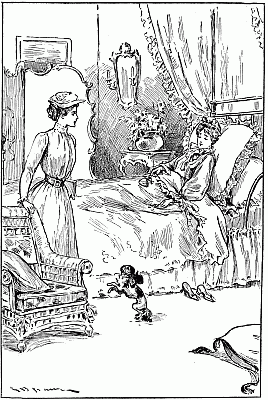
"Frightened, was she?" said Mrs. Peyton.
"How sad! Margaret, you are not looking at
my bed-spread. This is the first day I have
used it, and I put it on expressly for you.
What is the use of my having pretty things,
if no one will look at them?"
"Indeed, it is very beautiful!" said Margaret.
"Everything you have is beautiful,
Mrs. Peyton."
"It is Honiton!" said Mrs. Peyton. "It
ought to be handsome. But you do not care,
Margaret, it is perfectly easy to see that. You
don't care about any of my things any more.
I was simply a new toy to you in the beginning,
and you liked to look at me because I
was pretty. Now you have new toys,—Sophronia
Montfort, I suppose, and a sweet plaything
she is! and you pay no further attention
to me. Deny it if you can!"
Margaret did not attempt to deny it; she
was too absolutely truthful not to feel a
certain grain of fact in the lady's accusation.
Life was opening fuller and broader upon her
every day; how could she think of lace bed-spreads,
with three children constantly in her
mind, to think and plan and puzzle for? To
say nothing of Uncle John and all the rest.
And as to the "new toy" aspect, Margaret
knew that she might well enough turn the
accusation upon her lovely friend herself; but
this she was too kind and too compassionate
to do. Would not any one want toys, perhaps,
if forced to spend one's life between four
walls?
So she simply stroked the exquisite hand
that lay like a piece of carved ivory on the
splendid coverlet, and smiled, and waited for
the next remark.
"I knew you would not deny it!" the lady
said. "You couldn't, you see. Well, it doesn't
matter! I shall be dead some day, I hope and
trust. So Sophronia was frightened? Tell me
more about it!"
"She was very much frightened!" said
Margaret. "Mrs. Peyton, I wanted to ask
you—when the children came home yesterday,
they said something about your having
told them some story of old times here; of a
ghost, or some such thing. I never heard of
anything of the sort. Do you—do you remember
what it was? I ought not to torment
you!" she added, remorsefully; for Mrs.
Peyton put her hand to her head, and her
brow contracted slightly, as if with pain.
"Only my head, dear, it is rather troublesome
to-day; I suppose I ought not to talk very
much! Yes, there was a ghost, or something
like one, in old times, when I was a child. I
wasn't at Fernley at the time, but I heard
about it; Sophronia was there, and I remember
she was frightened into fits, just as you
describe her last night."
"What—do you remember anything about
it? It isn't that old story of Hugo Montfort,
is it, the man who looks for papers?"
"Oh, no, nothing so interesting as that! I
always longed to see Hugo. No, this is just a
voice that comes and goes, wails about the
rooms and the gardens. It is one of the
Montfort women, I believe, the one who cut
up her wedding-gown and then went mad."
"Penelope?"
"That's it! Penelope Montfort. Once in
a while they see her, but very rarely, I believe."
"Mrs. Peyton, you are making fun of me.
Aunt Faith told me there was no ghost except
that of Hugo Montfort; of course I don't mean
that there is really that; but no ghost that
people had ever fancied."
"Ah, well, my dear, all this was before
Mrs. Cheriton came to Fernley! Before such
a piece of perfection as she was, no wandering
ghost would have ventured to appear. Now
don't stiffen into stone, Margaret Montfort! I
know she was a saint, but she never liked me,
and I am not a saint, you see. I was always
a sinner, and I expect to remain one. And
certainly, there was a white figure seen about
Fernley, at that time I was speaking of; and
no one ever found out what it was; and if you
want to know any more, you must ask John
Montfort. There, now my head is confused,
and I shall not have a straight thought again
to-day!"
The lady turned her head fretfully on the
pillow. Margaret, who knew her ways well,
sat silent for some minutes, and then began to
sing softly:
O sweetest lady ever seen,
(With a heigh ho! and a lily gay,)
Give consent to be my queen,
(As the primrose spreads so sweetly.)
Before the long ballad was ended, the line
between Mrs. Peyton's eyebrows was gone,
and her beautiful face wore a look of contentment
that was not common to it.
"Go away now!" the lady murmured.
"You have straightened me out again. Be
thankful for that little silver voice of yours,
child! You can do more good with it in the
world than you know. I really think you are
one of the few good persons who are not
odious. Go now! Good-bye!"
Margaret went away, thinking, as she had
often thought before, how like her Cousin Rita
this fair lady was. "Only Rita has a great,
great deal more heart!" she said to herself.
"Rita only laughs at people when she is in
one of her bad moods. Dear Rita! I wonder
where she is to-day. And Peggy is driving
the mowing machine, she writes; mowing
hundreds of acres, and riding bareback, and
having a glorious time."
A letter had come the day before from
Peggy Montfort, telling of all her delightful
doings on the farm, and begging that her
darling Margaret would come out and spend
the rest of the summer with her. "Darling
Margaret, do, do, do come! Nobody can possibly
want you as much as I do; nobody can
begin to think of wanting you one hundredth
part as much as your own Peggy."
Margaret had laughed over the letter, and
kissed it, and perhaps there was a tear in her
eye when she put it away to answer. It was
good, good to be loved. And Peggy did love
her, and so she hoped—she knew—did
Uncle John; and now the children were
hers, two of them, at least; hers to have
and to hold, so far as love went. Go away
and leave them now, when they needed her
every hour? "No, Peggy dear, not even to
see your sweet, round, honest face again."
Coming back to the house she found Gerald
Merryweather on the verandah. He was in
his working clothes again, but they were
fresh and spotless, and he was a pleasant
object to look upon. He explained that he
had called to inquire for the ladies' health,
and to express his hope that they had suffered
no further annoyance the night before. He
was on his way to the bog, and just thought
he would ask if there was anything he could
do.
"Thank you!" said Margaret, gratefully.
"You are very good, Mr. Merryweather. No;
nothing more happened; and my poor cousin
got some sleep after awhile. But I still cannot
imagine what the noise was, can you?"
"So many noises at night, don't you
know?" said Gerald. "Especially round
an old house like this. You were not personally
alarmed, were you, Miss Montfort?
I think you may be pretty sure that there
was nothing supernatural about it. Oh, I
don't mean anything in particular, of course;
but—well, I never saw a ghost; and I don't
believe in 'em. Do you?"
"Certainly not. I didn't suppose any one
believed in them nowadays. But,—do you
know, I really am almost afraid my Cousin
Sophronia does. She will not listen to any
explanation I can suggest. I really—oh,
here she is, Mr. Merryweather!"
Miss Sophronia greeted Gerald with effusion.
"I heard your voice, my dear young
man," she said, "and I came down to beg
that you would take tea with us this evening—with
my niece—she is quite the same as
my own niece; I make no difference, dearest
Margaret, I assure you,—with my niece and
me. If—if there should be any more unpleasant
occurrences, it would be a comfort
to have a man, however young, on the premises.
Willis sleeps in the barn, and he is
deaf, and would be of little use. He couldn't
even be of the smallest use, if we should be
murdered in our beds."
"Oh, but we are not going to be murdered,
Cousin Sophronia," said Margaret, lightly.
"We are going to be very courageous, and
just let that noise understand that we care
nothing whatever about it."
"Margaret, my love, you are trivial," responded
Miss Sophronia, peevishly. "I wish
you would pay attention when I speak. I
ask Mr. Merryweather to take tea with us,
and you talk about noises. Very singular, I
am sure."
"Oh, but of course it would be very
pleasant, indeed, to have Mr. Merryweather
take tea with us!" cried Margaret, in some
confusion. "I hope you will come, Mr.
Merryweather."
It appeared that nothing in the habitable
universe would give Mr. Merryweather greater
pleasure. At half-past six? He would not
fail to be on hand; and if there should be
noises again, why—let those who made them
look to themselves. And, with this, the
young man took his leave.
The children were very troublesome that
day. Margaret could not seem to lay her
hand on any one of them. If she called
Basil, he was "in the barn, Cousin Margaret,
helping Willis with the hay. Of course I'll
come, if you want me, but Willis seems to
need me a good deal, if you don't mind."
When it was time for Susan D.'s sewing,
the child came most obediently and affectionately;
but her thimble was nowhere to be
found, and she had mislaid her spool, and,
finally, when everything was found, she had
not sat still ten minutes, when she was "so
thirsty; and must go and get a glass of
water, please, Cousin Margaret!"
"Susan," said Margaret, "I want to talk
to you, and I cannot seem to get a chance for
a word. Sit still now, like a good little girl,
and tell me—"
"Yes, Cousin Margaret, I couldn't find my
thimble first, you see; and then there wasn't
any spool, and I left it in my basket yesterday,
I'm sure I did, but Merton will take it to
teach the kitten tricks with, and then it gets
all dirty. Don't you know how horrid a
spool is when a kitten has been playing with
it? You have to wind off yards and yards,
and then the rest is sort of fruzzly, and keeps
making knots."
"Yes, I know. Susan D., what were you
doing last evening?" said Margaret.
"Last evening?" repeated the child. "We
were in the summer-house, Cousin Margaret.
We were playing Scottish Chiefs, don't you
know? Merton had to play Lord Soulis,
'cause he drew the short straw; but he got
cross, and wouldn't play good a bit."
"Wouldn't play well, or nicely," corrected
Margaret. "But after that, Susan dear?"
"That took a long time," said the child.
It seemed, when she was alone with Margaret,
that she could not talk enough; the little
pent-up nature was finding most delightful
relief and pleasure in unfolding before the
sympathy that was always warm, always
ready.
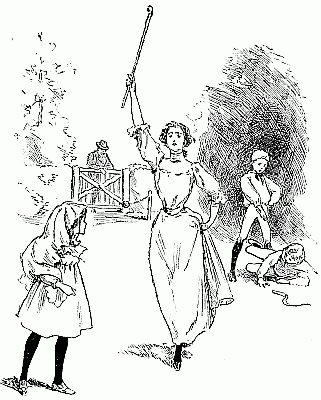
"You see, when it came to carrying me off
(I was Helen Mar, after I'd been Marion and
was dead), Merton was just horrid. He said
he wouldn't carry me off; he said he wouldn't
have me for a gift, and called me Scratchface,
and all kinds of names. And of course
Lord Soulis wouldn't have talked that way;
so Wallace (of course Basil had to be Wallace
when he drew the long straw, and he never
cheats, though Merton does, whenever he gets
a chance)—well, and so, Wallace told him,
if he didn't carry me off in two shakes of a
cat's tail—"
"Susan D.!"
"Well, that's what he said, Cousin Margaret.
I'm telling you just as it happened,
truly I am. If he didn't carry me off in two
shakes of a cat's tail, he'd pitch him over the
parapet,—you know there's a splendid parapet
in the summer-house,—and so he wouldn't,
and so he did; but Mert held on, and they
both went over into the meadow. I guess
Lord Soulis got the worst of it down there,
for when they climbed up again he did carry
me off, though he pinched me hard all the way,
and made my arm all black and blue; I didn't
say anything, because I was Helen Mar, but I
gave it to him good—I mean well—this
morning, and served him out. And then
Wallace had to rescue me, of course, and that
was great, and we all fell over the parapet
again, and that was the way I tore the gathers
out of my frock. So you see, Cousin
Margaret!"
Susan D. paused for breath, and bent over
her sewing with exemplary diligence. Margaret
took the child's chin in her hand, and
raised her face towards her.
"Susan," she said, gently, "after you had
that fine play—it must have been a great
play, and I wish I had seen it—after that,
what did you do?"
"We—we—went to bed!" said Susan D.
"Why did you go without coming to
say good night? Answer me truly, dear
child."
The two pairs of gray eyes looked straight
into each other. A shadow of fear—a suggestion
of the old look of distrust and suspicion—crept
into the child's eyes for a
moment; but before Margaret's kind, firm,
loving gaze it vanished and was gone. A
wave of colour swept over her face; her eyes
wavered, gave one imploring glance, and
fell.
"Aren't you going to tell me, Susan D.?"
asked Margaret once more.
"N—no!" said Susan D., in a whisper
scarcely audible.
"No? And why not, dear child?"
"I promised!" whispered Susan D.
"Susan D., do you know anything about
that strange noise that frightened us so last
night?"
But not another word would Susan D. say.
She looked loving, imploring, deprecating;
she threw her arms around Margaret's neck,
and hid her face and clung to her; but no
word could she be brought to say. At last
Margaret, displeased and puzzled, felt constrained
to tell the child rather sternly to fold
her work and go away, and not come back to
her till she could answer questions properly.
Susan went obediently; at the door she hesitated,
and Margaret heard a little sigh, which
made her heart go out in sympathy toward
the little creature. Instantly she rose, and,
going to the child, put her arms round her
affectionately.
"Darling, I think you are puzzled about
something," she said, quickly. Susan D. nodded,
and clung close to her cousin's side.
"I will not ask you anything more," said
Margaret. "I am going to trust you, Susan
D., not to do anything wrong. Remember,
dear, that the two most important things in
the world are truth and kindness. Now kiss
me, dear, and go."
Left alone, Margaret sat for some time,
puzzling over what had happened, and wondering
what would happen next. It was evident
that the children were concerned in some
way, or at least had some knowledge, of the
mysterious sounds which had so alarmed
Miss Sophronia. What ought she to do?
How far must she try to force confession from
them, if it were her duty to try; and how
could she do it?
Thus pondering, she became aware of voices
in the air; she sat near the open window, and
the voices were from above her. The nursery
window! She listened, bending nearer,
and holding her breath.
"Well, if you back out now, Susan D., it
will be mean!" Basil was saying. "What
did you say to her?"
"I didn't say anything!" Susan D. answered,
sullenly.
"Why didn't you tell her that we had a
pain, and didn't want to bother her, 'cause
she had company?" cried Merton, eagerly.
"I had that all fixed to tell her, only she
never asked me."
"I wouldn't tell her a lie," said Susan D.
"Basil, you wouldn't tell her a lie, either,
you know you wouldn't, when she looks at
you that way, straight at you, and you can't
get your eyes away."
"Of course I wouldn't," said Basil. "And
the reason she didn't ask you, Merton, was
because she knew it wouldn't make much difference
what you said. That's the trouble
about you. But now, Susan, if you had only
had a little dipplo-macy, you could have got
through all right, as I did."
"I don't know what you mean by dipplo-macy,"
retorted Susan.
"Ho, stupid!" sneered Merton.
"I don't believe you know what it means
yourself!" cried Basil. "Come, tell now, if
you are so wise. What does it mean? Ah,
I knew you didn't know! You are a sneak,
Mert! Well, I guess in the beginning, when
Adam was making the words, you know, he
must have wanted to hide from the serpent or
something—perhaps a hairy mammoth, or a
megatherium, I shouldn't wonder,—so he
said, 'Dip low,' and then 'Massy!' for a
kind of exclamation, you see. And spelling
gets changed a lot in the course of time; you
can see that just from one class to another in
the grammar school. Well, anyhow, it means
a sort of getting round things, managing
them, without telling lies, or truth either."
"You've got to tell one or the other,"
objected Susan D.
"No, you haven't, either! Now, how did I
manage? I have just kept out of Cousin
Margaret's way all day, so far, and I'm going
to keep out the rest of it. I've been helping
Willis ever since breakfast, and he says I
really helped him a great deal, and I'll make
a farmer yet; only I won't, 'cause I'm going
into the navy. And now pretty soon I'm
going in, in a tearing hurry, and ask her if I
can take some lunch and go over to see Mr.
Merryweather at the bog, 'cause he is going to
give me a lesson in surveying. He is; he said
he would, any time I came over. And so,
you see—"
"That's all very well," interrupted Merton,
scornfully. "But when it comes night, what'll
you do then, I should like to know?"
"Easy enough. I shall have a headache,
and she won't ask me questions when I have
a headache; she'll just sit and stroke my
head, and put me to sleep."
"Ho! How'll you get your headache? Have
to tell a lie then, I guess."
"No, sir, I won't! And if you say that
again, I'll bunt you up against the wall. Easy
enough to get a headache. I don't know
whether I shall eat hot doughnuts, or just
ram my head against the horse-chestnut-tree
till it aches; but I'll get the headache, you
may bet your boots—"
"Basil, she asked you not to say that, and
you said you wouldn't."
"Well, I'm sorry; I didn't mean to. Pull
out a hair, Susan D., and then I shall remember
next time. Ouch! You pulled out two."
"I say, come on!" cried Merton. "We've
got lots of things to see to. We have to—"
The voices were gone. Margaret sat still,
sewing steadily, and working many thoughts
into her seam.
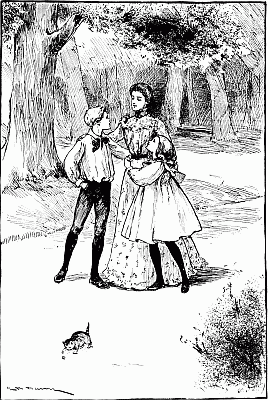
It might have been half an hour after this
that Basil burst into the room, breathless and
beaming, his tow-colored hair standing on end.
"Oh, Cousin Margaret, can I—I mean may
I, go over to the bog? Mr. Merryweather said
he would give me a lesson in surveying; and
Frances is going to put me up some luncheon,
and I'm in a norful hurry. May I go, please?"
"Yes, Basil; you may go after you have
answered me one question."
"Yes, Cousin Margaret," said the diplomat.
"I may miss Mr. Merryweather if I don't go
pretty quick, but of course I will."
"Basil, did you make that strange noise
last night?"
"No, Cousin Margaret!" cried the boy; the
smile seemed to break from every corner of
his face at once, and his eyes looked straight
truth into hers. "I did not. Is that all?
You said one question! Thank you ever and
ever so much! Good-bye!" And he was gone.
"It is quite evident that I am not a dipplo-mat,"
said Margaret, with a laugh that ended
in a sigh. "I wish Uncle John would come
home!"

 Next to Miss Alcott's famous "