“THERE’S the stage, mother! It’s coming
round the Bend,—don’t you hear it?
Hark! how near it sounds! I shall see it in a
minute. There it is, now! And there’s somebody
on the top with Mr. Peters;—yes, there are
two or three persons. I’ll bet Marcus and Oscar
are there; don’t you believe they are? I’d ride
outside, if I were they; wouldn’t you, mother?”
“You had better not be too jubilant, Ronald,”
20calmly replied the lady addressed. “Have you
forgotten how disappointed you were last night?”
“O, well, it isn’t likely they will disappoint us
again,” replied the boy. “I know they will come,
this time, just as well as I want to. See! that’s
Marcus himself—I know him by his straw hat, and
his brown linen sack that he wore to keep the dust
off his clothes. And that boy by the side of him
is Cousin Oscar, isn’t it? Look! isn’t that Oscar,
Aunt Fanny?”
Aunt Fanny looked towards the stage-coach,
still nearly a quarter of a mile distant; but her
eyes were not sharp enough to distinguish the
countenance of any one upon it, and she could not
relieve the impatient boy from his suspense.
“I wonder what he looks like, any way,” resumed
Ronald. “I can tell, just as soon as I see him,
whether I shall like him or not. Why, I should
think he was as big as Sam Hapley. He looks a
little like him, too, from here, doesn’t he, mother?”
“I can’t tell; he is hardly within the range of
my vision, yet,” replied Mrs. Page.
“Now Marcus is pointing this way,” continued
Ronald. “I’ll bet he sees me, and is telling Oscar
21who I am. Why, mother, can’t you see them now?
I can almost hear them talk.”
“Yes, that is Marcus, and there is Oscar, too,”
said Aunt Fanny, after gazing a few moments at
the approaching coach.
“Didn’t I tell you so!” exclaimed Ronald, rubbing
his hands with glee, and dancing on the green
sward around the door. “Speak to them, Rover!”
he added, calling to a handsome spaniel that lay in
the middle of the road, beneath the shade of a tree.
The dog sprang to meet the stage-coach, which
was now within a few rods of the house; and, recognizing
his master, he frisked around the horses,
and manifested his satisfaction by a variety of significant
signs.
Mr. Peters, the driver, reined up his horses at
the farm house, and a young man, about eighteen
years of age, jumped off, followed by a lad some
three years younger. The first of these was Marcus
Page, and this was his home, from which he
had been absent about ten days, on a visit to Boston,
and other places in Massachusetts. The other
passenger was his cousin, Oscar Prestor, whose
parents resided in Boston, but who had come to
22live with the family for a season. He appeared a
little embarrassed, as he extended his hand to his
two aunts, Mrs. Page, and her maiden sister, Miss
Lee; but the cordial welcome which they extended
to him, instantly put him at his ease. Meanwhile,
little Ronald was gazing earnestly at the new-comer,
evidently settling in his mind the important
question which was to be decided at first sight,
when Marcus said—
“Here, Oscar, let me make you acquainted with
Master Ronald, my protégé. Ronald, this is Cousin
Oscar. You will soon be good friends, if I am not
greatly mistaken.”
The boys shook hands, and then Ronald, proffering
his services, helped Oscar to carry his trunk
into the house. By the time the travellers had removed
the dust from their persons and clothing,
supper was ready, and the family sat down to the
table. Much of the conversation, during the meal,
was addressed to Oscar, and many inquiries were
made concerning his parents, sisters, and brothers.
He sustained his part with the ease and freedom
of one who is accustomed to society, his first shyness
having quite disappeared. Ronald watched
23him with much interest, and seemed still in doubt
whether to like him or not. After tea, when Oscar
had gone out with Marcus to the barn, Miss Lee,
remembering Ronald’s remark, inquired—
“Well, Ronald, what do you think of Oscar?”
“I think he feels pretty smart; and I never saw
a city chap but what did,” replied Ronald.
“Why, what makes you think so?” inquired
Miss Lee.
“I don’t know—I can’t tell,” said the boy, hesitatingly.
“But if you do really think so, you ought to be
able to give a reason for it,” added Miss Lee.
“Well,” continued Ronald, “I suppose it’s because
he speaks up so smart, and eats so genteelly,
and wears such nice clothes, and—and is so good-looking,”
he added, laughing at the idea.
“I think you are mistaken in him,” replied Miss
Lee. “His dress is such as boys in the city, of
his age and class, usually wear; and his manners
are those of a boy who is familiar with good society.
Perhaps he is a trifle too forward, for one of
his age,—I think a little bashfulness becomes a boy,
sometimes; but I never saw anything like pride in
24him. He has been about the world a good deal,
for one so young, and that, I suppose, has worn off
his bashfulness.”
“Then I guess I shall like him, if he isn’t
proud,” said Ronald, and away he ran, to join Marcus
and Oscar, who were taking a general survey
of the farm.
Mrs. Page’s farm is situated in one of the pleasant
mountain towns in Vermont, which, if it does
not bear the name of Highburg on the map, will
not, we trust, resent the act, if we venture to give
it that designation, in this volume. It is located
at the foot and on the sides of the Green Mountains,
and within sight of one of their highest
peaks, the Camel’s Hump. Mr. Page was a sea
captain, who, thinking it more pleasant to plough
the land than the wave, purchased this farm in his
native State, intending to make it his residence.
When the new house and barns were completed,
and the farm stocked with herds and flocks, and
everything ready for occupancy, Capt. Page found
that his money was all spent. Not having confidence
enough in his agricultural skill to enter upon his
new sphere of life without something in hand for
25an emergency, he determined to make one more
voyage before he abandoned the sea. So he engaged
a man to manage the farm during his absence,
and, removing Mrs. Page and Marcus to
their new home, he sailed on a whaling cruise, expecting
to be gone about three years. It proved
his last voyage in a sadder sense than he intended,
for he never returned from it. Three, five, ten
years passed away, but the missing ship was never
heard from, and the owner of the farm never came
back to enjoy the pleasant home he had prepared
for himself. Mr. Burr, whom Capt. Page employed
to oversee the farm, had managed its out-door affairs
during all this period, although Marcus, within
a few years, had taken a good share of the burden
upon himself. During the winter months, indeed,
Marcus now undertook the whole management of
the farm. At this time the stock consisted of two
horses, six or eight head of cattle, about seventy-five
sheep, and a quantity of poultry.
When Oscar returned to the house, he found a
boy and girl seated at the supper table, who were
introduced to them as Katharine and Otis Sedgwick.
They were brother and sister, and were
26pupils of the village academy, a mile or more distant.
Katharine was about fourteen years old, and
Otis some two years younger. They boarded at
Mrs. Page’s, and, with the persons already named,
constituted the entire family.
Ronald, who called Mrs. Page mother, was a
boy about twelve years old, whom she had undertaken
to bring up. His parents were French Canadians,
who had emigrated to the vicinity of Highburg,
where they both died within a short time,
leaving the poor child without friends or money.
He was then about eight years old. Some of the
kind people of the town wished to prevent his
becoming a pauper, and tried to find a home for
him; but, although he was a bright and interesting
child, he could not speak English very plain, and
was, moreover, very strange and wild in his manners
and appearance, so that no one was willing to
take him. Pitying his friendless lot, Mrs. Page at
length offered to keep him a few weeks, till other
arrangements could be made in his behalf. A month
sped by, and no door opened for the little orphan
but that of the poor-house. Wild, ignorant, unused
to restraints, full of mischief, incapable of speaking
27or understanding the language of the family, and,
in fact, almost as uncivilized as an Indian child,
Mrs. Page found the new care a burden too great,
and concluded that she must give up her charge to
the town authorities.
When Marcus heard of this decision, he felt very
badly. There was something about the little
stranger, and his pitiable condition, that won upon
his heart. So he put in a plea with his mother
and Aunt Fanny in his behalf, and by way of further
inducement, volunteered his own assistance in
educating and training the child! Such an offer,
from a boy who had but just passed his fourteenth
birth-day, might provoke a smile from some people,
and very properly, too. But neither Mrs. Page
nor her sister thought of laughing at the suggestion.
Marcus was not only a good scholar and a
good boy, but he was more manly and mature, both
in mind and body, than many youth of his age.
As Ronald was more than six years his junior, it
seemed plausible that Marcus might assist very
much in making a man of him, and thus relieve his
mother of a portion of the care. It was decided to
try the experiment, and the result was so successful,
28that Mr. Upton, the principal of the academy, gave
Marcus the title of “The Boy-Tamer.” The boys
soon became greatly attached to each other, and
Marcus, by his example, influence and teachings,
assisted very much in reclaiming the little savage.
After a year or two, he was able to take upon
himself almost the entire management of Ronald,
directing his studies, imposing upon him his daily
tasks about the farm, and generally exercising over
him the authority and discipline of a father. Ronald,
indeed, used sometimes to speak of him sportively
as his “adopted father,” and no doubt he
seemed somewhat like a parent to the fatherless
boy. His name, originally, was Ronald Doucette;
but his new friends had given him their own name
of Page, retaining Doucette as a middle name.
“How do you think Oscar appears, mother?”
inquired Marcus, as soon as the withdrawal of the
young folks to their bed-rooms left him alone with
his mother and aunt.
“Very well,” replied Mrs. Page. “He is a boy
that can make a good appearance, if he chooses
to. How does he seem pleased with his new
home?”
29“He doesn’t say much about it,” replied Marcus.
“But he said, before we left Boston, that he was
determined to be contented, whether or no. He
is glad enough to come here, and I think he means
to behave well. I told him this was probably his
last chance, and that if he did not do well here, he
would have to go back to the Reform School, and
serve his full sentence out. But I don’t think we
shall have much trouble with him. He has behaved
well in the institution, and he says he is determined
to reform.”
“And yet I am afraid he will find more difficulties
in the way than he imagines,” interposed Mrs.
Page.
“But the difficulties here are nothing to what
they would be in the city,” added Marcus. “Nobody
need know anything about his past life,
here, and besides, he will be out of the way of his
old associates and temptations.”
“I think we ought to be very careful,” said Aunt
Fanny, “never to say anything about his past bad
conduct, even to him. Nothing would discourage
him so much as to have it known here that he
had been a bad boy.”
30“I told him,” replied Marcus, “that nobody here
but we three knew anything about that,—not
even Ronald; and I promised that it should be
kept a secret, so long as he behaved well. He
seemed very glad to hear it.”
“He certainly has a favorable opportunity to
make a new start in life, and I hope he will
improve it,” said Mrs. Page.
“We shall have to take a little time to study his
character, before we can tell exactly how to manage
him,” continued Marcus. “I found out everything
I could about him from his mother, and I
think I begin to understand his disposition. The
great lesson he has got to learn, is, to govern himself.
Now that he has found, by experience, that
if he does not put himself under restraint, others
will do it for him, I think he is in a good state to
learn this lesson.”
The subject of these remarks was at this time
between fifteen and sixteen years of age. He had
been a headstrong, wayward boy, and had given
his parents much pain. At one time, they sent
him to live with an uncle in the village of Brookdale,
in Maine, for the purpose of getting him
31away from his evil associates; but while there, he
set fire to a large quantity of cut wood, which was
destroyed, and was in consequence sent to jail,
from which he was released only on his father’s
promise to remove him from the State. He was
then sent on a short voyage to sea, but came back
worse than before. His next downward step was
to join a band of juvenile thieves; but his course
was shortly afterward checked by his arrest, trial,
and sentence to the Reform School during his
minority,—that is, until he should be twenty-one
years old. After he had remained in this institution
about four months, his conduct having
been good, and Mrs. Page, at the solicitation of
Marcus, having offered to receive him into her
family and endeavor to reform him, he was released
by the officers, and given over to the care of his
aunt and cousin; and his appearance in Highburg,
at this time, was in accordance with this arrangement.[1]
CHAPTER II. THE NEW-COMER.
32
THE new-comer, Oscar, was very naturally the recipient
of much attention, for a few days after
his arrival. The advent of such a big boy in the family
was an event of no trifling importance, in the eyes
of the younger members of the household. Was
he not a real Boston boy, and had he not seen so
much of city life that, in his own language, he was
sick of it? Had he not also resided for months
together in two or three other towns, far away
from his home? And, most strange of all, had he
not actually made a voyage to the West Indies, in
the capacity of sailor-boy? So, at least, it was
currently reported, and so they all believed; and
surely a boy who had seen so much of the world
must be something of a hero, they reasoned. Meanwhile,
33the older members of the family were quietly
watching their new charge, studying his disposition,
gaining insight into the secret springs of his
character, and taking the measure of his mental
acquirements and capacities.
Oscar was expecting to attend the academy,
during the coming winter; but as it was now well
advanced in the autumn term, he was to study at
home until the new term commenced, about two
months from this time, it being now the latter part
of September. Marcus had graduated at this
academy, a year previous, and had been invited to
serve as assistant teacher, the coming winter.
“What shall I do?” inquired Oscar, the morning
after his arrival, as he perceived that all the family
were busily at work.
“You need not do anything, just yet,” replied
his aunt. “You can look on and see us work,
through the rest of this week, or amuse yourself in
any way you please. By next Monday we will
find something for you to do, and you can commence
your studies, too, at the same time.”
The few days of leisure thus granted to Oscar
did not hang very heavily upon his hands. He
34found many things to interest and amuse him,
about the farm. The greatest novelty to him,
however, were the sheep, for he had never before
lived where these pretty creatures formed a part
of the farm stock. The pasture where they were
kept became at once an attractive place, and it must
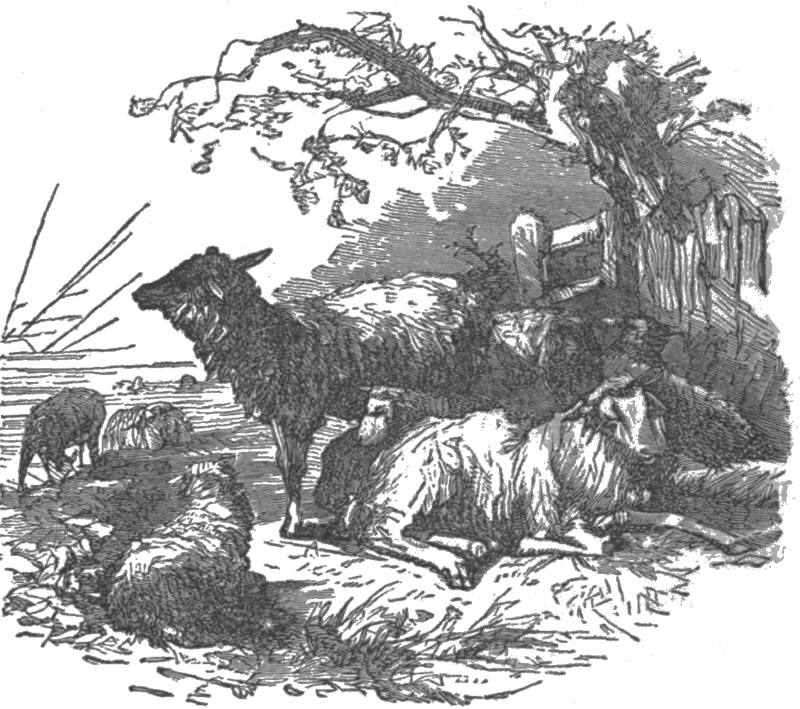
be confessed that the groups of sheep and lambs,
quietly nibbling the grass, or reclining at their ease
in the beams of the morning sun, formed as beautiful
a scene as could be found upon the farm. The
35cattle, horses, pigs and poultry, the capacious barns,
with the deep and lofty hay-mows, the dairy, granary,
tool-house and wood-house,—these, also, though
more familiar objects to Oscar, were not without
their attractions for him; while he found a still
further source of amusement in accompanying
Marcus and Ronald, as they went about their daily
duties on the farm.
Marcus was a little sorry to notice that Oscar
did not appear to find idleness very irksome, nor
to feel much anxiety about making himself useful.
He seemed to think he had received a full discharge
from labor for the rest of the week, and gave
himself no more concern about it than though he was
merely a boarder, like Katie and Otis, with whom
he spent a good portion of his time. There were
many little things in which his assistance, cheerfully
offered, would have been accepted with pleasure;
but we are sorry to say that these evidences
of a “willing mind” were entirely wanting.
And yet Oscar went to Highburg with the determination
of breaking up his old habits of idleness,
and the terms upon which he was received
into the family, had been arranged with this end
36in view. He was to remain here not less than two
years. His father insisted upon paying for his
board, clothing and schooling, during his residence
here; but as one great object of the plan was to
teach him to be industrious and useful, it was stipulated
that he should do his share of the work on
the farm, at all seasons of the year. It was further
agreed that a fair sum should be allowed him for
his services, to be paid to his father at the end of
each year. If Oscar’s conduct was satisfactory,
this amount was to be paid over to him, when he
reached the age of twenty-one. He thus had a
real inducement to labor, in addition to the earnest
entreaties of his parents; and lest both of these
motives should prove insufficient, Marcus and his
mother were authorized, as a last resort, to enforce
the fulfilment of Oscar’s part of the contract, by
any means they saw fit to employ. His parents
well knew that he could not be effectually reformed,
until he had acquired habits of industry.
Nothing more was said to Oscar about work,
until Saturday afternoon, when Marcus, finding the
boys engaged in pitching jack-knives on the barn
floor, accosted his cousin as follows:
37“I suppose, Oscar, that you begin to feel as though
you would like something to do?”
“Why, yes, I am almost tired of doing nothing,”
replied Oscar, shutting up his knife, and putting it
in his pocket.
“Well, I can tell you something about your
work and studies, now, if you wish,” continued
Marcus. “A good deal of your work, for awhile,
will consist of odd jobs, which I cannot tell you
about until they come along. For the present you
must be ready for anything, in an emergency; we
will be able, by and by, to systematize the work a
little better, so that you needn’t rob Ronald or me
of our shares.”
“No danger of that, I guess!” said Oscar, with
a laugh.
“I don’t know about that,” continued Marcus.
“We don’t have a very great amount of out-door
work in the fall and winter, and with three pairs
of hands to divide it amongst, I’m afraid we may
not all get our share, if we don’t have an understanding
about it. There’s one department, however,
that you shall have the sole charge of.
Come this way.”
38He led the way to the wood-house, followed by
the boys, and added:—
“There, Oscar, you shall be lord of the woodshed;
and if any body meddles with the saw, axe,
chips, or wood-pile, without your leave, just let me
know it. Only you must understand that if I
should want to chop a stick occasionally, by way of
exercise, I shall have the liberty to do it.”
“Oh yes, I’ll agree to that,” replied Oscar.
“And I too—I like to split wood once in a
while,” interposed Otis.
“And so do I,” added Ronald.
“No, no, boys, you are not to touch anything
here without Oscar’s leave,” said Marcus. “He is
to be captain here, so you had better stand round.
You see, Oscar, there is a large pile ready for use,
now. My rule is, to saw and split a little more
every week than we use, so as to have a good supply
ahead, when cold weather sets in. I think you
had better keep on in the same way, and make it a
business, every day, or at least every other day, to
add a little to the pile. It will also be a part of
your work to see that a supply of wood is carried
into the house every day.”
39“I’ll help carry the wood in,” said Ronald.
“But I told you not to interfere with his business,”
replied Marcus.
“Well, if he doesn’t like it, then I wont do it,”
rejoined Ronald, laughing.
“As to the other work,” resumed Marcus, “I
shall want you to help cut up the hay, for one thing.”
“I know how to do that,” said Oscar.
“There will be a good deal of hay to cut, by and
by, when the horses, cattle and sheep are all put
up in the barn. And roots, too—we shall soon
begin to feed them out, and they will have to be
cut.”
“I know how to do that, too,” added Oscar.
“You can help about feeding the animals, too.
I think I shall let you have the whole care of the
pigs, to begin with, after a day or two. You will
find them very interesting pets—especially the old
sow!” he added, with a laugh.
“I might feed the horses,” suggested Oscar, whose
fancy for hogs was not very largely developed.
“So you can, and I want you to learn to bed
them, and clean them out, and rub them down,
too.”
40“I know how to do all that—I used to do it down
to Brookdale, very often,” replied Oscar.
“And I should like to have you help about milking;
do you understand that?” inquired Marcus.
“I know a little about it, but I never liked it
very well,” replied Oscar, with some hesitation.
“O, well, I dare say you will like it better after
you get used to it,” said Marcus. “But if you
shouldn’t, it wont make much difference. We all
have to do some jobs that are not so pleasant as
others.”
“I like to milk—only it tires my wrists,” said
Ronald. “I can milk one cow, all alone, but Marcus
wont let me, very often.”
“Next week,” continued Marcus, “we must gather
our apples, and you can help us about that. Then
there will be the carrots, beets, turnips and cabbages
to get in, the seed-corn to harvest, corn to
husk, snow to shovel, wood to haul, and various
other jobs to do, through the winter. Do you think
you can do your share of all this?”
“I’ll try to,” replied Oscar.
“Then there are your studies to be attended to,”
resumed Marcus. “I shall make out a list of them,
41for each day in the week, while you study at home.
And you must have some time for play, in addition
to all the rest, for ‘all work and no play makes Jack
a dull boy.’ The first thing, every day, will be to
attend to your regular morning’s work. Then, if
there are any errands or extra jobs to be done,
they will come next in order. After that, you
will get your lessons, and then will come the play-time.”
“How much time will he have for play?” inquired
Otis.
“That will depend very much upon his diligence
in doing his work and getting his lessons,” replied
Marcus.
“I shan’t want much play-time,” said Oscar, with
a significant glance towards the couple of twelve-year-old
urchins, who were evidently counting upon
his companionship in their sports.
“So much the better,” replied Marcus with perfect
indifference, although, in his mind, he had some
doubts about the last assertion.
Marcus had previously examined Oscar in his
studies, and, in the course of the afternoon, he
gave him lessons for the coming Monday, and also
42handed him a written list of studies for each day
in the week. The list is as follows:—
ORDER OF STUDIES FOR OSCAR PRESTON.
On Monday.
Writing,
Grammar,
Arithmetic.
On Tuesday.
Grammar,
Geography,
Arithmetic.
On Wednesday.
Writing,
Grammar.
On Thursday.
Writing,
Geography,
Grammar.
On Friday.
Geography,
Arithmetic,
Writing.
On Saturday.
Arithmetic,
Composition.
Reading, Spelling and Defining, daily.
CHAPTER III. A BOY’S INFLUENCE.
43
“YOU silly boys! what are you doing?” exclaimed
Kate, one afternoon, as she found her
brother and Ronald seated on a log behind the
barn, busily engaged in pricking Indian ink into
their hands, with needles.
“You go away; we don’t want you here,” replied
Otis, with rudeness, still pricking away with his
needle, while the red and blue—the blood and ink—mingled
and covered the spot upon which he
was at work.
“There! it hurts, I know it does,” said Kate, as
her brother contracted his brows, and drew in his
breath. “What ninnies you are to torture yourselves
in that way, just for the sake of having some
nasty ink pricked into your skin, where you never
can get it out again!”
44“I don’t believe it hurts any more than having
your ears bored; do you, Otis?” observed Ronald,
remembering that Kate had lately submitted to the
last-named operation.
“No; and ’tisn’t any more foolish, either,” replied Otis.
“Why, how absurd!” exclaimed Kate. “Ladies
have to get their ears bored, to wear ear-rings, and
besides, it doesn’t hurt hardly any to bore them.
I’m sure there’s no comparison between the two
things.”
She did not stop to hear what answer might be
made to this remark, and perhaps it was well that
she did not.
“It does hurt, though!” exclaimed Otis, as soon
as his sister was out of hearing. “O, doesn’t it
smart! Come, let’s stop, now, and finish it some
other time.”
“No, I’ve got mine almost done, and I’m going
to finish it now,” replied Ronald, who was possessed
of more endurance than his comrade.
Ronald persevered, and in a few minutes, wiping
off the blood and ink, a rude resemblance to a star
appeared in the red, inflamed flesh, between his
45thumb and forefinger. He seemed quite proud of
the achievement, and going into the house, and
extending his hand to Miss Lee, he accosted her
with—
“See there, Aunt Fanny!”
“And see that, too!” said Otis, exhibiting his
mark. “Mine isn’t done yet, you see. It was so
sore I had to stop, but I’m going to finish it some
other time.”
“What put it into your heads to do that?” inquired
Miss Lee.
“O, nothing,—only the other boys do it,” replied
Ronald.
“Didn’t you ever see Oscar’s anchor?” inquired
Otis.
“No, I didn’t know he had an anchor,” replied
Miss Lee.
“He has got a real handsome anchor on his arm,
pricked in with Indian ink,” continued Otis.
“He made it when he was at sea,—and he has
got a star like mine on his hand,” said Ronald.
“I have noticed the star,” said Miss Lee; “but
what is the use of your marking yourselves in that
way? What do you do it for?”
46“Why, it looks handsome,” replied Ronald, with
some hesitation.
“I don’t think so—those black marks look ugly,
to me,” replied Miss Lee; “besides, you never can
wash them out.”
“Why, that’s the beauty of it, Aunt Fanny,”
replied Ronald, with one of his roguish looks.
“There wouldn’t be any fun in it if it washed out.”
“Perhaps you will think differently, some time
or other,” said Miss Lee.
“But what hurt does it do?” inquired Otis.
“I don’t know that it does any harm,” replied
Miss Lee; “but it always seemed to me like a
heathenish practice. Did you know that the old
pagans used to mark themselves in that way, in
honor of their idols?”
“What, did they prick Indian ink into their
hands, as we do?” inquired Ronald.
“Sometimes they pricked the marks in,” replied
Miss Lee, “and sometimes they burnt and cut them
into the flesh. If a man devoted himself to Jupiter,
he marked himself with a thunderbolt, on the palm
of his hand, or his wrist, or neck, or upon some
other part of his body. If he chose Mars for his
47god, then the mark was a helmet or spear. Soldiers
and slaves used sometimes to be marked in the
same way, to show to what commander, or to what
master, they belonged. Some tribes of savages, at
the present day, are very fond of such ornaments,
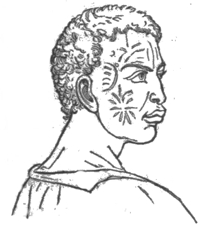
and tattoo their faces all
over, by pricking dyes into
their skins. There are several
allusions to this custom
in the Bible, and the
Jews were forbidden to
practise it.”
“It’s wicked, then, to
make such marks, isn’t it?” inquired Otis.
“No,” replied Miss Lee, “so long as you do not
make them in honor of any false god, nor with any
bad motive, there is no sin in the act. The worst
that can be said about it is, that it is a foolish custom,
and a relic of paganism and superstition.”
“I’m going to see if I can’t wash mine out, before
it dries in,” said Ronald, and he hurried off to the
pump, followed by Otis.
For a few minutes the boys worked as hard to
rub out their new ornaments as they had labored, a
48little while before, to imprint them upon their hands.
But water, soap, and even sand, were all in vain.
The stars shone as brightly at the end as at the
beginning of the effort. While thus engaged, Oscar
came along, and, on seeing what the boys were
about, indulged in a hearty laugh.
“Why, you little fools!” he exclaimed, “what
are you trying to wash the ink out for?”
“Because we don’t want it in,” replied Ronald.
“What did you prick it in for, then?” continued
Oscar.
“Because we didn’t know any better, then,” said
Ronald; “but Aunt Fanny says the heathen prick
ink into their hands, and I don’t want to be a
heathen.”
“Well, if that isn’t a great idea!” exclaimed
Oscar, relapsing into another hearty laugh. “I
suppose you think I’m a heathen, then, don’t you?”
he continued. “Well, if I’m a heathen, I guess
there are a good many others around full as bad.
I never heard any body say there was any harm in
pricking a little Indian ink into your hand, and I
don’t believe there is, if Aunt Fanny does say so.”
“She didn’t say there was any harm in it,” replied
49Ronald. “She said she didn’t like it, because
it was doing as the heathen did.”
“So we ‘do as the heathen do’ when we eat, but
I shan’t give up eating on that account,” observed
Oscar.
“Nor I, either,” said Otis, who was very willing
to be re-converted to the tattooing process. “I
mean to finish my star—what’s the use of trying
to wash it out?”
“Star! do you call that thing a star?” inquired
Oscar, with a look of contempt.
“But I haven’t finished it,” meekly interposed
Otis.
“No, I shouldn’t think you had,” added Oscar.
“It looks more like a spider than a star. If I
couldn’t make a better star than that with my eyes
shut, I’d put my head under a bushel basket.”
With this self-sufficient remark, Oscar walked off,
and Ronald and Otis, having come to the conclusion
that their stars were beyond the reach of soap and
sand, also left the room. It happened that Mrs.
Page and Miss Lee were sitting in an adjoining
room, and overheard the conversation just related.
One afternoon, some time after this occurrence,
50as Oscar was sitting with his Aunt Fanny, in her
chamber, studying his lessons, a boy of about his
age came along, with a gun on his shoulder, and
seeing Oscar at the open window, called him, in a
low voice—
“Come, Oscar; want to go over to Prescott’s?”
“No, I can’t go; I’ve got my lessons to learn,”
replied Oscar.
“How long before you’ll be done?” inquired the
boy, whose name was Samuel Hapley, and who
lived near by.
“It will take me nearly all the afternoon, I suppose,”
replied Oscar.
“Then I’m off,” said the boy, resuming his course.
Oscar watched him somewhat wishfully for a
minute or two, as he directed his course through
the fields, and then turned to his books. Sam Hapley
was the only boy near his own age in that part
of the town; and it also happened that he was the
only boy in Highburg he had been cautioned against.
His aunts and Marcus knew that he could not well
avoid forming an acquaintance with Sam, and they
did not forbid this; but they earnestly advised
Oscar to associate with him as little as possible,
51and to beware of his evil influence. Sam’s father
was intemperate. His mother was sickly, discouraged
and disconsolate. The children, of whom Sam
was the oldest, were neglected, their father being
cross and severe with all of them except the youngest,
and their mother always attempting to shield
them from his displeasure, even when they had
done wrong. The farm wore an air of thriftlessness,
and, to crown their misfortunes, it was covered
with mortgages.[2]
“You got rid of him pretty easily, that time,”
said Miss Lee, as Sam passed along.
“I know it; but I shouldn’t have gone if I had
got my lessons,” replied Oscar.
“It makes me real sad to see how that boy has
changed, within ten years,” continued Miss Lee.
52“He was once a pretty, modest, gentle boy, and
used to be quite a favorite of mine. Now, the
coarse features of vice are settling upon his face,
and he is said to be a very bad boy.”
“He swears like everything,” remarked Oscar.
“So I have heard,” added Aunt Fanny.
“Henry swears some, too,” continued Oscar,
alluding to a brother of Sam, about thirteen years
old.
“Ah, I am sorry to hear that,” said his aunt.
“But it isn’t very strange, after all, with such an
example before him. A boy of Sam’s age exerts a
great influence on his young brothers and sisters.
The little children look up to the large ones with
a sort of fear and respect, and copy their ways, and
imitate their example, right or wrong. Did you
ever think how much influence of this kind you
may be exerting?”
“I don’t know that I ever thought much about
it,” replied Oscar.
“Here are three children in the family,” continued
his aunt, “younger than you. The fact that you
are older and have seen more of the world than
they, while you are still a boy, gives you quite an
53influence over their minds. You can increase or
diminish that influence, according to the manner in
which you treat them; but you can’t wholly divest
yourself of it. You must exert an influence over
them, good or ill, in spite of yourself, and when
you are not thinking of it. I saw an illustration
of this, a few days ago. Otis and Ronald noticed
that you had a star pricked into your hand, and
what did they do but prick stars into theirs, as soon
as they could get the materials!”
“Oh yes, I noticed that,” said Oscar, laughing.
“That was a trifling thing,” resumed Aunt Fanny,
“but it illustrates a great truth. It shows how you
are watched, and copied, and it ought to put you
on your guard. You can use this influence so as
to assist us in training the children to good habits,
or, if you choose, you can do just the opposite.
You see there is quite a responsibility resting upon
you. If they see that you are studious, industrious
and faithful, they will feel an influence drawing
them in the same direction; but if you exhibit any
bad trait, it would not be strange if they should
try to pattern after it.”
54“I never thought much about that before, but I
mean to look out for it now,” said Oscar.
Nothing was said to Oscar in relation to his unguarded
remarks to the boys about tattooing, and
he never knew that he was overheard by his aunt.
That incident, however, gave the turn to the conversation
on this occasion.
CHAPTER IV. UP THE MOUNTAIN.
55
OSCAR, from the day of his arrival in Highburg,
had expressed a desire to ascend some one of
the lofty mountain peaks in the neighborhood; and
Marcus had made a sort of half promise to get up
a party, some fine autumn day, to visit the Camel’s
Hump, the highest eminence in that part of the
State. On reflection, however, it was thought best
to abandon this undertaking, on account of the
distance of the mountain from Highburg, the difficulty
of making the ascent, and the time that
would be required for the expedition. But to compensate
Oscar and the other young folks for the
disappointment, it was determined, one Saturday
afternoon, to make an excursion to a notable eminence
called “Prescott’s Peak,” situated about two
miles from Mrs. Page’s.
56The party consisted of Marcus, Oscar, Kate,
Ronald, Otis, and Rover, the dog. They struck an
air-line towards the mountain, through fields, meadows
and woods, Rover strolling on ahead of the
party, with an air of entire satisfaction.
“I’ll bet Rover knows where we are going—don’t
you believe he does, Marcus?” inquired Oscar.
“I don’t know, I almost think sometimes that
he knows what we say,” replied Marcus.
“He knows a good deal that we say, any way,”
remarked Otis. “You give him a bucket, and tell
him to carry it out to the barn, and he’ll do it just
as well as anybody; and he’ll lie down, or give
you his paw, or speak, if you tell him to.”
“One day, about a year ago,” said Marcus, “when
Aunt Fanny was packing her trunk, to go to Grandmother’s,
she told Rover she had got to leave him,
and asked him if he didn’t want to go, too; and
upon that he jumped right into her trunk,—as
much as to say, ‘Yes, I want to go,—pack me in!’
When Aunt Fanny came back from her journey, it
seemed as if he would eat her up, he was so glad
to see her. He never forgets anybody that he has
57once known. Last summer, I took him over to
Montpelier with me, where he used to live; and
although he hadn’t been there for over two years, he
remembered all his old friends, and went around
and scratched at all the doors of the houses he
used to visit when he lived there.”
“And he’s the neatest dog that I ever heard of,—he
wont come into the house with dirty paws,”
added Kate.
“No,” continued Marcus, “and once when we
had our floors newly painted, and boards were laid
to step upon, Rover understood the arrangement
as well as we did, and was careful to walk upon
the boards until the paint was dry.”
“We had a strange dog come to our house last
winter, that knew something,” said Otis. “He
knocked at the door, just as well as a man could
have done it. Mother went to see who had come,
and she found nothing but a dog. As soon as he
saw her, he began to cry like a baby, he was so cold
and hungry. So she gave him some dinner, and
let him warm himself, and then he went off, and
we never saw him again. But he knocked at the
58door,—tap, tap, tap,—so you couldn’t have told
him from a man.”
“I could tell a story that would beat that,” said
Oscar. “I knew a dog in Boston that would open
any door that was fastened by a latch, without
stopping to knock; and he’d shut it, too, if you
told him to.”
“I could tell a story that would beat all of
yours,” said Ronald. “It’s about a dog that unlocks
doors; and if he can’t find the key, he will
hunt up a piece of wire, and pick the lock!”
“Why, Ronald Page! how dare you tell such a
lie?” exclaimed Kate, after the laugh that followed
this sally had subsided.
“It wasn’t a lie,” replied Ronald. “I didn’t
say a dog ever did that—I said I could tell a
story about a dog that did it, and so I can.”
“It’s a lie, for all that; I’ll leave it to Marcus if
it isn’t,” rejoined Kate.
“Not exactly a lie, although it looks something
like it,” observed Marcus. “Ronald could not have
intended to deceive anybody, when he told such a
tough story as that, and therefore it was not a
falsehood. But”—
59“A snake! a snake!” suddenly broke in Ronald,
who was a little in advance of the others.
“O, kill it! do kill it!” cried Kate, running back
a few steps from the scene of danger.
“No, I shan’t—you said I lied, and now you
want me to commit murder, do you?” retorted
Ronald.
“Pooh! it’s nothing but the cast-off skin of a
snake,” said Otis, lifting it upon a stick, and tossing
it toward Kate, who dexterously dodged the missile.
“That was the skin of a black snake, wasn’t
it?” inquired Oscar.
“Yes,” replied Ronald, “and a pretty large
one, too.”
“I saw a black snake
all of six feet long,
that summer I was
down to Brookdale,”
said Oscar. “Jerry
and I were on a high
rock, and saw the snake
in the field below us. He was coiled up, and was
watching a squirrel that was a little way off. We
got some stones, and pelted him, but I believe we
60didn’t hit him, for we couldn’t find anything of
him.”
“I killed a large black snake, all alone, down in
our meadow, not more than a month ago,” said
Ronald.
“Is that one of your yarns, or do you expect us
to believe it?” inquired Oscar.
“It’s the truth, sir, I’ll leave it to Marcus, if it
isn’t,” replied Ronald.
“Hold on a minute,” said Marcus, stopping by
the side of a small, shallow pond they were passing;
and, taking a stick, he began to stir up its
muddy bottom.
“What in the world is he dabbling in that dirty
water for?” inquired Kate.
“I guess he is hunting for frogs’ eggs,” said Ronald;
“or, perhaps he’s going to make some pollywog
soup.”
“Do you see, he is going to set the pond afire!”
cried Kate, as Marcus drew some friction matches
from his pocket.
Marcus continued his operations, without noticing
the comments of his companions, and in a little
while, he actually produced a faint yellow flame
61upon the surface of the water, to the astonishment
of the company. He then explained to them that
this was an experiment which he had learned while
studying chemistry at the academy. When vegetable
matter decays under water, a gas called light
carburetted hydrogen is formed, which may be
burned. On stirring up the bottom, the gas escapes,
and rises to the top in bubbles, and may be
collected in jars, or set on fire upon the surface of
the water. This gas, he said, was the terrible “firedamp,”
which caused such tremendous explosions
in coal mines, before Sir Humphrey Davy invented
his safety lamp, to protect the miners from these
disasters. He told them, also, that he had seen it
stated in a newspaper that on one of our Western
rivers, when the water was very low, the steamboats
had to shut down their furnace doors for several miles,
and allow no torches to be lighted at
night, for fear of “setting the river on fire!” Frequently
boats that did not use these precautions
at this particular place, have found themselves engulfed
in flames, greatly to the alarm of the passengers,
and sometimes setting the steamers on
fire. In some instances, the passengers have come
62very near leaping overboard, before the officers
could convince them that there was no danger; an
act that would be almost literally “jumping from
the frying-pan into the fire.”
The party now resumed their course, and after
skirting a swamp, and threading their way thro’ a
tangled growth of young birches and pines, and
breaking a path through the sharp, bristling stubble
of a rye field, they reached the foot of the mountain.
The eminence was clothed with that dress of unfading
green from which this range takes its name,[3]
being covered with spruce, fir, hemlock, and other
evergreens, to the summit. They began the ascent
by a narrow, steep and winding path, which, however,
had the appearance of being much used.
“I should think a good many people came up
here, by the looks,” remarked Oscar.
“Not many, except Gooden’s folks,” replied Marcus.
63“Who is Gooden?” inquired Oscar.
“He is a strange fellow who lives up on the
mountain,” replied Marcus. “We shall come to
his cabin pretty soon, and perhaps you will have a
chance to see him.”
“But what does he live up here for, away from
everybody?—is he cracked?” inquired Oscar.
“He lives here because he prefers to keep out of
the way of people, I suppose,” replied Marcus.
“They say he used to steal, and got caught in a
trap, once,” said Kate.
“A regular steal trap, wasn’t it?” inquired
Ronald.
“That is the common report,” added Marcus, not
noticing Ronald’s pun, “and I suppose it is true.
The story is, that where he used to live, his neighbors
found their grain going off faster than they
thought it ought to, and one of them set a large
bear trap, with steel springs and sharp teeth, to
catch the thief. One morning soon after, he went
out to the barn, and found Gooden fast in the trap.
It caught him around the ankle, and they say he
was laid up for several months with a sore leg.
He is a little lame, now, from the effects of it. As
64soon as he could get away, he came and settled in
this out-of-the-way place, and lives as much like a
hermit as he can, with his family.”
“O, has he got a family?” inquired Oscar.
“Yes, a wife and four children,” replied Marcus.
“How does he support himself, now,—by stealing?”
inquired Oscar.
“No,” replied Marcus, “nobody suspects him of
dishonesty, now—he is probably cured of that.
He owns a cow, and raises corn and potatoes
enough to support his family. He kills some game,
which supplies him with meat. They get a little
money by making maple sugar, and collecting
spruce gum. But after all they are quite poor, and
people often give them clothing, and other necessary
articles. The children are growing up in
ignorance, too,—they never go to school or church.
They will stand a rather poor chance in the world,
brought up in that way.”
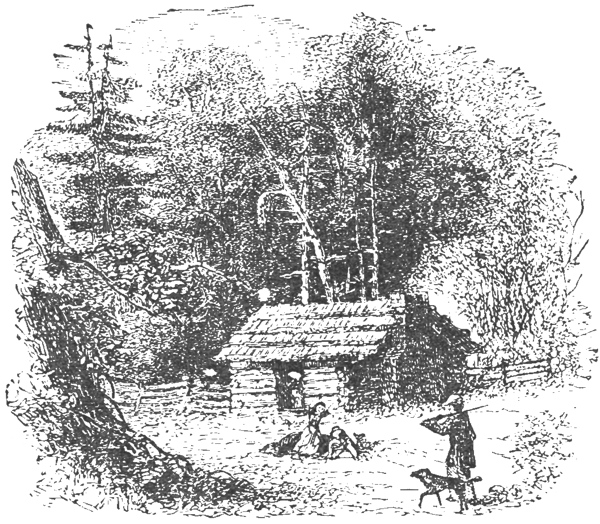
After toiling up the zigzag path awhile longer,
the party came to an open, level space, and found
themselves within a few rods of Gooden’s cabin, a
small, rude structure, built of rough logs, with a
large chimney at one end, on the outside. Several
65children were playing around the house, and the
father himself was just coming in from a hunting
excursion up the mountain, with his gun on his
shoulder, and his dog by his side. Seeing the
party approaching, Mr. Gooden went into the house
and shut the door. Marcus had often visited the
family, on errands of kindness, but knowing the
morose and suspicious disposition of the father, and
his antipathy to company, he concluded not to stop
at the cabin. Exchanging a few words with Jake
and Sally, the two oldest children, who stood staring
66at the strangers, Marcus passed on, with his
party, through a path still more intricate and difficult.
“You said something about spruce gum—what
do they do with it?” inquired Oscar.
“They sell it,” replied Marcus. “A man comes
round here every summer, who makes it his business
to collect spruce gum. He buys all the gum
that is offered him, and he hires boys to gather it
for him, paying them so much a pound. This gum
is cleaned, and sent to the cities, where it brings a
good price.”
“Well, if everybody was like me, the spruce gum
trade wouldn’t be worth much,” said Kate. “I
don’t see why anybody wants to chew the nasty
stuff, especially a young lady. How it looks, to see
your jaws going the whole time! There are some
girls in the academy that always have their mouths
full of gum. I think it’s real disgusting.”
“Chewing gum isn’t quite so bad as chewing
tobacco, but it is a foolish and disgusting habit, as
you say,” observed Marcus.
The party continued their ascent up the steep
and slippery side of the mountain, occasionally
67halting a few minutes to take breath. Some of
them began to question whether there was any top
to it, as each turn of the zigzag path, which promised
to land them at the summit, only revealed as
they advanced a still higher point beyond. But
at length the top, the very “tip-top,” as the boys
called it, was reached. Instead of a sharp, sky-scraping
ridge, they found the summit to be a broad
and nearly level plain, composed mostly of solid
rock, and almost bare of vegetation. But what a
view did it present! A dozen villages scattered
among the valleys, with their nestling houses and
white spires; the rich meadows of the Winooski
and its tributaries, with their thrifty farms; the cattle
and sheep “upon a thousand hills;” the dark
and extensive patches of forest, in which the woodman’s
axe has never yet resounded; the chain of
mountain sentinels, drawn up in lines, conspicuous
among which were the Camel’s Hump, and the distant
Mansfield Mountain, with its “Nose,” “Lips”
and “Chin;” the broad and peaceful expanse of
Lake Champlain, with a faint outline of the Adirondack
Mountains looming up beyond;—such is
a very imperfect sketch of the scene that for a
68long time engrossed the attention of the whole
party.
After the party had rested themselves, and gazed
at the extensive prospect as long as they wished,
Oscar proposed to erect a monument on the summit
that would be visible from their house, and
would commemorate their ascent of the mountain.
The proposal was readily agreed to by all, and they
immediately set about gathering the necessary materials.
All the movable stones on the summit were
soon collected in a heap, but Marcus expressed a
doubt whether there were enough to form a pile
that would be visible below.
“If we only had an axe,” said Oscar, “we could
cut down a tree, and strip off all the branches but
a few at the top; and then we could set the tree
on the summit, and pile the stones about it to keep
it in place.”
“Has anybody got any string about him?”
inquired Otis.
There was a general fumbling of pockets, and
among a score of miscellaneous articles produced
was a piece of old fishing-line belonging to Ronald.
“That’s just the thing,” said Otis. “Now we
69will find a tree that has blown down, and tie a lot
of new branches to the top of it, and stick it up, as
Oscar said.”
This proposal was adopted. A tall, straight sapling
was soon found, that had fallen before the
furious winter blasts that play among the Peak.
Its branches, now partially decayed, were broken
off, and the trunk made as clean as possible, with
the exception of the top. A quantity of evergreen
boughs were then procured, and lashed to the top
of the sapling by the fishing-line. The signal
pole, with its heavy tuft, was now raised to its
place by the united strength of the party, and the
stones piled compactly around its bottom, until
it seemed as firm as though rooted in the earth.
Three cheers were given for the monument, and
then, after a short resting-spell, the party began to
descend.
With merry shouts and laughter they were bounding,
sliding and tumbling down the steep side of
the mountain, the boys sometimes far outstripping
Kate and Marcus, and then pausing awhile, to see
how their more moderate companions got along.
In this way they had proceeded nearly a quarter
70of a mile from the summit, when Kate suddenly
brought them to a stand by exclaiming—
“I declare! if I haven’t left my veil on the top
of the mountain! I took it off when we were
looking at the scenery, because it was in my way,
and I forgot to put it on again.”
“That’s just like you,” said her brother; “you
are always forgetting something.”
“Never mind, I’ll run back and get it—it wont
take but a few minutes,” said Oscar.
“No, let me go—I’m more used to it than
Oscar is,” exclaimed Ronald.
“I’d let her go herself—it would make her
more careful next time,” said Otis, in a low tone,
which he did not intend Marcus should hear.
“Ronald is the nimblest, and he has been up the
mountain before; so I think he had better go and
get the veil, and we will wait for him till he gets
back,” said Marcus.
Ronald accordingly scrambled up the hill again,
while the others seated themselves on the dry
leaves beneath a noble pine.
“I don’t see what girls want to wear veils for,” said
Otis, somewhat petulantly, after they were seated.
71“It isn’t necessary for you to know why they
wear them, Master Otis,” replied Kate, quite coolly.
“I have no objection to girls’ wearing veils, if
they choose to, but I don’t like to see boys wear
such things,” said Marcus.
“Why, did you ever see boys wear veils?”
inquired Otis, with surprise.
“I have seen boys that I thought acted as if
they wore veils over their eyes,” replied Marcus.
“How did they act?” inquired Otis, after a
moment’s pause.
“They acted as if they could not see things
that were as plain as a pike-staff to other people,”
replied Marcus.
Otis seemed to be trying to interpret to himself
this enigmatical language, but did not appear
inclined to ask any more questions.
“For instance,” added Marcus, after a brief pause,
“when you see a boy rude or unkind towards his
sister, when there is no provocation, you may conclude
that he has a veil or something else over his
eyes; for if he could see plainly how such conduct
looks to other people’s eyes, he would not indulge
in it.”
72Otis apparently understood the point of the
remark, and felt it, too; but he made no reply. In
a few minutes a merry shout announced the approach
of Ronald, and he soon appeared, with the
lost veil fastened to his straw hat. He claimed the
privilege of wearing it home, which Kate readily
granted; but before the party came in sight of the
log cabin, he concluded to surrender it to its
owner.
Going down the mountain proved almost as difficult
and exciting as climbing up, and many a slip
and tumble happened to one and another, on the
way. Sometimes a low branch across the path,
bent from its place and then let loose by one, would
bring up the boy behind with a whack that made
him see stars. By one of these flying limbs Otis
had his cap suddenly removed from his head, and
whirled over a precipice, lodging in the top of a tall
tree below. The disaster was followed by a prolonged
and hearty shout from those who witnessed
it, and the others hastened to the spot, to see what
the matter was.
“I’ll get it for you, Oty—I can climb that tree
73easy enough,” exclaimed Ronald, as soon as he
comprehended the extent of the mishap.
“No,” said Marcus, with assumed gravity, “let
him get his cap himself—it will make him more
careful next time.”
“I don’t see what boys wear caps for; they are
always losing them,” remarked Kate, the fun in her
eyes but half concealed.
“It wasn’t my fault—I couldn’t help it,” replied
Otis, with the utmost seriousness. “Ronald let
the branch fly right into my face, and it took my
cap off before I knew it was coming.”
“Well, if Ronald is to blame, I think we shall
have to send him after the cap,” said Marcus.
They made their way, with some difficulty, to
the spot where the tree stood. Ronald, being a
more expert climber than any of the others, was
entrusted with the job, and ascended the tree
almost with the agility of a squirrel. He took with
him a pole, and with its aid the cap was soon dislodged,
and sent to the ground below.
No further incidents of importance befell the
party, on their descent of the mountain. Mr.
Gooden did not manifest himself to them, as they
74passed his cabin; and none of his family were visible.
They reached their home, tired and hungry,
in season to get a view of the signal they had
raised, after the sun had sunk behind Prescott’s
Peak; and there the tall sapling stood, for a long
time afterwards, reminding them of their pleasant
tramp “up the mountain.”
CHAPTER V. THE BLOTTED WRITING-BOOK.
75
THERE were loud demonstrations of joy among
the juvenile members of the household, one
morning, when Marcus handed a letter to Kate, for
Mr. Upton, the principal of the academy, and informed
them that it contained his acceptance of
the office of assistant teacher in that institution,
for the winter term. The appointment had been
offered him several weeks previous, and had been
the subject of much consideration on the part of
Marcus, and of no little interest, also, among the
children, who were all anxious to have Marcus for a
teacher, notwithstanding he repeatedly forewarned
them, that if he should show them any particular
favor as their instructor, it would only be by looking
more sharply after them than he did after the
other scholars.
76“Three cheers for Master Page!” shouted Ronald,
and they were given, with as much power as
four noisy throats could command.
“You know me, Marcus,—you’ll excuse me from
writing compositions, wont you?” inquired Kate,
when the noise had subsided.
“You know me, too, Marcus,—you wont make
me speak pieces, will you?” said Otis.
“You know me, Master Page,—you wont make
me do any thing, will you?” added Ronald, capping
the climax.
“Yes, I know you, you young rogue, and if you
don’t walk straight you’ll catch it!” said Marcus,
in reply to the last speaker.
Ronald did not take the admonition much to
heart; but concluded his demonstrations of delight
by throwing his cap over an apple tree, turning two
somersets, and crowing like a “rooster,” whose
clarion notes he could imitate with ludicrous fidelity.
Then, leaping upon the back of Otis, who
with Kate was just starting for school, he disappeared;
but his voice was uppermost among the
joyous shouts and laughter that came across the
fields long after their departure.
77Kate and Otis did not usually go home from
school at noon, but carried their dinners with them,
the distance being too great to walk. Ronald,
however, generally dined at home, the district
school, which he was now attending, being less
than a mile distant from Mrs. Page’s. In the course
of the forenoon, before the hour of school dismission,
as Marcus was at work throwing up muck from
a meadow, he was surprised to see Ronald approaching,
on the road leading to the house. “He must
be sick,” thought Marcus, as he noticed how slowly
he walked, and how silent and dejected he appeared.
What a change had come over the light-hearted
boy, within two hours!
Ronald appeared to hesitate a moment, and then
turned into the meadow, towards Marcus. As soon
as he was within speaking distance, the latter inquired
what the matter was. Ronald made no
reply until he had reached the place where Marcus
stood, and then he exclaimed:—
“I’m not going to that school any more—I’ve
been licked for nothing, and I wont stand it!”
“And how came you home at this time of day?”
inquired Marcus.
78“I ran away from school,” replied Ronald.
“Indeed!” said Marcus; “and will you please to
explain why?”
“Mrs. Benham set out to lick me——”
“Begin at the beginning, and tell the whole
story,” interrupted Marcus. “What did she punish
you for?”
“Why, you see she was real cross this morning,”
said Ronald; “I saw it as soon as she got there,
and thought there’d be a squall before night. Well,
I was studying my lesson, and she came along, and
wanted to look at my writing-book. So I handed
it to her, and she opened it, and found four or five
great blots on the page I wrote yesterday afternoon.
She looked real mad, and asked me what it meant,
and I told her I didn’t do it, and didn’t know anything
about it. Then she said I lied, and she’d
whip me for blotting the book, and for lying, too.
So she made me go out to the platform, and began
to put on the ratan over my hands, just as hard as
she could. See that,” continued Ronald, showing
to Marcus several red stripes on the palm of his
hand. “I couldn’t stand that, so I got the stick
away from her, and ran off as fast as I could. I
79didn’t blot the book, nor tell a lie, and I wont be
whipped for nothing by Mrs. Benham, I know.”
“Have you told me the truth, about this affair,
and nothing but the truth?” inquired Marcus, fixing
a steady gaze upon Ronald.
“Yes, sir, I’ve told the real truth, and nothing
else,” replied Ronald.
“Is it the whole truth?” inquired Marcus. “Have
you not kept something back?”
“Why, I pulled the teacher over, when I got the
stick away,—I believe I didn’t tell you about that,”
replied Ronald, in a lower tone. “I didn’t mean
to do it, though. She was on the edge of the platform,
and I was standing on the floor, and when I
caught the ratan and jerked it away, she fell upon
the floor, somehow, and then I ran off.”
“How do you know that she was not injured by
the fall?” inquired Marcus.
“O, it didn’t hurt her, for she chased me out to
the door, and shook her fist at me,—I turned
around and saw her,” replied Ronald.
“Well, you have got yourself into a pretty
scrape,” said Marcus, “and it’s my opinion you have
not seen the worst of it yet. According to your
80own story, you are liable to be arrested for assault
and battery, and what’s to be done, then?”
“I didn’t assault her, nor batter her; she held on
to the stick, and I just pulled her over, that was
all,” replied Ronald.
“You resisted your teacher, and pulled her upon
the floor; and that is sufficient, I think, to constitute
what the law terms assault and battery,” said
Marcus. “At any rate, I do not see but that you
will have to go back and apologize to her, before
the school, and then let her finish the flogging she
intended to give you, if she chooses. I think that
would be the easiest way to settle the difficulty.
You had better go home and tell mother about it,
and see what she says.”
Ronald turned away with a sadder heart than
ever. He revolted at the thought of a public apology
and submission, and secretly determined that
he would not yield to such a humiliation. He went
home and told his story to Mrs. Page, who seemed
much grieved and troubled by his conduct. She
questioned him very closely about the blots on the
writing-book, from which all the trouble sprang;
but he protested that he knew nothing about them,
81with great apparent sincerity. Still, she remembered
that Ronald was much addicted to lying,
when he came to live with her; and though the
habit had been broken up, by patient labor and
often severe discipline, there was a lurking fear that
he might possibly have relapsed, under a strong
temptation.
When Marcus came in to dinner, Ronald’s case
was freely discussed, and the conclusion appeared
to be unanimous that they could not sustain him
in the course he had taken, even if he were innocent
of the fault for which he was punished. It
was argued that a school government must, of
necessity, be a sort of absolute monarchy. The
teacher, although responsible to the community,
and more immediately to the committee, if it be
a public school, is not accountable to his pupils.
Among them he is king, and resistance to his authority
is treason. He may sometimes seem unreasonable
in his requirements, but his scholars are
not the best judges of this. He may even sometimes
punish the innocent, by mistake; but in such
a case, it is better to submit to a little temporary
pain and mortification, trusting in a future redress
82or reparation, rather than to defy or resist his authority
in the presence of the school, thereby shaking
the foundation of his government. So reasoned
Mrs. Page, Aunt Fanny, and Marcus, and they thus
reached the conclusion that Ronald was guilty of
a flagrant offence in school, and was liable to expulsion,
if not prosecution.
In the afternoon, just before it was time to dismiss
school, Marcus went to see the teacher, taking
Ronald with him, who, by the way, was quite reluctant
to go. Mrs. Benham received them politely,
and after the school closed, Marcus told her Ronald
had informed him that he had had a difficulty with
her, and requested her to give him an account of
the affair.
“Something more than a difficulty,” replied the
teacher; “it was a downright attack upon me, and
I feel the effects of it yet. I never was abused in
that way by a boy before. The way it commenced
was this: I asked Ronald to let me look at his
writing-book, and I found several large blots on
the last page he wrote. I felt doubly provoked,
because his was the neatest writing-book in the
boys’ department, and I wished it kept nice, for the
83committee to examine. When I called him to
account for the blots, he answered, as children are
apt to do in such a case, that he didn’t know anything
about them, and never saw them before.
That was a very improbable story, and I felt almost
sure, from his actions, that he was telling me a lie.
So I told him I should be obliged to punish him if
he attempted to deceive me. He answered, in an
impudent tone, that ‘he hadn’t done anything, and
wasn’t going to be whipped for nothing.’ I talked
with him further about it, and tried to persuade
him to tell the truth, but he grew more obstinate
and saucy, and threatened that he would never
come to school again if I punished him. I thought
it was time then to take him in hand, so I began
to punish him with the ratan; but before I had
given him half a dozen blows, he caught hold of
the stick, and in jerking it away from me, some
how threw me down upon the floor. He then ran
off and took my stick with him. I hurt my shoulder,
in falling, and it is quite sore, now.”
“You didn’t tell me you were impudent, Ronald;
why did you keep that back?” inquired Marcus.
84“I didn’t know that I was impudent,” replied
Ronald.
“You said I shouldn’t punish you, and that you
would never come to school again if I did; shouldn’t
you call that impudent, Marcus?” inquired the
teacher.
“Yes, I call that impudent language, when addressed
to a teacher,” replied Marcus. “Still, I
think he may not have intended to be saucy—that
is a fault he is not much addicted to. What did
you do with Mrs. Benham’s stick, Ronald?”
“I broke it, and threw it into the swamp,” replied
Ronald.
Marcus expressed a wish to see the blotted writing-book,
and it was handed to him. After a close
examination, he discovered that the blots were of
a lighter color than the writing upon the page,
indicating one of two things: 1st, They were
made with a different ink from that which Ronald
used; or, 2d, They had been recently made, and
the ink had not yet acquired its perfect color from
contact with the air. This discovery, however, gave
no clew to the mystery, although it proved that
Ronald did not blot the book when he last used it.
85Ronald now renewed his protestations of innocence,
with such apparent sincerity, that Marcus
felt satisfied he was telling the truth, especially as
he had not known him to adhere stubbornly to a
falsehood for several years. His teacher also admitted
the possibility of his innocence so far as
that offence was concerned, but thought he had
done enough, independent of that, to justify her in
excluding him from the school.
“We admit that he has done wrong,” said Marcus,
“but we should be very sorry to have him
expelled from school. He expects to leave next
month, but he mustn’t go with such a stain as this
upon his name. On what conditions will you consent
to his coming back to school?”
Mrs. Benham thought a moment, and then replied:—
“I do not wish to be harsh or unreasonable with
Ronald. If he is sorry for what he has done, and
is willing to say so before the school, that is enough.
As the offence was committed before the whole
school, I do not think I ought to ask less than that.”
“I think that is reasonable,” replied Marcus.
“Are you willing to do it, Ronald?”
86Ronald made no reply until the question had
been repeated several times, and then he merely
shook his head negatively.
“Well, perhaps he will change his mind before
to-morrow morning,” said Marcus, addressing the
teacher; and bidding her good evening, he started
for home, followed by Ronald.
Marcus said little to the boy, on their way home,
preferring to leave him to his own thoughts—not
very pleasant company to be sure, but perhaps the
best for him, under the circumstances. Before Ronald
went to bed, however, Mrs. Page talked with
him a little while about the affair. There were
three classes of motives by which she endeavored
to persuade him to comply with the teacher’s requirement.
First she appealed to his affection for
her—a motive that seldom failed to take effect
upon Ronald. Then she appealed to reason, and
tried to overcome him by argument. Finally she
resorted to a lower and more selfish class of motives,
and portrayed the disgrace of being expelled from
school, and the instantaneous relief of mind he
would find in confessing his fault. Still the proud
spirit was unsubdued.
87After a troubled night, Ronald awoke in quite
as unhappy a frame of mind as ever. He went
about his morning’s work, silently, and the other
children, not wishing to intermeddle in his trouble,
kept so much aloof that he fancied they shunned
him. Oscar, however, remembering a lesson that
had recently been impressed upon his mind, cast
his influence upon the right side, and advised Ronald
to yield. Still the stubborn will revolted at
the thought.
It was a settled principle with Mrs. Page, that
when a child refuses to be governed by such motives
as may be drawn from love, reason, the hope of
reward, and the fear of punishment, it is time for
authority to assume its stern sway. Having exhausted
these motives upon Ronald, in vain, there
remained but one other—YOU MUST; and this she
proceeded to apply.
“Ronald,” she said, a little while before school
time, “it is time to be fixing for school; and here
is a note which I wish you to take to the teacher.”
“Have I got to go to school to-day?” inquired
Ronald, in a tone of surprise, as though such a
possibility had not occurred to him.
88“Yes,” replied Mrs. Page, in a calm but firm
manner, “you are going to school this morning,
and as soon as it opens you will make a public
apology for your conduct yesterday. I have written
to your teacher that you will do so. You must
carry a stick, too, in place of the one you threw
away. Marcus will give it to you.”
“But what must I say?” inquired Ronald, his
eyes swimming with tears.
“Tell her you are sorry for what you did yesterday,
and ask her to forgive you. That is all you
need say.”
With a sad countenance and a heavy heart, Ronald
turned his steps towards the school-house.
Reluctant though he was to go, he hurried on his
way, hoping to reach the school-room before many
of the scholars had assembled. He began to realize
his unpleasant situation as he noticed that a
group of little girls were eyeing him curiously, and
evidently making him the subject of remark. Soon
a squad of boys noticed his approach, and commenced
a volley of rough salutations.
“Halloo, Ron! going to take the rest of that
licking to-day?” cried one.
89“Ha, old fellow! you’ll catch it—I bet you
will,” said another.
“You’ve got to be turned out of school—teacher
said so,” cried out another.
Ronald passed on without replying to his young
tormentors, and entering the school-room, deposited
the letter and the new ratan upon the teacher’s
desk. He then took his seat, and tremblingly
awaited the opening of the school. Mrs. Benham
soon came in, and, after hastily reading the letter,
gave the signal for the school to assemble. As
soon as the opening exercises were over, Ronald
arose, and in a low, tremulous voice said:—
“Mrs. Benham, I am very sorry for what I did
yesterday, and I beg your pardon.”
Perfect stillness reigned throughout the room,
broken only by the sobs of Ronald, as he sat down
and burst into tears. The painful silence was
quickly relieved by the teacher, who, grasping Ronald
kindly by the hand, said, with much feeling:—
“I forgive you, with all my heart, Ronald, and I
am glad you have manliness enough to confess your
fault, and ask forgiveness. You have acted very
honorably, in doing this, and I shall think all the
90better of you for it, hereafter. We will bury the
past and be good friends again,” and she gave his
hand a new shake. Then turning to the school
she continued, “I have a confession to make, too.
I am now satisfied that Ronald was not guilty of
the offence for which I undertook to punish him
yesterday. He says he does not know how his
writing-book was blotted, and I believe him. I
was too hasty, in punishing him, and am sorry for
it. I ask his forgiveness. And I hope the one
that blotted the book will come forward and own
it, and relieve him from all suspicion of falsehood.”
The teacher paused, and looked around the room,
but no one responded to the call. She then continued:—
“I am very sorry to think there is one here who
can be so dishonorable, and unjust, and mean, as to
try to conceal his fault under these circumstances.
I am sure he cannot have a very quiet conscience.”
The kind, forgiving spirit of the teacher, and her
readiness to acknowledge her own error, completely
subdued the proud heart of Ronald. He felt truly
glad that he had confessed his fault. Indeed, with
his present feelings, he would have cheerfully done
91it, of his own free will. Not only was a heavy
burden removed from his mind, but he felt a new
and stronger affection for his teacher, realizing the
truth of the saying, that “whoever is forgiven much,
will love much.”
CHAPTER VI. LETTER-WRITING.
92
SEVERAL weeks had elapsed, since Oscar’s
regular daily tasks were set, and he continued
to discharge his duties in a satisfactory manner.
The wood-pile grew a little, weekly, under his management,
and the kitchen was always kept well
supplied with fuel. He had become quite expert in
cutting hay and feeding the cows and horses, and
the latter he cleaned, harnessed and drove, with
the air of a veteran horseman. The hogs, of whom
he had the principal care, seemed quite contented
under their new master, and rewarded his attentions
with many grunts of satisfaction, if not gratitude.
He had assisted cheerfully in gathering the
late crops of the farm, and had even acknowledged
that milking the cows was not so disagreeable
93work as he had imagined. His lessons, also,
were for the most part well learned. To be sure
they were not very hard, being mostly reviews of
studies he had previously gone over. But his
natural abilities as a scholar were good, and he
learned easily, when he set about it in earnest.
The only exercise that gave him serious trouble
was the dreaded Saturday’s “composition,” which,
indeed, was more terrible in anticipation than in
reality.
“Isn’t it almost time to answer some of your letters,
Oscar?” inquired Marcus one morning, as the
former was about sitting down to his lessons.
“I suppose it is,” replied Oscar.
“Let me see,” continued Marcus, “you have had
letters from your mother, and from Alice, and from
Clinton—these have all got to be answered. And
then you promised to write to Willie, or ‘Whistler,’
as you call him, did you not?”
“Yes,” replied Oscar.
“I’m afraid you are a rather negligent correspondent,”
added Marcus. “I wouldn’t get into
that habit, if I were you. While you are away
from home, you will want to hear from your friends
94occasionally; but if you neglect them, they will
be apt to neglect you.”
“But I hate to write letters,” replied Oscar.
“Do you consider that a sufficient reason for
neglecting to answer the letters of your friends?”
inquired Marcus.
“No,” replied Oscar.
“Neither do I,” continued Marcus. “So I think
you had better sit right down and attend to your
correspondence, to-day, instead of getting any lessons.
You will have time enough to write all four
of the letters. You had better go to your chamber,
where you will be out of the way of interruption.
You have paper and ink, I believe?”
“Yes,” responded Oscar.
“That reminds me of something else, that I
want to say to you,” added Marcus. “I have
noticed within a few days that you are getting in
the habit of saying ‘yes,’ ‘no,’ ‘what?’ etc., when
speaking to your elders. I noticed it yesterday,
when you were talking with Mr. Burr, and I have
heard you speak to mother and Aunt Fanny in the
same way. It is a little thing, I know, but it
always sounds unpleasantly to my ears. It is disrespectful,
95and shows ill breeding. Somehow, I
am very apt to form a bad opinion of a boy or girl
who speaks in that way. It is my opinion that
many a boy has missed a good situation, by just
saying ‘yes,’ ‘no,’ or ‘what?’ when he applied for
a place, instead of ‘yes, sir,’ ‘no, sir,’ or ‘what, sir?’
That is worth thinking of, if there were no other
motive; don’t you see it is?”
“Yes—sir,” replied Oscar, nearly forgetting the
very word they were talking about.
“So far as I am concerned, personally,” continued
Marcus, “I have no claim to be sirred by you, as
there is a difference of only a few years in our ages.
Still, as your example will have much influence over
Ronald, I thought I had better mention the subject
to you. Besides, I may become your teacher in a
few weeks, and you know ‘Master Page’ will have
to stand upon his dignity a little, in the schoolroom,
whether ‘Cousin Marcus’ chooses to or not.
At any rate, I hope you will try to speak respectfully
to older people, if you do not to me. There,
I wont detain you any longer—you can go to
work on your letters as soon as you please.”
Oscar went to his room, and, having arranged his
96paper, ink and pen, sat down by the open window,
for it was a mild Indian-summer day. He first
read over the letters he was to answer, and then
began to think what he should write in reply.
But, failing to keep his mind upon the subject
before him, his thoughts gradually wandered off,
until he quite forgot the business in hand. As he
sat in a dreamy mood, gazing upon the hills, prominent
among which was Prescott’s Peak, with its
signal still erect, he descried a large bird sailing
majestically through the air, nearly overhead. It was
at a great height, but as it approached the hills it
descended, and disappeared in the woods near their
base. A few minutes afterward it again soared
aloft, and, wheeling around the Peak, as if taking
an observation of the monument which the boys had
erected, it appeared to descend near the summit,
where Oscar finally lost sight of it.
Oscar was satisfied that the strange bird was an
eagle, and as he sat patiently watching for its reappearance,
he thought what a fine shot it offered,
and imagined himself on the mountain, gun in
hand, stealthily pursuing the noble game. Now it
alights upon a tall tree, within rifle-shot. Cautiously
97the boy-hunter takes aim; “crack!” goes
the fowling-piece; and down tumbles the monarch
of the air, crashing through the branches of the tree.
His feathers are stained with blood; but his fierce
eye flashes defiance at his murderer, as he approaches,
and with his powerful wing he well-nigh
breaks the arm that is stretched out to secure him.
After a desperate struggle, he is despatched by a
blow from the butt of the weapon, and is borne
home in triumph—a heavy task—to the wonder
and admiration of the whole neighborhood.
But Oscar’s kindling imagination is not satisfied
with this feat. It must try again. The bird
eludes his gun, but he follows it, and discovers its
haunt, on a steep and rocky precipice, near one of
the mountain summits. Throwing aside his gun,
and grasping such scanty and stunted trees as are
at hand, he boldly lowers himself down the frightful
chasm. One misstep, the giving way of a single
slender twig, would plunge him headlong to destruction;
but what cares he for that? There is a prize
below, and he is determined to have it. Now he
catches a glimpse of the nest, on a narrow, shelving
rock, and for the first time discovers that there are
98two old birds, which, with outspread wings, are
guarding their young brood. Undaunted, he descends
the steep and
slippery rocks, till he is
almost within reach of
the nest. Now the
eagles, roused to fury,
fly at him, and with
wing, beak and talon
commence the assault.
Supporting himself by
one hand, he uses the
other and one foot to
ward off the assailants.
Long the battle rages,
and again and again
the adventurous hunter
seems almost overcome;
but when about to sink
down, faint and gasping,
the birds, battered and
exhausted, give up the
contest in despair. The
boy seizes the prize,
99scrambles up the fearful precipice, and hurries home,
to raise a brood of eagles.
“But this isn’t writing my letters,” exclaimed
Oscar to himself, suddenly awaking from his day
dream. “A whole hour gone, and not a line written
yet. Well, I’ll go about it, now. I think I’ll
write to mother first. Let me think—what day
of the month is it? I am sure I can’t tell—I
must run down stairs and find out.”
Oscar went down to the sitting-room, and, by
referring to a newspaper, ascertained the date.
But, before he laid the paper aside, his eye was
attracted by the heading of a story, and, on reading
a few lines, he became so much interested in
it, that he took the journal up to his room, and
thought of nothing else until he had finished reading
the piece. Then, remembering his neglected
task, he hurriedly arranged his paper, and wrote
the date and complimentary address. But the ink
did not flow freely from his pen, and, taking a sheet
of waste paper, he commenced scribbling upon it,
to see if he could remedy the trouble. How long
he continued this diversion, he was scarcely aware,
but at length it was interrupted by a step on the
100stairs, and a knock at his door. Quickly concealing
the well scribbled evidence of his idleness, he
bade the visitor walk in, and Marcus entered.
“Well, how do you get along?” inquired Marcus.
“Not very well,” replied Oscar. “I have been
hindered by one thing and another, ever since I
began. To begin with, just after I came up here,
I saw an eagle flying over. Didn’t you see it?”
“No—but are you sure it was an eagle?”
inquired Marcus.
“Why, yes, it must have been an eagle,” replied
Oscar. “It was the largest bird I ever saw, and I
should think he was all of a mile high when he
flew over. He lit on the Peak, and that was the
last I saw of him.”
“Yes, I remember, now,—I did see a hawk
over in that neighborhood, and that must have
been your eagle,” quietly observed Marcus.
Oscar did not relish such a summary disposal of
his eagle story, and was about to protest against it,
when Marcus inquired how many letters he had
finished.
“None,” replied Oscar.
101“Not one!” exclaimed Marcus; “and is that
the beginning of the first letter?” glancing at the
sheet which contained the date and address.
“Yes, sir,” said Oscar.
“Ah, you have been reading the newspaper, as
well as watching hawks,” continued Marcus, as his
eye fell upon the printed sheet.
“I got that to see about the date,” replied Oscar,
forgetting that sometimes there is little difference
between half of a truth and a lie.
“What have you been doing all the forenoon,
then?” inquired Marcus.
“The ink is so thick that I couldn’t write,”
added Oscar.
“Let me try it,” said Marcus; and he seated
himself in Oscar’s chair, and, looking for some waste
paper, drew out the sheet which his cousin had
covered with all sorts of flourishes, figures, puzzles,
etc. “I think the ink must flow pretty freely,
if it is thick,” he quietly added.
Having satisfied himself that the ink was not to
blame, Marcus said he was sorry the letters were
not finished, as he was expecting to drive over to
an adjoining town, in the afternoon, and intended
102to let Oscar accompany him, if his task was completed.
Oscar said he thought he could finish the
letters after he got back; but his cousin was far
from agreeing with him in this opinion.
“No,” said Marcus, “you will hardly get through
this afternoon, supposing you work diligently.
I think you had better not stop even for dinner,
but I will bring you up something to eat, so that
you need lose no time. I want you to finish the
four letters before you leave the room, if possible.”
Oscar hardly knew whether to consider himself
a prisoner, or not, so pleasantly had Marcus addressed
him. He concluded, however, that it was
time to go to work, and was soon deeply engaged
in the letter to his mother. Now that his mind
was aroused, and his attention fixed, he found no
difficulty in writing, and the letter was about completed,
when Marcus appeared, with a light repast,
instead of the accustomed substantial noonday meal.
“I never feel like writing, after a hearty meal,—so
I have brought you a light dinner,” said Marcus,
setting the tray upon the table.
“What time shall you start?” inquired Oscar.
“In about an hour,” was the reply.
103“I have got one letter about done,” said Oscar,
“and I can finish another before you go. Don’t
you suppose I could finish the other two after we
get back?”
“I am afraid not,” replied Marcus. “You will
have but little time, then, and besides, you wont
feel like writing. I think you had better finish
your letters before you do anything else. Perhaps
you can get them done in season to mail them to-day.”
Marcus now withdrew, and in the course of an
hour drove off upon his errand. When he returned,
he found the family at tea, and Oscar with them.
“Well, Oscar, have you written all your letters?”
inquired Marcus.
“Yes, sir, and carried them to the post office,
too,” replied Oscar.
“Ah, you have been pretty smart—that is, if
you didn’t make them too short,” observed Marcus.
“They are about as long as my letters generally
are,” replied Oscar
“You found no great difficulty in writing, when
you bent your mind down to it, did you?” inquired
Marcus.
104“No, sir, not much.”
“I supposed you wouldn’t,” continued Marcus.
“Mother, I’ve been thinking of a plan, this afternoon,
for making letter-writing pleasant, and I want
your opinion of it.”
“I think highly of letter-writing as an exercise,”
said Mrs. Page, “and if you can devise a way to
make the children like it, I shall be very glad.”
“I can’t see what makes boys hate to write letters
so—for my part I like to do it,” said Kate.
“Yes, I should think you liked it—you write
half a dozen billets every day, in school,” interposed
Otis.
“Why, Otis Sedgwick, what a story! I don’t
believe I have averaged more than one note a day,
this whole term,” replied Kate.
“Well, that speaks pretty well for your epistolary
taste, if you have done nothing more,” said
Marcus. “But let me explain my plan. I propose
that we have a letter-box put up in some part of
the house, and that every one in the family engage
to write one letter a week to some other member,
and drop it into the box, which we might call our
post office. The greatest liberty might be allowed,
105in the choice of subjects and style, and the letters
might be anonymous, or written in an assumed
character, if preferred. If any one wanted to ask
a favor, or make a complaint, or offer a suggestion,
or correct an error, or drop a word of caution or
reproof, or indulge a fancy, or make sport, this
would afford a good opportunity to do it. What
do you think of the plan, mother?”
“I think it is a good idea, and I shall vote for
giving it a fair trial,” said Mrs. Page.
“And how does it strike you, Aunt Fanny?”
continued Marcus.
“Very favorably,” replied Miss Lee. “If you can
interest the young folks in it, I have no doubt it
will work well.”
“O, I think it is a capital idea—I shall vote for
it with both hands,” exclaimed Kate.
“And what say you, Oscar?” inquired Marcus.
“I suppose I must come into the arrangement,
if all the others do,” replied Oscar, smiling.
“Not much enthusiasm there,” observed Marcus;
“but we’ll excuse him, as he has been writing
letters all day. Well, Otis, what do you say to the
plan?”
106“I hate to write letters,” replied Otis.
“Very likely,” said Marcus; “and that is precisely
the reason why you ought to come into our
arrangement, for we are going to try to make letter-writing
easy and pleasant.”
“Well, I’ll agree to it,” said Otis.
“Of course you wont hang back, Ronald?” added
Marcus.
“I don’t know about that,” replied Ronald.
“Couldn’t I be mail-boy, or post-master, or something
of that sort, and so be excused from writing?”
“We probably shall not need your services in
that line—we can help ourselves to our letters,”
replied Marcus.
“Well, I’ll join your society on one condition,”
said Ronald, with an air of grave importance.
“What is that?” inquired Marcus.
“That you shan’t make us write long letters,”
was the reply.
“Your letters may be as long or as short as you
choose to make them,” replied Marcus. “We have
all agreed to the plan—now I think it would be
well to have a few written rules, to govern us.
107Perhaps we can arrange that after we get through
our work this evening.”
The proposal was approved, and in the evening
the subject was again brought up. All were invited
to offer such suggestions as occurred to them.
“Would it not be well enough for us to resolve
ourselves into a society, and adopt a name?” inquired
Aunt Fanny.
“I think it would,—what shall we call it?”
inquired Marcus.
“The Post Office Society,” suggested Otis.
“The Literary Fraternity,” proposed Kate.
“The Letter-writing Society,” said Mrs. Page.
The latter name was finally adopted, as being
more expressive than the others. Aunt Fanny
then suggested that the title needed the addition
of some qualifying word, to make it more definite
and distinctive.
“Call it the Highburg Letter-writing Society,”
said Kate.
“There are only seven of us, and I doubt whether
it would be exactly modest to appropriate the name
of the town to our association,” remarked Mrs.
Page.
108“The Page Letter-writing Society,” suggested
Ronald.
“The Excelsior Letter-writing Society,” proposed
Kate.
“That is better,” said Marcus. “Does anybody
object to it? No; so we will call that point settled.
Now please to suggest rules for our government.”
“Every member must write at least one letter
weekly to some other member,” said Mrs. Page.
“And if any one fails to contribute his share to
the stock of letters, what shall be done to him?”
inquired Miss Lee.
“Turn him out,” said Otis.
“Debar him from taking any letters from the
office, until he has made good all deficiencies,” suggested
Mrs. Page.
This latter proposal was adopted, and further
suggestions called for.
“All letters must be sealed,” suggested Kate.
“And pre-paid,” added Ronald.
“I hardly think it necessary to seal the letters,”
said Marcus. “Perhaps we had better leave that
optional with the writer.”
109“But I think the one that receives the letter
ought to have something to say about that, as well
as the writer,” said Kate.
“Well, I have no objection to your rule, if no
one else has,” said Marcus.
Several other rules were agreed to, and noted
down by Marcus. When completed, the list of
regulations stood as follows:
“REGULATIONS OF THE EXCELSIOR LETTER-WRITING SOCIETY.
“Each member shall write at least one letter per
week to some other member.
“Any member who fails to comply with this
rule, without a reasonable excuse, shall forfeit his
right to take letters from the post office until his
delinquency is made good.
“Each member shall divide his epistolary favors
as equally among the others as possible.
“The utmost freedom as to matter and style
will be allowed, but nothing must be written calculated
to wound the feelings of another.
“Fictitious signatures, and a disguised hand, are
allowable, when preferred.
“All letters to be sealed.
“The post office to be accessible to any member,
at all times.”
CHAPTER VII. THE RAIN POWER.
110
AFTER the children had gone to school, the
next day, Marcus made a letter-box, and fastened
it against the wall, in the entry. While he
was at work upon it, a young lady from another
part of the town called in to invite the family to a
husking party. On learning the design of the box,
she solicited the privilege of inaugurating it, which
was readily granted. So, begging a sheet or two
of paper, she sat down and wrote notes of invitation
to Kate, Otis and Ronald, and dropped them
into the box.
“Hurrah! here’s the post office box, and some
letters in it!” exclaimed Ronald, when he came
home from school in the afternoon.
“I’m going to have the first one, let me see if
I’m not,” cried Kate, rushing for the post office.
111“No, the first one is for me, but here’s one you
may have,” replied Ronald, handing Kate the note
directed to her.
“Well, there’s one rule broken, the very first
thing—it isn’t sealed,” said Kate; “and it is written
with a lead pencil, too—I don’t think that’s
fair.”
She opened the billet, and read:—
“Miss Jenny Marsh requests the pleasure of Miss
Katharine Sedgwick’s company at a husking party
on Friday evening.
“Oct. 16th.”
The notes addressed to Ronald and Otis were in
the same form as Kate’s. The invitation was quite
gratifying to all of the children, and the proposed
party occupied a large share of their thoughts and
tongues, for the rest of the day. Their ardor was
somewhat dampened, however, by Mrs. Page, who
told them she thought a storm was near, which
might interfere with their arrangements.
“I don’t see any signs of a storm—I think it
looks real pleasant,” said Kate.
“The water boiled away from the potatoes very
112fast, this noon, and that is a pretty good sign of
rain,” replied Mrs. Page.
“I don’t see what that has to do with rain,”
said Ronald.
“I can’t explain it very clearly,” replied Mrs.
Page, “but I know it is so. I suppose there is
something peculiar in the state of the atmosphere,
just before a storm, which makes boiling water
evaporate, or fly off into steam, more rapidly than
at other times.”
The sun rose clear, the next morning, and the
children laughed at Mrs. Page for her prediction of
rain. But in an hour or two, clouds began to
gather, and early in the afternoon a heavy rain
commenced. The children came home from school,
wet, disappointed, and cross. Every thing seemed
to go wrong with them, the rest of the day. Kate
had wet her feet, and a grumbling tooth-ache admonished
her that she had taken cold. Otis had
left his new kite out doors, and found the paper
upon it reduced to a handful of pulp, when he
came home. The cows chose the luckless day to
take a stroll into the neighbors’ enclosures, and led
Ronald on a long and provoking tramp through
113the wet grass and soft, spongy lowlands, in search
of them. Nor did Oscar escape his share of the
ill-luck which seemed to brood over the household;
for while milking, one of the cows, nettled perhaps
by her long walk and the unpleasant state of the
weather, gave him a slap across his eyes with her
wet tail that almost took away his sight for a few
minutes, at the same time leaving upon his face an
embrocation that was not exactly calculated to
soothe his ruffled feelings.
“What is the matter? have you all got the
blues?” inquired Marcus, at the tea-table, as he
observed how gloomy and silent the younger portion
of the family appeared.
“O dear, I should think this horrid weather was
enough to give any one the blues,” exclaimed Kate.
“It doesn’t affect me very unpleasantly,” replied
Marcus.
“Well, you don’t care anything about the husking
party, I suppose,” said Kate.
“Oh, it’s the disappointment, and not the weather,
that troubles you,” observed Marcus.
“Not altogether that, but I think it’s too bad
we can’t go to-night,” replied Kate.
114“It is too bad that all the affairs of this world
can’t be ordered to suit your convenience,” added
Marcus.
“No, I don’t wish that; but when I make up
my mind to go any where, I do want to go,” said
Kate.
“Which is pretty much the same thing as wishing
that Providence would lay all his plans with
special reference to your private interests, without
regard to the rest of the world.”
Kate made no reply, but Ronald came to her
rescue.
“I don’t believe anybody wants it to rain, now,”
he said; “the crops are all in, and what good-will
it do?”
“I think the owners of mills on the rivers could
give you a good reason why it ought to rain now,”
replied Marcus; “and perhaps we should find
another reason at the bottom of our wells, after
we have used up all the water, a few months hence.”
“Well, then, I don’t think it need rain so much
at a time,” said Ronald. “Just hear how it’s pouring
down now, and it has been raining so almost
all the afternoon.”
115“How much water do you suppose has fallen?”
inquired Marcus.
“About a foot, I guess,” replied Ronald.
“A foot of rain!” exclaimed Marcus, with astonishment.
“Well, half a foot, certainly,” said Ronald.
“No; halve it again, and you will come nearer to
the truth,” added Marcus.
“What, only three inches? it’s more than that,
I know,” said Ronald.
“I doubt whether you have any idea how much
three inches of rain is,” replied Marcus. “After
tea we will go into a little calculation about it.”
When the tea table was cleared away, Marcus
proposed that all the children should provide themselves
with paper or slates, and see if they could
ascertain how much water had fallen in Highburg
that day.
“We will assume,” he said, “that three inches
of rain has fallen, on a level, which I think may be
very near the true quantity. The town contains
about thirty square miles. Now, the first question
is, how many hogsheads of water have fallen on
this surface, to-day?”
116For a few moments nothing was heard but the
clicking and scratching of pencils, and the rustling
of the leaves of the arithmetic, by those who were
not quite sure they knew the “tables.” Those who
finished the work first were requested to keep
silent till the others had got through. When all
were ready, the answers were read off. The solutions
of Marcus, Oscar and Kate agreed, and were
assumed to be correct; while those of Ronald
and Otis were different, and were voted incorrect.
Marcus then proposed several other questions in
regard to the rain, which led to a series of calculations.
The children soon became quite interested
in the problems, and were not a little surprised at
the facts brought out. Marcus noted down the
several answers, on a clean sheet of paper, and the
following is a copy of the record:—
“WHAT THE CLOUDS DID IN HALF A DAY.
“The water that has fallen this afternoon and
evening, in this town alone, would fill 24,826,775
hogsheads.
“It would measure 209,088,000 cubic feet.
“Its weight is 5,833,928 tons.
117“Were this water all in a pond, thirty feet deep,
it would be sufficient to float 3,484 vessels, allowing
2,000 square feet to each, or about one-sixth of
all the steam and sailing vessels of every class in
the United States.
“It would take a man 13,792 years to distribute
this water, with a watering pot, supposing he distributed
6 hogsheads a day, and worked 300 days
in a year.
“To distribute it in the same time as the clouds,
half a day, would require 8,275,590 men, or more
than twice as many as voted at the Presidential
election of 1856, in the United States.
“It would take $6,206,692 to pay these men for
their services, at the rate of $1.50 per day.
“If this water had all fallen to the earth in one
solid mass, from a height of one mile, it would
have struck the ground with a force of 3,389,512,500
tons.”
“There,” said Marcus, after reading aloud the
foregoing record, “who would have imagined that
the clouds were carrying on such an extensive business
as that? Isn’t it wonderful? And then
just think that this storm has extended over perhaps
half of the United States. What a deluge of
118water must have fallen! And this, you must remember,
is an account of only one storm—only
three inches of rain, out of thirty or forty that we
have every year.”
“Why! do we have as much rain as that in a
year?” inquired Kate.
“Yes,” replied Marcus, “our average in this part
of Vermont is, I believe, about thirty-two inches,
including snow reduced to water. Along the sea
coast they have more—in Boston, for instance,
about forty inches. There are some parts of the
world where they have almost as many feet of rain
as we have inches, and nearly all of it falls in about
two months of the year, too.”[4]
119“What do people do there? I should think
they would be all washed away,” said Kate.
“No,” said Marcus, “it isn’t so bad as it seems.
It is soon over with, and they have more pleasant
days in the year than we do. I suppose they pity
us because we have so many stormy days, and yet
get so little rain after all. Besides, they know about
when their rainy days are coming, and can be prepared
for them.”
“But, after all,” said Aunt Fanny, “I think our
arrangement of the weather is best, if it does sometimes
interfere with our plans. We generally have
all the rain we want, and it is given to us a little
at a time, as we need it. This is better for us and
for vegetation than to have all our rain fall in two
months of the year, and then to have three or four
times as much as we really need.”
“Then why doesn’t God make it rain so every
where, if that way is best?” inquired Ronald.
“For wise and good reasons, no doubt,” replied
Aunt Fanny. “What is best for the temperate
zones may not be best for the tropics. People who
120go from this latitude to tropical countries find the
rainy season very unhealthy, but it is different
with those who were born there.”
“I suppose one object of these heavy rains between
the tropics is to supply the great rivers of
South America and Africa,” said Marcus. “We
all know how Egypt is fertilized by the overflowing
of the Nile; but the Nile would not overflow
were it not for these immense rains in the country
where it rises. So with the great rivers of South
America, which overflow in the rainy season, and
form inland seas, that serve as reservoirs in the dry
months.”
“And it is so with all the rivers in the world—they
are nothing but drains to carry away the surplus
rain-water,” said Mrs. Page.
“Well,” said Marcus, glancing at the figures before
him, “we have ascertained that nearly six
million tons of water have fallen in our town to-day.
Otis, can you explain how this immense body
of water was raised into the air?”
“I can explain it,” said Kate, seeing that her
brother hesitated.
“Let Otis try first,” replied Marcus.
121“Was it drawn up from the ocean by the sun?”
inquired Otis.
“Yes, that is the correct explanation,” continued
Marcus. “Now, Kate, can you tell us any more
about it?”
“The heat of the sun,” said Kate, “causes a vapor
to go up into the air from the ocean, and lakes,
and rivers, and from everything that contains water.
This is called evaporation. You can’t see
this vapor, as it flies away into the air, but when
the atmosphere grows cold, it forms clouds, and
falls in rain.”
“I should think the vapor would all dry up, and
be lost, when the air is so warm,” said Ronald.
“What do you mean by drying up?” inquired
Marcus.
“Why, you know,—I mean drying up,—I can’t
think of any other way to explain it,” replied Ronald.
“When the water in a puddle dries up,” said
Marcus, “it flies into the air, in the form of a vapor,
and that is evaporation. That is all the drying up
there is about it. The air steals the water from
the puddle, and then keeps it a close prisoner till
122the cold releases it. The water doesn’t dry up
again in the air, but remains there. The warmer
the air, the more water it will hold. In the tropics,
where they have such fierce heats, the air is always
full of moisture, and the plants draw it out by
means of their large leaves, and so they manage
to flourish the year round, although they have no
rain or even clouds for months in succession. It is
so with us, on a very sultry day,—there is more
water than usual in the air, at such a time, although
we cannot see it. Now, Kate, can you explain why
this vapor which heat produces, flies away to the
region of the clouds?”
“Because it is lighter than the air,” replied Kate.
“Right,” said Marcus.
“You said you couldn’t see this moisture rise
from the earth,” said Aunt Fanny, “but that is not
always the case. We see it in our breath, on a
cold day, when it looks like steam issuing from our
mouths. I have seen a river steaming as though
there were a fire under it, in a very cold day, before
ice had formed over it. We see this process going
on, too, in the vapors or fogs which often collect
over ponds, and rivers, and the ocean. But commonly,
123as Kate says, we see nothing of these vapors
until they are condensed into clouds by the cold
air above, although they are continually flying off
from our bodies, and from the ground, and every
thing that grows in it. When we hang out our
clothes to dry, after washing them, the water in
them goes to help make clouds.”
“There is one other agent in this business, that
has not been mentioned,” said Marcus. “The sun
draws the water, the atmosphere holds it as in a
sponge, and the cold squeezes the sponge and returns
the water to the earth. But the rain is not
needed where it is first collected—it must be transported
to distant parts of the earth; and how is
this done?”
“By the winds,” replied Oscar.
“Yes,” resumed Marcus, “the winds are the great
water-carriers, that distribute the rain over the
earth. Here, then, we have the whole list of forces
employed in this wonderful rain power, viz.:
“1. The sun, to draw the water by its heat.
“2. The atmosphere, to hold it.
“3. The winds, to transport it over the continents.
124“4. The cold, to discharge it from the clouds
when it has reached its destination.”[5]
“How does the cold make the rain fall?” inquired
Ronald.
“It contracts the air,” replied Marcus, “and the
vapor is consequently condensed, or crowded together,
so that its particles unite and form drops
of rain, which are heavier than the air, and fall to
the earth. As I said before, the atmosphere may
be compared to a sponge, which holds a certain
quantity of water, in minute particles. When the
air sponge is contracted, these particles mingle
together and run out, and then it rains.”
“What a squeezing the sponge must have had
to-day!” exclaimed Ronald.
“When the vapor freezes before it falls to the
earth,” said Kate, “it becomes snow; and when
very cold and very hot and moist air come together,
they make hail, or ice.”
“I know a riddle about that,” said Ronald, repeating:—
125“My father is the Northern Wind,
My mother’s name was Water:
Old Parson Winter married them,
And I’m their hopeful daughter.”
“Did you know that snow-flakes are usually crystals
of regular and beautiful forms?” inquired Marcus.
Kate and Oscar had read of this, but it was new
to the other children. Marcus took down a volume
from the library, and showed to them some drawings
of these snow crystals, as seen under a microscope,
a few of which are here given. There is an
126endless variety of these crystals, the most beautiful
of which are found in the polar regions; but
sometimes the flakes present no traces of crystallization.
“My geography says it never rains in the Great
Desert of Sahara; what is the reason of that?”
inquired Ronald.
“The Sahara,” replied Marcus, “is a vast ocean
of sand, in the torrid zone. The air which arises
from it is so scorching hot, that it burns up, as it
were, the clouds of rain that blow towards it from
the Mediterranean, as soon as they come within its
reach. There are several other deserts in Africa,
and in North and South America. Some of these
are cut off from their supply of rain by mountains.
When the clouds come in contact with a chain of
high mountains, they are driven up their sides, into
a colder region, and the vapor is pretty thoroughly
wrung out of them. By the time the current of
wind reaches the other side of the mountains, the
clouds have all disappeared, and there is nothing
left but a cold, dry air. That explains why it is
that there is a desert region on the western coast
of South America, on the very borders of the Pacific
127Ocean. The eastern sides of the Andes rob
the clouds of all the rain brought from the Atlantic
by the trade wind, and as the dry wind keeps
on its course, the vapors of the Pacific are driven
back to the ocean, before they can discharge themselves.
Thus there is a paradise on one side of the
mountains, and a desert on the other.”
“Five minutes of nine,” said Mrs. Page, warningly.
“Is it so late?” inquired Marcus. “Well, we
will have a bit of poetry to wind up with, and I
will appoint Kate to read it aloud, as it is a beautiful
piece, and I’m afraid none of the rest of us
would do it justice.”
“O, you flatterer!” exclaimed Kate.
“No, it isn’t flattery,—it is a capital poem, if
I’m any judge,” added Marcus, turning over the
leaves of a book in search of the piece. “It’s by
Bryant—ah, here it is. Now, Miss Kate, let us
hear what the poet says about rain, so that we
may have something pleasant to dream about, when
we go to bed.”
Kate took the book, and read in an admirable
manner the following lines:—
128A RAIN DREAM.
BY WILLIAM CULLEN BRYANT.
THESE strifes, these tumults of the noisy world,
Where Fraud, the coward, tracks his prey by stealth,
And Strength, the ruffian, glories in his guilt,
Oppress the heart with sadness. Oh, my friend,
In what serener mood we look upon
The gloomiest aspects of the elements
Among the woods and fields! Let us awhile,
As the slow wind is rolling up the storm,
In fancy leave this maze of dusty streets,
For ever shaken by the importunate jar
Of commerce, and upon the darkening air
Look from the shelter of our rural home.
Who is not awed that listens to the Rain
Sending his voice before him? Mighty Rain!
The upland steeps are shrouded by their mists;
The vales are gloomy with thy shade; the pools
No longer glimmer, and the silvery streams
Darken to veins of lead at thy approach.
Oh, mighty Rain! already thou art here;
And every roof is beaten by thy streams,
And as thou passest, every glassy spring
Grows rough, and every leaf in all the woods
Is struck and quivers. All the hilltops slake
Their thirst from thee; a thousand languishing fields,
A thousand fainting gardens are refreshed;
A thousand idle rivulets start to speed,
And with the graver murmur of the storm
Blend their light voices, as they hurry on.
129Thou fill’st the circle of the atmosphere
Alone; there is no living thing abroad,
No bird to wing the air, nor beast to walk
The field; the squirrel in the forest seeks
His hollow tree; the marmot of the field
Has scampered to his den; the butterfly
Hides under her broad leaf; the insect crowds
That made the sunshine populous, lie close
In their mysterious shelters, whence the sun
Will summon them again. The mighty Rain
Holds the vast empire of the sky alone.
I shut my eyes, and see, as in a dream,
The friendly clouds drop down spring violets
And summer columbines, and all the flowers
That tuft the woodland floor, or overarch
The streamlet:—spiky grass for genial June,
Brown harvests for the waiting husbandman,
And for the woods a deluge of fresh leaves.
I see these myriad drops that slake the dust,
Gathered in glorious streams, or rolling blue
In billows on the lake or on the deep,
And bearing navies. I behold them change
To threads of crystal as they sink in earth,
And leave its stains behind, to rise again
In pleasant nooks of verdure, where the child,
Thirsty with play, in both his little hands
Shall take the cool clear water, raising it
To wet his pretty lips. To-morrow noon
How proudly will the water-lily ride
The brimming pool, o’erlooking, like a queen,
Her circle of broad leaves. In lonely wastes,
130When next the sunshine makes them beautiful,
Gay troops of butterflies shall light to drink
At the replenished hollows of the rock.
Now slowly falls the dull blank night, and still,
All through the starless hours, the mighty Rain
Smites with perpetual sound the forest leaves,
And beats the matted grass, and still the earth
Drinks the unstinted bounty of the clouds,
Drinks for her cottage wells, her woodland brooks,
Drinks for the springing trout, the toiling bee
And brooding bird, drinks for her tender flowers,
Tall oaks, and all the herbage of her hills.
A melancholy sound is in the air,
A deep sigh in the distance, a shrill wail
Around my dwelling. ’Tis the wind of night;
A lonely wanderer between earth and cloud,
In the black shadow and the chilly mist,
Along the streaming mountain side, and through
The dripping woods, and o’er the plashy fields,
Roaming and sorrowing still, like one who makes
The journey of life alone, and nowhere meets
A welcome or a friend, and still goes on
In darkness. Yet awhile, a little while,
And he shall toss the glittering leaves in play,
And dally with the flowers, and gaily lift
The slender herbs, pressed low by weight of rain,
And drive, in joyous triumph, through the sky,
White clouds, the laggard remnants of the storm.
CHAPTER VIII. INSUBORDINATION.
131
IT was a cherished opinion with Marcus, that the
best government for a child is that which
teaches him to govern himself. He had derived
this notion from his mother and aunt, both of whom,
in all their intercourse with the young, had endeavored
to keep it in mind. Marcus had put this theory
in practice, to some extent, in the management of
Ronald, and not without success. He anticipated
a still greater triumph of this principle, however,
with Oscar, whose age, and peculiar circumstances,
seemed favorable to the experiment. Accordingly,
instead of fixing metes and bounds for Oscar, and
hampering him with set rules and commands, Marcus
usually made known his wishes in the form of
suggestions, advice, etc., taking it for granted that
132his will, plainly declared, would be regarded as law
by his cousin. And so it was, for a few weeks.
But gradually a change came over Oscar. He still
attended faithfully to his work and studies, but
began to manifest some impatience of control in
other matters, and to take advantage of the liberty
accorded to him. It was evident that he was falling
into the notion that, aside from his stated work
and his lessons, he could do pretty much as he
pleased.
Marcus noticed this change with no little anxiety
and regret. He began to fear that he should be
obliged to abandon the self-government theory, at
least with Oscar. He kept his uneasiness to himself
for a time, but as the evil manifestly increased,
he at length broke the subject to his mother. It
was at the close of a mild October afternoon. Supper
was finished, the cows were milked, and as
dusk approached, Oscar was seen to go over towards
Mr. Hapley’s, and soon after re-appeared,
with Sam, with whom he walked rapidly towards
the village.
“Mother, how do you think Oscar is getting on?
Does he do as well as you expected?” inquired
133Marcus, as he entered the house, after observing
his cousin’s movements.
“Why, yes, I do not see but that he is doing
pretty well,” replied Mrs. Page. “He works better
than I supposed he would, and he gets his lessons
well, too.”
“But don’t you think he is a little too much
inclined to have his own way?” inquired Marcus.
“I have suspected it was so,” replied his mother;
“but as you have had the principal management
of him, you can judge best about that.”
“For instance,” resumed Marcus, “I gave him to
understand, when he first came here, that we didn’t
want him to have anything to do with Sam Hapley.”
“So did I,” interrupted Mrs. Page.
“I never actually forbade him to associate with
Sam,” continued Marcus, “but Oscar knows what
he is, and he knows better than to go with him.
And yet they are getting quite intimate. They
were off together nearly all the afternoon, yesterday,
hunting squirrels, as Oscar says; and this
evening he has gone off with him again, notwithstanding
I have told him two or three times that
134we all made it a rule not to be away from home
after dark, except by special arrangement.”
“I told him the same thing, the last evening he
was out,” added Mrs. Page.
“He has gone contrary to my wishes in several
other matters,” resumed Marcus. “There’s tobacco,
for one thing. I am satisfied that he is beginning
to use it again; you know he formed the
habit in Boston.”
“Yes, but I hope he isn’t sliding into it again,”
said Mrs. Page.
“I think he is,” replied Marcus; “in fact, I am
very certain he is, for I have smelt tobacco in his
breath, several times. I have talked to him about
the bad effects of tobacco, but didn’t let him know
that I suspected he used it. Last Saturday I wrote
something on the subject, and addressed it to him,
and dropped it into our letter-box. I have got a
copy of it—here it is.”
Marcus took from his pocket a note, and read it
aloud. As it may possibly interest some young
reader who is trying to cultivate an acquaintance
with tobacco, it is here given entire.
135“WHY I DON’T LIKE TOBACCO.
“It does a man no good.
“It is a powerful poison.
“It is injurious to the health, and sometimes
fatal to the life, especially of the young.
“It weakens and injures the mind.
“It begets an unnatural and burning thirst, which
water will not quench, and thus prepares the way
for the intoxicating cup.
“It makes a man a slave to its use, so it is almost
impossible for him to abandon it, after a few years.
“It is offensive to all who do not use it.
“It is a letter of introduction to bad associates.
“The use of it is a filthy habit.
“It is an expensive habit.
“The only real advantage arising from the use
of tobacco that I ever heard of happened to one
of a party of sailors who were wrecked upon the
Feejee islands. The savages killed and cooked
them all, anticipating a delightful feast; but one
of the tars tasted so strongly of tobacco, that they
couldn’t eat him, and so he escaped a burial in
their stomachs. As I intend to keep clear of cannibals,
I don’t think this solitary fact offers me any
inducement to steep and pickle myself in tobacco;
therefore I intend to remain an
Anti-Puffer-and-Chewer.”
136“I’m afraid it didn’t do much good,” resumed
Marcus, somewhat sadly. “I smelt tobacco in his
breath again to-day.”
“Well,” said Mrs. Page, after a pause, “it will
never do to let him go on in this way. I think it
will be necessary to tell him very plainly and decidedly,
that if he will not restrain himself, we must
do it for him. One or the other he must submit
to, or go back to the Reform School, and the sooner
he understands this, the better it will be for us all.”
The entrance of the other children put a stop to
the conversation; but Mrs. Page’s last remark confirmed
the conclusion to which Marcus had already
reluctantly arrived, and left him no longer in doubt
as to the proper course to pursue.
The lamps had been lit nearly an hour when
Oscar came in, that evening. Nothing was said to
him about his absence at the time; but the next
day, taking him alone, Marcus talked long and earnestly
to him about the course he was pursuing,
and told him very decidedly that he could go on in
this way no longer. “If we will not put ourselves
under restraint,” he said, “others must do it for us.
It is so in society, in the school, in the family, and
137everywhere else. The best form of government
is self-government, and there is little need of any
other, where that is; but if a man wont practise
that, then the strong arm of the law must take him
in hand, and compel him to do what he could have
done much more pleasantly of his own free will.”
Oscar attempted no justification of himself, neither
did he acknowledge that he had done wrong.
He listened in silence to Marcus, with an expression
upon his countenance that at once puzzled and
disappointed the latter. It were difficult to say
whether shame, sadness or sullenness mingled most
largely in the feelings mirrored in his face.
There was a marked change in Oscar’s demeanor
for several days after this event, though not precisely
such a change as Marcus desired to see. He
was silent, and carried a moody and sullen look
upon his face, which did not escape the notice even
of the children, although they knew nothing of its
cause. Marcus treated him as kindly as ever; but
how he longed to look into that troubled heart,
and read the thoughts and feelings that were stirring
its depths!
About this time a new wonder suddenly appeared
138in town. The children came home from
school with glowing accounts of a mammoth poster
or show-bill exhibited outside of the post office,
and covering a good portion of one side of the
building. It was printed in all kinds of gay colors,
and besprinkled from top to bottom with
pictures, representing men, women and horses performing
all manner of wonderful feats. They also
brought home some small bills that had been scattered
among the children. It was very seldom
that a circus found its way into the small and
secluded village of Highburg, but it was pretty
evident that one was coming now, “for one day
only,” and that the children were well-nigh bewitched
with the highly-colored descriptions of the
entertainment given by the great poster.
There was a decided drawing down of faces, when
Mrs. Page informed the excited group that she did
not consider the circus a suitable place for them to
visit, and could not consent to their going. Some
of them were even disposed to question her position.
“Why,” said Otis, “mother would let us go, if
she were here.”
139“I do not know about that,” replied Mrs. Page;
“and therefore I must act according to my own
judgment.”
“I don’t see what harm there could be in our
going just once,” remarked Kate.
“We ought not to go to an improper place even
‘just once,’” replied Mrs. Page. “Circus performers
are generally a low class of men and women;
their entertainments are low and degrading; and
the dregs of the community usually gather around
them. Those are the reasons why I do not wish
you to go to such a place.”
“You’ve been to the circus, haven’t you, Oscar?”
inquired Ronald.
“Yes, I have been a good many times,” replied
Oscar.
“And you agree with me, in your opinion of it,
don’t you?” inquired Mrs. Page.
“I don’t know—I always liked to go pretty
well,” replied Oscar.
This remark gave Mrs. Page much uneasiness,
and she took the first opportunity, when Oscar was
alone, to caution him against saying anything in
the presence of the children that would excite their
140desires to go to the circus; a request which he promised
to comply with.
The circus paraded through the town on the appointed
morning, with its wagon-load of noisy
horn-blowers and drum-beaters, and its procession
of fancy carriages and fine horses. The great tent
was pitched, in the presence of all the idlers of the
village, and in due time the door was opened to the
public, and the performance commenced.
Oscar finished his work and lessons as early as
possible, in the afternoon, and then quietly slipped
away from home, without the knowledge of any
one. He turned his steps towards the village, where
the circus was encamped. He wished merely to
see what was going on, and did not intend to venture
within the tent, since his aunt was so strongly
opposed to such places of amusement. On reaching
the circus grounds, he found a motley crowd
assembled, composed chiefly of young men and
half-grown boys, with a sprinkling of women and
young children. There were few representatives
of the better class of the population to be seen;
but that marvel of laziness, old ’Siah Stebbins, was
there, leaning against a fence, with his hands in his
141pockets; and so was Gavett, the man who once
served three months in the county jail for stealing
wood; and so were poor Silly John, the pauper,
and Tim Hallard, the drunkard, and Dick Adams,
the loafer par excellence, and little Bob Gooden,
swaggering about with a cigar in his mouth, and
Sam Hapley, swearing faster than ever, and his
brother Henry, eagerly taking lessons in vice. All
these were on the field, and others of like character.
Some of the boys were mimicking performances
they had witnessed inside the tent—turning
somersets, standing on their hands, leaping, twisting
their bodies into unaccountable shapes, etc.
Two donkeys belonging
to the circus, mounted
by boys, were driven
around the field at a furious
pace. A donkey
being a novel sight to
most of the people, the
race attracted much attention
from the outsiders,
and served admirably to tole them into the
enclosure—the object intended.
142As Oscar was sauntering about, he came unexpectedly
upon Otis, who, with several others of the
academy boys, hastened over to the circus, as soon
as dismissed, “to see what was going on.”
“What, are you here? I thought aunt told you
to go right home when school was dismissed,” said
Oscar.
“I’m going right home,” replied Otis, adding, to
himself, “I rather think I’ve just as good a right
here as you have.”
A moment after, as Otis was still standing by
the side of Oscar, there came along a boy about
the age of the latter, foppishly dressed, and with a
bold face and a careless, swaggering air. His eyes
met Oscar’s, and there was an instant recognition.
“What, is that you, Alf!” exclaimed Oscar.
“Halloo, Oscar, is that you!” cried the other.
“How came you here—do you belong to the
circus?” inquired Oscar.
“Yes,” replied the other; “but how came you
here? I thought you were in the house of correction,
or some such place. How did you get out of
that last scrape, say? O, I remember, they sent
you to the Reform School, didn’t they?”
143Oscar, confused and distressed by this unexpected
exposure, made signs to the other to desist, and
attempted to turn off the affair as a joke. The
strange remark of the strange boy, however, attracted
the attention of Otis and several others of
Oscar’s acquaintances who were standing by, and
set them to wondering.
The real name of Oscar’s new-found acquaintance
was Alfred Walton, but he figured on the circus
bills as “Master Paulding.” For years the two
boys lived near each other, in Boston, and had been
very intimate, their tastes and habits being much
alike. The hotel and stables kept by Alfred’s step-father
had been one of Oscar’s favorite resorts, and
there he learned many of the bad lessons which he
was now trying to forget. He had heard nothing
from Alfred for a long time, but now learned from
him that he quarrelled with his step-father and ran
away from home five or six months previous, and
being familiar with horses, had since followed the
career of a circus rider.
“And look here,” added Alfred, taking Oscar
aside, “if you want a chance, I’ll speak a good
word for you to the old man. I shouldn’t wonder
144if he would take you on trial—I bet I can put him
up to it. We’ve got a good company—they are
a high old set of fellows, I tell you.”
“O no, I can’t join you—I’ve engaged to stay
here two or three years,” replied Oscar.
“Pooh, never mind that—you can slip off easily
enough, just as I did,” said Alfred, who seemed to
have no idea that any thing but force could hold a
person to an engagement with which he was dissatisfied.
“But I don’t want to slip off—I like here, well
enough,” added Oscar.
“Then you must have altered amazingly, if you
can content yourself in such a horribly dull hole
as this,” rejoined Alfred. “Why, I’d hang myself
before I’d stay here three weeks. Come, you like
to see the world as well as the rest of us do. Say
you’ll go, and I’ll speak to the old man. He’ll
give you twelve or fifteen dollars a month, as soon
as you get broke in a little. That’s better than
you can do here, I know. What do you get now,
any how?”
“I don’t have wages—father pays my board,
and I’m going to school this winter,” replied Oscar.
145“Well, I should think you’d rather be your own
man, and have a chance to see the world, than
be cooped up in the woods here, two or three years,”
added Alfred. “But come in, or you wont get a
seat—performances begin in five minutes,” he
added, drawing out a watch, to which was attached
a flashy chain.
“No, I didn’t intend to go in—the folks wont
know where I am,” replied Oscar.
“Yes, you are going in, too—it wont cost you
anything—I’ll put you through,” said Alfred, pushing
Oscar towards the door.
Oscar was unable to withstand the pressing invitation
of his old comrade, and suffered himself to
be led into the enclosure, where he remained
through the entire performance, which did not close
until nearly dark. His prolonged absence was noticed
at home, and led to unpleasant suspicions;
but as Otis remained silent, for fear of exposing
himself, nothing definite was known of his whereabouts.
Oscar hurried home with many misgivings, after
the exhibition had concluded, and was agreeably
surprised to find the supper table still standing for
146him, and was yet more gratified that no questions
were asked in relation to his absence. When he
went up to bed, however, Marcus accompanied him
to his chamber, and the following conversation took
place:—
“Oscar, where have you been this afternoon?”
“Over to the circus.”
“Did you go in, or only remain outside?”
“I went in.”
“I am very sorry to hear it, and surprised too.
You knew it was much against our wishes, did you
not?”
Oscar made no reply.
“You knew neither mother nor I would have
consented to your going to such a place, did you
not?” continued Marcus.
“I supposed you wouldn’t.”
“Then why did you go? Do you intend to pay
any regard to our wishes, or do you mean to have
your own way in everything?”
Oscar remained silent.
“Do you remember what I said to you a few
days ago, about your behavior?”
“Yes, sir.”
147“Well, I suppose all it is necessary for me to say
now, is, that I intend to abide strictly by what I
said at that time. Your going to the circus was to
all intents an act of wilful disobedience, and as a
punishment, I shall have to declare you a prisoner
for the rest of the week.”
Oscar did not appear much pleased with this announcement,
and something like an expression of
anger flitted across his countenance, but he made
no reply.
“I do not intend to make you a close prisoner,”
continued Marcus. “I shall let you go on parole,
if you agree to that arrangement. I suppose you
know what that means.”
“It means that I can go at large, if I’ll agree not
to go off,” said Oscar.
“Yes,” replied Marcus, “you have the idea.
When a prisoner of war is released on parole, he
gives his word of honor that he will not go beyond
certain fixed limits, and that he will not take part
in any hostile act. As we are not at war, we can
dispense with the latter part of the bargain. All
I shall require is, that you will give me your word
of honor not to go beyond certain limits I shall
148name, without special leave from me, during the
rest of this week. You can have your choice between
this, and being kept a close prisoner in the
house. Which do you choose?”
“To go on parole.”
“And do you give your word of honor?”
“Yes, sir.”
“Well, you may consider yourself on parole,
from this time,” added Marcus, and he mentioned
the limits beyond which he was not to pass.
“Supposing I should go beyond the limits—what
then?” inquired Oscar, who was beginning
to regard the deprivation with curiosity rather than
displeasure.
“I can suppose no such thing,” replied Marcus.
“The parole system takes it for granted that when
a man deliberately gives his word of honor that he
will do a certain thing, he will regard his promise
as sacred and inviolable, come what may. If it
were not so, there would be an end to the parole,
very quick. I believe it seldom happens that a man
is found base enough to abuse the parole. I read
an account a few days ago, however, in the Life of
Napoleon, of some soldiers who broke their parole,
149but they were Turks. During one of Napoleon’s
campaigns in Syria, he captured ten or twelve hundred
Turkish troops, and released them on parole.
Soon after, they were again taken prisoners, while
defending a city. A council of war was held, and
after considering the matter three days, it was
unanimously decided that the prisoners must die.
Accordingly they were led out in small groups and
shot; and it is said that the pyramid of their bones
remains in the desert to this day. But this is a
very rare case, and I shall take it for granted that
you will keep your promise. In fact, I have so little
doubt of it, that I shall not watch you in the
least, nor take any pains to find out where you go.
If you go outside of the limits, I probably shall
not know it, unless I discover it accidentally.”
“Well, you may depend on my keeping within
the bounds, unless I should forget myself,” replied
Oscar.
Oscar faithfully kept his parole, through the two
remaining days of the week. Under the kind and
forbearing yet firm treatment he had received from
Marcus, his feelings now began to relent, somewhat,
and, despite the mitigating circumstances in the
150case, which he had not explained to any one, he
felt some reproaches of conscience for the course
he had pursued. On Saturday afternoon, he half
resolved to acknowledge his fault to Marcus, freely
and frankly, and ask forgiveness; but when the
opportunity came to do so, a false pride overcame
the better promptings of his heart, and stifled the
words that were trembling on his lips. The quick
eye of Marcus, however, perceived that a change
had been wrought in the feelings of his pupil, and
greatly did he rejoice at it.
CHAPTER IX. CORRESPONDENCE.
151
THE “Excelsior Letter-writing Society” had
now been in operation several weeks, and had
thus far proved a popular and useful institution.
The letter-box was regularly patronized by all its
members, but one of them having brought upon
himself the dire penalty of exclusion from it, and
he for only a single day. I do not intend to expose
the delinquent, but justice requires me to say it
was neither Oscar nor Ronald. The letters which
passed through the domestic post office were as
various as the writers and their moods. Some were
long, and some brief; some serious, and others
funny. There were letters advisory, admonitory,
commendatory, critical, mysterious, romantic, and
quizzical; but none that were disrespectful or unkind,
152care having been taken to guard against these
faults.
A few days after the events narrated in the preceding
chapter, Marcus received a letter which afforded
him peculiar gratification. It was from
Oscar, and was as follows:
“Nov. 6th, 185—.
“Dear Marcus,—I think you would not have
blamed me so much as you did for going to the
circus, last Thursday, if you had known all the circumstances.
I did not intend to go inside, when I
went over to the village; but I met a boy there
named Alfred Walton, that I used to be very intimate
with in Boston. He belongs to the company,
and tried to persuade me to join them, but I told
him I did not wish to. Then he insisted upon my
going in, and would not take no for an answer.
He got me inside the tent, before I could get away
from him. He told the doorkeeper I was his friend,
and he let me in without paying. I am very sorry
I went near the circus at all; but I could not very
well help going in, after I saw Alfred.
“I must tell you about another thing that has
troubled me a good deal. Alfred was mean or
thoughtless enough to plague me about being sentenced
to the Reform School, right before Otis and
153several other boys that know me. I turned it off
as well as I could, but Otis has spoken to me about
it since, and I am afraid he thinks there is something
in it. I had to tell him what I suppose some
people would call ‘a white lie,’ to get rid of him.
I don’t see how I can keep the thing from coming
out, unless I lie right up and down about it.
“I have thought much lately of what you
said about self-government. I like your ideas, and
I mean to try to put them in practice. If you
could give me any hints that would help me in making
the experiment, I should be very thankful.
“Yours truly, Oscar.”
To this letter, Marcus replied as follows, at his
earliest convenience:
“Highburg, Nov. 7, 185—.
“Dear Cousin Oscar,—I have not received
a more welcome letter for many a day, than yours
of yesterday. The extenuating circumstances you
mention, in regard to your visit to the circus,
change my opinion of that act very much, as you
may well suppose; for I thought you went deliberately,
and of your own choice. You ought to have
explained this before, and I wonder that you did
not. Still, I do not think this plea wholly excuses
you, unless you were actually forced in, which I
154suppose you do not pretend; and even in that case,
you need not have remained in, after Alfred left
you. So I must still believe that you were to some
extent blameworthy, first, for putting yourself in
the way of temptation by going to the circus
grounds; and secondly, for yielding to the coaxings
of your old friend. I am glad you see your error,
and are sorry for it.
“As to keeping certain parts of your history secret,
I do not think it a matter of so much importance
as you probably do. If you behave well now,
and for the future, these errors will soon be forgotten;
but if they cannot be concealed without
falsehood, I would not attempt to hide them. I
would rather acknowledge the facts to Otis, and
appeal to his honor and generosity to keep them
secret. I think he would not betray you.
“I am rejoiced to learn that you mean to govern
yourself. I wish I could help you in this noble
work. You must imagine yourself a governor, appointed
over a province. Your subjects are the
various powers of your mind, the qualities of your
heart, your habits, tastes, affections, etc. It is taken
for granted that you know something of the law
you are to administer. The Bible and your conscience
will give you all the instruction you need
on this point. The next thing to be done, is to
155make yourself thoroughly acquainted with the people
of your little province. Who are they? What
is their character? Are they a hard set to govern,
or the contrary? How can you best manage them?
This is self-examination, and without it, we can
neither know ourselves, nor govern ourselves.
Well, after we understand pretty well what kind
of subjects we have got to deal with, the next thing
is to apply the law to them, firmly, vigorously, with
unwearied watchfulness, and with a determination
to conquer them. We must persevere in this until
we accomplish our purpose, and our rule in our
own little household is securely established.
“Let me give you a familiar illustration. In
looking over the little inner kingdom I am called
to rule, we will suppose that I find one subject that
has proved quite troublesome. His real name is
Laziness, but we will call him by his polite name,
Mr. Ease. I can see very plainly, as I examine the
past, that I owe to him a great many wasted hours
and opportunities, and a great many good things
not done. Well, one cold winter morning, I astonish
Mr. Ease very much by informing him, before
my eyes are fairly open, that I intend to rise instanter.
This is something very strange, and he
begins to expostulate, and to plead for a few moments
more in the warm bed; but before he can
156finish his plea, I am up, and half dressed. ‘You
are not going to make the fire—your mother can
do that,’ says Ease, as I go into the kitchen; ‘But
I am going to make it,’ I reply, and at it I go, at
once. Then I go out to the barn, and see to the
stock; but before the morning work is half done,
Mr. Ease says, in his blandest voice, ‘Come, go into
the house, and warm yourself, and get ready for
breakfast. This is cold work—let the boys finish
it.’ I pay no attention to his advice, but keep
about my work until it is done, and have all the
better appetite for my breakfast, for doing so. After
that meal, Mr. Ease kindly reminds me that I
have not read the magazine that came yesterday,
and suggests that I might spend an hour very comfortably
with it in the chimney corner, on such a
cold morning. But I tell him it is a clear, bright
day, and there is plenty of work to do, and at it I
go, without further parley. After dinner, Mr.
Ease again intrudes himself, in his blandest way.
‘Come,’ he says, ‘you’ve worked hard all the forenoon,
now put the horse into the sleigh and have a
ride; the afternoon is fine, and the sleighing excellent.’
‘Ah, yes, the sleighing is good,’ I reply; ‘I
think I’ll improve it by hauling a load or two of
wood, and take the ride some other time.’
“So I keep ‘snubbing’ this Mr. Ease, as coolly as
157you please, day after day. Finding he is losing his
power over me, he grows shy and glum, and slinks
away, and at length I hear but very little from him.
He is conquered. And if I find any other upstarts
or usurpers in my dominions, I serve them in the
same way. If I can’t snub them into submission,
as I did Mr. Ease, I just seize them firmly by the
throat, and choke them down. That is the way I
served Mr. Anger.
“To do all this, you must rely upon principle,
not impulse. You must form a fixed purpose to
govern yourself, and adhere to it, through thick
and thin. You must also be willing to submit to
some self-denial and sacrifice. Don’t be frightened
at those words. They look like bugbears, but after
all, they are at the root of all our happiness. Almost
our first and last experience of life is that of
desires denied. From infancy to old age, we are
daily and almost hourly called to sacrifice a lesser
for a greater good; and until we yield cheerfully to
this great law, we have not learned to live, nor
have we known true happiness. Self-indulgence
and ease make puny, vicious and unhappy men.
Self-control and self-denial make strong and noble
souls—the master spirits that rule the world.
“I will add but one thought more. However
painful the effort at self-government may be, at first,
158the power of habit will gradually render the work
easy, until at length it will actually become a pleasure.
“Wishing you much success in your good purpose,
I remain
“Your affectionate cousin,
“Marcus.”
It was not often that so long and formal a letter
as this found its way into the family post office.
Most of the missives exchanged between the members
of the society, were brief notes, a few specimens
of which are given:
“Marcus Page, Esq.—Dear Sir,—I propose
that we take the hay-cart, Saturday afternoon, and
all hands go off after nuts. What say you to the
plan?
“Yours truly, Otis.
“Oct. 25th.”
“O, fie, Ronald! how could you say, ‘I intended
to have wrote!’ It is perfectly barbarous. ‘I intended
to have written,’ is what you should have
said. ‘I got my lessons’ is bad, too; you mean
you learned your lessons. Please put two t’s in regretted,
next time, and write Friday with a capital
F. But I wont play the critic any more, just now,
159for fear you might banish from your list of correspondents
“Your faithful friend, Kate.
“Nov. 2.”
To this note Kate received the following reply,
the next day:
“O, fie, Kate! how could you say, ‘I intended to
have written!’ It is perfectly barbarous. ‘I intended
to write’ is what you should have said. If
you don’t believe me, I can show you the rule in
the grammar. Don’t be afraid to ‘play the critic’—I
like to have you do it!
“Yours in fun, Ron.
“Nov. 3.”
Ronald was not accustomed to take things upon
trust, especially from one near his own age, when
he could conveniently verify their truth for himself.
This habit led him to investigate the blunders
pointed out by Kate, and the result was, that he
was able to convict his critic of a serious grammatical
error—a “turning of the tables” which he enjoyed
with a roguish zest. Kate did not need to
consult the grammar, to satisfy herself in regard to
the error; for she at once recalled to mind the rule
she had learned: “All verbs expressive of hope, desire,
160intention, or command, must invariably be followed
by the present, and not the perfect of the
infinitive.”
The post office sometimes served as a medium
through which an uneasy conscience sought relief,
as in the following:—
“Highburg, Oct. 26th.
“Dear Miss Lee,—I don’t know what you
think of me, for speaking to you so rudely, last
evening. I was only in fun, of course, but I suppose
I carried it too far. I was sorry for it a minute
after. I hope you will excuse me, this time,
and I will be more careful in future.
“Ever yours,
Kate.”
Kate, in a merry mood, had rallied Miss Lee upon
her state of singleness, applying to her the epithet,
“old maid,” and using other expressions that were
not quite proper, considering the differences between
their ages; hence this apology. Miss Lee,
it should be added, was loved and esteemed none
the less by those who knew her, because of the peculiarity
of which Kate made sport. She was an
especial favorite with the children of the family, and
161her pleasant words and looks, her obliging disposition,
her sound advice, her clear explanations of
school lesson and other mysteries, her inexhaustible
fund of anecdote and story, and not least, the beautiful
productions of her pencil and brush, constituted
an attraction which all felt and acknowledged. She
had spent many years in teaching, but had now relinquished
the profession. Her services as an artist
were highly appreciated by the children, who
coaxed many a pretty drawing or painting from
her portfolio. Her letters were eagerly sought for,
as they sometimes contained the fruits of her pencil,
as well as of her pen. Here is one of them:—
“Nov. 4.
“Dear Otis,—Enclosed I send the drawing of
the four dogs, which you wished me to make for
your little brother. When you forward it to him,
you had better call his attention to the dotted lines,
otherwise he might not understand the design of
the picture. If he should get a piece of tracing paper,
he might easily make for himself a separate
copy of each of the four dogs. I have not had a
letter from you yet. Won’t my turn come soon?
“Your friend sincere,
“Fanny.”
162Here is a copy of the picture enclosed in this
letter:
Thus did the domestic post office serve alike to
entertain the younger members of the family, and
to educate their minds and hearts. Its novelty had
not yet begun to wear off, and it was regarded by
all as one of the established institutions of the
family.
CHAPTER X. A WOUNDED CONSCIENCE.
163
MRS. PAGE and Marcus were riding in the outskirts
of the town, one afternoon, when they
stopped a few moments at the door of an acquaintance—a
lady named Blake. She was a widow,
and had a large family of children. One of them,
a girl named Ellen, was standing near the horse,
when her mother remarked—
“I wish I could find a place for Ellen, this winter.
If she couldn’t earn anything more than her
board, it would be better than nothing.”
“How old are you, Ellen?” inquired Marcus.
“Thirteen last spring,” replied the girl.
“Do you want to go away to live?” asked Mrs.
Page.
“I don’t know,” replied Ellen, with considerable
hesitation.
164“No, she would rather stay at home,” interposed
her mother; “but I think she is getting old enough
to do something for herself. She could make herself
quite useful to any one, if she tried.”
“So I should suppose,” said Mrs. Page. “Perhaps
I can think of some one who would like to
take her this winter—I will let you know, if I do.”
“Mother,” said Marcus, on their way home,
“wouldn’t it be a good plan for you to take Ellen
to help you, this winter? Our family is so large,
now, that I think you and Aunt Fanny ought to
have some help. Ellen could make the beds, and
set the table, and wash the dishes, and do a good
deal of other work. Mrs. Lane says she is quite
handy about housework. She had the whole management
of the family affairs nearly a fortnight,
last summer, when her mother was sick.”
Mrs. Page did not then make any very definite
reply to this proposition, although the same idea
had occurred to herself, when Mrs. Blake spoke of
Ellen. After thinking and talking the matter over
for a few days, and making the necessary inquiries
about Ellen, it was decided that she might come
to live with them for the winter, if she chose. Marcus
165was accordingly despatched to inform Mrs.
Blake of the opening they had made for her daughter.
The offer was gratefully accepted, especially
as Marcus assured her that Ellen would probably
have time and facilities for continuing her studies,
the same as if she were attending school. It was
agreed that she should be in readiness for her new
home, the next week.
The district school which Ronald attended was
now near the end of the fall term. It was to close
with a public examination and exhibition, for which
considerable preparation had been made. Several
prizes were to be awarded, for good behavior and
scholarship. Among others, a favorite book was
to be given to the boy who showed the neatest
kept and best executed writing-book at the close
of the term. A similar prize was offered to the
girls, and another to the scholar whose book showed
the greatest improvement, during the term. For
the first-named prize Ronald had been a candidate,
until the unfortunate blotting of his book, which
threw him out of the contest. On the day before
the exhibition, as the teacher was making a final
examination of the writing-books, she was surprised
166and vexed to observe several fresh blots upon the
book which she supposed would take the prize. It
belonged to Lewis Daniels, a boy who sat by the
side of Ronald. He denied all knowledge of the
matter, however, and could hardly believe that it
was his book that was disfigured, until he had seen
it for himself. When told that these blots had
probably lost him the prize, he did not manifest
much emotion; and, indeed, he seemed to take the
affair so coolly, from first to last, that Mrs. Benham,
the teacher, did not know what to think of it. She
at length determined to have some further conversation
with him on the subject, and with this purpose
detained him after school was dismissed.
“Lewis,” she said, when they were alone, “to-morrow
is probably the last day that I shall ever
be your teacher. I want to part pleasantly with
all my scholars, and to carry away agreeable recollections
of them. But I feel a little troubled about
you. I am afraid you have not told me the truth
about your writing-book, and I can’t bear to think
you are going to bid me good-by with a falsehood
in your mouth. Now if you have tried to deceive
me, I want you to confess it all, and be forgiven,
167for I shall not punish you, as we are about to separate.”
Lewis colored deeply, and replied in a husky
voice—
“I told you all I knew about it.”
“But you told me nothing about it,” replied Mrs.
Benham, whose suspicions were further excited by
this reply.
“I know nothing about it,” added Lewis.
“Lewis Daniels,” continued the teacher, mildly,
after a slight pause, “can you look me calmly in
the eye, and say that? No, I knew you could not.
You cannot act out such a black falsehood. Your
manner betrays you. Now will you acknowledge
the whole truth?”
“I blotted the book myself” said Lewis, bursting
into tears.
“How did it happen?” inquired Mrs. Benham.
“I did it on purpose, because I didn’t want to
take the prize,” sobbed the boy.
“That is a very singular reason—I hope you
will not tell me any more untruths about the matter,”
replied the teacher, mildly, a shade of anxiety
flitting across her face.
168“It is nothing but the truth, as true as I’m alive,”
continued Lewis; “I didn’t want to get the prize
away from Ronald—that’s why I did it.”
“That was very generous in you, if you are telling
the truth,” replied the teacher; “but was it just
to yourself? If you fairly earned the prize, why
should you give it up to another?”
“I didn’t earn it fairly,” replied Lewis, amid
fresh tears and sobs. “I thought he would get the
prize, and so I blotted his book one morning, before
he got to school. You punished him for it—don’t
you remember?”
Mrs. Benham did remember, and it would be
hard to say whether she or her conscience-stricken
pupil suffered most at the recollection of the trying
scenes thus recalled, the mystery of which was
now unfolded to her. It was not strange that her
own tears mingled with those of the sobbing boy,
for she felt that she too had erred, though she hoped
innocently.
“My poor boy, you have been most severely
punished for your fault,” at length resumed Mrs.
Benham. “Conscience is a stern judge. ‘A
wounded spirit who can bear?’”
169“Yes, ma’am, when you punished Ronald, and
when he got up before the school and asked your
pardon”—but the penitent boy’s emotions were
too deep to allow him to finish the sentence.
“And I suppose you have been suffering more
or less from this concealed sin, every day since,
now about six weeks,” said Mrs. Benham.
“Yes, ma’am,” replied Lewis. “I felt so mean
that I used to keep out of Ronald’s way as much
as I could. I hated to see him. Then I tried to
treat him as well as I could, but that didn’t help
me much. So I made up my mind at last that I
would serve my writing-book the same way that I
served his.”
“And did you expect to gain peace of mind in
this way—by committing another fault, and covering
it over with a falsehood?” inquired the
teacher. “Your last error was almost as bad as
the first. I hope this will be a lesson to you, as
long as you live. By delaying this confession so
many weeks, you have caused yourself a great deal
of suffering, and got further into trouble than you
were at first. But as I promised, I cheerfully forgive
all, so far as it concerns me. Do you think
170there is any one else whose forgiveness you ought
to seek?”
“I suppose I ought to tell Ronald about it, and
ask him to forgive me,” replied Lewis.
“I should do so, most certainly,” said the teacher;
“and you had better see him to-night, if possible,
as you may not have an opportunity to speak with
him to-morrow. Is there any one else whose forgiveness
you propose to seek?”
“I don’t know,” replied Lewis, in doubt.
“Don’t you think your Heavenly Father will
expect you to confess this matter to him, and ask
his forgiveness?” inquired the teacher. “You have
sinned against him quite as much as against Ronald
or me. Are you in the habit of praying to him?”
“No, ma’am—only I say a hymn sometimes,
when I go to bed,” replied Lewis.
“I am sorry you do not pray to him,” resumed
the teacher. “He made you, and he gives you
every good thing you receive, and when you do
wrong, he is grieved. I should think you would
thank him every day for the blessings he gives,
and ask him for those things you need; and when
you displease him, I wonder how you can help asking
171him to forgive you, and to keep you from falling
into sin again. Will you join with me, now, in
seeking his forgiveness?”
Lewis bowed assent, and knelt down with his
teacher, who offered a brief and fervent prayer in
his behalf, that his sins might be truly repented of
and forgiven, and that he might be kept from transgression
hereafter. She then urged him to seek
the divine forgiveness, in secret prayer at home,
and with a kindly good-night, they separated.
Lewis went directly to Mrs. Page’s, where he
found Ronald, in company with the other children.
After a little while, he managed to draw him aside,
saying—
“Come out this way, Ronald—I’ve got something
to tell you.”
“Well, tell away,” replied Ronald.
“You know the teacher found some blots on my
writing-book, this afternoon?”
“Yes—how came they there?”
“I blotted it myself.”
“You did? Then you told a whopper.”
“I did it purposely, too.”
172“Then you was a fool. Why, you might have
taken the prize, if you hadn’t done it.”
“But I did something worse than that.”
“What was it?”
“I blotted your book the other day, so I might
make sure of the prize.”
“You mean——” but the hasty reply was instantly
checked by a glance at the sorrowful face
before him, and Ronald stood silent and ashamed.
“I’m sorry for it, and I hope you will forgive
me,” added Lewis, the tears gathering in his eyes.
“I told the teacher all about it, and she has forgiven
me.”
“O yes, I’ll forgive you, too, seeing you have
owned up of your own accord.”
“I’ve suffered enough for it to be forgiven, at
any rate.”
“You blotted your book so as to be even with
me? Well, that was doing the handsome thing,
any way. You might have kept dark, and got the
prize, just as easy as not. I never supposed any
one blotted my book on purpose; I thought it was
an accident.”
Lewis repeated his expressions of sorrow for his
173offence, and received renewed assurances of forgiveness.
He then returned home with a lighter
heart than he had known for many a day.
The examination of the school, the next day,
passed off very successfully. A goodly company
of visitors was present, the order and general behavior
of the scholars were excellent, the classes
appeared well, and the singing and declamations
were attractive. Ronald, unexpectedly to himself,
bore off two of the honors—one for general progress
in his studies, and the other for the neatest
writing-book. Both prizes were books adapted to
his age. As the writing prize was handed to him,
the committee-man who distributed the gifts, remarked
that his book was somewhat blotted; but
as it had been ascertained that it was through no
fault of his, and as, saving this fault, his book stood
the highest, they had decided to award him the
prize. So ended Ronald’s last day at the district
school. He was now to enter the academy.
CHAPTER XI. IN-DOOR AMUSEMENTS.
174
THE fall term of the academy closed a few days
after the district school, and Oscar, also, was
released from his lessons, so that all the young folks
were now having a short vacation. Kate and Otis,
however, were greatly disappointed, on receiving a
letter from their father, a few days before the term
closed, stating that they were to remain in Highburg
through the vacation, instead of visiting their
home. The serious illness of their little sister was
the reason given for this new arrangement, and as
a partial offset to the disappointment, their parents
promised to make them a brief visit at the earliest
possible day.
The weather was now cold, and often dull or
stormy, rendering out-door amusements unpleasant,
175and much of the time impracticable. Marcus,
though busily engaged in finishing up his work for
the winter, was untiring in his efforts to relieve the
disappointment of Kate and Otis, by finding amusements
for them and the other children. When the
weather would not admit of a ride in the wagon, an
excursion in the woods, or a frolic in the fields and
on the hill-sides, he was always ready with some
game or amusement that could be played in the
house or barn. The long evenings, too, were beguiled
with innocent and often instructive diversions,
and when the wind raved loudest without,
there were no gloomy hearts within.
“I’m going to propose a new play,” said Marcus,
one evening, as the little party gathered around
the table; “it is called Conglomeration.”
“Conglomeration! I hope the play is as funny
as the name,” said Kate.
“We shall see,” observed Marcus, as he distributed
some slips of paper among the children.
“Now I want each of you to write five words on
separate pieces of paper, and throw them all in a
heap on the middle of the table. You can select
any words you choose.”
176When all had written, Marcus mixed together
the bits of paper, and then directed each one to
take five words from the heap, as they happened to
come, and to write one or more sentences containing
those words in the order in which they were
drawn from the pile.
There was a good deal of merriment among the
party, as they glanced at the slips, and perceived
what a droll “conglomeration” they had got to
weave together. Here are some specimens of
them:—
| KATE’S. |
ROLAND’S. |
OSCAR’S. |
OTIS’S. |
| Poetry, |
Spider, |
Shoot, |
Funny, |
| Physic, |
Book, |
Gravy, |
Toothache, |
| Should, |
Sober, |
Girl, |
Jewsharp, |
| Ronald, |
Cannot, |
Onions, |
Going, |
| Broomstick |
Turkey. |
Sublime. |
Jericho. |
No one thought of saying “I can’t,” however,
and in a few minutes, after some rubbing of foreheads
and scratching of heads, the last of the sentences
was completed.
“Now each one may read his own sentence aloud,
emphasizing the words that were given. Otis, we
will begin with you.”
Otis read:—
177“It would be funny if the toothache could be cured with
a jewsharp, but I am not going to Jericho to find
out about it.”
“No, I should not,” said Marcus; “now, Ronald,
what have you written?”
Ronald then read:—
“The spider may not care anything about a book, but a
sober boy like me cannot help loving roast
turkey.”
“A sober boy, I should think!” said Kate.
“Don’t interrupt us,” said Marcus; “now, what’s
yours, Oscar?”
“I couldn’t make much out of my list,” remarked
Oscar, and after a moment’s hesitation, he read:—
“If I could shoot a rabbit, I would make gravy of him;
and then the girl should serve him up with onions, in
the most sublime style.”
“Why, I bet I could do better than that,” exclaimed
Ronald.
“Stop, stop, Ronald!” cried Marcus; “where are
your manners?”
“Something came into my head, just then, and
I spoke before I thought,” replied the impulsive
boy, somewhat abashed.
178“Let him try my list—I don’t care if he does
beat me,” said Oscar, good naturedly.
“No,” replied Marcus, “I think he had better
not—you have done well enough yourself. Now,
Kate, we will hear yours.”
Kate then read:—
“I don’t care much about poetry, and I hate physic, but
I should like to hit Ronald with a broomstick.”
“You’d better try it!” cried Ronald, jumping
into an attitude of self-defence, as the merry laugh
rang over the house.
Sentences were also read by Marcus and Ellen
Blake, who had now become an inmate of the
house. Another round was then proposed with a
larger list of words; and now that the character
of the play was better understood, they found it
even more amusing than at first.
The “Hay-Mow Debating Society,” so named
from the place in which it usually held its meetings,
was established at the commencement of the vacation,
and met once or twice a week until the new
term commenced. All the children belonged to it,
and all were required to take part in the discussions.
179Subjects were assigned beforehand, and disputants
appointed for each side, so that all were prepared
to say something. The questions discussed were
not perhaps so important as those which sometimes
agitate senates and parliaments, but they were such
as the young debaters could grasp, and feel an interest
in. Marcus gave out for the first discussion
the proposition, “Education is of more value to a
man than wealth.” The manner in which this
grave theme was handled, induced him to throw
away his list of propositions for discussion, and to
make a new set, of a very different order. Some
of these were as follows: “Which is preferable,
summer or winter?” “Which is pleasanter, a residence
on a hill, or in a valley?” “Which is most
desirable, a half holiday, Wednesday and Saturday
afternoons, or a whole holiday, every Saturday?”
“Who enjoy themselves most, boys or girls?”
Though these may look like trivial questions, they
served to wake up the ideas of the young people,
and sometimes the debates became quite exciting,
occasionally taking a very amusing turn.
One evening, as riddles, puzzles, etc., were in the
180ascendant, Ellen read the following from a scrap
of paper:—
“There was a man of Adam’s race,
Who had a certain dwelling place;
He had a house well covered o’er,
Where no man dwelt since nor before.
It was not built by human art,
Nor brick nor lime in any part,
Nor wood, nor rock, nor nails, nor kiln,
But curiously was wrought within.
’T was not in heaven, nor yet in hell,
Nor on the earth where mortals dwell.
Now if you know this man of fame,
Tell where he lived and what’s his name.”
“Jonah in the whale’s belly!” promptly cried
Ronald.
“Did you ever see this puzzle?” inquired Otis.
“A man has a wolf, a goat and a cabbage to carry
across a river. It wont do to leave the wolf and
goat together, nor the goat and the cabbage, and he
can carry only one at a time, the boat is so small.
Now what shall he do?”
After a moment’s thought, Kate gave the solution,
as follows:—
“First he carried over the goat; then returned
and got the cabbage; then he took back the goat,
181and left it, and carried over the wolf; then last of
all he went and got the goat.”
“Let’s see who can find this one out,” said Ronald.
“A sea captain on a voyage had thirty passengers—fifteen
Christians and fifteen Turks. A
great tempest arose, and he had to throw half of
them overboard. They agreed to let him place
them in a circle, and throw every ninth man overboard,
till only fifteen were left. He did so, and
when he got through, every Christian was saved,
and every Turk drowned. How did he do it?”
“That is easy enough,” said Kate; and writing
down the figures from one to thirty, she counted
off every ninth one, and found that the Christians
and Turks were arranged as follows:—
CCCC, TTTTT, CC, T, CCC, T, C, TT, CC, TTT, C, TT, CC, T.
“Let me propose the next puzzle,” said Aunt
Fanny. “What English word of seven letters can
be so transposed as to make over fifty different
words?”
No one could solve this question, and when the
word “weather” was named, as the answer, the
children could hardly credit the fact that it was so
182prolific, until they had each made out a list of
words. Throwing out quite a number that were
obtained by using a single letter more than once,
the following long list remained, which perhaps
does not exhaust the subject:—
| We, |
Where, |
Ewe, |
Tea, |
Her, |
Here, |
| Wet, |
Wreath, |
Ere, |
Tear, |
He, |
Hare, |
| War, |
Wrath, |
At, |
Tree, |
Ha, |
Heat, |
| Wart, |
Water, |
Ah, |
Thaw |
Hat, |
Haw, |
| Were, |
Ear, |
Ate, |
Tare, |
Hate, |
Hew, |
| Wear, |
Eat, |
Art, |
Tar, |
Hater, |
Rat, |
| What, |
Eater, |
Awe, |
There, |
Hart, |
Rate, |
| Whet, |
Earth, |
Are, |
Three, |
Heart, |
Raw, |
| Wheat. |
Ether. |
The. |
Taw. |
Hear. |
Re-wet. |
“There, I have made forty angles with only five
straight lines,” said Kate, holding up a slip of paper;
“can any body beat that?”
“Let me try,” said Marcus;
and in a few minutes
he pushed towards Kate
the accompanying figure,
remarking, “There, I’ve
made only six lines, and if
I’ve counted right, there
are sixty angles.”
183
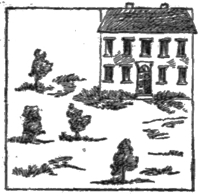
While the others were amusing
themselves with angles, Oscar
made the annexed sketch, and now
passed it to the others, giving out
with it the following problem:
“A man had a piece of land exactly
square, and having four trees scattered over
it, as you see in the picture. The house took up
one quarter of the land, and was occupied by four
tenants. The owner promised them the use of the
land, rent free, if they could divide it into four parts
of the same size and shape, and each to have one
tree. The question is, how did they do it?”
After some little puzzling of
wits, the lot was divided as in
the annexed illustration, and
the tenants were congratulated
on the good bargain they had
made.
“Otis,” said Ronald, “I’ll bet you can’t tell what
the half of nine is.”
“It’s four and a half—any fool might know
that,” replied Otis.
“No it isn’t,” continued Ronald, “it’s either
184four or six, just as you please, and I can prove it;”
and writing IX, he folded the paper across the middle
and made his promise good.
“Speaking of arithmetical puzzles,” said Aunt
Fanny, “I remember one that I worked over for a
long time, before I could see into it. It was something
like this: Two Arabs sat down to dinner, one
having five loaves, and the other three. A stranger
came along and asked permission to eat with them,
which they granted. After the stranger had dined,
he laid down eight pieces of money and departed.
The owner of the five loaves took five pieces, and
left three for the other, who thought he had not
received his share. So they went to a magistrate,
and he ordered that the owner of the five loaves
should have seven pieces of the money, and the
other only one. Was this just?”
“Why, no, it’s plain enough that it wasn’t,” said
Otis. “Each man ought to have as many pieces of
money as he had loaves.”
“Yes, it was just,” continued Aunt Fanny; “otherwise
you would pay the man of three loaves for
the bread he ate himself. To prove this, divide
each loaf into three equal parts, making in all
185twenty-four parts, and take it for granted that each
person ate an equal or one-third part of the whole.
You will find that the stranger had seven parts of
the person who contributed five loaves or fifteen
parts, and only one of him who contributed three
loaves, or nine parts.”
“O yes, I see into it, now,” said Otis.
“That reminds me,” said Marcus, “of an anecdote
that I read in a newspaper the other day. I
treasured it up, intending to relate it in school
some day, to illustrate the importance of understanding
arithmetic. It seems two carpenters took
a job for one hundred and fifty dollars. One of
them, whom we will call A, worked one day more
than the other, B. The wages of a carpenter were
two dollars per day. When the work was finished,
they divided the money, each taking seventy-five
dollars. Then A wished B to give him two dollars
more for the extra day, but B refused, as he
saw that if he did so, A would have four dollars
more than he, which was evidently unjust. A insisted,
and B insisted, and finally they quarrelled.
Some of the bystanders took the part of A, and
some of B; and yet the paper adds that all the parties
186were Americans, and had attended the common
schools six or eight years, where I suppose
they studied arithmetic, just as I suppose a good
many other children do, without troubling themselves
to understand it.”
“How should you have settled that dispute,
Otis?” inquired Mrs. Page.
“I should have told them to give A two dollars
for his extra day, and divide the rest equally,” replied
Otis.
“Or if B had given A one dollar, it would have
amounted to the same thing,” said Mrs. Page.
“Your story,” said Aunt Fanny, “reminds me of
an anecdote of a very rich miser who lived in England,
in the time of Cromwell. His name was
Audley. He had a wonderful knack of getting and
keeping money, and was not at all particular how
he obtained it, if he did not make himself liable to
the law. He once heard of a poor tradesman who
had been sued by a merchant for two hundred
pounds. The debtor could not meet the demand,
and was declared insolvent. Audley then went to
the merchant, and offered him forty pounds for the
debt, which was gladly accepted. He next went
187to the tradesman, and offered to release him from
the debt for fifty pounds, on condition that he
would enter into a bond to pay for the accommodation.
The debtor was delighted with the offer,
especially as the terms of the bond were so easy.
He was only required to pay to Audley, sometime
within twenty years of that time, one penny progressively
doubled, on the first day of twenty consecutive
months; and in case he failed to fulfil these
easy terms, he was to forfeit five hundred pounds.
Thus relieved of his debt, he again commenced business,
and flourished more than ever. Two or three
years after, Audley walked into his shop one morning,
and demanded his first payment. The tradesman
paid him his penny, and thanked him for the
favor he had done him. On the first day of the
next month, Audley again called, and received his
two pence; a month later, he received four pence;
and so on for several months, doubling the sum
each time. But at last the tradesman’s suspicions
were aroused, and he entered into a calculation of
his subsequent payments. I do not remember the
sum which it amounted to—”
“Wait a minute—let me figure it up,” interrupted
188Kate, and she at once set her pencil in motion.
The calculation employed her and the others
several minutes. It was ascertained that the
tradesman’s last payment would have amounted to
two thousand one hundred and eighty-six pounds,
and that the total sum of all the payments would
have been four thousand three hundred and sixty-nine
pounds, omitting odd shillings and pence!
“I suppose the man paid the forfeit, when he
found that out,” said Ellen.
“Yes, he paid the miser five hundred pounds for
his kindness,” replied Aunt Fanny.
“I don’t see how any one can dislike arithmetic—I
think it is a very interesting study,” remarked
Kate.
“How curious it is about the figure 9,” said Oscar;
“you may multiply any number you please by 9, and
the figures in the product, added together, will
make 9, or a series of 9’s. As—
and so on with any number, no matter how large.”
189“You can do the same with any of the multiples
of 9,” said Aunt Fanny, “as 18, 27, 36, 45, 54, etc.
If you multiply these by any number whatever,
you will have a series of 9’s in the product. Try it.”
Several experiments were made, with such results
as the following:
46
18
——
828—8 + 2 + 8 = 18—1 + 8 = 9
117
27
——
3159—3 + 1 + 5 + 9 = 18—1 + 8 = 9
“There is another thing about the figure 9 very
curious,” said Marcus. “If you take any number
composed of two figures, reverse it, and subtract
the smaller from the larger, the sum of the figures
in the answer will always be 9.”
This was found to be true, as in the following examples:
Marcus then explained that numbers composed
190of three or more figures, transposed and subtracted
in the same way, would always give a series of 9’s
in the product. The children tried the experiment,
and the following are some of their examples:
723
237
—-
486—4 + 8 + 6 = 18
8962
2698
——
6264—6 + 2 + 6 + 4 = 18
32189
28913
——-
3276—3 + 2 + 7 + 6 = 18
863577
736578
———
126999 = four 9’s
9216358
1982536
———-
7233822 = three 9’s
“That is curious; but why is it so—does anybody
know?” inquired Ronald.
“It will take a wiser head than mine to tell why
it is so,” replied Marcus.
“I found out something the other day about
figures that I didn’t know before,” remarked Ronald;
“and that is, that if you wish to multiply a
number by five, you can get the same result by dividing
by 2, and adding a 0 if there is no remainder,
or 5 if there is a remainder. Thus, 5 times 12 are
19160. Divide 12 by 2, and add a 0, and you get 60.
Or 5 times 83 are 415; divide 83 by 2, and add 5,
because there is a remainder, and you have the
same number, 415.”
“That is quite a convenient process, sometimes,”
said Miss Lee, “but there is no mystery about it,
like the properties of the figure 9. It is in fact the
same thing as multiplying by 10 and dividing
by 2.”
“So it is,” replied Ronald. “Well, it’s queer
that I didn’t find that out myself—I thought that
I had discovered something new.”
“Do you know how to make the magic square,
Marcus?” inquired Otis.
“I used to know how to make a magic square,
for there are several hundreds of them,” replied
Marcus. “Let me see if I can do it, now—I
suppose I have forgotten all about it.”
“What is a magic square?” inquired Ellen.
“It is a table of figures that can be added together
in a great many different ways with the
same result,” replied Miss Lee.
Marcus in a few minutes produced the simplest
form of the magic square; and turning to a book in
192the library, he found another one, both of which are
here given:
| 1 |
16 |
11 |
6 |
| 13 |
4 |
7 |
10 |
| 8 |
9 |
14 |
3 |
| 12 |
5 |
2 |
15 |
The several columns in these tables may be
added up in the usual way, or crosswise, or diagonally
(from one angle to its opposite) and the result
will always be the same—15 in the first, and 34
in the second square.
Such were some of the methods by which the
children were amused, at Mrs. Page’s, during the
long evenings and stormy days of their vacation.
They also had singing, reading aloud, story telling,
and newspaper publishing, by way of change. Of
this last I must tell you more.
CHAPTER XII. THE NEWSPAPER.
193
AND what about the newspaper? Well, it was
a famous thing, for a time, and made a great
stir in the family. The idea originated with Kate,
who thought it would be rare sport to edit and
publish a newspaper among themselves; and as
the others readily fell in with her plan, the enterprise
was soon under way. Aunt Fanny, who had
frequently written for the press, consented to act
as editor, and Marcus and the children all agreed
to contribute their portion towards sustaining the
paper. The preliminaries were soon settled. The
paper was to be called “The Home Wreath.”
It was to be issued weekly, and composed of one
or more sheets of letter paper, according to the
quantity of matter furnished. Its contents were
194to consist of short selections, cut from other papers,
and original articles. The latter were to be written
on one side of narrow slips of paper, of a uniform
size, so that, with the selections, they could
be readily pasted into their places, in columns. Of
course, but one copy of each paper could be prepared,
which was to circulate as common property. The
editor was authorized to reject, correct or condense
whatever was sent for publication. Communications
were to be sent to her through the letter-box;
and it was further agreed that those who contributed
an article or letter to the “Wreath” every
week, should be exempted from further duties as
members of the “Letter-writing Society,” if they
did not choose to keep up their private correspondence.
The appearance of the first number of the “Home
Wreath” was quite an event in the household.
The editor maintained a dignified reserve in regard
to its contents, until the day of publication, when
it was quietly ushered before its little public, six or
seven pairs of eyes being intently fastened upon
it, before it had been two minutes from “the office.”
As one and another, who had “a finger in the pie,”
195recognized their bantlings in the crowded columns,
they looked pleased and surprised, while others,
who searched in vain for their contributions, seemed
still more surprised, and not quite so well pleased.
But here are the “Notices to Correspondents,”
which doubtless explain it all. Ah, yes, the editor
is already bothered with articles too long for her
little paper, or too carelessly written to appear in
its columns. Well, perhaps this will be a salutary
warning to the offenders; and meanwhile, they can
avenge themselves by criticising the articles which
have been more successful than their own. But
we hear no captious criticism, and perceive no signs
of ill nature. The “Wreath” is read, laughed
over, discussed and admired by all, and at once
takes its place as an “established fact.”
The second number of the new paper promptly
appeared, the next week, and was generally regarded
as an improvement on the first. The third
was indeed a surprise number, and produced a
great sensation in the family. It was issued on
Ronald’s birth-day, who went early to the letter-box,
thinking himself entitled to the remembrance
of his correspondents, on such an occasion. He
196found a lot of small packages in the box, addressed
to different persons, on one of which he found his
own name. Tearing off the envelope, there appeared
before him the “Home Wreath,” neatly
printed from real type, on printing paper! He
could scarcely credit his eyes, at first, but the evidence
of its genuineness was too plain to be disputed,
for there was one of his own articles in real
print! The discovery was quickly known all over
the house, and each of the inmates found a copy
of the paper in the post office, bearing his or her
address. Marcus and the editor both feigned surprise,
when questioned about the affair; but after
a while the facts leaked out. An old playmate
and intimate friend of Marcus was employed in the
printing office of the neighboring village. Marcus
frequently visited him, and, with a view of getting up
a birth-day present for Ronald, arranged with his
friend to print the “Wreath” for that occasion. The
plan was successfully carried out, as we have seen.
A transcript of this little sheet is given on the
next two leaves, somewhat reduced in its dimensions
and the size of its type, to suit our pages, but
containing all the matter of the original.
197THE HOME WREATH.
══════════════════════════════════════════
Vol. I. HIGHBURG, DECEMBER 4. No. 3.
══════════════════════════════════════════
198THE HOME WREATH:
A Weekly Journal for Home Improvement.
PAGE & CO., PUBLISHERS.
Terms—Gratis.
For the Home Wreath,
LINES,
INSCRIBED TO RONALD D. PAGE.
I’m twelve! I’m twelve to-day!
Hurrah, boys! let us shout!
Come, leave your work and play,
And kick old care away;
Ye gloomy thoughts, get out!
We’ll have no mopes about—
I’m twelve! I’m twelve to-day!
I’m twelve! I’m twelve to-day!
A dozen years have fled
Since first the morning ray,
All sober, cold and gray,
Stole in upon my head;
How fast old Time hath sped!
I’m twelve! I’m twelve to-day!
I’m twelve! I’m twelve to-day!
Then help me to be glad!
Come all, and let’s be gay—
There’s nothing more to pay
For being bright than sad;
Cheer up, then, lass and lad!
I’m twelve! I’m twelve to-day!
An Exercise for Scholars.
In England, young candidates for
appointment in the civil service are
subjected to rigid examinations, designed
to test their abilities and acquirements.
The following extract,
which we have somewhat abridged,
shows one of the methods adopted for
securing this end. It is said to be a
literal copy of a document which a
young applicant for a government
clerkship was required to correct while
undergoing his examination. We wonder
how many of our young readers
could put it into proper shape without
consulting the dictionary.—Ed.
“Character of Washington.—At
the braking out of the revolushonery
war in Amerrica, Washinton joined
the caus of indipendance. To detale
his conduct in the yeares which followed
would be butt to relaite the hystery
of the American War. It may be
said generaly that wethin a verry short
peeriod after the declarashion of indipendance
the affairs of Amerrica were
in a condishun so desparate, that perhapps
nothing but the piculear caractar
of Washinton’s genious could have
retreaved them. It required the consumate
prudance, the calm whisdom,
the inflexable firmness, the modarate
and well-balenced temper of Washinton
to imbrace such a plann of pollicy
and to pursivere in it: to resist the
tempations of entreprize to fix the
confidance of his solders without the
attraction of victery: to support the
spirrit of the armey and the peopel
ammidst those sloe and caushious
planns of difensive warfare wich are
more despereting than defeate itself:
to restrain his owne hambition and
the empettuosity of his troupes: to indure
temparary hobscurety for the
sallvation of his contry and for the attanement
of solled and imortal glory:
and to suffer even temparary reproach
and oblaquy, supported by the haprobation
of his own consience, and the
applaus of that small number of wise
men whose praise is an earnest of the
hadmeration and grattitoode of possterity.
Corage is enspired by succes,
and it may be stimulated to dasperate
exirtion even by callamity, but is generally
pallseyed by inactivity. A sestem
of caushous defence is the severest
tryal of human fortitoode and by this
teste the firmness of Washington was
tryde.”
Hate.—Hannah More said: “If
I wanted to punish an enemy, it should
be by fastening on him the trouble of
constantly hating somebody.”
199The Home Wreath.
──────────
SATURDAY, DECEMBER 4.
─────────────────────
Nothing Insignificant.
Our humble sheet is a very small
affair; but if any stern critic is disposed
to despise it on that account,
let us remind him that there is
nothing so small as to be wholly
insignificant, when viewed in all
its relations. We everywhere find
little things linked with greater,
and thousands of minute and hidden
causes are constantly interlocking
and working together, to
bring about those events which impress
us with their vastness and importance.
A spark of fire may set
in train a conflagration which will
lay waste thousands of acres. Large
and populous islands in the Pacific
Ocean owe their origin to very
small insects. The great globe itself
is made up of little particles—the
universe is but an aggregate of
atoms. The astronomer finds it
necessary to note the minutest fractions
of time in observing the transit
of a star whose age is perhaps
measured by thousands of centuries,
and whose revolutions extend
through infinite space. Thus are
moments linked with ages in the
economy of nature, and thus are
we reminded that nothing is so
minute as to be insignificant.
This phrase is always in the mouth
of some children when requested to
do anything. We once knew a boy
who was greatly addicted to its use.
He wanted to learn to skate, but
200after one unsuccessful attempt, he
gave it up, saying, “I can’t.” The
next summer several of his playmates
learned to swim, and he also
wanted to learn; but after getting
his mouth and ears full of water,
one day, he cried, “I can’t,” and
that was the end of his swimming
experiments. If his class had a
difficult lesson, he never learned it,
and his excuse was always the
same—“I can’t.” We once set
him a copy in his writing-book,
and told him that if he could not
imitate it perfectly, he must write
as well as he could. “I can’t,” was
the ready reply. “What!” we exclaimed,
“can’t you write as well
as you can?” He looked ashamed,
but made no reply.
That boy is now a young man,
but he is an ignorant, idle, and
shiftless fellow, and, we fear, will
never be of much use either to himself
or to the world.
Commend us to the boy or girl
who never says “I can’t,” except
when enticed to do wrong. “I can”
does all things; “I can’t,” nothing.
Several articles intended for this
number are crowded out. We shall
probably have to issue a double
number next week, to accommodate
our friends.
We observe that some of our
correspondents occasionally apply
the pronoun thou, and the pronominal
adjectives thy and thine, to
plural nouns. This is wrong. You
and yours may be used either in the
singular or plural number; but
thou, thy and thine are always singular.
You cannot say to a father
and mother, as a poem which we
lately saw in a newspaper, (not the
“Wreath,”) said,—
“Thy darling is in heaven.”
☞ The Winter Term of the
Highburg Academy commences on
Monday next, and will continue
eleven weeks. Robert Upton, A.
M., Preceptor; Mr. Marcus Page,
Assistant Teacher; and Miss Martha
D. Tillotson, Teacher of Drawing
and Music.
☞ It is reported that traces of
bears have been recently seen near
Turkey Hill, in the eastern part of
Highburg. Several bears have
been killed this winter in the upper
part of the county, and we
should not be surprised if some of
the “varmints” made us a visit
ere long.
☞ A lynx was shot last week
in Burlington. The paper from
which we glean this item says:
“The animal is a rare one in Vermont.
It is of a grayish color,
with ears ending in tufts of black
hair, standing [not the ‘ears,’ nor
the ‘hair,’ we presume, but the
lynx] a little more than a foot high,
and measuring three feet in length.
It subsists on hares, rabbits, and
such small animals, occasionally
attacking a sheep, or even a deer,
by dropping on them [it] from a
branch of a tree.”
☞ Two boys who had been
skating in New York, a week or
two since, were attacked with violent
cramps and inflammation, and
one of them died from the effects.
It is conjectured that they laid
down upon the ice, while heated
from their exercise. This should
be a warning to skaters.
☞ The snow which fell Wednesday,
though light, is sufficient to
make pretty good sleighing, and
every body seems to be improving
it. The proprietors, contributors
and subscribers of the “Wreath”
took their first sleigh-ride, this season,
on Thursday. They were all
comfortably stowed away in a sleigh
and a pung!
═════════════════════
Correspondence.
─────────────────────
For the Wreath.
A gentleman was once examining a
very large and fine library in Boston,
when the lady who had introduced
him, asked him if he would like to
see the “nucleus” of the collection.
(If you do not know what “nucleus”
means, you will have to turn to the
dictionary, as I can think of no simpler
word to substitute for it.) “Yes,
I should like to see it,” replied the
visitor. She then exhibited to him a
Latin dictionary, which she said was
purchased by the owner when a boy,
with money obtained by the sale of
blueberries. The owner was a farmer’s
boy, and that is the way he began
his fine library. He is now a
learned man, and is well known in
this country and in Europe.
For the Wreath.
Two birds, whose plumage was very
brilliant, and whose song was beautiful,
were sitting on a tree, singing,
when they discovered a man looking
at them very intently. “There is an
admirer—see how we have entranced
him!” cried one of the birds, and she
put on her proudest air, and warbled
her sweetest song. “I do not like to
be gazed at so earnestly by a stranger,”
modestly replied the other bird;
“come, let us go and hide ourselves
from the intruder.” The modest bird
flew into a thicket and concealed herself;
but the other, flying to the top-most
bough, began to show off all her
airs, when suddenly the sharp crack
of a gun was heard, and the silly bird
fell dead.
Moral.—“Pride goeth before destruction,
and an haughty spirit before
a fall.”
Keta.
For the Wreath.
Miss Editor:—I feel slighted. You
are all writing for the “Wreath,” but
not a soul of you has asked me to
contribute to your interesting paper.
Why is this? Have I not heard some
of you say that I know as much as
many human bipeds of the same age?
Don’t I understand almost everything
that you say to me? And if I only
could talk, wouldn’t I rattle away as
fast as any of you? I bet I would.
If I don’t talk, it isn’t because I’ve
got no ideas, depend on that. But
you see I can write, although perhaps
you did not know it. But fearing I
am an intruder, I will stop.
Rover.
For the Wreath.
Hurrah! The snow has come!—Now
wont we have fine times! I
like to see it come thick and fast, and
bury everything up. How curious it
is, to see the woods, and fences, and
stones, and roofs, and fields, and hills,
covered over with the pure white
snow! What fun it is to roll and
tumble in it! I like to have the roads
all blocked up, so that we can’t get
anywhere, not even to school. Then
what fun it is to break out the ways!
We have a large sled, with a plough
lashed to the off side. Then we hitch
on six or eight yoke of oxen, and are
ready for a start. The boys load up
the sled, and a lot of men go ahead
to shovel through the deep drifts, and
so we go all over town till the roads
are broken out.
Ron.
For the Wreath.
The summer that I lived in Brookdale,
I was one day in the woods, with
my cousin Jerry, and another boy,
named Clinton, when we found a fox’s
hole. We began to dig her out; but
when we got to the end of the hole, we
found nothing. Clinton said he had
known a fox to bank herself up in a
separate cell, when her hole was invaded;
and we determined to see if
our fox had not served us so. We
dug, and soon found eight little ones,
all stowed away in a cell by themselves.
We then tried to find the old
one, but could not. So we took the
little ones and started off; but on
looking back we saw the old fox dart
out of the hole and disappear. We
went back to examine the hole again,
and found that she had a separate cell
for herself, which escaped our search.
So she saved her own life, but she lost
her little ones.
Oscar.
═════════════════════
Gleanings.
─────────────────────
Digest what you read. It is not
what you eat but what you digest that
gives nourishment to the body; so
with the mind. Young people sometimes
run through a book, and are not
able to tell afterwards what they have
been reading.
“John,” said the schoolmaster,
“you will soon be a man, and will
have to do business. What do you
suppose you will do when you have to
write letters, unless you learn to spell,
better?” “O, sir, I shall put easy
words in them.”
“Dick, I say, why don’t you turn
the buffalo robe t’other side out?—hair
is the warmest.”
“Bah, Tom, you get out. Do you
suppose the animal himself didn’t
know how to wear his hide?”
CHAPTER XIII. MASTER PAGE.
201
SO impatient
was Ronald
to enter upon
his academic career,
that he had
his school books
and his slate all
ready for a start,
Saturday afternoon.
On going up to his chamber, later in the
day, he was pleasantly surprised to find a nice new
satchel upon his table, which his mother had made
for him, as a birth-day present. He packed his
books into it, and swung it over his shoulder, and
walked back and forth, to see how it would seem.
202While he was thus indulging in pleasant anticipations,
his room-mate, Otis, was undergoing a very
different experience. Entering the chamber, without
noticing Ronald, he threw himself upon the
bed, and burst into tears. Ronald did not need to
inquire what ailed him. His parents had that afternoon
made their promised visit to Kate and Otis,
and had just started for home, and the poor boy
was consequently suffering from that most distressing
malady of the mind—home-sickness. Ronald’s
efforts to enliven him proved unavailing, and
he was reluctantly compelled to leave him to his
grief, which did not wholly subside until sleep came
to his relief.
On Monday morning, more than half an hour
before the first stroke of the academy bell was
heard, Ronald was busily engaged in hurrying up
his academical associates, whose moderation in getting
themselves ready for the day’s business seemed
to him almost too bad to be patiently endured.
However, contrary to his predictions, all arrived at
the academy in good season, though they went in
straggling parties—for it was the preference of all
to walk, rather than ride, when the weather and
203the roads permitted. Of course, they carried their
dinners.
At five minutes before nine o’clock the bell
sounded, and the scholars and teachers assembled
in the school-room. The forenoon was spent in
taking the names of the pupils, assigning seats,
forming classes, giving out lessons, and in general
remarks to the students on the purpose for which
they had assembled, and the duties which they
were expected to perform. Most of the preliminary
matters were settled, in the forenoon, and the
regular studies commenced with the afternoon session.
The incidents of the day afforded plenty of topics
for conversation to Marcus and the students from
his family, as they proceeded home, at night. General
satisfaction was expressed that one of the monitors’
desks, overlooking a division of the smaller
boys, had been assigned to Oscar. This arrangement
seemed peculiarly gratifying to Ronald and
Otis, who thus came under his oversight, and who
smiled incredulously, when he declared that he
should keep a particularly sharp eye upon them. Oscar
expressed himself as much pleased with the preceptor,
204Mr. Upton. Kate, who had been promoted
to the highest class, and was in excellent spirits,
said she always admired Mr. Upton, and thought
she should rather like his new assistant, Mr. Page.
Otis and Ronald, on the other hand, were a little
disappointed because Marcus had disregarded their
joint request, that they might sit together, and had
placed them so far apart that any intercourse during
school hours, except by means of winks, signs and
paper “spit balls,” would be out of the question.
The reason Marcus gave for this refusal,—the fear
that they would have too good a time together,—was
not very consoling to the boys. Instead of
Otis, Ronald had for his nearest comrade the boy
who blotted his writing-book at the district school,
Lewis Daniels. Both Marcus and Ronald, however,
treated Lewis with kindness, and tried to
make him forget the injury he had inflicted upon
the latter.
The ardor with which Ronald set out for school
in the morning was a little dampened by one or
two other incidents that occurred during the day.
At noon, as he approached a group of large boys,
he heard one of them say—
205“I don’t care for Marcus Page—he’s nothing
but a boy, himself. He was a scholar, here, for a
year or more after I joined the academy.”
On turning round, and seeing Ronald near, the
large boy added—
“Here, you youngster, you needn’t go and tell
Page everything you hear, because you happen to
live with him; because if you do, you’ll be sorry
for it.”
Ronald had no heart to report this conversation
to Marcus, though he cared nothing for the threat.
His ears tingled, however, to hear Marcus spoken
of in this way, and from that moment he felt a
strong dislike towards the boy in question, who,
to do him justice, was not so bad as he seemed, but
only had an unhappy habit of saying more than he
felt, and threatening more than he was willing to
perform.
Another large boy,—a mischievous but not ill-meaning
fellow,—annoyed Ronald a good deal by
applying to him the nickname Frenchy, and telling
him he had got to wear it as his “academical name.”
Ronald reported this to Marcus; but the latter advised
him to take no notice of the affair, telling him
206that the inventor of the nickname would probably
soon forget all about it, if he saw that it did not
trouble Ronald.
“Who would have thought of seeing Jessie Hapley
in the academy!” exclaimed Kate, as they
were walking home. “I declare, I never was
more surprised in my life—they are so poor, you
know.”
“But Jessie is a very fine girl, if she is poor,”
said Marcus.
“O, yes, I like her very much,” promptly responded
Kate; “and I’m glad she is going to
school with us; but I didn’t suppose her father
could afford to send her.”
“She earned the money herself, to pay for her tuition,”
added Marcus. “She sees she has got to
support herself, if not the rest of the family, and
she is anxious to qualify herself for teaching. She
thinks she is better adapted to that business than
to any other, and I think so, too. She is an excellent
scholar, and you will have to look out for
your laurels, Kate, now that she is in school.”
“Well, she is older than I am,” said Kate, quite
unconcerned.
207“Only a few months,” added Marcus; “besides,
her school privileges have been very limited, compared
with yours.”
“No matter, I don’t think I shall be jealous of
her,” replied Kate. “I always did like Jessie, and
if any girl is going to excel me, I’d rather it should
be her than any one else. But Abby Leonard declares
that she wont associate with her. She says
she hates to see a poor girl all the time ‘trying to
be somebody.’”
“I am afraid Abby is not so wise as she might
be, if she has enjoyed the advantages of city society,”
observed Marcus.
“Do you know what she does to make herself
look pale and slender?” inquired Kate. “She eats
chalk, and slate pencils, and drinks lots of vinegar.
She advised me to try it, because I’m so plump.
She thinks it doesn’t look interesting and genteel,
to be fat.”
“I hope you wont follow her advice, unless you
wish to ruin your health,” replied Marcus. “I shall
have to speak to her about this subject—she has
fallen into a very dangerous practice, as well as a
foolish theory. In fact, if she consumes those articles
208to any extent, she is committing suicide,
whether she knows it or not.”
The current of events continued to flow on
smoothly day after day, at the academy, until one
morning, when the principal failed to appear. Marcus
opened the session, at the usual hour, and soon
after received a note from Mr. Upton, stating that
he was ill, and unable to be present. Marcus conducted
the school through the day, with very good
success, and before returning home, called upon his
associate, whom he found prostrated with an illness
which would probably detain him from his labors
for several weeks.
“I do not see but that you will have to take my
place, for a week or two, Marcus,” said Mr. Upton.
“We have got well under way, and everything is
going on smoothly, so that I think you and Miss
Tillotson can manage matters very well, for a little
while.”
Marcus shook his head, and looked somewhat
alarmed, at this proposition. Nor was he slow in
making known his objections. He had had little
experience in teaching, even the simpler branches,
and as to the higher studies, he was appalled by
209what he considered his lack of qualifications. Then
how could he, an inexperienced youth, maintain
the discipline of such a school, composed in part
of pupils as old as himself, some of whom had been
his school-mates a year previous? Mr. Upton,
however, did not give much heed to these objections.
He did not doubt Marcus’s qualifications to
teach any of the branches, and as to the discipline,
if he experienced any trouble, the trustees would
give him all necessary aid. As it would be impracticable
to make any other arrangement, at least
for a week or two, Marcus at length consented to
assume this new responsibility.
The next morning, Marcus informed the scholars
of the new duties that had devolved upon him, and
expressed his determination to do his best to make
good their preceptor’s place, at the same time soliciting
their aid and co-operation in the work. With
now and then a trifling exception, the school was
as orderly and quiet as usual, and Marcus was soon
satisfied that the public sentiment of his charge
was on his side, and would sustain him in his position.
This was especially true of the older scholars,
of whom he had most stood in doubt. Appreciating
210the value of their privileges, even the least
sedate of them had no inclination to come in collision
with their young teacher, for whom, indeed,
they all felt some degree of esteem, as a personal
friend. Neither did the younger pupils manifest
any disposition to question his authority. Two
days’ experience satisfied Marcus that the only
pupils from whom he had reason to anticipate
trouble were three or four boys, some thirteen or
fourteen years old; and he had no doubt that he
should be able to bring these turbulent spirits into
subjection, in a few days.
These troublesome boys happened to be seated
together, near the back part of the room, and at
times they created some little disturbance in that
quarter. Before dismissing school at night, Marcus
pleasantly informed them, separately, that he proposed
to re-seat some of the boys, and then proceeded
to arrange such an exchange of desks as
brought them nearer to his platform, and at the
same time scattered them apart. One or two of
the worst of them, by this change, were brought
under the monitorial eye of Oscar.
Marcus now made it a special object to secure
211the confidence and good-will of the more unruly
part of his charge. One noon, he saw several of
his most troublesome boys at work upon a snow
figure, in the grove back of the academy. He approached
them, and, commending their skilful
workmanship, soon drew them into a pleasant conversation.
As he watched the growing statue, he
observed that the credit belonged mainly to one
of the lads, named Charles Wilder, who directed
the labor of the others. Marcus had noticed that
this boy exercised a good deal of influence over
his comrades; but in the school-room he was
rather inattentive to his lessons, and inclined to
mischief.
“Charlie’s the boy for this kind of work,” said
one of the lads, addressing Marcus.
“Yes, I see he understands it,” replied Marcus.
“You have quite an artist’s eye, Charlie. Where
did you learn so much about modelling?”
“O, I don’t know much about it—all I do know
came natural to me,” replied the boy.
“I remember seeing an account of a young man
in this State,” said Marcus, “who made a statue
of snow and ice that was so beautiful, that a rich
212gentleman ordered a copy of it in marble. Perhaps
you will be as fortunate as he, one of these
days.”
“I mean to be a sculptor, some time or other,”
replied Charles, his face lighting up with an expressive
smile.
“I suppose it’s hard work to make a statue, isn’t
it?” inquired one of the boys.
“No, I don’t know as it is exactly what you
would call hard work, but it requires a good deal
of skill, and taste, and genius, to make a fine statue,”
replied Marcus.
“O, I suppose they have plenty of tools, and
pound it out,” observed another boy.
“Pound out your grandma’am with tools, just as
much!” exclaimed Charles, with a glance of mingled
pity and indignation at the boy who held this
degraded view of the beautiful art to which his
soul was thus early wedded.
“You must be somewhat proficient in drawing,
Charlie, to design such a statue as this,” resumed
Marcus.
“I’m very fond of drawing, but I don’t know
much about it,” replied Charles.
213“You are not taking lessons in drawing, I believe?”
inquired Marcus.
“No, sir; I wanted to, but father said it was of
no use,” replied Charles.
“I think it would be of use,” said Marcus; “that
is, if you have as much taste for it as I think you
have. I wish you would let me see one of your
drawings,—perhaps I could persuade your father
to let you take lessons, if I think it worth
while.”
“I’ve got one in my desk—I’ll run and get it,”
said Charles; and he darted off, soon returning
with a very neatly executed drawing of a dog hunting
a stag, which he had copied with much skill from
an engraving.
“That is very creditable to you—very much so,”
said Marcus, as he examined the picture. “You
certainly have a taste for drawing, and your father
must let you take lessons of Miss Tillotson. I
will speak to him about it, this week.”
The young artist looked pleased and grateful,
and Marcus left him, not only feeling a new interest
in the boy, but with a firm persuasion that he should
have no further trouble with him.
214
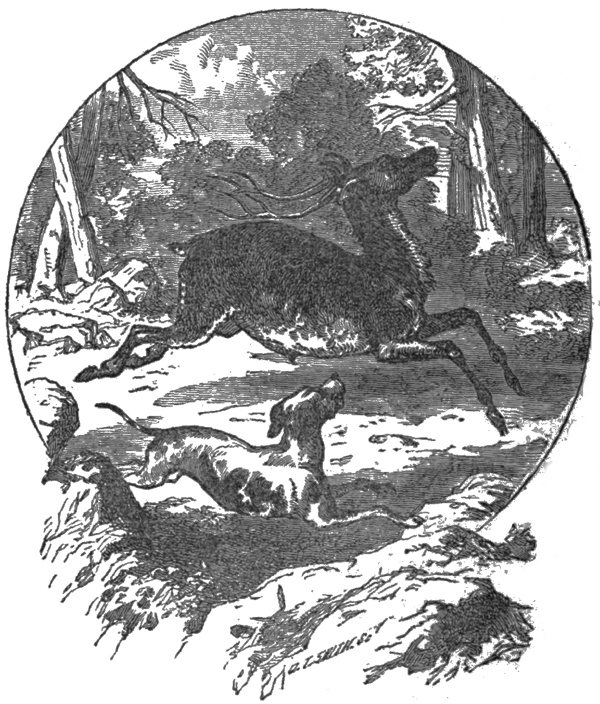
The above is a representation of Charles’s
drawing. Marcus took the trouble to call upon Mr.
Wilder, that afternoon, and after a little persuasion
obtained permission for Charles to take drawing
lessons.
A day or two after this, Marcus found on his
desk, one morning, an anonymous note, which read
as follows:—
215“To Master Page:—I think it is too bad that
some of the scholars should be allowed to have
keys to their arithmetics, when it is against the
rules. Fair play is a jewel. This is from
One who Knows.”
Marcus was for a time in doubt what to do in
relation to this complaint. The anonymous character
of the note deprived it of all claim upon his
attention; and its apparently implied censure upon
him for something of which he had no knowledge,
rendered it still more objectionable. After reflection,
however, he determined to investigate the matter
at once, leaving to a future occasion some remarks
to the school on the impropriety and meanness
of writing anonymous letters of complaint.
He accordingly remarked to the school:—
“I have been informed that some of the scholars
have keys to their arithmetics. I wish all such
would rise.”
Much to his surprise, Oscar promptly arose, and
said:—
“I have a key, but I have made no improper use
of it. I do all my sums before I look at the answers.”
216“Did you not know that it is contrary to the
rules for any scholar to have a key?” said Marcus.
“Yes, sir,” replied Oscar.
“That is sufficient,” said Marcus. “You have violated
one of our rules, whatever use you may have
made of the key. If you have it here, you may
deliver it up.”
Oscar obeyed the order, his appearance indicating
that he felt the mild rebuke rather keenly. It
is due to him to say, that with this exception, his
conduct in school had thus far been quite exemplary,
and his progress in his studies commendable.
After Ronald had become somewhat familiar
with the school, he found it rather difficult to
wholly repress the promptings to fun within him.
During the first week of the principal’s absence,
Marcus had occasion to reprove him several times,
privately, for offences of this kind, and on one occasion,
detained him after school, as a punishment.
One afternoon, as Marcus was hearing a class recite,
he was startled by one of his most quiet boys crying
out:—
“You quit that!”
“What is the matter, Edmund?” inquired Marcus.
217The boy, coloring deeply replied:—
“Ronald has been snapping nut-shells at me for
half an hour, and he just hit me in the eye with
one. I was very busy ciphering, and I spoke before
I thought. I forgot I was in school.”
Ronald was called out, a handful of nuts was
transferred from his pocket to the teacher’s desk,
and he was then directed to stand upon the platform
facing the school, until he had committed to
memory a page from a geography used by another
class. In all this Marcus was as calm and mild as
usual; but nevertheless, Ronald did not feel very
pleasantly, as he took his position and commenced
his task, though the punishment was not what he
feared it would be, when called out. His mortification
was not a little increased, when, after reciting
the task, Marcus assigned him a new seat,
directly under his own eye. Ronald avoided all
company, on his way home, that afternoon, and
seemed especially anxious to keep out of the reach
of Marcus, through the rest of the day. Marcus,
however, had something to say to Ronald, and after
tea he found an opportunity to say it.
“Ronald,” he said, “I have been thinking that I
218had better increase your lessons a little. I am
afraid you are getting along too easily at school.”
“Why, I think our lessons are pretty hard,” replied
Ronald, somewhat surprised.
“They are hard enough for most of your class,
but you learn so readily that I shall have to give
you some extra tasks,” added Marcus.
“I don’t think that is fair,” replied Ronald. “If
I get all the lessons that the others do, I should
think that is enough.”
“If your lessons are so easy that you learn them
without much effort,” continued Marcus, “you are
missing the real end of going to school. It is not
the chief aim of education to give a child a smattering
of knowledge, but the object should be to
discipline his mind, and that cannot be done without
real tasks—lessons that will make him study
hard, and think closely. He needs something to
rouse him to exertion, and then he will begin to
find out what his powers are. I think I shall let
you study book-keeping and algebra, with the third
class, in addition to your other lessons.”
“Well, if you think best, I will try it,” said Ronald.
219“I have another reason for this,” added Marcus.
“You have too many idle moments, now. Your
lessons are not hard enough to keep you out of
mischief. I shall have to increase them until you
have no time for idleness or mischief during study
hours.”
Marcus imposed the additional studies upon
Ronald, the next day. The salutary effects of this,
and of the incidents of the previous afternoon, were
soon apparent. He was careful, however, not to
overtask the boy’s powers, which would have been
a greater evil than the opposite error.
With Otis, Marcus found a different course of
management necessary. He was more quiet and
orderly in school than Ronald, but less perfect in
his lessons. Indeed, he was not remarkably fond
of study, and needed a little spurring, now and
then, to prevent his falling below the average of
his class. One afternoon, as he was walking home
with Marcus, he said:—
“I can’t get that sixth sum right, any way. I’ve
tried it half a dozen times, and I get it exactly the
same every time. The answer in the book must
be wrong, for I know I did it right. I did the
220other sums in just the same way, and they came
right.”
“You are wrong,” replied Marcus, “for I happen
to know that the answer in the book is right.
Georgianna Ellis came to me this afternoon with
the same story. She thought the answer in the
book was a mistake. But I did the sum, and found
it right.”
“How did you do it?” inquired Otis.
“That is for you to find out yourself, if you can,”
replied Marcus, with a significant accent upon the
last clause of the sentence.
“Didn’t you show Georgianna how to do it?”
inquired Otis.
“No,” replied Marcus; “I told her to read over
the question carefully, and then to keep trying upon
it until she got the right solution.”
“Did she get it?” inquired Otis.
“I do not know,” replied Marcus; “but if she
has not found out her error, I have no doubt she
will.”
“Then I suppose you think I can do the sum,
if I keep trying,” said Otis.
“I have some doubts about that,” replied Marcus.
221“I suppose I ought to give you the same direction
that I gave Georgianna; but I have little faith that
you would be successful, after all.”
“Why couldn’t I find out the answer, if she
can?” inquired Otis.
“There is a great difference in scholars,” replied
Marcus. “Some are careful, and examine everything
very closely, when they meet a difficulty,
while others blunder about without much thought.
Some have great perseverance, and others are
quickly discouraged. And then some do not seem
to have much sense, or if they have, they don’t
exercise it.”
Otis did not push his inquiries any further, and
the subject was dropped. The stimulus of shame,
judiciously applied, is sometimes effective when
other means fail, and so it proved in this case. Otis
was not discouraged by what Marcus said, but was
incited by it to a new and more earnest effort. He
solved the problem, unaided, and so derived more
real benefit from this one puzzling question than
from all the others in the day’s lesson, which he
performed without difficulty.
CHAPTER XIV. THE TROUBLESOME SCHOLAR.
222
THERE was one boy in the academy who still
caused Marcus no little anxiety. His name was
Harrison Clark, and he was about fourteen years old,
and large for his age. This was his first term at the
academy. He was from an adjoining town, and
but little was known of him, except what he himself
chose to divulge. The achievement of his short
life upon which he seemed to pride himself most, was
a fight he had with his former teacher, a month or
two before this, in which, according to his representation,
he came off victor; and he had been heard
to threaten a similar infliction upon Marcus, should
that personage attempt to chastise him. One or
two of the elder pupils were anxious that the insolence
of this pert young gentleman should be
223checked by a sound thrashing, and they even intimated
to the teacher that aid would not be wanting,
in case the boy should offer serious resistance.
But Marcus thought there was a more excellent
way to subdue him, and determined to try it, before
resorting to harsh measures.
Marcus happened one day to fall in with a townsman
of Harrison, from whom he gathered all the
information he could in regard to the career and
character of the boy. It appeared that he had
been governed with severity, both at home and at
school, so far as he had been governed at all. He
had steadily grown worse, however, under this discipline,
and his parents, finding they could do nothing
with him, had sent him away to school, as the
easiest way to rid themselves of a constant trouble.
They were finally led to this course, by his
altercation with his teacher. Several boys, it
seemed, got into a wild frolic in the school-room,
one day, before the opening of the session, in the
course of which Harrison threw an inkstand at another
lad, by which his face and clothes were stained,
and the walls, floor, and seats soiled. The teacher,
after investigating the matter, ordered Harrison to
224hold out his hand for punishment, which he refused
to do, in an insolent manner. The teacher then
attempted to seize his hand, but failing in this, he
tripped the boy upon the floor, and a regular scuffle
ensued. Another boy, still larger than Harrison,
now rushed to the assistance of the latter,
and before the disgraceful affray ended, they inflicted
two or three serious blows upon the teacher,
and then fled. They were both arrested for assault,
and after a trial before a justice, were fined,
Harrison ten dollars and the other boy five, besides
the cost of the trial, which was divided between
them. While it must be confessed that their punishment
was just, I think few will deny that the
teacher also was to be blamed for the part he acted
in the affray.
“Now can’t you tell me something good about
Harrison?” inquired Marcus, after listening to the
foregoing recital. “I believe there is always some
good trait in every person, however bad.”
“Well,” replied the other, “I’m thinking it would
be rather hard to find anything very good about
that chap. I don’t think he’s very hardened yet,
but there’s precious little goodness about him, I
225can tell you. He thinks a good deal of his mother,
and that’s the best thing I ever saw about him. And
he ought to like her, for she’s a right down good
woman—only she’s one of your easy, gentle sort,
that oughtn’t to have anything to do with such a
young scapegrace as he is.”
Although Harrison had made himself sufficiently
troublesome in the school-room, he had thus far
avoided all flagrant offences. He manifested his
disposition by an air of quiet insolence and defiance,
and by petty acts of annoyance, too trivial for
serious notice, even could they be proved against
him, which was seldom the case. It was evident,
however, that he was becoming emboldened by
the absence of restraints and punishments with
which he had been familiar in school, and Marcus
looked forward with some solicitude to the certainty
of an open collision with him, which day by day
seemed more imminent. Meanwhile, the attempts
of Marcus to win him over by kindness were not
very well rewarded. If he spoke kindly to the boy
on the play-ground or at his desk, he got no pleasant
word or grateful look, in return. If he tried to
draw him into conversation, the responses came
226grudgingly in monosyllables. On Saturday, he invited
Harrison to come over to pass the afternoon
with him and the children; but the boy did not
come; worse yet, he did not say whether he would
or not; and still worse, he expressed no thanks for
the invitation.
One cold morning, soon after the school opened,
Marcus was somewhat annoyed by the coughing of
the scholars—not a very unusual occurrence at
that season. Having reduced the school to perfect
silence, so that the falling of a pin might have been
heard, he proceeded to say:—
“I notice that many of the scholars have rather
troublesome coughs. I have a cold myself, and I
suppose I could cough as hard as any of you, if I
chose to. But I am not going to do it. There
are two objections to coughing. One is, it is injurious.
The effort required in coughing is apt to
tear the delicate fibres of the lungs. Sometimes
people burst blood-vessels, while coughing, and die
in consequence. The other objection is, it is
unpleasant to those around us, especially in a
school-room, church, or other public assembly.
Sometimes, I admit, it is necessary to cough; but
227I think most of our coughing is unnecessary. By a
little attention, and a little effort of the will, we can
prevent it. Now I propose that those who have
colds try the experiment with me, and we will see
who will hold out longest without coughing.”
Marcus had no sooner closed, than Harrison fell
into a violent fit of coughing, which it was evident
to all was feigned. Some of the younger scholars
smiled at this ill-mannered freak, but others looked
daggers at its perpetrator. Marcus uttered no rebuke,
but the eyes of the rogue fell before his steady,
quiet, searching look.
A day or two after this, there was great excitement
in the village, occasioned by the discovery
that several sheep had been killed by bears, the
tracks of which were found in the neighborhood of
“Turkey Hill.” The presence of these animals in
the town had been suspected for several weeks, but
this was their first attack upon the sheep-folds of
the farmers. Arrangements were at once made
for a grand bear hunt, the next afternoon, and all
the male population, above fifteen years of age,
were invited to take part in it.
Marcus found, the next morning, that most of his
228boys had come to school prepared to join in the
hunt, either as participants or spectators. All who
could, had procured guns, and as the lads and young
men lounged around the academy, in groups, examining
and comparing their arms, a stranger might
have suspected the existence of a “school rebellion”
of a really startling description. But when
the bell struck, the guns were peaceably deposited
in the ante-room, and the school-room assumed its
usual quiet aspect. At recess several of the boys
were dismissed, having brought notes from home,
requesting Marcus to excuse them at that hour.
Two or three others petitioned for a similar favor,
but, having no authority from their parents for
making the request, Marcus felt obliged to deny
them. He did this the more easily, because he
thought the request a needless one. The hunting
party was not to rendezvous until half past twelve
o’clock—half an hour after the session closed for
the day, for it was Saturday. Nevertheless, Harrison
Clark, who was one of the disappointed applicants,
appeared to think differently; for when the
boys were called in from recess, he was missing.
On looking from a window, Marcus saw him standing,
229gun in hand, near the post office, where a
crowd of men appeared to be discussing the arrangements
of the day. One of the large scholars
was despatched to bring the runaway back; but
Harrison saw the young man approaching, and
mistrusting his errand, took to his heels, and made
good his escape.
At twelve o’clock the session closed, the contents
of sundry little baskets and tin pails were hurriedly
disposed of for the benefit of the inner man, and
most of the boys, accompanied by their teacher,
then proceeded to the place of rendezvous. After
waiting awhile for tardy stragglers, the hunting
party was found to muster over a hundred men
and boys, all armed. An experienced hunter was
chosen captain, a few directions were given to the
men, and the line of march was then taken up for
Turkey Hill, some two miles distant.
On reaching the hunting ground, the guns were
loaded, and the party then proceeded to form a
ring around the hill, which was a low eminence,
densely wooded, and abounding with ledges. Two
files of men started in opposite directions, and
encircled the hill until they met, scattering themselves
230apart as they proceeded. Then, to test the
connection of the ring in all its parts, the captain
cried to his left hand man, “Are you there?” and
he taking up the call, according to a previously
arranged plan, shouted it to the man on his left,
and thus it passed around, until it came back in a
few moments to the leader. He then gave the
order, “Forward!” in a similar manner; and as it
ran round the line, the party began its slow march
up the hill. They continued to ascend, gradually
closing up the circle, until it embraced only about
an acre of woods. The circle was now quite impervious
to any animal, the hunters being within a
few yards of each other. Only a small portion of
the ring, however, was visible at any one point,
owing to the trees and brush, and the inequality of
the surface. Every gun was now cocked, and every
eye was straining itself, to detect some sign of
the presence of Bruin. Suddenly, the sharp crack
of a gun was heard, followed by another, and
another; and almost immediately, a large bear
bounded out, towards the part of the circle where
Marcus and Oscar were stationed. But ere the
poor beast could reach the line, a score of bullets
231were buried in his body, and he fell dead. Loud
and long was the shout of triumph that went up from
every side; and still louder did it grow, when it was
found that this was not the only trophy, but that
another though much smaller bear had been shot
on the opposite side of the ring, when the reports
of firearms were first heard.
The two carcasses were placed on sleds, and
dragged to the village by the boys. The largest
bear was found to weigh about four hundred and
fifty pounds, but the weight of the other was a little
short of two hundred pounds. Before the people
separated for their homes, the two carcasses
were put up at auction, and sold for about fifteen
dollars. It was voted to give the money to the
owner of the sheep killed by the bears—an aged
man, in needy circumstances, who looked the gratitude
he could not speak, when the generous proposal
was ratified by a hearty “Aye!”
On Monday morning, when Marcus read to the
school the names of absentees at the previous session,
and called for excuses, he came to the following
entry: “Harrison Clark—left at recess.” He paused
a moment, and as no excuse was offered, added—
232“Harrison, when school is dismissed in the afternoon,
you may come to my desk.”
“This afternoon or forenoon?” inquired Harrison,
not at all abashed.
“I said this afternoon,” replied Marcus, who
postponed the matter until that hour, because of
the limited intermission from studies at noon.
As Marcus anticipated, Harrison was going off
without paying any regard to this command, in the
afternoon; but when called he went back, saying
by way of apology that he forgot all about the
matter. When they were alone, Marcus inquired,
very pleasantly—
“Well, Harrison, how did you enjoy yourself,
Saturday afternoon?”
“First-rate—didn’t you?” coolly replied the
boy.
“Do you think you enjoyed the hunt as much as
you would if you hadn’t gone off at recess, contrary
to my express orders?” inquired Marcus.
“Well, yes, I don’t see as that made any difference,”
replied Harrison, looking as calm and unconcerned
as though he were discussing the point
with some comrade.
233“I see you are inclined to be frank,” continued
Marcus. “I am glad of that—I like frank, open
dealing in everybody, boys as well as men. Don’t
you?”
“Why, yes, I do,” replied the boy.
“And are you willing to be perfectly frank with
me, if I will be so with you, in talking over matters
now?” inquired Marcus.
“Well, I can’t stop long—I agreed to go somewhere,
after school,” replied Harrison.
“But we must attend to this business first,”
replied Marcus, in a decided tone. “Now if you
say you will deal frankly with me, I will proceed
at once.”
“Well, I will,” said Harrison.
“Then I will be equally frank with you, and so
we shall have a fair understanding of each other,”
replied Marcus. “I have noticed for several weeks,
especially since Mr. Upton has been sick, that you
were inclined to be disrespectful towards me, and
to annoy me and the school by certain little improprieties
that it was difficult to prove wilful,
though they certainly seemed to be so. As I
know of no reason why you should wish to trouble
234me—for I believe I have always treated you kindly—I
have taken as charitable a view of this as I
could. I have tried to think that you did not mean
any harm, but were only a little odd in your ways.
But when you set my authority at defiance so
coolly, last Saturday, I saw that something more
serious than oddity was the matter. And that
something has got to be met, promptly and decidedly.
Now there are two ways of meeting such
a spirit in a scholar. One way is, to inflict a severe
and disgraceful punishment, which will serve as a
warning to the other pupils, if it does not reform
the guilty one. The other way is, to win him from
his error by mild and kind means.
“Now, Harrison, you know very well which of
these systems of government we have adopted
here. You have seen no rod or ruler, since you
came here, and I hope you will not, if you stay
through the term. But that is by no means certain.
Sometimes, when mild measures fail, Mr.
Upton adopts stern ones; but he always tries kindness
first. There is only one other resort, in desperate
cases, and that is, to expel the offender.
Now, if I have been rightly informed, the harsh
235system had been pretty faithfully tried upon you
before you came here, had it not?”
“I should think it had—but it didn’t do any
good,” replied Harrison.
“And now kindness has been tried, and that has
done no good,” added Marcus, with a serious look.
“What more can be done? Do you think that
you ought to be privileged to do as you please, while
all the other scholars are required to be obedient,
and orderly, and respectful? You said you would
be frank with me; now will you answer me that
question, honestly?”
“I suppose not,” replied Harrison, rather reluctantly.
“Very well, now I wish you to answer another
question, as frankly as you did that,” continued
Marcus. “Do you think I ought to be expected to
sacrifice my feelings, and strength, and time, in
trying harsh measures upon a boy, when the experiment
has already been made by others, and, as he
admits, without any good result?”
“No, sir,” replied the boy, in a more respectful
tone than usual.
“Neither do I,” said Marcus. “Then if kind
236measures fail, as they have in your case, so far,
expulsion is the only remedy left; and that, of
itself, is a very harsh, and painful, and disgraceful
punishment. I can’t bear to think of it. It is casting
the boy out from influences that might save
him, into a world of new temptations and dangers.
If he were the only one involved, I would put up
with a great many provocations, before I would
sentence a boy to such a fate as that. But the
interests of the school sometimes require that a
scholar should be expelled, and then the teacher
must do his duty, however painful it may be. In
such a case, the teacher and the boy are not the
only sufferers. The parents and friends of the
offender often suffer even worse than he does. I
hear, Harrison, that you have an excellent mother.
Is it so?”
“Yes, sir,” replied the boy.
“I have been told,” continued Marcus, “that she
is a very kind, gentle, and sensitive woman. I
hear, also, that you appear to think a great deal of
her, and I hope the report is true, for a good mother
is a blessing for which we can never be too grateful.”
237The expression of the boy’s face, at this mention
of his mother, indicated that the report was
not without foundation.
“Now,” continued Marcus, “how would your
mother feel, if you should go home, and tell her
that you had been expelled from the academy, for
misconduct? Would it not almost break her heart?
For her sake, as well as yours, I hope we shall not
have to fall back upon that last resort. But as I
promised to be frank with you, I must tell you, in
all sincerity, that the course you have been pursuing
will certainly lead to expulsion, if not abandoned.
I do not say this to frighten you, but I am
honestly pointing out to you a real danger, and one
that you will assuredly encounter very soon, if you
do not take warning. You have been quite frank
with me, so far, now I want to know if you will
give me a plain and honest answer to one more
question?”
“I will,” replied Harrison.
“I am going to ask the question now,” continued
Marcus, “but you need not answer it to-night. I
would rather that you should take time to think it
over, and let me know your decision to-morrow.
238The question is this—whether you intend to keep
on in your old habits, as though nothing had happened,
or will you try to correct the faults I have
mentioned? You will please to take notice that
the question refers only to your intentions. I do
not ask you to promise never to disobey or be disrespectful
again; but if you have any intention, or
even the slightest wish, to reform these habits, I
want you to say so, and I will help you all I can to
accomplish the work. On the other hand, if you
really prefer to do as you have been doing, I want
you to tell me that, just as candidly. Remember
you promised to be frank. You can go, now, and
to-morrow you may tell me your decision.”
Harrison’s bearing was somewhat more subdued
and respectful than usual, when he left Marcus.
The same peculiarity was apparent in his conduct
the next day, in school. When school was dismissed
at noon, Harrison went of his own accord
to the teacher’s desk, and said:—
“Mr. Page, I’ve thought over that matter that
we talked about yesterday, and I’ve made up my
mind to try to do better, hereafter.”
“I am very glad to hear you say so, Harrison,”
239replied Marcus, grasping the boy kindly by the
hand. “If that is your intention, I have no doubt
we shall get along pleasantly enough after this.”
“I’m sorry I went off, Saturday, and I wont do
such a thing again,” added Harrison.
“That was quite a serious act of disobedience,”
replied Marcus, “although I have refrained from
saying much about it directly, thus far. If I should
conclude that the offence required some kind of
punishment, notwithstanding this confession, do
you feel as though you could submit to it cheerfully?”
“Yes, sir, I think I could,” replied Harrison, rather
hesitatingly.
“I suppose the fact that you ran away is known
to all the scholars,” observed Marcus. “Now should
you be willing to make the apology as publicly as
the offence?”
This was a pretty severe test for Harrison. Remembering
the braggadocio with which he had alluded
to his offence, only the day before, in the
presence of many of his school-mates, it was hard
to say he was willing to stand up before them all,
and humbly acknowledge his fault.
240“Give me a frank answer, that is all I ask,” added
Marcus, as he perceived the conflict in his pupil’s
mind.
“Well, I suppose I ought to confess in public,
and I must do it, if you say so, but it will come
dreadful hard,” replied the boy, who seemed anxious
and perplexed.
“Yes, I suppose it would be a very disagreeable
duty,” said Marcus; “and on the whole, I think I
will not ask it of you. The scholars know that I
have taken private notice of the offence, and perhaps
that will answer every purpose. If you will
show to them a better example hereafter, that is all
I will require, this time. The past shall all be forgiven
and forgotten.”
The boy looked pleased and grateful, and before
retiring, repeated his promise of amendment.
This promise he kept. His feelings towards Marcus
seemed to have undergone an entire change.
True, every fault in his character and conduct was
not corrected at once; but as there seemed to be a
prevailing disposition in him to conform to the rules
of the school, united with a sincere respect for his
teacher, Marcus looked upon his errors as leniently
241as possible, and endeavored to encourage him in
his good work by every proper method.
The next Monday, Mr. Upton resumed his post,
and complimented Marcus very highly on finding
the academy in so prosperous a state.
CHAPTER XV. ABOUT SAM HAPLEY.
242
MR. HAPLEY, the father of Jessie and Sam,
and the near neighbor of the Pages, seemed
to be growing more slack than ever, this winter.
Fields of corn-stalks were still standing on his farm,
although it was well advanced in December, he
having neglected to cut them in the fall, for his
cattle. It was even reported that a good part of
his potatoes were frozen into the ground, as he had
delayed digging them until it was too late. His
family and stock were not so well provided for that
they could afford thus to throw away the produce
of the farm. Plenty by no means reigned in the
house, and as to the barn, its inmates bore unmistakable
testimony that poor hay, with few roots and
less grain, would not keep cattle in good condition.
243One morning, after the last stick of cut wood
had been consumed, and a rod or more of the fence,
also, had been used to “keep the pot boiling,” Mr.
Hapley mustered sufficient resolution to go up to
the wood-lot, with his team, after another load. He
got a neighbor to go with him, for although one
might have supposed Sam was large enough to chop
wood, Mr. Hapley always said he was “good for
nothing to work,” and Sam was very careful never
to give him occasion to alter his opinion.
In all such expeditions as this, there were two
things that always accompanied Mr. Hapley. These
were, a pipe and a jug. With something to smoke,
and something to drink, he considered himself
amply fortified against all the demands of appetite,
for half a day at least. The young man who accompanied
him on this occasion, was not at all
averse to an occasional mug of cider, or whiskey,
or, indeed to any other beverage that could claim
kindred to these. So an extra-sized jug, nearly
full of old cider of the hardest and sourest kind,
was put on the sled, and tied to one of the stakes,
to keep it in place.
“Now, you children,” said Mr. Hapley, as he was
244about starting, “you behave yourselves, all on you.
You Sam, I want you to fodder them cows this
noon, if I don’t get home. And mother,” he added,
addressing his wife, “don’t let Benny play out in
the wet, he’s got such a cold.”
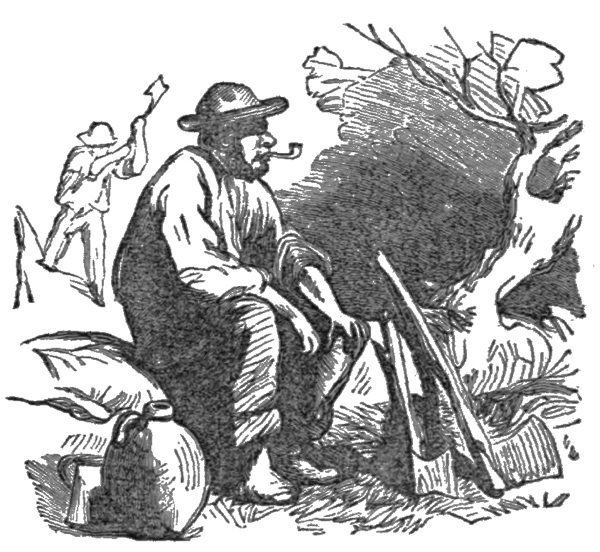
With these admonitions, the father departed.
Unfortunately, there was no one to admonish him
to behave himself, though perhaps he needed such
a caution as much as his children. Arrived at the
wood-lot, he and his assistant took a full “swig”
from the jug, and then commenced work. By the
time Mr. Hapley had felled one tree, he felt the
need of another draught of cider; and seating himself
on the prostrate trunk, he again tipped the jug,
245and then lighting his pipe, resigned himself to quiet
contemplation. The sturdy strokes of his more
industrious companion, if they reproached him, did
not arouse him from his lazy lethargy for half an
hour, and then he returned to his work only for a
short time, soon seeking refreshment again from
the jug and pipe. It was past noon when the sled
was loaded up with green wood, and by this time,
Mr. Hapley was in no amiable mood, the soothing
influence of the pipe not having been equal to the
exciting effects of the cider, which always made
him as sour as itself. His companion, too, was not
quite so cheery as when he came into the woods.
He thought it rather hard fare, to do more than
three-fourths of the work, and drink less than one-fourth
of the cider. So they mounted the load,
and drove home, scarcely speaking to each other
on the way.
“My patience!” exclaimed Mrs. Hapley, as the
team entered the yard; “have you brought me a
load of green stuff, at this time of year, and not a
stick of dry wood about the premises? What shall
I do!”
“Do? why, you can stick it up in the chimney
246corner, and dry it,” replied Mr. Hapley, quite unconcerned.
“Well,” added his wife, with a sigh, “if I had
only known you had no wood seasoning up in the
lot, I’d have gone and cut some myself, sooner than
try to burn that stuff.”
“You’re always a telling what you’d do,” replied
Mr. Hapley; “now I wish you’d go and do
it, just once, and say nothin’ about it. Plague
on ’t! how is a feller going to chop wood, when
he’s got the rheumatis’ so he can’t stand up? It
seems as though women hadn’t no consideration
about some things.”
Mrs. Hapley always refrained from bandying
words with her husband, when he was in an irritable
mood, and she made no further reply. He
took the horses from the team, (for, according to
his slack system, it was time enough to unload the
wood, when the sled was needed again,) and led
them into the barn. In a few moments he returned,
and inquired, in a stern tone:—
“Who fed them cows, this noon?”
“I did,” replied Mrs. Hapley. “Sam wasn’t here,
at noon, and so I took care of them.”
247“Just the way with that plaguy Sam,” added
Mr. Hapley. “He’s never about when anything’s
to be done. Here, Sam! Sam!” he called at the
top of his voice; but Sam did not respond, and Mr.
Hapley continued, “What did you give ’em such a
mess of hay for? They’ve wasted more’n half of
it, and got it all over the barn. I don’t see what
you was thinking of. We can’t afford to litter the
critters with hay, when it’s as skerce as ’tis now.”
“I don’t think I gave them too much,” replied
Mrs. Hapley. “The fact is, they don’t like the hay,
and they wont eat it up clean.”
“Where’s Benny?” inquired Mr. Hapley, suddenly
noticing that his youngest boy was absent.
“He’s gone out to play,” replied his wife.
“I told you not to let him go out in the slosh—he’ll
be sick ag’in, you see if he aint,” said Mr.
Hapley.
“He’s dressed warmly, and got his thick boots
on,” replied Mrs. Hapley. “It is so pleasant that I
thought it would do him good to be out a little
while in the air.”
Mr. Hapley withdrew to the barn, and was feeding
his horses, when a loud scream from Benny
248startled him. Running to a window in the back
of the barn, he saw the cause of the outcry. Sam
had thrown Benny down in the snow, and was
pushing him about in it, and rubbing it into his
face and neck. They were by the roadside, a few
rods from the barn. Mr. Hapley flew to the door,
and called to Sam, but Benny’s outcry drowned his
voice. He then ran towards them, but Sam had
finished the assault, concluding with a few vigorous
kicks, before he saw his father approaching. Mr.
Hapley was so enraged at what he had witnessed,
that he could hardly listen to a word of explanation.
Benjamin, a lad of nine years, was his youngest
child, and was supposed by the rest of the family
to be the father’s favorite. He was not at this
time in robust health, which added to Mr. Hapley’s
excitement, on seeing him abused by Sam. The
origin of the assault, which Mr. H. did not stop to
investigate fully, was this. Benny, seeing his
brother coming up the road, hid himself behind a
stone wall, until he had passed, and then playfully
threw a soft snow-ball at him, which chanced to hit
him on the head, though not with much force.
Sam instantly started for his little brother, who
249fled; but overtaking him, the unfeeling boy pitched
him into a snow bank, and rolled him in it, then
“washed his face in snow,” sprinkled several handfuls
of the fleecy element down his neck and back,
and finally kicked him, as has been stated.
Mr. Hapley led the boys as far as the barn, and
after telling Benny to go into the house, and ask
his mother to take care of him, he pushed Sam into
the barn, assuring him that he would attend to
him. Having closed the doors, he ordered Sam to
take off his coat, but the refractory boy refused.
Enraged at this, the father seized him, and a desperate
struggle ensued, the boy resisting even to
blows, and the anger of the other waxing fiercer
every moment. But Mr. Hapley was a powerful
man, and the result of the contest was not long
in doubt. The coat was stripped from the boy’s
back, and despite his efforts to escape, he soon
found himself bound hand and foot to a post,
utterly helpless. As it was useless to struggle, he
now betook himself to yelling, which he did with
such effect that all the family were soon drawn to
the spot. But Mr. Hapley sternly ordered them
all away, and then taking a heavy cart whip, commenced
250beating the boy with great severity. Soon
the cries of the sufferer again brought the mother
and the younger children to the spot, and despite
the father’s commands, Mrs. Hapley and Jessie
entered the barn, and with tears pleaded for Sam.
But the father, whose natural feelings were now
blunted and benumbed by liquor, and whose wrath
was stirred almost to its lowest depths by the resistance
Sam had offered, took no notice of the
sympathizing intruders, but kept on with the cruel
punishment.
Marcus, who had heard the first outcry, and suspected
the nature of the trouble, ran at once over
to Mr. Hapley’s, and entered the barn just at this
juncture. The mother and daughter both besought
him to interpose in behalf of the unfortunate boy,
whose shirt was already slightly stained with blood.
On his entrance, however, Mr. Hapley stayed his
hand, and, looking somewhat abashed, as Marcus
thought, inquired—
“What do you want here, sir?”
“Don’t you think you have punished Sam about
enough?” inquired Marcus, mildly.
“I guess I can flog my children without any advice
251from you—you’d better go home and mind
your business,” was the reply.
“I didn’t mean any offence, Mr. Hapley,” continued
Marcus, in the same calm tone. “I heard
Sam screaming, and I thought I would run over
and see what the matter was, for I didn’t know
but somebody was abusing him. You would have
done the same thing, if you had been in my place,
Mr. Hapley.”
“I wouldn’t punish him any more, now, father,”
said Mrs. Hapley; “I think it’s time to stop when
the blood runs.”
“Are you sorry for what you did?” inquired the
father, addressing Sam.
“Yes,” replied the boy, in a surly tone.
“Well, then, I’ll let you off, with this,” said Mr.
Hapley. “But mind you, you wont get off so easy
another time, if you don’t behave yourself, so look
out. I’ve let you alone till you’re almost sp’ilt,
but I’m going to turn over a new leaf with you,
now. You’ve got to toe the mark, or else I’ll put
the marks onto your back—one of the two.”
Mr. Hapley, as he said this, unbound the boy,
who, on being released, went into the house, followed
252by his mother and the children. Marcus,
finding himself alone with the misguided father,
thought it his duty to address a word of remonstrance
to him against such punishments.
“Mr. Hapley,” he said, “do you think this is the
best way to discipline a boy? Isn’t it a rather
harsh remedy?”
“I wont have nothing to say to you or anybody
else about that,” responded Mr. Hapley. “It’s
nobody’s business if I choose to whip my boy, and
I wish folks would mind their own affairs, and let
me alone. I guess I’m old enough to know what
I’m about, and if I aint, I don’t want your advice.”
“I am aware no one has a right to interfere,”
replied Marcus, “unless you abuse your child. In
that case I suppose you know the law will protect
him. If you didn’t abuse Sam, just now, I think
you came very near it.”
“What’s that?” exclaimed Mr. Hapley. “Do
you come over here to sarce me, in my own premises,
you young upstart?”
“I see it is of no use to talk with you now, Mr.
Hapley,” Marcus calmly replied, and then withdrew.
The next morning, Jessie, with tears in her eyes,
253informed Marcus that her brother was missing.
He had evidently gone off in the night, intending
to seek his fortune elsewhere, for he had taken a
change of clothing. Before starting for the academy,
Marcus called on the Hapleys to see if he
could be of any service to them, in their new trouble.
“No,” said Mr. Hapley, gruffly, “we aint a going
to send after that boy, nor no such thing. If he’s
a mind to run away, let him run, that’s all. I’ll
warrant he’ll get enough of it, and be glad to get
home ag’in, before a month’s out.”
Mrs. Hapley looked anxious, and the children
sad, though the father seemed quite unconcerned.
No steps were taken to bring back the fugitive, or
even to ascertain in what direction he had gone,
and nothing was heard from him, until about a
week after, when he suddenly made his appearance
one evening. He was in a sorry plight, his feet
being somewhat frosted, his clothes having suffered
from rough usage, and he being very tired and hungry.
His parents received him with unexpected
kindness, and even Mr. Hapley himself was more
pleased at his return than he was willing to confess.
Sam, however, did not seem inclined to say much
254about his adventures, during his week’s absence,
and the curiosity of the family, on that point, was
far from satisfied.
Two or three days after Sam’s return, a couple
of strangers drove up to the door, and having
found Sam, told him he was their prisoner, at the
same time showing him a writ authorizing his arrest.
They also informed Mr. Hapley that they were
empowered to search the house for stolen property;
adding that a robbery had been committed in a
town about ten miles distant, and there was reason
to suspect his son had some connection with it.
The shock of this intelligence so affected Mrs.
Hapley, that she fainted. While her husband was
using means for her recovery, the officers put a pair
of hand-cuffs upon Sam’s wrists, to prevent his
escape, and then took him up into his chamber,
where they commenced the search. There was an
old bureau in the room, which they examined very
thoroughly. They also scrutinized the boy’s clothing,
peered into the fire-place and up the chimney,
looked for loose boards in the flooring, and examined
holes in the plastering, but all to no purpose.
They then overhauled the bed, and soon drew out
255from among the feathers a package which was found
to contain a breast-pin, several silver spoons, and a
watch. With this they announced themselves as
satisfied, and soon started off with their prisoner.
The news of Sam’s arrest spread through the village
like wild-fire. Marcus heard of it as soon as
he was out of school, in the afternoon. On the
way home, he overtook Jessie and Kate, who, full
of spirits, wondered that Marcus should be so sober.
The sad news was not broken to Jessie until
she entered her home, where she found her father
upon the floor, drunk, and her mother sick in her
bed, while Benny was silently weeping, as though
his heart were breaking. Henry alone was able to
explain to her what had happened. The poor girl
could hardly help sinking to the floor, as Henry
related his story; but feeling that this was no time
to give way to her emotions, she controlled her
nerves with admirable coolness, and soon partly
forgot her own sorrow, in her efforts to relieve the
others. She prepared some medicine for her mother;
put a pillow under her father’s head, having
tried in vain to assist him to a chair; spread an old
256coat over him, to prevent his taking cold; spoke a
few words of comfort to Benny; and then proceeded
to get supper.
It was soon whispered about town that Mr. Hapley,
since the arrest of his son, had abandoned himself
to his cups worse than ever. Several of his
neighbors kindly remonstrated with him against
the course he was pursuing, and urged him to take
some steps in aid of his misguided boy; but their
efforts were all in vain. Although Sam’s trial was
to come on in a few days, none of his friends had
been near him, to offer him advice or assistance.
In this extremity, Mrs. Hapley appealed to Marcus
for assistance, who readily consented to do all he
could in behalf of the boy. The next day he drove
over to the town where Sam was awaiting his trial,
accompanied by Mrs. Hapley. They found the
boy alone in a cell, looking very dejected. He
burst into tears, on seeing his mother, and for several
minutes neither of them could speak. Marcus,
in a kind tone, told him they had come to see if
they could do anything for him, and urged him to
tell them frankly all about the stolen property
found in his room, that they might the better know
257how to proceed. Sam at once expressed his willingness
to do so, and then related his adventures,
from the time he left home until his return. His
story, in substance, was as follows.
He left home on a pleasant moonlight night, as
soon as he was satisfied all the family were asleep.
He walked seven or eight miles, and then forced
an entrance into a barn, where he slept the rest of
the night. The family gave him a breakfast, the
next morning, and he then resumed his journey.
In the course of the forenoon he reached a large
town, where he concluded to stop and see what
he could do; for he had but half a dollar in his
pocket, and began to feel a little uneasy. There
was a large tavern in the village, which was much
frequented by sleighing parties, and for a day or
two Sam managed to pick up a little change, by
holding horses, and performing other small chores
for the company. He was allowed to sleep in the
barn, and got his meals at a low “saloon” near by.
The associates among whom he was thus thrown,
were not of the best kind, and one of them, a young
man several years older than himself, was an offender
against the law, having served out two or three
258sentences in jails. His name was Mack. There
was something in the face, the conversation, or the
peculiar circumstances of Sam, that led him to propose
to the boy a sort of partnership in crime; and
as he set forth the gains to be derived from such a
course in the brightest colors, the boy’s easy virtue
made but slight resistance, and without much persuasion,
he agreed to the proposition.
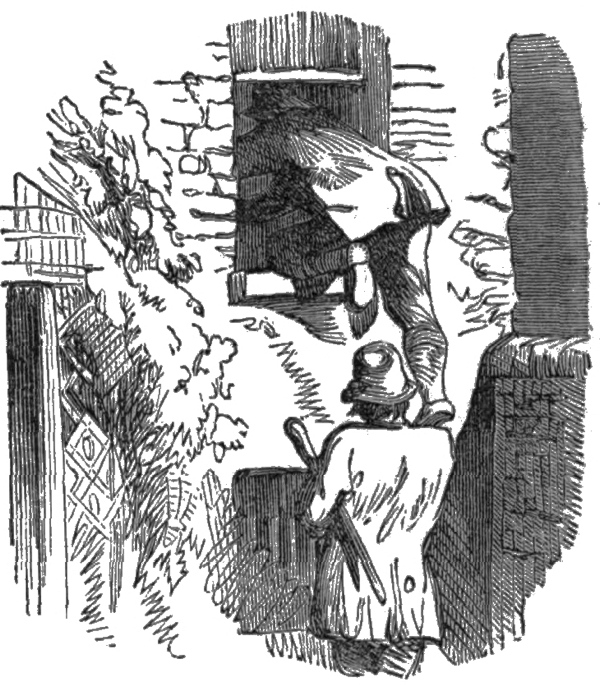
The next night after the matter had been settled,
Sam made his first attempt as a burglar, in
connection with Mack. They chose for the scene
of operations a large and substantial house, occupied
by a widow of reputed wealth, and her family
259of young children. The moon shone bright, but
as the house was in a retired neighborhood, they
thought they could elude detection. Mack entered
the dwelling first, by a second story window, standing
upon Sam’s broad shoulders to reach the sash,
which proved not to be fastened down. He then
descended to the basement, and opened the doors,
that they might easily escape in case of alarm. Sam
now entered, and the two ransacked the lower part
of the house, helping themselves to a quantity of
silver ware, some jewelry, two watches, and a good
supper. After securing a few articles of value,
Sam was in haste to escape, but his companion
seemed in no hurry, and went about the house as
leisurely as though he were at home. This free
and easy bearing doubtless seemed quite professional
to Mack, but he happened to carry it a little
too far for his own safety. Sam, impatient of his
dilatory movements, was awaiting him outside,
when he heard a movement in the house which led
him to take flight. It seemed the widow had been
awakened by the burglars, and, arousing her oldest
son, a brave boy of fourteen, they descended as
noiselessly as possible. Mack had just before lighted
260a lamp, and gone down into the cellar, to see if he
could find a bottle of wine, leaving his plunder on
the kitchen table. Suddenly the cellar door was
closed and locked upon him, and he heard strange
voices, one of which, the voice of a boy, assured
him that he had a loaded rifle, and would put a
bullet through him “in less than no time,” if he
attempted to get away. The burglar tried to escape
by a window, but the rifle was quickly pointed
at him, outside, and he gave up the attempt.
In a few moments help arrived, and he was secured.
As all the stolen property was not found,
it was suspected that he had an accomplice,
though he refused to give any information on that
point.
Sam left the village as speedily as possible,
directing his steps towards a town where he had
never been before. After wandering about two
days, and suffering much from fatigue, cold, hunger,
and anxiety, he at length reached home, as
we have seen. The sudden and unexplained disappearance
of Sam, from the village tavern, together
with the fact that he had been seen with
Mack several times on the evening of the burglary,
261directed suspicion towards him, and finally led to
his arrest.
After hearing Sam’s story, Marcus expressed the
opinion that he had better plead guilty, and frankly
own up his offence to the officers of justice. This
advice was accepted by Sam and his mother. Marcus
and Mrs. Hapley then secured a lawyer to
appear on behalf of the boy at the trial; and they
also had an interview with the officer who conducted
the prosecution, explaining to him the circumstances
of the case, and soliciting his influence
in favor of the prisoner, on the ground that this
was his first offence, and that he had been led astray
by a hardened offender.
Sam was brought before the court a day or two
after, and pleaded guilty to the charge of burglary.
His counsel urged several reasons for a light sentence,
and the prosecuting attorney said that, under
the circumstances, he should not oppose the request.
The judge, however, thought it was not exactly a
case for mercy. The prisoner, he said, was a runaway
from home. He had voluntarily made himself
a vagrant, and had shown his willingness to
resort to crime, to get a living. No attempt had
262been made to prove a good character for him, and
he doubted whether such an attempt could succeed.
He concluded by sentencing the boy to the county
jail for four months.
CHAPTER XVI. MERRY DAYS AND SAD ONES.
263
“I DON’T care, I got the start of all of you,”
said Ronald, as the family were discussing
over the breakfast table, Christmas morning, the
question who was the first to wish the others “a
merry Christmas.” “I heard the clock strike four,
and I jumped right out of bed, and ran into the
entry, and wished you all a merry Christmas.”
“Well, that wasn’t fair—I was asleep, and didn’t
hear you,” said Kate.
“So was I asleep,” “And I,” “And I,” added
one and another.
“That makes no difference, so long as I was
awake,” replied Ronald.
“Ronald,” said Marcus, “reminds me of a fellow
I have either heard or dreamed about, who bragged
264that he got up and wished all the kingdoms of the
earth a happy new year at one lick. For my part,
if any body has got any good wishes for me, I
should prefer to be informed of it when I am awake.
And I don’t care much about being lumped in with
all the kingdoms of the earth, either.”
“Well, sir, I wish you a merry Christmas, all to
yourself,—I believe you are awake now,” said Ronald,
with a sly chuckle.
“There, I may as well give in—I wont try to
say anything more,” added Marcus, as the laugh
went round the table at his expense.
After breakfast no little curiosity was excited by
a package which Marcus handed to Oscar. It was
received by Marcus the day before, by express, with
a note requesting him to deliver it to Oscar, Christmas
morning. After removing sundry cords and
wrappers, the contents stood disclosed. There
was a fine pair of skates, from his father; a gold
pen, from his mother; a pair of wrought slippers,
from Alice, his oldest sister; a beautiful book-mark
from Ella, another sister; a book from his brother
Ralph; and a package of confectionery from George,
his youngest brother. Brief notes accompanied
265several of the presents. There were also two letters
in the package, the handwriting of one of
which, Oscar did not recognize. It proved to be
from a young acquaintance in Boston named William
Davenport, who went by the familiar name of
“Whistler” among his comrades. It was written
in fulfilment of a promise he had made, before
Oscar left Boston. The other letter was from his
mother, and, like all similar favors from that source,
was full, margin and all, of kind words, good advice,
and family news. It contained an item of intelligence,
however, that cast something of a damper
over the spirits of Oscar. It was as follows:—
“The brig Susan has been heard from at last.
You know we have been looking for her ever since
October. She foundered in a gale in September,
off the South American coast, and the men took to
the boats. One of the boats was picked up, after
floating about for several days, and the men in it
were saved, after enduring great hardships, and
have arrived here. Nothing has been heard of the
other boat, on board which was poor Jerry. His
parents are much distressed about him; but your
father thinks he may be safe yet, as the boat may
have reached the shore, or may have fallen in
266with some outward-bound vessel. Let us hope for
the best, as long as we can.”
The “poor Jerry” referred to, was a cousin to
Oscar. The two boys had once been very intimate,
somewhat to the damage of Jerry’s character; and
it was in a great measure owing to this intimacy
that Jerry absconded from his home, in Brookdale,
about a year previous to this time, and shipped for
a voyage around Cape Horn.
There was to be a children’s Christmas party at
the town hall, in the evening, and the presents
designed for the other members of the family were
reserved to grace the “tree” that was to be one
of the chief attractions of the occasion. Marcus
and the children constituted a part of the committee
of arrangements for the festival, and were
occupied with their duties through a good part of
the day. At an early hour in the evening, the
whole family proceeded to the town hall, where
they found the chief portion of the town’s population
assembled, especially the younger part. The
hall, with its evergreen decorations, its numerous
lights, and its sea of happy faces, presented an enlivening
267spectacle. At the hour appointed for
opening the exercises, the clergyman of the village
ascended the platform, and after a few remarks,
invoked a blessing upon those assembled. Then
came an introductory declamation, by one of the
academy boys, followed by the recitation of an
appropriate poem by a fair-haired little girl of six
summers. Next appeared upon the platform our
two young friends Ronald and Otis, who confronted
each other in blank silence a minute or two, and
then retreated to the ante-room, without exchanging
a word. Some of the audience were in painful
suspense, during this scene, supposing it to be
a failure; while others began to whisper that it was
a tableau, and not a dialogue, though they were
puzzled to tell what it represented, or why the
figures should walk to and from the stage, in sight
of the audience.
A curtain before the platform now fell, and after
a few minutes was again raised, disclosing to the
audience a charming tableau of Minnehaha, the
Indian maid. The two boys who had acted in the
mute scene, just before, now re-appeared, and went
through very creditably with a dialogue, Ronald,
268the leading speaker, having suddenly forgotten his
part, on his first appearance. Then followed several
songs, declamations and tableaux, after which
the main attraction of the evening was introduced,
by the raising of the curtain which concealed the
Christmas tree from view. A loud and merry shout
arose from the young folks, which was prolonged
for a minute or two, and followed by general expressions
of admiration from all present. There
stood the tree, a tall, straight and symmetrical evergreen,
illuminated with candles, arrayed among its
branches, and adorned with artificial icicles and
snow flakes. The fruits, however, with which every
bough and twig seemed bending, were the most
interesting objects of contemplation to the hundred
pairs of youthful eyes fixed earnestly upon the tree.
Many of these fruits, it is true, were hidden from
sight, by a rind of paper, cloth or wood; but imagination
readily supplied all deficiencies of this
kind, and the little eyes gazed, and sparkled, and
longed, just as though they pierced through all the
outer coverings that concealed the tempting clusters
which hung upon the boughs.
After a few moments, Santa Claus suddenly appeared,
269and walking across the platform, took his
station by the side of the tree, amid rapturous applause
from the company. He appeared to be a
venerable personage, with a flowing gray beard,
and was completely encased in furs, from top to
toe—fur boots, fur leggings, fur tunic, fur mittens,
and a fur cap which enveloped all of his head except
the face. After silence had been secured, he spoke,
in tones which seemed very soft and gentle to proceed
from so rough and ancient a personage, and
which not a few of the audience declared “sounded
just like the voice of Marcus Page.” He said he had
brought “heaps” of presents, and had almost broken
his back with the effort. He hoped he had brought
something for everybody; but if he had not, he
trusted they would not blame him, for he had done
the best he could. He requested the children not
to crowd around the tree, and invited the recipients
to walk up one by one as their names were
called. He then commenced gathering the fruit,
to each of which was attached the name of the
person it was intended for. And now the sport
began in earnest. What a queer assortment of
articles to gather from one tree! There were gold
270rings, breastpins, lockets, pencils, and pens; silver
spoons and thimbles; work-boxes, wooden dogs,
and stuffed rabbits; books, fancy boxes, and popped
corn; sleds, skates, and mittens; pin-cushions,
needle-books, and bags of candy; dolls, pocket
knives and cologne bottles. But time and patience
would fail to mention half the things that good
Santa Claus handed down to the company. It
was an hour before the distribution was finished.
The company then adjourned to the room below,
where they found an abundance of simple country
refreshments provided. A speech or two followed,
and with three cheers for Christmas day, and three
more for Santa Claus, the entertainment ended.
There was the usual exchange of good wishes
and little keep-sakes, on New Year’s morning, but
the day was not otherwise distinguished as a festival,
and the schools kept, and business went on,
as on other days. As the family were seated at
the breakfast table, a light rap upon the door was
heard, and on answering the call, Jessie Hapley,
pale and agitated, was found upon the steps.
“Mrs. Page,” she said, as soon as that lady appeared,
“mother wants to know if you will come
271right over—she is afraid Benny is dying;” and the
poor girl burst into tears as she delivered the message.
“Benny dying!” exclaimed Mrs. Page, “why, I
had no idea he was so sick as that—how long has
he been so?”
“He grew worse very fast last night,” replied
Jessie. “Henry has gone for the doctor, and
mother thought perhaps you could tell what to do,
till he comes.”
“Yes, I will go over immediately,” replied Mrs.
Page, and she went for her bonnet and shawl, and
a minute after started by the shortest cut across
the fields for the house of sorrow.
Marcus would gladly have accompanied his
mother, but for fear that his presence at such a time
might be regarded an intrusion. Benny was
one of a class of little boys which Marcus had instructed
in the Sabbath school for some two years.
Partly from the gentle, winning disposition of the
child, and partly on account of the unfavorable
influences to which he was exposed at home, Marcus
felt an especial interest in him, and had watched
his decline with no little solicitude. For several
272months past, Benny had been able to attend the
Sabbath school only occasionally; but every Sunday
his young teacher carried or sent to him an
attractive book from the library, and in other ways
manifested his continued interest in the sick scholar.
It was with a heavy heart, therefore, that Marcus
heard his mother summoned to Benny’s death-bed,
on this pleasant New Year’s morning. An hour
later, on his way to the academy, he stopped at
Mr. Hapley’s door, to inquire after the patient, and
was told that the doctor was still with him, and
that the result of his efforts in behalf of the boy
was yet uncertain.
In spite of the pleasant associations of the day,
and the kindly greetings with which his scholars
met him, a cloud hung over the spirits of Marcus,
which he was unable to dispel. One incident occurred,
however, which was peculiarly grateful to
his feelings. On entering the school-room, he was
followed by Harrison Clark, who, taking from behind
a blackboard a handsomely finished cane,
handed it to Marcus, and, with some embarrassment
in his manner, said:—
“Mr. Page, will you accept of this as a New
273Year’s present? It isn’t of much value, but I
made it myself on purpose for you.”
“Ah, is this your work?” inquired Marcus, carefully
examining the article, which was really well
made, in every part. “Did you do it all yourself—head,
ferule, rings and all?”
“Yes, sir—Mr. Tucker let me use his tools, and
I did the whole of the work myself,” replied Harrison.
“It is certainly very creditable to you,” continued
Marcus. “I don’t see how it could be improved.
Yes, I will accept it with great pleasure, and thank
you for it, too. Coming as a present from you, I
shall value it ten times what it would cost to get
such a cane made—yes, a hundred times. I shall
remember your kindness with gratitude, perhaps
after you have forgotten both me and the cane.”
“I don’t think I shall forget you very soon—you
have been so good to me,” replied the boy,
with a look which testified to the sincerity of the
remark.
“And you have proved yourself worthy of my
kindness, so I need not take much credit for that,”
rejoined Marcus.
274The boy, who but lately was so bold and defiant
in his bearing, blushed at this not unmeaning compliment,
and withdrew.
When Marcus returned home, in the afternoon,
he again stopped to inquire after the sick boy, and
was requested to go in, as Benny had expressed a
desire to see him. He found the sufferer in a little
bed which had been made up for him in the front
room, near the fire, for he complained much of the
cold. A faint smile lit up his face as Marcus entered.
“How is he, Mrs. Hapley?” inquired Marcus, as
he seated himself by the bedside, and took Benny’s
cold hand into his own.
“I think he is a little more comfortable than he
was this morning,” replied Mrs. Hapley. “He has
been very much distressed for breath, most of the
day, but he seems to be better, now.”
“I am glad to hear that, and I hope he will continue
to improve,” said Marcus.
Benny, whose mild, lustrous eyes had been fastened
upon Marcus from the moment he entered
the door, was too weak to speak aloud; but as he
seemed to have something to say, Marcus bent his
275ear down to the boy’s mouth, and was addressed
in a whisper as follows:—
“I’m not going to get well, and I don’t want to.
I’m going to heaven pretty soon. I have been
longing to go, ever since I was taken sick, and now
I know I’m almost there. I love God, and Jesus,
and the angels, and all good folks. Do you remember
what you told me about heaven, the other day—how
many millions of good little children are
there, and how Jesus calls them his lambs, and
wipes away their tears, and takes them in his arms?
There wont he anything to make us sorry in heaven,
will there?”
“No,” replied Marcus, his mind recurring to that
passage of Scripture, “There shall be no more
death, neither sorrow, nor crying, neither shall there
be any more pain.”
There was a brief interval of silence, broken
only by an occasional half-suppressed sigh that
escaped from Jessie, who was seated in a remote
corner of the room, and by the slow and regular
tread of Mr. Hapley, who was pacing the floor of
the chamber overhead, in an agony of grief and
remorse. Marcus afterwards learned that a few
276hours before this, when Benny was thought to be
dying, he had entreated his father in a most affectionate
and touching manner to abandon the besetting
sin which was bringing himself and his family
to ruin and disgrace. The strong man, after a
brief but desperate struggle, promised the dying
boy that he would abandon his cups from that hour,
and would try to live in such a way that he might
meet his little son in heaven.
Mrs. Hapley, who had been engaged in the
kitchen, now came in, with a bottle of hot water,
to be applied to Benny’s feet; but he whispered to
her:—
“O, mother, I am so cold! Wont you take me
up in your arms, and hold me before the fire?”
“Yes, dear,” replied his mother, and she took the
boy gently into her arms, wrapped a blanket around
him, and sat down before the blazing fire.
This movement seemed to be too much for the
boy, for he gasped for breath, and sank exhausted
into his mother’s arms. After a few minutes he
recovered sufficiently to speak.
“Why, mother,” he said, “how fast it grows
dark! I can’t hardly see anything.”
277“Jessie, ask your father to come down,” said Mrs.
Hapley, trying to speak calmly.
“It is dark here, but it is light there—O, how
light!” whispered the dying boy.
“Where?” inquired the mother, scarcely knowing
what she asked.
“I don’t know where it is,” replied the boy. “I
saw it coming, way off, just now, like a bright cloud,
and now it’s all around me. Why, mother, don’t
you see it? The room is all full of it!”
Mr. Hapley now entered the room, but, seemingly
unable to endure the scene, silently bowed his head
against the wall. Jessie and Henry also came in
with their father.
“I want to kiss you all,” whispered Benny to his
mother, after the family had assembled.
His wish was complied with, and his mother,
father, Jessie, Henry and Marcus successively received
and returned a parting kiss.
“Now one more for Sammy—you’ll give it to
him when he comes back, wont you, mother?”
added Benny.
The promise was made, and the kiss given. But
the poor boy did not know that his absent brother
278was at that moment serving a sentence in jail as a
convicted felon. The result of Sam’s trial had been
wisely concealed from Benny, on account of his
illness.
The circle had sat in silence for several minutes,
when Mrs. Hapley arose, and tenderly laying her
precious charge upon the bed, kissed the pale
brow, and said, in a low, calm tone, which almost
startled herself:—
“It is all over—the bitterness of death is past!”
The spirit of the child had departed so peacefully,
that she could not tell when he drew the last
breath. But the true and loving heart had ceased
to beat, and the mild eyes were set in death, and
the last enemy had accomplished his work surely,
though noiselessly.
Marcus soon withdrew from the sorrowing circle,
his own heart bowed in grief as sincere if not as
deep as that of the near relatives of the deceased.
It was the first time he had ever come into the immediate
presence of death, and had seen, as it were,
the fatal arrow wing its way into the living mark.
It was, indeed, the first time that the grave had
claimed one in whom he felt so deep an interest,
279and towards whom he held so near a relation; for
he never could realize the death of his father, followed
as it was by years of anxious suspense and
hope deferred, and shrouded in impenetrable mystery
up to this hour.
Mrs. Page and her sister went over to comfort
and assist the stricken family, while Marcus retired
to his chamber, to commune with his own thoughts.
Though far from unfaithful to his trust as a religious
teacher, he now lamented that he had done so
little for the spiritual improvement of the dear boy
whom death had just removed from the reach of
his influence. Never before did he realize so vividly
the uncertainty of life, the insignificance of
worldly ambition, and the inestimable value of
those treasures which make us “rich toward God.”
And now, at the beginning of the new year, did
he kneel down and ask for divine aid, as he pledged
himself to strive, with more fidelity than ever before,
to kindle in the young minds around him
desires after a higher and purer life.
CHAPTER XVII. ADVERSITY.
280
THE first act of Mr. Hapley, after Benny was laid
in the frozen ground, was one that gave new
hope to the sorrowing household. At his request,
the clergyman of the village had previously written
a pledge of total abstinence from all intoxicating
liquor, which the afflicted father signed upon the coffin
of his boy. On returning from the funeral, he
collected together all the alcoholic liquors in the
house, consisting of cider, whiskey and brandy, and
taking them into the yard, poured them out upon
the snow. As Mrs. Hapley and the children gazed
upon this novel scene, they almost forgot their
bereavement, in the new hopes and joys which
seemed now about to be bestowed upon them.
And well might they take courage. Mr. Hapley
281had thus far sacredly kept his promise to Benny.
He was very sad, and his limbs were weak and
trembling, and there was a terrible craving and
gnawing within, that neither food nor ordinary drink
could satisfy; still he struggled manfully against
the tempter, and friends not a few stood by, with
words of encouragement and cheer. Indeed, with
his sober and subdued air, his clean-shaven face, and
the general tidiness of his personal appearance, he
already seemed like a different man.
The reformation of Mr. Hapley was much talked
of among his neighbors and acquaintances, and
very different opinions were expressed as to its permanence.
It was generally thought that he would
persevere, but there were some who had little faith
in his good purposes. Old Mr. Todd, who held a
mortgage on his farm, and who was regarded as
quite an oracle, shook his head in a knowing manner,
when the matter was mentioned at the post
office, one morning.
“I’ve known Charles Hapley,” said he, “ever
since he was a boy, and I knew his father before
him. The old man had the best farm in town, but
the family has been gradually running down these
282twenty years, and it’s my opinion that Hapley
will die a drunkard, as his father did.”
“Now, Squire,” said an elderly and benevolent
looking man, who was seated on the counter, “it
appears to me you are a little too hard on Hapley.
They say he’s stuck it out for more’n a week, and
not touched a drop of anything, and that’s doing
pretty well, for him. I hold that we all ought to
encourage the poor fellow along, and not go around
predicting that he’ll die a drunkard.”
“So do I hold to encouraging him along,” replied
Mr. Todd; “but at the same time I don’t believe
it will do any good. He never did have any control
over himself, from a boy, and I don’t believe
he’s going to keep the bridle on a great while,
now. You see if he does, that’s all.”
“Guess the old man means to step in there,” said
some one, as Mr. Todd went his way.
“Yes, it’s plain enough what he’s after,” said
another.
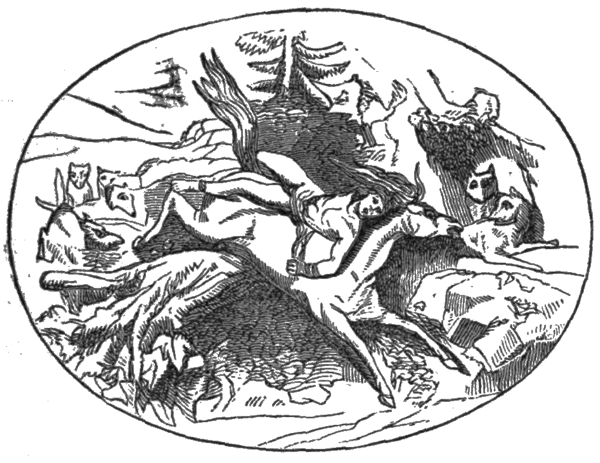
The speakers alluded to Mr. Todd’s taking possession
of the Hapley farm, on account of the non-payment
of his mortgage. Their conclusion was not
a very charitable one, to be sure. Nor was it exactly
283kind in Mr. Todd to predict with so much
assurance the relapse of Mr. Hapley. Still, it must
be admitted that he had pretty strong ground for
his opinion, though he need not have been so free
to express it. The lesson of self-government is a
hard one to learn in mature life, especially to a
man who has for many years been tyrannized over
by depraved appetites and passions. The position
of such a man is something like that of Mazeppa,
the young page of a Polish king, who for some
offence was lashed, naked, to the back of a wild
horse, which was then set free, and plunged with
frightful speed through forest and plain into his
native country, bearing his helpless and well-nigh
284lifeless rider with him. But when the appetites
and passions are the ruled, and not the rulers, they
may be compared to the same steed, tamed and
docile, bridled and saddled, and ready to do your
bidding. Mazeppa, it is true, had the good fortune
to survive the painful ordeal, and lived to become
a prince; but we think few would be willing to
run such a race, even for such a prize, except upon
the wild horses of their own ungovernable passions.
But Mr. Todd proved a true prophet, in this
instance. In less than a fortnight after Benny’s
death, Mr. Hapley came home from the village one
afternoon sadly intoxicated. How he happened to
fall, was never explained to the family. He had
been to the store where liquors were sold, on business,
and probably the wretched sensation in his
stomach, aided by the sight and smell of the
tempter, the associations of the place, and perhaps
the coaxings of the drunkard-maker, suddenly
swept away the breastwork of good purposes he
had erected. He tasted—he fell; and what a
death-blow was that act to the hopes and peace of
his poor wife and children! To Mrs. Hapley and
285Jessie, especially, it seemed as if the last hope had
been swept away.
The next day, when Mr. Hapley realized his situation,
he was overcome with grief and shame.
He was, moreover, discouraged. He had lost both
his self-respect and his self-reliance. He had no
longer any confidence in his ability to keep the
pledge. Meanwhile his thirst for the deadly liquid
was growing more insupportable for the fresh stimulus
it had received. In this pitiable state of mind
and body, he went again in the afternoon to the
rum-shop, and attempted to drown his sorrow in a
still deeper potation. Towards night, a severe
snow-storm set in, but he did not return. Hour
after hour did his wife sit at the fire, after the children
had retired, listening for his return; but the
wild shriek of the wind, as the storm waxed more
furious, and the sharp rattle of the snow against
the window panes, were the only sounds she heard.
At length, when it was almost midnight, unable
longer to bear the terrible suspense, she aroused
Henry from his sleep, and told him to go over to
Mrs. Page’s, and ask Marcus if he would not take
a horse and go in search of the missing man. The
286boy dressed himself, and plunged into the huge
snow-drifts. He had not proceeded far, however,
before he began to doubt whether he should be able
either to go on or to return. Blinded by the driving
storm, transfixed by cutting blasts, the divisions
between roads and fields quite obliterated, and
floundering in snow up to his arm-pits, he sank
exhausted, more than once, into the hole he had
made; but with the energy of despair, he again
aroused himself, and at length reached Mrs. Page’s
door-steps.
After considerable effort, some of the family
were aroused, and Marcus, on learning Henry’s
errand, at once prepared to go out in search of his
father. He concluded he could get along best on
horseback; and putting a bridle on Charley, the
toughest of the two horses, he mounted him, and
taking Henry behind him, carried him home. He
then set out for the village, by the route Mr. Hapley
had probably taken, which led him directly into
the teeth of the storm. But he found it impossible
to keep in the road, and his horse soon began to
sink into old drifts newly buried, and to flounder
among invisible stones, stumps, fences and pitfalls,
287until, at last, the exhausted creature seemed unable
to proceed further. Marcus was accordingly obliged
to give up the search, of which fact he informed
Mrs. Hapley, before returning home.
The storm moderated in the morning, but owing
to the state of the roads, several hours elapsed
before arrangements could be made to search for
the missing man. In the course of the forenoon,
he was found, about a quarter of a mile from the
road, sitting in his sleigh, with the reins in his
hands; but the rider and his horse were both frozen
stiff. The horse had apparently been thrown down
by a log, and was unable to rise without assistance,
which the unfortunate rider was too insensible or
too benumbed to render. So they perished there
alone, and were well-nigh buried from sight before
they were discovered. A jug of rum, found in the
sleigh, furnished a sad clue to the catastrophe, had
any been needed.
The next day, a new grave was opened in the
frozen earth, by the side of Benny’s, and the father
was laid close by the son he had so lately promised
to meet in heaven, and to whom he had pledged
himself to a reformed life. O, how sad is such a
288funeral, when hope, and honor, and happiness, are
consigned to the tomb with the remains of the lost!
Truly, in such a case “’tis the survivor dies.”
It is often said that misfortunes never come singly.
So, indeed, did it prove in the case of this family.
The property left by Mr. Hapley was barely sufficient
to pay his debts; and as most of it was
mortgaged, very little remained for the family.
Notwithstanding these reverses, Jessie continued
to attend the academy, and was still “trying to be
somebody,” as Abby Leonard contemptuously expressed
it, though that young lady, it should be
added, now manifested something like pity for the
heart-stricken girl. And in spite of the drawbacks
to which she had been subjected, Jessie maintained
a high rank in her class, winning the respect alike
of teachers and scholars, as she also did their sympathy
and good-will. But there were few among
her gay-hearted school-mates who could half realize
the sorrows, and disappointments, and discouragements,
that were mingled in her cup.
On returning from school one afternoon, she
found traces of weeping on the face of her mother,
which the latter for a time declined to explain.
289The reason, however, came out after a while. On
the death of Mr. Hapley, as he left no will, an administrator
was appointed, according to law, to
settle up his estate; that is, to take charge of the
property, ascertain and pay the debts, and deliver
the balance, if any, to the lawful heirs. This administrator
was a kind-hearted man named Allen,
who had always shown himself very friendly to
Mrs. Hapley. It seemed Mr. Allen had called upon
her, that afternoon, to talk about her husband’s
affairs. There was, he said, but little more than
sufficient property to pay off the mortgages. He
advised her, therefore, to give up the farm, to sell
all the personal property they could dispense with,
and to find homes for herself and children elsewhere.
The children, he said, were all old enough
to support themselves, and she need have no one
but herself to look out for.
“Well, mother, that’s only what I expected,”
said Jessie, when the matter was explained; “we
couldn’t carry on the farm, if we should stay here,
and we may as well go somewhere else. Grandpa
said he would give you a home; Henry can get a
chance to live with some farmer, and work for his
290board and clothes; Sam can earn his living, if he
chooses to; and as for me, I will go to some factory
town and work in a mill, and in a little time I shall
be able to support you, as well as myself.”
“And give up your hope of becoming a teacher?”
inquired her mother.
“Perhaps not,” replied Jessie. “I may be able
to fit myself for teaching, even in a mill. Girls
have done such things, and why not I?”
“But I never can let you go off alone into a factory,”
said Mrs. Hapley. “If you go, I must go,
too.”
“Well, mother,” added Jessie, after a pause,
“we’ll manage to get along some how, only don’t
let us get discouraged. We know it is all for the
best, and every thing will come out right in the
end. When I feel sad, I repeat to myself that
beautiful hymn Mr. Merrill read at Benny’s funeral—do
you remember it, mother?” and Jessie recited
the following verses:—
“O Father, good or evil send,
As seemeth best to thee,
And teach my stubborn soul to bend
In love to thy decree.
291“Whatever come, if thou wilt bless
The brightness and the gloom,
And temper joy, and soothe distress,
I fear no earthly doom.
“Life cannot give a cureless sting,
Death can but crown my bliss,
And waft me far, on angel’s wing,
To perfect happiness.”
Jessie’s uncomplaining spirit, her readiness to
sacrifice her most cherished hopes, and her beautiful,
child-like faith in God, shed a sweet and soothing
influence upon the fainting and murmuring
heart of the mother. A little while after, Henry
came in from school, and for a moment looked
rather sad, when he was told that the family had
got to remove and be broken up, very soon; but
he quickly recovered his good spirits, saying:—
“Well, mother, I don’t care much, after all. Let
Mr. Todd have the old farm if he wants it—it’s
all run out, and we couldn’t do anything if we
staid here. I know I can earn my living, if anybody
will give me a chance, and one of these days
I’ll have a good deal better farm than this—you
see if I don’t! Then you and Jessie shall come
and live with me, and we’ll all be together again.”
292Henry soon found a chance to earn his living,
for Mr. Allen agreed to take him into his family at
once, and maintain him in return for his services.
As to Jessie, everybody said it was too bad to send
her off to a mill, and after some little consultation,
Mrs. Page proposed a plan by which this might be
avoided. Ellen Blake, who had lived with the Page
family for some time, was about to return home, on
account of the sickness of her mother. It was proposed
to let Jessie occupy her place in the family,
working for her board, until she should finish preparing
herself for a teacher. She was to attend
the academy two or three terms more, and when
not engaged in her studies, was to render all the
assistance to Mrs. Page she could. Her mother
was to clothe her, during this period, and it was
thought that after the present term she could render
some assistance in the lower department, and
thus secure her own tuition free. When this plan
was proposed to Jessie, she seemed very grateful
for the kindness which prompted so liberal an offer,
but was unwilling to accept of it, fearing she could
make no adequate return for her board. It was
only after considerable persuasion that she consented
293to the arrangement. When the matter was
finally settled, Mrs. Hapley concluded to accept an
invitation to go to her father’s, in a neighboring
town, and make that her home until she could do
something for her own support.
CHAPTER XVIII. THE DIALOGUE.
294
THE winter term of the academy was now drawing
towards an end, and preparations were
already commenced for the closing examination
and exhibition. Thus far the term had been a very
harmonious and prosperous one, and the students,
with but few exceptions, had made good progress.
There seemed, indeed, to be an unusual ambition
and rivalry in some of the classes. One morning,
the following line from Dr. Young was found, written
in a large hand on the most conspicuous blackboard
in the room:—
“PRAISE NO MAN E’ER DESERVED, WHO SOUGHT NO MORE.”
After the usual opening exercises, Mr. Upton
called attention to it, saying it contained a truth
which every scholar would do well to ponder.
295“If we aim at excellence as students,” he added,
“merely to secure praise, and to gain a prize, or
for the love of excelling, we are giving ourselves
up to a very mean and unworthy motive. Whatever
we may accomplish or win, under the influence
of such a base impulse, we shall really deserve
neither praise nor reward. Can any of you explain
what is the true and proper motive for the student?”
There was a pause. Finding no one was likely
to respond, Jessie Hapley arose, and said:—
“I suppose we ought to seek knowledge because
it is good, in itself, and because it will increase our
usefulness, hereafter.”
“That is a very good answer,” replied Mr. Upton.
“There may be other lawful motives for
studying hard, such as a wish to please our parents
and friends, or to better our condition in the world,
or to gratify our own tastes; but the noblest and
purest motive is that which Miss Hapley has given—knowledge
is a good thing in itself, and is a
mighty power for good, in the hands of one who
aims to serve God and bless the world. Compared
with such a motive as this, how contemptible is the
296ambition which seeks only to shine on examination
day, or to outdo a rival, or take the highest prize!
That we may bear this in mind, we will let this
motto remain before us until the blackboard is
needed for other purposes.”
Ronald was a very good declaimer, as were several
others of the boys in his class. Marcus had
given him some encouragement that he would prepare
an original dialogue for Ronald and a few of
his classmates to bring out at the exhibition. This
half-promise he was now reminded of, almost daily,
until at length he agreed that if Ronald would find
a suitable plot or subject for a dialogue, he would
assist him in putting it upon paper. This, he said,
was all he could promise to do, at present. Ronald
was at first a little discouraged by this proposal;
but setting his wits to work, in a day or two he
suggested to Marcus a plan of a dialogue.
“I should think we might make something out
of that,” said Marcus, after Ronald had explained
the plan. “Now you sit down, and write out a
rough outline of it, and then let me see it.”
“But you said you would help me write it out,”
said Ronald.
297“So I will,” replied Marcus; “but I want you
to do what you can, first, without my help. After
you have made your first draft, we will go over it
together, and see what improvements we can make
in it.”
“But I can’t do it—I don’t know where to
begin,” pleaded Ronald.
“O, yes, you can,” replied Marcus. “Write it
out just as you explained it to me, and that will he
a good beginning.”
Ronald at length mustered courage enough to
make the attempt. His dialogue was of course
quite imperfect, but it served as a good basis for
Marcus to work upon. Two or three evenings
were spent over it, by the joint authors, before it
was pronounced satisfactory. When completed,
the ideas and incidents of the piece were for the
most part Ronald’s, while they were indebted to
Marcus for much of the language in which they
were clothed, and for the general arrangement they
assumed.
The following is a copy of the dialogue, as it
read when completed. The part which Ronald
decided to take was that of “Joseph Foot,” as his
298powers of mimicry enabled him to imitate the backwoods
dialect very successfully:
Scene—A school-room, with a class of ten or
twelve boys, seated on a bench. Principal Characters—John
Head, who is at the head of the
class, and Joseph Foot, a wonderfully good-natured
backwoods lad, who is at the other extremity.
Head [rising, and holding in his hand something
concealed in a cloth.]—Friends and classmates!
We have passed through the dread ordeal of
another examination. Our grave and reverend
seigniors have set in solemn inquisition over us, to
their hearts’ content. They have weighed us, and
gauged us, and tested us, and dissected and analyzed
us, till we feel as if they had found out about all we
know, besides some things that we don’t know.
Our learned and venerable teacher, of whom we
would ever speak with affection and esteem, has
shown us in all our paces—trotting through our
declamations and reading lessons, at a lively rate—tripping
lightly among the big words in the dictionary—limping
over verbs, and participles, and
relatives, and copulatives—stumbling among cubes
299and roots, and the vulgarest of fractions—and
floundering in a sea of forgotten geographical names
and latitudes.
Boy.—I say, Johnny, there’s one of your paces
he didn’t put you through to-day—that’s the pace
you exhibited when he flogged you round the
school-room and out of the window, the other
day.
Several Boys.—Order! order! order!
Head.—I will only say to my tow-headed colleague
from Misery Swamp, that if his insulting
personalities were not entirely out of place on such
an occasion as this, I would stop and settle with
him on the spot [shaking his fist.]
Several Boys.—Order! order! order!
Another Boy.—That’s right, Johnny—stand
up for your honor! Form a ring, boys, and let ’em
fight it out!
Boys.—Order! Shame! (with hisses.)
Head.—Some of you called me to order—I
should like to know why.
A Boy.—It isn’t parliamentary to shake your
fist at a fellow.
Head.—I don’t care for that. We’ve nothing
to do with parliamentary rules, here—we are governed
by Congressional usage; and it’s Congressional
to shake your fists, and use them, too, if you
choose. Does anybody deny that?
300A Boy.—Enough said—go on with your speech,
Johnny.
Head.—Well, as I was saying, we have passed
through the fiery trial of another examination, and
the magnificent series of prizes—the total cost of
which to our beloved teacher, as I learn from good
authority, could not have been less than one dollar
and twenty-five cents—have all been awarded.
As is apt to be the case, I believe, on such occasions,
some three or four scholars who are supposed
to be brighter than their fellows, have carried away
all the prizes, leaving absolutely nothing for the
great body of the school. Now it has seemed to
some of the more philanthropic members of the
class that this is hardly fair; and to equalize in
some degree this unjust scale of awards, it was
suggested that we all unite and purchase an appropriate
offering for the poorest scholar in the
class. Though it was my fortune, or misfortune,
whichever you choose to regard it, to take the
highest prize offered to this class, consisting of a
touching account of a dear little girl who never
was naughty, and died young—
A Boy.—O my! Lend it to me, Johnny, wont
you?
Several Boys.—And me, too! And me, too
And me too!
301A Boy.—There, John Head! It’s too bad to
make fun of your prize.
Head.—I beg your pardon, I’m not making fun
of it. But I wish folks wouldn’t interrupt me.
You put me out so, that I don’t know as I can get
through with my speech. As I was saying, although
I took the prize myself, I go in for doing justice to
all, and am happy to comply with the request, to
present this testimonial of respect and affection to
our esteemed friend who heads the other end of the
class, as an Irishman might say. Brother Joseph
Foot, will you please to rise? [Foot rises, with a
broad grin on his face.]
A Boy.—Brother Foot is on his feet.
Head.—My dear sir, you have been selected as
the honorable recipient of a testimonial from your
classmates, out of respect to the position you occupy,
as the lowest round of our literary ladder.
Your quick native intelligence probably will not
demand that I should attempt to prove that there
must be one round in the ladder lower than all the
others; and I suppose it is equally evident to your
enlightened mind, that if you constitute this round,
yourself, the rest of us can be spared for other and
higher posts of duty. We should, therefore, and I
trust do, feel truly grateful to you for settling down
so permanently and contentedly into this important
302and truly fundamental office, thus relieving us
from all anxiety in regard to it. Your position
may seem an humble one, but I may say for myself,
that I have considerable respect for it. I like
to see a person decidedly one thing or another.
Let those eat luke-warm porridge who love it—I
prefer mine either hot or cold. Moreover, the
brighter scholars of the class are indebted to you
not a little for their brilliancy, like the stars at
night, which owe much of their beauty to the dark
background. But the chief comfort and satisfaction
of your life must be the thought that many of
the greatest men the world has produced have been
very dull and stupid boys. It is said that the
bright boys of the school and the college are seldom
heard from, when they become men. According
to this rule, we may confidently hope to hear
a tremendous report from yourself, one of these
days.
Accept, then, classmate, this slight token of good-will
and esteem, from your friends. It is a heart
tribute, whose expressiveness and significance will
doubtless be appreciated by you. Accept it—and
while you indulge the fond consciousness that you
have attained to this distinction without resorting
to selfish and unworthy means, you may also comfort
yourself with the grateful assurance that you
303have escaped the sting of envy—that inevitable
bane of the prize scholar.
[He uncovers the testimonial, which proves to be
a cabbage, and stepping up to Foot, who stands
grinning, proffers it to him.]
Boy.—Why don’t you take it, Jo?—it’s a big
rose.
Another Boy.—Yes, Jo, take it—he wont
charge you anything for it.
Foot [taking the cabbage.] Wall, I guess it’s
good to b’ile, any heow.
Head.—But, my good friend, you do not propose
to consign this token of esteem from your classmates
to the dinner-pot, as though it were nothing
but a common vegetable!
Foot [surveying first the cabbage, and then
John’s head.] Wall, ’tis ’most too bad to b’ile it—sich
a good likeness o’ your top-piece. They
say all flesh is grass, but I guess some folks’ heads
don’t want much of bein’ cabbages, neow that’s a
fact. [Head walks back to his seat.] Jest look,
neow! it’s the very image of his head, behind,
isn’t it, you?
Several Boys.—Good! Good! Ha, ha, ha!
Foot [examining the cabbage.] Wall, this ’ere’s
a pooty good sort of a cabbage, any heow, and a
feller hadn’t oughter make fun of it. But if’t belongs
304to the biggest fool in the class, I shall feel as
if I was cheatin’ you, Johnny, if I keep it.
Head.—O, no, Jo, don’t be too modest—there’s
no doubt you have the best claim—the whole
class voted it to you.
Foot.—Wall, s’posin’ I ken prove that you’re
the feller that oughter had it?
Head.—You can’t do that little thing, Johnny—if
you can, I’ll eat the cabbage raw.
Foot.—I don’t take no stumps, but if yer want
to bet, jest say so. I’ll bet this ’ere ‘token,’ as yer
call it, ag’inst a quarter dollar, that you oughter
have it.
Head.—Agreed. [Fumbles in his pockets for
money.] Here’s the quarter.
Foot.—So ’tis! Wall, here’s the cabbage.
Bill, you hold the stakes, will you? [Bill takes
them.]
A Boy.—You’re sold, Johnny, as sure as a gun!
He’s got it on to you!
Head [scratching his head a moment.] Why,
Jo is going to put down a quarter, too, isn’t he?
Foot.—No, he isn’t going to put down a quarter
tew, nuther. I said I’d bet this ’ere cabbage
ag’inst a quarter—didn’t I, boys?
A Boy.—Yes, that is just what he said.
Head.—O, I didn’t understand it so.
305Foot.—O, wall, you ken back deown if you
wanter—I knowed it would be jest so.
Head.—But I shan’t back down, so go ahead
and win the bet, if you can.
Foot.—Wont you, though? Seems to me I
would, if I’s in such a fix.
Head.—O yes, you want to back out yourself,
don’t you?
Foot.—Wall, no, I’ve gone so far I wont back
eout; but I’ll tell ye what, Johnny, I don’t want to
git away your money, so I’ll give in han’somely.
The cabbage is yourn!
[General laughter and clapping of hands in the
class, with cries of Good! Capital! You’ve got to
eat it raw, Johnny! &c.]
Foot.—There, now, I’ll leave it to all hands if
Johnny hadn’t oughter have that ’ere cabbage?
All.—Yes! yes! To be sure he had! All
right! &c.
Foot.—Then I’ll take that ’ere quarter, Bill—I
b’lieve I’ve won my bet!
[Renewed demonstrations of merriment through
the class.]
Head.—But stop, I thought you just backed out
from the bet.
Foot.—Back eout? No such thing—I said I
wouldn’t back out, any way. I only kinder made
306you think I’d give in beat, but I won the wager
fairly, arter all, didn’t I, boys?
Several Boys.—Yes! yes! So he did. It’s
all fair.
Foot.—Wall, Johnny, if I’ve won, I expect that
’ere cabbage b’longs to me, tew. But I don’t want
to be hard on yer; besides, ’twixt you and I and
the teown pump, I don’t ’prove of bettin’, for dad
says it’s jest about as bad as gamblin’; so s’posin’
we jest swap even—I’ll keep the quarter, and you
may have the cabbage, and eat it raw or b’iled, jest
as you please. It’s a pooty good price for it, I expect,
but what’s the use of a feller’s tradin’, if he
can’t make something?
Head.—Well, Jo, you shan’t say I’m such a
fool that I don’t know when I’m fairly cornered.
I’ll own up handsomely, that I went to gather
wool, and came home shorn; so you may keep the
quarter, and I’ll take the cabbage. Here, Bill, pass
over the property. [Bill obeys.] Boys, I’ll just
say to you, that the next time you want to make a
present to the foot of the class, you will have to
get somebody else to be your orator. And to you,
Jo, I will frankly confess that you have taught me
a lesson I shall never forget. I have learned that
a boy is not necessarily a fool, because he is at the
foot of his class, and that excellent as book learning
307is, common sense and mother wit are sometimes
more than a match for it.
Foot.—Thank ye, Johnny; you done that han’somely,
that’s a fact. Neow, Jake, you jest run
over to the bake-shop, and git as much gingerbread
as this ’ere quarter will buy, and we’ll have a gineral
treat all reound. [Hands him the money.]
[Exit Jake. Curtain falls.]
CHAPTER XIX. CLOSE OF THE TERM.
308
“WHAT is the matter, Oscar? you look quite
sober,” said Mrs. Page, one afternoon, as
Oscar came into the kitchen, on his return from
school, and began to take off his boots.
“I should like to know,” replied Oscar, “why I
don’t get a letter from home. I’ve been to the
post office every day for a fortnight, expecting one,
and it hasn’t come yet.”
“Why, it doesn’t seem a great while since you
had a letter from your mother; how long is it?”
inquired his aunt.
“Let me see,” replied Oscar, reckoning the time
in his head; “why, it was just six weeks last Saturday.”
“That isn’t a very long time to wait for a letter,
309for a boy of your age, who has been away from
home as much as you have,” replied Mrs. Page.
“I know it,” replied Oscar; “but they agreed to
write, some of them, every month; and besides, I
believe I think more of letters from home than I
used to.”
“That is a good sign, if you do,” replied Mrs.
Page; “only you must be sure and do your share
of the correspondence.”
“I have done my share,” continued Oscar. “I
have written regularly every month, almost from
the time I came here.”
“Then I think you will hear from home soon,”
replied Mrs. Page.
“Sooner than he expects, perhaps,” said a voice
from the sitting-room, the door of which, opening
from the kitchen, stood ajar.
“Why, mother! is that you?” cried Oscar, springing
to the door; “and you, too, father! Why, who
would have thought you were in here, hearing me
scold about you!”
It was even so. Oscar’s parents had arrived late
in the afternoon, quite unexpectedly, to make a
short visit, and his aunt, as he entered the room,
310conceived the idea of withholding the news from
him for a few moments, to render his surprise the
more complete. The warm greeting need not be
described; but it may be well to add, that both his
father and mother protested that they were not in
the slightest degree displeased with the “scolding”
they had overheard, and promised there should be
no further occasion for it, if they could help it.
The examination and exhibition of the academy
took place, in a few days, and a part of the exercises
were attended by Oscar’s parents. Two days were
devoted to this business, and, as usual, they were
arduous and anxious days to both teachers and
students. The committee who conducted the examination,
like the similar body mentioned in the
dialogue, seemed bound to find out all that the
students knew, and a good deal more. The scholars,
however, stood their ground well, and when
the examination was concluded, Mr. Merrill, the
village clergyman, pronounced it one of the most
satisfactory he had ever attended in that place.
Then came the closing entertainment, or exhibition,
in which speaking, reading compositions, singing,
etc., were the order of the day. This, too, passed
311off quite successfully. The whole concluded with
the award of prizes. Among the successful competitors
were Jessie Hapley, who took one of the
highest premiums, for superior scholarship and good
conduct; Oscar, who received a handsome volume,
for faithful endeavors; Harrison Clark, who was
awarded a prize for general improvement; and
Charles Wilder, who received a gift for several fine
drawings exhibited by him.
In the evening after the exhibition, all of the
students and teachers of the academy assembled
at the house of Mr. Upton, the preceptor, to make
him a surprise visit. The affair was so well managed,
that he knew nothing of the intentions of
his pupils until they began to pour into his house.
But cheerful fires were soon blazing on the hearths
of the principal rooms, fresh lamps were lit, and a
dozen or two of chairs were brought in from a
neighbor’s, which were all the preparations deemed
necessary for the occasion. The hours were enlivened
with social intercourse, and games, and music,
and mirth, in which all participated with the utmost
freedom and good-will. No refreshments except
apples were offered, one of the elder pupils having
312considerately informed Mr. Upton at the outset
that “they had eaten their suppers once, and considered
that sufficient, whether at home or abroad.”
In the course of the evening, by some manœuvre
which he did not clearly understand, Mr. Upton
found himself suddenly surrounded by the whole
body of his pupils, and immediately one of their
number, a young lady, commenced addressing him
in a set speech. She held in her hand an elegantly
bound book, which, after a neat address, she handed
to the preceptor. This book was entitled, “The
Highburg Academy Offering to their Beloved
Friend and Preceptor, Robert Upton, A. M.” It
contained the autograph signature of every scholar
connected with the institution, to each of which
was prefixed a verse or two of appropriate poetry,
or a few prose sentences, original or selected, transcribed
by the several writers. The volume also
contained quite a number of drawings, water-color
paintings, maps, etc., executed by the scholars.
The origin of this unique volume was as follows:
At the close of several of the previous terms, Mr.
Upton had received gifts from his scholars, which
were of considerable value in themselves. Fearing
313the practice of making such presents might entail
too heavy a tax on some of the poorer scholars, or
subject them to the unpleasant duty of declining
to contribute their portion to the fund, he determined
to discourage the custom in future. Accordingly
a few weeks before the present term
closed, he confidentially intimated his feelings to
several of the older and more influential pupils,
and requested them, in case a presentation should
be proposed, to nip the enterprise in the bud.
When, therefore, one and another began to
speak of presenting a testimonial to the preceptor,
they were apprized that such a proceeding would
be contrary to his wishes. But this only set their
wits to work, and in a little time a project was on
foot, which, it was thought, would at once give
suitable expression to the feelings of the scholars,
and yet avoid the objection he had named to such
gifts. A quantity of paper, of uniform size and
quality, was distributed among the pupils, and each
was requested to write something upon a sheet,
and sign his name to it. Drawings and paintings
on paper were also solicited, from all who received
instructions in those branches, and such as were
314deemed worthy, were accepted for the collection.
These materials were then collected and arranged,
and sent to a book-binder in another town, who
bound them together into a handsome volume, with
gilt cover and edges. Thus, at a trifling expense,
a novel, beautiful, and, to the teacher, a really valuable
keepsake was procured.
Mr. Upton was quite taken by surprise by the
gift, and in his reply to the presentation address,
said it was peculiarly acceptable and pleasing to
him, because its cost to the donors had been chiefly
an expenditure of time, care, ingenuity, and taste,
rather than money. A gift procured at such a price,
he said, was far more appropriate as an expression
of esteem and affection, under the circumstances,
than one purchased simply by money, no matter
how costly. It was far more precious to him, too,
as it contained something which would cause him
to remember every one of them, as long as he
lived.
As soon as these ceremonies were concluded, one
of the boys brought and laid upon the table a portable
rosewood writing-desk, of plain but neat and
substantial workmanship.
315“Mr. Page, will you please to step this way?”
said Harrison Clark, who stood near the table.
Marcus came forward, whereupon Harrison proceeded
at once to address him, as follows:—
“Dear Teacher:—It is my pleasing task to
present to you this writing-desk, in behalf of the
pupils of Highburg Academy, and to ask your acceptance
of the same. The same considerations
which governed us in the selection of a testimonial
for our worthy preceptor, restrained us from procuring
a more expensive one for yourself. It is a
plain and simple article of utility that we offer you;
but though its intrinsic worth be small, we trust it
will possess some slight value in your eyes, as a
memento of the affection, esteem and gratitude
which we all entertain towards you. The ability
and success with which you discharged the arduous
duties of the preceptor for several weeks, during
his illness, the fidelity with which you have
labored through the term in your own sphere, the
gentle and patient spirit with which you have borne
the many short-comings and provocations of those
of us who have been more immediately under your
charge, and the firm yet always kind manner in
which you have led us on in our studies, and restrained
us in our errors, have made an impression
on our hearts which time will not efface. Many of
316us hope for a continuance of this pleasant intercourse,
in months to come; but those of our number
who now meet you for the last time as your
scholars, could not let this opportunity pass without
a public expression of our gratitude and esteem.
Accept, then, dear sir, this slight token of our affection
and good will, and may the good Father of
all grant you a long, a useful and a happy life!”
To this Marcus responded:
“My Young Friends:—I came here to help
you surprise your worthy preceptor, and had no
idea that any such trick as this was in the programme.
You have taken me by surprise, most
completely. I rather feel as if you had got the
advantage of me, too. You knew you couldn’t
do this to the general, with impunity, and so you
thought you would try it on his aid-de-camp. I
shall look out for you, another time, you sly rogues!
But I wont scold you very hard, this time. No, I
will rather frankly confess that this is the proudest
moment of my life. Young and inexperienced as
I am, such a gift from my first scholars, accompanied
by such kind and flattering words, may well
make me proud. I accept it with gratitude, only
wishing that my poor efforts were more worthy of
such a reward. I am sure that no honors or gifts
317that may fall to my lot hereafter, can ever displace
from my heart the memory of this token of esteem
from the first pupils I have had the honor and
pleasure to instruct. May Heaven reward you for
your kindness, and bless you in all your ways!”
The desk presented to Marcus was supplied with
a variety of stationery, and was really a beautiful
and appropriate gift. He learned, afterward, that
Harrison, the once mischievous and troublesome
scholar, had been foremost in procuring the testimonial.
Marcus always wondered, however, how
the matter could have been kept from him so completely,
inasmuch as every one in the family but
himself was let into the secret.
Oscar’s parents were much pleased with the part
he sustained in the examination and exhibition, and
with the general improvement visible in his conduct,
habits and character. They left for home,
the next day, but not until they had expressed
their warmest thanks for the interest manifested by
Marcus and his mother and aunt in Oscar, and
their gratification on beholding the improvement
he had made under their care. After their departure,
Oscar discovered an addition to the inscription
318in his prize book, written in the delicate hand
of his mother. The inscription now read as follows,
the first three lines being from the pen of
Mr. Upton, and the other three by Mrs. Preston:
Highburgh Academy, Feb. 18, 185-.
────────
AWARDED TO OSCAR PRESTON,
For Faithful Endeavors:
THE FOUNDATION OF ALL EXCELLENCE,
AND THE PLEDGE OF
FUTURE HONOR AND USEFULNESS.
319VALUABLE WORKS FOR THE YOUNG.
YOUNG AMERICANS ABROAD; or, Vacation in Europe:
the Results of a Tour through Great Britain, France, Holland, Belgium,
Germany, and Switzerland. By John Overton Choules, D. D., and
his Pupils. With Elegant Illustrations. 16mo, cloth, 75 cts.
A highly entertaining work, embracing more real information, such as every one
wishes to know about Europe, than any other book of travels ever published.
Three intelligent lads, who knew how to use their eyes, accompanied
their tutor on a European tour; and, from a carefully-kept journal,
they wrote out, in a series of letters to a favorite companion in
study, at home, their impressions of the most remarkable places en
route. The pencillings are genuine and unaffected, and in all
respects form an interesting and instructive record of
travel.—Sartain’s Magazine.
One of the most instructive and delightful books of the age.—Southern Lit. Gaz.
Boys, here is a book that will suit you exactly. It is a series of letters from certain
boys travelling in Europe to their classmates in this country. It will improve your
knowledge and amuse you during long winter nights.—Methodist Prot.
It is worth much more than many a larger and more pretentious volume for giving
a daguerreotype of things abroad.—Congregationalist.
A beautiful book for young people, unlike any thing we have ever seen.—Ch. Ob.
Most interesting book that can be put into the hands of the young.—Olive Branch.
The best book of foreign travel for youth to be found in the whole range of American
literature.—Buffalo Morning Express.
THE ISLAND HOME; or, the Young Castaways. By
Christopher Romaunt, Esq. With Elegant Illustrations. 75 cts.
The best and prettiest book for boys that we have lately seen.—Boston Post.
A stirring and unique work. It will interest the juvenile men vastly.—Olive Br.
Delightful narrative of the adventures of six boys who put to sea in an open boat,
and were drifted to a desert island, where they lived in the manner of Robinson Crusoe.—N.
Y. Com.
A book of great interest, and one which will be a treat to any boy. Harte Circle.
The young will pore over its pages with almost enchanted interest.—Transcript.
A modern Robinson Crusoe story, without the dreary solitude of that famous hero.
It will amuse and instruct the young in no ordinary degree.—Southern Lit. Gazette.
A story that bids fair to rival the far-famed Robinson Crusoe. We become as much
interested in the fate of Max, Johnny, Arthur, and the rest of the goodly company, as in the
Swiss Family Robinson.—Sartain’s Magazine.
THE AMERICAN STATESMAN; or, Illustrations of the
Life and Character of Daniel Webster, for the Entertainment and
Instruction of American Youth. By the Rev. Joseph Banvard, author
of “Plymouth and the Pilgrims,” “Novelties of the New World,”
“Romance of American History,” etc. With elegant Illustrations. 75c.
☞ A work of great interest, presenting a sketch of the most striking and important
events which occurred in the history of the distinguished statesman, Daniel
Webster, avoiding entirely all points of a political character; holding up to view, for
the admiration and emulation of American youth, only his commendable traits of
character. It is just such a work as every American patriot would wish his children
to read and reflect upon.
320VALUABLE WORKS FOR THE YOUNG.
BY REV. HARVEY NEWCOMB.
HOW TO BE A MAN; a Book for Boys, containing Useful
Hints on the Formation of Character. Cloth, gilt, 50 cts.
“My design in writing has been to contribute something towards forming
the character of those who are to be our future electors, legislators,
governors, judges, ministers, lawyers, and physicians,—after the best
model. It is intended for boys—or, if you please, for young
gentlemen, in early youth.”—Preface.
“How to be a Man” is an inimitable little volume. We desire that it be widely circulated.
It should be put into the hands of every youth in the land.—Tenn. Bap.
HOW TO BE A LADY; a Book for Girls, containing Useful
Hints on the Formation of Character. Cloth, gilt, 50 cts.
“Having daughters of his own, and having been many years employed in
writing for the young, he hopes to offer some good advice, in an
entertaining way, for girls or misses, between the ages of eight and
fifteen. His object is, to assist them in forming their characters
upon the best model; that they may become well-bred, intelligent,
refined, and good; and then they will be real ladies, in the
highest sense.”—Preface.
Parents will consult the interests of their daughters, for time and
eternity, in making them acquainted with this attractive and most
useful volume.—N. Y. Evangelist.
The following Notices apply to both the above Volumes.
It would be better for the next generation if every youth would “read, learn, and
inwardly digest” the contents of these volumes.—N. Y. Commercial.
These volumes contain much matter which is truly valuable.—Mer. Journal.
They contain wise and important counsels and cautions, adapted to the
young, and made entertaining by the interesting style and
illustrations of the author. They are fine mirrors, in which are
reflected the prominent lineaments of the Christian young gentleman
and young lady. Elegant presents for the young.—American
Pulpit.
Newcomb’s books are excellent. We are pleased to commend them.—N. Y. Obs.
They are books well calculated to do good.—Phil. Ch. Chronicle.
Common-sense, practical hints on the formation of character and habits, and are
adapted to the improvement of youth.—Mothers’ Journal.
ANECDOTES FOR BOYS; Entertaining Anecdotes and
Narratives, illustrative of Principles and Character. 18mo, gilt, 42 cts.
ANECDOTES FOR GIRLS; Entertaining Anecdotes and
Narratives, illustrative of Principles and Character. 18mo, gilt, 42 cts.
Interesting and Instructive, without being fictitious. The anecdotes are many,
short, and spirited, with a moral drawn from each, adapted to every age, condition,
and duty of life. We commend them to families and schools.—Albany Spectator.
Works of great value, for a truth or principle is sooner instilled into the youthful
heart by an anecdote, than in any other way. They are well selected.—Ev’g Gaz.
Nothing has a greater interest for a youthful mind than a well-told story, and no
medium of conveying moral instructions so attractive or so successful. The influence
is far more powerful when the child is assured that they are true. We cannot
too strongly recommend them to parents.—Western Continent, Baltimore.
- Transcriber’s Notes:
- Missing or obscured punctuation was silently corrected.
- Typographical errors were silently corrected.
- Inconsistent spelling and hyphenation were made consistent only when a predominant
form was found in this book.