BEE-KEEPER'S CALENDAR. — JANUARY. — FEBRUARY — MARCH. — APRIL. — MAY. — JUNE. — JULY. — AUGUST. — SEPTEMBER. — OCTOBER. — NOVEMBER. — DECEMBER.
Little attention will be required during this month of cold
and frost, except upon a mild day, should such occur, of cleaning
the floor-boards with a dry brush, and looking well to the
ventilation of boxes of all kinds; for however trifling these
matters may appear to those who are inexperienced in Bee-management,
the well-doing of many stocks during the coming
reason will, in a great measure, depend upon their being carefully
attended to; and the interior of the hives being clean and
free from damp at this time is quite as important as their having
a supply of food in store, for even with the latter, if the former
be neglected, the hives frequently perish.
Food.—When the hives are very weak—that is, having only
Two or three pounds of honey in store, I would recommend a
Lew pounds of syrup being given—viz., one pound of loaf sugar,
a quarter of a pint of water, and a quarter of a pound of honey,
simmered together over a slow fire until the sugar is melted,
and when cold given to the Bees, and at the top of the hive if
possible; but where they have a little richer store, barley-sugar
may be given instead of syrup.
Shade.—Many persons have advocated the sun's rays in
winter not falling upon the hives. Mr. Taylor says:—"Where
The hives stand singly, I have always seen the advantages of
fixing before each a wooden screen, nailed to a post sunk in the
ground, and large enough to throw the whole front into shade.
This does not interfere with the coming-forth of the Bees at a
proper temperature, and it supersedes the necessity of shutting
Them up when snow is on the ground. The screen should be
fixed a foot or two in advance, and so as to intercept the sun's
rays, which will be chiefly in winter towards the west side."
Ventilation.—Where boxes are used ventilation cannot be
too much insisted upon, and a frequent examination of the floor-boards;
and where dampness and mouldiness are observed, they
should be exchanged for clean and dry ones.
Enemies and Snow.—The titmouse must be sharply looked
after and destroyed as winter approaches, either by trapping,
shooting, or bird-lime. Mice are also very apt to take up their
winter abode inside the hives, where the single pedestal is not
used; hence the necessity of a frequent examination of the hives.
See that the entrances of the hives are narrowed, and that
during the time snow remains upon the ground they are wholly
closed, so that not a single Bee can escape, for the sun shining
upon the snow never fails to bring the Bees out of their hives,
and settling upon the snow, they are immediately chilled, and
die; but, upon the disappearance of the snow, not an hour must
be lost in unstopping the entrances, and giving the Bees full
liberty. This is very important, for, after a confinement of ten
or twelve days, which may sometimes be found necessary, full
liberty must be given them, upon the melting of the snow, by
unstopping the hives; and not only unstopping, but seeing that
the entrances are clear, and not filled up with dead Bees, which,
after a long confinement, will very frequently happen. Many a
good stock has perished for want of this precaution.
Glasses and Hives.—The provident apiarian will now provide
himself with all the glasses and hives, of whatever kind he
may fancy, either of wood or straw, that he may be likely to
require during the ensuing season; and it is always better to
have a few to spare than to have a short supply, for it is not at
all an unusual thing for a swarm to fly away whilst sending
about to procure a hive; when on the contrary, had there been
a good supply, much time and inconvenience would have been
saved, as well as the loss of the Bees prevented. Many cottagers
make their own hives during the winter evenings, and very
praiseworthy it is; the materials to make them cost very little.
Straw is easily obtained; brambles, also to sew them with
abound everywhere; and the method of making them is very
easily acquired. I would recommend a swarm never to be put
into an old hive; the old hives will be useful as covers to glasses,
and for hiving second and third swarms that are to be joined to
others on the evening of the day they swarm. Where wood
hives are used a second time, great care must be taken to make
them thoroughly clean, and free from the eggs of moths.
Very little attention will be required during this month
beyond looking to the coverings, and seeing that they be all
sound, and that no moisture comes upon the tops of the hives.
Towards the end of the month, particular attention must be
given at this season in endeavouring to keep the interior of the
hives free from damp, which a frequent changing of the floor-boards
will tend very much to effect. Indeed, after so long a
confinement it becomes necessary, or the health of the stocks will
be much endangered.
Feeding.—Food must be liberally supplied; but in so doing
much attention must be paid to neatness and cleanliness in its
administration, for when syrup is used the greatest care must be
given that it be not smeared about the hives and floor-boards,
for it will not only cause dampness in the hives, but induce
fighting amongst the Bees when they are able to fly abroad.
Let the food be given, if possible at the top of the hive; if
at the bottom, not till after sunset, carefully stopping up the
entrance of the hive, and removing the vessel in which the food
was given before sunrise the next morning; for the appearance
of the Aconite and Crocus will not only delight our eyes, and
gladden our hearts, but they will also arouse our little favourites
to life and activity; and as the supplies of honey from these
flowers at this early season will be very small—sufficient only,
perhaps, to create a desire for a larger quantity, the feeding-pan,
therefore, if allowed to remain at the bottom of a weak
hive, will be resorted to by all the Bees of the apiary, causing
much fighting and loss of life, and very probably the destruction
of the stock in which it had been placed. By feeding at the
top, all this may be avoided; not only the trouble of removing
the feeding-pan every morning, but the danger and loss certain
to arise from fighting.
Stocks.—A careful examination of every stock should be made
on a mild day towards the end of the month; and where any
doubt exists as to the sufficiency of food in the hive to carry the
Bees safely through the spring, a supply should now be given,
and I must still recommend barley-sugar (where honey cannot
readily be obtained) as the best food that can be given. A good
receipt for making it may be found in page 25; but it must always
be remembered, that where barley-sugar is used as food, the Bees
should never be left, even for a day, without a supply, either at
the top or bottom of the hive; the former is always preferable.
It should be remembered, also, that it is much better to give food
before the stock is absolutely in want of it, than to wait till its
store of food is exhausted. There are many reasons for this, well
known to every practical apiarian.
Promoting Early Breeding.—Binding the hives neatly over
with haybands would be as little trouble and expense as anything.
The end of the month will be the proper time for trying
this experiment; and I have little doubt but, if carefully
attended to, the result will prove to be all that is desired. The
entrances to the hives, if large, should be reduced, so as to
leave room only sufficient for the easy ingress and egress of the
Bees.
Water.—It must not be forgotten to place water in the
vicinity of the hives, as directed at page 43.
Enemies.—The chief enemies to guard against at this time
are mice and birds; cold; if the floor-boards and hives are dry,
affects them but little.
Hives of Comb.—Let the hives of comb in which swarms of
the last year have died be carefully preserved for the purpose
of putting swarms of the coming season into them. The best
method of keeping such hives will be, after having cleared them
of the dead Bees, to hang them up in a dry place out of the
reach of mice or rats. The advantage which a swarm put into
a hive of clean dry comb has over one that is put into an empty
hive is very great indeed, and known only to those persons who
have experienced it.
Pollen.—By the end of the month our little pets will have
begun their labours for another year, in collecting pollen from
the Winter Aconites and the early kinds of Crocus, and, if the
weather is not very severe, from the Elms also. Some years
since I was curious to learn from what a grey or ash-coloured
pollen was obtained, which the Bees brought home in rather
large quantities very early in the season, at a time when the
Aconites only could be seen in flower; but happening to pass
beneath some Elm trees on a bright day, to my surprise I heard
the hum of Bees, and on looking closely I observed several
very busily employed, which induced me to take a branch home,
and by comparing under the microscope the pollen, which it
shed abundantly on being placed in a warm room, with that
brought by the Bees, I found them to be alike, which fully
satisfied me in this matter.
Pedestals.—Where the stocks are placed upon pedestals of
wood it will be well to look to them, for I have lately heard of
some sad disasters arising from the want of this little attention.
It is about an inch below the surface of the ground that the
mischief takes place, and when once begun, goes on rapidly,
except good oak has been used.
Our little favourites, by the appearance of the early spring
flowers, and the return of milder weather, are again aroused
into life and activity; but it must always be remembered that
the most trying time for them is from the middle of February
to the end of March; for none but well-stored stocks can bear
up against the great inequality betwixt the internal demand and
the external supply of this period. The winter, to be sure, has
been very cold, which is generally in their favour; for but little,
if any, evil is to be apprehended from a cold winter, though
much may arise from a mild one; as, during the latter, the
stock of honey is often exhausted, from its inducing the Bees
to be in action, without affording them any resources beyond
their own stores.
Diseases.—This is the month in which dysentery and other
disorders make their appearance amongst the Bees; but cleanliness
and timely supplies of food are the best remedies, and
which are always found to prevent it.
Spring-feeding, however, must be done sparingly; for if the
Bees have had a sufficient winter's supply, feeding will only be
required on a small scale, and to those that are weak, it being
chiefly intended as a stimulant to promote early breeding. A
hive that has less than 5 lbs. of honey in it is a weak one.
The importance of feeding is very great; for languor and
death, says Dr. Bevan, are less frequently to be ascribed to
disease than to the want of timely food.
Hives.—The time has now fully arrived for all careful apiarians
to possess themselves of as many hives, glasses, boxes,
bee-dresses, &c., as they are likely to require during the coming
season; and to those who prefer the use of straw hives I would
say (and that most emphatically), Never put a swarm into an
old hive. Mr. Huish has said, and with much truth, that old
hives are generally so overrun with vermin of an obnoxious
character to Bees, that, even should the swarm condescend to
remain in them, the ensuing winter will place the hive in such
a ruinous state, that the Bees will forsake it in search of a more
salubrious domicile, or the contents of the hive will be destroyed
by the insects. Boxes that have been already tenanted should
be cleaned most carefully, and boiling water from the spout
a tea-kettle poured over the joints where the eggs of the wax
moth—that redoubted enemy of the Bees—will very probably
have been deposited.
Haybands.—I have put in practice, with my own Bees, what
I recommended last month—namely, covering some of my hives
with haybands. The good, should any be found to arise from
it, in promoting early breeding, shall be communicated in due
course.
Cleaning Floor-boards.—When performing this operation,
should the hives be found to be at all damp or mouldy, take the
precaution of raising them a little for a few hours on a dry day.
Snow.—Should we after mild weather have snow, it will be
necessary to keep the entrances of the hives stopped whilst it
remains upon the ground, or the loss of life will be very great,
which, at this season, should be more especially guarded against.
Examination.—Immediately upon the disappearance of snow,
every hive should be carefully examined, and clean floor-boards
supplied wherever the least dampness is observed.
Bees Gathering Pollen.—Bees may now be seen upon a
bright day in the Aconites and early kinds of Crocuses, collecting
the little pollen and honey which they afford; and it is but
little indeed—only just sufficient to arouse the workers to
activity, and the queens to depositing their eggs: therefore,
without careful and constant feeding, death by starvation must
follow, for I imagine that not one stock in ten has sufficient
honey in store to support it through the winter and early spring.
Forsaking Hives.—Where the population is low, and little
or no food in store, the Bees are very likely, upon a fine and
mild day towards the end of the month, to forsake their hives
entirely, and to join themselves to more populous and better-stored
communities. This desertion, when it happens towards
the end of April, is frequently mistaken for an early swarm.
The only means of prevention is to keep them well supplied with
food; but even this will not, in all cases, keep them from leaving
their hives.
Wasps.—It will be well, during the present and the next
month, to be looking for queen wasps, and destroying every one
that makes its appearance. A garden syringe is the most useful
thing I have ever found to effect their destruction, for if discharged
at them, it brings them to the ground, and the foot then
finishes the business.
Buying Stocks.—March is a good time for purchasing stocks,
for those who are desirous to become Bee-keepers; and there is
sufficient encouragement, I think, to induce many persons to
engage in it, for their cultivation, if properly managed, is attended
with very considerable advantage, much more, indeed, than what
is generally supposed, and would not be by any means a contemptible
consideration with even those who may fill a superior
rank in the rural population of our country.
April may be considered the first month of the apiarian's year,
a month of busy preparation for the coming honey season and
its many pleasing occupations. A good supply of new straw
hives (where they are used) is supposed to be already in hand,
with glasses and covers, depriving-hives, adapting-boards, Bee-dresses
for the operator and an assistant, and indeed, of everything
that will be required during the season.
Feeding.—I must again press upon all persons who have weak
stocks the necessity of feeding. The Bees are beginning to
bestir themselves when the sun shines warm; and inexperienced
Bee-keepers are apt to think that their stocks are now past
danger, and so take no more care of them. But the truth is, that
the early spring months are the most dangerous of all; many
stocks that have stood the winter die in the spring, which a few
ounces even of food would prevent. There is nothing to be
gathered in the fields till April, and in cold late seasons not muck
before even May. Stocks should be watched well in spring, and
weak ones fed liberally. As soon as they begin to stir a little
food should be given them every other day, or thereabouts, until
they refuse to take it, for they will neglect the food given them
as soon as they can gather honey.
Method of Feeding.—The best manner of giving food to
Bees in a common straw hive is to put it into a dinner-plate,
cover it with a piece of writing paper thickly perforated, and
place it under the hive; but should there not be sufficient room
for the plate without touching the combs, the hive may be
raised upon a wooden hoop, the exact size of the hive, and about
2 inches deep, or upon a piece cut from the bottom of an old
straw hive. The food must be given after sunset, and the plate
removed by sunrise the next morning. The entrance must be
stopped while the food remains in the hive; a piece of soft paper
answers remarkably well for this purpose.
Water.—This must be supplied to the Bees immediately, for
it is in the spring that they have the greatest occasion for it.
The plan that I have adopted is to have a trough of wood, or
stone, 18 inches long, 12 inches wide, and 6 inches deep, sunk in
the ground in the immediate vicinity of the apiary, with a piece
of thin wood, thickly perforated with small holes, made to fit
loosely into it. This perforated wood, when the trough is filled
with water, will float upon its surface, and save the Bees from
drowning—a mode of death causing the loss of numbers should
they, for want of this little accommodation, be obliged to go to
an open cistern or pool.
Hives.—It is now quite time to have a supply of hives for the
coming season, where new ones are required; and where old
ones are to be used, to have them well cleaned. It is also a
good time to paint those hives that are occupied—it will greatly
improve their appearance, as well as tend to preserve them. A
well-made hive, painted before the Bees are put into it, and once
every other year afterwards, will last uninjured for upwards,
of twenty years; indeed, I have one at the present time that
has stood even much longer. They may be painted after six
o'clock in the evening without danger to the operator or inconvenience
to the Bees; of course, stopping the mouth of the hive
for the time. I find stone or straw colour to be the best, as
absorbing less heat than green or any dark colour. Perhaps,
on this account, white would be best, but the strong reflected
light from it is very objectionable.
Floor-boards.—It will be well to give the floor-boards a
final cleaning for the season, and the middle of a bright day will
be the best time for doing it; and, at the same time, any pieces
of comb that during the winter may have fallen from the top of
the hives, and are fastened by the Bees to the bottom of the
combs that are in their proper places, should be removed.
Cutting out Old Combs.—This is also the best time to
remove a leaf or two of comb from old hives, perhaps the two
outermost ones, but not any more. The box hives are admirably
adapted for this operation; still, with a proper knife (the one
figured in page 57), it may easily be effected in the straw hive.
Putting on Glasses, &c.—It is very probable that at the
end of the month some of the most populous hives may require
supering, as it is termed, but I would advise its not being done
too soon; indeed, not till the Bees have shown evident signs of
want of room, for it is exceedingly desirable that the stock
should be in such a state as to ascend into the super immediately
upon its being placed upon the stock hive.
Guide-combs.—I would recommend guide-combs being fixed
in glasses of every kind that are to be placed either on hives or
boxes. The Bees are induced thereby to commence working in
them sooner than they otherwise would do; and it must always
be remembered, that simply putting on a glass, a box, or a small
hive, will not prevent swarming, except the Bees commence
working in it, which a small piece of comb fixed at the top induces
them to do more readily. Upon each of the side-bars,
nearest the centre one, a small piece of comb should be fixed.
This is easily effected by heating a common flat-iron, slightly
warming the bars with it, then melting a little Bees-wax upon
it. The comb is now drawn quickly across the heated iron, and
held down upon the bar, to which it firmly adheres, if properly
managed. These pieces of guide-comb need not be more than
2 or 3 inches in diameter. Care should be taken that the pitch,
or inclination of the cells, is upwards from the centre of each
comb. Drone-celled combs for this purpose are to be avoided, as
well as those with elongated cells. Glasses will be provided,
and guide-combs fixed in them also.
Pollen.—This is not a busy month for the apiarian only, but
for his Bees as well in bringing in pollen. Mr. Golding tells us
that the neighbourhood of Willows is of great advantage to the
Bees in early spring. Should a few fine days accompany their
flowering, many hives will be enabled to ward off the impending
famine which but too often then threatens. He says that from
the 20th to the 30th of March, in 1830, the weather was so
favourable as to enable the Bees to make an extraordinary collection.
Single hives in some days gained in weight upwards of
3 lbs. each, and worked in wax where room was given as vigorously
as at midsummer. The spring of 1841 was a very similar
one; and he says that his hives on the 16th of March of that
year gained from 2 to 3 lbs. each during the day.
The whole tribe of Crowsfoot are now making their appearance,
all of which are eagerly sought after by the Bees, but
more especially the Pilewort (Ranunculus ficaria), which affords
them such an abundance of pollen during the months of March
and April, and which abounds in meadows, pastures, and hedge-banks.
Seeing an abundance of it carried into a hive is a sure
proof that the stock is in a healthy and thriving state; but let it
Be remembered that pollen has nothing whatever to do with supplying
the Bees with food, for they will die from starvation with
the combs filled with pollen, for it is only in the larvæ or grub
state that they eat it: therefore, if the stocks have not a store
of honey, go on to give barley-sugar.
Young Bees.—The population of every healthy stock of Bees
is now rapidly increasing, and numbers of young ones may be
seen upon every sunny day crowding the entrances of the hives
to exercise their wings for the first time, which they may be
observed to do with the greatest caution, running from side to
side of the alighting-board before venturing to fly. The imperfect
nymphs, also, are strewed upon the hives during the
night to be carried away by the Bees as soon as the hour of
labour commences. This circumstance also indicates a rapidly
increasing population. A very large quantity of food is consumed
by the young Bees while in the larvæ or maggot state,
which draws very heavily upon the store of the food of the
hive. It, therefore,, behoves the apiarian to look attentively to
all weak stocks, and more especially to swarms of the last year,
and to let them have a regular supply of food; and, for those
who like but little trouble in feeding, dry barley-sugar is, unquestionably,
the best mode in which it can be administered; it
may be given either at the top or bottom of the hive, for it does
not, like liquid food, attract robbers to the hives that are supplied
with it.
Drone Bees.—Drone Bees usually make their appearance
towards the middle or the end of this month; their first appearance
is very gratifying to the Bee-keeper, for it proves to him
that his stocks are in a healthy and prosperous condition. It is
said that the celebrated apiarian Bonner was always so delighted
at their first appearance, that he made the day one of festivity
and rejoicing for himself and all his family.
Robbers.—As considerable robberies frequently take place
in this month among the Bees, attention is required to discover
if any hives are attacked; and when it is found to be the case,
it will be necessary to narrow the entrance of the hive, so that
only one or two Bees at most can go in at the same time. The
weak stocks, in general, are those that suffer from pillage.
Robber Bees may easily be distinguished from others, for they
fly rapidly round the hive, and hover before the entrance for
some time before alighting; and when they venture to do so
they are generally seized by some of the sentinels which guard
the entrance.
Queen Wasps.—The destruction of queen wasps, which are
now beginning to make their appearance, will prove the best
security against their progeny, those formidable enemies of the
Bee. In April and May they are very easily captured, and every
one now destroyed would probably have been the founder of a
nest, which may be computed at 30,000 at the least.
Moths.—Moths are by far the most dangerous enemies the
Bees have to contend with. It is the caterpillars of these moths
which gnaw and destroy the combs; and they would soon be
ruined by these insects, if the Bees did not offer the greatest
opposition to their ravages. The perfect insect (Galleria cerreana
and Galleria alvearia) may be seen fluttering about the hive at
sunset, from April to October, and should be promptly destroyed
whenever observed.
The most interesting as well as the most active month in the
apiarian's calendar has now commenced; food for his little
favourites abounds in every direction, and no fear need now be
entertained of famine. The population of the hives will have
increased considerably, and drones by this time are making
their appearance, which proves that the stocks are in a healthy
and vigorous state, and should be a subject of congratulation to
every Bee-keeper. "Early drones, early swarms," is a maxim,
the truth of which every experienced apiarian is well acquainted
with.
To those persons who are managing their Bees upon the
depriving system, the time will now have arrived for supplying
each stock with a small hive, box, or bell-glass; and should the
season prove a favourable one, the supply, also, of a second may
be found necessary before the end of the month.
Method of Placing the Bell-glass, Box, or Small Hive
upon the Improved Cottage Hive.—Take the moveable piece
of straw-work from the top of the hive (see page 8), and place
it upon the adapting board (see page 8); then put the bell-glass,
small hive, or box (see page 8), upon this adapter, and cover the
whole with a milk-pan to defend them from wet. Should a
bell-glass be preferred, it must be covered with something that
will effectually exclude light. A cover of straw is, perhaps, the
best. It is very desirable to fix a piece of clean comb inside
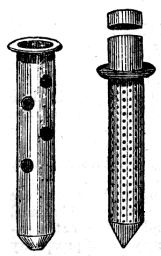
the glass, and this may very easily be done by warming the
perforated zinc tube, which is sold with the glasses, and then
pressing the piece of comb upon it. Should the comb reach
from the top to the bottom of the glass, so much the better; for
the Bees will then begin to work upon it immediately.
Those persons whose Bees are now in common straw hives
may, if they please, commence with the above system at once.
Bet them in the middle of a fine clear day, with a strong sharp
knife, cut out from the top of the hive a piece of the straw-work,
4 inches in diameter, and then place over the opening the adapting
board, &c., as directed above. Should the combs be a little
broken at the top of the hive it matters not. Indeed, it is rather
to be wished that they should be so; for the Bees in repairing
them are induced to carry their work upwards in the glass or
box that is given them. This operation may be done without
any protection whatever by an experienced person; for if done
at a proper time and well managed, not a Bee will take wing.
All operations, except joining swarms, should be performed on a
fine clear day, and between the hours of twelve and two o'clock.
At the same time, such operations are done with much less
annoyance to the Bees, as well as with less chance of danger to
the operator. I generally perform all the operations required in
this system without the defence even of a pair of gloves; but I
would not recommend any person to do so until he has had
many years' experience in the management of Bees; for being
perfectly defended in every part against their stings, gives that
coolness and confidence to the operator upon which the happy
accomplishment of his intentions so much depends. Coolness
and confidence on the part of the operator are essential qualifications;
for anything approaching to hurry irritates Bees exceedingly.
Indeed, the hand ought never to be hastily removed
from one position to another. "Quietness," says Dr. Bevan,
"is the surest protection against being stung."
Defence.—The best defence that I have found is a mask of
wire similar to a fencing mask, and a pair of very thick worsted
gloves. It should be remembered that nothing is either more
offensive or more irritating to Bees than the human breath:
therefore, the breathing upon them must at all times be most
carefully avoided.
Covering for Glasses.—When the Bees are beginning to
work in a glass, a cold night generally obliges them to forsake
their newly-made combs, and to discontinue their labours, which
are seldom resumed till the middle of the next day. To prevent
this delay, I would recommend the space between the glass
and its cover to be filled with fine tow or wool, the temperature
of the glass being thereby kept up, and the Bees enabled to
carry on their labours without interruption. Wool is to be
preferred from its not being so good a conductor of heat as tow.
Hives.—The time has now arrived for those persons who are
wishing their Bees to swarm to have a supply of hives in readiness;
and where straw hives are used, I would recommend new
ones in all cases, except where a swarm of the last year has died,
and the combs still remaining in the hive, the combs being dry
and free from mould. A hive of this kind is a great help to a
swarm; for one treated in this manner will generally be found
Better than one a fortnight or three weeks earlier that has been
put into an empty hive.
Depriving-Hives, or Supers.—It will now be time to have
small hives, boxes or glasses, in readiness to place upon stock
hives. Each box, or glass, should have a few pieces of guide-comb
neatly fixed in it; but refrain from putting them on until
there are evident signs of want of room. This may be ascertained
by the Bees thickening at the entrance, and by a loud
hum inside; for if put on too early it will retard the hatching of
the brood, as well as give the Bees an unwillingness to enter it
at all. The most desirable time for placing a glass or box
upon a stock hive, is the exact time when they will enter it
immediately; but the knowledge of this, I am aware, is attended
with some difficulty. I have always found, that by giving a
glass too early in the season, Bees appear to take a dislike to it,
and will swarm rather than enter it. When I have been able
to put a glass upon a crowded hive at about nine o'clock on the
morning of a warm day, it has scarcely ever failed to be filled
with Bees immediately. Be the super of wood, glass, or straw,
a small piece of guide-comb is a great inducement to the Bees
to begin working in it at once.
Ventilation.—It has been my practice for some years to give
all the ventilation possible to my stocks in boxes, by withdrawing
all the slides about October, and keeping them open to the end
of April: for then no condensed vapour can injure either the
combs or the Bees, and then shutting them for a week or two
before putting on the glasses, so that, upon again opening them,
the Bees immediately take possession of the supers, and begin
their work in them.
Driving Bees from one Hive to Another.—I am frequently
applied to by beginners for the best plan of removing a
stock of Bees, at this season, from an old hive to some fancy one
they have chanced to meet with, and I have, in all cases, said
that it is a plan I have never either adopted or recommended.
Let the Bees remain in the old hive, and if it be too unsightly
to be tolerated, have a tasty cover of wood or zinc made to fit it
and let them swarm, and put the swarm into the new hive. If
a weak one, join the second swarm to it; if not, hive the second
swarm in the usual manner, and then in September, either by
driving or fumigating the Bees in the old hive, join them to the
second swarm.
Swarms.—Those persons who are anxious to commence Bee-keeping
by purchasing swarms, must now provide themselves
with such kinds of hives as they are wishing to see their Bees
placed in, and send them to the persons of whom they have
agreed to purchase, that the Bees maybe hived into them at the
time of swarming. Should it be straw hives that are chosen,
let there be no sticks placed withinside them for the Bees to
fasten their combs to, for they cause them much trouble in
forming the combs, and render the extraction of the combs
almost impossible. Let there be no sugared ale nor honey put
inside the hive, but let it be as clean and dry as possible; and
when it is fixed where it is to remain let there be no mortar or
clay put round to fasten it to the floor-board—the Bees themselves
will do this more effectually. Clay or mortar tends very
much to decay the hives by retaining moisture, and is a harbour
for moths and other insects. On the depriving system, a hive
may be expected to stand for fifteen or even twenty years, if
properly managed.
Purchasers should endeavour to obtain the very earliest
swarms in May, if there be any, but on no account to have them
after the 14th or 15th of June; and it is very important to
observe, that whenever a swarm is purchased, it must be removed
to the place in which it is to remain upon the evening of
the day it swarmed; for should its removal be delayed even till
the evening of the next day, the combs will in all probability
be broken, and the stock destroyed. Let it be remembered, that
the prosperity of the hive will much (perhaps entirely) depend
upon its being finally placed upon the evening of the day it
swarmed. It must be a very peculiar kind of day to induce a
first swarm to emigrate. It must be a balmy still day, and
something besides that I cannot discover, for there may be
several days to all appearance alike, and upon one of these days
everybody's Bees shall swarm, whilst not another swarm, perhaps,
shall be heard of on any other day for some time. This
late swarming will be a sad disappointment to those who are
commencing Bee-keeping this summer, who indeed, are not a
few; and I congratulate each one of them, for they will find in
the management and observation of their Bees a constant and
increasing source of interest and amusement.
Premature Swarms, or the whole population of a hive leaving
it, and alighting at a distance from it; in the usual manner:—This
generally happens early in May. The best plan that can
be adopted in these cases is to unite the Bees to another stock,
if they should not join one of themselves; for if put into a hive
they generally leave it or die. The cause usually arises from
poverty, or the old age of the queen.
Should we have a dry May, swarms may be expected at the
end of the month: therefore it will be good policy to have every
arrangement for their reception made in good time; but June
must be the month for honey. "None in June, none afterwards,
depend on it." The honey harvest comes on all at once, and
very seldom lasts longer than a fortnight, so that additional room
should be in readiness if required.
Enemies.—Queen wasps are now showing themselves, and
should be sought after and destroyed, both by gardeners and
apiarians. A few mild days in February usually tempt them
out, when the cold which follows kills them, or renders them so
feeble as to be easily captured; but now they come at once from
their hiding-places to a temperature of 60°. The destruction of
the queens, therefore, is important both to the gardener as well
as to the apiarian; and, as soon as they are seen to alight, discharge
a syringe full of water upon them, which is sure to bring
them to the ground, when they may be crushed easily with the
foot. Watch carefully for moths. Should the Bees of any hive
appear inactive about this time, or should they not be seen to
carry in pellets of pollen, whilst others are doing it, and this
inaction continue for eight or ten days, lose no time in examining
the hive; and should the moths have begun their work of destruction,
which may be known by seeing their combs joined together
by their silken webs, cut away the combs affected with a sharp
knife, and the hive may perhaps be saved.
The house sparrow may also be ranked amongst the enemies
of Bees, for I have observed, for the last four or five years, the
female birds flying from the ground up to the mouth of the
hive, and catching the Bees just before, or as they take wing,
and away with them to their young ones when their nest is nigh
the apiary. I have seen as many as six or eight journeys made
in a quarter of an hour by the female bird only. The male
appears to take no part in it. I have never witnessed the like
at any other time but when the birds have young to provide for;
therefore it would be well to have all the nests in the immediate
neighbourhood of the apiary destroyed.
Feeding.—Weak stocks must still continue to have barley-sugar
supplied to them, for during the prevalence of north and
easterly winds but little food can be collected.
Pollen.—Those stocks that are alive will be carrying in
pollen most abundantly of a golden yellow colour, which is
obtained from Crowsfoot, Ranunculus ficaria, and Ranunculus
bulbosa, but more especially from the former, it being the earliest
as well as the most abundant; for next to the Dandelion, it
makes our meadows brilliant. It is Shakspeare's "Cuckoo-buds
of yellow hue," and greatly indeed are our little favourites
indebted to it for a supply of food for their early progeny. The
Crocus lasts but a short time, and is met with only in gardens,
while this covers almost every meadow in the kingdom during
the months of March and April: therefore, how little advantage
arises from cultivating Bee-flowers, as they are frequently called,
for it is the fields, and the fields alone, that supply their store of
honey. Sow twenty acres of White Clover within a mile of
them and leave it for seed, and in the autumn twenty or thirty
acres of Buckwheat, and much benefit will arise; but the little
that a garden affords them is almost valueless.
It will now be time to place glasses or small hives upon such
stocks as are not intended to swarm, and it will be well not to do
it until the bees begin to show evident signs of want of room;
for then they will ascend immediately into the glasses, and
commence working; but on the contrary, when they are put on
too early—that is, before the stock hives are full with Bees, they
will not go into them, but frequently swarm in preference; and
besides, opening the hive to put on the glass before it is full with.
Bees causes a circulation of cold air through its centre, which
tends greatly to retard the hatching of the brood.
Guide-combs.—A glass should never be put on without having
a piece or two of guide-comb placed at the top, which may easily
be effected by first warming the zinc tube, and then attaching
the comb to it whilst in that state.
Glasses.—For the method of placing glasses, small hives, &c.,
on the Improved Cottage Hive see page 54, and for the treatment
of swarms generally, taking honey, expelling the Bees
from glasses, &c., see page 56.
Bar Hives.—Persons who have possessed themselves of these
excellent hives are by this time anxiously looking for swarms
to put into them, or quite as anxiously watching the progress
of those already at work in them. The guide-combs being
properly fixed will insure their working regularly upon the
bars of the stock box, but not quite so surely upon those of
the upper one; for, notwithstanding every precaution being
taken to prevent it, they will sometimes commence working
their combs from the top of the stock box, which forms the
floor of the upper one. This must be attentively watched for
the first three or four days after opening the communication
between the boxes, and any comb observed in this position must
be immediately removed.
Artificial Swarms.—The present is a good time for obtaining
artificial swarms, and where any form of the "Bar Hives" is used,
the process is very simple, and may be thus effected:—From
ten to twelve o'clock, on a bright morning, remove the board
from the top of the parent hive; select a bar, the comb on which
contains both eggs and brood, and if a royal cell, all the better,
but this is not important; place the bar with comb in some convenient
place, so that it is neither bruised nor separated from the
bar; then turn up the parent hive, after having fastened down
the top, and place the one intended for the new swarm upon it,
observing that the junction is perfect; then, by a continuous
gentle tapping upon the parent hive for a few minutes, a portion
of the Bees will have ascended into the hive. Remove the
parent hive 60 or 100 yards, placing it upon a fresh floor-board,
and place the new hive exactly in the place of the old one, and
upon the same floor-board; and, as quickly as possible, introduce
the bar of comb filled with eggs and brood into its centre,
replace the top, and endeavour to have the exterior of the hive
as little altered in appearance as may be; it will then be found
that the few Bees driven into the new hive, with the number
returning to it that were out at work, with some that may come
from the parent hive, will altogether make a fair-sized swarm.
The parent hive will, in all probability, give another swarm in
about fourteen days.
Swarming.—The time for swarms is now very nigh at hand,
if we are to have any; but in weak stocks it is not very desirable.
However, if they come, the best must be made of them.
By all means let the new swarm be placed where it is to remain
as soon as it is settled in its new hive, which rarely exceeds ten
minutes. This will save the Bees much loss of time, as well as
numbers of them their lives. When there is dull and cold
weather in March and April, and even May, many stocks become
weak and feeble, and numbers entirely perish; therefore, swarming,
generally, must be later than usual; and those persons who
are wishing to prevent it altogether must not be satisfied by
simply placing boxes or glasses upon their stocks, but they must
also see that the Bees take possession of them, and the best
method to secure this is not to put the supers on until the Bees
begin to be a little inconvenienced for want of room; and then,
by placing a bit or two of guide-comb, as before directed, into
the super, the Bees will enter it at once and commence working.
Queenless Stocks.—It is not at all unusual at this season to
see the Bees of some hives, although possessing a good store of
honey, quite inactive, carrying in no pollen, and basking in the
sun at the mouth of the hive, but still giving smart resistance
to a robber if he ventures to make an entry. This arises from
the old age or death of the queen; and, if the Bees are numerous,,
will go on in the same manner nearly through the summer.
But, if the numbers be few, robbers will attack them, and little
or no resistance will be offered; but frequently the Bees themselves
will assist in carrying off the store to the pirates' home,
where the queenless Bees will meet with a ready welcome. The
best method to adopt in such a case is to introduce a piece of
comb from a strong hive, which contains both brood and eggs,
and ultimately do very well. In Taylor's Bar Hive this process
is very easily effected, by merely taking a bar of comb from one
hive and introducing it into another, or a piece of comb, with
eggs and brood, may be fixed in a bell-glass, and placed upon
the queenless hive.
Queen Wasps.—To destroy these "Bead's Syringe" is a very
useful instrument, for by discharging it at them when they
alight, it is sure to bring them to the ground, when the foot may
easily be put upon them. It is important to every apiarian and
gardener, but more especially the former, to destroy all they can
at this season.
Early Breeding.—Many plans have been adopted to effect
this very desirable object, and none entirely without success,
but variously, according to the means used. The hives that
have been simply bound with haybands are certainly earlier
than those that have not; but those that have been covered
with loose sacking, and then bound tightly round with oil-cloth,
so that when the coverings were taken off for a few minutes the
outside of the hive felt quite warm, are earlier still; whilst those
placed in a greenhouse are earlier than either; but the earliest
are those covered with fermenting stable-litter; yes, literally
placed in the centre of a hotbed, leaving only a passage for the
ingress and egress of the Bees.
Proper Time for Taking Honey.—It is probable that in
favourable situations, towards the close of the present month,
some glasses, small hives, or boxes of honey may be in a sufficiently
forward state to allow of their being taken off, which
may be known by their being filled with honey, and the combs
all sealed up; or they may remain till those placed beneath them
are also sealed up. Upon very strong and populous hives, in a
good season, it is necessary to place even a third; but this
must be removed with great caution, and certainly not before the
end of August, or the beginning of September, and not then
unless the parent hive contains full 20 lbs. of honey.
Swarming is frequently much later than usual if May be wet
and cold, and the stocks be very weak. It is very probable that
second and third swarms will be coming in July, and should it
prove so, we would recommend their being united to late swarms,
or three or four of them being put together.
Returning Swarms.—The necessity for returning swarms in
some seasons, I think, will be apparent to every one at all acquainted
with Bee management, and, indeed, in some cases of
returning swarms; but this cannot be done with any chance of
success but in a bar hive, and there the operator is sure to
succeed. The manner of performing the operation will be as
follows:—As soon as the swarm has left the parent hive, proceed
immediately to open the hive and take out the bars, one by one,
and cutting from each comb every royal cell that is seen upon it,
and replacing the comb again in the hive. The cell in which
the queen Bee is born is entirely of a different construction from
that of either the drone or the common Bees. The cell of the
latter is placed horizontally in the hive, and that of the queen is
placed perpendicularly; that of the common Bee is an exact
hexagon, and that of the queen circular; besides, the cell of the
queen is always fixed at the sides of the combs, and generally
upon that near the middle of the hive. This operation of removing
the royal cells will take about five minutes; and, when
done, return the swarm immediately to the hive. The old queen
which led it off, finding by this process that there is no royal
brood left in the hive to succeed her, will not again attempt to
leave it. Persons who have never practised this method will be
surprised to find how easily it is accomplished; for the parent
hive will at this time be found to be almost depopulated from
the numbers that have left it in the swarm, and those that are out
collecting. In some cases the help of a puff or two of tobacco-smoke
may be useful, should the few Bees left be angry, or the
operator feel at all timid. The readiest way of returning the
swarm will be to lay a board upon the floor-board of the hive,
and parallel with it, upon which, by a smart and sudden movement,
shake the swarm, and as nigh to the entrance of the parent
hive as can be done conveniently, and with the finger, or a piece
of wood, guide a few Bees to the entrance, and the remainder
will follow immediately.
Glasses and Small Hives.—The proper time for opening
the communication between the boxes, as well as for putting
glasses or small hives upon swarms that are in the Improved
Cottage Hive, must in some measure depend upon the season.
In a good season it may be done from the eighteenth to the
twenty-first day after the time of their being hived. In some
seasons I have had a glass holding 10 lbs. of honeycomb filled in
less than a fortnight from the time of putting it on. When this
happens, a box or small hive should be placed between it and
the hive as directed at page 22; or, in all probability, a second
swarm will be thrown off. To prevent this, every possible
means must be taken; for the swarm coming so late in the
season, as this must consequently be, is generally of no value,
except to unite to others, and the stock itself is so weakened by
it that it seldom lives through the following winter.
Melted Combs.—Shading should always be had recourse to
in such weather as that of the middle of July, and more especially
so for swarms of the year. In those cases where it has;
unfortunately taken place, it will be better to shade immediately
and nothing more, leaving the rest that is to be done entirely to
the Bees.
Shading.—Should the weather prove very hot and sultry, it
will be necessary to shade newly-hived swarms for a few hours
in a day, say from ten till two o'clock; a green bough answers
very well for this purpose—that from the fir trees, perhaps, is
the best, as well as the most durable. I have more than once
seen the combs of a newly-hived swarm so heated by a July
sun as to fall from the top of the hive, and the honey to run
in a stream from its entrance, consequently the stocks were
ruined.
Wasps.—I am quite sure that it is needful for us all to use
every means in our power for the destruction of these sad
enemies to our Bees. As "prevention is always better than
cure," that object is attained by capturing the queen wasps at
this time; and, indeed, as long as they can be seen. Some
persons recommend shooting them. I have always found a
garden-syringe to be a very useful thing; for if filled with water
and discharged at them, it seldom fails to bring them to the
ground, but it matters not by what means so that they are
destroyed.
I have already sufficiently insisted upon the necessity of
uniting second and third swarms, so that, amongst my readers,
not even one second or third swarm can be found by itself. It
should be impressed upon the mind of every apiarian, "that
the larger the colony at the outset, the better the Bees will
work, and the more prosperous it will become." A stock weak
at the outset never does well. The method of returning, as given
at page 53, is very simple, and may be accomplished in a few
minutes, even by the most inexperienced person.
Returning Swarms.—Returning first or second swarms to
their parent hive, is not only attended with much trouble, and,
generally, with a failure of the object desired, but also with
much loss of time to the Bees, and that at a season of the year
when every hour is of importance to them. A swarm left a
Nutt's hive on the 3rd of June; the queen was captured, and
the swarm returned. Within a few days of the time before
mentioned it came out again, and was treated in a similar
manner; and so it continued to go on until nearly the end of
the month, when the swarm, instead of being returned to the
parent hive, as had been done so many times before, was hived
into an improved cottage hive, where it did very well; but
during the whole time that swarming was going on, which
occupied three weeks, and these the best three weeks of the year,
working was entirely suspended (which is always the case), and
not a pound of honey was stored; whereas, had the swarm been
put in the cottage hive in the first instance, from 15 to 20 lbs. of
honey would, in all probability, have been collected by it in that
time. An apiarian, in Norfolk, some years since, had a stock of
Bees in a favourite hive, which, very much against his wishes,
and notwithstanding every means having been taken to prevent
it, sent out a swarm. He captured the queen, and returned the
swarm; after a few days the swarm came forth again, and was
treated in the same manner, and it went on to swarm for either
seven or nine times, and was returned as many times, except the
last, when it was put into a new hive. Thirteen queens were
captured and destroyed during this process, very nearly a month
was spent in swarming and being returned, and, consequently,
no work was done during that time; the result of which was
that the best part of the season having been lost neither swarm
nor stock was of any value. I would, therefore, say, Let all be
done that can be done to prevent swarming, by giving room and
ventilation, which has very rarely failed; but if, after every
means has been used to prevent swarming, a swarm should come
off, never attempt returning it, but hive it by itself in the usual
manner.
Early Swarms.—Now, as early swarms appear to be so very
desirable, it may be asked, What are the most likely means of
insuring them? And, in reply to this question, I would say,
Leave the stocks rich in store in the autumn, the contents of
each hive weighing, at least, from 20 to 25 lbs., and let the population
also of each hive be very numerous; if it be not so, add
the Bees from weak hives into it.
Autumnal Unions.—Where second and third swarms have
been hived by themselves, they will generally be found too poor
to live through the winter, even with feeding; and, where this
has been done, they may be put two or three together in the
manner directed at page 60.
Taking Honey.—Those persons who have been so fortunate
as to get their glasses filled with honey will now be preparing
to take them off; but I would recommend every one to do it
with great caution; and not only first to weigh the matter well
in their own minds, but also to weigh their hives, and if it can
be satisfactorily proved that they will contain 20 lbs. of honey
each when the glasses are removed, all well; but if not, let the
glass or box remain upon the stock hive until the bees have
emptied it of its honey; as soon as this is ascertained, let it be
removed.
Some persons having found much difficulty in expelling the
Bees from a glass or box, after having removed it from the stock
hive, and others who have complained of the time occupied in
effecting this object, may adopt the following very ingenious and
useful apparatus, invented by Mr. Antram, a clergyman of
Devonshire, and which has been kindly handed to me, with his
permission to make it public. It is a contrivance for emptying
a hive of its occupants; it may also be applied to a bell-glass, or
box, either at top or attached to a board on which the removed
glass is placed. He calls it his
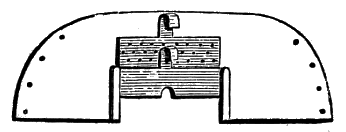
Bee-trap; and it is, he says, "An invention for taking the
honey from every description of double hive, which is not only
simple, but very efficacious, and entertaining to watch. I
should premise that every extra box or hive must be furnished
with a second aperture never to be opened except when the
honey is to be taken. Provide a block of wood 1 inch longer and
half an inch deeper than the aperture, and 3 or 4 inches wide;
cut the front to an angle of 45° or less; then cut out of the
under part a groove the exact size of the aperture, thus leaving
a thickness of half an inch of wood at the sides and top. Get a
piece of talc, or very thin horn (glass is too heavy), cement
or gum it to a piece of ribbon, which latter fasten to what
remains of the sloping front above; divide the talc into portions
about a quarter of an inch wide. A tin bottom should be affixed
to the whole, to which the talc must reach, and on which it
must rest.
"When you wish to empty a hive place this before the
opening before mentioned, and cut off the communication between
the hives; the Bees, seeing the light, will one by one
push up the small pieces of talc and escape; the talc falls back
in its place; thus there is no re-entering, and your hive becomes
rapidly emptied. There is here no previous removing of the
hive or box, no danger of a sting, and no fear of robbers;
even if the queen be there, she, finding herself deserted by her
subjects, will soon depart, and re-enter the stock hive by the
accustomed entrance. It acts upon the same principle as the
old wire rat-trap. Two loops of tin, with holes through, are
added, to fasten or suspend it, when there is no alighting-board.
It may be placed on the top of a box, but must then
have a hole in the bottom, and a slip of tin by way of a back;
the tin bottom may project a little beyond the lower edge of the
talc in front, and, indeed, it is better so."
This useful contrivance I feel assured will be adopted by
many persons; for it will entirely prevent the tediousness of
watching a glass of honey until the Bees have left it, which
without this protection is at all times necessary, and more especially
so when taken late in the season, and robbers are on every
side. I have more than once seen a good glass of honey emptied
of every drop by them when carelessly left by its owner for a
few hours; now, with this trap attached, it may be left even for
days with perfect safety.
Taking off Glasses of Honey.—Some persons, I doubt
not, are beginning to be anxious to possess themselves of a few
glasses of honey from their Bees. If the combs are sealed up
they may be taken; but I would recommend every one who
attempts it during hot weather to be more than commonly careful
how they remove them, or the combs will fall out.

Fig. 26.
Knife for Cutting out Combs.—This knife, which is so
simple in its construction, and so easily used, deserves to be
made generally known. Gelieu, to whom apiarians are much
indebted, tells us that in Switzerland it is commonly used, and
that the combs, from hives of any shape or materials, are extracted
without any difficulty. It is formed of a strip of steel
2 feet long by one-eighth of an inch thick; the handle is
20 inches long by half an inch broad. The turn-down blade, of
2 inches in length, is spear-pointed, sharp on the edges, and bent
so as to form an angle of 90° with the handle; the other blade is
2 inches long by 11/2 inch broad, and sharpened all round. The
broad blade cuts and separates the combs from the sides of the
hives; and the spear point, which is also sharp on each side,
admits, from its direction and narrowness, of being introduced
between the combs to loosen them from the top of the hive.
Entrances to Hives to re Narrowed.—Towards the end
of this month it will be necessary to contract the entrances of
the hives, that the Bees may be better enabled to defend themselves
from the attacks of wasps. In Taylor's Hive, these
things are supplied; but, in the Cottage Hive, I have found
wedges of cork of different sizes to answer remarkably well.
Wasps' Nests to be Destroyed.—It will be well to have
diligent search made in the neighbourhood of the apiary for
wasps' nests, and to have them destroyed, for which purpose
the spirit of turpentine appears to answer remarkably well. The
usual method of procedure, I believe, is to put a small quantity
into a common wine bottle, to put the mouth of the bottle into
the hole leading to the nest, and surrounding it with earth.
Very little turpentine is required—merely as much as will wet
the sides of the bottle. If applied in the evening every wasp
will be dead the following morning. In no instance have I
known it to fail of the desired effect, except in cases where the
nest is deep in the ground, or at a greater distance from the
mouth of the hole than was anticipated. A failure may sometimes
occur when there happen to be two entrances to the nest
instead of one; but a second application on the following evening
is sure to prove effectual.
Additional Room.—It will be quite useless to give additional
room to any colony of Bees, be they ever so prosperous, after the
month of July is ended; for the honey season is fast drawing to
a close, and the population of the hives very much upon the
decrease, not only from the killing of the drones, but by the death
of numbers of the workers.
Transporting Hives.—In a fine season, and in the prospect
of a fine autumn, every person whose locality admits of it should
embrace the opportunity of sending his hives to the moors. The
advantages must be incalculable, not only in quantity, but in the
delicious quality of the honey there obtained.
Shading.—Should the present month prove hot it will be well
to screen the swarms of the present year from the intense heat
of the sun, or the combs, being new and tender, may be melted
by it; where this unfortunately happens the stock is usually
destroyed.
Robbers.—Late swarms and stocks that are weak must be
closely watched, and if the least appearance of robbing discovers
itself, the entrance to the hive must be closed so as to admit but
one Bee at a time.
Dressing Hives.—It would be well if this practice was discontinued
altogether; for when done in the most judicious
manner the Bees are greatly annoyed by it. A clean dry hive
is more pleasing to them than one besmeared with ale, honey,
fennel, and all the other good things used by good dames of old.
I heard of one having been washed, or smeared, with cream and
sugar, and in so profuse a manner that the Bees, which had to
travel an hour by rail, were found at the end of their journey to
be completely saturated with it, a large portion of them dead,
and the remainder in such a state as to render it necessary to
kill them the next day, to the vexation and disappointment
of the gentleman to whom they were sent, who had been impatiently
waiting their arrival for some weeks. Cream I should
imagine to be the most disagreeable thing that could be thought
of for this purpose, except it should be oil, which is well known
to kill a Bee, or almost any insect, the instant it touches it, and
this cream I believe was some of the far-famed Devonshire,
which in its rich and buttery nature approaches very closely
indeed to oil.
Removing Supers.—It is now quite time to remove glasses
and supers of every kind from hives intended for stocks, and to
see that each one contains at least 20 lbs. of honey; if not, they
had better at once be made up to that weight by feeding. At
this time of year I would recommend syrup in preference to
barley-sugar, because it can be given in larger quantities, and
stored more quickly. Honey is, unquestionably, the best food
that can be given; and, next to it, a compound of honey, loaf
sugar, and water. Barley-sugar is more suited to spring feeding,
when but little is required. The proportions are, one pound of
sugar, one-quarter of a pint of water, and one-quarter of a pound of
honey, mixed and simmered over a slow fire till the sugar is melted.
Early Breeding.—In our fitful climate this is a most important
thing to effect, and every possible means for promoting it
should be used; therefore in addition to what I have already
said in the calendar for last month—viz., leaving the stocks rich
in store, as well as in Bees, I would now say, Keep the stocks as
cool as possible till the end of February; and if, as has already
been said, that cold retards the hatching of the brood, warmth
may be supposed to promote it. I would therefore recommend,
where it is at all practicable, at the end of February to increase
the temperature of the hives, by defending them externally
from the cold of March and April, by any means that may the
most readily be had recourse to for the purpose. Perhaps binding
the hives neatly over with haybands would be as little trouble
and inexpensive as anything.
Shading.—It is very desirable to shade the hives from the
winter's sun, for the Bees are not unfrequently tempted thereby
to leave their hives, never to return.
Stocks for Next Season.—The time will soon arrive for
setting apart stocks to stand through the winter. Each one
intended for this purpose should be made to weigh from 20 to
25 lbs., and the Bees of all weak or very old stocks, the hives of
which are decaying so as not to stand with safety through another
season, should be driven to those that are the least populous in
the apiary; for it must be remembered, that net only a good
store of provision, but that a large quantity of Bees, also, is
necessary to secure success for another year.
Driving.—For performing this operation, as well as for almost
all others, I very much prefer the middle of a bright day to any
other time. The process is very simple, and may be effected in
a few minutes. I very much wish that I could persuade all my
cottage friends to adopt it, instead of the cruel and wasteful
method of "burning;" for in weak stocks the Bees themselves
are frequently of as much value as their little store of honey and
wax; and, by joining them to other stocks, very considerable
advantages arise. My method of driving is this:—On a bright
day, between eleven and one o'clock, turn the hive from which
the Bees are to be driven bottom upwards, in a shaded corner of
the garden, and place upon it a hive of the same size; see that
they fit closely, and to make the junction more complete, tie a
cloth round the hives where they meet. Then, with two sticks,
keep up a gentle but continuous tapping upon the sides of the
inverted hive for about ten minutes, the Bees will by that time
have left it and gone into the upper one. Having ascertained
that fact, take it immediately to the place where the driven hive
was taken from, and place it upon the same floor-board; carry the
driven hive 50 or 60 yards away, and place it upon a fresh floor-board;
the few Bees that remain in it, as well as those that are
out at work, will return to the driven Bees. All is now finished
until an hour after sunset, except emptying the driven hive of its
store, when two sticks may be laid upon the ground about
8 inches apart, opposite the stock to which the driven Bees are
to be joined; then, with a smart stroke dash out the Bees
between the sticks, and instantly, but very gently, place the
stock they are intended to enter upon the sticks; leave them for
the night, having first defended them from rain, should any
fall; and in the morning, an hour before sunrise, replace the
stock in its original position, and all will be peace and harmony.
Here, then, will be an increased population—a stock thereby
enabled to stand through the winter much better, and to send
out a much earlier swarm, if swarms are desired, than if the
union had not being effected.
Wasps.—It will be well to destroy wasps' nests in those
localities where they are to be found.
Stands.—The end of the month will be a good time to examine
the pedestals upon which the stocks are placed; for it is
not unusual to hear of a stock being destroyed by the pedestal
decaying just below the surface of the earth, so that by a strong
wind, or anything accidentally going against it, it is broken, and
the combs by the fall so misplaced as to reader the stock of little
or no value.
Preserving Hives of Comb.—Where the Bees have deserted
their hives, and it is swarms of the present year that have generally
done so, the combs should be carefully preserved, by placing
the hives in some dry spot out of the reach of mice or insects,
for the purpose of hiving swarms into them in the spring. Tho
advantages afforded to a swarm by putting it into a hive of
fresh, clean comb, are scarcely to be credited by those who have
not experienced it.
The time has now arrived for deciding upon which stocks are
to be set apart for standing through the winter, and which are
to be driven and joined to other stocks in the manner given in
the calendar for last month. Those set apart either for swarming
or working in glasses next year, should be rich both in Bees,
and honey, weighing, at least, from 20 to 25 lbs. each. Those
that are not so heavy must have a few pounds of food given to
them immediately, as well as having the Bees from weak stocks
joined to them.
In giving the estimated weight which should be allowed for
the comb and Bees in hives of the first year, and when two,
three, four, or five years old, I would say, for a hive of seven
years standing, during the autumn and winter months, allow for
combs, Bees, and stored pollen, 7 lbs.; for one of six years,
61/2 lbs.; for five years, 51/2 lbs.; for four years, 41/2 lbs.; for three
years, 31/2 lbs.; for two years, 3 lbs.; and for one year, 2 lbs.
Presuming the directions given in the calendar for September,
as to unions and feeding, have been attended to, but little attention
will be required this month beyond guarding against depredations
of wasps, which are frequently numerous at this season.
Winter Preparations.—Glasses, small hives, and boxes,
should now all be removed from stock hives, where it can be done
without reducing the store below 20 lbs. The stands, likewise,
where wood is used, should be examined, and if found to be at
all unsound replaced with new ones.
The Moors.—Where Bees are kept in the vicinity of the
moors, or where they have been removed to them, an abundant
supply of honey will be obtained from the heather during fine
weather, an advantage quite unknown to the Bee-keepers of the
eastern counties.
Wasps.—For destroying wasps' nests, gas tar is even better
than turpentine, and their destruction is effected with much less
trouble, it being only necessary to put a small quantity into the
mouth of the nest, and cover it with earth; digging out the
nest, or anything further done, is quite unnecessary.
Robbers will at this time be carrying on their depredations;
and should a serious attack be observed, the entrance must be
narrowed one-half at the least. Wedges of cork answer very
well for this purpose.
Stocks.—It is now full time for the stocks to be put in order
for the approaching winter. Defending them effectually from
wet is of the first importance. Narrowing the entrances to prevent
the ingress of mice is also necessary, as well as their destruction
in the neighbourhood of the apiary. Having done this, and
taken effectual means for keeping the hive free from damp, very
little fear need be entertained of their being carried safely through
the winter without any further attention beyond that of occasionally
cleaning the floor-boards, and shutting up the hive
whilst snow lies upon the ground.
Coverings.—The coverings, also, to the hives should be made
secure against winds and rains. A milk-pan, notwithstanding
Its unsightly appearance, is the best protection for a hive, and
for the winter months more especially so.
Stands.—Let the pedestals which support the hive be well
looked to at this time. Although to the eye they may appear
sound, let them be examined 2 or 3 inches below the surface of
the ground, and should they be found in an unsound state replace
them by new ones: and if they are little charred before fixing,
it may be the means of preserving them a little longer.
Bees with a North Aspect.—Much has been said of late
as to the advantages arising from placing Bees with the hive's
entrance to the north, which the following letter from a gentleman
in Devonshire tends very much to strengthen. He says:—
"In compliance with your wish, I visited B—— yesterday,
and, although not fortunate enough to find Mr. D. at home, I
had a long conversation with his gardener, who alone appears to
take any interest in the apiarian matters. One wooden hive,
brought by Mr. D. from Oxford, is placed behind a wall, through
which the Bees issue towards the south; another wooden hive is
completely embedded in shrubs, but the entrance faces the north.
There is a stock in a portion of a hollow tree, which was found
when the tree was cut down, and removed to its present position,
also facing the north, and a row of fifteen common straw hives
have the same aspect: thus you will perceive that seventeen
out of a total of eighteen stock are kept permanently facing the
north. The gardener states that he has preferred a north aspect
during the last ten years, and that he gets earlier swarms and
more honey than his neighbours. For two or three years previously
he kept half his Bees to the south, and half facing the
north, and by weighing them in the autumn and spring (September
and April), invariably found that those facing the south
consumed ten times the quantity of food as compared with the
others—for instance, if one consumed 10 lbs., the other consumed
but 1 lb.; and if one lost 15 lbs. during the winter, the
other would only diminish 11/2 lb.
"I should state that B—— appears to me a first-rate locality,
being close to an extensive heath, now in full flower. The
gardener told me that not only had he no difficulty in maintaining
second swarms, or casts, during the winter, but that he considered
them quite equal to the first or prime swarms. The row
of straw hives is sheltered by trees and shrubs towards the south,
but lies exposed to the north wind, which the gardener considers
most important, as he attributes the diminished consumption in
the winter to the cold winds keeping the Bees torpid. The
above is all the information I was able to glean during a long
conversation, as no kind of memorandum of any of the experiments
has been kept, and in the hope that it may prove interesting,
I am, &c."
Now, it must be remembered that this has been done in
Devonshire, and it is not unlikely that climate may have to be
considered as to aspect, and what may do in Devonshire might
not answer so well in colder parts. It has frequently been recommended
to give Bees an aspect more or less southerly in
summer, and a northerly one in winter; but there seems now
to be the strongest reason to expect that for all seasons the north
will be found most suitable.
The requirements of the apiary are but few during the present
month, provided that feeding has been well attended to in the
last. Should it, however, have been neglected, no time must be
lost in setting about it before cold weather sets in, which may
now reasonably be expected.
Feeding.—By this time hornets and wasps will have finished
their work of destruction and pillage; each hive, therefore,
must now be carefully examined and weighed, and should any be
found having less than 18 or 20 lbs. of honey, supply them immediately
with a sufficient quantity to bring them up to that weight.
Floor-board.—Clean the floor-board of each hive by scraping
It with a knife, and brushing it afterwards with a dry brush,
and see that each hive stands firmly on its pedestal, and is well
defended against wet; and for effecting this (especially during
winter), I have never yet found anything equal to the milk-pan,
heavy and unsightly as it unquestionably is. I have seen covers
of zinc used, but they are too light and frequently blown off
by the wind; and one night's heavy rain at this time of year
will very nearly, if not quite, destroy one of the best stocks. A
gentleman of my acquaintance has had covers of cork made at
a cost of 30s. each, and very elegant things they are; but, after
about fourteen months' trial, they are abandoned because they
will not effectually keep out wet.
Entrances.—The entrance to the hives must now be narrowed
so that only two or three Bees can come out at the same time
for at this season mice are very likely to lodge themselves in
the hives, and they are very hurtful and destructive to the
Bees; for, having once fairly lodged themselves in a hive, its
entire destruction will be effected by them in a few days. Mr.
Huish relates an anecdote of having found a dead mouse in one
of his hives. He says, "In the month of December, on inspecting
my apiary, I perceived a hive to be in an unusual bustle
and the Bees in great agitation. I was convinced that some
accident had occurred in the interior of the hive, and I resolved
to examine it. To my great surprise I found a dead mouse on
the stand, and it was almost covered with propolis (Bee-bread).
I first resolved to remove this nauseous object; but, on more
mature reflection, I was not willing to forego the opportunity of
Experiencing, by actual observation, one of the most profound
acts of foresight and wisdom which can possibly be found in the
works of the animal creation. What power is that which taught
the Bee the necessity of covering the dead mouse with a plaster?
It might have been thought sufficient to kill it, that their property
might be saved, and then leave it to waste away in the
common process of putrefaction. But were this process to be
allowed to take place, the health and safety of the whole hive
would be endangered. To prevent, therefore, this occurrence,
the body of the mouse is, as it were, embalmed in a case of
propolis, and the object rots away without emitting any offensive
odour." I have myself occasionally found a snail fastened to
the floor-board in a similar manner. But a greater enemy to
Bees during the winter months than even the mouse will be
found in that little marauder the blue titmouse (Parus major of
Linnæus), which may be said to stand foremost as their enemy.
Mr. Purchase says, "She will eat ten or twelve Bees at a time,
and by-and-by, be ready for more. When she comes to the
hive and finds none, she knocks with her bill at the door, and
as soon as the Bees come out to inquire the cause, she catcheth,
first one and then another until her belly be full." This I have
observed in an apiary of about twenty hives, in a village nigh to
me, for the last two winters; the entrances of the hives by the
end of the winter having the appearance of being gnawn by
rats, which has all been done by these birds. Shoot and trap
them in the winter, and destroy their nests in breeding time.
Removing Supers.—All super as well as nadir hives should
now be removed, reducing the room occupied by each stock as
much as possible.
Ventilation.—In hives of wood I have always found it
necessary during the winter months to withdraw one of the
slides at the top of the hive, and place over the opening a feeder
or small glass for the purpose of carrying off the condensed
vapour, which would otherwise run down the sides of the hive,
and cause dampness and mouldiness to the combs, and sometimes
the entire destruction of the stock. Mr. Taylor gives a
drawing of a condenser for this purpose in his "Bee-Keeper's
Manual," page 142, fourth edition, which I have found to be
very useful where a feeding-pan could not be placed.
Removing Bees.—Should any of our readers, from what has
already been said, feel disposed to try a northern aspect for
their Bees, I would recommend their not being removed at this
time, except they are brought from a distance, and when it is
immaterial at what time they are removed; but if it be only
from one part of the same garden to another, it will, be it when
it may, be attended with considerable loss; therefore it had
better be done when the cells are filled with brood—perhaps
towards the end of March.
Advantages of a Northern Aspect.—I still continue to
receive very favourable reports from those persons who have
tried a northern aspect for their hives. The results in every
case already represented to me have been satisfactory; but I
am persuaded that the greatest care must be taken to keep the
whole exterior of the hives from wet, where they are not placed
in a Bee-house; and however averse I may hitherto have expressed
myself to the use of Bee-houses, I am now inclined to
think that where a northern aspect is decided upon they may be
necessary. In Devonshire it may not be required; but wherever
hives are placed in this aspect without the protection of a
house, I would particularly recommend that, be the coverings
whatever they may, they be sufficiently large to prevent the
drip from hilling upon the floor-boards of the hives; for this
would engender dampness, and the loss of the stock would, in all
probability, be the consequence.
Bee-Houses.—It must be remembered that, wherever they
are adopted, they require the greatest care as to neatness and
cleanliness, for at best they are hiding places for the Bees'
worst enemies.
Those persons who have been so fortunate in this untoward
season as to obtain a few glasses of honey from their Bees'
must now look well to their stocks, and by judicious feeding,
get them up to 20 lbs. at least, if it has not been already
done. I would very strongly recommend the food being supplied
at the top of the hive; and should the Bees be in a hive
that has not a hole in the top, with a sharp knife make one
forthwith, for the danger as well as the inconvenience of feeding
at the bottom, and more especially at this season, is very great.
Food.—I believe the best food that can be given, next to
honey, which in some years is far too expensive for feeding, is
one pound of loaf sugar, one quarter of a pint of water, and
one quarter of a pound of honey, simmered for a few minutes
over a slow fire till the sugar is melted, and when quite cold,,
given to the Bees, and at the top of the hive if possible.
Stocks will require but little attention during this month
beyond cleaning the floor-boards, and seeing that there is
neither damp nor mould in the hives; and if the floor-boards
are observed to be quite dry, it will be a pretty sure indication
that all is right within. Stopping-up, however, must not be
forgotten when snow lies upon the ground, if the Bees are so
placed that the sun shines upon their hives. Shading during
the winter months is practised by many persons, and is a very
good plan; but when we come to have all our Bees placed in
the north, it will be rendered unnecessary. An intelligent cottager
brought me a very ingeniously-contrived little apparatus
for preventing the sun's rays in winter inducing the Bees to
come out, and at the same time preventing the cold winds from
blowing into the hives. It is a piece of three-quarter-inch deal,
3 inches wide, and 21/2 long, reduced at one end (not in thickness)
so as to fit in the mouth of the hive, and then with a
gouge the under side is hollowed-out for about 2 inches in
length, and five-eighths of an inch in breadth, in a straight line
with the entrance of the hive; another hollow of the same
dimensions is then made, intersecting at right angles the one
already made, so that if the hive
faces the south, the Bees come out
east and west. The under side has
this appearance. Care, however,
must be taken that this little contrivance
is not pushed into the hive
beyond the thickness of the straw;
and it must also be remembered
that it will require to be taken out
occasionally, to brush away the
dead Bees that may accumulate inside, or the passage may
become blocked up, and the health of the stock endangered.
The population of the hives will now be found to be very
much reduced; but alarm for their safety on that account
need not to be entertained. It has been frequently said to me,
"What becomes of the Bees managed on the depriving systems
if they are never suffered to swarm nor are destroyed?" To
which my reply has been, That it is well known to those who
are conversant with the care of Bees, that their numbers
decrease greatly in autumn, not only by the destruction of the
drones, but also by the unavoidable deaths of many of the
workers, owing to the thousand accidents they meet with in the
fields, and owing to age. A much less space, therefore, is
required for them in the winter than was necessary in the
summer months. Mr. Purchase, who was a very careful observer,
says, in his Treatise on Bees, published in 1657, "It is
manifest that the Honey-Bees are but yearly creatures; they
live but a year and a quarter at most; for those Bees that are
seen in May, lusty, full, brown, smooth, and well-winged, will,
by the end of July following, begin to wither, becomes less, look
grey, and have their wings tattered and torn, and be all dead
before the end of August."
Ventilation.—It will be advisable, where Bees are in boxes,
to see that they are well ventilated. If in Mr. Taylor's Amateur's
Bar Hive, I would recommend the feeding-pan being allowed to
remain on during the winter—say till the end of March—and
one of the zinc sides of the hive taken out; and if in any other
kind of box, let a bell-glass be placed over the opening at the
top, on the inside of which the vapour of the hive will condense,
and so pass off. "Perhaps," says Mr. Taylor, "there is nothing
more prejudicial than the moisture often engendered in hives at
this time, particularly after frost, and in certain states of the
atmosphere. It accumulates on the top and sides, moulding and
rendering offensive the combs, and producing disease amongst
the Bees. For this reason, hives with flat roofs have sometimes
been objected to, and perhaps, justly, when no provision is
made for ventilation." Gelieu obviated the evil by placing caps
or small hives over the stocks, the moisture ascending evaporated
through the opening. "I have," says Mr. Taylor, "tried
different expedients, and have found nothing better than the
practice of condensing the vapour of the hive as much as possible,
and conveying it away." (See "Taylor's Bee-Keeper's
Manual," page 149, fourth edition, where a figure of a condenser
is given). I would strongly recommend that particular attention
be given to this little matter by those whose Bees are in boxes;
for want of it many excellent stocks are lost, or become so
depopulated as scarcely ever to recover.
I have never yet found that hives made entirely of straw
require any ventilation whatever; indeed, I consider it better
for them to have none; while those of wood or glass are in
great danger of being destroyed without them, for in very cold
weather the vapour of the hive condenses on the top and sides,
and runs down upon the floor-board in such quantities as to
cause general dampness and mouldiness upon all the combs.
When in this state, if timely assistance be not rendered, ruin
very soon follows.
Where Bees are in boxes, ventilation is of the next importance
to feeding. I have found the best method to secure a perfect
ventilation is to leave one of the gratings, or holes at the top of
the box, open, from this time till the end of February, and
placing over it a small bell-glass, or feeder; the vapour will then
condense upon the former, and run down outside the box, or
upon the glass of the latter, and be caught in the pan.
Enemies.—Mice and birds must be carefully looked after, for
they are both very busy at this time, and will destroy a stock,
sometimes very quickly, if allowed to pursue their depredations
unmolested.
Hives,—This is a good time to get a supply of straw hives in
readiness for the coming season, and to have them well covered
with three coats of paint—stone or straw colour is the best;
white, when the sun shines upon it, is too dazzling, and any
dark colour absorbs too much heat.
Snow.—Whilst snow lies upon the ground, but not an hour
longer, the entrance of the hives should be stopped with perforated
zinc, and not a single Bee allowed to leave them.