Section I.: Trapping, etc.—Several devices
for securing birds for specimens may be successfully
practised, one of the simplest of which is the
box-trap, so familiar to every schoolboy. If this
be baited with an ear of corn and placed in woods
frequented by jays, when the ground is covered
with snow, and a few kernels of corn scattered
about, as an attraction, these usually wary birds
will not fail to enter the trap. I have captured
numbers in this way, in fact, the first bird which I
ever skinned and mounted, was a blue jay, caught
in a box-trap. I was only a small boy then, so I do
not now remember what first suggested mounting
the bird, but the inherent desire to preserve the
specimen must have been fully as strong then as
in later years, or I never could have brought
myself to the point of killing a bird in cold blood.
In fact, putting the bird to death is the worst of
trapping; and with me, unless I do it at once,
during the first excitement of finding the bird
entrapped, the deed is likely never to be done at
all. Sparrows, snow-buntings, and in fact nearly
all birds of this class may be caught in box-traps
in winter. For these small birds, scatter chaff
over the snow so thickly as to conceal it, then use
a spindle upon which canary-seed has been glued,
for bait, scattering some of the seed outside.
Other traps, however, may be used more successfully
for fringilline birds. For example, the clap-net
trap, where two wings, covered with a net,
close over the birds, which are attracted by seeds
strewn in chaff, scattered in the snow. This trap,
which is similar to those used by wild-pigeon
catchers, is sprung by means of a long cord, the
end of which is in the hands of a person who is
concealed in a neighboring thicket or artificial
bower. A very simple trap, but excellent for
catching sparrows, may be made by tilting a common
coal sieve on one edge, keeping it up by
means of a stick which has a cord attached to
the middle (see Fig. 1). The birds will readily go
under the sieve, in search of food, when the trapper,
who is concealed at a short distance, jerks out
the stick by means of the cord; the sieve falls and
the birds are captured. This trap requires constant
watching, which, in cold days, is not very
pleasant; thus a much better trap may be found
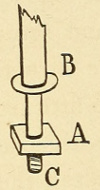
in one of my own inventions, which is called the
“Ever-ready Bird Trap.” It is made of strong
netting stretched over wire, and is placed on the
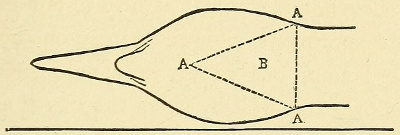
ground or on a board in a tree. A decoy bird, of
the same species as those to be captured, is procured
if possible, and placed in the back of the trap
at Fig. 2, and then the birds enter the front of the
trap, B; pass through the way of wires, C,
which pointing backward after the manner of the
well-known rat-trap, prevent their egress. This
trap is constantly set, and several birds are captured
at one time. Orioles, bobolinks, rose-breasted
grosbeaks, goldfinches, snow-buntings,
all other sparrows and finches, in fact, all birds
which will come to a decoy or bait, may be taken
in this trap.
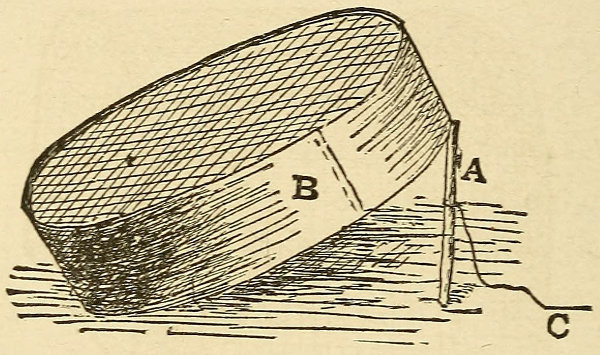
Fig. 1.
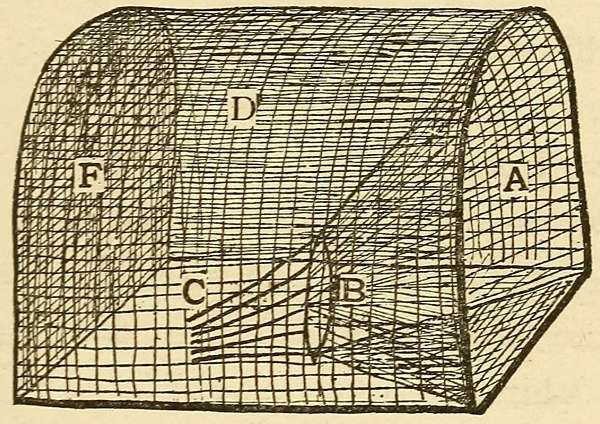
Fig. 2.
I have frequently taken jays in small snares
similar to those used in capturing rabbits. Quail
and ruffed grouse were also taken in this manner
before the present time, but it is now illegal to
trap game-birds in nearly all the States.
The steel trap of the smallest size is exceedingly
useful in capturing hawks, owls, and even eagles,
as well as many other large birds. One way is to
set it in the nest of the bird, first taking care to
remove the eggs, substituting for them those of a
hen. Almost all large birds may be taken in this
manner, and it is an excellent way to identify the
eggs in case of some rare hawks or herons. The
topmost portion of some dead stub, which is a
favorite roost of a hawk or eagle, is a good place
to set a trap; and small hawks and owls may
be captured by putting the trap on the top of a
stake, some eight or ten feet high, in a meadow,
especially if there are no fences near. Hawks and
owls haunt meadows in search of mice, and invariably
light upon a solitary stake, if they can
find one, in order to eat their prey or to rest, and
thus are very apt to put their “foot into it,” in a
manner decidedly agreeable to the collector, if not
so pleasing to themselves. Steel-traps may also
be set on boards nailed to trees, in the woods or on
hill-tops, but they should in this case be baited
with a small mammal or bird. I have succeeded in
capturing marsh hawks by tying a living mouse to
a steel-trap, and placing it in a meadow which was
frequented by these birds. Other hawks and also
eagles may be captured by using decoys; the best
thing for this purpose being, strangely enough,
a live great horned owl. The owl is fastened to
a stout stake in an open field or meadow during
the migration of hawks, in the spring or fall, and
surrounded by baited traps. The hawks passing
over are attracted by the novel spectacle of an owl
in such a peculiar position and come swooping
down for a nearer view, when they perceive the
bait, and in trying to eat it are caught. A hawk
or eagle may be used in this way as a decoy, but
the great horned owl is by far the best.
In using steel traps, care should be taken to wrap
the jaws with cloth, so as to prevent injury to the
legs of the bird captured. Vultures may be taken
in steel traps by simply baiting them with any kind
of flesh. Many species of birds may be successfully
captured by one or another of the methods
given. In fact, we are in constant receipt of
trapped birds during the proper seasons, and thus
many hawks and owls which would have been
difficult to procure are taken in numbers by our
collectors.
Bird-lime, although scarcely advisable when the
birds are intended to be preserved, may be used
to advantage in capturing birds for the cage. A
small quantity of it is spread on a twig or small
stick, one end of which is lightly stuck in a notch
on some upright branch or stem, in such a position
that the bird must alight on it in order to reach
the bait. The stick should be poised so lightly
that the slightest touch of the bird’s feet will cause
it to drop, when the bird, giving a downward
stroke with its wings to save itself from falling,
will strike the outer quills against the stick, and
thus both feet and wings become fastened to it by
the adhering lime. In case of a rare specimen,
the lime may be removed from the plumage by the
aid of alcohol, or the bird will remove it in time,
if permitted to live. Good bird-lime is difficult
to procure; that made from linseed-oil and tar,
boiled down, is the best; but this process must
be carried on in the open air, as the mixture is
exceedingly inflammable. The sticky mass thus
obtained must be worked with the hands under
water, until it assumes the proper consistency. In
spreading lime on the sticks, the fingers should be
wet to prevent the lime sticking to them. Another
way in which I have taken such unsuspicious birds
as pine grosbeaks, cross-bills and red-polls, is by
placing a noose of fine wire on the end of a pole,
and by approaching a tree cautiously, in which the
birds were feeding, have managed to slip it over
their heads, when they are drawn fluttering downward,
and the noose removed, before any permanent
injury is done. I have even taken pine
grosbeaks in an open field in this manner, and have
ascended a tree and captured them with only the
noose attached to a stout piece of wire, in my hand.
Section II.: Shooting.—Although, as shown,
many valuable species may be secured by trapping,
snaring, etc., yet the collector relies mainly
on his gun. This much being decided, it at once
occurs to the beginner, What kind of a weapon
shall I get? Of course, muzzle-loaders are now
out of the question; and among the multitudes of
breech-loaders in the market, one has only to
consult his taste or the length of his purse.
Therefore it is simply useless for me to recommend
any particular make of gun. Good single-barrel
breech-loaders can be bought for from nine
dollars to twenty dollars, while double-barrels cost
from fifteen dollars upward. For ordinary collecting,
a twelve-gauge is perhaps better than any
other, as such birds as ducks, hawks and crows
can be readily killed with it. For warblers,
wrens, and other small birds, however, a much
smaller gauge gun is almost indispensable, as a
large gun sends the shot with such force that it
not only penetrates the body of the bird, but also
goes out on the opposite side; thus each shot
makes two holes, when one is all that is necessary
to kill. This fact should then always be
kept in mind, and as a rule load lightly, with just
enough powder to cause the shot to penetrate well
into the bird without going through it. In a
twelve-gauge gun, two drachms of powder behind
an ounce of shot is sufficient to kill a bird like a
jay or golden-winged woodpecker, at a distance
of thirty or forty yards; then if more penetration
is necessary, more powder may be used with the
same quantity of shot, but this will cause the shot
to scatter more. A good collecting gun, one
which will kill small birds with a very small
amount of ammunition and little noise, has long
been a desideratum. I have tried many kinds,
but nothing has proved so satisfactory as a small
repeating gun of my own invention, and which is
manufactured by us. This gun consists of two
brass tubes, a smaller one within a larger, with an
air space between, thus greatly deadening the
sound; and both are securely fastened to a finely
nickel-plated five-shot revolver. We make two
sizes, a twenty-two gauge, the report of which is
very slight, and a thirty-two gauge, which makes a
little louder noise. The former will kill warblers
at fifteen yards, and the latter at twenty yards,
while birds like jays, thrushes, and robins, may be
brought down with the thirty-two gauge at a
distance of ten yards. This gun served me well
in Florida last winter, and I killed at least two-thirds
of the birds that I collected there with it.
The light report of such a gun does not frighten
the birds, while the fact that one nearly always
has a second shot ready in the revolving cylinder,
is a great help, in case of a wounded bird, or in
the sudden appearance of a second specimen, as
so often happens, after the first has fallen. The
price of this gun varies from four dollars and fifty
cents to five dollars and seventy-five cents, according
to quality and size. Blow-guns, air-guns,
catapults, etc., are useful only in cases when a
shot-gun cannot be used, as they cannot be depended
upon. A collector, in order to procure
birds with a certainty, requires a good shot-gun.
The ammunition used in the small collecting gun
is copper shells, primed, of three lengths for each
size. For shot, I use dust numbers ten and eight,
but for a larger gun, coarser shot is sometimes
necessary; collectors, however,—especially beginners,—are
apt to use too large shot. On the contrary,
I do not like to shoot too fine shot at large
birds; thus a hawk killed with a heavy charge of
dust-shot at twenty yards would have the feathers
cut up very badly, whereas a warbler shot at the
same distance would be likely to make a good
specimen, as it would only receive a few pellets of
shot, whereas a large number would strike the
hawk. As a rule, then, use dust-shot for birds up
to the size of a cedar-bird, then number ten to the
size of a jay, after which number eight will kill
better and cleaner, and I should use this size as
long as it will bring down the birds; and it is surprising
to see how large species may be killed with
it. I have taken brown pelicans, wild geese, and
large hawks with number eight, and I once secured
a frigate-bird with it, all at good distances. For
very large birds like cranes, white pelicans, or
eagles I have used a rifle very successfully. A
thirty-two gauge Allen is my favorite gun, and I
have killed birds at all distances from twenty to
three hundred and twenty-five yards with it. Of
course, nearly all successful rifle shots must be
made at sitting birds, as I have met with but few
who could bring them down when flying. Another
good method of securing large shy birds which go
in flocks, is to load with buckshot, putting a stiff
charge of powder, say three to five drachms, behind
it, then fire into the flock from a distance, elevating
the gun at an angle of some forty-five degrees
above the birds. I have killed both species of pelicans
at two hundred yards distant in this way.
Section III.: Procuring Birds.—Birds are
to be found nearly everywhere, in fact, there is
scarcely a square acre of land on the face of the
earth which is not inhabited, at one season or
another, by some species, and many are found on
the beaches, and on the ocean itself. Following
are some of the localities in which our American
species are to be found; and, presumably, foreign
birds of the same families will occur in similar
places.
Turdidæ: Thrushes.—Of these, the robin is
the most common and is found everywhere. Next
among the true thrushes are the olive-backed,
hermit, and allied species. These occur usually
in woodlands, and are rather shy, keeping at a distance.
The wood thrush inhabits deeply-wooded
glens. The mocking thrushes prefer thickets in
the neighborhood of dwellings,—for example, the
cat-bird. The brown thrush also inhabits thickets,
but are not, as a rule, fond of the society of
man, while the smaller thrushes, of which the
golden-crowned is an example, prefer the woodlands;
and the two water thrushes are found in
swampy localities.
Saxicolidæ: Stone-chats.—The blue-birds
are often sociable, building in orchards and farmyards,
while the western species appear to prefer
mountain cliffs as breeding-places. The rare stone-chat
is, I think, found in open sections where it
occurs at all.
Cinclidæ: Ouzel.—The solitary species of
ouzel found with us inhabits the mountain streams
of the far west.
Sylvidæ: True Warblers.—Are pre-eminently
birds of the woodlands, but occasionally the
kinglets, notably the golden-crowned, will wander
into orchards during mild days in winter.
Chamæidæ: Wrentits.—The only species
found in the United States inhabits the sage-brush
in the far southwest.
Paridæ: Titmice.—Are also found in the
woods or thickets, but some species wander into
the orchards during winter.
Sittidæ: Nuthatches.—Are birds of the
woodlands as a rule, but the white and red-bellied
nuthatches wander considerably in autumn, while
the brown-headed seldom if ever leave the piny
woods of the south.
Troglodytidæ: Wrens.—The creeper-wrens
are found among the cacti of the far southwest,
while the rock-wrens occur among thickets in a
similar region. The true wrens are found in
thickets, often in the neighborhood of dwellings,
in which they frequently build, while the two
marsh wrens occur on both salt and fresh water
marshes throughout the country.
Alaudidæ: True Larks.—These birds occur
on the far prairies, on the coast of Labrador, and
in winter along the barren seashores of the northern
and middle section.
Motacilidæ: Wagtails.—Are also birds of
the open country, and the titlark is found in
fields during the migrations, especially along the
coast from Maine to Florida.
Sylvicolidæ: American Warblers.—These
gems of the woodland and of wayside thickets
abound throughout the length and breadth of our
country. During the migrations they are generally
distributed, it not being uncommon, then, to
find even the Blackburnian warbler, which, during
the nesting season, is pre-eminently a bird of the
deep woods, feeding in the open fields, while I
have taken the Cape May warbler, which occurs
in summer in the thick evergreens of the north,
feeding among the oranges and bananas in the
gardens of Key West. Warblers then should be
looked after nearly everywhere, among willows
by the brookside, on the barren hill-tops which
scarcely support a scant growth of pine or cedars,
and on the blooming trees of orchards. Some
species are exceedingly shy, so as to require a
heavy charge of dust-shot to reach them, while
others are so tame as to peer inquisitively into
the very face of a collector as he makes his way
through their chosen retreats.
Tanagridæ: Tanagers.—These strikingly colored
birds are usually found in the woods, occasionally
however visiting the open sections. They
are rather shy and retiring in habits, and their
presence must be usually detected by their song.
Hirundinidæ: Swallows.—Are birds of the
open country, and are more common in the vicinity
of settlements than elsewhere. The violet-green
swallow, however, occurs among the cliffs
of the Rocky Mountains.
Ampelidæ: Waxwings.—Are, as a rule, found
in the open country in the vicinity of settlements;
and even the Bohemian waxwings occur abundantly
in some of the cities of Utah in winter,
feeding upon the fruit of the ornamental trees.
Vireonidæ: Vireos.—These widely-distributed
birds are usually fond of the woodlands, but the
white-eye prefers thickets in swampy places, while
the warbling is seldom found far from settlements;
indeed, more often inhabits trees which grow in
the streets of villages than other sections.
Laniidæ: Shrikes.—Are found in open sections,
often in fields, and on the uninhabited Indian
hunting-grounds of Florida. I found the loggerheads
along the borders of the open prairies.
Fringillidæ: Finches, Sparrows, and Grosbeaks.—These
are, as a rule, found mainly in
the more open country. The cross-bills, however,
enter thick woods, especially evergreens.
The grosbeaks, notably the rose-breast, prefer the
woodlands. The blue sparrows, like the indigo
bird, are found in open fields grown up to bushes.
The snow-buntings occur in open fields and along
barren sections of seaboard, while the sharp-tailed
and sea-side finches inhabit the marshes. The
grass sparrows, notably the yellow-winged, Henslow’s,
and Leconte’s, prefer grassy plains. Last
winter I procured all three species of this genus
(Coturniculus) on a plantation in Western Florida,
securing them all in three successive shots, a feat
which has, I am certain, never before been accomplished.
Many of these grass-haunting birds have
to be shot as they rise from the herbage to fly
away, but I found, by persistingly following a
specimen from point to point, that after a time
it would settle in a bush, when I could secure it
with my repeating collecting gun.
Icteridæ: Orioles, Blackbirds, etc.—Orioles
prefer, as a rule, orchards and ornamental trees
about dwellings, but they sometimes occur in the
more open woodlands. The marsh blackbirds, like
the red-wings and yellow-headed, prefer wet meadows.
The rusty and brewer’s are found in swamps.
The crow blackbirds and boat-tailed occur in fields
and along the borders of streams.
Corvidæ: Crows, Jays, etc.—These usually
occur in the woodlands or thickets. Crows frequent
the seashore in numbers in winter, and
may be secured by exposing meat which is poisoned
by strychnine, as they will frequently eat it
during the inclement season. Canada and blue
jays occur in woods, while the Florida and California
jays inhabit thickets.
Tyrannidæ: Flycatchers.—Are widely distributed
species. The king-birds are found in the
more open sections, and the same is true of the
crested flycatchers. The bridge pewee inhabits
the vicinity of dwellings, while the wood pewee
occurs in the woods. The least flycatcher prefers
orchards, but the greater portions of the
genus Empidonax are found in woodlands or
thickets.
Caprimulgidæ: Goatsuckers.—The whip-poor-wills
and chuck-wills-widow occur in the thick
wood, emerging occasionally at night, but seldom
straying from their retreats. A good way to
secure these birds is to note as accurately as possible
the point where one begins to sing; then, on
the following evening, conceal yourself near the
spot, when the bird will be seen to emerge from
its retreat and alight on some particular rock, post,
or branch, on which it invariably perches, and utters
its song. Then if the bird be too far away to
secure at the time, it may readily be taken another
evening by the collector posting himself nearer.
These birds may also be started from their concealment
during daylight, and thus be shot. The
night-hawks inhabit the more open sections, but
perch on trees during the day. They may readily
be secured while flying over the fields.
Cypselidæ: Swifts.—The white-throated swift
occurs among the clefts of the Rocky Mountains,
and is exceedingly difficult to procure. The well-known
chimney swift inhabits chimneys almost
everywhere, but, as it never alights outside of these
retreats, must be shot on the wing.
Trochilidæ: Hummingbirds.—Inhabit as a
rule the open country. I have secured numbers of
our ruby-throats on cherry-trees when they were
in blossom, and later, on beds of flowers; and I
presume the western species may be found in similar
situations. I shoot them with light charges
of dust-shot, fired from my collecting gun.
Alcidinidæ: Kingfishers.—These noisy birds
are found plentifully in the vicinity of streams.
They are shy and require a heavy charge of number
eight to bring them down.
Cuculidæ: Cuckoos.—The roadrunner of California,
Texas, and intermediate locality, occurs in
the sage bush, but our species of cuckoos, even
the mangrove, inhabit thickets from which they
occasionally emerge. They are usually betrayed
by their notes. They are easily killed, their skin
being very thin and tender.
Picidæ: Woodpeckers.—Occur, as a rule, in
the woodlands, but the smaller species and the
golden-winged inhabit orchards. They are all
tough birds to kill. They are a generally distributed
family, but some species are confined to
certain localities, for example, the great ivory-billed
is not found outside of Florida, and even
there, is confined to a limited area, and very rare.
Strickland’s woodpecker has as yet only been found
in the United States in a single range of mountains
in Arizona.
Psittacidæ: Parrots.—Our Carolina paroquet
is now exceedingly rare out of Florida, and then
occurs in the neighborhood of cypress swamps,
but occasionally visits the plantations.
Strigidæ: Owls.—The burrowing owl occurs
in the western plains and in a limited area of
Florida. The snowy owl inhabits sand-hills of the
coast in winter, and the short-eared occurs in the
marshes, but all other species are birds of the deep
woods, occasionally emerging, however, especially
at night. The great horned and barred may be
decoyed within shooting distance in the spring by
imitating their cries, and the latter-named species
will also eagerly fly toward the collector when he
produces a squeaking sound similar to that made
by a mouse. The small owls may be often found
in holes of trees.
Falconidæ: Hawks, Eagles, etc.—Marsh
hawks occur in fields, meadows, and marshes.
Everglade kites are found on the widespread
savannahs of Florida, while the swallow-tailed
Mississippi and white-shouldered are found on the
prairies of the south and west. The buzzard
hawks usually occur in the woods, but during the
migrations pass over the fields, flying high. The
fish-hawk is abundant on the seacoast, but also
visits the ponds and lakes of the interior. The
duck-hawk is fond of clefts, and migrates along the
seacoast. The sharp-shinned sparrow and pigeon
are often found in solitary trees in fields, where
they hunt for mice, but they also occur in open
woods. The bald eagle occurs on the seashore
or on large bodies of water, but the golden eagle
prefers the mountainous regions.
Cathartidæ: Vultures.—Occur everywhere
throughout the south. The great California vulture
is now very rare.
Columbidæ: Pigeons.—Are usually found in
fields, but the wild pigeon is often taken in the
woods. The ground doves are found in fields
which are bordered with thickets, to which they
retreat when alarmed. Two or three species are
found on the Florida Keys, and about as many
more in Texas.
Meleagridæ: Turkeys.—Wild turkeys occur
in the wilderness of the south and west. They
inhabit open woods as a rule, often roosting at
night in swamps.
Tetraonidæ: Grouse, Quail, etc.—The Canada,
ruffled, and allied species of grouse occur in
the woodlands. The prairie sharp-tail and sage-hen
are found on the plains of the west, while the
ptarmigans inhabit the bleak regions of the north.
The common quail is widely distributed throughout
the more open country, from Massachusetts to
Texas, and the plumed California and allied species
occur in the southwest, frequenting the thickets of
the prairies, or along the mountain-sides.
Charadridæ: Plovers.—These are, as a rule,
maritime birds, especially during the southward
migrations, but many of the species breed in the
interior, and the kildeer and mountain plovers are
always more common on bodies of fresh water.
None of the species are, however, found far from
water, but they all alight in dry fields in search
of food.
Hæmatopodidæ: Oyster-catchers and Turnstones.—All
these birds inhabit the seacoast.
They occur in oyster-beds or among rocks.
Recurvirostridæ: Avocets and Stilts.—Both
these species are birds of the interior, being
found in the south and west in the vicinity of
water.
Phalaropodidæ: Phalaropes.—These singular
birds are found off the coast, often far out at
sea during winter, but, oddly enough, breed in the
interior, nesting throughout the northwest and
north. They are, however, occasionally found on
the coast during the northward migration, especially
during storms.
Scolopacidæ: Snipes, Woodcock, etc.—Woodcock
and snipes are usually found in freshwater
swamps, especially in spring. The true
sandpipers, like peep, grass-birds, etc., haunt the
pools in marshes or accompany the sanderlings
on the beaches. The godwits are found on the
marshes, as are also red-breasted snipe, but the
curlews inhabit hill-tops, especially during the
autumnal migration. I have, however, found the
long-billed curlew on the beaches of Florida.
Willets and yellow-legs occur on the marshes or
on the borders of streams.
Tantalidæ: Ibises and Spoonbills.—Occur
along the borders of streams and other bodies of
fresh water, or on mud-flats in the far south.
Ardeidæ: Herons.—These are widely distributed
birds. The true herons occur along the
margins of bodies of water, both on the coast and
in the interior, while the bitterns generally haunt
only the fresh water.
Gruidæ: Cranes.—Are found on the prairies
of the west and south, frequenting the vicinity of
water.
Aramidæ: Courlan.—The well-known crying-bird
is found only in Florida, inhabiting swamps
along the rivers and lakes of the interior.
Rallidæ: Rails, Gallinules, and Coots.—The
true rails inhabit very wet marshes, both salt
and fresh, concealing themselves in the grass.
Gallinules and coots are found on the borders of
fresh water.
Phœnicopteridæ: Flamingoes.—The flamingo
occurs only with us, on the extensive mud-flats in
extreme Southern Florida, where they are exceedingly
difficult to procure, being very shy.
Anatidæ: Geese, Ducks, etc.—These are
all inhabitants of the water, being seldom found
far from it. Some species, like the teal, prefer
secluded pools in the interior, while the wood-duck
and others frequent woodland streams; and the
eiders and marine ducks are abundant in the
waters of the ocean.
Sulidæ: Gannets.—Excepting while breeding,
these birds keep well out to sea, and are thus
quite difficult to procure. All of the marine species
are liable to be driven inland during severe
storms, and the collector should not fail to take
advantage of such circumstances.
Pelecanidæ: Pelicans.—The brown pelican is
a resident of the extreme southern coast, and may
be found on sand-bars or perched on trees in the
immediate vicinity of water. The white pelican is
found in similar localities in winter, but migrates
northward during the summer, breeding in the
interior, from Utah to the Arctic regions.
Graculidæ: Cormorants.—Occur on sand-bars
in the south, or on rocky cliffs in the north,
and on the Pacific coast. During migrations they
keep well out to sea. They have the habit, in
common with the gannets and pelicans, of alighting
on barren sand-spits which rise out of the
water.
Plotidæ: Darters.—The snake-bird of the
south occurs on bodies of fresh water, and may be
seen perched on trees or flying high in air. They
are exceedingly difficult to kill, being, as a rule,
shy, and very tenacious of life.
Tachypetidæ: Frigate Birds.—The frigate
bird is found with us only on the Gulf of Mexico
and among the Florida Keys. They are usually
seen upon wing, but I have observed thousands
perched on the mangroves on the Keys. They
roost on the trees on lonely islets at night, at
which time they appear so stupid that they may
be approached quite readily.
Phætonidæ: Tropic Birds.—These fine
birds occur only in tropical waters unless they
are accidentally blown out of their latitude by
storms. They breed on the rocky cliffs of the
Bahamas and Bermudas.
Laridæ: Gulls, Terns, etc.—The Skua gulls
keep well out to sea, as a rule, but occasionally
enter harbors and bays in pursuit of gulls and
terns, which they rob of their prey. Gulls and
terns of the various species rest on sand-bars or
fly along the shore.
Procellaridæ: Petrels.—Excepting while
breeding, these birds keep well out to sea and are
thus quite difficult to procure. They haunt the
waters which are frequented by fishermen, however,
and may be procured by visiting these localities
on some fishing-smack.
Colymbidæ: Loons.—Are found in both fresh
and salt waters, but are somewhat difficult to procure
on account of their habit of diving.
Podicipidæ: Grebes.—These birds have similar
habits to those of the loons, but are found in
smaller bodies of water, notably the Pied-billed,
one or more specimens of which occur in almost
every little pool throughout the country, especially
during the southward migration.
Alcidæ: Auks, Puffins, etc.—These birds
are found off the coast during migration, but breed
on the rocky shores of both coasts.
Although the foregoing list gives the locality in
which a given species may be found, as a rule, it
is always well to bear in mind that birds have
wings, and by the use of them may stray into
unaccustomed localities far distant from their
usual habitance. For example, a burrowing owl
was shot on the marshes of Newburyport, and a
petrel, which has hitherto been known to science
through a single specimen which was taken many
years ago in the southern hemisphere, was picked
up, in an exhausted condition, in a ploughed field
of the interior of New York. The young collector
then should ever be on the alert, keeping well in
mind the fact that the art which he is pursuing
is not lightly learned. I have frequently heard
the inexperienced remark that he could easily kill
a hundred birds in a day; and although this might
be true on certain occasions,—for I have seen over
this number killed by one person in two discharges
of a gun,—yet, as a rule, a good collector
will seldom bring in over fifty birds during his
best days. A man must not only be experienced,
but will be obliged to work hard in order to
average twenty-five birds in a day. Although
there are some “born” collectors who will
procure birds, even if they be provided with no
more formidable weapon than a boy’s catapult,
yet the peculiar attributes which make up a good
collector are mainly to be acquired. A quick
eye to detect a flutter of a wing or the flit of a
tail among waving foliage; an ear ready to catch
the slighest chirp heard amid the rustling leaves,
and so skilled as to intrepret the simple gradations
of sound which distinguish the different
species; a constant wide-awake alertness, so that
nothing escapes the observation, and which gives
such nice control over the muscles that the gun
comes to the shoulder with a promptitude that
combines thought with action; and an unwearying
patience and pluck which totally disregard minor
obstacles, are some of the characteristics which
must be possessed by the individual who wishes
to bring together a good collection of birds by
his own exertions. If one does not possess these
traits, why, then study to acquire them; for
securing birds is as fine an art as is preserving
them after they are obtained.
Section IV.: Care of Specimens.—Just as
soon as a bird is shot, examine it carefully by blowing
aside the feathers in order to find the shot-holes;
if they bleed, remove the clotted blood with
a small stick, or, better, the point of a penknife,
then with a pointed stick, or the knife, plug the
hole with a little cotton, and sprinkle plaster, or
better, some of my preservative, on the spot.
Next plug the mouth with cotton, taking care to
push the wad down far enough to allow the bill to
close, for if the mandibles are left open the skin of
the chin and upper throat will dry, causing the
feathers to stand upright. Smooth the specimen
lightly and place it, head down, in a paper cone,
which should be long enough to allow folding the
top without bending the tail feathers. Then the
bird may be placed in a fish basket, which is the
best receptacle for carrying birds, as it is not only
light to carry, but also admits the air. Never
shut a bird up in a close box in warm weather, as
it will spoil very quickly. Care of a bird in the
field will save much labor, and your cabinet specimens
will look enough better to warrant it.
Blood left under the plumage gradually soaks
through the feathers, thus causing them to
become matted, when they are exceedingly difficult
to clean. Some specimens however, will
bleed, and if they are to be preserved this blood
must be removed. I have always found it best
to wash the blood off in the first water I could
find, and then let the bird dry, either by carrying
in my hand, or, by suspending it to a limb of
a tree, where I could return for it afterwards.
Care should be taken in such cases, however, to
wash all the blood off, and then plug the wound
with cotton, as if any flows out when the plumage
is wet it will spread on the feathers and stain
them. In picking up birds that are only wounded
never take them by the tail, wing, or any part of
the plumage, but grasp them firmly in the hand
in such a way as to imprison both wings, then
kill them by a firm pressure of the thumb and
forefinger, applied to the sides just back of the
wings. This compresses the lungs, and the birds
die of suffocation almost instantly. Never strike
a bird, no matter how large, with a stick, but in
case of hawks, eagles, etc., the talons of which are
dangerous, seize them first by the tip of one
wing, then by the other, work the hands downward
until the back is grasped, then apply the
pressure to the lungs. There is no danger from
the beak of even the most formidable species
after the pressure is put upon the lungs, for I
never knew a specimen to bite while being killed
in this way; the only thing necessary is to
keep out of the way of their talons. I have frequently
been obliged to remove eagles from a box
and kill them, and have done it with my hands
alone.
Wounded doves and pigeons should be grasped
very firmly, and not allowed to struggle in the
least, as their feathers fall out very easily; and
the same is true, though to a less extent, with
cuckoos; in fact, it is always best to brush the
plumage as little as possible, handling the specimen
when dead by the feet or bill. In picking up
white herons or other birds which have fallen in
mud or other dirty water, take them up by the bill
and shake them gently to remove the ooze. The
feathers of all birds, especially aquatic species,
are covered with a delicate oil, and all extraneous
matter glides off the plumage if they are not
soaked in water. In catching wounded herons,
take them by the beak to avoid the danger of
losing an eye from a lunge of the sharp point.
When a bird is to be placed in a basket or on a
bench, do not throw it down, but lay it gently on
its back, always bearing in mind that the smoother
a bird is kept before it is skinned the better it will
look when preserved. I have even noticed that
the true ornithological enthusiast always keeps
his birds in good condition, while others who
merely shoot birds for the momentary pleasure of
the thing, or for gain, are very apt to handle them
roughly. In other words, the student of nature
possesses an innate love of his pursuits, which
causes him to respect even a dead bird.