86.—There remain other varieties of double or treble
entries to consider. A book such as
Baker, W. R.
Intemperance the idolatry of Britain. 3rd ed.
pp. 62. sm. 8o. n.d.
has no appearance of difficulty, as it is so obviously upon
intemperance, but the question of concentration of
books pro and con upon such a subject as this must be
looked into. It is most undesirable to send an inquirer to
a number of headings to find all the books upon the
“drink question.” To effectively group them together,
developes the heading into a class rather than subject,
but even so, it has more justification than the grouping
of say “Natural history” would have, because it
is more distinctly a single subject regarded from several
standpoints, and while “temperance” cannot be “intemperance,”
yet to bring the two aspects of the question
together adds more to the utility of the catalogue than
to separate books with these words upon their title-pages
under different headings. In looking into this
matter, the subject was followed up in a good catalogue
compiled upon strictly orthodox lines, and was found up
and down under headings like Alcohol, Drink, Inebriety,
Teetotalism, Temperance, Total Abstinence, Licensed
Victuallers, Public Houses, Sunday Drinking. Most of
the books under these various headings might have
been brought together with advantage under a general
term-heading like “Drink question,” with cross-references
from the other topics to bind the whole together
beyond possibility of mistake. There are other questions
that admit of concentration in this way, as for example
books upon Free Trade, Fair Trade, Reciprocity, and Protection
can all safely be entered under “Free Trade” with
references from the others.
Some books, on the other hand, must have several
entries, as
Ruddock, E. H. Modern medicine and surgery
on homœopathic principles. 1874
requires three entries, viz., under “Medicine,” “Surgery,”
“Homœopathy.” The only method of avoiding this would
be to enter the book under “Homœopathy,” with cross-references
from the other headings, as
Medicine. See also Homœopathy.
In a small general library it would be possible to bring
together all books upon subjects so closely allied as
medicine and surgery under that heading, with a cross-reference,
Surgery. See also Medicine and surgery.
Another example of a book needing several entries, is
Garner, R. L. Gorillas and chimpanzees.
As this is not a work upon Monkeys generally, or even
upon Apes, the correct procedure is to enter it under
“Gorillas” and “Chimpanzees” respectively, as
Gorillas.
Garner, R. L. Gorillas and chimpanzees.
In a small library there would most likely be other books
upon Gorillas, but hardly a second upon Chimpanzees,
therefore the second entry would be
Chimpanzees, Gorillas and. Garner, R. L.
To bring this book fully under the notice of those interested
in the monkey tribe cross-references are necessary.
Presuming that there were already entries under “Monkeys”
(generally) and “Apes” (particularly), then all the
entries would be bound together by
No cross-reference being called for to “Chimpanzees,” as
they are included in the title of the book under “Gorillas.”
In the event, however, of there being a second book upon
Chimpanzees, then the cross-reference becomes
Apes.
See also Chimpanzees. Gorillas.
87.—At the risk of repetition, and to make the matter
clear, it may be again stated that a book must not be
entered under every important word appearing upon its
title-page. There is much rule-of-thumb cataloguing done
that would cause a book like
Ihering, Rudolph von. The evolution of the
Aryan,
to be entered under “Evolution,” whereas not even a
title-entry under the word “evolution” is required, and
the single subject-entry is
Aryans, The
Ihering, R. von. The evolution of the Aryan.
It may be considered unnecessary advice to say that
a book so unmistakably upon the Aryan peoples should
not be put under “Evolution,” when the accepted meaning
of that term as a subject has nothing to do with it, yet
there are catalogues at present in force of important town
libraries with much worse forms. One has a heading
“Natural history,” under which there are sixteen items
that include such diverse matters as “Natural method of
curing diseases,” “Natural theology,” “Natural philosophy,”
“Nature and art,” “Drawing from nature,” because
the word “natural” or “nature” happened to occur in
the titles of the books. Another has a heading “School,
Schoolmasters, and Schools,” which includes Molière’s
“School for wives” and his “School for husbands.” Any
number of examples equally ridiculous could be quoted
from present-day catalogues to prove the contention that
this is a common form of error. Therefore the advice to
“get at the subject of the book, and never mind the particular
words used on the title-page,” cannot be too often
impressed upon the cataloguer.
88.—Books in a number of languages dealing with a
single subject must all be entered under the English name
for that subject. Books like
Kohlrausch, F. Kurze Darstellung der deutschen
Geschichte. 1864
Green, S. G. Pictures from the German fatherland.
n.d.
Breton, J. Notes d’un étudiant français en Allemagne.
1895
are to be found entered in a catalogue under Deutschen,
Germany, and Allemagne, without a single binding reference.
Another has books upon the United States under
America, États-Unis, and United States. In one catalogue
there is a reference in the following form:
États-Unis—see L’Univers,
which is most flattering to our American cousins. In this
connection it should be observed that references of this
kind are quite wrong. In the first place there is no occasion
for a reference or entry of any kind under “États-Unis”
in an English catalogue, and in the second the
principle of referring from a lesser to a greater subject is
incorrect; the reference must always be from a greater to
a lesser. In the same catalogue there are numbers of
references from subjects to authors, which are also wrong
in principle, as a reference should never be given in this
form:
Indigestion. See Douglas (Dr. Jas.),
or its reverse, equally erroneous:
Duncan, Dr. Andrew. See Consumption,
otherwise the curious humour of references of this kind
will soon show itself. In both cases entries were required
and not references. Therefore the only references to be
used are
(1) Subject to subject (connected or synonymous only).
(2) Greater subject to lesser division of the same
subject.
(3) Author to author (joint-authors).
(4) Translator, editor, or compiler to author.
(5) Translator, editor, or compiler to title not containing
the name of an author or not treated as author
(as editor of a series).
89.—The next illustration is
Garnett, Richard.
Life of Ralph Waldo Emerson. (Great
writers.) pp. 300, xiv. sm. 8o. 1888
With a bibliography by John P. Anderson.
No entry is needed under the word “Life,” or under
“Biographies,” as that is a class-heading and not a subject,
and the book goes under the name of its direct subject,
making a heading of it, as the library will contain Emerson’s
works as well as other biographies of him, as
Emerson, Ralph W.
Garnett, R. Life of Ralph Waldo Emerson.
(Great writers.) 1888
An entry is required under the name of the series, and to
be strictly accurate the name of the author should lead, as
Great writers; ed. by Eric S. Robertson.
(Note:—Each volume contains a bibliography of the subject
by John P. Anderson.)
Garnett, R. Life of Ralph Waldo Emerson. 1888
though it will be found more useful in the case of a series
of a biographical nature to lead off with the subject, instead
of the author, as
Great writers:
Emerson, Ralph Waldo, by R. Garnett. 1888
References to complete the matter fully may be given as
Robertson, Eric S. (Ed.) See Great writers (series).
Anderson, John P. See Great writers (series).
In case of series like the Bampton, Hulsean, and Hibbert
Lectures, the most convenient method is to arrange them
in chronological order of the delivery of the lectures (not
the date of publication) after this style:
Bampton Lectures:
1876. Alexander. The witness of the Psalms to Christ
and Christianity. 1877
1880. Hatch. The organization of the early Christian
churches. 1888
1891. Gore. The incarnation. 1891
The question is raised now and then as to whether it is
worth while giving the list of works forming a series under
the first word, other than an article, of the title of the
series instead of under some other leading word. There is
no occasion to lay down a hard and fast rule in the matter,
but all things considered, it will be found safer to treat all
series in the manner indicated and to enter them uniformly
under this first word as Great artists, Great writers,
Story of the nations, Leaders of religion, International
scientific series, under “Great,” “Story,” “Leaders,” and
“International” respectively rather than under “Artists,”
“Writers,” “Nations,” “Religion,” or “Scientific.” The
fact cannot be overlooked that the entry is only given
because it is a series-entry and not as a make-shift form
of subject-entry, and for this very reason it would be as
erroneous to enter all the series of “Great artists” under
the subject-heading “Artists” as to put the “Leaders
of religion” under “Religion.” The difficulty is fully met
by cross-references where required, as
Science. See also International scientific series.
Authors. See also Great writers (series).
Scots, Famous (series). See Famous Scots.
If the series-entry is to be converted into a semi-subject
entry, it should be by the simple transposition of the title
of the series and then kept altogether apart from the
subject-heading.
In a library catalogue, as distinct from a bookseller’s, it is
only those series of a special and limited character that
receive entries under the names of the series, and this form
should not be extended so as to include long lists of books
in series under publisher’s names, as Weale’s series, Pitt
Press series, Macmillan’s Manuals for students. Where
very full information is given, these names may be added
to the principal entry and not carried further.
90.—Already it has been stated that in many libraries it
is of the utmost importance that a catalogue should be
compiled with short entries and within narrow limits so as
to reduce both the size and the cost of production. To do
this judiciously does not interfere in the least with the
principles of good and adequate cataloguing, care only being
required in curtailing the entries so as not to lose their
correct character. The majority of readers in popular
libraries are little concerned with precise bibliographical
information provided they get a list of the books by the
author, or upon the subject they want. The title of Dr.
Garnett’s book mentioned above can, for example, be
shortened into entries like these:—
Garnett, Richard. Life of Ralph W. Emerson.
1888
Emerson, Ralph W.
Garnett, R. Life of Emerson 1888
Great writers:
Emerson, by R. Garnett. 1888
The references from Robertson and Anderson can be
dispensed with. Shorter entries than the foregoing would
not be looked for, and would be worthless. Very brief
entries imply little or no information, as witness the
following complete entries from the catalogue of a large
library:
“Church’s Lament.”
Conspiracy. Ritualistic.
Workhouse. Union. Bowen.
91.—The next illustration is taken to further show the
method of regarding a book for its subject-entry:
Saintsbury, George.
A history of Elizabethan literature. 1887
This is neither a book upon literature generally nor in
the abstract, nor upon English literature as a whole, but only
upon a particular period of it. Such a book could very
properly be placed under “Elizabethan literature” with a
reference from “English literature.” It might even go
under the name of Elizabeth where all books pertaining to
her reign in every particular could be gathered, but this is
not so satisfactory. After all the most useful place for a
book of this kind would be under “English literature,” and
its inclusion could be better justified if the books under such
a heading were sub-divided, if sufficient in number, into
periods arranged chronologically as a heading like “English
History” is often usefully divided. This would necessitate
a cross-reference like
Elizabethan literature. See English literature.
To further illustrate this point it may be said that a book
like
Brewer, J. S.
The reign of Henry VIII. 2 v. 8o. 1884
is better treated in the reverse way and entered under the
name of the monarch, in common with other books of a
strictly historical nature dealing with a particular reign. In
the first case the book is thought to be more usefully catalogued
as a contribution to the larger subject of “English
literature,” and in the second the book is looked upon as
being more particularly concerned with Henry VIII. than
with “English history”—hence the difference in the treatment.
In this last instance the safe-guarding cross-reference is
English History.
For the histories of particular reigns see under
the names of monarchs, as Charles I., Henry
VIII., Victoria.
92.—The following group is given (in brief form) in
order to show the difference of treatment of books apparently
alike in subject:
Farrar, F. W., Dean (Ed.) With the poets.
James, Henry. French poets and novelists.
Johnson, Samuel. Lives of the English poets.
Keats, John. Poetical works.
Shairp, J. C. Aspects of poetry.
Sharp, Wm. Life of Shelley.
Tennyson, Lord. Demeter and other poems.
The first entry would be placed under a heading “Poems,”
because it is an anthology. This heading “Poems” should
be reserved for collections of miscellaneous poems by many
authors and would not include a book like the Keats, which
should be entered under the name of the author only. It does
not require any entry under “Poetical works,” as that is simply
a form, and can no more be justified than a heading “Prose
works” could be. If, however, the book has a definite
title, like the Tennyson, then a title-entry must be given as
Demeter and other poems. Tennyson, Lord.
Librarians sometimes consider it necessary to give a series
of references under the heading “Poems” or “Poetry” to
the names of the authors represented in the catalogue, but
this is on an equality with the practice of grouping all the
fiction under a heading “Novels.” These being class-headings
are not strictly accurate but, no doubt, are a
convenience to a section of readers. So much cannot be
said for all such grouping in a dictionary catalogue, and it is
better to avoid it if possible. A catalogue of a very
important library has a heading “Essays,” under which an
attempt has been made to enter all books written in the
form of essays, as well as with the word “essay” upon the
title-pages, and the result is a mere jumble of titles, absolutely
useless, including as it does works so widely apart in
character as Baring Gould’s Old country life, Barrie’s
Auld licht idylls, Doran’s In and about Drury Lane, and
Lang’s Books and bookmen. To attempt this in a classified
catalogue would be bad enough, but in a dictionary
catalogue it shows that the first principles governing its
compilation are wholly misunderstood.
The book by Henry James would be fitly placed under
“French literature” and the words “poets” and
“novelists” ignored. Dr. Johnson’s book should go under
“Poets,” together with any other lives of poets in collected
form, but the life of an individual poet, like that of Shelley,
would not be so entered, as lives of individuals are entered
under their names, and not under the class to which they
belong. Shairp’s book being upon “Poetry” in the abstract
would accordingly go under that heading, as would any
book of a miscellaneous character upon poetry which could
not well be placed under a more definite subject-heading.
93.—Sometimes in the case of biographies it will be
found unnecessary to give both author and subject-entries
because the biographies are written or edited by a son or
other relative bearing the same name, and accordingly both
entries come together in the catalogue, therefore, while
it is quite correct to give both entries, yet one suffices.
If the single entry is adopted it is better to make choice of
the subject for the entry, not the author, as
Stokes, William: his life and works, 1804-1878,
by his son [Sir] Wm. Stokes. (Masters of
medicine.) 1898
94.—Volumes of sermons are dealt with in the same
manner as poetical works, avoiding, as far as possible, an
entry under the form “Sermons.” An illustration is
Kingsley, Charles. All Saints’ Day, and other
sermons. 1890
⸻ The gospel of the Pentateuch: sermons.
1890
⸻ Sermons on national subjects. 2v. 1872
⸻ Sermons for the times. 1890
⸻ Village sermons. 1890
The first and last of these simply require title-entries, as
All Saints’ Day, and other sermons. Kingsley, C.
1890
Village sermons. Kingsley, C. 1890
The second, instead of receiving a title-entry, is better
placed as a contribution to its subject, as
Pentateuch, The.
Kingsley, C. The gospel of the Pentateuch:
sermons. 1890
The third and fourth will also require title-entries unless
there happens to be a general reference under the word,
“Sermons,” after this fashion
Sermons. For volumes of sermons with specific
titles or upon definite subjects see those titles and
subjects. Books with the general title of sermons
will be found under the names of the following
authors:
(Here follows a list of the names, including Kingsley.)
If this form is not considered suitable then there is no
alternative but to give title-entries, because a heading cannot
be correctly made. The form then is:
Sermons. Le Bas, C. W. 2 v. 1828
Sermons for the times. Kingsley, C. 1890
Sermons in the East. Stanley, A. P. 1863
Sermons on national subjects. Kingsley, C. 2v. 1872
The arrangement is alphabetically by the words of the
titles as in the case of any other title-entries, and not by
the names of the authors.
95.—Dramas, Dramatic Works, are also forms calling
for similar treatment to Poems, Essays, or Sermons. Collections
of letters by individuals are simply entered under
the names of the writers with references from the editors.
96.—There is a form of entry occasionally seen in catalogues
that is so obviously absurd that it scarcely needs to
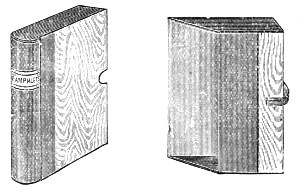
be more than referred to, viz., a heading “Pamphlets.” Here,
presumably, all the thin or unbound books in a library are
entered. Under an arrangement of this description, work
should be facilitated, as but two headings would be requisite—one
“Books” and the other “Pamphlets”—the dividing
line between the two to be fixed by the number of pages.
Almost in a line with such a ridiculous heading is the lazy
cataloguer’s method of taking volumes consisting of a number
of pamphlets bound together, whether upon the self-same
subject or as many different subjects as there are pamphlets
in the volumes, and lumping them with entries like these:
Miscellaneous pamphlets. v.d.
Pamphlets, Miscellaneous. 37 v. v.d.
Sermons, Miscellaneous. v.d.
Political pamphlets. v.d.
Of course, each pamphlet must be dealt with in precisely
the same way as if it were a separate book, the fact that it
is a thin book not entering into the question, unless it
happens to be of so very trifling or ephemeral a character
as to be unworthy of an entry, when it should either be
withdrawn from the library (unless the fact of its being
bound up with others prevents) or properly catalogued.
97.—The prolix titles of many pamphlets, especially the
polemical tracts of the seventeenth and eighteenth centuries,
often need abbreviation. For example:
The succession of Solomon to the throne of
David consider’d in a sermon on the occasion of
the sudden death of His Majesty King George I.,
June 18, 1727, by Thomas Bradbury. 2nd ed. 1727
may very well be cut down to
Bradbury, Thomas. Sermon on the death of
George I. 1727
and
An ordinance of the Lords and Commons
assembled in Parliament, together with rules and
directions concerning suspention from the sacrament
of the Lord’s Supper in cases of ignorance
and scandall; also the names of such ministers
and others that are appointed triers and judges
of the ability of elders within the province of
London. 1645
may be safely curtailed in most cases to
Lord’s Supper. An ordinance of Parliament,
with rules and directions concerning suspention
from the sacrament. pp. ii., 14. sm. 4o. 1645
Pamphlets are frequently collected and stored in libraries
for some special reason—perhaps because they are of local
interest—when this fact should be brought out in the
catalogue. Accordingly a pamphlet entitled
A sermon preached in Chelsea Church at the
funeral of the Hon. Mrs. Elizabeth Roberts, by
Thomas Knaggs. 1710
would be entered under
Chelsea Church, Sermon preached in, at the funeral
of the Hon. Mrs. Eliz. Roberts. Knaggs, T. 1710
this entry being additional to that under “Knaggs” and
another under “Roberts,” if the person happened to be of
some local importance in her day.


 or