In choosing the kinds of plants for the main grounds the gardener should
carefully distinguish two categories,—those plants to compose the
structural masses and design of the place, and those that are to be used
for mere ornament. The chief merits to be sought in the former are good
foliage, pleasing form and habit, shades of green, and color of winter
twigs. The merits of the latter lie chiefly in flowers or
colored foliage.
Each of these categories should be again divided. Of plants for the main
design, there might be discussion of trees for a windbreak, of trees for
shade; of shrubs for screens or heavy plantings, for the lighter side
plantings, and for incidental masses about the buildings or on the lawn;
and perhaps also of vines for porches and arbors, of evergreens, of
hedges, and of the heavier herbaceous masses.
Plants used for mere embellishment or ornamentation may be ranged again
into categories for permanent herbaceous borders, for display beds,
ribbon edgings, annuals for temporary effects, foliage beds, plants for
adding color and emphasis to the shrubbery masses, plants desired to be
grown as single specimens or as curiosities, and plants for porch-boxes
and window-gardens.
Having now briefly suggested the uses of the plants, we shall proceed to
discuss them in reference to the making of home grounds. This chapter contains
a brief consideration of:
- Planting for immediate effect,
- The use of “foliage” trees and shrubs,
- Windbreaks and screens,
- The making of hedges,
- The borders,
- The flower-beds,
- Aquatic and bog plants,
- Rockeries and alpine plants;
and then it runs into nine sub-chapters, as follows:—
- 1. Plants for carpet-beds, p. 234;
- 2. The annual plants, p. 241;
- 3. Hardy herbaceous perennials, p. 260;
- 4. Bulbs and tubers, p. 281;
- 5. The shrubbery, p. 290;
- 6. Climbing plants, p. 307;
- 7. Trees for lawns and streets, p. 319;
- 8. Coniferous evergreen trees and shrubs, p. 331;
- 9. Window-gardens, p. 336.
And then, in Chapter VIII, the particular cultures of plants needing
special care are briefly discussed.
Planting for immediate effect.
It is always legitimate, and, in fact, desirable, to plant for immediate
effect. One may plant very thickly of rapid-growing trees and shrubs for
this purpose. It is a fact, however, that very rapid-growing trees
usually lack strong or artistic character. Other and better trees should
be planted with them and the featureless kinds be gradually removed.
(Page 41.)
The effect of a new place may be greatly heightened by a dexterous use
of annuals and other herbaceous stuff in the shrub plantations. Until
the shrubbery covers the ground, temporary plants may be grown among
them. Subtropical beds may give a very desirable temporary finish to
places that are pretentious enough to make them seem in keeping.
Very rough, hard, sterile, and stony banks may sometimes be covered with
coltsfoot (Tussilago Farfara), sacaline, Rubus cratœgifotius,
comfrey, and various wild growths that persist in similar places in the
neighborhood.
However much the planter may plan for immediate effects, the beauty of
trees and shrubs comes with maturity and age, and this beauty is often
delayed, or even obliterated, by shearing and excessive heading-back. At
first, bushes are stiff and erect, but when they attain their full
character, they usually droop or roll over to meet the sward. Some
bushes make mounds of green much sooner than others that may even be
closely related. Thus the common yellow-bell (Forsythia virdissima)
remains stiff and hard for some years, whereas F. suspensa makes a
rolling heap of green in two or three years. Quick informal effects can
also be secured by the use of Hall’s Japanese honeysuckle (Lonicera
Halliana of nurserymen), an evergreen in the South, and holding its
leaves until midwinter or later in the North. It may be used for
covering a rock, a pile of rubbish, a stump (Fig. 236), to fill a corner
against a foundation, or it may be trained on a porch or arbor. There is
a form with yellow-veined leaves. Rosa Wichuraiana and some of the
dewberries are useful for covering rough places.
Many vines that are commonly used for porches and arbors may be employed
also for the borders of shrub-plantations and for covering rough banks
and rocks, quickly giving a finish to the cruder parts of the place.
Such vines, among others, are various kinds of clematis, Virginia
creeper, actinidia, akebia, trumpet creeper, periploca, bitter-sweet
(Solanum Dulcamara), wax-work (Celastrus scandens).
Of course, very good immediate effects may be secured by very close
planting (page 222), but the homesteader must not neglect to thin out
these plantations when the time comes.
![[Illustration: Fig 236. Stump covered with Japanese honeysuckle.]](https://openoldbooks.sgp1.digitaloceanspaces.com/books/manual-of-gardening/images/fig236.png)
The use of
“foliage” trees and shrubs.
There is always a temptation to use too freely of the trees and shrubs
that are characterized by abnormal or striking foliage. The subject is
discussed in its artistic bearings on pages 40 and 41.
As a rule, the yellow-leaved, spotted-leaved, variegated, and other
abnormal “foliage” plants are less hardy and less reliable than the
green-leaved or “natural” forms. They usually require more care, if they
are kept in vigorous and seemly condition. Some marked exceptions to
this are noted in the lists of trees and shrubs.
There are some plants of striking foliage, however, that are perfectly
reliable, but they are usually not of the “horticultural variety”
class, their characteristics being normal to the species. Some of the silver or
white-leaved poplars, for example, produce the most striking contrasts of
foliage, particularly if set near darker trees, and for this reason they are
much desired by many planters. Bolle’s poplar (Populus Bolleana of
the nurseries) is one of the best of these trees. Its habit is something like
that of the Lombardy. The upper surface of the deeply lobed leaves is dark dull
green, while the under surface is almost snowy white. Such emphatic trees as
this should generally be partially obscured by planting them amongst other
trees, so that they appear to mix with the other foliage; or else they should
be seen at some distance. Other varieties of the common white poplar or abele
are occasionally useful, although most of them sprout badly and may become a
nuisance. But the planting of these immodest trees is so likely to be overdone
that one scarcely dare recommend them, although, when skillfully used, they may
be made to produce most excellent effects. If any reader has a particular
fondness for trees of this class (or any others with woolly-white foliage) and
if he has only an ordinary city lot or farm-yard to ornament, let him reduce his desires to a single tree, and then if that tree
is planted in the interior of a group of other trees, no harm can result.
Windbreaks and screens.
A shelter-belt for the home grounds is often placed at the extreme edge
of the home yard, toward the heaviest or prevailing wind. It may be a
dense plantation of evergreens. If so, the Norway spruce is one of the
best for general purposes in the northeastern states. For a lower belt
the arbor vitae is excellent. Some of the pines, as the Scotch or
Austrian, and the native white pine, are also to be advised,
particularly if the belt is at some distance from the residence. As a
rule, the coarser the tree the farther it should be placed from
the house.
The common deciduous trees of the region (as elm, maple, box-elder) may
be planted in a row or rows for windbreaks. Good temporary shelter belts
are secured by poplars and large willows. On the prairies and far north
the laurel willow (Salix laurifolia of the trade) is excellent. Where
snow blows very badly, two lines of breaks may be planted three to six
rods apart, so that the inclosed lane may catch the drift; this method
is employed in prairie regions.
Persons may desire to use the break as a screen to hide undesirable
objects. If these objects are of a permanent character, as a barn or an
unkempt property, evergreen trees should be used. For temporary screens,
any of the very large-growing herbaceous plants may be employed. Very
excellent subjects are sunflowers, the large-growing nicotianas, castor
beans, large varieties of Indian corn, and plants of like growth.
Excellent screens are sometimes made with vines on a trellis.
Very efficient summer screens may be made with ailanthus, paulownia,
basswood, sumac, and other plants that tend to throw up very vigorous
shoots from the base. After these plants have been set a year or two,
they are cut back nearly to the ground in winter or spring, and strong
shoots are thrown up with great luxuriance during the summer, giving a
dense screen and presenting a semi-tropical effect. For such purposes,
the roots should be planted only two or three feet apart. If, after a
time, the roots become so crowded that the shoots are weak, some of the
plants may be removed. Top-dressing the area every fall with manure will
tend to make the ground rich enough to afford a very heavy summer
growth. (See Fig. 50.)
The making of hedges.
Hedges are much less used in this country than in Europe, and for
several reasons. Our climate is dry, and most hedges do not thrive so
well here as there; labor is high-priced, and the trimming is therefore
likely to be neglected; our farms are so large that much fencing is
required; timber and wire are cheaper than live hedges.
However, hedges are used with good effect about the home grounds. In
order to secure a good ornamental hedge, it is necessary to have a
thoroughly well-prepared deep soil, to set the plants close, and to
shear them at least twice every year. For evergreen hedges the most
serviceable plant in general is the arbor vitae. The plants may be set
at distances of 1 to 2-1/2 feet apart. For coarser hedges, the Norway
spruce is used; and for still coarser ones, the Scotch and Austrian
pines. In California the staple conifer hedge is made of Monterey
cypress. For choice evergreen hedges about the grounds, particularly
outside the northern states, some of the retinosporas are very useful.
One of the most satisfactory of all coniferous plants for hedges is the
common hemlock, which stands shearing well and makes a very soft and
pleasing mass. The plants may be set from 2 to 4 feet apart.
Other plants that hold their leaves and are good for hedges are the
common box and the privets. Box hedges are the best for very low borders
about walks and flower-beds. The dwarf variety can be kept down to a
height of 6 inches to a foot for any number of years. The
larger-growing varieties make excellent hedges 3, 4, and 5 feet high.
The ordinary privet or prim holds its leaves well into winter in the
North. The so-called Californian privet holds its leaves rather longer
and stands better along the seashore. The mahonia makes a low, loose
hedge or edging in locations where it will thrive. Pyracantha is also to
be recommended where hardy. In the southern states, nothing is better
than Citrus trifoliata. This is hardy even farther north than
Washington in very favored localities. In the South, Prunus
Caroliniana is also used for hedges. Saltbush hedges are frequent in
California.
For hedges of deciduous plants, the most common species are the
buckthorn, Japan quince, the European hawthorn and other thorns,
tamarix, osage orange, honey locust, and various kinds of roses. Osage
orange has been the most used for farm hedges. For home grounds,
Berberis Thunbergii makes an excellent free hedge; also Spiræa
Thunbergii and other spireas. The common Rosa rugosa makes an
attractive free hedge.
Hedges should be trimmed the year after they are set, although they
should not be sheared very closely until they reach the desired or
permanent height. Thereafter they should be cut into the desired form in
spring or fall, or both. If the plants are allowed to grow for a year or
two without trimming, they lose their lower leaves and become open and
straggly. Osage orange and some other plants are plashed; that is, the
plants are set at an angle rather than perpendicularly, and they are
wired together obliquely in such a way that they make an impenetrable
barrier just above the surface of the ground.
For closely clipped or sheared hedges, the best plants are arbor vitae,
retinospora, hemlock, Norway spruce, privet, buckthorn, box, osage
orange, pyracantha, Citrus trifoliata. The pyracantha (Pyracantha
coccinea) is an evergreen shrub allied to cratægus, of which it is
sometimes considered to be a species. It is also sometimes referred to
cotoneaster. Although hardy in protected places in the North, it is
essentially a bush of the middle and southern latitudes, and of
California. It has persistent foliage and red berries. Var. Lalandi
has orange-red berries.
The borders.
The word “border” is used to designate the heavy or continuous planting
about the boundaries of a place, or along the walks and drives, or
against the buildings, in distinction from planting on the lawn or in
the interior spaces. A border receives different designations, depending
on the kinds of plants that are grown therein: it may be a shrub-border,
a flower-border, a hardy border for native and other plants, a
vine-border, and the like.
There are three rules for the choosing of plants for a hardy border:
choose (1) those that you like best, (2) those that are adapted to the
climate and soil, (3) those that are in place or in keeping with that
part of the grounds.
The earth for the border should be fertile. The whole ground should be
plowed or spaded and the plants set irregularly in the space; or the
back row may be set in a line. If the border is composed of shrubs, and
is large, a horse cultivator may be run in and out between the plants
for the first two or three years, since the shrubs will be set 2 to 4
feet apart. Ordinarily, however, the tilling is done with hand tools.
After the plants are once established and the border is filled, it is
best to dig up as little as possible, for the digging disturbs the roots
and breaks the crowns. It is usually best to pull out the weeds and give
the border a top-dressing each fall of well-rotted manure. If the ground
is not very rich, an application of ashes or some commercial fertilizer
may be given from time to time.
The border should be planted so thick as to allow the plants to run
together, thereby giving one continuous effect. Most shrubs should be
set 3 feet apart. Things as large as lilacs may go 4 feet and sometimes
even more. Common herbaceous perennials, as bleeding heart, delphiniums,
hollyhocks, and the like, should go from 12 to 18 inches. On the front
edge of the border is a very excellent place for annual and tender
flowering plants. Here, for example, one may make a fringe of asters,
geraniums, coleus, or anything else he may choose. (Chap. II.)
Into the heavy borders about the boundaries of the place the autumn
leaves will drift and afford an excellent mulch. If these borders are
planted with shrubs, the leaves may be left there to decay, and not be
raked off in the spring.
The general outline of the border facing the lawn should be more or less
wavy or irregular, particularly if it is on the boundary of the place.
Alongside a walk or drive the margins may follow the general directions
of the walk or drive.
In making borders of perennial flowers the most satisfactory results are
secured if a large clump of each kind or variety is grown. The
herbaceous border is one of the most flexible parts of grounds, since it
has no regular or formal design. Allow ample space for each perennial
root,—often as much as three or four square feet,—and then if the
space is not filled the first year or two, scatter over the area seeds
of poppies, sweet peas, asters, gilias, alyssum, or other annuals.
Figures 237-239, from Long (“Popular Gardening,” i., 17, 18), suggest
methods of making such borders. They are on a scale of ten feet to the
inch. The entire surface is tilled, and the irregular diagrams designate
the sizes of the clumps. The diagrams containing no names are to be
filled with bulbs, annuals, and tender plants, if desired.
![[Illustration: Fig. 237. Suggestions for a border of spring flowers.]](https://openoldbooks.sgp1.digitaloceanspaces.com/books/manual-of-gardening/images/fig237.png)
![[Illustration: Fig. 238. A border of summer-flowering herbs.]](https://openoldbooks.sgp1.digitaloceanspaces.com/books/manual-of-gardening/images/fig238.png)
It must not be supposed, however, that one cannot have a border unless
he has wide marginal spaces about his grounds. It is surprising how many
things one can grow in an old fence. Perennials that grow in fence-rows
in fields ought also to grow in similar boundaries on the home
grounds. Some of garden annuals will thrive alongside a fence,
particularly if the fence does not shut off too much light; and many
vines (both perennial and annual) will cover it effectively. Among
annuals, the large-seeded, quick-germinating, rapid-growing kinds will
do best. Sunflower, sweet pea, morning glory, Japanese hop, zinnia,
marigold, amaranths, four o’clock, are some of the kinds that will hold
their own. If the effort is made to grow plants in such places, it is
important to give them all the advantage possible early in the season,
so that they will get well ahead of the grass and weeds. Spade up the
ground all you can. Add a little quick-acting fertilizer. It is best to
start the plants in pots or small boxes, so that they will be in advance
of the weeds when they are set out.
![[Illustration: Fig. 239. An autumn-flowering border.]](https://openoldbooks.sgp1.digitaloceanspaces.com/books/manual-of-gardening/images/fig239.png)
The flower-beds.
We must remember to distinguish two uses of flowers,—their part in a
landscape design or picture, and their part in a bed or separate garden
for bloom. We now consider the flower-bed proper; and we include in the
flower-bed such “foliage” plants as coleus, celosia, croton, and canna,
although the main object of the flower-bed is to produce an abundance
of flowers.
In making a flower-bed, see that the ground is well drained; that the
subsoil is deep; that the land is in a mellow and friable condition, and
that it is fertile. Each fall it may have a mulch of rotted manure or of
leafmold, which may be spaded under deeply in the spring; or the land
may be spaded and left rough in the fall, which is a good practice when
the soil has much clay. Make the flower-beds as broad as possible, so
that the roots of the grass running in from either side will not meet
beneath the flowers and rob the beds of food and moisture. It is well to
add a little commercial fertilizer each fall or spring.
Although it is well to emphasize making the ground fertile, it must be
remembered (as indicated at the close of Chap. IV) that it can easily be
made too rich for such plants as we desire to keep within certain
stature and for those from which we wish an abundance of bloom in a
short season. In over-rich ground, nasturtiums and some other plants not
only “run to vine,” but the bloom lacks brilliancy. When it is the leaf
and vegetation that is wanted, there is little danger of making the
ground too rich, although it is possible to make the plant so succulent
and sappy that it becomes sprawly or breaks down; and other plants may
be crippled and crowded out.
There are various styles of flower-planting. The mixed border, planted
with various hardy plants, and extending along either side of the
garden-walk, was popular years ago; and, with modifications in position,
form, and extent, has been a popular attachment to home grounds during
the past few years. To produce the best effects the plants should be set
close enough to cover the ground; and the selection should be such as to
afford a continuity of bloom.
The mixed flower-bed may contain only tender summer-blooming plants, in
which case the bed, made up mostly of annuals, does not purport to
express the entire season.
In distinction from the mixed or non-homogeneous flowerbed are the
various forms of “bedding,” in which plants are massed for the purpose
of making a connected and homogeneous bold display of form or color. The
bedding may be for the purpose of producing a strong effect of white, of
blue, or of red; or of ribbon-like lines and edgings; or of luxurious
and tropical expression; or to display boldly the features of a
particular plant, as the tulip, the hyacinth, the chrysanthemum.
In ribbon-bedding, flowering or foliage plants are arranged in
ribbon-like lines of harmoniously contrasting colors, commonly
accompanying walks or drives, but also suitable for marking limits, or
for the side borders. In such beds, as well as the others, the tallest
plants will be placed at the back, if the bed is to be seen from one
side only, and the lowest at the front. If it is to be seen from both
sides, then the tallest will stand in the center.
A modification of the ribbon-line, bringing the contrasting colors
together into masses forming circles or other patterns, is known as
“massing,” or “massing in color,” and sometimes is spoken of as
“carpet-bedding.”
Carpet-bedding, however, belongs more properly to a style of bedding in
which plants of dense, low, spreading habit—chiefly foliage plants,
with leaves of different forms and colors—are planted in patterns not
unlike carpets or rugs. It is often necessary to keep the plants sheared
into limits. Carpet-bedding is such a specialized form of plant-growing
that we shall treat of it separately.
Beds containing the large foliage plants, for producing tropical
effects, are composed, in the main, of subjects that are allowed to
develop naturally. In the lower and more orderly massing, the plants are
arranged not only in circles and patterns according to habit and height,
but the selection is such that some or all may be kept within proper
limits by pinching or trimming. Circles or masses composed of flowering
plants usually cannot be cut back at the top, so that the habit of the
plants must be known before planting; and the plants must be placed in
parts of the bed where trimming will not be necessary. They may be
clipped at the sides, however, in case the branches or leaves of one
mass or line in the pattern grow beyond their proper bounds.
The numbers of good annuals and perennials that may be used in
flower-beds are now very large, and one may have a wide choice. Various
lists from which one may choose are given at the end of this chapter;
but special comment may be made on those most suitable for bedding, and
in its modification in ribbon-work and sub-tropical massing.
Bedding effects.
Bedding is ordinarily a temporary species of planting; that is, the bed
is filled anew each year. However, the term may be used to designate a
permanent plantation in which the plants are heavily massed so as to
give one continuous or emphatic display of form or color. Some of the
best permanent bedding masses are made of the various hardy ornamental
grasses, as eulalias, arundo, and the like. The color effects in bedding
may be secured with flowers or with foliage.
Summer bedding is often made by perennial plants that are carried over
from the preceding year, or better, that are propagated for that
particular purpose in February and March. Such plants as geranium,
coleus, alyssum, scarlet salvia, ageratum, and heliotrope may be used
for these beds. It is a common practice to use geranium plants which are
in bloom during the winter for bedding out during the summer, but such
plants are tall and ungainly in form and have expended the greater part
of their energies. It is better to propagate new plants by taking
cuttings or slips late in the winter and setting out young fresh
vigorous subjects. (Page 30.)
Some bedding is very temporary in its effect. Especially is this true
of spring bedding, in which the subjects are tulips, hyacinths,
crocuses, or other early-flowering bulbous plants. In this case, the
ground is usually occupied later in the season by other plants. These
later plants are commonly annuals, the seeds of which are sown amongst
the bulbs as soon as the season is far enough advanced; or the annuals
may be started in boxes and the plants transplanted amongst the bulbs as
soon as the weather is fit.
Many of the low-growing and compact continuous-flowering annuals are
excellent for summer bedding effects. There is a list of some useful
material for this purpose on page 249.
Plants for subtropical effects (Plates IV and V).
The number of plants suitable to produce a semitropical mass or for the
center or back of a group, which may be readily grown from seed, is
limited. Some of the best kinds, are included below.
It will often be worth while to supplement these with others, to be had
at the florists, such as caladiums, screw pines, Ficus elastica,
araucarias, Musa Ensete, palms, dracenas, crotons, and others. Dahlias
and tuberous begonias are also useful. About a pond the papyrus and
lotus may be used.
Practically all the plants used for this style of gardening are liable
to injury from winds, and therefore the beds should be placed in a
protected situation. The palms and some other greenhouse stuff do better
if partially shaded.
In the use of such plants, there are opportunities for the exercise of
the nicest taste. A gross feeder, as the ricinus, in the midst of a bed
of delicate annuals, is quite out of place; and a stately, royal-looking
plant among humbler kinds often makes the latter look common, when if
headed with a chief of their own rank all would appear to the best
advantage.
Some of the plants much used for subtropical bedding, and often started
for that purpose in a greenhouse or coldframe, are:—
Acalypha.
Amarantus.
Aralia Sieboldii (properly Fatsia Japonica).
Bamboos.
Caladium and colocasia.
Canna.
Coxcomb, particularly the new “foliage” kinds.
Grasses, as eulalias, pampas-grass, pennisetums.
Gunnera.
Maize, the striped form.
Ricinus or castor bean.
Scarlet sage.
Wigandia.
Aquatic and bog plants.
Some of the most interesting and ornamental of all plants grow in water
and in wet places. It is possible to make an aquatic flower-garden, and
also to use water and bog plants as a part of the landscape work.
The essential consideration in the growing of aquatics is the making of
the pond. It is possible to grow water-lilies in tubs and half barrels;
but this does not provide sufficient room, and the plant-food is likely
soon to be exhausted and the plants to fail. The small quantity of water
is likely also to become foul.
The best ponds are those made by good mason work, for the water does not
become muddy by working among the plants. In cement ponds it is best to
plant the roots of water-lilies in shallow boxes of earth (1 foot deep
and 3 or 4 feet square), or to hold the earth in mason-work
compartments.
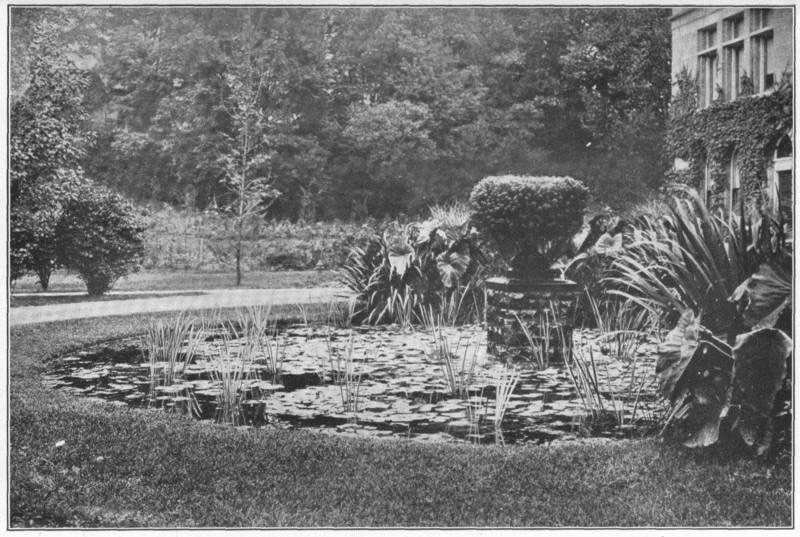
X: A shallow lawn pond, containing water-lilies,
variegated sweet flag, iris, and subtropical bedding at the rear;
fountain covered with parrot’s feather (Myriophyllum
proserpinacoides).
Usually the ponds or tanks are not cement lined. In some soils a simple
excavation will hold water, but it is usually necessary to give the
tank some kind of lining. Clay is often used. The bottom and sides of
the tank are pounded firm, and then covered with 3 to 6 in. of clay,
which has been kneaded in the hands, or pounded and worked in a box.
Handfuls or shovelfuls of the material are thrown forcibly upon the
earth, the operator being careful not to walk upon the work. The clay is
smoothed by means of a spade or maul, and it is then sanded.
The water for the lily pond may be derived from a brook, spring, well,
or a city water supply. The plants will thrive in any water that is used
for domestic purposes. It is important that the water does not become
stagnant and a breeding place for mosquitoes. There should be an outlet
in the nature of a stand-pipe, that will control the depth of water. It
is not necessary that the water run through the pond or tank rapidly,
but only that a slow change take place. Sometimes the water is allowed
to enter through a fountain-vase, in which water plants (such as
parrot’s feather) may be grown (Plate X).
In all ponds, a foot or 15 in. is sufficient depth of water to stand
above the crowns of the plants; and the greatest depth of water should
not be more than 3 ft. for all kinds of water-lilies. Half this depth is
often sufficient. The soil should be 1 to 2 ft. deep, and very rich. Old
cow manure may be mixed with rich loam. For the nympheas or
water-lilies, 9 to 12 in. of soil is sufficient. Most of the foreign
water-lilies are not hardy, but some of them may be grown with ease if
the pond is covered in winter.
Roots of hardy water-lilies may be planted as soon as the pond is clear
of frost, but the tender kinds (which are also to be taken up in the
fall) should not be planted till it is time to plant out geraniums. Sink
the roots into the mud so that they are just buried, and weight them
down with a stone or clod. The nelumbium, or so-called Egyptian lotus,
should not be transplanted till growth begins to show in the roots in
the spring. The roots are cleaned of decayed parts and covered with
about 3 in. of soil. A foot or so of water is sufficient for lotus
ponds. The roots of Egyptian lotus must not freeze. The roots of all
water-lily-like plants should be frequently divided and renewed.
With hardy aquatics, the water and roots are allowed to remain naturally
over winter. In very cold climates, the pond is protected by throwing
boards over it and covering with hay, straw, or evergreen boughs. It is
well to supply an additional depth of water as a further protection.
As a landscape feature, the pond should have a background, or setting,
and its edges should be relieved, at least on sides and back, by
plantings of bog plants. In permanent ponds of large size, plantings of
willows, osiers, and other shrubbery may set off the area to advantage.
Many of the wild marsh and pond plants are excellent for marginal
plantings, as sedges, cat-tail, sweet-flag (there is a striped-leaved
form), and some of the marsh grasses. Japanese iris makes an excellent
effect in such places. For summer planting in or near ponds, caladium,
umbrella-plant, and papyrus are good.
If there is a stream, “branch,” or “run” through the
place, it may often be made one of the most attractive parts of the premises by
colonizing bog plants along it.
Rockeries, and alpine plants.
A rockery is a part of the place in which plants are grown in pockets
between rocks. It is a flower-garden conception rather than a landscape
feature, and therefore should be at one side or in the rear of the
premises. Primarily, the object of using the rocks is to provide better
conditions in which certain plants may grow; sometimes the rocks are
employed to hold a springy or sloughing bank and the plants are used to
cover the rocks; now and then a person wants a rock or a pile of stones
in his yard, as another person would want a piece of statuary or a
sheared evergreen. Sometimes the rocks are natural to the place and
cannot well be removed; in this case the planning and planting should be
such as to make them part of the picture.
The real rock-garden, however, is a place in which to grow plants. The
rocks are secondary. The rocks should not appear to be placed for
display. If one is making a collection of rocks, he is pursuing geology
rather than gardening.
Yet many of the so-called rock-gardens are mere heaps of stones, placed
where it seems to be convenient to pile stones rather than where the
stones may improve conditions for the growing of plants.
The plants that will naturally grow in rock pockets are those requiring
a continuous supply of root moisture and a cool atmosphere. To place a
rockery on a sand bank in the burning sun is therefore entirely out of
character.
Rock-garden plants are those of cool woods, of bogs, and particularly of
high mountains and alpine regions. It is generally understood that a
rock-garden is an alpine-garden, although this is not necessarily so.
In this country alpine-gardening is little known, largely because of our
hot dry summers and falls. But if one has a rather cool exposure and an
unfailing water supply, he may succeed fairly well with many of the
alpines, or at least with the semi-alpines.
Most of the alpines are low and often tufted plants, and bloom in a
spring temperature. In our long hot seasons, the alpine-garden may be
expected to be dormant during much of the summer, unless other
rock-loving plants are colonized in it. Alpine plants are of many kinds.
They are specially to be found in the genera arenaria, silene,
diapensia, primula, saxifraga, arabis, aubrietia, veronica, campanula,
gentiana. They comprise a good number of ferns and many little heaths.
A good rock-garden of any kind does not have the stones piled merely on
the surface; they are sunken well into the ground and are so placed that
there are deep chambers or channels that hold moisture and into which
roots may penetrate. The pockets are filled with good fibrous
moisture-holding earth, and often a little sphagnum or other moss is
added. It must then be arranged so that the pockets never dry out.
Rock-gardens are usually failures, because they violate these very
simple elementary principles; but even when the soil conditions and
moisture conditions are good, the habits of the rock plants must be
learned, and this requires thoughtful experience. Rock-gardens cannot be
generally recommended.
1. PLANTS FOR CARPET-BEDS
(By Ernest Walker)
The beauty of the carpet-bed lies largely in its unity, sharp contrast
and harmony of color, elegance—often simplicity—of design, nicety of
execution, and the continued distinctness of outline due to scrupulous
care. A generous allowance of green-sward on all sides contributes
greatly to the general effect,—in fact it is indispensable.
Whatever place is chosen for the bed, it should be in a sunny exposure.
This, nor any kind of bed, should not be planted near large trees, as
their greedy roots will rob the soil not only of its food, but of
moisture. The shade also will be a menace. As the plants stand so thick,
the soil should be well enriched, and spaded at least a foot deep. In
planting, a space of at least six inches must be left between the outer
row of plants and the edge of the grass. The very style of the bed
requires that lines be straight, the curves uniform, and that they be
kept so by the frequent and careful use of the shears. During dry
periods watering will be necessary. The beds, however, should not be
watered in the hot sunshine. Foliage plants are most in use, and are the
ones which will prove the most satisfactory in the hands of the
inexperienced, as they submit to severe clipping and are thus more
easily managed.
The following list will be helpful to the beginner. It embraces a
number of the plants in common use for carpet-bedding, although not all
of them. The usual heights are given in inches. This, of course, in
different soils and under different treatment is more or less a variable
quantity. The figures in parentheses suggest in inches suitable
distances for planting in the row when immediate effects are expected. A
verbena in rich soil will in time cover a circle three feet or more in
diameter; other plants mentioned spread considerably; but when used in
the carpet-bed, they must be planted close. One cannot wait for them to
grow. The aim is to cover the ground at once. Although planted thick in
the row, it will be desirable to leave more room between the rows in
case of spreading plants like the verbena. Most of them, however, need
little if any more space between the rows than is indicated by the
figures given. In the list those plants that bear free clipping are
marked with *:
Lists for carpet-beds.
The figure immediately following the name of plant indicates its
height, the figures in parentheses the distance for planting,
in inches.
1. LOW-GROWING PLANTS
A. FOLIAGE PLANTS.
Crimson.—*Alternanthera amœna spectabilis, 6 (4-6).
Alternanthera paronychioides major, 5 (3-6).
Alternanthera versicolor, 5 (3-6).
Yellow.—Alternanthera aurea nana, 6 (4-6).
Gray, or whitish.—Echeveria secunda, glauca, 1-1/2 (3-4).
Echeveria metallica, 9 (6-8).
Cineraria maritima, 15 (9-12).
Sempervivum Californicum, 1-1/2 (3-4).
Thymus argenteus, 6 (4-6).
Bronze brown.—Oxalis tropæoloides, 3 (3-4).
Variegated
(white and green).—Geranium Mme. Salleroi, 6 (6-8).
*Sweet alyssum, variegated, 6 (6-9).
B. FLOWERING PLANTS.
Scarlet.—Phlox Drummondii, Dwarf, 6 (4-6).
Cuphea platycentra, Cigar Plant, 6 (4-6).
White.—Sweet alyssum, Little Gem, 4 (4-6).
Sweet alyssum, common, 6 (6-8).
Phlox Drummondii, Dwarf, 6 (4-6).
Blue.—Lobelia, Crystal Palace, 6 (4-6).
Ageratum, Dwarf Blue, 6 (6-8).
2. PLANTS OF TALLER GROWTH
A. FOLIAGE PLANTS.
Crimson.—*Coleus Verschaffeltii, 24 (9-12).
*Achyranthes Lindeni, 18 (8-12).
*Achyranthes Gilsoni, 12 (8-12).
*Achyranthes Verschaffeltii, 12 (8-12).
*Acalypha tricolor, 12-18 (12).
Yellow.—*Coleus, Golden Bedder, 24 (9-12).
*Achyranthes, aurea reticulata, 12 (8-12).
Golden feverfew (Pyrethrum parthenifolium aureum), (6-8).
Bronze geranium, 12 (9).
Silvery white.—Dusty miller (Centaurea gymnocarpa), 12 (8-12).
*Santolina Chamæcyparissus incana, 6-12 (6-8).
Geranium, Mountain of Snow, 12 (6-9).
Variegated
(white and green).—*Stevia serrata var., 12-18 (8-12).
Phalaris arundinaeca var., (grass), 24 (4-8).
Cyperus alternifolius var., 24-30 (8-12).
Bronze.—*Acalypha marginata, 24 (12).
B. FLOWERING PLANTS.
Scarlet.—Salvia splendens, 36 (12-18).
Geraniums, 24 (12).
Cuphea tricolor (C. Llavae), 18 (8-12).
Dwarf nasturtium (Tropaeolum), 12-18 (12-18).
Begonia, Vernon, 12 (6-8).
Verbenas, 12 (6-12).
Phlox Drummondii, Dwarf, 6 (4-6).
White.—Salvia splendens, White-flowered, 36 (12-18).
Geraniums, 18-24 (12).
Lantana, Innocence, 18-24 (8-12).
Lantana, Queen Victoria, 24 (8-12).
Verbena, Snow Queen, 12 (6-12).
Ageratum, White, 9 (6-9).
Phlox Drummondii, Dwarf, 6 (4-6).
Pink.—Petunia, Countess of Ellesmere, 18 (8-12).
Lantana, 24 (8-12).
Verbena, Beauty of Oxford, 6 (8-12).
Phlox Drummondii, Dwarf, 6 (4-6).
Yellow.—Dwarf nasturtium, 12 (12-18).
Anthemis coronaria fl. pl., 12 (6-8).
Blue.—Ageratum Mexicanum, 12 (6-8).
Verbenas, 6 (6-12).
Heliotrope, Queen of Violets, 18 (12-18).
In Fig. 240 are shown a few designs suitable for carpet-beds. They are
intended merely to be suggestive, not to be copied precisely. The simple
forms and component parts of the more elaborate beds may be arranged
into other designs. Likewise the arrangement of plants, which will be
mentioned as suitable for making a given pattern, is only one of many
possible combinations. The idea is merely to bring out the design
distinctly. To accomplish this it is only necessary to use plants of
contrasting color or growth. To illustrate how varied are the
arrangements that may be used, and how easily different effects are
produced with a single design, several different combinations of color
for the bed No. 1 will be mentioned:
![[Illustration: Fig. 240. Designs for carpet-beds.]](https://openoldbooks.sgp1.digitaloceanspaces.com/books/manual-of-gardening/images/fig240.png)
No. 1.—Arrangement A: Outside, Alternanthera amœna spectabilis;
inside, Stevia serrata variegata. B: lobelia, Crystal Palace; Mme.
Salleroi geranium. C: lobelia, Crystal Palace; scarlet dwarf phlox. D:
sweet alyssum; petunia, Countess of Ellesmere. E: coleus, Golden Bedder;
Coleus Verschaffeltii. F: Achyranthes Lindeni; yellow dwarf nasturtium.
No. 2.—Outside, red alternanthera; middle, dusty miller; center, pink
geranium.
No. 3.—Outside, Alternanthera aurea nana; middle, Alternanthera amœna
spectabilis; center, Anthemis coronaria.
No. 4, 5, 6, 7, 8, 12 may each be filled with a single color, or given a
border of suitable plants if the planter so chooses.
No. 9.—Ground, Alternanthera aurea nana; center, Acalypha tricolor;
black dots, scarlet geranium.
No. 10.—Ground of Centaurea gymnocarpa; circle, Achyranthes Lindeni;
cross, Golden coleus.
No. 11.—Border, Oxalis tropæoloides; center, blue heliotrope, blue
ageratum, or Acalypha marginata; cross about the center, Thymus
argenteus, or centaurea; scallop outside the cross, blue lobelia;
corners, inside border, santolina.
Designs 13 and 14 are, in character, somewhat in the style of a
parterre; but instead of the intervening spaces in the bed being
ordinary walks they are of grass. Such beds are of a useful type,
because they may be made large and yet be executed with a comparatively
small number of plants. They are especially suitable for the center of
an open plot of lawn with definite formal boundaries on all sides, such
as walks or drives. Whether they are to be composed of tall-growing or
of low-growing plants will depend upon the distance they are to be from
the observer. For a moderate-sized plot the following plants might
be used:—
No. 13.—Border, red alternanthera; second row, dwarf orange or yellow
nasturtium; third row, Achyranthes Gilsoni, or Acalypha tricolor;
central square, scarlet geraniums, with a border of Centaurea
gymnocarpa; intervening spaces, grass. Instead of the square of
geraniums, a vase might be substituted, or a clump of Salvia splendens.
No. 14.—Composite beds like this and the former are always suggestive.
They contain various features which may readily be recombined into other
patterns. Sometimes it may be convenient to use only portions of the
design. The reader should feel that no arrangement is arbitrary, but
merely a suggestion that he may use with the utmost freedom, only
keeping harmony in view. For No. 14, the following may be an acceptable
planting arrangement: Border, Mme. Salleroi geranium; small dots, dwarf
scarlet tropeolum; diamonds, blue lobelia; crescents, Stevia serrata
variegata; inner border, crimson achyranthes or coleus; loops,
Centaurea gymnocarpa; wedge-shaped portions, scarlet geranium.
No. 15.—Suitable for a corner. Border, red alternanthera; second row,
Alternanthera aurea nana; third row, red alternanthera; center,
Echeveria Californica.
![[Illustration: Fig. 241. Carpet-bed for a bay or recession in the border planting.]](https://openoldbooks.sgp1.digitaloceanspaces.com/books/manual-of-gardening/images/fig241.png)
No. 16—Border, crimson alternanthera (another border of yellow
alternanthera might be placed inside of this); ground, Echeveria secunda
glauca; inner border, Oxalis tropæoloides; center, Alternanthera aurea
nana. Or, inner border, Echeveria Californica; center, crimson
alternanthera.
![[Illustration: Fig. 242. Another circular carpet-bed.]](https://openoldbooks.sgp1.digitaloceanspaces.com/books/manual-of-gardening/images/fig242.png)
No. 17.—Another bed intended to fill an angle. Its curved side will
also fit it for use with a circular design. Border, dwarf blue
ageratum; circle, blue lobelia; ground (3 parts), crimson alternanthera.
Other carpet or mosaic beds (after Long), with the plants indicated, are
shown in Figs. 241, 242.
2. THE ANNUAL PLANTS
The annual flowers of the seedsmen are those that give their best bloom
in the very year in which the seeds are sown. True annuals are those
plants that complete their entire life-cycle in one season. Some of the
so-called annual flowers will continue to bloom the second and third
years, but the bloom is so poor and sparse after the first season that
it does not pay to keep them. Some perennials may be treated as annuals
by starting the seeds early; Chinese pink, pansy and snapdragon
are examples.
The regular biennials may be treated practically as annuals; that is,
seeds may be sown every year, and after the first year, therefore, a
seasonal succession of bloom may be had. Of such are adlumia, Canterbury
bell, lunaria, ipomopsis, Œnothera Lamarckiana; and foxglove, valerian,
and some other perennials would better be treated as biennials.
Most annuals will bloom in central New York if the seeds are sown in the
open ground when the weather becomes thoroughly settled. But there are
some kinds, as the late cosmos and moon-flowers, for which the northern
season is commonly too short to give good bloom unless they are started
very early indoors.
If flowers of any annual are wanted extra early, the seeds should be
started under cover. A greenhouse is not necessary for this purpose,
although best results are to be expected with such a building. The seed
may be sown in boxes, and these boxes then placed in a sheltered
position on the warm side of a building. At night they may be covered
with boards or matting. In very cold “spells” the boxes should be
brought inside. In this simple way seeds may often be started one to
three weeks ahead of the time when they can be sown in the open garden.
Moreover, the plants are likely to receive better care in these boxes,
and therefore to grow more rapidly. Of course, if still earlier results
are desired, the seed should be sown in the kitchen, hotbed, coldframe,
or in a greenhouse. In starting plants ahead of the season, be careful
not to use too deep boxes. The gardener’s “flat” may be taken as a
suggestion. Three inches of earth is sufficient, and in some cases (as
when the plants are started late) half this depth is enough.
The difficulty with early sown seedlings is “drawing up,” and weakness
from crowding and want of light. This is most liable to occur with
window-grown plants. Vigorous June-sown plants are better than such
weaklings. It must be remembered that very early bloom usually means the
shortening of the season at the other end; this may be remedied to some
extent by making sowings at different times.
The “hardy” annuals are such as develop readily without the aid of
artificial heat. They are commonly sown in May or earlier, directly in
the open ground where they are to grow. Florists often sow certain kinds
in the fall, and winter the young plants in coldframes. They may also be
wintered under a covering of leaves or evergreen boughs. Some of the
hardy annuals (as sweet pea) withstand considerable frost. The
“half-hardy” and “tender” annuals are alike in that they require more
warmth for their germination and growth. The tender kinds are very
quickly sensitive to frost. Both these, like the hardy kinds, may be
sown in the open ground, but not until the weather has become settled
and warm, which for the tender kinds will not commonly be before the
first of June; but the tender kinds, at least, are preferably started in
the house and transplanted to their outdoor beds. Of course, these terms
are wholly relative. What may be a tender annual in Massachusetts may be
a hardy annual or even a perennial in Louisiana.
These terms as ordinarily used in this country refer to the northern
states, or not farther south than middle Atlantic states.
Some familiar examples of hardy annuals are sweet alyssum, ageratum,
calendula, calliopsis, candytuft, Centaurea Cyanus, clarkia, larkspur,
gilia, California poppy, morning-glory, marigold, mignonette, nemophila,
pansy, phlox, pinks, poppies, portulaca, zinnia, sweet pea, scabiosa.
Examples of half-hardy annuals are: China aster, alonsoa, balsam,
petunia, ricinus, stocks, balloon-vine, martynia, salpiglossis,
thunbergia, nasturtium, verbena.
Examples of tender annuals: Amarantus, celosia or coxcomb, cosmos,
cotton, Lobelia Erinus, cobea, gourds, ice-plant, sensitive-plant,
solanums, torenia, and such things as dahlias, caladiums, and acalypha
used for bedding and subtropical effects.
Some annuals do not bear transplanting well; as poppies, bartonia,
Venus’ looking-glass, the dwarf convolvulus, lupinus, and malope. It is
best, therefore, to sow them where they are to grow.
Some kinds (as poppies) do not bloom all summer, more especially not if
allowed to produce seed. Of such kinds a second or third sowing at
intervals will provide a succession. Preventing the formation of seeds
prolongs their life and flowering period.
A few of the annuals thrive in partial shade or where they receive
sunshine for half the day; but most of them prefer a sunny situation.
Any good garden soil is suitable for annuals. If not naturally fertile
and friable, it should be made so by the application of well-rotted
stable-manure or humus. The spading should be at least one foot deep.
The upper six inches is then to be given a second turning to pulverize
and mix it. After making the surface fine and smooth the soil should be
pressed down with a board. The seed may now be sprinkled on the soil in
lines or concentric circles, according to the method desired. After
covering the seed, the soil should be again pressed down with a board.
This promotes capillarity, by which the surface of the soil is better
supplied with moisture from below. Always mark with a label the kind and
position of all seed sown.
If the flowers are to be grown about the edges of the lawn, make sure
that the grass roots do not run underneath them and rob them of food and
moisture. It is well to run a sharp spade deep into the ground about the
edges of the bed every two or three weeks for the purpose of cutting off
any grass roots that may have run into the bed. If beds are made in the
turf, see that they are 3 ft. or more wide, so that the grass roots will
not undermine them. Against the shrub borders, this precaution may not
be necessary. In fact, it is desirable that the flowers fill all the
space between the overhanging branches and the sod.
It is surprising how few of the uncommon or little known annuals really
have great merit for general purposes. There is nothing yet to take the
place of the old-time groups, such as amaranths, zinnias, calendulas,
daturas, balsams, annual pinks, candytufts, bachelor’s buttons,
wallflowers, larkspurs, petunias, gaillardias, snapdragons, coxcombs,
lobelias, coreopsis or calliopsis, California poppies, four-o’clocks,
sweet sultans, phloxes, mignonettes, scabiosas, nasturtiums, marigolds,
China asters, salpiglossis, nicotianas, pansies, portulacas, castor
beans, poppies, sunflowers, verbenas, stocks, alyssums, and such good
old running plants as scarlet runners, sweet peas, convolvuluses,
ipomeas, tall nasturtiums, balloon vines, cobeas. Of the annual vines of
recent introduction, the Japanese hop has at once taken a prominent
place for the covering of fences and arbors, although it has no floral
beauty to recommend it.
For bold mass-displays of color in the rear parts of the grounds or
along the borders, some of the coarser species are desirable. Good
plants for such use are: sunflower and castor bean for the back rows;
zinnias for bright effects in the scarlets and lilacs; African marigolds
for brilliant yellows; nicotianas for whites. Unfortunately, we have no
robust-growing annuals with good blues. Some of the larkspurs and the
browallias are perhaps the nearest approach to them.
For lower-growing and less gross mass-displays, the following are good:
California poppies for oranges and yellows; sweet sultans for purples,
whites, and pale yellows; petunias for purples, violets, and whites;
larkspurs for blues and violets; bachelor’s buttons (or cornflowers) for
blues; calliopsis and coreopsis and calendulas for yellows; gaillardias
for red-yellows and orange-reds; China asters for many colors.
For still less robustness, good mass-displays can be made with the
following: alyssums and candytufts for whites; phloxes for whites and
various pinks and reds; lobelias and browallias for blues; pinks for
whites and various shades of pink; stocks for whites and reds;
wallflowers for brown-yellows; verbenas for many colors.
A garden of pleasant annual flowers is not complete that does not
contain some of the “everlastings” or immortelles. These “paper flowers”
are always interesting to children. They are not so desirable for the
making of “dry bouquets” as for their value as a part of a garden. The
colors are bright, the blooms hold long on the plant, and most of the
kinds are very easy to grow. My favorite groups are the different kinds
of xeranthemums and helichrysums. The globe amaranths, with clover-like
heads (sometimes known as bachelor’s buttons), are good old favorites.
Rhodanthes and acrocliniums are also good and reliable.
The ornamental grasses should not be overlooked. They add a note to the
flower-garden and to bouquets that is distinct and can be secured by no
other plants. They are easily grown. Some of the good annual grasses are
Agrostis nebulosa, the brizas, Bromus brizæformis, the species of
eragrostis and pennisetums, and Coix Lachryma as a curiosity. Such
good lawn grasses as arundo, pampas-grass, eulalias, and erianthus are
perennials and are therefore not included in this discussion.
Some of the most reliable and easily grown annuals are given in the
following lists (under the common trade names).
List of annuals by color of flowers.
White Flowers
Ageratum Mexicanum album.
Alyssum, common sweet; compacta.
Centranthus macrosiphon albus.
China asters.
Convolvulus major.
Dianthus, Double White Margaret.
Iberis amara; coronaria, White Rocket.
Ipomœa hederacea.
Lavatera alba.
Malope grandiflora alba.
Matthiola (Stocks), Cut and Come Again; Dresden Perpetual; Giant Perfection; White Pearl.
Mirabilis longiflora alba.
Nigella.
Phlox, Dwarf Snowball; Leopoldii.
Poppies, Flag of Truce; Shirley; The Mikado.
Zinnia.
Yellow and Orange Flowers
Cacalia lutea.
Calendula officinalis, common; Meteor; sulphurea; suffruticosa.
Calliopsis bicolor marmorata; cardaminefolia; elegans picta.
Cosmidium Burridgeanum.
Erysimum Perofskianum.
Eschscholtzia Californica.
Hibiscus Africanus; Golden Bowl.
Ipomœa coccinea lutea.
Loasa tricolor.
Tagetes, various kinds.
Thunbergia alata Fryeri; aurantiaca.
Tropaeolum, Dwarf, Lady Bird; Tall, Schulzi.
Zinnia.
Blue and Purple Flowers
Ageratum Mexicanum; Mexicanum, Dwarf.
Asperula setosa azurea.
Brachycome iberidifolia.
Browallia Czerniakowski; elata.
Centaurea Cyanus, Victoria Dwarf Compact; Cyanus minor.
China asters of several varieties.
Convolvulus minor; minor unicaulis.
Gilia achilleaefolia; capitata.
Iberis umbellata; umbellata lilacina.
Kaulfussia amelloides; atroviolacea.
Lobelia Erinus; Erinus, Elegant.
Nigella.
Phlox variabilis atropurpurea.
Salvia farinacea.
Specularia.
Verbena, Black-blue; caerulea; Golden-leaved.
Whitlavia gloxinioides.
Red and Rose-red Flowers
Abromia umbellata.
Alonsoa grandiflora.
Cacalia, Scarlet.
Clarkia elegans rosea.
Convolvulus tricolor roseus.
Dianthus, Half Dwarf Early Margaret; Dwarf Perpetual; Chinensis.
Gaillardia picta.
Ipomœa coccinea; volubilis.
Matthiola annuus; Blood-red Ten Weeks; grandiflora, Dwarf.
Papaver (Poppy) cardinale; Mephisto.
Phaseolus multiflorus.
Phlox, Large-flowering Dwarf; Dwarf Fireball; Black Warrior.
Salvia coccinea.
Saponaria.
Tropaeolum, Dwarf, Tom Thumb.
Verbena hybrida, Scarlet Defiance.
Zinnia.
Useful annuals for edgings of beds and, walks, and for ribbon-beds.
Ageraturn, blue and white.
Alyssum, sweet.
Brachycome.
Calandrinia.
Clarkia.
Collinsias.
Dianthuses or pinks.
Gilia.
Gypsophila muralis.
Iberis or candytufts.
Leptosiphons.
Lobelia Erinus.
Nemophilas.
Nigellas.
Portulaca or rose moss (Fig. 243).
Saponaria Calabrica.
Specularia.
Torenia.
Whitlavia.
Annuals that continue to bloom after frost.
This list is compiled from Bulletin 161, Cornell Experiment Station.
Several hundred kinds of annuals were grown at this station (Ithaca,
N.Y.) in 1897 and 1898. The notes are given in the original trade names
under which the seedsmen supplied the stock.
![[Illustration: Figure 243. Portulaca, or rose moss.]](https://openoldbooks.sgp1.digitaloceanspaces.com/books/manual-of-gardening/images/fig243.png)
Abronia umbellata.
Adonis aestivalis; autumnale.
Argemone grandiflora.
Calendulas.
Callirrhoë.
Carduus benedictus.
Centaurea Cyanus.
Centauridium.
Centranthus macro-
Cerinthe retorta. {siphon.
Cheiranthus Cheiri.
Chrysanthemums.
Convolvulus minor; tricolor.
Dianthus of various kinds.
Elsholtzia cristata.
Erysimum Perofskianum; Arkansanum.
Eschscholtzias, in several varieties (Fig. 249).
Gaillardia picta.
Gilia achilleaefolia; capitata; laciniata; tricolor.
Iberis affinis.
Lavatera alba.
Matthiolas or stocks.
Œnothera rosea; Lamarckiana;
Phlox Drummondii. {Drummondii.
Podolepis affinis; chrysantha.
Salvia coccinea; farinacea; Horminum.
Verbenas.
Vicia Gerardi.
Virginian stocks.
Viscaria elegans; oculata; Cœli-rosa.
List of annuals suitable for bedding (that is, for “mass effects” of
color).
A list of this kind is necessarily both incomplete and imperfect,
because good new varieties are frequently appearing, and the taste of
the gardener must be consulted. Any plants may be used, broadly
speaking, for bedding; but the following list (given in terms of trade
names) suggests some of the best subjects to use when beds of solid,
strong color are desired.
![[Illustration: Fig. 244 Pansies]](https://openoldbooks.sgp1.digitaloceanspaces.com/books/manual-of-gardening/images/fig244.png)
Adonis aestivalis; autumnalis.
Ageratum Mexicanum; Mexicanum, Dwarf.
Bartonia aurea.
Cacalia.
Calendula officinalis, in several forms; pluvialis; Pongei; sulphurea,
fl. pl.; suffruticosa.
Calliopsis bicolor marmorata; cardaminefolia; elegans picta.
Callirrhoë involucrata; pedata; pedata nana.
Centaurea Americana; Cyanus, Victoria Dwarf Compact; Cyanus minor; suaveolens.
China asters.
Chrysanthemum Burridgeanum; carinatum; coronarium; tricolor.
Convolvulus minor; tricolor.
Cosmidium Burridgeanum.
Delphinium, single; double.
Dianthus, Double White Half Dwarf Margaret; Dwarf Perpetual;
Caryophyllus semperflorens; Chinensis, double; dentosus hybridus;
Heddewigii; imperialis; laciniatus, Salmon Queen; plumarius;
superbus, dwarf fl. pl.; picotee.
Elsholtzia cristata.
Eschscholtzia Californica; crocea; Mandarin; tenuifolia (Fig. 249).
Gaillardia picta; picta Lorenziana.
Gilia achilleaefolia; capitata; laciniata; linifolia; nivalis; tricolor.
Godetia Whitneyi; grandiflora maculata; rubicunda splendens.
Hibiscus Africanus; Golden Bowl.
Iberis affinis; amara; coronaria; umbellata.
Impatiens or balsam.
Lavatera alba; trimestris.
Linum grandiflorum.
Madia elegans.
Malope grandiflora.
Matricaria eximia plena.
Matthiola or stock, in many forms; Wallflower-leaved; bicornis.
Nigella, or Love-in-a-mist.
Œnothera Drummondii; Lamarckiana; rosea tetraptera.
Papaver or poppy, of many kinds; cardinale; glaucum; umbrosum.
Petunia, bedding kinds.
Phlox Drummondii, in many varieties.
Portulaca (Fig. 243).
Salvia farinacea; Horminum; splendens.
Schizanthus papilionaceus; pinnatus.
Silene Armeria; pendula.
Tagetes, or marigold, in many forms; erecta; patula; signata.
Tropaeolum, Dwarf.
Verbena auriculaeflora; Italica striata; hybrida; caerulea; Golden-leaved.
Viscaria Cœli-rosa; elegans picta; oculata.
Zinnia, Dwarf; elegans alba; Tom Thumb; Haageana; coccinea plena (Fig. 247).
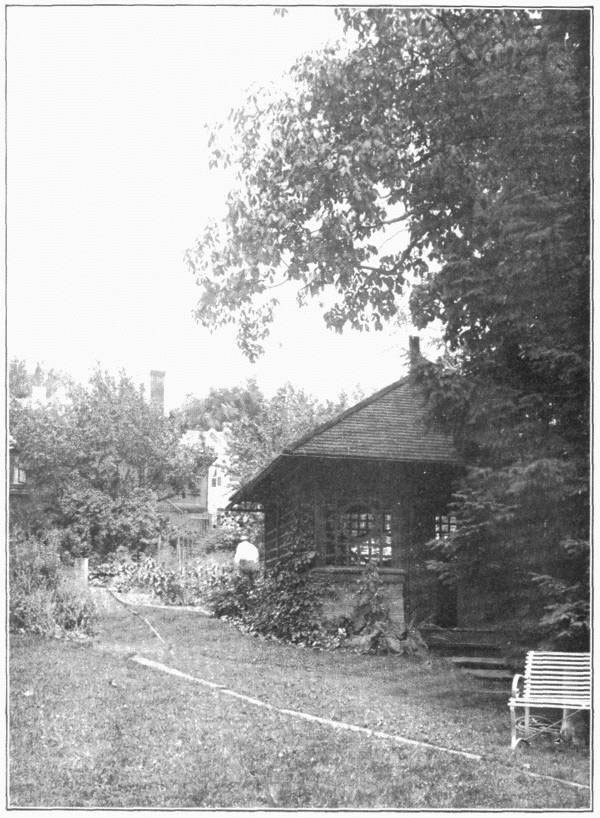
XI. The back yard, with summer house, and gardens
beyond.
List of annuals by height.
It is obviously impossible to make any accurate or definite list of
plants in terms of their height, but the beginner may be aided by
approximate measurements. The following lists are made from Bulletin 161
of the Cornell Experiment Station, which gives tabular data on many
annuals grown at Ithaca, N.Y. Seeds of most of the kinds were sown in
the open, rather late. “The soil varied somewhat, but it was light and
well tilled, and only moderately rich.” Ordinary good care was given the
plants. The average height of the plants of each kind at full growth, as
they stood on the ground, is given in these lists. Of course, these
heights might be less or more with different soils, different
treatments, and different climates; but the figures are fairly
comparable among themselves.
The measurements are based on the stock supplied by leading seedsmen
under the trade names here given. It is not unlikely that some of the
discrepancies were due to mixture of seed or to stock being untrue to
type; some of it may have been due to soil conditions. The same name may
be found in two divisions in some instances, the plants having been
grown from different lots of seeds. The lists will indicate to the
grower what variations he may expect in any large lot of seeds.
Seedsmen’s catalogues should be consulted for what the trade considers
to be the proper and normal heights for the different plants.
Plants 6-8 in. high
Abronia umbellata grandiflora.
Alyssum compactum.
Callirrhoë involucrata.
Godetia, Bijou, Lady Albemarle, and Lady Satin Rose.
Gypsophila muralis.
Kaulfussia amelloides.
Leptosiphon hybridus.
Linaria Maroccana.
Lobelia Erinus and Erinus Elegant.
Nemophila atomaria, discoidalis, insignis, and maculata.
Nolana lanceolata, paradoxa, prostrata, and atriplicifolia.
Podolepis chrysantha and affinis.
Portulaca.
Rhodanthe Manglesii.
Sedum caeruleum.
Silene pendula ruberrima.
Verbena.
Plants 9-12 in. high
Alyssum.
Asperula setosa azurea.
Brachycome iberidifolia.
Calandrinia umbellata elegans.
Callirrhoë pedata nana.
Centaurea Cyanus Victoria Dwarf Compact.
Centranthus macrosiphon nanus.
Collinsia bicolor, candidissima and multicolor marmorata.
Convolvulus minor and tricolor.
Eschscholtzia crocea.
Gamolepis Tagetes.
Gilia laciniata and linifolia.
Godetia Duchess of Albany, Prince of Wales, Fairy Queen, Brilliant,
grandiflora maculata, Whitneyi, Duke of Fife, rubicunda splendens.
Helipterum corymbiflorum.
Iberis affinis.
Kaulfussia amelloides atroviolacea, and a. kermesina.
Leptosiphon androsaceus and densiflorus.
Linaria bipartita splendida.
Matthiola dwarf Forcing Snowflake, Wallflower-leaved.
Mesembryanthemum crystallinum.
Mimulus cupreus.
Nemophila atomaria oculata and marginata.
Nigella.
Nolana atriplicifolia.
Omphalodes linifolia.
Œnothera rosea and tetraptera.
Phlox, Large-flowering Dwarf and Dwarf Snowball.
Rhodanthe maculata.
Saponaria Calabrica.
Schizanthus pinnatus.
Silene Armeria and pendula.
Specularia.
Viscaria oculata cserulea.
Plants 13-17 in. high
Abronia umbellata.
Acroclinium album and roseum.
Brachycome iberidifolia alba.
Browallia Czerniakowski and elata.
Cacalia.
Calandrinia grandiflora.
Calendula sulphurea flore pleno.
Chrysanthemum carinatum.
Collomia coccinea.
Convolvulus minor and minor unicaulis.
Dianthus, the Margaret varieties, Dwarf Perpetual, Caryophyllus
semperflorens, Chinensis, dentosus hybridus, Heddewigii, imperialis,
laciniatus, plumarius, superbus dwarf, picotee, Comtesse de Paris.
Elsholtzia cristata.
Eschscholtzia Californica, Mandarin, maritima and tenuifolia.
Gaillardia picta.
Gilia achillesefolia alba and nivalis.
Helipterum Sanfordii.
Hieracium, Bearded.
Iberis amara, coronaria Empress, coronaria White Rocket,
Sweet-scented, umbellata, umbellata carnea, and umbellata lilacina.
Leptosiphon carmineus.
Lupinus nanus, sulphureus.
Malope grandiflora.
Matthiola, Wallflower-leaved and Virginian stock.
Mirabilis alba.
Nigella.
Œnothera Lamarckiana.
Palafoxia Hookeriana.
Papaver, Shirley and glaucum.
Petunia.
Phlox of many kinds.
Salvia Horminum.
Schizanthus papilionaceus.
Statice Thouini and superba.
Tagetes, Pride of the Garden and Dwarf.
Tropaeolum, many kinds of dwarf.
Venidium calendulaceum.
Verbena of several kinds.
Viscaria Cœli-rosa, elegans picta, oculata, and oculata alba.
Whitlavia gloxinioides.
Plants 18-23 in. high
Adonis aestivalis and autumnalis.
Amarantus atropurpureus.
Calendula officinalis, Meteor, suffruticosa, and pluvialis.
Calliopsis bicolor marmorata.
Callirrhoë pedata.
Centaurea Cyanus minor Blue and suaveolens.
Centranthus macrosiphon.
![[Illustration: Fig. 245. Gaillardia, one of the showy garden annuals.]](https://openoldbooks.sgp1.digitaloceanspaces.com/books/manual-of-gardening/images/fig245.png) Chrysanthemum Burridgeanum, carinatum, tricolor Dunnettii.
Chrysanthemum Burridgeanum, carinatum, tricolor Dunnettii.
Cosmidium Burridgeanum.
Delphinium (annual).
Eutoca Wrangeliana.
Gaillardia picta (Fig. 245), Lorenziana.
Gilia achilleaefolia, a. rosea and tricolor.
Helichrysum atrosanguineum.
Ipomœa coccinea.
Linum grandiflorum.
Loasa tricolor.
Lupinus albus, hirsutus and pubescens.
Malope grandiflora alba.
Matricaria eximia plena.
Matthiola, several kinds.
Œnothera Drummondii.
Papaver Mephisto, cardinale, c. hybridum, c. Danebrog, umbrosum.
Tagetes patula and signata.
Vicia Gerardii.
Whitlavia grandiflora and g. alba.
Xeranthemum album and multiflorum album.
Zinnias of many kinds (all not mentioned in other lists).
Plants 24-30 in. high
Bartonia aurea.
Calendula officinalis fl. pl., Prince of Orange and Pongei.
Calliopsis elegans picta.
Cardiospermum Halicacabum.
Carduus benedictus.
Centaurea Cyanus minor Emperor William.
Cheiranthus Cheiri.
Chrysanthemum tricolor, t. hybridum and coronarium sulphureum fl. pl.
Clarkia elegans rosea.
Datura cornucopia.
Erysimum Arkansanum and Perofskianum.
Eutoca viscida.
Gilia capitata alba.
Helichrysum bracteatum and macranthum.
Hibiscus Africanus.
Impatiens, all varieties.
Lupinus hirsutus pilosus.
Matthiola Blood-red Ten Weeks, Cut and Come Again, grandiflora,
annuus, and others.
Mirabilis Jalapa folio variegata and longiflora alba.
Papaver, American Flag, Mikado and Double.
Perilla laciniata and Nankinensis.
Salvia farinacea.
Tagetes Eldorado, Nugget of Gold, erecta fl. pl.
Xeranthemum annuum and superbissimum fl. pl.
Zinnia elegans alba fl. pl.
![[Illustration: Fig. 246. Wild phlox (_P. maculata_), one of the parents of the perennial garden phloxes.]](https://openoldbooks.sgp1.digitaloceanspaces.com/books/manual-of-gardening/images/fig246.png)
Plants 31-40 in. high
Acroclinium, double rose and white.
Adonis aestivalis.
Ageratum Mexicanum album and blue.
Amarantus bicolor ruber.
Argemone grandiflora.
Centaurea Americana.
Centauridium Drummondii.
Cerinthe retorta. [c. double yellow.
Chrysanthemum coronarium album and Clarkia elegans alba fl. pl.
Cleome spinosa.
Cyclanthera pedata.
Datura fastuosa and New Golden
Euphorbia marginata. [Queen.
Gilia capitata alba.
Helianthus Dwarf double and cucu-
Hibiscus Golden Bowl. [merifolius.
Lavatera trimestris.
Madia elegans.
Martynia craniolaria.
Salvia coccinea.
![[Illustration: Fig. 247. Zinnias. Often known as “youth and old age.”]](https://openoldbooks.sgp1.digitaloceanspaces.com/books/manual-of-gardening/images/fig247.png)
Plants 41 in. and above.
Adonis autumnalis.
Helianthus of several garden kinds (not mentioned elsewhere).
Ricinus, all varieties.
And many climbing vines.
Distances for planting annuals (or plants
treated as annuals).
Only an approximate idea can be given of the distances apart at which
annuals should be planted, for not only does the distance depend on the
fertility of the land (the stronger the soil the greater the distance),
but also on the object the person has in growing the plants, whether to
produce a solid mass effect or to secure strong specimen plants with
large individual bloom. If specimen plants are to be raised, the
distances should be liberal.
The distances here given for some of the commoner annuals may be
considered to represent average or usual spaces that single plants may
occupy under ordinary conditions in flowerbeds, although it would
probably be impossible to find any two gardeners or seedsmen who would
agree on the details. These are suggestions rather than recommendations.
It is always well to set or sow more plants than are wanted, for there
is danger of loss from cut-worms and other causes. The general tendency
is to let the plants stand too close together at maturity. In case of
doubt, place plants described in books and catalogues as very dwarf at
six inches, those as medium-sized at twelve inches, very large growers
at two feet, and thin them out if they seem to demand it as they grow.
The plants in these lists are thrown into four groups (rather than all
placed together with the numbers after them) in order to classify the
subject in the beginner’s mind.
6 to 9 inches apart
Ageratum, very dwarf kinds.
Alyssum.
Asperula setosa.
Cacalia.
Candytuft.
Clarkia, dwarf.
Collinsia.
Gysophila muralis.
Kaulfussia.
Larkspur, dwarf kinds.
Linaria.
Linum grandiflorum
Lobelia Erinus. Mignonette, dwarf kinds.
Pansy.
Phlox, very dwarf kinds.
Pinks, very dwarf kinds.
Rhodanthe.
Schizopetalon.
Silene Armeria.
Snapdragon, dwarf.
Sweet pea.
Torenia.
![[Illustration: Fig. 248. Improved perennial phlox.]](https://openoldbooks.sgp1.digitaloceanspaces.com/books/manual-of-gardening/images/fig248.png)
10 to 15 inches apart
Those marked (ft.) are examples of plants that may usually stand at twelve
inches.
Abronia (ft.).
Acroclinium.
Adlumia.
Adonis autumnalis.
Ageratum, tall kinds.
Alonsoa.
Aster, China, smaller kinds (ft.).
Balsam.
Bartonia.
Browallia.
Calendula.
California poppy (Eschscholtzia).
Calliopsis.
Cardiospermum.
Carnation, flower-garden kinds (ft.).
Celosia, small kinds.
Centaurea Cyanus.
Centauridium (ft.).
Centranthus (ft.).
Clarkia, tall (ft.).
Convolvulus tricolor (ft.).
Gaillardia, except on strong land.
Gilias.
Glaucium.
Godetia (ft.).
Gomphrena.
Gypsophila elegans.
Helichrysum (ft.).
Hunnemannia.
Jacobaea. {kinds.
Larkspur, tall annual
Malope. {varieties.
Marigold, intermediate
Mignonette, tall kinds.
Mesembryanthemum
(ice-plant) (ft.).
Morning-glory.
Nasturtium, dwarf.
Nemophila.
Nigella.
Petunia.
Phlox Drummondii.
Pinks.
Poppies (6 to 18 in., according to variety).
Portulaca (ft.).
Salpiglossis (ft.).
Scabiosa (ft.).
Schizanthus.
Snapdragon, tall kinds.
Statice (ft.).
Stock (ft.).
Tagetes, dwarf French.
Thunbergia (ft.).
Verbena.
Whitlavia (ft.), {(ft.).
Zinnia, very dwarf kinds
![[Illustration: Fig 249. Eschscholtzia, or California poppy. One-half size.]](https://openoldbooks.sgp1.digitaloceanspaces.com/books/manual-of-gardening/images/fig249.png)
18 to 24 inches
Amarantus.
Ammobium.
Argemone.
Aster, China, the big kinds (or rows 2 ft. apart and plants 1 ft. in row).
Callirrhoë.
Canterbury bell (up to 3 ft.).
Celosia, large kinds (up to 30 in.).
Chrysanthemum, annual.
Cosmos, smaller kinds.
Euphorbia marginata.
Four o’clock (up to 30 in.)
Hop, Japanese. (to 30 in.)
Kochia, or summer cypress
Marigold, tall kinds.
Nasturtium, tall, if allowed to
spread on the ground.
Nicotiana (up to 30 in.).
Œnothera, tall kinds.
Salvia coccinea (splendens
grandiflora), about 2 ft.
Zinnia, tall kinds (up to 3 ft).
![[Illustration: Fig. 250. A modern peony.]](https://openoldbooks.sgp1.digitaloceanspaces.com/books/manual-of-gardening/images/fig250.png)
About 3 feet or more
Caladium.
Cosmos, tall kinds (2 to 3 ft.).
Dahlia.
Datura.
Martynia.
Ricinus or castor bean.
Solanums.
Sunflower, tall kinds.
Wigandia.
3. HARDY HERBACEOUS PERENNIALS
There is a rapidly growing appreciation of perennial herbs, not only as
flower-garden and lawn subjects, but as parts of native landscapes.
Every locality yields its wild asters, golden-rods, columbines, iris,
trilliums, lilies, anemones, pentstemons, mints, sunflowers, or other
plants; and many of these also make good subjects for the home grounds.
It is important to remember that some perennial herbs begin to fail
after one to three seasons of full bloom. It is a good plan to have new
plants coming on to take their place; or the old roots may be taken up
in the fall and divided, only the fresh and strong parts being
planted again.
Perennial herbs are propagated in various ways,—by seeds, and by
cuttings of the stems and roots, but mostly by the easy method of
division. On the raising of these plants from seeds, William Falconer
writes as follows in Dreer’s “Garden Book” for 1909:—
“Hardy perennials are easily grown from seed. In many cases they are a
little slower than annuals, but with intelligent care they are
successfully raised, and from seed is an excellent way to get up a big
stock of perennials. Many sorts, if sown in spring, bloom the first year
from seeds as early as annuals; for instance: gaillardia, Iceland
poppies, Chinese larkspur, platycodon, etc. Others do not bloom until
the second year.
“The amateur may have more success and less bother growing perennials
from seed sown in the open ground than from any other way. Prepare a bed
in a nice, warm, sheltered spot in the garden, preferably not very
sunny. Let the surface of the bed be raised four or five inches above
the general level, and the soil be a mellow fine earth on the surface.
Draw shallow rows across the surface of the bed three or four inches
apart, and here sow the seeds, keeping the varieties of one kind or
nature as much together as practicable, covering the seeds thinly; press
the whole surface gently, water moderately, then dust a little fine
loose soil over all. If the weather is sunny or windy, shade with papers
or a few branches, but remove these in the evening. When the seedlings
come up, thin them out to stiffen those that are left, and when they are
two or three inches high, they are fit for transplanting into permanent
quarters. All this should be done in early spring, say March, April, or
May. Again, in July or August perennials are very easily raised out of
doors, and much in the same way as above. Or they may be sown in early
spring indoors, in the window, the hotbed, the coldframe, or the
greenhouse, preferably in boxes or pans, as for growing annuals. Some
gardeners sow seed right in the coldframe. I have tried both ways, and
find the boxes best, as the different varieties of seeds do not come up
at the same time, and you can remove them from the close frame to more
airy quarters as soon as the seed comes up, whereas, if sown in a frame,
you would have to give them all the same treatment. When the seedlings
are large enough, I transplant them into other boxes, and put them into
a shady part of the garden, but not under the shade of trees, as there
they will ‘draw’ too much. About the fifteenth of September plant them
in the garden where they are to bloom, or if the garden is full of
summer-flowering plants, put them in beds in the vegetable garden, to be
planted out in the early spring, and give them a light covering of straw
or manure to keep sudden changes of the weather away from them.”
Hardy perennial herbs may be planted in September and October with
excellent results; also in spring. See that they are protected with
mulch in winter.
Perennial herbs suitable for lawn and
“planting” effects.
Some of the striking plants that are valuable for lawn planting in the
North, chosen chiefly on account of their size, foliage, and habit, are
mentioned in the following brief list. They may or may not be suitable
for flower-gardens. It is impossible to give to this list any degree of
completeness; but the names here printed will be suggestive of the kinds
of things that may be used. The * denotes native plants.
Yucca, Yucca filamentosa.*
Funkia, Funkia, of several species.
Peltate saxifrage, Saxifraga peltata.*
Rose mallow, Hibiscus Moscheutos.*
Elecampane, Inula Helenium (Fig. 251).
Wild sunflowers, Helianthus* of different species, especially H.
orygalis, H. giganteus, H. grosse-serratus, H. strumosus.
![[Illustration: Fig. 251. Elecampane. Naturalized in old fields and along roadsides.]](https://openoldbooks.sgp1.digitaloceanspaces.com/books/manual-of-gardening/images/fig251.png)
Compass-plants, Silphium* of several species, especially S.
terebinthinaceum, S. laciniatum, S. perfoliatum.
Sacaline, Polygonum Sachalinense.
Japanese knotweed, Polygonum cuspidatum.
Bocconia, Bocconia cordata.
Wild wormwood, Artemisia Stelleriana* and others.
Butterfly-weed, Asclepias tuberosa.*
Wild asters, Aster* of many species, especially A. Novæ-Anglæ
(best), A. laevis, A. multiflorus, A. spectabilis.
Golden-rods, Solidago* of various species, especially S. speciosa,
S. nemoralis, S. juncea, S. gigantea.
Loose-strife, Lythrum Salicaria.
Flags, Iris of many species, some native.
Japanese wind-flower, Anemone Japonica.
Goat’s beard, Aruncus sylvester (Spiræa Aruncus).*
Baptisia, Baptisia tinctoria.*
Thermopsis, Thermopsis mollis.*
Wild senna, Cassia Marilandica.*
Wild trefoil, Desmodium Canadense* and others.
Ribbon grass, Phalaris arundinacea* var. picta.
Zebra grass, Eulalia (or Miscanthus) species, and varieties.
Wild panic grass, Panicum virgatum.*
Bambusas (and related things) of several sorts.
Ravenna grass, Erianthus Ravennæ.
Arundo, Arundo Donax, and var. variegata.
Reed, Phragmites communis.*
This and the remaining plants of the list should be planted in the edges
of water or in bogs (the list might be greatly extended).
Wild rice, Zizania aquatica.*
Cat-tail, Typha angustifolia* and T. latifolia.*
Lizard’s-tail, Saururus cernuus.*
Peltandra, Peltandra undulata.*
Orontium, Orontium aquaticum.*
Native calla, Calla palustris.*
A brief seasonal flower-garden or border list of
herbaceous perennials.
To facilitate making a selection of perennial herbs for bloom, the
plants in the following list are arranged according to their flowering
season, beginning with the earliest. The name of the month indicates
when they usually begin to bloom. It should be understood that the
blooming season of plants is not a fixed period, but varies more or
less with localities and seasons. These dates are applicable to most of
the middle and northern states. Natives to North America are marked with
an asterisk *. This list is by Ernest Walker.
MARCH
Blue Wind-flower, Anemone blanda. 6 in. March-May. Sky-blue, star-like
flowers. Foliage deeply cut. For border and rockwork.
Bloodroot, Sanguinaria Canadensis.* 6 in. March-April. Pure white.
Glaucous foliage. Partial shade. Border or rock-work.
APRIL
Mountain Rock-cress, Arabis albida. 6 in. April-June. Flowers pure
white; close heads in profusion. Fragrant. For dry places and rock-work.
Purple Rock-cress, Aubrietia deltoidea. 6 in. April-June. Small purple
flowers in great profusion.
Daisy, Bellis perennis, 4-6 in. April-July. Flowers white, pink, or
red; single or double. The double varieties are the more desirable.
Cover the plants in winter with leaves. May be raised from seed,
like pansies.
Spring Beauty, Claytonia Virginica.* 6 in. April-May. Clusters of
light pink flowers. Partial shade. From six to a dozen should be
set together.
Shooting Star, Dodecatheon Meadia.* 1 ft. April-May. Reddish purple
flowers, orange-yellow eye, in clusters. Cool, shady location. Plant
several in a place.
Dog’s-bane, Doronicum plantagineum varexcelsum. 20 in. April-June.
Large, showy flowers; orange-yellow. Bushy plants.
Liver-leaf, Hepatica acutiloba* and triloba.* 6 in. April-May.
Flowers small but numerous, varying white and pink. Partial shade.
Hardy Candytuft, Iberis sempervirens. 10 in. April-May. Small white
flowers in clusters; profuse. Large, spreading, evergreen tufts.
Alpine Lamp-flower, Lychnis alpina.* 6 in. April-May. Flowers
star-like, in showy heads; pink. For border and rockery.
Early Forget-me-not, Myosotis dissitiflora. 6 in. April-June. Small
clusters of deep sky-blue flowers. Tufted habit.
![[Illustration: Fig. 252. The wild Trillium grandiflorum.]](https://openoldbooks.sgp1.digitaloceanspaces.com/books/manual-of-gardening/images/fig252.png)
Everblooming F., M. palustris var. semperflorens. 10 in. Light blue;
spreading habit.
Blue-bells, Mertensia Virginica.* 1 ft. April-May. Flowers blue,
changing to pink; pendent; tubular; not showy, but beautiful. Rich
soil. Partial shade.
Tree Peony, Pæonia Moutan. (See May, Pæonia.)
Moss Pink, Phlox subulata.* 6 in. April-June. Numerous deep pink,
small flowers; creeping habit; evergreen. Suitable for dry places as a
covering plant.
Trilliums.* Of several species; always attractive and useful in the
border (Fig. 252). They are common in rich woods and copses. Dig the
tubers in late summer and plant them directly in the border. The large
ones will bloom the following spring. The same may be said of the
erythronium, or dog’s-tooth violet or adder’s tongue, and of very many
other early wild flowers.
MAY
Ajuga reptans. 6 in. May-June. Spikes of purple flowers. Grows well in
shady places; spreading. A good cover plant.
Madwort, Alyssum saxatile var. compactum. 1 ft. May-June. Flowers
fragrant, in clusters, clear golden-yellow. Foliage silvery.
Well-drained soil. One of the best yellow flowers.
Columbine, Aquilegia glandulosa and others (Fig. 253). 1 ft. May-June.
Deep blue sepals; white petals. Aquilegias are old favorites. (See
June.) The wild A. Canadensis* is desirable.
Lily-of-the-Valley, Convallaria majalis.* 8 in. May-June. Racemes of
small white bells; fragrant. Well known. Partial shade. (See
Chap. VIII.)
Fumitory, Corydalis nobilis. 1 ft. May-June. Large clusters of fine
yellow flowers. Bushy, upright habit. Does well in partial shade.
Bleeding-Heart, Dicentra spectabilis. 2-1/2 ft. May-June. Well known.
Racemes of heart-shaped, deep pink and white flowers. Will bear
partial shade.
Crested Iris, Iris cristata.* 6 in. May-June. Flowers blue, fringed
with yellow. Leaves sword-shaped.
German Iris, I. Germanica. 12-15 in. May-June. Numerous varieties and
colors. Large flowers, 3-4 on a stem. Broad, glaucous,
sword-shaped leaves.
Peony, Pæonia officinalis. 2 ft. May-June. This is the well-known
herbaceous peony. There are numerous varieties and hybrids.
![[Illustration: Figure 253. One of the columbines.]](https://openoldbooks.sgp1.digitaloceanspaces.com/books/manual-of-gardening/images/fig253.png)
Large flowers, 4-6 in. across. Crimson, white, pink, yellowish, etc.
Suitable for lawn or the border. Fig. 250.
Tree Peony, P. Moutan. 4ft. April-May. Numerous named varieties.
Flowers as above, excepting yellow. Branched, dense, shrubby habit.
Meadow Sage, Salvia pratensis. 2-1/2 ft. May-June, August. Spikes of
deep blue flowers. Branching from the ground.
JUNE
Achillea Ptarmica, fl. pl., var. “The Pearl.” 1/2 ft. June-August.
Small double white flowers, in few-flowered clusters. Rich soil.
Wind-flower, Anemone Pennsylvanica.* 18 in. June-September. White
flowers on long stems. Erect habit. Does well in the shade.
St. Bruno’s Lily, Paradisea Liliastrum. 18 in. June-July. Bell-like,
white flowers in handsome spikes.
Golden-spurred Columbine, Aquilegia chrysantha.* 3 ft. June-August.
Golden flowers with slender spurs; fragrant.
Rocky Mountain Columbine, A. cœrulea.* 1 ft. June-August. Flowers
with white petals and deep blue sepals, 2-3 in. in diameter.
(See May.)
Woodruff, Asperula odorata. 6 in. June-July. Small white flowers.
Herbage fragrant when wilted. Does well in shade; spreading habit. Used
for flavoring drinks, scenting and protecting garments.
Astilbe Japonica (incorrectly called Spiræa). 2 ft. June-July. Small
white flowers in a feathery inflorescence. Compact habit.
Poppy Mallow, Callirrhoë involucrata.* 10 in. June-October. Large
crimson flowers, with white centers. Trailing habit. For border
and rockery.
Carpathian Harebell, Campanula Carpatica (Fig. 254). 8 in.
June-September. Flowers deep blue. Tufted habit. For border or rockery.
Good for cutting.
C. glomerata var. Dahurica. 2 ft. June-August. Deep purple flowers
in terminal clusters. Branching from the ground. Erect habit.
Canterbury Bell, C. Medium. An old favorite. It is biennial, but
blooms the first season if sown early.
Corydalis lutea. 1 ft. June-September. Flowers yellow, in terminal
clusters. Loose branching habit. Glaucous foliage.
Scotch Pink, Dianthus plumarius. 10 in. June-July. White and
pink-ringed flowers on slender stems. Densely tufted habit.
![[Illustration: Fig. 254. Campanula Carpatica.]](https://openoldbooks.sgp1.digitaloceanspaces.com/books/manual-of-gardening/images/fig254.png)
Fringed Pink, D. superbus. 18 in. July-August. Fringed flowers. Lilac
tint.
Gas Plant, Dictamnus Fraxinella. 3 ft. June. Flowers purple, showy,
fragrant; in long spikes. Regular habit. Var. alba. White.
Gaillardia aristata.* 2 ft. June-October. Showy orange and maroon
flowers on long stems. Good for cutting. Hybrid gaillardias offer quite
a variety of brilliant colors.
Heuchera sanguinea.* 18 in. June-September. Flowers in open
panicles, scarlet, on clustered stems from a tufted mass of
pretty foliage.
Japan Iris, Iris laevigata (I. Kaempferi). 2-3 ft. June-July. Large
flowers of various colors, in variety. Green, sword-like leaves. Dense
tufted habit. Prefers a moist situation.
Blazing Star, Liatris spicata.* 2 ft. June-August. Spikes of fine,
small purple flowers. Slender foliage. Unbranched, erect stems. Will
grow in the poorest soil.
Iceland Poppy, Papaver nudicaule.* 1 ft. June-October. Bright yellow
flowers. A close, dense habit. Erect, naked stems. The varieties Album,
white, and Miniatum, deep orange, are also desirable.
Oriental Poppy, P. orientale. 2-4 ft. June. Flowers 6-8 in. across;
deep scarlet, with a purple spot at the base of each petal. There are
other varieties of pink, orange, and crimson shades.
Pentstemon barbatus var. Torreyi.* 3-4 ft. June-September. Crimson
flowers in long spikes. Branching from the base. Erect habit.
XII. The back yard, with heavy flower-garden planting.
Perennial Phlox, Phlox paniculata* and hybrids with P.
maculata.* 2-3 ft. June. A great variety of colors in selfs and
variegated forms. Flowers borne in large, flat panicles. (Figs.
246, 248.)
Rudbeckia maxima* 5-6 ft. August. Large flowers; cone-like center
and long, drooping, yellow petals.
Dropwort, Ulmaria Filipendula. 3 ft. June-July. White flowers in
compact clusters. Tufted foliage, dark green and handsomely cut. Erect
stems. (Often referred to Spiræa.)
Adam’s Needle, Yucca filamentosa.* 4-5 ft. June-July. Waxen white,
pendulous, liliaceous flowers in a great thyrsus. Leaves long, narrow,
dark green, with marginal filaments. For the lawn, and for massing in
large grounds.
JULY
Hollyhock, Althæa rosea. 5-8 ft. Summer and fall. Flowers white,
crimson, and yellow, lavender and purple. Stately plants of spire-like
habit; useful for the back of the border, or beds and groups. The newer
double varieties have flowers as fine as a camellia. The plant is nearly
biennial, but in rich, well-drained soil and with winter protection it
becomes perennial. Easily grown from seed, blooming the second year.
Seeds may be sown in August in frames and carried over winter in the
same place. The first year’s bloom is usually the best.
Yellow Chamomile, Anthemis tinctoria. 12-38 in. July-November. Flowers
bright yellow, 1-2 in. in diameter. Useful for cutting. Dense,
bushy habit.
Delphinium Chinense. 3 ft. July-September. Variable colors; from deep
blue to lavender and white. Fine for the border.
D. formosum. 4 ft. July-September. Fine spikes of rich blue flowers.
One of the finest blue flowers cultivated.
Funkia lancifolia. (See under August.)
Helianthus multiflorus* var. fl. pl. 4 ft. July-September. Large
double flowers, of a fine golden color. Erect habit. An
excellent flower.
Lychnis Viscaria var. flore pleno. 12-15 in. July-August. Double,
deep rose-red flowers in spikes. For groups and masses.
Monarda didyma.* 2 ft. July-October. Showy scarlet flowers in
terminal heads.
Pentstemon grandiflorus.* 2 ft. July-August. Leafy spikes of showy
purple flowers.
P. lœvigalus var. Digitalis.* 3 ft. July-August. Pure white
flowers in spikes, with purple throats.
Platycodon grandiflorum (Campanula grandiflora). 3 ft. July-September.
Deep blue, bell-shaped flowers. Dense, fine, erect habit.
P. Mariesi. 1 ft. July-September. Flowers larger; deep violet-blue.
Heavier foliage.
AUGUST
Day Lily, Funkia subcordata. 18 in. August-October. Trumpet,
lily-like, pure-white flowers in clusters, borne upon a stalk from the
midst of a group of heart-shaped green leaves.
F. lancifolia var. albo-marginata. July-August. Lavender flowers.
Lance-like leaves margined with white.
Flame Flower, Kniphofia aloides (Tritoma Uvaria). 3 ft.
August-September. Bright orange-scarlet flowers, in close, dense spikes,
at the summit of several scape-like stems. Leaves slender, forming a
large tuft. For lawn and borders. Hardy only when covered with litter or
straw in winter.
Cardinal Flower, Lobelia cardinalis.* 2-1/4-4 ft. August-September.
Flowers intense cardinal-red, of unrivaled brilliancy. Tall spikes.
Stems clustered; erect.
Giant Daisy, Chrysanthemum (or Pyrethrum) uliginosum. 3-5 ft.
July-October. Flowers white, with golden centers. About 2 in. across. A
stout, upright, bushy plant. Useful for cutting.
Golden Glow, Rudbeckia laciniata.* 6-7 ft. August-September. Large
double golden-yellow flowers in great profusion. Bushy habit. Cut off
when done flowering. Leaves appear at the base and a new crop of
flowers, on stems about 1 ft. high, appear in October.
Goldenrod, Solidago rigida.* 3-5 ft. August-October. Flowers large
for this genus, in close, short racemes in a corymbose-paniculate
cluster. Fine, deep yellow. Erect habit. One of the best of the
goldenrods.
SEPTEMBER
Japanese Wind-flower, Anemone Japonica. 2 ft. August-October. Flowers
large, bright red. One of the best autumn flowers.
A. Japonica var. alba. Flowers pure white, with yellow centers. Fine
for cutting.
OCTOBER
Hardy Chrysanthemums. The Chinese and Japanese Chrysanthemums, so well
known, are hardy in light, well-drained soils, if well protected with
litter or leaves during the winter, and in such situations will stand
without protection south of Indianapolis. Chrysanthemums are gross
feeders, and should have a rich soil.
But there is a race of hardier or border chrysanthemums that is again
coming into favor, and it is sure to give much satisfaction to those who
desire flowers in latest fall. These chrysanthemums are much like the
“artemisias” of our mother’s gardens, although improved in size, form,
and in range of color.
One hundred extra-hardy perennial herbs.
The following list of 100 “best hardy perennials” is adapted from a
report of the Central Experimental Farm, Ottawa, Ontario. These plants
are chosen from over 1000 species and varieties that have been on trial
at that place. Those considered to be the best twenty-five for Canada
are marked by a dagger †; and those native to North America by an
asterisk *.
Achillea Ptarmica flore pleno.—Height, 1 foot; in bloom fourth week
of June; flowers, small, pure white, double, and borne in clusters;
blooming freely throughout the summer. †
Aconitum autumnale.—Height, 3 to 4 feet; September; flowers, bluish
purple, borne in loose panicles.
Aconitum Napellus.—Height, 3 to 4 feet; July; flowers, deep blue,
borne on a large terminal spike; desirable for the rear of the border.
Adonis vernalis.—Height, 6 to 9 inches; first week of May; flowers,
large, lemon-yellow, borne singly from the ends of the stems.
Agrostemma (Lychnis) Coronaria var. atropurpurea.—Height, 1 to 2
feet; fourth week of June; flowers, medium size, bright crimson, borne
singly from the sides and ends of the stems; a very showy plant with
silvery foliage, and continues to bloom throughout the summer.
Anemone patens.*—Height 6 to 9 inches; fourth week of April;
flowers, large, and deep purple.
Anthemis tinctoria var. Kelwayi.—Height, 1 to 2 feet; fourth week
of June; flowers, large, deep yellow, borne singly on long stems; it
continues to bloom profusely throughout the summer; is very showy and
valuable for cutting. †
Aquilegia Canadensis.*—Height, 1 to 1-1/2 feet; third week of May;
flowers, medium size, red and yellow.
Aquilegia chrysantha.*—Height, 3 to 4 feet; fourth week of June;
flowers, large, bright lemon-yellow, with long slender spurs; much later
than other columbines. †
Aquilegia cœrulea.*—Height, 1 to 1-1/2 feet; fourth week of May;
flowers, large, deep blue with white center and long spurs. †
Aquilegia glandulosa.—Height, 1 foot; third week of May; flowers,
large, deep blue with white center and short spurs.
Aquilegia oxysepala.—Height, 1 foot; second week in May; flowers,
large, deep purplish blue with blue and yellow centers; a very desirable
early species.
Aquilegia Stuarti.—Height 9 to 12 inches; third week of May; flowers,
large, deep blue with white center; one of the best.
Arabis alpina.—Height, 6 inches; first week in May; flowers, small,
pure white, in clusters.
Arnebia echioides.—Height, 9 inches; third week of May; flowers,
yellow, borne in clusters with petals spotted with purple. One of the
most charming of early flowering plants.
Asclepias tuberosa.*—Height, 1-1/2 to 2 feet; third week of July.
Flowers, bright orange, borne in clusters. Very showy.
Aster alpinus.*—Height, 9 inches; first week of June; flowers,
large, bright purple, borne on long stems from the base of the plant;
the earliest flowering of all the asters.
Aster Amellus var. Bessarabicus.—Height, 1 to 1-1/2 feet; July to
September; flowers, large, deep purple, singly on long stems; very
fine. †
Aster Novæ-Anglæ var. roseus.*—Height, 5 to 7 feet; fourth
week of August; flowers, bright pink, borne profusely in large terminal
clusters; very showy.
Boltonia asteroides*—Height, 4 to 5 feet; September; flowers,
smaller than the next, pale pink, borne very profusely in large
panicles; much later than the next species.
Boltonia latisquama*—Height, 4 feet; first week of August; flowers,
large, white, somewhat resembling asters, and borne very profusely in
large panicles.
Campanula Carpatica.—Height, 6 to 9 inches; first week of July;
flowers, medium size, deep blue, borne profusely in loose panicles;
continues in bloom throughout the summer. A white variety of this is
also good.
Campanula Grossekii.—Height, 3 feet; first week of July; flowers,
large, deep blue, borne on a long spike.
Campanula persicifolia.—Height, 3 feet; flowers, large, blue, borne
in a raceme with long flower stems. There are also white and double
varieties which are good.
Clematis recta.—Height, 4 feet; fourth week of June; flowers, small,
pure white, borne profusely in dense clusters. This is a very compact
bushy species and desirable for the rear of the border. Clematis
Jackmani with large deep purple flowers and Clematis Vitalba with
small white flowers, are excellent climbing sorts.
Convallaria majalis* (Lily-of-the-valley).—Height, 6 to 9 inches;
latter part of May.
Coreopsis delphiniflora.*—Height, 2 to 3 feet; first week of July;
flowers, large, yellow, with dark centers and borne singly with
long stems.
Coreopsis grandiflora.*—Height, 2 to 3 feet; fourth week of June;
flowers, large, deep yellow, borne singly on long stems, blooming
profusely throughout the summer.
Coreopsis lanceolata.*—Height, 2 feet; fourth week of June; flowers
large though slightly smaller than the last, and borne on long stems,
blooming throughout the season.†
Delphinium Cashmerianum.—Height, 1-1/2 feet; first week of July;
flowers, pale to bright blue, in large open heads.†
Dianthus plumarius flore pleno.—Height, 9 inches; second week of
June; flowers, large, white or pink, very sweet scented; and two or
three borne on a stem. A variety called Mrs. Simkins is especially
desirable, being very double, white and deliciously perfumed, almost
equaling a carnation. It blooms the fourth week of June.
Dicentra spectabilis (Bleeding Heart).—Height, 3 feet; second week of
May; flowers, heart-shaped, red and white in pendulous racemes.
Dictamnus albus.—Height, 1-1/2 to 2 feet; second week of June;
flowers, white with an aromatic fragrance, and borne in large terminal
racemes. A well-known variety has purple flowers with darker markings.
Doronicum Caucasicum.—Height, 1 foot; second week of May; flowers,
large, yellow, and borne singly.
Doronicum plantagineum var. excelsum.—Height, 2 feet; third week of
May; flowers, large and deep yellow.†
Epimedium rubrum.—Height, 1 foot; second week of May; flowers, small,
bright crimson and white, borne in a loose panicle. A very dainty and
beautiful little plant.
Erigeron speciosus.*—Height, 1-1/2 feet; second week of July;
flowers, large, violet-blue, with yellow centers, and borne in large
clusters on long stems.
Funkia subcordata (grandiflora).—Height, 1-1/2 feet; August; flowers,
large and white, borne in racemes. The best funkia grown at Ottawa; both
leaves and flowers are handsome.
Gaillardia aristata var. grandiflora.*—Height, 1 1/2 feet; third
week of June; flowers, large, yellow, with deep orange centers, and
borne singly on long stems. The named varieties, Superba and Perfection,
are more highly colored and are of great merit. These all continue
blooming profusely until late in the autumn.†
Gypsophila paniculata (Infant’s breath).—Height, 2 feet; second week
of July; flowers, small, white, borne profusely in large open panicles.
Helenium autumnale*—Height, 6 to 7 feet; second week of July;
flowers, large, deep yellow, borne in large heads; very ornamental in
late summer.
Helianthus doronicoides.*—Height, 6 to 7 feet; second week of
August; flowers, large, bright yellow, and borne singly; continues
blooming for several weeks.
Helianthus multiflorus.*—Height, 4 feet; flowers, large, double,
bright yellow, and borne singly; a very striking late-flowering
perennial.
Heuchera sanguinea*—Height, 1 to 1-1/2 feet; first week of June;
flowers, small, bright, scarlet, borne in open panicles; continues
blooming throughout the summer.
Hemerocallis Dumortierii.—Height, 1-1/2 feet; second week of June;
flowers, large, orange-yellow, with a brownish tinge on the outside, and
three or four on a stem.†
Hemerocallis flava.—Height, 2 to 3 feet; latter part of June;
flowers, bright orange-yellow and fragrant.†
Hemerocallis minor.—Height, 1 to 1-1/2 feet; second week of July;
flowers, medium size and yellow; blooms later than the two preceding
species and has a smaller flower and narrower foliage.
Hibiscus Moscheutos.*—Height, 5 feet; third week of August;
flowers, very large, varying in color from white to deep pink. A variety
called “Crimson Eye” is very good. This plant makes a fine show in
late summer.
Hypericum Ascyron (or pyramidatum).*—Height, 3 feet; fourth week
of July; flowers, large, yellow, and borne singly.
Iberis sempervirens.—Height, 6 to 12 inches; third week of May;
flowers, pure white, fragrant, and borne in dense flat clusters.†
Iris Chamœiris.—Height, 6 inches; fourth week of May; flowers,
bright yellow with brown markings.
Iris flavescens.—Height, 1-1/2 to 2 feet; first week of June;
flowers, lemon-yellow with brown markings.
Iris Florentina.—Height, 2 feet; first week of June; flowers, very
large, pale blue or lavender, sweet scented.†
Iris Germanica.—Height, 2 to 3 feet; first week of June; flowers,
very large, of elegant form; color, deep lilac and bright purple, sweet
scented. There is a large number of choice varieties of this iris.†
Iris lœvigata (Kœmpferi).—Height, 1-1/2 to 2 feet; first week of
July; flowers, purple and modified colors, very large and distinct in
color and shape.†
Iris pumila.—Height, 4 to 6 inches; third week of May; flowers, deep
purple. There are several varieties.
Iris Sibirica.—Height, 3 to 4 feet; fourth week of May; flowers,
deep blue, borne on long stems in clusters of two or three. This species
has many varieties.
Iris variegata.—Height, 1 to 1 1/2 feet; first week of June; flowers,
yellow and brown, veined with various shades of brown.
Lilium auratum.—Height, 3 to 5 feet; July; flowers, very large,
white, with a yellow central band on each petal, and thickly spotted
with purple and red. The most showy of all lilies and a splendid flower.
This has proved hardy at the Central Experimental Farm, although it has
been reported tender in some localities.†
Lilium Canadense.*—Height, 2 to 3 feet; latter part of May;
flowers, yellow to pale red with reddish spots, pendulous.
Lilium elegans.—Height, 6 inches; first week of July; flowers, pale
red; several varieties are better than the type.
Lilium speciosum.—Height, 2 to 3 feet; July; flowers, large, white,
tinged and spotted with deep pink and red. Hardier than Lilium
auratum and almost as fine. There are several fine varieties.†
Lilium superbum.*—Height, 4 to 6 feet; first week of July; flowers,
very numerous, orange red, thickly spotted with dark brown. An admirable
lily for the rear of the border. †
Lilium tenuifolium.—Height, 1 1/2 to 2 feet; third week of June;
flowers, pendulous and bright scarlet. One of the most graceful of
all lilies.
Lilium tigrinum.—Height, 2 to 4 feet; flowers, large, deep orange,
spotted thickly with purplish black.
Linum perenne.—Height, 1 1/2 feet; first week of June; flowers, large
deep blue, borne in loose panicles, continuing throughout the summer.
Lobelia cardinalis.*—Height, 2 to 3 feet; August; flowers, bright
scarlet, borne in terminal racemes; very showy.
Lychnis Chalcedonica flore pleno.—Height, 2 to 3 feet; first week of
July; flowers, bright crimson, double, and borne in terminal racemes.
Lysimachia clethroides.—Height, 3 feet; fourth week of July; flowers,
white, borne in long spikes. A very striking late-flowering perennial.
Myosotis alpestris.—Height, 6 inches; third week of May; flowers,
small, bright blue with a yellowish eye. A very profuse bloomer.
Œnothera Missouriensis.*—Height, 1 foot; fourth week of June;
flowers, very large, rich yellow, and borne singly, throughout
the summer.
Pœonia officinalis.—Height, 2 to 4 feet; early part of July. The
double-flowered varieties are the best, and can be obtained in several
colors and shades, †
Papaver nudicaule*—Height, 1 foot; second week of May; flowers,
medium size, orange, white, or yellow, almost continuously until late
autumn. †
Papaver orientale.—Height, 2 to 3 feet; first week of June; flowers,
very large, scarlet, and variously marked, according to variety, there
being many forms.
Pentstemon barbatus var. Torreyi.*—Height, 2 to 3 feet; first
week of July; flowers, deep red, borne in long spikes, very ornamental.
Phlox amœna.*—Height, 6 inches; second week of May; flowers,
medium size, bright pink, in compact clusters.
Phlox decussata* (the garden perennial hybrids).—Height, 1 to 3
feet; third week of July; flowers, of many beautiful shades and colors,
are found in the large number of named varieties of this phlox, which
continues to bloom until late in the autumn. †
Phlox reptans.*—Height, 4 inches; fourth week of May; flowers,
medium size, purple, and borne in small clusters.
Phlox subulata* (setacea).—Height, 6 inches; third week of May;
flowers, medium size, deep pink, and borne in small clusters.
Platycodon grandiflorum.—Height, 1-1/2 to 2 feet; second week of
July; flowers, very large, deep blue, borne singly or in twos.†
Platycodon grandiflorum var. album.—A white-flowered variety of the
above and makes a fine contrast to it when they are grown together. It
blooms a few days earlier than the species.
Platycodon Mariesii.—Height, 1 foot; second week of July; flowers,
large and deep blue.
Polemonium cœruleum.*—Height, 2 feet; second week of June;
flowers, deep blue, borne in terminal spikes.
Polemonium reptans.*—Height, 6 inches; third week of May; flowers,
medium in size, blue, and borne profusely in loose clusters.
Polemonium Richardsoni.*—Height, 6 inches; third week of May;
flowers, medium in size, blue, borne profusely in pendulous panicles.
Potentilla hybrida var. versicolor.—Height, 1 foot; fourth week of
June; flowers, large, deep orange and yellow, semi-double.
Primula cortusoides.—Height, 9 inches; third week of May; flowers,
small, deep rose, in compact heads.
Pyrethrum (or Chrysanthemum) uliginosum.—Height, 4 feet;
September; flowers, large, white with yellow centers, and borne singly
on long stems.
Rudbeckia laciniata* (Golden Glow).—Height, 5 to 6 feet; August;
flowers, large, lemon-yellow, double, and borne on long stems. One of
the best of lately introduced perennials. †
Rudbeckia maxima.*—Height, 5 to 6 feet; July and August; flowers,
large, with a long cone-shaped center and bright yellow rays, and borne
singly. The whole plant is very striking.
Scabiosa Caucascia.—Height, 1-1/2 feet; first week of July; flowers,
large, light blue, and borne singly on long stems, very freely
throughout remainder of the summer.
Solidago Canadensis* (Golden-rod).—Height, 3 to 5 feet; first week
of August; flowers, small, golden yellow, and borne in dense panicles.
Spiræa (properly Aruncus) astilboides.—Height, 2 feet; fourth
week of June; flowers, small, white, very numerous, and borne in many
branched panicles. Both foliage and flowers are ornamental.
Spiræa (or Ulmaria) Filipendula.—Height, 2 to 3 feet; third week
of June; flowers, pure white, borne profusely in loose panicles. The
foliage of this species is also very good. There is a double flowered
variety which is very effective. †
Spiræa (Ulmaria) purpurea var. elegans.—Height, 2 to 3 feet;
first week of July; flowers, whitish with crimson anthers, borne very
profusely in panicles.
Spiræa Ulmaria (Ulmaria pentapetala).—Height, 3 to 4 feet; second
week of July; flowers, very numerous, dull white, borne in large
compound heads, having a soft, feathery appearance.
Spiræa venusta (Ulmaria rubra var. venusta).—Height, 4 feet;
second week of July; flowers, small, bright pink, borne profusely in
large panicles. †
Statice latifolia.—Height, 1-1/2 feet; first week of July; flowers,
small, blue, borne very profusely in loose panicles. Very effective in
the border.
Thalictrum aquilegifolium.—Height, 4 to 5 feet; fourth week of June;
flowers, small, white to purplish, very numerous and borne in
large panicles.
Trollius Europæs.—Height, 1-1/2 to 2 feet; fourth week of May;
flowers, large, bright yellow, continuing a long time.
4. BULBS AND TUBERS
(See the particular culture of the different kinds in Chapter VIII; and
instructions for forcing on *p. 345.)
It is customary to write of bulbs and tubers together, because the tops
and flowers of all the bulbous and tuberous plants spring from large
reservoirs of stored food, giving rise to similar methods of culture and
of storage.
Structurally, the bulb is very different from the tuber, however. A bulb
is practically a large dormant bud, the scales representing the leaves,
and the embryo stem lying in the center. Bulbs are condensed plants in
storage. The tuber, on the other hand, is a solid body, with buds
arising from it. Some tubers represent thickened stems, as the Irish
potato, and some thickened roots, as probably the sweet-potato, and some
both stem and root, as the turnip, parsnip, and beet. Some tubers are
very bulb-like in appearance, as the corms of crocus and gladiolus.
Using the word “bulb” in the gardener’s sense to include all these
plants as a cultural group, we may throw them into two classes: the
hardy kinds, to be planted in fall; and the tender kinds, to be planted
in spring.
Fall-planted bulbs.
The fall-planted bulbs are of two groups: the “Holland bulbs” or early
spring bloomers, as crocus, tulip (Fig. 255), hyacinth (Fig. 262),
narcissus (Fig. 260), squill (Fig. 256), snowdrop; the summer bloomers,
as lilies (Figs. 258, 259). The treatments of the two groups are so
similar that they may be discussed together.
![[Illustration Fig: 255. Tulips, the warmest of spring flowers.]](https://openoldbooks.sgp1.digitaloceanspaces.com/books/manual-of-gardening/images/fig255.png)
All these bulbs may be planted as soon as they are mature; but in
practice they are kept till late September or October before they are
put into the ground, as nothing is gained by earlier planting, and,
moreover, the ground is usually not ready to receive them until some
other crop is removed.
![[Illustration: Fig 256. One of the squills.--_Scilla bifolia_.]](https://openoldbooks.sgp1.digitaloceanspaces.com/books/manual-of-gardening/images/fig256.png)
These bulbs are planted in the fall (1) because they keep better in the
ground than when stored; (2) because they will take root in fall and
winter and be ready for the first warmth of spring; (3) and because it
is usually impossible to get on the ground early enough in spring to
plant them with much hope of success for that season.
The bulbs lie dormant until spring, so far as outward appearances go;
they are mulched to insure that they will not start in warm weather of
fall or winter, and to protect the ground from heaving.
To secure good bulbs and of the desired varieties, the
order should be placed in spring or early summer. For flower-garden effects,
the large and mature bulbs should be secured; for colonizing in shrubbery or on
the lawn, the smaller sizes may be sufficient. Insist that your bulbs shall be
first class, for there is wide difference in the quality; even with the best of
treatment, good results cannot be secured from poor bulbs.
![[Illustration: Fig. 257. A purple-flowered Amaryllis.--_Lycoris squamigera_, but known as _Amaryllis Hallii_.]](https://openoldbooks.sgp1.digitaloceanspaces.com/books/manual-of-gardening/images/fig257.png)
It is not generally known that there are autumn-flowering bulbs. Several
species of crocus bloom in the fall, C. sativus (the saffron crocus) and
C. speciosus being the ones generally recommended. The colchicums are
excellent autumn-blooming bulbs and should be more generally planted. C.
autumnale, rosy purple, is the usual species. These autumn-blooming bulbs
are planted in August or early September and treated in general the same as other similar bulbs. The colchicums
usually remain in the ground several years in good condition.
![[Illustration: Fig. 258. The Japanese gold-banded lily.--_Lilium auratum_]](https://openoldbooks.sgp1.digitaloceanspaces.com/books/manual-of-gardening/images/fig258.png)
All kinds of bulbs are partial to a deep, rich, water-free soil. This is
no small part of their successful culture. The spot should be well
drained, either naturally or artificially. In flattish and rather moist
lands the beds may be made above the surface, some 18 inches high, and
bordered with grass. A layer of rough stones a foot deep is sometimes
used in the bottom of ordinary beds for drainage, and with good results,
when other methods are not convenient, and when there is fear that the
bed may become too wet. If the place is likely to be rather wet, place a
large handful of sand where the bulb is to go and set the bulb on it.
This will keep the water from standing around the bulb. Very good
results may be had in heavy soil by this method.
![[Illustration: Fig. 259. One of the common wild lilies.--_Lilium Philadelphicum_.]](https://openoldbooks.sgp1.digitaloceanspaces.com/books/manual-of-gardening/images/fig259.png)
The soil for bulbs should be well enriched with old manure. Fresh manure
should never be allowed close about the bulb. The addition of leafmold
and a little sand also improves the texture of heavy soils. For lilies
the leafmold may be omitted. Let the spading be at least a foot deep.
Eighteen inches will be none too deep for lilies. To make a bulb bed,
throw out the top earth to the depth of 6 inches. Put into the bottom
of the bed about 2 inches of well-rotted manure and spade it into the
soil. Throw back half of the top soil, level it off nicely, set the
bulbs firmly on this bed, and then cover them with the remainder of the
earth; in this way one will have the bulbs from 3 to 4 inches below the
surface, and they will all be of uniform depth and will give uniform
results if the bulbs themselves are well graded. The “design” bed may be
worked out easily in this way, for all the bulbs are fully exposed after
they are placed, and they are all covered at once.
![[Illustration: Fig. 260. Common species of narcissus.--_a a. Narcissus Pseudo-Narcissus_ or daffodil; _b._ Jonquil; _c. N. Pœticus_.]](https://openoldbooks.sgp1.digitaloceanspaces.com/books/manual-of-gardening/images/fig260.png)
Of course, it is not necessary that the home gardener go to the trouble
of removing the earth and replacing it if he merely wants good blooms;
but if he wants a good bed as a whole, or a mass effect, he should take
this pains. In the shrubberies and on the lawn he may “stick them in”
here and there, seeing that the top of the bulb is 3 to 6 inches beneath
the surface, the depth depending on the size of the bulb (the bigger and
stronger the bulb, the deeper it may go) and on the nature of the soil
(they may go deeper in sand than in hard clay).
As the time of severe winter freezing approaches, the bed should receive
a mulch of leaves, manure or litter, to the depth of 4 inches or more,
according to the latitude and the kind of material. If leaves are used,
3 inches will be enough, because the leaves lie close together and may
smother out the frost that is in the ground and let the bulbs start. It
will be well to let the mulch extend 1 foot or more beyond the margins
of the bed. When cold weather is past, half of the mulch should be
removed. The remainder may be left on till there is no longer danger of
frost. On removing the last of the mulch, lightly work over the surface
among the bulbs with a thrust-hoe.
If the weather happens to be very bright during the blooming season, the
duration of the flowers may be prolonged by light shading—as with
muslin, or slats placed above the beds. If planted where they have
partial shade from surrounding trees or shrubbery, the beds will not
need attention of this kind.
Lilies may remain undisturbed for years. Crocuses and tulips may stand
two years, but hyacinths should be taken up each year and replanted;
tulips also will be better for the same treatment. Narcissus may remain
for some years, or until they show signs of running out.
![[Illustration: Fig. 261. The Belladonna lily.--_Amaryllis Belladonna_.]](https://openoldbooks.sgp1.digitaloceanspaces.com/books/manual-of-gardening/images/fig261.png)
Bulbs that are to be taken up should be left in the ground till the
foliage turns yellow, or dies down naturally. This gives the bulbs a
chance to ripen. Cutting off the foliage and digging too early is a not
uncommon and serious mistake. Bulbs that have been planted in places
that are wanted for summer bedding plants may be dug with the foliage on
and heeled-in under a tree, or along a fence, to stand till ripened.
The plant should be injured as little as possible, as the foliage of
this year makes the flowers of the next. When the foliage has turned
yellow or died down, the bulbs—after cleaning, and curing them for a
few hours in the sun—may be stored in the cellar or other cool, dry
place, to await fall planting. Bulbs that are lifted prematurely in this
way should be planted permanently in the borders, for they will not make
good flower-garden subjects the following year. In fact, it is usually
best to buy fresh, strong bulbs each year of tulips, hyacinths, and
crocuses if the best results are desired, using the old bulbs for
shrubberies and mixed borders.
Crocuses and squills are often planted in the lawn. It is not to be
expected that they will last more than two to three years, however, even
if care is taken not to cut the tops closely when the lawn is cut. The
narcissus (including daffodils and jonquils) will remain in good
condition for years in grassy parts of the place, if the tops are
allowed to mature.
![[Illustration: Fig. 262. The common Dutch hyacinth.]](https://openoldbooks.sgp1.digitaloceanspaces.com/books/manual-of-gardening/images/fig262.png)
List of outdoor fall-planted bulbs for the North.
Crocus.
Hyacinth.
Tulip.
Narcissus (including daffodil and jonquil).
Scilla, or squill.
Snowdrop (Galanthus).
Snowflake (Leucoium).
Chionodoxa.
Hardy alliums.
Bulbocodium.
Camassia.
Lily-of-the-valley.
Winter aconite (Eranthis hycmalis).
Dog-tooth violets (Erythronium).
Crown imperial (Fritillaria Imperialis).
Fritillary (Fritillaria Mekagris).
Trilliums.
Lilies.
Peonies, tuberous anemones, tuberous buttercups, iris, bleeding heart,
and the like, may be planted in autumn and are often classed with
fall-planted bulbs.
Winter bulbs (p. 345).
Some of these bulbs may be made to bloom in the greenhouse,
window-garden, or living room in winter. Hyacinths are particularly
useful for this purpose, because the bloom is less affected by cloudy
weather than that of tulips and crocuses. Some kinds of narcissus also
“force” well, particularly the daffodil; and the Paper-white and
“Chinese sacred lily” are practically the only common bulbs from which
the home gardener may expect good bloom before Christmas. The method of
handling bulbs for winter bloom is described under Window-gardening
(on *p. 345).
Summer bulbs.
There is nothing special to be said of the culture of the so-called
summer-blooming and spring-planted bulbs, as a class. They are tender,
and are therefore planted after cold weather is past. For early bloom,
they may be started indoors. Of course, any list of spring-planted bulbs
is relative to the climate, for what may be planted in spring in New
York perhaps may be planted in the fall in Georgia.
The common “summer bulbs” are:—
Gladiolus
Tuberose
Dahlia
Canna
Arum
Calla
Calochortus
Alstremeria
Amaryllis
Colocasia
5. THE SHRUBBERY
(Exclusive of coniferous evergreens and climbing plants.)
The common hardy shrubs or bushes may be planted in fall or spring. In
the northernmost parts of the country and in Canada spring planting is
usually safer, although on well-drained ground and when thoroughly
mulched the plants may even there do well if planted as soon as the
leaves drop in fall. If the shrubs are purchased in spring, they are
likely to have come from “cellared stock”; that is, the nurserymen dig
much of their stock in fall and store it in cellars built for the
purpose. While stock that is properly cellared is perfectly reliable,
that which has been allowed to get too dry or which has been otherwise
improperly handled comes on very slowly in the spring, makes a poor
growth the first year, and much of it may die.
In the planting of any kind of trees or shrubs, it is well to remember
that nursery-grown specimens generally transplant more readily and
thrive better than trees taken from the wild; and this is particularly
true if the stock was transplanted in the nursery. Trees that transplant
with difficulty, as the papaw or asimina, and some nut trees, may be
prepared for removal by cutting some of their roots—and especially the
tap-root, if they have such—a year or two in advance.
XIII. The pageant of summer. Gardens of C. W. Dowdeswell,
England, from a painting by Miss Parsons. For permission to reproduce
the above picture we are indebted to the kindness of Messrs. Sutton &
Sons, Seed Merchants, Reading, England, the owners of the copyright, who
published it in their Amateur’s Guide in Horticulture for 1909.
It is ordinarily best to plow or spade the entire area in which the
shrubs are to be set. For a year or two the ground should be tilled
between the shrubs, either by horse tools or by hoes and rakes. If the
place looks bare, seeds of quick-growing flowers may be scattered about
the edges of the mass, or herbaceous perennials may be used.
The larger shrubs, as lilacs and syringas, may be set about 4 feet
apart; but the smaller ones should be set about 2 feet apart if it is
desired to secure an immediate effect. If after a few years the mass
becomes too crowded, some of the specimens may be removed (*p. 76).
Throw the shrubs into an irregular plantation, not in rows, and make the
inner edge of the mass more or less undulating and broken.
It is a good practice to mulch the plantation each fall with light
manure, leaf mold, or other material. Even though the shrubs are
perfectly hardy, this mulch greatly improves the land and promotes
growth. After the shrub borders have become two or three years old, the
drifting leaves of fall will be caught therein and will be held as a
mulch (p. 82).
When the shrubs are first planted, they are headed back one half or more
(Fig. 45); but after they are established they are not to be sheared,
but allowed to take their own way, and after a few years the outermost
ones will droop and meet the green*-sward (*pp. 25, 26).
Many rapid-growing trees may be utilized as shrubs by cutting them off
near the ground every year, or every other year, and allowing young
shoots to grow. Basswood, black ash, some of the maples, tulip tree,
mulberry, ailanthus, paulownia, magnolias, Acer campestre, and others
may be treated in this way (Fig. 50).
Nearly all shrubs bloom in spring or early summer. If kinds blooming
late in summer or in fall are desired, they maybe looked for in
baccharis, caryopteris, cephalanthus, clethra, hamamelis, hibiscus,
hydrangea, hypericum, lespedeza, rhus (R. Cotinus), Sambucus
Canadensis in midsummer, tamarisk.
Plants that bloom in very early spring (not mentioning such as birches,
alders, and hazels) may be found in amelanchier, cydonia, daphne, dirca,
forsythia, cercis (in tree list), benzoin, lonicera (L.
fragrantissima), salix (S. discolor and other pussy willows),
shepherdia.
Shrubs bearing conspicuous berries, pods, and the like, that persist in
fall or winter may be found in the genera berberis (particularly B.
Thunbergii), colutea, corylus, cratægus, euonymus, ilex, physocarpus,
ostrya, ptelea, pyracantha (Plate XIX) pyrus, rhodotypos, rosa (R.
rugosa), staphylea, symphoricarpus, viburnum, xanthoceras.
List of shrubbery plants for the North.
The following list of shrubs (of course not complete) comprises a
selection with particular reference to southern Michigan and central New
York, where the mercury sometimes falls to fifteen degrees below zero.
Application is also made to Canada by designating species that have been
found to be hardy at Ottawa.
The list is arranged alphabetically by the names of the genera.
The * denotes that the plant is native to North America.
The ‡ indicates species that are recommended by the
Central Experimental Farms, Ottawa, Ontario.
It is often difficult to determine whether a group should be listed
among shrubs or trees. Sometimes the plant is not quite a tree and is
yet something more than a shrub or bush; sometimes the plant may be
distinctly a tree in its southern range and a shrub in its northern
range; sometimes the same genus or group contains both shrubs and trees.
In the following genera there are doubtful cases: æsculus, alnus,
amelanchier, betula, caragana, castanea, cornus (C. florida),
cratægus, elæagnus, prunus, robinia.
Dwarf buckeye, Æsculus parviflora (Pavia macrostachya).*
Attractive in habit, foliage, and flower; produces a large foliage mass.
Alder. Several bushy species of alder are good lawn or border subjects,
particularly in wet places or along streams, as A. viridis,* A.
rugosa,* A. incana,* and others.
June-berry, Amelanchier Canadensis* and others. Flowers profusely in
spring before the leaves appear; some of them become small trees.
Azalea, Azalea viscosa* and A. nudiflora.* Require partial
shade, and a woodsy soil.
Japanese azalea, A. mollis (or A. Sinensis). Showy red and yellow or
orange flowers; hardy north.
Groundsel tree, “white myrtle,” Baccharis halimifolia.* Native on
the Atlantic seashore, but grows well when planted inland; valuable for
its white fluffy “bloom” (pappus) in latest fall; 4-10 ft.
Spice-bush, Benzoin odoriferum (Lindera Benzoin*). Very
early-blooming bush of wet places, the yellow, clustered, small flowers
preceding the leaves; 6–10 ft.
Barberry, Berberis vulgaris. Common barberry; 4-6 ft. The
purple-leaved form (var. purpurea‡) is popular.
Thunberg’s barberry, B. Thunbergii.‡ One of the best of lawn and
border shrubs, with compact and attractive habit, deep red autumn
foliage and bright scarlet berries in profusion in fall and winter;
excellent for low hedges; 2-4 ft.
Mahonia, Berberis Aquifolium.*‡ Evergreen; needs some protection
in exposed places; 1-3 ft.
Dwarf birch, Betula pumila.* Desirable for low places; 3-10 ft.
Box, Buxus sempervirens. An evergreen shrub, useful for hedges and
edgings in cities; several varieties, some of them very dwarf. See page 220.
Carolina allspice, sweet-scented shrub, Calycanthus floridus.* Dull
purple, very fragrant flowers; 3-8 ft.
Siberian pea-tree, Caragana arborescens.‡ Flowers pea-like,
yellow, in May; very hardy; 10-15 feet.
Small pea-tree, C. pygmœa. Very small, 1-3 ft, but sometimes grafted
on C. arborescens.
Shrubby pea-tree, C. frutescens.‡ Flowers larger than those of C.
arborescens; 3–10 ft.
Large-flowered pea-tree, C. grandiflora.‡ Larger-flowered than the
last, which it resembles; 4 ft.
Blue spirea, Caryopteris Mastacanthus. Flowers bright blue, in late
summer and fall; 2-4 ft., but is likely to die to ground in winter.
Chinquapin or dwarf chestnut, Castanea pumila.* Becomes a small
tree, but usually bushy.
Ceanothus, Ceanothus Americanus.* A very small native shrub,
desirable for dry places under trees; 2-3 ft. There are many good
European garden forms of ceanothus, but not hardy in the
northern states.
Button-bush, Cephalanthus occidentalis.* Blossoms in July and
August; desirable for water-courses and other low places; 4-10 ft.
Fringe tree, Chionanthus Virginica.* Shrub as large as lilac, or
becoming tree-like, with fringe-like white flowers in spring.
White alder, Clethra alnifolia.* A very fine, hardy shrub, producing
very fragrant flowers in July and August; should be better known;
4-10 ft.
Bladder senna, Colutea arborescens. Pea-like yellowish flowers in
June, and big inflated pods; 8-12 ft.
European osier, Cornus alba (known also as C. Sibirica and C.
Tatarica). Branches deep red; 4-8 ft.; the variegated form ‡ has
leaves edged white.
Bailey’s osier, Cornus Baileyi.* Probably the finest of the native
osiers for color of twigs and foliage; 5-8 ft.
Red-twigged osier, Cornus stolonifera.* The red twigs are very
showy in winter; 5 to 8 ft.; some bushes are brighter in color
than others.
Flowering dogwood, C. florida.* Very showy tree or big shrub,
desirable for borders of groups and belts. A red-flowered variety is on
the market.
Cornelian Cherry, Cornus Mas. Becoming a small tree, 15-20 ft.;
flowers numerous in bunches, yellow, before the leaves; fruit,
cherry-like, edible, red.
Hazel or filbert, Corylus maxima var. purpurea. A well-known
purple-leaved shrub, usually catalogued as C. Avellana purpurea. The
eastern American species (C. Americana* and C. rostrata*) are
also interesting.
Cotoneaster. Several species of cotoneaster are suitable for cultivation
in the middle and southern latitudes. They are allied to cratægus. Some
are evergreen. Some kinds bear handsome persistent fruits.
Wild thorns, Cratœgus punctata,* C. coccinea,*‡ C.
Crus-galli,*‡ and others. The native thorn apples or hawthorns, of
numerous species, are amongst our best large shrubs for planting and
should be much better known; 6-20 ft.
Japanese quince, Cydonia (or Pyrus) Japonica. An old favorite
blooming in earliest spring, in advance of the leaves; not hardy at
Lansing, Mich.; 4-5 ft.
Maule’s Japanese quince, C. Maulei.‡ Bright red; fruit handsome;
hardier than C. Japonica; 1-3 ft.
Daphne, Daphne Mezereum. Produces rose-purple or white flowers in
abundance in earliest spring before the leaves appear. Should be planted
on the edges of groups; leaves deciduous; 1-4 ft.
Garland flower, D. Cneorum.‡ Pink flowers in very early spring and
again in autumn; leaves evergreen; 1-1/2 ft.
Deutzia, Deutzia scabra (or crenata) and varieties. Standard
shrubs; the variety “Pride of Rochester,” with pinkish flowers, is
perhaps the best form for the North; 4-6 ft. Of this and the next there
are forms with ornamental foliage.
Small deutzia, D. gracilis. Very close little bush, with pure white
flowers; 2-3 ft.
Lemoine’s deutzia, D. Lemoinei. A hybrid, very desirable; 1-3 ft.
Weigela, Diervilla Japonica and other species. Free bloomers, very
fine, in many colors, 4-6 ft.; the forms known as Candida,‡
rosea,‡ Sieboldii variegata,‡ are hardy and good.
Leatherwood, Dirca palustris.* If well grown, the leatherwood makes
a very neat plant; blossoms appear before the leaves, but not showy;
4-6 ft.
Russian olive, oleaster, Elœagnus angustifolia.‡ Foliage silvery
white; very hardy; becoming a small tree, 15-20 ft.
Wolf-willow, E. argentea.*‡ Large and silvery leaves; suckers
badly; 8-12 ft.
Goumi, E. longipes (sometimes called E. edulis). Attractive
spreading bush, with handsome edible cranberry-like berries; 5-6 ft.
Burning-bush, Euonymus atropurpureus.* Very attractive in fruit;
8-12 ft., or even becoming tree-like.
Several other species are in cultivation, some of them evergreen. In the
North, success may be expected with E. Europœus (sometimes a small
tree), E. alatus, E. Bungeanus, E. latifolius, and perhaps others.
Exochorda, Exochorda grandiflora. A large and very showy shrub,
producing a profusion of apple-like white flowers in early spring; 6-12
ft; allied to the spireas.
Forsythia, Forsythia viridissima. Blossoms yellow, appearing before
the leaves; requires protection in many places North; 6-10 ft.
Drooping forsythia, F. suspensa. Makes an attractive mass on a bank or
border; 6-12 ft.
Dyer’s weed, Genista tinctoria.‡
Yellow pea-like flowers in June; 1-3 ft.
Silver-bell tree, Halesia tetraptera.*
Bell-shaped white flowers in May; 8-10 ft.
Witch hazel, Hamamelis Virginiana.*
Blossoms in October and November; unique and desirable if well grown;
8-12 ft.
Althea, Rose of Sharon, Hibiscus Syriacus (Althœa frutex).
In many forms, purple, red, and white, and perhaps the best of late
summer-blooming shrubs; 8-12 ft.
Hydrangea, Hydrangea paniculata, var. grandiflora.‡
One of the best and most showy small flowering shrubs; 4-10 ft.
Downy hydrangea, H. radiata.*
Attractive in both foliage and flower.
Oak-leaved hydrangea, H. quercifolia.*
This is especially valuable for its luxuriant foliage; even if killed to
the ground in winter, it is still worth cultivating for its
strong shoots.
The greenhouse hydrangea (H. hortensis in many forms) may be used as
an outdoor subject in the South.
St. John’s wort, Hypericum Kalmianum,*‡ H. prolificum,* and H.
Moserianum.
Small undershrubs, producing bright yellow flowers in profusion in July
and August; 2-4 ft.
Winter-berry, Ilex verticillata.*‡
Produces showy red berries, that persist through the winter; should be
massed in rather low ground; flowers imperfect; 6-8 ft.
The evergreen hollies are not suitable for cultivation in the North; but
in the warmer latitudes, the American holly (Ilex opaca), English
holly (I. Aquifolium), and Japanese holly (I. crenata) may be grown.
There are several native species.
Mountain laurel, Kalmia latifolia.*
One of the best shrubs in cultivation, evergreen, 5-10 ft., or even
becoming a small tree south; usually profits by partial shade; thrives
in a peaty or loamy rather loose soil, and said to be averse to
limestone and clay; extensively transferred from the wild for landscape
effects in large private places; should thrive as far north as it
grows wild.
Kerria, corchorus, Kerria Japonica. A bramble-like shrub, producing
attractive yellow single or double flowers from July until September;
twigs very green in winter. There is a variegated-leaved form. Good for
banks and borders; 2-3 ft.
Sand myrtle, Leiophyllum buxifolium.* Evergreen, more or less
procumbent; 2-3 ft.
Lespedeza, Lespedeza bicolor.‡ Reddish or purple small flowers in
late summer and fall; 4-8 ft.
Lespedeza, L. Sieboldii (Desmodium penduliflorum).‡ Rose-purple
large flowers in fall; killed to the ground in winter, but it blooms the
following year; 4-5 ft.
Lespedeza, L. Japonica (Desmodium Japonicum). Flowers white, later
than those of L. Sieboldii; springs up from the root.
Privet, Ligustrum vulgare, L. ovalifolium (L. Californicum), and L.
Amurense.‡ Much used for low hedges and borders; 4-12 ft.; several
other species.
Tartarian honeysuckle, Lonicera Tatarica.‡ One of the most chaste
and comely of shrubs; 6-10 ft.; pink-flowered; several varieties.
Regel’s honeysuckle, L. spinosa (L. Alberti).‡ Blooms a little
later than above, pink; 2-4 ft.
Fragrant honeysuckle, L. fragrantissima. Flowers exceedingly fragrant,
preceding leaves; 2-6 ft.; one of the earliest things to bloom in
spring. There are other upright honeysuckles, all interesting.
Mock-orange (Syringa incorrectly), Philadelphus coronarius.‡ In
many forms and much prized; 6-12 ft. Other species are in cultivation,
but the garden nomenclature is confused. The forms known as P.
speciosus, P. grandiflorus, and var. speciosissimus‡ are good;
also the species P. pubescens,* P. Gordonianus,* and P.
microphyllus,* the last being dwarf, with small white very
fragrant flowers.
Nine-bark, Physocarpus opulifolius (Spiræa opulifolia).* A good
vigorous hardy bush, with clusters of interesting pods following the
flowers; the var. aurea ‡ is one of the best yellow-leaved
shrubs; 6-10 ft.
Andromeda, Pieris floribunda.*
A small ericaceous evergreen; should have some protection from the
winter sun; for this purpose, it may be planted on the north side of a
clump of trees; 2-6ft.
Shrubby cinquefoil, Potentilla fruticosa.*‡
Foliage ashy; flowers yellow, in June; 2-4 ft.
Sand cherry, Prunus pumila* and P. Besseyi.*
The sand cherry of sandy shores grows 5-8 ft.; the western sand cherry
(P. Besseyi) is more spreading and is grown for its fruit. The
European dwarf cherry (P. fruticosa) is 2-4 ft., with white flowers
in umbels.
Flowering almond, Prunus Japonica.
In its double-flowered form, familiar for its early bloom; 3-5 ft; often
grafted on other stocks, which are liable to sprout and become
troublesome.
Hop-tree, Ptelea trifoliata.*
Very interesting when bearing its roundish winged fruits; 8-10 ft., but
becoming larger and tree-like.
Buckthorn, Rhamnus cathartica.
Much used for hedges; 8-12 ft.
Alpine buckthorn, R. alpina.
Foliage attractive; 5-6 ft.
Rhododendron, Rhododendron Catawbiense* and garden varieties.
Hardy in well-adapted locations, 3-8 ft., and higher in its native
regions.
Great laurel, R. maximum*
A fine species for mass planting, native as far north as southern
Canada. Extensively transplanted from the wild.
White kerria, Rhodotypos kerrioides.
White flowers in May and blackish fruit; 3-5 ft.
Smoke-tree (Fringe-tree erroneously), Rhus Cotinus.
One of the best shrubs for massing; two colors are grown; the billowy
“bloom,” holding late in the season, is composed of flower stems rather
than flowers; size of large lilac bushes.
Dwarf sumac, R. copallina.*
Attractive in foliage, and especially conspicuous in autumn from the
brilliant red of its leaves; 3-5 ft., sometimes much taller.
Sumac, smooth and hairy, R. glabra* and R. typhina.*
Useful for the borders of large groups and belts. They may be cut down
every year and allowed to sprout (as in Fig. 50). The young tops are
handsomest. R. glabra is the finer species for this purpose. They
usually grow 10-15 ft. tall.
Osbeck’s sumac, R. semialata var. Osbeckii.
Strong bush, 10-20 ft., with leaf-rachis strongly winged, the foliage
pinnately compound.
Flowering, or fragrant currant, Ribes aureum.*‡
Well known and popular, for its sweet-scented yellow flowers in May; 5-8
ft.
Red-flowering currant, R. sanguineum.*
Flowers red and attractive; 5-6 ft. R. Gordonianum, recommendable, is
a hybrid between R. sanguineum and R. aureum.
Rose acacia, Robinia hispida.*‡
Very showy in bloom; 8-10ft.
Roses, Rosa, various species.
![[Illustration: Fig. 263. Rosa rugosa.]](https://openoldbooks.sgp1.digitaloceanspaces.com/books/manual-of-gardening/images/fig263.png)
Hardy roses are not always desirable for the lawn. For general lawn
purposes the older sorts, single or semi-double, and which do not
require high culture, are to be preferred. It is not intended to include
here the common garden roses; see Chapter VIII for these. It is much to
be desired that the wild roses receive more attention from planters.
Attention has been too exclusively taken by the highly improved
garden roses.
Japanese rose, Rosa rugosa.‡
Most excellent for lawn planting, as the foliage is thick and not
attacked by insects (Fig. 263); white and pink flowered forms; 4-6 ft.
Wild swamp rose, R. Carolina.* 5-8 ft.
Wild dwarf rose, R. humilis* (R. lucida of Michigan). This and
other wild dwarf roses, 3-6 ft., may be useful in landscape work.
Say’s Rose, R. acicularis var. Sayi.* Excellent for lawns; 4-5 ft.
Red-leaved rose, R. ferruginea (R. rubrifolia).‡ Excellent foliage;
flowers single, pink; 5-6 ft.
Japanese bramble, Rubus cratægifolius. Valuable for holding banks;
spreads rapidly; very red in winter; 3-4 ft.
Flowering raspberry, mulberry (erroneously), R. odoratus* Attractive
when well grown and divided frequently to keep it fresh; there is a
whitish form; 3-4 ft.
Japanese wineberry, R. phaenicolasius. Attractive foliage and red
hairy canes; fruit edible; 3-5 ft.
Kilmarnock willow, Salix Capraea, var. pendula. A small weeping
plant grafted on a tall trunk; usually more curious than ornamental.
Rosemary willow, S. rosmarinifolia‡ of nurserymen (R. incana
properly). 6-10 ft.
Shining willow, S. lucida.* Very desirable for the edges of water;
6-12 ft.
Long-leaved willow, S. interior.* Our narrowest-leaved native
willow; useful for banks; liable to spread too rapidly; 8-12ft.
Fountain willow, S. purpurea. Attractive foliage and appearance,
particularly if cut back now and then to secure new wood; excellent for
holding springy banks; 10-20 ft.
Pussy willow, S. discolor* Attractive when massed at some distance
from the residence; 10-15 ft.
Laurel-leaved willow, S. pentandra (S. laurifolia of cultivators)‡
See under Trees, p. 329. Many of the native willows might well be
cultivated.
Elders, Sambucus pubens* and S. Canadensis.* The former, the
common “red elder,” is ornamental both in flower and fruit. S.
Canadensis is desirable for its profusion of fragrant flowers appearing
in July; the former is 6–7 ft. high and the latter 8-10 ft.
Golden-leaved elder, S. nigra var. foliis aureis,‡ and also the
cut-leaved elder, are desirable forms of the European species; 5-15 ft.
Buffalo-berry, Shepherdia argentea* Silvery foliage; attractive and
edible berries; 10-15 ft., often tree-like.
Shepherdia, S. Canadensis.* Spreading bush, 3–8 ft., with
attractive foliage and fruit.
Early spirea, Spiræa arguta.‡ One of the earliest bloomers among
the spireas; 2-4 ft.
Three-lobed spirea, bridal wreath, S. Van Houttei.‡ One of the most
showy early-flowering shrubs; excellent for massing; blooms a little
later than the above; 3-6 ft.
Sorbus-leaved spirea, S. sorbifolia (Sorbaria sorbifolid).‡
Desirable for its late blooming,—late June and early July; 4-5 ft.
Plum-leaved spirea, S. prunifolia.
Fortune’s spirea, S. Japonica (S. callosa),‡ 2 to 4 ft.
Thunberg’s spirea, S. Thunbergii. Neat and attractive in habit; useful
for border-hedges; 3-5 ft.
St. Peter’s Wreath, S. hypericifolia; 4-5 ft.
Round-leaved spirea, S. bracteata.‡ Follows Van Houttei; 3-6 ft.
Douglas’ spirea, S. Douglasii.* Blossoms late,—in July; 4-8 ft.
Hard-hack, S. tomentosa.* Much like the last, but less showy; 3-4
ft.
Willow-leaved spirea, S. salicifolia.*‡ Blooms late; 4-5 ft.
Bladder-nut, Staphylea trifolia* Well-known rather coarse native
shrub; 6-12 ft.
Colchican bladder-nut, S. Colchica. Good early flowering shrub; 6-12
ft.
![[Illustration: Fig. 264. A spirea, one of he most servicable flowering shrubs.]](https://openoldbooks.sgp1.digitaloceanspaces.com/books/manual-of-gardening/images/fig264.png)
Styrax, Styrax Japonica. One of the most graceful of flowering shrubs,
producing fragrant flowers in early summer; 8-10 ft. or more.
Snow-berry, Symphoricarpos racemosus.*‡ Cultivated for its
snow-white berries, that hang in autumn and early winter; 3-5 ft.
Indian currant, S. vulgaris.‡ Foliage delicate; berries red;
valuable for shady places and against walls; 4-5 ft.
Common lilac, Syringa vulgaris.‡ (The name syringa is commonly
misapplied to the species of Philadelphus.) The standard
spring-blooming shrub in the North; 8-15 ft.; many forms.
Josika lilac, S. Josikaeca.‡ Blooming about a week later than S.
vulgaris; 8-10 ft.
Persian lilac, S. Persica. More spreading and open bush than S.
vulgaris; 6-10 ft.
Japanese lilac, S. Japonica.‡ Blooms about one month later than
common lilac; 15-20 ft.
Rouen lilac, S. Chinensis (or Rothomagensis)‡ Blooms with the
common lilac; flowers more highly colored than those of S.
Persica; 5-12 ft.
Chinese lilacs, S. oblata‡ and villosa.‡ The former 10-15 ft.
and blooming with common lilac; the latter 4-6 ft., and blooming few
days later.
Tamarisk, Tamarix of several species, particularly (for the North) T.
Chinensis, T. Africana (probably the garden forms under this name are
all T. parviflora), and T. hispida (T. Kashgarica).
All odd shrubs or small trees with very fine foliage, and minute pink
flowers in profusion.
Common snowball, Viburnum Opulus.*‡ The cultivated snowball ‡
is a native of the Old World; but the species grows wild in this country
(known as High-bush Cranberry),‡ and is worthy of cultivation;
6-10 ft.
Japanese snowball, V. tomentosum (catalogued as V. plicatum). 6-10
ft.
Wayfaring tree, V. Lantana.‡ Fruit ornamental; 8-12 ft., or more.
Plum-leaved haw, V. prunifolium.*‡ Leaves smooth and glossy;
8-15 ft.
Sweet viburnum or sheep-berry, Viburnum Lentago.* Tall coarse bush,
or becoming a small tree.
Arrow-wood, V. dentatum.* Usually 5-8 ft., but becoming taller.
Dockmackie, V. acerifolium.* Maple-like foliage; 4-5 ft.
Withe-rod, lilac viburnum, V. cassinoides.* 2-5 ft. Other native and
exotic viburnums are desirable.
Xanthoceras, Xanthoceras sorbifolia. Allied to the buckeyes; hardy in
parts of New England; 8–10ft.; handsome.
Prickly ash, Zanthoxylum Americanum.*
Shrubs for the South.
Many of the shrubs in the preceding catalogue are also well adapted to
the southeastern states. The following brief list includes some of the
most recommendable kinds for the region south of Washington, although
some of them are hardy farther North. The asterisk * denotes that the
plant is native to this country.
The crape myrtle (Lagerstrœmia Indica) is to the South what the lilac
is to the North, a standard dooryard shrub; produces handsome red (or
blush or white) flowers all summer; 8-12 feet.
Reliable deciduous shrubs for the South are: althea, Hibiscus
Syriacus, in many forms; Hibiscus Rosa-Sinensis; Azalea
calendulacea,* mollis, and the Ghent azalea (A. Pontica); blue
spirea, Caryopteris Mastacanihus; European forms of ceanothus; French
mulberry, Callicarpa Americana*; calycanthus*; flowering willow,
Chilopsis linearis*; fringe, Chionanthus Virginica*; white
alder, Clethra alnifolia*; corchorus, Kerria Japonica; deutzias,
of several kinds; goumi, Elœagnus longipes; pearl bush, Exochorda
grandiflora; Japan quince, Cydonia Japonica; golden-bell, Forsythia
viridissima; broom, Spartium junceum; hydrangeas, including H.
Otaksa, grown under cover in the North; Jasminum nudiflorum; bush
honey suckles; mock orange, Philadelphus coronarius and
grandiflorus*; pomegranate; white kerria, Rhodotypos kerrioides;
smoke tree, Rhus Cotinus; rose locust, Robinia hispida*; spireas
of several kinds; Stuartia pentagyna*; snowberry, Symphoricarpos
racemosus*; lilacs of many kinds; viburnums of several species,
including the European and Japanese snowballs; weigelas of the various
kinds; chaste-tree, Vitex Agnus-Castus; Thunberg’s barberry; red
pepper, Capsicum frutescens; Plumbago Capensis; poinsettia.
A large number of broad-leaved evergreen shrubs thrive in the South,
such as: fetter bush, Andromeda floribunda*; some of the palms, as
palmettoes* and chamærops; cycas and zamia* far South; Abelia
grandiflora; strawberry tree, Arbutus Unedo; ardisias and aucubas,
both grown under glass in the North; azaleas and rhododendrons (not only
R. Catawbiense* but R. maximum* R, Ponticum, and the garden
forms); Kalmia latifolia*; Berberis Japonica and mahonia*; box;
Cleyera Japonica; cotoneasters and pyracantha; eleagnus of the types
grown under glass in the North; gardenias; euonymus*; hollies*;
anise-tree, Illicium anisatum; cherry laurels, Prunus or
Laurocerasus of several species; mock orange (of the South), Prunus
Caroliniana* useful for hedges; true laurel or bay-tree, Laurus
nobilis; privets of several species; Citrus trifoliata, specially
desirable for hedges; oleanders; magnolias*; myrtle, Myrtus communis;
Osmanthus (Olea) fragrans, a greenhouse shrub North; Osmanthus
Aquifolium*; butcher’s broom, Ruscus aculeatus; phillyreas*;
Pittosporum Tobira; shrubby yuccas*; Viburnum Tinus and others;
and the camellia in many forms.
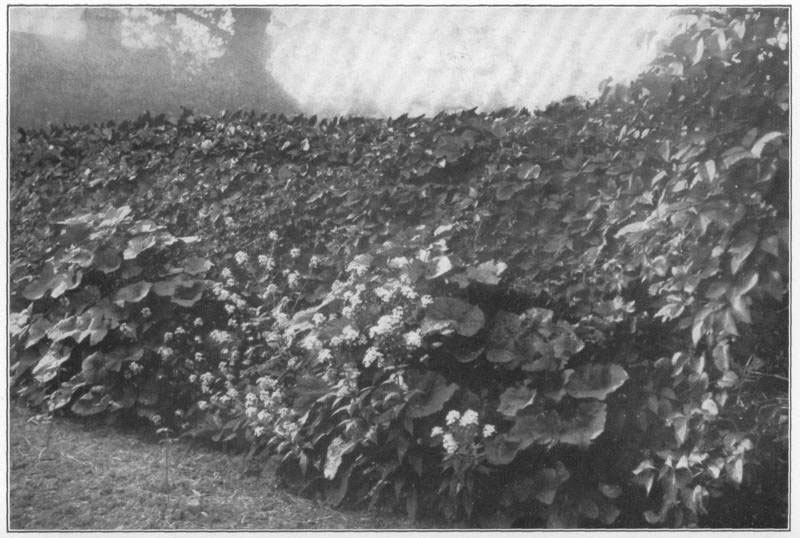
XIV: Virginia creeper screen, on an old fence, with
wall-flowers and hollyhocks in front.
6. CLIMBING PLANTS
Vines do not differ particularly in their culture from other herbs and
shrubs, except as they require that supports be provided; and, as they
overtop other plants, they demand little room on the ground, and they
may therefore be grown in narrow or unused spaces along fences
and walls.
In respect to the modes of climbing, vines may be thrown into three
groups,—those that twine about the support; those that climb by means
of special organs, as tendrils, roots, leaf*stalks; those that neither
twine nor have special organs but that scramble over the support, as the
climbing roses and the brambles. One must recognize the mode of climbing
before undertaking the cultivation of any vine.
Vines may also be grouped into annuals, both tender (as morning-glory)
and hardy (as sweet pea); biennials, as adlumia, which are treated
practically as annuals, being sown each year for bloom the next year;
herbaceous perennials, the tops dying each fall down to a persisting
root, as cinnamon vine and madeira vine; woody perennials (shrubs), the
tops remaining alive, as Virginia creeper, grape, and wistaria.
There is scarcely a garden in which climbing plants may not be used to
advantage. Sometimes it may be to conceal obtrusive objects, again to
relieve the monotony of rigid lines. They may also be used to run over
the ground and to conceal its nakedness where other plants could not
succeed. The shrubby kinds are often useful about the borders of clumps
of trees and shrubbery, to slope the foliage down to the grass, and to
soften or erase lines in the landscape.
In the South and in California, great use is made of vines, not only on
fences but on houses and arbors. In warm countries, vines give character
to bungalows, pergolas, and other individual forms of architecture.
If it is desired that the vines climb high, the soil should be fertile;
but high climbing in annual plants (as in sweet peas) may be at the
expense of bloom.
The use of vines for screens and pillar decorations has increased in
recent years until now they may be seen in nearly all grounds. The
tendency has been towards using the hardy vines, of which the
ampelopsis, or Virginia creeper, is one of the most common. This is a
very rapid grower, and lends itself to training more readily than many
others. The Japan ampelopsis (A. tricuspidata or Veitchii) is a good
clinging vine, growing very rapidly when once established, and
brilliantly colored after the first fall frosts. It clings closer than
the other, but is not so hardy. Either of these may be grown from
cuttings or division of the plants.
Two recommendable woody twiners of recent distribution are the actinidia
and the akebia, both from Japan. They are perfectly hardy, and are rapid
growers. The former has large thick glossy leaves, not affected by
insects or disease, growing thickly along the stem and branches, making
a perfect thatch. It blooms in June. The flowers, which are white with a
purple center, are borne in clusters, followed by round or longish
edible fruits. The akebia has very neat-cut foliage, quaint purple
flowers, and often bears ornamental fruit.
Of the tender vines, the nasturtiums and ipomeas and morning-glories are
the most common in the North, while the adlumia, balloon vine, passion
vine, gourds, and others, are frequently used. One of the best of recent
introduction is the annual hop, especially the variegated variety. This
is a very rapid-growing vine, seeding itself each year, and needing
little care. The climbing geraniums (Pelargonium peltatum and its
derivatives) are much used in California. All the tender vines should be
planted after danger of frost is past.
So many good vines are now on the market that one may grow a wide
variety for many uses. The home gardener should keep his eyes open for
the wild vines of his neighborhood and add the best of them to his
collection. Most of these natives are worthy of cultivation. Even the
poison ivy makes a very satisfactory cover for rough and inaccessible
places in the wild, and its autumn color is very attractive; but of
course its cultivation cannot be recommended.
Vines that cling closely to walls of buildings are Virginia creeper (one
form does not cling well), Boston or Japanese ivy (Ampelopsis
tricuspidata; also A. Lowii, with smaller foliage), English ivy,
euonymus (E. radicans and the var. variegata), and Ficus repens
far south; others that cling less closely are trumpet creeper, and
climbing hydrangea (Schizophragma hydrangeoides).
Vines for trailing, or covering the ground, are periwinkle (Vinca),
herniaria, moneywort (Lysimachia nummularia), ground-ivy (Nepeta
Glechoma), Rosa Wichuraiana, species of native greenbrier or smilax
(not the so-called smilax of florists), Rubus laciniatus, dewberries,
and also others that usually are not classed as vines. In the South,
Japanese honeysuckle and Cherokee rose perform this function
extensively. In California, species of mesembryanthemum (herbaceous) are
extensively used as ground covers on banks. Page 86.
For quickly covering brush and rough places, the many kinds of gourds
may be used; also pumpkins and squashes, watermelons, Cucumis
fœtidissima, wild cucumbers (Echinocystis lobata and Sicyos
angulata), nasturtiums, and other vigorous annuals. Many of the woody
perennials may be used for such purposes, but usually these places are
only temporary.
For arbors, strong woody vines are desired. Grapes are excellent; in the
South the muscadine and scuppernong grapes are adaptable to this purpose
(Plate XV). Actinidia and wistaria are also used. Akebia, dutchman’s
pipe, trumpet creeper, clematis, honeysuckles, may be suggested. Roses
are much used in warm climates.
For covering porches, the standard vine in the North is Virginia
creeper. Grapes are admirable, particularly some of the wild ones. Japan
honeysuckle is much used; and it has the advantage of holding its
foliage well into the winter, or even all winter southward. Actinidia,
akebia, wistaria, roses, dutch-man’s pipe, and clematis are to be
recommended; the large-flowered clematises, however, are more valuable
for their bloom than for their foliage (C. paniculata, and the native
species are better for covering porches).
The annual vines are mostly used as flower-garden subjects, as the sweet
pea, morning-glories, mina, moonflowers, cypress vine, nasturtiums,
cobea, scarlet runner. Several species of convolvulus, closely allied to
the common morning-glory, have now enriched our lists. For baskets and
vases the maurandia and the different kinds of thunbergias are
excellent.
The moonflowers are very popular in the South, where the seasons are
long enough to allow them to develop to perfection. In the North they
must be started early (it is a good plan to soak or notch the seeds) and
be given a warm exposure and good soil (see in Chap. VIII).
In the following lists, the plants native to the United States or Canada
are marked by an asterisk *.
Annual herbaceous climbers.
(Grown each year from seed.)
a. Tendril-climbers
Adlumia (biennial).*
Balloon Vine (Cardiospermum).*
Cobea.
Gourds.
Nasturtiums (Tropaeolum).
Canary-bird Flower (Tropaeolum peregrinum).
Sweet pea (Fig. 265).
Wild cucumber.*
Maurandia.
Gourds or gourd-like plants, as, Coccinia Indica; Cucumis of several
interesting species, as C. erinaceus, grossulariœformis, odoratissimus;
dipper or bottle gourd (Lagenaria);
vegetable sponge, dish-cloth gourd,
rag gourd (Luffa); balsam apple,
balsam pear (Momordica); snake
gourd (Trichosanthes); bryonopsis;
Abobra viridiflora.
All the above except sweet pea are quickly cut down by frost.
b. Twiners
Beans, Flowering.
Cypress vine.
Dolichos Lablab, and others.
Hop, Japanese.
Ipomcea Quamoclit (cypress vine) and others.
Moonflower, several species.
Morning-glory.
Mina lobata.
Thunbergia.
Mikania scandens.*
Butterfly pea, Centrosema Virginiana.*
Scarlet runner, Phaseolus multiflorus (perennial South).
Velvet or banana bean, Mucuna pruriens var. utilis (for the South).
![[Illustration: Fig. 265. Sweet pea.]](https://openoldbooks.sgp1.digitaloceanspaces.com/books/manual-of-gardening/images/fig265.png)
Perennial herbaceous climbers.
(The tops dying down in fall, but the root living over winter and
sending up a new top.)
a. Tendril-climbers or root-climbers
Everlasting pea, Lathyrus latifolius.
Clematis of various species, as C. aromatica, Davidiana, heracleaefolia
(C. tubulosa), are more or less climbing. Most of the clematises
are shrubs.
May-pop, Passiflora incarnata.*
Not reliable north of Virginia.
Wild Gourd, Cucurbita fœtidissima (Cucumis perennius).*
Excellent strong rugged vine for covering piles on the ground.
Mexican rose, mountain rose, Antigonon leptopus.
Root tuberous; a rampant grower, with pink bloom; outdoors South,
and a conservatory plant North.
Kenilworth ivy, Linaria Cymbalaria.
A very graceful little perennial vine, re-sowing itself even where not hardy;
favorite for baskets.
b. Herbaceous twiners
Hop, Humulus Lupulus.*
Produces the hops of commerce, but should be in common use as an ornamental
plant.
Chinese yam, cinnamon vine, Dioscorea divaricata (D. Batatas).
Climbs high, but does not produce as much foliage as some other vines.
Wild yam, D. villosa.*
Smaller than the preceding; otherwise fully as good.
![[Illustration: Fig. 266. Clematis Henryi. One-third natural size.]](https://openoldbooks.sgp1.digitaloceanspaces.com/books/manual-of-gardening/images/fig266.png)
Ground-nut, Apios tuberosa.*
A bean-like vine, producing many chocolate-brown flowers in August and
September.
Scarlet runner and White Dutch runner beans, Phaseolus multiflorus.
Perennial in warm countries; annual in the North.
Moonflowers, Ipomcea, various species.
Some are perennials far South, but annual North.
Hardy moonflower, Ipomœa pandurata.*
A weed where it grows wild, but an excellent vine for some purposes.
Wild morning-glory, Rutland beauty, Convolvulus Sepium* and California
rose, C. Japonicus.
The former, white and pink, is common in swales. The latter, in double
or semi-double form, is often run wild.
Madeira vine, mignonette vine, Boussingaultia baselloides.
Root a large, tough, irregular tuber.
Mikania, climbing hempweed, Mikania scandens.*
A good compositous twiner, inhabiting moist lands.
Woody perennial climbers.
(Climbing shrubs, the tops not dying down in fall except in climates in
which they are not hardy.)
a. Tendril-climbers, root-climbers, scramblers, and trailers
Virginia creeper, Ampelopsis quinquefolia,*
The best vine for covering buildings in the colder climates. Plants
should be selected from vines of known habit, as some individuals cling
much better than others. Var. hirsuta,* strongly clinging, is
recommended by the experimental station at Ottawa, Canada. Var.
Engelmanni* has small and neat foliage.
Japanese ivy, Boston ivy, A. tricuspidata (A. Veitchii).
Handsomer than the Virginia creeper, and clings closer, but is often
injured by winter in exposed places, especially when young; in northern
regions, tops should be protected for first year or two.
Variegated ivy, Ampelopsis heterophylla var. elegans (Cissus
variegata).
Handsome delicate hardy grape-like vines with mostly three-lobed
blotched leaves and bluish berries.
Garden clematis, Clematis of various species and varieties.
Plants of robust and attractive habit, and gorgeous blooms; many garden
forms. C. Jackmani, and its varieties, is one of the best. C. Henryi
(Fig. 266) is excellent for white flowers. Clematises bloom in July
and August.
Wild clematis, C. Virginiana*
Very attractive for arbors and for covering rude objects. The pistillate
plants bear curious woolly balls of fruit.
Wild clematis, C. verticillaris.*
Less vigorous grower than the last, but excellent.
Japanese clematis, C. paniculata.
The best late-blooming woody vine, producing enormous masses of white
flowers in late summer and early fall.
Trumpet creeper, Tecoma radicans.*
One of the best of all free-flowering shrubs; climbs by means of roots;
flowers very large, orange-scarlet.
Chinese trumpet creeper, T. grandiflora (Bignonia grandiflora).
Flowers orange-red; sometimes scarcely climbing.
Bignonia, Bignonia capreolata.*
A good strong evergreen vine, but often a nuisance in fields in the
South.
Frost grape, Vitis cordifolia.*
One of the finest of all vines. It is a very tall grower, producing
thick, heavy, dark leaves. Its foliage often reminds one of that of the
moon-seed. Does not grow readily from cuttings.
Summer and river-bank grapes, V. bicolor* and V. vulpina
(riparia).*
The common wild grapes of the Northern states.
Muscadine, scuppernong, Vitis rotundifolia.*
Much used for arbors in the Southern states (Plate XV).
Ivy, Hedera Helix.
The European ivy does not endure the bright sun of our winter; on the
north side of a building it often does well; the best of vines for
covering buildings, where it succeeds; hardy in favorable localities as
far north as southern Ontario; many forms.
Greenbrier, Smilax rotundifolia* and S. hispida.*
Unique for the covering of small arbors and summer-houses.
Euonymus, E. radicans.
A very close-clinging root-climber, excellent for low walls; evergreen;
the variegated variety is good.
Climbing fig, Ficus repens.
Used in greenhouses North, but is hardy far South.
Matrimony vine, boxthorn, Lycium Chinense.
Flowering all summer; flowers rose-pink and buff, axillary, star-like,
succeeded by scarlet berries in the fall; stems prostrate, or
scrambling; an old-fashioned vine on porches.
Bitter-sweet, Solanum Dulcamara.
A common scrambling or semi-twining vine along roadsides, with brilliant
red poisonous berries; top dies down or nearly so.
Periwinkles, Vinca minor and V. major.
The former is the familiar trailing evergreen myrtle, with blue flowers
in early spring; in its variegated form the latter is much used for
hanging baskets and vases.
Climbing hydrangea, Schizophragma hydrangeoides.
Clings to walls by rootlets, producing white flowers in midsummer.
Passion-flower, species of Passiflora and Tacsonia.
Used in the South and in California.
b. Woody twiners
Actinidia, A. arguta.
Very strong grower, with beautiful thick foliage that is not attacked by
insects or fungi; one of the best vines for arbors.
Akebia, A. quinata. Very handsome and odd Japanese vine; a strong
grower, and worthy general planting.
Honeysuckles, woodbine, Lonicera of many kinds.
Japanese honeysuckle, L. Halliana (a form of L. Japonica).
10-20 ft.; flowers, white and buff, fragrant mainly in spring and fall;
leaves small, evergreen; stems prostrate and rooting, or twining and
climbing. Trellises, or for covering rocks and bare places; extensively
run wild in the South. Var. aurea reticidata is similar to the type,
but with handsome golden appearance.
Belgian Honeysuckle, L. Periclymenum var. Belgica.
6-10 ft.; monthly; flowers in clusters, rosy red, buff within; makes a
large, rounded bush.
Coral or trumpet honeysuckle, L. sempervirens.*
6-15 ft.; June; scattering scarlet flowers through the summer; with no
support makes a large rounded bush; for trellises, fences, or a hedge;
it is one of the list of hardy trees and shrubs recommended for Canada
by the Experiment Station at Ottawa.
Honeysuckle, L. Caprifolium, with cup-like connate leaves.
Good native climbing honeysuckles are L. flava,* Sullivanti,*
hirsuta,* dioica,* and Douglasi.*
Wistaria, Wistaria Sinensis and W. speciosa.*
The Chinese species, Sinensis, is a superb plant; flowers blue-purple;
there is a white-flowered variety.
Japanese wistaria, W. multijuga.
Flowers smaller and later than the Chinese, in looser racemes.
Dutchman’s pipe, Aristolochia macrophytta (A. Sipho).* A robust
grower, possessing enormous leaves. Useful for covering verandas
and arbors.
Wax-work or false bitter-sweet, Celastrus scandens.* Very ornamental
in fruit; flowers imperfect.
Japanese celastrus, C. orbiculatus (C. articulatus of the trade). C.
articulatus and C. scandens are in the list of 100 trees and shrubs
recommended by the Experiment Station at Ottawa for Canada.
Moonseed, Menispermum Canadense.* A small but very attractive
twiner, useful for thickets and small arbors.
Bokhara climbing polygonum, Polygonum Baldschuanicum. Hardy North,
although the young growth may be killed; flowers numerous, minute,
whitish; interesting, but does not make a heavy cover.
Kudzu vine, Pueraria Thunbergiana (Dolichos Japonicus). Makes very
long growths from a tuberous root; shrubby South, but dies to the ground
in the North.
Silk vine, Periploca Græca. Purplish flowers in axillary clusters;
long, narrow, shining leaves; rapid growing.
Potato vine, Solanum jasminoides. A good evergreen vine South,
particularly the var. grandiflorum.
Yellow jasmine, Gelsemium sempervirens.* A good native evergreen
vine for the South, with fragrant yellow flowers.
Malayan jasmine, Trachelospermum (or Rhynchospermum) jasminoides. A
good evergreen vine for the South and in California.
Climbing asparagus, Asparagus plumosus. Popular as an outdoor vine far
South and in California.
Jasmines, Jasminum of several species. The best known in gardens are
J. nudiflorum, yellow in earliest spring, J. officinale, the
jessamine of poetry, with white flowers, and J. Sambac, the Arabian
jasmine (and related species) with white flowers and unbranched leaves;
these are not hardy without much protection north of Washington or
Philadelphia, and J. Sambac only far South.
Bougainvillea, Bougainvillaea glabra and B. spectabilis.
The magenta-flowered variety, sometimes seen in conservatories in the
North, is a popular outdoor vine in the South and is profusely used in
southern California. The red-flowered form is less seen, but is
preferable in color.
Wire-vine (polygonum of florists), Muehlenbeckia complexa.
Abundantly used on buildings and chimneys in southern California.
XV: Scuppernong grape, the arbor vine of the South. This
plate shows the noted scuppernongs on Roanoke Island, of which the origin is
unknown, but which were of great size more than one hundred years ago.
Climbing roses.
![[Illustration: 267. Climbing rose, Jules Margottin.]](https://openoldbooks.sgp1.digitaloceanspaces.com/books/manual-of-gardening/images/fig267.png)
The roses do not climb nor possess any special climbing organs;
therefore they must be provided with a trellis or woven-wire fence. Some
of the roses classed as climbing are such as only need good support,
Fig. 267. For culture of roses, see Chapter VIII.
The most popular climbing or pillar rose at present is Crimson Rambler,
but while it makes a great display of flowers, it is not the best
climbing rose. Probably the best of the real climbing roses for this
country, bloom, foliage, and habit all considered, are the derivatives
of the native prairie rose, Rosa setigera (native as far north as
Ontario and Wisconsin). Baltimore Belle and Queen of the Prairie belong
to this class.
The climbing polyantha roses (hybrids of Rosa multiflora and other
species) include the class of “rambler” roses that has now come to be
large, including not only the Crimson Rambler, but forms of other
colors, single and semi-double, and various climbing habits; a very
valuable and hardy class of roses, particularly for trellises.
The Memorial rose (R. Wichuraiana) is a trailing, half-evergreen,
white-flowered species, very useful for covering banks and rocks.
Derivatives of this species of many kinds are now available, and
are valuable.
The Ayrshire roses (R. arvensis var. capreolata) are profuse but
rather slender growers, hardy North, bearing double white or
pink flowers.
The Cherokee rose (R. Icevigata or R. Sinica) is extensively
naturalized in the South, and much prized for its large white bloom and
shining foliage; not hardy in the North.
The Banksia rose (R. Banksice) is a strong climbing rose for the South
and California with yellow or white flowers in clusters. A
larger-flowered form (R. Fortuneana) is a hybrid of this and the
Cherokee rose.
The climbing tea and noisette roses, forms of R. Chinensis and R.
Noisettiana, are useful in the open in the South.
7. TREES FOR LAWNS AND STREETS
A single tree may give character to an entire home property; and a place
of any size that does not have at least one good tree usually lacks any
dominating landscape note.
Likewise, a street that is devoid of good trees cannot be the best
residential section; and a park that lacks well-grown trees is either
immature or barren.
Although the list of good and hardy lawn and street trees is rather
extensive, the number of kinds generally planted and recognized is
small. Since most home places can have but few trees, and since they
require so many years to mature, it is natural that the home-maker
should hesitate about experimenting, or trying kinds that he does not
himself know. So the home-maker in the North plants maples, elms, and a
white birch, and in the South a magnolia and China-berry. Yet there are
numbers of trees as useful as these, the planting of which might give
our premises and streets a much richer expression.
It is much to be desired that some of the trees with “strong” and rugged
characters be introduced into the larger grounds; such, for example, as
the hickories and oaks. These may often transplant with difficulty, but
the effort to secure them is worth the expenditure. Good trees of oaks,
and others supposed to be difficult to transplant, may now be had of the
leading nurserymen. The pin oak (Quercus palustris) is one of the best
street trees and is now largely planted.
It is at least possible to introduce a variety of trees into a city or
village, by devoting one street or a series of blocks to a single kind
of tree,—one street being known by its lindens, one by its plane-trees,
one by its oaks, one by its hickories, one by its native birches, beech,
coffee-tree, sassafras, gum or liquidambar, tulip tree, and the like.
There is every reason why a city, particularly a small city or a
village, should become to some extent an artistic expression of its
natural region.
The home-maker is fortunate if his area already possesses well-grown
large trees. It may even be desirable to place the residence with
reference to such trees (Plate VI); and the planning of the grounds
should accept them as fixed points to which to work. The operator will
take every care to preserve and safeguard sufficient of the standing
trees to give the place singularity and character.
The care of the tree should include not only the protecting of it from
enemies and accidents, but also the maintaining of its characteristic
features. For example, the natural rough bark should be maintained
against the raids of tree-scrapers; and the grading should not be
allowed to disguise the natural bulge of the tree at the base, for a
tree that is covered a foot or two above the natural line is not only in
danger of being killed, but it looks like a post.
The best shade trees are usually those that are native to the particular
region, since they are hardy and adapted to the soil and other
conditions. Elms, maples, basswoods, and the like are nearly always
reliable. In regions in which there are serious insect enemies or
fungous diseases, the trees that are most likely to be attacked may be
omitted. For instance, in parts of the East the chestnut bark-disease is
a very great menace; and it is a good plan in such places to plant other
trees than chestnuts.
A good shade tree is one that has a heavy foliage and dense head, and
that is not commonly attacked by repelling insects and diseases. Trees
for shade should ordinarily be given sufficient room that they may
develop into full size and symmetrical heads. Trees may be planted as
close as 10 or 15 feet apart for temporary effect; but as soon as they
begin to crowd they should be thinned, so that they develop their full
characteristics as trees.
Trees may be planted in fall or spring. Fall is desirable, except for
the extreme North, if the land is well drained and prepared and if the
trees may be got in early; but under usual conditions, spring planting
is safer, if the stock has been wintered well (see discussion under
Shrubs, p. 290). Planting and pruning are discussed on pp. 124 and 139.
If one desires trees with conspicuous bloom, they should be found among
the magnolias, tulip trees, kœlreuteria, catalpas, chestnuts,
horse-chestnut and buckeyes, cladrastis, black or yellow locust, wild
black cherry, and less conspicuously in the lindens; and also in such
half-trees or big shrubs as cercis, cytisus, flowering dogwood,
double-flowered and other forms of apples, crab-apples, cherries, plums,
peaches, hawthorn or cratægus, amelanchier, mountain ash.
Among drooping or weeping trees the best may be found in the willows
(Salix Babylonica and others), maples (Wier’s), birch, mulberry,
beech, ash, elm, cherry, poplar, mountain ash.
Purple-leaved varieties occur in the beech, maple, elm, oak, birch, and
others.
Yellow-leaved and tricolors occur in the maple, oak, poplar, elm, beech,
and other species.
Cut-leaved forms are found in birch, beech, maple, alder, oak, basswood,
and others.
List of hardy deciduous trees for the North.
(The genera are arranged alphabetically. Natives are marked by *; good
species for shade trees by †; those recommended by the Experiment
Station at Ottawa, Ontario, by DD)
In a number of the genera, the plants may be shrubby rather than
arboreus in some regions (see the Shrub list), as in acer (A. Ginnala,
A. spicatum), æsculus, betula (B. pumila), carpinus, castanea (C.
pumila), catalpa (C. ovata), cercis, magnolia (M. glauca
particularly), ostrya, prunus, pyrus, salix, sorbus.
Norway maple, Acer platanoides.(D, DD) One of the finest medium-sized
trees for single lawn specimens; there are several horticultural
varieties. Var. Schwedleri‡ is one of the best of purple-leaved
trees. The Norway maple droops too much and is too low-headed for
roadside planting.
Black sugar maple, A. nigrum.(A, DD) Darker and softer in aspect than
the ordinary sugar maple.
Sugar maple, A. saccharum.(A, DD) This and the last are among the very
best roadside trees.
Silver maple, A. saccharinum (A. dasycarpum).(A, DD) Desirable for
water-courses and for grouping; succeeds on both wet and dry lands.
Wier’s cut-leaved silver maple, A. saccharinum var. Wieri.(D, DD)
Light and graceful; especially desirable for pleasure grounds.
Red, soft, or swamp maple, A. rubrum.* Valuable for its spring and
autumn colors, and for variety in grouping.
Sycamore maple, A. Pseudo-platanus. A slow grower, to be used mostly
as single specimens. Several horticultural varieties.
English maple, A. campestre. A good medium-sized tree of slow growth,
not hardy on our northern borders; see under Shrubs (p. 291).
Japan maple, A. palmatum (A. polymorphum). In many forms, useful for
small lawn specimens; does not grow above 10-20 ft.
Siberian maple, A. Ginnala.‡ Attractive as a lawn specimen when
grown as a bush; the autumn color is very bright; small tree or
big shrub.
Mountain maple, A. spicatum.* Very bright in autumn.
Box-elder, Acer Negundo (Negundo aceroides or fraxinifolium).*†
Very hardy and rapid growing; much used in the West as a windbreak, but
not strong in ornamental features.
Horse chestnut, Æsculus Hippocastanum.†‡ Useful for single
specimens and roadsides; many forms.
Buckeye, Æ. octandra (Æ. flava)*‡
Ohio buckeye, Æ. glabra*
Red buckeye, Æ. cornea (Æ. rubicunda).
Ailanthus, Ailanthus glandulosa. A rapid grower, with large pinnate
leaves; the staminate plant possesses a disagreeable odor when it
flowers; suckers badly; most useful as a shrub; see the same under
Shrubs (also Fig. 50).
Alder, Alnus glutinosa. The var. imperialis‡ is one of the best
cut-leaved small trees.
European birch, Betula alba.
Cut-leaved weeping birch, B. alba var. laciniata pendula.‡
American white birch, B. populifolia.*
Paper, or canoe birch, B. papyrifera.*
Cherry birch, B. lenta. *
Well-grown specimens resemble the sweet cherry; both this and the yellow
birch (B. lutea*) make attractive light-leaved trees; they are not
appreciated.
Hornbeam or blue beech, Carpinus Americana.* Chestnut, Castanea
saliva† and C. Americana.*†
Showy catalpa, Catalpa speciosa.†‡ Very dark, soft-foliaged tree
of small to medium size; showy in flower; for northern regions should be
raised from northern-grown seed.
Smaller catalpa, C. bignonioides.† Less showy than the last,
blooming a week or two later; less hardy.
Japanese catalpa, C. ovata (C. Kœmpferi).‡ In northern sections
often remains practically a bush.
Nettle-tree, Celtis occidentalis.*
Katsura-tree, Cercidiphyllum Japonicum.‡ A small or medium-sized
tree of very attractive foliage and habit.
Red-bud, or Judas-tree, Cercis Canadensis.* Produces a profusion of
rose-purple pea-like flowers before the leaves appear; foliage also
attractive.
Yellow-wood, or virgilia, Cladrastis tinctoria.* One of the finest
hardy flowering trees.
Beech, Fagus ferruginea.*† Specimens which are symmetrically
developed are among our best lawn trees; picturesque in winter.
European beech, F. sylvatica.† Many cultural forms, the
purple-leaved being everywhere known. There are excellent tricolored
varieties and weeping forms.
Black ash, Fraxinus nigra (F. sambucifolia).*† One of the best
of the light-leaved trees; does well on dry soils, although native to
swamps; not appreciated.
White ash, F. Americana.*†
European ash, F. excelsior.† There is a good weeping form of this.
Maiden-hair tree, Ginkgo biloba (Salisburia adiantifolia).‡ Very
odd and striking; to be used for single specimens or avenues.
Honey locust, Gleditschia triacanthos.*† Tree of striking habit,
with big branching thorns and very large pods; there is also a
thornless form.
Kentucky coffee-tree, Gymnocladus Canadensis.* Light and graceful;
unique in winter.
Bitternut, Hicoria minima (or Carya amara).* Much like black ash
in aspect; not appreciated.
Hickory, Hicoria ovata (or Carya) *†‡ and others.
Pecan, H. Pecan.*† Hardy in places as far north as New Jersey, and
reported still farther.
Butternut, Juglans cinerea.*
Walnut, J. nigra.*
Varnish-tree, Kœlreuteria paniculata. A medium-sized tree of good
character, producing a profusion of golden-yellow flowers in July;
should be better known.
European larch, Larix decidua (L. Europœa).‡
American larch or tamarack, L. Americana.*
Gum-tree, sweet gum, Liquidambar styraciflua.*† A good tree,
reaching as far north as Connecticut, and hardy in parts of western New
York although not growing large; foliage maple-like; a characteristic
tree of the South.
Tulip tree or whitewood, Liriodendron Tulipifera.*† Unique in
foliage and flower and deserving to be more planted.
Cucumber tree, Magnolia acuminata.*† Native in the Northern
states; excellent.
White bay-tree, M. glauca.*† Very attractive small tree, native
along the coast to Massachusetts; where not hardy, the young growth each
year is good.
Of the foreign magnolias hardy in the North, two species and one group
of hybrids are prominent: M. stellata (or M. Halleana) and M.
Yulan or (M. conspicua), both white-flowered, the former very early
and having 9-18 petals and the latter (which is a larger tree) having
6-9 petals; M. Soulangeana, a hybrid group including the forms known
as Lennei, nigra, Norbertiana, speciosa, grandis. All these magnolias
are deciduous and bloom before the leaves appear.
Mulberry, Morus rubra.*
White mulberry, M. alba.
Russian mulberry, M. alba var. Tatarica. Teas’ weeping mulberry is a
form of the Russian.
Pepperidge or gum-tree, Nyssa sylvatica* One of the oddest and most
picturesque of our native trees; especially attractive in winter;
foliage brilliant red in autumn; most suitable for low lands.
Iron-wood, hop hornbeam, Ostrya Virginica.* A good small tree, with
hop-like fruits.
Sourwood, sorrel-tree, Oxydendrum arboreum.* Interesting small tree
native from Pennsylvania in the high land south, and should be reliable
where it grows wild.
Plane or buttonwood, Platanus occidentalis*†‡ Young or
middle-aged trees are soft and pleasant in aspect, but they soon become
thin and ragged below; unique in winter.
European plane-tree, P. orientalis.† Much used for street planting,
but less picturesque than the American; several forms.
Aspen, Populus tremuloides,* Very valuable when well grown; too much
neglected (Fig. 33). Most of the poplars are suitable for pleasure
grounds, and as nurses for slower growing and more emphatic trees.
Large-toothed aspen, P. grandidentata.* Unique in summer color;
heavier in aspect than the above; old trees become ragged.
Weeping poplar, P. grandidentata, var. pendula. An odd, small tree,
suitable for small places, but, like all weeping trees, likely to be
planted too freely.
Cottonwood, P. deltoides (P. monilifera).* The staminate
specimens, only, should be planted if possible, as the cotton of the
seed-pods is disagreeable when carried by winds; var. aurea‡ is one
of the good golden-leaved trees.
Balm of Gilead, P. balsamifera* and var. candicans.* Desirable
for remote groups or belts. Foliage not pleasant in color.
Lombardy poplar, P. nigra, var. Italica.
Desirable for certain purposes, but used too indiscriminately,
it is likely to be short-lived in northern climates.
White poplar, abele, P. alba.
Sprouts badly; several forms.
Bolle’s poplar, P. alba, var. Bolleana.
Habit much like the Lombardy; leaves curiously lobed, very white
beneath, making a pleasant contrast.
Certinensis poplar, P. laurifolia (P. Certinensis).
A very hardy Siberian species, much like P. deltoides, useful for
severe climates.
Wild black cherry, Prunus serotina.*
European bird cherry, Prunus Padus.
A small tree much like the choke cherry, but a freer grower, with larger
flowers, and racemes which appear about a week later.
Choke cherry, P. Virginiana.*
Very showy while in flower.
Purple plum, Prunus cerasifera, var. atropurpurea (var. Pissardi).
One of our most reliable purple-leaved trees.
Rose-bud cherry, P. pendula (P. subhirtella).
A tree of drooping habit and beautiful rose-pink flowers preceding the
leaves.
Japanese flowering cherry, P. Pseudo-Cerasus.
In many forms, the famous flowering cherries of Japan, but not reliable
North.
There are ornamental-flowered peaches and cherries, more curious and
interesting than useful.
Wild crab, Pyrus coronaria* and P. Iœnsis.*
Very showy while in flower, blooming after apple blossoms have fallen;
old specimens become picturesque in form. P. Iœnsis flore pleno‡
(Bechtel’s Crab) is a handsome double form.
Siberian crab, P. baccata.‡ Excellent small tree, both in flower
and fruit.
Flowering crab, Pyrus floribunda. Pretty both in flower and fruit; a
large shrub or small tree; various forms.
Hall’s crab, P. Halliana (P. Parkmani). One of the best of the
flowering crabs, particularly the double form. Various forms of
double-flowering apple are on the market.
Swamp white oak, Quercus bicolor.*† A desirable tree, usually
neglected; very picturesque in winter.
Bur oak, Q. macrocarpa.*†
Chestnut oak, Q. Prinus,*† and especially the closely related Q.
Muhlenbergii (or Q. acuminata).*†
White oak, Q. alba*†
Shingle oak, Q. imbricaria.*†
Scarlet oak, Q. coccinea.*† This and the next two are
glossy-leaved, and are desirable for bright planting.
Black oak, Q. velutina (Q. tinctoria).*†
Red oak, Q. rubra.*†‡
Pin oak, Q. palustris.*† Excellent for avenues; transplants well.
Willow oak, Q. Phellos*
English oak, Q. Robur. Many forms represented by two types, probably
good species, Q. pedunculata (with stalked acorns) and Q.
sessiliflora (with stalkless acorns). Some of the forms are reliable in
the Northern states.
The oaks are slow growers and usually transplant with difficulty.
Natural specimens are most valuable. A large well-grown oak is one of
the grandest of trees.
Locust, Robinia Pseudacacia.*† Attractive in flower; handsome as
single specimens when young; many forms; used also for hedges.
Peach-leaved willow, Salix amygdaloides.* Very handsome small tree,
deserving more attention. This and the next valuable in low places or
along water-courses.
Black willow, S. nigra.*
Weeping willow, S. Babylonica.
To be planted sparingly, preferably near water; the sort known as the
Wisconsin weeping willow appears to be much hardier than the common
type; many forms.
White willow, S. alba, and various varieties, one of which is the
Golden willow.
Tree willows are most valuable, as a rule, when used for temporary
plantations or as nurses for better trees.
Laurel-leaved willow, S. laurifolia‡
A small tree used in cold regions for shelter-belts; also a good
ornamental tree. See also under Shrubs.
Sassafras, Sassafras officinalis.*†
Suitable in the borders of groups or for single specimens; peculiar in
winter; too much neglected.
Rowan or European mountain ash, Sorbus Aucuparia (Pyrus
Aucuparia).‡
Service-tree, S. domestica.
Fruit handsomer than that of the mountain ash and more persistent; small
tree.
Oak-leaved mountain ash, S. hybrida (S. quercifolia).
Small tree, deserving to be better known.
Bald cypress, Taxodium distichum.*
Not entirely hardy at Lansing, Mich.; often becomes scraggly after
fifteen or twenty years, but a good tree; many cultural forms.
American linden or basswood, Tilia Americana.*†
Very valuable for single trees on large lawns, or for roadsides.
European linden, T. vulgaris and T. platyphyllos (T. Europaea of
nurserymen is probably usually the latter).†
Has the general character of the American basswood.
European silver linden, T. tomentosa and varieties.†
Very handsome; leaves silvery white beneath; among others is a weeping
variety.
American elm, Ulmus Americana.*†
One of the most graceful and variable of trees; useful for many purposes
and a standard street tree.
Cork elm, U. racemosa.* Softer in aspect than the last, and more
picturesque in winter, having prominent ridges of bark on its branches;
slow grower.
Red or slippery elm, U. fulva.* Occasionally useful in a group or
shelter-belt; a stiff grower.
English elm, U. campestris, and Scotch or wych elm, U. scabra (U.
mantana). Often planted, but are inferior to U. Americana for street
planting, although useful in collections. These have many
horticultural forms.
Non-coniferous trees for the South.
Among deciduous trees for the region of Washington and south may be
mentioned: Acer, the American and European species as for the North;
Catalpa bignonioides and especially C. speciosa; celtis; cercis,
both American and Japanese; flowering dogwood, profusely native; white
ash; ginkgo; kœlreuteria; sweet gum (liquidambar); American linden;
tulip tree; magnolias much as for the North; China-berry (Melia
Azedarach); Texas umbrella-tree (var. umbraculiformis of the
preceding); mulberries; oxydendrum; paulownia; oriental plane-tree;
native oaks of the regions; Robinia Pseudacacia; weeping willow;
Sophora Japonica; Sterculia platanifolia; American elm.
Broad-leaved evergreens of real tree size useful for the South may be
found among the cherry laurels, magnolias, and oaks. Among the cherry
laurels are: Portugal laurel (Prunus Lusitanica), English cherry
laurel in several forms (P. Laurocerasus), and the “mock-orange” or
“wild orange” (P. Caroliniana). In magnolia, the splendid M.
grandiflora is everywhere used. In oaks, the live-oak (Quercus
Virginiana, known also as Q. virens and Q. sempervirens) is the
universal species. The cork oak (Q. Suber) is also recommended.
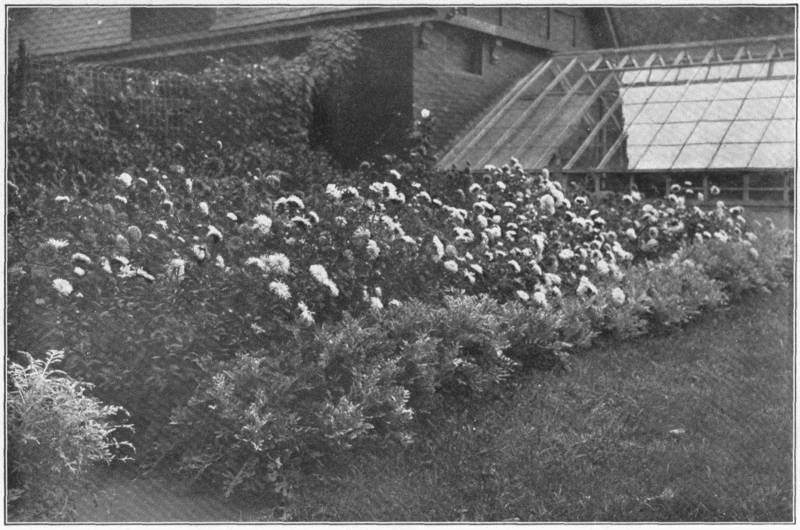
XVI: The flower-garden of China asters with border, one
of the dusty millers (Centaurea).
8. CONIFEROUS EVERGREEN SHRUBS
AND TREES
In this country the word “evergreen” is understood to mean coniferous
trees with persistent leaves, as pines, spruces, firs, cedars, junipers,
arborvitæ, retinosporas, and the like. These trees have always been
favorites with plant lovers, as they have very distinctive forms and
other characteristics. Many of them are of the easiest culture.
It is a common notion that, since spruces and other conifers grow so
symmetrically, they will not stand pruning; but this is an error. They
may be pruned with as good effect as other trees, and if they tend to
grow too tall, the leader may be stopped without fear. A new leader will
arise, but in the meantime the upward growth of the tree will be
somewhat checked, and the effect will be to make the tree dense. The
tips of the branches may also be headed in with the same effect. The
beauty of an evergreen lies in its natural form; therefore, it should
not be sheared into unusual shapes, but a gentle trimming back, as I
suggested, will tend to prevent the Norway spruce and others from
growing open and ragged. After the tree attains some age, 4 or 5 in. may
be taken off the ends of the main branches every year or two (in spring
before growth begins) with good results. This slight trimming is
ordinarily done with Waters’s long-handled pruning shears.
There is much difference of opinion as to the proper time for the
transplanting of evergreens, which means that there is more than one
season in which they may be moved. It is ordinarily unsafe to transplant
them in the fall in northern climates or bleak situations, since the
evaporation from the foliage during the winter is likely to injure the
plant. The best results are usually secured in spring or summer
planting. In spring they may be moved rather late, just as new growth is
beginning. Some persons also plant them in August or early September, as
the roots secure a hold on the soil before winter. In the Southern
states transplanting may be done at most times of the year, but late
fall and early spring are usually advised.
In transplanting conifers, it is very important that the roots be not
exposed to the sun. They should be moistened and covered with burlaps or
other material. The holes should be ready to receive them. If the trees
are large, or if it has been necessary to trim in the roots, the top
should be cut when the tree is set.
Large evergreens (those 10 ft. and more high) are usually best
transplanted late in winter, at a time when a large ball of earth may be
moved with them. A trench is dug around the tree, it being deepened a
little day by day so that the frost can work into the earth and hold it
in shape. When the ball is thoroughly frozen, it is hoisted on to a
stone-boat or truck (Fig. 148) and moved to its new position.
Perhaps the handsomest of all the native conifers of the northeastern
United States is the ordinary hemlock, or hemlock spruce (the one so
much used for lumber); but it is usually difficult to move. Transplanted
trees from nurseries are usually safest. If the trees are taken from the
wild, they should be selected from open and sunny places.
For neat and compact effects near porches and along walks, the dwarf
retinosporas are very useful.
Most of the pines and spruces are too coarse for planting very close to
the residence. They are better at some distance removed, where they
serve as a background to other planting. If they are wanted for
individual specimens, they should be given plenty of room, so that the
limbs will not be crowded and the tree become misshapen. Whatever else
is done to the spruces and firs, the lower limbs should not be trimmed
up, at least not until the tree has become so old that the lowest
branches die. Some species hold their branches much longer than others.
The oriental spruce (Picea orientalis) is one of the best in this
respect. The occasional slight heading-in, that has been mentioned,
will tend to preserve the lower limbs, and it will not be marked enough
to alter the form of the tree.
The number of excellent coniferous evergreens now offered in the
American trade is large. They are slow of growth and require much room
if good specimens are to be obtained; but if the space can be had and
the proper exposure secured, no trees add greater dignity and
distinction to an estate. Reliable comments on the rarer conifers may be
found in the catalogues of the best nurserymen.
List of shrubby conifers.
The following list contains the most usual of the shrub-like coniferous
evergreens, with * to mark those native to this country. The ‡ in this
and the succeeding list marks those species
that are found to be hardy at Ottawa, Ontario, and are recommended by
the Central Experimental Farm of Canada.
Dwarf arborvitæ, Thuja occidentalis.*
There are many dwarf and compact varieties of arborvitæ, most of which
are excellent for small places. The most desirable for general purposes,
and also the largest, is the so-called Siberian. Other very desirable
forms are those sold as globosa, ericoides, compacta,‡ Hovey,‡
Ellwangeriana,‡ pyramidalis,‡ Wareana (or Sibirica),‡ and
aurea Douglasii.‡
Japanese arborvitæ or retinospora, Chamœcyparis of various species.
Retinosporas‡ under names as follows: Cupressus ericoides, 2 ft.,
with fine soft delicate green foliage that assumes a purplish tinge in
winter; C. pisifera, one of the best, with a pendulous habit and
bright green foliage; C. pisifera var. filifera, with drooping
branches and thread-like pendulous branches; C. pisifera var.
plumosa, more compact than P. pisifera and feathery; var. aurea of
the last, “one of the most beautiful golden-leaved evergreen shrubs in
cultivation.”
Juniper, Juniperus communis* and garden varieties.
The juniper is a partially trailing plant, of loose habit, suitable for
banks and rocky places. There are upright and very formal varieties of
it, the best being those sold as var. Hibernica (fastigiata),‡
“Irish juniper,” and var. Suecica, “Swedish juniper.”
Northern juniper, J. Sabina, var. prostrata* One of the best of the low,
diffuse conifers; var. tamariscifolia,‡ 1-2 ft.
Chinese and Japanese junipers in many forms, J. Chinensis.
Dwarf Norway spruce, Picea excelsa, dwarf forms. Several very dwarf
sorts of the Norway spruce are in cultivation, some of which are to be
recommended.
Dwarf pine, Pinus montana, var. pumilio.
Mugho pine, Pinus montana, var. Mughus.‡ There are other
desirable dwarf pines.
Wild yew, Taxus Canadensis.* Common in woods; a wide-spreading plant
known as “ground hemlock”; 3-4 ft.
Arboreous conifers.
The evergreen conifers that one is likely to plant may be roughly
classed as pines; spruces and firs; cedars and junipers;
arborvitæ; yews.
White Pine, Pinus Strobus.*‡ The best native species for general
planting; retains its bright green color in winter.
Austrian pine, P. Austriaca.‡ Hardy, coarse, and rugged; suitable
only for large areas; foliage very dark.
Scotch pine, P. sylvestris.‡ Not so coarse as Austrian pine, with a
lighter and bluer foliage.
Red pine, P. resinosa*‡ Valuable in groups and belts; usually
called “Norway pine”; rather heavy in expression.
Bull pine, P. ponderosa.*‡ A strong majestic tree, deserving to
be better known in large grounds; native westward.
Cembrian pine, Pinus Cembra. A very fine slow-growing tree; one of the
few standard pines suitable for small places.
Scrub pine, P. divaricata (P. Banksiana).*
A small tree, more odd and picturesque than beautiful, but desirable in
certain places.
Mugho pine, P. montana var. Mughus.‡
Usually more a bush than a tree (2 to 12 ft.), although it may attain a
height of 20-30 ft.; mentioned under Shrubs.
Norway spruce, Picea excelsa.‡
The most commonly planted spruce; loses much of its peculiar beauty when
thirty to fifty years of age; several dwarf and weeping forms.
White spruce, P. alba.*‡
One of the finest of the spruces; a more compact grower than the last,
and not so coarse; grows slowly.
Oriental spruce, P. orientalis.
Especially valuable from its habit of holding its lowest limbs; grows
slowly; needs some shelter.
Colorado blue spruce, P. pungens.*‡
In color the finest of the conifers; grows slowly; seedlings vary much
in blueness.
Alcock’s spruce, P. Alcockiana.‡
Excellent; foliage has silvery under surfaces.
Hemlock spruce, Tsuga Canadensis.*
The common lumber hemlock, but excellent for hedges and as a lawn tree;
young trees may need partial protection from sun.
White fir, Abies concolor.*‡
Probably the best of the native firs for the northeastern region; leaves
broad, glaucous.
Nordmann’s fir, A. Nordmanniana.
Excellent in every way; leaves shining above and lighter beneath.
Balsam fir, A. balsamea.*
Loses most of its beauty in fifteen or twenty years.
Douglas fir, Pseudotsuga Douglasii.*‡
Majestic tree of the northern Pacific slope, hardy in the east when
grown from seeds from far north or high mountains.
Red cedar, Juniperus Virginiana*
A common tree, North and South; several horticultural varieties.
Arborvitae (white cedar, erroneously), Thuja occidentalis.*
Becomes unattractive after ten or fifteen years on poor soils; the
horticultural varieties are excellent; see p. 333, and Hedges, p. 220.
Japanese yew, Taxus cuspidata.
Hardy small tree.
Conifers for the South.
Evergreen conifers, trees and bushes, for regions south of Washington:
Abies Fraseri and A. Picea (A. pectinata); Norway spruce; true
cedars, Cedrus Atlantica and Deodara; cypress, Cupressus Goveniana,
majestica, sempervirens; Chamœcyparis Lawsoniana; practically all
junipers, including the native cedar (Juniperus Virginiana);
practically all arborvitæ, including the oriental or biota group;
retinosporas (forms of chamæcyparis and thuja of several kinds);
Carolina hemlock, Tsuga Caroliniana; English yew, Taxus baccata;
Libocedrus decurrens; cephalotaxus and podocarpus; cryptomeria; Bhotan
pine, Pinus excelsa; and the native pines of the regions.
9. WINDOW-GARDENS
Although the making of window-gardens may not be properly a part of the
planting and ornamenting of the home grounds, yet the appearance of the
residence has a marked effect on the attractiveness or unattractiveness
of the premises; and there is no better place than this in which to
discuss the subject. Furthermore, window-gardening is closely associated
with various forms of temporary plant protection about the residence
(Fig. 268).
Window-gardens are of two types: the window-box and porch-box type, in
which the plants are grown outside the window and which is a summer or
warm-weather effort; the interior or true window-garden, made for the
enjoyment of the family in its internal relations, and which is chiefly
a winter or cold-weather effort.
The window-box for outside effect.
![[Illustration: Fig. 268. A protection for chrysanthemums. Very good plants can be grown under a temporary shed cover. The roof may be of glass, oiled paper, or even of wood. Such a shed cover will afford a very effective and handy protection for many plants.]](https://openoldbooks.sgp1.digitaloceanspaces.com/books/manual-of-gardening/images/fig268.png)
Handsomely finished boxes, ornamental tiling, and bracket work of wood
and iron suitable for fitting out windows for the growing of plants, are
on the market; but such, while desirable, are by no means necessary. A
stout pine box of a length corresponding to the width of the window,
about 10 inches wide and 6 deep, answers quite as well as a finer box,
since it will likely be some distance above the street, and its sides,
moreover, are soon covered by the vines. A zinc tray of a size to fit
into the wooden box may be ordered of the tinsmith. It will tend to keep
the soil from drying out so rapidly, but it is not a necessity. A few
small holes in the bottom will provide for drainage; but with
carefulness in watering these are not necessary, since the box by its
exposed position will dry out readily during summer weather, unless the
position is a shaded one. In the latter case provision for good drainage
is always advisable.
Since there is more or less cramping of roots, it will be necessary to
make the soil richer than would be required were the plants to grow in
the garden. The most desirable soil is one that does not pack hard like
clay, nor contract much when dry, but remains porous and springy. Such a
soil is found in the potting earth used by florists, and it may be
obtained from them at 50 cents to $1 a barrel. Often the nature of the
soil will be such as to make it desirable to have at hand a barrel of
sharp sand for mixing with it, to make it more porous and prevent
baking. A good filling for a deep box is a layer of clinkers or other
drainage in the bottom, a layer of pasture sod, a layer of old cow
manure, and fill with fertile garden earth.
Some window-gardeners pot the plants and then set them in the
window-box, filling the spaces between the pots with moist moss. Others
plant them directly in the earth. The former method, as a general rule,
is to be preferred in the winter window-garden; the latter in
the summer.
The plants most valuable for outside boxes are those of drooping habit,
such as lobelias, tropeolums, othonna, Kenilworth ivy, verbena (Fig.
269), sweet alyssum, and petunia. Such plants may occupy the front row,
while back of them may be the erect-growing plants, as geraniums,
heliotropes, begonias (Plate XX).
For shady situations the main dependence is on plants of graceful form
or handsome foliage; while for the sunny window the selection may be of
blooming plants. Of the plants mentioned below for these two positions,
those marked with an asterisk * are of climbing habit, and may be
trained up about the sides of the window.
![[Illustration: Fig. 269. Bouquet of verbenas.]](https://openoldbooks.sgp1.digitaloceanspaces.com/books/manual-of-gardening/images/fig269.png)
Just what plants will be most suitable depends on the exposure. For the
shady side of the street, the more delicate kinds of plants may be
used. For full exposure to the sun, it will be necessary to choose the
more vigorous-growing kinds. In the latter position, suitable plants for
drooping would be: tropeolums,* passifloras,* the single petunias,
sweet alyssum, lobelias, verbenas, mesembryanthemums. For erect-growing
plants: geraniums, heliotropes, phlox. If the position is a shaded one,
the drooping plants might be of the following: tradescantia, Kenilworth
ivy, senecio* or parlor ivy, sedums, moneywort,* vinca, smilax,*
lygodium* or climbing fern. Erect-growing plants would be dracenas,
palms, ferns, coleus, centaurea, spotted calla, and others.
After the plants have filled the earth with roots, it will be desirable
to give the surface among them a very light sprinkling of bone-dust or a
thicker coating of rotted manure from time to time during the summer; or
instead of this, a watering with weak liquid manure about once a week.
This is not necessary, however, until the growth shows that the roots
have about exhausted the soil.
In the fall the box may be placed on the inside of the window. In this
case it will be desirable to thin out the foliage somewhat, shorten in
some of the vines, and perhaps remove some of the plants. It will also
be desirable to give a fresh coating of rich soil. Increased care will
be necessary, also, in watering, since the plants will have less light
than previously, and, moreover, there may be no provision for drainage.
Porch-boxes may be made in the same general plan. Since the plants are
likely to be injured in porch-boxes, and since these boxes should have
some architectural effect, it is well to use abundantly of rather heavy
greenery, such as swordfern (the common form of Nephrolepis exaltata)
or the Boston fern, Asparagus Sprengeri, wandering jew, the large
drooping vinca (perhaps the variegated form), aspidistra. With these or
similar things constituting the body of the box planting, the flowering
plants may be added to heighten the effect.
The inside window-garden,
or “house plants.”
The winter window-garden may consist simply of a jardinière, or a few
choice pot-plants on a stand at the window, or of a considerable
collection with more or less elaborate arrangements for their
accommodation in the way of box, brackets, shelves, and stands.
Expensive arrangements are by no means necessary, nor is a large
collection. The plants and flowers themselves are the main
consideration, and a small collection well cared for is better than a
large one unless it can be easily accommodated and kept in good
condition.
The box will be seen near at hand, and so it may be more or less
ornamental in character. The sides may be covered with ornamental tile
held in place by molding; or a light latticework of wood surrounding the
box is pretty. But a neatly made and strong box of about the dimensions
mentioned on page 337, with a strip of molding at the top and bottom,
answers just as well; and if painted green, or some neutral shade, only
the plants will be seen or thought of. Brackets, jardinières, and stands
may be purchased of any of the larger florists.
The box may consist of merely the wooden receptacle; but a preferable
arrangement is to make it about eight inches deep instead of six, then
have the tinsmith make a zinc tray to fit the box. This is provided with
a false wooden bottom, with cracks for drainage, two inches above the
real bottom of the tray. The plants will then have a vacant space below
them into which drainage water may pass. Such a box may be thoroughly
watered as the plants require without danger of the water running on the
carpet. Of course, a faucet should be provided at some suitable point on
a level with the bottom of the tray, to permit of its being drained
every day or so if the water tends to accumulate. It would not do to
allow the water to remain long; especially should it never rise to the
false bottom, as then the soil would be kept too wet.
The window for plants should have a southern, southeastern, or eastern
exposure. Plants need all the light they can get in the winter,
especially those that are expected to bloom. The window should be
tight-fitting. Shutters and a curtain will be an advantage in
cold weather.
Plants like a certain uniformity in conditions. It is very trying on
them, and often fatal to success, to have them snug and warm one night
and pinched in a temperature only a few degrees above freezing the next.
Some plants will live in spite of it, but they cannot be expected to
prosper. Those whose rooms are heated with steam, hot water, or hot air
will have to guard against keeping rooms too warm fully as much as
keeping them too cool. Rooms in brick dwellings that have been warm all
day, if shut up and made snug in the evening, will often keep warm over
night without heat except in the coldest weather. Rooms in frame
dwellings exposed on all sides soon cool down.
It is difficult to grow plants in rooms lighted by gas. Most
living-rooms have air too dry for plants. In such cases the bow-window
may be set off from the room by glass doors; one then has a miniature
conservatory. A pan of water on the stove or on the register and damp
moss among the pots, will help to afford plants the necessary humidity.
The foliage will need cleansing from time to time to free it from dust.
A bath tub provided with a ready outlet for the water is an excellent
place for this purpose. The plants may be turned on their sides and
supported on a small box above the bottom of the tub. Then they may be
freely syringed without danger of making the soil too wet. It is usually
advisable not to wet the flowers, however, especially the white waxen
kinds, like hyacinths. The foliage of rex begonias should be cleansed
with a piece of dry or only slightly moist cotton. But if the leaves can
be quickly dried off by placing them in the open air on mild days, or
moderately near the stove, the foliage may be syringed.
Some persons attach the box to the window, or support it on brackets
attached below the window-sill; but a preferable arrangement is to
support the box on a low and light stand of suitable height provided
with rollers. It may then be drawn back from the window, turned around
from time to time to give the plants light on all sides, or turned with
the attractive side in as may be desired.
Often the plants are set directly in the soil; but if they are kept in
pots they may be rearranged, and changed about to give those which need
it more light. Larger plants that are to stand on shelves or brackets
may be in porous earthenware pots; but the smaller ones that are to fill
the window-box may be placed in heavy paper pots. The sides of these are
flexible, and the plants in them therefore may be crowded close together
with great economy in space. When pots are spaced, damp sphagnum or
other moss among them will hold them in place, keep the soil from drying
out too rapidly, and at the same time give off moisture, so grateful to
the foliage.
In addition to the stand, or box, a bracket for one or more pots on
either side of the window, about one-third or half-way up, will be
desirable. The bracket should turn on a basal hinge or pivot, to admit
of swinging it forward or backward. These bracket plants usually suffer
for moisture, and are rather difficult to manage.
Florists now usually grow plants suitable for window-gardens and winter
flowering, and any intelligent florist, if asked, will take pleasure in
making out a suitable collection. The plants should be ordered early in
the fall; the florist will then not be so crowded for time and can give
the matter better attention.
Most of the plants suitable for the winter window-garden belong to the
groups that florists grow in their medium and cool houses. The former
are given a night temperature of about 60°, the latter about 50°. In
each case the temperature is 10 to 15° higher for the daytime. Five
degrees of variation below these temperatures will be allowable without
any injurious effects; even more may be borne, but not without more or
less check to the plants. In bright, sunny weather the day temperature
may be higher than in cloudy and dark weather.
Plants for an average night temperature of 60° (trade names).
Upright flowering plants,—Abutilons, browallias, calceolaria “Lincoln
Park,” begonias, bouvardias, euphorbias, scarlet sage, richardia or
calla, heliotropes, fuchsias, Chinese hibiscus, jasmines, single
petunias, swainsona, billbergia, freesias, geraniums, eupheas.
Upright foliage plants.—Muehlenbeckia, Cycas revoluta, Dracœna
fragans and others, palms, cannas, Farfugium grande, achyranthes,
ferns, araucarias, epiphyllums, pandanus or “screw pine,” Pilea
arborea, Ficus elastica, Grevillea robusta.
Climbing plants.—Asparagus tenuissimus, A. plumosus, Cobœa
scandens, smilax, Japanese hop, Madeira vine (Boussingaultia), Senecio
mikanioides and S. macroglossus (parlor ivies). See also list below.
Low-growing, trailing, or drooping plants.—These may be used for
baskets and edgings. Flowering kinds are: Sweet alyssum, lobelia,
Fuchsia procumbens, mesembryanthemum, Oxalis pendula, 0. floribunda
and others, Russelia juncea, Mahernia odorata or honey-bell.
Foliage plants of drooping habit.—Vincas, Saxifraga sarmentosa,
Kenilworth ivy, tradescantia or wandering jew, Festuca glauca*
othonna, Isolepsis gracilis,* English ivy, Selaginella
denticulata, and others. Some of these plants flower quite freely, but
the flowers are small and of secondary consideration. Those with an
asterisk * droop but slightly.
Plants for an average night temperature of 50°.
Upright flowering plants.—Azaleas, cyclamens, carnations,
chrysanthemums, geraniums, Chinese primroses, stevias, marguerite or
Paris daisy, single petunias, Anthemis coronaria, camellias, ardisia
(berries), cinerarias, violets, hyacinths, narcissus, tulips, the Easter
lily when in bloom, and others.
Upright foliage plants.—Pittosporums, palms, aucuba, euonymus (golden
and silvery variegated), araucarias, pandanus, dusty millers.
Climbing plants.—English ivy, maurandia, senecio or parlor ivy,
lygodium (climbing fern).
Drooping or trailing plants.—Flowering kinds are: Sweet alyssum,
Mahernia odorata, Russelia and ivy geranium.
Bulbs in the window-garden.
Bulbs flowering through the winter add to the list of house plants a
charming variety. The labor, time, and skill required is much less than
for growing many of the larger plants more commonly used for winter
decorations (for instructions on growing bulbs out-of-doors, see p. 281;
also the entries in Chapter VIII).
Hyacinths, narcissus, tulips, and crocus, and others can be made to
flower in the winter without difficulty. Secure the bulbs so as to be
able to pot them by the middle or last of October, or if earlier all the
better. The soil should be rich sandy loam, if possible; if not, the
best that can be got, to which about one-fourth the bulk of sand is
added and mixed thoroughly.
If ordinary flower-pots are to be used, place in the bottom a few pieces
of broken pots, charcoal, or small stones for drainage, then fill the
pot with dirt so that when the bulbs are set on the dirt the top of the
bulb is even with the rim of the pot. Fill around it with soil, leaving
just the tip of the bulb showing above the earth. If the soil is heavy,
a good plan is to sprinkle a small handful of sand under the bulb to
carry off the water, as is done in the beds outdoors. If one does not
have pots, he may use boxes. Starch boxes are a good size to use, as
they are not heavy to handle; and excellent flowers are sometimes
secured from bulbs planted in old tomato-cans. If boxes or cans are
used, care must be taken to have holes in the bottoms to let the water
run out. A large hyacinth bulb will do well in a 5-inch pot. The same
size pot will do for three or four narcissuses or eight to
twelve crocuses.
After the bulbs are planted in the pots or other receptacles, they
should be placed in a cool place, either in a cold pit or cellar, or on
the shady side of a building, or, better yet, plunged or buried up to
the rim of the pot in a shady border. This is done to force the roots to
grow while the top stands still, as only the bulbs with good roots will
give good flowers. When the weather gets so cold that a crust is frozen
on the soil, the pots should be covered with a little straw, and as the
weather gets colder more straw must be used. In six to eight weeks after
planting the bulbs, they should have made roots enough to grow the
plant, and they may be taken up and placed in a cool room for a week or
so, after which, if they have started into growth, they may be taken
into a warmer room where they can have plenty of light. They will grow
very rapidly now and will want much water, and after the flowers begin
to show, the pots may stand in a saucer of water all the time. When just
coming into bloom the plants may have full sunlight part of the time to
help bring out the color of the flowers.
Hyacinths, tulips, and narcissus all require similar treatment. When
well rooted, which will be in six or eight weeks, they are brought out
and given a temperature of some 55° to 60° till the flowers appear, when
they should be kept in a cooler temperature, say 50°. The single Roman
hyacinth is an excellent house plant. The flowers are small, but they
are graceful and are well adapted to cutting. It is early.
The Easter lily is managed the same way, except to hasten its flowers it
should be kept at not lower than 60° at night. Warmer will be better.
Lily bulbs may be covered an inch or more deep in the pots.
Freesias may be potted six or more in a pot of mellow soil, and then
started into growth at once. At first they may be given a night
temperature of 50°; and 55° to 60° when they have begun to grow.
Small bulbs, as snowdrop and crocus, are planted several or a dozen in a
pot and buried, or treated like hyacinths; but they are very sensitive
to heat, and require to be given the light only when they have started
to grow, without any forcing. Forty to 45° will be as warm as they ever
need be kept.
Watering house plants.
It is impossible to give rules for the watering of plants. Conditions
that hold with one grower are different from those of another. Advice
must be general. Give one good watering at the time of potting, after
which no water should be given until the plants really need it. If, on
tapping the pot, it gives out a clear ring, it is an indication that
water is needed. In the case of a soft-wooded plant, just before the
leaves begin to show signs of wilt is the time for watering. When plants
are taken up from the ground, or have their roots cut back in repotting,
gardeners rely, after the first copious watering, on syringing the tops
two or three times each day, until a new root-growth has started,
watering at the roots only when absolutely necessary. Plants that have
been potted into larger pots will grow without the extra attention of
syringing, but those from the borders that have had their roots
mutilated or shortened, should be placed in a cool, shady spot and be
syringed often. One soon becomes familiar with the wants of individual
plants, and can judge closely as to need of water. All soft-wooded
plants with a large leaf-surface need more water than hard-wooded
plants, and a plant in luxuriant growth of any kind more than one that
has been cut back or become defoliated. When plants are grown in
living-rooms, moisture must be supplied from some source, and if no
arrangement has been made for securing moist air, the plants should be
syringed often.
All plant-growers should learn to withhold water when plants are
“resting” or not in active growth. Thus camellias, azaleas, rex
begonias, palms, and many other things are usually not in their growing
period in fall and midwinter, and they should then have only sufficient
water to keep them in condition. When growth begins, apply water; and
increase the water as the growth becomes more rapid.
Hanging baskets.
To have a good hanging basket, it is necessary that some careful
provision be made to prevent too rapid drying out of the earth. It is
customary, therefore, to line the pot or basket with moss. Open wire
baskets, like a horse muzzle, are often lined with moss and used for the
growing of plants. Prepare the earth by mixing some well-decayed
leafmold with rich garden loam, thereby making an earth that will retain
moisture. Hang the basket in a light place, but still not in direct
sunlight; and, if possible, avoid putting it where it will be exposed to
drying wind. In order to water the basket, it is often advisable to sink
it into a pail or tub of water.
Various plants are well adapted to hanging baskets. Among the drooping
or vine-like kinds are the strawberry geranium, Kenilworth ivy,
maurandia, German ivy, canary-bird flower, Asparagus Sprengeri, ivy
geranium, trailing fuchsia, wandering jew, and othonna. Among the
erect-growing plants that produce flowers, Lobelia Erinus, sweet
alyssum, petunias, oxalis, and various geraniums are to be recommended.
Among foliage plants such things as coleus, dusty miller, begonia, and
some geraniums are adaptable.
Aquarium.
A pleasant adjunct to a window-garden, living room, or conservatory, is
a large glass globe or glass box containing water, in which plants and
animals are living and growing. A solid glass tank or globe is better
than a box with glass sides, because it does not leak, but the box must
be used if one wants a large aquarium. For most persons it is better to
buy the aquarium box than to attempt to make it. Five points are
important in making and keeping an aquarium:
(1) The equilibrium between plant and animal life must be secured and
maintained;
(2) the aquarium must be open on top to the air or well ventilated;
(3) the temperature should be kept between 40° and 50° for
ordinary animals and plants (do not place in full sun in a hot
window);
(4) it is well to choose such animals for the aquarium as are adapted
to life in still water;
(5) the water must be kept fresh, either by the proper balance of
plant and animal life or by changing the water frequently, or
by both.
The aquatic plants of the neighborhood may be kept in the
aquarium,—such things as myriophyllums, charas, eel-grass, duckmeats or
lemnas, cabomba or fish grass, arrow-leafs or sagittaria, and the like;
also the parrot’s feather, to be bought of florists (a species of
myriophyllum). Of animals, there are fishes (particularly minnows),
water insects, tadpoles, clams, snails. If the proper balance is
maintained between plant and animal life, it will not be necessary to
change the water so frequently.
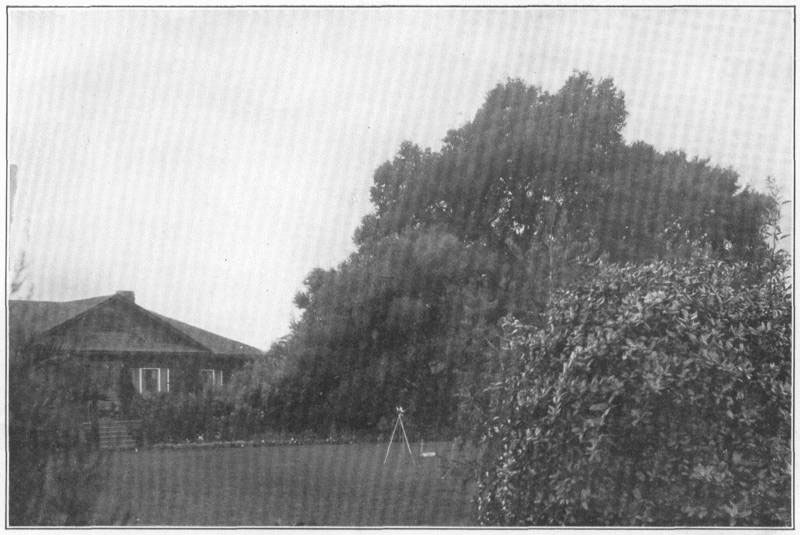
![[Illustration: Fig. 1. The ornamental burdock]](https://openoldbooks.sgp1.digitaloceanspaces.com/books/manual-of-gardening/images/fig001.png)
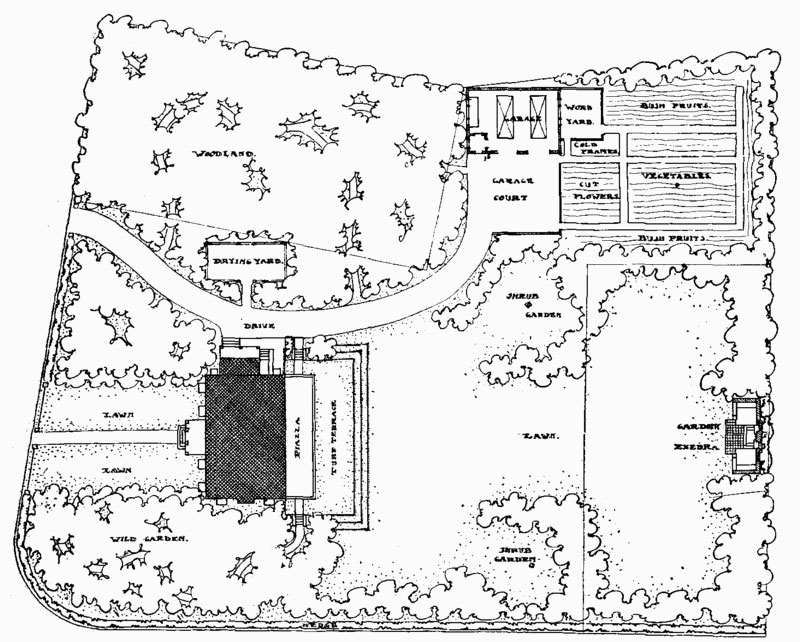
![[Illustration: Fig. 2. Diagram of a back yard.]](https://openoldbooks.sgp1.digitaloceanspaces.com/books/manual-of-gardening/images/fig002.png)
![[Illustration: Fig. 3. Plan of a rough area.]](https://openoldbooks.sgp1.digitaloceanspaces.com/books/manual-of-gardening/images/fig003.png)
![[Illustration: Fig. 4. Suggestion for a school-ground on a four-corners.]](https://openoldbooks.sgp1.digitaloceanspaces.com/books/manual-of-gardening/images/fig004.png)
![[Illustration: Fig 5. The common or nursery way of planting]](https://openoldbooks.sgp1.digitaloceanspaces.com/books/manual-of-gardening/images/fig005.png)
![[Illustration: Fig. 6. The proper or pictorial type of planting]](https://openoldbooks.sgp1.digitaloceanspaces.com/books/manual-of-gardening/images/fig006.png)
![[Illustration: Fig. 7. A house]](https://openoldbooks.sgp1.digitaloceanspaces.com/books/manual-of-gardening/images/fig007.png)
![[Illustration: Fig. 8 A home]](https://openoldbooks.sgp1.digitaloceanspaces.com/books/manual-of-gardening/images/fig008.png)
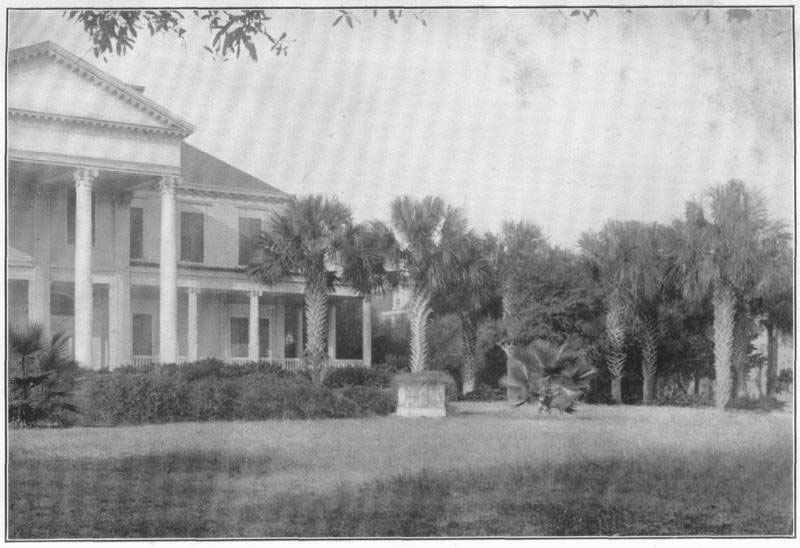
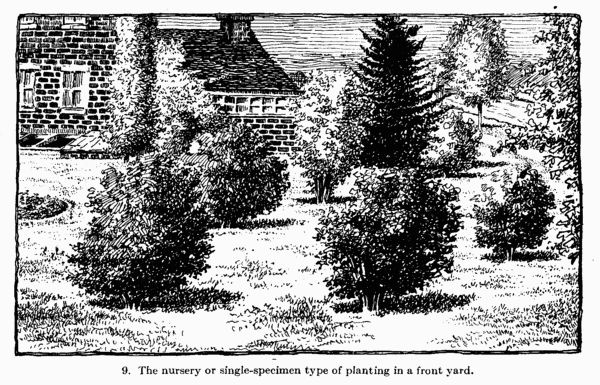
![[Illustration: Fig. 10 A native fence-row]](https://openoldbooks.sgp1.digitaloceanspaces.com/books/manual-of-gardening/images/fig010.png)
![[Ilustration: Fig. 11 Birds build their nests here]](https://openoldbooks.sgp1.digitaloceanspaces.com/books/manual-of-gardening/images/fig011.png)
![[Illustration: Fig. 12. A free-and-easy planting of things wild and tame.]](https://openoldbooks.sgp1.digitaloceanspaces.com/books/manual-of-gardening/images/fig012.png)
![[Illustration: Fig. 13. An open treatment of a school-ground. More trees might be placed in the area, if desired.]](https://openoldbooks.sgp1.digitaloceanspaces.com/books/manual-of-gardening/images/fig013.png)
![[Illustration: Fig. 14. A rill much as nature made it.]](https://openoldbooks.sgp1.digitaloceanspaces.com/books/manual-of-gardening/images/fig014.png)
![[Illustration: Fig. 15. A rill “improved,” so that it will not look “ragged” and unkempt.]](https://openoldbooks.sgp1.digitaloceanspaces.com/books/manual-of-gardening/images/fig015.png) The motive that shears the trees also razes the copse, in order that the
gardener or “improver” may show his art. Compare Figs. 14 and 15. Many
persons seem to fear that they will never be known to the world unless
they expend a great amount of muscle or do something emphatic or
spectacular; and their fears are usually well founded.
The motive that shears the trees also razes the copse, in order that the
gardener or “improver” may show his art. Compare Figs. 14 and 15. Many
persons seem to fear that they will never be known to the world unless
they expend a great amount of muscle or do something emphatic or
spectacular; and their fears are usually well founded.![[Illustration: 16. The making of a good group, but spoiled by the pruning shears.]](https://openoldbooks.sgp1.digitaloceanspaces.com/books/manual-of-gardening/images/fig016.png)
![[Illustration: 17. The three guardsmen.]](https://openoldbooks.sgp1.digitaloceanspaces.com/books/manual-of-gardening/images/fig017.png)
![[Illustration: Fig. 18 A bit of semi-rustic work built into a native growth]](https://openoldbooks.sgp1.digitaloceanspaces.com/books/manual-of-gardening/images/fig018.png) I must hasten to say that I have not the slightest objection to the
shearing of trees. The only trouble is in calling the practice art and
in putting the trees where people must see them (unless they are part of
a recognized formal-garden design). If the operator simply calls the
business shearing, and puts the things where he and others who like them
may see them, objection could not be raised. Some persons like painted
stones, others iron bulldogs in the front yard and the word “welcome”
worked into the door-mat, and others like barbered trees. So long as
these likes are purely personal, it would seem to be better taste to put
such curiosities in the back yard, where the owner may admire them
without molestation
I must hasten to say that I have not the slightest objection to the
shearing of trees. The only trouble is in calling the practice art and
in putting the trees where people must see them (unless they are part of
a recognized formal-garden design). If the operator simply calls the
business shearing, and puts the things where he and others who like them
may see them, objection could not be raised. Some persons like painted
stones, others iron bulldogs in the front yard and the word “welcome”
worked into the door-mat, and others like barbered trees. So long as
these likes are purely personal, it would seem to be better taste to put
such curiosities in the back yard, where the owner may admire them
without molestation![[Illustration: Fig. 19 Hole-in-the-ground gardening]](https://openoldbooks.sgp1.digitaloceanspaces.com/books/manual-of-gardening/images/fig019.png) The easiest way to spoil a good lawn is to put a flower-bed in it; and
the most effective way in which to show off flowers to the least
advantage is to plant them in a bed in the greensward. Flowers need a
background. We do not hang our pictures on fence-posts. If flowers are
to be grown on a lawn, let them be of the hardy kind, which can be
naturalized in the sod and which grow freely in the tall unmown grass;
or else perennials of such nature that they make attractive clumps by
themselves. Lawns should be free and generous, but the more they are cut
up and worried with trivial effects, the smaller and meaner they look.
The easiest way to spoil a good lawn is to put a flower-bed in it; and
the most effective way in which to show off flowers to the least
advantage is to plant them in a bed in the greensward. Flowers need a
background. We do not hang our pictures on fence-posts. If flowers are
to be grown on a lawn, let them be of the hardy kind, which can be
naturalized in the sod and which grow freely in the tall unmown grass;
or else perennials of such nature that they make attractive clumps by
themselves. Lawns should be free and generous, but the more they are cut
up and worried with trivial effects, the smaller and meaner they look.![[Illustration: 20. Worth paying admittance price to see!]](https://openoldbooks.sgp1.digitaloceanspaces.com/books/manual-of-gardening/images/fig020.png) But even if we consider these lawn flower-beds wholly apart from their
surroundings, we must admit that they are at best
But even if we consider these lawn flower-beds wholly apart from their
surroundings, we must admit that they are at best ![[Illustration: Fig. 21 An artist’s flower border]](https://openoldbooks.sgp1.digitaloceanspaces.com/books/manual-of-gardening/images/fig021.png)
![[Illustration: 22. Petunias against a background of osiers.]](https://openoldbooks.sgp1.digitaloceanspaces.com/books/manual-of-gardening/images/fig022.png)
![[Illustration: 23. A sowing of flowers along a marginal planting.]](https://openoldbooks.sgp1.digitaloceanspaces.com/books/manual-of-gardening/images/fig023.png) We should acquire the habit of speaking of the flower-border. The border
planting of which we have spoken sets bounds to the place, and makes it
one’s own. The person lives inside his place, not on it. Along these
borders, against groups, often by the corners of the residence or in
front of porches—these are places for flowers. Ten flowers against a
background are more effective than a hundred in the open yard.
We should acquire the habit of speaking of the flower-border. The border
planting of which we have spoken sets bounds to the place, and makes it
one’s own. The person lives inside his place, not on it. Along these
borders, against groups, often by the corners of the residence or in
front of porches—these are places for flowers. Ten flowers against a
background are more effective than a hundred in the open yard.![[Illustration: Fig. 24. An open back yard. Flowers may be thrown in freely along the borders, but they would spoil the lawn if placed in its center.]](https://openoldbooks.sgp1.digitaloceanspaces.com/books/manual-of-gardening/images/fig024.png)
![[Illustration: Fig. 25. A flower garden at the rear or one side of the place.]](https://openoldbooks.sgp1.digitaloceanspaces.com/books/manual-of-gardening/images/fig025.png)
![[Illustration: 26. Making the most of a rock.]](https://openoldbooks.sgp1.digitaloceanspaces.com/books/manual-of-gardening/images/fig026.png) One of the advantages of these borders lying at the boundary is that
they are always ready to receive more plants, unless they are full. That
is, their symmetry is not marred if some plants are pulled out and
others are put in. And if the weeds now and then get a start, very
little harm is done. Such a border half full of weeds is handsomer than
the average hole-in-the-lawn geranium bed. An ample border may receive
wild plants every month in the year when the frost is out of the ground.
Plants are dug in the woods or fields, whenever one is on an excursion,
even if in July. The tops are cut off, the roots kept moist until they
are placed in the border; most of these much-abused plants will grow. To
be sure, one will secure some weeds; but then, the weeds are a part of
the collection! Of course, some plants will resent this treatment, but
the border may be a happy family, and be all the better and more
personal because it is the result of moments of relaxation. Such a
border has something new and interesting every month of the growing
season; and even in the winter the tall clumps of grasses and
aster-stems hold their banners above the snow and are a source of
delight to every frolicsome bevy of snowbirds.
One of the advantages of these borders lying at the boundary is that
they are always ready to receive more plants, unless they are full. That
is, their symmetry is not marred if some plants are pulled out and
others are put in. And if the weeds now and then get a start, very
little harm is done. Such a border half full of weeds is handsomer than
the average hole-in-the-lawn geranium bed. An ample border may receive
wild plants every month in the year when the frost is out of the ground.
Plants are dug in the woods or fields, whenever one is on an excursion,
even if in July. The tops are cut off, the roots kept moist until they
are placed in the border; most of these much-abused plants will grow. To
be sure, one will secure some weeds; but then, the weeds are a part of
the collection! Of course, some plants will resent this treatment, but
the border may be a happy family, and be all the better and more
personal because it is the result of moments of relaxation. Such a
border has something new and interesting every month of the growing
season; and even in the winter the tall clumps of grasses and
aster-stems hold their banners above the snow and are a source of
delight to every frolicsome bevy of snowbirds.![[Illustration: 27. The plant-form in a perennial salvia.]](https://openoldbooks.sgp1.digitaloceanspaces.com/books/manual-of-gardening/images/fig027.png) What kinds of shrubs and flowers to plant is a wholly secondary and
largely a personal consideration. The main plantings are made up of
hardy and vigorous species; then the things that you like are added.
There is endless choice in the species, but the arrangement or
disposition of the plants is far more important than the kinds; and the
foliage and form of the plant are usually of more importance than
its bloom.
What kinds of shrubs and flowers to plant is a wholly secondary and
largely a personal consideration. The main plantings are made up of
hardy and vigorous species; then the things that you like are added.
There is endless choice in the species, but the arrangement or
disposition of the plants is far more important than the kinds; and the
foliage and form of the plant are usually of more importance than
its bloom.![[Illustration: 28. Funkia, or day-lily. Where lies the chief interest,--in the plant-form or in the bloom?]](https://openoldbooks.sgp1.digitaloceanspaces.com/books/manual-of-gardening/images/fig028.png)
![[Illustration: 29. A large-leaved nicotiana.]](https://openoldbooks.sgp1.digitaloceanspaces.com/books/manual-of-gardening/images/fig029.png) Now let the reader, with these suggestions in mind, observe for one week
the plant-forms in the humble herbs that he meets, whether these herbs
are strong garden plants or the
Now let the reader, with these suggestions in mind, observe for one week
the plant-forms in the humble herbs that he meets, whether these herbs
are strong garden plants or the ![[Illustration: 30. The awkward century plant that has been laboriously carried over winter year by year in the cellar: compare with other plants here shown as to its value as a lawn subject.]](https://openoldbooks.sgp1.digitaloceanspaces.com/books/manual-of-gardening/images/fig030.png)
![[Illustration: Fig. 31. Making a picture with rhubarb.]](https://openoldbooks.sgp1.digitaloceanspaces.com/books/manual-of-gardening/images/fig031.png)
![[Illustration: Fig 32. A weeping tree at one side of the grounds and supported by a background.]](https://openoldbooks.sgp1.digitaloceanspaces.com/books/manual-of-gardening/images/fig032.png) It is but a corollary of this discussion to say that plants which are
simply odd or grotesque or unusual should be used with the greatest
caution, for they introduce extraneous and jarring effects. They are
little in sympathy with a landscape garden. An artist would not care to
paint an evergreen that is sheared into some grotesque shape. It is only
curious, and shows what a man with plenty of time and long pruning
shears can accomplish. A weeping tree (particularly of a small-growing
species) is usually seen to best advantage when it stands against a
group or mass of foliage (Fig. 32), as a promontory, adding zest and
spirit to the border; it then has relation with the place.
It is but a corollary of this discussion to say that plants which are
simply odd or grotesque or unusual should be used with the greatest
caution, for they introduce extraneous and jarring effects. They are
little in sympathy with a landscape garden. An artist would not care to
paint an evergreen that is sheared into some grotesque shape. It is only
curious, and shows what a man with plenty of time and long pruning
shears can accomplish. A weeping tree (particularly of a small-growing
species) is usually seen to best advantage when it stands against a
group or mass of foliage (Fig. 32), as a promontory, adding zest and
spirit to the border; it then has relation with the place.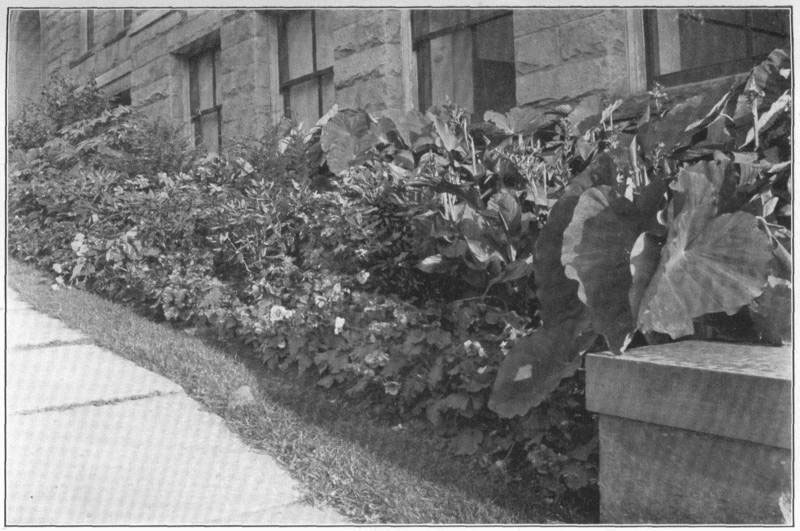
![[Illustration: Fig. 33. A spring expression worth securing. Catkins of the small poplar.]](https://openoldbooks.sgp1.digitaloceanspaces.com/books/manual-of-gardening/images/fig033.png)
![[Illustration: Fig. 34. Plant-form in cherries.--Reine Hortense.]](https://openoldbooks.sgp1.digitaloceanspaces.com/books/manual-of-gardening/images/fig034.png) I have said that the legitimate use of poplars in ornamental grounds is
in the production of minor or secondary effects. As a rule, they are
less adapted to isolated planting as
I have said that the legitimate use of poplars in ornamental grounds is
in the production of minor or secondary effects. As a rule, they are
less adapted to isolated planting as ![[Illustration: Fig. 35. Morello cherry.]](https://openoldbooks.sgp1.digitaloceanspaces.com/books/manual-of-gardening/images/fig035.png)
![[Illustration: Fig. 36. May Duke cherry.]](https://openoldbooks.sgp1.digitaloceanspaces.com/books/manual-of-gardening/images/fig036.png) It will not be long before the observer learns that many of the tree and
shrub characters are most marked in winter; and he will begin
unconsciously to add the winter to his year.
It will not be long before the observer learns that many of the tree and
shrub characters are most marked in winter; and he will begin
unconsciously to add the winter to his year.![[Illustration: 37. The planting in a simple front yard.]](https://openoldbooks.sgp1.digitaloceanspaces.com/books/manual-of-gardening/images/fig037.png)
![[Illustration: Fig. 38. Plan of the planting shown in Fig. 37.]](https://openoldbooks.sgp1.digitaloceanspaces.com/books/manual-of-gardening/images/fig038.png)
![[Illustration: Fig. 39. Diagram of a back-yard planting. 50 x 90 feet.]](https://openoldbooks.sgp1.digitaloceanspaces.com/books/manual-of-gardening/images/fig039.png)
![[Illustration: Fig. 40. The beginning of a landscape garden.]](https://openoldbooks.sgp1.digitaloceanspaces.com/books/manual-of-gardening/images/fig040.png)
![[Illustration: Fig. 41. The result in five years.]](https://openoldbooks.sgp1.digitaloceanspaces.com/books/manual-of-gardening/images/fig041.png)
![[Illustration: Fig. 42. A meaningless back-yard planting, and an unnecessary drive.]](https://openoldbooks.sgp1.digitaloceanspaces.com/books/manual-of-gardening/images/fig042.png)
![[Illustration: Fig. 43. Suggestions for improving Fig. 42.]](https://openoldbooks.sgp1.digitaloceanspaces.com/books/manual-of-gardening/images/fig043.png)
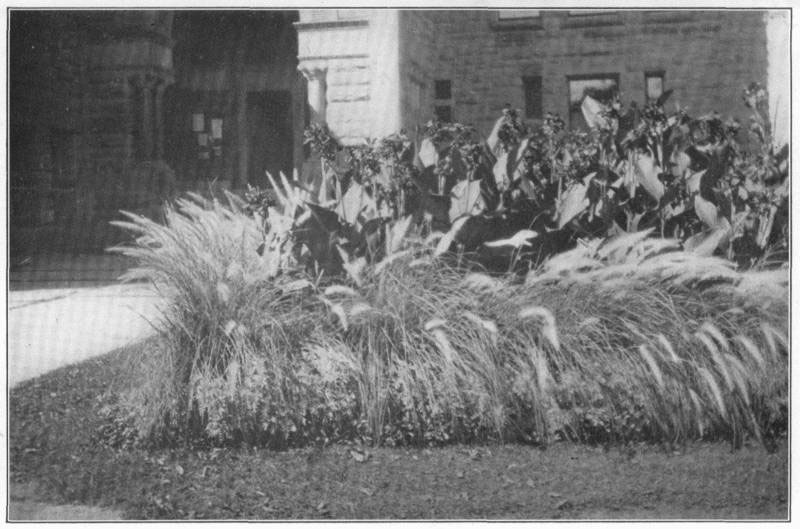
![[Illustration: Fig. 44. Present outline of a city back yard, desired to be planted.]](https://openoldbooks.sgp1.digitaloceanspaces.com/books/manual-of-gardening/images/fig044.png)
![[Illustration: Fig. 45. The planting of the terrace in Fig. 44.]](https://openoldbooks.sgp1.digitaloceanspaces.com/books/manual-of-gardening/images/fig045.png)
![[Illustration: Fig. 46. Said to have been planted.]](https://openoldbooks.sgp1.digitaloceanspaces.com/books/manual-of-gardening/images/fig046.png)
![[Illustration: Fig. 47. An area well filled. Compare Fig. 46.]](https://openoldbooks.sgp1.digitaloceanspaces.com/books/manual-of-gardening/images/fig047.png)
![[Illustration: Fig. 48. The screening of the tennis-screen.]](https://openoldbooks.sgp1.digitaloceanspaces.com/books/manual-of-gardening/images/fig048.png)
![[Illustration: Fig. 49. At the bottom of the clothes-post.]](https://openoldbooks.sgp1.digitaloceanspaces.com/books/manual-of-gardening/images/fig049.png)
![[Illustration: Fig. 50. Young shoots of ailanthus (and sunflowers for variety).]](https://openoldbooks.sgp1.digitaloceanspaces.com/books/manual-of-gardening/images/fig050.png)
![[Illustration: Fig. 51. A backyard cabin.]](https://openoldbooks.sgp1.digitaloceanspaces.com/books/manual-of-gardening/images/fig051.png)
![[Illustration: Fig. 52. A garden path with hedgerows, trellis, and bench, in formal treatment.]](https://openoldbooks.sgp1.digitaloceanspaces.com/books/manual-of-gardening/images/fig052.png)
![[Illustration: Fig. 53. An enclosure for lawn games.]](https://openoldbooks.sgp1.digitaloceanspaces.com/books/manual-of-gardening/images/fig053.png)
![[Illustration: Fig. 54. Sunlight and shadow.]](https://openoldbooks.sgp1.digitaloceanspaces.com/books/manual-of-gardening/images/fig054.png)
![[Illustration: Fig. 55. An upland garden, with grass-grown steps, sundial, and edge of foxgloves.]](https://openoldbooks.sgp1.digitaloceanspaces.com/books/manual-of-gardening/images/fig055.png)
![[Illustration: Fig. 56. A garden corner.]](https://openoldbooks.sgp1.digitaloceanspaces.com/books/manual-of-gardening/images/fig056.png)
![[Illustration: Fig. 57. An old-fashioned doorway.]](https://openoldbooks.sgp1.digitaloceanspaces.com/books/manual-of-gardening/images/fig057.png)
![[Illustration: Fig. 58. An informally treated stream.]](https://openoldbooks.sgp1.digitaloceanspaces.com/books/manual-of-gardening/images/fig058.png)
![[Illustration: Fig. 59. A terrace in the distance; in the foreground an ideal “running out” of the bank.]](https://openoldbooks.sgp1.digitaloceanspaces.com/books/manual-of-gardening/images/fig059.png)
![[Illustration: Fig. 60. Treatment of a sloping lawn.]](https://openoldbooks.sgp1.digitaloceanspaces.com/books/manual-of-gardening/images/fig060.png)
![[Illustration: Fig. 61. Treatment of a very steep bank.]](https://openoldbooks.sgp1.digitaloceanspaces.com/books/manual-of-gardening/images/fig061.png)
![[Illustration: Fig. 62. A terrace or slope that falls too suddenly away from a building. There should be a level place or esplanade next the building, if possible.]](https://openoldbooks.sgp1.digitaloceanspaces.com/books/manual-of-gardening/images/fig062.png)
![[Illustration: 63. Shaping the land down to a water-course.]](https://openoldbooks.sgp1.digitaloceanspaces.com/books/manual-of-gardening/images/fig063.png)
![[Illustration: Fig. 64. A sunken fence athwart a foreground.]](https://openoldbooks.sgp1.digitaloceanspaces.com/books/manual-of-gardening/images/fig064.png)
![[Illustration: Fig. 65. Protecting a tree in filled land.]](https://openoldbooks.sgp1.digitaloceanspaces.com/books/manual-of-gardening/images/fig065.png)
![[Illustration: Fig. 66. Forms of front walks.]](https://openoldbooks.sgp1.digitaloceanspaces.com/books/manual-of-gardening/images/fig066.png)
![[Illustration: Fig. 67. A patched-up drive, showing meaningless crooks.]](https://openoldbooks.sgp1.digitaloceanspaces.com/books/manual-of-gardening/images/fig067.png)
![[Illustration: Fig. 68. Treatment of walk and drive in a suburban region. There are no curbs.]](https://openoldbooks.sgp1.digitaloceanspaces.com/books/manual-of-gardening/images/fig068.png)
![[Illustration: Fig. 69. A common form of edge for walk or drive.]](https://openoldbooks.sgp1.digitaloceanspaces.com/books/manual-of-gardening/images/fig069.png)
![[Illustration: Fig. 70. A better form.]](https://openoldbooks.sgp1.digitaloceanspaces.com/books/manual-of-gardening/images/fig070.png)
![[Illustration: Fig. 71. Sod cutter.]](https://openoldbooks.sgp1.digitaloceanspaces.com/books/manual-of-gardening/images/fig071.png)
![[Illustration: Fig. 72. Draining the gutter and the drive.]](https://openoldbooks.sgp1.digitaloceanspaces.com/books/manual-of-gardening/images/fig072.png)
![[Illustration: Fig. 73. Planting alongside a walk.]](https://openoldbooks.sgp1.digitaloceanspaces.com/books/manual-of-gardening/images/fig073.png)
![[Illustration: Fig. 74. A bowered pathway.]](https://openoldbooks.sgp1.digitaloceanspaces.com/books/manual-of-gardening/images/fig074.png)
![[Illustration: Fig. 75. Objects for pity.]](https://openoldbooks.sgp1.digitaloceanspaces.com/books/manual-of-gardening/images/fig075.png)
![[Illustration: 76. A border group, limiting the space next the residence and separating it from the fields and the clothes-yards.]](https://openoldbooks.sgp1.digitaloceanspaces.com/books/manual-of-gardening/images/fig076.png)
![[Illustration: Fig. 77. Cutting sod for a lawn.]](https://openoldbooks.sgp1.digitaloceanspaces.com/books/manual-of-gardening/images/fig077.png)
![[Illustration: Fig. 78. Economical sodding, the spaces being seeded.]](https://openoldbooks.sgp1.digitaloceanspaces.com/books/manual-of-gardening/images/fig078.png)
![[Illustration: Fig 79. Ditching tools.]](https://openoldbooks.sgp1.digitaloceanspaces.com/books/manual-of-gardening/images/fig079.png) The first step in the preparation of land, after it has been thoroughly
cleared and subdued of forest or previous vegetation, is to attend to
the drainage. All land that is springy, low, and “sour,” or that holds
the water in puddles for a day or two following heavy rains, should be
thoroughly underdrained. Draining also improves the physical condition
of the soil even when the land does not need the removal of superfluous
water. In hard lands, it lowers the water-table, or tends to loosen and
aerate the soil to a greater depth, and thereby enables it to hold more
water without injury to plants. Drainage is particularly useful in dry
but hard garden lands, because these lands are often in sod or
permanently planted, and the soil cannot be broken up by deep tillage.
Tile drainage is permanent subsoiling.
The first step in the preparation of land, after it has been thoroughly
cleared and subdued of forest or previous vegetation, is to attend to
the drainage. All land that is springy, low, and “sour,” or that holds
the water in puddles for a day or two following heavy rains, should be
thoroughly underdrained. Draining also improves the physical condition
of the soil even when the land does not need the removal of superfluous
water. In hard lands, it lowers the water-table, or tends to loosen and
aerate the soil to a greater depth, and thereby enables it to hold more
water without injury to plants. Drainage is particularly useful in dry
but hard garden lands, because these lands are often in sod or
permanently planted, and the soil cannot be broken up by deep tillage.
Tile drainage is permanent subsoiling.![[Illustration: Fig. 80. How to use a spade.]](https://openoldbooks.sgp1.digitaloceanspaces.com/books/manual-of-gardening/images/fig080.png)
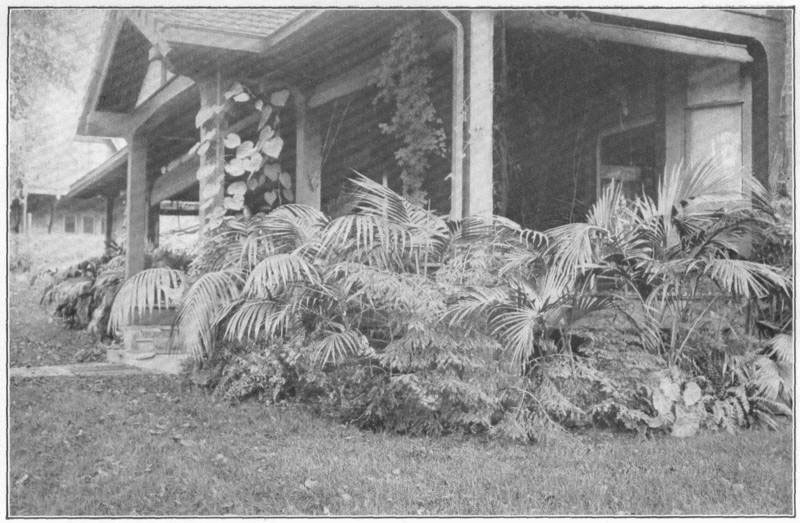
![[Illustration: 81. Trenching with a spade.]](https://openoldbooks.sgp1.digitaloceanspaces.com/books/manual-of-gardening/images/fig081.png)
![[Illustration: Fig. 82. Home-made subsoil plow.]](https://openoldbooks.sgp1.digitaloceanspaces.com/books/manual-of-gardening/images/fig082.png)
![[Illustration: Fig. 83. Forms of subsoil plows.]](https://openoldbooks.sgp1.digitaloceanspaces.com/books/manual-of-gardening/images/fig083.png) In places that can be entered with a team, deep and heavy plowing to the
depth of seven to ten inches may be desirable on hard lands, especially
if such lands cannot be plowed very
In places that can be entered with a team, deep and heavy plowing to the
depth of seven to ten inches may be desirable on hard lands, especially
if such lands cannot be plowed very ![[Illustration: Fig. 84. Improvising a spading-fork.]](https://openoldbooks.sgp1.digitaloceanspaces.com/books/manual-of-gardening/images/fig084.png)
![[Illustration: Fig. 85. Excellent types of surface plows.]](https://openoldbooks.sgp1.digitaloceanspaces.com/books/manual-of-gardening/images/fig085.png)
![[Illustration: Fig. 86. Disk and Acme harrows, for the first working of hard or cloddy land.]](https://openoldbooks.sgp1.digitaloceanspaces.com/books/manual-of-gardening/images/fig086.png)
![[Illustration: Fig. 87. Spring-tooth harrows.]](https://openoldbooks.sgp1.digitaloceanspaces.com/books/manual-of-gardening/images/fig087.png)
![[Illustration: Fig. 88. Spike-tooth harrow.]](https://openoldbooks.sgp1.digitaloceanspaces.com/books/manual-of-gardening/images/fig088.png)
![[Illustration: Fig. 89. Spike-tooth and spring-tooth cultivators.]](https://openoldbooks.sgp1.digitaloceanspaces.com/books/manual-of-gardening/images/fig089.png)
![[Illustration: Fig. 90. Good type of wheel-hoe.]](https://openoldbooks.sgp1.digitaloceanspaces.com/books/manual-of-gardening/images/fig090.png)
![[Illustration: Fig. 91. A single-blade wheel-hoe.]](https://openoldbooks.sgp1.digitaloceanspaces.com/books/manual-of-gardening/images/fig091.png)
![[Illustration: Fig. 92. Double wheel-hoe, useful in straddling the row.]](https://openoldbooks.sgp1.digitaloceanspaces.com/books/manual-of-gardening/images/fig092.png)
![[Illustration: Fig. 93. To illustrate good preparation of ground.]](https://openoldbooks.sgp1.digitaloceanspaces.com/books/manual-of-gardening/images/fig093.png)
![[Illustration: 94. To illustrate poor preparation of ground.]](https://openoldbooks.sgp1.digitaloceanspaces.com/books/manual-of-gardening/images/fig094.png)
![[Illustration: 95. Useful forms of hoe-blades.]](https://openoldbooks.sgp1.digitaloceanspaces.com/books/manual-of-gardening/images/fig095.png)
![[Illustration: Fig. 96. A stack of gardening weapons, comprising some of Tarryer’s weeding spuds and thimbles.]](https://openoldbooks.sgp1.digitaloceanspaces.com/books/manual-of-gardening/images/fig096.png)
![[Illustration: Fig. 97. Some of the details of the Tarryer tools.]](https://openoldbooks.sgp1.digitaloceanspaces.com/books/manual-of-gardening/images/fig097.png)
![[Illustration: 98. A scarifier.]](https://openoldbooks.sgp1.digitaloceanspaces.com/books/manual-of-gardening/images/fig098.png)
![[Illustration: 99. Home-made scarifier.]](https://openoldbooks.sgp1.digitaloceanspaces.com/books/manual-of-gardening/images/fig099.png)
![[Illustration: 100. Home-made scarifier or scraper.]](https://openoldbooks.sgp1.digitaloceanspaces.com/books/manual-of-gardening/images/fig100.png)
![[Illustration: 101. The common scarifier.]](https://openoldbooks.sgp1.digitaloceanspaces.com/books/manual-of-gardening/images/fig101.png)
![[Illustration: 102. Good hand-weeders.]](https://openoldbooks.sgp1.digitaloceanspaces.com/books/manual-of-gardening/images/fig102.png)
![[Illustration: 103. A hand-weeder.]](https://openoldbooks.sgp1.digitaloceanspaces.com/books/manual-of-gardening/images/fig103.png)
![[Illustration: 104. A finger-weeder.]](https://openoldbooks.sgp1.digitaloceanspaces.com/books/manual-of-gardening/images/fig104.png)
![[Illustration: 105. A small hand-weeder.]](https://openoldbooks.sgp1.digitaloceanspaces.com/books/manual-of-gardening/images/fig105.png)
![[Illustration: Fig. 106. Long-handled trowel.]](https://openoldbooks.sgp1.digitaloceanspaces.com/books/manual-of-gardening/images/fig106.png)
![[Illustration: Fig. 107. Improvised trowel.]](https://openoldbooks.sgp1.digitaloceanspaces.com/books/manual-of-gardening/images/fig107.png)
![[Illustration: Fig. 108. Weed-spud.]](https://openoldbooks.sgp1.digitaloceanspaces.com/books/manual-of-gardening/images/fig108.png)
![[Illustration: Fig. 109. A good weed-spud.]](https://openoldbooks.sgp1.digitaloceanspaces.com/books/manual-of-gardening/images/fig109.png)
![[Illustration: Fig. 110. Weed-cutter.]](https://openoldbooks.sgp1.digitaloceanspaces.com/books/manual-of-gardening/images/fig110.png)
![[Illustration: Fig. 111. A weed-spud that lifts the weed.]](https://openoldbooks.sgp1.digitaloceanspaces.com/books/manual-of-gardening/images/fig111.png)
![[Illustration: Fig. 112. Hand-roller.]](https://openoldbooks.sgp1.digitaloceanspaces.com/books/manual-of-gardening/images/fig112.png)
![[Illustration: Fig. 113. Roller and marker.]](https://openoldbooks.sgp1.digitaloceanspaces.com/books/manual-of-gardening/images/fig113.png)
![[Illustration: Fig. 114. Roller and marker.]](https://openoldbooks.sgp1.digitaloceanspaces.com/books/manual-of-gardening/images/fig114.png)
![[Illustration: Fig. 115. Marking-stick.]](https://openoldbooks.sgp1.digitaloceanspaces.com/books/manual-of-gardening/images/fig115.png)
![[Illustration: Fig. 116. Tool for spacing plants.]](https://openoldbooks.sgp1.digitaloceanspaces.com/books/manual-of-gardening/images/fig116.png)
![[Illustration: Fig. 117. Barrow rigged with a marker.]](https://openoldbooks.sgp1.digitaloceanspaces.com/books/manual-of-gardening/images/fig117.png)
![[Illustration: Fig. 118. Hand sled-marker.]](https://openoldbooks.sgp1.digitaloceanspaces.com/books/manual-of-gardening/images/fig118.png)
![[Illustration: Fig. 119. Trailing sled-marker.]](https://openoldbooks.sgp1.digitaloceanspaces.com/books/manual-of-gardening/images/fig119.png)
![[Illustration: Fig. 120. Adjustable sled-marker.]](https://openoldbooks.sgp1.digitaloceanspaces.com/books/manual-of-gardening/images/fig120.png)
![[Illustration: Fig 121. A good cart for collecting leaves and other materials.]](https://openoldbooks.sgp1.digitaloceanspaces.com/books/manual-of-gardening/images/fig121.png)
![[Illustration: Fig. 122. The planting of the dormant-wood cuttings.]](https://openoldbooks.sgp1.digitaloceanspaces.com/books/manual-of-gardening/images/fig122.png)
![[Illustration: Fig. 123. Carnation cutting.]](https://openoldbooks.sgp1.digitaloceanspaces.com/books/manual-of-gardening/images/fig123.png)
![[Illustration: Fig. 124. Verbena cutting.]](https://openoldbooks.sgp1.digitaloceanspaces.com/books/manual-of-gardening/images/fig124.png)
![[Illustration: Fig. 125. Leaf-cutting.]](https://openoldbooks.sgp1.digitaloceanspaces.com/books/manual-of-gardening/images/fig125.png)
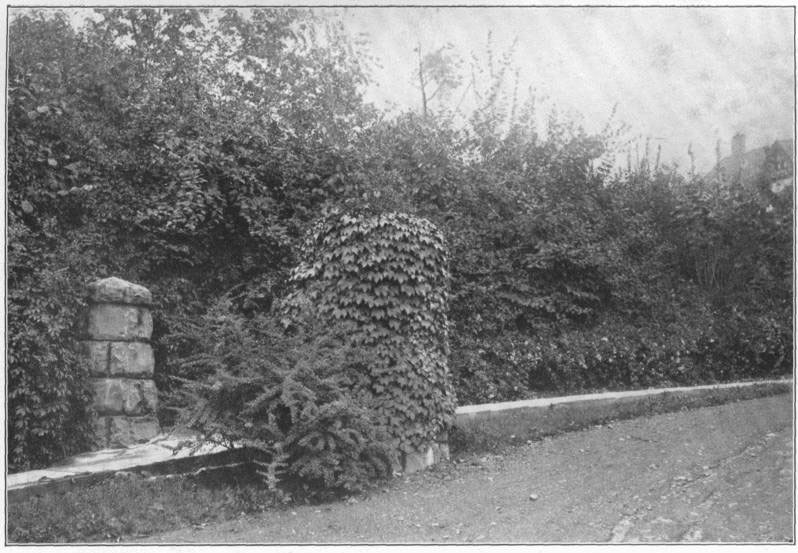
![[Illustration: Fig. 126. Cuttings inserted in a double pot.]](https://openoldbooks.sgp1.digitaloceanspaces.com/books/manual-of-gardening/images/fig126.png)
![[Illustration: Fig. 127. To check evaporation at transplanting.]](https://openoldbooks.sgp1.digitaloceanspaces.com/books/manual-of-gardening/images/fig127.png)
![[Illustration: Fig. 128. Plants sheared and not sheared when transplanted.]](https://openoldbooks.sgp1.digitaloceanspaces.com/books/manual-of-gardening/images/fig128.png)
![[Illustration: Fig. 129. Where to shear the tops of young plants.]](https://openoldbooks.sgp1.digitaloceanspaces.com/books/manual-of-gardening/images/fig129.png)
![[Illustration: Fig. 130. Trowel dibber.]](https://openoldbooks.sgp1.digitaloceanspaces.com/books/manual-of-gardening/images/fig130.png)
![[Illustration: Fig. 131. The dibber.]](https://openoldbooks.sgp1.digitaloceanspaces.com/books/manual-of-gardening/images/fig131.png)
![[Illustration: Fig. 132. Home-made padded dibber.]](https://openoldbooks.sgp1.digitaloceanspaces.com/books/manual-of-gardening/images/fig132.png)
![[Illustration: Fig. 133. Dibber and crow-bar combined.]](https://openoldbooks.sgp1.digitaloceanspaces.com/books/manual-of-gardening/images/fig133.png)
![[Illustration: Fig. 134. Strawberry planter.]](https://openoldbooks.sgp1.digitaloceanspaces.com/books/manual-of-gardening/images/fig134.png)
![[Illustration: Fig. 135. The plunging of pots.]](https://openoldbooks.sgp1.digitaloceanspaces.com/books/manual-of-gardening/images/fig135.png)
![[Illustration: Fig. 136. Setting large tub-plants in the lawn.]](https://openoldbooks.sgp1.digitaloceanspaces.com/books/manual-of-gardening/images/fig136.png)
![[Illustration: Fig. 137. Plant-box with a movable side.]](https://openoldbooks.sgp1.digitaloceanspaces.com/books/manual-of-gardening/images/fig137.png)
![[Illustration: Fig. 138. Box for transporting large transplanted stock.]](https://openoldbooks.sgp1.digitaloceanspaces.com/books/manual-of-gardening/images/fig138.png)
![[Illustration: Fig. 139. A planting board.]](https://openoldbooks.sgp1.digitaloceanspaces.com/books/manual-of-gardening/images/fig139.png)
![[Illustration: Fig. 140. Device for placing the tree.]](https://openoldbooks.sgp1.digitaloceanspaces.com/books/manual-of-gardening/images/fig140.png)
![[Illustration: Fig. 141. Lining a tree from a stake.]](https://openoldbooks.sgp1.digitaloceanspaces.com/books/manual-of-gardening/images/fig141.png)
![[Illustration: Fig. 142: Proper planting of a tree.]](https://openoldbooks.sgp1.digitaloceanspaces.com/books/manual-of-gardening/images/fig142.png)
![[Illustration: Fig. 143: Careless planting of a tree.]](https://openoldbooks.sgp1.digitaloceanspaces.com/books/manual-of-gardening/images/fig143.png)
![[Illustration: Fig. 144. Pruned young tree.]](https://openoldbooks.sgp1.digitaloceanspaces.com/books/manual-of-gardening/images/fig144.png)
![[Illustration: Fig. 145. Pruned young tree.]](https://openoldbooks.sgp1.digitaloceanspaces.com/books/manual-of-gardening/images/fig145.png)
![[Illustration: Fig. 146: Peach tree.]](https://openoldbooks.sgp1.digitaloceanspaces.com/books/manual-of-gardening/images/fig146.png)
![[Illustration: Fig. 147: Peach tree pruned for planting.]](https://openoldbooks.sgp1.digitaloceanspaces.com/books/manual-of-gardening/images/fig147.png)
![[Illustration: Fig. 148: Moving a large tree.]](https://openoldbooks.sgp1.digitaloceanspaces.com/books/manual-of-gardening/images/fig148.png)
![[Illustration: Fig. 149. The tree ready to lift.]](https://openoldbooks.sgp1.digitaloceanspaces.com/books/manual-of-gardening/images/fig149.png)
![[Illustration: 150. The tree ready to move.]](https://openoldbooks.sgp1.digitaloceanspaces.com/books/manual-of-gardening/images/fig150.png)
![[Illustration: Fig. 151. Trees heeled-in for winter.]](https://openoldbooks.sgp1.digitaloceanspaces.com/books/manual-of-gardening/images/fig151.png)
![[Illustration: Fig. 152. Tree earthed up for winter.]](https://openoldbooks.sgp1.digitaloceanspaces.com/books/manual-of-gardening/images/fig152.png)
![[Illustration: Fig. 153: Covering plants in a box.]](https://openoldbooks.sgp1.digitaloceanspaces.com/books/manual-of-gardening/images/fig153.png)
![[Illustration: Fig. 154: Covering plants in a barrel.]](https://openoldbooks.sgp1.digitaloceanspaces.com/books/manual-of-gardening/images/fig154.png)
![[Illustration: Fig. 155. Laying down of trellis-grown blackberries.]](https://openoldbooks.sgp1.digitaloceanspaces.com/books/manual-of-gardening/images/fig155.png)
![[Illustration: Fig. 156. Lath tree guard.]](https://openoldbooks.sgp1.digitaloceanspaces.com/books/manual-of-gardening/images/fig156.png)
![[Illustration: Fig. 157. Wire-and-post tree guard]](https://openoldbooks.sgp1.digitaloceanspaces.com/books/manual-of-gardening/images/fig157.png)
![[Illustration: Fig 158. How a horse may be hitched to a tree.]](https://openoldbooks.sgp1.digitaloceanspaces.com/books/manual-of-gardening/images/fig158.png)
![[Illustration: Fig. 159. Bridge-grafting a girdle.]](https://openoldbooks.sgp1.digitaloceanspaces.com/books/manual-of-gardening/images/fig159.png)
![[Illustration: Fig. 161. A wound, made by freezing, trimmed out and filled with cement.]](https://openoldbooks.sgp1.digitaloceanspaces.com/books/manual-of-gardening/images/fig161.png)
![[Illustration: Fig. 160. A cement-filled cavity at the base of a tree.]](https://openoldbooks.sgp1.digitaloceanspaces.com/books/manual-of-gardening/images/fig160.png)
![[Illustration: Fig. 162. Bridge-grafting or in-arching from saplings planted about the tree.]](https://openoldbooks.sgp1.digitaloceanspaces.com/books/manual-of-gardening/images/fig162.png)
![[Illustration: Fig. 163. Faulty methods of bracing a crotched tree. The lower method is wholly wrong. The upper method is good if the bolt-heads are properly counter-sunk and the bolts tightly fitted; but if the distance between the branches is great, it is better to have two bolts and join them by hooks, to allow of wind movements.]](https://openoldbooks.sgp1.digitaloceanspaces.com/books/manual-of-gardening/images/fig163.png)
![[Illustration: Fig. 164. Trees ruined to allow of the passage of wires.]](https://openoldbooks.sgp1.digitaloceanspaces.com/books/manual-of-gardening/images/fig164.png)
![[Illustration: Fig. 165. Accommodating a wall to a valuable tree.]](https://openoldbooks.sgp1.digitaloceanspaces.com/books/manual-of-gardening/images/fig165.png)
![[Illustration: Fig. 166. The death of a long stub.]](https://openoldbooks.sgp1.digitaloceanspaces.com/books/manual-of-gardening/images/fig166.png)
![[Illustration: Fig. 167. Bungling pruning.]](https://openoldbooks.sgp1.digitaloceanspaces.com/books/manual-of-gardening/images/fig167.png)
![[Illustration: Fig. 168. The proper way to saw off a large limb. A cut is first made on the under side to prevent splitting down; then it is cut on the upper side. Then the entire “stub” is removed close to the trunk.]](https://openoldbooks.sgp1.digitaloceanspaces.com/books/manual-of-gardening/images/fig168.png)
![[Illustration: Fig. 169. A weak-bodied young tree well supported; padding is placed under the bandages.]](https://openoldbooks.sgp1.digitaloceanspaces.com/books/manual-of-gardening/images/fig169.png)
![[Illustration: Fig. 170. The wrong way of attaching a guy rope.]](https://openoldbooks.sgp1.digitaloceanspaces.com/books/manual-of-gardening/images/fig170.png)
![[Illustration: Fig. 171. An allowable way of attaching a guy rope.]](https://openoldbooks.sgp1.digitaloceanspaces.com/books/manual-of-gardening/images/fig171.png)
![[Illustration: Fig. 172. The best way of attaching a guy rope, if a tree must be used as support.]](https://openoldbooks.sgp1.digitaloceanspaces.com/books/manual-of-gardening/images/fig172.png)
![[Illustration: Fig. 173. A method of saving valuable trees along streets on which heavy lowering of grade has been made.]](https://openoldbooks.sgp1.digitaloceanspaces.com/books/manual-of-gardening/images/fig173.png)
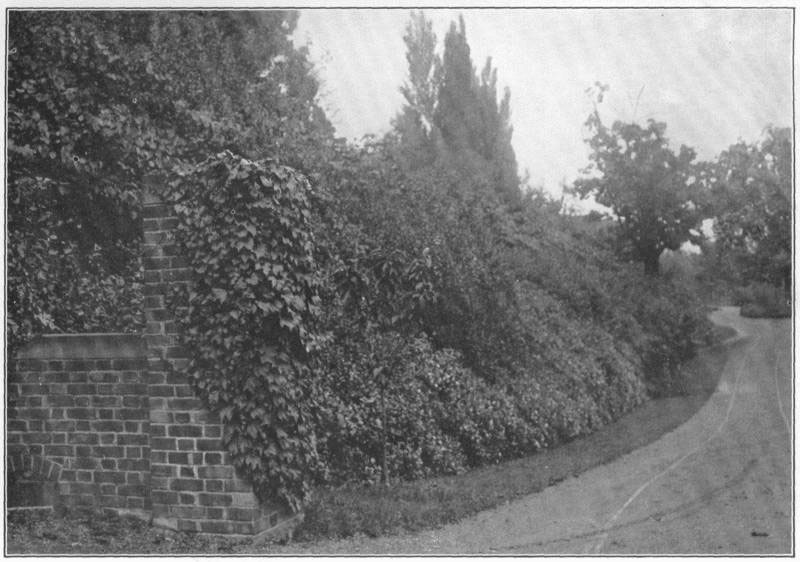
![[Illustration: Fig. 174. Budding. The “bud”; the opening to receive it; the bud tied.]](https://openoldbooks.sgp1.digitaloceanspaces.com/books/manual-of-gardening/images/fig174.png)
![[Illustration: Fig. 175. Whip-graft.]](https://openoldbooks.sgp1.digitaloceanspaces.com/books/manual-of-gardening/images/fig175.png)
![[Illustration: Fig. 176. Cleft-graft before waxing.]](https://openoldbooks.sgp1.digitaloceanspaces.com/books/manual-of-gardening/images/fig176.png)
![[Illustration: Fig. 177. The common stake label.]](https://openoldbooks.sgp1.digitaloceanspaces.com/books/manual-of-gardening/images/fig177.png)
![[Illustration: Fig. 178. A good stake label, with the legend covered.]](https://openoldbooks.sgp1.digitaloceanspaces.com/books/manual-of-gardening/images/fig178.png)
![[Illustration: Fig. 179. Metal stake label.]](https://openoldbooks.sgp1.digitaloceanspaces.com/books/manual-of-gardening/images/fig179.png)
![[Illustration: Fig. 180. Zinc tallies.]](https://openoldbooks.sgp1.digitaloceanspaces.com/books/manual-of-gardening/images/fig180.png)
![[Illustration: Fig. 181. Common zinc tally.]](https://openoldbooks.sgp1.digitaloceanspaces.com/books/manual-of-gardening/images/fig181.png)
![[Illustration: Fig. 182. A common nursery label.]](https://openoldbooks.sgp1.digitaloceanspaces.com/books/manual-of-gardening/images/fig182.png)
![[Illustration: Fig. 183. Cornell tree label.]](https://openoldbooks.sgp1.digitaloceanspaces.com/books/manual-of-gardening/images/fig183.png)
![[Illustration: Fig. 184. Serviceable large-loop tree label.]](https://openoldbooks.sgp1.digitaloceanspaces.com/books/manual-of-gardening/images/fig184.png)
![[Illustration: Fig. 185. Zinc tree label.]](https://openoldbooks.sgp1.digitaloceanspaces.com/books/manual-of-gardening/images/fig185.png)
![[Illustration: Fig. 186. Injury by a tight label wire.]](https://openoldbooks.sgp1.digitaloceanspaces.com/books/manual-of-gardening/images/fig186.png)
![[Illustration: Fig. 187. The old-fashioned “outdoor cellar,” still a very useful and convenient storage place.]](https://openoldbooks.sgp1.digitaloceanspaces.com/books/manual-of-gardening/images/fig187.png)
![[Illustration: Fig. 188. Lean-to fruit cellar, covered with earth. The roof should be of cement or stone slabs. Provide a ventilator.]](https://openoldbooks.sgp1.digitaloceanspaces.com/books/manual-of-gardening/images/fig188.png)
![[Illustration: Fig. 189. A fruit storage house cooled by ice.]](https://openoldbooks.sgp1.digitaloceanspaces.com/books/manual-of-gardening/images/fig189.png)
![[Illustration: Fig. 190. Forcing-hill for rhubarb.]](https://openoldbooks.sgp1.digitaloceanspaces.com/books/manual-of-gardening/images/fig190.png)
![[Illustration: Fig. 191. Forcing-hill, and the mold or frame for making it.]](https://openoldbooks.sgp1.digitaloceanspaces.com/books/manual-of-gardening/images/fig191.png)
![[Illustration: Fig. 192. Hand-box.]](https://openoldbooks.sgp1.digitaloceanspaces.com/books/manual-of-gardening/images/fig192.png)
![[Illustration: Fig. 193. Glass forcing-hill.]](https://openoldbooks.sgp1.digitaloceanspaces.com/books/manual-of-gardening/images/fig193.png)
![[Illustration: Fig. 194. Coldframe against a building. Plants at E; sill of house at A; basement opening at B.]](https://openoldbooks.sgp1.digitaloceanspaces.com/books/manual-of-gardening/images/fig194.png)
![[Illustration: Fig. 195. Weather screen, or coldframe, against a building.]](https://openoldbooks.sgp1.digitaloceanspaces.com/books/manual-of-gardening/images/fig195.png)
![[Illustration: Fig. 196. A pit or coldframe on permanent walls, and a useful adjunct to a garden. The rear cover is open (_a_).]](https://openoldbooks.sgp1.digitaloceanspaces.com/books/manual-of-gardening/images/fig196.png)
![[Illustration: Fig. 197. The usual form of coldframe.]](https://openoldbooks.sgp1.digitaloceanspaces.com/books/manual-of-gardening/images/fig197.png)
![[Illustration: Fig. 198. A strong and durable frame.]](https://openoldbooks.sgp1.digitaloceanspaces.com/books/manual-of-gardening/images/fig198.png)
![[Illustration: Fig. 199. A frame yard.]](https://openoldbooks.sgp1.digitaloceanspaces.com/books/manual-of-gardening/images/fig199.png)
![[Illustration: Fig. 200. Portable coldframe.]](https://openoldbooks.sgp1.digitaloceanspaces.com/books/manual-of-gardening/images/fig200.png)
![[Illustration: Fig. 201. A larger portable coldframe.]](https://openoldbooks.sgp1.digitaloceanspaces.com/books/manual-of-gardening/images/fig201.png)
![[Illustration: Fig. 202. A commodious portable frame.]](https://openoldbooks.sgp1.digitaloceanspaces.com/books/manual-of-gardening/images/fig202.png)
![[Illustration: Fig. 203. A low coldframe.]](https://openoldbooks.sgp1.digitaloceanspaces.com/books/manual-of-gardening/images/fig203.png)
![[Illustration: Fig. 204. Hotbed with manure on top of the ground.]](https://openoldbooks.sgp1.digitaloceanspaces.com/books/manual-of-gardening/images/fig204.png)
![[Illustration: Fig. 205. Section of a hotbed built with a pit.]](https://openoldbooks.sgp1.digitaloceanspaces.com/books/manual-of-gardening/images/fig205.png)
![[Illustration: Fig. 207. Manure-heated greenhouse.]](https://openoldbooks.sgp1.digitaloceanspaces.com/books/manual-of-gardening/images/fig207.png)
![[Illustration: Fig. 208. Pipe-heated hotbed.]](https://openoldbooks.sgp1.digitaloceanspaces.com/books/manual-of-gardening/images/fig208.png)
![[Illustration: Fig. 209. Useful kinds of watering-pots. These are adapted to different uses, as are different forms of hoes or pruning tools.]](https://openoldbooks.sgp1.digitaloceanspaces.com/books/manual-of-gardening/images/fig209.png)
![[Illustration: Fig. 210. The making of straw mats.]](https://openoldbooks.sgp1.digitaloceanspaces.com/books/manual-of-gardening/images/fig210.png)
![[Illustration: Fig. 211. Shot-hole disease of plum.]](https://openoldbooks.sgp1.digitaloceanspaces.com/books/manual-of-gardening/images/fig211.png)
![[Illustration: Fig. 212. Hollyhock rust.]](https://openoldbooks.sgp1.digitaloceanspaces.com/books/manual-of-gardening/images/fig212.png)
![[Illustration: Fig. 213. Leaf-curl of peach, due to a fungus.]](https://openoldbooks.sgp1.digitaloceanspaces.com/books/manual-of-gardening/images/fig213.png)
![[Illustration: Fig. 214. Leaves and fruits injured by fungi, chiefly apple-scab.]](https://openoldbooks.sgp1.digitaloceanspaces.com/books/manual-of-gardening/images/fig214.png)
![[Illustration: Fig. 215. The slender tufted growth indicating peach yellows. The cause of this disease is undetermined.]](https://openoldbooks.sgp1.digitaloceanspaces.com/books/manual-of-gardening/images/fig215.png)
![[Illustration: Fig. 216. Gall on a raspberry root.]](https://openoldbooks.sgp1.digitaloceanspaces.com/books/manual-of-gardening/images/fig216.png)
![[Illustration: Fig. 217. Canker-worm.]](https://openoldbooks.sgp1.digitaloceanspaces.com/books/manual-of-gardening/images/fig217.png)
![[Illustration: Fig. 218. A garden hand syringe.]](https://openoldbooks.sgp1.digitaloceanspaces.com/books/manual-of-gardening/images/fig218.png)
![[Illustration: Fig. 219. A knapsack pump.]](https://openoldbooks.sgp1.digitaloceanspaces.com/books/manual-of-gardening/images/fig219.png)
![[Illustration: Fig. 220 A compressed-air hand pump for garden work.]](https://openoldbooks.sgp1.digitaloceanspaces.com/books/manual-of-gardening/images/fig220.png)
![[Illustration: Fig. 221 A bucket pump.]](https://openoldbooks.sgp1.digitaloceanspaces.com/books/manual-of-gardening/images/fig221.png)
![[Illustration: Fig. 222 A bucket pump.]](https://openoldbooks.sgp1.digitaloceanspaces.com/books/manual-of-gardening/images/fig222.png)
![[Illustration: Fig. 223 A cart-mounted pump.]](https://openoldbooks.sgp1.digitaloceanspaces.com/books/manual-of-gardening/images/fig223.png)
![[Illustration: Fig. 224. A garden outfit.]](https://openoldbooks.sgp1.digitaloceanspaces.com/books/manual-of-gardening/images/fig224.png)
![[Illustration: Fig. 225. A cart-mounted barrel pump.]](https://openoldbooks.sgp1.digitaloceanspaces.com/books/manual-of-gardening/images/fig225.png)
![[Illustration: Fig. 226. A barrel hand pump.]](https://openoldbooks.sgp1.digitaloceanspaces.com/books/manual-of-gardening/images/fig226.png)
![[Illustration: Fig. 227. A barrel outfit, showing nozzles on extension rods for trees.]](https://openoldbooks.sgp1.digitaloceanspaces.com/books/manual-of-gardening/images/fig227.png)
![[Illustration: Fig. 228. A truck-mounted barrel hand spray Pump.]](https://openoldbooks.sgp1.digitaloceanspaces.com/books/manual-of-gardening/images/fig228.png)
![[Illustration: Fig. 229. Wire-covered box for protecting plants from insects.]](https://openoldbooks.sgp1.digitaloceanspaces.com/books/manual-of-gardening/images/fig229.png)
![[Illustration: Fig. 230 Protecting from cut-worms.]](https://openoldbooks.sgp1.digitaloceanspaces.com/books/manual-of-gardening/images/fig230.png)
![[Illustration: Fig. 231 Protecting trees from cut-worms.]](https://openoldbooks.sgp1.digitaloceanspaces.com/books/manual-of-gardening/images/fig231.png)
![[Illustration: Fig. 232 Showing how paper is cut for protecting cabbages from maggots. The Goff device.]](https://openoldbooks.sgp1.digitaloceanspaces.com/books/manual-of-gardening/images/fig232.png)
![[Illustration: Fig. 233. Cyclone or vermorel type of nozzle, single and multiple.]](https://openoldbooks.sgp1.digitaloceanspaces.com/books/manual-of-gardening/images/fig233.png)
![[Illustration: Fig. 234. Lady-bird beetle; larva above]](https://openoldbooks.sgp1.digitaloceanspaces.com/books/manual-of-gardening/images/fig234.png)
![[Illustration: Fig. 235. Elm-leaf beetle, adult, somewhat enlarged (after Howard).]](https://openoldbooks.sgp1.digitaloceanspaces.com/books/manual-of-gardening/images/fig235.png)
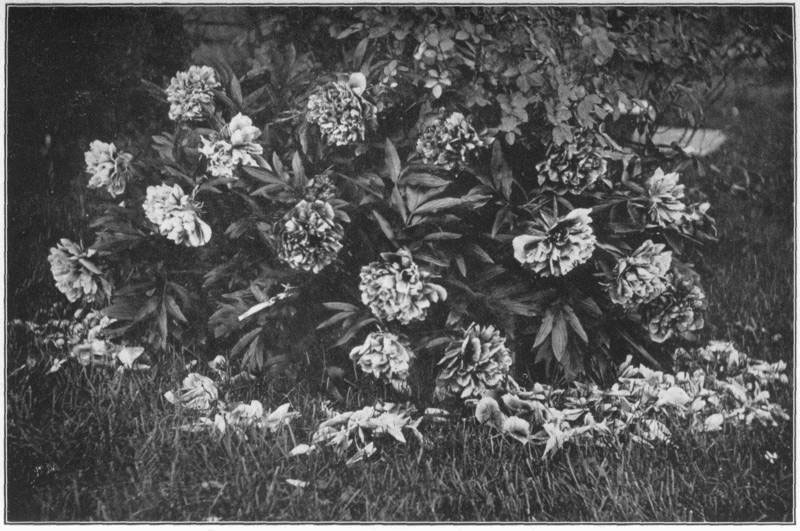
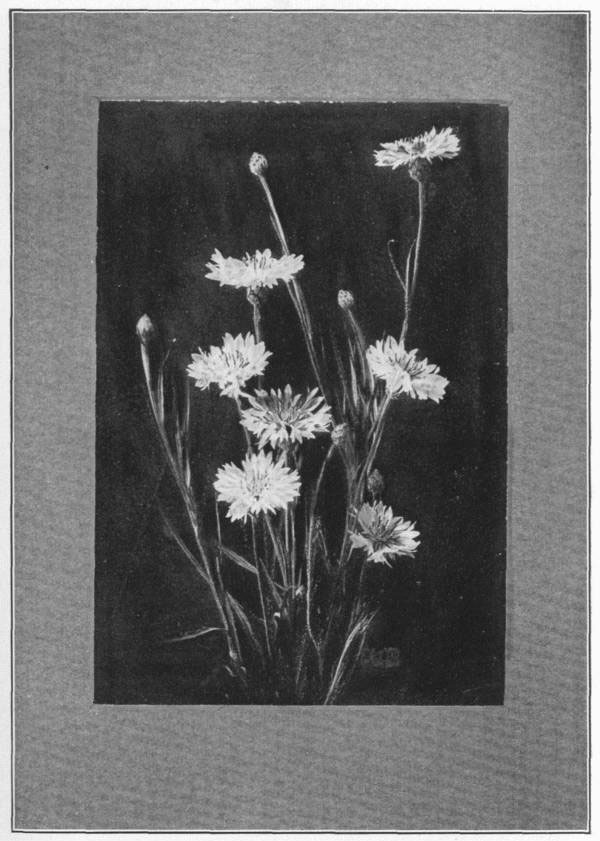
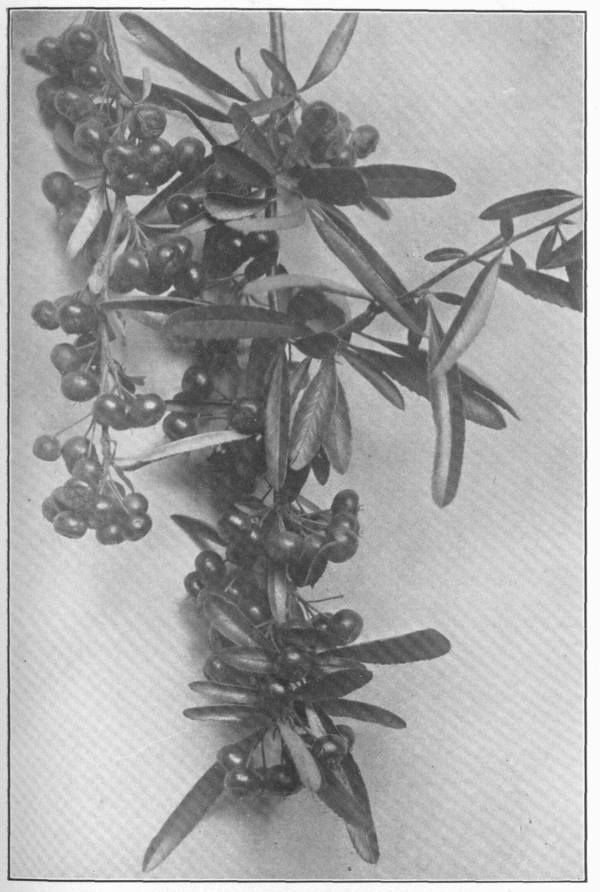
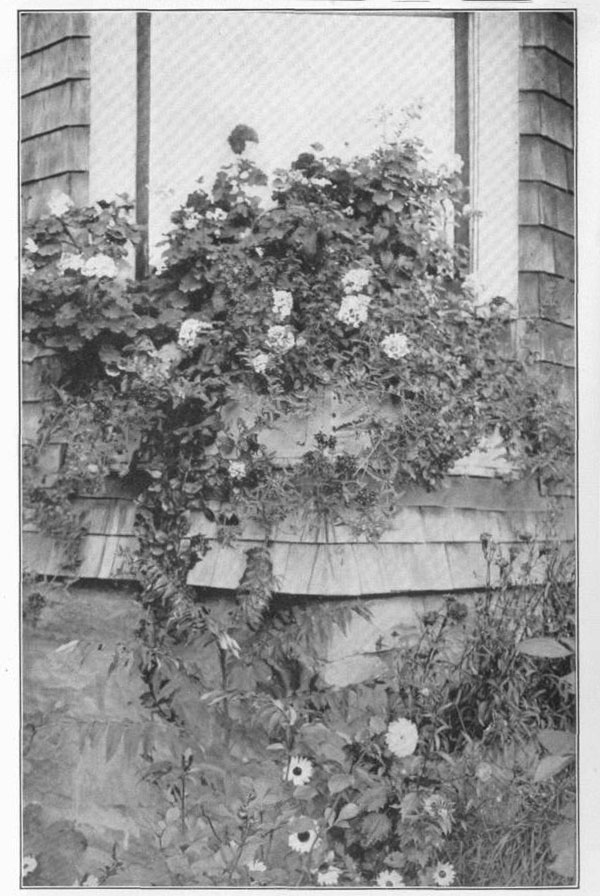
![[Illustration: Fig. 270. Plan for a fruit-garden of one acre. From “Principles of Fruit-growing.”]](https://openoldbooks.sgp1.digitaloceanspaces.com/books/manual-of-gardening/images/fig270.png)
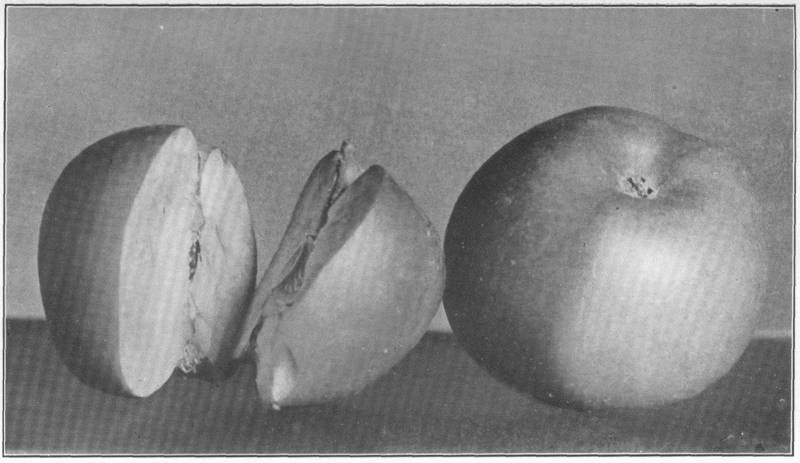
![[Illustration: Fig. 271. The Jonathan.]](https://openoldbooks.sgp1.digitaloceanspaces.com/books/manual-of-gardening/images/fig271.png)
![[Illustration: Fig. 272. The Wagener.]](https://openoldbooks.sgp1.digitaloceanspaces.com/books/manual-of-gardening/images/fig272.png)
![[Illustration: Fig. 273. Pewaukee Apple.]](https://openoldbooks.sgp1.digitaloceanspaces.com/books/manual-of-gardening/images/fig273.png)
![[Illustration: Fig. 274. Roman Apricot.]](https://openoldbooks.sgp1.digitaloceanspaces.com/books/manual-of-gardening/images/fig274.png)
![[Illustration: Fig. 275. Sour or pie cherries.]](https://openoldbooks.sgp1.digitaloceanspaces.com/books/manual-of-gardening/images/fig275.png)
![[Illustration: Fig. 276. Lucretia dewberry.]](https://openoldbooks.sgp1.digitaloceanspaces.com/books/manual-of-gardening/images/fig276.png)
![[Illustration: Fig. 277. One of the English-American gooseberries.]](https://openoldbooks.sgp1.digitaloceanspaces.com/books/manual-of-gardening/images/fig277.png)
![[Illustration: Fig. 278 Bag ready to be applied.]](https://openoldbooks.sgp1.digitaloceanspaces.com/books/manual-of-gardening/images/fig278.png)
![[Illustration: Fig. 279 The second stage in adjusting the bag.]](https://openoldbooks.sgp1.digitaloceanspaces.com/books/manual-of-gardening/images/fig279.png)
![[Illustration: Fig. 280 The bagging complete.]](https://openoldbooks.sgp1.digitaloceanspaces.com/books/manual-of-gardening/images/fig280.png)
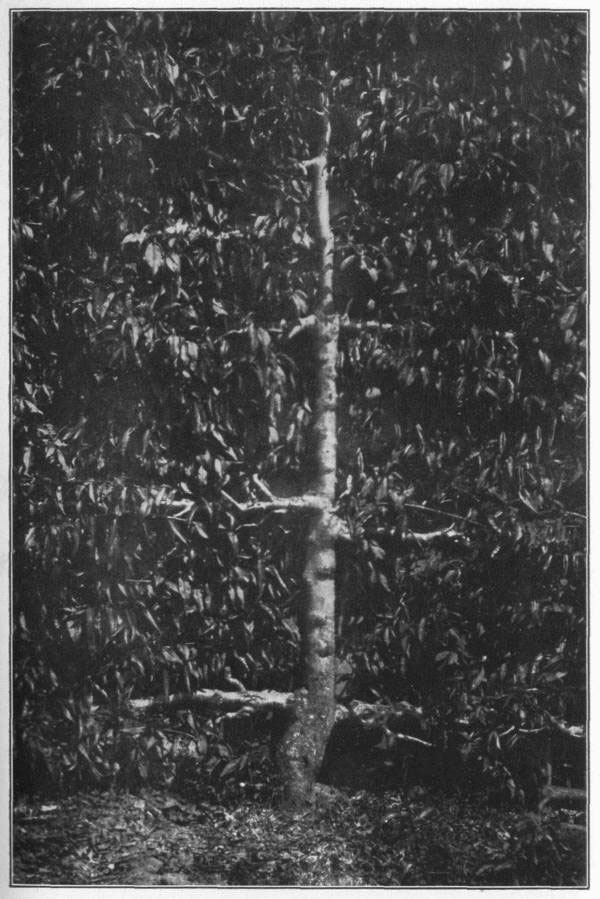
![[Illustration: Fig. 281. Seckel pear.]](https://openoldbooks.sgp1.digitaloceanspaces.com/books/manual-of-gardening/images/fig281.png)
![[Illustration Fig. 282. Duchesse d’Angoulême pear.]](https://openoldbooks.sgp1.digitaloceanspaces.com/books/manual-of-gardening/images/fig282.png)
![[Illustration Fig. 283. The Kieffer pear.]](https://openoldbooks.sgp1.digitaloceanspaces.com/books/manual-of-gardening/images/fig283.png)
![[Illustration: Fig. 284. Kieffer pear.]](https://openoldbooks.sgp1.digitaloceanspaces.com/books/manual-of-gardening/images/fig284.png)
![[Illustration: Fig. 285. Meech Quince (Meech’s Prolific).]](https://openoldbooks.sgp1.digitaloceanspaces.com/books/manual-of-gardening/images/fig285.png)
![[Illustration: Fig. 286. A rooting tip of the black raspberry.]](https://openoldbooks.sgp1.digitaloceanspaces.com/books/manual-of-gardening/images/fig286.png)
![[Illustration: Fig. 287. Sprouting habit of red raspberry.]](https://openoldbooks.sgp1.digitaloceanspaces.com/books/manual-of-gardening/images/fig287.png)
![[Illustration: Fig. 288. Strawberry plant supported by a wire rack.]](https://openoldbooks.sgp1.digitaloceanspaces.com/books/manual-of-gardening/images/fig288.png)
![[Illustration: Fig. 289. A narrow matted row of strawberries.]](https://openoldbooks.sgp1.digitaloceanspaces.com/books/manual-of-gardening/images/fig289.png)
![[Illustration: Fig. 290. A potted strawberry plant.]](https://openoldbooks.sgp1.digitaloceanspaces.com/books/manual-of-gardening/images/fig290.png)
![[Illustration: Fig. 291. Cultivating the backache.]](https://openoldbooks.sgp1.digitaloceanspaces.com/books/manual-of-gardening/images/fig291.png)
![[Illustration: Fig. 292. Tracy’s plan for a kitchen-garden.]](https://openoldbooks.sgp1.digitaloceanspaces.com/books/manual-of-gardening/images/fig292.png)
![[Illustration: Fig. 293. A garden fence arranged to allow of horse work.]](https://openoldbooks.sgp1.digitaloceanspaces.com/books/manual-of-gardening/images/fig293.png)
![[Illustration: 294. A family kitchen-garden.]](https://openoldbooks.sgp1.digitaloceanspaces.com/books/manual-of-gardening/images/fig294.png)
![[Illustration: Fig. 295. The white butterfly that lays the eggs for the cabbage-worm.]](https://openoldbooks.sgp1.digitaloceanspaces.com/books/manual-of-gardening/images/fig295.png)
![[Illustration: Fig. 296. Good _A_ and poor _B_ modes of inserting the knife to cut asparagus. Some careful growers pull or break the shoots rather than cut them.]](https://openoldbooks.sgp1.digitaloceanspaces.com/books/manual-of-gardening/images/fig296.png)
![[Illustration: Fig. 297. Bastian turnip beet.]](https://openoldbooks.sgp1.digitaloceanspaces.com/books/manual-of-gardening/images/fig297.png)
![[Illustration: Fig. 298. Brussels sprouts.]](https://openoldbooks.sgp1.digitaloceanspaces.com/books/manual-of-gardening/images/fig298.png)
![[Illustration: Fig. 299. A method of storing cabbages.]](https://openoldbooks.sgp1.digitaloceanspaces.com/books/manual-of-gardening/images/fig299.png)
![[Illustration: Fig. 300. A half-long carrot.]](https://openoldbooks.sgp1.digitaloceanspaces.com/books/manual-of-gardening/images/fig300.png)
![[Illustration: Fig. 301. Cauliflower head with leaves trimmed off.]](https://openoldbooks.sgp1.digitaloceanspaces.com/books/manual-of-gardening/images/fig301.png)
![[Illustration: Fig. 302. Celeriac or turnip-rooted celery.]](https://openoldbooks.sgp1.digitaloceanspaces.com/books/manual-of-gardening/images/fig302.png) Celeriac.—A form of the celery plant in which the tuberous root is
the edible part (Fig. 302). The tuber has the celery flavor in a
pronounced degree, and is used for flavoring soups and for celery salad.
It may be served raw, sliced in vinegar and oil, or boiled.
Celeriac.—A form of the celery plant in which the tuberous root is
the edible part (Fig. 302). The tuber has the celery flavor in a
pronounced degree, and is used for flavoring soups and for celery salad.
It may be served raw, sliced in vinegar and oil, or boiled.![[Illustration: Fig. 303. Storing celery in a trench in the field.]](https://openoldbooks.sgp1.digitaloceanspaces.com/books/manual-of-gardening/images/fig303.png)
![[Illustration: Fig. 304. A celery pit.]](https://openoldbooks.sgp1.digitaloceanspaces.com/books/manual-of-gardening/images/fig304.png)
![[Illustration: Fig. 305. Swiss chard.]](https://openoldbooks.sgp1.digitaloceanspaces.com/books/manual-of-gardening/images/fig305.png)
![[Illustration: Fig. 306. West Indian gherkin (_Cucumis Anguria_).]](https://openoldbooks.sgp1.digitaloceanspaces.com/books/manual-of-gardening/images/fig306.png)
![[Illustration: Fig. 307. Black Pekin egg-plant.]](https://openoldbooks.sgp1.digitaloceanspaces.com/books/manual-of-gardening/images/fig307.png)
![[Illustration: Fig. 308. Endive tied up.]](https://openoldbooks.sgp1.digitaloceanspaces.com/books/manual-of-gardening/images/fig308.png)
![[Illustration: Fig. 309. A good horseradish root.]](https://openoldbooks.sgp1.digitaloceanspaces.com/books/manual-of-gardening/images/fig309.png)
![[Illustration: Fig. 310. Bunch onions, grown from seed.]](https://openoldbooks.sgp1.digitaloceanspaces.com/books/manual-of-gardening/images/fig310.png)
![[Illustration: Fig. 311. The Student parsnip, a leading variety]](https://openoldbooks.sgp1.digitaloceanspaces.com/books/manual-of-gardening/images/fig311.png)
![[Illustration: Fig. 312. One of the bell peppers.]](https://openoldbooks.sgp1.digitaloceanspaces.com/books/manual-of-gardening/images/fig312.png)
![[Illustration: Fig. 313. French Breakfast and olive-shaped radishes.]](https://openoldbooks.sgp1.digitaloceanspaces.com/books/manual-of-gardening/images/fig313.png)
![[Illustration: Fig. 314. Salsify, or oyster plant.]](https://openoldbooks.sgp1.digitaloceanspaces.com/books/manual-of-gardening/images/fig314.png)
![[Illustration: Fig. 315. One of the so-called Japanese type of squash (_Cucurbita moschata_).]](https://openoldbooks.sgp1.digitaloceanspaces.com/books/manual-of-gardening/images/fig315.png)
![[Illustration: 316. A good form or type of tomato.]](https://openoldbooks.sgp1.digitaloceanspaces.com/books/manual-of-gardening/images/fig316.png)
![[Illustration: 317. A tomato trellis.]](https://openoldbooks.sgp1.digitaloceanspaces.com/books/manual-of-gardening/images/fig317.png)
![[Illustration: Fig. 318. Bird’s-eye view of the seasons in which the various garden products may be in their prime.]](https://openoldbooks.sgp1.digitaloceanspaces.com/books/manual-of-gardening/images/fig318.png)