REMBRANDT. From Charles Vosmaer. By J. W. Mollett, B.A.
RUBENS. By C. W. Kett, M.A., Oxford.
VAN DYCK and HALS. By Percy R. Head, Lincoln College, Oxford.
FIGURE PAINTERS OF HOLLAND. By Lord Ronald Gower, F.S.A.
ENGLISH.
HOGARTH. By Austin Dobson.
REYNOLDS. By F. S. Pulling, M.A., Oxford.
GAINSBOROUGH. By G. M. Brock-Arnold, M.A., Oxford.
TURNER. By W. Cosmo Monkhouse.
WILKIE. By J. W. Mollett, B.A., Brasenose College, Oxford.
LANDSEER. By Frederic G. Stephens.
The following volumes are in preparation:—
CORREGGIO. By M. Compton Heaton.
CORNELIUS and OVERBECK. By J. Beavington Atkinson.
* An Edition de luxe, containing 14 extra plates from rare engravings in the
British Museum, and bound in Roxburgh style, may be had, price 10s. 6d.
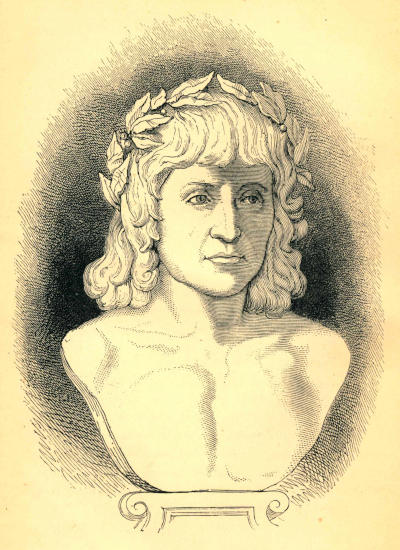
Andrea Mantegna.
From the bronze bust, attributed to Sperandio, in Sant’ Andrea, Mantua.
“The whole world without Art would be one great wilderness.”
By JULIA CARTWRIGHT AUTHOR OF “VARALLO AND HER PAINTER,” ETC.
NEW YORK
SCRIBNER AND WELFORD LONDON: SAMPSON LOW, MARSTON, SEARLE, & RIVINGTON
1881
(All rights reserved.)
PREFACE.
Although no separate biography of Mantegna has been
published in England, his life and works have been the
subject of much study in other countries during recent
years. The thanks of the writer are especially due to Dr.
Woltmann, the author of the biography of the painter in
Dr. Robert Dohme’s “Kunst und Künstler,” to M. Armand
Baschet, Canonico Willelmo Braghirolli, and Dr. Karl Brun.
It is to be hoped that before long the last-named of these
scholars will give the result of his researches to the public
in a complete work on this remarkable man, who was both
one of the greatest artists and one of the most striking
personalities of the Renaissance.
With regard to Francia, materials for the history of his
life are far less plentiful, and are to be found almost
exclusively in the works of Bolognese writers, of whom
Malvasia and Calvi are the fullest and most trustworthy.
In offering this little work as a guide for the use of those
who have not the opportunity of studying the master’s
works for themselves the author has only to add that the
pictures mentioned have been carefully examined, and
their descriptions written on the spot.
CHAPTER I. EARLY YEARS AND WORK AT PADUA, A.D. 1431-1457.
Among the different schools of painting which
flourished on the mainland of North Italy during
the fifteenth century, that of Padua was the only one
which attained more than a merely local importance.
Independent of Byzantine traditions and strikingly peculiar
in its characteristics, it rivalled for a time and even
surpassed the Venetian school in the vigour and individuality
of its art.
A Paduan by birth, Andrea Mantegna became the
greatest master of his day, and left the stamp of his
powerful genius not only on the schools of neighbouring
cities, but on the whole artistic world. By his own
achievements, and still more by the greatness of his aims,
he stands foremost among the men of his generation who
carried on the work of the Renaissance and prepared the
way for the splendid age that was to follow.
This development was the more remarkable, because
until the fifteenth century we do not hear of a single
Paduan artist of note. Giotto had left the frescoes of the
Arena Chapel within the walls of the “learned city,” and
Umbrian influences had later reached her students through
Gentile da Fabriano, but these seeds were slow in bearing
fruit. The men who painted in the famous basilica of
Sant’ Antonio were mostly foreigners. Jacopo d’Avanzo and
Altichieri of Verona, Giusto of Florence, belonged to other
Italian cities, and although a Paduan guild existed and increased
steadily in numbers the results were poor, and the
few works which its members produced were feeble imitations
of Giottesque or Umbrian originals.
The first to raise Paduan art out of obscurity was Francesco
Squarcione, who, although “not the best of artists
himself,” undoubtedly gave a new direction to painting
in his native city, and in a measure earned the title of
founder of the school, which has been liberally bestowed
upon him. Born in 1394, and by profession a tailor and
embroiderer, Squarcione early devoted himself to art, and
having inherited some fortune from his father, spent his
youth in travelling both in Italy and Greece.[1] During his
travels he collected a considerable number of pictures, and
made drawings and took casts of ancient marbles, which on
his return to Padua he exhibited for the teaching of young
artists. By these means he soon obtained great reputation
as a master, and as many as a hundred and thirty-seven
pupils, he himself tells us, were trained in his school.
A man of excellent judgment in art, but of slender
powers of execution, who knew how to attract talented
pupils to his studio, and who employed them in the production
of works which bore his name, is the universal verdict
passed upon Squarcione by early writers. The truth
of this testimony is tolerably well proved by the curious
difference of style visible in the only two authentic works
of his that remain, an altar-piece in the gallery of Padua,
and a Madonna painted for the Lazzara family. The
former is a coarse and unpleasant work, with the hardness
of line and heavy colouring that mark Zoppo and the
inferior Squarcionesques, while the latter in the dignity of
its pose and careful modelling bears evident traces of
Mantegna’s hand. Squarcione no doubt possessed a quick
eye for discerning talent, and it is his lasting claim on the
gratitude of posterity that he at once saw and appreciated
the rising genius of the young Mantegna.
Andrea Mantegna, the greatest of Lombard masters,
was born in the neighbourhood of Padua in the year 1431.
His father, Biagio, is supposed to have been a small farmer,
and Vasari tells us that in his childhood Andrea herded
cattle until Squarcione, struck by the boy’s talent for
drawing, adopted him as his own son.
In November, 1441, Mantegna’s name is entered on the
registers of the Paduan guild as Squarcione’s foster-child,
and seven years later he painted an altar-piece for the
ancient church of Santa Sofia. Of this youthful work
contemporaries speak with high praise as bearing marks
of a practised hand, but it had already disappeared in
the seventeenth century, and the earliest painting of
Mantegna that now exists is the fresco above the portal
of Sant’ Antonio. In this lunette, which bears the date of
1452, the two saints Anthony and Bernardino are represented
supporting the sacred monogram; but the figures
are too much damaged to be a fair test of the young
artist’s style, and the work is chiefly interesting as a proof
of the high reputation in which he was already held by his
fellow-citizens.
It is to the frescoes of St. Cristoforo’s chapel in the
church of the Eremitani friars that we must turn in order
to form a correct idea of Mantegna’s powers during this
time. Here we see him carrying the principles which he
had learnt in Squarcione’s workshop to their furthest
limits, and with the boldness of genius venturing on new
and untried paths. Here too we find him painting side
by side with the best of Squarcione’s other pupils, and we
have an opportunity of comparing his work with that of
artists who had been formed on the same models.
This chapel, which stands to the right of the high altar,
at the east end of the great Eremitani Church, belonged
to the Ovetari family, whose last representative, dying in
1443, had left a sum of seven hundred gold ducats to be
spent in decorating its walls with frescoes illustrating the
history of St. James and St. Christopher. Squarcione
received the commission from the dead man’s heir, and
between the years 1448 and 1458, the walls, apse, and
ceiling were covered with frescoes by his different pupils.
Thus, only a few steps from the garden which encloses
Giotto’s Chapel, another great series was painted, to become
for the schools of North Italy what the Brancacci Chapel
had been for Florence.
Less fortunate than the celebrated frescoes of the Carmine,
these paintings have suffered much from the damp
of the walls, and a great part of the subjects in the apse, as
well as several figures in the martyrdom and burial of St.
Christopher, are completely destroyed. Other portions are
still in good preservation, and afford excellent examples of
the peculiarities of the Paduan school and the studies which
laid the foundation of Mantegna’s subsequent greatness.
The leading feature which marks the work of all Squarcione’s
scholars, and was to attain its highest artistic
development in Mantegna’s later conceptions, is the sculptural
treatment of form, which was a direct result of an
exclusive study of ancient statues. Painting in their hands
becomes more plastic than pictorial, the forms are sharply
defined, the drapery falls in the small folds of ancient bas-relief,
while the severity of the whole is relieved by rich
decorations in the shape of festoons of fruit and foliage,
which, when unskilfully managed, give a heavy and over-loaded
effect. This plastic tendency sprang from the
discovery, then first dawning upon the men of the Renaissance,
that the principles of the highest art are to be
found in the antique, and was so far as it went true and
laudable in its aim. But in the case of the Squarcionesques
this study of classic statuary was not combined with sufficient
knowledge of nature, and, therefore, frequently
degenerated into a lifeless rigidity and absence of expression,
if not into positive ugliness and coarseness of
form.
This stiffness and want of vitality strike us at once in
the four Evangelists on the ceiling of the chapel, wrongly
ascribed by Vasari to Mantegna, and in the upper frescoes
of St. Christopher’s life, attributed to three different
artists—Marco Zoppo, Bono of Ferrara, and Ansuino of
Forli. These last-named subjects are not without a considerable
degree of skill in perspective and composition,
but are alike marked by the same rigidity of form and
metallic coldness of colouring. The feeblest of the three is
Bono’s representation of St. Christopher bearing the child
through the river, a work which, in awkwardness, incorrect
drawing and truly painful ugliness, seems to exaggerate
the worst faults of the Paduan school.
On the other hand there is a decided advance in the
frescoes of Niccolo Pizzolo, the only one of the Squarcionesques
who approached Mantegna’s style, and whose improved
colouring and greater nobleness of type are best
explained by the discovery that he had worked with the
Florentines, Donatello and Filippo Lippi, during their
residence in Padua. To him Vasari ascribes the figure of
the Eternal between St. Peter and St. Paul on the dome of
the tribune, and later critics have recognised his hand in the
“Call of St. James and St. John” and “St. James exorcising
Devils” on the upper part of the left wall. But the finest of
all his works here is “The Assumption,” in the apse, a fresco
which in joyous life and freedom of movement so far surpasses
the ordinary manner of the Paduans that one of the best
critics, Dr. Woltmann, pronounces it to be by Mantegna’s
hand. Against this we have the testimony of the anonymous
traveller of the sixteenth century, who says decidedly
that Andrea painted the lower part of the right and the
whole of the left wall, but that “The Assumption” and
cupola are by Pizzolo. Vasari is silent on this point, but
remarks that Pizzolo’s works in this chapel yielded nothing
in excellence to those of Andrea, and probably the best
solution of the question is to accept both “The Assumption”
and the upper frescoes of St. James’s life as the joint
composition of the two artists, or at least to allow that
they were partly designed by Mantegna.
In the midst of Pizzolo’s labours in the Eremitani
Chapel his promising career was cut short by a violent
end. He had, it appears, an unlucky habit of taking part
in street brawls and riots, and one evening as he was
returning home from his work he was attacked and slain
by some unknown persons whose enmity he had excited.
Mantegna was now left alone to complete the unfinished
work, and whatever uncertainty rests on his share in the
earlier frescoes there is no doubt that the six remaining
subjects are entirely by his hand. In each of these we see
some clearer revelation of unfolding powers. Step by step
some fresh difficulty is overcome, some new knowledge
gained, until by slow degrees the battle is won, and the
mastery over human form is complete.
In the fresco of “St. James baptizing Converts” the
statuesque air of Squarcione’s school is still strongly felt
in the principal figures. The action is stiff, and the faces
are mostly wanting in expression. But the spectators of
the ceremony are, on the contrary, full of life and animation.
Nothing can be more natural than the two children
who look on with wondering eyes—the taller of the two
holding a water-melon in his hand, while the smaller one
presses close to his side—or the youth under the colonnade
in the act of turning round to speak to a figure whose face
is concealed by a pillar. If from these we turn to the
decorative part of the fresco, the winged angels in the
upper corners at once remind us of the charming groups of
children on Donatello’s bronzes in Sant’ Antonio, and prove
how attentively Mantegna must have studied these recently
finished works of the Florentine master. The beneficial
influence of the great sculptor had already appeared in the
earlier frescoes of the Eremitani, and from his example
Andrea now learnt how to combine the study of nature
with sculptural treatment, and to adopt a more elevated
type of human form.
The next subject, “St. James before Herod,” reveals a
new feature, afterwards to become prominent in his career,
in the accurate knowledge of Roman costumes and classical
architecture which is here displayed. One of the
finest figures is that of a soldier leaning on his lance in the
left-hand corner of the picture, an ancient Roman, in whom
we recognise immediately the painter’s own portrait, from
the close resemblance which his strongly marked features
and massive brow bear to the bust on Andrea’s tomb at
Mantua. Both of these frescoes show considerable skill in
perspective, but in the next, “St. James blessing a kneeling
Disciple on his way to Execution,” Mantegna boldly
ventures on an experiment that is altogether new. For no
apparent reason, but purely as a trial of skill, he suddenly
alters the point of sight to a low level, and while the feet
of the foremost figures appear to stand on the edge of the
picture the lower extremities of those in the background
vanish altogether. The difficulties thus created are on the
whole correctly solved. Each figure is carefully foreshortened,
and the Roman arch under which the procession
passes is drawn in admirable perspective, but freedom
of action is impaired, and the whole suffers from an unpleasant
sense of effort and unnatural constraint. Perspective
was in those days a favourite branch of learning
in the University of Padua, and Mantegna, whose vigorous
genius took pleasure in the driest studies, seems to have
derived this strange passion for applying its laws to the
human form from Paolo Uccelli, a Florentine who had
lately visited Padua. In his ardour to accomplish his self-imposed
task he failed to see the mistake of subjecting
living figures to the rules of architecture, and of treating
them as existing solely in order to demonstrate a scientific
problem.
But at the time the young painter’s exhibition of skill
excited the utmost admiration, and both Daniele Barbaro
and Lomazzo praise him as the first artist who opened
men’s eyes to the true principles of perspective.
If we are to believe Vasari, Squarcione, who till now had
been as proud of his pupil’s growing fame as if it were his
own, suddenly altered his tone and openly blamed Mantegna
for the stony rigidity of his figures, declaring that
they were mere copies of marble statues, altogether devoid
of life and expression.
The reproach, although not wholly undeserved, was a
curious one in Squarcione’s lips, but the real cause of the
breach which took place between the master and scholar
was Andrea’s connection with the rival workshop of Jacopo
Bellini. The Venetian painter, with his two sons, Gentile
and Giovanni, had lately taken up his abode at Padua, and
a strong friendship had sprung up between Mantegna and
the members of his family which before long led to the
marriage of the young Paduan with Jacopo’s daughter
Niccolosia. Their union took place while Mantegna was
actually engaged on the Eremitani frescoes—probably about
1454 or 1455, since in 1458 he had already two or three
children—and becomes an important fact in art history as
strengthening the ties between these distinguished artists.
The influence each was to exercise on the other was destined
to prove great and lasting. Jacopo Bellini, who had
spent some time in Florence, was probably instrumental in
leading Mantegna to follow Donatello and Uccelli’s models,
while from Giovanni, Andrea would learn the softer colouring
and delicate feeling that impart so pure a charm to
those well-known Madonnas which fill the churches of
Venice. Mantegna, on his part, gave back at least as much
as he took, and no one can doubt that Gian Bellini owed
to his brother-in-law in a great measure his knowledge of
classical architecture and perspective, as well as the
sculptural cast of drapery, that distinguish his pictures
from those of earlier Venetian masters. In all probability
this new influence, rather than Squarcione’s jealous reproaches,
was the cause of the marked improvement visible
in the later frescoes. The principal figures in the “Execution
of St. James” are more life-like; there is less hardness in
the modelling and laying on of shadows, while the background,
with its winding road and rocky terraces crowned
with olive-trees, is an exact copy of a Lombard hill-side.
Nothing, indeed, is more striking in these frescoes than the
close attention to natural objects, which shows how strongly
realistic was the bent of our painter’s genius, in spite of
his Squarcionesque training and love of antique statuary.
He not only fills his backgrounds with faithful reproductions
of Italian landscape and streets, with red roofs, arched
loggias, or vine-trellised arbours, but recalls every detail
and renders the furrows and wrinkles of old age, the
ragged coat or torn shoe, with an accuracy that is almost
painful.
The eagerness with which he sought difficulties and his
courage in grappling with them meet us again in the
foreshortened rider who looks on at the Saint’s martyrdom,
and is still more triumphant in the bold action of the men
who drag away the dead body of the giant Christopher, in
itself a masterpiece of perspective which served as a model
for Titian and other Venetians in dealing with similar
subjects in future years.
Unfortunately these two last frescoes, “The Martyrdom”
and “Burial of St. Christopher,” are much injured, and
some of the chief figures are completely obliterated. The
portions that remain justify the praises of former critics who
pronounced these to be the finest of the whole series. Here
at least Squarcione’s reproach is refuted, the stony look of
the faces has given place to warm flesh-tones and softer
modelling, and the band of archers assembled under the
vine-trellis in the scene where the saint is to meet his doom
are remarkable for their energetic action and expressive
faces.
According to Yasari, in this last subject, Mantegna represented
Squarcione himself in the character of a fat archer,
as a proof that he knew how to draw from living models,
and the same writer mentions several other contemporary
personages whose portraits are also introduced. Especially
interesting in our eyes is the group, in the right-hand
corner of “The Martyrdom,” of an elderly man standing
between two younger figures, one of whom wears a red
cap. The Venetian costume of these three spectators, and
a certain resemblance of one of the youthful heads to a
medal bearing the likeness of Gentile Bellini, go far to
confirm the truth of Crowe and Cavalcaselle’s supposition
that here we have portraits of Mantegna’s father and
brothers-in-law, who were all in Padua at the time, and
whom he would very naturally introduce among his other
friends.
With these frescoes Andrea’s labours in the church of
the Eremitani end, and the decoration of the chapel, with
which Squarcione’s pupils had been intrusted some ten
years before, was finally completed.
If from details of execution we pass to consider the
work as a whole, it must be owned that the general impression
left upon the spectator’s mind is one of coldness
and severity. These stern and vigorous figures which look
down upon us from the walls awe us by the power and
reality of their presence; they impress us by the accurate
science and years of assiduous labour which they reveal,
but they fail to touch the heart or delight the eye; they
are wanting in that sense of beauty which, is so conspicuous
a feature in Mantegna’s later work. If he had painted
nothing else he would have left behind him the reputation
of a master of strong realistic tendency, who solved difficult
problems and attained a remarkable degree of proficiency
in drawing and anatomy, but lacked the qualities necessary
for the highest class of art.
Fortunately for us Mantegna’s activity does not end
here. The frescoes of the Eremitani were only the first
stage in a great career, and as we contemplate them we
can always reflect with satisfaction that these powerful
works, in their grimness and austere dignity, in their
curious display of scientific knowledge and minute attention
to detail, were the preliminary studies, by means of
which he reached the perfection of after years, and
achieved the ultimate successes that were to make his
name celebrated.
CHAPTER II. WORK AT VERONA AND MANTUA, A.D. 1457-1470.
The exact date of the completion of the Eremitani
frescoes is uncertain, but they were probably
finished by 1458, perhaps earlier. Mantegna was still a
young man, not more than six or seven-and-twenty, but in
actual power as well as in reputation second to no living
painter in North Italy.
We have already noticed the chief influences brought to
bear on his early training. One by one we have watched
him discover and assimilate, with the same clearness of
intellect and indefatigable energy, the peculiar virtue of
each successive artist with whom he was brought into
contact. We have seen him add Florentine principles to
Squarcione’s teaching, learn from Donatello how to combine
the study of nature with the laws of sculpture, gain
from Uccelli that knowledge of perspective which had
for him so subtle a fascination, and last of all temper this
fiery genius under the gentler spell of Gian Bellini’s more
genial art.
Another and a very important element in his development
was the constant intercourse which he maintained
with the most learned Paduan scholars, and the keen
pleasure with which he joined in their antiquarian researches
in the neighbourhood. He accompanied Felice
Feliciano, a famous collector of inscriptions, on several
excursions in the environs of Verona and the Lago di
Garda for the express purpose of examining classical remains,
and in 1463 this same Feliciano dedicated his work
on ancient epigrams to the painter, whose learning he
extols in the highest terms. One result of these explorations
in the classic ground of Sermione appears in the
fragments of Latin inscriptions which are repeatedly introduced,
in the Eremitani frescoes, and on one Roman portico
the name of Vitruvius Cerdo, a Verona architect of ancient
days, is still distinctly legible.
This practice was a common one with many of the artists
of Squarcione and Mantegna’s school, who, in their genuine
enthusiasm for classical art, copied antique monuments and
inscriptions with the minutest accuracy, and afterwards
used them as accessory portions of their own compositions.
We have a notable example of this habit in the drawing of
a pagan altar bearing an inscription to the effect that it
was found in a vault of the Baths of Caracalla, then known
as the Antonine palace at Rome. The drawing, evidently
by the hand of some Paduan artist, is now preserved at
Christ Church, Oxford.
Besides Feliciano, Andrea numbered among his intimate
friends several eminent scholars then studying at the University
of Padua, such as Matteo Bossi, afterwards Abbot of
Fiesole, and the Hungarian bishop Giovanni Pannonio, who
celebrated the artist’s genius in Latin verse as early as 1458,
and whose portrait Mantegna painted in the same year.
This rare degree of culture which made him the friend
of scholars, this genuine delight in classical studies and
antique art, was destined to supply our master with some
of his highest inspirations, and ultimately render him the
foremost representative among painters of that enthusiasm
for antiquity which was the ruling passion of Italy in the
fifteenth century.
During the years that Andrea was employed on the
Eremitani frescoes we hear little else of his private life
excepting that he married Niccolosia Bellini, and became
estranged from his old master Squarcione, while two panel
pictures, the Brera Altar-piece which he painted in
1454 for Santa Giustina, and the “St. Euphemia” now at
Naples, are the only other works that are left us of this
period. In the former, a vigorous but not very pleasing
work, St. Luke is represented writing at a table between
four single figures of saints, while above we have a Pietà
with the Virgin, St. John, and four other saints. Far more
graceful in conception is the St. Euphemia standing in her
garlanded niche with the lily in her hand and the lion
beside her. This admirably drawn figure in attitude and
form closely resembles an antique statue, and will bear
comparison, with the best of the later frescoes.
So far, Andrea’s works had been confined to Padua, but
his fame had spread far beyond his native city, and
before he had finished his labours in the Eremitani, pressing
invitations to move to Mantua had reached him from
Lodovico Gonzaga, Marquis of that principality. This
prince, a generous patron of letters as well as a brave
soldier and wise ruler, was anxious to make his court a
centre of art and learning; and, having failed in his efforts
to attract the aged Donatello, spared no pains to secure the
services of the Paduan artist, whose rising genius was
already eclipsing that of all others. As early as 1456 we
find Lodovico entering into communication with Andrea,
first by letter and then through the sculptor Luca Fancelli,
a confidential agent of the Marquis. His offers were liberal;
fifteen ducats a month, lodging, firewood, and sufficient
wheat to feed the members of his family, who are reckoned
as six in number; besides, he proposed to assist him on his
journey to Mantua by sending a boat to meet him.
Mantegna lent a willing ear to these proposals, but his
hands were full, and flattering as were Lodovico’s entreaties
and assurances of good-will, he was slow to comply with the
request. In his letters he assigns first one reason, then
another, for delaying his departure. First, he asks for
time to execute an order given him by Gregorio Corraro,
Abbot of San Zeno of Verona, and protonotary to the
Apostolic See. Then he begs for six months more to complete
the work, then for another respite in order to do a
little piece for the Podestà of Padua. The Marquis bore
all these delays with unalterable patience and courtesy,
while he never for a moment relaxed his efforts to bring
the artist to Mantua, and redoubled his assurance of favour.
If Andrea will only come, he says again and again, and
himself prove the truth of the promises made to him, he
will every day of his life find greater cause to rejoice that
he has entered the service of the Gonzagas. When the
summer of 1459 came and the protonotary’s altar-piece
was still unfinished, Lodovico suggested as a last resource
that the panels should be brought to Mantua and completed
there. To this proposal the abbot was too wise a man to
consent, and he would not even allow Mantegna to visit
Mantua for a day until the picture had been safely delivered
into his hands.
This altar-piece, of which we hear so much in Lodovico’s
correspondence with our master, was the “Madonna and
Saints” in San Zeno, of Verona, taken to Paris in 1797,
but now restored (without its predella) to its place, and one
of the finest religious compositions that Andrea ever painted.
All the chief characteristics of Andrea’s Paduan time are
here brought together in a more elevated form, and for
the first time we realise fully how great was the progress
he had made since the days when he began to paint in
the Eremitani Chapel. Nothing can exceed the simple
dignity and grace of the youthful virgin, who sits erect
under a portico decorated with a frieze of children bearing
festoons of fruit, through which we see a thick growth of
trees, and open space of blue sky beyond. On the pillars
of the portico are medallions in which Andrea has after his
usual habit introduced reliefs of classical subjects, one of
which is a horse-tamer, evidently copied from the famous
“Twins,” of Monte Cavallo, and curious as adopted by a
painter who had not yet visited Rome. The saints who
stand in the groups on either side of the Madonna’s throne
are still too much treated as isolated figures, but each
statue-like form has a grandeur of its own, and the graceful
heads of the young St. John and St. Lawrence contrast
finely with those of the aged apostles and fathers of the
Church, while in the boy-angels who play on the steps of
the throne, or sing with wide-parted lips, we have the first
of those child-faces whose laughing eyes look down from
many of Mantegna’s pictures and seem to give us a foretaste
of Raphael’s sweetness. Unfortunately, the different
parts of the predella that belonged to this beautiful altar-piece
are scattered in different galleries, the “Gethsemane”
and “Ascension” are at Tours, the “Crucifixion,” in the
dramatic action of its varied group by far the finest of the
three, is in the Louvre.
According to Vasari, Mantegna painted several other
pictures in Verona, but the only other traces of his work
now remaining in that city are some equestrian figures and
chiaroscuro decorations on the façade of a house near
San Fermo Maggiore, and we have no proof of his ever
having resided there.
The “little piece” which Andrea executed for Giacomo
Marcello, Podestà of Padua, has been identified in the
“Christ on the Mount of Olives” of the Baring collection,
a work in which we feel the same union of plastic tendency
of form and strong realism that strikes us in the frescoes.
In the background, a wild and savage landscape, the
desolate aspect of which is heightened by the presence of
cranes and birds of prey, we recognise the city of Padua
with the Eremitani Church.
If we compare this picture with the well-known rendering
of the same subject by Giovanni Bellini in the National
Gallery, we shall see how much of the original conception
and drawing the Venetian artist borrowed from his
brother-in-law, and at the same time how well he knew
how to modify Andrea’s severer style by his own more
delicate grace and feeling for colour.
These altar-pieces were Mantegna’s last works in his
native city. The patience of the Marquis was at length
rewarded, and towards the close of the year 1459, Andrea
moved to Mantua with his family. Soon afterwards Jacopo
Bellini died, his sons moved to Venice, and the Paduan
school of painting, left in the hands of inferior followers of
Squarcione, came to a practical end.
But Paduan art lived on in the work of her greatest son,
and the new influences and surroundings of Mantegna’s
adopted city gave fresh impulse to his creative energy.
That he settled at Mantua before the end of 1459 is
proved by a letter of his written to the Marquis in May,
1478, in which he speaks of having been almost nineteen
years in Lodovico’s service, but it is not till the spring of
1463 that we hear of him as engaged in painting at Goïto,
one of the summer villas belonging to the Gonzagas. Both
this palace and the neighbouring Castle of Cavriana, where
he also painted, have been destroyed, and a few panel
pictures now dispersed throughout Europe are the only
productions that remain of his first ten years’ residence at
the Court of Mantua.
Chief among these is the Uffizi triptych, which originally
belonged to a chapel of the Gonzagas, and may be the
very picture to which Andrea alludes in a letter of 1464 as
destined for the little chapel, and which Vasari tells us
contained many small but most beautiful figures.
The “Adoration of the Magi” forms the subject of the
central panel, while the “Ascension” and the “Presentation
in the Temple” are represented on the wings. All
three are marked by the miniature-like finish which reveals
the thoroughly practised hand and loving zeal of one who
took delight in carrying his work to the highest possible
perfection.
In the seated Virgin, of the strong type of womanhood
which Andrea seems to prefer, with the flight of cherubs
encircling her head, and the patches of rough herbage
starting out of the rocks behind her, we recognise the
original of his own unfinished engraving, the “Virgin of
the Grotto.” The red cherub-heads, which remind us of
the similar wreath with which Giovanni Bellini surrounds
one of his Madonnas in the Academy of Venice, are again
introduced in “The Ascension.” Here the group of
apostles, who gaze upwards, have more of the slender
form used by Pizzolo in the Eremitani frescoes, and the
panel is inferior as a whole to “The Presentation.”
This is in Mantegna’s best manner, the principal figures
full of grace and dignity, the heads excellent in expression,
especially that of the child sucking his finger as he leans
against his mother, while Andrea’s historic feeling appears
in the typical reliefs of “Moses breaking the Tables” and
“Abraham sacrificing Isaac,” which adorn the altar.
Another fine rendering of this subject by Mantegna is
now in the Berlin Gallery, which also possesses two other
works belonging to this period, a half-length “Madonna
holding the Child on a Parapet,” and a portrait of an old
ecclesiastic.
Probably this Madonna was the very one of which
Vasari speaks as painted by Mantegna, for his old friend,
the famous orator, Matteo Bossi, Abbot of Fiesole, since
the frame decorated with angels and instruments of the
Passion exactly corresponds with his description, and the
strikingly-truthful portrait may well be that of the Abbot
himself, whose friendship for the painter neither time nor
distance seems to have impaired.
A “Death of the Virgin,” with a view of Mantua and
its lake seen through a colonnade, now at Madrid, and
chiaroscuro figures known as “Summer” and “Autumn,”
now at Hamilton Palace, may be mentioned as painted
about 1470, when Andrea was engaged in works at the
Castle of Mantua.
More interesting in the eyes of most of us are the two
small pictures of the Saints Sebastian and George, two
youthful figures intended to show the contrast of suffering
and repose. In the “St. Sebastian” now at Vienna, Mantegna
has deliberately set himself the task of representing
the human form wrung by physical agony, and the divine
strength of a will that can conquer pain by the power of
its endurance. His success was complete, and among the
countless representations of martyrdom that exist, there
is scarcely a finer example than this St. Sebastian bound to
the ruined column and pierced with arrows, lifting his eyes
heavenwards in his mortal agony. At his feet lie broken
statues and marbles, shattered fragments of the old world
that was crumbling to ruins around, and which by the delicate
grace of their shapes and mouldings help to associate
ideas of beauty with this scene of suffering and death.
The opposite of this picture meets us in the armed
“St. George” of the Venice Academy, who stands under an
archway garlanded with flowers, leaning on his lance in
satisfied repose of victory, with the dragon dead at his
feet. His classical head is not unlike the youthful saints
of the Verona altar-piece, while the highly finished character
of the execution approaches the style of the Uffizi
triptych, evidently painted about the same time.
To these we may add the wonderful “Dead Christ” of
the Brera, a work almost terrible in its realism, and exaggerated
foreshortening, but which reveals in a surprising
degree Mantegna’s mastery both in drawing and management
of light and shade. This Cristo in Scurto was one
of those daring trials of skill which he loved to attempt,
not to please the eye or gratify the taste of his employers,
but simply in order to overcome some difficulty or solve
some problem from which a less powerful mind would have
shrunk.
The satisfaction which he felt in the success of this
experiment is proved by his unwillingness to part with
this work, which never left his studio until his death, when
it is mentioned by his son in the list of paintings that were
sold to pay his debts.
In the same style as this “Pietà,” but with more
attempt at decorative effect, is the picture exhibited by Sir
William Abdy, in the last winter exhibition at Burlington
House (1880-81). Here the dead Christ lies on a carved
throne of coloured marbles, the back of which is formed
by the broken tables of the law. On either side are two
grandly defined forms of Isaiah and Jerome, as representatives
of the old and new dispensations, between whom
Christ stands. The background is more elaborate than
usual. On one side is a wild tract of mountainous country,
on the other a river and fertile valley, along the slopes of
which we see rows of smiling villages, church-towers, and
fields enclosed with hedges. In the foreground skulls and
bones are scattered at the feet of the prophets, and beasts
and birds of gay plumage enliven the scene. A stag and
panther and a red parrot are prominent figures, but all
these minor details are subdued to the leading idea in the
painter’s mind. Doubts have been entertained as to the
authorship of the picture, but both its general style and
colouring and the presence of that weird grandeur of
imagination peculiar to Mantegna are strong proofs of its
genuineness.
CHAPTER III. THE CAMERA DEGLI SPOSI, A.D. 1470-1474.
Recent research has brought to light a series of valuable
letters between the Gonzagas and Mantegna,
which tell us little indeed about his existing works, but
much that is of the deepest interest concerning his private
life, and especially his relations with Lodovico and his
family.
The Marquis had kept his word and proved himself a
true friend and generous patron to the Paduan artist.
Carissmé noster, dilecte noster, are the terms in which he
always addresses him, and the thoughtful consideration
and patience with which he treated Andrea in what must
frequently have been very trying circumstances, are beyond
all praise.
The first letter of the series is a complaint which the
painter, writing from Goïto, addresses to Lodovico, saying
that his stipend is irregularly paid, a wrong which the
Marquis promptly redressed. Three years later we find
him in the same liberal spirit advancing one hundred
ducats which Mantegna begged in order to decorate and
improve his house in Mantua.
There our painter spent the winter with his wife and
three children—tutto la mia brigatela he calls them in a
letter to the Marquis—and each year, when the summer
heats returned, he moved to a country-house at Buscoldo,
where he afterwards received a grant of land from his patron.
In 1466 he paid a visit to Florence, where he had at
least one friend in the learned Abbot of Fiesole, and a
letter from Giovanni Aldobrandini, an agent of Lodovico,
describes the great respect with which he was received,
and the admiration excited by his varied accomplishments.
“Not only in painting but in other ways he showed remarkable
knowledge and most excellent understanding” is
Aldobrandini’s testimony, and we learn from other sources
that he took much pleasure in poetry, and even wrote
verses himself. A sonnet of his composition addressed to
a lady whose name is unknown, and written in the fashionable
Platonic style of the day, has been discovered in the
Mantuan archives and is given by Moschini. As a collector
of antiquities he had acquired considerable reputation, and
in 1472 we find the young Cardinal Francesco Gonzaga,
then at Bologna, begging his father that Mantegna may
be sent to him that he may have the pleasure of showing
him his cameos, bronzes, and other antiques.
Unfortunately the culture and refined taste which made
Mantegna so agreeable a companion were accompanied
by an irritable temper, and a readiness to take offence,
which rendered him the reverse of a pleasant neighbour.
The most trifling contradictions were sufficient to excite
furious outbursts of anger on his part, and his letters to
Lodovico are full of the pettiest grievances. The Marquis,
it must be said, treated him with the utmost forbearance,
and spared no pains to inquire into the grounds of his
complaints, however small. On one occasion he implores
Lodovico to punish a tailor who has spoilt a piece of his
cloth, on another he has quarrelled with a gardener and
his wife who live in the same street, and complains that
neither he nor his wife can leave the house without being
attacked by insulting words. More serious was the lawsuit
in which he found himself involved with the engraver,
Zoan Andrea, whom he suspected of purloining his plates,
and to whom he administered a sound thrashing. Upon
this Zoan Andrea had recourse to legal measures, in which
Mantegna seems to have fared badly, since he was again
compelled to seek the help of his powerful patron.
But of all Andrea’s quarrels, that which excited his
greatest wrath was his breach with his Buscoldo neighbour,
Francesco Aliprandi, whom he publicly accused of
stealing five hundred quinces from a tree which grew
in his garden. There is a singular combination of the
pathetic and ludicrous in Mantegna’s description of the
beauty of his fruit tree, with its branches so heavily laden
that they touched the ground. Each day he looked upon it
with fresh delight, until one September morning he found
all the quinces gone, and the tree stripped and bare. His
anger knew no bounds, and he did not hesitate to charge
his nearest neighbours, the Aliprandi, who he was convinced
bore him secret ill-will with the theft. Upon this
Francesco Aliprandi, who seems to have been a citizen of
good birth, denied the charge indignantly, saying that
during the two hundred years his family had lived in
Mantua, they had never been insulted by so vile an epithet
as that of thief, and complaining of Mantegna’s disagreeable
character as the real cause of all this disturbance.
“No one,” Aliprandi continues, “can live near him
in peace, and at the present moment he is engaged in
lawsuits with no less than five of his neighbours.” Even
the Marquis was forced to admit this time that Andrea was
in the wrong, and, after carefully investigating the case,
arrived at the conclusion that the quinces had been stolen
by some unknown thief.
This ruggedness of disposition and exaggerated susceptibility
which, by attaching excessive importance to
the trifling cares of daily life, proved a constant torment
to Mantegna and those around him, remind us curiously
of Michelangelo, whom in more ways than one our master
resembled.
Like the great Florentine in this also, he never stooped
to flattery or servile expressions in addressing his patron.
On the contrary, there is from the first an independent
spirit and proud consciousness of his own merit which
never deserts him, and he tells the Marquis repeatedly
that his coming to Mantua was a great favour on his part,
and that no other prince in Italy has so industrious an
artist in his service.
The boast may not have sounded well in Mantegna’s
lips, but it was a true one. His activity was indefatigable,
and whether he painted in chapels and palaces, or made
studies for tapestry or designs from the turkey-cocks and
hens which strutted in the court poultry-yard, his time and
powers were unreservedly placed at Lodovico’s disposal.
What we have to regret is that so little of all his splendid
work is left, although when we consider the subsequent
history of Mantua, it is rather to be wondered that anything
has been saved from the general wreck.
In 1630, little more than a hundred years after Mantegna’s
time, the city was besieged during three months
by the Imperialists, and ultimately taken and sacked for
three whole days. In 1797 it was again twice besieged and
bombarded by the French and Austrians, and during the
wars of the present century the ducal palace has been
alternately occupied by French and German soldiers.
This once sumptuous pile is now the dreariest and most
desolate of palaces. The little life that still lingers in the
old town clusters round the market-place on the Piazza
delle Erbe, and grass grows on the deserted square which
was once the centre of “Mantova la Gloriosa.”
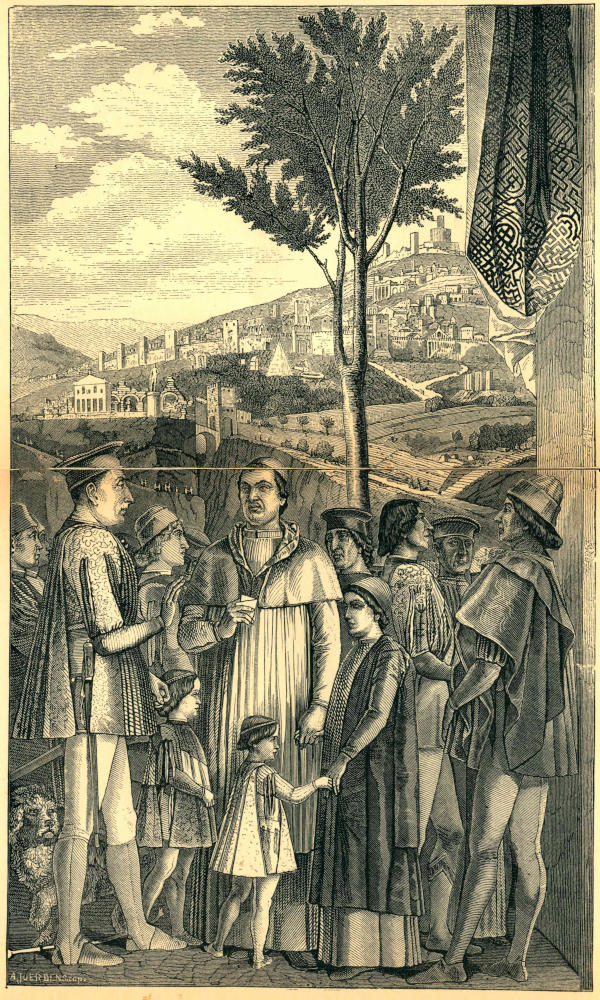
Meeting of Lodovico Gonzaga and his Son, the Cardinal
Francesco. By Mantegna.
In the Camera degli Sposi, at Mantua.
We pass through endless suites of spacious halls paved
with marble and adorned with decaying frescoes and other
remnants of faded splendour, till we reach the older part
of the palace known in the days of the Gonzagas as the
Castello di Corte. From its windows we look down on the
sleepy waters of the vast lagoon, which seems to divide
Mantua from the outer world, and over miles of swampy
marshes, through which “smooth-sliding Mincius” winds
its way.
Here the Gonzagas hold their splendid court, here the
banqueting-halls where they feasted, the ball-rooms—the
scenes of their revels and masquerades—the suite of tiny
apartments expressly built for the use of the dwarfs, the
courtyards where the dogs were kept, are still shown. Here
Mantegna painted, and here the walls of a room, now used
to contain the archives, were entirely covered with frescoes
by himself.
This was the famous Camera degli Sposi, on which Andrea
was engaged between 1470 and 1474, and where he represented
Lodovico Gonzaga and his wife, Barbara of Brandenburg,
surrounded by the different members of their
family.
All the frescoes have been much damaged, and those on
two of the walls completely obliterated; but the groups
which remain and the decorations of the ceiling are of the
highest interest, and, if we except the Hampton Court
Triumphs, form the most important series that we have
from Mantegna’s hand.
On the east wall above the mantel-piece is the central
group. Lodovico and his wife, clad in rich brocaded robes,
are seated in a garden surrounded by their children, and
dwarfs in the act of receiving a messenger, who hands the
Marquis a letter. Neither Lodovico nor any of his family
seem to have been remarkable for personal beauty, and
Mantegna has not made any attempt to embellish them.
He paints them exactly as they were, in the stiff costumes
of the day. Barbara wears the same veiled horn-shaped
head-dress as in Andrea’s portrait-engraving in the British
Museum; the children and courtiers are in short jackets and
tight-fitting caps. Nothing is omitted that could complete
the picture, which is like a page torn out of the court life
of those times; a favourite greyhound lies asleep under
Lodovico’s chair, and several dwarfs positively repulsive in
their ugliness are introduced. They formed, we know, an
important part of the household, since the Marquis kept a
particular race, bred at Mantua, and reserved a whole wing
of his palace, with staircases, halls, and bedrooms adapted
to their stature, for their exclusive use.
Beyond the fine figure of the courtier on the right,
evidently the painter’s own portrait, we have another compartment
where the Marquis stands at the head of the
stairs welcoming his guests, or, as Selvatico suggests,
opening his arms to his son Federico, who had been in disgrace
for refusing to consent to a marriage which Lodovico
had arranged for him. This subject is much damaged, but
on the entrance-wall is another group, the best preserved
of the three, in which the Marquis meets his younger son,
the boy-cardinal Francesco, on his return from Rome. The
composition is stiff and the dresses awkward, but nothing
can surpass the life-like character of the heads, whether
we fix our eyes on the baby-faces and demure air of the
children who advance to welcome their brother, or on the
vigorous profiles of Lodovico and his courtiers. A tame
lion crouches at the feet of the Marquis, and a view of hills
and classical temples, intended to represent Rome, fills in
the background. On the opposite side of the doorway the
servants and pages in attendance are introduced holding
their master’s horse, and several dogs in leash, all admirably
drawn; while above the door itself a charming group of
seven winged boys, in every possible attitude, support a
tablet with the following inscription:—
Ill Lodovico II. M.M.
Principi optimo ac
Fide invictissimo
Et Ill Barbaræ eius
Conjugi Mulierum Glor
Incomparabili
Suus Andreas Mantinia
Patavus opus hoc tenue
Ad eorum Decus absolvit.
Ann. MCCCCLXXIIII.
The grace and freshness of these boy-angels form a
striking contrast to the stiff figures on the walls, and
both here and in the decorations of the ceiling our painter,
released from the obligations of portraiture, allowed his
fancy free play. Medallions of the Cæsars wreathed in
laurel, grisaille scenes from the myths of Hercules and
Antæus, Orpheus, Apollo, and the Tritons, occupy the
vaulting of the ceiling; while in the centre a circular
opening is painted to represent a blue sky, across which
white clouds are floating by, as we see in actual reality
in the Pantheon of Rome. Round this open space runs a
balustrade, upon which a peacock is perched and a basket
of fruit rests. Two women, a girl with a jewelled head-dress
and a negress, look down from above with laughing
faces, while a band of winged boys play on the edge of the
stone-work.
These are the famous figures, che scortano di sotto in
sù, which Vasari says excited general admiration when
Mantegna first painted them in the Castle of Mantua.
Instead of treating the ceiling in the usual fashion, as
another flat surface on a level with the spectator’s eye, he
endeavoured to represent the figures he painted there as
seen from below, and in reality looking down over the
balustrade. The optical illusion is effected in a masterly
way, and the playful boys, who push their heads through
the open stone-work of the parapet or balance themselves
on its edge, are admirably foreshortened.
Curiously enough, this new principle of ceiling decoration,
which in Corregio’s days was to become universal,
and which Mantegna here attempted for the first time,
was employed at almost the same moment by another
painter, Melozzo da Forli, in his fresco of the “Glory of
Heaven” in the tribune of the Church of the SS. Apostoli at
Rome. Whether the two masters had ever been brought
into personal contact we do not learn, but we know that
Giovanni Santi, the father of Raphael, in his rhyming
chronicle, gives Mantegna’s perspective the highest praise,
and we may infer from this that the great Lombard’s
influence had penetrated far enough south to reach the
Umbrian artists.
The frescoes of the Camera degli Sposi were finished in
1474, and ten years later it is recorded that Mantegna
painted in another part of the palace, known as the Scalcheria;
but a ruined ceiling, with the same circular opening
and sportive Loves, is all that is left of his work there.
Traces of his hand are also visible in another hall in
some of the groups of a large, much-injured fresco, where
the first Gonzaga is represented taking the oath as Capitano
del popolo, and more especially in the children holding a
tablet which once bore a now-effaced inscription.
All else has perished. The lapse of time and the more
cruel ravages of man have swept away whatever other
paintings once adorned these walls, and the precious fragments
of the Camera degli Sposi are absolutely the only
works of Mantegna that are still to be seen in this his
adopted city, where he spent well-nigh fifty years of his
life.
CHAPTER IV. WORK AT MANTUA AND ROME: ENGRAVINGS, A.D. 1474-1490.
The painting of the Camera degli Sposi gave the Marquis
an opportunity for the bestowal of new favours on his
chosen artist, “suus Andreas,” as Mantegna proudly terms
himself on the tablet where he has recorded the completion
of the work. Lodovico now granted him a piece of land near
the Church of St. Sebastian, in Mantua, where Andrea built
a house with the help of the architect Giovanni di Padova,
and decorated it with frescoes which were the admiration of
his contemporaries, but which perished in the sack of Mantua.
Unfortunately his love of splendid undertakings led him
into extravagance; he had already incurred heavy debts
by purchasing a property at Buscoldo, and the expenses of
his new house involved him in further difficulties. According
to his usual habit he had recourse to the Marquis, and
addressed him on the 13th of May, 1478, in a querulous
letter, complaining that he is growing old, and has several
sons and one daughter of a marriageable age, and yet that
while others think he is basking in the sunshine of his
Excellency’s favour he is in reality poorer than when he first
came to Mantua. He ended by asking him to pay the eight
hundred ducats required to satisfy his Buscoldo creditors,
and to give him six hundred more in order to defray the
cost of his new house.
Lodovico was at that time in great difficulties himself,
for he had been defeated by his enemies, and even compelled
to pawn his jewels. None the less his reply was
frank and generous. He fully recognised his obligations, and
assured him that all his last pledges should be redeemed,
but reminded him that of late fortune had been unfavourable
to his arms, and that it was impossible for him to give
what he did not possess. This letter, written in the same
kindly spirit which we have often before had occasion to
notice, was the last which Andrea ever received from his
noble patron. Before another month had elapsed the good
Marquis was dead, and had been succeeded by his son
Federico.
The young Gonzaga had known Mantegna from his
boyhood, and proved as kind and liberal a friend as his
father to the wayward artist. He not only paid his debts,
but exempted the estates which he possessed both at Goïto
and at Mantua from the land-tax. All his dealings with
Andrea are marked by the same generous feeling. His
letters express much concern on hearing of an attack of
illness which had interrupted the painter’s work; and on
another occasion, when one of Andrea’s sons was ill, he
sent his own doctor from Venice to attend him.
During the six years of this prince’s brief reign Mantegna
was chiefly employed in painting halls at the villas of
Marmirolo and Gonzaga, which have long since shared the
common ruin of the summer palaces round Mantua.
His fame was now at its height. “The virtue of Andrea,”
wrote the Marquis Federico, “is known to the whole world;”
and in 1483 Lorenzo de’ Medici stopped at Mantua to visit
our painter’s house and renowned collection of antiquities.
Other sovereigns sent him pressing invitations, and all
were desirous of having a work by Mantegna’s hand; but
the great man was capricious, and refused most of these
solicitations. Federico himself had to make his painter’s
excuses in an elaborate epistle to the Duchess of Milan,
whose portrait Andrea flatly refused to undertake. There
was no help for it, and the disappointed lady had to rest
satisfied with Federico’s explanation, that since these excellent
masters were so full of fancies we must be content with
what they choose to give us.
But when Federico’s early death in 1484 left the rule of his
principality to a mere child, Andrea, filled with anxiety for
the future, and still heavily burdened with debt, began to
look around him for another patron. His thoughts naturally
turned to the illustrious patron of the fine arts who
had recently visited his studio, and he appealed to Lorenzo
de’ Medici in a pathetic letter, bewailing the losses he had
sustained in the successive deaths of two generous masters,
and begging to be employed, if perchance he should have
any talent likely to please so magnificent a prince. What
answer Lorenzo returned to this entreaty we do not learn,
but he probably gave him a commission before long, since
we know that it was for him Andrea painted the beautiful
little Virgin of the Uffizi, which, with the master’s habitual
slowness, he did not finish until the close of his visit to
Rome. This little gem remains a precious memorial of
the intercourse between two of the most interesting personalities
of the Renaissance, and few of Andrea’s conceptions
are sweeter than the blue-draped Mother gazing with
drooping eyelids on the Child whom she rocks to sleep in
her arms, while the peasants are seen at work in the field
beyond and a band of herdsmen drive their flocks up the
steep hill-side path.
After all, however, the state of affairs at Mantua was
more hopeful than Andrea had imagined in his first grief
for the loss of Federico; and before long the contemplated
marriage of the boy Marquis Francesco with Isabella of Este
renewed his connection with the house of Ferrara, whose
members had been among his earliest patrons. He now
painted a Madonna for the Duchess Eleanor, which Francesco
himself took to Ferrara, where his mother-in-law was
impatiently awaiting its arrival. Most critics agree in identifying
this picture with the noble Virgin, formerly in the
possession of Sir C. Eastlake and now in the Dresden
Gallery, a work in which the thoughtfulness of the child and
tender maternal feeling of Mary are peculiarly impressive.
Very soon afterwards, in the year 1485, Mantegna began
the greatest work of his whole life, the “Triumphs of Julius
Cæsar,” now at Hampton Court. They were originally
destined for the palace of St. Sebastian, at Mantua,
which the young Marquis was then building; and a letter
of the 25th of August, 1485, describes how Prince Ercole
of Ferrara saw Mantegna employed on them in his studio.
While engaged on this engrossing work he was interrupted
in the summer of 1488 by an invitation from Pope Innocent VIII.,
who begged Francesco that the great Lombard
artist might be allowed to decorate his newly erected
chapel in the Vatican. Political reasons induced the Marquis
to consent; he knighted Andrea and sent him to Rome
with the most flattering recommendations.
During two years Mantegna painted in the chapel of the
Vatican, and it is a subject of the deepest regret that a
series of frescoes executed in his best period should have
been ruthlessly destroyed by Pius VI. when he enlarged
the Vatican Museum. On the entrance wall the Madonna
sat enthroned, above the altar was the “Baptism,” on the
side walls the “Birth of Christ” and the “Adoration of the
Magi;” while Old Testament subjects and the Virtues were
represented in grisaille on the ceiling, all painted, says
Vasari, with the same miniature-like finish.
But Andrea did not find the Pope a liberal patron or
Rome a pleasant residence. He complains bitterly in
his letters to Francesco of the irregular payment which
he receives, and the difference which he finds between
the habits of the Vatican and those of the Courts.
Whether he was not treated with the deference to which
he was accustomed, or whether failing health oppressed
his spirits, his tone becomes more and more melancholy.
A longing for home had seized him, and he implores the
Marquis to send him a few lines of comfort, since he is
now, as he always has been, the child of the House of
Gonzaga, and will serve no other prince. Anxiety for his
unfinished “Triumphs” is added to the solicitude which he
feels for his absent family, and he entreats Francesco in the
same breath to find his son Lodovico employment, and to
take care that his “Triumphs” are not injured by rain
coming in at the windows, since he considers them the best
and most perfect of all his works.
Francesco replied in the most friendly manner, promising
to attend to his requests, and begging Andrea to be
careful of his health, and to return as speedily as possible
to complete the “Triumphs,” which he counts the greatest
glory of Mantua and his own house. But the frescoes of
the Belvedere Chapel were no small task, and Andrea had,
as he complains, no assistant to help him in his labours. He
found means, however, to express his dissatisfaction to the
Pope one day by adding another Virtue to the figures
which he had designed. The Pope, who frequently visited
him when at work, asked him who the last Virtue might
be. “That is Discretion,” said the painter; upon which
the Pope, not to be outdone, returned promptly, “Put her
in good company then, and add Patience.” Another version
of the story, given by Ridolf, is that he added the figure
of Ingratitude as an eighth to the seven deadly sins, saying
that this was the blackest of all crimes. In the following
June he writes more cheerfully, describing a singular
visitor he has had in the person of Zizim, brother of the
Sultan Bajazet, then a captive in the Vatican, and sending
his portrait for Francesco’s amusement. Another six
months passed, and the Marquis wrote again, this time in
a very urgent strain, both to the Pope and Mantegna, saying
that his marriage with Isabella of Este was to take
place in January, and that Andrea’s presence was indispensable.
The courier who brought the letter found the
painter ill in bed and unable to move; so the wedding
festivities had to be celebrated without him, and his return
was delayed until the following summer, when the Pope
at length dismissed him with a complimentary letter of
thanks to the Marquis. Besides the small “Virgin” of the
Uffizi, only one other work of Andrea’s Roman time is
known to exist, a “Man of Sorrows, supported by Angels,”
now in the Museum of Copenhagen, and, like the Brera
Pietà, remarkable for the skill and knowledge displayed
both in the drawing and distribution of light and shade.
It has often been said that during his visit to Rome,
Mantegna first learnt the new art of engraving, in the
practice of which he spent so large a portion of his time and
powers. But if we consider, on the one hand, the variety
both in style and subject of his plates, and on the other
the great undertakings on which he was engaged during
his last years, we shall see that this is impossible.
It is true that no fixed date in his earlier career can be
assigned with certainty, but an attentive study of his
engravings will, we think, result in the conclusion that his
first efforts in this new branch of art belong to his Paduan
days, and that he pursued it at intervals all through his
career, but with increased activity during the latter part
of his life. Two plates especially, the unfinished “Scourging”
and the “Descent of Christ into Limbo,” bear a strong
resemblance to the Eremitani frescoes, while others remind
us in a similar manner of the San Zeno altar-piece and the
earlier Mantuan paintings. At first his method was imperfect,
but we trace a gradual improvement in the plates,
in proportion as he acquired greater technical knowledge
in the new art and became acquainted with Maso di Finiguerra,
and it may be with Schongauer’s engravings. All
are marked by the same firmness of outline, by the same
closely-marked shading drawn in slanting lines from right
to left, and, above all, by the constant endeavour to give
the print something of the charm of chiaroscuro and
colour. Since, however, a whole school of engravers
formed themselves on Mantegna’s style, and Zoan Andrea,
Mocetto, Campagnola and others, all adopted his method
and confined themselves almost exclusively to the reproduction
of his works—the task of distinguishing Mantegna’s
original plates is by no means easy. Of late years they
have been subjected to a severe criticism, and many formerly
attributed to him are now rejected. But, whether
we accept twenty-four or twenty with M. Duplessis and
Bartsch, or limit the number to thirteen with M. Wallis,
we shall equally acknowledge how wonderfully every aspect
of his genius is represented in these engravings, and how
inexhaustible was that wealth of thought and imagery
which, unable to find its full expression in painting, sought
another channel in the sister art.
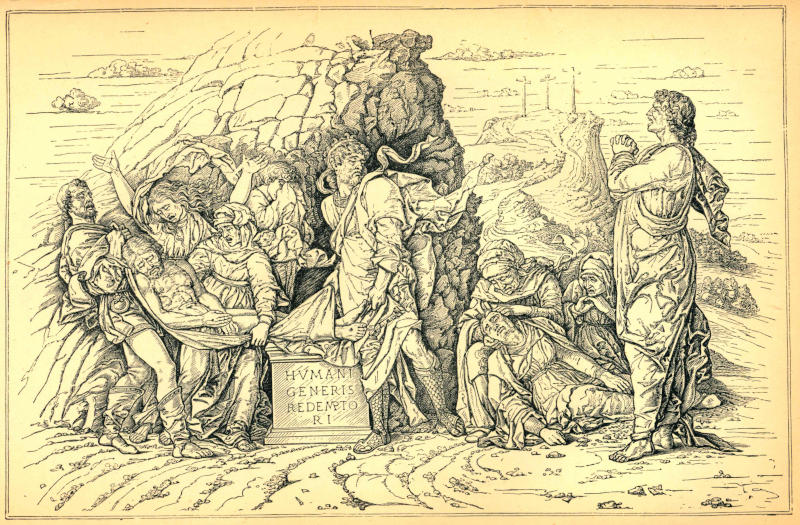
The Entombment.
From the engraving by Mantegna.
Small as is the cycle of genuine prints, they embrace a
wide range of subject; pagan myths, Roman and Christian
themes, are all treated in turn with the same seriousness
of purpose and marvellous variety of invention. Sometimes
he reproduces his own pictures—the “Virgin of the
Grotto” from the Uffizi triptych, in later years we have the
“Triumphs” and the “Dancing Muses of the Parnassus.”
The Bacchanalia, and still more the “Battle of the Sea-gods,”
remain to show us how deeply the spirit of classic
bas-relief had sunk into his soul. Certain subjects there
are in which he takes especial delight, which he treats with
as great freshness and originality as if he had never before
approached them. Such are the “Hercules and Antæus,”
already represented in grisaille on the ceiling of the
Camera degli Sposi, and the “St. Sebastian,” which hardly
yields in beauty to the sublime painting of the Belvedere.
At other times he reveals some altogether new conception,
as in the noble “Descent from the Cross,” which supplied
the motives whence Albrecht Dürer, Luca Signorelli,
Daniele da Volterra, and Rubens in turn took their inspirations.
In dramatic power and intensity of feeling
this plate is only equalled by the well-known “Entombment,”
where all the horrors of death, all the depths
of the wildest despair, seem gathered up and concentrated
in that one figure of St. John wringing his hands aloft
and uttering the great and bitter cry which cannot be restrained.
The same strong feeling shows itself under
another form in the seated Madonna, whose whole figure
is swayed with the foreboding of coming anguish that
mingles with her love, as she bends forward to press the
Child closer to her face. But although these figures, animated
with rage and despair, with a great hatred or a still
greater love, are the subjects on which Andrea seemed to
dwell with preference in his engravings, he returns at
times to the serene repose of ancient statuary, and designs
for us a group of perfect majesty in the three grand figures
of “St. Andrew, St. Longinus, and the Risen Christ,” who
stands between them, calm and strong, with the awe of that
death which he had conquered still upon his brow.
Again, in vivid contrast with reeling satyrs and angry
Tritons battling on the rough sea-waves, we have the quiet
portrait heads of Lodovico Gonzaga and his wife, Barbara,[2]
whose homely faces and earnest eyes look out of the same
quaint costumes as on their palace walls at Mantua, and
on whose brocaded robes infinite pains have been bestowed.
This is not the place to enter into further details, or a
whole volume might with profit be devoted to the consideration
of Mantegna’s engravings, but enough has been said
to show how important a part of his works they form, and
how extraordinary was the genius of the man who could,
in his leisure moments during the brief intervals which
elapsed between his greater tasks, give to the world so rich
a treasure of profound and varied thought.
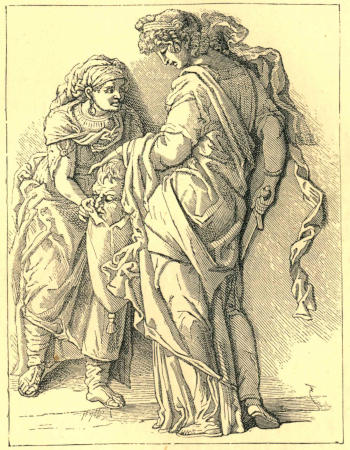
JUDITH WITH THE HEAD OF HOLOFERNES.
From the drawing by Mantegna in the Uffizi.
CHAPTER V. THE TRIUMPHS OF JULIUS CÆSAR: DRAWINGS, 1490-1500.
Mantegna, as we have already mentioned, returned
to Mantua in the summer of 1490, and during
the rest of that year and the whole of the following one he
devoted himself without interruption to his “Triumphs,”
which he finally completed in February, 1492.
This famous series consists of nine pieces of fine twilled
linen, upon which Andrea painted in tempera the triumphal
procession of Julius Cæsar on his way to the Capitol, after
the Conquest of Gaul. The whole formed a frieze eighty
feet long, and the separate compartments, each nine feet
high, were originally divided by pilasters adorned with
warlike ornaments.
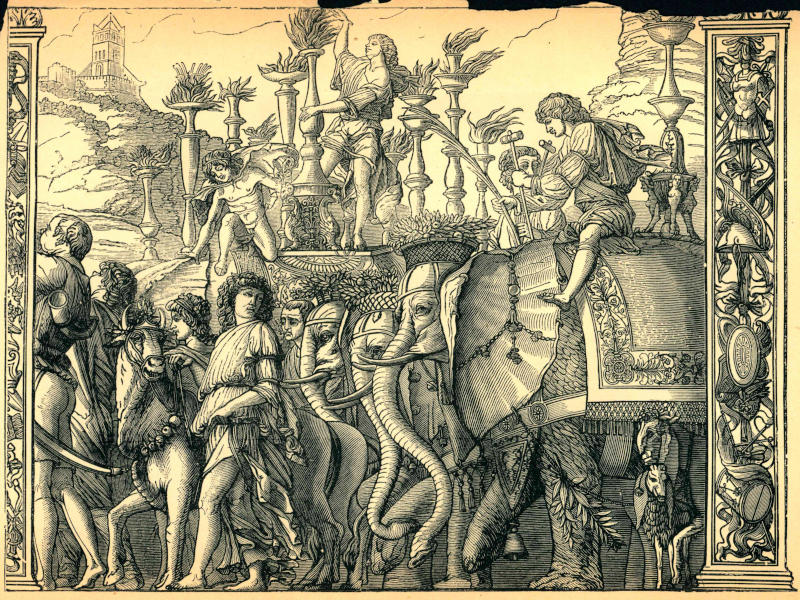
In the first piece, the trumpeters marching at the head
of the procession open the pageant with a burst of warlike
music, closely followed by standard-bearers carrying pictures
of Cæsar’s victories, smoking censers, and a large
bust of Roma Victrix. In the second, the gods of the
captive cities are borne in chariots, a colossal Jupiter and
Juno foremost, then a fine Cybele, and after these come
trophies of armour, battering-rams, and other warlike
implements, lifted high on men’s shoulders. The costlier
part of the spoil follows in the third and fourth compartments,
where strong men bend under the weight of vases
filled with gold and treasures, and white heifers garlanded
with flowers ready for sacrifice, are led by veiled priests
and beautiful fair-haired youths in their white tunics and
red girdles. In the fifth picture another band of trumpeters
heralds the next division, and four large elephants,
hung with gold chains and draperies, bear on their backs
baskets of flowers and young children, who fan the flames
of lighted candelabra. More trophies follow in the sixth
compartment; the armour of captive princes is borne aloft
on poles, and so great is its weight that one old soldier,
exhausted by the load he bears, sits down to recover
breath. In the next picture we reach the most interesting
part of the procession—a train of captives who advance
with slow and sorrowful steps, but not without an air of
noble fortitude on their faces as they meet the jeers of the
populace. Men and women of all ages are among them,
proud chiefs, matrons of royal blood, sweet-faced maidens,
a young bride with the myrtle wreath on her fair brow
and a coral necklace round her throat. Close to her we
see a mother bearing her youngest born in her arms and
leading a boy by the hand, who cries to be taken up,
while the old grandmother bends down to soothe him with
caresses.
In the eighth picture, immediately following this touching
group, come the jesters and hideous buffoons, who
mock the prisoners with their laughter and ape-like
grimaces, and a troop of musicians singing and dancing to
the sound of timbrels. After these we have another
company of signiferi, this time bearing the eagles of the
victorious legions and the she-wolf of Rome. Their faces
are turned backwards, and their eager, expectant gaze
prepare us for the coming of the conqueror, who appears
in the last picture seated on a richly sculptured biga with
sceptre and palm in his hand, and a laurel crown, which a
winged Victory is in the act of placing on his brow. At
his feet children shout for joy, and wave laurel boughs in
his path; the multitude press round his chariot wheels and
a gaily-clad youth, with eager enthusiasm in his upturned
gaze, lifts aloft a banner bearing Cæsar’s well-known motto,
Veni, vidi, vici, to meet the victor’s eyes.
This subject now forms the last of the series but
Mantegna’s original scheme included a tenth picture
which he afterwards abandoned, probably because the hall
for which the “Triumphs” were intended was not large
enough to contain more than nine.
An engraving, however, remains in which a body of
Roman citizens, followed by the first ranks of the advancing
legions, are represented marching in the conqueror’s progress;
and the great procession, after reaching its culminating
point, is thus brought to a tranquil close. Goethe,
who knew the “Triumphs,” not indeed in the original,
but from Andreani’s engravings, and who wrote a masterly
criticism on the series, was the first to feel the need of a
final scene to satisfy the eye, and to point out that this
must have been the artist’s original design.
Such, then, are the principal parts of this magnificent
work, in which the love of antiquity, which was the ruling
power of Mantegna’s genius, found its highest expression.
It was a sentiment common to many artists in this age of
revived learning, but while other men, like Botticelli or
Piero della Francesca, saw pagan themes through the
colouring of their own medieval fancies, he alone entered
thoroughly into the true spirit of ancient art.
A glance at the “Triumphs” is sufficient to show us how
profoundly Mantegna had studied classical authors and
how much freedom he had acquired in dealing with his
subject.
Part of the Triumphs of Julius Cæsar. By Mantegna.
At Hampton Court.
Those ancient Romans are no strangers to him; he has
lived among them and mingled with them as freely as with
men of his own day, the folds of their draperies, their very
gait and countenance are all familiar to him. The same
intimate knowledge of Roman times reveals itself in a
hundred details; in the temples and viaducts of the background,
in the mythological reliefs which adorn chariots,
shields and breast-plates, in tablets bearing Latin inscriptions,
in the triumphal arch under which Cæsar passes as
he goes on his way. And here we may notice that Andrea,
in one of the reliefs of this arch, has again introduced the
“Twins” of Monte Cavallo, which during his visit to Rome
he had doubtless seen with his own eyes in their time-honoured
place on the Quirinal hill.
In the execution of the “Triumphs” we observe the same
high degree of finish, as in all his later work; the drapery
hangs in the small folds of Greek sculpture, but without
stiffness or formality; while the light and transparent
colouring is admirably adapted in its softly-shaded tints to
the general character of the subject. Evidently in this it
was Mantegna’s intention to imitate as closely as possible
the style of ancient painting. Unfortunately most of the
pictures have suffered from repainting, and at the present
day it needs a very minute examination to appreciate the
delicacy of the fragments that have been left untouched.
Both in the plastic tendency of form and in the principles
of perspective which Mantegna has here successfully
applied, we see the result of his earlier studies, modified
and restrained by the experience of the thirty years which
had passed since the days when he painted the Eremitani
frescoes. Nothing can surpass the manner in which the
whole of the splendid pageantry of the “Triumphs” is
subdued and governed by the laws of composition, till
every figure moves in perfect rhythm and harmony of
line. We have only to look at the episode of the
“Triumphs” by Rubens (in the National Gallery) to
see how the subject, released from the severe restraint
of Mantegna’s art, could degenerate into a Bacchanalian
feast of wild beasts, revellers, and dancing women. But
for all its sculptured tendencies and likenesses to a classic
frieze, this great series is no procession of marble statues,
cold and rigid in their antique beauty. The forms which
pass before us in the long array are animated with life
and warmth, their faces glow with the fire of human passion
in all its endless varieties. Tender and youthful, or
worn by age and care, exultant with the joy of victory, or
bowed down to earth by a cruel fate, they are men and
women like ourselves, and appeal to us by the instincts of
a common humanity. In the well-known words of Goethe,
“The study of the antique supplies form, nature gives
movement and the last touch of life.”
For more than a century the “Triumphs” of Mantegna
remained in the hall of the palace for which they had
been intended, and were seen there both by Vasari and
the historian Mario Equicola. On festive occasions they
were sometimes moved to the Castello di Corte, and in
Andrea’s lifetime they were used as stage decorations
when the comedies of Plautus and Terence were performed
at the Court of Mantua.
Several separate episodes of the “Triumphs” were engraved
by Mantegna himself, and the complete series
became generally known by the publication of the large
wood-cuts by Andrea Andreani at the close of the sixteenth
century.
In 1628, a short time before the sack of Mantua, the
pictures themselves were sold to Charles I., with several
other masterpieces of the Gonzaga collection. After that
monarch’s death on the scaffold they were again sold by
the Parliament, but Cromwell bought them for £1,000.[3]
Charles II. placed them in the palace at Hampton
Court. There this precious series still remains, irreparably
injured by frequent removal and repainting, but
still in beauty and completeness both of design and
execution one of the most remarkable works of the Italian
Renaissance.
The exact date of the completion of the “Triumphs” is
fixed by a fresh grant of land which Francesco bestowed
upon Mantegna in February, 1492, with an express mention
of the great work which he had at length brought to
a happy termination. “If the Marquis had loved him
before, he loved him still more now,” says Vasari, and in
reality Andrea seemed to have attained the highest pitch
of honour and good fortune. For once his affairs were
prosperous. In 1492 he sold his small property at Padua,
and two years later furnished his own beautiful house in
the quarter of St. Sebastian. At the same time he came
to a final settlement with his Buscoldo creditors and
exchanged land with his old enemy Aliprandi. His son,
Lodovico, obtained a good appointment as overseer and
agent to the Marquis at Cavriana, while Francesco, who
was the least satisfactory of the two and frequently caused
Andrea anxiety, embraced the artist’s profession and became
his father’s assistant. Lastly, his only daughter,
Taddea, was married, on the 4th of July, 1499, with two
hundred and sixty ducats as her dowry, to Viano Vianesi,
whom he styles “uomo prudente” in his letters.
Besides these children by marriage Andrea had one
other son, Gian’ Andrea by name, born in his old age
after the death of his wife Niccolosia, and whom in his
will of 1504 he mentions as being still a child.
His improved circumstances seem to have softened his
temper, and the only complaint we find in his letters to
the Marquis at this time is that the stones which he had
prepared for building in his yard are stolen in broad daylight,
one of the thieves whom his son had caught in the
act of carrying away his spoil under his mantle being an
officer of Francesco’s household.
We hear occasionally of his suffering from attacks of
illness, but as a painter his powers were at their best, and
many of his finest works belong to the period between
his return from Rome and the close of the fifteenth
century.
Among classical subjects are the two beautiful pictures
now in the Louvre, originally executed for the Marchioness
Isabella’s “studio of the grotto,” a room which Andrea,
Perugino, and Costa were all employed to decorate, and
which became a complete museum of both antique and
Renaissance art. Andrea painted several panels for this
apartment at Isabella’s command, some we are told in
imitation of bronze-reliefs, and one in which the prophet
Jonah, is represented in the act of being cast into the sea;
but the “Wisdom Victorious over the Vices” and the
“Parnassus,” both in the Louvre, are the only works of
the series which have come down to posterity. Both
closely resemble the “Triumphs” in style of modelling and
in delicacy of finish. One is an allegorical composition,
such as Botticelli might have painted, in which Minerva
and Diana, led by Wisdom bearing a torch, are driving out
a tribe of Vices under the forms of centaurs and satyrs,
while Justice, Force, and Temperance hover in the air,
about to return to earth.
The form of the avenging goddesses is essentially
classic in type, and the trees of the background show that
loving care in each leaf which entitles Mantegna to a foremost
place among the foliage painters of the age. The
other, perhaps the most poetic of all Andrea’s conceptions,
brings before us a pleasant landscape where the
Muses dance hand in hand to the music of Apollo’s lyre,
while Mercury leans on the neck of Pegasus hard by,
and Mars and Venus pause from their embraces to listen
to the enchanted sound. Brighter tints than Andrea
generally employs enliven the scene, and in the light
fluttering drapery and measured stop of the dancing nine
there is a grace and charm of movement which no contemporary
painter ever surpassed.
These groups of dancing nymphs became a favourite
motive with Mantegna, and form the subject of one of his
engravings as well as of a finished drawing, exceedingly
graceful and charming in design, now at Munich. Classical
subjects at this time occupied a great part of his
thoughts, and some of his finest engravings, the “Battle
of the Sea-Gods,” “Hercules and Antæus,” and the “Bacchanalia,”
belong to this period. Closely related to these
are the beautiful drawings of the British Museum to
which Mr. Comyns Carr recently called attention, the
“Mars, Diana and Venus,” which in ideal beauty of
form yields to none of Andrea’s designs, and the long
frieze-shaped composition of “Calumny,” after the pattern
of Apelles’s last picture, which these artists of the early
Renaissance delighted to recall.
Several other precious drawings by Mantegna belong
the Christ Church collection, Oxford. Chief among them
is the original composition for his celebrated engraving of
the “Entombment,” and a fine example of another of his
favourite subjects, “Hercules killing the Lion,” inscribed
Divo Herculi invicto. Many more are in the hands of
private collectors, and a whole volume containing twenty-six
sheets of mythological subjects was exhibited in the
Grosvenor Gallery in 1878, by Miss Hannah de Rothschild
(now Lady Rosebery).
Among the other drawings of remarkable merit now
scattered over Europe, we will only mention the “Judgment
of Solomon” in the Louvre, the “Sagrifizio,” which
forms the chief ornament of the Verona Museum, and the
well-known “Judith” of the Uffizi (see page 37), which once
belonged to Vasari, and bears the date of February, 1491.
It was not in the nature of Mantegna’s art to cast off
a hasty sketch, or to leave to the world faces of rare loveliness
drawn in a few pencil strokes as it were at random
on the paper. Whether he was engaged on the cartoon
of an altar-piece, or on a simple pattern of a cup or fountain,
all he achieved was marked by the same patient,
untiring labour, the same minute care, above all by the
same feeling for beauty in every detail. Many of us
remember that exquisite design for a chalice which attracted
general attention in one of our last winter exhibitions.
It is true the perspective of the Cup was faulty,
but this defect was scarcely noticed in the beauty of the
work, with which every part of the chalice was covered.
Scenes from the life of Christ, cherub heads and elaborate
scroll work adorned the border of the Cup. Apostles and
prophets were figured on its base, while the stem was
studded with rows of lovely babies and angel heads,
executed with a grace and delicacy which rendered the
whole a perfect marvel of decorative art. And so it is
with his larger drawings, whether classical or religious
in subject. Each hair in the head of his “Judith” is
distinctly drawn, there is the same attention to form in
the folds of her falling drapery, or, to take another instance—the
fair faces of the youth and maiden in the procession
of the Sagrifizio. Both are designs in the best
spirit of classical art, and remind us of the finest Greek
sculpture.
We have said that pagan themes occupied much of
Mantegna’s imagination during the years immediately
following the conclusion of the “Triumphs,” but the
three large altar-pieces which also belong to this period
must not be passed over. In the first place we have the
“Madonna della Vittoria,” now in the Louvre, perhaps
the noblest of all his religious pictures. This altar-piece
was painted by order of the Marquis Francesco to commemorate
his pretended victory at Fornovo, where he had
encountered the French, but, far from being victorious, had
lost the greater part of his army, and narrowly escaped
with his life. A curious circumstance characteristic of the
manners of the times is connected with this painting.
The Madonna della Vittoria. By Mantegna.
In the Louvre, Paris.
A Jew of Villafranca, Daniele Norsa by name, in the
year 1495 bought a house in Mantua which had a
Madonna painted over the door, and fearing any accidental
misfortune to the picture might excite popular
displeasure, prudently obtained leave from the bishop to
remove the sacred image. Even this step was turned to
his prejudice, and on Ascension Day his house was
attacked by the mob and narrowly escaped destruction.
The Jew appealed to the Marquis for protection, and ultimately
his case was brought before a tribunal, which condemned
him, by way of reparation for the supposed insult
to the Virgin, to place a new picture painted by Mantegna
in one of the Mantuan churches. In the meantime the
battle of Fornovo took place, and Francesco, who in the
hour of danger had vowed to erect a church in Mantua to
the Virgin, resolved to gratify popular feeling and give
greater effect to the fulfilment of his vow by placing the
building on the spot where the Madonna’s honour had
been slighted. Accordingly he bought Norsa’s house,
and on the anniversary of the battle, July 6th, 1496, the
votive Madonna painted by Mantegna for the occasion
was placed above the high altar of the newly erected
church with great popular rejoicing. Three hundred
years afterwards the French carried off this picture,
which was originally intended to celebrate the victory
over their nation, in triumph to Paris, where it still
remains.
Few perhaps of Andrea’s larger works are as generally
and deservedly popular. The mild Virgin, in blue hood
and mantle, sitting under her leafy bower hung with fruit
and coral and gay with twittering birds, is familiar to all
visitors to the Louvre. Both mother and child stretch
out their hands in blessing towards the kneeling Marquis,
whose life-like portrait excited the universal admiration
of contemporaries. Opposite him, the venerable form of
St. Elizabeth is seen kneeling at the side of the young
St. John, who stands on the carved pedestal of the Virgin’s
throne, and in the background are the patron saints of
Mantua, Andrew and Longinus. More beautiful than
either of these are the two warrior saints, Michael and
George, who stand in full armour on either side, holding
the hem of the Virgin’s mantle, and who, with their noble
features, manly forms, and flowing masses of fair locks,
are perfect types of Christian chivalry—in other words, of
that union of strength and tenderness which is held to
constitute the heroic character.
The “Virgin” of the National Gallery, long in the possession
of different Milanese families, bears a close resemblance,
both in style and execution, to the “Madonna della
Vittoria,” and was probably painted about the same time.
Here the Virgin is seated under a red baldacchino between
St. Mary Magdalen and the Baptist, who stand erect
against a background of dark green orange-trees and silver-clouded
sky. The face of the Magdalen is lighted with the
glad enthusiasm of her love, and in the foliage we notice
the same careful finish as in the bowers of the “Parnassus”
and in the leaf-painting of all Mantegna’s works.
To the same period and class of picture belongs the
“Glorified Madonna” which Andrea painted for the
monks of Santa Maria in Organo of Verona, now in the
Casa Trivulzi at Milan. Here the Madonna is enthroned
on the clouds, with four life-sized saints; a landscape of tall
lemon-trees is behind her. A troop of singing boy-angels
hover in the air, after the fashion of the Camera degli Sposi
frescoes, and one bears a scroll with the inscription:—
“A Mantinia p. an. gracie 1497, 15 Augusti.”
Virgin and Child, with St. John and the Magdalen. By
Mantegna.
In the National Gallery, London.
The small blue-mantled “Madonna” of Bergamo, and a
good portrait of a Gonzaga in the same collection, may
have been painted towards the close of the century, to
which period the engravings of the “Triumphs” and
several other subjects are assigned. Finally, among the
labours which occupied the last months of 1499, was the
commission to design a monument of Virgil for the chief
square of Mantua. The plan originated with the Marchioness
Isabella, who consulted the learned Latinists,
Pontanus and Vergerius, at Naples, as to the best mode
of carrying her scheme into effect. They suggested Mantegna
as the natural person to furnish a design for the
monument, and he entered warmly into a project so well
suited to the spirit of the age. We can hardly imagine
a commission more congenial to a painter so imbued with
Latin traditions as Mantegna, and the statue which he
designed was worthy of the occasion, as the drawing
recently discovered in the collection of M. His de la Salle
abundantly proves. Virgil is represented crowned with
laurel and holding the Æneid in his hands, while winged
boys on the pedestal at his feet support a tablet with the
words:—
“P. Vergilii Maronis a æternæ sui memoriæ imago.”
Unfortunately, Andrea never had the satisfaction of seeing
this design executed in bronze or marble. Whether
Francesco’s treasures were expended in wars, or whether
Isabella’s intention was only a caprice of the moment, the
scheme was abandoned, and Mantua remained without a
monument of her greatest son.
CHAPTER VI. LAST WORKS AND DEATH: HIS INFLUENCE ON ART, 1500-1506.
During more than forty years Andrea had now lived
at Mantua in the service of the Gonzagas. Both
at their court and throughout Italy he was held in the
highest honour, and enjoyed a degree of favour and consideration
which, but few artists have known in their lifetime.
His children were, with the one exception of Gian’
Andrea, grown up and well provided for; he had lands
and possessions of his own both in town and country and
what he valued even more—a collection of precious antiquities.
Behind him lay a whole lifetime of great works,
and although now in his seventieth year his powers as yet
showed no trace of weakness or failing. We have seen how
rich in works of every branch of art was this last decade of
the fifteenth century; how untiring was his activity, and how
fresh and inexhaustible the treasures of his imagination.
Everything seemed to foretell an old age of honour and
prosperity, in which the great master should still charm
men by the creations of his brain and hand, and yet as
his bodily powers grew weaker should enjoy more of the
repose to which he was so well entitled. But this was not
to be, and the last few years of Mantegna’s lifetime are a
weary record of sorrows and misfortune. Again we find
him involved in pecuniary difficulties, brought on by his
own extravagance, and very probably by that of his son,
Francesco; in order to meet his liabilities he was compelled
to part with the beautiful house which he had
decorated with his own hand, and to live in lodgings, which
he disliked extremely. Yet, with the strange recklessness
that formed part of his character, we find him entering
into new and imprudent engagements. In March, 1504,
he made a will, leaving a sum of money to his son Francesco
and the chief part of his fortune to Lodovico, together
with the charge of bringing up the child Gian’ Andrea, in
whose favour he afterwards altered certain provisions. At
the same time he left two hundred ducats for the endowment
of the chapel of San Giovanni, in Alberti’s large
church of Sant’ Andrea, as a burial-place for himself and
his family. Special mention is made of his wife, Niccolosia,
who had died some years before; and masses are ordered to
be said for the repose of her soul. In August of the same
year (1504) he obtained possession of this chapel by a
contract with Sigismondo Gonzaga, Bishop of Mantua, and
the canons of the church. Its decoration now became his
favourite scheme, and it was his intention to paint the walls
in fresco and to erect a family monument there. He bought
a piece of ground outside to prevent the windows from being
blocked up by building, and announced his intention of
turning it into a garden, where he could spend his time in
summer, and build a small room, where he might keep
himself warm in winter, “in order,” he adds touchingly,
“that I may take a little rest in my old age.” But all
this expenditure became the cause of fresh difficulties, and
added to the burdens under which Andrea already groaned.
Other trials came to sadden his old age. His son Francesco
incurred the displeasure of the Marquis by some grave
misconduct, and neither Andrea’s tears nor the intercession
of Isabella could prevent his banishment from Mantua in
1505. This disgrace was a heavy blow to Andrea, who
owned that his son had offended grievously, but thought
that his fault might have been overlooked in consideration
of his own services. “Messer Andrea,” wrote Isabella to
her husband, “has just now been to see me, so full of tears
and so altered in countenance that he seemed to me more
dead than alive.”
But his activity was undiminished, and, heavy as his
heart might be, brain and hand were still the same as
ever. We find him returning to a favourite subject of
earlier days in the “St. Sebastian,” originally ordered by
the Bishop of Mantua, but now in possession of the Scarpa
family at La Motta, in Friuli. The life-sized figure, lean in
proportions and suffering in expression, has a grandeur of
its own. At the feet of the saint is a lighted candle, which
sends a thin blue smoke upwards, and makes us wonder at
its meaning, until we read the words on the scroll which
hangs to the coral string above—Nil nisi divinum stabile
est, cætera fumus.
This, then, was the conclusion to which he had come at
the end of that long life full of works and honour; this
the conviction that old age and gathering troubles were
forcing upon the mind of the great painter, who had seen so
clearly and felt so keenly the beauty and the joy of life.
In that same sad year of his son’s banishment he commenced
another of the classic friezes which he loved to
paint. This was the splendid composition known as the
“Triumph of Scipio,” now in the National Gallery, which
a wealthy Venetian named Francesco Cornaro ordered
and paid for in part in 1505, but which, to his great indignation,
was still in Andrea’s studio at the time of his death,
when it was seized upon by creditors nearer at hand.
The real subject of this work, executed in chiaroscuro
on a background painted to imitate red marble, is the
reception of Cybele among the deities of Rome. A colossal
bust of the Phrygian goddess is borne in state into the
presence of Scipio, who receives the messenger in consular
array; while Claudia Quinta, a Roman lady, kneeling at
his feet, welcomes the image with outstretched arms. Every
gradation of movement is represented here, from the swift
tread of the bearers on whose shoulders the goddess
advances, to the motionless forms of the Roman soldiers who
stand grouped around Scipio; and nothing is more striking
than the skill with which the artist brings this rapid action
by degrees to a complete pause. The general character of
the piece, its costumes, figures, and draperies, all recall the
“Triumphs.” It is, as it were, a last echo of the great composition
whose harmonies still lingered on in Mantegna’s
ears.
Before the end of the year Andrea, tired of a wandering
life, had again bought a house, this time in the Contrada
Unicorno, and settled himself there for the winter,
promising to pay the owner three hundred and forty ducats
in three instalments. It was an unwise venture, as the
issue too soon proved. A plague drove the wealthier
Mantuans from the city, provisions became scarce, and his
own health began to give way. Still he remained in Mantua
and painted on manfully, endeavouring to finish a mythological
picture of Comus, which Isabella had ordered. But it
was in vain. He could not work fast enough to satisfy his
creditors, and when pressed to pay the stipulated sum for his
house he was compelled to apply to the Marchioness for help.
Isabella was then at a villa near Cavriana, and Andrea
wrote to her in pathetic terms, telling her of his distress,
and offering to her for sale the one of all his antiques which
he most valued, “la mia cara Faustina.” Often in brighter
days great masters and connoisseurs had wished to buy
this bust, but he had refused all their offers, and now since
part from it he must, the Marchioness is the only person to
whom he can bear to give it up.
Strange as it seems, Isabella did not answer this letter,
and with a meanness unworthy of her wrote to her servant,
Jacopo Calandra, telling him to bargain with Andrea and
obtain the Faustina at the lowest price possible.
This unkindness cut Mantegna to the heart, and when
Calandra communicated Isabella’s answer to him, he refused
angrily to part with the bust for less than the hundred
ducats which had been offered him in former days. Isabella,
however, was determined to have it, and on
the 1st of August Calandra was able to write:—“Your
Excellency will be glad to hear that I have at last obtained
possession of Andrea Mantegna’s Faustina. He gave the
bust into my hands with great reluctance, recommending
it to my care with much solicitude, and with such demonstrations
of jealous affection that if he were not to see it
again for six days I feel convinced he would die.” The
words were to come true sooner than Isabella or Calandra
had expected. Andrea could bear to part with houses and
lands, but the marble was dear to him as his own flesh and
blood, and the parting with it broke his heart.
He was already ill at the time, and six weeks later he
died, on Sunday, the 13th of September, 1506. To the last
the old spirit of loyalty to the Gonzagas did not leave him,
and his son Francesco, writing to inform the Marquis of
the sad event, describes how a few minutes before his
death he asked for his master, and grieved much to think
that he should never see him again.
Francesco was at that time at Perugia, whither he had
gone to meet Pope Julius II., and had little time or thought
for the great painter who had just passed away. Isabella
scarcely troubled herself more, and in a letter full of joyous
congratulations to her husband on his entry into Perugia,
merely alludes to Mantegna’s death:—“You know Messer
Andrea died suddenly a few days after your departure.”
There were others who felt more deeply and judged more
rightly of the loss which the world had sustained in Mantegna’s
death. Albrecht Durer was at that time in Venice,
on his way to visit the great Lombard artist whose engravings
had filled him with admiration, and from whom he
had learnt perhaps more than from any other master.
His purpose was frustrated by the news of Andrea’s sudden
death, and in later years he was often heard to say that
he looked upon this as the saddest event of his whole life.
Another graceful tribute to Mantegna’s memory was paid
by a certain Lorenzo di Pavia, a collector of antiquities
and objects of art, who had known Mantegna at the court
of Mantua, and who, on hearing of his unexpected death,
wrote to Isabella in these terms:—“I grieve deeply over
the loss of our Messer Andrea Mantegna, for in truth a
most excellent painter, another Apelles, I may say, is gone
from us. But I believe that God will employ him elsewhere
on some great and beautiful work. For my part, I
know that I shall never see again so fine an artist and
designer. Farewell.”
The melancholy history of Mantegna’s difficulties did not
end with his death, and his sons had a hard task to satisfy
his creditors. One hundred ducats were still owing to the
bishop and canons for the mortuary chapel, and Cardinal
Gonzaga, Bishop of Mantua, laid an embargo on the contents
of his studio. Francesco Mantegna had to obtain the
permission of the Marquis to sell the pictures that still
remained there, among which he names the “Triumph of
Scipio,” which Cornaro had never received, the “St.
Sebastian,” now at La Motta in Friuli, and the famous
Cristo in scurto.
By this means his debts were paid, and a settlement of
his affairs concluded. Francesco Gonzaga seems to have
behaved kindly, and both Andrea’s sons continued in his
service, Lodovico as agent, while Francesco succeeded to
his father’s place, and painted by turns in the palaces of
Mantua, Gonzaga, and Marmirolo.
The remains of the great master were buried in his own
chapel of Sant’ Andrea, where half a century later his
grandson placed a bronze bust, supposed to have been the
work of the medallist Sperandio, and which, after being
taken to Paris in 1797, has been restored to its place on
Mantegna’s tomb.
The chapel itself is bare and dingy, its walls are whitewashed,
rubbish heaps are allowed to litter the floor, and
the general aspect is of the most cheerless description.
But the gloomy surroundings only serve to heighten the
imposing grandeur of the bust.
The sculptor has caught the spirit which animated the
great master, and has represented Mantegna, after the
manner of an old Roman, wearing a laurel wreath on the
thick clusters of hair that shade the deeply furrowed brows
and massive features with which more than one portrait in
his own frescoes has made us familiar. We seem to feel the
fiery flashes of that piercing eye bent upon us, and to
realise the iron strength and unbending force of the genius
which no difficulty could dismay, and no labour exhaust.
Sperandio’s bust is almost the only thing in Mantua
which still speaks of Andrea. The perishing frescoes are
still to be seen in the deserted palace, and the walls of the
house in which he once lived are standing; but in this
city, where he painted for nearly fifty years, his name is
forgotten, and while every child in the streets will talk to
you of Giulio Romano and the Hall of the Giants, scarcely
a creature in the place has ever heard Mantegna’s name.
His Faustina is preserved among other antiques in the
public museum, where visitors can see for themselves the
classic outline of the features which he loved so well; but
the custodian, who unlocks the hall, and has much to say of
the many statues, passes by this one in silence, or wonders
why it is we linger before this bust, unmindful of the tragic
story which has invested the marble with so deep an
interest.
The Crucifixion. By Mantegna.
In the Louvre, Paris.
The name of Mantegna, however, is not one that depends
on local fame, and there can be no difference of opinion as
to the important place which he holds in the history of the
Renaissance. We have only to consider how great and
widespread was the influence which his works exercised
on contemporary art both in Italy and Germany. If we
examine the different schools of North Italy we shall find
that there is scarcely one which did not receive some new
impulse from his powerful genius.
His son Francesco followed in his father’s steps, and
worked in the same lines without ever rising above the
level of mediocrity. The few scholars and assistants he
had in Mantua imitated his example, and whatever remnants
of art were still to be found in Padua bore the
stamp of Andrea’s earliest style.
In Venice we recognise his vigour and precision of outline,
and the classical tendency of his types, not only in
the works of his brothers-in-law, the Bellini, but in those
also of the rival Murano painter, Luigi Vivarini. Montagna
and Buonconsiglio at Vicenza, Ercole Grandi and
Cosimo Tura at Ferrara, alike formed their style upon his,
while the best Veronese masters were all either his followers
or imitators.
We know that Caroto and Bonsignori assisted him in
the execution of his later works, while his influence is even
more apparent in the works of Liberale, Girolamo dai
Libri, and Francesco Morone. The masterpiece of the
last-named artist, the frescoes on the walls and ceiling of
the sacristy of Santa Maria in Organo, at Verona, are indeed
exact imitations of the style of decoration adopted by Mantegna
in the Camera degli Sposi. We trace the same all-prevailing
Mantegnesque in the works of Lorenzo Costa,
who spent some years of his life in Mantua, and if we are
to believe Vasari it is to the stimulus of Mantegna’s example
that we owe the inspiration which made a painter of Francia.
The link which binds Mantegna to the Umbrians is as
yet uncertain, but even if Melozzo da Forli in his Roman
frescoes derived no help or suggestion from Andrea, Giovanni
Santi’s stanzas remain to show us how intimate was
his acquaintance with the Paduan master’s works.
If from contemporary art we pass to the culminating
period of the Renaissance, we find Raphael taking him as
his model in more than one instance. The likeness of the
boy-angels of the Camera degli Sposi to the famous cherubs
of the “Madonna di San Sisto” has been frequently
remarked, and in the bearers of the dead Christ, who walk
backwards in the Borghese “Entombment,” we find a distinct
reminiscence of Andrea’s great engraving.
Again, in the treatment of antique themes, Raphael
often approaches Mantegna, and we have little doubt that
both he and Leonardo had closely studied the works of
their illustrious predecessor.
Perhaps the actual connection between Mantegna and
Michelangelo is less capable of demonstration, but the
strength and energy of expression which were so remarkable
features in the genius of both men, as well as a
certain resemblance in their characters, form a link which
binds them together.
A very different artist, Correggio, who married a Mantuan
wife, owes his knowledge of the laws of perspective
and composition in a large measure to the study of Mantegna’s
works, and, whether or not he visited Mantua himself,
probably derived the first idea of the dome-painting
for which he became famous from the ceiling of the
Camera degli Sposi.
But this is not all. The engravings of Mantegna spread
his influence beyond the limits of Italy into countries north
of the Alps. There was a robustness, vigour, and grave
earnestness of purpose, as well as a fantastic element in
his art, which attracted the Teutonic mind, and it is perhaps
not too much to say that he influenced German art
more than any other Italian painter.
We have already alluded to Albrecht Dürer’s admiration
for his works and anxiety to become personally acquainted
with him. A further proof of the fascination which drew
him to Mantegna appears in the highly-finished copies of
the “Bacchanalia” and “Battle of the Sea Gods,” which
Dürer executed with his own hand, and in the St. John of
“The Entombment” which, unable to forget, he introduced
in his own “Crucifixion” of 1508. Professor Colvin has
pointed out how much he learnt from the Italian master
in the delineation of passionate movement, and how close
is the affinity between the avenging angels of Dürer’s
“Apocalypse” and the angry Tritons of Mantegna’s engraving.
Nor is Dürer alone among northern painters in his adoption
of Mantegnesque motives. Holbein repeatedly availed
himself of those episodes of the “Triumphs” which he knew
from Andrea’s own engravings in his works at Busle and
Lucerne; and a portfolio of Mantegna’s works was numbered
among the treasures of art in Rembrandt’s possession.
More singular is the admiration which Rubens conceived
for an artist with whom he can have had few points in
common, yet we find him visiting Mantua in order to study
Andrea’s works, and reproducing a scene from the
“Triumphs” after his own fashion.
We have already seen the great honour in which Andrea
was held during his lifetime. That he was equally
esteemed by the succeeding generation we learn from the
verses of Ariosto, who places him next to Leonardo in his
“Orlando.” High as the praise is, we cannot think it excessive,
for Mantegna stands half-way between those men who
first brought art to life again, and those who carried it to
the highest degree of perfection, and he occupies the foremost
place among the artists of the mid-Renaissance, who
saw how much was wanting before farther progress could
be attained, and allowed no difficulties to stop them in their
endeavour to acquire knowledge.
With this end in view no research was dull, no toil
wearisome. He embraced the driest studios with the
passionate ardour of his nature, and gave life to the
scientific problems which he attempted to solve by the very
force of his great zeal.
At the same time he brought to the task a degree of
culture rare among the men of his class, and both his
friendship with scholars and antiquarians and his own
classical studies were productive of the most important
results for Italian painting. He is the chief representative
in art of that revival of learning which was the leading
intellectual impulse of the age; and, by bringing this influence
to bear upon painting, he won a great step in the
History of its development. First among the artists of the
Renaissance, he saw with unerring instinct the path by
which art would attain her final triumphs. Early in his
career the conviction had forced itself upon his soul that
the most perfect models of beauty are to be sought in
antique art, but that this very perfection can only be
reached by a minute and faithful study of nature. To
reconcile anew these two principles, to combine in his work
classic grace and human action, became the aim of his life,
the task which he most nearly achieved in the “Triumphs”—although
even there he is not always successful.
“We are conscious,” wrote Goethe, “of a sense of conflict,
but this conflict is surely the highest in which ever
artist was engaged.” The perfect union of the two principles
was to be effected by artists of the next generation,
and where Mantegna had sown Raphael and Leonardo were
to reap.
It is this sense of conflicting elements, this occasional
antagonism between the ideal form after which he strove
and the actual fact present before his eyes, which has given
rise to so much mistaken criticism of Mantegna’s work.
By some critics of the very first rank he is called a mere
realist, while on the other hand the old reproach that he
neglected the study of real life to copy statues has been
repeated till it has grown wearisome.
Although it is easy to trace their origin, both charges
are equally unjust. No man had ever a more thorough
knowledge of nature, or was more keenly alive to the
minutest details of everyday life around him. But something
he felt was needed to lift this changeful scene, with
its seething throng of human thought and action, into the
atmosphere of perfect art.
It is just that touch of grace, that power to ennoble and
refine which the Greeks understood so well, that Mantegna
felt and sought after in days of long and arduous toil. If
at times a certain rigidity of form, a carelessness of desire
to please, is visible in his work, it is because in his anxiety
to obtain his end he occasionally omitted these minor
matters. But to say that Mantegna was alike destitute of
feeling for beauty and of spiritual perception appears to us
simple blindness.
In knowledge and mastery of the human form, in skill
and finish of workmanship, in wealth of imagery and
creative thought, few have ever surpassed him.
In dramatic energy and intensity of expression he stands
unrivalled by any but Michelangelo. Every variety of
emotion, every passion that can swell the breast of man is
included within the range of his experience. He knew
where to seek the purest springs of joy, and in darker hours
his strong soul had fathomed the lowest depths of the most
unutterable anguish. The sportive dances of laughing
cherubs and nymphs, the pleasures and pains of such
mythical creatures as Tritons and Nereids, satyrs and sea-monsters,
the sublime and rapt devotion of a Magdalen,
the heroism of a Sebastian, were all familiar to him. He
enters in the fullest manner into the exultant joy of the
victors returning with their long array of spoils and
captives from the fight, and yet in the midst of the mighty
triumphal procession he pauses to show us the innocent
child stretching out its little arms to its mother.
But more than all he loved to paint the rage of violent
passion, the wild gestures of uncontrollable grief. There
are certain figures into which he seems to have concentrated
either the tempest of the most ungovernable fury or
the agony of the bitterest despair. Once seen, these creations
of his brain refuse to loose their hold on our imaginations,
and remain to haunt us with their terrible forms,
just as the wailing St. John of “The Entombment” was
ever present to Albrecht Dürer’s mind.
The very greatness of Mantegna’s genius, its immense
strength and power, may in itself be the cause that he is
not strictly speaking a popular artist. His works have
never been, perhaps they will never become, the enthusiastic
object of general worship. But within the last few
years the number of his admirers has increased steadily,
and his high merit has received the fullest recognition from
some of our most cultured writers.
That this circle will widen year by year, as a larger
number of students are drawn to examine for themselves
those works of Mantegna which are fortunately within the
reach of us all, we feel confident. It is scarcely necessary
to add the expression of our conviction that to those who
attentively consider them, no works yield a more genuine
and lasting pleasure, while assuredly there are none that
better repay the devotion of a life-long study.
FRANCESCO RAIBOLINI CALLED FRANCIA
FRANCIA.
CHAPTER I. EARLY ART IN BOLOGNA, A.D. 1300-1450.
From the earliest days of the revival of Italian painting
the city of Bologna was distinguished for the
cultivation of art, and could boast a regular succession of
native painters. The names of several of these men have
been preserved by old writers, and we hear of a Guido, a
Ventura, and Ursone, who flourished in the thirteenth century.
But the honour of having been the real founder of
the school is ascribed by the historian Malvasia to a
miniaturist known by the name of Franco Bolognese, who
lived in the time of Dante and Giotto. Since, however,
none of his works have come down to the present day, we
have no opportunity of studying his style, and all that we
know is that he was a pupil of the miniaturist Oderisio da
Gubbio, and is said by Dante to have eclipsed his master
in the same way that Giotto surpassed Cimabue.
Francesco Raibolini.
When Virgil and Dante meet Oderisio expiating the
sin of pride in purgatory, he tells them mournfully that
the pictures which Franco now paints are fairer than his
own, and that the honour once his now belongs to his
scholar. So it has been in Dante’s own city of Florence,
where once Cimabue held undisputed possession of the
field, and now the fame is all Giotto’s. For what after all
is the voice of earthly fame? Nothing but an idle breath
of wind that blows first from one quarter, then from
another, ever fitful and inconstant.
But if Franco Bolognese’s only hope of immortality
rests on Dante’s noble lines, the works of his pupils are
still to be seen in Bologna, and afford us some idea of
native art in these early times. Chief among them was
Vitale, who painted in the first half of the fourteenth century,
and whose few remaining pictures are marked by a
softness and delicacy of workmanship which reveal the
Umbrian origin of the school of Gubbio. A “Madonna
and Angels,” painted by him in the year 1320 for the ancient
church of the Madonna del Monte, and now preserved in the
Gallery of Bologna, has a sweetness and humility of expression
which approaches contemporary Sienese art, and the
faces of his virgins are not unworthy precursors of Francia’s
Madonna. The same manner was further developed in the
paintings of his best scholar, Lippo Dalmasii, whose virgins
acquired so wide a reputation as to win for him the surname
of “Lippo delle Madonne.”
This artist, who lived at the close of the fourteenth century,
and painted between 1376 and 1410, was held in
universal respect for the holiness of his life and character.
His devout habits are recorded by Malvasia, who tells us
that, before commencing a picture of the Virgin, he invariably
spent the night in prayer and fasting, and received
communion on the morning of the day itself. In his lifetime
he was the most popular artist of Bologna, and his
pictures were so much in request that he could scarcely
paint fast enough to supply the demand. “No family
was considered rich in Bologna,” says Malvasia, “which
did not possess one of his Madonnas.”
After Lippo’s death his Madonnas were revered as sacred
images, and were only uncovered on festivals dedicated to
the Virgin. Several are still to be seen in the ancient
churches of Bologna, and a lunetto of the “Virgin between
St. Sixtus and St. Benedict” over the portal of San
Procolo, is pointed out as the very picture which excited
the admiration of Pope Clement VIII. On returning from
the conquest of Ferrara, he is said to have paused before
Lippo’s “Virgin,” and, saluting it with the utmost devotion,
to have exclaimed that no other images ever touched
him as deeply as those painted by the old Bologna master.
In later days, Guido professed an extraordinary veneration
for Lippo’s Madonnas, and often declared that some supernatural
influence must have guided the artist’s pencil,
since no modern painter could ever succeed in designing a
figure of so much purity and holiness.
In spite of these enthusiastic expressions it is impossible
to give Lippo a high place among his contemporaries, and
this Fra Angelico of Bologna is as far below the friar of
St. Marco as the school of his native city is inferior to that
of Florence.
One of Lippo’s pictures, originally in the Ercolani
Palace at Bologna, is now in the National Gallery, and
may be taken as a fair specimen of his style. The Virgin,
embracing her child, appears in mid-air surrounded by a
circular glory, angels hover above, and a flowery meadow
lies below. There is a good deal of religious feeling and
maternal tenderness in the Madonna’s face, and some
attempt at rendering natural movement, without either
beauty of type or skill of workmanship.
Side by side with the mystic traditions of the Madonna
painter we trace a more vigorous vein in the early school
of Bologna, and see decided proofs of the Giottesque influences
which had already reached its artists. This
Florentine tendency is prominent in the works of both
Simone dai Crocifissi and Jacopo degli Avanzi, the only
two other Bolognese painters of this period who deserve
mention.
According to Malvasia, Simone executed nothing but
crucifixes, and although other paintings at Bologna are
attributed to him, this was no doubt the chief branch of art
in which he was engaged. The best of his crucifixes are
those in San Giacomo Maggiore, and in the fourth of the seven
churches belonging to the ancient pile of San Stefano, in both
of which he to a great extent follows Giotto’s example, but
retains much of the bad taste of Byzantine art in the emaciation
of the figure and the grimace of the attendant saints.
Much of the same ugliness of type, accompanied by
greater truth and character, is visible in the curious “Crucifixion”
on gold ground, ascribed to Jacopo degli Avanzi,
in the Colonna Gallery at Rome, and in the other altar-pieces
which bear his name at Bologna. The personality
of this artist has been a cause of endless controversy, but at
least it has been shown that Vasari is clearly wrong in confusing
him with d’Avanzo of Verona, who assisted Altichieri
in painting the chapel of St. George at Padua.
Whether Avanzi of Bologna is identical with the Jacobus
Pauli who painted the “Coronation of the Virgin” in
San Giacomo Maggiore, is a matter of small importance;
but what we know for certain is, that a Bolognese painter
by name Jacopo, whom Vasari probably rightly calls
Avanzo, was the best of all the different artists who painted
in that most interesting of all Bologna churches, the
Madonna della Mezzaratta. This small chapel, called by
Lanzi the Campo-Santo of Bologna, was built in the twelfth
century outside the Porta San Mammolo, and decorated
with frescoes in the fourteenth by a succession of native
painters. Vasari alludes to it more than once in his
“Lives” as the Casa di Mezzo, and speaks of the series
painted there by Jacopo d’Avanzo, Cristofano, Simone, and
at a later period by Galassi of Ferrara.
The frescoes of the Mezzaratta were no doubt the most
important works of art achieved by early Bolognese
painters, and—although their execution is too rude, and their
present condition too imperfect to allow of comparison
with the productions of Giotto and his scholars at Padua
and Assisi—the scanty fragments that remain are still of the
deepest interest to the student.
The most celebrated artists of later ages who had the
advantage of seeing these frescoes in a comparatively good
state of preservation are said to have held them in the
highest esteem. Michelangelo himself visited the chapel
and praised its paintings in the warmest terms, while the
Carracci exerted themselves strenuously to save them from
destruction. Unfortunately, later generations have been
less mindful of their condition. The roof of the church was
taken off some years ago and the upper part used as a
granary, while most of the frescoes were whitewashed and
many entirely obliterated.
At the present moment the chapel of Mezzaratta is
attached to a villa, which was for many years the property
of the Italian Minister, Cavaliere Minghetti. This accomplished
statesman took every possible means to save these
relics of early art from further destruction, and by his care
several frescoes were recovered from the coat of whitewash
which concealed them.
The site of the chapel itself is so picturesque, and the
views from the hill of Mezzaratta are so full of beauty, that
no traveller should leave Bologna without making a pilgrimage
to this shrine. A steep ascent along a path lined
with acacias leads from the gate of San Mammolo to the
garden of Villa Minghetti, and on a summer’s day, when
nightingales are singing in the acacia thicket and the air
is sweet with myrtle and orange-blossom, there is not a
pleasanter spot in all Bologna. Below, the domes and
spires of the ancient city rise above its arcaded streets, and
the eye is at once arrested by the quaint forms of the twin
leaning towers, Garisenda and Asinelli, which were
already old in Dante’s lifetime. All around the plains
stretch their vast expanse, softly shadowed by passing
clouds, far away towards Ferrara and Modena, excepting
where some rocky spur descends from the Apennines, and
looking up an opening valley we catch a glimpse of a
jagged peak crowned with snow. Mezzaratta itself has
an additional claim on our interest from having been the
favourite resort of the Franciscan monk, Bernardino da
Siena, whose religious revival at Bologna was one of the
most important events in the early part of the fourteenth
century, and who frequently preached in this humble
sanctuary, which could scarcely hold the crowds that
flocked to hear him.
Bernardino’s preaching and his affection for the spot
may have been one cause of the celebrity which the church
of Mezzaratta acquired in those days, but the oldest painting
on the walls takes us back a whole century before his
time. It is a large “Nativity” painted over the door by
Vitale and signed with his name. The composition chiefly
adheres to the Byzantine type, with a few variations, as in
the action of Joseph, who is represented pouring water
into the bowl for the washing of the Child. Its execution
is feeble, as is the case with most early Bolognese paintings,
but in the graceful type of the Virgin’s head and in
the kneeling angels we recognise Vitale’s striving after a
more ideal form.
On the southern wall an artist named Cristofano, whose
style as far as it is possible to judge more resembles that
of the Ferrara school, painted scenes from the book of
Genesis. Below these we have a series of subjects from
the history of Joseph, Moses, and the Life of Christ, all
painted by the same hand, and bearing in one corner the
name of Jacobus, and the date 1404.
Of these the two most striking are the “Miracle of the
Pool of Bethesda” and the “Healing of the Paralytic.”
In the former, a sick man stands in the middle of the pool
lifting his hands in prayer, and the cripple who sits up in
bed by the side of the healing waters looks towards Christ
with an air of helpless entreaty. In the latter, the roof of
the house in which the Saviour is teaching his disciples is
uncovered, and the sick of the palsy is being let down by
cords. To the right he is seen, walking away healed,
bearing a mattress on his shoulders. In both of these
scenes—indeed all through the series—the head of Christ
is strikingly noble and dignified, while not even the artist’s
ignorance of the simplest elements of drawing and colouring
can detract from the originality and life of the representations.
Each head is individual in expression and
character, and the whole composition is marked by the
pleasing naïveté of very early art, and an evident anxiety
to shake off the fetters of conventional types.
Simone is said by Vasari to have painted the later scenes
of the Passion below Jacopo’s frescoes, and may have
been the artist of the “Last Supper,” which is still visible,
but most of his work has perished, and whatever else has
escaped destruction belongs to the middle of the fifteenth
century, and owes its existence to Galasso Galassi, or other
Ferrarese painters.
The most remarkable point in the frescoes of Mezzaratta,
and the real cause of their value, is that, in spite of all the
injury they have sustained, they are decidedly superior in
merit to the contemporary panel-pictures in the Gallery
and churches of Bologna, and thus enable us to form a
better judgment of early Bolognese art. Here we see
it inferior, it is true, in every respect to the schools then
flourishing at Florence and Siena, but still possessing a
force and individual character which inspires interest and
promises well for the future.
During the greater part of the fourteenth century no
native painter of any genius arose, and the pictures of this
date in the Bologna Gallery are principally by unknown
followers of Lippo Dalmasii. The only names preserved
there are those of Pietro Lianori and Michele di Matteo Lambertini,
who painted between 1450 and 1470, and in whose
work we trace some likeness to the contemporary Siena
school, as well as a marked difference from Avanzi’s
manner. The same may be said of the picture of “St. Ursula
and her Companions,” a weak but not unpleasing work,
painted by Santa Caterina Vigri, a Bolognese nun, chiefly
remarkable as the only woman-artist who over attained the
honours of canonization.
Towards the middle of the fifteenth century a new
element was introduced into Bolognese art by the Ferrarese
masters, whom the patronage of the Bentivoglio
family attracted from the neighbouring city. The court
of the Este princes was already one of the most brilliant
in Italy, and had become a favourite centre for artists, who
were employed to decorate the different palaces of the
ducal house in the same way that Mantegna was engaged
on the castles of the Gonzagas at Mantua.
Piero della Francesca had himself painted in Duke
Borso’s Schifanoia (Sans-Souci) palace, and both his presence
and the all-pervading influence of Mantegna, who
had known several of the best Ferrarese artists, had contributed
in a large measure to mould the school of native
artists. These different elements were now imported
to Bologna by the Ferrara painters who migrated
there. One of the first was Galasso Galassi, who painted
the later scenes from the Passion in the church of
Mezzaratta about the year 1450, and who may have
been the painter of the graceful “Sposalizio,” which is
one of the best-preserved frescoes still to be seen there.
About the same time an artist of greater merit, Francesco
Cossa, was commanded by Giovanni Bentivoglio to restore
an ancient picture of Lippo known as the “Madonna del
Baraccano,” and Ercole Grandi was employed on the frescoes
of the Garganelli chapel in the church of San Pietro.
With these Ferrara masters came a Paduan artist, also
one of the painters of the Schifanoia, who had been trained
in the school of Squarcione and had worked with Mantegna
in the Eremitani. This was Marco Zoppo, who
moved to Bologna in 1471, and remained there twenty
years, during which period he painted many of his principal
works, and probably became acquainted with the
goldsmith, Francia, whose first master he is said, by some,
to have been.[4]
But the most important of all the painters who came
to Bologna from Ferrara was Lorenzo Costa, whose friendship
with Francia was productive of rich results, and with
whom he lived for many years in a constant interchange
of artistic ideas. Born at Ferrara in 1460, Costa came
as a young man to Bologna and entered the service of
Giovanni Bentivoglio II., who employed him to decorate
his palace with scenes from the Iliad. During the next
twenty years Costa was actively engaged in Bologna. In
1488 he finished an altar-piece for the chapel of the
Bentivogli in the church of San Giacomo Maggiore, and a
few years later painted the allegorical compositions representing
“The Triumph of Life and Death,” and various
other works in the great Basilica of San Petronio.
In many of those we already see signs of new and
higher qualities which were the direct fruit of Francia’s
influence, although in technical acquirements the Bologna
master was at that time still inferior to Costa.
We have so far traced the rise of early Bolognese art
throughout the fourteenth and fifteenth centuries, and
watched the gradual development of a school of painters
who remained far behind their contemporaries in Florence
and Siena, and at the best never rose above mediocrity.
But in Francia, Bologna was for the first time to
have an artist of the highest order, and who would
take his place among the best Florentines of the day,
rivalling even Perugino’s genius, and winning the praise
of Raphael; an artist not indeed of great inventive faculty
or wide range of powers, but who, in pure and tender
feeling, in elevation of aim and thought, in the expression
of the deepest religious emotion, was to find few equals in
the history of art.
CHAPTER II. EARLY LIFE AND WORKS, A.D. 1450-1500.
Francesco di Marco Raibolini, commonly called
Il Francia, was born at Bologna in the year 1450.
His father was a carpenter, but although belonging to the
artisan class his family was highly respected and owned
lands in the neighbourhood. After the practice of many
Florentine painters, Francia began life in the goldsmith’s
shop, but unlike Botticelli and Pollaiuolo, did not turn his
attention to art until he had reached middle age and had
acquired considerable reputation in his own trade.
Several writers have asserted that he took his surname
from the goldsmith under whom he served his apprenticeship,
but it seems more probable that Francia was merely
the popular abbreviation of Francesco, and the supposition
is confirmed by documents recently found in the
archives of Bologna.
His talents soon attracted attention and before long he
became skilled in cutting dies, designing medals, working
in niello and every department of the goldsmith’s art. At
the same time the charms of his person and character won
general favour and greatly contributed to the success of
his career. Contemporary writers describe him as strikingly
handsome in appearance, and gifted with a sweetness
of disposition and rare eloquence which could not fail to
captivate his hearers. The wit and liveliness of his conversation
had the power to drive away the saddest moods
and brighten the darkest hours. In this manner he became
a general favourite, and he numbered members of the
noblest families of Bologna among his intimate friends.
At the time Francia grew up the power of the Bentivogli
family was supreme in Bologna. This proud house
claimed descent from King Enzio, the unfortunate son of
the Emperor Frederico II., whose long captivity, vain attempts
at escape, and loves with the fair Lucia di Viadogolo
have thrown a romantic charm over the grim walls of
the Palazzo del Podestà. Nothing less than the attainment
of sovereign power could content the Bentivogli in the
fifteenth century, and after a long struggle with the Popes,
who claimed the supremacy of Bologna, they finally succeeded
in accomplishing their object. The reigning prince
was now Giovanni Bentivoglio II., who had assumed the
reins of government in 1463, and was undisputed master
of the city. Although his tyranny became hateful to the
people, and ultimately proved the cause of his ruin, he was
a liberal and munificent patron of Francia, and rivalled
the princes of the house of Este by the encouragement
which he gave to the fine arts. He soon discovered the
rising genius of the young goldsmith, and appointed him
Master of the Mint, an office which, in spite of many vicissitudes
in public affairs, Francia retained to the end of his
life. Other distinctions fell to his share. In 1483, and
again in the year 1489, he was elected steward of the
goldsmiths’ guild, a further proof of the esteem and
honour with which his countrymen regarded him. By
this time he was already married, since his sons Giacomo
and Giulio were born, the former before, and the latter in,
1487; but we hear no further particulars and know nothing
of his wife excepting that her name was Caterina.
Besides coining money and designing medals for Giovanni
Bentivoglio, Francia showed his fine taste and artistic
powers in many works both in gold and silver enamels,
and especially in niello, “often introducing as many as
twenty figures of excellent proportion and graceful design
into a space scarcely two fingers high.” Most of these
precious works of art perished in the destruction of the
Bentivogli’s palace at the time of their expulsion, and the
famous silver pax, which Francia executed at immense cost
for the wedding of Giovanni Sforza and Lucrezia Borgia,
has disappeared, but two smaller ones are still preserved
in the Gallery of Bologna, and are interesting specimens
of their kind. One bearing a representation of the Resurrection,
surrounded by a wreath of delicate foliage, was
executed on the occasion of the marriage of Bartolommeo
Felicini and Dorotea Ringhieri, as we learn by the arms
of these families which are engraved upon the work. The
other is engraved with the Sforza and Bentivogli arms
and the letters M. Z., Messer Zoane, and was probably a
wedding gift from Giovanni Bentivoglio to his bride Ginevra
Sforza. The Crucifixion is worked in niello on this pax,
and both in the sorrowing angels hovering round the cross
and in the saints below we recognise the type of head
which Francia’s Madonnas have rendered familiar, while
the landscape in the background shows the pictorial bent
of the goldsmith’s mind.
Andrea Mantegna’s visit to Bologna in 1472 is said to
have first inspired Francia with the wish to become a
painter, but Vasari tells us in the same breath that our
master’s first painting was not executed until 1490, when
he was forty years old.
The actual honour of having first given Francia instruction
in oil painting has been assigned to different artists,
principally to Marco Zoppo and Lorenzo Costa, both of
whom, we have seen, were living at Bologna about 1480.
Little affinity exists between the Squarcionesque master’s
style and that of Francia, but it is very possible that he may
have been acquainted with the goldsmith and have given
him his first lessons. Francia’s connection with Lorenzo
Costa was of a much closer kind, and Ferrarese models
had a large share in his future development. But his
first essays in painting are so purely original in character
and so free from foreign influences that we need not seek
for any cause to explain the reason of their existence, or
ask what master had a share in their production. He probably
acquired the rudiments of tempera and oil painting
from either Zoppo or another of the humbler men who
frequented his workshop, and immediately tried his hand
on small panels before venturing on the larger pictures in
which his adoption of Costa’s method is apparent. These
early works are very rare, but one excellent instance is to be
seen in the “St. Stephen” of the Borghese Gallery, Rome.
This interesting little piece was evidently one of his first
efforts executed at a time when he was unskilled in the
rules of composition and technical knowledge. The hand
of the worker in metal is plainly seen in the sharp outline
and polished surface of the panel, in the cold, hard brightness
of the deacon’s red dalmatic which St. Stephen wears,
and in the elaborate ornament of its embroideries. There is
no attempt at rendering physical agony in the form of the
kneeling martyr quietly raising his clasped hands as the
stones fall heavily to the ground beside him. Even St.
Stephen’s countenance is marked by a certain absence of
expression, and is without the rapt devotion of Perugino’s
faces, or the yearning gentleness of Francia’s own Madonnas.
Yet there is a calm devoutness in the martyr’s
bowed head, which seems to reflect the earnestness of the
prayer which the parted lips have just breathed, and which
in its very simplicity is full of touching beauty. Already we
feel the presence of that strong religious sentiment which had
first animated the creations of earlier masters, and of which
Francia was to be almost the last exponent in the art of Italy.
Another work belonging to this early period is the portrait
of Bartolommeo Bianchini, formerly in the Northwick
collection, under the name of Raphael. This personage
was a Bolognese senator of considerable culture, whose
poetry earned some reputation in his days, and who wrote
flattering verses in praise of Francia’s genius. We have a
further proof of the friendship that existed between them
in the small “Holy Family” at Berlin, inscribed with the
words, Bartholomei sum(ptu) Bianchini maxima matrom hic
vivit manibus Francia picta tuis. “Here—painted by thy
hands, O Francia, at the cost of Bartolommeo Bianchini—lives
the greatest of mothers.”
The Madonna holds the child erect on a parapet, while
St. Joseph stands behind, much in the same style of
composition as countless Holy Families, by Giovanni
Bellini, a painter with whom Francia had more than one
feature in common. Here again we notice the same sharpness
of outline, high polish, and want of shadow that
recall the goldsmith’s art, but the general method of laying
on colour and the red glow of the flesh-tints which marks
all Ferrarese work, point unmistakably to the influence of
Lorenzo Costa’s example. During the next twenty years
these two men worked side by side in Bologna, and profited
by a mutual exchange of ideas which has few counterparts
in art history. While Costa gave Francia the benefit of
his wider experience and greater knowledge, he received
more than he could impart from the nobler aims
and more refined feeling of the Bologna artist. Before
long the pupil was to surpass the master, but we never
hear of the intimacy between the two being marred by any
jealousy or ill-feeling, and the unbroken harmony in which
they lived reflects credit on both.
A great advance on the early works to which we have
alluded is visible in the large altar-piece of the “Madonna
and Saints” which Francia painted in 1490. The commission
was given him by a wealthy Bolognese citizen,
Bartolommeo Felicini, who destined the picture for a
chapel in the church of the Misericordia, a confraternity
of nobles for the assistance of hospitals and
other works of mercy. In this work, which Vasari calls
his first, Francia represented the Virgin seated on a
marble throne with six saints in the foreground, and a
child-angel in a light blue robe playing the violin at her
feet. The architectural background and general style of
colouring are plainly the results of Costa’s teaching, but
side by side with these Ferrarese features we find another
influence which is altogether new. This is the Umbrian
tendency, which appears here in so marked a manner as to
make us ask what was the link which brought Perugino
into connection with the great master of Bologna. Unfortunately
no historical evidence exists to satisfy our curiosity,
and there is no authority for the probable supposition
that Francia visited Florence, and thus became
acquainted with the Umbrian painter. But there is every
reason to believe that works by Perugino had by this time
found their way to Bologna, and among them probably
the beautiful altar-piece which he painted for the church
of San Giovanni in Monte, and which now hangs in the
Pinacoteca, almost side by side with Francia’s Madonna of
the Misericordia. It is worthy of mention that the same
Umbrian character appears in a small Madonna[5] at Berlin,
the sole remaining work of Antonio Crevalcore, a Bolognese
artist chiefly known as a fruit and flower painter,
between 1480 and 1500, and whose name is preserved in
an epitaph by Francia’s friend, Girolamo Casio. Evidently
Perugino’s influence had in some form or other reached
Bologna, and had touched a responsive chord in Francia’s
breast. For nowhere is this Peruginesque vein more
strongly present than in the fine head of the St. Sebastian,
in the Misericordia altar-piece, who is lifting his eyes to
heaven with an intensity of expression to which Perugino
himself has rarely attained. Henceforth this feature is
constantly recurring in all Francia’s panels, animating his
less ideal types, his fresher and more vigorous conceptions
with a tender devotional feeling, and appealing to us in
the peculiar half-timid, half-reproachful gaze of those
Madonnas which we know so well.
The Virgin Enthroned, with Saints. By Francia.
In the Pinacoteca, Bologna.
The revelation of Francia’s powers as a painter was the
cause of much enthusiasm among his fellow-countrymen,
who were never slow to applaud the efforts of native artists,
and Giovanni Bentivoglio immediately commissioned him
to paint an altar-piece for his family chapel in San Giacomo
Maggiore. All the religious communities of Bologna now
pressed Francia to decorate their altars, and Vasari says
that by the end of a few years there was scarcely a church
in the city that could not boast the possession of one of his
paintings. The “Annunciation” of the Brera, the “Madonna
and Angels,” at Munich, the Pietà, still at Bologna,
in the Pinacoteca, followed each other in close succession.
For his goldsmith friend, Jacopo Gambaro, who is recorded
to have stood godfather with him to the child of a mutual
friend, he painted the small “Holy Family,” at Dudley
House, and for the church of San Giobbe, in Bologna, the
“Crucifixion” of the Louvre. In this singular composition
the patriarch Job is represented wearing a crown and lying
at the foot of the cross, pointing upwards to a scroll on which
we read the words: Maiora sustinuit ipse. This fine and
original conception is marred by a hardness of drawing and
colouring, which is a sufficient proof that it was executed
at an early period; its surface has suffered considerable
injuries which increase this unpleasant effect.
A great step in advance is marked by the Bentivoglio
altar-piece completed in 1499, and still occupying its
original place in a chapel of San Giacomo Maggiore. Here
the metallic harshness of the tints has given place to more
harmonious tones and softer shadows, and the rich, glowing
colours show that the artist had by this time acquired
complete mastery of the means at his disposal. The saints
are more vigorous and manly in type, and the heads are
distinguished by more actual beauty than in any other of
Francia’s pictures. St. Sebastian is again a prominent
figure, and was used as a model a century later by the
Carracci, who declared it to be one of the finest studies of
human form in Renaissance painting. The two angels
crowned with roses and standing on the steps of the
Virgin’s throne are said to be portraits of children of the
Bentivogli family. Others hover about the Virgin, and
one, the loveliest of all, leans his head thoughtfully against
a pillar and stretches out his little arms in wistful yearning
to the child-Christ. In the same year Francia painted
another Enthroned Madonna,[6] very similar to this one in
style and grouping, by desire of a lady of the Manzuoli
family, for the church of the Misericordia. Here the attendant
saints are St. George and the Baptist, who point
upwards to the child, whilst St. Stephen gazes mournfully
at the stones of his martyrdom, which, rest on a book that
he holds before him, and another of Francia’s sweet child-angels
clasps a tall white lily between its folded hands, “with
so much grace that it seems to belong to Paradise.” [Vasari.]
For the same church of the Misericordia, Giovanni
Bentivoglio’s son, Archdeacon of Bologna and papal protonotary,
ordered the “Nativity,” now removed to the
Gallery,[7] where most of Francia’s masterpieces are collected.
In this picture the “Nativity” is treated not as an historical
event but as a Christian mystery, that is to say, the Virgin
and attendant saints are represented in the act of adoring
the new-born child, and celebrating his advent on earth.
This class of composition, always a favourite with religious
painters, and much used both by Perugino and Lorenzo di
Credi, was especially adapted to Francia’s genius. He
never possessed the faculty of describing a scene in a vivid
and dramatic manner, or of rendering in quick succession
all the varied emotions of the human breast, but no one
has excelled him in these groups of rapt saints, without a
thought beyond the object of their silent adoration. And
so we find him constantly moulding his subjects into this
form. The Annunciation, Pietà, Assumption, and Coronation
of the Virgin by turns took this shape in his hands.
He conceived “these supreme events as mysteries at which
the successive ages were spectators, and in relation to
which the great souls of all periods became as it were contemporaries.”
[George Eliot.]
In this instance Francia has introduced several portraits
among the worshippers. His masterly profile of Bartolommeo
felicini in the first Misericordia altar-piece had already
proved his skill as a portrait painter, and he now represented
Antonio Galeazzo Bentivoglio, who had lately returned from
a pilgrimage to the Holy Land, in the mantle of a knight
of the Red Cross kneeling under a ruined arch to adore the
infant Christ. The youthful shepherd who stands opposite,
wearing a laurel wreath on his flowing locks, is a portrait
of Francia’s intimate friend, the poet jeweller, Girolamo di
Casio, on whom the laurel crown was bestowed by Clement
VIII. This accomplished man had the greatest admiration
for Francia, whose epitaph he lived to compose, and whom
he addressed during his lifetime in a sonnet beginning:—
“Felice Italia che in se chiude,
Si sublime ingegno e si bella effigie
Che fanno al cielo e a natura guerra.”
“Happy Italy, which contains a genius so lofty and forms so fair
that they challenge heaven and nature.”
Lastly, in the regular features of the St. Francis in the
background, we have Francia’s own likeness (which he has
here introduced in the form of his patron saint), whose expressive
face and refined air correspond exactly with contemporary
descriptions. Two angels kneel in lowly adoration
on either side of the child, who lifts his head and
raises his tiny hand in benediction, while a bullfinch
perched on a twig at his feet looks reverently towards him
and almost seems to join in the act of worship. As a rule
Francia’s landscapes are simple in character, generally
consisting of a rocky foreground and broad valley opening
beyond, such as we often see in the Apennines near
Bologna; sometimes in his later works they are more distinctly
Umbrian, but the background of this “Nativity” is
remarkable for an unusual degree of beauty and variety.
The rocky steep with its solitary pine-tree is still on our
right, but in the centre of the picture, above the heads of
the kneeling saints, a lovely expanse of park-like scenery
unfolds itself before us. There we see a broad sunny
river winding its way between grassy glades and forest
avenues, cattle are feeding, and human life is stirring on its
banks, a church tower and cottage roofs peep out from
among the trees, and far away in the distance a line of
blue hills rises in soft undulating lines. The whole of this
pastoral scene is charmingly conceived and painted, and
forms a poetic background to one of Francia’s most graceful
compositions. It was for this picture that Costa painted
his predella of the “Adoration of the Magi,” now in the
Brera, one of the many tokens of the friendship which continued
to exist between the two artists.
Madonna and Child with a Bird. By Francia.
In the Dresden Gallery.
Besides these works for the Misericordia, Francia executed
several altar-pieces for other churches in Bologna—about
1500. The “Madonna and Saints,” now at St.
Petersburg, was originally painted for San Lorenzo,
and a similar subject resembling the Bentivoglio altar-piece
is still to be seen in San Martino of Bologna.
With these larger subjects we may mention the charming
group of boy-angels playing on musical instruments
round an old picture of the Madonna in San Vitale,
although their Raphaelesque grace would seem to
indicate a later date of production. The Franciscan
church of the Annunziata, outside the gate of San Mammolo,
also possessed two pictures, a “Madonna” and
“Annunciation,” which have been removed to the Gallery
since that sanctuary has been used as a barrack by the
Italian Government. Both have been much damaged, but
the “Annunciation,” in spite of its bad state of preservation
and unpleasant rawness of colour, is singularly interesting.
All three persons of the Trinity assist at the
celebration of the great mystery: the Father looks down
from heaven, the dove is seen descending to rest on the
brows of her who was blessed among women, and a vision
of the Child appears above in glory. The Angel of the
Annunciation hovers in mid-air, and on earth the lowly
Virgin kneels with clasped hands and bent head, her
whole soul going forth in unutterable love and yearning
as she listens to his message. On either side, a little
below this central figure, stands a noble group of saints
reverently pondering over the mystery before our eyes;
and foremost among them we recognise Bernardino, the
favourite saint of Bologna, whose memory was still fresh
in the hearts of the people, holding an open book, on the
pages of which, the sacred monogram and his motto, In
Nomine Gesu, are inscribed. The birds sing in the branches
beside him, and a lizard crawls along the ground bearing
a scroll, on which are the arms of the Franciscans, a skull
and cross-bones, the date MCCCCC., and Francia Aurifex pinxit,
a form of signature which the goldsmith painter retained to
the end of his life.
CHAPTER III. THE FRIENDSHIP AND INFLUENCE OF RAPHAEL, 1500-1506.
Ten or twelve years had now elapsed since Francia had
devoted himself to painting, and in this comparatively
short space of time he had produced many important works
and obtained a wide reputation. More than this, his
pictures during this period bear signs of a steady progress
both in technical skill and power of expression; the old
hardness and want of harmony had in a great measure
disappeared, and his colouring had gained that force and
richness which give him so high a place among oil-painters.
But in the first years of the sixteenth century we see
him develop a new style, and paint in a manner altogether
freer and grander than ever before. This marked improvement
is especially visible in the composition of his pictures
which, instead of depending on the expression of single
heads, now acquire a grace of line and completeness that
bring them near to the best Florentine works of the
period.
The cause of this advance can only be ascribed to one
influence—the friendship which Francia had formed with
Raphael. It is evident from many of our master’s works
at this time that he had studied Raphael’s pictures; but
beyond this, both the presence of this new element and
certain expressions which Raphael uses in his letter of
September, 1508, seem to imply the existence of a personal
acquaintance between the two masters.
He had formed, we know, the highest opinion of Francia’s
merit, and gives expression in emphatic terms to his conviction
that no Madonnas are so beautiful or so well calculated
to inspire devotion as the creations of the Bolognese
master. And on receiving Francia’s portrait he declares
it to be so life-like that as he stands before it he feels
himself in his friend’s presence and seems to hear his voice.
Everything points to more than a mere intercourse by
letter, and there can be no reason to doubt the generally
assumed fact that Raphael paid a visit to Bologna on his
way from Florence to Urbino in 1506. But long before
this they had a mutual object of interest in Timoteo Viti, a
young painter of Urbino, who became one of Francia’s
favourite pupils and was the first link between him and
Raphael.
In July, 1490, Timoteo came to Bologna to perfect himself
in the goldsmith’s art in Francia’s workshop. The
date is recorded in a register kept by Francia, where we
read the following entry:—
“Timoteo Viti da Urbino was taken into our shop. He
will receive no salary during the first year, and sixty-six
florins for three months in the second.”
In 1491 another entry records the settlement of accounts
with Timoteo, and mentions that as he is desirous to become
a painter he will now pass into the hall where the other
artists work.
Four years later we find one more entry, which is as
follows:—
“On the 4th day of April, 1495, my beloved Timoteo
left us. God grant that all blessing and good fortune may
be with him.”
Timoteo returned to Urbino, where he became Raphael’s
assistant, and carried with him the fame of the master who
remembered him so kindly. Soon Francia received commissions
from the Duke of Urbino, for whom he painted a
Lucrezia in the act of plunging the dagger into her breast,
and a marvellous set of horse trappings decorated with
gaily-coloured birds and foliage.
From Timoteo’s lips Raphael also heard of Francia’s
paintings, and was perhaps first introduced by him to those
Madonnas which inspired so unfeigned an admiration in
his breast. Afterwards we hear of an exchange of pictures
which passed between the two great masters, and at
Francia’s recommendation Giovanni Bentivoglio employed
Raphael to paint a “Nativity,” which has unfortunately
perished. The Bolognese master was of too generous and
loyal a nature to entertain the least feeling of envy towards
the young painter, who had already surpassed all his
contemporaries, and showed his warm appreciation of
Raphael’s genius in the following sonnet, which he
addressed to him in an outburst of enthusiasm:—
“Non son Zeusi nè Apelle, e non son tale,
Che di tanti tal nome a me convegna;
Nè mio talento, nè vertudo è degna
Haver da un Raffael lodo immortale.
Tu sol, cui fece il ciel dono fatale,
Che ogn’ altro excede, e sora ogn’ altro regna,
L’excellente artificio à noi insegna
Con cui sei reso ad ogn’ antico uguale.
Fortunato garxon, che nei primi anni
Tant’ oltre passi; e che sarà poi quando
In più provecta etade opre migliori?
Vinta sarà natura; e, da’ tuoi inganni
Resa eloquente, dirà, te lodando,
Che tu solo il pictor sei de’ pictori.”
“I am not Zeuxis nor Apelles, neither do I deserve that fame so
great shall be mine, nor is my talent worthy to receive immortal praise
from a Raffael.
“Thou alone, on whom heaven has bestowed the fatal gift that thou
shouldest excel all others and reign over all, teachest us the admirable
art by which thou art become equal to the ancients.
“Fortunate boy, who in thy earliest years hast already advanced so
far, what wilt thou not be when in maturer age thou shalt achieve yet
greater things? Then nature shall own herself conquered, and
rendered eloquent by thy charms, shall exclaim in thy praise, that thou
alone art the painter of painters.”
Deposition from the Cross. By Francia.
In the Accademia, Parma.
The original manuscript of this sonnet was first published
by the historian Malvasia, who discovered it among the
papers of a member of the Lambertini family, and gave
the accompanying inscription, which proves Francia to have
been its author. All’excellente pictore Raffaello Sanxio,
Zeusi del nostro secolo. Di me Francesco Raibolini decto
il Francia. Even without these convincing proofs of
Raphael’s friendship with Francia, it would have been
difficult not to assume the existence of some similar connection
from the strong marks of the great painter’s influence
that meet us in Francia’s later works.
In the “Deposition,” painted soon after 1500 for the
Benedictines of Parma, his style is already powerfully
affected by this contact with Raphael, which can alone
account for a vigorous action and dramatic character here
displayed. A deep emotion is visible on the faces of the
St. John, who supports the head, the Magdalen, who
embraces the feet, and the Virgin, who gazes at the dead
face of her son with the grief-stricken look which the
“Pietà” of the National Gallery has stamped upon our
minds. Salome, who stands behind, flings aloft her arms
in an energy of despair unlike anything else that Francia
ever conceived, while in the background the cross lifts its
gaunt form against the glowing tints of an evening sky
and a soft distance of cypress-grown rocks and far-away
hills.
Not many years afterwards Francia was asked by a
noble of Lucca to supply an altar-piece for the church of
San Frediano in that city, and after painting a “Madonna
and Saints” as the principal subject, took the Pietà as
the motive of the lunette below. This time he returned
partly to his former conception, and represented the Dead
Christ laid in his mother’s arms in the same attitude as
in the larger Deposition at Parma, but with two angels
instead of attendant saints at the head and feet.
In later years the altar-piece passed into the Duke of
Lucca’s hands, and coming to England in 1840 with the
rest of the collection, became one of the chief ornaments of
the National Gallery.
It is difficult to approach this Pietà in a critical spirit.
We have known it all our lives, every form, almost every
line of the well-known group is familiar. To many of us
it is associated with memories of days long ago when it
formed a part of our earliest religious ideas; and when
much of the faith of childhood has undergone change, it
still recalls all that was purest and best in those first
impressions.
The Virgin and two Angels weeping over the dead
body of Christ. A Pietà. By Francia.
In the National Gallery.
What is it, we ask, which touches us in this “Pietà,”
that has appealed to thousands in a way which no other
picture has ever done? Surely, not only the grace of its
composition, the tender brightness of its colouring, but
more than all of these the deep human pathos which we
find there blended with a real and living hope. It is the
contrast between the mother mourning over her dead son
with a grief that cannot be comforted and the angels who
fold their hands in lowly adoration, and by their presence
transform the saddest of all scenes into a divine mystery
full of hope and love. Mary, in the bitterness of her
sorrow, is unconscious of these heavenly attendants, her
eyes, fixed on the dead face of her son, are closed to that
vision of angels, but we see them and realise what Francia
meant us to feel, all the promise of that horizon which was
opening beyond, all the great future that was to grow out
of the suffering and death which she mourned.
“The wave
Of love which set so deep and strong
By Christ’s yet open grave.”
[Matthew Arnold.]
Unlike Mantegna and Gian Bellini, Francia has not
attempted to give any impression of the physical agony
which has passed over the corpse, but has concentrated all
his force in the endeavour to give the deep repose and
peace of death without sacrificing anything of majesty of
form. There are other points in the drawing which might
be criticised, and a degree of stiffness in the position of the
right arm has been often observed, but no minor defects
can prevent Francia’s Pietà from being, in refinement
of conception and tenderness of feeling, the highest ideal
representation of the subject in the whole range of art.
The other portion of this altar-piece, a Virgin enthroned
with the Child, St. Anna at her side between two arches,
and the Saints Sebastian, Paul, Lawrence and Romualdo
below, hangs next to Perugino’s Certosa altar-piece in the
National Gallery. An excellent opportunity is thus
afforded of comparing the styles of the two painters, and
Francia’s work does not show to disadvantage even by
the side of Perugino’s masterpiece. In depth and richness
of colour he is at least his equal, and although his types
are less ideal they are fresher and more natural, and there
is less affectation in the attitude of his figures.
For the same church of San Frediano at Lucca, Francia
painted another large altar-piece the “Coronation of the
Virgin,” which is still to be seen there. Here again he
gives the subject a mystical character and introduces the
patriarchal ancestors of Mary and the chief advocates of
the dogma of the Immaculate Conception among the
figures who stand below in devout contemplation. Each
bears a scroll in his hand: David points to a verse of
Psalm xxvii, “In the secret of his tabernacle shall he
hide me;” Solomon, a noble, kingly profile, gazes earnestly
upwards, showing us a text from his song, “Thou art all
fair, my love;” while Anselm and Augustine bear scrolls
on which we read passages from their own writings relating
to the Virgin, and Antony of Padua kneels at the
empty tomb where lilies and roses have blossomed. This
altar-piece, although less known than Francia’s other
masterpieces, yields to none of his works in grandeur and
finish. The kneeling Madonna who, robed in purple and
gold, receives her crown from the hands of the Eternal,
retains the same expression of sweet humility touched
with sadness which marks all his Virgins, and the
scenes from the History of the Augustinian order on the
predella are painted with exquisite taste and delicacy.
Another large Coronation, commonly called the altar-piece
of All the Saints from the multitude of figures
grouped below, is still in the Duomo of Ferrara; while
Cesena retains the “Presentation” mentioned by Vasari,
although the beauty of colouring to which he alludes has
lost much of its freshness.
A “Nativity,” painted for his intimate friend Paolo Zambeccaro
at Bologna, is now in the Picture Gallery of Forli,
but the frescoes with which he adorned Zambeccaro’s
villa have all perished. The same fate has been shared
by the other frescoes which he painted in different palaces
of Bologna, and what is most of all to be regretted, the
“Judith” and “Dispute of Philosophers” which he
executed for Giovanni Bentivoglio were destroyed in the
sack of the tyrant’s palace by the mob, on his expulsion
in 1507. Vasari, speaking from the testimony of eyewitnesses,
declares the Judith to have been the finest
work which Francia ever painted, and describes minutely
the splendour of the surroundings introduced, the horses,
banners, and armed guards brought on the scene as belonging
to the camp of Holofernes. The fame of this
fresco had also reached the ears of Raphael, who begged
for a sketch of the work, but unfortunately not even a
drawing remains to give us an idea of the manner in
which Francia treated a theme so unlike his usual objects.
A “Lucrezia” by his hand, perhaps the very panel which
he painted for Guido Baldo, Duke of Urbino, is now in
England,[8] but has nothing classical in character. The
Roman matron raising her eyes to heaven as she plunges
the dagger into her breast is in feature and expression the
exact counterpart of Francia’s saints, and but for the uplifted
hand might be a St. Catharine or St. Agnes with perfect
propriety. On the other hand drawings in the style of
ancient bas-reliefs by Francia, which in type and character
admit no doubt as to their genuineness, meet us occasionally
both in foreign galleries and London exhibitions,
and show a much truer appreciation of classical art. Such
are the “Judgment of Paris” in the Albertina collection,
Vienna, and that beautiful group of Greek youths before
an altar exhibited by Mr. J. O. Robinson in the Grosvenor
Gallery of 1879, in which, the grace of antique art is delicately
blended with the yearning expression of Christian
devotion. These and others that resemble them were
designs for engravings probably intended for the use of
Marc Antonio Raimondi, who served his first apprenticeship
in Francia’s workshop, and engraved several of his
master’s pictures before he left for Venice in 1509.
More than one of this celebrated artist’s engravings bear
marks of this early training in the school of Francia, an
influence soon to be effaced by the very different associations
and examples of the Roman world, in the midst of
which his later years were spent.
CHAPTER IV. THE FRESCOES OF ST. CECILIA’S CHAPEL, 1506-1509.
The only series of frescoes painted by Francia
in Bologna of which some traces still remain,
are those in the Oratory of St. Cecilia, attached to the
church of San Giacomo Maggiore. This chapel, founded
by Giovanni Bentivoglio and erected by the architect
Gasparo Nadi in 1481, was decorated entirely by the
hands of Francia and his scholars in the early part of the
sixteenth century. Costa’s fresco, which alone bears a
date, was executed in 1506, and the whole series was probably
completed before the exile of the Bentivogli in 1507.
Unfortunately this chapel, which is for the Bolognese
school what the chapels of the Carmine and Eremitani are
for Florentine and Paduan art, has been frequently turned
to other uses, and during its occupation by French
soldiers the frescoes suffered great injury. All are much
damaged, and some mutilated in such a manner that the
principal figures are scarcely visible. But even in their
present melancholy condition Francia’s frescoes are full of
interest, and it is easy to see how superior they are in merit
to any other works of the school. Of the four remaining
artists employed in the chapel—Lorenzo Costa, Giovanni
Chiodarolo, Amico Aspertini, and Giacomo Raibolini (or
Tamaroccio)—the Ferrarese master is the only one who
approaches him in the excellence of his style, and even
Costa’s heads cannot compare with those of Francia for
beauty and expression. The subjects of the ten frescoes
are all taken from the history of St. Cecilia.
On the right of the altar:—
1. Marriage of Cecilia and Valerian. Francia.
2. Valerian instructed in the Christian faith by Pope Urban. Costa.
4. Valerian and Cecilia crowned with roses by an Angel. Chiodarolo.
5. Martyrdom of Valerian and his brother Tiburtius. Aspertini.
On the left of the altar:—
6. The Burial of the Brothers. Aspertini.
7. Cecilia before the Prefect. Aspertini.
8. Cecilia condemned to the boiling bath. Cesare Tamaroccio.[9]
9. Cecilia distributing her riches to the poor. Costa.
10. Burial of Cecilia. Francia.
The two frescoes by Francia are placed nearest to the
altar, exactly opposite each other, and are on the whole
the best-preserved of the series. Here Raphael’s influence
is more apparent than in any of Francia’s works, and it is
highly probable that he visited Bologna while the chapel
was being painted. The fresco of the Marriage at once
recalls Raphael’s “Sposalizio” in the grouping of the
figures, and is remarkable for its grace of composition.
The officiating priest stands between the bride and bride-groom
under the portal of a chapel which opens on to a
wooded valley. The bride shrinks timidly back and turns
her face away as one of her maidens holds her hand on
which Valerian places the ring. On either side are groups
of youths and maidens who, by their intent gaze and animated
gesture, show their interest in the marriage that is
being celebrated. The action is simple, the heads noble
and refined; those of the maidens are especially remarkable
for their beauty, while the grace of line that marks
the grouping is happily continued in the landscape beyond,
which harmonizes well with the scene before us. Evidently
the subject was exactly suited to Francia’s genius, and he
has succeeded admirably.
The same praise can scarcely be given as fully to the
“Burial of St. Cecilia,” wonderful as is the power of its
simple pathos. There is a want of dramatic action in the
spectators, and at the same time a formality in the arrangement
of the groups on either side of the picture, which
gives the whole an air of stiffness and renders it inferior
in point of composition to the Marriage. But these
defects are atoned for by the beauty of the central portion,
where four young men hold the lifeless form of the
martyred saint suspended in a winding-sheet above the
opening of the vault. A wreath of white roses crowns
her gentle brows, and the bystanders press forward to
take a last look at the sleeping face that is still so fair in
death. As in the Christ of the Pietà all trace of suffering
has passed away, the hands are folded with
exquisite tenderness, and the sweet maiden seems to lie
there wrapt once more in the deep unconscious sleep of
childhood. For a moment we wonder if this happy slumber
can be death, but—if we look a little further, beyond the
pale light just breaking into the valley, above the tall
cliffs and the topmost branches of the waving palm-trees—we
shall see the dim form of an angel who wings his
flight upwards, bearing the soul of the martyr back to God.
The frescoes of St. Cecilia were the last works which
Francia painted for his patron Giovanni Bentivoglio. In
1507, perhaps even before the chapel was completed, the
Bentivogli were driven out of Bologna by a popular rising
and forced to flee for their lives. Not only did Francia
lose their patronage and friendship, but he had the grief
of seeing some of his best works destroyed by an infuriated
mob in the sack of their palace in the Strada Donato.
The universal respect in which he was held by his countrymen
saved him from sharing in the ruin of his patrons, and
he retained his office at the head of the Mint under Pope
Julius II. In this capacity he was required to coin the
money which the Pope threw to the populace on his triumphal
entry and which bore the inscription:—“Bononia per
Julium a tyranno liberata.” But although he was forced
to lend his talents, as Michelangelo did on another occasion,
to the service of the victor, he could not conceal the
bitterness of his grief, and for a whole year after the flight
of the Bentivogli still lamented the loss he had suffered.
It was then that Raphael addressed his well-known letter
to Francia, begging him to take heart, and assuring him of his
sympathy. The two painters had, it appears, agreed to exchange
portraits, and in this letter Raphael thanks Francia
for having sent him his likeness painted by his own hand.
We give a translation of this interesting document, which
was first discovered with Francia’s sonnet in the papers of
the Lambertini family, and brought to light by Malvasia:—
“My dear Messor Francesco,—
“I have this moment received your portrait, which
Bazotto brought me safely, without injury of any kind,
and for which I thank you exceedingly. It is very beautiful,
and so life-like that at times it deceives me. I seem
to be with you and to hear your voice. I pray you, pardon
my delays, which arise from the tasks in which I am incessantly
engaged, and which have been the cause why I have
not yet painted the portrait with my own hand, according
to our agreement. Nor would I allow it to be painted by
one of my pupils and retouched by myself, since this would
not have been seemly, although I have no hope of ever
equalling your work. Have compassion on me, I say, since
you know by experience what it is to be deprived of liberty
and bound to patrons. I am sending you by this same
messenger, who returns in six days, another drawing, that
of ‘The Nativity,’ somewhat different from the original,
which you were good enough to praise so highly, with the
same kindness with which you speak of my other works in
a manner that causes me to blush. I hope that you will
accept this trifle, more as a token of love and obedience than
for any other reason, and if in exchange I may receive a
drawing of your ‘History of Judith’ I will place it among
my dearest and most precious treasures. Monsignore il Datario
awaits his ‘Madonella’ with much impatience, and
Cardinal Riario his large one, all of which you will hear
more particularly from the said Bazotto. I, for my part,
shall behold them with the same delight and satisfaction
with which I see and praise all your other works, never
having seen any images that are fairer or more devout and
well painted. In the meantime take courage, summon up
all your habitual wisdom, and be sure that I feel your
afflictions as keenly as if they were my own. Continue to
love me as I love you, with my whole heart.
“Ever your most obliged and devoted,
“Rafaelle Sanzio.
“Roma, the fifth day of September, 1508.”
Few documents in art history are more interesting than
this letter, which breathes all the sunny gladness of
Raphael’s nature, and proves how sincerely he admired
Francia as an artist and felt for him as a friend.
It is uncertain whether the portrait which he praises so
warmly still exists, but at the end of last century a half-length
figure of Francia holding a diamond ring, by his
own hand, was in the Boschi collection at Bologna, and a
few years ago a similar work belonged to a private gallery
at Turin.[10]
As a portrait-painter Francia ranks high, and all the
works of this class by him which remain are marked by
the same exquisite finish and life-like fidelity. The Tribune
of the Uffizi has a fine specimen in the head of Evangelista
Scappi, whose pleasant open face and bushy locks modern
copyists have rendered familiar. The Umbrian character
of the landscape and general style of the work resemble
Perugino’s heads, while other of Francia’s portraits are
painted more in his Raphaelesque manner.
Such is the noble portrait of the Liechtenstein Gallery at
Vienna long ascribed to Raphael, but rightfully restored to
Francia by Crowe and Cavalcaselle, and probably the likeness
of some Bolognese noble, since it originally belonged
to an old family of that city.
The poet Girolamo di Casio also alludes in one of his
sonnets to two female portraits by Francia remarkable
for their beauty, but these have perished, it is to be feared,
since no portraits of women by his hand are known to exist.
The expulsion of the Bentivogli, although a severe shock
to Francia, does not appear to have diminished his powers
of activity, and many of his best works belong to the years
immediately following this event, which he deplored so
deeply. In 1509 he painted the “Baptism of Christ,” now
at Dresden, which still retains its rich glow of colour in
spite of injuries received from the splinters of a shell during
the bombardment of that city in 1760. Christ is represented
standing on the waters of Jordan while the Baptist
bends forward from one of the banks, and two angels with
wistful faces wait on the other. A good replica of the
subject, with the same hilly landscape but some variations,
is at Hampton Court, and originally belonged to the Mantuan
collection purchased by Charles I. The Dresden Gallery
possesses two other fine works of Francia, an “Adoration
of the Magi,” with a lake and mountain background,
which bears strong marks of Raphael’s influence, and a
“Madonna” from the Quandt collection. This last is one
of the half-length figures of the Virgin with the child, and
one or more attendant saints, which became so popular a
subject in Francia’s school, and of which so many repetitions
are to be seen. The example in the National Gallery,
acquired from the Beaucousin collection, has unfortunately
lost much of its original clearness, owing to the wash of
burnt sienna which has been laid on the surface.
Another finely conceived work, which has been ruined
by repainting, is the “Madonna and Saints” of the Belvedere
at Vienna, while the same fate has attended the
Berlin altar-piece, originally painted for the Friars of the
Osservanza at Modena.
The Madonna of the Rose-Garden. By Francia.
In the Pinakothek, Munich.
Two other panels, which, in type and execution, bear a
marked resemblance to the frescoes of St. Cecilia’s chapel,
and were evidently painted soon afterwards, are in a better
state of preservation. The first, an “Annunciation,” with
St. Jerome and the Baptist, in the Bologna Gallery, is a
picture of the same class as the earlier Annunziata altar-piece,
and is distinguished by the refinement and gentleness
of the Virgin’s face. The other is the beautiful “Madonna
of the Rose Garden,” originally painted for the Gonzagas,
into whose service Francia’s old friend, Lorenzo Costa, had
passed after the exile of the Bentivogli. It remained in
the Mantua collection till 1786, and after experiencing
many changes of hands, became the property of the Empress
Josephine, until in 1815 it passed from Malmaison
into the Pinakothek of Munich. The child lies on a bed
of flowery grass, stretching out its little arms with a smile
of delight to its mother, who is in the act of sinking upon
her knees in a rapture of loving adoration. A trellis of
tall roses, which might have been painted by a Botticelli
or Filippino, fences the garden round, and, in the pleasant
meadows beyond, horses are feeding on the banks of a
winding stream, and church-towers rise in the distance.
Nowhere is the transparent delicacy of Francia’s colouring
more pleasing than in the silver-grey tones of the Virgin’s
robe, while her countenance wears the same gentle air of
tender melancholy which haunts his conceptions in the
same way as the smile on Leonardo’s faces, and the deeper
sadness of Botticelli’s Madonnas.
CHAPTER V. LAST WORKS AND DEATH, A.D. 1509-1517.
We have few details of the last years of Francia’s
life, but the dates that mark some of his pictures
show us that his powers were not impaired, nor his activity
diminished with advancing age.
It would be interesting to know how he was affected by
the return of his friends, the Bentivogli, who in 1511
entered Bologna again, on the retreat of the Papal troops
before the French army under Gaston de Foix. The fickle
Bolognese were as glad to be rid of the Pope as they had
ever been to expel their former tyrant, and destroyed the
statue which Julius II. had erected of himself on the principal
square. But the Bentivogli only enjoyed their
return to power during a very brief space. In a few
months the conquering advance of the French army was
checked by the death of Gaston de Foix in the battle of
Ravenna; the Pope’s troops again entered Bologna, the
Bentivogli fled once more, and the city was heavily fined
and deprived of many of its former privileges.
All we hear of Francia in these stormy times is that in
1511 he was elected one of the sixteen Gonfalioneri of the
people, which proves that he still retained the popular
favour, and that his changeable fellow-countrymen had
not wavered in their affection and regard for him. In
1512 he was once more elected master of the Goldsmiths’
Guild, and in 1514 he attained the dignity of Master of
the four arts. “He was reverenced as a god in Bologna,”
says Vasari, “and not even his friendship for Raphael, and
his desire to see the larger works of the great painter,
could tear him away from his native city.”
The fame of his works had spread over all Italy and had
attracted a large number of scholars, as many, it is said,
as two hundred. Several of the best of these passed into
the school of Raphael, as Timoteo Viti had already done, and
adopted a style which has little in common with that of
Francia. Such were Innocenza da Imola and Bartolommeo
Ramenghi, of Bagnacavallo, whose influence became
prominent in the Bolognese school after Francia’s death,
and who have left many of their works in the churches
and Gallery of Bologna.
Others followed more closely in Francia’s steps, and contented
themselves for the most part with weak and conventional
repetitions of those Saints and Madonnas which
his genius had rendered popular. Chief among these was
Francia’s own son, Giacomo Raibolini, an active and careful
artist who never aspired to originality, and whose conceptions
are generally wanting in life and freedom. Three of
his best panels are in the Berlin Museum, and we often
find them in other collections under his father’s name.
There is a fine portrait of him in the Pitti Palace,
Florence, and as an engraver he rose to the first rank,
some of his prints being equal in delicacy and finish to
those of Marc Antonio himself.
Francia’s second son, Giulio by name, also became a
painter, and was associated with Giacomo in the execution
of several panels, which are distinguished by the signature
J. J. Francia. Giacomo died in 1557; Giulio at some time
after 1543.
Another of Francia’s assistants whom he employed, as he
did Giacomo, in the frescoes of Cecilia, was Amico Aspertini,
a wayward and eccentric artist, who travelled in many parts
of Italy, and received the surname “dai due pennelle,” from
his habit of working with both hands, holding one brush for
dark, and the other for pale tints. His numerous paintings
in Bologna have mostly perished, and the best works by
him which remain are the frescoes of the Volto Santo in
San Frediano at Lucca, painted by him about the same time
that Francia executed his two altar-pieces for that church.
Besides these, Francia’s influence left its mark on
several of the Ferrarese, especially on Costa’s pupil, Ercole
Grandi II., and on the Ravenna artists, one of whom,
Girolamo Marchesi da Cotignola, painted several works at
Bologna, and was summoned to take the portrait of Gaston
de Foix as he lay dead on the battle-field.
Thus the latter part of Francia’s life was partly spent in
directing the efforts of this large number of scholars, all
engaged in the production of the numerous works in his
style, and often bearing his name, which are scattered
throughout Europe. A few genuine panels of his last
years are still, however, to be seen. A Madonna dated 1511
is in Casa Pertusati at Milan, and a small God the
Father in the Ercolani collection at Bologna bears
Francia’s signature and the date 1514. Two larger and
more important works belong to the following year, 1515.
One of these is the “Madonna and Saints” in the Gallery
of Parma, formerly in the possession of the Sanvitale
family, and resembling his earlier creations in most points;
it is remarkable for the fine profile of St. Justina, who
kneels on the pedestal of the Virgin’s throne, looking
upward with ardent devotion. The other is the Pietà
of the Turin Gallery, a work which has lost the richness of
its colouring from subsequent restoration, but still retains
much of its former excellence. The leading features are
the same as those of the larger Parma “Deposition.” The
dead Christ lies in the Virgin’s arms supported by the Magdalen
and St. John. Behind them Nicodemus raises his
hands with a sorrowing gesture, and a monk stands with
a lily in his hand, while tall palm-trees in the background
spread their fan-like branches against the western skies.
There is the same majesty of repose in the dead Christ, the
same expression of piteous sorrow on the Virgin’s face, which
we expect in a Pietà by Francia. It was the old conception
of earlier days, which had lost none of its force in declining
years, but was still present as vividly as ever to his
mind.
The following year is rendered memorable by a last
communication which took place between Raphael and
Francia. The great painter had finished his famous
altar-piece of St. Cecilia for the chapel, which a noble
Bolognese lady, the Beata Elena Duglioli, had erected in the
church of San Giovanni del Monte, and wrote to Francia,
begging him as a friend whom he trusted implicitly, to
repair any accident the picture might have suffered on the
journey, and to make any correction which might appear
to him advisable. The picture reached Bologna safely
early in the year 1516. Francia, in accordance with his
friend’s directions, placed it above the altar in the chapel
for which it was destined. The Bolognese hailed the appearance
of Raphael’s masterpiece with enthusiastic acclamations,
and we may well believe that Francia shared in
their delight with the same generous appreciation which he
had always shown for his friend’s genius. On the strength
of these simple facts, the voice of slander founded the ridiculous
story, which Vasari repeats, of Francia having died
from the transport of jealous rage with which he was filled
at the sight of Raphael’s masterpiece. The absurdity of
the fabrication is evident when we remember the pictures
which had been exchanged and the letters which had
passed between the two masters, and is contrary to all we
know of Francia’s character and natural disposition. Vasari
himself seems to have felt some misgivings as to the truth
of the story, for he proceeds to qualify his statement with
the words “come alcuni credono” (as some believe), and
adds that others say Francia died of poison.
Malvasia, in his zeal to vindicate the memory of Francia,
endeavours to prove that the Bolognese master lived till
1522, but the real date of his death has been finally proved
by the discovery of three separate notices in contemporary
chronicles, which all record the fact that Francesco Francia,
that most excellent goldsmith and painter, died on the
5th of January, 1517 (new style 1518). The illness which
ended his life, and the grave where he lies, are both unknown,
but it seems probable that he was buried in the
cloister of the large church of San Francesco, a favourite
place of sepulchre in his days, and which contains the tomb
of his son Giacomo.
During the next thirty years his pupils continued to
paint in Bologna, and maintained in some measure the
honour of his name, but before the end of the century a
new school, utterly different in aim and style, sprang up,
and—in the sudden blaze of fame which encircled the names
of the Carracci, Domenichino, and Guido—the works of
the older masters were forgotten. Travellers who visited
Bologna in the seventeenth and eighteenth centuries were
attracted solely by the creations of the Eclectic school, and
returned home without being even aware of Francia’s
existence. M. Rio points out a striking proof of the neglect
into which his works had fallen, in the curious fact that
among all the pictures which the French invaders carried
back to Paris not a single piece was by Francia.
With the revival of a better taste the great master of
the old school of Bologna soon received just recognition,
and his purity and gentleness will always appeal to a large
class of sympathetic natures who are attracted by the
charm of an art which is apparent to all.
If we consider the place which he holds in contemporary
art we shall see how little he had in common with the
spirit of his age, and how much of his aspirations and
sympathies belonged to the old world of the earlier religious
painters. Living as he did in the days of Raphael,
at a moment when the Renaissance was fast hastening to
its culminating point, Francia took no share in the great
movement that was swaying forward at every point, but
stood apart in a sphere of his own. In an age when
revived Paganism had penetrated into every part of society,
and the love of the antique was the ruling impulse of
intellectual thought, he scarcely shows a trace of this influence,
and derives his inspiration exclusively from Christian
sources. He paints Lucrezia dying with the ecstatic smile
of a martyred saint on her lips, and designs classical
figures only to give them the yearning expression of religious
emotion.
But in this realm of mystic art it must be owned that he
takes the highest place. That fine saying of Raphael,
when he declared that no other Madonnas were as beautiful
or as religious as those which Francia painted, was no
empty compliment. Since those days many have felt the
truth of his words, and have confirmed his judgment. For
to the earnestness and purity of Fra Angelico’s conceptions
Francia brought a mastery of resources which had been
lacking to those older painters. His creations are animated
with a warmer humanity and a more vigorous life, they
have all the charm of glowing colours and strongly contrasted
light and shadow, while secular influences are
allowed a larger part in the rich ornament and noble
architecture which surround them.
Thus Francia shares with Perugino the praise of having
combined the technical perfection of a later age with the
Christian motives which had so largely influenced the
first efforts of Italian art. But, unlike Perugino, the
religious feeling which formed the secret of Francia’s
inspiration remained fresh and strong within his breast to
the end of his life, and was with him still a real and living
power, when it had sunk into conventionalism and affectation
in the later works of the Umbrian master, and was
rapidly yielding to the growing influences of a worldly
age in the creations of Raphael.
Slowly but surely men’s thoughts and their ideals of
life had undergone a complete change, and the art of Italy
was entering on a new phase in which there was no longer
room for the rapture of Fra Angelico’s faces, or the sweet
gentleness of the Madonnas who haunted Francia’s dreams.
“The old order changeth, yielding place to new,
And God fulfils himself in many ways.”
THE PRINCIPAL WORKS OF MANTEGNA.
Bergamo.
Lochis-Carrara Gallery.
Madonna and Child.
Portrait of man in red dress (Francesco Gonzaga?).
Berlin.
Museum.
Portrait of an Ecclesiastic. (Matteo Bossi, Abbot of
Fiesole.)
Madonna and Child. (Painted about 1464.)
Presentation in the Temple. (Painted about 1464.)
Copenhagen.
Museum.
Man of Sorrow supported by Angels. (Andreas Mantinea.Painted about 1489.)
Dresden.
Gallery.
Holy Family (formerly in the possession of Sir Charles
Eastlake).
Florence.
Uffizi.
Madonna and Child, in a rocky landscape. (Painted in
1488-90.)
Adoration of the Magi; Presentation; and Ascension. (A
triptych, painted about 1464.)
Frankfort.
Städel.
St. Mark (doubtful.)
Glasgow.
Hamilton Collection.
Woman carrying a basin. (Painted about 1470.)
Woman drinking. (Painted about 1470.)
Hampton Court.
The Triumphs of Julius Cæsar, 1492. (Nine cartoons.)
La Motta.
Scarpa Collection.
St. Sebastian.
London.
National Gallery.
The Virgin and Child enthroned; St. John the Baptist and
the Magdalen. With the annexed signature (C.P.F. = Civis
Patavinus fecit.)
The Triumph of Scipio (in monochrome: painted in 1505).
Madrid.
Museum.
Death of the Virgin (formerly in the collection of Charles I.;
painted about 1470).
Mantua.
Castello [frescoes in the Camera degli Sposi, 1470-74].
Lodovico Gonzaga and Barbara of Brandenburg surrounded
by their family and Court (on the walls).
Lodovico meeting his son, Cardinal Francesco, on his return
from Rome (on the walls).
Scenes from the fables of Hercules, Orpheus, Apollo, &c.;
Medallions of Cæsars, Cupids, and other figures (in
monochrome, on the ceiling).
Milan.
Brera.
St. Luke and other saints (altar-piece in twelve parts:
painted for Santa Giustina, Padua, in 1454).
The dead Christ bewailed by the Maries.
Casa Trivulzi.
Virgin and Child in glory, with SS. John the Baptist,
Romualdo, and Jerome, a bishop and three angels. A
Mantinia p. an. gracie, 1497, 15 Augusti.
Munich.
Pinakothek.
Madonna enthroned with Saints.
Naples.
Museum.
St. Euphemia, Opus Andreæ Mantegnæ, MCCCCLIII.
Padua.
Church of the Eremitani.
St. James baptizing Hermogenes.
St. James before Herod.
St. James blessing a convert on his way to execution.
Martyrdom of St. James.
Martyrdom of St. Christopher.
Burial of St. Christopher. Six frescoes, 1453-1459.
Basilica of Sant’ Antonio.
St. Bernardino and St. Anthony, 1452 (fresco in a lunette
over the portal).
Paris.
Louvre.
The Crucifixion (part of the predella of the altar-piece of
San Zeno in Verona).
Madonna della Vittoria (painted in 1495-96 for Santa Maria
della Vittoria, Mantua).
Parnassus.
Wisdom victorious over the Vices (from Isabella Gonzaga’s
“Grotto”).
Parma.
Pinacoteca.
Copies in oil of the frescoes in the church of the Eremitani
at Padua (doubtful).
Tours.
Museum.
Christ on the Mount of Olives (part of the predella of the
altar-piece of San Zeno in Verona).
The Ascension (part of the predella of the altar-piece of San
Zeno in Verona).
Turin.
Gallery.
Madonna and five saints.
Venice.
Academy.
St. George. (Painted about 1464).
Verona.
San Zeno.
Madonna and eight Saints. (Painted about 1459; altar-piece:
the predella, a copy of which is in San Zeno, is part in the
Louvre and part in the Tours Museum.)
Vienna.
Belvedere.
St. Sebastian. (Painted about 1464.)
Studies for the Triumphs of Julius Cæsar (doubtful).
PAINTINGS BY MANTEGNA IN PRIVATE COLLECTIONS IN ENGLAND EXHIBITED AT VARIOUS TIMES. [11]
At the British Institution (1816-1852).
Date.
Subject.
Owner.
1835.
Triumph of Scipio
George Vivian, Esq.
1861.
The Children of Medea rescued by the Nurse
J. C. Robinson, Esq.
At the Manchester Art Treasures Exhibition, 1857.
Cat. No.
Subject.
Owner.
91.
Pietà, with the Crucifixion in the Distance
Liverpool Royal Institution.
96.
Judith
Earl of Pembroke.
97.
Christ bearing the Cross
Christ Church, Oxford.
98.
Christ on the Mount of Olives
Thomas Baring, Esq.
102.
The Triumph of Scipio
George Vivian, Esq.
At the Leeds Art Treasures Exhibition, 1868.
Cat. No.
Subject.
Owner.
54.
Saint
Colonel Markham.
55.
A Triumphal Procession
H. D. Owen, Esq.
57.
Judith with the Head of Holofernes
Colonel Markham.
59.
Virgin and Child, surrounded by scenes in the Life of the Virgin
J. W. Faulkner, Esq.
At the “Exhibition of the Works of the Old Masters.”
Date.
Subject.
Owner.
1870.
Virgin and Child and St. John with SS. Joachim and Anna
Lady Eastlake.
Christ on the Mount of Olives
Thomas Baring, Esq., M.P.
Angel at the Tomb
Lady Taunton
1871.
The Triumph of Scipio
George Vivian, Esq.
The Wise Men’s Offerings
Louisa, Lady Ashburton.
Subjects (four) from the Life of Christ
Earl of Dudley.
1872.
Two Figures; a Study
Duke of Buccleuch.
1875.
The Flight into Egypt
W. Graham, Esq.
1876.
Judith with the Head of Holofernes
Colonel Markham.
Dido
”
1878.
A Triumphal Procession
Hugh Owen, Esq.
1880.
The Virgin and Child
Charles Butler, Esq.
1881.
A Pietà
Sir William N. Abdy, Bart.
THE PRINCIPAL WORKS OF FRANCIA.
Berlin.
Museum.
Madonna and Child, with SS. Geminiano, Bernard,
Dorothea, Catharine, Jerome, and Louis of France.
Francia Aurifaber Bonon̅, 1502 (painted for Santa
Cecilia, Modena).
Holy Family (early work) Bartholemei sum(ptu) Bianchini
Maxima matrom hic vivit manibus Francia picta tuis.
Bologna.
Pinacoteca.
78. Madonna and Child, with SS. John the Baptist, Monica,
Augustin, Francis, Proculus and Sebastian and an Angel
(with portrait of Bartolommeo Felicini, for whom it was
painted, Opus Franciæ Aurificis, MCCCCLXXXX (IV?).)
80. Madonna and Child, with SS. John the Baptist,
Augustin, Jerome, and Stephen, and an angel (painted
for the Manzuoli).
81. The Infant Christ adored by the Virgin, SS. Joseph,
Augustin, and Francis, the donor and two angels.
(Painted for Antonio Galeazzo Bentivoglio in 1499.)
82. Birth; Infancy; Death of Christ. (A predella.)
83. Pietà.
[These five were formerly in Santa Maria della Misericordia,
Bologna.]
371. Annunciation, with SS. George, Bernardino of Siena,
Francis of Assisi, and John the Evangelist. Francia
Aurifex pinxit, MCCCCC.
372. Madonna and Child, with SS. John the Baptist, Paul,
and Francis of Assisi.
373. Crucifixion, with the Madonna, the Magdalen, St.
Jerome, and St. John the Evangelist. Opus Franciæ
Aurif.
[These three were formerly in the SS. Annunziata,
Bologna.]
79. Annunciation, with SS. John the Baptist and Jerome.
[Formerly in the Oratorio of San Girolamo di Miramonte
Bologna.]
San Giacomo Maggiore.
Madonna, with Saints and Angels. Johanni Bentivoglio
II. Francia Aurifex pinxit. (in 1499). [In the
Bentivoglio Chapel.]
Marriage; and Burial of St. Cecilia, fresco 1509. [In the
Oratory of Santa Cecilia.]
San Martino Maggiore.
Madonna and Child, with SS. Roch, Sebastian, Bernardino,
and Anthony of Padua. Francia Aurifex p.
SS. Vitale ed Agricola.
Angels playing musical instruments (round an older picture
of the Madonna).
Casa Ercolani.
God the Father, 1514.
Cesena.
Pinacoteca.
Presentation. Francia Aurifex.
Dresden.
Gallery.
Adoration of the Kings (a predella).
Madonna and Child, with the bird, and St. John the
Baptist.
Baptism of Christ. Francia Aurifex Bon. F. M. V.
VIIII. (1509).
Ferrara.
Cathedral.
Coronation of the Virgin, with SS. George, Stephen,
Bartholomew, John the Baptist, Peter, Augustin and
Paul, Catherine, and another female Saint. (The altar-piece
“of all the Saints.”)
Florence.
Uffizi.
Portrait of Evangelista Scappi. So. Vangelista Scarpi.
Forli.
Pinacoteca.
Adoration of the Child (from the Palazzo Zambeccari, Bologna).
Frankfort.
Städel.
Portrait of a young man.
Hampton Court.
Baptism of Christ. Francia Aurifex Bon. (replica of the
Dresden Gallery picture).
London.
National Gallery.
The Virgin with the Infant Christ and St. Anne, enthroned,
surrounded by SS. John the Baptist, Sebastian, Paul,
Lawrence and Romualdo (with the annexed signature).
The Virgin and two angels weeping over the dead body of
Christ (lunette of the above).
[These two pictures, formerly an altar-piece, were originally
in the Buonvisi Chapel in San Frediano, at Lucca.]
The Virgin and Child with two Saints.
Dudley House.
Virgin and Child with St. Joseph. Jacobus Cambarus
Bonon. per Franciam aurifabrum hoc opus fieri
curavit, 1495.
Virgin and Child.
Lucca.
San Frediano.
The Virgin in glory blessed by Christ, with SS. Anselm,
Augustin, Anthony, and David and Solomon.
Scenes from the History of the Augustine order (predella).
Galleria Mansi da San Pellegrino.
Madonna and Child.
Madrid.
Duke of Fernan Nunez.
St. Sebastian.
Milan.
Brera.
Annunciation.
Casa Pertusati.
Madonna and Saints. 1511.
Munich.
Pinakothek.
Madonna of the Rose-garden. Francia Aurifex Bono.
(A copy is in the Berlin Museum, and another in the
Pinacoteca, Bologna.)
Madonna and Child (who holds a bird), with two angels.
Paris.
Louvre.
The Nativity.
Christ on the Cross, with Job, the Virgin, and St. John.
Francia Aurifaber (formerly in San Giobbe, Bologna).
Parma.
Accademia.
Deposition. Francia Aurifex Bonon.F.
Madonna and Child, St. John the Baptist, and SS. Joseph,
Benedict, Scolastica, and Placida. Francia Aurifex
Bononiensis, F. MDXV.
Madonna with the little St. John.
Rome.
Palazzo Borghese.
St. Stephen. Vincentii Desiderii votum Fra̅ciæ
expressum manu (early work).
Madonna and Child.
St. Petersburg.
Hermitage.
Madonna and Child (in the background the “Resurrection”
and “Transfiguration”). F. Francia.
Madonna and Child, with St. Jerome, St. Lawrence, and
two angels. D.S. Ludovicus de Calcina. Decretoru̅
doctor canonicus. S.P Bon redificator auctorq.
Domus et restaurator huius eclesiæ fecit fieri. P.
Me Franciam Aurifice̅ Bonon. ano.MCCCCC.
Turin.
Museum.
Pietà, with the Virgin, the Magdalen, the Evangelist, and a
Saint. F. Francia Aurifex BononiensisF. MDXV.
Vienna.
Belvedere.
Madonna and Child, with SS. John the Baptist, Francis,
and Catherine (repainted).
Academy.
Madonna and Child, with Saints (repainted, and doubtful).
Liechtenstein Gallery.
Portrait of a Bolognese nobleman (formerly ascribed to
Raphael).
PAINTINGS BY FRANCIA IN PRIVATE COLLECTIONS IN ENGLAND EXHIBITED AT VARIOUS TIMES.
At the British Institution (1816-1852).
Date.
Subject.
Owner.
1843.
Madonna and Child, with St. Jerome and St. Francis
Hon. T. Frankland Lewis.
1852.
Baptism of our Saviour
Right Hon. H. Labouchere, M.P.
1853.
A Man’s Head
John Freeborn, Esq.
1861.
Virgin and Child with Angels
W. F. Maitland, Esq.
1863.
Portrait of a Young Man
J. C. Robinson, Esq.
At the Manchester Art Treasures Exhibition, 1857.
Cat. No.
Subject.
Owner.
81.
The Baptism of Christ
Right Hon. H. Labouchere.
108.
The Madonna and Child, with St. Joseph
Lord Ward.
124.
Madonna and Child
Daniel Lee, Esq.
127.
Virgin and Child
Lord Northwick.
132.
The Baptism
The Queen (Hampton Court).
146.
St. Roch
Sir W. R. Farquhar, Bart.
At the Leeds Art Treasures Exhibition, 1868.
Cat. No.
Subject.
Owner.
60.
Virgin and Child. Triptych
J. W. Faulkner, Esq.
80.
Head of a Saint
Alexander Barker, Esq.
83.
Virgin and Child, with Saints Sixtus and Laurence
Wolsey Moreau, Esq.
86.
Saint
Alexander Barker, Esq.
248.
Holy Family
The Right Hon. the Speaker.
At the “Exhibition of the Works of the Old Masters.”
[1] Crowe and Cavalcaselle doubt that he went to Greece.
[2] We have Professor Colvin’s authority for assigning this print to
Mantegna, as well as the strong inference drawn from the likeness of
the engravings to the frescoes of the Castello di Corte. (Portfolio, vol. 8.)
[4] Crowe and Cavalcaselle doubt that Francia studied under Zoppo.
[5] See Crowe and Cavalcaselle. “A History of Painting in North
Italy,” Vol. I., p. 294. Crevalcore’s name, however, does not occur
in the Berlin official catalogue.
[9] These two frescoes are usually ascribed to Giacomo Raibolini; but
Frizzoni and Milanese after him attribute them to Tamaroccio, who
assisted his master Francia in the chapel.
[10] The picture exhibited by Sir William Abdy at Burlington House
last winter (1881) as the painter’s own likeness has too little in common
with Francia’s style to be accepted as genuine with any certainty,
although a print of it, bearing the date 1763 and the name of the
goldsmith painter, is said to exist.
[11] In the lists of Mantegna’s and Francia’s works exhibited at the British Institution,
Manchester, Leeds, and the “Old Masters” at Burlington House, the official catalogues have
been strictly adhered to; it must not be supposed that every picture classed as the work of
Mantegna or of Francia is recognised as genuine by the critics; for example, the Royal
Academy merely catalogues the works “under the names given to them by the contributors,”
and “can accept no responsibility as to their authenticity.”
BIBLIOGRAPHY. — MANTEGNA. — FRANCIA.
CROWE and CAVALCASELLE. A history of painting in North Italy.
London, 1871.
MILANESI, Gaetano. Le opere di Giorgio Vasari; con nuove annotazioni e
Commenti di Milanesi. Firenze, 1879.
GOETHE, J. W. von. Triumphzug von Mantegna. Werke, XXXIX.
ARCO, Carlo d’. Delle Arti e degli Artifici di Mantova, notizie raccolte ed
illustrate con disegni e con documenti. Mantova, 1859.
BASCHET, Armand. Documents sur Mantegna. In the “Gazette des Beaux
Arts.” Paris, 1866.
BRAGHIROLLI, Willelmo. Alcuni documenti inedite relative ad Andrea
Mantegna: in the “Giornale d’Erudizione Artistica.” Perugia, 1872.
BRUN, Karl. Neue Documente über Andrea Mantegna: in the “Zeitschrift
für Bildende Kunst,” vol. xi. Leipzig, 1875-6.
WOLTMANN, Dr. Alfred. Biography of Andrea Mantegna in the “Kunst
und Künstler des Mittelalters und der Neuzeit.” Edited by Dr. Robert
Dohme. Leipzig, 1876.
CALVI, Jacopo Alessandro. Memorie della vita ed opere di Francesco
Raibolini. Bologna, 1812.
MALVASIA, Carlo Cesare. Felsina Pittrice. Vite de Pittori Bolognesi.
Bologna, 1841.
GIORDANI, Gaetano. Catalogo dei Quadri della Pinacoteca. Bologna, 1841.
AMORINI, Antonio Bolognini, Marchese, Vite dei Pittori ed Artefici
Bolognesi. Bologna, 1841-43.
FRIZZONI, Gustavo. Gli Affreschi di Santa Cecilia in Bologna. Bologna,
1876.