It is undeniable that much of the pleasure
in modern life is derived from social intercourse.
From time immemorial the gregarious instinct
has contributed greatly to the charm of
all populated regions. It is worthy of remark
that, during the past decade, both in
America and in England, sudden and violent
changes have somewhat ruffled the placid
waters of polite society. These new conditions
of life have naturally necessitated new
methods of social procedure. The telephone,
coeducation, wireless telegraphy, motor cars,
millionaires, bridge whist, women’s rights,
Sherry’s, cocktails, four-day liners, pianolas,
steam heat, directoire gowns, dirigible balloons,
and talking machines have all contributed
to an astonishing social metamorphosis.
Curiously enough no book of etiquette has
taken count of these violent changes. There
is literally no Baedeker for this newly discovered
country. Many fruitful and enchanted
islands have been sighted, but have, alas, remained
uncharted.
It is, therefore, with motives of generosity,
charity, and kindness that this little guide has
been prepared by the benevolent author.
It will be found to contain concise rules of
deportment for all the more important social
ceremonies—from a tête-à-tête to a betrothal,
a picnic to a funeral, a partie-carrée to a
divorce, an ushers’ dinner to a Turkish bath,
and a piano recital to a rout. It also contains
excellent advice on the choice of a motor car,
a summer residence, a wife, or a brand of
cigar.
The author feels that it should prove of
great value to those people who have been
born and brought up in refined and well-bred
families, and are, at the same time, desirous
of entering fashionable society.
To our newer millionaires and plutocrats
it should be a very present help in time of
trouble, for it is undeniable that many of
these captains of industry—however strong
and virile their natures—become utterly helpless
and panic-stricken at the mere sight of a
gold finger bowl, an alabaster bath, a pronged
oyster fork, or the business end of an asparagus.
COUNTRY HOUSES
COUNTRY HOUSES
A country house is an establishment
maintained by people of wealth and position
who have banished from their home
circle the old ideas of family life: the hearth-side,
the romping little ones, and the studious
evenings under the red lamp.
There is so much that is pleasurable in a
house party at such an establishment that it
is difficult to say which part of it is the most
delightful. It is thrilling to receive the invitation;
the journey there is full of an expectant
pleasure; the sport is invigorating;
the meals are usually palatable; the society
agreeable. On the whole, however, perhaps
the most welcome part of it all is the moment
of departure.
At a week-end party, when the servant
calls you in the morning and informs you
that your bath is running, it is modish to
sink off to sleep and allow the bath to overflow.
As soon as you are wide awake make
certain to turn off the electric light and demand
from the servant a brandy and soda.
After this bracer you may light a cigarette
and send the footman for breakfast and a
cigar. It is also a wise precaution to ask for
all the morning papers—otherwise the other
guests may secure some of them.
It is usual for the bachelors to dawdle
about in their riding things until lunch is
announced. They can then go to their rooms,
take their baths, and change. This puts off
the agony of the lunch—which is always a
tiresome meal.
Go up early to dress for dinner, or the
other guests will have drawn off all the hot
water for their own baths.
After a week-end visit it is customary to
write your hostess a “bread-and-butter letter,”
or “pleaser.” The following note will
be found a safe guide for such an occasion.
My dear Mrs. Weekende:
How kind you were to open the gates
of Heaven and give me that little
glimpse of Paradise. Would you be
good enough to ask the valet to send me
my cap? Perhaps, too, the footman
could forward my golf clubs, which I
entirely overlooked in the hurry of departure.
If not too much trouble, perhaps
you will ask the maid to express
me my sponge bag, listerine, and razor
strop.
With renewed thanks, I am, dear
Mrs. Weekende,
Yours sincerely,
Percy Vanderfort.
P. S.—I am returning to you, by express,
the woodland violet bath salt,
the photograph frame, the bedroom
clock, the silver brushes, the hot-water
bag, and the two sachet cases which
your servant mistook for my property.
When you are visiting in the country
and your hostess maintains a very small establishment,
the servant may ask you, on
awaking you, what you desire for breakfast.
Out of consideration for your hostess you
should ask for a very small and very simple
breakfast. Try to confine yourself to grape
fruit, oatmeal, bacon and eggs, corn bread,
chicken mince, marmalade, coffee, honey, hot
biscuits, and orange juice.
Parlor tricks are great assets in a week-ender.
The most popular are moving the
scalp and ears, cracking the knuckles, disjointing
the thumbs, standing on the head,
tearing a pack of cards, and dancing a cake
walk.
When the host offers, after breakfast,
to show you over the farm, gasp, and mention
your rheumatism. Almost any lie is permissible
to prevent so terrible a catastrophe.
Young girls, when visiting at a house
party, should be quiet and gentle, well behaved
and agreeable; but when at home there
is no reason why they should not be perfectly
natural.
The horrors of the guest room are too
well-known to need enumeration, and can seldom
be ameliorated. They are, roughly, as
follows: The embroidered pillow slips, the
egg-finished sheets, the drawer of the bureau
that is warped and will not open, the rusty
pins in the stony pincushion, the empty cut-glass
cologne bottles, the blinds that bang in
the night, the absence of hooks on which to
hang your razor strop, the pictures of the
“Huguenot Lovers” and Landseer’s “Sanctuary”
over the headboard of the bed, the
tendency of the maid to hide the matches,
the dear little children in the nursery above
you, the dead fly in the dried-up ink well,
and the hidden radiator under the sofa.
When you spend Sunday in the country,
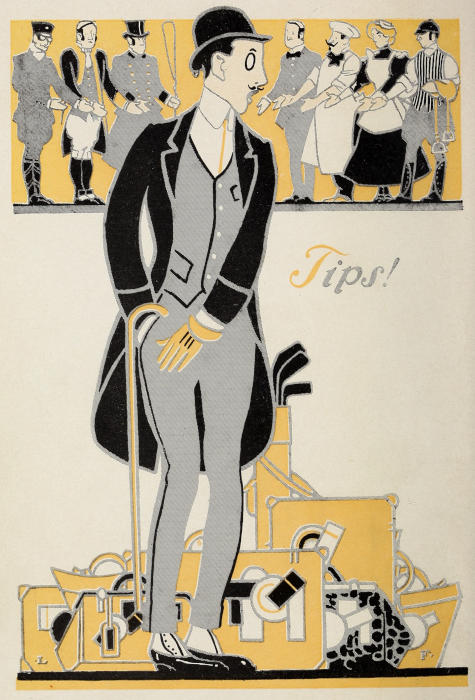
the proper schedule of tips for the servants
is as follows:
Chauffeur
$10.00
Butler
10.00
Coachman
5.00
Footman
3.00
Valet
5.00
Cook
nothing
Maid
2.00
Chambermaid
2.00
Strapper
1.00
Groom
2.00
Total
40.00
Should you, however, have but $30 with
you, you have but to take a very early train,
in which case the butler will not have appeared,
and there will be no necessity to tip
him. The resourceful bachelor may also decide
to compensate the maid, if she be pretty,
by a few pleasant words of appreciation as
to her beauty and by chucking her under the
chin, as is invariably done on the stage in
comic opera.
If your visit has been for a week, the above
table of tips should be disregarded. At the
end of such a visit you had best hand the
housekeeper a letter of introduction to your
lawyer, together with a list of your securities,
and allow her to sue your estate for the gratuities.
(If you are from Pittsburg, care should be
taken to double the above table of tips.)
The dressing gong is sometimes meant to
convey the impression that dinner will shortly
be served in the banqueting hall. Usually,
however, it is the signal for everybody to
begin a new rubber.
Try to go early to the stables and select a
good riding horse for the rest of your visit.
There are seldom more than two good ones.
The rest are usually roarers or crocks.
The hostess at a large country house is
naturally expected to provide all the week-end
essentials—i. e., liquors, cigars, food,
carriages—and motors in condition. Besides
these, however, she should never neglect to
offer her guests certain little added comforts
without which they would, very naturally, be
miserable. Every guest should be supplied,
therefore, with the following articles: a bottle
of listerine, a cloth cap, a tennis bat, a
hot-water bag, a pair of motor goggles, a
bag of golf clubs, a sweater, six tennis balls,
a bathroom, with needle shower (exclusive),
a bathrobe, a pair of slippers, a pair of tennis
shoes, a bathing suit, a box of cigarettes
(fifty in a box), a set of diabolo sticks, a
riding and driving horse, a fur overcoat, an
umbrella, a bottle of eau de cologne, and a
box of postage stamps.
Guests are always invited from Friday
night to Monday morning. It is wiser for
the hostess to mention the Monday trains,
or one of the guests may decide to stop
longer. This is seldom a wise plan. Hostesses
should clear the house of all guests
before the three-day limit. Remember the
Spanish proverb, “El huesped y el pece à
tres dias hiede,” which, being translated,
means, “Any guest, like any fish, is bound to
be objectionable on the third day.”
In certain country houses the architect has
neglected to supply bathrooms for each of
the guests. In some extreme cases as many
as three bachelors are expected to share one
bath. This is bad.
The best way to maneuver under such circumstances
is to send your servant early to
the bathroom and let him lock himself in.
This will foil the invaders. When he hears
your special knock on the door, he can open
to you, and you can then bathe, take a nap
in the bath, shave, smoke a cigarette, and
read the papers in quiet.
At a house party every lady of prominence
is sure to bring at least one Pomeranian
dog. Many think it wiser to bring a black
and a brown, so that, no matter what gown
they may wear, one of the darlings is sure not
to clash with it. These pets are, of course,
extremely expensive. A smart week-end on
the Hudson will usually average about six
thousand dollars’ worth of Poms.
In nearly all guest rooms the hostess is sure
to provide white enamel writing desks, chiffoniers,
and tables. By leaving lighted cigarettes
on such articles of furniture you are
almost certain to secure a very curious and
amusing stain, or burn. Sometimes, if your
visit is long enough, you can etch, in this
way, a complete pattern around a fair-sized
table. The Greek fret and egg-and-dart designs
are neat and extremely popular.
The passage through a country house of
the framed photograph of a friend is often
an instructive spectacle to witness. Such a
trophy usually begins its career in the drawing-room.
It is then moved to the library,
and subsequently to the smoking room. After
that it begins a heavenly flight into one of
the guest rooms, from which place it ascends
on its last earthly pilgrimage to the attic.
The English have rather a clever way of
“chucking” a week-end engagement in the
country. They merely telegraph as follows:
“Impossible to come to-day: lie follows
by mail.”
An unprotected lady should be careful not
to employ convivial or tippling butlers. We
are acquainted with a widow who was recently
petrified with horror when her drunken
butler entered her sleeping apartment in
the dead of the night and proceeded to lay
the table for six—upon her bed.
Sunday morning in the country is usually
rainy. This is invariably the fault of
the hostess. When you descend in the morning,
look at her reproachfully; mention the
rain; remark on the fact that it has always
rained when you have visited her before; sink
hopelessly on a sofa, and sigh.
Hostesses very often have a distressing
way of asking you how you slept. Under
such circumstances it is permissible to speak
the truth and to mention, quite frankly, the
mosquitoes and the topographical whimsicalities
of your bed.
In a country house, if you find, on going
up to your room to dress for dinner, that no
studs have been put into your evening shirt,
complain at once to the stud groom.
Beware of inviting fashionable bachelors
for the week-end unless you maintain an
adequate ménage. The recent and distressing
case of a lady (with but one spare room
and a very small establishment) may serve as
a terrible example.
Her visitor arrived rather late on a rainy
night. His belongings looked like those of
a traveling theatrical company, and included
one forty horse power Mercedes car, a Swiss
valet, a violin case, one trunk, two hat boxes,
five pounds of bonbons, a fur overcoat, a photographic
camera, a bag of golf clubs, a talking
machine, two boxes of health cocoa, an
Austrian chauffeur, an oxygen jar, two polo
ponies, an air cushion, a wire-haired fox terrier,
and a box of one hundred clay pigeons.
CONVERSATION
CONVERSATION
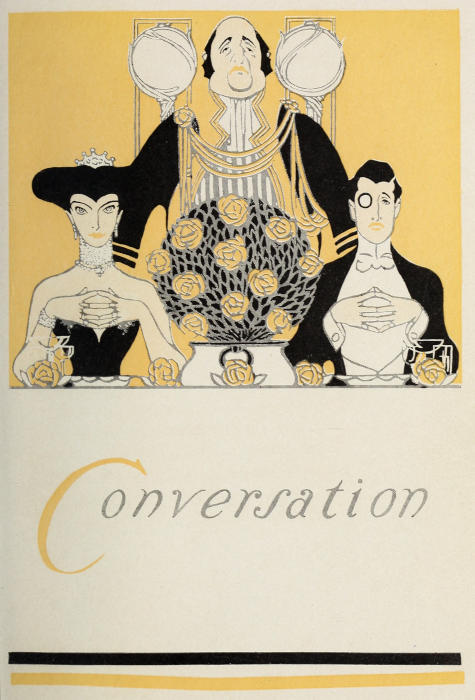
The conversation at a club should be simple
and conventional. It is vulgar to go into
long or prolix discussions. Only a few remarks
are comme il faut, such as “Hello!”
“Deuced cold!” “Have a drink?” “Who
has a cigar?” “How about one rubber?”
Perhaps the safest and most refined remark
for constant use is: “Waiter, take the orders.”
Even this may be dispensed with—if
you make certain to ring the bell.
It is not modish to speak kindly to the
servants either in your own or in other people’s
houses. In addressing them, simply say:
“A napkin,” “The cigars,” “Where the
devil are my boots?” Remember that they
“get even” in the servants’ hall.
It is customary, in alluding to ladies in the
ultra-fashionable set (provided they are not
present) to speak of them by their pet
names: “Birdie,” “Baby,” “Tessie,”
“Posy”; but, when face to face with these
ladies, the utmost formality had best be observed.
In criticising a play or a novel be careful to
avoid long and discriminating criticisms. You
should either “knock” or “boost.” Try to
remember that there are only two kinds of
plays or novels—they are either “bully” or
“rotten.”
If a few people in the smart set are entertaining
a stranger at lunch, it is de rigueur
for them to converse with each other entirely
in whispers and always on subjects with
which he is absolutely unfamiliar.
In discussing literature at a lunch or dinner,
try to remember that there are but a very
few fashionable authors. They are as follows:
Mrs. Wharton, Colonel Mann, Mrs.
Glyn, Robert Hichens, F. Peter Dunne, John
Fox, Jr., and Billy Baxter.
At a dinner a gentleman sitting beside a
débutante should congratulate her upon her
début, and, in a few well-chosen words,
should discuss the usual débutante topics—i. e.,
platonic love, banting, Ethel Barrymore,
French dressmakers, John Drew, the relative
merits of Harvard and Yale, love at first
sight, the football match and the matter of
her great personal beauty and charm.
Try always to remember that the chief and
most interesting topics of conversation are
herself and yourself. Serious topics are very
properly deemed out of place in society.
After dinner, over the cigars, it is bad
form for men to discuss any subjects but
stocks and motor cars.
Whenever, at a dinner, an anecdote
is narrated in French, it is always a wise precaution
to laugh heartily.
Women should not complain of their
husbands in public. All married women have
a great deal to contend with. Everybody
knows that married men make very poor
husbands.
At a dinner the safest conversational opening
is as follows: “Is that your bread, or
mine?”
When, at a dinner, you don’t know the
lady next to you, show her your dinner card
and say:
“I’m that; what are you?”
Chivalry demands that a lady’s name
should never be mentioned in a gentleman’s
club. Occasionally, however, this hard-and-fast
rule may be slightly infracted, and her
intimate affairs discreetly talked over—provided
that the group of gentlemen be a small
one and absolute privacy assured.
N. B.—A “small group” is any group of
less than twelve.
DINNERS
DINNERS
A dinner is a miscellaneous collection of
appropriately dressed men and women, who
are not in the least hungry and who are invited
by the host and hostess to repay certain
social obligations for value received or
expected. The attitude of the guests at such
a repast is very often one of regret and revolt,
because of the haunting memory of an
invitation, much more enticing in its prospects,
but, alas, more recently received.
On arriving at a dinner a servant should
hand each male guest an envelope containing
a card. This card will bear the name of the
lady whom he is to take in to dinner. This
part of the ceremony is usually accompanied
by groans and maledictions as the gentlemen
tremblingly open their envelopes.
Some hostesses allow their guests to file
in to dinner in ignorance of their partners.
They thus learn their fate at the dinner table,
which postpones the terrible shock for as
long a period as possible.
Nothing adds so much to an appearance
of savoir faire as the art of gracefully
removing from a dinner or evening party a
gentleman who has imbibed, not wisely but
too well. The correct method is to ask the
butler to inform him that a lady wishes to
speak to him on the telephone. When he
has left the room, spring upon him in the
hall and chivy him into a cab.
Rouge sticks and powder puffs may be
used by ladies at luncheons, but never at dinners.
If a bachelor receives a dinner invitation
from people who are not really “in the
swim” (people, let us say, like old friends,
classmates, and business associates, who are,
so to speak, “on the green, but not dead to
the hole”), he should simply toss it into the
fire. This plan will prevent any more invitations
from so undesirable a quarter. Were
he to answer these people politely, they would
certainly annoy him again at a later date.
Remember that “the coward does it with a
kiss, the brave man with a sword.”
Do not address your best thoughts to the
ladies until they have had an opportunity to
brush the glove powder from their arms and
to look carefully at the dresses and ornaments
of the other ladies at the dinner.
At a very large dinner, the lady beside
you is almost certain to be one who entertains
generously and, as such, should be treated
with a certain degree of politeness. Try to
suppress, however, all sentiments purely
human in their nature, such as pity, kindness
of heart, sympathy, enthusiasm, love of
books, music, and art.
These ridiculous sentiments are in exceedingly
bad taste and should be used but sparingly,
if at all.
Ladies do not call upon a bachelor, in
his rooms, after attending a dinner given by
him—except in Mrs. Wharton’s novels.
On leaving a dinner you should always
manage to come down the steps with a group
of the super-rich—they may give you a lift
home.
On driving home with friends from a dinner,
it is the generally accepted practice to
abuse the host and draw particular attention
to his ghastly collection of family portraits,
his wretched plate, and execrable food. Do
not fail also to draw a moving picture of the
stupidity and hideousness of the lady next to
you at dinner—unless she should be in the
carriage with you at the time.
When you are over half an hour late
at a dinner it is well to have an excuse. There
are, just now, only two modish excuses:
First, you were arrested for speeding your
motor; second, you were playing bridge, and
every hand seemed to be a spade or a club.
When a gentleman at a dinner upsets a
plate of terrapin, a ruddy duck, or a bowl of
vegetable salad upon the dress of the lady
beside him, she should laugh merrily and
should always be provided with some apt jest
with which to carry off the little contretemps.
Fletcherites have lately added a
new horror to dining out. These strange
creatures seldom repay attention. The best
that can be expected from them is the tense
and awful silence which always accompanies
their excruciating tortures of mastication.
There are two recherché methods for a
bachelor to refuse a verbal dinner invitation.
The first is to say that you are dining with a
business associate. The second is to say that
your engagement book is at home and that
you will consult it immediately upon reaching
there and will telephone. This gives you the
desired opportunity of saying “No.” It is
always easier over the wire than face to face.
In wriggling out of a dinner at the last
moment in New York, it is chic to invent
some mythical female relative in Philadelphia
who has developed a sudden and alarming
illness and has hastily summoned you to her
bedside.
If, at a dinner, food is passed to you which
you do not care to eat, it is good form to
take a generous heap of it, to pat it and mess
it up on your plate with a fork.
After dinner, if a lady has been asked to
sing and refused, do not urge her further.
It is the height of bad manners, and there is
just the off chance that she may yield.
In England the matter of precedence at
dinners is simplicity itself. The Sovereign
precedes an ambassador, who precedes the
Archbishop of Canterbury, who precedes the
Earl Marshal, who precedes a duke, who
precedes an earl, a marquis, a viscount, a
bishop, a baron, etc.; but in America the
matter is a much more perplexing one.
The author of this brochure respectfully
suggests the following scheme of American
dinner precedence: Let an opera box count 6
points; steam yacht, 5; town house, 5; country
house, 4; motors, 3 each; every million
dollars, 2; tiara, 1; good wine cellar, 1; ballroom
in town house, 1; a known grandparent
of either sex, ½; culture, ⅛. By this system,
a woman of culture with four known grandparents
and a million dollars will have a total
of 4⅛. She will, of course, be forced to
follow in the wake of a lady with a town
house and a tiara (6); who, in turn, will trail
after a woman with a steam yacht and two
motors (11). The highest known total is
about 100; the lowest, about ⅛. The housekeeper
may arrange the totals, and the hostess
can then send the guests in according to their
listed quotations.
People who arrive late at a large dinner
sometimes have very quaint and amusing excuses.
A hostess at a recent eight-o’clock banquet
collected the following gems:
I overslept in my bath.
A cinder lodged in my eye and I have just
come from the chemist’s.
My maid is ill and I was forced to hook
myself.
The twins put crumbs in my stockings.
I read your invitation upside down and,
naturally, mistook the hour of dinner.
I never eat soup, and thought, of course,
you wouldn’t wait.
I knew Mrs. V—t would be much later
than I—so I took a chance.
I was taking my memory lesson, and it
was all so absorbing that I completely forgot
the dinner.
I lost your note, and, as everybody dines
at 8.30, I thought, of course, that you would.
My chauffeur was so drunk that he took
me next door by mistake, and delayed me
fearfully.
Every year it is becoming more and more
difficult for hostesses to secure a sufficient
number of blades for their dinners and evening
routs. “Odd men” are always in tremendous
demand.
The custom of shouting names, which is
imperfectly followed at the hotels, should be
perfected in our clubs, and we hope soon to
see the club waiters wandering about the
halls and lounging rooms shouting out, as
they go: “Mrs. Vanderlip, four odd men
for dinner.” “Mrs. Miles, two bachelors
for the opera.” “Mrs. Nestor, one married
couple for bridge,” etc.
When a lady beside you is so generously
avoirdupoised or embonpointed that it is a
physical impossibility for her to see the food
upon her plate, it is sometimes an act of kindness
to inform her as to the nature of the
bird or beast so hopelessly removed from her
vision. This saves her the trouble of lifting
it above the horizon in order to discover its
exact species.
A clever hostess in New York has recently
trained a highly intelligent dachshund
to fly about after dinner, under the banquet
table, and fetch out the long white gloves,
make-up boxes, scarves, and lace handkerchiefs.
Most hostesses, however, prefer to
put their guests on the scent and let them
retrieve the hidden treasures.
A frantic hostess recently telephoned
us for advice on a nice point of social etiquette.
She had arranged a dinner of twelve,
and was confronted and confounded, at the
last moment, by an “odd” bachelor whom
she had originally invited and subsequently
forgotten. She could not sit down thirteen at
the table.
“What shall I do?” she asked.
We were glad to be able to come to the
distressed lady’s assistance and telephoned
her as follows:
“You should hand him a neatly folded
dollar bill and ask him to slip out quietly and
buy himself a good dinner at a corner restaurant.
Your butler may also give him a cigar
as he passes into the night.”
If you are giving a supper after the play,
it is de rigueur to order grape fruit, hot bouillon,
champagne, birds, a salad, and a sweet.
The sated guests will not touch any of the
food, but it is comme il faut to put it all before
them.
Banting has almost done away with the
ancient custom of eating, but thyroid tablets
and lemon juice are, of course, permitted. At
a ladies’ lunch the guests (whether ladies,
millionairesses, or workingwomen) should be
careful disdainfully to dismiss the dainty
dishes until the repast is over, when they
should look benignly at the hostess and
murmur:
“Dear Mrs. Brown—might I have a cup
of very hot water?”
When a lady must pay back forty dinner
obligations and her dining room will
seat only twenty, it is obvious that she must
have two dinners of twenty each. She should
give the feasts on successive evenings, as the
left-over flowers, bonbons, fruits, and pâtés
will always do service at the second repast.
A lady should be careful not to turn to
the gentleman beside her and complain of the
“fizz.” There is always a good chance that
he is the wine agent.
When, in New York, a married couple
do not pull along together, and have definitely
decided to divorce or separate, it is
customary for them once or twice to dine,
tête-à-tête, at Sherry’s: to flirt, laugh, and
make merry with each other—in order to put
the eager hounds off the scent.
At dinners in the beau monde the footmen
will invariably pounce upon your plate
and run off with it before you have half finished
the course. Be careful not to hold on
to it like a despairing mother whose child is
being torn from her arms, as such scenes at
table are always deplorable and harassing.
In purchasing almond bonbons for the dinner
table the hostess should make sure to
select the mauve species. No one ever eats
them. A dishful of the white variety will
sometimes vanish in a night, but the mauve
go on forever.
DANCES
DANCES
In New York the word “ball” is intended
to signify a hundred or so people who do not
care particularly for dancing, who are prostrated
by the prospect of arising early on the
following morning, and who leave their cotillion
favors untouched and disregarded
upon the gilt chairs in the ballroom.
The chief characteristics of a ball may be
summed up, briefly, as follows: Mothers, or
“benchwomen,” wildly eying their offspring;
the “leader,” battered and bruised like a
half-back in a football game; the hostess, with
her tiara aslant on her new false curls; fifty
wilted linen collars; fifty ditto shirts; four
red-faced gentlemen asleep in the smoking
room; the host leaping from train to train
with the agility of a brakeman; two hundred
yards of chiffon ruffles and one pound of assorted
hairpins decorating the floor of the
ballroom; a deep crowd of so-called dancing
men who effectually block the entrance door
and stand in a dazed and awkward group,
spellbound by the horrors of the scene.
The valuable checks for cotillion seats are
usually cornered by the cotillion leader and
dealt out to the most prominent tiaras. The
unhappy ladies who fail to receive one of
these priceless tokens usually pass the remainder
of the evening in the ultimate row
of chairs wearing a granite smile and a paper
cotillion favor.
A wall flower is a young lady at a dance
who has not been cursed with the fatal gift.
She may usually be distinguished by her wild
and beseeching glances. Chloroform is the
only possible way of securing a partner for
her.
Before putting your arm around a lady’s
waist, you should explain to her that it is
your intention to dance. As the music starts,
look at her longingly and murmur one of the
following remarks: “Do you Boston?”
“Rotten floor” (or) “Bully floor.” “Bully
favors” (or) “Rotten favors.”
Every now and then a “stand-up” supper
is served at a dance. This is the abomination
of desolation spoken of by the prophet Daniel.
Should a lady ask you at such an entertainment
to get her some supper, push your
way through the mob of angry bachelors to
the trough where the comestibles are displayed.
Once arrived on the scene of carnage,
you can consume a cup of bouillon,
a few oysters, some sandwiches, a little chicken,
some dry champagne, a plate of salad,
an ice, and a cup of coffee. After this, if
your hunger has been satisfied, take a morsel
of galantine, a doily, and a lady-finger, place
them on a plate and force yourself through
the compact lines of angry, feeding, perspiring
“dancing men,” until you appear before
your fair partner, declaring that you did your
best, and that the rest of the provisions had
disappeared. While she is thanking you,
slip away to the smoking room and send the
man in attendance there for a bottle of some
very, very old champagne. While he is gone
you may busy yourself by selecting a few of
the best cigars, so as to be sure to have something
to smoke on the way home—in somebody’s
cab.
In giving a dance, avoid, if possible, sending
invitations to bores—they come without
them.
At a dance, when a lady is talking to a
millionaire recently arrived from the West,
he may offer to introduce his wife. (This is
part of what, in sporting circles, is known as
the “push stroke.”) In such a fix it is permissible
for her to burst into a loud fit of
coughing, mention her weak heart, and ask a
footman to call her carriage.
When a bachelor arrives at a dance, he
should at once repair to the smoking room
and remain there most of the evening—calling
loudly for all those wines which his host
has neglected to provide.
A new and unspeakable horror has lately
been introduced into fashionable dances in
New York—namely, the “third supper.”
The writer is glad to say that the inventor of
this atrocity died very slowly and in great
pain about a year ago. It is a comfort to
know that his last resting place is unadorned
by any monument, and that no flowers or
shrubs have ever bloomed upon his grave.
A popular form of entertainment for
grown-up persons in New York is a “baby
party.” Here the guests are dressed like
babies: they dance and have supper, and are
permitted to behave like little children.
These revels do not differ from other forms
of social festivities in the metropolis—except
as regards the costumes.
Dancing men should have a care, at a
ball, never to be “stuck.” This catastrophe
is usually brought about by listening to the
wiles of a man who begins with some such
remark as “Do you know Miss A——? She
is crazy to meet you!” or “For Heaven’s
sake, dear boy, do go and talk to that unfortunate
girl in yellow.”
Many an agonized hour may be avoided
by turning a deaf ear to all such entreaties.
If you don’t, the horror of your ultimate predicament
can hardly be exaggerated. You
will sit with her for hours in isolated agony.
Slowly your hair will turn as white as the
driven snow. Interminable cycles of time will
tick themselves away, while you sit there
slyly beckoning to other gentlemen who are
certain to pay no heed to your signals.
A case is on record, in England, where a
gentleman, in such a position, addressed no
remark to his partner for upward of three
hours. At this point she became aweary,
turned, and found that he was—dead!
A very neat trick can sometimes be
worked at a dance. You have steadily
avoided a particularly dreadful damsel
throughout the entire evening. When she
has put on her cloak and fur overshoes, and
you see her hurrying through the hall with
her maid, on her way to her carriage, jump
out of the smoking room and say:
“What? Home so early! Can’t you stay
and have just one with me?”
Be careful, of course, not to be too urgent,
else she may stay, thus hoisting you on your
own petard.
In dancing, unless you are an accomplished
waltzer, the safest advice to follow is:
“Avoid the corners and keep kicking.”
At a large ball, the hostess, when tired,
may, with perfect safety, go to her sleeping
apartment and retire for an hour or two.
No one will ever miss her. When rested
she can reappear in the ballroom and, with
her second wind, as it were, enjoy the third
supper, or the first breakfast.
In saying good night to the hostess, have
a care to bestow your avowals of obligation
in nearly the same degree of warmth or formality
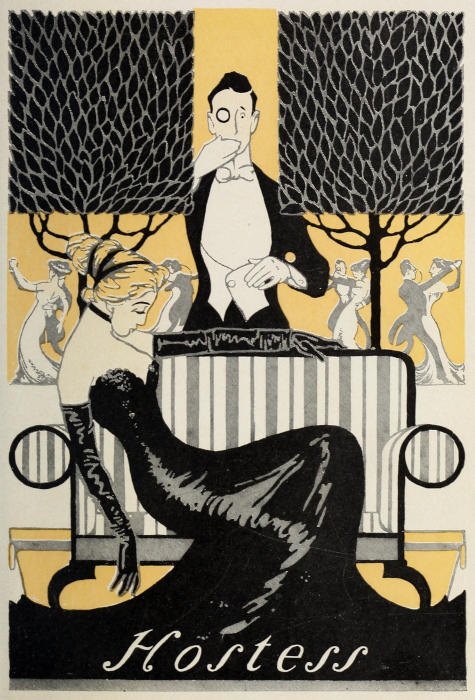
that her bearing invites. If, for instance,
she be asleep in the conservatory, all
among the begonias, it is not necessary to
shake her or rouse her by shouting: “Hi!
Wake up, I want to go home,” etc. Simply
pass out noiselessly and remind her butler
to call her in time for breakfast. (See the
illustration, “Hostess.”)
BRIDGE
BRIDGE
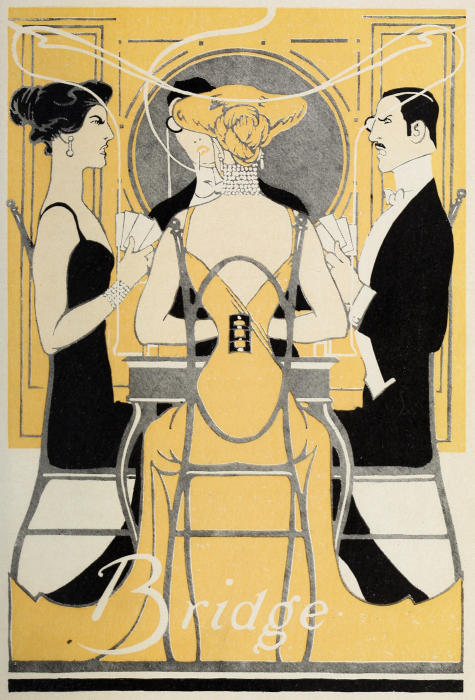
This is a popular pastime, and much of
the attention of our best minds in high society
is concentrated upon guessing whether a
given card is in the hand of the person on
the right or on the left.
As there is a great curiosity among all
classes of readers concerning bridge, the
benevolent author has gone into the etiquette
of the game with a good deal of thoroughness.
In order to be an accomplished bridge
player one must possess the following attributes:
A dress suit. (This does not apply to
ladies.)
A large roll of clean bills with a rubber
band encircling them.
A cigarette and ash tray.
A stoical, blond and unimpassioned nature.
A partner—usually of the opposite sex.
You may, with safety, criticise nearly
every play your fair partner makes. She
doubtless deserves it, but, as a rule, this
criticism should not extend beyond her faults
as a player. Try to remember that a gentleman
is one who never unintentionally insults
anybody.
Bridge should never be played seriously.
One should carry on an animated conversation
during the course of play. It is customary,
too, to hold the cards in one hand and
a hot buttered muffin in the other. Get up
from the table rather frequently and telephone,
receive visitors, give orders to the
servants, and pour tea. The questions,
“Who led?” “What are trumps?” “Is
that our trick?” etc., are always permissible,
and lend some spirit to what might otherwise
prove a dull and taxing game.
In playing bridge with two ladies, a man
should be careful to play “highest man and
highest woman.” In this way he will be playing
against a man, and his chances of a “settlement”
will be a little less remote. Never
play with three ladies.
When you are dummy and your partner
has finished playing the hand, you should invariably
glare at her (or him) and make one
of the following remarks:
You played it the only way to lose the odd!
Why, in Heaven’s name, didn’t you get
out the trumps?
You must lose a pot of money at this game,
don’t you?
It’s lucky I’m not playing ten-cent points.
Why not take your finesse the other way?
The eight of clubs was good, you know!
Yes, if you had played your ace of diamonds
we would have saved it.
It’s a pity you didn’t open the hearts.
As the leaders of the Smart Set have ceased
occupying their brains with literature, music,
politics, and art—subjects which were, a long
time ago, discussed in our best society—and
as their entire mental activities are now
focused upon the game of bridge, the author
has added for the further benefit of his readers
a series of anecdotes, maxims, and experiences
which he has gathered during his
fruitless attempts to master this fashionable
pastime.
There was a lady in the beau monde
of New York who was not only a charming
woman but an accomplished whist player.
Unfortunately, however, she simply could not
play fair. Among other idiosyncrasies she
had a distressing habit of slipping a high
card on the bottom of the pack, after the cut—this
was in the days when she played old-fashioned
whist. In this way she was always
certain of the ace, king, or queen of trumps
when it was her turn to deal. She was detected
in this graceful little artifice on one or
two occasions, with the result that her reputation
suffered a slight dimming in its glory.
A few months ago the poor lady died and
a well-known bridge wag in New York composed
for her the following epitaph:
“Here lies Lily Maltravers,
In confident expectation of
The last trump.”
A delightful bridge player is Mrs.
R. U. Rich, who, though stone deaf, still
manages to understand the declarations, or
makes, by an elaborate series of manual signs.
In playing with her, if the make is a heart,
you must point to your heart; diamonds, to
your ring; spades, you must make a shovel of
your hand, and, when clubs have been declared,
you must shake your fist at her. The
other evening at a fashionable house in New
York she was playing a rubber in which her
husband was her partner. It was after a large
dinner and, Mrs. Rich, having mistaken her
husband’s signal, excitedly asked him what
trump had been declared. At this, her better
half shook his fist at her two or three times
in a very convincing way. An elderly lady,
on the other side of the room, unaware of
Mrs. Rich’s infirmity, gathered her dress
about her and, with great dignity, begged the
host to send for her carriage.
“Why, Mrs. ——,” he said, “are you
leaving us so early?”
“Well,” said the lady of the old school,
“I think that when a husband and wife come
to blows over the bridge table it is time to
call the carriages.”
A reduced gentlewoman, living in a
small way in the suburbs, was at an employment
agency trying to secure a cook. As the
lady and her husband lived some distance
from any neighbor, and as the wages she
could afford to pay were meager, the cooks
displayed a decided unwillingness to assume
the cares of office.
Finally, to the great elation of the lady,
a very respectable and well-mannered English
girl seemed disposed to risk the rigors
of suburban life. The searching questions
which the girl had put to the lady had been
satisfactorily answered, when, at the very
last, she asked the number in the family, to
which the lady replied that there were only
two—herself and her husband.
“Oh!” said the girl, “I could not think
of going into service with only three in the
house. I would not work anywhere unless
we could make up a four at bridge.”
Husbands and wives should never play
partners at bridge. They are almost certain
to quarrel, which is unseemly—and if they
don’t quarrel, their friends are sure to suspect
them of collusion and cheating.
It is a mistake for parents to play bridge
on Sunday. The morals of children should
ever be sacred in a parent’s eye. Never,
therefore, allow a card to be touched on the
Sabbath—until the children have gone to bed.
An inveterate bridge fiend recently proposed
to a lady of some means. She, doubting
his entire sincerity, mentioned his too
great devotion to bridge. With a fine show
of enthusiasm and erudition he burst out
with:
“I could not love thee, dear, so much,
Loved I not honors more.”
There is always a great deal of discussion
among good bridge players as to the propriety
of an original club make—with no
score. As a matter of fact, a big club hand
is usually disastrous whether you make it or
pass it. You either leave it and get spades,
or else you don’t leave it and get the devil.
There is a lady in New York society who
is as devoted to bridge as one could well be.
She makes everything, except her two children,
subservient to the game. She attends
bridge classes, bridge teas, and bridge tournaments
without end. She is, unfortunately,
married to a wealthy but worthless and rascally
young clubman who treats her usually
with indifference, but sometimes with cruelty.
Her friends all advised her to sue for a
divorce.
The poor woman was in some doubt as
to what course to pursue. Finally, a brilliant
idea occurred to her. She would consult her
bridge teacher! He was the one man in all
the world whose judgment seemed to her
infallible. She trusted him more than she
did her lawyer or her minister. He had
solved so many difficult problems for her
that he might solve this.
Mr. Elstreet was accordingly written to by
the unhappy lady. His answer ran as follows:
My dear Mrs. ——:
I have very carefully thought over
the little problem which you were good
enough to submit to me for solution.
It seems to me that when you have a
knave alone, it is often a wise plan to
discard him, but holding, as you do, a
knave and two little ones, it would seem
the better part of discretion not to discard
him.
I am, my dear Mrs. ——, yours, etc.
A well-known widow in London
was a guest at a large house party. She was
an enthusiastic bridger. She took the game
very seriously—so seriously that she frequently
dreamed about it, and even, her maid
declared, talked about it in her sleep.
Everybody had been playing fairly late
and the ladies had gone to their rooms and
“turned in” at about twelve o’clock. The
men had played until about two. Shortly
after this, the housekeeper, in making her
final round of the house, was startled to
hear the widow’s voice addressing somebody
in an agonized and supplicating way.
As the door of the widow’s room was ajar,
the housekeeper paused in some alarm, only
to hear her call out: “My diamonds, my
diamonds, why didn’t I protect them? I am
lost, absolutely lost!”
The housekeeper, not knowing the intricacies
of bridge and thoroughly alarmed by the
idea of a burglar in the widow’s room, rushed
to the host’s door and hastily summoned him
to the rescue. After a somewhat noisy consultation
between them, as a result of which
some of the disrobing bachelors were attracted
to the scene of conflict, a united descent
was made upon the unfortunate widow’s
stronghold. The net result of the sortie was
that the widow was greatly annoyed, the host
was unmercifully chaffed, and the housekeeper
received her first lesson in bridge.
“It was,” said the Knickerbocker bridge
fiend, “at the Hotel Splendide-Royale in
Aix-les-Bains. I was playing twenty-cent
points, which is just double my usual limit.
I had lost six consecutive rubbers. I had cut,
each rubber, against a peculiarly malevolent-looking
Spaniard, who had a reputation at
cards which was none too savory. There had
been trouble about him only the day before
at the Casino des Fleurs, where he had been
mixed up in a somewhat unpleasant baccarat
scandal. He was a crafty and sullen bridge
player and I had conceived a most cordial
dislike to him.
“Finally—it was hideously late and the
card-room waiter was snoring in the service
closet—my time for revenge arrived. It was
my deal, and I saw at a glance that I had
dealt myself an enormous hand. I could
hardly believe my eyes. I held nine spades
with the four top honors, the bare ace of
clubs, the bare ace of hearts, and the king
and queen of diamonds. Here was a certainty
of eleven tricks at no trumps and very
possibly twelve or thirteen. I looked at the
Spaniard, whose turn it was to lead, and I
smiled exultantly.
“‘No trumps,’ I said, the note of triumph
quite perceptible in my voice. Quick as a
flash the Spaniard had doubled—and quick as
another I had redoubled.
“When, however, he had jacked it up to
96 a trick, I hesitated, but of course went at
him again with 192. ‘Ah, ha!,’ I said to
myself, ‘Mr. bird of ill omen, you are my
prey, my chosen victim for the sacrifice.’
“The price per trick had soon sailed up
to 1,536, and I ventured to look at my partner.
He was chalky white about the gills
and his eyes seemed to stare idiotically into
space. His expression prompted me to take
pity on him and say ‘enough.’
“Suddenly I had a terrible feeling of
alarm. Had I mistaken the queen of diamonds
for the queen of hearts? If so, my
king of diamonds was bare and the mysterious
Spaniard might run off twelve diamond tricks
before I could say ‘Jack Robinson.’ With a
sinking heart I looked at my hand again—all
was well! The queen was surely a diamond.
I glanced at the olive-skinned gentleman
and begged him to lead a card. I felt
a great joy welling up within me.
“At this moment the Spaniard led a card
and I looked at it nervously. As soon as my
eyes beheld it my heart seemed to stop beating.
He had opened the ace of a strange
green suit, a suit which I had never seen before,
a suit all covered with mysterious figures
and symbols. I felt strangely giddy but
discarded a low spade. I looked at my partner,
who was the picture of despair. He
said, mechanically and as though life had
lost all beauty for him, ‘Having no hyppogryphs?’
to which icy inquiry I answered in
a strange whisper, ‘No gryppolyphs.’
“The leader followed with another green
card, a king this time, and again I sacrificed
another beautiful spade. The Spaniard
smiled a mahogany smile and proceeded to
run off his entire suit of thirteen green cards.
He then nonchalantly scored up a grand slam,
the game, and a rubber of 10,450 points or
$2,090. I felt my brain reeling and fainted
away with my head on the card table. Very
soon, however, I thought I felt the Spaniard
tugging at my coat sleeve. My anger at this
was beyond all bounds. I opened my eyes,
prepared to strike the crafty foreigner in his
wicked face, and saw—my servant standing
by my bed with my breakfast tray in his
hands and my bathrobe on his arm.”
THE THEATER
THE THEATER
At the theater it is smart to “roast the
show.” Do not be afraid of wounding the
feelings of your host and hostess. It is an
even chance that they are more bored than
you. If the actors seem to object to your
conversation or show annoyance or impatience,
try to remember that they are not, as
a rule, well bred, and are ignorant of all the
graceful little social conventions.
On leaving the opera with ladies, do not
go into the draughty side corridors with
them, or you will surely be forced to look out
for their carriage, a tedious and bothersome
occupation. The wisest thing to do is to say
that you have an appointment, and merge
yourself with the rabble who are leaving by
the front door, allowing the ladies to remain
in the side corridors, where their footmen
will sooner or later discover them.
Never give a theater party in stalls.
Boxes are obligatory. In seats, the men cannot
go out for refreshment, and the ladies
are forced to remove their hats, a tragedy
usually accompanied by the most distressing
and ignominious disclosures.
Ladies who have opera boxes given
them at the last moment should “get on the
job” at once and offer it to such of their
friends as they know to be either out of town
or engaged for that evening. A box has been
known, under such circumstances, to pay off
a dozen obligations in a single day.
In New York a theater party is often a
very boring and tedious form of revelry. It
is always wise to send a “feeler” before accepting
a lady’s invitation to dine and go to
the play. The following is a safe model for
such a missive:
My dear Mrs. Vandergraft:
How awfully good of you to ask me
for Friday. I presume we are dining at
your house and not at a stuffy restaurant.
May I be very frank and ask you what
play you are planning to see? Might I
also inquire if you are going in boxes or
seats, and if you expect me for supper
afterwards?
On hearing from you, I hope to be
able to arrange the matter to your entire
satisfaction.
My servant will wait for your reply.
Sincerely yours,
Reginald Goold.
P. S.—How many are coming, and
who are they? Are they the noisy sort?
P. S. No. 2.—What ladies are to sit
beside me at dinner?
CALLING
CALLING
Bachelors no longer leave or “push”
cards. It is considered provincial. After
dining at a house, a man may think it policy
to give the butler two dollars and his card.
In return the butler will, during the next afternoon,
discreetly slip the card upon the tray
in the hall while the lady of the house is driving
in the park.
If you are literally forced to pay a call,
merely ask the butler if the ladies are at home.
Should he say “No,” hand him your cards,
and your work is over. Should he say “Yes,”
pretend to him that you have mistaken the
house, and that you were looking for the residence
of another lady. Slip him a dollar and
retire noiselessly down the steps.
It is often well, before starting out on a
calling expedition, to have one’s servant telephone
to a dozen or so mansions to discover
which of the ladies are out. You can then
leave cards in these particular houses with
comparative safety.
OUR COUNTRY COUSINS
OUR COUNTRY COUSINS
Green peas are eaten with the aid of a
fork. The hair-raising spectacle of a gentleman
flicking peas into his mouth with a steel
knife is no longer fashionable, however dexterously
the feat may be performed.
Plums should be eaten one by one and
the pits allowed to fall noiselessly into the
half-closed hand.
At dinners, wisdom dictates that it is wiser
to leave the terrapin, hard crabs, asparagus,
and oranges untasted (unless accustomed to
them from birth). Be content to poke and
pat these dishes with a fork, but make no
effort to consume them.
The following expressions are no longer
in vogue in society: “Pardon my glove,”
“Pray be seated,” “Pleased to meet you,”
“Remember me to the folks,” “Pray rest
your cane,” “Make yourself at home,”
“What name, please?” “Are you the
party?” “Say, listen,” “My gentleman
friend,” “Usen’t you?” etc.
Do not address your wife as “mother.”
Olives are eaten with the thumb and
forefinger of the right hand. It is not necessary
to peel them, and the pits should usually
be rejected.
Do not, when your mouth is filled with
sweet potatoes, red bananas, pressed saddle of
lamb, or other solid provisions, attempt to
discuss the topics of the day with the ladies
at the feast.
In using a finger bowl, simply dip the index
finger into the fluid and pass it lightly over
the lips.
Make no effort to consume the floating
lemon, and try to restrain yourself from
splashing about in the bath, like a playful
walrus or a performing seal.
When a rich Westerner arrives in New
York and begins breaking into society, it
should be a pleasure for everybody to show
him little courtesies and attentions. New
York gentlemen usually do this by borrowing
money from him, marrying his daughters,
riding his polo ponies (or selling him theirs),
drinking his wine, cruising about on his yacht,
smoking his cigars, and selling him blocks of
their worthless stocks.
The last morsel of green turtle in a soup
plate is always a heart-breaking thing at best.
Remember that, though enticing, it is elusive.
Do not chivy it about in frantic circles or
pursue it untiringly around your plate until
you have captured and subdued it. Turtle
soup and Indian pig-sticking are not governed
by the same rules.
When you sit down at table, it is not
necessary to whisk the napkin gayly about before
unfolding it. The concealed roll is certain
to fly a considerable distance before
alighting, and may even crack the enameling
on one of the great ladies at the banquet.
Millionaires of the Chester A.
Arthur or Rutherford B. Hayes vintage
should pass rapidly through their ancient
mansions and demolish the following objects
of art and vertu:
The twin conch shells, for fireside use;
the embroidered wall mottoes; imitation
wax flowers—under glass; ebony and gold
whatnots; velvet antimacassars; all crayon
portraits—whether pendant or on gold easels;
party-colored crazy quilts; all magenta picture
sashes; plush photograph albums; red
worm lamp-mats; turkish cozy corners, with
hanging red lamps, imitation spears, and
rusty armor; black hair sofas; hanging tennis
racquets ornamented with red bows; folding
beds; cuckoo clocks and paper weights
containing miniature paper snowstorms.
After destroying these knickknacks, they
should pass out on the steps and adjacent
lawn spaces and demolish the iron dogs, copper
fauns, and the bed of snowdrops spelling
out the mansion’s fantastic name—“Slopeoak,”
“Munnysunk,” “Sewerside,” or any
name in which the following popular “B”
forms are included: Brae, Blythe, By-the,
Buena, Bel, Bonnie, Beau, Bourne.
NEWPORT
NEWPORT
The correct treatment of a foreigner in
Newport is to gush over him, praise him to
your friends, and invite him to your entertainments.
This course may be pursued for
one week. After that, treat him with great
reserve and coolness for the same period of
time. At the beginning of the third week
you should abuse him roundly, and take pains
to recite the hidden and secret passages of his
past. Advice for the fourth week is unnecessary:
they never last more than three.
Sea bathing at Newport is often injurious
to the health, as in the case of those ladies
whose figures are a trifle too meagre—or too
ample. To such sirens the doctor is sure to
forbid it. Where, however, the outlines are
visually “grateful and comforting,” the exercise
is certain to prove beneficial and bracing.
In all Newport there are about a dozen
ladies whose physicians have no such prejudices
against open air, salt water bathing.
Dakota divorces are still a good deal
frowned upon in the beau monde. Try to
remember that only Rhode Island divorces
are comme il faut. (The Newport variety
is far smarter than the Providence or Bristol
brand.) Dakota divorces are a trifle cheaper
and more expeditious, but it should be borne
in mind that the climate of Sioux Falls is
very variable and that the hotels and theaters
are, to say the least, indifferent.
Millionaires from the West whose
wives are bent upon breaking into society at
any cost, should not try Newport until the
simpler safes have been cracked. Newport is
the water jump of the social steeplechase, and
should not be taken until the easier gates have
been successfully negotiated. The safest
graded order of jumps is as follows:
1.
Palm Beach.
Not exclusive, but merry, sumptuous, and
expensive. Chance to meet many smart men
in the gambling rooms.
2.
Hot Springs, Va.
Depressing, but many “classy” invalids.
3.
Narragansett Pier.
Geographically speaking, this is nearly Newport,
but the social tone, though “nobby,” can
hardly be called A1.
4.
The Berkshires.
Dull and dowdy, but full of genteel old families
in reduced circumstances who are willing to
unbend—if properly propitiated.
5.
Tuxedo.
Excellent opportunities here, particularly in
the Tuxedo jiggers and at the club on rainy
days, when a fourth is needed at bridge.
6.
Long Island.
This is the Tattenham Corner of
the social Derby—(many bad falls here—due to riding too
hard)—the last great turn before the finish.
(Try Hempstead, Westbury, and Roslyn—in order.)
7.
Newport.
Having finally reached Newport, be very careful
about the pace. Begin cautiously with Bellevue
Avenue and the casino. Gradually, however, you
may hit up the pace and try the golf
club,
Bailey’s Beach, and, finally, you may dash
past the judge’s stand and weigh in at Ochre
Point.
At Newport the hostess usually retires at
about 1.30. This should be the signal for
all the bachelors, diplomats, and foreigners
who are stopping with her, to ask the butler
for carriages and motors to convey them
to Canfield’s (a fashionable roulette and
chicken-salad parlor).
A bachelor stopping with friends in
Newport should never lunch or dine in their
house. It is more jaunty to dine out. If
they are truly considerate, they will supply
him with red morocco “in-and-out” signs
which he can manipulate, in accordance with
his engagements, in the entrance hall.
After a week or so, if he has not yet seen
his host or hostess and is preparing to leave
Newport, it is sometimes thoughtful and
kind to send a card up to their rooms by a
servant, thanking them for their hospitality.
GENERAL RULES
GENERAL RULES
Wedding receptions are usually held
in small private houses holding anywhere
from one hundred to two hundred guests.
It is customary to invite sixteen hundred people,
six hundred of whom arrive and three
hundred of whom usually remain wedged for
hours upon the stairs in a bewildering sea of
picture hats, lobster salad, smilax, rice, and
lady fingers.
After a funeral it is customary for the
family to supply a few extra carriages in
which the pallbearers and mourners go to
the burial ground. After this ceremony the
bachelor, who has availed himself of one of
the vehicles, may, with propriety, ask the
driver to take him to his rooms; but it is a
gross breach of good form to keep the carriage
on (at the family’s expense) for calling,
going to the play, or driving to Belmont
Park for the races.
In thanking friends for wedding presents,
it is well to remember that nearly all of them
will have to be exchanged. Lay your plans
accordingly. Do not thank anybody until you
have bunched the duplicates.
Let us assume, for instance, that the seventeen
traveling clocks, forty-eight candlesticks,
eleven porcelain parasol handles, fifty-one
cut-glass salad bowls, thirteen fans, and
eighty-four silver teapots have all been gathered
together in convenient groups. At this
point the bride-to-be may dictate an appropriate
“teapot” letter to her secretary. This
note will do for all the teapots. The following
is a graceful example of such an epistle:
My Dear —— ——:
The teapot is too ravishing. What
an angel you are! I simply adore it.
Oddly enough, it was the very thing I
had longed and prayed for.
Yours ever,
Blanche.
P. S.—Where did you say you
bought it?
When a lady calls you up on the telephone,
and seems disposed to run on forever,
simply hang up the receiver and go on with
your cigar. If she calls up again to complete
the conversation, tell your servant to
say that you were disgusted with the way the
central girl cut you off and have gone to the
telephone company to lodge a complaint.
Be careful to remember that the lady
always bows first. On some occasions it
is difficult to determine whether the fast-approaching
queen of fashion is going to
bow or not. Should you be walking down the
avenue with another man, proceed as follows:
Look at her and exclaim gladly: “Why, how
do you do—” Should she freeze, or cut
you, you have but to turn to your friend and
complete your remark by adding—“that
little trick you showed me yesterday?”
Thus, it may appear to him that your remark
was meant to be a continuous one, having
to do with some feat of legerdemain, and
he will fail to notice the snub which has been
so cruelly inflicted upon you.
Proposals by women, while permissible,
are not customary, and, although they
are yearly becoming more and more popular,
are still regarded as an innovation. If the
proposal is rejected, good taste and kindly
consideration demand that the gentleman
should keep it more or less of a secret.
It is, of course, not always easy for a gentleman
to know when he has been definitely
proposed to. Women’s ways are sometimes
devious and obscure. Roughly speaking, it
is a proposal, or its equivalent, when a lady
throws her head upon his breast and bursts
into a passionate flood of tears.
The duties of a valet in a country house
are as follows:
(1) Talking and snickering to the housemaids
in the hallways.
(2) Purloining little keepsakes from the
portmanteaus of the visitors.
(3) Bouncing into the bachelors’ rooms
one hour before they wish to be wakened, in
order to build fires, close bureau drawers,
misinform them about the weather, and take
away dress coats and trousers.
(4) Laying out clothes in the morning.
In doing this they usually exhibit a highly
trained color sense, selecting as the smartest
combination of apparel a blue shirt, brown
socks, lilac handkerchief, green tie, and a
yellow waistcoat.
(5) Standing in a conspicuous position in
the main hallway on Monday morning, which
is always the period of largess and plenty.
(6) Wrapping up muddy boots in black
evening trousers.
(7) Perhaps, however, their most blissful
moment is when, knowing that you have
one more evening before you, they take your
only remaining white shirt, fold it into a
sausage-shaped roll, and hurl it into the
soiled-linen basket.
A movement is on foot in polite society
to revise the barbarous wedding anniversaries
as at present regulated, as modern
marriages seldom last long enough to celebrate
them. It is proposed, therefore, to call
the first anniversary the tin, the second the
silver, the third the gold, as marriages in
society are only contracted, on one side or
the other, for the attainment of these several
commodities.
When ladies are introduced to one another,
they should remain rigid and calm and
evince no interest in the proceeding. Their
necks should be stiff and their heads thrown
back—like cobras about to strike.
At a wedding it is not customary for the
best man to kiss the bride. Should the occasion
seem, however, to call for such an act,
he should be careful only to deliver a
“Sweeper.” A “Dweller” may alone be
administered by the groom.
A bachelor should supply the telephone
girl at his office with a list of ladies
to whom he is always “out.” On a select
list he will write the names of five or six ladies
who entertain delightfully and to whom he
is always “in.”
In introducing two people show no sign of
emotion whatever. Merely look from one to
the other in a vague, listless sort of way, and
murmur their names very swiftly and very
faintly. It is, of course, bad form to introduce
at all, but, if put to it, proceed as above.
At Christmas time a married man should
make certain to tip the telephone boy at his
club. If the lad is clever enough to recognize
the voice of the member’s wife, at the
other end of the telephone, he should receive
ten dollars. If he recognizes other female
voices as well, he should receive twenty.
A chivalrous husband should always
try, by kindly acts and little courtesies, to ingratiate
himself in his wife’s affections. It is,
for instance, selfish of him to return from his
office to his home before dressing time.
He should remember that the hours between
4.15 and 7.15 are her hours. In this
brief space she will probably wish to pour
tea, entertain male visitors, play bridge, buy
jewelry, take a nap, or have her hair “marcelled,”
and the husband should always consider
her feelings during this trying part of
the day. He may solace himself by remembering
that the sitting rooms of other ladies
are always open to him during these hours.
If not, he can always go to the steam room
at a Turkish bath, or drop in at the “Plaza”
and hear the nouveaux riches drink tea.
In motoring, avoid running over hens, dogs,
and Italian children. They are almost certain
to stick up the wheels.
Church-going is no longer considered
fashionable. If a lady finds that she must
attend church, it is a wise precaution to take
a little child with her. This will not only
make a good impression but will give her
an excellent excuse for leaving before the
sermon.
When you are northbound and a lady
bows to you from a southbound brougham,
do not trouble to lift your hat. Merely raise
your arm halfway to your head, as the vehicle
will have passed in a moment and your
failure to bow is certain to remain unnoticed.
Always be half an hour late for everything.
Nothing is so tedious as waiting.