3
“Our contemporaries of this and the rising generation
appear to be hardly aware that we are witnessing the last
act of a long drama, a tragedy and comedy in one, which
is being silently played, with no fanfare of trumpets or
roll of drums, before our eyes on the stage of history.
Whatever becomes of the savages, the curtain must soon
descend on savagery forever.”—J. G. Frazer.
The long process of evolution still moves quietly
to its unknown accomplishment. Struggle and starvation,
the hard fight for existence working with
fine impartiality, remorselessly eliminate the weak
and defective. New variations are developed and
old types no further adaptable become extinct, and
thus life fighting for life improves towards a sublimation
we cannot foresee. But at some period of
the world’s history an offshoot of a dominant type
began to develop new powers that were destined to
change the face of the world.
Speculations as to what first influenced that
strange and wonderful development do not come
within the province of this treatise, but I should
like in passing to point out that the theory and practice
4of my system are influenced by no particular
religion nor school of philosophy, but in one sense
may be said to embrace them all. For whatever
name we give to the Great Origin of the Universe,
in the words of a friend of mine, “we can all of
us agree ... that we mean the same thing, namely,
that high power within the soul of man which enables
him to will or to act or to speak, not loosely
or wildly, but in subjection to an all-wise and invisible
Authority.” The name that we give to that
Authority will in no way affect the principles which
I am about to state. In subscribing to them the
mechanist may still retain his belief in a theory of
chemical reactions no less than the Christian his
faith in a Great Redeemer. But through whatever
influence these new powers in man came into being
I maintain that they held strange potentialities, and,
among others, that which now immediately concerns
us, the potentiality to counteract the force of evolution
itself.
This is, indeed, at once the greatest triumph of
our intellectual growth and also the self-constituted
danger which threatens us from within. Man has
arisen above nature, he has bent circumstance to
his will, and striven against the mighty force of
evolution. He has pried into the great workshop
and interfered with the machinery, endeavouring
to become master of its action and to control the
workings of its component parts. But the machine
has as yet proved too intricate for his complete comprehension.
5He has learned gradually the uses of
a few parts which he is able to operate, but they
are only a small fraction of the whole.
What then is man’s position to-day, and what is
his danger? His position is this. In emerging
from the contest with nature he has ceased to be a
natural animal. He has evolved curious powers
of discrimination, of choice, and of construction.
He has changed his environment, his food, and his
whole manner of living. He has enquired into the
laws which govern heredity and into the causes of
disease. But his knowledge is still limited and his
emergence incomplete. The power of the force we
know as evolution still holds him in chains, though
he has loosened his bonds and may at last free himself
entirely. Thus we come to man’s danger.
Evolution—a term we use here and elsewhere in
this connection as that which is best understood
to indicate the whole operation of natural selection
and all that it connotes—has two clearly defined
functions; by one of these it develops, by the other
it destroys. By an infinitely slow action it has developed
such wonders as the human eye or hand;
by a process somewhat less tedious it allows any
organ that has become useless to perish, such as
the pineal eye or (in process) the vermiform appendix,
and, if we can estimate the future course,
the teeth and hair.
By the change he has effected in his mode of life,
man is no longer necessarily dependent upon his
6physical organism for the means of his subsistence,
and in cases where he is still so dependent, such as
those of the agriculturist, the artisan, and others
who earn a living by manual labour, he employs his
muscles in new ways, in mechanical repetitions of
the same act, or in modes of labour which are far
removed from those called forth by primitive conditions.
In some ways the physical type which represents
the rural labouring population is, in my
opinion, even more degenerate than the type we find
in cities, and mentally there can be no comparison
between the two. The truth is that man, whether
living in town or country, has changed his habitat
and with it his habits, and in so doing has involved
himself in a new danger, for though evolution may
be cruel in its methods, it is the cruelty of a discipline
without which our bodies become relaxed, our
muscles atrophied, and our functions put out of
gear.
The antagonism of conscious as opposed to natural
selection[2] has now been in existence for many
7thousands of years, but it is only within the last
century or less that the effect upon man’s constitution
has become so marked that the danger of
deterioration or decay has been thrust upon the attention,
not only of scientific observers, but of the
average, intelligent individual. No examination of
history is necessary in this place to set out a reason
for this comparatively sudden realisation of
physical unfitness. Briefly, the civilisation of the
past hundred years has been unlike the many that
have preceded it, in that it has not been confined
to any single nation or empire. In the past history
of the world an intellectual civilisation such as that
of Egypt, of Persia, of Greece, or of Rome, perished
from internal causes, of which the chief was
a certain moral and physical deterioration which
rendered the nation unequal to a struggle with
younger, more vigorous and—this is important—wilder,
more natural peoples. Thus we have good
cause for believing that the danger we have indicated,
though as yet incipient only, was a determining
cause in the downfall of past civilisations.
But we must not overlook the fact that destructive
wars and devastating plagues held sway in the earlier
history of mankind, and whilst the latter acted
as an instrument of evolution in destroying the unfit,
the former, by decreasing the population, threw
a burden of initiative and energy on the remnant,
necessitating the use of active physical qualities in
the business of all kinds of production.
8Now the conditions have altered. Greater scientific
attainments in every direction than have ever
been known have combated, and will probably in
the future overcome the devastating diseases which
have decimated the populations of cities, whilst a
higher ethical ideal constantly tends to oppose the
horrible and repugnant barbarism of war which,
with the spread of civilisation even to the peoples
of the Orient, becomes to our senses more and
more fratricidal, a fight of brother against brother.
A hundred years ago Malthus, a prophet if not
a seer, recognised our danger and within the past
quarter of a century a dozen theorists have proposed
remedies less stringent than those advocated by
Malthus, but almost equally futile. Among the
theorists are those perhaps unconscious reactionaries
who advocate the simple life, by a return to
natural food and conditions, in endlessly varying
ways. To them in their search for natural foods
and conditions we would point out that countless
generations separate us from primitive man, a lapse
of time during which our functions have become
gradually adapted to new habits and environment,
and that if it were possible by universal agreement
for the peoples of Europe to return instantly to
primitive methods of living, the effect would be no
less disastrous than the reversal of the process, the
sudden thrusting of our civilisation upon savage
tribes whereby, to quote one or two recent examples
only, the aborigines of North America, New Zealand,
9and Japan (the Ainu tribes) have become,
or are rapidly becoming, extinct.
When therefore we point out man’s power of
adaptability in this connexion, the emphasis is
thrown on the slowness with which that adaptability
is passed on to our descendants and on the
relative permanence of the new powers acquired.
For our purpose the argument remains good
whether we admit or deny the inheritability of acquired
characteristics, our point being that in either
case the process is necessarily a slow one, though it
is plainly more rapid if the hypothesis be true.[3]
From the savage to the civilised state, man passed,
as I say, so slowly that the passing in the early
stages caused neither difficulties nor changes sufficiently
marked to force themselves on our recognition.
In other words, the subject of these changes
was unconscious of them, and the habit of depending
upon these sensory appreciations (“feeling-tones,”
or “sense of feeling”) dominant by right in
the savage or subconsciously directed state, remained
firmly established in the civilised experiences,
so that to-day man walks, talks, sits, stands,
performs in fact the innumerable mechanical acts
of daily life without giving a thought to the psychical
and physical processes involved.
It is not surprising that the results have proved
10unsatisfactory. The evils of a personal bad habit
do not reveal themselves in a day or in a week, perhaps
not in a year, a remark that is also true of the
benefits of a good habit. The effects of the racial
habits I am now describing have gone on unnoticed
for untold centuries. But in the last hundred years
the evil has become so marked that its effect has
at last forced itself upon our attention. The failure
of subconscious guidance in modern civilisation
is now being widely admitted, and the consideration
of this fact has led a few to the logical conclusion
that conscious guidance and control is the one
method of adapting ourselves not only to present
conditions but to any possible conditions that may
arise. We have passed beyond the animal stage in
evolution and can never return to it.
For these reasons it becomes necessary, if we
would be consistent, to reject at once all propositions
for improving our future well-being which
can by any possibility be described as reactionary.
Even in this brief résumé of man’s history one tendency
stands out clearly enough, the tendency to
advance. When that first offshoot from a dominant
type began to develop new powers of intellect, a
form was initiated which must either progress or
perish. Atavism must be counteracted by the powers
of the mind, and reaction is a form of atavism.
No return to earlier conditions can increase our
knowledge of the secret springs of life, or aid our
11formulation of world-laws by the understanding of
which we may hope to control the future course of
development.
The physical, mental, and spiritual potentialities
of the human being are greater than we have ever
realised, greater, perhaps, than the human mind in
its present evolutionary stage is capable of realising.
And the present world crisis surely furnishes us
with sufficient evidence that the familiar processes
we call civilisation and education are not, alone,
such as will enable us to come into that supreme
inheritance which is the complete control of our
own potentialities. One of the most startling fallacies
of human thought has been the attempt to
inaugurate rapid and far-reaching reforms in the religious,
moral, social, political, educational, and industrial
spheres of human activity, whilst the individuals
by whose aid these reforms can be made
practical and effective, have remained dependent
upon subconscious guidance with all that it connotes.
Such attempts have always been made by
men or women who were almost completely ignorant
of the one fundamental principle which would
so have raised the standard of evolution, that the
people upon whom they sought to impose these
reforms might have passed from one stage of development
to another without risk of losing their
mental, spiritual, or physical balance.
For in the mind of man lies the secret of his
ability to resist, to conquer and finally to govern
12the circumstance of his life, and only by the discovery
of that secret will he ever be able to realise completely
the perfect condition of mens sana in corpore
sano.
13
“... Having heard that Henry Taylor was ill, Carlyle
rushed off from London to Sheen with a bottle of
medicine, which had done Mrs. Carlyle good, without in
the least knowing what was ailing Henry Taylor, or for
what the medicine was useful.”—Life of Tennyson.
The danger of that mental, nervous, and muscular
debility, which is the outcome of the conditions
resulting from the trend of our development, has
been widely recognised during the past fifty years,
and we must turn aside for a moment to consider
certain phases of its treatment as indicated by the
well-known and widely applied terms “physical culture,”
“relaxation” and “deep breathing.”
With regard to “physical culture,” it must be
clearly understood that I do not allude to any one
system or practice, but speak in the widest terms;
terms which are applicable alike to the most primitive
forms of dumb-bell exercise, or to the most
elaborate series of evolutions designed to counteract
the effect of a particular malady. But lest my
application of the term be misunderstood, I will
explain that where I write “physical culture” thus,
14between inverted commas and with a hyphen, I
mean it to stand for “a series of mechanical exercises,
simple or complicated, designed to strengthen
a bodily function by the development of a set of
muscles or of the complete system of muscles”; but
where I use the words physical culture, currently
and without a hyphen, I denote a general system
for the improvement of the entire physical economy
by a just co-ordination and control of all the parts
of the system, particularly excluding any method
which tends to the hypertrophy of any one energy
without regard to the balance of the whole.
In the first place it will be recognised from what
I have already said, that the whole theory upon
which the present “physical culture” school is based
is but another aspect of that reversion to nature
which we have stigmatised as a form of atavism.
It is an attempt to stiffen the new garment of our
intellectual development by lining it with the old
fabric of so-called “natural exercise.” “Physical culture”
as defined, is what one might term the
obvious, uninspired method which naturally presents
itself as a remedy for the ills arising from
an artificial condition. The logic of it is of the
simplest, and proceeds from the major premise that
bodily defects arise from the disuse and misuse of
muscles and energies in an artificial civilisation,
which muscles and energies in a natural state would
be continually called upon to provide the means of
livelihood.
15From this it seems obvious to argue that if we
contrive an artificial mechanical means of exercising
these muscles for, let us say, one, two, or three
hours a day, they will resume their natural functions,
and so—— The lacuna cannot be satisfactorily
filled. If we carry on the argument to its
logical conclusion the fallacy is made evident. For
the method arising from this argument creates
civil war within the body. There is no co-ordination,
and the outcome must be strife. This point
will be at once made clear by an instance which
must be taken to represent a broadly typical case,
an allegory rather than a special example of particular
application.
Let us take for example the case of John Doe,
whose work keeps him indoors from 9 a. m. to
6 p. m., and makes a very urgent call upon his
mental and nervous powers. By the time he is
thirty-five, possibly five or ten years earlier, John
Doe is suffering from anæmia, indigestion, nervous
debility, lassitude, insomnia, heart weakness, and
heaven only knows what other troubles. His bodily
functions are irregular, his muscular system partly
atrophied and unresponsive, his nerves irritated,
and his general condition—there is really no better
word—“jumpy.”
Incidentally I must add that his mind is inoperative
in many directions. He has a bad mental attitude
towards the physical acts of everyday life.
For him his body is a mechanism, the intricate
16workings of which he never pauses to examine, but
which he drives or forces through a certain series
of evolutions similar in kind to those it has always
performed within his experience. When this mechanism
fails, it has to be forced on again by tonics
and stimulants or given a “rest,” which is followed
by a return to the old methods of propulsion.
However, John Doe, who has already postponed
far too long his search for a remedy, at last takes
a course of “physical culture,” although his time is
severely limited, and his exercises are confined to
an hour or two morning and evening. At first he
may say that he feels a wonderful benefit and probably
advises every friend he meets in the city to
follow his example. I am quite willing to grant
that Doe may be benefited, I will even admit that
if he continues his exercises it is possible he may
not fall back into the same state of nervous prostration
into which he fell originally, but the point
I wish to make quite clear is that his cure did not
in itself possess the elements of permanence. It
was merely a tinkering or botching-up of the fabric
of his body. For if we consider his case from a
purely detached standpoint, we must see that Doe
attempted to develop two systems or modes of life
which could not in the nature of things work harmoniously
together. On the one hand, for two,
three, or four hours a day, he was occupied in
mechanically developing his muscular system without
any reference to the manner in which he drove
17his machine, stimulating and accelerating the supply
of blood which therefore required increased
oxygenation or reinforced lung power; in brief,
he was exercising those functions and energies
which in a primitive state would have been called
upon during the greater part of his waking life
to supply him with food. On the other hand, for
the remaining twelve hours or so during which
he was engaged in his profession, in the eating of
meals or in reading, in playing indoor games or in
similar sedentary occupations, the newly developed
powers were being neglected and a call was being
made upon the old nervous energies and centres of
control. John Doe’s physical body thus had two
existences, excluding the natural condition of sleep,
one fiercely active, muscular, dynamic, the other
sedentary, nervous, static.
These two existences are not correlated, they are
antagonistic; they do not mutually support each
other, they conflict. John Doe’s body becomes the
scene of a civil war, and the heart, lungs, and other
semi-automatic organs are in a state of perpetual
re-adjustment to opposing conditions, as they are
called upon to support one side or the other in the
perpetual combat. Such a condition cannot tend in
the long run to the improvement of mankind as a
whole.
For, as I shall show later,[4] in the case of John
Doe and in all parallel cases, the consciousness of
18the person concerned is not changed in regard to the
use of the muscular mechanism. Even if he exercise
for six hours daily, on taking up his ordinary
occupations once more he will immediately revert to
the same muscular habits he has already acquired
in connexion with such occupations. For it is
clear that John Doe has a wrong mental attitude towards
the uses of his muscular mechanism in the
acts of everyday life. He has been using muscles
to do work for which they were never intended,
whilst others, which should have been continuously
employed, have remained undeveloped, inert,
and imperfectly controlled. We may say in truth
that he is suffering from mental and physical delusions
with regard to the uses of his body. To
mention but one of many instances of his lack of
recognition of the true uses and functions of his
muscular system, we shall notice that whenever he
thrusts his head forward or throws it back his
shoulders always accompany the movement in either
direction, this movement of the shoulders being
entirely unconscious and made without any recognition
of the fact that they are being moved. Now
in this condition of mental and physical delusion, the
unfortunate man tries to do something with these
mechanisms which he is unable to control, hoping
that by the mere performance of certain physical
exercises he can restore his body to a condition
of perfect physical health.
It may be well at this point, seeing that I have
19admitted the possibility of some preliminary benefit
to John Doe from his first experience of the
“physical culture” exercises, to show more in detail
why that benefit was not maintained. The fact is
that when this man realised the seriousness of his
digestive troubles he was simply recognising a
symptom and not a primary cause or causes of his
increasing disorders. A proper psycho-physical examination
would have revealed bad habits in his
waking and sleeping moments which tended more
or less to reduce his intra-thoracic capacity to a
minimum; such a minimum is not only harmfully
inadequate but also renders due functioning of the
vital organs practically impossible.
Incidentally it may be of value to consider what
this condition of minimum intra-thoracic capacity
really means and to note some of the influences
upon the whole organism. For as this thoracic
cavity contains many of the vital organs, the whole
abdominal viscera is directly or indirectly influenced
by its capacity. Minimum thoracic capacity
means that the organs within the thorax are harmfully
compressed and that the heart and lungs do
not get a proper chance to function adequately. A
harmful strain is thrown upon the heart, the lungs
are not adequately employed or sufficiently aerated,
and the lung tissue deteriorates. The proper distribution
of the blood is interfered with because of the
undue accumulation in the splanchnic area, to the
detriment of the lung supply. As the lungs are the
20chief distributors of blood it will be understood
that this condition of minimum thoracic capacity
interferes with the circulation and general nutrition.
The respiratory processes are employed in
sucking in air instead of creating a partial vacuum
in the lungs by a co-ordinated thoracic expansion
which will give atmospheric pressure its opportunity.[5]
There is an undue intra-abdominal pressure
and harmful flaccidity of the abdominal muscles,
which means dropping of the viscera, imperfect
functioning of the liver, kidneys, bladder, etc., stagnation
in the bowels and irritation and distention
of the colon, intestines, etc.; in other words, indigestion,
constipation and all the concomitant disorders
and general impairment of the vital functioning.
Let us, for a moment, think of the thoracic
and abdominal cavities as one fairly stiff oblong
rubber bag filled with different parts of a working
machine which are interrelated and interdependent,
and which are held in position by their attachment
to the different parts of the inner surface of
this bag. We will then suppose, for the sake of
our illustration, that the circumference of the inner
upper half of this bag is three inches more than
that of the lower half. As long as this general
capacity of the bag is maintained the working
standard of efficiency of the machinery is indicated
as the maximum. Let us then, in our mind’s eye,
decrease the capacity of the upper part of the bag
21and increase that of the lower half until the inner
circumference of the latter is three inches more
than the former. We can at once picture the effect
upon the whole of the vital organs therein contained,
their general disorganisation, the harmful
irritation caused by undue compression, the interference
with the natural movement of the blood, of
the lymph and of the fluids contained in the organs
of digestion and elimination. In fact we find a
condition of stagnation, fermentation, etc., causing
the manufacture of poisons which more or less clog
the mental and physical organism, and which constitutes
a process of slow poisoning.
Now to revert to the experiences of John Doe.
I have already stated that when he first tried physical
exercises at home or in the gymnasium as a
remedy for his digestive disorders, he experienced
a sense of relief. This was only natural, seeing
that he was leading a more or less sedentary life.
Why, then, was the effect of these exercises gradually
diminished until he considered the physical
treatment a comparative failure? This brings us
to the point of real interest. The fact is that any
increased amount of exercise does give a sense of
relief to those who lead sedentary lives, but unfortunately
this sense of relief is too often a delusive
mental exaggeration of the real changes in the right
direction. It is not often a reliable register of
benefits derived which make for permanent relief.
Students of these questions know that the man
22whose conditions we are analysing has already developed
debauched kinæsthetic systems which permit
defective registrations of different sensations
or feeling-tones, and hence it is very difficult for
the person so constituted to arrive at a reliable
estimate of the extent of his improvement through
such faulty senses. We know, too, that, so far as
he is concerned, the improvement is not permanent,
a fact which he readily admits. There are scientific
reasons for accepting the accuracy of this conclusion,
and I will endeavour to explain the position.
Let us admit, for the sake of our explanation,
that benefits actually accrued in various directions
in the early stages of his physical exercises. Whatever
these benefits may have been, and however
great they were, I contend that it was always certain
that sooner or later if he persisted in the physical
exercises, he would gradually develop defects
which would counterbalance and finally outweigh
the benefits we have admitted.
The following are some of the reasons which
support these contentions. I shall deal more fully
with them in later chapters.
1. A Defective Kinæsthetic System. Experience
has proved to us that the conditions present, when
he took up the exercises, go hand in hand with an
incorrect and defective kinæsthetic system.
The mere performance of physical exercises
could not give him a new and correct kinæsthetic
23sense in connexion with the use of the mental and
physical organism in his acts of everyday life.
2. Erroneous Preconceived Ideas. It is impossible
for me to set down the myriad dangers with
which he is beset in consequence of erroneous preconceptions
during his daily practice on “physical culture”
lines. The pages of a fairly large book
will be necessary to do even meagre justice to this
subject. But I can assure my readers that this is
demonstrably true and I am daily convincing the
most sceptical by practical procedures.
3. Defective Sense-Registration and Delusions.
This serious defect is in practice linked up with
erroneous preconceptions resulting in mental and
physical delusions which are far-reaching and dangerous.
An Example. Take a person who, prior to re-education,
has the habit of putting the head back
whenever an attempt is made to put the shoulders
back. Ask this person to put the head forward and
keep the shoulders still and it will be found that as
a rule he fails to carry out the order, and moves his
shoulders also. Ask him to put the head forward
whilst the teacher holds the shoulders still, and the
pupil will put the head back instead of forward.
4. Defective Mental and Physical Control. The
most common form of this defective control encountered
in teaching work is when the teacher
wishes to move the head, or hand, or arm, or leg for
the pupil, in order to give the new and correct sensation
24in the proper use of the parts. Experience
proves that the great majority are utterly wanting in
the controls necessary to enable the person to gain
this experience quickly.
The teacher asks the pupil to lift his arm. He
does so but exercises an undue amount of tension.
In order to give the pupil the new kinæsthetic register
of the correct amount of tension necessary, the
teacher asks to be permitted to lift the arm for him,
but as a rule the pupil acts exactly as he did when
he was requested to perform the act himself.
5. Defective Inhibition. The practical teacher
finds all pupils more or less hampered by lack of
inhibitory control, the possession of which would
make re-education and co-ordination from the pupil’s
standpoint comparatively easy. Consideration
will show that our ordinary mode of life and the
generally accepted teaching methods do not make
for the development of the inhibitory powers. On
the contrary, our powers in this direction rather
tend to diminish, and the outward and visible signs
of the serious results are everywhere for him who
runs to read.
6. Self-Hypnotism. This very serious and all
too common evil has not been attacked on a practical
basis. People have spoken of it and written
about it in a general theoretical way, much as they
have done about relaxation, but with no better results
on the practical side, when applied to everyday
life. The self-hypnotism I am referring to is a
25specific self-hypnotism indulged in at a given and
particular time, and is cultivated unknowingly by
teachers and pupils during lessons, and frequently
by both in everyday life.
People will tell you they can think better by closing
their eyes. This is a prevalent form of self-hypnotism,
self-deception, and produces a state of
dreaming which is particularly serious because it
is a harmful condition assumed consciously. The
ordinary dreamer falls into this condition unconsciously.
7. Cultivated Apprehension. This is probably
the most serious condition which we cultivate and
which has been dealt with at length on pages 249–259.
8. Prejudiced Arguments and Attempted Self-Defence.
The real weakness and shallowness of
human nature is shown in this connexion in a way
which is uncomplimentary to our intellectual pride.
The saddest fact is, that it is always intensified in
the person who would be counted above the average
in intellectuality by a consensus of opinion.
We are all well aware that such an one to win an
argument will strain his statement of his facts in
the direction he desires them. His reason is so
dominated by his emotions and his sense appreciation
(feeling-tones) that an appeal to the former is
at first in vain. The majority of mankind has overcompensated
in these directions, and it is for this
reason that in the education and development of
26the child of to-day and the future, we must see to
it that we relinquish all educational methods which
tend to cultivate guidance and control through the
emotions and the sensory appreciations (feeling-tones).
Some perception of the evils that we have thus
briefly summarised has been awakened in the minds
of the more earnest thinkers during the last few
years, and, as a result, the systems of exercises display
a clearly marked tendency towards modification.
They have lessened their muscle-tensing violence,
and have become, and are becoming, ever
less and less strenuous physical acts. Thus we
find “physical culture” advocates who a few years
ago insisted upon the use of dumb-bells, and in some
cases dumb-bells increasing in weight over a graduated
series of exercises, now emphasising the necessity
for gentle exercises without even mentioning
the dumb-bell, which is perhaps as good a proof as
any of the truth of my contentions.
My next instance, namely, “relaxation,” is even
less efficient. The usual procedure is to instruct
the pupil, who is either sitting or lying on the floor,
to relax, or to do what he or she understands by
relaxing. The result is invariably collapse. For
relaxation really means a due tension of the parts
of the muscular system intended by nature to be
constantly more or less tensed, together with a relaxation
of those parts intended by nature to be
more or less relaxed, a condition which is readily
27secured in practice by adopting what I have called
in my other writings the position of mechanical advantage.[6]
But apart from an incorrect understanding
of the proper condition natural to the various
muscles, the theory of relaxation, like that of the
rest cure, makes a wrong assumption, and if either
system is persisted in, there must inevitably follow
a general lowering of vitality which will be felt the
moment regular duties are taken up again, and
which will soon bring about the return of the old
troubles in an exaggerated form.
The last remedy mentioned at the opening of this
chapter was “deep breathing.” This is a later form
of “physical culture” development, and is, in effect,
a modification in the right direction. It is
the logical outcome of the perception that strenuous,
forcing, muscular exercises were resulting in
new and possibly greater evils than those they professed
to cure. “Deep breathing” is indeed a step
in the right direction, but only a step, because, while
it does not always do serious harm and in some instances,
perhaps, a certain amount of good, it does
not go to the root of the matter, the eradication of
defects, nor does it take cognisance of the most important
factor in the scheme of physical co-ordination.
What that radical factor is I shall explain in
detail in my next chapter, but I will first briefly
review the chief points of the argument as far as
it has been unfolded.
28In imagination we have seen man through the
darkness which covers his first appearance on the
earth, the early Miocene man. As we have pictured
him, he was a creature of simple needs and
of a vigorous bodily habit, an animal in all save
that spark of self-consciousness which burned
feebly in his primitive, but increasing and differentiating
brain. Again we have a somewhat clearer
vision of him with wider powers of courage and
cunning, adapting weapons to his use, and so specialising
the functions of his mind through a long
two million years, through palæolithic and neolithic
periods into the age of bronze, where he has
become a reasoning, designing creature, with powers
of imagination and idealisation, powers still
turned, however, to physical uses.
And at last we reach the differentiation of man
from man and class from class which marks the
historical period of civilisation, the period of dwelling
in cities, of adaptability to new and specialised
habits, of labour that makes little or no call upon
the physical capacities, of food procured without
energy, the period when the slow process of evolution,
which has resulted in the product of a new
and marvellous instrument of self-conscious, directive
powers, was becoming gradually superseded by
that which it had brought forth.
29
“You can have neither a greater nor a less dominion
than that over yourself.”—Leonardo da Vinci.
Within the last thirty years we have evolved a
new science, the science of psychology. A generation
ago psychology was subject-matter only for
the philosopher, the metaphysician, the poet, or the
ecclesiastic; now it is being investigated in the laboratory
by tests of sensibility, reaction-times, and
other responses to stimulation too technical to be
explained here, tests carried out by means of elaborate
and intricate instruments and machinery designed
to weigh the hidden springs of life in the
balance. The phrase I have italicised is purposely
vague, for I have no wish to fall foul of a terminology
or to make any a priori assumption which
might involve me in controversial matters completely
outside my province. At the same time I see
clearly that some convenient phrase will become
necessary, and I will therefore adopt one which is
at least familiar and within certain limits descriptive
enough, namely, the “subconscious self.”
30It may seem strange that one should look to any
such formally organised science as modern psychology,
to a science that is working in a laboratory
with mechanical appliances, for any elucidation of
a question which has for so long been regarded as
strictly within the domain of the priest. But science,
as Tyndall said, is only another name for common-sense,
and a little consideration will show that the
postulate I have insisted upon, namely, the growth
and progress of intellectual control, demands that
this admirable quality of common-sense or reason,
should be applied to the elucidation of this all-important
problem. Unhappily, psychology, from
which we hope so much, is as yet in its infancy,
and the few attempts that have been made, such as
those of the late Professor Münsterberg, to apply
the theories of the laboratory and the class room
to the practical work of the world, cannot be said
to have produced any results worth considering.
In any case I must transcend the present limits of
academic psychology in this consideration of the
subconscious.
The concepts which have grown up round this
term, the “subconscious self,” are in many cases
curiously concrete in form. Much error has sprung
from that earnest and well-intentioned work of the
late F. W. H. Myers, Human Personality and Its
Survival After Bodily Death. Mr. Myers pictured
an entity within an entity, and his work, though
inductive in form, was a priori in method, for he
31had formed the conception of a subjective personality
taking shape within an objective, material shell,
and had controlled his evidence to a definite, preconceived
end.
The fallacies of Myers have been exposed again
and again. His argument is intrinsically unsound,
and when put to the test of newer knowledge his
hypothesis fails to explain the fact. But because
Myers’ conception was so graphic and credible it
took a strong hold upon the popular imagination, a
hold which in the eight years following the publication
of Human Personality has not become weakened
in the minds of a great number of people, full
though these years have been of discovery and new
knowledge. It is for this reason that I have reverted
to Myers’ conception of the subconscious,
or as he called it, the “subliminal self,” inasmuch
as I wish it to be clearly understood from the outset
that I use the term “subconscious self” to denote
an entirely different concept. Indeed, any one
who has followed my argument to this point must
have inferred the trend of my purpose, namely,
that as the intellectual powers of man extend, we
progress in the direction of conscious control. The
gradual control of evolution by the child of its
production has pointed always to this end, and by
this means, and by this alone, can the human race
continue in the full enjoyment of its physical powers
without forfeiting a fraction of its progressive
intellectual ideal.
32It will inevitably be asked at this stage what I
mean when I speak of the “subconscious self,” and
I must therefore answer that question to the best
of my ability, even though I have to leave for a
moment the limits of proved fact to tread on the
wider ground of hypothesis. I do not propose, however,
to overburden my theory with the detail of
evidence, and what follows must therefore be taken
as an inclusive statement, much of which I could
prove conclusively in a larger work, whilst the unproved
remnant must necessarily await confirmation
from the researches of future investigators in
the domains of psychology. In the first place then
we must see not only that the subconscious self is
not a possession peculiar to man, but that it is in
fact more active, in many ways more finely developed,
in the animal world. Among some animals
the consciousness of danger is so keen that
we have attributed it to prescience. The fear of
fire in the prairies, of flood, or of the advance of
some natural danger threatening the existence of
the animal, is evidenced far ahead of any signs perceptible
by human senses, and as we cannot, except
sentimentally, attribute powers of conscious reasoning
to the animal world, it is evident that this “foreknowledge”
is due to a delicate co-ordination of
animal senses. Again, we see that animals which
have not had their powers dulled by many generations
of domestication make the majority of their
movements, as we say, “instinctively.” They can
33judge the length of a leap with astonishing accuracy,
or take the one certain chance of escape among
the many apparent possibilities open to them without
an instant’s hesitation, and as these powers are
evidenced in some cases within a few hours or minutes
after the birth of the animal, they are admittedly
not the outcome of experience.
The whole argument for the evidence of the possession
of a subconscious self by animals can be
elaborated to any length, and depends upon facts
of observation made over a long period of time.
The few examples I have here cited merely illustrate
that side of the question which throws into prominence
the point of what we may call abnormal
powers, or powers which seem to transcend those
of human reason so far as it has been developed.
It is this appearance of transcendent qualities in the
human subconsciousness which misled Myers, who
did not pause to apply his allegory of the subconscious
entity to the animal world. Such an application
would have tended to prove that the “soul”
(for that is what Myers really intended, however
carefully he may have avoided the actual word) of
the animal was more highly developed than that of
man.
In the second place, however, we are confronted
with the unquestionable fact that the subconsciousness
can be “educated” below the plane of reason.
Acts very frequently performed become so mechanical
that they can be repeated without any sense of
34conscious awareness by the operator. The pianist,
after constant rehearsals, will perform the most
intricate passage while his attention is engaged with
an entirely unrelated subject,—although it is particularly
worthy of remark in this connexion, that
when such an art as the performance of music falls
temporarily into such an automatic repetition, the
connoisseur will instantly recognise the loss of some
quality,—generally spoken of as “feeling,”—in the
rendering. Again, it appears that in some cases a
more or less permanent impression may be made
upon the subconsciousness by casual suggestions,
often related to fear, even though such suggestions
be, in some cases, the result of a single experience.
A nervous hysterical subject, already far too willing
to submit to the guidance of emotion and what
he or she fondly believes to be “instinct” or “intuition”
may be so harmfully impressed in this way
as to develop any of the many forms of “phobia,”
which are, as the suffix correctly implies, forms
of morbid terror. These are but two instances of
the “education” of the subconsciousness below the
reasoning plane, but a dozen others will suggest
themselves to the reader out of his own experience.
The important point is the fact that the phase of
being with which we are dealing becomes, as we
progress through life, a composite of animal instincts
and habits acquired below the plane of reason
either by repetition or by suggestion. But before
I leave this general conception of the subconsciousness,
35I must emphasise the fact that up to
this point we share the qualities of the subconscious
mind with the animal kingdom. For in the lower
organisms no less than in that of humanity, this
subconsciousness can be educated. The observations
of naturalists now confirm the belief that the
young of certain birds—the swallow has been particularly
instanced—are taught to fly by the parent
birds; whilst any one who has trained a dog will
know how such a trick as “begging” for food may
become so habitual as to appear instinctive.
So much for general definition; I come now to
the point which marks the differentiation of man
from the animal world, and which is first clearly
evidenced in the use of the reasoning, intellectual
powers of inhibition.
Now it is evident that in the earlier stages of
man’s development, the inhibition of the subconscious
animal powers was frequently a source of
danger and of death. Reason, not as yet sufficiently
instructed and far-seeing, was an inefficient pilot,
and sometimes laid the ship aback when she would
have kept before the wind if left to herself. To
abandon the metaphor, the control was imperfect,
it wavered between two alternatives, and by rejecting
the guidance of instinct it suffered, it may be,
destruction. But the necessity for conscious control
grew as the conditions of life came to differ
ever more and more from those of the wild state.
This, plainly, was due to many causes, but chiefly
36to the limitations enforced by the social habit which
grew out of the need for co-operation.
This point must be briefly elaborated, for it
marks the birth of inhibition in its application to
everyday life, and in so doing it demonstrates the
growth of the principle of conscious control which,
after countless thousands of years, we are but now
beginning to appreciate and understand.
It is true that we have evidence of conscious inhibition
in a pure state of nature. The wild cat
stalking its quarry inhibits the desire to spring prematurely,
and controls to a deliberate end its eagerness
for the instant gratification of a natural appetite.
But in this, and in the many other similar
instances, such instinctive acts of inhibition have
been developed through long ages of necessity.
The domestic kitten of a few weeks old, which has
never been dependent on its own efforts for a single
meal, will exhibit the same instinct. In animals the
inherited power is there; in man also the power is
there as a matter of physical inheritance, but with
what added possibilities due to the accumulated
experience gained from the conscious use of this
wonderful force.
The first experience must have come to man very
early in his development. As soon as any act was
proscribed and punishment meted out for its performance,
or as soon as a reward was consciously
sought—though its attainment necessitated realised,
personal danger—there must have been a deliberate,
37conscious inhibition of natural desires, which
in its turn enforced a similar restraint of muscular,
physical functioning. As the needs of society widened,
this necessity for the daily, hourly inhibition
of natural desires increased to a bewildering extent
on the prohibitive side. There grew up first “taboos,”
then the rough formulation of moral and
social law, and on the other hand a desire for larger
powers which encouraged qualities of emulation and
ambition.
Among the infinite diversity of these influences,
natural appetites and the modes of gratifying them
were ever more and more held in subjection, and the
subconscious self or instinct which initiated every
action in the lower animal world fell under the subjection
of the conscious, dominating intellect or will.
And in this process we must not overlook one fact
of supreme importance, viz., man still progressed
physically and mentally. It is therefore clear that
this control acquired by the conscious mind broke
no great law of nature, known or unknown, for,
if this acquired control had been in conflict with any
of those great, and to us as yet incomprehensible
forces which have ruled the evolution of species,
the animal we call man would have become extinct,
as did those early saurian types which failed to
fulfil the purpose of development and perished before
man’s first appearance on this earth.
Before we attempt, then, any exact definition of
38the subconscious self we must have a clearer comprehension
of the terms “will,” “mind,” and “matter,”
which may or may not be different aspects of
one and the same force. More than two thousand
years of philosophy have left the metaphysicians
still vaguely speculating as to the relations of these
three essentials, and personally, I am not very hopeful
of any solution from this source. The investigation,
though still in its infancy in this form, has
taken the shape of an exact science, and it is to
that science of psychology as now understood that
I look to the elucidation of many difficult problems
in the future. Without touching on the uncertain
ground of speculative philosophy, I will try, however,
to be as definite as may be with regard to my
conception of the subconscious self.
In the first place, great prominence has been
given to the conception of the subconscious self
as an entity within an entity, by the claim made for
it that it has absolute control of the bodily functions.
This claim depends for its support upon
the evidence of hypnotism and of the various forms
of auto-suggestion and faith-healing. Under the
first heading, we have been told that under the direction
of the hypnotist the ordinary functions of
the body may be controlled or superseded, as for
instance, that a wound may be formed and bleed
without mechanically breaking the skin,[7] or that a
39wound may be healed more rapidly than is consistent
with the ordinary course of nature. Under
the second heading, which includes all forms of
self-suggestion, we have had examples of what is
known as stigmatisation,[8] or the appearance on
the bodies of hysterical and obsessed subjects of
some imitation of the five sacred wounds. Indeed
the instances of cures which seem to our uninstructed
minds miraculous, and due by inference to
the power of faith, are so numerous that no special
example need be cited. These and many kindred
phenomena have been explained on the hypothesis
that the hidden entity when commanded by the will
is able to exert an all-powerful influence either
beneficent or malignant, the obscure means by which
the command may be enforced being variously described.
We see at once that the conception of a
hidden entity is the primitive explanation which
first occurs to the puzzled mind. We find the same
tendency in the many curious superstitions of the
savage who turns every bird, beast, stone, and tree
into a Totem, and endows them with powers of evil
or of good, and discovers a “hidden entity” all of
a piece with this conception of the subconscious
40self, in a piece of wood that he has cut from a tree,
or a lump of clay that he has modelled into the
rude shape of man, bird, or beast.
My own conception is rather of the unity than
the diversity of life. And since any attempt to
define the term Life would be presumptuous, the
definition being beyond the scope of man’s present
ability, I will merely say that life in this connexion
must be read in the widest application conceivable.
And it appears to me that all we know of the evolution
or development of life goes to show that it
has progressed, and will continue to progress, in
the direction of self-consciousness.[9] If we grant
the unity of life and the tendency of its evolution, it
follows that all the manifestations of what we have
called the “subconscious self” are functions of the
vital essence or life-force, and that these functions
are passing from automatic or unconscious to reasoning
or conscious control. This conception does
not necessarily imply any distinction between the
thing controlled and the control itself. This may
be inferred from the use of the word “self-conscious,”
but the further elucidation of this side of
the theory is not germane to the present argument.
Now I am quite prepared to accept as facts phenomena
of the kind I have instanced, such as unusual
cures effected by hypnotism, and by the somewhat
allied methods of the various forms of faith
41healing, but I do deny, and most emphatically deny,
that either procedure is in any way necessary to
produce the same or even more unusual phenomena.[10]
In other words, I maintain that man
may in time obtain complete conscious control of
every function of the body without, as is implied by
the word “conscious,” going into any trance induced
by hypnotic means, and without any paraphernalia
of making reiterated assertions or statements of
belief.
Apart from my practical experience of the harm
that so often results from hypnotic and suggestive
treatment, an experience sufficient to demonstrate
the dangers of applying these methods to a large
majority of cases, I found my objection to these
practices on a broad and, I believe, incontrovertible
basis. This is that the obtaining of trance is a
prostitution and degradation of the objective mind,
that it ignores and debases the chief curative agent,
the apprehension of the patient’s conscious mind,
and that it is in direct contradiction to the governing
principle of evolution, the great law of self-preservation
by which the instinct of animals has
been trained, as it were, to meet and overcome the
imminent dangers of everyday existence. In man
this desire for life is an influence in therapeutics
so strong that I can hardly exaggerate its potentiality,
42and it is, moreover, an influence that can be
readily awakened and developed. The will to live
has in one experience of mine lifted a woman almost
from the grave, a woman who had been operated
upon and practically abandoned as dead by
her surgeons. A passing thought flashing across
a brain that had all but abandoned the struggle for
existence, a sudden consciousness that her children
might not be well cared for if she died, was sufficient
to reawaken the desire for life, and to revivify
a body which no medical skill could have saved.[11]
But there is no need to quote instances. The fact
is recognised, yet how small is the attempt made
to use and control so potent a force! The same
argument may be also applied to the prostration of
the mind as a factor in the popular rest cures which
really seek to put the mind, the great regenerating
force, out of action.
Returning to my definition of the subconscious
self, it will be seen that I regard it as a manifestation
of the partly-conscious vital essence, functioning
at times very vividly but on the whole incompletely,
and from this it follows that our endeavours
should be directed to perfecting the self-consciousness
43of this vital essence. The perfect attainment
of this object in every individual would imply a
mental and physical ability and a complete immunity
from disease that is still a dream of the future.
But once the road is pointed, we must forsake the
many bypaths, however fascinating, bypaths which
lead at last to an impasse and necessitate a return
in our own footsteps. Instead of this, we must devote
our energies along the indicated road, a road
that presents, it is true, many difficulties, and is
not straight and easy to traverse, but a road that
nevertheless leads to an ideal of mental and physical
completeness almost beyond our imaginings.
44
“Man one harmonious soul of many a soul
Whose nature is its own divine control.”
—Shelley.
One of the most recent phases of popular, as opposed
to scientific, thought has been that which
has endeavoured to teach the control of the mind.
This teaching has been spoken of in general as the
“New Thought” movement, though certain of its
precepts may be found in Marcus Aurelius. This
movement has had, and is still having, a considerable
vogue in America, and the influence of it has been
felt in England, many of the writings of its exponents
having been published here within the last fifteen
or twenty years. The object of the teaching is
to promote the habit of “right thinking” which is
to be obtained by the control of the mind. The
“New Thought” teaches that certain ideas such as
fear, worry, and anger, are to be rigidly excluded
from the mind and the attention fixed upon their
opposites, such as courage, complacency, calm.
With certain of the tendencies expressed in this
movement I am in sympathy, but following the
45usual course of such movements, the “New
Thought” is losing sight of its principle, which was,
indeed, never fully grasped, and is becoming involved
in a species of dogma, the rigidity of which
is in my opinion directly opposed to its primary
object. One of its earlier and most capable exponents,
however, Ralph Waldo Trine, marked the
principle with a phrase, and by naming one of his
works In Tune with the Infinite, gave permanence
to the central idea, though more recent writers in
embroidering the theme have lost sight of the original
thesis. Moreover, I have not found in the
“New Thought” a proper consideration of cause
and effect in treating the mental and physical in
combination. These writings exhibit, and have
always exhibited, the fallacy of considering the
mental and physical as in some sense antitheses
which are opposed to each other and make war,
whereas, in my opinion, the two must be considered
entirely interdependent, and even more closely knit
than is implied by such a phrase.
Again in all these writings we are confronted
with one word which is dominant, and by its iteration
must produce an effect on the mind of all readers.
That word is “faith,” and because it is so
prominent and so little understood, I feel that it is
essential I should give some explanation of it in
the light of my own principles.
In the first place, it is perhaps hardly necessary
for me to point out that faith in this connexion
46need not be allied with any conception of creed or
religion. It is true that this is the form in which
we are most familiar with it in mental healing, and
the associations which are grouped round the word
itself very commonly induce us to connect it with
the conceptions that have had such a wide and general
influence on the thoughts of mankind in all
stages of civilisation. But we have abundant evidence
now before us that in healing it is the patient’s
attitude of mind that is of the first importance,
and that faith is every whit as effective when
directed towards the person of the healer, a drug,
or the medicinal qualities supposed to be possessed
by a glass of pure water, as when it is directed to a
belief in some supernal agency. This fact is indisputable,
and it is only because the latter form
of faith is so much more widespread, inasmuch as
it lies at the very foundation of all religions, that
this agency has effected a number of cures out of
all proportion to those brought about by faith in
some purely material object. What I here intend
by faith, therefore, is its exercise in the widest
sense and without any restriction of creed.
So far as we can analyse the effect of what we
call an act of faith on the mental processes, it would
seem that it is operative in two directions. The first
is purely emotional. The patient having conceived
a whole-hearted belief that he is going to be delivered
from his pain or disease by the means of some
agency supernal or material, experiences a sensation
47of profound relief and joy. He understands and
believes that without effort on his part he is to be
cured by an apparent miracle, and the effect upon
him is to produce a strong, if evanescent, emotional
happiness. In this we have an exact parallelism
between the patient whose cure is physical and material,
and the convert whose cure is spiritual. Now
it is widely acknowledged by scientists and the medical
profession generally that this condition of happiness
is an ideal condition for the sufferer, that it
is not only the most helpful condition of mind, but
that it actually produces chemical changes in the
physical constitution, changes which are the most
salutary in producing a vital condition of the blood,
and hence of the organisms.
The second way in which this act of faith operates
is in the breaking down of a whole set of mental
habits, and in the substitution for them of a
new set. The new habits may or may not be beneficial
from the outset apart from the effect produced
by the emotional state which is hardly ever maintained
for a long period, but even so the breaking
down of the old habits of thought does produce
such an effect as will in some cases influence the
whole arrangement of the cells forming the tissues,
and dissipate a morbid condition such as cancer.
Thus we see that this so-called act of faith is in
reality purely material in its action, and there is no
reason why we should have recourse to it to produce
the same and greater effects. It may perhaps
48be asked by some objectors why we should seek to
dismiss the act of faith, since it undoubtedly produces
these ideal conditions in some cases. The
answer is obvious. Faith-healing is dangerous in
its practice and uncertain in its results. It is dangerous,
because in the majority of cases its professors
seek in the first place to alleviate pain. They
may do this, leaving the disease itself untouched,
but, as I shall point out later on, in such cases the
disease will continue and eventually kill the patient,
even though he may be able successfully to fight the
pain. Faith-healing is also uncertain in its results,
because, in addition to the danger I have mentioned,
it merely substitutes one uncontrolled habit of
thought for another. At first the new habit, because
it is new, may bring about a change to a better
condition, but if it remains, it will in its turn
become stereotyped, and may very well lead at last
to just as morbid a condition as was induced by the
old mental habit it superseded. For these reasons,
which are, I think, trenchant enough, I desire most
earnestly to see all the present conceptions that surround
this profession of faith-healing thrown aside
in order that we may arrive at a sane and reasoned
process of mental therapeutics. I have touched
briefly on the movement here because it emphasises
the fact that we are dimly grasping at a truth but
paralysing our attempts to hold it by the premature
assumption that we have it safe at last. At the
49same time I believe that underlying the teachings
of these recent movements, “New Thought” and
“Faith-healing” in general (and in these two closely
allied influences I include all the offshoots and subdivisions),
there is some apprehension of an essential,
an apprehension which is liable to lose its
grip by reason of the dogma and ritual that has
grown up and tends to obscure the one fundamental.
All these sects, parties, societies, creeds—call
them what you will—have a common inspiration;
we need no further proof than this that no one of
the many developments from the common source is
in itself complete and perfect. There is good evidence
that each new development as soon as it becomes
specialised is separated from its true source,
becomes overelaborated, and so works its own
downfall, the principle becoming absorbed and
dominated by the bias of some individual mind.
This is my analysis of the phenomena. It follows
that what we seek is the noumenon, the reality, the
true idea that underlies all these various manifestations.
Before I attempt, however, to trace out this common
principle, I wish to make three statements.
(1) I do not profess to offer a finally perfected
theory, for by so doing I should lay myself open
to the same arguments I have advanced against
other theories of the same nature. I say frankly
that we are only at the beginnings of understanding,
50and my own wish is to keep my theory as
simple as possible, to avoid any dogma.
(2) I do not propose for many reasons to consider
in this place my own methods in any other
connexion but that of their application to physical
defects, to the eradication of diseases, distortions,
and lack of control, and, progressively,
to the science of race culture and the improvement
of the physique of the generations to come.
(3) I wish it to be clearly understood that this
treatise is not finally definitive. I hope in the
future to have many opportunities of elaborating
my general thesis, and of stating my experience
of particular applications of my methods to peculiar
cases, but I should not be true to my own
principles if I were not willing to accept amendments,
even perhaps to alter one or other of my
premises, should new facts tend to show that I
have made a false assumption in any particular.
Now that I have thus cleared the ground, I will
examine what I believe to be the first and greatest
stumbling-block to conscious self-control, namely,
“rigidity of mind.” This rigidity results in a fixed
habit of thought and its concomitant evils, among
which is the subjection of functional and muscular
habits to subconscious control.
In defining rigidity of mind, I must hark back
for a moment to that suggestive phrase of Mr.
Trine’s, In Tune with the Infinite, although in the
51present application the rigidity I am concerned with
is considered in a physical connexion and does not
involve interference with any non-spatial conceptions.
It is rather the first half of the phrase that
is here of importance, for to be “In Tune” conveys
to my mind, and I wish it to convey the same meaning
to others, the idea of sensitiveness to impressions
and responsiveness to the touch, when “all the
functions of life are becoming an intelligent harmony.”
In a word, I want by this phrase to suggest
the idea of being open-minded. For even in
reading this, if the individual deliberately puts himself
in opposition to my point of view, he can by no
possibility hope to benefit. Wherefore I desire
above all things that he or she will read at least
with an open mind, form no conclusion until I have
finished, and will perhaps, more particularly, subdue
the interference of that great and ruling predisposition
which has in the past so long impeded
the advance of science, and with which I will deal in
my next chapter.
Let us consider for a moment the application of
rigidity of mind to physical functions. A person
comes to me with some crippling defect due to the
improper use of some organ or set of muscles.
When I have diagnosed the defect and shown the
patient how to use the organ or muscles in the
proper way, I am always met at once with the reply,
“But I can’t.” Let me ask any one who is reading
this and who suffers in any way, whether his or her
52attitude to the defect they suffer from is not precisely
the same? This reply indicates directly that
the control of the part affected is entirely subconscious;
if it were not, we should merely have to substitute
the hopeful “I can” for that despondent “I
can’t,” to remove the trouble. By (a) hypnotic
treatment, by (b) faith-healing, or by (c) the application
of the principles of the “New Thought,”
the patient in such a case would have the subconscious
control influenced, either (a) by the mechanical
means of trance and suggestion by the hypnotist,
which leaves the conscious mind in exactly the original
condition and merely changes, and it may be
only temporarily, the habit of the subconscious control,
or (b) and (c) by reiterated commands of the
objective mind. Even if these commands have been
reinforced by the influencing suggestion of the
healer, they either substitute by repetition one habit
for another without any apprehension by the intelligence
of the true method of the exchange, or,
what is quite as frequent and far more harmful,
they shut out the sensitiveness to pain from the
cerebral centres, and so leave the radical evil, no
longer labelled by nature’s warning, to work the patient’s
destruction in secret. Briefly, all three methods
seek to reach the subjective mind by deadening
the objective or conscious mind, and the centre and
backbone of my theory and practice, upon which I
feel that I cannot insist too strongly, is that the
Conscious Mind Must Be Quickened.
53It will be seen from this statement that my theory
is in some ways a revolutionary one, since all earlier
methods have in some form or another sought to
put the flexible working of the true consciousness
out of action in order to reach the subconsciousness.
The result of these methods is, logically and
inevitably, an endeavour to alter a bad subjective
habit whilst the objective habit of thought is left
unchanged. The teachings of the “New Thought”
and of many sects of faith-healers set out clearly
enough that the patient must think rightly before
he can be cured, but they then set out, automatically,
to carry out their teaching by prescribing “affirmatives”
or some sort of “auto-suggestion,” both of
which are in effect no more than a kind of self-hypnotism,
and, as such, are debasing to the primary
functions of the intelligence.
I will take a simple instance from my own experience
to illustrate a case in point. A patient,
whom I will call X, came to me with an obstinate
stammer arising from a congenital defect in the co-ordination
of the face, tongue, and throat muscles.
Whenever X attempted to speak he drew down his
upper lip. This was the outward sign of a series of
vicious acts connected with a train of muscular
movements, a sign that the ideo-motor centres were
working to convey a wrong guiding influence to the
specific parts concerned in the act of speech. These
guiding influences rendered X quite incapable of
speech, and would, indeed, have had the same effect
54upon any other individual who produced the same
working of the parts concerned. To insist in such
a case that X should repeat, “I can speak” or “I
won’t stutter,” would be merely to endeavour to
reach a supposed omniscient subconscious self
which would counteract the evil by the exercise of
some assumed and separate intelligence possessed
by it. I undertook the case by appealing to X’s
intelligence.
Now, strange as it may seem (and I intend to
treat this curious perversion in my next chapter),
X’s objective intelligence is not so easily reached
and influenced as might appear. He has formed
a muscular habit of drawing down his lip independently
of his conscious control, and the line of
suggestion set up by the wish to speak induces at
once a reflex action of a complicated set of muscles.
X has learned to do this automatically, and at first
seems incapable of controlling those lip muscles
when the wish to speak is initiated.
In this case my first endeavour must be directed
to keeping in abeyance, by the power of inhibition,
all the mental associations connected with the ideas
of speaking, and to eradicating all erroneous, preconceived
ideas concerning the things X imagines he
can or cannot do, or what is or is not possible. My
next effort must be to give X a correct and conscious
guidance and control of all the parts concerned,
including, of course, the lip and face
muscles, and in order to obtain this control, he must
55have a complete and accurate apprehension of all
the movements concerned. And this apprehension
must precede and be preparatory to any conception
of “speaking,” during the application of all the
guiding orders involved. In originating some new
idea which is to take the place of the old idea of
drawing down the upper lip, it may be necessary at
first to break the old association by means of some
new order, such as deliberately to draw the lip up,
to open the mouth, or to make some similar muscular
act previously unfamiliar in its application to
the act of speaking. This new order is then substituted
for the command to speak. X is told not to
speak but to draw up his lip, open his mouth, etc.
It will be understood that I have omitted much detail
touching the interdependence of the parts concerned,
but I wish here to convey the essentials of
method rather than the physiological explanation
of their working. It must always be remembered
that Nature works as a whole and not in parts,
and once the true cause of the evil is discovered
and eradicated all the affected mechanisms can soon
be restored to their full capacity. I may note here
that X was completely cured of his stammer, and
that his was a particularly obstinate case, a fact
chiefly due to the confirmation of a wrong habit in
early childhood.
This is an example, chosen for its simplicity, to
illustrate the prime essentials of my theory, but it
is capable of a very wide application, so wide that
56it may be applied to the working not only of the
ordinary controlled muscles, but of the semi-automatic
muscles which actuate the vital organs. Not
many years ago an Indian Yogi was examined by
Professor Max Müller at Cambridge, and we have
it on the authority of the latter that this Yogi was
able to stop the beating of his own heart at will and
suffer no harmful consequences.
Let it be clearly understood, however, that I have
no sympathy with these abnormal manifestations
which I regard as a dangerous trickery practised
on the body, a trickery in no way admirable or to
be sought after. The performances of the Yogis
certainly do not command my admiration, and the
well-known system of breathing practised and taught
by them is, in my opinion, not only wrong and essentially
crude, but I consider that it tends also to
exaggerate those very defects from which we suffer
in this twentieth century. I have merely quoted
this case of the Yogi in support of my assertion
that there is no function of the body that cannot be
brought under the control of the conscious will.
That this is indeed a fact and not a theory, I do
claim without hesitation, and I claim further that
by the application of this principle of conscious control
there may in time be evolved a complete mastery
over the body, which will result in the elimination
of all physical defects. Certain aspects of this
control and the reasons why it has not been acquired
I will treat under the next heading.
57
The term “conscious control” is one which is
employed by different people to convey different
conceptions. The usual conception is one which indicates
specific control, such as the moving of a
muscle consciously, and is practised by athletes who
give performances of physical feats in public.
Again, there is the conscious movement of a finger,
toe, ear, or some other specific muscle or limb.
The phrase “Conscious Control” when used in
this work is intended to indicate the value and use
of conscious guidance and control, primarily as a
universal, and secondly as a specific, the latter always
being dependent upon the former in practical
procedure.
Furthermore, it is not used merely to indicate a
guidance and control which we may apply in the
activities of life with but doubtful precision in one
or two directions only, but one which may be applied
universally, and with precision in all directions,
and in all spheres where the mental and physical
manifestations of mankind are concerned.
58Since the publication of my book, Conscious Control,
I have received and continue to receive letters
from interested readers concerning the practical
application of conscious control, and also regarding
my conception of the principles involved.
“It is all very well to talk of conscious control,
but how are we to acquire it?” wrote one enquirer.
“How far-reaching is its application?” wrote another,
whilst a third remarked, “If your experience
has proved that such far-reaching beneficial effects
result from conscious guidance and control, your
concept must be much more comprehensive than
that usually accepted.” “I have a friend who is
cursed with a bad temper,” wrote another enquirer,
“and he realises the fact. He has applied to his
medical and spiritual advisers for help. They have
given him a certain amount of valuable advice, but
the result is far from satisfactory.”
We all know of cases of men and women who eat
or drink more than is good for them, and we also
know that only a small minority are able to master
their unhealthy desires in these directions. Examination
of the misguided majority would reveal the
fact that they were badly co-ordinated, and that
psycho-physical conditions were present which
would lead an expert to expect an overbalanced state
in one direction or another, a domination of conscious
reasoned control by subconscious unreasoned
desire.
Such cases may be readily and successfully dealt
59with on a basis of conscious guidance and control
in the spheres of re-education, re-adjustment, and
co-ordination.
To gain control where there is a tendency to
overindulgence in alcohol or food is a very difficult
problem for the ordinary human being while he
remains in his badly co-ordinated condition. This
is shown by the failure which succeeds failure until
the unfortunate person arrives at the conclusion
that it is impossible to break the habit.
He or she then drifts into the advanced stages of
a condition which becomes as akin to disease as neuritis,
neurasthenia, indigestion, or rheumatism. As
a matter of fact these malconditions may be the
immediate outcome of the indulgences before referred
to.
The unfortunate fact which we must face is that
such people are practically without control where
these failings are concerned, and the general opinion
is that these people lack will-power. In my
opinion this is not really true.
Say that a man is a thief and is caught and punished.
He tells his friends and relatives that he
intends to reform. But does he really intend to
do so? In the first instance does not the answer
to this question depend upon the point of view of
the person concerned? Let us take as an example
two brothers. The one is a thief but the other is
not, inasmuch as he has never stolen anything in
his life. He would scorn such an act, but he has
60no hesitation in taking advantage of a friend with
whom he makes an agreement. He may even fail
to realise that he is acting unjustly towards his
friend. The fact is, he is well acquainted with the
details and possibilities of the business concern
which this agreement represents. He is aware of
his superior knowledge and he deliberately uses it
in framing the clauses of the agreement so that he is
certain to derive more benefit from the transaction
than his less experienced friend, though at the same
time he may thoroughly understand that the contract
should be drawn upon lines which would ensure
that equal benefits would be derived. This he
calls business, not theft.
It is quite possible that the thief would scorn to
take such advantage of a friend. I have known of
such cases; hence the phrase, “Honour among
thieves.”
Now we do not speak of the other brother as
lacking in will-power, but wherein lies the difference
in this connexion between him and his thief
brother?
In the case of the thief, the promise to reform
was made. He steals again and again, so that people
say in the ordinary way, “He is hopeless, he
hasn’t the will-power to enable him to reform.” As
I have before indicated, I fear this is not a correct
solution.
For if we admit that in both instances all depends
upon the point of view, we cannot be surprised
61that the mere promise to reform is usually futile,
and we must furthermore realise that a changed
point of view is the royal road to reformation. At
the same time, experience of human idiosyncrasies
has taught us that the most difficult thing to change
is the point of view of subconsciously controlled
mankind. The lack of power to reform is the result
of the usually partial failure of the subconscious
mental mechanisms in a sphere demanding reasoned
judgment.
As a matter of fact this man possesses a great
amount of will-power and energy in certain directions,
just as he probably lacks it in others. This
applies equally to his brother and, in a greater or
less degree, to every human being. At the same
time I think we are justified in concluding that the
thief, as compared with his brother, exercises his
energy, will-power and resourcefulness in but
limited directions. This applies to all people cursed
with what we call criminal tendencies in contrast to
their more fortunate fellow beings. Here we arrive
at the point where we are once more confronted
with misdirected energies concentrated into
narrow channels through abnormal tendencies;
hence the overcompensation which inevitably follows.
A thief, unfortunately, too often confines his energies
to what to his perverted outlook—the result
of a wrong point of view—is a legitimate means of
gaining the necessaries of life. From his perverted
62point of view he merely takes something from another
person which he considers he has as much
right to possess as any one else, if he is clever
enough to get it by any means at his command. I
have heard a certain type of Socialist express views
which justify this mode of reasoning. His point
of view is practically that of the thief, and he needs
the same help if he is to come into communication
with his reason. We know that men and women
have continued to steal for years without being even
suspected, and there cannot be any doubt that in
thus escaping detection, they prove that they possess
forms of exceptional will-power, energy, resourcefulness,
courage, determination, and initiative,
which, if directed into the right channels,
would have made them highly successful and valuable
members of society.
It must not be forgotten that if the thief is detected,
his punishments are so formidable, not only
because of the legal penalties he incurs, but also because
of the scorn and derision with which he meets
in the social sphere, even amongst his blood relations,
that they would act as a deterrent upon the
ordinary person.
Obviously, then, the problem to be solved in connexion
with the thief or any other criminal, is concerned
with the psycho-physical conditions which
influence him in the direction of crime, and also
with the failure of punishment either to change his
point of view or to direct his excellent mental and
63physical gifts into honest and valuable spheres of
expression.
We are all aware that a conservative is rarely
converted to the liberal viewpoint or vice versa in a
day, or a month, or even a year. Such mental
changes, in the subconsciously controlled person
should, with rare exceptions, be made gradually
and slowly; for the demands of re-adjustment in
the psycho-physical self are great, and depend upon
the conditions present in the particular person. It
is conceivable that with certain conditions present,
the process of re-adjustment may bring about such
disorganisation as may cause a serious crisis. During
an experience of this kind the person would
for a period be in greater danger than ever,[12] and
the length of this period would vary in different
people. The process of re-adjustment in all spheres
means immediate interference with the forces of
strength and weakness, and in the case of the thief
under consideration the force of strength was associated
with mental and physical peculiarities in him
as evil factors which had more or less controlled
64him; in fact, they constituted guidance and direction
in his case. In all his physical and mental activities,
which these evil factors stimulated, he experienced
his maximum of confidence and directive power.
Now where his weaknesses were concerned, he
had little to depend upon. His attempt to reform
was a demand for re-adjustment, which, in turn,
meant a period of comparative loss of confidence
and directive power. His new efforts needed to be
directed into channels where he not only lacked
confidence, but where he suffered most from the
overcompensation experienced in the past. In
reality, his supports were suddenly wrenched from
him, and replaced by those which his well-meaning
friends and relatives considered infinitely superior
and absolutely reliable. Their experiences of life
had, to their satisfaction, proved them to be so;
but their experiences were not his experiences, their
strength was not his strength, their weaknesses were
not his weaknesses; and it is in consequence of such
facts as these that subconscious control fails, and
reasoned conscious control is needed.
If I have succeeded in making my point clear
to the reader he will recognise and admit this unfortunate
thief’s danger. He must, in a way, sympathise
with this man who, through no fault of
his own, is being directed during the period of comparative
helplessness, in a round of unfamiliar and
complex experiences by a delusive and debauched
subconsciousness. If, on the other hand, conscious
65reasoned control had been substituted and employed
in re-education and co-ordination, the process of
re-adjustment would have presented the minimum
of the difficulties and dangers we have enumerated.
In view of the foregoing, are we justified, except
in rare instances, in expecting to change the thief
any more than the liberal or conservative by ordinary
methods on a subconscious basis? The evidence
in the light of experience is against the proposition.
The conservative and the liberal of our example,
no less than the thief, are equally dependent
upon subconscious guidance and control, and
are the victims of the particular tendencies, harmful
and otherwise, which have developed and become
established, as a rule, without recognition, and
without any primary appeal to their reasoning faculties.
Therefore, we must turn our attention once more
to that psycho-physical process which we call habit,
including developments which have their origin in
consciousness as well as those which spring from
the subconsciousness.
For instance, a man may be, as we say, born a
thief. In other words, he is cursed with the subconscious
abnormal craving or habit which makes a
man a thief by nature.
On the other hand, he may be quite normal at
birth, but in early life he may drift into simple and
apparently harmless little ways which through
66carelessness and lack of sound training, develop
very slowly and remain unobserved either by the
person concerned or by his friends and relatives.
We all know of men and women who became
drug fiends merely through wishing to experience
the sensation or sensations produced by the drug.
In the most unsuspecting way it is repeated at some
future time. This innocent beginning has so often
developed into the drug habit.
We know of apparently strong-minded scientific
men who have taken drugs, in the first instance,
from a purely scientific standpoint and so in a
seemingly harmless way, but who, in spite of this,
have rapidly fallen victims to the drug habit. Exactly
the same process has served to create the majority
of inebriates.
It is important to keep in mind that different
men and different women fall victims to some particular
stimulant or drug, whilst they are in absolute
mastery of themselves where other seductive influences
are concerned.
For instance, A became addicted to a certain
drug habit, but although he had taken alcohol from
an early age he never became an immoderate drinker.
It was not until he came into contact with this
particular drug that his latent abnormality or weakness
or whatever one chooses to call it, became fully
manifested. Again, B had lived in China, and had
continually smoked opium with the Chinese. He
did so for a year without the habit gaining any
67hold upon him, but the tea habit on the contrary became
his danger. Despite the fact that his health
was seriously affected by overindulgence in tea,
and that according to his medical advisers’ opinion
he had, by its immoderate use, developed certain
troubles which caused him considerable suffering,
he continued his excesses in tea drinking, as others
do who come under the influence of drugs, or of
alcohol, in one or all of its forms.
When this point is reached these people are, in
the words of Emerson, “out of communication with
their reason”; a subconscious tendency. Herein
lies the explanation of difficulties which they rarely
surmount, difficulties which could not remain as
such if subconscious control were supplanted by conscious
guidance and control of the whole organism;
for in practical procedures in life this conscious
guidance and control connotes “bringing them once
more into communication with their reason” and
supplying the “means whereby” of successful re-adjustment.
That they were out of communication with reason
is indicated by the fact that though they knew
they were seriously ill, and were told by their doctors
that in order to regain health they must abstain
from certain foods and drinks, they did not so
abstain. Their continuance in indulgence merely
satisfied some inward craving which can only become
a governing factor as against human reason,
when men are controlled by the subconscious instead
68of by the conscious powers; for subconscious
control (instinct) is the outcome of experiences in
those spheres where the animal senses exercised the
great controlling and directing influences in the early
stages of man’s evolution; whereas conscious control
(reasoned experience) through re-education,
co-ordination and re-adjustment is the result of the
use of the reasoning powers in the conduct of life,
by means of which man may fight his abnormal desires
for harmful sensory experiences.
The fact that civilised human beings will take
wine or sugar or drugs, when conscious that it is
gradually undermining health and character, is
proof positive of the domination of the physical
over the mental self, exactly as in the Stone Age.
It shows that in the case of sugar, for instance,
they have become victims to the sense of taste. In
other words, the sensations produced by the sense
of taste influence and finally govern their conduct
in this connexion, whereas instead they should be
governed by the faculties of reason. They have developed
vicious complexes in which perverted physical
sensations must be satisfied, even at the cost
of mental and physical injury, and often of intense
pain.
This psycho-physical state does not indicate satisfactory
progress on the evolutionary plane up to the
present time, and, furthermore, it does not give
promise of greater progress in the future under this
same subconscious direction. The domination of
69certain perverted sensations presents another interesting
phase, inasmuch as these sensations are very
often associated with comparatively superficial complexes.
For instance, take the case of a person who is
suffering from the ill effects of taking sugar in
harmful quantities. If he happens to decide to
abstain from satisfying his taste desires in regard
to sugar, and actually abstains, for, say, a week or
ten days, it often happens that he loses the seductive
pleasing sensation formerly derived from sugar,
and frequently develops a positive dislike for it.
This also serves to reveal in the majority of people
the unreliability of the different senses, such as
taste, etc. Of course, in all these cases this unreliability
is due to abnormality in one or more
directions, usually more, and this fact emphasises
the absolute necessity for the establishment of
those normal conditions which demand conscious
guidance and control, for their maintenance in civilisation;
conditions which tend to eradicate and prevent
abnormal cravings and desires in any direction.
When discussing the foregoing phenomena with
friends and pupils, I am frequently asked questions
like this: “To what are we to attribute the
particular manifestations of strength or weakness
in different people, where specific abnormal sensations
are concerned?”
“Why is one person swayed unduly by some particular
70sensation which he knows is ruining his
health and causing daily suffering, whilst another,
equally abnormal and deluded though proof against
this failing of his fellow being, succumbs to some
other type of sensory influence?”
It is simply a matter of the psycho-physical
make-up of the individual, of his inherent tendencies,
and of his general experiences of life in different
environments. All people whose kinæsthetic
systems are debauched and delusive develop some
form of perversion or abnormality in sensation.
The point of real importance is to eradicate and
prevent this kinæsthetic condition in order to make
impossible in the human being such domination by
sensation.
There is another point which exercises the layman’s
mind, and that is that great suffering, in consequence
of abnormal indulgence in some direction,
does not act as a deterrent.
Of course, if these unfortunates were in communication
with their reason and were thus consciously
guided and controlled, such suffering
would serve to prevent them from repeating the
experience which caused it.
To those who have studied this curious phase of
mental and physical phenomena, it would almost
seem that they derived a form of satisfaction or
pleasure from such suffering; otherwise, one would
conclude, they would not continue to repeat the
71acts, which, in their experience, have been followed
by actual pain and discomfort.
And surely there is nothing very unreasonable in
this suggestion, seeing that there is little doubt that
ill health in some people is just as natural as health
is in others.
It simply means an attempt on the part of nature
to do her work where the conditions are abnormal,
in accordance with the same process as where they
are normal.
The person enjoying the latter condition abhors
suffering and pain, and will act reasonably in order
to prevent both, and it is quite consistent with our
knowledge and experience of the abnormal in the
human organism to incline to the idea that those
who are afflicted with abnormal tendencies find a
perverted form of pleasure in pain.
And all these suggestions serve to support the
theory that the first principle in all training, from
the earliest years of child life, must be on a conscious
plane of co-ordination, re-education and re-adjustment,
which will establish a normal kinæsthesia.
The abnormal condition referred to is more or
less governed by the senses through the subconsciousness
and we must remember that the great
controlling forces in the animal kingdom are chiefly
physical. It is also in keeping with the purely animal
stage of evolution, and any advance from this
72stage demands that the balance of powers must
gradually move in favour of the mental.
The controlling and guiding forces in savage
four-footed animals and in the savage black races
are practically the same; and this serves to show
that from the evolutionary standpoint the mental
progress of these races has not kept pace with their
physical evolution from the plane of the savage
animal to that of the savage human.
This brings us to the crux of my contentions
regarding conscious guidance and control in its
widest meaning, that is, as a universal.
Wherever we find the domination of subconscious
(instinctive) control, it affords proof that
in the lowly-evolved states of life the physical is
the great controlling force, and we are well aware
that this condition does not ensure progress to
those higher planes of evolution which should be
the goal of civilised growth and development, the
goal for which mankind was undoubtedly destined.
The inadequate relative progress of the mental
evolution of the black races as compared with that
of their physical evolution, when considered in relation
to their approximation to the savage animals,
cannot be considered other than a most disappointing
result. It surely does not furnish any convincing
evidence that mankind is likely to advance adequately
on the evolutionary plane in civilisation by
continuing to rely upon the original subconscious
guidance and control.
73
“The man who has so far made up his mind about anything
that he can no longer reckon freely with that thing,
is mad where that thing is concerned.”—Allen Upward,
The New Word.
When speaking of the case of stammering, cited
in my last chapter, I had occasion to note that it
was not an easy task to influence X’s conscious
mind. The point is this: A patient who submits
himself for treatment, whether to a medical man
or to any other practitioner, may Do what he is
told, but will not or cannot Think as he is told.
In ordinary practice the man who has taken a medical
degree disregards this mental attitude in ninety-nine
cases out of a hundred. Medicine, diet, or
exercise is prescribed, and if the patient obediently
follows the mechanical directions given with regard
to the prescriptions, he is considered a good
patient. The doctor does not trouble as to the patient’s
attitude of mind, except in that one case
out of a hundred, possibly a case of flagrant hypochondria.
Indeed I am willing to maintain and prove in this
74connexion that a very large percentage of cases
which are now being treated in our public and
private lunatic asylums, have been allowed to develop
insanity by reason of this disregard of the
mental attitude. I cannot stop now to consider
this interesting subject of insanity, but I must note
in passing that the very large percentage of the
cases I have mentioned should never have been allowed
to arrive at the condition which made it
necessary to send them to an asylum in the first
instance. Very many of them, so far from lacking
mental control, possess minds of quite exceptional
ability. Some are instances of subjects who in
the first place have assumed a deliberate attitude
to subserve a private end, such as the avoidance
of uncongenial work, or the overindulgence of
some desire or perverted sense, the result being
that the attitude which was first adopted deliberately,
became afterwards a fixed habit, and so
uncontrollable.
When therefore we are seeking to give a patient
conscious control, the consideration of mental attitude
must precede the performance of the act
prescribed. The act performed is of less consequence
than the manner of its performance. It is
nevertheless a remarkable fact that although the
patient or enquirer into the system may apprehend
this truth, he often finds an enormous difficulty in
altering some trifling habit of thought which stands
between him and the benefit he clearly expects.
75And the simple explanation of this apparently
strange enigma is that the majority of people fall
into a mechanical habit of thought quite as easily
as they fall into the mechanical habit of body
which is the immediate consequence.
I will take an instance from a subject outside
my own province in order to bring the matter home,
but I will preface my illustration by pointing out
that I personally am not in the least concerned to
alter the habit of thought of either of the persons
I bring forward as examples, and I only cite well-known
political propaganda in order to give vividness
to my picture.
Let us suppose then that A is a convinced Freetrader,
and that Z is no less certain of the glorious
possibilities of Protection, and let us set A and Z
to argue the matter. We notice at once that when
A is speaking Z’s endeavours are confined to catching
him in a misstatement or in a fault of logic,
and A’s attitude is precisely the same when Z holds
the stage. Neither partisan has the least intention
from the outset of altering his creed, nor could
either be convinced by the facts and arguments of
the other, however sound. This is a fact within
the experience of every intelligent person. The
disputants have so influenced their own minds that
they are incapable of receiving certain impressions;
a part of their intelligence normally susceptible of
receiving new ideas, even if such ideas are opposed
to earlier conceptions, is in a state of anæsthesia;
76it is shut off, put out of action. The habit of
mind which has been formed mechanically translates
all the arguments of an opponent into misconceptions
or fallacies. Neither disputant in our
illustration has the least intention or desire to approach
the subject with an open mind. Unfortunately,
the rigid habit of mind does not only apply
to political issues; it is evidenced in all the thoughts
and acts of our daily life, and is the cause of many
demonstrable evils.
And touching this question of mental rigidity, I
may cite a very valuable criticism from Mr. William
Archer, the well-known London dramatic
critic, on the primary point of the “Desirability of
the Open Mind.” This criticism was published in
The Morning Leader for 17th December, 1910. I
replied in the same paper, and my answer was published
on 23rd December, 1910.
As this brief discussion illustrates very clearly
the misconception which most easily arises with
regard to this question, I now reprint these two
letters, precisely as they originally appeared.
“In the fifth chapter of an able and interesting
book by Mr. F. Matthias Alexander, entitled Man’s
Supreme Inheritance (Methuen), there occurs a
passage which I propose to take as the text of this
77week’s discourse. Treating of ‘mechanical habits
of thought,’ Mr. Alexander says:
“‘Let us suppose that A is a convinced Free
Trader, and that Z is no less certain of the
glorious possibilities of Protection, and let us
set A and Z to argue the matter. We notice at
once that when A is speaking, Z’s endeavours are
confined to catching him in a misstatement or in
a fault of logic, and A’s attitude is precisely the
same when Z holds the stage. Neither partisan
has the least intention from the outset of altering
his creed, nor could either be convinced by
the facts and arguments of the other, however
sound.... The habit of mind which has been
formed mechanically translates all the arguments
of an opponent into misconceptions or fallacies.
Neither disputant has the least desire to approach
the subject with an open mind. Unfortunately
this rigid habit of mind does not only apply to
the issues of government; it is evidenced in all
the thoughts and acts of our daily life, and is the
cause of many demonstrable evils.’
“Very often, of course, the fact is as Mr. Alexander
states it; but can we, I wonder, accept the ideal
of the ‘open mind’ implied in his illustration? Is
not a certain stability of conviction absolutely
necessary to the efficient conduct of the business of
life? And are we not almost as apt to err on the
side of impressionability as on the side of rigidity?
78I seem to remember a warning in Scripture against
being ‘blown about by every wind of doctrine.’
“If we reflect for a moment, I think we shall see
that the amount of open-mindedness which reason
demands must vary according to the nature of the
question at issue. On a question of fact, which is
capable of absolute demonstration, it is, of course,
folly to let prejudice or bias prevent us from perceiving
the truth. But it is not on such questions
that disputes commonly arise. Theology, I fancy,
is, in the modern world, almost the only influence
that frequently leads people to close their minds
against demonstrable facts or overwhelming probabilities.
But of the most important questions in
life, many are not questions of fact at all, while
as to others, the evidence is so complex or so inaccessible
that demonstration is not, as the saying
goes, humanly possible. It is proverbially futile
to argue on questions of taste; for enjoyment consists
in a relation of the perceiver to the thing
perceived which cannot be produced by force of
reason or of reasoning. No doubt, in going to
‘Salome’ or to the Post-Impressionist Exhibition,
we ought to take with us an open mind; that is to
say, we ought not to go in a wilfully Philistine or
frivolous mood. And in discussing them afterwards,
we ought to preserve an open mind, in so
far that we ought not to make a law of our own
limitations, and accuse of folly or insincerity those
people who see more in post-Wagnerism and post-Manetism
79than (perhaps) we do. Yet even here
open-mindedness may be carried to excess; for undoubtedly
there exists a great deal of affectation
and charlatanism in matters of art, and it would
be weak credulity to take every Maudle and Postlewaite
at his own valuation. ‘A popgun remains a
popgun,’ says Emerson, ‘though the ancient and
honourable of this world affirm it to be the crack
of doom’; and there are innumerable questions of
quality and value on which no one who has any
mind at all can possibly keep his mind open.
“Let us turn now to political questions of the order
suggested by Mr. Alexander’s illustration.
They are not, as a rule, questions of ascertainable
fact, but of speculation or conjecture as to the
probable results of a given course of action. They
are generally very complex questions; the present
issue between the two Houses of Parliament is
almost unique in its simplicity. And not only is
each question complex in itself; it is inextricably
interwoven with other questions of similar complexity.
Can we reasonably expect or desire, then,
that either A or Z, in a single discussion of such a
topic and Tariff Reform, should have his whole
system of thought revolutionised? When such a
conversion occurs (and I suppose it does sometimes
occur) ought we to praise the convert’s open
mind? Ought we not rather to pity his shallow
mind, in which the new conviction can scarcely be
deeper rooted than the old? A man’s political
80opinions, I take it, if they have any substance and
consistency, are, and ought to be, a sort of mosaic
set in a cement of fundamental principle. You may
alter the pattern by laborious picking and rearranging
but not by a mere push at a single point.
Does it follow from this that political discussion is
an idle waste of time? Not at all. It forces us to
rethink our thoughts, and to keep them consciously
and clearly related to fundamental principles. Also
it sifts our arguments; in looking out for our opponent’s
fallacies we not infrequently become
aware of our own. Furthermore, a discussion may
form part of the long course of thought, or evolution
of feeling, whereby a really valid conversion
may be ultimately brought about. Though we may
think ourselves wholly unmoved by our opponent’s
reasoning, a subconscious effect may remain, and
may in due time manifest itself. Without our realising
it, one or two cubes in our mental mosaic
may, in fact, have been loosened. A greater result
than this, from any single discussion of a complex
political question, is scarcely, I think, to be desired.
No doubt it is highly desirable that we
should at one time or another have brought a perfectly
open mind to the study of such a question as
Tariff Reform; and this many of us have done.
For my own part, I can honestly say that when
Mr. Chamberlain first threw the apple of discord
into our midst, I so clearly realised the merely traditional
and unreasoned character of my Free
81Trade ideas, that I was biassed, if anything, against
them, and fully prepared to find them fallacious.
The fact that I have not done so may be due to insufficient
or unintelligent study, but certainly not
to any initial lack of openness of mind.
“Finally, I would note another limitation to the
ideal of the open mind. There are certain questions
on which we cannot safely keep our minds
open, because we know that that way madness lies.
I once spent a whole day at Concord, Mass., arguing
with a friend who had become a convert to
astrology, and was bent on drawing my horoscope.
To that I had no objection; but I cannot pretend
that my mind was for a moment open to his arguments.
Somewhat more difficult is the case of the
Bacon-Shakespeare theory: ought we to keep an
open mind on that? I am inclined to answer, ‘No’;
for if we once lose grip of the fact that the whole
thing is an insanity, we are in danger of being
submerged in a swirling torrent of ‘folie lucide.’
The origin and psychological conditions of the illusion
are perfectly plain. It is, indeed, one of
the oddest and most instructive incidents in the
history of the human error, and in that sense
worthy of study. Poor Bacon has been forced, by
no fault of his own, into the position of the Tichborne
Claimant of literature, and one cannot but
wonder what he would think of the Onslows,
Whalleys, and Kenealys, who are pleading what
they believe to be his cause. But a really ‘open
82mind’ on the question is, I conceive, a symptom of
an exorbitant love of the marvellous and an imperfect
hold upon the reality of things. There are
subjects on which no mind can remain open without
in some degree losing its balance.”
To the Editor of the “Morning Leader”
“Sir—Although Mr. William Archer has rather
misapprehended my point of view in his very interesting
article, I would not intrude a reply upon you
did I not believe that this question is one that lies
at the root of so many physical evils, and that it is
a question, therefore, which must not be hastily put
on one side—as, no doubt, many of your readers
will be inclined to put it after their perusal of
Mr. Archer’s temperate and, apparently, logical reasoning.
I say ‘apparently,’ because, though his syllogism
is sound enough, it is based on a faulty
premise due to his misapprehension of my statement;
doubtless, I am to blame for not having made
myself fully comprehensible.
“In the first place, let me admit at once that the
whole question is relative. Mr. Archer’s implied
example of the man ‘blown about by every wind
of doctrine,’ is an example, from my point of view,
of rigidity rather than plasticity, inasmuch as he
is necessarily a hysterical neurotic, and is almost
83entirely dependent on his subconscious processes.
Now, it is these very subconscious processes which
restrict the use of the conscious, reasoning centres;
which form what we call habits of mind, that,
becoming fixed, are almost beyond the control of
reason; which, in extreme cases, take possession
of what was once the intelligence, and are manifested
as the idée fixe, the obsession, the monomaniacal
tendency.
“But, disregarding these extremes, let me take
an example from ordinary life, and, perhaps, no
better one could be offered than Mr. Archer’s own
of the Bacon-Shakespeare controversy, a subject,
among others, which Mr. Archer suggests is sufficient
to upset our reason, should we attempt to
maintain an open mind with regard to it.
“As a matter of fact, what he conceives as an
open mind here is a mind with an inclination to be
perverted (or converted) by specious reasoning.
The right attitude of the open mind in this case is,
‘I have weighed the arguments in favour of Bacon’s
authorship and have found them insufficient, and
until such a time as new and better evidence is
forthcoming, I shall continue to hold the view I
have always held.’
“The rigid attitude which I condemn in this connexion
is the one that says, ‘You will never alter
my opinion, whatever fresh evidence you may adduce.’
In the first example we can come to a conclusion
on the evidence; the conscious reason has
84been exercised and remains in command. It is
not until the attitude becomes subconscious and
fixed that any danger arises. When that comes
about, the man who has decided for Shakespeare’s
authorship would remain unconvinced in face of
any discovery of new evidence. Yet can any one
doubt, any one who cares to walk through the
world with open eyes as well as an open mind, that
the vast majority of opinions given out by the
average man and woman have become subconscious
habits of thought?
“My professional experience has shown me how
great an obstacle to the recovery of physical soundness
this impeding habit of thought has become.
The whole purpose of my book (Man’s Supreme
Inheritance), from which Mr. Archer quotes, is to
submit that the course of evolution had tended in
the direction of our obtaining conscious control
of our own bodies, and argues that this is the only
means by which we can rise above the artificial
restrictions, often physically poisonous, imposed by
civilisation. And I assure you, sir, that this ideal
of conscious control is absolutely unrealisable by
any person who is guided and restrained by these
subconscious habits of thought, and who is, in consequence,
quite unable to exercise the free use of
his intelligence.
“So what I intend by the open mind, and in this,
I think, Mr. Archer has not fully understood me,
is the just use and exercise of conscious reason, a
85use which is the rare exception to a very delimiting
rule.
Yours, etc.,
“F. Matthias Alexander.”
To this letter Mr. Archer did not reply, but this
brief correspondence covers very fairly, in my opinion,
a statement of the popular objection to the
“open mind,” and my answer to that objection.
Returning now to my own province of therapeutics,
I need hardly give any special instance to
carry my point. Of late years much attention has
been given to the consideration of mental attitude
in relation to disease, and although no clearly defined
remedy has been advanced, the condition has
been diagnosed and defined. The “fixed idea,”
hallucination, obsession, are all terms used deliberately
to denote a morbid condition, but we have
to apply these terms much more widely and grasp
the fact that they are applicable to small, disregarded
mental habits as well as to the well-defined evils
which marked their development. In the case of
X, the mental habit which had grown up as the
result of postulating, “I can’t draw my lip up before
speaking,” was only another aspect of the attitude
of A and Z towards the subject of their discussion,
and it was precisely similar in kind. The
aggregate of these habits is so characteristic in
some cases that we see how easily the fallacy arose
of assuming an entity for the subconscious self,
a self which at the last analysis is made up of these
86acquired habits and of certain other habits, some
of them labelled instincts, the predisposition to
which is our birthright, a predisposition inherited
from that long chain of ancestors whose origin goes
back to the first dim emergence of active life. Fortunately
for us there is not a single one of these
habits of mind, with their resultant habits of body,
which may not be altered by the inculcation of those
principles concerning the true poise of the body
which I have called the principles of mechanical
advantage,[13] used in co-operation with an understanding
of the inhibitory and volitional powers
of the objective mind, by which means these deterrent
habits can be raised to conscious control. The
false pose and carriage of the body, the incorrect
and laboured habits of breathing that are the cause
of many troubles besides the obvious ill effects on
the lungs and heart, the degeneration of the muscular
system, the partial failure of many vital organs,
the morbid fatty conditions that destroy the
semblance of men and women to human beings,—all
these things and many more that combine to
cause debility, disease, and death, are the result of
incorrect habits of mind and body, all of which
may be changed into correct and beneficial habits
if once we can clear away that first impeding habit
of thought which stands between us and conscious
control.
87I believe I have at last laid myself quite open
to the attack of the habitual objector, a person I
am really anxious to conciliate. I have given him
the opportunity of pointing a finger at my last paragraph
and saying, “But you only want to change
one habit for another! If, as you have implied, the
habit of mind is bad, why encourage habits at all,
even if they are as you say, ‘correct and beneficial’?”
Now this is a point of the first importance. But
in the first place it is essential to understand the
difference between the habit that is recognised and
understood and the habit that is not. The difference
in its application to the present case is that
the first can be altered at will and the second cannot.
For when real conscious control has been
obtained a “habit” need never become fixed. It
is not truly a habit at all, but an order or series
of orders given to the subordinate controls of the
body, which orders will be carried out until countermanded.
It will be understood, therefore, that the word
“habit” as generally understood, does not apply
to the new discipline which it is my aim to establish
in the ordinary subconscious realms of our
being. The reasons for this are two:
(1) The conscious, intelligently realised, guiding
orders are such as may be continued for all
time, becoming more effective year by year until
88they are established as the real and fundamental
guidance and control necessary to that which we
understand by the words growth and evolution.
(2) The stimuli to apprehension, or excitement
of the fear reflexes, are eliminated by a procedure
which teaches the pupil to take no thought
of whether what he calls “practice,” is right or
wrong.
This second statement, however, requires further
elucidation; and I feel that a lay description
by a pupil of mine may present the case more
clearly to the untrained reader than any technical
account. The excerpt is from a letter written by
the Rev. W. Pennyman, M.A.
“One great feature of Mr. Alexander’s system
as seen in practical use is that the individual
loses every suggestion of strain. He becomes
perfectly ‘lissom’ in body; all strains and tensions
disappear, and his body works like an
oiled machine. Moreover, his system has a reflex
result upon the mind of the patient, and a
general condition of buoyancy and freedom, and
indeed of gaiety of spirit takes the place of the
old jaded mental position. It is the pouring in
of new wine, but the bottles must also be new
or they will burst, and this is exactly what Mr.
Alexander’s treatment does. It creates the new
bottles, and then the new wine can be poured
in, freely and fully.”
89This quotation, however, describes a result, and
the means to its achievement can only be attained
under certain conditions. There must be, in the
first place, a clear realisation by the pupil that he
suffers from a defect or defects needing eradication.
In the second place, the teacher must make
a lucid diagnosis of such defects and decide upon
the means of dealing with them. In the third place
there must be a satisfactory understanding between
teacher and pupil of the present conditions and the
means proposed to remedy them.
These three preparatory realisations indicate the
real psycho-physical significance of the pupil’s mental
position. He begins by a definite admission that
the subconscious factors by which his psycho-physical
organism is being guided are limited and unreliable.
He acknowledges in fact that he suffers
from mental delusions regarding his physical acts
and that his sensory appreciation, or kinæsthesis,
is defective and misleading; in other words, he
realises that his sense register of the amount of
muscular tension needed to accomplish even a simple
act of everyday life is faulty and harmful, and
his mental conception of such conditions as relaxation
and concentration, impossible in practical application.
For there can be no doubt that man on the
subconscious plane, now relies too much upon a
debauched sense of feeling or of sense appreciation
for the guidance of his psycho-physical mechanism,
90and that he is gradually becoming more and
more overbalanced emotionally with very harmful
and far-reaching results.
The results indeed are all too obvious, and yet it
must be presumed that the individual has endeavoured
to do the right and not the wrong thing. Does
any one set out to catch a train relying upon a
watch which as he knows perfectly well is unreliable?
Would any sane person place dependence
on the reading of a thermometer that he knows
to be defective? No, we must admit not only that
there is a failure to register accurately in the sensory
appreciation, but also that the fault is unrecorded
in the conscious mind. And it is for this
reason that the pupil must be given a new and
correct guiding and controlling centre, before being
asked to perform even the simplest acts in accordance
with his own idea and judgment.
Some understanding of these slightly technical
and practical details is necessary in order to form
a clear idea of what is meant by the simple word
“habit,” which was the origin of this discussion;
but I shall return to a fuller analysis of method in
this relation in Part II of this work. What I wish
to emphasise in this place is that the evil, disturbing
habit which it is necessary to eradicate is in
the ordinary experience both permanent and unrecognised.
It may in some cases have been originally
incurred above the plane of reason, but this form
of habit is invariably perpetuated in the subconsciousness.
91On the other hand, the mode of functioning
which is substituted, but which may nevertheless
be spoken of quite correctly by the same
term of “habit,” is as subject to control as the
routine of a well-organised office. Certain rules
are established for the ordinary conduct of business,
but the controller of that business must be
at liberty to break the rules or to modify them at
his discretion. The man who allows an office to
take precedence of any other consideration—and I
have known instances of such a morbid concession
to traditional procedure in business houses—is
surely and steadily on the way to commercial failure.
I will now take an illustration of the principle
from my own practice. Suppose a patient comes
to me who has acquired incorrect respiratory
habits, and suppose he is plastic and ready to assimilate
new methods, and that after receiving
the new guiding orders from me, he soon learns
consciously to make a proper use of the muscular
mechanism which governs the movements of the
breathing apparatus, a word that fitly describes this
particular mechanism of the body. Now it would
be absurd to suppose that thereafter this person
should in his waking moments deliberately apprehend
each separate working of his lungs, any more
than we should expect the busy manager of affairs
constantly to supervise the routine of his well-ordered
staff. He has acquired conscious control of
92that working, it is true, but once that control has
been mastered, the actual movements that follow
are given in charge of the “subconscious self” although
always on the understanding that a counter
order may be given at any moment if necessary.
Until, however, such counter order is given, if
ever it need be given, the working of the lungs is
for all intents and purposes subconscious, though
it may be elevated to the level of the conscious at
any moment. Thus it will be seen that the difference
between the new habit and the old is that the
old was our master and ruled us, whilst the new
is our servant ready to carry out our lightest wish
without question, though always working quietly
and unobtrusively on our behalf in accordance with
the most recent orders given.
Briefly, as I see it, the subconsciousness in this
application is only a synonym for that rigid routine
we finally refer to as habit, this rigid routine being
the stumbling-block to rapid adaptability, to the assimilation
of new ideas, to originality. On the
other hand, the consciousness is the synonym for
mobility of mind, that mobility which the subconscious
control checks and impedes, mobility which
will obtain for us physical regeneration and a mental
outlook that will make possible for us a new
and wider enjoyment of those powers which we
all possess, but which are so often deliberately
stunted or neglected.
Consider this point also in its application to the
93case of John Doe, cited in my second chapter. If
the mental attitude of that individual had been
changed, and he had learned to use his muscles
consciously; if, instead of automatically performing
a set of muscle-tensing exercises, he had devoted
himself to apprehending the control and co-ordination
of his muscles, he could have carried his knowledge
into every act of his life. In his most sedentary
occupations he could have been using and exercising
his muscular system without resort to any
violent contortions, waving of the arms or kicking
of the legs, and I cannot but think that he could
better have employed the hours spent in this manner
by taking a walk in the open air or by occupying
himself with some other form of natural exercise.
Still, if in his case certain mild forms of exercise
at certain times were necessary, such exercises
should have employed his mental and physical
powers, and through these agencies he should have
used his muscular mechanism in such a way that
its uses could have been applied to the simplest
acts, such as sitting on a stool and writing at a
desk. There would then have been no question of
what we have termed “civil war” within his body;
the whole physical machinery would have been co-ordinated
and adapted to his way of life.
In an earlier paragraph I pointed out that John
Doe was suffering from certain mental and physical
delusions, and I endeavoured to show how these
delusions militated against his recovery of health.
94Returning to this point now that the correct method
has been indicated, I may use his case to give another
example of this method. What John Doe
lacked was a conscious and proper recognition of
the right uses of the parts of his muscular mechanism,
since while he still uses such parts wrongly,
the performance of physical exercises will only increase
the defects. He will, in fact, merely copy
some other person in the performance of a particular
exercise, copy him in the outward act, while his
own consciousness of the act performed and the
means and uses of his muscular mechanism will remain
unaltered. Therefore before he attempts any
form of physical development, he must discover, or
find some one who can discover for him, what his
defects are in the uses indicated. When this has
been done he must proceed to inhibit the guiding
sensations which cause him to use the mechanism
imperfectly; he must apprehend the position of
mechanical advantage, and then by using the new
correct guiding sensations or orders, he will be able
to bring about the proper use of his muscular mechanism
with perfect ease. If the mechanical principle
employed is a correct one, every movement
will be made with a minimum of effort, and he
will not be conscious of the slightest tension. In
time a recognition will follow of the new and correct
use of the mechanism, which use will then become
provisionally established and be employed in
the acts of everyday life.
95For instance, if we decide that a defect must
be got rid of or a mode of action changed, and if
we proceed in the ordinary way to eradicate it by
any direct means, we shall fail invariably, and
with reason. For when defects in the poise of the
body, in the use of the muscular mechanisms, and
in the equilibrium are present in the human being,
the condition thus evidenced is the result of an undue
rigidity of parts of the muscular mechanisms
associated with undue flaccidity of others. This
undue rigidity is always found in those parts of
the muscular mechanisms which are forced to perform
duties other than those intended by nature,
and are consequently ill-adapted for their function.
As Herbert Spencer writes:
“Each faculty acquires fitness for its function
by performing its function; and if its function
is performed for it by a substituted agency,
none of the required adjustment of nature takes
place, but the nature becomes deformed to fit the
artificial arrangements instead of the natural arrangements.”
Unfortunately, all conscious effort exerted in
attempts at physical action causes in the great majority
of the people of to-day such tension of the
muscular system concerned as to lead to exaggeration
rather than eradication of the defects already
present. Therefore it is essential at the outset of
96re-education to bring about the relaxation of the
unduly rigid parts of the muscular mechanisms in
order to secure the correct use of the inadequately
employed and wrongly co-ordinated parts.
Let us take for example the case of a man who
habitually stiffens his neck in walking, sitting, or
other ordinary acts of life. This is a sign that he is
endeavouring to do with the muscles of his neck the
work which should be performed by certain other
muscles of his body, notably those of the back. Now
if he is told to relax those stiffened muscles of the
neck and obeys the order, this mere act of relaxation
deals only with an effect and does not quicken
his consciousness of the use of the right mechanism
which he should use in place of those relaxed.
The desire to stiffen the neck muscles should be
inhibited as a preliminary (which is not the same
thing at all as a direct order to relax the muscles
themselves), and then the true uses of the muscular
mechanism, i.e., the means of placing the
body in a position of mechanical advantage, must
be studied, when the work will naturally devolve
on those muscles intended to carry it out, and the
neck will be relaxed unconsciously. In this case
the conscious orders, by which I mean the orders
given to the right muscles, are preventive orders,
and the due sequence of cause and effect is maintained.
I will, here, only note one more point in concluding
my reference to the hypothetical John Doe,
97who, nevertheless, stands as the representative of a
very large body of people. This point is the question
of the storing and reserving of energy, and, to
use a phrase which has a mechanical equivalent, the
registration of tension. If you ask a man to lift a
papier-mâché imitation of an enormous dumb-bell,
leading him to believe that it is almost beyond his
capacity to raise it from the floor, he will exert his
full power in the effort to do that which he could
perform with the greatest ease. In a lesser degree
the same expenditure of unnecessary force is exerted
by the vast majority of “physical culture” students,
and by practically every person in the ordinary
duties of daily life. The kinæsthetic system has
not been taught to register correctly the tension or,
in other words, to gauge accurately the amount of
muscular effort required to perform certain acts,
the expenditure of effort always being in excess of
what is required, an excellent instance of the lack
of harmony in the untutored organism. This fact
may be easily tested by any interested person who
will take the trouble to try its application. Ask a
friend to lift a chair or any other object of such
weight that, while it may be lifted without great
difficulty, will in the process make an undoubted
call on the muscular energies. You will see at
once that your friend will approach the task with
a definite preconception as to the amount of physical
tension necessary. His mind is exclusively
occupied with the question of his own muscular
98effort, instead of with the purpose in front of him
and the best means to undertake it. Before he has
even approached it, he will brace or tense the muscles
of his arms, back, neck, etc., and when about to
perform the act he will place himself in a position
which is actually one of mechanical disadvantage
as far as he is concerned. Not only are all these
preparations of course quite unnecessary, but the
whole attitude of mind towards the task is wrong.
In such instances as this, any preconception as to
the degree of tension required is out of place. If
we desire to lift a weight with the least possible
waste of energy, we should approach it and grasp
it with relaxed muscles, assuming the position of
greatest possible mechanical advantage, and then
gradually exert our muscular energies until sufficient
power is attained to overcome the resistance.
Returning now to the consideration of that bias
or predisposing habit of mind which so often balks
us at the outset, we may see at once that this predisposition
takes many curious forms. Sometimes,
it is frankly objective, and is outlined in the statement,
“Well, I don’t believe in all this, but I may
as well try it.” In this form a single unlooked-for
result is generally enough to change disbelief
into credulity. I write the word “credulity” with
intention, for I mean to imply that the reaction
in a certain type of mind is little, if any, better
than the profession of disbelief. What is required
is not prejudice in either direction, but a calm, clear,
99open-eyed intelligence, a ready, adaptive outlook,
an outlook, believe me, which does not connote indefiniteness
of purpose or uncertainty of initiative.
Another form of predisposition arises from lack
of purpose, and the mental habits that go with this
condition are hard to eradicate, more particularly
when the original feebleness has led to some form
of hypochondria or nervous disease which has been
treated with the usual disregard of the radical evil.
It is not difficult for the most superficial enquirer
to understand that in treating cases like these any
method which relieves the subject still further of
the exercise of initiative—such a method as the
rest cure, for instance, though I could quote many
others—only increases the original evil. The lack
of purpose is pandered to and cultivated, and after
the six weeks or so of treatment, the patient returns
to his or her duties in ordinary life, even more unfitted
than before to perform them. As I have said
before, no account is taken of the instinct for self-preservation
or the will to live. This is the very
mainspring of human life, yet in the routine of
our protected civilisation even its power tends at
times to become relaxed, and the machinery runs
down. The machinery should then be wound up
again, instead of being allowed to become still further
relaxed by resting. This lack of purpose, the
immediate effect of our educational methods, is
unhappily very common in all classes, but especially
among those who have no occupation, or those
100whose employment is a mechanical routine which
does not exercise the powers of initiative. The
curious thing about this very large class is that they
do not really want to be cured. They may be suffering
from many physical disabilities or from
actual physical pain, and they may and will protest
most earnestly that they want to be free from their
pains and disabilities, but in face of the evidence
we must admit that if the objective wish is really
there, it is so feeble as to be non-existent for all
practical purposes. In many cases this attitude of
submission to illness is the outcome of a strong
subjective habit. The trouble, whatever it is, is
endured in the first instance; it is looked upon as a
nuisance, perhaps, but not as an intolerable nuisance;
no steps are taken to get rid of it, and the
trouble grows until, by degrees, it is looked upon as
a necessity. Then at last, when the trouble has
increased until it threatens the interruption of all
ordinary occupations, the sufferer seeks a remedy.
But the habit of submission has grown too strong,
and as long as the disease can be kept within certain
bounds, no effort is made to fight it. This is
of course one of the commonest experiences in the
healing profession. A patient is treated and benefited
and seems on the high road to perfect health.
Then follows a relapse. The first question put is,
“Have you been following the treatment?” and the
answer, if the patient is truthful, is “I forgot,” or
“I didn’t bother any more about it.” In a recent experience
101of a medical friend of mine, a patient confessed
to having stayed in the house for a week after
a certain relapse occurred, although the very essence
of the prescription by which he had previously benefited
was to be in the fresh air as much as possible.
This simply means that the subjective habit of submission
has grown so strong that the objective
mind, weakened in its turn by the neglect of its
guiding functions, is unable to conquer it. No
prescription or course of treatment can have any
effect upon such a patient as this, unless the subjective
habit can be brought within the sphere of
conscious control. In other cases this apparent lack
of desire for health is due to an attachment to some
dearly loved habit, which must be given up if the
proper functions of the body are to be resumed.
It may be a habit of petty self-indulgence or one
that is imminently threatening the collapse of the
vital processes, but the attachment to it is so strong
that the enfeebled objective mind prefers to hold to
the habit and risk death sooner than make the effort
of opposing it. Even in cases where no harm can
be traced directly to a markedly influencing habit,
the general all-pervading habit of lassitude or inertia
is so strong that any régime which may be
prescribed is distasteful if it involves, as it must,
the exercise of those powers which have been allowed
to fall more or less into disuse.
Space will not permit of my giving further instances
of the predisposing habit, but very little introspection
102on the part of my readers should enable
them to diagnose their own peculiar mental habits,
the first step towards being rid of them. We must
always remember that the vast majority of human
beings live very narrow lives, doing the same thing
and thinking the same thoughts day by day, and it
is this very fact that makes it so necessary that we
should acquire conscious control of the mental and
physical powers as a whole, for we otherwise run
the risk of losing that versatility which is such an
essential factor in their development.
If, at this point, the reader feels inclined to analyse
these habits and to set about a control of them,
I will give him one word of preliminary advice,
“Beware of so-called concentration.”
This advice is so pertinent to the whole principle
that it is worth while to elaborate it. Ask any one
you know to concentrate his mind on a subject—anything
will do—a place, a person, or a thing. If
your friend is willing to play the game and earnestly
endeavours to concentrate his mind, he will probably
knit his forehead, tense his muscles, clench his
hands, and either close his eyes or stare fixedly at
some point in the room. As a result his mind is
very fully occupied with this unusual condition of
the body which can only be maintained by repeated
orders from the objective mind. In short, your
friend, though he may not know it, is not using his
mind for the consideration of the subject you have
given him to concentrate upon, but for the consideration
103of an unusual bodily condition which he
calls “concentration.” This is true also of the attitude
of attention required for children in schools;
it dissociates the brain instead of compacting it.
Personally, I do not believe in any concentration
that calls for effort. It is the wish, the conscious
desire to do a thing or think a thing, which results
in adequate performance. Could Spencer have
written his First Principles, or Darwin his Descent
of Man, if either had been forced to any rigid narrowing
effort in order to keep his mind on the subject
in hand? I do not deny that some work can
be done under conditions which necessitate such an
artificially arduous effort, but I do deny that it is
ever the best work. Nor will I admit that such a
case as that of Sir Walter Scott can logically be
argued against this view. For the real earnest wish
to write the Waverley novels was there, even if it
originated in the desire to pay the debts he took
upon himself, and not in the desire to write the
novels because he took a pleasure in the actual performance.
Briefly, our application of the word
“concentration” denotes a conflict which is a morbid
condition and a form of illness; singleness of purpose
is quite another thing. If you try to straighten
your arm and bend it at the same moment, you may
exercise considerable muscular effort, but you will
achieve no result, and the analogy applies to the
endeavour to delimit the powers of the brain by
concentration, and at the same time to exercise them
104to the full extent. The endeavour represents the
conflict of the two postulates “I must” and “I
can’t”; the fight continues indefinitely, with a constant
waste of misapplied effort. Once eradicate
the mental habit of thinking that this effort is necessary,
once postulate and apprehend the meaning of
“I wish” instead of those former contradictions,
and what was difficult will become easy, and pleasure
will be substituted for pain. We must cultivate,
in brief, the deliberate habit of taking up
every occupation with the whole mind, with a living
desire to carry each action through to a successful
accomplishment, a desire which necessitates bringing
into play every faculty of the attention. By use
this power develops, and it soon becomes as simple
to alter a morbid taste which may have been a lifelong
tendency as to alter the smallest of recently
acquired bad habits.
The following is an interesting experience with a
pupil who was strongly inclined to a belief in the
value and power of concentration. This pupil contested
vigorously my attacks on the object of her
faith, as practised in accordance with the orthodox
conception. She put forward the usual arguments,
of course, and I quite failed to make any impression
on her mental attitude towards the vexed question
under discussion. But at last, some days after
our first encounter, my opportunity came. We were
not at the time directly discussing concentration,
but we were dealing with kindred subjects, and
105presently my pupil began to speak of the attitudes
adopted by people towards the things in life that
they like or dislike to do. Her own plan, she said,
with a touch of pride, had been to develop the habit
of keeping her mind on other and more pleasant
subjects whenever she had been engaged in a task
that was unsympathetic to her, and she had so far
succeeded in the cultivation of this habit that the
disagreeable sensations of any unpleasant duty were
no longer experienced by her. I then put one or
two questions to her and elucidated among other
facts that for years she had been unable “to concentrate”
when reading and that this difficulty was
becoming constantly more pronounced. Fortunately
this instance opened those locked places of
her intelligence that I had been unable to reach by
argument. I showed her how she had been cultivating
a most harmful mental condition, which made
concentration on those duties of life which pleased
her appear as a necessity. She had been constructing
a secret chamber in her mind, as harmful to
her general well-being as an undiagnosed tumour
might have been to her physical welfare. I am
glad to say that she came to admit the truth of my
original position and has since begun her efforts
to carry out the suggestions I offered for the correction
of her bad habit.
And in all such efforts to apprehend and control
mental habits, the first and only real difficulty is to
overcome the preliminary inertia of mind in order
106to combat the subjective habit. The brain becomes
used to thinking in a certain way, it works in a
groove, and when set in action, slides along the
familiar, well-worn path; but when once it is lifted
out of the groove, it is astonishing how easily it
may be directed. At first it will have a tendency
to return to its old manner of working by means of
one mechanical unintelligent operation, but the
groove soon fills, and although thereafter we may
be able to use the old path if we choose, we are no
longer bound to it.
In concluding this brief note on mental habits
I turn my attention particularly to the many who
say, “I am quite content as I am.” To them I say,
firstly, if you are content to be the slave of habits
instead of master of your own mind and body, you
can never have realised the wonderful inheritance
which is yours by right of the fact that you were
born a reasoning, intelligent man or woman. But,
I say, secondly, and this is of importance to the
larger world and is not confined to your intimate
circle, “What of the children?” Are you content
to rob them of their inheritance, as perhaps you
were robbed of yours by your parents? Are you
willing to send them out into the world ill-equipped,
dependent on precepts and incipient habits, unable
to control their own desires, and already well on
the way to physical degeneration? Happily, I believe
that the means of stirring the inert is being
provided. The question of Eugenics, or the science
107of race culture, is being debated by earnest men and
women, and the whole problem of contemporary
physical degeneration is one which looms ever larger
in the public mind. It is the problem which has
exercised me for many years, and which is mainly
responsible for the issue of this book, and in my
next chapter I shall treat it in connection with the
theory of progressive conscious control which I
have outlined in the foregoing pages.
108
“In what way to treat the body; in what way to treat
the mind; in what way to manage our affairs; in what
way to bring up a family; in what way to behave as a
citizen; in what way to utilise those sources of happiness
which nature supplies,—how to use all our faculties
to the greatest advantage; how to live completely?
And this being the great thing needful for us to learn, is,
by consequence, the great thing which education has to
teach. To prepare us for complete living is the function
which education has to discharge.”—Herbert Spencer,
Education.
Every child is born into the world with a predisposition
to certain habits, and furthermore, the
child of to-day is not born with the same development
of instinct that was the congenital heritage of
its ancestors a hundred or even fifty years ago.
Many modern children, for example, are born with
recognisable physical disadvantages that are the
direct result of the gradually deteriorating respiratory
and vital functioning of their forbears.
For many months, the period varying with the
sex and ability of the individual, the vital processes
109and movements are for all practical purposes independent
of any conscious control, and the human
infant remains in this helpless, dependent condition
much longer than any other animal. The habits
which the child evidences during this protracted
period are those hereditary predispositions which
are early developed by circumstance and environment,
habits of muscular uses, of vital functioning,
and of adaptability. If it were possible to analyse
the tendencies of a child when it is, say, twelve
months old, we could soon master the science of
heredity which is at present so tentative and uncertain
in its deductions, but the child’s potentialities
lie hidden in the mysterious groupings and arrangement
of its cells and tissues, hidden beyond
the reach of any analysis. The child is our material;
within certain wide limits we may mould it
to the shape we desire. But even at birth it is differentiated
from other children; our limits may be
wide but they are fixed. Within those limits, however,
our capacity for good and evil is very great.
There are two methods by which a child learns.
The first and, in earlier years, the predominant
method is by imitation, the second is by precept or
directly administered instruction, positive or negative.
With regard to the first method, parents of every
class will admit the fact not only that children
imitate those who are with them during those early
plastic years, but that the child’s first efforts to
110adapt itself to the conditions surrounding it are
based almost exclusively on imitation. For despite
the many thousand years during which some form
of civilisation has been in existence, no child has
yet been born into the world with hereditary instincts
tending to fit it for any particular society.
Its language and manners, for instance, are modelled
entirely on the speech and habits of those who
have charge of it. The child descended from a
hundred kings will speak the language and adopt
the manners of the East End should it be reared
among these associations; and the son of an Australian
aboriginal would speak the English tongue
and with certain limitations behave as a civilised
child if brought up with English people.
No one denies this fact; it has been proved and
accepted, yet how often do we seek to make a practical
application of our knowledge? Although the
science of heredity is still tentative and indeterminate,
no reasoning person can doubt from this and
other instances that in the vast majority of cases
at least, the influence of heredity can be practically
eradicated. Personally, I see very clearly from
facts of my own observation that when the characteristics
of the father and mother are analysed,
and their faults and virtues understood, a proper
training of the children will prevent the same faults
and encourage the same virtues in their children.
To appreciate to the utmost the effect of training
upon the children, we must remember that the first
111tastes, likes, or dislikes of the infant begin to be developed
during the first two or three days after
birth. Long before the infant is a month old,
habits, tending to become fixed habits, have been developed,
and if these habits are not harmful, well
and good. The first sense developed is the sense of
taste, a sense that develops very quickly and needs
the most careful attention. Artificial feeding is in
itself a very serious danger, but when this feeding
is in the hands of careless or ignorant persons the
danger becomes increased a hundredfold. An instance
of this is the common idea that considerable
quantities of sugar should be added to the milk.
This is done very often to induce the child to take
food against its natural desire. It may be that the
child has been suffering from some slight internal
derangement, and Nature’s remedy has been to affect
the child with a distaste for food in order to
give the stomach a rest. Then the unthinking
mother tempts the child with sugar, and all sorts of
internal trouble may follow. But in such a case
as this the taste for a particular thing, such as
sugar, is encouraged, and apart from the direct
harm which may result, the habit becomes the master
of the child, and may rule it through life; the
child, in fact, is sent out into the world the slave
of the sense of taste.
Unfortunately, in ninety cases out of a hundred,
children up to the age of six or seven years are
allowed to acquire very decided tastes for things
112which are harmful. Women are not trained for
the sphere of motherhood, they do not give these
matters the thought and attention they deserve, and
hence they do not understand the most elementary
principles concerning the future welfare of their
offspring in such matters as feeding and sense
guidance. Children are not taught to cultivate a
taste for wholesome, nourishing foods, but are
tempted, and their incipient habits pandered to, by
such additions as the sugar I have more particularly
cited.
At the present time I know a child of five years
old whose taste is already perverted by the method,
or lack of method, I have indicated. This child dislikes
milk unless undue quantities of sugar are
added, will not eat such food as milk puddings or
brown bread, and has a strong distaste for cream.
It is almost impossible to make the child eat vegetables
of any kind, but he is always ready to take
large quantities of meat and sweets. The child is
already suffering from malnutrition and serious internal
derangement. The latter would be greatly
improved by small quantities of olive oil taken daily,
but it is only with the greatest difficulty that the
child can be induced to take it. If he lives with his
parents for the next ten years, he will grow into a
weak and ailing boy, and will suffer from the worst
forms of digestive trouble and imperfect functioning
of the internal organs.
Apropos of this point, I remember hearing a
113question put to my friend, Dr. Clubbe of Sydney,
by a London specialist, who asked what, in Dr.
Clubbe’s opinion, was the primary cause of the derangement
of the natural working of a child’s muscular
mechanism and respiratory system. The answer
was given without hesitation, “Toxic poisoning
as a result of artificial feeding.” The logic of
this answer will be readily apprehended by the layman,
when he considers the interdependence of
every part of the system, for in this case the nerve
centres connected with the sensory apparatus of the
digestive organs and the urea control also the respiratory
processes. As a consequence, when these
centres are dulled in their action as a result of toxic
poisoning, there is a loss of activity in the processes
of respiration, with consequent maladjustments of
those parts of the muscular mechanism more nearly
concerned, and so the whole machine is thrown out
of gear.
Thus we see that in such instances the mischief
begins very early in the life of the child, and it is
carried on and exaggerated with every step in its
development. Even in babyhood precept and coercion
should come into play. Usually when the
child cries, little effort is made to discover the
cause. Often the child is soothed by being carried
up and down the room. It is wonderful how soon
the infant begins to associate some rudiments of
cause and effect. The child who is unduly pandered
to will soon learn to cry whenever it desires
114to be rocked or dandled, and thus the foundations
of pandering to sensation are quickly laid.
But as the child comes to the observant age its
habits begin to grow more quickly. We have admitted
that a child imitates its parents or nurses in
tricks of manner and speech, yet we do not stop to
consider that it will also imitate our carriage of the
body, our performance of muscular acts, even our
very manner of breathing. This faculty for imitation
and adaptation is a wonderful force, and one
which we have at our command if we would only
pause to consider how we may use it in the right
way. The vast majority of wrong habits acquired
by children result from their imitation of the imperfect
models confronting them. But how many
parents attempt to put a right model before their
children? How many learn to eradicate their own
defects of pose and carriage so that they may be
better examples to the child? How many in choosing
a nurse will take the trouble to select a girl
whom they would like their children to imitate?
Very, very few, and the reason is simple. In the
first place they do not realise the harmful effect
of bad example, and, in the second, the great majority
of parents have so little perception of truth
in this matter that they are incapable of choosing a
girl who is a good specimen of humanity, and are
sublimely unconscious of their own crookedness
and defects.
Children too accept their parents’ defects as normal
115and admirable. The boy of 12 or 14 never
dreams for instance that his father’s protruding
stomach is anything but the condition proper to
middle-age, and often, doubtless, figures to himself
the time when he will arrive at the same condition.
The time will come when such things as these—I
refer to the abnormality of the father—will be considered
a disgrace. What then can we hope from
these parents who are at the present time so unfit,
so incapable of teaching their own children the
primer of physical life? And I may note here that
this principle has a wider application than that of
the nursery; it holds, also, in connection with the
model of physical well-being set by the teachers in
all primary and secondary schools. There is no
need for me to elaborate this theme. The iniquity
of allowing children to be trained in physical exercises,
in our Board Schools for instance, by a teacher
who is obviously physically unfit, is sufficiently
glaring.
The crux of the whole question is that we are
progressing towards conscious control, and have not
yet realised all that this progress connotes. Children,
as civilisation becomes continually more the
natural condition, evidence fewer and fewer of their
original savage instincts. In early life they are
faced by two evils, if they are developed on the subconscious
plane. If they are trained under the
older methods of education they become more and
more dependent upon their instructors; if under the
116more recent methods of “free expression” (to which
I shall presently refer at some length) they are left
to the vagaries of the imperfect and inadequate directions
of subconscious mechanisms that are the
inheritance of a gradually deteriorated psycho-physical
functioning of the whole organism.
In such conditions it is not possible for the child
to command the kinæsthetic guidance and power essential
to satisfactory free expression, or indeed to
any other satisfactory form of expression for its
latent potentialities. As well expect an automobile,
if I may use the simile, to express its capacity when
its essential parts have been interfered with in such
a way as to misdirect or diminish the right impulses
of the machinery.
The child of the present day, once it has emerged
from its first state of absolute helplessness, and before
it has been trained and coerced into certain
mental and physical habits, is the most plastic and
adaptable of living things. At this stage the complete
potentiality of conscious control is present but
can only be developed by the eradication of certain
hereditary tendencies or predispositions. Unfortunately,
the usual procedure is to thrust certain habits
upon it without the least consideration of cause
and effect, and to insist upon these habits until they
have become subconscious and have passed from
the region of intellectual guidance.
I will take one instance as an example of this,
the point of right-and-left-handedness. We assume
117from the outset, and the superstition is so old that
its source is untraceable, that a child must learn to
depend upon its right hand, to the neglect of its
left. This superstition has so sunk into our minds
by repetition that it has become incorporated in our
language. “Dexterous” stands for an admirable,
and “sinister” for an inauspicious quality, and we
may even find ignorant people at the present day
who say that they would never trust a left-handed
person. As a result of this attitude and of the absolute
rule laid down that a child must learn to write
and use its knife with the right hand only, the number
of ambidextrous people is limited to the few
who, by some initial accident, used their left hand
by preference and were afterwards taught to use
their right. In a fairly wide experience I do not
remember having heard of a father or mother who
has said: “This child may become an artist or a
pianist,” for example, “and may therefore need to
develop the sensitiveness and powers of manipulation
of the left hand as well as the right,” although
I have known of many cases where much time and
trouble had to be expended in acquiring the uses
of the left hand later in life, such cases as those of
persons suffering from writers’ cramp and dependent
for their living on their ability to use a pen.
I have cited this example of right-handedness because
it exhibits the pliability of the physical mechanism
in early life, and the manner in which we
thoughtlessly bind it to some method of working,
118without ever stopping to think whether that method
is good in itself, or whether it is the one adapted
for the conditions of life into which the child will
grow. We thrust a rigid rule of physical life and
mental outlook upon the children. We are not convinced
that the rule is the best, or even that it is a
good rule. Often we know, or would know if we
gave the matter a moment’s consideration, that in
our own bodies the rule has not worked particularly
well, but it is the rule which was taught to us, and
we pass it on either by precept, or by holding up
our imperfections for imitation and then we wonder
what is the cause of the prevailing physical degeneration!
What is intended by these methods of education
is to inculcate the accumulated and inferentially
correct lessons derived from past experience. It is
true that the lesson varies according to the religious,
political, and social colour of the parent and teacher,
but speaking generally, the intention would be logical
enough, if we could make the primary assumption
that each generation starts from the same
point,—the assumption, in other words, that a baby
is born with the same potentialities, the same mental
abilities and assuredly the same physical organism
whether he be born in the 16th or the 20th century.
And even as recently as a hundred years ago, that
assumption might have been made with some show
of reason. For the changes were so slight and have
evolved so slowly as to attract little attention.
119Granted similar conditions of parentage and upbringing,
the differences between the child of 1800
A. D. and that of 1700 A. D. were hardly noticeable.
That statement, however, does not apply to the
child of 1917. For many years past there has been
unrest and dissatisfaction in the world of education.
New methods have been tried, superimposed
for the most part on the top of the older ones, and
even more daring experiments have been made, experiments
which sought to throw over the old traditions,
bag and baggage. All these trials have so far
failed, in my opinion; and one reason for the failure
has been due to the fact that educationalists as
a body have been unable to recognise the obvious
truth that the child of the twentieth century cannot
be judged by the old standards.
This truth is so evident to me that I hesitate at
the necessity to prove it. It seems incredible to me
that any one of my generation could fail to realise
the extraordinary differences between the contemporaries
of his own growth and the children of our
present civilisation. I could produce a dozen instances
of this difference, but one must suffice in
this place. It is, however, an example that is peculiarly
typical. For I remember, and my experience
has not been in any way an abnormal one, the
facility with which the children of my generation
learnt the uses of common tools. In a sense they
may be said to have inherited a certain dexterity in
the handling of such things as a hammer, knife, or
120saw. To-day many parents are greatly impressed
if a child of from 2½ to 6 years old can use one of
these implements with a reasonable show of efficiency.
I have known fathers and mothers representative
of the average parent of to-day who find
any instance of this efficiency in their own children
an almost startling thing and certainly matter for
boast to their relations and friends.
Unhappily the real difference goes far deeper
than this superficial effect would at first seem to indicate.
The early attempts of the modern child to
employ his physical endowment in such common
and necessary acts as walking, running, sitting or
speaking, are far below the standard of ability that
I remember a generation ago. The standard of
kinæsthetic potentiality has been lowered. Elements
that I will not attempt to trace, lest I be
tempted on to the fascinating ground of evolutionary
theory, have intervened most amazingly in the
past thirty years, and the most evident result of
this intervention has been the marked change in the
subconscious efficiency of the modern child.
Thus, even from the birth of the infant, our problem
is not precisely that of the old educationalists;
and this primary congenital difference between the
children of two generations has been, and is being,
exaggerated in the nurseries of the independent
classes both in England and America. (Doubtless
in other countries of Europe the same effects are
being produced, but I prefer to speak only of that
121which I have observed and closely studied for myself.)
There is still a tendency to take all responsibility
and initiative away from the child of wealthy
parents. Nurses first and governesses later perform
every possible act of service that shall relieve
the child of trouble. It is not even allowed to invent
its own games. Toys are supplied in endless
quantities, expensive, ingenious toys, that need no
imaginative act to transform them into reduced
models of the motors, trains, or animals they are
manufactured to represent, and some one, some
adult, is always at hand to amuse the child and
teach him how to play. I must italicise the absurdity
of that last sentence. For what does this
teaching mean, if it does not mean that it is seeking
to substitute the adult idea of play for the childish
one? In my day, any old brick played the part of a
train or a horse, and in the mental act required to
see the reality under so uncompromising a guise my
imagination was exercised. Then I, and the other
children of my time, grew dissatisfied with so poor
a substitute, and as we progressed in experience, the
stimulated imaginations found expression in inventing
and in making better replicas of the realities
of our childish experience. And we grew with
the exercise. We had our little responsibilities and
we taught ourselves not only how to play but how
presently to adapt our play to the great business of
social life. But what equipment is furnished to the
child who never has an independent moment
122throughout its nursery career? How can such a
child hope to succeed in life, should the fortune it
hopes to inherit from its parents be suddenly lost
or diverted? Every one knows the answer. We
can see the results in any great city of modern civilisation,
in London slums and in the Bowery of
New York. A few generations of such teaching as
this and we should have had a differentiated race as
helpless as the slave-keeping ants.
But although this petrifying method of teaching
and supervision is still practised, the reaction
against it has already set in both in England and
America. Unhappily that reaction has been too
violent as such reactions commonly are. From one
extreme of permitting the child no opportunity of
the exercise of independent thought and action, we
have flown to the other in adopting the principle
which is now known as “Free Expression”—a
principle which I can show to be no less harmful
than over-supervision. In fact so far as the physical
expression of a child is concerned, the methods
of Free Expression are even more dangerous than
those of the opposite school.
In England, this movement towards “Free Expression”
has not so far been crystallised into a
definite propaganda, nevertheless a number of
thoughtful but unhappily inexpert parents are trying
to adopt the principle in their own homes. Mr.
Shaw’s Preface to his Misalliance puts the theory
of the method in a very clear and convincing argument.
123His main assumption is as follows: “What
is a child? An experiment. A fresh attempt to
produce the first man made perfect; that is, to make
humanity divine. And you will vitiate the experiment
if you make the slightest attempt to abort it
into some fancy figure of our own....” That
represents, of course, an idealist attitude, and every
idealistically minded parent in Great Britain who
reads that Preface of Mr. Shaw’s on “Parents and
Children” at once attempts to put the theory into
practice. The results, if the theory is persisted in,
will be disastrous; and although in many cases the
parents realise their error by practical experience
before the child reaches the age of seven or so, certain
cases I have seen demonstrate all too clearly
that much mischief is being done even at the age of
seven; faults and bad habits have become so far
established that it is sometimes very hard to eradicate
them.
And in America the mischief is going further
still. So-called “free” schools have been instituted
which, although they may differ in the detail of
their methods, are based on the same underlying
principles. As far as I have examined the theory
and practice of these schools their purposes are:
(1) To free the child as far as possible from
outside interference and restraint.
(2) To place him in the right environment
and then to give him materials and allow him activities
124through which he may “freely express
himself.”
Now this presupposes, firstly, that the child if
left to himself has the power of expressing himself
adequately and freely; secondly, that through this
expression, he can educate himself. How far both
these suppositions are fallacies will be understood
by any one who has followed my argument and my
citations of actual cases even up to this point; but
the matter is so important that I do not hesitate to
bring forward further evidence to establish my objection
to this new and dangerous method.
I will begin by drawing attention to the practical
side of two of the channels for self-expression,
which are specially insisted upon in schools where
the new mode is being practised, namely, dancing
and drawing. A friend of mine always refers to
them as the two D’s, a phrase that refers very explicitly
to these two forms of damnation when employed
as fundamentals in education.
The method of the “Free Expressionists” is to
associate music with the first of these arts. Now
music and dancing are, as every one knows, excitements
which make a stronger emotional appeal to
the primitive than to the more highly evolved races.
No drunken man in our civilisation ever reaches
the stage of anæsthesia and complete loss of self-control
attained by the savage under the influence
of these two stimuli. But in the schools where I
125have witnessed children’s performances, I have seen
the first beginnings of that madness which is the
savage’s ecstasy. Music in this connection is an
artificial stimulus and a very potent one. And
though artificial stimuli may be permissible in certain
forms of pleasure sought by the reasoning,
trained adult, they are uncommonly dangerous incitements
to use in the education of a child of six.
Need I defend still further my description of
music as an artificial and powerful stimulus? During
the present war it has been reported that the influence
of alcohol and drugs has been resorted to
by the Germans to drive their men to the attack.
But we know that in earlier wars, the greatest
effects could be attained by music, effects that drive
the fighters into the most delirious excesses of savagery.
And, doubtless, if the sound of music could
have made itself heard above the awful din of guns
that precede a modern advance, the old stimulus
would have been preferred by the Germans to the
administration of drugs. As it is, I have heard
that bands are used whenever possible. Full-grown
men and women will admit that they can become
“drunk” with music and by “drunk” I mean that the
motions of the subconsciousness are excited to such
a pitch that they take control, until they completely
dominate the reasoning faculties. Alcohol produces
this result by partial paralysis of the peripheral
cilia, music and dancing by overexaltation of
the whole kinæsthetic system. In the latter case,
126however, no evil effects can be produced in the first
instance, without the reasoning consent or submission
of the subject. Savages and young children
have not yet learnt to withhold that consent.
And altogether apart from this question of intoxication—to
which by the way every individual
is not susceptible—these unrestrained, unguided efforts
of the children to dance are likely to prove
extremely harmful. I have watched while first one
air and then another has been played on the piano,
the intention of these changes being to convey a
different form of stimulus with each air, and I admit
that the children responded in accordance with
the more or less limited kinæsthetic powers at their
command. But it was very obvious to me that all
these little dancers were more or less imperfectly
co-ordinated; that the idea projected from the ideo-motor
centre constantly missed its proper direction;
that subconscious efforts were being made
that caused little necks to take up the work that
should have been done by little backs; that the
larynx was being harmfully depressed in the efforts
to breathe adequately causing both inspiration and
expiration to be made through the open mouth instead
of through the nostrils; and that the young
and still pliable spines were being gradually curved
backwards and the stature shortened when the very
opposite condition was essential even to a satisfying
æsthetic result.
And when we realise that the teachers who witness
127these lessons are entirely ignorant of the ideal
physical conditions that are proper to children, and
so are wofully unaware of the dangerous defects
that are being initiated by these efforts to dance,
we must admit that, as practised, this particular
form of free expression is being encouraged at a
cost that far outweighs any imagined advantage.
Here, for instance, is an example that came directly
under my notice. A little girl six years
old was brought to me for kinæsthetic examination
and I found her to be in really excellent physical
condition. She was then sent to school where she
became interested in dancing. The dancing at this
school was considered a form of free expression,
and the children were encouraged to make their
own movements, undirected. Different airs were
played to which the child was expected to react, and
the little girl of my example found great pleasure
in this part of her school work and gave much of
her time to it, until she was considered to express
herself more freely than any of the other children
in the form of art she had chosen. I may point
out that one of the essential principles of these
free-expression schools is to permit a child to choose
its own activity and to pursue it for practically as
long as it desires.
Her mother, however, became dissatisfied after a
time with her child’s general condition. Curious
and somewhat alarming physical distortions were
beginning to manifest themselves, most noticeably
128a tendency to carry her head on one side, a tendency
she was unable to rectify. At last the mother
brought back the child to me for re-examination.
Now less than a year before I had passed this
child as an unusually fine example of correct physical
co-ordination. When she came back to me she
was in little better condition than a congenital degenerate.
All that fluent co-ordination of her muscular
mechanisms had disappeared, and in place of
it I found rigid tendons, stiffened muscles, and,
worst of all, faulty habits of guidance and control,
among them a habit of governing the muscles of
her body and legs by stiffening the unrelated muscles
of her neck. (Incidentally I may note in passing
that in the human being the neck is very often
the indicator of inadequate and false controls.
There are good reasons why this should be the case,
a priori, but they are too technical for this book.)
A further particular defect was due to a tensing
and shortening of the upper muscles of the thighs
where they are attached to the torso, a defect that
was tending to warp and shorten the child’s stature.
Lastly, the most significant change of all, the child
who a year before had been outspoken and fearless,
and clear of speech, was now timid and shy, and
mumbled her words so badly that I could with difficulty
understand her.
Here then is a case of a child, starting in the best
physical condition, who was placed in what was
considered the right environment and permitted the
129exercise of free activity. And I claim that the
harmful result was so inevitable that any one of
real experience might have anticipated it with almost
absolute certainty.
The second ominous “D” is drawing, and this
comes into another category of damnation, since
mental rather than physical effects are concerned,
although the latter are involved both in the harmful,
uncorrected poses adopted by the children when
seated at the table, and in the false directions of the
ideo-motor centres of which only a few reach the
essential fingers that are holding or more often
grotesquely clutching the pencil. It may seem a
small thing to the layman that a child should try to
guide a pencil by movements of its tongue, but to
the expert that confusion of functions is indicative
of endless subconscious troubles.
Let me describe the practical procedure of a certain
type of “free-drawing” lesson. Pencils, paper,
and the usual paraphernalia are placed on tables or
desks in different parts of the schoolroom, in the
hope that the child may be tempted to use them in
drawing. Then, one day, a pupil takes up a pencil
and makes an attempt to draw, another follows his
example and so on, until all the pupils have made
some kind of effort in this direction.
Now the act of drawing is in the last analysis a
mechanical process that concerns the management
of the fingers, and the co-ordination of the muscles
of the hand and forearm in response to certain
130visual images conceived in the brain and imaginatively
projected on to the paper. And the standard
of functioning of the human fingers and hand
in this connection depends entirely upon the degree
of kinæsthetic development of the arm, torso, and
joints; in fact upon the standard of co-ordination
of the whole organism. It is not surprising, therefore,
that hardly one of these more or less defectively
co-ordinated children should have any idea
of how to hold a pencil in such a way as will command
the freedom, power, and control that will
enable him to do himself justice as a draughtsman.
Any attentive and thoughtful observer who will
watch the movement and position of these children’s
fingers, hand, wrist, arm, neck and body generally,
during the varying attempts to draw straight
or crooked lines, cannot fail to note the lack of co-ordination
between these parts. The fingers are
probably attempting to perform the duties of the
arm, the shoulders are humped, the head twisted on
one side. In short, energies are being projected to
parts of the bodily mechanism which have little or
no influence on the performance of the desired act
of drawing, and the mere waste projection of such
energies alone is almost sufficient to nullify the purpose
in view.
But I have already said enough to prove that no
free expression can come by this means. The right
impulse may be in the child’s mind, but he has not
the physical ability to express it. Not one modern
131child in ten thousand is born with the gift to draw
as we say “by the light of Nature,” and that one
exceptional child will have his task made easier if
he is wisely guided in his first attempts.
But my chief objection to this teaching of drawing
is the encouragement it gives to profitless
dreaming. Drawing is an art, and we know some
of the characteristics that are commonly imputed
to the artist,—though many of the greatest artists
have been exemplarily free from them. These
characteristics are eccentricity, lack of balance,
power of self-hypnotism, and a general irrationality.
Yet surely it cannot be emphasised too strongly that
the artist succeeds in spite of these impediments to
expression, and not because of them. These characteristics
that I have instanced are by-products of
the artistic genius. They are developed through
erroneous conceptions and overconcentration on a
particular creative activity, and time and again in
the history of the world these by-products have
ruined, incapacitated, and disgraced men of real
genius.
Nevertheless, if I can judge by my experience of
this form of free expression, the child is encouraged
to practise the eccentricity as a means to obtain
the gift of drawing, which as a principle is about
the same as trying to breed race horses with weak
lungs because it has been noted that certain very
fast horses have been rather deficient in this respect.
To encourage eccentricity is not to breed genius,
132and genius itself is more free and more creative
when it is not hampered by eccentricity. Let us,
at least, have some appreciation of rational cause
and effect.
So much for my two “D’s,” but my general criticism
of the “free expression” experiment does not
end there. For I must confess that I have been
shocked to witness the work that has been going on
in these schools. I have seen children of various
ages amusing themselves—somewhat inadequately
in quite a number of cases—by drawing, dancing,
carpentering, and so on, but in hardly a single instance
have I seen an example of one of these children
employing his physical mechanisms in a correct
or natural way. I insist upon the use of the word
natural even though it be applied to such relatively
artificial activities as drawing and carpentering.
For there is a right, that is to say a most effective,
way of holding and using a pencil or a carpenter’s
tool. But the children I saw commonly sat or stood
in positions of the worst mechanical advantage,
and the manner in which they held their pencils
or their tools demonstrated very clearly that until
their management of such instruments was corrected,
they could never hope to produce anything
but the most clumsy results. Worse still, these
children were forming physical habits which would
develop in a large majority of cases into positive
physical ills. A child who tries to guide its pencil
by futile movements of its head, tongue, and shoulders
133may be preparing the way to ills so far-reaching
that their origin is often lost sight of.
As an instance of this, I recently had a case of a
boy of 3½ years who suffered from fear reflexes.
If a stranger entered a room when the child was
present, he would cry and cling to his mother or
nurse. At the seaside after asking to be allowed to
bathe with other children, he was subsequently
afraid to go near the water. And in many other
ways he exhibited unreasoning terrors which, according
to the general diagnosis common in such
cases, were presumed to be the cause of his general
backwardness, a symptom particularly marked in
his speech, for he was only able to articulate a few
words and those very imperfectly.
My first examination of him revealed the fact
that he lacked proper control of his lips and tongue,
and of one internal physical function, the latter
chiefly at night. And that the lack of control in
these particulars was the direct cause of his psycho-physical
condition was very conclusively proved
by my treatment of him. Treated on a basis of
conscious guidance and control, re-educated and co-ordinated,
the child made rapid advancement, and
he progressed towards a condition approximating
more closely to what one might call normal, than
he had experienced since birth. The fear reflexes
became less and less subject to excitement, he grew
less irritable, his temper was more controlled, and
his outbursts of crying were exhibited far less often.
134I have cited this instance to show what strange
psychic effects may spring from apparently purely
physical causes,—though, indeed, the complement
of psycho-physical is so unified that it is impossible
to divide the components and place them on one
plane or the other. In this boy’s case, the primary
cause of the trouble was probably congenital, but
equal and greater troubles may arise from much
smaller original defects if the initial habit is confirmed
and crystallised by use, as I fear will be the
case, if the child is left to develop itself on the lines
of the free expression advocates. It is quite certain,
for example, in the case just referred to, that
no amount of “free” activity could have released
the child from his constrictions whilst the influence
caused by his malco-ordinations still existed.
But surely I have given evidence enough to prove
my case against this last development in education.
In an ideal world into which children were born
with ideal capacities, Mr. Shaw’s thesis might have
some weight. In this rapidly changing world of
the 20th century we require, more than ever before,
a system that shall guide and direct the child during
his earlier years. This implies no contradiction of
what I have said earlier anent the method of constant
supervision. The necessary correction of
physical and mental faults that I am advocating is
a very different thing from the attempt to mould
a child into one particular preconceived form. I
would only insist that the children of to-day, born
135as they are with very feeble powers of instinctive
control, absolutely require certain definite instructions
by which to guide themselves before they can
be left to free activity. And these directions must
be based on a principle that will help the child to
employ his various mechanisms to the best advantage
in his daily activities. These directions involve
no interference with what the child has to express;
they represent merely a cultivation and development
of the means whereby he may find adequate and
satisfying release for his potentialities.
It is true that the foregoing principles must and
will involve certain necessary prohibitions, but if
we select those essentials that deal with the root
cause of the evil instead of with the effects, we render
unnecessary the continual admonitions and
“naggings” which represented one of the vices of
the old system, a vice from which it has been the
object of the new education to free the child.
To sum up this aspect of child-training, I find
that on the whole the methods of the older educationalists,
with their definite prohibitions and their
exact instructions, were less harmful than the extremes
of the modern school that would base their
scheme of education upon a child’s instinctive reactions.
The older methods failed, I admit, for
one reason, because the system was carried too far;
for another, because the injunctions and prohibitions
were based on tradition, prejudice, and ignorance,
instead of upon a scientific principle dictated
136by reason. But the new methods fail because they
are founded on an entirely erroneous assumption
which is demonstrably fallacious. Can any method
be defended that is open to such a charge?
Give a child conscious control and you give him
poise, the essential starting point for education.
Without that poise, which is a result aimed at by
neither the old nor the new methods of education,
he will presently be cramped and distorted by his
environment. For although you may choose the
environment of a nursery or a school, there are
few, indeed, who can choose their desired environment
in the world at large. But give the child poise
and the reasoned control of his physical being and
you fit him for any and every mode of life; he will
have wonderful powers of adapting himself to any
and every environment that may surround him.
And if he be one of those exceptional individuals
that, by some rare gift of nature or by some force of
personality, are able to bend life to their own needs,
be very sure that so far from having suppressed his
power of free expression, you will have strengthened
and perfected just those abilities which will
enable the genius to put forth all that is best and
greatest in him.
My last charge against the advocates of free expression
is that they themselves are not free. So
many propagandists and teachers show an unwarranted
intolerance towards the exponents of the
old systems. They are, in fact, too constricted in
137their mental attitude to give play to their imagination.
From one extreme they have flown to the
other, and so have missed the way of the great
middle course which is wide enough to accommodate
all shades of opinion.
For let me state clearly in concluding this comment
on a new method, that I am, myself, as strong
an advocate for free expression, rightly understood,
as any propagandist in the United States of America.
But I am convinced by long observation and
experiment that the untrained child has not the
adequate power of free expression. There are certain
mechanical and other laws, deduced from untold
centuries of human experience, laws that are
only in the rarest cases unconsciously followed by
the natural child of to-day. (One of these rare
cases that has recently come under my notice has
been the billiard playing of Mr. George Gray. I am
of the opinion that the mechanical principle of the
position adopted by him could be scientifically demonstrated
as being as nearly perfect for its particular
purpose as any position could be. And according
to my observation of him, Mr. Gray manifests
in his play the most remarkable and controlled kinæsthetic
development I have yet witnessed. But
how many George Grays has the world so far produced?)
Over twenty-two years ago in Australia, I was
teaching what I still believe to be the true meaning
of free expression. My pupils in this case came to
138me for lessons in vocal and dramatic expression.
Now by the old methods these pupils would have
been taught to imitate their master very accurately
in vocal and facial expression, in gesture, in the
manner of voice production; and it would have
been at once apparent to any one acquainted with
the manner and methods of the teachers, where each
pupil had received his training. Furthermore, pupils
educated by those methods were taught to interpret
each poem, scene, or passage on the exact
lines that were considered correct by their respective
teachers.
My own method, which at that time was regarded
as very radical and subversive, was to give
my pupils certain lessons in re-education and co-ordination
on a basis of conscious guidance and
control, and in this way I gave the reciter, actor, or
potential artist the means of employing to the best
advantage his powers of vocal, facial, and dramatic
expression, gesture, etc. He could then safely be
permitted to develop his own characteristics. A
few suggestions might be necessary as to interpretation,
but the individual manner was his own. No
pupil of mine could be pointed to as representing
some narrow school of expression, although most
of them could be recognised by the confidence and
freedom of their performances.
And in this connection it may be of interest to
my readers to know that in 1902–3 I decided to test
the principles I advocated, and to this end I organised
139performances of “Hamlet” and “The Merchant
of Venice” for which I gave special training
on the lines I have just indicated to young men and
women, none of whom had previously appeared in
a public performance of any kind whatsoever. I
trained all these young people on the principles of
conscious guidance and control, principles that I
had then developed and practised. My friends and
critics naturally anticipated a wonderful exhibition
of “stage fright” on the evening of the first performance,
but as a matter of fact not one of my
young students had the least apprehension of that
terror. By the time they were ready to appear the
idea of “stage fright” was one that seemed to them
the merest absurdity. It may be said that they did
not understand what was meant by such a condition.
And this, although I would not allow a prompter
on the nights of the public performance! I regard
this as one of the most convincing public demonstrations
I have yet made of the wonderful command
and self-possession that may be attained by
the inculcation of these principles.
For it must be observed that I sent these tyros
to the performance capable of expressing their own
individualities. If they had been hedged about or
boxed in by an endless series of “Don’ts” confining
their performances by a rigid set of rules, the majority
of them would almost certainly have broken
down within the first two minutes. On the other
hand, it is hardly necessary to picture the chaos
140that would have ensued, had I sent them on the
stage without training of any kind, poor, helpless,
ignorant examples of what they supposed to be
free expression.
The foregoing is an example of education in only
one sphere of art, but it serves as an excellent indication
of the essential needs of education, in general,
where the child is concerned. We must give the
child of to-day and of the future as a fundamental
of education as complete a command of his or her
kinæsthetic systems as is possible, so that the highest
possible standard of “free expression” may be
given in every sphere of life and in all forms of
human activity. We must build up, co-ordinate, and
re-adjust the human machine so that it may be in
tune. We are all acquainted with the expression
“tune up” where the automobile is concerned, and
when we wish to command the best expression of
this machine we avail ourselves of the “tuning up”
process of the mechanical expert. And as the human
organism is, as Huxley says, a machine, we
must remember that if we wish it to express its
potentialities adequately it must be “in tune.” This
will represent what we consider to be that satisfactory
condition of the child’s kinæsthetic systems
which will enable him to express himself freely and
adequately. It constitutes the “means whereby” of
free and full expression, of adaptability to the ever
changing environment of civilised life, and to all
that these two essentials connote.
141In this note on race culture and the training of
children, I have thus far dwelt almost exclusively
on the earlier years of childhood. But I have much
to say at some future time on the questions of primary
and secondary education, that is, of the boy
and girl at school between the ages of, say, seven
and eighteen. No one who has read so far with attention
and has earnestly attempted to comprehend
my point of view, will now be able to urge that the
question of education, secular or religious, is outside
my province, for the mental and physical are
so inextricably combined that we cannot consider
the one without the other, but, at the risk of being
accused of repetition, I will briefly state my case in
this connexion once again, as follows:
I wish to postulate:
That conscious guidance and control, as a universal,
must be the fundamental of future education.
That civilisation and education, as manifested up
to the present, cannot be said to have compelled
man to advance adequately from the lower to those
higher planes of satisfactory evolution, where his
savage animal instincts will not under any circumstances,
or in response to any stimuli, dominate his
transcendent tendencies, or put him out of communication
with his reason.
That mankind should progress by slow continuous
processes from one stage of evolution to another.
This will be particularly the case when he is
142passing from his animal subconscious stage to the
higher, reasoned conscious stages, during which
process he will develop a new subconsciousness
(cultivated, not inherited) under the guidance of
consciousness, likewise an increasing control which
holds his animal proclivities in check.
That the evolutionary progress from childhood
to adolescence, and so through the vicissitudes of
life which follow, is determined by the process
adopted, the ratio of progress being in accordance
with the standard of efficacy of this process, and
that this principle of evolution applies equally to a
nation.
That subconsciously developed mechanisms (subconscious
guidance and control) function satisfactorily
during those stages of our evolution which
approximate to the more or less animal plane.
That the old moderate methods of education are
not incompatible with cultivation and development
on the animal subconscious plane.
That “free expression” principles cannot bring
satisfactory results while the subject’s mechanisms
are operated by inherited subconscious guidance
and control.
For this very reason, all aid to progressive development
must conform to the principle of the
projection of guiding orders and controls in the
right direction or directions with the simultaneous
employment of positions of mechanical advantage,
irrespective of the correctness or otherwise of the
143immediate result. The result may be unsatisfactory
to-day and to-morrow, or during the next week, but
if the position of mechanical advantage is employed
and orders and controls in the right direction are
held in mind and projected again and again, a new
and correct complex sooner or later supersedes the old
vicious one, and becomes permanently established.
That consciously controlled mechanisms (conscious
guidance and control) are essential to man’s
satisfactory development and progress to the higher
stages of his evolution; and to that continued adequate
vital functioning of his physical or mental
organism necessary in these advanced stages, where
more rapid adaptability to the swiftly and everchanging
environment, and the power to see, and
comprehend new ideas, are the urgent demands of
an advancing civilisation.
That consciously controlled mechanisms are essential
to the successful inculcation of the principle
of “free expression” and all that it connotes in
Education.
Conscious guidance and control, as the fundamental
in education, commands the fundamentals
of “free expression.” The words free or freedom
are herein used in their true meaning, not in the
ordinary acceptation. I refer to the point of view
which causes one to ask, “Is there such a thing as
real freedom?” For we know that we cannot have
freedom without restraint, any more than we can
have psycho-physical harmony without antagonism.
144It is said that the dividing line between tragedy
and comedy is not one that the majority of people
readily recognise, and this is also the case in regard
to what is called freedom and licence. This is the
danger which the new democracies of the world are
facing at this very moment, and their dangers will
be increased a thousandfold in the near future,
when they will be called upon to pass through that
critical period of re-adjustment which must follow
the present world crisis.
In this matter of education I am, admittedly, an
iconoclast. I would fain break down the idols of
tradition and set up new concepts. In no matters
do we see more plainly the harmful effect of the
rigid convention than in this matter of teaching.
We speak commonly of training the minds of children.
It is a happy expression in its origin, and
we still retain its proper intention when we apply
the word to its uses in horticulture.
The gardener does, indeed, train the young
growth. He draws it out to the light and warmth
and leads it into the conditions most helpful for its
development.
And so, in teaching, the first essential should be
to cultivate the uses of the mind and body, and not,
as is so often the case, to neglect the instrument of
thought and reason by the inculcation of fixed rules
which have never been examined. Again, where
ideas that are patently erroneous have already been
formed in the child’s mind, the teacher should take
145pains to apprehend these preconceptions, and in
dealing with them he should not attempt to overlay
them, but should eradicate them as far as possible
before teaching or submitting the new and correct
idea. I say “teaching or submitting” and perhaps
the latter word better expresses my meaning, for by
teaching I understand the placing of facts, for and
against, before the child, in such a way as to appeal
to his reasoning faculties, and to his latent
powers of originality. He should be allowed to
think for himself, and should not be crammed with
other people’s ideas, or one side only of a controversial
subject. Why should not the child’s powers
of intelligence be trained? Why should they be
stunted by our forcing him to accept the preconceived
ideas and traditions which have been handed
down from generation to generation, without examination,
without reason, without enquiry as to
their truth or origin? The human mind of to-day is
suffering from partial paralysis by this method of
forcing these unreasoned and antiquated principles
upon the young and plastic intelligence.
The educational system itself is grievously inadequate
and detrimental, as all thinking educationalists
are aware, but the decision regarding the necessity
for physical exercise and “deep breathing”
in our schools has added another evil. I wish to
say here deliberately that the many systems of physical
training generally adopted show an almost
criminal neglect of rational method, and of the test
146which can demonstrably prove the practice to be
unsound and hurtful.
Some years ago I wrote in the Pall Mall Gazette:
“I will merely point out that in our schools
and in the Army human beings are actually being
developed into deformities by breathing and
physical exercises. I have before me a book on
the breathing exercises which are used in the
Army, and any person reasonably versed in
physiology and psychology, and knowing they
are inseparable in practice, will at once understand
why so much harm results from them. Take
either the officers or the men. In a greater or
less degree the unduly protruded upper chests
(development of emphysema), unduly hollowed
backs (lordosis), stiff necks, rigid thorax, and
other physical eccentricities have been cultivated.
It is for these reasons that heart troubles, varicose
veins, emphysema, and mouth breathing (in
exercise) are so much in evidence in the Army.
As this is a matter of national importance, I am
prepared to give the time necessary to prove to
the authorities (medical or official) connected
with the Army, the schools, or the sanatoria, that
the ‘deep breathing’ and physical exercises in
vogue are doing far more harm than good, and
are laying the foundations of much graver trouble
in the future. The truth is that all exercises
involving ‘deep breathing’ cause an exaggeration
147of the defective muscular co-ordination already
present, so that even if one bad habit is eradicated
many others—often more harmful—are
cultivated.”
And again in my pamphlet “Why We Breathe Incorrectly”
(Nov., 1909) I wrote:
“Let me make myself clear by explaining that
the man who breathes incorrectly and inadequately,
does so as an immediate and inevitable
consequence of abnormal and harmful conditions
of certain parts of his body. The man who
breathes correctly and adequately does so as an
immediate and inevitable consequence of normal
and salubrious conditions of the same parts. It
therefore follows that if the conditions present
in the second man can be induced in the first, he
will then, but not otherwise, be a correct and
adequate breather. And the process by which
this is achieved is simply a re-adjustment of
the parts of the body by a new and correct use of
the muscular mechanisms through the directive
agent of the sphere of consciousness. This
change brings about a proper mechanical advantage
of all the parts concerned, and causes, thanks
to the right employment of the relative machinery,
such expansion and contraction of the thoracic
cavity as to give atmospheric pressure its
opportunity. Now here we have (a) the directive
148agent of the sphere of consciousness, and (b)
the use of the muscular mechanisms—the combination
causing certain expansions and contractions,
and the result being what is known as
breathing. It will at once be seen, therefore,
that the act of breathing is not a primary, or even
a secondary, part of the process, which is really
re-education of the kinæsthetic systems associated
with correct bodily postures and respiration,
and will be referred to universally as such in the
near future. As a matter of fact, given the perfect
co-ordination of parts as acquired by my
system, breathing is a subordinate operation
which will perform itself.”
I stand by every word of this to-day. Hundreds
of soldiers every year have to leave the British
Army on account of heart trouble directly brought
about by the “drill-sergeant’s chest” and its concomitant
strains and rigidities. Not long ago, Mr.
Punch had a picture of a young boy riding in the
Row with his groom and answering that worthy’s
question as to how he would salute a Royal Personage—“Same
as the soldiers do; hold my hand up
to my hat and look as if I was going to burst”!
Certainly a straw showing which way the wind
blows.
These same soldiers will start on a long route
march with chest “well set” and stiff. The strain
of marching inevitably brings them later into an
149easier slouching position, which makes continuance
possible and at its worst is not so positively harmful
as is the tension of the other posture.
Compare the free, loose but more healthy physical
attitude of the sailor ashore with that of the
“smart” soldier strutting in town like a pouter
pigeon for the honour of the regiment. It is your
team of sailors that is the readier and the more
effective for hard work.
And but a few weeks (now years) ago, I saw
with dismay in a popular illustrated daily paper a
truly pathetic picture of a class of schoolboys with
hollowed backs and protruding chests looking like
nothing so much as very ruffled pouter pigeons.
And the master was commended for his zeal in
producing such results by “deep breathing.” (See
photographs facing this page.)
Is it, I would ask, likely on the face of it that
the right position in which a man or woman should
stand for health’s sake should be one needing positive
strain to preserve? The thing is preposterous,
and I am convinced that nothing can result from the
application of such principles but complete chaos,
physical and mental.
To return to my general theory of training, I
fear I must not particularise too definitely in some
directions, but my instance of right-handedness has
its application. On the one hand we are willing to
sacrifice reason for such a tradition and convention
as this; on the other for an untried and possibly
150illogical idea. The defence for the latter sacrifice
is generally based either on the need for enthusiasm
or the necessity for proceeding by a system of trial
and error. Well, as to enthusiasm, I will claim
that no one is a greater enthusiast than I am myself,
but I will not permit my enthusiasm to dominate
my reason. One day I hope to write an account
of how I arrived at the practical elucidation
of my principles of conscious control, and when I
do, I shall show very plainly how one of the greatest,
if not the greatest danger against which I had
to fight was my own enthusiasm. It is as vivid and
keen to-day as it was over twenty years ago, but I
should never have worked out my principles, if I
had allowed it to dominate my reason. Again, as
to the argument pleading the necessity for empiricism,
I admit also that my own methods have been
and still are, in some directions, experimental. But
with regard to the “free expression” movement, I
claim that the error in practice has been sufficiently
demonstrated, and further than that, I must insist
that we are not justified in experimenting on children.
I have never done that inasmuch as I have
realised that the error may be irreparable. Could
any fault weigh heavier on a human conscience
than that by which, however unwittingly, another
human life had been distorted?
Wherefore, pleading on behalf of my most important
client, the child of this younger generation,
I demand that we shall proceed to neither of the
151dangerous extremes that threaten his physical and
mental well-being. On the one hand we must avoid
the thrusting upon him of fixed ideas, by which you
may narrow his mind, for I know that when you
limit him, imparting to him deliberately your own
mental habits, the effects go far beyond what we
are pleased to call the “formation of character.”
On the other hand we are not justified in leaving
him entirely to himself. Whilst he has the right
of choice within certain limits, he has not, unhappily,
the ability to choose in his earlier years. We
need not bind him to choose this or that, but we
must educate him in such a way as to give him the
power of choice. In Mr. Allen Upward’s delightful
work, The New Word, which I have already
quoted, he says: “Give the child leave to grow.
Give the child leave to live. Give the child leave
to hope and to hope truly.... He is the plaintiff
in this case. I say that he is mankind ... and
his birthright is the truth.” And to that I would
add, “Give the child leave, also, to learn. Give
him opportunity to profit by all the knowledge we
can give him out of our experience. His birthright,
indeed, is the truth, but we must aid him in
making the discovery.”
It is full time that we gave more earnest thought
to this matter. I cannot in this brief outline dwell
on the many phases of proper food, clothing, and
physical training, and all those other points which
we must consider. The Kinæsthetic Systems concerned
152with correct and healthy bodily movements
and postures have become demoralised by the habits
engendered in the schoolroom through the restraint
enforced at a time when natural activity should
have been encouraged and scientifically directed,
and in the crouching positions caused by useless
and irrational deskwork.
And I may note in this connection that I am continually
being asked, both by friends and unknown
correspondents, for my opinion concerning the correct
type of chair, stool, desk or table to be used in
order to prevent the bad habits which these pieces
of furniture are supposed to have caused in schools.
In my replies I have tried to demonstrate that the
problem is being attacked from the wrong standpoint.
Let us consider the problem in the light of common-sense.
Suppose, for example, that there is an
ideal chair, some wonderful arrangement of perfect
angles, hollows, and supports that will almost
magically rectify or prevent every fault in the
child’s physical mechanism. Suppose further that
the child finds great ease and repose when seated in
this ideal chair. How then can he avoid suffering
the tortures of all that is uncomfortable, when he
rides in the cars, or sits down in his own home, or
visits a friend, or goes for a picnic on the river
or in the woods? I see nothing else for it; when
that ideal chair has been found, our child will have
to carry it about with him wherever he goes.
153In the second place, how is it possible for this
ideal chair to be miraculously adaptable to every
age and type of child? Are we to treat children as
plastic lumps of clay to be fitted to the model insisted
upon by the lines of our ideal chair; or are we
to study and measure each individual and have a
chair built to his measure, once a year, say, until
he is adult?
No, what we need to do is not to educate our
school furniture, but to educate our children. Give
a child the ability to adapt himself within reasonable
limits to his environment, and he will not suffer
discomfort, nor develop bad physical habits,
whatever chair or form you give him to sit upon.
I say, “within reasonable limits,” for it is obviously
absurd to expect a Brobdingnagian child to use a
Lilliputian chair. But let us waste no valuable
time, thought, or invention in designing furniture,
when by a smaller expenditure of those three gifts
we may train the child to win its own conscious
control, and rise superior to any probable limitations
imposed by ordinary school fittings.
For the problem to be solved in education is that
same problem which needs solution in the social,
political, religious, industrial, economic, ethical,
æsthetic and other spheres of progressive human
activity. In every sphere of life we have for years
given “effects” the significance of “causes” and
have made worthy attempts to put matters right on
this unsound basis. In the case of education certain
154symptoms have been recognised as more or less
harmful, and the whole blame has been placed upon
the method or methods of education involved.
For at least half a century, the method of the
social worker was conceived on the lines of giving
money, food, and clothing to the poor, in an attempt
to ameliorate their condition. The evils of
this false policy came home to them in a practical
way, and nowadays, the object of the social worker
is to give the poor the “means whereby” of general
advancement and of getting money, clothes, and
food by their own efforts.
The same principle holds good in the treatment
of the children. Hitherto educationalists have given
them what they considered they needed. What we
must do in the future is to give them the “means
whereby” they may themselves satisfy their needs
and command their own advancement.
The adoption of new methods is a procedure
which always demands a due and proper consideration
of the thing, person, or persons to which they
are to be applied. Investigation along these lines
would probably have revealed the real cause of the
difficulties to be faced in the education of the child
of to-day, which is that the process of civilised life
has gradually changed the child’s psycho-physical
condition at birth. In this process much has been
gained and much lost. From the educator’s point
of view the losses have been stupendous as compared
with the gains, for the all-important kinæsthetic
155systems have been deteriorated by man’s
attempt to pass from the lower (animal) to the
higher stages of the evolutionary plane while depending
upon a subconsciously controlled organism.
I have still very much more to say on this subject
of education, and I hope to have an opportunity
in the near future of elaborating my methods and
of setting them out so that they may be practically
and universally applied. But if by these few remarks
I can arouse some interest in this world problem,
I shall have done something towards its solution.
It is a problem which is very urgent at the
present time, and is growing more urgent every
day. All that we have done up to the present time
is to enforce one rule or another upon the children
as an experiment, for all the rules have been rigid
in their enforcement, however unscientific in their
conception. In place of these rules I look for an
ideal which I believe to be comparatively easy of
realisation. I look for, and already see, a method
of training our children which shall make them masters
of their own bodies; I look for a time when
the child shall be so taught and trained that whatever
the circumstance which shall later surround
it, it will without effort be able to adapt itself to
its environment, and be enabled to live its life in
the enjoyment of perfect health, physical and mental.
For, as I have already pointed out, man has
progressed towards the higher and more complex
stages of civilisation. He has continued to change
156his habits of life and being still far from the highest
state attainable he will continue to change. The
farther he becomes removed from the primitive
uncivilised stage of his evolution the less likely is
he to have the opportunity in the daily routine of
his life so to exercise the physical machinery that
it will be prevented from working imperfectly by
the controls of instinct. “Conscious control” will
enable man to adapt himself more readily to changing
conditions of life. No one who looks out upon
this latter day world with discerning eyes can fail
to see that the changes tend to become more rapid
and more radical than ever before in the history of
the world’s progress.
We look towards the goal, and it is best to seek
the highest and be content with no less, but at the
same time it is necessary that we should consider
the practical detail of our journey. What follows
in Parts II and III may seem trivial by comparison
with the high endeavour I have outlined, but it is
the triviality of the essential detail.
I wish to point the road still more clearly, and
to show how every man and woman may learn to
walk upon it.
157
In the previous chapters I have dealt briefly with
the fundamentals upon which our whole structure of
education and civilisation is based, and have attempted
to point to the different tendencies developed
by the individual in the struggle to progress
upon this basis. At the same time I have indicated
that which I am confident is the only true fundamental
upon which mankind in a state of civilisation
may progress and evolve to a condition commanding
freedom for all time from those limiting,
narrowing, and debasing qualities which belong to
the animal spheres of existence.
It seems to me that the present world crisis indicates
that this is the psychological moment to
make a wide application of my principles, though
my reader may consider that I should not enter the
debatable ground of hypothesis in a work which has
been devoted, up to this point, to arguments almost
entirely drawn from personal experiences and observation.
I have dealt with the fundamentals employed in
158the development of the child and the adult, and I
have postulated that the evolutionary progress from
childhood to adolescence, and on through the vicissitudes
of life which follow, is determined by the
process adopted, the ratio of progress being in accordance
with the standard of efficacy of this
process, and that this principle of evolution applies
equally to a nation.
It then devolves upon us to consider the different
processes adopted by different nations, in order
to gauge accurately their different stages of evolution
and their possibilities of growth and development
towards real individual and national
progress.
After centuries of endeavour in the direction of
progress in accordance with well-defined processes,
founded upon approved educational, religious, economic,
political, industrial, ethical and æsthetic principles,
and after a century of unprecedented progress
in the realm of Arts and Sciences, we are faced
with the spectacle, in a supposedly civilised nation,
of a debauched kinæsthesia which has manifested
itself in such a display of savage instincts as will
present us in the eyes of a more highly evolved universe
as plunged in the depths of barbarism.
During the past three years the people of the
world have been shocked and stirred by events
which even four years ago were considered impossible
in the stage of civilisation then reached. In
consequence, we find that a special and earnest endeavour
159is being made to solve problems of vital
importance which have a bearing upon the future
development and cultivation of the potentialities
of mankind.
It is, therefore, essential to recognise that we
have reached a point in the process called civilisation
which will be recorded as one of the most
critical and vital in the world’s history.
At this moment the great nations of Europe are
engaged in the most terrific conflict of force ever
recorded, whilst in America, a land of peace, there
is being witnessed what is probably the most bitterly
contested conflict of opinion ever experienced
regarding the conduct, policy, and duty of the
American nation where the old world is concerned.
(This was penned prior to American intervention
in the war.)
The happenings of the past three years must influence
our present and future opinion of the value
of our educational, political, moral, social, industrial,
religious and other principles where the progress
of man is concerned, as he passes from the
animal plane of his evolution to those higher planes
for which he is undoubtedly destined.
The conclusions thus reached will so influence the
future welfare of mankind that the facts from
which these conclusions are deduced demand the
most serious attention and study of every human
being.
It is therefore essential that we make an earnest
160endeavour to discover fundamentals. In this connexion
we must consider the available evidence
concerning the cause or causes of this conflict in
Europe which has shaken our boasted advancement
in civilisation to its very roots. What does this
recrudescence of barbarity mean when viewed with
an open and unprejudiced mind in its relation to
the future of those principles which alone make
for the real mental, physical, and spiritual growth
of mankind in progressive civilisation?
It signifies a tremendous clash of opposing
forces, a desperate conflict between the lowly-evolved
peoples of the world as against the more
highly evolved races, the struggle of an open-minded,
mobile idealism for the supremacy of the
individual against a narrow-minded, rigid, material
automatism which entails the suppression of the
individual and the obliteration of his reason in the
supposed interests of the State.
Let us take, then, a general comparative view of
the compelling psycho-physical forces in the life
of primitive and civilised nations up to the crisis.
America in this stands apart and must be considered
separately.
In Primitive Nations. The compelling forces
were chiefly physical and subconscious. The very
essentials of life depended almost entirely upon
brute force. Daily experiences gave a keen edge
to savage instincts and unbridled passions, to an
automatic development which opposed the cultivation
161of the faculty of adaptability to new environment.
Even the spheres of courage were limited,
and when confronted with the unusual these peoples
quaked like cowards, and fled panic-stricken
from the unaccustomed, as in the case of the negroes
in the Southern States of America when the men
of the Ku-Klux Klan pursued them on horseback
dressed in white.
In Civilised Nations. The compelling forces
have become less and less physical and less subconscious
than in the case of primitive nations, but
the advance from the physical to the mental and
from the subconscious to the conscious has not been
adequate or sufficiently comprehensive to establish
the mental and conscious principles as the chief compelling
forces in the progress of the nation or even
of the individual. The essentials of life do not
depend upon brute force, and daily experiences become
less and less associated with factors which
make for the development of savage instincts and
unbridled passion, or automatic development. But
experience has proved that civilised nations have
failed to come through the ordeal of adaptation to
the everchanging environment of civilisation with
satisfactory results. The spheres of courage are
still more or less limited, and when brought suddenly
face to face with the unusual and unexpected
people still exhibit a tendency to panic and loss of
control. The progress made by civilised nations
from the primitive state to the present has not been
162upon comprehensive lines. The result has been
that the majority of the activities of the nation
have been limited, and in those few activities where
the widening influence held sway, the freedom became
licence and led to overcompensation. This
condition was sufficiently harmful as long as it applied
to the individual and to individual effort, the
individual being more or less held in check by collective
opinion; but when it applied to the nation
and to national effort, that nation which ignored the
opinion of other nations developed unchecked, and
the national decision to stifle the individual, body
and soul, if it seemed to be for the welfare of the
State, constituted the most powerful force in the
prevention of progress on the evolutionary plane.
For this decision, once it became the result of
national conception, carried with it the most damaging
and impossible of all mental processes in the
sphere of true evolutionary advancement. In the
first place the national decision was the result of
an erroneous national conception, the outcome of
what I have called, for the want of a better name,
“manufactured premises.”
Manufactured premises are the forerunners of
unsound and delusive deductions—a stultification
of reason—and demand the cultivation of a form
of self-hypnotism which is fatal to national or individual
progress.
A few observant people noted this dangerous
habit even in the early literature of the German nation,
163and watched with keen interest its cultivation
in all spheres of activity in recent years. This explains
the stupendous failure of German judgment
in all matters of national and international importance,
of the impossibility of the peoples of that
nation to see anything from any other point of
view but their own, of their crass stupidity in gauging
the psychology of other nations, and particularly
that of the American nation.
In the foregoing we have fundamentals worthy
of consideration. They must occupy the attention
of all thinking people who wish to make a contribution
towards the uplifting of mankind and the
establishment of a standard of reasoned guidance
and control which should make another barbarous
conflict unthinkable and therefore impossible.
Naturally, every nation is ready enough with a
more or less humane reason for its madness. Self-protection,
an altruistic regard for the rights of
smaller nations, a sense of high duty towards mankind
at large, all these pleas have been urged as explaining
the single principle which has drawn this
or that nation into the whirlpool. And each and
every nation must surely have pleaded liberty as
their excuse at some time or another, liberty being
one of those adaptable terms that may be used to
mean almost anything. Before the war Germany
was maintaining a right for “liberty” of expansion,
a defensive use of the word that has hardly anything
164in common with the American use at the
present time.
On the other hand philosophers, economists, psychologists,
commercial experts, and the public at
large have been busy with a dozen other theories
of the primary causes of the war. We have heard
much talk of race hatred, of business rivalry, of
high commercial and political intrigues, and a dozen
other influences, and all of them have been put
forward at one time or another as the sole reason
for the present welter of blood and fury. We
have, in fine, so many reasons from which to choose
that we may be quite sure no single one of them
can possibly afford us an inclusive and adequate
explanation.
But I will go still further than that. For I maintain
on grounds which I find logically unshakeable,
that if we admit, as seems the only sensible course,
that something of all these reasons and excuses has
entered into the conditions producing such awful
results, we must still seek some explanation of the
preceding state that made these conditions possible.
All our reasons, in fact, are mere effects, and we
are groping for our primary cause among resultant
phenomena. We can never solve our problem by
such a method as this. We might as well hope to
find the origin of a child by dissecting its limbs
and intestines. Our only hope is to shift our viewpoint,
to cease our muddled examination of the details
just in front of us, and try to see our problem
165in the broad terms of one who can stand back and
see life moving through the centuries.
With all people, in all spheres of life, we know
only too well that certain mental and physical manifestations
give an absolute clue to their character,
to their aims in life, their ideals, and, what is more
to the point, to the stage they have reached in the
process called evolution.
Incidentally, I would point out that education
as generally understood, even when it implies the
most up-to-date methods, does not necessarily mean
progress on the evolutionary plane any more than
ability as a linguist need denote a high standard of
mentality.
This applies also to most arts and particularly to
those where music and dancing are concerned. The
lower the stage of evolution, within certain limits,
the greater the appeal of music and dancing.
When we review the history and general progress
of humanity we find the instincts and traits of the
animal—the brute force principle—predominating
at certain stages. If we go back far enough we find
that there was a stage when it was always predominant.
Therefore, a test as to the ratio of progress of
nations on the evolutionary plane is to be found in
their tendency and desire to advance beyond that
stage where the mental and physical forces, which
should only belong as inherited instincts to the brute
animals and savages, hold sway; and with this in
166view, if we take a survey of the history, ideals,
habits of life, mental outlook, and general tendencies
of the German nation, it will show conclusively
that these self-hypnotised people approximated too
closely to the lower animals and savages in their
mode and chief aims of life.
The great and noble ideals and aims of mankind
making for progress towards the more highly
evolved states were cast aside for the unreasoning,
brutal, and ignoble principles which make for the
debasement of man’s elevating potentialities, and
hold him a slave to the cruel and lowly-evolved state
of the primitive creatures. That any nation or nations
should deliberately adopt, as their highest
ideals and aims, brute force in all its hideous aspects,
desecration of mind, body, and soul for the
State, justification of criminal instincts and acts if
employed on behalf of the State, destruction, rape
and plunder, murder and torture to terrify innocent
civilians; that they should adopt, in short, the
brutal principle that “Might is Right” in that special
national form in which it has been manifested in
the last half century and directed towards what is
now known as “Militarism,”—all this is surely
proof positive that they have progressed but little
on the upward evolutionary stage from the state
occupied by the brute beast and the savage. The
criminal aspect of the outrage of all that rightthinking
human beings hold dear is intensified by
the fact that the nations which perpetrated the
167deed were among the most prosperous of the world,
and enjoyed, as aliens, the same privileges as the
subjects of those nations whose hospitality and confidence
they abused.
The nations bearing the brunt of the struggle
against this outburst of primitive brutal instincts
and desires have long since reached a stage in their
evolution which made the methods of Attila unthinkable.
If forced into war they conducted it
on the evolved plane of the human, and not that
of the animal. They treated their captives as honourable
men and extended to them every conceivable
consideration within their power. Prior to this
war the ideals and aims of these nations were the
antithesis of those of their lowly-evolved enemies,
and they were ideals and aims which made for the
right to live in peace with all other nations. They
aimed at the reduction of armaments, and gave
practical proof of their aims. They opened their
ports and their markets to their present enemies
and gave them a free hand in every respect in all
spheres of activity. They had no desire to beat
down the ideals and principles which make for the
ennoblement of mankind, they had no wish to dominate
the world by brute force and to establish a
system of living and a form of conduct which
grinds the individual into a mere heartless unreasoning
automaton, rigid-brained, driven like an animal,
and not daring to claim even his soul as his own.
For many years prior to the crisis of 1914 we
168listened to the blatant outbursts of German professors
and other educated authorities of that nation
concerning its superiority to other nations. We
were asked to believe that certain individuals of
that nationality had reached the stage of the superman.
These unfortunate and deluded people have
for some time been cursed with this obsession.
Thinking men and women of other nations listened
and wondered when these claims were made
concerning these supermen, and after examining
the evidence advanced to support these claims became
convinced that they were not justified. The
stupendous failure of the supposed supermen in
every sphere of mental and physical activity in the
present war proves the correctness of these convictions.
It seems inconceivable that supermen could so
have guided and directed the whole national energy
of Germany that it became more and more narrowed,—like
the German mind,—until it concentrated
almost solely upon the stupid conception of
the domination of the world by Germany. To this
end, the national energy was diverted chiefly into
two channels:
One of the great features connected with the
former was the extraordinary development of machinery,
which demanded for its successful pursuance
169that the individual should be subjected to the
most harmful systems of automatic training.
The standardised parts of the machine made demands
which tended to stereotype the human machine.
The limitations of human activity, mental
and physical, reached the maximum. The power
to continue work under such conditions depended
upon a process of deterioration in the individual.
He was slowly but surely being robbed of the possibility
of development. The very soul of man
was crushed to foster an industrial process which
was to provide the sinews of the war machine, to
support that curse called militarism, and the demoralisation
of Germany came chiefly through that
nation’s conceptions of militarism which, in the
first and last analysis, stands for the worst manifestation
of those savage instincts and unbridled
passions associated with the lowest stages of primitive
race development.
The horrible results of the sum total of the national
madness which the foregoing represents are
now revealed before us, for to Germany this militarism
constituted a rigid plan, a system, and a
world-philosophy.
She is convinced, against all the evidence, that
her plan, system, or philosophy, is so undeniably
right as to constitute an absolute. As a nation she
has no mobility, no poise. She is influenced by a
stultifying idea, the perfection of her own “Kultur”
(a word more properly translated as a civilisation
170than by the word “culture” as used in the English
or American sense). She is, in fact, just as
badly co-ordinated, as unable to follow the true
mandate of reason, as any individual who is dominated
by a fixed idea.
For the trouble is that when reason is so far
held in check that it loses its power of denial, it
must have lost its power of control. The original
“idea” formulated in the conscious mind has sunk
so deep into the subconscious that it cannot be
changed except under the influence of some stronger
outside power. For nearly fifty years Germany,
in her schools, her gymnasiums, her universities,
her civic and her political life, has been inculcating
a rigid and mentally demoralising system, and she
is suffering now—as the monomaniac in private
life must suffer—for her particular form of insanity.
Even in the conduct of her great campaign, this
weakness of hers has begun to defeat her. She has
lost the power of adaptability in military matters.
She repeats the faults of her original plan, despite
the endless illustrations that have been afforded by
her Western antagonists that that plan can be very
considerably bettered. No doubt the Higher Command
may realise in some instances the weakness
of the old method in conditions that have been immensely
modified since August, 1914, but they
are impotent to change, in a year or in a decade,
the effect of their own teaching on the millions of
171Germany’s army. The massed attack, for example,
has been demonstrated to be a disastrous failure—a
single well-placed machine-gun can defeat it—but
Germany’s soldiers will not advance in a scattered
attack. They have learnt to depend upon the nearness
of their comrades. Separate a German battalion
and it has neither confidence nor courage.
Again, can one reasonably doubt that the German
nation suffers from some form of self-hypnotism
when one sees evidence of the almost pathetic belief
apparently still placed in the campaign of “frightfulness”?
The German people themselves are
afraid—an inevitable symptom of certain forms of
monomania—of the horrible devices they themselves
are using, and no evidence can bring home
to them the fact, that the plan of terrorising their
enemies not only fails but recoils even upon their
own heads. London—I speak from experience—is
not intimidated by Zeppelin raids by night, nor
by seaplane raids by day. The inhabitants of London
do not cower under these terrible afflictions and
beg for peace; on the contrary each horrible incident
arouses afresh their determination to prevent,
if possible, a recurrence of such savagery in the
world’s history. Any sane nation must have realised
this fact eighteen months ago; Germany, blind
and rigid in the trance of her self-hypnosis, still
staggers on to her own destruction.
In the opposite direction it is interesting to note
the methods of the British. In their case, we can
172trace no such clear effort for narrowness and organisation.
The general policy of the nation,
whether internal or international, had that haphazard
air which is so commonly cited as being a
characteristic of the English method as a whole.
We saw an almost complete inability to govern
or even to manage that still largely subconsciously
ruled country of Ireland. We witnessed the most
astounding blunders of policy with regard to foreign
countries (witness Lord Salisbury’s cession of
Heligoland to Germany in 1890, Gladstone’s
handling of the first Boer War, and a dozen other
instances), and even with regard to the treatment
of Britain’s own colonies, whilst internally her educational
and administrative systems were the result
of a method of trial and error which was sometimes
well-nigh disastrous.
The British have in them a peculiar kind of empiricism.
They are ready to laugh at and to criticise
their own defects. They admit quite freely, for
example, that they “blundered through somehow”
in the Boer War, and that they have blundered again
and again (most destructively in Gallipoli) in the
present campaign. Their criticism of the rigidity of
their own military methods is a proof that if the
criticism is sometimes justified, the people at home—aye!
and the New Army abroad—have never been
infected with that rigidity themselves. But, in
truth, that rigidity of discipline is now little in
evidence in the field. And how little it has affected
173the British and French plan of campaign may be
judged by the fact that every new device of any
importance during the war, whether a device of
method or of mechanical invention, has been originated
by France and Great Britain. Now, from
the German point of view, this adaptability to circumstances
would be pronounced, a priori, as certain
to lead to disaster. I put it to America, on the
evidence afforded by the battle-fields of France,
which method is the more likely to achieve ultimate
success?
Returning now to my single reason for the cause
of the present war, I feel that the explanation has
already been given. Granted a nation educated and
trained as Germany has been, some explosion was
inevitable sooner or later. If we have in our midst
an individual suffering from a fixed idea, he must in
time become intolerable to us. Never in the history
of the world have thought and the tendency to
organisation been more fluid than they were in the
first years of the 20th century. Yet one great
and powerful nation interfered with us at every
turn, impeding the flow of liberal thought by her
obsession with the ideas of her own greatness and
the omnipotence of her military machine. Nevertheless
the other nations of Europe adapted themselves
within limits to the demands of this rigid
mechanism in their midst. And it may be that
these very powers of endurance and adaptability
hastened the crisis. They were regarded by the
174monomaniacs of Germany as signs of weakness,
and just as their own philosopher Nietzsche went
mad by concentration on his own invariable theme,
so at last Germany crossed the bounds of sanity, imbued
with a crazy belief in her own omnipotence.
She ran amuck in the wide streets of Europe, and
even yet she has not realised her own madness. I
seriously question whether she will come to anything
like a proper realisation of that madness in
the present generation. She has allowed a habit
of mind to become fixed; and it has fallen into the
realms of her subconsciousness. We must treat
her as mad, but she is nevertheless to be pitied.
Earlier in this chapter, I separated America from
the rest of the world. And my reason for this is
that I regard this great nation of the United States
as still in its early childhood from one point of
view. I have an immense confidence in the future
of America. I see that she has potentialities and
opportunities such as no other nation has ever had.
For her the possibilities of control by reason are
illimitable. But at the same time I must issue a
very serious warning to every American reader of
this book. For already I have seen the imitation of
certain habits of thought, habits which, if they are
persisted in, will sink deep into the national subconsciousness
and prove a source of danger to the body
politic.
My wish for America is that she should preserve
as far as possible an open mind. She has recently
175entered the Great War for reasons that every right-minded
man and woman must applaud and respect.
I trust that she will come out of it with the same
balance and power of choice, so that when she has
to turn again to her own affairs, to matters of education,
of government, and of her commercial interests,
she will be able to form a national mind,
sane enough and strong enough to control the great
national body.
No finer ambition is possible than this. The old
ambition of dominance, whether commercial or military,
defeats itself by its very exaggeration. Such
ambitions mount up until they become topheavy,
and, even if they could be achieved, the result would
be nothing but a decadence such as that which followed
the Empire of Rome.
But given such a power of co-ordination and of
self-control in the race, as a unit, as could be compared
with the balance of a wise and healthy man,
that nation would be free, with a greater liberty
than history can record, and to such a nation little
would be impossible. She would become the teacher
of the world by the force of her reason and example.
She would inaugurate the coming of a
greater and wiser humanity.
PART II CONSCIOUS GUIDANCE AND CONTROL — EDUCATION — RE-EDUCATION — INTRODUCTION TO PART II — I Synopsis of Claim — II The Argument — III The Processes of Conscious Guidance and Control — IV Conscious Guidance and Control in Practice — V Conscious Guidance and Control — APPREHENSION AND RE-EDUCATION — VI Individual Errors and Delusions — CASE I — CASE II — CASE III — VII Notes and Instances
177
178
“It is because the body is a machine that education is
possible. Education is the formation of habits, a superinducing
of an artificial organisation upon the natural
organisation of the body; so that acts, which at first require
a conscious effort, eventually become unconscious
and mechanical.”—Huxley.
“It is because the body is a machine that (Re)education
is possible. (Re)education is the formation of (New
and Correct) habits, a (Re-Instating of the Correct)
artificial organisation upon the natural organisation of
the body; so that acts, which at first require conscious
effort, eventually become unconscious and mechanical.”
179
In the first part of this volume I have endeavoured
to explain the general principle which underlies
my work. I will now present my proposition
from a slightly different angle, as it were, to ensure
a clearer view of it, that is, I shall deal with it in
the light of its practical application to the acts of
everyday life.
I trust I may do something to convince thinking
men and women that conscious control is essential
to man’s satisfactory progress in civilisation, and
that the properly directed use of such control will
enable the individual to stand, sit, walk, breathe,
digest, and in fact live with the least possible expenditure
of vital energy. This will ensure the
highest standard of resistance to disease. When
this desirable stage of our evolution is reached the
cry of physical deterioration may no longer be
heard.
I will write out as concisely, as definitely, and as
boldly as possible, my claims and my main argument.
In a second part I have added some more
discursive notes and comments, which I trust will
meet the many requests I have received for further
light on certain points in my former book.
180With the records of my casebooks for over twenty
years before me I feel it right to set down my
convictions in terms that do not admit of any doubt
or uncertainty. My conclusions upon the urgent
question of physical decadence have not been formulated
in haste. They are deductions from a long
series of striking results and observed facts, and,
frankly, I consider them so important that I cannot
hesitate to deliver my message in a tone which
may appear to some to savour of over-confidence.
So be it!
181
1. My first claim is that psycho-physical guidance
by conscious control, when applied as a universal
principle to “living,” constitutes an unfailing
preventive for diseases mental or physical, malformations,
and loss of general efficiency. It is commonly
considered that these conditions are brought
about by such evils of civilisation as the limitation
of energy, and by that loss of so-called “natural
conditions” which civilisation entails.
It is my earnest belief that the intelligent recognition
of the principles essential to guidance by
conscious control are essential to the full mental and
physical development of the human race. Due consideration
will convince even the sceptical that if
mankind is to evolve to the higher stages of mental
and physical perfection, he must be guided by these
principles. They alone will bring men and women
of to-day to the highest state of well-being, enabling
them to grapple effectively with the problems
of the day in the world of thought and action, gradually
widening the dividing line which separates
civilised mankind from the animal kingdom.
182There is no sphere of human activity, of human
feeling or philosophy where the adoption of the
principles of conscious guidance and control would
not bring invaluable benefits.
At present man is held in bondage by many subconscious
instincts which enslave the animal kingdom,
the savage, and the semi-savage. Let me illustrate
this. Animals and savages become immediately
unbalanced when they experience the unusual,
as for instance, when they see an express train dash
along for the first time. Such a new experience
would cause the bravest animal to become overwhelmed
with that degree of fear which momentarily
suspends his normal guidance by instinct. So
also with the savage, who would be equally unbalanced
by an experience of this kind. In most
spheres of normal life, he, like the animal, depends
on instinctive guiding principles which act with
perfect balance under accustomed circumstances.
In the face of the unusual, however, he is unable
to meet suddenly the requirements of a new environment.
To meet these he needs reasoned, conscious
guidance which is the outcome of the habit
of conscious control, and marks the dividing line
between the animal kingdom, where instinct is the
guide, and the human kingdom where its members
are in communication with reason.
The mental and physical limitations and imperfections
of men and women of the present day make
it impossible for them to meet satisfactorily the
183great majority of the requirements of their present
environment, and render them quite incapable
of making the best of their capabilities in any new
environment. These instinctive guiding principles,
not even perfectly balanced as in the case of the
savage and the animal, are miserably insufficient to
meet the conditions of the modern world with its
ever changing environment. Yet it is upon these
instincts that men and women rely, to the detriment
of their mental and physical attainments.
2. My next claim is that all such diseases as
those referred to above (e.g., cancer, appendicitis,
bronchitis, tuberculosis, etc.) are too often permitted
to remain uneradicated and frequently undetected,
and so to develop in consequence of the failure
to recognise that the real cause of the development
of such diseases is to be found in the erroneous
preconceived ideas of the persons immediately concerned,
ideas which affect the organism in the manner
described in Part I of this book.
The only experience which the average man or
woman has in the use of the different parts of the
human organism is through his or her subconsciousness.
The result is a subconscious direction
which in the imperfectly co-ordinated person is
based on bad experiences and on the erroneous preconceived
ideas before mentioned. Small wonder,
then, that such direction is faulty and leads to the
development of serious defects and imperfections.
With this erroneous direction even the attempt to
184carry out a simple action in accordance with subconscious
habit is fraught with danger, for it invariably
affects in a detrimental manner other parts
of the subject’s organism which have nothing to do
with the particular act or acts attempted. For instance,
in the subconsciously controlled person the
attempt to lengthen the neck is invariably preceded
by a movement of the eyes in an upward or downward
direction. Wrong use of the eyes in this or
some similar manner too frequently is the forerunner
of what eventually develops into an established
habit, often causing an unnecessary and undue
strain of the eyes which seriously impairs their efficiency,
and which in the ordinary way of life leads
to the specific treatment of these organs. It is
obvious, however, that what is needed in such a
case is the eradication of the erroneous preconceived
idea and harmful habits, thereby removing
gradually the undue and unnecessary strain upon
the organs of sight. This will enable them to regain
their lost efficiency and it is almost certain
that specific treatment of any kind on orthodox
lines will be unnecessary. In consequence of faulty
guidance misdirected energies are not confined to
one part of the organism. They affect the hands,
arms, shoulders, legs, thorax, hips, knees, ankles
and other parts of the organism, frequently causing
strain and interference with the functioning
of the different organs and finally seriously injuring
185them. To support this second claim I bring
forward the following arguments:
(a) Till now little or no attention on a practical
psycho-physical basis has been given to the vital
and harmful influence of this faulty direction (of
subconscious origin) and of the erroneous preconceived
ideas and faulty posture associated therewith.
Under such influences the subject can hardly
fail to cultivate a wrong mental attitude towards
life in general and towards the art of living (evolving
satisfactorily), especially in regard to the primary
causation of the defects which may be present
or which may develop eventually, but also in
regard to the essential laws connected with the
eradication of these defects.
(b) Owing to the lack of distinction between
reasoned (conscious) and unreasoned (subconscious
or partly-conscious) actions, the subject suffers
from various forms of mental and physical
delusions, notably with regard to the physical acts
he performs. Incidentally it should be pointed out
that if this is true of the ordinary acts of everyday
life how much more so of those physical acts
which may be necessary to meet the demands of
some new environment! As a striking instance of
delusion in physical acts let us take the case of a
man who believes himself to be merely overcoming
what he regards as essential inertia, when he is
really fighting the resistance of undue antagonistic
muscular action exerted by himself, a resistance
186of which he is not consciously aware. In all such
cases there is a constant conflict between two great
forces, the one (subconscious) destined to exercise
supreme directive powers during the early stages of
human evolution, the other (conscious) to supersede
this limited direction and finally to prove the
reliable guide through the higher and highest stages
of the great evolutionary scheme which leads to the
full enjoyment of his potentialities. It must be
remembered that the former became firmly established
during centuries of subconscious direction,
holding undisputed sway until the first glimmering
of reasoned conscious guidance came in its crudest
form to disturb its power, a power which it is
destined one day to overthrow. In the present
stage of our mental and physical progress the conflict
continues with gradually increasing energy,
and while the conflict is being waged the subject is
influenced first in one direction by the dictates of
his subconsciousness (called by some “instinct,”
by others “intuition”), and then in another by his
awakened conscious powers which he is gradually
but slowly developing. Of the real significance of
this conflict he has, unfortunately, no true realisation.
At the same time he undoubtedly feels the
force of these two influences as conflicting energies,
but only in a dim, mysterious way. He is
swayed first by one force and then by the other as
happens when we hear a man or woman say, “Well,
187that seems the thing to do, but I feel that I shouldn’t
do it.”
Very often he does what he feels instead of what
seems to be the correct thing, and, moreover, the
former is very frequently right. This is not surprising,
seeing that the subconscious instinct in
us is much more developed than the conscious
faculty. But granting the subconscious its fullest
degree of merit, we are forced to recognise its serious
limitations in the mode of life (civilisation)
with its ever changing environment which human
progress demands. We must have a guiding principle
without these limitations, to enable us to adapt
ourselves much more quickly to the new environments
which are inevitable in the progress of civilisation
towards its legitimate goal.
We must have something more reasoned and
definite than that which subconscious direction offers,
and so we come to the need of reasoned guidance.
Up to the present neither of these forms of
direction really reaches the mind as a definite tangible
idea consciously conceived. This is because of
the fundamental principles upon which subconscious
direction has been built up, and in consequence
of the undeveloped condition of conscious
guidance. Furthermore, the subject has not yet
made any serious attempt to analyse these two
forces, of whose particular workings he is but dimly
aware. The fundamental principle which we call
evolution demands that every human being shall
188be enabled to make this analysis, so that he may
differentiate between the impulses springing from
his subconsciousness (instinct-inhibition) and the
conceptions created in his reasoning conscious
mind.
The subject will thus cultivate the habit of distinguishing
between reasoned and unreasoned actions
and this will at once tend to the prevention
of mental and physical delusions in all directions,
notably in regard to his physical acts in old or new
environments.
(c) Whilst these delusions remain, the subject
will continue to perform wrong or detrimental actions,
for as long as his settled mental attitude
towards such actions remains unchanged, he will
believe that he is performing them in a correct
manner. It is owing to this involuntary, and on
his part unrecognised, misapprehension, that many
malformations and inefficiencies become established,
which sooner or later may lead to definite
disease. The popular misconception of the subject’s
responsibility in the matter leads him to be
commonly pitied as for unavoidable defects,
whereas it is of the first importance that he should
realise the responsibility is his and his alone. He
must be made aware that such defects arise from
his own fault, and are the outcome of his ignorance
or wilful neglect.
Once this new mental attitude is firmly established
there is hope for the afflicted person and he
189will have the satisfaction of knowing that he is,
as it were, working out his own salvation on common-sense
practical lines, devoid of pernicious sympathy,
face to face with real facts, and stimulated
by a principle which cannot fail to secure the very
best efforts in the right direction of which any
ordinary person is capable.
(d) It is essential in the necessary re-education
of the subject through conscious guidance and control
that in every case the “means whereby” rather
than the “end,” should be held in mind. As long
as the “end” is held in mind instead of the “means,”
the muscular act, or series of acts, will always be
performed in accordance with the mode established
by old habits. When each stage of the series essential
to the “means whereby” is correctly apprehended
by the conscious mind of the subject,
the old habits can be broken up, and every muscular
action can be consciously directed until the new
and correct guiding sensations have established the
new proper habits which in their turn become subconscious,
but on a more highly evolved plane.
In effect these new habits ensure conditions
which give new life to, and maintain in a high
state of efficiency, every organ of the body, the
automatic functions being reacted upon by the consciously
controlled energies. By my system of obtaining
the position of “mechanical advantage,”[14]
190a perfect system of natural internal massage is rendered
possible, such as never before has been attained
by orthodox methods, a system which is extraordinarily
beneficial in breaking up toxic accumulation;
thus avoiding evils which arise from
auto-intoxication.
The position of mechanical advantage, which
may or may not be a normal position, is the position
which gives the teacher the opportunity to
bring about quickly with his own hands a co-ordinated
condition in the subject. Such co-ordination
gives to the pupil an experience of the proper
use of a part or parts, in the imperfect use of which
may be found the primary cause of the defects
present. It is by the repetition of such experiences
of the proper use of his organism that the pupil is
191enabled to reproduce the sensation and to employ
the same guiding principles in everyday life. The
placing of the pupil in what would ordinarily be
considered an abnormal position (of mechanical advantage)
affords the teacher an opportunity to establish
the mental and physical guiding principles
which enable the pupil after a short time to repeat
the co-ordination with the same perfection in a
normal position.
I maintain in this connexion, that any case of incipient
appendicitis may be treated successfully by
these methods. Further, when this position of mechanical
advantage has been attained through the
employment of the first principles of conscious
guidance and control, a rigid thorax may regain
mobility, no matter what the age of the subject,
and full thoracic expansion and contraction may be
acquired and, with the minimum of effort, maintained.
During the practical process by which this
thoracic elasticity and maximum intra-thoracic capacity
is gradually established, the body of the subject
is at the same time re-adjusted and mental
principles are inculcated which will enable him to
maintain the improved conditions in posture and co-ordination
which are being set up, and which will
secure the normal and necessary abdominal pressure
in the right direction, thus constituting a natural
form of massage of the digestive organs which
is maintained during the ordinary actions of everyday
life.
1923. I am able to re-adjust and to teach others to
re-adjust the human machine with the hands; to
mould the body, as it were, into its proper shape,
and with an open-minded pupil it is possible to remove
many defects in a few minutes, as, for example,
to change entirely the production of a voice,
its quality and power.
4. In prescribing the principles of conscious
guidance and control, we are dealing not with an
epidemic of physical or mental degeneracy, but with
a stage in the progress of the human race from the
subconscious and instinctive to the conscious and
reasoned command of the whole human mechanism.
In other words, we have reached a stage in the process
of civilisation where demands are being made
which we are unable to meet satisfactorily, and with
the serious results which may be seen on every
hand, results from which we can escape only by
passing from those primitive modes of guidance
which approximate too closely to those of the animal
kingdom where the greater potentialities of the
human being remain latent.
The suggested adoption of conscious guidance
and control as a universal principle on the lines
heretofore outlined will enable us to move slowly
but with gradually increasing speed towards those
higher psycho-physical spheres which will separate
the animal and human kingdoms by a deep gulf, and
mankind will then enjoy the blessings which will be
the natural result of capacities fully developed.
193
The marked tendency toward physical degeneracy
among the men and women of all civilised races
has been the constant theme of physiologists, therapeutists
and other specialists; endless explanations
have been put forward to account for it, and countless
remedies suggested to counteract it. In this
question, as in the details of medicine and surgery,
the general inclination of the human mind is always
towards a treatment of epidemic symptoms,
towards vague generalisations in the diagnosis and
treatment of individual symptoms, whether the
word “individual” in this case refers to a specific
sufferer or a correlated class of diseases, towards
a regard of effects rather than of causes.
As a reaction against this long-accepted method
of dealing with individual symptoms by differentiated
treatment, there has arisen a great diversity
of so-called “mind-healers,” whose a priori methods
and lack of any clearly conceived system have
brought their efforts into disrepute. Such were
the conditions which over twenty years ago I sought
to understand, believing—as I still do—that the
194whole human race was at some great psycho-physical
turning point in its history, and that if the
true nature of this evolutionary stage could be understood,
it might and should be possible to direct
man’s physical and mental progression and so combat,
and in time eliminate, a thousand evils which
seem to have no counterpart in the world of the
lower animals, save in very exceptional cases.
In embarking upon this enquiry I realised from
the outset that I was dealing not with a world-wide
epidemic but with a stage of progress, and that it
was essential therefore that I should at once discard
all theories which advocated, implicitly or explicitly,
a return to similar conditions. Evolution
knows no such return to extinction. The species
must go forward to a triumphant perfection, or
give place to a more dominant, more complete, self-controlled
type.
Now if man as an animal, with an animal body
differing little in anatomical structure from other
families of the order of Primates, is yet differentiated
physically by a susceptibility to disease and
bodily degeneration, which, save in very exceptional
cases, finds little or no parallel in the lower animals,
we must determine the prime cause of such
differentiation. The solution of the problem which
is commonly put forward, and which has found
support in the body calling themselves in England
and in the United States “Eugenists,” I cannot accept
as universal. This theory rests mainly on the
195contention that in the human polity the physical
struggle for existence has ceased to have effect,
that the unfit are permitted to produce offspring
equally with the fit, and that for the natural selection
imposed by circumstances which are fatal to
the weak we must substitute an arbitrary selection
in order to maintain the high efficiency of the natural
type. Though I am in sympathy with many
principles of Eugenics I reject this theory as a
universal one. It is inconsistent with the great and
inspiring ideal of the progress of the human race
toward a mental and bodily perfection. If we believe
in the idea of a Purpose running through life,
unfolding itself to each successive generation and
expressing itself in the terms of human experience;
if, in other words, we believe in any scientific theory
of development, in any large scheme of progress, it
is impossible to accept a theory which assumes the
lack of adaptability in man’s physical body to thrive
in the conditions which have grown up around
him, or to enter its true and natural kingdom of
perfect soundness. If we postulate that a third
of civilised humanity is unfit to continue the race,
we can only conclude that man’s physical evolution
has proved a failure, and that the race is doomed
ultimately to extinction. And, in the last analysis,
it is inconceivable that the prime instinct and desire
for reproduction can be overruled at the dictates
of any small body of men, or even that such
196a method, if possible, could be productive of any
highly desirable results.
Wherefore I take my stand firmly on the ground
that the body of civilised man is capable not only
of continuing the struggle for existence but of rising
to a higher potentiality. So, returning to the
point of differentiation between man and the
lower animals, I am now convinced that we must
seek for the cause of this physical degeneration not
in the pressure of new circumstances of life, but
in the progress from one state of being to the next.
I maintain that in order to discover the solution of
this twofold problem of universal disease and its
universal remedy, we must look to this enormous
growth of reasoning power, and to the consciousness
and realisation of the means whereby the desired
effect can be obtained. For the animal and
the lower races of mankind do not perform physical
acts by any process of reason. They are the servants
of that strange directing law which governs
the flower in its curiously ingenious devices to ensure
cross-fertilisation, no less than the higher
mammalia in the rules of their gregarious societies,
the law for which we have found no better term
than Instinct. It is this “instinct” which guides
all the nervous muscular mechanisms of the animal’s
anatomical structure, and is traceable as the
motive in all functional processes. But in the physical
economy of mankind this instinct is actually
197at war with, and is ever being controlled and superseded
by conscious, directive reason.
The number of man’s instinctive actions grows
ever more limited, (1) as the result of a complete
change of habit, and (2) more noticeably, as the
outcome of a mental evolution which prompts him
continually to seek a cause for every action, to
analyse and endeavour to comprehend the secret
springs of his being. Moreover civilisation, with
its multitudinous problems of life and its perpetual
interplay of personalities, demands even in the minutiæ
of physical action a constant reasoning, a
deliberate and comparatively rapid adaptation to
surroundings such as instinct is quite unable to
provide. Thus man’s whole body is a polity ruled
by two governors whose dictates are not invariably
consistent one with the other; and one governor is
frequently disobeyed at the expense of the other.
This fact, indeed, is obvious when it is thus considered,
but we have to determine the possible outcome.
There are three alternatives. The first, a
return to the sole guidance of instinct, is unthinkable.
The second, the continuance of this dual government,
is the very condition which has led to the
evils we seek to remedy. There remains the third,
namely, that man’s physical evolution points to
progress along the road of reasoned, conscious
guidance and control. It was this last conclusion
which over twenty years ago led me to investigate
and to practise the means by which this conscious
198guidance and control could be obtained, so as to
apply it to the eradication and prevention of human
ills, and to the maintenance of the body in a
high degree of physical perfection.
199
The formulation of the method of conscious
guidance and control arises in practice from a close
study of the imperfect uses of the mental and physical
mechanisms of the human organism. Since,
as has been shown, conscious guidance and control
is necessary and is being practised to some extent,
inefficiently, by every civilised man and woman, it
is essential that its principles should be thoroughly
understood. The method is based firstly on the
understanding of the co-ordinated uses of the muscular
mechanisms, and secondly, on the complete
acceptance of the hypothesis that each and every
movement can be consciously directed and controlled.
In re-educating the individual, therefore, the first
effort must be directed to the education of the conscious
mind. The words “re-educating” and “re-education”
have a specific meaning. In the individual
the normal processes of education in the use
of the anatomical structure is conducted subconsciously,
certain instincts commanding certain functions,
200whilst other functions are conducted deliberately.
The effects of this haphazard process have
either to be elaborated or broken down, according
to the defects established by misuse of the mechanisms,
and the first step in re-education is that of
establishing in the pupil’s mind the connexion
which exists between cause and effect in every function
of the human body.
In the performance of any muscular action by
conscious guidance and control there are four essential
stages:
(1) The conception of the movement required;
(2) The inhibition of erroneous preconceived
ideas which subconsciously suggest the manner
in which the movement or series of movements
should be performed;
(3) The new and conscious mental orders
which will set in motion the muscular mechanism
essential to the correct performance of the action;
(4) The movements (contractions and expansions)
of the muscles which carry out the mental
orders.
The process of re-education concerns itself with
establishing these principles, and for the purpose
of illustration we may take a typical example of a
patient who has had no experience of them.
A well-built, muscular man in the prime of life,
201conducting during business hours a sedentary occupation
and taking more or less violent exercise
during his leisure, becomes a chronic sufferer from
indigestion with all its concomitant troubles. He
complains that the physical exercises of the gymnasium
no longer do him any good, but appears
to think that if he gave up his office work altogether,
an economic impossibility for him, he might
recover.
Suppose he is asked to stand upright and take
a “deep breath.” It will be found that he immediately
makes movements which tend to retard the
proper action of the respiratory processes rather
than to promote such action. For instance, it is almost
certain that in the attempt to make the movement
referred to he will stiffen the muscles of his
neck, throw back the head, hollow the back, protrude
the stomach, and take breath by audibly sucking
air into the lungs. The muscles over the entire
surface of the bony thorax will be unduly
tensed, tending to more or less harmful thoracic
rigidity at the very moment when the maximum of
mobility is needed. How could the result be otherwise?
For, in telling the pupil to take a “deep
breath,” the teacher starts out with the assumption
that the pupil can do so. But why such an assumption?
What guide in carrying out the order has
the pupil except his own admittedly erroneous
guidance? I say “admittedly” erroneous, for I contend
that the pupil’s condition, together with the fact
202that he and the teacher deem it necessary to remedy
it, is tantamount to this admission. So common,
so almost universal is such a response as the above
to these orders that the truth of the statement may
be tested on any average individual. Now the
mistakes of this response need not be dwelt upon
here. They have proved in every case in my experience
sufficient explanation for the trouble of
the digestive organs. Examination of the subject
will reveal the hollowing of the back with the accompanying
protrusion of the abdominal wall,
whilst the abdominal muscles will be deficient in
the energy and tone necessary to the maintenance
of efficiency in the digestive organs. Now in dealing
with this case, many parts of the organism will
require re-adjustment. The spine must be straightened
and lengthened, the mean thoracic capacity permanently
increased in order to give free play to the
internal organs, and the firmly established habit of
drawing breath by sucking air into the lungs must
be broken.
It is essential in this place to point out that no
system of physical exercises will alter the present
condition of the subject in respect of these faults,
since all exercises will be conducted under a primary
misconception with regard to the use of the
muscles involved in the re-adjustment and co-ordination
of the organism.
We may now follow the individual through the
four stages in the inculcation of the principles of
203conscious control. In the first place it is necessary
that he should have a clear understanding of the
faults we seek to remedy. No tacit compliance on
his part to a treatment, the processes of which he
does not understand, will be of the slightest value.
He must accept completely the principle in detail.
In the second place he must be taught to realise his
erroneous conceptions which result in erroneous
movements, and this, whether the conceptions be
conscious or subconscious. He must also be
taught to inhibit, and, finally, to eradicate these preconceived
ideas and the mental order or series of
orders which follow from them. Only then can
he give the correct guiding orders as next described.
In the third place, then, he must learn to give
the correct mental orders to the mechanisms involved,
and there must be a clear differentiation in
his mind between the giving of the order and the
performance of the act ordered and carried out
through the medium of the muscles. The whole
principles of volition and inhibition are implicit in
the recognition of this differentiation. Thus, to
return to the example under consideration, we will
suppose that I have requested the pupil to order the
spine to lengthen and the neck to relax. If, instead
of merely framing and holding this desire in his
mind, he attempts the physical performance of
these acts, he will invariably stiffen the muscles
of his neck and shorten his spine, since these are
204the movements habitually associated in his mind
with lengthening his spine, and the muscles will
contract in accordance with the old associations.
In effect it will be seen that in this, as in all other
cases, stress must be laid on the point that it is the
means and not the end which must be considered.
When the end is held in mind, instinct or long habit
will always seek to attain the end by habitual methods.
The action is performed below the level of
consciousness in its various stages, and only rises
to the level of consciousness when the end is being
attained by the correct “means whereby.”
In the fourth place, when the correct guiding
orders have been practised and given by the mind,
a result attained by attention and the instruction
of the teacher, the muscles involved will come into
play in different combinations under the control of
conscious guidance, and a reasoned act will take
the place of the series of habitual, unconsidered
movements which have resulted in the deformation
of the body. And it must be kept clearly in mind
that the whole of the old series of movements has
been correlated and compacted into one indivisible
and rigid sequence which has invariably followed
the one mental order that started the train; such
an order, for instance, as “Stand upright.”
Leaving this specific example, I come now to a
consideration of the general principles involved.
Firstly, as to the teaching method.
Every one who has had experience, personally
205or vicariously, of the many “methods” and “systems”
of teaching breathing, speaking, singing,
physical culture, golf, fencing, etc., must have noticed
that whilst the failures of these “methods”
are many, the successes are comparatively few.
The few successes are of course set down to exceptional
natural aptitude, whilst the teacher has
an explanation of those cases more flattering to
himself and prefers not to consider too closely the
average of his failures. The truth is that all these
systems break down because the pupil, in the attempt
to adopt them, is guided always by his subconscious
direction and is forced to depend too
much on what is called natural aptitude. When
guidance by conscious control and reason supersedes
guidance by instinct, we shall be able to develop
our potentialities to the full.
My own analysis of the matter is that the teaching
method is, as a rule, entirely wrong, and wrong
because of a fundamental misconception and an
entirely inaccurate analysis resulting in a false
premise. The pupil’s defects are dealt with commonly
through their effects and not their causes.
It is not recognised that every defective action is
the result of the erroneous preconception of the
doer, whether consciously or subconsciously exercised,
and the orders which directly or indirectly
follow. Nor is it understood that a pupil under
the influence of such erroneous preconceptions can
make no real progress till he is made to realise that
206it is he himself who is actually bringing about the
defective action. The teacher does not attach sufficient
importance to the fact that the pupil is often
under a complete misapprehension as to his own actions,
being under the delusion that he is doing one
thing when he is often doing the exact opposite.
No real progress in the overcoming of faults
can be made until the pupil consciously ceases to
will or to do those things which he has been willing
and doing in the past, and which have led him to
commit the faults that are to be eradicated. “Don’t
do this, but this,” says the teacher, dealing with
effects. In other words, it is assumed that the defective
action on the part of the pupil can be put
right by “doing something else.” The teacher accepts
and preaches this doctrine without ever analysing
the defect to its root cause in the human will,
the motor of the whole mechanism. He forgets that
in “doing something else” the pupil must use the
same machinery which, ex hypothesi, is working
imperfectly, and that he must be guided in his action
by the same erroneous conceptions regarding
right and wrong doing. Neither teacher nor pupil
seems to remember that to know whether practice
is right or wrong demands judgment. Judgment
is the result of experience. Faulty or wrong experience
means faulty or bad judgment, whereas
correct experience means good judgment.
The very fact that the pupil was beset with defects
and needed help proves that his kinæsthetic
207experiences were incorrect and even harmful, and
as his judgment on the kinæsthetic basis has been
built upon such faulty experience, the judgment
will prove most misleading and unsound.
Therefore we are forced to dispense, for the
time being, with the sense of feeling as a guide in
its old sphere of associations. We cannot deny
that we are beset with defects, that even when the
way is made clear for their eradication we cannot
follow that way on our old mode of procedure,
because our guides in the form of sensory appreciations
(feeling-tones), general experience, and judgment
are unworthy of our confidence, and will
guide us in such a way that, even if we succeed in
eradicating some specific defect, it will be found
that in the process we have cultivated a number of
others which are as bad or even worse than the
original.
It seems also to me that practice so-called is so
rarely directed by a reasoned analysis on a reasoned
plan. Nor does the teacher analyse and instruct
with accuracy. He demands from the pupil
merely imitative not reasoned acts. This makes
practice so often futile for the imperfectly co-ordinated
person, and teaching both halting and inadequate.
With regard to this question of the imitative
method I have frequently had to point out to vocal
pupils that certain effects and capacities, which they
hoped to acquire in a few lessons, were a result of
208a proper conscious knowledge on my part of the
“means whereby” the voice is produced. To
achieve these results they must study and master
the same principles, but they could never reproduce
them by a series of imitative acts divorced
from knowledge of the processes involved and skill
in using these processes. There is no royal road
to anything worth having, and the imitative method
of teaching seems to me pure charlatanry.
The position of the teacher and pupil is a very
hopeless one as long as their standpoint is still on
the subconscious plane, and the physical and mental
conditions of our time, when considered in the
light of the teaching methods adopted in the past,
afford abundant proof of this.
My reader can rejoice that the foregoing is a
faithful representation of our position to-day. He
can rejoice because these tremendous forces demand
that if he wishes to progress he must leave
the subconscious plane of animal growth and development,
and adopt the reasoned conscious plane
of guidance and control by means of which mankind
may rise to those high evolutionary planes
for which his latent and undeveloped potentialities
fit him.
I will now endeavour to outline the teaching
method which should be adopted if we are to pass
successfully from subconscious to conscious guidance
and control, in the endeavour to remove defects
209and delusions and to develop and establish
correct guiding centres and senses.
The conscious guidance and control advocated
here is on a wide and general, and not on a specific
basis. Conscious control applied in a specific way
in unthinkable, except as a result of the principle
primarily applied as a universal. For instance, the
conscious controlling of the movements of a particular
muscle or limb, as practised by athletes and
others, is of little practical value in the science of
living. The specific control of a finger, of the
neck, or of the legs should primarily be the result
of the conscious guidance and control of the mechanism
of the torso, particularly of the antagonistic
muscular actions which bring about those correct
and greater co-ordinations intended to control the
movements of the limbs, neck, respiratory mechanism
and the general activity of the internal organs.
In order to describe the teaching method necessary
in this connexion, I will indicate the procedure
which should be adopted in the attempt to help
a pupil in whom undue tension of the muscles of
one side of the neck causes the head to be pulled
down on that side. In the ordinary way, the pupil
is told to relax and straighten the neck and he and
his teacher devote themselves to this end. This
attempt may be attended with more or less success,
chiefly less. If they do succeed in removing the
specific trouble it is almost certain that new defects
will have been cultivated during the process. In
210any case the teacher’s order to relax and straighten
the neck is incorrect and primarily the result of a
wrong assumption. It started from a false premise
which led to false deductions. The pupil and his
teacher decided that something was wrong and that
therefore something specific had to be done to put
it right. The “end” was held in mind primarily
and not the “means whereby.”
The correct point of view is: Something is
wrong in the use of the psycho-physical mechanism
of the person concerned. Is this imperfection or
defect a direct or indirect result of this person’s own
direction and action, or is it the result of some influence
outside of himself and beyond his power
to control? It can be proved conclusively that his
imperfections or defects are due entirely to causes
springing directly or indirectly from his own ideas
and acts.
It is therefore obvious that the correct order of
procedure for teacher and pupil is first for the pupil
to learn to prevent himself from doing the wrong
things which cause the imperfections or defects,
and then, as a secondary consideration in procedure,
to learn the correct way to use the mental and physical
mechanisms concerned.
If there is any undue muscular pull in any part of
the neck, it is almost certain to be due to the defective
co-ordination in the use of the muscles of the
spine, back, and torso generally, the correction of
211which means the eradication of the real cause of
the trouble.
This principle applies to the attempted eradication
of all defects or imperfect uses of the mental and
physical mechanisms in all the acts of daily life and
in such games as cricket, football, billiards, baseball,
golf, etc., and in the physical manipulation of
the piano, violin, harp and all such instruments.
My reader must not fail to remember that mental
conceptions are the stimuli to the ideo-motor
centre which passes on the subconscious or conscious
guiding orders to the mechanism. In dealing
with human defects or imperfections we must
consider the inherited subconscious conceptions
associated with the mechanisms involved, and also
the conceptions which are to be the forerunners of
the ideo-motor guiding orders connected with the
new and correct use of the different mechanisms.
In order to establish successfully the latter (correct
conception), we must first inhibit the former
(incorrect conception), and from the ideo-motor
centre project the new and different directing orders
which are to influence the complexes involved,
gradually eradicating the tendency to employ the
incorrect ones, and steadily building up those which
are correct and reliable.
It will therefore be understood that if we eliminate
the conception established and associated with
our defects or imperfections, it means that we are
really eliminating our inherited subconsciousness,
212and all the defective uses of the psycho-physical
mechanism connected therewith.
In our attempts on these lines we are, at the outset,
confronted with the difficulty of mental rigidity.
The preconceptions and habits of thought with regard
to the uses of the muscular mechanisms are
the first if not the only stumbling-blocks to the
teaching of conscious control. Many of these preconceptions
are the legacy of instinct, others arise
from habitual practices started by a faulty comprehension
of the uses of the mechanism, others again
by conscious or unconscious imitation of faults in
others. In this last case it may be noted that although
we are always deploring the degeneracy of
civilised man the exemplars held up for the child’s
conscious and unconscious imitation are nearly always
faulty specimens. These preconceptions and
habits of thought, therefore, must be broken down,
and since the reactions of mind on body and body
on mind are so intimate, it is often necessary to
break down these preconceptions of mind by performing
muscular acts for the subject vicariously;
that is to say, the instructor must move the parts in
question while the subject attends to the inhibition
of all muscular movements. It would be impossible,
however, to describe the method in full detail
in this place, owing to the extraordinary variability
of the cases presented, no two of which exhibit
precisely the same defects. On broad lines it is
evident that the misuses must be diagnosed by the
213instructor who may be called upon to use considerable
ingenuity and patience in correcting the faults,
and substituting the correct mental orders for the
one general order which starts the old train of
vicious habitual movements. The mental habit
must be first attacked and this mental habit usually
lies below the level of consciousness; but it may be
reached by introspection and analysis, and by the
performance of the habitual acts by other than the
habitual methods, that is, by physical acts performed
consciously as an effect of the conscious
conception and the conscious direction of the mind.
Speaking generally, it will be found that the
pupil is quite unable to analyse his own actions.
Tell a young golfer that he has taken his eye off the
ball or swayed his body, and he feels sure, in his
heart, that you are mistaken. The imperfectly
poised person has not a correct apprehension of
what he is really doing. In this apparently simple
matter of the carriage or poise of the body I find
in quite nine-tenths of my cases a harmful rigidity[15]
which is quite unconsciously assumed. When
it is pointed out to them, and physically demonstrated,
they almost invariably deny it indignantly.
214I ask a new pupil to put his shoulders back and
his head forward, and he will consistently put
both back or forward. I tell a new pupil he is
shortening his spine, and in attempting to lengthen
it he invariably shortens it still more. The action
is one over which he has neither learnt nor practised
any control whatever. He is simply deluded
regarding his sensations and unable to direct his
actions. I do not therefore in teaching him actually
order him to lengthen his spine by performing
any explicit action, but I cause him to rehearse the
correct guiding orders, and after placing him in a position
of mechanical advantage I am able by my
manipulation to bring about, directly or indirectly
as the case may be, the desired flexibility and extension.
The process is of course repeated until the pupil
gains a new kinæsthetic sense of the new and correct
use of the parts, which become properly co-ordinated,
and the correct habit is established. He will
then no longer find it easy to cause his physical
machinery to work as it did before the fault was
thus effectively eradicated.
I frequently have to treat cases of congenital or
acquired crippling and distortion. I protest against
215the mental attitude which looks upon such ailments
as incurable and beyond the control of the patient—the
mental attitude of the person who says,
“Poor fellow,” to the sufferer, and induces him
to repeat and be dominated by this paralysing
formula. As a matter of plain fact the condition
is maintained by the pupil’s erroneous ideas concerning
“cause” and “effect,” and the working of
his own mechanism, and so, subconsciously but
quite effectively, he is really causing and maintaining
the trouble. My method is to make an examination
and then to apply tests to discover the real
cause or causes, namely, the erroneous preconceived
ideas, and to find out what minimum of control is
left, and therefrom to develop a healthy condition
of the whole organism by a simple and practical
procedure which step by step effects the desired
physical and mental changes. Like the faith-healer,
then, I lay much stress on the mental attitude of
the patient; unlike him, instead of denying the existence
of the evil I make the pupil search out with
me its cause. I then explain to him that his own
will (not mine or some higher will) is to effect the
desired change, but that it must first be directed in
a rational way to bring about a physical manifestation,
and must be aided by a simple mechanical
principle and a proper manipulation. In this way
a reasoned and permanent confidence is built up in
the pupil instead of a spurious hysterical one which
is apt to fail as suddenly as it arose. I will not,
216for instance, allow my pupils to close their eyes
during their work, in spite of a constant plea that
they can “think better” or “concentrate” better with
their eyes shut, for, as a rule, I find that this resolves
itself into an attempt at self-hypnotism. I
make them endeavour to exercise their conscious
minds all the while. As I have already said, I maintain
further and I am prepared to prove that the
majority of physical defects have come about by
the action of the patient’s own will operating under
the influence of erroneous preconceived ideas and
consequent delusions, exercised consciously or more
often subconsciously, and that these conditions can
be changed by that same will directed by a right
conception implanted by the teacher.
In this connexion I am able to give particulars
of an interesting case.
A well-known actor fell during rehearsal and
injured his arm so severely that he was unable to
raise it more than five or six inches from his side
without intense pain. He consulted many medical
men without relief, and had been disabled for six
weeks when he was sent to see me.
I diagnosed the case as a subjective subconsciously
willed disablement. Of course, the last
thing I mean is that it was “affected” in the usual
sense; all the patient’s interests and character made
this impossible.
I asked him to lift his arm. “I can’t.” “But
please try.” He did so and the cause of his trouble
217was immediately apparent to me. He was using the
muscular mechanisms of the arm and neck in such
a way as to place a severe strain on the injured muscle,
such a strain indeed as would have been harmful
to a normal arm and which caused him intense
pain. For instance, he was exerting force sufficient
to lift a sack of flour and he looked as if he
had been called upon for such an exertion! He
was stiffening all the muscles which he should have
relaxed, and was altogether acting as the subconsciously
controlled person of to-day does habitually
act when something unusual occurs. To put the
matter in the terms of my thesis, he acted in accordance
with a subconscious guiding influence which
had long since lost the standard of accuracy of instinct
possessed by his early ancestors, whilst nothing
had been given to or cultivated by him in his
civilised state to compensate for its loss. The
“cure” was so simple as to appear ludicrous. I had
diagnosed that the subconsciously stiffened muscles
were the cause of the trouble. My efforts were
devoted to obtaining the correct action of the arm
with the minimum of tension. This was done by
manipulation and by giving him guiding orders
which brought about the correct use of the parts
concerned. Within ten minutes he was able to lift
his arm with very little pain and he resumed his
professional work at once and without relapse.
Note that the relaxing was not brought about by
a preliminary order to relax, an action which entailed
218processes of which he had no true consciousness
and over which therefore he had no control.
Note also that this demonstration is much more
effective for the treatment of similar later accidents
and for general self-development and control,
than any hypnotic “suggestion” that there was no
pain.[16]
I do not deny, for it would be against the evidence,
that the healers do contrive to remove pain;
but apart from the danger of removing mere symptoms
(that is, removing nature’s danger signals and
leaving the danger untouched), their methods have
the obvious limitation of being repugnant to many,
and have fallen into some discredit amongst those
who are by no means amongst the least capable,
accomplished, and thoughtful human types.
219Another very interesting case was that of a man
who stuttered and came to me for help. All stutterers
have their particular and peculiar little accompaniments
to the main defect. His was a harmful
habit of moving his arm up and down from the
elbow as he attempted to speak. I asked him why
he did this, and he replied that he felt it assisted
him in speaking. I explained and demonstrated to
him that this was a delusion, that this movement of
the limb was really a hindrance and not an assistance.
He saw that a considerable amount of valuable
mental and physical energy, which should have
been conveyed to the mechanisms and organs of
speech, was being diverted to a limb which might
have been amputated without interfering in any
way with those mental and mechanical processes
upon which his powers of speech entirely depended.
He became convinced on these points and intimated
his willingness to endeavour to carry out my instructions.
I assisted him to establish a working
conscious control basis and improved his co-ordination
generally.
Then I made the following request:
“I wish you to project orders to these newly developed
co-ordinators. You will then be prevented
from employing your arms as an aid in speaking,
and in your general attempts at conscious guidance
in private. In public I wish you to adopt the following
mode of procedure:
220“Whenever a person speaks to you, asking a
question or in any way trying to open up a conversation,
you must as a primary principle refuse
to answer by mentally saying No. (This
will hold in check the old subconscious orders—the
bad habit of moving the arm. It constitutes
the inhibition of the old errors before attempting
to speak).
“Then give the new and correct orders to your
general co-ordinations and command the ‘means
whereby’ of the act of correct and controlled
speaking.
“Make this a principle of life.”
Perhaps I should add here that I convinced this
pupil by practical demonstrations that the energy
directed to his arm was wasted and misdirected;
that, if this energy were correctly directed to the
proper co-ordinations concerned with the mechanism
of breathing and speaking, the process would
represent the difference between correct and incorrect
attempts in the direction of ultimate satisfactory
breath and speech control. In this particular
case the desired end was gained in a few
weeks.
The observant person must have noted the singularly
small range of physical control exercised by
the average adult outside the narrow sphere of his
daily routine actions. In the realm of sport, for
instance, take the golf swing. A novice, or for that
221matter a player of some experience carefully “addresses”
the ball and is instructed to swing up and
down again in the same orbit, without moving the
head or swinging the body. The professional has
arranged the stance; the drive seems the simplest of
actions; yet, more often than not, it fails lamentably.
And the player, nine times out of ten, has no
sort of consciousness of what has interfered with
his stroke.
This is a very common instance of the failure to
achieve the desired end in those who depend solely
upon subconscious direction. Even the accomplished
and practised golfer has periods when he
acknowledges that he is “off his game” or “out of
form,” times when his skill leaves him altogether
because he cannot register consciously the method
which, when he uses it instinctively, enables him
to play well.
Where the novice is concerned, however, the
stubborn fact to be faced is that it is practically
impossible for the ordinary person to carry out
such instructions as swing up and down again in
the same orbit, etc., with precision and accuracy.
At the first attempt the pupil may, by mere chance,
succeed. He may even make a second successful
attempt, and a third, and so on. But such instances
are very rare. On the other hand, he may begin
badly and after a few days record a series of successes.
Incidentally, I will point out that this applies
more or less to the majority of experienced
222golf players. We all know that to vary is to be
human. But there should not be such an alarming
gulf between our best and our worst. It is very serious
from the mental point of view. It shakes our
confidence in ourselves to the very roots of our mental
and physical foundations. Such experiences
have a bad effect even upon the emotions generally,
and the person concerned develops irritation, bad
temper, and other undesirable traits at a time (a
time of recreation and pleasure) when there should
be an absolute absence of these harmful conditions.
It will readily be conceded that during our attempts
at this or any other game the mental condition
of the performer should be in keeping with a
pleasurable and health-giving form of outdoor exercise.
But to return to the stumbling-blocks in the way
of the correct performance of an act which requires
one “to swing up and down in the same orbit.”
These arise mainly from the tendency of the great
majority to curve and shorten the spine unduly and
otherwise to interfere with the correct conditions
of the muscular system of the back, the spine, and
the thorax in the performance of certain physical
acts.[17] These tendencies are particularly marked
when the arms are employed in such a movement
223as the “swing down” to make the stroke following
the preparatory “swing up.” Consequently not one
person in a thousand is capable of maintaining during
the down stroke those conditions of the back
and spine present during the up stroke. Consideration
of these points will indicate that in order “to
swing up and down in the same orbit,” it is essential
that the position of the spine—particularly as regards
its length and relative poise during the up
and down movement—must be maintained. Other
conditions are of course necessary but I cannot deal
with more than one or two of the chief factors.
In order to secure the proper use of the arms
and legs correct mental guidance and control are
necessary. Such guidance and control should, of
course, be conscious. Furthermore, this mental
guidance and control must co-ordinate with a
proper position and length of the spine and the
accompanying correct muscular uses of the torso,
if these limbs are to be controlled by that guidance
and co-ordination which will command their accurate
employment at all times within reasonable
limits.
The foregoing are a few of the fundamental difficulties
224with which the golf teacher and pupil are
beset. Those who have taken lessons will at once
admit that the ordinary teaching methods fail to
reach these difficulties satisfactorily. As a matter
of fact they are not even taken into consideration.
The orthodox teaching method holds the “end” in
view and not the “means whereby.” It depends
upon the giving of orders on the “end-gaining”
principle, such an order, for instance, as “Swing up
and down again in the same orbit,” without consideration
of the “means whereby”; that is, without
making certain that the pupil has the power to
maintain a proper position of his spine and back and
to use the limbs correctly during the performance
of such physical acts. In other words, the teacher
should first discover if his pupil is reasonably correctly
co-ordinated in those muscular uses of his
organism which are essential to the proper carrying
out of instructions necessary to the performance of
definite physical acts demanding co-ordination in
the use of the human body and limbs.
If these tests are not made the beginner will
waste much valuable time, dissipate his energies,
suffer needless worry and suspense, and become unduly
apprehensive in his attempt to gain even a very
moderate standard of dependable excellence in playing
golf or other games to which he may devote
himself.
If we employ as the fundamental in teaching the
principles of conscious guidance and control on a
225basis of re-education and general co-ordination the
following advantages should accrue:
(1) The pupil will be made aware of his specific
defects in the employment of his mental and
physical organism in physical performances.
(2) When he has been made aware of these
defects, he can be taught to inhibit the faulty
movements, and his teacher can assist him to gain
slowly but correctly the necessary experiences in
the correct use of those muscular mechanisms
which will enable him sooner or later to govern
them properly without the aid of the teacher, and
to employ them with accuracy and precision in
his game of golf and other physical performances.
(3) In the golf act under consideration he
must first be given the correct experiences in the
use of the muscular mechanisms of the torso and
legs with the arms falling naturally at his side.
(4) The correct experiences should then be
given with the use of the arms in making the “up
stroke.” When this act can be performed without
interference with the satisfactory conditions
of the torso and legs, the correct experiences
should be given in making the “down stroke” but
without attempting to drive the ball. This latter
portion of the whole act should not be attempted
until the pupil is familiar with the different movements
described in 1, 2, 3 and 4.
226(5) When the attempt to drive is finally made,
the idea to be held in mind is that of repeating
the experiences as a whole (in other words, the
“means whereby”), not the idea of making a
drive. If the pupil holds the “end” (i.e., making
a drive) in mind he will at once revert to all
his old subconscious habits in the use of his mental
and physical organism, whereas, on the other
hand, if he holds in mind the “means whereby”
(his new correct experiences) he will sooner or
later put them correctly into practice and make
his drives with an accuracy and precision which
will give the maximum of satisfaction and pleasure.
I have personal knowledge of a person who, by
employing the principles of conscious control which
I advocate, mounted and rode a bicycle down-hill
without mishap on the first attempt, and on the
second day rode 30 miles out and 30 miles back
through normal traffic. This same person was also
able to fence passably on first taking the foil into
his hands. In each case the principles involved
were explained to him and he carefully watched an
exhibition, first analysing the actions and the
“means whereby,” then reproducing them on a
clearly apprehended plan. This, it seems to me,
should be a normal, not an abnormal human accomplishment.
Just as a cat by sheer instinct, the
first time she essays to jump, gauges her powers and
227the distances with accuracy, so, with more reason
and greater ease, the human subject, by employing
consciously controlled intellect and kindred experience
in place of instinct, should be able to direct
his powers to a definite ordained end with less
physical strain and less frequent physical repetition,
i.e., “Practice.”
In this connexion I have been often asked the
difference between instinct and intuition. I define
instinct as the result of the accumulated subconscious
psycho-physical experiences of man at all
stages of his development, which continue with us
until, singly or collectively, we reach the stage of
conscious control; whilst intuition is the result of
the conscious reasoned psycho-physical experiences
during the process of our evolution.
The word “subconsciousness” is but a formula
for our habits of life. I hold strongly that when
we shall have reached the state of conscious control
in civilisation, and have established thereby new
and correct habits, a new and correct subconsciousness
will become established.
I might here with advantage re-emphasise my
view regarding the supreme importance of conscious
control.
Conscious control is imperative, as I have pointed
out, because instinct in our advancing civilisation
largely fails to meet the needs of our complex environment.
Without conscious control the subject
or patient may know he has defects, may know
228further what those defects are, may even know
at what explicit improvement he is to aim, and yet
may be quite unable by means of imitation or the
orthodox and traditional methods of instruction to
effect the desired end.
With conscious control, on the other hand, true
development (unfolding), education (drawing
out), and evolution are possible along intellectual
as against the old orthodox and fallacious lines, by
means of reasoned processes, analysed, understood,
and explicitly directed. Conscious control enables
the subject, once a fault be recognised, to find and
readily apply the remedial process.
It is my belief, confirmed by the research and
practice of nearly twenty years, that man’s supreme
inheritance of conscious guidance and control is
within the grasp of any one who will take the trouble
to cultivate it. That it is no esoteric doctrine
or mystical cult, but a synthesis of entirely reasonable
propositions that can be demonstrated in pure
theory and substantiated in common practice.
I will now consider at greater length a characteristic
case for the elucidation of these various points
of theory and practice.
M. H., a youth fourteen years old, was sent to
me by a well-known throat specialist. He had removed
two nodules from the boy’s vocal chords,
and had given him special treatment in a nursing
home for a month, but without any satisfactory
improvement. The mother came to me with the
229boy and was present during my treatment. I found
that his attempts to speak resulted in a hoarse
whisper accompanied by spasmodic twitchings of
various parts of the body and by facial contortions,
all this being brought about by erroneous conceptions,
left untouched by the former teacher, as to
the amount of effort needed in order to speak. In
his former lessons he had been told to try and
improve the utterance of simple sounds and words,
without any analysis or pointing out of the wrong
means which he had previously employed to this
end. All his efforts to carry out his teacher’s directions
were made in accordance with his original
preconceptions and former experience. His muscular
mechanisms were employed in the same
(wrong) way and his whole consciousness and explicit
and implicit self-directions were exactly the
same as they had been previously.
He had opened his mouth imperfectly and had
been ordered by his teacher to open his mouth wider.
But there had been no recognition by the pupil that
he had not opened his mouth sufficiently, neither
had there been any analysis by the teacher of the
pupil’s failure to open the mouth (a seemingly simple
thing but ex hypothesi not simple to the patient),
or of the concomitant contortions and automatic
reaction. As well say, “You have been speaking
improperly, now speak properly,” and call that
a lesson, as indeed it would have been called in the
early Victorian era, as, “Open your mouth wide,
230speak up, and don’t make nervous movements.” It
is not the “end” that the teacher and pupil must
work for, but the “means whereby.” And this discovery
of the “means whereby,” differing in different
subjects and not to be stated in a general
formula, can only be the result of trained observation
and careful, patient investigation and experience.
In practice, the anxiety of this particular
pupil to speak along the lines of his old preconceived
ideas, when nothing had been done to remove them,
had made his many lessons fruitless, and had set in
motion the old habitual train of irrelevant and hampering
actions.
My own treatment then is: First to observe and
analyse and bring about a proper working of the
machinery in general (nature does not work in parts
but as a whole): then to point out the first guiding
order or orders to be brought into play by the
pupil, namely, the inhibiting of the tension of the
muscles working the lower jaw. The pupil must be
made to realise clearly that this involves no action
whatever on his part, but that he need only remember
the correct inhibiting orders and employ them
in accordance with definite instructions. When he
does this it at once results in the freeing of his jaw,
enabling me to move it for him with my hand. This
gives him for the first time the correct kinæsthetic
sense in connexion with the action of his jaw and
makes it clear once and for all to him that the desired
action is perfectly and easily possible. The
231subconscious jerkings and contortions pointed out
one by one are patiently inhibited by the pupil,
sometimes directly but more often by the explicit
use, under my direction, of guiding orders which
gradually co-ordinate and remedy the whole faulty
system of the pupil’s muscular action. One by one
the wrong actions and reactions are inhibited, the
tightening of the neck, the throwing back of the
head, the tension of the lower jaw, the deep “sucking”
breath, the jerks of the limbs, the grimaces;
and then, on the positive side, the right actions are
gradually built up, such as the free controlled opening
of the mouth, the even “pneumatic” breath, the
upright balanced poise, the clear enunciation and
correct vocalisation.[18]
The brain of both pupil and teacher are at work
the whole time. No use is made of “hypnotism” or
of auto-suggestion, but the confident, skilful, patient
and explicit directions of the teacher should
tend to remove flurry and vagueness and consequent
waste of mental and physical effort.
The analysis of even the simplest processes is apt
to appear unduly complex. This case can be stated
briefly on the practical side. It took twenty lessons
to break down the bad habits and another
twelve to effect a complete and permanent cure.
232With regard to such a simple act as opening the
mouth two or three factors should be emphasised:
firstly, the tendency to yield to erroneous preconceived
ideas, secondly, the delusions of the pupil
in regard to thought and action, thirdly, a pernicious
dependence on sensation which has been based
solely upon experience of defective action.
There are very few men, for instance, who, when
told to open the mouth, will not throw the head back
with the idea, as it were, of lifting the upper jaw
away from the lower. They do not observe or
reflect that an inhibition of the subconscious orders
which cause the mechanisms to keep the mouth
closed will bring about such a relaxation of that
muscular tension as will allow the jaw to drop. It
does in fact commonly drop in the case of that
type of idiot who is most often open-mouthed;
whilst it is common knowledge that in boxing a
blow on the head, heavy enough to throw out the
controlling gear, causes the jaw of the injured
boxer to drop of itself and to remain dropped for a
considerable time.
When I ask a pupil to let me move his lower
jaw away from his upper he usually increases instinctively
the tension that keeps the lower jaw in
place. As I have frequently pointed out, an enormous
aggregate waste of energy is involved in
these constant and irrational tensions.
But the matter becomes seriously harmful in,
let us say, such actions as singing and speaking,
233for when the mouth is opened with this unconscious
and absurd expenditure of force, the neck is unduly
stiffened, the head is thrown backwards, the
larynx unduly and harmfully depressed, and thereby
in a position most unfavourable to good vocalisation.
As I have for years pointed out and demonstrated
in my own practice, from these ill-considered tensions
spring the different forms of throat and ear
trouble which are so common and which so frequently
defy ordinary or for that matter extraordinary
and highly specialised medical treatment. By
inducing a proper conception of the right method of
opening the mouth, I can command in the patient,
and what is more important, teach him to command
in himself, a free condition in which the larynx
tends to be slightly raised and relaxed instead of
tightened and depressed; whilst there will surely
follow and that with a minimum of effort, a greater
mobility of the facial muscles and of those of the
lips and tongue so essential to good and clear enunciation
and vocalisation.
This, in the briefest summary, is the method of
teaching the process of conscious control of the
muscular mechanisms. I come now to an equally
brief consideration of the effects of this method.
Speaking generally, I have found that the first immediate
effects are a general stimulation and increased
efficiency of the whole organism. Nor is
this difficult to understand. For it would seem that
in the life led by civilised man so little demand is
234made upon any but the commonly exercised muscles,
and these are called upon for comparatively so
little effort, that a general sluggishness supervenes,
with consequent stagnation resulting in the commonly
observed effects of auto-intoxication. With
the breaking up of the old motor habits, the muscular
mechanisms are brought into full play, the
toxins which have accumulated are broken up and
disturbed, and increased vitality, a sense of power,
and enormously improved efficiency follow as a
matter of course. Beyond this, and still speaking
generally, I find that there are increased powers of
resistance against the attacks of infectious diseases,
and—possibly the greatest effect since it guarantees
the lasting qualities of the change which is
brought about—an ability to check the formation of
any bad, incipient muscular or mental habit. This
last is, in my opinion, of the very first importance,
for it demonstrates the power of the individual,
once these principles of conscious guidance and
control are mastered, to be the lord of his own
body.
Of the specific effects procured by the inculcation
of these methods I cannot speak at length, but
I am able to produce a list of cases which have been
treated by me, in some of which I can only say
that I have been astonished at the results. These
include cases diagnosed by prominent physicians in
England, Australia, and the United States of America
as paralysis, varicosity, tuberculosis, asthma, adhesions
235of the lungs, hæmorrhage, congenital and
other malformations, effects of infantile paralysis,
many varieties of throat, nose and ear trouble, hayfever,
chronic constipation, incipient appendicitis
and colitis; and in no case that has come under my
personal supervision have I discovered any relapse
that was not curable by a few further instructions
in the principles enunciated. Looking to the future
and to the development and elaboration of this
method, I foresee that a race which has been educated
on the lines of what I have called “conscious
guidance and control” will be eminently well fitted
to meet any circumstance which the civilisations
of the future may impose. The minds and bodies
alike of such a race will be adaptable to any occupation
that may be their lot. To those who have
been educated in these principles no severe physical
exercise is a necessity, since there are no stagnant
eddies in the system in which the toxins can accumulate,
and to them will belong a full and complete
command of their physical organisms. That this
practical and by no means visionary or untried
psycho-therapy will in time supersede the tentative
and restricted methods of somato-therapy, I am
confident, and I sincerely hope that the great benefits
which these principles confer will not be confined
to any one race or people. The wonderful
improvements in physical health—often deemed
“miraculous” by the uninitiated—which have been
effected in adults, adumbrate the potentialities for
236efficiency which may be developed in the children of
the new race.
It is essential that the peoples of civilisation
should comprehend the value of their inheritance,
that outcome of the long process of evolution which
will enable them to govern the uses of their own
physical mechanisms. By and through consciousness
and the application of a reasoning intelligence,
man may rise above the powers of all disease and
physical disabilities. This triumph is not to be
won in sleep, in trance, in submission, in paralysis,
or in anæsthesia, but in a clear, open-eyed, reasoning,
deliberate consciousness and apprehension of
the wonderful potentialities possessed by mankind,
the transcendent inheritance of a conscious mind.
237
Whilst under the guidance of the subconscious
mind, mankind cannot readily adapt itself to the
rapidly and everchanging conditions imposed by
civilisation. A proper standard of mental and physical
perfection implies an adaptability which makes
it easy for a man to turn from one occupation in
which a certain set of muscles are employed, to another
involving totally different muscular actions.
Under the present subconscious guidance such an
easy transference is, to say the least of it, likely to
be a very rare occurrence.
For the purpose of demonstration we may assume
that a man who has been engaged in clerical work all
his life is suddenly called upon to become a ploughman
and to make a success, within a reasonable
time, of his new occupation. This is an extreme
instance, but the argument will apply equally well
in a less extreme case. As he is subconsciously
controlled he will attack the problem through his
sense of feeling—through his feeling-tones—and
strive directly for the desired “end.” He will make
no reasoned estimate of the “means whereby” he
238may make a success. He will not, as a preliminary
to the act of ploughing, consider the particular demands
which will be made on different parts of his
organism, nor will he take into account the elemental
laws which are essential to a satisfactory
use of the plough as an instrument to be controlled
in its legitimate sphere. His mind is fixed from
the start on the achievement,—on the act of ploughing.
He looks only to the end he desires to attain.
So he will grip the handles of his plough, set the
horses in motion, and will be pleased to find that the
plough moves more or less through the earth, chiefly
less, for he finds it difficult to keep the share embedded
and to keep the furrow straight. When he
succeeds, he is almost certain to be thrown from
side to side by the movements of the plough, which
are affected by the hard or soft ground it meets in
its progress. He holds no conscious reasoned guiding
principles in his mind. His efforts are simply
subconscious, in a chance endeavour to gain the
end in view.
In order to maintain his own equilibrium and the
efficient working of the plough, it is highly probable
that he will unduly tense muscles which are precisely
those which should not be tensed, and relax
those which should do the most work. The tension
of the muscles of the arm will almost certainly be
unnecessarily high, and the general use of the wrong
muscles will tend to destroy the proper equilibrium
239rather than to maintain it. We thus see that the
moment he steps into his new occupation (which
he no doubt had congratulated himself would bring
perfect health in its train), he immediately begins
to cultivate new and harmful habits during his daily
round.[19] He becomes a badly co-ordinated, imperfectly
guided ploughman precisely as he was a badly
co-ordinated and imperfectly guided clerk. When
the principles of reasoned conscious control are
adopted, the man leading a sedentary life will be
able to take up the occupation of ploughman without
any fear of cultivating harmful habits. Moreover,
he will attain proficiency in ploughing in one-tenth
part of the time that the subconsciously controlled
man took to obtain a half-mastery of it.
Let us see how he would set about it from the
point of view of reasoned conscious guidance and
control. Acting under the guiding principles of
reasoned and conscious control he will consider first
the “means whereby” he may achieve his object,
rather than that object itself. He will take time
to consider well the factors to be overcome. It will
be obvious to any one who will take the trouble to
watch another man at the plough, that a great deal
of proper manipulation is necessary to keep the
share embedded and a straight furrow. The manipulation
240requires firstly the maintenance of the
ploughman’s equilibrium under very difficult circumstances.
This consideration will make it clear
to him that his body must remain comparatively
steady and support the arms and legs as the trunk of
a tree does its limbs, following as nearly perpendicularly
as possible the line the furrow should take.
It will be evident to him that the “give and take”
of the joints of the arms and legs are the chief moving
factors which should meet the different movements
of the handles of the plough. His highly
trained guiding sensations will not permit him to
make more physical tension with any part of the
muscular system than is absolutely necessary, and
only the particular muscles best adapted for the control
of his equilibrium and his plough will be called
into special use. For instance, when the left handle
of the plough is forced upwards and the right downwards
by the plough being thrown into a position
leaning towards the right, the ploughman’s left
arm will bend at the wrist, elbow, and shoulder, and
the right straighten in order to maintain his equilibrium
and general control without undue strain
and interference with the proper position of the
torso. Of course the left arm should exercise a
downward pressure on the left handle, and the
right should tend to pull the right handle upwards
in order to straighten the plough again in its most
effective position in the furrow. The left leg should
be slightly bent at the knee, and the right leg
241should be kept straight and firm. The ploughman
would thereby exercise his maximum of control in
the right direction with the minimum of effort, and
freedom from harmful strain. It will be clear from
this example that in the consciously controlled stage
of psycho-physical development men and women
will be able, without fear of mental or physical
harm, to adapt themselves at once to any strange or
unusual circumstances in which they are placed.
They will act in the face of the unaccustomed or the
unsuspected at the direction of their conscious
reasoning minds, before any promptings springing
from the subconscious mind can take possession
of them. Just as they will be able by conscious
reasoning to change their habits at will, to be to-day
a clerk, to-morrow a reasoning ploughman, so they
will meet sudden surprise by that same conscious
reasoning and accurate judgment which follows it.
I have already drawn attention to the conduct of
animals and of men and women in the lower stages
of evolution when they are confronted with any
phenomena to which they are unaccustomed; how
that they stand terror-struck and immovable, and
betray themselves. Such a condition of mind contains
no element of control or reasoning, and the
high importance of re-educating civilised men and
women to a condition in which their control and
reason are the main factors, need scarcely be emphasised
at this point. On all sides is seen the destruction,
the waste, the loss in human lives and
242human energy which are the direct outcome of a
civilisation based on subconscious action.
It is our duty now to superimpose a new civilisation
founded on reason rather than on feeling-tones
and debauched emotions, on conscious guidance and
control rather than upon instinct. The savage is terror-struck
when an eclipse passes over the sun; he
bows to wood and stone, quivering with fear at any
desecration of any of his puppet gods. Anything
which has no place in his limited range of experience
he approaches through instinct which may preserve
but is more likely to betray him. To-day the greater
part of mankind carries out the normal responsibilities
of a lifetime guided by the same imperfect
forces. Men have learnt the meaning of many
things which to the savage were inscrutable, but
when faced with the unknown they betray the same
lack of control. Suddenly-angered men will make
a retort which in the light of reflection appears to
them foolish and inadequate. It is an everyday experience.
In the calmer moments that follow, they
think of the “things they might have said,” the
things they might have done, which is a simple indication
of the fact that in the heated moment their
emotions held sway over them, whilst their reason
and control were in abeyance. The subconsciously
controlled person is immediately thrown into a state
of panic when faced by any emergency which presents
an element of danger.
Under such circumstances many become self-hypnotic
243and in this state will be found absolutely
out of communication with their reason. As an instance
of this, one may quote the behaviour of unbalanced
people in a fire. In trying to save some of
their possessions before making their escape they
will throw from the windows as likely as not articles
which will certainly be broken to atoms in
their fall. The man who threw the drawing-room
clock through the window and carried the hearthrug
downstairs is no fictional figure. His action
represents the kind of behaviour that may be expected
from the uncontrolled person in such an
emergency. The following instance from my own
experience may prove interesting in this connexion.
I arrived late one evening at a large hotel in a
well-known mining town in one of the Colonies. I
was told that there was not a room available, but
that if I cared to share a room with two beds in it,
with the two little sons of the proprietor, I might
have a night’s rest. Those who have any experience
of a mining town where there is a “gold rush”
on will appreciate my good fortune. Eight weary
souls that night slept on the billiard-table and I do
not remember how many found a bed on the hard,
draughty floor of that same room. A great friend
of mine was living at the hotel. He was a man of
considerable learning and accounted by all who
knew him as a fine scholar and the possessor of a
fine intellect. The last injunction we received from
the proprietor before he retired was, “Be sure to
244lock your door.” After a long chat with my friend
we went very late to bed. Remembering the request
of my host I bolted the door, extinguished the
light and almost immediately fell into a sound sleep.
Within an hour I was awakened by the crackling
sound of burning wood and the roar of flames. I
realised at once that the hotel was on fire and almost
immediately the tongues of flame found their way
into my room through the top of the wooden walls
and began to lick the ceiling of the bedroom.
My first thought was for the little lads who were
sleeping in the room. I unbolted the door, and
taking one under my left arm began to search for
the other. By this time the room was filled with
smoke, so I took the one boy out and returned to
the search in the dense smoke. He had evidently
jumped out of his bed half awake, for I found him
under the bed. Taking both under my arms I rushed
down the stairs and ran with them to their father’s
bedroom. He dashed out and calling his men-servants
at once proceeded to take measures to extinguish
the fire. I, of course, rushed to my friend’s
room, awakened him, and after lighting his candle
and seeing him jump to the floor I left him, and
proceeded to give the general alarm. I then joined
those who were fighting the flames, which after a
while were successfully extinguished. My readers
will be able from this account to judge of the time
which elapsed between the visit to my friend’s room
and the complete extinguishing of the fire. When
245all was over I looked round to exchange a word
with my friend and was surprised to find that he
was not of the number by whom we were surrounded.
I walked back to his room and was
amazed to find him absolutely dressed. When I
entered the room he was calmly buttoning up his
waistcoat as on any other morning when he had
nothing to fear. He was self-hypnotised as regarded
his chances of being burned alive, and had
even shaved.
Thousands of instances of similar behaviour in
unusual circumstances might be given, and the list
might well be completed with the now famous story
concerning Carlyle’s failure to keep in “communication
with his reason,” on the occasion that Henry
Taylor was ill. He heard the news, and became
overanxious to help his friend. We can only conclude
that he was under the domination of his subconsciousness,
when he rushed off to Sheen with
the remaining portion of a bottle of medicine which
had helped Mrs. Carlyle, without knowing the particular
uses of the medicine or the cause of his
friend’s illness.
The managing director of one of the largest business
houses operating in Great Britain and America
had been sent to me for treatment by his medical
adviser. We had frequently discussed the psychological
tendencies and characteristics of young
men likely to make their way in the business world.
One day, after a chat on this subject in which we
246were both interested, he informed me that there
was always room in his firm for the right kind of
young man, and intimated that if I knew one he
would be glad if I would send him along. For
some weeks prior to this time I had been asked to
interest myself in a young man I had never met.
I mentioned this to my pupil, and he said, “Ask the
young man to write to me and I will fix an appointment.”
This was done, and the following is
the young man’s account of the interview: “I
called on Mr. —— and he positively insulted me.
When I entered his office he asked me to sit down
while he finished a letter. After about five minutes
he jumped suddenly from his chair, walked
towards me, and banging his fist with great vigour
on a table near me, shouted, ‘What the devil do you
know about business?’ Of course,” the young
man continued, “I was so unnerved that I could
not even collect my thoughts and I was so flurried
that I could not answer his further questions. He
told me he hadn’t any position to suit me.” “My
dear young man,” I remarked, “why did you allow
Mr. —— to insult you? Why did you not remonstrate
with him and assure him that you could not
permit him to speak to you in such a way?” “I
was so upset by his sudden attack, and I didn’t expect
to be treated in such a way.” “Just so,” I replied,
“you were nonplussed by the unexpected. But
I hope this will be a lesson to you. Mr. —— was
only testing you, and he wants men who are capable
247of dealing with unexpected events and situations
in his business. If you had made an instant protest
against his manner, you would now be in a position
in his firm because you would have come successfully
through his test.”
In that stage of evolution which may be defined
as purely animal, the powers of instinct in accustomed
circumstances are quite remarkable, and
it is due to this fact that the animal, in certain
conditions of danger, will do the one right thing to
escape. On the other hand, in proof of the limitations
of instinct, we have only to name the noble
and subconsciously controlled ostrich, so wily in
its movements, and so clever in many directions,
which when confronted with more than an ordinary
danger, presses its head into the sand and allows
its pursuer to kill it. The powers of instinct are
undoubtedly limited in the animal kingdom, in uncivilised
mankind, and in all stages of evolution
where subconscious control is the guiding principle.
This fact perhaps accounts more than anything else
for the rise and fall of nations and of races, for no
community as yet has cultivated and developed a
national consciousness in communication with reason.
The psychology of nations is too large a subject
to deal with here, but, logically, if the principles
of conscious guidance and control, as I have outlined
them in application to the individual, were
further adopted by the rising nation, it is unthinkable
that it should ever suffer from deterioration.
248It would act in all crises strictly in accordance
with the dictates of reason, and, guided by a judgment
born of tested experiences, it would be supreme.
249
The average person may exhibit complete nerve
control and balance during accustomed experiences
and accomplishment of the different mental and
physical demands made during the ordinary round
of life, but, when suddenly confronted with the unexpected
or unknown, he betrays undue apprehension
and loss of control, even when the new experience
may not hold any real terrors for him. The
fact is, he becomes panic-stricken by the effects of
the new experience. He is mentally incapable of
considering the “facts of the case,” for his reasoning
power is thrown completely out of use by the
unusual, and he is reduced to the level of the terrified
animal or savage. This shows that we have
not reached the stage of evolution where, by employing
the reasoning faculties, we should be able
to meet any emergency with control and calmness
and do the right thing at the psychological moment.
The really clever barrister takes advantage of this
human weakness, and when cross-examining proceeds
to unbalance the witness by an unexpected attack
250on a new line. If the barrister is successful
in his choice in this connexion he will assuredly
gain his end with the witness who has not learnt to
meet the unusual with reasoned judgment. He will
become unnerved, and the barrister can hardly fail
to succeed in disconcerting him.
Let me point out, however, that the barrister
himself can be caught in the same trap if the witness
adopts a mode of procedure which will be new
to his rival. It will be merely a matter of which
gets his blow in first. As an instance, in a case of
special interest at which I was present, the following
took place. Incidentally I should mention that
the barrister and witness had a mutual friend by
whom they had sent uncomplimentary messages to
one another before the meeting in court. Naturally
both were on guard. The barrister opened by,
“Now, Mr. ——, might I suggest——” and made
the unfortunate mistake of repeating this the second
time, whereupon the witness calmly remarked,
“May I remind you that you are here to ask questions,
not to suggest.” The barrister was quite
nonplussed for the moment. This disturbed his
usual control and allowed his feelings to dominate
his judgment, and during the remainder of the case
he failed to regain his balance and gave so much
attention to trying to get even with the witness that
he missed many points of the greatest value to
his case and the verdict was gained by his opponents.
251The removal of the Hunt Club Cup from its stand
at Ascot Race Course is a trenchant example of the
practical application of the knowledge of the weakness
of men and women in the direction indicated.
Constables and employees of the makers of the cup
were on duty to ensure its safety, and moreover,
there were always crowds of people round it. To
any ordinary person it would have seemed absolutely
impossible to remove such a large article
without being detected. Despite this fact it was
taken from its stand and removed from the Ascot
grounds. One of those who successfully carried out
this scheme must have been a highly developed psychologist,
a man who knew only too well the weaknesses
of his fellow-men. Presumably he knew
that something unexpected must be done suddenly
in order to attract and divert for a considerable
length of time the constables guarding the Cup,
during which time the thief would be enabled to
get some distance away with his prize before its
removal would be noticed. We are told that a
group of men caused a disturbance, that heated
words were exchanged and blows followed, no doubt
at a prearranged signal. The thief counted on the
psychological fact that the constables were unlikely
to use their reason and so preserve their self-control
by continuing to watch the Cup in the face of this
unexpected occurrence, and during the distraction
therefore the theft was accomplished.
It must be obvious that there is going on a wicked
252waste of this wonderful power of reasoning, where
reliance is placed on an automatic subconsciousness
which permits the suspension of our common-sense
and upsets our balance, thus narrowing our
sphere of usefulness. Therefore if we are really
to progress in the future, subconscious guidance
must be superseded by a reasoned and conscious
guidance which can safeguard us in unusual circumstances
and at critical moments. For with real
progress on a sound basis we must expect a great
increase in “critical moments” and “unusual circumstances,”
and our development must be on those
lines which will enable us to meet them with calmness
and common-sense, doing the one right thing
the latter will suggest. This failing in reasoned
action is as common amongst the educated as
amongst the uneducated, and it is a most serious
indictment of our present educational system that
it should be so, and that as it is at present constituted
it does not offer any real solution of the problem
to be applied by the men and women of the
future.
Take as an example a very prevalent form of
human weakness, namely, our attitude of mind in
regard to simple worries, whether real or imaginary.
It is an interesting psychological fact that there are
millions of highly educated people who have cultivated
unwillingly what may be called the “worry
habit.” This worry habit is directly the outcome
of the lack of use of our reasoning faculties, as is
253conclusively proved to me in my long professional
experience by the fact that people suffering in this
way worry exactly in the same degree when the
cause has been removed as when it was actually a
reality. I can hear my readers say, “But the person
is not convinced that the cause has been removed.”
In the experience I refer to they were absolutely
convinced, and in my next book there will
be a fitting opportunity, I hope, to explain at considerable
length this mental condition which seems
so extraordinary and unreasonable.
This is one of the most difficult mental defects a
teacher can be called upon to eradicate, because it
shows that the person so afflicted is dominated by
a subconsciousness built up of delusion and undue
apprehension without any relation to common-sense
or fact. Another instance of the disregard of reasoned
judgment is demonstrated to me constantly
in the mental attitude of my pupils when they first
come to me for lessons. In the endeavour to perform
some particular act, however simple, many
pupils exhibit a degree of apprehension out of all
proportion to the point at issue. This makes progress
almost impossible and causes considerable distress.
It is not my intention to deal with any of
the complex examples which come to my notice in
my daily experience with intelligent and educated
pupils, but merely to set down some of the very
simple examples of difficulties which seriously retard
254the progress of well-meaning people while undergoing
any training.
Naturally a teacher is forced to point out at the
beginning that this or that is wrong. All too frequently
the pupil at once shows distinct signs of
unnecessary apprehension. As this condition is the
most retarding feature in any teaching work, I
have for years in my own work devoted special
attention to it and at once make an attempt to prevent
it by endeavouring to put the pupil into “communication
with his reason.” There are numerous
and widely differing means to this end in the early
stages of re-education to the description of which a
whole book might easily be devoted, but it is sufficient
here to mention it in a general way. I begin
by pointing out that we expect these different things
to be wrong, that their being so is not a case for
worry or apprehension, seeing that they assuredly
can be corrected. I draw attention to the obvious
fact that a pupil comes to a teacher because there
is something wrong. That must be the primary
idea, otherwise the teacher’s help is superfluous.
Then, why worry when the defects or failings are
discovered and made known to one? Surely it is
something that should evoke pleasure rather than
worry. In other words, if we have imperfections
and defects, we seek help because we are conscious
of their existence, because we wish to know definitely
what they are, so that we may have an opportunity
to eradicate them. Common-sense dictates
255that we should find a teacher who can detect these
defects and diagnose their cause, and when this is
done the pupil has much to ease his mind, much to
bring him real satisfaction when the teacher can
assure him of their eradication, and a changed mental
attitude should immediately follow. But many
people are so out of communication with their
reason that it needs days of re-education to establish
a satisfactory working basis.
Now, to bring about the correct performance of
any act by the principles of my system of teaching
it is not necessary at the beginning to call upon
the pupil for any specific physical efforts. This
very fact should remove immediately any cause for
worry or apprehension, but in many cases it does
not. When this is the case the teacher must explain
that the reason that the pupil is unable to
perform the act correctly is that he believes that
there is something for him to do physically, when
as a matter of fact the very opposite is necessary.
He is doing what is wrong. Obviously he should
begin then by ceasing to do what is wrong, not by
endeavouring blindly to do what is right. The
process is this: Apprehensively he tries to do what
he thinks his teacher desires him to do. The old
wrong subconscious orders follow in their usual
channels, and before he realises the fact he is performing
the act in the old wrong manner. Therefore
he must learn to inhibit these incorrect subconscious
orders, which result in undue physical
256tension and the imperfect use of his muscles. But
instead of employing inhibition he adds to his difficulties
by renewing his efforts on the old basis to
put right what he is told is wrong, and he actually
employs increased force in accordance with his own
estimate of the amount needed to perform the act.
And why so? Chiefly because the ordinary human
being has lost the habit of inhibition, and because he
is guided here by his sense of feeling, in this connexion
the most unreliable guide.
When it is explained to such a pupil that inhibition
is the first step in his re-education, that his
apprehensive fear that he may be doing wrong and
his intense desire to do right are the secrets of
his failure, he will invariably endeavour to prevent
himself from doing anything, by exerting force
usually in the opposite direction. And so he creates
a second harmful force which, in conjunction with
the first, serves only to increase the undue physical
tension and to intensify the already exaggerated
apprehensive condition. The fundamental principle
in the re-education of such a subject is the prevention
of this undue and unnecessary apprehension.
He must not attempt to remedy any defect by “doing
something” physically in accordance with his
sensory appreciation, which is the outcome of his
erroneous preconceived ideas and incorrect psycho-physical
experience. His reasoning power is dominated
by his sense of feeling where his psycho-physical
self is concerned, so that he cannot even attempt
257to carry out any physical act excepting the
one he feels to be right, despite the fact that by his
reasoning faculties and practical proof, he knows
that his sense of feeling is misleading and is the
outcome of erroneous preconceived ideas. We
must therefore make him understand that so very
frequently in re-education the correct way to perform
an act feels the impossible way. There is
only one way out of the difficulty. He must recognise
that guidance by his old sensory appreciation
(feeling) is dangerously faulty and he must be
taught to regain his lost power of inhibition and
to develop conscious guidance. The teacher must
with his hands move the pupil’s body for him in
the particular act required, thereby giving him the
correct kinæsthetic experience of the performance
of the act.
To the uninitiated this may seem a simple matter,
but if my reader will put it to the test, it will not
be necessary for me to convince him that it is quite
otherwise in the majority of cases. This is not
surprising when it is realised that as soon as the
teacher places his hands on the pupil and attempts
to move him, he is at once in contact with his faulty
and deceptive sense of feeling, the dominating sense
in the subconsciously controlled person under such
circumstances. My experience has proved that the
pupil at first will act in precisely the same way if I
attempt to perform the act for him as if I had
asked him to do it without my assistance. He is
258just as apprehensive as a result of one request as of
the other, and in this state of apprehensiveness he
is, mentally and physically, impossible to deal with
from the standpoint of re-education. He conjures
up in his mind all kinds of fears that he will do
this or that incorrectly. If you mention that he did
a certain thing when you placed your hands on him,
he will make an endeavour physically to prevent
himself the next time. This, of course, is one of
the worst errors a pupil can make. It is usually
attended by far more tension and apprehension than
when he performed the act which you pointed out
was incorrect. The re-education work really begins
here and it takes weeks, nay, sometimes months
to bring the pupil to a stage in his co-ordination
when he will be really once more in communication
with his reason. With these facts before us I feel
that my reader will advocate with me the necessity
of adopting principles which will create new and
correct habits, and eradicate needless apprehension
and fear from the souls of human beings. To this
end we must break the chains which have so long
held them to that directive mental plane which belongs
to the early stages of his evolution. The
adoption of conscious guidance and control (man’s
supreme inheritance) must follow, and the outcome
will be a race of men and women who will
outstrip their ancestors in every known sphere, and
enter new spheres as yet undreamt of by the great
259majority of the civilised peoples of our time. The
world will then make in one century greater progress
in evolution towards a real civilisation than it
has made in the past three.
260
Frequent reference has already been made to individual
delusions, errors, and misconceptions of a
more or less harmful nature associated with our
mental and physical efforts in the different rounds
of daily life. I wish now to draw special attention
to those which may be said to have a more
strictly personal bearing than those referred to heretofore,
and which have not been fully recognised
despite the fact that they are forerunners of unusually
harmful and persistent bad habits. The individual
misconceptions, errors, and delusions to
which I refer are indicated in the cases which follow.
They are the direct result of most laudable
attempts to accomplish something considered necessary
to the welfare of life, something which seemed
essential to success in life, something which was felt
to be a worthy achievement in life. Among these
I would instance:
The attempt to bring about some change considered
necessary in the shape or use of a part or parts
of the physical organism, and to conceal or change
some supposed or real psycho-physical peculiarity,
weakness, or defect.
261The clinging to erroneous reasoning, in the face
of undoubted evidence which revealed the errors in
such reasoning, regarding the mode of procedure
adopted in the attempt to prevent or “cure” attacks
of illness and painful or disagreeable experiences.
The decision that a certain condition is present,
and the definite conclusion as to its degree of harmfulness
or the extent of its general effect upon the
organism, or its influence upon the daily conduct of
life.
The attempt to remedy what the subject considers
a lack of concentration.
The attempt to gain benefit by relaxation in consequence
of the recognition of undue tension of the
muscular mechanisms, not only in physical acts, but
also during the attempt to rest by sitting in a chair,
lying on a bed or couch, etc.
The detection by the subject of symptoms which
are always considered serious and call for immediate
eradication and future prevention. The original
conception in this connexion is influenced by
warped and incorrect subconscious experiences, and
consequently a narrow and perverted view is taken
of the conditions present.
The “one-brain-track” method is in operation and
the modus operandi adopted by the subject is
therefore deduced from false premises. Symptoms
are considered causes and furthermore the chief
aim of the subject in practical procedure is the
attainment of the “end” desired, not the due and
262proper considered analysis of the “means whereby”
which will secure that “end.”
Perusal of the following history of cases will
serve to draw attention to the little-recognised but
all-important fact that mankind’s attempts at self-help
on a subconscious basis in the spheres indicated
cause him to live in a self-created danger zone.
Moreover, the area of this zone is being gradually
but surely extended by each and every new experience
in those psycho-physical activities where attempts
are being made in what may be termed preventive
and curative spheres.
The foregoing applies to a very wide range of bad
habits over the whole organism, such as:
(1) The cultivation of harmful habits in consequence
of misdirected energy and mental delusions
which cause disorders and defects of the
eyes, ears, nose and throat, etc.
(2) The development of the dangerous habit
of not hearing any instructions, opinions, advice
or argument which if put into practical procedures
would be contrary to the psycho-physical
subconscious habit associated with some defect,
peculiarity or other abnormal condition.
(3) The development of overcompensation in
some direction. “Running an idea to death,” as
we say.
(4) The harmful domination by a “fixed
idea,” on account of which the subject struggles
263to gain an “end” without adequate and sound
consideration of the correct “means whereby,”
or of possible consequences to him in the cultivation
of defects during this process.
An attempt to hide a thin neck.
The subject’s wife intimated that the thinness
of his neck made him look many years older than
his real age. This occupied his mind for some
time and he was increasingly worried by his wife’s
statement. He felt that he must find a practical
remedy, but in the plan which he conceived he only
thought of the “end” he had in view which was
to hide what he believed to be an unsightly
and unsatisfactory part of his anatomy. He conceived
the idea of wearing as high a collar as possible
and, not being satisfied with the result, he
took a second and very harmful step in the hiding
plan. This was a deliberately cultivated habit of
shortening his neck until the under part of the jaw
rested on the top of the collar, while the head was
pulled back until the lower part of the back of
the head pressed on the back of the collar. From
his point of view a satisfactory remedy had been
found and the denounced neck was at last concealed
from view.
In the standing, sitting, and walking positions
these uses, or rather misuses, of the muscles of the
264neck soon grew into a very firmly established habit
which became associated with a general tendency
towards the shortening of the neck and spine, whilst
the muscular co-ordinations of the whole organism
were gradually and harmfully interfered with.
Some of my impressions at the first interview
were:
(1) The exaggerated rolling movement of his
body when walking.
(2) The pressure of the under part of the jaw
and the lower part of the back of the head or
upper part of the neck on the collar.
(3) The marked lumbar curve of the spine
with the usual shortening of stature and protruding
abdominal wall. Harmful flaccidity of the
abdominal muscles and general stagnation of the
abdominal viscera.
(4) The fallen arches of the feet—one foot
caused very considerable pain at times when
standing or walking.
(5) That colour of the skin and condition of
the eyes which indicates serious internal disorder.
(6) The upper part of the front of the chest
was held unusually high (pouter-pigeon style).
The thorax was harmfully rigid.
(7) The apprehensive mental condition in his
own personal affairs and also in his contact with
the practical affairs of life.
265His medical advisers were unanimous in declaring
that he was suffering from nerve and digestive
disorders and he failed to make any improvement
during many years of treatment. In his own words
he “had year by year gone from bad to worse” until
he was often too nervous to cross a street with ordinary
traffic, and his fears in this connexion were
increased by frequent attacks of giddiness when he
almost lost his sense of equilibrium. He complained
of painful distention after meals and suffered much
from insomnia.
An attempt to conceal his height when interviewing
actor-managers of shorter stature.
It is well known in professional circles that there
is a prevailing idea in the mind of the actor-manager
that he should be taller than the actors who
support him. The actor to whom I refer in this
instance discovered that he had missed several lucrative
engagements by being taller than the actor-manager
with whom he had arranged personal interviews.
Incidentally I may mention that he possessed
a fine physique and enjoyed at this time good
health. It is obvious that an actor must endeavour
to prevent the loss of good engagements in his profession,
and as his height was the only stumbling-block
to his desires and necessities he considered
his problem from this point of view only. Never
for a moment did it occur to him that any mental or
266physical harm could result. With this “one idea”
view he sought his remedy and soon decided that
he must train himself to use his mechanisms in
such a way that he could shorten his stature during
interviews when seeking professional engagements.
He succeeded in this direction, but unfortunately
subconscious guidance and control takes no heed
of the “means whereby” to be employed. His idea
was merely to make an effort to gain the “end” he
desired, and he was never really conscious of the
actual means he ultimately employed. He merely
conceived the idea of standing in a way which
made him appear as short or even shorter than the
person he was interviewing. Of the real mechanical
happenings he was quite ignorant, and he had never
thought it necessary to improve his knowledge in
these all-important processes. This man came to
me for help some four or five years after beginning
to adopt this way of standing during the interviews.
He had then been suffering for a considerable
time from loss of voice, general exhaustion, and
nerve and digestive disorders. On one occasion he
experienced a mental and physical crisis which his
medical advisers called “a nervous breakdown.”
Some of my impressions at the first and subsequent
interviews were:
(1) The undue and harmful lumbar curve of
the spine with the corresponding intra-abdominal
pressure.
267(2) The harmful and undue depression of the
larynx and its accessories.
(3) The exaggerated “gasping” in breathing
in vocal and dramatic efforts.
(4) The undue rigidity of the thorax and a
minimum intra-thoracic capacity.
(5) The lack of mental control in any attempts
in psycho-physical re-education and co-ordination.
(6) A pessimistic mental outlook with recurring
fits of depression.
(7) In the standing and walking positions the
hips were held too far forward, the knee joints
were pressed too far back and the angle of the
torso from the hips was harmfully inclined backwards,
with a general tendency, as we say, to
narrow the back.
A fixed idea regarding a definite mode of procedure
adopted after experiencing a week’s illness
in bed.
This lady developed certain symptoms for the
first time. She then decided upon a practical common-sense
method of dealing with them which
would undoubtedly have been the correct one in the
long run. The day following her first efforts in
this direction her feeling-tones registered that she
was much worse, in fact that she was very ill indeed
and that the latest symptoms were worse than
268those she had hoped to remove and ultimately prevent.
She decided that her attempted remedy had
actually been the cause of additional trouble without
in the least relieving the original symptoms.
The remedy referred to was one of activity, mental
and physical. She therefore came to the conclusion
that this new phase of her illness had been actually
brought about by the attempt she had made to fight
her symptoms by simple but active methods. This
conclusion became with her an idée fixe.
In discussing the matter the foregoing facts were
vouchsafed to me. She said that she had given due
consideration to them and had concluded in consequence
of her experiences that the real remedy
must be to go to bed and to allow the disorder to
take its own course. This unfortunate experience
caused her to continue to hold the idea that as soon
as she felt any of the symptoms which preceded the
first attack she should at once go to bed, to “prevent,”
as she put it, “the possibility of increasing
the severity of the attack.” She was absolutely
convinced that she must not make any effort, mental
or physical, in the way of removing or resisting
the disorder as she had done on the first occasion
of the attack. She decided upon the easy way of inactivity
and non-resistance. Once the conscience
seized upon an excuse for what the mental and physical
“make-up” really craved she was doomed, and
her conclusions were really influenced by this subconscious
tendency. It is not surprising that after
269pursuing such a mistaken course for six months
the attacks became more frequent and severe despite
medical help, and the periods during which she
was confined to her bed, and which she considered
necessary to her recovery, became longer and longer.
But the worst feature in her case was her increasing
inability to make a real effort in the direction
of health. She was actually developing her tendency
to allow things to take their course, she was
cultivating the serious habit of being guided and
controlled by what she “felt” rather than by her
reason. Her relatives at last came to the conclusion
that her psycho-physical condition was serious and
I was asked to express an opinion from this point
of view.
At the outset one suspected some incorrect and
harmful mental outlook and after a few lessons
succeeded in securing the pupil’s admission of the
fact. A review of this mental conception may prove
interesting and perhaps of great value to my readers,
as it shows that as long as it existed her chances of
permanently eradicating these symptoms were nil.
The whole procedure constituted a prostitution of
those physical, mental, and spiritual forces which
are inseparable from and absolutely essential to
that condition of the human organism which we
call good health. This lady was suffering from the
inadequate functioning of the vital organs associated
with and responsible for good digestion and
adequate elimination. This was proved conclusively
270by the results which accrued from a method of
psycho-physical treatment which restored the adequate
functioning after the eradication of the mental
conception referred to above.
The position then was as follows:
Certain symptoms were recognised which
were the result of the stagnation of organs which
needed increased activity in functioning. As a
matter of fact they happened to be such as would
have yielded more or less to a steady walk of a
mile or so daily. The effect, therefore, of lying in
bed for days was only a palliative measure. But
in consequence of her first impressions through
her debauched sense of feeling when she adopted
active measures as a remedy, she made a definite
decision against their adoption in the future; in
fact, she absolutely objected to a second trial of
the active method. In the intervals of freedom
from these attacks the one idea was rigidly held
in mind that on the recognition of the slightest
symptom she must go to bed and remain there.
She even considered any other mode of procedure
harmful. These ideas became an obsession.
She became less and less in communication with
her reason and the fact that she admitted that the
attacks became more frequent and the symptoms
more serious did not cause her to relinquish her
bed treatment in favour of some other. The
fact is that her debauched emotions and feeling-tones
271had taken control instead of remaining
secondary factors to reason.
It is possible to give hundreds of such cases, and
attention is specially drawn to the fact that the one
idea principle of meeting life’s difficulties is the
real cause of these serious results. If Case I, for
instance, had held in his mind the “means whereby”
for the concealment of his neck and had watched
carefully the effect of his attempts in this particular
upon his whole organism, he would assuredly
have come to the conclusion that the thin neck,
natural in his case, was to be preferred to the positive
evils he was unconsciously cultivating. Neither
he nor his wife detected any of the numerous defects
as they developed during the neck-concealing
process. On the other hand, they were both aware
that he was gradually failing in health and had
reached a stage which his medical advisers considered
serious. Of course, never for a moment was
the influence of the process of shortening the neck
connected with his increasing troubles and disorders.
His mental training had been solely on the
lines of working for an “end” (“one brain-track
method”) instead of holding in his mind the
“means whereby.”
He had never doubted for a moment the fallibility
of the sensory appreciation of his organism. He
firmly believed that immediately he decided to effect
a change in his physical self he could command
272it by the employment of his subconscious guiding
principles. He was unaware that these instinctive
factors were delusive and unreliable as his directive
agents.
If the reader’s interest can be aroused in this connexion,
all-important benefits must accrue in even
the simplest spheres of daily life. Furthermore, the
more difficult problems of living will be sensibly
considered without fear of the disastrous results
which are now so common.
273
Since this book was published in England, I have
received a steady flow of letters from interested
readers, lay and professional, which have been of
great value to me. Among this correspondence,
three pertinent questions occur again and again, and
I am forced to infer (1) that these points are of
peculiar interest to my readers and (2) that no
satisfactory explanation of them is suggested by
the application of the broad principles I have laid
down. I feel, therefore, that in this, the American
edition of my work, it may be well to treat these
questions and various other matters which arise
out of them for the benefit of future readers.
The three main questions—two of which occur in
about eighty per cent. of letters I have received—are
these:
(1) What is the correct standing position, and
the position of mechanical advantage?
(2) How is the reader to apply the principles
of conscious control as here laid down, to specific
bad habits such as overindulgence, whether in tobacco,
alcohol, particular foods, etc., or to the cure
274of such diseases as asthma, tuberculosis, constipation,
spinal curvature, appendicitis?
(3) What are the outward signs of improvement
to be noted during treatment, and are there scientific
reasons for these results? In this connection
I have several times been asked to give particulars
of some of my more striking and representative
cases.
I will take these three questions seriatim, and devote
as much space as possible to each of them.
- I.
- “What is the correct standing position, and the position of mechanical advantage?”
I think the average man is very apt to forget that
he cannot assume a position of stable equilibrium
and a position which ensures a perfect mobility, unless
his feet are so placed as to furnish at once a
stable pose and a ready pivot and fulcrum. The
most perfect base is obtained by setting the feet
at an angle of about forty-five degrees to one another.
In all other erect positions (the defects becoming
exaggerated as this angle is decreased), it
will be found that there is a tendency to hollow
and shorten the back and to protrude the stomach,
and if any effort is made to avoid these serious
faults in posture, such effort will only result—unless
the feet are moved to the correct position—in
a stiffened, uneasy, and unstable attitude. It is not
possible, however, to set out in written language
275the correct pose of the feet and legs in the ideal
standing position, and I therefore subjoin four
photographs which have been specially taken for
this purpose (first published on 22nd October,
1910), and which show quite clearly not only the
correct position of the feet, the fundamental problem,
but also how the whole body of the person is
thereby thrown into gear.
But when this ideal position is realised, the task
of obtaining it by each individual has still to be undertaken.
With reference to this task, I cannot
do better than quote my pamphlet of July, 1908,
entitled Why “Deep Breathing” and Physical Culture
Exercises Do More Harm than Good, from
which it will be clearly seen that the ideal position
varies slightly according to the idiosyncrasies of
the person concerned. The passage in question is as
follows:
“In the first place, to allow a pupil to assume, of
himself, a certain standing position, means that his
own perceptions and sensations are given the sole
onus of bringing about the co-ordination upon which
such standing position depends, an onus which they
are quite unable to bear.
“The perceptions and sensations of all who need
respiratory and physical re-education are absolutely
unreliable. It is the teacher who should have the
responsibility of certain detailed orders, the literal
carrying out of which will ensure for the pupil
what is then the correct standing position for him.
276I emphasise this last, because no one stereotyped
position can be correct for each and every pupil.
When the person so employs the different parts of
his body that one can speak of his ‘harmful position
in standing or walking,’ it is only by causing the
physical machinery gradually to resume correct and
harmonious working, thus changing the position
from time to time, that serious harm can be averted
and satisfactory results secured. I may point out,
moreover, that in trying to assume the ‘proper
standing position’ at the outset, the pupil unavoidably
puts severe strain upon the throat, thereby
paving the way for throat, ear, and eye disorders.”
Take the case, for example, of a boy who stoops
very much, and combines a sinking above and below
the clavicles with abnormal protrusion of the shoulder-blades.
If he is told to “stand up straight”
he will at once make undue physical effort to carry
out the order thus crudely given, with the result
that the shoulders will be thrown backward and
upward, the shoulder-blades still further protruded,
and the front and upper parts of the chest unduly
elevated and expanded. There will also be a narrowing,
a sinking, and a flabbiness of the lower dorsal
and posterior thoracic region, with corresponding
fixed protrusion and rigidity of the front chest
wall, undue arching of the lumbar spine, shortening
of the body and harmful stiffening of the arms and
neck, instead of a fulness, broadness, and firmness
of the back, with free mobility of the chest walls,
277resulting in normal curve of the lumbar region and
comparative lengthening of the spine. With the
arms hanging vertically, the relative position of that
part of the thorax where the lungs are situated will
be seen to be in front of the arms, instead of being,
as it should be, behind them. In such a position,
the boy feels helpless and tires rapidly, owing to the
imperfect co-ordination, and any attempt to accustom
him to this erect posture will ultimately result
in deterioration rather than improvement.
Now the narrowing and arching of the back already
referred to is exactly opposite to what is required
by nature, and to that which is obtained in
re-education, co-ordination, and re-adjustment, viz.,
widening of the back and a more normal and extended
position of the spine. Moreover, if these
conditions of the back be first secured, the neck and
arms will no longer be stiffened, and the other
faults will be eradicated.
In order to obviate the evils enunciated in the
last two postulates the teacher must himself place
the pupil in a position of mechanical advantage,[20]
from which the pupil, by the mere mental rehearsal
of orders which the teacher will dictate, can ensure
the posture specifically correct for himself, although
he is not, as yet, conscious of what that posture is.
I further elaborated the same point in Why We
Breathe Incorrectly (November, 1909), and from
this pamphlet I will now quote another passage
278which bears directly on some important points involved,
viz.:
“There can be no such thing as a ‘correct
standing position’ for each and every person. The
question is not one of correct position, but of
correct co-ordination (i.e., of the muscular mechanisms
concerned). Moreover, any one who has
acquired the power of co-ordinating correctly,
can re-adjust the parts of his body to meet the
requirements of almost any position, while always
commanding adequate and correct movements
of the respiratory apparatus and perfect
vocal control—a fact which I demonstrate daily
to my pupils. Continual re-adjustment of the
parts of the body without undue physical tension
is most beneficial, as is proved by the high standard
of health and long life of acrobats. It is a
significant fact that the very reverse is the case
with athletes, showing that undue muscular tension
does not conduce to health and longevity.”
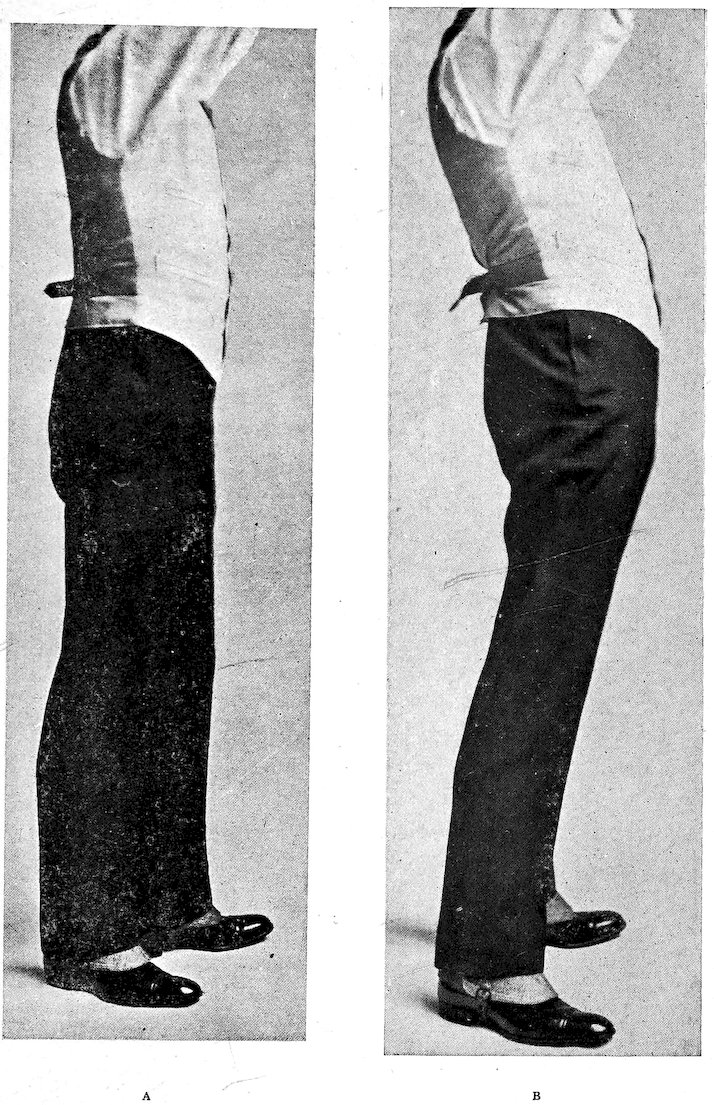
A.A. THE FEET ARE HERE PLACED IN THE IDEAL POSITION FOR OBTAINING PERFECT EQUILIBRIUM OF THE HUMAN MACHINE, AND FOR PERMITTING THE MAXIMUM ACTIVITY OF THE FUNCTIONING OF THE WHOLE ORGANISM. NOTE.—IT IS EVIDENT THAT EITHER THE RIGHT OR LEFT FOOT MAY BE IN ADVANCE WITHOUT AFFECTING THE CORRECTNESS OF THE POSE.
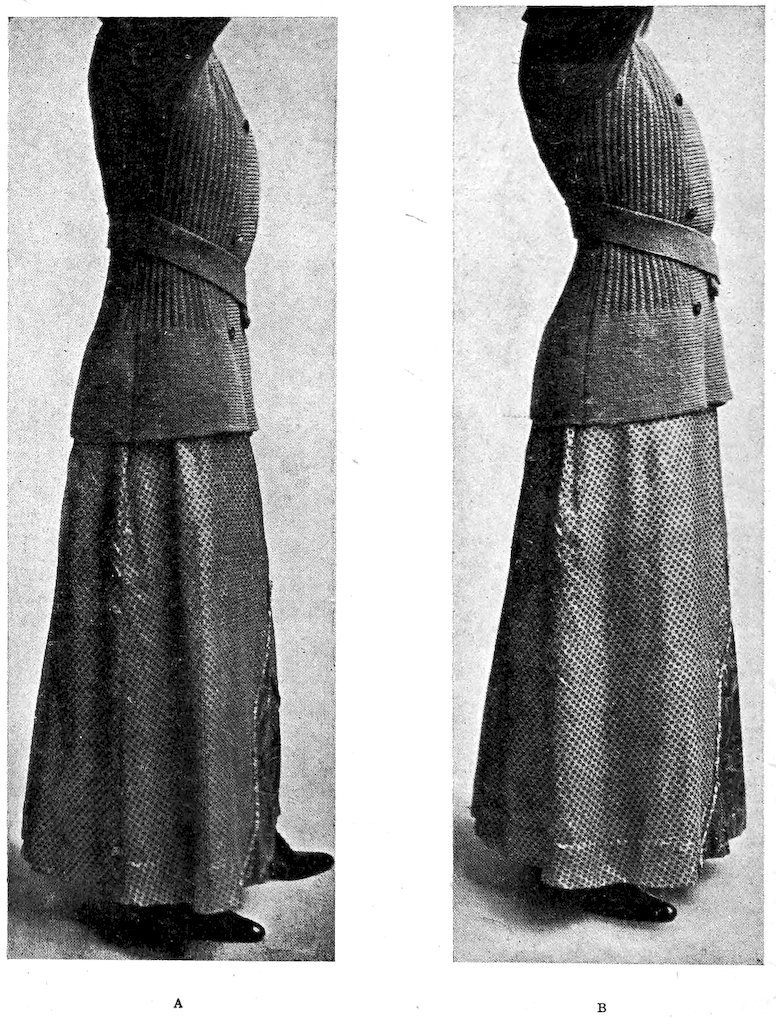
B.B. THE FEET ARE HERE PLACED IN A POSITION WHICH COMPELS AN IMPERFECT ADJUSTMENT OF THE WHOLE ORGANISM IN ORDER TO SECURE EVEN AN IMPERFECT EQUILIBRIUM. THIS POSITION RESULTS IN THE MINIMUM ACTIVITY OF THE VITAL FUNCTIONING.
From what I have now said, it will be quite evident
that the primary principle involved in attaining
a correct standing position is the placing of the
feet in that position which will ensure their greatest
effect as base, pivot, and fulcrum, and thereby throw
the limbs and trunk into that pose in which they
may be correctly influenced and aided by the force
of gravity. The weight of the body, it should be
noted (see diagram AA), rests chiefly upon the
279rear foot, and the hips should be allowed to go back
as far as is possible without altering the balance
effected by the position of the feet, and without deliberately
throwing the body forward. This movement
starts at the ankle, and affects particularly the
joints of the ankles and the hips. When inclining
the body forward, there must be no bending of the
spine or neck; from the hips upwards the relative
positions of all parts of the torso must remain
unchanged. When the position is assumed, it is
further necessary for each person to bring about
the proper lengthening of the spine and the adequate
widening of the back. The latter needs due
psycho-physical training such as is referred to in
the two extracts quoted above.
This standing position as now explained is physiologically
correct as a primary factor in the act of
walking. The weight is thrown largely upon the
rear foot, and thus enables the other knee to be
bent and the forward foot to be lifted; at the same
time the ankle of the rear foot should be bent so
that the whole body is inclined slightly forward,
thus allowing the propelling force of gravitation to
be brought into play.
The whole physiology of walking is, indeed, perfectly
simple when once these fundamental principles
are understood. It is really resolved into the
primary movements of allowing the body to incline
forward from the ankle on which the weight is
supported and then preventing oneself from falling
280by allowing the weight to be taken in turn by
the foot which has been advanced. This method,
simple as it may appear, is not, however, the one
usually adopted. The mechanical disadvantage displayed
in what is known as a “rolling gait,” for
instance, a gait which is common enough, is absolutely
impossible when the instructions given are
carefully followed. And the effect upon the whole
mechanical mechanism of the person concerned is
shown by the fact that when the co-ordinating principles
brought about by this method are established,
there is a constant tendency for the torso to lengthen,
whereas the usual tendency—due to faulty standing
position and the incorrect co-ordinations which
follow—is for the torso to shorten.
Nearly every one I examine or observe in the
act of walking, employs unnecessary physical tension
in the process in such a way that there is a
tendency to shorten the spine and legs, by pressing—if
I may so put it familiarly—down through the
floor instead of, as it were, lightening that pressure
by lengthening the body and throwing the
weight forward and moving lightly and freely. In
consequence of the “shortening” and “pressing
down” just referred to, the civilised peoples are becoming
more and more flat-footed. The properly
co-ordinated person employs a due amount of tension
in such a way that the tendency of the spine
and legs is to lengthen, and the equilibrium is such
that the undue pressure through the floor is absent
281and there is a lightness and freedom in the movements
of such a person that is most noticeable. The
person who is flat-footed has only to establish these
conditions to restore the natural arch of the flatfoot.
We can find, perhaps, no better instance of the
necessity for the application of the principles of
conscious control to these fundamental and essential
propositions of standing, walking, and running,
than in the photographs taken of Dorando as he
appeared when he was making his last terrible efforts
to reach the tape at the conclusion of the
Marathon race in London in 1908. One sees that
he was desperately wearied, and that whatever conscious
control of his muscular mechanisms he may
ever have obtained, he was at this moment completely
under the domination of subconscious (or
subjective) control, that he was out of “communication
with his reason.” His body, as we see him
in these photographs, is thrown back from the hips,
his arms are outstretched behind him, and his legs
are bent forward at the knee. As a consequence,
he is compelled to use almost all his physical force
in order to save himself from falling backwards.
He is struggling against a tremendous gravitational
pull which is dragging him away from his goal. If
Dorando, magnificent athlete as he undoubtedly is,
had been trained in the principles of conscious control,
such an attitude would have been impossible
for him, tired and exhausted even as he was. For
282if he had not been subconsciously controlled, he
would have employed his common-sense at this
moment and would have acted according to the guidance
of its mandate. It is at such critical moments
that we have urgent need for the control of reason,
for it is then that we suffer most from the
loss of the animal equivalent—instinct.
Dorando’s muscles may have been taxed to their
utmost capacity, but if he had been consciously controlled
he would have leaned forward, not back,
and while he had the strength necessary (but a
very small part of the strength he was actually
expending) to prevent himself from falling on his
face, that gravitational force would have dragged
him on instead of dragging him back from the object
of his achievement, as was actually the case.
He would, in short, have been able to make the best
instead of the worst use of his powers.
Faults such as we see exaggerated in this instance
are to be found in the carriage of many people
to-day, and the fact is one of great importance
to medical men. Patients are constantly advised
to take walking exercise, although in many cases
that exercise undoubtedly does more harm than
good. In my opinion it is very essential that all
doctors should devote more attention to this subject
than they are devoting at the present time, in
order that they may be in a position to advise which
of their patients will be benefited by taking walking
exercise, and which of them by so doing will
283aggravate the troubles from which they are suffering.
For it should be evident, I think, that the
good effects of fresh air and gentle exercise will
be practically nullified, if the patient can only obtain
them by exaggerating and perpetuating the defects
which have led him to the prescription.
These same rules are equally applicable in principle
to the acts of sitting and of rising from a
sitting position. Very few people have the right
mental conception of the “means whereby” of these
acts or of the correct use of the parts which should
be employed in their performance, and this despite
the fact that we are performing these acts continually,
and with such apparent ease from our own
point of view. If you ask any of your friends to
sit down you will notice, if you observe their actions
closely, that in nearly all cases there is undue
increase of muscular tension in the body and lower
limbs; in many cases the arms are actually employed.
As a rule, however, the most striking action
is the alteration in the position of the head
which is thrown back, whilst the neck is stiffened
and shortened. Now I will describe the correct
method, but it must be borne in mind that it is
useless to give what I here call “orders” to
the muscular mechanism, until the original habit
and the principle of mental conception connected
with this action have been eradicated. If, for instance,
before giving any of the “orders” which
follow, the experimenter has already fixed in his
284mind that he is to go through the performance of
sitting down, as that performance is known to him,
this suggestion will at once call into play all the
old vicious co-ordinations, and the new orders will
never influence the mechanisms to which they are
directed, because those mechanisms will already be
imperfectly employed, and will be held in their old
routine by the force of the familiar suggestion.
Firstly, then, rid the mind of the idea of sitting
down, and consider the exercise and each order independently
of the final consequence they entail. In
other words, study the “means,” not the “end.”
Secondly, stand in the position already described as
the correct standing position, with the back of the
legs almost touching the seat of the chair. Thirdly,
order the neck to relax, and at the same time order
the head forward and up. (Note that to “order”
the muscles of the neck to relax does not mean “allow
the head to fall forward on the chest.” The
order suggested is merely a mental preventive to
the erroneous preconceived idea.) Fourthly, keep
clearly in the mind the general idea of the lengthening
of the body which is a direct consequence of the
third series of orders. And fifthly, order simultaneously
the hips to move backwards and the knees
to bend, the knees and hip-joints acting as hinges.
During this act a mental order must be given to
widen the back. When this order is fulfilled, the
experimenter will find himself sitting in the chair.
But he is not yet upright, for the body will be inclined
285forward, unless he frustrates the whole performance
at this point by giving his old orders to
come to an upright position. Sixthly, then, and this
is of great importance, pause for an instant in the
position in which you will fall into the chair if the
earlier instructions have been correctly followed,
and then after ordering the neck to relax and the
head forward and up, the spine to lengthen and the
back to widen, come back into the chair and to an
upright position by using the hips as a hinge, and
without shortening the back, stiffening the neck, or
throwing up the head.
The act of rising is merely a reversal of the foregoing.
Draw the feet back so that one is slightly
under the seat of the chair, allow the body to move
forward from the hips, always keeping in mind
the freedom of the neck, and the idea of lengthening
the spine. Let the whole body come forward
until the centre of gravity falls over the feet, that
is to say, until the poise is such that if the chair were
removed at this point, you would be left balanced
in the position of a person performing the “frog
dance,” then by the exercise of the muscles of the
legs and back, straighten the legs at the hips, knees,
and ankles, until the erect position is perfectly attained.
If you care to experiment on a friend in this act
of rising, you will observe that in the movement
as performed by an imperfectly co-ordinated person,
the same bad movements occur, tending to stiffen
286the neck, to arch the spine unduly, to shorten
the body, and to protrude the abdominal wall.
This completes the co-ordinating idea with regard
to standing, walking, and sitting, and the exercises
indicated in the explanations I have made
will be found exceedingly helpful as a first step towards
a proper and healthful use of the muscular
mechanisms in these simple acts of everyday life.
- II.
- “How are the principles of Conscious Control to be applied to the cure of specific bad
habits, or to the cure of specific diseases?”
The following letter is typical of many:
“Dear Sir,—I have read your book, Man’s
Supreme Inheritance, with much interest, and I
hope you will forgive me if I venture to point
out a difficulty which presents itself to my mind,
and probably to the mind of the ordinary reader.
“It is this: In what way is it proposed to
apply the principle of ‘conscious control’ in a
given case—say in the overcoming of a habit,
such as smoking, to take a common example—or
in the case of functional disorders, as constipation?
It seems to me that the great attraction
to most people of the popular books on so-called
‘New Thought’ is that they lay down
clear and precise rules which can be put into
practice, so that the reader knows what he must
do to be saved. But I confess I am unable to
287gather how you would recommend setting about
the attainment of your principles. It would be
a great help to me, and no doubt to others, if this
could be explained, and probably in the larger
work which you contemplate this will be more
fully done.
“In the meantime, however, if it is not asking
too much, I should be extremely grateful to you
if you could very kindly indicate the method you
propose by which the principles could be applied
in such cases as I have suggested....”
Now, I may be doing the writer of this letter an
injustice, but I am inclined to class him among the
many enquirers who seem confidently to anticipate
a miracle. In my introduction I have said, “In
this brochure will be found no mention of royal
roads, panaceas, or grand specifics,” yet I feel sure
that some of my readers have, nevertheless, imagined
that by some marvellous means they may be
cured by taking thought, despite all that I have
written with regard to that procedure. We see in
one paragraph of the letter quoted above a nice example
of the desire to lean towards any mechanical
method. “The great attraction ... of the popular
books on so-called ‘New Thought,’” we read, “is
that they lay down clear and precise rules which
can be put into practice.” It is true that I have not
laid down any “clear and precise rules” which may
cover every conceivable form of physical and mental
288trouble, as do the exponents of “New Thought”
and “faith-healing,” and I think that my reason
should be plain enough, for in my experience I
have never found two cases exactly alike, and the
detailed instructions which I might lay down for A
might be extremely detrimental to B or C.
Nevertheless, since I see that some further explanation
is needed, I will adumbrate the general
principles which embrace the rule of application,
however diverse the method may be in practice.
In the first place, all specific bad habits such as
overindulgence in food, drink, tobacco, etc., evidence
a lack of “control” in a certain direction, and
the greater number of specific disorders such as asthma,
tuberculosis, cancer, nervous complaints, etc., indicate
interference with the normal conditions of
the body, lack of control, and imperfect working
of the human mechanisms, with displacement of the
different parts of that mechanism, loss of vitality
and its inevitable concomitant, lower activity of
functioning in all the vital organs. When the subject
has arrived at this condition, harmful habits
become established and the standard of resistance to
disease is seriously lowered.
To regain normal health and power in such cases,
what I have called “re-education” is absolutely imperative.
This treatment begins, in practically all
cases, by instructions in the primary factors connected
with the eradication of erroneous preconceived
ideas connected with bad habits, and the
289simplest correct mental and physical co-ordination.
The displaced parts of the body must be restored to
their proper positions by re-education in a correct
and controlled use of the muscular mechanisms. In
this process the blood is purified, the circulation is
gradually improved, and all the injurious accumulations
are removed by the internal massage which
is part and parcel of the increased vital activity
from such re-education.
Thus the first stage in the eradication of bad
habits and disorders is reached when improved conditions
of health are established. Nor must it be
forgotten that in this process of re-education a great
object lesson is given to the controlling mind. In
the very breaking up of maleficent co-ordinations
or vicious circles which have become established, a
new impulse is given to certain intellectual functions
which have been thrown out of play. The
reflex action which is setting up morbid conditions
can only be controlled and altered by a deliberate
realisation of the guiding process which is to be
substituted, and these new impulses to the conscious
mind have, analogically, very much the same effect
as is produced on the body by the internal massage
referred to above. The old accumulations of subconscious
thought are dispersed, and room is made
for new conceptions and realisations.
When the first stage is passed, it is just as easy
at almost any time of life to establish “good”
habits (“good” that is, by the test of all our experience
290and knowledge) as “bad” ones. Bad habits
mean, in ninety-nine per cent. of cases, that the
person concerned has, often through ignorance, pandered
to and wilfully indulged certain sensations,
probably with little or no thought as to what evil
results may accrue from his concessions to the
dominance of small pleasures. This careless relaxation
of reason, in the first instance, makes it
doubly difficult to assert command when the indulgence
has become a habit. Sensation has
usurped the throne so feebly defended by reason,
and sense, once it has obtained power, is the most
pitiless of autocrats. If we are to maintain the
succession that is our supreme inheritance, we must
first break the power of the usurper, and then re-establish
our sovereign, no longer dull and indifferent
to the welfare of his kingdom, but active, vigilant,
and open-eyed to the evils which result from
his old policy of laissez-faire.
So many people, I find, seem to regard the principles
of conscious control as a kind of magic which
may be worked by some suitable incantation. They
appear to think that we may obtain conscious control
of, say, the secretive glands, that we may be
able to give an order to secrete more or less bile or
gastric juice by a command of the objective mind.
If such a thing were possible, and if I could endow
any person with such power to-morrow, I should
know perfectly well that I should, by so doing, be
signing that person’s death warrant; I might equally
291well give him a dose of poison. To refer to my
metaphor of the sovereign ruler, you might as well
expect a king to order and superintend the detail
of his subjects’ private life as expect the conscious
mind directly to order and superintend every function
of the body. If the king will ordain good and
just laws, his policy will prosper; the detail of organisation
must be left to inferior officers. In the
care of the body the organisation is there, aptly
and perfectly adjusted to its functions, and when
the ruling power of conscious control has ordained
the sane laws which shall establish peace and prosperity
within the assembly, the organisation already
in force will work in harmony to its fit and proper
ends. On the other hand, there is great danger in
underrating the power of conscious control which,
if it must not be prematurely forced and made to
intrude on automatic functions, must in no way
be undervalued or delimited.
For instance, though it may not be possible to
control directly each separate part of the abdominal
viscera, we can control directly the muscles of the
abdominal wall which encloses the viscera, and in
reducing a protruding abdomen we can control
many other muscles, notably those of the back,
which when they are properly employed and co-ordinated
will, by widening and altering the shape
of the back, make place for the protruded stomach,
allow it to occupy the natural position from which
it has been ousted, and so give free play once more
292to the natural functions of the viscera that have
been distorted and pinched by the forced positions
they have had to assume. Here we see that though
conscious control does not affect by a process of direct
command, as it were, the lower automatic functions,
there is great danger in assuming that such
functions are beyond the reach of my methods.
This danger was brought before me when I read,
in the British Medical Journal for December, 1909,
an article on one side of my teaching contributed
by Dr. S——, an old pupil of mine.
In this article Dr. S—— says:
“Man’s education does not always demand
conscious instruction; in the absence of unfavourable
circumstances he can learn by unconscious
imitation of good models.”
Now this is not demonstrably untrue, but at the
same time it is, as I shall show, extraordinarily misleading,
and is, in effect, just as valuable as the
prescription of champagne and hothouse grapes for
a pauper patient.
In the first place, we must remember, and Dr.
S—— has himself admitted the fact, that the normal
is the rarest of all states. Medical experts find that
their most constant source of error in diagnosis
arises from the overreadiness to assume normal
conditions in patients whose internal economies and
muscular co-ordination are, in fact, far from the
ideal standard of proportion and interdependence.
293Yet if the expert trained in physiology fails to note
the distortions which are upsetting the whole economy,
what body is to be named the supreme authority
that shall select the “good models” for unconscious
imitation?
In the second place, we have to reckon with a
psychological factor which at once determines the
question of the validity of unconscious imitation.
This factor is the demonstrable truth that unconscious
imitation does in nine hundred and ninety-nine
cases out of a thousand lay hold of the faults
of the imitated and pass over the virtues. In a
long experience of re-educating many professional
men and women for the stage in this country, I
have had abundant opportunity to observe the methods
of the “understudy” set to “imitate” his or her
principal, and my invariable experience has been
that subconscious imitation has always been shown
by a reproduction of the actor’s or actress’s most
prominent failings. The intellectual reading of the
part, the subtler inflexions of voice and the finer
details of gesture are passed by, and the “understudy”
reproduces the “mannerisms,” all those obvious
tricks of speech, manner, and gesture which
are the least essential factors in the true reading of
the part. Again, my experience in cases of stammering
has shown me very clearly that especially
among boys and young men, the stutter has in a
very large majority of cases come about by the
imitation of some other boy. We do not find boys
294so apt to imitate one of their fellows who speaks
particularly well.
Now this imitation of a fault in speech is subconscious
and will not always right itself naturally,
and the reason for this will become clear with a
little consideration. Set a man to work on an
elaborate and intricate piece of machinery. Tell
him that if he moves a switch here and a lever
there, certain effects will be produced and certain
desired results obtained. The movements are simple
ones, and the man left to himself will be able
to control the working of the machine with ease
and certainty. But let us suppose that some essential
part of the machine is put out of gear, and that
the machine instead of running smoothly and easily
begins to jerk and hiccough. Our assumed operator
is immediately at a loss. He sees that there is
something wrong, and that there is obvious friction
where there was ease before; noise has taken the
place of silence; but he knows nothing of the working
of the machine save the elementary movements
of the switch and lever, in the uses of which he
has had instruction. Now, he may perform these
movements again and again; but the machine still
stutters, and our operator, quite at a loss, can do
nothing to obviate these faults. He must allow the
machine to continue working badly if it works at
all.
The boy we have adduced as an example of a
stammerer, who has copied some fault of another
295boy and found that fault become permanent, is in
exactly the same position as the unskilled operator
of our illustration. This boy knows the ordinary
uses of his vocal machine which have heretofore
produced normal results, but he does not know
enough of the machine to repair it when it is put
out of gear; he cannot control the machinery so
that it may at once be restored to its previous efficiency.
But just as the unskilled operator may be
instructed in the complete mechanism he is set to
supervise, and may then stop the machine when any
fault becomes evident, discover the source of the
defect and set it right; so will any person who has
been instructed in the principles of conscious control
be able to detect and obliterate any fault in
his vocal or any other bodily mechanism, even if
that fault was originated below the level of consciousness.
These marked examples furnish a sound and unfailing
analogy to the principles of unconscious
imitation in their application to physiology. The
perfectly co-ordinated man or woman does, as a
matter of fact, offer less mark for imitation to the
ordinary observer than the man or woman who displays
an obvious defect, just as the perfectly dressed
man or woman passes with less remark than those
people who affect some exaggeration of costume in
order to attract attention. Were we able at this
time to set the Greek model before our children,
we should be able to display it only on occasion,
296and the unconscious imitative powers of the child
would seize hold far more readily of the marked
defects with which it would be forced into contact
during the greater part of its waking life. In a
perfect world, unconscious imitation would not be
able to exert a perverting influence, and to the conception
of such a world we may well turn our attention,
but we shall never attain it by any means
other than these principles of conscious, reasoning,
deliberate construction, or reconstruction, upon
which I have based the whole of my theory and
practice.
And, finally, there is still a serious danger to be
reckoned with, even should we find sufficient methods
in our present civilisation from which we might
learn by unconscious imitation. We must remember
that during the advance of civilisation mankind
has lost the faculty we call instinct, the faculty
which guided mankind in a state of nature as it
still guides the lower animal world. During our
advance from this primitive condition, the one
great defect in our mental, physical, and educational
training has been the failure to recognise that civilised
life is the death-bed of instinct, and that in
civilised life man’s education must always demand
conscious instruction. For we see that it is at the
critical moments that men fail to rise to the occasion.
In such a case as that of Dorando, already
cited, we see that a perfectly trained athlete, a
man capable of the magnificent effort he made in
297the great Marathon race, was robbed of his victory
by his dependence at the critical moment upon unconscious
control as opposed to the conscious control
which is the thesis of Man’s Supreme Inheritance.
And every day we are told that at critical moments,
at the crisis of a debate, when suddenly called
upon to decide a question of moment, or when faced
with terrifying physical danger, men “lose their
heads”—and fail. It is more especially at these
times, at the crises of life, that the men who had
been educated in the principles of conscious control
would be capable of acting with the same reason and
common-sense that characterised their mental and
physical acts on the ordinary occasions of life. If
they had relied upon unconscious imitation they
would still be dependent, to a certain degree, upon
instinct.
Before leaving Question II, however, I will deal
specifically with two of the prevailing maladies of
our time, viz., spinal curvature and appendicitis,
and show how the principles I have enunciated have
a particular bearing on the prevention and cure of
these two serious ailments.
1. Spinal Curvature. A perfect spine is an all-important
factor in preserving those conditions and
uses of the human machine which work together for
perfect health, yet there are comparatively few
people who do not in some form or degree suffer,
perhaps quite unconsciously, from spinal curvature.
The present attitude towards this very serious
298mark of physical degeneration would be ludicrous
were it not that the matter is one of almost tragic
importance, and I may quote in this connexion a
letter of mine which appeared in The Pall Mall
Gazette for 14th March, 1908. After dealing with
certain other matters which need not be reproduced
here, I cited the following instances of the results
of our present attitude:
“In our schools and in the army, human beings
are actually being developed into deformities by
breathing and physical exercises. I have before me
a book on the breathing exercises which are used in
the army, and any person reasonably versed in physiology
and psychology, and knowing they are inseparable
in practice, will at once understand why so
much harm results from them. Take either the officers
or the soldiers. In a greater or less degree the
unduly protruded upper chests (development of emphysema),
unduly hollowed backs (lordosis), stiff
necks, rigid thorax, and other physical eccentricities
have been cultivated. It is for these reasons that
heart troubles, varicose veins, emphysema, and
mouth breathing (in exercise) are so much in evidence
in the army. As this is a matter of national
importance, I am prepared to give the time necessary
to prove to the authorities (medical or official)
connected with the army, the schools, or the sanatoria
that the ‘deep breathing’ and physical exercises
in vogue are doing far more harm than good,
299and are laying the foundations of much graver
trouble in the future. The truth is that all exercises
involving ‘deep breathing’ cause an exaggeration
of the defective muscular co-ordination already
present, so that even if one bad habit is eradicated,
many others, often more harmful, are cultivated.
“In this connexion it is only necessary to point to
the serious effects of ‘deep breathing’ and physical
culture exercises in the causation of throat and ear
disorders, following upon the undue and harmful
depression of the larynx—the crowding down of
the structures of the throat—such depression occurring
with every inspiration, and as a rule with every
expiration. This disorganisation and consequent
strain in the region of the throat is always found
exaggerated, and tends gradually to increase in
people who are subject to asthma, bronchitis, and
hay fever, and the removal of the factors causing
such strain and disorganisation means great relief
and gradual progress towards the eradication of
these disorders; but, of course, all organic troubles
should be removed in such cases.”
Now I may say further that I have not, up to
now, examined any method of physical culture or
respiration which has not tended to bring about in
time some form of directly harmful lumbar spinal
curvature. And I have never examined a case of
the (alleged) cure of spinal curvature in which the
front of the chest has not been harmfully altered,
300and very often seriously deformed. The original
idea in diagnosis of spinal curvature which has led
to the methods producing these results is “that the
activity of the muscles is necessary to the retention
of the spine in an erect position, in consequence of
which, therefore, the primary cause for the scoliosis
must be sought in an abnormal function of the muscles
influencing the spine.” This is the myopathic
theory of Eulenburg, an authority whose dicta have
had an important influence in medical practice.
The error of advocating physical exercises, as
generally understood, of any kind in the treatment
of spinal curvature is even greater than in the case
of John Doe, whom I cited in the earlier part of
this work and whose case should be again referred
to in this connexion. The question here also is
one of correct conscious recognition, and it is much
more marked in the case of spinal curvature than
in the case of my earlier illustration, a case in which
there was no special deformity, and in which the
muscle-tensing exercises I deprecated did not work
to emphasise a marked structural malformation.
The important factors in relation to spinal curvature
are these:
(a) The bent or curved and therefore shortened
spine.
(b) The decreased internal capacity of the
thoracic cavity.
Plainly, attention must first be given to straightening
301and lengthening the curved and shortened
spine. This can be done by an expert manipulator
who is able to diagnose the erroneous preconceived
ideas of the person concerned, and cause the pupil
to inhibit them while employing the position of
mechanical advantage. And it can be done without
asking the pupil to perform what he understands
as a single physical act. Moreover, if the correct
guiding orders are given to the pupil by the teacher,
and the pupil makes no attempt to hold him or herself
in the lengthened position, such use of the muscular
mechanism will, nevertheless, be brought about
as will ensure that the torso is held in a correct
position. Formerly, the consciousness in regard
to the correct action has been erroneous, a mere
delusion, and the muscular mechanisms have worked
to pull the body down. The truth of the matter is
that in the old morbid conditions which have
brought about the curvature the muscles intended
by Nature for the correct working of the parts
concerned had been put out of action, and the whole
purpose of the re-educatory method I advocate is
to bring back these muscles into play, not by physical
exercises, but by the employment of a position
of mechanical advantage and the repetition of the
correct inhibiting and guiding mental orders by
the pupil, and the correct manipulation and direction
by the teacher, until the two psycho-physical
factors become an established psycho-physical habit.
During this process of re-education, factor (b)
302has not been forgotten. A little consideration will
show that any alteration in the spine must necessarily
affect the position and working of the ribs.
(The analogy of the keel of a boat and the ribs
which spring from it may well be held in mind to
make clear the following explanation.) It will be
seen that as the ribs are held apart by muscular tissues
(analogous to the boards of a boat), a bending
of the spine will not buckle the ribs unless great
force is applied, force sufficient to rupture the muscular
tissue. But it is equally evident that there
must be some play in the ribs in order that they
may adjust themselves to the new position. This
play is effected in the human body (and would be
effected mechanically in the ribs of a boat, if they
possessed sufficient elasticity) by the coming together
of the ends of the “false” and “flying” ribs,
that is, those lower ribs which are not attached to
the bony sternum. This flattening of the curve
of the ribs, and the approach of their free ends
towards each other, reduces the thoracic cavity,
just as in our illustration of the boat its capacity
would be reduced if we forcibly narrowed the distance
between the thwarts. On the other hand, we
see that by increasing the thoracic capacity and so
increasing the distance between the ends of these
ribs, we are applying a mechanical principle which
by a reverse action tends to straighten the spine.
These two actions, the re-education of the “Kinæsthetic
Systems” and the increasing of the thoracic
303capacity which applies a mechanical power by
means of the muscles and ribs to the straightening
of the spine, are both aspects of the one central
idea, and are not separate and divisible acts.
2. Appendicitis. The prevalence of appendicitis
has always seemed to me one of the most striking
proofs of the inefficiency of present-day methods
in regard to health. At times I am filled with
wonder that we permit such bad conditions to become
established as may necessitate the removal of
the appendix. It is, of course, well known that the
operation is frequently performed when the conditions
do not warrant such extreme measures, but
cases have come under my notice, nevertheless,
and those not among the uneducated classes, in
which the symptoms had become so aggravated by
years of harmful habits of life as to necessitate
the major operation. Fortunately there is a section
of the medical profession which objects, on scientific
grounds, to the removal of the appendix in all
but extreme cases, and this opposition and the evidence
adducible as to the comparative ease with
which the exaggerated condition may be avoided
and the trouble completely cured by natural means,
is doing much to limit the sphere of those champions
of the knife who are never content unless
they can be dissecting the living body.
There can be no question or shadow of doubt
that when the whole frame is properly co-ordinated
and the adjustment of the body is correct and controlled
304according to the principles I have enunciated,
it is a practical impossibility to get appendicitis.
The cause of the trouble is due to imperfect adjustment
of the body which allows or forces the abdominal
viscera to become displaced and to fall.
The first consequence of this is a change of pressures
and the loss of the natural internal massage,
present in normal conditions. This leads to constipation
among other symptoms, and permits the
gradual accumulation of toxic poisons.
When the trouble has already shown itself and
there is some positive inflammation of the appendix
and tenderness in that region, it is by no means
too late to apply my methods. The new co-ordinations
which may in such cases be brought about
very quickly, and established later, at once relieve
false internal pressures and permit a natural re-adjustment
of the viscera, and the furtherance of a
rapid return to a healthy and normal condition is
greatly accelerated by the internal massage.
With regard to this latter treatment to which I
have already referred in this chapter, I may mention
that many pupils have asked me if I use internal
massage in my system of re-education. In my
brochure on the Theory and Practice of Respiratory
Re-education, included in Part III, it will be found
that I used this description, as I said, for lack of
one that was sufficiently comprehensive, but the
principle itself is one of the first importance.
When a patient or pupil is placed in the position
305of mechanical advantage I have so often had occasion
to refer to, the manipulator can secure the
maximum movement of the abdominal viscera in
strict accordance with the laws of nature and will
obtain at the same time a maximum functioning of
all the internal organs. In this way foreign accumulations
are dissipated, constipation is relieved,
and the more or less collapsed viscera—the cause
of all the trouble—are restored to their proper
places and resume their natural functions.
All these things, it will be seen, are essential factors
in the prevention and cure of appendicitis, and
I may add that the application of these principles
in a very large number of cases in which an operation
has been medically advised has conclusively
demonstrated their value to the individual and to
the race.
Appendicitis, like influenza, is probably almost
an impossibility in the natural state; it is one of
the results of civilisation and subconsciously controlled
mechanisms, and is possible only through
the conditions we have developed; and these adventitious
troubles and ailments will continue to appear
and to do their work of destruction until some
general recognition is made of the necessity for substituting
conscious control for the partly superseded
forces which in a wild state render these ailments
impossible.
- III.306
- “What are the outward signs of improvement to be noted during treatment?”
The signs of improvement are manifold and they
necessarily vary according to the nature of the original
defect, but I will set out here some of the more
characteristic, such as occur in generally typical
cases.
We see, in the first place, that the characteristic
defects of the body, whether displacements of some
part or parts of the muscular mechanism (in some
cases even displacement of the bones), or defects of
pose which throw some unusual strain upon a
muscle, or, more commonly, a group of muscles
not intended to take such strain, all have some
correlated defects, which may be observed by the
instructed as certain visible peculiarities and abnormalities.
And we must draw particular attention
in this connexion to the fact that these outer
signs are correlated with the inner defects. Neither
outer sign nor inner defect is from one point of
view the result one of the other. The original
cause is some faulty or imperfect co-ordination or
conception of function; the inner defect and outer
sign-mark are equally a consequence as they are
to us an index.
As we should naturally expect, the chief sign-manual
is to be found in the face. To me, that is
a most valuable document upon which is written
many curious, intricate, sometimes alarming confessions.
307The expression of the eyes, the set of
the lips, the drawing of the forehead, and the more
pronounced dragging of the flexible face muscles,
are all marks which may be read by the expert, and,
to answer the question directly, one of the earlier
outward signs of improvement is to be found in a
relaxation of the forced and unnatural expression
which results from these contortions. It must be
obvious that I cannot here set out in detail the
symptomatic distortions which accompany the various
internal defects, but one may be noted as an
exemplar for the others however diverse.
The case in question was one of dilation of the
heart and as such was brought to me by a medical
friend, and, as a matter of fact, though this was
the most alarming symptom, it was but one of
many springing from deep-seated causes. Incidentally
I may note that the spine was arched inwards,
the legs were unduly and most abnormally
stiffened when the patient was in a standing position,
and the upper part of the chest was held most
harmfully high—this last symptom being the influence
which produced what was really a tertiary effect,
though in this case the most threatening one,
viz., the dilation of the heart. Now this patient
carried certain very curious marks in the face: first
a general expression of strain in the eyes and cheek
muscles, and secondly four very marked indents or
pits in the forehead. Here, indeed, were marks
which the expert might read, and it was extremely
308interesting to note, as my treatment progressed and
the patient recovered the proper use of the body
and a consequent return to perfect health, first, the
disappearance of the strained expression of eyes and
face muscles, and secondly, the gradual filling up of
the four curious indentations in the forehead. In
this case the original symptoms were so marked that
the patient’s friends all commented on the change
of expression during the progress of the treatment.
The face, however, is by no means the only index.
Many defects lead, by way of stiffened neck
and throat muscles, to an alteration in the quality
and power of the voice. There too the mode of
movement and the failure to express purpose in
muscular action, the fumbling, indirect attempt to
perform a simple act, are aids to diagnosis, either
of the original defect, or, by their reversion to
natural, easy functioning, of the progress of the
cure.
Generally, also, we observe a clearing of the skin
and eyes as the defects are eradicated, improvements
which are due to better circulation and the improved
quality of the blood, factors which bring
about a continually increasing power in the organism
to purge itself not only through the bowels
and kidneys, but also through the skin.
Lastly, we may note a general improvement in
physique, in the carriage of the body, in the whole
appearance of co-ordinated, reasoned control.
309Another curious and interesting test of the co-ordinated
person who is attaining conscious control
of the uses of his body is obtained by observing his
hands when they fall to his sides in the position
which comes naturally to him. One may say that
there are three main stages to be observed in man’s
development in this particular, though the gradations
are many and not, perhaps, always strictly progressive.
The first stage may be observed in the lowest
savages, the Hottentot, the Australian aboriginal,
and many races at an early stage of development.
Such examples stand with body thrown back from
the hips, stomach protruded, and—here is the test—with
the palms of the hands forward, the elbows
bent into the sides, the thumbs sticking out away
from the body. The second stage is evidenced in
the averaged civilised man of to-day who stands
as a rule with the palms of his hands towards his
body, his elbows to the back, his thumbs forward.
In the third stage, the properly co-ordinated person
stands with the back of his hands forward, the
thumbs inwards, and the elbows slightly bent outwards.
This is a curious but little known test,
which, in my experience, has never failed as an
index to imperfect muscular co-ordination.
I believe I have now answered in sufficient detail
the somewhat wide intention of these three
main questions, but in conclusion I will note one
further point that has been raised.
This is the question as to why the great majority
310of men and women breathe from their stomach or
the upper chest and so allow, among other evils,
the costal arch to be narrowed and the flying ribs
to become constricted and stiffened. In the case
of many women there can be no doubt that this is
due to the use of tight corsets which confine these
ribs, and do great general harm in constricting the
natural play of the vital functions. But another
and, in my opinion, the primary cause is the common
practice of swathing a child in bands almost
immediately after birth, and keeping him so fettered
during many months of infancy. The idea of this
practice is to prevent rupture in male children
should they be subject to violent fits of crying or
coughing, but the question of the relative tightness
or looseness of these swathings is left in the hands
of a nurse, who, in the great majority of cases,
thinks it well to be on the “safe side” by winding
the child unnecessarily tightly. Obviously the early
habit is retained through life unless it is broken by
some outside influence. The pliancy of the young
organisms is such that the functioning of the breathing
apparatus is quickly re-adjusted, but the evils
which gradually accumulate, from this and similar
causes, do not show themselves as a rule till much
later in life.
Another cause is any imperfect adjustment of the
muscular mechanism, a failure which may be due
to incorrect training, to unconscious imitation, or to
any of the chances which are always being presented
311to the child in the haphazard system of physical
education which obtains in our nurseries and
schools.
And on this note I may well conclude my chapter,
for no argument I can advance in favour of a careful
consideration of the principles I have laid down
can have such cogency and force as the most superficial
examination of the physique of the children
in our schools and the adults in our streets. We
are indeed suffering, not only in Great Britain
but on the continents of Europe and America, from
a failure to recognise that man is no longer a natural
animal, whose life-habits were dependent upon the
development of the faculty of instinct, and that all
systems of physical culture (and how diverse they
are!) must necessarily fail unless they take into
account that first and last essential, the free use
and consciousness of the reasoning, controlling
mind.