Multis videri poterit, majorem esse differentiam Simiæ et Hominis,
quam diei et noctis; verum tamen hi, comparatione instituta inter
summos Europæ Heroës et Hottentottos ad Caput bonæ spei degentes,
difficillime sibi persuadebunt, has eosdem habere natales;
vel si virginem nobilem aulicam, maxime comtam et humanissimam,
conferre vellent cum homine sylvestri et sibi relicto, vix augurari
possent, hunc et illam ejusdem esse speciei.—Linnæi Amœnitates
Acad. “Anthropomorpha.”
The question of questions for mankind—the problem
which underlies all others, and is more deeply interesting
than any other—is the ascertainment of the place which
Man occupies in nature and of his relations to the universe
of things. Whence our race has come; what are the
limits of our power over nature, and of nature’s power
over us; to what goal we are tending; are the problems
which present themselves anew and with undiminished
interest to every man born into the world. Most of us,
shrinking from the difficulties and dangers which beset
the seeker after original answers to these riddles, are contented
to ignore them altogether, or to smother the
investigating spirit under the featherbed of respected and
respectable tradition. But, in every age, one or two restless
spirits, blessed with that constructive genius, which
can only build on a secure foundation, or cursed with
the mere spirit of scepticism, are unable to follow in the
well-worn and comfortable track of their forefathers and
contemporaries, and unmindful of thorns and stumbling-blocks,
strike out into paths of their own. The sceptics
end in the infidelity which asserts the problem to be
insoluble, or in the atheism which denies the existence of
any orderly progress and governance of things: the men
of genius propound solutions which grow into systems of
Theology or of Philosophy, or veiled in musical language
which suggests more than it asserts, take the shape of
the Poetry of an epoch.
Each such answer to the great question, invariably
asserted by the followers of its propounder, if not by
himself, to be complete and final, remains in high
authority and esteem, it may be for one century, or it
may be for twenty: but, as invariably, Time proves each
reply to have been a mere approximation to the truth—tolerable
chiefly on account of the ignorance of those by
whom it was accepted, and wholly intolerable when tested
by the larger knowledge of their successors.
In a well-worn metaphor, a parallel is drawn between
the life of man and the metamorphosis of the caterpillar
into the butterfly; but the comparison may be more just
as well as more novel, if for its former term we take the
mental progress of the race. History shows that the
human mind, fed by constant accessions of knowledge,
periodically grows too large for its theoretical coverings,
and bursts them asunder to appear in new habiliments,
as the feeding and growing grub, at intervals, casts its too
narrow skin and assumes another, itself but temporary.
Truly the imago state of Man seems to be terribly distant,
but every moult is a step gained, and of such there have
been many.
Since the revival of learning, whereby the Western races
of Europe were enabled to enter upon that progress
towards true knowledge, which was commenced by the
philosophers of Greece, but was almost arrested in subsequent
long ages of intellectual stagnation, or, at most,
gyration, the human larva has been feeding vigorously,
and moulting in proportion. A skin of some dimension
was cast in the 16th century, and another towards the
end of the 18th, while, within the last fifty years, the extraordinary
growth of every department of physical science
has spread among us mental food of so nutritious and
stimulating a character that a new ecdysis seems imminent.
But this is a process not unusually accompanied
by many throes and some sickness and debility, or,
it may be, by graver disturbances; so that every good
citizen must feel bound to facilitate the process, and
even if he have nothing but a scalpel to work withal, to
ease the cracking integument to the best of his ability.
In this duty lies my excuse for the publication of these
essays. For it will be admitted that some knowledge of
man’s position in the animate world is an indispensable
preliminary to the proper understanding of his relations
to the universe—and this again resolves itself, in the
long run, into an inquiry into the nature and the closeness
of the ties which connect him with those singular
creatures whose history[25] has been sketched in the preceding
pages.
The importance of such an inquiry is indeed intuitively
manifest. Brought face to face with these blurred copies
of himself, the least thoughtful of men is conscious of a
certain shock, due perhaps, not so much to disgust at the
aspect of what looks like an insulting caricature, as to the
awakening of a sudden and profound mistrust of time-honoured
theories and strongly-rooted prejudices regarding
his own position in nature, and his relations to the
under-world of life; while that which remains a dim
suspicion for the unthinking, becomes a vast argument,
fraught with the deepest consequences, for all who are
acquainted with the recent progress of the anatomical and
physiological sciences.
I now propose briefly to unfold that argument, and to
set forth, in a form intelligible to those who possess no
special acquaintance with anatomical science, the chief
facts upon which all conclusions respecting the nature
and the extent of the bonds which connect man with the
brute world must be based: I shall then indicate the one
immediate conclusion which, in my judgment, is justified
by those facts, and I shall finally discuss the bearing of
that conclusion upon the hypotheses which have been
entertained respecting the Origin of Man.
The facts to which I would first direct the reader’s
attention, though ignored by many of the professed instructors
of the public mind, are easy of demonstration
and are universally agreed to by men of science; while
their significance is so great, that whoso has duly pondered
over them will, I think, find little to startle him in the
other revelations of Biology. I refer to those facts which
have been made known by the study of Development.
It is a truth of very wide, if not of universal, application,
that every living creature commences its existence under
a form different from, and simpler than, that which it
eventually attains.
The oak is a more complex thing than the little rudimentary
plant contained in the acorn; the caterpillar is
more complex than the egg; the butterfly than the caterpillar;
and each of these beings, in passing from its rudimentary
to its perfect condition, runs through a series of
changes, the sum of which is called its Development. In
the higher animals these changes are extremely complicated;
but, within the last half-century, the labours of
such men as Von Baer, Rathke, Reichert, Bischof, and
Remak have almost completely unravelled them, so that
the successive stages of development which are exhibited
by a Dog, for example, are now as well known to the
embryologist as are the steps of the metamorphosis of the
silkworm moth to the school-boy. It will be useful to
consider with attention the nature and the order of the
stages of canine development, as an example of the process
in the higher animals generally.
The Dog, like all animals, save the very lowest (and
further inquiries may not improbably remove the apparent
exception), commences its existence as an egg: as a body
which is, in every sense, as much an egg as that of a hen,
but is devoid of that accumulation of nutritive matter
which confers upon the bird’s egg its exceptional size and
domestic utility; and wants the shell, which would not
only be useless to an animal incubated within the body
of its parent, but would cut it off from access to the
source of that nutriment which the young creature requires,
but which the minute egg of the mammal does not
contain within itself.
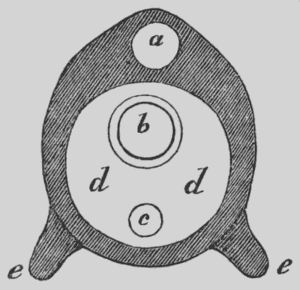
The Dog’s egg is, in fact, a little spheroidal bag (Fig.
12), formed of a delicate transparent membrane called
the vitelline membrane, and about 1⁄130 to 1⁄120th an
inch in diameter. It contains a mass of viscid nutritive
matter—the “yelk”—within which is inclosed a second
much more delicate spheroidal bag, called the “germinal
vesicle” (a). In this, lastly, lies a more solid rounded
body, termed the “germinal spot” (b).
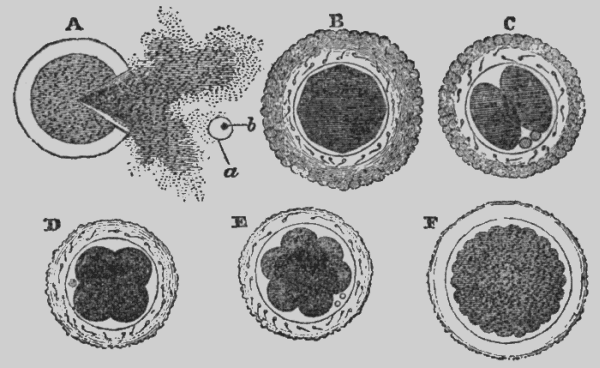 Fig. 12.—A. Egg of the Dog, with the vitelline membrane burst, so as
to give exit to the yelk, the germinal vesicle (a), and its
included spot (b).
Fig. 12.—A. Egg of the Dog, with the vitelline membrane burst, so as
to give exit to the yelk, the germinal vesicle (a), and its
included spot (b).
B. C. D. E. F. Successive changes of the yelk indicated in
the text. After Bischoff.
The egg, or “Ovum,” is originally formed within a
gland, from which, in due season, it becomes detached,
and passes into the living chamber fitted for its protection
and maintenance during the protracted process of
gestation. Here, when subjected to the required conditions,
this minute and apparently insignificant particle of
living matter becomes animated by a new and mysterious
activity. The germinal vesicle and spot cease to be discernible
(their precise fate being one of the yet unsolved
problems of embryology), but the yelk becomes circumferentially
indented, as if an invisible knife had been
drawn round it, and thus appears divided into two hemispheres
(Fig. 12, C).
By the repetition of this process in various planes, these
hemispheres become subdivided, so that four segments are
produced (D); and these, in like manner, divide and subdivide
again, until the whole yelk is converted into a
mass of granules, each of which consists of a minute
spheroid of yelk-substance, inclosing a central particle,
the so-called “nucleus” (F). Nature, by this process, has
attained much the same result as that at which a human
artificer arrives by his operations in a brickfield. She
takes the rough plastic material of the yelk and breaks it
up into well-shaped, tolerably even-sized masses, handy
for building up into any part of the living edifice.
Next, the mass of organic bricks, or “cells” as they
are technically called, thus formed, acquires an orderly
arrangement, becoming converted into a hollow spheroid
with double walls. Then, upon one side of this spheroid,
appears a thickening, and, by and bye, in the centre of the
area of thickening, a straight shallow groove (Fig. 13, A)
marks the central line of the edifice which is to be raised,
or, in other words, indicates the position of the middle
line of the body of the future dog. The substance
bounding the groove on each side next rises up into a
fold, the rudiment of the side wall of that long cavity,
which will eventually lodge the spinal marrow and the
brain; and in the floor of this chamber appears a solid
cellular cord, the so-called “notochord.” One end of the
inclosed cavity dilates to form the head (Fig. 13, B), the
other remains narrow, and eventually becomes the tail;
the side walls of the body are fashioned out of the downward
continuation of the walls of the groove; and from
them, by and bye, grow out little buds which, by degrees,
assume the shape of limbs. Watching the fashioning
process stage by stage, one is forcibly reminded of the
modeller in clay. Every part, every organ, is at first,
as it were, pinched up rudely, and sketched out in the
rough; then shaped more accurately; and only, at last,
receives the touches which stamp its final character.
Thus, at length, the young puppy assumes such a form
as is shown in Fig. 13, C. In this condition it has a disproportionately
large head, as dissimilar to that of a dog
as the bud-like limbs are unlike his legs.
The remains of the yelk, which have not yet been
applied to the nutrition and growth of the young animal,
are contained in a sac attached to the rudimentary intestine,
and termed the yelk-sac, or “umbilical vesicle.”
Two membranous bags, intended to subserve respectively
the protection and nutrition of the young creature, have
been developed from the skin and from the under and
hinder surface of the body; the former, the so-called
“amnion,” is a sac filled with fluid, which invests the
whole body of the embryo, and plays the part of a sort
of water-bed for it; the other, termed the “allantois,”
grows out, loaded with blood-vessels, from the ventral
region, and eventually applying itself to the walls of the
cavity, in which the developing organism is contained,
enables these vessels to become the channel by which
the stream of nutriment, required to supply the wants of
the offspring, is furnished to it by the parent.
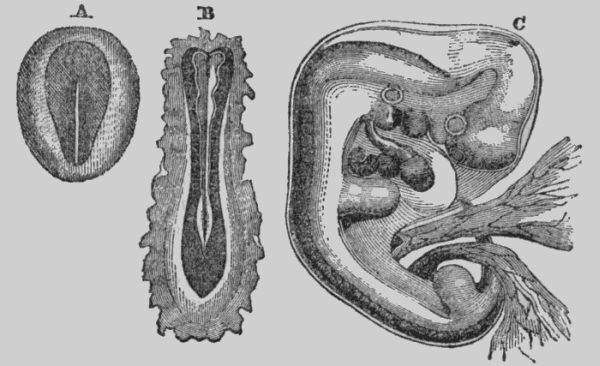 Fig. 13.—A. Earliest rudiment of the Dog. B. Rudiment further
advanced, showing the foundations of the head, tail,
and vertebral column. C. The very young puppy, with
attached ends of the yelk-sac and allantois, and invested
in the amnion.
Fig. 13.—A. Earliest rudiment of the Dog. B. Rudiment further
advanced, showing the foundations of the head, tail,
and vertebral column. C. The very young puppy, with
attached ends of the yelk-sac and allantois, and invested
in the amnion.
The structure which is developed by the interlacement
of the vessels of the offspring with those of the parent,
and by means of which the former is enabled to receive
nourishment and to get rid of effete matters, is termed
the “Placenta.”
It would be tedious, and it is unnecessary for my present
purpose, to trace the process of development further;
suffice it to say, that, by a long and gradual series of
changes, the rudiment here depicted and described
becomes a puppy, is born, and then, by still slower and
less perceptible steps, passes into the adult Dog.
There is not much apparent resemblance between a
barndoor Fowl and the Dog who protects the farm-yard.
Nevertheless the student of development finds, not only
that the chick commences its existence as an egg, primarily
identical, in all essential respects, with that of the Dog,
but that the yelk of this egg undergoes division—that the
primitive groove arises, and that the contiguous parts of
the germ are fashioned, by precisely similar methods, into
a young chick, which, at one stage of its existence, is so
like the nascent Dog, that ordinary inspection would
hardly distinguish the two.
The history of the development of any other vertebrate
animal, Lizard, Snake, Frog, or Fish, tells the same story.
There is always, to begin with, an egg having the same
essential structure as that of the Dog:—the yelk of that
egg always undergoes division, or “segmentation” as it is
often called: the ultimate products of that segmentation
constitute the building materials for the body of the
young animal; and this is built up round a primitive
groove, in the floor of which a notochord is developed.
Furthermore, there is a period in which the young of all
these animals resemble one another, not merely in outward
form, but in all essentials of structure, so closely,
that the differences between them are inconsiderable,
while, in their subsequent course, they diverge more and
more widely from one another. And it is a general law,
that, the more closely any animals resemble one another
in adult structure, the longer and the more intimately do
their embryos resemble one another: so that, for example,
the embryos of a Snake and of a Lizard remain like one
another longer than do those of a Snake and of a Bird;
and the embryo of a Dog and of a Cat remain like one
another for a far longer period than do those of a Dog
and a Bird; or of a Dog and an Opossum; or even than
those of a Dog and a Monkey.
Thus the study of development affords a clear test
of closeness of structural affinity, and one turns with
impatience to inquire what results are yielded by the
study of the development of Man. Is he something
apart? Does he originate in a totally different way from
Dog, Bird, Frog, and Fish, thus justifying those who
assert him to have no place in nature and no real affinity
with the lower world of animal life? Or does he originate
in a similar germ, pass through the same slow and gradually
progressive modifications,—depend on the same contrivances
for protection and nutrition, and finally enter the
world by the help of the same mechanism? The reply is
not doubtful for a moment, and has not been doubtful any
time these thirty years. Without question, the mode of
origin and the early stages of the development of man are
identical with those of the animals immediately below him
in the scale:—without a doubt, in these respects, he is far
nearer the Apes, than the Apes are to the Dog.
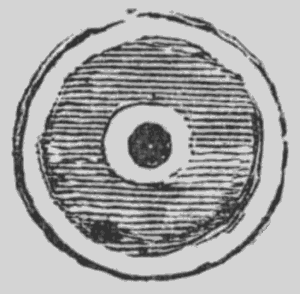
The Human ovum is about 1⁄125 of an inch in diameter,
and might be described in the same terms as that of the
Dog, so that I need only refer to the figure illustrative
(14 A.) of its structure. It leaves the organ in which it
is formed in a similar fashion and enters the organic
chamber prepared for its reception in the same way, the
conditions of its development being in all respects the
same. It has not yet been possible (and only by some
rare chance can it ever be possible) to study the human
ovum in so early a developmental stage as that of yelk
division, but there is every reason to conclude that the
changes it undergoes are identical with those exhibited
by the ova of other vertebrated animals; for the formative
materials of which the rudimentary human body is composed,
in the earliest conditions in which it has been
observed, are the same as those of other animals. Some
of these earliest stages are figured below and, as will be
seen, they are strictly comparable to the very early states
of the Dog; the marvellous correspondence between the
two which is kept up, even for some time, as development
advances, becoming apparent by the simple comparison
of the figures with those on page 58.
Indeed, it is very long before the body of the young
human being can be readily discriminated from that of
the young puppy; but, at a tolerably early period, the
two become distinguishable by the different form of their
adjuncts, the yelk-sac and the allantois. The former, in
the Dog, becomes long and spindle-shaped, while in Man
it remains spherical; the latter, in the Dog, attains an
extremely large size, and the vascular processes which
are developed from it and eventually give rise to the
formation of the placenta (taking root, as it were, in the
parental organism, so as to draw nourishment therefrom,
as the root of a tree extracts it from the soil) are arranged
in an encircling zone, while in Man, the allantois remains
comparatively small, and its vascular rootlets are eventually
restricted to one disk-like spot. Hence, while the placenta
of the Dog is like a girdle, that of Man has the cake-like
form, indicated by the name of the organ.
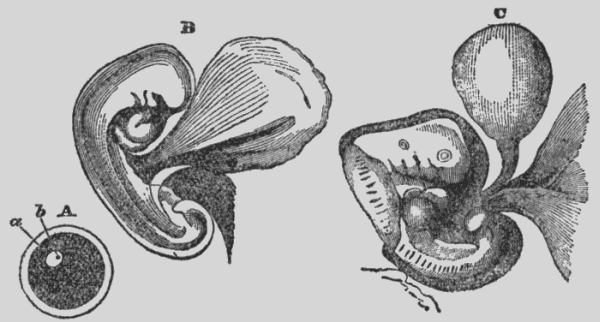 Fig. 14.—A. Human ovum (after Kölliker). a. germinal vesicle.
b. germinal spot.
Fig. 14.—A. Human ovum (after Kölliker). a. germinal vesicle.
b. germinal spot.
B. A very early condition of Man, with yelk-sac, allantois,
and amnion (original).
C. A more advanced stage (after Kölliker), compare Fig. 13, C.
But, exactly in those respects in which the developing
Man differs from the Dog, he resembles the ape, which,
like man, has a spheroidal yelk-sac and a discoidal—sometimes
partially lobed—placenta.
So that it is only quite in the later stages of development
that the young human being presents marked
differences from the young ape, while the latter departs
as much from the dog in its development, as the man
does.
Startling as the last assertion may appear to be, it is
demonstrably true, and it alone appears to me sufficient
to place beyond all doubt the structural unity of man
with the rest of the animal world, and more particularly
and closely with the apes.
Thus, identical in the physical processes by which he
originates—identical in the early stages of his formation—identical
in the mode of his nutrition before and after
birth, with the animals which lie immediately below him
in the scale—Man, if his adult and perfect structure be
compared with theirs, exhibits, as might be expected, a
marvellous likeness of organization. He resembles them
as they resemble one another—he differs from them as
they differ from one another.—And, though these differences
and resemblances cannot be weighed and measured,
their value may be readily estimated; the scale or standard
of judgment, touching that value, being afforded and
expressed by the system of classification of animals now
current among zoologists.
A careful study of the resemblances and differences
presented by animals has, in fact, led naturalists to arrange
them into groups, or assemblages, all the members of
each group presenting a certain amount of definable
resemblance, and the number of points of similarity
being smaller as the group is larger and vice versâ. Thus,
all creatures which agree only in presenting the few
distinctive marks of animality form the “Kingdom”
Animalia. The numerous animals which agree only
in possessing the special characters of Vertebrates form
one “Sub-kingdom” of this Kingdom. Then the Sub-kingdom
Vertebrata is subdivided into the five “Classes,”
Fishes, Amphibians, Reptiles, Birds, and Mammals, and
these into smaller groups called “Orders”; these into
“Families” and “Genera”; while the last are finally
broken up into the smallest assemblages, which are
distinguished by the possession of constant, not-sexual,
characters. These ultimate groups are Species.
Every year tends to bring about a greater uniformity
of opinion throughout the zoological world as to the
limits and characters of these groups, great and small.
At present, for example, no one has the least doubt
regarding the characters of the classes Mammalia, Aves,
or Reptilia; nor does the question arise whether any
thoroughly well-known animal should be placed in one
class or the other. Again, there is a very general agreement
respecting the characters and limits of the orders
of Mammals, and as to the animals which are structurally
necessitated to take a place in one or another
order.
No one doubts, for example, that the Sloth and the
Ant-eater, the Kangaroo and the Opossum, the Tiger and
the Badger, the Tapir and the Rhinoceros, are respectively
members of the same orders. These successive
pairs of animals may, and some do, differ from one
another immensely, in such matters as the proportions
and structure of their limbs; the number of their dorsal
and lumbar vertebræ; the adaptation of their frames to
climbing, leaping, or running; the number and form
of their teeth; and the characters of their skulls and of
the contained brain. But, with all these differences,
they are so closely connected in all the more important
and fundamental characters of their organization, and
so distinctly separated by these same characters from
other animals, that zoologists find it necessary to group
them together as members of one order. And if any
new animal were discovered, and were found to present
no greater difference from the Kangaroo and the Opossum,
for example, than these animals do from one
another, the zoologist would not only be logically compelled
to rank it in the same order with these, but he
would not think of doing otherwise.
Bearing this obvious course of zoological reasoning
in mind, let us endeavour for a moment to disconnect
our thinking selves from the mask of humanity; let us
imagine ourselves scientific Saturnians, if you will, fairly
acquainted with such animals as now inhabit the Earth,
and employed in discussing the relations they bear to a
new and singular “erect and featherless biped,” which
some enterprising traveller, overcoming the difficulties of
space and gravitation, has brought from that distant
planet for our inspection, well preserved, may be, in a
cask of rum. We should all, at once, agree upon placing
him among the mammalian vertebrates; and his lower
jaw, his molars, and his brain, would leave no room for
doubting the systematic position of the new genus among
those mammals, whose young are nourished during
gestation by means of a placenta, or what are called the
“placental mammals.”
Further, the most superficial study would at once convince
us that, among the orders of placental mammals,
neither the Whales nor the hoofed creatures, nor the
Sloths and Ant-eaters, nor the carnivorous Cats, Dogs,
and Bears, still less the Rodent Rats and Rabbits, or the
Insectivorous Moles and Hedgehogs, or the Bats, could
claim our “Homo” as one of themselves.
There would remain then, but one order for comparison,
that of the Apes (using that word in its broadest
sense), and the question for discussion would narrow
itself to this—is Man so different from any of these Apes
that he must form an order by himself? Or does he
differ less from them than they differ from one another,
and hence must take his place in the same order with
them?
Being happily free from all real, or imaginary, personal
interest in the results of the inquiry thus set afoot, we
should proceed to weigh the arguments on one side and
on the other, with as much judicial calmness as if the
question related to a new Opossum. We should endeavour
to ascertain, without seeking either to magnify
or diminish them, all the characters by which our new
Mammal differed from the Apes; and if we found that
these were of less structural value, than those which distinguish
certain members of the Ape order from others
universally admitted to be of the same order, we should
undoubtedly place the newly discovered tellurian genus
with them.
I now proceed to detail the facts which seem to me
to leave us no choice but to adopt the last mentioned
course.
It is quite certain that the Ape which most nearly
approaches man, in the totality of its organization, is
either the Chimpanzee or the Gorilla; and as it makes
no practical difference, for the purposes of my present
argument, which is selected for comparison, on the one
hand, with Man, and on the other hand, with the rest of
the Primates,[26] I shall select the latter (so far as its organization
is known)—as a brute now so celebrated in
prose and verse, that all must have heard of him, and
have formed some conception of his appearance. I shall
take up as many of the most important points of difference
between man and this remarkable creature, as the space
at my disposal will allow me to discuss, and the necessities
of the argument demand; and I shall inquire into
the value and magnitude of these differences, when placed
side by side with those which separate the Gorilla from
other animals of the same order.
In the general proportions of the body and limbs there
is a remarkable difference between the Gorilla and Man,
which at once strikes the eye. The Gorilla’s brain-case
is smaller, its trunk larger, its lower limbs shorter, its
upper limbs longer in proportion than those of Man.
I find that the vertebral column of a full-grown Gorilla,
in the Museum of the Royal College of Surgeons, measures
27 inches along its anterior curvature, from the upper
edge of the atlas, or first vertebra of the neck, to the
lower extremity of the sacrum; that the arm, without the
hand, is 311⁄2 inches long; that the leg, without the foot,
is 261⁄2 inches long; that the hand is 93⁄4 inches long; the
foot 111⁄4 inches long.
In other words, taking the length of the spinal column
as 100, the arm equals 115, the leg 96, the hand 36, and
the foot 41.
In the skeleton of a male Bosjesman, in the same
collection, the proportions, by the same measurement, to
the spinal column, taken as 100, are—the arm 78, the leg
110, the hand 26, and the foot 32. In a woman of the
same race the arm is 83, and the leg 120, the hand and
foot remaining the same. In a European skeleton I find
the arm to be 80, the leg 117, the hand 26, the foot 35.
Thus the leg is not so different as it looks at first sight,
in its proportions to the spine in the Gorilla and in the
Man—being very slightly shorter than the spine in the
former, and between 1⁄10 and 1⁄5 longer than the spine in
the latter. The foot is longer and the hand much longer
in the Gorilla; but the great difference is caused by the
arms, which are very much longer than the spine in the
Gorilla, very much shorter than the spine in the Man.
The question now arises how are the other Apes related
to the Gorilla in these respects—taking the length of the
spine, measured in the same way, at 100. In an adult
Chimpanzee, the arm is only 96, the leg 90, the hand 43,
the foot 39—so that the hand and the leg depart more
from the human proportion and the arm less, while the
foot is about the same as in the Gorilla.
In the Orang, the arms are very much longer than in
the Gorilla (122), while the legs are shorter (88); the foot
is longer than the hand (52 and 48), and both are much
longer in proportion to the spine.
In the other man-like Apes again, the Gibbons, these
proportions are still further altered; the length of the
arms being to that of the spinal column as 19 to 11;
while the legs are also a third longer than the spinal
column, so as to be longer than in Man, instead of shorter.
The hand is half as long as the spinal column, and the
foot, shorter than the hand, is about 5⁄11ths of the length
of the spinal column.
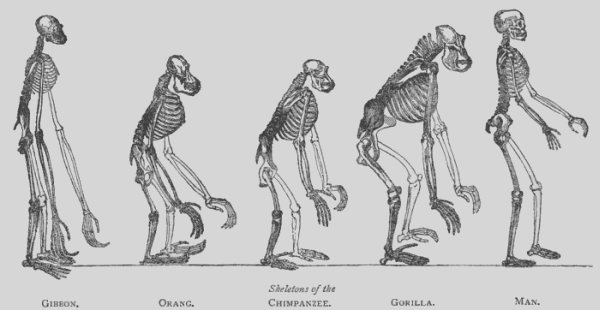
Thus Hylobates is as much longer in the arms than the
Gorilla, as the Gorilla is longer in the arms than Man;
while, on the other hand, it is as much longer in the legs
than the Man, as the Man is longer in the legs than the
Gorilla, so that it contains within itself the extremest
deviations from the average length of both pairs of limbs
(see the Frontispiece).
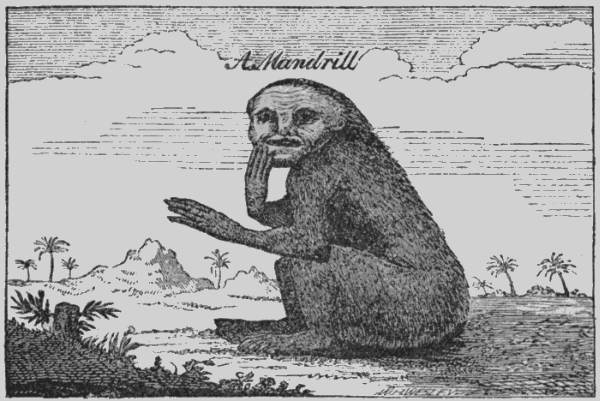
The Mandrill presents a middle condition, the arms
and legs being nearly equal in length, and both being
shorter than the spinal column; while hand and foot
have nearly the same proportions to one another and to
the spine, as in Man.
In the Spider monkey (Ateles) the leg is longer than
the spine, and the arm than the leg; and, finally, in that
remarkable Lemurine form, the Indri (Lichanotus), the
leg is about as long as the spinal column, while the arm
is not more than 11⁄18ths of its length; the hand having rather
less and the foot rather more, than one-third the length of
the spinal column.
These examples might be greatly multiplied, but they
suffice to show that, in whatever proportion of its limbs
the Gorilla differs from Man, the other Apes depart still
more widely from the Gorilla, and that, consequently,
such differences of proportion can have no ordinal
value.
We may next consider the differences presented by the
trunk, consisting of the vertebral column, or backbone,
and the ribs and pelvis, or bony hip-basin, which are connected
with it, in Man and in the Gorilla respectively.
In Man, in consequence partly of the disposition of
the articular surfaces of the vertebræ, and largely of the
elastic tension of some of the fibrous bands, or ligaments,
which connect these vertebræ together, the spinal column,
as a whole, has an elegant S-like curvature, being convex
forwards in the neck, concave in the back, convex in the
loins, or lumbar region, and concave again in the sacral
region; an arrangement which gives much elasticity to the
whole backbone, and diminishes the jar communicated to
the spine, and through it to the head, by locomotion in
the erect position.
Furthermore, under ordinary circumstances, Man has
seven vertebræ in his neck, which are called cervical;
twelve succeed these, bearing ribs and forming the upper
part of the back, whence they are termed dorsal; five lie
in the loins, bearing no distinct, or free, ribs, and are
called lumbar; five, united together into a great bone,
excavated in front, solidly wedged in between the hip
bones, to form the back of the pelvis, and known by the
name of the sacrum, succeed these; and finally, three or
four little more or less moveable bones, so small as to be
insignificant, constitute the coccyx or rudimentary tail.
In the Gorilla, the vertebral column is similarly divided
into cervical, dorsal, lumbar, sacral and coccygeal vertebræ,
and the total number of cervical and dorsal vertebræ,
taken together, is the same as in Man; but the development
of a pair of ribs to the first lumbar vertebra, which
is an exceptional occurrence in Man, is the rule in the
Gorilla; and hence, as lumbar are distinguished from
dorsal vertebræ only by the presence or absence of free
ribs, the seventeen “dorso-lumbar” vertebræ of the
Gorilla are divided into thirteen dorsal and four lumbar,
while in Man they are twelve dorsal and five lumbar.
Not only, however, does Man occasionally possess
thirteen pair of ribs,[27] but the Gorilla sometimes has
fourteen pairs, while an Orang-Utan skeleton in the
Museum of the Royal College of Surgeons has twelve
dorsal and five lumbar vertebræ, as in Man. Cuvier
notes the same number in a Hylobates. On the other
hand, among the lower Apes, many possess twelve dorsal
and six or seven lumbar vertebræ; the Douroucouli has
fourteen dorsal and eight lumbar, and a Lemur (Stenops
tardigradus) has fifteen dorsal and nine lumbar vertebræ.
The vertebral column of the Gorilla, as a whole, differs
from that of Man in the less marked character of its
curves, especially in the slighter convexity of the lumbar
region. Nevertheless, the curves are present, and are
quite obvious in young skeletons of the Gorilla and
Chimpanzee which have been prepared without removal
of the ligaments. In young Orangs similarly preserved,
on the other hand, the spinal column is either straight, or
even concave forwards, throughout the lumbar region.
Whether we take these characters then, or such minor
ones as those which are derivable from the proportional
length of the spines of the cervical vertebræ, and the
like, there is no doubt whatsoever as to the marked
difference between Man and the Gorilla; but there is as
little, that equally marked differences, of the very same
order, obtain between the Gorilla and the lower apes.
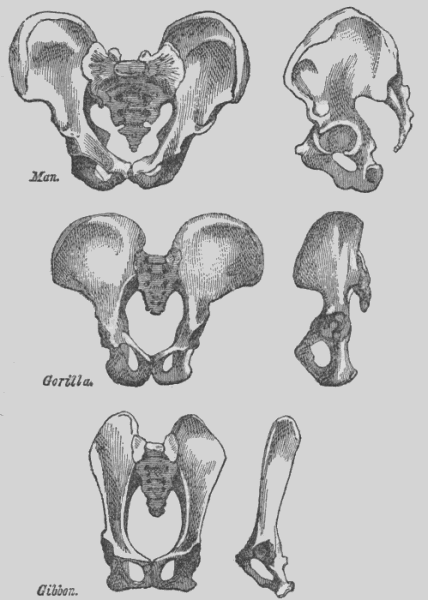 Fig. 15.—Front and side views of the bony pelvis of Man, the Gorilla
and Gibbon: reduced from drawings made from nature, of the
same absolute length, by Mr. Waterhouse Hawkins.
Fig. 15.—Front and side views of the bony pelvis of Man, the Gorilla
and Gibbon: reduced from drawings made from nature, of the
same absolute length, by Mr. Waterhouse Hawkins.
The Pelvis, or bony girdle of the hips, of Man is a
strikingly human part of his organization; the expanded
haunch bones affording support for his viscera during his
habitually erect posture, and giving space for the attachment
of the great muscles which enable him to assume
and to preserve that attitude. In these respects the
pelvis of the Gorilla differs very considerably from his
(Fig. 15). But go no lower than the Gibbon, and see
how vastly more he differs from the Gorilla than the
latter does from Man, even in this structure. Look at
the flat, narrow haunch bones—the long and narrow
passage—the coarse, outwardly curved, ischiatic prominences
on which the Gibbon habitually rests, and which
are coated by the so-called “callosities,” dense patches
of skin, wholly absent in the Gorilla, in the Chimpanzee,
and in the Orang, as in Man!
In the lower Monkeys and in the Lemurs the difference
becomes more striking still, the pelvis acquiring an
altogether quadrupedal character.
But now let us turn to a nobler and more characteristic
organ—that by which the human frame seems to be, and
indeed is, so strongly distinguished from all others,—I
mean the skull. The differences between a Gorilla’s
skull and a Man’s are truly immense (Fig. 16). In the
former, the face, formed largely by the massive jaw-bones,
predominates over the brain case, or cranium proper:
in the latter, the proportions of the two are reversed. In
the Man, the occipital foramen, through which passes the
great nervous cord connecting the brain with the nerves
of the body, is placed just behind the centre of the base
of the skull, which thus becomes evenly balanced in the
erect posture; in the Gorilla, it lies in the posterior third
of that base. In the Man, the surface of the skull is
comparatively smooth, and the supraciliary ridges or
brow prominences usually project but little—while, in
the Gorilla, vast crests are developed upon the skull, and
the brow ridges overhang the cavernous orbits, like great
penthouses.
Sections of the skulls, however, show that some of the
apparent defects of the Gorilla’s cranium arise, in fact, not
so much from deficiency of brain case as from excessive
development of the parts of the face. The cranial cavity
is not ill-shaped, and the forehead is not truly flattened
or very retreating, its really well-formed curve being
simply disguised by the mass of bone which is built
up against it (Fig. 16).
But the roofs of the orbits rise more obliquely into the
cranial cavity, thus diminishing the space for the lower
part of the anterior lobes of the brain, and the absolute
capacity of the cranium is far less than that of Man. So
far as I am aware, no human cranium belonging to an
adult man has yet been observed with a less cubical
capacity than 62 cubic inches, the smallest cranium
observed in any race of men by Morton, measuring 63
cubic inches; while, on the other hand, the most capacious
Gorilla skull yet measured has a content of not
more than 341⁄2 cubic inches. Let us assume, for simplicity’s
sake, that the lowest Man’s skull has twice the
capacity of that of the highest Gorilla.[28]
No doubt, this is a very striking difference, but it loses
much of its apparent systematic value, when viewed by
the light of certain other equally indubitable facts respecting
cranial capacities.
The first of these is, that the difference in the volume
of the cranial cavity of different races of mankind is far
greater, absolutely, than that between the lowest Man and
the highest Ape, while, relatively, it is about the same. For
the largest human skull measured by Morton contained
114 cubic inches, that is to say, had very nearly double
the capacity of the smallest; while its absolute preponderance,
of 52 cubic inches—is far greater than that by
which the lowest adult male human cranium surpasses
the largest of the Gorillas (62-341⁄2; = 2711⁄2). Secondly,
the adult crania of Gorillas which have as yet been
measured differ among themselves by nearly one-third,
the maximum capacity being 34.5 cubic inches, the
minimum 24 cubic inches; and, thirdly, after making
all due allowance for difference of size, the cranial
capacities of some of the lower Apes fall nearly as
much, relatively, below those of the higher Apes as
the latter fall below Man.
Thus, even in the important matter of cranial capacity,
Men differ more widely from one another than they do
from the Apes; while the lowest Apes differ as much, in
proportion, from the highest, as the latter does from Man.
The last proposition is still better illustrated by the study
of the modifications which other parts of the cranium
undergo in the Simian series.
It is the large proportional size of the facial bones and
the great projection of the jaws which confers upon the
Gorilla’s skull its small facial angle and brutal character.
But if we consider the proportional size of the facial
bones to the skull proper only, the little Chrysothrix
(Fig. 16) differs very widely from the Gorilla, and in the
same way as Man does; while the Baboons (Cynocephalus,
Fig. 16) exaggerate the gross proportions of the muzzle
of the great Anthropoid, so that its visage looks mild
and human by comparison with theirs. The difference
between the Gorilla and the Baboon is even greater than
it appears at first sight; for the great facial mass of the
former is largely due to a downward development of the
jaws; an essentially human character, superadded upon
that almost purely forward, essentially brutal, development
of the same parts which characterizes the Baboon,
and yet more remarkably distinguishes the Lemur.
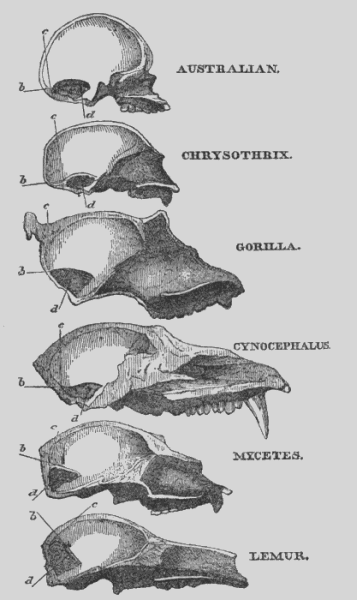 Fig. 16.—Sections of the skulls of Man and various Apes, drawn so as
to give the cerebral cavity the same length in each case, thereby
displaying the varying proportions of the facial bones. The line b
indicates the plane of the tentorium, which separates the cerebrum
from the cerebellum; d, the axis of the occipital outlet of the skull.
The extent of cerebral cavity behind c, which is a perpendicular
erected on b at the point where the tentorium is attached posteriorly,
indicates the degree to which the cerebrum overlaps the cerebellum—the
space occupied by which is roughly indicated by the dark
shading. In comparing these diagrams, it must be recollected, that
figures on so small a scale as these simply exemplify the statements
in the text, the proof of which is to be found in the objects themselves.
Fig. 16.—Sections of the skulls of Man and various Apes, drawn so as
to give the cerebral cavity the same length in each case, thereby
displaying the varying proportions of the facial bones. The line b
indicates the plane of the tentorium, which separates the cerebrum
from the cerebellum; d, the axis of the occipital outlet of the skull.
The extent of cerebral cavity behind c, which is a perpendicular
erected on b at the point where the tentorium is attached posteriorly,
indicates the degree to which the cerebrum overlaps the cerebellum—the
space occupied by which is roughly indicated by the dark
shading. In comparing these diagrams, it must be recollected, that
figures on so small a scale as these simply exemplify the statements
in the text, the proof of which is to be found in the objects themselves.
Similarly, the occipital foramen of Mycetes (Fig. 16),
and still more of the Lemurs, is situated completely in
the posterior face of the skull, or as much further back
than that of the Gorilla, as that of the Gorilla is further
back than that of Man; while, as if to render patent the
futility of the attempt to base any broad classificatory
distinction on such a character, the same group of Platyrhine,
or American monkeys, to which the Mycetes belongs,
contains the Chrysothrix, whose occipital foramen is
situated far more forward than in any other ape, and
nearly approaches the position it holds in Man.
Again, the Orang’s skull is as devoid of excessively
developed supraciliary prominences as a Man’s, though
some varieties exhibit great crests elsewhere (see p. 39);
and in some of the Cebine Apes and in the Chrysothrix,
the cranium is as smooth and rounded as that of Man
himself.
What is true of these leading characteristics of the
skull, holds good, as may be imagined, of all minor
features; so that for every constant difference between
the Gorilla’s skull and the Man’s, a similar constant difference
of the same order (that is to say, consisting in
excess or defect of the same quality) may be found
between the Gorilla’s skull and that of some other ape.
So that, for the skull, no less than for the skeleton in
general, the proposition holds good, that the differences
between Man and the Gorilla are of smaller value than
those between the Gorilla and some other Apes.
In connection with the skull, I may speak of the teeth—organs
which have a peculiar classificatory value, and
whose resemblances and differences of number, form, and
succession, taken as a whole, are usually regarded as more
trustworthy indicators of affinity than any others.
Man is provided with two sets of teeth—milk teeth and
permanent teeth. The former consist of four incisors, or
cutting teeth; two canines, or eye-teeth; and four molars,
or grinders, in each jaw—making twenty in all. The
latter (Fig. 17) comprise four incisors, two canines, four
small grinders, called premolars or false molars, and six
large grinders, or true molars, in each jaw—making thirty-two
in all. The internal incisors are larger than the
external pair, in the upper jaw, smaller than the external
pair, in the lower jaw. The crowns of the upper molars
exhibit four cusps, or blunt-pointed elevations, and a
ridge crosses the crown obliquely, from the inner, anterior,
cusp to the outer, posterior cusp (Fig. 17 m2). The
anterior lower molars have five cusps, three external and
two internal. The premolars have two cusps, one internal
and one external, of which the outer is the higher.
In all these respects the dentition of the Gorilla may be
described in the same terms as that of Man; but in other
matters it exhibits many and important differences (Fig. 17).
Thus the teeth of man constitute a regular and even
series—without any break and without any marked projection
of one tooth above the level of the rest; a peculiarity
which, as Cuvier long ago showed, is shared by no
other mammal save one—as different a creature from
man as can well be imagined—namely, the long extinct
Anoplotherium. The teeth of the Gorilla, on the contrary,
exhibit a break, or interval, termed the diastema, in both
jaws: in front of the eye-tooth, or between it and the
outer incisor, in the upper jaw; behind the eye-tooth, or
between it and the front false molar, in the lower jaw.
Into this break in the series, in each jaw, fits the canine
of the opposite jaw; the size of the eye-tooth in the
Gorilla being so great that it projects, like a tusk, far
beyond the general level of the other teeth. The roots of
the false molar teeth of the Gorilla, again, are more complex
than in Man, and the proportional size of the molars
is different. The Gorilla has the crown of the hindmost
grinder of the lower jaw more complex, and the order
of eruption of the permanent teeth is different; the permanent
canines making their appearance before the second
and third molars in Man, and after them in the Gorilla.
Thus, while the teeth of the Gorilla closely resemble
those of Man in number, kind, and in the general pattern
of their crowns, they exhibit marked differences from
those of Man in secondary respects, such as relative size,
number of fangs, and order of appearance.
But, if the teeth of the Gorilla be compared with those
of an Ape, no further removed from it than a Cynocephalus,
or Baboon, it will be found that differences and
resemblances of the same order are easily observable;
but that many of the points in which the Gorilla resembles
Man are those in which it differs from the Baboon; while
various respects in which it differs from Man are exaggerated
in the Cynocephalus. The number and the nature
of the teeth remain the same in the Baboon as in the
Gorilla and in Man. But the pattern of the Baboon’s
upper molars is quite different from that described above
(Fig. 17), the canines are proportionally longer and more
knife-like; the anterior premolar in the lower jaw is
specially modified; the posterior molar of the lower jaw
is still larger and more complex than in the Gorilla.
Passing from the old-world Apes to those of the new
world, we meet with a change of much greater importance
than any of these. In such a genus as Cebus, for example
(Fig. 17), it will be found that while in some secondary
points, such as the projection of the canines and the
diastema, the resemblance to the great ape is preserved;
in other and most important respects, the dentition is
extremely different. Instead of 20 teeth in the milk
set, there are 24: instead of 32 teeth in the permanent
set, there are 36, the false molars being increased
from eight to twelve. And in form, the crowns of the
molars are very unlike those of the Gorilla, and differ far
more widely from the human pattern.
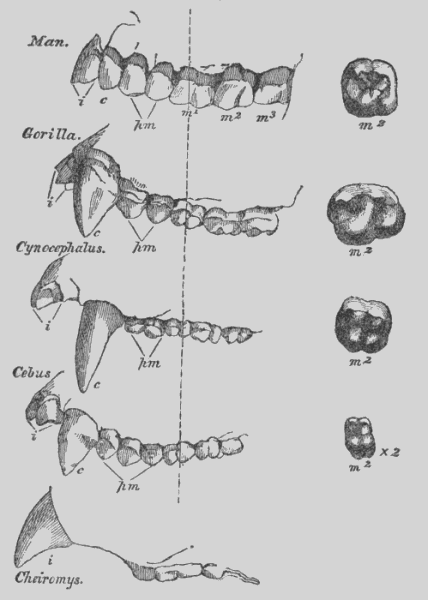 Fig. 17.—Lateral views, of the same length, of the upper jaws of
various Primates. i, incisors; c, canines; pm, premolars; m,
molars. A line is drawn through the first molar of Man, Gorilla,
Cynocephalus, and Cebus, and the grinding surface of the second
molar is shown in each, its anterior and internal angle being just
above the m of m2.
Fig. 17.—Lateral views, of the same length, of the upper jaws of
various Primates. i, incisors; c, canines; pm, premolars; m,
molars. A line is drawn through the first molar of Man, Gorilla,
Cynocephalus, and Cebus, and the grinding surface of the second
molar is shown in each, its anterior and internal angle being just
above the m of m2.
The Marmosets, on the other hand, exhibit the same
number of teeth as Man and the Gorilla; but, notwithstanding
this, their dentition is very different, for they
have four more false molars, like the other American
monkeys—but as they have four fewer true molars, the
total remains the same. And passing from the American
Apes to the Lemurs, the dentition becomes still more completely
and essentially different from that of the Gorilla.
The incisors begin to vary both in number and in form.
The molars acquire, more and more, a many-pointed,
insectivorous character, and in one Genus, the Aye-Aye
(Cheiromys), the canines disappear, and the teeth completely
simulate those of a Rodent (Fig. 17).
Hence it is obvious that, greatly as the dentition of the
highest Ape differs from that of Man, it differs far more
widely from that of the lower and lowest Apes.
Whatever part of the animal fabric—whatever series
of muscles, whatever viscera might be selected for comparison—the
result would be the same—the lower Apes
and the Gorilla would differ more than the Gorilla and
the Man. I cannot attempt in this place to follow out
all these comparisons in detail, and indeed it is unnecessary
I should do so. But certain real, or supposed,
structural distinctions between man and the apes remain,
upon which so much stress has been laid, that they require
careful consideration, in order that the true value
may be assigned to those which are real, and the emptiness
of those which are fictitious may be exposed. I refer
to the characters of the hand, the foot, and the brain.
Man has been defined as the only animal possessed of
two hands terminating his fore-limbs, and of two feet ending
his hind limbs, while it has been said that all the apes
possess four hands; and he has been affirmed to differ
fundamentally from all the apes in the characters of his
brain, which alone, it has been strangely asserted and
re-asserted, exhibits the structures known to anatomists
as the posterior lobe, the posterior cornu of the lateral
ventricle, and the hippocampus minor.
That the former proposition should have gained general
acceptance is not surprising—indeed, at first sight, appearances
are much in its favour: but, as for the second, one
can only admire the surpassing courage of its enunciator,
seeing that it is an innovation which is not only opposed
to generally and justly accepted doctrines, but which is
directly negatived by the testimony of all original inquirers,
who have specially investigated the matter: and that it
neither has been, nor can be, supported by a single anatomical
preparation. It would, in fact, be unworthy of
serious refutation, except for the general and natural belief
that deliberate and reiterated assertions must have some
foundation.
Before we can discuss the first point with advantage we
must consider with some attention, and compare together,
the structure of the human hand and that of the human
foot, so that we may have distinct and clear ideas of what
constitutes a hand and what a foot.
The external form of the human hand is familiar enough
to every one. It consists of a stout wrist followed by a
broad palm, formed of flesh, and tendons, and skin, binding
together four bones, and dividing into four long and
flexible digits, or fingers, each of which bears on the back
of its last joint a broad and flattened nail. The longest
cleft between any two digits is rather less than half as
long as the hand. From the outer side of the base of the
palm a stout digit goes off, having only two joints instead
of three; so short, that it only reaches to a little beyond
the middle of the first joint of the finger next it; and
further remarkable by its great mobility, in consequence of
which it can be directed outwards, almost at a right angle
to the rest. This digit is called the “pollex,” or thumb;
and, like the others, it bears a flat nail upon the back of
its terminal joint. In consequence of the proportions
and mobility of the thumb, it is what is termed “opposable”;
in other words, its extremity can, with the greatest
ease, be brought into contact with the extremities of any
of the fingers; a property upon which the possibility of
our carrying into effect the conceptions of the mind so
largely depends.
The external form of the foot differs widely from that
of the hand; and yet, when closely compared, the two
present some singular resemblances. Thus the ankle
corresponds in a manner with the wrist; the sole with
the palm; the toes with the fingers; the great toe with
the thumb. But the toes, or digits of the foot, are far
shorter in proportion than the digits of the hand, and are
less moveable, the want of mobility being most striking
in the great toe—which, again, is very much larger in proportion
to the other toes than the thumb to the fingers.
In considering this point, however, it must not be forgotten
that the civilized great toe, confined and cramped
from childhood upwards, is seen to a great disadvantage,
and that in uncivilized and barefooted people it retains a
great amount of mobility, and even some sort of opposability.
The Chinese boatmen are said to be able to pull
an oar, the artisans of Bengal to weave, and the Carajas
to steal fishhooks, by its help; though, after all, it must
be recollected that the structure of its joints and the
arrangement of its bones, necessarily render its prehensile
action far less perfect than that of the thumb.
But to gain a precise conception of the resemblances
and differences of the hand and foot, and of the distinctive
characters of each, we must look below the skin, and
compare the bony framework and its motor apparatus in
each (Fig. 18).
The skeleton of the hand exhibits, in the region which
we term the wrist, and which is technically called the
carpus—two rows of closely fitted polygonal bones, four in
each row, which are tolerably equal in size. The bones
of the first row with the bones of the forearm form the
wrist joint, and are arranged side by side, no one greatly
exceeding or over-lapping the rest.
The four bones of the second row of the carpus bear
the four long bones which support the palm of the hand.
The fifth bone of the same character is articulated in a
much more free and moveable manner than the others,
with its carpal bone, and forms the base of the thumb.
These are called metacarpal bones, and they carry the
phalanges, or bones of the digits, of which there are two
in the thumb, and three in each of the fingers.
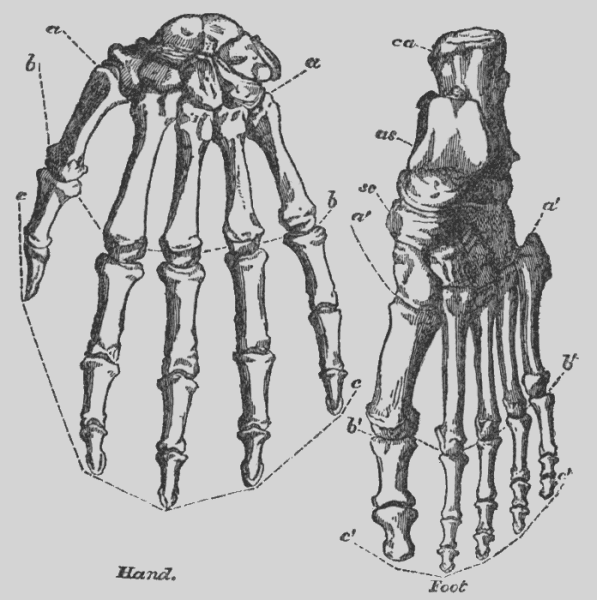 Fig. 18.—The skeleton of the Hand and Foot of Man reduced from Dr.
Carter’s drawings in Gray’s “Anatomy.” The hand is drawn to a
larger scale than the foot. The line a a in the hand indicates the
boundary between the carpus and the metacarpus; b b that between
the latter and the proximal phalanges; c c marks the ends of the
distal phalanges. The line a′ a′ in the foot indicates the boundary
between the tarsus and metatarsus; b′ b′ marks that between the
metatarsus and the proximal phalanges; and c′ c′ bounds the ends
of the distal phalanges; ca, the calcaneum; as, the astragalus; sc,
the scaphoid bone in the tarsus.
Fig. 18.—The skeleton of the Hand and Foot of Man reduced from Dr.
Carter’s drawings in Gray’s “Anatomy.” The hand is drawn to a
larger scale than the foot. The line a a in the hand indicates the
boundary between the carpus and the metacarpus; b b that between
the latter and the proximal phalanges; c c marks the ends of the
distal phalanges. The line a′ a′ in the foot indicates the boundary
between the tarsus and metatarsus; b′ b′ marks that between the
metatarsus and the proximal phalanges; and c′ c′ bounds the ends
of the distal phalanges; ca, the calcaneum; as, the astragalus; sc,
the scaphoid bone in the tarsus.
The skeleton of the foot is very like that of the hand in
some respects. Thus there are three phalanges in each
of the lesser toes, and only two in the great toe, which
answers to the thumb. There is a long bone, termed
metatarsal, answering to the metacarpal, for each digit;
and the tarsus, which corresponds with the carpus, presents
four short polygonal bones in a row, which correspond
very closely with the four carpal bones of the second row
of the hand. In other respects the foot differs very widely
from the hand. Thus the great toe is the longest digit
but one; and its metatarsal is far less moveably articulated
with the tarsus, than the metacarpal of the thumb with
the carpus. But a far more important distinction lies in
the fact that, instead of four more tarsal bones there are
only three; and that these three are not arranged side by
side, or in one row. One of them, the os calcis or heel
bone (ca), lies externally, and sends back the large projecting
heel; another, the astragalus (as), rests on this
by one face, and by another, forms, with the bones of the
leg, the ankle joint; while a third face, directed forwards,
is separated from the three inner tarsal bones of the row
next the metatarsus by a bone called the scaphoid (sc).
Thus there is a fundamental difference in the structure
of the foot and the hand, observable when the carpus and
the tarsus are contrasted; and there are differences of
degree noticeable when the proportions and the mobility
of the metacarpals and metatarsals, with their respective
digits, are compared together.
The same two classes of differences become obvious
when the muscles of the hand are compared with those
of the foot.
Three principal sets of muscles, called “flexors,” bend
the fingers and thumb, as in clenching the fist, and three
sets—the extensors—extend them, as in straightening the
fingers. These muscles are all “long muscles”; that is
to say, the fleshy part of each, lying in and being fixed to
the bones of the arm, is, at the other end, continued into
tendons, or rounded cords, which pass into the hand, and
are ultimately fixed to the bones which are to be moved.
Thus, when the fingers are bent, the fleshy parts of the
flexors of the fingers, placed in the arm, contract, in
virtue of their peculiar endowment as muscles; and pulling
the tendinous cords, connected with their ends, cause
them to pull down the bones of the fingers towards the
palm.
Not only are the principal flexors of the fingers and of
the thumb long muscles, but they remain quite distinct
from one another throughout their whole length.
In the foot, there are also three principal flexor muscles
of the digits or toes, and three principal extensors; but
one extensor and one flexor are short muscles; that is to
say, their fleshy parts are not situated in the leg (which
corresponds with the arm), but in the back and in the
sole of the foot—regions which correspond with the back
and the palm of the hand.
Again, the tendons of the long flexor of the toes, and
of the long flexor of the great toe, when they reach the
sole of the foot, do not remain distinct from one another,
as the flexors in the palm of the hand do, but they become
united and commingled in a very curious manner—while
their united tendons receive an accessory muscle connected
with the heel-bone.
But perhaps the most absolutely distinctive character
about the muscles of the foot is the existence of what is
termed the peronæus longus, a long muscle fixed to the
outer bone of the leg, and sending its tendon to the
outer ankle, behind and below which it passes, and then
crosses the foot obliquely to be attached to the base of
the great toe. No muscle in the hand exactly corresponds
with this, which is eminently a foot muscle.
To resume—the foot of man is distinguished from his
hand by the following absolute anatomical differences:—
1. By the arrangement of the tarsal bones.
2. By having a short flexor and a short extensor muscle of the digits.
3. By possessing the muscle termed peronæus longus.
And if we desire to ascertain whether the terminal
division of a limb, in other Primates, is to be called a
foot or a hand, it is by the presence or absence of these
characters that we must be guided, and not by the mere
proportions and greater or lesser mobility of the great
toe, which may vary indefinitely without any fundamental
alteration in the structure of the foot.
Keeping these considerations in mind, let us now turn
to the limbs of the Gorilla. The terminal division of the
fore-limb presents no difficulty—bone for bone and muscle
for muscle, are found to be arranged essentially as in man,
or with such minor differences as are found as varieties in
man. The Gorilla’s hand is clumsier, heavier, and has a
thumb somewhat shorter in proportion than that of man;
but no one has ever doubted its being a true hand.
At first sight, the termination of the hind limb of the
Gorilla looks very hand-like, and as it is still more so in
many of the lower apes, it is not wonderful that the
appellation “Quadrumana,” or four-handed creatures,
adopted from the older anatomists[29] by Blumenbach,
and unfortunately rendered current by Cuvier, should have
gained such wide acceptance as a name for the Simian
group. But the most cursory anatomical investigation
at once proves that the resemblance of the so-called
“hind hand” to a true hand, is only skin deep, and that,
in all essential respects, the hind limb of the Gorilla is
as truly terminated by a foot as that of man. The tarsal
bones, in all important circumstances of number, disposition,
and form, resemble those of man (Fig. 19). The
metatarsals and digits, on the other hand, are proportionally
longer and more slender, while the great toe is not
only proportionally shorter and weaker, but its metatarsal
bone is united by a more moveable joint with the tarsus.
At the same time, the foot is set more obliquely upon
the leg than in man.
As to the muscles, there is a short flexor, a short
extensor, and a peronæus longus, while the tendons of
the long flexors of the great toe and of the other toes are
united together and with an accessory fleshy bundle.
The hind limb of the Gorilla, therefore, ends in a true
foot, with a very moveable great toe. It is a prehensile
foot, indeed, but is in no sense a hand: it is a foot which
differs from that of man not in any fundamental character,
but in mere proportions, in the degree of mobility,
and in the secondary arrangement of its parts.
It must not be supposed, however, because I speak
of these differences as not fundamental, that I wish to
underrate their value. They are important enough in
their way, the structure of the foot being in strict correlation
with that of the rest of the organism in each case.
Nor can it be doubted that the greater division of physiological
labour in Man, so that the function of support
is thrown wholly on the leg and foot, is an advance in
organization of very great moment to him; but, after all,
regarded anatomically, the resemblances between the foot
of Man and the foot of the Gorilla are far more striking
and important than the differences.
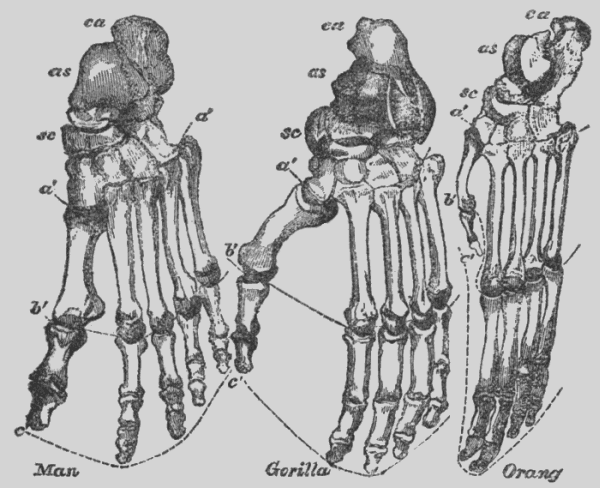 Fig. 19.—Foot of Man, Gorilla, and Orang-Utan of the same absolute
length, to show the differences in proportion of each. Letters as
in Fig. 18. Reduced from original drawings by Mr. Waterhouse
Hawkins.
Fig. 19.—Foot of Man, Gorilla, and Orang-Utan of the same absolute
length, to show the differences in proportion of each. Letters as
in Fig. 18. Reduced from original drawings by Mr. Waterhouse
Hawkins.
I have dwelt upon this point at length, because it is
one regarding which much delusion prevails; but I might
have passed it over without detriment to my argument,
which only requires me to show that, be the differences
between the hand and foot of Man and those of the
Gorilla what they may—the differences between those
of the Gorilla and those of the lower Apes are much
greater.
It is not necessary to descend lower in the scale than
the Orang for conclusive evidence on this head.
The thumb of the Orang differs more from that of the
Gorilla than the thumb of the Gorilla differs from that of
Man, not only by its shortness, but by the absence of any
special long flexor muscle. The carpus of the Orang, like
that of most lower apes, contains nine bones, while in the
Gorilla, as in Man and the Chimpanzee, there are only
eight.
The Orang’s foot (Fig. 19) is still more aberrant; its
very long toes and short tarsus, short great toe, short and
raised heel, great obliquity of articulation in the leg, and
absence of a long flexor tendon to the great toe, separating
it far more widely from the foot of the Gorilla than
the latter is separated from that of Man.
But, in some of the lower apes, the hand and foot
diverge still more from those of the Gorilla, than they do
in the Orang. The thumb ceases to be opposable in
the American monkeys; is reduced to a mere rudiment
covered by the skin in the Spider Monkey; and
is directed forwards and armed with a curved claw like
the other digits, in the Marmosets—so that, in all these
cases, there can be no doubt but that the hand is more
different from that of the Gorilla than the Gorilla’s hand
is from Man’s.
And as to the foot, the great toe of the Marmoset is
still more insignificant in proportion than that of the
Orang—while in the Lemurs it is very large, and as
completely thumb-like and opposable as in the Gorilla—but
in these animals the second toe is often irregularly
modified, and in some species the two principal bones
of the tarsus, the astragalus and the os calcis, are so
immensely elongated as to render the foot, so far, totally
unlike that of any other mammal.
So with regard to the muscles. The short flexor of the
toes of the Gorilla differs from that of Man by the circumstance
that one slip of the muscle is attached, not to the
heel bone, but to the tendons of the long flexors. The
lower Apes depart from the Gorilla by an exaggeration of
the same character, two, three, or more, slips becoming
fixed to the long flexor tendons—or by a multiplication
of the slips.—Again, the Gorilla differs slightly from Man
in the mode of interlacing of the long flexor tendons:
and the lower apes differ from the Gorilla in exhibiting
yet other, sometimes very complex, arrangements of the
same parts, and occasionally in the absence of the accessory
fleshy bundle.
Throughout all these modifications it must be recollected
that the foot loses no one of its essential characters.
Every Monkey and Lemur exhibits the characteristic
arrangement of tarsal bones, possesses a short flexor and
short extensor muscle, and a peronæus longus. Varied
as the proportions and appearance of the organ may be,
the terminal division of the hind limb remains, in plan
and principle of construction, a foot, and never, in those
respects, can be confounded with a hand.
Hardly any part of the bodily frame, then, could be
found better calculated to illustrate the truth that the
structural differences between Man and the highest Ape
are of less value than those between the highest and the
lower Apes, than the hand or the foot, and yet, perhaps,
there is one organ the study of which enforces the same
conclusion in a still more striking manner—and that is
the Brain.
But before entering upon the precise question of the
amount of difference between the Ape’s brain and that
of Man, it is necessary that we should clearly understand
what constitutes a great, and what a small difference in
cerebral structure; and we shall be best enabled to do
this by a brief study of the chief modifications which the
brain exhibits in the series of vertebrate animals.
The brain of a fish is very small, compared with the
spinal cord into which it is continued, and with the
nerves which come off from it: of the segments of
which it is composed—the olfactory lobes, the cerebral
hemisphere, and the succeeding divisions—no one predominates
so much over the rest as to obscure or cover
them; and the so-called optic lobes are, frequently, the
largest masses of all. In Reptiles, the mass of the brain,
relatively to the spinal cord, increases and the cerebral
hemispheres begin to predominate over the other parts;
while in Birds this predominance is still more marked.
The brain of the lowest Mammals, such as the duck-billed
Platypus and the Opossums and Kangaroos, exhibits
a still more definite advance in the same direction.
The cerebral hemispheres have now so much increased
in size as, more or less, to hide the representatives of the
optic lobes, which remain comparatively small, so that
the brain of a Marsupial is extremely different from that
of a Bird, Reptile, or Fish. A step higher in the scale,
among the placental Mammals, the structure of the brain
acquires a vast modification—not that it appears much
altered externally, in a Rat or in a Rabbit, from what it
is in a Marsupial—nor that the proportions of its parts
are much changed, but an apparently new structure is
found between the cerebral hemispheres, connecting
them together, as what is called the “great commissure”
or “corpus callosum.” The subject requires careful re-investigation,
but if the currently received statements are
correct, the appearance of the “corpus callosum” in the
placental mammals is the greatest and most sudden
modification exhibited by the brain in the whole series
of vertebrated animals—it is the greatest leap anywhere
made by Nature in her brain work. For the two halves
of the brain being once thus knit together, the progress
of cerebral complexity is traceable through a complete
series of steps from the lowest Rodent, or Insectivore, to
Man; and that complexity consists, chiefly, in the disproportionate
development of the cerebral hemispheres and
of the cerebellum, but especially of the former, in respect
to the other parts of the brain.
In the lower placental mammals, the cerebral hemispheres
leave the proper upper and posterior face of the
cerebellum completely visible, when the brain is viewed
from above, but, in the higher forms, the hinder part of
each hemisphere, separated only by the tentorium (p. 92)
from the anterior face of the cerebellum, inclines backwards
and downwards, and grows out, as the so-called
“posterior lobe,” so as at length to overlap and hide the
cerebellum. In all Mammals, each cerebral hemisphere
contains a cavity which is termed the “ventricle,” and as
this ventricle is prolonged, on the one hand, forwards,
and on the other downwards, into the substance of the
hemisphere, it is said to have two horns or “cornua,” an
“anterior cornu,” and a “descending cornu.” When the
posterior lobe is well developed, a third prolongation of
the ventricular cavity extends into it, and is called the
“posterior cornu.”
In the lower and smaller forms of placental Mammals
the surface of the cerebral hemispheres is either smooth
or evenly rounded, or exhibits a very few grooves, which
are technically termed “sulci,” separating ridges or “convolutions”
of the substance of the brain; and the smaller
species of all orders tend to a similar smoothness of
brain. But, in the higher orders, and especially the
larger members of these orders, the grooves, or sulci,
become extremely numerous, and the intermediate convolutions
proportionately more complicated in their
meanderings, until, in the Elephant, the Porpoise, the
higher Apes, and Man, the cerebral surface appears a
perfect labyrinth of tortuous foldings.
Where a posterior lobe exists and presents its customary
cavity—the posterior cornu—it commonly happens that a
particular sulcus appears upon the inner and under surface
of the lobe, parallel with and beneath the floor of
the cornu—which is, as it were, arched over the roof of
the sulcus. It is as if the groove had been formed by
indenting the floor of the posterior horn from without
with a blunt instrument, so that the floor should rise as a
convex eminence. Now this eminence is what has been
termed the “Hippocampus minor”; the “Hippocampus
major” being a larger eminence in the floor of the descending
cornu. What may be the functional importance
of either of these structures we know not.
As if to demonstrate, by a striking example, the impossibility
of erecting any cerebral barrier between man and
the apes, Nature has provided us, in the latter animals,
with an almost complete series of gradations from brains
little higher than that of a Rodent, to brains little lower
than that of Man. And it is a remarkable circumstance
that though, so far as our present knowledge extends,
there is one true structural break in the series of forms of
Simian brains, this hiatus does not lie between Man and
the man-like Apes, but between the lower and the lowest
Simians; or, in other words, between the old and new
world apes and monkeys, and the Lemurs. Every Lemur
which has yet been examined, in fact, has its cerebellum
partially visible from above, and its posterior lobe, with
the contained posterior cornu and hippocampus minor,
more or less rudimentary. Every Marmoset, American
monkey, old world monkey, Baboon, or Man-like ape,
on the contrary, has its cerebellum entirely hidden, posteriorly,
by the cerebral lobes, and possesses a large
posterior cornu, with a well-developed hippocampus
minor.
In many of these creatures, such as the Saimiri
(Chrysothrix), the cerebral lobes overlap and extend
much further behind the cerebellum, in proportion, than
they do in man (Fig. 16)—and it is quite certain that, in
all, the cerebellum is completely covered behind, by well-developed
posterior lobes. The fact can be verified by
every one who possesses the skull of any old or new
world monkey. For, inasmuch as the brain in all
mammals completely fills the cranial cavity, it is obvious
that a cast of the interior of the skull will reproduce the
general form of the brain, at any rate with such minute
and, for the present purpose, utterly unimportant differences
as may result from the absence of the enveloping
membranes of the brain in the dry skull. But if such a
cast be made in plaster, and compared with a similar cast
of the interior of a human skull, it will be obvious that
the cast of the cerebral chamber, representing the cerebrum
of the ape, as completely covers over and overlaps
the cast of the cerebellar chamber, representing the
cerebellum, as it does in the man (Fig. 20). A careless
observer, forgetting that a soft structure like the brain
loses its proper shape the moment it is taken out of the
skull, may indeed mistake the uncovered condition of the
cerebellum of an extracted and distorted brain for the
natural relations of the parts; but his error must become
patent even to himself if he try to replace the brain
of an ape is naturally uncovered behind is a
miscomprehension comparable only to that of one who
should imagine that a man’s lungs always occupy but a
small portion of the thoracic cavity—because they do so
when the chest is opened, and their elasticity is no longer
neutralized by the pressure of the air.
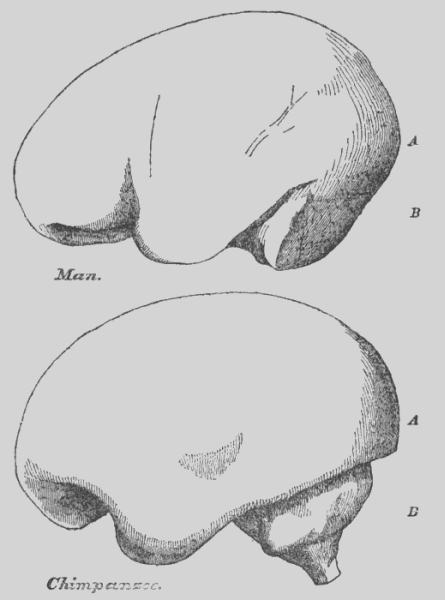 Fig. 20.—Drawings of the internal casts of a Man’s and of a Chimpanzee’s
skull, of the same absolute length, and placed in corresponding
positions, A. Cerebrum; B. Cerebellum. The former
drawing is taken from a cast in the Museum of the Royal College of
Surgeons, the latter from the photograph of the cast of a Chimpanzee’s
skull, which illustrates the paper by Mr. Marshall “On the
Brain of the Chimpanzee” in the Natural History Review for July,
1861. The sharper definition of the lower edge of the cast of the
cerebral chamber in the Chimpanzee arises from the circumstance
that the tentorium remained in that skull and not in the Man’s. The
cast more accurately represents the brain in Chimpanzee than in the
Man; and the great backward projection of the posterior lobes of
the cerebrum of the former, beyond the cerebellum, is conspicuous.
Fig. 20.—Drawings of the internal casts of a Man’s and of a Chimpanzee’s
skull, of the same absolute length, and placed in corresponding
positions, A. Cerebrum; B. Cerebellum. The former
drawing is taken from a cast in the Museum of the Royal College of
Surgeons, the latter from the photograph of the cast of a Chimpanzee’s
skull, which illustrates the paper by Mr. Marshall “On the
Brain of the Chimpanzee” in the Natural History Review for July,
1861. The sharper definition of the lower edge of the cast of the
cerebral chamber in the Chimpanzee arises from the circumstance
that the tentorium remained in that skull and not in the Man’s. The
cast more accurately represents the brain in Chimpanzee than in the
Man; and the great backward projection of the posterior lobes of
the cerebrum of the former, beyond the cerebellum, is conspicuous.
And the error is the less excusable, as it must become
apparent to every one who examines a section of the skull
of any ape above a Lemur, without taking the trouble to
make a cast of it. For there is a very marked groove in
every such skull, as in the human skull—which indicates
the line of attachment of what is termed the tentorium—a
sort of parchment-like shelf, or partition, which, in the
recent state, is interposed between the cerebrum and
cerebellum, and prevents the former from pressing upon
the latter (see Fig. 16).
This groove, therefore, indicates the line of separation
between that part of the cranial cavity which contains the
cerebrum, and that which contains the cerebellum; and
as the brain exactly fills the cavity of the skull, it is
obvious that the relations of these two parts of the cranial
cavity at once informs us of the relations of their contents.
Now in man, in all the old world, and in all the new world
Simiæ, with one exception, when the face is directed
forwards, this line of attachment of the tentorium, or
impression for the lateral sinus, as it is technically called,
is nearly horizontal, and the cerebral chamber invariably
overlaps or projects behind the cerebellar chamber. In
the Howler Monkey or Mycetes (see Fig. 16), the line
passes obliquely upwards and backwards, and the cerebral
overlap is almost nil; while in the Lemurs, as in the
lower mammals, the line is much more inclined in the
same direction, and the cerebellar chamber projects considerably
beyond the cerebral.
When the gravest errors respecting points so easily
settled as this question respecting the posterior lobes
can be authoritatively propounded, it is no wonder that
matters of observation, of no very complex character, but
still requiring a certain amount of care, should have fared
worse. Any one who cannot see the posterior lobe in an
ape’s brain is not likely to give a very valuable opinion
respecting the posterior cornu or the hippocampus minor.
If a man cannot see a church, it is preposterous to take
his opinion about its altar-piece or painted window—so
that I do not feel bound to enter upon any discussion of
these points, but content myself with assuring the reader
that the posterior cornu and the hippocampus minor, have
now been seen—usually, at least as well developed as in
man, and often better—not only in the Chimpanzee, the
Orang, and the Gibbon, but in all the genera of the old
world baboons and monkeys, and in most of the new
world forms, including the Marmosets.[30]
In fact, all the abundant and trustworthy evidence
(consisting of the results of careful investigations directed
to the determination of these very questions, by skilled
anatomists) which we now possess, leads to the conviction
that, so far from the posterior lobe, the posterior cornu,
and the hippocampus minor, being structures peculiar to
and characteristic of man, as they have been over and
over again asserted to be, even after the publication of
the clearest demonstration of the reverse, it is precisely
these structures which are the most marked cerebral
characters common to man with the apes. They are
among the most distinctly Simian peculiarities which the
human organism exhibits.
As to the convolutions, the brains of the apes exhibit
every stage of progress, from the almost smooth brain of
the Marmoset, to the Orang and the Chimpanzee, which
fall but little below Man. And it is most remarkable
that, as soon as all the principal sulci appear, the pattern
according to which they are arranged is identical with
that of the corresponding sulci of man. The surface of
the brain of a monkey exhibits a sort of skeleton map of
man’s, and in the man-like Apes the details become more
and more filled in, until it is only in minor characters,
such as the greater excavation of the anterior lobes,
the constant presence of fissures usually absent in man,
and the different disposition and proportions of some
convolutions, that the Chimpanzee’s or the Orang’s brain
can be structurally distinguished from Man’s.
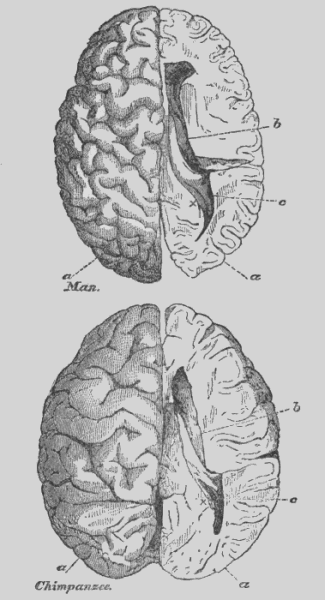 Fig. 21.—Drawings of the cerebral hemispheres of a Man and of a
Chimpanzee of the same length, in order to show the relative proportions
of the parts: the former taken from a specimen, which Mr.
Flower, Conservator of the Museum of the Royal College of Surgeons,
was good enough to dissect for me; the latter, from the photograph
of a similarly dissected Chimpanzee’s brain, given in Mr. Marshall’s
paper above referred to. a, posterior lobe; b, lateral ventricle; c,
posterior cornu; x, the hippocampus minor.
Fig. 21.—Drawings of the cerebral hemispheres of a Man and of a
Chimpanzee of the same length, in order to show the relative proportions
of the parts: the former taken from a specimen, which Mr.
Flower, Conservator of the Museum of the Royal College of Surgeons,
was good enough to dissect for me; the latter, from the photograph
of a similarly dissected Chimpanzee’s brain, given in Mr. Marshall’s
paper above referred to. a, posterior lobe; b, lateral ventricle; c,
posterior cornu; x, the hippocampus minor.
So far as cerebral structure goes, therefore, it is clear
that Man differs less from the Chimpanzee or the Orang,
than these do even from the Monkeys, and that the
difference between the brains of the Chimpanzee and of
Man is almost insignificant, when compared with that
between the Chimpanzee brain and that of a Lemur.
It must not be overlooked, however, that there is a
very striking difference in the absolute mass and weight
between the lowest human brain and that of the highest
ape—a difference which is all the more remarkable when
we recollect that a full grown Gorilla is probably pretty
nearly twice as heavy as a Bosjes man, or as many
an European woman. It may be doubted whether a
healthy human adult brain ever weighed less than
thirty-one or two ounces, or that the heaviest Gorilla
brain has exceeded twenty ounces.
This is a very noteworthy circumstance, and doubtless
will one day help to furnish an explanation of the great
gulf which intervenes between the lowest man and the
highest ape in intellectual power;[31] but it has little
systematic value, for the simple reason that, as may be
concluded from what has been already said respecting
cranial capacity, the difference in weight of brain between
the highest and the lowest men is far greater, both
relatively and absolutely, than that between the lowest
man and the highest ape. The latter, as has been seen,
is represented by, say twelve, ounces of cerebral substance
absolutely, or by 32 : 20 relatively; but as the largest
recorded human brain weighed between 65 and 66 ounces,
the former difference is represented by more than 33
ounces absolutely, or by 65 : 32 relatively. Regarded
systematically the cerebral differences, of man and apes,
are not of more than generic value—his Family distinction
resting chiefly on his dentition, his pelvis, and his lower
limbs.
Thus, whatever system of organs be studied, the comparison
of their modifications in the ape series leads to
one and the same result—that the structural differences
which separate Man from the Gorilla and the Chimpanzee
are not so great as those which separate the Gorilla from
the lower apes.
But in enunciating this important truth I must guard
myself against a form of misunderstanding, which is very
prevalent. I find, in fact, that those who endeavour to
teach what nature so clearly shows us in this matter, are
liable to have their opinions misrepresented and their
phraseology garbled, until they seem to say that the
structural differences between man and even the highest
apes are small and insignificant. Let me take this
opportunity then of distinctly asserting, on the contrary,
that they are great and significant; that every bone of a
Gorilla bears marks by which it might be distinguished
from the corresponding bone of a Man; and that, in the
present creation, at any rate, no intermediate link bridges
over the gap between Homo and Troglodytes.
It would be no less wrong than absurd to deny the
existence of this chasm; but it is at least equally wrong
and absurd to exaggerate its magnitude, and, resting on
the admitted fact of its existence, to refuse to inquire
whether it is wide or narrow. Remember, if you will,
that there is no existing link between Man and the
Gorilla, but do not forget that there is a no less sharp line
of demarcation, a no less complete absence of any transitional
form, between the Gorilla and the Orang, or the
Orang and the Gibbon. I say, not less sharp, though it
is somewhat narrower. The structural differences between
Man and the Man-like Apes certainly justify our regarding
him as constituting a family apart from them; though,
inasmuch as he differs less from them than they do from
other families of the same order, there can be no justification
for placing him in a distinct order.
And thus the sagacious foresight of the great lawgiver
of systematic zoology, Linnæus, becomes justified, and a
century of anatomical research brings us back to his conclusion,
that man is a member of the same order (for
which the Linnæan term Primates ought to be retained)
as the Apes and Lemurs. This order is now divisible
into seven families, of about equal systematic value: the
first, the Anthropini, contains Man alone; the second,
the Catarhini, embraces the old world apes; the third,
the Platyrhini, all new world apes, except the Marmosets;
the fourth, the Arctopithecini, contains the
Marmosets; the fifth, the Lemurini, the Lemurs—from
which Cheiromys should probably be excluded to form a
sixth distinct family, the Cheiromyini; while the seventh,
the Galeopithecini, contains only the flying Lemur Galeopithecus,—a
strange form which almost touches on the
Bats, as the Cheiromys puts on a rodent clothing, and the
Lemurs simulate Insectivora.
Perhaps no order of mammals presents us with so
extraordinary a series of gradations as this—leading us
insensibly from the crown and summit of the animal
creation down to creatures, from which there is but a
step, as it seems, to the lowest, smallest, and least intelligent
of the placental Mammalia. It is as if nature
herself had foreseen the arrogance of man, and with
Roman severity had provided that his intellect, by its
very triumphs, should call into prominence the slaves,
admonishing the conqueror that he is but dust.
These are the chief facts, this the immediate conclusion
from them to which I adverted in the commencement
of this Essay. The facts, I believe, cannot be disputed;
and if so, the conclusion appears to me to be inevitable.
But if Man be separated by no greater structural barrier
from the brutes than they are from one another—then it
seems to follow that if any process of physical causation
can be discovered by which the genera and families of
ordinary animals have been produced, that process of
causation is amply sufficient to account for the origin
of Man. In other words, if it could be shown that the
Marmosets, for example, have arisen by gradual modification
of the ordinary Platyrhini, or that both Marmosets
and Platyrhini are modified ramifications of a primitive
stock—then, there would be no rational ground for doubting
that man might have originated, in the one case, by
the gradual modification of a man-like ape; or, in the
othercase, as a ramification of the same primitive stock
as those apes.
At the present moment, but one such process of
physical causation has any evidence in its favour; or,
in other words, there is but one hypothesis regarding
the origin of species of animals in general which has any
scientific existence—that propounded by Mr. Darwin. For
Lamarck, sagacious as many of his views were, mingled
them with so much that was crude and even absurd, as
to neutralize the benefit which his originality might have
effected, had he been a more sober and cautious thinker;
and though I have heard of the announcement of a
formula touching “the ordained continuous becoming of
organic forms,” it is obvious that it is the first duty of a
hypothesis to be intelligible, and that a qua-quâ-versal
proposition of this kind, which may be read backwards, or
forwards, or sideways, with exactly the same amount of
signification, does not really exist, though it may seem to
do so.
At the present moment, therefore, the question of the
relation of man to the lower animals resolves itself, in
the end, into the larger question of the tenability or
untenability of Mr. Darwin’s views. But here we enter
upon difficult ground, and it behoves us to define our
exact position with the greatest care.
It cannot be doubted, I think, that Mr. Darwin has
satisfactorily proved that what he terms selection, or
selective modification, must occur, and does occur, in
nature; and he has also proved to superfluity that such
selection is competent to produce forms as distinct,
structurally, as some genera even are. If the animated
world presented us with none but structural differences,
I should have no hesitation in saying that Mr. Darwin
had demonstrated the existence of a true physical cause,
amply competent to account for the origin of living species,
and of man among the rest.
But, in addition to their structural distinctions, the
species of animals and plants, or at least a great number
of them, exhibit physiological characters—what are known
as distinct species, structurally, being for the most part
either altogether incompetent to breed one with another;
or if they breed, the resulting mule, or hybrid, is unable
to perpetuate its race with another hybrid of the same
kind.
A true physical cause is, however, admitted to be such
only on one condition—that it shall account for all the
phenomena which come within the range of its operation.
If it is inconsistent with any one phenomenon, it must be
rejected; if it fails to explain any one phenomenon, it is
so far weak, so far to be suspected; though it may have
a perfect right to claim provisional acceptance.
Now, Mr. Darwin’s hypothesis is not, so far as I am
aware, inconsistent with any known biological fact; on
the contrary, if admitted, the facts of Development, of
Comparative Anatomy, of Geographical Distribution, and
of Palæontology, become connected together, and exhibit
a meaning such as they never possessed before; and I,
for one, am fully convinced, that if not precisely true,
that hypothesis is as near an approximation to the truth
as, for example, the Copernican hypothesis was to the true
theory of the planetary motions.
But, for all this, our acceptance of the Darwinian
hypothesis must be provisional so long as one link in
the chain of evidence is wanting; and so long as all the
animals and plants certainly produced by selective breeding
from a common stock are fertile, and their progeny
are fertile with one another, that link will be wanting.
For, so long, selective breeding will not be proved to be
competent to do all that is required of it to produce
natural species.
I have put this conclusion as strongly as possible before
the reader, because the last position in which I wish to
find myself is that of an advocate for Mr. Darwin’s, or
any other views—if by an advocate is meant one whose
business it is to smooth over real difficulties, and to
persuade where he cannot convince.
In justice to Mr. Darwin, however, it must be admitted
that the conditions of fertility and sterility are very ill
understood, and that every day’s advance in knowledge
leads us to regard the hiatus in his evidence as of less
and less importance, when set against the multitude of
facts which harmonize with, or receive an explanation
from, his doctrines.
I adopt Mr. Darwin’s hypothesis, therefore, subject to
the production of proof that physiological species may be
produced by selective breeding; just as a physical philosopher
may accept the undulatory theory of light, subject
to the proof of the existence of the hypothetical ether; or
as the chemist adopts the atomic theory, subject to the
proof of the existence of atoms; and for exactly the same
reasons, namely, that it has an immense amount of primâ
facie probability; that it is the only means at present
within reach of reducing the chaos of observed facts to
order; and lastly, that it is the most powerful instrument
of investigation which has been presented to naturalists
since the invention of the natural system of classification,
and the commencement of the systematic study of
embryology.
But even leaving Mr. Darwin’s views aside, the whole
analogy of natural operations furnishes so complete and
crushing an argument against the intervention of any but
what are termed secondary causes, in the production of
all the phenomena of the universe; that, in view of the
intimate relations between Man and the rest of the living
world; and between the forces exerted by the latter and
all other forces, I can see no excuse for doubting that
all are co-ordinated terms of Nature’s great progression,
from the formless to the formed—from the inorganic to the
organic—from blind force to conscious intellect and will.
Science has fulfilled her function when she has ascertained
and enunciated truth; and were these pages addressed
to men of science only, I should now close this
essay, knowing that my colleagues have learned to respect
nothing but evidence, and to believe that their highest
duty lies in submitting to it, however it may jar against
their inclinations.
But desiring, as I do, to reach the wider circle of the
intelligent public, it would be unworthy cowardice were I
to ignore the repugnance with which the majority of my
readers are likely to meet the conclusions to which the
most careful and conscientious study I have been able to
give to this matter, has led me.
On all sides I shall hear the cry—“We are men and
women, not a mere better sort of apes, a little longer in
the leg, more compact in the foot, and bigger in brain
than your brutal Chimpanzees and Gorillas. The power
of knowledge—the conscience of good and evil—the
pitiful tenderness of human affections, raise us out of all
real fellowship with the brutes, however closely they may
seem to approximate us.”
To this I can only reply that the exclamation would be
most just and would have my own entire sympathy, if it
were only relevant. But, it is not I who seek to base
Man’s dignity upon his great toe, or insinuate that we are
lost if an Ape has a hippocampus minor. On the contrary,
I have done my best to sweep away this vanity. I
have endeavoured to show that no absolute structural line
of demarcation, wider than that between the animals
which immediately succeed us in the scale, can be drawn
between the animal world and ourselves; and I may add
the expression of my belief that the attempt to draw a
psychical distinction is equally futile, and that even the
highest faculties of feeling and of intellect begin to germinate
in lower forms of life.[32] At the same time, no one is
more strongly convinced than I am of the vastness of the
gulf between civilized man and the brutes; or is more
certain that whether from them or not, he is assuredly not
of them. No one is less disposed to think lightly of the
present dignity, or despairingly of the future hopes, of
the only consciously intelligent denizen of this world.
We are indeed told by those who assume authority in
these matters, that the two sets of opinions are incompatible,
and that the belief in the unity of origin of man and
brutes involves the brutalization and degradation of the
former. But is this really so? Could not a sensible
child confute, by obvious arguments, the shallow rhetoricians
who would force this conclusion upon us? Is it,
indeed, true, that the Poet, or the Philosopher, or the
Artist whose genius is the glory of his age, is degraded
from his high estate by the undoubted historical probability,
not to say certainty, that he is the direct descendant
of some naked and bestial savage, whose intelligence was
just sufficient to make him a little more cunning than the
Fox, and by so much more dangerous than the Tiger?
Or is he bound to howl and grovel on all fours because
of the wholly unquestionable fact, that he was once an
egg, which no ordinary power of discrimination could
distinguish from that of a Dog? Or is the philanthropist
or the saint to give up his endeavours to lead a noble
life, because the simplest study of man’s nature reveals,
at its foundations, all the selfish passions and fierce
appetites of the merest quadruped? Is mother-love
vile because a hen shows it, or fidelity base because dogs
possess it?
The common sense of the mass of mankind will answer
these questions without a moment’s hesitation. Healthy
humanity, finding itself hard pressed to escape from real
sin and degradation, will leave the brooding over speculative
pollution to the cynics and the “righteous overmuch”
who, disagreeing in everything else, unite in blind insensibility
to the nobleness of the visible world, and in
inability to appreciate the grandeur of the place Man
occupies therein.
Nay more, thoughtful men, once escaped from the
blinding influences of traditional prejudice, will find in the
lowly stock whence man has sprung, the best evidence of
the splendour of his capacities; and will discern in his long
progress through the Past, a reasonable ground of faith in
his attainment of a nobler Future.
They will remember that in comparing civilized man
with the animal world, one is as the Alpine traveller, who
sees the mountains soaring into the sky and can hardly
discern where the deep shadowed crags and roseate peaks
end, and where the clouds of heaven begin. Surely the
awe-struck voyager may be excused if, at first, he refuses
to believe the geologist, who tells him that these glorious
masses are, after all, the hardened mud of primeval seas,
or the cooled slag of subterranean furnaces—of one substance
with the dullest clay, but raised by inward forces
to that place of proud and seemingly inaccessible glory.
But the geologist is right; and due reflection on his
teachings, instead of diminishing our reverence and our
wonder, adds all the force of intellectual sublimity to the
mere æsthetic intuition of the uninstructed beholder.
And after passion and prejudice have died away, the
same result will attend the teachings of the naturalist
respecting that great Alps and Andes of the living world—Man.
Our reverence for the nobility of manhood will
not be lessened by the knowledge, that Man is, in substance
and in structure, one with the brutes; for, he alone
possesses the marvellous endowment of intelligible and
rational speech, whereby, in the secular period of his
existence, he has slowly accumulated and organized the
experience which is almost wholly lost with the cessation
of every individual life in other animals; so that now he
stands raised upon it as on a mountain top, far above the
level of his humble fellows, and transfigured from his
grosser nature by reflecting, here and there, a ray from
the infinite source of truth.
A succinct History of the Controversy respecting the
Cerebral Structure of Man and the Apes
Up to the year 1857 all anatomists of authority, who had
occupied themselves with the cerebral structure of the Apes—Cuvier,
Tiedemann, Sandifort, Vrolik, Isidore G. St. Hilaire,
Schroeder van der Kolk, Gratiolet—were agreed that
the brain of the Apes possesses a POSTERIOR LOBE.
Tiedemann, in 1825, figured and acknowledged in the text
of his “Icones,” the existence of the POSTERIOR CORNU of
the lateral ventricle in the Apes, not only under the title
of “Scrobiculus parvus loco cornu posterioris”—a fact which
has been paraded—but as “cornu posterius” (Icones, p. 54),
a circumstance which has been, as sedulously, kept in the
back ground.
Cuvier (Lecons, T. iii. p. 103) says, “the anterior or lateral
ventricles possess a digital cavity [posterior cornu] only in
Man and the Apes.... Its presence depends on that of
the posterior lobes.”
Schroeder van der Kolk and Vrolik, and Gratiolet, had also
figured and described the posterior cornu in various Apes.
As to the Hippocampus Minor Tiedemann had erroneously
asserted its absence in the Apes; but Schroeder van der
Kolk and Vrolik had pointed out the existence of what they
considered a rudimentary one in the Chimpanzee, and Gratiolet
had expressly affirmed its existence in these animals.
Such was the state of our information on these subjects in the
year 1856.
In the year 1857, however, Professor Owen, either in ignorance
of these well-known facts or else unjustifiably suppressing
them, submitted to the Linnæan Society a paper “On the
Characters, Principles of Division, and Primary Groups of
the Class Mammalia,” which was printed in the Society’s
Journal, and contains the following passage:—“In Man, the
brain presents an ascensive step in development, higher and
more strongly marked than that by which the preceding subclass
was distinguished from the one below it. Not only do
the cerebral hemispheres overlap the olfactory lobes and cerebellum,
but they extend in advance of the one and further
back than the other. The posterior development is so marked,
that anatomists have assigned to that part the character of a
third lobe; it is peculiar to the genus Homo, and equally
peculiar is the posterior horn of the lateral ventricle and the
‘hippocampus minor,’ which characterise the hind lobe of each
hemisphere.”—Journal of the Proceedings of the Linnæan
Society, Vol. ii. p. 19.
As the essay in which this passage stands had no less
ambitious an aim than the remodelling of the classification
of the Mammalia, its author might be supposed to have
written under a sense of peculiar responsibility, and to have
tested, with especial care, the statements he ventured to promulgate.
And even if this be expecting too much, hastiness,
or want of opportunity for due deliberation, cannot now be
pleaded in extenuation of any shortcomings; for the propositions
cited were repeated two years afterwards in the Reade
Lecture, delivered before so grave a body as the University
of Cambridge, in 1859.
When the assertions, which I have italicised in the above
extract, first came under my notice, I was not a little astonished
at so flat a contradiction of the doctrines current among
well-informed anatomists; but, not unnaturally imagining
that the deliberate statements of a responsible person must
have some foundation in fact, I deemed it my duty to investigate
the subject anew before the time at which it would
be my business to lecture thereupon came round. The result
of my inquiries was to prove that Mr. Owen’s three assertions,
that “the third lobe, the posterior horn of the lateral ventricle,
and the hippocampus minor,” are “peculiar to the genus
Homo,” are contrary to the plainest facts. I communicated
this conclusion to the students of my class; and then, having
no desire to embark in a controversy which could not redound
to the honour of British science, whatever its issue, I turned
to more congenial occupations.
The time speedily arrived, however, when a persistence in
this reticence would have involved me in an unworthy paltering
with truth.
At the meeting of the British Association at Oxford, in
1860, Professor Owen repeated these assertions in my
presence, and, of course, I immediately gave them a direct
and unqualified contradiction, pledging myself to justify that
unusual procedure elsewhere. I redeemed that pledge by
publishing, in the January number of the Natural History
Review for 1861, an article wherein the truth of the three
following propositions was fully demonstrated (l. c. p. 71):—
“1. That the third lobe is neither peculiar to, nor characteristic
of, man seeing that it exists in all the higher
quadrumana.”
“2. That the posterior cornu of the lateral ventricle is
neither peculiar to, nor characteristic of, man, inasmuch as
it also exists in the higher quadrumana.”
“3. That the hippocampus minor is neither peculiar to, nor
characteristic of, man, as it is found in certain of the higher
quadrumana.”
Furthermore, this paper contains the following paragraph (p. 76):
“And lastly, Schroeder van der Kolk and Vrolik (op. cit.
p. 271), though they particularly note that ‘the lateral
ventricle is distinguished from that of Man by the very
defective proportions of the posterior cornu, wherein only a
stripe is visible as an indication of the hippocampus minor;’
yet the Figure 4, in their second Plate, shows that this
posterior cornu is a perfectly distinct and unmistakeable
structure, quite as large as it often is in Man. It is the more
remarkable that Professor Owen should have overlooked the
explicit statement and figure of these authors, as it is quite
obvious, on comparison of the figures, that his woodcut of the
brain of a Chimpanzee (l. c. p. 19) is a reduced copy of the
second figure of Messrs. Schroeder van der Kolk and Vrolik’s
first Plate.
“As M. Gratiolet (l. c. p. 18), however, is careful to remark,
‘unfortunately the brain which they have taken as a model
was greatly altered (profondément affaissé), whence the
general form of the brain is given in these plates in a
manner which is altogether incorrect.’ Indeed, it is perfectly
obvious, from a comparison of a section of the skull of the
Chimpanzee with these figures, that such is the case; and
it is greatly to be regretted that so inadequate a figure should
have been taken as a typical representation of the Chimpanzee’s
brain.”
From this time forth, the untenability of his position might
have been as apparent to Professor Owen as it was to every
one else; but, so far from retracting the grave errors into
which he had fallen, Professor Owen has persisted in and
reiterated them; first, in a lecture delivered before the Royal
Institution on the 19th of March, 1861, which is admitted
to have been accurately reproduced in the “Athenæum” for
the 23rd of the same month, in a letter addressed by Professor
Owen to that journal on the 30th of March. The
“Athenæum” report was accompanied by a diagram purporting
to represent a Gorilla’s brain, but in reality so
extraordinary a misrepresentation, that Professor Owen substantially,
though not explicitly, withdraws it in the letter in
question. In amending this error, however, Professor Owen
fell into another of much graver import, as his communication
concludes with the following paragraph: “For the true
proportion in which the cerebrum covers the cerebellum in
the highest Apes, reference should be made to the figure of
the undissected brain of the Chimpanzee in my ‘Reade’s
Lecture on the Classification, &c. of the Mammalia,’ p. 25,
fig. 7, 8vo. 1859.”
It would not be credible, if it were not unfortunately true,
that this figure, to which the trusting public is referred, without
a word of qualification, “for the true proportion in which
the cerebrum covers the cerebellum in the highest Apes,” is
exactly that unacknowledged copy of Schroeder van der Kolk
and Vrolik’s figure whose utter inaccuracy had been pointed
out years before by Gratiolet, and had been brought to Professor
Owen’s knowledge by myself in the passage of my
article in the “Natural History Review” above quoted.
I drew public attention to this circumstance again in my
reply to Professor Owen, published in the “Athenæum” for
April 13th, 1861; but the exploded figure was reproduced once
more by Professor Owen, without the slightest allusion to its
inaccuracy, in the “Annals of Natural History” for June
1861!
This proved too much for the patience of the original
authors of the figure, Messrs. Schroeder van der Kolk and
Vrolik, who, in a note addressed to the Academy of Amsterdam,
of which they were members, declared themselves to
be, though decided opponents of all forms of the doctrine
of progressive development, above all things, lovers of truth:
and that, therefore, at whatever risk of seeming to lend
support to views which they disliked, they felt it their duty
to take the first opportunity of publicly repudiating Professor
Owen’s misuse of their authority.
In this note they frankly admitted the justice of the criticisms
of M. Gratiolet, quoted above, and they illustrated, by
new and careful figures, the posterior lobe, the posterior
cornu, and the hippocampus minor of the Orang. Furthermore,
having demonstrated the parts, at one of the sittings
of the Academy, they add, “la présence des parties contestées
y a été universellement reconnue par les anatomistes présents
à la séance. Le seul doute qui soit resté se rapporte au pes
Hippocampi minor.... A l’état frais l’indice du petit pied
d’Hippocampe était plus prononcé que maintenant.”
Professor Owen repeated his erroneous assertions at the
meeting of the British Association in 1861, and again, without
any obvious necessity, and without adducing a single
new fact or new argument, or being able in any way to meet
the crushing evidence from original dissections of numerous
Apes’ brains, which had in the meanwhile been brought forward
by Prof. Rolleston,[33] F.R.S., Mr. Marshall,[34] F.R.S.,
Mr. Flower,[35] Mr. Turner,[36] and myself,[37] revived the subject at
the Cambridge meeting of the same body in 1862. Not content
with the tolerably vigorous repudiation which these unprecedented
proceedings met with in Section D, Professor Owen
sanctioned the publication of a version of his own statements,
accompanied by a strange misrepresentation of mine (as may
be seen by comparison of the “Times” report of the discussion),
in the “Medical Times” for October 11th, 1862. I
subjoin the conclusion of my reply in the same journal for
October 25th.
“If this were a question of opinion, or a question of interpretation
of parts or of terms,—were it even a question of
observation in which the testimony of my own senses alone
was pitted against that of another person, I should adopt a
very different tone in discussing this matter. I should, in all
humility, admit the likelihood of having myself erred in judgment,
failed in knowledge, or been blinded by prejudice.
“But no one pretends now, that the controversy is one of
terms or of opinions. Novel and devoid of authority as some
of Professor Owen’s proposed definitions may have been, they
might be accepted without changing the great features of the
case. Hence, though special investigations into these matters
have been undertaken during the last two years by Dr. Allen
Thomson, by Dr. Rolleston, by Mr. Marshall, and by Mr.
Flower, all, as you are aware, anatomists of repute in this
country, and by Professors Schroeder Van der Kolk, and
Vrolik (whom Professor Owen incautiously tried to press into
his own service) on the Continent, all these able and conscientious
observers have with one accord testified to the
accuracy of my statements, and to the utter baselessness of
the assertions of Professor Owen. Even the venerable
Rudolph Wagner, whom no man will accuse of progressionist
proclivities, has raised his voice on the same side; while not
a single anatomist, great or small, has supported Professor
Owen.
“Now, I do not mean to suggest that scientific differences
should be settled by universal suffrage, but I do conceive that
solid proofs must be met by something more than empty and
unsupported assertions. Yet during the two years through
which this preposterous controversy has dragged its weary
length, Professor Owen has not ventured to bring forward a
single preparation in support of his often-repeated assertions.
“The case stands thus, therefore:—Not only are the statements
made by me in consonance with the doctrines of the
best older authorities, and with those of all recent investigators,
but I am quite ready to demonstrate them on the first
monkey that comes to hand; while Professor Owen’s assertions
are not only in diametrical opposition to both old and
new authorities, but he has not produced, and, I will add,
cannot produce, a single preparation which justifies them.”
I now leave this subject, for the present.—For the credit of
my calling I should be glad to be, hereafter, for ever silent
upon it. But, unfortunately, this is a matter upon which,
after all that has occurred, no mistake or confusion of terms
is possible—and in affirming that the posterior lobe, the
posterior cornu, and the hippocampus minor exist in certain
Apes, I am stating either that which is true, or that which
I must know to be false. The question has thus become one
of personal veracity. For myself, I will accept no other issue
than this, grave as it is, to the present controversy.