| Portrait of F. Marion Crawford |
Frontispiece |
| FACING PAGE |
| "He let go of the knife, and the point stuck into the deck" |
54 |
| "One of his wet, shiny arms was round Mamie's waist" |
92 |
Yes—I have heard "Man overboard!" a good many times since I
was a boy, and once or twice I have seen the man go. There are
more men lost in that way than passengers on ocean steamers ever
learn of. I have stood looking over the rail on a dark night,
when there was a step beside me, and something flew past my head
like a big black bat—and then there was a splash! Stokers
often go like that. They go mad with the heat, and they slip up
on deck and are gone before anybody can stop them, often without
being seen or heard. Now and then a passenger will do it, but he
generally has what he thinks a pretty good reason. I have
seen a man empty his revolver into a crowd of emigrants forward,
and then go over like a rocket. Of course, any officer who
respects himself will do what he can to pick a man up, if the
weather is not so heavy that he would have to risk his ship; but
I don't think I remember seeing a man come back when he was once
fairly gone more than two or three times in all my life, though
we have often picked up the life-buoy, and sometimes the fellow's
cap. Stokers and passengers jump over; I never knew a sailor to
do that, drunk or sober. Yes, they say it has happened on hard
ships, but I never knew a case myself. Once in a long time a man
is fished out when it is just too late, and dies in the boat
before you can get him aboard, and—well, I don't know that
I ever told that story since it happened—I knew a fellow
who went over, and came back dead. I didn't see him after he came
back; only one of us did, but we all knew he was there.
No, I am not giving you "sharks." There isn't a shark in this
story, and I don't know that I would tell it at all if we weren't
alone, just you and I. But you and I have seen things in various
parts, and maybe you will understand. Anyhow, you know that I am
telling what I know about, and nothing else; and it has been on
my mind to tell you ever since it happened, only there hasn't
been a chance.
It's a long story, and it took some time to happen; and it began
a good many years ago, in October, as well as I can remember. I
was mate then; I passed the local Marine Board for master about
three years later. She was the Helen B. Jackson, of New York,
with lumber for the West Indies, four-masted schooner, Captain
Hackstaff. She was an old-fashioned one, even then—no steam
donkey, and all to do by hand. There were still sailors in the
coasting trade in those days, you remember. She wasn't a hard
ship, for the old man was better than most of them,
though he kept to himself and had a face like a monkey-wrench. We
were thirteen, all told, in the ship's company; and some of them
afterwards thought that might have had something to do with it,
but I had all that nonsense knocked out of me when I was a boy. I
don't mean to say that I like to go to sea on a Friday, but I
have gone to sea on a Friday, and nothing has happened; and
twice before that we have been thirteen, because one of the hands
didn't turn up at the last minute, and nothing ever happened
either—nothing worse than the loss of a light spar or two,
or a little canvas. Whenever I have been wrecked, we had sailed
as cheerily as you please—no thirteens, no Fridays, no dead
men in the hold. I believe it generally happens that way.
I dare say you remember those two Benton boys that were so much
alike? It is no wonder, for they were twin brothers. They shipped
with us as boys on the old Boston Belle, when you were mate and I was before the
mast. I never was quite sure which was which of those two, even
then; and when they both had beards it was harder than ever to
tell them apart. One was Jim, and the other was Jack; James
Benton and John Benton. The only difference I ever could see was,
that one seemed to be rather more cheerful and inclined to talk
than the other; but one couldn't even be sure of that. Perhaps
they had moods. Anyhow, there was one of them that used to
whistle when he was alone. He only knew one tune, and that was
"Nancy Lee," and the other didn't know any tune at all; but I may
be mistaken about that, too. Perhaps they both knew it.
Well, those two Benton boys turned up on board the Helen B.
Jackson. They had been on half a dozen ships since the Boston
Belle, and they had grown up and were good seamen. They had
reddish beards and bright blue eyes and freckled faces; and they
were quiet fellows, good workmen on rigging, pretty
willing, and both good men at the wheel. They managed to be in
the same watch—it was the port watch on the Helen B., and
that was mine, and I had great confidence in them both. If there
was any job aloft that needed two hands, they were always the
first to jump into the rigging; but that doesn't often happen on
a fore-and-aft schooner. If it breezed up, and the jibtopsail was
to be taken in, they never minded a wetting, and they would be
out at the bowsprit end before there was a hand at the downhaul.
The men liked them for that, and because they didn't blow about
what they could do. I remember one day in a reefing job, the
downhaul parted and came down on deck from the peak of the
spanker. When the weather moderated, and we shook the reefs out,
the downhaul was forgotten until we happened to think we might
soon need it again. There was some sea on, and the boom was off
and the gaff was slamming. One of those Benton boys was
at the wheel, and before I knew what he was doing, the other was
out on the gaff with the end of the new downhaul, trying to reeve
it through its block. The one who was steering watched him, and
got as white as cheese. The other one was swinging about on the
gaff end, and every time she rolled to leeward he brought up with
a jerk that would have sent anything but a monkey flying into
space. But he didn't leave it until he had rove the new rope, and
he got back all right. I think it was Jack at the wheel; the one
that seemed more cheerful, the one that whistled "Nancy Lee." He
had rather have been doing the job himself than watch his brother
do it, and he had a scared look; but he kept her as steady as he
could in the swell, and he drew a long breath when Jim had worked
his way back to the peak-halliard block, and had something to
hold on to. I think it was Jim.
They had good togs, too, and they were neat and clean men
in the forecastle. I knew they had nobody belonging to them
ashore,—no mother, no sisters, and no wives; but somehow
they both looked as if a woman overhauled them now and then. I
remember that they had one ditty bag between them, and they had a
woman's thimble in it. One of the men said something about it to
them, and they looked at each other; and one smiled, but the
other didn't. Most of their clothes were alike, but they had one
red guernsey between them. For some time I used to think it was
always the same one that wore it, and I thought that might be a
way to tell them apart. But then I heard one asking the other for
it, and saying that the other had worn it last. So that was no
sign either. The cook was a West Indiaman, called James Lawley;
his father had been hanged for putting lights in cocoanut trees
where they didn't belong. But he was a good cook, and knew his
business; and it wasn't soup-and-bully and dog's-body
every Sunday. That's what I meant to say. On Sunday the cook
called both those boys Jim, and on week-days he called them Jack.
He used to say he must be right sometimes if he did that, because
even the hands on a painted clock point right twice a day.
What started me to trying for some way of telling the Bentons
apart was this. I heard them talking about a girl. It was at
night, in our watch, and the wind had headed us off a little
rather suddenly, and when we had flattened in the jibs, we clewed
down the topsails, while the two Benton boys got the spanker
sheet aft. One of them was at the helm. I coiled down the
mizzen-topsail downhaul myself, and was going aft to see how she
headed up, when I stopped to look at a light, and leaned against
the deck-house. While I was standing there I heard the two boys
talking. It sounded as if they had talked of the same thing
before, and as far as I could tell, the voice I heard first belonged to the one who
wasn't quite so cheerful as the other,—the one who was Jim
when one knew which he was.
"Does Mamie know?" Jim asked.
"Not yet," Jack answered quietly. He was at the wheel. "I mean to
tell her next time we get home."
"All right."
That was all I heard, because I didn't care to stand there
listening while they were talking about their own affairs; so I
went aft to look into the binnacle, and I told the one at the
wheel to keep her so as long as she had way on her, for I thought
the wind would back up again before long, and there was land to
leeward. When he answered, his voice, somehow, didn't sound like
the cheerful one. Perhaps his brother had relieved the wheel
while they had been speaking, but what I had heard set me
wondering which of them it was that had a girl at home. There's
lots of time for wondering on a schooner in fair weather.
After that I thought I noticed that the two brothers were
more silent when they were together. Perhaps they guessed that I
had overheard something that night, and kept quiet when I was
about. Some men would have amused themselves by trying to chaff
them separately about the girl at home, and I suppose whichever
one it was would have let the cat out of the bag if I had done
that. But, somehow, I didn't like to. Yes, I was thinking of
getting married myself at that time, so I had a sort of
fellow-feeling for whichever one it was, that made me not want to
chaff him.
They didn't talk much, it seemed to me; but in fair weather, when
there was nothing to do at night, and one was steering, the other
was everlastingly hanging round as if he were waiting to relieve
the wheel, though he might have been enjoying a quiet nap for all
I cared in such weather. Or else, when one was taking his turn at
the lookout, the other would be sitting on an anchor beside him.
One kept near the other, at night more than in the
daytime. I noticed that. They were fond of sitting on that
anchor, and they generally tucked away their pipes under it, for
the Helen B. was a dry boat in most weather, and like most
fore-and-afters was better on a wind than going free. With a beam
sea we sometimes shipped a little water aft. We were by the
stern, anyhow, on that voyage, and that is one reason why we lost
the man.
We fell in with a southerly gale, south-east at first; and then
the barometer began to fall while you could watch it, and a long
swell began to come up from the south'ard. A couple of months
earlier we might have been in for a cyclone, but it's "October
all over" in those waters, as you know better than I. It was just
going to blow, and then it was going to rain, that was all; and
we had plenty of time to make everything snug before it breezed
up much. It blew harder after sunset, and by the time it was
quite dark it was a full gale. We had shortened sail for
it, but as we were by the stern we were carrying the spanker
close reefed instead of the storm trysail. She steered better so,
as long as we didn't have to heave to. I had the first watch with
the Benton boys, and we had not been on deck an hour when a child
might have seen that the weather meant business.
The old man came up on deck and looked round, and in less than a
minute he told us to give her the trysail. That meant heaving to,
and I was glad of it; for though the Helen B. was a good vessel
enough, she wasn't a new ship by a long way, and it did her no
good to drive her in that weather. I asked whether I should call
all hands, but just then the cook came aft, and the old man said
he thought we could manage the job without waking the sleepers,
and the trysail was handy on deck already, for we hadn't been
expecting anything better. We were all in oilskins, of course,
and the night was as black as a coal mine, with only a
ray of light from the slit in the binnacle shield, and you
couldn't tell one man from another except by his voice. The old
man took the wheel; we got the boom amidships, and he jammed her
into the wind until she had hardly any way. It was blowing now,
and it was all that I and two others could do to get in the slack
of the downhaul, while the others lowered away at the peak and
throat, and we had our hands full to get a couple of turns round
the wet sail. It's all child's play on a fore-and-after compared
with reefing topsails in anything like weather, but the gear of a
schooner sometimes does unhandy things that you don't expect, and
those everlasting long halliards get foul of everything if they
get adrift. I remember thinking how unhandy that particular job
was. Somebody unhooked the throat-halliard block, and thought he
had hooked it into the head-cringle of the trysail, and sang
out to hoist away, but he had missed it in the dark, and the heavy block went flying
into the lee rigging, and nearly killed him when it swung back
with the weather roll. Then the old man got her up in the wind
until the jib was shaking like thunder; then he held her off, and
she went off as soon as the head-sails filled, and he couldn't
get her back again without the spanker. Then the Helen B. did
her favourite trick, and before we had time to say much we had a
sea over the quarter and were up to our waists, with the parrels
of the trysail only half becketed round the mast, and the deck so
full of gear that you couldn't put your foot on a plank, and the
spanker beginning to get adrift again, being badly stopped, and
the general confusion and hell's delight that you can only have
on a fore-and-after when there's nothing really serious the
matter. Of course, I don't mean to say that the old man couldn't
have steered his trick as well as you or I or any other seaman;
but I don't believe he had ever been on board the Helen B.
before, or had his hand on her wheel till then; and he
didn't know her ways. I don't mean to say that what happened was
his fault. I don't know whose fault it was. Perhaps nobody was to
blame. But I knew something happened somewhere on board when we
shipped that sea, and you'll never get it out of my head. I
hadn't any spare time myself, for I was becketing the rest of the
trysail to the mast. We were on the starboard tack, and the
throat-halliard came down to port as usual, and I suppose there
were at least three men at it, hoisting away, while I was at the
beckets.
Now I am going to tell you something. You have known me, man and
boy, several voyages; and you are older than I am; and you have
always been a good friend to me. Now, do you think I am the sort
of man to think I hear things where there isn't anything to hear,
or to think I see things when there is nothing to see? No, you
don't. Thank you. Well now, I had passed the last becket, and I sang out to the
men to sway away, and I was standing on the jaws of the
spanker-gaff, with my left hand on the bolt-rope of the trysail,
so that I could feel when it was board-taut, and I wasn't
thinking of anything except being glad the job was over, and that
we were going to heave her to. It was as black as a coal-pocket,
except that you could see the streaks on the seas as they went
by, and abaft the deck-house I could see the ray of light from
the binnacle on the captain's yellow oilskin as he stood at the
wheel—or rather I might have seen it if I had looked round
at that minute. But I didn't look round. I heard a man whistling.
It was "Nancy Lee," and I could have sworn that the man was right
over my head in the crosstrees. Only somehow I knew very well
that if anybody could have been up there, and could have whistled
a tune, there were no living ears sharp enough to hear it on deck
then. I heard it distinctly, and at the same time I heard the real whistling of
the wind in the weather rigging, sharp and clear as the
steam-whistle on a Dago's peanut-cart in New York. That was all
right, that was as it should be; but the other wasn't right; and
I felt queer and stiff, as if I couldn't move, and my hair was
curling against the flannel lining of my sou'wester, and I
thought somebody had dropped a lump of ice down my back.
I said that the noise of the wind in the rigging was real, as if
the other wasn't, for I felt that it wasn't, though I heard it.
But it was, all the same; for the captain heard it, too. When I
came to relieve the wheel, while the men were clearing up decks,
he was swearing. He was a quiet man, and I hadn't heard him swear
before, and I don't think I did again, though several queer
things happened after that. Perhaps he said all he had to say
then; I don't see how he could have said anything more. I used to
think nobody could swear like a Dane, except a Neapolitan or a
South American; but when I had heard the old man I
changed my mind. There's nothing afloat or ashore that can beat
one of your quiet American skippers, if he gets off on that tack.
I didn't need to ask him what was the matter, for I knew he had
heard "Nancy Lee," as I had, only it affected us differently.
He did not give me the wheel, but told me to go forward and get
the second bonnet off the staysail, so as to keep her up better.
As we tailed on to the sheet when it was done, the man next me
knocked his sou'wester off against my shoulder, and his face came
so close to me that I could see it in the dark. It must have been
very white for me to see it, but I only thought of that
afterwards. I don't see how any light could have fallen upon it,
but I knew it was one of the Benton boys. I don't know what made
me speak to him. "Hullo, Jim! Is that you?" I asked. I don't know
why I said Jim, rather than Jack.
"I am Jack," he answered. We made all fast, and things
were much quieter.
"The old man heard you whistling 'Nancy Lee,' just now," I said,
"and he didn't like it."
It was as if there were a white light inside his face, and it was
ghastly. I know his teeth chattered. But he didn't say anything,
and the next minute he was somewhere in the dark trying to find
his sou'wester at the foot of the mast.
When all was quiet, and she was hove to, coming to and falling
off her four points as regularly as a pendulum, and the helm
lashed a little to the lee, the old man turned in again, and I
managed to light a pipe in the lee of the deck-house, for there
was nothing more to be done till the gale chose to moderate, and
the ship was as easy as a baby in its cradle. Of course the cook
had gone below, as he might have done an hour earlier; so there
were supposed to be four of us in the watch. There was a man at
the lookout, and there was a hand by the wheel, though
there was no steering to be done, and I was having my pipe in the
lee of the deck-house, and the fourth man was somewhere about
decks, probably having a smoke too. I thought some skippers I had
sailed with would have called the watch aft, and given them a
drink after that job, but it wasn't cold, and I guessed that our
old man wouldn't be particularly generous in that way. My hands
and feet were red-hot, and it would be time enough to get into
dry clothes when it was my watch below; so I stayed where I was,
and smoked. But by and by, things being so quiet, I began to
wonder why nobody moved on deck; just that sort of restless
wanting to know where every man is that one sometimes feels in a
gale of wind on a dark night. So when I had finished my pipe I
began to move about. I went aft, and there was a man leaning over
the wheel, with his legs apart and both hands hanging down in the
light from the binnacle, and his sou'wester over his
eyes. Then I went forward, and there was a man at the lookout,
with his back against the foremast, getting what shelter he could
from the staysail. I knew by his small height that he was not one
of the Benton boys. Then I went round by the weather side, and
poked about in the dark, for I began to wonder where the other
man was. But I couldn't find him, though I searched the decks
until I got right aft again. It was certainly one of the Benton
boys that was missing, but it wasn't like either of them to go
below to change his clothes in such warm weather. The man at the
wheel was the other, of course. I spoke to him.
"Jim, what's become of your brother?"
"I am Jack, sir."
"Well, then, Jack, where's Jim? He's not on deck."
"I don't know, sir."
When I had come up to him he had stood up from force of instinct,
and had laid his hands on the spokes as if he were
steering, though the wheel was lashed; but he still bent his face
down, and it was half hidden by the edge of his sou'wester, while
he seemed to be staring at the compass. He spoke in a very low
voice, but that was natural, for the captain had left his door
open when he turned in, as it was a warm night in spite of the
storm, and there was no fear of shipping any more water now.
"What put it into your head to whistle like that, Jack? You've
been at sea long enough to know better."
He said something, but I couldn't hear the words; it sounded as
if he were denying the charge.
"Somebody whistled," I said.
He didn't answer, and then, I don't know why, perhaps because the
old man hadn't given us a drink, I cut half an inch off the plug
of tobacco I had in my oilskin pocket, and gave it to him. He
knew my tobacco was good, and he shoved it into his mouth
with a word of thanks. I was on the weather side of the wheel.
"Go forward and see if you can find Jim," I said.
He started a little, and then stepped back and passed behind me,
and was going along the weather side. Maybe his silence about the
whistling had irritated me, and his taking it for granted that
because we were hove to and it was a dark night, he might go
forward any way he pleased. Anyhow, I stopped him, though I spoke
good-naturedly enough.
"Pass to leeward, Jack," I said.
He didn't answer, but crossed the deck between the binnacle and
the deck-house to the lee side. She was only falling off and
coming to, and riding the big seas as easily as possible, but the
man was not steady on his feet and reeled against the corner of
the deck-house and then against the lee rail. I was quite sure he
couldn't have had anything to drink, for neither of the
brothers were the kind to hide rum from their shipmates, if they
had any, and the only spirits that were aboard were locked up in
the captain's cabin. I wondered whether he had been hit by the
throat-halliard block and was hurt.
I left the wheel and went after him, but when I got to the corner
of the deck-house I saw that he was on a full run forward, so I
went back. I watched the compass for a while, to see how far she
went off, and she must have come to again half a dozen times
before I heard voices, more than three or four, forward; and then
I heard the little West Indies cook's voice, high and shrill
above the rest:—
"Man overboard!"
There wasn't anything to be done, with the ship hove-to and the
wheel lashed. If there was a man overboard, he must be in the
water right alongside. I couldn't imagine how it could have happened, but I
ran forward instinctively. I came upon the cook first,
half-dressed in his shirt and trousers, just as he had tumbled
out of his bunk. He was jumping into the main rigging, evidently
hoping to see the man, as if any one could have seen anything on
such a night, except the foam-streaks on the black water, and now
and then the curl of a breaking sea as it went away to leeward.
Several of the men were peering over the rail into the dark. I
caught the cook by the foot, and asked who was gone.
"It's Jim Benton," he shouted down to me. "He's not aboard this
ship!"
There was no doubt about that. Jim Benton was gone; and I knew in
a flash that he had been taken off by that sea when we were
setting the storm trysail. It was nearly half an hour since then;
she had run like wild for a few minutes until we got her hove-to,
and no swimmer that ever swam could have lived as long as that in
such a sea. The men knew it as well as I, but still they
stared into the foam as if they had any chance of seeing the lost
man. I let the cook get into the rigging and joined the men, and
asked if they had made a thorough search on board, though I knew
they had and that it could not take long, for he wasn't on deck,
and there was only the forecastle below.
"That sea took him over, sir, as sure as you're born," said one
of the men close beside me.
We had no boat that could have lived in that sea, of course, and
we all knew it. I offered to put one over, and let her drift
astern two or three cable's-lengths by a line, if the men thought
they could haul me aboard again; but none of them would listen to
that, and I should probably have been drowned if I had tried it,
even with a life-belt; for it was a breaking sea. Besides, they
all knew as well as I did that the man could not be right in our
wake. I don't know why I spoke again. "Jack Benton, are
you there? Will you go if I will?"
"No, sir," answered a voice; and that was all.
By that time the old man was on deck, and I felt his hand on my
shoulder rather roughly, as if he meant to shake me.
"I'd reckoned you had more sense, Mr. Torkeldsen," he said. "God
knows I would risk my ship to look for him, if it were any use;
but he must have gone half an hour ago."
He was a quiet man, and the men knew he was right, and that they
had seen the last of Jim Benton when they were bending the
trysail—if anybody had seen him then. The captain went
below again, and for some time the men stood around Jack, quite
near him, without saying anything, as sailors do when they are
sorry for a man and can't help him; and then the watch below
turned in again, and we were three on deck.
Nobody can understand that there can be much consolation
in a funeral, unless he has felt that blank feeling there is when
a man's gone overboard whom everybody likes. I suppose landsmen
think it would be easier if they didn't have to bury their
fathers and mothers and friends; but it wouldn't be. Somehow the
funeral keeps up the idea of something beyond. You may believe in
that something just the same; but a man who has gone in the dark,
between two seas, without a cry, seems much more beyond reach
than if he were still lying on his bed, and had only just stopped
breathing. Perhaps Jim Benton knew that, and wanted to come back
to us. I don't know, and I am only telling you what happened, and
you may think what you like.
Jack stuck by the wheel that night until the watch was over. I
don't know whether he slept afterwards, but when I came on deck
four hours later, there he was again, in his oilskins, with his
sou'wester over his eyes, staring into the binnacle. We
saw that he would rather stand there, and we left him alone.
Perhaps it was some consolation to him to get that ray of light
when everything was so dark. It began to rain, too, as it can
when a southerly gale is going to break up, and we got every
bucket and tub on board, and set them under the booms to catch
the fresh water for washing our clothes. The rain made it very
thick, and I went and stood under the lee of the staysail,
looking out. I could tell that day was breaking, because the foam
was whiter in the dark where the seas crested, and little by
little the black rain grew grey and steamy, and I couldn't see
the red glare of the port light on the water when she went off
and rolled to leeward. The gale had moderated considerably, and
in another hour we should be under way again. I was still
standing there when Jack Benton came forward. He stood still a
few minutes near me. The rain came down in a solid sheet,
and I could see his wet beard and a corner of his cheek, too,
grey in the dawn. Then he stooped down and began feeling under
the anchor for his pipe. We had hardly shipped any water forward,
and I suppose he had some way of tucking the pipe in, so that the
rain hadn't floated it off. Presently he got on his legs again,
and I saw that he had two pipes in his hand. One of them had
belonged to his brother, and after looking at them a moment I
suppose he recognised his own, for he put it in his mouth,
dripping with water. Then he looked at the other fully a minute
without moving. When he had made up his mind, I suppose, he
quietly chucked it over the lee rail, without even looking round
to see whether I was watching him. I thought it was a pity, for
it was a good wooden pipe, with a nickel ferrule, and somebody
would have been glad to have it. But I didn't like to make any
remark, for he had a right to do what he pleased with what had belonged to his
dead brother. He blew the water out of his own pipe, and dried it
against his jacket, putting his hand inside his oilskin; he
filled it, standing under the lee of the foremast, got a light
after wasting two or three matches, and turned the pipe upside
down in his teeth, to keep the rain out of the bowl. I don't know
why I noticed everything he did, and remember it now; but somehow
I felt sorry for him, and I kept wondering whether there was
anything I could say that would make him feel better. But I
didn't think of anything, and as it was broad daylight I went aft
again, for I guessed that the old man would turn out before long
and order the spanker set and the helm up. But he didn't turn out
before seven bells, just as the clouds broke and showed blue sky
to leeward—"the Frenchman's barometer," you used to call
it.
Some people don't seem to be so dead, when they are dead,
as others are. Jim Benton was like that. He had been on my watch,
and I couldn't get used to the idea that he wasn't about decks
with me. I was always expecting to see him, and his brother was
so exactly like him that I often felt as if I did see him and
forgot he was dead, and made the mistake of calling Jack by his
name; though I tried not to, because I knew it must hurt. If ever
Jack had been the cheerful one of the two, as I had always
supposed he had been, he had changed very much, for he grew to be
more silent than Jim had ever been.
One fine afternoon I was sitting on the main-hatch, overhauling
the clock-work of the taffrail-log, which hadn't been registering
very well of late, and I had got the cook to bring me a
coffee-cup to hold the small screws as I took them out, and a
saucer for the sperm-oil I was going to use. I noticed that he
didn't go away, but hung round without exactly watching what I
was doing, as if he wanted to say something to me. I
thought if it were worth much he would say it anyhow, so I didn't
ask him questions; and sure enough he began of his own accord
before long. There was nobody on deck but the man at the wheel,
and the other man away forward.
"Mr. Torkeldsen," the cook began, and then stopped.
I supposed he was going to ask me to let the watch break out a
barrel of flour, or some salt horse.
"Well, doctor?" I asked, as he didn't go on.
"Well, Mr. Torkeldsen," he answered, "I somehow want to ask you
whether you think I am giving satisfaction on this ship, or not?"
"So far as I know, you are, doctor. I haven't heard any
complaints from the forecastle, and the captain has said nothing,
and I think you know your business, and the cabin-boy is bursting
out of his clothes. That looks as if you are giving satisfaction. What makes you
think you are not?"
I am not good at giving you that West Indies talk, and sha'n't
try; but the doctor beat about the bush awhile, and then he told
me he thought the men were beginning to play tricks on him, and
he didn't like it, and thought he hadn't deserved it, and would
like his discharge at our next port. I told him he was a
d——d fool, of course, to begin with; and that men
were more apt to try a joke with a chap they liked than with
anybody they wanted to get rid of; unless it was a bad joke, like
flooding his bunk, or filling his boots with tar. But it wasn't
that kind of practical joke. The doctor said that the men were
trying to frighten him, and he didn't like it, and that they put
things in his way that frightened him. So I told him he was a
d——d fool to be frightened, anyway, and I wanted to
know what things they put in his way. He gave me a queer answer.
He said they were spoons and forks, and odd plates, and a
cup now and then, and such things.
I set down the taffrail-log on the bit of canvas I had put under
it, and looked at the doctor. He was uneasy, and his eyes had a
sort of hunted look, and his yellow face looked grey. He wasn't
trying to make trouble. He was in trouble. So I asked him
questions.
He said he could count as well as anybody, and do sums without
using his fingers, but that when he couldn't count any other way
he did use his fingers, and it always came out the same. He said
that when he and the cabin-boy cleared up after the men's meals
there were more things to wash than he had given out. There'd be
a fork more, or there'd be a spoon more, and sometimes there'd be
a spoon and a fork, and there was always a plate more. It wasn't
that he complained of that. Before poor Jim Benton was lost they
had a man more to feed, and his gear to wash up after meals, and
that was in the contract, the doctor said. It would have
been if there were twenty in the ship's company; but he didn't
think it was right for the men to play tricks like that. He kept
his things in good order, and he counted them, and he was
responsible for them, and it wasn't right that the men should
take more things than they needed when his back was turned, and
just soil them and mix them up with their own, so as to make him
think—
He stopped there, and looked at me, and I looked at him. I didn't
know what he thought, but I began to guess. I wasn't going to
humour any such nonsense as that, so I told him to speak to the
men himself, and not come bothering me about such things.
"Count the plates and forks and spoons before them when they sit
down to table, and tell them that's all they'll get; and when
they have finished, count the things again, and if the count
isn't right, find out who did it. You know it must be one
of them. You're not a green hand; you've been going to sea ten or
eleven years, and don't want any lesson about how to behave if
the boys play a trick on you."
"If I could catch him," said the cook, "I'd have a knife into him
before he could say his prayers."
Those West India men are always talking about knives, especially
when they are badly frightened. I knew what he meant, and didn't
ask him, but went on cleaning the brass cogwheels of the patent
log and oiling the bearings with a feather. "Wouldn't it be
better to wash it out with boiling water, sir?" asked the cook,
in an insinuating tone. He knew that he had made a fool of
himself, and was anxious to make it right again.
I heard no more about the odd platter and gear for two or three
days, though I thought about his story a good deal. The doctor
evidently believed that Jim Benton had come back, though he
didn't quite like to say so. His story had sounded silly
enough on a bright afternoon, in fair weather, when the sun was
on the water, and every rag was drawing in the breeze, and the
sea looked as pleasant and harmless as a cat that has just eaten
a canary. But when it was toward the end of the first watch, and
the waning moon had not risen yet, and the water was like still
oil, and the jibs hung down flat and helpless like the wings of a
dead bird—it wasn't the same then. More than once I have
started then, and looked round when a fish jumped, expecting to
see a face sticking up out of the water with its eyes shut. I
think we all felt something like that at the time.
One afternoon we were putting a fresh service on the
jib-sheet-pennant. It wasn't my watch, but I was standing by
looking on. Just then Jack Benton came up from below, and went to
look for his pipe under the anchor. His face was hard and drawn,
and his eyes were cold like steel balls. He hardly ever
spoke now, but he did his duty as usual, and nobody had to
complain of him, though we were all beginning to wonder how long
his grief for his dead brother was going to last like that. I
watched him as he crouched down, and ran his hand into the
hiding-place for the pipe. When he stood up, he had two pipes in
his hand.
Now, I remembered very well seeing him throw one of those pipes
away, early in the morning after the gale; and it came to me now,
and I didn't suppose he kept a stock of them under the anchor. I
caught sight of his face, and it was greenish white, like the
foam on shallow water, and he stood a long time looking at the
two pipes. He wasn't looking to see which was his, for I wasn't
five yards from him as he stood, and one of those pipes had been
smoked that day, and was shiny where his hand had rubbed it, and
the bone mouthpiece was chafed white where his teeth had
bitten it. The other was water-logged. It was swelled and
cracking with wet, and it looked to me as if there were a little
green weed on it.
Jack Benton turned his head rather stealthily as I looked away,
and then he hid the thing in his trousers pocket, and went aft on
the lee side, out of sight. The men had got the sheet pennant on
a stretch to serve it, but I ducked under it and stood where I
could see what Jack did, just under the fore-staysail. He
couldn't see me, and he was looking about for something. His hand
shook as he picked up a bit of half-bent iron rod, about a foot
long, that had been used for turning an eye-bolt, and had been
left on the main-hatch. His hand shook as he got a piece of
marline out of his pocket, and made the water-logged pipe fast to
the iron. He didn't mean it to get adrift, either, for he took
his turns carefully, and hove them taut and then rode them, so that they couldn't
slip, and made the end fast with two half-hitches round the iron,
and hitched it back on itself. Then he tried it with his hands,
and looked up and down the deck furtively, and then quietly
dropped the pipe and iron over the rail, so that I didn't even
hear the splash. If anybody was playing tricks on board, they
weren't meant for the cook.
I asked some questions about Jack Benton, and one of the men told
me that he was off his feed, and hardly ate anything, and
swallowed all the coffee he could lay his hands on, and had used
up all his own tobacco and had begun on what his brother had
left.
"The doctor says it ain't so, sir," said the man, looking at me
shyly, as if he didn't expect to be believed; "the doctor says
there's as much eaten from breakfast to breakfast as there was
before Jim fell overboard, though there's a mouth less and
another that eats nothing. I says it's the cabin-boy that
gets it. He's bu'sting."
I told him that if the cabin-boy ate more than his share, he must
work more than his share, so as to balance things. But the man
laughed queerly, and looked at me again.
"I only said that, sir, just like that. We all know it ain't so."
"Well, how is it?"
"How is it?" asked the man, half-angry all at once. "I don't know
how it is, but there's a hand on board that's getting his whack
along with us as regular as the bells."
"Does he use tobacco?" I asked, meaning to laugh it out of him,
but as I spoke I remembered the water-logged pipe.
"I guess he's using his own still," the man answered, in a queer,
low voice. "Perhaps he'll take some one else's when his is all
gone."
It was about nine o'clock in the morning, I remember, for just
then the captain called to me to stand by the chronometer
while he took his fore observation. Captain Hackstaff wasn't one
of those old skippers who do everything themselves with a pocket
watch, and keep the key of the chronometer in their waistcoat
pocket, and won't tell the mate how far the dead reckoning is
out. He was rather the other way, and I was glad of it, for he
generally let me work the sights he took, and just ran his eye
over my figures afterwards. I am bound to say his eye was pretty
good, for he would pick out a mistake in a logarithm, or tell me
that I had worked the "Equation of Time" with the wrong sign,
before it seemed to me that he could have got as far as "half the
sum, minus the altitude." He was always right, too, and besides
he knew a lot about iron ships and local deviation, and adjusting
the compass, and all that sort of thing. I don't know how he came
to be in command of a fore-and-aft schooner. He never talked
about himself, and maybe he had just been mate on one of
those big steel square-riggers, and something had put him back.
Perhaps he had been captain, and had got his ship aground,
through no particular fault of his, and had to begin over again.
Sometimes he talked just like you and me, and sometimes he would
speak more like books do, or some of those Boston people I have
heard. I don't know. We have all been shipmates now and then with
men who have seen better days. Perhaps he had been in the Navy,
but what makes me think he couldn't have been, was that he was a
thorough good seaman, a regular old wind-jammer, and understood
sail, which those Navy chaps rarely do. Why, you and I have
sailed with men before the mast who had their master's
certificates in their pockets,—English Board of Trade
certificates, too,—who could work a double altitude if you
would lend them a sextant and give them a look at the
chronometer, as well as many a man who commands a big
square-rigger. Navigation ain't everything, nor seamanship,
either. You've got to have it in you, if you mean to get there.
I don't know how our captain heard that there was trouble
forward. The cabin-boy may have told him, or the men may have
talked outside his door when they relieved the wheel at night.
Anyhow, he got wind of it, and when he had got his sight that
morning he had all hands aft, and gave them a lecture. It was
just the kind of talk you might have expected from him. He said
he hadn't any complaint to make, and that so far as he knew
everybody on board was doing his duty, and that he was given to
understand that the men got their whack, and were satisfied. He
said his ship was never a hard ship, and that he liked quiet, and
that was the reason he didn't mean to have any nonsense, and the
men might just as well understand that, too. We'd had a great
misfortune, he said, and it was nobody's fault. We had
lost a man we all liked and respected, and he felt that everybody
in the ship ought to be sorry for the man's brother, who was left
behind, and that it was rotten lubberly childishness, and unjust
and unmanly and cowardly, to be playing schoolboy tricks with
forks and spoons and pipes, and that sort of gear. He said it had
got to stop right now, and that was all, and the men might go
forward. And so they did.
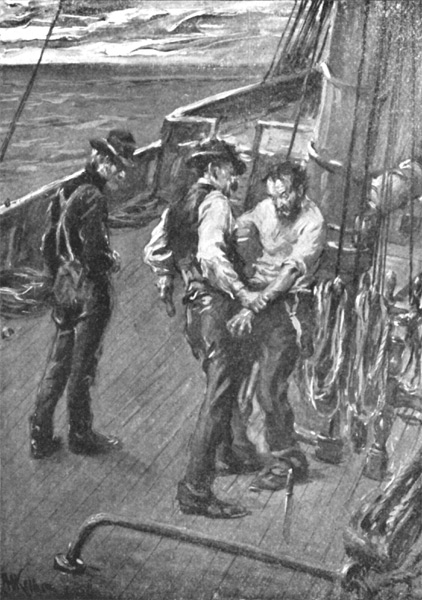 He let go of the knife, and the point stuck into the deck.
It got worse after that, and the men watched the cook, and the
cook watched the men, as if they were trying to catch each other;
but I think everybody felt that there was something else. One
evening, at supper-time, I was on deck, and Jack came aft to
relieve the wheel while the man who was steering got his supper.
He hadn't got past the main-hatch on the lee side, when I heard a
man running in slippers that slapped on the deck, and there was a
sort of a yell and I saw the coloured cook going for Jack, with
a carving-knife in his hand. I jumped to get between them,
and Jack turned round short, and put out his hand. I was
too far to reach them, and the cook jabbed out with his knife.
But the blade didn't get anywhere near Benton. The cook seemed to
be jabbing it into the air again and again, at least four feet
short of the mark. Then he dropped his right hand, and I saw the
whites of his eyes in the dusk, and he reeled up against the
pin-rail, and caught hold of a belaying-pin with his left. I had
reached him by that time, and grabbed hold of his knife-hand and
the other too, for I thought he was going to use the pin; but
Jack Benton was standing staring stupidly at him, as if he didn't
understand. But instead, the cook was holding on because he
couldn't stand, and his teeth were chattering, and he let go of
the knife, and the point stuck into the deck.
"He's crazy!" said Jack Benton, and that was all he said; and he
went aft.
When he was gone the cook began to come to and he spoke
quite low, near my ear.
"There were two of them! So help me God, there were two of them!"
I don't know why I didn't take him by the collar, and give him a
good shaking; but I didn't. I just picked up the knife and gave
it to him, and told him to go back to his galley, and not to make
a fool of himself. You see, he hadn't struck at Jack, but at
something he thought he saw, and I knew what it was, and I felt
that same thing, like a lump of ice sliding down my back, that I
felt that night when we were bending the trysail.
When the men had seen him running aft, they jumped up after him,
but they held off when they saw that I had caught him. By and by,
the man who had spoken to me before told me what had happened. He
was a stocky little chap, with a red head.
"Well," he said, "there isn't much to tell. Jack Benton
had been eating his supper with the rest of us. He always sits at
the after corner of the table, on the port side. His brother used
to sit at the end, next him. The doctor gave him a thundering big
piece of pie to finish up with, and when he had finished he
didn't stop for a smoke, but went off quick to relieve the wheel.
Just as he had gone, the doctor came in from the galley, and when
he saw Jack's empty plate he stood stock still staring at it; and
we all wondered what was the matter, till we looked at the plate.
There were two forks in it, sir, lying side by side. Then the
doctor grabbed his knife, and flew up through the hatch like a
rocket. The other fork was there all right, Mr. Torkeldsen, for
we all saw it and handled it; and we all had our own. That's all
I know."
I didn't feel that I wanted to laugh when he told me that story;
but I hoped the old man wouldn't hear it, for I knew he wouldn't
believe it, and no captain that ever sailed likes to have
stories like that going round about his ship. It gives her a bad
name. But that was all anybody ever saw except the cook, and he
isn't the first man who has thought he saw things without having
any drink in him. I think, if the doctor had been weak in the
head as he was afterwards, he might have done something foolish
again, and there might have been serious trouble. But he didn't.
Only, two or three times I saw him looking at Jack Benton in a
queer, scared way, and once I heard him talking to himself.
"There's two of them! So help me God, there's two of them!"
He didn't say anything more about asking for his discharge, but I
knew well enough that if he got ashore at the next port we should
never see him again, if he had to leave his kit behind him, and
his money, too. He was scared all through, for good and all; and
he wouldn't be right again till he got another ship. It's no use
to talk to a man when he gets like that, any more than it
is to send a boy to the main truck when he has lost his nerve.
Jack Benton never spoke of what happened that evening. I don't
know whether he knew about the two forks, or not; or whether he
understood what the trouble was. Whatever he knew from the other
men, he was evidently living under a hard strain. He was quiet
enough, and too quiet; but his face was set, and sometimes it
twitched oddly when he was at the wheel, and he would turn his
head round sharp to look behind him. A man doesn't do that
naturally, unless there's a vessel that he thinks is creeping up
on the quarter. When that happens, if the man at the wheel takes
a pride in his ship, he will almost always keep glancing over his
shoulder to see whether the other fellow is gaining. But Jack
Benton used to look round when there was nothing there; and what
is curious, the other men seemed to catch the trick when they
were steering. One day the old man turned out just as the
man at the wheel looked behind him.
"What are you looking at?" asked the captain.
"Nothing, sir," answered the man.
"Then keep your eye on the mizzen-royal," said the old man, as if
he were forgetting that we weren't a square-rigger.
"Ay, ay, sir," said the man.
The captain told me to go below and work up the latitude from the
dead-reckoning, and he went forward of the deck-house and sat
down to read, as he often did. When I came up, the man at the
wheel was looking round again, and I stood beside him and just
asked him quietly what everybody was looking at, for it was
getting to be a general habit. He wouldn't say anything at first,
but just answered that it was nothing. But when he saw that I
didn't seem to care, and just stood there as if there were
nothing more to be said, he naturally began to talk.
He said that it wasn't that
he saw anything, because there wasn't anything to see except the
spanker sheet just straining a little, and working in the sheaves
of the blocks as the schooner rose to the short seas. There
wasn't anything to be seen, but it seemed to him that the sheet
made a queer noise in the blocks. It was a new manilla sheet; and
in dry weather it did make a little noise, something between a
creak and a wheeze. I looked at it and looked at the man, and
said nothing; and presently he went on. He asked me if I didn't
notice anything peculiar about the noise. I listened awhile, and
said I didn't notice anything. Then he looked rather sheepish,
but said he didn't think it could be his own ears, because every
man who steered his trick heard the same thing now and
then,—sometimes once in a day, sometimes once in a night,
sometimes it would go on a whole hour.
"It sounds like sawing wood," I said, just like that.
"To us it sounds a good deal more like a man whistling 'Nancy
Lee.'" He started nervously as he spoke the last words. "There,
sir, don't you hear it?" he asked suddenly.
I heard nothing but the creaking of the manilla sheet. It was
getting near noon, and fine, clear weather in southern
waters,—just the sort of day and the time when you would
least expect to feel creepy. But I remembered how I had heard
that same tune overhead at night in a gale of wind a fortnight
earlier, and I am not ashamed to say that the same sensation came
over me now, and I wished myself well out of the Helen B., and
aboard of any old cargo-dragger, with a windmill on deck, and an
eighty-nine-forty-eighter for captain, and a fresh leak whenever
it breezed up.
Little by little during the next few days life on board that
vessel came to be about as unbearable as you can imagine. It
wasn't that there was much talk, for I think the men were shy
even of speaking to each other freely about what they
thought. The whole ship's company grew silent, until one hardly
ever heard a voice, except giving an order and the answer. The
men didn't sit over their meals when their watch was below, but
either turned in at once or sat about on the forecastle smoking
their pipes without saying a word. We were all thinking of the
same thing. We all felt as if there were a hand on board,
sometimes below, sometimes about decks, sometimes aloft,
sometimes on the boom end; taking his full share of what the
others got, but doing no work for it. We didn't only feel it, we
knew it. He took up no room, he cast no shadow, and we never
heard his footfall on deck; but he took his whack with the rest
as regular as the bells, and—he whistled "Nancy Lee." It
was like the worst sort of dream you can imagine; and I dare say
a good many of us tried to believe it was nothing else sometimes,
when we stood looking over the weather rail in fine
weather with the breeze in our faces; but if we happened to turn
round and look into each other's eyes, we knew it was something
worse than any dream could be; and we would turn away from each
other with a queer, sick feeling, wishing that we could just for
once see somebody who didn't know what we knew.
There's not much more to tell about the Helen B. Jackson so far
as I am concerned. We were more like a shipload of lunatics than
anything else when we ran in under Morro Castle, and anchored in
Havana. The cook had brain fever, and was raving mad in his
delirium; and the rest of the men weren't far from the same
state. The last three or four days had been awful, and we had
been as near to having a mutiny on board as I ever want to be.
The men didn't want to hurt anybody; but they wanted to get away
out of that ship, if they had to swim for it; to get away from
that whistling, from that dead shipmate who had come
back, and who filled the ship with his unseen self. I know that
if the old man and I hadn't kept a sharp lookout the men would
have put a boat over quietly on one of those calm nights, and
pulled away, leaving the captain and me and the mad cook to work
the schooner into harbour. We should have done it somehow, of
course, for we hadn't far to run if we could get a breeze; and
once or twice I found myself wishing that the crew were really
gone, for the awful state of fright in which they lived was
beginning to work on me too. You see I partly believed and partly
didn't; but anyhow I didn't mean to let the thing get the better
of me, whatever it was. I turned crusty, too, and kept the men at
work on all sorts of jobs, and drove them to it until they wished
I was overboard, too. It wasn't that the old man and I were
trying to drive them to desert without their pay, as I am sorry to say a good many
skippers and mates do, even now. Captain Hackstaff was as
straight as a string, and I didn't mean those poor fellows should
be cheated out of a single cent; and I didn't blame them for
wanting to leave the ship, but it seemed to me that the only
chance to keep everybody sane through those last days was to work
the men till they dropped. When they were dead tired they slept a
little, and forgot the thing until they had to tumble up on deck
and face it again. That was a good many years ago. Do you believe
that I can't hear "Nancy Lee" now, without feeling cold down my
back? For I heard it too, now and then, after the man had
explained why he was always looking over his shoulder. Perhaps it
was imagination. I don't know. When I look back it seems to me
that I only remember a long fight against something I couldn't
see, against an appalling presence, against something worse than
cholera or Yellow Jack or the plague—and goodness
knows the mildest of them is bad enough when it breaks out at
sea. The men got as white as chalk, and wouldn't go about decks
alone at night, no matter what I said to them. With the cook
raving in his bunk the forecastle would have been a perfect hell,
and there wasn't a spare cabin on board. There never is on a
fore-and-after. So I put him into mine, and he was more quiet
there, and at last fell into a sort of stupor as if he were going
to die. I don't know what became of him, for we put him ashore
alive and left him in the hospital.
The men came aft in a body, quiet enough, and asked the captain
if he wouldn't pay them off, and let them go ashore. Some men
wouldn't have done it, for they had shipped for the voyage, and
had signed articles. But the captain knew that when sailors get
an idea into their heads they're no better than children; and if
he forced them to stay aboard he wouldn't get much work out of them, and couldn't rely on
them in a difficulty. So he paid them off, and let them go. When
they had gone forward to get their kits, he asked me whether I
wanted to go too, and for a minute I had a sort of weak feeling
that I might just as well. But I didn't, and he was a good friend
to me afterwards. Perhaps he was grateful to me for sticking to
him.
When the men went off he didn't come on deck; but it was my duty
to stand by while they left the ship. They owed me a grudge for
making them work during the last few days, and most of them
dropped into the boat without so much as a word or a look, as
sailors will. Jack Benton was the last to go over the side, and
he stood still a minute and looked at me, and his white face
twitched. I thought he wanted to say something.
"Take care of yourself, Jack," said I. "So long!"
It seemed as if he couldn't speak for two or three seconds; then
his words came thick.
"It wasn't my fault, Mr. Torkeldsen. I swear it wasn't my fault!"
That was all; and he dropped over the side, leaving me to wonder
what he meant.
The captain and I stayed on board, and the ship-chandler got a
West India boy to cook for us.
That evening, before turning in, we were standing by the rail
having a quiet smoke, watching the lights of the city, a quarter
of a mile off, reflected in the still water. There was music of
some sort ashore, in a sailors' dance-house, I dare say; and I
had no doubt that most of the men who had left the ship were
there, and already full of jiggy-jiggy. The music played a lot of
sailors' tunes that ran into each other, and we could hear the
men's voices in the chorus now and then. One followed another,
and then it was "Nancy Lee," loud and clear, and the men singing
"Yo-ho, heave-ho!"
"I have no ear for music," said Captain Hackstaff, "but
it appears to me that's the tune that man was whistling the night
we lost the man overboard. I don't know why it has stuck in my
head, and of course it's all nonsense; but it seems to me that I
have heard it all the rest of the trip."
I didn't say anything to that, but I wondered just how much the
old man had understood. Then we turned in, and I slept ten hours
without opening my eyes.
I stuck to the Helen B. Jackson after that as long as I could
stand a fore-and-after; but that night when we lay in Havana was
the last time I ever heard "Nancy Lee" on board of her. The spare
hand had gone ashore with the rest, and he never came back, and
he took his tune with him; but all those things are just as clear
in my memory as if they had happened yesterday.
After that I was in deep water for a year or more, and after I
came home I got my certificate, and what with having friends and having saved a
little money, and having had a small legacy from an uncle in
Norway, I got the command of a coastwise vessel, with a small
share in her. I was at home three weeks before going to sea, and
Jack Benton saw my name in the local papers, and wrote to me.
He said that he had left the sea, and was trying farming, and he
was going to be married, and he asked if I wouldn't come over for
that, for it wasn't more than forty minutes by train; and he and
Mamie would be proud to have me at the wedding. I remembered how
I had heard one brother ask the other whether Mamie knew. That
meant, whether she knew he wanted to marry her, I suppose. She
had taken her time about it, for it was pretty nearly three years
then since we had lost Jim Benton overboard.
I had nothing particular to do while we were getting ready for
sea; nothing to prevent me from going over for a day, I mean; and I thought
I'd like to see Jack Benton, and have a look at the girl he was
going to marry. I wondered whether he had grown cheerful again,
and had got rid of that drawn look he had when he told me it
wasn't his fault. How could it have been his fault, anyhow? So I
wrote to Jack that I would come down and see him married; and
when the day came I took the train, and got there about ten
o'clock in the morning. I wish I hadn't. Jack met me at the
station, and he told me that the wedding was to be late in the
afternoon, and that they weren't going off on any silly wedding
trip, he and Mamie, but were just going to walk home from her
mother's house to his cottage. That was good enough for him, he
said. I looked at him hard for a minute after we met. When we had
parted I had a sort of idea that he might take to drink, but he
hadn't. He looked very respectable and well-to-do in his black
coat and high city collar; but he was thinner and bonier
than when I had known him, and there were lines in his
face, and I thought his eyes had a queer look in them, half
shifty, half scared. He needn't have been afraid of me, for I
didn't mean to talk to his bride about the Helen B. Jackson.
He took me to his cottage first, and I could see that he was
proud of it. It wasn't above a cable's-length from high-water
mark, but the tide was running out, and there was already a broad
stretch of hard wet sand on the other side of the beach road.
Jack's bit of land ran back behind the cottage about a quarter of
a mile, and he said that some of the trees we saw were his. The
fences were neat and well kept, and there was a fair-sized barn a
little way from the cottage, and I saw some nice-looking cattle
in the meadows; but it didn't look to me to be much of a farm,
and I thought that before long Jack would have to leave his wife
to take care of it, and go to sea again. But I said it was a nice
farm, so as to seem pleasant, and as I don't know much
about these things I dare say it was, all the same. I never saw
it but that once. Jack told me that he and his brother had been
born in the cottage, and that when their father and mother died
they leased the land to Mamie's father, but had kept the cottage
to live in when they came home from sea for a spell. It was as
neat a little place as you would care to see: the floors as clean
as the decks of a yacht, and the paint as fresh as a man-o'-war.
Jack always was a good painter. There was a nice parlour on the
ground floor, and Jack had papered it and had hung the walls with
photographs of ships and foreign ports, and with things he had
brought home from his voyages: a boomerang, a South Sea club,
Japanese straw hats and a Gibraltar fan with a bull-fight on it,
and all that sort of gear. It looked to me as if Miss Mamie had
taken a hand in arranging it. There was a bran-new polished iron
Franklin stove set into the old fireplace, and a red
table-cloth from Alexandria, embroidered with those outlandish
Egyptian letters. It was all as bright and homelike as possible,
and he showed me everything, and was proud of everything, and I
liked him the better for it. But I wished that his voice would
sound more cheerful, as it did when we first sailed in the Helen
B., and that the drawn look would go out of his face for a
minute. Jack showed me everything, and took me upstairs, and it
was all the same: bright and fresh and ready for the bride. But
on the upper landing there was a door that Jack didn't open. When
we came out of the bedroom I noticed that it was ajar, and Jack
shut it quickly and turned the key.
"That lock's no good," he said, half to himself. "The door is
always open."
I didn't pay much attention to what he said, but as we went down
the short stairs, freshly painted and varnished so that I was
almost afraid to step on them, he spoke again.
"That was his room, sir. I have made a sort of store-room of it."
"You may be wanting it in a year or so," I said, wishing to be
pleasant.
"I guess we won't use his room for that," Jack answered in a low
voice.
Then he offered me a cigar from a fresh box in the parlour, and
he took one, and we lit them, and went out; and as we opened the
front door there was Mamie Brewster standing in the path as if
she were waiting for us. She was a fine-looking girl, and I
didn't wonder that Jack had been willing to wait three years for
her. I could see that she hadn't been brought up on steam-heat
and cold storage, but had grown into a woman by the sea-shore.
She had brown eyes, and fine brown hair, and a good figure.
"This is Captain Torkeldsen," said Jack. "This is Miss Brewster,
captain; and she is glad to see you."
"Well, I am," said Miss Mamie, "for Jack has often talked
to us about you, captain."
She put out her hand, and took mine and shook it heartily, and I
suppose I said something, but I know I didn't say much.
The front door of the cottage looked toward the sea, and there
was a straight path leading to the gate on the beach road. There
was another path from the steps of the cottage that turned to the
right, broad enough for two people to walk easily, and it led
straight across the fields through gates to a larger house about
a quarter of a mile away. That was where Mamie's mother lived,
and the wedding was to be there. Jack asked me whether I would
like to look round the farm before dinner, but I told him I
didn't know much about farms. Then he said he just wanted to look
round himself a bit, as he mightn't have much more chance that
day; and he smiled, and Mamie laughed.
"Show the captain the way to the house, Mamie," he said.
"I'll be along in a minute."
So Mamie and I began to walk along the path, and Jack went up
toward the barn.
"It was sweet of you to come, captain," Miss Mamie began, "for I
have always wanted to see you."
"Yes," I said, expecting something more.
"You see, I always knew them both," she went on. "They used to
take me out in a dory to catch codfish when I was a little girl,
and I liked them both," she added thoughtfully. "Jack doesn't
care to talk about his brother now. That's natural. But you won't
mind telling me how it happened, will you? I should so much like
to know."
Well, I told her about the voyage and what happened that night
when we fell in with a gale of wind, and that it hadn't been
anybody's fault, for I wasn't going to admit that it was my old
captain's, if it was. But I didn't tell her anything
about what happened afterwards. As she didn't speak, I just went
on talking about the two brothers, and how like they had been,
and how when poor Jim was drowned and Jack was left, I took Jack
for him. I told her that none of us had ever been sure which was
which.
"I wasn't always sure myself," she said, "unless they were
together. Leastways, not for a day or two after they came home
from sea. And now it seems to me that Jack is more like poor Jim,
as I remember him, than he ever was, for Jim was always more
quiet, as if he were thinking."
I told her I thought so, too. We passed the gate and went into
the next field, walking side by side. Then she turned her head to
look for Jack, but he wasn't in sight. I sha'n't forget what she
said next.
"Are you sure now?" she asked.
I stood stock-still, and she went on a step, and then turned and
looked at me. We must have looked at each other while you
could count five or six.
"I know it's silly," she went on, "it's silly, and it's awful,
too, and I have got no right to think it, but sometimes I can't
help it. You see it was always Jack I meant to marry."
"Yes," I said stupidly, "I suppose so."
She waited a minute, and began walking on slowly before she went
on again.
"I am talking to you as if you were an old friend, captain, and I
have only known you five minutes. It was Jack I meant to marry,
but now he is so like the other one."
When a woman gets a wrong idea into her head, there is only one
way to make her tired of it, and that is to agree with her.
That's what I did, and she went on talking the same way for a
little while, and I kept on agreeing and agreeing until she
turned round on me.
"You know you don't believe what you say," she said, and
laughed. "You know that Jack is Jack, right enough; and it's Jack
I am going to marry."
Of course I said so, for I didn't care whether she thought me a
weak creature or not. I wasn't going to say a word that could
interfere with her happiness, and I didn't intend to go back on
Jack Benton; but I remembered what he had said when he left the
ship in Havana: that it wasn't his fault.
"All the same," Miss Mamie went on, as a woman will, without
realising what she was saying, "all the same, I wish I had seen
it happen. Then I should know."
Next minute she knew that she didn't mean that, and was afraid
that I would think her heartless, and began to explain that she
would really rather have died herself than have seen poor Jim go
overboard. Women haven't got much sense, anyhow. All the same, I
wondered how she could marry Jack if she had a doubt that he
might be Jim after all. I suppose she had really got used
to him since he had given up the sea and had stayed ashore, and
she cared for him.
Before long we heard Jack coming up behind us, for we had walked
very slowly to wait for him.
"Promise not to tell anybody what I said, captain," said Mamie,
as girls do as soon as they have told their secrets.
Anyhow, I know I never did tell any one but you. This is the
first time I have talked of all that, the first time since I took
the train from that place. I am not going to tell you all about
the day. Miss Mamie introduced me to her mother, who was a quiet,
hard-faced old New England farmer's widow, and to her cousins and
relations; and there were plenty of them too at dinner, and there
was the parson besides. He was what they call a Hard-shell
Baptist in those parts, with a long, shaven upper lip and a
whacking appetite, and a sort of superior look, as if he didn't
expect to see many of us hereafter—the way a New
York pilot looks round, and orders things about when he boards an
Italian cargo-dragger, as if the ship weren't up to much anyway,
though it was his business to see that she didn't get aground.
That's the way a good many parsons look, I think. He said grace
as if he were ordering the men to sheet home the topgallant-sail
and get the helm up. After dinner we went out on the piazza, for
it was warm autumn weather; and the young folks went off in pairs
along the beach road, and the tide had turned and was beginning
to come in. The morning had been clear and fine, but by four
o'clock it began to look like a fog, and the damp came up out of
the sea and settled on everything. Jack said he'd go down to his
cottage and have a last look, for the wedding was to be at five
o'clock, or soon after, and he wanted to light the lights, so as
to have things look cheerful.
"I will just take a last look," he said again, as we
reached the house. We went in, and he offered me another cigar,
and I lit it and sat down in the parlour. I could hear him moving
about, first in the kitchen and then upstairs, and then I heard
him in the kitchen again; and then before I knew anything I heard
somebody moving upstairs again. I knew he couldn't have got up
those stairs as quick as that. He came into the parlour, and he
took a cigar himself, and while he was lighting it I heard those
steps again overhead. His hand shook, and he dropped the match.
"Have you got in somebody to help?" I asked.
"No," Jack answered sharply, and struck another match.
"There's somebody upstairs, Jack," I said. "Don't you hear
footsteps?"
"It's the wind, captain," Jack answered; but I could see he was
trembling.
"That isn't any wind, Jack," I said; "it's still and foggy. I'm
sure there's somebody upstairs."
"If you are so sure of it, you'd better go and see for yourself,
captain," Jack answered, almost angrily.
He was angry because he was frightened. I left him before the
fireplace, and went upstairs. There was no power on earth that
could make me believe I hadn't heard a man's footsteps overhead.
I knew there was somebody there. But there wasn't. I went into
the bedroom, and it was all quiet, and the evening light was
streaming in, reddish through the foggy air; and I went out on
the landing and looked in the little back room that was meant for
a servant girl or a child. And as I came back again I saw that
the door of the other room was wide open, though I knew Jack had
locked it. He had said the lock was no good. I looked in. It was
a room as big as the bedroom, but almost dark, for it had
shutters, and they were closed. There was a musty smell, as of
old gear, and I could make out that the floor was littered with
sea chests, and that there were oilskins and stuff piled
on the bed. But I still believed that there was somebody
upstairs, and I went in and struck a match and looked round. I
could see the four walls and the shabby old paper, an iron bed
and a cracked looking-glass, and the stuff on the floor. But
there was nobody there. So I put out the match, and came out and
shut the door and turned the key. Now, what I am telling you is
the truth. When I had turned the key, I heard footsteps walking
away from the door inside the room. Then I felt queer for a
minute, and when I went downstairs I looked behind me, as the men
at the wheel used to look behind them on board the Helen B.
Jack was already outside on the steps, smoking. I have an idea
that he didn't like to stay inside alone.
"Well?" he asked, trying to seem careless.
"I didn't find anybody," I answered, "but I heard somebody moving
about."
"I told you it was the wind," said Jack, contemptuously. "I ought
to know, for I live here, and I hear it often."
There was nothing to be said to that, so we began to walk down
toward the beach. Jack said there wasn't any hurry, as it would
take Miss Mamie some time to dress for the wedding. So we
strolled along, and the sun was setting through the fog, and the
tide was coming in. I knew the moon was full, and that when she
rose the fog would roll away from the land, as it does sometimes.
I felt that Jack didn't like my having heard that noise, so I
talked of other things, and asked him about his prospects, and
before long we were chatting as pleasantly as possible.
I haven't been at many weddings in my life, and I don't suppose
you have, but that one seemed to me to be all right until it was
pretty near over; and then, I don't know whether it was part of
the ceremony or not, but Jack put out his hand and took Mamie's
and held it a minute, and looked at her, while the parson
was still speaking.
Mamie turned as white as a sheet and screamed. It wasn't a loud
scream, but just a sort of stifled little shriek, as if she were
half frightened to death; and the parson stopped, and asked her
what was the matter, and the family gathered round.
"Your hand's like ice," said Mamie to Jack, "and it's all wet!"
She kept looking at it, as she got hold of herself again.
"It don't feel cold to me," said Jack, and he held the back of
his hand against his cheek. "Try it again."
Mamie held out hers, and touched the back of his hand, timidly at
first, and then took hold of it.
"Why, that's funny," she said.
"She's been as nervous as a witch all day," said Mrs. Brewster,
severely.
"It is natural," said the parson, "that young Mrs. Benton should
experience a little agitation at such a moment."
Most of the bride's relations lived at a distance, and were busy
people, so it had been arranged that the dinner we'd had in the
middle of the day was to take the place of a dinner afterwards,
and that we should just have a bite after the wedding was over,
and then that everybody should go home, and the young couple
would walk down to the cottage by themselves. When I looked out I
could see the light burning brightly in Jack's cottage, a quarter
of a mile away. I said I didn't think I could get any train to
take me back before half-past nine, but Mrs. Brewster begged me
to stay until it was time, as she said her daughter would want to
take off her wedding dress before she went home; for she had put
on something white with a wreath, that was very pretty, and she
couldn't walk home like that, could she?
So when we had all had a little supper the party began to break
up, and when they were all gone Mrs. Brewster and Mamie went
upstairs, and Jack and I went out on the piazza, to have
a smoke, as the old lady didn't like tobacco in the house.
The full moon had risen now, and it was behind me as I looked
down toward Jack's cottage, so that everything was clear and
white, and there was only the light burning in the window. The
fog had rolled down to the water's edge, and a little beyond, for
the tide was high, or nearly, and was lapping up over the last
reach of sand, within fifty feet of the beach road.
Jack didn't say much as we sat smoking, but he thanked me for
coming to his wedding, and I told him I hoped he would be happy;
and so I did. I dare say both of us were thinking of those
footsteps upstairs, just then, and that the house wouldn't seem
so lonely with a woman in it. By and by we heard Mamie's voice
talking to her mother on the stairs, and in a minute she was
ready to go. She had put on again the dress she had worn in the morning, and it looked
black at night, almost as black as Jack's coat.
Well, they were ready to go now. It was all very quiet after the
day's excitement, and I knew they would like to walk down that
path alone now that they were man and wife at last. I bade them
good-night, although Jack made a show of pressing me to go with
them by the path as far as the cottage, instead of going to the
station by the beach road. It was all very quiet, and it seemed
to me a sensible way of getting married; and when Mamie kissed
her mother good-night I just looked the other way, and knocked my
ashes over the rail of the piazza. So they started down the
straight path to Jack's cottage, and I waited a minute with Mrs.
Brewster, looking after them, before taking my hat to go. They
walked side by side, a little shyly at first, and then I saw Jack
put his arm round her waist. As I looked he was on her left, and
I saw the outline of the two figures very distinctly
against the moonlight on the path; and the shadow on Mamie's
right was broad and black as ink, and it moved along, lengthening
and shortening with the unevenness of the ground beside the path.
I thanked Mrs. Brewster, and bade her good-night; and though she
was a hard New England woman her voice trembled a little as she
answered, but being a sensible person she went in and shut the
door behind her as I stepped out on the path. I looked after the
couple in the distance a last time, meaning to go down to the
road, so as not to overtake them; but when I had made a few steps
I stopped and looked again, for I knew I had seen something
queer, though I had only realised it afterwards. I looked again,
and it was plain enough now; and I stood stock-still, staring at
what I saw. Mamie was walking between two men. The second man was
just the same height as Jack, both being about a half a head
taller than she; Jack on her left in his black tail-coat
and round hat, and the other man on her right—well, he was
a sailor-man in wet oilskins. I could see the moonlight shining
on the water that ran down him, and on the little puddle that had
settled where the flap of his sou'wester was turned up behind:
and one of his wet, shiny arms was round Mamie's waist, just
above Jack's. I was fast to the spot where I stood, and for a
minute I thought I was crazy. We'd had nothing but some cider for
dinner, and tea in the evening, otherwise I'd have thought
something had got into my head, though I was never drunk in my
life. It was more like a bad dream after that.
I was glad Mrs. Brewster had gone in. As for me, I couldn't help
following the three, in a sort of wonder to see what would
happen, to see whether the sailor-man in his wet togs would just
melt away into the moonshine. But he didn't.
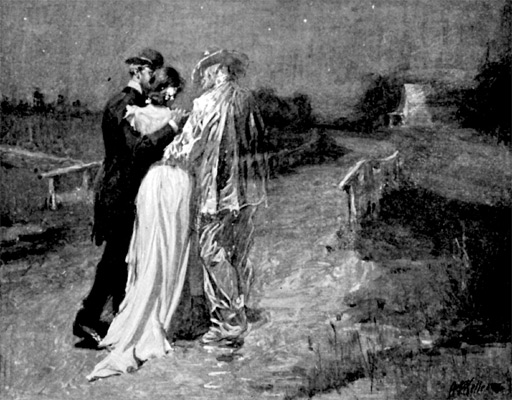 One of his wet, shiny arms was round Mamie's
waist.
One of his wet, shiny arms was round Mamie's
waist.
I moved slowly, and I remembered afterwards that I
walked on the grass, coming. I suppose it all happened
in less than five minutes after that, but it seemed as if it must
have taken an hour. Neither Jack nor Mamie seemed to notice the
sailor. She didn't seem to know that his wet arm was round her,
and little by little they got near the cottage, and I wasn't a
hundred yards from them when they reached the door. Something
made me stand still then. Perhaps it was fright, for I saw
everything that happened just as I see you now.
Mamie set her foot on the step to go up, and as she went forward
I saw the sailor slowly lock his arm in Jack's, and Jack didn't
move to go up. Then Mamie turned round on the step, and they all
three stood that way for a second or two. She cried out
then,—I heard a man cry like that once, when his arm was
taken off by a steam-crane,—and she fell back in a heap on
the little piazza.
I tried to jump forward, but I couldn't move, and I felt my hair
rising under my hat. The sailor turned slowly where he stood, and
swung Jack round by the arm steadily and easily, and began to
walk him down the pathway from the house. He walked him straight
down that path, as steadily as Fate; and all the time I saw the
moonlight shining on his wet oilskins. He walked him through the
gate, and across the beach road, and out upon the wet sand, where
the tide was high. Then I got my breath with a gulp, and ran for
them across the grass, and vaulted over the fence, and stumbled
across the road. But when I felt the sand under my feet, the two
were at the water's edge; and when I reached the water they were
far out, and up to their waists; and I saw that Jack Benton's
head had fallen forward on his breast, and his free arm hung limp
beside him, while his dead brother steadily marched him to his
death. The moonlight was on the dark water, but the
fog-bank was white beyond, and I saw them against it; and they
went slowly and steadily down. The water was up to their armpits,
and then up to their shoulders, and then I saw it rise up to the
black rim of Jack's hat. But they never wavered; and the two
heads went straight on, straight on, till they were under, and
there was just a ripple in the moonlight where Jack had been.
It has been on my mind to tell you that story, whenever I got a
chance. You have known me, man and boy, a good many years; and I
thought I would like to hear your opinion. Yes, that's what I
always thought. It wasn't Jim that went overboard; it was Jack,
and Jim just let him go when he might have saved him; and then
Jim passed himself off for Jack with us, and with the girl. If
that's what happened, he got what he deserved. People said the
next day that Mamie found it out as they reached the house, and
that her husband just walked out into the sea, and
drowned himself; and they would have blamed me for not stopping
him if they'd known that I was there. But I never told what I had
seen, for they wouldn't have believed me. I just let them think I
had come too late.
When I reached the cottage and lifted Mamie up, she was raving
mad. She got better afterwards, but she was never right in her
head again.
Oh, you want to know if they found Jack's body? I don't know
whether it was his, but I read in a paper at a Southern port
where I was with my new ship that two dead bodies had come ashore
in a gale down East, in pretty bad shape. They were locked
together, and one was a skeleton in oilskins.
FRANCIS MARION CRAWFORD the youngest of the four children of the
well-known sculptor Thomas Crawford, was born in Rome, educated
by a French governess; then at St Paul's School, Concord, N.H.;
in the quiet country village of Hatfield Regis, under an English
tutor; at Trinity College, Cambridge, where they thought him a
mathematician in those days; at Heidelberg and Karlsruhe, and at
the University of Rome, where a special interest in Oriental
languages sent him to India with the idea of preparing for a
professorship.
At one time in India hard times nearly forced him into enlistment
in the British army, but a chance opening sent him as editor of
the Indian Herald to Allahabad. It was during the next eighteen
months that he met at Simla the hero of his first novel, "Mr.
Isaacs." "If it had not been for him," Mr. Crawford has been
known to say, "I might at this moment be a professor of Sanskrit
in some American college;" for that idea persisted after his
return to the United States, where he entered Harvard for special
study of the subject.
But from the May evening when the story of the interesting man
at Simla was first told in a club smoking-room overlooking Madison
Square, Mr. Crawford's life has been one of hard literary work.
He returned to Italy in 1883, spent most of the next year in
Constantinople, where he was married to a daughter of General Berdan.
From 1885 he has made his home in Sorrento, Italy, visiting America
at intervals.
"Mr. Isaacs," published in 1882, was followed almost at once by
"Dr. Claudius." Then The Atlantic Monthly claimed a serial, "A
Roman Singer," in 1883. Since that time the list of his novels
has been increased to thirty-two, besides the historical and
descriptive works entitled "Ave Roma Immortalis" and "The Rulers
of the South."
To Mr. Crawford, the development of a story and of the character
which suggested it, is the preëminent thing. As the critics
say:—
"He is an artist, a born story-teller and colourist,
imaginative and dramatic, virile and vivid."
His wide range as a traveller has contributed doubtless to
another characteristic quality:—
"... his strength in unexcelled portraits of odd
characters and his magical skill in seeming to make his
readers witnesses of the spectacles."
His intimate knowledge of many countries has resulted in an
unequalled series of brilliant romances, including varied
characters from the old families of Rome, the glassblowers of
Venice, the silversmiths of Rome, the cigarette makers of Munich,
the court of old Madrid, the Turks of Stamboul and the Bosphorus,
simple sailors on the coast of Spain, Americans of modern New
York and Bar Harbor, to Crusaders of the twelfth century. But
whether the scene be in modern India, rural England, the Black
Forest, or the palaces of Babylon, the story seizes on the
imagination and fascinates the reader.
"The romantic reader will find here a tale of love
passionate and pure; the student of character, the
subtle analysis and deft portrayal he loves; the
historian will approve its conscientious historic
accuracy; the lover of adventure will find his blood
stir and pulses quicken as he reads."
Dr. Claudius
A Roman Singer
Zoroaster
Don Orsino
Marion Darche
A Cigarette Maker's Romance and Khaled
Taquisara
Via Crucis
Sant' Ilario
The Ralstons
Adam Johnstone's Son and A Rose of Yesterday
Mr. Isaacs
A Tale of a Lonely Parish
Saracinesca
Paul Patoff
The Witch of Prague
Pietro Ghisleri
Corleone
Children of the King
Katherine Lauderdale
To Leeward
Each, bound in cloth, green and gold, $1.80
In preparation in the Uniform Edition
An American Politician
Marzio's Crucifix
With the Immortals
Greifenstein
The Three Fates
Casa Braccio. 2 vols.
Love in Idleness
CECILIA: A Story of Modern Rome
Cloth, $1.50
"The reincarnation of a great love is the real story, and that is well worth
reading."—San Francisco Chronicle.
MARIETTA: A Maid of Venice
Cloth, $1.50
IN THE PALACE OF THE KING
A Love Story of Old Madrid
Illustrated, Cloth, $1.50
AVE ROMA IMMORTALIS
Studies from the Chronicles of Rome
New edition. Revised. x + 613 pp. 8vo. $3.00, net.
RULERS OF THE SOUTH
Sicily, Calabria, Malta
In two volumes. Crown 8vo. $6.00, net.
Handsomely Bound in Decorated Cloth
16mo 50 cents each
PHILOSOPHY FOUR
A STORY OF HARVARD UNIVERSITY
By Owen Wister
Author of "The Virginian" etc.
MAN OVERBOARD
By Owen Wister
Author of "Cecilia," "Marietta," etc.
MR. KEEGAN'S ELOPEMENT
By Winston Churchill
Author of "The Crisis," "Richard Carvel," etc.
MRS. PENDLETON'S FOUR-IN-HAND
By Gertrude Atherton
Author of "The Conqueror," "The Splendid Idle Forties,"
etc.

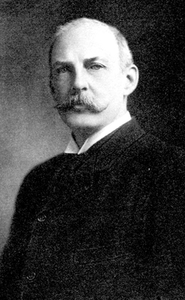
 F. Marion Crawford