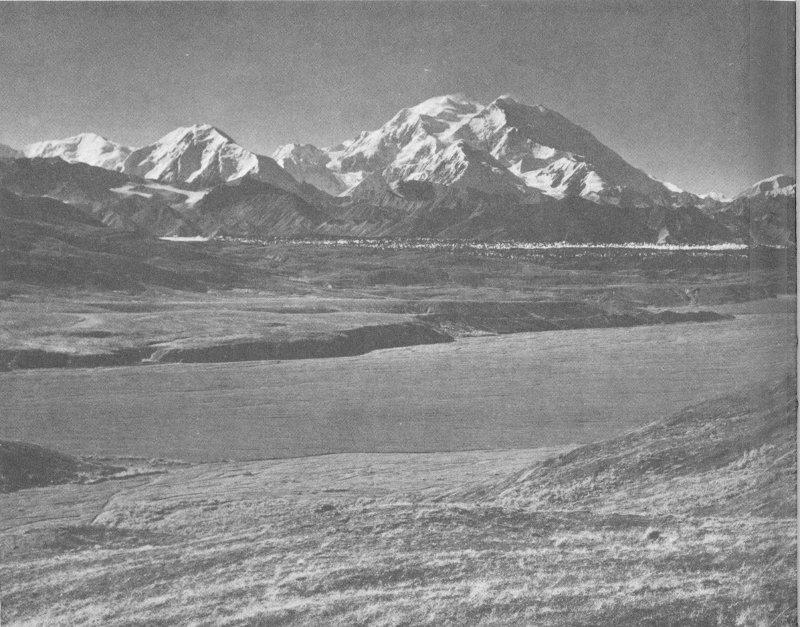
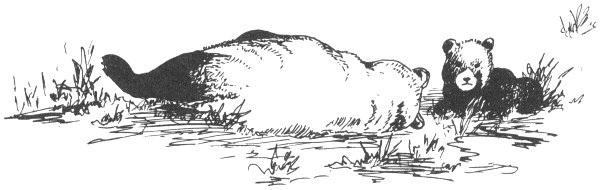
The Mount McKinley region was set aside as a National Park in 1917.
The foresighted conservationists who advocated National Park status for
this country were activated chiefly by their desire to preserve the flora and
fauna in its pristine condition. An effort was made to give the park ample
boundaries, but desirable extensions were later made, and it is possible
that in the future additional adjustments will be desirable from the standpoint
of assuring a self-sustaining ecological unit.
A drive from the Nenana River, the eastern boundary, to Wonder Lake,
some 90 miles to the west and directly north of Mount McKinley, is always
a fresh adventure. No two days are the same. One day we may see more
grizzlies than usual; on another trip we may be especially fortunate and
catch sight of a wolf or a wolverine. It is desirable to drive slowly and to
stop occasionally to examine the landscape for animal life—the mountains
for Dall sheep, the river bars and passes for grizzlies and caribou,
and the water, for birds, beaver, or moose.
Some of the birds to be seen along the way are the ptarmigan—willow
ptarmigan in the low country, rock ptarmigan on the high passes (the
white-tailed are confined to higher elevations and probably will not be
seen)—the long-tailed jaegers, the whimbrel (Hudsonian curlew), golden
plovers, short-billed gulls, golden eagles, and several kinds of ducks. Ornithologists
will be especially interested in seeing such asiatic birds as the
wheatear and the willow warbler.
Much of the park is treeless tundra, but strips of woods follow the rivers
far into the park, and patches grow here and there on the adjacent mountain
slopes. Timberline varies according to soil and exposure; in places it
reaches elevations of over 3,500 feet.
4
White spruce is the common conifer. Black spruce is confined to poorly
drained and boggy areas. Along the north boundary I have seen a few
patches of tamarack. Cottonwood and aspen are widely distributed and a
few tree birches grow at lower elevations. Along the McKinley River an
extensive strip of cottonwoods may be seen from the highway.
The tundra supports a growth of willow and dwarf birch. Over twenty
kinds of willow occur in the park. They range in size from small forms
only 2 or 3 inches in height, to brushy growths 20 feet tall. In places the
small willows may grow dense enough to form a sod. These shrubs are
highly important for wildlife. Alder brush is widely distributed and plentiful
on canyon slopes; near Wonder Lake there are many clumps of alder
in the rolling tundra.
The low ground cover over the park consists of mosses, lichens, sedges,
grasses, horsetails, and herbaceous plants—many species of each. Early
flowers may begin blooming in late April and early May, and at the
higher elevations some blooms may be seen in late summer.
The annual berry crop is bounteous and is an important source of
food for a host of birds and mammals. Even the mountain sheep have
been found enjoying the blueberries. Blueberry, crowberry, cranberry,
buffaloberry, and alpine bearberry are all widely distributed. The berries
begin to ripen in late July.
With the melting of the snow in the spring, the white landscape of
winter is transformed into a brown countryside—brown grasses, sedges,
and leafless shrubbery. Snow fields still persist on the mountain slopes,
and the spruces are dark green, but brown hues seem to dominate one’s
impression of the tundra at this time. In June—the time varies a little
with the year—the landscape is magically transformed from a dull brown
to the brightest green. Early in August spots of red and yellow colors
begin to show. By late August and early September the country is again
transformed and we have a world of crimson and other shades of red,
trimmed with yellow and gold of willow, aspen, and cottonwood. The
alders add contrast for they remain summer-green throughout the autumn
color season.
Over much of the country the ground remains frozen below a depth of
a few feet. In some shaded areas where the ground is deeply carpeted
with moss the soil remains frozen within less than 2 feet of the surface.
The continuous thawing of the soil in summer keeps the surface moist
until autumn. The thawed surface soil tends in places to creep imperceptibly
down slopes as it becomes water-soaked, even though plant life has
a strong stabilizing influence. Occasionally the soil becomes saturated
with moisture to considerable depths and we have rather large land slides
such as the one that recently formed Slide Lake on Stony Creek; the one
that shows prominently on the south slope of Sable Mountain; and one
to the south of the road at about 3-Mile that caused spruces to lean in various
5
directions. Thawed, water-logged surface soil rests uneasily on the
frozen sub-stratum.
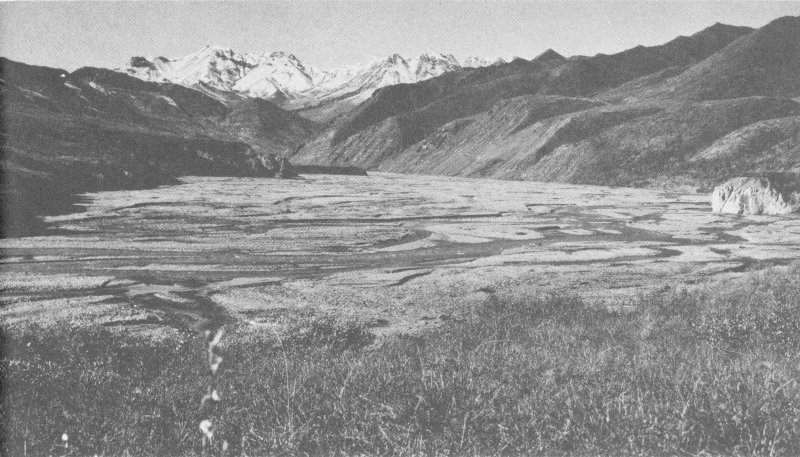
Typical glacial stream. Grizzlies and caribou may often be seen in the streambed and
Dall sheep on the mountain slopes.
A number of parallel, northward-flowing streams head in glaciers lying
along the north slope of the Alaska Range. The streams are not large—most
of them can be waded without getting too wet—so it is surprising
to find them bordered by wide gravel bars. This is due to lack of stream
stabilization. In summer the streams carry a load of silt which may be
dropped along the way. Channels are continually being gouged out here
and filled in somewhere else so that the stream keeps breaking over its
sides and forming additional channels. High water, due to a warm day
and much glacier melting, or to heavy rains, may cause the streams to
flow into entirely new channels. When the main stream reaches the side
of the gravel bar it will erode the bank and thus broaden the river bar.
This type of erosion is noticeable just below the Teklanika bridge.
Gravel bars that have not been invaded for a long period may become
covered with vegetation, and it is on some of these old bars that we often
see grizzlies digging roots in the spring of the year. But even these bars
are temporary. One such bar on the Toklat River was invaded by part
6
of the river a few years ago and much of the sod is being washed away
today. Physiographic processes are all very active in the region. On many
slopes we see the turf breaking away, and here and there a small land slip.
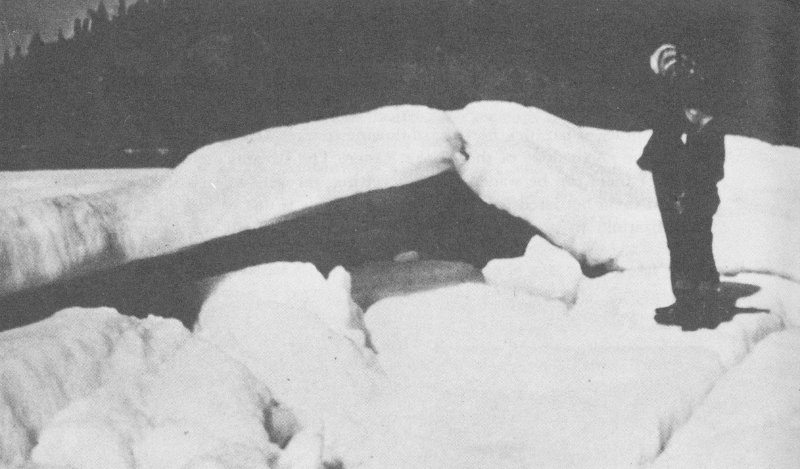
Typical ice blister.
Those who come to the park the early part of the summer may see extensive
fields of ice on the river bars. These are the result of what is
called overflow. During cold weather the ice on the streams freezes so
thick that there is not room for all of the water to pass under the ice, and
since it must run somewhere it develops pressure and breaks out on the
surface where it spreads widely underneath the snow. Here it freezes. This
process continues throughout the winter and often forms ice patches many
feet thick. When one is dog-mushing on rivers the overflow water under
the snow is a hazard before it freezes, and the driver of a dogteam must
watch to avoid such spots. Conditions are worst during the coldest
weather, at a time when a wetting is most serious.
Out in the park there are no trails except for one down Savage Canyon.
The country is so open that trails are not needed. The river bars furnish
excellent hiking, and even walking across the upland tundra is easy. A
number of campgrounds are located along the road between the Nenana
River and Wonder Lake.
This booklet is made available as a quick reference pertaining to the
mammals in the park. The comments on each species are brief but perhaps
sufficient to suggest their status. Distances are deceiving so field glasses
should be used in searching the landscape for the larger animals such as
sheep, caribou, and bears.
7
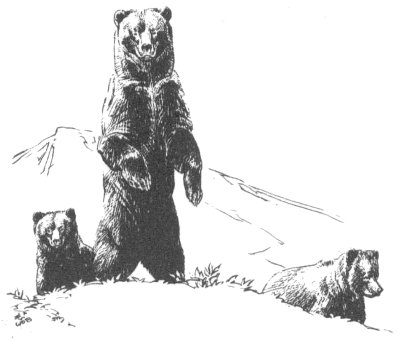
The grizzly’s domain in the park extends from the glaciers at the heads
of the rivers, northward to the north boundary. The grizzly may be discovered
on an old river bar, on one of the low passes between the rivers,
or traveling high on a mountain slope. One of the favorite haunts along
the road is Sable Pass, where each summer one to four females with cubs,
along with a few lone or mated bears, take residence.
Any bear seen out in the park is almost certain to be a grizzly because
the black bear is confined to the wooded low country along the east and
north boundaries. The hump on the shoulder and the dishfaced profile
(rather than almost straight, as in the black bear) are good field characters.
The general coloration varies from cream color (rare) to straw color,
brown, chocolate, and black. The legs are always blackish. The fur fades
considerably during the spring and summer. Hence, the new coat, fully
developed by autumn, is always darker, and gives the bear a new, fresh
look. One old male grizzly, not very fat, weighed 650 pounds. The females
are considerably smaller. Because of the long claws on the forepaws, the
track of the grizzly can be readily distinguished from that of the black
bear, whose forepaw claws are shorter and more curved.
In the spring when grizzlies first come forth from their dens they seem
to do much wandering over the higher slopes. At this season I have noted
their tracks leading to the remains of sheep, caribou, and moose that
had succumbed during the winter. Usually the wolves, foxes, and wolverines
have long since feasted on the fleshy parts, but the bears are happy to
crush the bones that remain on the premises and thus obtain a taste of
the succulent marrow.
The spring and early-summer food is chiefly the root of the peavine
(Hedysarum alpinum americanum) that flourishes on old vegetated river
bars and on many mountain slopes. Using both paws, with their long
claws, and straining backward with his body weight, chunks of sod are
turned over to expose the thick peavine roots. With delicate strokes, his
paws further expose the roots, which taste much like the garden variety
of pea. So extensive is the root-digging at times that an area may look like
a plowed field when the bear has finished. At this season, because of these
food habits, bears can often be seen on the open river bars and on the
ridge slopes. Cranberries and crowberries that have wintered under the
snow are often eaten in spring.
In June, green vegetation becomes available and a drastic change of
diet results. The root digging is terminated for something better. A grass,
(Arctagrostis latifolia), with a stiff and juicy stalk, and growing in swales
and wettish areas, is a favorite. The bears also graze extensively on horsetail
(Equisetum arvense), mountain-sorrel (Oxyria digyna), and the tall
8
showy white saxifrage (Boykinia richardsonii). A pea (Oxytropis viscida),
growing abundantly far up the streams on old river bars is extensively
grazed.
The grizzly is quite fastidious in his feeding on dock (Rumex fenestratus).
He severs the thick juicy stem with a bite and as he chews, the large
reddish seed head drops from his lips, neatly discarded.
The grizzlies continue grazing and chomping green grasses and herbs
until berry time when another major change of food habits takes place.
Some grazing still persists but now the bears turn wholeheartedly to blueberries,
crowberries, and the bitter scarlet buffaloberries, the three species
of berries most abundant and available. The lush berry of alpine bearberry (Arctous
alpinus), that ground-hugging woody plant that colors patches of the
landscape a brilliant scarlet in autumn, are sometimes eaten, but not
with any efficiency. The berry diet continues through the autumn but
at this season a few roots may again be sought.
The bear belongs to the order Carnivora and yet little mention has
been made of meat in the diet. He is perhaps, so to speak, a victim of
evolution and has had to adjust. As his mature size became ever larger
through eons of time, he became too slow to catch large herbivores such
as the caribou, and his large body required more sustenance than could
be secured by digging for mice and ground squirrels under usual circumstances.
Therefore he had to turn more and more to vegetation which
could be secured in quantity. This is not as drastic a change as we might
offhand suppose. It is one chiefly of degree, because we find carnivores
such as the fox and the marten turning to a berry diet for a period, from
choice.
But it appears that the grizzly would like more meat than is generally
available. This I infer from the quantity he eats when he finds a carcass
and from the avidity with which bears of all kinds seek spawning fish
when available. The only animal that the grizzly consistently hunts in
the park is the ground squirrel, but a squirrel contributes only a mouthful
and its capture usually requires excessive time and energy. Sometimes a
squirrel is surprised and captured before it can disappear in a burrow.
But generally a squirrel is secured only after extensive excavating which
may involve as much as half an hour, and not infrequently the bear,
after much digging, fails to unearth his intended victim. In years when
meadow mice and lemmings are especially abundant, bears may make
their capture a project which contributes at least a tasty diversion. Caribou
and moose calves may occasionally be captured when very young,
but the season for this food is short. Occasionally tidings come to a bear’s
keen nose that carrion lies upwind, and the lucky bear keeps gorging
until only a few bones and patches of hide remain.
After feeding on a carcass the bear often covers it with sod and vegetation.
One fall at Stony Creek I watched a bear at a cache which showed
up as a dark mound surrounded by a dark circular area from which the
9
sod had been torn loose. For an hour the bear kept methodically raking
the surrounding area beyond.
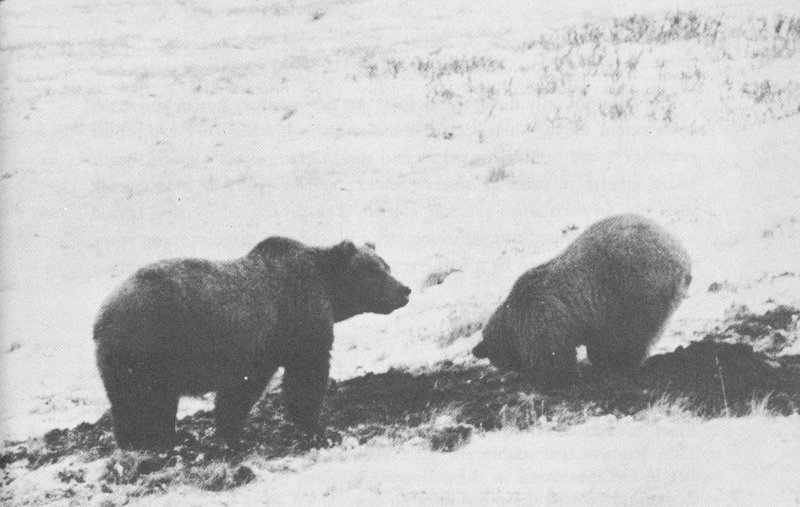
Grizzly bears digging for ground squirrels.
He was scraping the loose vegetation toward the cache, working leisurely
with one paw at a time. The loosened material was pushed toward the
cache as the work progressed. When I examined the area later, I noted a
circular patch, extending out 20 feet from all sides of the carcass, that
had been combed clean of loose vegetation. The bear finally lay down
on the cache to wait for digestion to create more space for this rich fare.
North of Wonder Lake a grizzly had similarly covered a caribou that
a hunter had left lying in the field. The bear was not at the cache, but
since most of the carcass was still intact, he probably was not far away.
I found some carcasses that were not covered with sod. A mother and two
yearlings at Polychrome Pass left a caribou carcass without covering it
and retired to some steep cliffs overlooking the area. The following day
they rested near the carcass, but still no effort was made to cover it.
Mating takes place in May, June and early July, and a pair remains
together for two or three weeks. I suspect that a male might look for a
second marriage following the termination of the first. One large crippled
male was successfully consorting with two females at the same time,
neither female objecting to the presence of the other—in fact, both probably
preferred it that way.
The cubs are born in the hibernating den in midwinter, are 8 or 9 inches
long, and weigh less than 2 pounds at birth. The number of cubs in a
litter ordinarily varies from one to three, two being the most frequent.
10
The cubs not only nurse throughout the first summer but to about the
same extent during their second summer abroad, when they are robust
yearlings. I had been surprised to find yearlings regularly nursing, but it
was a greater surprise to observe mother grizzlies nursing cubs over 2
years old, in their third summer abroad. The protracted nursing period
indicates a breeding interval of females with cubs, of three or more years,
since females followed by nursing yearlings have not been seen consorting
with a male.
The dens used for hibernation are excavated by the grizzly if natural
caves are not available. A den is usually dug on a rather steep slope. The
entrance to one I examined was about 2 feet wide and a little less than
2½ feet high. A tunnel 6 feet long led to the chamber which was roughly
4 feet in diameter. Cinquefoil brush and grass had been used for the bed.
This den was still usable six years after it was dug. But another den
dug in October caved in the following summer. It lacked the firm protective
sod roof of the more durable den.
Bears, like humans, enjoy a good back-scratching. Trees along a trail
or on some strategic point are much used, as shown by the rubbing signs
and the adhering hairs. If trees are not available, willow brush, a boulder
or a sod bank may be used. The corner of a log cabin is considered an
excellent surface. A pole lying on the ground is a fair substitute, and
where no structure is available and a bear feels itchy he may lie on the
ground with all four feet in the air, wriggling ludicrously with excessive
energy to do the job.
Generally the grizzlies wander freely over the tundra. But they are not
averse to taking advantage of a convenient trail when they have a definite
destination. Trails that are much used by bears, such as we sometimes
find along the bank of a river or through a woods, show a series of worn
depressions. These depressions are due to the grizzlies’ tendency to step
in the same tracks. They no doubt have been formed by the passage of
many bears over a long period. Pieces of such bear trails may be seen a
half mile above Teklanika bridge and a short distance below the bridge,
on the west side of the river bar.
The grizzly has survived in only a few states, more by accident than by
our planning for his future. In Alaska we have a great opportunity for
giving the grizzly and the rest of the fauna ample room for carrying on
their living in a natural, free manner. The grizzly needs extensive wilderness
country for his way of life, and wild country is also vital for the
highest development of human culture. If we provide for the future of
the grizzly, we at the same time provide wilderness for our own needs.
11
The black bear is widely distributed in Alaska. In the park it is confined
to the forested areas along the north and east boundaries. I have occasionally
seen one near the Nenana River and in the Wonder Lake area I have
seen them 3 or 4 miles north of the park feeding on blueberries.
Black bears may be black or brown, but those I have seen at McKinley
have all been of the black color phase. The black bear lacks the pronounced
shoulder hump of the grizzly. The tan muzzle is also distinctive.
Equipped with strong, curved claws, the black bear climbs trees with
surprising agility, a talent the grizzly seems to lack.
The food habits of the black bear are similar to those of the grizzly,
but in general they spend more time turning over rocks and tearing
apart logs in search of insect life. They feed on herbs and grass, are fond
of berries, hunt mice and dig out ground squirrels, and are ever on the
alert for carrion. In the Rocky Mountains and on the West Coast, they
occasionally strip the bark from trunks of spruces, pines, and firs in order
to feed on the inner cambium layer. Along the coast of Alaska they sometimes
congregate to feed on spawning salmon.
Where we have bears we have potential bear problems. Roadside feeding
of bears creates beggar bears—always dangerous. Allowing bears to
obtain food in cabins or camps demoralizes them, encourages them in a
life of plunder and general anti-human depredations—the usual outcome
is damage to humans and the death of the bears. A point of view generally
disregarded by all is the effect of garbage on the bears. No garbage
should be made available to bears anywhere for the simple reason that
such artificial food interferes with the natural feeding habits of bears
and their natural distribution, tending to congregate large numbers of
them in a limited area. Administrators and public alike must ever be
heedful of the problem. Clean campsites and proper garbage disposal are
desirable in this regard.
The caribou is a circumpolar deer adapted to life in the Arctic. Both
sexes carry antlers and even the calves grow a spike 6 or 8 inches long.
The cow’s antlers are small and branching; those of the old bull are
towering and picturesque, with a well-developed brow tine extending
over the nose from one or both antlers. As you see the caribou in his
12
easy, swinging trot, you will perhaps notice his big feet. The hoofs,
rounded and spreading, and the dew claws well developed, serve him as
snowshoes in winter, and as a broad support in the soft tundra.
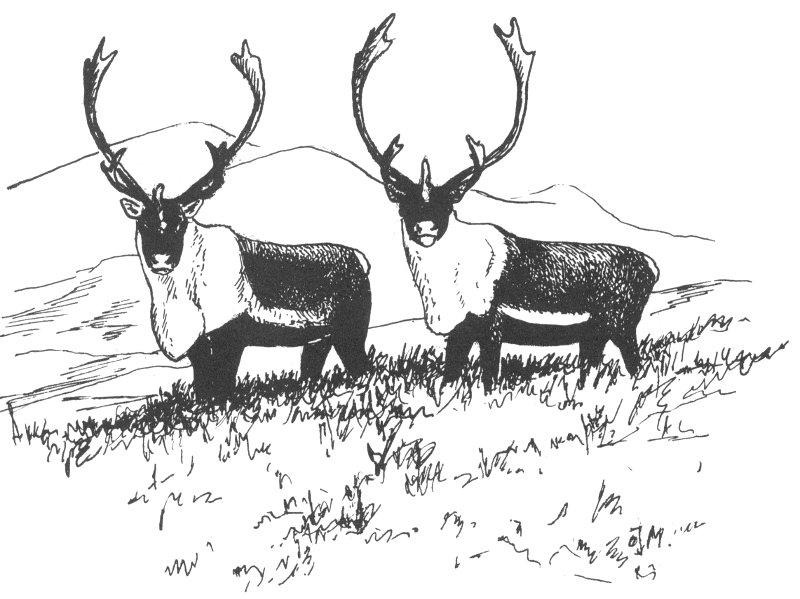
Caribou.
Each spring the caribou appear in faded, dun coats, their color pattern
gone, the long hair worn and frayed. Winter hardships are behind and
the sprouting, nutritious, vitamin-packed green forage is available—nature’s
restorative. On the hummocks the caribou are already finding the
new growth of sedge hidden by the old, leached, brown blades. As the
winter coat is shed, and the new black pelage shows in patches, the animals
have a moth-eaten look.
In May and early June, the caribou that have wintered along the north
boundary of the park and northward to Lake Minchumina, move into
the park, continue eastward to the Teklanika and Sanctuary rivers, and
cross to the south side of the Alaska Range over the glaciers at the heads
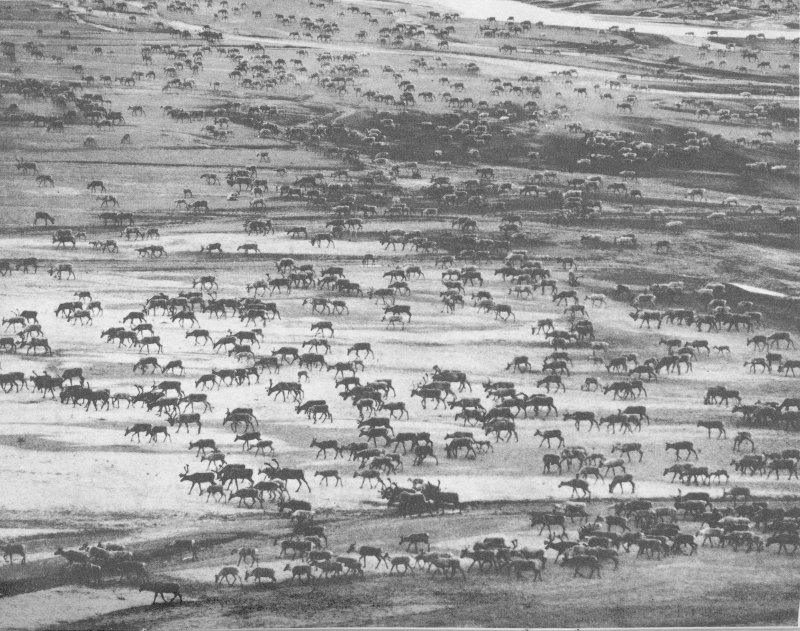
of these rivers. At this time the bands are small, numbering from a few
individuals to one or two hundred. After feeding on the south side of
the range for 2 or 3 weeks, the caribou return en masse, usually in late
June or early July, but in 1960 about the middle of June. Herds numbering
one or two thousand are not unusual, and I have seen an assemblage
13
of four or five thousand. The herds cross Sable Pass and travel parallel
with the road to Muldrow Glacier. From there they may strike northward
or continue on westward. In August and September at least a few caribou
may be found especially in the Wonder Lake area.
Caribou are inordinately fond of lichens which they eagerly feed upon
at all seasons. In summer they take advantage of the variety of foods
available and feed extensively on grasses, many herbaceous species, willows,
and lichens. Lichens are much sought in fall and winter, and in
these seasons grasses and sedges continue to be major foods.
Caribou are plagued by warble flies and nostril flies throughout the
summer. These beelike insects cause the caribou great annoyance. The
warble fly lays eggs on the hair of the legs and underparts of the body.
The eggs soon hatch, the larvae penetrate the hide, and move to the
back region where they emerge as swollen larvae in the spring. The nostril
flies deposit living larvae in the nostrils. The larvae become lodged back
in the throat in a mass and the following spring are coughed out; they
pupate on the ground, and soon emerge as terrorizing flies. A caribou
may dash away in panic to escape a fly, then stop in a wet sedgy depression
and hold its nose close to the ground. Thus it may stand for long periods
if not attacked. On sunny days when the flies are very active, the movement
of the herds is drastically influenced. The large herds may seek a
high, breezy ridge, or a snowfield, to minimize the attack. Commonly,
one or two thousand on such days assemble in a compact group on a
broad gravel bar where they may stand all day. Should clouds cover the
sun, the herd disperses to feed, but again converges if the sun reappears.
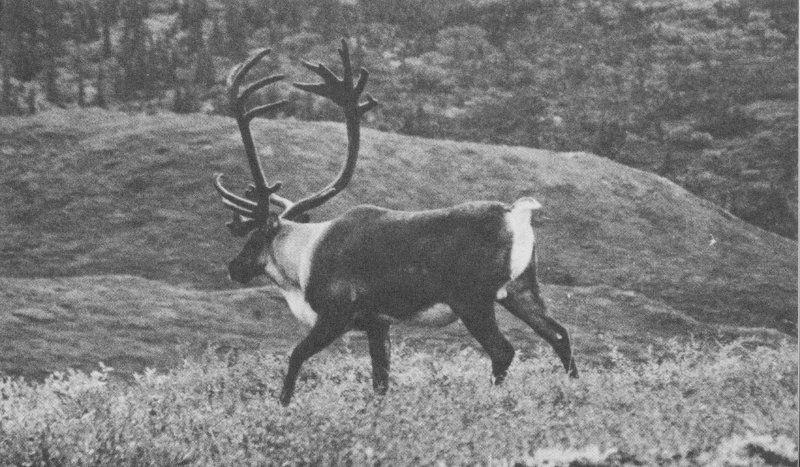
A caribou bull.
14
By midsummer the old hair has been shed and the caribou are in a
short blackish coat that continues to grow. Not until September is this
new pelage fully developed. By then it has become a rich chocolate brown,
trimmed with white. The pattern is most striking in the old bulls. A
silvery cape covers the neck and part of the shoulders and forms a mane
on the throat. A white line extends back along the sides of the body,
and the belly is white. The blunt nose is tipped with white and an oval
white patch surrounds the tail. A white patch shows the location of the
upper gland on the hind legs. White anklets border each shiny black hoof.
The pattern is similar, but much more subdued in the cows and younger
bulls.
The magnificent antlers of the old bulls have hardened by late August.
The velvet covering them during their growth is now rubbed off with a
vigor suggesting the oncoming rut. At first the white antlers are often
stained pinkish by the blood in the velvet. Continued rubbing on the brush
removes the pinkish color and the antlers develop to a rich brown.
The bulls begin to spar soon after rubbing off the velvet. Even before
serious fighting occurs, a bull may show his superiority to some of his
companions. At this time two strange bulls do not hesitate to approach
each other and, with no preliminaries, join antlers and try to drive each
other back. These early fights are brief and on a more or less friendly
basis. A sharp prong may cause a bull to pull away and be unwilling to
resume sparring. But later, when a bull has acquired cows, up to a dozen
or two, he herds them constantly, and fights all challengers.
The single reddish calf is generally born in May. His strength and
speed develop rapidly so that he is soon able to follow the herds in their
hurried travels. By autumn he has acquired a coat similar to that of the
adults.
A close relationship exists between the caribou and the wolf, one that
has prevailed for thousands of years. Although the wolf largely subsists
on caribou over much of the north, natural adjustments have prevailed
so that caribou have prospered in the presence of wolf populations. Wolves
prey extensively on caribou calves in spring. When a wolf takes after a
herd of caribou containing calves, both old and young hold their own for
a time. But soon a calf may begin to fall behind the racing herd, its endurance
not quite up to that of the others. It is overtaken and eliminated.
Natural selection has operated, a culling operation that over eons of
time would seem to have evolutionary significance.
Grizzly bears capture a few very young calves. Encouraged by their
early-season success they continue chasing calves long after the calves
have gained strength and speed enough to readily escape. After a few
failures, I suspect that a grizzly learns that the calf-catching season has
passed and is no longer tempted to gallop ponderously and fruitlessly with
excess power but not sufficient fleetness to capture fleeing calves.
15
The northern conifer forest, stretching across the continent, is the
home of the moose. In Alaska he has reached his greatest size. A mature
bull weighs 12 to 15 hundred pounds, and his huge, palmate antlers
have reached a record spread of about 80 inches.
At a distance the moose appears to be black except for his long, light-colored
stockings. The large head is supported on a short neck, a shoulder
hump is prominent, the nose is loose and bulbous. A special feature is
the bell that hangs from the throat. The legs are inordinately long and
the hoofs sharp.
Moose may be discovered anywhere along the park road. They are
frequently to be seen between Savage and Sanctuary rivers, and along
Igloo Creek. In the Igloo Creek area three or four old bulls may generally
be found spending the summer together, their daily movements usually
covering about a half-mile or less. We speak of the moose as a forest animal,
but it is often found the year round in willow brush beyond timber.
It is not uncommon to see moose in the willows on the treeless passes
such as Sable and Polychrome.
The principal food of the moose is browse. In summer the leaves are
stripped from the branches; at other seasons the twigs are eaten. Willows
and dwarf birch are the chief browse species in the park. Aspens and
cottonwoods are relished but are not plentiful enough to be very important.
Alder is generally eaten only sparingly in winter. Farther south
over the moose’s range, firs and hemlock are highly palatable in winter.
The long legs enable the moose to reach high in his browsing. It is not
unusual to find winter browsing sign 12 feet or more from the ground
where the moose have stood on snow to feed. Tall willow brush and aspen
saplings are often broken over in order to get at the twigs out of reach.
The muzzle may be used for this, or the limb may be grasped in the mouth
and pulled down. Many broken willows are evident on the bars along
Igloo Creek.
The long legs and short neck make grazing difficult. In Wyoming I
once saw a cow and calf feeding on mushrooms, a delicacy. Reaching
the ground was not easy—the calf dropped to his knees, and the cow was
for part of the time down on one knee.
In summer moose may be seen in lakes and ponds feeding on submerged
vegetation. Where the water is deep the moose may disappear below the
surface in his feeding.
16
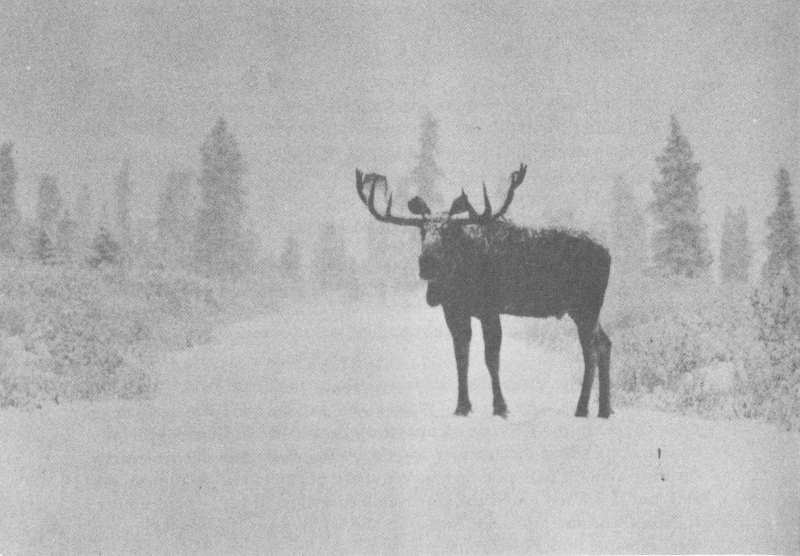
Bull moose in a snowstorm.
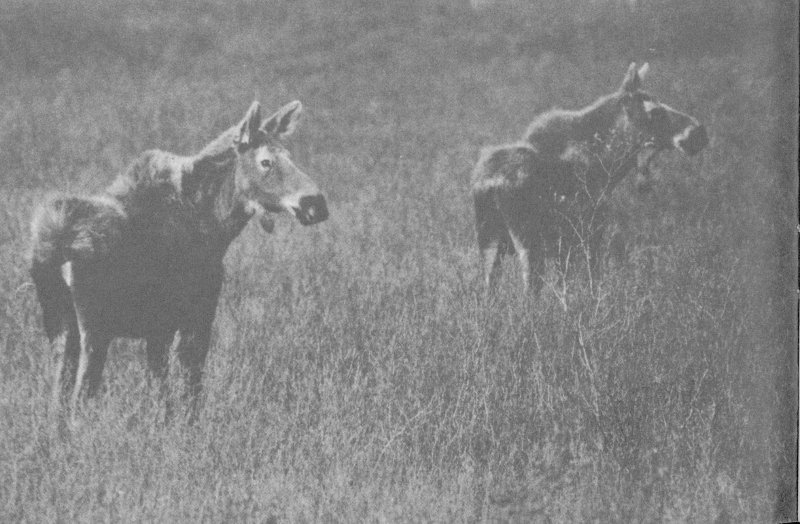
Yearling moose.
17
Rutting activities begin by the first of September and continue into
October. The antlers of the bulls have reached full size and hardened
by the end of August, at which time the bulls begin to rub off the velvet,
the skin that has covered the growing antlers. Saplings and brush are
thrashed with great vigor, and this activity continues long after the antlers
have been cleaned. Apparently it serves as one of the outlets for the
strong rutting emotions. The bulls soon begin to spar and to determine
who is boss over whom. And they begin to seek the cows. A successful
bull usually has but a single cow, and he follows her closely as she moves
about in her feeding. During the rut he utters at intervals a deep grunt.
The cow, apparently when in an emotional state, utters a drawn-out
wailing call.
The one or two calves are generally born in late May or early June.
They are reddish without spots. The mother must sometimes protect her
calf from prowling grizzlies and this she generally seems fully capable of
doing, judging from incidents in which the bear is chased away by an infuriated
mother. A large male grizzly, however, is apparently not easily
discouraged. By autumn the calves have made a surprising growth and
have a new coat that resembles that of the adults. They remain with the
mother until near the time for a new calf, when she no longer tolerates
their presence.
The moose is a wilderness animal, requiring for his haunts big country.
The picturesque bull, silhouetted on a hill or on a lake shore, adds repose
and serenity to the wilderness.
The Dall or white sheep is one of the outstanding wildlife features
of the park. The north side of the greater part of the Alaska Range is
excellent sheep habitat. Within the park the most extensive sheep country
extends from the Nenana River to the Muldrow glacier, a distance
of about 70 miles by road.
Most of the sheep spend the winter north of the road. This is favorable
winter range because the snowfall is relatively light and strong winds
keep the exposed ridges free of snow.
Many sheep remain on the winter range all year, but more of them
migrate toward the heads of the rivers in May and June. In making
the migration, the sheep must in places cross 2 or 3 miles of low country.
They are fully aware of their vulnerability to grizzlies and wolves in these
crossings. Before venturing away from a safe take-off ridge, they may
scrutinize the low country for a day or two, until they feel that no danger
lurks along the way. A band of 60 or 70 sheep may move across slowly
in a rather compact group; at other times urgency replaces caution and
they frequently break into a hurried gallop. Having reached the safety
of rough country again, the sheep may gambol about as though the weight
of tension has suddenly been lifted. The return migration is made in
August and September.
18
The large amber-colored horns of the rams with transverse ridges and
sweeping outward curl have a rugged, graceful beauty. They may spread
widely at the tips or curl rather close to the head. The ewes are less imposing.
Their horns are slender spikes that extend upward in a slight
curve, resembling those of the mountain goat but they lack the shiny
jet black color and are not as sharp. The horns are never shed and continue
to grow throughout the sheep’s life span of 11 to 14 years. The
growth is slight during the later years. Growth takes place during the
summer when food is highly nutritious. In winter only a groove or ridge
encircling the horn is formed. By counting these annual rings the age
of a sheep can be determined.
For detecting danger the sheep depend on their sharp eyes. They appear
to disregard scent which for many animals is the final decisive word
on any situation. But this seems quite logical, because the sheep generally
have a strategic view, and in the varying air currents no dependence can
be placed on getting scent messages. Noises are considered rather unimportant
unless the sheep have already caught a glimpse of movement
nearby.
To approach sheep for photography it is usually best to move slowly
toward them from below with no attempt to hide. They at once become
suspicious if they glimpse someone stalking. However, I have at times
stalked sheep where the opportunity for undetected close observation
was obvious. On one occasion, from a ragged rocky ridge top, I spent
most of an afternoon watching a band of rams some 50 yards away without
being discovered. Some bands are wilder than others and the same
band does not always behave uniformly. A band that has rested and is
ready to move may take your approach as an excuse for a romp.
The food of sheep consists of grasses, herbaceous species and browse,
chiefly willow. Scattered over the range are a number of salt licks which
the sheep seek for minerals.
The most active mating period extends from about the middle of
November to the middle of December. The rams who have been fraternizing
on friendly terms for many months, now and then showing mating
behavior such as gentle joustings, begin to take greater notice of the
ewes. The old rams continue to associate, but now serious battling takes
place. The fighting follows rather uniform conventional rules. The two
matched battlers move apart several yards, then, as though by a signal, they
turn and face each other and at the same time rise up on their hind legs,
then charge full speed at each other, their horns crashing together with
a loud thud. If the joust is even, they may repeat the performance until
the superiority of one of the combatants is evident. But there is some
tolerance among the rams, for two or more may breed with ewes in a
band indiscriminately.
The numbers of sheep on a range under natural conditions may vary
considerably. In the park, a very high population, possibly as high as
19
5,000 or more, suffered severe losses during 1929 and again in 1932, due to
extremely deep snow conditions, and an icy crust in the latter year. In
1945 the population was down to about 500. Since 1945 there has been
a steady increase. The numbers in 1959 were up to about 2,000.
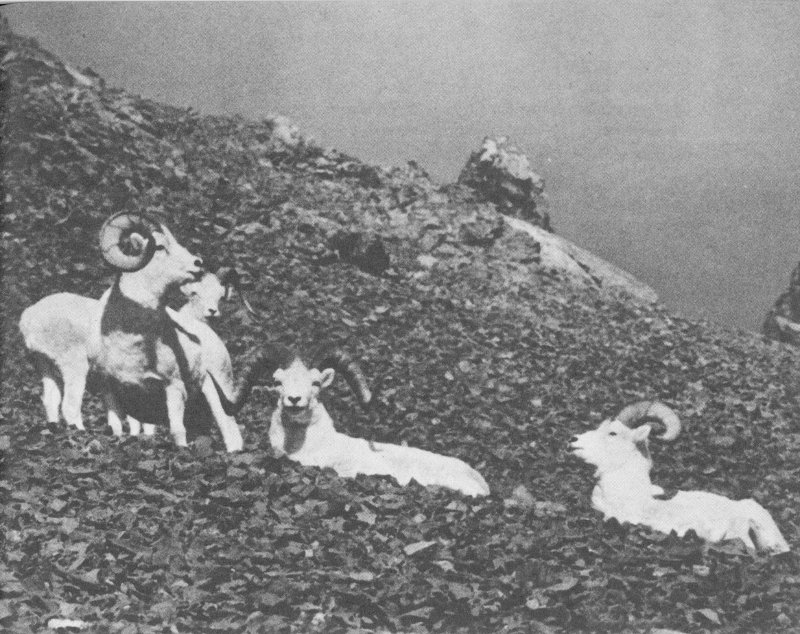
Dall sheep; rams on the Alaska Range in summer.
Sheep are subject to wolf predation, especially when the numbers are
so high that part of the population must graze on hills too gentle for
safety. Sheep legs are strong and sturdy but for their effective functioning
steep country is needed. The steep terrain is, so to speak, part of their
legs. In my studies in the park, the losses showed that it was the very old,
the ailing, and the lambs in their first winter that were most vulnerable
to predation. The lynx (when rabbit numbers have crashed and these
animals have become scarce), wolverine, and grizzly may capture an
occasional sheep but their effect is unimportant. The golden eagle may
capture an occasional young lamb, but all my observations and food-habit
studies indicate that any eagle predation that takes place is insignificant.
If the park is large enough to support the sheep and their predators
(natural conditions), we have a situation ideal for the future of the sheep.
20
Mountain sheep have a high esthetic appeal. In part this may be due
to their setting, for we associate them with their beautiful haunts, the
precipitous cliffs and ledges intermingled with green slopes spangled with
flowers. This is idyllic country in which to hike and climb. Here we encounter
the golden eagle who shares the ridge tops with the sheep; the
wheatear, who comes all the way from Asia to nest; the gray-crowned rosy
finches; the flashing black and white snowbirds nesting in rock crevices;
and the surfbird that has left the ocean beaches to nest in these remote
mountains. And up high, the saxifrages, delicate yellow poppies, forget-me-nots
and spring beauties add color to it all.
On May 27, 1955, a goat was discovered on Igloo Mountain on the
slope directly above the cabin I was occupying. It remained on the mountain
for 3 weeks before wandering away. It has not been seen since. This
is the only verified record for the park. But two road men reported seeing
a goat cross the road at Mile 3, on August 8, 1950. I believe this to be
a good record because both men are reliable observers. In the fall of 1950
a goat was shot at Cantwell, not far from the park boundary.
The nearest known goat range is about 60 miles from the park in the
Talkeetna Mountains. The goats that reached the park may have been
sporadic wanderers for it is not unusual for goats to occasionally wander
25 or 30 miles from their known ranges. On the other hand, it is possible
that the goats are expanding their range toward the park. In 1959,
I was told that a band of a dozen goats had been reported at the head of
Jack River where they had not been reported before. Jack River lies between
the goat range and the park.
Identification is not difficult. The goat’s horns are short, slightly curved
spikes, similar to the horns of the female sheep, but shiny black and
smooth rather than grayish and rugose. The goat’s chin whiskers are
identifying, as is the shoulder hump, and the knee length pantaloons of
long hair. Also the goat’s face is noticeably longer than that of sheep. The
goat sexes are similar.
It is not unlikely that goats will continue to be occasionally seen in
the park. Any lone “sheep” might turn out to be a goat.
21
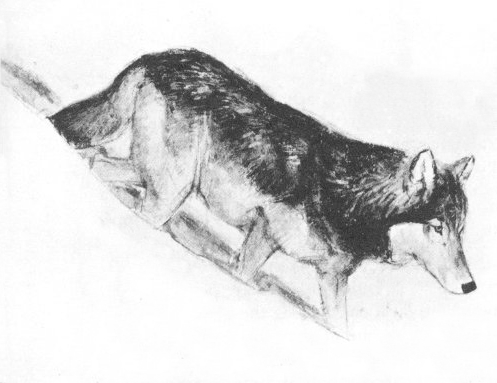
Alaska wolf.
From a color sketch by William J. Berry.
Wolves vary considerably in size and color. The average male weighs
about 100 pounds and the female somewhat less, about 85 pounds. Their
color may be almost white, black, gray, or brown. Most wolves in interior
Alaska are either black or brownish like a coyote. The facial markings
show some variation and there may occasionally be noticeable patterns
over the rest of the body. A few wolves have a blackish saddle; one
that I knew had a black robber-mask across the eyes. Individual disposition
and behavior also varies. A handsome male had an extra touch of
spirit in his gallop; a male parent had a dour expression and seemed, to
my imagination, weighted with care. Wolves raised in captivity from
puppyhood are extremely friendly.
For a den, the wolf considers an enlarged fox burrow both convenient
and suitable. Dens have been found in a variety of situations. One was
located on a wooded rock bluff, another was beyond timber near the top
of a bluff bordering a river, and one was on a wooded island between old
river channels. The four to six young, probably the average size of litter,
are born the early part of May. The mother remains at home with the
pups and the male provides the victuals.
At one den that I observed closely there were two extra males and an
extra female with the pair. These wolves all fraternized in the most friendly
manner. Before departing for the night hunt, the five would sometimes
assemble in a close group, wag tails and frisk about, and sitting on
haunches sing in chorus. Later in the season this group of five adults was
joined by two additional males.
The following year the same pair returned to the den. They were accompanied
by one of the extra males that had been at the den the previous
22
year. The extra female and one of the bachelors set up their own
housekeeping farther down the river. But when their pups were large
enough to travel, they all came up the river and joined the original pair.
Young and old combined added up to 15 wolves. This wolf pack was
composed of two pairs, an extra adult, and 10 pups. Some of the extra
wolves of the previous year were not seen—they may have been trapped
or poisoned beyond the park boundaries during the winter months.
The wolf’s food varies with the seasons and the prey species available.
When voles and lemmings are plentiful, the wolves may spend hours in
the grass and sedge areas pouncing on them. During the summer months
the ground squirrel has at times been one of the more important food
items. Occasionally an unfortunate marmot is surprised and in years
when rabbits are plentiful, the snowshoe rabbit becomes a food source.
I have found remains of several porcupines eaten by wolves, the spine-covered
hide neatly inverted.
But the wolf also, and primarily, feeds on the ungulates—the mountain
sheep, caribou, and moose. Under natural conditions the relationship
between the wolf and these prey species is old and tried. There is the
aphorism, “nothing in nature offends nature.” In the hunting of these
animals the wolf appears to be an evolutionary force in that there is a
tendency for the weaker individuals to succumb.
In spring the wolf hunts the caribou calves, which early develop surprising
speed, so that when a wolf chases a group of caribou, the calves
race along with the adults. But after a time a weak calf, one not up to the
others in endurance, may begin to drop behind, and it is this weak individual
that is overtaken, an example of the elimination of the weak, the
survival of the fittest. In the winter hunting, the old and weak animals
are the most susceptible. It is a struggle, a testing for all, but through the
ages, the sheep, moose, and caribou have survived and come down to us
adapted to their particular way of life, with the wolf as one of the environmental
factors.
At McKinley we have an opportunity to preserve a northern flora and
fauna. But the future of the wolf is precarious because the home range
of the park wolves extends beyond park boundaries into territory where
the wolf has no protection, where there is a bounty on his head. The
silencing of the longdrawn call of the wolf would be a tragic loss to the
human spirit.
So far as known, the coyote has always been rare out in the park. Along
the Nenana River, however, I frequently have heard his song. Here he
seems to find conditions more favorable for his way of life. Perhaps it is
the presence of the snowshoe rabbit in this low brushy country that attracts
him.
23
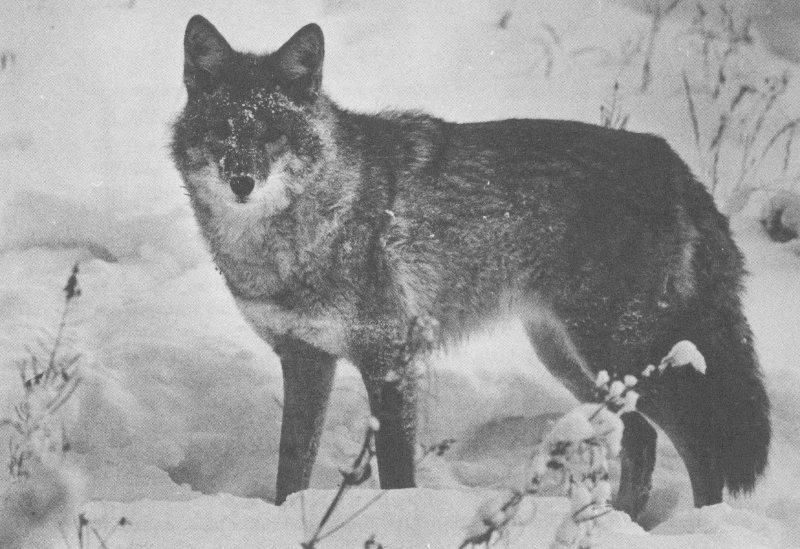
Coyote.
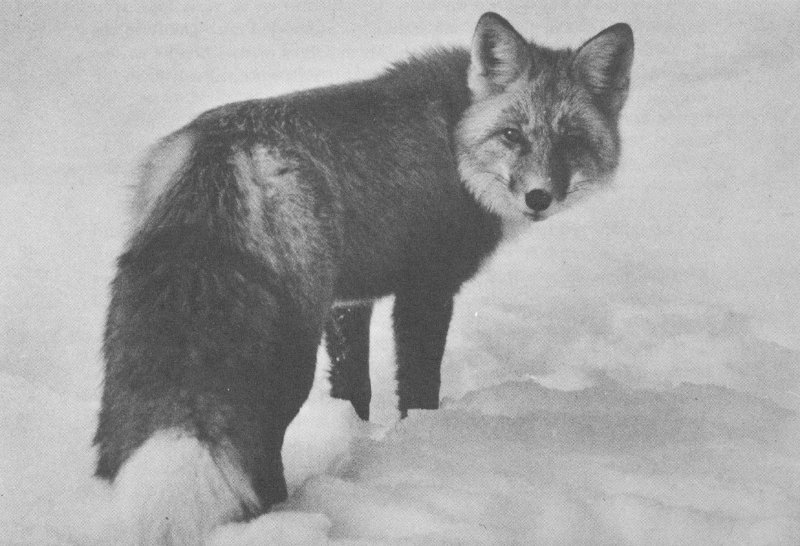
Red fox.
24
The coyote weights about 25 pounds on the average. His color is brownish
with black-tipped hairs intermingled. Color variation in coyotes is so
slight it is not noticeable in the field; he does not have the black, whitish
and various color patterns that are present in the wolf. The muzzle is long
and pointed, ears well developed, eyes sharp.
As a field biologist I have had an opportunity to observe coyotes in
many regions. In Yellowstone I made a 2-year study of its relationships
with other animals because it had been feared by some that he would
destroy the antelope, bighorn, and deer, if not controlled. The study
showed that the coyote there lived chiefly on meadow mice and pocket
gophers in summer, and carrion in winter, and that he had no harmful
effect on the large ungulates.
On the San Carlos Indian Reservation in Arizona the coyote was blamed
for cattle losses. Here a study showed that the basic cause of losses was
over-use of the range and that where grazing was good all losses were insignificant.
Cattlemen are finding this true and are beginning to appreciate
the usefulness of the coyote as a curbing influence on rodent depredations.
In addition to a meat diet, which includes great quantities of grasshoppers
in season, the coyote feeds extensively on fruit. On Isle Royale, in Lake
Superior, I found it feeding on sarsaparilla berries; in Jackson Hole,
Wyoming, on silverberry and quantities of haw; in Arizona, on manzanita
and juniper berries, the latter being the winter staff of life.
The coyote is best known for his song, which in all its variations, symbolizes
the spirit of wildness and remote country. J. Frank Dobie in his
The Voice of the Coyote expresses the sentiment of many when he writes:
“I confess to a sympathy for the coyote that has grown until it lives in the
deepest part of my nature.”
The fabled red fox is abundant, widely distributed over the park and
frequently seen. Silver, cross, and red color phases, along with some intermediate
variants, are well represented, and two or three of these types
frequently show up in a single litter. The prominent white tip on the tail
distinguishes the fox from the coyote and wolf.
Hundreds of dens are scattered over the countryside, many more than
are used in any one season. They are located indiscriminately in spruce
woods and out on the open tundra miles from the nearest tree. Each pair
has a selection of old dens to choose from, but often they occupy favorite
sites year after year. During a season, a family sometimes moves from their
25
first choice to a den nearby. The connecting burrows of a den usually
have 5 or 6 entrances and one I examined had 19.
The young are born the early part of May. By June the blackish, blue-eyed,
chubby pups may be seen walking about clumsily. At this age they
are nursed in the open. One mother that I often watched almost always
nursed her five pups from a standing position. Only twice did I see her
lying on her side to nurse. As the pups grow they become slimmer and the
eyes turn brown and the coat color changes so that the different color
types can be identified. Although nursing seems to cease toward the end
of June, the cubs remain at the den into September.
While the male travels far to hunt, the vixen remains at home to watch
over the pups. Most of the time she is curled up at the den or perhaps a
hundred yards away on a prominence. When she wishes to nurse the pups
or give them food, she puts her head in the mouth of a burrow and calls
softly “mmmmm,” “mmmmm.” If they do not come forth, she may go
to another entrance and call. But usually they respond at once. A sharp,
guttural “klung” has the opposite meaning; when the pups hear this
warning they scurry into a burrow. This command is often given after
the pups have nursed and the mother wants to go off a short distance to
lie down.
The female exhibits extreme friendliness toward her mate. When he
returns to the den after an absence she greets him with tail-wagging,
face-licking and much wriggling of her body. He is less demonstrative
and acts tired, which he probably is after several hours of hunting. She
picks up his offerings—usually mice or ground squirrels—eats her fill
or, if not hungry, carries the booty to the burrows and calls to the young.
He moves off to one side to rest. She sometimes watches for his return
from various points. One evening a vixen impatiently moved from one
lookout to another for over 2 hours before the male arrived and received
her warm welcome.
Mice and lemmings are the staple all-year food, but in summer the
ground squirrel may make up about half the diet. When snowshoe hares
and ptarmigan are plentiful, they become prominent in the diet. Carrion
is especially attractive in winter, and the fox attends carcasses and curls
up on the snow to wait until the wolves and wolverine have eaten. He
robs wolf and wolverine caches, and he sometimes has his own caches
robbed.
In the latter part of July the foxes go berrying, for they are fond of
fruit. Blueberries and crowberries are everywhere available for the picking.
The berries are also eaten in winter sometimes, it is said, quite extensively
when mice are scarce.
Foxes appear to be well able to take care of themselves. They can outrun
the grizzly, wolf, and wolverine. When the golden eagle swoops at
him he stands on watch with his bushy tail erect and straight as a ramrod.
The eagle dares not strike.
26
The lynx manner is one of independence, confidence and complacency.
He walks through the woods with dignity, looking neither right nor left.
Of course, he is not as oblivious as he appears to be. He may even stop
to watch you, but only briefly, and then he continues sedately on his way.
His long legs are thicker than seem necessary to support the lean body,
but they are no doubt valuable for long jumps and pouncing. The large,
widespreading feet serve him well as snowshoes, and strong, curved claws
enable him to scramble readily up a tree. The eyes are startlingly big and
yellow and the throat ruff gives to the face a squarish look. Long, glistening
black tassels adorn the ears. The stub tail, about 4 inches long and
tipped with black, serves to register emotions. The winter fur is soft and
grayish, with few markings except for the facial pattern; the summer coat
is more tawny.
Nature has bestowed on the lynx a snowshoe fixation so that he spends
his nights and days thinking and dreaming of rabbit dinners. So dependent
has he become on the rabbit for his main course that his numbers
flourish and wane in the wake of rabbit statistics.
During the period between 1954 and 1956, when lynx were abundant
in the park, I made a study of their food habits by analyzing several hundred
lynx scats. In addition to rabbits, the lynx had fed considerably on
ptarmigan and in summer on ground squirrels. This part of the diet
increased as the rabbits decreased. But with the decline of the rabbits,
the supplemental foods did not suffice to maintain the population, and
the lynx became scarce.
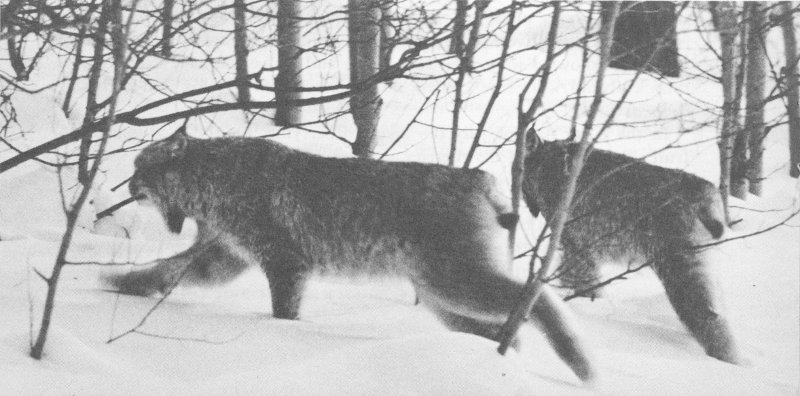
Lynx.
27
In the winter of 1907-08, Charles Sheldon noted two instances of lynx
preying on sheep. The rabbit population had crashed and the lynx had
turned to other sources for survival. One lynx that made its attack on a
sheep from ambush found the prey rather large, for in the ensuing struggle
he received some severe bruises. He apparently was driven to hunting
animals out of his class. About 2 years after rabbits disappeared in the
Kuskokwim River region a number of years ago, lynx did some preying on
reindeer in winter by leaping on their backs and biting the neck. The lynx
were said to have attacked the reindeer only that one winter. During
periods of food scarcity, lynx have also been observed to prey on each
other.
The young are born in May in a cave, or perhaps more often, under a
windfall. The gestation period is about 60 days.
In early June, 1955, I saw a lynx in the spruce woods near Savage River.
As I stood watching I heard crying sounds up in the woods. The lynx
disappeared in the direction of the crying. I followed and saw the parent
under a windfall as it was departing with a baby in its mouth, the last of
a litter it was moving. Snow and rain had fallen and the mother was
carrying her family, one by one, from under an inadequate windfall to
another about 250 yards away. The new home was under a brushy spruce
that provided a dry shelter in any kind of weather. So well hidden and
secure did the mother feel that she barely opened her sleepy eyes even
when approached within 20 feet.
How empty the woods and willow patches become with the decline of
the rabbits and the departure of the lynx. It is like an empty stage after
the actors have finished their play and departed. Scattered through the
quiet woods are their signs of life and activity, but the action has stopped.
On the tall willows, 6 feet from the ground, is the gnawed white rabbit-line,
where rabbits had sat on the snow and gnawed the bark within
reach. In places the ground is littered with severed twigs, many of them
partially gnawed. And everywhere one encounters tufts of rabbit fur and
hind legs, left on the green moss, signifying rabbit tragedies and lynx
banquets. But the rabbits will return again to dance in the moonlight, and
the lynx will be back in his rich domain walking with stately and regal
step.
The fabulous wolverine is a powerful and picturesque member of the
weasel tribe weighing up to 35 pounds or more. Because of his stocky
build and long hair, he resembles a small bear. Frequently the large
hoary marmot is mistaken for him—there is considerable similarity. But
28
the broad yellowish-tan stripe on the sides of the body is distinctive. A
whitish collar, not always visible, extends across the throat. The tail is
short and bushy; the sharp, well-developed claws are whitish. His range is
circumpolar and extends southward in the mountains to Colorado and
California, but he is now scarce south of Canada.
The wolverine in late years seems to have become more plentiful in
the park; nevertheless, it is always considered something special to see one.
They range from river bottom to ridge top, are found in the woods or
in open country miles beyond timber. Perhaps because of the open view,
he is frequently seen on the low passes, especially on Sable Pass.
In winter the track of the far-wandering wolverine is frequently seen.
In his usual gait he bounces along with back arched. Each jump usually
leaves a set of three imprints; the one in front is made by a hind foot;
the middle imprint is made by a hind foot falling in the track of a front
foot; the rear imprint is made by the other front foot. As in the tracks of
a hopping rabbit, the hind feet tend to be brought up ahead of the front
feet.
The wolverine readily climbs trees. One winter, near a moose carcass,
tracks in the snow showed that a wolf had chased a wolverine up a tree on
two or three occasions. If the two had met in the open the threatening
posture of the wolverine would, no doubt, be sufficient to discourage
attack. When attacked by a dog, a wolverine has been seen to lie on its
back in a defensive attitude, a position that was effective. Powerful ripping
claws and jaws face the attack.
Not much quantitative information has been gathered on his food
habits. I have watched him pouncing on mice and suspect that mice
(voles) and lemmings are the most important items in his diet. In summer
he captures ground squirrels, sometimes by doing some digging.
Once I noted that he had dug out a wasp nest hidden in the ground. The
calves of caribou and moose, when very young, are no doubt potential
victims. But observations indicate that even a caribou can ward off an
attack on the young calves. Such items would, of course, be unimportant
in the wolverine’s total economy. His wide wanderings in winter would
seem to be helpful in finding carrion. In rich wild country, considerable
carrion probably comes his way. I have found the wolverine attending a
frozen moose carcass for a number of days. When a carcass is not frozen,
he carries away what he can to cache for later use.
The gestation period is said to be about 9 months. The breeding apparently
takes place in summer. The fertilized eggs, after brief development,
lie unattached and dormant in the uterus for several months. Some
time in midwinter the eggs become attached to the wall of the uterus and
the more usual development takes place. (The marten and short-tailed
weasel have a similar breeding history.) Females have been found in a
nursing condition in early April. Along Igloo Creek, Mr. and Mrs. Edwin
C. Park watched a mother nurse two young at least two-thirds grown.
29
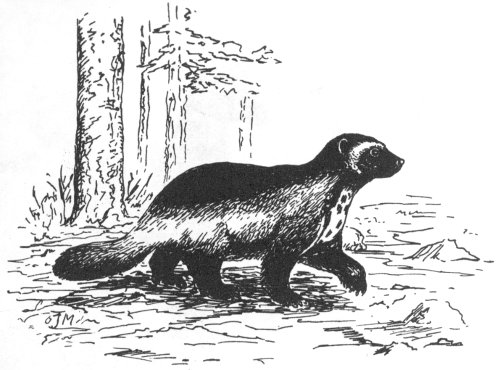
Wolverine.
According to Peter Krott, in his fascinating book about the wolverine
in Europe, this fierce animal makes a friendly pet. The author, in the
beginning, made a business of acquiring young wolverines for sale to
zoos. Because the animal was rare and intriguing, the demand was great
and the prices remunerative. But Mr. Krott and his wife became fond of
the wolverines and found it ever harder to dispose of them. Soon they
ceased selling them, and, instead, kept them as pets and allowed them to
roam freely over wild country. Studies were made of their habits. Their
wolverines might wander far and stay away for several days, but they
would return at intervals.
The wolverine is at home in the McKinley wilderness. Here we have
the rare opportunity of seeing him in his natural environment.
The marten is long and lithe, and its graceful activity is conspicuous.
The usual color is a rich brown, shading to blackish on the feet and tail.
The face is grayish with a short, dark line extending upward from the
inner corner of each eye. A large orange throat and breast patch is very
striking in most individuals. The fur is soft and long, the tail is long and
well-furred, and serves to register various emotions. The marten is alert
to sounds and this is indicated by its well-developed, broad ears.
The body is 16 to 17 inches long, and the tail, including hair at tips,
8 or 9 inches. A large male may weigh up to 2½ pounds. The female is
somewhat smaller than the male.
The marten is found in the forested parts of the park along the northern
and eastern boundary. In winter, I have noted a few tracks in the big
spruce woods south of Wonder Lake. In Wyoming, I have found martens
30
in rock slides beyond timber, the
rock crevasses furnishing the desired
protection.
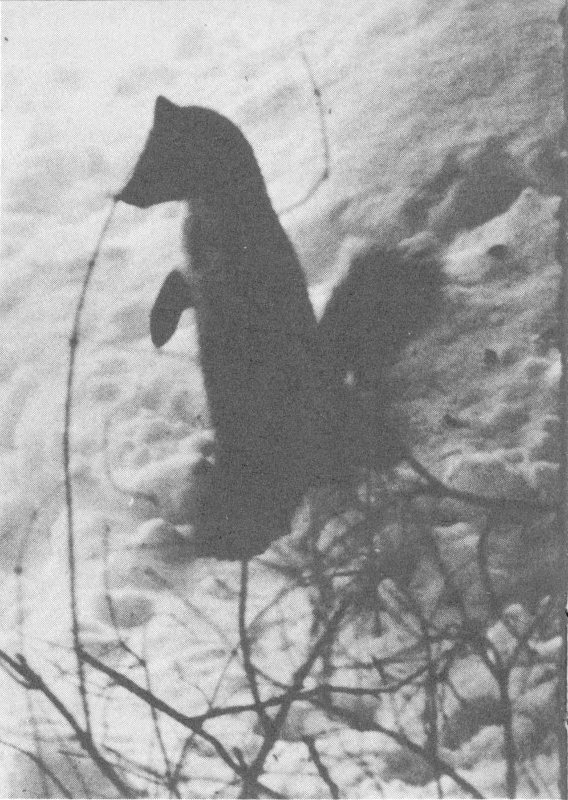
Marten.
At one time the marten was
thought to depend on the red squirrel
for his daily fare, but recent
studies indicate that ordinarily relatively
few red squirrels are eaten. A
food-habits study made at Castle
Rocks near the northwest corner of
the park showed that the martens
there were living primarily on meadow
voles and the red-backed mouse.
Blueberries were eaten in winter as
well as in summer. In Wyoming, I
have found martens feeding extensively
on blueberry, rhamnus, haw,
and mountain ashberries by choice
at a time when voles and other foods
were plentiful. Like the fox and
coyote, they have a strong predilection for berries. In slide rock, they
manage to capture an occasional pika.
The marten breeds in July and August, but the young are not born
until 9 months later. The long gestation period for such a small animal
is due to the delayed attachment of the fertilized egg to the uterus. Except
for the period when the female is followed by young, and during the
breeding period, martens travel alone.
In Grand Teton Park, Wyoming, where I had much opportunity to observe
martens, I found that, although they seldom captured a red squirrel,
in their vagabond life over their home area, they did use red squirrel
homes for sleeping. The marten might spend a few days resting in a
squirrel’s spare nest, then move on to another squirrel domicile for a few
days. The squirrels suffered only the inconvenience of an unwanted guest,
and perhaps the temporary loss of a favorite bed.
The mink is the amphibious member of the weasel family. He lives
along rivers and lakes and probably forages more in the water than on
land. Fish, frogs, insects, snails, crayfish, rabbits, muskrats, and mice all
appear on his bill of fare. In the country between the mouth of the Yukon
and the Kuskokwim River, the mink is said to subsist largely on Alaska
31
blackfish (Dallia pectoralis). So abundant were the mink in the area that
the Eskimo were called “mink people.” The muddy waters in this watery
region apparently supported enough blackfish for both the mink and
the natives. This fish is said to have been the chief food of the natives.
It is very tenacious of life. Kegs of live fish, packed densely, were kept
for food in the dwellings. A steady slow rotary movement of the mass of
fish brought each fish to the surface at intervals for a gulp of air. When
a frozen blackfish is thawed, it is said to become as lively as ever.
Mink tracks have been noted along the Nenana River, but over most
of the eastern half of the park the mink is rare.
The otter is rare in the park. It was reported present in Wonder Lake
some years ago and tracks in the snow were reported at Savage River. It
probably occurs in the Nenana River, along the eastern park boundary.
The otter, a member of the weasel family, has become adapted to life
in the water. His body is about 3 feet long, and his long muscular tail is
over a foot long. His cousin, the sea otter, plentiful in the Aleutian Islands,
is much larger and more specialized for an aquatic life.
I have watched a family of otters in Grand Teton Park fishing for an
hour or longer. They kept diving steadily, and occasionally one would
come up with a small fish which he would proceed to eat, beginning at the
head. Larger fish are taken ashore. Trout, chubs, and suckers were available
but numerous droppings showed that the otter were feeding chiefly on
the chubs and suckers. The fish taken were no doubt those most easily
captured. A few crayfish were also eaten. This particular family was
living in a large beaver house also occupied by beavers. They entered
their chamber by land and apparently lived upstairs above the beaver’s
part of the house with its underwater entrance.
In winter the otter frequently travels over the snow from one piece
of water to another. In these travels he slides on his belly down all slopes
and sometimes even on the level. In play, a family may repeatedly climb
a mudbank or a snowbank to course down a slide leading into water.
Two species of weasel occur in the park. The larger one with a black-tipped
tail is called the short-tailed weasel, and the smaller one with
an extremely short and all-white tail is the least weasel.
32
Both weasels are brown in summer and white in winter, a protective
coloration no doubt useful in escaping detection. In some southern parts
of their ranges these weasels remain brown all year, and in intermediate
areas part of the population turns white in winter and part of it remains
brown. It is apparent that climate has an effect on coat color, the specific
factor being the presence or absence of snow on the ground.
It has been pointed out that the short-tailed weasel is much larger in
the north than in the southern part of the range. In Wyoming and Colorado,
where the tiny least weasel is absent, the short-tailed weasel approaches
the least weasel in size and probably fills that weasel’s niche in
the environment.
The food of the short-tailed weasel probably consists chiefly of various
species of meadow mice and lemmings. Observations indicate that ground
squirrels and rabbits may occasionally be captured. Shrews no doubt are
also on the menu.
In winter, weasel tracks form an odd pattern. Their jumps are alternately
long and short, and often they make an erratic trail. Frequently
the tracks show that the weasel disappears and travels beneath the surface
for a stretch before reappearing.
Even though weasels are not very palatable because of their well-developed
musk glands, they nevertheless are often preyed upon. It is a case
of coyote or fox capturing any small animal that moves and examining
the victim afterwards. Weasels are often left uneaten.
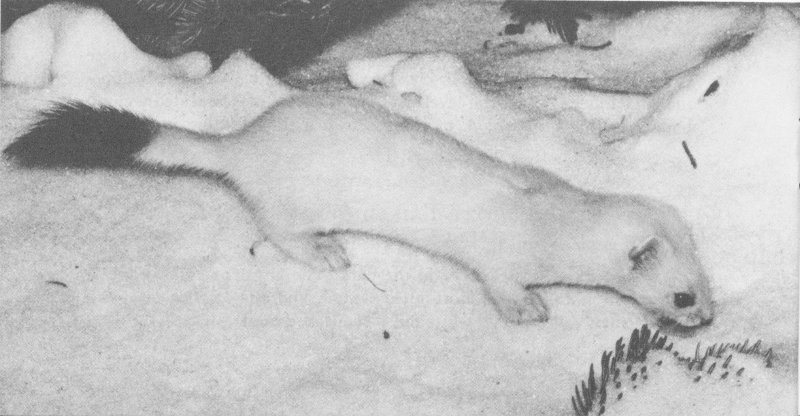
Short-tailed weasel.
33
The range of the least weasel is circumpolar. In North America it is
found over most of Alaska and Canada, and southward to Montana, Kansas,
North Carolina. It is widely dispersed but apparently nowhere abundant.
This tiny weasel is only 6 to 6½ inches long with a maximum tail
length of 1½ inches. It is the smallest living member of the carnivores
and weighs no more than a meadow mouse. The tail is pure white, lacking
the black tip present in other weasels.
I have a record of four specimens from the park. One captured in a
mousetrap was 5½ inches long, the tail measuring less than 1 inch. I
found a dead one at an eagle perch on a ridge top, and remains of two
others on gravel bars, apparently discarded after being captured.
A sourdough on the Koyokuk River with whom my brother and I
stayed one night, had a least weasel spending the winter with him. It
had the run of the cabin and was very tame.
Apparently the chief food of the least weasel is mice, some of them
about as large as himself.
Like the ptarmigan and the northern weasel, the snowshoe rabbit, or
varying hare, each autumn changes from a dominantly brown summer
coat to a white winter ensemble. (In Washington where snow is scarce
in its habitat, the snowshoe rabbit remains brown the year round.) His
coat color blends at all seasons with his background, so all he need do
to be fairly sure of escaping visual detection is to have confidence in his
camouflage and sit motionless. The fur is so long, thick, and warm that
he can sit all day in fifty below zero weather without freezing. His large
hind legs are equipped with snowshoe feet, an obvious advantage in snow
country.
The most favorable rabbit habitat is the brushy country along the east
and north boundaries. Here a few may always be found. Out in the park
they are quite scarce except in those years when the population is at or
near a peak.
In winter, the rabbits feed on bark gnawed from various shrubs and
saplings. Willow, dwarf birch and alder, because of their high palatability
and abundance, are especially important winter foods. In years of rabbit
abundance, I have seen patches of willow and dwarf birch trimmed to
34
the snow line. At such times large willow brush may show a white band
2 feet wide where the rabbits have gnawed the bark within reach of the
snow line. As the snow deepens, some foods are buried but the change of
level brings new food supplies within reach. A variety of other shrubs are
also eaten at this season. Spruce bark is relished. Porcupines, and also
red squirrels, feeding in a spruce tree inadvertently add to the rabbit menu
many dropped spruce twigs. In summer, the rabbits turn to a variety of
fresh green foods.
The young of the snowshoe rabbit are furred and active when born
and apparently there is no real nest provided. (In the cottontail branch
of the family the young are born hairless, helpless and in a warm nest.)
The litters may vary from one to six. The gestation period is about 36 days.
The young are weaned (in captivity) when about 4 weeks old. The females
breed again soon after a litter is born. It seems likely that a female
may have as many as three or four litters during a summer. A male is
apparently with a female for only a short time.
A number of animals are subject to cycles of extreme abundance and
scarcity. The pendulum swings from one extreme to the other. A population,
in spite of enemies of all kinds, increases until the numbers become
so large that they threaten the food supply or, because of congestion, are
drastically reduced by diseases. The length of cycle in a species depends
upon annual losses and the rate of increase. Cycles are relatively short
in voles and lemmings which breed at an early age (a few weeks), breed
often, and have large litters. In these small rodents the cycle may cover
a span of about 4 years. In larger species, the cycles are longer.
The snowshoe hare is one of the more obvious examples of a cyclic
species. From acute scarcity the population in about 10 years pyramids
until the country is full of rabbits. The woods are alive with a variety of
activity. Enterprise, lovemaking, and tragedy are at their peak. Not only
have the rabbits multiplied, but their enemies have flourished, and the
lynx, fox, wolverine and birds of prey have all prospered, and certain
enemies such as the lynx, become especially abundant.
During the high rabbit population peak, between 1953 and 1955, a
few dead rabbits began to appear in the summer of 1954. In early August
a group of tourists on a short walk noted three dead rabbits in the hotel
area. But the rabbits were still numerous in the spring of 1955 and I
anticipated the woods alive with young rabbits the following months.
Instead, they decreased. By July, along Igloo Creek, they had become
scarce. The so-called rabbit crash had taken place.
Nature steps into all situations, and one control or another automatically
appears. Food shortage, disease, predation or competition enter
the picture. Adjusting is a continuous process. Many people are talking
and writing about the human population explosion in our midst, fearing
that space for ourselves and nature is disappearing alarmingly. Perhaps
we should consider the snowshoe rabbit.
35
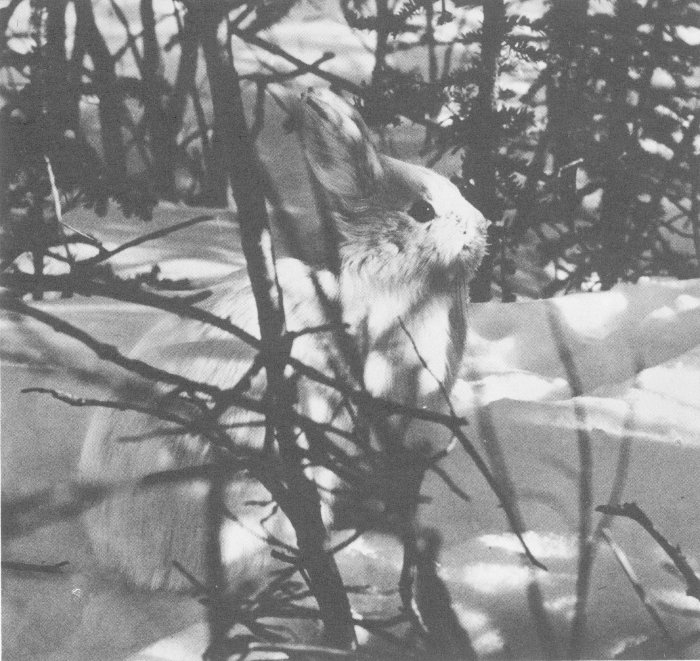
Snowshoe rabbit, or varying hare.
The pika, cony, or rock rabbit, as he is variously called, makes his home
in rock slides. His way of life, and his physical attributes, are such, that
he would have difficulty surviving away from the labyrinth of passages
in his slide rock home.
The pika is in the same order (different family) as hares and rabbits.
Like rabbits, they have two pairs of upper incisors; back of the grooved
anterior incisors is a pair of very small incisors. The feet are furred; the
ears are not long but are rounded and prominent. Something has happened
to the external tail for there is none. The tail vertebrae lie under
the body skin. The plump body is about 6 or 7 inches long as the cony
sits on a rock; the color is gray.
36
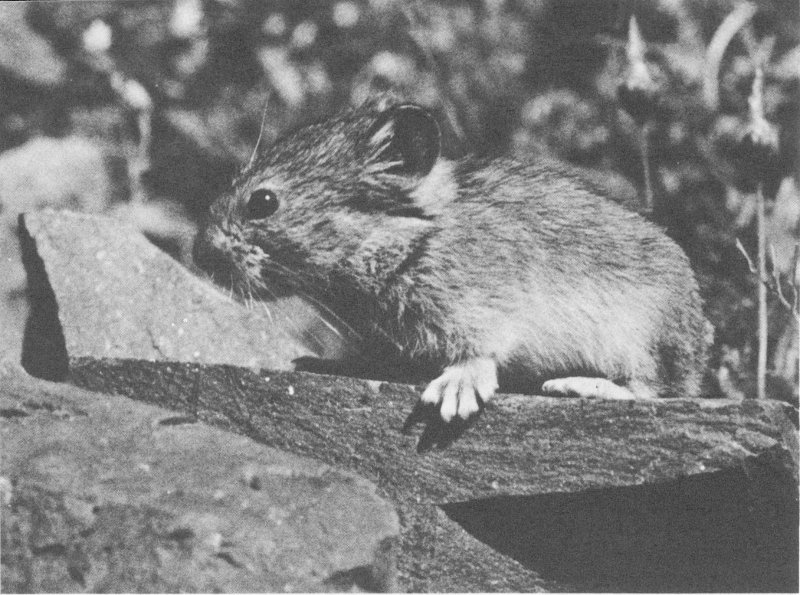
Collared pika (cony, rock rabbit)
The call is a single nasal “yank,” usually uttered while perched on a
rock where he can look around. He may be difficult to locate, but a movement
as he disappears in a crevice and reappears on the same rock or one
nearby will reveal him. Usually other calls from various parts of the rock
field will indicate the location of other pikas.
The pika is known for his hay making in preparation for the long
winter. During much of the summer he is busy carrying grass, herbs, and
twigs to his many caches located in cavities protected from the weather.
The vegetation is usually added slowly enough to the various caches so
that it all cures properly. Only occasionally is a cache moldy. I have noted
a few caches composed of the broad, heavy coltsfoot leaves that had failed
to dry properly; possibly these slow-drying leaves were harvested in wet
weather. Nearly all plants within range of his rocky habitat are used.
Willow, rose, grass, sedge, horsetail, various saxifrages, fireweed, coltsfoot,
fruiticose and even crustose lichens are some of the many plants that have
been found in the caches. Some books say that the hay is spread over rocks
to dry and then stored. The pika’s technique is superior to such quick
drying, and results in more nutritious and greener hay.
The sheep, moose and caribou often seek mineral licks consisting of
clay which can be readily eaten. Ground squirrels and marmot feed on
pebbles or fine dust in their craving for minerals. On one occasion I
watched a pika gnawing a rock. A niche showed that a considerable
37
amount of it had been eaten. I carried the rock away as a sample of rock-eating
but later thought better of it and returned it to the pika. Perhaps
in the future I may be able to check the rock again.
Along the road, the first good place to look for pikas is in the jumble
of rocks above the Savage River bridge, an accumulation that has fallen
away from a rocky point, part of which is still in place. On Polychrome
Pass are several rock fields where many pikas are living. Another pika
place along the road is a mile or two beyond Camp Eilson. A pretty picture
is a pika carrying a bouquet of flowers, neatly arranged, as though
he were going a-courting.
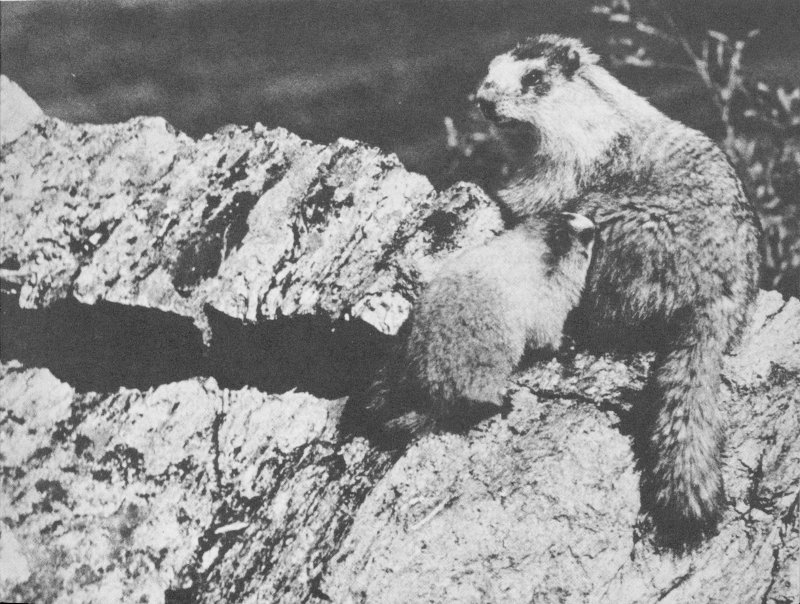
Hoary marmot mother and young.
The hoary marmot is an amplified version of the eastern woodchuck.
It is roughly bicolor, being gray over the shoulder region and light brown
over the hips. The black patch across the nose enhances its facial aspect
somewhat, and the jet-black feet add a little contrast to its appearance.
38
He has a bushy tail that he jerks about a good deal, especially when he
travels. Occasionally, he is mistaken for a wolverine. His soft color pattern
is an excellent example of camouflage and of this he apparently is
aware as he flattens himself on a rock to escape detection.
His voice is exceptional. One day, some years ago, I walked down Savage
Canyon with two companions. One of them, who stopped to photograph
some flowers, was left far behind. When he finally overtook us he said
that he had heard us whistling and had hurried as best he could. We said
we had not whistled, but he was still sure he had heard us. Then it
dawned on me that he had been hearing the loud piercing, prolonged
warning whistles of the marmots that make their homes in the canyon.
This whistle is one of the familiar sounds in marmot country. The approach
of a fox, grizzly bear or golden eagle is announced by loud whistling
which alerts everyone, including ground squirrels and mountain
sheep, to be on their guard.
One day three of us watched a youngish marmot high on a sheep ridge.
He was apprehensive and for a time whistled at intervals. When one of
my companions whistled in the same key, the marmot answered. But if the
imitation were off key there was no reply. The marmot responded as long
as our patience held. This instance may have been exceptional for I have
had no opportunity as yet to make additional observations.
The marmot has learned to seek a home in a rock fortress as a safeguard
against being excavated by a grizzly. Whenever possible the dens
are dug in rocky areas, or at rock outcrops. One den on a steep slope that
I observed for several years was enlarged and renovated each year. The
small rocks encountered in the digging were carried out in the mouth
and dropped on the edge of the mound. In late summer, mouthfuls of dry
grass are carried in for the winter hibernating nest. One look at the broad,
fat marmot suggests that he could sleep a long time without food. When
he retires, he may plug the entrance with rocks and mud.
The home life of the marmots has not been carefully studied but
they seem to live in colonies, all using a number of dens distributed as
much as 200 yards or more apart. I have seen several adults in a colony
and watched them move from one den to another. In traveling between
some of the dens the marmots are highly vulnerable if surprised by one
of their enemies. The attractive black-eyed young require two or more
years to gain the dimensions and weight of their elders.
Two excellent places to find marmots along the highway are the
jumbled boulders on the east end of the Savage River bridge and in
Polychrome Pass, especially on a gray, lichen-covered rock below the road
and the rocky ridge across the ravine from it. If not active, the marmots
may generally be seen flattened out on a rock, basking in the sunshine.
Some of the marmots in these places and also in remote areas are quite
tame. I walked practically alongside one big marmot as it fed in a patch
of mertensia. It gobbled up dozens of the big leaves and chewed them
down lustily and noisily, scarcely regarding my presence. Accustomed to
39
harmless mountain sheep and caribou, they sometimes apparently place
humans in the same category.
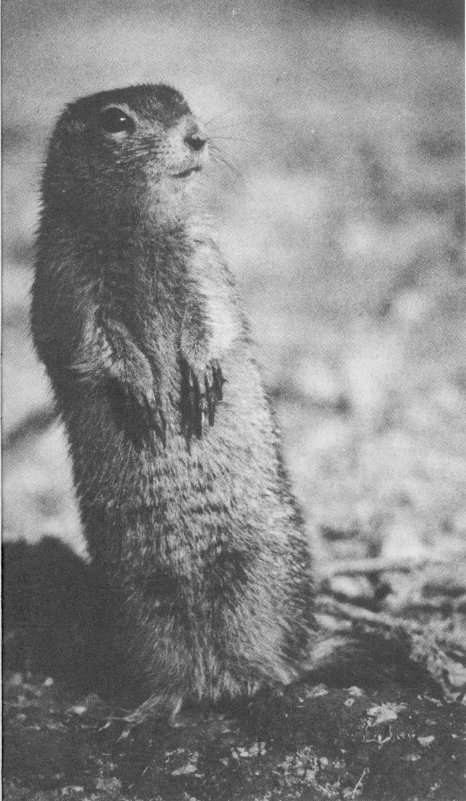
Arctic ground squirrel at alert.
The most neighborly animals in the park are the ground squirrels.
They quickly become tame at cabins and campgrounds and eagerly stuff
their cheek pouches with hotcakes until their gulps become ludicrous
40
with excessive efforts to make room for one more mouthful. Leave a
cabin door ajar and the bread supply is soon being appropriated.
Ground squirrels are always standing erect shouting worried warnings
of danger. Much of the time the cries seem to be only an outlet for accumulated
nervousness. But one learns to differentiate these cries from
those delivered in dead earnest. When extreme anxiety is unmistakable,
it pays to become alert. Their cries have often served to call my attention
to passing grizzlies, wolves, foxes, lynx and low-flying eagles. And the
whole wildlife community similarly benefits. The message is relayed in
all directions by ground squirrels in a sort of chain reaction, but emphasis
in delivery gradually decreases until the message is lost. The cheery calls
and sharp warnings of the ground squirrels are for many of us, closely
associated with the general flavor and enchantment of the north country.
The winter months are spent hibernating in a burrow, curled up in a
grass nest. A few squirrels remain active until the middle of October or
even later. In the spring some come forth in April. Where deep snowfields
cover the dens and it seems unlikely that much temperature change
could penetrate to the squirrels, they nevertheless awaken as though
provided with alarm clocks and tunnel to the surface. Their muddy
tracks radiate from each den over the snow as the squirrels seek exposed
forage.
General observations indicate that the female has only one litter each
breeding season. The young do not reach adult size by the first autumn.
Year after year, the ground squirrel population in the park is high. Yet
no indication of cyclic behavior has been observed. Possibly their many
enemies prevent them from becoming superabundant and, therefore, subject
to epidemic disease.
Ground squirrels are an important factor in the park ecology. They
furnish about 90 percent of the golden eagle’s diet, and in some localities
they are the chief food of the gyrfalcon. The wolf at times feeds extensively
on them, and they contribute heavily, sometimes 50 percent, to the fox
diet. The information available indicates that the wolverine often captures
them, and with the disappearance of the rabbits, the lynx deigns
to hunt them for a season. For the grizzly they furnish his most dependable
taste of meat. The bears spend many hours excavating for ground squirrels.
The noisy red squirrel, with his churring, chattering, and “sic-sic-ing,”
lends a touch of the familiar to the northern woods. He has followed the
spruces along the rivers to timberline, and I saw one a half-mile beyond
41
timber, living perhaps temporarily, among the pikas in tumbled rocks.
They are generally plentiful, but in 1956 I found them extremely scarce.
A catastrophic die-off had apparently occurred in the park, and that year
the squirrels were also reported scarce in other parts of Alaska.
These northern squirrels have a spruce cone economy. Even before
the middle of August they are frantically harvesting spruce cones (chiefly
white spruce in the park). One afternoon a squirrel worked steadily in
a group of spruces for almost 3 hours, cutting cones and giving them a
flip with his mouth or paws. Hundreds were scattered about under the
trees, and still they continued to rain and strike the ground with dull
thuds. Occasionally the squirrel seemed to get his wires crossed and, instead
of dropping a cone, would run all the way down the trunk with it.
Sometimes twigs bearing a cluster of cones are nipped off. In two or
three sizeable caches all the cones were in clusters still attached to twigs.
Perhaps this rather efficient method of handling cones is at times accentuated
by certain individuals.
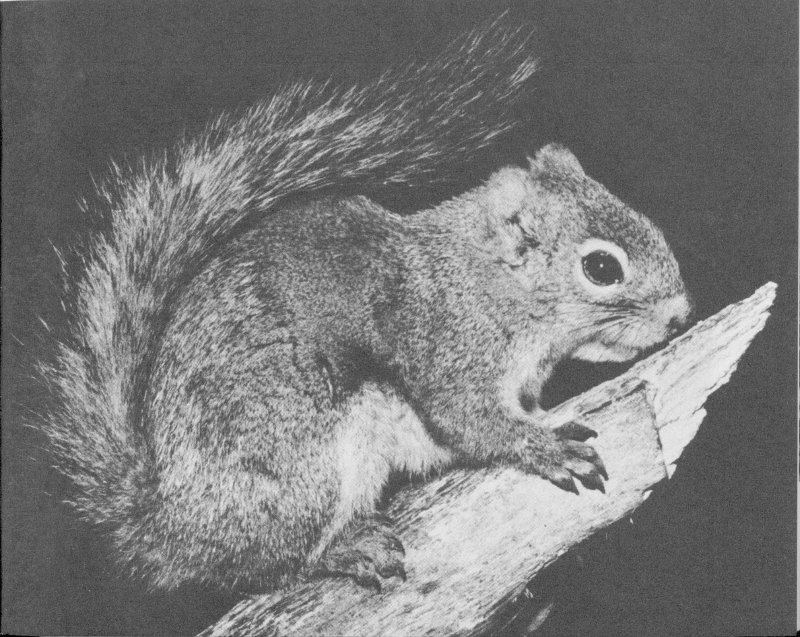
Red squirrel.
42
In September I have seen many caches scattered about on the forest
floor as though piled hurriedly as a temporary expedient. One heap
measured 5 feet long, 3 feet wide and about 7 inches deep. Possibly these
heaps were later stored more carefully in secluded spots with the tips of the
cones pointed downward. After the cones are stored, the squirrels continue
to give them solicitous care. One spring when melting snow exposed a
cache of cones, they were re-cached in various places, but each cone was
first bitten into, and if spoiled was discarded. About the same time another
cache of cones in a burrow was also removed and stored elsewhere.
Another food item that is stored in quantity is the mushroom. Many
are placed on spruce branches where, if they do get wet, they will soon
dry out and remain edible, and I once found great quantities stored in a
cabin.
Aside from the cached foods, the red squirrels feed extensively, at least
through the winter and spring, on the buds of spruce twigs. Often you
may find many twigs on the ground with the tiny buds neatly removed.
In Wyoming, I have found squirrels in summer living for days on the
larvae in cottonwood galls, and I suspect such food may be eaten in Alaska
too, where galls are found.
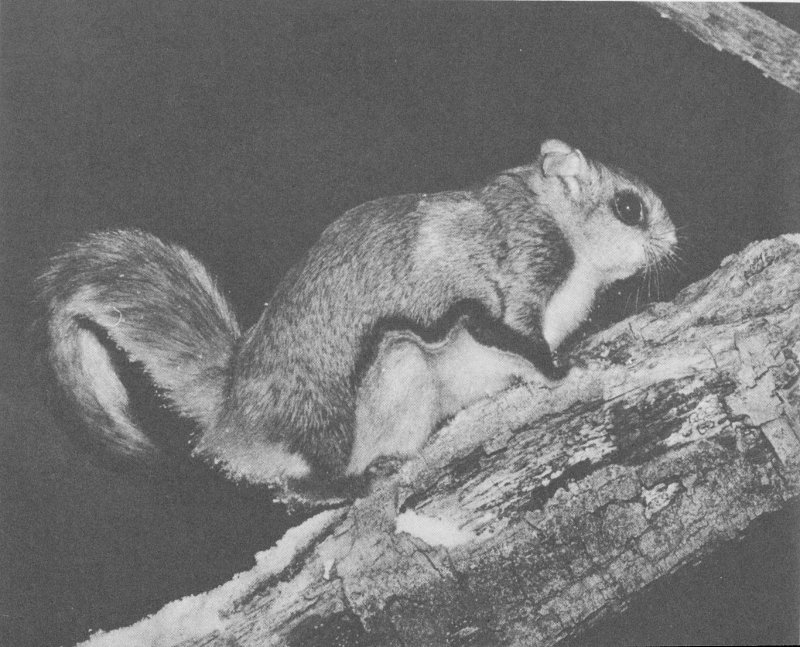
Northern flying squirrel.
Each squirrel commonly has two or more nests built of grasses, shredded
bark, ptarmigan feathers, and hair of rabbits, moose or whatever is available.
The squirrel piles this material on a branch until it is 2 or 3 feet
high. One squirrel that I watched building a nest pushed himself into
43
the middle of the heap. Soon the whole nest shook vigorously at intervals.
Apparently he was forming a chamber.
The chatter of red squirrels, their piles of middens and their busy harvesting
activities, add cheer and life to the northern woods.
When the gesticulating red squirrel has finished his daylight bustling
and retires to his nest, the flying squirrel comes forth to take over the
night, but in a gentle and quiet manner. Like the night-flying owl, its
coat is soft and its flight silent.
The furred “wing” membranes on each side of the body are attached to
the full length of the fore and hind legs and are supported and extended
in part by a cartilaginous process growing out from the wrist. Thus when
the legs are extended laterally, the squirrel becomes a glider with the
most delicate and reliable controls. His sailing carries him from the top
of one tree to the base of another where he checks his speed by an upward
swing and alights with a soft thud. Sharp claws and squirrel agility give
him the climbing ability to get quickly up a tree. Where trees are widely
spaced as they are in some stands of large cottonwoods, he may in winter
make a five-point landing in the snow, his broad thickly-furred tail serving
as rudder and gliding surface, and to a less extent as a landing ski.
I have seen tracks showing a touch and a raise before the final landing
with legs drawn under; then follow long jumps over the snow to the
nearest tree. The nest is usually built in a tree cavity.
Perhaps the height of night esthetics is lying in a sleeping bag under
the open sky, the stars and moon lighting up the spaces between the trees,
and watching a family of flying squirrels gliding overhead in their night
play, their shadowy forms silhouetted against the moonlit sky.
The porcupine has been accused of being slow-witted, but we must
admit that he has not done badly for he is able to lead an unhurried life
in the country. His quill protection has, no doubt, decreased his need
for mental activity, and his eyesight does seem deficient. But his hearing
is quite keen, and judging by his nose activity it appears that his sense
of smell is on the acute side. His mental and physical attributes are all
based on the quill.
The upper surface of the porcupine, except for the vulnerable face,
is covered with several hundred ivory colored quills, touched with black
44
or brown, and reaching a length up to at least 2½ inches. They are needle-sharp
and just back from the tip are numerous minute barbs. When the
quill enters the flesh of an enemy, any muscular movement causes the
quill to move forward until it emerges on the opposite side or becomes
lodged against the bone or under the hide.
When the porcupine senses danger he raises the quills on his back and
has his muscular spine-studded tail in readiness to flip upward. He tries
to keep his rear toward the enemy and to push his head into protective
brush. The quills are loosely attached to the skin so pull out readily when
they stick into anything. The underside of the body, in addition to the
face, lacks quills but because of the short legs, the belly region is close
to the ground and not vulnerable unless the porcupine is flipped over
on his back. I knew a sled dog that sometimes killed porcupines by weaving
and maneuvering until he had an opportunity to grasp the vulnerable
nose and thus avoid the quills. Wolves, coyotes and wolverines feed on
porcupines; possibly they use a similar technique in overcoming the quill
armor.
In winter the porcupine feeds extensively on the inner bark and the
needles of conifers. The patches where the bark has been removed are a
common sight in porcupine woods. The spruces, in the last stand of timber
on the east side of the Toklat River along the road, were nearly all
killed by girdling, many of them back in the 1920’s when the porcupine
population was extremely high. This scraggly woods is a favorite nesting
area for pigeon hawks, sparrow hawks, magpies, and shrikes so that porcupine
activity that seemed generally harmful has been highly beneficial to
these species. Many porcupines spend the winter in a willow patch beyond
the spruce and subsist on willow. For shelter in winter a windfall, hollow
tree, or an old fox or wolf den may be used. Several may take residence
under a cabin.
In spring I have watched porcupines climbing clumsily in tall willow
brush feeding on the swollen buds. Swaying on a limb he reaches for a
slender branch, pulls it to him and passes the length of it past his nose
to discover the buds which he nips off. If the branch is obstreperous and
cannot readily be handled in this manner, he severs it with his rodent
incisors and then removes the buds as his paws manipulate the twig past
his jaws. The new shoots of fireweed and other herbs are avidly sought
in early summer. Willow leaves are included in the varied summer diet.
The breeding season is in the fall and the young are born about 7
months later. The usual single young one weighs about a pound, almost
as much as a new born grizzly. The eyes are open, the short spines are
evident, and protective reactions are soon functioning.
Their voice development is quite obvious when one or more porcupines
resides under a cabin. The night moanings, squeaks of irritability, cluckings,
and caressing sounds are enough to keep even the exhausted hiker
awake.
45
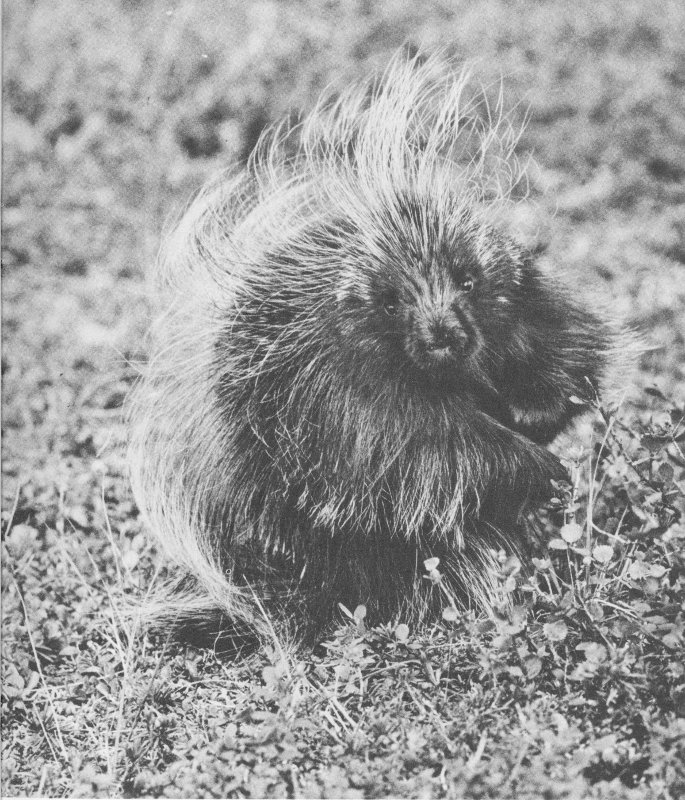
Porcupine.
46
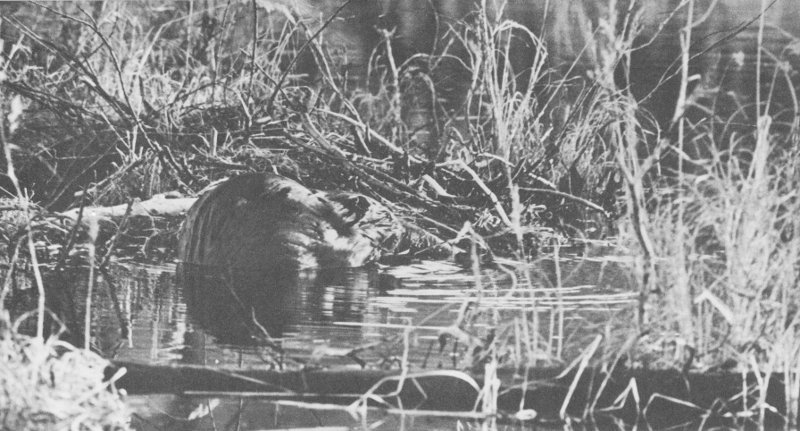
Beaver.
47
Beavers may be found at Horseshoe Lake, Riley Creek, various ponds
near the Nenana River, and in ponds and creeks along the road in the
Wonder Lake region. They are out chiefly at night, but many families
emerge for pond activity by 2 or 3 o’clock in the afternoon.
Beavers are large rodents, scaling 60 pounds or more. Their weight
does not make them good hikers but it is no handicap in water where
they paddle their way about as though they were skiffs. And when they
sit up to gnaw down an aspen or cottonwood, a favorite pastime, a good
solid fulcrum might be a comfortable advantage. The broad, flat, scaly
tail serves as a prop when sitting erect, as a rudder when swimming, and
for sounding an alarm (by slapping water) when an enemy is discovered.
The front feet are equipped with five strong toes which serve well as
hands for holding twigs as the animal feeds on bark. The claws function
well in all digging operations, and the arms suffice for holding gobs of
mud against the chest as he pushes the load onto the dam or house. Occasionally,
he carries mud in his arms as he walks up the house roof on
hind legs.
The hind feet are large and webbed for swimming. Even the nails
on the toes are flattened in keeping with the swimming needs. The nail
of the second hind claw is double and the nail of the first toe fits down
on a hard pad and is movable like a duck’s bill. These specialized claws
are used for combing the fur and possibly for removing some of the large
beetles that live in the fur. The prominent incisors, used for gnawing,
grow continuously, as they do in all rodents, in order to compensate for
wear. This is an especially fortunate adaptation for the beaver, who does
so much gnawing. Otherwise his teeth would soon be worn to the gums.
If an incisor for any reason is thrown out of line, so it has no surface to
bite against and wear, it will become excessively elongated as it grows in
a curve.
A flourishing beaver colony apparently consists of the parents, the
young of the year, and the previous year’s offspring. It is for this reason
that we often discover three sizes of beavers in a pond. Much of beaver
activity involves cooperative projects where there is latitude for any
amount of individual initiative. The dam or dams must be built, or raised,
or kept in repair. The house, located either out in the pond, or partially
or wholly on the shore, may require additional sticks, and toward autumn
is plastered on the outside with wet mud as a sort of annual renovation.
This “stucco” winterizes the lodge. Occasionally, it is decided that a new
house is needed and that gives young and old plenty to do. Some beavers
along Riley Creek live in bank burrows and build no dams or houses.
48
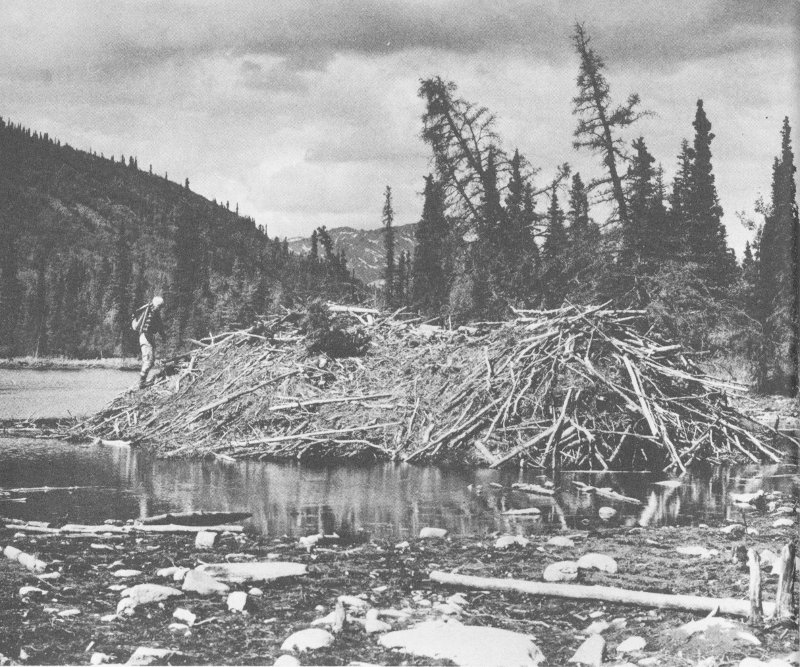
The author inspecting a beaver house at low water.
The most effective dam that has come to my attention was built at the
outlet of Wonder Lake in 1960; it raised the water level of the lake over
2 feet. For many days the outlet stream was dry. The water held back in
the lake amounted to well over 100 million cubic feet or over 7 billion
pounds of water.
The water depth beside the lodge must be deepened if too shallow,
so that the underwater entrance to the lodge is deep enough to keep
from freezing over, and imprisoning the occupants. Also a certain depth
of water is needed beside the lodge in which to store the brush pile that
is the winter food supply. Another activity practised extensively by some
colonies is the building of canals, some of which may have great length.
The mud from the digging is deposited along the canal forming a raised
border. These waterways are useful for general travel to food areas and for
transporting branches and poles.
49
The favorite foods of the beaver include willow, aspen, cottonwood,
and alder. Willow brush re-sprouts readily and grows rapidly, therefore
maintains itself better than some of the other foods. Also it flourishes
in the wet habitat created by the beaver ponds.
Where beavers create ponds with their dams, they produce a habitat
for fish, ducks, muskrats, shore birds, moose and many other forms of
water and shore life. In Wyoming, I have observed the dead trees, killed
by flooding, used by herons for nesting, and one of the heron nests was
later used by a pair of geese.
The rich, warm coat of the beaver has long been worn by both humans
and beavers, but the beaver wears it best.
In some parts of Alaska where extensive favorable pond habitat prevails,
muskrats are abundant and their sedge lodges are a part of the
scenery. In the park there are a few muskrats in Horseshoe Lake and other
ponds and creeks near the eastern border, and also in the Wonder Lake
area. These usually live in bank burrows with submerged entrances. It is
not uncommon to find a muskrat living in an occupied beaver house,
apparently utilizing an unoccupied cranny. They ply back and forth
across the pond, just as the beavers do, and submerge with a mouthful
of sedge which they are taking to the young. At Wonder Lake, I have
seen muskrats swimming under the little bridge across the stream inlet,
carrying sedges to young that were kept in a burrow in a nearby bank
of the lake.
Because muskrats are associated with beavers they are sometimes mistaken
for young beavers. The longer scaly tail, that is flattened vertically
rather than horizontally, serves as a certain identification. The muskrat
is also much quicker in its actions, and is smaller than any beaver old
enough to be abroad.
The muskrats’ chief food consists of green vegetation (various waterplants
and sedges) and clams when available; it has even been reported
catching small fish in some regions. Some of the deeper waterplants it
secures by diving, and in the spring I have watched them climb onto the
ice to eat them. A muskrat looks very tiny sitting on the ice beside a big
beaver.
Muskrat have their winged and fourfooted enemies. Mink, living in
the same environment, prey on them, but not indiscriminately. Other
carnivores such as the fox, coyote, and wolf might encounter one on land,
but chiefly by accident.
50
Shrews may be identified by their long, pointed, mobile nose, extremely
minute eyes, short velvety fur and blackish-tipped teeth. They
are the smallest mammals in the world, some kinds weighing less than 3
grams. It would require over 100 of these to weigh one pound. Because of
the shrew’s small size and long nose, Alaskans frequently refer to them
as long-nosed mice.
Thousands of shrews (four species) are vigorously active in the park
but are rarely seen. Occasionally, one may be discovered crossing an open
area, like a mechanical toy, or one may flash from cover and as quickly
disappear. They share with the voles and lemmings the shade and darkness
of the hidden runways beneath the moss and grassy cover. Here
they are active predators, darting about in their search for prey. With
nervous activity they examine their microhabitat in search of insects and
other invertebrates. Spiders flee in haste when the presence of a shrew
is sensed. Their hunting technique appears to consist of random movements
until they collide with their victim. They no doubt depend chiefly
upon the sense of smell in recognizing their prey.
Shrews eat often and a great deal. In captivity, a shrew weighing 3.6
grams ate over three times its weight of food daily. Any kind of meat attracts
shrews, as many Alaskans have learned when discovering their meat
caches invaded by them. The energetic activity of shrews suggests the need
for rapid metabolism and plentiful supply of body fuel.
Although shrews are active throughout the winter, they nevertheless
appear to be delicately attuned to their environment. They seem to be
especially susceptible to chilling, perhaps because of their tiny body and
short fur. Winter temperatures in the north are severe, but ground temperatures
under the snow blanket are rather moderate. Shrews perhaps
require only a warm nest—their intense activity keeping them warm when
foraging.
Shrews are not rated high gastronomically by many mammals. This is
apparently due to the hip glands which have a strong, pungent odor. But
their lack of palatability does not give them much protection. If, for instance,
a fox locates a faint sound in the grass, he pounces and learns
later what he has caught. If the prey is a shrew, it may be left where killed
by the fox, carried a short way and dropped, or during denning time even
brought home to the den before discarded. I have often found shrew
carcasses lying uneaten about fox dens. Birds of prey feed more extensively
on them possibly because of their poorly developed sense of smell, and
sense of taste. Grayling, and also trout, have been found with one or more
shrews in their stomachs. At Moose Creek, several grayling were taken
51
which had eaten shrews, one having eaten three of them. This indicates
that the species captured, readily enter the water. (One species, the water
shrew, not found in the park, is specialized for aquatic life).
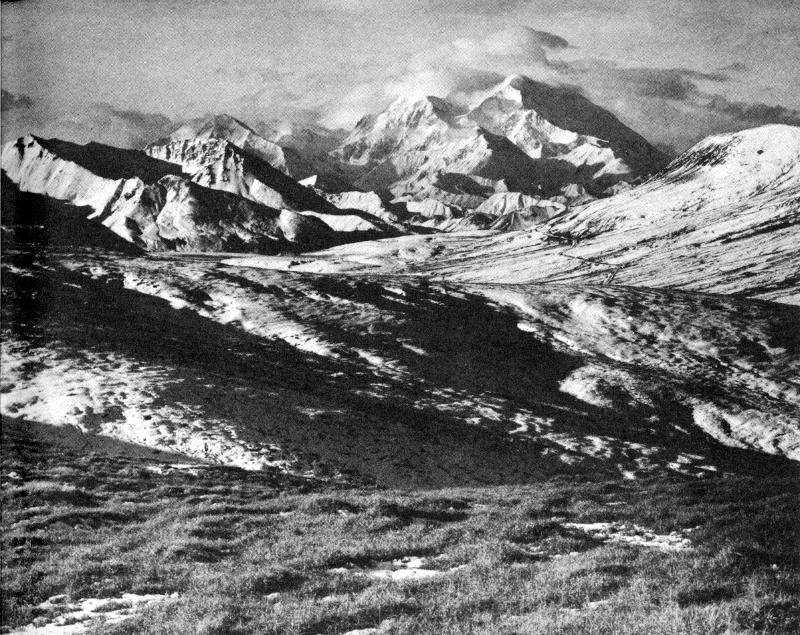
Denali (Mount McKinley) in early winter.
The shrew population is apparently cyclic for there are years when
they are very abundant, followed by years of extreme scarcity.
Four kinds of shrews are in the park. They differ from one another
in several respects, but may be fairly well identified by tail length alone.
The masked shrew (Sorex cinereus) has a tail averaging about 39 millimeters
long; the tail of the vagrant shrew (Sorex obscurus) averages about
48 mm.; and that of the rare pygmy shrew (Microsorex hoyi eximius), 31
mm. The average length of tail of the Arctic shrew (Sorex arcticus tundrensis)
is about 36 mm., overlapping slightly in this measurement that of the
masked shrew, but the rich chocolate color of the Arctic shrew will identify
it.
52
A bat was reported in flight at Wonder Lake in 1959 and again in 1960.
Since no specimen has been examined there is no definite identification,
but judging from the geographical distribution of bats it seems probable
that those seen in the park belong to the genus Myotis. Three or four
species of this genus are known to occur in southeastern Alaska. The
little brown bat (Myotis lucifugus alascensis) has been taken at Illiamna
Lake at the base of the Alaska Peninsula so it seems likely that this is
the bat seen at Wonder Lake.
Are there any trails in the park? Yes, thousands of miles, but most of
them are under a canopy of grass and sphagnum moss and are only 1 or 2
inches wide, so of course they are not of much use to you. And even if
we could nibble on Alice’s mushroom and grow, in reverse, small enough
to use them, we would hardly dare, at least a lady wouldn’t, for she would
soon meet a mouse, inasmuch as these trails have been constructed by, and
belong to, mice. And I might add that the fierce little shrews use them
too. Where the trails cross green, mossy carpets and enter tiny exquisite
nooks I imagine one might also meet a few northern fairies.
Seven kinds of mice (voles and lemmings) are known to live in the
park. Some of these are quite outstanding for one thing or another, and
possibly all of them are, if we only knew more about them. However, we
do know that they are all important.
* * * * * * * *
I am best acquainted with the haymouse, or singing vole (Microtus
miurus oreas) because some of my field observations led me to him. Some
years ago I kept finding many caches of dried vegetation, some caches
large enough to fill a bushel basket. This hay was always kept either off
the ground or under cover. It was placed at the base of willows in the
basket formed by the many stems, or on a surface spruce root, in a rock
niche, or under a log. Pikas are known to make hay, but no such activity
has been reported for mice. Pikas were not involved for they live in the
talus rock, and these caches were mostly far from pika habitat. After considerable
effort, I learned that a yellowish-brown field mouse was the
interesting haymaker. The hay is put
up for winter use. The sign showed
that sometimes a snowshoe hare
found a cache and helped himself.
53
In addition to hay, this mouse also
stores roots in underground cellars
that he excavates, and the roots are
not thrown in helter-skelter, at least
not in most of the caches I examined.
The black, round nutlike tubers of
the horsetail were in one pile, coltsfoot
underground stems in another,
and carrotlike roots of a pedicularis
in still another. An interesting feature
was the structure of some of the tunnels which were built in the form
of a pearl necklace. Tiny passages, just large enough for the body of the
mouse to squeeze through, joined the cavities or, so to speak, the “pearls.”
In addition to all of these accomplishments, these mice do much miniature
warbling, enough so they have been called singing voles.
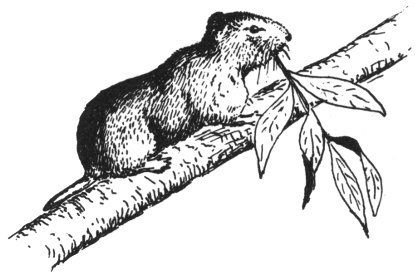
Haymouse (singing vole)
The tail is short, measuring slightly over 1 inch; the body length averages
about 5 inches. It is found from moist lowland habitats to ridge tops.
* * * * * * * *
The large, plump, and richly-colored brown lemming (Lemmus trimucronatus
alascensis) is notorious for his overpopulation problem. On some
occasions they migrate in hordes, even into the ocean in some parts of their
circumpolar home. The lemming is cyclic in the park, but usually only
to about the same degree as the other mice. However, in the low part of
the cycle, they may become extremely scarce, more so than do the voles.
The brown lemming does not turn white in winter as does its relative,
the collared lemming (over most of its range). The body is about 5½
inches long and the tail
is just under 1 inch. The
thumb claw consists of
a three-pronged flat nail.
A large lemming weighs
about one-quarter
pound. They are widely
distributed in both open
tundra and woods where
the habitat is not too dry.
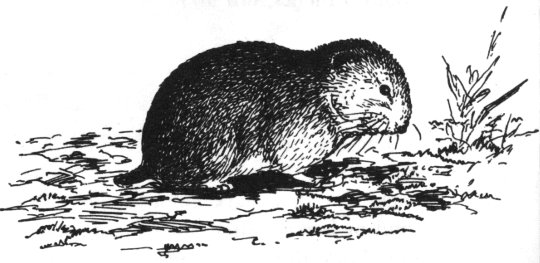
Brown Lemming.
54
* * * * * * * *
The northern bog lemming (Synaptomys borealis dalli) is usually not
thought of as a true lemming, but it does belong to the lemming tribe.
It has a short tail, less than 1 inch long; the body length is about 4 inches;
the upper incisors have a vertical groove near the outer edge; and the
males have a white spot on each side marking the location of hip glands.
The thumb claw is a broad nail, in this respect resembling the brown
lemming. The distribution of this mouse is spotty. It was taken in the
Wonder Lake area in a wet grass and sedge habitat just inside a spruce
woods.
* * * * * * * *
The chestnut-cheeked vole (Microtus xanthognathus), the largest
mouse in the park, has a body length of 6 or 7 inches, tail length of about
2 inches, and weighs up to about 6 ounces. These mice live in isolated
colonies but where found may be abundant. Not recorded in the park
since 1907 when it was abundant along the Toklat River.
* * * * * * * *
The tundra vole (Microtus oeconomus macfarlani) is a large vole widely
distributed, and is especially fond of dense grass or sedge habitats. Its
body length is 5 to 5½ inches, and tail length a little less than 2 inches.
Its brownish-gray color is similar to the common meadow mouse.
* * * * * * * *
The meadow vole (Microtus pennsylvanicus tananaensis) is common in
interior Alaska, so far as known, but is rare in the park. With more investigation,
it may be found plentiful in places along the north boundary.
This is a common vole over much of Canada and the Rocky Mountain,
central and eastern states. It prefers moist habitats. The body length is
about 5 inches, tail about 2 inches, and the color is dark brown.
* * * * * * * *
The northern red-backed mouse (Clethrionomys rutilus dawsonii) lives
in both the open tundra and the woods. Generally, it has a reddish
back, but in a dark color phase, the back is blackish. These mice are
fond of berries, their teeth being stained blue during the blueberry season.
They also feed on seeds, stems, and leaves.
55
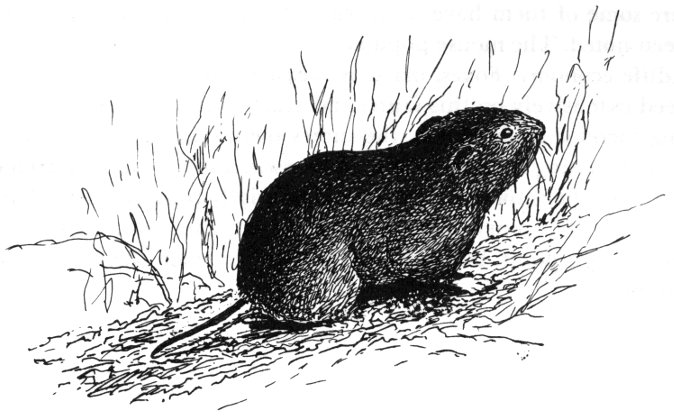
Meadow vole.
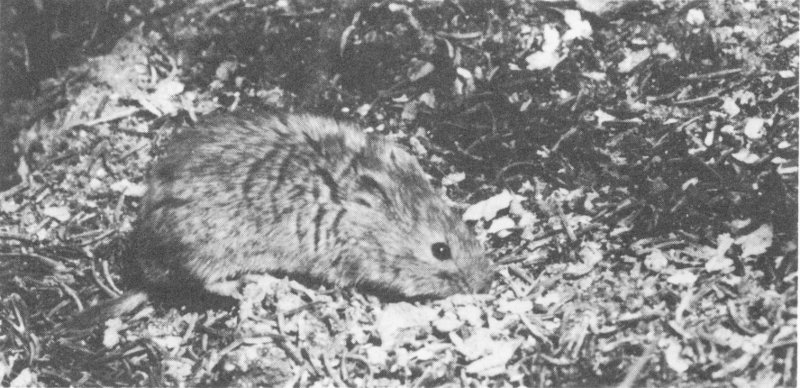
Red-backed mouse.
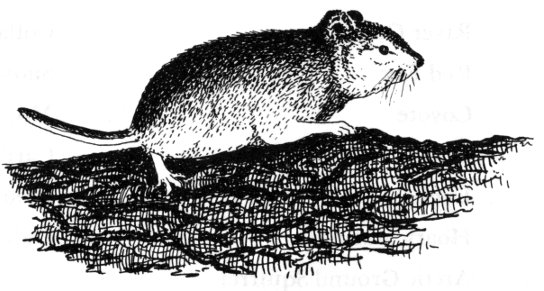
Red-backed mouse.
56
The several species of mice vary in abundance from year to year. In
places where some of them have been studied, a well-defined 3 or 4 year
cycle has been noted. The mouse populations have a tremendous influence
on our wildlife economy. Foxes, martens, weasels, owls, hawks and a host
of others feed extensively on this fauna and react to its abundance. When
the lemming increase in the north, the snowy owls (and others) increase,
and when the lemming become scarce, these owls come south in search of
food and we have the snowy owl invasions, especially in north-central and
eastern states. In 1955, when mice were abundant, the hawk owls in the
park reached a high point, but again became scarce when the mouse population
dropped.