By Joanna H. Mathews, Author of the "Bessie Books."
I.
Belle Powers' Locket. 16mo
$1.00
II.
Dora's Motto. 16mo
1.00
III.
Lily Norris' Enemy
1.00
IV.
Jessie's Parrot
1.00
V.
Mamie's Watchword
1.00
VI.
Nellie's Housekeeping
1.00
The Set in a neat box, $6.00
II.
THE FLOWERETS.
A series of Stories on the Commandments. 6 vols. In a box $3.60
"It is not easy to say too good a word for this admirable series.
Interesting, graphic, impressive, they teach with great distinctness the
cardinal lessons which they would have the youthful reader learn."—S.
S. Times.
III.
THE BESSIE BOOKS.
6 vols. In a box $7.50
"Bessie is a very charming specimen of little girlhood. It is a lovely
story of home and nursery life among a family of bright, merry little
children."—Presbyterian.
—————
ROBERT CARTER AND BROTHERS, New York.
"THOU GOD SEEST ME."
BY
JOANNA H. MATHEWS, AUTHOR OF THE "BESSIE BOOKS" AND THE "FLOWERETS"
NEW YORK:
ROBERT CARTER AND BROTHERS, 530 Broadway.
1882.
Entered according to Act of Congress, in the year 1872, by
ROBERT CARTER AND BROTHERS
In the Office of the Librarian of Congress at Washington.
"MAMMA! can I have it? Can I, mamma?
Buy it for me, buy it; will
you, mamma?"
"May be so, dear. I will see about it."
"No, not may be; not see about it, mamma!
I must have it, and I know you can afford
it!"
The speakers were Mrs. Stone and her little
daughter Mamie; the scene, Miss Ashton's
broad, shady piazza, where, at this time, a little
fair was taking place.
And what was the object on which Mamie's
heart was so set; for which she was begging
so persistently, you will ask.
Why, just this.
A beautiful doll; a famous, much-talked-of
doll, dressed as an infant by Miss Annie Stanton,
for the fair; a doll eagerly desired by all
the children present, as any little girl will
readily believe when she hears that seldom has a
doll had such an outfit.
Mamie's eyes were fixed eagerly upon her
as she pleaded and entreated with her mother,
holding fast to her hand, and almost dancing
in her extreme anxiety to secure the much-coveted
prize.
"Perhaps I can, dear," said Mrs. Stone's
rather languid voice, as she looked smilingly
down at her little daughter; "perhaps I can
afford it; but you know, Mamie, that the doll
is to be sold to whoever shall offer the highest
price for her."
"Well, you offer the highest price for her,
mamma; do, oh, do! Offer a great deal more
than any one else, so I shall be sure to have
her. I want her so!"
"But it is not to be known what each one
offers till the fair is over, Mamie," said her
mother; "then, whoever has said they will
give the most, is to take the doll."
"Ask Miss Stanton to tell you," pleaded
Mamie.
Mrs. Stone shook her head.
"That would not be fair, Mamie; and Miss
Stanton would refuse to tell if I asked her. I
will make an offer for the doll, but you will have
to take your chance with the rest, my darling."
Mamie was so little used to any opposition
or contradiction from her over-indulgent
mother that she did not know how to meet it;
and, though it was made thus plain to her that
it might not be within her mother's power to
give her the doll, she felt as though the possibility
of disappointment were more than she
could bear, and as if it would be altogether
mamma's fault if the longed-for toy did not fall
to her share.
The eager face clouded over, a frown gathered
between her eyes, and an ugly pout upon
her lips.
Oh, if little children who like to appear
well only knew how such pouts and frowns disfigure
the faces which God has made to be so
pleasant and so fair, they would surely beware
how they let Discontent set his hateful mark
upon them!
"But I want it so; and I must have it,"
Mamie muttered fretfully.
"Yes, dear; we shall see," was Mrs. Stone's
answer, as she went forward to the table where
the baby doll lay in her glory.
"Tell me what you are going to give," said
Mamie, as her mother bent forward with a
smile, and whispered her offer to Miss Stanton.
"Ah! but that is a secret, Mamie," said the
young lady, drawing forth the paper on which
she wrote the names of would-be purchasers
with the sum each one proposed to give; and
putting down Mrs. Stone's, and the amount she
had offered for the doll. "No one is to be told
till this evening."
"Did you offer the most, mamma?" repeated
Mamie, upon whose mind it seemed impossible
to impress the fact that no one would know
this till the appointed time.
"I doubt if any one will give more than I
will," said Mrs. Stone, who thought that she
had really offered more than the value of the
doll, as indeed perhaps she had done, so anxious
was she to gratify her little daughter.
Mamie's face cleared a little.
"I do want it so," she said less fretfully, but
still with much energy in her tone.
"Yes, I believe the children all do," laughed
Miss Annie Stanton; "at least, I can answer
for several, Maggie and Bessie among them."
"I don't believe anybody wants it so much
as I do," persisted Mamie. "I've been thinking
about it and thinking about it till I feel as
if I could not bear to give it up. Oh, I must
have that doll, I must!"
Somebody who was passing paused at her
side as she spoke, and turning her eyes from
the doll, they met those of Miss Ashton fixed
rather anxiously upon her. Mamie's color deepened,
and she looked a little ashamed, for she
hardly knew herself how much she valued the
good opinion of her teacher, and now it seemed
to her that her last speech had been rather obstinate
and selfish.
"I mean if I could have it quite fairly, Miss
Ashton," she said, as if in answer to the lady's
look, for she had spoken no word.
"Of course," said Miss Ashton, smiling;
"we would not believe you wished to do what
was unfair, even to gain the doll, Mamie."
"No," answered Mamie half reluctantly;
"but you can't think how much I want it, Miss
Ashton. I'm sure none of the others care as
much as I do about it."
"I do not know about that," said Miss Ashton.
"Look at Belle, Mamie. How do you
think she feels?"
Mamie turned and looked at Belle.
Her little schoolmate stood beside the doll,
quite absorbed in regarding its beauties,—not
that they were new to her, for she had watched
the progress of its magnificent wardrobe from
the very commencement,—her eyes wandering
from one pretty trifle to another with longing,
almost loving, interest; her fingers touching
them now and then, but so daintily and so
carefully that there was no fear they would
come to harm through her handling. Miss
Stanton had found it necessary to warn off
more than one little pair of hands that day,
lest they should mar the splendor of that wardrobe,
or its mistress; but there was no need of
this with Belle, so gently and delicately did she
smooth and touch them. Her face was very
wistful as Mamie looked at her, showing plainly
that her desire for the beautiful doll was quite
as great as Mamie's own, and that her disappointment
would be quite as severe if it did
not fall to her lot.
Mamie watched her for a moment, and then,
leaving her mother's side, walked slowly over
to the corner of the table where Belle stood.
"Isn't she lovely?" she said, meaning the
doll.
"Yes," answered Belle. "I should think
she is! Oh, I want her so! Don't you, Mamie?"
"Indeed, I do," said Mamie with quite as
much emphasis as Belle had used. "Indeed,
I do."
"But I don't s'pose you want her as much
as I do," said Belle; "least I don't s'pose you
need her so much."
"Why not?" asked Mamie, half resenting
such a supposition.
"'Cause you have your little sister to play
with," said Belle, "and I have no sister, nor
any mamma to play with me," she added with
a half-smothered sigh.
That appeal seldom failed to touch the hearts
of Belle's playmates and companions; the
child's longing for her lost mother was so
great, her sense of loneliness, at times, so pitiful;
and the years which had passed since her
mother's death seemed to have little or no
power to weaken these in her loyal little heart.
Mamie stood silent. The doll was not yet
hers to give up; but she now had a feeling as
if she ought to wish that Belle, rather than
herself, should be the fortunate possessor.
"I b'lieve if I had a little sister I should not
care so much about dolls," continued Belle,
with an air of deep consideration; "but this
doll does seem so very real and live; doesn't
she, Mamie?"
Mamie assented, with a half impatient,
though unspoken wish that Belle did not care
so very much about the doll.
"Belle," she said, "if I do have her, I will
let you play with her a great deal; and sometimes
I'll let you take her to your own house,
if you'll be careful of her."
Belle shook her head.
"That wouldn't be like having her for my
very own, Mamie; I'd like to make believe
that she was my sister if I had her, she's such
a very real doll."
"S'pose none of us have her; but somebody
who is a stranger to the school," said Lily Norris,
who had just drawn near, and who easily
guessed what the other children were talking
about. "Wouldn't that be a shocking occurrence?"
"Yes," said Belle, giving a long sigh at the
possibility of such a catastrophe. "Shocking!
But we'll have to bear it, perhaps."
"Belle!" called Bessie Bradford from the
other end of the piazza where she stood behind
the flower-table; "Belle, how long you've been
away from our table!" and recalled thus to a
sense of her duties as saleswoman, Belle ran
back to her post, which she had been tempted
to quit for a closer view of the coveted doll, so
often seen, but of whose perfections she never
tired.
"I hope Mr. Powers will be the one to give
the most for the doll, so Belle can have it,"
said Lily to Mamie, when Belle had left them.
"Don't you want it yourself?" asked Mamie.
"Yes," answered Lily; "but I think I'd
'most rather Belle would have it than any one.
She seems to feel as if it would be a kind of
company for her; and she's very lonesome
sometimes. She don't have such large families
as we do, you know; nothing but herself
and her papa. Yes, I think I would rather
Belle should have it than to have it myself."
Mamie felt that she could not make up her
mind to be as generous as Lily, were the opportunity
offered to her; and still she wished that
she could be so. Lily was not "one bit selfish,"
she saw; neither was Belle, spite of her
intense desire to possess the doll, at all inclined
to be jealous or ill-tempered about it,
as Mamie felt she might be herself if another
child carried off the prize.
"Belle used to fret and cry like every thing
if she didn't have what she wanted," she said
to herself; "but she doesn't now. I wonder
why;" and again there came a disagreeable
consciousness to Mamie that she had not improved
in this respect as much as her little
schoolmate.
The excitement and anxiety respecting the
doll increased rather than lessened as the day
wore on and the fair drew near its close.
Every papa and mamma, grandmamma, uncle,
or aunt, who came in, was introduced to the
young lady, and besought to "offer a whole lot
for her."
But none were as eager as Belle and Mamie,
though the former did not show the impatience
Mamie had displayed. Her papa was seized
upon the moment he entered the fair, it is
true; and begged to offer so much for the doll
that he should be sure to gain it for his little
daughter; but she did not insist that she would
have it, as Mamie had done, or worry and fret
her father.
And somehow, she scarcely knew why, this
seemed to keep Mamie a little in check. It
really appeared as if Belle, lonely little Belle,
needed the doll more than she did. True, Belle
had "lots of toys," but so had she; and then
she had a baby sister at home, and Belle had
none, and "no mother;" and Mamie really
caught herself wondering if she could resolve
to wish that Belle, rather than herself, might
have the doll, and if she ever could be so generous
as to give it up to her if it were in her
power to do so.
The day passed on, evening came, the fair
was drawing to its close, having proved a most
triumphant success, and the time for announcing
the name of the doll's purchaser had arrived.
This was proclaimed by Mr. Stanton's
voice from his sister's table at the end of the
piazza, and instantly every little saleswoman
had deserted her stand, and they all flocked to
the place of interest.
"I hope it is you, papa; oh, I hope it's you!
I could almost pray it might be you," said
Belle, holding fast to her father's hand, and
squeezing it tight in breathless expectation,
as all waited to hear the name of the happy
owner.
Mr. Powers smiled down at her rather sadly.
He could not help a feeling of amusement, and
still he did not like to see her so eager, so excited
over that which might prove a disappointment.
Mamie, who stood near, watched her, too;
curious, despite her own interest in the grand
affair of the day, to see what Belle would say
and do if another than her papa should prove
to be the munificent purchaser.
Mr. Stanton took the list from his sister's
hand, and casting his eye over it, proclaimed
aloud that Mrs. Benjamin Howard had offered
the largest sum for the doll, and hence it was
hers. This was not Gracie Howard's mamma,
but her grandmamma; but still each young
hearer felt sure that the prize would be bestowed
upon Gracie or one of her little sisters.
For whom else could Grandmamma Howard
want it?
When Mrs. Howard's name was announced,
Belle's face wore, for a moment, a look of blank
and utter disappointment, and Mamie's was
not more pleased. But still the latter kept her
eye on Belle, and it seemed as if it only needed
a display of temper from her to produce the
same from Mamie.
But that did not follow. Choking back her
sobs, and dashing some bright drops from her
eyes, Mamie saw her raise her face towards her
father, and say some words which did not
reach her own ear; saw Mr. Powers smile tenderly
down on his little daughter as he answered
her, and presently Belle was smiling
and bright again.
Mrs. Stone was agreeably surprised that her
own little spoiled child made no loud outcry
over her disappointment. It is true that Mamie
could not or did not refrain from a pout
and a fretful "I declare, it's just too bad! I
wanted it so, and—and—so did Belle."
And she was half inclined to feel resentful
towards kind old Mrs. Howard, and to think she
had no right to have purchased the doll; and
later, when Maggie and Bessie came to her and
said,—
"Mamie, we feel that it would be only taking
a polite interest in Mrs. Howard for us all
to go and congratulate her on having the doll,"
she refused to join her companions in doing so.
But when she saw them all, even Belle, going
up with cheerful and pleased faces to where
the dear old lady sat, she felt ashamed to be
left out, and fell into the ranks, standing by
while Lily Norris delivered herself of the following
speech, composed on the spur of the occasion
by Maggie, who was too shy to speak it
herself, and so begged Lily to be spokeswoman.
"Dear ma'am: while we have to mourn for
ourselves, we have also to rejoice for you, and
to congratulate you because you have the doll;
and we do it with all our hearts, 'cause you
have been so kind and good to us about the
fair."
This little oration was pronounced by Lily
without the slightest embarrassment or faltering;
for, although not conceited, she was a
self-possessed little monkey, and now she felt
that the credit of the performance was due to
Maggie, and not to herself.
And lest there should be any mistake on this
head, she added, almost in the same breath
with the concluding words of the speech,
"The praise of making that up is Maggie's,
not mine;" and retired within the ranks of
her schoolmates.
Their congratulations were received by Mrs.
Howard with much pleasure, and by all such
as heard them with some amusement; after
which a farewell look was taken of the famous
doll, who was now carried away by her owner.
Mamie was petted and made much of by her
not over-wise mother, because she bore her disappointment
so well, for it was something so
new to see her conduct herself in such a peaceable
and sensible manner when she was crossed
in any way, that Mrs. Stone was surprised as
well as pleased.
Mr. Stone, too, and even her brother Walter,
had each his word of praise for Mamie as they
drove home; and she really felt herself quite
a heroine, because she had not cried and fretted
like any baby.
But in spite of this consciousness of superior
virtue, which was all the more pleasing because
it was somewhat of a novelty, Mamie felt
that Belle had been, to use her own words,
"even better" than she had. Belle had not
shown even a shadow of sulkiness or ill temper;
and yet her heart had seemed to be set
upon the doll even more than Mamie's own.
"Belle is always so good now," she said to
herself, "and yet she used to be so spoiled, and
to be provoked if she did not have every thing
she wanted, and cry about it just—just like
me. I wish I could grow as good as she is
now. Everybody says she has improved so. I
wonder how she does it. Some time I'll ask
her."
Such were Mamie's thoughts and resolutions
as she lay in her bed that night, and she
dropped off to sleep on this last.
The opportunity for putting it in practice
came sooner than she had supposed probable;
for it was vacation, and she did not expect to
see Belle at school every day, as was usual.
II. HOW BELLE DID IT.
"WHY, Belle! Is that you?"
"Why, yes, Mamie! Is that you?"
These very unnecessary questions
were put by the two little schoolmates as they
stood facing one another within the saloon of
the drawing-room car attached to the train
which was on its way to Boston.
There certainly could be no doubt in the
mind of either that the one was Belle and the
other Mamie; and the above exclamations
were only due to the surprise felt by each one
at the sight of the other.
"Yes, it is I," was Mamie's answer. "Where
are you going, Belle?" she questioned in the
next breath.
"To Netasquet," replied Belle; "and Lily
Norris is there now."
"Why, I am going there too!" exclaimed
Mamie, in a delighted voice; "all of us are,—papa
and mamma, and all the boys, and Lulu
and me. How very fortunate, Belle, that so
many of us are going there together! Won't
we have nice times?"
"Um—m, well, maybe so. Maggie and
Bessie are not going there," said Belle in a tone
which told that she thought all pleasure questionable
in which her last-named two little
friends did not share.
"They've gone to Newport, haven't they?"
said Mamie.
"Yes, their papa has bought a house there,
and now they'll go there every summer. Papa
and I are going to make them a good long visit by
and by; but first we have to go to Netasquet."
Belle said this with a sigh, as if even the
prospect of the "good long visit" could
scarcely console her for the present separation
from Maggie and Bessie.
"Who are you with?" was Mamie's next
question.
"Papa and Daphne and Uncle and Aunt
Walton," answered Belle.
"Oh! and Ma—bel?" said Mamie, following
the direction of Belle's eye, and seeing the
head of her little cousin, Mabel Walton, peeping
out from the door of a compartment at the
end of the car.
"Yes. You don't seem very rejoiced about
Mabel," said Belle, who had noticed the tone
in which Mamie uttered the last words,—a
tone expressive of any thing but pleasure.
"An' no wonder," muttered old Daphne,
Belle's nurse, who stood behind her young mistress;
but Mamie, thinking it as well to change
the subject of conversation, only said,—
"Don't you want to see my little sister Lulu,
Belle?"
"Yes," answered Belle with alacrity, and
would have followed Mamie at once to that
part of the saloon where her friends were
seated, if Daphne had not interfered, saying,—
"You just come back to your pa, honey.
De hosses done pullin' us now, and dey're
gwine for put to de injine, and dere'll be a
screechin' an' a shakin' an' a jerkin' fit to knock
de bref out of yer. 'Sides, I've foun' out it's
best to stick close to yer pa when we're trabellin'
roun'. Come to lose sight of him, 'taint
easy sayin' what'll become of us."
And with a fearful recollection of having
been "gone off with" by the cars on one occasion,
when she had been separated from her
papa, Belle rushed back to the compartment
of her own party, and, in dread of such a catastrophe
occurring again, clung to him till the
train was speeding on its way. Then she felt
safe; neither she nor papa could leave the cars
while they were rushing on at this rate.
But after some time, just as she was beginning
to tire of looking out of the window,
and watching the rapidly changing scene without,
Mamie's face showed itself at the open
door of the compartment; and having nodded
in her own free and easy way to the party in
general, she said to Belle's papa,—
"Mr. Powers, couldn't Belle come with me
to see our Lulu?"
Mr. Powers consented, finding that his little
daughter wished to go, and Belle, slipping from
his knee, took Mamie's outstretched hand, looking
back, however, at her Cousin Mabel.
"Mabel can come too if she likes," said Mamie;
but Mabel, feeling that there was a want
of cordiality in the invitation, plumply and
poutingly refused it; upon which Mamie
looked rather relieved.
Mabel and Mamie were never the best of
friends; each one called the other "a horrid
child," "selfish," "hateful," and other such
uncomplimentary names; not always in one
another's hearing, it is true; but Mamie knew
pretty well what Mabel thought of her; and
Mabel, on her side, felt that Mamie regarded
her with no friendly eye.
Some little readers may know the reason
why; others may wish to ask it.
It was this:—
Both were spoiled, selfish children, allowed
to do pretty much as they pleased, and each
one so accustomed to having her own way that
they were almost sure to clash and quarrel
when they were thrown together. Out of
school, that is; in school Miss Ashton's authority
and the peace-making efforts of their
little classmates kept matters pretty smooth;
but in their play-time, or when they met one
another elsewhere, there was apt to be some
falling out which each always declared to be
entirely the fault of the other. Mabel, a quiet
child, to whom words did not come easily,
would generally relieve her feelings by "making
faces" at Mamie, in which ugly practice
she had become quite an adept; but Mamie
had a sharp little tongue of her own, and put
no check upon it if she chose to say biting or
taunting things to Mabel.
So now you will understand the reason of
Mamie's dissatisfied "oh! and Ma—bel?"
when she heard of whom Belle's party was
composed. Probably Mabel was not much
more pleased when her cousin told her whom
she had met without in the saloon.
But Belle, who was at peace with Mamie,
and who was extremely fond of babies and very
little children, was only too glad to accept the
latter's invitation, and go with her to play with
her little sister.
Lulu, a bright, cunning child nearly three
years old, soon made friends with Belle, and
graciously received all the petting and coaxing
that were lavished upon her.
But, pet and darling though she was, and
though Mamie seemed both proud and fond of
her, Belle could not but perceive that Mamie
domineered over the little one, and sometimes
needlessly contradicted or crossed her. Sometimes
Lulu would take such things quietly; at
others she would resist or fret, thereby making
a disturbance, and annoying those about
her.
Belle noticed all this, though she made no
remark; but Mamie did not fail to perceive
that she looked at her once or twice with wondering
disapproval, when some petty act of
tyranny or selfishness showed itself towards
the little sister.
And once, although Belle meant no reproof,
Mamie felt reproached and ashamed.
For Mrs. Stone had given to each of the
three children a cake. Mamie's and Belle's
were alike, being the only two of the kind that
the stock on hand afforded. Lulu's was quite
as good if she could have thought so; but it
did not strike her in that light, and she clamored
for "a tate lite Mamie's."
"There are no more, my darling. Change
with her; will you not, Mamie?" said her
mother.
But no; Mamie, too, fancied her own cake
the best, and she flatly refused to exchange
with her sister, who sat upon papa's knee,
holding the despised cake at arm's length, and
regarding it with a comical expression of
displeasure. Lulu put up a grieved lip at this,
and would probably have burst into a loud cry,
for there is no denying that she, too, was somewhat
over-petted and spoiled; but Belle stepped
forward and put her own cake in the baby's
hand, taking the rejected dainty in exchange.
"That is a kind, unselfish little girl," said
Mr. Stone; "but are you sure you like that
cake quite as well, my dear?"
"I can eat this one quite as well, sir," answered
Belle, too truthful to say that she did
really like the one as well as the other, and
then added, "Lulu is so little, sir, I s'pose it
makes more difference to her than to me."
She did not look at Mamie, nor did her manner
seem to throw any blame on her; but the
latter did feel thoroughly ashamed to think
that a stranger should yield that which she
had refused to give up for the sister over
whom, at times, she made so much ado; and
she ate her cake with very little real enjoyment.
At first, too, she felt rather provoked
with Belle for being more unselfish than herself;
but presently that feeling passed away,
and she looked at her with admiration, as
she thought, "She is better than I, a great deal
better."
For spoiled though she was, and at times
extremely perverse, fretful, and selfish, there
was much that was good in Mamie Stone; and
one of her best qualities was that she was always
quick to see and acknowledge what was worthy
of praise in others, and she was also honest
with herself, and ready to confess her faults.
But then the trouble was that she was too
often satisfied with allowing that she had been
wrong, and took little or no pains to correct
herself, and to strive against such naughtiness
for the future.
Of late, however, Mamie had felt the wish
to be a better and more amiable child; and she
would often please herself with imagining how
she would grow less selfish and exacting, more
willing to give up her own will to that of others,
more obedient and respectful to her parents
and elders.
But when the time arrived for these good
resolutions to be put in practice they always
seemed to fail her; temptation came in her
way, some small trifle crossed her, and she
saw herself, her own wilful, pettish, perhaps
disobedient little self, not one whit improved
by all those good resolutions and delightful
dreams of the wonderfully good child she had
intended to become.
Still she did honestly wish to do better; but
she did not seem to know the right way to set
about this; perhaps she had not a good motive;
perhaps it was from the desire to have
people say what a good girl she had become;
how much she had improved; to receive such
praise as she often heard bestowed upon
some of her young companions,—Belle for
instance.
"A kind, unselfish little girl," her father
had called Belle; and Mamie would have been
very much pleased to hear papa say that to
her; but he never did,—and why? Because
she never deserved it. Mamie felt that, although
it did vex her that it was so. And she
would really like to deserve it, she thought.
"But I never can remember in time," she
said to herself. "I wonder how Belle does it.
People used to say she was spoiled when she
first came to this country, and knew Maggie
and Bessie and all of us, and went to Miss
Ashton's school; and now every one says she
is so good and sweet; and so she is too. And
she has a right not to be so good as me, too, I
s'pose, 'cause she has no mother, and her father
and old Daphne do spoil her dreadfully, every
one knows that."
If "spoiling" meant indulgence, Belle certainly
had her share of that; but, only child
and motherless though she was, it was not the
weak and foolish yielding to every whim and
temper which had nearly been the ruin of poor
Mamie's mind and character, and which were
fast doing their own ill work even with little
Lulu's sweeter and more docile disposition.
"I'm going to ask Belle how she does it,"
Mamie said again to herself; and saying this
recalled to her mind that she had made the
same resolve on the day of the fair; but until
now she had never had the opportunity to carry
it out.
Now, ever since that time, Mamie had not
ceased to plume herself on her good behavior
on the occasion, and her mamma had bestowed
upon her praise enough to turn half a dozen
little heads.
So, her mind full of this, Mamie began the
conversation in this manner.
"Weren't we good that day, Belle?"
"What day?" asked Belle, surprised, as
she had reason to be, at this sudden reference
to a matter she had well-nigh forgotten.
"Why, that day; the fair day," answered
Mamie; "were we not good?"
"Oh, yes," said Belle, still rather surprised;
"every one was very good; and we made such
a lot of money for Jessie and her grandfather.
It was all very nice."
"But us, we, you and I, I mean," persisted
Mamie. "Were we not good about the doll?"
"Well, yes, I s'pose so," said Belle, her
great black eyes fixed wonderingly on Mamie.
"But I don't know if we were any better than
all the rest, and I think maybe I was not so
good; for I was real provoked, at first, that I
could not have it, and it was very hard work
for me not to cry. But, do you know, Mamie,
I think now I am glad Mrs. Howard had it,
and gave it to Nellie Ransom, 'cause Nellie
does not have so many toys and pretty things
as most of us children in the school, and she
was so very pleased to have it."
"Um—well, I don't know about that," said
Mamie, reflectively. "Mamma says I behaved
beautifully about that doll, and the next morning
she took me to Bruner's, and let me choose
the prettiest one that was there; but it wasn't
so lovely as that one; but I don't think I'm
such a mountain of goodness as to be so very
glad Nellie had it instead of me. I'd 'most as
lief you had had it as to have it myself, Belle."
"Oh, thank you, dear!" said Belle, flushing
with pleasure, and kissing her playmate with
as much gratitude as if she had really bestowed
the doll upon her.
"I would," repeated Mamie, feeling more
and more virtuous; "and I do think that you
were real good. Tell me how you do it, Belle;"
and she lowered her voice and drew closer to
Belle, so that no one might overhear her.
"Do what?" asked Belle, more and more
mystified by Mamie's obscure manner of expressing
herself.
"How is it that you try not to be—well—not
to be spoiled—or—or—selfish—or to
stop yourself when you feel like being naughty.
For you do try, Belle, I know; and I would like
to, too, and to have people say I try to cure
myself and am good; but every time I make up
my mind, I will go and forget, and am naughty
again, and then it is too late."
"But I'm not always good," said Belle;
"sometimes I am quite naughty, though I do
know better than I used to. But you see, Mamie,
papa is always sorry then, and that helps
me to remember about being obstinate or selfish
or naughty. I don't like to grieve papa,
so I have to try to be good, so as to keep him
as glad as I can."
"Is that the reason?" said Mamie. "Well,
I like to please my papa and mamma too; but
then it is such a bother, and I cannot remember
always."
"Well," said Belle, solemnly, and with the
air of one giving advice in a grave matter, as
indeed she was; "there's another thing that
might help you more than that if you could
think about it, Mamie. Bessie put me in mind
of it. She said it always helped her when she
felt provoked, and felt like being in a passion
with any one; and it does help me to be good.
It is remembering that our Father in heaven
sees us all the time, and knows all the naughty
things we do, whether they are much naughty,
or only a little naughty; and what He thinks
about it."
"Oh, yes," said Mamie, slowly, as if the
thought had struck her for the first time.
Presently she added: "Belle, do you suppose
God noticed just now when I wouldn't give
Lulu the cake?"
"Yes, of course He did," answered the little
Mentor.
"And do you believe He thought I was
dreadful?" asked Mamie.
"Well, yes," said Belle. "I'm afraid He
did. Pretty dreadful. You see Lulu is so
little, and I s'pose He thinks such a big
girl as you ought to know better and give up
more."
"Yes," said Mamie; "but, Belle, I don't
know if I like to think God sees every thing I
do. It's a little uncomfortable."
"When you're not good it is," answered
Belle; "but that's the help, you see. And we
can't help His seeing us whether we like it or
not. And then you know if He sees when
we're naughty, He knows right away when
we're sorry too."
Mamie sat as if thinking for one moment;
then speaking in a still lower whisper than she
had done before, she said,—
"Belle, don't tell anybody; but I believe I
quite enjoy being naughty sometimes."
"I'm not surprised," said her young teacher.
"I do, too, sometimes, and so I thought there
was not much hope of me; and I told Maggie
Bradford about it, and she said she enjoyed it
very much sometimes, but afterwards she felt
so horridly about it that it did not make up for
that. And that was just like me, so it encouraged
me a good deal."
"Yes," said Mamie, after another pause for
reflection; "every one thinks Maggie is such
a nice child that that is rather encouraging. It
seems as if I couldn't help being obstinate or
cross sometimes, or liking to fret mamma when
she don't want to do what I want her to. She
'most generally does though, 'cause I fuss till
she lets me."
Mamie said these last words in a tone of
some triumph, very different from the rather
subdued way in which she had spoken before,
and Belle was much shocked.
"O Mamie!" she said; "s'pose your mamma
was to go away from you to heaven."
Mamie turned and looked at her mother,
who was leaning back in her chair with a languid,
weary air; and, smitten with a sudden fit
of remorse for many past offences in the way
of fretting and "fussing,"—one no longer ago
than this very morning,—she rushed at her
and half smothered her with penitent kisses;
then, without giving her any explanation of
this unexpected burst of affection, she returned
to her conversation with Belle.
"I don't see how I'm to remember always
about God noticing what I do," she said.
"That is bad habits," answered Belle.
"You've never been accustomed to it, and so
it seems hard at first. But you know that
text, 'Thou God seest me.' Take that to
remember by."
"I don't want to," said Mamie, with a disdainful
shrug of her shoulders; "that's too
old-fashioned. I've known that ever since I
was born. (I'd rather have something new.")
"There's a Bible verse I had the other Sunday,"
said Belle, "that means the same, I believe.
Maybe you'd like that."
"Let's hear it," said Mamie, with an appearance
of real interest.
"'The eyes of the Lord are in every place,
beholding the evil and the good,'" said Belle.
"I s'pose you understand it."
"Yes," said Mamie. "It means He sees
us whether we are good or whether we are
naughty. It's nice to think He sees us when
we're good. Yes, I like that, and I think I'll
have it to remember myself by. Tell it to me
again, Belle."
Belle did as she was asked, repeating the
text till Mamie knew it quite well.
"I'd be rather surprised at myself if I did
turn good," she said, when this was accomplished;
"but we will see. Now let's stop
being sober, and play."
III. THE BREAKWATER.
NOW perhaps you may think that Mamie
was irreverent and careless, and did not
really wish to improve herself; but,
heedless as she seemed, she had really in her
heart a desire to be a better girl, less troublesome
and wilful and disobedient. It was a
wish that came and went; sometimes she felt
as if she did not care at all about curing herself
of her fretful, unruly ways; at others,
she felt as if she "would give any thing to be
as good as Maggie, Bessie, and Belle," who
all were so much happier and brighter than
she was, because—Mamie knew this—they
were so much more contented and amiable.
So, when Belle had left her and gone back
to her own friends, she sat for a while quietly
in her corner, thinking over what her little
friend had said to her, and the verse she had
given her for—a—a—what was it? Mamie
had the idea in her mind, but she could not
think of the word she wanted.
It would be, as she had said to Belle, rather
pleasant to know that the Father in heaven
was watching her attempts to be a better girl,
and she really thought it would be a help to
have such a—what was that word?
"Papa," she said at last, "when people take
a text or any thing to remember by, what do
they call it?"
"To remember what by, daughter?" asked
Mr. Stone.
"Well, to remember—to remember how to
behave themselves by; to keep good by. Don't
you know what I mean?"
"A motto, do you mean?" asked her papa.
"No, not a motto. I s'pose it's the same
as a motto, but it has another name. Dora
Johnson had a motto; so I want something
else."
Now it is not very surprising that Mr. Stone
did not immediately hit upon the word which
Mamie wanted; but after he had suggested
one or two which would not answer, she grew
pettish and irritable, as she was too apt to
do, leaning back in her seat with raised
shoulders and pouting lips, and giving snappish,
disrespectful replies to her father's efforts
to help her.
"Oh, don't! you bother me so I can't think
myself." "You're real mean not to help
me;" and such dutiful little speeches found
their way from her lips.
"Well," said Mr. Stone, after he had
shown more patience with the spoiled child
than most fathers would or should have done,
"perhaps the word you want is 'watchword.'"
"Yes, that is it," said Mamie, her face clearing,
and her lips and shoulders settling themselves
into their proper places; "watchword!
I am going to have a watchword, and behave
myself by it."
"And what is your watchword?" asked
Mr. Stone.
"Now stop! you shan't laugh, or I won't
tell you," pouted Mamie. "It is 'the eyes
of the Lord are in every place, beholding the
evil and the good.' So when I am good, He
sees me, and is pleased."
"Yes," said her father, becoming grave;
"but how is it when a little girl wears a
scowling brow and puckered lips at her papa?
For 'the eyes of the Lord are in every place.'"
Mamie sat silent, quite confounded for the
moment. This was bringing it closely home
to her. That All-seeing Eye had then marked
the cross, fretful face she had put on to her
father; that All-hearing Ear—for it flashed
across her mind that the ear of the Lord was
as quick to hear as His eye to see—had
heard her disrespectful words to him when he
was so kindly trying to help her out of her
difficulty. Here, within a few moments, she
had been selfish and unkind to Lulu, undutiful
to her father; just, too, when she had been
saying she wanted to be a good girl; and
"the eyes of the Lord" had been watching her
all the time. It was not a pleasant thought.
Mamie turned her face away from her
father, and, planting both elbows upon the
window-frame, gazed out, but without seeing
or heeding much of the rapidly changing landscape.
She was thinking, half ashamed of herself,
half vexed at she scarcely knew what.
But she began to doubt if, after all, she would
have "a watchword." It seemed likely to
prove troublesome, perhaps more of a reproach
than a help to her; and she half
resolved that she would keep it in mind no
longer. She "wished Belle had not told it
to her."
However, her reflections, unpleasant though
they were, kept her quiet and thoughtful for so
long, that her father, not wishing to see her
make herself unhappy, spoke to her, saying,—
"There, never mind then, daughter. Papa
did not mean to make you fret. We will think
no more about it."
But Mamie's thoughts had done her this much
good. Turning to her father, she said, in a
half shamefaced manner, so unused was she
to making apologies when she had been in the
wrong: "I'm sorry I was cross, papa, and
spoke so to you."
Mr. Stone was pleased, and showed that he
was so, which restored Mamie's good-humor
with herself; and she was much more amiable
and tractable than usual during the remainder
of the journey, which did not come to an end
till quite late in the evening.
They reached the station where they were to
quit the cars some time before sunset, it is
true; but then there was a ride of several
miles in a great, jolting stage-coach,—rather a
severe trial to the young travellers, tired with
a long day's journey. Perhaps older and
stronger people than Mamie, Belle, and Lulu
were inclined to be fretful at the prospect,
and to feel as if a very small trifle were too
great to be borne after the heat and fatigue
of the day.
A large number of passengers had left the
train at this point, all bound for the same
watering-place as our friends, and had to be
accommodated with places in the stage-coaches
which were waiting their arrival. There was
a choice of seats in the lumbering vehicles,
those upon the top being generally preferred,
as being cooler now that the day was drawing
to its close, and also as affording a better view
of the country than those inside.
"I speak for a seat up on top! I speak for
a seat up on top!" cried Mamie, as she saw
several people climbing to the coveted places.
"Papa, I want a seat up there."
"Please, papa, go on top of the stage-coach,
and take me," pleaded Belle; and Mr. Powers,
who had his eye already on that airy position,
and who had no one but Belle and old Daphne
to care for, speedily swung his little daughter
to her high seat, and, following himself, established
her in comfort on his knee.
"I want to go too; I will go too!" said
Mabel Walton, who had been unusually fretful
and aggravating during the last hour of
the journey; but her mother interfered, saying
that Mabel had not been very well, and she
did not wish her to ride outside in the night
air.
Mamie's brothers, four in number, had clambered
up, some on the top of one stage, some
on another; but Mr. Stone, who had his wife,
baby, and nurse to render comfortable, was
too late to secure one of these seats. Every
one was filled, and Mamie and her papa were
obliged to ride inside.
Mr. and Mrs. Stone both dreaded an outcry
from their little girl, or at least some wayward
behavior; and indeed there were signs of a
coming storm on Mamie's lips and brow, as
her father lifted her within the stage-coach.
But it was perhaps held in check by the terrific
howl which burst from Mabel when she
found she could not have her own way, and
ride where she chose; for while she had been
arguing and fretting with her mother on the
subject, every place without was filled, and
when Mrs. Walton gave way it was too late to
indulge the whim of the ungoverned child.
Mamie saw the frowns, shrugs, and looks of
annoyance with which the other occupants of
the coach regarded the screaming, struggling
Mabel, and at once resolved to form a pleasing
contrast to her; and it was with a delightful
consciousness of superior virtue that she nestled
into her own corner. Her mother's
praises added not a little to this, and altogether
Mamie felt well satisfied with herself and her
own behavior throughout the day. And in this
state of feeling she resolved to keep to her
"watchword" after all, for it was rather
pleasant to believe that "the eyes of the Lord"
had beheld more good than evil in her.
Now, I cannot say that the state of Mamie's
mind was altogether right, or that she was not
a little self-righteous; but she certainly enjoyed
it, and it had, at least, one good result, that it
was productive of great comfort to those about
her. For Mabel, even after she had screamed
herself hoarse, did not cease to whine and fret
till they had nearly reached their destination,
and there could be no doubt that all the other
passengers were ready to declare her a nuisance.
To do her justice, it was some time
since Mabel had shown herself so wilful and
fractious, for her fits of perverseness were
becoming less frequent than they once were.
At last, however, her interest in the new
scenes to which she was approaching took her
thoughts from her own woes, and she ceased
to grumble and complain.
When they reached the shore it was almost
too dark for the children to see more than the
long line of hotels, the greater part painted
white with green blinds, standing each in its
plot of ground, surrounded by its white-washed
picket fence, their piazzas thronged with people,
their windows gleaming with lights.
On the other hand was the sea,—the grand,
glorious old ocean, calm and quiet to-night, as
its gentle waves rippled and glanced in the
beams of a young moon, and beat out their
ceaseless song in a measured murmur on the
shore.
And now they parted company, Belle and
her papa, Mabel and her parents, being left at
one hotel, while Mr. Stone's family passed on
to another.
However, the houses were quite near enough
for the little girls to feel sure they could have
each other's society whenever they were so
inclined.
Belle was enchanted to be met by Lily Norris
at the very door of the hotel; for Lily had
heard that her little friend was coming, and
was on the watch to welcome her.
To Mabel, the pleasure of the meeting was
more doubtful, for Lily sometimes took rather
a high hand with some of her shortcomings,
and teased her now and then when she was
cross, so that they were not always the best of
friends. But on the present occasion, Lily
was gracious and rather patronizing, as was
thought to become one who had been already
on the ground for three days, and who was
therefore entitled to do the honors of the place.
There never was such a charming spot as
Netasquet, according to Lily's showing; but
just at present, supper and bed were the first
things to be thought of for our tired, hungry
little travellers, and all other pleasures must
be postponed till to-morrow morning.
Directly after breakfast, Mamie sauntered
out upon the piazza, and stood gazing at the
sea, not knowing exactly what to do with herself.
Her brothers had started off on their
own discoveries, the other children in the
house were strangers to her, and she was just
wishing for Belle and Lily, when she saw all
three of her little playmates coming towards
her, bright, good-natured, and gay.
"Ask your mamma to let you come with
us," said Lily; "we're going to have some
fun, and I expect she'll be very glad to have
you out of the way while the unpacking is
being done; and mamma says my nurse can
go with us to take care of us all."
Mamie was only too glad to go, and at once
signified her readiness to accept the invitation,
not even thinking it necessary to ask the permission
Lily had suggested, but contenting
herself with simply telling her mother that she
was going.
The other children were too much used to
such independence on her part, however, to
pay much heed to it; and they all four went
off pleasantly together.
"Now, what shall we do?" said Lily. "You
shall choose, 'cause you're the newest come.
There's the beach, and there's the rocks and
the river and the spring and the ditch and
the breakwater,—lots of places to go, and
lots of things to do."
"What is the breakwater?" asked Mamie,
for whom the name had a great attraction.
"There it is, over there," answered Lily,
pointing to where a long, narrow pier jutted
out into the sea, the central part broken and
ruined, the heavy stones of which it had been
built lying in a confused mass, some on one
side, some on the other. Useless as a pier,
the only purpose it now served was that which
its name denoted, to break the force of the
waves as they rolled in on the bathing beach,
save that it was also a fine, though not always
a very safe spot from which to watch the
breakers.
"Mamma never allows me to go there
alone," added Lily; "and she will not let me
go even with some one to take care of me, if
the waves are very high; but they are not
high to-day, so Nora will take us."
"Let's go there, then," said Mamie; and
the others assented.
But just then Mrs. Stone's voice was heard
calling to Mamie from the piazza they had
left.
"Mamie," she said, "I do not wish you to
go near that breakwater, my darling."
Mamie ran back a few steps and then stood
still, where all she said reached both her
mother and the children.
"Now," she said, in her most obstinate
tones, "that's too bad, and I'm just going.
We're all going, and Lily's nurse is going to
take care of us."
"No," said her mamma, far more decidedly
than she was accustomed to speak to Mamie,
"I cannot allow it. I am afraid for you to go
there."
Lily came forward as Mamie stood fuming
and pouting. "Mrs. Stone," she said respectfully,
"mamma thinks it is safe when the
waves are so low as they are to-day, and she
lets me go quite often with Tom or Nora, and
sometimes she takes me herself. Nora will
take good care of us all."
"No, dear," said Mrs. Stone, who was rather
a nervous, anxious mother; "I should not know
one moment's peace till Mamie came back.
I really cannot let her go. I think it a very
unsafe place for children to play. Why cannot
you amuse yourselves on the beach?"
Now, having made up their minds to go to
the breakwater, this proposal did not suit any
of the children; but probably Belle and Lily
would have submitted to the change of plan
without murmuring, if Mamie had done so.
But Mamie was the last to think of this;
her mother's words and her mother's wishes
had little weight with the spoiled child when
they interfered with her own pleasure; and
she shocked both Lily and Belle by declaring
passionately that she would go to the breakwater,
and she was "not going to stay away
for such old nonsense as that."
"Children!" exclaimed Mrs. Stone, who
knew too well the uselessness of contention
with Mamie when she was in a contrary mood;
"children! my dear little girls! Lily! I do
beg of you not to tempt Mamie down on that
dreadful breakwater! my dears, do give it
up!"
"Don't you be afraid, ma'am," answered
Lily, magnificently, but quite oblivious in her
indignation of her parts of speech; "don't you
be afraid; neither us nor my nurse will help
her to disobey you; and Nora never takes
children when she knows their mothers don't
want them to go. She won't let Mamie go on
the breakwater."
Mamie turned upon her angrily, with the
words, "What business is it of yours?" upon
her lips; but as she did so, she caught Belle's
eye fixed reproachfully and anxiously upon
her. She hesitated for one second, then tried
to go on, and to put from her the thought which
came to her mind; but somehow she could not,
she dared not; for Belle's reproachful eye had
recalled the recollection of that other All-seeing
Eye which even now was watching her. She
was not yet penitent, not yet even thoroughly
ashamed and subdued; but she was afraid;
afraid to brave that Eye in the face of her forgotten
resolution. She stood silent, still looking
vexed and unamiable, but making no
reply, when her mother said to Lily,—
"Be sure then to make Nora understand
she is not to venture upon the breakwater."
"Come on," whispered Lily, putting her
arm through Belle's; "come on, Belle, and
leave her to be sulky by herself. A child who
speaks that way to her mother ought to be
treated with lofty scorn;" and Lily threw her
head back, and looked very stern in an attempt
to manifest the feeling she spoke of.
Belle suffered herself to be drawn on a few
steps, Mabel following; but presently turning
her head, and seeing Mamie still standing with
downcast looks, she stopped, and said,—
"Don't let's be offended with her for that,
Lily; I think she's sorry now, and she'll be
good if we coax her. Come on, Mamie," in a
louder tone.
"Yes, come on," said Lily, forgetting her
"lofty scorn," and already reproaching herself
for having been so severe with her young playmate;
"come on, there's lots of fun in other
places. Shall we go to the beach?"
With a mixed feeling of shame, repentance,
and vexation, Mamie hung back for a moment,
half resolving that she would not go; but
reflecting that it would be "very stupid at
home with nobody to play with," she thought
better of it, and followed the others.
Her thoughts, and those of her companions,
were presently diverted from her misdoings by
Lily saying,—
"Oh, there now! You have no spades and
pails, and the beach is not a bit of fun without.
You can buy them at the store. There's all
your fathers standing by the gate. Why don't
you go and ask for money to buy them?"
No sooner said than done. Mr. Powers,
Mr. Stone, and Mr. Walton, who were standing
talking together, were immediately besieged
by three eager little voices, begging for
money to buy the articles which Lily had pronounced
necessary for proper enjoyment of the
beach. Their demands were readily gratified;
and Lily having called Nora, the whole troop
sallied down to the store, where Lily caused
great amusement by asking the salesman for
"pades and spails." This mistake served as
a good joke for some time, and restored good
humor and merriment to the young party.
The beach proved quite as attractive as Lily
had pictured it, and the time was happily
whiled away there till the hour for bathing
arrived, and people began to flock down for
that purpose. Among them came the older
friends of our little girls; and now there was
a new delight for Lily and Belle, Mamie considering
the pleasure of a surf bath, at the
best, doubtful; and Mabel positively refusing
to try it.
Mabel chose to accept her mother's offer of
driving home in the great, red "beach wagon"
which was waiting on the sands for those who
wished to use it; but the other children preferred
to walk; and as little Belle, as usual,
went clinging to her father's hand, it came to
pass that Mamie and Lily were left to walk
together, and they fell rather behind the rest
of the party.
"See here, Mamie," said Lily; "I didn't
know you were really trying to improve yourself.
You know it didn't look much like it
this morning when you spoke so to your
mother; but are you, really now?"
"Yes, I am," answered Mamie; "and I've
taken a watchword to help me, out of the
Bible."
"That is a good plan," said Lily approvingly.
"What is it?"
"The eyes of the Lord are in every place,"
repeated Mamie; "and this morning when I
was mad because mamma wouldn't let me go
to the breakwater, I just thought the eye of
the Lord saw me then, and that stopped me.
But I think mamma might have let me go,
don't you?"
"Well, yes, I think she might as well have
let you go," said Lily, trying to mingle a mild
disapprobation of Mrs. Stone's objections with
the teaching of a due submission on Mamie's
part, and a modest consciousness of her own
better fortune; "and my mamma always lets
me go with some one to take care of me. But
then, Mamie, mammas are different, you know,
and their children can't expect to alter them."
"No," said Mamie, feeling, as perhaps Lily
meant she should, that her little companion
was more blessed in an accommodating mamma
than she was, at least, in the matter of the
breakwater; "no, but it is so stupid in mamma
to be afraid of nothing. She ought to
know that 'the eyes of the Lord' see me
there, and He will take care of me."
Lily looked at her doubtfully. She had a
feeling that it was not quite proper for Mamie
to speak of her Maker in this careless way,
and still she did not wish to take her to task
about it; nor, if she had, would she have
exactly known how to express the feeling in
words. But she felt herself called upon, at
least, to show her disapproval of the manner
in which Mamie spoke of her mother, and
she said gravely,—
"I wouldn't call my mamma 'stupid,' anyway,
whatever she wouldn't let me do."
IV. FORBIDDEN PLEASURES.
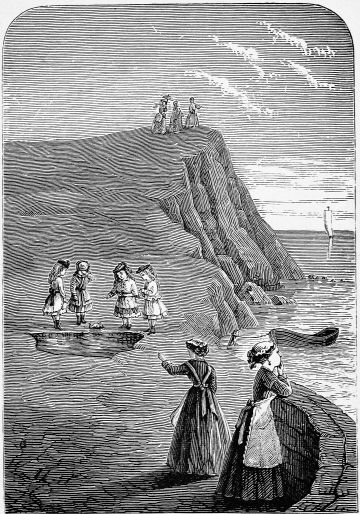
THEY were nearing the breakwater as
Lily spoke these last words, and the
rest of the party paused when they
came opposite to it, and Mr. Norris held out
his hand to his little daughter, saying,—
"We are going on the breakwater for a few
moments, Lily, and Mr. Powers is going to
take Belle. Do you want to come?"
Lily assented, and seized upon her papa's
hand, all the more eagerly because she saw
her brother Tom and the Stone boys upon
the pier, and Lily always liked to go where
Tom was.
Mamie rushed up to her father.
"You come too, papa; you come too, and
take me; will you?" she exclaimed.
"Mamma does not wish you to go upon the
breakwater, Mamie," answered Mr. Stone. "I
promised her this morning that I would not
take you there, nor allow you to go under any
circumstances."
"It's not fair," whined Mamie, her good
resolutions and her watchword once more
forgotten; "it's not fair! The other children
are going, and why can't I, with you to take
care of me?"
"Because I promised mamma, dear," said
Mr. Stone. "I am sorry she has this fear
of your going upon the breakwater; but since
it is so, we must give way to it, for we do not
wish to trouble her, and you know she seldom
crosses any of your wishes."
Ah! but Mamie had no thought for that
now. She was crossed just at the present
moment, and she forgot all her mother's
indulgence; and it only seemed to her that
she was very ill used, and her mamma very
unkind and provoking.
She begged and fretted, but all in vain;
her father was usually firmer with her than
her mother was, and now having, as he
said, given a promise that he would not
allow Mamie to go, he would not yield to her
desire.
In this mood she was led home, where she
increased her own discontent and longing for
a forbidden pleasure by refusing to employ or
amuse herself in any other way; and standing
sullenly at one end of the long piazza, idly
leaning against a pillar, and watching the
distant breakwater where she could see several
figures, among whom she distinguished Belle
and Lily, sitting or clambering around.
"It was too bad," "too mean," "real hateful,"
she said to herself; she "knew the breakwater
was just the very pleasantest spot in the
whole place; it must be so grand to see the
waves come up there;" and, resolutely putting
from her all better thoughts and feelings, she
nursed her ill-humor till she was thoroughly
miserable.
And from that time the desire to go upon
the breakwater took complete possession of
Mamie's mind. Not that she knew of any
very special attraction there; there were half
a dozen play-grounds quite as pleasant, some
far more so than the forbidden spot; but I
am sorry to say that it was for that very
reason, because it was forbidden, that she
longed to go, and was determined to do so
if she could possibly find the way. To worry
her mother into withdrawing her refusal was
her first idea; but she soon found this was
useless; all her teasing, oft-repeated though
it was, could not move Mrs. Stone. She
believed the place to be dangerous, was nervous
and uneasy even when her great boys were
there, and nothing could persuade her to give
Mamie the desired permission.
Still it must not be supposed that Mamie
exactly planned an act of deliberate disobedience,
and carried such a purpose about with
her in her heart. But she was rebellious and
discontented; thought her mother was "mean"
and "foolish;" and nursed other undutiful
feelings, and so paved the way for sin when
temptation and opportunity came. She was
not openly naughty and disobedient, as yet;
and she forgot that the Eye which saw all her
actions, good and bad, marked quite as plainly
every thought of her heart.
She was playing with Lulu that afternoon,
when Lily came rushing over to her in a state
of great excitement.
"Come over to our house, and see the very
cunningest and queerest thing you ever saw
in your life," she said.
"What is it?" asked Mamie.
"Come and see," repeated Lily. "Can she
come, Mrs. Stone?" to Mamie's mamma, who
sat upon the piazza near by.
Mrs. Stone gave the permission which Lily
judged necessary, but which Mamie probably
would not have thought of asking; and the
latter dropped the tongue of the wagon which
she was drawing, in the character of Lulu's
horse.
"Lulu do too," said the little one, who had
no mind to be shut out from the promised
entertainment.
"O you pet! Could she come too, Mrs.
Stone?" asked Lily. "We'd be very careful
of her, and it's a very safe place, just behind
the house, that we are going to."
Permission was given for this also; Mamie,
who was very fond of her little sister, and
generally very good to her, also begging for
it; and the delighted baby was led away by
her two proud young protectors.
Lily guided her guests to the back of "our
house," as she called the hotel where she
boarded; and there were gathered not only
Belle and Mabel, but most of the other children
who were staying there, even her brother
Tom and some boys quite as large among
them, much interested in a mixed brood of
newly hatched chickens and ducklings which
were running about a coop.
Within was the mother hen, ruffling up her
feathers till she was twice her natural size,
clucking and scolding at what she plainly
considered this unwarrantable intrusion upon
her premises, and thrusting her head through
the bars of her coop in wild but vain efforts to
follow her nestlings.
"There!" said Lily, "did you ever see
any thing so cunning? The little ducks are
rather ugly, but then they are funny; and it
is so queer for a hen to have ducks for her
children. I never heard of any thing so
romantic. Now, you need not laugh, Tom.
Does it not seem very strange?"
"Not so strange when you know that they
gave the old hen duck's eggs, as well as
her own, to set on," said Tom.
"But the little ducks' heads don't fit; they
are too big for them. Is that because a hen
set on them?" asked Belle, which question
sent all the large boys into a fit of laughter,
whereupon poor Belle looked as if she had
half a mind to run away.
But Tom Norris kindly drew her to him,
and told her that young ducklings were always
such awkward, top-heavy looking little things.
"They're not one bit pretty, only funny,"
said Lily; "but the chickens are real cunning
and pretty; dear little downy things. I'd like
to have one in my hands; can I, Tom?"
"No," answered Tom, "you must not touch
them. Mrs. Clark would not like it, for you
might hurt it; and it would distress the old
hen."
"She couldn't make much more fuss than
she is making now, the cross old thing!"
said Lily, shaking her fist at the hen, "and
we're not doing a thing to her or her chickens."
"She's afraid we will, you see," said Tom.
"Hi! and there's Lulu after one now;" and
dropping Belle's hand which had been confidingly
nestling in his, he darted upon the
little one just as she had succeeded in grasping
a tiny chicken.
For Lily and Mamie, in their own excitement
over the birds, had left their hold of the
child's hands, and being seized with the same
desire which Lily had expressed, she had improved
her opportunities, and made off after
a chicken.
She had barely secured her prize when
Tom's hand was upon her, not rudely or
roughly, but with a firm, though gentle hold;
and Tom's voice was telling her that she
"must let the poor little chickie go."
"No, no. Lulu want it so. Lulu love it,"
lisped the little one in coaxing tones, holding
up the peeping, struggling thing against Tom's
cheek as if to persuade him by its downy
charms to let her keep it.
"But Lulu hurts it, and it is God's little
chickie, and He don't want it to be hurt,"
said Tom, gently unclasping the fat, dimpled
fingers, and releasing the poor, terrified bird
before it had received much farther injury
than a good fright.
"Lulu dest only 'queeze it a little; dest
only," said the child, with whom these last
words, meaning "just only," were a favorite
expression; and the distressed tone of voice
and grieved lip told that she was taking the
release of the chicken much to heart.
"But it hurts it to squeeze it," said Tom,
taking her up in his arms; "and Mrs. Clark
will be angry if you hurt it or kill it."
"Tlart don't see," said Lulu, looking around
her to make sure of the truth of her argument.
"But God sees," said Tom, "and He wants
Lulu to be good and not catch the little chickens
or ducklings."
"Does He say Lulu naughty dirl if she tuts
'em?" asked Lulu, raising her eyes to the sky
where she had been told God lived, as if she
expected to see Him.
"He says Lulu is naughty if she hurts the
birdies, or don't mind what she is told," said
Tom.
"Den Lulu won't," said the little one; "but
Lulu want de chittee so-o-o," she added, with a
long-drawn sigh which told that the sacrifice
was almost too much for her.
"That's a good girl. Don't you want me
to give you some pretty shells?" said Tom
approvingly.
This attempt to divert her attention proved
quite successful, and Tom carried her away
with all her smiles restored.
"What a dear, good little thing!" said one
and another of the childish group, all of whom
had heard what passed.
"Yes, so she is," said Mabel; "but Tom
might have let her have the chicken a few
moments. It was no such great harm, and
it was real mean and silly of him."
Lily turned upon her with threatening voice
and manner.
"Don't you dare to talk that way of my
Tom," she said. "He's not mean and silly,
but he's wise as any thing, and knows a whole
lot about what is right; and he is un-meaner
than any one you know!"
"I shall touch the chickens and ducks if I
want to, and Tom shan't say any thing about
it," said Mabel, defiantly.
"It's none of my affairs if you do," returned
Lily; "but you're not going to talk horridly
about my Tom."
That she would take very decided measures
to prevent this, or, at least, to punish any
repetition of the offence, Lily plainly showed
by the very emphatic little nod of her head,
with which she treated Mabel.
The latter turned pettishly away, knowing
that Lily generally had the best of it in any war
of words, but she muttered as she did so,—
"I'll touch them when Tom's not here."
"She forgets 'the eyes of the Lord' are
everywhere," said Mamie, rather jauntily, for
Lulu being her sister, she felt very proud of
her good behavior on this occasion, and as if it
reflected some credit on herself; "and she's not
half as good as Lulu."
Lily turned her eyes upon her with a look in
which Mamie read some disapproval and questioning.
"What's the matter?" she asked.
"Nothing much. I was only thinking,"
said Lily, not feeling quite sure that she would
be justified in calling Mamie to account for
what she felt to be a careless way of speaking.
Moreover, one quarrel was as much as she
cared to manage at once; and, considering
Mabel as the greater offender of the two, she
allowed Mamie to go unreproved for the
time.
But, having spoken her mind on the subject
of Mabel's criticism of Tom's conduct, her
feelings were relieved, and she was ready
to be friends again, which she showed by saying,—
"Let's all go to the Rocks now if our
mothers will let us. Come, Mabel, make up,
and come with us."
Mabel certainly meant to go with the others,
but she was resentful, and had no intention of
"making up" so soon; and for some time she
held aloof from Lily, regarding her with frowning
and angry looks, and refusing to walk near
her.
"The Rocks make the most splendid place
to play in that you ever went to," said Lily,
with the confidence of one who was familiar
with the spot in question, and therefore fully
entitled to express an opinion; "and I'm
going to take down some little boats Tom
made me, and we'll sail them in a lovely pool
that I know of. But then everybody must be
pleasant and nice if they expect me to lend
them to them," she added, by way of a
persuasive admonition to the still sullen
Mabel.
But even this inducement did not move
Mabel, and her good humor was not restored
till they reached the Rocks, and the charms of
the wonderful place made her forget all cause
of offence.
Lily had not, indeed she could not, say too
much in praise of these magnificent rocks.
They lay in a vast stretch along the coast,
now low and shelving to the water's brink,
now abrupt and precipitous, rising in huge
masses piled one upon the other, or here and
there standing out boldly in some single, grand
bluff. All over them were curious natural
steps worn in the solid stone. You might go
some distance, and imagine you had come to
a place whence there was no outlet for farther
progress, and lo! turning to the right hand or
the left, you would seldom fail to find these
stepping-places to help you onwards. A light
and active foot was an advantage, it is true;
and now and then a good jump was necessary,
unless one was contented to turn ignominiously
back, and search for some easier way. But a
rich reward for any amount of hard scrambling
awaited you when you had reached some choice
spot, and resting in a natural seat, carved
by nature out of the stone, looked out over
the great expanse of blue ocean before you, or
cast your eye down the long line of coast where
the white, curling waves were breaking in
masses of snowy foam.
Here in one spot, below where the great
boulders lay massed in wild confusion, the
waters came rolling in, in one grand, massive
sweep; there, in another, they were boiling
and churning as in some great caldron; farther
on still, where some huge rock rose
frowning and stern, thrusting itself into the
sea far beyond its fellows, they were broken
into countless showers of spray which, now
and then, caught the sun's rays, and sparkled
with all the colors of the rainbow.
But perhaps the whole beauty and grandeur
of the place could scarcely be felt by our little
friends; and for them, the chief attractions
were the cosey nooks these rocks afforded
for playing baby-house; the famous hiding-places;
and, most of all, the numerous pools
either left by the tide, or collecting on higher
ground, after some recent rain. These were
extremely convenient for sailing vessels of
various sizes and shapes, building docks and
piers, bathing any dolls which might be made
of such materials as would stand a bath,
or which were past injury; in short, there
were various ways in which they might be,
and were made useful by the young frequenters
of the spot.
And many of the salt-water pools were
miniature gardens, filled with tiny sea-plants
of all lovely shades of green, purple, and
brown, and here and there of a bright red
like coral; and among them lived curious
little fish and water animals, anemones, starfish,
with others whose names are too hard
for you to remember.
None knew their advantages better than
Lily, who jumped and sprang and clambered
like a goat,—I beg her pardon, a gazelle
would have been more complimentary. Nora
and the other nurses who accompanied the
young party held their breath as they saw
her almost fly from point to point, graceful
and fearless, seeming as if her tiny feet
scarcely touched the ground; but the children
themselves looked on admiringly, and
were fired, by her example, with the desire
to do likewise, rebelling against the restraining
hands which were laid upon them when
they tried to follow too rapidly.
Ah! those famous rocks made a capital
play-ground with an endless variety of entertainment.
"Miss Lily'll be satisfied now, I suppose,
for here's where she always likes to come and
play," said Nora with a sigh of relief, as the
roguish sprite paused upon a high, bold rock,
and snatching off her hat turned towards the
others and waved it triumphantly, calling out,
"Come on! Here's a splendid place, with a
great, big puddle and lots of stones about."
"'Pears like a temptin' ob Probidence,"
wheezed old Daphne, Belle's nurse, as puffing
and blowing, with one eye fixed anxiously on
her little charge, who fearlessly followed Lily's
guidance, she awkwardly slid and rolled from
ledge to ledge. "It's de uncanniest place eber
I see. We don't hab none sech down Souf
to home. De shore am smoof and de
water quiet and well-behaved most times down
dere. None ob yer splutterin' and fussin'
like dis, nor sech awful hard walkin';" and
Daphne's injured groan and sniff but added
force to her uncomplimentary comparison;
but it was with a hopelessly resigned expression
of countenance which much amused the
other nurse-maids, that she, at last, settled
herself into a shady nook, declaring that
"dese are de hardest stones I eber did see."
V. THE DUCKLING.
THE spot chosen by Lily for the afternoon's
amusement was indeed universally
pronounced to be "splendid."
On the very top of a broad, flat rock lay a pool
of water (fresh water this; the waves seldom
washed so high even in the most furious of
storms), it collected here from the rains
and dew and fogs, and but rarely dried up.
Just now it was unusually full, and the most
unaccommodating of nurses could scarcely
have refused permission to make the most
of such a delightful sheet of water. All four
of our young friends and two other little girls,
named Alice and Julia Gordon, who had been
invited to join them, were soon busily at
work.
Lily produced, from the depths of her pocket,
some tiny dolls "made to be drowned and upset
and such misfortunes," and the boats being
launched, these unfortunate passengers were
speedily consigned to the probable fate which
awaited them.
Ah, such a fate! Spite of the smiling,
sunny face of that miniature sea, what "horrible
accidents" and "shocking disasters"
took place thereon! what storms arose, caused
by the violent stirring up of its waters with
whirling of sticks and splashing of stones!
how those gallant vessels ran into one another,
turned bottom upwards, lost masts and
rudders! how they spilled their passengers,
who were saved only to be sent forth on
another perilous voyage!
By and by it was decided to build a pier,—a
breakwater where the distressed vessels
might run for shelter now and then; and all
proceeded to hunt up small stones and pebbles
for the structure.
Away went Lily, springing up here and
down there, across rifts and chasms, swinging
herself lightly from ridge to ridge, peering
into holes and clefts, and, whenever she
found a stone suitable for her purpose, passing
it on to her less venturesome companions.
Coming round a corner of the rock, she found
Belle standing alone, and gazing thoughtfully
over the blue waters of the sea.
"Why, Belle!" she exclaimed, "what are
you thinking of so solemnly? Why don't you
pick up stones?"
"I was thinking about Mamie," answered
Belle. "Lily, I believe she wants to be good,
but she don't quite know how to set about it."
"Oh, ho! and I s'pose you want to take
pattern by Maggie and Bessie, and help her,
do you?" said Lily, going down on her hands
and knees, and thrusting her arm into a cleft
where she spied a suitable stone.
"I'd like to, but I don't know how very
well," said Belle; "and it was not that I was
thinking about so much. I was just wishing
Maggie was here to give me a proverb to make
a proverb-picture out of. Lily, do you know
of one about a breakwater?"
"No," answered Lily, giving a violent tug
to the stone which refused to be dislodged from
its position,—"oh! you obstinate old thing,
come out,—no, I don't, Belle. But why do
you want one about a breakwater?"
"'Cause I think Mamie feels very naughty
to her mamma about it," answered Belle.
"She keeps saying how mean it is in her not
to say she can go, and calls her foolish and
stupid; and she says she will coax her papa to
take her. And you know she ought not to
talk so about her mother, even if she is—Lily,
do you think Mrs. Stone is a very wise
mamma to Mamie?"
"Wise!" repeated Lily. "I should think
not! There! why did you not come before,
when you had to come?"—this to the stone,
which she had at length succeeded in bringing
up; then again to Belle,—"Belle, I think
she's just about the foolishest mother I ever
did see. Augh! if my mamma was so foolish
as that, I should be too ashamed of her for
any thing;" and Lily sprung to her feet, and
flourished her stone in the air as if to give
emphasis to her opinion. "But I'll tell you,
Belle; I have a very good idea. I think we
could manage to give Mamie a lesson without
offending her, and just pretending it's all play.
As soon as our breakwater is finished, we'll
have a game about a disobedient child,—no,
ever so many children, so Mamie won't think
we mean her,—ever so many disobedient children
who went on it when their mothers did
not want them to, and were very severely
punished by terrible things which happened to
them. Don't you think that would do?"
"Well, yes," answered Belle, rather doubtfully,
for Lily's attempts at moral teaching
were apt to be more personal than agreeable,
and to give offence where she did not intend
it; "but you'll have to be very sure Mamie
don't think we mean it for a hint to her, Lily;
else she'll be mad."
"Oh, yes! we'll be careful," said Lily; and,
secure of the success of her plan, she ran back
to the pool, followed by Belle.
Meanwhile Mamie and Mabel had been
busily at work raising the breakwater which
was now nearly finished, and enough stones
having been gathered, Lily also lent a hand to
its completion; while Belle, feeling rather
tired, sat quietly by, looking on.
"I wish I had my magnet swans and fishes
up here," said Alice Gordon; "would not this
be a nice place to swim them!"
"Yes," said Belle; "and wouldn't it be fun
if we had some of the new little ducklies here
to teach them to swim!"
"Duck-ly-ings, they are called," said Lily,
jamming down a refractory stone which, as
she said, would not "stay put" and thereby
spattering the water over herself and her playmates.
But no one minded such a trifle as
that. Builders of breakwaters cannot always
expect to keep quite dry.
"I thought Tom called them ducklies," said
little Belle.
"Ings—lyings—duck—ly—ings," repeated
Lily with emphasis. "Yes, indeed, it
would be too cunning and funny to have them
here, and teach them to swim. This would
make just about a big enough pond for them."
"Let's bring one to-morrow," said Mabel.
"Mrs. Clark wouldn't let us," said Lily.
"She's an awfully cross old patch."
"Let's take one without asking her then,"
said Mabel. "We can put it back all safe, and
she'll never know it."
"That would be very naughty, though," said
Belle.
"And God would see, if Mrs. Clark didn't,"
said Mamie. "Mabel, you forget 'the eyes of
the Lord are in every place.'"
"See here," said Lily, who had just put the
last stone upon the miniature pier, and then
plumped herself down upon the rock beside
Belle,—"see here, Mamie; it seems to me
you're getting rather intimate with the Lord."
"I'm not," said Mamie resentfully; for she
had felt rather grand when she made her
speech to Mabel, and did not like to have her
weapons turned upon herself. "We ought to
remember God sees us all the time."
"Course we ought," returned Lily; "but
then I don't b'lieve it's proper to talk about it
in that familiar kind of a way—so—so—well,
I don't know exactly how to tell it, but
as if the Lord was not any thing so very great,
you know," and Lily's voice took a graver
tone. "He hears us all the time, too, and we
ought to be a little careful how we speak about
Him in our play."
"He sees us and hears us now, just this
very minute; don't He?" said Belle thoughtfully.
A moment's silence fell upon the little group
as to one and all came the solemn recollection
of the Almighty presence here among them;
a silence broken, of course, by Lily, who, turning
again to Mamie, said, "It's very nice of
you, Mamie, certainly, to try to remember that
text of yours all the time; but then I mean we
ought to think a little more soberly, and speak
a little more piously about it; or it's not likely
to do us much good. Now let's play."
The proposed play was successfully carried
out, both Lily and Belle being careful to avoid
looking at Mamie during its performance lest
she should guess that it was intended expressly
for her benefit, take offence, and so fail to
profit by it.
Nevertheless, Mamie had her own doubts on
the subject; and, as the play progressed, withdrew
from any active share in it, sitting down
and watching the others with a solemn countenance.
The truth was that her conscience was not
at rest; not that she planned any deliberate
disobedience, but she knew that she was cherishing
rebellious and undutiful feelings in her
heart, because she would not make up her
mind to give up, without farther murmuring
and teasing, the pleasure her mother had forbidden.
The oft-shipwrecked and oft-rescued rag
dolls, now in a most distressed and bedraggled
condition, as became their various misfortunes,
were supposed to be a family of
children seized with an uncontrollable desire
to go upon the breakwater in spite of the commands
of their parents that they should keep
away from it. One after another yielded to
the temptation, and all met with the most
disastrous fates. Two were swept away by
an uncommonly high wave sent for the purpose,
and, as they were carried into the depths
of the sea, raised pitiful voices to their comrades,
crying, "Be warned by us! depart from
disobedience, and be warned by us!" A part
of the pier gave way with others, precipitating
them into the briny deep; another child fell
through a hole, and became wedged in between
the stones, "where she had to stay all the rest
of her life, and grew up there, but never got out,
and had a horrid time." In short, some terrible
but well-deserved catastrophe overtook
each one, till the whole family were destroyed.
"That's not a bit real," said Mamie, in a
tone of great dissatisfaction, when the last
survivor had been disposed of. "I know children
don't usually be drowned and squeezed
up in stones just because they go on breakwaters."
"No," said Belle, "not usually; but then
they might be, you know. Accidents sometimes
happen, 'specially if people don't mind."
"Children don't usually be ate up by bears,"
said Lily; "but the Elisha children were; and
I don't s'pose they expected the bears at all.
So that shows punishments may come to us
that we never thought about, besides the
punishment of a very bad conscience."
Lily had said "we" and "us" lest Mamie
should feel that she intended a particular
thrust at her; but as she spoke the last words, she
could not refrain from giving a sidelong glance
to see if her moral lesson were taking a proper
effect, and Mamie caught it, and it increased
her suspicion that she was to receive a reproof
and warning under this friendly disguise.
"I just believe Lily does mean that play for
me," she said to herself, "and she has no
right to. I wish she'd mind her own business."
Then, rising and moving away with
a very superb air, she said aloud, "That's a
very foolish, tiresome play, and I shan't stay
to see any more of it."
"Oh! it's done," said Lily; "the disobedient
children are all used up. We'll fish them
out now, and lay them in the sun to dry. I do
wish we could have some of the ducklings here;
it would be such fun."
Other people were now beginning to flock
down to the rocks, for this was the favorite
resort in the afternoons; and numerous groups
were to be seen, scattered here and there, in
such convenient resting-places as they might
find, watching the breaking of the waves, and
all the mingled beauties of sea and sky.
Among them came Mr. Powers, Mr. and Mrs.
Norris, Mrs. Stone and the little Gordons'
mother; and Mr. Norris asked if there were
not a cluster of "Sunbeams" who would like
to shed the light of their rays upon "Indian
Rock."
Yes, indeed! Lily had painted the glories of
"Indian Rock" in such glowing terms, that
they were only too eager to accept the invitation;
and with the help of many a lift, pull,
and push from the strong arms of the gentlemen,
the whole party, great and small, were
soon landed on that enchanting spot. For
there each one of the children had been forbidden
to venture, unless in company with
some older and experienced person; and their
nurses had been told not to lead them there.
For "Indian Rock" was a dangerous spot,
unless one trod it with care, or had the
guidance and support of a strong, firm hand.
"Papa," said Mamie, as her father helped
her up to the top of a slippery ledge, "I'm
sure I do not think the breakwater could be
more dangerous than this, and I don't see why
you could not let me go there just as well as
here. Lily's mamma lets her go there with
only Nora or Tom, and I'm sure I don't see
why I can't."
Much to Mamie's surprise, and somewhat to
her alarm, her father now spoke quite sternly
to her, bidding her put all thought of the
breakwater out of her head, since, dangerous
or not, her mother was afraid to have her go
there, and his word had been passed that she
should not be allowed to do so.
After this, she dared say no more; but
still she silently fretted and murmured, and
thought herself hardly used, thereby losing
half her pleasure in the beautiful scene before
her.
It was two or three days before any of the
children came down to play in their pool
again. Other pleasures took up their time
and attention; but, at last, one bright, sunny
afternoon, it was proposed to go.
When the hour arrived, however, Lily and
Belle were invited to go for a drive and a visit
to the light-house; and the juvenile party was
reduced to four. Lily kindly lent her ships
and boats, and a new supply of unhappy passengers
had been provided; but these did not
satisfy Mabel, who, since the day on which she
had first seen the ducklings, had never ceased
to wish that she could see them swim.
"You've been here the longest; would you
mind asking Mrs. Clark to lend us one of the
ducklings to take down to the Rocks this afternoon?"
she said to Lily, as the latter, ready
dressed for the drive, stood upon the piazza,
waiting for the carriage.
"I should think I would mind!" exclaimed
Lily. "I would not do it for any thing. Why,
Mabel, she's the crossest old thing that ever
lived. This morning when I came up from
the bath, I asked her for a ginger-cake, and
she told me I was always stuffing! Stuffing!
Such a horrid word to say! And besides,
it's not true. I'm not eating all the time, and
mamma gave me leave to ask for the cake."
"Didn't she give it to you?" asked Mabel.
"Oh, yes, she gave me a whole plateful; at
least, she was going to; but you don't think
I was going to take them after that! No,
indeedy!"
"But I don't want her to give us a duckling,
only to lend us one to swim it down in our
pool," said Mabel. "Wouldn't you dare to
ask her?"
"I'd dare enough," answered Lily, who
seldom confessed to dread of living thing,
unless it were a horse; "but I know it would
be of no use; and I never ask people for things
when I'm sure they don't want to give them to
me. Here's the carriage."
This was not Mabel's doctrine. Like Mamie
Stone, she had a great deal of faith in fretting
or worrying for that which other people did not
wish to grant, knowing from experience that
she often, by this means, gained her point.
Having seen Belle and Lily off, she sauntered
out to the back lot where the chickens and
ducks were kept, and stood looking at the
ducklings with a growing desire to have one
to play with. Should she go and ask Mrs.
Clark?
Before she had fully made up her mind to
do so, the woman herself came around the
corner of the house, and the next moment
her loud, sharp voice struck disagreeably on
Mabel's ear, and put all thoughts of asking
a favor from her quite out of the little girl's
mind.
"Now look here! What are you about
there? You let them chickens alone, and go
round to your own side of the house. I don't
want the boarders' children meddling round
here."
Such was the greeting which Mabel received;
not very encouraging certainly, and
she moved away with a scowl at Mrs. Clark
which did not make her look much more
amiable than the loud-voiced scold herself.
"I wasn't touching your old chickens," she
called out as soon as she thought herself at a
safe distance.
But, instead of going back to the house, she
walked on to the end of the lot where it was
divided from the next field by a row of currant
bushes and a stone wall. Walking along by
the bushes, without any particular purpose,
and thinking it was time for her to go and see
if the other children were ready for the walk
to the Rocks, she heard a curious little noise
among the bushes.
Stooping down and peering in at the spot
whence it seemed to come, she saw one of the
ducklings lying on the ground, and making the
faint sound which had attracted her attention.
"I wonder how it came here, so far from its
hen-mother and the other ducklings," she said
to herself. "I could take it up now if I liked,
and carry it to the Rocks, and neither the hen
nor Mrs. Clark could see me."
The temptation was strong. Mrs. Clark had
vanished into the house; and the next moment
Mabel had the duckling in her hand, hand and
bird both hidden beneath the little overskirt of
her dress, and she was running rapidly out of
the gate which opened on a cross road by the
side of the house.
Then she heard Alice and Julia Gordon
calling her.
"Mabel! Where are you, Mabel? We are
ready to go;" and Nanette's voice, "Ou êtes-vous
donc, Mademoiselle?" and although she
had no intention of keeping her prize a secret,
it was with a half-guilty feeling that she went
forward and joined them, still keeping her
hand hidden beneath her overskirt. She
would let the other children see what she
had there when they reached the rocks, but
not now.
But she was not allowed to keep her secret
so long; for as they were walking along the
path which lay above the cliffs, Julia Gordon
said,—
"What do you keep your hand under your
skirt for, Mabel?"
Mabel looked around before she answered.
She had tried to persuade herself that she had
done nothing wrong in "borrowing" the duckling
for an afternoon's play, since no one had
told her she was not to have it; but, nevertheless,
she felt rather doubtful of what the nurses
would say when they knew what she had there.
The three women in charge of the little
party had fallen somewhat behind; and
Mamie, having taken it into her head to
draw the wagon in which Lulu was seated,
was also with them, and out of hearing for
the moment, if she lowered her voice.
"Don't tell if I tell you something," said
Mabel, in answer to Julia's question, and
speaking to both her and Alice.
"No, what is it?"
"You and Alice come close, one on each
side of me," said Mabel. "I don't want any
one else to know it till we are at the pool."
Then, as her companions obeyed, full of eager
curiosity, "It's a duckling; one of the new little
ducklings that have the hen for a mother;
and we'll swim it in the pool."
"Oh, what fun!" said Julia.
"Did Mrs. Clark lend it to you?" asked
Alice.
"No, I didn't ask her, she's so cross," answered
Mabel; "but it wasn't any harm, for
the duckling had come away from its mother,
anyhow. I found it under the currant bushes,
and I expect it will do it a great deal of good
to teach it to swim. Mrs. Clark ought to be
very much obliged to us."
"Perhaps the poor little thing had run away
to see if it could find any water," said Julia.
"Ducks always want to swim, I believe, and
this one had no mother duck to teach it."
"Yes; so you see it's quite a kindness,"
said Mabel.
"Let's see it," said Alice.
"Presently, when we are at the rock where
the pool is," said Mabel. "I don't want to
take him out now for fear he begins to wiggle
again before I get him in the water, and he
knows what we are going to do with him.
Won't he be glad?"
"Yes," said Julia. "Does he wiggle
much?"
"Not now," said Mabel. "At first he wiggled
dreadfully, but I held him tighter, so he
couldn't; and he made a little noise, too, but
I shut up his bill close, so he couldn't. He's
very quiet and good now."
"Aren't you going to let Mamie see him?"
asked Alice.
"Oh, yes, when we are ready to put him
into the water; but I dare say she'll go and
say something hateful about him when she
sees him. Mamie's real ugly to me, and I
can't bear her."
VI. POOR LITTLE WAGTAIL.
ARRIVED at the Rocks, the children
speedily made their way to the pool
which they considered their own
special property, but, to their great disgust,
found that their rights there had not been
properly appreciated; for not only had some
intruders been making free with their breakwater,
but it was, as Mamie said, actually
"unbuilt," and the stones lying scattered about
in all directions.
But this was soon lost sight of in the new
interest of the duckling; and Mamie was
speedily taken into the secret.
She was pleased with this addition to the
afternoon's entertainment, and therefore did
not express the disapprobation which Mabel
had rather looked for, saying "nothing hateful,"
but becoming as eager as the other
children to give the poor little bird his first
"lesson in swimming." In fact, I am afraid
that all four intensely enjoyed this bit of mischief,—the
outwitting of Mrs. Clark being
considered a great triumph, and quite a feat
on Mabel's part.
And now they felt secure from interference.
Lulu could not be brought here upon the rocks,
and her nurse must keep her above on the
bank; and the maids who attended Mabel and
the little Gordons, having made their charges
promise not to leave the broad, flat rock where
they were quite safe, had preferred to join her,
and keep an eye upon the children from a little
distance. No one else was near, save some
strangers seated upon a ledge above them;
and now, closing around the pool, they were
ready for "such fun."
Stooping down to the tiny sheet of water,
Mabel at last hastily withdrew her hand from
beneath her skirt, and gently dropped the
duckling into it.
Mamie. p. 112.
But instead of seeming to enjoy his introduction
to the new element, and beginning
to swim fearlessly about, as some of the children
knew young ducks usually do, he rolled
over on his side with drooping head and wings,
and lay floating helplessly on the water, the
only motion he made being a feeble opening
and shutting of his bill, as though gasping
for air.
"What a stupid little duck!" said Mamie.
"He ought to swim right away. Once I saw
a whole litter of ducklings go right in the
water, and swim as well as the big ducks.
Here, sir! get up and swim."
And she lifted the duckling's head with her
finger, and tried to put him in an upright
position; but the instant she let him go he
fell over again.
"You naughty, lazy thing!" said Mabel.
"Now you've got to swim, sir, so you may as
well do it. Here, let's poke him with this
stick."
"I think there's something the matter with
him," said Julia. "He looks kind of flabby
and sick; don't you think he does?"
"Oh, yes! look at his eyes; they're growing
all white," said Mamie.
"Take him out of the water," said Alice.
"You, Mabel; he's yours."
But if the duckling were sick or ailing,
Mabel had no desire to claim him. She was
frightened now, and the words of the other
children added to her alarm.
"What have you done to him, Mabel?"
asked Julia.
"I didn't do any thing," she answered snappishly;
"and you shan't say I did."
"Was he this way when you found him?"
asked Alice, lifting the duck out of the water.
"I don't know," pouted Mabel. "No, he
wasn't; 'cause he wiggled and squirmed so I
could hardly hold him at first."
"I expect you've hurt him then," said
Mamie. "You ought to be ashamed to touch
him."
Alas, poor little Wagtail! As Alice laid
him upon the rock he fluttered his wings
feebly, stretched out his feet, gasped once
more, and lay quite motionless. No wonder
that he had, at last, lain "quiet and good" in
the thoughtless little hand which had grasped
him so tightly to still his "wiggling."
"O Mabel! you have hurt him. He's
dead, I believe," said Julia in a tone of horrified
distress.
Thoroughly ashamed and sorry now that
she believed herself to have done such fearful
mischief, Mabel raised a doleful cry which
speedily brought her own nurse and the maid
of the little Gordons to inquire into the cause
of the trouble.
The story was told by Julia, for Mabel could
not make herself understood; but, to the surprise
of all the children, it was looked upon as
a good joke by both the women, who laughed
immoderately when they heard it.
Nannette, knowing that she would be called
to account if Mabel appeared with red eyes
and swollen cheeks, hastened to soothe and
comfort her little mistress, telling her she
need not be troubled, since her mamma would
make good the loss of the duckling to Mrs.
Clark, and would not let the latter scold her.
But Mabel was hard to be comforted. She
felt as if she had been cruel as well as
naughty, and it made her very uncomfortable
to think that the poor little bird had come to
its death in her hands. Though wilful and
rather selfish, she was a tender-hearted child
where pain or suffering was concerned, and
now it was with a kind of sick horror that
she shuddered and cried over her work. So
great was her distress that even Mamie, forgetting
the smothered ill-will between them,
tried to console her, but all in vain; and she
made such an ado that it attracted the attention
of the party on the rock beyond them,
and one of the ladies rose and came towards
them.
"What is the trouble? Can I be of any
help here?" she asked in a kind voice. Then
seeing the dead bird, she added, "Ah! I see,
your duckling is dead. How did it come, my
dear?" laying her hand on Mabel's head.
Mabel had ceased her cries at sound of the
strange voice, but she did not speak; and
Mamie answered for her.
"She killed it herself, ma'am. She didn't
mean to, but then she had no business to touch
it."
At this indisputable but unpleasant truth,
Mabel broke out again, having first relieved
her feelings by making her "very ugliest face"
at Mamie for "telling tales of her." Then
turning to the lady, she said with a heavy sob,
"Indeed, I didn't mean to hurt it, ma'am;
indeed, I didn't."
"I am sure you did not," said the lady
soothingly, sitting down on the rock beside
Mabel. "But where did the duckling come
from? Was it yours?"
No; there was an added trouble. Mabel
did not speak, but hung her head; while Julia,
after a moment's hesitation, answered,—
"No, ma'am, it was not hers; it was not
any of ours. It was Mrs. Clark's, a very
cross woman who keeps the house where we
board; and I s'pose Mabel is afraid of her
too. I know I would be."
"There's no need of saying any thing about
it to Mrs. Clark, I'm thinking," said the nurse
of the little Gordons. "Put it under the bank
where you found it, Miss Mabel, and she'll
never know."
The lady looked with grave eyes at Mabel,
as if watching her to see if she would listen
to such wrong advice. Neither Mabel nor the
other children noticed this; but she was pleased
to see the former shake her head decidedly, as
she answered, sobbing,—
"No, no, I wouldn't do that. I'll have to
tell. Once I hid something, and didn't tell I
did it,—Belle and Lily knew about it, and
Mamie too,—and it made me such a lot of
trouble; and I'm never going to not tell again.
But I don't care for that old Mrs. Clark. Papa
won't let her scold me. But, oh, dear! I wish
I hadn't squeezed the poor little duck; I wish I
hadn't! I never thought he'd go and kill
himself just for that. I squeezed him pretty
softly too. Oh, dear! and I meant to put him
back safely, too, when we had done swimming
him."
And looking confidingly up in the lady's
sweet, sympathizing face, Mabel told the whole
story of the finding of the duckling beneath
the currant bush, and how she had brought
him away.
"I am glad, dear," said the lady, when Mabel
had finished, "that you have made up your
mind to confess what you have done, and not
to attempt to hide it. I believe you acted without
thought, and perhaps did not intend to do
any thing very naughty; but you would make a
little wrong a great wrong by trying to hide
it."
"Yes," said Mamie to herself, "and God
would know it anyway, for 'the eyes of the
Lord are in every place,' and He sees whatever
we do; so He saw Mabel take that little duck."
Mamie had been somewhat mindful of Lily's
reproof since the last day they were here, and
was more careful how she took the words of
the Bible heedlessly upon her lips; but I am
sorry to say she was rather more anxious to
test the conduct of others by her watchword
than she was her own, unless indeed she
imagined herself particularly well-behaved and
virtuous; when she would feel as if she was
laying up a very good account for herself in
the eyes of her Maker.
She almost started; for it seemed as if the
stranger lady must have read her thoughts
when the latter said to Mabel,—
"And even if you had hidden this from us
all, dear, you know there is one Eye from which
you could not hide it; an Eye which sees even
the very wish to do wrong, and you could not
have been comfortable or happy knowing that,
could you?"
"No, ma'am," said Mabel, recalling the misery
of the time she had spoken of; the time
when she had taken a locket belonging to her
Cousin Belle, not with the intention of keeping
it, it is true; but when she knew Belle did not
wish her even to touch it, and the locket had
mysteriously disappeared, and so she had been
brought into great trouble and disgrace for
a time. "Yes, ma'am, and I'm always going
to tell, always."
There is no saying how far the consciousness
that her father and mother would shield her
from blame, and make good the loss to Mrs.
Clark, went to support Mabel's resolution to
confess all; but as she was by no means a
deceitful or dishonest child, we will hope that
she would have made this amends, even with
the prospect of a severe scolding as the consequence.
So perhaps the lady's words made less
impression on her than they did upon Mamie,
on whose conscience they smote unpleasantly,
as she could not help feeling that, in her heart,
there was the wish, and even the half-formed
intention, to do wrong if opportunity should
offer.
"And now what will you do with the poor
little duckling?" said the lady, taking the
dead bird in her hand, and smoothing its downy
back. "Shall we let one of the women toss it
away in the waves?"
"Oh, no, ma'am!" said Mabel; "don't you
think I ought to give it back to Mrs. Clark,
even if it is dead? She might want to have
it stuffed and put under a glass shade like a
canary of mine that died, and papa had him
stuffed for me."
The lady could hardly keep back a smile at
the idea of the ugly little duck preserved beneath
a glass shade, like some rare and valued
pet; but she only said, approvingly,—
"Very well; perhaps you are right to wish
to give it back to the owner."
"And if Mrs. Clark don't want him any
more we might have a grand funeral for him,
and bury him to-morrow," said Julia Gordon.
"Oh, I hope she won't want him," said
Mabel, rather cheered by the prospect of funeral
honors to her victim.
"Would you like," said the lady, "that I
should tell you a thing which happened to me
when I was a little girl?"
"Yes'm," said Mabel, brightening afresh at
the suggestion; and in the eager faces which
were turned towards her the kind stranger saw
that her offer met with general approval. Our
little friends, like most children, were always
ready for a story.
"When I was a child," she began, "I was
not the best-behaved one in the world. I do
not think I meant to be very naughty, but I
was thoughtless and wilful, perhaps a little
obstinate when I had once made up my mind
to do or have a thing; and although I had a
good, wise, and tender mother, I was impatient
of contradiction even from her. As to my
brothers and sisters, all older than I was, I
would not listen to the least advice or interference
from them.
"I was about ten years old, and we were
spending the summer, as usual, at my grandfather's
country-seat up in the mountains. On
the side of the hill, at a short distance from
grandpapa's, were the farm-house, dairy, orchard,
and kitchen-garden; and all these I
thought much more amusing places than the
house, lawn, and flower-garden where I properly
belonged, and where my mother generally
preferred to have me play. For there were
more ways and places for me to get into mischief
down at the farm than there were at the
house; and I am afraid mother knew very
well that my heedlessness and self-will led me
often to do the thing I wished rather than the
thing that was right. Still I was not forbidden
to go to the farm; and, so long as my brothers
or sisters were with me, she never objected.
"The thing of all others which attracted
me most at the farm was a half-grown black
kitten. Mother could not bear cats, so we
never had one at home, or at grandpapa's; but
up at the farm-house, I could amuse myself by
the hour with this playful little creature, which
grew very fond of me.
"One morning we had some young visitors;
and of course we must show them all the beauties
and curiosities of the place. Among them
was the orchard, although the apples there
were as yet hardly larger than nuts.
"As we were passing through it one of my
brothers spied a nest in a tree.
"'Hallo, Annie!' he said, 'there's a nest.
I'll bring it down for you if you want it.'
"I did want it; but one of my sisters begged
Will to make sure that it was empty.
"'Oh, it must be empty; it's too late for
birds to be in it,' said Will, who like myself
was rather headstrong and heedless; and raising
a whip he carried, he whisked the lash over
and around the nest.
"Ah! the nest was not empty, though it
really was late in the season for the young
ones; and, the next moment, a beautiful bird
fell fluttering at our feet, its wing broken by
the blow from Will's whip, while its mate flew
from the nest, terrified almost out of her life.
"A more crestfallen, distressed being than
Will it would have been hard to find; for he
was very tender-hearted, and would not hurt a
living thing purposely. We were all much disturbed,
and at once set about doing all we
could for the poor little sufferer. My eldest
brother bound up its wing as well as he was
able, and we brought some hay with which
Will climbed the tree, and made a bed in a
forked branch near the nest. He said there
were four half-fledged birds in the nest, and
was more disturbed than ever at the mischief
he had done. But he promised himself and us
that he would care for parent-birds as well as
nestlings, as long as either should need it;
knowing that the poor little mother would have
too much to do to feed both husband and
children.
"Brother Ned handed up the wounded bird,
and Will put it carefully in the bed he had
made for it; after which, the rest of us went
on, and left him digging a supply of worms
which he intended to put in a convenient place,
as a store from which the mother-bird might
help herself without the trouble of looking for
them. He was still quite quiet and out of
spirits when he joined us at the dairy some
half-hour later, though he told us the mother-bird
had returned, and her poor mate had eaten
a caterpillar placed handy for him.
"That afternoon my sister Rosa and I went
up to the orchard with Will to see about his
birds, and carry them food and water.
"As we passed the door of the farm-house,
Blackie, the kitten, came running out to see us,
and I took her up in my arms to take her with
me.
"'Don't bring that cat,' said Will. 'She
might get at the birds.'
"'No, she won't. I shan't let her,' I
answered.
"'But she might,' said Rosa; 'she's so
quick and active, she'd be up the tree before
you knew it.'
"'No, she shan't,' I repeated positively;
'I'll keep her in my arms all the time, and I'm
going to take her.'
"And though Will begged me, and was even
angry about it, I persisted in taking the cat
with me.
"And I did keep her fast in my arms,
although she struggled to be free, and even
scratched me severely when she saw, as she
immediately did, what Will was at.
"He found the little creature somewhat better
than when he had left it in the morning,
and it was quite tame, fluttering but little when
he climbed the tree, and almost taking the
worm he offered from his hand. He supplied
it with all it needed, and came down as soon as
possible, as the mother-bird had again flown
from the nest when he came near.
"How kitty's eyes gleamed and sparkled,
and how fiercely she struggled in my arms!
It was all I could do to keep my hold; and I
was so afraid that she would escape in spite of
me, that I was sorry that I had not listened to
my sister and brother and left her behind.
"But at last we were ready to go; and
when I put puss down at the farm-house door,
I relieved my feelings and visited my own obstinacy
on her by giving her two or three good
cuffs. It never came into the mind of any one
of us as she scampered away and hid beneath
the stoop, that she might find her way back to
the nest by herself, or of all the mischief she
would work there.
"You may be very sure that the first thing
to be thought of in the morning was the helpless
birds up in the orchard; and directly after
breakfast Will and I went over to the farm.
As we passed the house-door, kitty came frisking
out to me, as usual; but mindful of the
trouble I had had with her the day before, I
bade her stay at home.
"All in vain, however; puss was determined
to follow. Whether she guessed where we
were going or no, I cannot tell; but it really
seemed as if she did, and, feeling guilty, wanted
to be on the spot when we discovered her cruelty.
Come she would, although Will threw
stones at her, and I beat her with a stick, and
chased her back many times; we would take
only a few steps onwards, and there she was
after us again. At last Will turned an empty
barrel over her, put a stone on top of it, and
there we left her mewing piteously.
"But we might have let her come on; the
mischief was done. When we reached the tree,
what destruction was there! The lame bird
was gone from his bed of hay, and a few bright
feathers scattered about told what his fate had
been; the nest hung, torn and ragged, empty
of its young inhabitants; while the mother-bird
was flying wildly to and fro, wheeling
round and round her ruined home, and uttering
piteous, mournful notes.
"Will looked at me, and I at him; but for
the moment, neither of us could find words for
the thought that was in both our minds; but
if the painful truth had needed to be made
plainer, it was done so at that instant by puss,
who sprang suddenly forward, and pounced on
something among the long grass beneath the
tree. Will was upon her like a flash, and with
some difficulty succeeded in taking her prey
from her. It was one of the nestlings, but quite
dead and stiff. Perhaps he had been killed by
a fall from the tree when the cat attacked his
home, or perhaps her cruel claws had crushed
the life out of him when she had gorged herself
upon his father and brothers, and could eat
no more.
"Will, great boy though he was, could not
keep back his tears, and vowed all manner of
vengeance on puss for the destruction of his
adopted family. As for me, I was heart-broken,
for I could not but feel that it was all
my fault; and while poor pussy had only followed
her own natural instincts in destroying
the birds, I had been obstinate and wilful, and
so brought about such a sad thing; for if I
had not carried the cat there, she would probably
not have discovered the nest.
"And I am forced to believe that Will made
good his word in the most severe manner; for
from that day I never saw kitty again, although
I went to the farm as often as before; but I
never had the courage to ask any questions,
feeling quite sure that puss and birds had all
come to a violent death through my obstinacy."
"Is that all, ma'am?" asked Mabel, when
the lady had ceased speaking.
"That is all," she answered; "and, judging
from your grave little faces, I should think it
was enough."
"Oh, we like it very much, and we are sorry
it is finished," Julia hastened to say.
"Yes," said Mabel with a long sigh; "and
I think that story is rather a comfort."
"How so?" asked the lady.
"'Cause it's nice to know you could be
naughty once when you are so good now."
"How do you know I am good now, or that
I have improved any since I was a child?"
said the lady smilingly.
"I should think you must be good when
you are so kind to us," answered Mabel, slipping
her hand confidingly into that of her new
friend.
"Well, perhaps I may have improved in the
way of believing others could be as wise as
myself, and in giving up my own will now and
then," said the lady; "for that was a severe
lesson to me."
"But how did the pussy get out from the
barrel?" asked Mamie.
"Oh! I forgot that. Some one of the
family had heard her mewing, and let her out,
not knowing of any particular reason why she
should be kept a prisoner."
Then she bade the children good-by, and
leaving them to their play went back to her
own friends.
VII. THE "FIRST STEP."
BUT the spirit had gone from their play
for that afternoon; the pool, beside
which the dead duckling still lay,
had lost its attraction for them all; and after
spending some little time scrambling about
over the rocks and watching the waves, they
concluded to go back to the hotel.
Mabel gave the dead duckling into Nannette's
hands to be carried home; but arrived
there, she took it at once to her father, and
made an honest confession of the whole affair.
Mr. Walton was a good deal amused at the
tragic account she gave of the duckling's
death and her own despair; but he did not let
her see that, and, praising her for her readiness
to make what amends she could, he offered to
go with her to see the formidable Mrs. Clark.
Passing through the hall on the way to Mrs.
Clark's quarters, they met Mr. Clark, a man
as good-natured and easy-going as his wife
was sharp and bustling, and inquired of him
where that good woman was to be found.
"Wal, she's up to her elbows in a lot of
varieties she's fixin' up for tea jest now,"
answered Mr. Clark, raising his hat with one
hand, and scratching his head with the other,
as his custom was whenever he made a remark
or gave an answer; "an' I donno as she cares
to be disturbed. Things is rayther in a chaos
round kitchen ways, Mr. Walton. Is there
any thing I could do for you, sir?"
"Here is a little girl," said Mr. Walton,
"who feels that she has not done right, and
wants to confess what she has done. Speak
to Mr. Clark, my dear."
But poor Mabel, whatever she might wish
or be willing to do, could find no words
beyond "I—I—you—I"—and here she
hung her head, and with gathering tears
brought forward the hand which held the
dead duckling, which until now she had kept
hidden.
"Shall I tell Mr. Clark?" asked her father.
Mabel nodded assent.
"It seems she picked up this duckling and
carried it down to the Rocks this afternoon,"
said Mr. Walton, "intending to give it a swim
in some pool, and then bring it back; but she
has handled it too roughly, I suppose; for
when she reached there it was dying. She is
very sorry now, and feels that she did wrong
to take it without permission; but I will make
it all right with you, Mr. Clark, and Mabel
will promise not to meddle again with what is
not her own."
"Whew!" said Mr. Clark, staring at the
duckling as if he had not heard the latter part
of Mr. Walton's speech; "there's two of 'em.
Won't my wife be in a takin' though? I
found another on 'em lyin' sick under the
currant bushes this arternoon, an' it's dead or
dyin' by this time. I see it warn't no use
coddlin' it up; 'twas too fur gone, so I let
it be."
"I found this one under the currant bushes,"
said Mabel, regaining her voice. "It was just
lying there, so that was the way I came to
take it."
"Did you, though?" said Mr. Clark;
"well, sure enough, it's the very same fellow I
left there. Don't you fret then, child; you've
only put it out of its misery a little sooner, for
it wouldn't ha' come round no way. 'Tain't
no odds about it, Mr. Walton; jes' let it go,
and I'll fix it with my old woman so she won't
blame the little girl."
Very much relieved, and thankful that she
had made up her mind to confess, Mabel ran
away to her mother, receiving permission from
Mr. Clark to keep the duckling for the proposed
funeral honors. The roar of laughter
with which he heard her intentions did not
sound very pleasant in her ears, but she was
too grateful to escape a scolding to find fault
with the good-natured man.
Mabel had imagined that Belle and Lily
would be very much shocked when they came
home and heard of the fate of the duckling;
but they were not half as much so as she
feared; for she did not fail to tell them that
Mr. Clark had said the little bird could not
possibly have lived and thriven; and besides,
its burial afforded the prospect of a pleasant
entertainment for the next day.
"And Maggie and Bessie are coming over
to spend the day to-morrow," said Belle.
"Papa had a letter from Mrs. Bradford saying
so. We'll wait till they come, shan't we?"
"Yes," said Mabel, "we will; and maybe
Maggie would make up some poetry for us
about him."
The promised visit of Maggie and Bessie
Bradford made quite a jubilee; and the next
morning, when they landed with their papa
from the boat which had brought them from
Newport, they were met on the dock by a host
of eager little friends.
They were soon told the story of the duckling,
but as they had only a few hours to spend
in the place, and there was much to be seen
and to do, Maggie declined to spend any portion
of her time in composition, save so much
as would answer for the purpose of a short
epitaph.
Mabel had sacrificed "the sweetest sugarplum
box with the loveliest lady on the cover,"
to the service of the duckling, and he was tenderly
laid therein. The procession was a large
one, comprising not only most of the children
in the house, but several others from the
neighboring hotels; and Wagtail was buried
with military honors; that is, to the beating of
a drum and tooting of two tin trumpets, after
which the assembly sang "Shoo Fly" about
the grave.
These imposing ceremonies afforded so much
consolation to Mabel that she privately informed
Belle and Lily that she would like to
have a duck funeral every day, only she would
not like to be the one to kill it.
Maggie also composed a most touching
epitaph for him, of mixed poetry and prose,
which ran as follows:—
"Oh, pause, and drop a virtuous tear, Whatever footsteps wander here; For here's the body of Wagtail Duck, Whom cruel Death so soon did pluck!
To the memory of Wagtail Duck, Esq.,
who
Died in the fifth day of his age,
after
A short life
in
Which he was never known to do wrong
and
Painful illness.
Reader, go and do likewise."
This gem of composition, having been greatly
approved by the mourners, was carried to
Tom Norris in order that he might print it
upon the board which, by Lily's request, he
had prepared for a headstone. He read it
without a smile, gravely shaking his head, and
saying,—
"Yes, that is the usual fate of ducks; they
are only made to be plucked."
That the inscription excited general admiration
after it was printed and put in its place,
might be judged from the visits which were
paid to it in the course of the day by nearly
all the grown people in the house. But this
admiration did not appear to be of a melancholy
character, as they usually returned from
the grave with the broadest of smiles on their
faces.
This was not observed by Maggie, however,
who soon forgot both epitaph and duckling in
the various pleasures provided for her entertainment.
Tom Norris had been presented by his
grandfather, just before leaving home, with a
very handsome row-boat. This boat had, of
course, been brought to the sea-shore; for Tom
was a great boy now, and so wise and prudent
that he was to be trusted to take care of himself
and those who might be with him. It is
true that his mother always gave a sigh of
relief when she saw him come safely home
from rowing; and while he was out, she would
send many an anxious glance over the surface
of the sea; but she never objected or interfered
with him, and Tom was careful of her
feelings, and did not venture when the sea was
rough, lest she should be worried or alarmed
for his safety.
Mamma never would suffer Lily to go in the
boat when Tom went in the deep water; not
that she doubted her brother's care for her,
but because Lily was such a heedless little
thing, so quick and impulsive in all her movements,
that she feared some sudden jerk or
motion might send her into the water. Lily
longed for the forbidden pleasure; but she was
so accustomed to a ready obedience that she
never thought of fretting about it, or worrying
her mother to let her go. She did not even
speak of it to Mamie when the latter complained
of her mother's unkindness in not
allowing her to go upon the breakwater. Mamma
had said that it was not to be, and Lily
had no more to say, but strove to content herself
with the numerous pleasures left to her.
But on this afternoon, as it was an extra
occasion on account of the visit of Maggie and
Bessie, dear, kind Tom proposed, and obtained
his mother's permission, to take his boat up a
little river which came down from the back
country and crossed the beach, and to give
the children a row there.
They were all enchanted at the prospect,
and Mamie had leave to go with the rest,
Tom refusing to take her unless she asked her
mamma first.
Tom kept his boat tied to a stake on the
inner side of the ruined breakwater, which
shielded it and several others from the force
of the waves when the sea was high, and made
a kind of little harbor where they might ride
in safety.
Soon after dinner Tom gathered his passengers
together, the company consisting of all
our old young acquaintances, Maggie and
Bessie, Belle, Lily, Mabel, and Mamie. Walter
and Ned Stone were to go with them, and
help Tom row.
Down the road they went, a merry, happy
flock, till they reached the breakwater, at the
lower end of which stood Mr. Powers and Mr.
Bradford, awaiting them.
Tom hauled up his boat where the stones
had fallen so as to make quite a convenient
landing-place, while the other boys ran to bring
the oars which were left in the care of the
storekeeper hard by. The boat rocked up and
down on the gentle swell within the shelter of
the pier with a regular, undulating motion,
which looked very pleasant in the eyes of the
children, with one exception.
"Tom, my boy," said Mr. Bradford, "I
think I'll step in and take an oar with you as
far as the river, if you'll have me."
"Certainly, sir; most happy," answered
Tom; and the gentleman stepped into the boat,
which was kept from floating out by the rope
which Tom had noosed about one of the heavy
stones of the pier.
"O papa!" said Bessie, "how I do wish
I could come in the boat now, and be rocked
up and down that way. I do like it so."
"Come, then," said her father, and, guided
by Mr. Powers' hand, the little girl made her
way over the rugged ruins of the pier, and was
lifted by her father into the boat.
"Anybody else want a little tossing about?"
asked Tom. "Maggie?" fixing his laughing
eyes on her face, quite sure what her answer
would be.
"No—I—thank—you," said Maggie,
with long-drawn emphasis on each word.
"Tom, it's very plain that you don't know
what sea-sickness is. Oo—o—o!"
"Poor Maggie! she shuddered at the very
thought," said Tom.
"Papa, I'd like to go; could I?" asked
Belle; and her father put her beside Bessie.
"Lily?" said Mr. Powers, holding out his
hand towards her as he saw how wistful she
looked.
But Lily shook her head.
"Mamma has forbidden me to go in the
boat when it is on the sea, sir," she said.
"I think your mamma would not object
here, dear, and with Mr. Bradford in the boat,"
said Mr. Powers.
"But she might, sir, and I think I'd better
not," said obedient Lily. "She told me so
very spressly not to go; and she only gave me
leave to row this afternoon because Tom was
going on the river."
"You are a dear, good child," said Mr
Powers. "Mamie, are you for the boat?"
Mamie had, until this minute, been standing
farther back than the other children, not actually
on the breakwater, but as near to the forbidden
ground as she could possibly be. She
had never been so near to it before; and I am
afraid that if her playmates had not known of
her mother's command, she would have disregarded
it altogether. She had no further
thought for it when she heard Mr. Powers
invitation, but started forward.
"Mamie," said Tom, "did not your mother
forbid you to come upon the breakwater?"
"I can't go in the boat if I don't," pouted
Mamie, stopping short where she was.
"Go back!" said Tom decidedly; "you
cannot come in till you go down to the river.
Stay with Lily and Maggie."
Mamie began to cry, but did not go back.
"Hi, there, you Mamie! come off the breakwater!"
said Walter the next moment, dashing
past her with a pair of oars; and Ned,
following with another, said, "O you disobedient
thing! if you're not headstrong. See
if I don't tell mamma of you."
Mamie drew back, but feeling more than
ever discontented and rebellious.
"It's too bad!" she said passionately, as
she saw Mabel placed beside Belle and Bessie
in the boat. "Everybody else can do every
thing they want to, and I never can, and just
for such stupid nonsense. There! I have been
on the breakwater, and never had a bit of harm
happen to me."
"Then you should be thankful for your mercies,
and that your sins were not visited upon
you," said Maggie solemnly.
"Yes," said Lily; "and the way you talk
about your mother is just too much, Mamie."
"My dear children," said Mr. Powers, "do
not spoil your afternoon's pleasure by fretfulness
and quarrelling. If Mamie has, for a moment,
forgotten her mother's orders, we will
hope that she will be more careful another time.
Come, we must walk on, or the boat will be at
the river before we are."
But no; Mamie had not forgotten her mother's
orders; she had only hoped that others had
done so, and had herself wilfully disregarded
them; and she was to find the truth of the old
proverb, that "it is only the first step that
counts." Her "watchword," as she called it,
was quite forgotten or put aside now; it was
no longer a check upon her; and she had
made up her mind that she would disobey her
mother and go again upon the breakwater at
the first opportunity. The disappointment
about the boat was more than her wilful little
heart could or would bear; and she was indignant
to think that the other children should
have any pleasure of which she was deprived.
She forgot that Lily had been obliged to give
up the same; but that she had done so in a
cheerful, docile spirit, which would not even
run the chance of doing that which her mother
would not approve.
So now Lily was gay, light-hearted, and full
of spirits, chattering away merrily with Maggie
and Mr. Powers as they crossed the beach on
their way to the river where they were to meet
the boat; while she, Mamie, came moodily and
discontentedly behind, finding the sand heavy,
the sun hot, the way "so long," and contriving
to pick up half a dozen troubles in the
course of the walk.
Things were no better after she was in the
boat. It was "no fun on that stupid river;"
the boat was "too crowded," although Mr.
Bradford had left it now; one "pushed" her,
and another "shoved" her; although if you had
asked the other children, they would probably
have said that it was she herself who did the
pushing and shoving; and, in short, she made
herself so disagreeable that Maggie afterwards
privately confided to Bessie that she found Mamie
"very much re-dis-improved, and like the
Mamie of old days."
Her brothers were very much vexed with her,
and even threatened to set her upon the river-bank,
and leave her there by herself till they
were ready to land; a threat which was, at
last, carried out after she had become quite
unbearable, and destroyed the pleasure of the
whole party.
However, it was not much more agreeable
to have her shrieking upon the river-bank than
it was to have her grumbling in the boat; and
she was taken in again on promise of better
behavior.
This promise she fulfilled by sitting sullenly
in her own corner of the boat without opening
her lips; but the sounds which had come from
them before were not so sweet as to make her
companions regret her silence.
And for such a trifle Mamie was making
herself and all about her uncomfortable; for
the sake of this one forbidden pleasure set
against so many comforts and enjoyments, she
had forgotten, or wilfully put out of sight, all
her good resolutions, and the remembrance of
that Eye which watched every thought and feeling
of her heart.
And yet, perhaps it was the consciousness of
this, the guilty, uneasy conscience, which helped
to make her so fretful and irritable, so hard
to please, and captious to all about her. She
was more ready, as we have seen, to test the
conduct of others by her "watchword" than
she was her own, now that the first novelty of
it had worn off; but she could not quite put
away the reproachful echo in her own heart.
VIII. DISOBEDIENCE.
LILY lay upon her back on the grass,
her hands beneath her head, her eyes
looking up into the sky. She had
been lying thus some time, perfectly quiet,
though Belle and Mamie sat beside her, playing
with Lulu.
"Lily," said Belle at last, "what are you
doing?"
"Thinking," answered Lily.
"Oh!" said Belle, surprised, perhaps, at this
unusual process; for Lily generally had too
many other things on hand to devote much
time to thought; "you look as if you were
thinking sober too."
"Well, yes," said Lily, without bringing her
eyes down from the sky; "it was rather pious
thinking I was doing."
"Would you mind telling us about it?"
asked Belle, interested in the novelty.
"Oh, no, not at all," answered Lily. "I was
thinking about conscience, and what a dreadful
bother it is; but how it improves us, and how
awful we'd be without it. It's a great mercy it
was given to us,—to me, at least; or I should
be all the time doing bad things. I think we
might call conscience a bother blessing, because,
though it is best for us to have it, it is a great
inconvenience."
"Is it an inconvenience to you now?" asked
Belle.
"No, not particular," said Lily, rolling over
on her side, and plucking a head of thistle-down
which grew close at hand. "Here, Lulu,
blow this;" and she held it up that the little
one might blow off the feathery seed-vessels;
"not particular just now; but it was a great
inconvenience before dinner. You see, Belle,—once
more, Lulu; there they go!—you
see I wanted to do a thing very much, but I
did not feel sure mamma would let me, and
she had gone to make a call, so I could not
ask her; and I made up my mind I'd just do
it; and do you know, I really believe I felt
quite glad mamma was not there, so she couldn't
forbid me; but then my conscience,—I
suppose it was my conscience,—puff away,
Lulu,—began to feel badly about it, and so I
put it off till mamma came, and sure enough,
she did forbid it. So, you see, there's a sign
that conscience is a bother and a blessing too."
"Yes," said Belle approvingly.
"And then," proceeded Lily, thinking she
might as well continue to give her companions
the benefit of her moral reflections, "and then
I was wondering what conscience was. We're
so queer inside of us; our thoughts and our
consciences and our remorses, and all that,
you know."
"Yes," said Belle again. "Lily, I suppose
conscience is a kind of 'Thou God seest me'
feeling; don't you?"
"Why, yes," answered Lily, looking admiringly
at Belle. "I never thought about it
that way, but I believe it is; and that was a
very clever idea of yours, Belle. Mamie, what
do you think about it? You seem to have
thought a good deal lately about God seeing
you all the time."
"I don'no," muttered Mamie. The conversation
was not pleasant to her, and she did not
choose to take any part in it.
"I s'pose heathen can't have consciences as
long as they don't know about God," said Belle
thoughtfully.
"No, I'm quite sure they do not," said Lily
confidently.
"Hafed, Mr. Stanton's servant boy, used to
be a heathen," said Belle.
"Yes, but he's turned now, and a Christian,"
said Lily. "Belle, I know three turned heathen,"
with an air of great satisfaction in the
extensiveness of her acquaintance with converted
idolaters. "There's Hafed, and there's
that Chinese pedler that mamma buys matches
of, and there's that old black man on your
papa's plantation who used to be a king in his
own country. Belle, when that old black man
gets to heaven, won't he make a queer, awfully
ugly old angel?"
"He won't be black then," said Belle; "at
least, I b'lieve he won't. But he's very good if
he is so ugly; papa says so."
"How will he get white, I wonder?" queried
Lily; "he's so awfully black; and such a
mouth!"
Mamie was glad that the solving of this
knotty question diverted the thoughts of her
two little playmates from the subject of conscience
and the all-seeing Eye of God. It
really seemed that people had a great deal to
say about it, and were always bringing it up
before her mind at a time when she would
have chosen to forget it. She was almost
vexed with dear little Belle because she had, at
her own request, given her the text which, not
long since, she had chosen as her watchword,
but which she now strove to put away from
her thoughts, and by which she would not rule
her conduct.
"Come, Lulu, we're going home now," she
said, fearing that the other children might go
back to the unwelcome subject of conversation.
"No, no; Lulu will tay here. Lulu tay wis
Belle and Lily," said the little one. "Mamie
tay too."
"No, I'm going," persisted Mamie; "you
come, and Mamie will take you on a nice, pretty
walk."
Lulu obediently scrambled to her feet and
put her hand in her sister's, tempted by the
prospect of the promised walk. Belle and Lily
did not urge their stay, partly because Mamie
was not in a pleasant mood that afternoon;
secondly, because they both knew that they
would shortly be called to be made ready for
a drive with their parents. And there came
Daphne now to bring her little mistress, and
to tell Lily to go to her nurse. So good-by
was said to Mamie and Lulu, and the four
children parted and went their different ways.
Mamie was generally kind and good to Lulu,
so the pet child always liked to be with her;
and their mother was not afraid to trust them
together within the safe shelter of the enclosures
which ran about their hotel, and the next
one where Belle and Lily stayed. Gates opened
in each of the rows of picket fences which
divided the grounds, so that one might pass in
and out, and from one house to another without
going upon the high road or plank-walk
which bordered it.
And it was only within these enclosures that
Mamie had intended to take her little sister;
but the plank-walk had charms for Lulu far
beyond those of the grass-plots and gravel-path
about the houses. Lulu liked to see the world,
and thought she could do so to better advantage
on the road.
"We do on de plant-walt, an' see de hosseys
an' bow-wows," she said coaxingly.
Mamie hesitated. Mamma had never told
her she must not take Lulu on the plank-walk;
but she was pretty sure she would not allow
her to do so if she were asked. She could not
ask her, that was certain; for mamma was
lying down with a bad headache, and she knew
she would not be suffered to go near her. Certainly
she found conscience "a bother" now,
as Lily had done that morning; but she would
not listen to its calls, as her young friend had
done, and put temptation from her. Papa was
away, gone to town; of course he was out of
the question; but there was her nurse. She
could ask leave from her, but with the certainty
of being refused, Mamie was sure of
that. The nurse was rather careless and indifferent,
disposed, so long as she believed the
children were safe, to take her ease and enjoy
her own gossip with her fellow-servants, as she
was doing now; but Mamie knew very well
that she would promptly refuse permission to
go outside of the gates.
Mamie was herself anxious to take her pretty,
cunning little sister out upon the plank-walk,
and parade her up and down, and show her
off to the passers-by; any other little girl
would have liked to do the same; the temptation
was strong, and in her present rebellious,
undutiful mood, she did not even try to
resist it.
Lulu pleaded again.
"Pease, Mamie, do out dere on de plant-walt;"
and what did Mamie do?
She salved her still uneasy conscience by
running back to where her nurse sat sewing
and talking with some other maids, and
asked,—
"Maria, could Lulu and I walk about a
little?"
"To be sure, child; just as if you didn't
always walk about as much as you pleased,"
answered the nurse, not dreaming that Mamie
meant to take her little sister, or to go herself,
beyond the safe permitted enclosure about the
house, if, indeed, she gave it any thought at
all.
"Come, then, Lulu; Maria says we may go,"
said Mamie; and, taking good care to pass out
of Maria's sight as she did so, she led the little
one out upon the plank-walk.
Once there, all uneasy thoughts were flung
to the winds; and although she had intended
"only to walk up and down a very little way,"
she was tempted farther and farther on, and
away from the house. Lulu prattled and chattered
away, delighted with all that she saw;
and to Mamie the novelty of having her baby-sister
in charge upon the public walk, and the
pleasure with which she saw one and another
turn to notice her, was quite enough to still the
last lingering reproaches of conscience. Perhaps
some of those passers-by wondered to see
those two young children wandering alone by
a much-travelled highroad; indeed, an old
gentleman stopped, and said, "Where now,
alone by yourselves, my little ones?" to which
Mamie hastily made answer, "Oh, just taking
a walk, sir; Maria said we might;" and,
believing all was right, the gentleman passed
on, only saying, "Don't go too far then; Maria
had best have come with you."
Mamie did not think so, and made no reply.
She was opposite the breakwater now, the
object of so many desires, so many rebellious
and undutiful murmurings; she was alone, at
least with only her little sister for company,
and Lulu could not interfere with her. The
long-wished-for opportunity had come.
To do her justice, she had not started from
home with any thought of the breakwater, or
intention of going upon it, and had only turned
that way in order to be out of the range of
Maria's eyes; but now was her chance except
for Lulu. How was she to take the child over
those ruined, uneven stones?
She looked about her up and down the road.
There was no one near; the friendly old gentleman
was quite a distance down the plank-walk;
neither carriages nor foot passengers
coming by now, not even a soul to be seen on
the piazzas of the neighboring hotels. There
was no time to be lost; she did not want any
one to find her upon the breakwater, and she
would stay there but a moment.
"Come, Lulu," she said; and the two children
had crossed the road, and were at the
lower end of the pier.
"Now, Lulu," she said, "you sit down here
a moment on this stone. Mamie is just going
up there one minute, and it is too hard for
Lulu. If you are good and sit still, Mamie
will give you some pretty shells when we go
home."
The little one wagged her head, and sat
down contentedly on the stone at which Mamie
pointed.
"Mamie will only go a very little way," said
her sister, and away she went, scrambling over
the stones and rubbish till she reached the
extreme end of the pier.
Her heart beat fast, but it was less with the
feeling of guilt, for she did not take time to
listen to that, than with haste and excitement.
"Only one minute," she had said; but as she
grasped the wooden pile by which she stood,
and peered over the edge of the breakwater,
she forgot how moments were passing. No
wonder Lily and the other children liked to
come there. It was so curious and so beautiful
to see the waves come rolling in right
beneath her eyes, and break against the
mass of masonry, solid and resisting still,
ruined though it was; so pretty, when the wave
rolled back, to watch the water running out in
a hundred little jets and waterfalls from between
the crevices of the stones; so wonderful
to seem to look down into the very heart of
those transparent green rollers with their crests
of snowy foam! And with what a booming
sound they came against the obstacle which
barred their farther progress, and would not
suffer them to finish their rightful march upon
the beach beyond! Oh, it was grand, glorious!
Mamie was perfectly fascinated. Every thing
was forgotten but the sight and the sounds before
her. Her own disobedience, her mother,
her little sister, had for the time quite passed
from her thoughts, as she hung over the edge
and looked down upon the sea. A gentle summer
sea it was that day, or it may be that the
breaking of some furious wave would have
startled her from her hold, and given her a
thorough shower-bath, if no worse; for Mamie's
position was by no means a safe one, though
she did not think of that.
And meanwhile what was Lulu doing?
The little creature sat still for a moment or
two as her sister had bidden her, singing softly
to herself and looking up and down the road.
But presently she tired of this; Mamie stayed
too long, and there was no amusement at hand,
nothing to do. She called to Mamie several
times, but she did not hear; the sound of the
booming waters below her drowned all other
voices. Then Lulu fretted a little, then looked
about her again, and there came a great, big
dog trotting along the road.
Now, although Lulu had begged to be allowed
to go and see the "bow-wows," she preferred
to view them at a safe distance, or at least
under the shelter of some protecting hand.
And she was not acquainted with this particular
"bow-wow," and to her infant eyes he
wore a ferocious and unfriendly aspect. So
she must move out of the way before he came
near; and, since Mamie would not come to her,
she must go to Mamie.
Lulu was a great climber for a child of her
age, and the roughness of the path she had to
cross had no terrors for her. Rising from her
seat with the fear of that "bow-wow" before
her eyes, the baby-feet soon carried her over
jagged stones and crumbling masonry, till she
thought herself at a safe distance from the dog,
at whom she peeped from behind a sheltering
pile as he passed by, and then turned once
more to go to Mamie.
Oh, if the poor, timid mother lying suffering
upon her bed had but seen her children then!
Mamie on the forbidden spot, leaning over the
leaping waters, with only the clasp of her own
small arm about the wooden pile to keep her
from falling headlong into their depths; her
baby-girl clambering with faltering, unsteady
steps over that rough and rugged way.
But now a new object took Lulu's attention,
and diverted her thoughts from Mamie.
Tom Norris had gone over to Newport for
the day, and had lent his boat to Walter and
Ned Stone; they were careless boys, especially
the latter, and it was with many a charge
to be sure and take good care of the boat that
he had granted the favor.
They had been out rowing that morning, and
had come back with a quantity of spoils in the
shape of shells and sea-weeds which they had
gathered. They had returned just before the
hour for dinner, and, meaning to go out again
as soon as that meal was over, had not made
the boat properly fast to the stake, but had contented
themselves with carrying off the oars,
and knotting a rope over one of the stones of
the pier.
But after dinner some new and greater
attraction, what is of no consequence, had
taken their time and thoughts; and, forgetting
all about the neglected boat, they had gone off,
leaving it so carelessly fastened, and liable to
slip its hold at any moment when the waves
might become a little stronger; rubbing its
pretty painted sides too, now and then, against
the rough stones when the wash of the waves
carried it too near.
But still worse mischief than this was to
come from the thoughtlessness of those heedless
boys, joined as it was to Mamie's deliberate
disobedience.
Making her way as she best could to her
sister, the eye of the little child was caught by
the pretty boat bobbing up and down upon the
waves; and farther, oh, priceless treasure! by
the sight of a few gay shells which the boys
in their hurry had dropped in the bottom of
the boat.
"Dere's Mamie's pitty sells," said the darling
to herself; "me will det 'em."
And the little feet slipped and slid themselves
over the stones, till she stood at the
very water's edge.
You will remember that this was on the
sheltered side of the breakwater, where the
waves had little or no force, but only rippled
and washed with a gentle murmur at Lulu's
feet.
The boat was still beyond her reach, but
the dear little tot generally managed to gain
what she wanted, if her own small hands or
own small brains could bring it about.
"Dere's de wope dat pulls it," she said to
herself, and in a moment she had laid hold of
the rope, and drawn the boat in so that she
could step within it. How she ever did so
without falling into the water was matter of
wonder to all who afterwards heard of it, but
a kind Hand guarded the baby steps, and she
gained the boat without harm.
Here she found enough to amuse her and
keep her quiet for a few moments longer, till
Mamie, suddenly rousing to the recollection
that Lulu was waiting for her, drew back from
her dangerous position and turned around.
Where was her little sister?
"Lulu, Lulu!" she called in terrified tones,
not seeing her where she had left her as she
started forward.
"Here me are," answered the little voice
from the other side of the breakwater; and,
making her way in haste, there she found Lulu
deeply interested in something at the bottom
of the boat, over which she was bending.
"O you naughty little thing! How did you
go there, and how am I going to take you
out?" said Mamie.
"Here's a funny ittle lanimal wants to sate
hans wiz me," said Lulu, quite unmoved by
her sister's reproaches. "Tome see him, Mamie.
Tome in de boat."
"What will mamma say? How can I take
you out?" repeated Mamie again.
"Lulu not tome out; dere's de wope, Mamie,
pull it, and tome see dis funny fellow," urged
Lulu; and Mamie, seeing her coolness, and
that she could herself easily manage to step
into the boat by drawing it towards her as
Lulu must have done, lost her fears, and grew
anxious to see what it was that interested the
child so much. Besides, she would have to
get in the boat herself to take Lulu out.
In another moment, it was done; the boat
drawn close to the landing-place, and she had
stepped within it as safely as Lulu had done.
"Only for one moment, Lulu," she said.
"You were very naughty to come in here, and
I must take you out. Oh! oh dear! how it
rocks!" as the boat, shaken by her weight,
rocked back and forth.
Was it Mamie herself, or innocent little
Lulu, on whom the blame justly rested?
There was another thing which she had forgotten,
or rather which she had not considered,
namely, how the boat was to be drawn in
again; nor had she observed that the rope,
carelessly fastened in the beginning, was slipping
farther and farther from its hold upon
the stone, as the boat rocked to and fro.
The "funny ittle lanimal" proved to be a
very small crab, which was feeling about him
with his claws, in an uncomfortable manner;
and in inquiring into his habits, and "poking
him" about the bottom of the boat, several
moments passed away.
And as the movements of the children gave
a little added motion, that treacherous rope
slid gradually from its stay, and—the boat
was loose, and at the mercy of the out-going
tide!
IX. ADRIFT.
DRIFTING! drifting! slowly, but steadily,
the boat floated out from the
shelter of the pier.
Quite absorbed by the droll movements of
the tiny crab, Mamie did not notice their
danger, till, passing out from the shadow
which the breakwater had thrown upon it, the
boat glided into the broad sunlight which
flooded the waves beyond.
Then, startled by the burst of sunshine which
fell upon her, she raised her head, and saw the
dreadful truth.
Out on the waters, alone, alone! she and
Lulu, two little helpless children, with no eye
to watch, no hand to help!
For a moment or two she sat perfectly
stunned, motionless where she was, crouched
at the bottom of the boat, her eyes fixed upon
the now fast-receding shore, her lips seeming
glued together with horror and affright, a sick,
faint feeling coming over her.
Out on the sea! out on the sea! alone!
alone!
And so the precious moments were lost.
Little Lulu prattled away, all unconscious of
fear or danger, and still interested in her captive,
and his efforts to escape. But presently
she too looked up.
"Where we doin', Mamie?" she asked,
turning great eyes of wonder upon her sister.
Then Mamie found voice and breath, and,
clasping the little one in her arms, shrieked
aloud for help.
But none heard, although Lulu, terrified by
her sister's cries, now joined her own, seeing
something was wrong, though she could not
yet understand their peril. For the wind,
blowing as it did from the shore, carried away
the sound of their voices, and floated the piteous
tones far out over the sea.
Mamie. p. 174.
Farther, still farther, and faster now, as the
blue waves, crisping and sparkling in the sunlight,
toyed with the frail boat, and its precious,
helpless freight, and tossed it from one to
another, but ever carrying it farther from
home!
Was there no one to see? no one to hear?
Why was it that no one looked out at that
time over the dancing waters, and discovered
what terrible plaything they had seized
upon?
Far off, so far off it seemed to poor Mamie's
straining eyes, and growing each moment more
distant, figures were moving upon the shore;
some up and down the road; others, she could
distinguish them well at first, playing croquet
upon the lawns; little children, like themselves,
running up and down the long piazzas of the
hotels: but no one, no one, turned an eye
towards their peril, or lent an ear to the frantic
cries which rang from their lips.
Oh, how cruel, how cruel, it seemed!
The boat drifted onward till it was a long
distance from the shore, almost in a straight
line, keeping directly in the flood of sunshine
which fell across the waters; and it may be
that if any eye did turn seaward, it was dazzled
by the blaze of light, and, even if it saw the
boat, could notice nothing amiss. Kind hearts
were there that would almost have stood still
at the thought of the fearful peril about those
little ones; feet which would have flown,
hands which would have strained every nerve
to rescue them. But ah! to poor Mamie the
whole world seemed so heartless, so cruel!
On, on, till she could no longer distinguish
any thing more than the long line of hotels on
the shore; the beach glistening on the one
hand, the bare, stern rocks upon the other.
What was to become of them, herself and
Lulu? Would they toss gently about in this
way till they died of hunger, or would great
fishes come and eat them up? Or would some
terrible storm arise, and the waves, now so
gentle and playful, grow high and fierce, as she
had seen them the other day, and swallow up
their frail boat? And the night, the night!
What should they do when the darkness came,
and the last faint, lingering hope that some one
would yet see them should be gone? The sun
was sinking towards the west even now; by
and by it would be quite dark. What would
mamma do when she missed her little girls,
and knew not where to look? Would she ever
know what had become of them? Would they
be found all dead and drowned?
She had ceased to cry aloud now, and sat
crouched, in a kind of dumb, helpless despair,
at the bottom of the boat, with both arms
clasped fast about Lulu, who had also hushed
her screams, and sat with questioning, wistful
eyes, wandering from Mamie's face over the
waves, up to the sky, and back again to her
sister. She did not understand: how could
she? She only knew that Mamie had been
frightened, and cried; and so she had cried
too.
It was well that they both sat quite still in
the bottom of the boat, or they might have
fallen into the water; but Mamie, in the midst
of all her terror, had sense enough left to
know that they were safer so, and she would
not suffer Lulu to stir from her encircling
arms.
So on, still on, farther and farther out upon
the lonely waters, away from home and friends,
drifted the little helpless ones.
What though all was now bustle and alarm
in that home,—indeed, throughout all the
various houses on the shore; that Maria, missing
her charges, so shamefully neglected, had
hunted for them in vain, first about their own
hotel, then in every other one, hoping that they
might have gone visiting, or been taken away
by some friend; that, hearing nothing of them,
she had first alarmed the other servants of the
house, then the ladies, next roused the sick
mother, who grew frantic and desperate as
moment after moment went by, and brought
no news of her darlings? Who dreamed of all
the truth?
The alarm was general now; the news went
forth like wildfire: two little children lost!
and so many dangerous places where they
might have come to harm!
Stony shore and sandy beach were searched
in vain to their farthest extent; one party
explored the little river; others started for the
green, cultivated country lying back of the
shore, thinking that the stray lambs might
have been tempted by its beauty to wander too
far; others again hurried down upon the rocks,
hoping to find them, perhaps, hidden in some
of their many nooks or niches; the old pier,
the dock, the very bathing-houses, were all
searched; but who thought of looking out to
sea, where the cockle-shell of a boat floated,
floated far away?
It was not even missed, the little boat; for
Mamie's brothers and Tom Norris were all
away, and probably they would not have
guessed at the truth, had they known of its
loss.
And so hope grew fainter and fainter as one
after another returned from the fruitless search
only to set forth again; and the dreadful fear
grew stronger and stronger that in some way
the missing children had fallen into the water,
and would never be seen again; while the poor
mother went from one fainting fit into another,
and those about her scarcely cared to call her
back to her misery.
And so the sun sank low in the west, and
the twilight gathered, and the night came
down upon land and sea, and still no word
came to those anxious, aching hearts of the
little lost ones for whom they watched and
waited.
How was it meanwhile with those poor little
waifs?
With that dull, hopeless feeling that nothing
could save them now seeming to benumb her,
Mamie sat silent a long time,—silent, that is,
but for the heavy, gasping sobs that struggled
up from her poor little bosom, her eyes fixed
on the distant stretch of shore, now fast receding
into one gray, undistinguishable line;
Lulu, awed by this strange, new grief of her
sister's into stillness likewise.
But the baby tired at last. She wanted
home and mamma, or, at least, her nurse.
The boat and the water had been all very
wonderful at first, and had perhaps lent their
charm to keep her quiet; but she was wearied
of them now. She fretted a little; then,
finding this failed to draw Mamie's attention,
she spoke.
"Lulu want mamma. Lulu want no more
water," she said plaintively.
"O darling! what shall I do? What will
become of us?" answered Mamie, roused by
her words from the sort of stupor into which
she had fallen.
"Tate Lulu home. Lulu want to do home.
Lulu want mamma tate tare of her," said the
little child, whose vague feeling of trouble was
beginning to settle itself into a longing for her
mother's care and comforting.
"O Lulu, Lulu!" broke forth Mamie,
"there's no one to take care of us, there's
no one to see us, there's no one to hear us.
We're all alone, all alone, all alone!" her
voice dying away to a low murmur of despair.
Was there no Eye to see? Was there no
Ear to hear? Was there no Hand to save?
Whose Hand guided the fragile boat over
the deep waters, and held their waves in check
that they might not deal too roughly with the
slight thing which was the sole refuge of those
little ones? Whose was the Ear which bent
to hear those piteous tones? Whose the Eye
which watched them on their perilous way?
A few light clouds were sailing overhead on
the deep blue sky; and, as the sun sank in the
west, they were tinged with purple, pink, and
gold, changing every instant from one hue to
another. All around, on sea, earth, and sky,
poured a flood of golden glory, the little curling
waves breaking into a thousand diamond
sparkles as they caught it on their crests.
Lulu gazed wonderingly into Mamie's face as
she spoke so piteously, then put up a grieved
lip; but, before breaking out into a cry again,
she looked about her as if questioning the
truth of her words.
The beauty of the sky above caught her eye;
a golden-edged cloud fixed her attention for a
moment, and her baby thoughts took a new
turn.
Lulu had heard that God lived in the sky;
she had been told, too, that God loved her,
and would take care of her; and the little
creature startled her sister with the words,—
"Mamie, where are Dod?"
And across Mamie's mind flashed her watchword.
"The eyes of the Lord are in every
place, beholding the evil and the good."
"In every place!" Here, now, watching
her and Lulu! For a moment it seemed to
bring new terror to her, speaking, as it did, to
her guilty conscience; but the next there came
comfort in the thought.
Not all alone, if His eye watched them
there.
"Where are Dod?" repeated Lulu.
"God is in the sky, but He sees us here,"
she said more calmly than she had spoken
before.
"Den He not tate tare of Mamie and Lulu?"
questioned the little child.
"Yes, I think He will; I do believe He
will," sobbed Mamie. "I b'lieve He'll take
care of you any way, Lulu darling, 'cause this
wasn't your fault, but only mine. Oh, dear!
oh, dear!"
"Tell him tate tare of us, tate de boat home
to mamma," lisped the baby lips. "Tell Him
loud up in de sty, Mamie; and tell Him we so
'faid."
Innocent darling! she did not know why or
of what she was afraid; only that she and
Mamie were in some great trouble, that she
wanted mamma, that mamma was not here,
and that somehow the beauty of the sunset sky
had brought to her mind the thought of God
and of His care, of which she had been told.
"So afraid!"
Poor Mamie was indeed afraid, stricken
with such awful dread as, happily, seldom
finds its way into childish heart; but Lulu's
words brought another verse into her mind.
It almost seemed to her as if a voice came
over the water, and sounded it into her ear, so
suddenly and so strongly did it come to her.
"What time I am afraid, I will trust in
Thee."
Bessie Bradford had told it to her one day
in the early part of the summer.
Mamie had a great terror of a thunder-storm;
so had Bessie; but once, when they had happened
to be together when one was passing,
the former had shrieked and cried at every
flash and peal, while the latter, though pale
and shrinking, had remained perfectly quiet.
Afterwards Mamie had said to her,—
"Bessie, how can you keep from crying when
you are frightened in a thunder-storm?"
And Bessie had answered,—
"When I am very much frightened, I try to
think of a verse mamma taught me to comfort
me: 'What time I am afraid, I will trust in
Thee.'"
At the moment it had not made much impression
on Mamie; but she had not forgotten
the words; and now, in her time of need,
they came to her so clearly, as I have said,
that it almost seemed as if they were spoken
to her:—
"What time I am afraid, I will trust in
Thee."
What a sense of hope and comfort, almost
of relief, crept over the poor, miserable little
child with the recollection!
And "the eyes of the Lord are in every
place."
How she clung to the thought now,—the
thought that she had been so ready to put
from her for many a day past, which she had
tried to forget because it was a reproach to her
conscience, a check upon the purpose of disobedience
which had led to such a terrible result!
"O God!" she said with quivering lips,
"I am afraid, so afraid! please let me trust in
Thee; and take a great deal of care of my
Lulu and me on this dreadful water; and if
there could be any way for us to go home to
mamma, let us; and help me not to be
naughty and disobedient again; and don't let
mamma be very much frightened about us.
Amen."
"Is mamma tomin' pitty soon now?" asked
Lulu.
"I asked God, darling, to let us go back to
her," moaned Mamie, "and He can help people
a great deal; but I don't know but this is
'most too much even for Him."
Lulu understood, or noticed, only the first
part of her speech, and it satisfied her, at least
for the time; and, nodding her pretty head
contentedly, she said,—
"Den Lulu will love Dod, an' be dood dirl."
Still the boat drifted onward, farther and
farther from home and safety, out from the
friendly waters of the bay, and more and more
towards the open sea, where, on the distant
horizon, hung a misty veil, soft purplish gray
beneath, brightening above into tints of pink
and amber which melted away again into the
clear blue of the heaven above.
Not a sound was to be heard but the plashing
of the water against the sides and keel of
their boat; not a living thing was to be seen
save their own two little selves. God's curtain
of night was falling; and still they were alone
out on the sea!
The sun was gone now; even the glorious
colors which he left painted on the clouds
after he had himself sunk from sight, had
faded out; the evening breeze, cool and refreshing
on the land, came chilly and damp
over the water; and Lulu shivered as it struck
through the thin muslin covering upon her
tiny shoulders.
She had sat uncomplainingly after Mamie
had told her she had asked God to take care
of them, waiting in her own docile way to go
to mamma; but now her baby patience was exhausted,
as it well might be; for she was cold,
hungry, and tired.
She broke into a pitiful cry.
"Lulu so told; Lulu want hupper; Lulu
want mamma," she said appealingly to her
sister, with oh! such a grieved, piteous face
and voice, that Mamie's heart was quite broken;
and now all thought of self was forgotten;
and she prayed, poor little soul, that
darling Lulu, at least, might be saved, and
taken back to mamma, even if she might not.
Then she tried to speak words of comfort to
her baby-sister. Ah, how hard it was, and
what a mockery they seemed! and, taking off
her own little jacket, she wrapped it about
Lulu's shoulders, and, resting the weary little
head against her own bosom, petted and
soothed, until the long eyelashes drooped upon
the dimpled cheek, and Lulu was asleep in her
arms.
And then it was so lonely, oh, so lonely!
far more so than when Lulu was awake, with
her sweet voice prattling broken words now
and then; but so great was Mamie's sense of
the wrong she had done to her innocent sister,
that she would not wake her, even for the comfort
of her voice and look.
She had no thought or wish for sleep herself;
the child's senses were all strained to the
utmost, listening and watching for she knew
not what.
How still it was, how very still! and deeper
and yet deeper grew the dusky shadows,
shrouding the distant white sails which all
the afternoon had specked the far horizon,
shutting them out from sight, and with them
the last faint hope of help, which Mamie had
somehow connected with them, leaving her no
ray of comfort to cling to but those words:—
"What time I am afraid, I will trust in
Thee."
And night was upon the sea where drifted
the lost baby voyagers; but "the eyes of the
Lord are in every place."
X. RESCUED
A SHOUT, a loud halloo, broke the
stillness; a hail so sharp and sudden,
so near at hand, that it startled
Mamie into new terror for one moment; then,
as it was repeated, brought a fluttering of hope
to her sinking young heart.
A glimmer over the water; then, as she
turned her head, and glanced half fearfully
over her shoulder, a light shining brightly
through the surrounding darkness, and coming
nearer.
Another hail, to which she still made no
answer; perhaps she did not understand that
she would be expected to do so; then a boat
coming near,—a boat from which shone the
welcome light, a torch held high above the
head of the boy who carried it.
Then the stranger boat was close to her own,
with two people in it, an old man and a boy;
and the light of the torch was falling over
the little figures crouched close together;
over the white face and straining eyes of the
elder, over the peaceful, sleeping form of the
younger.
Exclamations of wonder were exchanged
between the man and boy, and questions
poured upon her; this Mamie knew from the
tone of voice in which they were uttered, but
not one word could she understand; and their
language seemed so harsh and rough to her
that it almost made her afraid of them.
The end of a rope was thrown towards her,
but she did not know that she was expected to
catch it; and the directions the man and boy
shouted out only confused and frightened her
the more.
Poor child! she did not know whether to
look upon these rough creatures as friends or
foes.
Several times they threw the rope, but each
time it fell with a dull splash into the water;
and at last a boat-hook was thrown out,
and grappled her own boat. All the while,
she heard the man and boy talking eagerly
together in their own uncouth tongue, and she
wondered what they were going to do with her
and her little sister. All manner of wild fancies
flitted through her over-excited brain, and
made her poor little frame quiver at one moment
with dread, at another with hope.
Who were these people, and where were
they taking her? To some far-off foreign land,
where every one spoke that strange, rough
language, and no one would understand a
word she might say when she told who she
was, and begged to be taken back to her
friends; or could it really be that they were
taking her home? No, that could not be, for
they did not know where she belonged, and
she had no way of telling them, or so she believed.
They had now made her boat fast to their
own, and were drawing it after them; the man
was rowing, the boy steering; the light from
their torch falling over both figures, and casting
a red glare upon the waves around. It
was a curious scene, and one so new to Mamie
that she watched it with a feeling of there being
something unreal about it all.
"It's 'most like a fairy tale, or a book story,"
she said to herself. "I wonder what they are
going to do with us;" and she drew her arms
close about Lulu, who still slept quietly on her
breast.
She wished that the daylight would come,
and show her more plainly the faces of those
who now had her in their keeping; for she believed
that it must be nearly morning, so long
did the time seem since the light had died out
of the far west; whereas it was scarcely an
hour since dark, and it was still comparatively
early in the evening.
Except for the measured dash of the oars,
and the ripple of the waters as the two boats
cut through the waves, it was almost as still
now as it had been before her new companions
had appeared; for man and boy had ceased
talking, and rowed steadily forward without
exchanging a word.
Oh, if she only could know whether these
were kind and good people, who would be
ready to take her home, or if they were bad
and cruel, and would do something dreadful to
her and Lulu! She thought of every terrible
thing which she had ever heard of as happening
to children, and tormented herself with
imagining her little sister and herself in like
situations.
Then she tried to turn her thoughts another
way, picturing to herself the going home, back
to her mamma, and how glad mamma would
be to see her and Lulu, and how she would
forgive all her naughtiness for very joy at seeing
them. And then she thought how distressed
mamma must be now, and again a
heavy sob shook her breast, and two or three
scalding tears ran down upon Lulu's head.
Oh! if she could but be with mamma once
more, she would try so hard never to vex and
worry her again; and she was so sure that she
would always be attentive and obedient to her
wishes.
But should she ever have the chance? She
looked up to the sky, now thickly studded with
stars,—more stars than she had ever seen
before; and how bright and beautiful they
were, seeming as if they looked down upon
her right out of heaven,—the heaven where
God was! and again there came to her the
thought,—
"What time I am afraid, I will trust in
Thee;" and once more she asked that no further
harm might befall her and Lulu, but that
these people into whose hands they had fallen
might be kind to them, and find some way to
take them home.
By and by another light shone out of the
darkness, burning unsteadily, but more and
more brightly as the boat moved on; and
Mamie knew that they were nearing it. Then
a long, low line, growing each instant more
distinct; and presently she saw that the light
came from a fire that was built upon—yes, it
was the shore! The land once more! the
land where mamma was! far off it might
be, perhaps in another country even; for it
seemed to the poor little voyager that she had
come from such a distance; but still it was
the land, and she felt as if she must be nearer
home than upon the water.
She could see two figures moving about the
fire which cast its fitful light upon shore and
sea, now dying down, now flashing up brightly,
but serving always as a point to guide them
landwards.
Not very far off, and burning with a clear,
steady flame, was another light which seemed
high up, and looked to Mamie like that of the
light-house which she could see every evening
from the piazza of the hotel. Was it possible
it was the same? It would seem almost like a
friend if it were so.
Now the man rowed slower and slower, and
presently the foremost boat made a harsh,
grating sound upon the beach. The boy
jumped out, and then Mamie's boat was hauled
up, and she and Lulu lifted out, while a woman
and a girl pressed eagerly forward with
wondering faces to see what strange cargo the
men had brought to shore.
But alas! the hope that Mamie had felt
that these females might understand her was
soon put to flight. They talked fast enough,
pouring out question after question; but she
could not comprehend one word; and when
the man had put her down upon her feet on
the beach, and she turned to the woman, and
begged, oh, so earnestly! to be taken home to
mamma, the latter shook her head, and only
gazed helplessly and wonderingly into her pitiful
face.
Then Lulu, roused from her sleep by the
change, and frightened by the strange scene
and faces about her, broke into a loud, distressed
cry, in which Mamie herself could not
help joining, as she stretched out her arms for
her little sister, whom the man had now given
into the woman's care.
The woman did not give her up, but spoke
a few words to Mamie in a coaxing voice, and
then set off with long, rapid strides, while the
girl seized upon Mamie's hand and followed,
leaving the man and boy to attend to the boats
and their fish; for they were fishermen, as
Mamie afterwards found out.
A few steps brought them to a small, a very
small house, a mere hut; and, pushing open
the door, the woman entered with Lulu in her
arms, Mamie and the girl coming as closely
after as the tired, cramped limbs of the poor
little child could carry her.
The place was neat and clean, though poor;
and to Mamie, after the dark and chill of the
sea, it seemed a very haven of refuge. Summer
night though it was, she was not sorry to
see a fire of logs burning upon the open hearth,
over which the kettle was singing, while the
table was set for supper. She had not known
she was hungry before; but now the brown
loaf upon the table looked very inviting to her,
though, at another time, she would probably
have scorned it.
But just now she could attend to nothing
but Lulu, who had not ceased her frantic cries
for mamma and "hupper" from the moment
she had been awakened in lifting her from the
boat.
Whether the woman understood, or whether
she only imagined that the poor children must
be hungry, she sat down beside the fire with
Lulu upon her knee, and, hastily pouring some
milk into a cup, held it to the little one's lips.
Lulu seized upon it, and while Mamie stood
close beside her, looking on with satisfaction,
took a long drink, put it from her to take
breath, and ejaculated, "Dood!" then drank
again; looked up into the kind, good-natured
face smiling above her, and said, "Mamie
some too."
Meanwhile the girl had done a like good
office for Mamie, bringing her also a cup of
milk; but she would not touch it till she saw
Lulu satisfied. Their care for one another
evidently gratified the woman and the girl, who
both looked on admiringly; and then, Lulu
making it quite plain without the use of words
that she wished her sister to share the privileges
of the broad, comfortable lap where she
was resting, the kindly Dutch woman lifted
Mamie to her knee, and, in soothing but still
unintelligible tones, tried to find out something
of her story, while the girl bustled about,
and soon had ready some more substantial
food in the shape of great bowls of bread and
milk, which she brought to the children.
But it was all in vain that Mamie, encouraged
by so much kindness, endeavored to make
the women understand her. She tried them
with all the appropriate words she could think
of, speaking to them in a very loud voice, as
if they could comprehend the better for that.
"Sea" and "boat" and "pier" and "lost,"
shrieked as loud as they might be, made no
impression upon the minds of her hearers.
Then she tried them with such French words
as she knew, believing that one foreign language
was as good as another, and Frenchifying
the English words she was obliged to
mix with them to make her story at all clear.
"Nous came-ez over l'eau dans le boat-ez,"
she said with emphasis, "et pauvre mamma
will être très frighten-ez."
These and many other such sentences she
composed and delivered with great care, but
French proved of no greater use than English;
and Mamie began to feel very despairing and
desperately homesick again. Lulu, too, was
incessantly pleading, "Tome home, Mamie;
Mamie tate Lulu to mamma;" and fretted
piteously.
By and by the man and boy came in, and
then there was more talk in Dutch between
the family; and at last the boy turned to
Mamie, and, pointing with his finger, said,—
"Netasquet coom?"
One word, at least, was familiar; Mamie
understood him to ask her if they had come
from the right direction, and she nodded her
head assentingly. The boy nodded back as if
to say, "That is all right;" and, believing she
had now found a satisfactory method of communication,
she kept on nodding her head,
and repeating the word "Netasquet" in answer
to all farther questions that were poured
upon her.
Presently the man put on his hat again,
and, taking Mamie in his arms with many
encouraging nods and jerks of his thumb over
his shoulder, carried her out of the house,
closely followed by the woman, still carrying
Lulu, who, wide awake, and in utter amazement
at all the new and wonderful things
which were befalling her at this hour, when she
was accustomed to be fast asleep in her little
bed, gazed solemnly about her with grave, intent
eyes, but, strange to say, was perfectly
quiet, and neither cried nor fretted. Perhaps
the little one guessed that these kind, good-natured
people were their friends, and meant
them no harm; though she found it necessary
to inform the good woman, over and over
again, that she was "mamma's baby," and
therefore must "do home," and could not be
expected to stay with her.
Out under the starry night again; and now
their bearers walked rapidly on towards that
steady, bright light Mamie had noticed from
the boat, while she looked wistfully through
the darkness for some sign or landmark which
might tell her that they were on their way
home. For she could not help hoping that
this was the purpose of these good people, and
yet her poor little heart was full of uncertainty
and dread.
They went steadily onwards, the man and
woman now and then exchanging a few
words, but for the most part in silence, coming
nearer and nearer to the light; and now
Mamie saw that it was really in a light-house,
which gradually loomed tall and white out of
the dark night.
But even as she saw this she drew a heavy
sigh; the light-house she saw each night was
very far away from home, over the water too,
and she shrank from going upon the sea again
to-night. Oh! she never, never would be disobedient,
or fret at mamma's orders again.
How severely she had been punished!
Up a flight of steps and through a small
door opening into a neat, comfortable room,
where a woman was busy mixing bread. She
turned around as the new-comers entered,
and, as if struck dumb with surprise, stood
looking at them with her arms still in the
dough she was kneading.
To her the man spoke as if inquiring for
some one by name; and she answered him by
an upward jerk of her head, as if she, too,
could only converse with him by signs.
"Oh!" said Mamie piteously, "can you talk
a language? These people can't, and no one
seems to know what I say, so I can ask them
to take me home."
"Well, do tell now," said the woman,
stripping the dough from her fingers, and gazing
with interest and curiosity from Mamie to
Lulu; "and where did you come from, and
where did Muller and his wife pick you up?
Talk! yes, I can talk, I reckon, if you don't
try me on the Dutch. My old man, he makes
out Muller's gibberish, but I ain't no hand
at it."
Thankful beyond words to hear the familiar
tongue, or "a language," as she called it
again, Mamie burst into tears of relief as she
poured out her story.
"He picked us up on the sea in a boat that
we went into," she sobbed. "Lulu wasn't
naughty, 'cause she did not know any better;
but I was just awful, 'cause mamma forbid
me to go on the breakwater, and I did; and I
thought we'd never get back, 'cause these kind
people don't know how to talk. Couldn't you
show us the way home?"
"To be sure," answered the woman soothingly,
while Muller and his wife stood silent,
satisfied to let Mamie make her tale clear by
herself; "at least, we'll see you get there.
You'll be coming from the pier, I reckon?"
"Yes," moaned Mamie.
"Then I'm thinkin' there may be some folks
from down your way upstairs now. They are
just gone up to see the light, and will be down
in a jiffy, and we'll see if they can take you
home. If they haven't a mind to,—shame
on 'em if they don't!—my man'll just harness
up, and take you home. It might be better
to put you to bed for the night, for 'tisn't no
time for a baby like that to be out; but I
reckon your mother must be nigh about crazed
if she don't know nothin' about you; so we'll
get you down to the pier to-night. Don't you
take on no more, you poor lamb; but just
wait till John brings the folks down. Here,
sit ye down, Mrs. Muller, and you, too, Muller;"
shrieking out these last words at the
top of her voice, and giving each chair a slap
with her hand, as she plumped it energetically
down before the good Dutchman and his wife.
Certainly Mamie could not doubt that the
light-house keeper's wife could "talk a language"
as she poured forth question after
question, and made her own remarks on the
answers Mamie gave, while the child sat
trembling with impatience to see who "the
folks" upstairs might be, and to know if they
would really take her home.
The woman would have taken Lulu from
Mrs. Muller; but the poor baby, who began to
think that she was handed from one to another
stranger rather freely to-night, clung to her
first friend, and could not be parted from her,
which much pleased that good woman, who
soothed her with gentlest tones and caresses.
The little thing sadly needed petting, for she
was quite worn out, and whimpered pitifully
again for "mamma," and to be allowed to "do
to heep in ittle bed," not understanding why
she should be so long deprived of these privileges.
Presently voices were heard coming down
the long flight of stairs,—voices to which
Mamie listened eagerly; more and more eagerly
as they came nearer and nearer; for
they seemed to her familiar and well known.
Could it be?—yes, it really was—there they
came around the turn of the staircase—Mr.
and Mrs. Norris with Lily, Mr. Powers and
Belle, Mrs. Walton and Mabel.
"O papa!" she heard Lily saying, "just a
few moments longer."
"Not a moment, my daughter. Why! do
you know what time it is? after ten now, and
the long drive home still to be taken. A nice
hour, truly, for such young damsels to be running
over light-houses and"—
He was interrupted by a shriek of joy from
Mamie, who, springing forward, threw herself
wildly upon Mrs. Norris, clinging fast to her
skirts, crying and laughing at the same time,
raising to the lady's astonished gaze a pitiful,
tear-stained, pale little face; while broken
words of gladness and pleading came from her
lips.
How they all crowded about her and Lulu,
who, seeing the familiar face of Mrs. Norris,
also stretched out her arms to her with a glad
cry, and was speedily nestling upon her neck!
and how astonished every one was! and how
they all questioned and pitied!—no one had
the heart to blame now, may easily be imagined.
The gentlemen, who were all good German
scholars, and could speak with Muller, soon
heard from him how and where he had found
the little castaways,—how, coming home from
deep-sea fishing, his boat had, in the darkness,
nearly run down that in which Mamie and her
sister were drifting; how he had made it fast
to his own, and brought it in, taking the
children first to his own house, and then
bringing them up here, because, although he
had rightly guessed from what quarter they
had come, he had no horse or other means of
taking them speedily home, and so had come
to see if his good friend, the light-house keeper,
would not take further steps to restore them to
their friends.
There was no need for this now; here were
some of their friends on the spot, and they
were ready enough to take all further charge
of them, and carry them home as fast as possible.
With sympathizing thoughts for the agonized
mother, searching vainly for her babies, Mrs.
Norris and Mrs. Walton hurried the party
away; and presently they were all in the
great wagon which had brought Mamie's
friends to the light-house, and driving home as
fast as the darkness of the evening would
allow.
Lulu nestled in Mrs. Norris' arms, and,
covered with her shawl, was soon fast asleep;
while Mamie sat with one hand clasped in
Lily's, the other in that of Belle, who, sitting
one on each side of her, could not do enough
to show their pity and sympathy. Even Mabel,
who sat behind her, quite forgot the
chronic feud between them, and was constantly
leaning forward to put her arm about Mamie's
neck, and kiss her cold cheek, or to ask tenderly,
"How do you feel now, Mamie?"
And the rejoicing there was over them when
at last they reached home, and the little wanderers
were restored to their frantic mother!
How fast the glad news spread from house to
house, bringing joy and relief even to the
hearts of those who had never known or seen
them, can be imagined only by those who
knew what the suspense and anxiety had been.
XI. REPENTANCE.
THERE might have been some danger
that Mamie would feel herself too
much of a heroine, and forget that
all this had been brought about by her own
sad disobedience and naughtiness, but for the
trouble which followed.
Strange to say, neither of the children suffered
much from the exposure and excitement
of the evening; and, beyond a little paleness
and languor, seemed as well as usual the next
day.
But it was far different with their mother.
Not very strong at any time, the agony and
suspense about her little ones had proved too
much for her, and she was very ill; so ill that
Mr. Stone was telegraphed for, and for some
hours it was believed she could not live.
She was quite wild, too; and, though she
called and pleaded incessantly for her children,
she did not know them when they were
brought to her, but thrust them away from
her in a way that frightened little Lulu, and
quite broke poor repentant Mamie's heart.
Oh! was her tender, indulgent mother going
to leave her? Would she never know her,
never speak to her again, never tell her she
forgave all her disobedient, naughty ways, all
her disrespect and pettishness?
She sat all day, just outside of her mamma's
room, listening to every sound from within,
crying bitterly, but silently, and utterly refusing
to be comforted or coaxed away.
But at night there was a little change for
the better; Mrs. Stone fell into a quiet sleep,
and the doctor said he had hope for her
now.
So Mamie, utterly worn out, suffered herself
to be led away by some of the pitying
ladies, and to be put to bed, where she forgot
her troubles until the morning.
She had dreaded facing her father when he
should come and hear all the sad story; but
she was awakened by his kiss; and, though he
looked very sober when she poured forth her
confession, and offered to submit patiently to
any punishment he might think proper, he told
her he thought she had brought punishment
enough upon herself, and that he hoped this
would be a lasting lesson to her.
Mamie thought that it would indeed; she
should never forget that terrible night upon
the sea, alone with Lulu, who was rather a
silent reproach than a comfort to her. She
could not believe, poor child! that the night
had not been half gone when she was brought
home, or that it was hardly an hour after
dark when the fisherman had found her, and
brought her to land.
She was curious to know, as perhaps you
may be, how her young playmates and their
parents happened to be at the light-house "in
the middle of the night;" and this was soon
satisfactorily explained to her.
It was in this way.
The whole party had driven that afternoon
to the house of a friend whose beautiful place
was situated some distance from the shore;
and they had there taken tea, and spent the
earlier part of the evening, so that they had
known nothing of the alarm about the lost
children.
Their way home lay near the old "Point
Light;" for this was not the light-house which
Mamie saw each evening from the piazza of the
hotel, but another, in quite a different direction,
though much nearer home; and Lily and
the other children, who were wild to see the
light-house at night while its revolving lamp
was burning, had persuaded their parents to
indulge them, late as it was, with a visit there.
They had been up to the very top, seen all
that was to be seen, had the screeching fog-whistle
blown many times for their benefit,
and had come down to be astonished by the
sight which met them below.
All this, and much more, Belle and Lily
poured into Mamie's ears on the morning
of the second day, when her mother had been
pronounced a little better, and she could be
coaxed out of doors.
But mamma was still very ill, and must be
kept perfectly quiet; and Mamie, feeling that
this was all her fault, and filled with self-reproach,
which was perhaps the greater for
her father's kindness, had no spirits for play,
and sat quite subdued and mournful in the
midst of her playmates, who were all ready to
devote themselves to her, and to talk to her if
she did not choose to play.
"Mamma says," said Lily, when she had
concluded her account of the way in which
they came to be at the light-house,—"Mamma
says that it was quite a providential dispensary
that we should have gone to the light-house."
"What does that mean?" asked Belle.
"I asked her," answered Lily; "and she
said it meant that it really seemed as if God
intended us to go there on purpose to find
Mamie and Lulu; because she had really
thought it was too late for us to be out, and
was not very willing to be persuaded."
"Because God knew what trouble we were
in, and wanted to help us out of it, I suppose,"
said Mamie thoughtfully, with the
words of her neglected watchword in her
mind.
"Yes," said Belle. "If He did not see us
always, and take care of us, what would become
of us? Mamie, it makes me feel like
crying, even now when you're all safe, to think
about your being out all alone on the sea
in the dark."
"Yes," assented Lily, "it did me, too, at
first; but I'm getting used to it now. But I
hope there's one good thing come out of it.
Mamma doesn't approve at all of children
sitting up late; but now, I suppose, she will
see that it can have very delightful consequences."
"Does she think that light-house man would
not have brought us home if you had not come
to his light-house?" said Mamie.
"Well, no; but I suppose you wouldn't
have been home quite so soon," said Lily.
"Maybe he wouldn't have brought you at all
till the morning."
"I never knew the nights were so dreadfully
long," said Mamie. "People say the
nights and the days are just about as long
as each other, and now I know they're not.
The nights are a great deal the longest,—oh,
so long!"
And Mamie gave a shuddering sigh at the
recollection of the long, weary time she had
passed upon the waters.
"Mamma said the time seemed longer to
you than it really was," said Lily, "because
you were alone and frightened; and the days
are really the longest now, 'cause it's summer.
In the winter the nights are the longest. It
must be so, you know, 'cause our jography
says so, and our 'Elements of 'Stronomy'
too."
"Then they never were up all night, and
don't know," said Mamie emphatically, quite
resenting the idea that any one could be better
informed in the matter than she who had had
such an experience.
"Who were not up all night?" asked
Mabel.
"She means the jogra-fers and the 'stron-amers,"
said Lily; "not the books of course,
but the people who wrote them; but they must
have been grown up; so I dare say they stayed
up all night if they chose."
"I should think that I ought to know about
it," said Mamie; "and when I'm grown up,
I shall write a jography that says all the others
don't know; 'cause once I stayed up and up
and up, and there was a piece of the night left
yet to go to sleep in."
Mamie was not to be convinced, and the
others, with a feeling that she was to be indulged,
and not contradicted under the present
circumstances, left her to her belief.
"What did you think about, Mamie?"
asked Belle. "Did you think you were going
to be drowned?"
"Yes," said Mamie, her eyes filling with
tears; "and, Belle, I thought a good deal about
that watchword you gave me, and how, if I'd
remembered it all the time, that wouldn't have
happened to me; but it did make me feel a
little better,—no, not better, there wasn't any
better about it,—but not quite so very afraid
to think God could see me, and take care of
me, even out on the sea and in the dark. I
did not see, either, how He was going to help
me; and yet the way did come quite easy
after all. And now—and now"—Mamie
hesitated, and looked doubtfully from one to
another of her companions.
"Well," said Lily encouragingly.
"I think," said Mamie, "that now I will
have to remember always that God sees me all
the time; and that He would think I am very
ungrateful, and don't deserve to be taken care
of, if I don't try to be good and never disobey
mamma."
"Yes, I think so too," said Lily; "and
that's the very best kind of a verse to help
you to 'resist the hm—hm—and he will flee
from you.'"
"The who?" asked Belle, amazed; and
Mamie and Mabel also looked inquiringly at
this mysterious utterance from Lily.
"The hm—hm," repeated Lily, no ways
abashed, and persisting in the ambiguous
form of expression; "you know that verse,
don't you?"
"I know the verse, 'Resist the devil, and he
will flee from you,'" said Belle.
"Yes, that's it," said Lily; "but if everybody
knows the verse, which 'most all the
world does,—and ought to be ashamed of
themselves, if they don't,—why, then it's
just as well to say hm—hm, and not that
other ugly word."
"But the Bible says it," said Mabel.
"Yes," answered Lily, in a tone of indulgence
for the Scriptures; "the Bible can
say what it pleases, because it is the Bible;
but mortals ought to be more careful."
"You learned that from Maggie and Bessie,
I suppose," said Belle. "They never say that
word if they can help it."
"Yes, partly," said Lily with an air of becoming
modesty, but yet as one who feels that
she has ground of her own to stand upon,
"partly from them, but partly from my own
self. You see, children, I do it to keep myself
from temptation."
"Temptation of what?" asked Belle.
"Temptation to say things I ought not,"
answered Lily. "Mamma told me I was falling
into the habit of talking rather strongly,
of saying 'awful' and 'horrid,' and such
words to things that were not at all awful
or horrid, or saying I was 'most dead, when I
was not 'most dead at all; and she said she
wanted me to watch myself, and try not to
use such strong expressions; and I thought
hm—hm was rather a strong expression, so I
would not say it right out when there was no
need. What's that now?" as a smothered
laugh was heard from behind the closed blinds
of the parlor. "I just believe some one is
there listening to us. Go and see, Mamie;
it's your house."
Mamie did as she was bid; but she found
no one near the window; and Lily was satisfied
that she had been mistaken, as Mamie
reported only two or three young ladies in the
parlor, who did not seem to be thinking of
them.
"You know," she continued, when Mamie
had returned, "that when we feel like doing a
thing, it is best to keep ourselves quite out of
the way of temptation,—I learned that pretty
well when I was always putting off,—and I
do like to talk that kind of a way; so I'm
going to keep myself as much as I can without
using wrong words at all. I only began this
morning; but you see I've improved already."
Mamie drew a long, weary sigh.
"Yes, Lily," she said with a doleful shake
of her head, "yes, I know now how one ought
not to put one's self in the way of temptation,
if they don't want to do a wrong thing. But—but—I'm
afraid I meant all the time to go
on the breakwater if I found a chance. And
I b'lieve, oh, dear! I b'lieve all these days I
have been real mad at mamma 'cause she
would not let me go; and now, if she don't
get well, I can never tell her how sorry I am,
or try to make up for it."
"But she's a little better to-day," said
Belle consolingly. "I heard everybody say
so."
"Yes, a little," said Mamie, who was again
crying bitterly; "but papa says she is very ill
yet; and even if she does get well, I shall
always have to remember how bad I was to
her. I think I never knew before how dreadful
it is to be bad to your mother; and, when
I was out in that boat, I b'lieve I thought
of 'most every naughty thing I ever did to
her."
"Then if she gets well now, it will make you
very careful how you behave badly or saucily
to her again," said Lily; "so that will be a
good thing."
"Oh, yes! I should think it might," sighed
Mamie.
"Mamie, we are very sorry for you," said
Belle, taking her hand and holding it tenderly.
"So am I," said Mabel: "and, Mamie, I
believe I know a little how you feel by the
duckling."
"Oh, you can't!" said Mamie almost indignantly;
"a duckling is nothing to your own
mamma. But, Mabel, I was horrid and stuck-up
to you about that duckling, and made an
awful fuss 'cause you took it without leave;
and then I did a great deal worse thing myself,
and never remembered or didn't care that
God saw me all the time. It's very good in
you to be so kind to me now, and never say
any thing hateful."
Mamie had on her confession cap now, and
was fain to make a clean breast of all her
misdemeanors, past and present, feeling, poor
child! as if it were somewhat of a relief to
do so.
"I'm never going to make faces at you
again," said Mabel, moved by this new meekness.
"And I shan't plague you, and try to make
you mad on purpose," said Mamie. "Let's
make up for all our lives."
And offering her lips to Mabel, a kiss of
peace was exchanged between these two little
girls, who had never been very good friends,
but who had always taken a naughty pleasure
in aggravating one another, and in each one
making the most of the other's faults.
"Here comes papa. He's been down to the
post-office, and brought the mail," said Lily.
"Papa, is there a letter for me? Maggie
promised to write to me; but perhaps she
has not done it yet."
"Well, I rather think she has favored
Mamie this time," said Mr. Norris, dropping
into Mamie's lap a letter addressed in Maggie
Bradford's large, round handwriting.
Brightening instantly at this unexpected
consolation, Mamie caught up the letter, and
eagerly opened it.
"Maggie never wrote to me before," she
said; "and her letters are so nice."
"Yes," said Belle; "but I wonder if there
is none for me. Maggie writes to me once
a week, and Bessie writes once a week, and
this is the day for Maggie's letter. Mr. Norris,
didn't any letter come for me?"
Mr. Norris answered in the most satisfactory
manner by rapidly turning over the letters in
his hand, and selecting one which he teasingly
held a moment above her reach; then dropped
it into the little eager, outstretched hands.
"I'll read mine aloud," said Mamie, "'cause
Maggie's letters are so very interesting.
"My dear Mamie,—It is the turn for me
to write to Belle to-day, but I thought she
would not mind if I wrote to you instead, for
we heard this afternoon of your going off in
the boat, and nearly being lost, and saved by
a fisherman, which was the greatest of mercies,
and of your mamma being so ill. And so
because we should comfort the afflicted, I
thought you might like a letter, and Bessie
will write to Belle. We are very sorry for
you, dear; specially for your feeling so badly
about your mamma, which was only to be expected
if you had the feelings of human nature;
and remorse is hard for mankind to
bear, indeed, not to be endured. But I never
heard of such a dreadful adventure as you had
and dear little Lulu, too, except once when
the railroad ran off with Bessie and Belle and
me, and no one to take care of us, but a gentleman
we did not know, who was very kind,
and I believe sent to us by the hand of the
Lord, and restored us to the bosom of our
family.
"But we are very glad you were saved and
not taken away by drowning from your orphaned
parents, or made a melancholy accident
in the newspapers of, which would try the
souls of your friends to read. Bessie and I
cried a good deal when we heard about you,
and I thought you would like to know about
it, because it's always pleasant to know that
your friends feel badly about you. We hope
that your mamma will soon recover, and I am
your
very respected and attached friend Maggie Stanton Bradford.
"P.S. I would not wish to say any thing unkind
about a present my friends gave me, but
a cruel young gentleman of my acquaintance
presented me a dead bird he shot, and I would
not have it, but cried. But I hope my conduct
made a sensible impression upon him, for the
next time some one asked him to go shooting
he said no, which makes me think he may in
time come to have a feeling heart which cannot
bear to take life.
"Give my love to Lily and tell her I will
write to her to-morrow if unexpected circumstances
do not prevent.
"M. S. B."
This fine letter met with all the approval
which Maggie's compositions generally called
forth; and then Bessie's to Belle was read
aloud for the benefit of all who might choose
to hear.
"My dear Belle,—Maggie writes to Mamie
so I write this leter to you but it is not my
day but Maggie's. I wish you would come to
our hose and see us cors we miss you. i can
play 2 tunes Captain Jinks and Lord in the
morning thou shalt hear on the piano and i
like to play on the piano but Maggie does it
better, our new old cook has a gra kitty and it
goes to sleep in her pokit and the cook is
black and Fred has a white rabit and it stiks
up its nose at us and we have 2 new horses
and mamma a pony for her faton so we are
quite a menagery and we want you and Lily to
see them all. So ask your papa to bring you
to spend that day with us and give my dear
love to Lily and Lulu, and a little skrap of love
to Mabel and Mamie but I am sorry for Mamie
and Maggie and I cried about her. No I think
you may give a good deal of my love to Mamie,
but not too much.
from affekshin Bessie Rush Bradford."
Happily Belle had spelled over this letter to
herself before reading it aloud, which Bessie
had probably not intended; and the wise
little woman had the good sense and good feeling
to omit such parts of it as might seem at
all slighting to Mabel and Mamie, of whom
Bessie, as you will have perceived, was not
over fond.
It was many days before Mamie recovered
her usual spirits and liveliness, not indeed
until her mother was well again; and it was
almost touching to see how tenderly she hung
about her when she was once more permitted
to go to her; watching for the least opportunity
to wait on her, or do her some small service;
sitting for hours beside her bed, content
only to hold her hand or kiss her pale cheek;
so subdued, so gentle, so submissive and good,
that it was hard to believe she was the Mamie
of old.
Nor did the good impression her severe
lesson made upon her wear off when mamma
had recovered; and Mrs. Stone felt that all
she had suffered was well repaid by the new
docility and obedience shown by her little
daughter.
She was less selfish and wilful with her
playmates too, more gentle and amiable than
they had ever known her. The memory of
that lonely night upon the dark sea,—for it
was impossible to persuade Mamie that she did
not pass the greater part of the night upon the
water,—and the thought of the care which had
watched over her there, were not easily shaken
off; and perhaps it was as well that for many
succeeding weeks she was within sight and
sound of the objects which kept it constantly
before her mind.
Certain it is that the change in her was very
great and plainly to be seen, and, as Belle said
to the astonished Maggie and Bessie when they
remarked upon it, "more as if she tried to
live her watchword than to talk so much about
it."
Transcriber's Notes:
Obvious punctuation errors were corrected.
Page 10, word "a" added to text (that seldom has a)
Page 35, "eat" changed to "ate" (she ate her cake)
Page 156, word "on" added to the text (you on a nice)