HOW MR. DOG CAME TO A POETRY CLUB, AND WHAT HAPPENED
ONCE upon a time, when it was getting
along toward fall in the Hollow Tree,
when Jack Rabbit and Mr. Robin and the
others had come to live with the 'Coon and
'Possum and the Old Black Crow, there
began to be long evenings, and the Hollow
Tree people used to think of new ways to
pass the time. They tried games at first,
and sleight-of-hand tricks. Then they tried
doing things, and Mr. Turtle carried them
all together twice around the big parlor
room on his back. But even that wasn't
so funny after the first evening, and Mr.
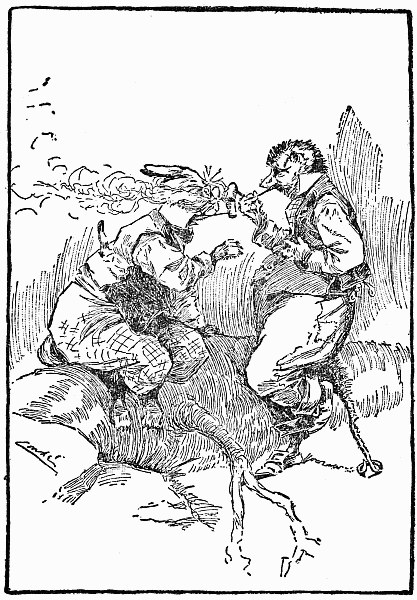
Crow, who did most of the thinking, had to
scratch his head and think pretty hard what
to do next.
All at once he happened to remember that
Jack Rabbit, who was the big man of the
party, was also a first rate poet, and liked
to read his own poetry better than anything.
So, when he thought of that, he said:—
"I'll tell you. We'll have a poetry club."
And of course that made Mr. Rabbit wake
up right away.
"What's that?" he said. "What kind of
a thing is a poetry club?"
"Why," said Mr. Crow, "it's a place
where the members each write a poem and
read it at the next meeting. You're the
only real, sure enough poet, of course, and
will be president, and write the best poem,
but the rest of us can try, and you can tell
us our mistakes. I've heard that Mr. Man
has clubs, and they're ever so much fun."
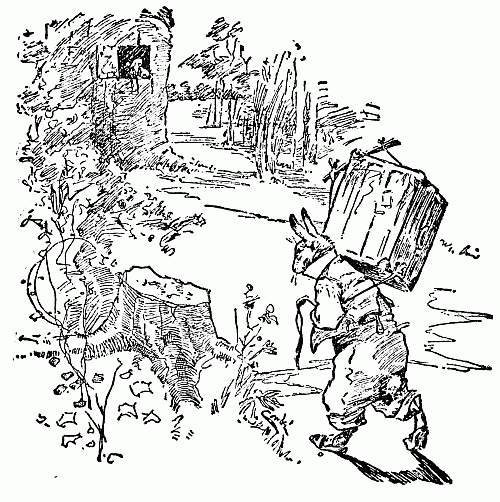
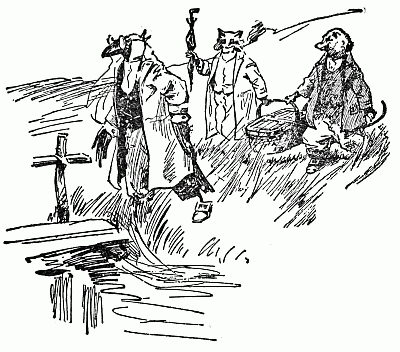
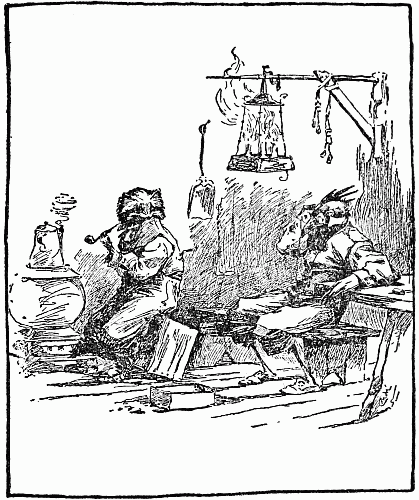 HAD TO SCRATCH HIS HEAD AND THINK PRETTY HARD
Jack Rabbit thought so, too, and all the
others liked the plan. So they elected Mr.
Rabbit president and then went to work on
their poems. They couldn't have the first
meeting very soon, for it took longer to
write poems in those days than it does now,
so before they got half ready the news got
out some way, and even Mr. Dog had heard
of it.
Poor Mr. Dog! It made him really quite
ill to think he wasn't on very good terms with
the Hollow Tree people, for he thought he
could write pretty nice poetry, too, and he
wanted to belong to that club worse than
anything he could think of. He wanted to
so bad that at last he told Mr. Robin that if
they'd just let him come he'd promise anything
they asked.
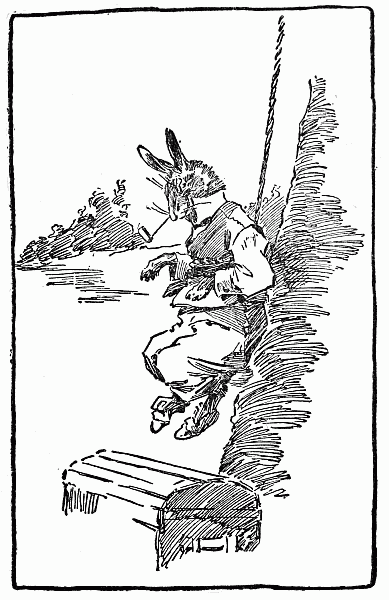
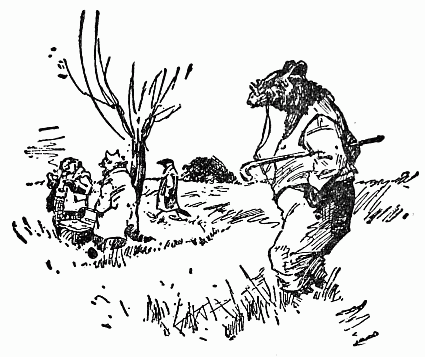
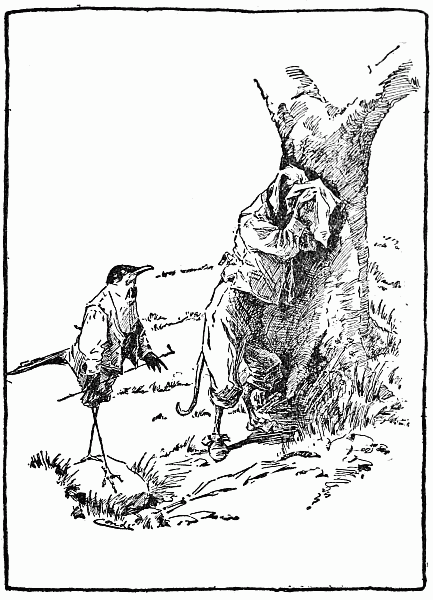 POOR MR. DOG
They didn't want to let him, though,
until Mr. Crow, who always felt kind of
sorry for Mr. Dog, said he didn't see why
Mr. Dog shouldn't come and look in through
the window shutters, and that they could
nail a seat for him on a limb just outside.
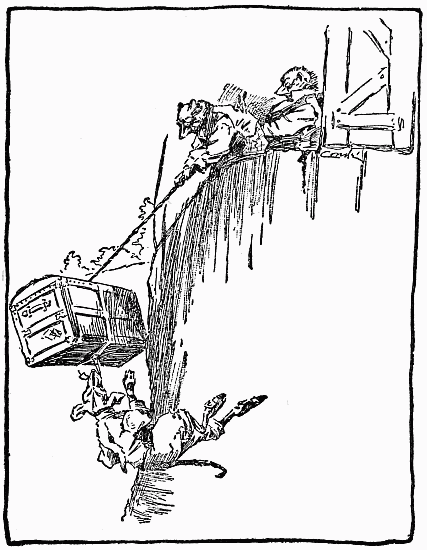
They could pull him up to it with a rope and
he could sit there and listen and applaud the
poems all through without being able to do
any damage to the poets, and he would be
glad enough to be let down by the time they
got done reciting.
So they sent him an invitation, and Mr.
Dog was as happy as a king. He went
right to work on his poem, and he worked
all night and walked up and down the yard
all day trying to think up rhymes for "joyful"
and "meeting," and a lot of other nice
words. Even when he was asleep he dreamed
about it, and said over some of the lines
out loud and jerked his paws about as if
he were reciting it and making motions.
You see, Mr. Dog hadn't always done just
right by the Hollow Tree people, and he was
anxious to make a good impression and fix
up things. He fixed himself all up, too,
when the night came for the meeting, and
took his poem under his arm and lit a cigar
that he'd borrowed of Mr. Man for the
occasion, and away he went.
The Hollow Tree people were on the look-out
for him and had the rope down and
ready. So Mr. Dog tied it around under
his arms, and they pulled and pulled, and
up he came. Then, when he got pretty
close to the window, they closed the shutter
and put the rope through and pulled him
up still a little higher, so that he could
reach the seat on the limb, which was fixed
just right for him to sit there and lean on the
window sill while he listened and looked in.
Of course, Mr. Dog wished he was inside,
like the others, but he knew why he wasn't,
and he was glad enough to be there at all.
He peeked through the slats at the big room
and smiled and said some nice things about
how pretty the room looked, till they all
got real sociable with him. Then Jack Rabbit
called the meeting to order and made a
few remarks.
He said the duties of his office had kept
him from writing quite as long and as good
a poem as he would have liked to write,
but that he hoped they might be willing to
hear what he had done. Then they all
shouted, "Yes, yes!" and "Hear, hear!"
and Mr. Rabbit bowed first to the ones inside
and then to Mr. Dog outside, and began:—
THE JOYS OF POETRY
BY J. RABBIT
Oh, sweet the joys of poetry
In the merry days of spring,
When the dew is on the meadow
And the duck is on the wing!
For 'tis then, from Dan to Dover,
I'm a rover 'mid the clover,
Seeking rhymes the country over
With a ring, sing, swing—
With a ding, dong, ding,
And a ting a ling a ling—
For I'm the rhyming rover of the spring.
Oh, sweet the joys of poetry
In the pleasant summer time!
For 'tis then I have no trouble
To compose my gentle rhyme;
In a nooklet by the brooklet
I can think up quite a booklet,
As with fishing line and hooklet
I assist the fish to climb
To the music of my chime,
For with rollick and with rhyme
I'm the poet of the pleasant summer time.
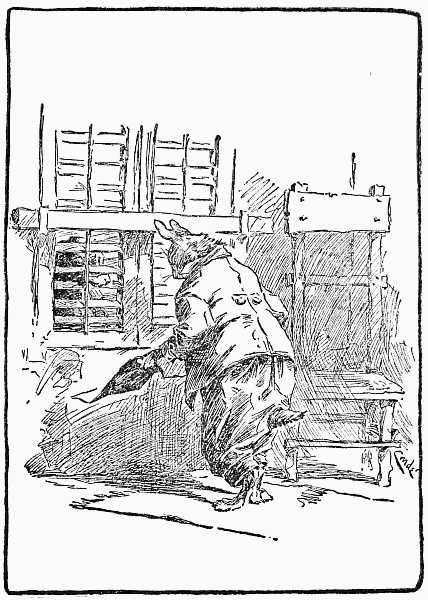 MR. RABBIT BOWED
Oh, sweet the joys of poetry
When any days have come,
When the autumn zephyrs whisper
Or the winter breezes hum!
For 'tis then my thoughts unfurling,
While the smoke goes upward curling,
Come a whirling, swirling, twirling,
With a rumty, tumty, tum,
Come a twirling, swirling, whirling,
Like a rattle of a drum.
Come a whirling, come a swirling;
For in spring or in the summer,
In the autumn or the winter
I'm the rumty, tumty, tummer
That rejoices in the seasons as they come.
Well, when Mr. Rabbit got through everybody
sat still for a minute, till Mr. Dog called
out for somebody to come and unwind him
so he could get his breath again. Then they
all commenced to laugh and shout and
pound on the table. And Mr. Rabbit
coughed and looked pleased and said it was
easy enough to do when you knew how.
Then Mr. 'Possum, who was next on the
program, said he hoped they'd let him off
this time because he could only think of
four lines, and that he was a better hand at
the dinner table than he was at poetry,
anyway. But they wouldn't do it, so he
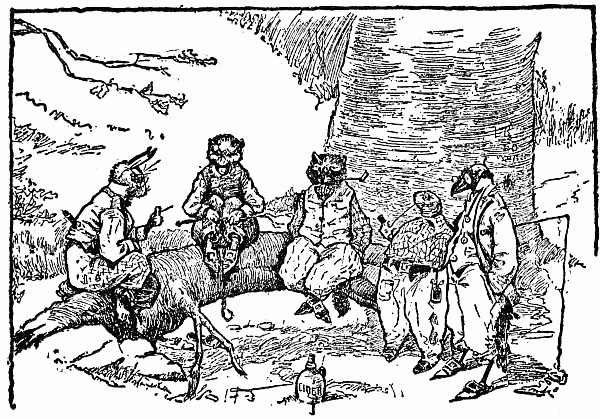
got up and looked foolish and swallowed two
or three times before he could get started.
WHAT I LOVE
BY A. PUFFINGTON 'POSSUM
I love the fragrant chicken pie
That blooms in early spring;
I love a chicken stew or fry,
Or any old thing.
Mr. 'Possum's poem was short, but it
went right to the spot, and the way they
applauded almost made Jack Rabbit jealous.
He said that it was 'most too true to be
good poetry, but that it was good for a first
effort, and that being short helped it. Then
Mr. Robin spoke his piece:—
MOTHER AND ME
BY C. ROBIN
When the bud breaks out on the maple bough
Mother and me we build our nest—
A twig from the yard and a wisp from the mow
And four blue eggs 'neath the mother breast.
Up in the tree, mother and me,
Happy and blithe and contented are we.
When the daisies fall and the roses die,
An empty nest in the boughs to swing—
Four young robins that learn to fly
And a sweet adieu till another spring.
Then up in the tree, mother and me,
Happy once more and contented we'll be.
The applause wasn't so loud after Mr.
Robin's poem, but they all said it was very
pretty, and Mr. 'Possum even wiped his
eyes with his handkerchief, because it made
him remember something sad. Mr. Rabbit
said that it ought to be "Mother and I,"
but that it didn't make much difference, he
supposed, about grammar, so long as it
rhymed and sounded nice. Then Mr. Crow
got up.
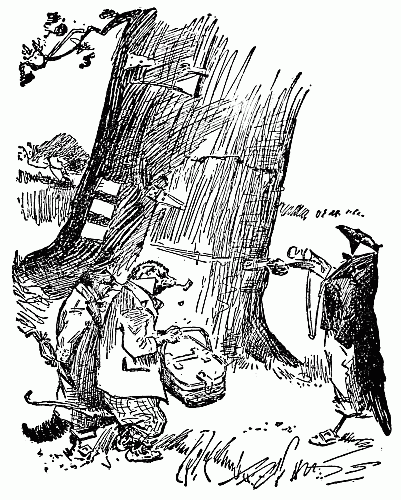
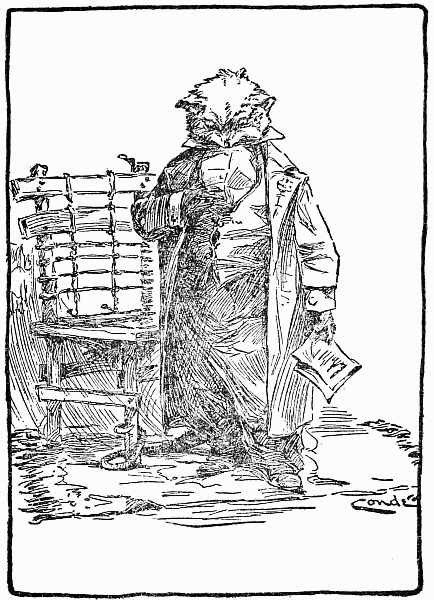 LOOKED FOOLISH AND SWALLOWED TWO OR THREE TIMES
JUST NOTHING
BY J. CROW
While others may sing of the pleasures of spring,
Or winter or summer or fall,
I'll sing not of these, because, if you please,
I'll sing of just nothing at all.
Just nothing at all, because, oh, ho!
I'll sing of myself, an old black crow.
As black as a coal and as homely as sin—
What more can I tell you, I pray?
For when you have nothing to sing of, why, then,
Of course there is nothing to say.
Nothing to say at all, oh, ho!
Except good-by to the old black crow—
The rollicking old black crow!
They made a good deal of fuss over Mr.
Crow's poem. They applauded, of course,
but they said it wasn't so at all, and that
Mr. Crow was a good deal more than "just
nothing." They said that it was he who
had got up this party, and that he was the
best man to plan and cook anywhere. Mr.
'Possum said he even liked Mr. Crow's
April fool chicken pies, and then they all
remembered and laughed, even to Mr. Crow
himself. After that it was Mr. Squirrel's
turn. Mr. Squirrel coughed twice and
straightened his vest before he began, so
they knew his poem wasn't to be funny.
THE FOOLISH LITTLE LAD
BY MR. GRAY SQUIRREL
Once on a time, the story goes,
A silly squirrel lad
One summer day did run away—
Which made his ma feel bad.
She hunted for him up and down
And round and round she ran—
Alas, that foolish squirrel boy
Was caught by Mr. Man.
For he had tried to climb a tree
As Mr. Man came past.
"I'll make you climb!" said Mr. Man,
And walked home pretty fast.
When he got there a boy came out
As Mr. Man went in.
That silly squirrel soon was put
Into a house of tin.
"Now you can climb!" said Mr. Man,
But when he did he found
That nice tin house, so bright and new,
Turned round and round and round.
And there he climbs and climbs all day
And never seems to stop,
And I have heard my mother say
He'll never reach the top.
When Mr. Squirrel sat down there wasn't
a dry eye in the room, and even Mr. Dog outside
was affected. He said he'd seen that poor
little squirrel at Mr. Man's house turning
and turning away in his tin wheel, and felt
so sorry for him that two or three times he'd
tried to get him out. He said, though, that
Mr. Man had always caught him at it and
that then they didn't get on well for a day
or two. He was so tender hearted, though,
he said, that he couldn't help pitying the
little fellow, climbing and climbing all day
long and never getting anywhere. Mr. 'Possum
shivered, and said it reminded him of
bad dreams he'd had sometimes, when he'd
eaten too much supper, and dreamed of
climbing the rainbow. Then they all sat
still and waited for Mr. Turtle, who came
next.
MY SNUG HOUSE
BY D'LAND TURTLE
Oh, what do I care for your houses of wood,
Your houses of brick or of stone,
When I have a house that is cozy and good—
A beautiful house of my own?
And the doors will not sag and the roof will not crack
Of the house that I carry about on my back.
It is never too large and 'tis never too small,
It is with me wherever I roam.
In spring or in summer, in winter or fall,
I always can find my way home.
For it isn't so hard to remember the track
To the house that you carry about on your back.
Well, of course, everybody applauded that,
and then it was Mr. 'Coon's time. Mr. 'Coon
said he was like Mr. 'Possum. He wasn't
much on poetry, and only had four lines.
He said they were some like Mr. 'Possum's
too.
THE BEST THINGS
BY Z. 'COON
I like the spring, I like the fall,
I like the cold and heat,
And poems, too, but best of all
I like good things to eat.
That brought the house down, and the
Hollow Tree people thought the entertainment
was over. They were going to have
supper right away, but Mr. Dog called out
to wait a minute. He said he had a little
poem himself that he wanted to read. So
out of politeness they all sat still, though
they didn't expect very much. Then Mr.
Dog unrolled his poem and leaned over close
to the blinds and commenced to read.
MY FOREST FRIENDS
BY MR. DOG
Oh, dear to me my forest friends,
Especially Mr. Rabbit—
I love his poetry very much,
And every gentle habit.
And dear to me is Mr. 'Coon,
And also Mr. 'Possum;
I hope to win their friendship soon—
'Twill be a precious blossom.
And Mr. Crow and Robin, too,
With fancy sweet and fertile,
And Mr. Squirrel, kind and true,
And likewise Mr. Turtle.
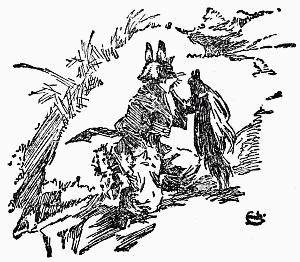
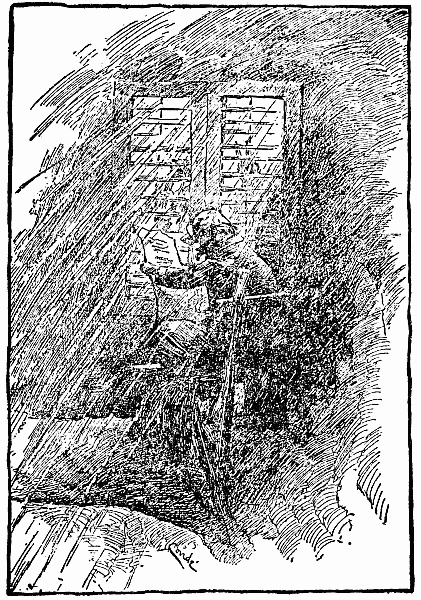 LEANED OVER CLOSE TO THE BLINDS AND COMMENCED TO READ
Oh, dear to me my forest friends,
Especially Mr. Rabbit—
I love his poetry very much,
And every gentle habit.
Before Mr. Dog was half through reading
the Hollow Tree people had gathered around
the window to listen. By the time he got
to the end of the third stanza he had to stop
for them to cheer, and when he read the
last one, Jack Rabbit pounded on the shutter
with his fist and shouted, "Hurrah for Mr.
Dog! Hurrah for Mr. Dog!" just as loud
as ever he could, while all the others crowded
up and shouted and tried to pound, too.
Well, maybe the shutter wasn't very
strong, or maybe they crowded and pounded
too hard in their excitement over Mr. Dog's
nice poem, for all at once there was a loud
crack and the shutter flew open and out
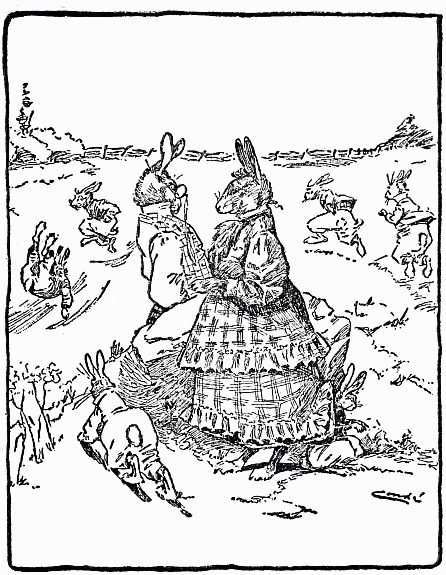
went Mr. Rabbit right smack into the arms
of Mr. Dog!
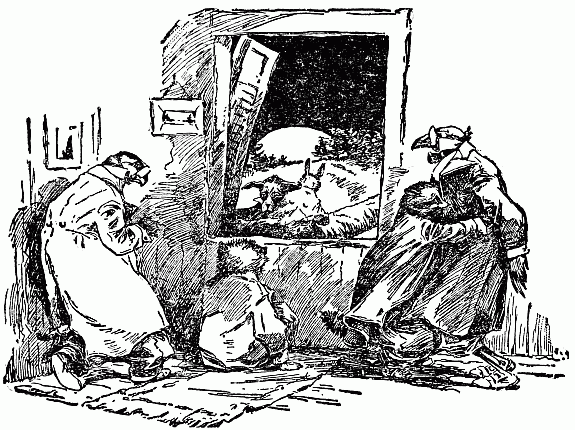 OUT WENT MR. RABBIT RIGHT SMACK INTO THE ARMS OF MR. DOG
I tell you that was pretty sudden and Mr.
Rabbit was scared. So were all the others,
and they were going to grab the shutter
and close it again and leave Mr. Rabbit out
there. But Jack Rabbit thinks quick.
"Oh, Mr. Dog," he said, "that was the
nicest poem I ever heard. Let me embrace
you, Mr. Dog, and be your friend for ever
after!"
Then he hugged Mr. Dog just as tight as
he could, and Mr. Dog hugged him, too, and
shed tears, he was that happy. He had
been wanting to make up with the forest
people for a long time, but he hadn't expected
this. Then the others all saw how
it was and they shouted, "Hurrah for Mr.
Dog!" again and invited him in. And Mr.
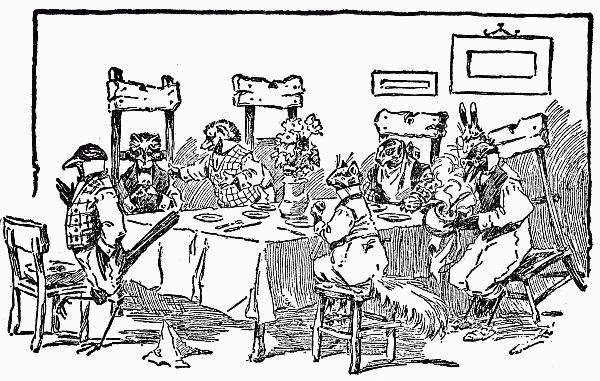
Dog went in and they had the biggest supper
and the biggest time that ever was known
in the Hollow Tree.
And that's how Mr. Dog got to be friends
with all the Hollow Tree people at last.
And he stayed friends with them ever and
ever so long—and longer—just as long as he
lived, for the Mr. Dog that isn't good friends
with them now isn't the same Mr. Dog.
And he isn't as smart, either, for he can't
write poetry, and he's never even been able
to find the Hollow Tree where the 'Coon
and 'Possum and the Old Black Crow live
together and every summer keep open house
for their friends.
 [See page 20