SOFT SOLDER—SHEET TIN—THE PROCESS OF SOLDERING—HEATING
APPARATUS—ELECTRICAL
SOLDERING COPPERS—THE COMMON SOLDERING
COPPER—FLUXES—TINNING THE COPPER—HEATING
Soft Solder.—When two or more pieces of metal
are joined together with a metallic cement, they are
said to be soldered.
Sheet tin, of which cans are constructed, is
always soldered with soft solder, a mixture of lead
and tin, usually 50 per cent. lead and 50 per cent. tin.
This solder is usually supplied in wire or bar
form at any hardware or electrical supply house.
Copper, brass, bronze, iron, silver, gold, and
practically any metal except aluminum may be
soldered with soft solder.
Sheet Tin.—Sheet tin, so-called, really consists
of a thin sheet of iron coated on both sides with tin.
This coating of tin serves several purposes. It enables
the solder to adhere easily; it prevents the iron
from rusting; and when the sheet tin is made up
into can form, the tin coating protects the contents
of the can from chemical action on the iron.
The Process of Soldering.—Soft solder is applied
to the metal to be soldered in a molten state and this
operation requires considerable heat. When heat is
applied to metal it usually oxidizes that metal; that
is, dirties it.
Solder will not adhere to oxidized metal. The
metal must be protected with a coating called a flux
while being soldered. Soldering paste, soldering
fluid or “killed acid,” resin, paraffin, heavy oils,
and vaseline all serve as fluxes, some better than
others. The soldering paste is by far the best, as
will be shown later.
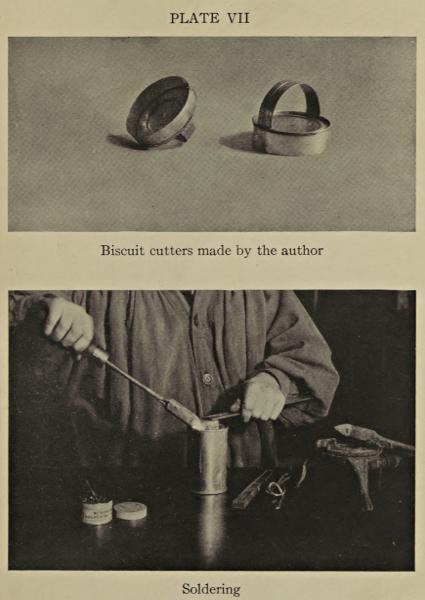
Soft solder is applied to the tin, on the point of a
hot soldering copper, often wrongly called a “soldering
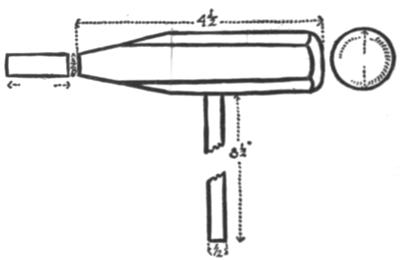
iron.” A soldering copper consists of a pointed
bar of copper suitably fixed to an iron shank which
is firmly set in a wooden handle. The point of the
copper must be well coated with solder or “tinned,”
so that when it is heated it will pick up the solder
and convey it to the joint to be soldered.
The hot copper, charged with solder, is passed
slowly along the joint and as the tin to be soldered
receives enough heat from the copper, the solder
leaves the copper and adheres to the tin, firmly
uniting it.
Heating Apparatus.—Some form of heating
apparatus is necessary to heat and maintain the
soldering copper at the melting or flowing point of
the solder. The copper may be heated in a gas furnace
especially made for soldering coppers, or over
an ordinary gas stove burner or a common blue
flame oil stove, or a charcoal fire, a wood fire burned
down to embers, or a plumbers’ gasoline torch, but
never in a coal fire. Coal contains too much sulphur
which oxidizes the copper and renders it useless for
soldering purposes.
The Blue Flame Oil Stove.—For heating the
coppers in my country shop, I use a blue flame oil
stove, one of the less expensive sort, with the
asbestos ring wick and the short removable chimneys.
The stove has two burners and will heat from
four to six coppers at once. The flames may be
regulated nicely so as to give just the required
amount of heat and this stove consumes very little
kerosene, and, therefore, costs little to operate. In
Fig. 16, it will be noticed that there is a curved hood
over each stove hole. These hoods may be easily
made from part of a large can or of a piece of tin
or sheet iron bent into shape. These hoods conserve
the heat and throw it about the coppers. I also place
a piece of heavy wire netting over the grating of the
stove holes to support the coppers and to permit
their being laid to one side, out of the intense heat,
when not immediately needed.
The blue flame oil stove forms the most satisfactory
arrangement for heating coppers that I have
ever used in the country. These stoves are easily
taken care of and are understood by almost everyone.
The directions should be nailed up alongside
the stove and carefully followed, particularly as to
cleaning the burners once or twice each season.
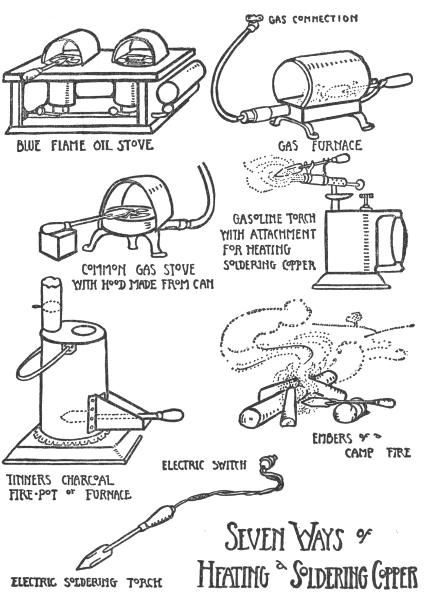
Fig. 16.
The Gasoline Torch.—The plumbers’ gasoline
torch is often used by experienced metal workers
for heating coppers. In inexperienced hands, this
torch is rather a dangerous affair. Only one copper
may be heated at a time and it is difficult not to overheat
the copper in the fierce roaring flame. The
cost of the torch and the cost of operating it are
both greater than the blue flame kerosene stove.
However, in experienced hands, it is safe enough
and very useful about the shop. In using such a
torch the directions should be most carefully followed;
all joints, filler openings, etc., must be airtight
when operating or a disastrous fire or explosion
may result. The tiny jet opening in the burner
must be kept clean.
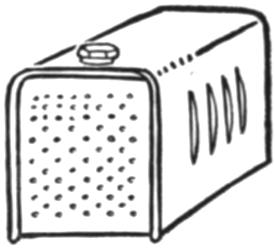
The Gas Furnace.—In my winter shop in the
city where gas is available, I use the gas furnace
shown in Fig. 16. This is a most satisfactory and
widely used heater for soldering coppers, as it gives
an intense blue flame that may be easily regulated.
When using a heater of this sort, one must be
sure that it is lighted correctly or a smoky yellow
flame will result. To produce a blue flame, air must
be mixed with the gas; just as it is in a bunsen
burner or an ordinary gas stove, for that matter.
Gas is admitted to the furnace through a small nozzle
at the end of the mixing flue near the rubber hose
connection. Air is admitted in the slot under the
gas nozzle; a movable slide encircles the mixing
flue over the slot to control the amount of air admitted.
This slide must be tightly closed over the
air vent when the gas is first turned on.
To light the heater, close the air inlet tightly,
turn the gas on full and apply a lighted match to
the burner. A yellow flame will result. Now open
the air vent slowly, by pushing the slide forward a
little way. The flame will change from yellow to
blue and purple as air is admitted. When the flame
is blue, it is giving out the most heat and is in the
best condition to heat the copper.
If the flame fires back and lights the gas at the
brass nozzle over the air inlet, the gas should be
turned off until the flame disappears. The air inlet
is then closed, and the gas turned on and lighted, and
then the air inlet is slowly opened until the flame
turns blue. When the furnace is in use, it should be
looked at occasionally to see that the flame has not
fired back to the nozzle. Once satisfactorily lighted,
the heater may be turned up or down as needed. If
the flame is turned down very low the air inlet may
have to be closed a bit to prevent the flame from
firing back. The copper is placed on the rest provided
for it over the flame. After the copper is
heated to the flowing point of solder, the flame may
be turned down or the copper placed to one side of
the flame, so that it does not get too hot.
Charcoal and Wood Fires.—When using a charcoal
or a wood fire, the copper should be placed at
the bottom among the embers. Small charcoal furnaces
used for heating soldering coppers may be
bought from the dealer in plumbers’ supplies. Charcoal
should not be burned in a closed room as the
fumes are deadly unless allowed plenty of constantly
changing air. These furnaces may be connected
with a chimney or burned in a room with
windows opened, without danger.
A soldering copper may be heated in the glowing
embers of a camp fire or in the embers in a fireplace.
Electrical Soldering Coppers.—The electrically
heated copper is ideal for soldering as the heating
coil is enclosed within the copper itself, the wire running
out through the handle and connecting with an
ordinary electric light socket. The heat is maintained
at a proper degree for melting the solder;
hence it is an ideal equipment for those who can
afford it and where electric current is available. The
doctors of certain hospitals have recommended
electrical coppers for the use of patients in making
tin can toys.
An electric soldering copper costs about $7.50
at the present time.
The Common Soldering Copper.—A suitable
soldering copper or “iron” may be purchased at any
good tool dealer’s or hardware store; it should
weigh about one pound for work with the tin cans.
Almost everyone has purchased a small soldering
outfit at one time or another and tried to solder
the family wash-boiler or some leaky tinware; usually
without success. Such outfits are invariably too
small for large work or for the tin can toys.
It must be well remembered that the heat flows
from the copper into the work, and that the copper
has to heat up the work to the melting point of the
solder; hence a large copper weighing several
pounds is used to solder wash-boilers, tin roofs, etc.,
and a small copper weighing a few ounces is used
for soldering jewelry, etc.
A large copper in expert hands may be used to
solder very small work but a small copper may never
be used to solder large work together, because the
copper not only has to keep the solder melted to the
flowing point, but also has to heat the work itself at
the joint to the flowing point of the solder before the
solder will leave the copper and adhere to the work.
In actual practice, it has been found that a copper
weighing one pound is best. After one gets
more adept with the copper, it will be found advantageous
to have several coppers of different weights.
A half pound and also a four ounce copper will be
found very convenient for extremely small work.
But, do not begin to solder with a copper weighing
less than one pound.
Soldering coppers are usually sold in pairs at
the large tool dealers, and coppers listed at two
pounds really weigh one pound each; when sending
in a written order be sure that you specify that the
copper is to weigh one pound singly.
A wooden handle especially made for soldering
coppers should be purchased at the same time as the
copper; these wooden handles are made large to protect
the hand from the heat of the iron shank. The
handle is usually furnished with a hole of the proper
size drilled in it to permit the pointed end of the
shank to be driven in the handle easily with a wooden
mallet. If the hole is too small, it should be drilled
out so that it is nearly as large as the diameter of
the shank. The wooden handle must not be split
when driven on with the mallet.
Fluxes.—Before tinning the point of the copper,
some flux must be obtained, either a soldering paste
or soldering fluid “killed acid.”
An excellent soldering paste called “Nokorode”
is by far the best flux obtainable. It is inexpensive,
a little goes a long way, and it will not rust or
corrode the work as is the case with killed acid and
some soldering pastes. It may be easily cleaned from
the work after soldering and it makes soldering
much easier and simpler for the beginner. Nokorode
soldering paste may be obtained at any good electrical
supply house or hardware store. If they do
not stock it, they will get it for you. There is nothing
else just as good on the market, but if for any
reason you cannot obtain this particular brand, be
sure that any soldering paste you buy is plainly
labelled that it will not corrode the work.
Soldering fluid or killed acid is made of muriatic
acid in which is dissolved all the pure zinc that
it will hold in solution. This fluid is much used by
tinners and is certainly an excellent soldering flux,
but not nearly as good as the soldering paste for
our purposes. However, it is very useful in the
shop to dip the tinned point of the hot copper into
it to remove the oxide or dirt formed after the
copper has been in use for some time. The solder
will stick to the point much better after the copper
has been cleaned in this manner.
Directions for making the killed acid and the use
of other soldering fluxes will be found on page 68.
Tinning the Copper.—Having procured the
soldering copper and handle, some flux and soft
solder, and having fixed up some sort of heating
apparatus, the next step toward soldering is to coat
the point of the copper with solder: this is called
tinning the copper.
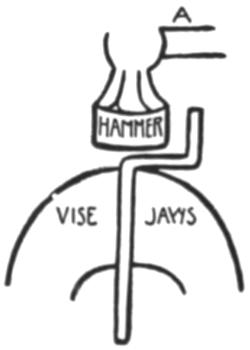
Fix the copper firmly in a vise if one is at hand,
as illustrated in Fig. 17. Then file each of the
four faces of the point of the copper bright and
clean with a flat file. It is better to use an old file
for this purpose—one with rather coarse teeth. It
will be observed that the copper is placed slantwise
in the vise so as to bring one face of the square
pyramid parallel with the vise jaws; this position
permits filing in a natural horizontal position.
Each face of the point should be rounded slightly
toward the point.
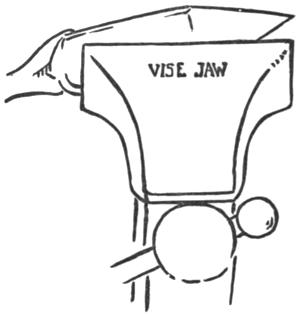
Fig. 17.
If a vise is not available, the copper may be held
against the edge of the bench with one hand and the
point filed clean and bright with the file held in the
other, or a coarse sheet of emery cloth may be placed
flat on the table and each face of the point rubbed
bright on it. A file is by far the best for this purpose,
however, and if it is chalked before using, the
copper filed away will not clog it.
When the copper is clean and bright at the
point each face should be thoroughly covered with
a thin film of soldering paste or dipped into the
soldering acid.
The copper should then be placed in the fire and
heated to the melting point of the solder.
Heating.—While the copper is heating get ready
a piece of tin about 2 by 4 inches—any clean flat
scrap or part of a can will do. Spread a little soldering
paste into the center of the tin and lay it on the
bench near the heating apparatus. A few drops of
killed acid may be placed on the tin instead of the
paste, if the acid is to be used.
After a few minutes heating the copper should
be removed from the fire and the end of a strip of
solder touched to the point. If the solder melts
quickly and easily against the point the copper is
ready to tin; if it melts very slowly, “slushy”, the
copper should be returned to the fire and heated a
bit more. The copper should never be heated
red hot under any circumstances; this must be
borne in mind. If the copper is heated to a red heat,
the soldering paste will be burned off and its action
destroyed, for a red hot copper will not pick up
solder, nor may it be tinned again until the copper is
cool and refiled bright and clean, recoated with flux
and reheated. If the copper is heated red hot after
the point is tinned, the tinning is burned from the
point and solder will not stick to it until it has been
cooled, refiled and retinned.
This is the most important point to remember
about soldering and is the cause of many failures.
Remember that soldering is impossible without a
flux to keep the metal clean when it is hot; too much
heat will burn soldering paste or killed acid away;
the tinning and the solder adhering to the point
will be burned or oxidized and rendered brittle
and useless.
A heat that will melt the solder almost instantly
and cause it to flow with a brilliant glistening color
should be maintained at all times when the copper
is employed for soldering. This is never a red heat.
When the copper is first heated to be tinned, it
should be removed from the fire when it melts the
solder easily, and several large drops of solder
should then be melted from the bar or strip of
solder onto the piece of tin placed by the fire and
on which some soldering paste or acid has been
spread. Rub each face of the point of the copper
into the solder on the tin until each face is thoroughly
covered with a bright coating of solder.
Hold each face flatly down against the solder on the
tin during the rubbing process. The copper may
have to be heated once or twice by the beginner, as
it may get too cool to melt the solder easily. As
soon as the solder begins to work stiffly, “slushy,”
and looks gray instead of glistening, it is time to
reheat the copper.
An old piece of soft cotton cloth, such as a stocking,
on which is sprinkled a little powdered sal-ammoniac
is an excellent thing to keep handy when
soldering or tinning. The tin coating of the point of
the copper should be rubbed on this cloth where the
sal-ammoniac is sprinkled, when the copper is hot.
This will be found to keep the copper in excellent
condition. The sal-ammoniac removes the oxide
from the tinning and brightens it up generally about
the point.
The tinning will last much longer on the copper
if it is dipped occasionally into the soldering paste or
acid while hot. This is particularly true if the copper
has been a bit overheated.
When the tinning shows signs of wearing off and
the copper does not pick up solder readily, it must
be retinned, filed, fluxed, heated, and rubbed on the
solder which has been put on the tin first used for
this purpose. This piece of tin should be kept about
the bench, as the copper will have to be retinned frequently.
Always remember that the copper will not
carry solder to the work unless it is well tinned.
If an electrical soldering copper is used it is usually
furnished already tinned at the point, so that it
is ready for use as soon as it is connected to a suitable
electric socket and the current turned on. The
heating coil inside the copper will soon heat it up to
the melting point of the solder. After heating, it
may be treated as a common copper, wiped occasionally
on the cotton cloth and retinned when the
tinning is worn away. An electrical copper should
never be placed in a vise for filing, but should be held
against the bench and filed carefully. A vise is
apt to crush the hollow copper and injure the heating
coil inside. These coppers should never be
placed in a fire or heated in any way except by the
electric current.
Electrical coppers do not need as much attention
as an ordinary copper for the even heat supplied
by the current keeps the copper heated to the
flowing point of the solder and is incapable of heating
beyond this temperature.
Soldering fluid may be very simply made as
follows: Pure zinc is dissolved in muriatic acid until
the acid will not dissolve any more of the zinc. The
solution thus obtained is then allowed to stand for
a time and is then strained through a cloth and
poured into a bottle which is kept tightly corked
when not in use.
First purchase about six ounces of muriatic acid
from a druggist. Take care not to spill any of this
acid on the hands or clothes. Next get some pure
sheet zinc. The sheet zinc employed for stove mats
as it is sold in the plumbers’ shops is not suitable for
making soldering fluid, as this form of zinc is
alloyed with other metals. Pure zinc may be very
easily obtained from old dry batteries which may
be found anywhere.
Remove the paper covering from the battery and
crack it open with a hammer—remove the carbon
from the center of the battery and dump out all the
powdered material. Soak the zinc covering of the
battery in warm water to remove any paper or material
adhering to the zinc and then cut the zinc into
pieces about ¼ inch square.
Find an old tea cup or earthen-ware marmalade
jar and pour into it about half a teacupful of the
muriatic acid. Set the vessel containing the acid out
of doors or near an open window and away from all
steel tools, so that the fumes of the acid may escape
and not be breathed into the lungs or rust any tools.
Pour a small handful of the zinc cuttings into
the acid. The acid will attack them at once and a
strong bubbling action will result. When the bubbling
action dies down add more zinc cuttings—about
every fifteen minutes. When the acid shows
no sign of attacking the zinc as it is added, the acid
is said to be “killed” and the soldering fluid is
made. It may be used at once if necessary, but it
will be much better if it is allowed to stand over
night with the zinc residue left in it. It is then
strained through a piece of muslin cloth into another
cup or jar and the fluid is ready for use.
Soldering fluid may be kept in a wide-mouthed
glass bottle or a marmalade jar; either vessel must
be tightly corked when not in use. This soldering
fluid may be used as a flux for any soft soldering
operation in place of the soldering paste, but it is not
as satisfactory a flux for the tin can work as the
paste. The best use for it in connection with the tin
can toys is to keep it to dip the point of the hot
copper in occasionally to clean the tinning at the
point of the copper.
While the prepared soldering paste is best for
all soldering operations connected with the tin work,
other fluxes may be used if nothing better is at
hand. These are resin, olive oil, cottonseed oil,
automobile lubricating oil, and paraffin; but these
fluxes are not very satisfactory in inexperienced
hands. The soldering paste is best for all soldering
operations.