For garden and home purposes where tennis is
played only by members of the household and their friends, the grass
court is of course the most artistic and beautiful. The dirt or clay
court is more satisfactory for clubs where constant use is apt to wear
off the turf. If the green is large enough for shifting the court
frequently so that the wear will not all come in certain spots, the turf
court may answer all purposes for clubs and parks.
If the natural sod of the site selected for a grass court is luxuriant
and the soil favorable for rapid growth, the expense of construction
may be very slight. If the natural sod is poor, and the soil thin, it
will be necessary to import good soil and purchase rich grass sod from
some farm or meadow. If the grass is very patchy, but the soil rich, it
may be satisfactory in the end, and certainly cheaper, to remove all
the sod and sow down to grass in the late summer, and repeat it early
in spring. It would hardly be advisable, however, to use the court much
the first year, for the young grass would soon be worn off unless a
firm sod was obtained.
A grass court is the best to play on in warm weather. The green of the
lawn is pleasing and restful to the eyes, and the soft turf is cooling
and soft to the feet. The sweet aroma of the green grass adds to the
pleasure of the pastime, and the restful slopes and terraces invite one
to lounge on the greensward after or before a game. Dirt courts,
concrete, and asphalt, and even wooden courts, may appeal to the
enthusiasts intent only upon playing the fastest game, but their
glaring whiteness and hard, unyielding surface do not bring the
pleasure that grass courts do. For these reasons the turf courts should
always be chosen for the summer or country place, and they should be
constructed and developed with an eye to their harmony with the
surrounding landscape and architecture of the residence.
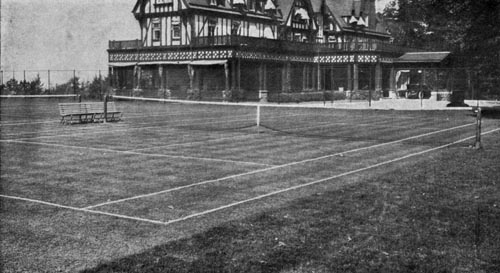
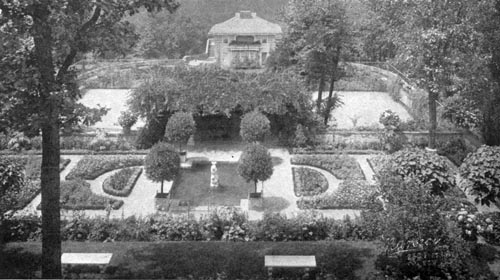
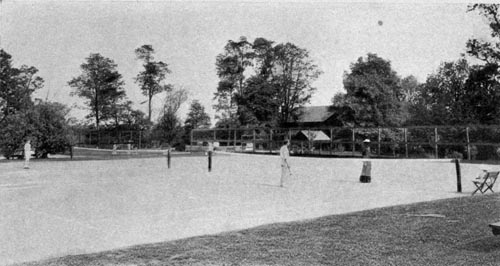
Grass courts are certainly more attractive features of
the home surroundings, but for really serious play they need constant
care
The construction of a grass court is less difficult than that of a clay
court, but if the soil is very thick and heavy, some sort of foundation
must be provided to drain the under-soil. On very unfavorable soil,
tile drains are sometimes placed down before the turf is replaced. A
layer of stones six inches beneath the sod is sometimes resorted to;
but usually no such provision for underground drainage is required for
the grass court. If side and end drainage is provided, and the soil is
not too heavy, water will not collect and remain on the court to any
great extent.
The construction of a grass court is simple when no attempt is made to
drain it. The first thing to do is to lift the grass sod as carefully
as possible and lay it aside for later use. The sod should be cut down
as nearly to six inches depth as possible, and should be lifted in
squares of fifteen to eighteen inches. Pile the sod carefully on one
side and keep moist and partly protected from the hot sun. When the sod
has all been removed spade up the soil to a depth of eighteen inches,
removing all stones, roots, and obstructions. Rake over carefully and
roll down to a level, watering frequently and filling in all
depressions. When a perfect level has been obtained replace the grass
sods.
These must be put down carefully so that the edges meet snugly. Open
cracks and seams must be filled in with smaller pieces of sod. Roll,
water, and level the surface until all is satisfactory. Fresh sods may
have to be cut and placed wherever thin places appear during the first
season. In the spring of the year fresh grass seed may be sown.
If the turf or grass is poor it will be better to omit sodding entirely
and sow the surface with seed. It is better in such a case to make the
grass court in the fall of the year. The winter storms will settle it
thoroughly and reveal weak spots. In the middle of March rake up the
surface, level, sow the seed, and roll carefully. It should be sowed
twice from different directions, so that an even catch is obtained.
Sowing can be made in the fall or spring. About five bushels of grass
seed will be needed for the full-size court. Do not use clover seeds in
the sowing, nor guano for fertilizers. When the grass is high enough to
cut use the scythe or sickle first, and keep the lawn-mower for later
cutting. Remove weeds as fast as they appear, uprooting them, or, if
the roots persist, rub salt on them. When the grass is tall enough for
regular cutting, use the mower at least once a week, and oftener in wet
weather.
In many localities worms are very numerous and destructive to tennis
courts. By working up to the surface they form little mounds and holes
which permit water to trickle through and cause depressions. In regions
where the worms are a great nuisance, a layer of finely sifted cinders
is placed on the stone foundation of the dirt court or at the bottom of
the excavation of a grass court. These cinders will keep the worms from
working up, but if placed on the grass court the cinder layer must be
at a depth of a foot or more below the surface, so as not to interfere
with the grass roots.
One should remember that grass courts wear out more rapidly and require
more care than those of dirt, especially when they are subjected to
constant usage.
The cost of making tennis courts will vary considerably, as one may
readily see. As much as $200 and $300 is sometimes paid for making
tennis courts, but others are made at no greater cost than $25 where
conditions are favorable and one is willing to do some of the work. The
hardest courts to make are dirt ones laid on rocky foundations where
blasting is necessary. Grass courts that are nearly level can sometimes
be made by removing only a part of the sod and replacing it after
digging out some of the under soil. This may cost only a few dollars.