So many plants are suitable for a rock garden that the range of choice
is bewildering. In this, as in the laying out of the garden,
advisability takes precedence over pure personal desire, though, very
fortunately, it is often not difficult to make the two go hand in hand;
a little intelligent thought helps a lot.
To the beginner, no better advice can be given than that which applies
to the picking out of the rocks—use the material which is close at
hand. This is not, by any means, a mere suggestion to follow the lines
of least resistance. It is far more. In the first place, there is always
an endless amount of beautiful and suitable plant life to be had
without going far afield. Then again, natural harmonious effects in your
immediate neighborhood are pretty sure to be appropriate to your
grounds. Finally, you can see for yourself how things grow, and as for
the hardiness of plants, you have it already tested for you. This refers
not alone to the natural conditions; there is a second wide field in the
gardens—the hardy gardens—of others, where you can at once choose from
the many and learn whether certain plants are too tender or require too
much care for your use.
So far as plants native to the immediate neighborhood are concerned,
their value to the rock garden of the average person with limited time,
who is not obsessed with the idea of growing the rare and curious,
cannot be overestimated. And they are so many; more than most realize,
and often of an individual beauty not always appreciated in the
bewildering profusion of the wild but plainly apparent when an
individual, or a little group, is open to close study in a rock garden.
Do not make the rather common mistake of thinking that they are too
familiar to be interesting; they are never likely to be. And, honestly,
can you say in your heart that they are?
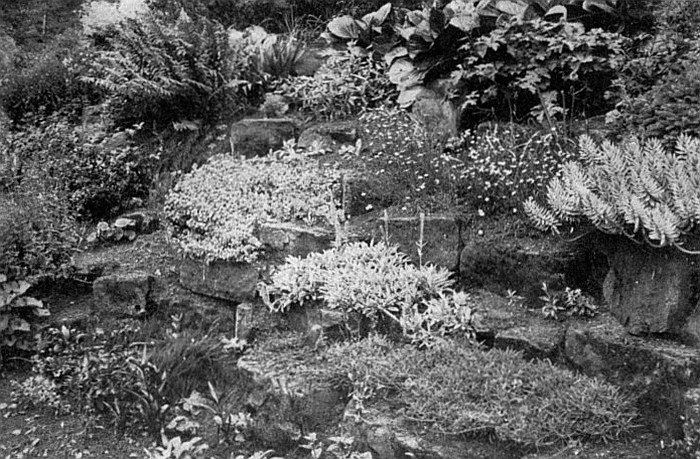
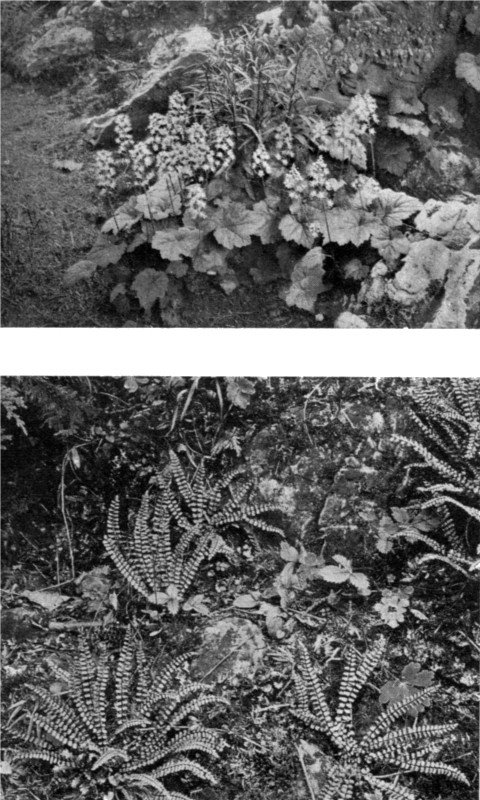 Native plants are excellent material for the rock garden.
The foam flower (Tiarella cordifolia) at the top, and one of the
smaller ferns at the bottom
Native plants are excellent material for the rock garden.
The foam flower (Tiarella cordifolia) at the top, and one of the
smaller ferns at the bottom
For a Connecticut rock garden the Greek valerian (Polemonium reptans)
must be purchased, unless a neighbor can spare some from his collection
of old-fashioned flowers; there it belongs in that category. But why
should you of Minnesota or Missouri deny so beautiful a flower a place
in your rock garden, simply because you have only to go to the woods for
it? The English enthusiast brings home primroses from the Himalayas,
gentians from the Swiss Alps, and Dryas Drummondi from the Canadian
Rockies for his rock garden, but he does not fail to take advantage of
some of the common things near-by—even the "pale primrose" and the
cowslip.
From ferns alone, or from only plants of shrubby growth, a most
beautiful native rock garden may be made. And adding small flowering
plants, or excluding all else, there are limitless opportunities. It
goes without saying that A's rock garden in Maine will not be like B's
in Louisiana; but there is no law compelling it to be.
Among the common wild flowers of the East that take on unexpected new
beauty when transferred to the rock garden are the celandine
(Chelidonium majus), strawberry (Fragaria Virginica), cranesbill
(Geranium maculatum), toadflax (Linaria vulgaris), orange hawkweed
(Hieracium auranticum), herb Robert (Geranium Robertianum),
coltsfoot (Tussilago Farfara), Solomon's seal (Polygonatum
biflorum), foam flower (Tiarella cordifolia), bloodroot (Sanguinaria
Canadensis), and some of the violets. These are but a few names, and
random ones at that. Some of them, the coltsfoot, cranesbill, celandine,
and toadflax, spread too rapidly, but by careful watching and not
allowing the seed to ripen, they may be kept within bounds. There are
many such plants that will take all the room in sight if they are
allowed to, and they must be watched closely, or else discarded
altogether. Some of them answer a good purpose by giving the rock garden
a quick start, after which they may easily be reduced or thrown out
altogether. There need be no compunction about discarding. Certain
plants, like certain friends, you enjoy having for a visit, but do not
care to see remain forever and a day.
Annuals as a class are not desirable for the rock garden; for one thing,
the care of renewal is too great. Biennials are almost as much care, but
in each case there will always be exceptions that are a matter of
individual preference. Few, for example, would have the heart to reject
the dainty little purple toadflax of Switzerland (Linaria alpina),
just because it is a biennial. The main dependence, however, must be
placed on perennials—the plants that, barring accidents, last
indefinitely. These should be mostly species; if horticultural, do not
use the bizarre—Darwin tulips, for example, or the Madame Chereau iris.
Nor, with rare exceptions, should double flowers be used. A double
daffodil looks horribly out of place, while the double white rock cress
(Arabis albida) will pass.
The easy rock garden plants, where the material is not taken from the
wild, are to be found in most of the large hardy gardens of the East.
Some of them are natives of Europe or Asia, and more than is commonly
suspected are at home in other parts of the United States. Among the
best of these for carpets of bloom are Phlox subulata, Phlox
amœna, Aubrietia deltoidea, maiden pink (Dianthus deltoides),
blue bugle (Ajuga Genevensis), white bugle (Ajuga reptans), woolly
chickweed (Cerastium tomentosum), creeping thyme (Thymus serpyllum),
dwarf speedwell (Veronica repens), Saponaria ocymoides, alpine mint
(Calamintha alpina), and pink, white, and yellow stonecrops (sedum).
All of them fairly hug the ground. There are other plants that form a
carpet of foliage, but the flower stalks rise higher. These include
white rock cress (Arabis albida), the permissible double buttercup
(Ranunculus acris fl. pl.), the also permissible double German
catchfly (Lychnis viscaria), another double flower, "fair maids of
France" (Ranunculus aconitifolius), Carpathian bellflower (Campanula
Carpatica), grass pink (Dianthus plumarius), Iris pumila, crested
iris (Iris cristata), Christmas rose (Helleborus niger), Phlox
divaricata, Phlox ovata, Phlox repens, foam flower (Tiarella
cordifolia), Veronica incana, Alyssum saxatile, Saxifraga
cordifolia, and various avens (geum).
Several of the primulas give a like effect if the planting is close—as
it should be in a pocket. The best are the English primrose (Primula
vulgaris), cowslip (P. veris), oxlip (P. elatior), bird's eye (P.
farinosa), yellow auricula (P. auricula), P. denticulata, and P.
Cortusoides. Similarly, spring bulbs may be employed; plant them, for
the most part, under a ground cover so that the soil will not show when
they die down. Of the tulips, single ones of the early and cottage types
may be used, if in a solid color, but most to be preferred are the
species, such as the sweet yellow (Florentine) tulip of Southern Europe
and the little lady tulip (Tulipa Clusiana). Crocuses are also best in
type forms, and the small, single, yellow trumpet kinds are the finest
daffodil material. Single white or blue hyacinths may be used, but
better than the stiff spikes of bloom of new bulbs will be the looser
clusters of bulbs that have begun to "run out" in the border. Other
valuable bulbs are the snowdrop, Scilla Sibirica, glory-of-the-snow
(Chionodoxa Luciliæ), guinea-hen flower (Fritillaria Meleagris),
grape hyacinth (Muscari botryoides), Triteleia uniflora, Allium
Moly, and the wood and Spanish hyacinths (Scilla nutans and
campanulata).
Taller plants that may be worked in, oftentimes best with only a single
specimen or small clump, are autumn aconite (Aconitum autumnale),
Yucca filamentosa, leopard's bane (doronicum), single peonies (either
herbaceous or tree), German, Japanese, and Siberian iris, as well as the
yellow flag (Iris pseudacorus), single columbines, Anemone Japonica,
Hemerocallis flava, Sedum spectabile, Dielytra spectabile,
Dielytra formosa, Jacob's ladder (Polemonium Richardsonii),
fraxinella, Anthemis tinctoria, single Campanula persicifolia,
Campanula rapunculoides, Campanula glomerata, globe flower
(trollius), snapdragon (antirrhinum), platycodon, lavender (where it is
proven hardy), and musk mallow (Malva moschata).
Of the lilies, Lilium Philadelphicum, L. elegans, L. speciosum,
and L. longiflorum are all desirable, and they thrive in partial
shade, though in Japan L. elegans will be found standing out from the
rocks in full sunshine. For peering over into the rock garden, rather
than being placed in it, L. Canadense, L. tigrinum, and L.
superbum are recommended.
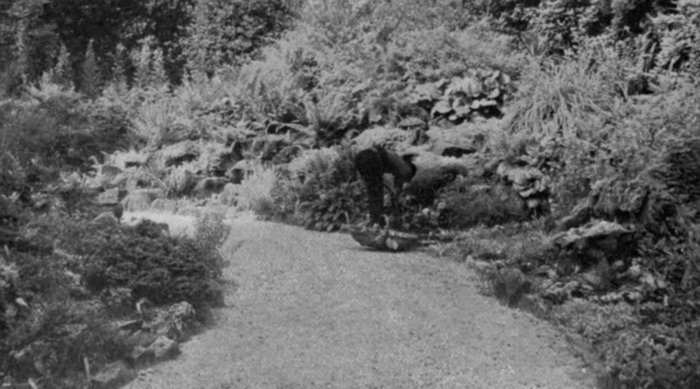 A rock garden merging into woodland. A curved path is
desirable, as it affords a greater number of vistas
A rock garden merging into woodland. A curved path is
desirable, as it affords a greater number of vistas
The pick of the low shrubs are the charming Daphne cneorum, which
flourishes better for being lifted above the ordinary garden level, and
Azalea amœna. The latter, however, should be so placed that its
trying solferino does not make a bad color clash. Rhododendrons and
mountain laurel fringe a rock garden well, and with one trailing
juniper (Juniperus procumbens) will provide a great deal of the
refreshing winter green.
Single roses, the species, fit in well where there is room for them.
Good ones are R. setigera, R. rubiginosa, R. Wichuraiana, all
rampant, and the low R. blanda. The roses would better be at or near
the entrance or exit, or far enough above the rock work not to ramble
over small plants.
The plants in this list cover all seasons and vary somewhat in their
soil and moisture requirements. But the variation is nothing beyond the
ordinary garden knowledge. Most will do better if their preferences are
considered, but none is apt to perish with average care.
Alpines, as a class, would better be left to the amateur with the time,
money, and disposition to specialize. Most of them take kindly to being
transferred from a mile or more up in the air to sea level; the
edelweiss, for one, grows here readily from seed, and the exquisitely
beautiful Gentiana acaulis thrives in American rock gardens. But, on
the whole, alpines do not do as well here as in England, where the
summer climate is not so hard on them. When they flourish here, it is at
the cost of a great amount of professional care.
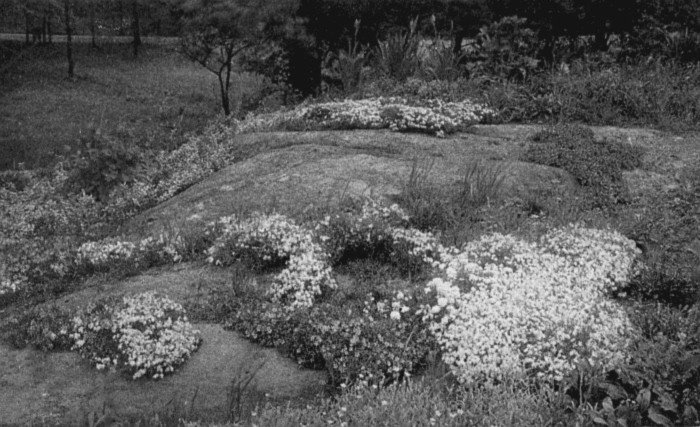 A nearly buried boulder is easily converted into a
beautiful little rock garden. Fill in depressions with soil and plant
there and around the edges of the boulder Phlox subulata, sedum,
arabis, etc.
A nearly buried boulder is easily converted into a
beautiful little rock garden. Fill in depressions with soil and plant
there and around the edges of the boulder Phlox subulata, sedum,
arabis, etc.