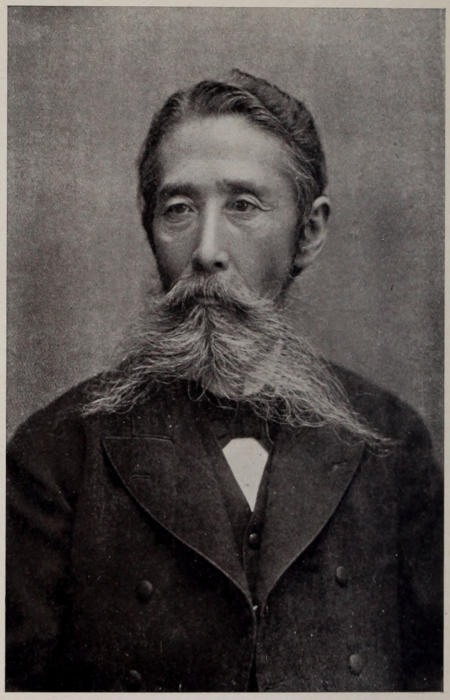
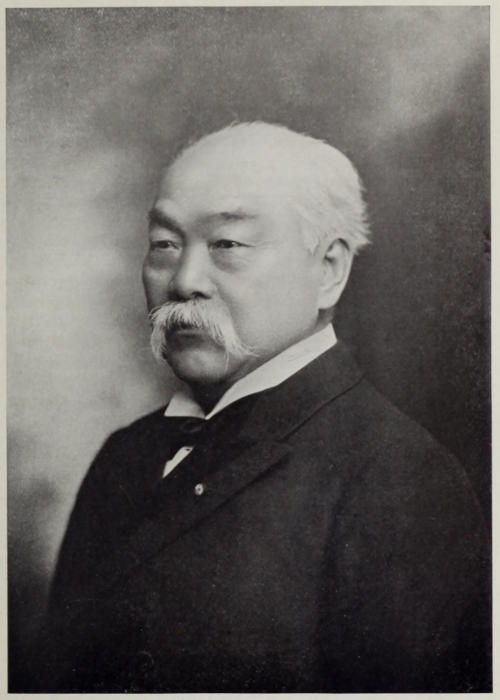
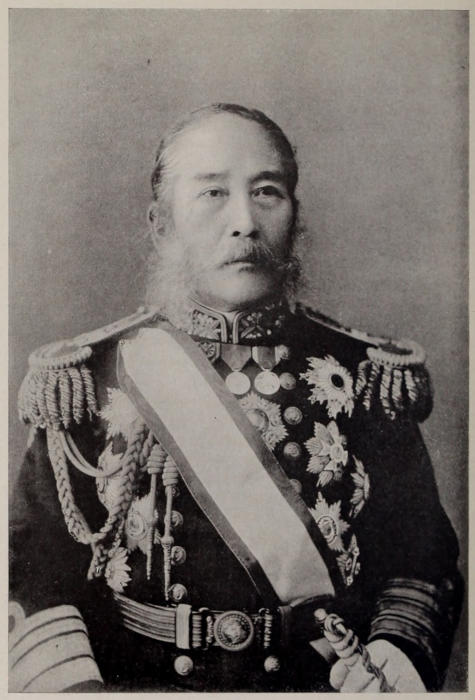
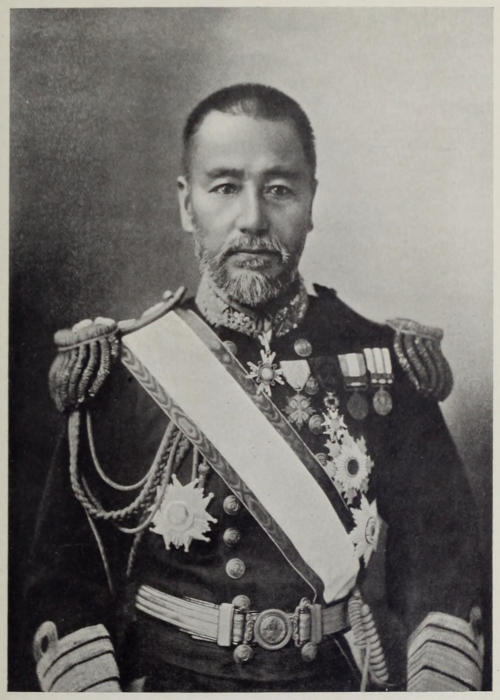
BY
J. MORRIS MEMBER OF THE JAPAN SOCIETY; AUTHOR OF “WHAT WILL JAPAN DO?”
“ADVANCE, JAPAN!” “JAPAN AND ITS TRADE,” ETC. ETC.
WITH TWENTY-FOUR ILLUSTRATIONS
LONDON
METHUEN & CO.
CHICAGO
A. C. McCLURG & CO.
1906
PREFACE
Modern Japan dates from the advent on the coast
of Idzu province of the American squadron under
Commodore Perry in 1853. Prior to that time, however,
more than one attempt, predestined to failure, had been
made to bring about the abolition of the feudal system,
the agitators, in nearly every case, paying the penalty
of their boldness with their lives. Among the more
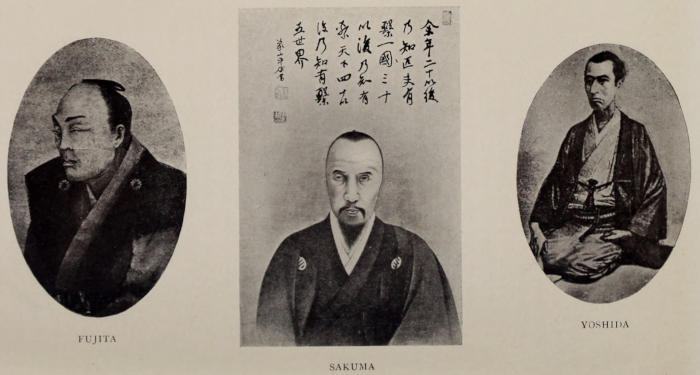
famous of these heroes were Fujita Toko, Yoshida Shoin,
and Sakuma Shozan,—patriots who shone during the
first half of the nineteenth century. They were in advance
of their age. They lived in the days of the
Tokugawa Shogunate, when old ideas on the subject of
foreign intercourse still were uppermost. It was dangerous
to advocate, as these men did, a policy of complete reconstruction
on an imperialistic basis, yet they had the
courage of their opinions, and with might and main
advocated recourse to Occidental arts and sciences for
the express object of rendering their country strong to
resist aggression in every form. Their memory is held
by all their fellow-countrymen in the very highest respect,
not more for their self-sacrifice than for the real benefits
that are seen to have accrued to the people from their
foresight. One lost his life in a terrible earthquake
another was executed by order of the Sho-gun, and the
third was stabbed to death by Ro-nins, or “Wave-men,”
the turbulent spirits of an epoch of social and political
unrest. All three are esteemed as martyrs in the cause
of progress. And although the country was not reopened,
after its voluntary seclusion of two centuries
and a half, until the treaty with the United States which
Perry negotiated became operative in 1854, many surreptitious
efforts had been made to obtain a footing in
the Japanese empire, between the time of the East India
Company’s withdrawal in 1623 and the appearance of
the “black ships” of the American squadron in Kurihama
Bay. The Portuguese had found their way to the
isles of Japan as early as 1542, and might have remained
there indefinitely had they not aimed at the
acquisition of political power, as well as at the spread
of the Christian religion. Expulsion followed persecution,
and the sins of the Portuguese were visited on all foreigners
indiscriminately, access to the Land of the Rising Sun
being from that date denied to all aliens alike, save a
few Dutchmen who were permitted on somewhat humiliating
conditions to remain at Nagasaki for purposes of
trade. Will Adams, sailor and shipwright, of Limehouse,
London, passed the last twenty years of his life at Yedo,
and died on the 6th of May 1620, while still in the service
of the Shogun Iyemitsu, and contemporarily with
him there dwelt for a time at Hirado, a tiny island on
the west coast of Kiu-shiu, between which and the mainland
flow the “Spex Straits,” a certain Captain John
Saris, founder of the East India Company’s depot there.
These men were in reality the first to obtain a footing
on Japanese soil as representatives of England. Adams
died and was buried near Yokohama, and Saris returned
to London, on the retirement of his Company, for the
time being, from the Japanese trade.
There came also to the Japanese ports at various times
travellers from Russia, including an embassy under M.
Resanoff, whalers from the United States, and several
British warships and merchantmen. The Eclipse of
Boston, Mass., was at Nagasaki as early as 1807, and
the British man-of-war Phaeton called at that port the
following year. M. Golownin spent two years in captivity
to the feudal lord of Matsumaye in Yeso, in 1811-1813,
and the famous Dr Von Siebold was able to pass four
years, from 1825 to 1829, in the Shogun’s capital of
Yedo, or as it was then commonly spelt, Jeddo. The
King William who reigned in Holland in 1844 contrived,
it is said, to have his autograph letter presented in that
year to the supposed ruler of Japan, in reality the Shogun,
urging the opening of Japan to foreign intercourse.
There was an American whaler in Yedo Bay in 1845,
and two such vessels were wrecked soon afterwards on
the Japanese coasts, their crews being well treated by
the inhabitants. Five years before Commodore Perry
landed at Uraga there had been some American vessels
in Yedo Bay under Commodore Biddle, and a British
ship, the Mariner, found her way thither in 1849.
By such means more and more had come to be known
of Japan and its people, though in a vague, disjointed
fashion, among the dwellers in the Occident, despite
the existence of Iyemitsu’s edict prohibiting travel.
Still, the rule was very strictly enforced, and even those
subjects of the Japanese Emperor who had chanced to
be carried off to America in vessels by which they had
been saved when shipwrecked in their own junks were
not permitted to return to their own country until after
its formal opening to commerce in 1854. Some who
had thus involuntarily quitted their native land as
children were scarcely able to speak their mother tongue
on their return, though well acquainted with English,
which they had acquired in the interval. Needless to
say, they speedily recovered the use of Japanese as a
language and became of immense service to their country
as interpreters at a time when very few who knew
English were to be met with there. Much more was
known in those days of Dutch than of any other foreign
tongue, as works in Dutch had been procured of the
“Oranda-jin”—as the Hollanders were termed—then
dwelling in Nagasaki, and had been most diligently
studied, not less for the sake of learning the language
than of absorbing the information on scientific matters
which those works were fitted to convey.
Concurrently with the growth of a desire for the restoration
of the true imperial rule there had been a
revival of learning, and Confucianism, long in decay by
reason of the greater attachment of the masses to the
tenets of Buddhism, began again to take hold of the
popular mind. Chinese literature had become once more
the study of the educated classes, and a demand arose
for everything introduced from China which was only
equalled, perhaps, by that created a half-century later
for things European. In proportion as Buddhism lost
its hold of the people the ancient Shinto religion, which
is based upon the veneration of ancestors, and is directly
connected with the patriotic devotion of the subjects of
the Ten-shi to the Imperial house, acquired fresh strength,
to the complete overthrow of the Buddhistic faith and
its disestablishment as a State religion. Under the
Tokugawa regime it had attained to immense power
and influence, but with the conviction gaining ground
everywhere that the best interests of the country were
to be served only by the assumption of the active duties
of sovereignty by the real monarch instead of his delegate,
the cult of Shinto triumphed and the Buddhistic religion,
though by no means extinguished, took second place in
the estimation of his Majesty’s loyal subjects. But this
was not until nearly eighteen years had elapsed from the
date of Perry’s arrival at Uraga, and in the interval the
country underwent innumerable vicissitudes, the effects
in reality of the sharp divergences of opinion which the
proposal to throw open the country to foreign trade
and intercourse created. There were two parties in the
State—viz. the Jo-I or party of exclusion, and the Kai-koku
or party of admission. Jo signifies expulsion,—to
thrust from one,—and I means a barbarian. Kai-koku,
on the other hand, was literally “to open the country,”
and the distinction between the two parties was therefore
most marked. Eventually the Jo-I party became
the O-Sei or party of Imperial Government, in opposition
to the Baku-fu, lit.: Military Curtain government, by
which was meant the government of the Shogun. Naturally
all those who were opposed from one cause or another
to the prolongation of the prevailing system of
government by the Shogun ranged themselves under the
banner of the Jo-I, whether actually hostile to aliens or
not, but when the cry for expulsion had served its purpose
the promoters of the movement against the Bakufu
were willing enough that it should be abolished, in favour
of a term which more aptly expressed the real objects
and desires of the party so constituted. It is a fact that
many of Japan’s foremost statesmen were originally
members of the Jo-I organisation, though it certainly
is not from that to be inferred that they were at any
period of their careers downright hostile to foreigners.
The famous motto was adopted essentially as a matter
of policy.
Anxieties were multiplied for the Baku-fu when an
Englishman, who formed one of a party out riding on
the highroad between Yokohama and Yedo, was cut
down and killed by swordsmen belonging to the retinue
of the Prince of Satsuma. That was in September
1862, and it brought matters to a climax. The British
Charge d’Affaires, Colonel Neale, demanded instant reparation,
but though indemnities were paid to Mr
Richardson’s relatives, both by the Shogun’s government
and the daimio of Satsuma, the actual assailants
escaped justice.
A little while prior to this outrage the chiefs of Satsuma
and Choshiu had united in a league for the “subjugation
and expulsion of the Barbarians,” and as loyal retainers of
their respective lords many of the men who have since been
most prominent in the establishment of a new Japan
were greatly embarrassed, for while their convictions
led them to the adoption of every art and science that
was likely to render Japan a strong nation, their strict
obedience to their chieftain’s views would have entailed the
complete abandonment of their hopes of profiting by the
experience and knowledge of the Occident, since it would
have involved a return to conditions which had prevailed
in the years preceding 1853. Those Choshiu
men in particular, who were known to favour the introduction
of Western arts, went, therefore, with their lives
in their hands, and one to whom reference will be made
at a later stage, bears to this day the marks of cuts
which he received in an attempt made upon his life by
some of his fellow-clansmen, whose ideas on the subject
of foreign intercourse were not identical with his own.
I allude to Count Inouye, whose cheek was sliced by an
antagonist’s weapon whilst he was stoutly defending
himself against an altogether unexpected onslaught by
a Yamaguchi samurai. The alliance of the two great
Southern daimios for the repudiation of the treaties and
the expulsion of aliens was not of a lasting character, nor
was it intended, perhaps, that it should live long, for
the object, no doubt, was to exert pressure on the Shogun
rather than to wage war on the strangers. Nevertheless
the attitude assumed towards foreigners, to be consistent,
could not be other than one of hostility for the time being,
and accordingly we find the lords of the two provinces
named drifted soon afterwards into open defiance of the
Occidentals’ naval power and the actions of Kagoshima
and Shimonoseki, the first as a consequence of the
daimio’s refusal to punish his people for the Richardson
murder, and the second as the result of persistency in
firing on passing European vessels, ensued, in 1863 and
1864. How far the feudatories named were indulging
their own caprices in thus defying the Western powers,
and how far they sought merely to carry out what they
conceived to be their Emperor’s wishes, cannot now be
known, but that they were amply warranted by Imperial
orders in impeding the entry of aliens is proved by the
Emperor Komei having sent a high official of the Court
to Yedo with a letter to instruct the Shogun to expel
all foreigners. This remarkable despatch conveyed the
Emperor’s desire that the Shogun would forthwith proceed
to Kioto to take counsel with the court nobles and thereupon
despatch orders to the various clans, throughout the
empire, to the effect that by dint of all their strength they
should combine to thrust out the barbarians and restore
tranquillity to the land. Though the Shogun did not go
to Kioto just then, it was not through disobedience to his
Imperial master’s commands, and it is probable that had
not the trouble with the Satsuma procession occurred on
the Tokaido, near Tsurumi village (where there is now
a railway station), and had not Richardson’s life been forfeited,
the Shogun would have felt himself obliged to take
measures to enforce the Emperor’s order for the foreigners’
expulsion. That the Emperor Komei was very much in
earnest about the matter is to be inferred from the fact
that the official charged with the conveyance of the message
to the Shogun was accompanied by the Prince of Satsuma,
at the imperial desire, and it was when the Satsuma
chieftain was returning to his own province after the
execution of the Emperor’s instructions to escort his
messenger to Yedo that the deplorable affair occurred at
Tsurumi, and the Satsuma clan was plunged into direct
antagonism with the subjects of foreign powers. The
failure on the part of the Shogun to punish it, not from
lack of inclination, but from military inability to perform
the task, resulted in the bombardment of Kagoshima by
the British squadron in the following summer. It deserves
mention that, despite their avowed antipathy to the admission
of foreigners to their country, the Satsuma clansmen
were ready at that early date to avail themselves of
Western appliances to the utmost, and on the principle
that to retain her position among the nations Japan must
adopt all the arts and sciences that would help her to
become strong to hold her own, they had bought guns,
and ships, of modern type, and proceeded to make the
best use of both, as far as their limited experience could
serve them, immediately that the British admiral entered
the Bay of Kagoshima with his fleet. They did not wait
for him to open fire: they took the initiative themselves,
and with unquestionable courage and skill. Satsuma has,
indeed, from the very beginning of the new regime been
prominent in both the army and the navy, and though it
must always be a matter of extreme difficulty to draw
distinctions where the clansmen were without exception
prompt to wield the sword on slight provocation in
defence of their own or the national honour, the men of
Satsuma ever bore the reputation under the old regime
of being a warlike and indomitable race.
After 1863 their attitude towards the strangers speedily
became less hostile, and they imported machinery for a
cotton mill, bought more steamers, and in every way evinced
a resolve to lose no further time in vain efforts to sweep
back the tide that they saw was steadily and irresistibly
advancing. On the contrary, they perceived that it would
be to their advantage to float with it, for the clans that
might be the first to arm themselves on the foreign
model, and likewise most prompt to adapt themselves to
changed circumstances, by copying the European methods
of warfare, would be the first to profit by the military
supremacy they could hardly fail to acquire over the
others. Gradually the notion of expelling foreigners lost
ground, so the way was paved for a better understanding
with the nations of the Occident. And the trend of opinion
in Satsuma was quickly seen to be communicating itself
to Choshiu, where the feudal chieftain Mori, after his
defeat at Shimonoseki by the combined fleet under Admiral
Kuper, was willing to enter into peaceful relations
with the subjects of other powers, and exhibited every
disposition to be on terms of friendship for the future. It
is recorded of the lord Mori that in 1864 he declared his
readiness to admit foreigners to the ports in his barony
of Choshiu, within a few months only of the actual engagement
between his forts and the combined fleet, and
the daimio’s attitude may have been modified by the
representations of Ito and Inouye, who although they
failed to impress on him the futility of opposing the allied
squadrons may nevertheless have in some degree led
their chieftain to recognise the benefits that would accrue
to a speedy adoption of modern weapons and the arts
of the Occident, as conferring exceptional strength on
those who might be content to sink their prejudices
and avail themselves of the improved appliances which
lay ready to their hands. At all events it seems to be
fair to assume that the supremacy of the Satsuma and
Choshiu clans in the councils of the state which in later
years became so noticeable as to excite the jealousy of
others had its origin in the willingness evinced by the daimios
of those clans to listen to the recommendations of
patriotic samurai who owned allegiance to them. What is
true of Satsuma and Choshiu is of course equally true of
the other clans prominent in the struggle for the revival
of imperial rule, namely Hizen and Tosa. In the course
of this work it will be fitting that I should invite attention
to the individual share which each of those who are
classed as Makers of Japan actually took in the most remarkable
undertaking of recent years, though in the
earlier phases of the Restoration struggle they were
merely units of the clans to which most of them belonged.
And fame rests with those Southern clans since it was
by their combined action and unity of purpose that the
Emperor Mutsuhito was invested, almost from the first,
with that direct sovereign government of his subjects
which for so many centuries had been denied to his
predecessors on the throne, and which is now so conspicuously
predominant in the relations that exist in Japan
between the monarch and his dutiful and contented people.
With the assent of the Emperor Komei in 1865 to
the Treaties made by the Shogun began brighter days
for Japan, and if it must be owned that the benefits were
at first unrecognised, and that considerable opposition
was in some quarters manifested to the innovations
proposed, matters had advanced so far, prior to the
accession to the throne of the present sovereign, that
there was hope of the total abolition of feudalism,
and the inauguration of an essentially new regime. The
world has never ceased to marvel at the ease with which
this stupendous alteration was effected. In other lands
when a revolution has been brought about it usually has
been only at a vast cost in human life. True, the northern
and southern clans fought in Japan, but the strife was not
of long duration, nor was it of a particularly sanguinary
character in comparison with the terrible slaughter that
has often accompanied revolution elsewhere. It left behind
it no traces of animus to disturb the harmony of the future
among the subjects of the Japanese Emperor. That these
magnificent results were attained, and that Japan has
never one inch receded from the position that she took
up nearly forty years ago, are facts that may in a large
degree be ascribed to the prudence, genius, and statesmanlike
capacity of many of those pioneers in thought and
action of whose careers these pages are intended to form
a brief, and necessarily most imperfect, record.
In the preparation of this volume my object has been
to convey
(a) A general impression of Japan and her people;
(b) The workings of reform, as exemplified in the
lives of some of her patriots.
In the several chapters devoted to the history of these
Makers of Japan I have sought to explain the part which
each played in the introduction of reforms, and to portray
the situation in Japan now that those measures for which
they were responsible may be said to have taken full
effect. In brief, the aim has been to supply History
through the medium of Biography.
I cannot do better, perhaps, than quote a sentence or
two which recently fell from the lips of one of Japan’s
greatest statesmen, Count Okuma, and whose career is
briefly recorded in the following pages:—
“Now that peace has crowned the tremendous
efforts which Japan made in the War with Russia
the effect upon herself will be that she will be able
to make still greater progress in the paths of civilisation,
and the true spirit of the Japanese nation will
have more room to display itself. Japan has never
been an advocate of war, and will never draw her
sword from its sheath unless compelled to do so by
the pressure of foreign powers. She fought to secure
peace, not for the sake of making war, and was only
too glad to lay down her weapons as soon as peace
was obtainable, and to devote herself to the promotion
of interests of a nobler kind. The eminence of
Japan is ascribable to no mere mushroom growth;
it has its roots in the past, and her progress is to
be explained by natural causes which anyone may
comprehend who cares to study her history attentively.
The late war was not one of race against
race, or of religion against religion, and the victory
of Japan points to the ultimate blending into one
harmonious whole of the ancient and modern civilisations
of East and West.”
My thanks are due to His Excellency Viscount Hayashi
and the members of the Japanese Embassy in London, by
all of whom the most kindly interest has been taken in
my work, and from whom I have received most valuable
aid in its preparation. Also to Baron Suyematsu, who
assisted me greatly with his personal reminiscences and
who revised the chapter on Marquis Ito, his father-in-law.
I have also to record my indebtedness to the Editor and
Mr S. Imai of the Osaka Mainichi Shimbun, from whom
I received material help in regard to the history of those
earlier Makers of Japan who flourished in the first half
of the Nineteenth Century. I have availed myself of every
opportunity of consulting the writings of Messrs Black
and Rein, and the works on Japan and its affairs by Count
Matsukata, Sir R. Alcock, Sir E. Reed, Sir Robert K.
Douglas, Messrs Hearn, Clement, and many others, and
I have taken my figures for the most part from Japanese
official publications. When in 1895 I wrote “Advance,
Japan!” I ventured to predict the rise of Japanese influence
in China and that Japan would be “the lever to
set the Chinese mass in motion” though her efforts would
“tend towards the consolidation of the Chinese Empire
rather than to its disintegration.” That work was translated
in 1904 into Russ avowedly in order that the Tsar’s
people might learn something of the nation they were
fighting. In 1898 I had written “What will Japan do?”
and had based the story on a firm conviction that she
would defeat Russia when the inevitable contest should
occur, the date I ventured to assign for the outbreak of
hostilities being, as it turned out, three years too soon.
That little volume was at once translated into Japanese.
If in the attempt that I have now made to assign to
the chief personages their due positions in respect of
their nation’s stirring history, I have in the smallest
degree succeeded in conveying useful information concerning
our allies and their country to the people of the
Occident, I shall not have laboured in vain, and in submitting
my work in all humility—conscious of its many
defects and shortcomings—to the judgment of the public,
my one hope is that it may be of some slight service to
those who may honour me by perusing its pages.
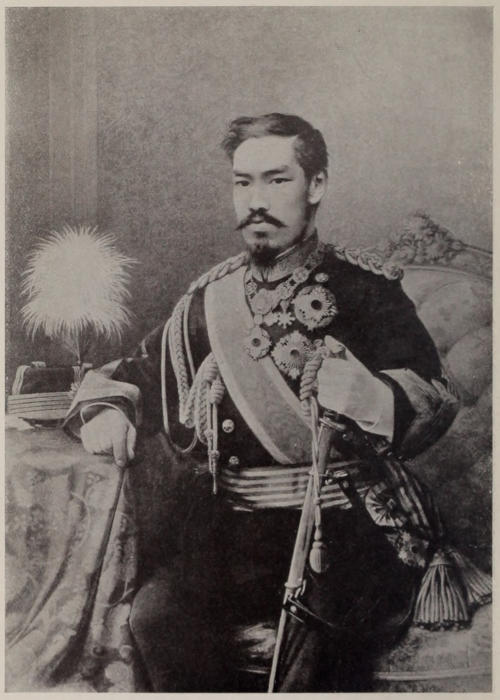
MAKERS OF JAPAN — I HIS MAJESTY THE EMPEROR OF JAPAN
At the head of the list of Makers of Modern Japan
stands by right the name of the illustrious ruler, not
merely in virtue of his imperial position, but of the supreme
efforts which throughout his reign of thirty-eight years to
the present time he has made to raise the status of his
country among nations and to confer upon his subjects
the blessings of enlightened government. His Majesty
Mutsuhito, son of the Emperor Komei, succeeded to the
throne of Japan in February 1867, when he was fourteen
years and three months old, was crowned on the 13th October
1868, married the Princess Haruko on the 9th February
1869, and has issue a son (the Crown Prince Yoshi-hito) and
four daughters, the Princesses Tsune, Kane, Fumi, and Yasu.
The Crown Prince was born on the 31st August 1879,
and was installed in this dignity on the Emperor’s birthday,
3rd November 1889, came of age and took his seat
in the Upper House, in 1897, married on the 10th of
May 1900 the Princess Sadako, daughter of Prince Kujo,
and has issue two sons.
The personal name of the sovereign is rarely written or
spoken in Japan, it being regarded almost as a discourtesy
to allude to the ruler as other than the Ten-shi, the son of
the heavens, or more elegantly as the Tenno, the heaven-sent
Emperor. The theory of the supernatural origin of
the imperial dynasty ceased to have weight with the
educated classes long ago, but that in no way lessens
the respect and affection which his subjects have for
their sovereign. It was at his express command that they
divested themselves of every vestige of superstition concerning
his traditional semi-divine descent, and when they
ascribe to his personal virtues their success in war, as they
commonly do, it is but evidence of their conviction that
it is an immeasurable benefit to themselves, and ensures
success in their undertakings, to have as their monarch
one who is in every sense a man to be esteemed for his
high sense of honour, his love of truth and justice, and
his innate appreciation of the duties devolving upon him
as having inherited the proud title of “an Emperor who
owns allegiance only to heaven.” There were, in the years
which have gone by, some Emperors who sadly failed
to realise the necessity of setting a good example to their
subjects, in Japan as elsewhere, but the memory of those
monarchs is not revered. The present ruler has won
throughout his reign the love of his people for the purity
of his life, the untiring attention which he bestows on the
affairs of his country, the supreme magnanimity he has
ever displayed in his treatment of those who by the force
of circumstances have been placed in a position of hostility,
not to his rule, for that is impossible in Japan, but to his
Cabinet, and above all for the readiness that he has invariably
evinced in time of national anxiety to enter into his
people’s feelings and to subordinate his personal comfort
to his paramount duties as an active sovereign. Had it
still been the custom for monarchs to head their forces in
the field his Majesty Mutsuhito, as all his loyal and dutiful
subjects know, would have mounted his charger and led
his hosts to battle with as great a zest as did ever one of
his predecessors on the throne in the fighting days of old.
That happiness being denied him, he sat at his desk in his
headquarters at Hiroshima for sixteen hours a day while
his troops, for eight months, waged war a decade ago with
the Chinese in Manchuria and Shantung.
It may be useful here to explain that the title of Mikado
by which his Majesty is perhaps best known to Europeans,
although undeniably an appellation of great antiquity and
in no degree derogatory, is in little use in Japan itself.
Literally it signifies the “honourable gateway” or “entrance,”
and though in ancient times the designation, when
applied to a ruler who dispensed justice from a seat at the
entrance to his pavilion, may have been more or less
an appropriate title, it may be also that as years went
by the preference of the people for some term that
should more definitely convey the idea of the sovereign’s
supremely exalted origin, according to then popular belief,
led to the gradual adoption, in official documents, of the
title of Tenno, and in common conversation of that of
Ten-shi, terms which are in general use at the present day.
The perpetuation of the term Mikado among foreigners,
though almost obsolete among the inhabitants of the
Ten-shi’s realms, is on a par with the retention of the
name “Japan” as that of the country itself, it being a
survival of the “Jipangu” of Marco Polo, who thus alluded
to it in writing an account of his travels. Marco Polo’s
book was prepared in 1299 at Genoa, and Jipangu was
doubtless the traveller’s rendering of the Ji-pên-kwoh of the
Chinese, the name by which Japan is known to that nation
to-day, and by which Marco Polo heard the island Empire
spoken of some 600 years ago. To the Ten-shi’s subjects
their land is Ni-hon-koku, or Sun-origin Land, a term
that is fairly translated, perhaps, as the Land of Sunrise.
Ji-pên-kwoh, in Chinese, has precisely the same meaning,
and the three ideographs employed are identical in Chinese
and Japanese, the difference being one of pronunciation
only. Though the dwellers in Nihon know as a rule by
this time what is meant by Japan they always speak of
their land as Nihon or Nipon, and though they know to
whom strangers allude as the Mikado, they refer to his
Majesty as the Ten-shi or Tenno. Nevertheless, the
terms in use abroad, though they have less to recommend
them on the score of accuracy, either for country or ruler,
bid fair to survive for generations.
In Japan there are four Imperial families in which are
vested the rights of succession to the throne in case of the
failure of the direct line of the sovereign. These families
are the Arisugawa, Katsura, Fushimi, and Kanin. The
throne has ten times been occupied by a woman, but it was
ever an inflexible rule that she should choose a prince-consort
from among these four Shinnō, or Imperial families,
and the relationship of these families to the throne well
illustrates the principle of adoption which prevails throughout
Japan in all classes, from the Imperial circle down to
the home of the humblest peasant. Adoption there confers
all the rights, privileges, and obligations of blood
relationship, and it was on this basis that the late Prince
Taruhito, who played so important a part in the making
of Modern Japan, and is often referred to elsewhere in this
volume, came to occupy the position of uncle to the reigning
monarch. Prince Taruhito, who for the first three
decades of the Meiji era was the Commander-in-chief of
the Japanese army, and died towards the close of the
Chino-Japanese war of 1894-5, was adopted as a son by
the Emperor Ninko, who reigned from 1817 to 1846
(grandfather to the present Emperor), and he thus became
a brother of the Emperor Komei, who was the real son of
Ninko. The Emperor Komei sat on the throne from 1846
to January 1867, and was succeeded by his only son the
reigning Sovereign Mutsuhito. The late Prince Arisugawa
was therefore uncle by adoption only of the present
Emperor, and curiously enough that is in one sense the relationship
which actually exists between the present Prince
Arisugawa, who recently visited our shores, and the present
Emperor, for the prince is the younger brother by birth of
the late Prince Taruhito, who, having no children of his
own, adopted his brother as his son and heir. Prince
Taruhito having adopted his brother as his son, however,
the brother then became the reigning monarch’s cousin,
and, as adoption confers absolute rights, it is in the light of
cousinship that we must regard the personal relation of
Prince Takehito Arisugawa to the occupant of the throne.
In reality it is difficult to institute anything like a fair
comparison, for in Europe our family relationships do not
precisely correspond to those that exist in the Japanese
Empire, and any effort at explanation of the actual
status attained by the system of adoption, as it prevails
there, must fail to convey an accurate idea of the true
position. Still it will now be understood, as adoption
brings with it full privileges, how Prince Takehito, the
prince who served as a midshipman in the British navy,
and is generally known as Prince Arisugawa, was for some
years the heir-presumptive to the Japanese throne. The
Emperor Ninko having left two sons,—though one was his
son by adoption,—recourse would have been had to the
line of the adopted son had the present occupant of the
throne remained without a direct heir. The Crown Prince
was not born until 1879, but the direct succession is now,
it would seem, amply secured, as he has sons of his
own.
The equivalent of “his Majesty” in Japanese is “Hei-ka,”
so that the full expression employed in speaking of
the monarch is Tenno Hei-ka, but there are additional
titles not in general use, as is the case not only in Japan
and neighbouring countries but among most European as
well as Asiatic States. The same is true of the land over
which the Ten-shi rules, for it has borne fully as many
names as have at various periods the British Isles, and it
was remarked at the time that the Albion and the Shikishima
battleships were being built side by side at Blackwall
that these vessels carried the ancient names of the
countries to which they belonged, for Shikishima is a
poetical title,—implying Isles of Prosperity,—for Japan,
and is employed there in very much the same way as
Albion is with us.
The Emperor of Japan has no family name, for, apart
from the theory of his semi-divine descent, his house dates
back to a period in the world’s history when the dwellers
on this globe were fewer in number, and surnames had not
been brought into use in the Orient. Thus it has a claim
to respect in virtue of the unparalleled duration of the
dynasty such as is possessed by no other reigning family
in the world. His subjects are justly proud of the fact,
and likewise of the circumstance that he rules over a people
who have remained unconquered through the ages, in assured
tenure of the land bequeathed to them by their
ancestors.
The profound respect, verging upon adoration, paid in
Japan to the occupant of the Throne is ascribable to an
absolute conviction, pervading the minds of all classes of
his Majesty’s subjects, that their ruler is a monarch who
personally studies the welfare, the happiness, and real
comfort, of his people. The feeling that the sovereign
takes an almost paternal interest in the well-being of
those whom he governs is so universal in Japan as practically
to constitute a feature of Japanese national life. It
is shared by all, rich and poor, young and old, the noble
and the lowly. In theory the throne is above criticism.
In the present era it is so in practice. In the long
history of the Land of the Rising Sun, there have been
instances in which the sovereigns have conspicuously
fallen short of the standard of perfection, but in Japanese
eyes the failure to attain the ideal has been due not to the
errors of the individual so much as to his environment.
There seems to be no room in the Japanese mind for the
conception of a ruler who has not the amelioration of the
lot of his loyal subjects always at heart, and if they were
to be confronted with direct proof to the contrary they
would cling to the belief that their sovereign must have
been the victim of circumstances. The people’s attachment
to the throne never wanes, or can wane, but if it
happens that he who occupies that exalted position is a
sovereign for whom they are able to develop an intense
affection, owing to his personal characteristics, so much
closer must the bonds be drawn, so immeasurably in
advance of all previous experience will be the enthusiasm
evinced for his cause by those who may be privileged to
serve him afloat or ashore.
The present Emperor has on more than one occasion,
indeed, expressed the wish that his subjects would cease
to attribute to his family a supernatural origin, and
although it was inevitable that at the period of his accession
he should be regarded as Pope as well as Emperor,
in virtue of the connection that had from time immemorial
existed between the throne and the Shinto faith, insomuch
that Shintoism was to all intents and purposes the State
religion of Japan, he took the earliest possible opportunity
of investing his cousin, then the Uyeno-no-miya, or High
Priest of Uyeno temples, with the spiritual functions appertaining
to the Sovereign’s office, and announcing his
own intention of ruling Japan purely as a secular monarch.
Under the title of Kita Shirakawa-no-miya this prince two
years later left the temples and entered the newly raised
army, with the rank of major. General Kita Shirakawa-no-miya
died some years ago, but his brother Higashi
Fushimi-no-miya, who likewise was a Shinto priest at the
outset of his career, was entrusted with the imperial
brocade banner and ordered to chastise the rebels in the
war of the Restoration in 1868, and he subsequently distinguished
himself as a military officer in many hard-fought
fields. He some years ago visited London as the
representative of the Ten-shi and was present at St Paul’s
on the day that Queen Victoria gave thanks for the recovery
from a severe illness of the Prince of Wales, our
present King Edward VII. With the resignation by
the prince Kita Shirakawa-no-miya of his priestly office
the direct relationship of the imperial family to Shintoism
ceased, though by the deification of former rulers of the
country, and the retention for untold years of the position
of head of the church by the reigning sovereign, the union
had seemed to be indissoluble. Shinto is now only a
cult, but it embodies the principle on which the moral
teaching of the Japanese substantially is based, and it
still has for its chief function the performance of rites
in memory of the imperial ancestors. Shintoism has
neither creed nor dogma,—it inculcates patriotism and
loyalty. It enjoins upon all the virtue of courage, the
cultivation of the strictest sense of honour, and the universal
practice of courtesy and consideration. The essence
of Shinto (lit.: “the way of the gods”) is the spirit of
filial piety, and, to quote the late Lafcadio Hearn, it
implies the “zest of duty, the readiness to surrender life
for a principle. It is religion, but religion transmuted
into ethical instinct. It is the whole emotional life of
the race,—the Soul of Japan.” In its best and purest
form, according to the highest authorities, it consisted of
ancestor-worship combined with reverence for the forces
of nature. There was the natural respect for the memory
of ancestors, national or individual, added to the awe inspired
by the phenomena of nature, in the tempest and
the earthquake, the lightning’s flash and the thunder’s
crash. The beneficent influence of the summer sun on
the ripening corn led those who lived by agriculture to
value the blessing as the gift of a goddess, and they revered
her as “Ama-no-terasu,” the splendour of the skies, and
regarded her as the special ancestress of their adored
ruler. Thus, as one authority has remarked, to those
Japanese whose first idea of duty is loyalty to the Emperor,—and
this means the nation at large,—Shinto becomes
a system of patriotism exalted to the rank of a religion.
The common people still regard it in that light, and continue
to worship and pray at its temples, though officially
it was secularised six years ago and placed under the
control of a Bureau of Shrines, as distinct from the Bureau
of Religions, which takes cognisance of matters affecting
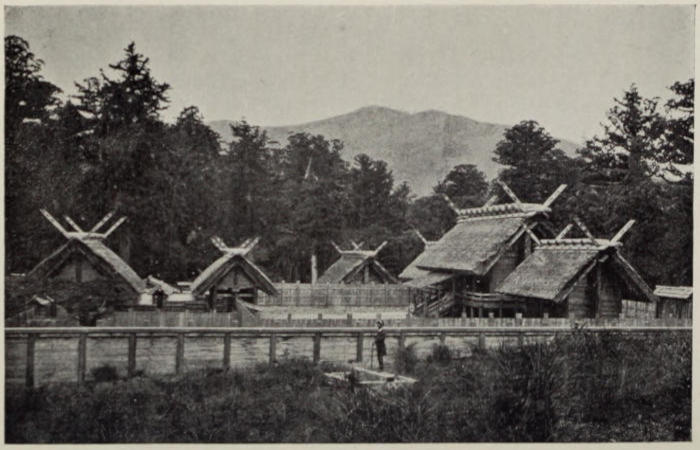
the Buddhist and Christian faiths. In 1899 the officials
of the Isé shrines, which are the oldest in the Empire, and
in which are preserved the three sacred emblems of the
monarchy,—the mirror, sword, and jewel of antiquity,—symbolical
of regal power, and looked upon as coeval
with the dynasty itself,—took measures to define their
position as heads of a secular organisation. They then
described Shintoism as “a mechanism for keeping generations
in touch with generations, and preserving the continuity
of the nation’s veneration for its ancestors.” But
throughout the length and breadth of the land the sight
of a Shinto shrine will continue to prompt the passer-by
to pause for a moment in his journey, to fold his hands
in silent prayer, to cast a coin into the capacious moneybox,
and to bow the head in submission to a higher will,
no matter whether the rites of Shinto worship be for the
future viewed in the light of a religion or only as a
cult.
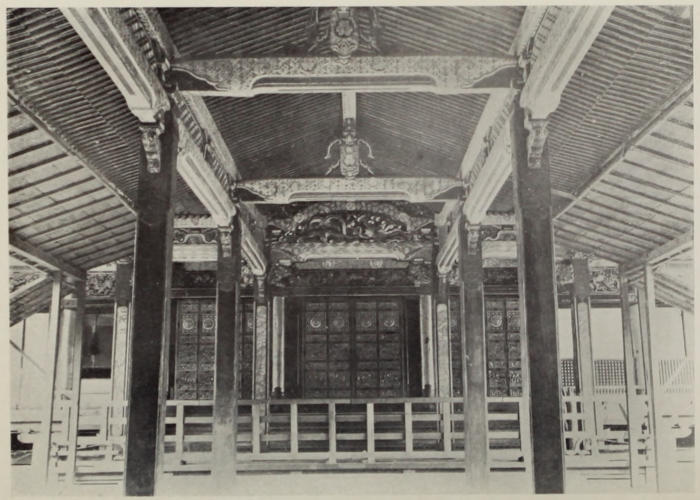
THE GEKU SHRINE AT ISÉ
Marco Polo’s references to “Jipangu,” as we have seen,
were not based on his personal observations but on information
derived from the Chinese, and though he
travelled widely in China, accompanied by his brother,
he never set foot on Japanese soil. That an island
empire existed to the east of them, however, had been
known to the Chinese for centuries, and Kublai Khan
had unsuccessfully sought to bring it into subjection only
a short time prior to the Polos’ arrival at his Court in
1275. It is probable that Christopher Columbus, when
setting sail from Palos in 1492, hoped to reach “Jipangu,”
of which he had doubtless heard through the publicity
given to Marco Polo’s travels, by sailing westward, and
it is possible that Columbus imagined that he had found
his way to some part of an Eastern continent when he
discovered America. The first traveller to actually land
in Japan was Fernao Mendes Pinto, in 1542, seven years
before the Jesuit Missionary Francisco Xavier arrived
there. Pinto was favourably received in Bungo, a province
of Kiushiu, the large island in the south-west of Japan,
and arrangements were made for a vessel to visit Bungo
with foreign produce, every other year. Pinto belonged
to Coimbra, in Portugal, and thus it is to that power that is
due the honour of its subjects having been the first to visit
Japanese shores. Pinto’s ship was the only survivor of
three which started from Lisbon on a voyage of adventure,
and it was from her crew that the Japanese first acquired
a knowledge of the use of firearms. The Bungo province
gives its name to the narrow channel that here divides the
islands of Kiushiu and Shikoku, which is exceptionally
rich in historical associations, for if tradition be in this
instance correct it was in one of its many little bays that
the vessel conveying the ancestor of the Ten-shi, the first
Emperor Jimmu Tenno, dropped anchor over 2500
years ago. Where Jimmu Tenno came from remains an
absolute mystery, but it seems to be fairly established
that he brought with him a mighty host, armed for conquest,
and that he had early encounters with the tribes
then inhabiting the south and west of Hondo, the main
island. One of these was the Yamato tribe, which
probably at that remote period dwelt in what is now
Iwami, and its occupancy of the coast facing the peninsula
of Korea, might be taken to imply that its people
originally crossed the water from that kingdom, though
it would not of necessity follow that the men of Yamato
were identical in race with the dwellers in Korea at the
present day. Fighting his way along the borders of
the Inland Sea, the invading chieftain Jimmu Tenno
ultimately reached the neighbourhood of what is now
Kioto, and set up his capital in that region. It is not
improbable that he brought with him many members
of the Yamato tribe that he had subjugated, and this
may account for the presence to this day in that part
of Japan of numberless families possessing the characteristics
in a marked degree of what is termed the Yamato
race,—in other words, the elongated features and intellectual
aspect as distinguished from the round chubby
countenances of the majority of the men and women of
the hei-min, or common stock, which forms so large a
percentage of the entire population. The Yamato people
may have emigrated in the first place from Manchuria,
passing through Korea on their way to Japan, and though
it may be condemned as fanciful the idea is perhaps not
altogether groundless that in seeking to recover Manchuria
in recent years from the grip of the Muscovite the Japanese
may in reality have been striving, though few were aware
of it, to deliver their own ancestral home from the presence
of the Western intruder.
Jimmu Tenno began to reign as Emperor of Japan
in 667 B.C., being then, it is supposed, about thirty-five
years of age. Ancient Japanese tradition no doubt assigned
to him a supernatural origin, and it is not difficult
to trace in the unexpected advent on Japanese soil of
the conqueror and his knights the germ of such a belief,
supported as it probably was by martial prowess to a
degree with which the then peaceful inhabitants of the
Japanese chain of islands were totally unfamiliar. The
peoples of the adjoining mainland of Asia—that is to say,
the Chinese and the Manchus, as well as the Koreans—were
appreciably in advance, it is to be presumed, in
the arts of war, of any of the islanders of that age, and
the invaders, as Jimmu Tenno and his men must have
been, of Southern Japan, seven centuries before the
Christian era, may have been regarded, and not altogether
unnaturally, as beings descended from another planet.
The Emperor Jimmu’s mother was a daughter, we are
told, of the Sun-Goddess and the Sea-God (the Japanese
Neptune) and in this myth may be traced a notable
parallel to that concerning Romulus, the founder and
first King of Rome, whose father was reputed to have
been Mars, the god of war. Romulus founded Rome
just eighty-six years before Jimmu became the founder of
the dynasty of Japanese emperors, but there the parallel
ends, for while Rome became a republic in less than
250 years, and underwent endless vicissitudes, a direct
descendant of Jimmu occupies the imperial throne of
Japan to-day.
In the older histories of Japan one may read how the
Isles of Sunrise came into existence, and the legend is
pretty enough to merit recognition in lands other than
that to which it especially applies. When all was chaos
on this globe, very far back in its nebulous stage of
existence,—when the purer elements were ascending to
form its skies, and the impure were gathering to form its
earth,—the god Izanagi, with his august spouse the
goddess Izanami beside him, was standing on the ethereal
arch that spans the higher heavens, bearing in his hand
the jewel-spear. Suddenly he thrust the weapon downward
and with it probed the watery expanse beneath.
As he drew it forth from Ocean, drops of foam and brine
fell from its point, and in congealing formed an island.
That island is called “Foam-land” (Awaji), in the centre
of what is now Japan, and it bars the passage from the
eastward to the picturesque “Inland Sea.” In it Izanagi
and Izanami took up their abode, and gradually formed
the other islands of the group. The Sun-goddess and
the Sea-god were their children, and Ama-no-terasu, the
“Splendour of the Skies,” was their grand-daughter, and
became the parent of Jimmu Tenno, the first Emperor
of Japan.
In the month of July 1853, there appeared to the
astonished gaze of the inhabitants of the little fishing
village of Uraga, situated on the Pacific coast within
ten miles of the entrance to the Gulf of Tokio, a
squadron of “black ships,” as the children termed the
war vessels, the like of which they had never before
seen or even heard of, and not long afterwards a boat
was rowed ashore and a party of officers landed. For
230 years there had been no communication with
strangers, the edicts of the Shogun Iyeyasu and his
successors in the office having expressly prohibited all
intercourse, for reasons which need not be given here,
and the open defiance of the law of the land implied
by the visit of the Americans filled the villagers with
consternation. It was discovered that the unwelcome
guests had brought a letter for the reigning monarch of
Japan, and this the head man of the place agreed to
forward to the proper officials. Commodore Perry
happened to reach Japan at a time when the feudal lords
of the various provinces had become jealous of the long-continued
supremacy of the Tokugawa line of Shoguns,
deputies of the crown who had for two and a half centuries
practically ruled the country, in the name of the monarchs
who had remained in seclusion at the palace of Kioto
while their lieutenants governed the land from Yedo.
The movement in favour of the re-establishment of the
direct rule of the Emperor, in place of the semi-regal
authority which had been exercised by the descendants
of Iyeyasu, the first Shogun of the Tokugawa line, had
begun to take definite shape some years previously,
as we shall discover when we consider the history of
Fujita, Sakuma, and Yoshida,—patriots who flourished
earlier in the nineteenth century,—and the advent of the
American visitors served but to accentuate the difficulties
of the situation for the Yedo potentate, who was placed
on the horns of a dilemma. If he yielded to the demands
of the Americans that the nation which had so long been
hidden from the rest of the world should emerge from its
retirement and admit foreigners within its gates, he would
incur the wrath of the ultra-Conservative party among the
nobility of his own land. If he refused to comply with
the American President Fillmore’s amiable suggestions,
Japan might yet share the fate of China, and a forcible
invasion of his Imperial master’s dominions, which would
be equally disastrous to himself as being responsible for
the exclusion of the “barbarians,” was almost certain to
occur. The Shogun took the advice of those who advocated
the making of treaties with men whom they were
not then strong enough in Japan to effectually exclude,
and the thin end of the wedge was inserted by the conclusion
of the compact,—at first nothing more than a
promise of friendship,—between Japan and the United
States of America.
Under the provisions of the American treaty then
negotiated by Perry, the United States acquired the right
of establishing a legation at Shimoda. This is a small
town at the tip of the Idzu promontory, which extends in
a southern direction from the province of Sagami, and it is
sixty-five miles as the crow flies south-west of Yokohama.
Over a building which had previously been a Buddhist
temple the Stars and Stripes were hoisted at Shimoda in
September 1856, and America’s accredited envoy, Mr
Townsend Harris, resided there for many months, being
the first of the diplomatic representatives of foreign
powers to dwell in the newly awakened Land of Sunrise,
and the first to arrange a treaty of commerce. Under the
arrangement made with Commodore Perry there were to
be two seaports opened to the reception of American
vessels, where they might obtain coal, provisions, wood,
and water. One of these ports was Shimoda, the other
was Hakodate, in the northern island of Yeso. The
treaty provided for hospitable behaviour towards shipwrecked
crews,—a matter in which, had the instincts of the
Japanese nation at large been appreciated as they are
to-day it would perhaps have been deemed superfluous
to make any stipulations—and it also included certain
regulations for conducting trade and for the residence
of consuls or agents, at the places named. The stay of
the American agent at Shimoda was not of long duration,
for on the opening of the capital, as a place wherein the
representatives of other powers could most fittingly dwell,
Mr Harris removed to that city. But it should not be lost
sight of that Shimoda was for a time the official headquarters
of the American Legation in Japan, and a place
where the population was more or less accustomed to see
foreigners long before the rest of the country,—save the
trading ports of Yokohama, Kobé, Nagasaki, and three
other places on the coast opened later—was available to
strangers. The British treaty, made the same year by
Admiral Stirling, was on similar lines. It was not until
the Earl of Elgin concluded the treaty of 1858 that
powers were obtained for the residence of the foreign
ministers in Yedo, though it had been agreed that a third
port,—that of Nagasaki,—should be opened to trade.
The Elgin treaty in addition provided for the establishment
of open ports at Kanagawa, Niigata, and Hiogo.
But Kanagawa being a town situated on the highroad
along which in those days it was usual for the feudal
lords and their immense retinues to travel, and the feeling
in many quarters being decidedly inimical to foreigners, it
was deemed inexpedient to make it a focus of animosity due
to the strangers’ settlement therein for purposes of trade
whilst it might remain the recognised resting-place for
imperial and other processions making the journey to
and from Kioto and Yedo. Accordingly it was agreed
that the little fishing village of Yokohama, lit.: “the
beach across the way,” on the other side of the bay of
Kanagawa, which is itself a mere indentation of the coastline
of the Gulf of Tokio, should become the actual place
of residence of the foreign community. From this small
beginning in 1859 the port speedily grew to be the centre
of a vast and profitable trade, and its population now
numbers 194,000, of whom 2100 are foreigners exclusive of
Chinese. It is claimed for Kobé, a port in the channel
separating Shikoku from Hondo, that it has eclipsed
the older port of Yokohama in respect of its commerce,
and it is in some things better situated for trade, particularly
with the tea-producing districts. Kobé was originally
a village adjoining Hiogo, which was the port that
it was settled by treaty should be thrown open, and as
a matter of fact it is divided from Hiogo only by a creek,
a few feet wide. The port is now officially styled Kobé-Hiogo,
and to all intents and purposes the two places
are one.
Not only did the dai-mios of the western provinces
modify their views on the subject of the admission of
strangers but the reigning Emperor Komei himself ceased
to contend at the last against that influx which if it could
not be successfully resisted might very possibly, it was
thought, be turned to good account in preparing the
nation to combat other encroachments of a less pacific
character in the days to come. It may well be that
this resolution was arrived at in full view of events that
were taking place in the extreme north of the Empire,
where Russia was little by little feeling her way towards
Yeso, and had already seized the moment of Japan’s
preoccupation in respect of domestic concerns to establish
herself in the island of Sakhalin, between which
and Yeso only a narrow strait, twenty-five miles wide,
existed to bar the path of the settlers to the virgin soil
and luxuriant forests of “Hokkaido,” Japan’s “North Sea
Circuit.” At all events the Emperor Komei about this
time signified his willingness that the engagements which
the Shogun had entered into with the powers of the
Occident should be recognised and adhered to.
The Shogun Iyemochi, who had been wedded to the
Emperor’s sister four years previously, but who had not
during the intervening time wholly succeeded in overcoming
his imperial master’s reluctance to ratify the
treaties which his predecessor in the Shogunate Iyesada
had made, was in 1864 residing at the castle of Osaka,—the
stronghold built by the renowned Hideyoshi (the
Tai-ko or generalissimo) at the close of the Sixteenth
Century,—and was thus within a few hours’ journey of
the imperial residence. His visit to Kioto that year
(1864) had been marked by the Ten-shi’s favour despite
the remembrance of his failure to induce the aliens to quit
Japan’s shores, and no more had been heard of the proposition
that he should forthwith expel the barbarians
and restore peace to the country. The vital change in
the sovereign’s ideas is believed to have been brought
about mainly by the advice of the lord of the Satsuma
province, who, as was to be seen, had changed his own
opinion very considerably after the naval engagement at
Kagoshima of the previous year. There can be no doubt
that the influence of Shimadzu Saburo was largely instrumental
in bringing about a reconciliation between the
Emperor and the Shogun, and for the moment harmonious
relations were re-established. The personal quarrel which
arose with the lord Mori of Choshiu would have been
a more serious matter for the Shogun had the Satsuma
lord been ready to throw in his lot with Iyemochi’s
opponents, and whatever may have been the feeling on
the point at Hagi the disinclination of Satsuma to join
the Choshiu clansmen in the attack on Kioto may be held
to have turned the scale against Mori. It was not long
before the two clans were actually united, however, in a
successful attempt to demolish the Shogunate altogether.
It is thought that when Iyemochi obeyed the summons
of the Ten-shi to visit Kioto with, in the first place, the
avowed object of concerting measures for the expulsion
of aliens, he took the fatal step of subordinating his own
party’s policy to that of the Court party, and thereby
hastened the downfall of the Tokugawa family, for the
strength of the Shogunate had lain in the assertion of
its prerogatives as inheriting the privileges of its founder,
the law-giver Iyeyasu, and who re-established it in the
beginning of the Seventeenth Century.
But to return to the events of 1864, it was with excellent
judgment and an intuitive perception of the favourable
turn which affairs were then taking that Sir Harry Parkes,
the British Minister, who had succeeded Sir Rutherford
Alcock, seized the precise moment to despatch two
members of his Legation staff, Messrs Mitford and Satow,—the
present Lord Redesdale, and Sir Ernest Satow,
now British representative at Peking,—to see the Shogun
and personally endeavour to arrive at some satisfactory
arrangement concerning the opening of the remaining
ports to trade for which sanction had been obtained by
the provisions of the Elgin treaty. The visit ended with
complete satisfaction to the negotiators, and when the
four powers directly concerned—viz. Holland, France, the
United States, and Britain—urged officially on the Shogun
the desirability of speedily opening Hiogo (Kobé) he
agreed to write a letter to his imperial master suggesting
that this should be done. The Emperor Komei at first
refused but ultimately gave his consent. It was settled
that Hiogo, and with it Osaka, should be opened to
foreign trade and residence on and from the 1st of January
1868, which was five years later than had been contemplated
by the framers of the Elgin treaty, but under the
then existing circumstances it was highly creditable to the
delegates to have achieved so much.
The defeat of the Choshiu men in their earlier attempt
to capture Kioto had had the effect of inducing them to
study the art of war as practised in the Occident, and
when Iyemochi, in consonance with the imperial command,
sought to chastise Baron Mori, and promptly marched
his troops through the provinces bordering the Inland Sea
as far as Nagato, he found himself confronted by a superior
force of riflemen, armed after the modern fashion, who,
though they lacked everything in the way of military
uniform, had acquired sufficient knowledge of drill and
co-operation to render them doughty opponents for any
force that the Shogun could place in the field against
them at that stage of the national development. The
men who bore rifles were not in pre-Restoration days
regarded as the highest in rank among soldiers, for the
Japanese had of old a predilection for the personal combat,
hand to hand, and were prone to despise warfare of
the kind in which a missile was hurled at the foe from a
comparatively safe distance. Thus the swordsman ranked
highest in Japanese estimation down to a very recent
period,—but the Choshiu riflemen proved by their able
use of modern firearms that a power such as had been
before unknown in relation to implements of strife lay in
the weapons that they so coolly and dexterously handled
to the complete discomfiture of their enemies. And
thus was laid, it may be supposed, the foundation of
that high standard of superiority which the Choshiu
troops have since attained as regards their ability to wage
war on modern principles. They developed a natural
aptitude for the employment of firearms from a date
long prior to the present Emperor’s reign, and for some
years were the only force in Japan that might be said to
have adopted western armaments, with perhaps the sole
exception of a force of foreign-drilled infantry (some
800 in all), belonging to the Shogun, under Kubota
Sentaro, which took part on behalf of the Japanese
authorities in a review and sham fight that was held at
Kanasawa, near Yokohama, on the 21st March 1866, at a
time when it was needful to have a few British troops
in the town for purposes of defence against a possible
sudden descent of some recalcitrant dai-mio’s followers.
The Shogunate was tottering to its fall when it sought
in June 1865 to suppress the Choshiu rising, and signally
failed to do so. Only a few months later the Shogun
Iyemochi died (August 1866), and was succeeded by
Hitotsubashi Yoshinobu, a scion of the Mito branch of the
Tokugawa family, and who is in more modern times
alluded to as the Prince Keiki. The letters of which the
Japanese pronunciation would be Yoshinobu are, when
given their approximate Chinese sounds, to be read as
Keiki, hence the two renderings of the Shogun’s name.
Tokugawa signifies the “river of abundance,” and Keiki or
Yoshinobu mean “goodness and joy,” the signification
of the characters remaining unaltered, of course, whichever
may be the system of pronunciation adopted. Shortly
after Keiki’s accession to the Shogun’s seat the trouble
in Choshiu was brought to an end by the lord Mori’s
submission. Into the cause of that there is no need to
enter here as it will be found to have been fully discussed
in the chapter on the career of Marshal Yamagata.
Peace was only nominally restored, for the reason that
greater events were in preparation, and the country was
now on the eve of those marvellous changes which ushered
in the era of Meiji,—the period of Enlightened Rule,—by
which his present Majesty chose that his reign should
be known to posterity. The Emperor Komei’s decease
followed very quickly upon that of the Shogun Iyemochi.
Keiki had been Shogun only four months when Komei
Tenno died and was succeeded by his son Mutsuhito, who
happily still reigns over an adoring and devoted people,
distinguished among the nations of the earth for their
unfaltering attachment to the imperial throne and for
the intense loyalty and patriotism they display towards
its wise and benevolent occupant. It happened that at
the moment when the Emperor Mutsuhito came to the
throne Japan was torn by conflicting political views on
the subject of the advisability of re-opening the country
to foreign trade and intercourse, after having been closed
to foreigners down to 1854 from a date early in the
Seventeenth Century. The treaties which the Shogun had
entered into with the representatives of Foreign Powers,
during the lifetime of the Emperor Komei, still gave
anything but unalloyed satisfaction to one section, and
that a very numerous and implacable one, of the body
politic, and the land was a prey to the most bitter dissensions.
A large proportion of the so-termed anti-foreign
party was sincere in its outcry for the expulsion of
foreigners only so far as it might be the means to an end.
No doubt there were thousands in Japan at that time who
were genuinely hostile to strangers, and honestly believed
that the land would be well rid of the intruders, but
it is nevertheless true that these patriots, as they unquestionably
deemed themselves, were exploited by
the Reformers whose main ambition it was to see the
country again governed by the Ten-shi himself, and
not, as had so long been the rule, by his lieutenant the
Shogun. It is due to the curious and altogether anomalous
state of affairs that then existed that we have in the
Makers of Modern Japan many men who at one time
belonged to the party which openly advocated the expulsion
of all aliens. Whatsoever may have been their
real feelings at the time towards strangers, it is evident
that their first care was to put an end to the dual system
of control from Kioto and Yedo, and to restore the supreme
power to the hands of the Ten-shi.
It is due to the memory of the Emperor Komei, though
no great change was accomplished in his reign, to acknowledge
the foresight he displayed in having his son
and heir educated on liberal lines, thoroughly fitted for the
duties of active sovereignty over his people, so that when
the moment arrived for a revolution in the system of
administration the youthful monarch was equipped with
knowledge regarding the outer world and its chequered
history that had never been acquired by his august predecessors
on the imperial throne, coupled with broad and
noble ideas of government far in advance of his years.
The stirring events of 1867 and 1868 therefore found
his Majesty not unprepared for the tasks devolving upon
him. His training had indeed been almost Spartan in its
rigour and simplicity, among the family of the Court
noble to whose care he had been entrusted. Strict
discipline is rather the rule than the exception in Japan in
regard to the education of princes, and in the youth of the
Emperor Mutsuhito there was no departure from established
custom,—on the contrary, the Emperor his father
had enjoined upon the noble charged with the heir-apparent’s
education the necessity of making him a hardy
rather than a delicate youth, and he was encouraged,
therefore, to take delight in horsemanship and manly
sports, the ancient game of da-kiu (Japanese polo) being
much played in the palace grounds at that period. It
is even said that he smelt powder before he was twelve
years old, for the battle between the Choshiu men and the
Shogun’s forces already mentioned took place in Kioto
close to the imperial residence, and bullets flew in all
directions among the palace buildings. As an equestrian
his majesty shines conspicuously, for he is an accomplished
rider, and takes a keen delight in the field manœuvres
which in peace time are annually carried out in one part
or another of his dominions. On these occasions it is
no uncommon thing for the Emperor to be in the saddle
day after day for a week together, and it may well be that
to the profound study that he is well known by his troops
to make, at all times, of the needs of his army, must
in part be ascribed the firm belief of officers and men that
they win battles by virtue of his beneficent interest in
their welfare. He enjoys following his troops in their prolonged
marches, when carrying out their regular training,
and never hesitates to mount his charger in the roughest
weather, on the principle that what his men are asked
to do in the sense of exposure to the elements, he is ready
himself to undertake. Alike under the hottest sun or the
most drenching rain, he takes his stand on some eminence
to watch them defile before him, utterly regardless of
personal comfort or of danger to his health. In this
he but evinces his complete repugnance to a life of
luxurious ease, and it is to be said of his whole career,
both prior to his accession to the throne of his ancestors
and since, that he has never spared himself in any one
particular, but has been a hard worker from his boyhood,
with little or no disposition to indulge in play or relaxation
of any kind save the mental recreation involved in the
daily composition of a stanza of poetry. At another page
will be found almost literal reproductions of some of
his Majesty’s latest efforts in this direction, inspired, no
doubt, by the circumstances of the terrible struggle
in Manchuria, wherein so many thousands of his warriors
have sacrificed their lives for the empire of which he
is the revered head.
To return to the Emperor’s early life, he is ever ready
to avow himself indebted to the ability and wisdom of his
tutors, foremost among whom were the Princes Sanjo and
Iwakura, whose part in the making of the Japan of to-day
is elsewhere referred to in detail. They were Court nobles
(kuge), and both are long since dead, but it was to their
teaching in great measure, aided by that of other gifted
counsellors, that was due the strikingly complete emancipation
of his mind from old-fashioned ideas, and his
adoption of the principles of government upon sound
and progressive lines. His Majesty began his reign with
a declaration, wholly spontaneous, that he would as soon
as practicable create a deliberative assembly for the discussion
of public affairs, that personal freedom should be
secured to all his subjects, that whatever evil or pernicious
customs were in existence should be abolished,
and that a new system, based on the study of the experience
of foreign nations, particularly as regarded the
defence of the Empire, should be forthwith inaugurated.
This was the substance of his Majesty’s Coronation oath,
as it was termed, and is the Magna Charta of the rights
and privileges of the Japanese people. The sovereign
voluntarily repeated this promise at a Meeting of the
feudal princes and barons assembled at the Palace in
Kioto in April 1869, two years after his accession to the
throne. But the interval had been occupied in effecting
that radical change in the system of administration which
has been the wonder of the world, and in quelling an
insurrection which was the direct outcome of the abolition
of the Shogun’s office, though personally the holder
thereof had discouraged the rebellion as far as he could
by resigning his post. The Emperor had accepted that
renunciation of his rights by the Shogun Keiki, but the
adherents of the Shogunate had fought on in spite of
their titular leader’s withdrawal. In after years the
sovereign, as we shall find, magnanimously abolished the
decree which had in 1868 declared the Shogun to be in
rebellion, and wholly absolved him from any intentional
disobedience. But for the time being there was civil war
in the Land of Sunrise, and the history of those unhappy
eighteen months subsequent to the Emperor’s accession
must briefly be told, though, as is the case with regard
to the strife of the early sixties, in the United States of
America, the memory of those terrible days when clan
fought against clan in Japan has ceased to trouble the
Ten-shi’s subjects, and those who once were sworn enemies
are and have for many years past been good friends. The
events of 1867 were especially important in respect of the
influence that they were to exert on the future of the
country. In the first place the powerful Satsuma clan
had obtained a conspicuously influential position in the
councils of the Empire. The prime mover in this had
been Shimadzu Saburo, who was the real father of the
feudal lord of the province, but as the previous daimio,
who in reality was Shimadzu’s brother, had adopted the
young prince as his son, it followed under the Japanese
laws concerning adoption that the father became uncle to
his own child. In the course of the violent controversy
which had arisen Shimadzu had most vehemently opposed
the Shogun, and accordingly he was classed among those
who were averse to the opening of the treaty ports to
foreign trade, but in reality he was not unfavourable to
the admission of aliens, and was actually willing that the
entire province of Satsuma should be open to foreign
enterprise. To this suggestion, however, the Shogun had
offered objections.
Satsuma had benefited by its trade with Nagasaki, the
only port that had remained accessible to vessels from
Europe during the long seclusion of the nation from
Western intercourse. In the year 1866 the British Minister,
Sir Harry Parkes, had accepted an invitation to visit the
headquarters of the Satsuma clan, three years after the
bombardment of the town of Kagoshima by Admiral
Kuper’s squadron. The Minister made the voyage in the
warship Princess Royal, accompanied by the Serpent and
the Salamis, and the young prince of Satsuma came off to
welcome his guest in a magnificent state barge. Sir Harry
Parkes, on landing at Kagoshima on the 27th July, found
that adjoining the daimio’s palace within the castle walls
were a foundry and well-equipped workshops, and that at
the foundry they had succeeded in casting a number of
very serviceable cannon, and quantities of shot and shell.
Near by was a glass works, and in one of the workshops
was a steam lathe. These facts afford strong testimony
to the progressive spirit manifested even at that period
by the Satsuma clan, and the appreciation of the value of
Western appliances which had thus early in the history of
the Restoration struggle prompted the samurai of Satsuma
to fit themselves to attain a commanding position among
the supporters of the Ten-shi, as opposed to those who
favoured the regime of the Shogunate.
The inability of the Shogun’s forces to subdue the
Choshiu samurai had placed the Shogun himself in a
position that was obviously intolerable. Not only was
one of the most powerful of the feudal lords openly antagonistic
to the Shogunate but it was known for a fact
that the Satsuma clan was virtually allied to Choshiu
in this effort to repudiate the Shogun’s right to exact
obedience from the great feudatories. It is to the infinite
credit of Tokugawa Keiki that at this crisis in his country’s
affairs he recognised the need of a more centralised
and uniform system of administration,—one in which
the real power and control should be vested in the
person of the Ten-shi. He resigned the office which
had been in his family for 264 years, and begged that
he might be permitted to retire into private life. The
Emperor Mutsuhito accepted the voluntary surrender by
the Shogun of his time-honoured privileges and in doing
so opened a new chapter in the record of the Japanese
Empire. The manifesto was in the sovereign’s own words
and was substantially as follows:—
It has pleased Us, at his request, to dismiss the
Shogun. Henceforward We shall exercise supreme
authority, in both the internal and the external affairs
of the nation. For the term “Tycoon” (meaning
Shogun) which has hitherto been employed in the
Treaties must henceforth be substituted that of
Emperor.
To this historic document were appended the great
seal of “Dai Nihon” and the signature in the monarch’s
own caligraphy—Mutsuhito—it being, perhaps, the first
time in all Japanese history that the personal name of
the ruler had been used officially during his lifetime. The
retiring Shogun left the capital and for a brief period took
up his abode in the castle of Osaka. But it was to the
chief town of Suruga province, midway between Tokio
and Kioto, that he finally withdrew, and thereafter lived
the unobtrusive life of a country gentleman on a small
estate which the Emperor bestowed upon him. In this
way, in the perfect seclusion of Shidzu-oka (lit.: the Hill
of Peace) he was able to wholly divest himself of political
connections, and was now and then to be seen setting out
on a fishing excursion with perhaps but one attendant,
preferring the quietude of his existence apart from the
cares of State, and revelling in his emancipation from
the pomp and circumstance of that Court of which for a
brief interval he had been the acknowledged and puissant
head. Never, perhaps, did a potentate more completely
renounce his rights, nor so absolutely efface himself on
doing so, in the history of mankind, but he has had his
reward in the confidence and favour of the real sovereign
whose deputy he had been, and from whom he has received
in recent years the highest honours. He has the rank
of Prince under the new regime, while Prince Tokugawa
Iyesato, the head of the Tokugawa family, has also been
raised to the same rank, and holds office as President
of the House of Peers. Thus the family of Tokugawa,
which from the close of the Sixteenth Century until 1868
virtually ruled Japan, retains, by the magnanimity of the
Emperor, a status among the nobility of the land that is
unsurpassed by any princely or ducal house, and actually
boasts the possession among its ranks of two princes,
since his Majesty thought fit in 1900 to request his former
Shogun to visit Tokio, and then and there conferred upon
him the title which he now holds, declaring at the same
time that he was perfectly absolved of all participation in
the events of 1867-8, which would no longer blot the
record. There has been nothing in the personal relations
of his Majesty with his dutiful and supremely loyal
people which has more endeared him to them than his extreme
generosity, and inasmuch as there were necessarily
among all classes of his subjects many thousands—even
hundreds of thousands—who had in their early days been
proud to own allegiance to the Shogun and the Tokugawa
house, the sovereign’s attitude has been more widely appreciated
than it is possible, perhaps, for strangers to the
country to comprehend.
The surrender of his privileges by the Shogun in 1868
was resented by the bulk of his adherents, and though they
were compelled to retreat towards the north before the
determined advance of the Satsuma, Choshiu, Hizen, and
Tosa men, under the command of Saigo Takamori, whose
notable history will be found elsewhere in this volume,
the struggle lasted for many months. In support of the
Tokugawa side the stoutest resistance was maintained by
the Aidzu clan, whose chieftain dwelt in the castle of
Wakamatsu, midway, or nearly so, between the capital
and the straits of Tsugaru which separate the northern
island of Hokkaido or Yeso from Hondo, the mainland.
The prince of Aidzu had been guardian of the “Nine
Gates” of the Ten-shi’s palace at Kioto under the Tokugawa
regime, until the coup d’état of the 3rd January 1868,
by which his opponents contrived to secure the person of
the young Emperor, whereupon an imperial edict appeared
appointing, instead of the Aidzu men, the clans of
Satsuma, Tosa, and Geishiu, as guardians of the Gates.
Loyalty to the old regime led the Aidzu chieftain to
oppose as far as he was able the deposition of the Shogun,
until he was made aware that Keiki’s resignation had been
accepted by the Emperor.
Clan jealousy was of course responsible to a very great
extent for the opposition of the northern feudatories to
the proposed changes, and in the broad sense of the
term this was a conflict in which the south waged war
on the north. For according to that spirit of loyalty
to a chief which prevailed then and, happily for Japan,
still prevails, throughout the Ten-shi’s realms, in spite
of his subjects having taken for a model the matter-of-fact
latter-day civilisation of the Occident, it was permissible
to regard the Shogun’s voluntary submission as
an act prompted solely by a desire to spare the lives
of his followers, and as such one of which they were not
obliged to take cognisance, for although there was no
act of self-sacrifice in which they were not ready to join
if it could be proved to be needful in their country’s interests,
they held themselves to be in no way bound by a
promise or declaration that their chief had been compelled,
as they deemed it, to make under the pressure of
circumstances. They regarded the Shogun as the victim
of a political combination, and were indisposed on that
account to yield to the ambitious dominance of the clansmen
of the south. The Aidzu men, therefore, continued
to oppose a solid front to the Kioto party, and in the
vicinity of Wakamatsu itself many desperate contests took
place. All the males of a family, from the father to the
youngest son, are known in some cases to have taken the
field in defence, as they believed, of their lord’s interests,
and warfare of that determined character which those who
have watched the career of the Japanese soldier of to-day
can fully comprehend lasted in the north of Japan until
late in 1868. During the preceding summer there was a
fierce engagement at sea, close to the town of Hakodate,
which resulted in the defeat of the Shogun’s squadron, at
that time commanded by Admiral Yenomoto. Ultimately
a general amnesty was proclaimed, and the ships which
remained under the Tokugawa flag were handed over to
the newly-formed department of the imperial navy.
But before this came to pass, incredible as it may seem,
an attempt was made, it was declared, to establish in
Yeso some sort of republic, and the signatures to the
remarkable document in which proclamation was made of
the intentions of the promoters of this scheme included
that of Otori Keisuke (now Baron), who later represented
his nation with distinction as its Minister to the Court of
Seoul. On board one of the vessels commanded by
Admiral Yenomoto, moreover, in the engagement at
Hakodate, was a young officer who in his later years has
been the recipient of the highest honours in recognition
of the splendid services rendered to his country in the
course of a distinguished diplomatic career.
Strictly speaking, though the proceedings have been
described at various times as tantamount to an effort to
establish a republic it is impossible that the idea can ever
have been entertained of overthrowing the authority of
the Ten-shi, whose rule is based on principles which are
in the minds of all his subjects immutable and indestructible.
What the advocates of a republic for Yeso
had in view could in reality have been but the setting up
of an independent administration for the northern island,
distinct from that of the Central government which it was
proposed to provide for the whole Empire at Tokio. But
the Shogunate Republic in Yeso, had it ever taken actual
shape, would have been nothing more than a local administration
owning allegiance to the sovereign power at Kioto,
and it would have been more an imperial dependency than
a republic.
The Shogun, at the time that he tendered his resignation
of his office, had urged upon his imperial master the
advisability of convening a meeting of daimios at the
capital of Kioto, and his advice was taken. The lords
of the various provinces assembled while the War of the
Restoration, as it is termed, was yet in progress. A form
of Government was decided upon in which the control of
the administration was vested in a Council of State, presided
over by a Chancellor (the Dai-jo-dai-jin) assisted
by two Vice-chancellors (the Sa-dai-jin, or Vice-chancellor
of the Left, which in Japan ranks highest, and the U-dai-jin,
or Vice-chancellor of the Right). The Administrative
departments of State comprised those of the Imperial
Household, Foreign Affairs, Finance, War, Education,
Justice, and Religion, each with its departmental chief
or Minister. The First Council as finally formed was
composed of:—
Prince Sanjo Sanetomi
Dai-jo-dai-jin: a Court noble.
Prince Iwakura Tomomi
Sa-dai-jin: a Court noble.
Prince Shimadzu Saburo
U-dai-jin. Of Satsuma.
Saigo Takamori
Of Satsuma.
Okubo Toshimichi
Of Satsuma.
Kido Takakoto
Of Choshiu.
Inouye Bunda
Of Choshiu.
Ito Hirobumi
Of Choshiu.
Okuma Shigenobu
Of Hizen.
Itagaki Taisuke
Of Tosa.
The Ministry was in reality constituted to give equal
representation to the four leading clans, as far as practicable,
though the Choshiu and Satsuma influence actually
predominated.
Acting under authority of his Majesty the members of
the Council here mentioned had in the preceding January,
on the occasion of the coup d’état, established a provisional
government, and had called upon the Shogun to surrender
his heritage and to submit himself entirely to the will of
his imperial master. For some months past there had
been frequent conferences at the Nijo Castle in Kioto
between the Shogun and Goto Shojiro (late Count Goto),
who, with Komatsu of the Satsuma clan, persistently
urged upon the Shogun the advisability of establishing
an Imperial Government, with the effect that his Highness
had been on the point of yielding to their arguments.
Goto was the trusted representative of the Tosa clan, and
had brought a letter from his feudal lord addressed to
the Shogun, in October 1867, recommending his Highness
to resign his position of Shogun, for patriotic reasons.
There is excellent ground for the belief widely entertained
in Japan, and which it is palpable his Majesty shares,
that the Shogun, had he been wholly free to follow the
dictates of his own heart, would have relinquished his
office there and then, but a new complication arose through
his followers coming to blows with the Satsuma retainers,
thus compelling him either to repudiate them or to accept
a position of absolute hostility to the new government
of which the Satsuma chieftain was a leading member.
It was with that extreme clemency which has throughout
characterised the rule of the present monarch that in
after years his Majesty spontaneously recognised that
the Shogun had no real intention of being hostile to
himself, and that it was mainly the acts of the adherents
of the Tokugawa family which drove the Shogun into
seeming antagonism to the party of reform. As already
explained, the Emperor has recently conferred on
the former Shogun a title by which his once lofty position
in pre-Restoration days is fittingly acknowledged.
But for the time, as has been said, there was civil war,
and its progress was marked by the almost continuous
defeat of the Shogun’s forces, and their gradual retreat
through the provinces of the Tokaido, the great eastern
coast road, on the Shogun’s capital of Yedo, now Tokio.
There in the famous castle some of the Tokugawa clansmen
were closely besieged, while others made their way
northward to the more remote regions of Aidzu and
Oshiu, and again defied the imperialists until the future
Field-marshal Yamagata finally hunted them down and
compelled them to surrender as the only alternative to
extermination. The Shogun himself finally retired into
private life, at the urgent solicitation of Katsu, the lord
of Awa province, in May 1868, five months after his resignation
of his office in the first place had been formally
accepted by the sovereign, and for what happened after
May, until the autumn of that eventful year of 1868 saw
the terrible internecine strife brought to a close, the
Shogun cannot be held directly responsible. By many
he has been blamed because he did not remain by the
side of the young sovereign at Kioto in the stormy period
which marked the last month of 1867 and the beginning
of 1868, but it must be remembered that as a consequence
of the coup d’état of the 3rd January the provisional
government had already thrust the Shogun aside and
was issuing edicts for which it had the direct authority
of the monarch. The Shogun’s office had in reality
ceased by that time to exist. His presence at Kioto may
well have seemed to him in those days to have become
superfluous, and his sense of self-respect prompted him
to retire to his own castle of Osaka three days later, on
the 6th January, seeing that he was no longer being
consulted on affairs of State. In the same month of
January 1868, there was a naval engagement off Awaji,
that “foam-land” to which reference has been made in
connection with Japanese mythology, and which lies
athwart the Inland Sea a little west of Kobé, the opposed
squadrons consisting of the Satsuma vessels Lotus, Kiang-Su,
and Scotland, and the Shogun’s Kaiyo Maru (the
frigate bought from the Dutch), the yacht Emperor (Queen
Victoria’s present to himself) and the Fujiyama, another
steamer purchased abroad. The three Satsuma
ships were part of the fleet which had in recent years gradually
been formed by the lord of the fief in pursuance
of his conviction that the possession of powerful vessels
would some day or other prove advantageous to the clan.
They held their own fairly against the stronger ships of
which the Tokugawa party had simultaneously possessed
itself, and though the Scotland was sunk off Awa Bay as a
result of the encounter the Satsuma men had no reason to
be ashamed of the figure they cut in this early clash of
armaments at sea. The Satsuma vessels had been under
fire before, for they had taken part in the resistance
offered by the Satsuma clan to Admiral Kuper at
Kagoshima, when he undertook to chastise the lord of
their province in 1863. The Tokugawa ships returned
to Osaka, or rather to Tempo-san, which is to the great
commercial port of Japan what Gravesend is to London,
and there they awaited the progress of events in that
spring of 1868 which must be accounted the most stirring
period of Japanese modern history, as the events already
narrated when taken in conjunction with those which
have to be related will, it is believed, sufficiently demonstrate.
It may be observed that after the battle of
Fushimi, midway between Osaka and Kioto, which
soon afterwards occurred, and in which the Tokugawa
men were signally defeated, the frigate Kaiyo Maru was
of the utmost service to the Shogun in conveying him
from the region where his forces were meeting with
nothing but disaster to a safe retreat for the time being
at Yedo. He took passage in her from Tempo-san, and
safely reached his own castle in what is now Tokio after
two nights at sea.
The then British Minister, Sir Harry Parkes, early in
the spring of 1868 despatched Messrs Satow and Willis
to express to the newly formed Kioto Government his
hope that the time might be deemed opportune for the
inauguration of direct relations between the accredited
representatives of Western powers and his Imperial
Majesty, the Shogun having actually resigned three
months or more before. Dr Willis was the medical officer
attached to the British Legation, and at a later date
took up his residence in Kagoshima, the chief town of
Satsuma, where he was physician to the hospital which the
clan established, and his services during the stormy days
of the Restoration struggle and subsequently when the
Satsuma men were nominally in rebellion were invaluable.
The British Minister’s messengers were well received and
hospitably entertained in Kioto, and were permitted to
walk freely in the streets of the ancient capital of the
Ten-shi, which was something that no foreigners had ever
done before. The anti-foreign feeling was still very
strong throughout Japan, as was proved by the wholesale
massacre of a French vessel’s boat’s crew at Sakai, near
Osaka. An officer and eleven men were killed in all, and
the French Minister, M. Roches, made an imperative
demand on the Shogun’s government, which at that time
(February 1868) was administering the affairs of the
country, for the delivery of the bodies of the murdered
men within twenty-four hours, a request which it was
found practicable as well as politic to comply with. Also
a number of Bizen soldiers hailing from that province
washed by the Inland Sea, west of Awaji, had in passing
through the newly opened port of Hiogo, vented their
animosity towards the strangers whom they saw in the
streets by running amok among them and firing with
their rifles right and left. This crime, like that perpetrated
at Sakai, was avenged, for the Government was
strong enough to issue orders for the performance of
seppuku by the culprits and to insist on execution of
the sentences. The Bizen men were marching from
Okayama to Osaka at the time when they allowed their
anti-foreign ideas to outrun their discretion, the actual
order to fire on the foreign residents being given by one
Heiki Tatewaki, whose death was decreed by imperial
edict and the then Governor of the port, the present
Marquis Ito, was directed as his Majesty’s representative,
to see the act of seppuku carried out in due form.
THE ARMS MUSEUM AT TOKIO
But there were worse troubles to follow, for when, in
the month of March, Sir Harry Parkes went to Kioto
on the invitation of the Emperor, to attend, in company
with the Ministers of France and Holland, the first imperial
audience of the reign of Meiji, he and his retinue
were suddenly attacked in a public thoroughfare there,
by two outlaws, of the “ro-nin” type already described,
and the British representative had personally a very
narrow escape. But for the magnificent courage shown
by the Japanese officers who had been sent to meet the
Emperor’s guest, Goto,—who rode by Sir Harry’s side, and
Nakai,—who was immediately in front, with a member of
the Legation guard,—both of these Japanese gentlemen
having instantly engaged the ro-nins with their swords so
effectually that one of the assailants was slain on the
spot, and the other taken prisoner, afterwards to be executed,
it is probable that Sir Harry would have been
killed. The eminent services rendered by Count Goto
(as he afterwards became) to his country are elsewhere
recorded in this volume. Queen Victoria decorated him,
and likewise Mr Nakai, for their gallantry on this occasion,
and the Emperor manifested his poignant regret for the
outrage when the following month the British Minister
was received at Court. The Ten-shi gave practical effect,
moreover, to his abhorrence of these crimes by issuing
a decree in which it was declared that all persons guilty
in the future of murdering foreigners, or of committing
any acts of violence towards them, would not only be
transgressing the express commands of the Emperor,
but would be the direct source of national misfortune,
inasmuch as they would be committing the heinous
offence of causing the national dignity and reputation
for good faith to suffer diminution in the eyes of those
Treaty Powers with which his Majesty had declared
himself to be on terms of amity and friendship. The
effect of such an edict on the minds of people so accustomed
to obey their sovereign’s behests as are the
Japanese could not be other than salutary, and although
there were isolated cases in the years which ensued
wherein attacks were made on strangers, the era of
opposition to the entry of aliens was by this time practically
at an end, and taken in conjunction with the
abolition shortly afterwards of those anti-Christian edicts
which had been promulgated by his predecessors on the
throne it must be admitted that the Emperor speedily
gave gracious and convincing evidence of his desire to
rule with that justice and liberality towards humanity
at large by which he has ever been distinguished throughout
an already long reign.
These events have to be recorded in connection with
the life of the imperial court at Kioto at a time when
the war of the Restoration, as it is termed, was still in
progress in the northern portion of the island of Hondo,
and in many cases the fighting was of the most desperate
character, fortune by no means invariably inclining towards
the imperialists. There was a fierce encounter at
Utsu-no-miya, a town about sixty miles north of the
capital, resulting in a success for the Shogun’s side, their
leader having been Otori Keisuke, who, after undergoing
a term of imprisonment for his share in prolonging
the rebellion, entered the Imperial Government service,
and rose to occupy posts of distinction.
In October 1868, his Majesty Mutsuhito was crowned
Emperor of Japan in the ancient castle of the Nijo, at
Kioto, and it was then that he took the oath to rule
constitutionally, which was a purely voluntary act,
prompted by an earnest desire to confer upon his people
the advantages and blessings of enlightened government.
A few weeks later, in the second month of 1869, he wedded
the Princess Haruko, the daughter of a Court noble, and
during the ensuing spring the Imperial court was wholly
transferred to Yedo, that city being renamed Tokio, or
Eastern Capital, to distinguish it from Kioto, which bore
thenceforward the official title of Saikio, or Western
capital. At Tokio his Majesty took up his abode in
the Hon-maru, or Inner circle of the former castle of
the Tokugawa family, and on the following 6th of September
he received Prince Alfred of England in the palace
gardens of Fuki-age, adjoining the imperial residence.
This was the first occasion in the history of Japan on
which the sovereign had ever met a foreign prince, all
previous intercourse with strangers having taken place
through the medium of the Shoguns. The interview between
the Ten-shi and the British prince, afterwards the
Duke of Edinburgh, took place in a tiny summer-house
in the picturesque grounds of Fuki-age, then of considerable
extent and laid out in wholly Japanese style, with
its clumps of bamboo, groves of pine, masses of rhododendron,
and azalea, rippling brooks, and grassy dells that
go to form the delightful pleasaunces in which the heart
of every Japanese rejoices. The meeting was of a most
cordial character, the Emperor on that occasion wearing
the unique old-fashioned head-dress which it was
customary from time immemorial for the sovereigns of
Japan to don on State occasions. His majesty only
once afterwards appeared in public with this peculiar
crown, and that was on the day that he opened the
railway from Tokio to Yokohama in 1872. He has since
worn foreign dress at all State functions.
Late in 1869 the Emperor was joined at Tokio by the
young Empress Haruko, who travelled overland by the
highroad termed the Tokaido, with an immense retinue,
resting on the way at the prescribed honjins or private
hotels used by the feudal lords on their former journeys
to and from Yedo, when the Shoguns required them to
pay periodical visits to the headquarters of the Tokugawa
government. The Empress was some weeks on the road
from Kioto to Tokio, and as her procession passed through
the street of Kanagawa, near Yokohama, the foreign
residents took the opportunity to assemble at the wayside
and show their respect for the Ten-shi’s consort. They
did not catch a glimpse of her features, but they knew
that behind the gauze-screened windows of her lacquered
palanquin sat the highest lady of the land, perhaps as
much interested in her first sight of the strangers from the
west as they were with the various elements of the imperial
cortege. Though her majesty had heard and read
much of the characteristics of the Occidentals, she had
never previously seen any of them; in after years, however,
her own beneficent impulses in the cause of charity
led her to receive on many occasions the wives and
daughters of foreign residents and contributed to the
establishment of an enduring fame as the strenuous
advocate and supporter of all good works.
The Emperor was but little in evidence in the early
years of his reign, and it was an event in the history of
the nation when the monarch who had been brought up
in such strict seclusion was one day seen in the streets of
his capital driving in an open carriage to Hama-go-ten,
the beach palace in the suburbs of Tokio, in company with
his Ministers the Princes Sanjo and Iwakura. On this
occasion he had done them the supreme honour of calling
for them at their residences and conveying them in his
own carriage to a ceremony in which they were both
deeply concerned. This was on the 1st of October 1871,
and it is difficult to estimate at its true value the extraordinary
effect which so graceful an act on the part of
the monarch who had only four years before succeeded to
a dignity which seemed to impose on him an existence of
absolute invisibility to his subjects must have had on those
who were witnesses of this vast concession to modernised
ideas. Under the old regime the princes would themselves
have been hidden from the vulgar gaze by the
latticed windows of their sedan chairs, and the sovereign
would never have been seen outside his own palace
walls.
The next year the first line of railway was completed
and the moment was seized by his Majesty’s advisers for
a grand ceremony at the port which thirteen years before
had been thrown open to foreign trade. A suitable stage
had been erected at the Yokohama end of the eighteen
miles long railway, over which an experimental train
service had been conducted for some weeks previously,
and at the appointed hour the Emperor, clad in white silk
robes, with a crimson sash, and scarlet trousers, and wearing
in place of a crown the antique black coif terminating
in an upright lath-like structure which rose some ten
inches above his head, came forward in full view of the
multitude, which included hundreds of foreign residents
and visitors. To the great mass of his subjects, with whom
the existence of the sovereign had always been a matter
of pious belief rather than of assured reality, this manifestation
in the flesh of their revered ruler was beyond
measure impressive and gratifying. It unquestionably
smoothed the path of the newly formed Central Government,
for the advent of his majesty on the scene was proof
positive that all which was then being done in the way
of innovation upon established usage had the imperial
sanction and authority. In Japan this meant a great deal
more, owing to the respect for law and order which is
admittedly inherent to the Japanese character and disposition,
than it by any possibility could have done in lands
where less reverence is shown to sovereign attributes. The
day was one to be remembered by old and young alike,
for it marked beyond all doubt the emancipation of Japan
from the thraldom of a feudal system which had held her
in check for centuries. The Emperor had set the seal of
his approval on projects of reform.
In the same year the Gregorian calendar was adopted
throughout Japan, and from this period may be said to
have been obliterated those discrepancies in dates which
had been unavoidable owing to the tendency to resort to
the Chinese plan of reckoning time. Down to the year
named the day of the month corresponded to the age
of the moon, and an intercalary month had to be provided
in the calendar every third year. The new year fell
usually between mid-January and mid-February, and as
dates were given in conformity with the old style of
reckoning in some cases and in others the new, it may be
that down to 1872 there will here and there be found a
difference of a month or so in the recorded dates of events.
The opening of the railway in 1872 from Tokio to
Yokohama, though of no great length, made communication
between the capital and its port a far more easy
matter than it had been at the time when the Tokaido
was the only highway and traffic was liable to dislocation
by the passage of a daimio and his retinue of two-sworded
samurai. It is true that for some two or three years prior
to the date on which the regular service of trains between
the two places began to work a revolution in the system
of travel there had been a steamer or two plying to and
from the wharf at Tsukiji, near the Hama-go-ten Palace,
in Tokio, and the jetty at Yokohama which then existed
near the northern end of the “Bund” or Esplanade. But
the accommodation, though the residents freely enough
availed themselves of such facilities as the service afforded,
was of the most limited and primitive character, and
was necessarily wholly inadequate to the demand for
the means of transport of that almost pauseless ebb and
flow of the tide of humanity along the shores of the bay
which from the days of Kaempfer had never failed to
attract the attention of travellers. One of the saddest
incidents of the early days of the new era was the explosion
of the small steamer Yeddo as she lay at the
Tsukiji “hatoba” with steam up in readiness for her daily
voyage to Yokohama, some scores of lives being sacrificed
on that occasion. The Yeddo was one of the pioneers of
the coasting trade of Japan, which has since grown to
proportions truly enormous.
While the railway to the “Eastern capital” was being
built, another line was commenced from the newly opened
port of Kobé-Hiogo to Osaka and on to the “Western
capital” of Kioto. It was officially opened for traffic in
1873, the Emperor being present on the occasion, which
gave rise to great national rejoicing. The improved
methods of transport had by that time been extensively
supplemented by greatly enhanced facilities for intercommunication
in the form of telegraph lines, which had
been stretched over practically the entire length of the
highroad from Tokio to Nagasaki, close upon 1000
English miles. The work was done in the days when
the peasantry of the interior had no conception of the
value of such aids to commerce and were not easily to
be persuaded to refrain from interference therewith. In
many cases the telegraph poles were uprooted as soon
as they were planted in the ground, and in others the
opposition to the innovation took the form of active
hostility to the individuals, both native and foreign,
charged with the duties of carrying out the proposed
works. The origin of this antagonism, however, was to
be ascribed solely to local prejudice, and the punishment
of the ringleaders proved to be a sufficient deterrent to
the rest, for after the first few months the attacks entirely
ceased.
At this stage the residents of the Capital had become
somewhat accustomed to see the Emperor riding or
driving through the streets of the metropolis, for he
periodically reviewed his troops on the Hibiya parade
ground, and not infrequently was to be seen visiting
places at some distance from his capital. The greatest
concern was manifested by all classes when, late one night
in the spring of 1873, the signal guns were heard to
announce that a fire had broken out within the castle.
There was a prompt muster of the forces forming the
Tokio garrison and for a while the utmost consternation
prevailed. The damage done was immense, and the actual
source of the outbreak was discovered to have been in
such dangerous proximity to the imperial apartments as
to suggest for the moment that there had again been a preconcerted
arrangement to seize the person of his Majesty,
in the confusion which might well have been expected
to arise on the warning guns being fired. Happily
the monarch was efficiently guarded, and whatever may
have been the true cause of the conflagration there was
no difficulty in removing the Court to another palace at
Akasaka, in the suburbs, wherein his Majesty dwelt during
the rebuilding on a modern design of the imperial
residence within the Honmaru. In the thoroughfares of
Tokio were at this time to be seen scores of Satsuma
samurai, retainers of the feudal chieftain Shimadzu
Saburo, who was occupying the position in the new
Government of Sa-dai-jin, or Vice-president of the Left,
as already mentioned, and these ardent spirits of the
warlike clan of the south found much in the changes that
were then taking place to be displeased with. They
persisted in wearing their two swords in their belts, and
had their hair dressed in the old-fashioned queue. Their
retention of the old style of costume, too, with its loose
trousers, sandals for the feet, and lacquered helmet tied
with cords for the chin, among a population that was
already beginning to adopt foreign fashions to a notable
extent, made them conspicuous and provoked the ridicule
of the lower classes. This the Satsuma clansmen were
quick to resent, and here and there slight skirmishes were
recorded, the general effect being to create a feeling of
uneasiness which lasted for many weeks until the Satsuma
chieftain, as elsewhere explained, resigned his office and
returned to his stronghold of Kagoshima in the summer
of 1873.
The year 1874 was memorable as that of the expedition
to Formosa, when Japan chastised the savages of the
south-east coast of that island for their ill treatment of
Japanese shipwrecked sailors. China’s attention had
been drawn to these barbarities, but she had professed
her utter inability to put a stop to them, and Japan had
then warned the Peking Government that if the savages
should continue to subject Japanese mariners or others
who might be cast away on Formosan shores to the
inhuman treatment which it had been the fate of others
in misfortune to experience the Tokio Cabinet would
know what to do. A fresh incident arose and Japan was
as good as her word. The younger brother of the Saigo
Takamori whose fame as a leader will never wane was
selected as the Chief of the Expedition, and to him, afterwards
the Marquis Saigo, his Majesty entrusted the duty
of vindicating the honour of the Japanese Empire, of
which it must never be said that it has shown the slightest
hesitation to hit out when the interests of its own people
have been imperilled. In past years her arm has not
always been long enough to extend support to her subjects
over-sea, but it is Japan’s aim, as it is that of
Britain, to convince the rest of the world that while she
repudiates most vigorously the idea that she seeks territorial
aggrandisement or covets the recognition of an
unchallenged supremacy in the Far East, she at all
times resents the slightest attempt to trespass on what
are regarded by her statesmen as the boundaries of her
national safety. If Japan’s arm is growing longer and her
policy seems to be far-reaching, it is but the natural
outcome of her resolve to protect her people wherever
they may be and to encourage their lawful desires for
expansion into fresh fields of enterprise as the result of
the remarkable growth of her population at home.
The Formosan expedition proved a complete success,
and a detailed account of its progress will be met with
elsewhere in these pages. It gave to the newly formed
army its first opportunity of displaying to the satisfaction
of the sovereign its qualifications as a fighting force, inasmuch
as the difficulties which it had to encounter, although
its adversaries were savages, were naturally on a formidable
scale, and the undertaking bore in this respect a strong resemblance
to what have been described as Britain’s “little
wars.” The upshot was that the tribesmen of the Formosan
east and south-east coasts developed a wholesome
fear of the prowess of disciplined troops and from
that time forward there were no recorded instances of
their maltreatment of mariners, whilst at the present
day the best effects are perceptible from the spread of
education among them in consequence of the establishment
of native schools in Formosa since it became a
Japanese Colony. There was, however, an additional
advantage secured to Japan by the expedition, in that it
served for the time to divert attention from the ever-pressing
political questions arising from China’s somewhat
irritating attitude, mainly in regard to Korea. From
time immemorial the monarch of Korea had paid tribute
to Japan at stated intervals much in the way that he had
paid an annual tribute to China, but owing to Japan’s
preoccupation with other and weightier matters the practice
had fallen into desuetude. Instigated by ambitious
Chinese officials, as it was generally supposed, Korea had
sought to free herself from any and all obligations to continue
this practice, and by way of emphasising this reluctance
to be bound by old traditions the Koreans had
thought fit to attack the Japanese Legation and to otherwise
commit unfriendly acts towards their immediate
neighbours on the east. The Samurai of Satsuma and
the other southern clans clamoured to be led against the
Koreans,—and if the Koreans should be supported by
China, then against the Chinese as well,—in order that
these insults to the Japanese flag might be avenged. It
was a strong plea, but it had to be resisted, for Japan was
not ready to embark at that time in a great war. Consequently
the Government deemed it prudent to be content
with the compensation offered and the establishment of
a garrison for the Legation at Seoul which might suffice
to adequately protect its staff. By the ardent followers
of the Satsuma chieftain, however, this was regarded as
wholly insufficient, and matters had reached a decidedly
perilous stage when the despatch of an expedition to
Formosa happily provided an outlet for the superabundant
energies of the younger swordsmen. The personnel of
the punitive force consisted largely of Satsuma samurai,
and right well did the men acquit themselves in the tasks
which fell to their share in the mountainous wilds of “the
Beautiful Isle.”
A few months prior to the setting out of the Formosan
Expedition there had been an insurrection in Saga, the
chief town of the Hizen province, led by Yeto Shimpei,
who had not long before been a member of the new
Government. The rising had been very quickly suppressed,
and without much bloodshed, but it was an
indication that the policy of the new administration met
with scant favour in some of the regions remote from the
metropolis, where the spirit of the people was, for want
of wider knowledge, very averse to what were viewed as
pernicious innovations based upon a wholesale introduction
of Occidental manners and customs. Though
the antipathy to foreign methods subsided with the
punishment of the foremost of the Saga insurgents, the
embers were not wholly extinguished, and less than three
years later they burst once more into flame at Kagoshima,
as will presently appear, and in the meantime the growing
hostility in Satsuma to the proceedings of the Tokio
Cabinet revealed itself in a variety of ways, though it was
the policy of the administration to avoid the danger of
driving matters to extremities with the warlike clansmen
of the extreme south, at the head of whom stood Saigo
Takamori, then resident on his own farm in the vicinity
of the castle town which was the Satsuma stronghold
and the headquarters of its quasi-independent military
organisation. Nevertheless, the clansmen continued their
regular drilling and set utterly at naught the remonstrances
of the Tokio Government.
Affairs in Satsuma reached their climax in February
1877, when a march to Kioto was decided upon, the
military cadets and the clansmen, mustering over 12,000,
having resolved on accompanying their leader Saigo Takamori
on a journey to the Western capital ostensibly to
beg for the intervention of his Majesty in respect of the
grievances which Satsuma claimed to be enduring at
the hands of the existing Tokio Government. The telegraph
promptly carried the news to Kioto of the departure
of this formidable force from Kagoshima, and
preparations were instantly made to oppose its progress.
The Emperor proclaimed Saigo and his followers to be
in rebellion, and the Emperor’s uncle, Prince Arisugawa,
was directed to inflict punishment on the offenders. The
incidents of the campaign in Kiushiu which ensued are
set forth at length elsewhere in this volume, and order was
not restored in the southern island until the autumn of
the year, after a period of the most disastrous strife in
which Satsuma was a house divided against itself, inasmuch
as there were many of the clan who remained
faithful to the imperial standard, notably the younger
Saigo, afterwards marquis, and Admiral Kawamura, who
commanded the imperial fleet.
The Emperor remained for some time at his Kioto
palace before returning to Tokio, and it was known at the
time that this outbreak of hostilities in a part of his
dominions occasioned his Majesty the most profound
sorrow, the more so that Saigo Takamori had led his own
forces to victory ten years before, when the imperialists
had been plunged into warfare with the adherents of the
Shogun. That Marshal Saigo should have been so ill
advised as to head an insurrection was to the monarch
whom he had in former years served so faithfully a source
of the most poignant grief, and the sad end of the arch-rebel,
in battle on the crest of Shiroyama, in the town of
Kagoshima, made a deep impression on all in Japan.
The Emperor’s attribute of magnanimity was displayed
only a few years ago in the grant of a peerage to the son
of the famous Satsuma leader, and the imperial approval
of the erection of a monument to his memory in the
public park of Uyeno, in Tokio. The record of Saigo’s
rebellion has been effaced, and only his splendid services
to the State in the years prior to 1877 are kept in his
sovereign’s remembrance.
The period which followed the war in Satsuma was one
of uninterrupted industry and persevering endeavour on
the part of all the Ten-shi’s subjects to make up for the
time which had been lost by the civil war. Immense
interest was taken in the advancement of education and
the spread of commercial enterprise, the shipping and
manufacturing trades being diligently fostered by wise
enactments that were often the outcome of the ruler’s own
initiative. There can be no doubt that at this period were
laid the foundations of that unexampled industrial prosperity
which has distinguished the latter portion, down to
the present time, of the Meiji era, and which, resting as
it does on the most secure basis—one which even a war
with a great European power has been powerless to disturb—bids
fair to last for ages to come.
In 1880 the Imperial edict appeared establishing the
prefectural assemblies, local parliaments which served
in not a few instances to develop a talent for debate in
political aspirants, and likewise to familiarise the agricultural
population, wherein lies the main strength of the
nation, with the principles of representative institutions on
a larger scale, such as had been foreshadowed by the
Imperial promise made at the time of the Emperor’s
accession. That promise was reiterated, and a definite
date assigned for the opening of the Japanese Diet, by
his Majesty in the following year. It was in 1880, too,
that the new Penal Code and the Code of Criminal Procedure,
on both of which a vast amount of careful consideration
had been bestowed, were promulgated, the
codes themselves having been compiled with a lucidity
and completeness which leave nothing to be desired.
There is no ambiguity about the laws of Japan, and as
translations have been made and published under the
sanction of the Government, accessible to all, it is practicable
for a stranger to make himself acquainted with
the rules and regulations applicable to every walk of
life without the aid of lawyer or interpreter.
The announcement that the Emperor had determined
to grant a Constitution was everywhere received with joy
and gratitude, for though the time had not, it was fully
comprehended, yet arrived when it would be feasible for
a representative assembly to meet, the nation had the
sovereign’s word for it that there would be no needless
delay.
Under the system which existed in the early years
of the Meiji era the Ministry had consisted of those
charged with the conduct of Foreign and Home Affairs,
the management of the naval and military forces, of the
national finances, of ecclesiastical affairs, and of public
instruction. At the side of the Ministry stood the Sa-In,
or Senate, of which there were thirty-two members, and
the Sho-In, or Council of State, the number of members
whereof was unlimited,—the nominations to both these
bodies being made by the sovereign. The power of the
Emperor was in those days, in both temporal and spiritual
affairs, regarded as boundless, and a voluntary surrender
of rights which,—though they had often in the past history
of the nation lain dormant,—had existed unchallenged
from remote antiquity,—was a concession the importance
of which could not be too highly esteemed. The Senate
(Gen-Ro-In, as it was latterly termed) was composed of
Peers of the realm, and of persons who had rendered the
country distinguished service in their several capacities,
or who were eminent by reason of their erudition, and
its duty was to take charge of legislative matters referred
to it by the Cabinet or introduced at the instance
of the Senate itself. The Gen-Ro-In was likewise empowered
to receive petitions regarding legislation from
outside sources, so that in its functions it was largely the
forerunner of the present House of Peers, as constituted
under the edict of 1889. There was also a Local
Governors’ Council, which resembled to some extent a
national assembly, though composed of officially nominated
members, for it was directed by imperial rescript
on its first sitting that its duties would be “to attend to
the affairs of State as the representative of the people’s
interests.” In the same rescript the Emperor declared that
the said Council had been called together “in pursuance
of the solemn promise, given by Us on the occasion of
Our accession to the Throne, to summon delegates of Our
subjects to assist Us in the conduct of affairs of State, to
make with those delegates arrangements calculated to
cement the amicable understanding that prevails between
rulers and ruled, and to enable both to co-operate for
the common good of the country.” It was added that the
Governors who attended the Council were in “no danger
of incurring the displeasure of the Government for any
opinion enunciated by them at the meeting.” The Council
which had thus existed since 1875 was abolished in 1880,
but meanwhile the prefectural assemblies had been established,
and there were thus other legitimate channels for
voicing public opinion.
The next year saw the issue of the proclamation
providing for the assembly of a truly national representative
body in 1890, and meanwhile Marquis Ito and his
staff were diligently preparing the Constitution and the
Laws bearing upon elections to the Diet and the Houses
themselves, all of which were proclaimed in 1889, on the
11th February, the anniversary of the ascension of the
throne by Jimmu Tenno. Thus was fulfilled in its
entirety the promise made in the “Charter Oath,” as it is
termed, taken by his Majesty on his coronation. The
Imperial Rescript has been throughout the guide and
mainstay of the people’s hopes and ambitions, and in its
original form it was worded as under;—(the translation
is almost literal)—
I. In administering the business of the State,
We shall settle affairs by public opinion, which shall
have an opportunity of expressing itself in public
representative assembly.
II. Our administrations shall be in the interests of
the whole people, and not of any particular class of
Our subjects.
III. No person, whether official or private citizen,
shall be hindered in the prosecution of his legitimate
business.
IV. The bad customs of past ages shall be
abolished, and Our Government shall tread in the
paths of civilisation and enlightenment.
V. We shall endeavour to raise the prestige and
honour of Our country by seeking knowledge throughout
the world.
In 1893, when Parliamentary institutions were in their
infancy, the representative assemblies having met for the
first time in 1890, the climax was reached in a furious
political agitation by the Lower House of the Diet voting
a wholesale reduction of the Government expenditure, to
which the Ministry absolutely refused to consent. It was
then that the Emperor intervened with a characteristic
message impartially addressed to both his Cabinet and
to the Diet, pointing out facts which he was resolved to
bring to their remembrance. The Emperor declared
that the progress of foreign countries in which representative
institutions had taken root had been rapid and
constant, but that if disputes and bickerings were indulged
in not only would time be wasted and energies dissipated
but the attainment of those worthy objects for which all
were working would be hindered and delayed. He
continued;—“We have full confidence in the faith and
ability of the servants of Our Crown, and have committed
to their care the execution of measures calculated to promote
our designs, and We have no doubt but that the
representatives of Our people will share with Us in our
care for the national welfare. The expenditures mentioned
in Article 67 of the Constitution—i.e. those connected
with naval and military administration—should
not be the cause of any dispute or contention, seeing that
they have the express written sanction of Our Decree.
In the matter of administrative reform, We have given
special instruction to Our Ministers to give the fullest
consideration, so that there may be no error in the
conclusions they arrive at, and then come to Us for Our
sanction to any reforms they may desire to introduce.
The question of national defence is one which brooks
no delay, and in order to show our own sense of its
paramount importance We have directed that the expenditures
of Our Household be cut down, so that We
may be able to contribute a yearly sum of Yen 300,000
[£30,000] for the next six years to the necessary equipment
of the national defences. We have at the same
time ordered all officers and officials in Our service to
contribute, unless excused by Us for exceptional reasons,
one-tenth of their salaries, for the same period of years,
towards the expenses of naval construction. We depend,
therefore, on the co-operation, along constitutional
lines, of Ministers and Representatives, in the accomplishment
of our great national tasks; and We call
upon Our people, one and all, to do their duties in this
matter.”
That proclamation appeared in 1893, one year before
the outbreak of war with China, and it had the effect of
putting an end to the disputes, for all sides cheerfully
acquiesced in the wisdom and impartiality of the sovereign’s
decision.
During the war with China in 1894-5, the Emperor’s
solicitude for the welfare of his people and the painstaking
diligence with which he entered into the minutest details
of the naval and military plans for the prosecution of the
campaign in Manchuria and Shantung, his unwearying
attendance at his desk in the Hiroshima headquarters for
more than eight months without change, having left his
Court behind him when he took upon himself the serious
burdens of conducting the war, endeared him to his people
to an extent that no mere words could effectively describe.
When at the close of the long struggle he returned to his
capital his reception was such as to have satisfied his
utmost aspirations and must have convinced him that
his subjects feel for him not the traditional reverence they
owe to a sovereign but the deep and abiding regard of a
loving people.
Her Majesty the Empress has been for thirty-seven
years the devoted consort of the ruler, and is esteemed
throughout the imperial dominions as the very embodiment
of all the womanly virtues. While the Emperor is
immeasurably concerned with the welfare of the army and
navy, her Majesty takes the utmost personal interest in
the Red Cross Society, and continually works for the
benefit of the hospitals, her greatest happiness consisting
in identifying herself with or aiding with her own hands
the undertakings of charitable institutions. In the wars
which Japan has gone through the care of the sick and
wounded has been the subject of the Empress’s most
anxious thought, she and the four young princesses
having toiled at bandage-making and other useful occupations
day after day. She regularly devotes much time
to such tasks, encouraging the sick with cheering words,
and she rigorously pared down her household’s expenditure
from the outset, in order that the contributions made
to benevolent societies might be the more munificent.
She has always been a liberal patroness of the arts, and
in the direction of education she has been untiring in her
promotion of worthy objects. There is not a man or
woman in the empire who would allude to her Majesty
in terms short of the most profound and respectful
regard, and the people yield her homage not more by
right of her exalted station than in their universal
recognition of her queenly attributes and personal
charm.
The Crown Prince has received an education which has
among other things fitted him to become in due course of
time the Commander-in-chief of the Army and Navy.
He does not take part in active service, but all the other
princes of the blood have by the Emperor’s desire entered
the services afloat or ashore, and have very recently been
serving as Military or Naval officers in war.
The late Prince Arisugawa, as the chief of the general
staff, was at the headquarters at Hiroshima during the
China War, and planned all the operations of the campaign.
He died at the age of sixty-one from the results
of hard work and exposure, during the trying months
from September 1894 to January 1895.
He was succeeded in his office by his relative, the late
Prince Komatsu, who in March 1895 proceeded to China
as Commander-in-chief of the army in the field.
Prince Kita-Shirakawa was also in the field as commander
of the imperial guards division, and fought at
Port Arthur, and in Formosa, where he died before the
end of the war from the effects of climate. He was
universally popular as an officer, and his early decease
was deplored. Prince Takehito Arisugawa was at Wei-hai-wei
and the Pescadores, and did good service as the
captain of the Matsushima.
Prince Kanin, as a major and officer of the staff, fought
bravely in the Liaotung peninsula, and likewise took part
in the Russo-Japanese war, in which also three of the
imperial princes were under fire, before Port Arthur.
Prince Higashi Fushimi was a commander on board
the Chitose, Prince Yamashina on the Yakumo, and Prince
Fushimi was on the Hatsusé.
It was a source of immense pride to the nation that
these princes of the imperial house were all actively
engaged on its behalf in the hour of trial.
Thirty-eight years ago the Emperor began his most
auspicious reign with the solemn message to his people,
conveyed in the Go-Jo-no-Go-Sei-Mon—i.e. a Decree
of Five Articles previously referred to:—
“On ascending the Throne of Our Ancestors, Our
determination is, in spite of all difficulties that may
beset Our path, to rule Our country in person, to
secure the peace of all Our subjects, to open friendly
relations with other countries, to make Our country
glorious, and to establish the nation on a permanent
basis of prosperity and happiness.”
With extreme tenacity of purpose and the most steadfast
determination the sovereign has never deviated a
hair’s-breadth from the course which he set himself to
follow. He cast aside at the outset the ties which might
have bound him to an ancient feudalism, resolved to
substitute Constitutional and Parliamentary Government
for the Absolutism that his predecessors on the throne
had exercised, and by his countenance and example
rendered feasible the adoption by his people of all the
arts and sciences known to modern civilisation, in order
that the nation might ultimately raise itself to a pinnacle
of greatness never before attained by a purely
Asiatic Empire.
Under his Majesty’s wise rule Japan has developed her
latent resources and extended her commerce to a degree
that has transcended even the most sanguine expectations
of her mercantile men, while she has perfected
within her borders the essentials of a permanent system
of defence, naval and military, ample for her needs.
The address which the Emperor first issued to his Army
and Navy made the deepest impression on the minds of
all, and its stirring tones have rung in the ears of his
soldiers and sailors ever since, as they have braced themselves
to measure strength with their enemies on land and
sea. The Emperor said:—
“As your Commander-in-chief We fully rely
upon you as We do upon Our own hands, and
desire you to look to Us as your head, so that the
relation between us may be one of absolute and
sincere confidence and trust. Whether We perform
Our duty successfully or not, depends entirely on
the manner in which you perform yours. If Our
country fails to stand high in the opinion of other
nations, We desire you to share in Our sorrow. If
it rises with honour, We will enjoy the fruits of it
with you. Stand firm in your duty; assist Us in
protecting the country; and the result must be the
prosperity of the nation and the enhancement of Our
country’s reputation.”
This is the “imperial message” the terms of which are
graven deep on the memories of men of both services in
Japan, inspiring them with ardour in the heat of battle
and encouraging them to patiently endure the inevitable
privations and suffering of their lot. The root-principle
of their conduct is strict conformity with the Emperor’s
Message, their one anxiety not to fall short of their
duty in executing the ruler’s commands. The imperial
charge laid upon them is that they shall be brave and
enduring, true and honourable in their actions, simple
and frugal in their habits.
In their Emperor they have always had a brilliant
example set them, not only of diligence in the performance
of daily tasks, but of the practice of that frugality
and adherence to a simple mode of life which is enjoined
upon all. His menage is noticeably free from ostentation,
his wardrobe and table being almost meagrely supplied.
Winter and summer he is at his desk by 8 A.M., ready
for the transaction of State business, and his endurance
is marvellous, for when occasion demands it he will continue
at work far into the night, ever ready to receive any
of his ministers in audience should matters of serious importance
arise. The Emperor is well known to his people
to have the habit of closely questioning those who may
come before him until he has mastered the facts of a
case, and then he gives his decision without hesitation.
His fondness for horses is proverbial, and it is always
on horseback that he appears at reviews of his troops,
or at the annual manœuvres, when he conducts the
operations in person, as Commander-in-chief. His
Majesty’s sympathies are promptly aroused by the oft-recurring
calamities that unhappily sweep over Japan,
in the form of tornadoes, earthquakes, tidal waves, conflagrations,
or epidemics,—he condoles with the sufferers,—and
his privy purse is open to the relief of real distress.
His personal attributes have won the respect
and affection of his people, now numbering 46,000,000—an
increase of 14,000,000 has taken place in the population
of his dominions since he came to the throne—and
in an intensely practical age like the present it is
stimulating to discover that there is a nation in the
distant Orient which, while its sons have fought their
way to “a place in the sun,” has nevertheless preserved
throughout a whole-souled devotion and unquestioning
loyalty to its monarch, never exceeded, never perhaps
equalled, in the history of the globe.
Allusion has been made to the Emperor’s predilection
for writing short poems as a relaxation from the cares of
State. They are occasionally given out for publication
in the daily journals and appear under the heading of
Giyo-Sei—i.e. Imperial Compositions. Those of last year
frequently bore reference to the war in which his forces
were engaged in Manchuria, and two may here be quoted
in illustration of the trend of his Majesty’s thought during
that anxious period:—
Ikanaran koto ni aite mo, tayumanu wa,
Waga shikishima no Yamato-damashii.
Scorning to yield, whatever fate’s decree—
Undaunted is the soul of my Japan.
Shiraku mono yoso ni motomu na yo no hito no
Makoto no michi zo Shikishima no michi.
Sincere as one who seeks for that which lies beyond,—
My country’s course shall be.
II PRINCE TOKUGAWA KEIKI: THE LAST OF THE SHOGUNS
Prior to the Meiji era, which began in 1867, the
Shogun (known in foreign countries as the Tycoon),
who was the Emperor’s deputy at Yedo, now Tokio,
personified the military supremacy of a feudal system
which had existed for many centuries, the last occupant
of the post being the direct descendant of the founder
of the Tokugawa house in which the office of Shogun
had been hereditary from the year 1603. Possibly the
history of Modern Japan might have taken a different
turn but for the recognition by the Shogun Hitotsubashi
Yoshinobu, otherwise Tokugawa Keiki, of the necessity
of introducing reforms into his country if it were to hold
its own against the tendency to deal arbitrarily with the
nations of the Orient which was half-a-century since
being manifested by some of the powers of the Occident.
Prince Keiki placed his resignation in 1868 in the hands
of his imperial master and counselled the adherents of
the Tokugawa house to unite with those of the Southern
clans in efforts for the well-being of the nation at large.
That his followers could not be persuaded at once to take
his advice can scarcely be regarded as the fault of the
Shogun, who had only the year previously succeeded to
the honours of the position yet was prompt to relinquish
them in order, as he hoped, to avert some of the horrors
of civil war. Tokugawa Keiki was chosen by the Mito
branch of the family to follow the Shogun Iyemochi in
1866, and he succeeded to power at Yedo castle at a
moment when Japan was racked with dissensions between
the party which opposed the opening of the ports to
foreign trade and that which was in favour of the admission
of strangers. The Shogun Iyesada, who in 1854
and subsequent years had entered into the treaties with
the representatives of the Occidental nations, had been
repudiated by his imperial master, the Emperor Komei,
who for a long time refused to ratify these agreements.
Even though he eventually signed them the nation remained
sharply divided within itself on the question of
the introduction of foreign methods. It is almost necessary,
in order that the position occupied at this period
by the Shogun should be fairly comprehended, to allude
briefly to the earlier history of Japan, from about the
time of the Emperor Konoye, who was contemporary
with King Stephen of England. The rise of the military
caste in Japan dates from that era, when the Taira and
Minamoto families were contending for the mastery, and
it was a period which has been termed not altogether
inaptly that of the Japanese “wars of the roses” (the
badges worn were really red and white chrysanthemums),
inasmuch as the rival clans were intimately related to
each other, and strove to place their respective candidates
in possession of the real executive power, which was even
then becoming gradually acquired by the deputies of the
true sovereigns who dwelt at Kioto. Ultimately the Minamoto
family prevailed, in the person of the famous warrior
Yoritomo, about 1185 A.D., and seven years later, when
his authority had been firmly established, he received
from the reigning sovereign the title of Sei-I-Tai-Sho-Gun—i.e.
Barbarian-vanquishing-Generalissimo, in allusion
to the duty of guarding Japan from the inroads of
those northern savages who at that period made occasional
descents on the coasts of Oshiu. The headquarters
of the Shogun’s government were then at Kamakura, a
place of great interest to travellers at the present day,
and within easy reach of the port of Yokohama. Kamakura
as it now stands contains but few traces of its
former glories, but the temple dedicated to Hachiman,
the Japanese Mars, is of noble proportions and annually
attracts thousands of pilgrims who journey thitherward
in confident expectation of obtaining relief or benefit
from the virtue inherent in this celebrated shrine. In
Yoritomo’s day it was a city of 1,000,000 inhabitants,
but its yashiki walls, crumbling to powder, are fast disappearing,
and its magnificent avenues of cedar ceased
to resound to the martial tread of mail-clad warriors
centuries ago. Kamakura fell, as Yedo rose, and Yedo
castle, some portions of which yet exist, adjoining the
Imperial palace, was begun in 1592. It is Kamakura that
boasts the possession of the bronze image of Buddha, over
fifty feet in height, towering from its high pedestal above
the groves of pine that surround the temple, and forming
a conspicuous landmark as the village is first seen from
a hill on the Fujisawa road. After Yoritomo’s death the
Ho-jo family gained an ascendency in the affairs of the
nation and practically ruled it until 1333 A.D., for the
Shoguns of that epoch were scarcely more than figureheads.
But it is to the everlasting credit of the Ho-jo
that when Kublai Khan sought to subjugate Japan, in the
thirteenth century, the defence of the country was in their
hands so complete as to have led to as overwhelming
a defeat of the Mongol armada as that which Queen
Elizabeth of England inflicted upon the presumptuous
Spaniards in 1588. The Mongol invaders had, like the
Duke of Medina Sidonia, not only to contend against the
very active defenders of the realms which they sought
to invade, but also with fierce storms at sea that threw
their vessels into confusion and exposed the scattered
fragments of Kublai Khan’s immense fleet to separate and
disastrous attack from the Japanese vessels manned by
resolute samurai.
THE EX-SHOGUN AND FAMILY
The armada which had threatened Japan’s independence
had no sooner been disposed of than internecine
strife began afresh, and rival dynasties of Shoguns kept
the land in a ferment until, in 1392, the northern or
Ashikaga line proved itself the stronger, and Japan entered
into the enjoyment of two centuries of almost uninterrupted
peace. Under the Ashikaga administration the
country flourished exceedingly, and the epoch is famed
in Japanese history as one in which learning and the
sciences advanced to a degree of perfection never before
known. High art and culture everywhere prevailed.
It was during the supremacy of the Ashikaga Shoguns
that the geisha first became popular in Japan, and the
musical instrument termed the samisen was introduced
from the Loo-Choo islands. The earliest trace to be
met with of the use of this species of guitar is contained
in a history of events for the year 1558, and it has been
suggested that the Loo-Choo people obtained the instrument
from the Spaniards who came to the Philippines
in 1520, and continued their voyage under Magellan northward
as far as Nafa. But this view of the samisen’s origin
is not entirely concurred in by Japanese archæologists who
hold that it is improbable, for many reasons, that it is
merely a bad copy of the guitar. The Loochooans called
it the Jamisen, and used it to scare away snakes, because
its sound was, as they declared, much like the cry of the
mongoose (ichneumon), which is the implacable enemy of
the serpent tribe. Possibly this explanation of the purpose
which their special instrument of music was made of old to
serve may not altogether commend itself to the geisha
body to-day, and it would appear to be more probable
that snake’s skin was stretched on the drum where ordinarily
vellum is employed,—in more recent time cat’s skin
has been used,—and that ja = serpent, and mi = body, sen =
strings, may be the actual derivation of the name, though
as written now in Japan it might mean “three dainty
threads.” The geisha’s office was to sing, dance, play the
samisen or other musical instrument, to pour out wine
for the guests, and generally to infuse gaiety and good
humour among the convives, her title of gei = accomplishments,
and sha = exponent, sufficiently indicating the
nature of the services she was engaged to render. She
was, in fact, a professional entertainer, and in the luxurious
days of the Ashikaga Shogunate she became fashionable,
and has never lost her popularity. Her taste in dress
is considered to be unapproachable, her coiffure is a
triumph of the hairdresser’s art,—the recognised style
being some form or other of the “shimada,” a fashion
brought to the capital centuries ago from the town of
Shimada, a railway station midway between Tokio and
Kioto,—she is entirely her own mistress, and often lives
in her own house, though in the majority of cases she
dwells with others and has an agent who makes contracts
for her. Her attractions may draw patrons and benefit
the landlord, as he is quick to perceive, of the restaurant
to which she may choose to attach herself, and if she
should be summoned to a house or to take part in an
entertainment to which she does not care to go, she is
at perfect liberty to decline the invitation. Anything
less resembling the life of slavery that it is sometimes
represented to be it would be difficult to imagine. Her
singing and dancing are usually remunerated at a fixed
price per half-hour, varying according to her status as
an accomplished entertainer, and she is not infrequently
called upon to display her abilities to a party composed
exclusively of ladies, whose wish it may be, like that of
the other sex, to beguile the tedium of a winter evening
by her witty conversation and her skill in music. Finally
it must be added that a geisha of good repute is more
sought after than one whose morality is deemed to be
somewhat lax. In any case her character is always
known to the police, for it is the rule that she must take
out a licence as an entertainer, and the Chief Superintendent
of the Section, in handing the document to her,
commonly adds some words of fatherly admonition to
avoid the many pitfalls that of necessity lie in her
path.
The nation once more experienced the miseries of civil
strife towards the close of the sixteenth century, this time
by reason of the introduction of a religion which differed
from that which had been dominant in Japan for twenty-three
centuries, and likewise from that Buddhism which
had found its way eastward 1000 years before from
India. The Portuguese had obtained the right, under the
Ashikaga rule, to settle in Japan, and in 1542 they brought
with them,—what were altogether strange at that time to
the Ten-shi’s people,—firearms, and the doctrines of the
Roman Catholic faith. The keen desire manifested by
the Jesuits to make proselytes speedily provoked the
antagonism of the Buddhist and Shinto priesthoods, but,
as was the case in China, the climax seems to have been
reached only with the assumption by the new-comers of
political power. To such pretensions the ruling house
at Yedo could but oppose all its strength, and the patriotism
of the country asserted itself in the form of a persecution
that left no stone unturned in the effort to rid the land
of a direct menace to its existence as an independent
monarchy, secure from the influences of the Church of
Rome. But the expulsion of the visitors was not accomplished
until many years after the supremacy of
the Ashikaga line had been successfully challenged by
Nobunaga, and to the renowned Hideyoshi,—the Taiko-sama,
or Great general,—had succeeded the scarcely less
famous Iyeyasu, “the Law-giver,” who founded the Toku-gawa
dynasty of Shoguns, and himself to all intents and
purposes governed the country, from his accession in 1603
to the post of Sei-I-Tai-Sho-Gun, to his death in 1616, for
though nominally he gave way to his third son, Hidetada,
in 1605, he really ruled in his son’s name, and retained the
executive power in his own hands. His ostensible retirement
was due to his desire for leisure to frame his system
of laws for the better government of the empire, and he
drew up a scheme for the effective subordination of the
provincial dai-mios, or feudatories, to the ruling authority
at Yedo, which remained in force until the Restoration
of direct sovereign rule, in 1868.
The Shogun Iyeyasu was descended from the Minamoto
family, and the name Toku-gawa, lit.: stream of blessings,
is said to have been taken from a river and village of the
same name in the province of Shimo-tsuke, and not far
from the celebrated Nikko Shrines. On the banks of the
little Tokugawa the Shogun’s ancestors had dwelt, as
farmers, for centuries, but the father of Iyeyasu,—Toku-gawa
Shiro,—lived in the village of Matsudaira, in the
province of Mikawa, which borders on the Pacific, about
midway between Kobé and Yokohama. Here the “Law-giver”
was born in 1542, the year that the Portuguese
voyager, Mendez Pinto, first set foot on the soil of Japan.
Iyeyasu fought under Nobunaga, and Hideyoshi, and
ultimately succeeded the renowned Tai-ko Sama in the
supreme command of the military forces, occupying thereafter
the position of Sei-I-Tai-Sho-Gun. Iyeyasu first acquired
property in his native province of Mikawa, and
all his early associations were with that region, so much
so that his opponents in after years were accustomed to
allude to him somewhat slightingly as the “man from
Mikawa.” When Iyeyasu obtained the position of Shogun
in 1603 he elevated his birthplace to a position of honour
by conferring its name as an extra title on many of his
supporters, and down to the date of the abolition of such
territorial distinctions there were not a few prominent
dai-mios who thus preserved their connection with the
Tokugawa regime from the beginning of its supremacy.
The traces were to be found in titles such as “Nabeshima
Matsudaira Hizen no Kami”—the baron Nabeshima
Matsudaira of Hizen province,—Kuroda Matsudaira the
dai-mio of Chikuzen,—and a host of others. In accord
with the plans formulated by Tokugawa Iyeyasu every
one among the number, some 300 in all, of the
provincial barons was personally required to spend a
moiety of each year in residence at his Yashiki in Yedo,
and to leave his family there for the other six months,—the
Yashikis being town mansions dotted about the
capital in which a semi-regal state was kept up, and where
the barons were surrounded by hundreds of their own
retainers, ready to do their chieftain’s bidding on the
instant. The remnants of these mansions are still to be
found in modern Tokio, but they were in great part
utilised, on the Restoration of Imperial rule, as Government
offices and barracks for the troops of the army then
about to be formed on Western lines. One of the most
remarkable of these mansions of Old Yedo was that
occupied by the Mito family, and it still retains much
of its ancient splendour, inasmuch as it has been converted
into a public park, and its magnificent gardens are
maintained at the expense of the State, while the buildings
and site of the historic residence of the Mito princes have
been made over to the military for the purposes of an
arsenal. It was part of Iyeyasu’s plan to adequately
provide for the preservation of the Tokugawa line in
the office of Shogun, and to that end he conferred upon
three of his sons dukedoms in Owari, Kishiu, and Mito
respectively. These three provinces are somewhat widely
separated, for Owari is the region of which the flourishing
city of Nagoya is at the present day the centre,—Kishiu
is the province that borders the Kî channel at the eastern
entrance to the Inland Sea,—and the Mito territory was
that which is situated north-east of Tokio, and to the
north of the river Toné, where it enters the Pacific near
Cape Inuboye. Kishiu is now known as Wakayama Ken
or Prefecture, Owari is Aichi Ken, and Mito is now Ibaraki
Ken, though the boundaries do not exactly correspond
with the ancient frontiers. The tripartite grant of territory
to his seventh, eighth, and ninth sons respectively under
this arrangement was accompanied by the proviso that
in the event of the failure of the direct line the Shogun
should be chosen from among the cadets of one or other
of these families. In after years it frequently became
needful to fall back on the wisely ordained succession thus
laid down at the beginning of Iyeyasu’s reign at Yedo, wise
in the sense that the extinction of the line was provided
against, though it was not always possible to make a
selection that met with the approval of all parties, since
it sometimes happened that more than one branch of the
Tokugawa house was ready with a candidate for the post
of honour. It will presently be seen that a difficulty arose
in this respect only a few years prior to the abolition of
the Shogun’s office altogether, and which was not disposed
of without many heart-burnings.
Some idea may be formed of the scale of magnificence
on which the feudal system inaugurated during Iyeyasu’s
tenure of the Shogunal office was based from the subjoined
table of the barons’ revenues. For convenience’
sake I have added the approximate value of the koku
of rice, in terms of which the incomes were formerly
calculated, at the prices ruling in Japan for that commodity
at the present day.
ANNUAL INCOMES OF THE BARONS UNDER THE SHOGUNATE
The San-ke, descended from the
three youngest Sons of the Founder of the Tokugawa house
Title
Residence
Income
At present value
koku
£
Owari
Nagoya
610,000
=
762,000
Kii
Wakayama
559,000
=
700,000
Mito
Mito
350,000
=
440,000
(All bore the family arms of the Tokugawa,
three heart-shaped leaves in a circle.)
Dai-Mio’s Clan
Family Name
Residence
Income
At present value
koku
£
Mostly sprung from the Governors appointed
by, or the personal connections or vassals of Tokugawa Iyeyasu,
A.D. 1603-16
Kaga
Mayeda
Kanazawa
1,027,000
=
1,284,000
Satsuma
Shimadzu
Kagoshima
710,000
=
887,000
Sendai
Date
Sendai
625,000
=
780,000
Echizen
Matsudaira
Fukui
320,000
=
400,000
}
Close Relatives of Iyeyasu
Aidzu
Matsudaira
Wakamatsu
230,000
=
280,000
}
Higo
Hosokawa
Kumamoto
540,000
=
655,000
Chikuzen
Kuroda
Fukuoka
520,000
=
650,000
Geishiu (Aki)
Asano
Hiroshima
426,000
=
535,000
Choshiu & Suwo
Mori
Hagi
369,000
=
462,000
Hizen
Nabeshima
Saga
350,000
=
463,000
Inaba
Ikeda
Tottori
350,000
=
463,000
Bizen
Ikeda
Okayama
315,000
=
419,000
Ashiu (Awa)
Hachisuka
Tokushima
258,000
=
323,000
Tosa
Yamanouchi
Kochi
242,000
=
304,000
Chikugo
Arima
Kurume
210,000
=
267,000
Descended from Hachiman Taro
Akita (Ugo)
Sataki
Akita
206,000
=
258,000
Nambu (Mutsu)
Nambu
Morioka
200,000
=
250,000
Yonezawa (Uzen)
Uyesugi
Yonezawa
150,000
=
188,000
At the time of Iyeyasu the total revenue of the Empire
was calculated to be equal to 28,900,000 koku of
rice, out of which he distributed 20,000,000 of koku
among those daimios and other dignitaries who were
closely attached to the Tokugawa house, and retained
8,900,000 koku for the support of his own household and
the maintenance of Government in Yedo. From this
immense sum he also had to make, it must be borne
in mind, suitable grants to the Court at Kioto, including
the privy purse, and it was incumbent on the Shogun
at all times to secure to the Emperor ample funds for
the support of the imperial dignity and honour. In
former years this duty had not invariably been executed
on a fitting scale of liberality, the Ashikaga Shoguns
in particular having made it a point to keep the Emperors
poor. Under the regime of the Tokugawa, however,
this had never been a cause of complaint, and in
the days of Iyeyasu especially the apportionments of
revenue to the service of the Court were made on a
satisfactory basis. The repair of roads, and the cost
of local administration in general, were matters to which
the Daimios were expected to give attention without
any allowances beyond those made from headquarters,
their own incomes having in the majority of cases been
ample for all purposes.
Following these eighteen “kokushiu daimios” ranked
the eighteen “Ka-mon” (Members of the family) who
were all relatives of the Tokugawa house, and bore the
name of Matsudaira, the revenues they enjoyed ranging
from 10,000 to 200,000 koku.
Next to the Ka-mon were the “To-sama” (outside
lords) with incomes of 10,000 to 100,000 koku. They
numbered from 90 to 100. These were representatives
of collateral branches of the Kokushiu or greater barons,
but were “outside” the Tokugawa.
After the “To-sama” ranked the “Fu-dai” (successive
generations) and of these there were 115 families, with
revenues ranging from 10,000 to 350,000 koku. The
fu-dai were the main support of the Tokugawa house
under the Shogunate regime.
It is not surprising to know that the feudal castles of
these numerous barons were at one time to be counted
by the hundred, or that many are still extant.
Among the Fudai families ranked two which became
exceptionally conspicuous in the later days of the
Tokugawa Shogunate,—as will presently appear, one
for the defection of its chief to the opposing side in
the battle of Fushimi in 1868, the other, on the contrary,
for the sturdy loyalty which the head of the house
exhibited to the engagements which on behalf of the
Tokugawa Shogun he, as Regent, had entered into with
the nations of the West. The first was Todo, the chieftain
of Tsu, in Isé, whose followers went over to the imperialists
and turned the scale against the Tokugawas,—the
other the famous Ii Kamon-no-kami, who was killed
in Tokio by political assassins in 1860. These two
barons were the richest of the Fu-dai, each having a
rent roll valued at half-a-million sterling.
When Iyeyasu the Law-giver died in 1616 his first
resting-place was at the temple of Kunozan, in the province
of Suruga, which adjoins his own native province
of Mikawa. The mount of Kuno is close to the port of
Shimidzu, in Suruga Gulf, and the temple is approached
by many flights of stone steps, and looks out immediately
on the broad Pacific, the impressive solitude of the spot
being broken only by the occasional visits of bands of
pilgrims coming from far-distant parts of Japan to pay
their respects at the shrine. The wooden structures
betray the ravages of time, notwithstanding that the
contributions of the faithful are devoted to the preservation
of this and like edifices which possess for the
Ten-shi’s subjects deep historic interest, and the peculiar
sanctity of the fane in Japanese estimation is doubtless
heightened by the claim made for it by the attendant
priests that it still holds the heart of the great Shogun
though the rest of his remains were transferred to Nikko
in 1617. Nikko, the incomparable Nikko, lit.: Sun’s
Effulgence,—is so well known to Occidental travellers
that a lengthy description of its glories would here be
superfluous, and it need only be mentioned, perhaps,
that the splendid cryptomeria-bordered highways met
with on the journey thither were equally with his code
of laws a part of “Iyeyasu’s Legacy” to the nation, inasmuch
as it was with a wish to afford the millions who in
after years might traverse the roads of Niphon that
protection from its fierce summer suns which might
be derived from spreading shade trees that the founder
of the Tokugawa house caused those magnificent avenues
to be planted and maintained. The tomb at Nikko to
which his body was removed from Kunozan in March
1617 was regularly visited by the occupants, each in his
turn, of Yedo Castle, but only the founder’s grandson
Iyemitsu, who completed the work of building Nikko,
and also of the original Uyeno temples at Yedo, rests
beside Iyeyasu in this sacred spot. The other Shoguns
of the Tokugawa line were interred in the capital, six
at Uyeno, and six at Zozoji in Shiba, and on the “Rock
of the Dead,” as the hill at Nikko is named on which
these heroes of Old Japan repose, only the mausolea of
the First and Third of the Tokugawa Shoguns are to
be found. But there is that in the surroundings of the
lonely graves on the crest of Hotoké-Iwa that is absent
even in the gorgeous edifices which stand within those
famous groves of pine and cedar that envelop the base
of the mountain, and in the simplicity of the unadorned
tombs, with their moss-covered approaches, and the time-worn
balustrades which surround the peaceful courtyard,
with its few bronze urns and incense-burners, there is
grandeur unmistakable, and a dignity which no wealth of
embellishment ever could confer. Iyeyasu in his lifetime
wielded practically regal sway, and he and his successors
of the Tokugawa dynasty of Shoguns were de facto rulers
in Japan, and obtained their investiture direct from the
Ten-shi who was de jure ruler at the ancient capital
of Kioto, while they, as vicegerents, held their semi-imperial
courts at Yedo.
The rise of the military power dates from the days of
Hideyoshi, whose ambition it was to subjugate Korea
and add the peninsula to the Empire of Japan. But all
his efforts, from one cause and another, were frustrated, and
when in 1598 he died, after six years of ineffectual strife,
the idea was for a time abandoned, his successor, Iyeyasu,
as we have already seen, choosing the path of internal
reform as that by which he would seek fame, rather than
that of foreign conquest. Hideyoshi had restored order
to the land, and it was for his successor in the exalted
office to consolidate and strengthen the influence which
the Taiko had acquired with the feudatory chiefs, and
to carry onward to complete fulfilment the work of
centralisation so boldly begun. Hidetada, as the second
Shogun, followed in his father’s footsteps, though his
tastes lay rather in the direction of art, but it was reserved
for Iyemitsu to perfect Iyeyasu’s policy, and it
was by Iyemitsu that Japan was closed for the time to
foreign intercourse. In 1617 all Japanese ports excepting
Hirado and Nagasaki were barred to strangers, and four
years later the subjects of the Ten-shi were forbidden to
visit foreign lands. In 1624 all foreigners save the Dutch
and the English were banished from Japan;—and in 1637
there took place the terrible massacre of Christian converts
at Shimabara in Kiushiu. By 1638 aliens of every
sort save the Dutch had been expelled, and the Hollanders
remained only on promise of faithful compliance with
severe restrictive laws, and at the sacrifice in great
measure of their personal liberty. Christianity, it was
supposed, had been rooted out, but it was found in after
years to have survived to some degree, in the vicinity
of Nagasaki, the persecution to which its adherents were
subjected.
Thus though the Anti-Christian edicts were promulgated
during the latter part of Iyeyasu’s life it was by
his grandson, who succeeded Hidetada, that the policy
of extermination was resolutely carried into effect. How
far the action of the Shogunate was prompted at this
time by the dread of foreign encroachment is to be
gathered from the proclamations issued at the beginning
of the seventeenth century. Hideyoshi, moreover, is said
to have paid more attention than it deserved to the idle
boast of the Portuguese that it was the practice of their
monarch to first send missionaries to convert the natives
of a country to his own religion and next to send an
army which, aided by the converts, contrived to overrun
the land and add it to his dominions. Iyemitsu said in
reference to this report:—
“If my dynasty perishes in consequence of civil
wars, this is a disgrace which falls only on me: but
if only an inch of our territory were to fall into
foreign hands, the whole nation would have cause to
be ashamed.”
Under the Tokugawa regime the influence of the
military caste was predominant, and the samurai ranked
next to the nobles, but all samurai were not of equal
rank, for the spearmen were of higher grade than the
men who fought with firearms, and the mounted man
ranked above his comrade who fought on foot. Among
the retainers of the barons a hatamoto, as he was termed,
was a person who had command of as many, in some
cases, as thirty foot-soldiers, and held a position akin to
that of captain in the modern army. Hatamoto signified
“under the flag,” each company having its own distinctive
banner inscribed with its number and place of origin.
The hatamochi was the actual standard-bearer from Hata,
a banner, and Mochi, to hold. The ashi-garu (lit.: light
of foot) was the lowest rank of samurai of the feudal
times, and the man who carried a gun was less entitled
to respect, according to that rigid code of honour which
was so jealously guarded by the knighthood of Japan,
than the man who met his enemy with the sword,—foot to
foot, and hand to hand. It was doubtless to be ascribed
to a survival of this feeling that in the Satsuma Rebellion
of 1877 the followers of Marshal Saigo were ever anxious
to come to close quarters with their foes, and often threw
away their rifles in order the better to wield their treasured
swords. The warrior trained in the old school had nothing
but contempt for the method of fighting which enabled a
man to hurl missiles at an enemy from a comparatively
safe distance. The samurai’s principles led him to
challenge his adversary to mortal combat in the open
field, but were averse to anything which might be construed
as seeking an undue advantage. With the military
caste uppermost, and the farmers ranking next in order
of precedence, then the artisans, and lastly the tradesmen
or traffickers in wares of whatever description, with a
lower class still of genuine outcasts, distinguished as
Eta (the tanners) or Hi-nin (not men) the people of
Japan led a more or less contented life of seclusion from
the outer world until the arrival on their coasts of
Commodore Perry’s ships in 1853, though it would be
wrong to imagine that there had not arisen in the land
in all those years a spirit of inquiry concerning the mode
of life which prevailed among other nations. On the
contrary, and more particularly towards the end of the
Tokugawa epoch, thoughtful men had come to the front
with proposals for enlightened government, earnestly
advocating the adoption of some system that should be
more in accord with what was dimly conceived to be the
age of progress that had dawned in the other hemisphere,
vague reports of which had reached the hidden East
through various channels.
It was while Iyeyasu virtually ruled Japan, and before
his son Hidetada had been invested with the Shogunal
authority, that a shipwrecked English mariner, Will
Adams of Rotherhithe, won his way to favour by his
abilities, mainly in the direction of shipbuilding, and
attained to high rank in the service of the Shogunate.
The East India Company, a few years later (June, 1613),
established a depot at Hirado, in Spex Straits, not far
from Nagasaki, where the Dutchmen had been earlier
in the field. Adams learned that some of his countrymen
were resident at Hirado, and journeyed thither overland
at the Shogun Iyeyasu’s command to see them. He
found the little colony in charge of Captain John Saris,
whose diary has afforded much information concerning
the mode of life of the pioneers of British trade in their
remote settlement in the then little-known “Zipangu”
of Portuguese navigators, and Adams himself left some
few written traces of his remarkable career which have
been carefully preserved, and are of the utmost value as
throwing light on the manners of that period when the
feudal system was in full force. On retiring nominally
from the control of affairs in favour of Hidetada, in 1605,
Iyeyasu had taken up his abode at Shidzuoka, then called
Sumpu, and thither Adams brought Saris to have
audience of the great Chieftain, by special desire. Captain
Saris had been made the bearer of a letter from King
James I. of England to the Emperor (Shogun) of Japan,
which was delivered in due course at Shidzuoka. The
English sovereign had expressed his desire that commercial
relations should be established between Britain
and Japan. Saris and Adams saw both Iyeyasu and
Hidetada, and the project was well received. A charter
was granted, in pursuance of which the English were to
enjoy as much freedom of trade as the Dutchmen then
in Nagasaki, the document comprising eight clauses, and
constituting the first “Anglo-Japanese Agreement” of
history. Unhappily the venture of the East India
Company, in whose favour the charter was given, did
not turn out so satisfactorily from a monetary point of
view as could have been wished, and eventually the factory
that had been established at Hirado, was closed, and the
British withdrew, not again to seek commercial privileges
until 1856. Saris placed Captain Cocks in charge of the
Hirado depot and returned to London to report to the
East India Company the success of his mission, and Cocks
remained until the withdrawal from Hirado in 1623.
Adams never returned to his own country, and died
in his own house at Hemi village, where his grave, with
that of his Japanese wife, is to be seen on the hill above
the modern naval station of Yokosuka, a few miles south
of Yokohama, in the Gulf of Tokio. He had taught his
friends at Yedo the art of building ships on the Occidental
model, and it is recorded that many of his vessels were
employed in over-sea trade to the Philippines, Siam,
Cochin China, and Mexico. But the law of 1621 prohibiting
the use of decked ocean-going craft brought about
a return to the ancient form of junk with a single mast.
The construction of decked sailing boats has only of late
years been revived in connection with the fisheries of
Yeso and the quest of the seal and sea-otter, off the
Kuriles archipelago. After the East India Company
closed its factory at Hirado trade was still further restricted,
and in obedience to an edict of 1641, the Dutch
were finally confined to the islet of Deshima, in Nagasaki
harbour, and all other foreigners were ordered to quit the
country. Saris had long before returned home,—Adams
had been dead for years,—and little or nothing occurred
for two centuries to remind the Western world of the
existence of the far-off Japanese Empire.
Throughout this interval the feudal system flourished
and the Shogunate was at the zenith of its power. Every
daimio nominally owned allegiance to the Ten-shi’s deputy
at Yedo, but there had been murmurings against the
feudal rule long before the American ships made their
appearance at the entrance to the Bay of Yedo in 1853.
A few men, more daring than their fellows, had been bold
enough to write and speak openly of their desire to see
the ancient order of things re-established and of their
hope that the Ten-shi would again in person regulate
the affairs of his dominions. In most cases the would-be
reformers had for their temerity lost their heads. But
the leaven that they had introduced had begun to work,
and when the Shogun Iyesada made the treaties with
the Western nations under which Japan was reopened
to foreign trade and intercourse the real basis of the
opposition which he encountered, and which outlasted his
own lifetime and that of his successor in the office of
Shogun, was an antagonism to the Shogunate itself, and
not to the strangers who sought to develop commerce
with the Empire. Thus it came about that the truly
progressive clans,—Satsuma, Choshiu, Tosa, and Hizen,—all
of which had in some form or other availed themselves
of foreign inventions in the form of rifles and other
implements of warfare, or of steamships and gunboats
and armaments, with the object, as it would seem, of
strengthening their own positions, were to be found ranged
under the banner of Jo-I, or “Expulsion of the Alien,”
when with more candour their slogan might have been
“Down with the Shogunate.” The Tokugawa side, on the
other hand, was in favour of the resumption of foreign
relations and maintained the advisability of pursuing the
policy of kai-koku—i.e. opening the country—which
Iyesada had initiated. Neither side was in actual fact
antagonistic to foreigners, and no sooner had the Jo-I
party attained its purpose in overthrowing those who
had espoused the cause of the Shogun, than it at once
adopted an attitude towards aliens which was in effect a
complete ratification of the policy that had been adhered
to by the Government of Yedo. The Sat-cho alliance
to “expel the stranger” entered into between Satsuma
and Choshiu at the end of 1861, or early in 1862,—a
couple of years before the present Marquis Ito and his
comrade Inouye Bunda, now Count Inouye, stole away
to England,—was mainly designed to embarrass the
Shogunate, and was by no means so reactionary as it
at first appeared to be.
When Perry dropped anchor at Uraga it was the
Shogun Iyeyoshi who sat on the Viceregal throne in Yedo,
but he shortly afterwards died, and was buried in the
cemetery attached to Zozoji temple in Shiba, where five
other Shoguns of the Tokugawa line were interred, and
when Perry came for the promised answer to the
American President’s letter the Shogun Iyesada was
in power. But soon afterwards his health failed him
to the degree that he found it expedient to appoint a
Regent in the person of the Go Tai-Ro (lit.: Honoured
Great Elder)—i.e. Prime Minister of State under the
Tokugawa Government—an office which was filled by the
baron Naosuke Ii Kamon-no-kami, between whom and the
feudal chieftain of Mito there were great differences of
opinion in regard to the wisdom of the Kai-koku policy.
For reasons which were never very clearly comprehended,
Nari-aki, the senior lord of Mito, was all his life bitterly
opposed to the influx of foreigners, and when in 1860
the Regent was assassinated at the Sakurada Gate of
Yedo castle the crime was perpetrated by men who
had once been retainers of the Mito family, but had
voluntarily severed their connection therewith in order
that the responsibility for the murder that they were
resolved to commit should not be laid at the door of their
lord. They banded themselves together as Ro-nins,
or “Wave-men,” casting themselves as it were on the
billows of adventure, and caring nothing whither they
might drift in the political currents of the hour. Other
Ro-nins made a midnight attack in 1861 on the then
recently-established British Legation at Takanawa, a
southern suburb of Yedo, and these were afterwards proved
to have belonged previously to the Mito clan. The
daimio Nari-aki died in 1862, and it was felt that one
source of uneasiness had been removed from the path of
those who were totally averse to the suggested expulsion
of the subjects of foreign powers and repudiation of the
compacts which had been entered into. But the assassinated
Regent had had other enemies in the political world,
for his appointment had never been favourably received
by the Jo-I party (in reality the advocates of the restoration
of direct imperial rule, and who only used Jo-I as a
convenient battle-cry) and when, in 1858, the Shogun
Iyesada died and his place was taken by the youthful
Iyemochi, at that time only twelve years old, and the
Regency of Ii Kamon no Kami was continued, the antagonism
between the rival factions—one nominally pro-foreign
and the other nominally anti-foreign, but neither of them
seriously concerned with the foreigner so much as with
the abrogation or retention of the feudal system,—grew
more fierce and deep-seated than ever. The Mito clan,
notwithstanding that its old prince Nari-aki had been
violently anti-foreign, had in a general way given its
support to the Shogun, but even in Mito dissensions arose,
and the clansmen were divided among themselves. In
proportion as these internal quarrels arose in the Shogun’s
party its influence in the State declined and that of the
party of the Mikado, as it was termed, gained strength.
It must be understood that the reference here is not to the
now-reigning Emperor but to his father, who occupied the
throne until the year 1867. An imperial ordinance promulgated
in 1862 abolished the old law made in the days
of Iyeyasu whereby the feudal lords were obliged to spend
half their time at the capital, and this repeal of a statute on
which the Shogunate had relied for the preservation of its
ascendency over the clans hastened, no doubt, the downfall
of its authority. It was further weakened, it may be
supposed, by the internecine strife that arose from the
rivalries of the three branches of the Tokugawa house, for
when Iyesada died it had been the ardent desire of the
Mito prince to place his son Hitotsubashi Yoshinobu,—otherwise
Tokugawa Keiki,—on the viceregal throne
at Yedo, a wish that was thwarted by the Regent Ii Kamon
no kami. The reason that Nari-aki’s son bore two names
was that in the year 1848, when he was only eleven years
old, he had been adopted into the family of the Owari
branch of the Tokugawa family, which branch bore the
surname of Hitotsubashi, while his other name could
be read as either Keiki or Yoshinobu, the Chinese
characters by which it was written being readable according
to the Kan-On, or Chinese sounds as Keiki, while the
Japanese equivalents of the same symbols are Yoshinobu.
To the candidature of Nari-aki’s son the Regent would not
agree, and carried his point in favour of Kikuchiyo, a
prince of the Kishiu branch of the Tokugawa family,
who took the name on his accession of Iyemochi. This
prince was the thirteenth child of the XIth Shogun, and a
cousin of the deceased Iyesada. The regent’s power at
this period was equal to the effort of compelling Nari-aki
to confine himself to his Yedo mansion, in a forced retirement
which was tantamount to imprisonment, and similar
steps were taken in regard to the princes of Owari, Hizen,
Tosa, and Uwajima, who were opposed to the Regent’s
policy. Tokugawa Keiki was forbidden to show himself
at Yedo castle, and was ordered to remain in strict
seclusion within his own abode.
Meanwhile the Emperor Komei, at Kioto, was being
urged by the feudal lords of Tosa, Hizen, Sendai, Uwajima,
and other provinces to abrogate the treaties which the
Regent had made, to close the ports, and expel all
strangers from the land, but Ii Kamon no kami was too
strong for them to succeed in overthrowing him, and
it will be understood that the representations of the
Ministers of foreign powers already accredited to Japan
in virtue of the treaties must all have tended to confirm
the Regent in his resolution to abide by the terms of the
compacts which he had entered into. This was in effect
the situation in March 1860, when the ro-nins at the
Sakurada Gate in Yedo put an end to the life of the
Regent, and affairs were left in greater uncertainty than
ever.
The baron Ii Kamon-no-kami Naosuke is considered to
have been a genuinely patriotic statesman, one, moreover,
who was able to realise the necessities of the hour and
gifted with tact and resolution to carry his point. His
persistence in the policy of kai-koku procured for him
the undisguised antagonism of a very powerful faction, but
he remained unshaken in his determination to adhere to
the arrangements that had been entered into with foreign
powers. The assassins responsible for his death had
carried on their persons, as was customary with ro-nins
bent on some notable deed, written declarations setting
forth their motives, and declaring it to be their belief
that the admission of aliens to the country spelt speedy
ruin. His intimate friend, Baron Matsudaira of Yada,
had sought to dissuade him from paying his customary
visits to the Shogun, who dwelt within the inner moat
of the castle, and in urging his request had even endeavoured
to hold the Regent back by grasping the
sleeve of his robe, a scrap of the material being torn away
in the effort, so vehement were Matsudaira’s representations
of the impending danger. That was on the 21st
of February, a fortnight before the murder was actually
perpetrated, so that Ii Kamon-no-kami was perfectly
conscious of the risk he ran in continuing to perform
his daily duty at the castle. His own residence was just
outside the second moat, and he had only quitted it a few
minutes when, at nine o’clock on the morning of the
third of the third month (April 5th according to the Gregorian
calendar), he received several sword-thrusts as he
sat in his palanquin, and died immediately. The day was
one on which his enemies were sure that he would be
passing that way early, as it was one of the great annual
festivals (Sekku) when the princes and barons invariably
went to the palace to pay their respects and offer the congratulations
appropriate to the season. Their retinues
included numerous swordsmen, and their processions were
characterised by a pomp almost unimaginable to-day, with
scores of trusty henchmen, their lords’ crests prominently
displayed on their helmets and their banners and insignia
borne aloft, marching on either side the palanquin to
guard their chief. The Regent’s cortege was at the
Sakurada Gate when the attack was delivered, and the
falling snow had led the retainers to keep their sword-hilts
covered, so that there was a fatal delay in encountering the
ro-nins, who, moreover, were disguised as peasants, and
wore rain-coats to conceal their weapons. Eight of the
Regent’s men were killed, and three of the ro-nins were
slain on the spot, eight more being brought to execution at
a later date. The whole thing was the work of but a few
minutes, and the band no doubt had a confederate who
was skilled in heraldry watching at the gate, ready to
announce the baron’s approach, and able to distinguish his
procession by the device on the banners which some of his
retinue bore.
The Regent was forty-five years old at the time of his
death, having been born in 1815, the fourteenth son of
the baron Naonaka. The Ii family is a very old one, an
ancestor having aided in the subjugation of the rebels,
so termed,—presumably the Ainus,—in the island of Yeso,
between A.D. 987 and 1011, when the Emperor Ichijo was
on the throne. The name Ii is taken from the spot not
far from Hamana inlet, in Totomi province, called Ii-dani,
or the valley of Ii, whereat the first baron built a castle in
the eighth century. But having been appointed protector
of the city of Kioto, one of the baron’s ancestors had
removed to Hikoné, on Lake Biwa, to be nearer his
charge, and thus it came about that Ii Kamon-no-kami
was Lord of Hikoné at the period when he became
Regent, and dwelt at the Hikoné Yashiki in Yedo. The
baron Ii bequeathed to the nation a couplet illustrative of
his real patriotism, a quality which even those who were
opposed to his policy never failed to recognise as part of
his noble nature. It runs:—
“Omi no mi kishi utsu nami no iku tabi mo,
Miyo ni kokoro wo kudaki nuru kana!”
(Rent as the wave-beat rocks on Omi’s strand
My broken heart, for our belovéd Land!)
Lake Biwa, on which stands Hikoné, is often in poetry
termed the Sea of Omi. It washes the shore of what in
feudal times were the lord of Hikoné’s estates.
At the time when the dissensions between the supporters
of the Bakufu and the nominally anti-foreign faction were
at their height, the young Shogun was but fifteen years
old, and was able to render his party but little help in
the crisis in its fortunes which had been reached. An
effort was made to bring about a fusion of the interests by
the marriage of the Shogun to the Mikado’s sister, the
Princess Kazu, on 11th March 1862, the hope being that it
might thus be feasible to present a united front to the
incursions of the Westerners, but the union failed for the
time being to have any political results in the direction
anticipated, and the divergence of views on the question
of the admission of strangers remained as pronounced as
at first. In this attempt to reconcile the conflicting interests
of parties the prince of Satsuma, acting through
his uncle, Shimadzu Saburo, and on the advice of Saigo
Takamori and Okubo Toshimichi, elsewhere referred to
in this book, had exerted all his influence but without
avail. On the other hand a vast amount of jealousy was
created between the Chiefs of Satsuma and Choshiu, for
the Baron Mori, the lord of Choshiu, was at this time
wholly in favour of the expulsion of foreigners.
Matters were in this condition, when the least spark
might lead to an explosion, in the summer of 1863, at the
moment when the Shogun, possibly as a consequence of
the Kioto Court influence brought to bear through his
connection by marriage with the imperial house, decided
to proceed to the Mikado’s capital and submit himself
entirely to the Emperor Komei’s commands. He expressed
his concurrence in the Court party’s views on the
subject of the abrogation of the treaties, and was willing
that the aliens should be driven out of the land. Whether
he was sincere in this attitude or not is a question that
it is not easy to answer, but at all events there was a personal
quarrel at Kioto between the young Shogun and
Mori, the Choshiu chieftain, which ended disastrously for
Mori, who was sent down by the Emperor Komei to his own
dominions in the west and Iyemochi remained in favour.
The Choshiu clan was from that hour in direct antagonism
to the Shogun’s party, and the baron Mori’s retainers were
so indignant at what they considered to be the insult put
upon their lord at Kioto that they marched to that city
and attacked it The present ruler of Japan was only
very young at the time, and it was a novel experience, no
doubt, to hear the rattle of musketry in close proximity
to the palace walls. The Choshiu clansmen were encountered
and worsted by the soldiers of the Shogun,
who had been ordered by imperial edict to punish Choshiu
for the outrage, and at the same time the chief of the insubordinate
clan was by the Emperor’s command deposed.
The Choshiu baron remained obdurate, and in pursuance
of his hostile attitude towards foreigners, and presumably
with the idea of embroiling the Shogun’s government with
Western powers, he persevered in the practice, despite all
remonstrance, of firing on such vessels as attempted to
pass the Straits of Shimonoseki. He set the Shogun’s
authority completely at defiance, and raised in the south-west
of Japan the standard of revolt. At the head of a
numerous army the Choshiu leaders, one of whom was the
present Marshal Yamagata, again set out for Kioto, and
were met by the Shogun’s forces led by Iyemochi himself,
who was certainly not deficient in courage, though his
health, even at that time, was far from satisfactory. The
series of engagements which followed terminated badly
for the Shogun’s supporters, for the Choshiu men were
better armed, and had been drilled on something like
Western principles, as the result of a study of military
books translated from the Dutch. They also bore rifles
of the “Tower” and other patterns which probably had
been brought to Japan from Europe, by way of China.
The first step towards the fall of the Shogunate had in
reality been taken when the admission was made that the
power of the Shogun had its limitations, for the doctrine
which had prevailed for centuries, and to which the
supremacy of the Tokugawa house was traceable, was
that the holder of this high office enjoyed complete
freedom of action without reference to the monarch at
Kioto and was to all intents and purposes the executive
head of the State. The visit paid to Kioto by the Shogun
Iyemochi at the instigation of the imperial counsellors
struck at the root of this theory of absolute power and
led to the open revolt of some of the provincial magnates
against the authority of the Bakufu, a title, by the way,
which, as applied to the Yedo Government, sufficiently
demonstrated its military character, since Baku signified
the curtain which was used in camp to screen the
Generalissimo’s quarters from the vulgar gaze, and Fu
meant “seat of government.” Once the principle became
admitted that the Shogun was like other of the nation’s
most puissant nobles, only a vassal of the Ten-shi, the
way was paved in a measure for the restoration of the
real monarch to the exercise of his rightful prerogatives
and the re-establishment of that direct rule which had
existed in former years prior to the usurpation of regal
power by the Ashikaga and Tokugawa Shoguns. It may
be said, therefore, that the thin end of the wedge with
which the fabric of the Yedo government was ultimately
to be sundered and overthrown was inserted in 1863.
The actual outcome of the Shogun’s visit to Kioto was
the issue of an imperial notification to the Ministers of
Foreign Powers at Yedo that all strangers would be expelled
from the Empire. The announcement came from
the Department for Foreign Affairs in the Bakufu, and
was to the effect that the orders which had been received
by the Shogun from Kioto were peremptory, and required
the closing of the recently opened ports. The foreigners
were to be driven out, because the people of Japan were
not desirous of holding intercourse with foreign countries.
The Minister added that the discussion of this subject
had been left to him “by his Majesty,” by which term was
meant the Shogun, who had figured in the early treaties,—that
for example made by the Earl of Elgin on behalf
of Queen Victoria, dated 26th August 1858,—as “his
Majesty the Tycoon of Japan.” The Shogun’s government
was at this time trying to sit on two stools simultaneously,
for while the notification was given to the
foreign representatives in obedience to the orders received
from Kioto there was palpably no intention of giving effect
to them in any shape, even had the Bakufu then possessed
the strength requisite to bring about the strangers’
exclusion. On this point the presence of war vessels at
Yokohama warranted the Bakufu officials in entertaining
serious doubts. At all events the Shogun’s Government
soon afterwards had to express regret for the deplorable
affair near Tsurumi, on the highroad from Yokohama to
Yedo, when an Englishman lost his life, and in offering
an apology the Bakufu expressed a hope that nothing
might again arise to imperil the friendly relations between
Britain and Japan. When it was urged that the murderers
should be brought to justice the Bakufu was fain to acknowledge
that it had not the power to punish the
Satsuma clan which had been guilty of the crime, and
thereupon Admiral Kuper was sent to Kagoshima to
bombard the Satsuma chieftain’s forts. The engagement
took place on the 11th of August, a fortnight before the
Elgin treaty was signed at Yedo, the breach between the
Shogun and the southern clans being at that time practically
complete. The bombardment spurred the Satsuma
clan to the attainment of greater military strength, for
their leaders were quick to grasp the importance which
Satsuma would acquire, in connection with those coming
events which even then were casting long shadows athwart
the political path, by being first in the field with approximately
efficient naval and military forces. Western appliances
were imported and foreign inventions largely drawn
upon to increase Satsuma’s effective strength, and from
being hostile to foreigners the attitude of the clansmen became
almost friendly, a circumstance that was partly due,
it may have been, to the consciousness of the Satsuma
leaders that in spite of their antiquated weapons they
had made no mean fight of it when assailed in their
stronghold by the modern British ships of war.
The waning Shogunate had despatched a mission to
Europe the previous year to beg for an extension of time
in regard to those provisions of the treaties which included
the opening of additional ports to foreign trade,
for it was felt that the Bakufu had trouble enough on its
hands without arousing further opposition by the fulfilment
of the strict letter of the compacts which had been
entered into with the Western powers. That mission
was successful inasmuch as the opening of Kobé-Hiogo
was postponed until the 1st of January 1868, and the
British Government gave assurances of its unwillingness
to take any steps that might embarrass the Government
of the Shogun. But a fresh source of trouble had speedily
developed itself in Choshiu, by the baron’s arbitrary treatment
of shipping at Shimonoseki, and when, after the
united squadrons of the Western powers had compelled
the defenders of the forts in the straits to haul down their
flag, and an indemnity had been exacted, the Bakufu
became more than ever discredited, and its downfall
accelerated. As with Satsuma, so with Choshiu, the
fighting led to the foes becoming far better friends than
had seemed to be possible, and in 1864 the baron Mori
signified his willingness that any of his ports in Choshiu
should be opened to the commerce of the strangers. It
was not until many years after this that Shimonoseki
was actually opened, but the delay was not due to the
reluctance of the clan. During those prolonged contests
with the Bakufu the clans of Satsuma and Choshiu were
secretly allied, and the rivalry which might have been
utilised to enable the Shogunate to triumph over Choshiu
by enlisting the help of the Satsuma clan in the execution
of the imperial command given to the Shogun Iyemochi
to punish Choshiu was not in reality to be obtained by
reason of this private compact between the two daimios.
The bond of union was, of course, a common desire to
bring about the abolition of the Viceregal office and
restore the personal rule of the Emperor. The abstention
of the Satsuma clan from interference on the side of the
Shogunate probably saved the Choshiu clan from the
defeat that would otherwise, it is to be believed, have
overtaken them in the end. It was the policy of the
Satsuma chieftain to allow the Shogunate to be worsted.
Difficulties multiplied, and the Shogun Iyemochi had
taken up his residence in the castle of Osaka, after paying
a second visit to the Emperor at Kioto, at the end
of 1864, so the foreign ministers had to journey thither
when they desired to communicate personally with him
in his retreat. By this time some of the more powerful
among the provincial daimios had fallen away from their
allegiance to the Shogun, and had ceased to attend the
Court at Yedo or to reside there during the prescribed
six months of the year. Satsuma, for instance, did not
occupy his yashiki after September 1862, until he paid it
a visit in the early seventies, and others among the Yedo
mansions of the provincial lords remained unoccupied
from that time forward until they were turned to account
as Government offices after the Restoration. The Shogun’s
entourage lost the pomp and circumstance of state
in 1864, with the removal of his retinue to Osaka, and
the internecine strife which culminated in the battle of
Uyeno in 1868 was entered upon soon afterwards.
In 1866, however, while the Shogun’s men were contending
for the mastery with the retainers of Choshiu,
the Emperor Komei decided to ratify the treaties that the
Shogun had made, and thenceforward the relations of the
Bakufu with the representatives of Occidental powers
were characterised by greater cordiality than had for some
time past existed. The British Minister, Sir Harry
Parkes, who had succeeded Sir Rutherford Alcock at
Yedo, sent Messrs Mitford and Satow to Osaka with a
message to the Shogun, and the mission ended with
mutual satisfaction; the Shogun wrote to the Emperor
at Kioto urging the opening of the port of Kobé-Hiogo
to trade as early as practicable. The Emperor Komei
finally gave his consent, and even expressed himself at
this time as favourably disposed towards the fulfilment of
the treaties. The right of native merchants to hire foreign
vessels to trade either at the open ports or abroad was
established in 1866, and thus Japanese foreign trade was
set free from the restrictions which had checked its
development.
As an illustration of the amicable relations which had
by this time grown up between the Japanese authorities
and foreigners, it may be related how, on the 21st of
March 1866, 800 samurai troops, under the command
of Kubota Sentaro, marched out of Yokohama in
company with the British from the camp on the Bluff
for a field day in the country towards Kamakura. The
Japanese soldiers who thus for the first time in the history
of the two nations bore their part in an Anglo-Japanese
Alliance were men belonging to the Shogun’s forces, and
their officers had acquired a knowledge of Western drill
from their studies at the British camp, under the guidance
of the officers of the Lancashire Fusiliers, then forming
the garrison of the Yokohama foreign settlement. Less
than two years before the Shogun’s troops had participated
in similar manœuvres, but only to a very slight
degree, as at that time the Japanese had been armed with
the bow and arrow and wore chain armour, in the ancient
style. Two years’ drill had made the Shogun’s men so
efficient that their shooting with the rifle astonished the
British spectators by its rapidity, and by the ease with
which the men handled their weapons, comparatively unaccustomed
as they undoubtedly then were to modern firearms.
Among those who were in this way the pioneers of
the Japanese modern military organisation were many
personal friends of the first Ambassador to the Court of
St James, Viscount Hayashi.
In August 1866, the Shogun Iyemochi, whose health
had for a long time past been failing, died at Osaka, his
end having been accelerated, it is beyond doubt, by the
vicissitudes of the last year or two, and the effort demanded
of him when personally taking the field at the
head of his army against the troops of the contumacious
lord of Choshiu. Notwithstanding the fast-growing power
of the Shogunate’s political adversaries, the moment was
scarcely fitting for attempting its entire overthrow, and in
December of that year the Shogun Keiki, seventh son of
the prince of Mito, a branch of the Tokugawa family, and
adopted son of the Hitotsubashi family—i.e. the Owari
branch of the same Tokugawa house—was duly invested
with all the dignities of his exalted office. He had been
nominated Shogun, as already explained, in 1858, by the
then prince of Mito his father, but had been passed over
owing to the strenuous opposition of the Regent, whose
hostility to the Mito prince Nari-aki has been alluded
to, and its effects described.
The newly appointed Shogun had had abundant opportunities
of observing the gathering disposition of his
countrymen to seek the restoration of the sovereign to
the direct rule of his dominions and the abolition of the
system of government by delegate which had for two and
a half centuries prevailed. The transfer of the active
duties of government to the hands of the real monarch
had become a matter easy of accomplishment, moreover,
by reason of the fact that the policy of the Kioto Government
and that of the Shogun no longer differed in respect
of the treatment of the foreigners who sought to establish
intimate diplomatic and commercial relations with Japan.
In January 1867, the Emperor Komei fell a victim to
smallpox, five weeks after he had appointed Tokugawa
Keiki to the office of Shogun. Though the Bakufu was
declining rapidly, the hour had not arrived for its final
extinction, but no one could better judge of the hopelessness
of the situation, perhaps, than the Shogun Keiki, who
had for several years acted as guardian to the late occupant
of the position, and had been also Minister of Justice
(Giyobukiyo) in the time of Iyesada.
Despite the patriotic willingness of the Shogun Keiki
to recognise from the very outset the need which was
beginning to be felt of a thoroughly unified administration,
the northern clans, which had been faithful to the
Tokugawa house and had ever made its cause their own,
were far from being reconciled to the reorganisation of
the government as it was sought to constitute it, and
appealed to arms against the domination of the Satsuma
and Choshiu combination that had by this time obtained
vast influence at Court. Civil war followed, but the strife
was desultory in character until the later months of the
year, by which time the Shogun had satisfied himself of
his inability to effectively chastise the recalcitrant lord
of Choshiu, and was compelled to accept defeat. As,
moreover, his position as Shogun was manifestly under
such conditions intolerable, he tendered to the Emperor
his resignation of the office that had been in his family
for 264 years.
The Prince of Tosa had returned to his castle at Kochi
in October 1867, and had written to the Shogun in the
following terms:—
“It appears to me that although the government
and penal laws have been administered by the military
class ever since the Middle Ages, yet since the
arrival of foreigners we have been squabbling amongst
ourselves, and much public discussion has been excited.
The East and the West have risen in arms
against each other, and civil war has never ceased,
the effect being to draw on us the insults of foreign
nations.
The cause of this lies in the fact that the administration
proceeds from two centres, and because the
Empire’s ears and eyes are turned in two different
directions. The march of events has brought about a
revolution and the old system can no longer be
obstinately persevered in.
You should restore the governing power into the
hands of the sovereign, and so lay a foundation on
which Japan may take its stand as the equal of all
other countries. This is the most imperative duty of
the present moment and is the heartfelt prayer of
YODO.
Your Highness is wise enough to take this advice
into consideration.”
The full name of the writer of this remarkable epistle
was Yama-no-uchi Yodo, daimio of Tosa province.
It was not until the close of December 1867 that
the Emperor received the formal abdication of the
Shogun’s powers, and it was foreseen that among his
adherents there would be many who would resist
to the uttermost what they could but regard as their
chieftain’s degradation, voluntary or otherwise. For
the resignation of his prerogatives involved also the
surrender of his lands and possessions, and his followers’
fortunes were so inseparably linked with his that it meant
to them the deprivation in like manner of all those
privileges on which they had thereunto placed the highest
value. The Satsuma and Choshiu leaders were willing
to avail themselves, however, of their proximity to the
throne by seizing the person of the Emperor, and this
coup d’état was carried out.
On the 3rd of January 1868, suddenly appeared an
imperial edict giving to the three chiefs of Satsuma, Tosa,
and Geishiu the charge of the Nine Gates of Kioto,—in
other words the guardianship of the Emperor’s palace,—an
office which had previously been held by the Lord of
Aidzu, a northern province, and who ceased to occupy
it by reason of his having espoused the cause of the
Shogun in the Kai-koku versus Jo-I discussion.
It is due to Aidzu to acknowledge that the clan, from
the time when, in 1862, it had been given the charge
by the Shogun Iyemochi of the imperial city, had evinced
the utmost loyalty and energy in its defence. In repelling
the attack of the Choshiu men in 1864 the Aidzu chieftain’s
retainers had shown the greatest bravery and determination,
and as honest, staunch protectors of the Emperor’s
person and guardians of the palace the clansmen had
had no sympathy with the agitators who had sought to
sow discord between the monarch and his deputy. Both
sides, indeed, had reason to value the lord of Aidzu’s
fidelity to the trust reposed in him. When, therefore,
the edict appeared by which Aidzu was relieved of his
functions, the adherents of the Shogunate were incensed,
for they saw, or believed that they saw, in the coup d’état
the clearest possible indications of a Satsuma and Choshiu
intrigue. The rescript is remarkable as having definitely
decreed the end of the old regime, and it brought about
the ascendency of the southern clans, for which the way
had been paved in great measure during the previous
Emperor’s reign. The old distinctions between the court
lords (kuge) and the territorial magnates were at one
stroke swept away, new titles were introduced, and while
some of the princes, the kuge, and many of the samurai,
found places under the new regime, the adherents of the
Tokugawa were for the most part dismissed from office
and their positions given to men of the opposing side.
THE INTERIOR OF SHIBA TEMPLE
Acting under the authority of the sovereign, the perpetrators
of the coup d’état proceeded to set up a provisional
government, and the Shogun was directed to
surrender his fiefs and hold himself entirely at the disposal
of the Emperor, whose pleasure would in due course be
made known to him. This decisive stroke was delivered
by the combined agency of the leaders of the clans of
Satsuma, Choshiu, Hizen, and Tosa, and the Shogun was
on the verge of yielding to the demand made upon him
when hostilities broke out between his adherents and
the followers of the Satsuma chieftain. The Shogun was
in this way driven into the position of seeming antagonism
to the Imperial Government as provisionally constituted,
and the fact that he was in great measure the victim of
circumstances was in after years most generously recognised
by his imperial master. The Shogun, acting no
doubt on the advice tendered to him by his supporters,
quitted Kioto on horseback, accompanied by only a few
mounted attendants, on the 6th January, and reached the
castle of Osaka early in the morning of the 7th, just
four days after the coup d’état and though he has by
some been blamed for allowing himself to be ousted from
his position at the Emperor’s side, as the principal adviser
of his sovereign, it is difficult to censure him for
so doing seeing that the monarch had already begun
to issue decrees without consulting his customary adviser.
In fact, the decree which was issued as a result of the
coup d’état expressly stated that thenceforward everything
connected with the government of the country would
emanate from the Cho-Tei—i.e. the Imperial Court at
Kioto—and strict obedience to the terms of the proclamation
was enjoined upon all. The chiefs of the Aidzu
and other clans which held allegiance to the Tokugawa
side throughout its vicissitudes were summoned to a
conference the night previous to the Shogun’s departure
for Osaka, and a letter was written to the Cho-Tei by
the Shogun in which he declared that it being evident
that some deceiver stood at the young sovereign’s side
he would, for the safety of the nation, resume the duties
of his office, and the better to secure for himself due
freedom of action he would remove to the city of Osaka,
where he could in his Majesty’s interests venture to take
upon himself once more the direction of affairs as
Shogun. History relates that at the meeting of his
supporters held in the Shogunal palace at Kioto it was
urged on his Highness that it would be better to retain
control of the neck of the bottle by holding Osaka, the
key of Kioto, than wait to fall into the trap which had
been set for them. The formal resignation of the Shogun
had been tendered by him to the Emperor at the close
of 1867, but not definitely accepted, and when it was found
that he had quitted the capital an imperial messenger
was despatched to Osaka to request his return and the
lords of Owari and Echizen were ordered to furnish an
escort. Preparations were at once made to obey the
sovereign’s command, but the Aidzu and Kuwana clansmen,
who had followed their chiefs to Osaka, declared
that they would form the escort necessary, and set out
in the van of the force which was to constitute the
Shogunal procession on the short journey northward.
The Shogun himself was to start with the last of his
little army, some four days later than the vanguard.
To the experienced eyes of the Satsuma and Choshiu
leaders, who now had entirely the ear of the young
ruler, and whose troops were at this time in full possession
of the capital, this march back of the Shogun’s whole
army had for them the most sinister of meanings, and
accordingly their combined regiments were thrown forward,
to challenge the advance of the Tokugawa men,
as far as Fushimi, a village seven miles from Kioto on
the highway east of the river Yodo. The Commander-in-chief
of these imperialist forces was the prince who
then bore the title of the Ninnaji-no-miya, a close relative
of the Emperor, and before him was carried the gold
brocade banner which is emblematic of delegated sovereign
authority. The prince afterwards took by imperial
order the name of Higashi Fushimi-no-miya, and he is
elsewhere referred to as having subsequently spent some
time in England. Marshal Saigo Takamori, as he afterwards
became, held a position equivalent to that of Chief
of Staff in modern campaigns. The main body of the
Shogun’s army marched by the Fushimi-kai-do, or
eastern road, though a portion took the western one,
and there was a contingent of the followers of the lord
of Idzumi on that road also, on whose fealty the Shogun
believed he might rely. As the sequel showed, the defection
of this force was his undoing, for at the critical
moment it allowed itself to be won over bodily by the
imperialists. At the village of Fushimi the Shogun’s
men found that barriers had been erected to stay their
progress, and though when challenged the leading company
made answer “this is the procession of his Highness
the Shogun, who is going to Kioto by the Emperor’s
express command,” passage was refused by the imperialist
guard. The Shogun’s men were ordered to advance, and
an engagement commenced which lasted for three whole
days without intermission. The treachery of the men of
Tsu, retainers of Todo Idzumi-no-kami, turned the scale,
and the Shogun’s army was compelled to retreat from
Fushimi towards Osaka, where the Chiefs of Aidzu and
other clans loyal to the Tokugawa house found the
warships belonging to their side, under the command of
Admiral Enomoto, lying off the mouth of the Yodo at
Tempo-san. The Shogun himself received the distressing
news of the defeat of his forces at Fushimi when about to
set out with the last of his army for Kioto, on the 27th of
January 1868, and on the afternoon of that day, realising
that irremediable disaster had befallen his arms, he quietly
took his departure from Osaka castle attended by a few
faithful friends, and safely reached the Kaiyo Maru.
This was a Dutch-built frigate which had been purchased
for him in Europe and brought out to Japan shortly
before. In order to reach the ship the Shogun had had
to take boat at the Shin-Sei bridge in Osaka, whence
the distance to Tempo-san is about four miles by river.
But before he set out he penned a letter to the foreign
representatives then present in Osaka, to the effect that
the battle having gone against him, they must provide for
their own safety, and they accordingly did so to the best
of their ability. The British Minister, Sir Harry Parkes,
was staying in a temple in the northern part of the city,
and, with his mounted escort of ex-constables of the
London police, he rode into the newly established foreign
settlement at Kawaguchi that night. At this crisis in the
affairs of Japan it was advisable, to prevent mishap, that
the British and other foreign ministers should be well
guarded, and Sir Harry had with him in addition to his
own escort a detachment of the Ninth Regiment, then
quartered at Yokohama, always at his disposal. The ships
of the powers also lay at Tempo-san, within hail, but the
weather being at the moment exceptionally stormy the
ministers could not get aboard the vessels. It has to be
recorded that Osaka city was held by the men of Choshiu,
who showed every disposition to befriend the foreign
residents and protected them against any possible violence
of the mob, though only four years had elapsed since the
bombardment of Shimonoseki by the allied squadrons,
and that incident could not have been entirely forgotten.
The Tokugawa men had quitted Osaka on the day following
the departure of the Shogun, and the mob seized the
opportunity, prior to the entry of the Choshiu troops, to
pillage the castle and set it afire. The men wounded in
the battle of the 27th painfully made their way along the
roads from Fushimi, and many were attended by the
medical officer of the British Legation who had accompanied
Sir Harry Parkes from Tokio. Dr Willis, the
genial Irishman and accomplished surgeon here alluded
to, is doubtless remembered to this day by many of his
patients. He was at a later date in charge of the hospital
at Kagoshima, belonging to the Satsuma clan, and was
universally respected in Japan. When, in 1877, the clan
was declared to be in rebellion, and all foreigners in the
country and at out-ports were directed to repair to the
nearest “treaty port” for safety, where they would be
under the protection of their own warships, he declined
to quit his post at the hospital, where he could be of use
to his Satsuma friends, and the British cruiser sent to
bring away the foreign residents had to leave him behind.
But as a bombardment was imminent a Japanese government
steamer was sent to fetch him away, and he was
then induced to yield.
Although the Shogun had embarked on the Kaiyo Maru
on the 27th January at Tempo-san, she did not immediately
sail for the gulf of Tokio, but took part in the
memorable sea-fight which occurred near Kobé shortly
afterwards. Late on the 27th the dwellers in the newly
opened foreign settlement saw from the esplanade that
the Kaiyo Maru, together with the Ban-riyo Maru (which
was in reality the Emperor yacht that Queen Victoria had
presented to the Shogun), and Fusiyama, a steamer that
the Shogunate had bought, arrived from Osaka, at a time
when there were three vessels of the prince of Satsuma’s
little fleet in Kobé harbour. When their adversaries
steamed in the Satsuma ships were preparing to leave,
but they waited until dawn, and then got under weigh.
The Kaiyo immediately sent two shots after them, and
one of the Satsuma vessels, originally named the Kiang-su,
turned and slowly steamed round the harbour, as a
challenge, and then followed her consorts the Scotland
and the Lotus. The three Shogunate vessels instantly
accepted the gage of battle, and all six ships disappeared
below the horizon to the southward. The fight took place
in Awa bay, which faces Kobé, on the Shikoku coast,
about forty miles from that now well-known and flourishing
port. The Scotland was sunk, and another of the
Satsuma ships took fire. No precise knowledge is obtainable
as to what damages the remaining vessels received
but the Kaiyo Maru, Emperor yacht, and Fusiyama were
able to reach Shinagawa, close to Tokio, on the 4th of the
ensuing month, exactly a week after they left Kobé.
Immediately on his arrival there the Shogun landed and
went to his castle, now the imperial residence.
Yedo, now Tokio, was at that time still the headquarters
of the Shogunate, and while stirring events had taken
place in the vicinity of the Ten-shi’s capital of Kioto,
scarcely less exciting incidents had had to be recorded in
respect of the Shogun’s centre of authority in the north.
The duty of keeping the peace in Yedo had been assigned
to the dai-mio Sakai Sayemon-no-jo, a magnate whose
income was that of 150,000 koku.[1] To assist in the work
he had engaged a number of ro-nin, or masterless samurai,
whom he dubbed the Shin-Cho-gumi, lit.: newly raised
company, and installed as a species of police. Finding that
the dwellers in the Satsuma Yashiki at Mita, adjoining
Shiba, where now stands the Shiba palace, were somewhat
addicted to burglary, he determined to put a stop to such
irregularities, and demanded of the clansmen then resident
in the yashiki that the culprits should be surrendered to
justice. In the temper of the samurai of all classes in those
days of storm and stress a peremptory demand of this
nature was tantamount to a challenge to a trial of strength,
and a desperate combat ensued at Mita, in which fifty of
the Satsuma men were killed outright. Some contrived to
make good their escape to a Satsuma vessel that was at
the moment in the harbour of Shinagawa (one of the three
that afterwards fought at Awa Bay) and she quickly got
up steam and weighed anchor. Four Shogunate ships
lying off Shinagawa fired on her as she passed them, and
two—the Eagle and the Dumbarton—were able to take up
the chase. The Eagle and the Satsuma vessel had a long
running fight, following an encounter in Mississippi Bay,
near Yokohama, which the residents of that port were
privileged to witness on the Sunday afternoon, and in the
end the Satsuma champion sped away to the southward
and the Eagle returned to her anchorage at Shinagawa.
In the Mita fight between the Shin-Cho-gumi and other
Shogunate men and the retainers of Satsuma the yashiki
was practically burned to the ground and the bodies
of the fallen were cremated within its walls. It goes
without saying that the deadly animosity which existed
between the Satsuma and Tokugawa followers was in no
sense diminished by these active hostilities.
[1] In those days the standing of a feudal lord among his fellows was in strict
accord with his income, and some dai-mios enjoyed enormous revenues as
expressed in koku—1 koku = 5 bushels of rice.
In resigning into the hands of the Emperor a power that
had for two and a half centuries been wielded by the
Tokugawa family the Shogun Keiki issued the manifesto
which is here reproduced according to a translation made
at the time, though the dignity and force of the original
composition are necessarily somewhat impaired.
Manifesto
“A retrospect of the various changes through which
the Empire has passed shows us that after the deadness
of the monarchical authority, the power passed
into the hands of the Minister of State,—and that by
the wars of 1156 to 1159 the governmental power
came into the hands of the military class. My
ancestor Iyeyasu received greater marks of confidence
than any before him, and his descendants have succeeded
him for more than two hundred years.
Though I perform the same duties, the objects of
the Government and of the penal laws have been
missed, and it is with feelings of the greatest humiliation
that I find myself obliged to acknowledge my
own want of virtue as the cause of the present state
of things.
Moreover, our intercourse with foreign countries
becomes daily more extensive, and consequently our
national policy cannot be pursued unless directed by
the whole power of the State.
If therefore the old regime be changed and the
Governmental authority be restored to the Imperial
Court,—if the counsels of the whole Empire be collected
and the wise decisions received,—and if we
unite with all our heart and all our strength to protect
and maintain the Empire, it will be able to range
itself with the nations of the Earth. This comprises
our whole duty to our country.
However, if you [the Daimios] have any particular
ideas on the subject, you may state them
without reserve.”
The Shogun had lost no time in making known to his
imperial master at Kioto his desire to submit unreservedly
to the sovereign’s will, for a courier was despatched from
Yedo shortly after the arrival of the Kaiyo Maru at
Shinagawa anchorage. But it turned out that after the
Shogun’s departure from Osaka an imperial messenger in
the person of the baron Higashi Kuze was sent to Kobé
to assure Sir Harry Parkes and the other foreign representatives
that the engagements which had been entered
into by Japan with their respective governments would be
observed to the letter, and the imperial despatch contained
an announcement of the Shogun’s resignation. The
memorable document was dated the 3rd of February,—the
day before the Shogun reached Yedo. Not only was the
imperial rescript of the most welcome,—because reassuring,—character,
but it bore for the first time in the history
of Japan the sign-manual of the Emperor in the form of
his personal name of Mutsuhito. Never before in the
lifetime of the monarch had the personal name been
appended to a state paper, it being customary to attach
the great seal alone, but on this occasion both the great
seal and that bearing the ruler’s own name were affixed
to the document of which Higashi Kuze (now Count)
was the bearer. The text thereof was as follows:—
The Emperor of Japan announces to the Sovereigns
of all foreign nations and to their subjects that
permission has been granted to the Shogun Yoshinobu
to return the governing power in accordance with
his own request. Henceforward we shall exercise
supreme authority both in the internal and external
affairs of the country. Consequently the title of
Emperor should be substituted for that of Tycoon
which has been hitherto employed in the Treaties.
Officers are being appointed by us to conduct foreign
affairs. It is desirable that the representatives of all
the treaty powers should recognise this announcement.
Mutsuhito.
(With the Seal of Dai Nihon,—Great Japan.)
February 3, 1868.
The Emperor’s relative Ninnaja-no-Miya, afterwards
Prince Higashi Fushimi, then became Minister for Foreign
Affairs, and he wrote to all the foreign ministers notifying
to them the fact of his appointment, and stating that
it was the Emperor’s express mandate to him that all
existing agreements made by the Bakufu with foreign
countries should be respected.
For a while the Shogun retired to the temple of Uyeno,
but on the decision of the Emperor being made known to
him he went first to Mito, and not long afterwards to
Shidzuoka, the chief town of Suruga province, at that
time also known by its ancient name of Sumpu. He
directed his followers without exception to adopt a similar
course and submit themselves to the imperial will, yielding
the Ten-shi implicit obedience from that time forward. In
the vast majority of cases, however, this excellent counsel
fell on deaf ears, for the adherents of the Tokugawa house
were for the most part resolved by this time to carry on
the struggle to an end.
On the retirement of Tokugawa Keiki the third son
of Prince Tayasu, of the Mito branch of the family, by
name Kamenosuké, at that time only five years of age,
became the lineal head of the house. He is now Prince
Iyesato, the President of the Tokio House of Peers, and
bears the title of Kō-shaku, lit.: Duke, though by courtesy
styled Prince, there being in Japan a distinction between
those who bear the simple title of Prince and the Imperial
Princes of the Blood Royal.
More recently the Emperor, in the abundance of that
magnanimity which has ever distinguished him, called the
former Shogun, who is to-day in his sixty-ninth year, to
the Imperial Palace at Tokio, and conferred upon him
likewise the rank of Kō-shaku, a title similar to that borne
by Prince Tokugawa Iyesato, who, as explained, represents
the older (Tayasu) branch of the Tokugawa family,
so that there are now two noblemen who hold this rank
in what in pre-Restoration days was the viceregal line of
Tokugawa Shoguns who claimed descent from Iyeyasu
the Law-giver.
Prince Tokugawa Keiki, during his retirement at
Shidzuoka, was often visited by those who had shared the
fortunes of the Shogunate, but he entirely refrained from
all interference with politics, and lived the life of a country
gentleman, finding his recreation mainly in fishing, and
showing his sympathy with the hard-working agricultural
population in a way that won for him the respect and
regard of all classes. When the Emperor sent for him
to visit Tokio, a few years ago, he set out amid demonstrations
of esteem on the part of the populace in Suruga
which must have convinced him by their spontaneity that
if in the course of events he had been compelled to relinquish
the semi-regal state in which he had dwelt at the
capital, he had retained in the hearts of his fellow-subjects
of the Ten-shi a place of highest honour, and that the
affection for his person evinced at every stage of the
journey by those who were in former days his henchmen
had flourished unabated throughout the lapse of close
upon four decades. A writer once described the Shogunal
entourage in terms which, after all the changes that Japan
has undergone during the last quarter of a century, read
somewhat strangely, but they serve to convey most vividly
to the mind that magnificence by which, in the pre-Restoration
period, the Court of Yedo was distinguished.
There was a direct contrast between it and the almost
severe simplicity of the Kioto Dai-ri, which housed the
real monarch, in his complete seclusion, while his vicegerent
performed most of the duties of sovereignty in a
city 400 miles distant. The quotation is from an account
given by one of his Highness’s own pages, and affords
an interesting sketch of the daily routine in the Shogunal
palace, or Nijo, at the Western Capital.
The usual form of address, we are told, was Go Zen
(Your Highness), and there were in the palace no fewer
than fifty pages, whose duties were to attend on the
Shogun at all times, to wait at table, dress his hair in the
fashion peculiar to that time, and, when invited to do so,
take part in equestrian and other exercises. The Shogun
habitually rose at eight o’clock, and made his toilet for
the day. He never wore any garment twice, the whole
of his raiment being renewed each day. At breakfast
seven or eight dishes were placed before him, but he ate
sparingly at all meals, and at ten o’clock he saw his
ministers in council (the Go-ro-ju, or assembled honoured
elders). Having devoted the forenoon to affairs of state
he usually, at midday, went to the “male quarters” of the
palace to ride, shoot, or play polo,—in Japanese “da-kiu”—being
skilled in archery, and a sure shot with the pistol.
On the lake he had a boat in which he rowed himself, and
he was expert in fishing with a casting-net. At four
o’clock he usually returned to the ladies’ palace, and
listened to their playing on the koto or Biwa (the samisen
was always too vulgar an instrument to have entry to the
palace) and at 6 P.M. the evening repast of choice viands
was served in great variety. His highness dined alone,
having many ladies to wait on him, as well as pages, and
the banquet often lasted until 11 P.M., with music and
classic dances at intervals during the evening. He had
no companions, for the reason, no doubt, that his rank
prevented his associating on terms of equality with even
the feudal lords, who were obliged by an inflexible
etiquette to bow their heads to the floor when in his
august presence, and to remain in that attitude throughout
an interview. It is recorded that in 1866 a photograph of
the Shogun was taken in his palace of Nijo at Kioto by
an officer of an English man-of-war then in Japanese
waters, his Highness wearing at the time his robes of
ceremony, and it would be interesting to learn that the
portrait still exists. The Nijo was built by the first
Shogun of the Tokugawa line, the “Law-giver” Iyeyasu,
and it was designed to be as much a fortress as a palace.
The gorgeous gateways, resplendent in lacquer and gilding,
leading to the inner apartments, remind one in their
wealth of embellishment of those wonderful temple gates
and halls at Nikko, constructed not long afterwards by
Iyeyasu’s grandson, the magnificent Iyemitsu, and in the
splendid audience chamber, where the Shogun sat on a
dais to receive the homage of the feudal barons, the visitor
catches a glimpse, as it were, of the pomp and circumstance
which to the end of the Bakufu’s existence as a
power in Japan surrounded the person of the “Last of the
Shoguns.”
For fifteen years prior to its extinction the foreign
policy of the Tokugawa Shogunate had been that which
was found acceptable to the Emperor Mutsuhito on his
accession, thus the necessity for the “Tycoon’s” intervention
to secure imperial recognition for the treaties was
no longer apparent, and it was inevitable that the position
he held should eventually become untenable, apart from
all other considerations of political exigency. The predominance
of the Bakufu as a military despotism attained
its zenith, to judge by the available history of the period,
in the days of Iyemitsu, and in proportion as the individual
strength and influence of the numerous feudal barons who
owed it allegiance were found to increase, the real power
of the Tokugawa house steadily diminished. While it
lasted, however, the Bakufu did much to render Japan
a prosperous country, studiously fostering the arts of
civilisation in general, and diligently seeking to promote
secular education. It established academies as far back
as 1857 for the study of foreign languages and science,
supplemented by a school of medicine in 1858.
III FUJITA TOKO
Outside the Japanese Empire the name of Fujita
Toko is but little known, yet he undoubtedly
exercised an influence which tended greatly towards the
making of Modern Japan, if only by reason of his pronounced
hostility to the Regency of the Bakufu and his
steadfast, unwearying inculcation of the doctrines of
loyalty to the real sovereign and constant preparation
for national defence. That he was in advance of his
age is clear, for he lived in an era when Japan was
secluded from the outer world, and was mainly dependent
on such information regarding it as filtered through from
Holland by way of the Dutch settlement at Nagasaki.
Fujita was a renowned Chinese scholar and teacher of
the classics, born in the third year of the Bunkwa period
(1806), at Mito, in eastern Hondo, the seat of one
branch of the Tokugawa family which for 250 years
virtually ruled the country from Yedo. Mito is distant
from the capital some fifty-five miles by railway, and
is now the chief town of the Ibaraki prefecture, with
a population of about 35,000, but in the time of Fujita
it was accessible only by road through Tsuchiura, a town
at the extremity of the large inlet or lagoon named
Kasumi-ga-ura which penetrates from the Pacific a long
way inland just to the north of Cape Inuboye. Mito
itself is about twelve miles from the coast and is a
flourishing agricultural centre, famed for its output of
barley, beans, millet, and buckwheat. Tobacco is also
extensively cultivated in this region, which is at the
present day in the enjoyment of exceptional facilities of
communication, for sea-going steamers call at Choshi, an
anchorage at the mouth of the river Toné, close to Cape
Inuboye, and smaller craft ply between Choshi and the
towns situated along the Toné or on the shores of Kasumi-ga-ura,
in addition to the branch railway from Oyama
on the main line to the north of Japan and a separate
line in connection with the capital through Tsuchiura.
FUJITA SAKUMA YOSHIDA
Fujita Toko was not merely a celebrated professor of
Chinese literature in an age when classical learning was
highly prized, but he was the friend and counsellor of
the famous Rekko, senior prince of Mito, whose seventh
son, born in 1837, was destined to play so conspicuous
a part in the affairs of the nation, and who happily still
occupies a leading position as Prince Tokugawa Keiki,
better known in pre-Restoration days as the Shogun
Hitotsubashi, and whose share in the revival of imperial
rule is elsewhere referred to in these pages. The head
of the Mito house, Prince Tokugawa Nariaki, strenuously
opposed the Bakufu form of government and its policy
towards foreign powers, but there is no direct evidence
that he was personally antagonistic to the people of the
Occident. Dark deeds were attributed to his followers,
but the perpetrators were at all events in theory “ro-nins”
or outlaws, who had voluntarily severed their connection
with the clan beforehand, and for whose crimes the house of
Mito was not to be held responsible. This was particularly
the case in regard to the assassination of the Regent or
Tairo, Ii Kamon-no-Kami, in 1860, at the Sakurada Gate
in Yedo. Though the murderers had once, it turned out,
been followers of the “old prince of Mito”—as he was
termed—they had cut themselves adrift from the clan,
and were acting independently of it when they perpetrated
the crime that so profoundly stirred the community.
Fujita had long before this taken up his abode in Yedo,
and dwelt in that part of the capital known as Koishikawa,
down to the date of the terrible earthquake of 1855, in
which he, in common with many thousands of his fellow-citizens,
was engulfed. He spent practically the whole
of his life, however, in Mito, and thither came in 1842 the
future Commander-in-chief of the Imperial Forces in the
War of the Restoration, and at a later period Minister for
War in the Government of Revived Imperial Rule, Saigo
Takamori. Saigo became Fujita’s pupil, and there is no
doubt that the professor instilled into Saigo’s mind a
hostility to the Shogunate as deep and enduring as his
own, to bear fruit in after years when the possibility as
well as the desirability of effecting a complete revolution
in the administration came to be a matter no longer of
secret consultation but of free and open discussion. If
in the affectionate remembrance of his countrymen Saigo
Takamori was the “sword and spear” of the Revolution
of 1868, as Kido was its “brain” (employing a phrase
once much in vogue), the thoughts of people in Japan
must often turn to the long since dead Mito scholar who
implanted in his pupil the conviction of the pressing
need that there was for a return to the old order of things,
and the personal rule of the real emperor.
There is a little story still current in Japan relative to
the time of Saigo’s departure from Mito, after a stay of
some years’ duration there under Fujita’s tuition. The
master had bidden a number of his friends to a supper
in Saigo’s honour, and in accord with ancient custom
Fujita offered his sakazuki (wine-cup) to his pupil in
token of friendship, but Saigo, to Fujita’s surprise, at first
begged to be excused. When rallied on his excessive
caution Saigo explained that he went in fear lest under
the influence of wine he might be guilty of acting imprudently,
but Fujita would not accept the plea. “A
man who aims at distinction as a samurai must never
refuse his master’s invitation to take wine with him,”
declared Fujita,—meaning, apparently, that a soldier
must place himself unreservedly in the hands of his chief,—and
Saigo thereupon took the risk, as he deemed it,
on that occasion, and drank several cupfuls of Sake.
Fujita was pleased with his pupil’s spirit, and often said
of him afterwards that whatever Saigo might undertake
he would assuredly succeed in, as he could accommodate
himself to circumstances.
Fujita had many other students of classical literature
staying with him at Mito at various times, it being a
period when not only was there the highest appreciation
of Chinese literary composition, but things Chinese in
general had a vogue in Japan which approximated to that
which in later years was developed in respect of things
European. There was, moreover, a growing disposition
among the samurai to apply themselves to the study of
such arts and sciences as were revealed to them through
translations of foreign works introduced by the Dutch at
Nagasaki. To thinking men of the type of those who
went to Fujita for instruction the Dutch books formed
the only media whereby the desired information concerning
the Western world could be obtained, and considering
the difficulties under which those who sought knowledge
in those days must have laboured the perseverance shown
in its pursuit reflects vast credit on professors and pupils
alike. Long prior to Commodore Perry’s first visit in
1853 the Japanese people were cognisant to some extent
of the existence of railways, and steam engines,—even of
the electric telegraph, it is said, which was at that time
quite new to Europe and America,—and blast furnaces,
mills, and workshops of different kinds had been set up
on plans obtained from Nagasaki, with no inconsiderable
share of success. Other industrial inventions had been
introduced, which, if they did not precisely originate in
the Occident, had at least been brought to some degree
of perfection there, such as the art of printing from movable
types, which is said to have belonged in the first place
to Korea, and so with human effort in other directions it
was at last discovered that all unknown to the Western
world the leaven had been working in the various strata
of society in Japan with results as astounding to the
onlooker as they were beneficial in their effects on the
nation. The disposition towards independence of political
thought that arose from the perusal of foreign writings
which found their way to the country in its period of
seclusion was productive, when once the upheaval commenced,
of a mental activity that manifested itself in a
thousand ways in the last half-century, and there is little
likelihood, despite her eagerness for progress, that Japan
will ever forget those who aided in the past to bring about
her emancipation from a feudal system which sapped her
energies and blighted her prospects of advancement.
Fujita Toko lives in the hearts of his countrymen.
IV SAKUMA SHURI ( otherwise SHOZAN)
In the eighth year of the Bun-kwa era, corresponding
to A.D. 1811, during the reign of the Emperor Kokaku,
was born in the little town of Matsu-shiro (Pine citadel)
in Shinano province, a man who was destined to leave
his mark on the annals of his country for all time. Little
has ever been heard of him, so far, outside his own land,
but in Japan he is regarded as one of the forerunners of a
new regime,—a patriot to whom the Japanese people of
the present day are indebted in no small degree for the
privileges which they now enjoy. His family name was
Sakuma, and his common or as we might say, his
baptismal name was Shuri, but to the student of history
he is best known, perhaps, by his nom de plume of Shozan.
His poetical works fill many volumes, and I venture to
quote one of the numerous “thirty-one syllabled” poems
which he penned, as an example of his endeavours to
stimulate his fellow-countrymen to throw off the yoke
of feudalism:—
Kokoro-mi ni izaya sakeban Yama-biko no
Kotaye tataseba koye wa oshimaji.
(When once to our loud shouts Echo vouchsafes an answer
The vocal effort made to gain her favour counts for naught.)
It is recorded of him that even as a child he evinced
an unusual gravity of demeanour, so much so that his behaviour
was that of an adult rather than a boy of seven,
and the neighbours were apt to shake their heads in doubt
as to what manner of man he would grow up to be. He
cared nothing for the ordinary sports of Japanese children
of his years, who, as we have often been assured, dwell in
a perfect paradise as far as their play is concerned, but was
at all times distinguished by a taciturnity wholly unbefitting
one so young. His cleverness was the subject of
general remark, and he was a source of intense pride and
satisfaction to his parents. In Japan, as in the West,
children who betray extraordinary ability are objects of
the most marked admiration.
As far as can be ascertained, Shuri continued to reside
in his native town until he was twenty-nine years old,
when he set out for Yedo, as the capital of the Shogun,—now
Tokio—was then called, to seek his fortune. There
he studied diligently, under such celebrated professors as
Hayashi Jussai and Sato Issai, the then much-prized
Chinese literature, and enjoyed the close friendship of
those profound scholars Yanagawa Seigan, Watanabe
Kazan, and Tsuboi Shindo. All these men won for
themselves enduring fame as exponents of the writings
of the Chinese sages, and under their guidance Sakuma
became deeply versed in the teachings of Mencius and
Confucius, and many of the lesser lights of Chinese
philosophy. Japan’s rigid seclusion from the outer world,
which had at that time already lasted over two centuries,
had had the result, for one thing, of elevating Chinese
learning to a position, in the eyes of the average Japanese,
scarcely less exalted than that of Greek or Latin in
England in the Middle Ages, although in Japan some
knowledge of Chinese was found among all classes. But
Sakuma’s studies were by no means confined to Chinese
literature. He set himself to glean all that he could
from the works of the Hollanders, then almost the only
Occidental writings available to the Japanese in their
search for information, and having acquired a fair knowledge
of the Dutch language, he embarked resolutely on
an investigation of the arts and sciences of the West, including
the manufacture of firearms, the construction of
vessels of war, of fortifications, and the casting of heavy
guns. The immediate effect of his researches was to
imbue his mind with a conviction of the paramount
necessity of strengthening the national defences, and providing
against the contingency of an attack by some
hostile Western power. His studies in musketry led him
to invent a new weapon, in the shape of a musket capable
of far greater rapidity of fire than that which at the time
was in use, the pattern of which had been brought from
Europe. Sakuma was groping in the dark, by comparison
with those of his fellow-countrymen who, at a later date,
followed in his footsteps along the path which led to substantial
reforms, but he was on the right track, as his
unerring judgment assured him, though it was not his fate
to live until the dawn of the Meiji era, still less to be able
to form a true conception of the success that would attend
his country’s efforts and the phenomenal progress that
would be achieved under the beneficent auspices of the
Emperor Mutsuhito’s reign. In 1842, which was the
thirteenth year of the Tempo period, while the Emperor
Ninko was on the throne, the feudal chieftain of Shinano,
Sakuma’s native province, was given high office under the
Tokugawa Government—that is to say, under the administration
at Yedo of the Shogun, or as he was better known
to Europeans, the “Tycoon.” The Shinano dai-mio, as
the feudal chiefs in those days were styled, raised Sakuma
to the rank of private adviser to the State on matters
concerning coast defence. In the execution of his duties
in this capacity Sakuma prepared a memorandum on
the nature of the measures to be adopted for adequate
protection, and the document is not without historical
value, when considered in the light of the more recent
events of Japanese history. The report, it will be remembered
was made in the year 1842. Roughly speaking,
Sakuma’s ideas of national defence were,—
(a) To fortify all points of strategical importance
on the coast territories.
(b) To prohibit the export of copper to Holland,
and to undertake the manufacture of a large number
of cannon. (The impression conveyed is that many
thousands of such guns were to be cast, and that the
material was to be bronze.)
(c) To build powerful men-of-war, on the Western
model.
(d) To promote the trade with foreign countries,
by every means at command, external commerce
being essential to the national development, and at
the same time to put a check on the self-seeking
ambitions of the Dutch merchants at Nagasaki, and
induce them to abandon their evil ways.
(e) To strengthen the navy. (Considering that
Japan was not supposed to have had a navy until
quite recent years, this provision would at first sight
appear to be somewhat superfluous, but the reference
is, of course, to the very few sailing vessels fit to
carry guns which had been built in the days of the
Tokugawa regime, on lines that had been handed
down to the native shipbuilders from the time of Will
Adams, the sailor and shipwright of London, who,
after his vessel’s wreck on the Japanese coast, at the
dawn of the seventeenth century, entered the employ
of the then Shogun, and for the remainder of his life
devoted himself to the service of his adopted country.)
(f) To establish schools and in every way spread
a knowledge of the benefits of a liberal education.
(g) To familiarise people with the principles of
sound government, by the introduction of beneficent
regulations, and to lead them to appreciate its advantages
by the establishment of organised rule on
enlightened methods.
(h) To employ only the more intelligent persons in
offices of higher rank.
It will readily be comprehended that these recommendations,
had they been adopted, would at the outset have
involved such sweeping reforms in the methods of administration
as would have procured for Sakuma in any case a
whole host of enemies, for there were vested interests to
be considered in those times as in every age, and it is not
at all surprising to learn that his proposals were not received
with any degree of favour: admirable as they were
in conception, they struck at the very root of the system
on which the Tokugawa rule was based, after the closing
of the country to foreign intercourse in 1638, which was
that of complete seclusion from the rest of the world, and
the memorandum was, as might be said, pigeon-holed for
future reference.
To fully appreciate the risk that Sakuma ran in putting
forward proposals so entirely subversive of the existing
order of things, it must be brought to mind for an instant
that early in the seventeenth century of the Christian era,
at a time when the over-sea trade of Japan had attained to
some importance, the Tokugawa Government sternly suppressed
all trade with foreign nations on account of the
attempts of the Jesuit missionaries, it was said, to obtain
for their order that political influence in Japan that they
had succeeded in securing at the time in China. The
construction of large vessels was prohibited under very
severe penalties, and a maritime trade that bade fair to
prove eminently advantageous to Japan was strangled at
the outset. As far as can be gleaned from the records
of that period, Japan had in 1620 about 200 ocean-going
ships, fit to brave the storms that were usually to be
encountered in the course of a voyage to India, Mexico,
or the islands of the South Seas, where the Japanese
flag was in those days by no means rarely to be seen.
The order that thenceforward Japanese ships were to have
but one mast struck at the root of naval expansion, and
Japan was still suffering the consequences of this drastic
regulation when Sakuma penned his remarkable essay on
needed measures of defence.
When his feudal chief, at a later date, returned to his
own province Sakuma went back also, being no longer
in the employ of the Shogun, though of course the clan
administration was still conducted in full accord with
the prevailing system, under which the Shogun, as the
Emperor’s deputy, managed the nation’s secular affairs
and controlled its foreign policy. It was not long,
however, before Sakuma was again in Yedo, this time
occupying himself in teaching Dutch, of which he had
acquired a competent knowledge, to a group of pupils
whose ideas tended to coincide with his own. It was at
this period that he wished to publish a Dutch-Japanese
dictionary, but the Shogun’s officials, so strict were still
the laws on this point, could not grant the desired permission.
And in the fifth year of the Ka-yei era, corresponding
to 1852, the year before Commodore Perry
made his appearance off the shores of Idzu province,
Sakuma sought to issue a handbook on gunnery, but
this right was likewise denied him. The work was entirely
from his own pen, and it is to be regretted that
it has not, so far as is known, been translated.
The next year eight American warships arrived at
the little bay of Uraga, close to the entrance of the gulf
of Yedo, and it was freely stated that they had brought
a message to the effect that unless the Japanese were
prepared to open their ports to trade with all nations
these “black ships” would find their way to Yedo itself
and bombard the castle of the Shogun. The prospect
filled the minds of the people of the locality with horror.
Japan had no naval or military strength to oppose to
these invaders. It was mournfully recognised that the
coast forts then in existence had no armaments that would
enable them for an instant to cope with the powerful
guns on board the American ships. Japan had in secluding
herself failed to keep pace with the march of progress,
and was wholly at the mercy of the powers of the Occident.
China had had, as in Japan they well knew, to
endure in 1841 the intrusion of foreign troops, and the
forcible entry of Western vessels into the waters of the
Yang-tse-kiang, and now Japan, though she had secluded
herself for centuries from the unwelcome attentions of
foreign nations, was destined to undergo, as it seemed,
the forcible encroachment on her dominions of Western
barbarians with whom she had no sort of sympathy, and
whose acquaintance she had absolutely no desire whatever
to make.
Sakuma was stirred to action. Mounting his horse,
he set off alone to Uraga, riding at full speed, resolved
to see for himself, as a first step, what manner of men
these visitors were, and to gather, if he could, from their
attitude to the local inhabitants, what were the real
intentions of the intruders. He saw sufficient, as he
judged, to form an opinion, and speedily returned to
Yedo in order that he might make a report to his feudal
chief, who was then staying in the capital. Soon afterwards
Sakuma was appointed a member of the general
staff, and given the command of the military forces.
While enjoying the opportunities which his position
afforded him, he frequently at this period advocated the
adoption of a new and more complete system of training,
as being requisite if Japan desired not merely to protect
herself from the aggression of those foreign powers which
had already worked their will upon China, but to be
in a position some day to choose her own friends should
a recourse to Occidental methods suggest itself as politically
advantageous to his countrymen. But his aspirations
met with no favourable response at headquarters.
His ideas were pronounced to be crude and altogether
needlessly alarmist in their tendency. He was compelled,
therefore, to bury his hopes for the time being, trusting
that in the chapter of accidents something might arise
to add force to his own respectful but solemn warnings
of the danger of delay.
The following year, being the first of An-Sei era,—at
this time it was the custom in Japan to change the
name of the era to commemorate some auspicious or
notable event, irrespective of the sovereign’s reign, but
now the eras are co-extensive with the monarch’s tenure
of the throne—the American cruisers reappeared at
Uraga, having as arranged on their previous visit, returned
to receive an answer to President Fillmore’s
despatch, in which he had saluted the ruler of Japan
with obvious good will and had expressed with a heartiness
that could not be misinterpreted America’s wish to
be on cordial terms with the subjects of the Ten-shi.
On this occasion the squadron of Commodore Perry
permitted itself the freedom of entering the Bay of Yedo,
an act that came perilously near wrecking the negotiations
altogether. As it was, the Tokugawa Government
directed two prominent dai-mios, the feudal barons of
Kokura and Matsushiro respectively, to prepare for the
defence of the approaches to the Sho-gun’s chief city.
Kokura is a castle town in the straits of Shimonoseki,
afterwards so famous for a fierce fight between the combined
foreign squadrons and the forts of the dai-mio of
Choshiu province, facing the Buzen province to which
Kokura belongs, and Matsushiro is in the Shinano province,
and was the place of Sakuma’s birth, and the seat
of that feudal chief to whom he owed allegiance. It
is situated west-north-west of the Japanese metropolis,
towards the west coast, close to that mighty river the
Shinano, which there pours its waters into the Sea of
Japan. By his chieftain Sakuma was immediately directed
to attend and advise the military council, and
from that time forth he so ardently devoted himself to
the elaboration of a scheme of defence as to allow himself
no proper time, it is said, for rest, night or day, until he
had completed his task. A week after the advent for
a second time of the American warships in Uraga Bay
Sakuma took up his position in the vicinity of what
is now Yokohama in command of his small force, all
being resolved to prevent, as far as their limited powers
would permit them to do, the landing of what were then
regarded as hostile visitors.
The Tokugawa government had it in mind at that time
to open the port of Shimoda to foreign trade in response
to the American proposal, the situation of this place,
near the extremity of the peninsula of Idzu, and bathed
by the waves of the Pacific, being such as to afford
reasonable security from too close intimacy with the
strangers. But Sakuma was averse to this, on the ground
that Shimoda was strategically far too valuable to be
relinquished for the purposes of trade, and the free entry
and egress of aliens and their ships, and he suggested
instead the opening of a trading centre at some spot
within the bay of Yedo, not wholly, it may be surmised,
without an eye to the practicability of closing the entrance
to the bay, should such a course become necessary, by
fortifications at Kannon-saki. Ultimately Kanagawa was
selected as the port to be opened, the actual site for the
foreign settlement being laid out at the village of Yokohama,
the “beach over the way,” as its name implies,
from the town of Kanagawa. Parenthetically it may be
mentioned that as long as the Treaties with foreign
powers remained in force Kanagawa was the official
designation of the port commonly known as Yokohama.
The result of Sakuma’s remonstrances was that the
opening of Shimoda was postponed sine die, and
Kanagawa was finally chosen to be the first of the ports
at which foreign trade and intercourse should be allowed.
In 1851, three years before the treaty of peace and
amity with the United States of America was concluded,
Sakuma had received into his entire friendship one who
was like himself to occupy a niche in the annals of his
country. This was Yoshida Torajiro, better known now
by his literary name of Sho-in. Yoshida, as Sakuma’s
pupil, had become imbued with his mentor’s ideas on
the subject of national defence, and acting on Sakuma’s
suggestion, which was that every man ought to examine
for himself how other countries provided for their own
security from attack, Yoshida endeavoured to procure
a passage in an American warship, though it was at
that time against the law for a Japanese to quit his
native land, and in this endeavour he was supported by
the conviction that Sakuma approved of his plan, but
unfortunately the attempt was foredoomed to failure, as
Commodore Perry would not countenance a breach of
Japanese law. Sakuma perceived that Yoshida contemplated
running the risk of detection, with the object of
seeing for himself the condition of people under an enlightened
government, and gaining experience which
should fit him to continue the good work which the elder
man had begun, and the pupil received at the hands of
his master a treasured letter stimulating him to yet
greater efforts in his search for knowledge, and designed
to comfort him amid the inevitable trials and difficulties
of the career that he had mapped out for himself. That
composition was to be historic, for it decided the fate of
Sakuma too, but it shows the clearsightedness of its writer,
and it was subsequently an incentive to many to prove
constant amid the storm and stress of a period of transition
and revolution. An attempt is here made to translate
Sakuma’s stirring exhortation into English, but the result
is by no means satisfactory, for it is very difficult, if not
impossible, to reproduce faithfully the force of the original.
Rendered into English it might perhaps be read as:—
“He has journeyed a thousand leagues, and though
he has not yet disclosed to me the trend of his thoughts,
I perceive that he is meditating some exploit out of the
ordinary. As I watch him move away from my cottage
gate I see in fancy a solitary stork outstretched on
the wing in the autumn sky. The ocean lies beneath,
and the five continents seem to be the bird’s close
neighbours. So in a tour of the globe one takes in the
situation at a glance, and the benefit exceeds that of a
hundred lectures. An intelligent person would not fail
to profit hugely by the opportunities presented of acquiring
expansive views of men and things. Unless a
man achieves something wonderful in life he cannot
hope to bear a high reputation after his death.”
The letter brought trouble to Sakuma’s door because
it happened to fall into the hands of his political foes,
who promptly denounced him to the Government as
having instigated a Japanese subject to transgress the
laws, and his arrest and imprisonment speedily followed.
He was permitted to return to his native province, but
was there confined to his own house, on pain of immediate
punishment if he ventured to quit it. For nine
years he endured this captivity, and then was set free,
receiving thereupon invitations from the feudal lords
of both Nagato and Tosa to settle in their territories
and act in each case as adviser upon matters of coast
defence. Nagato is the Japanese title of the province
otherwise known as Cho-shiu, and Tosa is one of the
four baronies of the Shikoku (lit.: four states) island, the
third largest of the group forming the Japanese empire.
Sakuma’s fame as an ardent reformer had already spread
to the south, in which the two chieftains named held
sway, and they thus early evinced their antagonism to
the Tokugawa regime, and their recognition of the purity
and self-sacrificing character of those ambitions for which
Sakuma had already suffered imprisonment. Both dai-mios,
in inviting Sakuma to make his home within their
borders had it in mind, beyond doubt, to protect him
from the dangers that were fast accumulating above his
head, and had he been willing to become the protege of
either he would have been comparatively safe, for they
were all-powerful within their own fiefs, and might have
secured for him perfect freedom for the elaboration of
his plans of reform. But for reasons with which the
present age has little concern, and were they even fully
comprehended might scarcely, perhaps, be appreciated,
Sakuma respectfully declined the flattering offers thus
made to him and clung to his home in Yedo to the last.
Japan was now on the verge of experiencing a crisis
in her affairs which threatened to end in one of those
sanguinary internecine struggles for supremacy between
rival factions to which in her long and exceedingly diversified
history, not only under the Tokugawa dynasty but for
centuries antecedent thereto, she had been no stranger.
In the third year of the Bunkio era, which was that
corresponding to A.D. 1863, Sakuma was invited to visit
Kioto, then the centre of learning, as indeed it had ever
been, and the city in which dwelt the absolute monarch
of Japan, the Ten-shi himself, but again he rejected all
overtures to change permanently his place of abode. The
following year the title of the era was altered to Genji,
so often from one cause and another was it desirable
at that period to change these era names. Once more
Sakuma was urged to go south, and this time he consented
to make the journey to the ancient capital, arriving there
in the spring of 1864. It was at that epoch that the latent
animosity to foreigners, begotten of racial prejudice and
ill report combined, reached its height, and attacks on
strangers were not at all infrequent, both in the capital
and the provinces. “Loyalty to our Emperor, and expulsion
of foreigners” was the cry that animated the masses
of the people, who were totally incapable, no doubt, of
judging for themselves, and were urged to deeds of
violence by the specious arguments of skilled agitators,
unable to form any conception of the ignominy that a
policy of deliberate persecution was certain to entail
for their country. Kioto became infested with men
of the “ro-nin” class, outlaws by choice, having obtained
from their feudal lords permission to detach themselves
from their masters’ service and to become free-lances
prepared to undertake deeds of violence for which the
barons to whom they ordinarily owed allegiance should
not be held responsible to the State. It mattered little
whether the “ro-nin” had been dismissed from his lord’s
employ for some personal shortcoming or had sought
temporary or permanent leave of absence. His lord was
no longer liable for what might occur. And it was not
in Kioto alone that these men had assembled, for Yedo
was almost equally in favour with them as a convenient
lurking-place, and the persons and property of foreigners
were often assailed, to the extent that life became most
insecure. Within a brief space of time a whole series of
assassinations took place, including the killing of Mr
Richardson on the Tokaido seven miles from Yokohama
the slaughter of Dankichi, an interpreter to the American
Embassy, of Mr Heusken, attached to the British Embassy
in a similar capacity, and of several others. The chapter
is so painful a one in Japanese history, and Japan so long
ago repented in sackcloth and ashes for the crimes of
which her people were then guilty, that it is needless to offer,
and would perhaps be ungenerous in an English-reading
public to demand, a detailed account to-day of these
deplorable occurrences. Suffice it to say that Sakuma
himself, for the ostensible reason that he firmly adhered
to his opinion,—despite the opposition of a numerous and
powerful body of his fellow-countrymen who advocated
the abrogation of the treaties and the return to a policy of
complete isolation,—that the other ports designated as the
emporiums of general foreign trade should be forthwith
opened, as well as Yokohama, incurred the censure of the
anti-foreign clique and was stabbed to death by “ro-nins”
on the 11th of July 1864, he being then in the fifty-fourth
year of his age.
Of the character of Sakuma Shozan it is impossible to
write in terms of too high praise. By his countrymen
he is universally esteemed a martyr to the sacred cause
of enlightened progress. He was unselfish in the extreme,
ever willing to aid others with his learning, a man of lofty
ideals, of unrivalled ability to forecast the future and prepare
himself, as he strove to prepare others, for its inevitable
changes and transformations. His was patriotism of
the purest type, for he had everything to lose and absolutely
naught to gain by seeking to popularise in Japan
the institutions of the West. He was in advance of his age,
and shared the fate of many a reformer in other lands.
He realised, at a time when it was fatal to entertain views
so heretical, that the days of Japan’s complete liberty to
choose a course for herself had passed, and that she would
be driven to consort with the other nations of the earth
if she would avoid the fate which was seen to have overtaken
some other Asiatic peoples and potentates. He
suffered for his boldness in criticising the then existing
order of things, and a perusal of his later poems will serve
to indicate the extent to which he was willing that the
nation should go forward in its adoption of Western ideas
and appliances, for they are eminently inspiring and
resolute in tone, encouraging in every line the pursuit of
knowledge with the single purpose of providing for the
national defence and the retention of the independence of
the land for which he prophesied the most brilliant future.
Sakuma was the great forerunner of that distinguished
band of patriots who, in some cases at the sacrifice of
their lives, and always by the whole-souled devotion of
their best energies, helped to make Modern Japan.
V YOSHIDA TORAJIRO ( otherwise SHO-IN)
During the reign of the Emperor Nin-ko, in the first
year of the Tempo era, which corresponded to
A.D. 1830, there was born in Cho-shiu province, south-west
Niphon, Yoshida Torajiro, the son of samurai parents,
who were retainers of the dai-mio Mori, the lord of the
fief. Yoshida’s birthplace was the little village of Matsushita
(Under the pines), close to the town of Hagi, on the
west coast of Niphon, facing the peninsula of Korea.
From his earliest years Yoshida was an ardent student
of Chinese literature, and exhibited an extreme cleverness
as a child that won for him uncommon fame in the district.
So proficient had he become in this department of study
that at the age of eleven he was called on to lecture on
a topic of military history in the presence of his feudal
chieftain, the dai-mio Mori Kei-shin, and his erudition
was the source of the utmost astonishment to his hearers.
When he was nineteen he set out on a tour through the
island of Kiu-shiu, his main object being to make the
acquaintance of those prominent men in the south of
Japan who just then had raised the cry of “loyalty to the
Emperor, expulsion of all foreigners.” This sentiment,
it will be observed, did not have its origin in the later
fifties, as might have been supposed from the frequency
with which it was then heard, after Perry’s visits had led
to the conclusion of treaties of peace and amity, but was
prevalent as far back as the year 1849, when the only
aliens in the country were a few Dutchmen at Nagasaki.
The feeling at that time was perhaps only local, for it was
to the vicinity of that port that Yoshida wended his way
in the evident belief that he would there meet with those
who most strongly entertained this opinion of the proper
course to be taken with the intruders. No doubt his
youthful impressions had been stimulated by the reading
of the Nihon Gaishi, a work on Japanese history, written
by Rai Sanyo, that at that period was intensely popular.
His father’s influence, moreover, was all in the same
direction, and the circumstances all point to Yoshida’s
having imbibed principles that were distinctly adverse to
the retention of foreigners in the country under any conditions
whatever. Precisely what effect his travels in Kiushiu
had on his mind can never be known, but it may be
assumed with tolerable safety that he journeyed to Nagasaki
and there saw the Dutchmen dwelling in their own
fashion in the quaint little settlement of Deshima, where
they were all but prisoners, though allowed to carry on
their trade.
In the meantime the Emperor Ko-mei, father of the
reigning monarch, had succeeded Ninko on the throne,
and the era bore the title of Ka-ei. It lasted until 1854,
and it was when it was in its fourth year that Yoshida
went to Yedo and there met, as described in a previous
chapter, with Sakuma Shozan, whose pupil he became.
At this time Sakuma was forty years old, and Yoshida
was twenty-two. From their first meeting Yoshida recognised
in the elder man a greatness of intellect and grandeur
of aim that fascinated him, and led him there and then to
appreciate the opportunity afforded him of becoming
Sakuma’s disciple. More especially was he convinced of
the soundness of Sakuma’s views on the importance of
coast defence, and at his suggestion undertook a journey
into the provinces of Sagami and Awa, with the express
object of searching out the most suitable positions, from
a strategical point of view, for the defence of Yedo Bay.
It will be perceived, as constituting a matter of no trifling
interest, that the defence of the coast was under anxious
consideration two years at least prior to the arrival off
Uraga of Commodore Perry and his squadron of “black
ships,” so that it cannot be said that these measures were
proposed as a direct consequence of the American expedition’s
advent in Japanese waters. After visiting Awa and
Sagami Yoshida went north to the Tsugaru Straits and
Hakodate, having the same purpose ever before him, the
strengthening of his country’s defences against the intrusion
of foreign powers.
In 1853, the year of Perry’s arrival, Yoshida was again
in Yedo, but in September of that year he went once more
to Nagasaki. His secret purpose was then to embark
for Europe in a Russian cruiser, but by the time he reached
the port named the vessel had sailed, so that his hopes
were entirely frustrated. Sakuma had recommended him
to make his way to Europe, if possible, because, as he
said, if Yoshida desired to form an adequate idea of the
most efficient means of providing for the security of the
Japanese coasts it was first requisite that he should fully
comprehend the conditions under which the protection
of their own coasts was successfully undertaken by foreign
nations. It was on this advice that he sought by every
means at his command to obtain a passage to some foreign
land, and in the following year, when the American warships
again visited Uraga, Yoshida made his next attempt,
in company with a faithful servant who very possibly hoped
also to get away to a land where there would be no restrictions
on their movements, and entire liberty of thought
could be secured. It is a matter for regret that his
ambitions in this regard were once more frustrated, for in
Yoshida there can be no doubt that Japan had a truly
patriotic son, one who, had the opportunity been afforded
him, would have achieved distinct success in the direction
which he had marked out for himself, the preservation of
Japan for the Japanese. In Yoshida’s case, as in all others
with which I am acquainted, the innate patriotism that he
had inherited had been aroused and stimulated by the
experiences that the neighbouring Chinese Empire had
undergone. In common with other people in the Far
East, he had heard of the occupation of Canton, and of
Chusan, of the expedition up the Yang-tsu-kiang, and
of the forcible opening to foreign commerce of the ports
of Ningpo, Amoy, and Shanghai. Such doings were of
dire portent for the dwellers in Dai Niphon, for if the
Chinese, who for so many centuries had in the arts and
sciences led Japan, found themselves reduced to the necessity
of conforming to the will of the Western invaders, by
reason of a laxity in preparation for national defence, how
much more incumbent must it be upon the Japanese, with
only their islands to call their own, and no hinterland to
retire into, strenuously to make ready for eventualities.
Yoshida’s request for a passage to the United States was
refused,—Commodore Perry mentions him as Isagi Kooda,—and
he was imprisoned for having attempted to quit
Japan at a time when emigration was forbidden.
In the following year Yoshida was confined to his own
house at Matsushima, in the province of Cho-shiu, but a
year later, in the third of the An-sei era, the discipline was
so far relaxed as to admit of his taking pupils for the
study of military books. It was probably at this period
that he wrote to a Court noble, by name Ohara Shigetami,
who held very similar views on the subject of the
foreigners’ invasion, begging him to visit Cho-shiu for the
purpose of starting an agitation there in favour of the
“expulsion of barbarians and the restoration of the Ten-shi
to supreme control,” that twofold object on which a
majority of the patriots of the age laid stress in the belief
that its attainment was wholly indispensable to the welfare
of the nation. In truth Yoshida’s teaching of military subjects
was little more than a cover for the inoculation of
his pupils with the principles of a most resolute antagonism
to the Bakufu—i.e. the system of government by the
Tokugawa line of Sho-guns, a plan of vicarious rule in
which he could discern nothing for his country but disaster.
A school was at this time opened in the village of Matsushima
by two uncles of Yoshida Sho-in, named Kubo and
Tamaki, and after a while Yoshida succeeded them in the
management thereof; it deserves more than a passing
reference, for it was destined to be the cradle, as it were,
of the revolution of 1868, by which the present Emperor
was led to abandon the life of utter seclusion that it had
for centuries been customary for the occupants of the
Japanese throne to lead, and to take upon himself the
actual rule of his dominions. Among those who attended
this school were not a few to whom fell the lot of fighting,
a short time afterwards, at Fushimi, in the tremendous
contest for supremacy which took place between the
adherents of the Sho-gun and those who sided with Choshiu
and Satsuma.
Yoshida conducted the village school for two years and
a half, from July 1856 to December 1858, but in the latter
month he was arrested, and thrown into gaol for having, it
was alleged, incited his pupils to plot against the Tokugawa
dynasty, and planned the assassination, his enemies
asserted, of the Minister Manabe Norikatsu, a member of
the Government. It is certain, whatever degree of guilt
may have attached to him in other respects, that he
consistently challenged the wisdom of the Tokugawa’s
foreign policy, and advocated most zealously the abolition
of that form of administration, becoming in consequence
the object of a most determined persecution by the Yedo
Government.
After an incarceration lasting five months in his native
province he was transferred to the Temmacho Prison in
Yedo, and its doors closed over him in July 1859. On the
27th of October following he was decapitated in obedience
to the orders of the Bakufu, and thus at the early age of
twenty-nine ended the career of one of Japan’s most
earnest patriots. While his aim was the retention of Japan
for the Japanese, and his determined antagonism to the
Shogunate arose from its willingness to enter into treaties
for the opening of the Empire to foreign trade, the object
sought by his followers was the destruction of the Tokugawa
dynasty itself, and their opposition to foreign intercourse
proceeded not from antipathy to the Occidentals
so much as from a paramount desire to put an end to
the dual form of administration. The cry of “Expulsion
of the Alien” was raised by Yoshida’s disciples in the expectation
that acts inimical to the strangers would embroil
the Bakufu with those Western Powers, the subjects of
which were by degrees attaining a foothold in the country,
and that government by the Shogunate would then become
an impossibility.
VI MARQUIS ITO
A Statesman of transcendent ability, the Marquis
Ito Hirobumi of necessity has his detractors. By
the vast majority of the nation, however, his political views
are deemed wholly acceptable, and in regard to the value
of his services to his country there are not in Japan two
opinions. He was born in September 1841, at Kumagé,
in the province of Cho-shiu, otherwise Nagato, in south-west
Japan. By birth a samurai, he spent his boyhood in
studies suitable to his station in life, and became proficient
in the military exercises which were prescribed for the
retainers of the feudal barons, but from the time of
Commodore Perry’s arrival in 1853 his aspirations became
directed into a new channel, and his reading especially
took a turn in the direction of the adaptation of foreign
methods to the needs of Japan. In this he was associated
with many of his fellow-clansmen whose names have become
in later years household words in the country of
their birth, and are almost equally well known to the
people of other lands. Yamagata, Kido, Takasugi, Yamao,
Inouye Kaoru, with many others who have since risen to
fame, were fellow-students of the political and military
systems of the Occidental nations, striving desperately to
acquire information that should guide them in their project
of raising their country to the level of the leading powers
of the world.
MARQUIS ITO
The little knot of reformers was headed by Takasugi, a
man of samurai rank who was considerably the senior of
his colleagues in age, and one of the earliest acts of the
party, on ascertaining the attitude of the lord of the
province towards the Bakufu, was to put itself in a posture
of something like rebellion against his authority. The
reformers sought to organise a substantial resistance in
Cho-shiu to the policy of the Shogun, who had, it was
urged, betrayed the best interests of his country by entering
into treaties with foreigners. Ostensibly, if not
actually, the leaders of this anti-Bakufu league were
hostile to innovations from the Occident, but they were
willing to avail themselves of Western arts and sciences
to the end that their own position might be strengthened
to oppose the Shogun’s administration, and accordingly
we find the new military system gaining ground notwithstanding
the avowed antagonism of the reformers to the
invasion of their country by the originators of that system.
At Hagi, a town beautifully situated on the west coast
of Nagato, and the castle town of the lord of that province,
the reformers gradually matured their plans and drilled a
small army of their fellow-samurai in the martial exercises
of the West as set forth in books of which they had become
possessed at Nagasaki and elsewhere, mainly in the Dutch
tongue. It is recorded of Ito Shunsuke that he earnestly
strove to make himself acquainted with Occidental progress,
and became by degrees a competent English scholar,
thus equipping himself for the course of Western travel
which he was able to undertake in the year 1863, when
he left his country for the first time on the long voyage
to Europe in a sailing vessel belonging to Jardine Matheson
& Company of Shanghai, for whom Glover & Company,
British merchants of Nagasaki,—a port which had
been opened to foreign trade four years previously,—were
agents.
Ito Shunsuke, as he was then named, was one of many
young men of Samurai rank who, with the view of acquiring
information which they felt might the better enable
them to do good service to their country, were willing to
undergo all kinds of privations and run all risks in order
that they might add to their store of knowledge. Glover
& Company, as agents for the owners, Jardine Matheson &
Company, facilitated the escape of the young men, who were
concealed in a garden at Yokohama, their queues having
previously been cut off and their hair trimmed in foreign
fashion, until the sailing ship was prepared to weigh
anchor, when they were stealthily put on board by their
English friends. It is due to the Marquis Ito to say that
he has never failed to acknowledge in most graceful terms
his indebtedness at the outset of his career to the aid
he thus received from those who were not of his own
land.
On his return to Japan twelve months later he found
that his feudal chief, the dai-mio of Cho-shiu, had become
involved in a dispute with the Bakufu, or Government of
the Sho-gun, concerning right-of-way through the Shimonoseki
Straits, which separate the Cho-shiu territory from
the adjoining island of Kiu-shiu. The lord of the province
was averse to the free entry of foreign vessels into the
Inland Sea from the west, and had signified his disapproval
by firing on ships that attempted the passage of the straits,
from batteries which he had placed on the hills above.
The Bakufu had failed to convince the Cho-shiu chieftain
that the channel ought to be open to all comers, and
despairing of its own ability to put a stop to the systematic
interference with foreign shipping, had authorised
the admirals of the Western Powers to take such measures
as they thought fit. Ito Shunsuke, with his knowledge of
the naval and military strength of the Occident amplified
by personal inspection at the European capitals, saw
that his lord was inviting disaster by his arbitrary treatment
of the strangers, and sought to dissuade him from
continuing the attacks on passing shipping, but the feudal
baron was resolved to persist in his endeavour to check
the influx of foreign ideas, and Ito had to return to the
ship in which he had taken passage, with this express
object in view, from Yokohama, with his mission unfulfilled.
The foreign men-of-war had been at the time
assembled in Yedo Bay preparatory to setting out for the
Inland Sea, on their way to the Shimonoseki Straits to
engage the Choshiu batteries, and the two young men of
that province, for in this matter Ito was associated with
his fellow-clansman Inouye, deemed it expedient to endeavour
to convince their lord that however skilful might
be the Choshiu gunners, it would be impossible for them
to hold their own against the formidable armaments of
the Western warships. In this long and self-imposed,
and, as it turned out to be, useless journey to the capital of
his native province from the coast, Ito was accompanied
by this friend and fellow-student Inouye, who had likewise
been to Europe with him,—no other than the present
Count Inouye Kaoru, who is elsewhere referred to in
this book.
To appreciate the nature of the services thus early
rendered to his clan and to the nation at large, it must
be remembered that the laws under which emigration
to countries abroad was prohibited, and which had been
framed in the days of Iyeyasu, were still in force. Special
permission was needed for any Japanese to quit his native
shores, and in case of surreptitious departure without the
formality having been observed it was somewhat risky to
return. Ito and Inouye had contrived to reach Europe
without complying with the regulations, and were liable to
certain penalties in consequence, so that in undertaking to
visit Choshiu with the object of making representations
to their chieftain Mori they had to brave his anger for
their disobedience to the regulations in the first place,
apart from the character of their mission, which was,
to say the least of it, one not calculated to appease the
wrath of a noble who held strong views on the subject of
dealings with foreigners in general. The journey from the
little coast town in the Inland Sea where the envoys,
garbed as doctors of medicine, were put ashore by a boat
from the British warship Barrosa in which they had
come south from Yokohama was not more than sixteen
Japanese leagues (forty English miles) in length, but the
track lay across mountains, and the only means of conveyance
were kago of the type used in the hills, mere
baskets slung from poles borne on the shoulders of two
men, who walked at about four miles an hour. The mission,
as already said, was a complete failure, for the lord of
Cho-shiu refused to pay any attention to the letters from
Foreign Ambassadors, or to listen to the faintest suggestion
that his batteries were not a match for anything
that the foreign ships might carry, and he was resolved
that the gates of Bakan,—otherwise Akamagaseki, the
Red Horse Barrier,—should not be thrown open without
a struggle. The Barrosa returned to Yokohama, and
shortly afterwards the combined fleet, comprising British,
French, Dutch, and American vessels, accordingly steamed
south to the Straits, and the memorable battle of
Shimonoseki, of 1864, was fought, with the result that the
Cho-shiu guns were speedily silenced. On a low hill at
the back of the town, overlooking the swift-flowing waters
of the straits, is a tiny graveyard where repose the Cho-shiu
men who fell in that final effort to close the door to
Western trade. On the opposite shore are two or three
neglected graves which local tradition declares to be the
burial places of the French soldiers who were victims to
the Cho-shiu artillerymen. The gunners were aided by
archers, one of the foreigners killed having been transfixed
by an arrow. Some day it may be feasible, perhaps, to
have the spot suitably marked where rest those who did
their duty as gallantly as did their foes whose memories
are honoured with well-kept tombs on the other side of
the narrow channel in which the fierce combat occurred.
It was long believed that the foreigners who fell were
buried at sea, but still living witnesses of the battle aver
that three bodies were brought ashore on the Moji side
and interred in the field which abuts on the beach, and
where mounds of earth are distinctly traceable, or at all
events were visible when the writer was engaged in work
there some years ago. In his task he had the assistance
of several Cho-shiu men who had taken part in the operations
against us, and who bore the scars of injuries received
while serving their own guns. There was not the
slightest sign at any time manifested of resentment,—though
the fight had taken place too recently to be other
than fresh in the memory. It was felt that the best
use had been made of the weapons that the province
then possessed, and that no disgrace attached to defeat
under such conditions,—moreover, had not the British
bluejackets landed immediately the firing ceased, and
striven might and main to extinguish the flames which
had been ravaging the town as a consequence of the fight
in its immediate neighbourhood? The inhabitants of
Shimonoseki will never forget that the victors proved
themselves to be generous foes, and nothing but good will
has been exhibited towards strangers in the now flourishing
port ever since.
Ito Shunsuke was much occupied for the ensuing two
years in Kioto, where his knowledge of Europe became of
immense value to his party, and in preparations for the
struggle with the Bakufu which it was plain could not
be long delayed.
The main incidents of those two years are recorded elsewhere
in connection with the career of Prince Sanjo, and
it will suffice to mention here that immediately on the
resignation of the last of the Sho-guns, whose adherents
continued the war, nevertheless, for some months longer,
Ito was busily occupied with plans for the institution of
government on a Western model, to the careful study of
which he had devoted himself while absent in the capitals
of Europe. It was a period of intense political excitement
and unrest, and as the Marquis not long since declared,
little thought entered the minds of men other than the
all-absorbing idea of restoring the supreme power to the
dynasty of the true sovereigns of Japan, and abolishing
for ever the influence of the Tokugawa line of Sho-guns.
It is comparatively little known that the statesman who
has been for fifty years prominent in every great work
connected with the advancement of his country upon
Western lines and has advocated the adoption of every
foreign institution that would be calculated to benefit his
native land was in his young days opposed to the influx of
strangers, having been an ardent follower of the Jo-I
party which was adverse to the cultivation of foreign
relations. He was brought up in this school of thought,
having been a pupil for some time of Yoshida Shoin,
who is elsewhere alluded to in this volume, and when he at
first favoured the introduction of Western appliances and
methods it was purely in order that the defence of the
empire should be secured against foreign aggression.
After the Restoration to the direct exercise of the prerogatives
of sovereignty of his present Majesty in 1867,
and the final suppression of the revolted northern clans,
the opening of the port of Hiogo to foreign trade became
an accomplished fact, and Ito Shunsuke, as he was still
named, received the appointment of Governor. Though
the port was officially styled Hiogo, the residences of the
foreign merchants, indeed the whole “Settlement” in
which they lived and transacted their business, was
situated in the adjoining town of Kobé, under which name
the port has become best known to Europeans, and latterly
as Kobé-Hiogo. It has had many famous men as its
Governor in the years that have passed, notably the
present Minister to Great Britain, Viscount Hayashi, and
the office may be said to have been the stepping-stone to
still greater distinction in more than one instance, but
Kobé will never forget that he who is often almost affectionately
referred to as the “grand old man” of Japan was
the first to occupy the chair as its chief magistrate. This
was in 1868, when he was yet a young man of twenty-seven,
and he was selected, it may be assumed, for this
responsible post on account of his exceptional acquaintance
with Europe and its people, and with the habits and
requirements of foreign residents in general.
His subordinates at Hiogo, during the time he was
Governor, were like himself young and progressive men,
entirely at one with the propaganda of the new and progressive
policy which aimed at the consolidation of the
Empire and the development of all its resources. Many
proposals were put forward by Governor Ito at this period
with the view of remodelling all branches of the imperial
polity, in particular with respect to the imposition of taxes,
military education, and so on, covering a wide field. Their
advocacy of these measures procured for Ito and his
associates at the time the designation of holders of the
“Hiogo view.” It was really Ito who inspired Kido, the
famous statesman whose history is recorded in another
chapter, with the resolve to take up the question of the
total abolition of the feudal system, and which rapidly
gained supporters in many quarters, to the extent that in
a few years it came to be an accomplished fact.
As Governor of Kobé-Hiogo, he won the highest esteem
of all classes, but he was not destined to remain long in
that office, for he was called to Tokio next year to undertake
the duties of Finance Vice-Minister, and the following
spring he went to the United States to study the monetary
system of that country, a task to which he devoted
himself for the ensuing twelve months, returning to his
own land in 1871.
While away he wrote the following memorandum on
“Reasons for basing the Japanese new coinage on the
metric system.”
According to the coinage system recently adopted
in Japan, the silver yen is the standard unit of value,
so that it may be used as legal tender in transactions
to any amount; the smaller coins, various fractions of
one yen, are to be the subsidiary medium of exchange,
each kind being permitted as legal tender in transactions
amounting to one hundred times its value.
There is besides the gold yen, but it is subsidiary, and
may be used in the payment of sums not more than
ten times its value or one hundred yen. The silver
yen is equal in quality to the American dollar, but
slightly exceeds the latter in weight. The gold coins
are in England and America legal tender to any
amount. I presume the Japanese Government is in
hopes that gold coin will always remain abundant
while silver yen will gradually wear out through
constant handling, so that in course of time gold will
of itself become the standard unit of value. Just
now there is under discussion in the U.S. House
of Representatives a bill for establishing an international
system of coinage. The ten-dollar gold piece
according to that system is to weigh 257·2 grains, or
sixteen and two-third grammes. The Japanese ten-yen
gold piece weighs 248 grains, but if it were
slightly increased in weight to equal the suggested
international standard coin, the coinage system of
Japan would be established on a sound basis and be
for ever free from all fluctuations of exchange value.
As to which metal should be the standard of value,
the opinion of the economists all tend to coincide
in regarding gold as the fittest metal for standard.
That Austria, Holland, and some other countries still
maintain a silver standard is probably due to the
great difficulty of changing the old system. If a
system of coinage were to be newly established by
any of these countries, there is no question but that
the gold standard would invariably be adopted. It
will be a wise policy for Japan, therefore, to consider
the trend of opinion in Western lands and establish
her new system in accordance with the best teachings
of modern times. It may be that for the time being,
on account of the possible great loss to the country
from the too sudden adoption of the gold standard,
a silver standard may have to be maintained. Otherwise
there is no question that gold is the best metal
for the standard of value. If the gold standard is
introduced, silver may be fitly coined for a subsidiary
medium of exchange, putting a limit to its legal
tender amount. It may be as well to establish our
system on this basis, making silver provisionally the
standard, strictly keeping in view, however, the time
when gold will be made to supersede silver as the
standard of our system of coinage.
The foregoing memorandum was chiefly instrumental in
effecting a change in the coinage policy of the country,—it
bore a postscript to the effect that the contents thereof
had been penned in haste, but that the main points which
Ito wished to emphasise were:—
I. The necessity of slightly reducing the weight
of the unit of value of the silver coinage; and
II. To determine the weight of the gold coin
according to the metric system.
And it concluded:—
“Written in America on the 29th day of December 1870.”
(Signed) Hirobumi.
The Government decided to adopt at once the gold
standard, and issued the new coinage regulation on the
10th of May 1871. The various measures then taken,
and supported at subsequent dates by the administration,
proved unavailing, however, to maintain gold monometallism
in healthy growth at that period. The issuing of a
large amount of inconvertible paper money drove specie,
especially the gold coins, out of the country. This and
the smallness of the natural output of gold in Japan
compelled the Government to have recourse to gold and
silver bimetallism in 1878, as being more conducive to
the national prosperity at that time.
From this time onward Ito’s rise to power was singularly
rapid, he was in truth the man of the hour, the chosen
counsellor of the youthful sovereign, the hope of a nation
which had at the moment but a faint impression, if any
at all, of the part that it would be called on to play in the
not distant future, and was as yet merely groping towards
the light. The finances of the revivified country needed
exceptional ability for their reorganisation, for there were
still in operation in the provinces the primitive arrangements
for the introduction of which the at times urgent
necessities of the feudal lords was often directly responsible,
and which it was absolutely essential should be
replaced by methods more substantial if local credit were
to be maintained,—there were the inevitable heavy expenditures
incidental to the adoption of a new system of
administration,— a less cumbrous coinage was greatly
wanted,—and a workable plan of taxation whereby to
support the reformed Government of the country was
above everything essential. These were among the
matters that pressed for the attention of the department
which Ito was called on virtually to control.
Only a few months had elapsed when his services were
demanded in a different capacity, but one that afforded
still greater opportunities for the display of his talents,
for he was chosen by the Emperor to take a most active
part in the mission which it was resolved should visit
America and Europe, there to gather information on
matters of vital importance to the nation, and in December
of the year 1871 the party, headed by Prince Iwakura,
started from Yokohama in a Pacific mail steamer for San
Francisco. Although it was not absolutely the first time
that Japan had sent her messengers abroad, for two of the
feudal barons with their secretaries had been to Europe
on a short visit in the early sixties, the mission of Prince
Iwakura, following immediately as it did the assumption by
the real monarch of all the duties appertaining to his imperial
station, bore a special and striking significance. The
departure of the vessel from the bay of Tokio was watched
by many thousands of people, and the event was acknowledged
on all sides to be full of happy augury for Japan.
In California the mission was very cordially welcomed,
and in an eloquent speech delivered at the Lick House,
San Francisco, in January 1872, shortly after landing,
Ito set forth the objects of the mission. Without reproducing
the whole oration, it may suffice to give here some
of its salient features, but the occasion was a memorable
one, since it could but be regarded as the first time that
the empire, newly emancipated from the thraldom of an
intensely rigid feudalism, had declared itself through the
mouth of an accredited representative. The speaker
began by remarking that: “This is perhaps a fitting
opportunity to give a brief and reliable outline of many
improvements introduced into Japan. Few but native
Japanese have any correct knowledge of our country’s
internal condition.... Our mission, under special instructions
from His Majesty the Emperor, while seeking
to protect the rights and interests of our respective nations,
will seek to unite them more closely in the future, convinced
that we shall appreciate each other more when
we know each other better.... To-day it is the earnest
wish of both our Government and people to strive for the
highest points of civilisation enjoyed by more enlightened
countries. Looking to this end we have adopted their
Military, Naval, Scientific, and Educational Institutions,
and knowledge has flowed to us freely in the wake of
foreign commerce. Although our improvement has been
rapid in material civilisation, the mental improvement
of our people has been far greater.... While held in
absolute obedience by despotic Sovereigns through many
thousand years, our people knew no freedom nor liberty
of thought. With our material improvement they learned
to understand their rightful privileges, which for ages had
been denied them. Civil war was but a temporary result....
Our daimios magnanimously surrendered their principalities,
and their voluntary action was accepted by a
general Government. Within a year a feudal system
firmly established many centuries ago has been completely
abolished. What country in the middle ages broke down
its feudal system without war?
“By educating our women we hope to ensure greater
intelligence in future generations ... our maidens have
already commenced their education. Japan cannot claim
originality as yet, but will aim to exercise practical wisdom
by adopting the advantages, and avoiding the errors,
taught her by the history of those enlightened nations
whose experience is their teacher. A year ago, I examined
minutely the financial system of the United States, and
every detail was reported to my Government. The suggestions
then made have been adopted and some of them
are already in practical operation.
“In the department of Public Works, now under my
administration, the progress has been satisfactory. Railroads
are being built, both in the eastern and western
portions of the Empire. Telegraph wires are stretching
over many hundred miles of our territory, and nearly one
thousand miles will be completed within a few months.
Lighthouses now line our coasts, and our shipyards are
active. All these assist our civilisation, and we fully
acknowledge our indebtedness to foreign nations.
“As ambassadors, and as men, our hope is to return
from this mission laden with results valuable to our
country and calculated to advance permanently her
material and intellectual condition. While bound to protect
the rights and privileges of our people, we aim to
increase our commerce, and by a corresponding increase
of our productions, hope to create a healthy basis for their
greater activity.
“Time, so burdened with precious opportunities, we can
ill afford to waste. Japan is anxious to press forward.
The red disc in the centre of our national flag shall no
longer appear like a wafer over a sealed empire, but
henceforth be in fact, what it is designed to be, the noble
emblem of the rising sun, symbolical of the awakening of
Japan, and her wish to be found ever moving onward and
upward amid the enlightened nations of the world.”
The Iwakura Mission proved in every sense save one an
immense success. One of the Secretaries was Mr Tadasu
Hayashi, who subsequently in the diplomatic service of
his country was accredited to the various capitals and won
distinction in all, ultimately to represent Japan, as Viscount
Hayashi, at the Court of St James. In the United
States Prince Iwakura and his party everywhere were
received with genuine enthusiasm, as giving by their visit
substantial proof of the desire of Japan to enter at no
distant date the comity of nations, and of the close neighbourship
that exists between the two countries, their shores
washed by the waves of the broad Pacific Ocean. As
Prince Iwakura was the head of the Mission, the actual
details of the journey will be found recorded in the pages
of this volume devoted to a brief review of his share in
the making of Modern Japan, and it may suffice here to
mention that all returned to Yokohama in January 1873
and that the construction of a Cabinet on Occidental
lines was there and then proceeded with.
In describing the mission as having been successful in
every sense but one, it becomes necessary to explain that
undoubtedly among its members the hope had been
cherished that the treaties made twenty years before with
the West might, now that Japan had given earnest of her
intentions to justify to the uttermost extent her inclusion
in the ranks of civilised powers, be revised on a basis of
equality, or might at all events be modified in a way to
remove from the minds of the Japanese people the impression
that the bargains made as exemplified in the
earliest agreements with foreign powers were somewhat
one-sided. But as yet the powers of the western world
were insufficiently cognisant of the scope and sincerity of
Japan’s legitimate ambitions to comprehend that her claim
to complete equality of treatment could with perfect
propriety and security be admitted. The ambassadors
accepted the situation with the utmost composure, and
proceeded to store their minds with all the information
that might serve to fit them for the administration of their
country’s affairs on Occidental lines modified to meet its
own peculiar needs. Among the first results of the mission
were the adoption of the Gregorian calendar, which came
into operation with the year 1873, and the removal of all
the anti-Christian edicts from the Statute Book. A
notable event, moreover, was the reception, some time
later in the year, of a number of foreign ladies by the
young Empress of Japan, then in her twenty-second year.
The members of the Iwakura mission were particularly
impressed with the advisability of introducing the system
of prefectural assemblies, the working of which they had
had opportunities of studying in Europe, and these initial
steps in local self-government, it was ultimately ordained
by the Emperor, should be inaugurated in 1879.
It had always been the custom in Japan for a man to
have two personal names, one being for everyday use, so
to speak, and the other one that by which he desired to
be known to posterity, and to be employed by his historian,
should he ever attain distinction. The Government, in
order to abolish this cumbrous system, ordered people to
choose a single name, for permanent use, and to make
their selection forthwith, and it was in obedience to this
decree that Ito chose for himself the name of Hirobumi,
instead of Shunsuke, as that by which, in preference, he
would for the future be known. In Japan the surname
usually precedes the personal name, though of late years
the compliment has been often paid to Europe of adopting
its method in this respect, and the Marquis writes his
name in Roman letters as “Hirobumi Ito,” rather than
“Ito Hirobumi,” the form that he would adopt if using
a Japanese pen. Ito Hirobumi became Minister of Public
Works in the Cabinet of 1873, his friend Inouye Bunda, as
he was then, holding the portfolio of Minister of Finance.
It was as Minister of Public Works that the remarkable
administrative skill of the future Premier was first manifested.
Those who, like the writer, were privileged to
serve Japan in those days in the department over which
he presided will retain vivid impressions of the quick,
keen perception that he manifested in everything appertaining
to engineering and the rapidity with which he
mastered all the details connected with the building of
railways, with mining and telegraphs, and with every
branch of the huge undertaking then comprised under
the head of public works to be carried on by the newly
formed Government.
Lighthouses on the Western system had been begun
as early as 1870, and a short experimental line of telegraph
had been constructed from Yedo to Yokohama in
the same year, followed by one joining Osaka with Kobé.
And in the ensuing year, prior to the departure of the
Iwakura Mission, the postal system had been inaugurated
on an American model, and from Hong Kong the entire
machinery of a mint had been procured, it having been
available for purchase in consequence of the British
Government having determined to cease coining in the
Colony. Docks were being established in Japan, and
newspapers were beginning to make their appearance.
Into the whole of these varied fields of enterprise, as
Minister of Public Works, Ito Hirobumi now threw his
entire energies, with the best possible results, and Japan
soon had her own printing establishment (the In-satsu-kiyoku)
for the execution of Government work, her own
Official Gazette for the promulgation of orders and regulations,
her own specially designed coinage, her own State-maintained
line of railroad, her own telegraphs to every
part with submarine cables connecting the larger islands
one to another. In his capacity of Minister the practical
knowledge that he had acquired in Europe served the
rising statesman in excellent stead, and he was able
personally to concern himself with every branch of the
important department over which he presided. At that
time the number of his countrymen who might lay claim
to share his intimate acquaintance with these matters was
small indeed. During his stay in Great Britain in the
year 1872 arrangements were made for the inauguration
of a College of Engineering at Tokio, and a brilliant staff
of Professors, headed by Mr Henry Dyer, was shortly
afterwards engaged to fill the chairs of Mining and
Metallurgy, Geology, Mechanical, Railway, and Electrical
Engineering, Architecture, Chemistry, etc., and some
hundreds of cadets commenced a six years’ course to fit
them for the duties of carrying on the multifarious undertakings
on which it had been decided to embark.
The next few years of Marquis Ito’s strenuous life were
spent in active preparation for the still more onerous
duties that were to fall to his lot when Japan should be
in a position to take her place as one of the leading
nations of the earth, by right of her advancement in all
the arts and sciences that tend to make a people great
and powerful. He continued to avail himself of every
opportunity of enlarging the field of his own knowledge
and experience, making an especial study of the Constitutions
of the several European States. For a time
he was Minister of the Interior, having been succeeded
at the department of Public Works by his friend and
fellow-clansman, Inouye Kaoru.
Although he has four times been Prime Minister in the
years which have elapsed, the fame of the Marquis Ito will
for ever rest on the invaluable work he accomplished for
Japan in the framing of a constitution, based to a certain
extent on his researches into European history and contemporary
politics, but modified to suit the requirements
of an Oriental country, deeply immersed in the traditions
of autocratic rule, and wedded to a feudal system of
which lingering traces yet remained to enter at times
into conflict with the principles of representative government
and limited monarchy. The years devoted to the
task of evolving a constitution that should suffice for
the nation’s needs and be acceptable to the ruler who
had pledged himself to bestow this inestimable boon on
his subjects, an act of spontaneous generosity in the
sovereign for which his people have never ceased to
record their gratitude, were years to which the Marquis
looks back with infinite pride and pleasure. It was not
until 1881 that the Emperor announced his intention
of fulfilling the promise conveyed in his coronation oath,
the details of which have already been given in referring
to his Majesty’s personal share in the making of modern
Japan, and the eight following years were more or less
consumed in deliberations, but at last, on the 11th of
February (the anniversary of the ascension of the throne
of Japan by Jimmu Tenno, the first Emperor and direct
ancestor of the present occupant), in the year 1889, was
solemnly proclaimed the Constitution of which the subjoined
is a digest, as translated into English.
The Emperor is the repository of the supreme power
inherited from the glorious spirits of the Imperial Founder
of his House, and of a line of Imperial ancestors, and it
is by virtue of that inherited power that he promulgates
(11th February 1889), the immutable fundamental law
of the Constitution. The person of the Emperor is sacred
and inviolable. It is with the consent of the Imperial
Parliament or Diet that he exercises the legislative
power, sanctioning and promulgating laws, and when
the Diet is not sitting he issues ordinances with the force
of laws, to be confirmed at the next session. He convokes
and prorogues the Diet and dissolves the Lower
House. He appoints and dismisses all officials, civil
and military,—he has absolute command of the army
and navy,—he declares war, makes peace, and concludes
treaties,—he may declare a state of siege,—and he confers
titles of nobility and other marks of honour. The
rights of the monarch being thus defined, we come to
the rights of the subject. “No Japanese subject shall
be arrested, detained, tried, or punished, unless according
to law. The rights of property, conditionally on the
payment of taxes, are to be inviolable. Liberty of
speech and of publication, of public meeting and association,
and of petition, so long as the limits of the
law are not transgressed, are fully secured.” In the
same way religion, “within limits not prejudicial to
peace and order,” is free.
The Imperial Diet comprises a House of Peers and a
House of Representatives. In the first are five classes,—(a)
Members of the Imperial Family, (b) Princes and
Marquises, (c) Counts, Viscounts, and Barons, elected
as representatives of the several orders, the representatives
of each order not exceeding one-fifth of that order,
(d) persons nominated, for life, by the Emperor on account
of meritorious service to the State, or of erudition,
(e) persons elected for seven years by and from the
fifteen highest tax-payers in each city and prefecture,
and subsequently nominated by the Emperor. The
number of members from the last two classes is not to
exceed the number of representatives of the hereditary
nobility.
The foregoing are some of the salient features of a
Constitution that is the pride and glory of the Japanese
nation, but there are others of not less importance,
perhaps, in their influence on the future of the nation
and which appeal to its sense of order with the more
force, it may be believed, in that the enactments so promulgated
have not merely all the weight of actual law
but form integral parts of the Constitution. They provide
for certain fixed expenditures based on the powers
appertaining to the Emperor, and are opposed to the
rejection or reduction by the Diet without the consent
of the Government of such expenditures as may have
arisen by the effect of law or that appertain to the legal
obligations of the Government. The expenses of the
Imperial Household, though defrayed out of the Treasury
funds, require no consent of the Diet unless an increase
is contemplated. Another significant provision is that
when the Diet cannot be convoked, owing to the external
or internal condition of the country, in case of
urgent need for the maintenance of public safety, the
Government may take all necessary financial measures
by means of an Imperial ordinance. A still more important
clause is to the effect that when the Diet has
not voted on the budget, or when the budget has not
been brought into actual existence, the government shall
carry out the budget of the previous year. It has been
found needful on more than one occasion since the year
1890 to take advantage, owing to the tactics of a factious
parliamentary majority adverse to the Cabinet, of these
provisions. The Cabinet being directly responsible to
the Emperor, the opposition in the Diet has been powerless
to prevent the policy of the Government being
carried out,—on the other hand, the statesmen on whose
shoulders has rested from time to time the weight of
public affairs have been called upon to sustain a heavier
burden than would have fallen to their lot had they been
armed with fewer powers. That the nation’s business
has been conducted on the whole with undeniable
prudence and success is due to the personal characteristics,
in great measure, of the surviving Makers of
Modern Japan.
JAPANESE SCHOOL AT SEOUL
To return to the transition period, prior to the promulgation
of the Constitution in the preparation of
which the subject of this sketch had so conspicuous a
share.
In connection with this task of paramount importance
and responsibility the future premier again visited England,
accompanied by a staff of qualified assistants, to
glean all the additional particulars regarding the principles
and practical operation of European constitutions and
parliamentary institutions, and the mass of detail thus
gathered was carefully considered on the return of the
mission to Tokio, by a well-staffed bureau presided over
in great measure by the statesman with whom it had
come to be identified in respect of its deliberations.
Of the process by which the committee thus formed
arrived at its conclusions, what were the systems deliberated
upon, the arguments pro and con employed
to ensure their adoption or rejection, little has ever been
made public, but that there was no lack of careful consideration
of every detail is to be comprehended from
the fact that eight years were in all consumed in the
work, the proclamation of the Constitution bearing date, as
we have already seen, the 11th of February 1889. While
the provisions of this Edict gave birth to representative
bodies, the utmost anxiety was evinced to safeguard the
executive from any encroachments on its legitimate
sphere by those bodies, as though the outcome of their
profound researches into the principles of representative
government in Europe had been a conviction on the
part of the examining committee that disadvantages
were to be recognised, in relation to the benefits, in a
proportion which it was impossible wholly to ignore.
The prerogatives of the Crown had to be secured from
excessive interference by the governed,—the government
must be absolutely free to employ all the nation’s resources.
Without this clear perception of the attributes
of sovereignty at the outset, it might have been difficult
to have brought all Japan’s strength to bear in the
critical situations which have in later years arisen. As
matters stand, however, the direct rule of the sovereign,
though in some respects the idea of limited monarchy is
preserved, remains practically unfettered, and the supreme
control rests in the Emperor’s own hands. The Cabinet
being responsible to the Ten-shi himself, may continue
to conduct the affairs of the nation until it pleases him to
signify a wish for its resignation, in spite of adverse votes
on its policy that may be passed in both Houses, a provision
which places it above the exigencies of party strife,
and secures at all times its complete independence of action.
The prefectural assemblies, which were designed to pave
the way for organised self-government through representative
bodies on the western model, continued to meet in the
provinces and to constitute a very useful training for the
people in the principles of local administration and the
formation of public opinion. The functions of these provincial
parliaments were definitely laid down in a special
ordinance in the year 1888, a few months before the
assembly of the first Diet, so that there should be no
conflict in regard to the respective powers of these institutions.
A notable step had been taken four years previously
in the reorganisation of the aristocracy on a system akin
to the Chinese but accommodated to the methods of the
Occident. There had been from ancient times in the
Chinese Empire certain well-defined grades of the aristocracy,
and in a modified form the titles so conferred had
had their equivalents in Japan, so that it became necessary
merely to revive the system under modern conditions.
The degrees of nobility thus reintroduced were Ko = prince,
Ko = (with a different symbol) marquis, Haku = count, Shi
= viscount, and Dan = baron, corresponding to the Kung,
Hou, Po, Tzu, and Nan of the Chinese, the European
equivalents for these titles being adopted by imperial
ordinance from the year 1884. It has often been supposed
that Japan copied the Western forms in reorganising her
nobility, but the truth is that she officially recognised
the European ranks under their Chinese equivalents, just
as her scientific terminology is based upon the ideographs
which have been employed in China for tens of centuries to
represent substances of which the inhabitants of that land
were cognisant though they lacked the enterprise to turn
their knowledge to practical account. Chinese, as a
language, has been to Japanese what Latin and Greek
have been to English, the never-failing fount from which
it was feasible to draw as occasion might require a term to
suit the needs of scientific advancement. There had been
princes, court nobles, and a hereditary aristocracy in Japan
from times out of mind, the new feature introduced was
the adjustment of mediæval titles of nobility to the requirements
of a later age. Under this arrangement it
became possible to group the former feudal magnates
according to the relative positions that they had occupied
while in possession of their estates, and simultaneously to
raise to commensurate rank those who had become distinguished
by their services to their country. Honours
were to be conferred solely by the sovereign, and while he
confirmed in this respect in their inherited privileges the
members of the older aristocracy the Emperor raised to
a status of equal title to respect those who had served him
in the reconstitution of his empire on a basis of unexampled
prosperity. On Ito Hirobumi his Majesty conferred
the rank of Count. A similar honour was bestowed
on his colleague and fellow-countryman Inouye Kaoru, and
on many more. The former feudal lord of the Hizen
province, for example, took his place in the new peerage
as Marquis Nabeshima. The court noble Iwakura, who
had headed the mission to Europe and America, became a
Prince. The great shipbuilder, Iwasaki, who by his enterprise
had done yeoman service to the nation in establishing
this valuable industry at Nagasaki, became a baron.
It was in 1885 that Count Ito, as he had now become,
by the favour of the sovereign, under the provisions of the
law creating a Peerage, formed his first Cabinet, in accordance
with the resolution arrived at, by the Emperor in
Council, to introduce this vital change of system in respect
of the political organisation of the Empire. The Supreme
Council of the nation thenceforward became composed of the
heads of the various departments of State, with a Minister-president
at its head. The Count, as in duty bound, took
his place as the first to occupy the presidential office, and
around him were grouped the foremost men of his party,
in which the Sat-Cho element as it was termed, predominated.
Sat-Cho is a compound word evolved from the
names of the two great clans of the south, Satsuma and
Choshiu. The first syllables are seen to be united in the
compound, a term which has for many years been employed
in Japan to signify the ascendency enjoyed in the political
affairs of the New Japan by the representatives of the two
clans indicated. Satsuma and Choshiu have always, under
the later regime, shone conspicuously in the annals of the
navy and the army having been the pioneers in the introduction
of modern naval and military science. The
Ministers who formed the First Cabinet of Japan were:—
Count Ito Hirobumi:
Minister-President.
Count Inouye Kaoru:
Foreign Minister.
Marshal Yamagata:
Home do.
Count Matsukata:
Finance do.
Marshal Oyama:
War do.
Marquis Saigo (late):
Navy do.
Viscount Mori (late):
Education do.
Admiral Enomoto:
Communications do.
The Privy Council, of which the special function is to
advise the sovereign whenever it may be his pleasure to
consult it, was established in 1888, and Count Ito became
its first president, having resigned his post of Minister-president
of State to take up this more important office.
The expression is used advisedly, because in Japan, where
the prerogatives of the sovereign place him nearly on a
level with those rulers whose sway is absolute and autocratic,
the Privy Council occupies a position of responsibility
that is not shared even by the Cabinet, in those crises
that must at times occur in the life of a nation. To the
Privy Council in Japan belong all those surviving Elder
Statesmen, as they are with fitting respect designated, who
have helped to make of Japan the marvellous success as a
world power that she has become. In the formation of the
Japanese Privy Council we may trace a close resemblance
to that body which discharges somewhat similar functions
in Great Britain. The original idea was not improbably
imbibed by Count Ito during his study of European
systems of Government, but in Japan the plan is extended
to admit of the adoption of an ever-widening field of
selection. The Emperor may summon whom he may
think fit among his people to aid him in his deliberations,
and in his wise choice of counsellors he has been guided
by the evidence afforded of sterling ability or rare virtue
rather than by affluence or the world’s esteem. The Privy
Council may boast a membership exclusively of patriots,
proved in the fire, men who have in reality sought above
all things their country’s welfare, the advancement of their
ruler’s legitimate interests and the maintenance of his
rights and prerogatives unimpaired. He is able as a result
to invest them with his complete confidence in the hour
of trial. It was to the Privy Council that was entrusted
the solemn duty of finally deliberating upon the draft to
be submitted to the Emperor of the new Constitution,
prior to its adoption in February 1889, and it is obvious
from the character of its members that in this body his
Majesty has been able to repose the utmost confidence
at critical periods in the life of the nation.
The first Ito Cabinet remained in office until 1888, and
when it was replaced by a Ministry of which Count Kuroda
was the President, Count Ito at the express command of
the sovereign, continued to retain office as a Cabinet
Minister, but without holding any portfolio. In 1892 he
again formed a Cabinet of which he was the Premier,
and this lasted four years, through all the storm and stress
of the war with China, in 1894-5, only in the year following
going out of office on the conclusion of peace. In April
1895, occurred the famous meeting at Shimonoseki to
arrange the terms for a cessation of hostilities, when Japan
was represented by Count Ito Hirobumi and China by
Earl Li Hung-chang. The document as eventually drawn
up is too long for quotation in its entirety, but in its main
provisions it covered a wide field, the opportunity being
seized by Japan to insist on the opening of additional
ports in China to foreign trade, a service to the rest of the
world which has perhaps been less appreciated than Japan
had a right to expect at the time. Under this treaty of
peace China definitely recognised the full and complete
independence and autonomy of Korea and agreed to the
cessation of ceremonies and formalities and the payment
of tribute derogatory to such independence. China ceded
to Japan in perpetuity and full sovereignty the following
territories, together with all fortifications, arsenals, and
public property thereon:—
(a) That part of the province of Feng-tien (Southern
Manchuria), south of a line drawn from the mouth of
the Yalu upstream to the mouth of the An-ping,
thence to Feng-hwang-cheng and on to Hai-cheng,
thence to Ying-kow (Newchwang) including the towns
and places named.
(b) The island of Formosa, and adjacent islets
appertaining thereto.
(c) The Pescadores group, that is to say all islands
between longitude 119° and 120° E. and between 23°
and 24° N. latitude.
The indemnity was fixed at 200,000,000 taels, payable
in eight instalments. Wei-hai-wei was to remain in the
occupation of the Japanese forces as a guarantee of the
faithful performance of the stipulations of the agreement.
In the Liao-tung Convention signed at Peking on behalf
of their respective countries by Baron Hayashi Tadasu
and Earl Li on the 8th November 1895, the Third article
of the Shimonoseki Treaty was abrogated, and a sum of
30,000,000 taels added to the monetary indemnity.
Mention has here been made of the boundaries in Liaotung
province of the region which was to have become
part of the Japanese Emperor’s dominions. Had that
bargain been carried out Russia, who had long before fixed
her gaze upon the fortress of Port Arthur, would have had
to abandon the hope of ever acquiring the coveted spot,
and accordingly with the view of preventing its transfer to
Japan she thought fit to address to the Government of
Tokio, with the consent and approval of France and
Germany, the subjoined remonstrance:—
“The Government of his Majesty the Emperor of
all the Russias, in examining the conditions of peace
which Japan has imposed on China, finds that the
possession of the peninsula of Liao-tung, claimed
by Japan, would be a constant menace to the capital
of China, would at the same time render illusory
the independence of Korea, and would henceforth be
a perpetual obstacle to the permanent peace of the
Far East. Consequently, the Government of his
Majesty the Emperor would give a new proof of their
sincere friendship for the Government of his Majesty
the Emperor of Japan by advising them to renounce
the definitive possession of the peninsula of Liao-tung.”
As Minister-President of State it fell to the lot of Count
Ito, on the receipt of this historic document, to advise his
Japanese Majesty to comply with the recommendation
therein set forth, and to incur all the odium that attached
in Japan itself to what was looked upon by the less
thoughtful of the population as an abject surrender to the
aggressive European Powers which were leagued in an
unholy intrigue to deprive Japan of the legitimate fruits
of her victory over China. For a time Count Ito went in
danger of his life, for there are not rarely to be found those
in Japan who are willing to regard themselves as the
appointed agents of the gods for the punishment of what
they deem to be an indignity brought upon the nation, no
matter what the circumstances may have been. But that
the Minister went well guarded at the express command
of his sovereign in these days of uncommon excitement he
might have shared the fate of other true patriots whose
history is briefly recorded in this volume.
By his imperial master the Minister-president of the day,
however, was throughout praised for the part which he
took in respect of the war and of the settlement reached
on its conclusion, and a signal mark of his Majesty’s
favour was given in the statesman’s elevation to the rank
of Marquis in connection with these notable events.
In 1897 Marquis Ito visited Great Britain for the fourth
time, the occasion being the Diamond Jubilee of Queen
Victoria. The representative of the Ten-shi was Admiral
his Royal Highness the Prince Arisugawa, so well known
in the British Navy, he having served his apprenticeship
to the sea in H.M.S. Iron Duke, after a course of
education at Greenwich Naval College. Marquis Ito was
for some weeks in London in the summer of that year,
and paid a fifth visit to this country in 1900, to which
reference will be made later on.
In the year 1898 the Marquis headed a ministry which
included:—
Count Inouye:
Finance Minister.
Baron Nishi:
Foreign do.
Viscount Yoshikawa:
Home do.
General Katsura:
War do.
Marquis Saionji:
Education do.
and the late
Marquis Saigo:
Minister for the Navy.
In 1900 he took office for the fourth time as Minister-president,
with Baron Suyematsu, so well known in
Europe of recent years for his contributions to the
literature of the day and for his reasoned and fearless
championship of his country’s cause on the lecture platform
and elsewhere, as the Minister of the Interior. In
this Cabinet was Mr Takaaki Kato, formerly Japan’s representative
at the Court of St James, who held the portfolio
of Foreign Affairs, General Viscount Katsura, now Premier,
was Minister for War, and Admiral Baron Yamamoto was
Minister for the Navy, a position which he occupied under
successive administrations, from 1899 until January 1906.
In 1900 Marquis Ito associated himself with the
doctrines of party government, and an immense step
was taken in that direction by the formation of a political
body named the Sei-Yu-kai, pledged to the adoption and
support of Constitutional methods. His views on the duty
of a political party were set forth in a manifesto at the
time and may with advantage be introduced here:—
“If a political party aims, as it should aim, at being
a guide to the people, it must first commence with
the maintenance of strict discipline and order in its
own ranks, and above all must shape its own conduct
in accordance with an absolute and sincere devotion
to the public interests of the nation. It must, moreover,
avoid falling into the fatal mistake of conferring
posts on persons of doubtful qualifications merely
because they happen to be members of its own
political organisation.”
It is probable that when this Association was formed its
founder intended that it should be a party of such wide
scope that it would embrace all the then contending
factions, and that thus while seeking to promote the
principles of party government it would at the same time
do away with the friction that was so much to be deplored.
Nominally it did unite the factions under one leadership,
but, sad to say, the friction in great part remained, and
dissension was still rife within the party, to the manifest
impairment of its capabilities for the attainment of the
general weal. By Marquis Ito it has always been claimed
that the Constitution was not a matter of agreement between
the sovereign and his subjects, but a magnanimous
grant of privileges to them by the Emperor purely on his
own initiative, and it is not for the people, therefore, to
question any of its provisions. Its sole aim, regarded from
this lofty standpoint, is the substantial progress and well-being
of the country, and it was because the leaders of
political parties became too eager in their strife for the
possession of power, to the detriment of their usefulness as
regarded the advancement of the nation, that the idea
of forming the Sei-yu-kai arose in the first place. Marquis
Ito in former years was stoutly opposed to the theory of
party government, and though he headed the association
with which he was for two or three years closely identified,
it may be held with some show of reason, perhaps, that he
was never entirely enamoured of the system, for he has
often alluded to the mischief which the friction inseparable
from party rule is apt to create as altogether regrettable,
and calling for the introduction of some form of administration
of the country’s affairs that should be free from the
drawbacks which he recognises and deplores. Marquis
Ito, in truth, assents to the proposition that party government
has its advantages as well as its disadvantages, but
he is by no means a whole-souled convert to the doctrine
that it is the best that could be devised for Japan. He
aims at something higher and nobler, and though he is
prepared at all times to admit that excellent work has
been done in the thirty-eight years of his present Majesty’s
reign, he would ascribe the national progress to the
circumstance that the people have acted together under
the guidance of the Imperial Oath, taken at the beginning
of the Mei-ji era, when the present ruler ascended the
throne, in which it was proclaimed that “a deliberative
assembly should be formed; that the uncivilised customs of
former times should be abandoned; that the impartiality
and justice displayed in the workings of nature should be
adopted as a basis of action; and that learning should
be sought throughout the world in order that the foundation
of the Empire should be firmly established.” There
has never been discernible any slackening of the marvellous
energy with which Japan entered upon the quest of those
most commendable objects, and the only tendency towards
reaction that the most uncharitably disposed of critics has
been able to discover was in reality nothing more than
a desire, and that most temperately and dispassionately
expressed, for the preservation of the national spirit, at
a moment when it appeared to be in some danger of undergoing
temporary eclipse. In Europe constitutional government
has been the growth of centuries, but to Japan
it is still comparatively new. Even in the West the
personal element is by no means obliterated, and it is
unlikely that Japanese politicians would be found wholly
capable of eliminating that element and of giving to the
world an example of a perfect civilisation in which individual
ambitions and the jealousies of cliques should
become completely subordinated to love of country
and zeal for public welfare. Nevertheless much has been
accomplished in the direction of the elevation of political
life to a high standard of purity, far above the sordid
and despicable strivings for place and power that too often
disgrace those countries of the Occident which ought to be
foremost in setting the despised Orient a good example.
It is a wise provision of the Japanese Constitution, if
we may judge by results, that renders it impossible for
the Cabinet to be affected by an adverse vote in Parliament,
the appointment or dismissal of Ministers remaining
the sole prerogative of the sovereign, as when once a
Ministry has been invested with the imperial authority
to perform its functions it holds a place removed from
interference by party considerations with its deliberations,
and from any unwarrantable intrusion, by even the
members of its own side in the Diet, upon its complete
privacy and abstraction from political concerns during
its discharge of its duties to the State. There may be
those in Europe who will yearn for the freedom which the
observance of such a rule as this implies, and will be prone
to regard the Japanese as a people who have found a way
to improve upon the systems which served them to some
extent as models for their modernised institutions.
It was the little rift within the lute caused by the
inability of some of its members to see eye to eye with
Marquis Ito that ultimately brought about the fall of
the last Ito Cabinet, which was in office from October
1900, to May 1901, and then received his Majesty’s
permission to dissolve itself, the Minister-president
announcing his intention of retiring from political life,
a resolution which was strenuously combated by all his
adherents, who besought him to reconsider his decision.
On the plea that his health would be the better for a
sea voyage, however, the Marquis contrived to secure that
rest from the cares of statesmanship which he had fairly
earned, and he came to Europe once more at the close
of the year, arriving in London on Christmas Day 1901,
for a brief stay in the British metropolis which, as he
observed, he had first visited as long ago as the year 1863.
On this occasion his object was to gather information and
ideas, as he declared, and his tour was devoid of all
political significance. The journey from capital to capital
in the Occident was not, however, undertaken exclusively,
it was thought, for pleasure, nor was it believed in a
general way that the veteran statesman had travelled many
thousands of miles without having an adequate purpose,
though he chose not to disclose it. His wishes were
respected, and during his sojourn in London, though
he was the guest of the Lord Mayor at the Mansion
House, and was received in audience by King Edward at
Marlborough House, it was accepted as sufficient that
he had, as it was described, come to England for purposes
of private study, though necessarily the knowledge that he
sought to acquire could not fail to be of service eventually
to Japan, on account of the prominent position which the
Marquis has of late years continuously occupied in his own
land. The Lord Mayor in a felicitous speech (3rd January
1901), gave utterance to British opinion at large when he
declared that the career of his guest had been one almost
unequalled in truth, and indeed in fiction. “The incidents
of that career,” said the Lord Mayor (Sir Joseph
Dimsdale), “do not only represent the achievements of
a great character, of a wonderful brain, an indomitable will
and public spirit: but they have carried with them from
year to year the destinies of an empire which it is
hardly too much to say has been created in a few decades.
Whether we look to the growth of civilisation, the increase
of political and commercial relations, the spread
of science, or the establishment of constitutional freedom,
we are amazed at the almost fabulous progress of Japan
in the last forty years. The promotion of all that may
be placed to the credit of our honoured guest.” The
marquis spoke in his own language in making his reply,
the following translation being given there and then
by his travelling companion Mr Tsudzuki:—
“In thanking you for the high honour done me,
and for the eulogy of my country, I regret that I do
not feel entitled to the praise that has been showered
upon me. The progress of Japan in the past is entirely
due to the powerful guidance of her sovereign
and the loyal patriotism of her people. All that
I have done for my country does not exceed the
limits of having served as one of the links in the
harmonious co-operation of advancing civilisation.
I am unworthy of the high opinion which his lordship
has been good enough to express of me. I
think it may not be out of place to give expression
to my profound satisfaction at the cordial relations
which have existed for nearly a century between
England and Japan. It was the English people
who were the first to come to our shores as the
harbingers of civilisation. Who could compute now
the number of Japanese who speak the English
language or the closeness of the relations which
now exist? I was one of the first Japanese to come
to this country thirty-eight years ago—a country
equally hospitable then as now. Since then how
many of our countrymen have been studying in
England in commerce, education, industries, the
navy, and in the venerable institutions of education
and learning? And how many of your institutions—social
and political—have served as models in our
task of assimilating Western civilisation? I need
not remind you that we have never failed in our
profound admiration of England and English ideas,
and its excellent self-governing institutions. And
how many of your countrymen have lent us a helping
hand in the education and regeneration of our
land, as tutors, professors, and as employees in the
different branches of our public life, and, above all,
in commerce, as constantly intermingling with the
ever-increasing network of peaceful relations between
the two countries? I believe that the focus of international
competition is moving steadily towards
the Pacific Ocean, and pledged as we are, not only
by our historic relations with the west, but also the
east, we are destined to play an ever-increasing part
in the development of that portion of the globe. It
is only natural for me to believe and sincerely hope
that the continuance of those friendly feelings and
sympathies which have existed in the past shall be
daily more strongly cemented. With these hopes
and convictions I trust I may be excused if I construe
this hospitality as one of the many tokens of
the continuation of our past friendship.”
At the dinner given the evening prior to his departure
for Paris, on his way home, the Marquis was the recipient
from Lord Lansdowne on behalf of the King, of the
order of Honorary Knight Grand Cross of the Bath.
On his way to London the Marquis had passed through
Russia, where he was received in special audience by the
Tsar, and Count Lamsdorff gave a Ministerial Banquet
in his honour. From St Petersburg he travelled to
Germany, Italy, and Belgium, receiving at Potsdam a
decoration from the Kaiser, at a banquet specially arranged,
the tour through Europe being one of unalloyed
satisfaction to the veteran statesman, and of exceptional
value to his country, in that he obtained information at
first hand regarding the status of political parties, and
added to his store of knowledge on subjects connected
with the science of constitutional government, which is
one of the many matters on which he is privileged to
be the trusted adviser of his sovereign, in virtue of his
position as President of the Council.
In this necessarily imperfect sketch of the strenuous
life of Marquis Ito I have touched mainly on his public
career, leaving to the last any reference to the simplicity
and usefulness of his private life in town and country, the
one permeated with the anxieties and perplexities of a
statesman’s daily round of duty, the other a restful freedom
from political worry always to be secured in his seaside
villa at Oiso. In a measure the Marquis may be said
to have made Oiso, for it was not until he had a house
built there, within sound of the waves of the Pacific, that
the wayside village and posting station of ancient times
became known as a health resort and acquired a certain
notoriety as a convenient seaside bathing-place. Oiso
will never be a Brighton or an Eastbourne, perhaps,
but it has a pretty collection of villa residences close
to the shore, and it has for a background the peerless
Fujiyama, while the Pacific billows rattle the shingle
on its extensive beach. Here it is that the veteran
statesman is visited by his life-long friends, those “elder
statesmen” of the new regime who recognise in him
their experienced chief and are by the nation regarded,
in the main, as its safest guides and counsellors in all
that appertains to the welfare of the country.
It is here that he seeks repose when jaded with the
cares of office, for although he no longer heads a Ministry,
and is therefore exempt, it might be imagined, from the
storm and stress of party politics, his advice is as much
sought and valued as it ever was, and his presence in
the capital is often indispensable to the adjustment of
matters of the highest national importance. According to
Western ideas the Marquis is not a wealthy man,—as
Premier his salary was less than a thousand pounds a
year,—but on the other hand his tastes are not expensive,
and like the vast majority of his countrymen he
lives a frugal, almost abstemious, life in which neither
the pleasures of the table nor the dissipations of society
have any share. He is essentially a man of active habits,
and betrays in no marked degree the weight of years or
the strain of his long-continued and invaluable services
to his nation. He feels a justifiable pride in the achievements
of the Japanese army and navy, for he was among
the first to perceive that if Japan would take her stand
among the powers of the world she must provide herself
with, first of all, the means to add weight to her arguments
in the council. In some respects the most critical
period of Japan’s development was from 1892 to 1896,
which covered the war of 1894-5 with China, and throughout
this term the hand of the Marquis was on the helm,
steering the ship of State through the exceedingly troubled
waters produced firstly by the war itself and secondly
by the oppressive action of three European powers which
deprived the victor in the struggle of the fruits, in no
small degree, of the victories achieved. Japan had then
to stomach an affront which she could never forgive, and
Ito has lived to see the day when by the might of her
sons Japan has been avenged. Not completely, perhaps,
in the opinion of some, but sufficiently so to justify
the adoption of the policy which he advocated, for,—come
what may,—his country has obtained a place in
the front rank of naval and military powers of which
the future, be it favourable or unfavourable, can by no
means wholly deprive her. His patient courage and
determination in the hour of trial have extorted admiration
on all sides. His sober judgment and wise
discretion in the conduct of affairs of State have won
for him the entire confidence and regard of his countrymen
wherever they are to be found. His adaptability
has ever been one of his distinguishing characteristics.
In his choice of a model he has confined himself to no
one country or system but has framed his progressive
measures, whether of naval or military organisation, of
public works, or of administrative improvement, with an
absolute freedom from bias that has enabled him to
secure for his nation in all cases that which is most
suited to its needs, and which in actual practice has
proved the most beneficial throughout.
In his grand conception of a reformed and reinvigorated
Japan under a written constitution and codified laws
based upon the best that could be gleaned of Occidental
modes of procedure, the Marquis Ito was instrumental
in conferring upon his country a series of benefits such
as by no ordinary combination of fortuitous circumstances
could it have obtained in the lifetime of an individual,
however exalted. His early visit to the Occident afforded
him an insight into methods of government which had
borne the test of time, and by his accurate judgment
and skilful interpretation of the demands of a people
who were yearning for enlightenment and freedom he
gauged to perfection the possibilities of a wholesale
adaptation of Western arts and sciences to the requirements
of his own land. Among the lessons learned in
the course of an extended tour through Europe and
America by the Iwakura Embassy in 1872 had been the
imperative need of adopting measures of defence against
the even then palpably inimical designs of Russia in
regard to Japan’s position. If the travellers had been
deeply impressed with the power and wealth of the
Occidental nations they were not less convinced by
what they saw of the need of an efficient system of
national protection by sea and land. In his representations
to his sovereign the future Premier dwelt then,
there is reason to believe, on the advantages of a policy
of preparation for eventualities such as in recent times
has borne good fruit in a hundred ways. It is to the
Marquis Ito Hirobumi more than to any other individual
statesman that the honour belongs of having brought
his country, subject to the guidance of a wise and
revered monarch, through a period of unexampled peril
in respect of its domestic condition, and of frequent
crises in its foreign relations. Troubles have lately
arisen owing to the action of one of the Great Powers,
and for which Japan is in no sense to be held responsible,
by which the efficiency of her naval and military organisations
was for a year and a half subjected to the most
severe tests, but the final results were of a character to
still further elevate the status of the country among the
nations of the earth and to confirm its claim to consideration
as the most potent, enlightened, and progressive
of any in the Orient.
Korea, by the terms of the Peace Settlement of 1905,
has come under the protection of Japan, and Marquis
Ito has assumed the duties of Resident-General; the
speedy development of the peninsula under Japanese
auspices may therefore be looked for. Already there
is a large Japanese population, and both Korean and
Japanese children attend the Japanese schools at Seoul,
where special attention is given to physical drill. The
photograph shows the girls exercising with the naginata,
a weapon which the daughters of samurai were taught
in the olden time to wield most effectively.
VII PRINCE IWAKURA TOMOMI
There may be some who yet remember Tenniel’s
cartoon in Punch of 1872 depicting a Japanese nobleman
attired in orthodox haori and hakama and wearing
two swords in his girdle, watching a faction fight in Ireland,
and remarking to the Archbishop of Canterbury,—“These,
your grace, I suppose, are Heathens?” To which
the answer was: “On the contrary, your Excellency, they
are among our most enthusiastic Religionists!” The
figure in the ancient costume of Japan was intended to
represent Prince Iwakura, the head of an Embassy which
included Ito, Kido, Okubo, and others whose names are
familiar enough to the people of the Occident to-day but
were then as strange to their ears as can well be imagined.
The visitors had come to England from the Far East by
way of America, and were here to learn all that it was
likely would be useful to the people of their own land to
know. When he quitted Japan on the mission to Europe
and America Prince Iwakura was U-dai-jin, or Vice-Chancellor
of the Right, and had always occupied a high
position at the Court of Kioto, being a Kuge—i.e. a member
of the old nobility—by birth. He had, like Prince Sanjo,
been a prominent leader, intellectually, in the great transitional
period of 1867-71, and was thoroughly imbued with
the tenets of the kai-koku section of the Japanese body-politic,
though he can scarcely be said to have been
a whole-souled advocate of unrestricted intercourse with
foreign nations,—not at any rate until after his visit to the
capitals of the West in 1872.
PRINCE IWAKURA TOMOMI
The prince began his life at the palace as one of the
Jiju, or junior chamberlains in the imperial service at
Kioto. This was in the year 1848, when he was about
sixteen years of age. In the month of February 1858, at
the time when the American Minister Townsend Harris
was pressing the Government of Yedo for the completion
of a new treaty with the United States, it happened that
Hotto, the feudal lord of Bichiu, was sent to Kioto by the
Shogun to explain the critical state of affairs, and with
the request that the Emperor Komei, who was then on
the throne, would give his sanction to the conclusion of the
treaty referred to. But several of the Kuge protested,
Iwakura being one of them, and presented a memorial to
the Emperor, urging him not to consent to the Shogun’s
proposition. As far as Iwakura was concerned, it was not
through any disposition towards factious opposition to the
Bakufu that he protested, as was to be well comprehended
from the fact that when the Bakufu was being urged by
the Court party to expel foreigners from Japan altogether,
and the Tokugawa officials realising the impossibility of
carrying out the imperial commands, and that it was
mainly due to the circumstance that the kuge had the ear
of the ruler at Kioto, yet pretended to acquiesce, and
suggested that the Kuge should unite with the samurai
in the effort to turn out the Westerners, the intention being
that the kuge should thus come to see the folly of attempting
to shut up the treaty ports, Iwakura at once said
publicly that the Bakufu’s suggestion was just and right.
The idea of his taking this view of the matter was, however,
so displeasing to the Emperor Komei that Iwakura
was ordered to shave his head and go into retirement until
further orders. Thus it was by his impartial attitude that
he made enemies among those who were opponents of the
Shogun, and they dubbed him Sabakuka, or helper of the
Bakufu, ostracising him so completely that no one went
near him. As a matter of fact he was no friend to the
Bakufu, but he was a fair-minded man, not afraid to give
utterance to his convictions, and did not approve of the
principle of wantonly opposing every step that the Shogun
might find it advisable to take.
While Iwakura was dwelling in this enforced seclusion
means were found of opening up communication between
him and Saigo Takamori, Okubo, Kido, Goto Shojiro, and
others of the imperialist party, and so when the change
of government was brought about in 1868 he was at once
released from his retirement and appointed at first a Sanyo,
then a Gijo, and finally, when the new administration was
completely arranged for, in the autumn of that year, he
became a Fuku-Sosai or Vice-Chancellor of the Government,
a title that subsequently was merged in that of
U-dai-jin.
Long prior to his journey to Western lands he had
come in contact with Western people to no inconsiderable
extent, as a brief allusion to the part he took in the reception
of the Duke of Edinburgh in 1869 will suffice to show.
But first it should be explained that as a Court noble he
had in the preceding year accompanied his present Majesty
from Kioto to Yedo, thenceforward to be known as Tokio.
The youthful sovereign travelled by the famous To-kai-do,
or road of the Eastern Sea, and as it was the first and last
occasion on which the sovereign journeyed under conditions
that have long since ceased to exist, it may be
worth while to recall some of the features of the imperial
procession and the methods of travel which down to that
date were adopted in Japan. Matters have in this respect
been completely changed, for the railways have revolutionised
everything. The honjins at which the daimios stayed
for the night when journeying by easy stages from their
provinces to the Shogun’s capital at stated periods and
back to their domains have mostly disappeared,—the post
stations, where their servitors hired baggage ponies and
their palanquin bearers were changed, every few miles,
still exist on most roads, but the palanquins have been
replaced by the “man-power-car” (jin-riki-sha), a vehicle
then uninvented. The stately manners and elaborate
courtesy of the old regime have been replaced by a certain
brusqueness that sometimes offends. The journey from
Kioto to Yedo formerly occupied four weeks. The average
rate of progress was thus about twelve miles per day, but
it was not uniform, and much depended on the character
of the road, and of the weather. The Emperor rode in a
specially constructed “norimono” (lit.: thing for riding in)
and was hidden from the gaze of the vulgar by silk-gauze
curtains. The bearers of the imperial vehicle had been
trained to perfection in the art of carrying it steadily,—to
the degree, indeed, that they could run fast with it when
a bowl brimful of water had been placed inside and not
spill a drop, if we may credit the assertions of those who
formerly made their journeys in this fashion,—and were
carefully matched for height to prevent any oscillation.
In the month of November, when the Emperor removed
to his new capital, the days were warm and sunny, and the
nights cool, so that the time chosen was the pleasantest
for travelling of all the year, and as the honjin keepers had
been warned of his Majesty’s approach by advance couriers
all had been made ready for his fitting reception. By his
express command no levy of any sort was made but, down
to the smallest article needed for use on the road, everything
was paid for. As the procession neared Kanagawa
some of the Yokohama residents were present at the roadside
to witness its passage through the little town, and it
is supposed that his Majesty, then not quite seventeen
years of age, obtained his first view of the strangers in
his realms through the gauze-curtained windows of his
norimono. The advance was slow and dignified. There
were 1000 soldiers marching in scattered parties of from
forty to two hundred, with a few flags, and several bands
of music playing a weird air that no one recognised.
Beyond this there was not a sound. The people bowed
profoundly, but in perfect silence, as the ruler of Japan
passed by. Following the Emperor came Prince Iwakura,
in a norimono, and some twenty other nobles of the Court,
as also three or four territorial lords, each with his own
retinue. Slowly the procession wended its way along the
“Eastern Sea Road” at a foot pace, until the castle of
Yedo which had for two and a half centuries sheltered the
deputy ruler, but thenceforward to be the headquarters
of the real sovereign, came in sight, from the suburb of
Shinagawa. Soon the imperial norimono had been borne
across the inner moat and the Emperor had reached his
palace, not again to appear in public for a long time, and
then not in a norimono but in a wheeled vehicle of European
pattern drawn by well-groomed horses.
Next year there came to Japan Prince Alfred of England,
and with his reception as the first foreign prince to visit
Japan under the new order of things created by the
Restoration Prince Iwakura had all to do. At the time
he gracefully said that the Government had given to the
reception of the English prince the most anxious consideration,
inasmuch as it was of all things wished that
the utmost friendship should be shown towards Foreign
Powers, and the Government was ready to promote the
formation of intimate relations even though in doing so
they might have to sacrifice to some degree the ancient
usages and ideas, so much so that the Emperor would be
compelled to observe an altogether new etiquette in receiving
Prince Alfred in a way that would be acceptable
to Great Britain, but that it afforded intense gratification
to reflect that this compliment would in the first instance
be paid to an English prince, and would form some slight
acknowledgment of the abundant proofs which Japan had
received of the thorough good will of England and of the
Government of Queen Victoria.
It is ancient history now, but the Galatea dropped
anchor at Yokohama on Sunday, the 25th of August 1869.
The royal standard, however, was not hoisted by her until
the 31st, and then all the warships in harbour and the fort
of Kanagawa broke into a tremendous salute, which later
the Galatea returned with the flag of Japan at the main.
On the 1st of September the Duke took up his residence
in the palace of Hama-go-ten, in Tokio, which had been
made ready for him, and on the 4th he went to the palace
within the castle to meet the Ten-shi, who welcomed his
guest in the Audience Chamber, and then invited him to
a less formal meeting in the adjoining garden of Fuki-age.
Refreshments were served in the maple pavilion, and the
Emperor awaited the Duke’s coming in the tiny pavilion
by the waterfall. As Prince Alfred entered the Ten-shi
rose and bowed courteously, and begged his guest to be
seated. The suites remained standing, while the Emperor
said “It affords me great pleasure to receive a prince who
has come so far, and I hope you will remain long enough
to repay you for the fatigues of the journey.” The best
wishes were expressed on both sides for cordial relations
between England and Japan and the memorable interview
was brought to a conclusion.
Interest will always attach to this first meeting of the
Japanese Emperor with a member of another ruling house,
for it signalised a vast alteration in the views of the
Japanese aristocracy as well as the beginning of cordial
relations between the two powers which have with the
lapse of time grown closer and closer, and promise to be
eternal. It is due to the memory of Prince Iwakura to
show, as it has here been sought to do, that he most
clearly appreciated the benefits which were certain to
accrue from the maintenance of a mutual understanding
between his country and ours, and did all that it was
feasible in that epoch to do to cement the ties which were
thus early growing up between nations destined to be one
day absolutely allied.
In 1870 Prince Iwakura was despatched on an important
mission to the lord of Satsuma province, being the bearer
of a request from the Emperor that the daimio Shimadzu
Saburo, then dwelling at Kagoshima, should come to
Tokio and give his assistance in affairs of State, by taking
his seat at the Grand Council. The Emperor wrote a
special letter to Shimadzu,—who was virtually all powerful
in Satsuma, though nominally the uncle and truly the
father of the daimio of the clan,—to the effect that the
Dainagon Tomiyoshi (Iwakura) was charged to convey
the expression of his Majesty’s esteem and calling upon
him (Shimadzu) to join in the great work of reforming the
national institutions. To Iwakura the Imperial Commission
was given in these terms:—
To Iwakura Dainagon:
His Majesty desires to present a sword to the
shrine of Shokoku Daimojin at Kagoshima in Satsuma,
and to take an oath to the god to exalt the destinies
of the State.
You will therefore proceed thither and worship
in obedience to this desire of his Majesty.
Sanjo Sanetomi: Tokudaiji Sanenori:
The Satsuma lord found an excuse for non-compliance
at the time with the sovereign’s command, though he
ultimately went up to Tokio with a retinue of armed
samurai, at a date when the wearing of two swords in the
girdle had become an anachronism, and then made but
a brief sojourn there.
The next mission undertaken by Prince Iwakura was
that alluded to at the outset,—the visit to America and
Europe.
With him, as Vice-ambassadors, were four of the heads
of departments of State, and a number of Secretaries and
clerks belonging to the several departments represented.
The dominant idea seems to have been that the chiefs
should form a council of five among themselves, and be
able to adequately represent the views of their sovereign.
The prince had some months prior to the leadership of
this mission being conferred upon him been made Minister
for Foreign Affairs, and what was a most exceptional
thing at that time, indeed an altogether unprecedented
honour, the Emperor paid him a visit at his own residence
in Tokio, and thus addressed him:
“I have purposely called on you to thank you for
your zeal in my service. Ever since the Reform you
have exerted yourself day and night to secure the
happiness and tranquillity of the empire, and the
present state of prosperity has principally depended
on you.”
When Prince Iwakura was chosen to lead a mission to
the Western Powers it is to be inferred from this commendatory
utterance of the sovereign how great was the
importance that was attached to its successful fulfilment,
and there can be no doubt that much was anticipated
from it in the shape of compliance by the Governments
to which it was accredited with a desire that the Japanese
Government had very much at heart, and that was the
revision of the treaties entered into twelve to fifteen years
before with foreign powers,—a revision which it took many
years to bring about but was at last amicably effected in
1894.
The Embassy left Yokohama by a Pacific Mail Company’s
steamer in December 1871, and it was absent
altogether a year and nine months. Everywhere it was
well received, but the results were not quite satisfactory,
for when it returned the vexed question of extra territoriality
was no nearer a settlement in accordance with
Japan’s views than when it set out.
On his return Iwakura found a strong party in the
Government in favour of inflicting punishment on Korea
for wrongs and insults that it was declared the nation
had sustained at the hands of the people of the neighbouring
peninsula. As Korea was tributary to China, this
meant going to war with the Chinese, and Iwakura was
profoundly opposed to an adventure of this character in
the then state of the Empire’s naval and military forces.
A split in the Government followed, and the members
of the war party, which included Goto Shojiro, Itagaki
Taisuke, Saigo Takamori, Soyeshima, and Yeto Shimpei,
all resigned, their places in the administration being
taken by Ito Hirobumi, Katsu Awa-no-kami, Okubo, and
Terashima.
The ill feeling in the country engendered by this conflict
of opinion led to a determined attempt on Prince
Iwakura’s life by men belonging to the Tosa clan, who
were caught and executed for their abominable crime.
The prince was returning from the imperial palace at eight
o’clock in the evening of the 15th of January 1874, in a
small open carriage, the hood of which, fortunately, as the
night was cold, had been drawn up. Nevertheless, though
the hood was a partial protection, he received several
wounds from the swords and spears with which the intending
assassins had armed themselves. The attack took
place on the causeway at Ku-ichi-gai, close to the castle
moat, and the driver of the carriage and the betto or
groom, were likewise both badly wounded. In endeavouring
to escape from his assailants the prince fell headlong
into the moat, which happily was not deep at that point,
and the assassins, as they deemed themselves to be, took
to flight, on the guard at the palace gate approaching with
a lantern. Their victim had strength left to shout, and
was hauled out of the moat, more dead than alive from
his injuries and immersion in the ice-cold water on that
winter night. He was a long time confined to his bed,
but he eventually recovered to be able to resume his part
in the official life of the capital.
He died in 1881 deeply mourned by the whole of the
Japanese people, who recognised in him perhaps more
than in any other statesman of his generation the guide
and counsellor of the monarch at critical periods of the
nation’s history, and he undoubtedly was honoured by his
sovereign with a close personal friendship such as rarely
falls to the lot of a subject under any conditions, in Japan
or elsewhere.
VIII PRINCE SANJO SANETOMI
On the 6th of November 1868, when the British
Minister, the late Sir Harry Parkes, was reviewing
the British garrison at Yokohama, a Japanese equestrian,
wearing the native robes of white silk which befitted his
rank as a kuge or Court noble,—his horse led by two
grooms or “bettos,” and attended by forty soldiers in blue
serge uniforms, with black cloth caps,—a man of slight
physique, and particularly juvenile in appearance,—sat
placidly in his saddle watching with an interested air
the movements of the foreign troops as they executed
a series of evolutions and marched past the representative
of Queen Victoria. The visitor, who had come from
Tokio to attend the review, was Prince Sanjo, the first
Prime Minister of Japan, and leader of the newly formed
Government of the Restored Imperial Rule. A few
minutes later Sir Harry, with a well-turned compliment
on the skill of Japanese swordsmen, and a graceful acknowledgment
of his indebtedness personally to the
valour of one of their number, handed to the Japanese
statesman the sword sent by the British Queen for presentation
to Mr Nakai Kozo, in memory of the day when
Nakai and Goto Shojiro, as is elsewhere related at length,
saved the life of the British Minister when he was attacked
by outlaws in the streets of Kioto in March of the same
year. Prince Sanjo passed on the gift to Mr Nakai with
his own congratulations to the recipient on the performance
of a brilliant feat of arms, and thus closed an incident
that served to remind those present of an exceptionally
stormy period in the history of the nation, and which
happily was then giving place to comparatively settled
conditions. Prince Sanjo had come from Kioto to Yedo,
thenceforward to be the capital of the Empire under the
title of Tokio, in the month of June, in attendance on the
Emperor, who then removed to the former headquarters
of the Shogunate and gave to the place its new name.
Sanjo was at that time Fuku-Sosai, ranking next to the
Emperor’s uncle, Prince Arisugawa Taruhito, who occupied
in the first administration formed under the Restored
Imperial regime the position of Sosai—i.e. Supreme
Director of the Government. The decisions of the So-sai
were unchallengeable, and it was an office which only a
prince of the blood might hold. Sanjo had always, even
during the lifetime of the present Emperor’s father, sided
with those who recognised the need of reforms, and when,
in the autumn of 1868, the Department of the So-sai was
abolished and the Dai-jo-kwan, or Supreme Governing
Council, was constituted, thus resuscitating an ancient
advisory body that had had a prior existence in the eighth
century, he succeeded to the post of president, or Dai-Jo-Dai-Jin,
thereof, and occupied it from that time forth
until the dissolution of the Council on the reconstitution
of the Government in the year 1886.
PRINCE SANJO SANETOMI
The Ministry of the Restored Rule was soon after
its institution reorganised so as to give equal representation
to the four leading clans that had been directly
concerned in the revival of direct imperial control—viz.
Satsuma, Choshiu, Tosa, and Hizen. Up to the year
1886 the Dai-jo-kwan was a separate body, distinct from
the Council of Ministers or heads of departments. But
in that year the two Councils were fused into one, and
became the Cabinet as it exists at the present day. In
Japan, it will be remembered, the Cabinet is appointed
directly by the sovereign, and is entirely independent of
any political party that may be predominant in the Diet.
The Ministry at the outset of the Meiji era included
those energetic reformers, Ito Shunsuke (afterwards
Hirobumi) and Inouye Bunda (afterwards Kaoru) both
Choshiu Samurai, and in Prince Sanjo they found an
able and ardent supporter of their views. His influence
was apparent in the tolerant attitude of the Court party
towards the policy of the new government, and as the
motto of the administration was then, and still is, “a
strong Japan, for defence, and if need be, for aggression,”
it is not easy to see in what respect the Imperialistic
conservatism of the Kioto nobles was stultified by the
doctrine enunciated in the Council Chamber at the capital.
The retention of Japan for the Japanese was the object
sought by both sides, but while one would have attempted
to realise it by the expulsion of the subjects of the
Occidental Powers, the other party in the State was
willing to believe that Japan’s safety and territorial
integrity were best to be preserved by the assimilation
of those arts and sciences that had given to the Western
peoples their capabilities of waging successful warfare,
and of thereby imposing their will upon others. The
policy which commended itself to Japan at that epoch
was certainly not inspired by a mere love of change,
nor by any pronounced preference for foreign ways, nor
was it ascribable to a passion for learning, in the abstract,
but it was directly prompted by a well-grounded political
incentive to action that has never lost its hold on the
minds of Government or people, and is indubitably as
strong to-day as when its principles were first assented
to by the nation at large, close upon forty years ago.
Prince Sanjo belonged to the eighth Kuge family,
and was therefore a descendant of the Fujiwara house
which has from very early days provided consorts for
the Emperors. The mothers and wives of the sovereigns
of Japan have all been Fujiwaras by descent, and the
rule still holds good that the princesses of the blood
shall marry into Fujiwara houses. The retention of
Prince Sanjo in the office of Prime Minister on the
establishment of the Dai-jo-kwan was a wise step of which
the good effects were incalculable, inasmuch as it tended
towards the reconcilement of those antagonistic sections
of the community which were to be classed respectively
as adherents of the old and of the new systems. At the
beginning he was himself an opponent of the kai-koku
policy which favoured the opening of the country to
foreign trade and intercourse, but in the end he vastly
aided the accomplishment of those plans to which he
had finally accorded his unqualified approbation. As a
Fujiwara he could not be other than a devoted servant
of the throne,—as a convert to the doctrine of reform
he was a pillar of strength to the Government of the
Restored Imperial Rule, and a strenuous advocate of
the adoption of methods calculated to place his country
in the van of Asiatic powers. The Fujiwaras in the
ninth century assumed regal control, in their tenure of
the office of Kwambaku,—an ancient title borne by the
Prime Minister of the State,—and the holder of it in
A.D. 888 had wielded absolute sway, arranging all affairs
with and on behalf of the then reigning Mikado, who
seems to have been content to efface himself and to
permit the Minister to exercise sovereign powers. Thus
the prestige of the Fujiwara house was a valuable prop
to the edifice of State and the influence exerted by the
prince as Premier throughout his long occupancy of the
exalted office was ever thrown into the scale of solid
advancement.
When the Shogun Tokugawa Keiki tendered his resignation
in the spring of 1868, he made a strong appeal
for the assembling at an early date of the provincial
lords in Kioto, in order that they might express individually
and collectively their views to the young
monarch on the great questions which were then agitating
the land. This Council of Dai-Mios met while the war
of the Restoration was yet in progress, and the outcome
of their deliberations was the revival of the historical
Dai-jo-kwan, with a Dai-jo-dai-jin, or Chancellor,—to use
the term then commonly employed in translation,—a
Sa-dai-jin, or Vice-chancellor of the Left, which ranks
highest in Japan,—and a Vice-chancellor of the Right,
the U-dai-jin. The holders of the Vice-chancellorships
under Prince Sanjo were Prince Iwakura and the feudal
chief of Satsuma. The administrative departments
created—viz. Foreign Affairs, Finance, War, Education,
Home Affairs, Justice, Religion, and the Imperial Household—were
each presided over by a Minister, and among
those who accepted portfolios at that time were many
whose names will remain conspicuous for all time in the
chronicles of the Empire. Few of them are now alive,
but it may with strict justice be said that their labours
in laying the foundations of good government for their
country were not in vain.
Prince Sanjo was at the head of the government
throughout the troublous period when it became necessary,
in order to vindicate Japan’s rights, to send an expedition
to Formosa, led by Marquis Saigo, and at the far more
anxious stage when rebellion arose in Satsuma and it
was imperative to prosecute the war against Saigo
Takamori and his followers with vigour, lest the spread
of principles opposed to the Government policy should
ultimately render its position insecure. Throughout it
was Prince Sanjo who presided over the deliberations
of the Cabinet, and who enjoyed the complete confidence
of his imperial master. A great demand arose for the
revision of the treaties into which Japan had entered
with foreign nations, at a time when she practically had
no choice but to throw open her ports to over-sea trade.
Year after year this momentous problem, how to procure
for the country adequate recognition of its paramount
rights, while it chafed under the claims of foreigners to
enjoy the immunities afforded by extra-territorial jurisdiction,
obtruded itself, but it was not until the Dai-jo-kwan
had given place to a Cabinet in 1886 that a satisfactory
stage leading to revision was entered upon, and
then Prince Sanjo had ceased to be Premier.
Five years previously the nation had passed through
a crisis in its financial affairs due to the difficulties arising
from a superabundant issue of paper currency, and trade
had been temporarily affected in a way to give the
maximum of concern to the Ministry. Brave efforts
were made, and with an appreciable measure of success,
to economise in every department of State. With the
revival of commercial prosperity to some extent in the
autumn there was promulgated the imperial decree granting
a Constitution, to take effect in 1889, and for the
assembly of a Parliament in 1890. These gracious fulfilments
of the promise vouchsafed to his people by the
sovereign at his accession filled the nation with joy, and
it was resolved that steps should be taken to frame a
Constitution which should be acceptable to the monarch
and at the same time satisfy all the legitimate aspirations
of his loyal subjects. To this end it was agreed that
Marquis Ito should visit Europe, there to complete his
studies of Constitutional law and history, in order that
he should be in a position to offer the Emperor advice
on every point in connection with which information
might be desired. By 1884 the internal progress of the
Empire was such as to give the utmost confidence to
the administration of which Prince Sanjo remained the
head, and it had become practicable to regard the unrestricted
opening of the country to foreign commerce
and residence as being within the domain of practical
politics, and indeed within measurable distance.
By the time that it had become desirable, in 1886, to
reconstitute the Government on a model more suited to
the requirements of a regime based upon parliamentary
procedure, the new army of Japan had attained dimensions
which warranted the Ministry in entertaining high
hopes of its future serviceability as the safeguard of the
national interests, and simultaneously the navy had risen
to the condition of being a formidable force. The army
mustered at this stage over 100,000 of all ranks, and in
the fleet there were twenty-six vessels, five of them ironclads,
in all mounting some 225 guns. The railway
system had grown to a total of nearly 300 miles, and
there were 5000 miles of telegraph. In one way and
another the outgoing governing council was able to give
a thoroughly satisfactory account of its stewardship, for
while in Korea there had been rioting resulting in the
deaths of a number of Japanese, and the War party at
Tokio had clamoured for retaliatory measures at Seoul,
a treaty had been negotiated on acceptable terms with
the Peking Government and Japan had, by the moderation
of her demands for redress, averted the danger
which threatened of an open rupture with consequences
for which Japan was herself at that period but ill prepared.
On being relieved of his office of Dai-jo-dai-jin Prince
Sanjo went nominally into retirement, but his services
as an adviser to the Crown were not infrequently called
for, until his health failed him in 1889.
His decease took place in February 1891, of influenza,
and just before his death the Emperor visited him and
conferred on him, as an old and faithful servant, the
highest rank that it is possible for a Japanese subject
to attain, and which had not been bestowed by an
Emperor of Japan on anyone since the Eleventh Century.
IX COUNT INOUYE KAORU
Like others who have been prominent in the making
of modern Japan, Count Inouye was a soldier before
he became a statesman. To most of the foreign residents
in Japan at the period immediately following the
Restoration of Imperial rule he was best known as the
Finance Minister, Inouye Bunda. To his countrymen he
was the dashing Choshiu leader who had commanded
the samurai troops of the southern clan in the fierce and
prolonged strife of pre-Restoration days between his lord
and the Bakufu, or Government of the Shogun. He and
many of his colleagues in the first Imperial Government
had made names for themselves as deft wielders of the
long keen swords that they wore in their belts rather than
for sage advice in the council chamber, but they speedily
gave proof of exceptional ability in directions far removed
from the ordinary path of the bushi, whose province it was
of old “to follow his chief to the field.” But prior to his
defeat of the Tokugawa forces the future financier had
spent more than a year in England and the capitals of the
Continent, having contrived to make his escape from his
own land when foreign travel was still interdicted. A
batch of students left Japan in 1863 intending to remain
abroad for a five years’ course of study, but Inouye heard
of the troubles that were thickening in connection with
his own province consequent upon the attitude of its lord
towards foreign intercourse, and having had opportunities
of judging of the military strength of the Occidental
nations in the course of his journey through Europe resolved
in company with his friend Ito Shunsuke to return
forthwith and warn the Choshiu baron of the risks that
were being incurred by the clan. They left their fellow-students
behind them in Europe and hastened to Yokohama,
where they found the combined squadron on the point
of sailing for Shimonoseki, to punish the daimio of Choshiu
for firing on passing ships. Armed with letters from the
Foreign Ministers to the baron Mori, their lord, Ito and
Inouye took passage in one of the warships, and were at
their own desire landed at a point on the coast, in the
Suwo Nada, as that part of the Inland Sea is termed, and
made their way by road to Hagi, where the daimio was
then in residence. Hagi is some forty miles across country
from the Suwo Nada, and Inouye and his companion ran
considerable risk of being discovered and brought to book
for having quitted the province without leave. They
assumed the disguise of medical men, who were permitted
in those days to wear one sword, and were thus not wholly
without means of defence had they been attacked in the
mountains, and they succeeded in reaching the castle
town to which they were bound without being delayed on
the road. But they found the baron Mori entirely averse
to the proposition that he should withdraw his standing
order to the forts to fire on strangers, and on the other
hand, though their reception had not been unkindly, they
were ordered to return with a message of defiance to the
squadron they had left in the Inland Sea. Three days in
all had elapsed when they rejoined the British man-of-war
Barrosa and communicated the purport of their lord’s
reply. One course only remained open to the British and
other commanders, and the vessels steamed to a selected
position in the straits, just out of the strong current, and
early the next morning prepared for the assault. Not
without warning, however, for due notice was given of the
intention, failing surrender. The Choshiu batteries were
eight in number, beginning at Chofu, three miles east of
the town of Shimonoseki,—and now the first railway
station on the Sanyo line towards Kobé,—and extending
thence to the hill, opposite Moji Point, where the main
street of Bakan—another name for Shimonoseki, and in
general use—begins. Seventy-four guns were mounted in
the eight batteries, and the instant that the guns of the
squadron opened fire, on the expiration of the allotted
time, the most vigorous response was made by the
Japanese gunners. The most powerful of Choshiu’s
ordnance was mounted at Maita-mura, a village midway
between Bakan and Chofu. After some severe fighting,
in the course of which the town of Bakan took fire and
burned fiercely, the batteries were silenced, and the British
ship Barrosa landed a party of bluejackets and marines
to aid in extinguishing the conflagration. During the
engagement one man on board a foreign ship was killed
by an arrow, the Choshiu men having fallen back on
archery to help them in the defence of their positions.
On the surrender of the forts a document was drawn up
for the baron’s signature, agreeing to certain conditions
for the withdrawal of the attacking squadron, and Ito and
Inouye were once more despatched at the request of the
local government to represent the utter impossibility of
holding out against superior force. The envoys returned
two days later with the agreement sealed, and seventy-two
guns, then supposed to be the total number in use, were
taken on board the allied vessels. Two guns were unwittingly
left in position on the hillside, commanding the
straits, for the writer found them there when surveying
the locality ten years afterwards, all but hidden in the
dense undergrowth. The Choshiu samurai were not a
little proud of the resistance which they had been able to
offer to the foreign ships’ attack, and the townspeople
never forgot the magnanimous behaviour of the victors in
going ashore to quench the flames that the battle had
originated.
COUNT INOUYE KAORU
The men of Choshiu, some fifty or more in all, who
fell in the memorable fight were interred in a special
cemetery situated on rising ground in the rear of the town,
and the graves are still tended with that loving care which
is invariably bestowed everywhere in Japan on the burial-places
of relatives and friends. The Frenchmen,—it is
said there were three,—who were killed aboard the French
warships, were taken ashore on the Moji side for interment,
and at a later date the French admiral visited the spot,
and, according to report, discovered that the graves had
been wilfully desecrated, indeed,—as it was said,—wholly
destroyed. That some misapprehension must have
existed on this point is certain, since the writer was conducted
by a farmer, who dwelt near Moji point, to the
spot where the three sailors had been buried, and to all
appearances the graves, though surrounded by dense vegetation,
were intact. This was in the year 1873, when a
submarine cable was being laid across the Straits to form
part of the Japanese telegraph system. The farmer knew
that those who fell on the side of the allies lay in that
secluded spot, and expressed his regret that being a poor
man he could do nothing to show his respect for those
who had perished at the post of duty. The undergrowth
was cleared away, and the soil had been purposely left
untouched by rake or hoe. This was more than thirty
years ago, and it is impossible for the writer to say
whether or not some suitable memorial to the French
victims of the battle has since been set up at the place
indicated, but in any case there must still be people
dwelling near it who know where the interments took
place, as the story of the combined attack on the forts and
the incidents of the struggle is told with zest by father to
son, and on the Shimonoseki side the festival of the dead
is regularly held at the tiny graveyard at the back of the
main street.
Only a little while before the date of the Shimonoseki
bombardment the Choshiu retainers at the baronial mansion
in Kioto had engaged in hostilities with the Shogun’s
supporters at the capital, and so close to the imperial
palace were the combatants that the walls were repeatedly
struck by bullets. This was during the lifetime of the
Emperor Komei, and the now reigning sovereign was then
only ten years of age, this early experience of hearing shots
fired in anger, and particularly in the immediate vicinity
of the imperial palace, though indicative of the pitch to
which clan jealousy and animosity had at that period
attained, being such as his Majesty was not likely to
forget.
As to Choshiu, the sequel to the attack made by the
clansmen on the Shogun’s troops was that the Emperor
Komei issued an edict deposing the lord Mori and directing
the Shogun, as Commander-in-chief of the forces, to
punish him for his rebellious behaviour. The Choshiu
clan thus found itself in a position of antagonism to the
imperial house, as well as to the Bakufu, and as at the
same moment it was assailed by the combined foreign
fleets at the Straits of Shimonoseki, in consequence of its
attacks on passing vessels, the head of the clan was driven
to the necessity of defending both flanks as best he could.
He contrived to stall off the assault of the Shogun’s troops
for the few days that he was engaged at Shimonoseki,
where his forts were demolished by the fire of Admiral
Kuper’s men-of-war and their allies, and when that
trouble was past he raised the standard of rebellion in real
earnest and defied the Shogun openly. Discipline and
drill (for they were armed with Tower rifles, and had been
partially trained on a Western system) served the men of
Choshiu well, and they succeeded in inflicting a severe
defeat on the forces of Iyemochi, who led his men in
person. In this encounter between the forces of Choshiu
and the Shogun the Satsuma clan stood aloof, possibly as
the result of private negotiations between the clan leaders,
for there were at this time several persons making their
way to the front who were destined at no very remote
date to play the most important parts in the affairs of the
nation. On the Choshiu side were Ito and Inouye, on
the Satsuma side were Saigo and Okubo, all men whose
names will never fade in the history of their country’s
emancipation from feudalism. The leaders of the two
clans were united, moreover, by a bond of common interest,
inasmuch as all desired to bring about the abolition
of the Shogunate and secure the revival of direct imperial
rule by the Emperor himself. The future Marquis Ito
and Count Inouye had at this time only just returned
from their first visit to Europe, as already recorded, and
they lost no time in impressing upon their fellow-clansmen
of Choshiu the advantages of military preparation for the
coming struggle. The spirit of loyalty to the clan with
which they were animated prompted them to ensure, as
far as was practicable, that it should be in a position to
do itself justice in the final effort which was then about to
be made to restore the personal authority of the Ten-shi.
Inouye Bunda was invested with the control of the
Choshiu forces in the field, and many engagements took
place in the region bordering the Inland Sea. After the
death of the Shogun Iyemochi in 1866, however, the
encounters between the Bakufu troops and those of
Choshiu became less frequent, and there was practically a
truce during the later months of the year 1867, the situation
in October being such as to prompt the Shogun Keiki,
whose tenure of the office had been but brief, to prefer a
request to be relieved of duties which circumstances had
made it all but impossible for him to fulfil. The lord
Mori made his submission to the Court, at Kioto, but the
hostility of the clan to the Bakufu remained latent, notwithstanding
its temporary suppression, and when, at the
close of December 1867, the supremacy of the southern
clans was established at the capital, followed by the departure,
on the 3rd of January, of the Shogun Keiki for
Osaka, the Choshiu clan was prepared to play a very
active part in the restoration of direct imperial rule in
substitution for that delegated authority which the Tokugawa
house had so long wielded.
But Inouye Bunda had shown capacity of a different
kind to that which had so far been demanded of him as
a military leader, and he at once took his place as one of
the most well-informed members of the new administration,
particularly on matters of finance, which he had
made his especial study.
It became necessary for the Imperial Government to
undertake works of public utility, more especially railways,
and on this account money had to be obtained from abroad,
the first loan being negotiated through the agency of the
Oriental Banking Corporation, while Count Inouye, as he
subsequently became, was at the Finance Department.
The interest on this loan was 9 per cent., and on a subsequent
one 7 per cent., both being extinguished very
early in the Meiji era. In the fifth year (A.D. 1872) the
wise step was taken by Inouye, then Vice-Minister of
Finance, of laying by a Reserve Fund comprised of
extraordinary incomes, obtained in the first place from the
sale of certain Government articles which had ceased to
be of any use. The idea of inaugurating such a reserve
had been borne in upon the Government by the trying
financial experiences of the preceding four years of the
reign, consequent on the new administration having had
to shoulder the responsibilities of the provincial Governments
or Hans, by which in many instances a flood of
paper money had been issued to circulate in merely their
own territories, and not current beyond their boundaries.
The extinction of the Hans obliged the new Government
to undertake the liabilities so incurred to the agricultural
and other population. The Vice-minister had also in view
the resumption of specie payments at the earliest possible
moment, though it was long ere his wishes were realised.
Altogether he found it practicable to create the “Treasury
Reserve Fund” by appropriating 11,330,000 yen,—adding
together 11,230,000 yen of specie and 99,000 odd of paper
money, which had been accumulating in the Government
treasury. The Rules framed by him and issued in connection
with this Reserve Fund are evidence of the clear
perception the Vice-Minister had of the necessities of the
hour, for he pointed out the urgent demand that then
existed for giving support to the policy of the Government
by saving up specie as a reserve, and arranging for its
utilisation in a definite and unequivocal manner, in order
that the circulation of paper money and the redemption
of bills might be effectively provided for. A set of rules,
twelve in number, was laid down for determining the
method of the utilisation of the fund, in June 1872, and
with slight modifications to suit changed conditions these
regulations held good throughout the period antecedent
to the introduction of Parliamentary Government. Such
reserve funds as were in the possession of the Hans, kept
for the redemption of the notes issued by them,—for they
were not all indifferent to this obvious duty,—were added
to the Government’s reserve, according to the actual sums
received. And as the New Treasury’s convertible bills then
totalled 6,800,000 yen, it was arranged that the amount
thereof should be withdrawn at any time from the reserve
fund of over 11,000,000 and paid in exchange for those
bills whenever the demand might be made. By the following
December the Reserve fund, in the Vice-minister’s
management, had reached the sum of over 16,000,000 yen,
and as the yen was the equivalent of the dollar, at that
time valued at from forty to forty-four pence English, the
Reserve Fund was roughly £3,000,000 sterling.
But when every liability had been taken into consideration
it was the Vice-minister’s somewhat mournful conviction
that the Reserve was not equal to even one-tenth
of the total of the bills and various other kinds of paper
money in existence, for there were 20,000,000 yen worth
of the Hans notes out somewhere, and 55,000,000 worth
of the Dai-jo-kwan paper, issued to meet the unavoidable
cost of setting up the new administration in 1868. This
financial difficulty, indeed, was but one of the many
problems that the Government of the Restored Imperial
Rule was faced with at the beginning of its career, apart
from all considerations of the opposition that it had to
expect from those who were averse to the change and
resolved to appeal to arms in support of their convictions.
Indeed, the insight which even a superficial examination
of the financial position in the early years of Meiji is apt
to afford the student must tend to add to the wonder
always experienced that the marvellous results which it
is on all sides acknowledged were achieved by the men
in power were attained with no greater sacrifices than
those which had to be recorded. The spirit in which
the individual members of the administration set about
their tasks is, however, well exemplified by the tone of
the memorandum addressed by the Department to the
Government in December 1872. These were its terms:—
“It is our purpose to persist in our efforts to increase
the Reserve Fund and bring it up to an amount
which may one day prove to be of great service to the
financial administration of the country. It is, therefore,
our earnest prayer that not only during the time
that we are in office, but down to a hundred years
yet to come, in pursuance of the plan here laid out,
efforts shall be made year after year to augment the
fund, thus protecting and advancing the prosperity of
the nation, in order to establish the foundation of
popular confidence in the national currency, and
furthermore that the fund shall positively never be
spent for expenditures under the General Account.
Should the Cabinet find our scheme acceptable,
we would most humbly beg for the immediate sanction
of his August Majesty, with the counter signatures
of all the Ministers of State. With these prayers we
hereby submit this memorandum to the careful consideration
of the Government.”
From that time forward the Government never neglected
any opportunity of augmenting the Reserve Fund, and
when at a later date the change to the adoption of a gold
standard was in preparation the fund which had been so
wisely initiated in 1872 was of the greatest help in partly
paving the way for the resumption of specie payments
by Count Matsukata.
In 1878 it was decided that a sum of 10,000,000 yen
in gold should be kept, as part of the Reserve Fund, in
the Government Treasury, the remainder being turned
into floating capital, and it was ordered at the same time
that 20,000,000 yen should be added annually out of the
general account to the Sinking Fund, having for its object
the redemption of public debts, both domestic and foreign.
It would be very difficult to set forth in detail the many
services rendered to his country by Count Inouye in the
domain of finance, but enough has been adduced already
in the way of proof that his guiding hand was of immense
value to the nation in the critical period which followed
on the Restoration of Imperial Rule, and for many years
after while the national finances were being gradually
established on the substantial footing they have in later
years been shown to possess. It was as Foreign Minister
in several administrations that Count Inouye also distinguished
himself, having held that portfolio at various
times during the existence of the Dai-jo-kwan, which only
gave place to the Cabinet in 1886. It was while he was
Minister for Foreign Affairs in 1882 that a systematic
attempt was made to bring about an amicable adjustment
of the outstanding questions relative to the position of
foreigners in Japan, a conference of representatives of the
treaty powers meeting at Tokio to seriously consider revision
in all its bearings. Minister Inouye, who had some
time previously changed his name from Bunda to Kaoru,
had throughout held it to be impossible for the nation to
preserve the attitude which the advocates of an exclusive
policy had sought to maintain towards the Occidental
powers, and at the conference he boldly stood up for the
wholesale opening of the ports to foreign trade, with a
corresponding abandonment of consular jurisdiction on
the part of the Western nations, in recognition of the
Emperor of Japan’s sovereign rights over every foot of
Japanese soil. The agreements to be entered into on this
give-and-take basis were to be valid for twelve years,
though there was a suggestion that the tariff, and the
regulations in general as to foreign commerce, should be
subject to alteration at the end of eight years. Some of
the foreign delegates were dissatisfied with this proposal,
while on the side of the Japanese there was no little repugnance
evinced even in high quarters to the idea of
throwing the whole country open to trade. There were
other difficulties, too, in regard to the period that should
elapse before the provisions respecting the admission of
foreigners to the interior should come into force, and the
suggested appointment of foreign judges to the Japanese
Courts after the style of the Mixed Courts in China.
Finally the conference broke up without reaching any
conclusions on these knotty questions, though it was something
to reflect upon that a genuine effort had been made
on both sides to remove the obstacles to a better understanding.
In 1884 there were clear indications that the
Foreign Minister’s policy was gaining ground, symptoms
of a disposition to welcome foreigners being manifested
where previously there had been violent antagonism to
the project.
In 1885 the war party in Japan conceived the notion
of an alliance between their country and France against
China, there being at the time extreme bitterness of feeling
between the French and the Government of Peking, which
culminated in the bombardment of Foochow. The reversal
of Japan’s traditional policy towards the neighbouring
empire which an alliance of the kind at that moment
would have entailed was fully appreciated by Japan’s
Foreign Minister, who had by this time been raised to the
peerage as Count Inouye. It was by his tact that Japan
was enabled to steer clear of complications at this juncture,
and to retain her influence in affairs at the Chinese capital.
The year following Count Inouye was again immersed
in the excessively complicated problem of treaty revision,
which it had been Japan’s object to effect for fully fifteen
years past. The conferences began in May and lasted
throughout the year and well into the next. By the
summer of 1887 Count Inouye had by his patience and
urbanity brought the negotiations to a stage wherein it
really seemed that nothing was requisite beyond the actual
signature of the agreements. But at that moment the
Cabinet decided, notwithstanding that the British and
German representatives were urging on their colleagues
the advisability of forthwith surrendering the consular
jurisdictions, without any transitional stage, that it was
premature to adopt Count Inouye’s views with regard to
the opening of the country unrestrictedly to commerce
and travel, mainly because it was felt that the safeguards
which it was still deemed needful by some of the delegates
to insist upon were destructive of the judicial independence
of the State. While such were the opinions entertained
in some degree even in official circles the hope of
adjusting the differences became more than ever slender,
and popular antagonism to the grant of any concessions
of the kind was once more revived, to the extent that in
July 1887 Count Inouye terminated the conference in the
conviction that it could serve no useful purpose to prolong
its sittings. More than twelve months had been consumed
in a fruitless endeavour to reach a satisfactory
settlement, and the end seemed to be as far off as ever.
In August, however, the Emperor invited the British
Minister, Sir F. Plunkett, to a private audience, and
warmly eulogised the part which Great Britain had taken
in the prolonged effort to revise the treaties on a basis
acceptable to Japan, also intimating his intention of sending
to the then Prince of Wales—now his Majesty King
Edward VII.—the Grand Cross of the Order of the Chrysanthemum,
by the hand of the Imperial Prince Komatsu.
The ceremony of investiture subsequently took place at
Marlborough House, and the German Emperor was simultaneously
the recipient of the order named, likewise in
recognition of the friendly part played towards Japan in
connection with the Revision Conference.
Count Inouye resigned his post of Foreign Minister, as a
matter of course, when the Cabinet refused to endorse his
proposition, but he remained in the Government for the
time being, his place at the Foreign Office being taken by
Count Ito, who was also at that time Prime Minister.
Count Inouye became Court Councillor, but in the ensuing
summer he was again in the Cabinet as Minister for
Commerce and Agriculture, the portfolio of Foreign
Affairs having in the previous February been assumed
by Count Okuma, on the retirement of Count Ito to
become President of the Sumitsu-In, or Privy Council,
then newly created as his Majesty’s highest resort of
counsel. Ten Cabinet Ministers were given seats as ex-officio
members of this council, one of them of course being
Count Okuma whose return to official life, after seven
years’ retirement following his long service as Minister
of Finance between 1873 and 1881, was a source of immense
gratification to the people at large as well as to his
colleagues in the Ministry, implying as it did a fusion
of the interests of the Progressives (Kai-shin-to) and the
Government party represented by Counts Inouye and Ito,
at a rather critical period in the history of the nation’s
affairs. At the Foreign Office the policy of Count Inouye
was ably and steadfastly pursued in respect of treaty
revision by Count Okuma, who on receiving the congratulations
of the Yokohama Chamber of Commerce in 1889
on the promulgation of the Constitution, took occasion
to say that “one national aspiration yet remained unsatisfied,—the
revision of the treaties.”
In 1890 Count Inouye became a Lord-in-waiting, which
office had never previously been filled by other than a
member of the old Court nobility, and in bestowing this
unusual honour on one of the Elder Statesmen the
Emperor gave signal proof of his appreciation of Count
Inouye’s matured judgment and ability.
By 1892 a disruption of the Cabinet had become inevitable,
and at the Election of February the Opposition
gained a victory, which brought about the return of
Count Ito to power, and with him Count Inouye, in his
old position at the Foreign Office. On the 1st of December
he made a memorable speech in the House of Representatives
in reference to the necessity of increasing the naval
armaments of the empire,—a speech which was remarked
upon both inside the House and out of it as having been
one of his most telling efforts,—powerful in argument,
lucid in theory, convincing in its array of facts. It was
the prelude to a request from the Finance Department
for a credit of 16,000,000 yen, to be spread over a
period of seventeen years, and which the Diet forthwith
granted.
During the subsequent war with China Count Inouye
continued to be a leading member of the Government,
but in 1897 he was in opposition to the Coalition Cabinet
of Counts Okuma and Itagaki, and when that was
succeeded by the Administration of Marquis Yamagata he
still remained out of office. But towards the close of the
year 1900 a ministerial crisis arose which resulted in the
overthrow of the Yamagata Cabinet and its place was
taken for a brief space of time, scarcely seven months
in all, by a Ministry of which Ito (now Marquis) was the
Premier. Contrary to expectation, the post of Finance
Minister in this was allotted to Viscount Watanabe,
who had previously served as Vice-minister with both
Count Inouye and Count Matsukata, though it was
commonly believed that Count Inouye had been invited
to accept the post. Whatever may have been the real
situation at this time, it is a fact that there had been
eleven different Cabinets between December 1886 and the
end of 1900, the collapse in every case having been due
to internal dissension rather than to external pressure, and
this may be accepted as an indication of the difficulty
which was experienced by statesmen of even the front
rank to unite on a general scheme of domestic as distinguished
from foreign policy. In relation to foreign
affairs the patriotism of the nation has ensured a reasonable
continuity, but on home questions there has frequently
been wide divergence of opinion. It was generally expected
that in May 1901, when the last Ito Cabinet went
out of office, Count Inouye would be successful in forming
a Ministry, or that he would join a Ministry with Marquis
Saionji as Premier, on the basis of the Ito party. But in
the end the Cabinet of Count Katsura was established, and
it continued until January 1906 to hold office, having guided
the destinies of the nation with conspicuous success through
the long and anxious period of the war against Russia.
Although he has not held a portfolio, therefore, in any
recent administration, the influence of Count Inouye is
always felt and his wise and sure guidance sought for
in times when the financial outlook in Japan is more than
ordinarily complicated, as was the case shortly before the
formation of the existing Government in 1901. There
seems to be a consensus of opinion in the country that
among the “Elder Statesmen” three in particular are
most conversant with financial matters,—Counts Inouye,
Okuma, and Matsukata,—and to one or other of them
it always turns in the hope of being extricated from its
difficulties and relieved of its anxieties in a monetary
crisis. In business circles the prestige which Count
Inouye enjoys has never waned, from the period of his
earliest assumption of the duties appertaining to the office
of Finance Minister, and his views on those matters with
which he has been more particularly connected during
his long and diversified career, as soldier financier, and
diplomatist will never cease to command the highest
respect and attention of the nation.
X VISCOUNT OKUBO TOSHIMICHI
One of the most trusted of his Majesty’s advisers,
Okubo Toshimichi was the Minister who was mainly
responsible for the vast administrative reform symbolised
by the public appearance of the Emperor Mutsuhito and
the removal of the imperial court from Kioto to Yedo,
renamed Tokio. Okubo held firmly to the conviction
that the distinction which had for three centuries been
recognised, in pursuance of the Shogunal policy, between
the feudal chieftains and the court nobility (kuge) must
forthwith be abolished, as a first step towards the re-establishment
of that direct personal rule which had
existed prior to the usurpation of the imperial prerogative
by the Ashikaga house, and by the Tokugawa family
which followed it at Yedo. Okubo Toshimichi was
a Satsuma samurai of good family, and though the
Kagoshima clan has many a name inscribed on its roll
of honour there is none that possesses for his countrymen
a greater power to stir the emotions or awaken grateful
memories than that of the subject of this memoir.
Twenty-eight years ago, on a lovely summer morning,
as he was on his way to attend a meeting at the imperial
palace, in an unfrequented part of the highway at Kojimachi
adjoining the castle moat, his carriage was stopped
by some students, as they seemed to be, who a moment
before had been sportively thrusting at one another
with branches of the flowering cherry (sakura), the
better, as the sequel showed, to lull the suspicions, if
he entertained any, of the coachman on the box. The
Minister, unarmed, finding his carriage stopped, descended
and faced his assailants, who thereupon stabbed him to
death, and at the same time slew the coachman who
loyally sought to aid his master.
VISCOUNT OKUBO TOSHIMICHI
A rough-hewn granite slab, bearing an inscription on
its one smoothed side, stands amid a clump of azalea
bushes to mark the spot where the patriot fell. The
band of fanatics who slew him no doubt fancied that
they were serving the best interests of their country by
thus putting an end to a noble and promising career,
owing to his avowed conviction of the advantages to
be reaped by the adoption of the kai-koku policy, which
they had been taught to believe would be injurious.
When brought to trial the culprits declared, however,
that they killed the Minister because he was a traitor
to his clan. How utterly unfounded and altogether preposterous
was the accusation will be evident from the
brief story of his meritorious career which follows. He
left a record of unswerving patriotism, of bold and
energetic administration of national affairs, of far-seeing
and well-judged advocacy of all that could be deemed
beneficial to his country in the political and economical
systems of other lands, which he had made from the first
his especial study. Okubo Ichi-o, or Toshimichi, was
born in 1836, and from a comparatively early age acquired
no little fame as a student of Chinese literature.
He sought and obtained from the beginning sound
knowledge of the affairs of the outside world that to
most of his countrymen was in those days a sealed book.
Foreigners, with Okubo, were never the enemies of Japan,
but people with whom, on the other hand, it should be
to the national interest to cultivate a permanent friendship.
That their good will should be secured for the
reformed system of government which he foresaw would
ultimately have to replace that of the oppressive Baku-fu,—an
administration based upon an anachronic feudalism,—was
always with him a matter of real concern, and to
obtain it he devoted his whole energies. His zeal and
daring led him to urge on the sovereign the desirability
of his assuming the reins of active government, and to
put forward in the first instance a definite proposal to
the effect that the seat of government should be transferred
to Osaka, the seaport only twenty-seven miles
distant, where the magnificent castle built by Hideyoshi
on the banks of the river Yodo might be made a fitting
residence for the monarch.
In his truly remarkable Memorial to the Emperor he
pointed out that no such revolution as that which had
just taken place had ever previously occurred since the
creation of Japan. The Memorial was dated March 1868,
and in alluding to it here my endeavour is to give precedence
to the Minister’s first great effort in the direction
of progress, and with which it is inevitable that his name
should be for ever associated. Okubo proceeded in his
Memorial to argue that the time was peculiarly opportune
for the fulfilment of the great undertaking of restoring
the ancient constitution of the Ten-shi’s realms, a task
which he held had only been half accomplished by the
defeat at Fushimi of the Bakufu’s forces. “If,” he wrote,
“the Imperial Court should seek only a temporary advantage,
instead of insuring permanent tranquillity, we
shall have a repetition of the old thing, like the rise of
the Ashikaga after the destruction of the Hojo. We
shall be rid of one traitor only to have another arise.
The most pressing of your Majesty’s pressing duties at
the present moment is not to look at the Empire only,
and judge solely by appearances, but to consider carefully
the actual state of the whole world,—to reform the
inveterate and slothful habits induced during hundreds
of years,—to give union to the nation,—so that the whole
Empire shall be moved to tears of gratitude, and both
high and low appreciate the blessing of having a Sovereign
in whom they can place their trust.”
The memorialist went on to recommend very strongly
a transfer of the Capital to Osaka, as being the fittest
place for the conduct of foreign relations, for enriching
the country and strengthening its military powers, for
adopting successful means of offence and defence, and
for establishing an army and navy. He was anxious
that the young Emperor, then only in his sixteenth year,
should set out on the journey to Osaka without loss of
time. But there were cogent reasons why the new
organisation should be centred in the city that had for
centuries been the recognised headquarters of the executive,
and Tokio, the present capital, was ultimately fixed
upon as the future seat of the Central Administration.
Okubo was one of the Iwakura Embassy which set
out from Tokio at the close of 1871 and visited the
United States of America, Great Britain, and the various
countries of Europe, ostensibly to announce to the powers
what sweeping changes had been effected in Japan from
the date of the present ruler’s accession in 1867. The
Embassy was headed by Prince Iwakura, and associated
with him in addition to Okubo Toshimichi were Ito
Hirobumi, Kido Takakoto, and Yamaguchi Naoyoshi.
Only one leading member of that mission, the Marquis
Ito, now survives. The especial aim of the ambassadors
was to procure revision of the treaties with the Western
nations which had been entered into by the Government
of the Shogun, and under which compacts the position
of Japan was considered to be that of a country under
the tutelage of America and the European States. There
was, however, a duty imposed upon the Mission that was
of far greater importance to the future of the Japanese
nation even than those already specified, for it was entrusted
with the task of collecting information in all
quarters regarding foreign institutions, methods of government,
laws and their enforcement, and of gathering at
first hand every detail needful to the adaptation of the
systems of the Occident to the requirements of the Far
East. Although at that time a revision of the treaties
proved to be impossible of attainment, the mission was
in other respects of immense service to Japan, and Okubo,
for one, became as fully convinced by what he saw in
the West of the advantages of representative government
as were those among his colleagues who had previously
seen something of its results. Ito, for example, had been
to this country before, and so had Hayashi Tadasu, as
he then was, the Secretary to the Mission, who had
studied for some time in a private college in England.
The work of the embassy was most conscientiously carried
out, and its members journeyed here and there in search
of opportunities to add to their stock of knowledge on
every point that conceivably might be of value to the
departments of State with which they were for the most
part individually as well as collectively identified. In
the new administration at Tokio, immediately on the
mission’s return, Kido was entrusted with the portfolio
of Home Affairs, Ito Hirobumi became Minister of
Public Works, and Okubo received the appointment of
Gaimukiyo, or Minister for Foreign Affairs. One effect
of the visit of the Japanese Ambassadors to the European
capitals was speedily visible in the withdrawal of the
garrison of British troops which had for years been
maintained at Yokohama, the ability of the Imperial
Government to protect the foreign residents at the ports
opened by treaty to foreign trade having been demonstrated
to the satisfaction of the British Government,
and the last of the guard of marines which had been
quartered on the Bluff in Yokohama took their departure
early in 1873.
It is especially noteworthy that the Iwakura Embassy
had, even at that early period, been quick to discover
traces of the deeply aggressive designs of Russia, and in
a memorandum drawn up by Okubo appear the memorable
words:—“Russia, always pressing southward, is the
chief peril” for Japan. The aim of Japanese statesmanship,
from that time forward, became of necessity the
safeguarding of the national interests in the adjacent
peninsula, and there was a strong party in the Government
in favour of going to war there and then in defence
of the rights of Japan. But in their travels in Europe
the ambassadors had learned enough to convince them
that to enter at that stage on a contest with the Colossus
of the North would only be disastrous for their country,
and the peace advocates, foremost among whom were
Prince Iwakura and Okubo Toshimichi, carried the day.
Unhappily the stealthy advance of Russia and the question
of how to counteract it produced such a divergence
of opinion that the newly formed government was torn
asunder and the split had consequences for the nation
at large which could never have been expected at the
time. Among the ministerial advocates of a forward
policy at that date were Saigo Takamori and Itagaki
Taisuke, who are elsewhere referred to in this volume,
and they, in company with Yeto Shimpei and others,
resigned office.
Viscount Okubo held an important position under the
Tokugawa administration in the days of the Shogun
Iyesada, who, owing to ill health, appointed a Tairo, or
Regent, whose duty it became to shoulder the heavy
responsibilities of that very troublous period of the
national history. The Regent was Ii Kamon-no-kami
Naosuke, lord of the fief of Hikoné, near Lake Biwa,
who was assassinated by Ro-nins, lit.: “Wave-men,”—in
other words, men who having become masterless were
restless and tempest-tossed by political gales, an element
often uncontrollable and for whose vagaries no one should
be held primarily responsible,—on the 3rd of March 1860,
less than two years after he had entered on his onerous
task. It was in reference to that, and to the attitude of
the Regent towards foreign powers and the treaties which
had been made with them that Viscount Okubo, at a
later date penned the following note by way of preface
to the memoir of Ii Kamon-no-kami Naosuke written
by Mr Shimada Saburo. The original note was in
classical Chinese, and the translation was made by Mr
Shimada,—himself one of Japan’s foremost scholars, a
much-travelled man, and member of the Lower House
of the Diet, whose contributions to current literature have
been numerous. The memorandum by Viscount Okubo
serves to indicate, moreover, his own opinion on the advisability
of opening the country to foreign intercourse,
and which led to his association with other prominent
Makers of New Japan. He wrote:—
On the evening of the sixth month of the fifth year
of An-sei era (1858) when I went to see the Tairo,
Baron Ii, to inform him of my departure to Kioto
on the following day, I told him that as to the
appointment of the Shogun’s heir, I had heard it
directly from the Shogun himself; but as to the
question of foreign affairs, I said that I had embodied
my opinion in a poem, and asked him if that
were his view. I had the poem written on my pocket
paper, and presented it to his consideration. He
carefully perused it and said that he approved of it,
instructing me at the same time to act up to the
spirit of that poem. Now I have the pleasure of
appending that poem here as an evidence that the
Baron was in favour of opening the country to intercourse
with foreign nations. The poem reads:
“However numerous and diversified the
nations of the earth may be, the GOD
who reigns over them all (or, binds
them together) can never be more than
one.
Okubo Ichi-o.”
The Regent himself, like Okubo, with whose poetry
he was in sympathy, fell a victim to the assassin’s dagger,
as is elsewhere related in detail, and at the time alluded
to in the foregoing note the country was so torn by clan
dissensions and was so agitated by the continued rivalry
of the Jo-I and Kai-koku factions that Ii Kamon-no-kami
was prompted to express himself in verse which
is elsewhere translated as:—
Rent as the wave-beat rocks on Omi’s strand
My broken heart, for our beloved land!
Okubo had attained to a position of influence in the
Satsuma clan long prior to the restoration of imperial rule,
and it followed almost as a matter of course that when
the new administration was formed he became a member
of the first Council of State. Prince Sanjo was the
Chancellor (Dai-jo-dai-jin), and the feudal chieftain of
Satsuma officiated as one of the Vice-chancellors (Sa-dai-jin)
while Prince Iwakura was the other (U-dai-jin).
Sai means left, and U right,—the left being highest in
Japan. This Council gave place to a body closely
resembling a Cabinet as it exists in Occidental countries,
in 1885, and with it disappeared the title of Dai-jo-dai-jin,
or Prime Minister, the head of the Government now being
styled Minister-president of State. The earliest efforts
of the new government were directed to the abolition
of the Kioto Court influence which had for centuries
been potent to sway the decisions of the Emperor,
especially during the lifetime of Komei Tenno. Dating
from the days of Iyeyasu the first Tokugawa Shogun,
a sharp distinction had been drawn between the court
nobles and the territorial barons (dai-mio), and this it was
found to be desirable at once to abolish. Another long
stride was taken when the Court decided to remove to
Yedo, and renamed that city Tokio, lit.: East Capital,
the older metropolis of Kioto being simultaneously renamed
Saikio, lit.: West Capital, to prevent confusion.
As a matter of fact, however, the title of Saikio never
entirely supplanted the older one of Kioto, and it is
by the ancient appellation that the capital of the west
is perhaps best known at the present day.
It is always believed in Japan that it was on Okubo’s
advice that the sovereign, then only sixteen years of
age, resolved to appear in public, a departure from established
custom which foreshadowed the vast changes that
his subjects were to witness within the ensuing few years.
Okubo strenuously urged the advisability of assembling
the territorial lords to hear from the monarch’s own lips
the plans that had been formed in council for the future
administration of the empire, and at the memorable
meeting which took place in April 1869, with this object
in view the Emperor declared himself in favour of the
establishment of a deliberative representative body empowered
to discuss the management of national affairs,
and he also pronounced his intention of providing adequately
for the defence of the country by land and sea,
and of doing away with all pernicious customs while
securing to the individual perfect freedom and liberty
of conscience. The hand of Okubo was seen in the
regulations for the conduct of debates in the Kogisho,
or first deliberative assembly, and he was ever a trusted
adviser of the sovereign on matters of both internal
and external policy. In the Ko-mon, or advisers of
the So-Sai, whose office was almost identical with that
in later years of Prime Minister, Okubo found able and
willing coadjutors, and it was in no slight measure due
to his personal capabilities that the new administration
was firmly established at Tokio in 1868.
A memorable mission was that undertaken by Okubo
to Peking in 1874. The savages of Formosa had been
guilty of most inhuman conduct to some shipwrecked
Japanese fishermen, and China, at that time claiming
the island as part of her empire, had been appealed to
in vain with regard to their punishment or as regards
the needful security against cruel practices in the future.
Failing redress in any other shape, Japan had despatched
an expedition on her own account to the island, and
though the Japanese troops had encountered many and
great difficulties, owing to the savages retreating to their
mountain fastnesses whither it was extraordinarily hard
work to pursue them, in the end they had been severely
handled by General Saigo Tsukumichi,—afterwards
Marquis—and some sort of guarantee exacted for their
better behaviour towards shipwrecked persons of whatever
nationality in the days to come. China, however, had
become not a little alarmed at the progress that the
Japanese forces were making with the subjugation of the
barbarians, a task that she had not herself thought it
worth while to essay, and made proposals for the prompt
withdrawal of the invading army. Okubo went to Peking
armed with plenary powers to arrange terms, and he
arrived there in September 1874. The Chinese wanted
to treat with him on the basis of reimbursing Japan for
the outlay she had incurred in the expedition, which
was what Japan herself desired, and of guaranteeing that
there should be sufficient control instituted over the
savages in future to ensure that no repetition of the inhuman
acts should occur. But the negotiators at Peking
sought to cut down the sum-total of the indemnity, and
to avoid giving any written pledge as regards the time
to come. Okubo, however, was very firm on these points,
and told the other side plainly that Japan would not place
confidence in his assurances unless they were supported
by documentary evidence that the settlement was of
the character which he might describe it to have been.
“Of course I do not covet the indemnity,” he declared,
“but if I cannot explain the steps to be taken and the
amount of compensation for expenditure to be paid, with
written proof to support my statements, how can I in
honour report my mission to the Emperor as having been
completed?”
Finding the Chinese to be still reluctant to comply
with these terms, he prepared to return to Japan, but
at that juncture Prince Kung hurried to the British
Legation and besought Sir Thomas Wade to intercede.
In the end a treaty was drawn up and signed, between
Okubo and Kung, acting on behalf of their respective
sovereigns, whereby it was agreed:—
Article I: that the enterprise of Japan was a just
and rightful proceeding to protect her own subjects,
and China did not designate it as a wrong action,—
Article II: that a sum of money should be given
by China for relief of the families of the shipwrecked
Japanese subjects maltreated. Japan having constructed
roads and built houses, etc.: in that place,
and China wishing to have the use of these for
herself, she agreed to make payment for them, the
amount to be fixed by special agreement.
Article III. All the official correspondence thereunto
exchanged between the two states to be returned
mutually and be annulled, to prevent any future misunderstanding.
As to the savages, China engaged
to establish authority, and promised that navigators
should be protected from injury by them.
Under a special clause it was agreed that 100,000
taels should be paid to the families of the murdered
men, and that in respect of the roads and buildings
the sum paid should be 400,000 taels. Japan was to
withdraw all her troops, and China was to pay the
half-million taels agreed upon by the 20th December
following, in that thirteenth year of the reign of
the Emperor Tung-Chi.
Japan thus early in her era of Meiji, or Enlightened
Rule, vindicated her right to be regarded as a champion
of the rights of our common humanity, a position which
she has successfully maintained on every occasion since
that time.
Okubo never received the title of Viscount, but the
rank was posthumously conferred for the benefit of his
family. His assassination was attributed to ill feeling
engendered among certain adherents of the Satsuma clan
by his attitude with regard to the rebellion of 1877, as
some thought he ought to have supported his clan in
the war. He was a loyal and devoted servant of his
Emperor, and placed his duty to his sovereign above
all considerations of clan or party connections.
XI COUNT GOTO SHOJIRO
The late Count Goto, who died in 1892, was a trusty
retainer of the Prince of Tosa, one of the four
provinces into which the island of Shikoku, as its name
implies, was of old divided. The chief town of Tosa
is Kochi, a well-known port on the east coast, facing
the Pacific. The Tosa clan was one of the first to make
use of foreign-built vessels, the prince owning more than
one steamer officered by Europeans in the “early seventies”
when the coasting trade was in its infancy. Goto Shojiro
was born in the year 1832, and in his young days was
a close student of Dutch books, but the advent of the
American “black ships” at Uraga in 1853 led him to turn
his attention to marine affairs, and he applied himself
vigorously to the acquisition of a competent knowledge
of modern inventive progress, becoming convinced thereby
of the necessity for a radical change in his own country’s
methods if she would hold her own among the nations.
It was for his acquaintance with engineering matters
that he was chosen to act as Vice-Minister of Public
Works when the administration was first set up in the
new capital, but he had taken a prominent part in the
abolition of the Shogunate from the days when the Shogun
Tokugawa Keiki dwelt at the Nijo Castle in Kioto,
in 1866, often going thither in company with Komatsu
Tatewaki of the Satsuma clan, to discuss politics with
his Highness on the Shogun’s special invitation. Goto
at all times steadfastly urged the advisability of the
formation of an Imperial Government upon the Shogun,
and it speaks volumes for the broad-minded unselfishness
of the Prince Tokugawa Keiki (as he now is) that he
was prepared to listen to suggestions which necessarily
involved his own renunciation of the exalted position
that he then held, and even, as the sequel showed, to act
upon them, though in doing so he deprived himself of
rank and power at one stroke. That Goto Shojiro made
good use of the opportunities thus presented to him
of laying before his Highness the fruit of his own researches
into the then dimly comprehended sources
of Occidental strength and prosperity is evident, and
for that service to his country, if for no other, he deserves
to be remembered, but he laid his nation under obligations
to him in a variety of ways, and was active in the
popular interest to the end of his days, which were all
too short for it to reap the full benefit of his matured
experience and practical, common-sense application of
the knowledge that a busy career had enabled him to
amass.
COUNT GOTO SHOJIRO
In the year 1867 the prince of Tosa, Yamanouchi, sent
Goto Shojiro to Kioto with a letter addressed to the
Shogun which he was to deliver personally, and the
tenour of this document is stated to have been a strong
appeal to Prince Tokugawa Keiki to resign his functions
as head of the Bakufu and co-operate in the establishment
of an imperial government. The text of the document
is quoted in the Kin-sei Shi-riaku, an “Abridged History
of Modern Times,” and it amounted to a respectfully
worded invitation to take into consideration the existing
conditions in the empire and make choice of a line of
action which would tend to the restoration of peace and
harmony within the nation’s borders and the elevation of
the country to a position of importance among the powers
of the world. Its keynote was the absolute necessity
of doing away with the feudal system which had existed
for six centuries under the domination of the Shoguns
of the Tokugawa family and their predecessors.
The Shogun received the prince of Tosa’s letter in a
most friendly spirit, and promised to consider the matter,
continuing to call Goto into consultation at the Nijo
castle as before. To what degree his Highness was influenced
by the letter it would of course be impossible to
judge, but it is certain that at the close of the autumn
of that year he had formed the resolution to abdicate
definitely his position, though he did not actually quit
Kioto until January 1868.
When the new Government was set up at Kioto in 1868
Goto became a Ko-Mon, or adviser to the So-sai, like his
friends Kido and Komatsu, and in this position was able
to exert considerable influence, as the So-sai, to whom the
three ardent reformers acted in the capacity of private
counsellors, possessed the confidence of the sovereign, and
procured or refused the imperial assent to the proposals of
the other heads of departments in the Ministry as then
constituted. Subsequently, when the administration was
remodelled on a foreign plan, and Prince Sanjo became
Prime Minister, Goto still occupied his position of responsibility,
more especially connected with the Foreign
branch, and he was so engaged when, in March 1868, the
various representatives of foreign powers went by appointment
to Kioto to pay their respects to the present Emperor,
who had a few weeks previously taken in hand the reins
of government on the resignation of the Shogun. The
British and Dutch ministers left Kobé, then a newly
opened port for foreign trade, on the 18th March, accompanied
by Ito Shunsuke (now Marquis), who was the
Governor of Kobé, and Sir Harry Parkes was to have
been received with the other envoys on the 23rd of the
month, but for a dastardly attack made upon him and his
escort when passing along the streets of the then Japanese
capital. The British Minister had been lodged during his
short stay in Kioto at a temple in a northern suburb, and
he left it at the appointed hour to go to the Dairi (palace)
where the interview with the Emperor was to take place.
Sir Harry’s mounted escort was leading the way, the inspector
riding in front with Mr Nakai Kozo, likewise a
Government official, and a Satsuma samurai, when suddenly,
at a street corner, a band of Japanese swordsmen
sprang out from their hiding-place and began slashing
right and left. Sir Harry was riding immediately in rear
of his mounted guards, with Goto Shojiro at his side.
The attack was so sudden that the escort had no time to
use their lances, and the thoroughfare, moreover, was
very narrow. The present British Minister in China, Sir
Ernest Satow, rode on Sir Harry Parkes’ right, and behind
marched a detachment of the Ninth Regiment from the
British camp at Yokohama. The desperate character of
the attack will be understood by the fact that the British
representative was by no means inadequately protected,
to judge from previous experience, and though murderous
assaults on foreigners were unhappily not infrequent at
this period,—the result of political ferment rather than
of personal animosity to the strangers,—there was no
particular reason to expect any attack on this occasion.
Nakai Kozo at once leaped from his horse and engaged
one of the assailants, but having the bad luck to stumble
when parrying a stroke of his antagonist he received a
severe cut on the head. After their first onslaught some
of the swordsmen took to their heels, but two of the
number remained cutting at the escort all down the line,
and so quick had been their movements that Sir Harry
and Goto only heard the scuffle as their horses turned the
corner. Goto, instantly dismounting, rushed to the front,
and was able to rescue Nakai, but his assailant straightway
made for Sir Harry Parkes, whose Japanese groom received
the blow, and at the same time Mr Satow’s horse
was badly cut. The would-be assassin fell momentarily
forward by the impetuosity of his own attack, and Goto at
that instant delivered a stroke which severed the ruffian’s
head from his shoulders before he could recover his equilibrium.
The other man ran off to a back yard where he
was captured, after receiving many wounds. The activity
displayed by the assailants is best to be realised from the
mischief they wrought in a few minutes. Out of eleven
men forming Sir Harry’s own escort nine were severely
wounded, as was also one man of the Ninth Regiment,
and a groom and four horses were more or less badly cut
with the terrible two-handed swords that the assailants
wielded with such deadly precision.
Goto afterwards said that the Japanese were proud of
having had a man like Sir Harry Parkes to defend, for he
was quite calm throughout and betrayed not the slightest
fear despite the suddenness of the attack. As soon as the
affair was over, and it was of very brief duration, the
Minister gave the order to return to the temple which he
was lodging in, only a quarter of a mile away, and the
visit to the Dairi was of necessity postponed. By good
fortune Dr Willis of the Legation and two naval surgeons
from the British fleet had followed on foot with the intention
of going as far as the palace gates, and they were able
to stanch the open wounds of the men of the escort.
The immediate result of this outrage by partisans of the
Jo-I or “Expulsion of the Foreigners” faction was a proclamation
by the Emperor to the effect that attacks of the
kind were infamous and detestable, and that a samurai
guilty of a like offence in future would be first degraded
and then decapitated as a malefactor by the common
executioner, the head of the criminal to be exposed to
public gaze for a prescribed period. And this proclamation
had a wonderful effect, for it not only placed upon
record the plain fact that deeds of such a character were
abhorrent to the young ruler of the empire, but the punishment
entailed by the indulgence in a crime of this kind
was to the samurai of so terrible a nature, in respect of
the degradation,—not the forfeiture of his own life—that
there were subsequent to the issue of the imperial edict
hardly any cases of assault on foreigners, and the antipathy
to the Kai-koku policy, which favoured the entry
of the strangers, gradually diminished with the lapse of
time.
On the third day of the third moon,—at that time the
old-fashioned mode of reckoning derived from China centuries
before was in vogue,—the British minister again set
out for the Dairi, and this time the journey was accomplished
without mishap, his reception by the Emperor
being of the most cordial kind. His Majesty expressed
personally his horror of the proceedings which had debarred
him from previously receiving the representative
of Queen Victoria, and Sir Harry had every reason to
be gratified by the evident concern manifested by the
sovereign. The day was according to the old calendar a
most auspicious one, being the Girls’ Festival or Sekku
and the 26th of April by Western reckoning. The Gregorian
calendar was adopted in Japan in 1872.
Queen Victoria sent richly mounted swords to Goto
and Nakai, bearing the inscription in each case—“From
Victoria, Queen of England, in remembrance of the 23rd
of March 1868.” As no more appropriate gift to a
samurai of Japan than a fine sword could have been imagined,
the recipients of these tokens of their prowess were
individually delighted, and Count Goto of to-day, who is
the son of Goto Shojiro, prizes the weapon in recollection
of the skilful swordsmanship which enabled his father to
save the British Minister’s life. That the combat was of
the most determined character, in which assailants and
defenders put forth all their strength and skill may be
judged from the account given afterwards of the affair by
Mr Nakai Kozo, who was for many years on the staff of
the Foreign Office and a most witty and charming companion.
“I was only able to see out of one eye, owing to
the blood flowing from my wound in the head, but I kept
on hacking away at the fellow in front of me, and at last
saw that I had cut his head off, which I showed to Sir
Harry to let him know that at least one of his assailants
was duly accounted for.”
Like Kido, Inouye, and Itagaki, and other “Makers of
Japan,” Count Goto was active in the field during the
war of the Restoration, which lasted throughout 1868,
with more or less intensity, and into the spring of 1869,
and made his mark in numberless hotly-contested engagements.
Saigo Takamori, as Chief of General Staff to the
Prince Arisugawa Taruhito, reached the suburbs of Tokio
in April of the year 1868, and the battle of Uyeno was
practically the last of the war, but fighting went on in
the north for many months after.
Count Goto Shojiro did vast service to the country in
the Ministry headed by Prince Sanjo, and it was in 1874,
while occupying a high post in the administration that he
associated himself with Count Itagaki and Count Soyeshima
(who died last autumn) in memorialising the
Government to make arrangements at the earliest possible
moment for the summoning of a National Assembly, in
order that the promise made by his Majesty at the beginning
of his reign to the effect that he would eventually
rule the empire in conformity with the popular wishes
might be realised. But the time was hardly ripe for experiments
in Constitutional Government, and the memorial
was shelved. Goto and his fellow-memorialists resigned
office, but though they were less prominent than some of
their compatriots thenceforward in the actual occupation
of seats in the Cabinet they were by no means lost to
sight in respect of contemporary politics. Count Goto,
moreover, was identified with industrial undertakings to
a noteworthy extent, and figured conspicuously in a large
number of philanthropical enterprises in connection with
which he was ever ready to lend a helping hand.
In the year 1882, in company with Count Itagaki, who
had just recovered from injuries received in an attempt on
his life by a political partisan of the reactionaries, Count
Goto visited Europe and America, and they were warmly
welcomed both here and on the Continent. In part the
object that Count Goto had then before him was the acquisition
of information concerning social institutions, as
established in the West, though he took the opportunity
to study at the same time matters of practical politics
with the intention of rendering aid to his fellow-provincial
Count Itagaki in support of the Jiyuto, or Liberal Party,
with which that prominent statesman was then closely
identified.
He was entrusted with the portfolio of Minister of
Communications in the First Cabinet formed after the
establishment of Constitutional Government in 1890, with
Marquis Yamagata as Minister-President. The appointment
may be said to have been a recognition of the part
taken by him sixteen years before when he joined in the
memorial urging the speedy formation of a National Diet.
This was his last office, for two years later he died, at the
age of sixty, not “full of years,” but “full of honour” won
in the service of his country, and respected for his nobleness
of character by his fellow-countrymen and by those
foreign residents, and they were many, who had under
most varied conditions experienced his unfailing courtesy
and genuine good will.
XII MARSHAL SAIGO TAKAMORI
In the sense that Japanese history begins with the landing
of Jimmu Tenno in Kiushiu, and that many of the
greatest events narrated in the annals of the Empire took
place in that island of, as its name implies, nine provinces,
there should be much to interest the student in connection
with this portion of the Ten-shi’s dominions. The nine
baronies of the feudal regime were ranged around the coast,
their rearmost boundaries meeting on mountain ridges in
the interior. The passes in these ridges were in many
cases the scenes of desperate battles during the Satsuma
War of 1877, as will presently be shown, there having
originally been one long dividing line extending almost
north and south from Shimonoseki straits to Kagoshima
bay, with branch lines like the veins of a leaf splitting one
half of the island into five and the other into four portions.
Satsuma and Osumi were the two most southerly provinces,
with Hiuga adjoining Osumi, and it is in connection with
this region in particular that some of the more stirring
passages of ancient and modern Japanese history have to
be recorded. Marshal Saigo Takamori, who had perhaps
more than anyone else to do with the formation of the
nucleus of Japan’s great army, was born and died in
Satsuma, and he spent most of his life in the immediate
neighbourhood of the castle town of Kagoshima. From
the extremity of Kiushiu the isles of Loo-Choo (now
termed Riu-kiu-to or Okinawa prefecture), stretch in a
south-westward direction, linking up Formosa, and to the
north-west the islands of Iki and Tsushima form stepping-stones,
as it were, to Korea. Excepting in Miyasaki prefecture,
where the coast is less broken, facing the Pacific,
the shores of Kiushiu are deeply indented with inlets and
bays, lofty mountains forming the background, and there
is an abundance of good harbours, rendering its populous
towns and numerous villages comparatively easy of access.
The chain of islets to the south sheltered vessels and aided
migration from Malaysia, while Tsushima and Iki,—places
made famous by the decisive battle of the Sea of Japan
in 1905 which was fought in their vicinity,—doubtless
prompted the exploration of the Hizen and Chikuzen
coasts by adventurous voyagers from the mainland of
Asia. The Nine Provinces are rich in traditions of the
imperial ancestors, the reputed landing-place of Jimmu
Tenno being Shibushi bay, a few miles south-east of
Kagoshima. There is a very ancient Shinto shrine in a
cave close by, and on Takachiho-miné, otherwise Higashi
Kiri-shima-yama, the easternmost of twin peaks in the
ridge which forms the boundary line of Osumi and Hiuga
provinces, thirteen miles from the Satsuma stronghold,
stood the palace which the founder of the imperial dynasty
is believed to have inhabited prior to setting out for
the Inland Sea.
MARSHAL SAIGO TAKAMORI
Rein tells us that in 1875 he saw on a blunt cone of
piled-up stones on the summit of the volcanic peak of
Kiri-shima-yama, 5500 feet above sea-level, the famous
sword which tradition says Ninigi-no-mikoto, grandson
of the Sun-goddess, used. It is clumsy, and obviously of
great antiquity. The material is bronze containing a large
proportion of copper, the blade is not quite flat, the shaft
cylindrical, with several blunt projections, and it originally
was sharpened on one side towards the top. The length
of this remarkable weapon was fifty inches over all, the
blade measuring forty inches from point to hilt. The width
of the blade was nearly three inches, and the handle extremely
thick. It is evident that the weight of such a
sword must have been considerable, and without entering
into the question of its origin it may at least be said that
the fact of its being preserved so carefully at that spot
from what can hardly have been other than a very remote
period of Japanese history alone would suffice to account
for the store set upon this truly extraordinary relic. Jimmu
Tenno is supposed to have spent some years in subjugating
the tribes which he found in possession of Southern
Japan, but he eventually reached Naniwa (Osaka) and
established his capital in Yamato. Naniwa and Takachiho
are names which have for the Japanese people
historical significance sufficient to have induced the naval
authorities to bestow them on two warships built for Japan
on the Tyne.
Saigo Kichinosuke, as he was named until he was of full
age, was born in Satsuma province in the year 1822. His
father was a Samurai, of foot-soldier rank. It is clear,
however, that the father possessed an accurate idea of the
value of education and training, if only from the prominence
which both his sons achieved in the service of
their country. Kichinosuke was the elder of the two, his
younger brother achieving the rank of Marquis, and figuring
in the national annals with a lustre but little inferior
to that of the popular hero himself. While yet young
Kichinosuke was given the post of gardener to the prince
of Satsuma. In days of old this was often a position of
trust, for the individual occupying it necessarily came into
close contact with his lord when it happened, as it did
in nine cases out of ten, that the chieftain of a clan had
a taste for horticulture. Trustworthy Samurai of rank
were sometimes given the office of gardener for the sake
of the opportunities thus afforded for direct communication,
between the baron and his faithful retainers, free
from the risk of surveillance by emissaries of the Shogun’s
Government who under the old regime were to be found
in every mansion. That Saigo held this post is a proof
of his lord’s confidence in him. When twenty years old
Kichinosuke went to Mito and there became a pupil of
Fujita Toko—whose history is elsewhere in this volume
briefly recorded—and under that profound scholar’s guidance
studied Chinese literature so assiduously that Fujita
always spoke of Saigo with pride as one of his best pupils.
It was from Fujita that Saigo imbibed his rooted hostility
to the Shogunate, Fujita being the confidential friend of
the old prince of Mito, whose opposition to the Bakufu is
always believed to have culminated in the assassination
by his followers of the Regent, Ii Kamon-no-kami, at
the Sakurada Gate of Yedo Castle, in March 1860. On
separating after the lapse of some years from Fujita Toko,
Saigo went to Kioto and there became the intimate friend
of Gessho, the high priest of the famous Buddhist temple
of Kiyomidzu, and during the eventful five years from 1854
to 1859 Saigo was resident either in Kioto or Osaka. It
was when the Regent or “Gotairo” Ii-kamon-no-kami came
into power in 1859 at Yedo, during the minority of the
Shogun Iyemochi, that Saigo, dissatisfied with the course
things were taking, and possessing definite views of his
own, formed a party opposed to the Bakufu. In the same
year, 1859, when he was about to return to Satsuma, his
friend Gessho was selected by the Imperial Court to be
the bearer of a despatch to the prince of Mito. Gessho,
however, pleaded that the honour of being the imperial
messenger should be bestowed on Saigo, as being far
better qualified for the office, and his prayer was granted.
Saigo could not succeed, however, in delivering the secret
despatch, owing to the rigorous watch kept by the Mito
prince’s retainers over his person,—it is easy to picture the
position, knowing as we now do, how exceedingly strict
was it needful to be in those stormy days of frequent
assassination and widespread feuds,—and in the end the
imperial courier had to return to Kioto with his task unfulfilled.
Saigo and others opposed to the Bakufu became
marked men, but the dread of Satsuma’s vengeance protected
them from actual arrest. Gessho also was suspected,
and for his safety Saigo resolved to take the priest
with him to the south. The priest rode in a palanquin,
and Saigo, assisted by a fellow-clansman named Umeda,
acted as escort. They were not attacked, though they
fully apprehended that they would be, and reached Kagoshima
in safety. Saigo acquainted his clansmen with
what he had done, but the explanation was coldly received.
At this time his opposition to the Bakufu was not shared
by the officers of the Satsuma province. Gessho’s hiding-place
was soon discovered, and he was in danger, and
Saigo went at midnight to the place where he had secreted
his friend to warn him. Together they resolved to drown
themselves in the bay of Kagoshima, for Saigo, perceiving
that the priest’s death was inevitable, deemed it a point
of honour to die with him, in despair at the absence of
a true chivalric spirit in the clan. They actually threw
themselves into the sea, but the act had been observed,
and some boatmen recovered the bodies from the waves
in time to resuscitate Saigo, though Gessho had expired.
The provincial officers were wrathful at the stigma cast
on the clan’s hospitality by Gessho’s death, and also at
Saigo’s uncompromising hostility to the Shogunate, and
they banished him to the island of Oshima, some distance
from the Satsuma coast. Here he changed his name to
Oshima Sanyemon, the reference in the second word being
to the circumstance that this was his third visit to the islet,
his previous banishments having been the fruits of similar
opposition to the Bakufu, and the result moreover of his
being appreciably in advance of the times. It was not
long before the entire clan was united with Saigo in his
unswerving hostility to the Yedo Government, but meanwhile
he suffered for his temerity. On Oshima he studied
incessantly, when one not of his indomitable spirit might
have broken down under a sense of disappointment and
the conviction of wrongs sustained without hope of remedy.
His feudal chieftain pardoned him after the expiration of
four years, and Saigo returned to Satsuma and became
one of the clan officials. When the Shogunate entered
into the treaties with foreign powers Saigo opposed it with
all the resolution of his unbending character, and during
the conflicts which ensued at Kioto he sheltered many
who were pursued by the Yedo Government’s officers and
helped them to escape. He it was who strongly favoured
a reconciliation between his clan and Choshiu and advocated
their coalition in opposition to the Bakufu.
Owing to his banishment Saigo was not present in
Satsuma during the earlier part of the period of intense
military activity which was noticeable in his native province,
but he may be said to have been with his fellow-clansmen
in spirit, and he was, in all probability, in close
touch with them by the agency of mutual friends, despite
his enforced absence. There were ways and means even
in those days of maintaining communication when necessary.
At this period the policy of the Satsuma clan as a whole
was distinctly reactionary, and ample indication of the
bent of its chieftain’s inclinations is to be traced in a
memorial which he about this time addressed to the
Emperor, setting forth his reasons for believing that the
administration at the capital was conducting the national
affairs without due respect for the traditions of the Empire.
Shimadzu Saburo, author of this uncompromisingly anti-foreign
proposal, subsequently held office in the Government
which was formed immediately on the restoration of
imperial rule in 1868. He had been a great student in
early life, and was the father of the real daimio of the
Satsuma province. He was also, by the system of adoption
which prevailed, uncle to the same person, who had
been adopted by the previous daimio, Shimadzu Saburo’s
brother. Virtually, though not nominally head of the
clan, the uncle wielded immense influence in Kagoshima,
and vehemently opposed the Yedo Government, though
he was not antagonistic to foreigners or their inventions
in the abstract, and had purchased steamers from them
and set up a cotton mill in Satsuma itself. His province
had indeed benefited hugely by its proximity to Nagasaki,
which had for centuries been the only port open to trade
of any kind with the Occident, and he had expressed his
willingness to throw open the whole of the Satsuma province
to Western trade, but the Yedo government had set
its face against the proposal, some years before the Restoration
of the Imperial power.
In the year 1862 he had purchased the steamer Fiery
Cross for his nephew, and went for a trial trip in her, outside
Yokohama, and he had otherwise evinced his perfect
readiness to avail himself of such novel methods and
appliances, and of the services of Europeans in general,
as were from time to time offered to the local authorities
of Satsuma as a distinctly progressive body. It is requisite
that the real attitude of the Satsuma chieftain towards
strangers should be made clear, because it was owing to
the precipitate action of some of his followers, in attacking
a party of Yokohama residents on the highway, for no
better reason than that they did not at once alight from
their horses and stand at the edge of the roadway while
the Daimio’s procession passed on its way back to Satsuma,
that the British squadron was ordered to bombard
Kagoshima in 1863. The murder of Mr Richardson near
Tsurumi was perpetrated, in fact, when the Satsuma chief
was returning after escorting to Yedo a high official whom
the Emperor Komei had sent in the spring of 1862 to
announce to the Bakufu his determination to expel all
foreigners from Japan. This was the period when reactionary
influences at Kioto were strongest, and even the
Shogun Iyemochi, to whom Prince Tokugawa Keiki was
at the time the appointed guardian, could do no other
than promise obedience to the Imperial mandate. The
Emperor Komei’s orders had been to the effect that
Iyemochi must at once visit Kioto and there confer with
the Court nobles, the avowed intention being that the
Shogun should put forth all his strength, in concert with
the clans throughout the empire, and restore tranquillity
by effecting the complete expulsion of “the barbarians.”
So long as the Court influence remained inimical to
foreigners it was almost inevitable that there should be
a vast percentage of the population averse to the treaties,
to the Shogunate which had entered into those treaties,
and to everything that was to be regarded as an alien
intrusion. Shimadzu Saburo’s relations with the Bakufu
were obviously of a nature to preclude the possibility of
its calling him to account for the crime perpetrated at
Tsurumi, and the British Admiral therefore undertook
the duty, with the result that the Kagoshima batteries
were silenced and three of Satsuma’s recently purchased
steamers were captured. But as so frequently happens after
a quarrel, the foes were better friends than ever within a
year or two, and on the 27th of July 1866 Sir Harry
Parkes, the British Minister, paid Kagoshima a visit at its
lord’s special invitation, in the man-of-war Princess Royal,
accompanied by the Serpent and Salamis, and received a
most enthusiastic welcome. The young Prince, nephew of
Shimadzu Saburo, came off in his state barge, and the
British visitors were taken to see the foundry, where
cannon were being cast, and shot and shell turned out in
great quantities, almost within a stone’s throw of the walls
of the daimio’s palace. Satsuma’s acquisitions were seen
to have included a steam lathe, and there likewise was
a glass works in full operation. Saigo Takamori being
temporarily in exile, he was not there personally to attend
to the training of the Satsuma rank and file, but it was
carried on by his lieutenants with ardour, in view of
possible eventualities, and the general impression created
was that the Satsuma clan had resolved to make the best
use of the knowledge that it had gained of the power of
modern weapons, and of Western inventions and appliances,
and would thenceforward seek by every means at
command to maintain its position in the van of Japan’s
progress.
In 1865 Saigo was again prominent at Kagoshima,
having been restored to favour by his feudal lord, and
he seems to have had a great share in the direction of
affairs in his native province, more particularly in respect
of the preparations that the clan was then making for
taking a leading part in the conflict which it was becoming
more and more evident would occur in the near future
between the followers of the Tokugawa house and the
supporters of O-Sei—i.e. Imperial Government. Saigo’s
personal efforts were directed to the drilling of a competent
force, capable of making the best use of modern
weapons, and when, in the first month of 1867, the Emperor
Komei died at Kioto, and was succeeded on the
throne by the present sovereign, Satsuma was able to
place at the service of the new administration a fairly
well-equipped contingent of riflemen, under the leadership
of Saigo Takamori himself. For a considerable
portion of the first year of the Meiji era there was warfare
between the troops of the Shogun and the Choshiu
clan, and in January 1868 came the coup d’état at Kioto
by which the Aidzu clansmen were relieved of the
guardianship of the Nine Gates of the capital and the
duty was undertaken by the drilled forces of Satsuma
and Choshiu combined.
In the memorable battle at Fushimi, seven miles from
Kioto on the Osaka road, Saigo was leader of the imperial
troops opposed to those of the Tokugawa Shogunate,
and exhibited on that occasion marked military genius
as well as great personal bravery. His coolness under
fire was ever a subject of intense admiration to his
comrades, and it was conspicuous in this fiercest of engagements,
lasting for three days, at the very outset of
the Meiji era.
The Aidzu men had retired northward after the defeat
of the Shogun’s army at Fushimi, but at Yedo the forces
of the Shogunate still held their ground, and the Emperor’s
uncle, Arisugawa-no-miya, was sent, bearing the
imperial brocade banner, to suppress them. With him
went Saigo Takamori, as his Sambo, or military adviser,
a post that would in these days be described as that of
Chief of Staff. There was some severe fighting at different
points on the road to Yedo, but early in 1868 Saigo
Takamori, at the head of the imperial forces reached
the southern suburb of the capital at Shinagawa, and
the occupation of Yedo by them took place on the 26th
of April of that year. The Tokugawa men shut themselves
up in the castle and were not subdued until a
desperate fight had occurred at Uyeno, in grounds then
belonging to the temples, but at the present day forming
a beautiful public park. This battle was fought on 4th
of July 1868, his Imperial Highness Higashi Fushimi, to
whom some reference has already been made as having
at a later date visited London, having on that day
borne the imperial brocade banner to victory. Though
this engagement was in July the Shogun had ceased his
connection with the rebellion—for such it had now become,
being a revolt against the administration which
had received the Emperor’s authority to act,—and after
making his submission had been directed to retire for
the time being to his original home at Mito, on the east
coast. At a later period he finally went into complete
seclusion at Shidzuoka, in the province of Suruga.
The dignified manifesto to his adherents which the
Shogun issued at the time of his retirement made evident
his conviction that unity was absolutely essential to
the success of the national policy and that it was the
duty of all true patriots to sink their differences and join in
unselfish endeavours to promote the influence and supreme
authority of the Imperial Court.
While Saigo was at Shinagawa, in the yashiki of the
Satsuma clan, which the recent combat and subsequent
fire had left in a deplorably ruinous condition, an old
friend came to him in the person of Katsu, the lord of
Awa,—a province facing Yokohama across the Bay of
Tokio,—who pleaded that the capital should be spared
the horrors of an assault, and representing the willingness
of the Shogun’s supporters to submit. Saigo consented
to place matters before his chief, the Prince Arisugawa,
and terms of peace were arranged on the lines that
Katsu had suggested, namely that the city should be
spared in consideration of the vessels belonging to the
Shogunate being surrendered, and the castle of Yedo
handed over to the imperialists. With men of the type
of the Shogun’s supporters, however, it was one thing to
make peace on their behalf and quite another to induce
them to abide by the bargain when it involved complete
submission in token of defeat. A number of them determined
to hold out in Uyeno, and the fleet made good
its retreat from Yedo bay and was next heard of at
Hakodate, where it held out for some considerable time.
Another section of the Shogun’s supporters under Otori
Keisuke, went northward, and were followed by the
imperialists under Saigo, a severe engagement ensuing
at Utsunomiya, some sixty miles north of the capital.
It is related of Katsu that he persuaded his friend Saigo
to accompany him to the top of Atago-yama, a conspicuous
hill near Shiba, within the city limits, and from
that elevation showed him a great part of Yedo lying
helpless, as it were, at his feet. “If we fight, these innocent
people will be great sufferers,” said Katsu, and
the appeal to Saigo’s humanity was not in vain. Katsu,
as the lord of Awa, was on the side of Saigo’s opponents,
in virtue of his holding under the Bakufu, and though
the Shogun’s Government had been rather severe with
him for some of his pro-foreign ideas, imbibed when he
navigated the first Japanese vessel of war across the
Pacific to San Francisco, some few years previously, he
was bound in honour to espouse the Shogun’s side in
the struggle then taking place.
On the termination of the War of the Restoration
Saigo received a grant, for his eminent services to the
State, in the form of an estate of the annual value of
2000 Koku, equivalent, if the present-day price of rice
be taken as a guide, to £2500 per annum. He retired
to his native province and settled at Takemura, a village
close to Kagoshima, his life from that time forward being
characterised by extreme simplicity, frugality, and the
cultivation of his lands with his own hands, until duty
once more called him forth from his eminently peaceful
pursuits to take part in matters of administration.
Although the idol of the samurai, and constantly mixed
up in political affairs, as was indeed almost unavoidable
in that stage of the national progress, when every prominent
man was intimately concerned with one party or
another, it was nevertheless contrary to Saigo’s personal
tastes to figure as a Government official, and he would
infinitely have preferred to roam the hills of Satsuma
or Osumi, gun in hand, than to take part in State
functions.
In the Government which was formed in 1872 under
the presidency of Prince Sanjo, Saigo held the portfolio
of Minister of War, and it was at this time that the army
of Japan began to take definite shape, Saigo himself
being responsible for the general plan on which the
establishment of an adequate military force was based.
That Japan’s ambition did not soar very high at that
time may be gathered from the subjoined figures, which
represent approximately the strength in peace time and
in war which was then decided upon:—
In Peace time
In War
Household
Infantry
26,880
40,320
3,200
Cavalry
360
450
150
Artillery
2,160
2,700
300
Engineers
1,200
1,500
150
Military Train
360
480
80
Marine Artillery
720
900
...
31,680
46,350
3,880
It was at about this period that the Korean difficulty
began to make itself felt in connection with the administration
of the Japanese forces, for there arose a
strong party in the State which favoured immediate
and resolute action with regard to what was loudly proclaimed
to be a stealthy but sure advance of Russia toward
the coasts of Japan, an approach that even the coolest
and the wisest heads in the Empire could not reflect upon
without apprehension. Okubo Toshimichi had placed
it on record that “Russia, always pressing southward,
is Japan’s principal danger.” The conquest of Korea,
as affording a complete check to Russia’s advance, was
a step that several of the Cabinet Ministers were eager
to embark upon there and then. But in Okubo and
Iwakura the nation had two cautious statesmen, as
prudent as they were patriotic, and their influence carried
the day, though Okubo was Saigo’s fellow-clansman.
The annexation of Korea was postponed indefinitely, and
those who were the strenuous advocates of the forward
policy resigned, among them being Saigo Takamori, and
Itagaki Taisuke of the province of Tosa. The standard of
revolt was speedily raised in the south, not in Satsuma,
for Saigo was not then prepared for such a desperate
venture, but in Hizen province, to which belonged Yeto
Shimpei, who had been one of Saigo’s colleagues in the
Cabinet, as Minister of Justice. Yeto Shimpei and his
following were soon put down, and the leader of this
abortive undertaking paid the penalty with his life.
But although Saigo had not been in a position to render
his former friend any active help, had he been disposed
at that stage to embark in open hostilities to the existing
Government, it is none the less true that he had devoted
the bulk of his income of 2000 koku to the upkeep of
a school at Kagoshima, named the Shimpei Shi-gakko,
or New Army Private Academy, which was in reality
a school for young samurai, belonging to his own clan,
wherein were taught the science and theory of modern
warfare, and the pupils were numbered by the thousand.
Among them the idea was prevalent that the honour of
their country had been sullied by the failure to exact an
apology from either Korea or its suzerain China for the
insults, as they were deemed to be, levelled at Japan during
the preceding two or three years. The samurai of the south
demanded that they should be led against the Koreans to
exact reparation, and when this boon was denied them
they murmured against the authorities at Tokio.
In the expectation that it would prove a safety-valve
for this excessive eagerness to be revenged upon Korea,
the Government of Tokio sought to find a vent for the
ebullient enthusiasm of the Satsuma warriors in an expedition
to Formosa, to demand redress for the ill
treatment of some shipwrecked fishermen by the savages,
whom China had professed herself unable to control.
This resolve was not taken without having exhausted
all ordinary means of obtaining satisfaction, and the
supreme charge of the undertaking was given to Saigo’s
brother, then Minister of the Navy in the Imperial
Cabinet. Satsuma being the province nearest to Formosa,
the transports set out from Kiushiu, and the bulk of the
troops on which the task devolved of maintaining Japan’s
prestige in the field on this occasion were men of Satsuma.
In due course the victorious army returned to Japan, on
the completion of an Agreement with China whereby the
Peking Government bound itself to repay to Japan the
expense which it had incurred, but it was not until the
British Minister, Sir Thomas Wade, had intervened to
prevent a complete severance of relations between Japan
and China, consequent upon the indisposition of the
Tsung-Li Ya-men to fall in with Japan’s views, that a
rupture was avoided. Okubo Toshimichi, Japan’s representative
in the negotiations, was actually on the point of
taking his departure from the Chinese capital when the
Chinese besought the British Minister to rescue them from
the predicament into which their procrastination had led
them. China paid half a million taels toward Japan’s expenses,
and the affair was at an end for the time, Satsuma
receiving back the survivors of the contingent that she had
sent out a few months before, with regret that fever had
decimated their ranks, but with pride that her drilled troops
had acquitted themselves so well in the day of trial.
The attitude of Korea continued to be in every way a
source of anxiety, however, to the Imperial Cabinet, and
though in 1875 an agreement was made whereby Korea
was opened to foreign trade, and ratified on the 26th
February, of the next year, termed the treaty of Kokwa,
the war party in Japan was by no means willing to accept
this as a solution of the problem. The Satsuma clan
offered strenuous opposition to the extension of the telegraph
system of the empire into its own province, and for
the time the farthest point of the line southward that the
wires could be carried was Kumamoto, seventy-five miles
by road short of Kagoshima. It is only now, in 1906, that
a State railway is being constructed to the Satsuma stronghold,
and for many years the reactionary spirit was strong
enough to give pause to both these enterprises of the
Department of Public Works. It was Saigo’s wish to
chastise Korea and bring her into complete subjection
to Japan, but the Government of the day thought otherwise,
and meanwhile the Shimpei Shi-gakko persevered
with its drills, and the pupils regarded Saigo Takamori as
a misjudged man whose most patriotic wishes were being
ignored at Tokio.
At last, one day in February 1877, a messenger arrived
by boat at Kumamoto and handed in a despatch for
transmission by telegraph to Tokio apprising the Government
of the departure three days before of 12,000 men,
fully armed, on a march to Kioto,—as the leaders put it,—to
lay their grievances before the Emperor, who happened
to be making a brief stay at his old capital. The
despatch speedily reached the Government at Tokio, and
action was taken on the instant. The sovereign’s uncle
was invested with full powers to punish the rebels, as
Saigo Takamori and his companions in this desperate adventure
were pronounced to be, and troops were hurried
away to Kiushiu as fast as steam could convey them.
Prince Arisugawa reached Hakata, which became the base
of operations, early in March, and meanwhile the garrison
of Kumamoto, which town was on the line of the Satsuma
men’s march, placed the castle in a state of defence. Saigo
was in command of the rebels, with Kirino, and Shinowara,
who were both officers of high rank, as his lieutenants,
and the Kumamoto castle was held by a Satsuma
man, General Tani, whom nothing would induce to betray
his trust. Apart from all question of its prospects of
success had it got as far as the main island of Hondo, the
chances of the expedition ever completing its projected
march to Kioto were destroyed at the outset by its leader
devoting his energies to the reduction of the Kumamoto
fortress before proceeding beyond that point. Whether he
had a sufficient following to admit of his leaving a large
proportion of his force in possession of Kumamoto,
numerous enough to keep General Tani within the castle
walls, while himself pushing on northward, is at least
doubtful, but at all events he did not attempt to do so,
and the garrison offered so stout a resistance that weeks
were lost in a vain effort to capture the place, all the time
that the imperial forces were gathering and marching
against him from Shimonoseki and Hakata, whither they
had been brought by transport. The relief of Kumamoto
was effected on the 14th of April 1877. Some very severe
conflicts took place in the vicinity, notably at Minami-no-seki
(Southern barrier) a pass in the range of hills some
miles to the north of the castle, Takase, and Uyeki. A
large percentage of the troops employed on the Government
side were men from Aidzu and other northern
districts wherein the cause of the Shogun had found its
strongest support in the war of the Restoration, and in
their encounters with the Satsuma men, ten years before,
had been worsted. Under the improved military system
which Saigo Takamori had had so great a share in establishing
these northern men had developed into fine soldiers,
but their efficiency was sorely tested by the fierce onslaughts
of the Satsuma swordsmen, whose habit it was
to fling away the rifles they bore and rush to close quarters
on every occasion. Eventually the Tokio police, who are
all of samurai birth, were drafted into Kiushiu to take
part in the contest with the swordsmen of the south, and
there was from that time onward a vast amount of hand-to-hand
fighting in the fashion of a bygone era.
After the siege of Kumamoto had been raised the followers
of Saigo became somewhat scattered, and were driven
back towards their stronghold in Kagoshima. There were
sanguinary encounters at Miyako-no-jo, Hitoyoshi, Sadowara,
and Nobeoka, all places within a short radius of the
Satsuma headquarters, and stage by stage the rebellion
was crushed, the final stand of Saigo’s adherents being
made at Shiroyama (Castle mountain) within the walls of
the daimio’s residence in Kagoshima, of which the rebels
had possessed themselves in the absence of their feudal
lord. Shimadzu Saburo had been prevailed upon at the
outset to discountenance the movement, and his influence
had prevailed with his nephew to prevent him likewise
from throwing in his lot with the avowed antagonists of
the Government. The end was reached on 24th September,
when a fierce assault was made by the Government
forces on the Castle hill, and Saigo was wounded, the
major part of his men falling with him to the bullets of
their adversaries. When he saw that all hope was past
Saigo bade his faithful friend Hemmi perform the last
office that a samurai could undertake for a comrade, and
the command was obeyed as soon as Saigo had himself
consummated the act of seppuku, the headless body being
found at the close of the fighting, but the head remaining
for a while undiscovered. Hemmi had fallen also, on his
own sword, by his leader’s side. Search was made, and
soon the head was found and taken to Admiral Kawamura,
who had borne his share in the attack as a loyal subject of
the Emperor, though heart-broken at being compelled to
oppose his fellow-clansman and life-long friend. The
admiral was indeed related by marriage to the dead hero,
and having carefully washed the head Kawamura carried
it in his own hands to his home, there to be guarded until
such time as the body could be decently interred.
However misguided may have been his actions in the
opinion of some of his compatriots, Saigo was the idol of
the samurai, and almost equally so of the nation at large.
It was many years before millions of his countrymen were
willing to credit the reports of his death. When at last
they were compelled to admit it they insisted that he had
taken up his abode in the planet Mars. A man of striking
personality,—he stood over six feet high,—he was distinguished
by the extreme simplicity of his tastes, his
utter repugnance to display of any sort, his bravery and
contempt of danger, his complete modesty and unselfishness,
evinced in a thousand ways. His innate kindliness
and generosity of heart, concealed beneath a certain taciturnity
which is not infrequent among Satsuma people
in general, gained for him the utmost respect and esteem
and won the affections of soldiers of all ranks to a man.
When the struggle was at its height in the summer of
1877 a prominent journal thus eulogised him:—
“Though Saigo Takamori is the public enemy of the
State,—although his crime, according to the laws of Meiji,
is absolutely unpardonable,—he is still a great man. Was
it not he who overturned the despotic Bakufu, and restored
the ancient imperial authority? Did he not do this with
infinite exertion and the most profound indifference to the
perils which beset his person?” It is safe to say that up
to the time of the revolt of the clan in 1877 he was the
most popular of the nation’s heroes.
The Emperor gave one more proof of his extreme
magnanimity of mind when he pardoned Saigo’s transgression
and ordered a statue to be erected to his memory in
Uyeno Park in Tokio. Some years afterwards his Majesty
conferred the title of Marquis on Takamori’s eldest son, in
recognition of the invaluable support that the father had
rendered to the State, in the days prior to Satsuma’s outbreak.
Every line of the record of his error has been expunged
by his sovereign’s command, and naught remains
but the memory of splendid services given to his country
with whole-souled devotion and self-sacrifice. He died as
became a true and loyal samurai of his race,—died as he
had hoped to die,
“... And not disgrace—
Its ancient chivalry.”
XIII FIELD-MARSHAL MARQUIS YAMAGATA
Owning allegiance originally to the great Choshiu
party, Yamagata Aritomo was from the outset of
his career distinguished by his strenuous advocacy of
the principle of army reform which even at that early
period of the history of modern Japan had come to be
recognised by her most ardent patriots as a sheer necessity.
The idea of establishing the paramount influence of his
native country in the affairs of the Far East by endowing
it with a numerous and powerful army seems to have
taken possession of his active mind from an early age,
and he strove unceasingly to spread the desire of attaining
martial supremacy for the clan among his fellow-samurai,
who were in the habit, like himself, of devoting
much of their leisure to the study of translations of military
works from the Dutch. In Yamagata’s young days
practically the only accessible writings on fortification
and the art of war were in this form, but they were devoured
by the Choshiu cadets, who speedily turned to
account the knowledge they thereby acquired. The
military forces of the Daimio of Choshiu were drilled
more or less on the Occidental system after the year
1864, and as a result, on the outbreak of hostilities between
the followers of the Shogun and the great southern
clans towards the close of the Emperor Komei’s reign
the northern men found themselves confronted by troops
which had a semblance of skill with the bayonet, and
could shoot with some approach to accuracy. The rifles
with which the men were armed were of a pattern
obsolete in Europe, it is true, but they made the best use
they could of these weapons, and the effect on the Aidzu
men and other adherents of the Shogun, whose training
with modern arms had been of shorter duration and less
thorough, was from the first unmistakable. The superiority
of Western drill and implements of warfare having been
demonstrated in actual combat on the battlefield, it
became the Choshiu leader’s ambition to establish a
national army, fit to defend the Imperial possessions
and to enable Japan some day to take her fitting place
among the great powers of the world. To Yamagata,
in the opinion of his countrymen, more than to any
other person, belongs the credit of having established
his country’s military effectiveness and laid the foundations
of her martial success in later years.
MARQUIS YAMAGATA
Yamagata was born in 1838, in Nagato, or Choshiu
(lit.: the Long Province), his grade as a samurai being
that of the lancers, which was superior to the ashigaru
(or “light of foot”) rank of retainer. His father had
achieved local renown as a poet and philologist, but
Aritomo’s own tastes inclined him towards the study
of the arts of war, and he entered the service of the
clan in his boyhood, rising by degrees from the position
of a common soldier to the command of a regiment. The
headquarters of the Choshiu daimio were at Hagi, a town
picturesquely situated on the west coast fifty miles from
the Shimonoseki Straits. The seat of the present prefectural
government is at Yamaguchi, an inland town
standing on the highroad which connects the Inland
Sea, at Mitajiri, with the Sea of Japan on the west coast
of Niphon. Yamaguchi was itself a place of much importance
in pre-Restoration days, and enjoys some fame
for the excellence of its thermal springs.
Yamagata was very active in the War of the Restoration,
leading the Choshiu forces with distinction in the
campaign under Marshal Saigo against the Shogunate
forces at Fushimi and elsewhere, and when the new Administration
was formed in 1868 he was appointed Under
Secretary of the War Department at Tokio. There he
at once set to work to reorganise the new Imperial army,
partly made up as it was of the forces which the feudal
barons had themselves maintained and handed over to
the Imperial Government after the cessation of hostilities
in Oshiu, North Japan. For the ability he displayed
in the campaign in that region he received signal marks
of the Emperor’s approval, and a few months later he
was despatched on a journey to Europe, in order that
he might study more closely the art of war as there
practised. He was a little over a year absent from Japan,
but during the interval he had been present at most of
the important engagements of the Franco-German War,
and returned to his own country in the spring of 1871.
It is interesting at this stage to recall the actual constitution
of the first army on the European model which
Japan possessed. It was planned by the Government
of the Shogun in 1861 (the first year of the Bun-kiu era),
and as a first attempt was undoubtedly the nucleus of the
tremendous force that the country is now able to place
in the field. The intention was that it should comprise:—
6
regiments of heavy infantry:
4
battalions of light infantry:
6
battalions of heavy cavalry:
2
battalions of light cavalry:
6
batteries of light field artillery:
6½
batteries of heavy field artillery for protection of castle gates.
13
additional companies of heavy infantry for protection of castle gates.
4
additional battalions of light infantry as bodyguard for the Shogun.
But though planned this army was never completely
organised, because it was only the hatamoto or other
retainers of the Shogun himself who could be called on
to contribute, other retainers (samurai) being already
in the service of their respective feudal lords. The
Hatamoto and others directly controlled by the Shogun
had to provide according to their incomes as under:—
Those having incomes of 500 koku (about £625 at the present day)
were required to supply
one soldier.
Those in receipt of 1000 koku
three soldiers.
Incomes of 3000 koku or more were assessed at
ten men.
Those whose incomes were under 500 koku paid a tax
in rice or its equivalent.
The men to be supplied had to be between the ages
of 15 and 45, and served for five years, with liberty to
renew their engagement if they so chose.
Each regiment of heavy infantry—6 in all—was composed
of 2 battalions, each of which contained 10 sections
of 40 men. Then the guard for the Shogun’s castle gates
(there were 13 gates in all) was made up of 40 men at
each—520 in all. Thus the total of the heavy infantry
force was 5320 men.
The light infantry was to protect artillery and convoys,
and consisted of 4 battalions, each with 8 sections of 32
men in each. The bodyguard or rifle brigade,—the first
to carry modern rifles—numbered 890 men. The heavy
cavalry had swords and carbines, and numbered 888 men.
The light cavalry carried lances, and were only 192 in
number.
The artillery had 6-pounder guns, and 12-in. howitzers,—8
guns to a battery, the men numbering in all 384.
The heavy field artillery (416) men had 12-pounder guns
and 15-in. howitzers, and there was half a battery at each
gate,—6½ batteries altogether. In the coast defences,
including the forts at Shinagawa, Yedo, there were some
2000 artillerymen.
In the staff of the army were 1406 men, many being
junior officers, chosen for training for military duties under
the eyes of staff officers.
The total effective force of the Shogunate was thus
supposed to be about 13,500 men. In reality it did
not muster more than 7700 men and 64 officers when
the “standing army” was called on to support the waning
fortunes of the Shogunate in 1867.
At the time that this nucleus of the modern Japanese
army was formed the intrusion, as it was deemed, of
foreigners was bitterly resented by the party of exclusion,
which had its centre in the Court of Kioto; the Shogun,
on the other hand, day by day became more convinced
of the futility of such efforts as Japan could make in
opposition to the fulfilment of the treaties. There remained
to be considered the probable attitude of the
great feudatories, who were almost independent of the
Shogun though nominally his subordinates, and by whom
it was to be anticipated, in not a few instances, that
the occasion would be seized for divesting themselves
of a yoke which had begun to be burdensome. This
factor in the problem was at all events one which no one
could with safety ignore. Affairs were further complicated
by the circumstance that in 1860, when the discussion
was at its height, the two strong chieftains of the south,
Mori of Choshiu and Shimadzu of Satsuma, were at
variance, and as a result when Mori advocated the out-and-out
adoption of a policy of expulsion his powerful
opponent in the extreme south of Kiushiu preferred to see
an understanding arrived at between the Imperial party
and the adherents of the Bakufu, which was responsible
for the signature of the treaties with foreign powers.
At this time the Shogun Iyemochi was but a youth and
politically he was unable to render more than the minimum
of service to his party, but it was hoped that a fusion
of interests might be brought about by a marriage between
his Highness and a sister of the reigning Emperor, which
took place in the autumn of 1860. But the scheme
conspicuously failed to bring the rival factions into line,
and instead of presenting a united front against the
“barbarians” the clan enmities and jealousies continued
to thrive and in the views entertained on the subject of
the admission of strangers there remained as complete
a divergence as ever. And not only was there this conflict
of opinion prevailing between two well-defined parties
in the State but the Shogun’s side grew to be a house
divided against itself, for dissensions arose within the Mito
clan, thereunto the strongest pillar of the Tokugawa
regime, and one of the branches of that family in which
the office of Shogun was hereditary. One half of the
Mito clan were for the expulsion of foreigners, the other
half favoured the strict fulfilment of the Shogun’s bargains.
Feeling on these matters at one time ran so high at Mito
that the samurai of the clan fought desperately among
themselves, and it is possible to trace the decline of the
Shogunate’s power to this lamentable internecine strife
which sapped the strength of the Tokugawa house and
paved the way to its final fall. Another peril to the
Shogunate was created by the antagonism of the Lord
Mori of Choshiu. His uncompromising hostility to the
treaties led him into a direct quarrel with the Bakufu,
and he was directed to return to his own province from
Kioto. His abrupt dismissal from Court was calculated
to arouse the keenest antagonism to the Shogunate on the
part of his followers, who carried the news to Hagi, his
castle town in the west of Choshiu, and there was from
that time war between the clan and the adherents of
the Tokugawa house. Thus arose the anomaly that
while the Choshiu clan had at that time in its ranks those
very men by whose endeavours Japan was ultimately to be
induced to abandon a policy of seclusion and to enter
the comity of nations, their influence was insufficient
to prevent, until a considerably later period, the adoption
of an attitude by their feudal chief which was distinctly
reactionary. And the reformers, finding themselves in
a minority, were compelled to wait their time. The
Choshiu men gathered in their strength and marched
upon Kioto, resolved to wipe out the disgrace which
they conceived attached to them through the unavenged
insult to their lord, and as at that date the Choshiu troops
were by far the better armed, victory would have rested
with them in the battle which ensued within sound, and,
indeed, within rifle shot, of the Imperial residence, but for
the inadequacy of their numbers. Yamagata, Takasato,
and many others who were presently to achieve distinction
in their country’s cause, were engaged in this contest,
and were ranged under the Jo-I banner, though their
presence there as supporters of the principle of expulsion
was due to their loyalty to their feudal lord, and in defence
of his rights as opposed to the Shogun, rather than to any
unwillingness that the country should be opened to international
trade and the introduction of Western arts and
sciences.
In writing of the pre-Restoration days himself, in 1887,
Count Yamagata, as he was then, described the time of
the Tokugawa Shogunate as that when, all foreign intercourse
being limited to China and Holland, people in
Japan knew little of the civilisation of other nations.
“Peace,” he said, “universally reigned. The swords were
kept in their sheaths, and the arrows lay untouched in
their quivers. Luxury and effeminacy followed in the
wake of peace. The sudden appearance of the problem
of foreign intercourse in the sixth year of Ka-yei [1853]
resulted in the universal cry for exclusion. The power
of the Shogunate was gradually undermined by this event.
It is not to be wondered at that this cry was raised on
every side, for people were kept in ignorance of things
outside of their own country. Their condition was that
of the proverbial frog in the well.
I no naka no kawadzu
Dai Kai wo shiradzu.
(The frog in the well
Knows naught of the ocean.)
Things outside were completely shut off from their
view. Along with this perplexity the advocates of the
virtual authority of the Throne assailed the Shogunate.
Baron Ii Naosuke was the person who had to face these
great problems. Confident in the wisdom of his policy,
he bravely opposed public opinion, and was hated even
by his relations. The result was that he had to sacrifice
his life for his perseverance in the policy that he followed.
Yet this sad event not only saved our country from the
misfortune that befell our neighbour, China, but opened
the pathway of civilisation in our own land. The merit
of this is attributable to no one but Baron Ii Naosuke.”
This powerful championship of a nobleman to whom
Japan owes much—further reference to the part which
he took in connection with the foreign treaties and the
manner of his death will be found in this volume in the
chapter devoted to Prince Tokugawa Keiki—does justice
to the memory of one whose fate it was to be much
maligned during life, and also to Marshal Yamagata’s
goodness of heart, and there must have been many of
the former adherents of the Tairo who read this eulogy
of their murdered chieftain with genuine satisfaction.
It was on Yamagata’s return from France in 1871 that
the reform and expansion of the military system were
definitely taken in hand, the barons of Satsuma, Choshiu,
and Tosa presenting their provincial armies to the Emperor,
and it was then that four military centres were
formed for the troops that likewise were drafted into the
imperial service from the military establishments of the
other feudal lords. In 1872 conscription became the law
of the land. Six divisions of the army were formed, and
regular drill and instruction were provided for. Several
French officers were engaged to give tuition in military
subjects. Yamagata himself occupied the post of Minister
of War, and to the army he appointed as Commander-in-chief
General Saigo Takamori. General Yamada
ranked next, and other appointments to high command
were those of Kirino, the close friend of Saigo in the
events of 1877, General Tani, who in that year defended
Kumamoto, and Generals Toriwo, Miura, Nodzu, Asa,
Miyoshi, Nishi, Osawa, etc.: all capable men who in after
years greatly distinguished themselves, some having taken
part prominently in the war, now happily at an end,
with Russia.
The first regulations promulgated remain in most of
their essential features but little changed, notwithstanding
the lapse of thirty-five years, and this is testimony in
itself to the soundness of the system for which Marquis
Yamagata was mainly responsible. All Japanese subjects
on reaching the age of twenty were to be liable for three
years’ active service in the army or the navy. The officers
of the lower grades were to be chosen by the officers of
the corps. Commissions were to be granted only after
a course of instruction and rigid examination. After
their three years’ term conscripts were to form a first reserve,
assembling once a year for drill. On the expiration
of two years in the first reserve they were to be placed
in a second reserve, only liable to be called out in case
of a levy en masse. The militia was to be formed of all
males between the ages of seventeen and forty, who had
been otherwise exempted from service, and these were
to be formed into troops for district protection whenever
a general levy might take place. The term in the first
reserve has been extended far beyond that originally
contemplated, but in practice the service in the first and
second reserves is merely nominal, and in the militia or
national army likewise, as the men are only called out
once a year for manœuvres, save in case of war or emergency.
The six provincial divisions, inclusive of the
Imperial Guards, who were maintained at the capital,
were stationed in the first place as under:—
Headquarters
Brigade
Headquarters
Regiment
Quarters
Provincial Division
I.
Tokio
I.
Tokio
I.
Tokio
XV.
Takasaki
II.
Sakura
II.
Sakura
III.
Tokio
Do.
II.
Sendai
III.
Sendai
IV.
Sendai
XVI.
Shibata
IV.
Aomori
V.
Aomori
XVII.
Sendai
Do.
III.
Nagoya
V.
Nagoya
VI.
Nagoya
XVIII.
Toyohashi
VI.
Kanazawa
VII.
Kanazawa
XIX.
Nagoya
Do.
IV.
Osaka
VII.
Osaka
VIII.
Osaka
IX.
Otsu
VIII.
Himeji
X.
Himeji
XX.
Osaka
Do.
V.
Hiroshima
IX.
Hiroshima
XI.
Hiroshima
XXI.
Hiroshima
X.
Matsuyama
XXII.
Matsuyama
XII.
Marugame
Do.
VI.
Kumamoto
XI.
Kumamoto
XIII.
Kumamoto
XXIII.
Kumamoto
XII.
Kokura
XIV.
Kokura
XXIV.
Fukuoka
In addition to the six divisions detailed under the earlier
scheme of military organisation—viz. those having their
headquarters at Tokio, Sendai, Nagoya, Osaka, Hiroshima,
and Kumamoto—divisions were subsequently established
at Asahigawa in the island of Yeso, at Hirosaki in
Northern Hondo, at Kanasawa on the west coast, at
Himeji, near Kobé, close to the Inland Sea, at Kokura,
facing Shimonoseki across the Straits, and at Marugame
in the island of Shikoku.
All the divisional headquarters are now served by public
or State railways, and practically the same may be said of
the various Brigade headquarters, numbering twelve more.
The establishment comprised 36 regiments including
artillery, 22 battalions, 20 companies, 12 corps (inclusive
of colonial troops in Yeso, and the gendarmerie), 228
General and Field officers, 2267 officers, 484 cadets, 5835
sub-officers, and 54,555 rank and file. Total 63,369.
These were the figures of the standing army at the
end of 1893, and at that time the nominal strength of the
reserve rank and file was 193,949 of all arms, made up
of 107,222 infantry, 1923 cavalry, 10,182 artillery, 4373
engineers, 2035 commissariat, and 68,214 miscellaneous,
including transport-soldiers, firemen, ambulance attendants,
etc.: all these passing into the “landsturm” or national
army on the expiration of their 12 years with the colours
or in the reserves.
By the ordinance of July 1894, a divisional regiment
consists of 3 battalions or 12 companies, each company
comprising 136 officers and men. A Bodyguard regiment
has only 8 companies. The cavalry battalion is of 3
companies, each of 159 officers and men. A Field
artillery regiment includes 693 officers and men in a
division, or 465 if of the Bodyguard.
In time past only the “Samurai” of Japan were entitled
to bear arms, and as the sum-total of these
“Samurai” families was comparatively small, it was evidently
impossible in 1871 to create a large army of this
class alone. Thus it became needful as a first step to
throw open the ranks of Japan’s new military organisation
to “heimin” as well as to the “ancient warrior caste,” if
what was in reality the knighthood of the realm may properly
be so designated. The “heimin” were complimented
by such a direct recognition of their ability to wield weapons
of war, and flocked to the standards; the nucleus of a
huge fighting machine was speedily formed, and the
necessary steps were taken to provide tuition for its
officers and competent instruction for the rank and file.
At first the intention was to take France as the model,
as it had already been determined to copy Britain in all
matters naval. But France having come somewhat badly
out of the war of 1870 it was in the end decided to base
the system chiefly on that of Germany. The Household
Troops were at first an exception to this rule and held
more or less for a time to the French system.
Yamagata’s ambition did not extend very far at first,
for the army was to consist of only 20,000 men, all
told. But it was intended that these should be well
drilled, with additions to their ranks later on, and in
gaining proficiency in military exercises they served to
leaven the whole mass of the male population, and imbue
it with a notion of the high standard of efficiency which
defenders of the realm were expected to attain. Not
until after the war with China, however, which will be
referred to in detail in its proper place, was the Japanese
army really formidable in point of numbers. But under
the plan for which Marshal Yamagata was directly responsible,
there grew up an enormous reserve, far in
excess of anything for which the rest of the world
was prepared to give Japan credit. Parenthetically, it
may be mentioned that even down to the end of 1904
the tremendous strength which Japan is able to put
forth had not, save in a very limited circle, been in the
faintest degree appreciated, and least of all, perhaps, in
Russia.
At the time of the outbreak of war in the island of
Kiushiu in 1877 General Yamagata was at headquarters
in Tokio, and it may well be comprehended that there
was some anxiety in his mind concerning the behaviour
of the new army when confronted by the redoubtable
swordsmen of the great southern clan. The heimin of
whom the imperial army was largely composed were
comparatively unaccustomed to the use of weapons of
warfare, and it remained to be seen how they would
comport themselves in the face of a peculiarly strong and
agile foe. The Satsuma onslaught was famed for its
irresistible vigour and determination. It was at least
open to question if the men who had only recently begun
to handle the bayonet would with it be a match for
swordsmen whose tactics were to come to close quarters
on every occasion and to some extent despised musketry
as an art unworthy of their knightly training. But the
outcome of the struggle justified the sanguine anticipations
which the military authorities at Tokio had formed
regarding the value of the new force, and increased confidence
was felt in its future development. It was not
the first trial that it had undergone in actual warfare,
for some regiments had been through a rather severe
campaign,—not in respect of the fighting that they had
to do, but in regard to the climate and the character of
the country—in the island of Formosa three years before
the contest with Satsuma occurred, yet the civil war in
Kiushiu was a test of a far more rigorous nature, and
one on which the fate of the Government’s scheme of
reform in no small degree depended. Suffice it to say
that the confidence Yamagata had placed in his military
system was amply warranted by events, and as references
are to be found elsewhere to the incidents of the campaign
it would be superfluous to enter into detail concerning
them here.
By 1883 the available strength of the imperial army
had risen to some 105,110 men, of all arms, not counting
non-combatants, and at the end of the year 1888 there
were 150,000 drilled men, with 120 guns, and a cavalry
force of 500 sabres, ready for service at short notice, and
a serviceable army of 25,000 troops could have been sent
away to Korea or China at any time, on three days’ notice
being given to the War Department.
In December 1889 Marshal Yamagata, as he had now
become,—having previously held the office of Nai-mu-kio
or Home Minister, in the Cabinet, was called upon, owing
to the resignation of Count Okuma, to form a Ministry, and
he continued to fill the post of Minister-President of State
until April 1891, when he gave way to Count Matsukata,
who had held under him the portfolio of Finance.
The following year, the Marquis Ito having meanwhile
become head of the Ministry, a very extensive scheme of
army extension and reorganisation was brought forward,
encountering no inconsiderable opposition from the Radical
party in the House of Representatives, and the year ended
with stormy debates in Parliament on questions of military
and naval expenditure. Marshal Yamagata was of course
mainly responsible for the project as far as it related in
detail to the enlargement of the nation’s military resources,
but that it had the entire approval and support of the
Crown was clear from the imperial rescript which appeared
in 1893, when matters had reached a deadlock in the Diet
owing to the obstacles placed in the Cabinet’s path by the
irreconcilable elements of the Opposition. In the course
of his message to the Diet the Emperor declared that
“the progressive force of various countries of the world
becomes more apparent day by day: at this period if
time is squandered in disputes and ultimately the great
objects in view become neglected, so that the opportunities
of promoting the nation’s welfare and extending its influence
are lost, the desire that we cherish in view of
meeting the spirits of our ancestors will be frustrated, and
the way to reap the fair result of constitutional government
will be missed. The items of expenditure referred
to in the 67th Article of the Constitution are already guaranteed
by the terms of those articles, and therefore must not
be a matter of dispute now. As to the military defences
of the State, a single day’s neglect may result in a hundred
years’ regret. We shall Ourselves economise in the expenditure
of Our household, and We call on Our officers
to do the same....” His Majesty’s efforts brought about
a temporary understanding, and in the meantime affairs in
Korea were assuming so threatening a shape that all the
energies of the War Office were directed into the channel
of urgent and complete preparation for what it was feared
could not long be averted, namely, a desperate struggle
with China, whose policy had been growing more and more
inimical to Japan’s interests in the adjacent peninsula.
The culmination was reached when news arrived in
Japan that a large reinforcement of the Chinese army in
Korea was on the eve of being sent from Tientsin, and
that foreign vessels had been chartered to convey the
troops across the Yellow Sea to points on the Korean
littoral. The bargain had been that neither Japan nor
China was to increase its strength in the peninsula without
giving due notice to the other interested power, for Korea,
under the existing agreement, was independent, though
China still insisted on claiming a rather shadowy suzerainty.
Japan ordered her fleet to intercept the Chinese vessels,
and hostilities began when the Naniwa Kan, a cruiser
at that time commanded by the now famous Admiral
Togo, fired upon and sank a British-owned steamer
which had been chartered for the express purpose of carrying
Chinese soldiers to the vicinity of the Korean port
of Chemulpo. Admiral Togo’s orders were to prevent
a landing, and when he had taken on board the Naniwa
Kan all the foreign officers of the transport, the Chinese
on board refused to surrender, in spite of fair warning,
so he considered that he had no alternative but to put
an effectual stop to the vessel’s career. Already large
numbers of Chinese had been thrown into Korea, and a
first collision between the rival forces took place at Asan,
a port to the south of Chemulpo, in the Nam-yang or
Empress Gulf. The decisive battle of the 15th September
1894, at Ping-Yang, north of Seoul, at which spot Hideyoshi
had fought the Chinese at the end of the sixteenth century,
settled the question of the supremacy on Korean soil,
and the Chinese withdrew in haste beyond the river Yalu
frontier. Marshal Yamagata at this stage arrived from
Japan to take command in person of the Japanese army in
Manchuria, in the campaign on which it was now about to
enter, and a second army, under the command of Marshal
Oyama, was called out for the invasion of the peninsula
known as the “Regent’s Sword,” at the extremity of which
lay Port Arthur, for until this fortress should be captured
the Chinese fleet could not be said to have been rendered
absolutely useless, whilst its possession would give Japan the
control of the Gulf of Pechili and enable her to interrupt
communications with the Chinese ports in those waters.
At the end of 1893 the strength of the Japanese army
was as follows:—
Peace Establishment
70,892
First Reserve
92,252
Second Reserve
106,020
Yeso colonists
4,104
273,268
The peace establishment and the First Reserve constitute
the First Line on a war footing, so that the forces
which Japan was able under Marshals Yamagata and
Oyama to place in the field were 163,144 in all. Roughly
the peace strength of a Japanese division is 9000, but in
time of war its total rises to about 27,000 men, all told.
In the Japan and China war, under the arrangements
which Marshal Yamagata had made, each division was a
complete unit in itself, and, comprised 2 infantry brigades, 1
artillery regiment, 1 engineer battalion, 1 cavalry battalion,
1 train battalion, a medical corps, and an intendant,
accountant, veterinary and legal staff.
Each infantry brigade had 2 regiments, and each regiment
3 battalions,—(save in the Guards, which had 2
battalions to a regiment)—a battalion at war strength
averaging 800 rifles. The weapon was the Murata rifle of
the 1889 pattern (embodying the improvements effected
in the original type which was the invention of Captain
Murata, as he was then, of the Japanese army, in the
early years of the Meiji era,—he is now General Murata)
the rifle being a single-loading breech-loader of 8 millimetres
calibre. Each man carried 100 rounds of ammunition,
and there were 80 rounds per man in the battalion
transport and ammunition column. A new magazine
rifle—since brought to great perfection—had then just
been issued to the Guards and to the Osaka (4th) division.
An artillery regiment comprised 6 batteries of 6 guns each,
and a cavalry battalion consisted of 2 squadrons of 100
sabres each. The engineer battalion had 2 field companies
of about 200 combatants each, and also furnished
the bridging and telegraph sections. The train battalion
supplied the personnel, ponies, and so forth for all regimental
and divisional transport, a pack pony being able
to carry about 250 lbs., but during the campaign great
use was made of hand-carts, each drawn by 3 coolies,
and conveying about 350 lbs. Each division had 3 supply
columns and 5 ammunition columns, and in all 8 days’
rations were carried. The medical corps formed 2 bearer
companies and 6 field hospitals. The men of the First
Reserve formed depots for each corps and augmented the
units from peace to war strength, whereas the Second
Reserve, on territorial mobilisation, formed additional units
for garrison work, and for the preservation of the lines of
communication for the army in the field.
It is needful to supply these details in order to show
how Marshal Yamagata had taken cognisance, in his
scheme, of the requirements of modern warfare, and that
the confidence with which Japan entered on the contest
with China was thoroughly well based. By Yamagata’s
efforts the army of Japan had already been brought to a
high standard of efficiency, and it more than fulfilled the
expectations that he had been led to form of its capabilities
in the field. Its discipline was from the first perfect.
Had they been needed, there was a vast reserve of men in
Japan who, given medical fitness, were liable to be called
out, if between the ages of seventeen and forty, for service
in the National Army, but up to that period no demand
had ever been made on them, and they had not been
organised into a fighting force.
The Japanese headquarter staff, at the beginning of the
war, removed from Tokio to Hiroshima, in the south-west,
and thence directed operations. The Emperor went likewise
to Hiroshima and took up his residence in the
barracks without the ancient castle of the former daimio
of Aki province, as Dai-Gen-Sui, or Supreme Commander-in-chief
of Army and Navy. At his Majesty’s side were
Prince Komatsu, Chief of Staff for the army, with General
Kawakami, as his assistant, and Admiral Kabayama, as
Chief of Staff for the Navy.
It was noted by military critics of the campaign that
“the conduct of the war by the Japanese was marked by a
very complete decentralisation.” The commanders of
armies or detached forces were given definite objectives
(one at a time), and then allowed a free hand in carrying
out their work, the same system being followed within the
armies or their divisions.
The telegraph, of which Japan had learned the value
during the Satsuma Rebellion of 1877, was turned to the
best account in the war of 1894-5, for orders were sent
by cable from Japan to Fusan, and thence by telegraph
through Korea to Marshal Yamagata, and for the Second
army they were sent by wire to Ping-Yang and thence
by steamer to the Liao-Tung peninsula. After the end
of December 1894 the line of telegraph was built around
the coast to the vicinity of Port Arthur, so that Marshal
Oyama was also in direct touch with the imperial headquarters
at Hiroshima.
The approximate strength of the Chinese army when
it took its stand at Kiu-lien-cheng, on the west bank of
the Yalu, was 20,000, and there was a further contingent
of 4500 men, who had come south from Tsi-tsi-har, posted
ten miles upstream. The advanced guard of Marshal
Yamagata’s army arrived at Wiju, on the south side of the
river, on the 10th October, and the main body on the 23rd.
Just above Kiu-lien-cheng the Yalu is joined by the Ai-ho,
and in the angle formed by the two rivers stands
a prominent hill called Hu-shan, or Tiger Mount. The
Chinese held this as an advanced position in front of their
left flank, their main position extending along the right
bank of the Yalu as far south as An-Tung-hsien. In front
of this main Chinese position the river was broad and
deep, and the country on the opposite bank was flat and
open, so Marshal Yamagata, realising the difficulty of making
a direct attack, determined to capture Hushan first,
and then by fording the tributary stream to turn the Chinese
left. The attack was planned to take place at daylight on
the 25th October. The main obstacle to the advance of
the Japanese forces was the principal channel of the Yalu,
which at that time of the year was 11 feet deep and
about 200 yards wide. The bridge had to be constructed
by night, the pontoon equipment at that time with the
army was not sufficient, and the water was so ice-cold
that the men could only work in very short reliefs. By
dawn however, the principal work had been done, and,
the attack was delivered, the Chinese abandoning their
Hushan positions before 8 A.M., though the main position
continued to give trouble. The Japanese bivouacked
on the right bank of the Ai-ho above Kiu-lien-cheng,
and next morning it was found that their foes had evacuated
both that city and An-Tung during the dark hours,
and had fallen back, part in the direction of Feng-hwang-cheng,
and part towards Siu-Yen.
The maxim that history repeats itself was so accurately
borne out in the events of a decade later at Kiu-lien-cheng
that the temptation to allude briefly to them at this point
becomes irresistible. In the Russo-Japanese war of 1904
the Japanese commander General Kuroki had to force
the passage of the Yalu in a precisely similar fashion,
the attack being commenced by the crossing of the twelfth
division at dawn on the 30th of April, and the Russians
vainly attempting to hold the heights facing Hushan
against assault. General Sassulitch fell back on the 1st
of May, on Feng-hwang-cheng, which the Japanese
occupied five days afterwards. In 1894 the troops under
Marshal Yamagata entered Feng-hwang-cheng on the
29th October, the fifth day after the commencement of
the attack on Hushan, the Chinese having retreated to
the Mo-tien pass, thirty-eight miles to the north-west.
Two columns were sent by different roads towards Taku-shan,
afterwards meeting at Siu-Yen, and General Nodzu
executed a brilliant combined movement against Sai-ma-tsui
and defeated the Chinese at Tsao-ho-kao, on the
30th of November. Meanwhile General Sung, taking
with him Ma Yu-kun as his chief of staff, had gone south
by way of Kai-ping to attack the Japanese Second Army,
which was reported to be marching on Port Arthur. At
this time the Chinese opposing Marshal Yamagata in
Manchuria numbered approximately 22,000 men.
After the capture of Port Arthur by the Second Army
on the 21st of November, Marshal Yamagata was directed
to proceed to the taking of Hai-cheng, which the Chinese
were then holding in considerable strength, but his health,
which had never been good during his stay in that region,
quite broke down, and he was invalided home, his place
in the field being taken by General Nodzu. At this
period the marshal was so feeble that he could only
with difficulty mount his charger, but he held on until
the Emperor’s own physician, who had been sent with
him to Manchuria, made a resolute appeal to him to
desist. Very reluctantly Yamagata returned to Japan,
abandoning the hope of winning glory on the field of
battle, almost at the moment when fame seemed to be
within his grasp.
The end of the war came in April 1895, and Marshal
Yamagata had recovered sufficiently to be able to resume
his place at the War Office, and even to journey to
Europe, to attend the coronation of the Tsar Nicholas II.
at Moscow, as the delegate of the Japanese Emperor.
He did not succeed in getting as far as London, for he
was obliged by illness to return direct to Japan from
Russia, after concluding the Treaty of 9th June 1896.
On resuming his duties some months later at Tokio
a scheme of expansion of the military forces was elaborated
under his supervision which promised to confer upon
Japan by the year 1902 a military power just double that
which she possessed in the summer of 1895, and providing
for an army of not less than 500,000 men, at an annual
cost of 26,000,000 Yen (roughly £2,654,000).
In January 1898 the Emperor decreed the formation
of a Supreme Military Advisory Council, consisting of
four members—viz. Marquis Yamagata, holding the position
at that time of Inspector-General of the Army,—Prince
Komatsu, Chief of the Staff,—Marshal Oyama,—and
Marquis Saigo (since deceased). On the failure of
the attempt to form a Party Government, which ended
in the resignation of the Cabinet in November 1898,
Marquis Yamagata was once more commanded by the
Emperor to form a Ministry, and he became Minister-president
with Marquis Saigo as Home Minister, Count
Katsura as Minister for War, Count Matsukata at the
Finance Department, and Baron Aoki at the Foreign
Office. The Cabinet so constituted remained in office
until September 1900, when Marshal Yamagata made
way for Marquis Ito, who, as the retiring Minister-president
declared, was far more skilled than himself in matters
concerning China, and Chinese questions were then becoming
exceptionally prominent.
Marquis Yamagata held during 1904 and 1905 the
position at headquarters of Chief of the General Army
Staff, and politically he is one of the Gen-Ro, or Elder
Statesmen, to whom Japan looks for counsel and guidance
in the hour of trial. During the recent war with Russia
he was ever at the helm at Tokio, silently arranging and
directing everything pertaining to the conduct of the
campaign in Manchuria, while his colleague Marshal
Oyama was active in the field.
Ten years ago Marshal Yamagata realised to his intense
mortification not only that the Government of St Petersburg
wished to deprive Japan of the legitimate fruits of
her successes in the war with China, but that Russia
intended to appropriate Manchuria herself. From that
time his thoughts were occupied with the development
of his country’s military strength, that at least she might
not again be subject to the indignity which she had to
suffer in 1895. It has already been shown how he
gradually and surely raised the total of Japan’s resources
in men and material until she was in possession of an
army that would enable her to challenge with success
the further advance towards her own shores of a power
whose progress southward had ever constituted,—and as
Minister Okubo had declared thirty years before,—a grave
peril for Japan.
The disposition of Western observers had always been
to accept the published figures of the standing army as
indicative of the Empire’s military power. Never, perhaps,
were figures so altogether deceptive, for the nominal
muster of the regular forces bears but little comparison
with the real strength which the nation is capable of
putting forth in time of war.
Japan’s army is based on conscription, and all male
subjects of the Ten-shi become liable when full seventeen,
and remain liable until full forty years of age. In actual
practice they are never called on until they are twenty, but
even then their term of service may extend over twenty
years, only three of which it is compulsory that they
shall spend with the colours. We have in the Japanese
system, therefore, a short service with the colours, but
followed by a prolonged liability to be called out in
emergencies and annually for practice, and its effects
in relation to the military power of a nation are conveniently
to be studied in the history of Japan since
about the year 1890 when its possibilities first began to
be realised by the people at large. At the end of his
third year the Japanese soldier of the first selection—which
is of men of superior physique—passes into the First
Reserve, to which he is attached for four years and four
months. But as there is a superabundance of men who
are physically fully qualified for the Active army, the
conscripts have to draw lots for the three years’ service
with the colours, and when one of them is unlucky enough
to be debarred from the active service—(this is the view
which, as is, of course, only natural, the Japanese youth’s
patriotism induces him to take of the fact that he has
drawn a blank)—he is commiserated by his friends, and
passes to the depot, where he will serve seven years and
four months, and thus equal in the duration of his term
his more fortunate comrade on whom the lot fell for
active service at the outset. At the expiration of their
term of seven years and four months the men of both
classes are passed into the territorial army for ten years,
and thence to the territorial reserve until they reach the
age of forty. Up to a certain point the same course is
followed with those who were at first rejected as being
of inferior physique,—they serve seven years and four
months in depot, but they then pass to the Territorial
Reserve direct until they are forty years old. One-year
volunteers are accepted, as in Germany, provided they
are youths of the prescribed educational attainments
and undertake to maintain themselves (and to mount
themselves in mounted branches of the service) during
their term. They then pass for six years and four months
into the Active Reserve Army, and next for ten years
into the Territorial Army as usual, completing their term
in the Territorial Reserve until forty. There is a special
plan of service in force in the island of Tsu-shima owing
to its strategical position, whereby all the male population
may be mobilised, but with the changed circumstances
resultant on the altered status of Korea it seems possible
that Tsushima may eventually be brought under the
operation of the ordinary regulations.
The general effect of the provisions for service was to
equip Japan down to the end of 1904 with an army
on a peace footing of 8000 officers and 152,000 men, which
was capable of being raised on a war footing to 14,000
officers and 630,000 men, but that was before the law
increasing the term of service in the Territorial Army
to ten years, promulgated in September 1904, came into
operation. The term had previously been five years only.
The lengthening of the term will have had the result of
vastly adding to the possibilities of the army in numbers
on a war footing. The budget appropriation for this large
army was for the fiscal year ending with March 1906 as
nearly as possible £4,000,000.
It may be useful to insert here for the sake of comparison
the cost of some other armies to their respective
countries:—
Russia
£38,330,000
Germany
31,674,000
Great Britain
28,600,000
France
27,000,000
Austro-Hungary
13,150,000
Italy
11,160,000
In Japan the service is universal and compulsory, with
exemption only for physical disability. At a rough
estimate 410,000 youths reach the prescribed age annually,
but less than one-third of this number are selected for
the maintenance of the standing army, as men of superior
physique, a term which palpably is elastic enough to
admit of the choice of precisely the number required
from the vast assemblage of youths presenting themselves
every year for enrolment.
To judge of Japan’s strength, then, by her standing
army would be a huge mistake, or even to wholly estimate
it from the figures given as that of her army on a war
footing, as was proved by the last campaign, for there
were vast numbers of men who had completed their
twelve (now 17) years and four months’ service in the
active army, the first reserve, and territorial army, who
were still liable until they became full forty. Moreover,
the territorial army and its reserves are composed of
men who are as a rule in good marching condition, for
they are in the majority of cases engaged in normal times
in agriculture or other industries, and physically equal
to any tasks they may be called on to undertake. Conscription
has made of Japan the great military power
that she may, with strict justice, claim to be, but owing
to the light in which military service is there regarded it
is never a burden on the population. On the contrary, the
system is really a voluntary one, since it is every youth’s
hope and ambition to be among those first chosen to enter
the ranks of the active army and a source of grief to him
when he is drafted into the depot corps.
It was, then, not simply with a nation possessing a
powerful army but with veritably a nation in arms that
Russia had to contend when the war was begun in February
1904, and no more definite, straightforward history of
that mighty contest has been given to the world than the
brief account of its origin, progress, and conclusion which,
according to a journal published in the Far East, fell from
Marshal Yamagata’s own lips not long ago. Referring to
the events of the spring of 1904, he said:—
“Russian aggression in the Far East became so
notorious, and took on such serious dimensions after
Russia obtained the lease of Port Arthur and Talienwan
that it was felt that a conflict of the interests of
Japan and Russia was imminent. I considered most
carefully measures to counteract this aggression, and
took counsel with all my colleagues and friends. We
came to the decision to forestall Russia in Korea, as
the historical and geographical relations of Korea
with our Empire demanded that we should have the
peninsula in our power, rather than it should fall into
that of Russia. To attain this object we decided to
construct the Seoul-Fusan railway, and did not neglect
to elaborate any other necessary measures, as circumstances
required, to oppose Russia. In the meantime
Russia steadily augmented her naval strength in the
Far East, and by about March 1903 her naval force
here was almost equal to our own. Russia failed to
fulfil her promise to evacuate Manchuria, and by
steadily reinforcing her army and navy her designs
came to be generally acknowledged. The Japanese
Government, therefore, decided to protest against
these designs, and entered upon negotiations in July
1903, with a view to arriving at an arrangement diplomatically.
These negotiations proved very difficult,
and towards the end of November the situation became
desperate. By this time we were determined
that Korea should under no circumstances be left in
the hands of Russia. Frankly I may say that we
were not confident of defeating Russia, for she was
considered to be one of the greatest powers of the
world. We had some hope, however, in our navy.
The naval forces of the two countries were almost
equally balanced, but fortunately our navy had had
experience in fighting in the past ten years, while
Russia had had none. As to the strength of the
army, there was great disparity, the Russians having
4,000,000 men and Japan only 500,000. There was
certainly a limit in the strength of the army that
could be sent by Russia’s one line of railway, but the
Russian equipment in arms was in no way inferior,
even if it was not superior, to that of our army, and
the education of the officers was almost equal. We
had, therefore, no advantage over the Russian army,
with the exception, as we thought, of the skill of our
troops in fighting in such hilly country as Korea and
Manchuria. Thus we had very little prospect of success
in land fighting, it having been altogether impossible
to assure ourselves of success in the way that
the lay mind is apt to think. It was a critical and
anxious time when hostilities were commenced, but
the army was determined, we knew, to fight to a man
in defence of the Empire. On the campaign being
opened, however, we were able to obtain a success far
beyond that which we had hoped for. This was to
be ascribed to the virtue of the Emperor and to the
valour of the officers and men, and the army and navy
are to be congratulated thereon.
From about the time of the great victory at Mukden
a suggestion was made in Europe and America that
for the sake of humanity peace should be restored,
and shortly after the defeat of the Russian fleet in
the battle of the Sea of Japan, President Roosevelt,
acting from humanitarian motives, advised the two
belligerents to make peace, with the result already
known.
Some of the people appear to be strongly opposed
to the terms. Each man has a right to his own
opinion, and it is only natural that opinion should be
divided upon so momentous a question. In deciding
to conclude peace the Government carefully investigated
the present financial capacity of the Empire,—the
plans made for its future development,—the
general political situation of the world,—as well as
the fact that Russia was constantly aggressive and
warlike. After full consideration the Government
then came to the conclusion that if hostilities were
continued any longer it would hardly be possible to
obtain compensation for the vast expenditure involved,
and no better result could be secured than was
to be obtained by concluding peace there and then.
The continuation of the war, it was thought, would
require a further heavy sacrifice and the only result
would be to exhaust the funds required for the promotion
of works in Korea and Manchuria. Thereupon
the members of the Government agreed without
a dissenting voice to conclude peace without delay.
There was no difference, as alleged, among the members
of the Government—no ‘strong party.’ If the
peace be condemned by some people, I am for my
part quite willing to accept the name of being a
member of the ‘weak’ party, and all the other Elder
Statesmen and Cabinet Ministers will share my view.”
Marshal Yamagata emphatically repudiated the allegation
that he had advocated peace on the ground of the
difficulty of further continuing the war because of the
inadequacy of the country’s military strength. “The assertion,”
he said, “reflects upon the prestige of the army and
cannot be passed over unnoticed. The Government prosecuted
the war with the greatest determination, and is
still competent to carry it on. I have been in the military
service over forty years, and have been through several
wars. We have experienced greater difficulties in other
wars than in the one with Russia, though the wars of the
past were of less magnitude. We have always managed
to overcome difficulties.”
It will be admitted that this speech was not conceived
in any spirit of boastfulness, but that it was a plain unvarnished
statement of fact. Japan was by no means
exhausted by the struggle with Russia,—on the other
hand, nothing was to be gained by prolonging it to exhaustion
point.
The combination of soldier and politician is not so uncommon
that it need occasion remark to find it exemplified
in the case of Marshal Yamagata, whose abilities as a
leader in the field have been almost equalled, though
they could not be surpassed, by his talents as chief of a
numerous and powerful party in the State. He is the
acknowledged head of the Japanese Conservatives, and has
served his country as Prime Minister with signal success.
He always displayed a perfect genius for organisation, and
in the Parliamentary arena he shone as brilliantly as in
the “tented field.” But for all that it is not for one
moment to be imagined that he is in the usually accepted
meaning of the word a parliamentarian. He is not, strictly
speaking, a politician or party man at all. When he was
originally invited to form a Ministry he accepted the task,
not from a desire to achieve political success, but in order
that he might, if possible, be the means of removing from
the arena of party conflict those great questions that were
at the period alluded to becoming daily of real importance
to the nation at large. He has ever set his face sternly
against the subordination of national interests to the ambitions
of a party. He is essentially a soldier, and his heart
is with the army, on which he bases his hopes for the
future eminence among the powers of that country which
it was called into being to protect. And Marshal Yamagata
has every right to be proud of that magnificent force
the enrolment of which he so strenuously advocated from
the very first, and to the complete organisation of which
he has entirely devoted his energies for forty years. True
it is that he received the utmost help in this great work,—one
surely worthy of a life’s continuous effort,—from those
military and other experts from the Occident whose services
he had known how to secure, and that this loyally
rendered assistance was at all times recognised by him.
It was none the less a result of his personal and unflagging
zeal that the course of training for the army, once entered
on, was never suffered to deviate a hair’s-breadth from
the plan on which it had been determined that the vast
structure should in the main be raised.
Two maxims have always had weight with him, and
he has steadfastly inculcated their observance by every
individual in the army in which he takes such justifiable
pride: they are:—
Gi wo mite, nasazaru wa, yu naki nari.
(Duty recognised, but unfulfilled, means lack of courage.)
Gi wo omonzuru koto tai-san no gotoku
Shi wo karonzuru koto, ko-bo no gotoshi.
(Duty should weigh (with us) as the mass of a lofty mountain:
Against it, our lives resemble in lightness the swan’s down.)
There are six kinds of decorations in Japan, that of
the Golden Kite being the Japanese equivalent of the
Victoria Cross. Its first grade carries an annuity of £150.
The Grand Cordon of the Rising Sun and Paulownia is
the Order of Merit, held by very few. Marshal Yamagata
has both, and in February 1906, he was invested with the
British Order of Merit, at the hands of Prince Arthur of
Connaught, an honour which was universally appreciated
in Japan. His heir is Mr Yamagata Isaburo, his adopted
son, who took office as Minister of Communications in
1906.
XIV COUNT OKUMA SHIGENOBU
Very few of those who have been prominent as
Statesmen in Japan have wholly escaped the personal
dangers which there appear to be inseparable from a
political career, and though the attacks have not always
been fatal they have been painfully frequent in the past
forty or fifty years. Count Okuma was maimed by the
explosion of a bomb hurled at his carriage as he drove
past on his way to the Finance Department one morning
in 1889, and has but one leg. The marvel was that he
survived the attempt on his life at all, for the fanatic who
was guilty of the crime unquestionably intended to murder
him outright and did succeed in killing his coachman and
groom. Count Okuma, who was raised to the peerage in
1887, is a native of Hizen, having been born in that province,
at Saga, in February 1838. He is a big, broad-shouldered
man, endowed with a bright, cheery disposition,
possessed of most genial manners, and is brilliant and
entertaining to a degree in his ordinary conversation.
It is generally conceded that in the qualities which go
to form a successful politician Count Okuma and Marquis
Ito have much in common, for in respect of their prestige
as party leaders, and the remarkable mental vigour and
activity by which these renowned statesmen have ever
been distinguished, there can be no doubt that they
both take exceptionally high rank in the public esteem.
Both have been the consistent advocates of progress,
and both date their service to the Crown from the very
beginning of the present reign. In one sense the Count’s
success in politics was more noteworthy than that of his
colleagues among the Elder Statesmen, since his clan took
by no means the leading part in the course of events
immediately antecedent to the Restoration of 1868 that fell
to the share of Satsuma, for example, or of Choshiu.
Hizen nevertheless was a progressive province and its
feudal chieftain had set up an ironworks in his territory,
and had commenced coal-mining upon a practical basis,
long prior to the establishment of foreign industries in the
Empire on a large scale. Thus it was that Okuma
Shigenobu, who had studied at Nagasaki, came early to
the front in connection with the dissemination of foreign
ideas, and it was perhaps as much by his energy as that
of Marquis Ito that arrangements were made for the
construction of the first line of railway connecting Tokio
with the port of Yokohama, immediately that the Central
Government was removed to the new Capital.
COUNT AND COUNTESS OKUMA
The capital for that railway was found in England,
and its Engineers were engaged partly there and partly
in India. It seems difficult nowadays to imagine Japan
paying 9 per cent. for a Loan, yet that was the rate at
which she procured the means of developing the Scheme
of Public Works on which the Government embarked, and
it is matter of history that the short railway of eighteen
miles by which the Japanese metropolis was joined to the
chief treaty port in 1872 was phenomenally expensive.
In recent times it has been feasible to build railways and
execute other works of public utility in Japan on the most
economical and satisfactory terms, but thirty-five years
ago economy in construction was, owing to the novelty
of the undertaking, practically out of the question.
Count Okuma is, in his native tongue, a fluent and
effective speaker, and he has a most retentive memory.
Early in his life he closely studied Finance, and was
an able Minister of that department in the seventies, prior
to the institution of the Cabinet, which dates from 1885.
In 1881 there were serious differences of opinion between
the Count and his colleagues in the Dai-jo-Kwan, and
he resigned office, forming a united party named the
Shim-po-to, by the amalgamation of several smaller ones,
in opposition to the Government of the day. Latterly
it has borne the title of Kai-shin-to (from Kai = to alter or
correct,—shin = to advance,—to = a party) in Chinese Kai-chin-tang,—and
thus it is literally the progressive party
in Japan, in contradistinction to the Sei-Yu-Kai or Constitutional
party, now headed by Marquis Saionji, but
formerly by Marquis Ito. In the Cabinet of Count
Kuroda, of 1888, which was replaced by that of Marshal
Yamagata within two years, Count Okuma acted as
Minister for Foreign Affairs, and it was during his tenure
of this post that the Constitution was promulgated in
1889, and Okuma received the congratulations of the
Yokohama Chamber of Commerce on the auspicious event
and on his personal endeavour to effect a satisfactory
revision of the Treaties. He was succeeded at the Foreign
Office in the late autumn by Viscount Aoki, and, having
just become Minister of Finance, was attacked in the
manner already described, for no other than the fancied
reason that he was willing to give away too much in
respect of concessions to foreigners.
Okuma’s return to ministerial life after seven years
spent in retirement, between 1881 and 1888, was a source
of general satisfaction to the nation, for the fusion brought
about between the Government and the Kai-shin-to by
his taking office was regarded as a valuable massing of
strength at a critical time, when supreme efforts were
being made to secure the abolition of the extra-territorial
privileges thereunto enjoyed by the subjects of other
nations. On this much-vexed question an undercurrent
of discontent had agitated the nation for many years,
the obnoxious clause in the proposed new treaty with
which Count Inouye was identified in 1887, and which
led to his resignation of the post of Foreign Minister
which he then held, being one relating to the suggested
establishment of mixed Courts, like those in Egypt,
or that at Shanghai which has in recent times been the
object of much hostile criticism on the part of the Chinese
population of that port. Count Okuma in 1889 was
anxious to remove this source of irritation from the path
of his own countrymen, and sought to minimise the
objections to the clause by restricting its application to
the Supreme Court, whereas Count Inouye had been
ready to admit foreign judges to the lower tribunals also.
The misguided “patriot” who threw the bomb which
shattered Count Okuma’s limb was not even well posted
in regard to the circumstances of the case.
When in 1891 the Privy Council was instituted as
the Sovereign’s “last resort of counsel” and Marquis
Ito became its president, Count Okuma issued a manifesto
to his followers in which he strongly advocated the spread
of education and the perseverance by the entire nation
in a policy of enlightened tolerance of innovations which
make for the industrial and political welfare of the country.
He is a firm believer in the advantages of Free Trade,
and his experience in former days at the Finance Department,
coupled with a marvellously retentive memory
for figures, directly tended to enlarge his views upon
matters relative to international commerce, a subject on
which he is always listened to with the keenest attention.
He is ever in sympathy with the national hopes and
desires and enjoys for that reason immense popularity
with the masses of his countrypeople, but although
there is everywhere the highest appreciation of his eminent
qualities, singularly enough, Count Okuma has not
shone particularly as a Statesman when holding office.
He is, on the other hand, great in opposition, and to
his untiring endeavours to stimulate the energies of the
Government of the day, at any time during the past
quarter of a century, may be ascribed no little of the
success which has attended the efforts of those Cabinets
which have been most conspicuous for effective legislation.
But if his attitude, in the ordinary way, has consistently
been that of an opponent of the Government, he has
given it most loyal support in national crises, putting aside
all considerations of party and rendering to the Ministry
the invaluable assistance which he alone, as leader of
a practically united Opposition in the Diet, has of late
years been in a position to offer. At the Election in
February 1891 the Yamagata Ministry was defeated and
Count Matsukata took office, but Count Okuma remained
outside the Cabinet until 1896 when his party joined hands
with that represented by the Second Matsukata Administration
and Count Okuma accepted the portfolios in it
of Foreign Minister and Minister of Commerce and
Agriculture. But the alliance was destined to be very
short-lived, and in June 1898 a Coalition was brought
about between the Jiyuto, or party of Freedom, headed by
Count Itagaki, and the Kai-shin-to, or party of progress.
In the Cabinet then formed Count Okuma was Minister-President,
but it existed no longer than the following
October, and after being Premier four months the Count
gave way to Marshal Yamagata. The official career
of the great progressive leader may be said to have
terminated at that point, but he has continued to wield
an immense political influence and he is above all things
interested in educational projects and has striven might
and main to promote the spread of Western knowledge in
his own land. Where Marshal Yamagata may be credited
with the development of a military power that has made
of Japan a nation to be envied for the perfection with
which her sons have been trained to fight her battles, and
Marquis Ito has striven successfully to secure for the
country the blessings of constitutional Government, Count
Okuma has made it all his life the one aim of his existence
to promote the adoption of an educational system throughout
the Empire which shall be effective and thorough,
and if he has in this way led successive Governments to
regard the work of education as a pressing duty laid upon
them, and to expend large sums in its fulfilment, he has
not hesitated to devote large sums from his own purse
to the attainment of his ideal. As a rich man he has
been able to do a great deal to further the cause which
he has always had at heart, and he certainly has displayed
a most commendable readiness to add practice to precept
when advocating the allocation of Government funds to
the endowment of schools and colleges. The University
of Waseda, which he founded in 1882, has prospered
exceedingly, and is numbered among the most valuable
of those institutions,—and they are many,—which afford
facilities to the Japanese youth for the acquisition of
a liberal education. The Japanese name of the College
is Semmon Gakko, and Waseda is the suburb of Tokio
in which stands the Count’s mansion, adjacent to the
institution in which he takes a natural pride. It aims
at the higher education of girls as well as boys, and
among other things it possesses an extensive publishing
bureau, designed to provide for the efficient translation into
Japanese of foreign works of an educational character.
Here his own articles for foreign magazines have at times
been rendered into English, for though the Count is
fairly conversant with our tongue he does not attempt
to speak or write it save on very rare occasions.
In March 1904 there was a gathering in Tokio to
celebrate the fiftieth anniversary of the treaty made between
Japan and the United States of America, consequent
on the visits of Commodore Perry in 1853 and
1854. Count Okuma, in giving a sketch of the Educational
progress achieved by Japan in recent years, made
some thoughtful remarks which showed how thorough
is his grasp of the teachings of history as well as his
breadth of view. Alluding to the circumstances which
had compelled Japan to close her doors to Western
nations early in the seventeenth century, he remarked
that for a long period prior to that time she had been in
free and unfettered intercourse with Europe, particularly
with Spain and Portugal. That intercourse led to the
introduction of a new religion, which made such rapid
progress that tradition put the number of converts at
several millions within a hundred years. “The first religious
propagandists,” he said, “were men of noble character.
But they were soon followed by men of inferior
quality. These began to meddle with politics. People
began to suspect that the real object of missionary work
was to conquer the country. The home Governments at
Lisbon or Madrid might possibly have been innocent of
any evil designs, but their missionaries in the Far East
behaved in such a manner that the rulers of Japan came
to the conclusion that the object and presence of foreign
missionaries was inimical to the peace and tranquillity
of the country. At the time Japan adopted this policy
it so chanced that Europe was also grappling with a
religious trouble. It was the harassing period of the
Thirty Years’ War. But during the seclusion of 216
years which followed Japan was not altogether out of
touch with the West. The light of Western Civilisation
was all the time penetrating Japan through the little
port of Nagasaki, where the Dutch, alone of all Occidental
nations, were permitted to reside and trade. The result
was the spread of a knowledge of medicine, astronomy,
botany, and other branches of Western learning among
the people long before the advent of Perry. Preparations
had thus been steadily made during the period of seclusion
for the reception with advantage of the full flood of
Western Civilisation. As to Perry’s mission in 1853,
the Pacific Coasts had been touched by more than fifty
Japanese fishing craft driven across the ocean from their
own islands by storms. And in 1860 Japan herself sent
the Oguri Mission to the United States, in a warship of
her own, commanded by Count Katsu, at that time the
lord of Awa province, at the entrance to Yedo bay,—a
mission which received as much attention, if not more
than was accorded in America to the Iwakura Embassy
a dozen years afterwards. One of the many beneficial
results of the Oguri Mission was the discovery which
the members of it made of the importance of studying
the English language. At that time Dutch was the only
prevalent European tongue cultivated in Japan.” Count
Okuma’s opinion has always been that the adoption of
English as the standard foreign language,—it is a compulsory
subject in the national schools, while all other
Western languages are merely optional,—had wide reaching
effects on the mental bias of the people and in the
direction given to national development. Coming down
to very recent times, Count Okuma spoke of the fact
that Japan was at the moment unfortunately entangled
in war with a great power. In that conflict his country
represented, he said, the aspirations of the civilised world,
since she was striving in support of the great principle
of the open door. She had had to draw her sword to
sweep away a great obstacle in the path of the practical
realisation of that principle. Her success in the struggle
would therefore be the triumph of the common policy
of the Commercial Powers.
In one of Count Okuma’s best speeches, made not long
since in connection with the rise of Japan, he claimed
that the whole nation had acted from the beginning on
the principle which was so clearly enunciated in the Imperial
Rescript at the time of the Restoration in 1868 of
“seeking knowledge throughout the world.” The Emperor’s
words, in the fifth clause of the Rescript were:—
“We shall endeavour to raise the prestige and
honour of Our Country by seeking knowledge throughout
the world.”
The intention was to copy what was worth copying
in every country and to enter into an honourable rivalry
in culture and civilisation with all nations. It is the
fundamental principle which accounts for Japan’s rise:
she has never hesitated to adopt anything that she has
found to be good; she has ever tried to swim with the
current of human progress; she has never shrunk from
any sacrifice in eradicating that which she has found to
be bad. The voice of the people can make itself heard
in the management of public affairs and it was the same
Rescript, as Count Okuma always declares, which gave
to the country the keynote of a liberal form of administration,
when the Emperor bade his subjects “settle
affairs by public opinion.” If the principle of swimming
breast-high on the tide of human progress is to be adhered
to in its entirety, the intellectual faculty, as Count
Okuma urges, should be applied to all the concerns
of daily life, and that cannot be done without education.
For more than thirty years the Government of Japan has
devoted much attention and energy to the question of
education, and the best training that could be procured
has been given with a generous hand to students of political,
social, and military affairs, as well as for those
preparing themselves for humbler but no less important
walks of life in commerce, industry, and agriculture.
The country, declared Count Okuma, has also stepped
out into the wider area of the world of reality and has
become a formidable competitor in the field of international
trade and commerce, her policy during the last thirty
years having greatly assisted her development along this
line. The Japanese nation is not merely a nation of
fighters,—it has no mean skill in agriculture and commerce,
for the statistical tables which are available show
that the national wealth has increased six or sevenfold
during the last thirty years, and if one compares the
present revenue of the country with what it was at the
conclusion of the Japan-China War only ten years ago
it is seen to have already more than trebled itself.
In 1899 Count Okuma expressed himself publicly as
being very anxious for Great Britain’s co-operation with
Japan, and the Anglo-Japanese Agreement of 1902 had
no more zealous supporter of the policy involved, nor is
there a more thorough admirer of British institutions,
though he has never visited our shores, than Count
Okuma. Indeed he has not, so far, quitted his own land,
yet he knows from close study of contemporary literature
as much about the countries and peoples of the
Occident as he would probably have acquired in years
of travel. In private life his hobby is horticulture. At
Waseda he has a magnificent collection of orchids and
tropical plants in general, sheltered within huge conservatories
which stand in the spacious gardens attached
to his residence, and he is a great lover of the chrysanthemum,
of which he cultivates many new varieties. The
mansion itself is in two parts, one purely Japanese in
style and construction, the other European, and he entertains
his friends accordingly, the privileged visitor
being received in the Japanese apartments even though
he may be a foreigner. In adopting this plan of building
Count Okuma has followed a practice that is becoming
almost general among the Japanese nobility.
XV FIELD-MARSHAL MARQUIS IWAO OYAMA
Born sixty-four years ago at Kagoshima, the chief
town of the famous province of Satsuma, in Kiu-shiu,
Marshal Iwao Oyama is a nephew of the renowned Marshal
Saigo Takamori, and a type of the bushi of which the
nucleus of the army of Japan was largely composed. He
was in his twenty-fifth year when the war of the Restoration
took place, a contest that it will be remembered arose
between the followers of the Sho-gun and those of the
Dai-mios or feudal chieftains who had practically ruled
their own provinces in the south and west. On the side
of the Sho-gun were ranged the Tokugawa barons, and
the northern clans generally, while for the south and progress
there stood the men of Satsuma, Nagato, Hizen, and
Tosa. By Japanese Nagato is commonly known nowadays
as Cho-shiu, and Satsuma is officially styled Sasshiu.
Satsuma had taken the lead in many respects in introducing
the arts and sciences of the Occident into Japan,
for she had not only established a cotton mill at Kagoshima
some years before, and owned several very useful
steamers of small tonnage, but had drilled a body of
troops on the western system. It was this foreign-drilled
corps that took so prominent a part in the operations
near Kioto, in which the Shogun’s adherents were signally
defeated and the opposition of the northern clans finally
overcome. Oyama took his share of the hard work entailed
in this memorable struggle, and was head of one
of the Satsuma companies that shone conspicuously in
the engagement at Fushimi, a village situated midway
between Osaka and Kioto, close to the existing main
line of railway. When the civil war was over, and the
reign of Mei-ji had fairly begun under the beneficent
auspices of the present occupant of the throne, the
organisation of a regular army on an Occidental model
occupied the attention of all who were interested in the
rise of their country to power and wealth. If she would
take her place among the nations of the West, skilled
as they were in all the arts of modern warfare, Japan
must provide herself, it was seen, with the means of
securing peace within her borders to develop her energies
and call up all her resources. Peace, as no people were
better able than the Satsuma clansmen to perceive, was
only to be attained by making the most complete preparations
for war. Satsuma was foremost in advocating
the adoption and assimilation of every improvement in
the mechanical arts and the earnest study of every science
that would be likely to promote the welfare of the nation,
more especially those that might lead to military success
if ever the country should be plunged into hostilities with
either an Eastern or a Western Power.
MARQUIS OYAMA
Marquis Oyama was in part educated in France, and
after the Restoration had been accomplished and the existing
Mei-ji era of Enlightenment had been inaugurated,
he was sent to Paris as Military Attache, and was in
Europe throughout the Franco-German War, his sympathies,
no doubt from early association, having been
keenly aroused in favour of France. Naturally he was
greatly disappointed with the result of the campaign, and
there can be no doubt that he laid to heart the lessons
which the failure of the French arms in this gigantic
struggle were well calculated to impress upon his receptive
mind. Immediately on his return to Japan he received
a command in the army, and he had opportunities at
this comparatively early period of turning to account the
knowledge that he had acquired of Occidental systems
of warfare, though as yet he held no position of paramount
responsibility that admitted of his putting his ideas into
actual practice. The ball was not yet at his feet: his
consummate ability was yet to be manifested.
The year 1877 is especially memorable in the annals
of Japan as being that in which clan dissensions, despite
the genuine endeavours of able statesmen, culminated in
a disastrous internecine strife. It is not necessary to
enter into a consideration of all the events which led to
that deplorable result, for they have been set forth at length
in connection with the life story of Marshal Saigo Takamori,
elsewhere recorded in these pages, and it is only
necessary for the moment to refer to the part which
Marshal Oyama took in the suppression of the rebellion.
He was despatched to Kiushiu at the outbreak of hostilities
and his division was conspicuous among the Imperial
forces that landed at Hakata, the chief town of the province
of Chiku-zen, in March, some five weeks after the
Satsuma men had marched out of Kagoshima 12,000
strong. An ardent believer in the efficacy of military
training, and a most enthusiastic supporter of the principles
of universal military service, as the sole security of a nation
against foreign aggression, Oyama now found himself, by
the force of circumstances, compelled to take the field
against one to whom he was closely related, and who had
been the consistent upholder of an identical policy, if not,
indeed, its originator,—as far as Japan was concerned,—and
who had himself occupied the post of Minister of War
in the first State Council of the Meiji era.
General Oyama, as he was then, distinguished himself
in connection with many engagements at Minami-no-seki
(South Barrier), Takase (High Rapids), Kawajiri
(River’s end), and Kumamoto (Bear’s origin), and on other
fields of battle, being present at the final scene at Kagoshima,
late in the year 1877, when the remnants of Saigo’s
troops were annihilated and their leader met a soldier’s
death, fighting to the last.
At the close of this regrettable civil war General Oyama
was sent to Europe specially to study the working of the
military systems then in operation, and he visited the
principal capitals and made himself master in every instance
of the needful details. He spent much time in
Berlin during this later visit to Europe, for the German
system had been definitely adopted in Japan as the most
suitable to the needs of the nation. But he did not wholly
dissociate himself from his former friends in France, and
in the course of his stay took opportunity more than once
to pass a day or two in Paris, combining pleasure with
profit, for he continued to find in the methods of the
French most valuable features, admirable from every point
of view, but especially so when applied under given circumstances
to the peculiar needs of the Japanese army. It
was designed that the studies to which he had to devote
himself in Berlin should be of a character to enable him
to render Marquis Yamagata the maximum of assistance
in the grand work of reorganising the army and providing
adequately for military education. When, therefore, his
mission in Europe was deemed sufficiently accomplished
he was recalled to Tokio and made Chief of the Staff
under General Yamagata, and when in 1890 Marquis
Yamagata was the Minister-president of State in the
First Cabinet formed after the proclamation of the New
Constitution, Marshal Oyama, as he had by that time
become, held the portfolio of Minister for War. That
administration lasted until April 1901, and was followed
by the Matsukata and Ito Cabinets, in both of which
Oyama Iwao was War Minister, and when in 1894 the
great conflict with China began, he begged to be relieved
of his post in the administration with all speed in order
that he might be able to take part in the actual fighting
in Manchuria. He was given the command of the Second
Army Corps, Marshal Yamagata being at the time with
the First Army in Liao-tung, and while the preparations
for despatching the Second Army over-sea to the capture
of Port Arthur were in progress, the Commander of it
dwelt at the town of Hiroshima, in south-west Japan, close
to the port of embarkation, named Ujina. While organising
the expedition he took up his quarters in a very
unpretending little shop in Hiroshima, and there the final
arrangement of the campaign was planned in company
with the late General Kawakami, by common consent
esteemed the greatest of Japan’s strategists.
The Second Army consisted of the First Division, and
a mixed brigade of the Sixth, with a siege train, and it
was despatched in part at the end of September 1894,
to Chemulpo, and partly to the Ping Yang inlet in the
middle of October, the Japanese fleet being there already,
keeping watch on the movements of the Chinese squadron
and reconnoitring the coasts of the Liao-tung peninsula
for a suitable landing-place for Marshal Oyama’s force.
There was little cause to apprehend interference from the
vessels of Admiral Ting’s fleet after its defeat at the mouth
of the Yalu in September, however, and on the evening
of the 23rd October the first convoy of sixteen ships
steamed over from the Ping Yang inlet to a point on the
coast at the mouth of the river Hwa-yuan. Ten Japanese
men-of-war acted as escort, but the Chinese made no
attempt to interfere with the landing of the troops. At
this time the Chinese held Ta-lien-wan and the adjacent
walled city of Kinchau with some 6000 men, and Port
Arthur was garrisoned with 10,800 men after the 6th of
November.
On that date the Japanese captured Kinchau and next
day Ta-lien-wan forts fell into their hands, and the port
was thenceforward their base of operations against the
fortress at the extremity of the “Regent’s Sword.”
Marshal Oyama’s army remained in the region of the
Talienwan isthmus until the 18th, and then the advance
towards Port Arthur was commenced. On the 20th the
Marshal issued orders for the attack to be made at daylight
the next day, his whole force at that time numbering
25,700 combatants. The Chinese had 4050 men in the
coast forts in addition to the 10,800 men before mentioned
in the various land forts which formed the semicircle of
the defences, of about two and a half miles radius. These
land forts were armed with a great variety of ordnance, including
Krupp, mountain, field and siege guns, 40-pounder
Armstrongs, 10-barrelled Gatlings, and even Chinese
pieces of antique design. Long before daylight on the
21st November the assailants were on the move, and had
reached their assigned positions by 7 A.M. without encountering
the least opposition. The famous Itsushan
forts were taken in the first onset, and General Hasegawa,
commanding the mixed brigade, speedily took the positions
on the Two-dragons’ hill and adjacent heights, the
fighting being practically over by noon. At 3 P.M. the
Japanese were in possession of the town, and though the
coast forts continued to fire at the fleet, which took no
notice of them, the positions were evacuated during the
night, and Marshal Oyama, with the headquarters of the
First Division, returned to Kinchau.
The Chinese fleet lay at Wei-hai-wei, a danger to any
expedition which might cross the gulf of Pechili, and as
it was part of the Japanese plan to march to the Chinese
capital, the capture or destruction of the ships became
imperative. It was therefore resolved that Marshal Oyama
should lead his army to the assault of the Shantung
fortress. For this purpose it was decided to reinforce
him to the extent in all of 24,000 combatants, and the
fleet of transports with the men on board left Ujina early
in January 1895, and steamed to Talienwan, where the
bulk of the troops which had been victorious at Port
Arthur were likewise embarked and the whole expedition
set sail for Yung-cheng Bay, at the extreme north-east
point of the Shantung peninsula, which was reached on
the early morning of the 20th January. By degrees all
the men were landed, with provisions for six weeks. From
Yung-cheng the advance was made by two roads, six days
after the landing was commenced, and the ridges to the
south of the harbour were carried without any difficulty
on the 30th. It was part of the Japanese plan to turn
the guns of the Chinese land forts, as soon as they could
be taken, against the men-of-war in harbour commanded
by Admiral Ting, and it is to this officer’s credit that he
had foreseen this and had even begun to dismantle the
eastern forts in good time, but he was over-ruled, and
the guns replaced in their positions in obedience to peremptory
orders from Tien-tsin. So confident was Marshal
Oyama that he would be able to turn these heavy guns
to account that he had brought bluejackets with him
to man them, with sundry stores and fittings from Port
Arthur to replace similar articles which it was thought
probable the Chinese would either remove or destroy.
There was somewhat hard fighting on the 1st of February,
but next day the Japanese forces entered Wei-hai-wei
unopposed, and it was found that the guns in the western
defences had been rendered useless. The cold was at this
time so intense that the ships were covered with ice, and
blocks of ice three inches thick were frozen into the
muzzles of the guns. Marshal Oyama’s army had, however,
completed the work assigned to it, and it only remained
for the fleet to bring about the reduction of the
forts on the island of Liu-kung-tao, and the destruction
or surrender of the Chinese vessels. It was effected by a
series of daring torpedo-boat attacks, in the first week of
February, followed by a systematic bombardment of the
island positions, and the surrender of Admiral Ting took
place on the 12th of that month.
Having captured Wei-hai-wei and removed the danger
to the Peking expedition which the presence of a Chinese
fortress on its flank would have created, the next step of
the Japanese was to prepare for the march to the Chinese
capital itself. Marshal Oyama returned to Talienwan, and
the troops were disposed between there and Port Arthur, or
at the fortress itself, in readiness for the final concentration.
On the 14th of April the Guard and the Fourth Division
passed through the Straits of Shimonoseki in fifty transports
on their way to Talienwan to unite with the troops
under Marshal Oyama. Prince Komatsu accompanied
them as Commander-in-chief of the Land and Sea Forces,
intending to set up his headquarters in Port Arthur. The
entire Japanese forces now included seven divisions, and
the Chinese had massed practically an equal number
between Shanhaikwan and Peking, in addition to the
army they still had in Manchuria. But on the 17th of
April the treaty of peace was signed, and an armistice
established until the 8th of May, when ratifications were
exchanged at Chifu and the war of 1894-5 was at an
end.
In the course of the war the total losses on the Japanese
side were:—
Killed
739
Died of wounds
230
” cholera
1602
” other diseases
1546
Total deaths
4117
Wounded
3009
Cholera patients
2689
Invalids from other causes
51,164
56,862
Total loss,
60,979
In the settlement with China it had been agreed that
she should cede the peninsula of Liao-tung to Japan. But
Russia, France, and Germany stepped in to deprive her of
these legitimate spoils of war, in order that Russia, and
at no distant date, might seek to permanently occupy the
territory herself. The wrong done was never forgiven nor
forgotten in Japan, and when Marshal Oyama took up his
position as Chief of the General Staff in Tokio, shortly
after the conclusion of peace, both he and Marshal Yamagata
set about the task of making Japan’s military power
sufficient to secure her against the peril which they foresaw
would continue to menace their land while the advance of
Russia southward might remain unchecked.
Marshal Oyama held the post indicated, at the General
Staff, during the intervening years down to 1904, and it
was a period of steady and eager preparation for the inevitable,
by reorganisation of every branch of the military
system, and by paying very particular attention to the
education and training of the Japanese military officer.
What that training is may be ascertained from the Kinkodo
Company’s excellent history of the late war.
In Japan the law is that all citizens are under the
obligation of military service for a certain term of years,
and therefore the necessity of complying with its provisions
is as great as that of the payment of taxes. In
practice the duty is accepted as just as much a matter of
course as any other feature of citizenship. It was adopted
at the outset and no one seriously offers an objection to
it. He would be deemed a most unpatriotic man who did
not revel in the thought that he might be chosen to serve
his country, and every man in Japan rejoices to think that
he knows how to handle a weapon and take his share of
the task which may some day be that of the Emperor’s
loyal subjects to defend the island empire against a foe.
Mere drilling and parades are not so much valued as rifle
practice, fencing, the bayonet exercise, skirmishing, and
gymnastics. Work begins at 6 A.M. and with little appreciable
interval, never more than five minutes, goes on
until the midday meal is served. Afterwards it is resumed
for four hours, then bath, supper, recreation, and bed betimes.
The officers share in all the exercises of the men,
very little being left to non-commissioned officers, sergeants,
and corporals. The officers are always on duty.
It is in this way that complete harmony has been established
between all ranks and the dread of a martinet sergeant
is unknown among the men in Japanese barracks.
Promotion from the ranks, however, is not possible as no
one is eligible for a commission who has not entered himself
in the first place as a candidate, and to do so he must
be either a graduate of the Cadet school, or have graduated
from a middle school licensed or recognised by the Government,
public or private, or be able to show that his education
has brought him up to the standard needed in order
to obtain the certificate granted on leaving a middle
School. And in either of the two latter cases the candidate
must have a letter from the Commanding officer of the
regiment he wishes to join, signifying that officer’s willingness
to accept him eventually as an officer in that regiment.
As soon as he is accepted as a candidate he joins his
regiment as a private, spending one year in the ranks as
an “officer candidate,” thus gaining a practical acquaintance
with all the duties of a common soldier, and then he
is sent for one year more of study to the Military College
in Tokio. Next he returns to his regiment as an aspirant,
to learn the duties of a subaltern, and at last, when about
two years and a half have elapsed from the time when he
first entered as a candidate, he is, if approved of at a meeting
of the officers of the regiment, accepted and commissioned
as a sub-lieutenant. He can choose whichever arm
he prefers, when he goes to the Military College, as there
are departments for infantry, cavalry, field artillery, fortress
artillery, Engineers, and military train. He may select
his own regiment, subject to the consent of the commanding
officer of that regiment, and should the number of
candidates exceed the number of vacancies the choice falls
on those who have won most marks, in rotation. Every
year on the 1st of December the batches of candidate
officers are distributed to the regiments, as privates. They
receive their uniforms, food, arms, etc., from the State but
no money allowance. They must drill and go through
their exercises just like other men in their company, but
they enjoy certain privileges, for example, they have
special rooms in barracks, and mess with the officers, this
association with their superiors in rank being regarded as
part of their education. During the year they may be
promoted to lance-corporal or non-commissioned officer
grade, and they receive lessons in military science from
the regimental instructors.
The Military College stands on a wide plateau in Tokio,
at Ichigaya, where there is excellent air, and abundance
of space. The students are divided into three companies
each under the command of a captain of infantry. Each
company is in six sections, of twenty-five to thirty students
each, a lieutenant of infantry in charge of each section.
The studies prescribed are the same for all arms—viz.
Tactics, Artillery, Science, Fortification, Topography,
Military administration, Field hygiene and farriery,
Foreign languages, Surveying, and Practical work. For
exercise the students have drill (distinct for each arm),
gymnastics, fencing, sabre exercise, riding, and shooting.
Study and exercise together keep the youths at work the
whole day, save for half-an-hour after supper, when they
unbend. The school year begins on the 1st of December,
to agree with conscription arrangements, and the first
examination is in April or May, the second in September
or October. At the end of October there are annual
manœuvres, and the graduation ceremony is in November,
when the Emperor makes a point of being present. There
is a Military staff college, designed to give further instruction
in the higher branches of military science to junior
officers of promise. Its students are lieutenants and sub-lieutenants
of all arms who have been at least two years
with their regiments or battalions, and whose physical
health, intellectual qualifications, morals, diligence, and
general conduct have shown them to be suitable recipients
of the higher training. Here the course is for three years,
and for about ten weeks the students are with regiments
different from their own arm, participating in the annual
manœuvres. Graduates receive diplomas, and a badge
which they wear like a medal, and one year after graduation
they are eligible for staff appointments, instructorships,
and other more or less coveted posts. Artillery and
Engineer Lieutenants are eligible for the College of
Artillery and Engineering, wherein special instruction is
given on subjects required in these two arms, the course
including strategy, equitation, mathematics, chemistry,
drawing, and foreign languages. At the gunnery school
for fortress artillery, and for field artillery, practical instruction
is given for periods of two or three months to
students who comprise captains and lieutenants from each
of the field artillery regiments, or of fortress artillery, or
they are lieutenants or sub-lieutenants who have just
graduated from the College. At the cavalry training
school the course lasts eleven months, and includes
practical testing of all sorts of riding material and harness.
It may, in fact, be claimed that the system of military
instruction in the army of Japan is as complete as that
of the armies of Europe, but the government still sends
annually some dozens of promising young officers abroad
to perfect themselves in their studies in the Occident.
The value of the system of military education on which
Japan relied for her safety was amply demonstrated in the
war with Russia which came to an end in the autumn of
1905, having lasted a year and a half. The negotiations
which had been proceeding throughout the year 1903 concerning
Korea and Manchuria proved barren of satisfactory
result, and being convinced that nothing more could be
hoped for in the shape of a pacific settlement of the points
in dispute, while on the other hand Russia was protracting
the discussion only to gain time for further military
preparations, the Tokio Government at last announced
through the Japanese Minister at St Petersburg the rupture
of diplomatic relations, on the 6th of February 1904, and
forthwith commenced hostilities. At the outset the operations
were principally of a naval character, designed to
cripple the Russian fleet and make the landing of troops
on the coast of Korea and Manchuria secure, the first land
skirmish taking place at Cheng-ju, in Northern Korea, on
the 28th of March. Wiju was occupied on the 6th of
April, and a three days’ encounter at the river Yalu ended
on the 1st of May in the complete defeat of the Russians
under General Sassulitch by General Kuroki, and the capture
of Kiu-lien-cheng. Up to this stage the operations
in the field had been under the control of General Kuroki,
but in May Marshal Oyama arrived from Tokio to take
supreme command of the armies in Manchuria, and a series
of important engagements then took place, notably the
storming of Nanshan near Kinchau, close to Port Arthur,
which opened the way to the investment of that fortress,
and the occupation of Feng-hwang-cheng and Dalny. The
Russian General Kuropatkin sought to relieve the growing
pressure on Port Arthur by sending an army southward
through the Liao-tung peninsula, but Marshal Oyama
sent General Oku to meet it and a desperate battle was
fought at Wa-fang-kou and Telissu, adjoining villages to
the north of Kinchau, on 14th and 15th June, and ten
days later a beginning was made with the attack on the
fortress on the Regent’s Sword which nine years before
Marshal Oyama had taken from the Chinese. The same
month he was personally engaged with the First and Third
armies in the mountainous region between Feng-hwang-cheng
and Liao-Yang, where severe fighting occurred at
the passes in the Mo-tien-ling, Feng-shui-ling and other
ranges, on the route to the capital of Manchuria. Kaiping,
on the coast of the Gulf of Liao-tung, was captured on the
9th July, and a week afterwards a determined attempt
on the Japanese positions at Mo-tien-ling was repulsed,
with great slaughter. The second Japanese army forced
back the Russians on Ta-shi-chiao, when they again sought
to break through to the South, and at Port Arthur itself
there was a severe struggle for the possession of Wolf Hill,
ending in a complete success for the Japanese forces.
Meanwhile General Oku was executing Marshal Oyama’s
plan of campaign in the direction of Newchwang, and that
port and Haicheng were in Japanese hands by the 3rd of
August. Port Arthur’s outer defences fell at about the
same date, and for five days, from the 19th to the 24th of
that month, a fierce attack was delivered on the fortress,
while at the same time the assault of Liao-Yang, which
proved to be a ten days’ affair altogether, was begun on the
24th of August and lasted well into September. In that
long and terrible contest there were more than 20,000
casualties on both sides, and during its progress the assault
on Port Arthur was renewed with tremendous energy, from
the 27th to the end of August. A week’s heavy fighting
again took place from the 19th to the 26th September at
Port Arthur, and meanwhile Marshal Oyama had been
developing his advance on Mukden, at that time the headquarters
of the Russians, and the ancient seat of the
Manchu dynasty. General Kuropatkin announced on the
2nd of October that he was strong enough to attack, and
a Russian advance actually began, leading to the series of
battles at the Sha-ho or Sand River, in mid-October, and
ending in a Russian retreat to the northward with a loss
of forty guns. The fighting continued intermittently for
many weeks, the Russians losing on an average three to
one Japanese. At Port Arthur the assailants took 203-metre
Hill on the 30th of November, and fort after fort
fell during December, until on the 1st of January 1905 the
surrender of the fortress was proposed by General Stoessel
and by General Nogi accepted. Severe battles took place
subsequently in Manchuria, including that of Hei-kau-tai,
from the 25th to the 29th of January, when the Russians
under Gripenberg attacked the Japanese left but were hotly
repulsed, and Mistchenko’s raid on Newchwang,—the old
city,—brought about severe fighting in that vicinity, but in
March the operations against Mukden terminated in a clear
victory on the 10th, and the Russian forces fell back to the
northward. Tieh-ling was taken six days later, and on the
17th General Kuropatkin was superseded by Linievitch.
Kai-yuen was next to fall into Oyama’s hands, and though
there was fighting on the 18th and 19th to the north of Kai-yuen,
nothing serious was afterwards attempted as the
peace negotiations had been commenced at Washington.
Marshal Oyama returned to Tokio in December, and
resumed his post of Chief of Staff. He holds the Grand
Order of Merit and the Golden Kite, and, like Marshal
Yamagata and Admiral Togo, received the British Order
of Merit in 1906 from King Edward VII., to the great
joy of his fellow-countrymen throughout Japan.
XVI FUKUSAWA YUKICHI
No list purporting to be that of the Makers of
Modern Japan would be complete were the name
of Fukusawa Yukichi, the pioneer of Western education
in his own land, to be omitted. His claims to remembrance
are manifold and irrefutable, not the least of them
being his right to be esteemed the founder of the leading
Japanese journal, the Jiji Shimpo, of Tokio. But his fame
will rest chiefly on his achievement in establishing the
Kei-o-gi-juku College, wherein a large percentage of the
leading men of the Japan of to-day graduated, and by
not a few of whom he is revered as having been in no
small degree the architect of their fortunes.
Mr Fukusawa,—as he preferred to remain despite the
offer of a peerage in his later years,—was born in Osaka,
on the 12th of December 1834, that being the year which
corresponds to the fifth of the Tempo era, and while yet
an infant was taken to his father’s native province of
Buzen, in Kiushiu, the family residence being in the town
of Nakatsu, a port on the north-east coast of that island.
The elder Fukusawa had been staying at Osaka for a
time in the service of his feudal chieftain the lord of
Buzen. Yukichi dwelt at home, pursuing the customary
studies of youths of his age, but with a decided bent
towards foreign literature, until in the first year of the
Genji period (1854), he went to Nagasaki, and there
began the study of Dutch. Prior to this he had been
conspicuous as a hard-working scholar in Chinese, which
to the Japanese was then, and is still, what Greek and
Latin are to us. Yukichi was a whole year at Nagasaki,
and then he removed to Osaka, and became a pupil of
the celebrated doctor of medicine Ogata Ko-an, under
whose guidance he continued the study of the Dutch
tongue, and in 1858, the fifth year of the An-sei era, he
went to Yedo, and began to impart to a few beginners
the knowledge he had thus far acquired of the foreign
language. It must be remembered that during Japan’s
long seclusion from the rest of the world there were
always a few Dutchmen dwelling at Nagasaki, and that
Dutch was, as a consequence of that isolation, the only
foreign tongue spoken down to the advent of Commodore
Perry in 1853. Although by 1858 people of other nations
had begun to make their appearance in the country,
English was as yet almost an unknown tongue, and Dutch
was still the only medium of communication with the
Occident.
FUKUSAWA YUKICHI
In Yedo Mr Fukusawa occupied quarters in a mansion
at Teppodzu which belonged to his feudal chieftain the
lord Okudaira of Buzen, and it was while the scholars
were immersed in their study of Dutch works that the
opening of Yokohama to foreign trade brought about a
change in their ideas, and led their tutor to enlarge the
field of his own researches. For by the year 1859 the
treaties with five foreign powers had been concluded, and
the first steps were taken by Japan to fully acquaint
herself with what had been the progress of other nations
during the period of her voluntary severance of all communication
with them. Yukichi was only twenty-five
years old when he paid his first visit to an open port
and saw something of the British people of whose characteristics
he had read a great deal but had had previously
no personal experience. He had at that time no knowledge
whatever of English as a language, but he set
himself diligently to work, and with the aid of a dictionary
compiled in English and Dutch he sought, by private
study, to master the difficulties of a tongue which he
perceived would afford him the key to learning of the
kind that his ambitions prompted him to seek. It was
impossible at that time for him to procure an English
teacher, or in all probability it would have been his choice
to obtain his information direct rather than by the roundabout
fashion in which he was compelled to acquire it—by
Dutch intervention, as it were,—and, as it was, the
burden of the task of procuring a competent knowledge
of so complex a language as ours was rendered vastly
more onerous by the nature of the method that he was
driven to adopt in his studies. It is due to the memory
of this eminent scholar to declare that he surmounted
all the obstacles in his path and became the first of
Japanese teachers of the Western tongue.
But in the meantime, towards the close of 1859, he
sailed for the United States of America, in the suite of
Kimura, the lord of the province of Settsu, who was
despatched on a mission to America by the Government
of the Shogun. The party voyaged in the little man-of-war
Kan-riu-maru, commanded by Katsu, the feudal
lord of Awa, and Yukichi was in the United States for
some months. The following year he returned to his
own land, and his first act was to publish in book form
a translation of a work which he had brought with him
from the other side of the Pacific. This was the beginning
of a long series of similar educational works
from his pen for which Japan is deeply indebted to him.
In the year 1861 Mr Fukusawa voyaged to Europe
on a British man-of-war, being entrusted at that time
with a government mission to make literary researches,
and he travelled through England, Holland, Prussia,
Russia, and Portugal. On his return to Japan in the
ensuing year he translated and published many of the
English and other books which he had brought back
with him, thereby adding immeasurably to the store of
information then possessed by his countrymen on the
subject of foreign lands and peoples. After occupying
himself in this useful work more or less until 1867 he
was despatched in that, the third year of the Kei-o era,
to the United States, taking his passage this time in an
American mail-boat for San Francisco. His object accomplished,
he returned to Yedo just at the beginning
of the Meiji period, and established in 1868 the College
with which his name will for ever be associated.
The Kei-o Gi-juku school was first set up in the temple
of Shinsenza, in the Shiba quarter of the capital, but in
the fourth of Meiji (1871), it was transferred to more
spacious and convenient premises at Mita, still in the
Shiba district, the curriculum including law, mathematics,
and political economy. Not less than 14,000 students
claim to have passed through this college, and at the
present time fully 2500 are entered on its books.
It is impossible to convey an adequate idea in so many
words of the extent of Mr Fukusawa’s influence and the
share which he had in building up the fabric of modern
Japan, for at one time and another by far the major
portion of her leading men derived their education either
by direct training at his school or by the perusal and
study of the English works which he translated. He
was an ardent advocate of the early opening of the Diet,
and was a resolute opponent of those ancient customs
that tended to hinder Japan’s progress, strongly insisting,
for one thing, on monogamy and the equality of rights
of the sexes, having accomplished much in his lifetime
towards raising the status of womanhood throughout the
Japanese dominions. He vigorously opposed Confucianism
in his “General laws of the doctrines of Morality,”
a work which had for its primary object the enforcement
of the principle of the independence and justification of
the right of prudent self-government of man.
The value of Mr Fukusawa’s work was enhanced by the
circumstance that it was perseveringly carried on in spite
of opposition and almost contumely, and in days when
the utility of a sound commercial education could not
be discerned, for the samurai abhorred of all things the
contamination of trade, and those who devoted themselves
to the acquisition of other than classical knowledge,
equally with those who might seek to impart it, were
openly scoffed at. It has been pointed out with much
force by one of his contemporaries that long before the
Jo-I and Kai-koku parties in the State had adjusted their
differences concerning the retention or abandonment of
a policy of isolation, Mr Fukusawa was enjoining on his
pupils the benefits to be derived from a study of Smith’s
“Wealth of Nations,” and that while feudalism was still
in the ascendant his students were deep in the mysteries
of the standard work on “Representative Government”
by John Stuart Mill. The greater the opposition that
he encountered, the more determined was Mr Fukusawa
to fulfil the task which he had set himself, and he no
doubt imbibed during his stay in America not a few
ideas relative to the spread of education that were of
use to him later in life. Mr Fukusawa seemed to be
marked out for the post of Minister of Education whenever
that post might fall vacant, but he consistently declined
to take office, preferring to carry on his school rather
than to aim at rank and station. And when it is remembered
that he was mentor to half the statesmen who
have risen to power in the Meiji era, the extraordinary
influence that he exerted indirectly on the affairs of his
country will readily be comprehended.
Mr Fukusawa died in 1900, and his second son Sutejiro,
who—together with his elder brother, Mr Fukuzawa
Ichitaro,—went to America in 1883, to prosecute his
studies, and entered at Yale University, remaining there
until 1890, now edits the Jiji Shimpo in Tokio, and married
the daughter of Viscount Hayashi, the Japanese Ambassador
to Great Britain.
XVII MARQUIS KIDO KOIN
Dying, as he did, prior to the adoption of the Western
system of orders of nobility, Kido Koin—better
known as Kido Takakoto, or still earlier in his career
as Kido Jiunichiro,—won during his lifetime a title to
the esteem and everlasting gratitude of his fellow-subjects
of the Japanese Emperor far above any rank that he could
have been rewarded with even had he lived to see his
aspirations for his country’s welfare realised, as they have
in great measure been, during recent years. He was a
Choshiu man, a native of the same province as those other
Makers of Japan—Ito, Inouye, and Yamagata,—and he
was active throughout that troubled period in which his
clan came to the front in affairs, and participated in all
those stirring events in which it was engaged. As became
a samurai of the great southern province, he was an expert
swordsman, and he was likewise one of the most profound
scholars of his time. The two things did not always
go together, even in Japan, and it suited those knights
of old whose tastes ran primarily in the direction of
falconry or the chase, or who were given to fencing
and drill, to somewhat undervalue culture, as scarcely
deserving of their serious attention. Every fief had its
college for the education of the youthful samurai, but they
rarely aspired to literary excellence or renown, preferring
the more robust accomplishments of archery and swordsmanship
to the ability to pen an essay or compose a
stanza, even though it were but one of the orthodox thirty-one
syllabled kind that every gentleman was supposed
to be able to produce at will. Kido’s energy was unbounded,
his patriotism unquenchable. There was no
risk that he would not cheerfully run if it afforded a
prospect of adding to his store of knowledge of a character
likely to enhance his ability to serve his country or the
imperialist cause with which he was always identified.
Dangers and disguises were for years inseparable from
his daily life, as he never missed an opportunity of acquiring
information that would the better qualify him for the
services that he sought to render to the nation. How
much he accomplished in his comparatively brief span of
life is matter of common knowledge in Japan, though
perhaps, for lack of information, his talents have hitherto
met with but scant appreciation outside the borders of the
Japanese Emperor’s dominions.
MARQUIS KIDO
Entering the military service of the Nagato province
at a very early age, Kido Jiunichiro proceeded to acquire
a competent acquaintanceship with all those arts in which
skill was demanded of the young samurai of the time,
and in some he soon excelled. He was with the Choshiu
men when they made their assault on Kioto, and was
daring enough to remain behind at that capital and headquarters
of his lord’s political opponents after the rest
of the Choshiu forces had been compelled to beat a retreat
to their own territory. It was at Kido’s house, on a later
date, that the reconciliation which had such stupendous
consequences for Japan as a nation between the clans of
Satsuma and Choshiu was quietly arranged to the satisfaction
of all parties, the two Satsuma leaders Kuroda and
Oyama going to him and consulting with him, as the
representative of Choshiu, in reference to joint action
which had for its object the overthrow of the Shogunate
and the re-establishment of the imperial regime.
When the new government was set up Kido, together
with Goto Shojiro, of Tosa, and Komatsu Tatewaki, of
Satsuma, were made Ko-mon, or advisers, of the So-Sai,—the
title then conferred on the official head of the administration,
but which is now applied to the president
of a board,—and as it rested with the So-Sai to give
or refuse the imperial consent to all measures proposed
by the other departments of State, the position of Ko-mon
was one of great power and responsibility.
It will be understood that at this time the present
sovereign had only just come to the throne, and that the
establishment of the imperial government at Kioto was
the outcome of the resignation of his office of Shogun
by the present Prince Tokugawa Keiki, who had a few
weeks before surrendered his rights and privileges and
retired into private life, though his adherents were still
fighting beyond Tokio, and the war of the Restoration
was not yet over. The Emperor, of course, was still in
residence at the Kioto Dairi, or palace, and Kido realised
that before a settled order of things could be hoped for
the feudal system must be abolished, root and branch.
He clearly perceived the necessity for centralisation as a
first step in the direction of the introduction of a constitutional
regime, and, with Kido, to see his duty before
him was to act.
The daimio of Choshiu, his own chieftain, was then at
Yamaguchi, and by way of estimating the chances of
success for the bold proposal by which he was resolved
to stand or fall, Kido set out for that distant town, determined
to ascertain first of all how the lord Mori might be
disposed to view so audacious a proposition as that to
be submitted for the consideration of the territorial
magnates.
Arriving at Yamaguchi, which stands at a distance from
the coast, in a hilly district—as its name, lit.: “mountain’s
mouth,” might imply—Kido lost no time in procuring
an interview with the baron, and endeavouring to prove
by every argument at his command how fatally feudalism
was obstructing the progress of the empire. In conclusion
he respectfully invited the lord of Choshiu to divest himself
of his inherited estates and make a present of them to
the Emperor!
Baron Mori listened to this astounding suggestion of
his retainer with composure, and remained silent, Kido
wondering, in all probability, what would be the nature
of the punishment that would descend upon him for his
temerity.
But to his everlasting honour the daimio raised his head
and said, after a while,—“Let it be so: act as you think
best.”
Although Kido knew that his lord’s patriotism was of a
kind that would prompt him to make enormous sacrifices,
and that with Choshiu as with Satsuma, the overwhelming
superiority of foreign armaments had been so effectively
demonstrated as to make it clear that unless Japan was to
fall a prey to some enterprising foe she must bestir herself
and reform her institutions to a degree that would enable
her to present a united front to an aggressor, it was with
a feeling of intense gratitude that Kido received his
chieftain’s answer. He had had no expectation of obtaining
so ready a consent to his excessively venturesome
proposition.
As he was retiring the baron called Kido back and
warned him, “You must be careful, for the samurai are
excited with their recent achievements and may not take
it quietly. You had better watch for a convenient opportunity
before making my decision known.”
Kido’s joy at this initial success was great beyond
measure, and he forthwith made his way to Kioto, where
he found Okubo Toshimichi, and they entered deeply
into the question of approaching the other daimios with
a similar suggestion. Okubo thoroughly shared Kido’s
views as to the imperative need of abolishing the feudal
system, and was not less surprised than Kido himself
had been at the willingness shown by the lord of Choshiu
to relinquish his possessions. He accepted it, however, as
a good augury in his own case when he should attempt to
convince the lord of Satsuma, to which province he belonged,
of the wisdom of adopting a course similar to that
taken by baron Mori.
Representations were made most cautiously to one
daimio after the other, and Kido drew up a paper in the
form of a memorial to the Emperor, which the feudal
chiefs were asked to subscribe to, and to which four of
them at once appended their seals, they being those who
had been most active in bringing about the situation which
culminated in the fall of the Shogun from power. The
very essence of this epoch-making document, conveying
an unequivocal renunciation of their possessions and entire
submission to the imperial will by the leading daimios
throughout the land, was patriotic devotion to the
sovereign and repose in his wisdom and virtue as their
restored monarch. “We hereby offer up our possessions,
our men, and ourselves to his Majesty,—let the imperial
commands issue for the remodelling of the clans,—let
everything henceforward be done exclusively in his
sovereign name, and let the internal affairs of the country
be so regulated and placed on a true and safe basis that
the empire shall be able eventually to take its place side
by side with the other enlightened countries of the world.”
Such was the tone and in great measure the phraseology
employed when the grandees of Japan spontaneously
relinquished their positions as lords of the soil and unconditionally
bowed themselves before the throne in
readiness to conform to their ruler’s mandate, relying
implicitly, for their future, on his justice and benevolence.
To Kido Koin, in the first place, must be assigned the
credit of this truly diplomatic triumph, and in a second
place to Okubo. Though Choshiu was willing, it would
have been impossible without the approval of Satsuma
to carry the proposal through, nor would it have been
probable that some, at all events, of the less prominent
daimios could have been induced to renounce their all but
for the brilliant example set them by the powerful barons
of the first rank (kokushiu) of the south.
To the memorial the Emperor replied that the proposal
should be debated in Council, and in the course of a few
weeks the scheme was definitely adopted which provided
for the change from daimiates or Hans to provincial
administrations, and the appointment of the former lords
of those territories as Chiji or Governors. The entire
revenues, it was arranged, should go to the imperial exchequer,
and on the other hand the sovereign took it upon
himself to provide for the samurai who had thereunto been
the retainers of their feudal chiefs. The daimios were
themselves invited to return to their territories for the last
time and send in statements of their possessions, which
they did, and ultimately, when their own incomes had been
apportioned in accordance with a settled basis of commutation,
they evacuated their old castles and went to
dwell in retirement whithersoever their tastes led them.
Some entered into trade, with a part or all of the capital
obtained by commutation of their assigned incomes, but
the majority, realising their total inaptitude for commercial
pursuits, having been accustomed all their lives to leave
such matters to their factors, were warned in time and
refrained from embarking in enterprises for which they
were obviously unfitted.
Meanwhile Kido Koin was called to the post of Minister
of the Interior in the newly established Government. In
1871 he left Yokohama in company with Prince Iwakura,
Ito Hirobumi, and others on the Embassy to Europe and
America, elsewhere referred to, and returned to Japan
with them in the autumn of 1873. Resuming his position
at the Home Department, he continued to fulfil his arduous
duties until increasing illness obliged him to withdraw,
and he died of consumption in 1875, at the age of
thirty-seven, regretted by the whole Japanese nation.
His monument at the Aoyama Cemetery is all that
visibly reminds this generation of one who was a patriot
and a statesman of the highest ability, but Japan at large
acknowledges its indebtedness to his unselfish devotion
and keen perception of the requirements of the age in
which he lived.
The rank of Marquis was posthumously conferred on
Kido Koin, and the present holder of the title is a nephew
of the great statesman.
XVIII COUNT ITAGAKI
Though necessarily less active by reason of advancing
age than he was a quarter of a century ago,
when he succeeded in forcing the hand of the Government
of the day to the extent that he extracted a promise of the
establishment of a Diet in 1890, and though nominally he
has retired from active political life, Count Itagaki Taisuke
is still a power in the land of his birth, highly respected
for his strict integrity of purpose, absolute sincerity, and
wide philanthropy. As one of the leading spirits in the development
of the project of Restored Imperial Rule he was
particularly energetic in the years immediately preceding
the fall of the Tokugawa Shogunate, and displayed military
ability of a high order in the War of the Restoration.
COUNT ITAGAKI
Born in the province of Tosa on the 17th of April 1837,
of Samurai parents, he applied himself as a youth with
much ardour to martial exercises, and was proficient in
all the arts that the youth of the warrior caste was, in the
palmy days of the Tokugawa Administration, expected to
excel in. At Kochi, the chief town of Tosa, he devoted
himself to military studies, and devoured such works on
strategy as were then available, with the result that when
the stupendous struggle of 1868 took place between North
and South he was given the command of a division, in the
army of the Imperialists, and displayed invincible talent in
the leadership of his men throughout the campaign under
Prince Arisugawa Taruhito and Marshal Saigo Takamori.
The Tosa men were conspicuous for their steadiness, and
were pronounced, in respect of drill and discipline, to be in
the front rank of the forces that overcame the adherents of
the Shogunate and made practicable the entire abolition
of that long-cherished feudal system which so greatly
retarded Japan’s progress.
As a reward for the eminent services rendered by him
in the war, Itagaki Taisuke was made a Sangi in the new
Government, this being a position comparable to that of
a Cabinet Minister at the present day. When, in the discussion
of Korean affairs a sharp divergence of opinion was
manifested in 1873-4 among the members of the Dai-jo-kwan
or Governing Council, and the war party led by
Saigo Takamori was outvoted, those who sided with him,
one of whom was Itagaki, resigned office, and from that
time forward Tosa, whither Itagaki promptly returned
and vigorously applied himself to the formation of a democratic
party, became known as the nursery of advanced
political aspirations and the primary source whence sprang
an irresistible undercurrent of opinion tending towards
representative government.
As a matter of fact Itagaki had himself sent up a
memorial to Government at the time he quitted the
Council, urging the institution of a national assembly, and
when he retired from the capital he found ready to his hand
the nucleus of the political association that he had it in
mind to form in the shape of the Ri-shi-sha, a Society which
had been organised for the purpose of promoting the interests
of those who espoused the popular cause. Though
the Government rejected his memorial, Itagaki had reason
to think that his plea had not been wholly unnoticed,
inasmuch as an edict appeared summoning the Local
Governors to consult at headquarters on matters of provincial
administration, the improvement of communications,
the regulation of public meetings, and so on, and in
1875 the Gen-Ro-In, or Senate (lit.: Congress of Elders),
was established and discharged its functions as a legislative
body until it was superseded by the Diet in 1890. The
Local Governors met again in 1878, and meanwhile the
Satsuma clan had revolted and the country had been
plunged into civil war. Itagaki and his friends had
seized the right moment to point out how beneficial in
allaying internal dissensions would be the institution of
a Parliament which should voice the opinions and hopes
of the nation. A memorial addressed by them to the
Emperor urged that there could be nothing that would
more directly lead to the welfare of the people than for
the sovereign to signify once for all his disapproval of
despotic measures and to emphasise his wish that public
opinion should be consulted in regard to the conduct of
affairs of State. The effect of this action on the part of
the Emperor, pleaded the memorialists, would be that
concurrently with the establishment of a representative
assembly the people would show greater zeal in regard
to the country’s vital concerns and would be able to take
a genuine interest in its affairs, while with the disappearance
of all traces of despotism the aspirations of the
masses would rise to a higher plane and civilisation would
be advanced simultaneously with the increase of national
wealth and the cessation of internecine jealousies and
antagonism.
The leaven had been introduced into the mass of the
more reflective section of the population, it was clear, and
Itagaki, in his retired home at Kochi, became the acknowledged
head of the Jiyuto, or Party of Freedom, a term
which has come into general use as signifying the Liberal
Party as distinct from the Progressive Party originated by
Count Okuma some fifteen months later. Tosa had long
been the centre, in fact, of an agitation which in 1881 assumed
truly formidable proportions, and its endeavours bore
fruit in the autumn of that year in the form of an Imperial
Rescript, dated the 12th October, in which his Majesty
announced the grant of a constitution, to take effect in
1890, and his intention of convoking a Diet for the discussion
of national affairs.
Throughout the preceding period of eight years the
party headed by Itagaki Taisuke had never wavered in its
resolute advocacy of the popular cause, though its members
were often the objects of violent opposition from reactionary
zealots, whose antagonism in the case of Itagaki
himself took the form of a desperate assault, perpetrated
by a youth whose imagination had become fired with a
mistaken notion of serving his country, and who at Gifu
stabbed, almost to death, the Jiyuto leader who at the
time was engaged in making his first tour of the provinces
after the establishment of the party on a definite basis.
Fortunately the intending assassin’s aim was disturbed,
for he failed to strike in a vital spot, and after a time
Itagaki recovered, but he was perilously near sharing the
fate of so many of his fellow-countrymen who have at
various times suffered for their prominence in national
politics. As has often been the result of political crimes,
too, the foul deed had precisely the opposite effect to that
which its perpetrator doubtless intended, for the exclamation
of Itagaki as he fell to the ground,—“I may die, but
freedom never!”—rang through the land, and did more
to knit together the bonds of Liberalism than even floods
of oratory could possibly have achieved.
The following year Itagaki journeyed in company with
his life-long friend and fellow-clansman, Goto Shojiro, to
America and Europe, and his subsequent career was inseparably
connected with the spread of Liberal ideas
among his countrymen, and of preparation for the exercise
of those rights and privileges guaranteed to them by the
Constitution. Eventually the control of the Jiyuto passed
in great measure to Count Ito, and the party was dissolved,
to be resuscitated on a new footing in connection with the
Constitutionalists. But this did not occur until various
attempts had been made in the direction of Government
by party, a system which, from one cause or another,
seems in Japan to be doomed to failure. Itagaki was
Home Minister in the Third Ito Cabinet, which fell in
August 1896, and when in June 1898 Marquis Ito went
out of office, he recommended that a trial should be given
to party Government, and that the formation of a Cabinet
should be entrusted to Counts Itagaki and Okuma. The
experiment was in no sense to be regarded as satisfactory,
and the rivalries that had formerly existed, and had
merely been temporarily suppressed, were revived in an
aggravated form. In less than six months the internal
disagreements found vent in an open quarrel, and the idea
of establishing Government on a party basis was abandoned
if not for ever at least for an indefinite period.
There was a brief repetition of the experiment in 1900-1,
extending over seven months in all, when Marquis Ito
headed his fifth Cabinet, but the result was no better, and
save for that short interval the administration has been for
the past seven years avowedly conducted on non-party
lines.
The Jiyuto formed by Count Itagaki (who received his
title in 1887) no longer exists, for it was abolished, to all
intents and purposes, in 1900, and its place has been
occupied more or less by the Sei-yu-kai, or Constitutional
party, which was headed until July 1903 by Marquis Ito,
and since that date has had as its president the Marquis
Saionji. Count Itagaki has ceased to figure on the political
stage in anything approaching the degree to which
he at one period of his career filled the public eye, but
there is ample ground for the conviction that his influence
is yet very appreciable in Liberal circles, albeit many
younger men than himself have recently come to the front.
Close upon seventy years of age, he surely has earned the
right, after a strenuous life, to retire from the political
arena, and it is indisputable that he enjoys the respect and
confidence of the entire nation in those minor enterprises
which have of late received a large share of his attention,
and which have as their object, for the most part, the
amelioration of the lot of the poor of his own province, or
are kindred efforts in the cause of humanity at large.
XIX COUNT MATSUKATA MASAYOSHI
Born in Satsuma in the year 1835, the son of a
Kagoshima samurai, the statesman whose name
will for all time be identified with the adoption in Japan
of a gold standard has played a very distinguished part
in the affairs of his country, for it is to his untiring efforts
that must in a peculiar degree be ascribed the circumstance
that, in all Asia, his is the only nation which bases
its financial system on gold monometallism. The Coinage
law which brought about the great change that has had
so vast an influence on the economic and financial conditions
prevailing in Japan came into operation on the
1st October 1897. The hope which Count Matsukata
entertained that capital at a low rate of interest might
be attracted from gold standard countries, to help on
the industrial growth of the country, has already to a
very appreciable extent been realised. That in the long
run the advantages of the gold standard would be deep
and abiding, conducive to the healthy industrial growth
of the country, was Count Matsukata’s firm and expressed
conviction.
Matsukata Masayoshi when quite young entered the
service of his Han and took part as a Satsuma clansman
in the events which preceded the downfall of the
Tokugawa Shogunate. He was a fervent advocate of
the establishment by the Satsuma Chieftain of a provincial
navy, and in this proposal he met with some
success, as his clan purchased several ships which at a
later date carried the Satsuma flag (a circle with a cross
in it) into action against vessels of the Tokugawa squadron
under Admiral Enomoto, though without achieving any
substantial victory. The knowledge which Matsukata
acquired in his young days of matters naval was mainly
obtained at Nagasaki from the Dutch, and he was in
this way brought into contact with Western people at
an early age. This was prior to the opening of the
Treaty ports, when the Dutchmen were the only foreigners
allowed to reside in the Japanese Empire. Nagasaki was
reopened to general foreign trade and intercourse on
the 1st of July 1859, under the terms of the Elgin treaty
of the previous year.
COUNT MATSUKATA
The monetary system in vogue in the last days of the
Tokugawa Shogunate was based on an obsolete plan
established as far back as 1600 A.D. and various causes
had combined to bring the currency of Japan into the
utmost disorder. His course of study led Matsukata
to appreciate the necessity of action long before the
opportunity came to him to put his ideas into practice.
The coins in circulation had become debased, having lost
in quality and quantity by successive recoinage, to which
the Shogunate had resort as a relief measure at times
of financial distress. Some of the feudal lords, moreover,—of
whom there were in all some 270,—had secretly
coined money, and counterfeits had become numerous.
Most of the Hans—i.e. baronial administrations—had issued
paper money for circulation within their respective jurisdictions,
and the value of such notes had undergone great
depreciation. The Shogun’s administration was prompt
to realise, on the opening of the country to trade with
Western nations under the treaties, the serious loss which
the country was sustaining on account of the disordered
state of the coinage, but before any adequate steps were
taken towards reform the Shogunate regime came to an
end and an new era dawned for Japan under the beneficent
influences of the reign of Meiji.
The imperial government even instituted a scheme of
monetary reform while yet the revolutionary war was in
progress, for a system of recoinage was drawn up and
adopted in April 1868, and steps were taken to found
a Government Mint. At the end of 1869 it was resolved
to base the new coinage on the metric system, making
silver the standard unit of value and gold subsidiary.
The Hong Kong Mint was purchased outright, on the
Colony ceasing to coin for itself, and many members of
the British staff were engaged by the Tokio Government
to supervise the operations of the establishment, which
it was found expedient to set up at Osaka. It began
to coin silver in November 1870.
While this substantial progress was being made by the
newly formed imperial government Ito Hirobumi (the
present marquis) was travelling in the United States,—he
then occupying the post of Vice-Minister of Finance,—and
from what he saw he was induced to write home
strenuously advocating the establishment by Japan of a
gold standard. His memorandum is quoted at some
length elsewhere, but its salient points may be briefly
summarised here, because its cogency appealed to Matsukata,
who made it practically the chief aim of his
official life to procure the adoption of a gold standard
for his country, and finally triumphed over the many
and vast obstacles that lay in the path of its successful
introduction. Ito Hirobumi’s memorandum referred to
the opinions of economists the world over displaying a
decided bent towards the choice of gold as the fittest
metal for standard, and mentioned that the fact that
Austria, Holland, and some other countries were still
maintaining a silver standard was probably due to the
difficulty met with in making a change. He urged that
it would be a wise policy for Japan, in her new coinage,
to profit by the teachings of modern times. He admitted
the necessity of provisionally making silver the standard,
but insisted that Japan should keep in view the time
when gold might be adopted as the more suitable basis
of her monetary system.
At the time when the Satsuma men were contending
at Fushimi, near Kioto, with the adherents of the Shogun
the future Count Matsukata was residing in Nagasaki.
The Governor of the town happened to be a northern
man, one whose sympathies were wholly with the
Tokugawa side, to which, indeed, he had been indebted
for his appointment to the post he held. At Nagasaki
the trend of opinion was of course anti-Shogunate, and
the Governor, recognising that his rule must necessarily
be somewhat unpopular, decided, it would seem, to take
his leave rather abruptly, for he hastily quitted his
official residence and sought safety in flight. The administration
of the treaty port could not be left unprovided
for, and therefore Matsukata and a few other young
men who were on the spot at this crisis resolved to take
matters into their own control. As soon as the upheaval
of 1868 had subsided and affairs were beginning to run
their normal course, Matsukata was offered a position
under the newly established government at Tokio, but
he was for a short time placed in charge of its interests
at Nagasaki as Local Governor. In 1871 he was attached
to the Department of Finance, for it had been discovered
that he possessed exceptional qualifications for dealing
with problems of the knotty character which were at
that period of transition apt to present themselves. The
connection with the national finances thus auspiciously
begun in the fourth year of the Meiji era has never ceased,
since he is still frequently consulted on points of policy
in which it is considered that his matured judgment will
be of benefit to the nation.
In the year 1874, when Japan was about to embark
on an expedition to Formosa, to avenge the deaths of
several of her sons at the hands of the savages whom
China professed to be unable to control, the Count was
made Vice-Minister of the Department of Finance, and
began a series of fiscal reforms among which the conversion
of the pensions granted to the lords and their
retainers of the old regime into public loan bonds was
one of the most important. The 7 per cent. Foreign
Loan raised in 1873, and which was entirely redeemed
in 1897, was devoted in the main to the supply of funds
to those samurai who had of their own accord surrendered
their hereditary pensions and who were at that time
entering, in not a few instances, on a business career.
In 1874 the Voluntarily Capitalised Pension Bonds were
issued for granting relief in the form either of cash or
bonds to the samurai in order that they might be enabled
to carry on their commercial pursuits. In 1876,
when the old hereditary pension system was entirely
abolished, a systematised plan of compounding the pensions
with capitalised pension bonds was at once instituted,
it being the intention of the government that
these bonds should be made the capital of National Banks,
and that those banks should be authorised to issue notes.
In this way it was believed that the poorer samurai would
at once be placed in funds, while the economic market
would be supplied with much wanted capital in the form
of bank notes. As Count Matsukata has remarked, “it
is needless to note that these ideas were based on an
erroneous notion that capital and currency were interchangeable
terms.”
Meanwhile almost unlooked for and wholly insurmountable
difficulties had been encountered in the effort to
establish in Japan a gold standard, as defined in the
coinage law of May 1871, based on Ito Hirobumi’s recommendations,
the intrinsic merit of which was not
disputed though it had most reluctantly to be confessed
that the time was not propitious for their entire adoption.
Situated as Japan was in the midst of the silver countries
of the East, it was found impossible to uphold the gold
standard, and the Government had been driven, moreover,
to the expedient of issuing paper money to meet its
financial needs at a time when it was hampered by
having, in addition to other embarrassments, to take over
all the notes issued by the former daimios who had been
dispossessed—voluntarily, it must be added—of their
fiefs on the restoration of a central imperial government.
Paper money was at a heavy discount for a long time,
partly because the people could not overcome their repugnance
to notes due to the sad experience they had
had in years gone by of the inconvertible “satsu” of
feudal times. The crisis had been partly met by the
issue of 6 per cent. Government bonds (kin-satsu, lit.:
gold note) given in exchange for the paper money in
order to decrease its amount, and by degrees the hatred
of paper money wore off. The Satsuma rebellion in 1877,
however, once more placed the Government under the
necessity of issuing a large amount of inconvertible notes,
which brought about a new depreciation, prices rose
rapidly, gold and silver left the country, as imports vastly
exceeded the exports, and in 1880-1 there was great
financial distress. As Count Matsukata in his work on
the “Adoption of the Gold Standard in Japan” has
said,—“that disastrous results would inevitably follow
if convertible paper money were made the standard of
value” might easily have been foreseen, but it appeared
that an idea prevailed that the difference between the price
of silver and paper was an indication, not of the depreciation
of paper, but of the appreciation of silver. The
attempt was made to stop the rise of the price of silver
by increasing the amount of its circulation. The Government
sold silver coins, opened places for the exchange
of Mexican dollars, and established the Yokohama Specie
Bank in order to call forth the coins hoarded by the
people. But the more these measures were resorted to
the more rose the price of silver.
It was while matters remained in this awkward fix that
Matsukata Masayoshi received the portfolio of Finance
in October 1881. “It was at this crisis,” he states in his
Report, “that it occurred to me as I studied the case that
in order to effect the object in view the Government should,
side by side with the redemption of a portion of the paper
money in circulation, take steps to increase the specie
reserve of the Government preparatory to the resumption
of specie payment. Moreover, in order to put the country’s
finance on a sound basis and relieve the pressing distress
of the time, I felt the need of a central bank having the
sole privilege of issuing convertible notes. I submitted
a scheme for the establishment of such a central bank to
my colleagues. In the Cabinet Council which followed
my suggestions were approved, and in June 1882 the
Nippon Ginko (Bank of Japan) was established. Two
years later it was empowered to issue convertible notes.
After the necessary foundations were in this way laid,
the Government used every means in its power to raise
thereon a sound financial superstructure. The method of
receiving and disbursing the State revenue was changed,
and the strictest economy was practised in the expenditures
of the different departments. One half of the surplus
obtained in this way was devoted to the redemption of
paper money, while the other half was added to the
specie reserve of the Government. Besides, after the latter
part of 1881 this reserve fund was employed for discounting
foreign bills of exchange, with a view to encourage
the export trade of the country, which in its turn
would lead to the importation of specie.”
Something more was done, however, in the way of
accumulating specie besides the transaction of foreign
exchange. Count Matsukata proposed as an important
adjunct to the scheme that the Government should engage
in the direct exportation of rice and seaweed, and his
memoranda on the subject, dated November 1882 and
February 1883, only adopted by the Cabinet in June 1883,—a
clear proof that there was no undue haste in any of
the steps taken in this pre-eminently momentous national
affair,—took in part the form given below. It should
serve in its tone to explain with what solicitude the
Government of Tokio views all questions that hinge upon
the successful cultivation of Japan’s most valuable staple.
“Rice being the greatest of our national products, the
abundance or scarcity of its harvest and the fluctuations
in its price naturally affect to no small extent the financial
condition of the country. As to the contingency of a bad
harvest, there is already in operation the Law of Storing,
and ... I shall confine myself to providing means of
disposing of surplus rice in a year of abundance. For
should there occur an extraordinary depreciation in the
price of rice, it would not only make it difficult to raise
the revenues, but it would interfere with the development
of agricultural enterprises, affecting thereby the general
trade and commerce of the country. For this reason it
seems to me that the best means to prevent such a contingency
would be to export rice to foreign countries.
It so happens, however, that work of this kind, owing to
shrinkage from rotting and other causes, and the time
involved in transport over wide seas, can hardly ever pay
in private hands. If the Government undertakes it these
apprehensions need not be entertained. When specie is
as scarce as it is to-day, the Government must still provide
it for the payment of unavoidable expenses, such as the
army and navy, and it seems to me that every effort ought
to be made to absorb specie by enlarging the list of
exported commodities. The export to foreign countries
of the surplus rice will be like killing two birds with one
stone, for it will provide specie for the Government and
protect the income of the farmer. There seems to be a
growing increase in the demand for Japanese rice in
Western markets, owing to the gradual recognition of
its superior quality. As it is an urgent necessity to draw
in specie, let what has hitherto formed the Reserve Fund
(of the Department of Agriculture) be turned into capital
for making yearly purchases of rice in suitable quantities
according to conditions of crop and market price, in order
that it may be sent abroad, and let the Finance Department
be charged with the duty of keeping accounts.”
The actual quantity of rice exported under this arrangement
amounted to some 6,000,000 bushels, and in
selling the rice British and American coins were taken
in payment, and the various earnings were transferred
to Japan through the agency of the Yokohama Specie
Bank in the form of draft or of gold and silver bullion.
Altogether the specie accumulated by the Government, by
its several measures, was in English money value about
£28,750,000 sterling, the total disbursements from this
huge sum having been £23,500,000, leaving a margin of
£5,250,000 to be applied to the redemption of paper
money.
In this way and on the recommendations of Count
Matsukata the needful redemption was brought about, and
at the close of 1885 the difference between the value of
silver and paper money had almost disappeared. Notice
was given by the Government, therefore, that on and from
the 1st of January 1886 specie payments would be resumed.
The actual amount of specie held at that time in
the State coffers was of the value of £4,500,000 sterling.
The adjustment of the paper currency thus accomplished
prepared Japan to reap the benefits of a scientific system
of coinage. The rate of interest fell,—commercial and
industrial enterprises began to expand,—the volume of
the country’s foreign trade increased greatly. Count
Matsukata had rid his nation of one serious impediment
to its progress, but in the process Japan had become de
facto a silver standard country. Sooner or later, as he well
knew, she would have to enter the international economic
community, and to do this she would have to adopt a
gold standard.
Prior to 1873 the price of silver had not shown any
great variations, the ratio between gold and silver having
been as a rule 1 of gold to 15½ of silver. Count
Matsukata attributed the immense fall which took place
in subsequent years to a number of causes, (a) the vastly
increased annual output of the metal, (b) the action of
the German Government in selling large quantities of
silver when unifying the coinage of the Empire, (c) the
adoption of a gold standard by the United States of
America, and (d) the various limitations imposed on the
coinage and in other forms by Continental nations. None
of the measures adopted were sufficient to check the fall.
In 1879 the ratio became 1 to 18,—in 1891 it was 1 to
20·92,—in 1892 it was 1 to 23·72,—and in 1893 it had
become 1 to 26·49. But this was eclipsed by the figures
for 1897, which at one time were as 1 to 39·70 and the
average for that year was but 1 to 34·35. In Japan the
consequences were most serious, for the price of commodities
rose rapidly and a spirit of speculation became
rampant.
It is necessary to go back a little, to the period of
Count Matsukata’s initial efforts to pave the way for the
introduction of a gold standard. That his financial policy
led at first to Japan becoming a silver standard country
was owing mainly to the immense difficulty of at once
accumulating a large gold reserve necessary for the establishment
of gold monometallism. It was deemed advisable
to defer this essential, all but vital, alteration to some
more favourable time, but Count Matsukata never relinquished
for one moment the hope of being able to effect
it. When it is remembered that in April 1881, 1 yen
in silver fetched on an average 1 yen and 79½ sen of
paper, and at one time the proportions were as 1 to
1·815,—the lowest point ever reached,—and yet four years
and a half later paper and silver were on a par, the
magnitude of Count Matsukata’s achievement becomes
apparent. The imperial ordinance authorising the Bank
of Japan to issue convertible notes was obeyed when, on
the 9th of May 1885, the first of such notes were put
into circulation, and the moment was seized by Count
Matsukata to urge on the Government, as Minister of
Finance, the advisability of taking the opportunity then
presented for redeeming the whole of the inconvertible
paper, and of entrusting the business of the exchange
entirely to the Bank of Japan, to be effected in the
ordinary way of circulation, so that the reform might be
quietly and smoothly carried out. “If,” he concluded,
“these suggestions shall happily receive the August
Sanction, not only will the Government be able to accomplish
its original purpose in regard to paper money, but the
credit of the Government at home and abroad will thereby
be assured, the national finance placed on a firm basis, and
the future happiness of the people greatly enhanced.”
In the year 1884 Mr Matsukata, as he then was, received
the rank of Haku, or Count, continuing to hold the portfolio
of Finance until 1891, when he was appointed Prime
Minister, but without relinquishing his post at the Okurasho,
and he only quitted it, after a service of nearly
twenty years in that department of State, when he resigned
the Premiership also in 1892.
In the office of Premier of the third administration since
the institution of Constitutional Government Count Matsukata
had for one of his colleagues Count Enomoto,
who had represented his country at the Courts of Russia
and China, and had previously been Minister for the
Navy. He now held, in the Third Cabinet, the portfolio
of Foreign Affairs. Count Matsukata’s occupancy of the
position of Prime Minister lasted on this occasion from
May 1891 to July 1892, there having been a general
election in February of that year which had resulted in
a victory for the opposition, followed by Cabinet disruption,
and the advent of Count Ito, as he was then, to a
long lease of power.
At the period of the outbreak of war between Japan
and China, Count Matsukata was in private life, pondering
his all-important scheme for the permanent settlement
of Japanese finance, but the successful floating of the War
Loan was in a measure ascribable to his influence, for
the nation had learned to couple his name with not a
few judicious measures of national finance that had given
relief to commercial enterprises in a very marked degree.
And as the end of the campaign in Shantung and Liaotung
was seen to be approaching the Emperor expressly
decreed the Count’s assumption of the duties of Finance
Minister, in order that he might undertake the adjustment
of the country’s finances on the termination of the war.
He remained in office long enough, with Marquis Ito as
Premier, to initiate a movement which in effect carried
him a great way towards the realisation of that cherished
plan on which he had expended so much mental labour
and close application both when in and out of office. He
says that when India, the greatest silver country in Asia,
took steps in 1893 to reorganise her currency system, the
sudden fall in the price of silver had most noticeable
effects in Japan, and the need of the adoption of gold
as the basis of her coinage was more and more impressed
on her financiers. The reform was, however, very difficult
to undertake. Quite unexpectedly, however, the receipt
by Japan of a large indemnity from China seemed to offer
the long-desired opportunity.
“It occurred to me then,” wrote Count Matsukata afterwards,
“that on account of the unstable price of silver,
as well as in view of the possible adoption of a gold
standard by our country, it would be greatly to our
advantage to receive payment of the indemnity in British,
instead of Chinese money. The Minister-president of
State, Marquis Ito, acting on my suggestion, negotiated
with the Chinese authorities, which led to our receiving
the indemnity money in pounds sterling.”
In September 1896 Count Matsukata was appointed
Minister-president, for the second time in his career, and
he forthwith directed his endeavours to the realisation
of his highest ambition. A bill was drawn up in February
of the ensuing year, to the passing of which through the
Diet there was in reality but little opposition. Some
critics of the proposal said that the fall in the price of
silver would rather encourage trade with gold countries,
while the adoption of a gold standard by Japan would
tend to decrease the amount of her exports to those
countries. Others said that Japan, situated as she was
in the midst of the silver countries of the East, would be
placed in a position of much disadvantage in her trade
with these countries if she adopted gold monometallism.
Again, some said that Japan could not produce a sufficient
amount of gold to be able to maintain permanently a
gold standard system. This was not all. It was by many
urged that the silver yen coins exported to foreign lands
exceeded 100,000,000, and that if all these came back for
exchange, as might possibly be the case, the national
treasury would have to suffer an immense loss. Count
Matsukata had no notion, however, of allowing himself
to be influenced by those dismal prophecies. His Cabinet
stood firm in its purpose, and in March 1897, after having
been passed by both Houses of Parliament, the bill received
the Imperial sanction, and was promulgated as
Law No. XVI. on the 29th day of the same month. The
stability of Japanese finance during the nine years which
have passed since that Law came into force, and especially
throughout the terrible ordeal that it has lately undergone
during the time that Japan has been at war with one of
the Great Powers of Europe, affords an incontestible proof
of the soundness of Count Matsukata’s judgment, and the
nation is indebted to him for the perseverance and fortitude
that he displayed in carrying his scheme, despite all
opposition, to a successful conclusion. No doubt every
precaution that financial skill could suggest was taken by
the Government of which he was a member. One of the
earlier instalments of the indemnity was converted in
London into gold bullion and conveyed to Japan as fast
as steam could transport it, to be minted into coins in
the Government mint. In buying bullion, too, care was
taken to secure it without much disturbance of the market
or loss to the Government. The gold thus turned into
coins between July 1897, and April 1898, as a reserve
for the exchange of silver yen, amounted to roughly
£7,500,000 sterling. The process of exchanging began on
the 1st of October 1896, and closed on the 31st of July
1898.
It is not a little instructive to learn to what degree the
foreboding as to the national treasury being swamped by
the number of yen silver coins that would come back for
exchange, in which some critics indulged, proved to lack
solid foundation. The total number of one-yen pieces
coined at Osaka from the date of the opening of the
Mint was 165,000,000. Of these the number actually exchanged
during the ten months specified for gold coin was
45,500,000, including 10,750,000 sent back from abroad for
that purpose: the rest were in circulation in Japan. It is
estimated that 99,500,000 of yen coins were exported to
foreign lands and never returned. 11,000,000 of these
coins were taken abroad at the time of the China-Japan
war,—5,750,000 were taken to Formosa after the cession
of that island to Japan by China and were never brought
in for exchange,—about 500,000 were recoined at Osaka
into subsidiary coins,—and about 2,750,000 could not be
traced, and must have been lost or worn out, or taken
away by visitors to Japan, when leaving the country.
Count Matsukata was not moved by sinister prophecies,
for one thing because he had had the most careful inquiries
made as to the numbers of these coins circulating
in Shanghai, Hong Kong, the Straits Settlements, etc.;
and it was found that no inconsiderable proportion of
them either bore the marks of some private stamp or
“chop” which unfitted them for circulation in the land
of their origin, or had been turned into Chinese taels.
Then it was known that a fairly large quantity was in use
as a medium of exchange in the Straits Settlements and
neighbouring islands, and that there was but little prospect
of any of these coming back to Japan. Altogether Count
Matsukata’s estimate of the number that would have to be
provided for was 10,000,000, and this was within a trifle
of the true number presented for exchange. The people
were invited to pay taxes and make other public settlements
in Yen coins, a vast number of Government treasuries and
sub-offices were opened all over the country to facilitate
the work of exchanging the silver, and that no report was
ever received that any failed to get exchanged went to
show that the process was effectually completed.
The next thing was to dispose of the silver that had
been brought in, and a large part of it was recoined into
subsidiary coins, a large proportion sold in Hong Kong,
Shanghai and elsewhere, and much sent to Korea. The
whole amount was disposed of in a year and a quarter
after the new coinage law was promulgated in Japan.
The total expense incurred by the State in effecting the
change was roughly £500,000 sterling, but this was more
than made good by the Mint profit on the subsidiary
coinage. As fast as they could be produced the ten-sen,
twenty-sen, and fifty-sen pieces were put into circulation,
in lieu of the paper money of small denominations, and
it is estimated that the sum-total of the subsidiary coinage
in actual circulation,—silver, nickel, and copper,—would
be of the value of 4s. per capita, if calculated in English
money. This is considered to be ample for the economic
needs of the people to-day.
In October 1898 Count Matsukata was for the fourth
time called upon to take the portfolio of Finance, with
Marshal Yamagata as Minister-President, and in May 1899
he presented to the Premier a masterly report on the
financial progress of Japan, entitled the “Adoption of the
Gold Standard,” which was issued in book form, and it
was followed in March of the next year by a “Report on
the Post-Bellum financial administration of Japan, 1896-1900,”
both affording emphatic testimony to the Minister’s
untiring zeal and industry.
In October 1900 Count Matsukata retired into private
life, and in the ensuing summer he visited London and
the capitals of Europe. In recognition of his long and
valuable services to the State the Emperor accords him
as much consideration as if he were a Cabinet Minister
still. He has received the Grand Cordon of the Paulownia
Imperialis, and other decorations, and many foreign
honours. He was twice Premier, and fourteen years Finance
Minister. His achievements include land-tax reform,
centralisation of fiscal administration, the redemption of
the paper money, the establishment of the Bank of Japan,
post-bellum finance, the adoption of the gold standard, the
establishment of the Industrial Bank,—and he has rendered
many other services to his sovereign and his countrymen
of which it is needless to give details here. His part in
the Making of Japan has been most ably and conscientiously
performed, and he has won the respect and admiration
of all classes of his fellow-subjects of the Japanese
Emperor.
XX ADMIRAL VISCOUNT ENOMOTO
Born on the 25th of August 1836 at Yedo, Enomoto
Buyo was sent by the Tokugawa Government as a
young naval officer to study in Holland, and he was in
Europe for several years, ultimately returning to Japan on
board the Kai-yo Maru, as she was named, a corvette built
at Amsterdam to the order of the Shogunate. With him
returned several of the students who had been despatched
in 1862 and 1863 to Europe for purposes of study, some
sent by their clans, and some by the Bakufu. Ito Shunsuke
and Inouye Bunda, two of the number, had, as is elsewhere
recorded, returned some years previously, in consequence
of trouble in their native province of Choshiu. The Kai-yo
Maru reached Japan in 1866, and she was a formidable
addition to the fleet of six vessels already possessed by the
Shogun’s Government. Being a native of Yedo he was of
course one of the Bakufu supporters, and when the troubles
of 1867 began, and which were to culminate in the fall of
the Tokugawa family from power, Admiral Enomoto was
loyal to his chief, Prince Keiki, and fought strenuously for
his side in the War of the Restoration.
ADMIRAL ENOMOTO
When, on the result of the battle of Fushimi between
the Tokugawa men and the Imperialist regiments belonging
to Satsuma and Choshiu becoming known at Osaka,
the Shogun recognised the impossibility of retrieving the
fortunes of the day, his retainers procured a small boat
for him at an adjacent wharf and he made his way to the
vessels belonging to him,—three in number,—lying off
Tempo-san, at the mouth of the river Yodo, on which
the city of Osaka stands. He was quickly taken on board
the Kai-yo Maru, Admiral Enomoto’s flagship, and she
was next seen entering Kobé harbour with her consorts
on the 26th January 1868, Prince Keiki being on board.
Lying in Kobé were three Satsuma steamers, and the
Kai-yo Maru challenged them to combat by steaming
round them and leading the way to the open sea. The
contest took place in “Awa Bay” as it is termed, in reality
the indentation of the coast facing Tokushima, the chief
town of Awa province, close to the southern extremity of
the island of Awaji, a few hours’ steam from Kobé. One
of the Satsuma ships was sunk and another took fire. The
three ships under Admiral Enomoto, one of which was the
steam-yacht Emperor which Queen Victoria had sent out
as a present to the Shogun some time before, escaped with
slight damage, and subsequently steamed to Yedo, where
the Prince Tokugawa Keiki landed a week after the battle.
The Emperor yacht was best known by her Japanese name
of Banrio Maru. Several of the clans at this period possessed
foreign-built steamers, and the chieftain Shimadzu
Saburo of Satsuma had purchased the Fiery Cross in Yokohama
as far back as 1862, as a present for his nephew the
daimio of Kagoshima. She had been handed over to her
new owners in Yedo bay and navigated by them to the
headquarters of the clan. The ships belonging to the
several territorial barons were ultimately surrendered to
the Central Government, after the Restoration, as well as
those belonging to the Shogunate, and formed the nucleus
of the splendid navy that Japan may now rightfully pride
herself on having established.
The eight ships which had been lying in Shinagawa
waters, and which were to have been given up to the
Imperial Government when Yedo was finally surrendered,
suddenly left there, however, on October 4th, 1898, under the
command of Admiral Enomoto, and it became known that
he had stolen away to Hakodate. There, in conjunction
with three other supporters of the Shogun’s lost cause, he
presently proclaimed the “Republic of Yeso,” the other
signatories being Otori Keisuke (subsequently pardoned,
and at a later date the faithful and energetic representative
of Japan at the Court of Korea) Matsudaira Taro,—a
relative, as his name implied, though in this case a
distant one, of the Tokugawa family, and Arai Ikunosuke,
subsequently appointed to an office under the Colonisation
Department in Yeso, and in which he evinced no little
talent as an organiser.
Admiral Enomoto declared that his reason for going to
Hakodate with his squadron was that he and his friends
had resolved to guard the Northern Gate for the Emperor,
and to till the soil, as yet wholly uncultivated, of the
island of Yeso.
“Men who have the hearts of Samurai,” they pleaded,
“cannot turn into farmers or merchants, so it appeared
to us that there was nothing for us but to starve. And
considering the untilled state of the island of Yeso we
petitioned the Government that we might remove thither,
but all in vain.” In sheer despair they had sailed north
at their own risk, using force only against the fortified
places, Hakodate and Matsumai (now Fukuyama). “The
farmers and merchants are unmolested, going about their
business without fear, and are sympathising with us, so that
already,” they added, “we have brought some land under
cultivation. We pray that this portion of the Empire may
be conferred upon our late lord, Tokugawa Kamenosuké,
and in that case we shall repay your beneficence by our
faithful guardianship of the Northern Gate.” The newly
appointed head of the Tokugawa clan, here alluded to as
Kamenosuké, now Prince Tokugawa Iyesato, President
of the House of Peers, was ordered to go to Yeso and
restrain his clansmen, but it was asked that as this young
prince was then only a child of five years old, the ex-Shogun
Keiki might be given control. This, however,
was refused, lest his prestige might still be employed by
his followers to incite others to rebellion and thus prolong
a useless struggle.
“Why should we quit this spot?” asked Enomoto afterwards,
when told he must surrender: “If his Majesty
the Emperor will take pity on us and give us a portion
of this barren northern region, our men shall guard the
gate till death, whilst for the crime of having opposed
the Imperial army, we two [Matsudaira and himself] will
gladly suffer capital punishment.”
It was not until the following spring that the newly
formed Central Government at Yedo found itself able
to turn its attention seriously to the subjugation of
the little band of malcontents up north, and then the
Imperial fleet steamed away from the anchorage at the
head of the bay, off Shinagawa, intending to rendezvous
at Hakodate where the rebels were making a last stand.
The chief hope of the Satsuma officers lay in their recent
acquisition, the Stonewall, to which had been given the
Japanese title of Adzuma. She had been employed in
the American Civil War before she came into Japanese
hands, as one of the Federal Squadron in the assault
on Vicksburg.
The Adzuma though of small tonnage, was an ironclad,
and with her mighty ram she presented a most sinister
appearance. Altogether the collective fleet made a very
good beginning, and the Imperialists were justly proud
of it as marking an appreciable advance on the agglomeration
of war junks with which the nation’s sea-fighting
had been done under the old conditions.
The Stonewall (or Adzuma) had been bought in
America by the agents of the Shogunate, and she dropped
anchor in Yokohama on the 24th of April 1868, only a
few days before the Prince Tokugawa Keiki resigned
his office. She was never delivered to the Shogun’s
government, but was, by order of the American Minister,
retained in port at Yokohama under the Stars and Stripes
ensign, though as a matter of fact she had flown the flag
of Japan on her voyage thither from the United States.
There was some little heart-burning at this, for it was
thought that had she been available for use by the Shogunate
party which had bought her, she might with her
far greater power have made short work of the imperial
fleet. But, as we have seen, the Shogun was then ready
to resign, and all prospect of success vanished with his
submission to the Emperor five days after the ironclad’s
arrival in Japanese waters.
With the resignation of the Shogun she naturally came
into the hands of the Imperialists, to whom the United
States authorities were no doubt justified under the circumstances
in delivering her, and she set out bravely
enough with the remainder of the imperial squadron for
the north in 1869. But less than twenty-four hours had
elapsed before she was in difficulties with her engines,
and it was with much trouble and anxiety that she was
navigated as far towards Yeso as the harbour of Miyako,
a little to the north of Sendai Bay, and about half way
to Hakodate. Here she might have been captured, but
for good luck, for she had entered to coal and her crew
were ashore, not scenting danger, as they had no expectation
that any of Admiral Enomoto’s vessels were
in the vicinity. While she was lying at anchor the
Eagle, flying the Shogunate ensign, steamed in, and
catching sight of the ram, charged her at full speed. It
was magnificent, but it was not war, and the Eagle’s
bow was severely damaged by the exploit. There was
a tussle on the deck of the Adzuma, and several were
killed on either side, but numbers were with the Imperialists,
and the Eagle was obliged to seek safety as
best she could in flight. She ultimately reached port
at Hakodate, though her consort, the Ashuelot gunboat,
which was waiting for her outside Miyako, contrived to
run ashore, it being rather a foggy time of year, and
was captured with all hands, by the Imperial fleet, which
followed as soon as steam could be got up, and went to
Aomori Bay, on the south side of the Straits of Tsugaru,
opposite to Hakodate.
The engagement which shortly afterwards took place
on land and sea at Hakodate itself was described by
eye-witnesses as a splendidly contested affair from first
to last. The besiegers advanced under a very heavy
and well-sustained fire, and Admiral Enomoto’s defence
of his vessels, on the other hand, was skilful and resolute.
The Kwan-gun or Imperialist forces, which had
come to the straits overland from Tokio, were landed
on Hakodate Head in the rear of the town of Hakodate,
while the rebels held the battery at Benten, and the
villages of Chiyoga-oka and Goriokaku. They were
under the command of Matsudaira Taro, Otori Keisuke,
and Arai Ikunosuke, while Admiral Enomoto was afloat,
one of his captains being the present Ambassador in
London, Viscount Hayashi. Despite their undoubted
bravery, the Tokugawa men were overmatched, for the
Imperialists acquired a position which dominated the
fortifications of the town from the hill behind, and when
at last he saw that it would merely prolong the strife
and cause useless bloodshed if he persisted in his opposition,
Admiral Enomoto, yielding to the earnest remonstrances
of the Imperialist Army, surrendered, and
the Shogun’s followers finally laid down their arms.
Admiral Enomoto and many of those with him were
imprisoned for a time, but there was no desire to treat
harshly those who had been loyal to the party which
had a claim on their services, notwithstanding that they
had of necessity been classed as rebels, and Enomoto
was himself given a high post as Minister of the Colonisation
Department then newly established under the title
of the Kai-taku-shi, its operations being specially directed
to the development of this northernmost island of the
Empire. Thus in some degree Enomoto had his wish
gratified, of being entrusted with the guardianship of
the Northern Gate, but in 1874 he was despatched to
St Petersburg on a mission to arrange with the Russian
Government for the exchange, in conformity with Russia’s
request, of the southern half of Sakhalin island for the
northern half of the chain of islets forming the Kuriles
Archipelago. When he returned from Russia he was
again occupied with the work of Colonisation, and in
1882 he went to China as Japan’s representative at the
Court of Peking.
He has occupied a seat in the Cabinet on several
occasions, having held the portfolios, at various times,
of the Navy, Foreign Affairs, Education, Communications,
and Agriculture and Commerce. The last-named office
he occupied in the Second Ito Ministry at the close of
1896, and was similarly placed in the Second Matsukata
Ministry which fell in December 1897.
It was characteristic of him that when the conflict was
over at Hakodate in 1869 he sent to the Imperialist
Generals two volumes on Naval Tactics which he had
studied while in Holland prior to 1866. They were very
valuable books, he said, and were otherwise unobtainable
in the Empire and he could not bear that they should
be destroyed. The Imperialist leaders acknowledged the
gift, and in return sent to the Admiral five kegs of saké,
the native wine. Enomoto and Matsudaira were both
resolved on putting an end to their lives by the traditionally
honourable act of seppuku, but they were closely
watched and were prevented from doing so, and they
finally surrendered and were taken prisoners to Yedo,
where, as already explained, their punishment was only of
brief duration.
Happily, Admiral Enomoto, though no longer on the
active List of the Navy, is still in the enjoyment of good
general health at seventy years of age. He is rightfully
regarded by the younger men as the father, to all intents
and purposes, of the Japanese Navy, and his exploits at
the beginning of the Meiji era certainly entitle him to a
high place in the affections of those who recognise in the
fleet as it exists to-day a bulwark of defence against
invasion and a force which has proved itself capable of
making the flag of the Rising Sun Empire everywhere
respected.
XXI ADMIRAL TOGO HEIHACHI
If Admiral Enomoto was the first to obtain the title
by having handled a modern Japanese fleet in
actual warfare, it will be acknowledged that Admiral
Togo has caused his own doings to be for ever associated
with the later developments of Japan’s sea-power,
and that it is his name which will descend to posterity
as that of the commander who, by his skilful leading
and marked ability, combined with personal attributes
of a kind to inspire the loftiest esteem and even affection
in all those who came into contact with him, made the
Japanese fleet the tremendous fighting machine that it
is to-day. It is true that the late Count Katsu (known
in the pre-Restoration days as Katsu Awa-no-Kami, the
personal friend of Saigo Takamori) was Minister of the
Navy under the Shogunate, and commanded the first
Japanese steamship that ever crossed the Pacific Ocean
from Yokohama, an armed vessel which took out the
Oguri Embassy to America in 1859, but the rise of the
Navy must be attributed to a somewhat later period,
when the rival forces fought in Awa Bay in 1868, and at
Hakodate in the next year, and the leader who on those
occasions most distinguished himself was Admiral Viscount
Enomoto, whose adventures have been recorded.
Admiral Togo represents the polished and perfected
machine: Enomoto was answerable for the quality of
the metal employed in its construction. Togo has all
the credit of having given impetus and direction, by the
force of his own example, to the studies of the Japanese
naval officer and thus contributed extensively to the
making of the Navy as it now exists.
ADMIRAL TOGO
The Admiral is a Satsuma man, born in the castle
town of Kagoshima on the 6th of December 1847, and
comes of Samurai stock, his father being one of the
retainers of the daimio Shimadzu Saburo. When only
sixteen he was placed aboard one of the small war
vessels then owned by the principality, and was in the
engagement with Admiral Kuper’s Squadron when the
British bombarded Kagoshima in 1863. As is elsewhere
explained, the Satsuma men realised that modern
Western appliances gave great power to those who
wielded them as weapons of warfare, and with the conviction
uppermost that they had made as good a fight
as could have been expected with rather antiquated
guns, they forthwith prepared to be good friends with
their late antagonists, and to learn all they could with
the object of making the Satsuma clan a tower of strength
in view of the Restoration of Imperial rule.
In 1868 Togo Heihachi was an officer aboard one of the
three Satsuma ships that then came to Kobé, and fought
with Admiral Enomoto’s squadron in January in Awa
Bay. She was the Kiang-Su, later named Kasuga-Kan,
and she routed her enemy, the Kwai-Ten. The Kasuga-Kan
had originally been Admiral Sherard Osborn’s
flagship when the “Lay flotilla” was taken out to China,
and as the Chinese did not want her, she was sold to
the prince of Satsuma. She was a fairly fast vessel of
the paddle-wheel type, and did good service for the
Imperial Government after the Restoration. In the year
1871 Togo Heihachi came to England and was for the
ensuing seven years in H.M.S. Worcester at Greenhithe,
and the Royal Naval College at Greenwich. In 1878
the Kon-go Kan and Hi-yei Kan composite corvettes were
completed in Great Britain for the Japanese Government
to the designs of Sir Edward Reed, and Togo Heihachi
went out in the Hiyei.
From that time nothing was heard of him until the
famous affair of the Kowshing, at the commencement of
the Japan and China War, in 1894, when he commanded
the Naniwa Kan, a Second-class Cruiser built at Elswick-on-Tyne
in 1885. During the long interval he had been
steadily climbing the ladder, and had gone through all the
stages to the attainment of the rank of Commander. A
thorough seaman, he did not disdain to personally instruct
those under him in the most ordinary duties, translating
naval technicalities from English text-books into Japanese
for the puzzled junior officers who had not been out of
Japan for their education. Later, the Naniwa was one of
the flying squadron of four ships under Admiral Tsuboi
that preceded the main squadron under Admiral Ito
into action with the Chinese fleet off Hai-Yang Island,
the engagement being known as the Naval Battle of
the Yalu. After the fight was over the Naniwa was sent
westward to reconnoitre Wei-Hai-Wei, Chifu, and Port
Arthur.
When the prospect of war with Russia in 1903 necessitated
much preparation at Tokio, Togo was summoned
by Admiral Yamamoto, his old friend and schoolfellow,
to the Capital, and he rose from a sick-bed to go, replying
to his wife’s remonstrances, “I shall be well the
moment I set foot on deck and drink in the salt-laden
air.” It is recorded of him that while stationed at
Maizuru, the naval depot on the west coast of the main
island, facing Korea, he practically lived in his office, and
scarcely spoke to any of his officers, merely saluting as he
passed in and out. His taciturnity is proverbial, yet
children in Japan find nothing forbidding in him and
crowd round him with delight. He resides in an exceedingly
modest dwelling-house in a Tokio suburb, its
furniture and decorations being of the simplest kind. So
imperturbable is he that had he been aboard his flagship the
Mikasa when she went down recently in harbour at Sasebo
it is certain that he would not have lost his self-possession
for an instant, and to those who know him best he is the
“silent one,” who loves to be alone with his tiny silver
tobacco pipe. His recreations are hunting game with his
breech-loader and his dogs, or trout-fishing in some mountain
stream. Madame Togo has said that when he went
to join the United Squadrons a short time prior to the outbreak
of hostilities in 1904, he merely asked her to be kind
enough to take care of his dogs.
Even for a Japanese the Admiral is short, and rather
stout, of figure, and people marvel when they see him that
he can be “the great Togo, the Nelson of Japan.” But
the energy of the man is revealed in his quick, piercing
glance. He is a strict disciplinarian, and a hater, above all
things, of display, or of public homage. A story is current
at Sasebo that before the fleet sailed for Port Arthur he
called all his officers on board the Mikasa and briefly
addressed them to the effect:—“We sail to-night, and
our enemy flies the Russian flag.” On a tray in front
of him lay one of those short daggers which in former
times were used to commit Seppuku. As the officers
filed past him he looked each one in the eyes, and all
of them understood his meaning. None would have survived
the disgrace of a defeat. It is his practice, it may
be added, as showing his indifference to danger, to direct
operations during an engagement entirely from the bridge,
and he has had some narrow escapes.
The incidents of the Naval campaign of 1904-5 are so
fresh in everyone’s memory that it would be tedious to go
into minute details. On the night of the 8th of February
1904, the Russian fleet, which lay conveniently for Admiral
Togo’s purpose outside the harbour of Port Arthur, found
itself attacked. Two Russian battleships and one cruiser
were torpedoed, and next day the assault was renewed
with the result that another battleship and three more
cruisers were badly damaged. Five days later Admiral
Togo sent his destroyers to the attack in a snowstorm,
and another Russian cruiser was torpedoed. On the
24th of the month an attempt was made to seal Port
Arthur by sinking steamers which officers of Admiral
Togo’s fleet navigated, and on the 9th and 10th March
there was another destroyer attack, followed by a bombardment
on the 21st and 22nd.
Five days later another desperate effort was made to
block Port Arthur by sinking steamers, and on the 13th of
April a Russian Squadron was decoyed out of harbour and
the Petropavlovsk, with the Russian Admiral Makharoff on
board, was sunk by a mine. At last on the 3rd of May
Port Arthur was at all events temporarily blocked, for
battleships and cruisers, but on the 15th Admiral Togo
had the misfortune to lose two of his finest battleships, the
Hatsusé and Yashima, both built on the Tyne, having run
upon drifting torpedoes. There was a naval sortie on the
23rd June, which was easily repulsed by the Japanese
fleet, and on the 10th of August took place the memorable
battle in the Yellow Sea, when the Russian fleet, issuing
from Port Arthur, was defeated and dispersed, some of the
ships getting back to harbour at the fortress, but others
making for neutral ports, where they were interned until
the conclusion of the war. On this occasion the Russian
Admiral Vitoft was killed in action. There was a long
running fight in which the Mikasa greatly distinguished
herself, and at 6.12 P.M. a 12-inch shell came aboard
her and burst close to her bridge on the port side.
Admiral Togo, with his Chief of Staff, and the captain
of the ship, with five others, were on the bridge at the
time, and four of the eight persons were hit by fragments,
but the admiral was untouched. He had been on the
bridge throughout the action, from the first exchange of
shots at one o’clock, but his subordinates were resolved
that he should stay there no longer, and by efforts little
short of an application of physical force, he was induced to
enter the conning-tower. At 8 P.M. the Russian ships
had fallen into inextricable confusion, and it was left to
the Japanese torpedo craft to continue the fight, with what
result was never precisely ascertained. The Russian
vessels at Port Arthur were ultimately sunk by their
Commanders prior to the Capitulation of the 2nd January
1905, but most of them have since been raised and taken
over to Japan.
On the 12th of April Admiral Rojdestvensky arrived
at Kamranh Bay in Indo-China, and on the 22nd left
there under pressure from France after Japanese protests
had been lodged against infractions of neutrality. The
battle of the Sea of Japan was fought on the 27th and
28th of May 1905, and Admiral Togo succeeded in annihilating
the Russian Baltic Fleet.
After peace was made the Japanese vessels remained for
a time at Sasebo, where an explosion occurred on board
the Mikasa and she sank at her moorings, but was not
wholly submerged, the work of refloating her being one
that it was fully expected would be completed early in
1906. In October the Combined Fleet was reviewed
by the Japanese Emperor at its moorings, drawn up in
seven lines, in the bay of Tokio, extending from the
mouth of the Rokugo river at Kawasaki to the vicinity of
Hommoku Point, near Yokohama. Prior to the fleet’s
arrival in Tokio Bay it had paid a visit to Isé Bay, which
opens out of the Pacific in lat. 34° 30´ North, and was
formerly known as Owari Gulf. The assembly of the
combined squadrons in the bay was an imposing spectacle,
and Admiral Togo, with his staff-officers, visited the
sacred shrines of the Imperial ancestors, at Yamada, which
is near Toba harbour. Hundreds of thousands of the people
had assembled from far and near. Admiral Togo was the
recipient of the greatest honours that his admiring countrymen
could pay, both there and afterwards at Tokio, where
they gathered absolutely to the number of a quarter of
a million to bid him welcome on his safe return to his
home.
On the 29th of October he visited the beautiful Cemetery
at Aoyama, in the Capital, to take part in an impressive
Shinto Ceremony in honour of the departed naval heroes
of the war, the spot chosen being close to that where lies
Captain Hirosé, the officer who lost his own life while
trying to succour a subordinate in the second attempt to
block Port Arthur. The central figure of the gathering
was Admiral Togo, who was escorted by a detachment of
his sailors, unarmed. After the religious rites had been
solemnly performed, he moved to the altar, and standing
alone while all the officers and men present came to the
salute, he read an address to the spirits of the dead. It
ran somewhat as follows:—
The clouds over land and sea have dispersed,
children welcome us and their parents await us at the
gates. Looking back we recall the heat and cold
of the times when we fought side by side with you
against our powerful foe. The result could not then
be foreseen. The bravery you showed brought us
splendid victories in all our combats. Now that the
contest is over, we who are at home feel it deeply
that our rejoicings cannot be shared by you. Yet
your deaths have made this day possible. Your
fidelity and bravery shall remain with our navy for
ever, and inspirit it to protect perpetually this, the
Imperial Land. I have prepared this ceremony to
your manes, as worthy of all honour, and I take
leave to say to you: Be at peace,—Accept our
offerings.
There was no sound but that of the Admiral’s voice, and
in profound silence all those present made their obeisances
before the Altar of Memory.
It may be useful here to give some idea of the character
of the training that the Japanese Naval Officer
undergoes.
Most Japanese youths intended for the sea begin their
naval training at the Etajima College, close to the arsenal
of Kure, near Hiroshima, in the “Inland Sea,” which
separates the main island from Shikoku and Kiushiu.
The entrance to this college is by competitive examination,
and students come from all parts of the country, though
not a few of the successful ones are prepared at a special
school in Tokio,—the Higher Naval College. The Etajima
establishment is open to every male subject between the
ages of fifteen and twenty, but marriage is a bar, likewise
bankruptcy or previous subjection to any serious punishment.
Everything is done at Government expense.
Failure to pass the physical examination disqualifies the
youth for the educational tests, which cover a wide field.
There are three foreign languages which are optional as
studies—viz. French, German, and Russian, but English
is compulsory. The course lasts three years, and a
cadet who is once entered must not change his mind,
but must continue his studies unless disqualified in some
recognisable way. Sea duties are taught aboard one of
the several tenders attached to Etajima. The daily
programme is:—
5.30
A.M.
Rise, sweep room, make bed, arrange clothes, wash and dress.
6.10
”
Inspection by officer on duty.
6.30
”
Breakfast.
7.45
”
Second inspection by the captain.
8.0-12.0 noon.
Lessons.
12.5-1.0
P.M.
Dinner.
2.15-3.30
”
Special studies—e.g. fencing, wrestling, bayonet
drill, rowing, sailing, hygiene, history, law, etc.
3.30- 5.30
”
Recreation.
5.30
”
Supper.
6.30-9.30
”
Preparation.
10
”
Bed.
Though Etajima is an out-of-the-way spot, and there
is nothing on the island but the college and its grounds,
there are three training ships and five launches at the
disposal of the institution, so that life is not by any means
dull or uneventful.
After midshipmen quit the college they continue their
work at sea, and the sister ships Matsushima, Itsukushima,
and Hashidate, all of which were prominent in the war
with China of 1894-5, and are each 4200 tons, are employed
for this purpose. At the end of two months from joining
the captain examines a sub-lieutenant in ships’ stations,
regulations, etc., and subjects are set for essays, for which
rewards are given.
From the practical training given at Etajima it is
possible to select officers who go to Tokio for further
theoretical training at the Naval Academy. There the
courses are four in number, the first,—of two years—being
intended to equip the lieutenants with a knowledge of
strategy—naval and military,—tactics—naval and military,—fortification,
torpedoes, shipbuilding, navigation, and the
higher education of the general course. The officers are
sent out to take part in manœuvres or visit forts and
naval stations. The next year is devoted to special
studies of gunnery, torpedoes, and navigation, and then
the officers pass to a three months’ practical course at the
gunnery or torpedo schools. Side by side with these
there are the practical courses for officers and men at
Yokosuka. In all that she has done Japan has closely
followed the example of Britain, and in other branches
than that referred to here, which is of course the executive
of the navy, the same care is taken that the training shall
be of a thorough kind, in faithful adherence to the
principles on which the instruction first derived from
Admiral Douglas and his staff, in 1873, was based.
In his own country Admiral Togo Heihachi is esteemed
above everything for his absolute sincerity and singleness
of purpose, his overwhelming sense of duty which prompts
him to make complete sacrifice of personal considerations,
and his observance of strict courtesy towards all men.
His services entitled him to a rest, and he has been given
the post of Chief of the Naval Staff. In his farewell
address to the officers and men of the Combined Fleet
which he had commanded he emphasised the need of
incessant training, pointing to the example of the British
navy, and concluded thus:—
“Providence will confer honour on those who work
hard in the study of their duties, and thus virtually
win the victory before fighting, whilst denying honour
to those who are satisfied with a temporary success
only, and seek personal pleasures in time of peace
instead of devoting their leisure to useful research.
An ancient adage warns us:
“Katte, kabuto no O wo shimero!”
(If victorious, tighten your helmet-cords!)
In other words, “Never relax your efforts,—on the
contrary, be prepared to exert yourselves still more!”
XXII BARON EICHI SHIBUSAWA
In the making of a nation its commerce must be fostered
and facilities given for the legitimate expansion of all
branches of trade, since it is in proportion to the prosperity
of its industries and resultant wealth that its political
influence will in the main be appreciated. Baron Shibusawa’s
career has been essentially that of a business
man, for although he occupied at one time a prominent
position as an official of the Finance Department, and
ranked next to Count Inouye, circumstances ordained that
his energies should be applied to tasks more or less
directly associated with commerce and the financial progress
of his country. If it may be said that the Bank
of Japan (Nippon Ginko) owes its existence to Count
Matsukata, the First National Bank (Dai-ichi Ginko) was
established by the efforts of Baron Shibusawa. Eichi
Shibusawa was brought up in the metropolitan province
of Musashi, having been born in the village of Chi-arai-jima,
in the county of Hanzawa, about forty-five miles
from the capital, in 1840. The village is one of many
in that region whereof the population is occupied partly
in sericulture and substantially in agriculture, millions
of cocoons being annually produced in the cottages of
the husbandmen, and a great variety of crops gathered
from the fields, including some indigo. The Shibusawa
family was concerned with both these industries, and had
been so for generations. Saitama district, indeed, which
comprises in great part what was formerly the province of
Musashi, was in the days of the Shogunate, like the
neighbouring districts to the west and north, devoted
to the rearing of the silkworm, and for the reason that
good paddy land is scarce thereabouts a large percentage
of the inhabitants still regard sericulture as their most
profitable occupation. The industry dates in Japan from
the fourth year of the Emperor Chuai’s reign, corresponding
to A.D. 195, when a Chinese prince named Koman went
over to Japan and was naturalised there, at the same time
introducing the Chinese species of silkworm, which from
that period was largely cultivated in the Japanese empire.
In 283 A.D., while the Emperor Ojin sat on the throne
(he was deified as Hachiman, the god of war) a number of
Chinamen settled in Japan and taught silk-weaving, the
Court itself taking great pains to encourage the industry,
by causing mulberry-trees to be planted, and rearing the
worms. The taxes were then paid to some degree in silk
fabrics. At a later date silk raising and weaving had
grown to be the principal productive industry of the
country, and was almost universal, though some regions
were especially famous for the quality of the output,
among them that which is to-day known as Saitama Ken.
During the “age of wars” which lasted from the middle of
the tenth century to the beginning of the seventeenth, the
work could only be carried on in secluded and out-of-the-way
places comparatively free from the ravages of fire and
sword.
BARON SHIBUSAWA
Under the Tokugawa regime the prosperity of sericulture
revived, for the feudal chiefs were anxious to see
their people engaged in settled occupations, and recognised
the value of this industry in particular.
Throughout that region in which Baron Shibusawa spent
his boyhood the silkworm is an object of the keenest
interest to the people, for everything hinges upon its preservation
in a good state of health, and at certain stages
of the worm’s existence it is regarded, even at the inns
where travellers have to put up for the night when on the
road, as a creature whose interests it is necessary to study
far more carefully than those of a guest. The “Kaiko-sama”
must on no account be disturbed. Shibusawa Eichi
received the rudiments of education at his home, and was
a close student of history. He read the Chinese classics
with a scholar residing in an adjoining village, and helped
his father in the manufacture and sale of indigo. By the
time he was nineteen years old the cry of Jo-I (Out with
the barbarians) which then was being raised in Yedo, little
more than a long day’s tramp away from him, had penetrated
to the remote village in which he dwelt, and by
degrees the whole region grew to be in an uproar. Shibusawa
soon betook himself to the capital, to see for
himself what it all meant. There he continued his studies
under the famous Gyo-son Kai-ho, a classical scholar of
repute, and he was a pupil of the no less celebrated
fencing master, Chiba Shusaku. From Yedo he travelled
to the then seat of learning, Kioto, where he made many
friends and finally was received into the Hitotsubashi clan,
one of the branches of the Tokugawa family, and from
which the last dynasty of Shoguns sprang. The Hitotsubashi
branch was that into which the present Prince
Tokugawa Keiki, “the last of the Shoguns,” was adopted,—though
really a scion of the Mito house—and whose
name he bore in the days immediately antecedent to the
Restoration of Imperial Rule. The head of the Hitotsubashi
house when Shibusawa owned allegiance to it was
a very distinguished nobleman, who was instrumental in
founding a modernised military system for the Tokugawas
and did good service in connection with its finances.
Soon afterwards Prince Keiki was called upon to succeed
Iyemochi as Shogun at Yedo, and removed thither from
Kioto, taking with him Shibusawa Eichi, who became
an officer of the Shogunate Government or “Bakufu.”
In 1867, the prince Mimbu-taiyu, a younger brother of
the Shogun, was sent to France to study Western sciences
and institutions, and in his suite was Shibusawa, at that
time twenty-seven years of age. The opportunity was
one of which he availed himself to the uttermost, and he
diligently acquired all the information possible on matters
that it had been his main ambition to know more about,
passing no inconsiderable portion of his time in England.
His stay in Europe lasted until the close of 1868, and he
reached home only to find his former chief, the Shogun
Tokugawa Keiki, taking up his residence in retirement
at Shidzuoka, in Suruga province, 100 miles from the
capital. The Restoration had been effected a few months
previously.
Shibusawa received the appointment of Chief treasurer
of the Shidzuoka household, under the prince Kamenosuké,
who had been installed as chief of the clan, and who is
now the President of the House of Peers. In this post
Shibusawa found ample employment in rearranging the
finances of the Tokugawa family, but he presently relinquished
it on being made tax controller in the department
of Finance under the newly formed Imperial
Government at Tokio. In the same service he was next
promoted to be Assistant Vice-minister of Finance, and
also Chief Inspector of Trade, and in the performance
of his duties in these offices he supervised the establishment
of several joint-stock enterprises, the first of their
kind undertaken in Japan. The members of these companies
were merchants of Kioto and Osaka, and their
enterprises extended to shipbuilding, land reclamation,
etc.; the joint-stock principle thus early in the history of
New Japan having begun to find favour. Soon afterwards
Shibusawa was appointed Junior Vice-Minister of Finance
to Inouye Bunda, as he then was—the present Count
Inouye—and in 1873 both resigned in consequence of
their views relative to the apportionments to different
departments of the public service in the budget estimates
not meeting with the support of the Ministry headed by
Prince Sanjo Sanetomi. Count Inouye subsequently resumed
his place as Vice-Minister of the department but
Shibusawa Eichi retired altogether from the Government
service, and applied himself to commercial pursuits.
Prior to the Restoration Japan possessed no institutions
exactly corresponding to the modern bank. There was
what was termed a “rice bank” which advanced rice to
the retainers of the Shogun, and this, it is declared, dated
back at least as far as the days of Iyemitsu, in 1724. The
plan of operations was for certain business houses in Yedo
to receive the grain as it came from the domains under
the direct control of the Shogunate, and to distribute it
among the Shogun’s officers in remuneration for their
services. In this way the houses in question were often
called on to advance sums on account of the forthcoming
crops, the liabilities of the retainers to be met out of the
proceeds of the grain when received from the farmers and
sold. Needless to say, the normal condition of many of
the samurai was one of indebtedness to the “rice banks.”
When, in 1870, the present Marquis Ito was authorised
to proceed to the United States to investigate financial
affairs in America, especially with respect to the public
debt, banking, and the monetary standard, he aroused
extraordinary interest by his report on the National Bank
Act of the United States, a copy of which he sent to
Tokio for perusal. The need of some such system was
much felt in the then existing crisis in monetary matters,
and though the proposal made at that time could not be
adopted in its entirety, the financiers were led to consider
the advisability of setting up a bank on those lines in the
near future. The reception of the idea was quickened by
the cumbersome method in vogue of paying taxes in rice,
a plan which not only caused delay, but resulted in loss
owing to difficulties attendant on the transport of large
quantities of grain from places at a distance. The question
arose, should the tax be still paid in rice or in legal currency
according to the market price of the commodity?
If it were allowable to pay in money, then there ought to
be some institution at which rice could be exchanged for
ready cash. The necessities of the hour pointed to a bank
as the medium which must forthwith be established.
But there was another thing that made the notion
additionally attractive, and this was the position of the
country’s finances in respect of the inconvertible paper
currency termed “Da-Jo-Kwan Satsu”—notes issued by
the Government, which were depreciated, though not to
any great extent so far, and it was deemed unwise to keep
them floating so long as thirteen years, the period assigned
for their redemption. It had been ascertained that the
United States had established a National Bank to facilitate
the management of the inconvertible notes issued at the
time of the Civil War, known as “Greenbacks,” and the
similarity of the situation at the moment in Japan to that
of America in 1860 struck everyone.
Messrs Inouye and Shibusawa, then together in the
Finance Department at Tokio, cordially agreed with the
proposals of Ito Hirobumi, as conveyed in his reports from
America, and began to take the needful steps for establishing
a National Bank of Japan on a small scale. Mr
Shibusawa was made Chairman of a Committee of Investigation
into the system of national banks, and after careful
study the Committee framed regulations which were put
into force by the Government under the National Bank
Act in November 1872.
The Dai-Ichi Ginko, lit.: No. 1 Bank, prospectus appeared
in December 1872, the proposers—two of them
members of the renowned house of Mitsui, two of the firm
of Ono, and Minomura Rizayemon, five well-known men,
subscribed 2,000,000 yen, and offered 1,000,000 yen for
public subscription. It illustrates the change which has
come over Japan in more recent years that, notwithstanding
every effort, in 1873, when the list closed, only 4408
shares had been taken in the new venture, and the capital
of the bank was reduced to 2,440,800 yen, equal at present
rates to about £250,000 sterling. The public had not
sufficient understanding of the corporation system to be
able to appreciate the new enterprise. A few years later
the joint-stock concerns were numbered by the hundred.
The Dai-ichi Gin-ko began business on the 20th July
1873, in the picturesque block at Nihonbashi, in Tokio,
which had belonged to the Mitsui Company, and had
been bought from them for 128,500 yen, and it continued
thenceforward to transact a general banking business, and
to act as accountant of the Finance Department, for at
that time every department of the Government had its
own accountant and kept its own independent set of
accounts.
Mr Shibusawa,—as he was then,—on resigning his post
of Junior Vice-Minister of Finance, was elected General
Superintendent of the Dai-ichi Gin-ko, and discharged the
duties of president.
Speaking some time ago of those early days of banking
in Japan, the Baron explained that “It was the
1st day of August 1873 when the First National Bank
received the certificate of authorisation. From that time
we issued the new bank-notes for circulation, little by
little, but there were none who came to make demands
for the redemption thereof. It was our idea to have
them circulated in the country districts rather than in the
cities and open ports. The people of the country districts,
although they were very unfavourably impressed by the
old Government paper, were now better disposed to circulate
the notes issued by a bank under strict Government
inspection, and the general public began to put more confidence
in these notes than in those which had been issued
before. But we were very careful not to put too many
of them into circulation, because we were well aware
of the possibility of fluctuation in the price of gold and
silver that would seriously affect the value. So, at first we
kept back a large quantity of the paper in our vaults....”
And thus by prudent management the First National
Bank passed its first year with a record of 112,000 yen
net profit, out of which 11,000 yen were carried at once
to a reserve fund.
At the end of 1874 the bank received a severe blow by
the failure of the Ono firm, which had been one of the
largest shareholders, and owed the bank a considerable
sum. At a general meeting it was resolved that the Ono
house’s obligation would be met by the shares of 1,000,000
yen which it owned, and consequently the capital was
reduced by that amount. Mr Shibusawa was elected first
president of the bank, and as the Government had been
a little alarmed by the Ono affair, and was determined
thenceforward to establish an accountant bureau in each
department of State under its own charge, the First
National Bank had to hand over all Government moneys
left in its control, and seek to extend its business solely
among the people. It was believed that no fears need
be entertained of the result, and it has, as a matter of
fact, done well. In recent years it has been the chief
financial organ of the Japan-Korea trade, and has floated
loans for the Imperial Household and Government of
Korea with complete satisfaction. The Dai-ichi Ginko
notes are the recognised medium of circulation in Korea
still and are facilitating the commerce of that country.
It was in May 1900 that a peerage was conferred on
Baron Shibusawa, and it was the first instance in which
such a mark of imperial favour had ever been extended
to a business man in Japan, the rank being in his case
accorded in recognition of his past services to the State.
It was on his initiative, supported by Marquis Ito and
Count Okuma, that the Tokio Chamber of Commerce was
founded in 1878, with himself as its president, an honour
which he still enjoys. He has played a distinguished part
in connection with the municipal affairs of Tokio, and
was mainly instrumental in establishing an Asylum for
the Poor. When at a later date the Tokio municipality
abolished this useful institution, he took upon himself the
work of raising a fund for an asylum to exist purely as
a private establishment, and to be maintained wholly
independently of official aid. In the end it was taken
over by the municipality, with Baron Shibusawa as its
president, and he continues to be the head of the institution,
which is the largest and best equipped of its kind
in the land.
Before he quitted the Government service in 1873 he
had taken the first steps to establish a mail steamship
service to China and Korea, and around the Japanese
coasts. The Company formed to undertake this work
was afterwards amalgamated with the Mitsu-Bishi (Three
diamonds) Shipping Company, and subsequently, when
another concern was started and a fierce competition
arose for the coastwise trade, Baron Shibusawa induced
the opponents to make terms with each other and unite
in one Company which is now among the great Shipping
Organisations of the world, and known as the Nippon
Yusen Kaisha, or Japan Mailboat Company. He is
still one of its directors, and has helped, moreover, very
materially to establish a trans-Pacific line,—the Toyo
Kisen Kaisha,—which runs mail steamers from Yokohama
to Hong Kong and San Francisco.
In the cotton-spinning industry he is prominent, having
founded the Osaka and Miye Spinning Mills, and he has
either promoted or started numerous undertakings for
the supply of gas or electric light, for silk or cotton
weaving, hemp and rope manufacturing, brickworks,
cement factories, sugar refining, and many other enterprises
for the utilisation of the knowledge which modern
science has conferred on his fellow-countrymen. He is
deeply concerned with railway extension, not only in Japan
but in Korea, he is interested in harbour construction,
and reclamation works, in farming, the breeding of horses
and cattle, the manufacture of artificial manures, hat-making,
and a variety of other ventures that need not
be particularised. Altogether, including several banks
other than the Bank of Japan of which he is president—e.g.
the Yokohama Specie Bank, the Industrial Bank, and
the Japan Credit Mobilier—the Baron is connected with
upwards of thirty companies in the capacity of either
president or director. He founded the Tokio Clearing-House,
the Commercial Agency, and other business institutions,
and in Korea he has from the outset taken a
leading part, the construction of the railway from Fusan
to the Capital, and between Seoul and Chemulpo, having
been due principally to his efforts. When the railway
development of Southern Manchuria is seriously undertaken
this line from Fusan to Seoul, and thence to Wiju,
is destined to form a link in the long chain of railway
communication which will stretch from London to Tokio,
with short breaks at the Straits of Dover and the Straits
of Korea which divide Fusan from Shimonoseki in South-west
Japan. There are incomplete links, notably between
the Yalu river and Liao-Yang, but a military line exists,
which needs only to be strengthened, so the permanent
establishment of that section should present correspondingly
fewer difficulties. Ultimately it is to be expected
that England will be brought within a fortnight by rail
of Japan.
Baron Shibusawa was nominated by the Emperor as
a member of the newly formed House of Peers in 1890,
when the Imperial Diet was first opened, but he resigned
that post a year later, and afterwards occupied the chair
of the Higher Council of Agriculture, Commerce, and
Industry, and he has served on many commissions appointed
by the Sovereign to make investigations on various
subjects of importance to the nation.
In the domain of philanthropy Baron Shibusawa’s
exertions have tended materially to the establishment and
support of schools, orphanages, reformatories, hospitals, and
kindred benevolent institutions designed to confer public
benefit, on the directorates of which his name is frequently
to be found, for he has ever been an active worker in the
cause of charity.
In 1902 he again visited England, and was entertained
by the London Chamber of Commerce, his speech on that
occasion containing the happiest allusions to the growth
of commercial relations between Japan and Great Britain.
He was able to point with satisfaction to the existence
in his own country of no fewer than 2534 banks possessing
an aggregate paid-up capital of £35,000,000 sterling.
After the Chino-Japan war the number of joint-stock
companies rose, as he explained, with phenomenal rapidity,
for in 1900 the total number was not less than 6176,
and their paid-up Capital amounted to 440,476,000 yen,
or over £44,000,000 sterling. The volume of the export
and import trade, as he was able to assure his
audience, had risen from 50,000,000 yen in 1877 to
138,330,000 in 1890, and 506,160,000 in 1901. Though
Japan has since been at war with Russia the volume of
her trade for the year 1905 will in all probability show
a very appreciable increase over any intervening year,
and with the immense commercial activity which she
has developed subsequent to the conclusion of peace the
figures for the fiscal year ending with March 1907 must
inevitably exhibit a degree of progress and an expansion
of international trade in which her people may justifiably
take the utmost pride.
Speaking as a business man to men of business, Baron
Shibusawa proceeded to refer in his speech to the then
recently concluded Anglo-Japanese Agreement of 30th
January 1902. His remarks may be said to apply with
equal force to the extended form of that Agreement
entered into on the 12th of August 1905.
“It is true,” he said, “our manners and customs
are so different from yours that it would be impossible
to make them common to both nations; but, as
judging from past experience we are getting ever
nearer to and assimilating with each other, and especially
as there is no racial or national distinction in
economic affairs, I firmly believe that the future
development of commerce and industry in our country
must be cosmopolitan in its character, that is to say,
we should freely invite the co-operation of knowledge,
experience, and capital from the most advanced
nations of the West, not only for the further development
of industry and commerce in Japan, but
also for the opening up of the great natural resources
of China and Korea. Our country is geographically
so near to these countries and has so much of literature
and art in common with them that we can
understand the manners and desires of their people
much better than you do, and your country has
the advantage of being rich in capital as well as in
the knowledge and experience of modern scientific
appliances. There is no reason, it seems to me, why
we should not co-operate in the Far East to our
mutual advantage, since we have so many interests
in common, and especially now that we are so
closely knit together by the Anglo-Japanese Agreement
of Alliance.
“Just as I was planning to leave Japan on my
present tour, the United Chambers of Commerce
were holding their General Meeting in Tokio, and
they passed a resolution requesting me to convey
their unanimous desire to bring the business world
of Japan into closer relation with that of Europe
and America, and to reach a better understanding of
the real business conditions of each other’s countries.
Vague as such a resolution must sound, its ultimate
aim can be no other than what I have stated,—the
co-operation of Japanese and foreign capitalists for
the industrial and commercial development of the
Far East,—and I trust that if there be anything in
our business methods and customs which will obstruct
the realisation of this happy union, our people will
not spare their utmost efforts to remove it. I sincerely
hope that not only will your Chamber take note of
this desire on the part of the Japanese business
world, but that it will kindly help to convey this desire
to all other Chambers of Commerce in your country
as well as to the business world at large. It is more
than thirty years since I first visited your land, as a
petty government official, but I now am here as a
business man, and I cannot but admire the wonderful
development of industry and commerce which is here
exhibited. May the Anglo-Japanese Alliance be
the means of realising the richest results in the
pacific expansion of commerce and industry in the
Far East, and may it thus be a source of inestimable
blessing to the nations of the world!”
The wish to which Baron Shibusawa gave utterance in
1902 is one that finds its echo in the hearts of the people
of both nations to-day, and one with which this humble
effort to spread a knowledge of Japan and her affairs
may fittingly conclude.