"My dear Maisie, you know I am quite willing to consent to anything in
reason. Indeed, I thoroughly approve of the Christmas Tree, and giving
the little blind girl a good time, but when it comes to taking the
child to the opera—I am really afraid I shall have to draw the line
somewhere."
Mr. Barton set down his coffee cup, and regarded his little daughter
with an expression that was half amused and dismayed. It was Christmas
morning, and the Bartons were at breakfast in their sitting-room.
"But, Papa," persisted Maisie, her brow beginning to pucker into an
unmistakable frown of perplexity, "you said I was to try to make this
Christmas just as merry for somebody else as my friends made mine
for me last year. Last Christmas was the very nicest I ever had,
because you gave me my pony, and I had so many other lovely surprises.
Surprises are the most interesting things about Christmas, and just
think what a wonderful surprise it would be to Celeste to really go
to the opera. She said she would give anything to hear that wonderful
tenor, and she is sure the opera must be the most beautiful place in
the world. Mamma said she would like to have me hear 'Mignon,' and
there's an afternoon performance of it to-day. It would be so lovely
to take Celeste to the opera on Christmas day, after the tree and
ice cream, and everything. I am sure it would be giving her the very
merriest Christmas a person could possibly have."
"But, Maisie darling," Mrs. Barton urged gently, "the poor little girl
probably has no proper dress to wear to the opera. It might make her
uncomfortable to feel that she was dressed differently from every one
else."
"She wouldn't know," said Maisie. "She couldn't see how the other
people were dressed, and of course nobody would tell her. Besides,
you always say it doesn't matter what people wear so long as they are
ladies and gentlemen at heart. I know Celeste is a lady at heart, even
if she does sing in the street, and go around in bare feet."
Mrs. Barton looked a little troubled, but Auntie Belle burst into a
hearty laugh.
"Seems to me, Alice," she said, "you had better give in. I believe
Maisie is right when she says the poor child is a lady at heart. Just
wait till you see her yourselves, and hear her sing. I don't know when
I have ever been as much interested in any one as I was in that little
blind girl. I'll tell you how we might arrange the matter. I know you
two want to go motoring this afternoon, so suppose you let me take the
kiddies to the opera. Françoise could go with us if you consider me too
young to act as a proper chaperone."
Mr. Barton looked at his pretty sister and laughed.
"I believe you are as crazy about the child as Maisie herself," he
said. "You are very kind to offer your services as chaperone, my dear,
but I think if any one is to go to the opera this afternoon, we had
better all go together. I rather like the idea of families keeping
together on Christmas. 'Mignon' is a charming little opera, and I dare
say we should all enjoy it. Besides, I confess I have considerable
curiosity to hear this young tenor that every one is talking about. I
advised Maisie to try to give somebody a merry Christmas, and now that
she has set her heart on doing it, I suppose I ought to be willing to
help her."
Maisie clapped her hands, and springing from her seat, ran round the
breakfast table, to give her father a rapturous hug.
"I do believe this is going to be a beautiful Christmas, after all,"
she declared, "even if it isn't a bit like the ones at home." And
she glanced rather disgustedly at the great bowl of freshly gathered
roses the waiter had just brought in. "Now do let's hurry and finish
breakfast, so we can put the last things on the tree."
Mrs. Barton still looked doubtful, but her husband and sister-in-law
had evidently made up their minds, and as soon as the family rose from
the table, Mr. Barton went away to see about securing seats for the
opera.
It was a radiant morning. All the cold sharp wind of the previous night
had disappeared as if by magic, and the air was as soft and balmy as
June. But Maisie had little time to think of the weather that morning.
Besides the opening and admiring of all her own presents, of which
there were a goodly number, and the examining those of her family as
well, there were the last things to be tied on the tree.
"It really does look very pretty," she remarked in a tone of
satisfaction, pausing to take a final survey of her work, at a few
minutes before eleven o'clock. "It looks a little queer without any
candles, but it isn't bad. I wish we could have had a bigger tree, but
then it couldn't have stood on the table, and Celeste couldn't have
felt of it all so easily."
The tree—which was really very prettily decorated, in spite of the
lack of the usual candles—had been placed on the sitting-room table,
where the family took their meals.
"I wonder what she'll say when she feels the statue," said Maisie,
skipping first on one foot and then on the other in her excitement.
"Oh, I do wish she'd hurry; it's so hard to wait."
But Maisie did not have long to wait, for the clock had only just
finished striking eleven, when there was a tap at the door, and Celeste
appeared, led by a friendly waiter.
The little blind girl was looking rather pale, and was also painfully
shy, this being the very first time within her remembrance, that she
had ever been invited to a party. But no one could be shy for long in
the presence of friendly Maisie, who flew to greet her visitor with as
much warmth as if they had been friends all their lives.
"I'm so glad you are in time," she exclaimed joyfully. "I was afraid
you might be late, and we've got such a lot of surprises for you. Did
Maman Remo bring you? Why didn't she come up, too?"
"She brought me, but she is waiting downstairs with Madame Strobel,"
Celeste explained shyly.
"Oh, she needn't wait, unless she wants to spend the day with Madame
Strobel, for you are going to stay with us a long time, and Françoise
will take you home. You would like to stay all day, wouldn't you?"
"Yes, very much," said the little blind girl, whose shyness was rapidly
melting away beneath the warmth of her new friend's greeting.
"That's all right then. Jean, please tell Madame Remo that she needn't
wait, and that we will send Celeste home this evening."
The waiter departed smiling, for he, too, knew the story of little
Celeste Noel, and was glad the child was going to have a holiday.
"These are my father and mother," Maisie went on, leading her visitor
forward. "They are very glad to meet you, because they have heard a
good deal about you from Auntie Belle and me. Auntie Belle will be here
in a minute; she has just gone to speak to somebody at the telephone."
Mr. and Mrs. Barton received the little blind girl very kindly, and
Mrs. Barton noticed with secret satisfaction, that, though Celeste's
Sunday costume could scarcely have been called stylish, it was very
neat, and the child's face and hands fairly shone from a vigorous
application of soap and water.
"Now take off your things," Maisie commanded, when the introductions
were over, "and then you must feel everything on the Christmas tree."
"I can smell it already," said Celeste, sniffing the air delightedly,
"but may I really touch it? Won't I break something, or burn myself
with the candles?"
"There aren't any candles," laughed Maisie, "and you can touch every
single thing on it, for they are all yours."
The next half hour seemed to the little blind girl more like a bit out
of a fairy tale than anything she had ever experienced before in her
life. Mrs. Barton and Auntie Belle both had tears in their eyes, as
they watched her delight over every new object that the eager little
fingers touched, and even Mr. Barton found it necessary to blow his
nose several times before he finally left the room rather hurriedly.
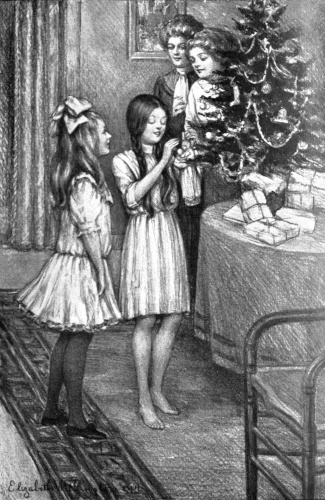
When Celeste touched the statue, which Maisie had hung in the most
prominent position on the tree, she started back with a little cry of
astonishment.
"It is the blessed Mother with the little Jesus in her arms!" she
exclaimed. "Oh, may I really take it in my hands again?"
"Oh, may I really take it?"
"Of course you may," cried Maisie, who was almost beside herself with
delight and excitement. "Didn't I tell you everything on the tree was
yours? You can take the statue home with you, and keep it forever."
That was almost too much for the little blind girl, and to Maisie's
horror, she suddenly burst into tears.
"Oh, don't cry, please don't," cried Maisie, her brown eyes big with
dismay. "You'll spoil everything if you do, and we are having such a
good time."
Thus urged, Celeste dried her tears, and smiled instead, but when, a
few moments later, Maisie was leading her round the table to examine
new wonders, she suddenly slipped an arm about her new friend's neck
and kissed her.
"I think you must be something like the angels in Heaven," she said,
simply, at which astounding compliment Maisie felt herself blushing
scarlet. But when all the excitement of the tree was over, and Maisie
had taken her visitor to her own room, while Mrs. Barton and Auntie
Belle went away to dress for the afternoon, Celeste grew suddenly very
quiet. She still clasped the little statue to her heart, as if fearful
that it might melt away or vanish if she put it down, but all the
joy and brightness slowly faded out of her face, and a sad, anxious
expression took its place.
Maisie watched her in growing anxiety, fearing she must be homesick.
"The surprises aren't nearly over yet," she explained, when she had
finished showing Celeste her own presents, in which the little blind
girl had not appeared quite as much interested as she had expected.
"You haven't the least idea what is going to happen after luncheon."
"I think perhaps I should go home soon," Celeste said, anxiously.
"Maman Remo is all alone."
"Oh, but you can't go home till after the—I mean till quite late,"
protested Maisie, feeling more certain than ever that her guest was
suffering from homesickness. "I am sure Maman Remo won't mind your
staying. She will love hearing all about everything afterwards. Mamma
always loves hearing about my good times when I come home."
But Celeste still looked sad and unconvinced.
"Your maman is different," she said. "She is a rich lady, and I don't
suppose rich ladies are ever lonely and unhappy."
"Oh, yes they are," said Maisie, with conviction. "My grandma was very
unhappy for a long time after my grandpa died. I used to have to go and
see her almost every day, and bring her flowers, and she stayed in her
room with the shades all down, and cried. It was very uncomfortable
going to see her while she was like that, but mamma said I had to do
it. We were all so glad when she began to be cheerful again."
"Maman Remo is never like that," said Celeste. "She is always cheerful,
and she would not have time to stay in her room and cry, but when she
is anxious and unhappy I can always hear it in her voice."
"And is she anxious and unhappy now?" questioned Maisie.
"Oh, yes, very; I do not think she was ever quite so anxious before,
even after Papa Remo was killed. She does not think I know, but I do."
"Is it about Pierre—hasn't he come home yet?"
"It is a little about that, but there is something else
besides—something much worse. We have heard from Pierre, and he is
well. A letter came to Maman Remo this morning, telling about him. It
was from a man she knows in St. Raphael. Pierre walked all the way to
St. Raphael, and this man—who is a sailor—met him in the street, and
took him to his house. Pierre was very hungry, and maman's friend was
sorry for him, and when Pierre had told how he had run away, and wanted
to go to sea, he promised to help him find a place on a ship. He knows
the captain of a ship that sails for Algiers this week, and he thinks
he can get Pierre a place on board as cabin-boy. He wrote maman all
about it, and he says he thinks letting Pierre go to sea will make a
man of him. Maman cannot read herself, but Antoine Dupont came in to
wish us Joyeuse Noel, and he read the letter to her."
"Well, if she knows Pierre is all right, I don't see why she should be
so unhappy."
"Ah, but I told you there was something much worse than about Pierre.
I only heard it last night, and maman must not know that I have found
out until to-morrow, because she wants me to have Joyeuse Noel, and
she would be still more sad if she knew that I was unhappy too."
Celeste's lip quivered, and the tears started to her eyes, but she
winked them back resolutely, remembering what Maisie had said about
spoiling everything if she cried. The two children were sitting on
the sofa together, and Celeste's lap was filled with the trinkets her
friend had been showing her. With a sudden, kindly impulse, Maisie
slipped an arm round her little visitor's waist.
"Would you mind telling me about it?" she said, in an unusually gentle
voice. "Perhaps we may be able to help you."
"I am afraid you could not help us," said Celeste, sadly, "but you are
very kind, and I don't mind telling you. I heard Maman Remo talking to
Madame Dupont last night after I was in bed. They were downstairs, but
I could hear every word through the hole in the floor. Maman went to
see the doctor yesterday, and he says she must go to the hospital and
have an operation, and when she comes out again she will not be strong
enough to work for a long time."
"One of my aunts had an operation," said Maisie, deeply interested.
"She was very ill, but she is all right again now, and I heard her tell
mamma she hadn't felt so strong in years."
"The doctor says maman will be strong again in six months if she does
what he tells her to, but how can she live if she cannot work for six
months?"
"Won't her relations help her? Everybody was very good to Aunt Nelly
when she had her operation, but she didn't need any money, because her
husband—my Uncle George—has a great deal."
"Poor maman has no relations except Pierre, and he has gone away.
Madame Dupont said her friends would help her, but maman is very proud,
she does not like to take money from people. If I could only work for
her, but there is nothing I can do. I cannot even sing in the streets
any more now that Pierre is not here, and maman is so unhappy because
she is afraid she will have to send me to the orphan asylum."
"Oh, that would be dreadful!" exclaimed Maisie, who had once been taken
to a fair at an orphan asylum at home, and remembered thinking it a
very dismal place, where all the little girls dressed just alike in
very ugly clothes. "Why can't she send you to that school in Paris
that you were telling us about?"
"She would send me there if she could, but the journey costs so much,
and there would be no one to take me so far."
This was a new idea, and for a moment Maisie was silent, being really
unable to think of any suggestion to make. But it was only for a
moment; then her usual hopefulness asserted itself once more.
"I wouldn't worry about it if I were you," she said, reassuringly.
"Don't you remember what I told you the other day about not worrying
over things? Just as likely as not something nice will happen. Perhaps
Maman Remo won't have to go to the hospital, after all, or if she does,
perhaps somebody will just happen to be going to Paris, and will offer
to take you and buy your ticket. I don't believe it costs such a great
deal. We came from Paris on the night train, and slept in such funny
little staterooms, smaller than the ones on the steamers. Papa didn't
say anything about it's being so very expensive. You know you thought
the little statue was very expensive, but it really wasn't."
"Ah, but you are so rich," said Celeste, with a sigh; "nothing seems
expensive to you."
"Well, don't worry, anyway, at least not till Christmas is over. I do
want you to have a good time all day, and people can't have good times
when they are worrying."
Celeste smiled faintly. She was really only two years older than
Maisie, but to her the little American seemed very young indeed.
"I will try not to worry," she said, "and indeed you have given me a
beautiful Christmas." And she laid her hand lovingly upon the little
statue, which was lying beside her on the sofa.
"That's right," said Maisie, much relieved. "Now, here comes Françoise
to get me ready for luncheon, and after luncheon we are going—you will
never guess where, and I shall not tell you, because I want it to be
the greatest surprise of all."
Mr. and Mrs. Barton and Auntie Belle watched the little girl with a
good deal of interest during luncheon.
Maman Remo was a very ignorant woman, who could neither read nor
write, but she had once lived as housemaid in a French family, and she
had never forgotten the things she had seen there. Celeste's mother
had been a lady, and it was only right and proper that her little
daughter should be taught to do things as ladies did them. Celeste's
table manners were as neat and dainty as those of Maisie herself, and
although rather shy and silent in the presence of these strange, grand
people, she was so sweet and gentle that before the meal was over,
she had won the hearty liking of the whole family. When the ice cream
appeared, and Celeste was helped to a bountiful supply, Maisie watched
her with deep interest.
"Do you like it?" she demanded, as Celeste put the first spoonful into
her mouth, and her friend answered heartily, even shyness forgotten for
the moment—
"Oh, but it is delicious!"
"I knew she wouldn't say that horrid thing about sausages and olives,"
Maisie remarked triumphantly in English, to her aunt, at which remark
everybody laughed, and Celeste, who did not understand English,
blushed, and hoped she hadn't said anything wrong.
It was necessary to hurry a little, as the afternoon performance at
the opera began at two o'clock, and Celeste had only just swallowed
her last spoonful of ice cream when they all rose from the table, and
Maisie took her away to put on her hat. Celeste wondered very much
as to where they could be going, but Maisie had said it was to be a
surprise, and she refrained from asking any questions. But when they
had all left the hotel, and she had been helped into Mr. Barton's big
limousine motor car, her curiosity became too great to be borne any
longer.
"Are we going for a ride in this?" she whispered to Auntie Belle,
who sat next to her. She somehow felt more at ease with Maisie's
pleasant-voiced young aunt than with the other grown-ups. Auntie Belle
laughed.
"You will know in a few moments where we are going," she said, and just
then the car started with a jerk, and Celeste, who had never been in a
motor car before in her life, could do nothing but hold on to the side
with all her might, and gasp for breath.
"Don't you like it?" laughed Maisie. "Oh, you will get used to it in a
minute, and then you will think it great fun! I remember that I was a
little frightened at first."
But before Celeste had had time to "get used to it," the car had
stopped again, and they were all getting out. There seemed to be a
great crowd of people, through which she was safely piloted, and then
she was in a seat, with Auntie Belle on one side of her and Maisie on
the other.
"Now guess where we are," cried Maisie, delightedly; "can't you really
guess?"
But Celeste was too much puzzled and bewildered to form any clear ideas
about anything.
"We talked about this place the other day," Maisie went on, too much
excited to waste any more time in guessing. "You said Madame Dupont
came here sometimes, but Maman Remo couldn't afford it. Your brother,
Louis, liked it better than any other place in the world, and your
father—"
"The opera!" gasped Celeste, with a sudden recollection. "Oh,
mademoiselle, is it really the opera?"
"Of course it is," said Maisie, joyously. "Aren't you glad?" But to her
surprise, Celeste did not answer. She had grown rather pale, and there
were actually tears in her eyes.
"Don't you like it, dear?" Auntie Belle asked, giving the little hand
beside her an encouraging pat.
"Like it! Oh, but it is too wonderful! I never believed that I should
truly go to the opera."
"Well, you are here, you see," said Maisie, much relieved by this
expression of feeling. She was beginning to fear her friend was not
as much pleased as she had expected her to be. "It's going to be a
beautiful opera, too. It's called 'Mignon,' and papa says the music is
lovely, and the best of all is, that tenor you wanted to hear so much
is going to sing."
"Oh!" said Celeste, and that was all, but her radiant face was more
expressive than any words could have been.
"Auntie Belle heard him the other night," Maisie chattered on. "Some
friends invited her, and she says he really has got a beautiful voice.
He's awfully handsome, too. Auntie Belle bought his photograph. O dear,
there's the orchestra beginning, and we can't talk any more!"
If any one had doubted the fact that the little blind girl loved music
with her whole soul, it would have required only one glance at the
child's radiant face during the overture, to banish all such doubts
at once, and forever. The Bartons all watched her with keen interest,
as she sat leaning forward in her seat, with hands clasped, and lips
apart, drinking in the music as if it were her very life. Maisie gazed
at her new friend with eyes round with astonishment. Was it possible
that any human being could really love music like that? She thought
of how often she had grumbled at being obliged to go to concerts with
her mother, and what a bore she had found them. If only she and Celeste
could have changed places on those occasions. Auntie Belle, who loved
music almost as much as Celeste did, felt suddenly drawn to the little
stranger by a bond of sympathy. Mrs. Barton remembered her doubts of
the morning, and her kind heart smote her for having hesitated even for
a moment to give the child such a pleasure.
When the curtain rose upon the gay scene of gypsies and villagers,
Maisie's attention wandered a little from Celeste's face to the stage
and for a few moments she almost forgot her friend in her interest in
the scene before her. Suddenly there was a slight rustle among the
audience as the sound of a rich, clear tenor voice was heard drawing
nearer; and as Wilhelm-Meister stepped out upon the stage, almost every
head was craned forward to catch the first glimpse of the popular young
singer.
"He looks just like his picture, doesn't he?" Maisie whispered to her
aunt. "I think he's the handsomest—"
Maisie paused abruptly, attracted by a slight sound from Celeste, and
turning to see what the matter was, she was rendered fairly speechless
with astonishment by the look on the little blind girl's face. Auntie
Belle also heard the half-suppressed cry, and she, too, turned to look
at Celeste.
"What is the matter, dear?" she whispered anxiously, bending over the
child. "Don't you feel well?"
"Oh, yes, thank you, but—but—pardon, Mademoiselle, but might I ask
you to tell me the gentleman's name?"
"The gentleman," repeated Auntie Belle, looking puzzled; "what
gentleman? Oh, you mean Wilhelm-Meister. His name is Claude Lorraine.
Why, my poor child, what is it? You must be ill. You had better let my
brother take you out."
"No, no," gasped Celeste, who was trembling from head to foot, and
whose face had grown ghastly white; "I do not want to go out. I want to
stay and hear him sing. Oh, mademoiselle, the good God has been very
kind to us!"
Auntie Belle stared at the child in amazement; she had never been so
puzzled in her life, but into Maisie's eyes there flashed a sudden
light, and forgetting for the moment where she was, and all her
mother's cautions about not talking at the opera, she almost sprang
out of her seat, crying excitedly, "It's Louis, I know it is!"
"Oh, Celeste, tell me, is it really Louis?"
"Yes," said Celeste, in a breathless whisper. "I knew his voice the
moment I heard it, and Claude Lorraine was my papa's stage name; Louis
must have taken it too. Oh, Mademoiselle Maisie, Mademoiselle Maisie!"
and the poor little blind girl burst into tears.
But by this time the little excitement was beginning to be noticed
by the audience, and indignant hisses were heard on all sides. Mr.
and Mrs. Barton turned to discover what had caused the disturbance,
and were not reassured by the sight of Celeste in tears, Auntie Belle
looking the picture of dismay, and Maisie jumping up and down in her
seat, and acting very much as though she had lost her senses. And
during all the commotion the clear tenor voice sang on, its owner
quite unconscious of the fact that his presence had caused any unusual
excitement.
Strange to say, it was Celeste herself who was the first to recover.
She checked her sobs, with a mighty effort, and slipped one little
trembling hand into Auntie Belle's, and the other into Maisie's.
"We must be very quiet," she whispered, "or the people will be angry.
Let us listen. I want to hear every note Louis sings."
"What in the world is the matter?" Mr. Barton whispered to his sister,
and Auntie Belle replied that she did not know but believed the tenor
must be a friend or relative of Celeste's, and that she had recognized
him by his voice.
During the rest of that act not one of the party had eyes or thoughts
to spare for anything that was going on the stage. The music and
singing were of the best, and the acting excellent, but the Bartons
looked only at Celeste. Maisie was the only one who knew what had
really happened, and she had been so frightened by those ominous
hisses, that she did not dare open her lips again, even to whisper
the wonderful news to Auntie Belle. But it was easy to see that the
little blind girl was very much excited, and that something unusual had
occurred. After the first few moments the child had ceased to tremble,
and by degrees a little color began to creep back into her face. She
sat, leaning forward in her seat, as if afraid to miss a single note,
and gradually her expression settled into a look of such radiant
happiness, that her kind new friends could do nothing but gaze at her,
in ever increasing astonishment.
At last the curtain fell upon the first act, amid a thunder of
applause, and instantly Maisie's tongue was loosed.
"It's her brother!" she cried, jumping out of her seat in her
excitement. "She hasn't seen him in four whole years. He went away to
seek his fortune, and she hadn't any idea what had become of him. She
was so afraid he might be poor, but I told her I was sure he would come
back rich, the way people always do in stories. Oh, isn't it the most
wonderful, interesting thing you ever heard of in all your lives? Don't
you want to go right off this minute and see him, Celeste?"
But Celeste shook her head.
"I would rather wait till the opera is over," she said. "If he saw me
before he might not be able to sing so well. I want to hear him sing
the whole opera before he knows I am here. After that if your papa will
be so kind—"
But when Mr. Barton had at last been made to understand the wonderful
story, he did not look as much impressed by Celeste's good fortune as
Maisie and Auntie Belle expected he would.
"You had better let me have a talk with the fellow first," he said in
English to Auntie Belle. "He has been singing here in Nice for weeks.
If he had really been anxious to find his little sister, it seems
incredible that he should not have found her before. I haven't as much
faith in these long-lost brothers as some of you have, and I don't want
that poor child's innocent little heart broken if I can help it." And
Mr. Barton glanced pityingly at Celeste's radiant face.
Fortunately for Celeste, she could not understand one word of English,
and so was spared all the discussion which followed. She continued to
smile the smile of unutterable rapture, and sometimes her lips moved as
if she were saying her prayers. Auntie Belle and Maisie both felt lumps
in their throats whenever they looked at her, and Mrs. Barton was seen
to wipe her eyes more than once.
"I feel just as if I were in heaven," Celeste whispered to Maisie, when
the curtain had risen on the second act, and the beautiful tenor voice
was heard again. Maisie dared not answer, for fear of those dreadful
hisses, but she slipped an arm around her friend, and hugged her, in a
burst of sympathy that said more than any words could have done.
"Now, Celeste," said Mr. Barton in his kind, sensible voice, when the
opera was over, and they were making their way out through the crowd,
"we are going to take you back to the hotel. I have sent a line to your
brother, asking him to meet me there as soon as possible on a matter
of importance. It will be much pleasanter for you both to meet at the
hotel than in all this crowd and confusion."
Celeste—who was trembling again so that she could scarcely stand—made
no objection, and allowed herself to be helped into the motor car,
without uttering a word. She spoke only once on the way home, and then
it was to ask in a timid voice, how soon Mr. Barton thought Louis would
come to the hotel, to which he replied that he was sure her brother
would come as soon as he could get away from the opera house.
"Curiosity will bring him if nothing else does," he added in English,
but that Celeste did not understand.
Arrived at the hotel, Maisie was told to take Celeste to her room, and
keep her there till she was sent for, and the elders waited in the
sitting-room, in a state of breathless anticipation.
"I feel as if I were acting a part in a play," Auntie Belle said, with
a little hysterical giggle. "Oh, Harry, if that poor child is doomed to
a disappointment, I really don't know what I shall do! Did you ever
see such a look of rapture on any human face? But it is all right, I
know it is. No man with a voice like that could be anything but good."
Auntie Belle paused abruptly, for at that moment there was a knock at
the door. The tenor had evidently been curious to learn the meaning
of Mr. Barton's mysterious summons, for he had followed them almost
immediately.
He was a tall, handsome young fellow, with a frank, boyish face, and as
he came forward into the room, Mrs. Barton and Auntie Belle felt their
hopes rise instinctively.
"Monsieur Lorraine, I believe," said Mr. Barton, courteously, as he
shook hands with the young man. "I trust you will pardon my sending for
you so unceremoniously. Allow me to present my wife and sister. We have
all been to the opera this afternoon, and have been charmed by your
singing."
The tenor bowed deeply to the two ladies, and blushed boyishly at the
compliment. Indeed, he looked so young, and so honest and pleasant
as well, that Mr. Barton found himself addressing him in a much more
friendly tone than he would have believed possible five minutes
earlier.
"I have sent for you to talk over a matter which interests us all
very much," he said, when they were seated, and Monsieur Lorraine had
somewhat recovered from his first embarrassment. "I said before that we
have been charmed with your singing. May I ask how long you have been
on the stage?"
"I made my début in Paris last autumn," said the young man, in a
pleasant, refined voice, that somehow reminded them all of Celeste's.
"Indeed? Then I presume you have never been to America."
"On the contrary," said the tenor, smiling, "I have spent over two
years in America. Indeed, it is to the kindness of an American
gentleman that I owe my present good fortune. I was singing at a
vaudeville theatre in Chicago about three years ago, and was about
as poor and discouraged as one could well be, when this gentleman—a
Mr. Richardson of New York, who had happened to drop into the place,
out of mere curiosity—became interested in my voice. He spoke to me
after the performance, gave me his card, and advised my coming to
New York and studying at the conservatory there. I followed his kind
advice, he became my friend and benefactor, and it is to him that I
owe everything. I have good reason to love America and the American
people."
The young man spoke earnestly, and Mr. Barton felt his good opinion
rising.
"You are a Frenchman, I know that by your accent," he said. "Is your
home in this part of the country?"
"No, monsieur. I have never been in Nice before. My parents lived in
Paris, and my father sang at the Opera Comique for several years before
his death."
"Are your parents both dead?"
"Yes, monsieur."
"You are young to be alone in the world—have you no near relatives?"
A shadow crossed the young man's face. Auntie Belle's heart was beating
so fast that she was almost afraid the tenor would hear it.
"I have one little sister," he said sadly. "She is still but a child,
many years younger than I."
"Ah, I see, and is this little sister with you now?"
"Alas, no, monsieur, but I would gladly give all I have in the world to
find her."
Auntie Belle could not repress a little chuckle of delight, and she
gave her brother a triumphant glance, but Mr. Barton went quietly on
with his questioning.
"What do you mean by that? Surely you must know where your little
sister is."
"Ah, monsieur, it is a long story, and a very sad one. When our parents
died five years ago, we were very poor indeed. My father had been ill
a long time, and had left us nothing. I had my voice, and—pardon me,
monsieur, if what I say sounds conceited—I knew I could support myself
by singing if I could only get the chance. But there was my little
blind sister. She has been blind from birth, monsieur, and I could not
bear to leave her alone among strangers. Yet I could not take her with
me, perhaps to starve. We had been lodging with some kind people at the
time of our mother's death, and the woman had taken a great fancy to
little Celeste. She told me that if I would leave the child with her,
she would care for her, and be a mother to her until my return. She
was a very ignorant woman, who could neither read nor write, but her
husband was better educated, and they were both good, religious people.
They kept a little shop in Paris, and were comfortably off. It was very
hard to part from little Celeste, for we loved each other tenderly, and
my mother had left her in my care. Still, it seemed the only thing to
do, and I knew I was leaving her in good hands.
"Things went very badly with me for the first year, and I was too
discouraged to write the husband of my ill luck, but as soon as I
began to earn a little money, I wrote at once, sending a small sum
towards my sister's support. I never received any answer, and although
I wrote again and again, not a word ever reached me in reply. As soon
as I came back to Paris this year, I went to the address where I had
left my little sister, but found that the family had moved away three
years ago, and no one in the neighborhood knew where they had gone. The
man, it seems, was run over and killed by a motor car, and his wife
left Paris soon afterward, taking the child with her. As she could not
write, she had not communicated with any of her friends, and not one
among them all could give me her address.
"Since then I have done everything in my power to trace my little
sister, but so far without success. I feel sometimes as if I should go
mad with anxiety about the child, and the hardest of all is that now
when at last I am in a position to support her, and bring her up as my
mother would have wished, I cannot even find out what has become of
her. But pardon me, monsieur, for talking so much of my own affairs, in
which you cannot possibly be interested."
"On the contrary," said Mr. Barton, kindly, "I am very much interested
indeed. To tell the truth, it was for the purpose of hearing just this
very story that I sent for you this afternoon. I have an idea that I
may be able to put you in the way of getting some information about
your little blind sister."
"You, monsieur!" The young man had sprung out of his chair, and seized
Mr. Barton's hand before that gentleman had finished his sentence. "Oh,
monsieur, if this is true—if you can indeed assist me in my search for
poor little Celeste—I shall be grateful to you all my life."
The tenor's honest, boyish face was full of feeling, and his voice
trembled. Auntie Belle—who was romantic—thought him the most
interesting person she had ever seen. Mr. Barton freed his hand gently
from the young man's eager clasp, and went to the door.
"Maisie," he called cheerfully, "you may come now, and bring your
little friend with you."
There was a hurrying of little feet, and Maisie rushed into the room,
fairly dragging the trembling Celeste after her.
"Celeste, my little Celeste!"
With one bound, the tenor was across the room, and had caught the
little blind girl in his arms.
"And to think," sobbed Celeste, with her arms round her brother's neck,
"that the good God sent you back to us on Christmas day! Maman Remo
says I must always be happy on Christmas, because of my name.
"I knew your voice the moment I heard it, but I did not want you to
see me till the opera was over. Oh, Louis, cherie, you sing like an
angel!"
Maman Remo was sitting alone in her little house, waiting for Celeste
to come home. It had been dark for more than an hour, and she had
lighted the lamp, and built up a good fire in the stove, but she would
not make any preparations for supper until Celeste should come in.
"Perhaps the little one will not be hungry," she said to herself.
"Those Americans are always feasting on holidays. Poor child, I hope
she has had a happy day. To-morrow she must know, for I dare not put
it off any longer. The doctor said I must go as soon as possible. She
will take it hard, poor child, but surely they will be kind to her at
the asylum, and if I am ever well and strong again, she can come back
to me, and things will be as they have been."
Maman Remo heaved a deep sigh, and put up her hand to brush away a
tear. The day had been very long and lonely.
Suddenly she turned her head and listened. Footsteps were approaching,
and voices. Yes, that was Celeste's voice, and how happy it sounded.
Surely the child had had Joyeuse Noel. The footsteps drew nearer,
some one opened the door, and two people came in.
Maman Remo rose and courtesied. She did not recognize the tall young
gentleman, who was leading Celeste by the hand, but supposed him to be
one of the American family who had been so kind to the child all day.
"Maman Remo, don't you know me?"
"Louis, Louis Noel!" Maman Remo sank back into her chair, and turned so
white that for a moment Louis feared she was going to faint. "Oh, my
God, is it really Louis Noel?"
"Yes, yes, Maman, it is really Louis, our own Louis, come back to us
safe and well," cried Celeste, flinging herself upon Maman Remo in a
perfect ecstasy of delight. "Oh, isn't it beautiful and wonderful that
he should have come on Christmas day? And, oh, Maman cherie, he is
not poor; he is rich, as Mademoiselle Maisie said he would be. I have
heard him sing at the opera, and truly he has the voice of an angel."
Maman Remo's lips moved, but no sound came from them. Louis Noel came
quickly forward, and took the two trembling hands in his. His own eyes
were full of tears.
"Maman Remo," he said, in a low, unsteady voice, "there are no words in
which to thank you. Celeste has told me everything, and I don't know
what to say. It is true, as the little one says, I am not poor. I am
doing good work with my voice, and have an engagement to sing at the
opera in New York next season. All I ask is that you will let me take
care of you and Celeste; not in payment for your care of the child, for
that is something that can never be repaid in this world, but because I
love and honor you beyond all other women except my mother." And Louis
Noel bent and kissed Maman Remo very tenderly.
"Well, Maisie, and what sort of a Christmas has it been?" Mr. Barton
asked, smiling, as his little daughter was bidding him good-night.
"Oh, Papa," cried Maisie, with sparkling eyes, "it has been the very
loveliest Christmas I have ever had. I do believe it's more interesting
to give other people a good time than to have it one's self. But
there's one funny thing about it."
"And what is that?" her father asked, stooping to kiss the happy, eager
little face.
"Why," said Maisie, laughing, "it's a very queer thing, but I never had
quite such a Merry Christmas before, even at home, with the Christmas
trees, and the parties, and all the presents. Oh, Papa dear, when I
think of that sweet Celeste's face when she went away with her brother,
and remember that if it hadn't been for your wanting me to try that
experiment, Louis might have gone away again without ever knowing she
was here, I feel so happy that I think I should like to hug everybody
in the world!"