PART I NAVAL PRINCIPLES — I. The Value of Historical Study [13] — 2. “ Theoretical ” versus “ Practical ” Training [14] . — A Historical Instance — What is Practical? — 3. Elements of Sea Power [16] — 4. Definition of Terms [20] — Strategy, Tactics, Logistics — 5. Fundamental Principles [21] — Central Position, Interior Lines, Communications — Concentration — 6. Strategic Positions [24] — I. Situation — II. Military Strength — III. Resources — 7. Strategic Lines [25] — Communications — Importance of Sea Communications [26] — 8. Offensive Operations [27] — 9. The Value of the Defensive [28] — 10. Commerce-Destroying and Blockade [29] — Command of the Sea Decisive [31] — 11. Strategic Features of the Gulf of Mexico and the Caribbean [33] — 12. Principles of Naval Administration — Opposing Elements [34] — The British System [35] — The United States System [36] — 13. The Military Rule of Obedience [38] — 14. Preparedness for Naval War [39]
3
The history of Sea Power is largely, though by
no means solely, a narrative of contests between
nations, of mutual rivalries, of violence frequently
culminating in war. The profound influence of sea
commerce upon the wealth and strength of countries
was clearly seen long before the true principles which
governed its growth and prosperity were detected.
To secure to one’s own people a disproportionate
share of such benefits, every effort was made to
exclude others, either by the peaceful legislative
methods of monopoly or prohibitory regulations, or,
when these failed, by direct violence. The clash of
interests, the angry feelings roused by conflicting
attempts thus to appropriate the larger share, if not
the whole, of the advantages of commerce, and of
distant unsettled commercial regions, led to wars.
On the other hand, wars arising from other causes
have been greatly modified in their conduct and issue
by the control of the sea. Therefore the history of
sea power, while embracing in its broad sweep all
4that tends to make a people great upon the sea or
by the sea, is largely a military history; and it is in
this aspect that it will be mainly, though not exclusively,
regarded in the following pages.
A study of the military history of the past, such
as this, is enjoined by great military leaders as essential
to correct ideas and to the skillful conduct of war
in the future. Napoleon names among the campaigns
to be studied by the aspiring soldier, those of
Alexander, Hannibal, and Cæsar, to whom gunpowder
was unknown; and there is a substantial
agreement among professional writers that, while
many of the conditions of war vary from age to age
with the progress of weapons, there are certain
teachings in the school of history which remain constant,
and being, therefore, of universal application,
can be elevated to the rank of general principles.
For the same reason the study of the sea history of
the past will be found instructive, by its illustration
of the general principles of maritime war, notwithstanding
the great changes that have been brought
about in naval weapons by the scientific advances of
the past half-century, and by the introduction of
steam as the motive power. [The pages omitted
point out lessons to be drawn from galley and
sailing-ship warfare.—Editor.]
Before hostile armies or fleets are brought into
contact (a word which perhaps better than any other
indicates the dividing line between tactics and strategy),
there are a number of questions to be decided,
covering the whole plan of operations throughout
the theater of war. Among these are the proper
5function of the navy in the war; its true objective;
the point or points upon which it should be concentrated;
the establishment of depots of coal and supplies;
the maintenance of communications between
these depots and the home base; the military value
of commerce-destroying as a decisive or a secondary
operation of war; the system upon which commerce-destroying
can be most efficiently conducted, whether
by scattered cruisers or by holding in force some
vital center through which commercial shipping must
pass. All these are strategic questions, and upon all
these history has a great deal to say. There has
been of late a valuable discussion in English naval
circles as to the comparative merits of the policies
of two great English admirals, Lord Howe and Lord
St. Vincent, in the disposition of the English navy
when at war with France. The question is purely
strategic, and is not of mere historical interest; it is
of vital importance now, and the principles upon
which its decision rests are the same now as then.
St. Vincent’s policy saved England from invasion,
and in the hands of Nelson and his brother admirals
led straight up to Trafalgar.
It is then particularly in the field of naval strategy
that the teachings of the past have a value which is
in no degree lessened. They are there useful not
only as illustrative of principles, but also as precedents,
owing to the comparative permanence of the
conditions. This is less obviously true as to tactics,
when the fleets come into collision at the point to
which strategic considerations have brought them.
The unresting progress of mankind causes continual
6change in the weapons; and with that must come a
continual change in the manner of fighting,—in the
handling and disposition of troops or ships on the
battlefield. Hence arises a tendency on the part of
many connected with maritime matters to think that
no advantage is to be gained from the study of
former experiences; that time so used is wasted.
This view, though natural, not only leaves wholly out
of sight those broad strategic considerations which
lead nations to put fleets afloat, which direct the
sphere of their action, and so have modified and will
continue to modify the history of the world, but is
one-sided and narrow even as to tactics. The battles
of the past succeeded or failed according as they
were fought in conformity with the principles of
war; and the seaman who carefully studies the causes
of success or failure will not only detect and gradually
assimilate these principles, but will also acquire
increased aptitude in applying them to the tactical
use of the ships and weapons of his own day. He
will observe also that changes of tactics have not
only taken place after changes in weapons, which
necessarily is the case, but that the interval between
such changes has been unduly long. This doubtless
arises from the fact that an improvement of weapons
is due to the energy of one or two men, while changes
in tactics have to overcome the inertia of a conservative
class; but it is a great evil. It can be remedied
only by a candid recognition of each change, by careful
study of the powers and limitations of the new
ship or weapon, and by a consequent adaptation of
the method of using it to the qualities it possesses,
7which will constitute its tactics. History shows that
it is vain to hope that military men generally will be
at the pains to do this, but that the one who does will
go into battle with a great advantage,—a lesson
in itself of no mean value.
8
There have long been two conflicting opinions
as to the best way to fit naval officers, and indeed
all men called to active pursuits, for the discharge
of their duties. The one, of the so-called
practical man, would find in early beginning and constant
remaining afloat all that is requisite; the other
will find the best result in study, in elaborate mental
preparation. I have no hesitation in avowing that
personally I think that the United States Navy is
erring on the latter side; but, be that as it may,
there seems little doubt that the mental activity
which exists so widely is not directed toward the
management of ships in battle, to the planning of
naval campaigns, to the study of strategic and tactical
problems, nor even to the secondary matters
connected with the maintenance of warlike operations
at sea.[15] Now we have had the results of the
two opinions as to the training of naval officers
pretty well tested by the experience of two great
maritime nations, France and England, each of
which, not so much by formulated purpose as by
national bias, committed itself unduly to the one or
9the other. The results were manifested in our War
of Independence, which gave rise to the only well-contested,
widespread maritime war between nearly
equal forces that modern history records. There
remains in my own mind no doubt, after reading the
naval history on both sides, that the English brought
to this struggle much superior seamanship, learned
by the constant practice of shipboard; while the
French officers, most of whom had been debarred
from similar experience by the decadence of their
navy in the middle of the century, had devoted
themselves to the careful study of their profession.
In short, what are commonly called the practical
and the theoretical man were pitted against each
other, and the result showed how mischievous is
any plan which neglects either theory or practice,
or which ignores the fact that correct theoretical
ideas are essential to successful practical work.
The practical seamanship and experience of the
English were continually foiled by the want of correct
tactical conceptions on the part of their own
chiefs, and the superior science of the French, acquired
mainly by study. It is true that the latter
were guided by a false policy on the part of their
government and a false professional tradition. The
navy, by its mobility, is pre-eminently fitted for offensive
war, and the French deliberately and constantly
subordinated it to defensive action. But, though
the system was faulty, they had a system; they had
ideas; they had plans familiar to their officers, while
the English usually had none—and a poor system
is better than none at all....
10
It was said to me by some one: “If you want
to attract officers to the College, give them something
that will help them pass their next examination.”
But the test of war, when it comes, will
be found a more searching trial of what is in a
man than the verdict of several amiable gentlemen,
disposed to give the benefit of every doubt.
Then you will encounter men straining every
faculty and every means to injure you. Shall we
then, who prepare so anxiously for an examination,
view as a “practical” proceeding, worthy of
“practical” men, the postponing to the very moment
of imperative action the consideration of how
to act, how to do our fighting, either in the broader
domain of strategy, or in the more limited field of
tactics, whether of the single ship or of the fleet?
Navies exist for war; and the question presses for
an answer: “Is this neglect to master the experience
of the past, to elicit, formulate, and absorb its principles,
is it practical?” Is it “practical” to wait
till the squall strikes you before shortening sail?
If the object and aim of the College is to promote
such study, to facilitate such results, to foster and
disseminate such ideas, can it be reproached that its
purpose is not “practical,” even though at first its
methods be tentative and its results imperfect?
The word “practical” has suffered and been debased
by a misapprehension of that other word
“theoretical,” to which it is accurately and logically
11opposed. Theory is properly defined as a scheme
of things which terminates in speculation, or contemplation,
without a view to practice. The idea
was amusingly expressed in the toast, said to have
been drunk at a meeting of mathematicians, “Eternal
perdition to the man who would degrade pure
mathematics by applying it to any useful purpose.”
The word “theoretical,” therefore, is applied
rightly and legitimately only to mental processes
that end in themselves, that have no result in action;
but by a natural, yet most unfortunate, confusion of
thought, it has come to be applied to all mental
processes whatsoever, whether fruitful or not, and
has transferred its stigma to them, while “practical”
has walked off with all the honors of a
utilitarian age.
If therefore the line of thought, study and reflection,
which the War College seeks to promote, is
really liable to the reproach that it leads to no useful
end, can result in no effective action, it falls
justly under the condemnation of being not “practical.”
But it must be said frankly and fearlessly
that the man who is prepared to apply this stigma
to the line of the College effort must also be prepared
to class as not “practical” men like Napoleon,
like his distinguished opponent, the Austrian
Archduke Charles, and like Jomini, the profuse
writer on military art and military history, whose
works, if somewhat supplanted by newer digests,
have lost little or none of their prestige as a profound
study and exposition of the principles of
warfare.
12Jomini was not merely a military theorist, who
saw war from the outside; he was a distinguished
and thoughtful soldier, in the prime of life during
the Napoleonic wars, and of a contemporary reputation
such that, when he deserted the cause of the
emperor, he was taken at once into a high position
as a confidential adviser of the allied sovereigns.
Yet what does he say of strategy? Strategy is to
him the queen of military sciences; it underlies the
fortunes of every campaign. As in a building,
which, however fair and beautiful the superstructure,
is radically marred and imperfect if the foundation
be insecure—so, if the strategy be wrong,
the skill of the general on the battlefield, the valor
of the soldier, the brilliancy of victory, however
otherwise decisive, fail of their effect. Yet how
does he define strategy, the effects of which, if thus
far-reaching, must surely be esteemed “practical”?
“Strategy,” he said, “is the art of making war upon
the map. It precedes the operations of the campaign,
the clash of arms on the field. It is done in
the cabinet, it is the work of the student, with his
dividers in his hand and his information lying beside
him.” In other words, it originates in a mental
process, but it does not end there; therefore it is
practical.
Most of us have heard an anecdote of the great
Napoleon, which is nevertheless so apt to my purpose
that I must risk the repetition. Having had
no time to verify my reference, I must quote from
memory, but of substantial accuracy I am sure. A
few weeks before one of his early and most decisive
13campaigns, his secretary, Bourrienne, entered the
office and found the First Consul, as he then was,
stretched on the floor with a large map before him.
Pricked over the map, in what to Bourrienne was
confusion, were a number of red and black pins.
After a short silence the secretary, who was an old
friend of school days, asked him what it all meant.
The Consul laughed goodnaturedly, called him a
fool, and said: “This set of pins represents the
Austrians and this the French. On such a day I
shall leave Paris. My troops will then be in such
positions. On a certain day,” naming it, “I shall
be here,” pointing, “and my troops will have moved
there. At such a time I shall cross the mountains,
a few days later my army will be here, the Austrians
will have done thus and so; and at a certain
date I will beat them here,” placing a pin. Bourrienne
said nothing, perhaps he may have thought
the matter not “practical;” but a few weeks later,
after the battle (Marengo, I think) had been
fought, he was seated with the general in his military
traveling carriage. The programme had
been carried out, and he recalled the incident to
Bonaparte’s mind. The latter himself smiled at
the singular accuracy of his predictions in the particular
instance.
In the light of such an incident, the question I
would like to pose will receive of course but one
answer. Was the work on which the general was
engaged in his private office, this work of a student,
was it “practical”? Or can it by any reasonable
method be so divorced from what followed, that
14the word “practical” only applies farther on. Did
he only begin to be practical when he got into his
carriage to drive from the Tuileries, or did the
practical begin when he joined the army, or when
the first gun of the campaign was fired? Or, on
the other hand, if he had passed that time, given to
studying the campaign, in arranging for a new
development of the material of war, and so had
gone with his plans undeveloped, would he not
have done a thing very far from “practical”?
But we must push our inquiry a little farther
back to get the full significance of Bourrienne’s
story. Whence came the facility and precision
with which Bonaparte planned the great campaign
of Marengo? Partly, unquestionably, from a native
genius rarely paralleled; partly, but not by any
means wholly. Hear his own prescription: “If
any man will be a great general, let him study.”
Study what? “Study history. Study the campaigns
of the great generals—Alexander, Hannibal,
Cæsar” (who never smelt gunpowder, nor dreamed
of ironclads) “as well as those of Turenne, Frederick,
and myself, Napoleon.” Had Bonaparte
entered his cabinet to plan the campaign of Marengo,
with no other preparation than his genius,
without the mental equipment and the ripened experience
that came from knowledge of the past,
acquired by study, he would have come unprepared.
Were, then, his previous study and reflection, for
which the time of action had not come, were they
not “practical,” because they did not result in immediate
action? Would they even have been “not
15practical” if the time for action had never come to
him?
As the wise man said, “There is a time for everything
under the sun,” and the time for one thing
cannot be used as the time for another. That there
is time for action, all concede; few consider duly
that there is also a time for preparation. To use
the time of preparation for preparation is practical,
whatever the method; to postpone preparation to
the time for action is not practical. Our new navy
is preparing now; it can scarcely be said, as regards
its material, to be yet ready. The day of grace is
still with us—or with those who shall be the future
captains and admirals. There is time yet for study;
there is time to imbibe the experience of the past,
to become imbued, steeped, in the eternal principles
of war, by the study of its history and of the maxims
of its masters. But the time of preparation will
pass; some day the time of action will come. Can
an admiral then sit down and re-enforce his intellectual
grasp of the problem before him by a study
of history, which is simply a study of past experience?
Not so; the time of action is upon him, and
he must trust to his horse sense.
16
The first and most obvious light in which the sea
presents itself from the political and social point
of view is that of a great highway; or better, perhaps,
of a wide common, over which men may pass
in all directions, but on which some well-worn paths
show that controlling reasons have led them to
choose certain lines of travel rather than others.
These lines of travel are called trade routes; and
the reasons which have determined them are to be
sought in the history of the world.
Notwithstanding all the familiar and unfamiliar
dangers of the sea, both travel and traffic by water
have always been easier and cheaper than by land.
The commercial greatness of Holland was due not
only to her shipping at sea, but also to the numerous
tranquil water-ways which gave such cheap and easy
access to her own interior and to that of Germany.
This advantage of carriage by water over that by
land was yet more marked in a period when roads
were few and very bad, wars frequent and society
unsettled, as was the case two hundred years ago.
Sea traffic then went in peril of robbers, but was
17nevertheless safer and quicker than that by land.
A Dutch writer of that time, estimating the chances
of his country in a war with England, notices among
other things that the water-ways of England failed
to penetrate the country sufficiently; therefore, the
roads being bad, goods from one part of the kingdom
to the other must go by sea, and be exposed
to capture by the way. As regards purely internal
trade, this danger has generally disappeared at the
present day. In most civilized countries, now, the
destruction or disappearance of the coasting-trade
would only be an inconvenience, although water
transit is still the cheaper. Nevertheless, as late as
the wars of the French Republic and the First
Empire, those who are familiar with the history
of the period, and the light naval literature that
has grown up around it, know how constant is the
mention of convoys stealing from point to point
along the French coast, although the sea swarmed
with English cruisers and there were good inland
roads.
Under modern conditions, however, home trade
is but a part of the business of a country bordering
on the sea. Foreign necessaries or luxuries must be
brought to its ports, either in its own or in foreign
ships, which will return, bearing in exchange the
products of the country, whether they be the fruits
of the earth or the works of men’s hands; and it is
the wish of every nation that this shipping business
should be done by its own vessels. The ships that
thus sail to and fro must have secure ports to which
to return, and must, as far as possible, be followed
18by the protection of their country throughout the
voyage.
This protection in time of war must be extended
by armed shipping. The necessity of a navy, in the
restricted sense of the word, springs, therefore,
from the existence of a peaceful shipping, and disappears
with it,[17] except in the case of a nation
which has aggressive tendencies, and keeps up a
navy merely as a branch of the military establishment.
As the United States has at present no aggressive
purposes, and as its merchant service has
disappeared, the dwindling of the armed fleet and
general lack of interest in it are strictly logical
consequences. When for any reason sea trade is
again found to pay, a large enough shipping interest
will reappear to compel the revival of the war fleet.
It is possible that when a canal route through the
Central-American Isthmus is seen to be a near
certainty, the aggressive impulse may be strong
enough to lead to the same result. This is doubtful,
however, because a peaceful, gain-loving nation is
not far-sighted, and far-sightedness is needed for
adequate military preparation, especially in these
days.
As a nation, with its unarmed and armed shipping,
launches forth from its own shores, the need
is soon felt of points upon which the ships can rely
for peaceful trading, for refuge and supplies. In
the present day friendly, though foreign, ports are
to be found all over the world; and their shelter is
19enough while peace prevails. It was not always so,
nor does peace always endure, though the United
States have been favored by so long a continuance
of it. In earlier times the merchant seaman, seeking
for trade in new and unexplored regions, made
his gains at risk of life and liberty from suspicious
or hostile nations, and was under great delays in
collecting a full and profitable freight. He therefore
intuitively sought at the far end of his trade
route one or more stations, to be given to him by
force or favor, where he could fix himself or his
agents in reasonable security, where his ships could
lie in safety, and where the merchantable products
of the land could be continually collecting, awaiting
the arrival of the home fleet, which should carry
them to the mother-country. As there was immense
gain, as well as much risk, in these early voyages,
such establishments naturally multiplied and grew
until they became colonies; whose ultimate development
and success depended upon the genius and
policy of the nation from which they sprang, and
form a very great part of the history, and particularly
of the sea history, of the world. All colonies
had not the simple and natural birth and growth
above described. Many were more formal, and
purely political, in their conception and founding,
the act of the rulers of the people rather than of
private individuals; but the trading-station with its
after expansion, the work simply of the adventurer
seeking gain, was in its reasons and essence the same
as the elaborately organized and chartered colony.
In both cases the mother-country had won a foothold
20in a foreign land, seeking a new outlet for
what it had to sell, a new sphere for its shipping,
more employment for its people, more comfort and
wealth for itself.
The needs of commerce, however, were not all
provided for when safety had been secured at the
far end of the road. The voyages were long and
dangerous, the seas often beset with enemies. In
the most active days of colonizing there prevailed
on the sea a lawlessness the very memory of which
is now almost lost, and the days of settled peace
between maritime nations were few and far between.
Thus arose the demand for stations along the road,
like the Cape of Good Hope, St. Helena, and
Mauritius, not primarily for trade, but for defense
and war; the demand for the possession of posts
like Gibraltar, Malta, Louisburg, at the entrance of
the Gulf of St. Lawrence,—posts whose value was
chiefly strategic, though not necessarily wholly so.
Colonies and colonial posts were sometimes commercial,
sometimes military in their character; and
it was exceptional that the same position was equally
important in both points of view, as New York was.
In these three things—production, with the
necessity of exchanging products, shipping, whereby
the exchange is carried on, and colonies, which
facilitate and enlarge the operations of shipping
and tend to protect it by multiplying points of
safety—is to be found the key to much of the
history, as well as of the policy, of nations bordering
upon the sea. The policy has varied both with
the spirit of the age and with the character and
21clear-sightedness of the rulers; but the history of
the seaboard nations has been less determined by
the shrewdness and foresight of governments than
by conditions of position, extent, configuration,
number and character of their people,—by what
are called, in a word, natural conditions. It must
however be admitted, and will be seen, that the wise
or unwise action of individual men has at certain
periods had a great modifying influence upon the
growth of sea power in the broad sense, which includes
not only the military strength afloat, that
rules the sea or any part of it by force of arms, but
also the peaceful commerce and shipping from
which alone a military fleet naturally and healthfully
springs, and on which it securely rests.
The principal conditions affecting the sea power
of nations may be enumerated as follows: I. Geographical
Position. II. Physical Conformation, including,
as connected therewith, natural productions
and climate. III. Extent of Territory. IV. Number
of Population. V. Character of the People.
VI. Character of the Government, including therein
the national institutions.
I. Geographical Position.—It may be pointed
out, in the first place, that if a nation be so situated
that it is neither forced to defend itself by land nor
induced to seek extension of its territory by way of
the land, it has, by the very unity of its aim directed
upon the sea, an advantage as compared with a
people one of whose boundaries is continental. This
has been a great advantage to England over both
22France and Holland as a sea power. The strength
of the latter was early exhausted by the necessity
of keeping up a large army and carrying on expensive
wars to preserve her independence; while the policy
of France was constantly diverted, sometimes wisely
and sometimes most foolishly, from the sea to projects
of continental extension. These military efforts
expended wealth; whereas a wiser and consistent
use of her geographical position would have added
to it.
The geographical position may be such as of itself
to promote a concentration, or to necessitate
a dispersion, of the naval forces. Here again the
British Islands have an advantage over France.
The position of the latter, touching the Mediterranean
as well as the ocean, while it has its advantages,
is on the whole a source of military weakness
at sea. The eastern and western French fleets have
only been able to unite after passing through the
Straits of Gibraltar, in attempting which they have
often risked and sometimes suffered loss. The position
of the United States upon the two oceans would
be either a source of great weakness or a cause of
enormous expense, had it a large sea commerce on
both coasts.[18]
England, by her immense colonial empire, has
sacrificed much of this advantage of concentration
of force around her own shores; but the sacrifice
was wisely made, for the gain was greater than the
loss, as the event proved. With the growth of her
colonial system her war fleets also grew, but her
23merchant shipping and wealth grew yet faster. Still,
in the wars of the American Revolution, and of the
French Republic and Empire, to use the strong
expression of a French author, “England, despite
the immense development of her navy, seemed ever,
in the midst of riches, to feel all the embarrassment
of poverty.” The might of England was sufficient
to keep alive the heart and the members; whereas
the equally extensive colonial empire of Spain,
through her maritime weakness, but offered so many
points for insult and injury.
The geographical position of a country may not
only favor the concentration of its forces, but give
the further strategic advantage of a central position
and a good base for hostile operations against its
probable enemies. This again is the case with England;
on the one hand she faces Holland and the
northern powers, on the other France and the
Atlantic. When threatened with a coalition between
France and the naval powers of the North Sea and
the Baltic, as she at times was, her fleets in the
Downs and in the Channel, and even that off Brest,
occupied interior positions, and thus were readily
able to interpose their united force against either
one of the enemies which should seek to pass
through the Channel to effect a junction with its
ally. On either side, also, Nature gave her better
ports and a safer coast to approach. Formerly this
was a very serious element in the passage through
the Channel; but of late, steam and the improvement
of her harbors have lessened the disadvantage
under which France once labored. In the days of
24sailing-ships, the English fleet operated against
Brest, making its base at Torbay and Plymouth.
The plan was simply this: in easterly or moderate
weather the blockading fleet kept its position without
difficulty; but in westerly gales, when too severe,
they bore up for English ports, knowing that the
French fleet could not get out till the wind shifted,
which equally served to bring them back to their
station.
The advantage of geographical nearness to an
enemy, or to the object of attack, is nowhere more
apparent than in that form of warfare which has
lately received the name of commerce-destroying,
which the French call guerre de course. This operation
of war, being directed against peaceful merchant
vessels which are usually defenseless, calls
for ships of small military force. Such ships, having
little power to defend themselves, need a refuge or
point of support near at hand; which will be found
either in certain parts of the sea controlled by the
fighting ships of their country, or in friendly harbors.
The latter give the strongest support, because they
are always in the same place, and the approaches to
them are more familiar to the commerce-destroyer
than to his enemy. The nearness of France to England
has thus greatly facilitated her guerre de
course directed against the latter. Having ports on
the North Sea, on the Channel, and on the Atlantic,
her cruisers started from points near the focus of
English trade, both coming and going. The distance
of these ports from each other, disadvantageous
for regular military combinations, is an
25advantage for this irregular secondary operation;
for the essence of the one is concentration of effort,
whereas for commerce-destroying diffusion of effort
is the rule. Commerce destroyers scatter, that they
may see and seize more prey. These truths receive
illustration from the history of the great French
privateers, whose bases and scenes of action were
largely on the Channel and North Sea, or else were
found in distant colonial regions, where islands like
Guadeloupe and Martinique afforded similar near
refuge. The necessity of renewing coal makes the
cruiser of the present day even more dependent than
of old on his port. Public opinion in the United
States has great faith in war directed against an
enemy’s commerce; but it must be remembered that
the Republic has no ports very near the great centers
of trade abroad. Her geographical position is
therefore singularly disadvantageous for carrying
on successful commerce-destroying, unless she find
bases in the ports of an ally.
If, in addition to facility for offense, Nature
has so placed a country that it has easy access to the
high sea itself, while at the same time it controls one
of the great thoroughfares of the world’s traffic, it
is evident that the strategic value of its position is
very high. Such again is, and to a greater degree
was, the position of England. The trade of Holland,
Sweden, Russia, Denmark, and that which
went up the great rivers to the interior of Germany,
had to pass through the Channel close by her doors;
for sailing-ships hugged the English coast. This
northern trade had, moreover, a peculiar bearing
26upon sea power; for naval stores, as they are commonly
called, were mainly drawn from the Baltic
countries.
But for the loss of Gibraltar, the position of
Spain would have been closely analogous to that of
England. Looking at once upon the Atlantic and
the Mediterranean, with Cadiz on the one side and
Cartagena on the other, the trade to the Levant
must have passed under her hands, and that round
the Cape of Good Hope not far from her doors.
But Gibraltar not only deprived her of the control
of the Straits, it also imposed an obstacle to the
easy junction of the two divisions of her fleet.
At the present day, looking only at the geographical
position of Italy, and not at the other conditions
affecting her sea power, it would seem that with her
extensive sea-coast and good ports she is very well
placed for exerting a decisive influence on the trade
route to the Levant and by the Isthmus of Suez.
This is true in a degree, and would be much more
so did Italy now hold all the islands naturally
Italian; but with Malta in the hands of England,
and Corsica in those of France, the advantages of
her geographical position are largely neutralized.
From race affinities and situation those two islands
are as legitimately objects of desire to Italy as
Gibraltar is to Spain. If the Adriatic were a great
highway of commerce, Italy’s position would be
still more influential. These defects in her geographical
completeness, combined with other causes
injurious to a full and secure development of sea
power, make it more than doubtful whether Italy
27can for some time be in the front rank among the
sea nations.
As the aim here is not an exhaustive discussion,
but merely an attempt to show, by illustration, how
vitally the situation of a country may affect its career
upon the sea, this division of the subject may be
dismissed for the present; the more so as instances
which will further bring out its importance will
continually recur in the historical treatment. Two
remarks, however, are here appropriate.
Circumstances have caused the Mediterranean
Sea to play a greater part in the history of the
world, both in a commercial and a military point of
view, than any other sheet of water of the same
size. Nation after nation has striven to control it,
and the strife still goes on. Therefore a study of
the conditions upon which preponderance in its
waters has rested, and now rests, and of the relative
military values of different points upon its coasts,
will be more instructive than the same amount of
effort expended in another field. Furthermore, it
has at the present time a very marked analogy in
many respects to the Caribbean Sea,—an analogy
which will be still closer if a Panama canal route
ever be completed. A study of the strategic conditions
of the Mediterranean, which have received
ample illustration, will be an excellent prelude to
a similar study of the Caribbean, which has comparatively
little history.
The second remark bears upon the geographical
position of the United States relatively to a Central-American
canal. If one be made, and fulfil the
28hopes of its builders, the Caribbean will be changed
from a terminus, and place of local traffic, or at
best a broken and imperfect line of travel, as it now
is, into one of the great highways of the world.
Along this path a great commerce will travel, bringing
the interests of the other great nations, the
European nations, close along our shores, as they
have never been before. With this it will not be so
easy as heretofore to stand aloof from international
complications. The position of the United States
with reference to this route will resemble that of
England to the Channel, and of the Mediterranean
countries to the Suez route. As regards influence
and control over it, depending upon geographical
position, it is of course plain that the center of the
national power, the permanent base,[19] is much nearer
than that of other great nations. The positions now
or hereafter occupied by them on island or mainland,
however strong, will be but outposts of their
power; while in all the raw materials of military
strength no nation is superior to the United States.
She is, however, weak in a confessed unpreparedness
for war; and her geographical nearness to the point
of contention loses some of its value by the character
of the Gulf coast, which is deficient in ports combining
security from an enemy with facility for repairing
warships of the first class, without which
ships no country can pretend to control any part of
the sea. In case of a contest for supremacy in the
29Caribbean, it seems evident from the depth of the
South Pass of the Mississippi, the nearness of New
Orleans, and the advantages of the Mississippi
Valley for water transit, that the main effort of the
country must pour down that valley, and its permanent
base of operations be found there. The
defense of the entrance to the Mississippi, however,
presents peculiar difficulties; while the only two rival
ports, Key West and Pensacola, have too little
depth of water, and are much less advantageously
placed with reference to the resources of the
country. To get the full benefit of superior geographical
position, these defects must be overcome.
Furthermore, as her distance from the Isthmus,
though relatively less, is still considerable, the
United States will have to obtain in the Caribbean
stations fit for contingent, or secondary, bases of
operations; which by their natural advantages, susceptibility
of defense, and nearness to the central
strategic issue, will enable her fleets to remain as
near the scene as any opponent. With ingress and
egress from the Mississippi sufficiently protected,
with such outposts in her hands, and with the communications
between them and the home base
secured, in short, with proper military preparation,
for which she has all necessary means, the preponderance
of the United States on this field follows,
from her geographical position and her power, with
mathematical certainty.
II. Physical Conformation.—The peculiar features
of the Gulf coast, alluded to, come properly
30under the head of Physical Conformation of a country,
which is placed second for discussion among the
conditions which affect the development of sea power.
The seaboard of a country is one of its frontiers;
and the easier the access offered by the frontier to
the region beyond, in this case the sea, the greater
will be the tendency of a people toward intercourse
with the rest of the world by it. If a country be
imagined having a long seaboard, but entirely without
a harbor, such a country can have no sea trade of
its own, no shipping, no navy. This was practically
the case with Belgium when it was a Spanish and an
Austrian province. The Dutch, in 1648, as a condition
of peace after a successful war, exacted that
the Scheldt should be closed to sea commerce. This
closed the harbor of Antwerp and transferred the
sea trade of Belgium to Holland. The Spanish
Netherlands ceased to be a sea power.
Numerous and deep harbors are a source of
strength and wealth, and doubly so if they are the
outlets of navigable streams, which facilitate the
concentration in them of a country’s internal trade;
but by their very accessibility they become a source
of weakness in war, if not properly defended. The
Dutch in 1667 found little difficulty in ascending the
Thames and burning a large fraction of the English
navy within sight of London; whereas a few years
later the combined fleets of England and France,
when attempting a landing in Holland, were foiled
by the difficulties of the coast as much as by the
valor of the Dutch fleet. In 1778 the harbor of
New York, and with it undisputed control of the
31Hudson River, would have been lost to the English,
who were caught at disadvantage, but for the
hesitancy of the French admiral. With that control,
New England would have been restored to
close and safe communication with New York, New
Jersey, and Pennsylvania; and this blow, following
so closely on Burgoyne’s disaster of the year before,
would probably have led the English to make an
earlier peace. The Mississippi is a mighty source
of wealth and strength to the United States; but
the feeble defenses of its mouth and the number of
its subsidiary streams penetrating the country made
it a weakness and source of disaster to the Southern
Confederacy. And lastly, in 1814, the occupation
of the Chesapeake and the destruction of Washington
gave a sharp lesson of the dangers incurred
through the noblest water-ways, if their approaches
be undefended; a lesson recent enough to be easily
recalled, but which, from the present appearance of
the coast defenses, seems to be yet more easily
forgotten. Nor should it be thought that conditions
have changed; circumstances and details of offense
and defense have been modified, in these days as
before, but the great conditions remain the same.
Before and during the great Napoleonic wars,
France had no port for ships-of-the-line east of
Brest. How great the advantage to England, which
in the same stretch has two great arsenals, at Plymouth
and at Portsmouth, besides other harbors of
refuge and supply. This defect of conformation has
since been remedied by the works at Cherbourg.
Besides the contour of the coast, involving easy
32access to the sea, there are other physical conditions
which lead people to the sea or turn them from it.
Although France was deficient in military ports on
the Channel, she had both there and on the ocean,
as well as in the Mediterranean, excellent harbors,
favorably situated for trade abroad, and at the outlet
of large rivers, which would foster internal
traffic. But when Richelieu had put an end to civil
war, Frenchmen did not take to the sea with the
eagerness and success of the English and Dutch. A
principal reason for this has been plausibly found in
the physical conditions which have made France a
pleasant land, with a delightful climate, producing
within itself more than its people needed. England,
on the other hand, received from Nature but little,
and, until her manufactures were developed, had
little to export. Their many wants, combined with
their restless activity and other conditions that
favored maritime enterprise, led her people abroad;
and they there found lands more pleasant and richer
than their own. Their needs and genius made them
merchants and colonists, then manufacturers and
producers; and between products and colonies shipping
is the inevitable link. So their sea power grew.
But if England was drawn to the sea, Holland was
driven to it; without the sea England languished, but
Holland died. In the height of her greatness, when
she was one of the chief factors in European politics,
a competent native authority estimated that the soil
of Holland could not support more than one eighth
of her inhabitants. The manufactures of the country
were then numerous and important, but they had
33been much later in their growth than the shipping
interest. The poverty of the soil and the exposed
nature of the coast drove the Dutch first to fishing.
Then the discovery of the process of curing the fish
gave them material for export as well as home consumption,
and so laid the corner-stone of their
wealth. Thus they had become traders at the time
that the Italian republics, under the pressure of
Turkish power and the discovery of the passage
round the Cape of Good Hope, were beginning
to decline, and they fell heirs to the great Italian
trade of the Levant. Further favored by their geographical
position, intermediate between the Baltic,
France, and the Mediterranean, and at the mouth
of the German rivers, they quickly absorbed nearly
all the carrying-trade of Europe. The wheat and
naval stores of the Baltic, the trade of Spain with
her colonies in the New World, the wines of France,
and the French coasting-trade were, little more than
two hundred years ago, transported in Dutch shipping.
Much of the carrying-trade of England, even,
was then done in Dutch bottoms. It will not be pretended
that all this prosperity proceeded only from
the poverty of Holland’s natural resources. Something
does not grow from nothing. What is true, is,
that by the necessitous condition of her people they
were driven to the sea, and were, from their mastery
of the shipping business and the size of their fleets,
in a position to profit by the sudden expansion of
commerce and the spirit of exploration which followed
on the discovery of America and of the
passage round the Cape. Other causes concurred,
34but their whole prosperity stood on the sea power
to which their poverty gave birth. Their food, their
clothing, the raw material for their manufactures,
the very timber and hemp with which they built and
rigged their ships (and they built nearly as many as
all Europe besides), were imported; and when a
disastrous war with England in 1653 and 1654 had
lasted eighteen months, and their shipping business
was stopped, it is said “the sources of revenue
which had always maintained the riches of the State,
such as fisheries and commerce, were almost dry.
Workshops were closed, work was suspended. The
Zuyder Zee became a forest of masts; the country
was full of beggars; grass grew in the streets, and
in Amsterdam fifteen hundred houses were untenanted.”
A humiliating peace alone saved them
from ruin.
This sorrowful result shows the weakness of a
country depending wholly upon sources external to
itself for the part it is playing in the world. With
large deductions, owing to differences of conditions
which need not here be spoken of, the case of Holland
then has strong points of resemblance to that
of Great Britain now; and they are true prophets,
though they seem to be having small honor in their
own country, who warn her that the continuance of
her prosperity at home depends primarily upon
maintaining her power abroad. Men may be discontented
at the lack of political privilege; they will
be yet more uneasy if they come to lack bread. It
is of more interest to Americans to note that the
result to France, regarded as a power of the sea,
35caused by the extent, delightfulness, and richness of
the land, has been reproduced in the United States.
In the beginning, their forefathers held a narrow
strip of land upon the sea, fertile in parts though
little developed, abounding in harbors and near rich
fishing grounds. These physical conditions combined
with an inborn love of the sea, the pulse of
that English blood which still beat in their veins, to
keep alive all those tendencies and pursuits upon
which a healthy sea power depends. Almost every
one of the original colonies was on the sea or on one
of its great tributaries. All export and import
tended toward one coast. Interest in the sea and an
intelligent appreciation of the part it played in the
public welfare were easily and widely spread; and a
motive more influential than care for the public interest
was also active, for the abundance of ship-building
materials and a relative fewness of other
investments made shipping a profitable private interest.
How changed the present condition is, all
know. The center of power is no longer on the
seaboard. Books and newspapers vie with one another
in describing the wonderful growth, and the
still undeveloped riches, of the interior. Capital
there finds its best investments, labor its largest
opportunities. The frontiers are neglected and
politically weak; the Gulf and Pacific coasts actually
so, the Atlantic coast relatively to the central Mississippi
Valley. When the day comes that shipping
again pays, when the three sea frontiers find that
they are not only militarily weak, but poorer for
lack of national shipping, their united efforts may
36avail to lay again the foundations of our sea power.
Till then, those who follow the limitations which
lack of sea power placed upon the career of France
may mourn that their own country is being led, by
a like redundancy of home wealth, into the same
neglect of that great instrument.
Among modifying physical conditions may be
noted a form like that of Italy,—a long peninsula,
with a central range of mountains dividing it into
two narrow strips, along which the roads connecting
the different ports necessarily run. Only an absolute
control of the sea can wholly secure such communications,
since it is impossible to know at what point
an enemy coming from beyond the visible horizon
may strike; but still, with an adequate naval force
centrally posted, there will be good hope of attacking
his fleet, which is at once his base and line of
communications, before serious damage has been
done. The long, narrow peninsula of Florida, with
Key West at its extremity, though flat and thinly
populated, presents at first sight conditions like those
of Italy. The resemblance may be only superficial,
but it seems probable that if the chief scene of a
naval war were the Gulf of Mexico, the communications
by land to the end of the peninsula might be a
matter of consequence, and open to attack.
When the sea not only borders, or surrounds, but
also separates a country into two or more parts, the
control of it becomes not only desirable, but vitally
necessary. Such a physical condition either gives
birth and strength to sea power, or makes the
country powerless. Such is the condition of the
37present kingdom of Italy, with its islands of Sardinia
and Sicily; and hence in its youth and still existing
financial weakness it is seen to put forth such vigorous
and intelligent efforts to create a military navy.
It has even been argued that, with a navy decidedly
superior to her enemy’s, Italy could better base her
power upon her islands than upon her mainland; for
the insecurity of the lines of communication in the
peninsula, already pointed out, would most seriously
embarrass an invading army surrounded by a hostile
people and threatened from the sea.
The Irish Sea, separating the British Islands,
rather resembles an estuary than an actual division;
but history has shown the danger from it to the
United Kingdom. In the days of Louis XIV, when
the French navy nearly equalled the combined English
and Dutch, the gravest complications existed in
Ireland, which passed almost wholly under the control
of the natives and the French. Nevertheless,
the Irish Sea was rather a danger to the English—a
weak point in their communications—than an
advantage to the French. The latter did not venture
their ships-of-the-line in its narrow waters, and expeditions
intending to land were directed upon the
ocean ports in the south and west. At the supreme
moment the great French fleet was sent upon the
south coast of England, where it decisively defeated
the allies, and at the same time twenty-five frigates
were sent to St. George’s Channel, against the English
communications. In the midst of a hostile people,
the English army in Ireland was seriously imperiled,
but was saved by the battle of the Boyne
38and flight of James II. This movement against the
enemy’s communications was strictly strategic, and
would be as dangerous to England now as in 1690.
Spain, in the same century, afforded an impressive
lesson of the weakness caused by such separation
when the parts are not knit together by a strong sea
power. She then still retained, as remnants of her
past greatness, the Netherlands (now Belgium),
Sicily, and other Italian possessions, not to speak of
her vast colonies in the New World. Yet so low
had the Spanish sea power fallen, that a well-informed
and sober-minded Hollander of the day
could claim that “in Spain all the coast is navigated
by a few Dutch ships; and since the peace of 1648
their ships and seamen are so few that they have
publicly begun to hire our ships to sail to the Indies,
whereas they were formerly careful to exclude all
foreigners from there.... It is manifest,” he goes
on, “that the West Indies, being as the stomach to
Spain (for from it nearly all the revenue is drawn),
must be joined to the Spanish head by a sea force;
and that Naples and the Netherlands, being like
two arms, they cannot lay out their strength for
Spain, nor receive anything thence but by shipping,—all
which may easily be done by our shipping in
peace, and by it obstructed in war.” Half a century
before, Sully, the great minister of Henry IV, had
characterized Spain “as one of those States whose
legs and arms are strong and powerful, but the
heart infinitely weak and feeble.” Since his day the
Spanish navy had suffered not only disaster, but
annihilation; not only humiliation, but degradation.
39The consequences briefly were that shipping was
destroyed; manufactures perished with it. The
government depended for its support, not upon a
widespread healthy commerce and industry that
could survive many a staggering blow, but upon a
narrow stream of silver trickling through a few
treasure-ships from America, easily and frequently
intercepted by an enemy’s cruisers. The loss of half
a dozen galleons more than once paralyzed its movements
for a year. While the war in the Netherlands
lasted, the Dutch control of the sea forced
Spain to send her troops by a long and costly journey
overland instead of by sea; and the same cause reduced
her to such straits for necessaries that, by a
mutual arrangement which seems very odd to modern
ideas, her wants were supplied by Dutch ships,
which thus maintained the enemies of their country,
but received in return specie which was welcome in
the Amsterdam exchange. In America, the Spanish
protected themselves as best they might behind
masonry, unaided from home; while in the Mediterranean
they escaped insult and injury mainly through
the indifference of the Dutch, for the French and
English had not yet begun to contend for mastery
there. In the course of history the Netherlands,
Naples, Sicily, Minorca, Havana, Manila, and
Jamaica were wrenched away, at one time or another,
from this empire without a shipping. In
short, while Spain’s maritime impotence may have
been primarily a symptom of her general decay, it
became a marked factor in precipitating her into the
abyss from which she has not yet wholly emerged.
40Except Alaska, the United States has no outlying
possession,—no foot of ground inaccessible by land.
Its contour is such as to present few points specially
weak from their saliency, and all important parts of
the frontiers can be readily attained,—cheaply by
water, rapidly by rail. The weakest frontier, the
Pacific, is far removed from the most dangerous
of possible enemies. The internal resources are
boundless as compared with present needs; we can
live off ourselves indefinitely in “our little corner,”
to use the expression of a French officer to the
author. Yet should that little corner be invaded by
a new commercial route through the Isthmus, the
United States in her turn may have the rude awakening
of those who have abandoned their share in the
common birthright of all people, the sea.
III. Extent of Territory.—The last of the conditions
affecting the development of a nation as a
sea power, and touching the country itself as distinguished
from the people who dwell there, is Extent
of Territory. This may be dismissed with
comparatively few words.
As regards the development of sea power, it is
not the total number of square miles which a country
contains, but the length of its coast-line and the
character of its harbors that are to be considered.
As to these it is to be said that, the geographical and
physical conditions being the same, extent of sea-coast
is a source of strength or weakness according
as the population is large or small. A country is in
this like a fortress; the garrison must be proportioned
41to the enceinte. A recent familiar instance is
found in the American War of Secession. Had the
South had a people as numerous as it was warlike,
and a navy commensurate to its other resources as a
sea power, the great extent of its sea-coast and its
numerous inlets would have been elements of great
strength. The people of the United States and the
Government of that day justly prided themselves on
the effectiveness of the blockade of the whole Southern
coast. It was a great feat, a very great feat;
but it would have been an impossible feat had the
Southerners been more numerous, and a nation of
seamen. What was there shown was not, as has
been said, how such a blockade can be maintained,
but that such a blockade is possible in the face of a
population not only unused to the sea, but also
scanty in numbers. Those who recall how the blockade
was maintained, and the class of ships that
blockaded during great part of the war, know that
the plan, correct under the circumstances, could not
have been carried out in the face of a real navy.
Scattered unsupported along the coast, the United
States ships kept their places, singly or in small
detachments, in face of an extensive network of inland
water communications which favored secret
concentration of the enemy. Behind the first line of
water communications were long estuaries, and here
and there strong fortresses, upon either of which
the enemy’s ships could always fall back to elude
pursuit or to receive protection. Had there been a
Southern navy to profit by such advantages, or by
the scattered condition of the United States ships,
42the latter could not have been distributed as they
were; and being forced to concentrate for mutual
support, many small but useful approaches would
have been left open to commerce. But as the
Southern coast, from its extent and many inlets,
might have been a source of strength, so, from those
very characteristics, it became a fruitful source of
injury. The great story of the opening of the
Mississippi is but the most striking illustration of
an action that was going on incessantly all over the
South. At every breach of the sea frontier, warships
were entering. The streams that had carried
the wealth and supported the trade of the seceding
States turned against them, and admitted their
enemies to their hearts. Dismay, insecurity, paralysis,
prevailed in regions that might, under happier
auspices, have kept a nation alive through the
most exhausting war. Never did sea power play
a greater or a more decisive part than in the contest
which determined that the course of the world’s
history would be modified by the existence of one
great nation, instead of several rival States, in the
North American continent. But while just pride
is felt in the well-earned glory of those days, and
the greatness of the results due to naval preponderance
is admitted, Americans who understand the
facts should never fail to remind the overconfidence
of their countrymen that the South not only had no
navy, not only was not a seafaring people, but that
also its population was not proportioned to the extent
of the sea-coast which it had to defend.
43IV. Number of Population.—After the consideration
of the natural conditions of a country
should follow an examination of the characteristics
of its population as affecting the development of
sea power; and first among these will be taken, because
of its relations to the extent of the territory,
which has just been discussed, the number of the
people who live in it. It has been said that in respect
of dimensions it is not merely the number of square
miles, but the extent and character of the sea-coast
that is to be considered with reference to sea power;
and so, in point of population, it is not only the
grand total, but the number following the sea, or at
least readily available for employment on shipboard
and for the creation of naval material, that
must be counted.
For example, formerly and up to the end of the
great wars following the French Revolution, the
population of France was much greater than that
of England; but in respect of sea power in general,
peaceful commerce as well as military efficiency,
France was much inferior to England. In the matter
of military efficiency this fact is the more remarkable
because at times, in point of military
preparation at the outbreak of war, France had the
advantage; but she was not able to keep it. Thus
in 1778, when war broke out, France, through her
maritime inscription, was able to man at once fifty
ships-of-the-line. England, on the contrary, by
reason of the dispersal over the globe of that very
shipping on which her naval strength so securely
rested, had much trouble in manning forty at home;
44but in 1782 she had one hundred and twenty in commission
or ready for commission, while France had
never been able to exceed seventy-one.
[The need is further shown, not only of a large
seafaring population, but of skilled mechanics and
artisans to facilitate ship construction and repair
and supply capable recruits for the navy.—Editor.]
... That our own country is open to the same
reproach is patent to all the world. The United
States has not that shield of defensive power behind
which time can be gained to develop its reserve
of strength. As for a seafaring population adequate
to her possible needs, where is it? Such a resource,
proportionate to her coast-line and population, is to
be found only in a national merchant shipping and
its related industries, which at present scarcely exist.
It will matter little whether the crews of such ships
are native or foreign born, provided they are attached
to the flag, and her power at sea is sufficient
to enable the most of them to get back in case of
war. When foreigners by thousands are admitted
to the ballot, it is of little moment that they are given
fighting-room on board ship.
Though the treatment of the subject has been
somewhat discursive, it may be admitted that a great
population following callings related to the sea is,
now as formerly, a great element of sea power; that
the United States is deficient in that element; and
that its foundations can be laid only in a large commerce
under her own flag.
45V. National Character.—The effect of national
character and aptitudes upon the development of
sea power will next be considered.
If sea power be really based upon a peaceful
and extensive commerce, aptitude for commercial
pursuits must be a distinguishing feature of the
nations that have at one time or another been great
upon the sea. History almost without exception
affirms that this is true. Save the Romans, there
is no marked instance to the contrary.
[Here follows a survey, covering several pages,
of the commercial history and colonial policies of
Spain, Holland, and Great Britain.—Editor.]
... The fact of England’s unique and wonderful
success as a great colonizing nation is too evident to
be dwelt upon; and the reason for it appears to lie
chiefly in two traits of the national character. The
English colonist naturally and readily settles down
in his new country, identifies his interest with it, and
though keeping an affectionate remembrance of the
home from which he came, has no restless eagerness
to return. In the second place, the Englishman at
once and instinctively seeks to develop the resources
of the new country in the broadest sense. In the
former particular he differs from the French, who
were ever longingly looking back to the delights of
their pleasant land; in the latter, from the Spaniards,
whose range of interest and ambition was too
narrow for the full evolution of the possibilities of
a new country.
The character and the necessities of the Dutch led
them naturally to plant colonies; and by the year
461650 they had in the East Indies, in Africa, and in
America a large number, only to name which would
be tedious. They were then far ahead of England
in this matter. But though the origin of these
colonies, purely commercial in its character, was
natural, there seems to have been lacking to them a
principle of growth. “In planting them they never
sought an extension of empire, but merely an acquisition
of trade and commerce. They attempted conquest
only when forced by the pressure of circumstances.
Generally they were content to trade under
the protection of the sovereign of the country.”
This placid satisfaction with gain alone, unaccompanied
by political ambition, tended, like the despotism
of France and Spain, to keep the colonies mere
commercial dependencies upon the mother-country,
and so killed the natural principle of growth.
Before quitting this head of the inquiry, it is well
to ask how far the national character of Americans
is fitted to develop a great sea power, should other
circumstances become favorable.
It seems scarcely necessary, however, to do more
than appeal to a not very distant past to prove that,
if legislative hindrances be removed, and more remunerative
fields of enterprise filled up, the sea
power will not long delay its appearance. The
instinct for commerce, bold enterprise in pursuit of
gain, and a keen scent for trails that lead to it, all
exist; and if there be in the future any fields calling
for colonization, it cannot be doubted that Americans
will carry to them all their inherited aptitude
for self-government and independent growth.
47VI. Character of the Government.—In discussing
the effects upon the development of a nation’s
sea power exerted by its government and institutions,
it will be necessary to avoid a tendency to over-philosophizing,
to confine attention to obvious and
immediate causes and their plain results, without
prying too far beneath the surface for remote and
ultimate influences.
Nevertheless, it must be noted that particular
forms of government with their accompanying institutions,
and the character of rulers at one time
or another, have exercised a very marked influence
upon the development of sea power. The various
traits of a country and its people which have so far
been considered constitute the natural characteristics
with which a nation, like a man, begins its career;
the conduct of the government in turn corresponds
to the exercise of the intelligent will-power, which,
according as it is wise, energetic and persevering, or
the reverse, causes success or failure in a man’s life
or a nation’s history.
It would seem probable that a government in full
accord with the natural bias of its people would
most successfully advance its growth in every respect;
and, in the matter of sea power, the most
brilliant successes have followed where there has
been intelligent direction by a government fully imbued
with the spirit of the people and conscious of
its true general bent. Such a government is most
certainly secured when the will of the people, or of
their best natural exponents, has some large share
in making it; but such free governments have sometimes
48fallen short, while on the other hand despotic
power, wielded with judgment and consistency, has
created at times a great sea commerce and a brilliant
navy with greater directness than can be reached by
the slower processes of a free people. The difficulty
in the latter case is to insure perseverance after the
death of a particular despot.
England having undoubtedly reached the greatest
height of sea power of any modern nation, the action
of her government first claims attention. In general
direction this action has been consistent, though
often far from praiseworthy. It has aimed steadily
at the control of the sea.
[The remainder of the chapter, quoted in part
on pp. 141–146, outlines the extension of Great
Britain’s trade and sea power during the seventeenth
and eighteenth centuries.—Editor.]
49
“Strategy,” says Jomini, speaking of the art of
war on land, “is the art of making war upon the
map, and comprehends the whole theater of warlike
operations. Grand tactics is the art of posting
troops upon the battlefield, according to the
accidents of the ground; of bringing them into
action; and the art of fighting upon the ground in
contradistinction to planning upon a map. Its
operations may extend over a field of ten or twelve
miles in extent. Strategy decides where to act.
Grand tactics decides the manner of execution and
the employment of troops,” when, by the combinations
of strategy, they have been assembled at the
point of action.
... Between Strategy and Grand Tactics comes
logically Logistics. Strategy decides where to act;
Logistics is the act of moving armies; it brings
the troops to the point of action and controls
questions of supply; Grand Tactics decides the
methods of giving battle.
50
The situation here used in illustration is taken
from the Thirty Years’ War, 1618–1648, in
which the French House of Bourbon opposed the
House of Austria, the latter controlling Spain, Austria,
and parts of Germany. France lay between
Spain and Austria; but if Spain commanded the sea,
her forces could reach the field of conflict in central
Europe either by way of Belgium or by way of
the Duchy of Milan in northern Italy, both of
which were under her rule.
[The upper course of the Danube between Ulm
and Ratisbon is also employed to illustrate central
position, dominating the great European theater
of war north of the Alps and east of the Rhine.—Editor.]
The situation of France relatively to her two
opponents of this period—Spain and Austria—illustrates
three elements of strategy, of frequent
mention, which it is well here to name and to define,
as well as to illustrate by the instance before you.
1. There is central position, illustrated by France;
her national power and control interposing by land
between her enemies. Yet not by land only, provided
the coast supports an adequate navy; for, if
51that be the case, the French fleet also interposes between
Spanish and Italian ports. The Danube is
similarly an instance of central position.
2. Interior lines. The characteristic of interior
lines is that of the central position prolonged in one
or more directions, thus favoring sustained interposition
between separate bodies of an enemy; with
the consequent power to concentrate against either,
while holding the other in check with a force possibly
distinctly inferior. An interior line may be conceived
as the extension of a central position, or as
a series of central positions connected with one another,
as a geometrical line is a continuous series
of geometrical points. The expression “Interior
Lines” conveys the meaning that from a central
position one can assemble more rapidly on either
of two opposite fronts than the enemy can, and
therefore can utilize force more effectively. Particular
examples of maritime interior lines are found
in the route by Suez as compared with that by the
Cape of Good Hope, and in Panama contrasted
with Magellan. The Kiel Canal similarly affords
an interior line between the Baltic and North Sea,
as against the natural channels passing round Denmark,
or between the Danish Islands,—the Sound
and the two Belts.[22] These instances of “Interior”
52will recall one of your boyhood’s geometrical
theorems, demonstrating that, from a point interior
to a triangle, lines drawn to two angles are shorter
than the corresponding sides of the triangle itself.
Briefly, interior lines are lines shorter in time than
those the enemy can use. France, for instance, in
the case before us, could march twenty thousand men
to the Rhine, or to the Pyrenees, or could send necessary
supplies to either, sooner than Spain could send
the same number to the Rhine, or Austria to the
Pyrenees, granting even that the sea were open to
their ships.
3. The position of France relatively to Germany
and Spain illustrates also the question of communications.
“Communications” is a general term, designating
the lines of movement by which a military
body, army or fleet, is kept in living connection with
the national power. This being the leading characteristic
of communications, they may be considered
essentially lines of defensive action; while interior
lines are rather offensive in character, enabling the
belligerent favored by them to attack in force one
part of the hostile line sooner than the enemy can
reinforce it, because the assailant is nearer than the
friend. As a concrete instance, the disastrous attempt
already mentioned, of Spain in 1639 to send
reinforcements by the Channel, followed the route
from Corunna to the Straits of Dover. It did so
because at that particular moment the successes of
France had given her control of part of the valley
53of the Rhine, closing it to the Spaniards from Milan;
while the more eastern route through Germany was
barred by the Swedes, who in the Thirty Years’
War were allies of France. The Channel therefore
at that moment remained the only road open from
Spain to the Netherlands, between which it became
the line of communications. Granting the attempt
had been successful, the line followed is exterior;
for, assuming equal rapidity of movement, ten thousand
men starting from central France should reach
the field sooner.
The central position of France, therefore, gave
both defensive and offensive advantage. In consequence
of the position she had interior lines,
shorter lines, by which to attack, and also her communications
to either front lay behind the front,
were covered by the army at the front; in other
words, had good defense, besides being shorter than
those by which the enemy on one front could send
help to the other front. Further, by virtue of her
position, the French ports on the Atlantic and
Channel flanked the Spanish sea communications.
At the present moment, Germany and Austria-Hungary,
as members of the Triple Alliance, have
the same advantage of central and concentrated position
against the Triple Entente, Russia, France, and
Great Britain.
54
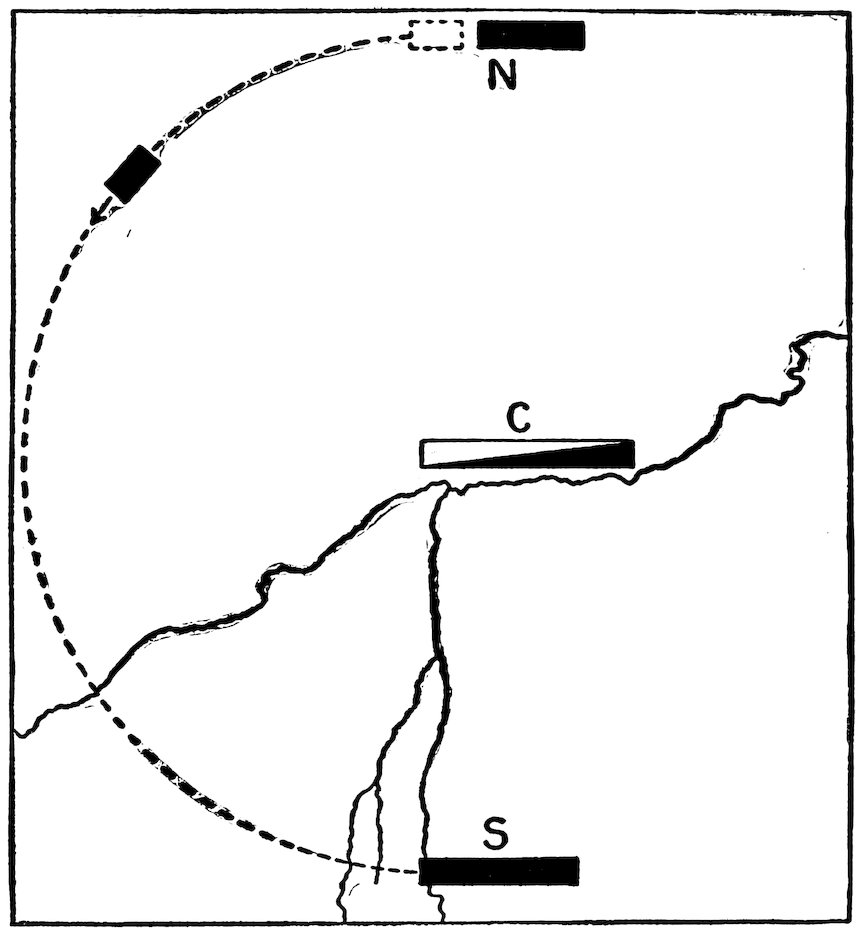
Transfer now your attention back to the Danube
when the scene of war is in that region; as it was in
1796, and also frequently was during the period of
which we are now speaking.... You have seen
before, that, if there be war between Austria and
France, as there so often was, the one who held
the Danube had a central position in the region.
Holding means possession by military power, which
power can be used to the full against the North
or against the South—offensive power—far more
easily than the South and North can combine against
him; because he is nearer to each than either is to
the other. (See map.) Should North wish to send
a big reinforcement to South, it cannot march across
the part of the Danube held, but must march around
55it above or below; exactly as, in 1640, reinforcements
from Spain to the Rhine had, so to say, to
march around France. In such a march, on land,
the reinforcement making it is necessarily in a long
column, because roads do not allow a great many
men to walk abreast. The road followed designates
in fact the alignment of the reinforcement from day
to day; and because its advance continually turns the
side to the enemy, around whom it is moving, the
enemy’s position is said to flank the movement, constituting
a recognized danger. It makes no difference
whether the line of march is straight or curved;
it is extension upon it that constitutes the danger,
because the line itself, being thin, is everywhere
weak, liable to an attack in force upon a relatively
small part of its whole. Communications are exposed,
and the enemy has the interior line....
This is an illustration of the force of Napoleon’s
saying, that “War is a business of positions.” All
this discussion turns on position; the ordinary, semi-permanent,
positions of Center, North, and South;
or the succession of positions occupied by the detachment
on that line of communications along
which it moves. This illustrates the importance of
positions in a single instance, but is by no means exhaustive
of that importance. Fully to comprehend,
it is necessary to study military and naval history;
bearing steadily in mind Napoleon’s saying, and the
definitions of central position, interior lines, and
communications.
Take, for example, an instance so recent as to
have been contemporary with men not yet old,—the
56Turkish position at Plevna in 1877. This
stopped the Russian advance on Constantinople for
almost five months. Why? Because, if they had
gone on, Plevna would have been close to their line
of communications, and in a central position relatively
to their forces at the front and those in the
rear, or behind the Danube. It was also so near,
that, if the enemy advanced far, the garrison of
Plevna could reach the only bridge across the Danube,
at Sistova, and might destroy it, before help
could come; that is, Plevna possessed an interior
line towards a point of the utmost importance.
Under these circumstances, Plevna alone arrested
the whole Russian movement. In the recent war
between Japan and Russia,[23] the Port Arthur fleet
similarly threatened the Japanese line of communications
from Japan to Manchuria, and so affected the
whole conduct of the war. It was central, as regards
Japan and Liao-Yang, or Mukden. Study of such
conditions reinforces knowledge, by affording numerous
illustrations of the effect of position under
very differing circumstances.
Let us now go back from the Danube with its
Center, North, and South, to the communications
between the Spanish coast and the Austrian army in
Germany. Should the House of Austria in Spain
desire to send large reinforcements to the Danube,
or to the Rhine, by way of Italy, it can do so, provided
it controls the sea; and provided also that
France has not shaken its hold upon North Italy.
Such a condition constitutes open and safe communications.
57If, however, command of the sea is
not assured, if the French navy, say at Toulon, is
equal to the Spanish navy in the neighborhood,
there is danger of a reverse; while if the French
navy is superior locally, there is great danger not
merely of a reverse but of a serious disaster. In
such a case the French navy, or the port of Toulon,
flanks the Spanish line of communication; again an
instance of position. As to position, Toulon would
correspond to Plevna and Port Arthur. This instance
illustrates, however, as Port Arthur conspicuously
did, that the value of a position is not in
the bare position, but in the use you make of it.
This, it is pertinent to note, is just the value of anything
a man possesses, his brains or his fortune—the
use he makes of either. Should the French navy
be decisively inferior locally to the Spanish, Toulon
loses its importance. As position it is still good,
but it cannot be used. It is an unavailable asset. So
at Plevna, had the garrison been so small that it
could not take the field, the place either would have
been captured, or could have been watched by a
detachment, while the main Russian body moved
on. At Port Arthur, the inefficiency of the Russian
navy permitted this course to the Japanese. They
watched the place by navy and army, and went on
with their march in Manchuria. Even so, the threat
inherent in the position compelled an immense detachment
of troops necessary for the siege, and so
greatly weakened the main army in its action.
Note that it is the nearness of Toulon, as of
Plevna, which constitutes the menace to the line of
58communication; the line from the port to that of
the communications is thus an interior line, short,
enabling an attack by surprise, or in force. It is
the same consideration that has made Cadiz at one
time, Gibraltar now, Malta, Jamaica, Guantanamo
Bay, all threatening positions; the ones to vessels
bound up or down the Mediterranean to or from
Suez, the others to vessels going to or from the
Isthmus of Panama. If it had been feasible for
Spain to carry her reinforcements south of Sardinia
and thence north, Toulon would so far have lost
much of this value. As the line drew near Genoa,
it would have regained control only in some measure;
that is, to a less degree and for a shorter time. As
a matter of fact such roundabout lines, fausses routes
as Napoleon called them, have played a notable
part in the strategy of a weaker party. The most
convenient commercial route is not necessarily the
most significant to strategy. Napoleon, for example,
when bound to Egypt from Malta in 1798,
did not go direct, but first sighted Crete and then
bore away for Egypt. Owing to this, Nelson in
pursuit missed the French because he naturally went
direct.
The same beneficial effect—the same amount of
protection as a roundabout line would give—might
have been obtained if the Spanish navy on the
Atlantic coast threatened French ports and commerce,
and thus induced France to keep her navy,
in whole or in part, in that quarter, weakening her
Toulon force; so that, though favorably situated,
it was not strong enough to attack. This was
59actually the case up to 1634, in which year the defeat
of the allies of France at Nordlingen, due to Spanish
troops from Italy reinforcing the Imperial armies
in Germany, compelled France to declare open war
against Spain and to transfer her fleet to the
Mediterranean. This effect was produced also in
1898 on the United States; not by the Spanish navy,
which was innoxious in everything but talk, but by
the fears of the American people, which prompted
the American Government to keep the so-called
Flying Squadron in Hampton Roads, instead of
close to the probable scene of war. Owing to this
distribution, if Cervera’s squadron had been efficient,
it could have got into Cienfuegos instead of Santiago;
a very much harder nut to crack, because in
close railroad communication with Havana and with
the great mass of the Spanish army in Cuba. It is
the same sort of unintelligent fear which prompts
the demand now to send half the battle fleet to the
Pacific. No course could be more entirely satisfactory
to an enemy, or more paralyzing to the
United States fleet, than just this. All or none; the
battle fleet concentrated, whether in the Pacific or
the Atlantic.
You will remember that in the war with Spain the
United States navy had reproduced for it the situation
I have depicted, of a detachment trying to pass
round the Danube from North to South. The
“Oregon” was the detachment, and she had to
join the American fleet in the West Indies, in spite
of the Spanish squadron. She reached Barbados
May 18; the day before Cervera entered Santiago,
60and six days after he left Martinique, which is only
one hundred miles from Barbados. The utter inefficiency
of the Spanish navy has caused us to lose
sight of the risk to the “Oregon,” which was keenly
felt by her commander, and concerning which at the
moment two former secretaries of the navy expressed
to me their anxiety. Despite this experience,
there are those now who would reconstitute
it for us, half the fleet in the Pacific and half in the
Atlantic. Should then war arise with a European
state, or with Japan, it would be open to either
enemy to take the Danube position between our two
divisions, as Togo did between the Port Arthur
and the Baltic squadrons....
The general war against the House of Austria,
as conducted by Richelieu, appears to have suffered
from the same cause that saps the vigor of many
wars; he attempted too many things at once, instead
of concentrating for decided superiority in some one
or two localities. For such concentration he had
good opportunities, owing to the central position
and interior lines possessed by France. It was open
to him to act in great force either in Belgium, or on
the Rhine, or in Italy, or towards Spain. Moreover,
he had the initial advantage of a natural concentration:
one nation against two, and those
separated in space. The proverbial weakness of
alliances is due to inferior power of concentration.
Granting the same aggregate of force, it is never
61as great in two hands as in one, because it is not
perfectly concentrated. Each party to an alliance
usually has its particular aim, which divides action.
In any military scheme that comes before you,
let your first question to yourself be, Is this
consistent with the requirement of concentration?
Never attempt to straddle, to do two things at
the same time, unless your force is evidently so
supreme that you have clearly more than enough
for each.
Our profession has never produced a man more
daring in enterprise, nor more skillful in management,
than Nelson. Remember, therefore, and always,
that, when he sent off two frigates on some
expedition, he charged their captains:
“If you meet two enemies, do not each attack
one. Combine both on one of the enemy; you will
make sure of that one, and you may also get the
other afterwards; but, whether the second escape or
not, your country will have won a victory, and
gained a ship.”
The same consideration applies to ship design.
You cannot have everything. If you attempt it,
you will lose everything; by which I mean that in no
one quality will your vessel be as efficient as if you
had concentrated purpose on that one. On a given
tonnage,—which in ship-building corresponds to
a given size of army or of fleet,—there cannot be
had the highest speed, and the heaviest battery, and
the thickest armor, and the longest coal endurance,
which the tonnage would allow to any one of these
objects by itself. If you try, you will be repeating
62Richelieu’s mistake when he tried to carry on offensive
war on four frontiers.
The fighting order of navies still continues a line;
which is called more properly a column, because
the ships are ranged one behind the other. Nevertheless,
if the arrangement of the guns, from van to
rear, is regarded, it will be seen that they really are
deployed on a line fronting the enemy. As a rule,
in instructed naval warfare, attack has been on one
flank of that line. It is commonly spoken of as an
attack on van or rear, because of the columnar formation
of the ships, but it is really a flank attack;
and, whichever flank is chosen, the attack on the
other is essentially refused, because the numbers
devoted to it are not sufficient to press an attack
home. The culmination of the sail era—Trafalgar—was
fought exactly on these lines. Nelson
concentrated the bulk of his fleet, a superior force,
on the left flank of the enemy, which happened to
be the rear; against the right flank he sent a smaller
number. He did not indeed give specific orders to
the smaller body not to attack, or to refuse themselves.
That was not his way. Moreover, he intended
himself to take charge of this attack in
smaller force, and to be governed by circumstances
as to the development of it; but the result was
shown in the fact that the larger part of the enemy’s
right flank escaped, and all probably would if they
had maneuvered well. The hostile loss fell on the
other flank and on the center; and not only was this
the case in result, but also Nelson in form and in
his orders purposed just this. He put the concentrated
63attack in the hands of his second; “I,” said
he, in effect, “will see that the other flank of the
enemy does not interfere.” Conditions modified his
action; but that was his plan, and although, from the
particular conditions, he actually pierced the enemy’s
center, still, having done so, the subsequent attack
fell upon the flank originally intended, while the
other flank was kept in check by the rear ships of
Nelson’s own division. These, as they advanced in
column, lay athwart the line by which the enemy’s
van, if it tacked, would approach the rear, or other
flank; and they thus prevented its approach by that
route until too late to be effective.
Nelson, who was a thoughtful as well as a daring
tactician, expressed reasons for attacking one flank
rather than another, under differing conditions in
which the fleets presented themselves; but, speaking
generally, the rear was the better to attack, because
the van could not, and cannot, come as soon to help
the rear as the rear can the van. It has to turn
round, to begin with; and, before turning round, its
commander has to make up his mind, which few men
do quickly, unless they have reached conclusions
beforehand. All this means time. Besides, the
assailant can more easily place himself in the way
of such new movement of the van, than he can of
the rear coming up on the line of advance it already
has. Still, there are some reasons in favor of the
van. Nelson in 1801 said that in case of encountering
a Russian fleet he would attack the van; because
injury to it would throw the enemy’s order into
confusion, from which the Russians were not good
64enough maneuverers to recover. That is a special
reason, not a general. It takes account of a particular
circumstance, as a general on shore does of
a particular locality. When Farragut passed the
Mobile forts his van was thrown into confusion, and
all know what a critical moment that was. It matters
little what the incident is, if the confusion is
produced.
In the Battle of the Japan Sea the attack again
was on a flank, and that the van. Whether this was
due to previous purpose of the Japanese, or merely
arose from the conditions as they presented themselves,
I do not know; but its tendency certainly
would be to cause confusion. I do not wish, however,
to argue here a question of tactics. My subject
is strategy, and I am using tactics simply to
illustrate the predominance, everywhere, under all
conditions and from the nature of things, of the one
great principle of concentration; and that, too, in the
specific method of so distributing your own force
as to be superior to the enemy in one quarter, while
in the other you hold him in check long enough to
permit your main attack to reach its full result.
That necessary time may be half an hour on a field
of battle; in a campaign it may be days, weeks,
perhaps more.
... In any frontier line, or any strategic front
of operations, or any line of battle, offensive effort
may, and therefore should, be concentrated in one
part, not distributed along the whole. This possibility,
and a convenient way of conceiving it,
Jomini expresses in an aphorism which may be
65commended to memory, because it sums up one important
consideration concerning any military disposition
whatever; whether it be the strategic front
of operations in a campaign, or a tactical order of
battle, or a frontier. Every such situation, Jomini
says, may be properly regarded as a line; and every
line divides, logically and actually, into three parts,—the
center, and the two extremes, or flanks.
Guard yourselves, of course, from imagining
three equal parts. We are not dealing here with
mathematics, but with military conceptions. For
practical results, let us apply at once to the United
States of to-day. The United States has a long
ocean frontier, broken at Mexico by the interposition
of land, as the French maritime frontier is
broken at the Pyrenees; yet the coast lines, like the
French, possess a certain maritime continuity, in
that ships can pass from end to end by sea. In such
cases, it may be said without exaggeration that an
ocean frontier is continuous. At present, the United
States has one frontier which is strictly continuous,
by land as by water, from the coast of Maine to the
Rio Grande. There are in it, by natural division,
three principal parts: the Atlantic, the Gulf, and the
Straits of Florida. I do not deny that for purposes
of study further convenient subdivisions may be
made; but it may fairly be claimed that these three
are clear, are primary, and are principal. They are
very unequal in length, and, from the military standpoint,
in importance; for while the peninsula of
Florida does not rank very high in the industrial
interests of the nation, a superior hostile fleet
66securely based in the Straits of Florida could effectively
control intercourse by water between the two
flanks. It would possess central position; and in
virtue of that central position, its superiority need
not be over the whole United States navy, should
that be divided on each side of the central position.
The supposed enemy, in such position, would need
only to be decisively superior to each of the divisions
lying on either side; whereas, were they
united, superiority would require to be over the
whole. It was this condition which made Cuba for
the first century of our national existence a consideration
of the first importance in our International
relations. It flanked national communications,
commercial and military. We know that
there exists in our country an element of wisdom
which would treat such a situation, which geography
has constituted for us, as two boys do an apple.
This would divide the fleet between the two coasts,
and call it fair to both; because, so it is reasoned,—or
rather argued,—defending both. It certainly,
however, would not be concentration, nor effective.
Before passing on, note the striking resemblance
between the Florida peninsula and that of Korea.
Togo, at Masampo, was to Rozhestvensky and the
Russians at Vladivostok just as a hostile fleet in the
Straits of Florida would be to American divisions
in the Gulf and at Hampton Roads. In like
manner at an earlier period Togo and Kamimura,
working apart but on interior lines, separated the
three fine fighting ships in Vladivostok from the
Port Arthur division.
67The United States, however, has an even more
urgent situation as to frontier in its Atlantic and
Pacific coasts. If my claim is correct, in the instance
of France, that a water frontier is continuous when
passage from end to end by water is practicable,
this is also continuous; and the battle fleet has
demonstrated the fact within the past few years.
The United States, then, has a maritime frontier
line from Eastport, Maine, to Puget Sound; and,
like other military lines, it divides into three principal
parts immediately obvious,—the Atlantic
Coast, the Pacific Coast, and the line between. This
summary will not be any more true, nor any more
useful for reflection, when the line passes by Panama
instead of the Straits of Magellan; but it certainly
will be more obvious. It then will be seen easily,
as now may be seen certainly, that the important
part of the long line in the present case, as in the
future, is the center, because that insures or prevents
passage in force from side to side; the transfer of
force; in short, the communications. This reproduces
again the Danube position, and also the chain
of Spanish positions from Genoa to Belgium. It is
once more the central position, which we have met
before in such varying localities and periods; but
the central position of Panama has over that now
open to us, by Magellan, the advantage of interior
lines, of which class of lines indeed the contrast
between the existing and the future of routes offers
a notable illustration.
68
The strategic value of any place depends upon
three principal conditions:
1. Its position, or more exactly its situation.
A place may have great strength, but be so situated
with regard to the strategic lines as not to be worth
occupying.
2. Its military strength, offensive and defensive.
A place may be well situated and have large resources
and yet possess little strategic value, because
weak. It may, on the other hand, while not naturally
strong, be given artificial strength for defense.
The word “fortify” means simply to make
strong.
3. The resources, of the place itself and of the
surrounding country....
Where all three conditions, situation, intrinsic
strength, and abundant resources, are found in the
same place, it becomes of great consequence strategically
and may be of the very first importance,
though not always. For it must be remarked that
there are other considerations, lesser in the purely
military point of view, which enhance the consequence
of a seaport even strategically; such as its
being a great mart of trade, a blow to which would
cripple the prosperity of the country; or the capital,
69the fall of which has a political effect additional to
its importance otherwise.
Of the three principal conditions, the first, situation,
is the most indispensable; because strength and
resources can be artificially supplied or increased,
but it passes the power of man to change the situation
of a port which lies outside the limits of
strategic effect.
Generally, value of situation depends upon nearness
to a sea route; to those lines of trade which,
when drawn upon the ocean common, are as imaginary
as the parallels of the chart, yet as really and
usefully exist. If the position be on two routes at
the same time, that is, near the crossing, the value
is enhanced. A cross-roads is essentially a central
position, facilitating action in as many directions as
there are roads. Those familiar with works on the
art of land war will recognize the analogies. The
value becomes yet more marked if, by the lay of
the land, the road to be followed becomes very
narrow; as at the Straits of Gibraltar, the English
Channel, and in a less degree the Florida Strait.
Perhaps narrowing should be applied to every inlet
of the sea, by which trade enters into and is distributed
over a great extent of country; such as the
mouth of the Mississippi, of the Dutch and German
rivers, New York harbor, etc. As regards the sea,
however, harbors or the mouths of rivers are usually
termini or entrepôts, at which goods are transshipped
before going farther. If the road be narrowed
70to a mere canal, or to the mouth of a river,
the point to which vessels must come is reduced
almost to the geometrical definition of a point and
near-by positions have great command. Suez presents
this condition now, and Panama soon will.
Analogously, positions in narrow seas are more
important than those in the great ocean, because it
is less possible to avoid them by a circuit. If these
seas are not merely the ends—“termini”—of
travel but “highways,” parts of a continuous route;
that is, if commerce not only comes to them but
passes through to other fields beyond, the number of
passing ships is increased and thereby the strategic
value of the controlling points....
[Illustrations are here employed to show that,
owing to the freedom of movements on the open sea,
dangerous positions when not located in narrow
channels are more easily avoided than on land.
Hence “fausses routes et moments perdus,” in
Napoleon’s phrase, play an important part in naval
operations, as shown by Napoleon’s route to Egypt
via Malta and Crete, and Rozhestvensky’s choice
of routes before Tsushima. On the other hand,
obstacles when they exist are impassable. Only
submarines can avoid danger by transit over land.—Editor.]
A. Defensive Strength. [Military strength is
considered in two aspects, (A) defensive, and (B)
offensive. Under defensive strength, it is first
pointed out that, as illustrated by Port Arthur and
71Santiago, coast bases are in chief danger of capture
from the land side. While it is the business of the
navy to prevent the landing of forces, its operations,
though defensive in result, must be offensive in
character, and not confined to the vicinity of the
bases.—Editor.]
In the sphere of maritime war, the navy represents
the army in the field; and the fortified strategic
harbors, upon which it falls back as ports of refuge
after battle or defeat, for repairs or for supplies,
correspond precisely to strongholds, like Metz,
Strasburg, Ulm, upon which, systematically occupied
with reference to the strategic character of the
theater of war, military writers agree the defense
of a country must be founded. The foundation,
however, must not be taken for the superstructure
for which it exists. In war, the defensive exists
mainly that the offensive may act more freely. In
sea warfare, the offensive is assigned to the navy;
and if the latter assumes to itself the defensive, it
simply locks up a part of its trained men in garrisons,
which could be filled as well by forces that have not
their peculiar skill. To this main proposition I
must add a corollary, that if the defense of ports,
many in number, be attributed to the navy, experience
shows that the navy will be subdivided among
them to an extent that will paralyze its efficiency.
I was amused, but at the same time instructed as to
popular understanding of war, by the consternation
aroused in Great Britain by one summer’s maneuvers,
already alluded to, and the remedy proposed
in some papers. It appeared that several seaports
72were open to bombardment and consequent exaction
of subsidies by a small squadron, and it was gravely
urged that the navy should be large enough to spare
a small detachment to each port. Of what use is a
navy, if it is to be thus whittled away? But a
popular outcry will drown the voice of military
experience.
... The strictly defensive strength of a seaport
depends therefore upon permanent works, the provision
of which is not the business of naval officers.
The navy is interested in them because, when effective,
they release it from any care about the port;
from defensive action to the offensive, which is its
proper sphere.
There is another sense in which a navy is regarded
as defensive; namely, that the existence of
an adequate navy protects from invasion by commanding
the sea. That is measurably and in very
large degree true, and is a strategic function of great
importance; but this is a wholly different question
from that of the defensive strength of seaports, of
strategic points, with which we are now dealing. It
therefore will be postponed, with a simple warning
against the opinion that because the navy thus defends
there is no need for local protection of the
strategic ports; no need, that is, for fortifications.
This view affirms that a military force can always,
under all circumstances, dispense with secure bases
of operations; in other words, that it can never be
evaded, nor know momentary mishap.
I have now put before you reasons for rejecting
the opinion that the navy is the proper instrument,
73generally speaking, for coast defense in the narrow
sense of the expression, which limits it to the defense
of ports. The reasons given may be summed up,
and reduced to four principles, as follows:
1. That for the same amount of offensive power,
floating batteries, or vessels of very little mobility,
are less strong defensively against naval attack than
land works are.
2. That by employing able-bodied seafaring men
to defend harbors you lock up offensive strength in
an inferior, that is, in a defensive, effort.
3. That it is injurious to the morale and skill of
seamen to keep them thus on the defensive and off
the sea. This has received abundant historical proof
in the past.
4. That in giving up the offensive the navy gives
up its proper sphere, which is also the most effective.
B. Offensive Strength.—The offensive strength
of a seaport, considered independently of its strategic
situation and of its natural and acquired resources,
consists in its capacity:
1. To assemble and hold a large military force,
of both ships of war and transports.
2. To launch such force safely and easily into
the deep.
3. To follow it with a continued support until
the campaign is ended. In such support are always
to be reckoned facilities for docking, as the most
important of all supports.
[These points are discussed in detail. It is noted
that a port with two outlets, like New York and
Vladivostok, has a decided advantage.—Editor.]
74
The wants of a navy are so many and so varied
that it would be time lost to name them separately.
The resources which meet them may be usefully
divided under two heads, natural and artificial.
The latter, again, may be conveniently and accurately
subdivided into resources developed by man
in his peaceful occupation and use of a country, and
those which are immediately and solely created for
the maintenance of war.
Other things being equal, the most favorable condition
is that where great natural resources, joined
to a good position for trade, have drawn men to
settle and develop the neighboring country. Where
the existing resources are purely artificial and for
war, the value of the port, in so far, is inferior to
that of one where the ordinary occupations of the
people supply the necessary resources. To use the
phraseology of our subject, a seaport that has good
strategic situation and great military strength, but
to which all resources must be brought from a
distance, is much inferior to a similar port having
a rich and developed friendly region behind it.
Gibraltar and ports on small islands, like Santa
Lucia and Martinique, labor under this disadvantage,
as compared with ports of England, France,
the United States; or even of a big island like Cuba,
if the latter be developed by an industrial and commercial
people.
75
The most important of strategic lines are those
which concern the communications. Communications
dominate war. This has peculiar force on
shore, because an army is immediately dependent
upon supplies frequently renewed. It can endure
a brief interruption much less readily than a fleet
can, because ships carry the substance of communications
largely in their own bottoms. So long as the
fleet is able to face the enemy at sea, communications
mean essentially, not geographical lines, like
the roads an army has to follow, but those necessaries,
supplies of which the ships cannot carry in
their own hulls beyond a limited amount. These
are, first, fuel; second, ammunition; last of all, food.
These necessaries, owing to the facility of water
transportation as compared with land, can accompany
the movements of a fleet in a way impossible
to the train of an army. An army train follows
rather than accompanies, by roads which may be
difficult and must be narrow; whereas maritime
roads are easy, and inimitably wide.
Nevertheless, all military organizations, land or
sea, are ultimately dependent upon open communications
76with the basis of the national power; and
the line of communications is doubly of value, because
it usually represents also the line of retreat.
Retreat is the extreme expression of dependence
upon the home base. In the matter of communications,
free supplies and open retreat are two essentials
to the safety of an army or of a fleet. Napoleon
at Marengo in 1800, and again at Ulm in 1805,
succeeded in placing himself upon the Austrian line
of communication and of retreat, in force sufficient
to prevent supplies coming forward from the base,
or the army moving backward to the base. At
Marengo there was a battle, at Ulm none; but at
each the results depended upon the same condition,—the
line of communication controlled by the
enemy. In the War of Secession the forts of the
Mississippi were conquered as soon as Farragut’s
fleet, by passing above, held their line of communications.
Mantua in 1796 was similarly conquered as
soon as Napoleon had placed himself upon the line
of retreat of its garrison. It held out for six
months, very properly; but the rest of the campaign
was simply an effort of the outside Austrians to
drive the French off the line, and thus to reinforce
the garrison or to enable it to retreat.
Except Russia and Japan, the nations actively
concerned in this great problem [the problem of
Asia] rest, for home bases, upon remote countries.
77We find therefore two classes of powers: those
whose communication is by land, and those who
depend upon the sea. The sea lines are the most
numerous and easy, and they will probably be determinative
of the courses of trade. Among them
there are two the advantages of which excel all
others—for Europe by Suez, from America by
way of the Pacific Ocean. The latter will doubtless
receive further modification by an isthmian
canal, extending the use of the route to the Atlantic
seaboard of America, North and South.
Communications dominate war; broadly considered,
they are the most important single element
in strategy, political or military. In its control
over them has lain the pre-eminence of sea power—as
an influence upon the history of the past; and in
this it will continue, for the attribute is inseparable
from its existence. This is evident because, for
reasons previously explained, transit in large quantities
and for great distances is decisively more
easy and copious by water than by land. The sea,
therefore, is the great medium of communications—of
commerce. The very sound, “commerce,”
brings with it a suggestion of the sea, for it is maritime
commerce that has in all ages been most fruitful
of wealth; and wealth is but the concrete expression
of a nation’s energy of life, material and
mental. The power, therefore, to insure these
communications to one’s self, and to interrupt them
for an adversary, affects the very root of a nation’s
vigor, as in military operations it does the existence
of an army, or as the free access to rain and sun—communication
78from without—does the life of a
plant. This is the prerogative of the sea powers;
and this chiefly—if not, indeed, this alone—they
have to set off against the disadvantage of position
and of numbers under which, with reference to land
power, they labor in Asia. It is enough. Pressure
afar off—diversion—is adequate to relieve that
near at hand, as Napoleon expected to conquer
Pondicherry on the banks of the Vistula. But if
the sea powers embrace the proposition that has
found favor in America, and, by the concession of
immunity to an enemy’s commerce in time of war,
surrender their control of maritime communications,
they will have abdicated the scepter of the sea,
for they will have abandoned one chief means by
which pressure in one quarter—the sea—balances
pressure in a remote and otherwise inaccessible
quarter. Never was moment for such abandonment
less propitious than the present, when the
determination of influence in Asia is at stake.
79
[The situation here considered is that of a fleet
that has driven the enemy from a base in the
theater of war, but has still to cope with the enemy
fleet falling back on another base.—Editor.]
The case of further advance from your new base
may not be complicated by the consideration of great
distance. The next step requisite to be taken may
be short, as from Cuba to Jamaica; or it may be
that the enemy’s fleet is still at sea, in which case it
is the great objective, now as always. Its being at
sea may be because retreating, from the position
you have occupied, towards his remoter base; either
because conscious of inferiority, or, perhaps, after
a defeat more or less decisive. It will then be
necessary to act with rapidity, in order to cut off
the enemy from his port of destination. If there is
reason to believe that you can overtake and pass
him with superior force, every effort to do so must
be made. The direction of his retreat is known or
must be ascertained, and it will be borne in mind
that the base to which he is retreating and his fleet
are separated parts of one force, the union of which
must be prevented. In such a case, the excuses frequently
made for a sluggish pursuit ashore, such as
fatigue of troops, heavy roads, etc., do not apply.
Crippled battleships must be dropped, or ordered
80to follow with the colliers. Such a pursuit presumes
but one disadvantage to the chasing fleet, viz., that
it is leaving its coal base while the chase is approaching
his; and this, if the calculations are close,
may give the pursuing admiral great anxiety. Such
anxieties are the test and penalty of greatness. In
such cases, excuses for failure attributed to shortness
of coal will be closely scrutinized; and justly.
In all other respects, superiority must be assumed,
because on no other condition could such headlong
pursuit be made. It aims at a great success, and
successes will usually be in proportion to superiority,
either original or acquired. “What the country
needs,” said Nelson, “is the annihilation of the
enemy. Only numbers can annihilate.”
If such a chase follow a battle, it can scarcely fail
that the weaker party—the retreating party—is
also distressed by crippled ships, which he may be
forced to abandon—or fight. Strenuous, unrelaxing
pursuit is therefore as imperative after a battle
as is courage during it. Great political results often
flow from correct military action; a fact which no
military commander is at liberty to ignore. He may
very well not know of those results; it is enough to
know that they may happen, and nothing can excuse
his losing a point which by exertion he might have
scored. Napoleon, says Jomini, never forgave the
general who in 1796, by resting his troops a couple
of hours, failed to get between an Austrian division
and Mantua, in which it was seeking refuge, and by
his neglect found it. The failure of Admiral de
Tourville to pursue vigorously the defeated Dutch
81and English fleet, after the battle of Beachy Head,
in 1690, caused that victory to be indecisive, and
helped to fasten the crown of England on the head
of a Dutch King, who was the soul of the alliance
against France. Slackness in following up victory
had thus a decisive influence upon the results of the
whole war, both on the continent and the sea. I may
add, it has proved injurious to the art of naval
strategy, by the seeming confirmation it has given
to the theory of the “fleet in being.” It was not
the beaten and crippled English and Dutch “fleet
in being” that prevented an invasion of England.
It was the weakness or inertness of Tourville, or
the unreadiness of the French transports.
Similarly, the refusal of Admiral Hotham to
pursue vigorously a beaten French fleet in 1795,
unquestionably not only made that year’s campaign
indecisive, but made possible Napoleon’s Italian
campaign of 1796, from which flowed his whole
career and its effects upon history. The same
dazzling career received its sudden mortal stab
when, in the height of his crushing advance in Spain,
with its capital in his hands, at the very moment
when his vast plans seemed on the eve of accomplishment,
a more enterprising British leader, Sir
John Moore, moved his petty army to Sahagun, on
the flank of Napoleon’s communications between
France and Madrid. The blow recoiled upon
Moore, who was swept as by a whirlwind to Coruña,
and into the sea; but Spain was saved. The Emperor
could not retrieve the lost time and opportunity.
He could not return to Madrid in person,
82but had to entrust to several subordinates the task
which only his own supreme genius could successfully
supervise. From the military standpoint, his
downfall dates from that day. The whole career
of Wellington, to Waterloo, lay in the womb of
Moore’s daring conception. But for that, wrote
Napier, the Peninsular War would not have required
a chronicler.
An admiral may not be able to foresee such remote
consequences of his action, but he can safely
adopt the principle expressed by Nelson, in the
instance just cited, after hearing his commander-in-chief
say they had done well enough: “If ten ships
out of eleven were taken, I would never call it well
enough, if we were able to get at the eleventh.”
The relations between the fleets of Admirals
Rozhestvensky and Togo prior to their meeting off
Tsushima bore no slight resemblance to those between
a pursued and a pursuing fleet. The Russian
fleet, which had started before the Port Arthur
division succumbed, was placed by that event in the
position of a fleet which has suffered defeat so severe
that its first effort must be to escape into its own
ports. This was so obvious that many felt a retreat
upon the Baltic was the only course left open; but,
failing that, Rozhestvensky argued that he should
rush on to Vladivostok at once, before the Japanese
should get again into the best condition to intercept
him, by repairing their ships, cleaning the bottoms,
and refreshing the ships’ companies. Instead of so
ordering, the Russian government decided to hold
him at Nossi-Bé (the north end of Madagascar),
83pending a reinforcement to be sent under Admiral
Nebogatoff. Something is to be said for both views,
in the abstract; but considering that the reinforcement
was heterogeneous and inferior in character,
that the Russian first aim was not battle but escape
to Vladivostok, and, especially, that the Japanese
were particularly anxious to obtain the use of delay
for the very purpose Rozhestvensky feared, it seems
probable that he was right. In any event, he was
delayed at Nossi-Bé from January 9 to March 16;
and afterwards at Kamranh Bay in French Cochin-China,
from April 14 to May 9, when Nebogatoff
joined. Allowing time for coaling and refitting,
this indicates a delay of sixty to seventy days; the
actual time underway from Nossi-Bé to Tsushima
being only forty-five days. Thus, but for the wait
for Nebogatoff, the Russian division would have
reached Tsushima two months before it did, or
about March 20.
Togo did not have to get ahead of a flying fleet,
for by the fortune of position he was already ahead
of it; but he did have to select the best position for
intercepting it, as well as to decide upon his general
course of action: whether, for instance, he should
advance to meet it; whether he should attempt
embarrassment by his superior force of torpedo
vessels, so as to cripple or destroy some of its units,
thus reducing further a force already inferior; also
the direction and activities of his available scouts.
His action may be taken as expressing his opinions
on these subjects. He did not advance; he did not
attempt harassment prior to meeting; he concentrated
84his entire battle force on the line by which he
expected the enemy must advance; and he was so
far in ignorance of their movements that he received
information only on the very morning of the battle.
This was well enough; but it is scarcely unreasonable
to say it might have been bettered. The
Japanese, however, had behind them a large part
of a successful naval campaign, the chief points of
which it is relevant to our subject to note. They had
first by a surprise attack inflicted a marked injury
on the enemy’s fleet, which obtained for them a time
of delay and opportunity during its enforced inactivity.
They had then reduced one of the enemy’s
two naval bases, and destroyed the division sheltered
in it. By this they had begun to beat the enemy in
detail, and had left the approaching reinforcement
only one possible port of arrival.
If a flying fleet has been lost to sight and has but
one port of refuge, pursuit, of course, will be
directed upon that port; but if there are more, the
chasing admiral will have to decide upon what point
to direct his fleet, and will send out despatch vessels
in different directions to find the enemy and transmit
intelligence. Cruisers engaged in such duty should
be notified of the intended or possible movements
of the fleet, and when practicable should be sent in
couples; for although wireless telegraphy has now
superseded the necessity of sending one back with
information, while the other remains in touch with
the enemy, accidents may happen, and in so important
a matter it seems expedient to double precautions.
The case resembles duplicating important
85correspondence; for wireless cannot act before it
has news, and to obtain news objects must be seen.
It is to be remembered, too, that wireless messages
may be intercepted, to the serious disadvantage of
the sender. It seems possible that conjunctures may
arise when it will be safer to send a vessel with
tidings rather than commit them to air waves.
Thus, in theory, and to make execution perfect,—to
capture, so to say, Nelson’s eleventh ship,—the
aim must be to drive the enemy out of every foothold
in the whole theater of war, and particularly
to destroy or shut up his fleet. Having accomplished
the great feature of the task by getting hold
of the most decisive position, further effort must be
directed towards, possibly not upon, those points
which may serve him still for bases. In so doing,
your fleet must not be divided, unless overwhelmingly
strong, and must not extend its lines of communication
beyond the power of protecting them,
unless it be for a dash of limited duration.
If compelled to choose between fortified ports of
the enemy and his fleet, the latter will be regarded
as the true objective; but a blockade of the ports,
or an attack upon them, may be the surest means of
bringing the ships within reach. Thus, in the War
of American Independence, the siege of Gibraltar
compelled the British fleet on more than one occasion
to come within fighting reach of the enemy’s
blockading fleet, in order to throw in supplies. That
the allies did not attack, except on one occasion, does
not invalidate the lesson. Corbett in his “Seven
Years’ War” points out very justly, in Byng’s celebrated
86failure, which cost him his life, that if he had
moved against the French transports, in a neighboring
bay, the French admiral would have had to
attack, and the result might have been more favorable
to the British. Such movements are essentially
blows at the communications of the enemy, and if
aimed without unduly risking your own will be in
thorough accord with the most assured principles of
strategy. A militarily effective blockade of a base
essential to the enemy will force his fleet either to
fight or to abandon the theater of war. Thus, as
has been pointed out elsewhere, in Suffren’s campaign
in Indian Seas, so long as Trincomalee was in
possession of the British, a threat at it was sure to
bring them out to fight, although it was not their
principal base. The abandonment of the theater of
war by the navy will cause the arsenal to fall in time,
through failure of resources, as Gibraltar must have
fallen if the British fleet had not returned and supplied
it at intervals. Such a result, however, is less
complete than a victory over the enemy’s navy,
which would lead to the same end, and so be a double
success, ships and port.
87
It is true that in certain respects the defensive has
advantages, the possession of which may even
justify an expression, which has been stated as a
maxim of war, that “Defense is a stronger form of
war than Offense is.” I do not like the expression,
for it seems to me misleading as to the determinative
characteristics of a defensive attitude; but it
may pass, if properly qualified. What is meant by
it is that in a particular operation, or even in a
general plan, the party on the defense, since he
makes no forward movement for the time, can
strengthen his preparations, make deliberate and
permanent dispositions; while the party on the offensive,
being in continual movement, is more liable to
mistake, of which the defense may take advantage,
and in any case has to accept as part of his problem
the disadvantage, to him, of the accumulated preparations
that the defense has been making while he
has been marching. The extreme example of preparation
is a fortified permanent post; but similar
instances are found in a battle field carefully chosen
for advantages of ground, where attack is awaited,
and in a line of ships, which by the solidarity of its
order, and deployment of broadside, awaits an
enemy who has to approach in column with disadvantage
as to train of guns. In so far, the form
88taken by the defense is stronger than the form assumed
for the moment by the offense.
If you will think clearly, you will recognize that
at Tsushima the Japanese were on the defensive,
for their object was to stop, to thwart, the Russian
attempt. Essentially, whatever the tactical method
they adopted, they were to spread their broadsides
across the road to Vladivostok, and await. The
Russians were on the offensive, little as we are accustomed
so to regard them; they had to get through
to Vladivostok—if they could. They had to hold
their course to the place, and to break through the
Japanese,—if they could. In short, they were on
the offensive, and the form of their approach had
to be in column, bows on,—a weaker form,—which
they had to abandon, tactically, as soon as
they came under fire.
In our hostilities with Spain, also, Cervera’s
movement before reaching Santiago was offensive in
character, the attitude of the United States defensive;
that is, he was trying to effect something which
the American Navy was set to prevent. There being
three principal Spanish ports, Havana, Cienfuegos,
and Santiago, we could not be certain for which he
would try, and should have been before two in such
force that an attempt by him would have assured a
battle. We were strong enough for such a disposition.
The two ports thus to be barred were
evidently Havana and Cienfuegos. The supposed
necessity for defending our northern coast left
Cienfuegos open. Had Cervera made for it, he
would have reached it before the Flying Squadron
89did. The need for keeping the Flying Squadron in
Hampton Roads was imaginary, but it none the less
illustrates the effect of inadequate coast defenses
upon the military plan of the nation.
The author whom I quote (Corbett, “Seven
Years’ War,” Vol. I, p. 92), who himself quotes
from one of the first of authorities, Clausewitz, has
therefore immediately to qualify his maxim, thus:
“When we say that defense is a stronger form of
war, that is, that it requires a smaller force, if
soundly designed, we are speaking, of course, only
of one certain line of operations. If we do not know
the general line of operation on which the enemy
intends to attack, and so cannot mass our force upon
it, then defense is weak, because we are compelled
to distribute our force so as to be strong enough to
stop the enemy on any line of operations he may
adopt.”
Manifestly, however, a force capable of being
strong enough on several lines of operation to stop
an enemy possesses a superiority that should take the
offensive. In the instance just cited, of Cervera’s
approach, the American true policy of concentration
would have had to yield to distribution, between
Cienfuegos and Havana. Instead of a decisive
superiority on one position, there would have been
a bare equality upon two. Granting an enemy of
equal skill and training, the result might have been
one way or the other; and the only compensation
would have been that the enemy would have been
so badly handled that, to use Nelson’s phrase, he
would give no more trouble that season, and the
90other American division would have controlled the
seas, as Togo did after August 10, 1904. From
the purely professional point of view it is greatly
to be regretted that the Spaniards and Russians
showed such poor professional aptitude.
The radical disadvantage of the defensive is
evident. It not only is the enforced attitude of a
weaker party, but it labors under the further onerous
uncertainty where the offensive may strike, when
there is more than one line of operation open to
him, as there usually is. This tends to entail dissemination
of force. The advantages of the defensive
have been sufficiently indicated; they are essentially
those of deliberate preparation, shown in
precautions of various kinds. In assuming the defensive
you take for granted the impossibility of
your own permanent advance and the ability of the
enemy to present himself before your front in
superior numbers; unless you can harass him on
the way and cause loss enough to diminish the inequality.
Unless such disparity exists, you should
be on the offensive. On the other hand, in the
defensive it has to be taken for granted that you
have on your side a respectable though inferior
battle fleet, and a sea frontier possessing a certain
number of ports which cannot be reduced without
regular operations, in which the armed shipping can
be got ready for battle, and to which, as to a base,
they can retire for refit. Without these two elements
there can be no serious defense.
91
It is desirable to explain here what was, and is, the
particular specific utility of operations directed
toward the destruction of an enemy’s commerce;
what its bearing upon the issues of war; and how,
also, it affects the relative interests of antagonists,
unequally paired in the matter of sea power. Without
attempting to determine precisely the relative
importance of internal and external commerce,
which varies with each country, and admitting that
the length of transportation entails a distinct element
of increased cost upon the articles transported, it is
nevertheless safe to say that, to nations having free
access to the sea, the export and import trade is a
very large factor in national prosperity and comfort.
At the very least, it increases by so much the
aggregate of commercial transactions, while the ease
and copiousness of water carriage go far to compensate
for the increase of distance. Furthermore,
the public revenue of maritime states is largely derived
from duties on imports. Hence arises, therefore,
a large source of wealth, of money; and money—ready
money or substantial credit—is proverbially
the sinews of war, as the War of 1812 was
amply to demonstrate. Inconvertible assets, as
business men know, are a very inefficacious form of
92wealth in tight times; and war is always a tight time
for a country, a time in which its positive wealth, in
the shape of every kind of produce, is of little use,
unless by freedom of exchange it can be converted
into cash for governmental expenses. To this sea commerce
greatly contributes, and the extreme embarrassment
under which the United States as a
nation labored in 1814 was mainly due to commercial
exclusion from the sea. To attack the commerce
of the enemy is therefore to cripple him, in the
measure of success achieved, in the particular factor
which is vital to the maintenance of war. Moreover,
in the complicated conditions of mercantile activity
no one branch can be seriously injured without
involving others.
This may be called the financial and political
effect of “commerce destroying,” as the modern
phrase runs. In military effect, it is strictly analogous
to the impairing of an enemy’s communications,
of the line of supplies connecting an army
with its base of operations, upon the maintenance of
which the life of the army depends. Money, credit,
is the life of war; lessen it, and vigor flags; destroy
it, and resistance dies. No resource then remains
except to “make war support war;” that is, to make
the vanquished pay the bills for the maintenance of
the army which has crushed him, or which is proceeding
to crush whatever opposition is left alive.
This, by the extraction of private money, and of
supplies for the use of his troops, from the country
in which he was fighting, was the method of Napoleon,
than whom no man held more delicate views
93concerning the gross impropriety of capturing
private property at sea, whither his power did not
extend. Yet this, in effect, is simply another
method of forcing the enemy to surrender a large
part of his means, so weakening him, while transferring
it to the victor for the better propagation of
hostilities. The exaction of a pecuniary indemnity
from the worsted party at the conclusion of a war,
as is frequently done, differs from the seizure of
property in transit afloat only in method, and as
peace differs from war. In either case, money or
money’s worth is exacted; but when peace supervenes,
the method of collection is left to the Government
of the country, in pursuance of its powers of
taxation, to distribute the burden among the people;
whereas in war, the primary object being immediate
injury to the enemy’s fighting power, it is not only
legitimate in principle, but particularly effective, to
seek the disorganization of his financial system by a
crushing attack upon one of its important factors,
because effort thus is concentrated on a readily
accessible, fundamental element of his general prosperity.
That the loss falls directly on individuals,
or a class, instead of upon the whole community, is
but an incident of war, just as some men are killed
and others not. Indirectly, but none the less surely,
the whole community, and, what is more important,
the organized government, are crippled; offensive
powers impaired.
But while this is the absolute tendency of war
against commerce, common to all cases, the relative
value varies greatly with the countries having recourse
94to it. It is a species of hostilities easily
extemporized by a great maritime nation; it therefore
favors one whose policy is not to maintain a
large naval establishment. It opens a field for a sea
militia force, requiring little antecedent military
training. Again, it is a logical military reply to
commercial blockade, which is the most systematic,
regularized, and extensive form of commerce-destruction
known to war. Commercial blockade
is not to be confounded with the military measure
of confining a body of hostile ships of war to their
harbor, by stationing before it a competent force.
It is directed against merchant vessels, and is not
a military operation in the narrowest sense, in that
it does not necessarily involve fighting, nor propose
the capture of the blockaded harbor. It is not
usually directed against military ports, unless these
happen to be also centers of commerce. Its object,
which was the paramount function of the United
States Navy during the Civil War, dealing probably
the most decisive blow inflicted upon the Confederacy,
is the destruction of commerce by closing the
ports of egress and ingress. Incidental to that, all
ships, neutrals included, attempting to enter or depart,
after public notification through customary
channels, are captured and confiscated as remorselessly
as could be done by the most greedy privateer.
Thus constituted, the operation receives far wider
scope than commerce-destruction on the high seas;
for this is confined to merchantmen of belligerents,
while commercial blockade, by universal consent,
subjects to capture neutrals who attempt to infringe
95it, because, by attempting to defeat the efforts of one
belligerent, they make themselves parties to the war.
In fact, commercial blockade, though most effective
as a military measure in broad results, is so
distinctly commerce-destructive in essence, that those
who censure the one form must logically proceed
to denounce the other. This, as has been seen,
Napoleon did; alleging in his Berlin Decree, in
1806, that war cannot be extended to any private
property whatever, and that the right of blockade
is restricted to fortified places, actually invested by
competent forces. This he had the face to assert,
at the very moment when he was compelling every
vanquished state to extract, from the private means
of its subjects, coin running up to hundreds of
millions to replenish his military chest for further
extension of hostilities. Had this dictum been accepted
international law in 1861, the United States
could not have closed the ports of the Confederacy,
the commerce of which would have proceeded unmolested;
and hostile measures being consequently
directed against men’s persons instead of their trade,
victory, if accomplished at all, would have cost three
lives for every two actually lost.
It is apparent, immediately on statement, that
against commerce-destruction by blockade, the recourse
of the weaker maritime belligerent is commerce-destruction
by cruisers on the high sea.
Granting equal efficiency in the use of either measure,
it is further plain that the latter is intrinsically
far less efficacious. To cut off access to a city is
much more certainly accomplished by holding the
96gates than by scouring the country in search of
persons seeking to enter. Still, one can but do what
one can. In 1861 to 1865, the Southern Confederacy,
unable to shake off the death grip fastened on
its throat, attempted counteraction by means of the
“Alabama,” “Sumter,” and their less famous consorts,
with what disastrous influence upon the navigation—the
shipping—of the Union it is needless
to insist. But while the shipping of the opposite
belligerent was in this way not only crippled, but
indirectly was swept from the seas, the Confederate
cruisers, not being able to establish a blockade, could
not prevent neutral vessels from carrying on the
commerce of the Union. This consequently suffered
no serious interruption; whereas the produce of the
South, its inconvertible wealth—cotton chiefly—was
practically useless to sustain the financial system
and credit of the people. So, in 1812 and the two
years following, the United States flooded the seas
with privateers, producing an effect upon British
commerce which, though inconclusive singly, doubtless
co-operated powerfully with other motives to
dispose the enemy to liberal terms of peace. It was
the reply, and the only possible reply, to the commercial
blockade, the grinding efficacy of which it
will be a principal object of these pages to depict.
The issue to us has been accurately characterized by
Mr. Henry Adams, in the single word “Exhaustion.”[30]
Both parties to the War of 1812 being conspicuously
maritime in disposition and occupation,
97while separated by three thousand miles of ocean,
the sea and its navigable approaches became necessarily
the most extensive scene of operations. There
being between them great inequality of organized
naval strength and of pecuniary resources, they
inevitably resorted, according to their respective
force, to one or the other form of maritime hostilities
against commerce which have been indicated.
To this procedure combats on the high seas were
merely incidental. Tradition, professional pride,
and the combative spirit inherent in both peoples,
compelled fighting when armed vessels of nearly
equal strength met; but such contests, though wholly
laudable from the naval standpoint, which under
ordinary circumstances cannot afford to encourage
retreat from an equal foe, were indecisive of general
results, however meritorious in particular execution.
They had no effect upon the issue, except so far as
they inspired moral enthusiasm and confidence.
Still more, in the sequel they have had a distinctly
injurious effect upon national opinion in the United
States. In the brilliant exhibition of enterprise,
professional skill, and usual success, by its naval
officers and seamen, the country has forgotten the
precedent neglect of several administrations to constitute
the navy as strong in proportion to the means
of the country as it was excellent through the spirit
and acquirements of its officers. Sight also has been
lost of the actual conditions of repression, confinement,
and isolation, enforced upon the maritime
frontier during the greater part of the war, with the
misery and mortification thence ensuing. It has been
98widely inferred that the maritime conditions in general
were highly flattering to national pride, and that
a future emergency could be confronted with the
same supposed facility, and as little preparation,
as the odds of 1812 are believed to have been encountered
and overcome. This mental impression,
this picture, is false throughout, alike in its grouping
of incidents, in its disregard of proportion, and
in its ignoring of facts. The truth of this assertion
will appear in due course of this narrative, and it
will be seen that, although relieved by many brilliant
incidents, indicative of the real spirit and capacity
of the nation, the record upon the whole is one of
gloom, disaster, and governmental incompetence,
resulting from lack of national preparation, due to
the obstinate and blind prepossessions of the Government,
and, in part, of the people.
It is not the taking of individual ships or convoys,
be they few or many, that strikes down the money
power of a nation; it is the possession of that overbearing
power on the sea which drives the enemy’s
flag from it, or allows it to appear only as a fugitive;
and which, by controlling the great common, closes
the highways by which commerce moves to and from
the enemy’s shores. This overbearing power can
only be exercised by great navies, and by them (on
the broad sea) less efficiently now than in the days
when the neutral flag had not its present immunity.[32]
99It is not unlikely that, in the event of a war between
maritime nations, an attempt may be made by the
one having a great sea power and wishing to break
down its enemy’s commerce, to interpret the phrase
“effective blockade” in the manner that best suits
its interests at the time; to assert that the speed and
disposal of its ships make the blockade effective at
much greater distances and with fewer ships than
formerly. The determination of such a question will
depend, not upon the weaker belligerent, but upon
neutral powers; it will raise the issue between belligerent
and neutral rights; and if the belligerent
have a vastly overpowering navy he may carry his
point, just as England, when possessing the mastery
of the seas, long refused to admit the doctrine of
the neutral flag covering the goods.
100
In the special field proposed for our study, there
are two principal points of such convergence—or
divergence: the mouth of the Mississippi River, and
the Central-American Isthmus. At the time when
these lectures were first written the opinion of the
world was hesitating between Panama and Nicaragua
as the best site for a canal through the Isthmus.
This question having now been settled definitively
in favor of Panama, the particular point of
convergence for trade routes passing through the
Caribbean for the Pacific will continue at Colon,
whither it for so long has been determined because
there is the terminus of the Panama Railroad.
These two meeting points or cross-roads have
long been, and still are, points of supreme interest
to all mankind. At the one all the highways of the
Mississippi valley, all the tributaries and sub-tributaries
of the great river, meet, and thence they part.
At the other all highways between the Atlantic and
Pacific focus and intersect. The advancing population
and development of the Mississippi valley,
and the completion of the Panama Canal, will work
together to cause this international interest to grow
proportionately in the future. Among the great
Powers of the world, no one is concerned so vitally
in this progress as is the United States; because of
her possession of one of these centers, the mouth of
the Mississippi with its huge back country, and because
of her geographical nearness to the other.
This peculiar interest, which is natural and inevitable
in virtue of proximity, is emphasized by the national
policy known as the Monroe Doctrine; and still
more by the particular result of the Doctrine which
has involved the control, administration, and military
protection of that belt of Isthmian territory
called the Panama Canal Zone.
101
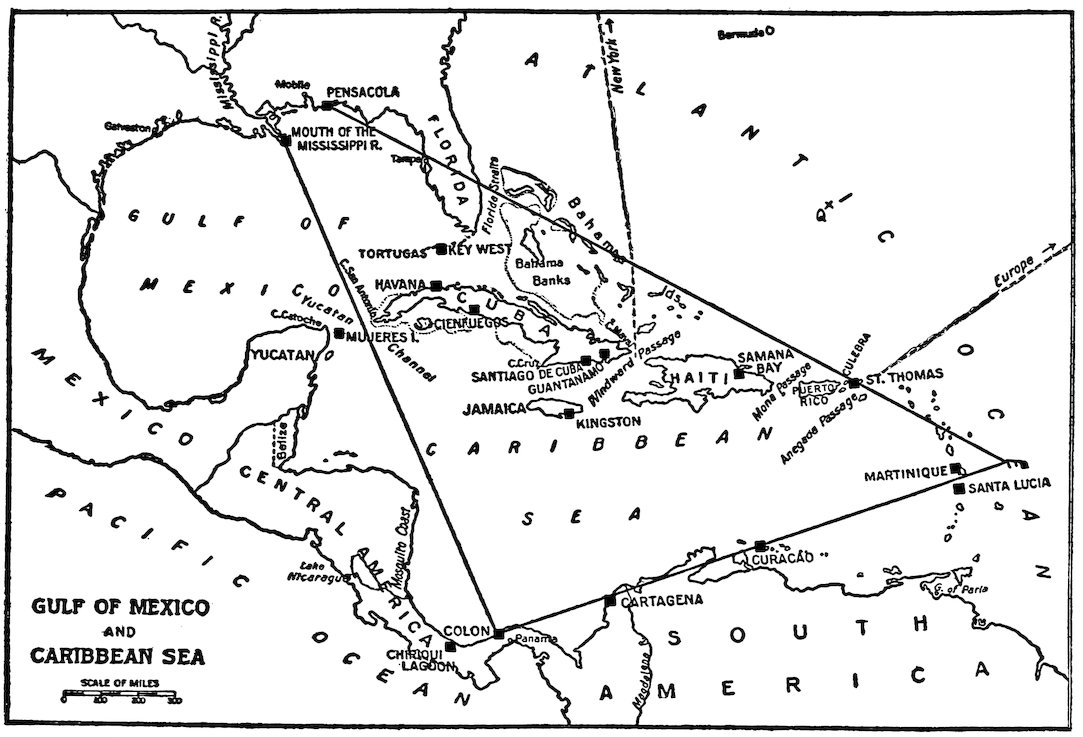
102[In the intervening pages, it is shown that the
triangle drawn on the map (p. 101) includes all
points of strategic importance, these being indicated
by black squares. Cuba is the key to the Gulf of
Mexico, and also controls three entrances to the
Caribbean—the Yucatan, Windward, and Mona
Passages. The entrances, the chief points of destination
(Jamaica and the Isthmus), and the routes
thither, constitute the main objects of military control
in the Caribbean.—Editor.]
... Taking all together, control over transit
depending upon situation only, other conditions
being equal, is greatest with Jamaica, next with
Cuba, least with the Lesser Antilles.
Accepting these conclusions as to control over
transit, we now revert to that question to which all
other inquiries are subsidiary, namely, Which of
the three bases of operations in the Caribbean—one
of the Lesser Antilles, Jamaica, or Cuba with
its sphere of influence—is most powerful for military
control of the principal objective points in the
103same sea? These principal objectives are Jamaica
and the Isthmus; concerning the relative importance
of which it may be remarked that, while the Isthmus
intrinsically, and to the general interest of the world,
is incomparably the more valuable, the situation of
Jamaica gives such command over all the approaches
to the Isthmus, as to make it in a military sense the
predominant factor in the control of the Caribbean.
Jamaica is a pre-eminent instance of central position,
conferring the advantage of interior lines, for
action in every direction within the field to which it
belongs.
Military control depends chiefly upon two things,
position and active military strength. As equal
military strength has been assumed throughout, it
is now necessary only to compare the positions held
by other states in the field with that of the occupant
of Cuba. This inquiry also is limited to the ability
either to act offensively against these objective
points, or, on the contrary, to defend them if already
held by oneself or an ally; transit having been considered
already.
Control by virtue of position, over a point external
to your territory, depends upon nearness in
point of time and upon the absence of obstacles
capable of delaying or preventing your access to it.
Both Santiago (or Guantanamo) and Cienfuegos
are nearer to the Isthmus than is any other one of
the first-class strategic points that have been chosen
on the borders of the Caribbean Sea, including
Samana Bay and St. Thomas. They are little more
than half the distance of the British Santa Lucia
104and the French Martinique. The formidable island
and military stronghold of Jamaica, within the sea,
is nearer the Isthmus than Guantanamo is, by one
hundred and fifty miles, and than Cienfuegos by
yet more.
Taking into consideration situation only, Jamaica
is admirably placed for the control of the Caribbean.
It is equidistant from Colon, from the Yucatan
Passage, and from the Mona Passage. It shares
with Guantanamo and Santiago control of the Windward
Passage, and of that along the south coast of
Cuba; while, with but a slight stretching out of its
arm, it reaches the routes from the Gulf of Mexico
to the Isthmus. Above all, as towards Cuba, it so
blocks the road to the Isthmus that any attempt
directed upon the Isthmus from Cuba must first
have to account with the military and naval forces
of Jamaica.
There are, however, certain deductions to be
made from the strength of Jamaica that do not
apply as forcibly to Cuba. Leaving to one side the
great and widely scattered colonial system of Great
Britain, which always throws that empire on the
defensive and invites division of the fleet, owing to
the large number of points open to attack, and confining
our attention strictly to the field before us, it
will be observed that in a scheme of British operations
Jamaica is essentially, as has been said before,
an advanced post; singularly well situated, it is true,
but still with long and difficult communications. Its
distance from Antigua, a possible intermediate base
of supplies, is over nine hundred miles; from Santa
105Lucia, the chief British naval station in the Lesser
Antilles, over one thousand miles, not less than three
days’ economical steaming. Great Britain, if at war
with a state possessing Cuba, is shut out from the
Windward Passage by Guantanamo, and from the
Gulf of Mexico by Havana. The Mona Passage,
also, though not necessarily closed, will be too
dangerous to be relied upon. For these reasons, in
order to maintain communications with Jamaica, an
intermediate position and depot, like Santa Lucia,
will be urgently needed. Supplies coming from
Bermuda, Halifax, or England would probably have
to be collected first there, or at Antigua, and thence
make a more secure, but still exposed, voyage to
Kingston. The north coasts of Cuba and Haiti must
be looked upon as practically under the control of
the Cuban fleet, in consequence of the command
which it exercises over the Windward Passage, by
virtue of position.
The possessor of Cuba, on the contrary, by his
situation has open communication with the Gulf of
Mexico, which amounts to saying that he has all the
resources of the United States at his disposal,
through the Mississippi Valley. Cruisers from
Jamaica attempting to intercept that trade would be
at a great disadvantage, especially as to coal, compared
with their enemy resting upon Havana.
Cruisers from Havana, reaching their cruising
ground with little or no consumption, can therefore
remain longer, and consequently are equivalent to
a greater number of ships. On the other hand,
cruisers from Santiago could move almost with impunity
106by the north side of Haiti as far as the Mona
Passage, and beyond that without any other risk
than that of meeting and fighting vessels of equal
size. If they stretch their efforts toward the Anegada
Passage, they would feel the same disadvantage,
relatively to cruisers from Santa Lucia, that Jamaica
cruisers in the Gulf would undergo as compared with
those from Havana; but by inclining their course
more to the northward, to or about the point Q (see
map, page 101), they would there be equidistant from
Guantanamo and Santa Lucia, and so on an equality
with the latter, while at the same time in a position
gravely to endanger supplies from any point in
North America. If it be replied that Bermuda can
take care of these cruisers at Q, the answer is plain:
on the supposition of equal forces, it can do so only
by diminishing the force at Santa Lucia. In short,
when compared with Jamaica, in respect of strategic
relations to Bermuda, Halifax, and Santa Lucia,
Cuba enjoys the immense advantage of a central position,
and of interior lines of communication, with
consequent concentration of force and effort.
It is not easy to see how, in the face of these
difficulties, Great Britain, in the supposed case of
equal force in this theater of war, could avoid dividing
her fleet sufficiently to put Jamaica at a disadvantage
as to Cuba. In truth, Cuba here enjoys
not only the other advantages of situation already
pointed out, but also that of being central as regards
the enemy’s positions; and what is, perhaps,
even more important, she possesses secure interior
107land lines of supply and coal between the points of
her base, while covering the sea lines in her rear,
in the Gulf of Mexico. For Guantanamo and
Santiago have communication by rail with Havana,
while the island itself covers the lines from Havana
to the Gulf coast of the United States; whereas
Jamaica depends wholly upon the sea, by lines of
communication not nearly as well sheltered.
Contrasted with Cuba, Jamaica is seen to be, as
has been more than once said, a strong advanced
post, thrust well forward into the face of an enemy
to which it is much inferior in size and resources,
and therefore dependent for existence upon its
power of holding out, despite uncertain and possibly
suspended communication. Its case resembles that
of Minorca, Malta, Gibraltar, the endurance of
which, when cut off from the sea, has always been
measurable. The question here before us, however,
is not that of mere holding out on the defensive,
which would be paralysis. If Cuba can reduce
Jamaica to a passive defensive, Jamaica disappears
as a factor in the control of the Caribbean and
Isthmus—no obstacle then stands in the way of
Cuba using her nearness to Panama. If Cuba can
bring about a scarcity of coal at Kingston she
achieves a strategic advantage; if a coal famine, the
enemy’s battle fleet must retire, probably to the
Lesser Antilles.
The case of Jamaica, contrasted with Cuba,
covers that of all strategic points on the borders of
the Caribbean Sea, east, west, north, or south. Almost
on the border itself, although within it, Jamaica
108has in nearness, in situation, in size, and in resources,
a decisive advantage over any of the ports of Haiti
or of the smaller islands. If Jamaica is inferior to
Cuba, then is each of the other points on the circumference,
and, it may be added, all of them
together....
[It is shown that, while Santa Lucia is essential
to Jamaica, the two are too far apart to work together
in concert. As for the Lesser Antilles, they
may be said to control the approaches from Europe,
while Cuba controls those from North America; but
the Antilles are twice as far from the Isthmus as
Cuba is, and much weaker in resources.—Editor.]
As to resources, those of all the West India
islands for war will depend mainly upon the policy
and preparation of the governments. Except Cuba,
they are deficient in natural resources adequately
developed. Outside of direct governmental action
it can only be said that the much greater population
of Cuba will draw more supplies and furnish more
material for troops and garrisons. At present, as
already noted, the resources of the United States
are in effect also the resources of Cuba.
As between the three possible bases for attempted
control of the Caribbean, no doubts can remain
that Cuba is the most powerful, Jamaica next, and
the Antilles least. Jamaica being where it is, Cuba
cannot put forth her power against the Isthmus or
against the lines of transit in the Caribbean, until
she has materially reduced, if not neutralized, the
offensive power of her smaller opponent. Upon the
supposition of equal fleets, if the Cuban fleet move
109against the Isthmus, or into the Caribbean, it uncovers
its communications; if it seeks to cover
these, it divides its force. Jamaica exactly meets
the case supposed in a previous chapter: “If, in
moving upon the coveted objective you pass by a
strategic point held by the enemy, capable of sheltering
his ships—a point from which he may probably
intercept your supplies of coal or ammunition, the
circle of influence of that point will require your
attention and reduce your force.”
In that case it was laid down that, if you cannot
observe the port without reducing your fleet below
that of the enemy, you must not divide it; either the
intermediate point must be taken, or, if you think
you can accomplish your special aim with the supplies
on board, you may cut loose from your base,
giving up your communications. Undoubtedly, the
same difficulty would be felt by the Jamaica fleet,
if it moved away from home leaving the Cuban fleet
in port in Santiago or Guantanamo; but, of the two,
Jamaica has the inside track. It is not so with
operations based upon the Lesser Antilles only, and
directed against the Isthmus, or against any position
in the western basin of the Caribbean, Cuba being
hostile; the line of communication in that case is so
long as to be a very serious comparative disadvantage.
Upon the whole, then, Jamaica, though less
powerful than Cuba, seems to deserve the title of
the “key to the Caribbean.” Only when Cuba has
mastered it can she predominantly control the positions
of that sea. But if Jamaica in this sense be the
110key, Cuba has the grip that can wrest it away.
Secure as to her own communications, in the rear,
towards the Gulf of Mexico, Cuba has it in her
power to impose upon her enemy a line so long and
insecure as to be finally untenable. First a scarcity
of coal, then a famine, lastly the retreat of the
Jamaica fleet to the most available coal station.
Such is the solution I believe possible to the military
problem of the Caribbean as dependent upon geographical
conditions,—that is, upon positions; concerning
which Napoleon has said that “War is a
business of positions.” The instant the Cuban fleet
has gained a decided superiority over that of Jamaica,
it can take a position covering at once the approaches
to that island and the Windward Channel,
keeping all its own ships in hand while cutting off
the enemy’s supplies and reinforcements. The converse
is not true of the Jamaica fleet, in case it gains
a momentary superiority, because the southern ports
of Cuba should be able to receive supplies by land,
from the Gulf of Mexico through Havana.
The general discussion of the strategic features
of the Gulf of Mexico and Caribbean ends here;
but the treatment of the subject will not be complete,
unless there be some further specific consideration
of the bearing which the conclusions reached have
upon the facilities of the United States for naval
action in the region studied.
[The political developments between 1887 and
1911 are here considered, including the growth of
the American Navy; the construction of the Panama
Canal; the acquisition by the United States of
111strategic points along the line from Key West to
Culebra Island, centering at Guantanamo and “most
effectual for military and naval action in the Caribbean;”
and, finally, our increased responsibilities
arising from the growth of the German Navy and
the consequent limitation of England’s co-operation
in support of the Monroe Doctrine.—Editor.]
... The Caribbean Sea and the Isthmus of
Panama furnish the student of naval strategy with
a very marked illustration of the necessity of such
cohesion and mutual support between military positions
assumed; as well as between those positions
and the army in the field,—that is, the navy. It
affords therefore a subject of the first importance
for such a student to master, and that in fuller detail
than is expedient for a series of lectures, the object
of which should be to suggest lines of thought,
rather than to attempt exhaustive treatment. For
an American naval officer, the intimate relation of
the Isthmus and its coming canal to the mutual support
of the Atlantic and Pacific coasts renders the
subject doubly interesting. This interest is yet farther
increased by the consideration that the general
international importance to commerce of such a
point as the Canal can scarcely fail to make the conditions
of its tenure and use a source of international
difference and negotiation, which often are war
under another form; that is, the solution depends
upon military power, even though held in the background.
There are questions other than commercial
dependent upon the tenure of the Isthmus, of which
I will not here speak explicitly. To appreciate them
112fully there must be constant reading and reflection
upon the general topics of the day.
One thing is sure: in the Caribbean Sea is the
strategic key to the two great oceans, the Atlantic
and Pacific, our own chief maritime frontiers.
113
Administration being a term of very general
application, it will be expected that that of
the navy should present close analogies, and even
points of identity, with other forms of administration;
for instance, that in it, as elsewhere, efficiency of
result will be better secured by individual responsibility
than by collective responsibility. But, along
with general resemblance, naval administration is
very clearly and sharply differentiated by the presence
of an element which is foreign to almost all other
activities of life in countries like Great Britain and
the United States. The military factor is to it not
merely incidental, but fundamental; whatever other
result may be achieved, naval administration has
failed unless it provides to the nation an efficient
fighting body, directed by well-trained men, animated
by a strong military spirit. On the other hand,
many of the operations connected with it differ from
those common to civil life only in a certain particularity
of method. This is true in principal
measure of the financial management, of the medical
establishment, and to a considerable though much
smaller degree of the manufacturing processes connected
with the production of naval material. The
business routine of even the most military department
114of a naval administration is in itself more akin
to civil than to military life: but it by no means
follows that those departments would be better
administered under men of civil habits of thought
than by those of military training. The method
exists for the result, and an efficient fighting body
is not to be attained by weakening the appreciation
of military necessities at the very fountain head of
their supply in the administration. This necessary
appreciation can be the result only of personal experience
of good and bad through the formative
period of life.
We find, therefore, at the very outset of our
inquiry two fundamental yet opposing elements,
neither of which can be eliminated. Nor can they
be reconciled, in the sense of becoming sympathetic.
In its proper manifestation the jealousy between the
civil and military spirits is a healthy symptom. They
can be made to work together harmoniously and
efficiently; to complement, not to antagonize each
other; provided means are taken to ensure to each
its due relative precedence and weight in the determination
of practical questions.
Historically, the institution and development of
naval administration has been essentially a civil
process, the object of which has been to provide and
keep in readiness a national weapon for war. The
end is war—fighting; the instrument is the navy;
the means are the various activities which we group
under the head of administration. Of these three,
the end necessarily conditions the others. The
proverb is familiar, “He who wills the end wills
115the means.” Whatever is essential to the spirit and
organization of the navy afloat, to its efficiency for
war, must find itself adequately represented in the
administration, in order that the exigencies of fighting
may be kept well to the front in governmental
and national consideration. Since armies and navies
have existed as permanent national institutions, there
has been a constant struggle on the part of the military
element to keep the end—fighting, or readiness
to fight—superior to mere administrative considerations.
This is but natural, for all men tend to
magnify their office. The military man having to
do the fighting, considers that the chief necessity; the
administrator equally naturally tends to think the
smooth running of the machine the most admirable
quality. Both are necessary; but the latter cannot
obtain under the high pressure of war unless in peace
the contingency of war has dictated its system.
There is a quaint, well-worn story, which yet may
be new to some readers, of an administrator who
complained that his office was working admirably
until war came and threw everything out of gear.
The opposition between civil and military, necessitating
their due adjustment, may be said to be
original, of the nature of things. It is born with
naval administration. Corresponding roughly to
these primary factors are the two principal activities
in which administration is exerted—organization
and execution. These also bear to each other the
relation of means to end. Organization is not for
itself, but is a means to an ultimate executive action;
in the case of a navy, to war or to the prevention of
116war. It is, therefore, in its end—war—that organization
must find the conditions dictating its
character. Whatever the system adopted, it must
aim above all at perfect efficiency in military action;
and the nearer it approaches to this ideal the better
it is. It would seem that this is too obvious for
mention. It may be for mention; but not for reiteration.
The long record of naval history on the side
of administration shows a constant predominance
of other considerations, and the abiding necessity
for insisting, in season and out of season, that the
one test of naval administration is not the satisfactory
or economical working of the office, as such,
but the readiness of the navy in all points for war.
The one does not exclude the other; but there is
between them the relation of greater and less.
Both organization and execution are properties
alike of the active navy, the instrument for war,
and of the naval administration, the means which
has been constituted to create and maintain the
instrument; but from their respective spheres, and
in proportion to their relative nearness to the great
final end of war, the one or the other characteristic
is found predominant. The naval officer on board
his ship, face to face with the difficulties of the profession,
and in daily contact with the grim implements
which remind him of the eventualities of his
calling, naturally sees in organization mainly a
means to an end. Some indeed fall short. The
martinet is a man to whom the organization is more
than a means; but he is the exception. Naval administration,
on the other hand, in the common
117acceptation of the term, is mostly office work. It
comes into contact with the navy proper chiefly
through official correspondence, less by personal
intercourse with the officers concerned; still less by
immediate contact with the daily life of the profession,
which it learns at second hand. It consequently
tends to overvalue the orderly routine and observance
of the system by which it receives information,
transmits orders, checks expenditure, files returns,
and, in general, keeps with the service the touch of
paper; in short, the organization which has been
created for facilitating its own labors. In due
measure these are imperatively necessary; but it is
undeniable that the practical tendency is to exaggerate
their importance relatively to the executive
end proposed. The writer was once visiting a
French captain, who in the course of the interview
took up wearily a mass of papers from a desk beside
him. “I wonder,” said he, “whether all this is as
bad with you as with us. Look at our Navy
Register;” and dividing the pages into two parts,
severally about one-sixth and five-sixths of the whole,
he continued, “This, the smaller, is the Navy; and
that is the Administration.” No wonder he had
papers galore; administration needs papers, as a
mill needs grist.
Even in the case of naval officers entering administrative
offices, the influence of prolonged tenure
is in the same direction. The habits of a previous
lifetime doubtless act as a check, in proportion to
the strength they have acquired in the individual.
They serve as an invaluable leaven, not only to his
118own thought but to that of his associates. Nevertheless,
the experience is general that permanence
in an office essentially civil tends to deaden the intimate
appreciation of naval exigencies; yet upon this
alone can thrive that sympathy between the administrative
and executive functions of the navy
which is requisite to efficiency. The habit of the
arm-chair easily prevails over that of the quarterdeck;
it is more comfortable. For this reason, in
the best-considered systems, a frequent exchange
between the civil and military parts of their profession,
between the administrative offices and the
army or fleet, is thought expedient for officers who
show aptitude for the former. It is better for them
personally, better for the administration, and consequently
better for the service at large. It prevails
extensively in the United States Navy, where it is
frequently the subject of ill-instructed outside criticism
on the score of sea-officers being on “shore
duty.” Without asserting that the exact proportions
of service are always accurately observed, it may be
confidently affirmed that the interchange between the
civil and military occupations tends to facilitate the
smooth working of both, by promoting mutual
understanding of conditions and difficulties.
[From 1660 to 1832, British naval administration
was divided between a civilian “Navy Board” and
a military “Board of Admiralty.”—Editor.]
119Divided control means divided responsibility; and
that in turn means no responsibility, or at least one
very hard to fix. The abuses that grew up, especially
in the dockyards, the effect of which of course was
transmitted to the navy that depended upon them,
led to a loud outcry throughout the service towards
the end of the eighteenth century; but horses are not
swapped when crossing streams, and the exigencies
of the great wars which ended in 1815 made it long
impossible to attempt the revolutionary change
needed. This was carried out in 1832 by the Government
which came in with the Reform Bill of
1830. The spirit of the innovation was summarized
in the expression, “Individual (undivided) Responsibility.”
The Navy Board disappeared altogether.
The civil functions which in the process
of centuries had accumulated in its hands, and had
culminated by successive additions into a very numerous
and loose aggregation of officials, were
concentrated into five heads, having separate and
independent responsibilities; in this resembling the
chiefs of bureau in the United States Naval Administration.
Each of the five was specifically under
one of the members of the Admiralty Board, who
thus represented that particular interest of the Navy
in the Board regarded as a consultative body.
Admiral Sir Vesey Hamilton writes: “This was a
consolidation of functions and a subordination of
the civil branches to the Admiralty as a whole ...
under the Board of Admiralty collectively and under
the Lords individually.” While the First Lord is
a civilian, the majority of the other members of the
120Admiralty are naval officers. Authority, therefore,
is in civil hands, while military influence enters
strongly.
While I highly appreciate the value of this latter
factor, particularly as the sea lords do not consequently
give up their profession, but remain actively
connected with it, it appears to my observation of
human nature that the system has some of the disadvantages
of a council of war, tending to make
responsibility elusive. I question, in short, the entire
soundness of a scheme which by its nature, if not by
specific provision, inclines to place executive action
in the hands of a consultative body. It seems to sap
individual responsibility; not perhaps in subordinates,
but, what is much worse, in the head, in the
commander-in-chief of the administration, upon
whom depend the great determinative lines of provision
and of policy. In conception, the Admiralty
is primarily a Board, secondarily individual members.
For individual responsibility at the head, too
much depends upon the personality of the First
Lord, too little upon his position. Since these lines
were first written, five years ago, it may fairly be
inferred, from the language of the English Press,
that very decisive changes of policy have been
adopted which are attributed popularly, and even
professionally, to the dominating influence of one of
the “Sea” Lords. During a brief period in 1827,
as two centuries before, an arrangement more formally
ideal obtained. The Duke of Clarence, afterwards
William IV, being appointed Lord High
Admiral, the Admiralty Board lapsed as a board
121and became his council. The modification here
made in deference to royal blood might well serve
as a model for naval administration; a head with
advisers feels responsibility more than a head with
associates. It should go without saying that in any
case the head must be good.
In the United States Naval Administration the
head is one man, with no division of responsibility.
His own superior, the President, may control his
action, as may Congress by law; but this, as far as
it goes, is simply a transfer of responsibility in its
entirety. It is not a division. The Secretary of the
Navy has no associates, but he has subordinates.
In them he has capable advisers, so far as he chooses
to use them; but he can transfer to them no responsibility,
except that of doing as he tells them. The
responsibility of decision is his alone. The law constitutes
them subordinate executive officers, just as
it constitutes a lieutenant in the navy; but it does not
constitute them advisers, and there is in their position
nothing which compels the Secretary to hear
their advice, still less to accept it. Each is independent
of the others, and there is nothing in law
to compel conference between them. The Secretary
may assemble them, or any number of them, as a
board for consultation, in his presence or otherwise;
but there is nothing in the system which obliges him
to do so. Unity of action between several naval
technical experts, each of whom is represented in
the planning and maintenance of every naval vessel,
and some in every element of naval military efficiency,
depends entirely upon the co-ordinating force
122of the Secretary, who is a civilian, possibly with only
more or less outside knowledge of the subject. The
system provides no strictly professional unifying
force, such as the Board of Admiralty, which has
a numerical preponderance of combatant sea-officers,
each of whom has in individual control one or more
of the technical administrative departments, and
may be supposed therefore to be fully informed of
its arguments in any technical matter under discussion.
The constitution of the Admiralty Board also
ensures that all technical details and their effect upon
naval efficiency shall be scrutinized from the point of
view of the men who shall do the work of war. The
American plan fixes the very strictest individual
responsibility in the Secretary, and in his principal
subordinates, the chiefs of bureau. His duties are
universal and supreme, theirs sharply defined and
mutually independent. This result appears to me
superior to the British, but it has the defects of its
qualities; not too much independence in responsibility,
but, so far as the system goes, too little co-ordination.
As I said of the responsibility of the
First Lord, unity of action depends too much on the
personality of the Secretary.
The United States system of naval administration
has progressed successively, and without breach of
legislative continuity, from the simple rudimentary
organ, the one man, in whom all functions as well
123as all responsibility were centered, through the phase
of a complex organ with aggregate functions and
responsibilities, defined, but still undifferentiated,
into an organization elaborate in form, if not final
in development. The process has been from first
to last consistent in principle. The sole control and
single responsibility of the Secretary—the representative
of the President—have been preserved
throughout, and all other responsibility is, and has
been, not only subordinate to him but derivative
from him, as a branch derives its being from the
root. Moreover, consistency has also been maintained
in restricting the administration thus evolved
to the civil function which it essentially is. From the
first departure, in the institution of the Board of
Commissioners, to the present time, it has not had
military authority properly so-called. It has had
necessary authority in matters pertaining to a military
establishment, but it has had no direction of
activities in themselves essentially military; that has
remained with the Secretary, and is by him transferred
only to officers properly military in function.
Finally, the principle of particular responsibility
has been strictly followed. Within the limits of the
duty assigned, the corporate responsibility of the
Board in its day was, and the individual responsibility
of each bureau chief now is, as certain and
defined as that of the Secretary.
The defect of the system is that no means is provided
for co-ordinating the action of the bureaus,[37]
124except the single authority of the Secretary. This,
in his beginning days of inexperience, together with
his preoccupations with the numerous collateral engagements
attendant upon all positions of public
responsibility, will most usually be inadequate to the
task. To indicate a defect is not to prescribe a
remedy; and the purpose of this article is to show
things as they are, not to advocate particular
changes. One of the ablest administrative sea-officers,
both afloat and ashore, that I have known in
my professional career, stated before a Congressional
committee that he had “always believed it
would be wise to have a board of five officers for the
purpose of harmonizing difficulties between bureaus,
settling upon a ship-building policy, and other matters
that embarrass the head of the Department on
account of a lack of professional knowledge.” I do
not undertake to pass an opinion upon this particular
suggestion, but confine myself to remarking that the
fault in the system certainly exists, and that any
remedy requires the careful observance of two
points: 1, that the adviser, one or a board, be wholly
clear of administrative activity; and, 2, that he or
they be advisers only, pure and simple, with no
power to affect the individual responsibility of
decision. This must be preserved under whatever
method, as the Secretary’s privilege as well as his
obligation.
125
It may be asserted, as perhaps the most tenable
general definition of the principle upon which the
rule of obedience rests, that the spirit of obedience,
as distinguished from its letter, consists in faithfully
forwarding the general object to which the officer’s
particular command is contributing. This finds expression
in the well-known directive maxim, “March
to the sound of the guns.” In doubtful cases, however,—and
by doubtful I mean cases where action
other than that prescribed in the orders seems expedient,—liberty
of judgment is conditioned by the
officer’s acquaintance with the plans of his superior.
If his knowledge is imperfect, or altogether lacking,
the doing that which at the moment seems wise to
himself may be to defeat a much more important
object, or to dissolve the bonds of a combined
movement to which his co-operation is essential. If,
under such circumstances of ignorance, resting only
upon his own sagacity or surmises, he errs either in
his reading of his commander’s general purpose, or
in his decision as to his own action, and through
such error disobeys, he cannot complain if he receive
censure or punishment. He has violated a recognized
rule without adequate reason. The rectitude
of his intentions may clear him of moral blame,
though not necessarily even so; for the duty of obedience
is not merely military, but moral. It is not an
arbitrary rule, but one essential and fundamental;
126the expression of a principle without which military
organization would go to pieces, and military success
be impossible. Consequently, even where the individual
purpose may be demonstrably honest, not
willful, blame adheres and punishment may follow,
according to the measure of the delinquency, though
that be due to nothing worse than personal incompetency....
No man wrestled with the question more vigorously
than Nelson; none found greater exasperation
than he did in the too often successful opposition of
the letter to the demands of his impetuous spirit
for co-operation, addressed to men over whom he
had not immediate control; none was more generous
in his attitude to subordinates who overrode or
overpassed his own orders, provided he saw in their
acts the intelligent and honest will to forward his
purposes. Obedience he certainly required; but he
recognized that, given a capable and zealous man,
better work would usually be had by permitting a
certain elasticity of initiative, provided it was accompanied
by accurate knowledge of his general
wishes. These he was always most careful to impart;
in nothing was he more precise or particular.
If he allowed large liberty in the letter, he expected
close observance of, nay, rather, participation in,
the spirit of his ideas. He was not tolerant of incapacity,
nor would he for a moment bear willful
disregard of his plans. When considerations of high
policy entertained by himself were crossed by Sidney
Smith, his language became peremptory. “As this
is in strict opposition to my opinion, which is never
127to suffer any one individual Frenchman to quit
Egypt, I strictly charge and command you never to
give any French ship or man leave to quit Egypt.”
The italics are his own; and he adds again, as though
distrustful still: “You are to put my orders in
force, not on any pretense to permit a single Frenchman
to leave Egypt.” The severity of the tone
sufficiently proves his disposition to enforce the
strictest rule, where necessary to control individuals;
but a more liberal reliance upon principle, in preference
to rule, was his habit. None, it may be
added, illustrated more copiously than he, when a
junior, the obedience of the spirit and the disobedience
of the letter. His practice was in this consistent
in all stages of his career. Unfortunately,
the example may tempt smaller men to follow where
their heads are not steady enough to keep their feet.
Of course, thinking and feeling thus, he gave
frequent expression to his views, and these, coming
from a man of his military genius, are often very
illuminative. There is one such that is singularly
applicable to our present purpose, of searching for
the underlying principle which governs the duty and
observance of obedience, and determines its absolute
necessity to all military action. “I find few think
as I do, but to obey orders is all perfection. What
would my superiors direct, did they know what is
passing under my nose? To serve my King and to
destroy the French I consider as the great order of
all, from which little ones spring, and if one of these
little ones militate against it, I go back to obey the
great order.”
128
Preparation for war, rightly understood,
A falls under two heads,—preparation and preparedness.
The one is a question mainly of material,
and is constant in its action. The second involves an
idea of completeness. When, at a particular moment,
preparations are completed, one is prepared—not
otherwise. There may have been made a great
deal of very necessary preparation for war without
being prepared. Every constituent of preparation
may be behindhand, or some elements may be perfectly
ready, while others are not. In neither case
can a state be said to be prepared.
In the matter of preparation for war, one clear
idea should be absorbed first by every one who,
recognizing that war is still a possibility, desires to
see his country ready. This idea is that, however
defensive in origin or in political character a war
may be, the assumption of a simple defensive in war
is ruin. War, once declared, must be waged offensively,
aggressively. The enemy must not be fended
off, but smitten down. You may then spare him
every exaction, relinquish every gain; but till down
he must be struck incessantly and remorselessly.
Preparation, like most other things, is a question
both of kind and of degree, of quality and of
quantity. As regards degree, the general lines upon
129which it is determined have been indicated broadly
in the preceding part of this article. The measure
of degree is the estimated force which the strongest
probable enemy can bring against you, allowance
being made for clear drawbacks upon his total force,
imposed by his own embarrassments and responsibilities
in other parts of the world. The calculation
is partly military, partly political, the latter, however,
being the dominant factor in the premises.
In kind, preparation is twofold,—defensive and
offensive. The former exists chiefly for the sake
of the latter, in order that offense, the determining
factor in war, may put forth its full power, unhampered
by concern for the protection of the
national interests or for its own resources. In naval
war, coast defense is the defensive factor, the navy
the offensive. Coast defense, when adequate, assures
the naval commander-in-chief that his base of operations—the
dockyards and coal depots—is secure.
It also relieves him and his government, by the protection
afforded to the chief commercial centers,
from the necessity of considering them, and so leaves
the offensive arm perfectly free.
Coast defense implies coast attack. To what
attacks are coast liable? Two, principally,—blockade
and bombardment. The latter, being the more
difficult, includes the former, as the greater does the
lesser. A fleet that can bombard can still more
easily blockade. Against bombardment the necessary
precaution is gun-fire, of such power and range
that a fleet cannot lie within bombarding distance.
This condition is obtained, where surroundings permit,
130by advancing the line of guns so far from the
city involved that bombarding distance can be
reached only by coming under their fire. But it has
been demonstrated, and is accepted, that, owing to
their rapidity of movement,—like a flock of birds
on the wing,—a fleet of ships can, without disabling
loss, pass by guns before which they could
not lie. Hence arises the necessity of arresting or
delaying their progress by blocking channels, which
in modern practice is done by lines of torpedoes.
The mere moral effect of the latter is a deterrent
to a dash past,—by which, if successful, a fleet
reaches the rear of the defenses, and appears immediately
before the city, which then lies at its mercy.
Coast defense, then, implies gun power and torpedo
lines placed as described. Be it said in passing
that only places of decisive importance, commercially
or militarily, need such defenses. Modern
fleets cannot afford to waste ammunition in bombarding
unimportant towns,—at least when so far from
their own base as they would be on our coast. It is
not so much a question of money as of frittering
their fighting strength. It would not pay.
Even coast defense, however, although essentially
passive, should have an element of offensive force,
local in character, distinct from the offensive navy,
of which nevertheless it forms a part. To take the
offensive against a floating force it must itself be
afloat—naval. This offensive element of coast
defense is to be found in the torpedo-boat, in its
various developments. It must be kept distinct in
idea from the sea-going fleet, although it is, of
131course, possible that the two may act in concert.
The war very well may take such a turn that the
sea-going navy will find, its best preparation for
initiating an offensive movement to be by concentrating
in a principal seaport. Failing such a contingency,
however, and in and for coast defense in
its narrower sense, there should be a local flotilla of
small torpedo-vessels, which by their activity should
make life a burden to an outside enemy. A distinguished
British admiral, now dead, has said that
he believed half the captains of a blockading fleet
would break down—“go crazy” were the words
repeated to me—under the strain of modern conditions.
The expression, of course, was intended
simply to convey a sense of the immensity of suspense
to be endured. In such a flotilla, owing to the
smallness of its components, and to the simplicity of
their organization and functions, is to be found the
best sphere for naval volunteers; the duties could
be learned with comparative ease, and the whole
system is susceptible of rapid development. Be it
remembered, however, that it is essentially defensive,
only incidentally offensive, in character.
Such are the main elements of coast defense—guns,
lines of torpedoes, torpedo-boats. Of these
none can be extemporized, with the possible exception
of the last, and that would be only a makeshift.
To go into details would exceed the limits of an
article,—require a brief treatise. Suffice it to say,
without the first two, coast cities are open to bombardment;
without the last, they can be blockaded
freely, unless relieved by the sea-going navy. Bombardment
132and blockade are recognized modes of
warfare, subject only to reasonable notification,—a
concession rather to humanity and equity than to
strict law.[40] Bombardment and blockade directed
against great national centers, in the close and complicated
network of national and commercial interests
as they exist in modern times, strike not
only the point affected, but every corner of the land.
The offensive in naval war, as has been said, is
the function of the sea-going navy—of the battleships,
and of the cruisers of various sizes and purposes,
including sea-going torpedo-vessels capable of
accompanying a fleet, without impeding its movements
by their loss of speed or unseaworthiness.
Seaworthiness, and reasonable speed under all
weather conditions, are qualities necessary to every
constituent of a fleet; but, over and above these, the
backbone and real power of any navy are the vessels
which, by due proportion of defensive and offensive
powers, are capable of taking and giving hard
knocks. All others are but subservient to these, and
exist only for them.
What is that strength to be? Ships answering
to this description are the kind which make naval
strength; what is to be its degree? What their
number? The answer—a broad formula—is that
it must be great enough to take the sea, and to fight,
with reasonable chances of success, the largest force
likely to be brought against it, as shown by calculations
133which have been indicated previously. Being,
as we claim, and as our past history justifies us in
claiming, a nation indisposed to aggression, unwilling
to extend our possessions or our interests by war,
the measure of strength we set ourselves depends,
necessarily, not upon our projects of aggrandizement,
but upon the disposition of others to thwart
what we consider our reasonable policy, which they
may not so consider. When they resist, what force
can they bring against us? That force must be
naval; we have no exposed point upon which land
operations, decisive in character, can be directed.
This is the kind of the hostile force to be apprehended.
What may its size be? There is the
measure of our needed strength. The calculation
may be intricate, the conclusion only approximate
and probable, but it is the nearest reply we can reach.
So many ships of such and such sizes, so many guns,
so much ammunition—in short, so much naval
material.
In the material provisions that have been summarized
under the two chief heads of defense and
offense—in coast defense under its three principal
requirements, guns, lines of stationary torpedoes,
and torpedo-boats, and in a navy able to keep the sea
in the presence of a probable enemy—consist what
may be called most accurately preparations for war.
In so far as the United States is short in them, she
is at the mercy of an enemy whose naval strength
is greater than that of her own available navy. If
her navy cannot keep the enemy off the coast, blockade
at least is possible. If, in addition, there are no
134harbor torpedo-boats, blockade is easy. If, further,
guns and torpedo lines are deficient, bombardment
comes within the range of possibility, and may reach
even the point of entire feasibility. There will be
no time for preparation after war begins.
[The remainder of the essay considers the vital
problem of supplying the navy with trained men,
both in active service and in reserve. It is pointed
out that, of the two systems, compulsory enlistments
for short service and voluntary enlistments for long
service, the second system, which is the one employed
by the United States, produces fewer though better
trained reserves; and it therefore necessitates a
larger standing force.—Editor.]
PART II SEA POWER IN HISTORY — 15. A Nation Exhausted by Isolation [41] — France under Louis XIV — 16. The Growth of British Sea Power [42] — England after the Peace of Utrecht, 1715 — 17. Results of the Seven Years’ War [44] — 18. Eighteenth Century Formalism in Naval Tactics [48] — 19. The New Tactics [52] — Rodney and De Guichen, April 17, 1780 — 20. Sea Power in the American Revolution [56] — Graves and De Grasse off the Chesapeake — 21. The French Navy Demoralized by the Revolution [61] — 22. Howe’s Victory of June 1, 1794 [66] — 23. Nelson’s Strategy at Copenhagen [67] — 24. England’s First Line of Defense [71] — 25. The Battle of Trafalgar [76] — “ The Nelson Touch ” [82] — The Battle — Commerce Warfare after Trafalgar — 26. General Strategy of the War of 1812 [87] — Results of the Northern Campaign — 27. Lessons of the War with Spain [97] — The Possibilities of a “Fleet in Being” — 28. The Santiago Blockade [100] — 29. “Fleet in Being” and “Fortress Fleet” [101] — The Port Arthur Squadron in the Russo-Japanese War — Divided Forces [103] — 30. Rozhestvensky at Tsushima [104]
135
137
The peace signed at Ryswick in 1697 was most
disadvantageous to France; she lost all that had
been gained since the Peace of Nimeguen, nineteen
years before, with the single important exception of
Strasburg. All that Louis XIV had gained by trick
or force during the years of peace was given up.
Immense restitutions were made to Germany and to
Spain. In so far as the latter were made in the
Netherlands, they were to the immediate advantage
of the United Provinces, and indeed of all Europe
as well as of Spain. To the two sea nations the
terms of the treaty gave commercial benefits, which
tended to the increase of their own sea power and
to the consequent injury of that of France.
France had made a gigantic struggle; to stand
alone as she did then, and as she has since done more
than once, against all Europe is a great feat. Yet
it may be said that as the United Provinces taught
the lesson that a nation, however active and enterprising,
cannot rest upon external resources alone,
if intrinsically weak in numbers and territory, so
138France in its measure shows that a nation cannot
subsist indefinitely off itself, however powerful in
numbers and strong in internal resources.
It is said that a friend once found Colbert looking
dreamily from his windows, and on questioning him
as to the subject of his meditations, received this
reply: “In contemplating the fertile fields before
my eyes, I recall those which I have seen elsewhere;
what a rich country is France!” This conviction
supported him amid the many discouragements of
his official life, when struggling to meet the financial
difficulties arising from the extravagance and wars
of the king; and it has been justified by the whole
course of the nation’s history since his days. France
is rich in natural resources as well as in the industry
and thrift of her people. But neither individual
nations nor men can thrive when severed from
natural intercourse with their kind; whatever the
native vigor of constitution, it requires healthful
surroundings, and freedom to draw to itself from
near and from far all that is conducive to its growth
and strength and general welfare. Not only must
the internal organism work satisfactorily, the processes
of decay and renewal, of movement and circulation,
go on easily, but, from sources external to
themselves, both mind and body must receive healthful
and varied nourishment. With all her natural
gifts France wasted away because of the want of
that lively intercourse between the different parts of
her own body and constant exchange with other
people, which is known as commerce, internal or external.
To say that war was the cause of these defects
139is to state at least a partial truth; but it does not
exhaust the matter. War, with its many acknowledged
sufferings, is above all harmful when it cuts
a nation off from others and throws it back upon
itself. There may indeed be periods when such rude
shocks have a bracing effect, but they are exceptional,
and of short duration, and they do not invalidate the
general statement. Such isolation was the lot of
France during the later wars of Louis XIV, and it
well-nigh destroyed her; whereas to save her from
the possibility of such stagnation was the great aim
of Colbert’s life.
War alone could not entail it, if only war could
be postponed until the processes of circulation within
and without the kingdom were established and in
vigorous operation. They did not exist when he
took office; they had to be both created and firmly
rooted in order to withstand the blast of war.
Time was not given to accomplish this great work,
nor did Louis XIV support the schemes of his
minister by turning the budding energies of his docile
and devoted subjects into paths favorable to it. So
when the great strain came upon the powers of the
nation, instead of drawing strength from every quarter
and through many channels, and laying the whole
outside world under contribution by the energy of
its merchants and seamen, as England has done in
like straits, it was thrown back upon itself, cut off
from the world by the navies of England and Holland,
and the girdle of enemies which surrounded it
upon the continent. The only escape from this
process of gradual starvation was by an effectual
140control of the sea; the creation of a strong sea power
which should ensure free play for the wealth of the
land and the industry of the people. For this, too,
France had great natural advantages in her three
seaboards, on the Channel, the Atlantic, and the
Mediterranean; and politically she had had the fair
opportunity of joining to her own maritime power
that of the Dutch in friendly alliance, hostile or at
least wary toward England. In the pride of his
strength, conscious of absolute control in his kingdom,
Louis cast away this strong reinforcement to
his power, and proceeded to rouse Europe against
him by repeated aggressions. In the period which
we have just considered, France justified his confidence
by a magnificent, and upon the whole successful,
maintenance of his attitude against all Europe;
she did not advance, but neither did she greatly
recede. But this display of power was exhausting;
it ate away the life of the nation, because it drew
wholly upon itself and not upon the outside world,
with which it could have been kept in contact by the
sea. In the war that next followed, the same energy
is seen, but not the same vitality; and France was
everywhere beaten back and brought to the verge
of ruin. The lesson of both is the same; nations,
like men, however strong, decay when cut off from
the external activities and resources which at once
draw out and support their internal powers. A
nation, as we have already shown, cannot live indefinitely
off itself, and the easiest way by which it
can communicate with other peoples and renew its
own strength is the sea.
141
While England’s policy thus steadily aimed at
widening and strengthening the bases of her
sway upon the ocean, the other governments of Europe
seemed blind to the dangers to be feared from
her sea growth. The miseries resulting from the overweening
power of Spain in days long gone by seemed
to be forgotten; forgotten also the more recent
lesson of the bloody and costly wars provoked by the
ambition and exaggerated power of Louis XIV.
Under the eyes of the statesmen of Europe there
was steadily and visibly being built up a third overwhelming
power, destined to be used as selfishly,
as aggressively, though not as cruelly, and much
more successfully than any that had preceded it.
This was the power of the sea, whose workings,
because more silent than the clash of arms, are less
often noted, though lying clearly enough on the
surface. It can scarcely be denied that England’s
uncontrolled dominion of the seas, during almost
the whole period chosen for our subject, was by
long odds the chief among the military factors that
determined the final issue.[43] So far, however, was
142this influence from being foreseen after Utrecht,
that France for twelve years, moved by personal
exigencies of her rulers, sided with England against
Spain; and when Fleuri came into power in 1726,
though this policy was reversed, the navy of France
received no attention, and the only blow at England
was the establishment of a Bourbon prince, a natural
enemy to her, upon the throne of the two Sicilies in
1736. When war broke out with Spain in 1739,
the navy of England was in numbers more than
equal to the combined navies of Spain and France;
and during the quarter of a century of nearly uninterrupted
war that followed, this numerical disproportion
increased. In these wars England, at
first instinctively, afterward with conscious purpose
under a government that recognized her opportunity
and the possibilities of her great sea power,
rapidly built up that mighty colonial empire whose
foundations were already securely laid in the characteristics
of her colonists and the strength of her
fleets. In strictly European affairs her wealth, the
outcome of her sea power, made her play a conspicuous
part during the same period. The system
of subsidies, which began half a century before in
the wars of Marlborough and received its most extensive
development half a century later in the
Napoleonic wars, maintained the efforts of her
allies, which would have been crippled, if not
paralyzed, without them. Who can deny that the
143government which with one hand strengthened its
fainting allies on the continent with the life-blood
of money, and with the other drove its own enemies
off the sea and out of their chief possessions,
Canada, Martinique, Guadeloupe, Havana, Manila,
gave to its country the foremost rôle in European
politics; and who can fail to see that the power
which dwelt in that government, with a land narrow
in extent and poor in resources, sprang directly from
the sea? The policy in which the English government
carried on the war is shown by a speech of
Pitt, the master-spirit during its course, though he
lost office before bringing it to an end. Condemning
the Peace of 1763, made by his political
opponent, he said: “France is chiefly, if not exclusively,
formidable to us as a maritime and commercial
power. What we gain in this respect is
valuable to us, above all, through the injury to her
which results from it. You have left to France the
possibility of reviving her navy.” Yet England’s
gains were enormous; her rule in India was assured,
and all North America east of the Mississippi in her
hands. By this time the onward path of her government
was clearly marked out, had assumed the force
of a tradition, and was consistently followed. The
war of the American Revolution was, it is true, a
great mistake, looked at from the point of view of
sea power; but the government was led into it insensibly
by a series of natural blunders. Putting
aside political and constitutional considerations, and
looking at the question as purely military or naval,
the case was this: The American colonies were large
144and growing communities at a great distance from
England. So long as they remained attached to the
mother-country, as they then were enthusiastically,
they formed a solid base for her sea power in that
part of the world; but their extent and population
were too great, when coupled with the distance from
England, to afford any hope of holding them by
force, if any powerful nations were willing to help
them. This “if,” however, involved a notorious
probability; the humiliation of France and Spain
was so bitter and so recent that they were sure to
seek revenge, and it was well known that France in
particular had been carefully and rapidly building
up her navy. Had the colonies been thirteen islands,
the sea power of England would quickly have settled
the question; but instead of such a physical
barrier they were separated only by local jealousies
which a common danger sufficiently overcame. To
enter deliberately on such a contest, to try to hold
by force so extensive a territory, with a large hostile
population, so far from home, was to renew the
Seven Years’ War with France and Spain, and with
the Americans, against, instead of for, England.
The Seven Years’ War had been so heavy a burden
that a wise government would have known that the
added weight could not be borne, and have seen it
was necessary to conciliate the colonists. The government
of the day was not wise, and a large element
of England’s sea power was sacrificed; but
by mistake, not willfully; through arrogance, not
through weakness.
This steady keeping to a general line of policy
145was doubtless made specially easy for successive
English governments by the clear indications of the
country’s conditions. Singleness of purpose was to
some extent imposed. The firm maintenance of her
sea power, the haughty determination to make it
felt, the wise state of preparation in which its military
element was kept, were yet more due to that
feature of her political institutions which practically
gave the government, during the period in question,
into the hands of a class,—a landed aristocracy.
Such a class, whatever its defects otherwise, readily
takes up and carries on a sound political tradition,
is naturally proud of its country’s glory, and comparatively
insensible to the sufferings of the community
by which that glory is maintained. It readily
lays on the pecuniary burden necessary for preparation
and for endurance of war. Being as a body
rich, it feels those burdens less. Not being commercial,
the sources of its own wealth are not so
immediately endangered, and it does not share that
political timidity which characterizes those whose
property is exposed and business threatened,—the
proverbial timidity of capital. Yet in England this
class was not insensible to anything that touched her
trade for good or ill. Both houses of Parliament
vied in careful watchfulness, over its extension and
protection, and to the frequency of their inquiries
a naval historian attributes the increased efficiency
of the executive power in its management of the
navy. Such a class also naturally imbibes and keeps
up a spirit of military honor, which is of the first
importance in ages when military institutions have
146not yet provided the sufficient substitute in what is
called esprit-de-corps. But although full of class
feeling and class prejudice, which made themselves
felt in the navy as well as elsewhere, their practical
sense left open the way of promotion to its highest
honors to the more humbly born; and every age
saw admirals who had sprung from the lowest of
the people. In this the temper of the English upper
class differed markedly from that of the French.
As late as 1789, at the outbreak of the Revolution,
the French Navy List still bore the name of an
official whose duty was to verify the proofs of noble
birth on the part of those intending to enter the
naval school.
Since 1815, and especially in our own day, the
government of England has passed very much more
into the hands of the people at large. Whether her
sea power will suffer therefrom remains to be seen.
Its broad basis still remains in a great trade, large
mechanical industries, and an extensive colonial
system. Whether a democratic government will
have the foresight, the keen sensitiveness to national
position and credit, the willingness to ensure its
prosperity by adequate outpouring of money in
times of peace, all of which are necessary for military
preparation, is yet an open question. Popular
governments are not generally favorable to military
expenditure, however necessary, and there are signs
that England tends to drop behind.
147
Nevertheless, the gains of England were
very great, not only in territorial increase, nor
yet in maritime preponderance, but in the prestige
and position achieved in the eyes of the nations, now
fully opened to her great resources and mighty
power. To these results, won by the sea, the issue
of the continental war offered a singular and suggestive
contrast. France had already withdrawn,
along with England, from all share in that strife,
and peace between the other parties to it was signed
five days after the Peace of Paris. The terms of the
peace was simply the status quo ante bellum. By
the estimate of the King of Prussia, one hundred
and eighty thousand of his soldiers had fallen or
died in this war, out of a kingdom of five million
souls, while the losses of Russia, Austria, and France
aggregated four hundred and sixty thousand men.
The result was simply that things remained as they
were.[45] To attribute this only to a difference between
the possibilities of land and sea war is of
course absurd. The genius of Frederick, backed
by the money of England, had proved an equal
148match for the mismanaged and not always hearty
efforts of a coalition numerically overwhelming.
What does seem a fair conclusion is, that States
having a good seaboard, or even ready access to the
ocean by one or two outlets, will find it to their advantage
to seek prosperity and extension by the way
of the sea and of commerce, rather than in attempts
to unsettle and modify existing political arrangements
in countries where a more or less long possession
of power has conferred acknowledged rights, and
created national allegiance or political ties. Since
the Treaty of Paris in 1763, the waste places of the
world have been rapidly filled; witness our own
continent, Australia, and even South America. A
nominal and more or less clearly defined political
possession now generally exists in the most forsaken
regions, though to this statement there are some
marked exceptions; but in many places this political
possession is little more than nominal, and in others
of a character so feeble that it cannot rely upon
itself alone for support or protection. The familiar
and notorious example of the Turkish Empire, kept
erect only by the forces pressing upon it from opposing
sides, by the mutual jealousies of powers that
have no sympathy with it, is an instance of such
weak political tenure; and though the question is
wholly European, all know enough of it to be aware
that the interest and control of the sea powers is
among the chief, if not the first, of the elements that
now fix the situation; and that they, if intelligently
used, will direct the future inevitable changes.
Upon the western continents the political condition
149of the Central American and tropical South American
States is so unstable as to cause constant anxiety
about the maintenance of internal order, and seriously
to interfere with commerce and with the
peaceful development of their resources. So long
as—to use a familiar expression—they hurt no
one but themselves, this may go on; but for a long
time the citizens of more stable governments have
been seeking to exploit their resources, and have
borne the losses arising from their distracted condition.
North America and Australia still offer
large openings to immigration and enterprise; but
they are filling up rapidly, and as the opportunities
there diminish, the demand must arise for a more
settled government in those disordered States, for
security to life and for reasonable stability of institutions
enabling merchants and others to count
upon the future. There is certainly no present hope
that such a demand can be fulfilled from the existing
native materials; if the same be true when the
demand arises, no theoretical positions, like the
Monroe Doctrine, will prevent interested nations
from attempting to remedy the evil by some measure,
which, whatever it may be called, will be a
political interference. Such interferences must produce
collisions, which may be at times settled by
arbitration, but can scarcely fail at other times to
cause war. Even for a peaceful solution, that
nation will have the strongest arguments which has
the strongest organized force.
It need scarcely be said that the successful piercing
of the Central American Isthmus at any point may
150precipitate the moment that is sure to come sooner
or later. The profound modification of commercial
routes expected from this enterprise, the political
importance to the United States of such a channel
of communication between her Atlantic and Pacific
seaboards, are not, however, the whole nor even
the principal part of the question. As far as can be
seen, the time will come when stable governments
for the American tropical States must be assured by
the now existing powerful and stable States of
America or Europe. The geographical position of
those States, the climatic conditions, make it plain
at once that sea power will there, even more than in
the case of Turkey, determine what foreign State
shall predominate,—if not by actual possession, by
its influence over the native governments. The
geographical position of the United States and her
intrinsic power give her an undeniable advantage;
but that advantage will not avail if there is a great
inferiority of organized brute-force, which still remains
the last argument of republics as of kings.
Herein lies to us the great and still living interest
of the Seven Years’ War. In it we have seen and
followed England, with an army small as compared
with other States, as is still her case to-day, first
successfully defending her own shores, then carrying
her arms in every direction, spreading her rule and
influence over remote regions, and not only binding
them to her obedience, but making them tributary
to her wealth, her strength, and her reputation. As
she loosens the grasp and neutralizes the influence of
France and Spain in regions beyond the sea, there
151is perhaps seen the prophecy of some other great
nation in days yet to come, that will incline the
balance of power in some future sea war, whose
scope will be recognized afterward, if not by contemporaries,
to have been the political future and
the economical development of regions before lost
to civilization; but that nation will not be the United
States if the moment find her indifferent, as now, to
the empire of the seas.
The direction then given to England’s efforts, by
the instinct of the nation and the fiery genius of
Pitt, continued after the war, and has profoundly
influenced her subsequent policy. Mistress now of
North America, lording it in India, through the
company whose territorial conquests had been ratified
by native princes, over twenty millions of inhabitants,—a
population larger than that of Great
Britain and having a revenue respectable alongside
of that of the home government,—England, with
yet other rich possessions scattered far and wide over
the globe, had ever before her eyes, as a salutary
lesson, the severe chastisement which the weakness of
Spain had allowed her to inflict upon that huge disjointed
empire. The words of the English naval historian
of that war, speaking about Spain, apply with
slight modifications to England in our own day.
“Spain is precisely that power against which
England can always contend with the fairest prospect
of advantage and honor. That extensive
monarchy is exhausted at heart, her resources lie at
a great distance, and whatever power commands the
sea, may command the wealth and commerce of
152Spain. The dominions from which she draws her
resources, lying at an immense distance from the
capital and from one another, make it more necessary
for her than for any other State to temporize,
until she can inspire with activity all parts of her
enormous but disjointed empire.”[46]
It would be untrue to say that England is exhausted
at heart; but her dependence upon the outside
world is such as to give a certain suggestiveness
to the phrase.
This analogy of positions was not overlooked by
England. From that time forward up to our own
day, the possessions won for her by her sea power
have combined with that sea power itself to control
her policy. The road to India—in the days of
Clive a distant and perilous voyage on which she
had not a stopping-place of her own—was reinforced
as opportunity offered by the acquisition of
St. Helena, of the Cape of Good Hope, of the
Mauritius. When steam made the Red Sea and
Mediterranean route practicable, she acquired Aden,
and yet later has established herself at Socotra.
Malta had already fallen into her hands during the
wars of the French Revolution; and her commanding
position, as the corner-stone upon which the
coalitions against Napoleon rested, enabled her to
claim it at the Peace of 1815. Being but a short
thousand miles from Gibraltar, the circles of military
command exercised by these two places intersect.
The present day has seen the stretch from
Malta to the Isthmus of Suez, formerly without a
153station, guarded by the cession to her of Cyprus.
Egypt, despite the jealousy of France, has passed
under English control. The importance of that
position to India, understood by Napoleon and
Nelson, led the latter at once to send an officer overland
to Bombay with the news of the battle of the
Nile and the downfall of Bonaparte’s hopes. Even
now, the jealousy with which England views the advance
of Russia in Central Asia is the result of those
days in which her sea power and resources triumphed
over the weakness of D’Aché and the genius
of Suffren, and wrenched the peninsula of India
from the ambition of the French.
“For the first time since the Middle Ages,” says
M. Martin, speaking of the Seven Years’ War,
“England had conquered France single-handed
almost without allies, France having powerful
auxiliaries. She had conquered solely by the superiority
of her government.”
Yes! but by the superiority of her government
using the tremendous weapon of her sea power.
This made her rich and in turn protected the trade
by which she had her wealth. With her money she
upheld her few auxiliaries, mainly Prussia and
Hanover, in their desperate strife. Her power was
everywhere that her ships could reach, and there
was none to dispute the sea to her. Where she
would she went, and with her went her guns and her
troops. By this mobility her forces were multiplied,
those of her enemies distracted. Ruler of the
seas, she everywhere obstructed its highways. The
enemies’ fleets could not join; no great fleet could
154get out, or if it did, it was only to meet at once,
with uninured officers and crews, those who were
veterans in gales and warfare. Save in the case of
Minorca, she carefully held her own sea bases and
eagerly seized those of the enemy. What a lion in
the path was Gibraltar to the French squadrons of
Toulon and Brest! What hope for French succor
to Canada, when the English fleet had Louisburg
under its lee?
The one nation that gained in this war was that
which used the sea in peace to earn its wealth, and
ruled it in war by the extent of its navy, by the
number of its subjects who lived on the sea or by
the sea, and by its numerous bases of operations
scattered over the globe. Yet it must be observed
that these bases themselves would have lost their
value if their communications remained obstructed.
Therefore the French lost Louisburg, Martinique,
Pondicherry; so England herself lost Minorca.
The service between the bases and the mobile force,
between the ports and the fleets, is mutual.[47] In this
respect the navy is essentially a light corps; it keeps
open the communications between its own ports, it
obstructs those of the enemy; but it sweeps the sea
for the service of the land, it controls the desert that
man may live and thrive on the habitable globe.
155
Tourville,[49] though a brilliant seaman, thus
not only typified an era of transition, with
which he was contemporary, but fore-shadowed the
period of merely formal naval warfare, precise, methodical,
and unenterprising, emasculated of military
virility, although not of mere animal courage. He
left to his successors the legacy of a great name, but
also unfortunately that of a defective professional
tradition. The splendid days of the French Navy
under Louis XIV passed away with him,—he died
in 1701; but during the long period of naval lethargy
on the part of the state, which followed, the French
naval officers, as a class, never wholly lost sight of
professional ideals. They proved themselves, on
the rare occasions that offered, before 1715 and
during the wars of Hawke and Rodney, not only
gallant seamen after the pattern of Tourville, but
also exceedingly capable tacticians, upon a system
good as far as it went, but defective on Tourville’s
express lines, in aiming rather at exact dispositions
and defensive security than at the thorough-going
initiative and persistence which confounds and destroys
the enemy. “War,” to use Napoleon’s
156phrase, “was to be waged without running risks.”
The sword was drawn, but the scabbard was kept
ever open for its retreat.
The English, in the period of reaction which succeeded
the Dutch wars, produced their own caricature
of systematized tactics. Even under its influence,
up to 1715, it is only just to say they did not
construe naval skill to mean anxious care to keep
one’s own ships intact. Rooke, off Malaga, in 1704,
illustrated professional fearlessness of consequences
as conspicuously as he had shown personal daring
in the boat attack at La Hogue; but his plans of
battle exemplified the particularly British form of
inefficient naval action. There was no great difference
in aggregate force between the French fleet and
that of the combined Anglo-Dutch under his orders.
The former, drawing up in the accustomed line of
battle, ship following ship in a single column,
awaited attack. Rooke, having the advantage of
the wind, and therefore the power of engaging at
will, formed his command in a similar and parallel
line a few miles off, and thus all stood down together,
the ships maintaining their line parallel to
that of the enemy, and coming into action at practically
the same moment, van to van, center to
center, rear to rear. This ignored wholly the essential
maxim of all intelligent warfare, which is
so to engage as markedly to outnumber the enemy
at a point of main collision. If he be broken there,
before the remainder of his force come up, the
chances all are that a decisive superiority will be
established by this alone, not to mention the moral
157effect of partial defeat and disorder. Instead of
this, the impact at Malaga was so distributed as to
produce a substantial equality from one end to the
other of the opposing fronts. The French, indeed,
by strengthening their center relatively to the van
and rear, to some extent modified this condition in
the particular instance; but the fact does not seem
to have induced any alteration in Rooke’s dispositions.
Barring mere accident, nothing conclusive
can issue from such arrangements. The result accordingly
was a drawn battle, although Rooke says
that the fight, which was maintained on both sides
“with great fury for three hours, ... was the
sharpest day’s service that I ever saw;” and he
had seen much,—Beachy Head, La Hogue, Vigo
Bay, not to mention his own great achievement in
the capture of Gibraltar.
This method of attack remained the ideal—if
such a word is not misnomer in such a case—of
the British Navy, not merely as a matter of irreflective
professional acceptance, but laid down in the
official “Fighting Instructions.”[50] It cannot be said
that these err on the side of lucidity; but their meaning
to contemporaries in this particular respect is
ascertained, not only by fair inference from their
contents, but by the practical commentary of numerous
actions under commonplace commanders-in-chief.
It further received authoritative formulation
in the specific finding of the Court-Martial
158upon Admiral Byng, which was signed by thirteen
experienced-officers. “Admiral Byng should have
caused his ships to tack together, and should immediately
have borne down upon the enemy; his
van steering for the enemy’s van, his rear for its
rear, each ship making for the one opposite to her
in the enemy’s line, under such sail as would have
enabled the worst sailer to preserve her station in
the line of battle.”[51] Each phrase of this opinion
is a reflection of an article in the Instructions. The
line of battle was the naval fetish of the day; and,
be it remarked, it was the more dangerous because
in itself an admirable and necessary instrument, constructed
on principles essentially accurate. A standard
wholly false may have its error demonstrated
with comparative ease; but no servitude is more
hopeless than that of unintelligent submission to an
idea formally correct, yet incomplete. It has all the
vicious misleading of a half-truth unqualified by
appreciation of modifying conditions; and so seamen
who disdained theories, and hugged the belief
in themselves as “practical,” became doctrinaires
in the worst sense.
159
Despite his brilliant personal courage and professional
skill, which in the matter of tactics was
far in advance of his contemporaries in England,
Rodney, as a commander-in-chief, belongs rather to
the wary, cautious school of the French tacticians than
to the impetuous, unbounded eagerness of Nelson.
As in Tourville we have seen the desperate fighting
of the seventeenth century, unwilling to leave its
enemy, merging into the formal, artificial—we may
almost say trifling—parade tactics of the eighteenth,
so in Rodney we shall see the transition from
those ceremonious duels to an action which, while
skillful in conception, aimed at serious results. For
it would be unjust to Rodney to press the comparison
to the French admirals of his day. With a
skill that De Guichen recognized as soon as they
crossed swords, Rodney meant mischief, not idle
flourishes. Whatever incidental favors fortune
might bestow by the way, the objective from which
his eye never wandered was the French fleet,—the
organized military force of the enemy on the sea.
And on the day when Fortune forsook the opponent
who had neglected her offers, when the conqueror of
Cornwallis failed to strike while he had Rodney at
160a disadvantage, the latter won a victory[53] which
redeemed England from the depths of anxiety, and
restored to her by one blow all those islands which
the cautious tactics of the allies had for a moment
gained, save only Tobago.
161
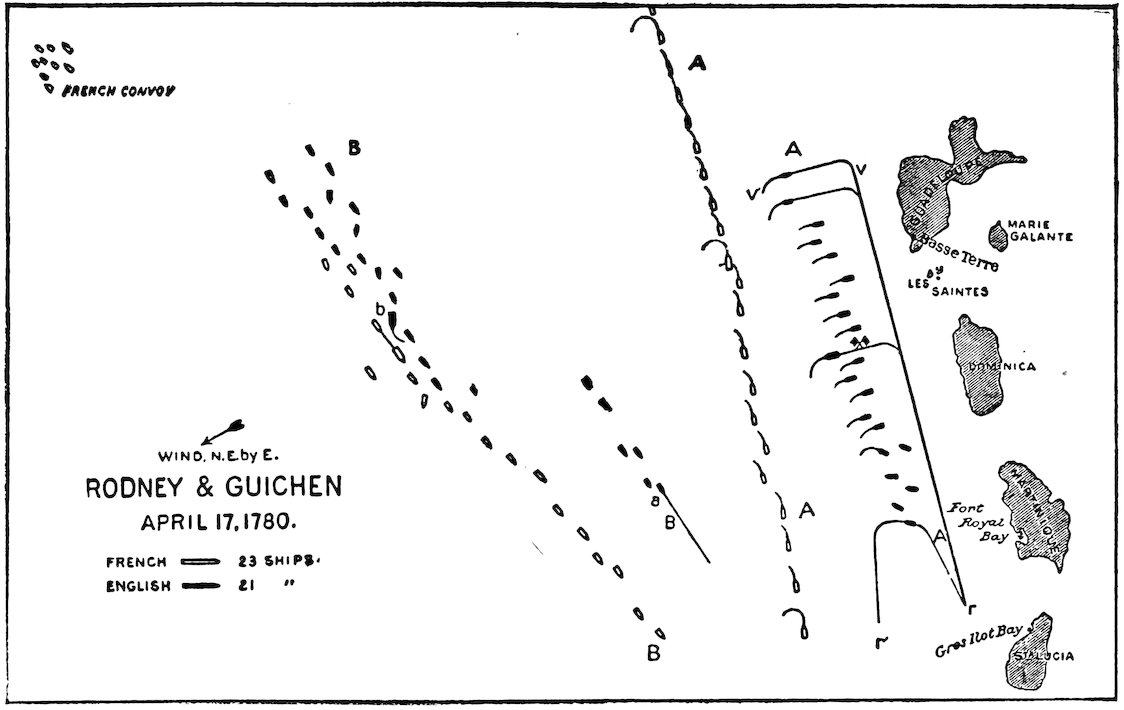
162De Guichen and Rodney met for the first time on
the 17th of April, 1780, three weeks after the arrival
of the latter. The French fleet was beating
to windward in the channel between Martinique
and Dominica, when the enemy was made in the
south-east. A day was spent in maneuvering for the
weather-gage, which Rodney got. The two fleets
being now well to leeward of the islands (see Plate),
both on the starboard tack heading to the northward
and the French on the lee bow of the English,
Rodney, who was carrying a press of sail, signalled
to his fleet that he meant to attack the enemy’s rear
and center with his whole force; and when he had
reached the position he thought suitable, ordered
them to keep away eight points (90°) together
(A, A, A). De Guichen, seeing the danger of the
rear, wore his fleet all together and stood down to
succor it. Rodney, finding himself foiled, hauled
up again on the same tack as the enemy, both fleets
now heading to the southward and eastward.[54]
Later, he again made signal for battle, followed an
hour after, just at noon, by the order (quoting his
own despatch), “for every ship to bear down and
steer for her opposite in the enemy’s line.” This,
which sounds like the old story of ship to ship,
Rodney explains to have meant her opposite at the
moment, not her opposite in numerical order. His
own words are: “In a slanting position, that my
leading ships might attack the van ships of the
enemy’s center division, and the whole British fleet
be opposed to only two thirds of the enemy”
(B, B). The difficulty and misunderstanding which
followed seem to have sprung mainly from the defective
character of the signal book. Instead of
doing as the admiral wished, the leading ships (a)
carried sail so as to reach their supposed station
abreast their numerical opposite in the order.
Rodney stated afterward that when he bore down
the second time, the French fleet was in a very extended
line of battle; and that, had his orders been
obeyed, the center and rear must have been disabled
before the van could have joined.
There seems every reason to believe that Rodney’s
intentions throughout were to double on the
French, as asserted. The failure sprang from the
signal book and tactical inefficiency of the fleet; for
which he, having lately joined, was not answerable.
But the ugliness of his fence was so apparent to
De Guichen, that he exclaimed, when the English
163fleet kept away the first time, that six or seven of
his ships were gone; and sent word to Rodney that
if his signals had been obeyed he would have had
him for his prisoner.[55] A more convincing proof
that he recognized the dangerousness of his enemy
is to be found in the fact that he took care not to
have the lee-gage in their subsequent encounters.
Rodney’s careful plans being upset, he showed that
with them he carried all the stubborn courage of
the most downright fighter; taking his own ship close
to the enemy and ceasing only when the latter hauled
off, her foremast and mainyard gone, and her hull
so damaged that she could hardly be kept afloat.
164
[Preliminary to the events narrated, the general
naval situation was as follows: The main
British and French fleets, under Rodney and De
Grasse, respectively, were in the West Indies, while a
small British division was under Graves at New
York, and a French squadron under De Barras was
based on Newport, R. I. The squadrons on the
American coast had met in a desultory action off the
Virginia capes on March 16, 1781, after which the
French commander had returned to Newport and
left the British in control.—Editor.]
The way of the sea being thus open and held in
force, two thousand more English troops sailing
from New York reached Virginia on the 26th of
March, and the subsequent arrival of Cornwallis in
May raised the number to seven thousand. The
operations of the contending forces during the
spring and summer months, in which Lafayette commanded
the Americans, do not concern our subject.
Early in August, Cornwallis, acting under orders
from Clinton, withdrew his troops into the peninsula
between the York and James rivers, and occupied
Yorktown.
Washington and Rochambeau had met on the
21st of May, and decided that the situation demanded
165that the effort of the French West Indian
fleet, when it came, should be directed against either
New York or the Chesapeake. This was the tenor
of the despatch found by De Grasse at Cap
Français,[57] and meantime the allied generals drew
their troops toward New York, where they would
be on hand for the furtherance of one object, and
nearer the second if they had to make for it.
In either case the result, in the opinion both of
Washington and of the French government, depended
upon superior sea power; but Rochambeau
had privately notified the admiral that his own preference
was for the Chesapeake as the scene of the
intended operations, and moreover the French government
had declined to furnish the means for a
formal siege of New York.[58] The enterprise therefore
assumed the form of an extensive military combination,
dependent upon ease and rapidity of
movement, and upon blinding the eyes of the enemy
to the real objective,—purposes to which the peculiar
qualities of a navy admirably lent themselves. The
shorter distance to be traversed, the greater depth
of water and easier pilotage of the Chesapeake,
were further reasons which would commend the
scheme to the judgment of a seaman; and De
Grasse readily accepted it, without making difficulties
or demanding modifications which would have
involved discussion and delay.
Having made his decision, the French admiral
acted with great good judgment, promptitude, and
166vigor. The same frigate that brought despatches
from Washington was sent back, so that by August
15 the allied generals knew of the intended coming
of the fleet. Thirty-five hundred soldiers were
spared by the governor of Cap Français, upon the
condition of a Spanish squadron anchoring at the
place, which De Grasse procured. He also raised
from the governor of Havana the money urgently
needed by the Americans; and finally, instead of
weakening his force by sending convoys to France,
as the court had wished, he took every available
ship to the Chesapeake. To conceal his coming as
long as possible, he passed through the Bahama
Channel, as a less frequented route, and on the 30th
of August anchored in Lynnhaven Bay, just within
the capes of the Chesapeake, with twenty-eight
ships-of-the-line. Three days before, August 27,
the French squadron at Newport, eight ships-of-the-line
with four frigates and eighteen transports under
M. de Barras, sailed for the rendezvous; making,
however, a wide circuit out to sea to avoid the English.
This course was the more necessary as the
French siege-artillery was with it. The troops
under Washington and Rochambeau[59] had crossed
the Hudson on the 24th of August, moving toward
the head of Chesapeake Bay. Thus the different
armed forces, both land and sea, were converging
toward their objective, Cornwallis.
The English were unfortunate in all directions.
167Rodney, learning of De Grasse’s departure, sent
fourteen ships-of-the-line under Admiral Hood to
North America, and himself sailed for England
in August, on account of ill health. Hood, going
by the direct route, reached the Chesapeake three
days before De Grasse, looked into the bay, and
finding it empty went on to New York. There he
met five ships-of-the-line under Admiral Graves,
who, being senior officer, took command of the
whole force and sailed on the 31st of August for the
Chesapeake, hoping to intercept De Barras before
he could join De Grasse. It was not till two days
later that Sir Henry Clinton was persuaded that the
allied armies had gone against Cornwallis, and had
too far the start to be overtaken.
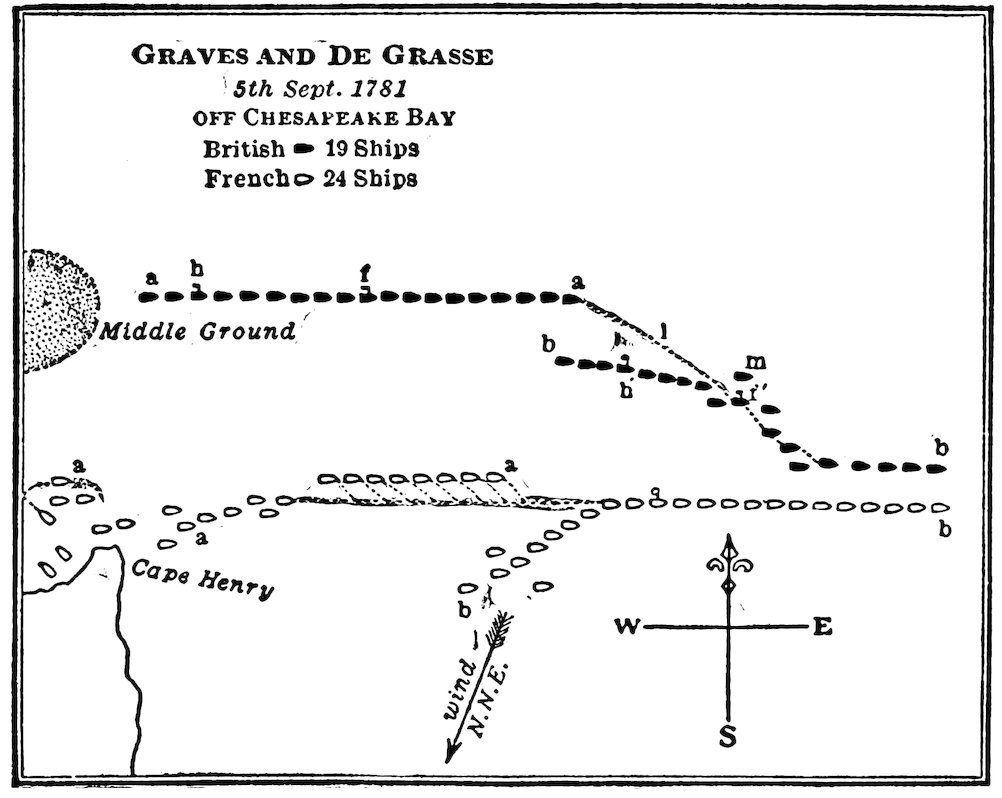
Admiral Graves was painfully surprised, on making
168the Chesapeake, to find anchored there a fleet
which from its numbers could only be an enemy’s.
Nevertheless, he stood in to meet it, and as De
Grasse got under way, allowing his ships to be
counted, the sense of numerical inferiority—nineteen
to twenty-four—did not deter the English
admiral from attacking. The clumsiness of his
method, however, betrayed his gallantry; many of
his ships were roughly handled, without any advantage
being gained.[60] De Grasse, expecting De Barras,
remained outside five days, keeping the English
fleet in play without coming to action; then returning
to port he found De Barras safely at anchor.
Graves went back to New York, and with him disappeared
the last hope of succor that was to gladden
Cornwallis’s eyes. The siege was steadily endured,
but the control of the sea made only one issue possible,
and the English forces were surrendered
October 19, 1781. With this disaster the hope of
subduing the colonies died in England. The conflict
169flickered through a year longer, but no serious
operations were undertaken.
... The defeat of Graves and subsequent surrender
of Cornwallis did not end the naval operations
in the western hemisphere. On the contrary,
one of the most interesting tactical feats and the
most brilliant victory of the whole war were yet to
grace the English flag in the West Indies; but with
the events at Yorktown the patriotic interest for
Americans closes. Before quitting that struggle
for independence, it must again be affirmed that its
successful ending, at least at so early a date, was
due to the control of the sea,—to sea power in the
hands of the French, and its improper distribution
by the English authorities. This assertion may be
safely rested on the authority of the one man who,
above all others, thoroughly knew the resources of
the country, the temper of the people, the difficulties
of the struggle, and whose name is still the highest
warrant for sound, quiet, unfluttered good sense and
patriotism.
The keynote to all Washington’s utterances is set
in the “Memorandum for concerting a plan of
operations with the French army,” dated July 15,
1780, and sent by the hands of Lafayette:
“The Marquis de Lafayette will be pleased to
communicate the following general ideas to Count
de Rochambeau and the Chevalier de Ternay, as
the sentiments of the underwritten:
“I. In any operation, and under all circumstances,
a decisive naval superiority is to be considered
as a fundamental principle, and the basis
170upon which every hope of success must ultimately
depend.”
This, however, though the most formal and
decisive expression of Washington’s views, is but
one among many others equally distinct.
171
... The seamen and the navy of France were
swept away by the same current of thought and
feeling which was carrying before it the whole
nation; and the government, tossed to and fro by
every wave of popular emotion, was at once too,
weak and too ignorant of the needs of the service
to repress principles and to amend defects which
were fatal to its healthy life.
It is particularly instructive to dwell upon this
phase of the revolutionary convulsions of France,
because the result in this comparatively small, but
still most important, part of the body politic was so
different from that which was found elsewhere.
Whatever the mistakes, the violence, the excesses
of every kind, into which this popular rising was
betrayed, they were symptomatic of strength, not
of weakness,—deplorable accompaniments of a
movement which, with all its drawbacks, was
marked by overwhelming force.
It was the inability to realize the might in this
outburst of popular feeling, long pent up, that
caused the mistaken forecasts of many statesmen
of the day; who judged of the power and reach of
the movement by indications—such as the finances,
the condition of the army, the quality of the known
172leaders—ordinarily fairly accurate tests of a country’s
endurance, but which utterly misled those who
looked to them only and did not take into account
the mighty impulse of a whole nation stirred to its
depths. Why, then, was the result so different in
the navy? Why was it so weak, not merely nor
chiefly in quantity, but in quality? and that, too, in
days so nearly succeeding the prosperous naval era
of Louis XVI. Why should the same throe which
brought forth the magnificent armies of Napoleon
have caused the utter weakness of the sister service,
not only amid the disorders of the Republic,
but also under the powerful organization of the
Empire?
The immediate reason was that, to a service of
a very special character, involving special exigencies,
calling for special aptitudes, and consequently demanding
special knowledge of its requirements in
order to deal wisely with it, were applied the
theories of men wholly ignorant of those requirements,—men
who did not even believe that they
existed. Entirely without experimental knowledge,
or any other kind of knowledge, of the conditions of
sea life, they were unable to realize the obstacles
to those processes by which they would build up
their navy, and according to which they proposed
to handle it. This was true not only of the wild
experiments of the early days of the Republic; the
reproach may fairly be addressed to the great emperor
himself, that he had scarcely any appreciation
of the factors conditioning efficiency at sea; nor did
he seemingly ever reach any such sense of them as
173would enable him to understand why the French
navy failed. “Disdaining,” says Jean Bon Saint-André,
the Revolutionary commissioner whose influence
on naval organization was unbounded, “disdaining,
through calculation and reflection, skillful
evolutions, perhaps our seamen will think it more
fitting and useful to try those boarding actions in
which the Frenchman was always conqueror, and
thus astonish Europe by new prodigies of valor.”[62]
“Courage and audacity,” says Captain Chevalier,
“had become in his eyes the only qualities necessary
to our officers.” “The English,” said Napoleon,
“will become very small when France shall have
two or three admirals willing to die.”[63] So commented,
with pathetic yet submissive irony, the ill-fated
admiral, Villeneuve, upon whom fell the
weight of the emperor’s discontent with his navy:
“Since his Majesty thinks that nothing but audacity
and resolve are needed to succeed in the naval
officer’s calling, I shall leave nothing to be desired.”[64]
... In truth men’s understandings, as well as
their morale and beliefs, were in a chaotic state. In
the navy, as in society, the morale suffered first.
Insubordination and mutiny, insult and murder, preceded
the blundering measures which in the end
destroyed the fine personnel that the monarchy bequeathed
to the French republic. This insubordination
broke out very soon after the affairs of the
Bastille and the forcing of the palace at Versailles;
that is, very soon after the powerlessness of the
174executive was felt. Singularly, yet appropriately,
the first victim was the most distinguished flag-officer
of the French navy.[65]
During the latter half of 1789 disturbances
occurred in all the seaport towns; in Havre, in
Cherbourg, in Brest, in Rochefort, in Toulon.
Everywhere the town authorities meddled with the
concerns of the navy yards and of the fleet, discontented
seamen and soldiers, idle or punished, rushed
to the town halls with complaints against their
officers. The latter, receiving no support from
Paris, yielded continually, and things naturally went
from bad to worse.
175
[Prior to the engagement, the French fleet had
met and was convoying to port 180 vessels from
America with food-stuffs of which France was then
in dire need. The British fleet encountered the
French 400 miles west of Ushant on May 28, and
in the four days of maneuvering and pursuit which
followed, Howe displayed marked energy and
tactical skill. Though the French fleet was defeated
in the ensuing battle, it covered the escape of
the convoy.—Editor.]
The French admiral on the evening of the 29th
saw that he now must fight, and at a disadvantage;
consequently, he could not hope to protect the convoy.
As to save this was his prime object, the next
best thing was to entice the British out of its path.
With this view he stood away to the north-west;
while a dense fog coming on both favored his design
and prevented further encounter during the two ensuing
days, throughout which Howe continued to
pursue. In the evening of May 31 the weather
cleared, and at daybreak the next morning the
enemies were in position, ready for battle, two long
176columns of ships, heading west, the British twenty-five,
the French again twenty-six through the junction
of the four vessels mentioned. Howe now had
cause to regret his absent six, and to ponder Nelson’s
wise saying, “Only numbers can annihilate.”
This time for maneuvering was past. Able tactician
as he personally was, and admirable as had
been the direction of his efforts in the two days’
fighting, Howe had been forced in them to realize
two things, namely, that his captains were, singly,
superior in seamanship, and their crews in gunnery,
to the French; and again, that in the ability to work
together as a fleet the British were so deficient as
to promise very imperfect results, if he attempted
any but the simplest formation. To such, therefore,
he resorted; falling back upon the old, unskillful,
sledge-hammer fashion of the British navy. Arranging
his ships in one long line, three miles from
the enemy, he made them all go down together,
each to attack a specified opponent, coming into
action as nearly as might be at the same instant.
Thus the French, from the individual inferiority of
the units of their fleet, would be at all points over-powered.
The issue justified the forecast; but the
manner of performance was curiously and happily
marked by Howe’s own peculiar phlegm. There
was a long summer day ahead for fighting, and no
need for hurry. The order was first accurately
formed, and canvas reduced to proper proportions.
Then the crews went to breakfast. After breakfast,
the ships all headed for the hostile line, under short
sail, the admiral keeping them in hand during the
177approach as an infantry officer dresses his company.
Hence the shock from end to end was so nearly
simultaneous as to induce success unequalled in any
engagement conducted on the same primitive plan.
Picturesque as well as sublime, animating as well
as solemn, on that bright Sunday morning, was this
prelude to the stern game of war about to be played:
the quiet summer sea stirred only by a breeze sufficient
to cap with white the little waves that ruffled
its surface; the dark hulls gently rippling the water
aside in their slow advance, a ridge of foam curling
on either side of the furrow ploughed by them in
their onward way; their massive sides broken by
two, or at times three, rows of ports, whence, the
tompions drawn, yawned the sullen lines of guns,
behind which, unseen, but easily realized by the instructed
eye, clustered the groups of ready seamen
who served each piece. Aloft swung leisurely to
and fro the tall spars, which ordinarily, in so light
a wind, would be clad in canvas from deck to truck,
but whose naked trimness now proclaimed the
deadly purpose of that still approach. Upon the
high poops, where floated the standard of either
nation, gathered round each chief the little knot of
officers through whom commands were issued and
reports received, the nerves along which thrilled the
impulses of the great organism, from its head, the
admiral, through every member to the dark lowest
decks, nearly awash, where, as farthest from the
captain’s own oversight, the senior lieutenants controlled
the action of the ships’ heaviest batteries.
On board the Queen Charlotte, Lord Howe,
178whose burden of sixty-eight years had for four days
found no rest save what he could snatch in an arm-chair,
now, at the prospect of battle, “displayed
an animation,” writes an eye-witness, “of which,
at his age, and after such fatigue of body and mind,
I had not thought him capable. He seemed to contemplate
the result as one of unbounded satisfaction.”
By his side stood his fleet-captain, Curtis,
of whose service among the floating batteries, and
during the siege of Gibraltar, the governor of the
fortress had said, “He is the man to whom the king
is chiefly indebted for its security;” and Codrington,
then a lieutenant, who afterwards commanded
the allied fleets at Navarino. Five ships to the left,
Collingwood, in the Barfleur, was making to the
admiral whose flag she bore the remark that stirred
Thackeray: “Our wives are now about going to
church, but we will ring about these Frenchmen’s
ears a peal which will drown their bells.” The
French officers, both admirals and captains, were
mainly unknown men, alike then and thereafter.
The fierce flames of the Revolution had swept away
the men of the old school, mostly aristocrats, and
time had not yet brought forward the very few
who during the Napoleonic period showed marked
capacity. The commander-in-chief, Villaret-Joyeuse,
had three years before been a lieutenant. He had
a high record for gallantry, but was without antecedents
as a general officer. With him, on the poop
of the Montagne, which took her name from Robespierre’s
political supporters, stood that anomalous
companion of the generals and admirals of the day,
179the Revolutionary commissioner, Jean Bon Saint-André,
about to learn by experience the practical
working of the system he had advocated, to disregard
all tests of ability save patriotism and courage,
depreciating practice and skill as unnecessary
to the valor of the true Frenchman.
As the British line drew near the French, Howe
said to Curtis, “Prepare the signal for close action.”
“There is no such signal,” replied Curtis. “No,”
said the admiral, “but there is one for closer action,
and I only want that to be made in case of captains
not doing their duty.” Then closing a little signal
book he always carried, he continued to those
around him, “Now, gentlemen, no more book, no
more signals. I look to you to do the duty of the
Queen Charlotte in engaging the flagship. I don’t
want the ships to be bilge to bilge, but if you can
lock the yardarms, so much the better; the battle
will be the quicker decided.” His purpose was to
go through the French line, and fight the Montagne
on the far side. Some doubted their succeeding,
but Howe overbore them. “That’s right, my
lord!” cried Bowen, the sailing-master, who looked
to the ship’s steering. “The Charlotte will make
room for herself.” She pushed close under the
French ship’s stern, grazing her ensign, and raking
her from stern to stem with a withering fire, beneath
which fell three hundred men. A length or
two beyond lay the French Jacobin. Howe ordered
the Charlotte to luff, and place herself between the
two. “If we do,” said Bowen, “we shall be on
board one of them.” “What is that to you, sir?”
180asked Howe quickly. “Oh!” muttered the master,
not inaudibly. “D—n my eyes if I care, if you
don’t. I’ll go near enough to singe some of our
whiskers.” And then, seeing by the Jacobin’s rudder
that she was going off, he brought the Charlotte
sharp round, her jib boom grazing the second
Frenchman as her side had grazed the flag of the
first.
From this moment the battle raged furiously
from end to end of the field for nearly an hour,—a
wild scene of smoke and confusion, under cover
of which many a fierce ship duel was fought, while
here and there men wandered, lost, in a maze of
bewilderment that neutralized their better judgment.
An English naval captain tells a service
tradition of one who was so busy watching the compass,
to keep his position in the ranks, that he lost
sight of his antagonist, and never again found him.
Many a quaint incident passed, recorded or unrecorded,
under that sulphurous canopy. A British
ship, wholly dismasted, lay between two enemies,
her captain desperately wounded. A murmur of
surrender was somewhere heard; but as the first
lieutenant checked it with firm authority, a cock flew
upon the stump of a mast and crowed lustily. The
exultant note found quick response in hearts not
given to despair, and a burst of merriment, accompanied
with three cheers, replied to the bird’s
triumphant scream. On board the Brunswick, in
her struggle with the Vengeur, one of the longest
and fiercest fights the sea has ever seen, the cocked
hat was shot off the effigy of the Duke of Brunswick,
181which she bore as a figure-head. A deputation from
the crew gravely requested the captain to allow the
use of his spare chapeau, which was securely nailed
on, and protected his grace’s wig during the rest of
the action. After this battle with the ships of the
new republic, the partisans of monarchy noted with
satisfaction that, among the many royal figures that
surmounted the stems of the British fleet, not one
lost his crown. Of a harum-scarum Irish captain
are told two droll stories. After being hotly engaged
for some time with a French ship, the fire of
the latter slackened, and then ceased. He called to
know if she had surrendered. The reply was,
“No.” “Then,” shouted he, “d—n you, why
don’t you fire?” Having disposed of his special
antagonist without losing his own spars, the same
man kept along in search of new adventures, until
he came to a British ship totally dismasted and
otherwise badly damaged. She was commanded by
a captain of rigidly devout piety. “Well, Jemmy,”
hailed the Irishman, “you are pretty well mauled;
but never mind, Jemmy, whom the Lord loveth he
chasteneth.”
The French have transmitted to us less of
anecdote, nor is it easy to connect the thought of
humor with those grimly earnest republicans and the
days of the Terror. There is, indeed, something unintentionally
funny in the remark of the commander
of one of the captured ships to his captors. They
had, it was true, dismasted half the French fleet,
and had taken over a fourth; yet he assured them
it could not be considered a victory, “but merely
182a butchery, in which the British had shown neither
science nor tactics.” The one story, noble and enduring,
that will ever be associated with the French
on the 1st of June is in full keeping with the temper
of the times and the enthusiasm of the nation. The
seventy-four-gun ship Vengeur, after a three hours’
fight, yardarm to yardarm, with the British Brunswick,
was left in a sinking state by her antagonist,
who was herself in no condition to help. In the confusion,
the Vengeur’s peril was for some time not
observed; and when it was, the British ships that
came to her aid had time only to remove part of
her survivors. In their report of the event the
latter said: “Scarcely had the boats pulled clear of
the sides, when the most frightful spectacle was
offered to our gaze. Those of our comrades who
remained on board the Vengeur du Peuple, with
hands raised to heaven, implored, with lamentable
cries, the help for which they could no longer hope.
Soon disappeared the ship and the unhappy victims
it contained. In the midst of the horror with which
this scene inspired us all, we could not avoid a feeling
of admiration mingled with our grief. As we
drew away, we heard some of our comrades still
offering prayers for the welfare of their country.
The last cries of these unfortunates were, ‘Vive la
République!’ They died uttering them.” Over a
hundred Frenchmen thus went down.
Seven French ships were captured, including the
sunk Vengeur. Five more were wholly dismasted,
but escaped,—a good fortune mainly to be attributed
to Howe’s utter physical prostration, due to
183his advanced years and the continuous strain of the
past five days. He now went to bed, completely
worn out. “We all got round him,” wrote an
officer, Lieutenant Codrington, who was present;
“indeed, I saved him from a tumble, he was so
weak that from a roll of the ship he was nearly
falling into the waist. ‘Why, you hold me up as if I
were a child,’ he said good-humoredly.” Had he
been younger, there can be little doubt that the fruits
of victory would have been gathered with an ardor
which his assistant, Curtis, failed to show.
184
[In 1800 Russia, Sweden, and Denmark, under the
manipulation of Napoleon, formed a “League
of Armed Neutrality” to resist British restrictions
on their trade with France. To reinforce diplomatic
pressure, Great Britain sent against the league
a fleet of twenty ships, of which Nelson was second
in command under Sir Hyde Parker. Throughout
the campaign, writes Mahan, Nelson “lifted and
carried on his shoulders the dead weight of his
superior.”—Editor.]
The fleet sailed from Yarmouth on the 12th of
March, 1801; and on the 19th, although there had
been some scattering in a heavy gale, nearly all were
collected off the Skaw, the northern point of Jutland
at the entrance of the Kattegat. The wind being
north-west was fair for going to Copenhagen, and
Nelson, if in command, would have advanced at
once with the ambassador on board. “While the
negotiation is going on,” he said, “the Dane should
see our flag waving every moment he lifted his
head.” As it was, the envoy went forward with a
frigate alone and the fleet waited. On the 12th it
was off Elsineur, where the envoy rejoined, Denmark
having rejected the British terms.
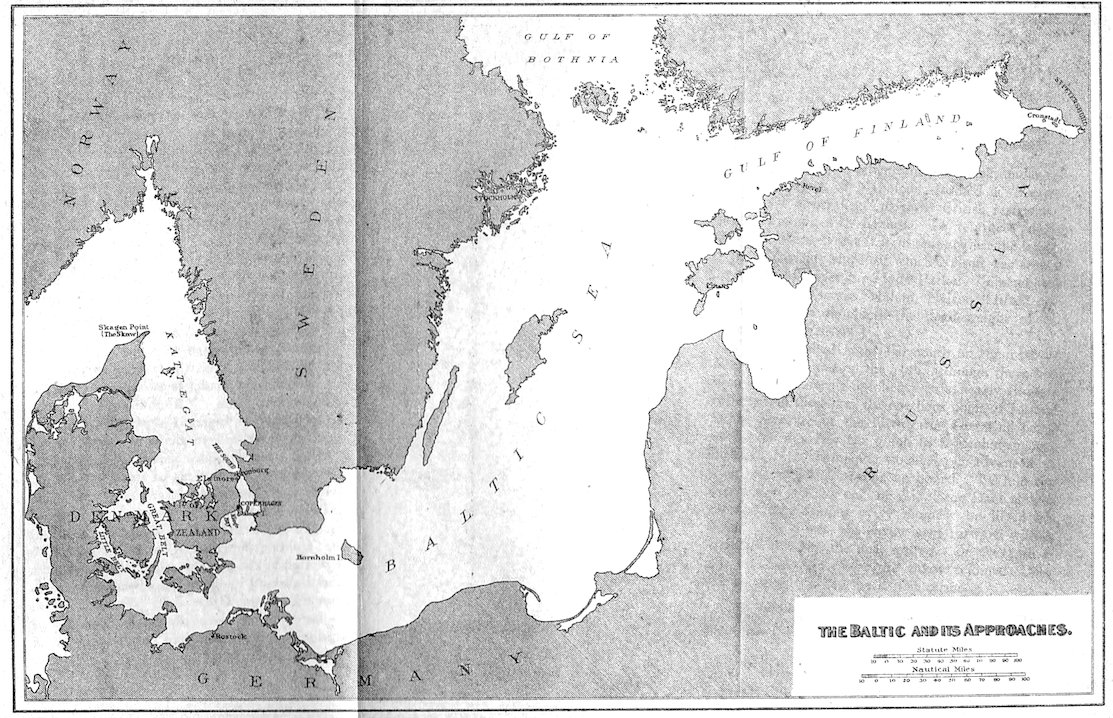
185This amounted to an acceptance of hostilities, and
it only remained to the commander-in-chief to act
at once; for the wind was favorable, an advantage
which at any moment might be lost. On this day
Nelson addressed Parker a letter, summing up in
a luminous manner the features of the situation
and the different methods of action. “Not a moment
should be lost in attacking,” he said; “we shall
never be so good a match for them as at this moment.”
He next hinted, what he had probably
already said, that the fleet ought to have been off
Copenhagen, and not at Elsineur, when the negotiation
failed. “Then you might instantly attack and
there would be scarcely a doubt but the Danish fleet
would be destroyed, and the capital made so hot
that Denmark would listen to reason and its true
interest.” Since, however, the mistake of losing so
much time had been made, he seeks to stir his superior
to lose no more. “Almost the safety, certainly
the honor, of England is more entrusted to
you than ever yet fell to the lot of any British
officer; ... never did our country depend so much
on the success of any fleet as of this.”
Having thus shown the necessity for celerity,
Nelson next discussed the plan of operations.
Copenhagen is on the east side of the island of
Zealand, fronting the coast of Sweden, from which
it is separated by the passage called the Sound. On
the west the island is divided from the other parts
of Denmark by the Great Belt. The navigation
of the latter being much the more difficult, the
preparations of the Danes had been made on the
186side of the Sound, and chiefly about Copenhagen
itself. For half a mile from the shore in front of
the city, flats extend, and in the Sound itself, at a
distance of little over a mile, is a long shoal called
the Middle Ground. Between these two bodies of
shallow water is a channel, called the King’s,
through which a fleet of heavy ships could sail, and
from whose northern end a deep pocket stretches
toward Copenhagen, forming the harbor proper.
The natural point of attack therefore appears to
be at the north; and there the Danes had erected
powerful works, rising on piles out of the shoal
water off the harbor’s mouth and known as the
Three-Crown Batteries. Nelson, however, pointed
out that not only was this head of the line exceedingly
strong, but that the wind that was fair to
attack would be foul to return; therefore a disabled
ship would have no escape but by passing through
the King’s Channel. Doing so she would have to
run the gantlet of a line of armed hulks, which the
Danes had established as floating batteries along
the inner edge of the channel—covering the front
of Copenhagen—and would also be separated
from her fleet. Nor was this difficulty, which may
be called tactical, the only objection to a plan that
he disparaged as “taking the bull by the horns.”
He remarked that so long as the British fleet remained
in the Sound, without entering the Baltic,
the way was left open for both the Swedes and the
Russians, if released by the ice, to make a junction
with the Danes. Consequently, he advised that a
sufficiently strong force of the lighter ships-of-theline
187should pass outside the Middle Ground, despite
the difficulties of navigation, which were not
insuperable, and come up in rear of the city. There
they would interpose between the Danes and their
allies, and be in position to assail the weaker part
of the hostile order. He offered himself to lead
this detachment.
This whole letter of March 24, 1801,[68] possesses
peculiar interest; for it shows with a rare particularity,
elicited by the need he felt of arousing and
convincing his superior, Nelson’s clear discernment
of the decisive features of a military situation. The
fame of this great admiral has depended less upon
his conduct of campaigns than upon the renowned
victories he won in the actual collision of fleet with
fleet; and even then has been mutilated by the obstinacy
with which, despite the perfectly evident facts,
men have persisted in seeing in them nothing but dash,—heart,
not head. Throughout his correspondence,
it is true, there are frequent traces of the activity
of his mental faculties and of the general accuracy
of his military conclusions; but ordinarily it is from
his actions that his reasonings and principles must
be deduced. In the present case we have the views
he held and the course he evidently would have
pursued clearly formulated by himself; and it cannot
but be a subject of regret that the naval world
should have lost so fine an illustration as he would
there have given of the principles and conduct of
naval warfare. He concluded his letter with a suggestion
worthy of Napoleon himself, and which, if
188adopted, would have brought down the Baltic Confederacy
with a crash that would have resounded
throughout Europe. “Supposing us through the
Belt with the wind first westerly, would it not be
possible to go with the fleet, or detach ten ships of
three and two decks, with one bomb and two fireships,
to Revel, to destroy the Russian squadron at
that place? I do not see the great risk of such a
detachment, and with the remainder to attempt the
business at Copenhagen. The measure may be
thought bold, but I am of opinion the boldest are
the safest; and our country demands a most vigorous
exertion of her force, directed with judgment.”
Committed as the Danes were to a stationary
defense, this recommendation to strike at the soul of
the confederacy evinced the clearest perception of
the key to the situation, which Nelson himself
summed up in the following words: “I look upon
the Northern League to be like a tree, of which
Paul was the trunk and Sweden and Denmark the
branches. If I can get at the trunk and hew it
down, the branches fall of course; but I may lop the
branches and yet not be able to fell the tree, and my
power must be weaker when its greatest strength
is required”[69]—that is, the Russians should have
been attacked before the fleet was weakened, as it
inevitably must be, by the battle with the Danes.
“If we could have cut up the Russian fleet,” he
said again, “that was my object.” Whatever Denmark’s
wishes about fighting, she was by her continental
possessions tied to the policy of Russia and
189Prussia, either of whom could overwhelm her by
land. She dared not disregard them. The course
of both depended upon the czar; for the temporizing
policy of Prussia would at once embrace his
withdrawal from the league as an excuse for doing
the same. At Revel were twelve Russian ships-of-the-line,
fully half their Baltic fleet, whose destruction
would have paralyzed the remainder and the
naval power of the empire. To persuade Parker
to such a step was, however, hopeless. “Our fleet
would never have acted against Russia and Sweden,”
wrote Nelson afterwards, “although Copenhagen
would have been burned; for Sir Hyde Parker was
determined not to leave Denmark hostile in his
rear;”[70] a reason whose technical accuracy under
all the circumstances was nothing short of pedantic,
and illustrates the immense distance between a good
and accomplished officer, which Parker was, and a
genius whose comprehension of rules serves only to
guide, not to fetter, his judgment.
Although unable to rise equal to the great opportunity
indicated by Nelson, Sir Hyde Parker adopted
his suggestion as to the method and direction of the
principal attack upon the defenses of Copenhagen.
For this, Nelson asked ten ships-of-the-line and a
number of smaller vessels, with which he undertook
to destroy the floating batteries covering the front
of the city. These being reduced, the bomb vessels
could be placed so as to play with effect upon the
dockyard, arsenals, and the town, in case further
resistance was made.
190[The fleet entered the Sound and anchored off
Copenhagen on March 26. On April 2 Nelson
attacked from the southward as he had suggested,
and after a hard-fought battle forced a fourteen
weeks’ armistice which practically secured the British
aims, since it gave opportunity to proceed against
Sweden and Russia. Nelson was given chief command
on May 5, and two days later sailed for
Revel, but the death of the Czar Paul had already
brought a favorable change in Russia’s policy and
made further action unnecessary.—Editor.]
191
[After the Copenhagen campaign, for a brief
period in 1801, Nelson commanded the naval defense
forces in the Channel. When, after two years
of peace, hostilities were renewed in 1803, he sailed
in the Victory to take command in the Mediterranean.
During the following years of the war,
“The British squadrons, hugging the French coasts
and blocking the French arsenals, were the first line
of defense, covering British interests from the Baltic
to Egypt, the British colonies in the four quarters
of the globe, and the British merchantmen which
whitened every sea.”[72]—Editor.]
Meanwhile that period of waiting from May,
1803, to August, 1805, when the tangled net of
naval and military movements began to unravel, was
a striking and wonderful pause in the world’s history.
On the heights above Boulogne, and along
the narrow strip of beach from Étaples to Vimereux,
were encamped one hundred and thirty thousand of
the most brilliant soldiery of all time, the soldiers
who had fought in Germany, Italy, and Egypt,
soldiers who were yet to win, from Austria, Ulm
and Austerlitz, and from Prussia, Auerstadt and
Jena, to hold their own, though barely, at Eylau
192against the army of Russia, and to overthrow it
also, a few months later, on the bloody field of
Friedland. Growing daily more vigorous in the
bracing sea air and the hardy life laid out for them,
they could on fine days, as they practised the varied
maneuvers which were to perfect the vast host in
embarking and disembarking with order and rapidity,
see the white cliffs fringing the only country that
to the last defied their arms. Far away, Cornwallis
off Brest, Collingwood off Rochefort, Pellew off
Ferrol, were battling the wild gales of the Bay of
Biscay, in that tremendous and sustained vigilance
which reached its utmost tension in the years preceding
Trafalgar, concerning which Collingwood
wrote that admirals need to be made of iron, but
which was forced upon them by the unquestionable
and imminent danger of the country. Farther distant
still, severed apparently from all connection
with the busy scene at Boulogne, Nelson before
Toulon was wearing away the last two years of his
glorious but suffering life, fighting the fierce north-westers
of the Gulf of Lyon and questioning, questioning
continually with feverish anxiety, whether
Napoleon’s object was Egypt again or Great Britain
really. They were dull, weary, eventless
months, those months of watching and waiting of
the big ships before the French arsenals. Purposeless
they surely seemed to many, but they saved
England. The world has never seen a more impressive
demonstration of the influence of sea power
upon its history. Those far distant, storm-beaten
ships, upon which the Grand Army never looked,
193stood between it and the dominion of the world.
Holding the interior positions they did, before—and
therefore between—the chief dockyards and
detachments of the French navy, the latter could
unite only by a concurrence of successful evasions,
of which the failure of any one nullified the result.
Linked together as the various British fleets were
by chains of smaller vessels, chance alone could
secure Bonaparte’s great combination, which depended
upon the covert concentration of several detachments
upon a point practically within the enemy’s
lines. Thus, while bodily present before Brest,
Rochefort, and Toulon, strategically the British
squadrons lay in the Straits of Dover barring the
way against the Army of Invasion.
The Straits themselves, of course, were not without
their own special protection. Both they and
their approaches, in the broadest sense of the term,
from the Texel to the Channel Islands, were
patrolled by numerous frigates and smaller vessels,
from one hundred to a hundred and fifty in all.
These not only watched diligently all that happened
in the hostile harbors and sought to impede the
movements of the flat-boats, but also kept touch
with and maintained communication between the
detachments of ships-of-the-line. Of the latter, five
off the Texel watched the Dutch navy, while others
were anchored off points of the English coast with
reference to probable movements of the enemy.
Lord St. Vincent, whose ideas on naval strategy
were clear and sound, though he did not use the
technical terms of the art, discerned and provided
194against the very purpose entertained by Bonaparte,
of a concentration before Boulogne by ships drawn
from the Atlantic and Mediterranean. The best
security, the most advantageous strategic positions,
were doubtless those before the enemy’s ports; and
never in the history of blockades has there been
excelled, if ever equalled, the close locking of Brest
by Admiral Cornwallis, both winter and summer,
between the outbreak of war and the battle of
Trafalgar. It excited not only the admiration but
the wonder of contemporaries.[73] In case, however,
the French at Brest got out, so the prime minister
of the day informed the speaker of the House,
Cornwallis’s rendezvous was off the Lizard (due
north of Brest), so as to go for Ireland, or follow
the French up Channel, if they took either direction.
Should the French run for the Downs, the
five sail of the line at Spithead would also follow
them; and Lord Keith (in the Downs) would in
addition to his six, and six block ships, have also
the North Sea fleet at his command.[74] Thus provision
was made, in case of danger, for the outlying
detachments to fall back on the strategic center,
gradually accumulating strength, till they formed a
body of from twenty-five to thirty heavy and disciplined
ships-of-the-line, sufficient to meet all probable
contingencies.
Hence, neither the Admiralty nor British naval
officers in general shared the fears of the country
195concerning the peril from the flotilla. “Our first
defense,” wrote Nelson in 1801, “is close to the
enemy’s ports; and the Admiralty have taken such
precautions, by having such a respectable force
under my orders, that I venture to express a well-grounded
hope that the enemy would be annihilated
before they get ten miles from their own shores.”[75]
196
[While Napoleon’s plans for control of the
Channel underwent many changes, the movements
actually carried out were as follows: On
March 27, Villeneuve with eighteen ships left
Toulon and sailed for the West Indies, arriving at
Martinique May 12, where he was to be joined by the
Brest fleet. Baffled at first by head winds and uncertainty
as to the enemy’s destination, Nelson
reached Barbados twenty-three days later.
Learning of his arrival, Villeneuve at once sailed
for Europe, on June 9, again followed, four days
later by Nelson. The brig Curieux, despatched by
Nelson to England on the 12th, sighted the enemy
fleet and reported its approach to the Admiralty,
thus enabling Calder to meet Villeneuve in an indecisive
action on July 22 off Ferrol, Spain. Nelson
steered for Gibraltar, and thence, having learned
that Villeneuve was to the northward, for the
Channel, where on August 15 he left his ships with
the Channel fleet under Cornwallis.
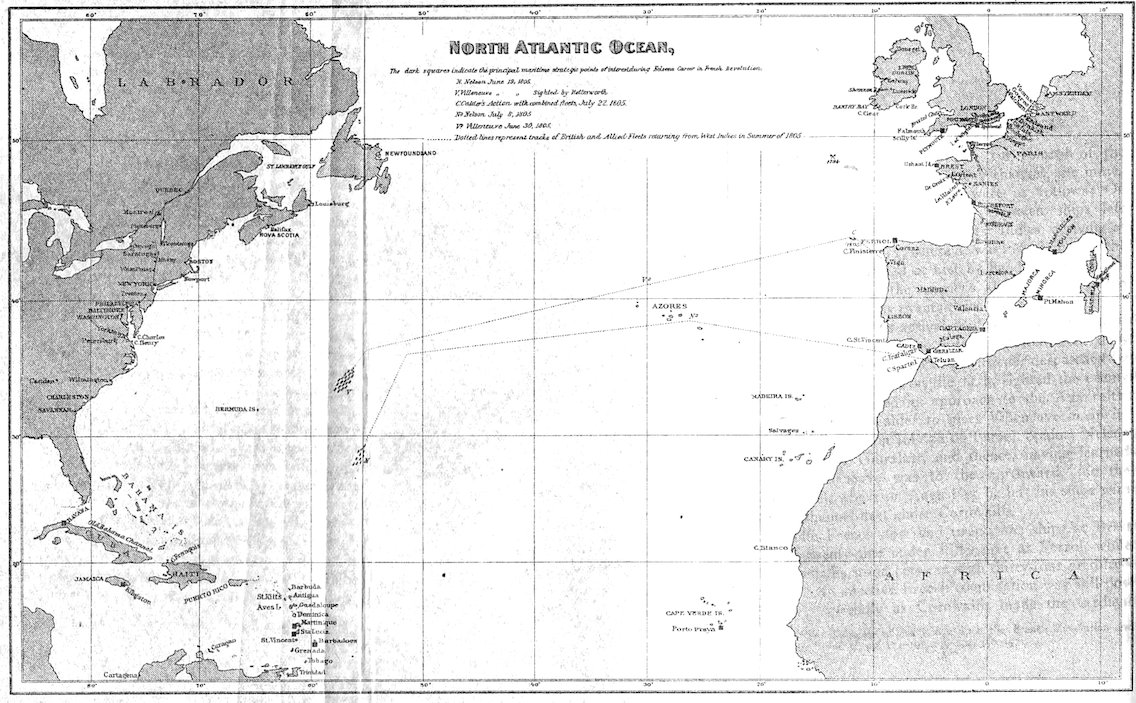
197The French now had twenty-one ships at Brest
and twenty-nine under Villeneuve at Ferrol, while
Cornwallis stood between with thirty-four or thirty-five.
An effective French combination was still possible,
especially as Cornwallis made the cardinal
error of dividing his fleet. Accordingly, Villeneuve,
under an imperative summons from Napoleon, left
Ferrol on August 13; but, with his ships demoralized
by their long cruise, with head winds, and disturbed
by false reports from a Danish merchantman regarding
the British strength, the French admiral
two days later turned for Cadiz. Here he was
watched by Collingwood; and on September 28
Nelson, after three weeks in England, took command
of the blockading fleet. “Thus ended, and
forever,” writes Mahan, “Napoleon’s profoundly
conceived and laboriously planned scheme for the
invasion of England. If it be sought to fix a definite
moment which marked the final failure of so vast
a plan, that one may well be chosen when Villeneuve
made signal to bear up for Cadiz.”[77] On August 25
the Boulogne army broke camp and marched against
the Austrian forces advancing toward the Rhine.—Editor.]
The importance attached by the emperor to his
project was not exaggerated. He might, or he
might not, succeed; but, if he failed against Great
Britain, he failed everywhere. This he, with the
intuition of genius, felt; and to this the record of
his after history now bears witness. To the strife
of arms with the great Sea Power succeeded the
strife of endurance. Amid all the pomp and circumstance
of the war which for ten years to come
desolated the Continent, amid all the tramping to
and fro over Europe of the French armies and their
198auxiliary legions, there went on unceasingly that
noiseless pressure upon the vitals of France, that
compulsion, whose silence, when once noted, becomes
to the observer the most striking and awful
mark of the working of Sea Power. Under it the
resources of the Continent wasted more and more
with each succeeding year; and Napoleon, amid all
the splendor of his imperial position, was ever
needy. To this, and to the immense expenditures
required to enforce the Continental System, are to
be attributed most of those arbitrary acts which
made him the hated of the peoples, for whose enfranchisement
he did so much. Lack of revenue
and lack of credit, such was the price paid by
Napoleon for the Continental System, through
which alone, after Trafalgar, he hoped to crush the
Power of the Sea. It may be doubted whether, amid
all his glory, he ever felt secure after the failure
of the invasion of England. To borrow his own
vigorous words, in the address to the nation issued
before he joined the army, “To live without commerce,
without shipping, without colonies, subjected
to the unjust will of our enemies, is to live as
Frenchmen should not.” Yet so had France to live
throughout his reign, by the will of the one enemy
never conquered.
On the 14th of September, before quitting Paris,
Napoleon sent Villeneuve orders to take the first
favorable opportunity to leave Cadiz, to enter the
Mediterranean, join the ships at Cartagena, and
with this combined force move upon southern Italy.
There, at any suitable point, he was to land the
199troops embarked in the fleet to reinforce General
St. Cyr, who already had instructions to be ready to
attack Naples at a moment’s notice.[78] The next day
these orders were reiterated to Decrès, enforcing
the importance to the general campaign of so powerful
a diversion as the presence of this great fleet in
the Mediterranean; but, as “Villeneuve’s excessive
pusillanimity will prevent him from undertaking
this, you will send to replace him Admiral Rosily,
who will bear letters directing Villeneuve to return
to France and give an account of his conduct.”[79]
The emperor had already formulated his complaints
against the admiral under seven distinct heads.[80]
On the 15th of September, the same day the orders
to relieve Villeneuve were issued, Nelson, having
spent at home only twenty-five days, left England
for the last time. On the 28th, when he joined the
fleet off Cadiz, he found under his command twenty-nine
ships-of-the-line, which successive arrivals
raised to thirty-three by the day of the battle; but,
water running short, it became necessary to send the
ships, by divisions of six, to fill up at Gibraltar. To
this cause was due that only twenty-seven British
vessels were present in the action,—an unfortunate
circumstance; for, as Nelson said, what the country
wanted was not merely a splendid victory, but annihilation;
“numbers only can annihilate.”[81] The
force under his command was thus disposed: the
main body about fifty miles west-south-west of
Cadiz, seven lookout frigates close in with the port,
200and between these extremes, two small detachments
of ships-of-the-line,—the one twenty miles from
the harbor, the other about thirty-five. “By this
chain,” he wrote, “I hope to have constant communication
with the frigates.”
At 6 P.M. of Saturday, September 28, the Victory
reached the fleet, then numbering twenty-nine
of the line; the main body being fifteen to
twenty miles west of Cadiz, with six ships close in
with the port. The next day was Nelson’s birthday—forty-seven
years old. The junior admirals
and the captains visited the commander-in-chief, as
customary, but with demonstrations of gladness and
confidence that few leaders have elicited in equal
measure from their followers. “The reception I
met with on joining the fleet caused the sweetest
sensation of my life. The officers who came on
board to welcome my return, forgot my rank as
commander-in-chief in the enthusiasm with which
they greeted me. As soon as these emotions were
past, I laid before them the plan I had previously
arranged for attacking the enemy; and it was not
only my pleasure to find it generally approved,
but clearly perceived and understood.” To Lady
Hamilton he gave an account of this scene which
differs little from the above, except in its greater
vividness. “I believe my arrival was most welcome,
201not only to the commander of the fleet, but also to
every individual in it; and, when I came to explain
to them the ‘Nelson touch,’ it was like an electric
shock. Some shed tears, all approved—‘It was
new—it was singular—it was simple!’ and, from
admirals downwards, it was repeated—‘It must
succeed, if ever they will allow us to get at them!
You are, my Lord, surrounded by friends whom
you inspire with confidence.’ Some may be Judas’s;
but the majority are certainly much pleased with my
commanding them.” No more joyful birthday levee
was ever held than that of this little naval court.
Besides the adoration for Nelson personally, which
they shared with their countrymen in general, there
mingled with the delight of the captains the sentiment
of professional appreciation and confidence,
and a certain relief, noticed by Codrington, from the
dry, unsympathetic rule of Collingwood, a man just,
conscientious, highly trained, and efficient, but self-centered,
rigid, uncommunicative; one who fostered,
if he did not impose, restrictions upon the intercourse
between the ships, against which he had inveighed
bitterly when himself one of St. Vincent’s
captains. Nelson, on the contrary, at once invited
cordial social relations with the commanding officers.
Half of the thirty-odd were summoned to dine on
board the flagship the first day, and half the second.
Not till the third did he permit himself the luxury
of a quiet dinner chat with his old chum, the second
in command, whose sterling merits, under a crusty
exterior, he knew and appreciated. Codrington
mentions also an incident, trivial in itself, but illustrative
202of that outward graciousness of manner,
which, in a man of Nelson’s temperament and position,
is rarely the result of careful cultivation, but
bespeaks rather the inner graciousness of the heart
that he abundantly possessed. They had never met
before, and the admiral, greeting him with his usual
easy courtesy, handed him a letter from his wife,
saying that being entrusted with it by a lady, he
made a point of delivering it himself, instead of
sending it by another.
The “Nelson Touch,” or Plan of Attack, expounded
to his captains at the first meeting, was
afterwards formulated in an Order, copies of which
were issued to the fleet on the 9th of October. In
this “Memorandum,” which was doubtless sufficient
for those who had listened to the vivid oral explanation
of its framer, the writer finds the simplicity,
but not the absolute clearness, that they
recognized. It embodies, however, the essential
ideas, though not the precise method of execution,
actually followed at Trafalgar, under conditions
considerably different from those which Nelson
probably anticipated; and it is not the least of its
merits as a military conception that it could thus,
with few signals and without confusion, adapt itself
at a moment’s notice to diverse circumstances. This
great order not only reflects the ripened experience
of its author, but contains also the proof of constant
mental activity and development in his thought; for
it differs materially in detail from the one issued a
few months before to the fleet, when in pursuit of
Villeneuve to the West Indies.
(Secret)
Victory, off Cadiz, 9th October, 1805.
Thinking it almost impossible to bring a Fleet of
forty Sail of the Line into a Line of Battle in variable
winds, thick weather, and other circumstances
which must occur, without such a loss of time that
the opportunity would probably be lost of bringing
the Enemy to Battle in such a manner as to make
the business decisive, I have therefore made up my
mind to keep the Fleet in that position of sailing
(with the exception of the First and Second in Command)
that the Order of Sailing is to be the Order
of Battle, placing the Fleet in two Lines of sixteen
Ships each, with an Advanced Squadron of eight of
the fastest sailing Two-decked Ships, which will
always make, if wanted, a Line of twenty-four Sail,
on whichever Line the Commander-in-Chief may
direct.
The Second in Command will, after my intentions
are made known to him, have the entire direction
of his Line to make the attack upon the Enemy, and
to follow up the blow until they are captured or
destroyed.
If the Enemy’s Fleet should be seen to windward
in Line of Battle, and that the two Lines and
the Advanced Squadron can fetch them, they will
probably be so extended that their Van could not
succor their Rear.
I should therefore probably make the Second in
Command’s signal to lead through, about their
twelfth Ship from their Rear, (or wherever he
204could fetch, if not able to get so far advanced); my
Line would lead through about their Center, and
the Advanced Squadron to cut two or three or four
Ships ahead of their Center, so as to ensure getting
at their Commander-in-Chief, on whom every effort
must be made to capture.
The whole impression of the British Fleet must
be to overpower from two or three Ships ahead of
their Commander-in-Chief, supposed to be in the
Center, to the Rear of their Fleet. I will suppose
twenty Sail of the Enemy’s Line to be untouched,
it must be some time before they could perform a
maneuver to bring their force compact to attack
any part of the British Fleet engaged, or to succor
their own Ships, which indeed would be impossible
without mixing with the Ships engaged.
Something must be left to chance; nothing is sure
in a Sea Fight beyond all others. Shot will carry
away the masts and yards of friends as well as foes;
but I look with confidence to a Victory before the
Van of the Enemy could succor their Rear, and then
that the British Fleet would most of them be ready
to receive their twenty Sail of the Line, or to pursue
them, should they endeavor to make off.
If the Van of the Enemy tacks, the Captured
Ships must run to leeward of the British Fleet; if
the Enemy wears, the British must place themselves
between the Enemy and the Captured, and disabled
British Ships; and should the Enemy close, I have no
fears as to the result.
The Second in Command will in all possible
things direct the movements of his Line, by keeping
205them as compact as the nature of the circumstances
will admit. Captains are to look to their particular
Line as their rallying point. But, in case Signals
can neither be seen or perfectly understood, no
Captain can do very wrong if he places his Ship
alongside that of an Enemy.
Of the intended attack from to windward, the
Enemy in Line of Battle ready to receive an attack,
The divisions of the British Fleet will be brought
nearly within gun shot of the Enemy’s Center. The
signal will most probably then be made for the Lee
Line to bear up together, to set all their sails, even
steering sails, in order to get as quickly as possible
to the Enemy’s Line, and to cut through, beginning
from the 12 Ship from the Enemy’s Rear. Some
Ships may not get through their exact place, but
they will always be at hand to assist their friends;
and if any are thrown round the Rear of the Enemy,
they will effectually complete the business of twelve
Sail of the Enemy.
Should the Enemy wear together, or bear up and
206sail large, still the twelve Ships composing, in the
first position, the Enemy’s Rear, are to be the object
of attack of the Lee Line, unless otherwise directed
from the Commander-in-Chief, which is scarcely to
be expected, as the entire management of the Lee
Line, after the intentions of the Commander-in-Chief
is signified, is intended to be left to the judgment
of the Admiral commanding that Line.
The remainder of the Enemy’s Fleet, 34 Sail, are
to be left to the management of the Commander-in-Chief
who will endeavor to take care that the
movements of the Second in Command are as little
interrupted as is possible.
After a statement of general considerations, and
a frank attribution of full powers to the second in
command for carrying out his part, Nelson lays
down the manner of attack from to leeward. This
condition not obtaining at Trafalgar, the plan cannot
be contrasted with the performance of that day.
Upon this follows a luminous enunciation of the
general idea, namely, Collingwood’s engaging the
twelve rear ships, which underlies the method prescribed
for each attack—from to leeward and to
windward. Of the latter Nelson fortunately gives
an outline diagram, which illustrates the picture
before his own mind, facilitating our comprehension
of his probable expectations, and allowing a comparison
between them and the event as it actually
occurred. It is not to the discredit, but greatly to
the credit, of his conception, that it was susceptible
207of large modification in practice while retaining its
characteristic idea.
Looking at his diagram, and following his words,
it will be seen that the British lines are not formed
perpendicularly to that of the enemy (as they were
at Trafalgar), but parallel to it. Starting from this
disposition, near the enemy and abreast his center,
the lee line of sixteen ships was to bear up together,
and advance in line, not in column (as happened at
Trafalgar); their object being the twelve rear ships
of the enemy. This first move stands by itself; the
action of the weather line, and of the reserve
squadron still farther to windward, are held in suspense
under the eye of the commander-in-chief, to
take the direction which the latter shall prescribe as
the struggle develops. The mere menace of such a
force, just out of gunshot to windward, would be
sufficient to prevent any extensive maneuver of the
unengaged enemies. Nelson doubtless had in mind
the dispositions, more than a century old, of Tourville
and De Ruyter, by which a few ships, spaced
to windward of an enemy’s van, could check its tacking,
because of the raking fire to which they would
subject it. Unquestionably, he would not have kept
long in idle expectancy twenty-four ships, the number
he had in mind; but clearly also he proposed to
hold them until he saw how things went with Collingwood.
Thus much time would allow, granting
the position he assumed and a reasonable breeze.
His twenty-four to windward held an absolute check
over the supposed thirty-four unengaged, of the
enemy.
208The attack as planned, therefore, differed from
that executed (1) in that the lee line was not to
advance in column, but in line, thereby dispersing
the enemy’s fire, and avoiding the terrific concentration
which crushed the leaders at Trafalgar; and
(2) in that the weather squadrons were not to attack
simultaneously with the lee, but after it had
engaged, in order to permit the remedying of any
mishap that might arise in delivering the crucial
blow. In both these matters of detail the plan was
better than the modification; but the latter was
forced upon Nelson by conditions beyond his
control.[84]
Napoleon’s commands to enter the Mediterranean
reached Villeneuve on September 27. The
following day, when Nelson was joining his fleet,
the admiral acknowledged their receipt, and submissively
reported his intention to obey as soon as
the wind served. Before he could do so, accurate
intelligence was received of the strength of Nelson’s
force, which the emperor had not known. Villeneuve
assembled a council of war to consider the
situation, and the general opinion was adverse to
sailing; but the commander-in-chief, alleging the
orders of Napoleon, announced his determination to
follow them. To this all submitted. An event, then
unforeseen by Villeneuve, precipitated his action.
Admiral Rosily’s approach was known in Cadiz
209some time before he could arrive. It at first made
little impression upon Villeneuve, who was not expecting
to be superseded. On the 11th of October,
however, along with the news that his successor had
reached Madrid, there came to him a rumor of the
truth. His honor took alarm. If not allowed to
remain afloat, how remove the undeserved imputation
of cowardice which he knew had by some been
attached to his name. He at once wrote to Decrès
that he would have been well content if permitted
to continue with the fleet in a subordinate capacity;
and closed with the words, “I will sail to-morrow,
if circumstances favor.”
The wind next day was fair, and the combined
fleets began to weigh. On the 19th eight ships got
clear of the harbor, and by ten A.M. Nelson, far at
sea, knew by signal that the long-expected movement
had begun. He at once made sail toward the Straits
of Gibraltar to bar the entrance of the Mediterranean
to the allies. On the 20th, all the latter,
thirty-three ships-of-the-line accompanied by five
frigates and two brigs, were at sea, steering with
a south-west wind to the northward and westward
to gain the offing needed before heading direct for
the Straits. That morning Nelson, for whom the
wind had been fair, was lying to off Cape Spartel
to intercept the enemy; and learning from his
frigates that they were north of him, he stood in
that direction to meet them.
During the day the wind shifted to west, still fair
for the British and allowing the allies, by going
about, to head south. It was still very weak, so that
210the progress of the fleets was slow. During the
night both maneuvered; the allies to gain, the British
to retain, the position they wished. At daybreak
of the 21st they were in presence, the French and
Spaniards steering south in five columns; of which
the two to windward, containing together twelve
ships, constituted a detached squadron of observation
under Admiral Gravina. The remaining twenty-one
formed the main body, commanded by Villeneuve.
Cape Trafalgar, from which the battle took
its name, was on the south-eastern horizon, ten or
twelve miles from the allies; and the British fleet
was at the same distance from them to the westward.
Soon after daylight Villeneuve signalled to form
line of battle on the starboard tack, on which they
were then sailing, heading south. In performing
this evolution Gravina with his twelve ships took
post in the van of the allied fleet, his own flagship
heading the column. It is disputed between the
French and Spaniards whether this step was
taken by Villeneuve’s order, or of Gravina’s own
motion. In either case, these twelve, by abandoning
their central and windward position, sacrificed
to a great extent their power to reinforce any
threatened part of the order, and also unduly extended
a line already too long. In the end, instead
of being a reserve well in hand, they became the
helpless victims of the British concentration.
At eight A.M. Villeneuve saw that battle could
not be shunned. Wishing to have Cadiz under his
lee in case of disaster, he ordered the combined fleet
211to wear together. The signal was clumsily executed;
but by ten all had gone round and were heading
north in inverse order, Gravina’s squadron in the
rear. At eleven Villeneuve directed this squadron
to keep well to windward, so as to be in position to
succor the center, upon which the enemy seemed
about to make his chief attack; a judicious order,
but rendered fruitless by the purpose of the British
to concentrate on the rear itself. When this signal
was made, Cadiz was twenty miles distant in the
north-north-east, and the course of the allies was
carrying them toward it.
Owing to the lightness of the wind Nelson would
lose no time in maneuvering. He formed his fleet
rapidly in two divisions, each in single column, the
simplest and most flexible order of attack, and the
one whose regularity is most easily preserved. The
simple column, however, unflanked, sacrifices during
the critical period of closing the support given
by the rear ships to the leader, and draws upon the
latter the concentrated fire of the enemy’s line. Its
use by Nelson on this occasion has been much criticized.
It is therefore to be remarked that, although
his orders, issued several days previous to the battle,
are somewhat ambiguous on this point, their natural
meaning seems to indicate the intention, if attacking
from to windward, to draw up with his fleet in
two columns parallel to the enemy and abreast his
rear. Then the column nearest the enemy, the lee,
keeping away together, would advance in line against
the twelve rear ships; while the weather column,
moving forward, would hold in check the remainder
212of the hostile fleet. In either event, whether
attacking in column or in line, the essential feature
of his plan was to overpower twelve of the enemy
by sixteen British, while the remainder of his force
covered this operation. The destruction of the rear
was entrusted to the second in command; he himself
with a smaller body took charge of the more uncertain
duties of the containing force. “The second
in command,” wrote he in his memorable order,
“will, after my instructions are made known to him,
have the entire direction of his line.”
The justification of Nelson’s dispositions for
battle at Trafalgar rests therefore primarily upon
the sluggish breeze, which would so have delayed
formations as to risk the loss of the opportunity.
It must also be observed that, although a column of
ships does not possess the sustained momentum of
a column of men, whose depth and mass combine
to drive it through the relatively thin resistance of
a line, and so cut the latter in twain, the results
nevertheless are closely analogous. The leaders in
either case are sacrificed,—success is won over
their prostrate forms; but the continued impact
upon one part of the enemy’s order is essentially
a concentration, the issue of which, if long enough
maintained, cannot be doubtful. Penetration, severance,
and the enveloping of one of the parted fragments,
must be the result. So, exactly, it was at
Trafalgar. It must also be noted that the rear ships
of either column, until they reached the hostile line,
swept with their broadsides the sea over which
enemy’s ships from either flank might try to come
213to the support of the attacked center. No such attempt
was in fact made from either extremity of
the combined fleet.
The two British columns were nearly a mile apart
and advanced on parallel courses,—heading nearly
east, but a little to the northward to allow for the
gradual advance in that direction of the hostile fleet.
The northern or left-hand column, commonly called
the “weather line” because the wind came rather
from that side, contained twelve ships, and was led
by Nelson himself in the Victory, a ship of one
hundred guns. The Royal Sovereign, of the same
size and carrying Collingwood’s flag, headed the
right column, of fifteen ships.
To the British advance the allies opposed the
traditional order of battle, a long single line, close-hauled,—in
this case heading north, with the wind
from west-north-west. The distance from one flank
to the other was nearly five miles. Owing partly
to the lightness of the breeze, partly to the great
number of ships, and partly to the inefficiency of
many of the units of the fleet, the line was very
imperfectly formed. Ships were not in their places,
intervals were of irregular width, here vessels were
not closed up, there two overlapped, one masking
the other’s fire. The general result was that, instead
of a line, the allied order showed a curve of
gradual sweep, convex toward the east. To the
British approach from the west, therefore, it presented
a disposition resembling a re-entrant angle;
and Collingwood, noting with observant eye the
advantage of this arrangement for a cross-fire, commented
favorably upon it in his report of the battle.
It was, however, the result of chance, not of intention,—due,
not to the talent of the chief, but to
the want of skill in his subordinates.
214
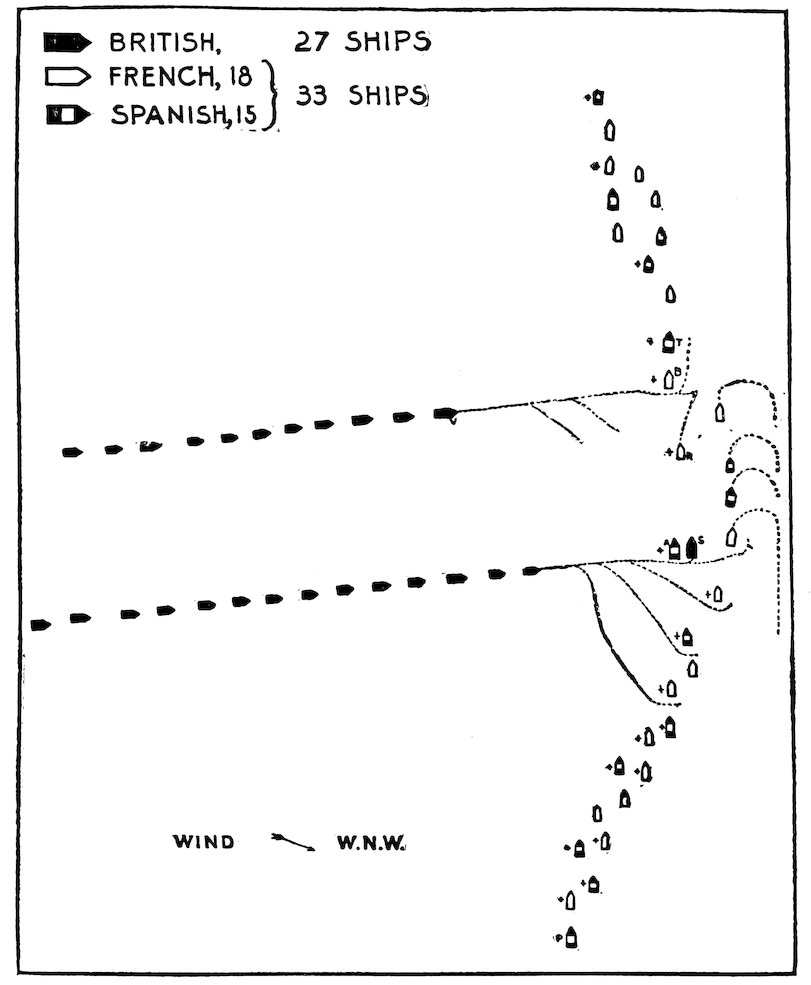
THE ATTACK AT TRAFALGAR
OCTOBER 21, 1805
5 minutes past noon
The French and Spanish ships marked + were taken or destroyed in the action.
References
A. Santa Ana, Alava’s Flagship
B. Bucentaure, Villeneuve’s Flagship
P. Principe De Asturias, Gravina’s Flagship
R. Redoutable
S. Royal Sovereign, Collingwood’s Flagship
T. Santisima Trinidad
V. Victory, Nelson’s Flagship
Recent investigation has shown that Collingwood’s division was much more nearly parallel to the enemy than is indicated in this diagram, and thus in a formation more closely resembling Nelson’s original plan.—Editor.
215The commander-in-chief of the allies, Villeneuve,
was in the Bucentaure, an eighty-gun ship, the
twelfth in order from the van of the line. Immediately
ahead of him was the huge Spanish four-decker,
the Santisima Trinidad, a Goliath among
ships, which had now come forth to her last battle.
Sixth behind the Bucentaure, and therefore
eighteenth in the order, came a Spanish three-decker,
the Santa Ana, flying the flag of Vice-Admiral
Alava. These two admirals marked the
right and left of the allied center, and upon them,
therefore, the British leaders respectively directed
their course,—Nelson upon the Bucentaure, Collingwood
upon the Santa Ana.
The Royal Sovereign had recently been refitted,
and with clean new copper easily outsailed her
more worn followers. Thus it happened that,
as Collingwood came within range, his ship, outstripping
the others by three quarters of a mile,
entered alone, and for twenty minutes endured, unsupported,
the fire of all the hostile ships that could
reach her. A proud deed, surely, but surely also
not a deed to be commended as a pattern. The first
shot of the battle was fired at her by the Fougueux,
the next astern of the Santa Ana. This was just at
noon, and with the opening guns the ships of both
fleets hoisted their ensigns; the Spaniards also hanging
large wooden crosses from their spanker booms.
216The Royal Sovereign advanced in silence until,
ten minutes later, she passed close under the stern
of the Santa Ana. Then she fired a double-shotted
broadside which struck down four hundred of the
enemy’s crew, and, luffing rapidly, took her position
close alongside, the muzzles of the hostile guns
nearly touching. Here the Royal Sovereign underwent
the fire not only of her chief antagonist, but
of four other ships; three of which belonged to the
division of five that ought closely to have knit the
Santa Ana to the Bucentaure, and so fixed an impassable
barrier to the enemy seeking to pierce the
center. The fact shows strikingly the looseness of
the allied order, these three being all in rear and to
leeward of their proper stations.
For fifteen minutes the Royal Sovereign was the
only British ship in close action. Then her next
astern entered the battle, followed successively by
the rest of the column. In rear of the Santa Ana
were fifteen ships. Among these, Collingwood’s
vessels penetrated in various directions; chiefly,
however, at first near the spot where his flag had
led the way, enveloping and destroying in detail the
enemy’s center and leading rear ships, and then
passing on to subdue the rest. Much doubtless was
determined by chance in such confusion and obscurity;
but the original tactical plan ensured an
ever-whelming concentration upon a limited portion
of the enemy’s order. This being subdued with the
less loss, because so outnumbered, the intelligence
and skill of the various British captains readily compassed
the destruction of the dwindling remnant.
217Of the sixteen ships, including the Santa Ana, which
composed the allied rear, twelve were taken or
destroyed.
Not till one o’clock, or nearly half an hour after
the vessels next following Collingwood came into
action, did the Victory reach the Bucentaure. The
latter was raked with the same dire results that
befell the Santa Ana; but a ship close to leeward
blocked the way, and Nelson was not able to grapple
with the enemy’s commander-in-chief. The Victory,
prevented from going through the line, fell on board
the Redoutable, a French seventy-four, between
which and herself a furious action followed,—the
two lying in close contact. At half-past one Nelson
fell mortally wounded, the battle still raging fiercely.
The ship immediately following Nelson’s came
also into collision with the Redoutable, which thus
found herself in combat with two antagonists. The
next three of the British weather column each in
succession raked the Bucentaure, complying thus
with Nelson’s order that every effort must be made
to capture the enemy’s commander-in-chief. Passing
on, these three concentrated their efforts, first
upon the Bucentaure, and next upon the Santisima
Trinidad. Thus it happened that upon the allied
commander-in-chief, upon his next ahead, and upon
the ship which, though not his natural supporter
astern, had sought and filled that honorable post,—upon
the key, in short, of the allied order,—were
combined under the most advantageous conditions
the fires of five hostile vessels, three of them first-rates.
Consequently, not only were the three added
218to the prizes, but also a great breach was made
between the van and rear of the combined fleets.
This breach became yet wider by the singular conduct
of Villeneuve’s proper next astern. Soon after
the Victory came into action, that ship bore up out
of the line, wore round, and stood toward the rear,
followed by three others. This movement is attributed
to a wish to succor the rear. If so, it was
at best an indiscreet and ill-timed act, which finds
little palliation in the fact that not one of these ships
was taken.
Thus, two hours after the battle began, the allied
fleet was cut in two, the rear enveloped and in process
of being destroyed in detail, the Bucentaure,
Santisima Trinidad, and Redoutable practically reduced,
though not yet surrendered. Ahead of the
Santisima Trinidad were ten ships, which as yet had
not been engaged. The inaction of the van, though
partly accounted for by the slackness of the wind,
has given just cause for censure. To it, at ten
minutes before two, Villeneuve made signal to get
into action and to wear together. This was accomplished
with difficulty, owing to the heavy swell and
want of wind. At three, however, all the ships were
about, but by an extraordinary fatality they did not
keep together. Five with Admiral Dumanoir stood
along to windward of the battle, three passed to leeward
of it, and two, keeping away, left the field
entirely. Of the whole number, three were intercepted,
raising the loss of the allies to eighteen ships-of-the-line
taken, one of which caught fire and was
burned. The approach of Admiral Dumanoir, if
219made an hour earlier, might have conduced to save
Villeneuve; it was now too late. Exchanging a few
distant broadsides with enemy’s ships, he stood off
to the south-west with four vessels; one of those at
first with him having been cut off.
At quarter before five Admiral Gravina, whose
ship had been the rear of the order during the battle
and had lost heavily, retreated toward Cadiz,
making signal to the vessels which had not struck
to form around his flag. Five other Spanish ships
and five French followed him. As he was withdrawing,
the last two to resist of the allied fleet
struck their colors.
During the night of the 21st these eleven ships
anchored at the mouth of Cadiz harbor, which they
could not then enter, on account of a land wind from
south-east. At the same time the British and their
prizes were being carried shoreward by the heavy
swell which had prevailed during the battle; the light
air blowing from the sea not enabling them to haul
off. The situation was one of imminent peril. At
midnight the wind freshened much, but fortunately
hauled to the southward, whence it blew a gale all
the 22d. The ships got their heads to the westward
and drew off shore, with thirteen of the prizes;
the other four having had to anchor off Cape Trafalgar.
That morning the Bucentaure, Villeneuve’s
late flagship, was wrecked on some rocks off the
entrance to Cadiz; and toward evening the Redoutable,
that had so nobly supported her, was found
to be sinking astern of the British ship that had her
in tow. During the night of the 22d she went down
220with a hundred and fifty of her people still on
board. On the 24th the same fate befell the great
Santisima Trinidad, which had been the French
admiral’s next ahead. Thus his own ship and his
two supports vanished from the seas.
For several days the wind continued violent from
north-west and south-west. On the 23d five of the
ships that had escaped with Gravina put out, to cut
off some of the prizes that were near the coast.
They succeeded in taking two; but as these were
battered to pieces, while three of the five rescuers
were carried on the beach and wrecked with great
loss of life, little advantage resulted from this well-meant
and gallant sortie. Two other prizes were
given up to their own crews by the British prize-masters,
because the latter were not able with their
scanty force to save them. These got into Cadiz.
Of the remaining British prizes, all but four either
went ashore or were destroyed by the orders of
Collingwood, who despaired of saving them. No
British ship was lost.
Of thirty-three combined French and Spanish
ships which sailed out of Cadiz on the 20th of
October, eleven, five French and six Spanish, mostly
now disabled hulks, lay there at anchor on the last
day of the month. The four that escaped to sea
under Dumanoir fell in with a British squadron of
the same size near Cape Ortegal, on the 4th of
November, and were all taken. This raised the
allied loss to twenty-two,—two more than the
twenty for which Nelson, in his dying hour, declared
that he had bargained.
221No attempt to move from Cadiz was again made
by the shattered relics of the fight. On the 25th of
October Rosily arrived and took up his now blasted
command. Nearly three years later, when the
Spanish monarchy, so long the submissive tool of
the Directory and of Napoleon, had been overthrown
by the latter, and the Spanish people had
risen against the usurper, the five French ships were
still in the port. Surprised between the British
blockade and the now hostile batteries of the coast,
Rosily, after an engagement of two days with the
latter, surrendered his squadron, with the four
thousand seamen then on board. This event occurred
on the 14th of June, 1808. It was the last
echo of Trafalgar.
Such, in its leading outlines and direct consequences,
was the famous battle of Trafalgar. Its
lasting significance and far-reaching results have
been well stated by a recent historian, more keenly
alive than most of his fellows to the paramount,
though silent, influence of Sea Power upon the
course of events: “Trafalgar was not only the
greatest naval victory, it was the greatest and most
momentous victory won either by land or by sea
during the whole of the Revolutionary War. No
victory, and no series of victories, of Napoleon
produced the same effect upon Europe.... A
generation passed after Trafalgar before France
again seriously threatened England at sea. The
prospect of crushing the British navy, so long as
England had the means to equip a navy, vanished.
Napoleon henceforth set his hopes on exhausting
222England’s resources, by compelling every state on
the Continent to exclude her commerce. Trafalgar
forced him to impose his yoke upon all Europe, or
to abandon the hope of conquering Great Britain....
Nelson’s last triumph left England in
such a position that no means remained to injure
her but those which must result in the ultimate
deliverance of the Continent.”[85]
These words may be accepted with very slight
modification. Napoleon’s scheme for the invasion
of Great Britain, thwarted once and again by the
strategic difficulties attendant upon its execution, was
finally frustrated when Villeneuve gave up the attempt
to reach Brest and headed for Cadiz. On
the part of the allies Trafalgar was, in itself, a useless
holocaust, precipitated in the end by the despair
of the unfortunate admiral, upon whose irresolution
Napoleon not unjustly visited the anger caused
by the wreck of his plans. Villeneuve was perfectly
clear-sighted and right in his appreciation of the
deficiencies of his command,—of the many chances
against success. Where he wretchedly failed was
in not recognizing the simple duty of obedience,—the
obligation to persist at all hazards in the part
of a great scheme assigned to him, even though it
led to the destruction of his whole force. Had he,
upon leaving Ferrol, been visited by a little of the
desperation which brought him to Trafalgar, the
invasion of England might possibly—not probably—have
been effected.
An event so striking as the battle of Trafalgar
223becomes, however, to mankind the symbol of all the
circumstances—more important, perhaps, but less
obvious—which culminate in it. In this sense it
may be said that Trafalgar was the cause—as it
certainly marked the period—of Napoleon’s resolution
to crush Great Britain by excluding her commerce
from the Continent. Here, therefore, the
story of the influence of Sea Power upon this great
conflict ceases to follow the strictly naval events,
and becomes concerned simply with commerce-destroying,
ordinarily a secondary operation of maritime
war, but exalted in the later years of Napoleon’s
reign to be the principal, if not the sole,
means of action.
The warfare against commerce during the
French Revolution, alike under the Republic and
under Napoleon, was marked by the same passionate
vehemence, the same extreme and far-reaching
conceptions, the same obstinate resolve utterly
to overthrow and extirpate every opposing force,
that characterized the political and military enterprises
of the period. In the effort to bring under
the yoke of their own policy the commerce of the
whole world, the two chief contestants, France and
Great Britain, swayed back and forth in deadly
grapple over the vast arena, trampling under foot
the rights and interests of the weaker parties; who,
whether as neutrals, or as subjects of friendly or
allied powers, looked helplessly on, and found that
in this great struggle for self-preservation, neither
224outcries, nor threats, nor despairing submission,
availed to lessen the pressure that was gradually
crushing out both hope and life. The question between
Napoleon and the British people became
simply one of endurance, as was tersely and powerfully
shown by the emperor himself. Both were
expending their capital, and drawing freely drafts
upon the future, the one in money, the other in men,
to sustain their present strength. Like two infuriated
dogs, they had locked jaws over commerce,
as the decisive element in the contest. Neither
would let go his grip until failing vitality should
loose it, or until some bystander should deal one
a wound through which the powers of life should
drain away. All now know that in the latter way
the end came. The commercial policy of the great
monarch, who, from the confines of Europe, had
watched the tussle with all the eagerness of self-interest,
angered Napoleon. To enforce his will,
he made new and offensive annexations of territory.
The czar replied by a commercial edict, sharp and
decisive, and war was determined. “It is all a
scene in the Opera,” wrote Napoleon,[86] “and the
English are the scene shifters.” Words failed the
men of that day to represent the grandeur and apparent
solidity of the Empire in 1811, when Napoleon’s
heir was born. In December, 1812, it was
shattered from turret to foundation stone; wrecked
in the attempt “to conquer the sea by the land.”
The scene was shifted indeed.
225Great Britain remained victorious on the field,
but she had touched the verge of ruin. Confronted
with the fixed resolution of her enemy to break
down her commerce by an absolute exclusion from
the continent of Europe, and as far as possible
from the rest of the world, she met the challenge
by a measure equally extreme, forbidding all neutral
vessels to enter ports hostile to her, unless they had
first touched at one of her own. Shut out herself
from the Continent, she announced that while this
exclusion lasted she would shut the Continent off
from all external intercourse. “No trade except
through England,” was the formula under which
her leaders expressed their purpose. The entrance
of Russia into this strife, under the provocations
of Napoleon, prevented the problem, which of
these two policies would overthrow the other, from
reaching a natural solution; and the final result of
the measures which it is one object of this and the
following chapter to narrate must remain for ever
uncertain. It is, however, evident that a commercial
and manufacturing country like Great Britain must,
in a strife the essence of which was the restriction
of trade, suffer more than one depending, as France
did, mainly upon her internal resources. The question,
as before stated, was whether she could endure
the greater drain by her greater wealth. Upon the
whole, the indications were, and to the end continued
to be, that she could do so; that Napoleon,
in entering upon this particular struggle, miscalculated
his enemy’s strength.
But besides this, here, as in every contest where
226the opponents are closely matched, where power and
discipline and leadership are nearly equal, there was
a further question: which of the two would make
the first and greatest mistakes, and how ready the
other party was to profit by his errors. In so even
a balance, the wisest prophet cannot foresee how the
scale will turn. The result will depend not merely
upon the skill of the swordsman in handling his
weapons, but also upon the wariness of his fence and
the quickness of his returns; much, too, upon his
temper. Here also Napoleon was worsted. Scarcely
was the battle over commerce joined, when the uprising
of Spain was precipitated by overconfidence;
Great Britain hastened at once to place herself by
the side of the insurgents. Four years later, when
the British people were groaning in a protracted
financial crisis,—when, if ever, there was a hope
that the expected convulsion and ruin were at hand,—Napoleon,
instead of waiting for his already
rigorous blockade to finish the work he attributed
to it, strove to draw it yet closer, by demands which
were unnecessary and to which the czar could not
yield. Again Great Britain seized her opportunity,
received her late enemy’s fleet, and filled his treasury.
Admit the difficulties of Napoleon; allow as we
may for the intricacy of the problem before him;
the fact remains that he wholly misunderstood the
temper of the Spanish people, the dangers of the
Spanish enterprise, the resolution of Alexander. On
the other hand, looking upon the principal charge
against the policy of the British government, that it
alienated the United States, it is still true that there
227was no miscalculation as to the long-suffering of the
latter under the guidance of Jefferson, with his
passion for peace. The submission of the United
States lasted until Napoleon was committed to his
final blunder, thus justifying the risk taken by Great
Britain and awarding to her the strategic triumph.
... As regards the rightfulness of the action of
the two parties, viewed separately from their policy,
opinions will probably always differ, according to
the authority attributed by individuals to the dicta of
International Law. It may be admitted at once that
neither Napoleon’s decrees nor the British orders
can be justified at that bar, except by the simple plea
of self-preservation,—the first law of states even
more than of men; for no government is empowered
to assent to that last sacrifice, which the individual
may make for the noblest motives. The beneficent
influence of the mass of conventions known as International
Law is indisputable, nor should its authority
be lightly undermined; but it cannot prevent the
interests of belligerents and neutrals from clashing,
nor speak with perfect clearness in all cases where
they do. Of this the Rule of 1756 offered, in its
day, a conspicuous instance. The belligerent claimed
that the neutral, by covering with his flag a trade
previously the monopoly of the enemy, not only inflicted
a grave injury by snatching from him a lawful
prey, but was guilty likewise of a breach of neutrality;
the neutral contended that the enemy had a right
to change his commercial regulations, in war as well
as in peace. To the author, though an American,
the belligerent argument seems the stronger; nor
228was the laudable desire of the neutral for gain a
nobler motive than the solicitude, about their national
resources, of men who rightly believed themselves
engaged in a struggle for national existence.
The measure meted to Austria and Prussia was an
ominous indication of the fate Great Britain might
expect, if her strength failed her. But, whatever the
decision of our older and milder civilization on the
merits of the particular question, there can be no
doubt of the passionate earnestness of the two disputants
in their day, nor of the conviction of right
held by either. In such a dilemma, the last answer
of International Law has to be that every state is
the final judge as to whether it should or should
not make war; to its own self alone is it responsible
for the rightfulness of this action. If, however, the
condition of injury entailed by the neutral’s course
is such as to justify war, it justifies all lesser means
of control. The question of the rightfulness of
these disappears, and that of policy alone remains.
It is the business of the neutral, by his prepared
condition, to make impolitic that which he claims is
also wrong. The neutral which fails to do so, which
leaves its ports defenseless and its navy stunted until
the emergency comes, will then find, as the United
States found in the early years of this century, an
admirable opportunity to write State Papers.
229
The general considerations that have been advanced
are sufficient to indicate what should
have been the general plan of the war on the part of
the United States. Every war must be aggressive,
or, to use the technical term, offensive, in military
character; for unless you injure the enemy, if you
confine yourself, as some of the grumblers of that
day would have it, to simple defense against his
efforts, obviously he has no inducement to yield your
contention. Incidentally, however, vital interests
must be defended, otherwise the power of offense
falls with them. Every war, therefore, has both
a defensive and an offensive side, and in an effective
plan of campaign each must receive due attention.
Now, in 1812, so far as general natural conditions
went, the United States was relatively weak on the
sea frontier, and strong on the side of Canada. The
seaboard might, indeed, in the preceding ten years,
have been given a development of force, by the
creation of an adequate navy, which would have
prevented war, by the obvious danger to British
interests involved in hostilities. But this had not
been done; and Jefferson, by his gunboat policy,
building some two hundred of those vessels, worthless
230unless under cover of the land, proclaimed by
act as by voice his adherence to a bare defensive.
The sea frontier, therefore, became mainly a line of
defense, the utility of which primarily was, or should
have been, to maintain communication with the outside
world; to support commerce, which in turn
should sustain the financial potency that determines
the issues of war.
... Such in general was the condition of the
sea frontier, thrown inevitably upon the defensive.
With the passing comment that, had it been defended
as suggested [by a squadron of respectable
battleships in concentrated strength.—Editor],
Great Britain would never have forced the war, let
us now consider conditions on the Canadian line,
where circumstances eminently favored the offensive
by the United States; for this war should not be
regarded simply as a land war or a naval war,
nor yet as a war of offense and again one of defense,
but as being continuously and at all times
both offensive and defensive, both land and sea, in
reciprocal influence.
Disregarding as militarily unimportant the artificial
boundary dividing Canada from New York,
Vermont, and the eastern parts of the Union, the
frontier separating the land positions of the two
belligerents was the Great Lakes and the river St.
Lawrence. This presented certain characteristic
and unusual features. That it was a water line was
a condition not uncommon; but it was exceptionally
marked by those broad expanses which constitute
inland seas of great size and depth, navigable by
231vessels of the largest sea-going dimensions. This
water system, being continuous and in continual
progress, is best conceived by applying to the whole,
from Lake Superior to the ocean, the name of the
great river, the St. Lawrence, which on the one
hand unites it to the sea, and on the other divides
the inner waters from the outer by a barrier of
rapids, impassable to ships that otherwise could
navigate freely both lakes and ocean.
The importance of the lakes to military operations
must always be great, but it was much enhanced
in 1812 by the undeveloped condition of land communications.
With the roads in the state they then
were, the movement of men, and still more of supplies,
was vastly more rapid by water than by land.
Except in winter, when iron-bound snow covered the
ground, the routes of Upper Canada were well-nigh
impassable; in spring and in autumn rains, wholly
so to heavy vehicles. The mail from Montreal to
York,—now Toronto,—three hundred miles,
took a month in transit.[88] In October, 1814, when
the war was virtually over, the British general at
Niagara lamented to the commander-in-chief that,
owing to the refusal of the navy to carry troops,
an important detachment was left “to struggle
through the dreadful roads from Kingston to
York.”[89] “Should reinforcements and provisions
not arrive, the naval commander would,” in his
opinion, “have much to answer for.”[90] The commander-in-chief
232himself wrote: “The command of
the lakes enables the enemy to perform in two days
what it takes the troops from Kingston sixteen to
twenty days of severe marching. Their men arrive
fresh; ours fatigued, and with exhausted equipment.
The distance from Kingston to the Niagara frontier
exceeds two hundred and fifty miles, and part of
the way is impracticable for supplies.”[91] On the
United States side, road conditions were similar but
much less disadvantageous. The water route by
Ontario was greatly preferred as a means of transportation,
and in parts and at certain seasons was
indispensable. Stores for Sackett’s Harbor, for
instance, had in early summer to be brought to
Oswego, and thence coasted along to their destination,
in security or in peril, according to the momentary
predominance of one party or the other
on the lake. In like manner, it was more convenient
to move between the Niagara frontier and
the east end of the lake by water; but in case of
necessity, men could march. An English traveler
in 1818 says: “I accomplished the journey from
Albany to Buffalo in October in six days with ease
and comfort, whereas in May it took ten of great
difficulty and distress.”[92] In the farther West the
American armies, though much impeded, advanced
securely through Ohio and Indiana to the shores of
Lake Erie, and there maintained themselves in supplies
sent over-country; whereas the British at the
233western end of the lake, opposite Detroit, depended
wholly upon the water, although no hostile force
threatened the land line between them and Ontario.
The battle of Lake Erie, so disastrous to their cause,
was forced upon them purely by failure of food,
owing to the appearance of Perry’s squadron.
... The opinion of competent soldiers on the
spot, such as Craig and Brock, in full possession of
all the contemporary facts, may be accepted explicitly
as confirming the inferences which in any
event might have been drawn from the natural features
of the situation. Upon Mackinac and Detroit
depended the control and quiet of the Northwestern
country, because they commanded vital points on its
line of communication. Upon Kingston and Montreal,
by their position and intrinsic advantages,
rested the communication of all Canada, along and
above the St. Lawrence, with the sea power of Great
Britain, whence alone could be drawn the constant
support without which ultimate defeat should have
been inevitable. Naval power, sustained upon the
Great Lakes, controlled the great line of communication
between the East and West, and also
conferred upon the party possessing it the strategic
advantage of interior lines; that is, of shorter
distances, both in length and time, to move from
point to point of the lake shores, close to which
lay the scenes of operations. It followed that Detroit
and Michilimackinac, being at the beginning
in the possession of the United States, should
have been fortified, garrisoned, provisioned, in
readiness for siege, and placed in close communication
234with home, as soon as war was seen to be imminent,
which it was in December, 1811, at latest.
Having in that quarter everything to lose, and comparatively
little to gain, the country was thrown on
the defensive. On the east the possession of Montreal
or Kingston would cut off all Canada above
from support by the sea, which would be equivalent
to ensuring its fall. “I shall continue to exert myself
to the utmost to overcome every difficulty,”
wrote Brock, who gave such emphatic proof of
energetic and sagacious exertion in his subsequent
course. “Should, however, the communication between
Montreal and Kingston be cut off, the fate of
the troops in this part of the province will be decided.”[93]
“The Montreal frontier,” said the officer
selected by the Duke of Wellington to report on the
defenses of Canada, “is the most important, and at
present [1826] confessedly most vulnerable and
accessible part of Canada.”[94] There, then, was the
direction for offensive operations by the United
States; preferably against Montreal, for, if successful,
a much larger region would be isolated and reduced.
Montreal gone, Kingston could receive no
help from without; and, even if capable of temporary
resistance, its surrender would be but a question
of time. Coincidently with this military advance,
naval development for the control of the
lakes should have proceeded, as a discreet precaution;
although, after the fall of Kingston and
Montreal, there could have been little use of an
235inland navy, for the British local resources would
then have been inadequate to maintain an opposing
force.
[While control was more vital and the forces
stronger on Lake Ontario than on either Erie or
Champlain, no naval action of consequence occurred
there in 1813 or in fact throughout the war. Yeo,
the British commander, was enjoined by Admiralty
orders to take no risks; and the American Commodore
Chauncey, with no such justification, adopted
a similar policy. Hence the important fleet actions
of the war were in other waters—Perry’s victory
of September 10, 1813, on Lake Erie, and Macdonough’s
victory on Lake Champlain a year later.
The first sentence in the paragraph following refers
to a raid on Buffalo, December 30, 1813.—Editor.]
With this may be said to have terminated the
northern campaign of 1813. The British had regained
full control of the Niagara peninsula, and
they continued to hold Fort Niagara, in the State of
New York, till peace was concluded. The only
substantial gain on the whole frontier, from the extreme
east to the extreme west, was the destruction
of the British fleet on Lake Erie, and the consequent
transfer of power in the west to the United States.
This was the left flank of the American position.
Had the same result been accomplished on the right
flank,—as it might have been,—at Montreal, or
even at Kingston, the center and left must have
fallen also. For the misdirection of effort to
236Niagara, the local commanders, Dearborn and
Chauncey, are primarily responsible; for Armstrong[95]
yielded his own correct perceptions to the
representations of the first as to the enemy’s force,
supported by the arguments of the naval officer
favoring the diversion of effort from Kingston to
Toronto. Whether Chauncey ever formally admitted
to himself this fundamental mistake, which
wrecked the summer’s work upon Lake Ontario,
does not appear; but that he had learned from experience
is shown by a letter to the Secretary of the
Navy,[96] when the squadrons had been laid up. In
this he recognized the uselessness of the heavy sailing
schooners when once a cruising force of ships for
war had been created, thereby condemning much of
his individual management of the campaign; and he
added: “If it is determined to prosecute the war
offensively, and secure our conquests in Upper
Canada, Kingston ought unquestionably to be the
first object of attack, and that so early in the spring
as to prevent the enemy from using the whole of the
naval force that he is preparing.”
In the three chapters which here end, the Ontario
operations have been narrated consecutively and at
length, without interruption by other issues,—except
the immediately related Lake Erie campaign,—because
upon them turned, and upon them by the
dispositions of the government this year were
wrecked the fortunes of the war. The year 1813,
from the opening of the spring to the closing in of
237winter, was for several reasons the period when
conditions were most propitious to the American
cause. In 1812 war was not begun until June, and
then with little antecedent preparation; and it was
waged half-heartedly, both governments desiring
to nip hostilities. In 1814, on the other hand, when
the season opened, Napoleon had fallen, and the
United States no longer had an informal ally to
divert the efforts of Great Britain. But in the intervening
year, 1813, although the pressure upon the
seaboard, the defensive frontier, was undoubtedly
greater than before, and much vexation and harassment
was inflicted, no serious injury was done beyond
the suppression of commerce, inevitable in any
event. In the north, on the lakes frontier, the offensive
and the initiative continued in the hands of
the United States. No substantial reinforcements
reached Canada until long after the ice broke up,
and then in insufficient numbers. British naval
preparations had been on an inadequate scale, receiving
no proper professional supervision. The
American Government, on the contrary, had had
the whole winter to prepare, and the services of a
very competent naval organizer. It had also the
same period to get ready its land forces; while
incompetent Secretaries of War and of the Navy
gave place in January to capable men in both
situations.
With all this in its favor, and despite certain
gratifying successes, the general outcome was a
complete failure, the full measure of which could be
realized only when the downfall of Napoleon revealed
238what disaster may result from neglect to
seize opportunity while it exists. The tide then
ebbed, and never again flowed. For this many
causes may be alleged. The imbecile ideas concerning
military and naval preparation which had prevailed
since the opening of the century doubtless
counted for much. The entrusting of chief command
to broken-down men like Dearborn and
Wilkinson was enough to ruin the best conceived
schemes. But, despite these very serious drawbacks,
the strategic misdirection of effort was the most
fatal cause of failure.
There is a simple but very fruitful remark of a
Swiss military writer, that every military line may
be conceived as having three parts, the middle and
the two ends, or flanks. As sound principle requires
that military effort should not be distributed along
the whole of an enemy’s position,—unless in the
unusual case of overwhelming superiority,—but
that distinctly superior numbers should be concentrated
upon a limited portion of it, this idea of a
threefold division aids materially in considering
any given situation. One third, or two thirds, of an
enemy’s line may be assailed, but very seldom the
whole; and everything may depend upon the choice
made for attack. Now the British frontier, which
the United States was to assail, extended from Montreal
on the east to Detroit on the west. Its three
parts were: Montreal and the St. Lawrence on the
east, or left flank; Ontario in the middle, centering
at Kingston; and Erie on the right; the strength of
the British position in the last-named section being
239at Detroit and Malden, because they commanded
the straits upon which the Indian tribes depended
for access to the east. Over against the British
positions named lay those of the United States.
Given in the same order, these were: Lake Champlain,
and the shores of Ontario and of Erie, centering
respectively in the naval stations at Sackett’s
Harbor and Presque Isle.
Accepting these definitions, which are too obvious
to admit of dispute, what considerations should have
dictated to the United States the direction of attack;
the one, or two, parts out of the three, on which
effort should be concentrated? The reply, as a
matter of abstract, accepted, military principle, is
certain. Unless very urgent reasons to the contrary
exist, strike at one end rather than at the
middle, because both ends can come up to help the
middle against you quicker than one end can get to
help the other; and, as between the two ends, strike
at the one upon which the enemy most depends
for reinforcements and supplies to maintain his
strength. Sometimes this decision presents difficulties.
Before Waterloo, Wellington had his own
army as a center of interest; on his right flank the
sea, whence came supplies and reinforcements
from England; on his left the Prussian army, support
by which was imminently necessary. On which
flank would Napoleon throw the weight of his
attack? Wellington reasoned, perhaps through
national bias, intensified by years of official dependence
upon sea support, that the blow would fall
upon his right, and he strengthened it with a body
240of men sorely needed when the enemy came upon his
left, in overwhelming numbers, seeking to separate
him from the Prussians.
No such doubt was possible as to Canada in 1813.
It depended wholly upon the sea, and it touched the
sea at Montreal. The United States, with its combined
naval and military strength, crude as the latter
was, was at the beginning of 1813 quite able in
material power to grapple two out of the three
parts,—Montreal and Kingston. Had they been
gained, Lake Erie would have fallen; as is demonstrated
by the fact that the whole Erie region went
down like a house of cards the moment Perry triumphed
on the lake. His victory was decisive,
simply because it destroyed the communications of
Malden with the sea. The same result would have
been achieved, with effect over a far wider region,
by a similar success in the east.
241
[Admiral Cervera left the Cape Verde Islands
on April 29, 1898. After touching at Martinique
on May 11, he coaled at Curaçao on the
15th, and entered Santiago on the 19th.
On news of Cervera’s arrival at Martinique,
Sampson’s squadron from Porto Rico and Schley’s
Flying Squadron from Hampton Roads converged
on Key West. Sampson had his full strength in the
approaches to Havana by the 21st and Schley was
off Cienfuegos, the chief southern port of Cuba,
on the 22d.
“We cannot,” writes Admiral Mahan, “expect
ever again to have an enemy so entirely inapt as
Spain showed herself to be; yet, even so, Cervera’s
division reached Santiago on the 19th of May, two
days before our divisions appeared in the full
force they could muster before Havana and Cienfuegos.”[98]—Editor.]
As was before said, the disparity between the
armored fleets of the two nations was nominally
inconsiderable; and the Spaniards possessed one
extremely valuable—and by us unrivalled—advantage
242in a nearly homogeneous group of five[99]
armored cruisers, very fast, and very similar both
in nautical qualities and in armament. It is difficult
to estimate too highly the possibilities open to such
a body of ships, regarded as a “fleet in being,” to
use an expression that many of our readers may
have seen, but perhaps scarcely fully understood.
The phrase “fleet in being,” having within recent
years gained much currency in naval writing, demands—like
the word “jingo”—preciseness of
definition; and this, in general acceptance, it has not
yet attained. It remains, therefore, somewhat
vague, and so occasions misunderstandings between
men whose opinions perhaps do not materially
differ. The writer will not attempt to define, but
a brief explanation of the term and its origin may
not be amiss. It was first used, in 1690, by the
British admiral Lord Torrington, when defending
his course in declining to engage decisively, with
an inferior force, a French fleet, then dominating
in the Channel, and under cover of which it was
expected that a descent upon the English coast
would be made by a great French army. “Had I
fought otherwise,” he said, “our fleet had been
totally lost, and the kingdom had lain open to invasion.
As it was, most men were in fear that the
French would invade; but I was always of another
opinion, for I always said that whilst we had a fleet
in being, they would not dare to make an attempt.”
A “fleet in being,” therefore, is one the existence
243and maintenance of which, although inferior, on
or near the scene of operations, is a perpetual
menace to the various more or less exposed interests
of the enemy, who cannot tell when a blow may fall,
and who is therefore compelled to restrict his operations,
otherwise possible, until that fleet can be
destroyed or neutralized. It corresponds very
closely to “a position on the flank and rear” of an
enemy, where the presence of a smaller force, as
every military student knows, harasses, and may
even paralyze, offensive movements. When such a
force is extremely mobile, as a fleet of armored
cruisers may be, its power of mischief is very great;
potentially, it is forever on the flank and rear,
threatening the lines of communications. It is
indeed as a threat to communications that the “fleet
in being” is chiefly formidable.
The theory received concrete and convincing
illustration during the recent hostilities, from the
effect exerted—and justly exerted—upon our
plans and movements by Cervera’s squadron, until
there had been assembled before Santiago a force
at once so strong and so numerous as to make his
escape very improbable. Even so, when a telegram
was received from a capable officer that he had
identified by night, off the north coast of Cuba, an
armored cruiser,—which, if of that class, was most
probably an enemy,—the sailing of Shafter’s expedition
was stopped until the report could be
verified. So much for the positive, material influence—in
the judgment of the writer, the reasonable
influence—of a “fleet in being.” As regards
244the moral effect, the effect upon the imagination, it
is scarcely necessary more than to allude to the
extraordinary play of the fancy, the kaleidoscopic
effects elicited from our own people, and from some
foreign critics, in propounding dangers for ourselves
and ubiquity for Cervera. Against the infection of
such tremors it is one of the tasks of those in responsibility
to guard themselves and, if possible,
their people. “Don’t make pictures for yourself,”
was Napoleon’s warning to his generals. “Every
naval operation since I became head of the government
has failed, because my admirals see double
and have learned—where I don’t know—that
war can be made without running risks.”
The probable value of a “fleet in being” has, in
the opinion of the writer, been much overstated;
for, even at the best, the game of evasion, which
this is, if persisted in, can have but one issue. The
superior force will in the end run the inferior to
earth. In the meanwhile, however, vital time may
have been lost. It is conceivable, for instance, that
Cervera’s squadron, if thoroughly effective, might,
by swift and well-concealed movements, have detained
our fleet in the West Indies until the hurricane
of September, 1898, swept over the Caribbean.
We had then no reserve to replace armored
ships lost or damaged. But, for such persistence of
action, there is needed in each unit of the “fleet in
being” an efficiency rarely attainable, and liable to
be lost by unforeseen accident at a critical moment.
Where effect, nay, safety, depends upon mere
celerity of movement, as in retreat, a crippled ship
245means a lost ship; or a lost fleet, if the body sticks
to its disabled member. Such efficiency it is probable
Cervera’s division never possessed. The
length of its passage across the Atlantic, however
increased by the embarrassment of frequently recoaling
the torpedo destroyers, so far overpassed
the extreme calculations of our naval authorities,
that ready credence was given to an apparently
authentic report that it had returned to Spain; the
more so that such concentration was strategically
correct, and it was incorrect to adventure an important
detachment so far from home, without the
reinforcement it might have received in Cadiz.
This delay, in ships whose individual speed had
originally been very high, has been commonly attributed
in our service to the inefficiency of the
engine-room force; and this opinion is confirmed
by a Spanish officer writing in their “Revista de la
Marina.” “The Americans,” he says, “keep their
ships cruising constantly, in every sea, and therefore
have a large and qualified engine-room force. We
have but few machinists, and are almost destitute
of firemen.” This inequality, however, is fundamentally
due to the essential differences of mechanical
capacity and development in the two nations.
An amusing story was told the writer some years ago
by one of our consuls in Cuba. Making a rather
rough passage between two ports, he saw an elderly
Cuban or Spanish gentleman peering frequently into
the engine-room, with evident uneasiness. When
asked the cause of his concern, the reply was, “I
don’t feel comfortable unless the man in charge of
the engines talks English to them.”
246When to the need of constant and sustained
ability to move at high speed is added the necessity
of frequent recoaling, allowing the hostile navy
time to come up, it is evident that the active use of
a “fleet in being,” however perplexing to the enemy,
must be both anxious and precarious to its own commander.
The contest is one of strategic wits, and
it is quite possible that the stronger, though slower,
force, centrally placed, may, in these days of cables,
be able to receive word and to corner its antagonist
before the latter can fill his bunkers. Of this fact
we should probably have received a very convincing
illustration, had a satisfactory condition of our
coast defenses permitted the Flying Squadron to
be off Cienfuegos, or even off Havana, instead of in
Hampton Roads. Cervera’s entrance to Santiago
was known to us within twenty-four hours. In
twenty-four more it could have been communicated
off Cienfeugos by a fast despatch boat, after which
less than forty-eight would have placed our division
before Santiago. The uncertainty felt by Commodore
Schley, when he arrived off Cienfuegos, as
to whether the Spanish division was inside or no,
would not have existed had his squadron been previously
blockading; and his consequent delay of over
forty-eight hours—with the rare chance thus
offered to Cervera—would not have occurred. To
coal four great ships within that time was probably
beyond the resources of Santiago; whereas the
speed predicted for our own movements is rather
below than above the dispositions contemplated to
ensure it.
247The great end of a war fleet, however, is not to
chase, nor to fly, but to control the seas. Had
Cervera escaped our pursuit at Santiago, it would
have been only to be again paralyzed at Cienfuegos
or at Havana. When speed, not force, is the reliance,
destruction may be postponed, but can be
escaped only by remaining in port. Let it not,
therefore, be inferred, from the possible, though
temporary, effect of a “fleet in being,” that speed
is the chief of all factors in the battleship. This
plausible, superficial notion, too easily accepted in
these days of hurry and of unreflecting dependence
upon machinery as the all in all, threatens much harm
to the future efficiency of the navy. Not speed, but
power of offensive action, is the dominant factor in
war. The decisive preponderant element of great
land forces has ever been the infantry, which, it is
needless to say, is also the slowest. The homely
summary of the art of war, “To get there first
with the most men,” has with strange perverseness
been so distorted in naval—and still more in popular—conception,
that the second and more important
consideration has been subordinated to the
former and less essential. Force does not exist for
mobility, but mobility for force. It is of no use to
get there first unless, when the enemy in turn arrives,
you have also the most men,—the greater force.
This is especially true of the sea, because there inferiority
of force—of gun power—cannot be
compensated, as on land it at times may be, by
judiciously using accidents of the ground. I do
not propose to fall into an absurdity of my own by
248questioning the usefulness of higher speed, provided
the increase is not purchased at the expense of
strictly offensive power; but the time has come to
say plainly that its value is being exaggerated; that
it is in the battleship secondary to gun power; that
a battle fleet can never attain, nor maintain, the
highest rate of any ship in it, except of that one
which at the moment is the slowest, for it is a commonplace
of naval action that fleet speed is that of
the slowest ship; that not exaggerated speed, but
uniform speed—sustained speed—is the requisite
of the battle fleet; that it is not machinery, as is
often affirmed, but brains and guns, that win battles
and control of the sea. The true speed of war is
not headlong precipitancy, but the unremitting
energy which wastes no time.
For the reasons that have been given, the safest,
though not the most effective, disposition of an inferior
“fleet in being” is to lock it up in an impregnable
port or ports, imposing upon the enemy
the intense and continuous strain of watchfulness
against escape. This it was that Torrington, the
author of the phrase, proposed for the time to do.
Thus it was that Napoleon, to some extent before
Trafalgar, but afterward with set and exclusive
purpose, used the French Navy, which he was continually
augmenting, and yet never, to the end of
his reign, permitted again to undertake any serious
expedition. The mere maintenance of several formidable
detachments, in apparent readiness, from
the Scheldt round to Toulon, presented to the British
so many possibilities of mischief that they were
249compelled to keep constantly before each of the
French ports a force superior to that within, entailing
an expense and an anxiety by which the emperor
hoped to exhaust their endurance. To some
extent this was Cervera’s position and function in
Santiago, whence followed logically the advisability
of a land attack upon the port, to force to a decisive
issue a situation which was endurable only if incurable.
“The destruction of Cervera’s squadron,”
justly commented an Italian writer, before the result
was known, “is the only really decisive fact that can
result from the expedition to Santiago, because it
will reduce to impotence the naval power of Spain.
The determination of the conflict will depend
throughout upon the destruction of the Spanish sea
power, and not upon territorial descents, although
the latter may aggravate the situation.” The
American admiral from before Santiago, when
urging the expedition of a land force to make the
bay untenable, telegraphed, “The destruction of
this squadron will end the war;” and it did.
250
Our battle fleet before Santiago was more than
powerful enough to crush the hostile squadron
in a very short time if the latter attempted a stand-up
fight. The fact was so evident that it was perfectly
clear nothing of the kind would be hazarded; but,
nevertheless, we could not afford to diminish the
number of armored vessels on this spot, now become
the determining center of the conflict. The possibility
of the situation was twofold. Either the
enemy might succeed in an effort at evasion, a chance
which required us to maintain a distinctly superior
force of battleships in order to allow the occasional
absence of one or two for coaling or repairs, besides
as many lighter cruisers as could be mustered for
purposes of lookout, or, by merely remaining quietly
at anchor, protected from attack by the lines of
torpedoes, he might protract a situation which
tended not only to wear out our ships, but also to
keep them there into the hurricane season,—a
risk which was not, perhaps, adequately realized by
the people of the United States.
It is desirable at this point to present certain
other elements of the naval situation which weightily
affected naval action at the moment, and which,
also, were probably overlooked by the nation at
251large, for they give a concrete illustration of conditions,
which ought to influence our national policy,
as regards the navy, in the present and immediate
future. We had to economize our ships because
they were too few. There was no reserve. The
Navy Department had throughout, and especially
at this period, to keep in mind, not merely the
exigencies at Santiago, but the fact that we had not
a battleship in the home ports that could in six
months be made ready to replace one lost or
seriously disabled, as the Massachusetts, for instance,
not long afterwards was, by running on an
obstruction in New York Bay. Surprise approaching
disdain was expressed, both before and after
the destruction of Cervera’s squadron, that the
battle fleet was not sent into Santiago either to
grapple the enemy’s ships there, or to support the
operations of the army, in the same way, for instance,
that Farragut crossed the torpedo lines at
Mobile. The reply—and, in the writer’s judgment,
the more than adequate reason—was that
the country could not at that time, under the political
conditions which then obtained, afford to risk the
loss or disablement of a single battleship, unless the
enterprise in which it was hazarded carried a reasonable
probability of equal or greater loss to the
enemy, leaving us, therefore, as strong as before
relatively to the naval power which in the course of
events might yet be arrayed against us. If we lost
ten thousand men, the country could replace them;
if we lost a battleship, it could not be replaced. The
issue of the war, as a whole and in every locality
252to which it extended, depended upon naval force,
and it was imperative to achieve, not success only,
but success delayed no longer than necessary. A
million of the best soldiers would have been powerless
in face of hostile control of the sea. Dewey
had not a battleship, but there can be no doubt that
that capable admiral thought he ought to have one
or more; and so he ought, if we had had them to
spare. The two monitors would be something,
doubtless, when they arrived; but, like all their
class, they lacked mobility.
When Cámara started by way of Suez for the
East, it was no more evident than it was before that
we ought to have battleships there. That was perfectly
plain from the beginning; but battleships no
more than men can be in two places at once, and
until Cámara’s movement had passed beyond the
chance of turning west, the Spanish fleet in the
Peninsula had, as regarded the two fields of war,
the West Indies and the Philippines, the recognized
military advantage of an interior position. In
accepting inferiority in the East, and concentrating
our available force in the West Indies, thereby
ensuring a superiority over any possible combination
of Spanish vessels in the latter quarter, the
Department acted rightly and in accordance with
sound military precedent; but it must be remembered
that the Spanish Navy was not the only
possibility of the day. The writer was not in a
position to know then, and does not know now,
what weight the United States Government attached
to the current rumors of possible political friction
253with other states whose people were notoriously
sympathizers with our enemy. The public knows
as much about that as he does; but it was clear that
if a disposition to interfere did exist anywhere, it
would not be lessened by a serious naval disaster to
us, such as the loss of one of our few battleships
would be. Just as in the maintenance of a technically
“effective” blockade of the Cuban ports, so,
also, in sustaining the entireness and vigor of the
battle fleet, the attitude of foreign Powers as well
as the strength of the immediate enemy had to be
considered. For such reasons it was recommended
that the orders on this point to Admiral Sampson
should be peremptory; not that any doubt existed
as to the discretion of that officer, who justly
characterized the proposition to throw the ships
upon the mine fields of Santiago as suicidal folly,
but because it was felt that the burden of such a
decision should be assumed by a superior authority,
less liable to suffer in personal reputation from the
idle imputations of over-caution, which at times
were ignorantly made by some who ought to have
known better, but did not. “The matter is left to
your discretion,” the telegram read, “except that
the United States armored vessels must not be
risked.”
When Cervera’s squadron was once cornered, an
intelligent opponent would, under any state of naval
preparedness, have seen the advisability of forcing
him out of the port by an attack in the rear, which
could be made only by an army. As Nelson said
on one occasion, “What is wanted now is not more
254ships, but troops.” Under few conditions should
such a situation be prolonged. But the reasons
adduced in the last paragraph made it doubly incumbent
upon us to bring the matter speedily to an
issue, and the combined expedition from Tampa
was at once ordered. Having in view the number
of hostile troops in the country surrounding Santiago,
as shown by the subsequent returns of
prisoners, and shrewdly suspected by ourselves
beforehand, it was undoubtedly desirable to employ
a larger force than was sent. The criticism made
upon the inadequate number of troops engaged in
this really daring movement is intrinsically sound,
and would be wholly accurate if directed, not against
the enterprise itself, but against the national shortsightedness
which gave us so trivial an army at the
outbreak of the war. The really hazardous nature
of the movement is shown by the fact that the
column of Escario, three thousand strong, from
Manzanillo, reached Santiago on July 3d; too
late, it is true, abundantly too late, to take part
in the defense of San Juan and El Caney, upon
holding which the city depended for food and
water; yet not so late but that it gives a shivering
suggestion how much more arduous would have
been the task of our troops had Escario come
up in time. The incident but adds another to history’s
long list of instances where desperate energy
and economy of time have wrested safety out of the
jaws of imminent disaster. The occasion was one
that called upon us to take big risks; and success
merely justifies doubly an attempt which, from the
255obvious balance of advantages and disadvantages,
was antecedently justified by its necessity, and would
not have been fair subject for blame, even had it
failed.
The Navy Department did not, however, think
that even a small chance of injury should be taken
which could be avoided; and it may be remarked
that, while the man is unfit for command who, on
emergency, is unable to run a very great risk for
the sake of decisive advantage, he, on the other
hand, is only less culpable who takes even a small
risk of serious harm against which reasonable precaution
can provide. It has been well said that
Nelson took more care of his topgallant masts, in
ordinary cruising, than he did of his whole fleet
when the enemy was to be checked or beaten; and
this combination of qualities apparently opposed is
found in all strong military characters to the perfection
of which both are necessary.
256
[At the outbreak of the Russo-Japanese War in
February, 1904, Russia had three armored
cruisers at Vladivostok, another at Chemulpo, Korea,
and seven battleships, six cruisers, and a torpedo flotilla
at Port Arthur. Three of the Port Arthur ships
were badly damaged by torpedo attack on February
8, and the cruiser at Chemulpo was destroyed
on the next day. Togo lost two of his six first-class
battleships by running into a mine field off Port
Arthur on May 15. In an attempt to escape to
Vladivostok on August 10, the Port Arthur squadron
lost a battleship and several cruisers; the remainder
were sunk in the course of the Port Arthur
siege. This lasted from May 27 to January 1,
1905. Even before February 8, 1904, the Japanese
had begun transporting their troops to Korea; and
after the fall of Port Arthur they were able to
throw their full strength against General Kuropatkin
in the decisive battle of Mukden, February
24, 1905.—Editor.]
I have been led, on an occasion not immediately
connected with Naval Strategy, to observe that
257errors and defeats are more obviously illustrative
of principles than successes are. It is from the
records of the beaten side that we are most surely
able to draw instruction. This is partly due to the
fact that the general or admiral who is worsted has
to justify himself to his people, perhaps also to his
Government. The naval practice of court-martialing
a defeated captain or admiral has been most
productive of the material which history, and the
art of war, both require for their treatment. Even
failing a court-martial, defeat cries aloud for explanation;
whereas success, like charity, covers a
multitude of sins. To this day Marengo is the
victory of Napoleon, not of Desaix; and the
hazardous stretching of the French line which
caused the first defeat is by most forgotten in the
ultimate triumph. The man who has failed will of
his own motion bring out all that extenuates failure,
or relieves him from the imputation of it. The
victor is asked few questions; and if conscious of
mistakes he need not reveal them. More can be
found to criticize Kuropatkin and Rozhestvensky
than to recognize either their difficulties or their
merits. Probably few, even in this naval audience,
knew, or have noted, that on the day preceding that
on which two Japanese battleships, the Hatsuse and
Yashima, were sunk by Russian mines, not a Japanese
scout was in sight, to notice the Russian vessel
engaged in the work which resulted so disastrously
to its foes. On that day, during that operation, no
Japanese vessel was visible to the lookouts at Port
Arthur.
258For the reasons advanced, I turn at first, and
more particularly, to the Russian naval action for
illustration of principles, whether shown in right
or wrong conduct; and here I first name two such
principles, or formulation of maxims, as having
been fundamental, and in my judgment fundamentally
erroneous, in the Russian practice. These are
mental conceptions, the first of which has been
explicitly stated as controlling Russian plans, and
influencing Russian military ideas; while the second
may be deduced, inferentially, as exercising much
effect. The first, under the title of “Fortress
Fleet,” is distinctly Russian; realized, that is, in
Russian theory and practice, though not without
representation in the military thought of other
countries. The second is the well known “Fleet
in Being;” a conception distinctly English in statement
and in origin, although, like the first, it finds
reflection in naval circles elsewhere. I shall not at
this point define this conception “Fleet in Being.”
I shall attempt to do so later, by marking its extreme
expression; but to do more will require more space
than is expedient to give here, because full definition
would demand the putting forward of various
shades of significance, quite wide in their divergence,
which are attributed to the expression—“Fleet
in Being”—by those who range themselves
as advocates of the theory embraced in the
phrase.
It is, however, apt here to remark that, in extreme
formulation, the two theories, or principles,
summed up in the phrases, “Fortress Fleet” and
259“Fleet in Being,” are the antipodes of each other.
They represent naval, or military, thought polarized,
so to say. The one lays all stress on the fortress,
making the fleet so far subsidiary as to have
no reason for existence save to help the fortress.
The other discards the fortress altogether, unless
possibly as a momentary refuge for the vessels of
the fleet while coaling, repairing, or refreshing.
The one throws national defense for the coast lines
upon fortifications only; the other relies upon the
fleet alone for actual defense. In each case, co-operation
between the two arms, fleet and coast-works,
is characterized by a supremacy of one or
the other, so marked as to be exclusive. Co-ordination
of the two, which I conceive to be the proper
solution, can scarcely be said to exist. The relation
is that of subjection, rather than of co-ordination.
[Here a distinction is drawn between compromise,
which implies concessions and a middle course between
divergent purposes, and the proper method
best expressed by the word adjustment, which signifies
concentration on a single purpose and co-ordination
of all means to that end.]
It is worthy of your consideration whether the
word “compromise” does not really convey to your
minds an impression that, when you come to design
a ship of war, you must be prepared to concede
something on every quality, in order that each of
the others may have its share. Granting, and I am
not prepared to deny, that in effect each several
quality must yield something, if only in order that
its own effectiveness be ensured, as in the case of
260the central defense force just cited, is it of no consequence
that you approach the problem in the
spirit of him who divided his force among several
passes, rather than of him who recognizes a central
conception to which all else is to minister? Take
the armored cruiser; a fad, I admit, with myself.
She is armored, and she is a cruiser; and what have
you got? A ship to “lie in the line?” as our
ancestors used to say. No, and Yes; that is to say,
she may on a pinch, and at a risk which exceeds her
powers. A cruiser? Yes, and No; for, in order
to give her armor and armament which do not fit
her for the line, you have given tonnage beyond
what is needed for the speed and coal endurance
proper to a cruiser. By giving this tonnage to
armor and armament you have taken it from other
uses; either from increasing her own speed and
endurance, or from providing an additional cruiser.
You have in her more cruiser than you ought to
have, and less armored vessel; or else less cruiser
and more armored ship. I do not call this a combination,
though it is undoubtedly a compromise.
You have put two things together, but they remain
two, have not become one; and, considering the
tonnage, you have neither as much armored ship,
nor as much cruiser, as you ought to have. I do not
say you have a useless ship. I do say you have not
as useful a ship as, for the tonnage, you ought to
have. Whether this opinion of one man is right or
wrong, however, is a very small matter compared
with the desirability of officers generally considering
these subjects on proper lines of thought, and with
261proper instruments of expression; that is, with
correct principles and correct phraseology.
As an illustration of what I am here saying, the
two expressions, “Fortress Fleet” and “Fleet in
Being,” themselves give proof in their ultimate
effect upon Russian practice and principle. Fortress
Fleet was a dominant conception in Russian military
and naval thought. I quote with some reserve,
because from a daily newspaper,[102] but as probably
accurate, and certainly characteristic of Russian
theory, the following: “Before his departure from
Bizerta for the Suez Canal, Admiral Wirenius, in
command of the Russian squadron, remarked that
the Russian plan was to make Port Arthur and
Vladivostok the two most important arsenals in
the empire, each having a fleet of corresponding
strength,”—corresponding, that is, to the fortress,—“depending
upon it as upon a base.” The distribution
would be a division in the face of the
probable enemy, Japan, centrally situated, because
the design has reference primarily to the fortress,
not to naval efficiency. The conception is not wholly
erroneous; if it were, the error would have been
detected. It has an element of truth, and therein
lies its greatest danger; the danger of half or
quarter truths. A fleet can contribute to the welfare
of coast fortresses; especially when the fortress is
in a foreign possession of the nation. On the other
hand, the Fleet in Being theory has also an element
of truth, a very considerable element; and it
262has been before the naval public, explicitly, for so
long a time that it is impossible it was not known in
Russia. It was known and was appreciated. It
had a strong following. The Russian Naval General
Staff clamored for command of the sea; but in
influence upon the government, the responsible
director and formulator of national policy, it did
not possess due weight. Not having been adequately
grasped,—whether from neglect, or because the
opposite factor of Fortress Fleet was already in
possession of men’s minds,—it was never able to
secure expression in the national plans. There was
compromise, possibly; both things, Fleet in Being
and Fortress Fleet, were attempted; but there was
not adjustment. The fortress throughout reduced
the fleet, as fleet, to insignificance in the national conceptions.
What resulted was that at Port Arthur
the country got neither a fortress fleet, for, except
the guns mounted from it, the fleet contributed
nothing to the defense of the place; nor yet a Fleet
in Being, for it was never used as such.
It is interesting to observe that this predominant
conception of a fortress fleet reflects national temperament;
that is, national characteristics, national
bias. For, for what does Fortress Fleet stand?
For the defensive idea. For what does Fleet in
Being stand? For the offensive. In what kind of
warfare has Russia most conspicuously distinguished
herself? In defensive. She has had her Suvarof,
doubtless; but in 1812, and in the Crimea, and now
again, in 1904–1905, it is to the defensive that she
has inclined. In virtue of her territorial bulk and
263vast population, she has, so to say, let the enemy
hammer at her, sure of survival in virtue of mass.
Militarily, Russia as a nation is not enterprising.
She has an apathetic bias towards the defensive.
She has not, as a matter of national, or governmental,
decision, so grasped the idea of offense, nor,
as a people, been so gripped by that idea, as to
correct the natural propensity to defense, and to
give to defense and offense their proper adjustment
in national and military policy.
In these two well-known expressions, “Fortress
Fleet” and “Fleet in Being,” both current, and
comparatively recent, we find ourselves therefore
confronting the two old divisions of warfare,—defensive
and offensive. We may expect these old
friends to exhibit their well-known qualities and
limitations in action; but, having recognized them
under their new garb, we will also consider them
under it, speaking not directly of offensive and defensive,
but of Fortress Fleet and Fleet in Being,
and endeavoring, first, to trace their influence in the
Russian conduct....
Why then was the fleet stationed in Port Arthur?
Because, expecting the Japanese attack to fall upon
Port Arthur, the purpose of the Russian authorities
was not to use the fleet offensively against the
enemy’s navy, but defensively as a fortress fleet;
defending the fortress by defensive action, awaiting
attack, not making it. That is, the function of the
fortress was conceived as defensive chiefly, and not
as offensive. Later, I hope to show that the purpose,
the raison d’être, of a coast fortress is in itself
264offensive; because it exists chiefly for the purpose of
sheltering a fleet, and keeping it fit to act offensively.
For the present, waiving the point, it will be sufficient
to note that the conception of the fleet by the
Russians, that it should act only in defense, led
necessarily to imperfect action even in that respect.
The Port Arthur division virtually never acted
offensively, even locally. An observer on the spot
says: “In the disposition of their destroyers, the
authorities did not seem disposed to give them a
free hand, or to allow them to take any chances.”
And again, “The torpedo boats were never sent out
with the aim of attacking Japanese ships, or transports.
If out, and attacked, they fought, but they
did not go out for the purpose of attacking, although
they would to cover an army flank.” These
two actions define the rôle indicated by the expression,
“Fortress Fleet.” The Japanese expressed
surprise that no attempt by scouting was made to
ascertain their naval base, which was also the landing
place of their army; and, although the sinking
of the two battleships on May 15 was seen from
Port Arthur, no effort was made to improve such
a moment of success, and of demoralization to the
enemy, although there were twenty-one destroyers
at Port Arthur; sixteen of which were under steam
and outside. So, at the very last moment, the fleet
held on to its defensive rôle; going out only when
already damaged by enemy’s shells, and then not to
fight but to fly.
It is a curious commentary upon this course of
action, that, as far as any accounts that have come
265under my eye show, the fleet contributed nothing to
the defense of the fortress beyond landing guns,
and, as the final death struggle approached, using
their batteries in support of those of the fortress;
but the most extreme theorist would scarcely advocate
such an end as the object of maintaining a
fleet. The same guns would be better emplaced on
shore. As far as defense went, the Russian Port
Arthur fleet might as well have been at Cronstadt
throughout. Indeed, better; for then it would have
accompanied Rozhestvensky in concentrated numbers,
and the whole Russian navy there assembled,
in force far superior, would have been a threat to
the Japanese command of the sea much more effective,
as a defense to Port Arthur, than was the
presence of part of that fleet in the port itself.
The Russian fleet in the Far East, assembled as
to the main body in Port Arthur, by its mere presence
under the conditions announced that it was
there to serve the fortress, to which it was subsidiary.
Concentrated at Vladivostok, to one side
of the theater of war, and flanking the enemy’s line
of communications to that which must be the chief
scene of operations, it would have been a clear
evident declaration that the fortress was subsidiary
to the ships; that its chief value in the national military
scheme was to shelter, and to afford repairs, in
short, to maintain in efficiency, a body which meant
to go out to fight, and with a definite object. The
hapless Rozhestvensky gave voice to this fact in
an expression which I have found attributed to him
before the fatal battle at Tsushima: that; if twenty
266only of the numbers under his command reached
Vladivostok, the Japanese communications would be
seriously endangered. This is clear “Fleet in
Being” theory, and quite undiluted; for it expresses
the extreme view that the presence of a strong force,
even though inferior, near the scene of operations,
will produce a momentous effect upon the enemy’s
action. The extreme school has gone so far as to
argue that it will stop an expedition; or should do
so, if the enemy be wise. I have for years contended
against this view as unsound; as shown to be so historically.
Such a “fleet in being,” inferior, should
not be accepted by an enemy as a sufficient deterrent
under ordinary circumstances. It has not been in
the past, and the Japanese did not so accept it. The
Russian “fleet in being,” in Port Arthur, did not
stop their transportation; although they recognized
danger from it, and consistently took every step in
their power to neutralize it. Their operations
throughout were directed consistently to this end.
The first partially successful torpedo attack; the
attempts to block the harbor by sinking vessels; the
distant bombardments; the mines laid outside; and
the early institution and persistence in the siege
operations,—all had but one end, the destruction
of the fleet, in being, within; but, for all that, that
fleet did not arrest the transport of the Japanese
army.
These two simultaneous operations, the transport
of troops despite the fleet in being, and the persevering
effort at the same time to destroy it—or
neutralize it—illustrate what I have called adjustment
267between opposite considerations. The danger
from the fleet in being is recognized, but so also is
the danger in delaying the initiation of the land
campaign. The Fleet in Being School would condemn
the transportation, so long as the Port Arthur
fleet existed. It actually did so condemn it. The
London Times, which is, or then was, under the
influence of this school, published six weeks before
the war began a summary of the situation, by naval
and military correspondents, in which appears this
statement: “With a hostile fleet behind the guns at
Port Arthur, the Japanese could hardly venture to
send troops into the Yellow Sea.” And again, four
weeks later: “It is obvious that, until the Russian
ships are sunk, captured, or shut up in their ports
with their wings effectually clipped, there can be no
security for the sea communications of an expeditionary
force.” These are just as clear illustrations
of the exaggeration inherent in the Fleet in Being
theory, which assumes the deterrent influence of an
offensive threatened by inferior force, as the conduct
of the Russian naval operations was of the
inefficiency latent in their theory of Fortress Fleet.
If security meant the security of peace, these
Fleet in Being statements could be accepted; but
military security is an entirely different thing; and
we know that, coincidently with the first torpedo
attack, before its result could be known, an expeditionary
Japanese force was sent into the Yellow Sea
to Chemulpo, and that it rapidly received reinforcements
to the estimated number of fifty or sixty
thousand. The enterprise in Manchuria, the landing
268of troops west of the mouth of the Yalu, was
delayed for some time—two months, more or less.
What the reason of that delay, and what determined
the moment of beginning, I do not know; but
we do know, not only that it was made in face of
four Russian battleships within Port Arthur, but
that it continued in face of the increase of their number
to six by the repair of those damaged in the first
torpedo attack. As early as May 31, it was known
in Tokyo that the damaged ships were nearly ready
for the sortie, which they actually made on June 23.
It is doubtless open to say that, though the Japanese
did thus venture, they ought not to have done
so. Note therefore that the Japanese were perfectly
alive to the risks run. From the first they were exceedingly
careful of their battleships, knowing that
on them depended the communications of their
army. The fact was noted early in the war by
observers on the spot. This shows that they recognized
the full menace of all the conditions of the
Russian fleet in Port Arthur, also of the one in the
Baltic, and of the danger to their communications.
Nevertheless, though realizing these various dangers
from the hostile “fleets in being,” they ventured.
About the middle of March, that is, six weeks
after the war began, a report, partly believed by
the Japanese authorities, came in that the Port
Arthur ships had escaped in a snow storm, on
March 11. It is reported that all transportation
of troops stopped for some ten days. It may be
remembered that in our war with Spain, a very
similar report, from two different and competent
269witnesses, arrested the movement of Shafter’s army
from Key West until it could be verified. In the
case of the Japanese, as in our own, the incident
illustrates the possible dangers from a “fleet in
being.” In neither report was there an evident impossibility.
Had either proved true the momentary
danger to communications is evident; but the danger
is one the chance of which has to be taken. As
Napoleon said, “War cannot be made without running
risks.” The condition that an enemy’s fleet
watched in port may get out, and may do damage,
is entirely different from the fact that it has gotten
out. The possibility is not a sufficient reason for
stopping transportation; the actual fact is sufficient
for taking particular precautions, adjusting dispositions
to the new conditions, as was done by ourselves
and by the Japanese in the circumstances.
The case is wholly different if the enemy has a fleet
equal or superior; for then he is entirely master of
his movement, does not depend upon evasion for
keeping the sea, and communications in such case
are in danger, not merely of temporary disarrangement
but of permanent destruction. No special
warning is needed to know this; the note of the
“Fleet in Being” School is insistence on the paralyzing
effect of an inferior fleet.
But among the most important lessons of this
war—perhaps the most important, as also one
270easily understood and which exemplifies a principle
of warfare of ageless application—is the inexpediency,
the terrible danger, of dividing the battle
fleet, even in times of peace, into fractions individually
smaller than those of a possible enemy.
The Russian divisions at Port Arthur, at Vladivostok,
and in the European ports of Russia, if
united, would in 1904 have outweighed decisively
the navy of Japan, which moreover could receive
no increase during hostilities. It would have been
comparatively immaterial, as regards effect upon the
local field of operations, whether the ships were
assembled in the Baltic, in Vladivostok, or in Port
Arthur. Present together, the fleet thus constituted
could not have been disregarded by Japan without
a risk transcending beyond comparison that caused
by the Port Arthur division alone, which the Japanese
deliberately put out of court. For, while they
undertook, and successfully carried out, measures
which during a period of four months disabled it as
a body menacing their sea communications, they none
the less before the torpedo attack of February 8
had begun the movement of their army to the continent.
It is most improbable that they would have
dared the same had the available Russian navy been
united. It would have mattered nothing that it was
frozen in in Vladivostok. The case of Japan would
not have been better, but worse, for having utilized
the winter to cross her troops to the mainland, if,
when summer came, the enemy appeared in overwhelming
naval force. If Togo, in face of Rozhestvensky’s
division alone, could signal his fleet,
271“The salvation or the fall of the Empire depends
upon the result of this engagement,” how much
more serious the situation had there been with it the
Port Arthur ships, which had handled his vessels
somewhat roughly the preceding August.
To an instructed, thoughtful, naval mind in the
United States, there is no contingency affecting the
country, as interested in the navy, so menacing as
the fear of popular clamor influencing an irresolute,
or militarily ignorant, administration to divide the
battleship force into two divisions, the Atlantic and
the Pacific. A determined President, instructed in
military matters, doubtless will not yield, but will
endeavor by explanation to appease apprehension
and quiet outcry. Nevertheless, the danger exists;
and always will exist in proportion as the people
do not understand the simple principle that an
efficient military body depends for its effect in war—and
in peace—less upon its position than upon
its concentrated force. This does not ignore position,
and its value. On the contrary, it is written
with a clear immediate recollection of Napoleon’s
pregnant saying, “War is a business of positions.”
But the great captain, in the letter in which the
phrase occurs, goes on directly to instruct the marshal
to whom he is writing so to station the divisions
of his corps, for purposes of supply, around a
common center, that they can unite rapidly; and can
meet the enemy in mass before he can attack any
one of them, or move far from his present position
against another important French interest.
Concentration indeed, in last analysis, may be
272correctly defined as being itself a choice of position;
viz.: that the various corps, or ships, shall not be
some in one place, and some in others, but all in
one place. We Americans have luckily had an
object lesson, not at our own expense, but at that
of an old friend. There is commonly believed to
have been little effective public opinion in Russia
at the time the war with Japan was at hand; such
as did manifest itself, in the use of dynamite against
officials, seems not to have taken into consideration
international relations, military or other. But in
the councils of the Empire, however constituted, and
whatever the weight of the military element, there
was shown in act an absolute disregard of principles
so simple, so obvious, and so continually enforced
by precept and experience, that the fact would be
incomprehensible, had not we all seen, in civil as
in military life, that the soundest principles, perfectly
well known, fail, more frequently than not,
to sustain conduct against prepossession or inclination.
That communications dominate strategy, and
that the communications of Japan in a continental
war would be by sea, were clear as daylight. That
the whole navy of Russia, united on the scene, would
be sufficient, and half of it probably insufficient, certainly
hazardous, was equally plain. Yet, ship by
ship, half was assembled in the Far East, until
Japan saw that this process of division had been
carried as far as suited her interests and declared
war; after which of course no Russian battleship
could go forward alone.
From the military point of view the absurdity of
273the procedure is clear; but for national safety it
has to be equally clear to statesmen and to people.
An outside observer, with some little acquired
knowledge of the workings of men’s minds, needs
small imagination to hear the arguments at the
Russian council board. “Things are looking squally
in the East,” says one; “the fleet ought to be increased.”
“Increased,” says another, “you may
say so. All the ships we have ought to be sent, and
together, the instant they can be got ready.” “Oh
but,” rejoins a third, “consider how exposed our
Baltic shores would be, in case war against us
should be declared by Great Britain, which already
has an understanding with Japan.” The obvious
reply, that, in case Great Britain did declare war,
the only thing to be done with the Baltic fleet would
be to snuggle it close inside of the guns of Cronstadt,
would probably be made; if it was, it was not
heeded. In a representative government would
doubtless have been heard the further remark,
“The feeling in our coast towns, at seeing no
ship left for their protection, would be so strong,
that I doubt if the party could carry the next election.”
Against this there is no provision, except
popular understanding; operative perhaps in the
interior, where there is no occasion for fright.
The most instructive feature of this Russian mistake,
inexcusable in a government not browbeaten
by political turmoil, is that it was made in time of
peace, in the face of conditions threatening war. In
fact, as is often the case, when war came it was already
too late to remedy adequately the blunders
274or neglects of peace. More than twenty years ago
the present writer had occasion to quote emphatically
the words of a French author, “Naval Strategy”—naval
strategic considerations—“is as
necessary in peace as in war.” In 1904, nearly a
decade had elapsed since Japan had been despoiled
of much of her gains in her war with China. Since
then Russia had been pursuing a course of steady
aggression, in furtherance of her own aims, and contrary
to what Japan considered her “vital interests
and national honor.” It is not necessary to pronounce
between the views of the two parties to see
that the action of Russia was militarily preposterous,
unless her fleet grew in proportion to that of Japan,
and of her own purposes, and was kept in hand;
that is, kept concentrated. It would have mattered
little whether, being united, the outbreak of war
found it in the Baltic, or in Vladivostok. That it
could come, as did Rozhestvensky, but in double his
force, would have been a fact no less emphatic when
in the Baltic than in the farther East.
It is precisely the same, in application as well as
in principle, with the Atlantic and Pacific coasts of
the United States. Both are exposed. Neither need
be more exposed than the other; for, in virtue of our
geographical position relatively to the other great
Powers of the world, it is not the momentary location
of the fleet, but its simple existence, adequate
in numbers and efficiency, and concentrated in force,
which protects both coasts. Any invader from the
one side or the other must depend upon sea communications
to support his army throughout the war;
275not merely for the three months needed to bring
the United States fleet from one side to the other.
But, if the war begin with the fleet divided between
the two oceans, one half may be overmatched and
destroyed, as was that of Port Arthur; and the
second on coming prove unequal to restore the situation,
as befell Rozhestvensky. That is to say, Concentration
protects both coasts, Division exposes
both. It is of vital consequence to the nation
of the United States, that its people, contemplating
the Russo-Japanese naval war,
substitute therein, in their apprehension,
Atlantic for Baltic, and Pacific for Port
Arthur. So they will comprehend as well as
apprehend.
276
[The Russian fleet under Rozhestvensky left
Libau October 15, 1904; reached Madagascar
January 1, 1905, the day of the surrender of Port
Arthur; and entered the Korea or Tsushima Straits
on the morning of May 26. A part of the auxiliaries
had been left in the mouth of the Yang-tse
River, but the hospital and repair ships and those
laden with naval stores were with the fleet. According
to testimony at the court martial of Admiral
Rozhestvensky, the battleships entered the straits
with coal for three thousand miles, though the
distance from the Saddle Islands to Vladivostok
was but nine hundred.—Editor.]
Criticism here is another case of inferring intentions
from actions; but, when the various parts
of Rozhestvensky’s conduct are taken together, the
inference is nearly irresistible that the exaggerated
estimate of the influence of an inferior fleet in being
possessed his imagination. Besides the excessive
coal stowage, he took with him a train of transports,
a notorious source of tactical embarrassment in battle,
though doubtless equally a source of refitment,
if he got them to Vladivostok; and there is no evidence
of any attempt at advanced scouting on his
own part, or of driving off, as he might have done,
277the Japanese scouts which showed up; the result
being that Togo knew all about his dispositions, and
he knew nothing about Togo’s until he saw the
enemy’s main body.
Now I say, that, while all this was bad management
in the face of the enemy, and in so far bad
tactics, the bad tactics issued from an error of
strategy; and the error in strategy was due to the
lack of unity of conception, of that exclusiveness of
purpose, which is the essence of strategy, and which
subordinates, adjusts, all other factors and considerations
to the one exclusive aim. While writing
these pages, I came across a few lines by one of the
first of German philosophical historians, Ranke, in
one of his greatest works, “England in the Seventeenth
Century.” They apply to policy, but policy
is twin brother to strategy. Permit me to quote
them:
“Why did William III get the better of James II
in Ireland? Because he always kept his one great
idea before his eyes, amid the many perplexing circumstances,
which surrounded him. The decision
which he displayed at every moment rested upon the
fact that he had only one end, and that the one
imposed by the course of things.”
278
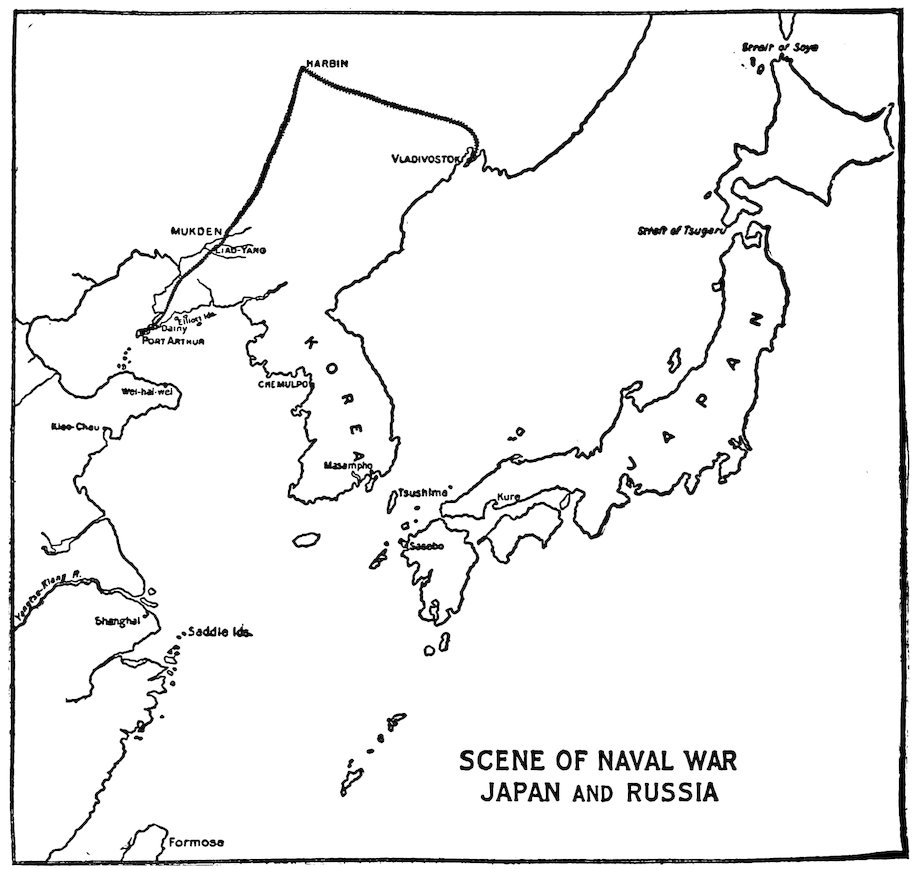
Apply this to Rozhestvensky. The one end imposed
on him by the course of things was the destruction
of the Japanese fleet, which comprised
every armored vessel Japan could possibly muster
for that war. Togo’s signal[105] before the battle
recognized this one end, and there was no reason
why his opponent should not have recognized it
equally. To reach Vladivostok was only a means
to that end; an object most important, because, if
attained, it would put the Russians in the best possible
condition for battle. But this by no means
superseded the one necessary aim,—battle. More,
it did not even postpone that aim, as a matter
of immediate consideration and preparation;
for, though escape through to Vladivostok might
be possible, it was not certain. It was not even
279probable, under all the conditions. Therefore,
while every forethought and care should have been
to effect escape, if possible, they should have been
accompanied with the clear decision that, should
battle be forced, the fighting should have been qualified
by no thought of escape, and the fleet, like a ship
cleared for action, should have been stripped of all
fleet encumbrances from the moment of leaving the
Saddles. A fleet is half beaten already when it goes
into battle with one eye upon something else than
fighting.
If Rozhestvensky had recognized these facts, in
their due importance and proportion, and had been
convinced that battle was his one aim, and that there
was at least a very real possibility that he could not
postpone it till after Vladivostok, it seems to me he
must have reasoned thus: I must have coal enough
to reach Vladivostok, on a reasonable calculation of
the distance, and of the expenditures of the ships;
both which were known. To this amount add a
fair margin of safety. This total should be carried
for the purpose of escape, if feasible; with perhaps
an addition sufficient to last during battle, with
funnels pierced, which was a likely accident. Again,
there is for each ship a draft of water which best
meets her maneuvering needs. The chances are that
the enemy will await us either in the narrower part
of the sea, or near his navy yards. As there is one
position, that in the Straits of Korea, which favors
both these objects, it is there I will probably have
to fight, if at all. Therefore, as far as possible, the
coal carried by the fleet on starting should be such
280that consumption up to the moment of reaching the
straits will put them in their best tactical trim. The
coal supply needed to reach Vladivostok is thus
adjusted to the exigencies of battle.
Then as regards the transports. For the moment,
on this last fateful stretch, they are absolutely
of no consequence as affecting results. The adjustment
of them, to the end of the battle, is to dismiss
them out of mind and presence. If beaten, the loss
of them will not be of the slightest consequence to
Russia; if successful, they can be summoned from an
appointed rendezvous, and escorted to a destination
under such protection as may then seem expedient.
An Austrian officer has suggested that if the whole
body had weighed together, and at night had separated,
the supply vessels proceeding under convoy
by the east of Japan might have escaped notice;
or, if seen, this report might have perplexed Togo,
rather than enlightened him. Upon the suggestion
I make no comment, other than that it would have
been one way of counting out the supply ships.
The imminency of the occasion should have
drawn, and did draw, all Japan’s fighting force to
the Straits of Korea, an element for Rozhestvensky’s
consideration. According to Semenoff the
auxiliary steamers Terek and Kuban were sent off
the east coast expressly to draw attention, but met
no one, and their presence was unknown to the
Japanese.
I am not disposed to question, or to doubt, that
if the Russian squadron had escaped Togo, and if
the separated supply train had been intercepted, it
281would have been very embarrassing to the ships of
war refitting at Vladivostok. Nor do I question
that, in case of such escape, the coal remaining in
consequence of the deck loads taken would have
been of much value for future operations. The
more real and the greater those distracting considerations,
like those of William III in Ireland,
the more do they throw into relief the greatness,
as well as the necessity, of subordinating them to
the one thing needful, namely, to be ready to the
utmost on the day of battle. They illustrate, too,
how misleading is the disposition to compromise, to
concede something all around; to straddle the two
horses, escape and battle.
Rozhestvensky’s course was a compromise, a mix-up
of escape and fighting; a strategic blunder to
begin with, in not concentrating attention on the one
needful thing clearly indicated by the course of
events, and hence resulting necessarily in a series
of blunders, which comprehensively may be called
tactical. They all hang together, as the results of
a frame of mind; the overloading with coal, the increased
danger of fire therefrom, the submersion of
the armor belts, the loss of speed and tactical
capacity, the neglect of scouting, the company of the
transports,—each of which is a tactical error,—all
proceed from the failure to observe that the one
governing consideration of strategy, in this war,
was a naval battle under the most favorable conditions.
It is the repetition of the mistakes of the
Port Arthur division. When it becomes clearly
imminent that one may have to fight under conditions
282less favorable than one would desire, conditions
are changed; but there is no change of the
principles involved. Vladivostok reached, the principle
would have required the utmost preparation
the yard offered, in the least possible time, so as to
be the most fit possible to fight. At the Saddles,
the same fitness required the dismissal from influence
upon conduct of all thought of Vladivostok, and of
supplies there, so far as such thought might modify
the preparation for probable battle. It seems very
probable that the defective conceptions deducible
from Rozhestvensky’s conduct were emphasized and
reinforced by the heavy preoccupations about supplies,
necessarily incidental to his anxious outward
voyage. His mind and morale had got a twist, a
permanent set, from which they could not recover.
PART III NAVAL AND NATIONAL POLICIES — 31. Expansion and Over-Sea Bases [106] — The Annexation of Hawaii — 32. Application of the Monroe Doctrine [107] — Anglo-American Community of Interests — 33. Changes in the United States and Japan [109] — 34. Our Interests in the Pacific [110] — 35. The German State and its Menace [111] — The Bulwark of British Sea Power [113] — 36. Advantages of Insular Position [114] — Great Britain and the Continental Powers — 37. Bearing of Political Developments on Naval Policy and Strategy [115] — 38. Seizure of Private Property at Sea [118] — 39. The Moral Aspect of War [123] — 40. The Practical Aspect of War [125] — 41. Motives for Naval Power [126] — APPENDIX — CHRONOLOGICAL OUTLINE — PUBLISHED WORKS — REFERENCES
283
285
[As the date indicates, the essay was written at the
time of the Revolution in Hawaii, six years before
its annexation. The part of the essay preceding
points out the predominant interest of the United
States in the Islands owing to their control of our
trade routes and naval approaches, and refers to
the benefit to the world from British colonial
expansion.—Editor.]
But if a plea of the world’s welfare seem suspiciously
like a cloak for national self-interest, let
the latter be accepted frankly as the adequate motive
which it assuredly is. Let us not shrink from
pitting a broad self-interest against the narrow self-interest
to which some would restrict us. The demands
of our three great seaboards, the Atlantic,
the Gulf, and the Pacific,—each for itself, and all
for the strength that comes from drawing closer
the ties between them,—are calling for the extension,
through the Isthmian Canal, of that broad
sea common along which, and along which alone, in
286all the ages prosperity has moved. Land carriage,
always restricted and therefore always slow, toils
enviously but hopelessly behind, vainly seeking to
replace and supplant the royal highway of nature’s
own making. Corporate interests, vigorous in that
power of concentration which is the strength of
armies and of minorities, may here withstand for
a while the ill-organized strivings of the multitude,
only dimly conscious of its wants; yet the latter, however
temporarily opposed and baffled, is sure at last,
like the blind forces of nature, to overwhelm all
that stand in the way of its necessary progress. So
the Isthmian Canal is an inevitable part in the future
of the United States; yet one that cannot be separated
from other necessary incidents of a policy dependent
upon it, whose details cannot be foreseen exactly.
But because the precise steps that hereafter may be
opportune or necessary cannot yet be foretold certainly,
is not a reason the less, but a reason the more,
for establishing a principle of action which may
serve to guide as opportunities arise. Let us start
from the fundamental truth, warranted by history,
that the control of the seas, and especially along the
great lines drawn by national interest or national
commerce, is the chief among the merely material
elements in the power and prosperity of nations.
It is so because the sea is the world’s great medium
of circulation. From this necessarily follows the
principle that, as subsidiary to such control, it is
imperative to take possession, when it can be done
righteously, of such maritime positions as contribute
to secure command. If this principle be adopted,
287there will be no hesitation about taking the positions—and
they are many—upon the approaches
to the Isthmus, whose interests incline them to seek
us. It has its application also to the present case of
Hawaii.
There is, however, one caution to be given from
the military point of view, beyond the need of which
the world has not yet passed. Military positions,
fortified posts, by land or by sea, however strong
or admirably situated, do not confer control by
themselves alone. People often say that such an
island or harbor will give control of such a body
of water. It is an utter, deplorable, ruinous mistake.
The phrase indeed may be used by some only
loosely, without forgetting other implied conditions
of adequate protection and adequate navies; but the
confidence of our own nation in its native strength,
and its indifference to the defense of its ports and
the sufficiency of its fleet, give reason to fear that
the full consequences of a forward step may not be
weighed soberly. Napoleon, who knew better, once
talked this way. “The islands of San Pietro,
Corfu, and Malta,” he wrote, “will make us masters
of the whole Mediterranean.” Vain boast!
Within one year Corfu, in two years Malta, were
rent away from the state that could not support
them by its ships. Nay, more: had Bonaparte not
taken the latter stronghold out of the hands of its
degenerate but innocuous government, that citadel
of the Mediterranean would perhaps—would
probably—never have passed into those of his
chief enemy. There is here also a lesson for us.
288
The writer has too often already discussed,
directly or incidentally, the strategic situation
which finds its center in Panama to repeat the same
here; but one or two remarks about the Monroe doctrine
may be not out of place. Accepting as probably
durable the new conditions, which have so largely
modified the nation’s external policy in the direction
of expansion, there is in them nothing to diminish,
but rather to intensify, the purpose that there shall
be no intrusion of the European political system
upon territory whence military effect upon the
Isthmus of Panama can be readily exerted. For
instance, should a change anticipated by some occur,
and Holland enter the German Empire, it will be
advantageous that it should even now be understood,
as it then would be necessary for us to say,
that our consent could not be given to Curaçao
forming part of that incorporation. The Isthmus
of Panama—in addition to its special importance
to us as a link between our Pacific and Atlantic
coasts—sums up in itself that one of the two great
lines of communication between the Atlantic and the
farther East which especially concerns us, and we
can no more consent to such a transfer of a fortress
289in the Caribbean, than we would ourselves have
thought of acquiring Port Mahon, in the Mediterranean,
as a result of our successful war with Spain.
Consideration of interests such as these must be
dispassionate upon the one side and upon the other;
and a perfectly candid reception must be accorded
to the views and the necessities of those with whom
we thus deal. During the process of deliberation
not merely must preconceptions be discarded, but
sentiment itself should be laid aside, to resume its
sway only after unbiassed judgment has done its
work. The present question of Asia, the evolution
of which has taken days rather than years, may
entail among its results no change in old maxims,
but it nevertheless calls for a review of them in the
light of present facts. If from this no difference of
attitude results, the confirmed resolve of sober
second thought will in itself alone be a national
gain. This new Eastern question has greatly
affected the importance of communications, enhancing
that of the shorter routes, reversing political
and military,—as distinguished from mercantile—conditions,
and bringing again into the foreground
of interest the Mediterranean, thus reinvested with
its ancient pre-eminence. For the same reason the
Caribbean Sea, because of its effect upon the Isthmus
of Panama, attains a position it has never before
held, emphasizing the application to it of the
Monroe doctrine. The Pacific has advanced manifold
in consequence to the United States, not only
as an opening market, but as a means of transit,
and also because our new possessions there, by
290giving increased opportunities, entail correspondingly
heavier burdens of national responsibility.
The isthmian canals, present and to come,—Suez
and Panama,—summarize and locally accentuate
the essential character of these changes, of which
they are at once an exponent and a factor. It will
be no light matter that man shall have shifted the
Strait of Magellan to the Isthmus of Panama, and
the Cape of Good Hope to the head of the Mediterranean.
The correlative of these new conditions is the
comparative isolation, and the dwindled consequence,
of the southern extremes of Africa and
America, which now lie far apart from the changed
direction imposed upon the world’s policies. The
regions there situated will have small effect upon
the great lines of travel, and must derive such importance
as may remain to them from their intrinsic
productive value. Does there, then, remain sound
reason of national interest for pressing the Monroe
doctrine to the extent of guaranteeing our support
to American states which love us not, and whose
geographical position, south of the valley of the
Amazon, lies outside of effective influence upon the
American isthmus? Does the disposition to do so
arise from sound policy, or from sentiment, or from
mere habit? And, if from either, do the facts
justify retaining a burden of responsibility which
may embarrass our effective action in fields of
greater national consequence—just as South Africa
may prove a drain upon Great Britain’s necessary
force about Suez? In short, while the principles
291upon which the Monroe doctrine reposes are not
only unimpaired, but fortified, by recent changes,
is it not possible that the application of them may
require modification, intensifying their force in one
quarter, diminishing it in another?
Not the least striking and important of the conditions
brought about by the two contemporary
events—the downfall of the Spanish colonial empire
and the precipitation of the crisis in eastern
Asia—has been the drawing closer together of the
two great English-speaking nationalities. Despite
recalcitrant objections here and there by unwilling
elements on both sides, the fact remains concrete
and apparent, endued with essential life, and consequent
inevitable growth, by virtue of a clearly
recognized community of interest, present and
future. It is no mere sentimental phase, though
sentiment, long quietly growing, had sufficiently
matured to contribute its powerful influence at the
opportune moment; but here, as ever, there was
first the material,—identity of interest,—and not
till afterwards the spiritual,—reciprocity of feeling,—aroused
to mutual recognition by the causes
and motives of the Spanish war. That war, and
the occurrences attendant, proclaimed emphatically
that the two countries, in their ideals of duty to the
suffering and oppressed, stood together, indeed, but
in comparative isolation from the sympathies of
the rest of the world.[108]
292The significance of this fact has been accentuated
by the precision with which in the United States the
preponderance of intelligence has discerned, and
amid many superficially confusing details has kept
in mind, as the reasonable guide to its sympathies,
that the war in the Transvaal is simply a belated
revival of the issue on which our own Revolution
was fought, viz., that when representation is denied,
taxation is violent oppression. The principle is
common to Great Britain and to us, woven into the
web of all her history, despite the momentary aberration
which led to our revolt. The twofold incident—the
two wars and the sympathies aroused,
because in both each nation recognized community
of principle and of ideals—indicates another great
approximation to the unity of mankind; which will
arrive in good time, but which is not to be hurried
by force or by the impatience of dreamers. The
outcome of the civil war in the United States, the
unification of Italy, the new German Empire, the
growing strength of the idea of Imperial Federation
in Great Britain, all illustrate the tendency of
humanity to aggregate into greater groups, which
in the instances cited have resulted in political combination
more or less formal and clearly defined.
To the impulse and establishment of each of these
steps in advance, war has played a principal part.
War it was which preserved our Union. War it
was which completed the political unity of Italy,
293and brought the Germans into that accord of sentiment
and of recognized interest upon which rest the
foundations and the continuance of their empire.
War it is which has but now quickened the spirit of
sympathy between Great Britain and her colonies,
and given to Imperial Federation an acceleration
into concrete action which could not otherwise have
been imparted; and it needed the stress of war, the
threat of outside interference with a sister nation
in its mission of benevolence, to quicken into positive
action the sympathy of Great Britain with the United
States, and to dispose the latter to welcome gladly
and to return cordially the invaluable support thus
offered.
War is assuredly a very great evil; not the greatest,
but among the greatest which afflict humanity.
Yet let it be recognized at this moment, when the
word “Arbitration” has hold of popular imagination,
more perhaps by the melody of its associations,—like
the “Mesopotamia” of the preacher,—than
by virtue of a reasonable consideration of both sides
of the question, of which it represents only one, that
within two years two wars have arisen, the righteous
object of either of which has been unattainable by
milder methods. When the United States went to
war with Spain, four hundred thousand of the
latter’s colonial subjects had lost their lives by the
slow misery of starvation, inflicted by a measure—Reconcentration—which
was intended, but had
proved inadequate, to suppress an insurrection incited
by centuries of oppression and by repeated
broken pledges. The justification of that war rests
294upon our right to interfere on grounds of simple
humanity, and upon the demonstrated inability of
Spain to rule her distant colonies by methods unharmful
to the governed. It was impossible to
accept renewed promises, not necessarily through
distrust of their honesty, but because political incapacity
to give just and good administration had
been proved by repeated failures.
The justification of Great Britain’s war with the
Transvaal rests upon a like right of interference—to
relieve oppression—and upon the broad general
principle for which our colonial ancestors fought the
mother-country over a century ago, that “taxation
without representation is tyranny.” Great Britain,
indeed, did not demand the franchise for her misgoverned
subjects, domiciled abroad; she only suggested
it as a means whereby they might, in return
for producing nine tenths of the revenue, obtain fair
treatment from the state which was denying it to
them. But be it remembered, not only that a
cardinal principle upon which English and American
liberty rests was being violated, but that at the time
when the foreigners were encouraged to enter the
Transvaal franchise was attainable by law in five
years, while before the five years had expired the
law was changed, and the privilege withdrawn by
ex post facto act.
In each of these wars one of the two nations
which speak the English tongue has taken a part,
and in each the one engaged has had outspoken
sympathy from the other, and from the other alone.
The fact has been less evident in the Transvaal war,
295partly because the issue has been less clear, or less
clearly put, chiefly because many foreign-born citizens
of the United States still carry with them the
prepossessions of their birthplace, rather than those
which should arise from perception of their country’s
interest.
Nevertheless, the foundations stand sure. We
have begun to know each other, in community of
interest and of traditions, in ideals of equality and
of law. As the realization of this spreads, the two
states, in their various communities, will more and
more closely draw together in the unity of spirit,
and all the surer that they eschew the bondage of
the letter of alliance.
296
The occidentalization of Japan, in methods although
not in national spirit,—which changes
much more slowly,—has been fully demonstrated to
an astonished world by the war of 1894 with China.
It is one of the incidents of the closing nineteenth
century. To this achievement in the military sphere,
in the practice of war which Napoleon called the
science of barbarians, must be added the development
of civil institutions that has resulted in the
concession to Japan of all international dignity and
privilege; and consequently of a control over the
administration of justice among foreigners within
her borders, not heretofore obtained by any other
Oriental State. It has thus become evident that the
weight of Japan in the international balances depends
not upon the quality of her achievement,
which has been shown to be excellent, but upon the
gross amount of her power. Moreover, while in
wealth and population, with the resources dependent
upon them, she may be deficient,—though rapidly
growing,—her geographical position relatively to
the Eastern center of interest, and her advantage
of insularity, go far to compensate such defect.
These confer upon her as a factor in the Eastern
297problem an influence resembling in kind, if not
equaling in degree, that which Great Britain has
held and still holds in the international relations
centering around Europe, the Atlantic, and the
Mediterranean.
Yet the change in Japan, significant as it is and
influential upon the great problem of the Pacific and
Asia, is less remarkable and less important than that
which has occurred in the United States. If in the
Orient a nation may be said to have been born in a
day, even so the event is less sudden and less revolutionary
than the conversion of spirit and of ideals—the
new birth—which has come over our own
country. In this are evident a rapidity and a
thoroughness which bespeak impulse from an external
source rather than any conscious set process
of deliberation, of self-determination within, such
as has been that of Japan in her recognition and
adoption of material improvements forced upon her
attention in other peoples. No man or group of
men can pretend to have guided and governed our
people in the adoption of a new policy, the acceptance
of which has been rather instinctive—I would
prefer to say inspired—than reasoned. There is
just this difference between Japan and ourselves, the
two most changed of peoples within the last half-century.
She has adopted other methods; we have
received another purpose. The one conversion is
material, the other spiritual. When we talk about
expansion we are in the realm of ideas. The
material addition of expansion—the acreage, if I
may so say—is trivial compared with our previous
298possessions, or with the annexations by European
states within a few years. The material profit
otherwise, the national gain to us, is at best doubtful.
What the nation has gained in expansion is a regenerating
idea, an uplifting of the heart, a seed of
future beneficent activity, a going out of self into the
world to communicate the gift it has so bountifully
received.
299
[The preceding pages of the essay explain the dependence
of the “Open Door” policy on an
international balance of power in the Pacific, and
the modification of this balance owing to the growth
of the German Navy and the increasing European
tension.—Editor.]
The result is to leave the two chief Pacific nations,
the United States and Japan, whose are the only
two great navies that have coastlines on that ocean,
to represent there the balance of power. This is
the best security for international peace; because it
represents, not a bargain, but a fact, readily ascertainable.
Those two navies are more easily able
than any other to maintain there a concentration of
force; and it may even be questioned whether sound
military policy may not make the Pacific rather than
the Atlantic the station for the United States battle
fleet. For the balance of naval power in Europe,
which compels the retention of the British and German
fleets in the North Sea, protects the Atlantic
coast of the United States,—and the Monroe
Doctrine,—to a degree to which nothing in Pacific
conditions corresponds. Under existing circumstances,
neither Germany nor Great Britain can
300afford, even did they desire, to infringe the external
policy of the United States represented in the
Monroe Doctrine.
With Japan in the Pacific, and in her attitude
towards the Open Door, the case is very different
from that of European or American Powers. Her
nearness to China, Manchuria, Korea, gives the
natural commercial advantages that short and rapid
transportation always confers. Labor with her is
still cheap, another advantage in open competition;
but the very fact of these near natural markets, and
her interest in them, cannot but breed that sense of
proprietorship which, in dealing with ill-organized
states, easily glides into the attempt at political control
that ultimately means control by force. Hence
the frequent reports, true or untrue, that such advantage
is sought and accomplished. Whether true
or not, these illustrate what nations continually seek,
when opportunity offers or can be made. This is in
strict line with that which we call Protection; but
with the difference that Protection is exercised within
the sphere commonly recognized as legitimate,
either by International Law or by the policy of
competing states. The mingled weakness and perverseness
of Chinese negotiators invite such attempt,
and endanger the Open Door; give rise to continual
suspicion that undue influence resting upon force is
affecting equality of treatment, or is establishing a
basis for inequality in the future. There can be no
question that the general recent attitude of Russia
and Japan, however laudably meant, does arouse
such suspicions.
301Then again, the American possession, the Hawaiian
Islands, are predominantly Japanese in labor
population; a condition which, as the outcome of
little more than a generation, warrants the jealousy
of Japanese immigration on the part of the Pacific
coast. Finally, the population of that coast is
relatively scanty, and its communications with the
East, though rapid for express trains, are slow for
the immense traffic of men and stores which war
implies and requires. That is, the power of the
country east of the Rocky Mountains has far to go,
and with poor conveyance, in order to reinforce the
Western Coast; the exact opposite of our advantage
of rapid maritime access to the Panama Canal. In
the absence of the fleet, invasion may be easy.
Harm may be retrieved in measure by the arrival of
the fleet later; but under present world conditions
the Pacific coast seems incomparably the more exposed
of the three great divisions of the American
shore line—the Atlantic, the Gulf, and the Pacific.
302
The prototype of modern Germany is to be found
rather in the Roman Empire, to which in a
certain sense the present German Empire may be
said to be—if not heir—at least historically
affiliated. The Holy Roman Empire merged into
that somewhat extenuated figment attached to the
Austrian Hapsburgs, which finally deceased at the
opening of the nineteenth century; but the idea itself
survived, and was influential in determining the
form and name which the existing powerful Germanic
unity has assumed. To this unity the national
German character contributes an element not unlike
that of antiquity, in the subordination of the individual
to the state. As a matter of national
characteristic, this differs radically from the more
modern conception of the freedom and rights of the
individual, exemplified chiefly in England and the
United States. It is possible to accept the latter as
the superior ideal, as a higher stage of advance, as
ultimately more fruitful of political progress, yet
at the same time to recognize the great immediate
advantage of the massed action which subordinates
the interests of the individual, sinks the unit in the
whole, in order to promote the interests of the community.
It may be noted incidentally, without
303further insistence just here, that the Japanese
Empire, which in a different field from the German
is manifesting the same restless need for self-assertion
and expansion, comes to its present with
the same inheritance from its past, of the submergence
of the individual in the mass. It was equally
the characteristic of Sparta among the city states
of ancient Greece, and gave to her among them the
preponderance she for a time possessed. As an
exhibition of social development, it is generally
anterior and inferior to that in which the rights of
the individual are more fully recognized; but as an
element of mere force, whether in economics or in
international policies, it is superior.
The two contrasted conceptions, the claims of the
individual and the claims of the state, are familiar
to all students of history. The two undoubtedly
must coexist everywhere, and have to be reconciled;
but the nature of the adjustment, in the clear predominance
of the one or the other, constitutes a
difference which in effect upon the particular community
is fundamental. In international relations,
between states representing the opposing ideas, it
reproduces the contrast between the simple discipline
of an army and the complicated disseminated
activities of the people, industrial, agricultural, and
commercial. It repeats the struggle of the many
minor mercantile firms against a single great combination.
In either field, whatever the ultimate
issue,—and in the end the many will prevail,—the
immediate result is that preponderant concentrated
force has its way for a period which may thus
304be one of great and needless distress; and it not
only has its way, but it takes its way, because, whatever
progress the world has made, the stage has not
been reached when men or states willingly subordinate
their own interests to even a reasonable
regard for that of others. It is not necessary to
indulge in pessimistic apprehension, or to deny
that there is a real progress of the moral forces
lumped under the name of “public opinion.” This
unquestionably tells for much more than it once did;
but still the old predatory instinct, that he should
take who has the power, survives, in industry and
commerce, as well as in war, and moral force is not
sufficient to determine issues unless supported by
physical. Governments are corporations, and corporations
have not souls. Governments moreover
are trustees, not principals; and as such must put
first the lawful interests of their wards, their own
people.
It matters little what may be the particular intentions
now cherished by the German government.
The fact upon which the contemporary world needs
to fasten its attention is that it is confronted by the
simple existence of a power such as is that of the
German Empire; reinforced necessarily by that of
Austria-Hungary, because, whatever her internal
troubles and external ambitions, Austria is bound
to Germany by nearness, by inferior power, and by
interests, partly common to the two states, as surely
as the moon is bound to the earth and with it constitutes
a single group in the planetary system.
Over against this stands for the moment a number
305of states, Russia, Italy, France, Great Britain. The
recent action of Russia has demonstrated her international
weakness, the internal causes of which are
evident even to the most careless observer. Italy
still belongs to the Triple Alliance, of which Germany
and Austria are the other members; but the
inclination of Italy towards England, springing
from past sympathies, and as a state necessarily
naval, because partly insular, partly peninsular, is
known, as is also her recent drawing towards France
as compared with former estrangement. Also, in
the Balkan regions and in the Adriatic Sea there is
more than divergence between the interest of Italy
and the ambitions of Austria,—supported by Germany,—as
shown in the late annexations and their
antecedents. An Austrian journal, which fore-shadowed
the annexations with singular acumen,
has written recently,[112] “We most urgently need a
fleet so strong that it can rule the Northern
Adriatic basin,”—in which lies the Italian Venice,
as well as the Austrian Trieste,—“support the
operations of our land army, protect our chief commercial
ports against hostile maritime undertakings,
and prevent us from being throttled at the Strait of
Otranto. To do this, the fleet must at least attain
the approximate strength of our probable enemy.
If we lag behind in developing our naval programme,
Italy will so outrun us that we can never overtake
her. Here more than elsewhere to stand still is to
recede; but to recede would be to renounce the historical
mission of Austria.” The Austrian Dreadnoughts
306are proceeding, and the above throws an
interesting side light upon the equipoise of the
Triple Alliance. In the Algeciras Conference, concerning
the affairs of Morocco, Italy did not sustain
Germany; Austria only did so.
Analyzing thus the present international relations
of Europe, we find on the one side the recently constituted
Triple Entente, France, Great Britain, and
Russia; on the other the Triple Alliance, Austria-Hungary,
Germany, and Italy, of thirty years’
standing. The sympathies of Italy, as distinguished
from the pressure of conditions upon her, and from
her formal association, are doubtful; and the essentials
of the situation seem to be summed up in the
Triple Entente opposed by the two mid-Europe
military monarchies.
[The intervening pages show that exposure on
their land frontiers would weaken the aid that could
be given Great Britain by her allies in continental
Europe.—Editor.]
These conclusions, if reasonable, not only emphasize
the paramount importance in world politics
of the British navy, but they show also that there
are only two naval states which can afford to help
Great Britain with naval force, because they alone
have no land frontiers which march with those
of Germany. These states are Japan and the
United States. In looking to the future, it becomes
307for them a question whether it will be to their interest,
whether they can afford, to exchange the
naval supremacy of Great Britain for that of Germany;
for this alternative may arise. Those two
states and Germany cannot, as matters now stand,
touch one another, except on the open sea; whereas
the character of the British Empire is such that it
has everywhere sea frontiers, is everywhere assailable
where local naval superiority does not exist,
as for instance in Australia, and other Eastern
possessions. The United States has upon Great
Britain the further check of Canada, open to land
attack.
A German navy, supreme by the fall of Great
Britain, with a supreme German army able to spare
readily a large expeditionary force for over-sea
operations, is one of the possibilities of the future.
Great Britain for long periods, in the Seven Years
War and Napoleonic struggle, 1756–1815, has been
able to do, and has done, just this; not because she
has had a supreme army, but because, thanks to her
insular situation, her naval supremacy covered effectually
both the home positions and the expedition.
The future ability of Germany thus to act is emphasized
to the point of probability by the budgetary
difficulties of Great Britain, by the general
disorganization of Russia, and by the arrest of population
in France. Though vastly the richer nation,
the people of Great Britain, for the very reason of
greater wealth long enjoyed, are not habituated to
the economical endurance of the German; nor can
the habits of individual liberty in England or
308America accept, unless under duress, the heavy yoke
of organization, of regulation of individual action,
which constitutes the power of Germany among
modern states.
The rivalry between Germany and Great Britain
to-day is the danger point, not only of European
politics, but of world politics as well.
309
Every war has two aspects, the defensive and the
offensive, to each of which there is a corresponding
factor of activity. There is something to gain,
the offensive; there is something to lose, the defensive.
The ears of men, especially of the uninstructed,
are more readily and sympathetically open to the demands
of the latter. It appeals to the conservatism
which is dominant in the well-to-do, and to the
widespread timidity which hesitates to take any risk
for the sake of a probable though uncertain gain.
The sentiment is entirely respectable in itself, and
more than respectable when its power is exercised
against breach of the peace for other than the
gravest motives—for any mere lucre of gain.
But its limitations must be understood. A sound
defensive scheme, sustaining the bases of the national
force, is the foundation upon which war rests;
but who lays a foundation without intending a superstructure?
The offensive element in warfare is the
superstructure, the end and aim for which the defensive
exists, and apart from which it is to all
purposes of war worse than useless. When war
has been accepted as necessary, success means
310nothing short of victory; and victory must be sought
by offensive measures, and by them only can be
ensured. “Being in, bear it, that the opposer may
be ware of thee.” No mere defensive attitude or
action avails to such end. Whatever the particular
mode of offensive action adopted, whether it be
direct military attack, or the national exhaustion of
the opponent by cutting off the sources of national
well-being, whatsoever method may be chosen,
offense, injury, weakening of the foe, to annihilation
if need be, must be the guiding purpose of the belligerent.
Success will certainly attend him who
drives his adversary into the position of the defensive
and keeps him there.
Offense therefore dominates, but it does not exclude.
The necessity for defense remains obligatory,
though subordinate. The two are complementary.
It is only in the reversal of rôles, by which
priority of importance is assigned to the defensive,
that ultimate defeat is involved. Nor is this all.
Though opposed in idea and separable in method
of action, circumstances not infrequently have permitted
the union of the two in a single general plan
of campaign, which protects at the same time that it
attacks. “Fitz James’s blade was sword and
shield.” Of this the system of blockades by the
British Navy during the Napoleonic wars was a
marked example. Thrust up against the ports of
France, and lining her coasts, they covered—shielded—the
operations of their own commerce
and cruisers in every sea; while at the same time,
crossing swords, as it were, with the fleets within,
311ever on guard, ready to attack, should the enemy
give an opening by quitting the shelter of his ports,
they frustrated his efforts at a combination of his
squadrons by which alone he could hope to reverse
conditions. All this was defensive; but the same
operation cut the sinews of the enemy’s power by
depriving him of sea-borne commerce, and promoted
the reduction of his colonies. Both these
were measures of offense; and both, it may be added,
were directed upon the national communications, the
sources of national well-being. The means was one,
the effect twofold....
[It is shown that, in the case of insular states,
offense and defense are often closely combined,
home security depending on control of the sea
assured by offensive action of the national fleet.—Editor.]
An insular state, which alone can be purely maritime,
therefore contemplates war from a position of
antecedent probable superiority from the twofold
concentration of its policy; defense and offense being
closely identified, and energy, if exerted judiciously,
being fixed upon the increase of naval force to the
clear subordination of that more narrowly styled
military. The conditions tend to minimize the
division of effort between offensive and defensive,
purpose, and, by greater comparative development
of the fleet, to supply a larger margin of disposable
numbers in order to constitute a mobile superiority
at a particular point of the general field. Such a
decisive local superiority at the critical point of
action is the chief end of the military art, alike in
312tactics and strategy. Hence it is clear that an insular
state, if attentive to the conditions that should
dictate its policy, is inevitably led to possess a superiority
in that particular kind of force, the
mobility of which enables it most readily to project
its power to the more distant quarters of the earth,
and also to change its point of application at will
with unequalled rapidity.
The general considerations that have been advanced
concern all the great European nations, in
so far as they look outside their own continent, and
to maritime expansion, for the extension of national
influence and power; but the effect upon the action
of each differs necessarily according to their several
conditions. The problem of sea-defense, for instance,
relates primarily to the protection of the
national commerce everywhere, and specifically as
it draws near the home ports; serious attack upon
the coast, or upon the ports themselves, being a
secondary consideration, because little likely to befall
a nation able to extend its power far enough to
sea to protect its merchant ships. From this point
of view the position of Germany is embarrassed at
once by the fact that she has, as regards the world
at large, but one coast-line. To and from this all
her sea commerce must go; either passing the English
Channel, flanked for three hundred miles by
France on the one side and England on the other,
or else going north about by the Orkneys, a most
inconvenient circuit, and obtaining but imperfect
shelter from recourse to this deflected route. Holland,
in her ancient wars with England, when the
313two were fairly matched in point of numbers, had
dire experience of this false position, though her
navy was little inferior in numbers to that of her
opponent. This is another exemplification of the
truth that distance is a factor equivalent to a certain
number of ships. Sea-defense for Germany, in
case of war with France or England, means established
naval predominance at least in the North
Sea; nor can it be considered complete unless extended
through the Channel and as far as Great
Britain will have to project hers into the Atlantic.
This is Germany’s initial disadvantage of position,
to be overcome only by adequate superiority of numbers;
and it receives little compensation from the
security of her Baltic trade, and the facility for
closing that sea to her enemies. In fact, Great
Britain, whose North Sea trade is but one-fourth
of her total, lies to Germany as Ireland does to
Great Britain, flanking both routes to the Atlantic;
but the great development of the British sea-coast,
its numerous ports and ample internal communications,
strengthen that element of sea-defense which
consists in abundant access to harbors of refuge.
For the Baltic Powers, which comprise all the
maritime States east of Germany, the commercial
drawback of the Orkney route is a little less than
for Hamburg and Bremen, in that the exit from the
Baltic is nearly equidistant from the north and south
extremities of England; nevertheless the excess in
distance over the Channel route remains very considerable.
The initial naval disadvantage is in no
wise diminished. For all the communities east of
314the Straits of Dover it remains true that in war
commerce is paralyzed, and all the resultant consequences
of impaired national strength entailed, unless
decisive control of the North Sea is established.
That effected, there is security for commerce by the
northern passage; but this alone is mere defense.
Offense, exerted anywhere on the globe, requires a
surplusage of force, over that required to hold the
North Sea, sufficient to extend and maintain itself
west of the British Islands. In case of war with
either of the Channel Powers, this means, as between
the two opponents, that the eastern belligerent
has to guard a long line of communications,
and maintain distant positions, against an antagonist
resting on a central position, with interior lines,
able to strike at choice at either wing of the enemy’s
extended front. The relation which the English
Channel, with its branch the Irish Sea, bears to the
North Sea and the Atlantic—that of an interior
position—is the same which the Mediterranean
bears to the Atlantic and the Indian Sea; nor is it
merely fanciful to trace in the passage round the
north of Scotland an analogy to that by the Cape
of Good Hope. It is a reproduction in miniature.
The conditions are similar, the scale different.
What the one is to a war whose scene is the north
of Europe, the other is to operations by European
Powers in Eastern Asia.
To protract such a situation is intolerable to the
purse and morale of the belligerent who has the
disadvantage of position. This of course leads us
straight back to the fundamental principles of all
315naval war, namely, that defense is ensured only by
offense, and that the one decisive objective of the
offensive is the enemy’s organized force, his battle
fleet. Therefore, in the event of a war between one
of the Channel Powers, and one or more of those
to the eastward, the control of the North Sea must
be at once decided. For the eastern State it is a
matter of obvious immediate necessity, of commercial
self-preservation. For the western State
the offensive motive is equally imperative; but for
Great Britain there is defensive need as well. Her
Empire imposes such a development of naval force
as makes it economically impracticable to maintain
an army as large as those of the Continent. Security
against invasion depends therefore upon the fleet.
Postponing more distant interests, she must here
concentrate an indisputable superiority. It is, however,
inconceivable that against any one Power
Great Britain should not be able here to exert from
the first a preponderance which would effectually
cover all her remoter possessions. Only an economical
decadence, which would of itself destroy
her position among nations, could bring her so to
forego the initial advantage she has, in the fact
that for her offense and defense meet and are fulfilled
in one factor, the command of the sea. History
has conclusively demonstrated the inability of a
state with even a single continental frontier to compete
in naval development with one that is insular,
although of smaller population and resources. A
coalition of Powers may indeed affect the balance.
As a rule, however, a single state against a coalition
316holds the interior position, the concentrated force;
and while calculation should rightly take account of
possibilities, it should beware of permitting imagination
too free sway in presenting its pictures. Were
the eastern Powers to combine they might prevent
Great Britain’s use of the North Sea for the safe
passage of her merchant shipping; but even so she
would but lose commercially the whole of a trade,
the greater part of which disappears by the mere
fact of war. Invasion is not possible, unless her fleet
can be wholly disabled from appearing in that sea.
From her geographical position, she still holds her
gates open to the outer world, which maintains
three fourths of her commerce in peace.
317
The external activities of Europe, noted a dozen
years ago and before, have now to a certain extent
been again superseded by rivalries within Europe
itself. Those rivalries, however, are the result of
their previous external activities, and in the last
analysis they depend upon German commercial
development. This has stimulated the German Empire
to a prodigious naval programme, which affects
the whole of Europe and may affect the United
States. In 1897 I summed up two conspicuous
European conditions as being the equilibrium then
existing between France and Germany, with their
respective allies, and the withdrawal of Great Britain
from active association with the affairs of the
Continent. At that date the Triple Alliance, Austria,
Germany, Italy, stood against the Dual Alliance,
France and Russia; Great Britain apart from
both, but with elements of antagonism against Russia
and France, and not against the German monarchies
or Italy. These antagonisms arose wholly
from conditions external to Europe,—in India
against Russia, and in Africa against France. Later,
the paralysis of Russia, through her defeat by Japan,
and through her internal troubles, left France alone
318for a time; during which Germany, thus assured
against land attack, was better able to devote much
money to the fleet, as the protector of her growing
commerce. The results have been a projected huge
German navy, and a German altercation with
France relative to Moroccan affairs; incidents which
have aroused Great Britain to a sense of naval
danger, and have propelled her to the understandings—whatever
they amount to—with France and
Russia, which we now know as the Triple Entente.
In short, Great Britain has abandoned the isolation
of twenty years ago, stands joined to the Dual
Alliance, and it becomes a Triple Entente.
To the United States this means that Great Britain,
once our chief opponent in matters covered by
the Monroe Doctrine, but later by the logic of
events drawn to recede from that opposition, so
that she practically backed us against Europe in
1898, and subsequently conceded the Panama arrangement
known as the Hay-Pauncefote Treaty,
cannot at present count for as much as she did in
naval questions throughout the world. It means to
the United States and to Japan that Great Britain
has too much at stake at home to side with the one
or the other, granting she so wished, except as
bound by treaty, which implies reciprocal obligations.
Between her and Japan such specific obligations
exist. They do not in the case of the United
States; and the question whether the two countries
are disposed to support one another, and, if so, to
what extent, or what the attitude of Great Britain
would be in case of difficulty between Japan and the
319United States, are questions directly affecting naval
strategy.[116]
Great Britain does indeed for the moment hold
Germany so far in check that the German Empire
also can do no more than look after its European
interests; but should a naval disaster befall Great
Britain, leaving Germany master of the naval
situation, the world would see again a predominant
fleet backed by a predominant army, and that in the
hands, not of a state satiated with colonial possessions,
as Great Britain is, but of one whose late
entry into world conditions leaves her without any
such possessions at all of any great value. The
habit of mind is narrow which fails to see that a
navy such as Germany is now building will be
efficacious for other ends than those immediately
proposed. The existence of such a fleet is a constant
factor in contemporary politics; the part which
it shall play depending upon circumstances not always
to be foreseen. Although the colonial ambitions
of Germany are held in abeyance for the
moment, the wish cannot but exist to expand her
territory by foreign acquisitions, to establish external
bases for the support of commercial or political
interests, to build up such kindred communities as
now help to constitute the British Empire, homes for
emigrants, markets for industries, sources of supplies
of raw materials, needed by those industries.
320All such conditions and ambitions are incidents
with which Strategy, comprehensively considered,
has to deal. By the successive enunciations of the
Monroe Doctrine the United States stands committed
to the position that no particle of American
soil shall pass into the hands of a non-American
State other than the present possessor. No successful
war between foreign states, no purchase, no exchange,
no merger, such as the not impossible one
of Holland with Germany, is allowed as valid cause
for such transfer. This is a very large contract;
the only guarantee of which is an adequate navy,
however the term “adequate” be defined. Adequacy
often depends not only upon existing balances
of power, such, for instance, as that by which the
British and German navies now affect one another,
which for the moment secures the observance of the
Doctrine. Account must be taken also of evident
policies which threaten to disturb such balances, such
as the official announcement by Germany of her
purpose to create a “fleet of such strength that, even
for the mightiest naval power, a war with Germany
would involve such risks as to jeopardize its own
supremacy.” This means, at least, that Great Britain
hereafter shall not venture, as in 1898, to back
the United States against European interference;
nor to support France in Morocco; nor to carry out
as against Germany her alliance with Japan. It is a
matter of very distinct consequence in naval strategy
that Great Britain, after years of contention with
the United States, essentially opposed to the claims
of the Monroe Doctrine, should at last have come
321to substantial coincidence with the American point
of view, even though she is not committed to a
formal announcement to that effect.[117] Such relations
between states are primarily the concern of the
statesman, a matter of international policies; but
they are also among the data which the strategist,
naval as well as land, has to consider, because they
are among the elements which determine the constitution
and size of the national fleet.
I here quote with approval a statement of the
French Captain Darrieus:
“Among the complex problems to which the idea
of strategy gives rise there is none more important
than that of the constitution of the fleet; and every
project which takes no account of the foreign relations
of a great nation, nor of the material limit
fixed by its resources, rests upon a weak and unstable
base.”
I repeat also the quotation from Von der Goltz:
“We must have a national strategy, a national tactics.”
I cannot too entirely repudiate any casual
word of mine, reflecting the tone which once was
so traditional in the navy that it might be called
professional,—that “political questions belong
rather to the statesman than to the military man.”
I find these words in my old lectures, but I very soon
learned better, from my best military friend, Jomini;
and I believe that no printed book of mine endorses
the opinion that external politics are of no professional
concern to military men.
322It was in accordance with this changed opinion
that in 1895, and again in 1897, I summed up
European conditions as I conceived them to be;
pointing out that the distinguishing feature at that
time was substantial equilibrium on the Continent,
constituting what is called the Balance of Power;
and, in connection with the calm thus resulting, an
immense colonizing movement, in which substantially
all the great Powers were concerned. This
I indicated as worthy of the notice of naval strategists,
because there were parts of the American
continents which for various reasons might attract
upon themselves this movement, in disregard of
the Monroe Doctrine.
Since then the scene has shifted greatly, the distinctive
feature of the change being the growth of
Germany in industrial, commercial, and naval power,—all
three; while at the same time maintaining her
military pre-eminence, although that has been somewhat
qualified by the improvement of the French
army, just as the growth of the German navy has
qualified British superiority at sea. Coincident with
this German development has been the decline of
Russia, owing to causes generally understood; the stationariness
of France in population, while Germany
has increased fifty per cent; and the very close drawing
together of Germany and Austria, for reasons of
much more controlling power than the mere treaty
which binds them. The result is that to-day central
Europe, that is, Austria and Germany, form a substantially
united body, extending from water to
water, from North Sea to Adriatic, wielding a military
323power against which, on the land, no combination
in Europe can stand. The Balance of Power
no longer exists; that is, if my estimate is correct of
the conditions and dispersion which characterize the
other nations relatively to this central mass.
This situation, coinciding with British trade jealousies
of the new German industries, and with the
German naval programme, have forced Great Britain
out of the isolation which the Balance of Power
permitted her. Her ententes are an attempt to
correct the disturbance of the balance; but, while
they tend in that direction, they are not adequate
to the full result desired. The balance remains
uneven; and consequently European attention is
concentrated upon European conditions, instead of
upon the colonizing movements of twenty years ago.
Germany even has formally disavowed such colonizing
ambitions, by the mouth of her ambassador
to the United States, confirmed by her minister of
foreign affairs, although a dozen years ago they
were conspicuous. Concerning these colonizing
movements, indeed, it might be said that they have
reached a moment of quiet, of equilibrium, while
internally Europe is essentially disquieted, as various
incidents have shown.
The important point to us here is the growing
power of the German Empire, in which the efficiency
of the State as an organic body is so greatly superior
to that of Great Britain, and may prove to
be to that of the United States. The two English-speaking
countries have wealth vastly superior, each
separately, to that of Germany; much more if acting
324together. But in neither is the efficiency of the
Government for handling the resources comparable
to that of Germany; and there is no apparent chance
or recognized inducement for them to work together,
as Germany and Austria now work in Europe. The
consequence is that Germany may deal with each
in succession much more effectively than either is
now willing to consider; Europe being powerless to
affect the issue so long as Austria stands by Germany,
as she thoroughly understands that she has
every motive to do.
It is this line of reasoning which shows the power
of the German navy to be a matter of prime importance
to the United States. The power to control
Germany does not exist in Europe, except in
the British navy; and if social and political conditions
in Great Britain develop as they now promise,
the British navy will probably decline in relative
strength, so that it will not venture to withstand the
German on any broad lines of policy, but only in
the narrowest sense of immediate British interests.
Even this condition may disappear, for it seems as
if the national life of Great Britain were waning at
the same time that that of Germany is waxing. The
truth is, Germany, by traditions of two centuries,
inherits now a system of state control, not only
highly developed but with a people accustomed to
it,—a great element of force; and this at the time
when control of the individual by the community—that
is, by the state—is increasingly the note of the
times. Germany has in this matter a large start.
Japan has much the same.
325When it is remembered that the United States,
like Great Britain and like Japan, can be approached
only by sea, we can scarcely fail to see that upon the
sea primarily must be found our power to secure our
own borders and to sustain our external policy, of
which at the present moment there are two principal
elements; namely, the Monroe Doctrine and the
Open Door. Of the Monroe Doctrine President
Taft, in his first message to Congress, has said
that it has advanced sensibly towards general acceptance;
and that maintenance of its positions in the
future need cause less anxiety than it has in the past.
Admitting this, and disregarding the fact that the
respect conceded to it by Europe depends in part at
least upon European rivalries modifying European
ability to intervene,—a condition which may change
as suddenly as has the power of Russia within the
decade,—it remains obvious that the policy of the
Open Door requires naval power quite as really and
little less directly than the Monroe Doctrine. For
the scene of the Open Door contention is the Pacific;
the gateway to the Pacific for the United States is
the Isthmus; the communications to the Isthmus are
by way of the Gulf of Mexico and the Caribbean
Sea. The interest of that maritime region therefore
is even greater now than it was when I first
undertook the strategic study of it, over twenty
years ago. Its importance to the Monroe Doctrine
and to general commercial interests remains, even
if modified.
At the date of my first attempt to make this study
of the Caribbean, and to formulate certain principles
326relative to Naval Strategy, there scarcely
could be said to exist any defined public consciousness
of European and American interest in sea
power, and in the methods of its application which
form the study of Strategy. The most striking
illustration of this insensibility to the sea was to be
found in Bismarck, who in a constructive sense was
the greatest European statesman of that day. After
the war with France and the acquisition of Alsace
and Lorraine, he spoke of Germany as a state
satiated with territorial expansion. In the matter
of external policy she had reached the limits of his
ambitions for her; and his mind thenceforth was
set on internal development, which should harmonize
the body politic and ensure Germany the unity and
power which he had won for her. His scheme of
external relations did not stretch beyond Europe.
He was then too old to change to different conceptions,
although he did not neglect to follow the
demand of the people as their industry and commerce
developed.
The contrast between the condition of indifference
to the sea which he illustrated and that which now
exists is striking; and the German Empire, which
owes to him above all men its modern greatness,
offers the most conspicuous illustration of the
change. The new great navies of the world since
1887 are the German, the Japanese, and the American.
Every state in Europe is now awake to the
fact that the immediate coming interests of the
world, which are therefore its own national interest,
must be in the other continents. Europe in its relatively
327settled conditions offers really the base of
operations for enterprises and decisive events, the
scene of which will be in countries where political
or economical backwardness must give place to
advances which will be almost revolutionary in kind.
This can scarcely be accomplished without unsettlements,
the composing of which will depend upon
force. Such force by a European state—with the
single exception of Russia, and possibly, in a less
degree, of Austria—can be exerted only through
a navy.
328
The essence of the question involved in the seizure
of “private property” at sea is transportation;
and with three such conspicuous instances[119]
within a century its effectiveness is historically demonstrated.
The belligerent state, in the exercise of a
right as yet conceded by international law, says in
substance to its adversary, “I forbid your citizens
the maritime transportation of their commercial
property. Articles of whatever character, including
the vessels which carry them, violating this lawful
order will be seized and condemned.” Seizure is
made contingent upon movement; otherwise the
property is merely bidden to stay at home, where it
will be safe. All this is in strict conformity with the
execution of law under common conditions; and the
practice is now regulated with a precision and system
consonant to other legal adjudication, the growth
of centuries of jurisprudence directed to this particular
subject. Its general tendency I have indicated
by certain specific instances. It is efficient
to the ends of war, more or less, according to circumstances;
and by distributing the burden over the
whole community affected it tends to peace, as exemption
329from capture could not do. If the suffering
of war could be made to fall only on the combatants
actually in the field, the rest of the nation
being protected from harm and loss by the assured
ability to pursue their usual avocations undisturbed,
the selfishness of men would more readily resort to
violence to carry their ends.
In support of the widespread effects of interruption
to transportation, I gladly quote one of the
recent contendents for immunity of “private property”
from maritime capture. Having on one page
maintained the ineffectiveness of the seizure, because
individual losses never force a nation to make peace,
he concludes his article by saying:
“The question interests directly and vitally thousands
of people in every country. It is of vital importance
to those who go down to the sea in ships,
and those who occupy their business in great waters.
It appeals not only to every shipowner, but also to
every merchant whose goods are shipped upon the
sea, to every farmer whose grain is sent abroad, to
every manufacturer who sells to a foreign market,
and to every banker who is dependent upon the
prosperity of his countrymen.”
I can do little to enhance this vivid presentation
by an opponent; yet if we add to his list the butchers,
the bakers, the tailors, shoemakers, grocers, whose
customers economize; the men who drive drays to
and from shipping, and find their occupation gone;
the railroads, as the great common carriers, whose
freights fall off; the stockholders whose dividends
shrink; we shall by no means have exhausted the far-reaching
330influence of this intermeddling with transportation.
It is a belligerent measure which touches
every member of the hostile community, and, by
thus distributing the evils of war, as insurance distributes
the burden of other losses, it brings them
home to every man, fostering in each a disposition
to peace.
It doubtless will not have escaped readers familiar
with the subject of maritime prize that so far I have
not distinguished between the interruption of transportation
by blockade and that by seizure on the
high seas. The first, it may be said, is not yet in
question; the second only is challenged. My reason
has been that the underlying military principle—and,
as I claim, justification—is the same in both;
and, as we are dealing with a question of war, the
military principle is of equal consideration with any
other, if not superior. The effect produced is in
character the same in both. In efficacy, they differ,
and their comparative values in this respect are a
legitimate subject for discussion. In principle and
method, however, they are identical; both aim at
the stoppage of transportation, as a means of destroying
the resources of the enemy, and both are
enforced by the seizure and condemnation of
“private property” transgressing the orders.
This community of operation is so evident that,
historically, the advocates of exemption of private
property from confiscation in the one case have demanded,
or at the least suggested, that blockade as a
military measure cannot be instituted against commerce—that
it can be resorted to only as against
331contraband, or where a port is “invested” by land
as well as by sea. This was Napoleon’s contention
in the Berlin Decree; and it is worthy of grave
attention that, under the pressure of momentary
expediency, the United States more than once, between
1800 and 1812, advanced the same view.
This I have shown in my history of the War of
1812.[120] Had this opinion then prevailed, the grinding
blockade of the War of Secession could not have
been applied. If we may imagine the United States
and the Confederate States parties to a Hague Conference,
we can conceive the impassioned advocacy
of restricted blockade by the one, and the stubborn
refusal of the other. This carries a grave warning
to test seeming expediency in retaining or yielding
a prescriptive right. There is no moral issue, if my
previous argument is correct; unless it be moral,
and I think it is, to resort to pecuniary pressure
rather than to bloodshed to enforce a belligerent
contention. As regards expediency, however, each
nation should carefully weigh the effects upon itself,
upon its rivals, and upon the general future of the
community of states, before abandoning a principle
of far-reaching consequence, and in operation often
beneficent in restraining or shortening war.
It has been urged that conditions have so changed,
through the numerous alternatives to sea transport
now available, that the former efficacy can no longer
be predicted. There might be occasional local suffering,
but for communities at large the streams of
supply are so many that the particular result of
332general popular distress will not be attained to any
decisive degree. Has this argument really been
well weighed? None, of course, will dispute that
certain conditions have been much modified, and for
the better. Steam not only has increased rapidity
of land transit for persons and goods; it has induced
the multiplication of roads, and enforced the maintenance
of them in good condition. Thanks to such
maintenance, we are vastly less at the mercy of the
seasons than we once were, and communities now
have several lines of communication open where
formerly they were dependent upon one. Nevertheless,
for obvious reasons of cheapness and of facility,
water transport sustains its ascendancy. It may
carry somewhat less proportionately than in old
times; but, unless we succeed in exploiting the air,
water remains, and always must remain, the great
medium of transportation. The open sea is a road
which needs neither building nor repairs. Compared
with its boundless expanse, two lines of
rails afford small accommodation—a circumstance
which narrowly limits their capacity for freight.
[It is shown that water transportation still plays
an immense part in commerce, even in the case of
inland watercourses in competition with railroads,
and that any interruption of commerce throws a
heavy burden on the nation involved.—Editor.]
Such derangement of an established system of sea
transportation is more searching, as well as more
easy, when the shipping involved has to pass close
by an enemy’s shores; and still more if the ports of
possible arrival are few. This is conspicuously the
333case of Germany and the Baltic States relatively to
Great Britain, and would be of Great Britain were
Ireland independent and hostile. The striking
development of German mercantile tonnage is significant
of the growing grandeur, influence, and
ambitions of the empire. Its exposure, in case of
war with Great Britain, and only in less degree with
France, would account, were other reasons wanting,
for the importunate demand for naval expansion.
Other reasons are not wanting; but in the development
of her merchant shipping Germany, to use a
threadbare phrase, has given a hostage to Fortune.
Except by the measure advocated, and here opposed,
of exempting from capture merchant vessels of a
belligerent, with their cargoes, as being “private
property,” Germany is bound over to keep the peace,
unless occasion of national safety—vital interests—or
honor drive her, or unless she equip a navy
adequate to so great a task as protecting fully the
carrying-trade she has laboriously created. The
exposure of this trade is not merely a matter of
German interest, nor yet of British. It is of international
concern, a circumstance making for peace.
The retort is foreseen: How stands a nation to
which the native mercantile shipping, carrying-trade,
is a distinctly minor interest, and therefore does not
largely affect the question of transportation? This
being maintained by neutrals, the accretion of national
wealth by circulation may go on little impaired
by hostilities. The first most obvious reply
is that such is a distinctly specialized case in a general
problem, and that its occurrence and continuance
334are dependent upon circumstances which
frequently vary. It lacks the elements of permanence,
and its present must therefore be regarded
with an eye to the past and future. A half-century
ago the mercantile marine of the United States was,
and for nearly a century before had been, a close
second to that of Great Britain; to-day it is practically
non-existent, except for coasting-trade. On
the other hand, during the earlier period the thriving
Hanse towns were nearly the sole representatives of
German shipping, which now, issuing from the same
harbors, on a strip of coast still narrow, is pressing
rapidly forward under the flag of the empire to
take the place vacated by the Americans.
With such a reversal of conditions in two prominent
examples, the problem of to-day in any one
case is not that of yesterday, and may very well not
be that of to-morrow. From decade to decade experience
shifts like a weather-cock; the statesman
mounted upon it becomes a Mr. Facing-Bothways.
The denial of commercial blockade, the American
national expediency of 1800, suggested by such
eminent jurists as John Marshall and James Madison,
would have been ruinous manacles to the nation
of 1861–65. A government weighing its policy
with reference to the future, having regard to possible
as well as actual conditions, would do well
before surrendering existing powers—the bird in
the hand—to consider rather the geographical
position of the country, its relation to maritime
routes—the strategy, so to say, of the general
permanent situation—and the military principles
335upon which maritime capture rests. In that light a
more accurate estimate will be made of temporary
tactical circumstances, to-day’s conditions—such, for
instance, as set forth by the present Lord Chancellor
of Great Britain.[121] In his letter, favoring immunity
from capture for “private property,” disproportionate
stress is laid upon the dangers of Great Britain,
the points which make against her; a serious
tactical error. The argument from exposure is so
highly developed, that the possible enemies whose
co-operation is needed to secure the desired immunity
for “private” property might well regard the
request to assist as spreading the net in the sight of
the bird; a vanity which needs not a wise man to
detect. On the other hand, the offensive advantage
of capture to Great Britain, owing to her situation,
is, in my judgment, inadequately appreciated.
The writer has fallen into the mistake which our
General Sherman characterized as undue imagination
concerning what “the man on the other side of
the hill” might do; a quaint version of the first
Napoleon’s warning against “making a picture to
yourself.” The picture of Great Britain’s dangers
is overdrawn; that to her enemies—“the full
measure of the mischief we could do to a Continental
nation”—is underdrawn. It would seem
as if, in his apprehension, “the disastrous consequences[122]
which would flow from even slight depredations
by commerce destroyers on British shipping”
could find no parallel in the results to a
336Continental trade from British cruisers. France or
Germany, for example, shut off from the sea, can be
supplied by rail from, say, Antwerp or Rotterdam;
but it is apparently inconceivable that, in the contingency
of a protracted naval war, the same ports
might equally supply Great Britain by neutral ships.
Alternate sea routes close, apparently automatically;
only alternate land routes stay open. Thus undue
weight is laid upon defensive motives, where the
offensive requires the greater emphasis. The larger
merchant tonnage of Great Britain involves a
greater defensive element, yes; but are not defensive
conditions favorably modified by her greater navy,
and by her situation, with all her western ports open
to the Atlantic, from Glasgow to Bristol and round
to Southampton? And is not the station for such
defense identical with the best for offense by maritime
capture? The British vessels there occupy also
a superior position for coal renewal; the difficulty
of which for an enemy, threatening the Atlantic
approaches to Great Britain, seems too largely discounted
by imaginations preoccupied with hostile
commerce destroyers.
The concluding sentence of Lord Loreburn’s
letter contains a warning familiar to military
thought. “Great Britain will gain much from a
change long and eagerly desired by the great majority
of other Powers.” The wish of a possible
enemy is the beacon which suggests the shoal. The
truth is, if the British Navy maintains superiority,
it is to the interest of her enemies to have immunity
from capture for “private property;” if it falls,
337it is to their interest to be able to capture. The
inference is safe that probable enemies, if such there
be, and if they entertain the wish asserted, do not
expect shortly to destroy the British Navy.
While unconvinced by the reasoning, it is refreshing
to recognize in this letter a clear practical
enunciation which sweeps away much sentimental
rhetoric. “I urge [immunity for private property]
not upon any ground of sentiment or humanity
(indeed, no operation of war inflicts less suffering
than the capturing of unarmed vessels at sea), but
upon the ground that on the balance of argument,
coolly weighed, the interests of Great Britain will
gain much from the change.” I more than doubt
the conclusion; but its sobriety contrasts pleasantly
with the exuberances, “noble and enlightened action,”
“crown of glory,” and the like, with which it pleases
certain of our American advocates to enwreathe this
prosaic utilitarian proposition.
A possibility which affects the general question
much more seriously than others so far considered,
is that of neutral carriers taking the place of a
national shipping exposed to capture under present
law. This is one phase of a change which has come
over the general conditions of carrying-trade since
the United States became a nation, and since Great
Britain, three quarters of a century afterwards,
formally repealed her Navigation Acts. The discussion
preceding this repeal, together with the
coincident Free Trade movement, preceded by but
a few years the Treaty of Paris in 1856, and gave
an impulse which doubtless facilitated the renouncement
338in that treaty by Great Britain of the right
to capture enemy’s property under a neutral flag.
The concession was in the air, as we say; which
proves only that it was contagious, not that it was
wise. Like many hasty steps, however, once taken
it probably is irreversible.
The effect of this concession has been to legalize,
among the several great states signatory to the
treaty, the carriage of belligerent property by neutral
ships, in which previously it had been liable to
seizure. In its later operation, the condemnation
of the enemy’s property had not involved the neutral
carrier further than by the delays necessary to take
her into port, adjudicate the question of ownership,
and remove the property, if found to be belligerent.
Such detention, however, was a strong deterrent,
and acted as an impediment to the circulation of
belligerent wealth by neutral means. It tended to
embarrass and impoverish the belligerent; hence the
removal of it is a modification of much importance.
Neutral shipping thus is now free to take a part in
hostilities, which formerly it could only do at the
risk of loss, more or less serious. To carry belligerent
property, which under its own flag would be
open to seizure, is to aid the belligerent; is to take
part in the war.
In considering such an amelioration, if it be so
regarded, it is possible to exaggerate its degree. If
a nation cherishes its carrying-trade, does a large
part of its transportation in its own vessels, and is
unable in war to protect them, the benefit of the
innovation will be but partial. Its own shipping,
339driven from the sea, is an important element in the
total navigation of the world, and the means to
replace it will not be at once at hand. Neutrals
have their own commerce to maintain, as well as
that of the weaker belligerent. They would not
undertake the whole of the latter, if they could;
and, if they would, they will not at once have the
means. Steamships driven off the sea, and for the
moment lost to navigation, cannot be replaced as
rapidly as the old sailing-vessels. Moreover, neutral
merchants have to weigh the chances of hostilities
being short, and that the banished shipping
of the belligerent may return in its might to the
seas with the dawn of peace, making their own a
drug on the market. In short, while the belligerent
profits from a change which gives him free use of
neutral ships, whereas he formerly had only a
limited use, a considerable embarrassment remains.
The effect is identical in principle and operation with
that before indicated, as resulting from blockading
a few chief harbors. A certain large fraction of
transportation is paralyzed, and the work done by
it is thrown upon ports and roads which have not
the necessary facilities. It is as though a main
trunk line of railroad were seized and held. The
general system is deranged, prices rise, embarrassment
results, and is propagated throughout the business
community. This affects the nation by the
suffering of thousands of individuals, and by the
consequent reduction of revenue.
It would seem, therefore, that even under modern
conditions maritime capture—of “private” property—is
340a means of importance to the ends of war;
that it acts directly upon the individual citizens and
upon the financial power of the belligerent, the effect
being intensified by indirect influence upon the fears
of the sensitive business world. These political and
financial consequences bring the practice into exact
line with military principle; for, being directed
against the resources of the enemy, by interrupting
his communications with the outer world, it becomes
strictly analogous to operations against the communications
of an army with its base—one of the
chief objects of strategy. Upon the maintenance of
communications the life of an army depends, upon
the maintenance of commerce the vitality of a state.
Money, credit, is the life of war. Lessen it, and
vigor flags; destroy it, and resistance dies. Accepting
these conclusions, each state has to weigh the
probable bearing upon its own fortunes of the continuance
or discontinuance of the practice. From
the military point of view the question is not merely,
nor chiefly, “What shall our people escape by the
abandonment of this time-sanctioned method?” but,
“What power to overcome the enemy shall we
thereby surrender?” It is a question of balance,
between offense and defense. As Jefferson said,
when threatened with a failure of negotiations,
“We shall have to begin the irrational process of
trying which can do the other most harm.” As a
summary of war, the sentence is a caricature; but it
incidentally embodies Farragut’s aphorism, “The
best defense is a rapid fire from our own guns.”
For the success of war, offense is better than defense;
341and in contemplating this or any other military
measure, let there be dismissed at once, as
preposterous, the hope that war can be carried on
without some one or something being hurt; that the
accounts should show credit only and no debit.
For the community of states a broader view
should be taken, from the standpoint that whatever
tends to make war more effective tends to shorten it
and to prevent it.
342
The poet’s words, “The Parliament of man, the
federation of the world,” were much in men’s
mouths this past summer. There is no denying the
beauty of the ideal, but there was apparent also a
disposition, in contemplating it, to contemn the slow
processes of evolution by which Nature commonly
attains her ends, and to impose at once, by convention,
the methods that commended themselves to
the sanguine. Fruit is not best ripened by premature
plucking, nor can the goal be reached by
such short cuts. Step by step, in the past, man has
ascended by means of the sword, and his more
recent gains, as well as present conditions, show
that the time has not yet come to kick down the
ladder which has so far served him. Three hundred
years ago, the people of the land in which the
Conference was assembled wrenched with the sword
civil and religious peace, and national independence,
from the tyranny of Spain. Then began the disintegration
of her empire, and the deliverance of
peoples from her oppression; but this was completed
only last year, and then again by the sword—of
the United States.
In the centuries which have since intervened,
343what has not “justice, with valor armed,” when
confronted by evil in high places, found itself compelled
to effect by resort to the sword? To it was
due the birth of the United States, not least among
the benefits of which was the stern experience that
has made Great Britain no longer the mistress, but
the mother, of her dependencies. The control, to
good from evil, of the devastating fire of the French
Revolution, and of Napoleon, was due to the sword.
The long line of illustrious names and deeds, of
those who bore it not in vain, has in our times culminated—if
indeed the end is even yet nearly
reached—in the new birth of the United States by
the extirpation of human slavery, and in the downfall,
but yesterday, of a colonial empire identified
with tyranny. What the sword, and it supremely,
tempered only by the stern demands of justice and
of conscience, and the loving voice of charity, has
done for India and for Egypt, is a tale at once too
long and too well known for repetition here. Peace,
indeed, is not adequate to all progress; there are
resistances that can be overcome only by explosion.
What means less violent than war would in a half-year
have solved the Caribbean problem, shattered
national ideas deep rooted in the prepossessions of
a century, and planted the United States in Asia,
face to face with the great world problem of the
immediate future? What but the War of 1898 rent
the veil which prevented the English-speaking communities
from seeing eye to eye, and revealed to
each the face of a brother? Little wonder that a
war which, with comparatively little bloodshed,
344brought such consequences, was followed by the call
for a Peace Conference!
Power, force, is a faculty of national life; one of
the talents committed to nations by God. Like
every other endowment of a complex organization, it
must be held under control of the enlightened intellect
and of the upright heart; but no more than any
other can it be carelessly or lightly abjured, without
incurring the responsibility of one who buries in the
earth that which was entrusted to him for use. And
this obligation to maintain right, by force if need be,
while common to all states, rests peculiarly upon the
greater, in proportion to their means. Much is required
of those to whom much is given. So viewed,
the ability speedily to put forth the nation’s power,
by adequate organization and other necessary preparation,
according to the reasonable demands of
the nation’s intrinsic strength and of its position in
the world, is one of the clear duties involved in the
Christian word “watchfulness,”—readiness for the
call that may come, whether expectedly or not.
Until it is demonstrable that no evil exists, or
threatens the world, which cannot be obviated without
recourse to force, the obligation to readiness
must remain; and, where evil is mighty and defiant,
the obligation to use force—that is, war—arises.
Nor is it possible, antecedently, to bring these conditions
and obligations under the letter of precise
and codified law, to be administered by a tribunal.
The spirit of legalism is marked by blemishes as
real as those commonly attributed to “militarism,”
and not more elevated. The considerations which
345determine good and evil, right and wrong, in crises
of national life, or of the world’s history, are questions
of equity often too complicated for decision
upon mere rules, or even upon principles, of law,
international or other. The instances of Bulgaria,
of Armenia, and of Cuba, are entirely in point; and
it is most probable that the contentions about the
future of China will afford further illustration.
Even in matters where the interest of nations is
concerned, the moral element enters; because each
generation in its day is the guardian of those which
shall follow it. Like all guardians, therefore, while
it has the power to act according to its best judgment,
it has no right, for the mere sake of peace,
to permit known injustice to be done to its wards.
The present strong feeling in favor of arbitration,
throughout the nations of the world, is in itself
a subject for congratulation almost unalloyed. It
carries indeed a promise, to the certainty of which
no paper covenants can pretend; for it influences the
conscience by inward conviction, not by external
fetter. But it must be remembered that such sentiments,
from their very universality and evident
laudableness, need correctives, for they bear in
themselves a great danger of excess or of precipitancy.
Excess is seen in the disposition, far too
prevalent, to look upon war not only as an evil, but
as an evil unmixed, unnecessary, and therefore
always unjustifiable; while precipitancy, to reach
results considered desirable, is evidenced by the
wish to impose arbitration, to prevent recourse to
war, by a general pledge previously made. Both
346frames of mind receive expression in the words of
speakers among whom a leading characteristic
is lack of measuredness and of proportion. Thus
an eminent citizen is reported to have said: “There
is no more occasion for two nations to go to war
than for two men to settle their difficulties with
clubs.” Singularly enough, this point of view assumes
to represent peculiarly Christian teaching. In
so doing, it willfully ignores the truth that Christianity,
while it will not force the conscience by other
than spiritual arguments, as “compulsory” arbitration
might, distinctly recognizes the sword as the
resister and remedier of evil in the sphere “of this
world.”
Arbitration’s great opportunity has come in the
advancing moral standards of states, whereby the
disposition to deliberate wrong-doing has diminished;
consequently, the occasions for redressing
wrong by force are less frequent to arise. In view
of recent events, however, and very especially of
notorious, high-handed oppression, initiated since
the calling of the Peace Conference,[124] and resolutely
continued during its sessions in defiance of the public
opinion of the world at large, it is premature to
assume that such occasions belong wholly to the
past. Much less can it be assumed that there will
be no further instances of a community believing,
conscientiously and entirely, that honor and duty
require of it a certain course, which another community
with equal integrity may hold to be inconsistent
347with the rights and obligations of its own
members. It is, for instance, quite possible, especially
to one who has recently visited Holland, to conceive
that Great Britain and the Boers are alike
satisfied of the substantial justice of their respective
claims. It is permissible most earnestly to hope
that, in disputes between sovereign states, arbitration
may find a way to reconcile peace with fidelity
to conscience, in the case of both; but if the conviction
of conscience remains unshaken, war is better
than disobedience,—better than acquiescence in
recognized wrong. The great danger of undiscriminating
advocacy of arbitration, which threatens
even the cause it seeks to maintain, is that it may
lead men to tamper with equity, to compromise
with unrighteousness, soothing their conscience with
the belief that war is so entirely wrong that beside
it no other tolerated evil is wrong. Witness Armenia,
and witness Crete. War has been avoided;
but what of the national consciences that beheld such
iniquity and withheld the hand?
348
If it be true, as I have expressed my own conviction,
that moral motives are gaining in force the
world over, we can have hope of the time when they
shall prevail; but it is evident that they must prevail
over all nations equally, or with some approach
to equality, or else discussion between two disputants
will not rest on the same plane. In the difference
between the United States and Spain, I suppose the
argument of the United States, the moral justification
to itself of its proposed action, would be that
misgovernment of Cuba, and needless Cuban suffering,
had continued so long as to show that Spain
was not capable of giving good government to her
distant dependency. There was no occasion to
question her desire to give it, the honesty either of
her assertions or measures to that end; but it was
quite apparent that it was not in her to give effect
to her efforts. Now, presuming Spain to take that
view, it is conceivable (to the imagination) that her
rulers might say, “Yes, it is true, we have failed
continuously. The Cubans have a moral right to
good government, and as we have not been able to
give it them, it is right that we should step out.”
But, assuming Spain unequal to such sublime moral
conviction and self-abnegation, what was the United
349States to do, as a practical matter? What she did
was perfectly practical; she used the last argument
of nations as international law stands; but, suppose
she had gone to arbitration, upon what grounds
would the Court proceed? What the solid prearranged
basis of its decision, should that be that
Spain must evacuate Cuba? Is there anything in
the present accord of states, styled International
Law, that would give such power? And, more
pertinent still, are states prepared now to concede
to an arbitral Court the power to order them out of
territory which in its opinion they misgovern, or
which in its opinion they should not retain after conquest?
e. g., Schleswig Holstein, Alsace and Lorraine,
the Transvaal, Porto Rico and the Philippine
Islands?
Or, take another impending and very momentous
instance, one fraught with immeasurable issues. If
I rightly appreciate conditions, there is, among the
English-speaking communities bordering the Pacific,
a deep instinctive popular determination, one of
those before which rulers have to bow, to exclude,
from employment in the sparsely settled territories
occupied by them, the concentrated crowded mass
of mankind found in Japan and China. More than
anything else this sums up the question of the Pacific.
Two seas of humanity, on very different levels as
to numbers and economical conditions, stand separated
only by this artificial dyke of legislation, barring
the one from rushing upon and flooding the
other. I do not criticize an attitude with which,
whether I approve or not, I can sympathize; but as
350I look at the legislation, and contrast the material
conditions, I wonder at the improvidence of Australasia
in trusting that laws, though breathing the
utmost popular conviction and purpose, can protect
their lands from that which threatens. “Go home,”
said Franklin to a fellow colonist in the days of unrest
in America, “and tell them to get children.
That will settle all our difficulties.” Fill up your
land with men of your own kind, if you wish to keep
it for yourselves. The Pacific States of North
America are filling up, and, more important, they
back solidly upon, and are politically one with, other
great communities into which the human tide is
pouring apace; yet in them, too, labor may inflict
upon its own aims revolutionary defeat, if for supposed
local advantage it embarrasses the immigration
of its own kind. It is very different for those
who are severed from their like by sea, and therefore
must stand on their own bottom. All the naval·
power of the British Empire cannot suffice ultimately
to save a remote community which neither breeds
men in plenty nor freely imports them.
We speak of these questions now as racial, and
the expression is convenient. It is compact, and
represents truly one aspect of such situations, which,
however, are essentially economical and territorial.
In long-settled countries race and territory tend to
identity of meaning, but we need scarce a moment’s
recollection to know that race does not bind as do
border lines, nor even they as do economical facts.
Economical facts largely brought about the separation
of America from Great Britain; economical
351facts brought about the American Union and continue
to bind it. The closer union of the territories
which now constitute the British Empire must be
found in economical adjustments; the fact of common
race is not sufficient thereto. Now, economical
influences are of the most purely material order—the
order of personal self-interest; in that form at
least they appeal to the great majority, for the instructed
political economists form but a small proportion
of any community. Race, yes; territory—country—yes;
the heart thrills, the eyes fill, self-sacrifice
seems natural, the moral motive for the
moment prevails; but in the long run the hard pressure
of economical truth comes down upon these
with the tyranny of the despot. There are, indeed,
noble leaders not a few, who see in this crushing
burden upon their fellow millions an enemy to be
confronted and vanquished, not by direct opposition,
but by circumvention, relieving his sway by bettering
environment, and so giving play to the loftier
sentiments. But that these men may so work they
need to be, as we say, independent, released from
the grip of daily bread; and their very mission,
alike in its success and its failures, testifies to the
preponderant weight of economical conditions in the
social world....
If with wealth, numbers and opportunity, a
people still cannot so organize their strength as
to hold their own, it is not practical to expect that
those to whom wealth and opportunity are lacking,
but who have organizing faculty and willingness
to fight, will not under the pressure of need enter
352upon an inheritance which need will persuade themselves
is ethically their due. What, it may be asked,
is likely to be the reasoning of an intelligent Chinese
or Japanese workman, realizing the relative opportunities
of his crowded country and those of Australia
and California, and finding himself excluded
by force? What ethical, what moral, value will he
find in the contention that his people should not
resort to force to claim a share in the better conditions
from which force bars him? How did the
white races respect the policy of isolation in Japan
and China, though it only affected commercial advantages?
I do not in the least pronounce upon the
ethical propriety of exclusion by those in possession—the
right of property, now largely challenged. I
merely draw attention to the apparent balance of
ethical argument, with the fact of antagonistic
economical conditions; and I say that for such a
situation the only practical arbiter is the physical
force, of which war is merely the occasional political
expression.
In the broad outlook, which embraces not merely
armed collision, but the condition of preparation
and attitude of mind that enable a people to put
forth, on demand, the full measure of their physical
strength,—numerical, financial and military,—to
repel a threatened injury or maintain a national
right, war is the regulator and adjuster of those
movements of the peoples, which in their tendencies
and outcome constitute history. These are natural
forces, which from their origin and power are self-existent
and independent in relation to man. His
353provision against them is war; the artificial organization
of other forces, intrinsically less powerful
materially, but with the advantage which intelligent
combination and direction confer. By this he can
measurably control, guide, delay, or otherwise beneficially
modify, results which threaten to be disastrous
in their extent, tendency, or suddenness. So
regarded war is remedial or preventive.
I apprehend that these two adjectives, drawn
from the vocabulary of the healer, embody both the
practical and moral justification of war. An ounce
of prevention is worth a pound of cure. It will be
well that we invoke moral power to help heal the
evils of the world, as the physician brings it to bear
on the ills of the body; but few are prepared to rely
upon it alone. We need material aid as well. The
dikes of Holland withstand by direct opposition the
natural mission of the North Sea to swallow up the
land they protect. The levees of the Mississippi
restrain and guide to betterment the course of the
mighty current, which but for them would waste its
strength to devastate the shores on either hand.
These two artificial devices represent a vast expenditure
of time, money, and energy; of unproductive
labor so-called; but they are cheaper than a
flood. The police of our great cities prevent the
outburst of crime, the fearful possibilities of which
manifest themselves on the happily rare occasions
when material prevention has from any cause lapsed.
The police bodies are a great expense; but they cost
less than a few days of anarchy. Let us not deceive
ourselves by fancying that the strong material impulses
354which drive those masses of men whom we
style nations, or races, are to be checked or guided,
unless to the argument of a reasonable contention
there be given the strong support of organized
material power. If the organized disappear, the
unorganized will but come into surer and more
dreadful collision.
355
There is one further conclusion to be drawn
from the war between Japan and Russia, which
contradicts a previous general impression that I myself
have shared, and possibly in some degree have
contributed to diffuse. That impression is, that
navies depend upon maritime commerce as the cause
and justification of their existence. To a certain extent,
of course, this is true; and, just because true to
a certain extent, the conclusion is more misleading.
Because partly true, it is accepted as unqualifiedly
true. Russia has little maritime commerce, at least
in her own bottoms; her merchant flag is rarely seen;
she has a very defective sea-coast; can in no sense
be called a maritime nation. Yet the Russian navy
had the decisive part to play in the late war; and the
war was unsuccessful, not because the navy was not
large enough, but because it was improperly handled.
Probably, it also was intrinsically insufficient—bad
in quality; poor troops as well as poor generalship.
The disastrous result does not contravene the truth
that Russia, though with little maritime shipping,
was imperatively in need of a navy.
I am not particularly interested here to define the
relations of commerce to a navy. It seems reasonable
to say that, where merchant shipping exists, it
356tends logically to develop the form of protection
which is called naval; but it has become perfectly
evident, by concrete examples, that a navy may be
necessary where there is no shipping. Russia and
the United States to-day are such instances in point.
More and more it becomes clear, that the functions
of navies are distinctly military and international,
whatever their historical origin in particular cases.
The navy of the United States, for example, took
its rise from purely commercial considerations. External
interests cannot be confined to those of commerce.
They may be political as well as commercial;
may be political because commercial, like
the claim to “the open door” in China; may be
political because military, essential to national defense,
like the Panama Canal and Hawaii; may be
political because of national prepossessions and
sympathies, race sympathies, such as exist in Europe,
or traditions like the Monroe Doctrine. The Monroe
Doctrine in its beginnings was partly an expression
of commercial interest, directed against a
renewal of Spanish monopoly in the colonial system;
it was partly military, defensive against European
aggressions and dangerous propinquity; partly political,
in sympathy with communities struggling for
freedom.
A broad basis of mercantile maritime interests
and shipping will doubtless conduce to naval efficiency,
by supplying a reserve of material and personnel.
Also, in representative governments, military
interests cannot without loss dispense with the
backing which is supplied by a widely spread, deeply
357rooted, civil interest, such as merchant shipping
would afford us.
To prepare for war in time of peace is impracticable
to commercial representative nations, because
the people in general will not give sufficient heed to
military necessities, or to international problems, to
feel the pressure which induces readiness. All that
naval officers can do is to realize to themselves
vividly, make it a part of their thought, that a
merchant shipping is only one form of the many
which the external relations of a country can assume.
We have such external questions in the Monroe
Doctrine, the Panama Canal, the Hawaiian Islands,
the market of China, and, I may add, in the exposure
of the Pacific Coast, with its meagre population, insufficiently
developed resources, and somewhat turbulent
attitude towards Asiatics. The United States,
with no aggressive purpose, but merely to sustain
avowed policies, for which her people are ready to
fight, although unwilling to prepare, needs a navy
both numerous and efficient, even if no merchant
vessel ever again flies the United States flag. If we
hold these truths clearly and comprehensively, as
well as with conviction, we may probably affect those
who affect legislation. At all events, so to hold will
do no harm.
359
1840. September 27, Alfred Thayer Mahan born at West
Point, New York, son of Professor Dennis Hart
Mahan of the U. S. Military Academy.
1854–1856. Student at Columbia College in the City of
New York.
1856. September 30, entered the third class, U. S. Naval
Academy, as acting midshipman. Appointed from
the 10th Congressional District of New York.
1859. June 9, graduated as midshipman.
1859–1861, Frigate Congress, Brazil station.
1861. August 31, promoted to lieutenant. Converted
steamer James Adger for ten days.
1861–1862. Steam corvette Pocahontas, in the Potomac
flotilla; capture of Port Royal, November 7, 1861;
South Atlantic Blockading Squadron.
1862–1863. Naval Academy at Newport, Rhode Island.
First lieutenant in the Macedonian during the summer
practice cruise to England in 1863.
1863–1864. Steam corvette Seminole, West Gulf Blockading
Squadron.
1864–1865. James Adger; staff of Rear Admiral Dahlgren,
South Atlantic Blockading Squadron; James Adger.
1865–1866. Double-ender Muscoota.
1865. June 7, promoted to lieutenant commander.
1866. Ordnance duty, Washington Navy Yard.
1867–1869. Steam sloop Iroquois, to Asiatic station, via
Cape of Good Hope. Detached in 1869; returned
via Rome and Paris.
1869. Commanding gunboat Aroostook, Asiatic station.
3601870–1871. Navy yard, New York.
1871. Worcester, home station.
1872. Promoted to commander. Receiving ship, New York.
1873–1874. Commanding side-wheel steamer Wasp in the
Rio de la Plata.
1875–1876. Navy yard, Boston.
1877–1880. Naval Academy, Annapolis.
1880–1883. Navy yard, New York.
1883–1885. Commanding steam sloop Wachusett, South
Pacific Squadron.
1885. Assigned to Naval War College, as lecturer on naval
history and strategy.
1886–1889. President of Naval War College.
1889–1892. Special duty, Bureau of Navigation. Member
of commission to choose site for navy yard in Puget
Sound.
1892–1893. President of Naval War College.
1893–1895. Commanding cruiser Chicago, flagship of Rear
Admiral Erben, European station.
1895–1896. Special duty at the Naval War College.
1896. November 17, retired as captain on his own application
after forty years’ service.
1896–1912. Special duty in connection with Naval War
College.
1898. Member of Naval War Board during Spanish War.
1899. Delegate to Hague Peace Conference.
1906. June 29, rear admiral on the retired list.
1914. December 1, died at the Naval Hospital, Washington.
Academic Honors
D.C.L., Oxford, 1894; LL.D., Cambridge, 1894; LL.D.,
Harvard, 1895; LL.D., Yale, 1897; LL.D., Columbia,
1900; LL.D., Magill, 1909; President of the American
Historical Association, 1902.
361
1883. “The Gulf and Inland Waters.”
1890. “The Influence of Sea Power upon History, 1660–1783.”
1892. “The Influence of Sea Power upon the French Revolution
and Empire, 1793–1812.” Two volumes.
“The Life of Admiral Farragut.”
1897. “The Life of Nelson: the Embodiment of the Sea
Power of Great Britain.” Two volumes.
“The Interest of America in Sea Power, Present and
Future.”
1899. “Lessons of the War with Spain.”
1900. “The Problem of Asia, and its Effect upon International
Policies.”
“The Story of the War with South Africa, 1899–1900.”
1901. “Types of Naval Officers, Drawn from the History
of the British Navy.”
1902. “Retrospect and Prospect: Studies in International
Relations, Naval and Political.”
1905. “Sea Power in its Relations to the War of 1812.”
Two volumes.
1907. “Some Neglected Aspects of War.”
“From Sail to Steam: Recollections of a Naval Life.”
1908. “Naval Administration and Warfare.”
1909. “The Harvest Within: Thoughts on the Life of a
Christian.”
1910. “The Interest of America in International Conditions.”
1911. “Naval Strategy, Compared and Contrasted with the
Principles and Practice of Military Operations on
Land.”
1912. “Armaments and Arbitration: the Place of Force in
International Relations.”
1913. “The Major Operations of the Navies in the War
of American Independence.”
362
Uncollected Essays
“Reflections, Historical and Other, Suggested by the
Battle of the Sea of Japan,” U. S. Naval Institute, June,
1906; Reprinted in Journal of the Royal United Service
Institution, November, 1906.
“The Battleship of All Big Guns,” World’s Work,
January, 1911.
“Misrepresenting Mr. Roosevelt,” Outlook, June 17,
1911.
“Importance of Command of the Sea,” Scientific American,
December 9, 1911.
“Was Panama a Chapter of National Dishonor?” North
American Review, October, 1912.
“Japan among Nations,” Living Age, August 2, 1913.
“Twentieth Century Christianity,” North American Review,
April, 1914.
“Macdonough at Plattsburg,” North American Review,
August, 1914.
“The Panama Canal and the Distribution of the Fleet,”
North American Review, September, 1914.
There is at present no printed source for the life of Mahan
except his autobiographical record “From Sail to Steam,”
which is confined almost entirely to the period preceding his
retirement in 1896. Aside from book reviews, the more
important critical essays and tributes are as follows:
“Mahan’s Counsels to the United States,” G. S. Clarke,
Nineteenth Century, Review, February, 1898.
“Mahan on Sea Power,” S. G. W. Benjamin, New York
Times Book Review, January 18, 1902.
“La Maîtrise de la Mer,” Auguste Moireau, Revue des
Deux Mondes, October, 1902.
“Some American Historians,” Professor H. Morse
Stephens, World’s Work, July, 1902.
363“Lee at Appomattox and Other Papers,” Charles Francis
Adams, 1903, p. 356 ff.
“The Writings of Mahan,” New York Nation, December
10, 1914.
“A Great Public Servant,” Theodore Roosevelt, Outlook,
January 13, 1915. See also Outlook, December 9,
1914.
“Alfred Thayer Mahan—In Memoriam,” United States
Naval Institute, January–February, 1915.
“The Influence of America’s Greatest Naval Strategist
on the War in Europe,” Current Opinion, February, 1915.
(Taken from Paris Figaro.)
“Naval History: Mahan and his Successors,” Military
Historian and Economist, January, 1918.