The fascination which the general public finds in clever tricks and illusions
is little to be wondered at, but it is a mistake to suppose that all the outfit
which the modern magician needs is a few paper roses, a pack of cards, some
coins, and a wand. The fact of the matter is, that usually the most entertaining
tricks are those which are produced at considerable expense in the way of
apparatus and stage fittings. It is for this very reason that the secret of the
illusion is always so closely guarded by the prestidigitateur. After a series of
sleight-of-hand tricks the magician usually leads up to what might be called
“set pieces” in contradistinction to the sleight-of-hand tricks. Chief among
the more important illusions are the wonderful cabinets and other articles
of furniture which enable the wizard to make away with his assistants. We will
describe a number of these arrangements for “mysterious disappearances”
before proceeding with the mirror and other optical tricks to which the fin de
siècle magician is so largely indebted. All of these illusions, as they depend
upon pre-arranged machinery, afford an introduction to the tricks which,
though much simpler, require a certain amount of aptness in manipulation.
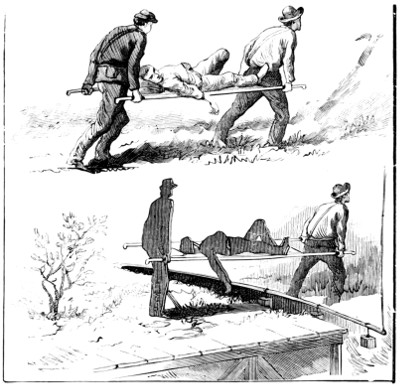
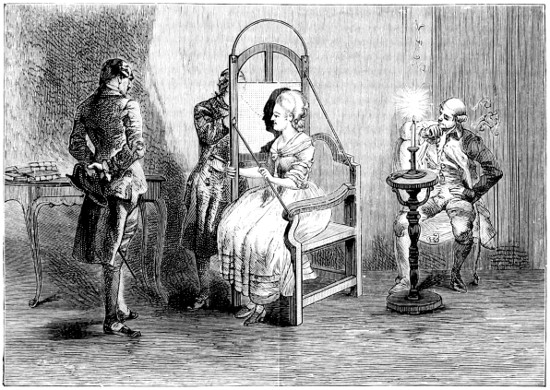
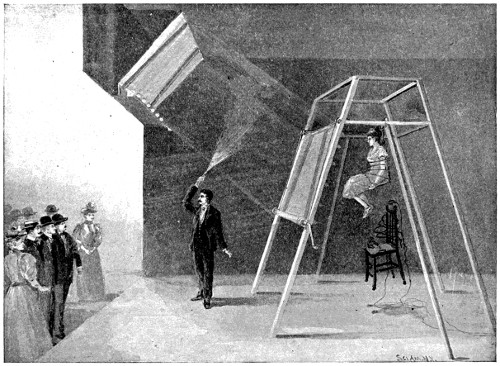
The first illusion presents the disappearance of a lady, apparently through
a solid looking glass. The method used is remarkably ingenious.
A large pier glass in an ornamental frame is wheeled upon the stage.
The glass reaches down within about two feet of the floor, so that every one
can see under it. The only peculiarities which a skilled observer would be apt
to notice are a wide panel extending across the top of the frame and a bar
crossing the glass some four feet from the floor. The first is ostensibly for
artistic effect—it really is essential to the illusion. The horizontal piece purports
to be used in connection with a pair of brackets to support a glass shelf
on which the lady stands—it also is essential to the illusion.
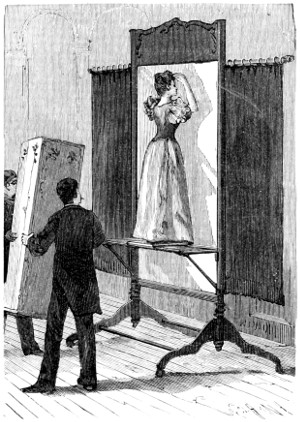
SCREENING THE LADY.
Brackets are attached to the frame, one on each side, at the level of the
transverse piece, and a couple of curtains are carried by curtain poles or rods
extending outward from the sides of the frame. Across the ends of the brackets
a rod or bar is placed and a plate of glass rests as a shelf with one end on
the rod and the other on the horizontal piece, thus impressing upon the audience
the utility of the crosspiece. Its real function is not revealed.
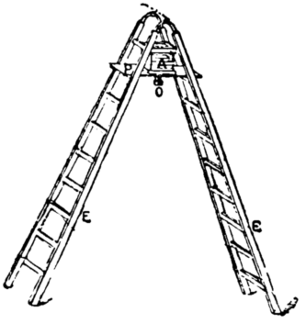
A lady steps upon the shelf, using a step-ladder to reach it. She at once
turns to the glass and begins inspecting her reflection. The exhibitor turns
her with her face to the audience and she again turns back. This gives some
byplay, and it also leaves her with her back to the audience, which is desirable
for the performance of the deception. A screen is now placed around her.
The screen is so narrow that a considerable portion of the mirror shows on
each side of it. All is quiet for a moment, and then the screen is taken down
and the lady has disappeared. The mystification is completed by the removal
of the portable mirror, it being thus made evident that the performer is not
hidden behind it.
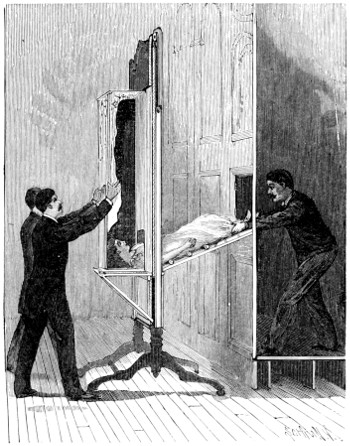
THE DISAPPEARANCE EXPLAINED.
Two of our cuts illustrate the performance as seen by the audience, the
second explains the illusion. The mirror is really in two sections, the apparently
innocent crossbar concealing the top of the lower one. The large upper
section is placed just back of the lower piece, so that its lower end slides down
behind it. This upper section moves up and down in the frame like a window
sash, and to make this possible without the audience discerning it the wide
panel across the top of the frame is provided. When the glass is pushed up,
its upper portion goes back of the panel, so that its upper edge is concealed.
Out of the lower portion of the same mirror a piece is cut, leaving an opening
large enough to admit of the passage of the person of the lady. The second
cut, with this description, explains everything. The mirror as brought out on
the stage has its large upper section in its lowest position. The notched portion
lies behind the lower section, so that the notch is completely hidden from
the audience. When the glass shelf is put in place, the performer steps upon
it and is screened from view. The counterpoised glass is raised like a window
sash, exposing the notch. The screen is just wide enough to conceal the notch,
the fact that a margin of the mirror shows on each side of the screen still
further masking the deception. From the scene piece back of the mirror an
inclined platform is projected to the opening in the mirror. Through the
opening the lady creeps and by the assistant is drawn away behind the scene;
then the platform is removed, the glass is pushed down again, and, the screen
being removed, there is no lady to be seen. The fact that some of the mirror
was visible during the entire operation greatly increases the mystery. The
lady passes through the notch feet foremost, and her position, facing the
mirror, makes this the easier.
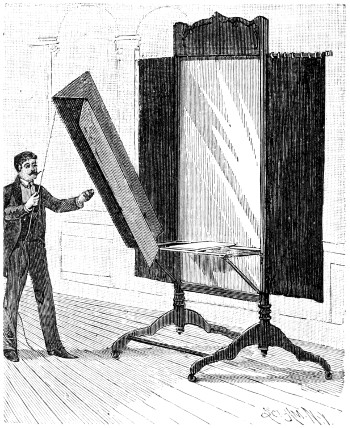
THE LADY HAS VANISHED.
In this illusion the curtain rises and shows upon the stage what is to be
interpreted as a representation of Noah’s ark, a rectangular box with ends
added to it, which, curving
upward, give it a
boat-like aspect. It stands
upon two horses or trestles.
The cut, Fig. 3,
shows the ark in its entirety.
The exhibitor
opens it on all sides,
swinging down the ends
and the front and back
lids, and raising the top
as shown in Fig. 1. It
will be noticed by the
observant spectator that
the back lid is first
dropped and that the assistant
helps throughout,
the reason of which will
be seen later. The skeleton or frame of the structure is now disclosed and it is
seen to be completely empty. It is now closed, this time the back lid being
swung into place last, and all is ready
for the flood. This is represented
by the water poured in ad libitum
through a funnel inserted in an aperture
in the upper corner. To the audience
it seems as if the ark were being
filled with water. In reality, the
water simply runs through a pipe,
carried through one of the legs of
the trestle, and so down beneath
the stage. The management of the
flood is illustrated in our cut, Fig. 2.
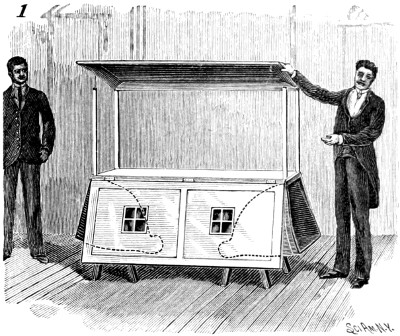
THE ARK OPENED FOR INSPECTION.
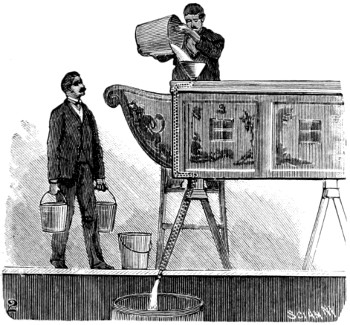
THE FLOOD.
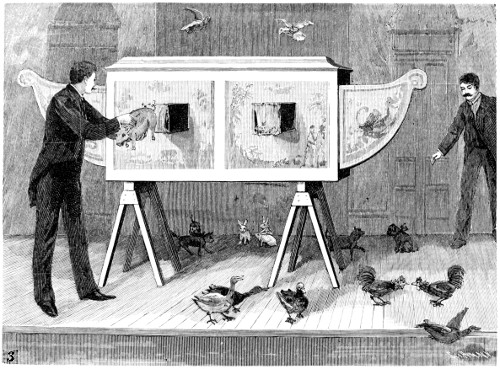
TAKING OUT THE BIRDS AND ANIMALS.
After the flood the exit of the
animals from the ark is next to
be attended to. Opening windows
in its front, a quantity of animals
and birds are taken out as shown in Fig. 3. Ducks, chickens, pigeons, cats,
dogs, and a pig are removed and run around on the stage or fly about, and it
is wondered how so small an inclosure could contain such a collection. It is
also to be observed that none of the animals are wet—the water has not reached
them. More, however, is
to follow, for the exhibitor
now lets down the
front, and a beautiful
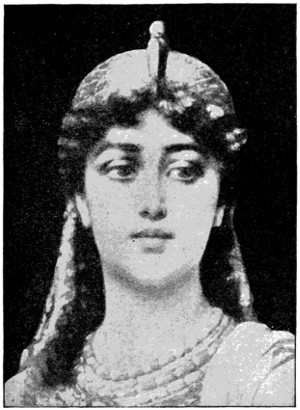
Eastern woman, Fig. 4,
reclines gracefully in the
center of the ark, which
has only room enough to
accommodate her. Where
the animals came from,
and how they and the
woman could be found
in the ark, which, when
opened before the audience,
seemed completely
empty, and how they escaped the water, are the mysteries to be solved.
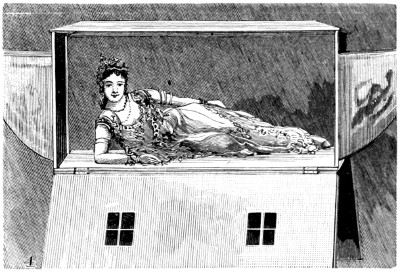
THE LADY TENANT OF THE ARK.
Our cut, Fig. 5, completes the explanation. The ends which are swung up
and down in the preliminary exhibition of the ark are the receptacles which
accommodate the animals and birds. They are stowed away in these, are
swung up and down with them, and are taken out through apertures in their
fronts.
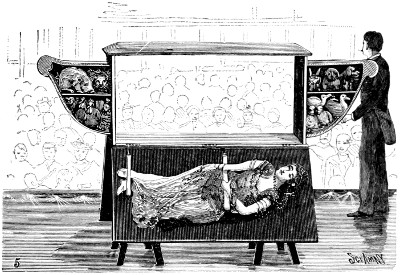
THE MYSTERY EXPLAINED.
The woman, the other tenant, is fastened originally to the back lid. When
the ark is opened for inspection, this lid is swung down, ostensibly to enable the
audience to see through the ark—in reality to prevent them from seeing
through the illusion. For, as stated, it is swung down before the front is
opened, and as it goes down the woman goes with it, and remains attached to
it and out of sight of the audience, who only see the rear side of the door as
it is lowered. Fig. 5 shows the rear view of the ark when open, with the
woman in place on the rear lid, and also shows the animals in place in the side
compartments.
The illusion is exceedingly effective, and is received with high appreciation
by the audience. To those who understand it, the performance is of
heightened interest.
The heroine in this play was presented on the stage in a palanquin carried
by four slaves. At a given moment the curtains were drawn and then immediately
opened, when it was seen that the actress had disappeared; and yet the
palanquin was well isolated on the shoulders of the carriers, who resumed
their journey and carried it off the stage.
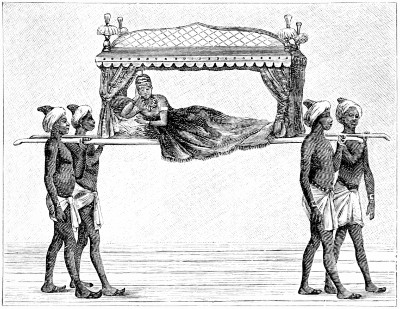
THE MAGIC PALANQUIN.
This trick, which preceded by many years Buatier de Kolta’s experiment,
in which also a woman was made to disappear, but by an entirely different process,
as will be explained later on in this chapter, was performed as follows: The
four uprights arranged at the four corners of the apparatus were hollow, and
each contained at the top a pulley over which a cord passed. These cords were
attached by one end to the double bottom of the palanquin, and by the other
end to a counterpoise concealed in the canopy.
At the precise moment at which the curtains were drawn, the carriers disengaged
the counterpoises, which, sliding within the uprights, rapidly raised
the double bottom, with the actress, up to the interior of the canopy. The
person thus made to disappear was quite slender and took such a position as to
occupy as little space as possible. By making the shadows of the mouldings
of the canopy and columns more pronounced through painting, and by exaggerating
them, the affair was given an appearance of lightness that perplexed
the most distrustful spectator.
One of the most mysterious among Kellar’s repertory of successful illusions
is the “Cassadaga Propaganda,” an explanation of which is herewith presented.
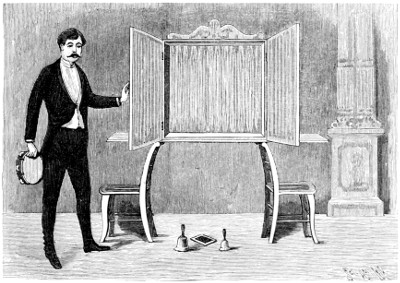
THE CABINET OPEN FOR INSPECTION.
The effect as produced on the spectators will first be outlined. A sheet
of plate glass about sixteen by sixty inches in size is placed upon the backs of
two chairs, and on it is erected a small beautifully finished cabinet consisting
of four pieces, of which the sides are hinged to the back, and which, with the
front, are seen resting on a chair at the side of the stage. When erected, the
cabinet is forty-two inches high, thirty-six inches wide, and fourteen inches
deep.
Tambourines and bells are placed in the cabinet and the doors closed, when
the instruments instantly began playing and are then thrown out at the top of
the cabinet. The cabinet is now opened and found to be empty. A slate
placed in the cabinet has a message written thereon. In fact, all manifestations
usually exhibited in the large cabinets are produced, and yet this cabinet
is apparently not large enough to contain a person. We say apparently not
large enough; for, in reality, the whole secret consists in a small person, or an
intelligent child of ten or twelve years of age, being suspended by invisible
wires behind the back of the cabinet, where there is a small shelf on which the
concealed assistant is sitting Turkish fashion. This folded cabinet is hung on
two fine wires which lead up to the “flies” and over rollers or pulleys to the
counterweights. When proper wire is used on a brightly illuminated stage
the wires are absolutely invisible.
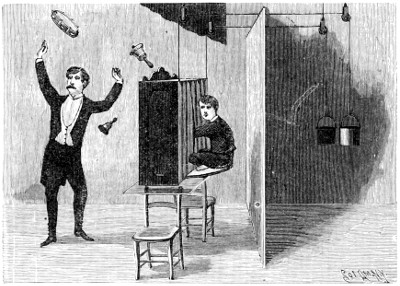
THE SPIRIT MANIFESTATIONS.
After showing the chairs and placing the glass plate upon them, the performer
picks up the folded part of the cabinet and places it on the glass, the
counterweights overcoming the extra weight of the concealed assistant. He
then opens out the sides, places the front containing the doors in position,
fastening same by hooks to the sides.
The inside of the cabinet and panels of doors are lined with pleated gold
silk. There is a concealed opening in the silk at the back of the cabinet, for
the assistant to pass his arm through, in order to handle whatever is placed
within it.
Everything being in readiness, the tambourine and bell are placed in the
cabinet and the doors are closed. The assistant now passes his hand and arm
through the opening in the back and shakes the tambourine, rings the bell,
and throws both out over the top of the cabinet. When the doors are opened
the cabinet is shown to be empty. Clean slates placed in the cabinet are
removed with messages written on them; in fact, the manifestations that can
be produced in the cabinet are limited only by the intelligence of the concealed
assistant.
One of the cuts shows the cabinet with open doors as seen by the audience.
The second cut is an end view looking from the side of stage, showing the
assistant on a shelf at the rear of the cabinet, and the wires leading up and over
to the counterweights.
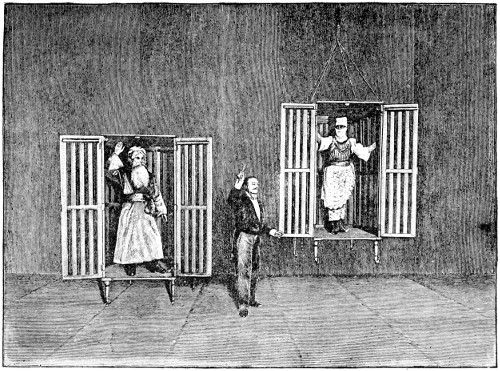
CHEV. THORN’S MAGIC CABINETS.
The clever illusionist Chev. E. Thorn made great use of a variation of
the “Cassadaga Propaganda.” He used two cabinets, each large enough to
receive a person in an upright position. They were constructed of slats and
were provided with curtains. Screens of the same color as the rear of the
stage served to close the space between the slats. The magician deceived the
audience by walking behind the cabinet or cage as often as possible when the
screens were open so that the audience could see him through the slats. The
carpet on the stage, the back of the stage, and the screen were all of the same
shade of green.
The performers, usually a caliph and an odalisk, appear and disappear at
will, really taking up the place on the wooden stage at the back of the cabinet.
Usually two cages were used, one being suspended, and by the use of confederates
who were dressed alike some very clever illusions were produced.
When the curtain rises the caliph stands on a little platform on the cage at
the left, hidden by the cage and the screens. Attention is then called to the
cage at the right whose screen is open so that the performer can be seen when
he passes behind it.
After the performer has demonstrated this he pulls down red silk curtains
over the side walls and the doors; the rear wall, however, remains uncovered.
Now a brilliantly dressed odalisk steps into the box at the left. The doors
have scarcely closed behind her when they open again, the curtains fly up,
and it is seen that the woman has disappeared, and in her place stands a white-bearded
caliph, while she appears at the rear door of the parquette smiling
behind her veil. She passes down through the audience to the stage again.
In the meantime the caliph has left the stage.
What follows is even more surprising. The curtains of both cages are
pulled down, the caliph goes into the cage at the left and the odalisk into that
at the right. The cage containing the odalisk is raised on a hoisting rope so
that it hangs in midair with the doors open. The doors are closed, a shot is
fired; at the same instant the doors of both cages spring open and the curtains
are raised; the odalisk has disappeared from the cage, which stands again on the
floor of the stage, but, at the same instant, she steps, as smiling as ever, from
the cage at the left, from which the caliph has vanished. The two cages stand
open and the audience can see right through them. The curtain falls and the
spectators rub their eyes in bewilderment.
The pulling down of the curtains serves to conceal the entrance of the
caliph in the box. When the odalisk is to vanish and the caliph to appear he
slips in from the board on the outside, while the odalisk takes her place on the
board behind the screen. The odalisk who appears at the door of the auditorium
and walks down through the audience is an exact double of the real
odalisk who is standing invisible behind the screen on the board of the cage
at the left. Owing to the peculiar costume of the odalisk this disguise is
rendered very easy. While the real odalisk is standing behind the screen on
the board of the cage at the left, the caliph installs himself in the cage. The
false odalisk is then raised in the air in the second cage, through which the
audience has been able to see up to this time. A shot is now fired and just
at that time the odalisk moves very quickly on a board behind the screen and
the cage is let down and stands firmly on the floor, at the same moment the
odalisk in the other cage changing places with the caliph. The swinging cage
appears to be empty and apparently the odalisk has passed through the air to
the other cage. The success of the trick depends upon making the spectators
believe that everything is done in cages through which they can see.
Of the many new illusions recently presented in Europe, an ingenious one
is that of the appearing lady, the invention of that clever Hungarian magician
Buatier de Kolta.
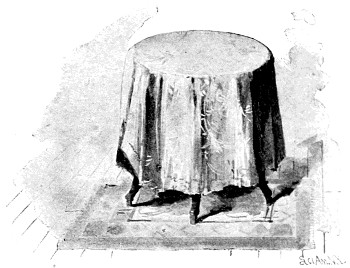
TABLE READY FOR THE APPEARANCE.
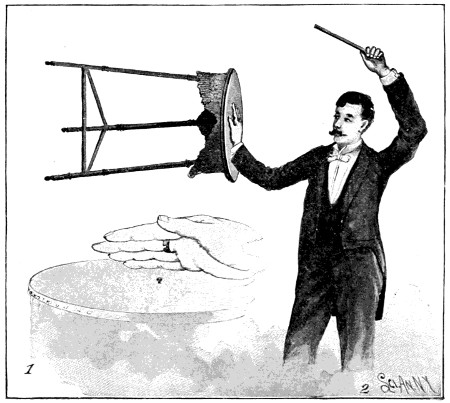
On the stage is seen a
plain round top four-leg
table, which the magician
has been using as a resting
place for part of the
apparatus used in his
magic performance.
Eventually, the performer
removes all articles
from the table and
covers it with a cloth that
does not reach the floor.
Our first engraving represents
the table in this
condition. On command,
the cloth gradually rises
from the center of the table as though something were pushing it up. In a
few moments it becomes very evident that some one, or something, is on the
table covered by the cloth. The magician now removes the cloth and a lady
is seen standing on the table, as shown in our second illustration.
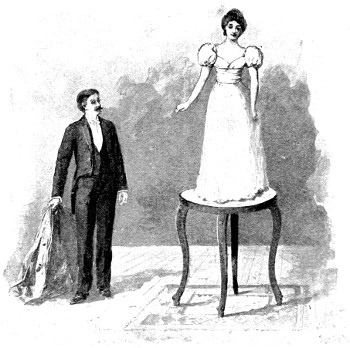
THE APPEARING LADY.
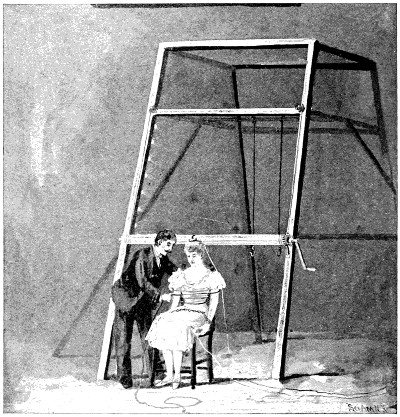
The secret of this, as in all good illusions, is very simple, as the third illustration
will show. In the stage there is a trap door, over which is placed a
fancy rug that has a piece removed from it exactly the same size as the trap,
to which the piece is fastened. When the trap is closed the rug appears to be
an ordinary one. The table is placed directly over the trap. Below the stage
is a box, open at the top, with cloth sides and wood bottom. To this box are
attached four very fine wires, that lead up through the stage by means of small
holes where the trap and floor join, over small pulleys in the frame of the
table and down through the table legs, which are hollow, through the stage
to a windlass. In the table top is a trap that divides in the center and opens
outward. The top of the table is inlaid in such a manner as to conceal the
edges of the trap. The lady takes her place in the box in a kneeling position,
the assistant stands at the windlass, and all is ready. Fig. 1 of our third
engraving shows the arrangement beneath the stage, and Fig. 2 the under
side of the table top.
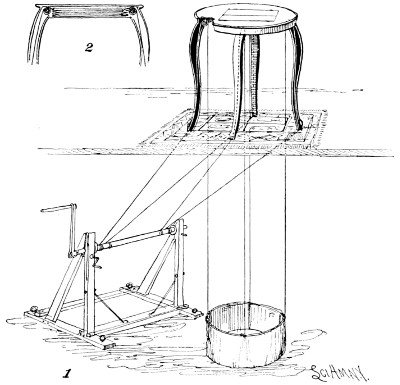
DETAILS OF THE APPARATUS.
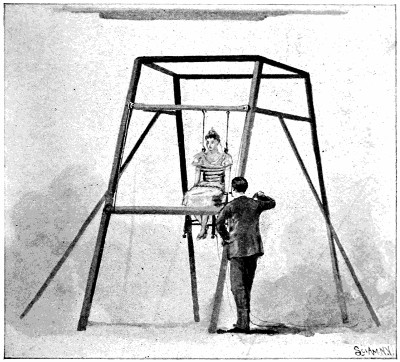
The magician takes a large table cover, and, standing at the rear of table,
proceeds to cover it by throwing cloth over table, so that it reaches the floor
in front of the table, then slowly draws it up over the table top. The moment
that the cloth touches the floor in front of the table, the trap is opened and the
box containing the lady is drawn up under the table by means of the windlass,
and the trap closed. This is done very quickly, during the moment’s time in
which the magician is straightening out the cloth to draw it back over the
table. All that now remains to be done is for the lady to open the trap in
table and slowly take her place on top of the table, and close the trap.
The top and bottom of the box by means of which the lady is placed under
the table are connected by means of three strong elastic cords placed inside of
the cloth covering. These elastics are for the purpose of keeping the bottom
and top frame of box together, except when distended by the weight of the
lady. Thanks to this arrangement of the box, it folds up as the lady leaves it
for her position on the table top, and is concealed inside of the frame of table
after her weight is removed from it. A somewhat similar trick is called “The
Disappearing Lady.” In this illusion the process is worked in the reverse
order.
The accompanying figures illustrate a trick in which the prestidigitateur,
after placing a chair upon an open newspaper and seating a lady thereon, covers
her closely with a silk veil, and after the words “one, two, three,” lifts the veil
and shows that the lady has disappeared.
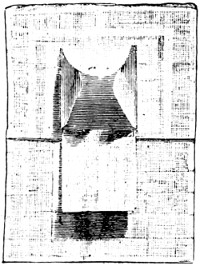
FIG. 1.
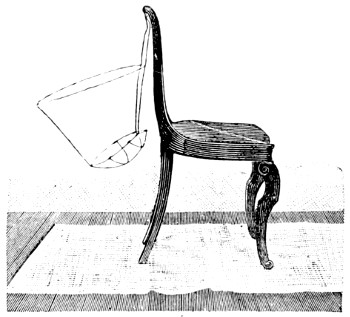
FIG. 2.
FIG. 1.
FIG. 2.
The newspaper is provided with a trap, which is concealed by the printed
characters (Fig. 1). This trap is of the same size as the one that must exist
in the floor upon which one operates. As for the chair, that is generally an
old affair, without any cross rod in front (Fig. 2). It is provided with a
movable seat that lowers in order to allow the lady to pass between the two
front legs. It is provided, besides, with a frame of wire which is invisible
on account of the feeble diameter of the latter, and which, attached to the
back, is turned backward on the side opposite the spectator. As soon as the
lady who is to be made to disappear is seated (Fig. 3), she causes the frame to
tilt and cover her head and shoulders. This operation is hidden by the veil
that the prestidigitateur spreads out at this moment in front of the lady.
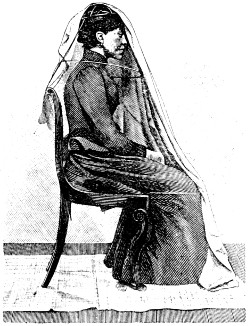
FIG. 3.
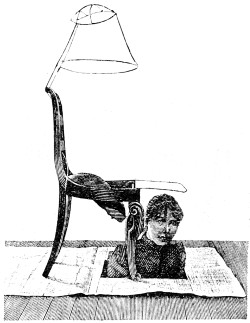
FIG. 4.
FIG. 3.
FIG. 4.
At this instant the operator actuates a spring, which opens the trap in the
floor. The lady passes between the legs of the chair (Fig. 4), and then through
the two traps, the one in the paper and the one in the floor. As soon as she
reaches the floor beneath the stage she closes the trap in the newspaper with
gummed paper, and shuts the one in the floor, and it might be thought that
she was still on the stage, although she has disappeared. In fact, the veil, on
account of the wire frame, seems always to outline the contours of the vanished
subject.
After the operator has said “one, two, three,” he lifts the veil and causes
the wire frame to fall back.
Since this trick was first introduced it has been more or less perfected or
modified in its form, but the preceding description states the methods generally
employed in performing the trick. In some cases if the newspaper is carefully
examined, it will be found to be made of India rubber and to contain a large
rent at about the center. In the next chapter will be described an interesting
illusion called “She,” in which the lady disappears while being supposed to be
cremated. This ingenious trick depends for a portion of the effect upon
mirrors, so it is placed with the other illusions requiring the aid of mirrors.
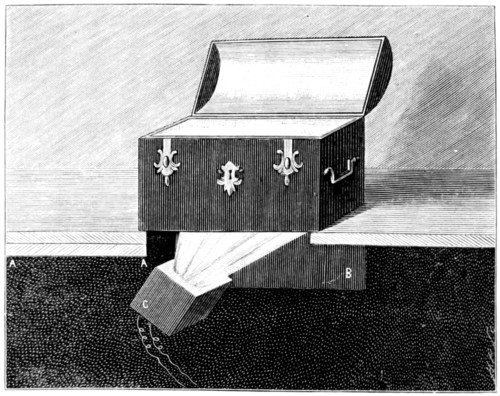
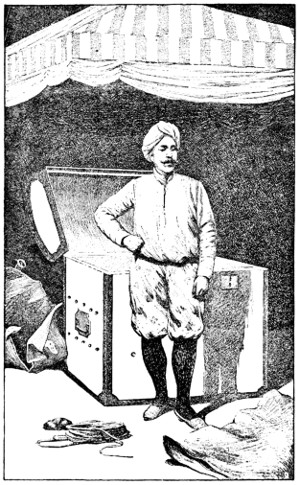
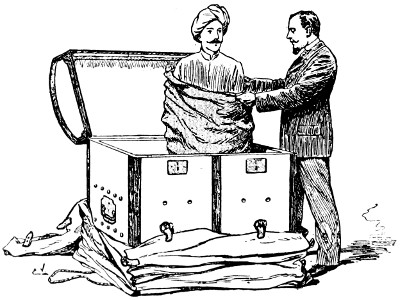
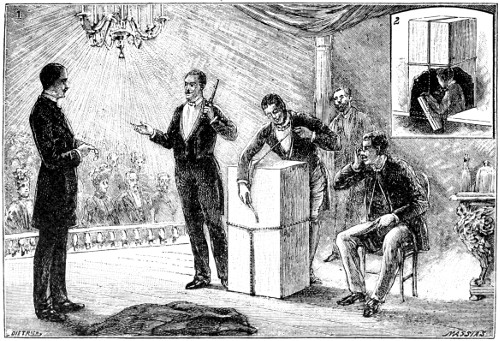
A trick known by the name of the Indian Trunk, the Mysterious Trunk,
the Packer’s Surprise, etc., formerly had much success in theaters of prestidigitation.
This trick, which may be presented in several ways, is executed by
different means, one of which we shall describe.
The following is in what the experiment consists: The prestidigitateur has
a trunk brought to him, which he allows the spectators to examine. When
every one is certain that it contains no mechanism, a person comes upon the
stage and enters the trunk. It is found that he fills it entirely, and the cover
is shut down. A spectator locks the trunk and guards the padlock.
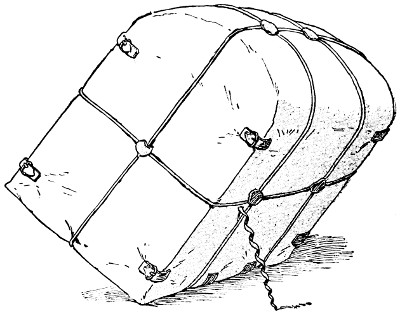
The trunk is afterward wound in all directions with rope, the intersections
of the latter are sealed, and the whole is introduced into a bag provided with
leather straps, and which may in its turn be sealed at each of its buckles.
When the operation is finished, the spectators who have aided in the packing
remain on the spot to see that nothing makes its exit from the trunk, which has
been placed upon two wooden horses. The prestidigitateur then fires a pistol
over the trunk, which, when divested of its covering, ropes, and unbroken seals,
is found to be entirely empty.
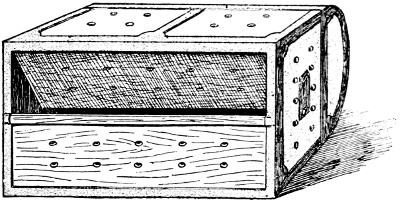
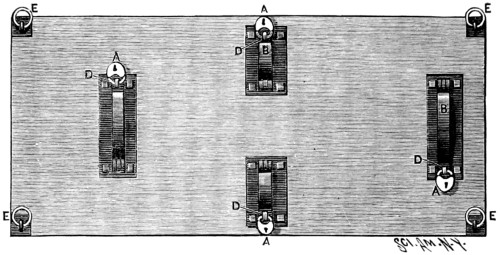
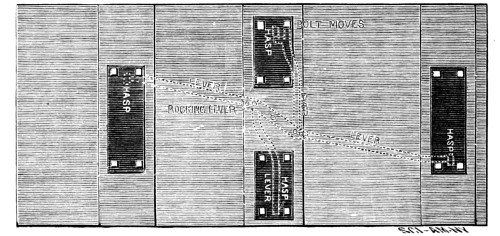
The whole credit of the trick is due to the cabinet maker who constructed
the trunk. The latter, in the first place, is exactly like an ordinary trunk,
and the closest examination reveals nothing out of the way about it. Yet one
of the ends, instead of being nailed, is secured by a pivot to the two long
sides, so that it can swing. The swinging motion is arrested by a spring plate
bolt. When the person in the interior presses upon a point corresponding to
this bolt, the pivot turns freely and the end of the trunk swings.
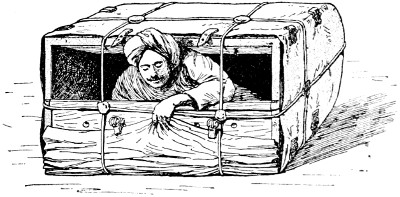
The following is the way that the operation is performed in order that the
spectators may not perceive the opening of the trunk. The operator’s assistant
takes his place in the trunk, which is closed and locked and the padlock
sealed. Some obliging spectators then aid in tying the trunk, around which
the rope is passed twice lengthwise, beginning at the side opposite the opening
part. The rope is then passed over this part and runs in the axis of the pivots.
Then the trunk, for the convenience of tying, is tilted upon the end where
the rope passes. It is then that the assistant inclosed in the interior presses
the bolt. The end of the trunk then has a tendency to open, and as the
prestidigitateur has taken care to tilt the trunk at a carefully marked point of
the stage floor, the movable end meets in the latter with an exactly similar
trap that opens at the same time, and it is through these two traps that the
invisible vanishing takes place. As soon as the assistant has passed through
the trap, he pushes up the latter, and consequently the movable end of the
trunk, which closes upon its spring plate bolt.
THE MYSTERIOUS TRUNK.
The time that it takes the man to pass through the trap is insignificant,
and while the ropes are being crossed the operation might be performed several
times. Afterward, there is nothing to be done but to proceed with the experiment
as we have said, care being taken, however, not to abuse the complaisance
of the spectators, and not to allow them to try the weight of the trunk.
When the vanished person descends beneath the stage, he is supported by
some other individual if the theater is not well appointed, and by a trap with a
counterpoise if the construction of the stage admits of it. This trap permits
of expediting things in certain cases of the reappearance of the confederate,
but is useless in the process described above.
Such is one of the artifices employed. Whatever be the process, the
presentation of it is often complicated by causing the person who has vanished
to reappear in a second trunk that has previously been ascertained to be empty
and that has been sealed and enveloped under the eyes of the spectators. It
will be easily comprehended that the operation here is reversed, and that the
confederate beneath the stage awaits the proper moment to be lifted into the
interior of the second trunk, whose movable end is opened outwardly by the
prestidigitateur at the desired moment.
Boxes with glass sides also have been constructed. The management is the
same, but, as the person inclosed is visible up to the last moment, care must be
taken to so pass the ropes as not to interfere with the trap of the trunk, which
then consists of one of the sides, and which operates at the moment when
the trunk, bound with ropes, sealed and laid upon this side, is about to be
wrapped up. This presentation has still more effect upon the spectators than
the preceding, and seems to present greater difficulties.
Among the most remarkable experiments performed by prestidigitateurs
should be cited that of the Indian basket, which, as its name indicates, is of
Asiatic origin. Travelers in Hindostan have often told us that the Indians
practice this wonderful trick upon the public places. The Indian magician
makes use of an oblong osier basket provided with a cover. He takes a child
and incloses it in this basket, and around the latter buckles a belt. Grasping
a sword, he thrusts it into the basket here and there, and pulls out the blade
all dripping with blood.
The spectacle is shocking, and the feelings of the spectators become
wrought up to a high pitch. The magician then opens the basket, which, to
the surprise of all, is empty.
At a few yards distance cries are heard proceeding from the child who had
been inclosed in the basket, and who is now running forward sound and happy.
Robert-Houdin, who studied this juggler’s trick, explained it perfectly, and was
able to perform it himself. The basket used by the Indian prestidigitateurs
is represented herewith.
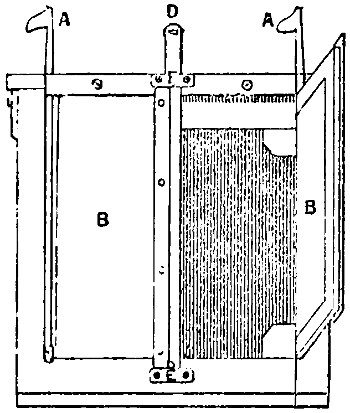
Fig. 1 shows the basket open ready to receive the child. For the sake
of the explanation we have cut away one end. This basket is provided with a
double movable bottom,
A C B, the center of motion
of which is at C. In
order to make the child
disappear, the cover being
closed, the top of the basket
is lowered by turning
it toward the spectators
(Fig. 2). But the bottom,
B, and the part A, that depends
upon it, do not take
part in this motion. The
weight of the child lying
upon the bottom forces the
latter to remain in place,
and by this fact the part
A C shuts off the bottom of
the basket (Fig. 2).
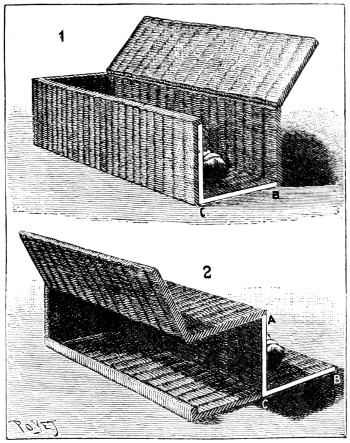
THE INDIAN BASKET TRICK.
In order to turn the
basket over, the Indian
fastens it with strips of
leather, and, to facilitate
this operation, places his
knee on it. The child can
then easily hide himself under the robe worn by the magician. Replacing the
basket in its first position, the Indian inserts his sword and sticks the blade into
a small sponge fixed within and saturated with a red liquid. While the attention
of the spectators is absorbed by this exciting operation, the little Indian
escapes from beneath the robe, and runs a short distance from the spectators
without being seen. Houdin says that when this trick is well performed, it has
a startling effect. In all the preceding tricks the magician has made way bodily
with assistants, we now come to a case of mutilation in which the luckless
clown must suffer decapitation.
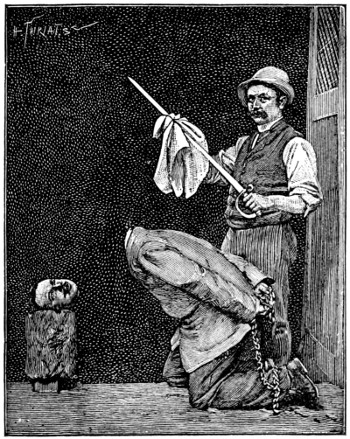
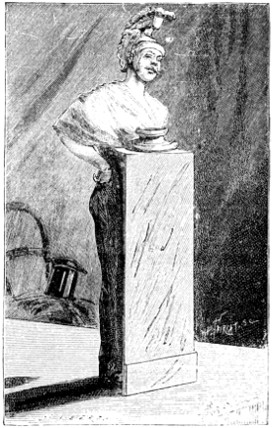
The means employed in this illusion is the old-fashioned “defunct”
method of decapitation, and although this lacks the refinement and scientific
interest of execution by electricity, it has a certain precision.
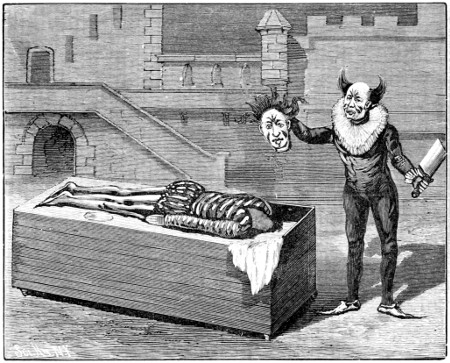
A NOVEL STAGE TRICK—DECAPITATION.
The poor clown who suffers the death penalty twelve times a week usually
enters the circus ring, or appears on the stage, as the case may be, and after
performing certain acrobatic feats, commits some crime against his fellows,
for which he is condemned to die. He is placed upon the block; his head is
covered with a cloth. Harlequin approaches as executioner, and begins to cut
with a huge knife across the victim’s neck. In a moment all is over, the cloth
is removed, and Harlequin lifts in the air the severed head. Delighted with
his trophy, he carries it about under his arm, places it in a charger in the center
of the ring, and finally takes it back to the block wrapped up in the cloth, and
places it by the side of the headless trunk. He removes the cloth, and
then in sport places a lighted cigarette in its mouth. In a little while you
notice that the cigarette begins to glow, smoke comes from the nose, and the
eyes roll. Evidently the head has come to life. Not able to bear the horrible
sight, he throws the cloth again over the head, seizes it, places it in its original
position on the shoulders of the victim, kneads it to the body, and suddenly
the figure rises, head and all, and bows to the audience—an orthodox clown.
The trick is a good one, and takes with the audience. The way in which it is
done is explained in the second cut.
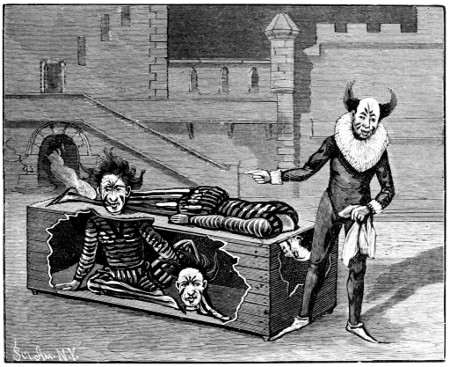
EXPLANATION OF THE DECAPITATION TRICK.
As soon as the clown lies on the box and his head has been covered with the
cloth, he passes his head through an invisible opening in the top of the box.
An assistant inside of the box passes up the dummy head, which is an exact
facsimile of the clown’s head and face. This is seized by Harlequin, who
makes such sport of it as he sees fit. When he places it by the side of the
trunk, in reality he passes it through an opening in the top of the box to the
assistant within, who substitutes his own head (which is painted to match the
other two) in place of it. The other steps in the performance readily follow.
The cloth which the harlequin always carries conceals all the sleight of hand,
and the whole performance is a series of surprises.
Another performance of a somewhat similar character was recently performed
at a theater in New York, in which a clown throws himself on a sofa
and is cut in two by a harlequin. One part of the sofa with the body remains
in one part of the stage while the other part with the legs and feet (which are
all the time vigorously kicking) disappear through a wing at the other end of
the stage. The action is very sudden and the effect startling. Of course, in
this case there are two men similarly dressed. The head and body of one of
them appears at the head of the sofa, while the body of the second clown is
concealed in the box under the seat at the other end of the sofa, the feet and
legs alone being exposed.
The following article is not written with the intention or desire to antagonize
any believer in Spiritualism, but merely to explain how anti-spiritualists,
as well as several professional “mediums,” secured their release after being
fastened in their cabinet. During the years the writer (Mr. Caulk) has been
before the public as a magician and cabinet performer, he has met a number
of cabinet test “mediums,” and can safely say that all of these people who have
come under his observation have been imposters. This may be due, however,
to the bad fortune of the writer.
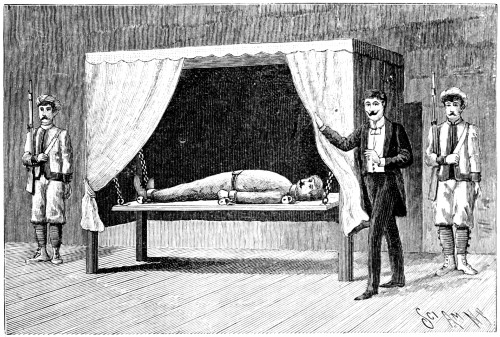
The writer has been tied with ropes, fastened with handcuffs, brass collars,
and chains, many times in many different cities, and by people who were just
as alert as any investigator of spiritualistic phenomena, yet, unlike many
“mediums” he has met with, was never exposed.
The methods used are many, some simple, others complicated, but all
mystifying. To the average auditor the most wonderful point is, how does
the performer release himself after being so securely bound? For the benefit
of the curious the writer will explain a few of the methods by which he has
secured his release after being fastened by a committee from the audience.
All anti-spiritualists, as well as several “mediums” personally known to the
writer, make use of these same methods of release, or others founded on the
same principle.
Among the many successful rope tests, the following is about the best. A
piece of soft cotton rope about six feet long, and of the size known as sash cord,
is securely tied around the performer’s left wrist, dividing the rope so that
the ends will be of an equal length. When the committee is satisfied that they
have made the knots secure, the performer places his hands behind him, with
the right wrist resting over the knots on the left wrist, and the ends of the
rope are securely tied together, bringing the knots down tight on the right
wrist. This appears fair enough, but it is not as fair as it appears, because,
while the knots are secure enough, there is sufficient slack between the wrists
to enable the performer, by giving his right wrist a half turn, to withdraw this
hand from the rope encircling it.
The reader may say,
“That is all well enough,
but how and by what
means does he secure this
slack?”
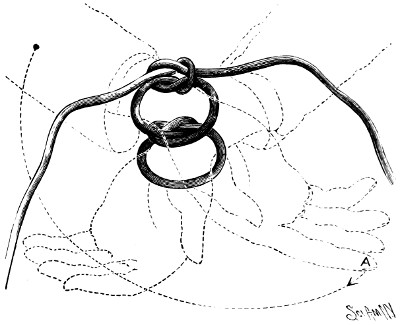
A ROPE TEST.
In placing his hands
behind him after the rope
is tied about the left
wrist, he gives the rope a
twist and knot with
over the other, pressing
the twist down on the
knot and covering the
twist and knot with
the right wrist, which is
then tied. When ready to release himself, the performer gives his right
hand and wrist a half turn, releasing the twist lying on the knot, which thus
becomes a part of the loop tied around the right wrist, and enlarging it
sufficiently to enable the performer to pull the right hand free from the rope,
when he can perform any trick he chooses with the free hand. Our first and
second engravings show
the formation of the
twist, thus making the
above explanation clear.
By replacing the hand in
the loop and giving the
hand a half turn the
knots can be shown as
secure as when first tied.
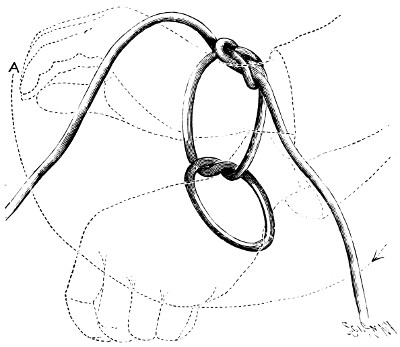
EXPLANATION OF THE ROPE TEST.
The “Spiritualistic
Post Test” is among the
latest and most successful
of mechanical fastenings.
A piece of wood four
inches square and three
feet long is given to the
committee, who bore a
hole through it near one
end, and then pass an ordinary rope through the hole, tying a knot in the rope
on each side of the post, pressing the knots against the post so that the rope
cannot be drawn through the post. The ends of the rope are now unraveled,
and the post secured to the floor of the cabinet.
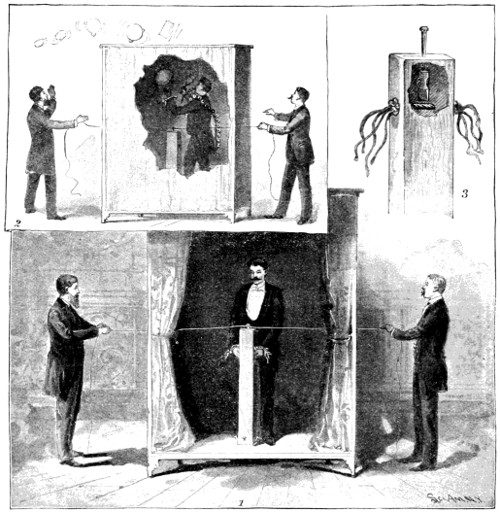
The performer, standing behind the post, places his wrists against the knots
in the rope, one on each side of the post, and the unravelled ends of the rope
are bound around his wrists and tied securely, and all knots are sealed with
wax. A large nail is driven in the top of the post, to which are fastened cords
that are passed out through the cabinet and held by members of the committee
in order that they may know if the performer moves the post in any manner
during the performance of any test, such as the ringing of bells, etc. Fig. 2
of our third engraving shows the performer tied to the post and the committee
holding the cords. The curtains of the cabinet are closed and the usual manifestations
take place.
Before the performance a hole is bored in the center of the end of the
stick or post, in which is placed a chisel-shaped piece of steel sharpened at the
lower end and blunt at the upper end, as shown in Fig. 3. The opening in the
end of the post is now carefully closed and all signs of such an opening are
concealed by the aid of glue, sawdust, and a little dirt rubbed over it.
When the committee are invited to bore a hole in the post, the performer
takes care to start the bit, in order that there will be no mistake about getting
the hole directly beneath the chisel concealed in the post. When the rope is
passed through the hole and knotted it is directly under the sharp edge of the
chisel, with a thin layer of wood between. When the nail is driven in the
top of the post it strikes the chisel, forcing it through the thin shell of wood
above the rope and through the rope, thus releasing the performer, who can
withdraw his hands from the post and do any trick he chooses, and when
finished, by merely replacing the ends of the rope in the holes from which he
removed them, and holding the hands tight against the post, can allow a most
rigid examination of the seals to show that it was not possible for him to have
released his hands, and the persons holding
the cords that are fastened to the
nail testify that they did not feel any
movement of the performer or the post.
The Handcuff Test is a great favorite
of the “medium.” In this test the performer
uses any pair of handcuffs furnished
by the audience, and by them put on him.
Yet, in a very few moments after he takes
his place in the cabinet, his coat is thrown
out, but on examination the handcuffs are
found to be on his wrists just as they were
placed by the audience. As a final test,
the performer comes out of the cabinet
holding the handcuffs in his hand, removed
from the wrist but locked.
The explanation of this trick is very
simple, but, like many simple tricks, very
mysterious. There are only a few styles of
handcuffs made in this country, and all
that a “medium” has to do is to secure
the proper key for each style, which keys
are concealed about the person, and by the aid of fingers and teeth the proper
key can be fitted to the handcuffs. In some types of handcuffs it is impossible
to get the fingers to the key-hole. If such a pair is placed on the performer and
he cannot use his teeth to hold the key, he slips the key in a crack in the
chair or cabinet, which crack he makes sure is there before undertaking the
test, thus holding the key and unlocking the handcuffs.
As the space allotted for this article is limited, the writer will explain
but one other piece of apparatus used to secure the “medium,” which is known
as the Spirit Collar.
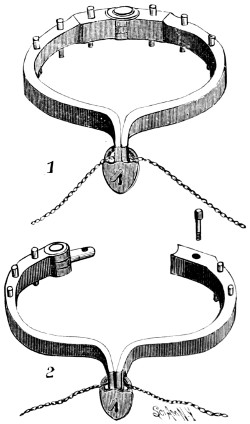
THE SPIRIT COLLAR.
The collar is made of brass, and fits closely about the performer’s neck.
Through the openings in the ends of the collar is passed a chain, after the
collar is on the performer’s neck, and this chain is passed around a post,
carried back and through the padlock which is used to lock the collar. By this
arrangement the performer is fastened securely to a post, at least it appears so
to the audience. This collar is shown in our fourth engraving. As seen by
the cut, the collar is decorated with a number of small bolts, which impart to
it an additional appearance of strength.
These bolts are all false with one exception. This genuine bolt can be
removed by the performer when the collar is on his neck, thus allowing the
collar to come apart at the hinge, as shown in the cut, thus releasing the performer,
allowing him full liberty to perform any trick he wishes, and permitting
him to again apparently fasten himself securely. This loose bolt fits so
securely that there is no danger of any of the committee removing it with their
fingers. The performer uses a small wrench to remove the bolt.
The prestidigitateur has always been indebted more or less to the use of
reflection from mirrors and plate glass as an important adjunct in conjuring.
Many of the illusions in the succeeding pages have often been used as an entertainment
in themselves so that it might really be termed “side show science.”
Without doubt the most famous of all the illusions in which effects of lighting
are used is “Pepper’s Ghost” which was devised by that eminent experimentor
on physical and chemical science, John Henry Pepper. There are a number
of variations of the Pepper Ghost of which the “Cabaret du Neant” is an
excellent example.
The name “Cabaret du Neant,” or “Tavern of the Dead” (“non-existing”),
has been given by the proprietors to a recent Parisian sensation; it was
also exhibited in New York. The interest of course centers in the ghost illusion.
The spectators on entering the Cabaret pass through a long hall hung with
black and find themselves in a spectral restaurant. Along the walls coffins are
placed for tables, and on the end of each coffin is a burning candle. From
the center of the ceiling hangs what is termed “Robert Macaire’s chandelier,”
made to all appearances of bones and skulls. The spectators are here at liberty
to seat themselves at the tables and are served with what they desire by a
mournful waiter dressed like a French mourner with a long crape streamer
hanging from his silk hat. Around the walls of the room are placed pictures
to which the spectator’s attention is called by the lecturer. Seen by the light
of the room these pictures are ordinary scenes, but a new aspect is given to each
when lights directly behind it are turned on; the figures in it appear as skeletons,
each picture being in fact a transparency giving a different effect as it is
lighted from the rear or as seen simply by reflected light. The second chamber
is now entered; it is hung with black throughout. On the walls tears are
painted, and in close juxtaposition are two somewhat incongruous inscriptions,
“Requiescat in pace,” and “No smoking.” The reason for the latter admonition,
which is also given by the lecturer, is that for the success of the illusion
an absolutely clear atmosphere is essential. At the end of this second chamber,
at the back of a stage, is seen a coffin standing upright, in which one of the
audience is requested to place himself. Entering the stage by the side door,
he is conducted by an attendant to the coffin and placed in it. Blocks of wood
are placed for him to stand on in quantity sufficient to bring his head to the
right height so that the top of it just presses against the top of the coffin, and
the attendant with great care adjusts his height according to the predetermined
position. Two rows of Argand burners illuminate his figure, which is then
wrapped in a white sheet. Now, as the spectators watch him, he gradually
dissolves or fades away and in his place appears a skeleton in the coffin.
Again, at the word of command the skeleton in its turn slowly disappears, and
the draped figure of the spectator appears again. The illusion is perfect to the
outer audience; the one in the coffin sees absolutely nothing out of the common.
His interest, if he knows what is going on, is centered in watching the
changing expression of the spectators, being increased by the fact that at their
period of greatest astonishment he is absolutely invisible, although directly
before them and seeing them more plainly than ever. After the restoration
to life one or more auditors are put through the same performance, so that
the recent occupant of the coffin can see what he has gone through.
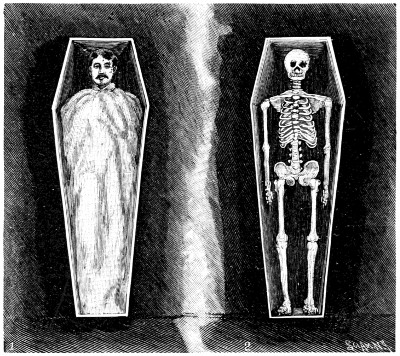
THE SUBJECT AND HIS SKELETON.
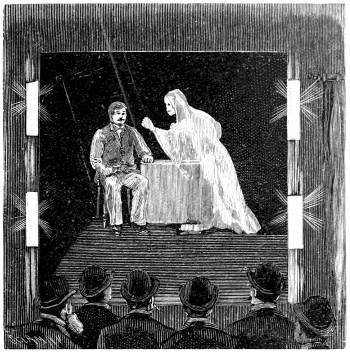
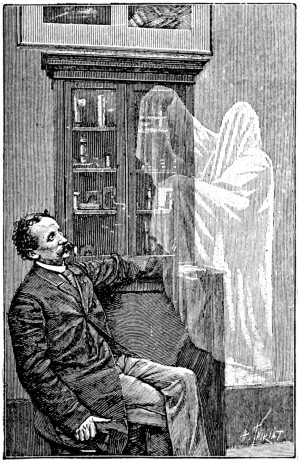
THE SHEETED GHOST.
The third chamber is now entered, somewhat similar to the second, but on
its stage is a table and seat, all the walls being lined with black. One of the
auditors is invited to seat himself at the table on the stage. He does it, and,
as before, sees nothing.
While the description of
the lecturer and the appearance
and comments
of the audience tell him
that something very interesting
is going on, the
remarks will probably
disclose to him the fact
that this time at least he
is never out of their
sight. He leaves the
stage and his place is
taken by another, and
then he understands the
nature of the drama in
which he has been an
unconscious participator.
He sees the other spectator
seated alone at the
table. Suddenly a spirit,
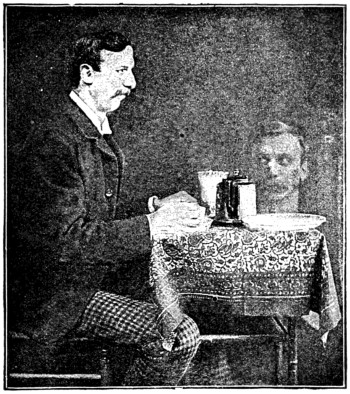
perhaps of an old man, appears at the other side of the table, while a bottle and
glass are seen upon the table. When exhorted to help himself to the liquid,
the performing spectator’s idle gestures show that he certainly does not see
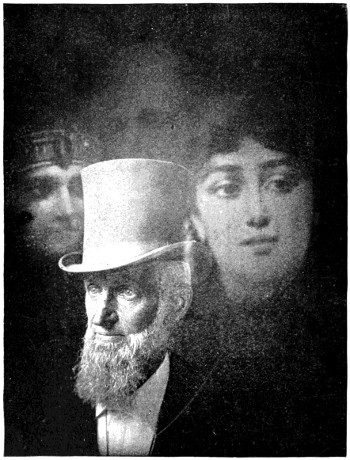
the glass, through which his hand passes unobstructed. Or perhaps it is a
woman who appears and makes the most alluring gestures toward him who
never sees her. This concludes the exhibition, which as accessory has the
strains of a funeral march, the ringing of deep-sounding bells as room after
room is entered, and the appearance of a brown-robed monk who acts as
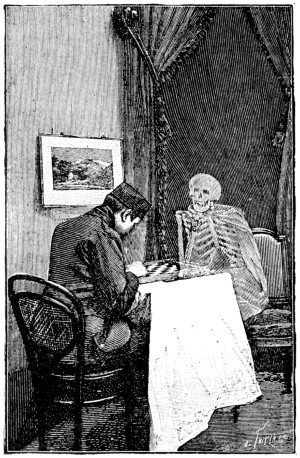
Charon to introduce the spectator to his place in the coffin. In one of our
illustrations we show, side by side, the coffin with its living occupant draped
in a sheet and in the other the skeleton which appears in his place. Two other
cuts show the scenes between the spectator at the table and the specters, illustrating
how active a part the specters take, they being no mere painted appearances,
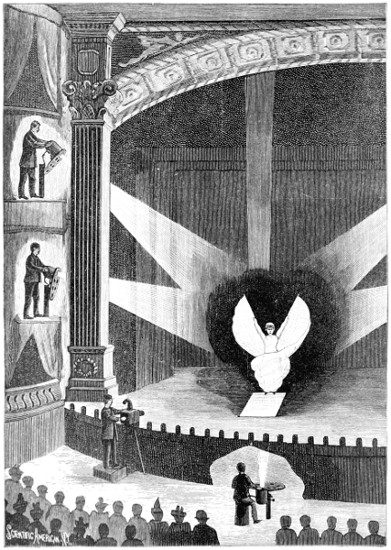
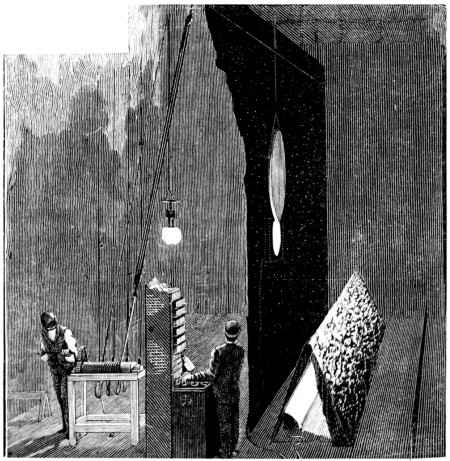
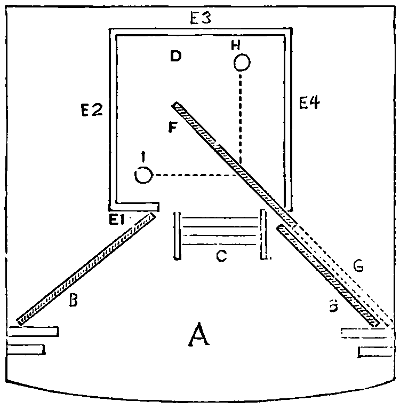
but evidently living, moving things. Our large illustration shows precisely
how it is done and so clearly that an explanation is hardly needed. The
floor of the stage is represented. To the left are seen the spectators and the
performer at the piano discoursing his lugubrious melodies. To the right is
seen Charon, and directly in front of him the coffin with its living occupant.
When lighted up by the burners shown near him, the other burners being
turned down, the coffin with its occupant is all that is seen by the spectator.
Directly in front of the coffin, crossing the stage obliquely, is a large sheet
of the clearest plate glass, which offers no impediment to the view of the coffin
with its occupant, when the latter is fully illuminated. At one side of the
stage, in the back of the
picture, is a painting of
a skeleton in a coffin
with its own set of Argand
burners. It is
screened from view.
When strongly illuminated,
and when the
lights of the real coffin
are turned down, the
spectators see reflected
from the glass a brilliant
image of the pictured
coffin and skeleton. By
turning up one set of
burners as the others are
turned down a perfect
dissolving effect is obtained,
skeleton replacing
spectator and vice
versa at the will of the
exhibitor.
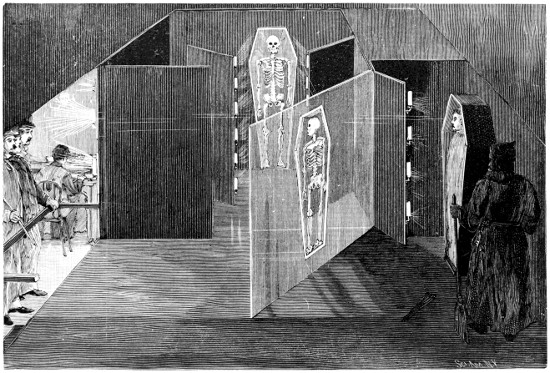
AN X-RAY ILLUSION UPON THE STAGE—CONVERSION OF A LIVING MAN INTO A SKELETON.
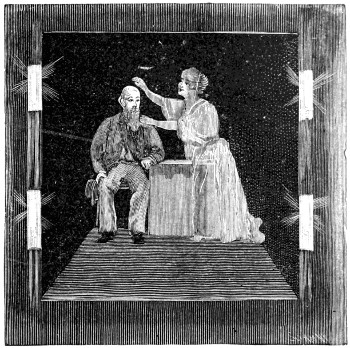
THE FEMALE SPIRIT.
The magic lantern operator always realizes that to secure a good dissolving
effect perfect registration is essential. In the securing of this lies the secret
of the coffin exhibit of the Cabaret du Neant. By the blocks on which the
occupant of the coffin stands, and by the adjustment of his head by the attendant,
the head is brought into perfect registration with the reflected head
of the skeleton. The wrapping with the sheet, presumably the enveloping in
a shroud, is done with a purpose. It covers the body from the shoulders down
and extends to the very bottom of the coffin, covering the blocks also, thus
doing away with all defects of registration which would be incurred in the
persons of spectators of different heights. In other words, the exhibition fits
out everybody with a skeleton of precisely the same height, however tall or
short he may be, the draping of the sheet and accurate position of the head
concealing from the spectators this inaccuracy, the skull occupying precisely
the place of the head, the rest taking care of itself.
Still referring to the large cut, it will be seen that it serves to explain the
exhibition in the other chamber. Instead of the coffin there is the table and
chair, and in place of the pictured skeleton a live performer is placed. In this
act there is no dissolving effect; by turning up the lights at the side of the
stage any object desired and performers dressed as spirits are made to appear
upon the stage, being reflected from the glass plate. The spectators simultaneously
see their companion sitting at the table and the reflections of the
ghosts apparently executing their movements about him.
From the scientific as well as scenic aspect, the exhibition is most interesting,
and to one who knows how it is performed, the interest is vastly enhanced.
To properly enjoy it, the stage position should be taken during one or both
performances.
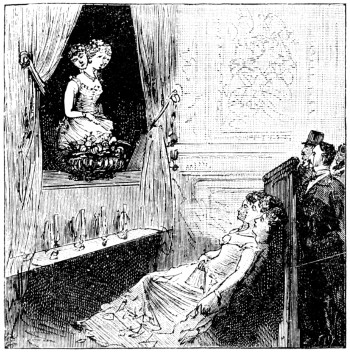
THE THREE-HEADED LADY.
In this illusion the spectators are separated from the stage by a balustrade—behind
which is seen the curtain. In a few moments the latter is drawn
back and there is distinctly seen a woman’s body the lower part of which is
hidden by a basket of flowers. This body has three heads, one in the middle
and two others grafted at the base of the neck of the first. The heads move
their eyes, answer questions and sing, and finally salute the audience, and the
curtains are drawn together and the performance is over. As in many tricks
of this kind the showman
usually announces that for
an additional admission the
secret of the illusion will be
divulged. The visitor then
enters the side scene and
perceives that on the little
stage where the phenomenal
woman just appeared,
nothing is visible but a
large plate of glass slightly
inclined towards the audience
and its edges hidden
by drapery. Behind the
mirror there is a recess
whose sides are covered
with a jet black fabric. In
front of the mirror on the
stage sits the basket of
flowers from which issued
the woman’s body. On an inclined board which rests against the screen or
balustrade lie three young girls; one of these, the middle one, is clothed in
a brilliant costume of light-colored silk, and it is she who in the exhibition
makes trunk, arms, and the middle head. The lower part of her body
is covered over with a black fabric and she is supported by a cushion which
permits the two other girls to place their necks closely against hers. The
bodies of these two girls at the sides are completely covered with fabric of a
dead black color. In front of these three young women are placed powerful
lights. The heads, hair, and arms of the “body” are covered with powder
so as to present completely white surfaces. All the white or light-colored
surfaces being strongly lighted by the lamps reflect the light; the image is
thus made upon the spectator.
This illusion, which is presented under the name of “Amphitrite,” is as
follows: When the representation is about to begin, the curtain of a small stage
rises. There is observed a circular aperture, cut in a screen, over which is
stretched transparent muslin.
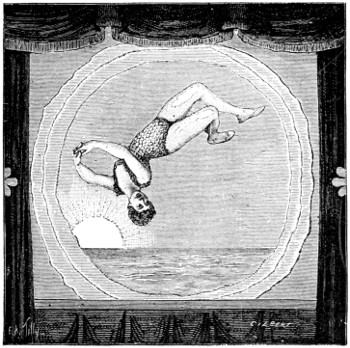
AMPHITRITE.
About six feet behind the latter there is a scene representing the sky with
clouds; below, in the foreground, there is a canvas representing the sea.
“Amphitrite, come forth!” exclaims the person in charge of the show.
All at once, a woman in the costume of an opera nymph rises from the sea
without anything being visible to support her in space, in which she turns
round and round, gracefully moving her legs and arms, now in one direction,
and then in another. When the exhibition is at an end, she straightens out
in the position of a swimmer about to make a dive, and plunges behind the
curtain representing the ocean.
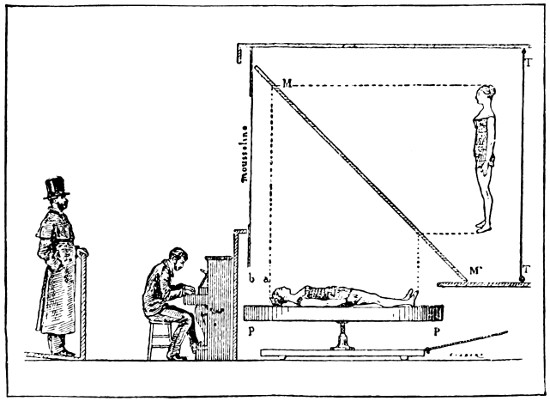
DIAGRAM EXPLAINING THE AMPHITRITE ILLUSION.
The illusion that we have just described may be performed as follows:
Amphitrite is an image—a specter analogous to those of Robin. If we imagine
that a transparent
glass, M M, in
our diagram, is inclined
45° with respect
to the stage, a
person clad in light
clothing, lying horizontally
upon a black
background beneath
the stage, and well
illuminated, will exhibit
an upright image
behind the glass.
This image will
appear to be formed
in front of the back
canvas, T T. Now,
as Amphitrite is lying upon a table, P P, she will be able to go through her
evolutions and bend herself in a circle; and if, during this time, the table,
movable upon its axis, A, is revolved, her image will turn in all directions.
Finally, to cause Amphitrite to appear or disappear, it will suffice to slide the
table upon rails, thus bringing it in front of or behind the glass. Amphitrite
should be placed upon an absolutely black background. Her costume should
be of a light color with metallic spangles, and she should be illuminated by
a powerful electric light.
The muslin stretched in front of the screen is designed to arrest anything
that jesters might throw against the glass, and which, sticking thereto might
explain a part of the mystery.
In this illusion which was presented at the “Folies Bergères,” at Paris, the
stage is rather larger than in most of the talking heads and other analogous
tricks. At a short distance from the spectator is observed a woman cut off
at the thighs and resting on a small swinging shelf. The showman moves the
shelf laterally, and at a signal the exhibitor removes the shelf, and the half-length
body appears suspended in the air. The question which every visitor
asks is, where is the rest of the body? In many of the tricks of talking heads,
isolated busts, etc., the illusion is obtained by the aid of mirrors, but the mystery
of Dr. Lynn is obtained in a much simpler manner. All painters
know that in a very strongly lighted picture the bright colors stand out at
the expense of the half-tones and dark colors, and this effect is greater as the
light becomes brighter. It is upon this principle that the Dr. Lynn trick is
based. The lower part of the bust seen is a dummy upon which the upper part
of the woman’s body lies, the remainder of her body being extended nearly
horizontally upon a board which is capable of swinging and following the
motion of the shelf.
All this portion is
hidden by opaque
black drapery so arranged
as not to reflect
the light at any
point. The bust and
shelf receive a very
intense light; then
immediately behind
there is seen intense
darkness, forming an
absolutely dark background.
The latter is
rendered still darker
by the brilliant cords
of the shelf, a metallic chain and a dagger suspended beneath it, as well as a
white handkerchief which seems to have been dropped upon the stage by
accident. At least six powerful gas burners or electric lights with reflectors
are turned towards the spectators, so that it will be seen that the latter are in
a manner dazzled by everything that strikes the eye in the foreground, and that
beyond this they see absolutely nothing but a black background.
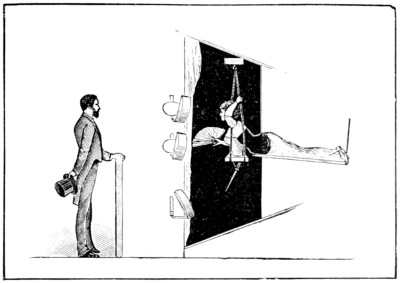
THE ILLUSION EXPLAINED.
Another variation of the illusion of the “Decapitated Princess,” which will
be described later on, is obtained without the aid of mirrors. A young girl
appears before the audience, accompanied by an executioner clad in red, and
armed with the traditional axe of his profession. The curtain then drops, and
rises in a few moments, the stage being somewhat darkened. Near the executioner
can be perfectly distinguished the girl’s head lying on a round table
at the back of the stage. The body is seen lying on the bed a few feet from
her head and at her side is the fatal block that had served for execution. The
trick is the same as the preceding one; it requires, however, two persons of the
same size, wearing the same costume, to carry out the illusion successfully.
One of these, the one who shows herself to the public, makes the head, her
body being hidden behind the cloth in the rear of the stage, which is in darkness,
as has just been explained. The other, who makes the body, has her head
bent far back and hidden in a sort of box, a false cardboard neck contributing
to increase the illusion.
To the Yogi and Mahatmas of India, the magicians and illusionists of
Europe and America are indebted for the ideas of many of their best tricks
and illusions. While the published reports of many of the alleged marvelous
effects produced by the “wonder workers” of India must be taken with a very
large amount of salt, yet we must give these people due credit for being the
originators of many tricks from which the modern magician has taken principles
on which he has founded and created several of the grandest and most
successful illusions of modern times.
Take, for instance, the illusion known as “Black Art,” or the “Midnight
Mysteries of the Yogi,” made famous in this country by those master minds
of magic, Harry Kellar and the late Alexander Hermann. The weird illusion
is founded on an idea advanced by the Yogi of India.
No doubt nearly all of the readers of this article have seen “Black Art”
presented by one of the above named magicians, yet the number who could
advance a plausible explanation of how it was done, are very few, because as
soon as one thinks that he has discovered the secret, the performer produces
an effect in direct variance with the principle on which the illusion appears
to be founded.
In this illusion the entire stage from the first groove to the rear is hung
with black velvet, the floor covered with black felt, and the top is covered
with black velvet, thus forming a large room lined entirely in black. The
regular footlights are turned out, and a special set are used, that consist of
a row of open gas jets placed on a line with the boxes, and carried up the outside
of the black room, as shown in the large engraving.
The lights throughout the entire house are either turned very low or put
out, with the exception of the special lights mentioned above.
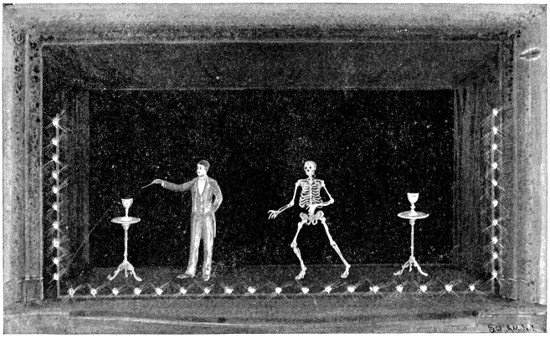
THE STAGE SETTING FOR BLACK ART.
The curtain rises, disclosing the black chamber. In a moment the magician
appears, dressed in a white suit; a wave of his hand, and a white wand appears
floating in the air, which the magician secures. A wave of the wand, and a
table appears on the right, then a second table appears on the left. A large
vase appears on one of the tables, and a second vase appears on the magician’s
outstretched hand. Both of the vases are shown and proven empty, and in
one is placed a few orange seeds, and the wand is passed over the vase, which
instantly becomes filled with oranges. The oranges are poured into the second,
then returned to the first vase, when they disappear as quickly and as mysteriously
as they appeared, and the vases are again shown empty, and again placed
one on each of the tables. A borrowed watch is placed in one of the vases,
from which it disappears and is found in the vase on the other table. A life-size
skeleton now appears and dances around the stage, becomes dismembered,
the separated parts floating about, but they finally rearticulate themselves, and
the skeleton vanishes. Now a rabbit is seen in one of the vases, from which
it is taken by the performer, and in his hands it becomes two, which are
tossed in the air and disappear.
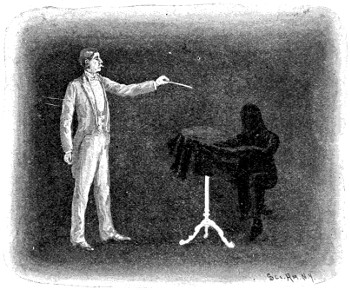
AN ASSISTANT REMOVING THE TABLE COVER.
The number and style of tricks performed in the mysterious black chamber
are almost unlimited, but an explanation of the ones mentioned above will
suffice to show how “Black Art” is performed.
While the stage is draped in black, everything that appears is painted white,
and the magician is dressed in white. There is an assistant on the stage all
through the act, but as he is dressed in black, with gloves on his hands and a
hood over his head, made of black velvet, he is not seen by the spectators, whose
sight is somewhat dazzled by the open gas jets. The tables are on the stage,
but covered with pieces of black velvet, rendering them invisible. The second
engraving shows how the assistant removes the piece of velvet and causes a
table to appear at the magician’s command.
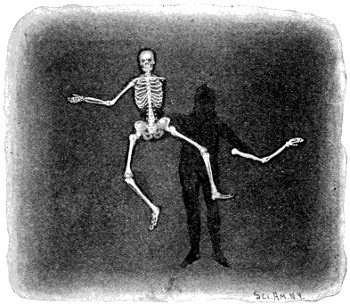
THE DISARTICULATED SKELETON.
The vases are also sitting on the stage, but covered with pieces of black
velvet. By picking up the covered vases the assistant can cause them to
appear, by removing the velvet, one on the table and the other on the performer’s
hand. The oranges are in a black velvet bag, from which the assistant
pours them into the vase. To cause the oranges to vanish, the magician,
instead of pouring them into the vase, pours them into the open mouth of a
large black bag held by the assistant just over the lower vase. The transposition
of the watch from one vase to the other is just as easy. The assistant
merely removes it from the vase in which the performer placed it, and places
it in the second vase. The manipulation of the rabbit is equally simple. The
assistant places the first one in the vase by means of a black bag in which it
was concealed, then places the second one in the performer’s hands from a
second small bag. In vanishing the rabbits the performer merely tosses them
up into a large open-mouthed black bag held by the assistant.
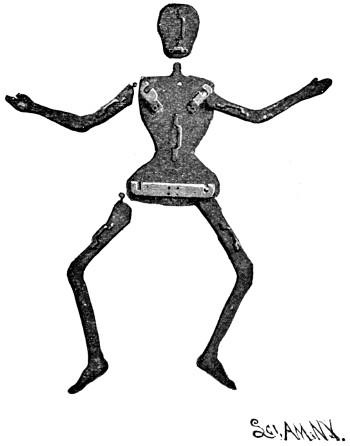
THE JOINTED PAPER SKELETON.
The skeleton is made of papier
maché, painted white, and fastened
on a thin board that is
sawed to shape and covered with
black velvet. One arm and one
leg are jointed so as to be readily
removed and replaced by the
assistant when he is operating the
skeleton. The last two illustrations
fully explain the method of
construction and manipulation of
the skeleton.
The tables are made either of
wood or papier maché and painted
white. The vases are made of
papier maché, painted white on
the outside and black on the inside.
The reason the inside of
the vases are painted black is to
prevent the hand of the assistant
beings seen when he places it in
the vase.
This is one of the most expensive of stage illusions, costing several hundred
dollars to properly stage it with the best drapery and accessories, and unless
such are used the proper illusory effect is lost. In magic as well as in other
business, cheap apparatus is dear at any price.
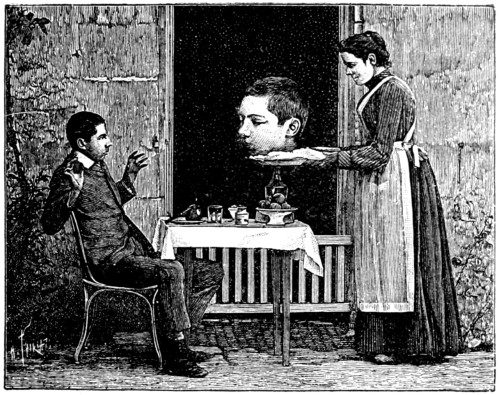
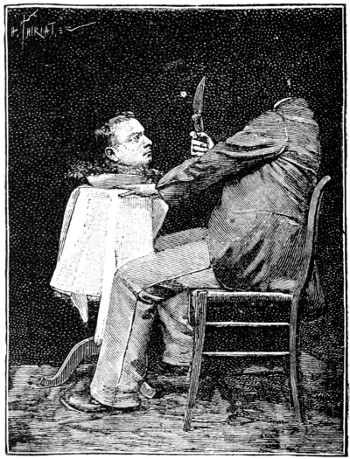
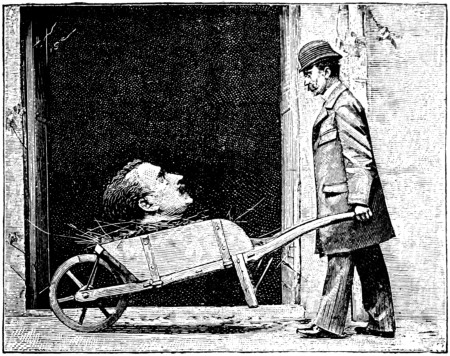
Probably the most common of all of the illusions which depend upon
mirrors is the Talking Head upon a table. The illustration is almost self-explanatory.
The apparatus consists only of a mirror fixed to the side legs of
the table. The mirror hides the body of the girl, who is on her knees and
seated on a small stool, and reflects the straw which covers the floor so as to
make it appear continuous under the table; likewise it reflects the front leg of
the table so as to make it appear at an equal distance from the other side and
thus produce the illusion of the fourth leg. It also reflects the end of the red
fabric hanging in front of the table and thus makes it appear to hang down
from behind. The visitor stands only a few inches away from the table and
head. Such proximity of the spectator and actor would seem to favor the
discovery of the trick, but on the contrary it is indispensable to its success.
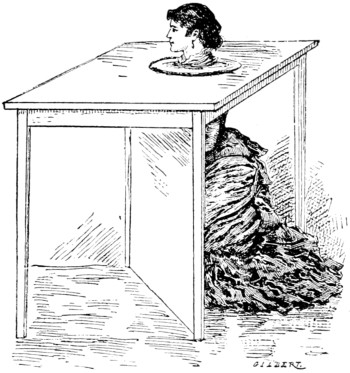
THE TALKING HEAD.
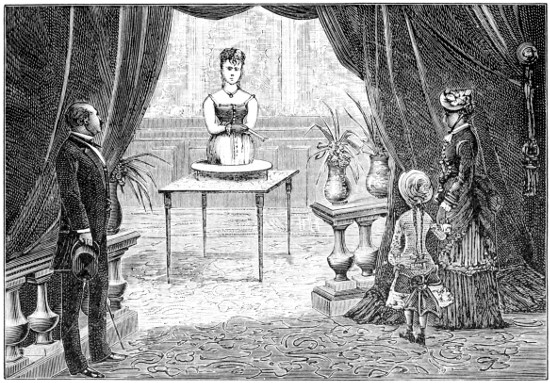
THE LIVING HALF OF A WOMAN.
This illusion is a very ingenious improvement on the “Talking Head.”
On entering the small booth in which it is usually exhibited, we perceive
an elegant little room decorated with flowers and lights and hung with
tapestry. In front there are two railings and the floor is covered with a
carpet. In the center is seen a small table on which rests a kind of three-legged
stool supporting a cushion and the half body. The lady shows she has
arrived by moving her arms and head and speaking and singing. The visitor
can see the four legs of the table and can perfectly distinguish the space under
the stool, the whole scene being brilliantly lighted, contrary to the usual
custom in any such illusions.
The secret of the illusion is as
follows:
The stool is formed only
of a hollowed out disk whose
supports are connected by two
mirrors that make with each
other an angle of forty-five
degrees. These mirrors rest on
the top of the table which was
decorated in regular designs
in mosaic and reflect the latter
in such a way that they seem
to continue uninterruptedly
under the stool. The table
presents an analogous arrangement,
its side legs being connected
with the middle one by
two mirrors. These mirrors
reflect not only the designs of the carpet which by their continuity produce
the illusion of a vacancy, but also two table legs located on each side behind
the railing, as shown in our small engraving: the mirror to the left transmits
to the spectators on that side the image of the leg placed on the left and this
image seems to them to be the fourth leg of the table. The mirror to the
right plays the same rôle with regard to the spectators on that side. These
mirrors in addition hide the lower part of the girl’s body.
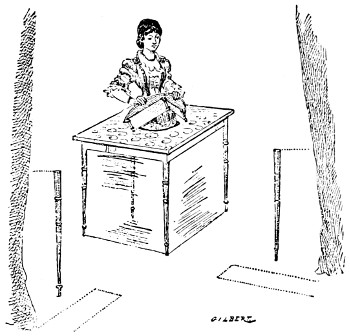
EXPLANATORY OF THE HALF-WOMAN.
During the season of 1891-92, among various interesting things to be seen
at the Eden Musée, perhaps the most interesting, and at the same time the most
scientific, was the weird spectacle entitled “She,” exhibited by Powell, the
well-known illusionist, and suggested by the Cave scene in H. Rider Haggard’s
celebrated novel “She.”
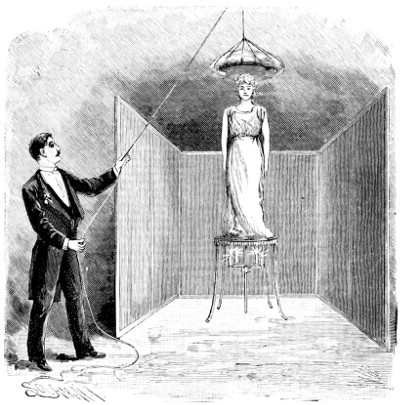
PREPARED FOR CREMATION.
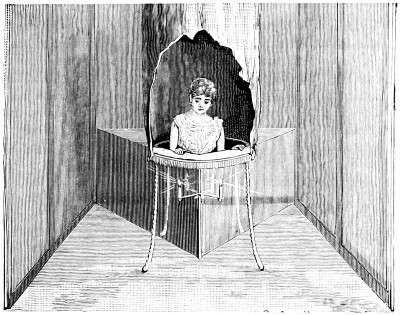
THE ESCAPE.
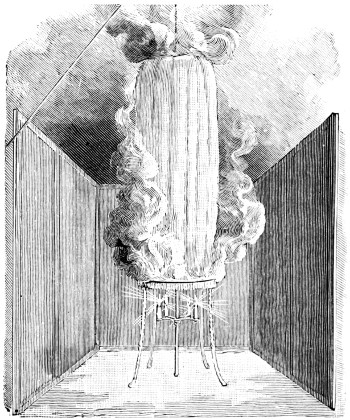
THE BURNING.
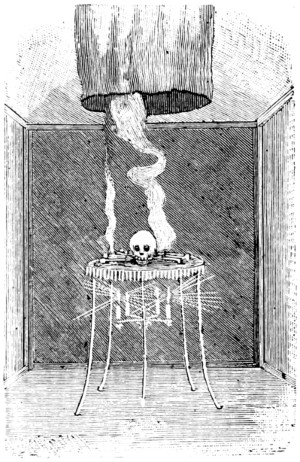
In this scene a beautiful young lady mounts a table arranged in an alcove
formed by a folding screen. Above the victim is suspended a cylindrical cloth
screen. The screen is lowered to the level of the table, completely inclosing
the subject. The table apparently has four legs, and four candles shown
beneath it indicate that the space underneath the table is open and clear. The
cylindrical screen is shown to be entire, with openings only at the upper
and lower ends, and no openings are seen in the folding screen which partly
surrounds the table. Upon the firing of a pistol the occupant of the table is
ignited, and smoke and flame bursting from the screen indicate that the
work of destruction is going on within. When the fire is burned out the screen
is lifted, and nothing remains upon the table but a few smouldering embers
and a pile of bones surmounted by a skull. Close observation does not reveal
any way of escape for the young woman. It is, however, obvious that the
magician cannot afford to sacrifice such a subject every evening, and the spectators
are forced to conclude that the whole affair is a very clever trick. In
fact, it is simply a modification of the beheaded lady and numerous other
tricks based upon the use of plane mirrors. The table has but two legs, the
other two which appear being simply
reflections. The central standard supports
but two candles, the other two
being reflections. Underneath the table,
and converging at the central standard,
are arranged two plane mirrors at an
angle of 90° with each other and 45°
with the side panels of the screen. By
means of this arrangement the side
panels, which are of the same color as the
central or back panel, are reflected in
the mirror and appear as a continuation
of the back panel. The triangular box,
of which the mirrors form two sides, has
a top composed in part of the table top
and in part of mirror sections for reflecting
the back panel, or with a covering
of the same color as the back panel.
THE FINISH.
The operation of the apparatus is
now obvious. When the victim is inclosed
by the cylindrical screen, she
immediately escapes through a trap door in the table top, places the bones and
the fireworks upon the table, and at the firing of the pistol ignites the latter
and retires, closing the trap door after her.
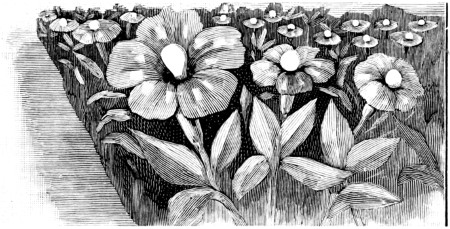
MR. KELLAR’S ILLUSION, “QUEEN OF THE FLOWERS.”
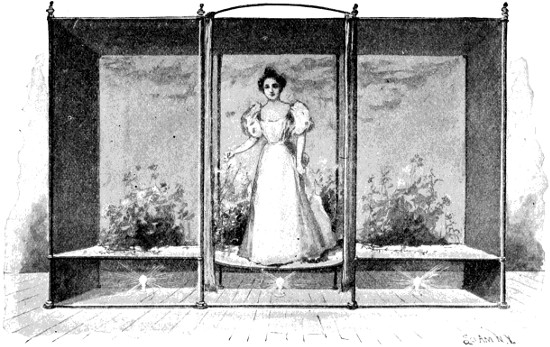
One of Mr. Kellar’s recent illusions is what he is pleased to call “The
Queen of Flowers.” Our first engraving represents the stage as the audience
sees it, and the last cut will help to explain it to the reader. The background,
set against curtains, is about ten feet long and eight feet high, and
represents a mass of flowers and bushes indiscriminately thrown together, with
blue sky above. There is a little flat roof which projects out about three feet
from the bottom of the screen and is supported by four red poles. The
bottom is a floor raised about a foot from the stage, and in front of each of the
three divisions made by the poles between the stage proper and the floor of this
improvised summer house is placed an electric light. The audience usually
wonders what these lights are for in this strange place; but as audiences always
accept anything shown them by the prestidigitateur, these lights do not disturb
them very much except by dazzling them, as they are meant to do. So much
for the setting. There being no doors or screens or curtains of any kind, the
spectators have the satisfied feeling that there is no deception there, for they
can see all there is to see. They can, that is true, only they don’t realize how
much they are seeing.
ENTRANCE TO THE CABINET.
Mr. Kellar next brings a semicircular stand which he places in front of the
middle panel at the height of the floor. At the roof is fixed a brass rod in the
form of a semicircle, from which hangs a curtain inclosing the little stand.
This, however, cannot do much good, for, as Mr. Kellar says, those on the
extreme right and left of the audience can still see quite behind the curtain,
through the summer house, and they believe him, not only because he told
them so, but because they can see with their own eyes. What could be more
convincing! In a moment the curtain is withdrawn and a beautiful lady
surrounded by flowers is seen standing on the little platform.
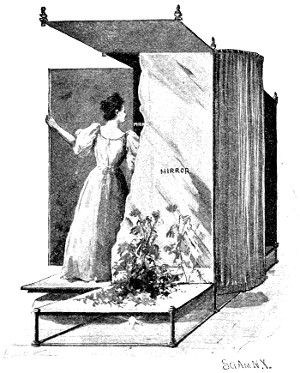
The last engraving will explain matters. The lines extending from the
two center poles to the background represent double mirrors; that is, each
mirror consists of two mirrors back to back, running from the floor to the
roof of the summer house. On account of the indefinite arrangement of the
flowers painted on the back scene in monotonous design, the spectators do
not notice the mirrors. These, of course, form a passageway through which
anyone can walk from behind the scenes to the stand behind the curtain,
while the audience is still keeping guard with its ever watchful eye.
ILLUSION OF THE DECAPITATED PRINCESS.
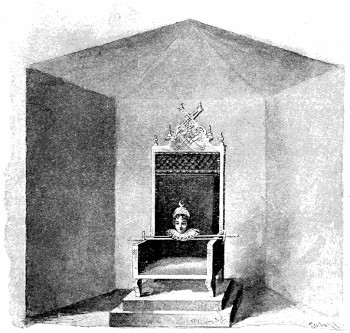
In this illusion the exhibitor states that it is the head of an Egyptian
Princess who was accused of treason and beheaded. The head is exhibited in
a curtained recess and it reposes upon two swords lying across the arms of the
chair. The chair is upholstered in red plush and is placed close to the curtain
at the back of the recess. At the back of the chair is an opening just below
the level of the tops of the chair arms. This opening is not seen from the
front, as it is concealed by a mirror that is placed between the arms of the
chair at an angle of 45°. The ends of the mirror rest in folds of the fan-shape
upholstering on the inside of the chair arms. The lower edge of the mirror
is resting on the bottom of the chair and the upper edge is concealed by laying
one of the swords on it, as may be seen in the other illustration. At the
proper angle the bottom of the chair is reflected in the mirror, leaving the
impression that one is looking at the back. The folds in the upholstering of
the inside of the arms effectually conceal the ends of the mirror. There is a
hole in the rear curtain directly opposite the hole in the chair back, through
which there passes a board supported at one end by resting on the seat of the
chair and at the other end by a small box or any convenient article.
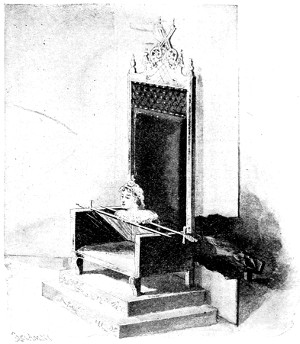
THE DECAPITATED PRINCESS—EXPLANATION OF ILLUSION.
The lady who is to impersonate the princess takes her position on this board
with her chin just above the edge of the mirror, the second sword is placed at
the back of her head and a wide lace collar that she wears around her neck is
adjusted so as to rest nicely on the two swords. The second illustration shows
the board in position, passed through the curtain, with the lady lying on it,
her head on the swords and the lace collar in position. The curtain in the rear
must be close to the chair, but the side curtains are removed about five feet.
The board is padded so as to make the lady as comfortable as possible.
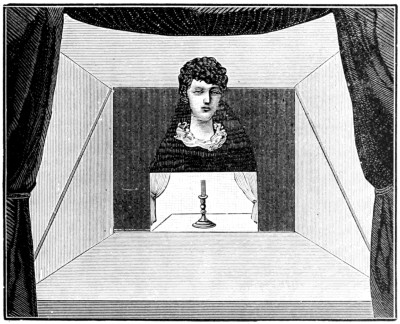
AN ISOLATED HEAD IN THE CENTER OF A STAGE.
The following illusion is similar to the “Decapitated Princess.” A small
stage is partitioned off by curtains. In the center of the stage, suspended in
space, is a young girl’s head, the neck of which starts from a satin collar.
This head is isolated on every side. One sees the rear of the stage, the sides,
the top and the bottom, and the brilliant illumination leaves no portion in
shadow. The head speaks and smiles and finally blows out a lighted candle.
The exhibitor then disappears behind the side scenes with the candle.
He now, as it seems, draws out a panel in the back of the stage, and through
the aperture thus formed the spectator very distinctly sees the top of a table
and upon it a candle which the head has just extinguished. Now this aperture
is directly under the head, but much farther off, and is in the direction the
body would occupy if the head possessed one. The absence of the body is
therefore apparently demonstrated to the visitors.
The illusion was obtained by means of a simple mirror which starting from
the upper part of the back of the stage descended obliquely to the front. In
the center of this there was an opening which was concealed by the satin collar
and through this the young girl passed her head. The inclination of the
mirror was, in fact, indicated by a gold rod designed to hide the junction of the
mirror and the side. The arrangement will be better understood by reference
to the annexed diagram, which belongs to the same illusion, only the clown is
substituted for the girl’s head.
Now, by virtue of the optical law that “an object reflected from a mirror
appears to be behind the latter at a distance equal to that which separates it
from it,” every point of the
line, M l, reflected from the
mirror, P M, will appear to
be situated upon the line,
M L.
So, to the spectator located
at O, the point, c,
reflected at C′ will appear to
be the point, C; the distance,
c C′ equaling C C′. The
point, l, reflected at L′, will
appear to be L. And it will
be the same for all the intermediate points. The spectator, then, will believe
that he sees the line, M L, when in reality he sees only the reflection of M l.
Now, as we have just said, he will believe that he sees the back of the stage,
when, in fact, he sees nothing but a reflection of the ceiling in the mirror. In
the same way, the reflection from the front of the ceiling will produce the
illusion of the stage floor. This fact still further contributes to increase the
illusion, for the spectators are not aware of the difference that exists between
the arrangement of the place where the bust appears and of that of the place
where the showman is walking.
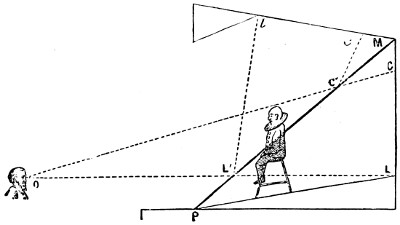
DIAGRAM EXPLANATORY OF THE PHENOMENON.
In the illusion of “Stella” the aperture through which the table was seen
was in reality at the top. The table was vertical and the candle which was
firmly fixed to it was horizontal. The farce of blowing out the candle and
carrying it behind the scenes was only designed to make the spectators believe
it was the same candle that was seen at the rear of the stage, when in reality
it was only a duplicate.
These apparatus were formerly much employed by magicians—Robert-Houdin,
for instance. The following is an example of one of the scenes that
may occur with them:
When the curtain rises, there is seen in the center of the stage a large, dark-colored
cabinet, ornamented with mouldings, and mounted upon legs that are
a little longer than those of ordinary cabinets, the object being to remove all
possibility of a communication with the stage beneath. These legs are provided
with casters. The showman turns this cabinet around and shows that
there is nothing abnormal about it externally. He then asks some of the spectators
to come up close to it, and lets them examine its interior, which is
entirely empty. There is no double bottom, nor any hiding-place. When the
witnesses have made themselves certain of this fact, they station themselves
around the stage, and a certain number of them even consent to remain behind
the cabinet and see nothing of the experiment. The cabinet being thus
surrounded on all sides, and every one being able to look under it, fraud would
seem to be an impossibility.
A young woman dressed as a danseuse then comes on the stage and enters
the cabinet, and the doors are closed upon her. In a few moments the doors
are opened again, when, lo and behold! the closet is empty, the young woman
having disappeared. Then the doors are closed again, and then opened, and
the danseuse makes her appearance; and so on. At the end of the experiment
the witnesses examine the cabinet again, and finding nothing changed therein,
are justly stupefied.
In another style of cabinet there is no bar in the center, as shown in our
engraving, but there is observed on one of the sides in the interior a bracket
a few centimeters in length, and, back and above this, a shelf. This arrangement
permits of performing a few experiments more than does the one just
described. Thus, when the woman has disappeared, the showman allows a
young man to enter, and he also disappears, while the young woman is found
in his place. This is a very surprising substitution.
The box into which the harlequin takes refuge, and which appears to be
empty when Pierrot or Cassandra lifts the curtain that shields its entrance, is
also a sort of magic cabinet.
In a series of lectures delivered a few years ago at the London Polytechnic
Institution, a professor of physics unmasked the secret of some of the tricks
employed on the stage for producing illusions, and notably that of the magic
cabinet. The lecturer, after showing the cabinet, and causing the disappearance
therein of an individual while the doors were closed, repeated the same
experiment with the latter open. But, in the latter case, so quick was the
disappearance that the spectators could not even then see how it was done.
The illusion produced by the apparatus is the result of a play of mirrors.
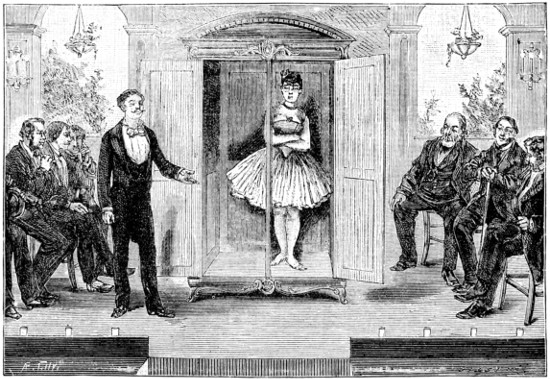
MAGIC CABINET.
In the first cabinet described,
when the exhibitor
has closed the doors upon the
young woman, the latter pulls
toward her two mirrors that
are represented in our plan
of the cabinet by the lines,
G G. These mirrors are
hinged at O O, and, when
swung outward, rest by their
external edges against the
bar, P, and then occupy the
position shown by the dotted
lines, G′ G′. When the cabinet
is again opened, the woman placed at A is hidden by the two mirrors; but
the appearance of the interior of the cabinet is not changed, since the spectators
see the image of each side reflected from the corresponding mirror, and
this looks to them like the back of the cabinet.
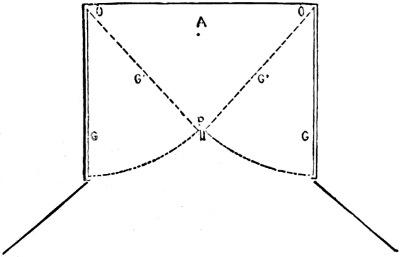
PLAN EXPLANATORY OF THE CABINET.
The illusion is perfect. When the experiment is ended and the mirrors are
again swung against the sides, at G G, the spectators see
nothing but the backs of them, which are covered with
wood; the cabinet is really empty, and no one can discover
what modification has taken place in its interior during the
disappearance of the woman.
In the second arrangement, which is shown in vertical
section in our last engraving, the young man gets up on
the shelf, c n, at the upper part of the cabinet, by the aid
of the bracket, T, and then pulls down over him the mirror,
b c, which was fastened to the top of the cabinet. This
mirror, being inclined at an angle of 45°, reflects the top,
and the spectators imagine that they see the back of the
cabinet over the shelf, as they did before.
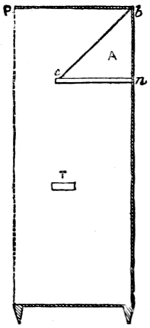
SECTION EXPLANATORY
OF THE
CABINET.
The box which Harlequin enters is based upon precisely
the same principle. Its interior is hung with paper banded
alternately blue and white. When Harlequin enters it, he
places himself in one of the angles and pulls toward him
two mirrors which hide him completely, and which reflect the opposite side
of the box, so that the spectator is led to believe that he sees the back of it.
In this case, one of the angles at the back of the box is not apparent, but the
colored stripes prevent the spectator from noticing the fact.
We present an engraving of a very interesting optical illusion produced
with only three mirrors. By multiplying the mirrors the large number of
different effects can be obtained.
Let us imagine that three perfectly plain and very clear mirror glasses, as
large as possible, form a prism whose base is an equilateral triangle. A person
placed in the interior of this prism will see his image reflected a very large
number of times. A very simple geometrical construction, and one which we
recommend our young readers to carry out as an exercise in optics, by the
simple application of the principle that the angle of incidence is equal to the
angle of reflection, allows us to see that the image of any point whatever placed
in the center of this triangle of glass plates will be reproduced indefinitely by
groups of six images distributed symmetrically around points regularly spaced
in the prolongations of the planes of the three glasses.
A person, therefore, sees his image reproduced indefinitely in groups of
six until, the successive reflections attenuating the intensity of the images, the
latter cease to be visible. Three or four persons massed in one of the angles
present the illusion of a compact and mixed crowd standing upon a sidewalk
and awaiting the passage of a procession. The hats waving in the air convert
the peaceful waiting into an enthusiastic manifestation, which is so much the
more surprising in that it is made by but half a dozen persons at the maximum.
The accompanying figure gives an idea of this remarkable effect, and the
three persons, whose images reflected ad infinitum produce the curious result
that we call attention to, would have much trouble to believe that they were
the subject of an illusion.
Upon the whole, the experiment is nothing more than an application of
the principle of the old kaleidoscope enlarged and revived, in the sense that
the observer has before his eyes the successive reflections of his own image, and
that the objects are replaced with living beings movable at will.
Five or six persons may occupy, at the same time, the triangular prism, of
which the sides are about six feet wide, and which they enter through a trap
in the floor. When these five or six persons are walking about in all directions,
they present the aspect of a tumultuous and agitated crowd commenting upon
grave events.
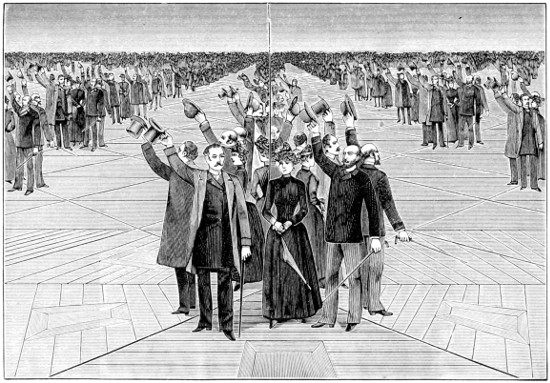
AN OPTICAL ILLUSION PRODUCED WITH THREE MIRRORS.
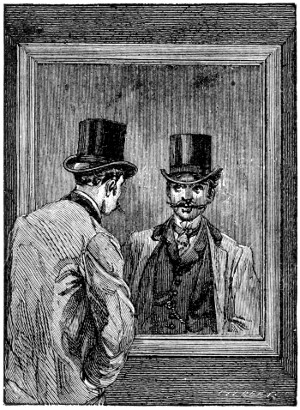
FIG. 1.
Platinized glass plates are no longer a novelty, but the illusion is very
effective. The mirrors give an image in the ordinary way when looked at by
reflected light, but are transparent when observed by transmitted light. The
metalization of glass with platinum was discovered a great many years ago by
the Messrs. Dodé. This property of transparency by transmitted light affords
a very clever surprise. The mirrors are set in frames. In a panel behind the
latter there is an aperture closed by a shutter. As the glass is transparent
there may be seen through it, when the shutter is open, everything that is on
the other side, so it occurred to the inventors to utilize this transparency by
placing an image or photograph between the panel and the glass. On exposing
the mirror to the light to look at one’s self in the ordinary way, if the shutter
is open, the human head will disappear and may be replaced by the photographic
portrait or a horned devil, which is placed behind the mirror. In the
illustration we illustrate the head of the devil whose body is hidden by two mirrors
inclined at an angle of forty-five degrees, as in some of the illusions we
have already described. As he moves his head and smiles, the effect is rather
startling. Electric light is used to illuminate the trick.
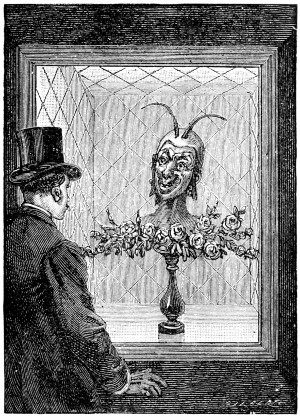
FIG. 2.
At the Italian exhibition held a few years ago in the Champ de Mars, Paris,
there was a statue that attracted much attention from the visitors. It represented
Goethe’s Marguerite standing before a mirror. This latter gave by
reflection the image of Faust, as shown in our engraving. The artifice was
well concealed by the sculptor. In reality, it was not a double statue, but the
figure of Faust was skillfully obtained by means of the folds of Marguerite’s
robe.
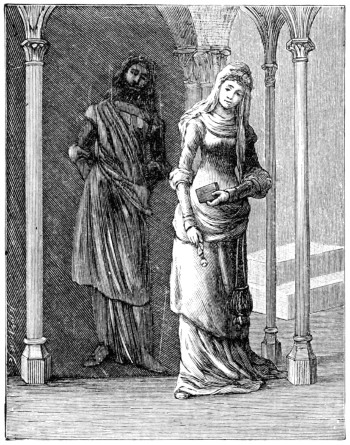
MARGUERITE AND FAUST.
Marguerite holds her arms in front of her, and these same arms form
those of Faust, who holds them crossed behind his back. Faust’s face is
carved in Marguerite’s back hair, and the man’s figure is obtained, as before
stated, by means of the folds of the woman’s robe.
The tricks in this chapter are no less interesting than those which have
gone before, but are rather of a more miscellaneous nature. The first trick
which we shall describe, is called “The Illusion of Trilby.”
The late Professor Herrmann won for himself a firm place in the regards
of the civilized world, representing the fin de siècle Houdin. His carefully
executed work, with its perfect detail and finish, was a standard among performances
of natural magic, and other exhibitions are referred to it as the gage
of their quality. In Herrmann’s illusion of “Trilby,” hypnotism is supposed to
play a part. As will be seen, it is really an ingenious application of mechanics.
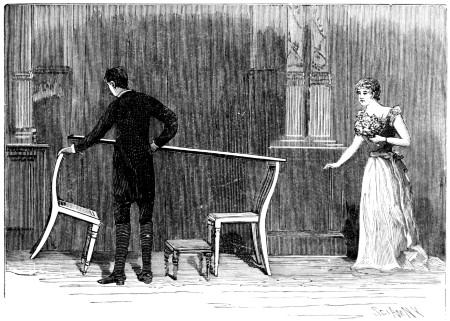
PREPARING TRILBY’S COUCH.
A plank is placed upon the backs of two chairs. A lady performer who is
supposed to represent Du Maurier’s “Trilby” enters and, stepping on a foot-stool,
lies down upon the plank. She holds a bouquet in her hand, which bouquet,
unknown to the audience, has its own part to play. The other performer,
Herrmann, who is supposed to be Svengali, carefully arranges the
drapery, walking around her as he does so. Then he makes some passes, and
one by one removes the chairs, and the lady and board remain in the air. In
response to his passes the lady, still resting on the board, rises, and the position
changes to an inclined one and back to the horizontal one. Finally the chairs
are replaced, the lady by passes is supposed to be waked from her trance and
steps down, chairs and plank are removed, and nothing is to be seen further.
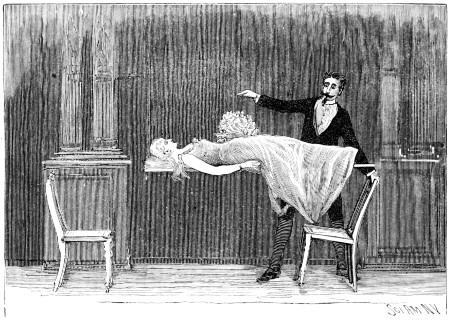
THE AËRIAL SUSPENSION OF TRILBY.
Two of the cuts show the progress of the performance as seen by the audience.
The third cut explains the mechanism. Behind the scenes is a strong
frame, up and down which a movable slide works. Tackle is provided to raise
and lower the slide; and a workman behind the scenes is intrusted with its
manipulation. A bar carrying at its rear end handles, and in front a socket,
shown in the upper right-hand corner of the same cut, is journaled in the
slide, and can also be thrust in and out through the journal box.
When Trilby has been placed upon her board couch, the bar is thrust forward,
drapery at the back having hitherto concealed its socket end. The fair
Trilby with her bouquet now effectually conceals it as it emerges from behind
the curtains. The performer, while apparently sedulously arranging the
drapery, guides the socket and causes it to grip the board. The assistant
behind the scene pulls upon the tackle and works the handle, so that Trilby’s
weight leaves the chairs one by one, which are removed, and, supported by
the bar, she seems to float in air. By manipulating the tackle she can be
raised and lowered. By
the handles she can be
tilted about, giving a
wonderfully good effect.
Finally the chairs are
replaced, and the assistant
lowers Trilby upon
them. During the waking
passes the socket is
detached and the bar is
withdrawn. A close observer
may notice a
slight agitation of the
drapery or curtains behind
the stage as the bar
is pushed out and withdrawn,
but the attention
of the audience in general
is so taken up with
the performance proper
that this disturbance is
overlooked by them.
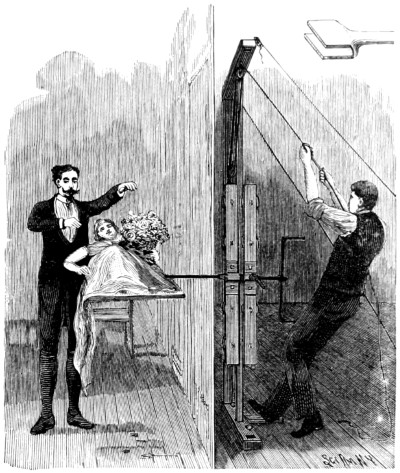
THE ILLUSION EXPLAINED.
The magician, it will
be seen, can only walk
completely around the
reclining lady before the bar is in place or after it is withdrawn. When the bar
is in place, he can walk behind her, but cannot go completely around her.
Hence his complete excursions are restricted to the time when she is resting on
the chairs, before the bar is in place or after it has been withdrawn.
After the board is vacated, Svengali throws it down upon the stage, its fall,
with accompanying noise and disturbance, showing that there is no deception
about that portion of the display.
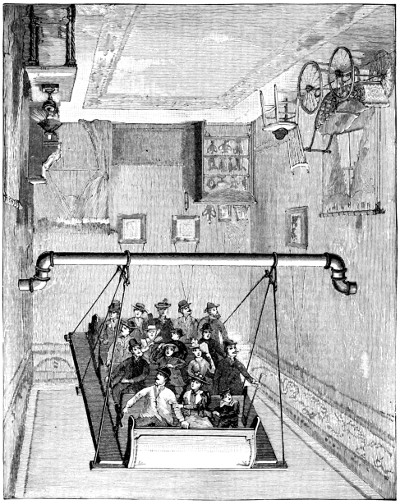
TRUE POSITION OF THE SWING.
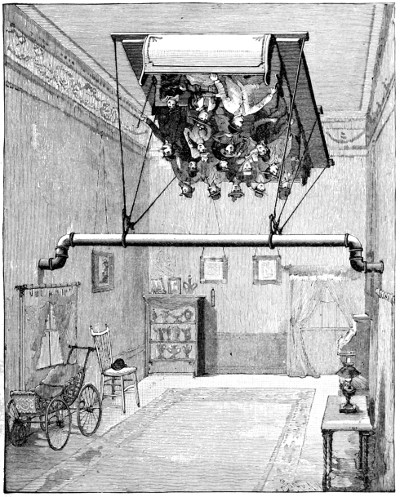
ILLUSION PRODUCED BY A RIDE IN THE SWING.
The supreme happiness of sitting in a swing which apparently whirls
around its points of support, giving the occupant what is most properly
described as a new sensation, may now be enjoyed by all. It is termed the
“haunted swing,” and has been in most successful operation at Atlantic
City and at the Midwinter Fair near San Francisco. Those who are to participate
in the apparent gyrations of the swing—and there may be quite a
number who enjoy it simultaneously—are ushered into a small room. From
a bar crossing the room, near the ceiling, hangs a large swing, which is provided
with seats for a number of people. After the people have taken their
places, the attendant pushes the car and it starts into oscillation like any other
swing. The room door is closed. Gradually those in it feel after three or
four movements that their swing is going rather high, but this it is not all. The
apparent amplitude of the oscillations increases more and more, until presently
the whole swing seems to whirl completely over, describing a full circle about
the bar on which it hangs. To make the thing more utterly mysterious, the
bar is bent crank fashion, so that it seems demonstrably impossible for the
swing to pass between bar and ceiling. It continues apparently to go round
and round this way, imparting a most weird sensation to the occupants, until
its movements begin gradually to cease and the complete rotation is succeeded
by the usual back and forth swinging, and in a few seconds, as the children
say, “the old cat dies.” The door of the room is opened and the swinging
party leave. Those who have tried it say the sensation is most peculiar and
the deception perfect.
The illusion is based on the movements of the room proper. During the
entire exhibition the swing is practically stationary, while the room rotates
about the suspending bar. At the beginning of operations the swing may be
given a slight push; the operators outside the room then begin to swing the
room itself, which is really a large box journaled on the swing bar, starting
it off to correspond with the movements of the swing. They swing it back and
forth, increasing the arc through which it moves until it goes so far as to make
a complete rotation. The operatives do this without special machinery, taking
hold of the sides and corners of the box or “room.” At this time the people
in the swing imagine that the room is stationary while they are whirling
through space. After keeping this up for some time, the movement is brought
gradually to a stop, a sufficient number of back and forth swings being given
at the finale to carry out the illusion to the end.
The room is as completely furnished as possible, everything being, of course,
fastened in place. What is apparently a kerosene lamp stands on a table, near
at hand. It is securely fastened to the table, which in its turn is fastened to
the floor, and the light is supplied by a small incandescent lamp within the
chimney, but concealed by the shade. The visitor never imagines that it is
an electric lamp, and naturally thinks that it would be impossible for a
kerosene lamp to be inverted without disaster, so that this adds to the deception
materially. The same is to be said of the pictures hanging on the wall,
of the cupboard full of chinaware, of the chair with a hat on it, and of the
baby carriage. All contribute to the mystification. Even though one is informed
of the secret before entering the swing, the deception is said to be so
complete that passengers involuntarily seize the arms of the seats to avoid
being precipitated below.
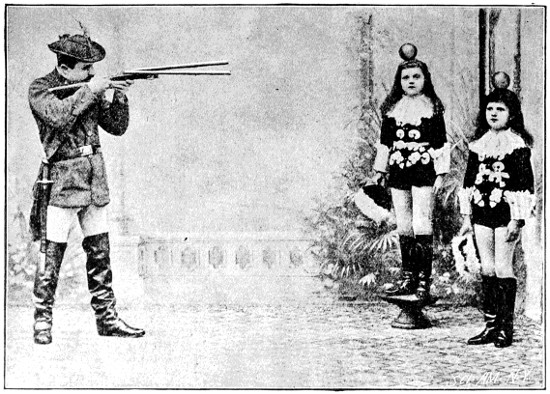
THE SCURIMOBILE.
The peculiar gun shown in the cut is named after its inventor, Alessandro
Scuri, of Liège, Belgium. M. Scuri is also known as the inventor of a unicycle
and a quadruple cornet. The “scurimobile” is a gun with two barrels
which can be aimed at different objects, the angle between the barrels being
adjustable. The adjustment is effected by moving a ring located on the under
side of the gun. The pivot of the barrels is so arranged that it is easy to sight
two objects at the same time. Both cartridges are automatically ejected after
each shot fired. It is also possible to use only one barrel in the ordinary way.
In the cut the inventor is shown aiming at two balls placed about a yard apart.
Another valuable feature of this new gun is its applicability as a range finder.
The observer first sights two objects which are at about equal distances from
him, and measures the distance or angle between the two barrels, a graduation
being provided for this purpose. Then the same operation is made from a
point more distant from the objects first sighted. If the observer steps back
ten yards, and finds that the graduation indicates just one-half of the value
obtained at first, he will know that in the second position he was just twice
as far from the objects as in the first position, so that the objects are ten yards
from the observer’s first position. This operation will give distances with
sufficient accuracy in most cases, but more exact results can be obtained by
means of a simple trigonometric formula when the angle between the barrels
is measured.
The X rays, after becoming the indispensable coadjutors of surgeons, and
even of physicians, are now competing with the most noted mediums in the
domain of the marvelous.
M. Radiguet, the well known manufacturer of physical apparatus, has been
devoting himself for a long time to experiments with the Roentgen rays in the
laboratory, which is encumbered with electric lamps, lamp globes, and glass
apparatus of all kinds. One day he perceived that these glass objects, under
the action of the X rays, shone in the darkness. Here again was an amusing
and perhaps a useful experiment due to accident. Useful, because the radiographs
obtained up to the present, by means of artificial screens, have been
really good only when the sensitive bodies have been in small crystals. In a
pulverulent state they are nearly insensible to the X rays, and it is almost
impossible to obtain the grain of the screen upon the photographic plate. It
is easy, on the contrary, to work the glass in such a way as to prevent any
irregularity in the radiograph. Such experiments will certainly be made ere
long, but, for the present, it is the fantastic side of the discovery that we shall
present to our readers.
Porcelain, enamels, and diamonds, and also objects covered with platino-cyanides
(used by Roentgen) and with calcium tungstate, zinc sulphate, etc.,
have, like glass, the property of becoming luminous in darkness under the
action of the X rays. We have, therefore, only the trouble of selection in
order to get up a “spirit séance” with every certainty of success, while genuine
spiritual séances fail in most cases, as well known, because the spirits are in an
ill mood and disposed to be coyish.
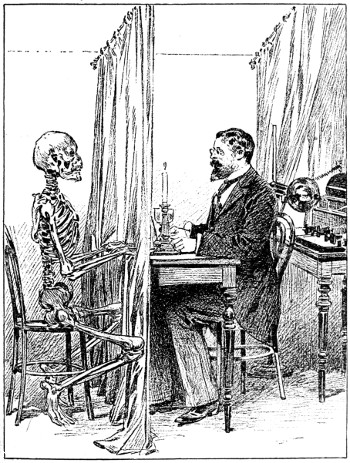
ARRANGEMENT FOR A STRIKING EXPERIMENT WITH THE X RAYS.
The following will prove a scene sufficiently weird to put the most intrepid
worldlings in a flurry if some one of our friends takes it into his head to give
them the mysterious spectacle thereof before they have read an exposure of
the trick.
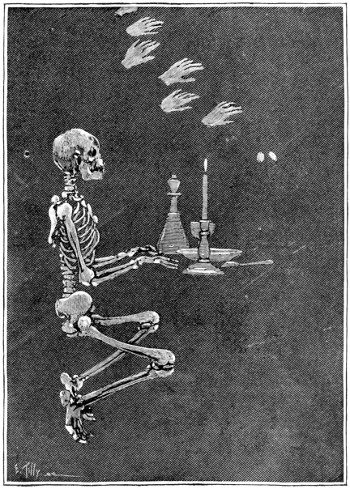
THE APPARITION.
The first figure that we present herewith exhibits a Ruhmkorff coil, which
is placed here to show the operation in its entirety. But, as the first effect of
its vibrations would be to attract the attention, and consequently the suspicions
of the spectators, whom it is a question of transporting into the domain
of the marvelous, this apparatus is relegated to some distant room. The current
that produces the X rays is led into the Crookes tube by wires. This
apparatus, moreover, which is not very bulky, may be placed behind a door or
be concealed under black cloth. The objects designed to become luminous
are placed as near to the tube as possible. In the experiment under consideration
a diner (who is doubtless near-sighted, since he wears eyeglasses) is about
to do justice to his breakfast. Armed with a knife and fork, he attacks his
beefsteak; but he is assuredly a greater eater than drinker, since he contents
himself with water, while his light consists of a single candle.
A black curtain on the other side of the table conceals from the spectators
a skeleton covered with zinc sulphide.
Let us now put out the light and set the Ruhmkorff coil in action. What
a surprise! A plate, a glass, a water bottle, and a candle shine in space with
the light of glow-worms.
A sinister guest in the form of a skeleton sits opposite the place occupied
by the near-sighted gentleman, who has disappeared, and whose eyeglasses
alone have held their own before this ghastly apparition. Finally, to complete
the illusion, hands are seen moving over the heads of the spectators, and those
multiply, and then disappear, only to appear anew.
It must be remarked that, in order to render the experiment more conclusive,
it is allowable for the most incredulous members of the party to tie the
gentleman tightly to his chair, and, if they desire, to hold his hands and feet
during the entire time of the experiment. It is scarcely necessary to explain
how the latter is performed. The X rays pass through the black cloth on the
door that conceals the Crookes tube and also through the body of the gentleman,
and render luminous the glass objects covered with zinc sulphide. As
for the mysterious hands, those are simply gloves covered with the same substance
and fixed to the extremity of long sticks that are moved in all directions
by confederates.
Such scenes may naturally be varied to infinity; and the spirit of invention
is so fertile, there is no doubt that before long ladies will be giving a place
in the programme of their soirées to this up-to-date spiritualism.
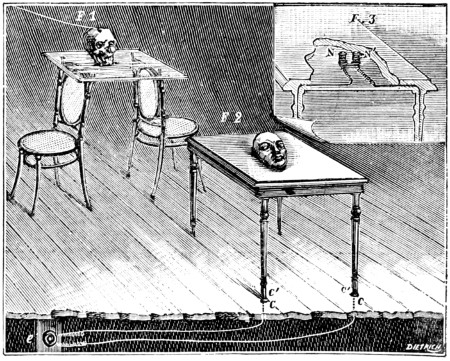
THEATRICAL SCIENCE.
Fig. 1.—The Enchanted Death’s Head. Fig. 2.—The Mask of Balsamo
This illusion is a variation of the enchanted “death’s head” which was
for a long time the attraction of the Robert-Houdin Theater. Our engraving
shows both the “death’s head,” the “mask of Balsamo,” and the method
of producing the illusion. Under the influence of the passes of the prestidigitateur
the skull on the glass plate bends forward and seems to salute the
spectators. The nodding of the “death’s head” was utilized in a number of
ways, as, to indicate the number when dice was thrown. This trick was performed
as follows: Upon a table near the magician was placed a ball of soft
wax attached to a string which ran to the side scenes, where it could be pulled
by a confederate. After passing the skull around to be examined, the prestidigitateur,
in laying it upon the table, fixed the ball of wax at the top of it. After
the experiment a simple scraping with the finger nail removed every trace of
the trick. The Isola Brothers used electricity in a somewhat similar illusion.
The skull is replaced by a wooden mask laid flat on a small table and the mask
answers questions by rocking slightly. The magician then brings the table
into the midst of the spectators, and the mask still continues to move, to the
astonishment of the onlookers. The secret of the trick is that part of the
wood which forms the chin is replaced by a small strip of iron which is painted
the same color as the mask so that it cannot be seen; an electro-magnet is let
into the top of the table so that the cores shall be opposite the strip of iron
when the mask is laid upon the table. Contact is made by means of a push
button somewhere in the side scenes, the wires run under the stage, and connection
is made through the legs of the table when the legs are set on the foreordained
place. Upon the same principle is Robert-Houdin’s heavy chest and
magic drum. A rapping and talking table may be made by carrying out the
same idea. The battery is carried in the lower part of the table, where the
three legs join. The top of the table is in two parts, the lower of which is
hollow and the top being very thin. In the center of the hollow part is placed
an electro-magnet, one of the wires of which connects with one of the poles
of the battery, while the other is connected with a flat metallic circle glued
to the cover of the table. Beneath this circle and at a slight distance from
it there is a toothed circle connected with the whole pole of the battery. When
the table is pressed lightly upon, the cover bends and the flat circle touches
the toothed one. This closes the circuit, and the electro-magnet attracting
the armature produces
a sharp blow. When the
hand is raised the circuit
is broken, producing another
sharp blow. By
running the hand lightly
over the table the cover is
caused to bend successively
over a certain portion of
its circumference. Thus
contact is made at a number
of places, and the sharp
blow is replaced by a quick
succession of sounds. This
table is very useful for
spirit rappings; as the
table contains all of the
mechanism in itself, it can
be moved to any part of
the room. The table may
be also operated from a
distance by employing conductors
passing through
the legs of the table and
under the carpet. By substituting
a small telephone receiver for the electro-magnet, the rapping spirits
may be made talking ones.
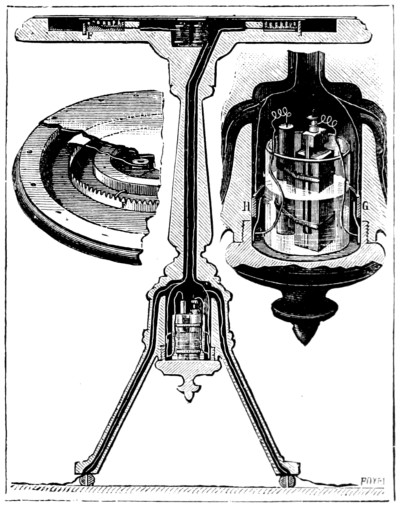
RAPPING AND TALKING TABLE.
Electric insects may be constructed on the same plan and give a very life-like
appearance when placed on an artificial bunch of flowers in a flower pot.
The battery is concealed in the top. When the pot is raised a drop of mercury
which occupies the bottom of the pot will roll over the bottom, closing the
circuit successively on different insects, keeping them in motion until the pot
has been set down.
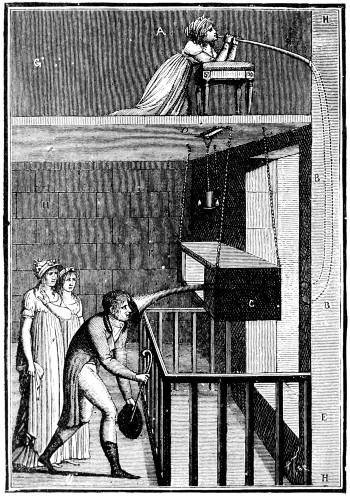
THE INVISIBLE WOMAN.
At the end of the last century and the beginning of the present, a very
curious experiment, and one which was looked upon as marvelous by the
credulous, was wonderfully popular at Paris. The representation took place
at the old Capuchin convent. The spectator entered a well lighted hall in
which, in part of a window, there was a box suspended by four brass chains
attached by bows of ribbon. The box, which was surrounded by a grating,
was provided with two panes of glass that permitted of seeing that it was
absolutely empty. To one of the extremities was fixed a speaking trumpet.
When a visitor spoke in the latter, he was answered by a hollow voice; and
when he placed his face near the box, he even felt upon it the action of a
mysterious breath. When he presented any object whatever in front of the
mouthpiece, and asked the voice to name it, an answer immediately came from
the speaking tube. The box was suspended freely from the ceiling, and it
could be made to swing at the extremity of the chains; it was empty and
isolated in space. People were lost in conjecture as to the secret of the
experiment. Among the unlikely theories that were put forth was that of the
invisibility of a person obtained by unknown processes.
As usual in these kinds of impostures, there was here merely an ingenious
application of a scientific principle. A physicist, E. J. Ingennato, revealed the
mystery in a pamphlet published in 1800 under the title of “The Invisible
Woman and Her Secret Unveiled.” This tract, now rare, had for a frontispiece
the engraving which we reproduce herewith and which explains the whole
experiment. The invisible woman of the Capuchin convent was named
Frances, and the following is the explanatory legend appended to the original
engraving:
“Questioner: ‘Frances, what is this that I have in my hand?’
“Frances (after looking through the little peep-hole, D): ‘A stick with
a crooked handle.’
“The entire assembly at once: ‘It is incomprehensible!’”
Ingennato, in his pamphlet, explains that above the ceiling there was a low,
darkish chamber, in which Frances was concealed, and that she looked at the
object presented to her through a small aperture, D, which was skillfully
hidden by a hanging lamp, and then answered through the speaking tube,
B B B, hidden in the wall. The sound traversed a space of about six inches,
that separated the speaking tube from the speaking trumpet.
The experiment which we are about to describe, while it is thoroughly
scientific, was taken up under the name of “Æolian Harps” by Robert-Houdin,
who introduced several modifications of it. When the experiment was performed
by Wheatstone in 1855, four harps were arranged in a semi-circle on
the stage of the Polytechnic Institution. These harps, at the pleasure of the
experimentor, vibrated as if they were made to resound by invisible hands.
This effect was produced by fixing to the sounding board of each of them
vertical rods of fir-wood which passed through the floor of the stage and ceilings,
into the cellar of the Institution, where one of them was fixed upon a sounding
board of a piano, another upon the sounding board of a violoncello, and two
others upon the sounding boards of violins. In order to render it possible
to interrupt the vibrations between the instruments and the harps, the rods
supporting the latter were divided at two inches above the floor. Each harp
could be cut off from communication with the instrument below by turning it
around upon its axis. When Robert-Houdin introduced the illusion, he used
a stage elevated in the very midst of the spectators. This stage was traversed
by two fir-wood rods which, after passing through the floor, rested upon harps
placed in the hands of skillful players. At the command of the prestidigitateur
two other harps supported upon the upper extremity of the rods
executed a concert which was very successful, thanks to the careful preparations
and the elegant mise en scène. Of course the harps were supposed to
operate through the intervention of mediumistic spirits.
ÆOLIAN HARP EXPERIMENT.
Having described some of the illusions which are produced with the aid of
elaborate outfits, we now come to the more simple tricks which are produced
with smaller and less expensive apparatus, and, sometimes, with no apparatus
at all. In the old days the man of mystery appeared on the stage clad in a
robe embroidered with cabalistic figures, the ample folds of which could well
conceal a whole trunkful of paraphernalia. The table in the center of the
stage was covered with a velvet cloth embroidered with silver, and its long folds,
which reached the ground, suggested endless possibilities for concealment. All
of these things have now passed away, and the modern magician appears clad
in ordinary evening dress, which is beyond the suspicion of concealment. The
furniture is all selected with special reference to the apparent impossibility of
using it as a storeroom for objects which the prestidigitateur wishes to conceal.
Some of the easiest and simplest of modern tricks that anyone with little
or no practice can perform are very effective. The tricks in this chapter are
far from being all which have been published in the Scientific American and
the Scientific American Supplement, but they are believed to be the best which
have been published in those journals.
In this trick we have an egg in an egg-cup, which the prestidigitateur covers
with a hat, and then he rolls a small silk handkerchief between his hands, as
shown in Fig. 1. As soon as the handkerchief no longer appears externally,
he opens his hands and shows the egg, which has invisibly left the place that
it occupied under the hat, while the handkerchief has passed into the egg-cup
(Fig. 3). We shall now explain how these invisible transfers are effected.
Two eggs, genuine and entire, were truly placed in plain view in a basket,
but it was not one of those that served for the experiment. Behind the
basket was placed a half shell, C, of wood (Fig. 2), painted white on the convex
side, so as to represent the half of an egg, and on the concave side offering
the same aspect as the interior of the egg-cup, A, to which it can be
perfectly fitted in one direction or the other, as may be seen in the section in
Fig. 2. It is this shell, inclosing a small handkerchief exactly like the first,
that the prestidigitateur placed upon the egg-cup (Fig. 2). Then, while with
the left hand he covered the whole with a hat with which he concealed the
operation, he with the right hand quickly turned the shell upside down. The
shell, therefore, by this means disappeared in the egg-cup, and the handkerchief,
spreading out, assumed the appearance that it presents in Fig. 3.
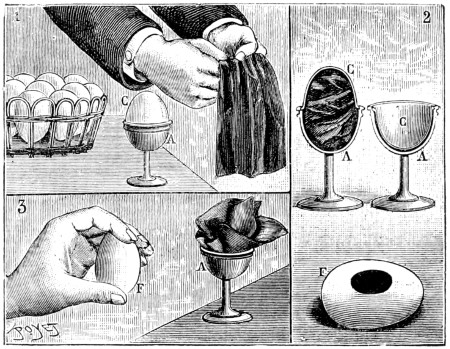
TRICK WITH AN EGG AND HANDKERCHIEF.
The prestidigitateur, having afterward secretly seized with his right hand a
hollow egg of metal, containing an oval aperture (F, Fig. 2), stuffed into it the
handkerchief that he seemed simply to roll and compress between his hands.
It is almost useless to add that the metallic egg may be easily concealed either
with the palm of the hand that holds it, or with the handkerchief.
In prestidigitation flowers have in all times played an important part,
and they are usually employed in preference to other objects, since they give
the experiments a pleasing aspect. But, in most cases, natural flowers, especially
when it is necessary to conceal their presence, are replaced by paper or
feather ones, the bulk of which is more easily reduced. Such is the case in
the experiment which we are about to present, and which, it must be confessed,
requires to be seen from some little distance in order that the spectators
may, without too great an effort of the imagination, be led into the delusion
that they are looking at genuine flowers. However, even seen close by, the trick
surprises one to the same degree as all those that consist in causing the appearance
of more or less bulky objects where nothing was perceived a few moments
previous.
The prestidigitateur takes a newspaper and forms it into a cone before one’s
eyes. It is impossible to suppose the existence here of a double bottom, and
yet the cone, gently shaken,
becomes filled with flowers
that have come from no one
knows where. The number of
them even becomes so great
that they soon more than fill
the cone and drop on and
cover the floor.
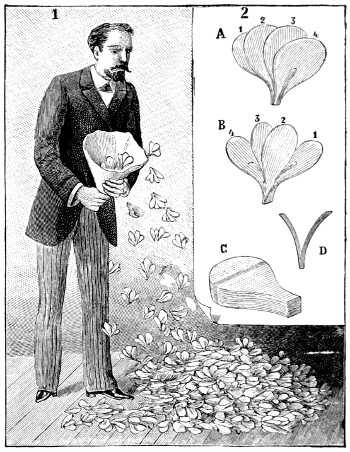
THE CONE OF FLOWERS.
The two sides of the flowers
employed are represented in
Fig. 2, where they are lettered
A and B. Each flower consists
of four petals of various
colors, cut with a punch out
of very thin tissue paper.
Upon examining Fig. A, we
see opposite us the petals 1,
2, 3, and 4 gummed together
by the extremities of their
anterior sides, while Fig. B
shows us the petals 2 and 3
united in the same manner
on the opposite side. A small,
very light and thin steel
spring, D, formed of two
strips soldered together at the bottom, and pointing in opposite directions, is
fixed to the two exterior petals, 1 and 4, of the flower, and is concealed by a
band of paper of the same color, gummed above. It is this spring that,
when it is capable of expanding freely, opens the flower and gives it its
voluminous aspect.
Quite a large number of these flowers (a hundred or more), united and
held together by means of a thread or a rubber band (Fig. 2, C) makes a package
small enough to allow the operator to conceal it in the palm of his hand,
only the back of which he allows the spectators to see while he is forming the
paper cone.
In lectures on chemistry, the professor, in speaking of aniline colors, in
order to give an idea of the coloring power of certain of these substances, performs
the following experiment:
Upon a sheet of paper he throws some aniline red, which, as well known,
comes in the form of iridescent crystals. He shakes the surplus off the paper
into the bottle, so that it would be thought that nothing remained on the
paper. If, however, alcohol, in which aniline colors are very soluble, be poured
over the paper, the latter immediately becomes red.
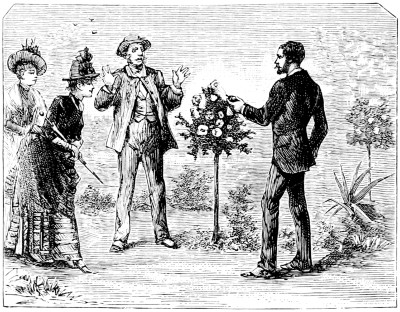
THE MAGIC ROSEBUSH.
This experiment may be varied as follows: Instead of scattering the aniline
over paper, it is dusted over the flowers of a white rosebush, and the flowers are
shaken so as to render the dust invisible, and then when a visit is received
from an amateur of horticulture, we tell him that we have a magic rosebush
in our garden, the flowers of which become red when alcohol or cologne is
poured over them. The experiment is performed with the aid of a perfumery
vaporizer, and the phenomenon causes great surprise to the spectators who are
not in the secret.
A trick that has contributed much toward making one of our leading magicians
such a favorite with the fair sex, is one in which a bush filled with genuine
rosebuds is caused to grow in a previously-examined pot that contained
nothing but a small quantity of white sand.
After the bush is produced, the flowers are cut and distributed to the ladies,
and by many recipients of the magician’s favors these buds are looked upon as
a production of fairy land. For many years this trick has occupied a prominent
position on the programme of the magician in question, and mystifies
the audience as much to-day as ever, thus proving how well magicians keep
their secrets from the public. The trick is not a difficult one by any means,
yet, regardless of its simplicity and the ease with which it may be performed,
the florist would find it anything but an economical method of raising roses,
as a perusal of the following will show.
On the stage is seen two stands with metal feet, and with long rich drapery
trimmed with gold fringe. On each of the stands is a miniature stand on
which are flower-pots.
The magician passes the pots for inspection, then places them on the stands,
and plants a few flower seeds in each pot. A large cone, open at both ends, is
shown, and can be carefully examined. One of the pots is covered for a
moment with the cone, and on its removal a green sprig is seen protruding
from the sand, the seed having sprouted, so the magician says. Now the second
pot is covered for a moment with the cone, on the removal of which a
large rosebush is seen in the pot, a mass of full-blown roses and buds. The
first pot is again covered for a moment with the cone, and when uncovered a
second rosebush is seen, equally as full of roses as the other. The cone is once
again shown to be empty.
A small basket or tray is now brought forward, on which the roses and buds
are placed as the performer cuts them from the bushes, after which they are
distributed to the ladies.
The stands are not what they appear, as the drapery does not extend
entirely around them, but quite a space at the back of the stand is open.
There is a small shelf attached to the stand leg, near the bottom of the drapery.
Three cones are used, of which the audience see but one.
The rosebushes are merely stumps to which are attached a base of sheet
lead, cut of such a size as to fit nicely in the flower-pots, resting on the sand.
To the stumps the genuine roses are attached by tying with thread. When the
bushes are prepared they are suspended inside of cones, by means of a stout
cord that is fastened to the stump by one end and to the other end of which
is attached a small hook, which hook is slipped over the edge of the upper
opening of the cone. When the bushes are placed in the cones, these cones
are placed on the shelves at the back of the stands. Reference to the second
engraving will make the arrangement of the shelf, back of stand, and position
of concealed cone plain to all. There is a variance in the size of the
cones. The cone shown to the audience is slightly larger than the cone that
is behind the first stand, and the cone
behind the second stand is a fraction
smaller than either of the others. Thus
the cones will fit snugly one in the other,
in the order named.
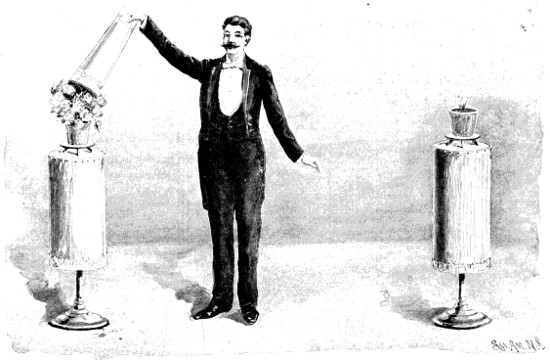
MAGIC FLOWERS.
After the performer has shown the
pots, planted the seed, and placed the
pots on the small stands, which are used
to convince the spectators that there is
no connection between the pot and the
large stand, he shows the large cone,
which is nicely decorated, and covers
the top of the pot on the first stand, as
he says, to shut out the light, that the
seed may germinate. Between the fingers
of the hand holding the cone, he
has concealed a small metal shape,
painted green, which he drops through
the cone into the pot. In a moment
he removes the cone from over the pot,
and in a most natural manner passes it
down behind the stand and over the concealed
cone containing the rosebush, and
carries this cone away inside of the larger
one. At the same moment he picks
up the flower-pot and carries it down and shows the green sprout in the sand.
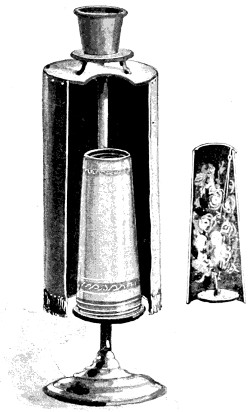
THE MYSTERY EXPLAINED.
The performer now steps to the second stand and covers the flower-pot on
it with the cone. As soon as the pot is covered, he slips off the small hook supporting
the rosebush, which drops into the pot; the weight of the lead base
keeps it in position while the cones are being removed.
When the performer removes the cone—or cones, we should now say, as we
have two now in place of one, although this fact is unknown to the audience—he
passes it down behind the stand, over the concealed third cone, picking it
up with the second rosebush inside. He now returns to the first stand,
covers the pot, and by slipping off the hook holding the rosebush in position,
and removing the cone, or cones, properly, from the pot, shows the second rosebush.
He now turns the large cone so the audience can see through it, and
as the upper and lower edge of each cone is blackened, there is no danger of
the inside cones being seen. The rear of the stand tops are something of a
crescent shape, to facilitate the passing of the large cone down behind the
stand in a graceful manner.
The trick that we are about to describe, although old, is very interesting.
The prestidigitateur comes forward, holding in his hand a small cardboard box
which he says contains various kinds of flower seeds.
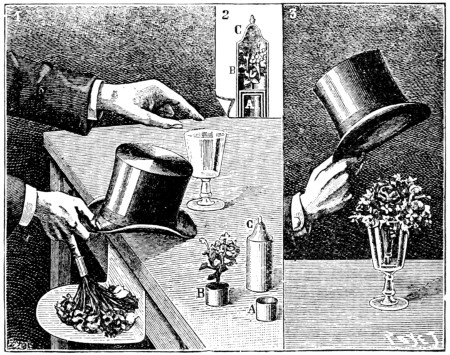
THE BIRTH OF THE FLOWERS.
“Here there is no need of moisture, earth, or time to cause the seed to
germinate, the plant to spring up, and the flower to bloom. Everything takes
place instantaneously. Would not a rose in my buttonhole produce a charming
effect? A stroke of the wand upon the seed deposited in the desired
place, and see! the rose appears. A few seeds are in this little box (Fig. 1, A)
that we shall cover for an instant so that it cannot be seen how flowers are
born. It is done; let us take off the cover; violets, forget-me-nots, and
Easter daisies are here all freshly blown.
“You are suspicious, perhaps, and rightly, of the little tin box, and more
so of its cover. Well, then, here is a small goblet, the transparency of which
is perfect, and this borrowed hat with which I cover it can have undergone
no preparation. Let us remove it quickly, for the flowers—What! no
flowers? Ah! it is because I forgot to sow the seeds. Let us begin the
operation over again. What flowers do you want—a mignonette, a violet, a
marigold? Here is a seed of each kind, which I shall put into the glass.
Now let each one tell me the flower that he prefers. Now I cover the glass
and count three seconds. See the magnificent bouquet!” (Fig. 3.)
Finally the trick is finished by taking from the hat a number of small
bouquets that are offered to the ladies. The following is an explanation of the
various tricks, beginning with that which involves the boutonnière of the
magician himself.
I. The Buttonhole Rose.
This is a stemless artificial rose of muslin, which is secured by a strong
black silk thread arrested by a knot. To this thread, which should be five or
six inches in length, is attached quite a strong rubber cord capable of being
doubled if need be. The free extremity of the rubber traverses, in the first
place, the left buttonhole of the coat, and then a small eyelet formed beneath,
and then passes over the chest and behind the back, and is fixed by the extremity
to one of the right-hand buttons of the waistband of the trousers.
When the prestidigitateur comes upon the stage, the rose is carried under
his left armpit, where he holds it by a slight pressure of the arm. At the
proper moment he raises his wand toward the right, and looks in the same
direction in order to attract the eyes of the spectators to that side; but at the
same time he separates his arms slightly, and the rose, held by the taut rubber,
suddenly puts itself in place. The magic effect produced by the instantaneous
appearance of this flower, coming whence no one knows where, could not be
appreciated without having been seen.
II. The Flowers in the Small Box.
In the second appearance of flowers, produced by means of the small apparatus
shown in Fig. 2, there is really nothing very mysterious. The special
object of it is to bring into relief the experiment that is to follow, and in which,
evidently, there can be no question of double bottom. Moreover, the diversity
of the means employed contributes powerfully toward astounding the
spectators.
Fig. 2 shows in section the three pieces of the apparatus, which are placed
separately upon the table in Fig. 1. A is the cylindrical tin box in which the
seeds are sown, and B another box of slightly larger diameter, but in other
respects just like the first, which it entirely covers. To the bottom of B is
fixed a small bouquet of artificial flowers. By slightly squeezing the cover, C
(which is of thin brass), toward the bottom, the box, B, with the bouquet, is
lifted. If, on the contrary, the box is left upon the table, the spectators do
not perceive the substitution made, and think that they all the time see the
first box, whence they believe the flowers started.
III. The Bouquet in the Glass.
This is the most interesting part of the experiment.
As we have said, the glass is first covered with a hat, and the prestidigitateur
feigns astonishment upon seeing that the flowers have not appeared, but
at the very instant at which the hat is lifted, when all eyes are fixed upon the
glass, looking for the bouquet announced, the operator, who, with the right
hand, holds the hat carelessly resting upon the edge of the table, suddenly
sticks his middle finger in the cardboard tube fixed to the handle of the bouquet,
which has been placed in advance upon a bracket, as shown in Fig. 1,
and, immediately raising his finger, introduces the flowers into the hat, taking
good care (and this is an important point) not to turn his gaze away from the
glass to the bouquet or hat, as one might feel himself led to do in such a case.
This introduction of the bouquet should be effected in less than a second, after
which the hat is held aloft, while with the left hand some imaginary seeds, the
kinds of which are designated in measure as they are taken, are selected from
the cardboard box and successively deposited in the glass. So, this time, be
certain of it, the flowers will appear.
IV. The Small Bouquets in the Hat.
There is not a second to be lost; the spectators are admiring the bouquet
and are astonished to see it make its appearance. The operator very quickly
profits by this moment of surprise to introduce, by the same process as before,
a package of small bouquets tied together with a weak thread that will afterward
be broken in the hat. We have not figured these bouquets upon the
bracket, in order to avoid complication. Of course, a skillful operator will not
hasten to produce the small bouquets. He will advance toward the spectators
as if the experiment were ended, and as if he wished to return the hat to the
person from whom he borrowed it. Afterward making believe answer a request,
he says: “You wish some flowers, madam? And you too? And are there
others who wish some? I will, then, empty into the hat the rest of my wonderful
seeds, and we shall see the result.” It is at this moment that the spectators
are attentive and that all eyes are open to see the advent of the flowers.
Prestidigitateurs frequently borrow from their spectators a hat that serves
them for the performance of very neat tricks which are not always easily
explained. We shall describe some of the most interesting of these.
The operator will begin by proving to you that the felt of your hat is of
bad quality, and, to this effect, he will pierce it here and there with his
finger, his magic wand, an egg, and with a host of other objects.
This is all an illusion, the mystery of which is explained by our first engraving.
(See the finger B.) It is either of wood or cardboard, and terminates in
a long slender needle. The prestidigitateur, who has concealed the finger in
his left hand, thrusts the point into the top of the hat, whose interior is turned
toward the spectators. Afterward raising the right hand, the forefinger of
which he points forward, he seems to be about to pierce the top of the hat, but
instead of finishing the motion begun, he quickly seizes in the interior, between
the thumb and forefinger, the point of the needle, wiggles it around in all
directions, turns the hat over, and the cardboard finger, which moves, seems to
be the prestidigitateur’s own finger. The same operation is performed with the
wooden half egg, C, and the rod, A, which, like the finger, appear to traverse
the hat, in the interior of which are hidden the true rod and egg. We may
likewise solder a needle to a half of a five-franc piece, and thus vary the
objects employed for this recreation to infinity.
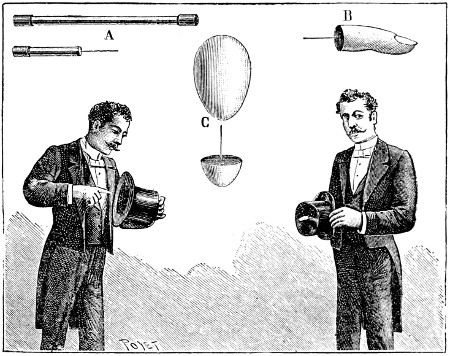
PASSING A FINGER, ROD, AND EGG THROUGH A HAT.
In order to take from a hat a large quantity of paper in ribbons, and then
doves, and even a duck or a rabbit, there is no need of special apparatus nor of
a great amount of dexterity, and still less of the revolving bobbin or of the
mysterious machine whose existence is generally believed in by the spectators
when they see the paper falling regularly from the hat, and turning gracefully
of itself as the water from a new sort of fountain would do.
Nor is there here any need of a high hat; a simple straw hat (or a cap, at a
pinch) will suffice. The prestidigitateur holds close pressed to his breast and
hidden under his coat a roll of the blue paper prepared for the printing
apparatus of the Morse telegraph, and which is so tightly wound that it has
the aspect and consistence of a wooden disk with a circular aperture in the
center. In turning around after taking the hat, the opening of which rests
against his breast, the operator deftly introduces into it the roll of paper, which
has the proper diameter to allow it to enter by hard friction as far as the top
of the hat, and stay where it is put even when the hat is turned over.
Were it needed, the paper might be held by a proper pressure of the left
hand exerted from the exterior. The introduction of the paper is effected in a
fraction of a second.
“Your hat, my dear sir, was doubtless a little too wide for your head, for I
notice within it a band of paper designed to diminish the internal diameter,”
says the prestidigitateur, while, at the same time, he draws from the hat the
end that terminates the paper
in the centre of the roll.
Then he reverses the hat so
that the interior cannot be
seen by the spectators. The
paper immediately begins to
unwind of itself and to fall
very regularly and without
intermission to the right.
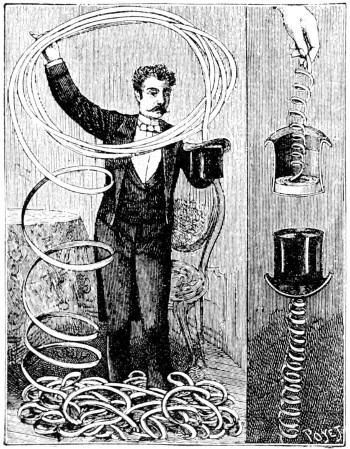
THE ENDLESS PAPER RIBBON.
When the fall of the paper
begins to slacken, that is,
in general, when no more
than a third of the roll remains,
the prestidigitateur
turns the hat upside down,
and with the right hand pulls
out and rapidly revolves in
the air the paper ribbon,
whose capricious contours,
succeeding one another before
the first have had time
to fall to the floor, produce
a very pretty effect, as shown
in our second engraving.
The quantity of paper extracted
from the hat appears also in this way much greater than it really is,
and at length forms a pile of considerable bulk.
This experiment may be completed in the following manner: The operator,
approaching his table, which, upon a board suspended behind it, carries a firmly
bound pigeon, quickly seizes the poor bird in passing, and conceals it under
the pile of paper, while he puts the latter back into the hat in order to see, says
he, whether all that has been taken out can be made to enter anew.
Having thus introduced the pigeon or any other object into the hat, the
paper is taken out, and it is at the moment that the hat is restored to its owner
that he pretends to discover that it still contains something.
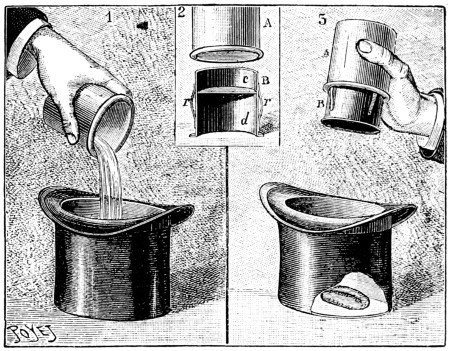
FIGS. 1-3—A CAKE BAKED IN A HAT.
This old trick always amuses the spectators. Some eggs are broken into a
porcelain vessel, some flour is added thereto, and there is even incorporated
with the paste the eggshells and a few drops of wax or stearine from a near-by
candle. The whole having been put into a hat (Fig. 1), the latter is passed
three times over a flame, and an excellent cake, baked to a turn, is taken
out of this new set of cooking utensils. As for the owner of the hat, who has
passed through a state of great apprehension, he finds with evident satisfaction
(at least in most cases) that his head gear has preserved no traces of the mixture
that was poured into it.
Fig. 2 shows the apparatus employed by prestidigitateurs to bake a cake in
a hat. A is an earthen or porcelain vessel (it may also be of metal) into
which enters a metallic cylinder, B, which is provided with a flange at one of
its extremities and is divided by a horizontal partition into two unequal compartments,
c and d. The interior of the part d is painted white so as to
imitate porcelain. Finally, when the cylinder, B, is wholly inserted in the
vessel, A, in which it is held by four springs, r, r, r, r, fixed to the sides, there
is nothing to denote at a short distance that the vessel, A, is not empty, just as
it was presented at the beginning of the experiment.
The prestidigitateur has secretly introduced into the hat the small cake and
the apparatus, B, by making them fall suddenly from a bracket affixed to the
back of a chair. That at least is the most practical method of operating.
The vessel, A, about which there is nothing peculiar, is, of course, submitted
to the examination of the spectators. The object of adding the flour
is to render the paste less fluid, and to thus more certainly avoid the production
of stains.
The cake being arranged under the apparatus,
B, in the space d, the contents of the vessel, A,
poured from a certain height, fall into the part
c of the apparatus; then the vessel, gradually
brought nearer, is quickly inserted into the hat in
order to seize therein, and at the same time remove,
the receptacle, B, with its contents, and leave only
the cake.
Fig. 3 shows this last operation. We have intentionally
shown the part, B, projecting from the
vessel, A, but it will be understood that in reality
it must be inserted up to the base at the moment
at which the vessel, A, introduced into the hat, is concealed from the eyes of
the spectators. The prestidigitateur none the less continues to move his finger
all around the interior of the double vessel as if to gather up the remainder
of the paste, which he makes believe throw into the hat, upon the rim of
which he even affects to wipe his fingers, to the great disquietude
of the gentleman to whom it belongs.
The experiment may be complicated by first burning
alcohol or fragments of paper in the compartment c of
the apparatus. Some prestidigitateurs even add a little
Bengal fire. But let no one imitate that amateur prestidigitateur
who, wishing to render the experiment more
brilliant, put into the receptacle such a quantity of powder
that a disaster supervened, so that it became necessary to
throw water into the burning hat in order to extinguish
the nascent fire.
The following method of baking a cake in a hat is a
decided improvement over the old trick with the porcelain
vessel. It has the advantage of being able to be employed
anywhere and of producing a complete illusion.
Before beginning the experiment, take three eggs, and
having blown two of them, close the apertures with white
wax. Place the three eggs upon a plate.
Within the left-hand side of your waistcoat place a flat
cake, and then make your appearance before the spectators.
FIG. 4.
Having borrowed a hat, place it upon the table, and, after secretly introducing
the cake into it (Fig. 4), take an empty egg, crack the shell upon the
edge of the plate, and, inserting your hands in the hat, make believe empty
the contents of the egg into the latter (Fig. 5).
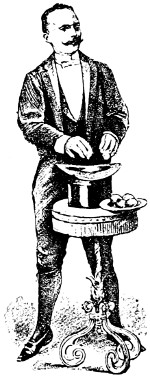
FIG. 5.
In order that the means employed may not occur to any one, take the perfect
egg and let it fall upon the plate so that it will break and its contents
flow out. Then take the remaining egg and operate as with the first. All you
have to do then is to pass the hat back and forth a few times over the flame of
a candle in order to cook the mass and then to serve the cake.
An effect due to an invisible thread is the following:
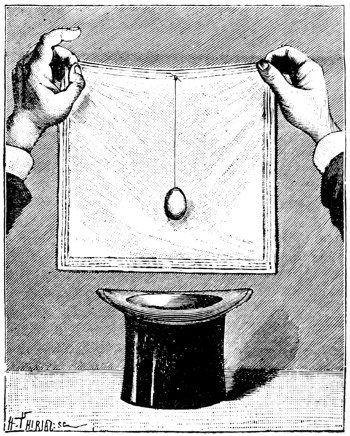
THE EGG AND HAT TRICK.
Some months ago, in a Parisian public establishment, a clown took a hat
and a handkerchief, and then, after showing, by spreading it out, that the
handkerchief was empty, drew
an egg from the folds of the
crumpled fabric and allowed
it to drop into the hat. Then
he took up the handkerchief,
shook it out again, crumpled
it up, found another egg, and
let it drop into the hat, and
so on. When it might have
been supposed that the hat
contained a certain number
of eggs, he turned it upside
down, and, lo and behold, the
hat was empty! All the eggs
from the handkerchief were
reduced to a single one attached
by a thread to one of
the sides of the handkerchief,
and which the amusing operator
maliciously exhibited,
after seeming to look for the
vanished eggs.
While the handkerchief
was stretched out, the egg
was behind it, and, although
it was shaken, remained suspended by its thread. In crumpling the handkerchief
it was easy to seem to find the egg in it, and to put it in the hat, where it
did not remain, however, for, lifted by the thread, it resumed its place behind the
handkerchief. Our engraving shows the handkerchief at the moment that the
egg has been removed by the thread on the side opposite that of the spectators.
On attaching a black thread, sixteen or twenty inches in length, to an
empty egg, and selecting the egg thus prepared from a lot of ordinary eggs, as
if by chance, we have a ready means of amusing and mystifying spectators for
a long time. Having hooked the free extremity of the thread to a buttonhole
of the waistcoat, let us lay the egg upon the table. After apparently ordering
it to approach us, it suffices to recede from the table to make the docile egg
obey the command. By the same means it may be made to make its exit
alone from a hat; or, again, by bearing upon the invisible thread, it may be
made to dance upon a cane or upon the hand; in a word, to perform various
operations that eggs are not accustomed to perform.
Upon a small rectangular tray of japanned sheet iron, similar to those in
common use, are placed seven coins (Fig. 1). A spectator is asked to receive
these in his hand and to put the coins back upon the tray, one by one, and to
count them with a loud voice as he does so. It is then found that the number
has doubled, there being
fourteen instead of seven.
The same operation repeated
gives as a result twenty-one
coins.
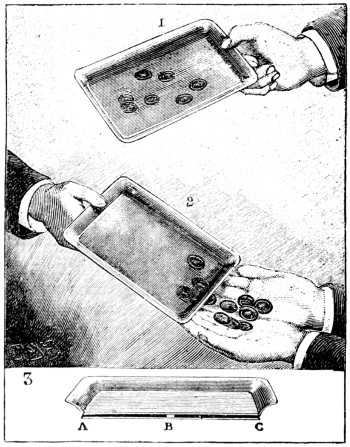
MULTIPLICATION OF COINS.
As may be seen in the
section in Fig. 3, the tray
has a double bottom, forming
an interspace a little wider
than the thickness of one of
the coins, and which is divided
breadthwise into two
equal compartments by a
partition, B. These two
compartments are closed all
around, save at the ends of
the tray, where there are two
apertures, A and C, that in
length are double the diameter
of the coins. In this
interspace are concealed fourteen
coins, seven on each
side. When the contents of
the tray are emptied into the
hand of a spectator, the coins
concealed in one of the compartments drop at the same time (Fig. 2). The
operator then takes the tray in his other hand, and thus naturally seizes it at the
end at which the now empty compartment exists, and this allows the seven coins
that are contained in the other compartment to join the first ones, when the
latter are rapidly emptied into the hands of the spectator for the second time.
A square tray, with a double bottom divided into four compartments by
divisions running diagonally from one corner to another, would permit of
increasing the number of coins four times.
Let us say, however, that skillful prestidigitateurs dispense with the double
bottom. They hold the coins sometimes under the tray with their fingers
extended, and sometimes on the tray, under their thumbs, and renew their
supply several times from secret pockets skillfully arranged in various parts of
their coats, where the spectators are far from suspecting the existence of them.
The street venders of Paris have for some time past been selling to pedestrians
a coin that can be made to enter an ordinary wine bottle. This coin is
a genuine ten centime piece, but,
when it is handled, it is found that
it bends exactly like the leaves of
a dining-room table. Amateur
mechanics, clock-makers, and copper
turners can easily manufacture
similar ones. The process is as
follows:
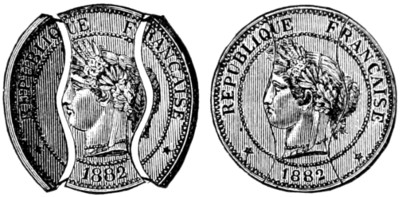
FIG. 1.—MAGIC COINS.
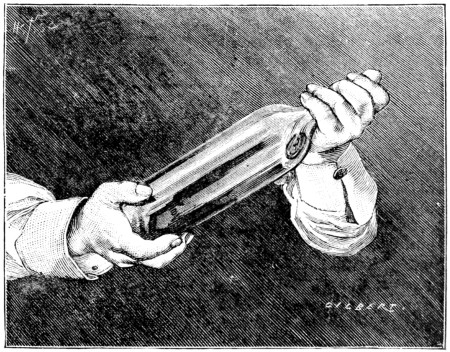
FIG. 2.—MODE OF INSERTING THE COIN IN A BOTTLE.
By means of a very fine metal
saw, cut the coin in three pieces,
either by parallel cuts, or, better, by following the contours shown in Fig. 1.
If the operation be skillfully performed, the marks of the cutting, too, will be
nearly invisible. Before the coin is sawed, a groove about a line in depth should
be formed in the rim by means of a saw or file. In this channel or groove is
inserted a very taut rubber ring, which, before it is stretched, should be, at
the most, one and a half or two lines in diameter. If the rubber is well
hidden in the groove, the cleft coin will appear to be absolutely intact.
Owing to this process, the coin can be easily inserted in a bottle by placing
the hands as shown in Fig. 2. The hand that bends the coin covers the
mouth. The coin is inserted, and then, by a smart blow given the bottle, it
is made to pass through the neck. Owing to the tension of the rubber, the
piece at once regains its flat form, and the operator makes it ring against the
glass in order to show that it is really a piece of metal. In order to extract
it, it is necessary to get the saw marks exactly in the direction of the bottle’s
axis, then the bottle is slightly inclined, neck downward, and through a few
blows on the latter the coin is made to drop into the
hand, where it will at once assume its original form.
We shall now have a few words to say about what is
called the “double sou.” The operator places the prepared
coin in his hand, and calls strict attention to the fact that
there is no companion piece. Then he covers it with his
other hand for a moment, and finally shows two coins,
instead of one, in the first hand.
FIG. 3.—THE DOUBLE
SOU.
Fig. 3 shows, not how the experiment is performed,
but how the double coin is prepared. It is simply an ordinary
sou, over which is placed a sort of hollow cover containing
the impression of the coin, and which fits on the
latter so accurately that the piece looks like an ordinary
sou. This cover is lifted and made to slide alongside of
the coin, thus showing two pieces instead of one.
The cover is stamped from a thin sheet of copper placed upon a sou serving
as a mould. It might possibly be made by means of some electro-metallurgical
process. The mutilation of United States coins is forbidden under
penalty of the law.
Borrow a silver dollar, and have it marked, so that it can be identified.
Ask some one to hold the coin horizontally between the thumb and forefinger of
the right hand within the folds of a silk handkerchief, and over a glass full of
water held in the left hand, Fig. 1. Your assistant’s two hands being thus
occupied, you will have no sort of indiscretion to fear. Stepping back a few
feet, direct your assistant to let the coin drop; and the impact against the bottom
of the glass will be heard by the entire assemblage. When the handkerchief
is raised the coin is no longer in the glass, but has made its way to your
hand or to the pocket of a spectator. Let it be examined, and it will be found
to be really the coin that has been previously marked.
In order to perform this trick it is necessary to have a disk of glass of the
same diameter as a silver dollar (Fig. 2).
Hide this disk, A (Fig. 3), in the palm of your right hand, turned toward
you. This will not prevent you from holding the coin that has been confided
to you between the thumb and forefinger of the same hand. While your hand
is concealed by the handkerchief in which it is thought that you placed the
coin, you shift the latter and give the assistant the glass disk to hold, by the
edge, of course, and not by the flat surface, so that the substitution that you
have made cannot be perceived by the touch.
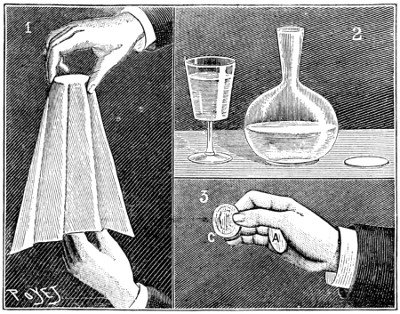
DISAPPEARANCE OF A SILVER DOLLAR.
After the trick has been performed, do not be afraid to let the person who
has held the coin, and who is thoroughly astonished, examine the glass and its
contents at his leisure. The glass disk is entirely invisible in the water, and if,
as it is well to do, you have taken care to select a glass whose bottom is perfectly
plane and of the same diameter as the disk (Fig. 2), the latter will
remain adherent to the glass even when it is inverted to empty the water in
order to prove once more to the spectators that it contains nothing but clear
water.
Two ordinary wooden-framed slates are presented to the spectators, and
examined in succession by them. A small piece of chalk is introduced between
the two slates, which are then united by a rubber band and held aloft in the
prestidigitateur’s right hand.
Then, in the general silence, is heard the scratching of the chalk, which
is writing between the two slates the answer to a question asked by one of the
spectators—the name of a card thought of or the number of spots obtained by
throwing two dice. The rubber band having been removed and the slates
separated, one of them is seen to be covered with writing. This prodigy, which
at first sight seems to be so mysterious, is very easily performed.
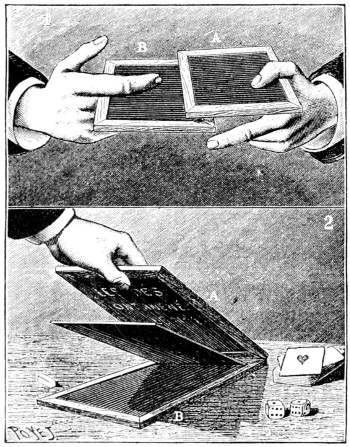
SPIRIT SLATES.
The writing was done in advance; but upon the written side of the slate,
A, there had been placed a thin sheet of black cardboard which hid the characters
written with chalk.
The two sides of this slate thus
appeared absolutely clean.
The slate B is first given
out for examination, and after
it has been returned to him,
the operator says: “Do you
want to examine the other
one also?” And then, without
any haste, he makes a
pass analogous to that employed
in shuffling cards. The
slate A being held by the
thumb and forefinger of the
left hand and the slate B between
the fore and middle
finger of the right hand (Fig.
1), the two hands are brought
together. But at the moment
at which the slates are superposed,
the thumb and forefinger
of the right hand grasp
the slate A, while at the same
time the fore and middle
finger of the left hand take
the slate B. Then the two hands separate anew, and the slate that has
already been examined, instead of the second one, is put into the hands of the
spectator. This shifting, done with deliberation, is entirely invisible.
During the second examination the slate A is laid flat upon a table, the
written face turned upward and covered with black cardboard. The slate
having been sufficiently examined, and been returned to the operator, the latter
lays it upon the first, and both are then surrounded by the rubber band.
It is then that the operator holds up the slates with the left hand, of which
one sees but the thumb, while upon the posterior face of the second slate the
nail of his middle finger makes a sound resembling that produced by chalk
when written with. When the operator judges that this little comedy has
lasted quite long enough, he lays the two slates horizontally upon his table,
taking care this time that the non-prepared slate shall be beneath (Fig. 2).
It is upon it that the black cardboard rests; and the other slate, on being
raised, shows the characters that it bears, and that are stated to have been
written by an invisible spirit that slipped in between the two slates.
“The trick is performed as follows,” says Judge James Bartlett in the
Popular Science News: “Each person in the audience is presented with a slip
of paper, upon which to write anything he or she may choose. The paper
written upon is immediately secreted by the writer, as much care as possible
being taken that no one else sees what is written upon it. The performer,
who has been absent from the room while this is being done, is brought in and
led, as if in a state of trance, to a chair within full view of every one present.
A light piece of drapery is thrown over him so that he is completely covered
by it, and yet it is thin enough to be translucent, and it can be seen he has not
gone down through the floor or ascended up through the ceiling. The audience
is told the drapery prevents the sphere or influence or spell that surrounds
him from being dissipated. He now begins and repeats, word for word, the
sentences written upon any or all the slips of paper. Nothing can be more
astonishing; the paper has not left the possession of the writers; it is equally
certain that it is impossible that another person could have seen what was
thereon written, and yet the trick is as simple as it is surprising, and that is
certainly saying a great deal.
“The explanation is as follows: In order to write anything upon the slip of
paper given out, one must have something firm and flat upon which to place
it, and for this purpose bits of pasteboard of a convenient size are handed
about the audience. The pasteboard, however, is not solid, as it seems to be;
the uppermost layer of paper can be separated at one of the edges from the
layers beneath it, and into this slip white paper introduced. The uppermost
layer of paper is blacked with crayon or soft pencil on its under side, and whatever
is written upon the paper resting upon it is faithfully stenciled or traced
upon the white paper inserted. The pasteboards, being collected, are taken
out of the room and given to the performer by his assistant, who may or may
not be a confederate. That is, if the performer is very skillful, he may dupe
his assistant as well as his audience. He may tell him, for instance, it is
necessary for him to have these pasteboard rests and pass his fingers over them
so that he can become en rapport with the person with whom they were in contact.
It is better, however, at least at first, to have a confederate. The rest
is easy enough. The inserted slips of tell-tale papers are collected and carried
with him by the performer, who manages to read them either through a hole
in the drapery or by the light that sifts through it as he sits covered up in his
chair with his back to the audience. It is well, sometimes, not to have enough
pasteboard cards to go round the audience, and give apparently at haphazard
a book, an atlas or portfolio, which, of course, has been neatly covered with
paper or cloth and supplied with blackened and with white paper as are the
pasteboard cards.
“If anything should happen that would prevent reading any particular strip
of paper, the performer may at once say that he does not pretend to be able to
read all, but only such sentences as appear to his mental vision. This will add
to the effect and make the trick appear all the more mysterious. In supplying
pencils to your audience be sure to give them good, hard ones, that will
require some pressure to make the writing legible; be careful, too, that the
paper with which you furnish them is rather thin, so that you will get a good
tracing on that you have inserted in the pasteboard rest. As each slip is read
by the performer the assistant should ask if any one in the audience wrote that
sentence and if it is correctly repeated, and then, stepping to the writer and
taking the slip from him or her, he should himself read it aloud and show it
to any one desirous of seeing it; this enhances the wonder and interest of the
performance, and also gives the performer time to decipher the next slip. It
is well to have the sentences take the form of questions which the performer
can read, comment upon, and answer in an oracular way, especially as this
takes up time, and consequently gives fewer selected slips to read during the
period allotted to the trick; for to read a few is quite as wonderful as to read
many.
“Now let the master of occult art cap the climax. Let him again be led
from the room, ostensibly to have his magic sphere renewed, and let some one
among the audience write the name of a deceased person, together with their
own, on a slip of paper. Lay a good deal of stress on the requirement that
one name shall be that of a person deceased; this, of course, being only to
mystify the audience. When the names have been written the performer is to
enter the room. He does so with the sleeve of his coat rolled up, and his arm
bared to the elbow. After showing there is nothing upon his arm, he turns
down his sleeve, readjusts his cuff, and proceeds with his trick. He first names
the person whom the audience has chosen, in his absence, to write the name;
he requests that person to crumple up the slip of paper upon which the name
is written and rub it well over his arm just above his cuff, ‘so that the writing
will penetrate through his sleeve,’ he says; now turning up his sleeve he shows
the writing that was upon the paper in blood-red letters upon his bared arm.
The manner of performing this part of the trick is, having ascertained, as
before, the writing upon the slip of paper by means of the tracing, to write or
print it with red ink mixed with a little glycerine, or red printer’s ink, or oil
color and turpentine, upon paper which is to be fastened upon the inside of
that part of the performer’s coat sleeve which he instructs the person who has
written the name upon the paper to rub with the paper. The paper may be
neatly pinned to the lining of the sleeve, care being taken that the pins do
not scratch when the sleeve is turned down.”
The apparatus by means of which objects of various sizes—a card, a bird,
a child, a woman, etc.—may be made to apparently disappear play a large part
in the exhibitions of magicians, and also in pantomimes and fairy scenes.
Among such apparatus there are some that are based upon ingenious mechanical
combinations, while others bring in the aid of optics. We shall examine
a few of them.
The Magic Portfolio.
This is an apparatus which an itinerant physicist might have been seen a
few years ago exhibiting in the squares and at street corners. His method
was to have a spectator draw a card, which he then placed between the four
sheets of paper which, folded crossways, formed the flaps of his portfolio. When
he opened the latter again a few instants afterward the card had disappeared,
or rather had become transformed. Profiting then by the surprise of his spectators,
the showman began to offer them his magic portfolio at the price of five
cents for the small size and ten for the large.
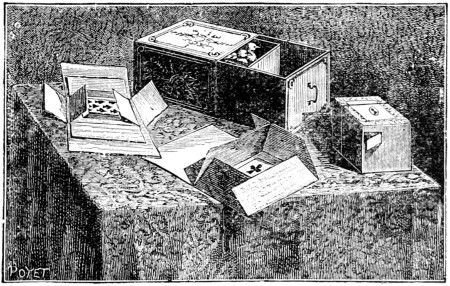
MAGIC PORTFOLIOS, ENVELOPES, AND BOXES.
The portfolio was made of two square pieces of cardboard connected by
four strings, these latter being fixed in such a way that when the two pieces
of cardboard were open and juxtaposed the external edge of each of them was
connected with the inner edge of the other.
This constituted, after a manner, a double hinge that permitted of the portfolio
being opened from both sides. To one pair of strings there were glued,
back to back, two sheets of paper, which, when folded over, formed the flaps
of the portfolio. It was only necessary, then, to open the latter in one direction
or the other to render it impossible to open more than one of the two sets
of flaps.
This device is one that permits of a large number of tricks being performed,
since every object put under one of the sets of flaps will apparently disappear
or be converted into something else, at the will of the prestidigitateur.
Magic Envelopes.
This trick is a simplification of the foregoing. The affair consists of several
sheets of paper of different colors folded over, one upon the other. A
card inclosed within the middle envelope, over which have been folded all the
others, is found to have disappeared when the flaps are opened again. The
secret of the trick is very simple. One of the inner sheets of paper—the
second one, usually—is double, and, when folded, forms two envelopes that
are back to back. It is only necessary, then, to open one or the other of
these latter to cause the appearance or disappearance or transformation of such
objects as have been inclosed within it.
Magic Boxes.
Magic boxes are of several styles, according to the size of the objects that
one desires to make disappear.
There is no one who has not seen a magician put one or more pigeons into
the drawer of one of these boxes, and, after closing it, open it to find that the
birds have disappeared. Such boxes contain two drawers, which, when pulled
out, seem to be but one; and it is only necessary, then, to pull out the inner
one or leave it closed in order to render the inclosed birds visible or invisible.
In order to cause the disappearance of smaller objects, trick performers
often employ a jewel box, and after putting the object (a ring, for example)
into this, they hand it to some person and ask him to hold it, requesting him
at the same time to wrap it up in several sheets of paper. But this simple
motion has permitted the performer to cause the ring to drop into his hand
through a small trap opening beneath the box. Yet, while he is doing this the
spectators think that they hear the noise made by the ring striking against the
sides of the box. But that is only an illusion; for the noise that is heard proceeds
from a small hammer which is hidden within the cover under the
escutcheon, and which is rendered movable when the latter is pressed upon
by the performer. The box can thus be shaken without any noise being heard
within it, and the spectators are led to believe that the object has disappeared.
Double-bottomed boxes are so well known that it is useless to describe them.
Sometimes the double bottom is hidden in the cover, and at others it rests
against one of the sides. Such boxes permit of the disappearance or substitution
of objects that are not very thick, such as a note, an image, or a card.
THE TRAVELING BOTTLE AND GLASS.
Upon a table, at the rising of the curtain, are observed a bottle and a glass,
the latter full of wine up to the brim. The prestidigitateur pours into the
bottle half of the liquid, “which otherwise,” he remarks, “might slop over
during the voyage.” Then two cylinders of the same diameter as the bottle
are made before the eyes of the spectators out of two sheets of paper and four
pins.
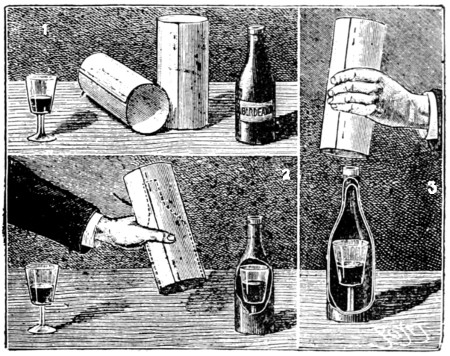
TRICK WITH A BOTTLE AND A GLASS OF WINE.
These are designed to cover the bottle and the glass, which have been separated
from each other by a short interval (Fig. 1). Instantaneously, and in
an invisible manner, the
two objects change places
twice, and yet there is
never anything in the paper
cylinders, which are,
ostensibly, torn into a
hundred bits.
Fig. 3 unravels the
mystery. The bottle is of
varnished tin, and bottomless.
It covers a second
bottle that is similar, but
a little smaller, and in the
center there is concealed
a glass similar to the one
that has been shown, but
empty. It receives the half
of the wine that was
poured from the first glass. This operation necessarily contributes toward
convincing the spectators that they have before them an ordinary bottle provided
with a bottom and capable of containing a liquid.
The operator first covers the bottle with one of the paper cylinders as if to
ascertain whether it has the proper diameter, but immediately removes it and
places it upright upon the table.
What no one can suspect, however, he has at the same time lifted the first
bottle by slightly compressing the paper. It is then the second bottle that is
seen, and which is precisely like the other, the labels of both being turned
toward the same side and exhibiting a slight tear or a few identical spots
designed to aid in the deception.
The operator, having finished his palaver, places the empty cylinder upon
the second bottle and covers the glass with the one in which the first bottle
is concealed (Fig 2). The magic wand is then brought into play, and after
this the paper cylinder alone is lifted at the side where the glass was in the first
place seen, while at the opposite side, the bottle, on being removed, exposes the
glass that it concealed. The operation is begun over again in the opposite
direction; and, finally, under pretense of once again showing that either
paper cylinder can be used indifferently, the operator replaces upon the second
bottle the cylinder that still contains the first one, unbeknown to the spectators.
This is done so rapidly that the action is apparently a gesture, but nothing
more is needed to free the cylinder of its contents and reëstablish things in
their former state.
To an apple and a ninepin, the principal objects with which this trick is
performed, are added as accessories a napkin, a large vessel of dark blue glass,
and a cone of coarse paper, which is made on the spot by molding it over
the ninepin.
First Disappearance (Fig. 1).—The apple, “in order that it maybe more
in sight,” is placed upon the inverted glass, V, under the paper cone, while
the inverted ninepin is covered with the napkin, S, through which it is held.
All at once the napkin, quickly seized by the two corners, is vigorously shaken,
and the ninepin has disappeared, or, rather, it is found upon the glass in place
of the apple, which has passed into the prestidigitateur’s pocket.
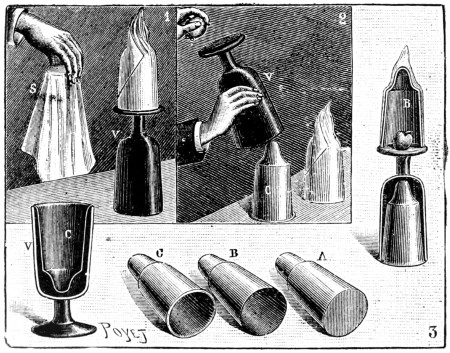
TRICK WITH AN APPLE AND A NINEPIN.
Second Disappearance (Fig. 2).—The apple, first placed upon the table, is
thrown invisibly toward the paper cone, under which, in fact, it is found.
And the ninepin? The prestidigitateur “had forgotten” to tell it where it was
to go when he sent the apple in its place. As he gives up trying to find it and
seizes the blue vessel in order to put it in place, it is seen that the ninepin,
driven by the apple, has passed underneath.
Fig. 3 renders an explanation scarcely necessary. At the moment that the
paper cone was made, the ninepin, A, was covered with a dummy, B, of thin
metal, which remained in the cone when the latter was removed. In the
napkin, formed of two napkins sewed together by their edges, was concealed,
between the two fabrics, a small disk of cardboard of the same diameter as the
base of the ninepin. The latter was allowed to fall secretly behind the table
into a box lined with silk waste, only the cardboard disk being held, thanks to
which the napkin preserved the same form that it possessed when the ninepin
was beneath it, as shown in Fig. 1. There is no need of explanation in regard
to the apple that comes out of the prestidigitateur’s pocket and which is
similar to the one that remained on the glass and was hidden by the false ninepin
that covered it when the paper cone alone was removed.
For the second disappearance the apple, placed upon the table, is
surrounded by the two hands of the prestidigitateur, who, while it is thus
concealed, by a blow given with the little finger of the right hand, sends it
rolling on to a shelf behind the table. His hands, nevertheless, preserve the
same position as if they held the apple. It is the first one that is seen upon
the foot of the glass, the false ninepin being removed this time with the paper
cover. Under the glass there is a second false ninepin, C, of metal, painted
dark blue in the interior and which has a narrow flange through which it
rests upon the edge of the glass, of which it seems to form a part. Fig. 3
shows it in section with the glass, and also the different pieces as they are
arranged at the beginning of the experiment.
FIG. 1.
Exhibit a goblet which is apparently nearly full
of ink, and place it upon a table. In order to prove
that the goblet really contains ink, partially immerse
a visiting card in the liquid, and, on taking it out,
show that it has been blackened. With an ordinary
spoon dip out some of the ink and pour it into a
saucer. Then, having borrowed a ring, pretend to
dip it into the ink, but really allow it to drop into the
saucer. Announce that you are going to make amends
for your awkwardness, not by plunging your hand
into the liquid, which would have the inconvenience
of blackening it, but by rendering the ink colorless
instantaneously. Take a white napkin or a large
sized silk handkerchief and cover the glass with it. Upon removing the
napkin or handkerchief, the glass will be found to contain clear water in which
living fish are swimming. The hand may then be dipped into the liquid and
the ring be taken out without fear.
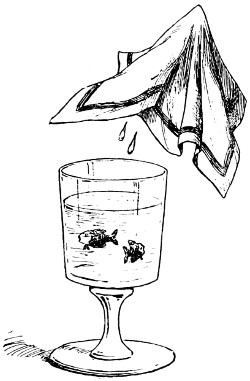
FIG. 2.
The trick is performed as follows:
Take a goblet containing water and some
fish, and place against the inner surface a
piece of black rubber cloth, to which attach
a black thread that is allowed to
hang down a few inches outside of the
glass, and to the extremity of which is
attached a small cork. Of course, the
thread and cork must be placed at the
side of the glass opposite the spectator.
Cover the glass with the napkin, and
on removing the latter, grasp the cork,
so as to raise it as well as the rubber cloth
in the interior.
As for the card, that should have been
previously blackened on one side for about
three-quarters of its length, and, after
being immersed in the liquid, with the
white side toward the spectator, should be
quickly turned around so as to show the
blackened side. As for the liquid taken
out with the spoon, care should have been taken to previously fix in the interior
of the bowl a few particles of aniline black soluble in water, by breathing on
the spoon before introducing the powder, this serving to fix it. Then the water
taken out with the spoon will be converted into ink, which may be poured
into a plate or saucer.
Being given an ordinary glass half full of wine, which everybody can examine
closely, and a hat situated at a distance, the question is to cover the glass
with a piece of paper, and thence to send it invisibly into the hat.
A small piece of wood or paper that a spectator has put in the wine, or
any mark whatever that has been made upon the glass, will permit of verifying
the fact that it is really the same glass that was first exhibited, and that is
afterwards found in the hat.
In order to perform this trick, it is necessary to have one of those double
glasses (Fig. 4) that can be easily obtained in variety stores, and which contain
between their double sides a red liquid that has been introduced through the
foot of the glass, which is hollow. A small cork, b, which is absolutely
invisible if it is not examined very closely, is inserted and withdrawn at will in
order to change the liquid; but, for our trick, there is no occasion to occupy
ourselves with these details. This double glass is kept concealed until the
moment arrives for using it.
A second glass—this is a simple one (Fig. 4, B) and of the same appearance
as the other—is filled with wine, in the presence of the spectators, to a
level equal to that reached by the red liquid in the double glass.
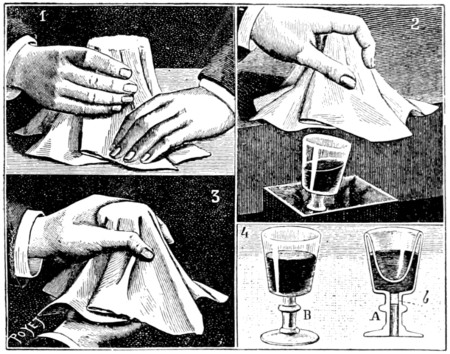
TRICK PERFORMED WITH A GLASS OF WINE.
The prestidigitateur, after exhibiting the interior of the hat so as to allow
it to be seen that the latter is empty, introduces into it, while he turns his
back to the spectators, the
double glass which he
had concealed under his
arm, and which can be
handled without any fear
of spilling the liquid that
it contains. The hat is
then placed upon the
table.
Afterward, taking the
simple glass in his hands,
the prestidigitateur asks
the spectators whether he
shall make it pass visibly
or invisibly into the hat.
As a usual thing suggestions
are divided, and so,
in order to please everybody,
the glass is first put ostensibly into the hat and then immediately taken
out; that, at least, is what is thought by the spectators, who are very ready to
laugh at the little hoax played upon those who perhaps expected to see the glass
carried through the air upon the wings of the wind. But the prestidigitateur
has taken care to leave the simple glass in the hat, and to take out, in place of
it, the double glass, which he presently spirits away with ease by the following
process. The glass having been placed upon the table, he covers it with a
square piece of strong paper, which he folds around it in such a way as to
make it follow its contours and completely conceal it (Fig. 1). This paper,
which must be very stiff, as well as strong, afterward preserves the form upon
which, so to speak, it has been molded, although it is no longer supported by
the glass, which has been allowed to fall behind the table into a sort of pocket
of canvas, or into a box lined with silk waste, arranged to this effect (Fig. 2).
The prestidigitateur, having thus got rid of the glass, walks toward the
spectators, delicately pressing the top of the paper between the thumb and
forefinger of the left hand, as if he still held the glass in the paper, and the
foot of which seems to be supported by the right hand. A spectator is then
invited to take the glass with the paper, and care is taken to advise him not to
allow the wine to run up his sleeves. He then stretches out his hands, but
at the same instant the paper, suddenly crumpled into a ball, is thrown into
the air, and the glass of wine has passed invisibly into the hat.
After having done considerable talking, as required by his profession, a
prestidigitateur is excusable for asking permission of his spectators to refresh
himself in their presence, especially if he invites one of them to come to keep
him company.
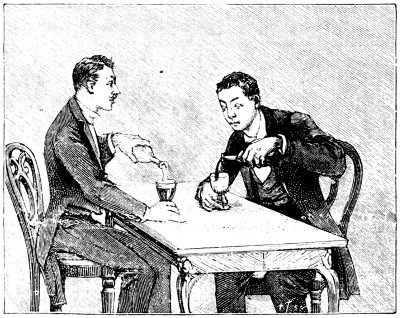
WATER CHANGED INTO WINE AND WINE INTO WATER.
An assistant then brings in upon a tray two claret glasses and two perfectly
transparent decanters, one of which contains red wine and the other water.
The prestidigitateur asks his guest to select one of the two decanters and leave
the other for himself. No hesitation is possible. The guest hastens to seize
the wine and each immediately fills his glass. How astonishing! Upon its
contact with the glass the wine changes into water and the water becomes wine.
Judge of the hilarity of the spectators and the amazement of the victim!
The pretended wine was nothing but the following composition: one gram
potassium permanganate and two grams sulphuric acid dissolved in one
quart of water. This liquid is instantaneously decolorized on entering the
glass, at the bottom of which has been placed a few drops of water saturated
with sodium hyposulphite. As for the water in the second decanter, that had
had considerable alcohol added to it, and at the bottom of the glass that was
to receive it had been placed a small pinch of aniline red, which, as well
known, possesses strong tinctorial properties. The glasses must be carried
away immediately, since in a few moments the wine changed into water loses its
limpidity and assumes a milky appearance. The mixtures are, of course,
poisonous.
Street venders are often seen selling, at night, a little mouse which they
place upon the back of their hand, and which keeps running as if, having been
tamed, it wished to take refuge upon them. In order to prevent it from
attaining its object, they interpose the other hand, and then the first one,
which is now free, and so on. The mouse keeps on running until the vender
has found a purchaser
for it at the moderate
price of two cents, including
the instructions
for manipulating it, for,
as may have been divined,
it is not a question here
of a live mouse, but of a
toy. This little toy is
based upon two effects—first,
an effect of optics;
and second, the effect
due to an invisible thread.
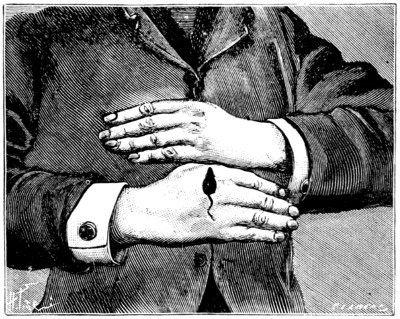
THE ANIMATED MOUSE.
The mouse, which is
flat beneath, is provided
near the head with a
small hook, and the operator
has fixed to a buttonhole
a thread ten inches in length, terminating in a loop. He fixes this
loop in the hook above mentioned, and, tautening the thread, places the mouse
upon the back of his left hand (near the little finger, for example).
On moving the hand away from the body, the mouse, which does not stir,
seems to slide over the back of the hand, and, at the moment that it is about
to fall on reaching the thumb, the right hand, passed beneath, arrives just in
time to catch it near the little finger, whence, by the same movement as before,
it seems to go toward the thumb.
In order to perform the experiment off-hand, it suffices to take a cork and
carve it into the form of a mouse, then cut away the under part of the animal
thus rough-shaped, so that it may lie perfectly flat, then make two ears out of
cardboard, and a tail out of a piece of twine, and finally blacken the whole in
the flame of a candle. After this, the black thread, terminating in a ball of
soft wax or a pin hook, having been fixed to a button-hole, allow the spectators
to examine the mouse, and, after it is returned to you, fix the thread, either by
its ball of wax or its hook, to the front of the flat part of the rodent, which
you may then cause to run as above described.
The sand frame is a very ingeniously constructed little apparatus which is
employed in different tricks of prestidigitation for causing the disappearance
of a card, a photograph, a sealed letter, an answer written upon a sheet of
paper, etc.
In appearance it is a simple, plush-covered frame, the back of which opens
with a hinge behind a glass, which, at first sight, presents nothing peculiar.
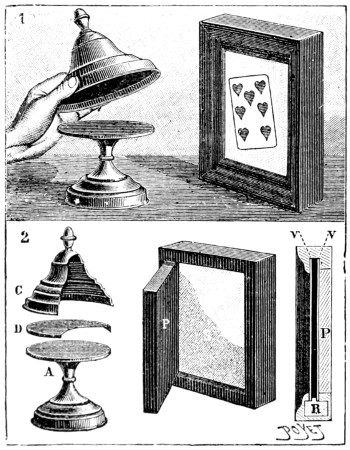
THE SAND FRAME.
In reality, there are two
glasses separated from each
other by an interval of three
millimeters. The lower side
of the frame is hollow and
forms a reservoir filled with
very fine blue sand. In the
interior the door is covered
with blue paper of the same
shade as the sand. The card,
portrait, or letter that is subsequently
to appear is placed
in the frame in advance, but,
in order to render it invisible,
the latter is held vertically,
the reservoir at the top. The
sand then falls, and fills the
space that separates the two
glasses, and the blue surface
thus formed behind the first
glass seems to be the back of
the frame. In order to cause
the appearance of the concealed
object, the frame is
placed vertically, with the
reservoir at the bottom, and covered with a silk handkerchief. In a few seconds
the sand will have disappeared. The door that closes the back may be opened
by a spectator and the frame shown close by, provided that it be held vertically
in order to prevent the sand from appearing between the two glasses.
Fig. 2 shows the frame as seen from behind. The door, P, is seen open,
and at S is seen the sand falling between the two glasses. In the section at the
side, V and V are the two glasses, P, the door, and R, the reservoir.
Another experiment may be made by means of a small standard on a foot,
A, upon which a spectator has placed the seven of hearts. The card passes into
the frame. To tell the truth, it is removed by the cover, C, along with the thin
disk, D, that covered the foot, A, and upon which it was placed. It will be
said that we have here to do with a double bottom. Allow the cover, C, before
covering the card, and the foot, A, after the experiment is finished, to be
examined. Is the cover asked for again? One will hasten to show it without
saying that the back edge of the table has just been struck with it in order to
cause the disk, D, and the card to fall on to the shelf.
This ball, which was recently seen in a toy shop, has the aspect, externally,
of the one used in the familiar toy known as the “cup and ball.” Extending
through its center there is a straight cylindrical aperture, and when a cord is
passed through the latter, the ball easily slides along it.
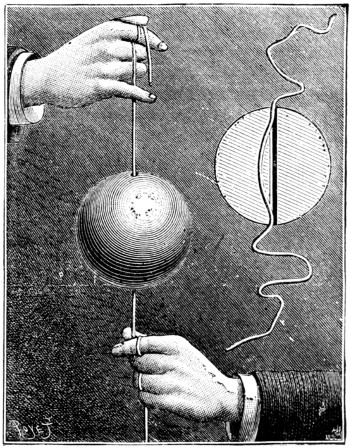
HOUDIN’S MAGIC BALL.
If a person who is in the secret holds the cord by its two extremities, things
change, since the ball, far from falling, descends very slowly along the string,
or even remains stationary, and does not move again until the operator allows
it to. This trick, which was formerly performed by Robert-Houdin with a ball
of large size, very much surprised spectators.
How does the affair work? That is explained in the section of the magic
ball shown in the figure. In addition to the central aperture, there is another
and curved one, which ends near the extremities of the axial perforation, and
a person in the secret, while making believe pass the cord through the straight
aperture, actually passes it through the curved one. It will now be apparent
that it is only necessary to tighten the cord more or less in order to retard or
stop the descent of the ball. To the left of the engraving is seen the magic
ball thus suspended between the operator’s hands.
The tricks performed by jugglers afford a most wonderful example of the
perfection that our senses and organs are capable of attaining under the influence
of exercise.
The juggler is obliged to give impetuses that vary infinitesimally. He
must know the exact spot whither his ball will go, calculate the parabola that
it will describe, and know the exact time that it will take to describe it. His
eye must take in the position of three, four, or five balls that are sometimes
several yards apart, and he must solve these different problems in optics,
mechanics, and mathematics
instantaneously, ten, fifteen,
twenty times per minute, and
that, too, in the least convenient
position—upon the
back of a running horse, upon
a tight-rope, upon a ball, or
upon a barrel that he causes to
revolve. His dexterity is wonderful.
Many jugglers are
content to perform their feats
of skill with their hands,
and, in addition, do balancing
worthy of remark.
FIG. 1.
We can obtain experimentally
some idea of the dexterity
shown by a juggler by
trying for ourselves the simplest
of his tricks. Whoever
is capable of throwing two
balls into the air at once, and
catching them in succession
while standing steadily in the
same spot, and without being
obliged to step to the right or left, or undergoing contortions, is endowed with
an undoubted aptitude for juggling. On the other hand, whoever can stand
upright upon a rickety chair without any feeling of fear, or cross a country
brook, not upon a tight-rope or wire (which would be too much to ask for a
début), but upon a plank of two hands’ width, and do this without a quick
palpitation of the heart, has an aptitude for tight-rope walking.
FIG. 2.
To perform with a couple
of balls, however, is quite simple,
and many children succeed
in it after a few days’
practice. They proceed as
follows: Having a ball in each
hand, they throw the one in
the right vertically into the
air, pass into the right the
one that is in the left and
throw this up too, receive the
first ball in the left hand,
and pass it into the right,
throw it up again, and so on;
so that the two balls are almost
constantly in the air,
save during the time it takes
to receive the ball with one
hand and pass it into the
other. If, instead of using
both hands, the child employs
but one, receiving and throwing
one ball while the other
is in the air, the difficulty is
greater, and the young man
who can perform this operation twenty times without dropping one of the
balls can treat the artist of the circus as a confrère. To perform with three
balls it is necessary to have been taught by a professor. Moreover, it should
be remarked that the art of juggling has sufficient advantages as regards the
development of the touch, the quick calculation of distances, the nimbleness of
the fingers, and the accuracy of the eye and of motion, to cause it to be added
to those gymnastic exercises which children are taught at school. It is to this
art that the celebrated prestidigitateur Robert-Houdin attributed the dexterity
and accuracy that he displayed in his tricks. In his memoirs, he relates that,
while taking some lessons from an old juggler, he applied himself so closely
to the exercises that at the end of a month he could learn nothing further
from his instructor. “I succeeded,” says he, “in performing with four balls,
but that did not satisfy my ambition. I wished, if it were possible, to surpass
that faculty of reading by appreciation, which I had so much admired in
pianists; so I placed a book in front of me, and, while the four balls were
flying in the air, accustomed myself to read without hesitation. It could not
be believed how much delicacy and certainty of execution this exercise communicated
to my fingers, and what quickness of perception it gave my eye.
After in this way rendering my hands supple and obedient, I no longer hesitated
to directly practice prestidigitation.”
In order to keep their hand in, professional jugglers have to exercise daily,
since a few days of voluntary or forced rest would necessitate double work in
order to give the hands their
former suppleness and dexterity.
As is well known, the
same is the case with the agility
of the danseuse, with
whom one day of rest often
means more than eight days
of double work.
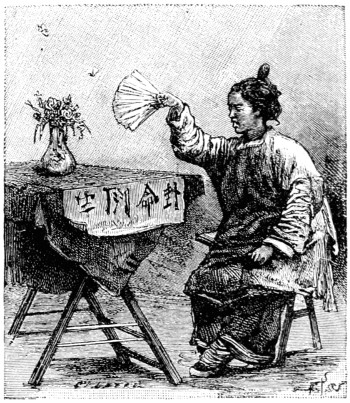
FIG. 3.
Some jugglers perform
with objects of the most diverse
nature, throwing up,
for example, at the same time,
a large ball, an orange, and
a piece of paper, and giving
these articles of different size
and weight such an impulsion
that each falls and is
thrown again at the moment
desired. Some jugglers, as
a support, use merely a simple
wooden bar held vertically,
and upon the top of which
they perform their various
feats of dexterity or contortion. It is the same apparatus formerly used by
Greek acrobats, and, by reason of its form, called πεταυρον (perch for fowls).
Some acrobats even balance themselves on the head at the top of this perch,
with their legs extended in lieu of a balancing pole. Their arms are free,
and they eat, drink, smoke, shoot off a pistol, perform with balls and daggers,
and, in a word, perform the most diverse feats (Fig. 2).
Some jugglers are capable of performing extremely curious feats of dexterity
with the most diverse objects; for example, with rings that they throw into
the air, with hats that they revolve by striking the rim, or with a flag or napkin
that they revolve. These hats and napkins no longer seem to obey the laws of
gravity. Others, by means of a streamer, form helices and graceful curves;
and others, again, by means of a simple bit of paper, succeed in reproducing
the Japanese butterfly trick. Japanese maidens are noted for performing
this with extraordinary grace and skill.
The application of mechanics to scenic and gymnastic displays has an interesting
exponent in the revolving trapeze, an exhibition which, after attracting
much attention in England, has come back to the United States.
In the smaller cut we illustrate the mechanism of the apparatus, while
the performance executed upon the apparatus is shown in the larger cut.
From the ceiling of the great auditorium is suspended a vertical three sided
rectangular frame open at the bottom. In its lower extremity is journaled at
the center a four-sided rectangular frame,
from whose extremities two trapezes hang.
To the upper side of the vertical frame
is secured a bicycle, which, by gearing
shown in the small cut, connects with the
axle of the lower frame, so that when
the cranks of the bicycle are worked
the lower frame is turned round and
round. It can be brought into accurate
balance by means of shot. The whole apparatus,
including the bicycle, is studded
with incandescent electric lamps, and the
performer who rides the bicycle wears a
helmet carrying electric lights. The very
striking performance is explained in great
measure by the cut.
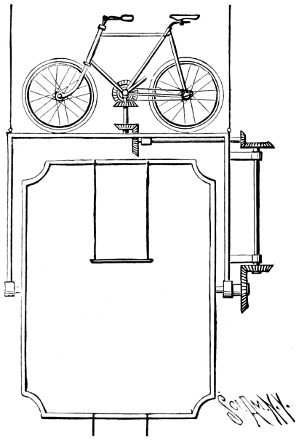
DIAGRAM OF THE REVOLVING TRAPEZE
One of the performers sits on the bicycle
and, turning the cranks, as if riding,
keeps the lower frame in rotation,
while two performers go through different
evolutions on the trapezes thus carried
around through the air. A switch board is placed at the head of the bicycle,
and by manipulating switches the vari-colored electric lights are turned on and
off so as to produce any desired effect. Independent of the high merit of the
performance simply as gymnastics, the mechanical points are of value; for ease
and safety of manipulation and security from any failure is an absolute essential.
No one has anything to do with its operation except the three performers,
so that it is constantly under their control. Where any attempt is
made to operate such mechanism from behind the scenes, there is always a
great liability of trouble or partial failure; but here the performer on the
bicycle does all the work of actuating the mechanical portion and has every
part under constant supervision and control, while the illuminated bicycle,
located as it is at great height from the floor, is an added attraction. The
length of the trapeze ropes, it will be observed, is so adjusted as to allow the
performer to pass through the frame without touching it, and the absence of
a center bar in the frame is necessary to the same end.
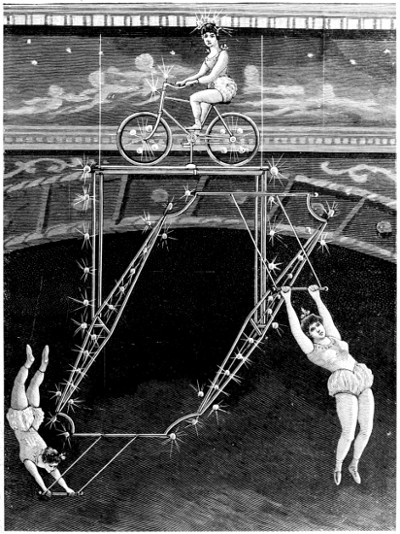
THE LEAMY REVOLVING TRAPEZE.
A performance of considerable scientific interest has been produced in this
and other cities which is presented in the accompanying illustration.[1] In
order to procure a perfectly smooth surface to walk on, a board twenty-four
and one-half feet long is suspended from the ceiling, and near one end of this
is a trapeze. The lower surface of the board is painted, and is smooth and
polished. The performer, who is known as Aimée, the human fly, is equipped
with pneumatic attachments to the soles of her shoes. Sitting in the trapeze
with her face to the audience, she draws herself upward by the arms, and raises
her feet until they press against the board. They adhere by atmospheric
pressure. She leaves the trapeze, and hangs head downward, as shown.
Taking very short steps, not over eight inches in length, she gradually walks
the length of the board backward. She then slowly turns round, taking very
short steps while turning, and eventually returns, still walking backward.
This closes the performance.
To provide against accident a net is stretched under the board. The performer
has frequently fallen, but so far no serious accident has happened.
There is a certain art in managing the fall, as, if the shock were received
directly by the spinal column, it might be very severe.
The attachment to the shoe is, in general terms, an india-rubber sucker
with cup-shaped adhering surface. It is a disk four and one-half inches in
diameter and five-eighths of an inch thick. To its center a stud is attached,
which is perforated near the end. This stud enters a socket fastened to the
sole of the shoe. The socket is also perforated transversely. A pin is passed
through the apertures, securing the hold between socket and disk. The socket
is under the instep and is attached to the shank of the shoe sole.
A wire loop that extends forward under the toe of the shoe is pivoted on
two studs which are secured on each end of the transverse central diameter of
the disk. This loop is normally held away from the disk and pressing against
the shoe sole by a spring. One end of the loop projects back toward and over
the rear edge of the disk. A short piece of string is secured to the india
rubber and passes through a hole in the extension, or rearwardly projecting
arm, of the loop. The disk when pressed against a smooth surface is held fast
by the pressure of the atmosphere. If now the loop is pressed toward the
surface to which it adheres, the string will be drawn tight and will pull the
edge of the india rubber away from the board. Air will rush in, and the
adhesion will cease. As each new step is taken, one disk is made to adhere by
pressure, and the other is detached by the action just described.
The power of the disk to sustain the weight of a performer may be easily
calculated.
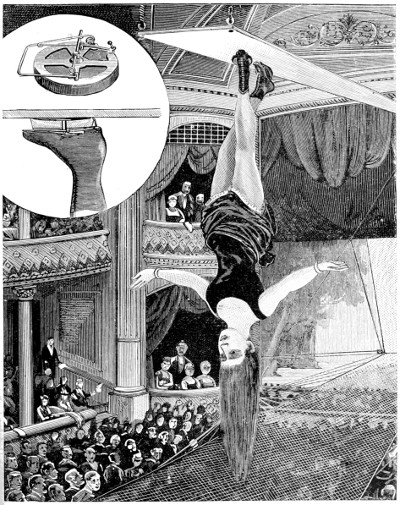
“AIMÉE,” THE HUMAN FLY.
Each sucker is 41⁄2 inches in diameter, and contains therefore 16 square
inches of surface. The full atmospheric pressure for the area would amount
to 240 pounds. The stud and socket attachment provides a central bearing, so
that the full advantage of this and the disk is obtained, and a fairly perfect
vacuum procured. As the performer only weighs about 125 pounds, there is
about 115 pounds to spare with a perfect vacuum.
At the circus of the Champs Elysées, at Paris, a performance was given
a few years ago that would really put the sagacity of the spectators to the test,
did not the performer explain it after his exhibition.
A ball, thirty inches in diameter, is brought into the ring and placed on
top of a sloping bridge formed of two planks with an intervening platform
(Fig. 1). All at once the ball begins to rock a little, and then moves to the
edge of the platform, whence one might expect to see it roll immediately to
the base of the inclined plane; but it does nothing of the sort. It stops at the
edge and begins to descend with precaution. It seems to hesitate, passes over
but a small space, then ascends a little, stops again, and then starts off again
in fine style. When it has reached the base of the inclined plane, the lower
extremity of which is about twenty inches from the ground, it stops, and then
rapidly ascends to the top again. Here the mystery begins to be explained.
All at once a flag is seen to make its exit through a small aperture, then a shot
is fired from the interior; the ball is certainly inhabited. This we soon have
proof of, for, after rolling rapidly to the base of the second inclined plane, it
falls upon a cushion placed upon the ground, where a man steps forth from it.
It is the clown Lepère. It is very surprising to see a man of such a stature
(five feet) make his exit from so small a ball.
Although we have seen “india-rubber men” who could place themselves
in so confined a space, we cannot compare their performance to that of M.
Lepère, who not only places himself within his ball, but moves therein with a
skill that is truly wonderful. It is necessary, in fact, to have a remarkable
sense of equilibrium and remarkable suppleness to be able, in such a position,
to continually displace the center of gravity of the ball and keep it always in
the vertical plane passing through the axis of the bridge. Our second engraving
shows how M. Lepère places himself. After the ball is closed, an equilibrium
exists only when he is seated.
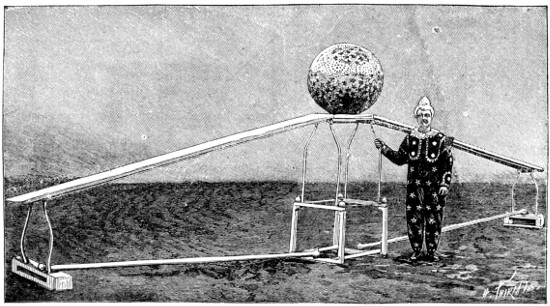
FIG. 1.—THE MYSTERIOUS BALL.
When he wishes to make his ball move forward, he must bend over and
walk upon his hands and knees, after the manner of a squirrel in his wheel.
But how many precautions have to be taken to make the axis of the body
coincide with that of the bridge, so that the ball shall not fall from the inclined
plane, which is but twelve inches wide! And what agility does it not require
to react immediately against the velocity acquired after the ball, in consequence
of a displacement, has begun to roll! Center of gravity, velocity, and
inertia are principles of mechanics that exhibitions of strength and dexterity
often put under contribution. Although clowns do not bother themselves
much with learning the principles of mechanics upon which their performances
are based, they apply them with wonderful dexterity and have a sort of
instinct, a special aptitude, which permits them quickly to find the position
of equilibrium. The performance that M. Lepère presents in so ingenious and
new a fashion is an evident proof of this.
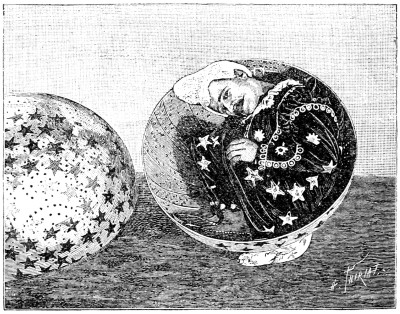
FIG. 2.—THE CLOWN IN THE MYSTERIOUS BALL.
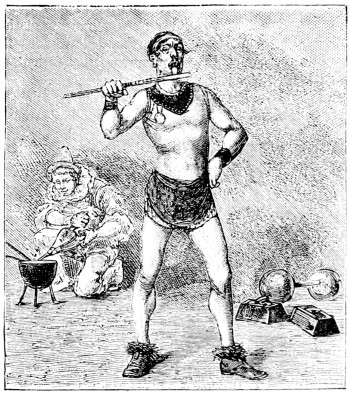
A MOUNTEBANK LICKING A RED-HOT BAR OF IRON.
Burning is undoubtedly that kind of pain against which the human
being most strongly revolts, and the fear of being burned is not confined to
man alone, but exists also as an instinct in the entire animal kingdom. This
fear, the horror of being burned, which is so powerful in men, accounts for
the fact that in all times the wonder and curiosity of the public have been
excited by those who are capable of handling burning coals or red-hot iron with
impunity, or of touching molten metal, and by those who are proof against flames
or burning water or oil. There are many examples in history of individuals
who are more or less fireproof, and the trials by fire in ancient and mediæval
times do not need to be cited here. It was not until about 1677 that the question
of the proof of man
against fire was looked at
from a scientific standpoint.
This was done by the physician
Dodart, a member of
the Academy of Sciences.
These studies were provoked
by the wonderful tricks
which were being performed
at that time in Paris by
an English chemist named
Richardson. Dodart explained
that these experiments
could be performed
without the aid of any
chemical preparation, by
taking a few precautions, and
also that the success of them
depended upon the hardening
that the epidermis may
acquire under the influence
of an oft-repeated action.
This hardening of the skin among laborers results in their frequently being
able to handle red-hot iron and lighted coals with impunity. This, however,
does not suffice to explain the tricks of those individuals who exhibit in public
as fireproof. The experiments of the Italian physician and chemist, Sementini,
have shown that there are preparations which, when put upon the skin, render
the latter absolutely insensible to contact with fire or incandescent materials.
His first experiments had no result; finally, after submitting himself to repeated
friction with sulphurous acid, he was enabled to apply a red-hot iron to his
skin with impunity. Continuing his experiments, he found that a solution of
alum had the same property. One day, having accidentally rubbed soap upon
the surface of a hand that had previously been impregnated with alum, he
found that the hand was still further proof against fire. He then discovered
that a layer of powdered sugar covered with soap sufficed to render his tongue
entirely insensible to heat. After all these experiments Sementini succeeded
in making himself much better proof against fire than was the charlatan who
first suggested the experiment to him.
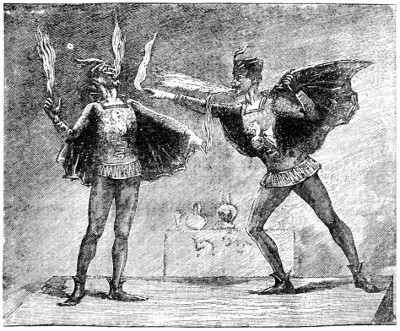
FIRE EATERS AT THE OLYMPIA THEATER, PARIS.
Fire eaters have always been very popular on the vaudeville stage, and we
present an engraving showing two fire eaters at the Olympia Theater, Paris.
When the performers appear upon the stage, they are clad in a tight-fitting
costume of a red color which represents that of the devils of fairy scenes.
The stage upon which they appear is but dimly lighted during their presence
upon it. The devils, after making their bow, go to the rear of the stage, and
put some preparations upon their hands; they come to the front of the stage
and cause very thin but brilliant flames to dart from their fingers; bringing
these flames near to their mouths, they seem to swallow them and then extinguish
them between their teeth. When the two devils touch each other’s hands
a crackling sound is heard, and long flames dart forth for a few seconds from
the tips of their fingers, which they continuously move. They subsequently
experiment without putting
anything in their mouths;
they blow with energy, and a
brilliant flame makes its exit
from between their lips. They
shoot forth a bed of flame for
a considerable length of time,
which certainly exceeds half
a minute. The combustion is
due to a very volatile essence.
Certain eaters of burning
tow proceed as follows: They
form a little ball of material
which they tightly compress
and then light, and allow to
burn up almost entirely.
Then rolling this in new tow
in order to guard the mucous
membrane in the mouth
against contact with the incandescent
ball, they breathe
gently, taking care while doing
so to inhale only through
the nose, and thus project
smoke and sparks.
MOUNTEBANK SWALLOWING BURNING TOW.
Another trick of the fire eaters is when they pretend to drink burning oil.
A little kerosene oil is poured into an iron ladle. The oil is now lighted, and
while the ladle is held in the left hand, an iron spoon is dipped into the oil as
though to take a spoonful; but in reality the spoon is only wet, and when it is
brought blazing to the mouth the operator throws back his head as though to
swallow it, and at the same time a slight puff is given by the breath, which
blows it out. This trick is very effective if well done, but the reader is
especially cautioned against trying any experiments in tricks of this kind, as
the results are apt to be dangerous except in the hands of experts. This will
be seen by what is called the sponge trick. Two or three small sponges are
placed in an iron ladle, gasolene is poured over them, only a sufficient quantity
being used to wet them; they must in no case drip. The sponges are now
set on fire, and the experimenter takes up one of them with his tongs, and,
throwing his head back, drops the blazing sponge into his mouth. He expels
his breath quickly all the time. Suddenly he closes his mouth; this cuts off
the oxygen necessary for combustion, and the flame immediately goes out. Performers
who present fire tricks for the amusement of a company frequently
try experiments which give a ghastly appearance to the audience. This is done
by pouring a few ounces of alcohol into a basin containing a handful of salt.
When this is lighted the complexion of everyone is hideous. A slightly different
effect is used by infusing saffron in alcohol for a number of hours, and then
adding salt as before; it is usually poured upon tow which is lighted. There
are some liquids that have the property of taking fire and burning without
injuring the object upon which they are poured and without producing any
painful sensation upon the skin. As a usual thing such liquids are very volatile
and consist of essential oils, ether, etc. The reason that some substances
can be burned without injuring them, or upon the skin without burning, are
explained as follows: These substances are very volatile, and their tension is
considerable, and, in reality, when they are burning, it is merely their vapor
which is on fire. This vapor then tends to borrow heat from the liquid,
whence the latter may remain at a relatively low temperature while the surface
is on fire. This is a reasonable explanation of the curious phenomenon of the
burning liquid.
The sword employed is a simple, thin, flexible blade of steel, not at all
sharp, and the plan of which is seen at A in the accompanying cut. The
point is sufficiently blunt to prevent it from doing any harm.
As for the prestidigitateur, whose body the sword will simply pass around,
but not pierce, he carries concealed beneath his vest a sort of sheath that consists
of a tube of rectangular section, and semicircular in shape, and the two
extremities of which are bent in contrary directions in such a way that they
are situated in the same straight line, the two orifices opening in front and
behind at right angles with the abdomen. This apparatus, B, is held in place
by cords attached to two small rings at the two extremities of the tube.
It is the prestidigitateur himself who, appearing instinctively to grasp the
point of the sword as if to protect himself, directs it into the metallic tube.
It makes its exit between the tails of the coat. It might be made to come out
at the center of the back, but in this case it would be necessary to have an
aperture formed in the seam of the coat. The illusion produced is complete,
seeing that the flexible blade straightens out on making its exit from the
tube, on account of the form of the latter’s extremity. It is necessary to
operate rapidly, so that the spectators shall not have time to see that the length
of the sword has diminished at this moment, the curved line that it follows not
being the shortest passage from one point to another.
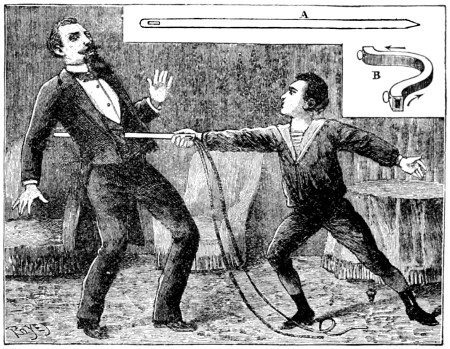
A SWORD TRICK.
The figure represents a variant of the trick in which the sword is provided
with an eye through which a long red ribbon is passed, and which follows the
blade when the latter is pulled out at the opposite side of the body.
Japanese jugglers, as well known, are possessed of very extraordinary skill.
A few years ago two of them performed the following feat, which required
a wonderful dexterity. One of them stood, with arms extended, in front of
a thick board placed vertically; and the other, armed with a number of wide-bladed
knives, stationed himself at a distance of about six yards from the
board, and from thence threw the knives with a sure hand and stuck one of
them in the board just above the head of the target, two of them very close to
the right and left of the neck, and others around the arms; in a word, he outlined
the form of his companion with the knives stuck very deeply into the
board. This performance met with extraordinary success, and an effort was
at once made to reproduce it; but as such dexterity is not possessed by everybody,
and as, in addition, the operation is dangerous, the following substitute
was devised by M. Voisin for the use of prestidigitateurs.
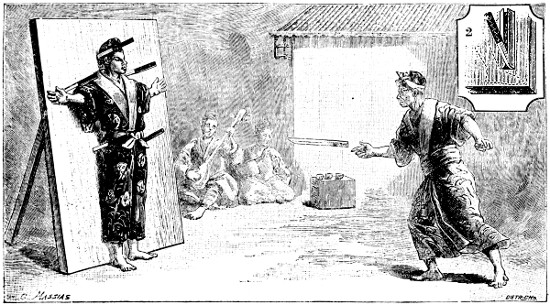
JAPANESE KNIFE-THROWING EXECUTED BY MEANS OF A MECHANICAL DEVICE.
FIG. 2.—DETAILS OF THE MECHANISM THAT CAUSES THE KNIFE TO APPEAR.
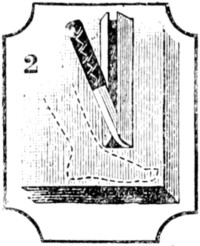
The board that is employed in this case, instead of being, as in the genuine
performance, a simple one, is a piece of cabinet work containing an ingenious
mechanism. The place which the human target will occupy on this
board is carefully marked, and the knives that are to be stuck into the board
in succession around such place are contained in the cabinet work, which, at
first sight and at a short distance, seems to be absolutely without preparation.
Each of these knives is fixed by its point upon a pivot. In addition, it is
controlled by a spring, and is concealed within the board by a very finely
adjusted double-valved window, which, at the proper moment, opens and
allows it to appear, and then closes. The spring causes the knife to fall or rise
according to the place that the latter is to occupy. No. 2 of the engraving
shows the window opening to allow of the fall of the knife, which will appear
as if stuck into the board just above the instep. In each of the valves the
angles that meet each other are cut slopingly either at the top or bottom,
according as the knife is to fall or rise, in order to make space for the blade
when the valves are closed. Before the exit of the knife, the incision is closed
with modeling wax the color of the wood. In our engraving the incision is at
the bottom.
Naturally the knives are concealed in the board in such a way that on
making their exit the field shall be free, and that they shall not come into contact
with the limbs of the target. Each of these knives, with its window,
forms a distinct apparatus, which is controlled by a rod that ends at the edge
of the board just at the place where the fingers of the human target can reach
them. It is he who, by pressing upon the ends of the rods as if upon the
keys of a piano, causes the blades to come out of their place of concealment,
one after another, and appear as if they had just stuck into the board. The
sound made by the spring in expanding and the sudden appearance of the
knife, combined with the motion of the person throwing it, affords a complete
illusion. Let us add that each knife mounted on a pivot at its point, as we
have explained, may be easily disengaged from its axis when, after the operation,
the person who threw the knives makes believe to pull them out by force
from the wood in which they seem to be inserted.
The board having been invented, it became necessary to find a method of
throwing the knives in such a way as to cause them to disappear. To this
effect the board is placed on one side of the stage, near the side scenes, and
the person who throws the knives stations himself on the other side of the
stage, near the opposite side scenes, and he can therefore act in two ways, viz.,
first, in poising his arms to take aim, he can, at the last moment, throw the
knife between the side scenes back of him while he takes a step forward. The
knife supposed to be thrown thus disappears completely at the desired moment,
but, since the spectators do not see the flash of the blade, traversing the stage,
it is preferable to employ the second method. This consists in a genuine
throwing of the knife, but in such a way as to cause it to pass by the board
and fall between the side scenes, where the sound of its fall is deadened by
some such material as a piece of carpet. In both of these two methods, it is
for the human target to press the spring of the knife that he wishes to make
appear at just the precise moment, in order that the click of the expanding
spring may be taken by the spectators for the sound of the knife sticking into
the wood.
This trick, when well executed, has often deceived the shrewdest spectators,
and that, too, with so much the more facility in that many had seen the
Japanese perform in the middle of a circus, where it was impossible to conceal
the knife, since it could be followed by the eye in its travel from the hand
of the Japanese to the point where it penetrated the board.
To be precise, and to omit no information, let us say in conclusion, that
there exist boards in which the freeing of the knives is effected by the pulling
of a thread held in the side scenes by a third party. This process has the
advantage that there is no danger of the spectators seeing the manipulation of
the rods; but, on the other hand, it has its inconveniences, viz., in a place
where a communication cannot be established between the invisible confederate
and the mechanical board, the use of it is impossible, and it is necessary to
employ the other method.
When a physician introduces his finger, the handle of a spoon, or a pencil
into the throat of a patient, the latter experiences an extremely disagreeable
sensation. Any touching of the pharynx, however slight it be, causes
strangling, pain, and nausea, and the organ reacts with violence against the
obstacle that presents itself to free respiration. There is no one who has not
more than once experienced this disagreeable impression, and for this reason
we are justly surprised when we meet with people who seem to be proof
against it, and who, for example, introduce into their pharynx large, solid, and
stiff objects like sword blades, and cause these to penetrate to a depth that
appears incredible. It is experiments of this kind that constitute the tricks of
sword swallowers.
These experiments are nearly always the same. The individual comes out
dressed in a brilliant costume. At one side of him there are flags of different
nationalities surrounding a panoply of sabers, swords, and yatagans, and at
the other, a stack of guns provided with bayonets. Taking a flat saber, whose
blade and hilt have been cut out of the same sheet of metal, the blade being
from fifty-five to sixty centimeters in length, he introduces its extremity into
his throat, taps the hilt gently, and the blade at length entirely disappears.
He then repeats the experiment in swallowing the blade at a single gulp. Subsequently,
after swallowing and disgorging two of these same swords, he
causes one to penetrate up to its guard, a second not quite so far, a third a
little less still, and a fourth up to about half its length, the hilts being then
arranged as shown in our third illustration (C).
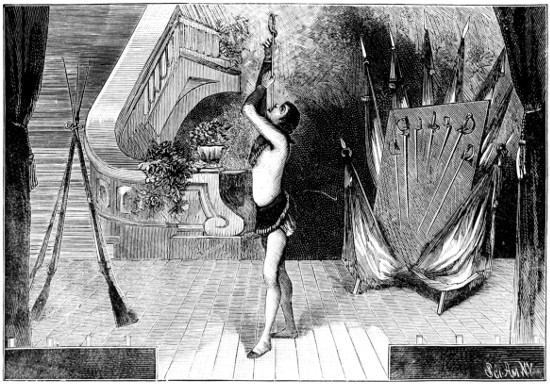
A SWORD SWALLOWER.
Pressing now on the hilts, he swallows the four blades at a gulp, and then
he takes them out leisurely one by one. The effect is quite surprising. After
swallowing several different swords and sabers, he takes an old musket armed
with a triangular bayonet, and swallows the latter, the gun remaining vertical
over his head. Finally he borrows a large saber from a dragoon who is present
for the purpose, and causes two-thirds of it to disappear. As a trick, on being
encored, the sword swallower
borrows a cane from a person
in the audience, and swallows
it almost entirely.
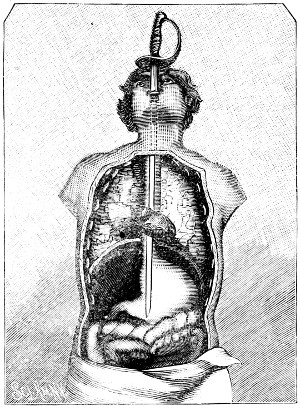
POSITION OCCUPIED BY THE SWORD BLADE
IN THE
BODY.
A certain number of spectators
usually think that the
performer produces an illusion
through the aid of some trick,
and that it is impossible to
swallow a sword blade. But
this is a mistake, for sword
swallowers who employ artifices
are few in number and
their experiments but slightly
varied, while the majority
really do introduce into their
mouths and food passages the
blades that they cause to disappear.
They attain this result
as follows:
The back parts of the
mouth, despite their sensitiveness
and their rebellion
against contact with solid
bodies, are capable of becoming
so changed through habit
that they gradually get used to abnormal contacts. This fact is taken
advantage of in medicine. It daily happens that persons afflicted with disorders
of the throat or stomach can no longer swallow or take nourishment,
and would die of exhaustion were they not fed artificially by means of the
œsophageal tube. This latter is a vulcanized rubber tube which the patient
swallows, after the manner of sword swallowers, and through the extremity
of which milk or bouillon is introduced. But the patient, before being able
to make daily use of this apparatus, must serve a genuine apprenticeship.
The first introduction of the end of the tube into the pharynx is extremely
painful, the second is a little less so, and it is only after a large number of
trials, more or less prolonged, that the patient succeeds in swallowing ten or
twelve inches of the tubing without a disagreeable sensation.
The washing out of the stomach, performed by means of a long, flexible
tube which the patient partially swallows, and with which he injects into and
removes from his stomach a quantity of tepid water by raising the tube or letting
it hang down to form a siphon, likewise necessitates an apprenticeship of
some days; but the patient succeeds in accustoming his organs to contact with
the tube, and is finally able, after a short time, to swallow the latter with
indifference, at least.
With these sword swallowers it is absolutely the same; for with them it
is only as a consequence of repeated trials that the pharynx becomes sufficiently
accustomed to it to permit them to finally swallow objects as large and rigid as
swords, sabers, canes, and even billiard cues.
Swallowers of forks and spoons serve an analogous apprenticeship. As
known, the talent of these consists in their ability to introduce into the throat
a long spoon or fork while holding it suspended by its extremity between two
fingers. This trick is extremely dangerous, since the œsophagus exerts a sort
of suction on all bodies that are introduced into it. The spoon or fork is,
then, strongly attracted, and if the individual cannot hold it, it will drop into
his stomach, whence it can only be extracted by a very dangerous surgical
operation—gastrotomy. It was accidents of this kind that made the “forkman”
and the “knifeman” celebrated, and, more recently, the “spoonman”
who died from the effects of the extraction from his stomach of a sirup spoon.
All sword swallowers do not proceed in the same way. Some swallow the
blade directly, without any intermediate apparatus; but in this case, their
sabers are provided at the extremity, near the point, with a small bayonet-shaped
appendage over which they slip a gutta-percha tip without the spectators
perceiving it (F and G). Others do not even take such a precaution, but
swallow the saber or sword just as it is.
This is the mode of procedure of an old zouave, especially, who has become
a poor juggler, and who, in his experiments, allows the spectators to touch,
below his sternum, the projection that the point of the saber in his stomach
makes on his skin.
But the majority of sword swallowers who exhibit upon the stage employ a
guiding tube which they have previously swallowed, so that the experiments
they are enabled to perform become less dangerous and can be varied more.
This tube, which is from forty-five to fifty centimeters long, is made of very
thin metal. Its width is twenty-five millimeters, and its thickness fifteen (B).
These dimensions permit of the easy introduction of flat-bladed sabers, among
other things, and of the performance of the four-sabers experiment, and of the
introduction of sabers and swords of all kinds.
To explain the latter from a physiological standpoint, the saber swallowed
by the performer enters the mouth and pharynx first, then the œsophagus,
traverses the cardiac opening of the stomach, and enters the latter as far as
the antrum of the pylorus—the small cul-de-sac of the stomach. In their
normal state these organs are not in a straight line, but are placed so by the
passage of the sword. In the first place, the head is thrown back so that the
mouth is in the direction of the œsophagus, the curves of which disappear or
become less; the angle that the œsophagus makes with the stomach becomes
null; and, finally, the last-named organ distends in a vertical direction and
its internal curve disappears, thus permitting the blade to traverse the stomach
through its greater diameter; that is to say, to reach the small cul-de-sac. It
should be understood that before such a result can be attained the stomach
must have been emptied through fasting on the part of the operator.
The depth of fifty-five to sixty centimeters to which these men cause their
instruments to penetrate, and which seems extraordinary to spectators, is
explained by the dimensions
of the organs traversed. Such
lengths may be divided thus:
Mouth and pharynx, 10 to
12; œsophagus, 25 to 28; distended
stomach, 20 to 22—55
to 62 centimeters.
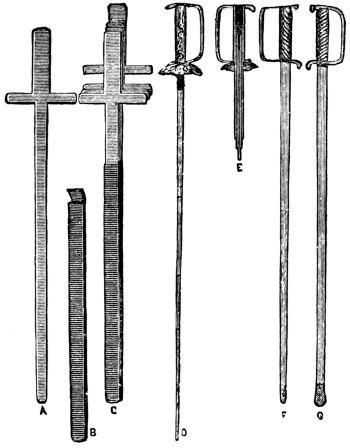
VARIOUS APPARATUS FOR SWORD SWALLOWERS.
According to the stature
of the individual, a length of
organs of from 55 to 62 centimeters
may give passage to
swallowed swords without inconvenience.
Sword swallowing exhibitors
have rendered important
services to medicine. It was
due to one of them—a swallower
of both swords and pebbles—that,
in 1777, a Scotch
physician, Stevens, was enabled
to make the first studies upon
the gastric juice of human beings.
In order to do this, he
caused this individual to
swallow small metallic tubes
pierced with holes and filled
with meat according to Reaumur’s method, and got him to disgorge them again
after a certain length of time. It was also sword swallowers who showed
physicians to what extent the pharynx could become habituated to contact; and
from this resulted the invention of the Foucher tube, the œsophageal tube,
the washing out of the stomach, and the illumination of the latter organ by the
electric light.
It sometimes happens that sword swallowers who exhibit in public squares
and at street corners are, at the same time, swallowers of pebbles, like him
whose talents were utilized by Stevens; that is to say, they have the faculty of
swallowing pebbles of various sizes, sometimes even stones larger than a hen’s
egg, and that, too, to the number of four, five, or six, sometimes more, and of
afterward disgorging them one by one through a simple contraction of the
stomach. Here we have a new example of the modification of sensitiveness
and function that an individual may secure in his organs by determination and
constant practice.
In conclusion, let us say a word in regard to the tricks that produce the
illusion of swallowed swords or sabers. One of these, which deceives only at
a certain distance, consists in plunging the saber into a tube that descends along
the neck and chest, under the garments, and the opening of which, placed near
the mouth, is hidden by means of a false beard. Another and much more
ingenious one, which has been employed in several enchantment scenes, is that
of the sword whose blade enters its hilt, and which is due to M. Voisin, the skillful
manufacturer of physical apparatus. In its ordinary state this sword has a
stiff blade, eighty centimeters in length, which, when looked at from a distance
of a few meters, presents no peculiarity (see D in our engraving); but
when the exhibitor plunges it into his mouth, the spectator sees it descend by
degrees, and finally so nearly disappear that but a few centimeters of the blade
protrude. In reality, the blade has entered into the hilt, for it possesses a
solid tip that enters the middle part, which is hollow, and these two parts
enter into the one that forms the base of the sword. The blade is thus reduced
to about twenty-five centimeters, a half of which length enters the hilt.
There then remain but a few centimeters outside the exhibitor’s mouth, so that
he seems to have swallowed the sword (see G and E). This is a very neat trick.
Of all the daring tricks that have been introduced in the circus, none have
caused more comment than the one in which a person, generally a lady, walks
with bare feet up a ladder of sharp swords, treading directly on the sharp edges
without any injury to the feet.
It is amusing to a person who is acquainted with the secret to hear the
many explanations of “how it is done” offered by the spectators, yet none of
them ever come near guessing the truth. This secret has been so jealously and
successfully guarded that very few, even among the best informed experts,
know how it is performed.
From the illustration it will be seen how the swords are arranged in a rack
with the cutting edges on top. The rack is usually about seven feet high, and
eight swords are used. One of the most necessary points in the preparation for
the trick is that the rack should stand firm, and the swords fit snug and tight
in the slots made to receive them.
Usually the inspectors are invited to examine the rack as well as the swords,
and paper is cut with the swords to show that they are really sharp. The
secret is not in the swords or rack, but in the preparation of the performer’s
feet. In a pint of water as much alum is dissolved as the water will readily
take up. To the alum water is added as much zinc sulphate, thoroughly
dissolved, as will lie on a silver dime.
A few minutes before doing the act the performer bathes the feet in this
solution and allows them to dry without wiping. Just before leaving the
dressing-room the feet are dipped for a moment in as cold water as can be
secured, and at once wiped dry without rubbing.
By placing the feet squarely on the swords there is no danger, but great
care must be used not to allow the foot to slide or slip on the sword, or the
result would be a very bad accident.
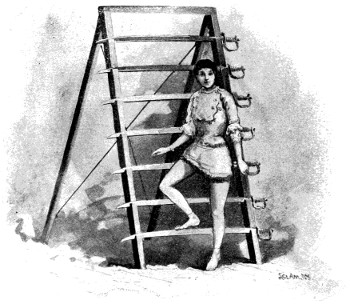
SWORD WALKER.
On leaving the circus in which one has seen the above act, visitors are almost
sure to see before the ever-present side show a large painting on which is the
representation of a Mexican dancing with bare feet in a shallow box filled with
broken glass.
If you are of an inquisitive nature, and have seen a lady walk with bare feet
up a ladder of sharp swords, you enter the side show to see this new wonder.
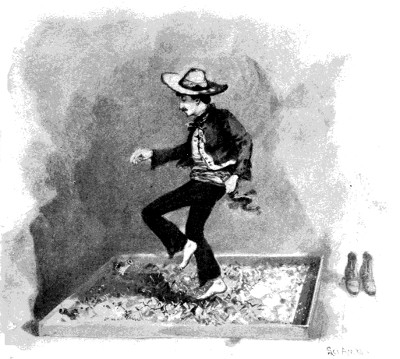
GLASS DANCER.
On a raised platform is found a box about four feet long, three feet wide,
and six inches deep, the bottom of which is covered with broken glass. In a
few moments a man dressed in the Mexican costume appears on the platform and
proceeds to break a few old bottles and throw the broken glass in the box, then
removes his shoes, shows his feet to be free from any covering, steps in the box,
and dances among the glass. After he has finished dancing he shows his feet
to be uninjured, and retires. The trick is performed in the following manner:
Secure a number of thick glass bottles, break them in rather small pieces
and file or grind all the sharp edges round. This stock of glass you place in the
center of a box made according to above measurement. Now soak your feet in
strong alum water and wipe dry, and give them a thorough rubbing with pulverized
rosin. Dust the inside of your shoes with rosin, put them on, and go
upon the platform. Take some old lamp chimneys and bottles, break them in
bits, and throw this fresh broken glass in the box, around the edges and in the
corners, not in the center. Remove your shoes, step in the center of the box,
among the prepared glass, and do your dancing. Avoid the sides or corners of
the box, where you have thrown the glass, and you run no risk of cutting your
feet, especially if you use plenty of rosin. The amateur hardly needs to be
informed that such tricks should be left entirely to professionals.
Ventriloquists may, according to their specialties, be divided into various
categories. Some devote their talent to the imitation of the cries of animals,
the songs of birds, the noise of tools, etc.; others imitate the sound of musical
instruments; some mock the noise produced by a crowd, a regiment, or a procession;
while others, again, make dolls or dummies speak.
Certain ventriloquists imitate the sound of musical instruments, from that
of the violin up to that of brass instruments with the most piercing notes.
Others excel in imitating the noise of the plane, saw, etc.
Certain ventriloquists, while hidden by a screen simply, have the faculty of
making their audience believe that several persons, or even a crowd, are in the
vicinity.
At Egyptian Hall, London, a magician recently made his appearance upon
the stage, carrying a doll, with which he held a somewhat uncouth conversation.
The lips of the doll were observed to move, and the illusion was complete,
when all at once the doll’s head was strangely transformed. The
magician had just opened his hand, showing that it was the latter alone that—inclosed
in a white glove upon which were a few colored marks—formed the
doll’s head.
In our engraving may be seen two methods of arranging the fingers for
forming a doll’s head with the hand. The illusion is produced by making a
few simple lines with charcoal, and wrapping a handkerchief or napkin
around the hand; then, if one has a little aptness for ventriloquism, he may
hold a conversation with the head.
In our time, most ventriloquists who exhibit in public considerably facilitate
the illusion that they desire to produce by using large articulated dummies,
which they make speak and sing, and talk to one another—each in a
different voice. These figures are so constructed that the ventriloquist’s hands
can move their arms and legs, turn their heads to the right or left, give their
shoulders a shrug, open or close their eyes, and move their lower jaws in such a
way that their mouths seem to utter the words that the spectator hears.
We may say, in a general way, that these ventriloquists, thanks to the use
of their dummies, succeed in producing so complete an illusion that people
are frequently persuaded that the voice heard actually comes from the mouth
of the figure, and that it does not proceed from the ventriloquist standing
near the latter, but from a confederate hidden somewhere about, whose voice
is heard through the intermedium of a speaking-tube.
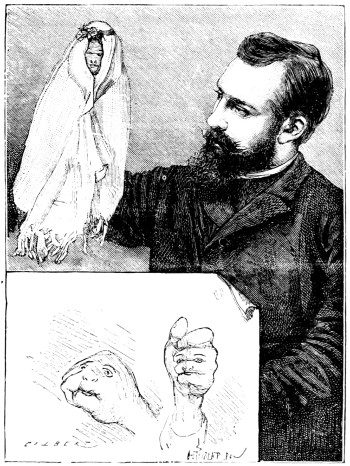
METHOD OF MAKING FACES WITH THE HAND.
There is one trick that always tends to confirm the spectator’s illusion, and
that is this: in the little prefatory speech that the ventriloquist makes, he
gives out that he is a foreigner, and does not speak the language of his audience
well; in fact, he expresses himself with difficulty and with a strong accent.
His dummies, on the contrary, answer in very good French or English, as the
case may be; and when the auditors hear them, they are led to believe that
ventriloquism counts for nothing in their answers or conversation.
Explanation of Ventriloquism.—The art of ventriloquism is primarily
based upon an acoustic phenomenon—the difficulty that the ear experiences in
determining the exact point whence comes the sound that it hears. That there
is such an incertitude as to the direction of sounds is easily verified, and the
following are a few cases in proof of it. Mr. Stuart Cumberland, a mind
reader, who exhibited at Paris a few years ago, performed a little experiment in
the drawing-room, after his “second-sight” séances, which usually resulted
in surprising and amusing his auditors. In this experiment, a willingly disposed
person, being seated in the middle of the room, allowed his eyes to be
bandaged. Then Mr. Cumberland took a five-franc piece and made it jingle
by striking it with a hard object, say a key or another coin. The person submitted
to the experiment then had to tell the direction from whence the sound
emanated, and to give the distance at which it seemed to him to have been
made. In almost all cases the individual guessed a direction and distance
very different from the real one, and the error, which was ofttimes great, naturally
provoked great hilarity from the spectators. Moreover, Mr. Cumberland,
by varying the position of his hand in such a way that the latter formed
a screen between the coin and the ear of the blindfolded person, caused the
latter’s perception as to the direction of the sound to vary, although, as a
matter of fact, the experimenter had not budged from his first position.
At a soirée, we have seen a member of the Institute, who had cheerfully
submitted himself to the experiment, extremely surprised, when his bandage
was removed, at the gross errors in auditory perception that he had just committed.
The illusion that it is thus possible to produce by varying the positions
of the hand in which a coin is jingled is, in the main, analogous to that
obtained through ventriloquism. Another example: If several persons be
standing in the same line, at a few feet from a spectator, and one of them
emits a prolonged sound—a vowel, for example, say a a a—that requires no
motion of the lips, the spectator will be unable to determine from which of
the persons the sound proceeds; or if, moreover, he tries to point the one out,
he will be almost certain to commit an error, the person designated by him
being the third or fourth to the right or left of the one who actually produced
the sound.
In the choruses of operas, an endeavor is made to have an agreeable aspect in
addition to vocal qualities; and, as a beautiful voice is not always accompanied
with a pretty face, it often happens that in the first row of a chorus they will
place pretty supernumeraries, who, although not obliged to sing, open their
mouths and make believe pronounce words, while in reality the singing is
being done only by their companions in the rear. This fraud is very rarely
detected by the audience.
If a man standing near a child should, without moving his lips, speak with
a squeaking voice, while the child was making believe pronounce words, it
might easily be believed that the words heard were being spoken by the child.
It is possible to teach a dog to open his mouth and follow the motions of his
master’s hand; and if the master be any sort of a ventriloquist, he can easily
make believe that he has an animal endowed with speech.
The ventriloquist who, standing near his dummies, succeeds in keeping
his facial muscles absolutely immovable, while his figures become animate and
move their lips and seem to speak, produces such an illusion among the spectators
by virtue of the acoustic principle that we have just noted; that is, the
difficulty that the ear experiences in determining the precise point whence
emanates the sound that it hears.
It is to be remarked that the chief difficulty in the art of ventriloquism is
to keep the countenance immovable, and to speak without causing any of the
facial muscles to act.
The ventriloquist who talks with a dummy that is interrogating him,
addresses his questions in an ordinary voice, articulates distinctly, and plainly
moves his lips; but when
the dummy answers, the
ventriloquist’s face no longer
contracts, and his lips
scarcely part except to
smile. The facial immobility
preserved by him
while he is really speaking,
then, can be explained
by recalling a few principles
of grammar, which
are merely applications of
the physiology of the voice.
Articulate speech, which
separates the language of
man from that of the lower
animals, is divided, as grammar
teaches, into sounds
and articulations. The
sounds or vowels are made
up of all the continuous
and uniform noises that
the vocal organs can emit. Thus a, e, i, o, and u are vowels, because
they may be infinitely prolonged; a a a a a a, for example. There are a
greater number of vowels than is usually admitted in writing; it is possible,
in fact, to modify them to infinity, so to speak, by a slightly more open or
more closed sound. They may be classified in the form of gamuts, each
having a typical vowel, the entire corresponding series of which is but the
result of a more and more pronounced contraction of the lips, without the
tongue and other vocal organs having to undergo the slightest modification.
| FIRST SERIES, VOWEL A. |
| |
|
á |
|
|
| |
| |
|
a |
|
| |
| |
|
à |
|
| |
| |
|
â |
|
| |
| |
|
ó |
|
| |
| |
|
õ |
|
| |
| |
|
ô |
|
| |
| |
|
ou |
|
| |
| |
|
oû |
| |
| SECOND SERIES, VOWEL E. |
| |
|
|
è |
|
|
| |
| |
|
é |
|
| |
| |
|
ée |
|
| |
| |
|
e |
|
| |
| |
|
eu |
|
| |
| |
|
eûx |
|
| |
| THIRD SERIES, VOWEL I. |
| |
|
|
i |
|
|
| |
| |
|
î |
|
| |
| |
|
u |
|
| |
| |
|
û |
|
| |
FIG. 2.—CLASSIFICATION OF THE VOWELS.
These type-vowels and their descending gamuts are shown in Fig. 2.
If, in pronouncing each of these vowels, we draw the base of the tongue
toward the back of the throat, without changing the position of the lips or
tongue, we shall obtain the nasal sound thereof. The chief of such sounds
are:
an, nasal sound of a;
on, nasal sound of o;
then,
en, in nasal sound of é;
eun, un, nasal sound of eu.
The vowels i and u have no nasal sounds, because of the back position
that the base of the tongue naturally occupies in pronouncing them, and
which is but slightly modified when we endeavor to give them a nasal sound.
What precedes may be called the theory of the vowels. From the standpoint
of ventriloquism, we must remark that, in order to pronounce the vowels,
no motion of the lips is necessary; but it will suffice to allow the latter to
remain slightly parted in order to give passage to the sound—this being generally
done by the ventriloquist through the aid of a smile, that seems to be provoked
by the interest that he takes in the talk of his dummies.
All the modifications in the organs necessary for passing from one vowel to
another, as in the diphthongs oa and aé, or when they suppress certain intermediate
articulations, are easily obtained by the ventriloquist by the aid of the
tongue and the interior organs of the mouth, without causing the lips and
facial muscles to undergo the slightest motion or the least contraction; or, in
other words, without any visible sign exhibiting itself to the eyes of the spectators.
The pronunciation of the vowels, then, constitutes no difficulty for
the ventriloquist. The same is not the case with the articulations or consonants,
the pronunciation of some of which is a difficulty that the ventriloquist
can overcome only by virtue of practice and skill, or again by an approximate
pronunciation—the articulation difficult to pronounce without moving the
facial muscles being replaced by another which gives nearly the same sound,
but which is obtained with the internal vocal organs of the mouth.
The consonants may be classed by categories, according to the vocal organs
employed for pronouncing them. In each category they are divided into strong
and weak, and, as regards ventriloquism, they comprise two series. A classification
of them is given in Fig. 3.
Upon examining this table, it will be seen that, in the entire first series of
these consonants, the tongue, acting upon the pharynx, bearing against the
teeth, or taking different shapes, can act and articulate without the aid of the
lips, and without the necessity of the facial muscles contracting. The ventriloquist,
then, will be able to pronounce any word in which none but these
vowels and consonants enter, without moving his facial muscles.
The same is not the case with the consonants of the second series, that is
to say, with the five labials, f, v, p, b, m. The ventriloquist’s art consists in
pronouncing these without moving the lips or facial muscles. With a little
practice it is easy to reach such a result with f and v, which may be pronounced
by causing only the interior muscles of the lips to act; p and b, and
m especially, present a greater difficulty, and we may say that, in most cases,
ventriloquists who wish to keep their lips perfectly motionless pronounce none
of these three consonants distinctly, but usually substitute for them a sound
bordering on that of the letter n.
It is partly for this reason that ventriloquists succeed much better in imitating
the language of children, or that of persons of slight education.
So, upon the whole, the illusion produced by ventriloquists is the result,
primarily, of an acoustic phenomenon, the uncertainty of the sound’s direction,
and, secondarily, of a habit acquired of speaking without moving the
facial muscles.
Those ventriloquists who, without accessories, have the power of throwing
their voices almost anywhere, succeed therein by utilizing the same principle of
acoustics that we have explained above. As for the exact point whence the
sound proceeds, the ventriloquist usually takes care to show that by an expressive
motion and by looking in that direction, and by designating it, too, with
his finger, while his face expresses great fear, interest, or surprise. So the
spectator easily persuades
himself that the sound does
really come from the exact
spot that is thus pointed out
to him in a seemingly unintentional
manner.
The words are often pronounced
very indistinctly by
the mysterious voice, but
the ventriloquist takes care,
as a general thing, to render
them intelligible by repeating
them in his ordinary
voice, by accenting them,
and by commenting upon
them. He thus persuades his
auditors that these are the
very words that they heard.
FIRST SERIES.—CONSONANTS FORMED
BY THE INTERNAL VOCAL ORGANS. |
| |
Strong. |
Weak. |
| Gutturals |
c |
g |
| Palatal linguals |
l |
ill |
| Dental linguals |
r |
|
| Dentals |
t |
d |
| Palatal dentals |
n |
gn |
| Dental sibillants |
s |
z |
| Guttural sibillants |
ch |
j |
| SECOND SERIES.—LABIAL CONSONANTS. |
| |
Strong. |
Weak. |
| Sibillant labials |
f |
v |
| Simple labials |
p |
b |
| Aspirated labials |
m |
|
FIG. 3.—CLASSIFICATION OF THE CONSONANTS.
In order to produce a muffled sound that seems to come from afar or from
an inclosed place, the ventriloquist arranges his tongue in such a way that its
base, upon bearing against the soft palate, shall form a sort of diaphragm that
allows but very little of the voice to pass. If, then, the ventriloquist articulates
his words with a strong guttural voice, the sound will appear to come
from the earth, from a grotto or cavern, or from a box, or cask, or closet. If,
on the contrary, the tongue being in the same position, the ventriloquist speaks
with a sharp voice, he will produce the illusion of a voice coming from the
ceiling, or from some high place, such as the top of a tree or the roof of a
neighboring house. But, in both cases, in order to effect the emission of this
muffled, somewhat indistinct, voice, the ventriloquist keeps his lungs distended,
and emits as little breath as possible in pronouncing.
Richerand, the celebrated physiologist, who had an opportunity of examining
the ventriloquist Fitz-James, says: “His entire mechanism consists in a
slow and graduated expiration, which is, after a manner, protracted, and which
is always preceded by a strong inspiration, by means of which he introduces
into his lungs a great volume of air, which he carefully husbands.”
As for the modifications to be introduced into the usual position of the organs
in order to obtain the voices of aged people or children, hoarse or nasal voices,
the cries of animals, sounds of musical instruments, the noises of tools, and so
forth, they are easily effected, owing to the mobility, perfection, and resources
of such organs; and it is by practice and feeling his way that the ventriloquist
comes to know them and repeat them, so as to obtain the voice that he desires,
with certainty. Moreover, in order to get a good idea of the modifications that
may be introduced in the voice by regulating the breathing, the opening of
the pharynx, and the position and curvature of the tongue, it is only necessary
to devote ourselves to this exercise for a few minutes, when the processes used
by ventriloquists, and the illusions that it is possible for them to produce, will
be easily understood. Perhaps, indeed, such an exercise will reveal to the
experimenter that he has an aptness for ventriloquism that he was far from
suspecting.
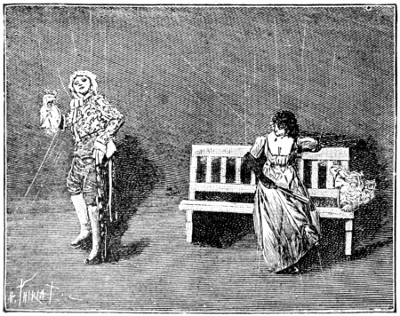
FIG. 1.—BERTRAND’S ANIMATED PUPPETS.
Puppets have been in use since antiquity, and when skillfully constructed
and operated the effect is very amusing. The French painter M. G. Bertrand
devised some very ingenious puppets, which he calls “animated models,”
which he exhibited for a long time in Paris. When the characters make their
appearance and walk and approach each other, they appear to be real. One
of the most charming of the puppets was a violoncellist who bows, rubs resin
on his bow, and plays a march. After the player has finished, he bows and
repeats the piece for an encore. M. Bertrand’s danseuses are no less wonderful.
Fig. 3 shows one of them while she is executing a difficult scene. The little
puppets are about half life size, being twenty-two inches in height. They
are suspended from the upper part of the theater by very fine wires fixed to a
rubber spring. Left to itself the puppet is suspended about three feet from
the floor of the stage. It is from beneath that the operator holds it by means
of wires attached to its feet, which keep it on the floor and make it walk, jump,
or dance. Lateral wires are attached to the hands, and are manipulated from
the side scenes. Each figure is built up on a skillfully wrought skeleton.
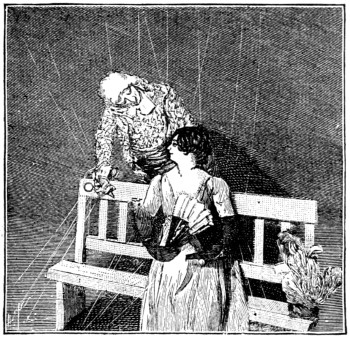
FIG. 2.—LA RENCONTRE (SECOND SCENE).
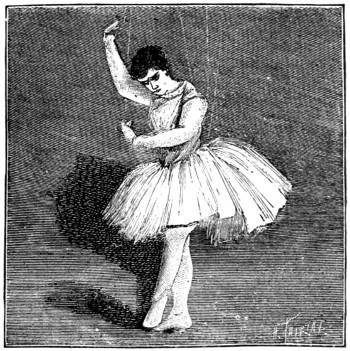
FIG. 3.—AUTOMATIC DANSEUSE.
The fifth figure shows that the fundamental osseous framework is made of
hard wood, and the articulations formed of steel springs. When this wooden
skeleton is made to dance upon the stage, it has the attitude of an animated
being; all of the articulations operate of themselves, with perfect suppleness.
The covering of tow and dress materials give the external human form. Our
last engraving shows the clown, who, at the rising of the curtain, recites the
prologue. He is capable of showing his own skeleton to the spectators and of
saying, “This is the way I am made. Look at my framework!”
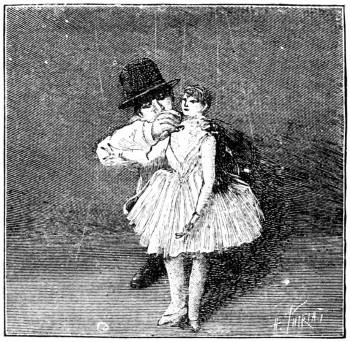
FIG. 4.—THE TOILET OF A DANSEUSE.
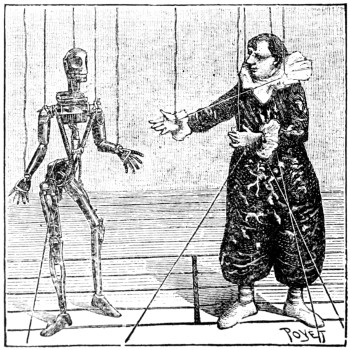
FIG. 5.—TOM MINOR THE CLOWN AND HIS SKELETON.
By Henry Ridgely Evans.
Paris is the home of the fantaisiste. These rare exotics flourish in the
genial atmosphere of the great French capital, and cater to the most critical, as
well as the most appreciative, public in the world. No matter how trivial your
profession may be, if you are an artist in your particular line, you may be
sure of an admiring audience. To-day you are a performer in the cafés;
to-morrow you tread the boards of some minor theater, and the journals duly
chronicle your début, sometimes with as much elaborateness as they would
“write up” that of a new singer at the Grand Opera. Two of the greatest
entertainers in Paris to-day are Yvette Guilbert, chanteuse eccentrique, and
M. Félicien Trewey—fantaisiste, mimic, shadowgraphist, and juggler. It
is M. Trewey and his wonderful art I wish to introduce to the American reader.
The clever Frenchman is one of the best sleight-of-hand artists in France, but
his lasting fame has been made through his ombromanie, or shadowgraphy, the
art of casting silhouettes with his hands, on an illuminated screen. These
silhouettes are projected with marvelous dexterity of manipulation.
The idea of projecting the shadows of different objects (among others the
hands) upon a plane surface is very ancient, and it would be idle to attempt to
assign a date to the creation of these animals and classic figures, such as the
rabbit, swan, negro, etc., that have served to amuse children in the evening
since time immemorial.
Within a few years these rude figures have been improved, and the play of
shadows has now become a true art instead of a simple diversion. The Italian
painter Campi was one of the first who thought of adding new types to the
collection of figures capable of being made with the shadow of the hands. He
devised amusing forms of animals that delighted the school-children before
whom he loved to exhibit them. His imitator, Frizze, imported the nascent
art into Belgium, and it was in this latter country that Trewey got his knowledge
of it.
Trewey was not long in discovering that ombromanie was capable of
improvement, and, after patient exercise of his fingers to render them supple,
he succeeded in producing new silhouettes, which are, each in its kind, little
masterpieces.
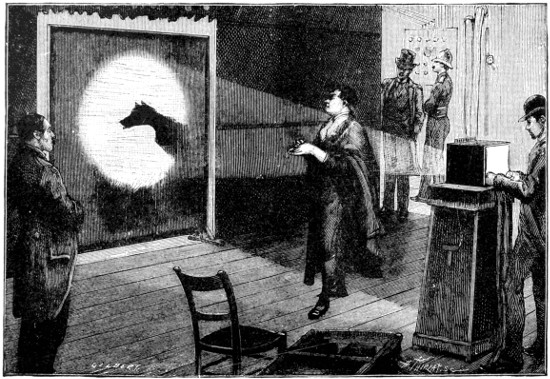
TREWEY EXHIBITING UPON A STAGE.
Trewey has made his hands so supple that he not only can form the most
diverse figures upon a screen, but can also give them motion and life. The
swan smoothing its plumage, the bird taking flight, the cat making its toilet,
the tight-rope dancer, who, after saluting the public, rubs chalk on her feet
before walking on the rope, are true wonders, and it is hard to believe that
these perfectly accurate profiles are obtained solely by means of the shadow of
the hands. The artist has thus far devised more than three hundred figures,
and his inventive mind is leading him to get up new ones every day.
The better to initiate the reader into the art of ombromanie, let me take,
for example, the dog’s head represented in Fig. 1 (No. 1). The ears are
erect, the snout is thrust forward, and we conjecture that the animal has just
scented a choice bit; in fact, he is snapping at it (No. 2). No. 4 shows us the
efforts that he is making to swallow his prey, which is represented by the angle
of the bent forefinger that moves in the mouth. After strong efforts, the
mouth is seen to close (No. 3), showing the act of swallowing. A progressive
motion of the hand shows us the swelling of the throat caused by the descent
of the food in the œsophagus. One would imagine that he had before him the
shadow of a genuine dog, so wonderful, natural, and accurate are the motions.
After this laborious repast, we finally see the animal yawning voluptuously, the
middle finger representing the tongue, which cleaves to the palate, and the
general profile of the head expressing the completest beatitude.
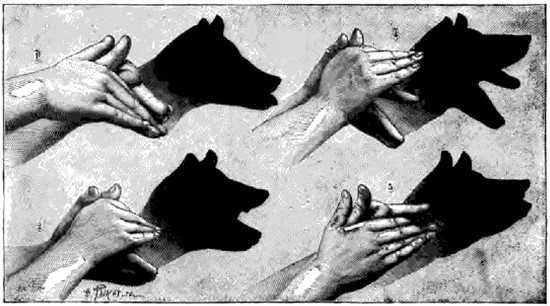
FIG. 1.—SHADOWS OF A DOG SWALLOWING A PIECE OF MEAT.
It is very evident that, in order to reach such a degree of perfection, the
artist must be naturally endowed with great manual dexterity. There are
signs by which such dexterity is recognized, and an attentive examination of
Trewey’s hand has enabled me to verify the laws laid down by M. Henri
Étienne upon the native perfection of the senses. Thirty-five years of research
have permitted M. Étienne, who has been continuously in contact, in shops,
with Swiss watchmakers’ apprentices, experienced workmen, and artists even,
to find a certain criterion by which to judge of aptitudes in different trades
and several professions.
One day M. Étienne was present in the shop of a skillful master watchmaker,
when there entered a young Frenchman, an ex-law student, who was
desirous of apprenticing himself to the watchmaking trade. The neophyte,
who was very intelligent looking, received a cordial reception. While pressing
the hand of the future workman, a cloud passed over the placid face of the
master-watchmaker. “What did you feel, then, in pressing the hand of that
young man who has just gone out?” asked M. Étienne. “With hands like
his we don’t make a watchmaker,” was the reply, and the prediction came
true. It was as a consequence of this conversation that M. Étienne sought
and discovered the following rules:
The characteristic of dexterity is shown in the first place by the curve of
the thumb arched outwardly. This is an indispensable condition for the handling
of the hammer. The blacksmith, who wields with his arm the heavy
striking mass that he lets fall perpendicularly, without deviation, repeatedly
upon the same point; the file-cutter, who strikes such regular blows upon the
chisel that no flaw is visible in the cut, so equal everywhere is the imprint of
the tool—these and all superb workmen, all artists who shape white-hot iron
with the hammer, who chisel the precious metals, who sculpture marble and
stone, owe the exact precision in the force and accuracy of the blows that they
give with the hammer to the suppleness of the first joint of the thumb.
A second characteristic of skillfulness is indicated by the faculty of reversing
the metacarpal phalanges of the fingers, so that when the hand is extended
it is convex. On the greater or less flexibility of all the joints, either at the
base or extremity of the fingers, depend the dexterity and skillfulness displayed
in work executed with the file, plane, or lathe.
The two characteristics
mentioned above—the
curved thumb and the peculiar
suppleness of the
fingers—are in most cases
united in the same person.
The more important of these
is the first.
Trewey’s hand, reproduced
by molding, figures
in several English museums.
It possesses the faculty of
reversal of the phalanges to
the highest degree, and the
thumb, which is of wonderful
suppleness, renders
Trewey, as we shall see, the
greatest service in the formation
of his shadows. Let
me add that his fingers,
which are long and slender,
differ very perceptibly in
length, the middle finger,
for example, exceeding the
ring finger by nearly an inch.
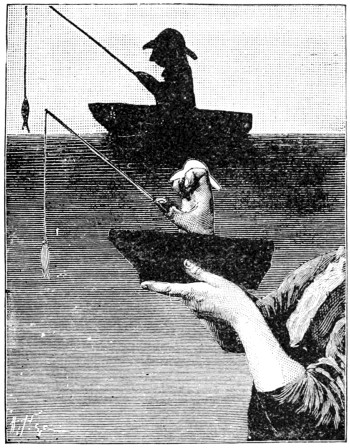
FIG. 2.—THE FISHERMAN.
In addition to the profiles of men and animals, the artist, by means of a few
accessories, exhibits to us living persons playing amusing pantomimes. Here,
for example (Fig. 2), we have a fisherman. A piece of cardboard, properly
shaped and held between two fingers, forms the hat; the boat is a piece of
wood held in one of the artist’s hands; a metallic ring holds the fish-pole
against the thumb of the other hand, and it is opposite this latter, bent as
shown in the figure, that we observe all the emotions of the fortunate fisherman,
who, phlegmatic at first, and livening up when the fish bites, finally is triumphant
when he has it at the end of his line. It is necessary to have witnessed
all these little scenes in order to understand how, by means of his
fingers alone, the artist can evoke the laughter and applause of hundreds of
spectators. Here, now (Fig. 3), we have a scene with two persons. It is a
fight between a janitress and one of her tenants. As may be seen, the accessories
are here very simple again.
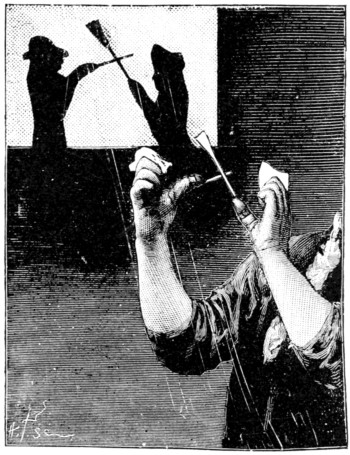
FIG. 3.—FIGHT BETWEEN A JANITRESS AND TENANT.
To make the shadows sharp, the following things are indispensable: The
source of light must be a single lamp inclosed in a projecting apparatus, throwing
very divergent rays. The lens must consequently be of very short focus.
The electric light or oxyhydrogen lamp necessary in a theater may be replaced
at the amateur’s house by a lamp, or, better, by a wax candle, or, indeed, even
by a common candle that gives very sharp shadows. The mirrors in the room
where the exhibition is given
must be veiled in order to
prevent reflections, and all
brilliant objects must be removed.
When the oxyhydrogen
lamp is used, the
screen is placed ten feet away
from the light, and the artist’s
hands at three feet from
the same, and consequently
at seven from the screen.
But it will be understood
that there can be no absolute
rule about this, all depending
upon the scale of the figures.
It suffices to recall the
fact that the nearer the hand
is brought to the light, the
more the shadow enlarges
and loses its intensity, while
on bringing the hand nearer
the screen, the shadow becomes
sharper, but smaller
and smaller. Fig. 4 shows
Trewey exhibiting the scene
of the preacher in the pulpit. The canopy is formed by the arm and the first
phalanges of the fingers bent at right angles, while a block of wood affixed
to the arm near the wrist forms the pulpit. In order that the preacher may
appear smaller than the pulpit, he must necessarily be nearer the screen, and
this explains the distance apart of the artist’s arms in the engraving, the
screen being situated in front of the arm that forms the preacher. The necessary
distances, however, are best determined by experiment.
Trewey’s appearance on the stage is very prepossessing. He is a man of
commanding physique, with a jovial countenance, indicative of the comedian.
He always appears in full court costume—dress coat, silk stockings, and pumps.
On his first appearance on the stage he wears a long Spanish cloak, which he
removes before beginning his entertainment of juggling and sleight-of-hand.
He is the past grand master of balancing feats, the startling nature of which
causes one to hold his breath with dismay at such boldness and audacity. His
dexterity in throwing cards is really extraordinary. I have seen him project
these little oblongs of glazed cardboard from the stage of the Alhambra,
London (the largest hall in Europe) to the farthest part of the top gallery.
He also possesses great skill in the unique art of writing backwards any word
or sentence chosen by the audience, and he is a lightning sketch artist of no
mean ability.
“Tabarin,” or twenty-five heads under one hat, is a performance named
after the inventor, a certain M. Tabarin, juggler, mountebank, and quack-salver,
who used to frequent the quays of Paris during the early part of the eighteenth
century. With the brim of an old felt sombrero, Trewey is able, by dexterous
manipulation, to construct every variety of headgear, from the shovel hat of a
snuffy-nosed French abbé to the headdress of a Norman peasant girl, to say
nothing of the famous chapeau affected by the great Napoleon. It is not these
varieties of headgear that astonish the audience, but Trewey’s facial interpretations
of the different types of character assumed. His mobile features are
an international portrait gallery, and we see represented in the “Tabarin”
Irishmen, Scotchmen, Englishmen, Chinamen, and other nationalities. It
is a facial pantomime of exceeding skill.
The Paris Figaro has described the work of this fantaisiste as “Treweyism,”
and Illustration and La Nature never fail to send their staff artists behind the
scenes to make sketches of the ombromanist’s latest creations. Robert-Houdin,
in his memoirs, says, the excellence of an artist’s work must never flag, but
continue to excite and stimulate public curiosity. Trewey realizes this to perfection.
He has something unique and novel from week to week to present for
the delectation of his audiences. He is the most tireless experimenter I have
ever met on any stage, and gets up early and goes to bed late to think out new
problems in the art amusante. I first became acquainted with this versatile
artist in the summer of 1893, when he was playing a phenomenally long
engagement in the music halls of London, and heard from his own lips the
story of his early struggles and hardships before attaining eminence in his
chosen profession. I quote the following, contributed by me to the pages of
Mahatma, a very clever little periodical devoted to sleight-of-hand, jugglery,
and natural magic:
“Trewey was born in Angoulême nearly forty-five years ago. His father
was a machinist employed at one of the paper mills of the city, and desired
the young Trewey to become engineer in the manufactory. An unexpected
incident diverted Trewey’s mind from mechanics to jugglery. He was taken
one day to the circus at Marseilles, and saw the performance of a conjurer. He
was so delighted with the entertainment of the mountebank that he forthwith
determined to become a professional prestidigitateur. Finding that he could
not enlist the interest of his son in machinery, Trewey père sent him to a
Jesuit seminary at Marseilles to study for the priesthood. One day, after he
had completed three years at the seminary, he returned home for a short
holiday, and refused to return, whereupon his father sent him to work daily at
the factory. During his sojourn at the school, Trewey exhibited his skill as
an amateur juggler, and took part in the dramatic exhibitions given by the
students from time to time. He kept up his practice while at work at the
factory, and then one fine summer’s day, at the age of fifteen, ran away from
home with a professional acrobat not much older than himself. The two
boys gave performances in the cafés of the neighboring towns, and eventually
Trewey succeeded in getting an engagement in one of the Marseilles music
halls at the munificent salary of a franc a day. He had to give his own juggling
entertainment several times a day, and appear in a pantomimic performance
every night. In this same company was Plessis, afterwards one of the
greatest of the French comedians. Speaking of this period of his interesting
career, Trewey said to me: ‘It was the custom in French places of amusement,
when I was a young and struggling entertainer, for the spectators to throw
money on the stage to a successful actor. I carefully saved the coin obtained
in this way until I was able to purchase two grand new costumes. These costumes
and the popularity acquired enabled me to obtain an engagement at the
Alcazar, the principal place of amusement in Marseilles.
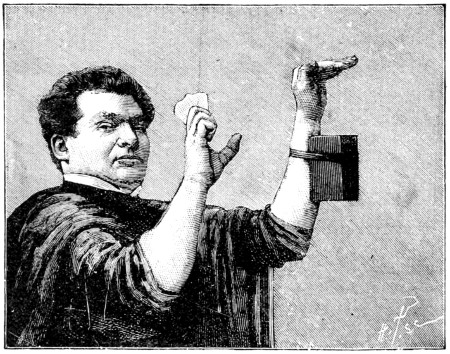
FIG. 4.—THE PREACHER IN THE PULPIT.
“‘Other engagements offered themselves in quick succession after that, and
I became a favorite performer in all the principal towns in the south of France,
where I remained for three or four years. After a while I returned to the
strolling branch of the profession, and started anew as the proprietor of a
traveling pantomime and vaudeville company.
“‘I traveled from one little town to another, playing various rôles
including Pierrot and Cassandre, the clown and pantaloon of French pantomime;
danced in the Clodoche, a grotesque quadrille; and took part in a
comedy, in addition to giving my own entertainment. It was a bare living only
that was gained in this manner for two years, after which an offer of an engagement
came to me from Bordeaux. Here I was most successful, and made a hit
with a number of new feats of balancing with bottles, etc., with which I had
been busy for a long time perfecting myself. It was at this period I invented
the ombromanie. An offer quickly came for an engagement at the Concert des
Ambassadeurs, in Paris, and my success was complete. I stayed in Paris nine
years, and since then traveled all over Europe—in Spain, Germany, Belgium,
Austria, Russia, Great Britain, and, as you know, introduced shadowgraphy
to the American public in 1893.’
“Trewey’s home in the Rue Rochechouart, Paris, is an interesting place to
visit; it is crowded with apparatus and all sorts of new inventions intended for
use in his conjuring entertainments. His scrap and memorandum books are
unique in themselves and contain hundreds of sketches in water colors of juggling
feats either performed by himself or by other artists. Under each
drawing is a carefully written description of the particular act.
“‘What are you going to do with all this material?’ I once asked him.
‘I may publish a book one of these days,’ he replied, with a merry twinkle of
the eye; ‘who knows? I’ve done worse things.’”
M. Caran d’Ache, the cartoonist and illustrator, got up a few years ago,
at the Theater d’Application, at Paris, a special representation of Chinese
shadows which were devised by him, and are so superior to anything that has
previously been done in this line that he has been able to call them “French
shadows,” in order to distinguish them from similar productions.
M. d’Ache takes pleasure in representing the military scenes of the first
republic and first empire. He projects upon the screen an entire army, wherein
we see the emperor with his staff at different distances amid the ranks. The
defiling of the troops is astonishing, and one would think that he was present at
a genuine review. A “Vision in the Steppes” is another series of pictures
that represent the advent of the Russian army. The shadows entitled the
“Return from the Woods” form a masterpiece as a whole, and the figures are
so skillfully cut that the celebrities of the day who are passing in the Avenue
des Acacias can be recognized. Two amusing specimens of this part of the
representation are given in Figs. 2 and 3. These reproductions are much
reduced, the real height of the figures being about eighteen inches.
Says a writer in La Nature, “We were not content to remain in the body
of the theater to witness the shadows, but requested M. d’Ache to admit us to
his side scenes for the sake of our readers, and to initiate us into the processes
of actuating his figures; for, aside from the artistic aspect, there is here a
very interesting application of physics.
“The silhouettes, after being composed and drawn, are cut out of sheet zinc,
which gives them great rigidity. The cutting is a very delicate operation and
requires great accuracy. Some figures, such as those of cavalrymen, hussars,
and dragoons of the grand army, have apertures in certain parts, and behind
these is pasted colored transparent paper. In this way, the black shadows
that move along the screen have certain parts in color, such as the plumes of
the helmets and the horses’ saddles.
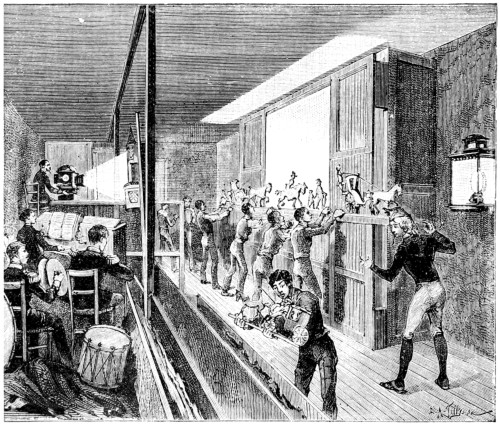
FIG. 1.—FRENCH SHADOWS.
“A large number of the zinc silhouettes act through mechanism. At a
grand review, to the order ‘Carry arms,’ all the guns are seen to rise in
unison. The silhouette is provided with a series of guns properly arranged
and mounted upon a rod which is lowered or raised by the action of a lever.
“Fig. 1 represents the back of M. d’Ache’s theater. The screen being
brilliantly illuminated by an oxyhydrogen lamp, and the light in the body of
the theater being turned down, the silhouettes, in passing, project upon the
screen a very strong shadow which the spectators perceive, but which is not
visible from the side scenes. Each silhouette is taken from a large box by a
man who places it in a groove at the bottom of the screen. Four or five operators
suffice to keep the shadows succeeding one another without interruption.
During the Epopée we witness great combats, the capture of redoubts, and
terrible cannonading. Nothing is more amusing than the method of producing
the effects of these epic contests. The cannons are provided with little
fuses that an operator fires, and, at the same moment, the big drum of the
orchestra imitates the noise of the cannonading, and a rattle of large size
simulates the sound of the discharge of musketry. As for the smoke that
the spectators perceive upon the screen, that is produced by the cigarette of one
of the operators, who projects it at the desired place. The light of the shells
is obtained by means of a wad of gun cotton lighted and properly projected.”
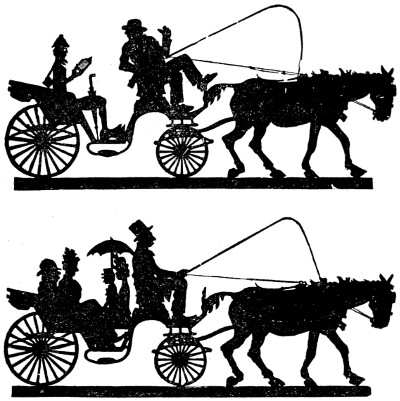
FIGS. 2 AND 3.—FACSIMILES OF TWO SILHOUETTES.
By Henry Ridgely Evans.
The most sphinx-like problem ever presented to the public for solution was
the “second-sight” mystery. As has been stated in the Introduction, the
idea was an old one, having originated with the Chevalier Pinetti, a conjurer
of the eighteenth century. On this subject the “Encyclopædia Britannica”
says:
“In 1783 Pinetti had an automatic figure about eighteen inches in height,
named the Grand Sultan or Wise Little Turk, which answered questions as to
chosen cards and many other things by striking upon a bell, intelligence being
communicated to a confederate by an ingenious ordering of the words, syllables,
or vowels in the questions put. The teaching of Mesmer and feats of
alleged clairvoyance suggested to Pinetti a more remarkable performance in
1785, when Signora Pinetti, sitting blindfold in a front box of a theater,
replied to questions and displayed her knowledge of articles in the possession
of the audience.”
Robert-Houdin invented a “second-sight” system under the following circumstances:
“My two children,” he says, in his memoirs, “were playing one day in
the drawing-room at a game they had invented for their own amusement. The
younger had bandaged his elder brother’s eyes, and made him guess the objects
he touched, and when the latter happened to guess right, they changed places.
This simple game suggested to me the most complicated idea that ever crossed
my mind—‘second sight.’
“On the 12th of February, 1846, I printed in the center of my bill the following
singular announcement:
“In this programme M. Robert-Houdin’s son, who is gifted with a marvelous
second sight, after his eyes have been covered with a thick bandage, will
designate every object presented to him by the audience.”
Houdin never revealed the secret of this remarkable trick, but plainly indicated
in his autobiography that it was the result of an ingenious combination of
questions that gave the clue to the supposed clairvoyant on the stage. One
of the first to come forward with an exposé was F. A. Gandon, who wrote a
work entitled La Seconde vue dévoilée, Paris, 1849. Robert Heller saw
Houdin give an exhibition of “second sight” in London. It was the idea of
people at the time that the experiment was the result of animal magnetism,
but the acute Heller thought otherwise, and he went to work to perfect a system
that far exceeded any of his predecessors in the art, adding certain subtle
improvements that made the trick all but supernatural.
Briefly stated, the effect is as follows: A lady is introduced to the audience
as possessed of clairvoyant powers. She is blindfolded and seated on the stage.
The magician, going down among the spectators, receives from them various
articles which the supposed
seeress accurately describes;
for example, in the case of a
coin, not only telling what the
object is, but the country
where it was coined, its denomination
and date. In the
case of a watch, she gives the
metal, maker’s name, what
kind and how many jewels in
the works, and, lastly, the
time to a dot. And the same
with other objects, no matter
what they may be. Nothing
offered by a spectator seemed
to baffle Houdin and Heller.
Half-obliterated Roman, Grecian,
and Oriental coins were
described with wonderful ease
and accuracy by the assistant
on the stage; also secret society
emblems and inscriptions
thereon, numbers on
bank-notes, surgical instruments,
etc.
ROBERT HELLER.
At a performance in Boston,
described by Henry Hermon
in his work, “Hellerism,”
a coin was handed to Heller. He glanced at it for a moment and asked
his assistant to name the object.
“A coin,” she quickly replied.
“Here, see if you can tell the name of the country, and all about it,” he
next inquired.
Without a second’s hesitation she answered, “It is a large copper coin—a
coin of Africa, I think. Yes, it is of Tripoli. The inscriptions on it are in
Arabic; one side reads, ‘Coined at Tripoli;’ the other side, ‘Sultan of two
lands, Sultan of two seas, Sultan by inheritance, and the Son of a Sultan.’”
“Very well,” said Heller, “that is correct. But look, what is the date,
now?”
“The date is 1-2-2-0, one thousand two hundred and twenty of the Hegira,
or Mohammedan year, which corresponds to 1805 of the Christian era.”
Salvos of applause greeted the performers at the conclusion of the scene.
Mr. Fred Hunt, Jr., who was Robert Heller’s assistant for many years,
wrote the following exposé of the trick for the London Times, soon after
Heller’s death:
“In the years we were together, Heller was constantly enlarging and perfecting
his system. He is now gone and has solved a greater mystery than that which
puzzled so many thousands while he was on earth, and I believe that his sister,
Haidee Heller, and myself are the only living persons in whom Robert Heller’s
second sight is vested. Heller had so simplified this system as to embrace every
variety of article classified in sets; one question, with a word or two added,
sufficing to elicit a correct answer for ten different articles.
“The student must be first posted in a new alphabetical arrangement, with
which he must familiarize himself as thoroughly as a boy in learning his
primer. This is the most difficult part of the business, but when mastered
thoroughly, it comes as easy as if the question were plainly propounded.
“This alphabet is as follows:
| A |
is |
H |
| B |
is |
T |
| C |
is |
S |
| D |
is |
G |
| E |
is |
F |
| F |
is |
E |
| G |
is |
A |
| H |
is |
I |
| I |
is |
B |
| J |
is |
L |
| K |
is |
Pray |
| L |
is |
C |
| M |
is |
O |
| N |
is |
D |
| O |
is |
V |
| P |
is |
J |
| Q |
is |
W |
| R |
is |
M |
| S |
is |
N |
| T |
is |
P |
| U |
is |
Look |
| V |
is |
Y |
| W |
is |
R |
| X |
is |
See this |
| Y |
is |
Q |
| Z |
is |
Hurry. |
Hurry up—
repeat last letter. |
“For example, you want the initials or name in a ring. Say it is ‘Anna.’
By the alphabetical arrangement H stands for A, D for N. The explanation
‘Hurry up’ always means a repetition of the last letter, and again H will
give the answer when put as follows:
“‘Here is a name? Do you see it? Hurry up. Have you got it?’
“Attention is paid only to the first letter of every sentence, and it will be
perceived that the name of Anna is spelled.
“Again, take ‘Gazette,’ which is abbreviated in a phonographic manner in
order to simplify the question. G is A, A is H, Z is ‘Hurry’ (not ‘Hurry
up’), E is F, T is P. The question would be:
“‘Are you able to tell the name? Here it is. Hurry. Find the name.
Please be quick.’
“Here you have ‘Gazet’ in short meter. The letters K, U, X, and Z
being difficult wherewith to commence an interrogative sentence, the words
‘pray,’ ‘look,’ ‘see this,’ and ‘hurry,’ are used, as will be seen in the table.
Care must be taken not to begin a sentence with either of these words unless
applicable to the word to be spelled. For instance, if ‘Xenia’ is required, X is
‘See this,’ E is F, N is D, I is B, and A is H. Thus the question:
“‘See this? Find it quick. Do hurry. Be quick. How is it spelled?’
“Again, for the initials U. S. you will say:
“‘Look. Now, then.’
“U is ‘Look,’ and S is N.
“If you want Kentucky named, thus the question:
“‘Pray name the State. Quick.’
“Pray is K, and Q is Y.
“After the alphabet we have the numbers, which, it will be seen, are easily
understood after a little practice.
Numbers.
| 1 |
is |
Say or Speak. |
| 2 |
is |
Be, Look, or Let. |
| 3 |
is |
Can or Can’t. |
| 4 |
is |
Do or Don’t. |
| 5 |
is |
Will or Won’t. |
| 6 |
is |
What. |
| 7 |
is |
Please or Pray. |
| 8 |
is |
Are or Ain’t. |
| 9 |
is |
Now. |
| 10 |
is |
Tell. |
| 0 |
is |
Hurry or Come. |
“‘Well’ is to repeat the last figure.
“Example: The number 1,234 is required; attention must only be paid to
the first word of a sentence, thus:
“‘Say the number. Look at it. Can you see it? Do you know?’
“Or say the number is 100:
“‘Tell me the number. Hurry!’
“A rather difficult number would be 1,111. The question would be put in
this wise:
“‘Say the number. Well? Speak out. Say what it is.’
“On a watch or greenback there are sometimes eight or nine numbers,
which can be followed as easily as the above.
“The table of colors is as follows:
Colors.
| 1 |
is |
White. |
| 2 |
is |
Black. |
| 3 |
is |
Blue. |
| 4 |
is |
Brown. |
| 5 |
is |
Red. |
| 6 |
is |
Green. |
| 7 |
is |
Yellow. |
| 8 |
is |
Gray. |
“The solution of the numbers, as I have explained, will furnish the key.
For example, the article presented is green; the question will be:
“‘What is the color?’ green being the sixth color in the list.
“Blue is wanted, and, as it stands third in the list, the word would be:
“‘Can you tell the color?’
“White is wanted, and, as it stands first in the list, the question is:
“‘Say the color.’
“Understand that the words explaining the numbers, as given in the list,
are applied to the articles enumerated in each of the subjoined tables.
The Metals.
| 1. |
Gold. |
| 2. |
Silver. |
| 3. |
Brass. |
| 4. |
Copper. |
| 5. |
Lead. |
| 6. |
Iron. |
| 7. |
Tin. |
| 8. |
Platina. |
| 9. |
Steel. |
The Setting.
| 1. |
Diamond. |
| 2. |
Ruby. |
| 3. |
Pearl. |
| 4. |
Amethyst. |
| 5. |
Onyx. |
| 6. |
Garnet. |
| 7. |
Emerald. |
| 8. |
Turquoise. |
| 9. |
Carbuncle. |
| 10. |
Topaz. |
| The stone—opal. |
“Take the metals, for instance. The metal presented is copper, which is
fourth in the list. The question would be:
“‘Do you know the metal?’
“If steel, which is ninth in the list:
“‘Now, what is the metal?’
“Sex, countries, materials, fabrics, watches, are as follows:
Of What.
[This set to describe the sex, etc., of the pictures.]
| 1. |
Lady. |
| 2. |
Gentleman. |
| 3. |
Boy. |
| 4. |
Girl. |
| 5. |
Child. |
| 6. |
Group. |
| 7. |
Animal. |
| 8. |
Drawing. |
| 9. |
Sketch. |
Countries.
| 1. |
America. |
| 2. |
England. |
| 3. |
France. |
| 4. |
Germany. |
| 5. |
Russia. |
| 6. |
Italy. |
| 7. |
Spain. |
| 8. |
Canada. |
| 9. |
Foreign. |
| 10. |
Mexico. |
The Material.
| 1. |
Wood. |
| 2. |
Stone. |
| 3. |
Marble. |
| 4. |
Bronze. |
| 5. |
Lava. |
| 6. |
Rubber. |
| 7. |
Glass. |
| 8. |
Bone. |
| 9. |
Ivory. |
| 10. |
China. |
The Fabric.
| 1. |
Silk. |
| 2. |
Wool. |
| 3. |
Cotton. |
| 4. |
Linen. |
| 5. |
Leather. |
| 6. |
Kid. |
| 7. |
Buckskin. |
| 8. |
Lace. |
Watches.
The maker’s name?
Of what company’s make?
[This is to tell the maker’s name of watches.]
| 1. |
American Watch Co. |
| 2. |
Waltham Watch Co. |
| 3. |
Elgin Watch Co. |
| 4. |
Dueber Watch Co. |
| 5. |
Tobias. |
| 6. |
Johnson. |
| 7. |
Swiss. |
| 8. |
|
| 9. |
|
| 10. |
|
“Miscellaneous articles are divided into nineteen sets, thus:
First Set.
What article is this?
| 1. |
Handkerchief. |
| 2. |
Neckerchief. |
| 3. |
Bag. |
| 4. |
Glove. |
| 5. |
Purse. |
| 6. |
Basket. |
| 7. |
Beet. |
| 8. |
Comforter. |
| 9. |
Headdress. |
| 10. |
Fan. |
Second Set.
What is this?
| 1. |
Watch. |
| 2. |
Bracelet. |
| 3. |
Guard. |
| 4. |
Chain. |
| 5. |
Breastpin. |
| 6. |
Necklace. |
| 7. |
Ring. |
| 8. |
Rosary. |
| 9. |
Cross. |
| 10. |
Charm. |
Third Set.
What may this be?
| 1. |
Hat. |
| 2. |
Cap. |
| 3. |
Bonnet. |
| 4. |
Cuff. |
| 5. |
Collar. |
| 6. |
Muff. |
| 7. |
Cape. |
| 8. |
Boa. |
| 9. |
Inkstand. |
| 10. |
Mucilage. |
Fourth Set.
What is here?
| 1. |
Pipe. |
| 2. |
Cigar. |
| 3. |
Cigar-holder. |
| 4. |
Cigarette. |
| 5. |
Tobacco. |
| 6. |
Tobacco box. |
| 7. |
Tobacco pouch. |
| 8. |
Match. |
| 9. |
Matchbox. |
| 10. |
Cigar-lighter. |
Fifth Set.
What have I here?
| 1. |
Spectacles. |
| 2. |
Spectacle case. |
| 3. |
Eyeglass. |
| 4. |
Eyeglass case. |
| 5. |
Opera glass. |
| 6. |
Opera-glass case. |
| 7. |
Magnifying glass. |
| 8. |
Telescope. |
| 9. |
Compass. |
| 10. |
Corkscrew. |
Sixth Set.
Can you see this?
| 1. |
Knife. |
| 2. |
Scissors. |
| 3. |
Pin. |
| 4. |
Needle. |
| 5. |
Cushion. |
| 6. |
Toothpick. |
| 7. |
Comb. |
| 8. |
Brush. |
| 9. |
Thimble. |
| 10. |
Looking-glass. |
Seventh Set.
Do you know what this is?
| 1. |
Book. |
| 2. |
Pocketbook. |
| 3. |
Needlebook. |
| 4. |
Paper. |
| 5. |
Newspaper. |
| 6. |
Pamphlet. |
| 7. |
Programme. |
| 8. |
Bill. |
| 9. |
Letter. |
| 10. |
Envelope. |
Eighth Set.
Look at this.
| 1. |
Bank bill. |
| 2. |
Treasury note. |
| 3. |
Currency. |
| 4. |
Coin. |
| 5. |
Gold piece. |
| 6. |
Piece of money. |
| 7. |
Bank check. |
| 8. |
Bond. |
| 9. |
Silver dollar. |
| 10. |
Postage stamp. |
Ninth Set.
Now, what is this?
| 1. |
Stick. |
| 2. |
Whip. |
| 3. |
Parasol. |
| 4. |
Umbrella. |
| 5. |
Umbrella cover. |
| 6. |
Picture. |
| 7. |
Shoe. |
| 8. |
Boot. |
| 9. |
Button. |
| 10. |
Stud. |
Tenth Set.
Tell me this.
| 1. |
Earring. |
| 2. |
Locket. |
| 3. |
Sleeve button. |
| 4. |
Hairpin. |
| 5. |
Clothespin. |
| 6. |
Fork. |
| 7. |
Spoon. |
| 8. |
Armlet. |
| 9. |
Ornament. |
| 10. |
Check. |
Eleventh Set.
I want to know this.
| 1. |
Apple. |
| 2. |
Nut. |
| 3. |
Cake. |
| 4. |
Orange. |
| 5. |
Lemon. |
| 6. |
Candy. |
| 7. |
Popcorn. |
| 8. |
Lozenge. |
| 9. |
Grain. |
| 10. |
Wax. |
Twelfth Set.
Pray, what is this?
| 1. |
Screw. |
| 2. |
Hinge. |
| 3. |
Tool. |
| 4. |
Nail. |
| 5. |
Tack. |
| 6. |
Knob. |
| 7. |
Rule. |
| 8. |
Lock. |
| 9. |
Buckle. |
| 10. |
Key. |
Thirteenth Set.
You know what this is?
| 1. |
Shot. |
| 2. |
Powder. |
| 3. |
Bullet. |
| 4. |
Gun. |
| 5. |
Pistol. |
| 6. |
Percussion cap. |
| 7. |
Cartridge. |
| 8. |
Surgical instrument. |
| 9. |
Musical instrument. |
| 10. |
Tuning fork. |
Fourteenth Set.
Quick! This article.
| 1. |
Bouquet. |
| 2. |
Bouquet holder. |
| 3. |
Flower. |
| 4. |
Wreath. |
| 5. |
Leaf. |
| 6. |
Toy. |
| 7. |
Flag. |
| 8. |
Bottle. |
| 9. |
Game. |
| 10. |
Doll. |
Fifteenth Set.
Name this article.
| 1. |
Pen. |
| 2. |
Penholder. |
| 3. |
Pencil. |
| 4. |
Eraser. |
| 5. |
Rubber. |
| 6. |
Case. |
| 7. |
Spool. |
| 8. |
Soap. |
| 9. |
Perfumery. |
| 10. |
Cup. |
Sixteenth Set.
Say, what is this?
| 1. |
Card. |
| 2. |
Cardcase. |
| 3. |
Playing card. |
| 4. |
Button-hook. |
| 5. |
Key ring. |
| 6. |
Bunch keys. |
| 7. |
Tablet. |
| 8. |
Cord. |
| 9. |
Tweezers. |
| 10. |
Cork. |
Seventeenth Set.
This article?
| 1. |
Bible. |
| 2. |
Testament. |
| 3. |
Tract. |
| 4. |
Bookmark. |
| 5. |
Prayer book. |
| 6. |
Hymn-book. |
| 7. |
Music. |
| 8. |
Smelling bottle. |
| 9. |
Vinaigrette. |
| 10. |
Strap. |
Eighteenth Set.
Playing cards.
| 1. |
Diamonds. |
| 2. |
Hearts. |
| 3. |
Clubs. |
| 4. |
Spades. |
| 1. |
“Right”—Ace. |
| 1. |
“That’s right”—King. |
| 1. |
“Good”—Queen. |
| 1. |
“Very good”—Jack. |
Nineteenth Set.
Devices.
| 1. |
Masonic. |
| 2. |
Odd Fellows. |
| 3. |
Knights of Pythias. |
| 4. |
Druids. |
| 5. |
Musical. |
“It will be seen that the different articles are arranged in sets, numbering
no more than ten. Each set has at the head a different question, worded very
nearly alike, so as to make the audience believe that the same question is being
constantly asked. The question at the head of the set, which is always asked
first, is the clue to the set which contains the article to be described. Each
set is numbered, as in the cases of the colors and metals, and the word conveys
each particular article.
“For the first set the question is:
“‘What article is this?’
“This gives the clue to ten distinct articles. The next demand may be:
“‘Can you tell?’
“Which would be solution for ‘bag,’ it being the third in the list.
“‘Say the fabric.’
“The reply would be, ‘Silk,’ that being the first in the line of fabrics, and,
as I have before stated, ‘say’ representing No. 1. If a leather bag, it would
be: ‘Will you tell the fabric?’ ‘will’ standing for No. 5.
“A handkerchief is presented, and the question is:
“‘What article is this? Say;’ which explains that it is a handkerchief, as
that is the first article in the list.
“‘Can you tell the fabric?’
“‘Cotton,’ cotton standing third in the list of fabrics.
“Then, again, if you want the color—say it is blue—
“‘Can’t you tell the color?’
“‘Blue,’ which stands third on the list of colors.
“A watch embodies a greater number of questions than almost any other
article. If you want to describe it fully, it is first in the second set, the key of
which is:
“‘What is this?’
“We will say that it is a lady’s watch, gold, double case, three hands, made
by Tobias, No. 9,725, the initials ‘From B. C. to C. H.’ engraved on the case,
the year ‘1860,’ and blue enameled, set with five diamonds. This is a complex
question, and must be put and answered as follows:
“Question. ‘What is this? Say.’
“Answer. ‘A watch.’
“Q. ‘Say the metal.’
“A. ‘Gold.’
“Q. ‘Say to whom it belongs.’
“A. ‘A lady.’
“Q. ‘Yes.’
“A. ‘A double case.’
“Q. ‘Can you tell the number of hands?’
“A. ‘Three.’
“Q. ‘Will you tell the maker.’
“A. ‘Tobias.’
“Q. ‘Now the number. Please tell me. Be quick. Won’t you?’
“A. ‘9,725.’
“Q. ‘Can you tell me the color of this enamel?’
“A. ‘Blue.’
“Q. ‘Tell the initials. Say.’
“A. ‘B. C.’
“Q. ‘Say to whom. I want to know.’
“A. ‘C. H.’
“Q. ‘Say these stones.’
“A. ‘Diamonds.’
“Q. ‘Will you tell how many?’
“A. ‘Five.’
“If it is a double case, the simple word ‘yes’ conveys the intelligence after
‘to whom it belongs.’ If an open case, the word ‘well’ is used.
“These will be found in the sixteenth set, and the order of suits in the
eighteenth. We will take the nine of spades as having been presented. The
question will be:
“‘Say, what is this? Can you tell?’
“‘A playing card.’
“‘Do you know the suit? Now, then.’
“‘Do’ is four, which means spades, and ‘now’ is nine. The cards are
told as follows: First, the ‘playing card;’ second, the suit; third, the number
or picture. If, after the preliminary question is put and answered, it is an ace,
the interlocutor says ‘Right;’ if a king, ‘That’s right;’ if a queen, ‘Good;’
if a jack, ‘Very good.’
“This will be found classed in the eighth set, the key to which is, ‘Look at
this.’
“No. 6 of the set is described as ‘a piece of money,’ and is always of a less
value than a dollar. We will take a silver quarter of the date of 1820. The
question is:
“‘Look at this. What is it?’
“A. ‘A piece of money.’
“Q. ‘Let me know the amount. Will you?’
“A. ‘Twenty-five cents;’ as we know that ‘let’ is 2 and ‘will’ 5.
“If the coin is of this century, only the last two figures are asked; if of a
prior date, the last three. The request therefore is:
“‘Look at the date. Hurry!’ which would bring the answer, ‘1820.’
“A foreign coin is furnished, say of Rome. The request would be:
“‘Look at this. Do you know what it is?’
“The answer is, ‘A coin.’
“‘What country?’
“‘Italy;’ as Italy stands sixth in the list of countries, as will be seen by
referring to the table.
“A Mexican dollar will elicit the remark:
“‘Look at this, now.’
“‘A silver dollar.’
“‘Tell me the country.’
“The reply will be, ‘Mexico,’ as that country stands tenth on the list.
“A treasury note is presented of the value of fifty dollars; the cue is:
“‘Look at this. Be quick.’
“Answer. ‘A treasury note.’
“‘Will you tell me the amount? Come;’ which means 5 and 0, or $50;
‘come’ being a substitute for ‘hurry.’
“Again, a $2.50 gold piece is presented, and the question is as before:
“‘Look at this. Will you?’
“Answer. ‘A gold piece.’
“‘Let me know the amount. Won’t you? Come.’ ‘Let,’ ‘won’t,’ and
‘come’ standing for ‘250.’
“‘Pray, what is this? Tell me.’
“The answer is. ‘A key,’ ‘key’ being the tenth article of the set. Now, in
order to tell what kind of a key, these simple words will explain:
“‘Yes,’ a watch key; ‘well,’ a door key; ‘good,’ a safe key.
“‘What is here? Say.’
“The answer is ‘pipe.’
“Now, to ascertain what kind of a pipe, the same words as above:
“‘Yes,’ a meerschaum pipe; ‘well,’ a wooden pipe; ‘good,’ a clay pipe.
“‘Can you see this? Please say.’
“Answer is ‘comb.’
“‘Yes,’ a pocket comb; ‘well,’ a toilet comb; ‘good,’ a curry comb.
“‘Can you see this? Are you going to tell?’
“The answer is ‘brush.’
“‘Yes,’ hair brush; ‘well,’ clothes brush; ‘good,’ paint brush.
“If an article is presented which is not down in the sets, the alphabet will
have to be resorted to and the article spelled out.
“This concludes the ‘second-sight’ mystery which so perplexed the world,
and which I never would have exposed but for the death of my lamented friend,
Robert Heller.”
The perfect memorization of the preceding system will enable two ambitious
amateurs or professionals to perform the “second-sight” mystery, but
it will not enable them to produce all of the effects exhibited by Heller. Robert
Heller had another system of conveying information to his blindfolded assistant
on the stage—a system that permitted him to give a minute description of an
object without speaking a word. It was this artistic effect that so puzzled
every one. It was accomplished by means of electricity. A confederate sat
among the spectators, near the center aisle of the theater, and the wires of an
electric battery were connected with his chair, the electric push button being
under the front part of the seat. Heller gave the cue to the set in which the
article was, its number, etc., by some natural movement of his body or arms;
and the confederate, rapidly interpreting the secret signals, telegraphed them
to the clairvoyante on the stage. Mr. Hermon thus describes the receiving
instrument in his clever little book, “Hellerism”:
“It will be remembered by all whoever witnessed Mr. and Miss Heller’s
‘second-sight’ act that when he came on the stage to begin this part of his
performance, he rolled forward to the center of the stage a sofa. This sofa had
no back to it, thus enabling Miss Heller to sit with her back to the audience.
As the sofa was rolled forward it was so placed that one of the hind legs rested
on a little brass plate screwed to the floor of the stage. On the foot of the
leg there were two more, thus connecting and making a complete electric communication
between his secret partner and Miss Heller.
“In the sofa there was a little machine so arranged that when the button
was pressed a slight tap was the result. This tap could only be heard by Miss
Heller, for it struck against a thin piece of board covered by the haircloth of
the sofa, and sitting, as she was, directly on it, it could be easily felt.”
The verbal system and the silent system were used interchangeably during
Heller’s performances, to the complete bewilderment of the spectators. Even
magicians were mystified. When the former system was employed, Heller was
enabled to go to any part of the theater; but in the latter, he was compelled,
for obvious reasons, to confine himself to the center aisle, just below where
the confederate was seated. The connecting wires were concealed beneath the
carpeting.
Other magicians, notably Kellar, have worked up the “second-sight” trick
in an ingenious way, by the use of apparatus. The clairvoyante sits on a chair
placed upon a raised platform, and, after her eyes have been carefully bandaged,
she tells the names of playing cards, the numbers on bank notes, and adds
columns of figures written on a blackboard by people in the audience. The
explanation is as follows: A rubber tube runs from behind the scenes, underneath
the stage, and up through a hollow foot of the platform and the leg of
the chair, terminating at the back of the chair. In the back of the lady’s
dress is a small tube which reaches her ear, being cleverly concealed by the
curly wig which she wears. When she has taken her seat, the magician pretends
to mesmerize her, and, under cover of the passes, connects the tubing in
the chair with the tubing in her dress. An assistant behind the scenes reads
the numbers on the bank notes with a strong spyglass, and conveys the information
to the lady through the speaking-tube. To facilitate the assistant’s work,
the magician holds the bank note against the blackboard, which is turned
slightly to one side. The clairvoyante calls out the numbers in a loud voice,
whereupon the magician proceeds to chalk them upon the board. The squaring
and the cubing of numbers are performed by the assistant behind the scenes,
with the aid of logarithmic tables. When the “second-sight” séance is concluded,
the magician removes the bandage from the lady’s eyes, and pretends
to awaken her from the hypnotic state, taking advantage of the little comedy
to disconnect the speaking tube. She rises, bows herself off the stage, taking
particular care not to show her back to the audience.
A very clever exhibition of “second sight” is given by Professor and Mrs.
Baldwin. Professor Baldwin calls himself the “White Mahatma,” and his
entertainment is a curious hodge-podge of pretended mediumship, clairvoyance,
and vaudeville. Slips of paper and pencils, and small pads of millboard
to serve as writing desks, are distributed among the audience by assistants; the
recipients of the writing materials are requested to write questions on the slips,
fold them up, and secrete them in their pockets. The “White Mahatma”
disclaims any preparation about the millboards, remarking that they are given
to the spectators to obviate the inconvenience of writing on the knee, and may
be discarded if desired. When the questions have been prepared, the assistants
collect the pads and place them on the stage, near the footlights, in full view of
the audience. After this there is some dancing and singing by the vaudeville
artists connected with the company, and then Mrs. Baldwin, the clairvoyante,
makes her appearance; she is carefully blindfolded and “mesmerized” by the
Professor. Her communications to the audience are made after the following
manner: “I see a lady in the orchestra, to the right. She wants to know something
about a ring that was lost.” Professor Baldwin, who stands in the
center aisle of the theater, near the stage, exclaims: “Will the lady who wrote
that question kindly hold up the slip of paper and acknowledge the correctness
of Mrs. Baldwin’s statement?” The lady complies, and a thrill of astonishment
pervades the audience. An assistant goes to the lady, takes the slip,
and hands it to Professor Baldwin, who reads it, exclaiming: “Mrs. Baldwin
is correct; but let us see if she cannot give us more detailed information concerning
the ring which is lost.” He mounts the stage, and, standing behind
the clairvoyante, makes violent mesmeric passes over her head, the piano in the
orchestra accompanying the operation with several loud chords and cadenzas.
Then the “White Mahatma” advances to the footlights and commands his
wife to speak. “The ring is of gold with a pearl setting,” she says, “and has
the initials ‘M. B.’ engraved within. It was lost about January 1, 18—,” etc.
The lady in the audience had only written: “I have lost my ring; can you
describe it?” Consequently, when she hears this accurate description by Mrs.
Baldwin, she is very much impressed.
The trick is an ingenious one. It is worked up with great dramatic effect
by the Baldwins. The secret lies in the pads of millboard, some of which
contain carbon sheets under two layers of brown paper. The writing of the
spectators is thereby transferred by means of the carbon paper to sheets of
writing paper placed under the carbon sheets. The genuine millboard pads
which are distributed among the audience are laid on the stage, while the prepared
pads are carried off behind the scenes to Mrs. Baldwin, who has ample
time to post herself with the desired information before coming on the stage.
Of course, the spectators who get the genuine pads do not receive any clairvoyant
communications, nor do those who discard the genuine pads. The
surprising part of the feat is the extraneous information imparted by Mrs.
Baldwin, which seems to preclude any possibility of trickery. This information
is obtained from the spectators by the assistants when they go to collect
the slips of paper, and is whispered by them to Professor Baldwin. Under
cover of the pretended magnetizing, Professor Baldwin gives his wife this
information, the chords from the piano preventing any one from hearing what
he says. It is all done very rapidly, the spectators being completely deluded.
The people who have been pumped by the assistants seem to forget the fact in
their interest in the main part of the trick, viz., the reading of the slips by Mrs.
Baldwin. One reason of this self-deception is, perhaps, the fact that they do
not suspect the integrity of the innocent-looking ushers, or regard them as a
part of the experiment.
Where numbers are to be conveyed, the Baldwins use a verbal code of signals.
This obviates the necessity of Mr. Baldwin going upon the stage to
remagnetize his wife.
In this ingenious trick the clairvoyante, while blindfolded, tells “the suit
and value of any number of selected cards, solves arithmetical problems,
gives numbers on borrowed bank notes, indicates time by any watch, describes
borrowed coins, and many other tests.” All this is accomplished in silence,
the medium being surrounded by a committee from the audience, if desired.
The trick can be given in a private parlor, and requires no electrical apparatus,
speaking tubes, etc. I am indebted for an explanation of “silent thought
transference” to Mr. H. J. Burlingame. In his little brochure, “Tricks in
Magic, Illusions, and Mental Phenomena,” he writes as follows: “By means
of the silent code all the usual effects generally exhibited at thought-reading
séances can be reproduced. It consists in both medium and performer counting
mentally and together. It is a known fact that the beats for ‘common
time’ are always the same in music; therefore, with little practice, it is easy for
two persons, starting on a given signal, to count at the same time and rate, and
when another signal is given, to stop. Of course both will have arrived at
the same number. This then is the actual method employed in this code, and
from it you will see that any number from 0 to 9 can be transmitted by the
performer to the medium. It is best to experiment and find out what rate of
counting best suits the two persons employing this code, but the following suggestions
are offered: It may, perhaps, be best to begin counting at a slow
rate, gradually increasing until you find it advisable to go no faster. Say you
have in the room, when first practicing, a loud-ticking clock, with a fairly slow
beat. On the given beat or signal you both start counting at the same rate as
the clock. Of course the clock must be removed when the rate has been well
learned. If preferred, count at the rate of ‘common time,’ viz.: 1 and 2
and 3 and 4, and so on, or practice with a ‘metronome,’ such as is used during
piano practice for the purpose of setting time. A very good rate to finally
adopt is about 70 to 75 per minute. Whatever rate is found to suit best must
be adhered to. You will find at the rate mentioned that any number up to 9
can be transmitted with absolute certainty, after an hour or so of practice.
“Now that the principle has been explained, the next items are the signals
to give the medium the cue when to start and when to stop counting mentally.
“Say the performer has borrowed a coin, the date of which is 1862. The
first figure of the coin 1 and 8 are generally understood, as most coins in use
are 18 something or other; if of date 18, in the hundreds. The performer
must advise the medium of this by his manner of thanking the person who lent
the coin, which can easily be arranged to suit one’s fancy. The 6 and 2 have
therefore to be transmitted. The performer stands away from the medium or
among the audience. The medium being on the stage, securely blindfolded,
the performer takes his position, with chalk in right hand, in front of a blackboard,
holding coin in his left hand. He does not speak a word, but simply
looks at the coin. After a pause the medium calls out: ‘The first figure I picture
is a one,’ or words to that effect. Immediately the lady stops speaking, they
both begin to count mentally at the rate agreed upon by practice. In this case
the number to be transmitted is 6. As the last word of the sentence is spoken
they commence mentally 1-2-3-4-5-6; during this short period the performer
glances down at the coin as if to verify what the lady has called out. As soon
as they reach the figure 6 the signal ‘stop’ has to be transmitted. This is
done by the performer putting down on the blackboard sharply the figure
called out by the lady, viz.: ‘One’ (1). It will be seen by this method that
the signal is quite easy to transmit, and it is perfectly natural to put down the
figure on the board quickly and sharply. The third figure of the coin is now
known to the medium. The last figure, 2, is transmitted in the same manner
as the previous figure. The lady says, ‘The second figure I see is 8.’ As
soon as she ceases speaking, they begin the counting again, 1-2; on the
arrival at the figure 2 the performer puts down the 8, previously called
out, sharply on the board, which is the signal for ‘stop.’ The lady now knows
the full date of the coin. The metal of the coin must be indicated to the
medium previously by the wording of the reply to the owner of the coin after
it has been handed to the performer. This can easily be arranged. The value
of the coin or its equivalent number is indicated in the same way as the previous
figure; and between the 6 and the 2, that is, after the lady has called
out the 6, they commence to count for the value. When an 0 occurs in the
date, no pause is made. The performer puts down the figure on the board
for the ‘stop’ signal immediately the lady stops speaking. This if followed
carefully will be found quite easy and natural in practice.
“Any other system that one may adopt for giving the starting and stopping
signals can, of course, be applied, but the method here proposed will be
found to answer the purpose, and cannot be detected.”
The bank-note, card, and other tests are arranged on similar lines.
This clever trick was introduced to the theater-goers of marvel-loving Paris by
Professor Verbeck and Mademoiselle Mathilde. Guibal and Marie Gréville performed
it in England and America, creating a great sensation. It is based on a
very simple principle. Abbreviated somewhat from Burlingame’s brochure, the
effect is as follows: “The pretended mesmerist announces to the spectators the
marvelous intuitive powers of his subject, Miss Venus, remarking: ‘Miss Venus
shall be hypnotized by me, and, when launched into the hypnotic sleep, can and
will perform any rational act that the spectators desire, despite the fact that I
will not speak one word during the séance. While in the trance state, she will
walk among you and comply with your requests. This, ladies and gentlemen,
is the trance-it of Venus. When I have her under control and in the hypnotic
trance, I will move about among you, and you can convey to me by whisper
what you would desire the medium to do.’
“Miss Venus is now introduced by the professor. She bows and seats herself
on a chair, facing the spectators. The professor, by means of any of the
pantomimic gestures, pretends to hypnotize her, after which dramatic scene, he
goes among the audience, asking here and there what the spectators would like
the lady marvel to do. Having spoken to some twelve or twenty persons, he
solemnly enjoins the strictest silence. With serious mien he advances toward
the medium, without going on the stage, and motions or waves his right hand
in a downward movement in front of her. She slowly rises and goes through
each desired performance, finally returning to her chair and allowing herself
to be dehypnotized. The professor recapitulates for the benefit of all what
each spectator desired, and how Miss Venus was successful in each and every
crucial test.
Explanation.
“In this trick a code of signs and things to be done must be learned by the
alleged mesmerist. These he forces adroitly into the minds of the people.
The following is the forcing code:
“1. Pull a gentleman’s hair.
“2. Turn up his trousers.
“3. Tie a number of knots in his handkerchief.
“4. Take a watch out of a gentleman’s pocket and place it in another
pocket.
“5. Open a lady’s reticule; take out her purse, or anything she may desire.
“6. From out of a number of coins placed in a hat, pick out the special
one which has been selected.
“7. Write any number selected on a card.
“8. Take a gentleman’s cane or umbrella and put it in the hands of
another gentleman.
“9. Take glasses off a person and place on own nose.
“10. Take off lady’s or gentleman’s gloves.
“11. Write autograph on programme gentleman holds.
“13. Take a handkerchief out of some person’s pocket and tie it on his
neck or arm.
“14. Tie a knot in a watch chain, and so on.
“This can be varied indefinitely.
“How to force these requests: The professor first pretends to hypnotize
the subject; then moving among the audience, he goes to number one, or first
person, and asks him what he would like the medium to do. ‘Let her tell me
what I have in my pocket,’ suggests the spectator. ‘Oh,’ says the professor,
‘you forget that she is hypnotized and we cannot have her speak. Get her to
do so and so, or this, or that,’ and so the professor rapidly shoots out a volley
of suggestions from his learned code. As a natural result, the person selects
one of these suggestions.
“Going to the next, he forces the questions differently, saying, ‘What shall
she do for you—turn up your trousers? Pull your hair? Tie a knot in your
handkerchief?’ etc. In this case a volley of queries is fired before the gentleman
has time to make any suggestions not mentioned by the professor. Seeing
a lady sitting near with a bag, the ‘mesmerist’ remarks: ‘Madam, have you
a purse in it? Yes? Shall the lady remove it, or something from it?’
and so on. Again he beholds a gentleman with glasses on, and suggests that
the medium remove the spectacles, etc. If, however, the gentleman does not
wish this done, the professor suggests some of the other tests. In going
through the audience the professor asks each individual his or her request in
whispers only, and he generally has each person whom he asks a couple of
yards apart.
“Again it is better, when forcing questions, to force only three at a time,
and force them in rotation. To do this, suggest three questions, but emphasize
or force only one of the three. The professor has to keep his wits about
him. Having gone to a sufficient number in the audience, he must keep
mental track of the gentleman who selected No. 1 of code, of him who selected
No. 2, and so on. When he returns to the stage to wave down Miss Venus, all
she has to do is to follow him in front or at his side. The first person he stops
at (by signal), she merely does first on code; the second he stops at, she does
second on code; and so on right through. The professor must remember where
each chooser is seated.
“He directs the medium to the spectator in question by the movements of
his hands. He first shows her the rows in which the persons are seated, all
the time waving his hands as if making mesmeric passes. As soon as the
medium reaches No. 1 the professor drops his left hand at his side, whereupon
she stops and pulls the gentleman’s hair.
“The professor then directs her to No. 2. She stops and turns up the
gentleman’s trousers. When she gets to No. 3 the man of mystery tells her
how many knots to tie in the handkerchief, by the number of downward waves
of left hand, at the same time making passes with the right. To select any
special coin out of a hat, or other receptacle, Miss Venus pours the coins from
the hat into her right hand, letting them drop one by one into the left hand.
When she reaches the proper article, the professor turns to the audience, as
if silencing them, and says ‘hist!’
“The lady, however, continues pouring the coins into her left hand, and
when all are in, picks out the one she knows is correct.
“These methods may be readily varied to suit the taste of the performers.
“The medium’s eyes appear to be closed all the time, but in fact are open
sufficiently for her to see all the movements of the professor. After becoming
expert it will not be necessary to use the forcing code often, because all requests
can be whispered to the medium by the so-called mesmerist, without the
audience becoming aware of it. He can do this when he escorts her from the
stage to the audience, or as he occasionally passes her in the aisles. The waving
of his hands and arms in his different ‘passes’ will partly tell her what she
is expected to do.
“This ‘hypnotic demonstration’ is one of the most puzzling effects in the
whole domain of mental magic.”