MAGIC, PRETENDED MIRACLES, ETC — CHAPTER I.
The magi of the east—Magical power attributed to
numbers, plants, and minerals.
The magi formed one of the six tribes into
which the nation of the Medes was divided in
ancient times. To them was entrusted the
special charge of religion; and, as priests, they
were superior in education and training to the
people in general. Among the Persians, “the
lovers of wisdom and the servants of God”
were, according to Suidas, called magi. It
seems also, that they extended themselves into
other lands, and that among the Chaldeans
they were an organized body.
We read in the inspired book of Daniel, of
“the magi,” or “wise men,” among whom the
prophet himself was classed; and others, we
know, directed by “the star in the east,” went
to the infant Saviour, when born, at Bethlehem,
“as Christ the Lord,” and presented to him
their offerings, “gold, and frankincense, and
myrrh.” Among the Greeks and Romans, the
same class of persons was styled Chaldeans and
magi.
For a time, the magi surpassed the rest of
the world in knowledge, and were the friends,
companions, and counsellors, of its mightiest
sovereigns. But their science, from having
no solid basis, sank, after a while, into insignificance.
On the ruins of its reputation
other persons sought to build theirs. A man
who knew, or could perform some things, with
which others had no acquaintance, or for which
they had no power, announced himself as a
magician. Nor were the people indisposed to
concede to him the credit he desired, especially
if he claimed alliance with spiritual
beings; and, in not a few instances, they attributed
his marvels to such agency. Thus,
then, the magician may be traced to the magus,
or magian; and magic, to the so-called philosophy
of the east.
Magic squares are of great antiquity. A
square of this kind is divided into several other
small equal squares, or cells, filled up with the
terms of any progression of numbers, but
generally an arithmetical one; so that those
in each band, whether horizontal, vertical, or
diagonal, shall always make the same sum.
The ancients ascribed to them great virtues;
and the disposition of numbers formed the
basis and principle of many of their talismans.
Accordingly, a square of one cell, filled up
with unity, was the symbol of the Deity, on
account of the unity and immutability of God;
for they remarked that this square was, by its
nature, unique and immutable; the product of
unity by itself being always unity. The
square of the root two, was the symbol of imperfect
matter, both on account of the four
elements, and of its being supposed impossible to
arrange this square magically. A square of nine
cells was assigned or consecrated to Saturn; that
of sixteen to Jupiter; that of twenty-five to Mars;
that of thirty-six to the sun; that of forty-nine
to Venus; that of sixty-four to Mercury; and
that of eighty-one, or nine on each side, to the
moon. Those who can find any relation between
two planets, and such an arrangement of
numbers, must have minds strongly tinctured
with superstition; yet so it was in the mysterious
philosophy of Iamblichus, Porphyry, and their
disciples.
Plants, as well as numbers, were long considered
to be endowed with magical properties.
Pliny enumerates those which, according to
Pythagoras, were supposed to have the power
of concealing waters. To others were attributed
extraordinary effects. The asyrites, as
it was denominated by the Egyptians, was
used under the idea that it acted as a defence
against witchcraft; and the nepenthes,
which Helen presented, in a potion, to Menelaus,
was believed, by the same people, to be
powerful in banishing sadness, and in restoring
the mind to its accustomed, or even to greater
cheerfulness. Whatever may be the virtues of
such herbs, they were used rather from an
idea of their magical than of their medicinal
qualities; every cure was cunningly ascribed
to some mysterious and occult power.
From the same superstition, metals and
stones were supposed to be endowed with singular
virtues: the opal, to grow pale at the
touch of poison; the emerald, to remove intoxication;
and the carbuncle, “only to be found
in the head of the dragon, the hideous inhabitant
of the island of Ceylon,” to shine in the
darkness. As the metal called gold always
bore the highest value, it was concluded, from
an absurd analogy, that its power to preserve
health and cure disease must likewise surpass
that of all other applications. Multitudes gave
themselves to busy idleness in attempting to
render it potable, and to prevent it from again
being converted into metal. Not only did they
labour in obscure situations, but in the splendid
laboratories of nobles and sovereigns. Men
of rank, impelled by one common frenzy,
formed secret alliances; and even proceeded to
such extravagance as to bring ruinous debts on
themselves and their posterity. The object of
which they were in pursuit was “an elixir of
life.”
In Italy, Germany, France, and other
countries, the common people often denied
themselves the necessaries of life, to save as
much as would purchase a few drops of the
tincture of gold, which was superstitiously or
fraudulently offered for sale. So fully did they
confide in the efficacy of this imaginary power,
that on it generally depended their only hope
of recovery. Positively was the desired boon
promised, but only to mock expectation. Our
times are in the hands of God; and at his will
the dust returns to the dust from whence it
was taken, and the spirit to him who gave it.
How fearful was the ignorance that prevailed
in the bygone times to which a reference has
been made! What gratitude should we feel for
the advantages we enjoy! Let us, then, constantly
remember that as to us much has been
given, so of us much will be required; and that
one kind of knowledge surpasses all others:
“This,” said the adorable Redeemer, “is life
eternal, that they might know thee the only
true God, and Jesus Christ, whom thou hast
sent,” John xvii. 3.
CHAPTER II.
Feats of modern magicians—Their wonders explained—The
snake-charmers of India—A Chinese delusion—The magician
of Cairo.
Wonder-workers have often appeared. Some
of them have lately repeated their most remarkable
feats in London and various places in
England, varied by others of inferior interest.
Large and astonished assemblies have witnessed
their performance, and public journals have
described them as absolutely “inexplicable.”
And yet, though the writer has no personal
acquaintance with any modern “magician,” he
has no doubt that all their feats may be accounted
for, from sleight-of-hand, confederacy,
ingenious contrivance, or the application of
some natural law. A few illustrations shall
now be given.
Many delusions are entirely dependent on
sleight-of-hand; a rapidity of manipulation
being attained by long practice, as in the marvellous
movements of the fingers of a highly
accomplished instrumental performer; while the
power may become so great as to defy the
observation of the acutest vision. The late
Mr. Walker, minister at Demattar, in the
Mears, told sir Walter Scott of a young
country girl, who threw turf, stones, and other
missiles, with such dexterity, that it was, for a
time, impossible to ascertain the agency employed
in the disturbances of which she was
the sole cause.
A friend of the writer has a remarkable nicety
of touch, and, at pleasure, a rapid movement of
the hands, by which he can rival many magical
feats. Thus he conveys balls under cups, and
appears to change them into fruit, to the
astonishment of lookers-on. He also takes two
horn cups of exactly the same size, and produces
the impression that he causes one to fall
through the other, when this is impossible, and
all that is done is effected by dexterous and
rapid manipulation, illustrating the proverb,
“The hand is quicker than the eye.”
Many astounding feats, which form a part of
all popular magical exhibitions, are performed
by this leger-de-main. Apparently, the performer
receives a lady’s wedding-ring and
breaks it in pieces; burns a five-pound note
handed to him by a spectator; reduces a hat
to a hideous shape; or crushes a bonnet into
fragments, and then restores them uninjured to
the respective parties, amidst the acclamations
of the multitude. But all that is done is with
indescribable rapidity to substitute articles of
his own to undergo the process of destruction,
and, at the right moment, to exhibit those
which have been presented by the spectators,
and are preserved in safety.
Another cause of wonderment is confederacy.
A modern performer has been accustomed to
hand a box to one of his audience, requesting
that in it might be placed any article that he
had, and that it might be passed on from one
to another for the same purpose. While this
has been done, he has proceeded to his table,
and apparently waited the filling of the box.
At length, while the box has been held up at a
distance, he has placed his rod to his eye and
described the collection that has been made.
He has said, perhaps, “I can see in that box a
piece of ribbon, a lozenge, a few grains, part, I
dare say, of a pinch of snuff, and a lady’s card;
I will try and read it—Miss—Clara—Henderson;”
and so he passes through the chief part
of the series. And yet, as his patrons look on
with astonishment, they do not think of what
is most likely to be the fact, that a confederate,
sitting as one of the audience, made a list of
the articles as they were deposited in the box,
and despatched it in portions or altogether, so
that their names might reach the eye of the
performer from some part of his table.
A third means of wonder-working is that of
ingenious contrivance. We will illustrate this
by two popular feats. A number of handkerchiefs
taken from the audience by more than
one popular performer, were placed in a small
washing-tub, into which water was poured, and
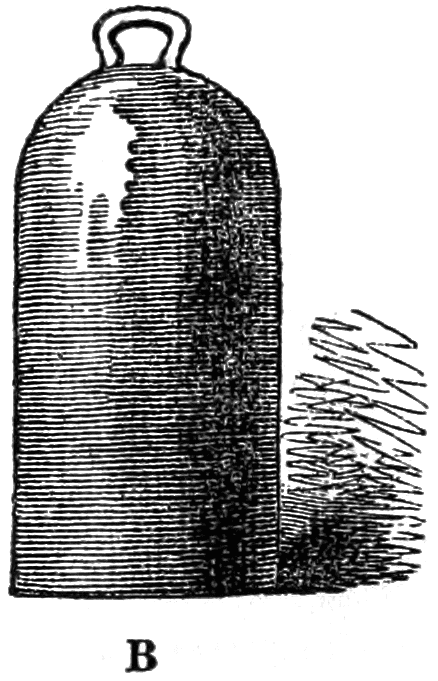
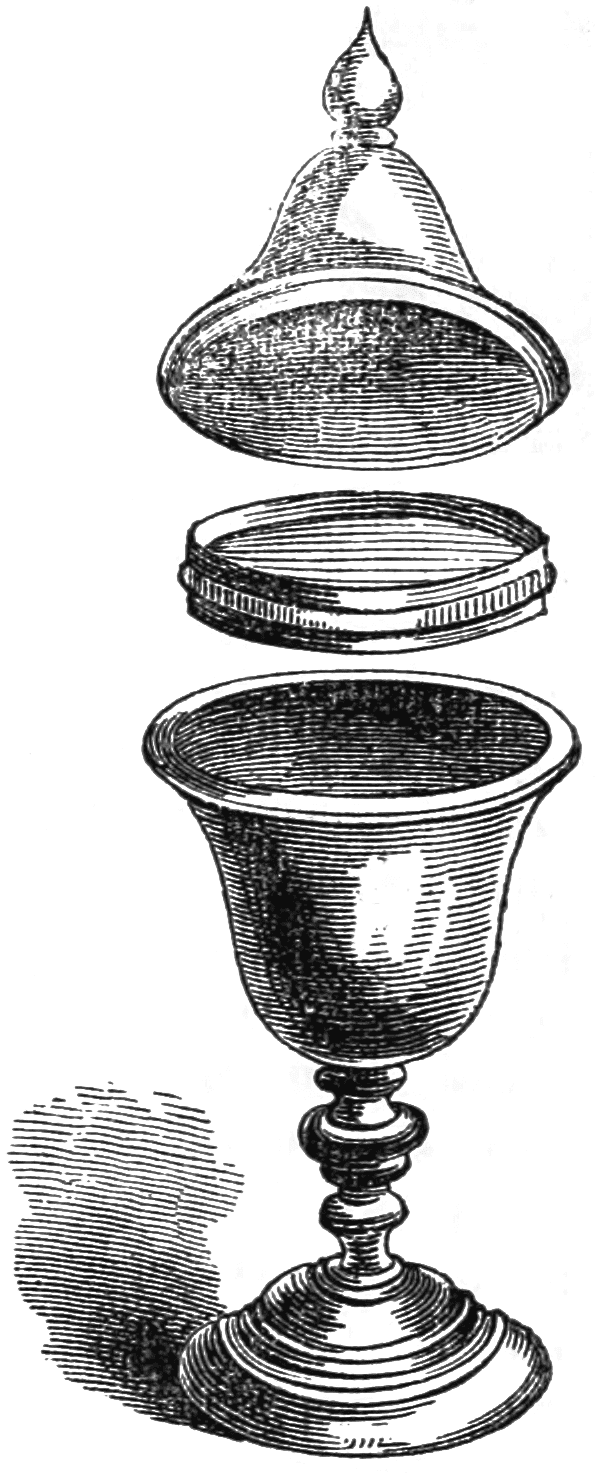
they were washed for a few minutes. They
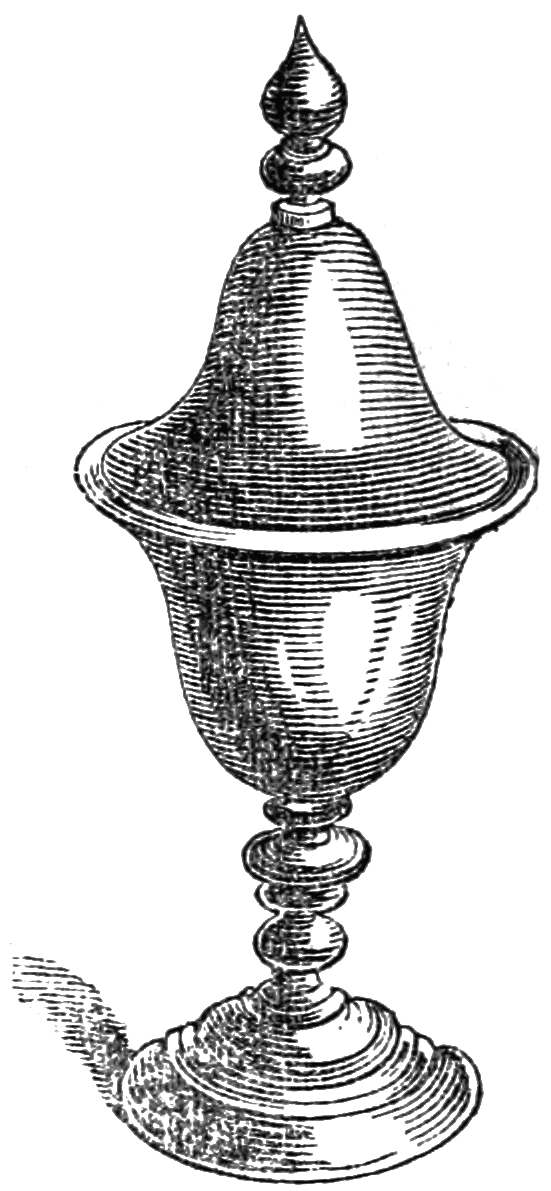
were then placed in a vessel like the figure,
below, and immediately
afterwards the performer
said to the persons in
front: “I will give you
these;” and taking off
the top, when he was
expected to throw out
the wet handkerchiefs,
all that fell was a number
of flowers. He now
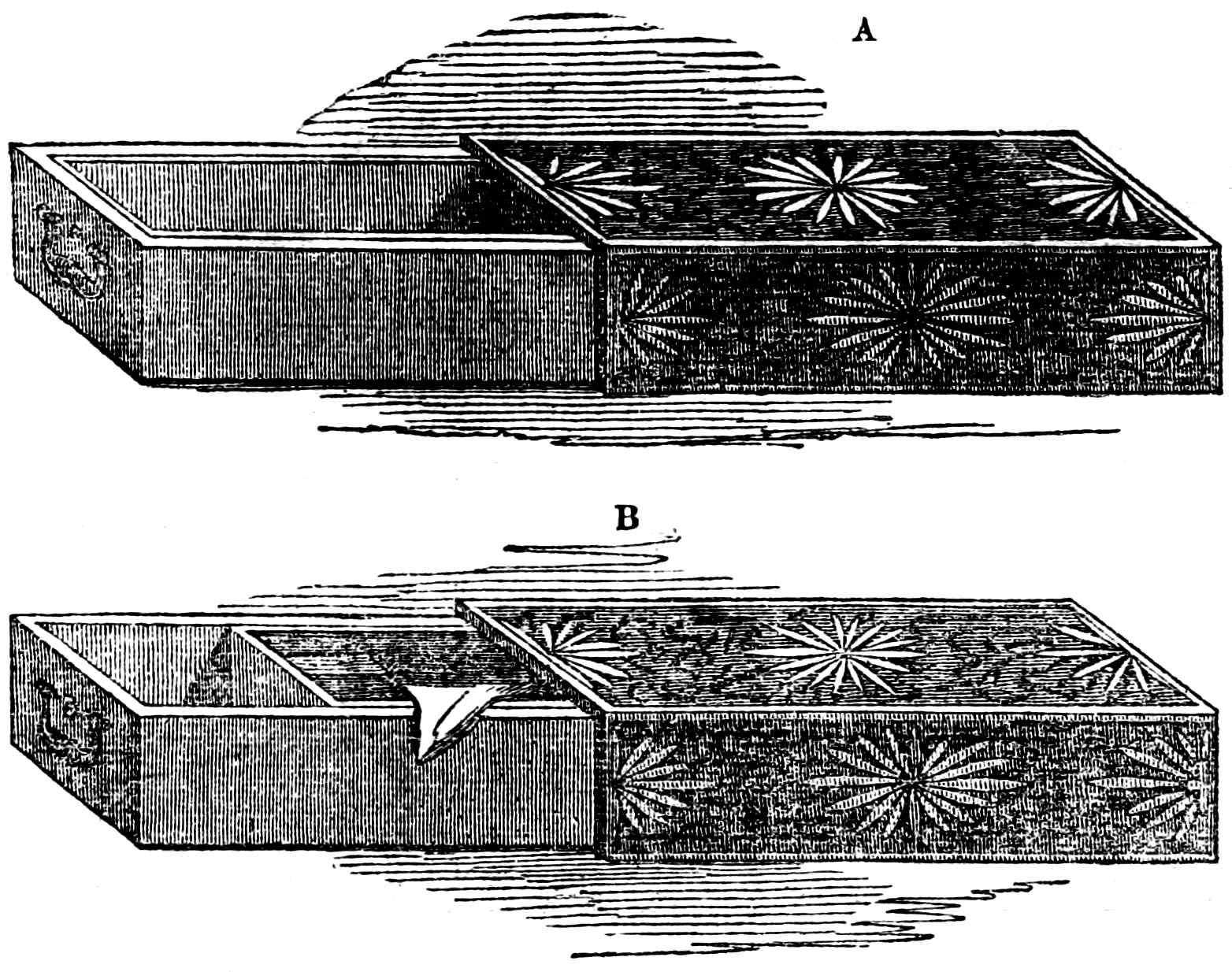
brought out a box, which
he opened, and showed
it to be empty; then
shutting it, and uttering
a few cabalistic words,
he opened it again, and
there were the handkerchiefs,
all dry, folded,
and scented, which he
distributed to their respective
claimants.
A
B
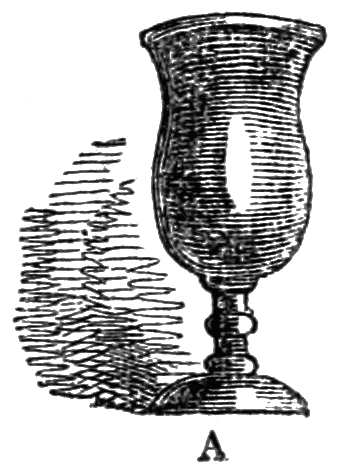
Another experiment of a popular performer
was called “coffee for the million.” Producing
a vessel like the diagram A;
the performer filled it with unground
coffee, and placing it
under a cover B, he said, “There,
when you have done that, let it
simmer for three-quarters-of-an
hour; but, perhaps, you will
not like to wait so long; here
then it is;” and on removing
the cover, the vessel appeared
full of hot liquid coffee. In
another vessel of the same
kind he obtained lump-sugar
from rape-seed; and in a third,
warm milk from horse-beans;
and pouring out the coffee
into cups, sent them round to
regale his auditory, amidst
their loud and approving
shouts at so great a transformation.
As these feats are the result of considerable
ingenuity, it is probable that the devices employed
would not readily occur to spectators in
general, while they would utterly escape those
whose object is merely amusement, and who, if
they thought at all, would be likely to describe
the result as supernatural. We proceed, then,
to the unravelling of the mystery. Let it be
observed, in reference to the first experiment,
that a number of handkerchiefs are collected in
the early part of the evening for various illusions,
and that many of them appear for a time
on the performer’s table. Provided with a
collection of these articles, from the handsome
silk handkerchief to one trimmed with lace,
used by a fashionable lady, he could easily
substitute his own of the same kind for those of
his auditory, as the curtain falls, according to
the arrangements of the evening, between the
collection of the handkerchiefs and the subsequent
process. His own handkerchiefs, therefore,
are washed and placed in the vase already
described; and the so-called change into flowers
is nothing more than
the retention of the
handkerchiefs in the
lower part of the apparatus,
which the figure
illustrates, while the
upper part holds the
flowers till they are
scattered among the
spectators. Meanwhile,
all that is required is
done to their handkerchiefs.
It is not absolutely
necessary that
they should be washed;
for folding, pressing,
and a little eau-de-Cologne,
would complete
the preparation; but
granting that they are
washed, there is still no
difficulty, though this
mystifies the spectators,
who have the idea
that drying is a long affair; for it may be
effected in a minute or two by a machine
that is readily obtained. The box brought
out has them deposited in it, but as it is
double, one interior is first shown, which, of
course, contains nothing, for the inner drawer
holding the handkerchiefs remains in the case;
but when a few sounds are uttered and the
professor touches a secret spring behind, which
disengages the inner box, he draws it out with
the outer one; and presents the handkerchiefs
to the audience. In the diagram A, the box is
shown as empty. At B, we have a representation
of the box containing the handkerchiefs.
It is only necessary to add that the box is very
nicely made; the part within the other drawn
out to the end, defies detection.
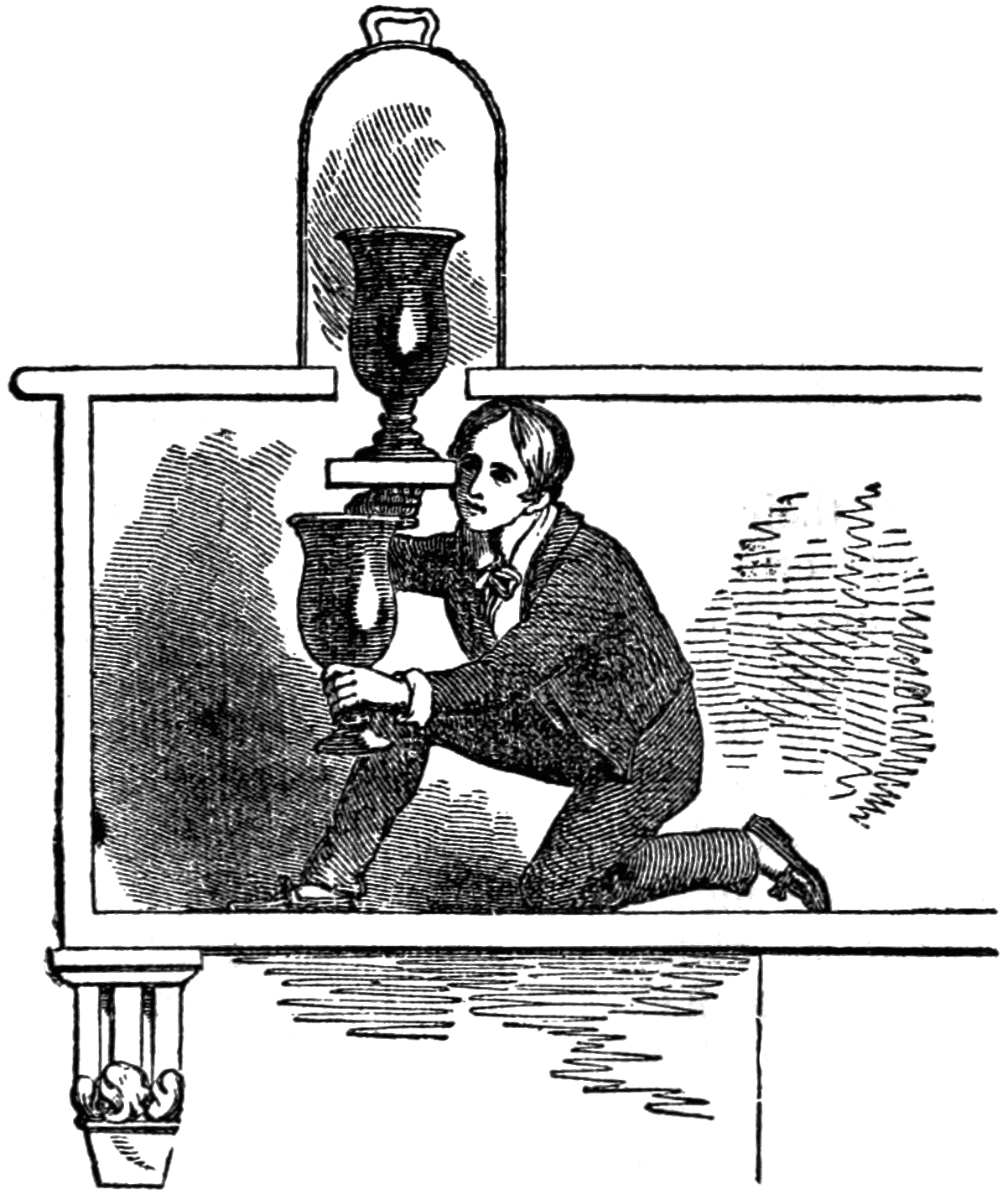
The preparation of coffee, milk, and sugar,
may be easily explained; for if the vessels containing
respectively the unground coffee, the
rape-seed, and the horse-beans, always placed
under a cover, be put on a part of the table
having a circular trap-door—and for this there
is full provision in the cover of the table
extending to the floor—a confederate may readily
substitute one for the other.
The Rev. W. Arthur, in his work on the
Mysore, directs us to results of a different kind:—“Whilst
walking in the verandah,” he says,
“some snake-charmers approached, and forthwith
began to show us their skill. They produced
several bags and baskets, containing
serpents of the most poisonous kind—the cobra
di capello; then blew upon an instrument
shaped like a cocoa-nut, with a short tube
inserted, and producing music closely allied to
that of the bag-pipe. The animals were brought
forth, raised themselves to the music, spread
out their head, showing the spectacle mask
fully distended, and waved about with considerable
grace, and little appearance of venom.
The men coquetted with them, and coiled them
about their persons, without any sign of either
dislike or fear. This power of dealing with
creatures so deadly is ascribed by the natives
to magic. Europeans generally account for it
by saying that the fangs are extracted. But
the most reasonable explanation seems to be,
that when the snake is first caught, by a
dexterous movement of the charmer, the hand
is slipped along the body, until it reaches the
neck, which he presses so firmly, as to compel
an ejection of the virus; thus destroying, for a
time, all power to harm; and that this operation
is repeated as often as is necessary, to
prevent the dangerous accumulation. If this
be true—and I believe it is—nothing is necessary
to the safe handling of these reptiles, but
a knowledge of the laws which regulate the
venomous secretion. The wonder seems to lie
in the power they possess of attracting the
snakes by their rude music, and seizing them
in the first instance. But enough is known to
make it evident that, in what all natives and
many Europeans regard as mysterious and
magical, there is nothing but experience, tact,
and courage.”
A strange and repulsive feat is thus described
by the Rev. G. Smith, in his recent work on
“China.” “Aquei conducted us into a room,
where he was sitting with his two wives, handsomely
attired, looking from a window on the
crowd assembled in the street to witness the
performances of a native juggler. The latter,
after haranguing the crowd with much animation
in the Nanking dialect, (as is usual with
actors,) proceeded to one part of the crowd,
and took thence a child, apparently five or six
years old, who, with struggling resistance, was
led into the centre of the circle. The man
then, with impassioned gesture, violently threw
the child on a wooden stool, and, placing him
on his back, flourished over him a large knife;
the child all the time sobbing and crying as if
from fright. Two or three older men from the
crowd approached, with earnest remonstrances
against the threatened deed of violence. For a
time, he desisted, but, soon after, returning to
the child, who was still uttering most pitiable
cries, he placed him with his back upwards,
and, notwithstanding the violent protests of the
seniors, he suddenly dashed the knife into the
back of the child’s neck, which it appeared to
enter till it had almost divided it from the
head; the blood meanwhile flowing copiously
from the wound, and streaming to the ground,
and over the hands of the man. The struggle
of the child grew more and more feeble, and at
last altogether ceased. The man then arose,
leaving the knife firmly fixed in the child’s
neck. Copper cash was then thrown liberally
into the ring, for the benefit of the principal
actors. These were collected by assistants, all
of them viewing the influx of the coins with
great delight, and bowing continually to the
spectators, and reiterating the words, ‘To
seoz,’ ‘Many thanks.’ After a time, the man
proceeded towards the corpse, pronounced a
few words, took away the knife, and called
aloud to the child. Soon there appeared the
signs of returning animation. The stiffness of
death gradually relaxed, and at last he stood
up among the eager crowd, who closed around
him, and bountifully rewarded him with cash.
The performance was evidently one which excited
delight in the bystanders, who, by their
continued shouts, showed their approbation of
the acting.”
It is almost superfluous to add, that the
deception consisted in the construction of the
blade and the handle of the knife, so that, by
making a sawing motion on the throat of the
child, a stream of coloured liquid, resembling
blood, is pumped out; a little acting on the
part of the performer and the child is amply
sufficient for all the rest.
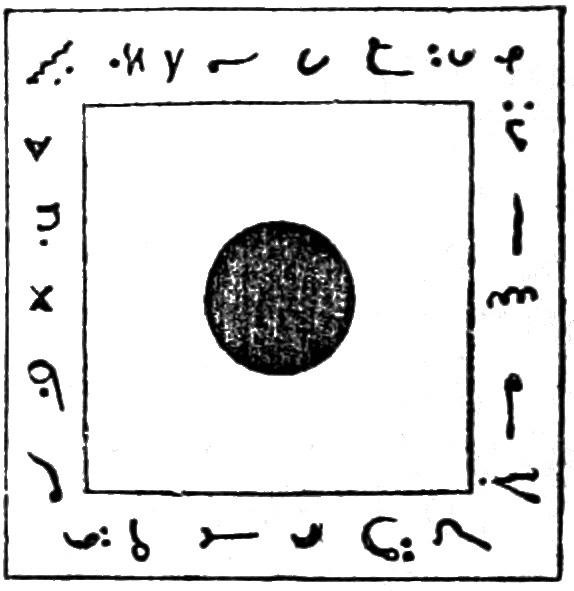
Within the last few years, we have had accounts
of a magician in Egypt, first described
in a valuable work on that country by Mr.
Lane, which produced an extraordinary impression.
The magician,
it was said,
caused a boy to see
certain persons called
for, in a little ink,
placed in his hand, in
the centre of a double
magic square, somewhat
like the figure.
One of the most profound
writers of the
age even wrote: “There will be no lack of
confidence to pronounce; and the authority so
pronouncing will assume the name and tone of
philosophy, that there was nothing more in the
whole matter than artful contrivance; that
there was no intervention of an intelligent
agency extraneous to that of the immediate
ostensible agent. But can this assumption be
made on any other ground than a prior general
assumption that there is no such preternatural
intervention in the system of the world? But
how to know that there is not? The negative
decision pronounced in confident ignorance, is
a conceited impertinence, which ought to be
rebuked by that philosophy whose oracles it is
affecting to utter. For what any man knows,
or can know, there may be such intervention.
That it is not incompatible with the constitution
of the world, is an unquestionable fact
with the unsophisticated believers in the sacred
records. And not a few occurrences in later
history have totally defied every attempt at
explanation in any other way.”A
And yet sir Gardiner Wilkinson, who subsequently
travelled in Egypt, and visited the
magician, says:—
“On going to see him, I was determined to
examine the matter with minute attention, at
the same time that I divested myself of every
previous bias, either for or against his pretended
powers. A party having been made up to
witness the exhibition, we met, according to
previous agreement, at Mr. Lewis’s house on
Wednesday evening, the 8th of December.
The magician was ushered in, and having
taken his place, we all sat down, some before
him, others by his side. The party consisted
of colonel Barnet, our consul-general, Mr.
Lewis, Dr. Abbott, Mr. Samuel, Mr. Christian,
M. Prisse, with another French gentleman, and
myself, four of whom understood Arabic very
well; so that we had no need of any interpreter.
The magician, after entering into conversation
with many of us on different subjects, and discussing
two or three pipes, prepared for the
performance. He first of all requested that a
brazier of live charcoal should be brought him,
and, in the mean while, occupied himself in
writing upon a long slip of paper five sentences
of two lines each, then two others, one of a
single line, and the other of two, as an invocation
to the spirits. Every sentence began with
‘Tuyurshoon.’ Each was separated from the
one above and below it by a line, to direct him
in tearing them apart. A boy was then called,
who was ordered to sit down before the magician.
He did so, and the magician having
asked for some ink from Mr. Lewis, traced
with a pen on the palm of his right hand a
double square, containing the nine numbers in
this order, or in English—making fifteen each
way; the centre one being five—the evil number.
This I remarked to the magician, but
he made no reply. A brazier was brought
and placed between the magician and the boy,
who was ordered to look stedfastly into the ink,
and report what he should see. I begged the
magician to speak slowly enough to give me
time to write down every word, which he promised
to do, without being displeased at the
request; nor had he objected, during the preliminary
part of the performance, to my
attempt to sketch him as he sat. He now
began an incantation, calling on the spirits by
the power of ‘our lord Soolayman,’ with the
words ‘tuyurshoon’ and ‘haderoo’ (be present)
frequently repeated.
“He then muttered words to himself, and
tearing apart the different sentences he had
written, he put them, one after another, into
the fire, together with some frankincense. This
done, he asked the boy if any one had come.
Boy. ‘Yes, many.’—Magician. ‘Tell them
to sweep.’—B. ‘Sweep.’—M. ‘Tell them to
bring the flags.’—B. ‘Bring the flags.’—M.
‘Have they brought any?’—B. ‘Yes.’—M.
‘O, what colour?’—B. ‘Green.’—M.
‘Say, Bring another.’—B. ‘Bring another.’—M.
‘Has it come?’—B. ‘Yes, a green
one.’—M. ‘Another.’—B. ‘Another.’—M.
‘Is it brought?’—B. ‘Yes, another
green one—they are all green.’ This boy
was then sent away, and another was brought,
who had never before seen the magician, having
been chosen with another, by Mr. Lewis, on
purpose; but after many incantations, incense,
and long delay, he could see nothing, and fell
asleep over the ink. The other boy was then
called in, but he, like the other, could not be
made to see anything; and a fourth was
brought in, who had evidently acted his part
before. He first saw a shadow, and was ordered
to ‘tell him to sleep;’ and, after the
flags and the sultan as usual, some one suggested
that lord Fitzroy Somerset should be
called for. He was described in a white Frank
dress, a long, high, white hat, black stockings,
and white gloves, tall, and standing before him
with black boots. I asked how he could see his
stockings with boots? The boy answered,
‘Under his trowsers.’ He continued, ‘His
eyes are white, moustaches, no beard, but little
whiskers, and yellow or light hair; he is thin,
thin legs, thin arms; in his left hand he holds
a stick, and in the other a pipe; he has a black
handkerchief round his neck, his throat buttoned
up, his trowsers are long, he wears green
spectacles.’ The magician, seeing some of the
party smiling at the description and its inaccuracies,
said to the boy, ‘Don’t tell lies, boy.’
To which he answered, ‘I do not; why
should I?’—M. ‘Tell him to go.’—B. ‘Go.’
Queen Victoria was next called for, who was
described as short, dressed in black trowsers,
a white hat, black shoes, white gloves, red coat,
with lining, and black waistcoat, with whiskers,
but no beard nor moustaches, and holding in
his hand a glass tumbler. He was asked if
the person were a man or a woman? He
answered, ‘A man.’ We told the magician
that it was our queen! He said, ‘I do not
know why they should say what is false; I
knew she was a woman, but the boys describe
as they see.’
“From the manner in which the questions
were put, it is very evident that, when a boy is
persuaded to see anything, the appearances of
the sweeper, the flags, and the sultan, are the
result of leading questions. The boy pretends
or imagines he sees a man or a shadow, and he
is told to order some one to sweep: he is therefore
prepared with his answer; and the same
continues to the end, the magician always telling
him what he is to call for, and consequently
what he is to see. The descriptions of persons
asked for are almost universally complete
failures.”
After these and other details, sir Gardiner
says, “I am decidedly of opinion that the whole
of the first part is done solely by leading questions,
and that whenever the descriptions succeed
in any point, the success is owing to accident,
or to unintentional prompting in the mode of
questioning the boys.”B
A subsequent traveller, lord Nugent, places
the state of the case in a new light:—
“It is enough to say, that not one person
whom Abd-el-Kader described bore the smallest
resemblance to the one named by us; and
all those called for were of remarkable appearance.
All the preparations, all the ceremony,
and all the attempts at description, bore evidences
of such a coarse and stupid fraud, as
would render any detail of the proceeding, or
any argument tending to connect it with any
marvellous power, ingenious art, or interesting
inquiry, a mere childish waste of time. How,
then, does it happen, that respectable and
sensitive minds have been staggered by the
exhibitions of this impostor? I think that the
solution which Mr. Lane himself suggested as
probable is quite complete. When the exhibition
was over, Mr. Lane had some conversation
with the magician, which he afterwards
repeated to us. In reply to an observation of
Mr. Lane’s to him upon his entire failure, the
magician admitted that ‘he had often failed
since the death of Osman Effendi;’—the same
Osman Effendi that Mr. Lane mentions in his
book as having been of the party on every
occasion on which he had been witness of
the magician’s art, and whose testimony the
Quarterly Review cites in support of the
marvel, which (searching much too deep for
what lies very near, indeed, to the surface,) it
endeavours to solve by suggesting the probability
of diverse complicated optical combinations.
“And, be it again observed, optical combinations
cannot throw one ray of light upon the
main difficulty, the means of procuring the
resemblance required of the absent person. I
now give Mr. Lane’s solution of the whole
mystery, in his own words, my note of which
I submitted to him, and obtained his ready
permission to make public in any way I might
see fit. This Osman Effendi, Mr. Lane told me,
was a Scotchman, formerly serving in a British
regiment, who was taken prisoner by the
Egyptian army during our unfortunate expedition
to Alexandria, in 1807; that he was
sold as a slave, and persuaded to abjure Christianity,
and profess the Mussulman faith; that,
applying his talents to his necessities, he made
himself useful by dint of some little medical
knowledge he had picked up on duty in the
regimental hospital; that he obtained his liberty
at the instance of the Sheik Ibraim, (M. Burckhardt,)
through the means of Mr. Salt; that, in
process of time, he became second interpreter
of the British consulate; that Osman was, very
probably, acquainted, by portraits or otherwise,
with the general appearance of most Englishmen
of celebrity, and certainly could describe the
peculiar dresses of English professions, such as
army, navy, church, and the ordinary habits of
persons of different professions in England;
that, on all occasions when Mr. Lane was
witness of the magician’s success, Osman had
been present at the previous occasions, had
heard who should be called to appear, and so
had, probably, obtained a description of the
figure, when it was to be the apparition of
some private friend of persons present; that, on
these occasions, he very probably had some
pre-arranged code of words, by which he could
communicate secretly with the magician. To
this it must be added, that his avowed theory
of morals was, on all occasions, that ‘we did
our whole duty if we did what we thought
best for our fellow-creatures and most agreeable
to them.’ Osman was present when Mr. Lane
was so astonished at hearing the boy describe
very accurately, the person of M. Burckhardt,
with whom the magician was unacquainted,
but who had been Osman’s patron, and who,
also, knew well the other gentleman whom Mr.
Lane states in his book that the boy described
as appearing ill and lying on a sofa, and Mr.
Lane added that he had, probably, been asked
by Osman about that gentleman’s health, whom
Mr. Lane then knew to be suffering under an
attack of rheumatism. He concluded, therefore,
by avowing that there was no doubt in
his mind, connecting all these circumstances
with the declaration the magician had just
made, that Osman had been the confederate.
Thus I have given in Mr. Lane’s words, not
only with his consent, but at his ready offer,
what he has no doubt is the explanation of the
whole of the subject which he now feels to
require no deeper inquiry; and which has been
adopted by many as a marvel upon an exaggerated
view of the testimony that he offered
in his book before he had been convinced, as
he now is, of the imposture. I gladly state
this, on the authority of an enlightened and
honourable man, to disabuse minds that have
wandered into serious speculation on a matter
which I cannot but feel to be quite undeserving
of it.”C—So true is it, that, while many effects,
which appear mysterious to the multitude,
may be explained by those of greater knowledge,
others, which, for a time, defy penetration,
are, at length, clearly exhibited in their
true light. It becomes us, therefore, carefully
to examine testimony, to receive that only
which will bear scrutiny, and to suspend our
judgment whenever we are unacquainted with
the whole case. The best of men are prone to
err; and well is it, if, ceasing from them, we
have been led by Divine grace to trust implicitly
in the God of truth.
CHAPTER III.
Machines considered magical in ancient times—Remarkable
modern automata—Minute engines—The calculating machine.
The light of modern science has revealed to us
many important secrets. In the dark ages
there were but few books; it was then the
fashion to write them in Latin; and as, from
their costliness, they could only be obtained
by men of wealth, so they could be understood
alone by such as had enjoyed the advantages
of education. Science is now easily
accessible, but, though it is not necessary for
us all to become philosophers, there is no good
reason why people generally should not be
acquainted with some of the most remarkable
phenomena of the natural world. The inspired
psalmist has said, “The works of the Lord are
great, sought out of all them that have pleasure
therein;” and it becomes all, according to their
means and opportunities, to lay this truth to
heart. We proceed now to consider some
effects regarded as magical, which are satisfactorily
explained on natural principles, beginning
with mechanics.
An ability to construct wonderful or magical
machines was manifest among the ancients.
Archytas, a native of Tarentum, in Italy, who
lived four hundred years before the birth of
our Lord and Saviour, is said to have made a
wooden dove, which flew and sustained itself
for some time in the air. Other clever contrivances
are also mentioned. “A magician,” says
D’Israeli, “was annoyed, as philosophers still
are, by passengers in the street; and he, particularly
so, by having horses led to drink under
his window. He made a magical horse of wood,
according to one of the books of Hermes,
which perfectly answered his purpose, by
frightening away the horses, or, rather, the
grooms! The wooden horse, no doubt, gave
some palpable kick.”
It is worthy of remark, that tales of ancient
times must be received with caution. We
find it necessary, even at a much later period.
The tricks which now amuse or astonish the
populace at a country fair, would be greatly
exaggerated in a credulous age, and often
assume even the most portentous colouring.
Nor is it difficult to guess, and sometimes to
discover, the stages of similar and great mystifications.
The following instance is rather remarkable.
On Charles V. entering Nuremberg,
a celebrated German astronomer, whose real
name was Johann Müller, but who styled himself
Regiomontanus, exhibited some automata
which he had constructed. These were an
eagle of wood, which, placed on the gate of the
city, rose up and flapped its wings, while the
emperor was passing below; and a fly, made of
steel, which walked round a table. Now all
this is sufficiently credible. But what is the
record of the chroniclers only a few years after?
That the wooden eagle sprang from the tower
and soared in the air; and that the steel fly
flew three times round the emperor, and then
alighted buzzing on his hand!
In many instances, the mechanism of modern
times is surprisingly minute. A watchmaker
in London presented his majesty George III.
with a repeating watch he had constructed, set
in a ring. Its size was something less than a
silver two-pence; it contained one hundred-and-twenty-five
different parts, and weighed, altogether,
no more than five pennyweights and
seven grains!
In an exhibition of Maillardet, which the
writer has seen, the lid of a box suddenly flew
open, and a small bird of beautiful plumage
started forth from its nest. The wings fluttered,
and the bill opening with the tremulous motion
peculiar to singing birds, it began to warble.
After a succession of notes, whose sound well
filled a large apartment, it retired to its nest,
and the lid closed. Its performances occupied
about four minutes. In the same exhibition
were an automatic spider, a caterpillar, a mouse,
and a serpent; all of which exhibited the peculiar
movements of the living creatures. The
spider was made of steel: it ran on the surface
of a table for three minutes, and its course
tended towards the middle of the table. The
serpent crawled about in every direction,
opened its mouth, hissed, and darted forth its
tongue.
Several years ago, a watchmaker, residing
in a town in which the writer lived, made a
working model of a steam-engine, the packing-case
of which was a walnut-shell. On showing
it one day to a gentleman, the machine was
suddenly stopped, the mechanic remarking,
“There is something wrong in one of the safety-valves.”
“Safety-valve!” exclaimed the observer;
“I have not yet been able to detect the
fly-wheel!”
The most curious specimen of minute workmanship,
however, with which we are acquainted,
is a high-pressure engine, the work
of a watchmaker having a stand at the
Polytechnic Institution, and first exhibited in
1845. Each part was made according to scale,
it worked by atmospheric pressure, in lieu of
steam, with the greatest activity, yet it was so
small, that it stood on a fourpenny-piece, with
ground to spare, and, with the exception of the
fly-wheel, it might be covered with a thimble.
D’Alembert describes a flute-player, constructed
by Vaucanson, which he saw exhibited
at Paris in 1738. The writer has also seen
one, in which a figure appeared seated, and then
rose and played a tune, the motions of the
fingers seeming to accord with the notes. He
cannot answer for the music having been produced
by the movements of the hands of the
automaton. D’Alembert affirms, however, that
the automaton of Vaucanson really projected
the air with its lips against the embouchure of
the instrument, producing the different octaves
by expanding and contracting their openings,
giving more or less air, and regulating the
tones by its fingers, in the manner of living
performers. The height of the figure, with the
pedestal, containing some of the machinery, was
nearly six feet; it commanded three octaves,
several notes of which musicians find it difficult
to produce. Some years ago, two automaton
flute-players were exhibited in this country, of
the size of life, which performed ten or twelve
duets. That they actually played the flute
might be proved, by placing the finger on any
hole that was unstopped for a moment by the
automata.
M. Vaucanson produced a flageolet-player,
who beat a tambourine with one hand. The
flageolet had only three holes, and some notes
were made by half-stopping these. The lowest
note was produced by a force of wind equal to
an ounce, the highest by one of fifty-six French
pounds. A duck was, however, considered to
be his chef-d’œuvre; it dabbled in the mire,
swam, drank, quacked, raised and moved its
wings, and dressed its feathers with its bill; it
even extended its neck, took barley from the
hand and swallowed it, during which process
the muscles of the neck were seen in motion,
and it also digested the food by means of
materials provided for its solution in the
stomach. The inventor made no secret of the
machinery, which excited, at the time, great
admiration.
Maelzel, the inventor of the metronome, or
time-measurer, frequently used to aid pupils
in music, exhibited in Vienna in 1809, another
automaton of singular power; which appeared
in the uniform of a trumpeter in the Austrian
dragoon regiment Albert, with his instrument
placed to his mouth. When the figure was
pressed on the left shoulder, it played not only
the Austrian cavalry march, and all the signals
of that army, but also a march and allegro by
Weigl, which was accompanied by the whole
orchestra. The dress of the figure was then
changed into that of a French trumpeter of the
guards, when it began to play a French cavalry
march, all the signals, the march of Dussek,
and an allegro of Pleyel, accompanied again
by the full orchestra. Maelzel publicly wound
up his instrument only twice on the left hip.
The sound of the trumpet was pure and peculiarly
agreeable.
About thirty years ago, Maillardet exhibited,
in Spring Gardens, a variety of automata,
which the writer had an opportunity of seeing
at a later period. One was the figure of a boy,
who wrote sentences, and drew certain objects
with remarkable promptitude and correctness.
Another was a pianiste, seated at a piano-forte,
on which she played eighteen tunes. All her
movements were graceful. Before beginning a
tune, she made a gentle inclination of the head
to her auditors; her bosom heaved, and her
eyes followed the motion of her fingers over
the finger-board. When the automaton was
once wound up, it would continue playing for
an hour; and the principal part of the machinery
employed was freely exposed to public
view. It has been doubted whether the music
was actually produced by the automaton: since
the time now referred to, the writer has examined
another, in which the keys of the instrument
were certainly acted upon by the
touch.
He has also seen, at various times, several
very curiously constructed automata: the figure
of a lady, who could walk along a level surface,
throwing out the limbs, and moving
the head from side to side; a tippler, who
could pour out wine from a decanter into a
glass, open his mouth, and swallow the fluid,
and thus proceed till the bottle was drained;
and a performer on the slack rope, whose exceedingly
rapid movements of the body, the
arms, and the head, all consistent and graceful,
were truly amazing.
A very beautiful automaton was exhibited,
a few years ago, in Paris, and subsequently in
London. It appeared in a court suit, sitting
at a table, in the attitude of writing. Several
questions, inscribed on tablets, were placed on
the table on which the whole apparatus stood,
and visitors might select any one or more at
pleasure. The tablet, containing a question, on
being handed to the attendant, was placed in
a drawer, and, as soon as it was closed, the
figure traced on paper an appropriate reply.
On the question being given, “Who may be
volatile without a crime?” the answer was,
“A butterfly.” And as the figure could draw
a response as well as write it, when the question
was put, “What is the symbol of fidelity?”
it drew, in outline, the form of a greyhound.
In the same way it proceeded throughout the
series of questions.
In some instances, the effect of automata is
increased by the exhibiter proposing certain
questions, and receiving responses from the
figure—as shaking the head, to denote a negative;
or nodding, to indicate assent. It is
evident that here the inquiries or remarks are
thrown in to accord with the motions that the
figure is contrived to make. When, however,
a performer, as one has recently done, puts a
whistle in the mouth of an automaton, and
then, sitting down by its side, plays a tune on
a guitar, desiring the figure to accompany him;
the hasty sounds with which the figure seems
inclined to begin, the irregularity with which
it proceeds, and the long and loud closing note,
may all be easily supplied by some confederate.
Surprising as are the effects produced by many
automata, it would be wrong to infer that their
only results are the wonder of the multitude,
or gain or applause to their inventors. “They
gave rise,” as sir David Brewster has remarked,
“to the most ingenious mechanical
devices, and introduced, among the higher
order of artists, habits of nice and accurate
execution in the formation of the most delicate
pieces of machinery.” Those combinations of
wheels and pinions, which almost eluded observation,
“reappeared in the stupendous
mechanism of our spinning-machines and our
steam-engines. The elements of the tumbling
puppet were revived in the chronometer, which
now conducts our navy through the ocean;
and the shapeless wheel which directed the
hand of the drawing automaton (of Maillardet,)
has served, in the present age, to guide the
movements of the tambouring-engine. Those
mechanical wonders, which in one century
enriched only the conjurer who used them,
contributed in another to augment the wealth
of the nation; and those automatic toys which
once amused the vulgar, are now employed in
extending the power, and promoting the civilisation
of our species. In whatever way, indeed,
the power of genius may invent or combine,
and to whatever bad or even ludicrous
purposes that invention or combination may
be originally applied, society receives a gift
which it can never lose; and though the value
of the seed may not at once be recognised,
though it may lie long unproductive in the ungenial
soil of human knowledge, it will; some
time or other, evolve its germ, and yield to
mankind its natural and abundant harvest.”D
A singular fact is connected with the early
history of the Astronomical Society of London.
A valuable set of tables, for reducing the observed
to the true places of stars, was in course
of preparation, at the expense of the society, including
above three thousand stars, and comprehending
all known to those of the fifth magnitude,
inclusive, and all the most useful of the sixth
and seventh. An incident which now occurred,
gave rise to one of the most extraordinary of
modern inventions. To insure accuracy in the
calculation of certain tables, separate computers
had been employed; and two members of the
society having been chosen to compare the results,
detected so many errors, as to induce one
of them to express his regret that the work
could not be executed by a machine. For this,
the other member, Mr. Babbage, at once replied,
that “this was possible;” and, persevering
in the inquiry which had thus suggested itself,
he produced a machine for calculating tables
with surprising accuracy.
The calculating part of the machinery occupies
a space of about ten feet broad, ten feet
high, and five feet deep. It consists of seven
steel axes, erected over one another, each of
them carrying eighteen wheels, five inches in
diameter, having on them small barrels, and inscribed
with the symbols 0, 1, to 9. The machine
calculates to eighteen decimal places, true to
the last figure; but, by subsidiary contrivances,
it is possible to calculate to thirty decimal
places. Mr. Babbage has since contrived a
machine, much more simple in its construction,
and far more extensive in its application.
In thus enumerating various displays of
mechanical genius, we are reminded that the
prophet Isaiah, after describing the diverse
labours of the husbandman, adds, “This also
cometh forth from the Lord of hosts, which
is wonderful in counsel, and excellent in
working.” In all the evidence we have of
human talent, then, let us acknowledge that
“every good gift and every perfect gift is from
above, and cometh down from the Father of
lights, with whom is no variableness, neither
shadow of turning,” Jas. i. 17. Would that
the gifts of God were always used for the
Divine glory!
CHAPTER IV.
Terrestrial phenomena—Footmarks on rocks—The Logan
stone—Sounds in stones—The cave of St. Paul—Atmospherical
phenomena—Intermitting springs—Waters of
magical power.
In proceeding to illustrate the operation of
natural laws, we may look now at some of the
phenomena connected with the globe we inhabit,
of which, where little knowledge is possessed,
erroneous and frequently superstitious
opinions are still entertained.
Marvellous tales are often told of rocks.
There is, for example, a tradition of a nobleman
being engaged in the chase, or pursued
by his enemies, without being hurt; whose
horse left the prints of his feet on a mass of
stone, over which he passed. But, unhappily
for the tale, other impressions have been observed
besides those of the horse’s feet; and it
is affirmed by various naturalists, deserving of
credit, that they must have been made by very
different animals, at a remote period, before
the stone had completely hardened. Other
instances of the same kind might easily be
given. In the British Museum, there is a slab
having similar impressions, obviously produced
by the same means. It was dug from a great
depth; a mass of stone, many feet in thickness,
having been formed above the layer which received,
in a soft state, the impression from the
feet of several animals.
Other impressions, of which we read or hear,
are nothing more than tricks of art. Such,
most probably, is the impression of the foot of
Budda upon the Peak of Adam, at Ceylon; the
print of the foot of the idol Gaudama, in the
Burmese empire, which has been three times
reproduced; and most certainly this is the case
with the so-called impressions of the feet of
our blessed Lord and Saviour, shown to the
present day, on Mount Olivet.
The cave of St. Paul, at Civita Vecchia, the
former capital of the island of Malta, is an
excavation, about nineteen feet in height, and
fifty in circumference; in a soft, white, limestone
rock, more friable than chalk. A belief
that the stone was endowed with miraculous
medical virtues, led people to carry away large
quantities of it during the sway of the knights.
In 1770, when visited by Brydone, the cave
was in the highest celebrity; not only every
house in the island had a medical chest of it,
but large quantities were sent to different
countries in Europe, and even to the East
Indies. It was supposed to have a miraculous
power which preserved it from diminution;
which may be accounted for by a natural law—the
calcareous process of formation still going
on—while its healing power is to be attributed
to its having some of the properties of magnesia;
which leads, according to Dr. Walsh, to
its still being given as a purgative-sudorific in
eruptive or fever complaints.
One instance of gross superstition, as connected
with rocks, is too important to be
omitted. The trial by ordeal appears to have
been very early practised among the Celtic
tribes of Europe, who were always under the
influence of an artful and domineering priesthood.
Thus, it is said that in cases of doubtful
accusation the Druids made use of the rocking-stones
which were common in Britain, and that
the culprit was acquitted or condemned according
as he succeeded or failed in shaking them.
Mason alludes to this trial in the following
lines:—
“Behold yon huge
And unknown sphere of living adamant,
Which, poised by magic, rests its central weight
On yonder pointed rock; firm as it seems,
Such is its strange and virtuous property,
It moves obsequious to the gentlest touch
Of him whose heart is pure; but to a traitor,
Though e’en a giant’s prowess nerved his arm,
It stands as fixed as Snowdon.”
A little knowledge would have disabused the
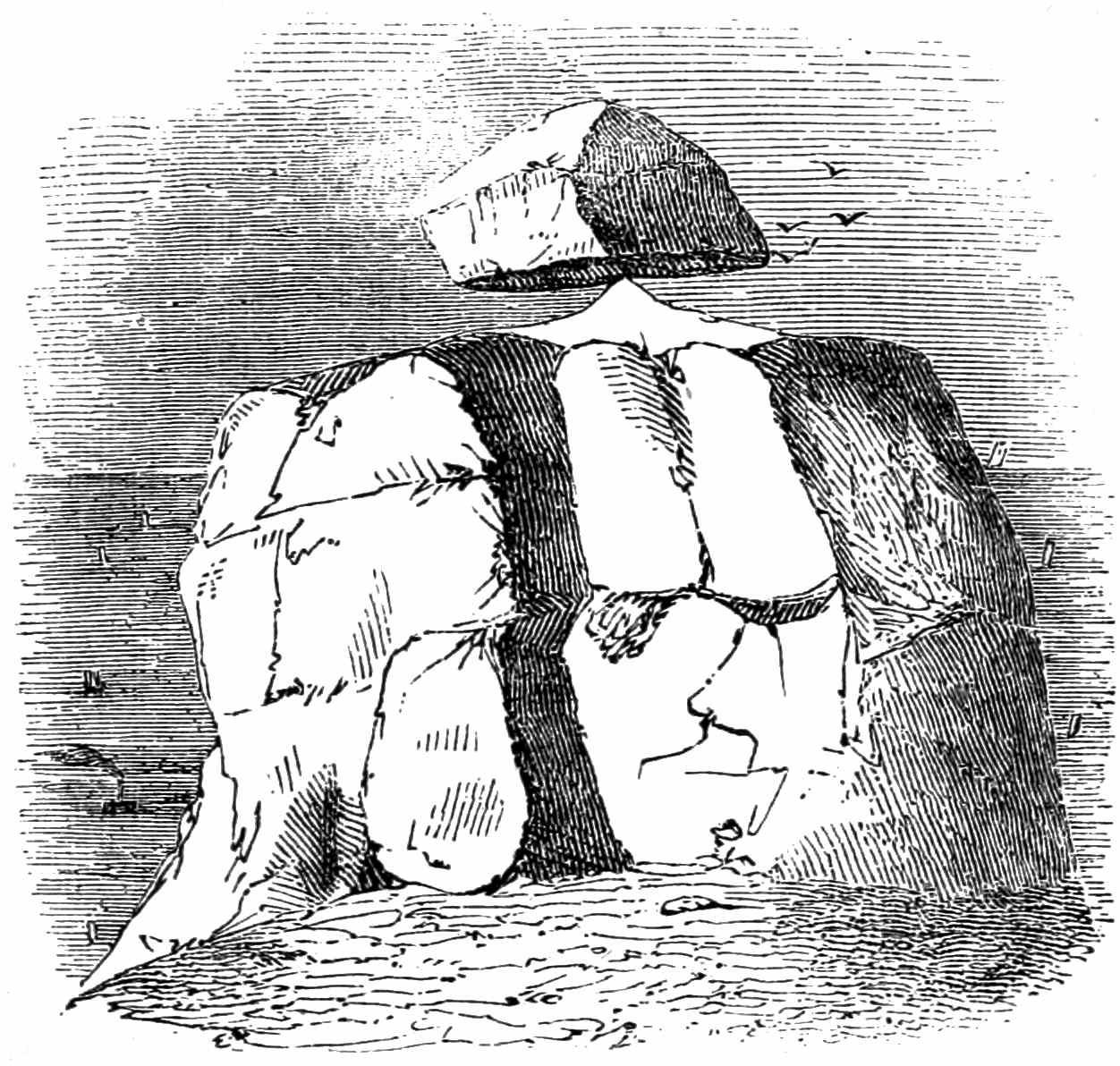
mind of this delusion. The celebrated Logan
or Logging-stone, near the Land’s End in
Cornwall, is an immense block, weighing about
sixty tons. The surface in contact with the
under rock is, however, of very small extent;
and the whole mass is so nicely balanced, that,
notwithstanding its magnitude, the strength of
a single man is sufficient to make it oscillate,
when applied to the under edge. It is the
nature of granite to disintegrate or decompose
by the action of the air and moisture; a huge
mass is thus split into several blocks, and at
length, by the continued operation of the
elements, one is suspended on the rest.
Sounds emitted from rocks have often been
regarded as portentous. Mr. G. Bennett, when
at Macao, had his attention directed to a mass
of granite rocks, appearing as if separated by
some convulsion of nature, many of which
were found, when trodden on, to be movable.
The first, and by far the most sonorous, was
partially excavated underneath; and, by striking
it upon the upper part, a deep sound, “like
that of a church bell,” was produced. “The
battered appearance of the stone above,” it is
said, “bore several proofs of how many visitors
had made this lion roar.” Many of the other
rocks were also sonorous, but not so loud as the
first, and, from their situations, “they were movable
when trodden on; but it could not be seen,
whether, like the preceding, they were excavated,
and, in consequence of being so, sonorous.”
In the chain of El-Heman, and not far from
the Red Sea, is the Jebal Narkous, or “Mountain
of the Bell.” It forms one of a ridge of
low calcareous hills, which are connected by a
sandy plain, extending, with a gentle rise, to
their base. It is composed of a light-coloured
friable sandstone, about the same as the rest of
the chain; but an inclined plane of almost impalpable
sand rises at an angle of about forty
degrees with the horizon, and is bounded by a
semi-circle of rocks, presenting broken, abrupt,
and pinnacled forms, and extending to the base
of this remarkable hill. Its height is about
four hundred feet.
Lieutenant Wellsted observed, that the shape
and arrangement of the rocks resembled, in
some respects, a whispering-gallery; but he
ascertained, by experiment, that their irregular
surface rendered them but ill-adapted for the
production of an echo. Seated on a rock at the
base of the sloping eminence, he directed a
Bedouin to ascend; and it was not till he had
reached some distance that the lieutenant perceived
the sand in motion, rolling down the hill to
the depth of a foot. It did not, however, descend
in one continued stream, but, as the Arab
scrambled upwards, it spread out laterally and
above, until a considerable portion of the surface
was in motion. As the sand began to fall,
the sounds produced might be compared to the
faint strains of an Eolian harp when its strings
first catch the breeze. When the sounds became
more violently agitated by the increased
velocity of the descent, the noise more nearly
resembled that produced by drawing the moistened
fingers over glass. As it reached the base,
the reverberations attained the loudness of
distant thunder, causing the rock on which
lieutenant Wellsted was seated to vibrate;
and the camels, animals not easily frightened,
became so alarmed, that their drivers could
only retain them with difficulty. The noise, it
was remarked, did not issue from every part of
the hill alike, the loudest being produced by
disturbing the sand on the northern side, about
twenty feet from the base, and about ten from
the rocks that bound it in that direction. The
tradition is, that the bells of a convent were
buried here; the Bedouins trace the sounds to
several wild and fanciful causes; but, in the
experiment now described, it was evident that
the sounds sometimes fell quicker on the ear,
and at other times were more prolonged, according
to the Arab’s increasing or retarding
the velocity of his descent.
Dr. Chladni made many curious experiments
on the figures assumed by sand and
similar substances, when strewed over vibrating
sonorous bodies. The reader may easily try an
experiment of this kind. Let a square piece of
glass be taken, such as that used for windows,
not less than four or five inches over, the edges
of which are to be smoothed by grinding. Spread
over the plate, as evenly as possible, a little
sand, and, holding it between the thumb and
fore-finger, in the middle, pass the bow of a
violin against one of its edges, drawing it either
upwards or downwards, in a direction perpendicular
to its surface. A tremulous motion
will be immediately observed, and the sand
will assume some particular and fixed figure.
If the bow be passed over the middle of one
of the sides, the sand will arrange itself in the
direction of the two diagonals, dividing the
square into four isosceles triangles. If the bow
be applied at any point which is one-fourth the
length of the square from any angle, the
arrangement of the sand will represent the two
diameters of the square, dividing it into four
equal figures of the same form. If the square
be held at the two extremities of either diameter,
and the bow be applied to the extremities
of the other diameter, the sand will take the
figure of an oval, having its major axis in the
same direction as one of the diameters.
Other experiments of the same kind have
since been made by M. Voigt, and also by the
celebrated Oersted. The latter covered a plate
of metal or glass with the lycopodium seed, or
the seed of the club-moss, instead of sand;
he then tried to produce a sound in the
manner of Chladni, and instantly he saw the
dust distribute itself into a number of little
regular tumuli, which put themselves in motion
at their extremities, or formed the figures discovered
by this naturalist. They always
ranged themselves in the form of a curve, the
convexity of which was in proportion to the
point touched by the violin bow, or towards
the point which has an analogous situation;
the nearer that each of these little heaps was
to these points, the greater was its height, a circumstance
which gave remarkable regularity
to the figure. The interior of the small elevations
thus obtained, were in constant motion
during the continuance of the sound, and the
duration of the vibrations might be observed
on a plate from four to six inches in diameter.
At one moment the height increased, at another
it diminished, and the dust had the appearance
of arranging itself in small globules, which
rolled one above another.
We may now return from these very interesting
facts, to others on a far larger scale.
Near the Kom-el-Hett’an, or the mound of
sandstone, which makes the site of one of
the palaces and temples of Amunoph III., are
two sitting colossi, which seem to assert the
grandeur of ancient Thebes. The easternmost
of the two is doubtless the statue reported by
ancient authors to utter a sound at the rising
of the sun. It was said to resemble the breaking
of a metallic ring, or harp-string. The
superstition of its Roman visitors ascribed the
colossus to Memnon, and a multitude of inscriptions
attributed to him miraculous powers.
The memory of its daily performance is still
retained in the traditional appellation of Salamat,
“salutations,” by the modern inhabitants
of Thebes. It is said to have “saluted” the
emperor Adrian and his queen Sabina twice;
but some persons, of course of humble rank,
were disappointed on their first visit, and
obliged to return another morning to satisfy
their curiosity.
And yet there is ample reason to believe that
the whole was an artifice of the priests. In
the lap of the statue is a stone; and as sir
Gardiner Wilkinson discovered, on examining
the inscriptions, that one Ballilla had compared
the sound the stone emitted, when struck, to
the striking of brass, he determined to put the
matter to the test. Accordingly, posting some
peasants below, and ascending to the lap of the
statue, he struck the sonorous block with a
small hammer, and inquiring what was heard
by the peasants, they answered, “You are
striking brass.” “This,” says sir Gardiner,
“convinced me that the sound was the sound
that deceived the Romans, and led Strabo to
observe that it appeared to him as the effect of
a slight blow.” “The Theban priests,” he
adds, “must have been considerable gainers by
the credulity of those who visited their lion.”
The reader who may have taken the delightful
walk from Tunbridge Wells to the High
Rocks, and examined particularly those huge
masses, will not fail to remember the one called
“the Bell Rock.” On entering the space between
this one and the next, it may be struck with a
stick, when a sound will be heard like that produced,
on a large metallic body being smitten.
In the road cut by Napoleon between Savoy
and France, and about two miles from Les
Echelles, there is a gallery twenty-seven feet
high and broad, and nine hundred and sixty
feet in length, formed in the solid rock. When
this road was nearly complete, and the excavations
commenced at each end almost met, the
partition was broken through by a pick-axe,
and a loud and deep sound was heard. We
are indebted to Mr. Bakewell for the following
solution of this phenomenon. The mountain
rises full one thousand feet above the passage,
and fifteen hundred above the valley. The air,
on the eastern side of the mountain, is sheltered
both on the south and west from the sun’s
rays; and consequently must be much colder
than on the western side. The mountain,
therefore, formed a partition between the hot
air of the valley, and the cold air of the ravines
on the eastern side. When the opening was
made, the cold, and therefore denser air, rushed
into that rarefied by heat, and a loud report
was produced, in the same manner as when a
bladder, placed over an exhausted air-pump
receiver, is burst.
Baron Humboldt informs us, on credible
authority, that subterranean sounds, resembling
the tones of an organ, are heard on the banks
of the Oroonoko. He supposes that they arise
from a difference of temperature between the
external atmosphere and the air confined in the
crevices of the adjacent granitic rocks. He
concludes that, as the temperature of the confined
air is greatly increased during the day
from the conduction of heat by the rocks; and
as the difference of temperature between it and
the atmosphere will reach its maximum about
sunrise, the sounds are produced by the escaping
current.
The following illustrative experiment is not
a little curious:—If a tube formed of some
elastic and sonorous substance be taken, and a
jet of inflamed hydrogen be introduced, a
musical sound will be heard. This will take
place in a tube closed at one end, if it be large
enough to admit a sufficient quantity of atmospheric
air to support the combustion of the
gas; but if the tube be open at both extremities,
the musical sound will be clear and full.
Various conclusions have been arrived at in
reference to this phenomenon; but they have
been set aside by the experiments of Mr. Faraday,
who attributes the sounds produced by
flames in tubes to a continual series of detonations
or explosions.
The first philosopher who exhibited the
longitudinal vibration of solids was Dr. Chladni.
According to him, the best method of producing
these vibrations in rods, is by rubbing
them, in the direction of their length, with
some soft substance, covered with powdered
resin, or by the finger. When glass tubes are
employed, they should be rubbed with a piece
of rag spread over with fine sand, the tube
being held by one of the ends.
“In all longitudinal vibrations,” says the
same writer, “the tones depend merely on
the length of the sonorous body, and on the
quality of the substance, the thickness and
form being of no consideration; yet the tones
are not varied by the specific gravity of the
vibrating substance; for fir-wood, glass, and
iron, give almost the same tone as brass, oak,
and the shanks of tobacco-pipes.” He also
mentions several kinds of longitudinal vibration;
in one, to use his own words, “there is a
certain point in the middle at which the vibration
of each half-stops; in the next there are
two, each at the distance of a fourth part from
the end; and, in the following, there are three, or
more. The tones correspond with the natural
series of the numbers 1, 2, 3, 4, etc. If a rod
be fastened at one end, during the first kind of
longitudinal vibration, the alternate expansion
and contraction of the whole rod will take place
in such a manner, that they stop at the fixed
end; in the next tone there is a resting-point
at the distance of one-third from the free end;
and in the following there are two. The tones
correspond with the numbers 1, 3, 5, 7, and
the first of these tones is an octave lower than
the first tone of the same rod when perfectly
free.”
When examining the nature of sonorous
bodies, Dr. Chladni imagined the possibility of
producing musical sounds by rubbing glass
tubes longitudinally. It, however, became a
difficult question to determine in what way an
instrument of this kind should be constructed.
After much and long-continued unsuccessful
thought, he returned home one evening exhausted
with walking, and he had scarcely
closed his eyes to fall asleep in his chair, when
the arrangement he had so long been seeking,
occurred to his mind. He soon after completed
an instrument, which in every respect answered
his expectations.
The euphone, signifying an instrument having
a pleasant sound, consists of forty-one fixed
and parallel cylinders of glass, equal in length
and thickness. In its external appearance it
resembles a small writing-desk, which, when
opened, presents a series of glass tubes about
sixteen inches long, and the thickness of a
quill. They are fixed in a perpendicular
sounding-board, at the back of the instrument.
When used, the tubes are wetted with a
sponge, and stroked in the direction of their
length with wet fingers; the intensity of the
tone being varied by greater or less pressure.
The singular phenomenon of sound occasioned
by the vibration of soft iron, produced
by a galvanic current, was recently discovered
by Mr. Sage, and has been since verified by
the observations of a French philosopher, M.
Marian. The experiments were made on a bar
of iron, which was fixed at the middle, in a
horizontal position, each half being inclosed in
a large glass tube. By appropriate arrangements,
the galvanic circle was completed; and
the longitudinal sound could be distinguished,
although it was feeble. The origin of the
sound has therefore been ascribed to a vibration
in the interior of the iron bar; and to
the same cause are probably attributable many
phenomena.
We now pass on to the violent agitation of
the air, which is often productive of surprising
results. A quantity of feathers, for example,
was scattered one day over the market-place of
Yarmouth, to the great astonishment of a large
number of persons assembled there. But what
was the cause? The timid considered that the
phenomenon predicted some great calamity;
the inquisitive indulged in a thousand conjectures;
and the curious in natural history sagely
accounted for it by a gale of wind in the north,
blowing wild-fowl feathers from the island of
St. Paul’s! Yet, not one of them was right.
No guess would explain the cause, and yet it
arose from the prank of a frolicsome boy.
Astley, afterwards well known as sir Astley
Cooper, had taken two of his mother’s pillows
to the top of the church, and when he had
climbed as far as he could up the steeple, he
ripped them open, and scattered their contents
to the wind.
The Philosophical Magazine contains an account
of a singular snow phenomenon that
occurred in Orkney. The paper was contributed
by Mr. Clouston, of Stromness. “One
night a heavy fall of snow took place, which
covered the plain to a depth of several inches.
‘Upon this pure carpet,’ says the writer, ‘there
rested next morning thousands of large masses
of snow, which contrasted strangely with its
smooth surface.’ These occurred generally in
patches, from one acre to a hundred in extent,
while clusters were often half-a-mile asunder.
The fields so covered looked as if they had
been scattered over with cart-loads of manure,
and the latter covered with snow; but, on
examination, the masses were all found to be
cylindrical, like hollow fluted rollers, or ladies’
swan-down muffs, bearing a strong resemblance
to the latter. The largest measured 3½
feet long, and 7 feet in circumference. The
centres were nearly but not quite hollow; and
by placing the head within when the sun was
bright, the concentric structure of the cylinder
was apparent. They did not occur in any of
the adjoining parishes, and were limited to a
space of about five miles. The first idea, as to
the origin of these bodies, was, that they had
fallen from the clouds, and portended some
direful calamity. But, had they fallen from the
atmosphere, their symmetry and loose texture
must have been destroyed. The writer having
examined them, was soon convinced that they
had been formed by the wind rolling up the
snow as boys form snow-balls. Their round
form, concentric structure, fluted surface, and
position with respect to the weather side of
eminences, proved this; and it was also evident,
from the fact of their lying lengthways, with
their sides to the wind; and sometimes their
tracks were visible in the snow for twenty or
thirty yards in the windward direction, whence
they had evidently gathered up their concentric
layers.”
A correspondent of the Athenæum, in a
letter, dated Naples, January 3rd, 1847, mentions
another very striking phenomenon. He
was standing on a cliff overlooking the Mediterranean,
accompanied by an Italian friend.
The air was perfectly tranquil, and yet in a
moment he felt himself grasped and encircled,
as it were, by an unseen and irresistible power,
and, in spite of his struggles, he felt himself
sailing through the air at a balloon speed.
After a few moments of his aërial travelling, he
was pitched halfway down the cliff into the
centre of an empty lime-kiln, not far from the
sea. Nor was he alone; there was another
heavy fall; for his friend stood opposite him.
As they were encircled by a force, equal at all
points, though the shock was violent, they fell
on their feet, but sank directly to the ground,
and there sat gazing at one another, unable
either to move or speak. Happily, no bones
were broken; but so severe were the internal
injuries experienced, as to confine them to their
beds for some time, and they expect the internal
effects of their involuntary and dangerous
voyage to remain for a considerable time.
As the population of the coasts of the Mediterranean
are exceedingly ignorant and superstitious,
it is not surprising that the people in
the neighbourhood said that the Shal’ombre,
the evil spirits, in the lime-kiln, must have
drawn the travellers in; and attributed their
deliverance to the intercession of the souls in
purgatory for the acts of charity they had
performed!
To avoid any calamities, which the mariners
of Naples generally attribute to demoniacal
influence, they resort to the practice of witchcraft.
Few are the barks that venture to the
coral fishery, or the coasting-trade, without
having a magician on board. Persons of this
class, however, who practise the art supposed
to be required at sea, or who even reveal it to
others, cannot receive absolution from an ordinary
confessor. It is comprehended under the
head of “malaficia,” one of the reserved sins
to be found in the printed list of directions
appended to every confessional in Italy.
And yet, were witchcraft available in any
case, it could not be in connexion with the
natural operation, which the mariners call
“trombe di mare.” The travellers suffered, in
fact, from a strong wind, connected with the
phenomenon of a water spout, observed, for the
most part, at sea, but sometimes also on shore.
Its usual appearance is that of a dense cloud,
like a conical pillar, which seems to consist of
condensed vapour, and is seen to descend with
the apex downwards. When over the sea, there
are generally two cones, one projecting from
the cloud, the other from the water below it.
They sometimes unite, and then a flash of
lightning is observed; on other occasions, they
disperse before any junction takes place. The
effect appears to be, at least partly, electrical;
the cones being in opposite states, the positive
and negative attraction ensue; and, when union
takes place, which is indicated by the flash,
the bodies are restored to their equilibrium.
The magicians on the coast practise what
they call the art of “cutting” the “trombe.”
As soon as it is seen approaching in the direction
of a boat, the wizard goes forward, sends all
the crew aft, that they may not be eye-witnesses
of what he does; and using certain signs or
words, and making a movement with his arms
as if in the act of cutting, the enemy falls in
two, and disappears.
We are reminded by these circumstances
of “the news from the country,” which the
Spectator describes as brought to him by sir
Roger de Coverley. One part of it was, that
Moll White was dead, and that about a month
after one of the baronet’s barns fell down, which
led to the shrewd remark: “I do not think the
old woman had anything to do with it.” Nor
do we think that the wizard of the Mediterranean
has anything to do with “cutting the
wind.” The probability is, that he seizes on
the time for his movements, which, from experience,
he knows to precede the dispersion of the
cloud, and thus acquires credit to which he has
not the slightest claim.
This chapter may appropriately be concluded
by a reference to the waters of the earth, which
are often represented as endued with a supernatural
power. The Ilissus, rising on Mount
Hymettus, to the east of Athens, and overflowing
its banks, furnishes a supply of excellent
water to the monastery of Sergiani. On one side,
are three small caverns in the rock, with double
entrances; apparently the work of nature, but
probably aided by art. They are still supposed,
as they have been during past ages, to
have a mystic virtue; and “no remedy,” says
Dodwell, is considered so efficacious for a sick
child as “to drag it two or three times from one
cave to another; by which it is either killed or
cured. Several ancient wells are observed in
the rock on each side of the river. Near these,
the foundation of a wall crosses the bed of the
Ilissus.”
Springs, in various parts of this and other
countries, alternately ebbing and flowing, have
been, and are still, in some cases, supposed to
be under the ban of witchcraft. And yet the
phenomena are easily explained by natural
laws. If the shorter end of a bent tube, A, whose
branches are of an unequal length, be placed in
a basin of water, and the air is drawn from it,
we have a syphon, which will decant the water
into any vessel. Now such tubes as these
are naturally formed in the earth, and if the
water be drained into a cavity, B, having a
syphon-like channel, C, it is evident that it will
flow as long as the syphon can act, and it will
then cease.
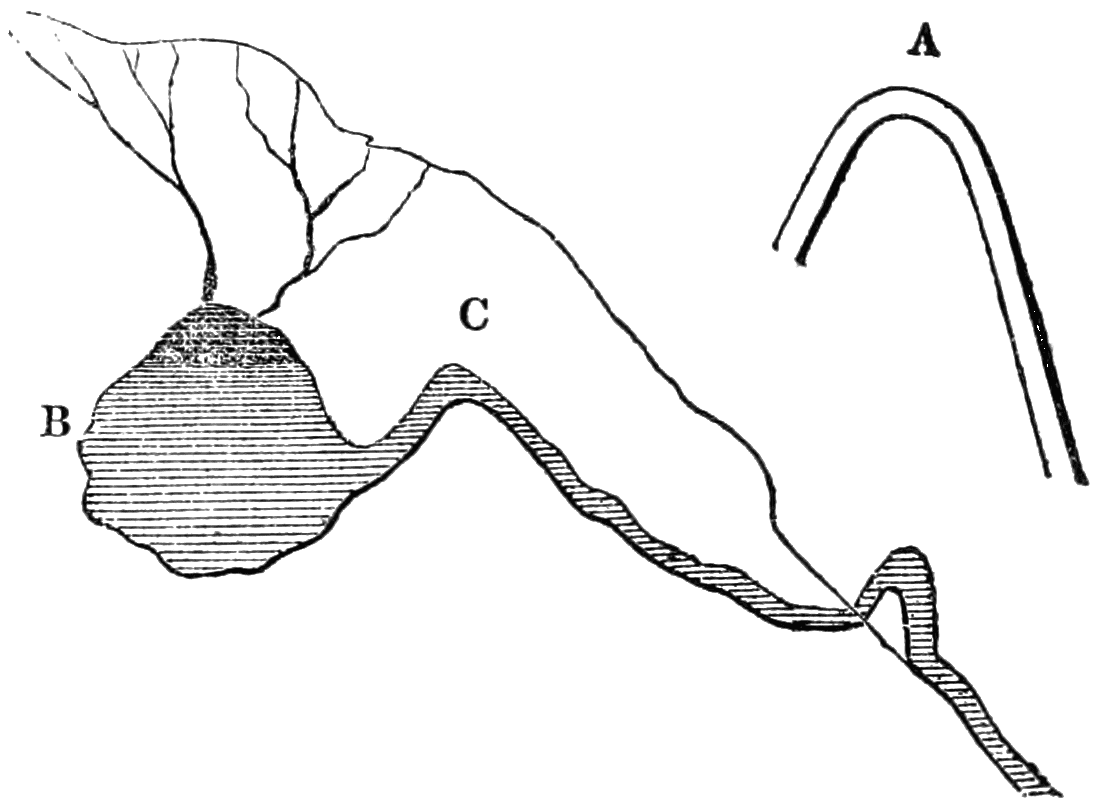
Seneca describes a spring near to Tempe,
in Thessaly, the waters of which are fatal to
animals, and penetrate iron and copper. Yet,
it is probable, as Dr. Thomson states, that
“this spring contained either free sulphuric
acid, or a highly acidulous salt of that acid.
This acid has been detected in a free state, as
well as hydrochloric acid, in the water of the
Rio Vindagre, which descends from the volcano
of Paraiè, in Columbia, South America. Sulphuric
acid is also found in the waters of other
volcanic regions. The sour springs of Byron,
in the Genessee country, about sixty miles
south of the Erie canal, contain sulphuric acid.
Such waters would rapidly corrode both iron
and copper, converting the former into green,
the latter into blue vitriol—sulphates of both
metals.”E
It would be easy to extend these instances,
in connexion with the phenomena of the globe,
but the present will suffice to show that a little
knowledge of natural science is an antidote
to many superstitions. We proceed now to
illustrations of agencies in active operation of
a different character.
CHAPTER V.
Chemical wonders—Ice obtained in a red-hot vessel—The
corpse candles of Wales—Luminous appearances after
death—Sadoomeh the magician—The laughing gas—Sulphuric
ether—Chloroform—Gunpowder compared with
gun-cotton.
The word chemistry is, probably, derived from
a Coptic root, signifying obscure or secret; and
the German word geheim is traced to the same
origin. The objects of this department of
science are, to investigate the nature and properties
of the elements of matter and their
mutual actions and combinations; to ascertain
the proportions in which they unite and the
modes of separating them when united; and to
inquire into the laws which affect and rule these
agencies. A few of the wonders connected
with this science may, therefore, appropriately
follow the terrestrial phenomena which have
just been considered.
The Romish church has rendered chemistry
available in connexion with one of its prodigies,
the so-called blood of St. Januarius. A substance
is shown to the deluded worshippers in a phial,
appearing in a congealed state; but, as masses
are performed by the priests, it becomes fluid.
The illusion practised in this case may, however,
be easily effected by reddening sulphuric
ether with orchanet, the onosma of Linnæus, and
then saturating the tincture with spermaceti.
This preparation is solid at ten degrees above
the freezing point, and melts and boils at twenty
degrees. Let the phial which contains it when
coagulated, be held in the hand for a few minutes,
and the temperature of the substance
rises, and it becomes fluid. Even the warmth
of a public assembly is sufficient for this purpose.
Marcus, the chief of one of the sects in the
second century, who wished to amalgamate
with Christianity the doctrines and rules of
pagan rites, filled with white wine three cups
of transparent glass; and, while he was praying,
the liquid in one of the cups became like
blood; in another, of a purple colour; and
in the third, sky-blue. But these effects might
easily be produced by chemical action. Professor
Beyruss, at the court of the duke of
Brunswick, promised that his white dress should
become red during a repast; and the change
took place, to the astonishment of the prince
and his guests. M. Vogel, who relates this
fact, does not reveal the means employed; but
observes that, by pouring lime-water on the
juice of beet-root, a colourless liquid is obtained,
that a piece of cloth dipped in it and quickly
dried becomes red in a few hours by the contact
of the air alone; and that this effect may be
accelerated in a room where champagne and
other beverages charged with carbonic acid
gas are abundantly used. Still more rapidly
might the chance be effected in some temple,
in the midst of rising incense and burning
torches; and the veil which covered things
deemed sacred, might thus have been seen to
change from white to the colour of blood—a
presage of fearful disasters.
A series of remarkable experiments was performed
by professor Boutigny, at the British
Association at Cambridge, in 1845. He commenced
by showing, that when cold water is
poured on a hot metallic surface, the heat is not
communicated to it; and that the water assumes
a spheroidal form, and continues to roll about,
upheld at a minute distance from the heated
surface, without boiling. The water was poured
into a hot platinum cup kept in rapid motion,
and resembled a small globe of glass dancing
about. There was no hissing noise nor appearance
of steam, though the globule of water
must, nevertheless, have evaporated rapidly;
for, after gradually diminishing in size, in the
course of about two minutes it disappeared.
The same result takes place when any substance
capable of assuming a globular form is placed
on a heated surface. In proof of this, the professor
placed in the heated cup of platinum,
iodine, ammonia, and some inflammable substances;
each of which became globular, and
danced about like the globule of water, but
without emitting smell or vapour, or being
inflamed, until the platinum cup was cooled.
Another experiment was yet more curious.
Professor Boutigny heated a silver weight, of
the same shape as the weight of a clock, until
it was red-hot, and then lowered it by a wire
into a glass of cold water, without there being
any more indication of action in the water than
if the weight had been quite cold. Professor
Boutigny advanced no theory to account for
these peculiar actions, further than that a film
of vapour intervenes between the heated body
and the substance, which prevents the communication
of heat. The facts, however, he
thought were of importance in a practical point
of view, both as regards the tempering of
metals, and in the explanation of the causes
of steam-boiler explosions. It would seem,
from experiments in tempering metals, that, if
the metal be too much heated, the effect of
plunging it into water will be diminished. In
steam-boilers, also, if the heated water be introduced
into a heated surface, the heat may
not be communicated to the water, and the
boiler may become red-hot, and without any
great emission of steam; until, at length, when
the boiler cools, a vast quantity of steam would
become suddenly generated and the boiler
burst.
The last and most curious experiment performed
by professor Boutigny, was the freezing
of water in a red-hot vessel. Having heated a
platinum cup red-hot, he poured into it a small
quantity of water, which was kept in a globular
form, as in the other experiments. He then
poured into the cup some liquid sulphurous
acid; when a sudden evaporation ensued, and,
on quickly inverting the cup, there came out a
small mass of ice. The principle of this experiment,
which called forth loud and continued
applause, is this:—sulphurous acid has the
property of boiling water when it is at a temperature
below the freezing point; and, when
poured into the heated vessel, the suddenness of
the evaporation occasions a degree of cold sufficient
to freeze water.
Liquid carbonic acid takes a high position
for its freezing qualities. Mr. Adams, of
Kensington, manufactures this curious liquid as
an article of commerce, and has, occasionally,
as much as nine gallons of it in store. In
drawing it from its powerful reservoirs, it
evaporates so rapidly as to freeze, and it is then
a light porous mass, like snow. If a small
quantity of this is drenched with ether, the
degree of cold produced is even more intolerable
to the touch than boiling water; a drop or two
of the mixture producing blisters, just as if the
skin had been burned! Mr. Adams states
that, in eight minutes he has frozen a mass of
mercury weighing ten pounds.
In one department of knowledge—that of
vapours and gases—on which chemistry casts
so much light, we discover many remarkable
phenomena. Few persons have resided, for example,
in the fenny and swampy districts of our
island, without seeing, at least occasionally, the
ignis fatuus, Will-o’-the-wisp, or Jack-o’-lantern,
hovering a few feet above the surface of stagnant
water.
“Wild fires dancing o’er the heath,”
may be observed, indeed, at almost all times of
the year, but it is chiefly in autumn, and particularly
in November, that they flit in mazy
circles and irregular evolutions; sometimes at
the edge of a morass, over the tops of withered
sedges, reeds, and brushwood; and, at others,
over palings and hedgerows, or the still surface
of the oozy bog.
It has been argued by some, that they are
effects produced by luminous insects, as the
glow-worm, the gnat, and the mole-cricket.
But this theory is very unsatisfactory, and the
cause which is now generally acknowledged to
be the real one, is far more natural. There is
a substance readily obtained, but of very offensive
odour, called phosphoret of lime; and, if a
piece of this be taken and dropped into a pool
of water, little flames will be seen on its surface.
These arise from the power of the substance to
decompose water, in consequence of which, the
hydrogen ascends to the surface, and ignites on
coming in contact with the air.
Dr. Weissenborn has given the following
interesting statements:—“In the year 1818,
I was fortunate enough to get a fine view
of the ignes fatui operating on an extensive
scale. I was then at Schnepfenthal, in the
duchy of Gotha; and in a clear November
night, between eleven and twelve o’clock, when
I had just undressed, the bright moonshine
allured me to the window, to survey the expanse
of boggy meadows, which spread two or three
English miles in length, a quarter-of-a-mile from
the foot of the hillock on which the house in
which I then was, is standing. Through the first
third of the meadows there was a winding rivulet,
of the breadth of seven or eight feet, which then
turns off into an artificial bed, whilst the old
bed continues in the direction of the meadows,
which are bounded on one side by a range of
brushwood, and on the other by cultivated
grounds, with marshy dells here and there. My
intimate acquaintance with the locality, together
with the bright moonshine, enabled me to discover
every object round the meadow-ground,
sufficiently well to judge of the position and
direction of the luminous phenomena, the display
of which I saw as soon as I had posted
myself at the window. I perceived a number
of reddish yellow flames on different parts of the
expanse of almost level ground. I descried,
perhaps, no more than six at a time, but dying
away and appearing in other places so rapidly,
that it was impossible to count them; but I
should say, on a rough calculation, there were
about twenty or twenty-five within a second.
Some were small and burned dimly; others
flashed with a bright flame, in a direction
almost parallel with the ground, and coinciding
with that of the wind, which was rather brisk.
After having for some time looked with amazement
at the brilliant scene, as a whole, I tried
to study its details, and soon found that the
flames which were nearest originated in a
quagmire, the position of which I knew exactly,
by a solitary cluster of willows; and I could
trace a succession of flashes from that spot to a
certain point of the margin of the wood across
the rivulet and meadow. The distance of the
two points from each other was more than half-a-mile,
and the flames travelled over it, perhaps,
in less than a second. The first flash was not
always observed in the immediate neighbourhood
of the quagmire; but the succession of
flames lay always in the same straight line, and
in the direction of the wind; whilst other sets
were observed, though not with the same distinctness,
in the more distant parts of the
meadow-ground.
“After about an hour, a bank of mist began
to overspread the meadows, but I saw the light
still glimmering through it, whilst I dressed
myself, in order to examine the phenomenon in
its laboratory. However, when I reached the
meadows, the atmospheric conditions which
gave rise to the ignes fatui had ceased to exist.”
Weissenborn then expresses his belief that the
phosphoric hydrogen gas, exhaled by certain
swamps, is kindled into flame by coming in
contact with the atmospheric air; but, as the
hydrogen is not saturated with phosphorus, (the
greater portion of the latter being precipitated
in passing through the water as red oxide of
phosphorus,) there is a certain electric condition
of the atmosphere necessary to cause the
combustion. Thus, under common circumstances,
the gas is evolved and dissipated without being
observed; but when the state of the atmosphere
is competent to effect its combustion, the proper
degree of electrical tension is lost at the place
where the explosion is effected; and, until it is
restored, or the gas comes in contact with that
layer of the atmosphere which possesses the
requisite degree of electrical tension, a considerable
body of bog gas may collect, and be
carried in the direction of the wind, so as to
give rise to a sort of quick fire, with occasional
flashes; in those places of the stream of gas
where there happens to be a considerable
volume of it. The lights, which still frequently
excite apprehensions in Wales, and are popularly
termed “corpse candles,” have the same
origin as the “ignes fatui.”
At the village of Wigmore, in Herefordshire,
there are fields which may be, and two houses
which really are, illuminated with a natural
gas. This vapour, with which the subjacent
strata seem to be charged, is obtained in the
following manner:—a hole is made in the cellar
of the house, or other locality, with an iron
rod; a hollow tube is then placed therein, fitted
with a burner similar to those used for ordinary
gas-lights, and immediately on applying a flame
to the jet, a soft and brilliant light is obtained,
which may be kept burning at pleasure. The
gas is very pure, quite free from any offensive
smell, and does not stain the ceilings, as is
generally the case with the manufactured
article. Besides lighting rooms, etc., it has
been used for cooking; and, indeed, seems
capable of the same applications as prepared
carburetted hydrogen. There are several fields
in which the phenomenon exists, and children
are seen boring holes and setting the gas on
fire for amusement. It is now several months
since the discovery was made; and a great
many of the curious have visited, and still continue
to visit, the spot.
If the Chinese are not manufacturers, they are,
nevertheless, gas consumers and employers on
a large scale; and have evidently been so, ages
before the knowledge of its application was
acquired by Europeans. Beds of coal are frequently
pierced by the borers of salt water;
and the inflammable gas is forced up in jets
twenty or thirty feet in height. From these
fountains, the vapour has been conveyed to the
salt-works in pipes, and there used for the
boiling and evaporation of the salt; other tubes
convey the gas intended for lighting the streets,
and the larger apartments and kitchens. As
there is still more gas than is required, the
excess is conducted beyond the limits of the
salt-works, and forms separate chimneys or
columns of flame.
A singular counterpart to this employment
of natural gas, is witnessed in the valley of the
Kanawha, in Virginia. The origin, the means
of supply, the application to all the processes of
manufacturing salt, and of the appropriation of
the surplus for the purposes of illumination, are
remarkably alike at such distant points as
China and the United States.
It has sometimes been stated of a departed
person, that a luminous appearance was observed
to rest upon, and occasionally to surround, a
corpse. Such an effect has been described as
supernatural—a Divine attestation to extraordinary
excellence; and, doubtless, Roman
Catholics have made the most of such circumstances
in reference to those whom they have
denominated saints, and to whom a place has
been assigned in their calendar. And yet there
was no departure in any such instance from the
ordinary laws of nature. Sir H. Marsh, in an
essay on “The Evolution of Light from the
Human Subject,” states, that electric sparks
have been known to issue from the skin of some
individuals when rubbed lightly and quickly
with a linen cloth. Not only has this physician
heard of such cases, but two had actually
come under his observation.
He was led to consider the subject by the
following statement made to him. “About an
hour and-a-half before my sister’s death, we
were struck by appearances proceeding from
her head, in a diagonal direction. She was, at
the time, in a half-recumbent position, and perfectly
tranquil. The light was pale as the
moon, but quite evident to mamma, myself,
and sisters, who were watching over her at the
time. One of us, at first, thought that it was
lightning; till, shortly after, we fancied we
perceived a sort of tremulous glimmer playing
round the head of the bed; and then, recollecting
that we had read something of a similar
nature having been observed previous to dissolution,
we had candles brought into the room,
fearing our dear sister would perceive it, and
that it might disturb the tranquillity of her
last moments.”
A similar appearance around the person,
and in the room, of a man who fell a sacrifice
to lingering disease in a remote district of the
south-west of Ireland, is recorded. All the
witnesses agree in having seen the light; many,
however, came to the conclusion that it was
caused by supernatural agency, and a proof of
miraculous interposition, and even evidence of
Divine favour. Considerable excitement was
occasioned in the south of Ireland by the following
case, related by Dr. D. Donavan, in the
Dublin Medical Press, Jan. 15, 1840:—“I
was sent for,” the Doctor says, “in December,
1828, to see Harrington. He had been under
the care of my predecessor, and had been entered
in the dispensary book as a phthisical
patient; and, on reference to my note-book, I
find that the stethoscopic and other indications
of phthisis were indubitable. He was under
my care for about five years; during which
time, strange to say, the symptoms continued
stationary; and I had discontinued my attendance
for about two years, when the report
became general, that mysterious lights were
every night seen in his cabin. The subject
attracted a great deal of attention; and, like
everything else in Ireland, at once assumed a
sectarian complexion; some attributing the
light to the miraculous interference of Heaven;
others, to the practice of the black art. Not
regarding these views as affording an explanation
of the mystery, I determined to subject
the matter to the ordeal of my own senses;
and, for this purpose, visited the cabin for fourteen
nights; and on three nights, only, did I
witness anything unusual. Once I perceived
a luminous fog, resembling the aurora borealis,
and twice I saw the scintillations, like the
sparkling phosphorescence sometimes exhibited
by the sea infusoria. From the close scrutiny
I made, I can, with certainty, say, that no imposition
was either employed or attempted.
How are these appearances to be accounted
for? In answering this question, I would observe,
that they are never seen but in cases of
extensive disease, and when considerable alteration
of structure has taken place. Processes
analogous to decomposition are witnessed in
the human subject while the living principle
remains.”
On these, and similar facts, Dr. Marsh remarks:
“Disease is but a step toward dissolution,
in which the vital powers are impaired;
and, unless the malady be checked, by the use
of proper means, a period will quickly approach
when the chemical action will entirely
prevail over the whole frame. Phosphorescent
matter may be generated in organic bodies at
a period of incipient decomposition; and when
we consider that phosphuretted hydrogen undergoes
spontaneous combustion, when brought
in contact with the oxygen of the atmosphere,
and that the component parts of which this
gas is formed exist in the body in great abundance,
an easy solution is at hand, accounting
for the luminous appearances which have been
witnessed in dissecting-rooms, in burial-grounds,
and in marine substances, as well as on the
approach of dissolution.”
The Arabs are well known as believers in
wonders; and of one of their magicians, named
Sadoomeh, the following story is told. “In
order to give one of his friends a treat, he took
him to the distance of about half-an-hour’s
walk into the desert, on the north of Cairo, where
they both sat down upon the pebbly and sandy
plain; and the magician having uttered a spell,
they suddenly found themselves in the midst of
a garden, like one of the gardens of Paradise,
abounding with flowers and fruit-trees of every
kind, springing up from a soil covered with
verdure brilliant as the emerald, and irrigated
by numerous streamlets of the purest water.
A repast of the most delicious viands and fruit
was spread before them by invisible hands;
and they both ate and drank to satiety, taking
copious draughts of the various wines. At
length the magician’s guest sank into a deep
sleep, and when he awoke he found himself
again in the pebbly and sandy plain, with
Sadoomeh still by his side.” “The reader will
probably attribute this vision,” says Mr. Lane,
who relates the tale, “to a dose of opium or
some similar drug; and such I suppose to have
been the means employed; for I cannot doubt
the integrity of the narrator, though he would
not admit such an explanation; regarding the
whole as an affair of magic, ‘jinn,’ or genii.”
A story of Gassendi, one of the most distinguished
of naturalists, mathematicians, and
philosophers of France, in the sixteenth century,
will place this solution in a still clearer
light. As he was taking a morning walk near
Deigne, in Provence, his ears were assailed by
repeated exclamations of “A sorcerer! a sorcerer!”
On glancing behind him, he beheld a
mean and simple-looking man, with his hands
tied, whom a mob of the country-people were
hurrying to prison. Gassendi’s character and
learning had given him great authority with
them, and he desired to be left alone with the
man. They immediately surrendered him,
and Gassendi said to him, in private, “My
friend, you must tell me sincerely, whether you
have made a compact with the devil or not: if
you confess it, I will give you your liberty immediately;
but, if you refuse to tell me, I will
give you immediately into the hands of a magistrate.”
The man answered, “Sir, I will
own that I go to a meeting of wizards every
day. One of my friends has given me a drug,
which I take to effect this, and I have been
received as a sorcerer these three years.” He
then described the proceedings of these meetings,
and spoke of the different devils, as if he
had been all his life acquainted with them.
“Show me,” said Gassendi, “the drug which
you take to attend this infernal meeting, for I
intend to go there with you to-night.” The
man replied, “As you please, Sir; I will take
you at midnight, as soon as the clock strikes
twelve.” Accordingly, he met Gassendi at the
appointed hour, and, showing him two boluses,
each of the size of a walnut, he desired him to
swallow one, as soon as Gassendi had seen him
swallow the other, and then they lay down together
on a goat-skin. The man soon fell asleep,
but Gassendi remained awake and watched him,
and perceived that he was greatly disturbed in
his slumbers, and writhed and twisted his body
about, as if he had been troubled by bad
dreams. At the expiration of five or six hours
he awoke, and said to Gassendi, “I am sure,
Sir, you ought to be satisfied with the manner
in which the great goat received you; he conferred
on you a high honour when he permitted
you to kiss his tail the first time he ever saw
you.” It was thus apparent that the deleterious
opiate had operated upon his imagination.
Gassendi, compassionating his weakness
and credulity, took pains to convince him of
his self-delusion; and, showing him the bolus,
he gave it to a dog, who soon fell asleep, and
suffered great convulsions. The poor fellow
was set at liberty to undeceive his brethren,
who had, like him, been lulled by the noxious
drug into imagining themselves sorcerers.
In India there is a native plant, which, after
it has flowered, is dried and sold in the bazaars
of Calcutta, for smoking. The Hindoos call it
“ganpah,” and they give the name of “bang” or
“subjee” to the large leaves and capsules which
they use for the same purpose. The plant is
a species of hemp; the smoking of which is
considered so delightful, according to Dr.
Thomson, as to have been denominated by such
epithets as “Assuager of sorrow,” “Increaser
of pleasure,” “Cementer of friendship,” “Laughter-mover,”
and others of the same kind.
On the same authority it is stated, that in
Nepaul, the resin only is used; in some places
it is collected by native coolies, walking through
the fields of hemp at the time the plants give
forth the resin, which, adhering to the skin, is
scraped off from it, and kneaded into balls. It
is taken in doses, from a grain to two grains,
and causes a delightful delirium. When repeated,
however, it is followed by catalepsy, or
that state of insensibility which allows the body
to be moulded into any form like a Dutch-jointed
doll, the limbs remaining in the position
in which they were placed, though contrary to
the law of gravity, and continuing so for many
hours.
We are well acquainted with various means
of acting in an extraordinary manner on the
human frame. The writer, in common with
multitudes, has witnessed, for example, the
operation of nitrous oxide, often called “the
laughing-gas.” It acts, however, very differently
on different persons; some laugh
immoderately, others become depressed, others assume
the airs of vanity and importance which accord
with their most cherished dispositions; and
some can only be forcibly restrained from deeds
of great violence. It is certainly a most singular
sight to see a person laughing most
boisterously, or strutting with all the hauteur
of a newly-made potentate, suddenly subside as
the action of the gas ceases, into a very unobtrusive
individual.
We may now briefly allude to one of the most
extraordinary applications of the present times.
The late sir Humphry Davy made many experiments
on the effects of various gases on the
human lungs. He found, in his own person,
that the inhalation of nitrous oxide removed
head-ache, and greatly assuaged the pain of cutting
a wisdom-tooth. In his works, edited by
Dr. John Davy, is the following passage:—
“As nitrous oxide, in its extensive operation,
appears capable of destroying physical pain, it
may probably be used with advantage during
surgical operations in which no great effusion
of blood takes place.” Here is the germ of the
recent application of ether.
“The effects of this inhalation, as indicated
by the patient’s own recollection,” says a writer
in the North British Review, “are very various.
In general they are somewhat as follows:—A
pleasing sense of soothing succeeds the first
irksomeness of the pungent vapour—a soothing
of both mind and body. Ringing in the ears
takes place, with some confusion of sight and
intellectual perception. The limbs are felt
cold and powerless; the hands and feet first,
then the knees; and the feeling is as if these
parts had ceased to be peculiar property, and
dropped away. This sensation may gradually
creep over the whole frame; the patient becoming,
in more senses than one, truly etherealized;
reduced to the condition of no body and all
soul. The objects around are either lost sight
of or strangely perverted; fancied shadows flit
before the eyes, and then a dream sets in—sometimes
calm and placid, sometimes active
and bustling, sometimes very pleasurable,
sometimes frightful, as a nightmare. Emerging,
the figures and scenes shift rapidly, and grow
fainter and fainter; present objects are caught
by the eye once more, the ringing of the ears
is heard again, consciousness and self-control
return, a tendency to excited talking is very
manifest, movement is unsteady, and, both in
mind and body, a kind of intoxication is declared.
It is, however, of a light and airy
kind; very pure, very pleasant, and very passing,
and, when gone, leaving very little trace
behind.
“Experience has fully shown that the brain
may be acted on so as to annihilate, for the
time, what may be termed the faculty of feeling
pain; the organ of general sense may be
lulled into profound sleep, while the organ of
special sense, and the organ of intellectual
function remain wide awake, active, and busily
employed. The patient may feel no pain under
very cruel cutting, and yet he may see, hear,
taste, and smell, as well as ever, to all appearance;
and he may also be perfectly conscious
of everything within reach of his observation—able
to reason on such events most lucidly, and
able to retain both the events and the reasoning
in his memory afterwards. We have seen
a patient following the operator with her eyes
most intelligently and watchfully, as he shifted
his place near her, lifted his knife, and proceeded
to use it; wincing not at all during its
use; answering questions by gesture, very
readily and plainly; and, after the operation
was over, narrating every event as it occurred;
declaring that she knew and saw all; stating
that she knew and felt that she was being cut, and
yet that she felt no pain whatever. Patients
have said, quietly, ‘You are sawing now,’ during
the use of the saw in amputation; and
afterwards they have declared most solemnly,
that though quite conscious of that part of the
operation, yet they felt no pain. We have
seen a patient enduring amputation of a limb
without any sign of suffering, opening her eyes
during the performance, at its most painful
part, descrying a country practitioner at some
distance—under whose care she had formerly
been, and whom she had not seen for some
considerable time—addressing him by name,
and requesting that he might not leave town
without seeing her.”
Since the period to which the writer just
quoted refers, Dr. Simpson, of Edinburgh, has
discovered a substitute for sulphuric ether—chloroform,
or the perchloride of formyle. It is
stated to possess over sulphuric ether the following
advantages:—1. A greatly less quantity
of chloroform than of ether is requisite to produce
the desired effect. 2. Its action is much
more rapid and complete, and generally more
enduring. 3. The inhalation and influence of
chloroform are far more agreeable and pleasant
than those of ether. 4. The use of chloroform
is less expensive than that of ether. 5. Its
odour is not unpleasant; nor does it exhale
in a disagreeable form from the lungs of the
patient, as so generally happens with sulphuric
ether. 6. Being required in much less quantity,
it is much more portable and transmissible
than sulphuric ether. 7. No special kind
of inhaler or instrument is necessary for its exhibition.
A little of the liquid diffused upon
the interior of a hollow-shaped sponge, or on a
pocket-handkerchief, or a piece of linen or
paper, or held over the mouth and nostrils, so
as to be fully inhaled, generally suffices, in
about a minute or two, to produce the effect.
This agent, however, requires to be used to
annul pain under the direction of a judicious
medical practitioner; it may otherwise be productive
of serious consequences.
A prodigious force often arises from chemical
affinity. Of this, gunpowder presents a familiar
instance. It is formed of nitre, sulphur, and
charcoal, which, in the ordinary state, are only
combined mechanically; but no sooner is this
compound ignited, than these substances are
brought, by chemical action, into such close
contact, as to evolve a mighty and destructive
power. It seemed likely to be thrown into the
shade by the discovery of gun-cotton as an explosive
agent, which excited extraordinary interest
throughout Europe. On projectile experiments
being made, a gun, charged with thirty
grains of prepared cotton, propelled an equal
charge of shot, with greater force and precision,
at a distance of forty yards, than were gained by
the same gun loaded with a hundred-and-twenty
grains of gunpowder. A rifle, charged with
fifty-four and-a-half grains of gunpowder, sent
a ball through seven boards, half-an-inch in
thickness, at a distance of forty yards; the
same rifle, charged with forty grains of gun-cotton,
caused the ball to enter the eighth board.
Another rifle, which had been used for elephant-shooting,
and consequently carried a much
larger ball, charged with forty grains of gun-cotton,
forced the ball through eight boards,
at a distance of ninety yards. In no case was
the discharge accompanied by a greater recoil
than usual; and the reports were not louder
than those accompanying the discharge of guns
and rifles loaded with gunpowder. According
to the specification of the patentee, M. Schönbein,
cotton is preferred for this purpose, freed
from extraneous matters; and it is considered
desirable to operate on the clean fibres of the
cotton in a dry state, by means of nitric and
sulphuric acids. These are mixed together in
the proportion of one measure of nitric acid to
three measures of sulphuric acid, in any suitable
or convenient vessel not liable to be
affected by the acids. A great degree of heat
being generated by the mixture, it is left to
cool until its temperature falls to sixty or fifty
degrees Fahrenheit. The cotton is then immersed
in it; and, in order that it may become
thoroughly saturated with the acids, it is stirred
with a rod of glass, or other material, not
affected by the acids. The cotton should be
introduced in as open a state as practicable.
The acids are then poured or drawn off, and
the cotton gently pressed by a presser of glazed
earthenware, to take out the acids, after which
it is covered up in the vessel, and allowed to
stand for about an hour. It is subsequently
washed in a continuous flow of water, until the
presence of the acids is not indicated by the
ordinary test of litmus paper. To remove any
uncombined portions of the acids which may
remain after the cleansing process, the patentee
dips the cotton in a weak solution of carbonate
of potash, composed of one ounce of carbonate
of potash to one gallon of water, and partially
dries it by pressing, as before. The cotton is
then highly explosive, and may be used in that
state; but, to increase its explosive power, it is
dipped in a weak solution of nitrate of potash,
and, lastly, dried in a room heated by hot air,
or steam, to about one hundred and fifty degrees
Fahrenheit.
The advantages and disadvantages of this
substance have thus been stated by professor
Brande:—“The disadvantages are, that the
effects are less regular than those of gunpowder;
that it is more dangerous, because inflaming
at a lower temperature; that it does not
take fire when compressed in tubes; that it
burns slowly in all kinds of cartridges; that
guns and pistols must be altered to admit of
its use; that it is not adapted for the use of the
army; that the barrel of the gun is moistened
by the water produced during combustion.
The advantages, on the other hand, may be
stated as follows:—Its extreme cleanliness,
leaving no residue after combustion; its freedom
from all bad smell; the facility and the
safety of its preparation; the possessing treble
the force of gunpowder; its explosion producing
no smoke, and less noise than that of gunpowder;
its filamentary nature admitting of its
being used over head in mining operations;
its not being liable (as a granulated substance
is) to the accidents of leakage; its occasioning
very little recoil.”—Every benevolent mind must
wish to hear no more of “the confused noise of
battle and of garments rolled in blood;” and
that the time may soon arrive when men shall
“beat their swords into ploughshares, and
their spears into pruning-hooks;” when “they
shall learn war no more,” but yield themselves
heartily and devotedly to the benignant sway
of the Prince of peace. There seems, however,
no reason to conclude that gun-cotton will be
employed for any hostile purpose, the Board of
Ordnance having definitely decided against its
adoption in the military and naval services. The
principal objection to it is, the very low temperature
at which it explodes. The mere heating
of a gun, from a number of charges successively
fired, has been proved sufficient to cause
an instant explosion of gun-cotton.
In mining, it is likely to be of great use. In
the slate-quarries at Penrhyns it has been found
far superior to gunpowder. A huge mass of
sixty tons’ weight, for instance, was gently
pushed from its firmly compacted bed by the
explosion of only eight ounces of cotton, while
the slate was not splintered. In other great
works it will also be of service. In a cutting
on the Syston and Peterborough railway, not far
from Stamford, experiments showed the average
powers of the gun-cotton to be in the
proportion of one to six of gunpowder; so that,
in a hard freestone foundation, about five feet
thick, and with an entire depth of twenty-eight
feet, where six holes were necessary for gunpowder,
only one was required for gun-cotton.
In all blasting operations, whether in open cuttings,
tunnels, or deep mines, a great saving of
time, labour, and cost, is thus likely to be
effected.
CHAPTER VI.
Light and its phenomena—Magic pictures—The optical paradox—Chinese
metallic mirrors—Effect of an optical instrument
on a superstitious mind—Origin of photography—The
Talbotype—The Daguerreotype—Sunlight pictures.
The cause of those sensations which we refer
to the eyes, or that which produces the sense
of seeing, is light. The phenomena of vision
have always been regarded as among the most
interesting branches of natural science. The
knowledge of the laws which regulate the phenomena
of light, constitutes the science of optics,
which explains the cause of many most
striking illusions.
Magic pictures have been produced, which,
when seen in a certain point through a glass,
exhibit an object different from that be held by
the naked eye. Niceron tells us that he executed
at Paris, and deposited in the library of
the Minimes of the Place Royale, a picture of
this kind; when seen by the naked eye, it
represented fifteen portraits of Turkish sultans,
but, when viewed through the glass, it was a
portrait of Louis XIII.
The writer has often seen a singular transformation
effected by an ingenious device, called
the optical paradox: thus an eagle may be
changed into a lion, and a dog into a cat.
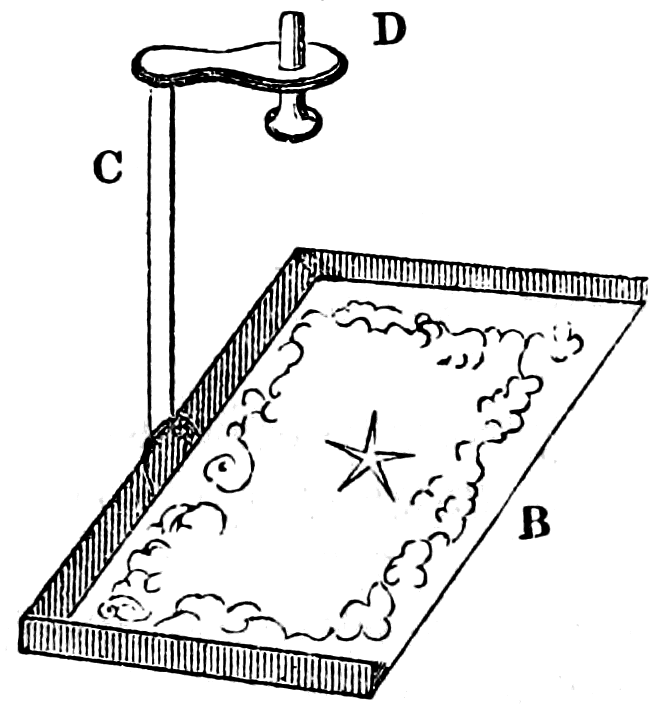
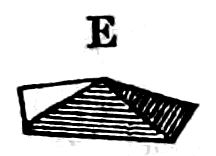
For this purpose,
a wooden three-sided
box must
be prepared, and
through the open
part may slide the
various drawings
to be used, as B.
Connected with
this, there must be
a pillar, C, and
a horizontal bar
holding a tube, D,
having in it a glass placed exactly over the
centre. The change is partly dependent
on the glass, the sides of which are flat and
diverge from its hexagonal base upwards, to a
point in the axis of the glass,
like a pyramid, E, forming an
isosceles triangle. All that is
now necessary to the completion
of the change, is in the border of the drawing,
in which the various parts required for the
new figure are cleverly introduced; so that
when the distance of the glass from the eye
is rightly adjusted, each angular side will take
up its portion from the border, and present to
the eye the various parts in an entire figure.
The shape of the glass prevents the appearance
of any particular figure in the centre, as the
eagle, for instance; while the lion, arranged in
portions and drawn on the circle of refraction
at six different parts of the border, yet artfully
disguised by blending with it, the transformation
will be completely produced.
A paper has lately been read to the Academy
of Sciences at Paris, by M. Stanislaus Julien,
on the metallic mirrors made in China, and to
which the name of “magic mirrors” has been
given. Hitherto all attempts by Europeans to
obtain information as to the process, in the
localities where they are manufactured, have
proved failures, some of the persons applied to
being unwilling to reveal the secret, and others
being ignorant of the process. These mirrors
are called magical, because, if they receive the
rays of the sun on their polished surface, the
characters, or flowers in relief, which exist on
the other side, are faithfully reproduced. The
following information has been obtained by M.
Julien, from the writings of an author named
Ou-tseu-hing, who lived between 1260 and
1341:—“The cause of this phenomenon is the
distinct use of fine copper and rough copper.
If, on the under side, there be produced, by
casting in a mould, the figure of a dragon in a
circle, there is then engraved deeply on the
disc a dragon exactly similar. Then, the parts
which have been cut are filled with rather
rough copper; and this is, by the action of fire,
incorporated with the other metal, which is of
a finer nature. The face of the mirror is next
prepared, and a slight coating of tin is spread
over it. If the polished disc of a mirror so
prepared be turned towards the sun, and the
image be reflected on a wall, it presents distinctly
the clear portion and the dark portion,
the one of the fine, and the other of the rough
copper.” Ou-tseu-hing states, that he had
ascertained this by a careful inspection of the
fragments of a broken mirror.
It is easy for an ignorant and superstitious
mind to confound a very harmless and simple
instrument with one of magical power. We
have an example of this in Dodwell’s description
of his residence at Athens. On his first
admission within the venerable walls of the
Acropolis, it was necessary to offer a small
present to the disdar, or Turkish governor,
and an additional sum to make drawings and
observations without being molested by the
servants of the garrison. The disdar proved
to be a man of bad faith and insatiable rapacity,
and, after experiencing numerous vexations
from the mercenary Turk, Dodwell was
at length released from his importunities by a
singular circumstance. As he was one day
engaged in drawing the Parthenon, with the
aid of his camera obscura, the disdar, whose
surprise was excited by the novelty of the
sight, asked, with a sort of fretful inquietude,
what new conjuration he was performing with
that extraordinary machine. Dodwell endeavoured
to explain it, by putting in a clean sheet
of paper, and making him look at the instrument;
but he no sooner saw the Temple of
Minerva reflected on the paper in all its lines
and colours, than he imagined the effect was
produced by some magical process; his astonishment
appeared mingled with alarm, and,
stroking his long black beard, he repeated several
times the words Allah, Masch-Allah—a term
of admiration with the Turks, signifying that
which is made by God.
Again he looked into the camera obscura,
with a kind of cautious diffidence, and, at that
moment, some of his soldiers happening to pass
before the reflecting-glass, were beheld by the
astonished disdar walking upon the paper.
He now became outrageous; he assailed Dodwell
with various opprobrious epithets, one of
which was Bonaparte—the appellation being
at the time synonymous to that of magician, or
of any one supposed to be endowed with supernatural
talents—and declared that, if Dodwell
chose, he might take away all the stones in the
temple, but that he would not permit his soldiers
to be conjured into a box. “When I
found,” says Dodwell, “that it was no use to
reason with his ignorance, I changed my tone,
and told him that, if he did not leave me unmolested,
I would put him into my box; and
that he should find it a very difficult matter to
get out again. His alarm was now visible;
he immediately retired, and ever after stared
at me with a mixture of apprehension and
amazement. When he saw me come to the
Acropolis, he carefully avoided my approach;
and never afterwards gave me any further
molestation.”
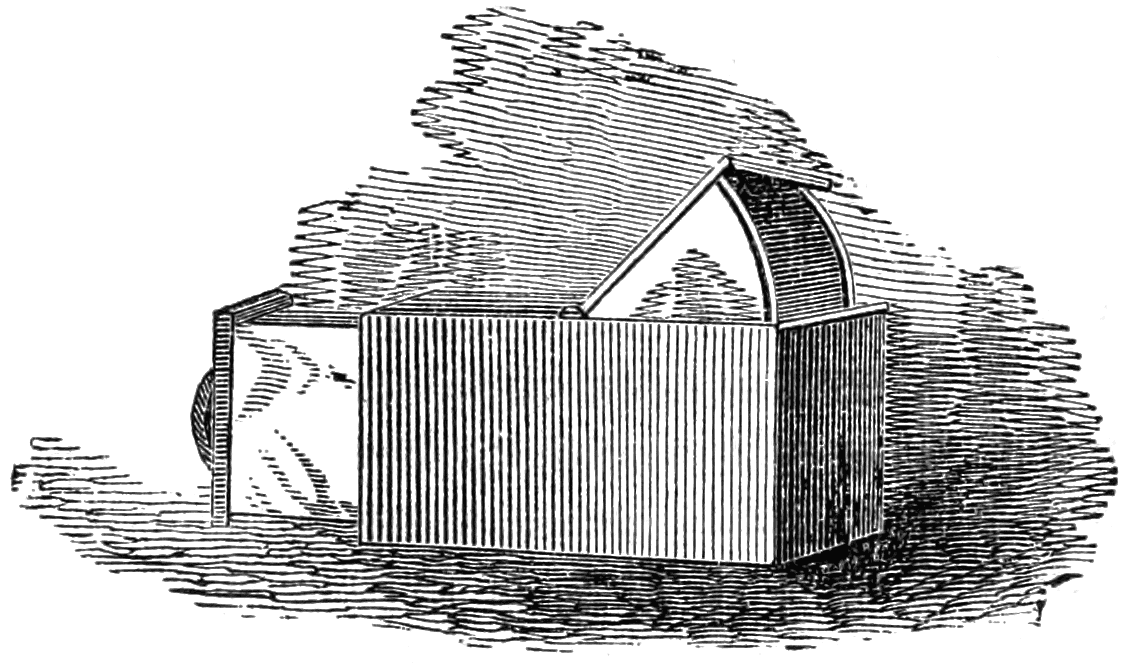
The portable camera obscura, represented
by the diagram, has often yielded much pleasure
in the domestic circle, while the larger
ones, which are publicly exhibited, are highly
interesting. No person, perhaps, has witnessed
the neatness of outline, the precision of form,
the truth of colouring, and the sweet gradations
of tint, thus apparent, without regretting that
an imagery so exquisite and faithful to nature
could not be made to fix itself permanently on
the tablet of the machine. Yet, in the estimation
of all, such a wish seemed destined to
take its place among other dreams of beautiful
things; the splendid but impracticable conceptions
in which men of science and ardent
temperament have sometimes indulged. Such
a dream, however, has been realized of late.
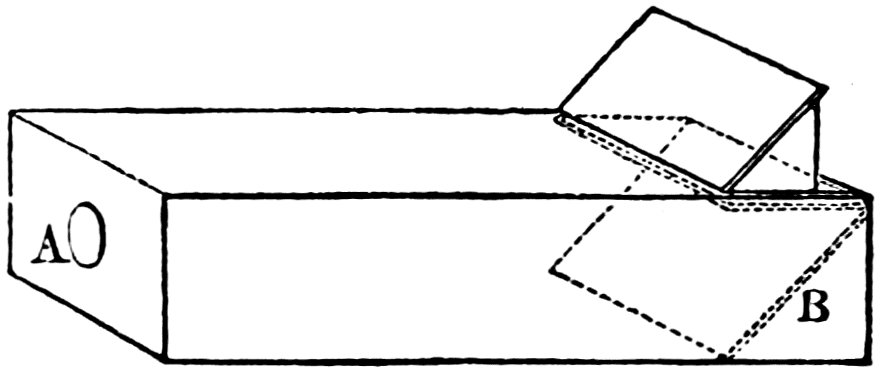
Mr. Thomas Wedgewood, the celebrated
porcelain manufacturer, so early as 1802, published,
in the journals of the Royal Institution,
a method of copying paintings upon glass, and
of making profiles by the agency of light upon
nitrate of silver. The experiments he made
were repeated by sir Humphry Davy; but
several years after, MM. Niepcé and Daguerre,
and Mr. Fox Talbot, laid the foundation of
the present state of photographic drawing.
The former engaged in a long series of experiments
to render metallic surfaces peculiarly
sensitive; the aim of the latter was to produce
this effect on paper. The camera obscura
used for this purpose is a rectangular box, with
a double convex lens, A, at one end, and a
glass reflector, B, which is generally a piece of
looking-glass, at the other. Now, supposing
the rays of light to proceed from an extensive
landscape, and pass through this small convex
lens, as we well know they may do, what will
be the effect produced? The scene will, in
the first place, be thrown on the reflector,
which is fixed at an angle of forty-five degrees
to the horizon. Now it follows, from a law
well known to opticians, that these rays will be
reflected to the top of the box, immediately
over the mirror; so that if a ground glass, or
any other medium capable of receiving the
reflected image, be placed there, a representation
of the landscape may be observed. As
then, it is proved, by innumerable experiments,
that reflected light has, in proportion to its
power, as much influence on prepared or photographic
paper, as the direct rays of the sun;
it follows that, if a piece of it be placed in the
same situation as the ground glass, the reflected
image, be it a landscape, a figure, or an
artificial object, will be formed on it. All that
is, therefore, required to be done, in using the
camera obscura for photographic drawing, is to
place upon the opening at the top of the box
the prepared paper, and immediately to cover
it with the lid, C, so that it may not be acted
upon by any other light than that reflected
from the mirror. The time required for producing
the necessary effect will depend on
several circumstances, such as the preparation
of the paper and the intensity of the light when
the experiment is made; the latter, however,
is by far the more important. On a bright
sun-shining day, the drawing will be produced
in one-half the time, and with far more sharpness
of outline, than on a dull wintry day,
when the sun struggles with the mists by
which its radiant beams are encumbered.
“The Pencil of Nature,” is the expressive title
of a collection of photographic drawings, produced
by Mr. Talbot. Upon the third part of
this work, we find the following acute criticism
in the Athenæum, No. 920.
“The subjects are ‘The Entrance Gateway of
Queen’s College, Oxford;’ ‘The Ladder,’ in
which we have three figures from the life;
and ‘A View of the Author’s Residence,
Lacock Abbey, in Wiltshire.’ In the first of
these, the truth-telling character of photographic
pictures is pleasingly shown. It appears,
by the turret clock, that the view was
taken a little after two, when the sun was shining
obliquely upon the building. The story of
every stone is told, and the crumbling of its
surface under the action of atmospheric influences
is distinctly marked. The figures in
‘The Ladder’ are prettily arranged, but the
face of the boy is distorted, from the circumstance
of its being so very near the edge of the
field of view embraced by the lens of the
camera obscura. In looking at this photograph,
we are led at once to reflect on the truth
to nature observed by Rembrandt, in the disposition
of his lights and shadows. We have
no violent contrasts; even the highest lights
and the deepest shadows seem to melt into each
other, and the middle tints are but the harmonizing
gradations. Without the aid of
colour, with simple brown and white, so charming
a result is produced, that, looking at the
picture from a little distance, we are almost led
to fancy that the introduction of colour would
add nothing to its charm.”
The following is the patent process for obtaining
a negative picture:—Take a sheet of
paper, with a smooth surface, and a close and
even texture, and without the water-mark, and
wash one side of it, by means of a soft camel’s-hair
brush, with a solution composed of one
hundred grains of crystallized nitrate of silver
dissolved in six ounces of distilled water,
having previously marked with a cross the side
which is to be washed. When the paper has
been dried cautiously at the fire, or spontaneously
in the dark, immerse it for a few
minutes (two minutes, at a temperature of
sixty-five degrees,) in a solution of iodide of
potassium, consisting of five hundred grains to
one pint of distilled water. The paper is then
to be dipped in water, and then dried, by applying
blotting-paper to it lightly, and afterwards
exposing it to the heat of a fire, or
allowing it to dry spontaneously. The paper
thus prepared is called iodized paper, and may
be kept for any length of time in a portfolio
not exposed to light. When a sheet of paper
is required for use, wash it with the following
solution, which we shall call No. 1; take one
hundred grains of nitrate of silver, dissolved in
two ounces of distilled water, and add to this
one-third of its volume of strong acetic acid.
Make another solution, No. 2, by dissolving
crystallized gallic acid in cold distilled water,
and then mix the two solutions together in
equal proportions, and in no greater quantity
than is required for immediate use, as it will
not keep long without spoiling. This mixture,
called gallo-nitrate of silver, by the patentee,
is then to be spread, by a soft camel’s-hair
brush, on the marked side of the iodized paper;
and, after allowing the paper to remain half-a-minute
to absorb the solution, it should be
dipped in distilled water and dried lightly; first
with blotting-paper, and then by holding the
paper at a considerable distance from the fire.
When dry, the paper is ready, and it is advisable
to use it within a few hours.
The paper, which is highly sensitive to light,
must now be placed in the camera obscura, in
order to receive on its marked surface a distinct
image of the landscape or person whose
picture is required. After remaining in the
camera from ten seconds to several minutes,
according to the intensity of the light, it is
taken out of the camera in a dark room. If
the object has been strongly illuminated, or if
the paper has been long in the camera, a sensible
picture will be seen on the paper; but, if
the time of exposure has been short, or the
illumination feeble, the paper will “appear
entirely blank.” An invisible image, however,
is impressed on the paper, and may be rendered
apparent by the following process:—Take
some of the gallo-nitrate of silver, and,
with a soft camel’s-hair brush, wash the paper
all over with this liquid, then hold it before a
gentle fire, and, in a short time, the image will
begin to appear; and those parts upon which
the light has acted most strongly will become
brown or black, while the others remain white.
The image continues to grow more and more
distinct for some time, and, when it becomes
sufficiently so, the operation must be terminated,
and the picture fixed. In order to effect this,
the paper must be dipped first into water, then
partly dried by blotting-paper, and afterwards
washed with a solution of bromide of potassium,
consisting of one hundred grains of the salt,
dissolved in eight or ten ounces of water. The
picture is then finally washed in water and
dried as before. In place of bromide of potassium,
a strong solution of common salt may
be used.
By this process we get a negative picture—having
the lights dark and the shades light—and
from it positive pictures may be obtained as
follows:—Dip a sheet of good paper in a solution
of common salt, consisting of one part of a saturated
solution, to eight parts of water, and dry
it first with blotting-paper, and then spontaneously.
Mark one of its sides, and wash that side
with a solution of nitrate of silver, which we
shall call No. 3, consisting of eighty grains of
salt, to one ounce of distilled water. When this
paper is dry, place it with its marked side
uppermost on a flat board or surface of any
kind, and above it put the negative picture,
which should be pressed against the nitrated or
positive paper by means of a glass plate and
screws. In the course of ten or fifteen minutes
of a bright sunshine, or of several hours of
common daylight, a fine positive picture will be
found on the paper beneath the negative picture.
When this picture has been well washed or
soaked in water, it is washed over with the
solution of bromide of potassium, already
mentioned, or plunged in a strong solution of
common salt.F
A singular result of the application of this
invention occurred to an accomplished traveller,
who ascended Mount Etna, in order to obtain
representations of that remarkable volcano. No
sooner was the camera fixed on the edge of the
crater, and the sensitive paper introduced, than
a partial irruption took place, and the traveller
had to fly for his life. On the cessation of the
irruption, he returned; doubtless, with the expectation
of merely collecting the fragments of
his valuable instrument; when, to his great
astonishment and delight, he discovered not
only that his camera was absolutely uninjured,
but that it contained an admirable representation
of the crater and the irruption.
A brief account of the process of the Daguerreotype
may now be given. A plate of silvered
copper, about as thick as a shilling, is well
cleaned and polished by rubbing it with cotton,
fine pumice powder, and dilute nitric acid, and
afterwards exposed to the heat of a spirit-lamp,
placed below it, till a strong white coating is
formed on the polished surface. On the plate
being cooled suddenly by means of a cold slab
of stone or of metal, the white coating is removed
by repeatedly polishing it with dry
pumice and cotton, and then three times more
with the dilute nitric acid and pumice powder.
A careful cleaning being thus given to the
plate, it is placed in a box containing iodine, till
it becomes visibly covered with a golden film
of that substance, which must neither be pale
nor purple. It is then placed in the camera
till a distinct picture of whatever appears
before it is formed upon the surface; it remains
there for a period depending on the intensity of
the light, and is then removed to a metallic box,
having in it a cup containing at least three
ounces of mercury. Placed below the cup is a
spirit-lamp, which throws off the mercurial
vapour; and, in exact proportion as this vapour
deposits itself on the parts of the plate which
have been acted upon by the light, is the
picture developed on the surface of the plate,
by the adhesion of the white mercurial vapour
to the different parts which had been impressed
by the light. As soon as the picture appears
complete, the plate is placed in a trough of
sheet-copper, containing either a saturated
solution of common salt, or a weak solution of
hyposulphite of soda. Thus, the coating of
iodine will be dissolved, the yellow colour quite
disappearing; hot, but not boiling, distilled
water is then poured over the plate, and any
drops which remain are removed by blowing
upon them.
The picture being now finished, is preserved
from dust by placing it in a frame, and covering
it with glass. In every successful operation,
the picture is almost as perfect in its details as
that of the camera obscura itself; but, as the
light of the sun is only white, there can be, of
course, none of the varied tints of nature. The
shades are supplied by the black polish of the
metallic surface which, when it reflects a luminous
object, the white vapour of the mercury
appears in shade, and thus gives us either a
positive or a negative picture, according to the
light in which it is viewed.
Various improvements have gradually been
made in the processes of the Daguerreotype and
the Talbotype, which our limited space forbids us
to describe. Mr. Beard has added colour to his
Daguerreotype portraits, which is uniform and
so transparent as not to affect the likeness in
any degree, while the life-like effect is greatly
heightened. M. Claudet has found that, when
the sun is rendered red by the vapours of the
atmosphere, it not only produces no effect upon
the Daguerreotype plate, but that it destroys the
effect previously produced by the white light.
If the image of the red sun be taken in the
camera obscura, it produces upon the Daguerreotype
plate a black image. By covering a
Daguerreotype plate previously affected by light
with a red, orange, or yellow glass, the radiation
through these coloured media has also the property
of destroying the action produced by
white light. The most interesting part of M.
Claudet’s statement refers to the fact that, after
the destroying action of the red, orange, and
yellow radiations, the plate is restored to its
former sensitiveness; so that, after having been
affected by white light, and restored by the
destructive action of the red, orange, and yellow
radiations, it is possible to produce a photographic
effect, as upon a plate just prepared with
iodine and bromine. This alternate acting and
destroying action may be repeated ad infinitum,
without altering the final state of the plate.
This curious fact proves, evidently, that, in the
Daguerreotype process, light does not alter the
chemical compound on the plate, and that the
affinity for mercury is the result of some new
property imparted by the action of the rays of
light. M. Claudet’s experiments prove, also,
that the red and yellow rays are endowed with
a photographic action of their own, which, as
well as that of the blue and violet rays, gives
an affinity for mercurial vapour. The photographic
action of the red ray is destroyed by
the yellow, that of the yellow by the red; the
red and yellow destroy the photographic action
of the blue, and the blue destroys the action of
the others. The photographic, or the destroying
action of any particular ray cannot be continued
by any other. It appears, therefore, that each
radiation changes the state of the plate, and
each change produces the sensitiveness to
mercurial vapour when it does not exist, and
destroys this sensitiveness when it does exist.G
M. Regnault has laid before the Academy of
Sciences, at Paris, some photographic specimens
on paper, obtained by M. Blanquart-Evrard, by
a modification of the usual process. In the
preparations hitherto described, one part of the
process presented serious difficulties, namely,
that of the use of gallic acid in order to produce
the impression. It happened frequently, that a
proof taken in too mild a light, or of too large
dimensions, could not receive the necessary
force before disappearing, as it may be said,
under the uniform colour produced by the
mixture of the gallic acid with the aceto-azotate
of silver, with which the paper is imbued.
After having ascertained that the gallic acid
produces this uniform colour on the impression,
only because it is combined in small quantity
with the aceto-azotate of silver, M. Blanquart-Evrard
removes all the difficulty. After taking
the proof from the camera obscura, he plunges
it into a vessel of large dimensions, covered
with a layer of one centimètre of gallic acid of
cold saturation. The bath is agitated during
the immersion; and the action may be thus
prolonged until the impression has obtained
the necessary force to secure a good result.
The proof is then washed, and the gallic acid
is replaced by a solution of bromure of potassium,
or chloruret of sodium, in which it is left
for about a quarter-of-an-hour.H
The chromatype, discovered by Mr. Hunt,
consists in washing good letter-paper with the
following solution:—
| Bi-chromate of potash |
10 grains |
| Sulphate of copper |
20 grains |
| Distilled water |
1 ounce |
Papers prepared with this are of a pale yellow
colour; they may be kept for any length of
time without injury, and are always ready for
use. For copying botanical specimens or engravings,
nothing can be more beautiful. After
the paper has been exposed to the influence of
sunshine, with the objects to be copied superposed,
it is washed over in the dark with a
solution of nitrate of silver of moderate strength.
As soon as this is done, a very vivid positive
picture makes its appearance; and all the
fixing these photographic pictures require is,
well washing in pure water.
M. Niepcé de St. Victor finds that, if a sheet
of paper on which there is writing, printed
characters, or a drawing, be exposed for a few
minutes to the vapour of iodine, and there be
applied immediately afterwards a coating of
starch, moistened by slightly acidulated water,
a faithful tracing of the writing, printing, or
drawing, will be obtained. M. Niepcé has also
discovered that a great number of substances,
such as nitric acid, chlorurets of lime and
mercury, act in a similar manner; and that
various vapours, particularly those of ammonia,
have the effect of vivifying the images which
are obtained by photography.
In the words of a writer in the North British
Review:—“While the artist is thus supplied
with every material for his creative genius,
the public will derive a new and immediate
advantage from the productions of the solar
pencil. The home-faring man—whom fate or
duty chains to his birth-place, or imprisons in
his fatherland—will, without the fatigues and
dangers of travel, scan the beauties and wonders
of the globe; not in the fantastic or deceitful
images of a hurried pencil, but, in the very
picture which would have been painted on his
own retina, were he magically transported to
the scene. The gigantic outline of the Himalaya
and the Andes will stand self-depicted upon
his borrowed retina—the Niagara will pour
out before him, in panoramic grandeur, her
mighty cataract of waters, while the flaming
volcano will toss into the air her clouds of dust
and her blazing fragments. The scene will
change, and there will rise before him Egypt’s
colossal pyramids, the temples of Greece and
Rome, and the gilded mosques and towering
minarets of eastern magnificence. But with
not less wonder, and with a more eager and
affectionate gaze, will he survey those hallowed
scenes which faith has consecrated and love
endeared. Painted in its cheerless tints, Mount
Zion will stand before him, ‘as a field that is
ploughed;’ Tyre, as a rock on which the fishermen
dry their nets; Gaza, in her prophetic
‘baldness;’ Lebanon, with her cedars prostrate
among ‘the howling firs;’ Nineveh made as a
grave, ‘and seen only in the turf that covers it;’
and Babylon the great, the golden city, with its
impregnable walls, its hundred gates of brass,
now ‘sitting in the dust, cast up as an heap,’
covered with ‘pools of water,’ and without
even the ‘Arab’s tent,’ or the ‘shepherd’s fold.’
But though it is only Palestine in desolation
that a modern sun can delineate, yet the seas
which bore on their breast the Divine
Redeemer, and the everlasting hills which bounded
his view, stand unchanged by time and the
elements, and, delineated on the faithful tablet,
still appeal to us with an immortal interest.
But the scenes which are thus presented to
us by the photographer have not merely the
interest of being truthful representations: they
form, as it were, a record of every visible event
that takes place while the picture is delineating.
The dial-plate of the clock tells the hour and
minute when it was drawn, and with the day
of the month, which we know, and the sun’s
altitude, which the shadows on the picture often
supply, we may find the very latitude of the
place which is represented. All stationary life
stands self-delineated on the photograph:—the
wind, if it blows, will exhibit its disturbing influence;
the rain, if it falls, will glisten on the
house-top; the still clouds will exhibit their
ever-changing forms; and even the lightning’s
flash will imprint its fire-streak on the sensitive
tablet.”
CHAPTER VII.
Heat, the cause of many wonders—Its universal diffusion and
application—Story of a burning-glass—The Augustine friars
and the Jesuits—Impostures as to the endurance of heat—Burning
mirrors—The blow-pipe—The Giants’ Causeway—Application
of currents of heated air—Travelling by steam.
Heat is everywhere present: every body that
exists contains it in quantity to which we can
assign no limits. The endless variety of forms
which are spread over and beautify the surface
of the globe, are to be traced to its influence.
Without it, the land and the water would fall
into one formless and impenetrable mass, and
the air now essential to life, prove absolutely
poisonous. We shall find in connexion with it,
therefore, many extraordinary phenomena.
When Labat the Jesuit visited the Peruvians,
he took the naked arm of one of them, and,
concentrating on it the rays of the sun by
means of a powerful lens, soon made him
cry out with pain, while the others looked on
with wonder, not unmixed with indignation.
How could this effect be produced? was instantly
the question; and, as promptly, the cause was
declared to be infernal. In vain did Labat
assert that it was merely natural. The
Peruvians made many attempts to obtain possession
of the lens in order to destroy it, and deliver
themselves from the power of that which they
regarded as able to bring upon them the vengeance
of the gods.
Much surprise has sometimes been awakened
by an apparent insensibility to intense heat.
An instance of this occurred when a rivalry
existed between the Augustine friars and the
Jesuits. The father-general of the Augustine
friars was dining with the Jesuits; and, when
the table was removed, he entered into a formal
discourse of the superiority of the monastic
order, and charged the Jesuits with assuming
the title of “fratres,” while they held not the
three vows which other monks were obliged to
consider sacred and binding. The general of
the Augustine friars was very eloquent and
very authoritative—and the superior of the
Jesuits was very unlearned.
The Jesuit avoided entering the lists of controversy
with the Augustine friar, but arrested
his triumph by asking him if he would see one
of his friars, who pretended to be nothing more
than a Jesuit, and one of the Augustine friars
who religiously performed the three vows, show
instantly which of them would be readier to
obey his superior?
The Augustine friar consented. The Jesuit
then turning to one of his brothers, the friar
Mark, who was waiting upon them, said,
“Brother Mark, our companions are cold; I
command you, in virtue of the holy obedience
you have sworn to me, to bring here, instantly,
out of the kitchen-fire, and in your hands, some
burning coals, that they may warm themselves
over your hands.” Father Mark instantly
obeyed; and, to the astonishment of the Augustine
friar, brought in his hands a supply of red
burning coals, and held them to whoever chose
to warm himself; and, at the command of his
superior, returned them to the kitchen hearth.
The general of the Augustine friars, with the
rest of his brotherhood, stood amazed; he looked
wistfully on one of his monks, as if he wished
to command him to do the like. But the
Augustine monk, who perfectly understood him,
and saw this was not a time to hesitate, observed,
“Reverend father, forbear, and do not
command me to tempt God: I am ready to
fetch you fire in a chaffing-dish, but not in my
bare hands.” The triumph of the Jesuits was
complete, and it is not necessary to add, that
“the miracle” was noised about, and that the
Augustine friars could never account for it,
notwithstanding their strict performance of the
three vows! And yet here was no mystery.
According to sir James Mackintosh, “In the
Mercure de France, there is a very curious
account of experiments made at Naples to
discover the means by which jugglers have
appeared to be incombustible. They seem to
be completely discovered, and chiefly to consist
in, first, gradually habituating the skin, the
mouth, throat, and stomach, to great degrees of
heat; second, in rubbing the skin with hard
soap, and in covering the tongue with hard
soap, and over that with a layer of powdered
sugar. By these means, the professor at Naples
is enabled to walk over burning coals, to take
into his mouth boiling oil, and to wash his
hands in melted lead. The miracles of several
saints, the numerous escapes from the fiery
ordeal, and tricks now played by the Hindoo
jugglers, are thus perfectly explained; and all
these prodigies may be performed in a fortnight
by any apothecary’s apprentice.”
Other instances of endurance are merely
pretended. In country places, a conjurer sometimes
appears in the streets, professing that he
is able to eat fire; and yet he only rolls
together a ball of flax or hemp, lights it, rolls
round it some more of the same material, slips
it cunningly into his mouth, and breathes
through it to revive the flame; and so long
as he inspires the air through the nostrils, and
not through the mouth, he suffers no injury.
A performer, named Richardson, in the seventeenth
century, pretended to pour melted lead
upon his tongue; but it is probable that he
used the fusible metal formed of bismuth, tin,
and lead, which melts at a low temperature,
and which the writer has seen fused on a card,
and poured into the hand with impunity by a
person accustomed to handle hot substances.
Not many years ago, a man named Chaubert
professed to be incombustible; but it has been
proved that the human body is capable of
bearing a very high degree of heat. Men of
unquestionable integrity have surpassed all his
wonders. Sir Charles Blagden exposed himself
in a heated room where the heat was one
or two degrees above 260°, and remained eight
minutes in this situation. Eggs and a beef-steak
were placed on a tin frame, near the
thermometer, and in the space of twenty minutes
the eggs were roasted quite hard, and in
forty-seven minutes the steak was not only
dressed, but almost dry. Another beef-steak,
similarly placed, was rather over-done in
thirty-three minutes. Chantrey, the celebrated
sculptor, accompanied by five or six friends,
also entered a furnace, and, after remaining
two minutes, brought out a thermometer which
stood at 320°. Some pain was experienced in
this experiment, but it placed beyond all
doubt that the human body has a remarkable
power of enduring heat. Chaubert excited
much wonder by taking phosphorus into his
mouth; but, as that substance, when deprived
of air, will not burn, he always closed his lips,
and retired to eject the phosphorus immediately
afterwards.
We turn now from the resistance of heat by
chemical means, to some striking examples of
its power.
The name of the Giants’ Causeway arose, probably,
from an idea of the supernatural power,
entertained in times of ignorance and superstition.
And yet it is demonstrated that vast
masses of rock are to be traced to causes
strictly natural. Basalt is of very frequent
occurrence on the surface of the globe, and is
frequently detected in a variety of volcanoes,
both extinct and active. The greatest mass of
basalt hitherto observed is that in the Deccan,
which constitutes the surface of many thousand
square miles of that part of India. In other
instances, it occurs in horizontal tabular masses,
and is columnar. Sometimes, the basaltic
columns are curved, and of this there is a
beautiful example in the island of Staffa.
Now basalt is not a crystalline substance, for as
it is not capable, as all crystals are, of cleavage
in the line of its planes, or at some angle with
them, it is concretional. Its structure resembles
an onion, or any bulbous root, for, in the
centre, is a solid mass, about which are others
just like the parts of the vegetable products
already mentioned. These portions of basalt
are at first of an oval form, and then they
gradually become rudely hexagonal. Some
non-columnar basalts show no trace of any
particular arrangement of parts, while others
have a globular structure, so that when the
rock becomes much decomposed, it has the
appearance of numerous bomb-shells and cannon-balls
cemented together.
Here, then, we have an extraordinary effect
of heat. Mr. Gregory Watt took seven hundred
weight of the substance named rowley rag,
kept it in fusion more than six hours, and
cooled it so gradually, that eight days elapsed
before it was taken from the furnace. The
shape of the mass was uneven and while the
thinner portion was, in consequence of more
rapid cooling, vitreous, the thicker was stony;
the one state passing into the other. Numerous
spheroids were also formed, some being two
inches in diameter. They were radiated with
distinct fibres, the latter also forming concentric
coats, when circumstances were favourable to
such an arrangement. When the temperature
had been sufficiently continued, the centres of
the spheroids became compacted before they
had attained the diameter of half-an-inch.
When two spheroids came into contact, no
penetration ensued; but the two bodies became
mutually compressed and separated by a plane,
well defined, and invested with a rusty colour.
When several met, they formed prisms. In
reasoning on these facts, Mr. G. Watt observes:
“In a stratum composed of an indefinite number
in superficial extent, but only one in height,
of impenetrable spheroids, if their peripheries
should come in contact in the same plane, it
seems obvious that their mutual action would
form them into hexagons; and if these were
resisted below, and there was no opposing cause
above them, it seems equally clear that they
would extend their dimensions upwards, and
thus form hexagonal prisms, whose length
might be indefinitely greater than their diameters.”
That the great power in operation in the
formation of basaltic columns is heat, appears
to be indisputable. There is, for example, a
bed of sandstone in furnaces for smelting
metals, and, in the course of time, it requires
to be repaired. Portions, taken out, on such
occasions, have been found to have a columnar
appearance: the heat of the furnace having
changed the form of the substance, not by any
fusion of its parts, but by a peculiar arrangement
of them, thus giving them the specified
figure.
Another astonishing result of this natural
power is seen in the eruption of a volcano.
The eye of a traveller, perhaps, as it is turned
towards Vesuvius, discerns a dark red spot on
the mountain’s side, issuing from an orifice near
to the crater. But soon, that deep burning
light apparently spreads out, or flows on into a
long wide stream, descends the entire length of
the great cone, and reaches to the plain below.
But, as the first light was seen through and
behind the mists which follow the departure of
the sun, so now its extended influence is only
rendered visible by the increasing gloom. But,
as the eye is still attracted towards this remarkable
eminence, a pillar of fire is seen
rising up from the crater high into the air;
while innumerable lights appear, like so many
natural fire-works rushing upwards, and falling
in a glowing shower, on the outer sides of the
crater, which soon present the aspect of a heap
of fire. Large and red-hot stones are flung
forth from time to time, from the same troubled
source, to fall, roll down the sides of the crater,
and lose their brightness.
Mountains that are liable to volcanic action,
before an eruption takes place, are generally
the most fertile, and the most attractive of all
eminences. Illustrations of this remark are
found upon a magnificent scale in Mexico; and,
among the rest, that of Jorullo, in the extensive
intendency of Valladolid, lying on the west
coast of America, between the intendencies of
Mexico and Guadalaxara, (pronounced Quadalahàra.)
Mechoacan, a part of it, is an expanse
of table-land which enjoys a fine and temperate
climate, and is intersected with hills and charming
valleys, presenting an appearance unusual
in the torrid zone, of extensive and well-watered
meadows. On the twenty-ninth of September,
1759, from the centre of a thousand burning
cones was thrown up the volcano of Jorullo; a
mountain of scoriæ and ashes, seventeen hundred
feet high, in an extensive plain, and covered
with most luxuriant vegetation. When plains,
hills, and valleys, are thus spoken of, the reader
should remember, that all of them are reared
upon the lofty chain of the Andes, for volcanic
eruptions only, so far as we know, take place
in mountainous regions.
But some of the most remarkable examples
are to be met with in the Spice Islands, or
Moluccas. The pointed and conical mountains,
which characterize this group of islands, exhibit
great fertility. Nothing can surpass the richness
of vegetation with which their sides are
covered, nor the balmy healthfulness of the
breezes that encircle round them, to temper the
heats of the sultry zone. But the nature of
these mountains is closely connected with volcanic
action; so that, in fearful apprehension,
we might look at each one of these beautiful
peaks, as if it were destined one day to be torn
from its station and thrown into the sea.
“I will stretch out mine hand upon thee,
and roll thee down from the rocks, and will
make thee a burnt mountain,” was one of the
Divine denunciations against Babylon, Jer. li.
25. Judgment has not thus fallen on Ternate,
one of the most lovely of the cluster just adverted
to; but the top of the highest rock has
been torn off, and hurled from a height of five
or six thousand feet, into the sea. A huge
gap was left behind, which seemed to a traveller
when standing on the edge, like a deep valley,
or ravine, betwixt two mountains. As the
portion rent away in this tremendous struggle
was split into fragments of various sizes, there
is, besides, a vast pile at the water’s edge, a
road, or causeway, strewed with half-vitrified
pieces of rock and cinders, from the margin of
the rift to the declivity of the mountain; so
that the island, so lovely under other aspects,
presents on this side a fearful scene of desolation.
What a striking comment on the words,
“I will make thee a burnt mountain;”—I will
tear off thy summit, shiver it into ten thousand
pieces, and therewith overwhelm and destroy
the natural verdure of thy sides, which once
looked so goodly and so fair! Some time in
March, 1839, another eruption took place at
Ternate; so that, long before these ejected
matters could yield to the decomposing action
of the atmosphere, and afford a soil for vegetable
growth, another layer, of equally forlorn
and broken kind, was scattered over them.
In connexion with these astounding phenomena,
it may be remarked that an apparatus has
recently been contrived called the fire-annihilator,
the origin of which is not a little curious. It
is said that the inventor observed that the smoke
hovering over a burning mountain diminished
its fury, and that, on analysing it and combining
similar elements, he discovered the means of
extinguishing fires, and thus of arresting at the
outset what might otherwise prove a tremendous
calamity.
Many processes of art, like the operations of
nature, are dependent on heat. By this agent,
the most obdurate masses soften like wax,
and yield to the forms which are demanded by
our wants and our tastes; and compounds, knit
together by stubborn affinities, are resolved by
it into their original elements. The baron Von
Tchivanhausen constructed a burning mirror
in 1687, five feet three inches in breadth, and
reflecting the solar rays with extraordinary
power. When exposed to its force, wood took
fire, and continued to burn, notwithstanding a
most violent wind; and water, contained in an
earthen vessel, quickly boiled, so that eggs
were cooked, and the liquid soon after evaporated.
Copper and silver were fused in a few
minutes, and slate was transformed into a kind
of black glass, which, when held by a pair of
pincers, could be drawn out into filaments.
This mirror afterwards came into the possession
of the king of France, and was kept in
the Jardins du Roi. Other mirrors have been
formed of different substances. At the Polytechnic
Institution, some years ago, there were
two metallic discs placed at the extreme ends
of the great hall, and when a vessel of burning
coals was held in the focus of one, and a piece
of meat in the focus of the other, the latter was
cooked with marvellous rapidity by a simple
and apparently an unimportant instrument.
The blow-pipe has immense power. Two
volumes of hydrogen, and one of oxygen gas,
when pure, form a mixture which produces in
this instrument intense heat, and most substances
may be fused by the flame. In the experiments
of Dr. E. Clarke, lime, strontion, and alumine,
yielded to its powers. The alkalis were fused
and volatilized almost the instant they came
into contact with the flame: and rock crystal
became a transparent glass full of bubbles.
Opal changed into a pearly white enamel, and
flint into one that was frothy. Blue sapphire
was melted; and Peruvian enamel changed
into a transparent and colourless glass. Lapis
lazuli fused into transparent glass, with a slight
tinge of green. Iceland spar, next in difficulty,
as to fusion, to its native magnesia, melted at
last into a limpid glass, giving out an amethyst-coloured
flame. Diamond first became opaque,
and was then gradually volatilized. Gold,
mixed with borax as a flux, was fused; platina
wire melted the instant it was brought
into contact with the flame, and ran down in
drops; brass wire burned with a green flame;
and iron wire with brilliant sparks.
At a recent meeting of the British Association,
Dr. Faraday exhibited some diamonds,
which he had received from M. Dumas, which
had, by the action of intense heat, been converted
into coke. In one case, the heat of the
flame of oxide of carbon and oxygen had been
used; in another, the oxyhydrogen flame; and,
in the third, the galvanic arc of flame from a
Bunsen battery of one hundred pairs. In the
last case, the diamond was perfectly converted
into a piece of coke; and, in the others, the
fusion and carbonaceous formation were evident.
Specimens in which the character of graphite
was taken by the diamond were also shown.
The electrical characters of these diamonds
were stated also to have been changed, the
diamond being an insulator, while coke is a
conductor.
A rope, nearly three miles long, was recently
lying on the verge of the borough of Gateshead,
which was shortly before a stone in the bowels
of the earth. Smelted, the stone yielded iron.
The iron was converted into wire. The wire
was brought to the wire-rope manufactory of
Messrs. R. S. Newall and Co., at the Teams, near
Gateshead, and there twisted into a line 4,660
yards long. It was supposed to be the stoutest
rope of the kind that was ever made. It
weighs twenty tons, five hundredweights, and
cost the purchasers upwards of £1,134. It was
intended for the incline on the Edinburgh and
Glasgow Railway, near the latter city. A
rope of hemp of equal strength would weigh
thirty-three tons and-a-half, and cost about
three hundred pounds more. It would also
entail greater expense while in operation,
(owing to its greater weight,) and would sooner
wear out.
“The process,” says the Pharmaceutical
Journal, “for purifying and agglomerating
caoutchouc, preparatory to its being cut into
sheets, and also for effecting the latter operation,
are due to the ingenuity of M. Sievier.
The general principle is this:—Pieces of caoutchouc,
mixed, as they are in their native state,
with various impurities, are put into a strong
metallic drum, through which passes an axle,
studded with chisel-shaped teeth. The interior
of the drum is supplied with similar ones, but
stationary. Therefore, when the axle is made
to revolve, the caoutchouc becomes subjected
to a most powerful rending and kneading motion,
in the course of which sufficient heat is
evolved, notwithstanding a current of cold
water continually passes through the drum,
to agglutinate the material into a compact
mass. This mass is now subjected to the
pressure of a powerful screw apparatus, and
made to assume the form of a cuboid, from
which sheets of caoutchouc may be eventually
cut by the rapid vibratory action of a knife,
kept moistened with water. As solvents for
caoutchouc, equal parts of coal naptha and
turpentine are commonly used; and, of late,
the bisulphuret of carbon has been much
employed.”
Mr. J. Wishaw has lately shown the advantages
arising from the application of currents
of heated air to the following purposes:
seasoning timber, generally; preserving
timber, purifying feathers, blankets, clothing,
etc.; drying coffee, roasting coffee, japanning
leather for table-covers, and other purposes;
drying silks, drying yarn, drying distillers’
tuns, drying papier-máché, and drying vulcanized
india-rubber. The process has also
been successfully tested for drying loaf-sugar,
drying printing-paper, or setting the ink, to
enable books to be bound more quickly than
usual; drying starch, and converting it into
dextine, or British gum; and preserving meat.
It has been also stated, that sixty suits of
clothes, which had belonged to persons who
had died of the plague in Syria, had been subject
to the process of purification, at a temperature
of about 240°, and afterwards worn
by sixty persons; not one of whom ever gave
the slightest symptom of being affected by the
malady. In describing these processes, the
writer referred to the mode adopted by the
North American Indians for preserving the meat
of the buffalo—that of drying it in the sun;
and stated that heated currents had been applied
successfully. The discovery seems highly
important for shipping; as, instead of sailors
consuming salted provisions from one month’s
end to another, they might thus have an occasional
supply of fresh meat. Meat treated in
this way occupies much less space, too, and is
much lighter in weight. It is believed that the
juices of the meat contain about seven-eighths
of watery moisture: this, the current of heated
air removes, leaving the albumen and all the
flavour and nutrition behind.
That in the production of steam heat is of
incalculable value, there needs no proof. We
derive special advantage from it, in the results
of that machinery which astonish us by their
magnitude, as well as by their elegance. Steam
wafts us, in a few hours, from one extremity
of the land to the other, and renders America,
once called the New World, accessible in a
few days.
Another instance of its application, often
overlooked, is thus stated in the Quarterly
Review:—“That extraordinary line of steam
communication between England and her eastern
possessions, (somewhat oddly called the
overland journey,) of which Australia and New
Zealand will hereafter form the extreme
branches. The creation of the last twelve
years, this communication has already acquired
a sort of maturity of speed and exactness, notwithstanding
the enormous distances traversed,
and the changes necessary in transit from sea to
sea. The Anglo-Indian mail in its two sections,
and including passengers and correspondence,
possesses a sort of individuality as
the greatest and most singular line of intercourse
on the globe. Two of the first nations
of Europe, France and Austria, struggle for
the privilege of carrying this mail across their
territories. Traversing the length of the Mediterranean,
it is received on the waters of the
ancient Nile—Cairo and the Pyramids are
passed in its onward course—the desert is
traversed with a speed which mocks the old
cavalcades of camels and loitering Arabs—it is
re-embarked on the Red Sea, near a spot
sacred in scriptural history—the promontory
projecting from the heights of Mount Sinai, the
shores of Mecca and Medina are passed in its
rapid course down this great gulf—it emerges
through the straits of Babelmandel into the
Indian seas—to be distributed thence by different
lines to all the great centres of Indian
government and commerce, as well as to our
more remote dependencies in the straits of
Malacca and the Chinese seas. There is a
certain majesty in the simple outline of a route
like this, traversing the most ancient seats of
empire, and what we are taught to regard as
among the earliest abodes of man—and now
ministering to the connexion of England with
that great sovereignty she has conquered, or
created, in the east; more wonderful, with one
exception, than any of the empires of antiquity;
and, perchance, also, more important to
the general destinies of mankind.”
CHAPTER VIII.
The magic swan—Properties of the magnet—The mariners’
compass—The process of magnetizing—The dip of the
needle—Magnetic properties in various substances.
A magician of former days had a figure of a
swan, which floated on a vessel of water, round
the rim of which were placed the twenty-four
letters of the alphabet. Addressing the spectators,
he was accustomed to ask for a name to be
given him, and it was correctly spelt by the
swan, as it moved from one letter to another
till it had indicated the whole. A little philosophy,
in this instance, produced repeatedly
great astonishment. A magnetic bar was placed
in the swan, and the performer had a powerful
magnet concealed in his own dress, and the
swan, of course, followed his motions. Thus,
if he wanted the swan to spell “Selina,” he
moved first to S, then to E, and so on, through
the successive letters of that name, till the word
was spelt. On one occasion, however, the performer
was not a little disconcerted—the swan
stopped in its course and refused to move.
Again and again the effort was made, but it
was utterly in vain; the magician could only
acknowledge that some person was in the room
aware of his secret, and counteracting his
movements. Sir Francis Blake Delaval avowed
himself to be the person: he produced a magnet
which he had used on facing the performer as
he stood at the table; the swan was, therefore,
placed between two attractive instruments, and,
of course, remained immovable.
A magnet may be described as a piece of
iron, which possesses the property of turning
towards the poles of the earth. This extraordinary
quality does not necessarily belong to
all specimens of iron in its native state, but
only to one kind or variety called the oxide, on
account of its union with oxygen in a particular
condition. The possession of a special quality
in this ore of iron was not discovered from its
polarity, or power of turning to the poles of the
earth, but from its property of attracting small
pieces of iron, which are not magnetic; and
hence it was called the loadstone.
There are many uses to which the magnet
has been applied, and there is a probability of
its being much more extensively employed; but
its most important application is in the construction
of the mariners’ compass, which renders
it possible freely to traverse the ocean.
There has been some controversy as to the
discovery of the directive power of the magnet,
and the invention of the compass. It was once
supposed to have been unknown until about the
thirteenth century, but it is now generally
acknowledged that the Chinese were acquainted
with the compass at least eleven hundred and
fourteen years before the birth of Christ. At
the commencement of the thirteenth century, it
was certainly in use in Europe; for cardinal de
Vitty mentions it with some particularity, in a
work entitled “The History of the East,” where
he says, “The iron needle, after contact with
the loadstone, constantly turns to the north
star, which, as the axis of the firmament, remains
immovable, while the others revolve;
and hence it is essentially necessary to those
navigating on the ocean.” This shows that
the compass was not invented in Europe, as
commonly believed, by Gioia, a pilot, and a
native of Pasitano, a small village, situated near
Amalfi, who lived about the end of the thirteenth
century, but, by him, it appears to have
been made fully available for the purposes of
navigation.
As used by sailors in the Mediterranean at
that period, it was a very uncertain guide; for
the compass then consisted of a magnetic needle
attached to two straws on a piece of cork,
floating on water in a basin, or glass vase. Gioia,
therefore, placed the magnetic needle upon a
pivot, so that it was free to move in any direction,
and thus prevented that inconvenience and
inaccuracy of observation which must have
resulted from the motion of the needle floating
on water, agitated by the tossing of the vessel.
The magnetic needle was afterwards attached to
a card divided into thirty-two points, called the
rose des vents, so that the direction in which a
vessel was sailing could be minutely determined,
and the means of ascertaining it was no longer
dependent on the accuracy of the eye in measuring
distances. The mariners’ compass is
still constructed in the same manner, but is
inclosed in a box with a glass cover, and is
thus preserved from the influence of the wind.
Another improvement has been made in so
suspending the box that, however the vessel
may be pitched by the waves, and rolled from
side to side, the needle remains in a horizontal
position, and gives accurate indications of the
direction in which the vessel is sailing.
In addition to the properties already mentioned,
the loadstone has the power of communicating
its virtues to any piece of hard iron or
steel, and that, without diminution of strength;
so that, if but one piece had been discovered, it
would have been sufficient for the production
of all the magnets that have ever been formed
by man. Other means may be adopted of
accomplishing this purpose. Take a bar of
iron, and, striking it several times with a
hammer, it will become magnetic. This experiment
may be performed with a common
poker. The magnetism thus communicated to a
steel bar will be much increased in power, if it
be supported on another bar during the process
of hammering.
Gay Lussac, a French chemist of great
celebrity, discovered a method of making magnets
by a process so simple, that it may, in all
cases, be applied successfully. Take a piece of
thin iron wire and suspend it in a vertical
position. The earth itself being a magnet,
induces a magnetic power in the wire. To
render this permanent, twist the wire till it
breaks, and a magnet will be obtained.
Mrs. Somerville, well known for her excellent
philosophical works, made some experiments
on the effect of solar light in the production of
permanent magnetism. If half of a small
sewing needle be covered with paper, and the
exposed part be placed in the violet or indigo
ray, magnetism will be induced, and the same
effect will be produced in a smaller degree by
the blue and green.
To describe but one more mode; magnets
are readily made by what is called the single
touch, and this is perhaps the most simple and
most effective way of proceeding. Place the
steel bar to be magnetized on a table, or any other
convenient place, and, as nearly as possible,
north and south, which position is called by
philosophers, the magnetic meridian. This
being done, draw over it perpendicularly a
strong magnet. In this operation, it is necessary
to begin at one end of the bar, and draw
the magnet over its entire length, and then
again in the same direction. It must not be
drawn backward and forward, for the power
communicated in one direction, would be destroyed
by an opposite motion.
The following experiments are very instructive:—Suspend
a magnetic needle by a silk cord,
so that it will hang in a horizontal position.
Then bring it over the centre of a large
magnet lying upon a table, and it will still
retain its position; but, as it is brought near
to either end, it will be bent downwards, and,
at the extremities, will be vertical. This experiment
illustrates what is called the dip of
the magnet. On the equator of the earth, the
needle is horizontal, or nearly so, but as it is
brought near the poles it dips, and over either
magnetic pole would be vertical. The reason
of this is evident from the former experiment:
at the equator, each pole of the needle is
attracted in an equal degree by the north and
south poles of the earth; but, if we proceed
northward, the north pole of the magnet will
be more attracted than the south, and point
towards it until at last it becomes vertical.
The poles of the earth’s rotation, that is, the
points which would form the terminations of
its axis, did it revolve on one, are not the
magnetic poles; nor is the equator of the earth
the magnetic equator. They do not, however,
greatly vary.
Take, also, a bar magnet, and, placing it upon
a table, cover it with a sheet of writing-paper.
Then sprinkle upon it some fine iron filings,
and they will arrange themselves in very
beautiful curves round the magnet, showing, as
it is supposed, the circulation of the magnetic
fluid. From this experiment, we learn that the
magnetic power is greatest at the poles; and
this is true in reference to the magnetism of
the earth, which increases in power from the
magnetic equator to the magnetic poles of the
earth, as determined by a great variety of interesting
and delicate experiments. Sir Graves
C. Haughton has communicated a paper to the
June number of Brewster’s Philosophical
Magazine, entitled “Experiments proving the
common nature of Magnetism, Cohesion, Adhesion,
and Viscosity.”
This paper contains two separate sets of
experiments, the first of which relates to the
attraction the magnetic needle has for various
mineral, vegetable, and animal substances: and
it is not a little remarkable that antimony and
bismuth, as well as copper, tin, and cadmium,
are, in these experiments, shown to have attractive
powers for the magnetic needle; though,
in those made by Dr. Faraday, he has ranged
them amongst the class of dia-magnetics, that
is, of those that exhibited repulsion. Arsenic,
too, which he found so intractable, was made,
in the present experiments, to assume the real
magnetic character, that is to say, the power of
attracting and repelling, by being kept for a
short time in contact with a bar magnet.
Iodine, likewise, was found, on bringing it near
the needle, to be able to attract it.
In most of these experiments, the needle was
made to attach itself to the substances by being
forced towards them by a magnet, which was
gently withdrawn after contact was so effected.
In this way, and by a reference to the degrees
of the compass traversed by the needle, a hair
of the head, or a spark of diamond, can be
accurately measured. The strength of the
needle in its movement on a pivot was ascertained
by azimuths, of which a detailed account
is given.
The remainder of the memoir, which is contained
in a supplementary number of the Magazine,
is devoted to a detail of about five hundred
experiments, in which non-ferruginous needles
were made, by a modification of the magnetic
needle, of which they formed a portion, to
attach themselves to the same substances as in
the preceding experiments. Thus, for instance,
needles of most of the remarkable metals, as
well as of glass, were found to have a strong
affinity for nearly every kind of substance,
whether mineral, vegetable, or animal, if its
density was greater than that of cork or charcoal.
Brass surpassed all the metals in its
power of attraction, and, what is most remarkable,
the magnetic needle was the lowest of all
in the scale, showing not much more than one-third
of the attractive energy of soft iron.
Every substance of a crystalline or vitreous
character exhibited remarkable magnetic properties,
and this could not be mistaken, as it
might be heightened at pleasure by contact
with either pole of a powerful magnet. Towards
the close of the experiments, the curious discovery
was made, that needles of ivory, mother-of-pearl,
tortoise-shell, horn, etc., were singularly
magnetic, and this is traced to the albumen
and gelatine they contained; and the inference
is drawn, from this and other facts, that the
cohesive, adhesive, and viscous properties of
bodies are owing to real magnetic qualities,
and that, by drying, albuminous, gelatinous,
and glutinous fluids constitute various kinds of
glass, which view is supported by what takes
place with the gelatinous hydrate of silicium.
“The preceding experiments,” says the writer,
“include a vast variety of substances in
the mineral, vegetable, and animal kingdoms,
that exhibit such strong attractive affinities
for one another, that, however much they may
differ in their external appearances, and in
their very natures, they are bound together by
common bonds that connect them all into a
single family; for we find the metal attaching
itself to crystalline, animal, and vegetable
substances; and, again, the crystal, whether we
call it by the name of diamond, salt, or sugar-candy,
connecting itself readily to metallic,
animal, and vegetable bodies. In a similar
way, animal bodies attach themselves to those
that are mineral and vegetable; and, to complete
the circle, the vegetable kingdom, by its
woods, its gums, its lac, and its resins, is connected
with them all.”
CHAPTER IX.
The electrical kite—Candles magically lighted—St. Elmo’s fire—The
chronoscope—The electric clock—The electric telegraph—Sub-marine
telegraphs—The overruling providence
of God.
In the auto-biographical memoirs of sir John
Barrow, lately published, he says, when describing
some of the employments of his youth:
“I had fallen in with an account of Benjamin
Franklin’s electrical kite, and a kite being a
very common object with school-boys, and a
string steeped in salt-water with a glass-handle
to it not difficult to be had, I speedily
flew my kite, and obtained abundance of
sparks (like those obtained from an electrical
machine). An old woman, curious to see what
I was about, was too tempting an opportunity
to not to give her a shock, which so frightened
her, that she spread abroad in the village that
I was no better than I should be, for that I was
drawing down fire from heaven. The alarm
ran through the village, and my poor mother
entreated me to lay aside my kite.”
It was recently announced by a professor of
magic, that several hundred candles would be
lighted by one pistol shot. Accordingly, the
stage appeared in partial darkness, but, through
the gloom, ranges of candles might be indistinctly
perceived at different heights from the
floor; and, in a minute or two, the performer
was seen to enter and discharge a pistol, when
all the candles were instantly ignited, and the
array of magical instruments appeared strongly
illuminated, ready to be employed in the
subsequent exploits—an effect always followed
by enthusiastic acclamations. And yet there
is no difficulty in explaining this prodigy.
Candles, carefully prepared to ignite readily,
might have above them an arrangement of
wires, with the point of a wire just over each
wick, and the whole being connected with an
electrical battery, they could be ignited instantly,
at a moment’s notice. The instant
of the performer’s entering, might be the signal
for the discharge of the battery by others, and
the report of the pistol would prevent any
sound being heard on the removal of the wires,
which the previous darkness had effectually
concealed.
Lord Napier says, that when he was in the
Mediterranean, some years ago, and during an
awful thunderstorm, he was retiring to rest,
when he heard suddenly a cry, from those aloft,
of “St. Elmo and St. Anne!” which induced
him again to go on deck. On observing the
appearance of the masts, the maintop-gallant-mast-head
was completely enveloped in a blaze
of pale phosphoric light; the other mast-heads
presented a similar appearance; the flame
preserving its intensity for eight or ten minutes,
and then gradually becoming fainter. Yet this
appearance, which superstition declared to be
miraculous, was only electrical; for, while the
solar heat is converting into vapour the water
and moisture of the earth, electricity is freely
disengaged. “The clouds which this power
forms are in different electrical conditions,
though the electricity of the atmosphere, when
serene, is invariably the same. Hence the
descent of clouds towards the earth, their mutual
approach, the force of atmospherical currents,
and the ever-varying agencies of heat
and cold convert the aërial envelope of the
globe into a complete electrical apparatus;
spontaneously exhibiting, in a variety of forms,
the play of the conflict of its antagonist
powers. At the close of a sultry day, and
above level plains, the opposite electricities of
the earth and the air effect their re-union in
noiseless flashes of lightning, illuminating, as it
were, in far-spread sheets, the whole circuit of
the horizon, and the entire canopy of the
clouds. At other times, the same elements
light up the arctic constellations with their
restless wildfires—now diffusing their phosphoric
flame, and flitting around in fitful
gleams, and now shooting up their auroral
columns, advancing, retreating, and contending,
as if in mimicry of mortal strife.”I
That electricity and magnetism are identical,
is evident from many experiments. If a
sewing-needle be placed in a wire, twisted in that form
called a helix, and a shock of electricity be
then passed through it, from a Leyden jar, the
needle will be magnetized. The form of the
wire, and the manner of placing the needle, are
shown in the figure.
Again, if M be a piece of soft iron, of a horse-shoe
shape, and surrounded
with copper-wire covered
with a non-conducting substance,
it will become powerfully
magnetic on connecting
the ends of the wire with
a galvanic battery. If this
be only of a moderate size,
and a keeper, I, be attached
to M, it will suspend W, representing
a very heavy weight.
Mr. Barlow has so arranged
a globe, as to identify
the dip of the needle with electricity, a current
of which appears to be always passing round the
earth. At G, in the opposite diagram, is a globe
having a wire covered with silk, coiled entirely
over it, from one pole, round and round to the
other. The ends of this wire dip into two cups,
P and N, connected with the poles of a galvanic
battery. When the current passes from this, the
small and delicately balanced magnets, m, will
show polarity, and dip, just the same as in the
earth itself.
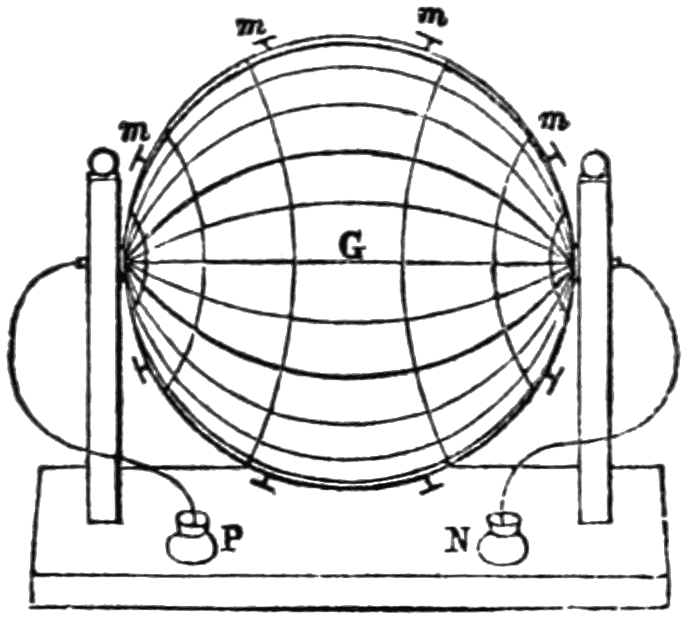
Mr. Bain’s electric clock is a remarkable
contrivance. Nothing can be more satisfactory
or complete. Allowing for wear and tear of
materials from friction, and the oxidating influence
of the atmosphere, the perpetual motion
appears to be realized. As long as the electricity
of the earth continues, or, in other
words, as long as the laws of nature last, so
long will Mr. Bain’s clock continue its oscillations,
and register the transit of time. The
pendulum conducts, and is the treasury of that
power, and two simple wheels and their attachments,
with the dead escapement, complete the
machine. By an ingenious provision, Mr.
Bain’s electric clock at the manufactory extinguishes
the gas-light which illuminates its
dial, at half-past twelve precisely.
Mr. Bain has invented and patented another
kind of electric clock, the clock being in Glasgow,
and the pendulum in Edinburgh. By
means of the electric telegraph along the railway,
constructed by Mr. Bain, he intimated his
wish that the pendulum at the other end of the
line should be put in motion. The clock was
placed in the station-house in Glasgow, the
pendulum belonging to it in the station-house
at Edinburgh, the two being forty-six miles
apart. They were joined by means of the wire
of the telegraph, in such a manner as that, by a
current of electricity, the machinery of the
clock in Glasgow was made to move correctly,
according to the vibrations of the electrical
pendulum in Edinburgh. Thus, in like manner,
were England and Scotland united in one
great chronometrical alliance, a single electrical
pendulum of this description, placed in
the Observatory at Greenwich, would give the
astronomical time correctly throughout the
country.
The electric telegraph may be said to have
originated in a trivial incident. It occurred to
professor Oersted, of Copenhagen, to try the
effect of a galvanic current on the needle of the
compass. He found it, on making the experiment,
deflected, that is, turned aside from its
usual bearing of due north and south. Professor
Wheatstone applied this result very ingeniously.
He arranged a series of needles,
mounted like that of the compass, and found
that he could turn any of these aside by galvanic
currents, while the others remained at
rest. It was evident, therefore, that if each
needle were supposed to denote a letter, any
letters might thus be indicated; and, consequently,
if an arrangement of needles standing
for so many letters, respectively, were placed at
the distance of fifty or a hundred miles, and
any of them were acted on by means of wires
traversing the distance, a message could be
despatched at one end of the line, and read off
at the other from the deflected needles, by any
person duly acquainted with the arrangement.
A similar set of needles at the opposite end,
would enable him, as certainly, to transmit a
reply.
The engraving represents the front of the
telegraph, exhibiting the index, as it is denominated.
The wires, which are suspended through
the length of the line, are attached at either
end to the telegraphic instruments, a branch
wire being fastened to a large metallic surface,
imbedded in the earth for completing the electric
current. When at rest, the handles are
down, and the pointers remain in their vertical
position. The signals are given by two magnetic
needles, or pointers, each suspended vertically
on an axis passing through the dial, and,
behind, another pointer is fixed on each corresponding
axis. A portion of the conducting
wire, many yards in length, is coiled round the
galvanometer frame, in which the magnet
moves, so as to subject the magnet to the multiplied
deflecting force of the electric current.
The battery is the motive power of the machine,
occupying the same relative position to
it, as the boiler does to the locomotive; for,
though it does not produce any immediate
result on the works, yet the part it performs in
the undertaking is essential. While travelling,
Mr. Cooke found great inconvenience to result
from the spilling of the acid solution used in
Smee’s batteries; and, from this, he was led
to consider if the substitution of fine white
Shanklin sand, saturated with the diluted acid,
would not avoid this difficulty. Experiments
having confirmed the truth of his conjecture,
the change was permanently arranged, and it
was subsequently found so advantageous, that
the same method was tried in the permanent
batteries, and, in like manner, the result has
proved satisfactory. At present, the generator
resembles, in its principal features, the one
known as Wollaston’s trough; and it is so
arranged, that the series of plates of copper and
amalgamated zinc, arranged for the evolution
of the electric fluid, admit of being placed in a
corresponding series of cells, filled with well-washed
and dry sand. The United Service
Gazette states, that all that is necessary in order
to use the instrument is, slightly to moisten the
sand with diluted sulphuric acid.
The conducting wires are, at their ends, of
less diameter, and are so arranged as to form
the coiled magnets. Those in the diagram are
seen in connexion with the works; the electric
current, taking the course indicated by the
arrows, occasions the deflection of the needle.
The following engraving represents the interior
of the machine, and shows the means by
which the magnet is connected with the electric
current. The parts lettered a are the key-shafts,
which, on being turned to the right or left by a
handle, pushes one of the springs, c, from its
point of contact, d, and, by changing the course
of the electric current, produces a corresponding
change in the position of the needle.
In making a communication to the person
stationed at the point where he wishes the
information to be received, the operator, by
turning the handle to the right or left, breaks
the electric current; then, pressing the wire
against pins connected with the battery-poles,
the coils of wire receive their full deflective
force, and attract the magnetic needles to either
side, according to the course of the current.
Thus, if the stream of electricity passes into the
coil on the right, the upper part of the needle
will be attracted towards it; if the stream passes
into the coil on the left, then the needle will, in
like manner, be attracted to it; thus, giving the
whole motion necessary to the pointers. The
time which elapses between the moving of the
handles and the effect on the pointers, is imperceptible,
though we must believe that it
really follows it. The dial is divided into five
circles, each containing a number of letters, or
signs. The left-hand needle moving to the left
twice, gives a; three times, b; once to the right
and once to the left, c; once to the left and once
to the right, d; once to the right, e; twice, f;
three times, g. The order is then taken up by
the right-hand needle moving once to the left
for h; twice for i; three times for k; once to
the right and once to the left for l; once to the
left, and once to the right, for m; once to the
right for n; twice for o; and three times for p.
The remaining signs are made by two needles
working conjointly, so that the simultaneous
movement of the two, once to the left, indicates
r; twice for s; three times for t; once to the
right, and once to the left, for u; once to the
right for w; twice for x; and three times for y.
At the end of every word given, the left-hand
needle, moving once to the right, to the cross,
indicates that the word is completed. If the
receiver understands the word, he signifies it by
moving the same pointer twice to the left, and
twice to the right, which means yes; if the
communication is not understood, then the
needle points twice to the right, and twice to the
left, which indicates no. The original word is
then repeated; if figures are wanted, the motions
for each letter are doubled. Previously
to giving a signal, the attention of the operator
is called by the ringing of a bell, which is
accomplished by an apparatus as simple as it is
ingenious.J
That communications by this means may
often be of great importance, is evident, from
many newspaper paragraphs. The following
appeared in the early part of 1847: “On Friday
evening the following message was received at
the Chesterfield station: ‘Tell Derby, a Mr. H.
has escaped from the York Asylum, and is
supposed to have fire-arms about his person.
Search all the trains from York. He is tall,
has a crooked nose, and has a green coat with
pockets at the side. Tell the police to look
out.’ To this message another succeeded from
Leeds: ‘He is caught at Leeds; they have him
quite secure.’”
An establishment has lately been opened
near the Bank of England, in which telegraphic
intelligence may be despatched, or received, in
all the principal towns of our country. The
difficulties which have existed in reference to
sub-marine telegraphs appear to have been
overcome; for the time occupied from the commencement
of carrying the telegraph across
Portsmouth harbour, and transmitting signals,
does not occupy a quarter-of-an-hour. The
telegraph, which has the appearance of an
ordinary rope, is coiled into one of the dockyard
boats, one end of it being made fast on shore;
and, as the boat is pulled across, the telegraphic
rope is gradually paid out over the stern, its
superior gravity causing it to sink to the bottom
immediately. The telegraph consists of
but this line; and, unlike those along the
various railways, requires no return wires to
perfect the circuit. The electric fluid is transmitted
from the batteries in the dockyard,
through the submersed insulated wire to the
opposite shore; the fluid returning to the negative
pole through the water without the aid of
any metallic conductor, except a short piece of
wire thrown over the dockyard parapet into the
water, and connecting it with the batteries.
The fact of the water acting as a ready return
conductor, is established beyond question. In
1842, Mr. Snow Harris, when proving the
efficiency of his lightning-conductors in his
experiments from this dockyard to the Orestes,
exemplified that water would serve to complete
the electric circuit. On that occasion, the
distance traversed by the return current through
the water was but trifling compared with the
space accomplished in the present instance.
The batteries used are Smee’s; and a very
delicate and accurate galvanic detector, invented
by Mr. Hay, the chemical lecturer of the dockyard,
has also been brought into requisition.
Independent of the simplicity of this sub-marine
telegraph, it has an advantage which even
the telegraphs on land do not possess—in the
event of accident, it can be replaced in ten
minutes.
At the last meeting of the British Association,
the chairman, sir R. H. Inglis, thus adverted
to the progress of the electric telegraph, from
a report presented to the Legislative Council
and Assembly of New Brunswick, relative to
a project for constructing a railway, and with
it a line of electro-magnetic telegraph, from
Halifax to Quebec:—
“The system is daily extending. It was,
however, in the United States of America that
it was first adopted on a great scale, by professor
Morse, in 1844; and it is there that it is
now already developed most extensively. Lines
for above thirteen hundred miles are in action,
and connect those states with Her Majesty’s
Canadian provinces; and it is in a course of
development so rapid that, in the words of the
report of Mr. Wilkinson to my distinguished
friend, his excellency sir W. E. Colebrook, the
governor of New Brunswick, ‘no schedule of
telegraphic lines can now be relied upon for a
month in succession, as hundreds of miles may
be added in that space of time. So easy an
attainment does such a result appear to be, and
so lively is the interest felt in its accomplishment,
that it is scarcely doubtful that the whole
of the populous parts of the United States will,
within two or three years, be covered with a
net-work, like a spider’s web, suspending its
principal threads upon important points, along
the sea-board of the Atlantic on one side, and
upon similar points along the lake frontier on
the other.’ I am indebted to the same report
for another fact, which I think the association
will regard with equal interest:—‘The confidence
in the efficiency of telegraphic communication
has now become so established, that
the most important commercial transactions
daily transpire, by its means, between correspondents
several hundred miles apart. Ocular
evidence of this was afforded me by a communication
a few minutes old between a merchant
in Toronto, and his correspondent in New York,
distant about six hundred and thirty-two miles.’
I am anxious to call your attention to the
advantages which other classes also may experience
from this mode of communication, as
I find it in the same report:—‘When the
Hibernia steamer arrived in Boston, in January,
1847, with the news of the scarcity in
Great Britain, Ireland, and other parts of
Europe, and with heavy orders for agricultural
produce, the farmers in the interior of the
states of New York, informed of the state of
things by the magnetic telegraph, were thronging
the streets of Albany with innumerable
team-loads of grain, almost as quickly after the
arrival of the steamer at Boston, as the news of
that arrival could ordinarily have reached them.
I may add that, irrespectively of all its advantages
to the general community, the system
appears to give already a fair return of interest
to the individuals or companies who have
invested their capital in its application.’”
Professor Morse states, as the result of improvements
in this telegraph, the president’s
message, entire, on the subject of the war with
Mexico, was transmitted with perfect accuracy
at the rate of ninety-nine letters per minute.
His skilful operators in Washington and Baltimore
printed these characters at the rate of
ninety-eight, one hundred-and-one, one hundred-and-eleven,
and one of them actually printed
one hundred-and-seventeen per minute. He
must be an expert penman who can write
legibly more than one hundred letters per minute;
consequently, this mode of communication
equals, or nearly equals, the most expeditious
mode of recording thought!
Here, then, we close our series of illustrations
of what is popularly termed “Natural Magic,”
but, strictly speaking, of natural laws; having
glanced at the arrangements of mechanical skill,
terrestrial phenomena, chemical wonders, and
the effects of light, heat, and electricity.
In doing so, we are reminded of the words
of the psalmist:—“Thy faithfulness is unto all
generations: thou hast established the earth,
and it abideth. They continue this day according
to thine ordinances: for all are thy
servants,” Psa. cxix. 90, 91.
The constancy of nature, thus so clearly
indicated, is illustrated by ordinary experience.
The child who flies his kite in the air, or
places his little ship on the surface of the stream,
or gathers together the dry leaves to make a
blaze, yea, even by the food that he eats, and
by his movements in his daily walks, proves
that nature has laws, and that in them there is
continuance. In after-life, the fact is still more
obvious. Every day and every night bear
their explicit testimony to it. Water finds its
way to the ocean by a thousand channels; it is
raised to the higher regions of the atmosphere
to be dispersed in light and fleecy clouds over
the four quarters of the globe; and, at length,
accomplishes its circuit, by falling in showers
on the dry and thirsty ground.
“It needs, however,” says Chalmers, “the
aid of philosophy to learn how unvarying
nature is in all her processes—how even her
seeming anomalies can be traced to a law that
is inflexible—for what might appear at first
to be the caprices of her waywardness, are, in
fact, the evolutions of a mechanism that never
changes—and that, the more thoroughly she is
sifted and put to the test by the interrogations
of the curious, the more certainly will they
find that she walks by a rule which knows no
abatement; and perseveres with obedient foot-step
in that even course, from which the eye
of strictest scrutiny has never yet detected one
hair’s-breadth of deviation. It is no longer
doubted by men of science, that every remaining
semblance of irregularity in the universe
is due, not to the fickleness of nature, but to
the ignorance of man—that her most hidden
movements are conducted with a uniformity as
rigorous as fate—that even the fitful agitations
of the weather have their law and principle—that
the intensity of every breeze, and the
number of drops in every shower, and the
formation of every cloud, and all the occurring
alternations of storm and sunshine, and the
endless shiftings of temperature, and those tremulous
varieties of the air which our instruments
have enabled us to discover, but have
not enabled us to explain—that still, they
follow each other by a method of succession,
which, though greatly more intricate, is yet as
absolute in itself as the order of the seasons, or
the mathematical courses of astronomy. This
is the impression of every philosophical mind
with regard to nature, and it is strengthened
by each new accession that is made to science.
The more we are acquainted with her, the more
are we led to recognise her constancy, and to
view her as a mighty, though complicated
machine, all whose results are sure, and all
whose workings are invariable!”
Who is not filled with amazement in contemplating
the power of the Almighty? Only let it
be his will to set one of his agents loose, and the
earth and all that it contains shall be burned
up. Well may we tremble at the thought of that
“wrath which is revealed from heaven against
all ungodliness and unrighteousness of men!”
On those who believe not, the curse of Jehovah
abides. Would that men considered how fearful
a thing it is to fall into the hands of the living
God! Convinced by the Holy Spirit of their
guilt and danger, they would then fly to the only
hope set before them in the gospel.
“In vain we seek for peace with God
By methods of our own:
Jesus, there’s nothing but thy blood
Can bring us near the throne.
The threatening of thy broken law
Impress our souls with dread;
If God his sword of vengeance draw,
It strikes our spirits dead.
But thine illustrious Sacrifice
Hath answered these demands;
And peace, and pardon, from the skies,
Came down by Jesus’ hands.”
It has been well remarked by Bacon, that “it
is heaven on earth to live in charity, to turn
upon the poles of truth, and to rest in Providence.”
The tenderness and minuteness of the
Divine care are taught us by our Lord himself:
“Fear not them which kill the body, but are
not able to kill the soul: but rather fear him
which is able to destroy both soul and body in
hell. Are not two sparrows sold for a farthing?
and one of them shall not fall on the ground
without your Father. But the very hairs of
your head are all numbered. Fear ye not
therefore, ye are of more value than many
sparrows,” Matt. x. 28–31.
Let, then, all who are reconciled to God
through the death of his Son, be comforted by
this truth. God is not far from every one of
us; the vast and the minute are alike under his
control; and he has graciously promised that
all things shall “work together for good to
them that love God, to them who are the called
according to his purpose.”
In the ignorance and superstition of the
human mind, applications are sometimes made
to those who are supposed to be endowed with
magical powers. Such practices are condemned
in the Scriptures as vain and wicked. Hence,
says the prophet Isaiah, “When they shall say
unto you, Seek unto them that have familiar
spirits, and unto wizards that peep, and that
mutter: should not a people seek unto their
God? for the living to the dead? To the law
and to the testimony: if they speak not according
to this word, it is because there is no light
in them,” Isa. viii. 19, 20.
CHAPTER X.
Claims of the church of Rome to miraculous power—The
Franciscans and Dominicans—Tale of bishop Remi—The
effect of relics—Friars’ pretended dispossession of evil
spirits—Tragical event—Appearance of the virgin Mary
to shepherds exposed—Pretended miracle of the Greek
church.
The Romish church, in all ages, has affirmed
that to it has been granted the power of working
miracles. Its “Lives of the Saints,” a
series extended avowedly through many centuries,
abound with relations of what are described
as supernatural appearances, but which
we can only trace to a very different cause.
The two following facts are given by Luther:—“In
the monastery of Isenach stands an
image, which I have seen. When a wealthy
person came thither to pray to it, (it was Mary
with her child,) the child turned away its
face from the sinner to the mother, as if it
refused to give ear to his praying, and was
therefore to seek mediation and help from
Mary the mother. But, if the sinner gave
liberally to that monastery, then the child
turned to him again; and if he promised to give
more, then the child showed itself very friendly
and loving, and stretched out his arms over
him, in the form of a cross. But this image
was made hollow within, and prepared with
locks, lines, and screws; and behind it stood
a knave to move them; and so were the
people mocked and deceived, taking it to be a
miracle wrought by Divine Providence!”
“A Dutchman, making his confession to a
mass-priest at Rome, promised, by an oath, to
keep secret whatever the priest would impart
to him, till he came into Germany, upon which
the priest pretended to give him a leg of the
ass on which Christ rode into Jerusalem, very
neatly bound up in a silken cloth, and said,
‘This is the holy relic on which the Lord
Christ did corporeally sit, and with his sacred
legs touched this ass’s leg!’ The Dutchman
was wonderfully pleased, and carried the holy
relic with him into Germany, and when he
came upon the borders, boasted of his holy
possession in the presence of four others of
his comrades, at the same time showing it to
them; but each of the four having also
received a leg from the priest, and promised
the same secrecy, he inquired with astonishment,
‘Whether that ass had five legs!’”
The frauds practised by the professed ministers
of religion, during the almost universal
prevalence of popery, most affectingly display
the depravity of the human heart, and the
impious tendency of false religion. Never,
perhaps, was a stratagem acted more infamous
than one in Berne, in the year 1509, the following
account of which drawn from Ruchet’s
“Histoire de la Réformation en Suisse,” and
Höttinger’s “Hist. Eccles. Helvet.,” is given in
Mosheim’s “Eccles. Hist.” A similar account
may be found in bishop Burnet’s Travels
through France, Italy, etc. The stratagem in
question was the consequence of a rivalship
between the Franciscans and Dominicans, and
more especially of their controversy concerning
the immaculate conception of the virgin Mary.
The former maintained, that she was born
without the blemish of original sin; the latter
asserted the contrary. The doctrine of the
Franciscans, in an age of darkness and superstition,
could not but be popular; and hence,
the Dominicans lost ground from day to day.
To support the credit of their order, they resolved,
at a chapter held at Vimpsen in the
year 1504, to have recourse to fictitious visions
and dreams, in which the people at that time
had an easy faith; and they determined to
make Berne the scene of their operations. A
person named Jetzer, who was extremely simple,
and much inclined to austerities, and who
had taken their habit as a lay-brother, was
chosen as the instrument of the delusions they
were contriving. One of the four Dominicans,
who had undertaken the management of this
plot, conveyed himself secretly into Jetzer’s
cell; and, about midnight, appeared to him in a
horrid figure, surrounded with howling dogs,
and seemed to blow fire from his nostrils, by
the means of a box of combustibles which he
held near his mouth. In this frightful form, he
approached Jetzer’s bed, told him that he was
the ghost of a Dominican, who had been killed
at Paris, as a judgment from heaven for laying
aside his monastic habit; that he was condemned
to purgatory for this crime; adding,
that, by his means, he might be rescued from
his misery, which was beyond expression.
This story, accompanied with horrible cries
and howlings, frightened poor Jetzer out of
the little wits he had, and engaged him to
promise to do all in his power to deliver the
Dominican from his torment. Upon this, the
impostor told him, that nothing but the most
extraordinary mortifications, such as the discipline
of the whip, performed during eight days
by the whole monastery, and Jetzer’s lying
prostrate, in the form of one crucified, in the
chapel, during mass, could contribute to his
deliverance. He added, that the performance
of these mortifications would draw down upon
Jetzer the peculiar protection of the blessed
virgin; and concluded by saying that he
should appear to him again, accompanied with
two other spirits.
Morning was no sooner come, than Jetzer
gave an account of this apparition to the rest
of the convent, who all unanimously advised
him to undergo the discipline that was enjoined;
and every one consented to endure his share
of the task imposed. The deluded simpleton
obeyed, and was admired as a saint by the
multitude that crowded about the convent,
while the four friars, that managed the imposture,
magnified, in the most pompous manner,
the miracle of this apparition, in their sermons,
and in their discourse. The night after, the
apparition was renewed, with the addition of
two impostors, dressed like devils; and Jetzer’s
faith was augmented by hearing from the
spectre all the secrets of his life and thoughts,
which the impostors had learned from his
confessor. In this, and some subsequent
scenes, (the detail of whose enormities we shall
here omit,) the impostor talked much to Jetzer
of the Dominican order, which he said was
peculiarly dear to the blessed virgin; he added,
that the virgin knew herself to be conceived in
original sin; that the doctors who taught the
contrary were in purgatory; that the blessed
virgin abhorred the Franciscans for making
her equal with her Son; and that the town of
Berne would be destroyed for harbouring such
plagues within her walls. In one of these
apparitions, Jetzer imagined that the voice of
the spectre resembled that of the prior of the
convent, and he was not mistaken; but, not
suspecting a fraud, he gave little attention to
this. The prior appeared in various forms,
sometimes in that of St. Barbara, at others, in
that of St. Bernard; at length, he assumed
that of the virgin Mary; and, for that purpose
clothed himself in the habits that were employed
to adorn the statue of the virgin in the
great festivals; the little images, that on these
days are placed on the altars, were made use of
for angels, which, being tied to a cord that
passed through a pulley over Jetzer’s head,
rose up and down, and danced about the
pretended virgin to increase the delusion. The
virgin thus equipped, addressed a long discourse
to Jetzer, in which, among other things,
she told him that she was conceived in original
sin, though she had remained but a short time
under that blemish. She gave him, as a miraculous
proof of her presence, a host, or
consecrated wafer, which turned from white to
red in a moment: and, after various visits, in
which the greatest enormities were transacted,
the virgin-prior told Jetzer, that she would
give him the most affecting and undoubted
marks of her Son’s love, by imprinting on him
the five wounds that pierced Jesus on the cross,
as she had done before to St. Lucia and St.
Catharine. Accordingly, she took his hand
by force, and struck a large nail through it,
which threw the poor dupe into the greatest
torment.
The next night, this masculine virgin
brought, as he pretended, some of the linen
in which Christ had been buried, to soften the
wound, and gave Jetzer a soporific draught,
which had in it the blood of an unbaptized
child, some grains of incense, and of consecrated
salt, some quicksilver, and the hairs of
the eye-brows of a child, all of which, with
some stupifying and poisonous ingredients,
were mingled together by the prior with magic
ceremonies, and a solemn dedication of himself
to the devil in the hope of his succour. This
draught threw the poor wretch into a sort of
lethargy, during which the monks imprinted
on his body the other four wounds of Christ,
in such a manner that he felt no pain. When
he awoke, he found, to his unspeakable joy,
these impressions on his body, and came at
last to fancy himself a representative of Christ
in the various parts of his passion. He was,
in this state, exposed to the admiring multitude
on the principal altar of the convent, to
the great mortification of the Franciscans.
The Dominicans gave him some other draughts,
that threw him into convulsions, which were
followed by a voice conveyed through a pipe
into the mouths of two images, one of Mary,
and another of the child Jesus; the former
of which had tears painted upon its cheeks in
a lively manner. The little Jesus asked his
mother, by means of this voice, (which was
that of the prior,) why she wept? and she
answered, that her tears were owing to the
impious manner in which the Franciscans
attributed to her the honour that was due to
him, in saying that she was conceived and
born without sin.
The apparitions, false prodigies, and abominable
stratagems of these Dominicans were
repeated every night; and the matter was at
length so grossly over-acted, that, simple as
Jetzer was, he at last discovered it, and had
almost killed the prior, who appeared to him
one night in the form of the virgin, with a
crown on her head. The Dominicans, fearing,
by this discovery, to lose the fruits of their
imposture, thought the best method would be to
own the whole matter to Jetzer, and to engage
him, by the most seducing promises of opulence
and glory, to carry on the cheat. Jetzer was
persuaded, or at least he appeared to be so.
The Dominicans, however, suspecting that he
was not entirely gained over, resolved to poison
him; but his constitution was so vigorous
that, though they gave him poison five several
times, he was not destroyed by it. One
day, they sent him a loaf prepared with some
spices, which, growing green in a day or two,
he threw a piece of it to a wolf’s whelps, that
were in the monastery, and it killed them
immediately. At another time, they poisoned
the host, or consecrated wafer, but he escaped
once more. In short, there were no means of
securing him, which the most detestable impiety
and barbarity could invent, that they did
not put in practice; till, finding at last an opportunity
of getting out of the convent, he threw
himself into the hands of the magistrates, to
whom he made a full discovery of this infernal
plot. The affair being brought to Rome, commissaries
were sent from thence to examine the
matter; and the whole cheat being fully proved,
the four friars were solemnly degraded from
their priesthood, and were burned alive, on the
last day of May, 1509. Jetzer died some time
after at Constance, having poisoned himself,
as was believed by some. Had his life been
taken away before he had found an opportunity
of making the discovery already mentioned,
this execrable and horrid plot, which, in many
of its circumstances, was conducted with art,
would probably have been handed down to
posterity as a stupendous miracle.
When the Reformation was spread in Lithuania,
prince Radzviil was so affected by it, that
he went in person to pay the pope all possible
honours. His holiness, on this occasion, presented
him with a precious box of relics. The
prince having returned home, some monks intreated
permission to try the effect of these
relics on a demoniac, who had hitherto resisted
every kind of exorcism. They were
brought into the church with solemn pomp,
and deposited on the altar, accompanied by an
innumerable crowd. After the usual conjurations,
which were unsuccessful, they applied
the relics. The demoniac instantly recovered.
The people called out, “A miracle!” and the
prince, lifting his hands and eyes to heaven,
felt, it is said, his faith confirmed. In this
transport of joy, he observed that a young
gentleman, who was keeper of this treasure of
relics, smiled, and by his motions ridiculed the
miracle. The prince indignantly took the
young keeper of the relics to task; who, on the
promise of pardon, gave the following secret
intelligence concerning them. In travelling
from Rome he had lost the box of relics, and,
not daring to mention it, he obtained a similar
one, which he had filled with small bones of
dogs and cats, and other trifles similar to what
were lost. He hoped he might be forgiven for
smiling, when he found such a collection of
rubbish was idolized with such pomp, and had
even the virtue of expelling demons! It was
by the assistance of this box that the prince
discovered the gross impositions of the monks
and demoniacs, and Radzviil afterwards became
a zealous Lutheran.K
To take another case, for which we are indebted
to Scott’s “History of the Lives of Protestant
Reformers in Scotland.” At the east end
of the village of Musselburgh there was a
chapel dedicated to the virgin Mary; its proper
name being Loretta, though it was vulgarly
called Alareit, or Lawreit. There was also a
chapel of the same name in Perth, and many
credulous people of both these places, as well
as the people of Loretta, in Italy, believed that
their chapel contained within it the identical
small brick-built house in which Mary had
dwelt at Nazareth, and that it had been conveyed
miraculously from its original seat. At
the time now referred to, it was announced in
Edinburgh, and the neighbouring places, that a
miracle would be performed on a certain day,
and a great number of persons consequently
assembled. A stage was erected on the outside
of the chapel, and, at length, a young man,
apparently blind, was led forward. Many of
those who were present knew this person, and
had, perhaps, often pitied his circumstances.
After various prayers and ceremonies, his eyes,
to the satisfaction of the people, appeared to be
perfectly restored. Returning thanks to the
priests and friars, he now left the stage, and
received the congratulations of the people, some
of whom gave him money.
The true character of the treatment of his
case will appear from the following narrative.
He had been a poor friendless boy, who had
attended the sheep belonging to the ruins of
Scienna, or Sciennes, about a quarter of a mile
from Edinburgh. It was one of his amusements
to turn up the whites of his eyes; and,
so effectually did he do this, as to appear, at
pleasure, perfectly blind. The nuns spoke of
him to some priests and friars, and they laid
the plan which was afterwards carried out.
The child was secreted for some years from
public view, and, when it was supposed he was
so altered as not to be recognised, he was sent
forth a blind mendicant, accompanied by a
person who believed he was born so, and had
previously been supported by the nuns. Bound
by a solemn but rash vow to affect blindness,
he travelled the country for a considerable
time, till at length the trick of his restoration
was played as has already been stated.
Among the numerous publications of M.
Guizot, is an edition of the “Chronicles of
Frodvard,” which, in addition to much historical
matter, ascribes many miracles to the bishops of
Rheims. One of them, bishop Remi, it is said,
“was in the house of a wealthy female relative,
conversing with her on religious topics, when her
butler announced that there was no more wine in
the cellars. The bishop, seeing her embarrassment,
having previously entered some of the
lower apartments himself, proposed to accompany
her to the cellar. When they entered it,
he inquired whether there was not a little wine
remaining in a particular cask. The butler
replied, that there was only enough to preserve
it from decay. The bishop then desired him
to shut the door, and not to stir from his position,
and passing to the other end to the cask,
which was pretty large, he made the sign of
the cross and prayed. Soon the wine rose up
out of the cask, and flooded over the cellar-floor!”
Now, the fact of the bishop’s visit to
the cellar first; of a butler, it might be, not
very acute in vision, being desired, after locking
the door, to exclude all witnesses, and to
stand at a distance; and, of a relation of the
bishop, who might easily be made a confederate,
being engaged; is surely more than
sufficient to set aside the whole tale. Moreover,
the lady gave, as the result of the prodigy,
which many a conjuror has easily surpassed, a
portion of her estate in perpetuity to the bishop
and his church! Prodigies of the Romish
church in abundance have had precisely the
same issue.
In an official and authorized Roman
Catholic publication, printed in 1831, we are
told that not less than twenty-six pictures of
the virgin Mary opened and shut their eyes at
Rome during the years 1796 and 1797, which
was supposed to be an indication of her peculiar
favour to the inhabitants of that city for
the opposition which they presented to the
French. Among the subscribers to this work
are the four archbishops and eleven bishops of
Ireland.
“An officer in the British army described to
me,” says Mr. Hughes, “an extraordinary
scene which he witnessed in Messina, in 1811,
occasioned by a picture of the virgin, in a
church much venerated by the populace. An
inhabitant going in, according to custom, to
offer up his adoration to the Madonna, suddenly
ran out again, exclaiming, that ‘the
virgin was weeping for calamity impending
over the city.’ The people rushed in crowds
to the church; when, lo! to their astonishment
and dismay, the tears were, as reported,
trickling over the cheeks of their beloved
patroness; upon which, the whole multitude
began to weep, and howl, and beat their
breasts, expecting nothing less than an earthquake,
or a French invasion. At length one,
more acute than the rest, observed that some
water was passing through the roof of the
church, and dripping upon the canvas, pointed
out the circumstance; but he nearly fell a
victim to his want of judgment, for the people
were determined to have a miracle; nor could
they be persuaded to disperse till the archbishop,
a venerable old man, mounted a ladder,
and wiped the lady’s eyes with a napkin; after
this, he drew the picture into a more
perpendicular situation, telling his audience, that, as
the cause was luckily removed, their patroness
had promised to weep no more.”L
The author of “Rome in the Nineteenth
Century” says: “Private miracles affecting
individuals go on quite commonly every day
without exciting the smallest attention. These
generally consist in procuring prizes in the
lottery, curing diseases, and casting out devils.
The mode of effecting this last description of
miracle was communicated to me the other day
by an abate here, and, as I think it extremely
curious, I shall narrate it to you.
“It seems that a certain friar had preached
a sermon during Lent, upon the state of the
woman mentioned in Scripture possessed with
seven devils, with so much eloquence and unction,
that a simple countryman who heard him
went home, and became persuaded that seven
devils had got possession of him. The idea
haunted his mind, and subjected him to the
most dreadful terrors; till, unable to bear his
sufferings, he unbosomed himself to his ghostly
father, and asked his counsel. The father, who
had some smattering of science, bethought himself,
at last, of a way to rid the honest man of
his devils and his money together. He told
him it would be necessary to combat with the
devils singly, and, on the day appointed, when
the poor man came with a sum of money—without
which the good father told him the
devil never could be dislodged—he bound the
chain connected with an electrical machine in
an adjoining chamber round his body—lest, as
he said, the devil should fly away with him—and,
having warned him that the shock would
be terrible when the devil went out of him, he
left him praying devoutly before an image of
the Madonna; and after some time, gave him a
pretty smart shock, at which the poor wretch
fell insensible on the floor from terror. As
soon as he recovered, however, he protested
that he had seen the devil fly away out of his
mouth, breathing blue flames and sulphur, and
that he felt himself greatly relieved. Seven
electrical shocks at due intervals having extracted
seven sums of money from him, together
with the seven devils, the man was cured, and
a great miracle performed!
“To us this transaction seemed a notable
piece of credulous superstition on the one hand,
and fraudulent knavery on the other; but to
our friend the abate, it only seemed an ingenious
device to cure of his fears a simpleton, over
whose mind reason could have no power—as
the physician cured a lady who fancied she had
a nest of live earwigs in her stomach, not by
arguing with her on the absurdity of such a
notion, but by showing her that an earwig was
killed by a single drop of oil, and making her
swallow a quantity of it.
“But with respect to the man and his
devils, I would ask, why inspire superstitious
terrors to conquer them by deceit, and why
make him pay so much money? Yet this is
nothing to other things that are of daily occurrence.”
In some of the provinces of France, miracles
are stated continually to be performed, and the
peasants blindly adopt all the extravagances
presented to their acceptance. In the little
town of Fécamp there is a fountain, the water
of which is said to do wonders; and thousands
of pilgrims annually resort to it from the neighbouring
country. The curé distributes to each
a bottle of this water, accompanying it with
some Latin words, receiving two sous for his
trouble. This amounts to a considerable sum.
In another town, Andelys, there is also a fountain
which, it is said, possesses, once a year, the
sovereign virtue of curing rheumatism, palsy, and
nervous affections. The pilgrims either plunge
the diseased member into the water, or throw
themselves in entirely, and, afterwards, follow
the procession in their wet clothes.
In the month of June, 1824, in a small
village, called Artes, near Hostalrich, about
twelve leagues from Barcelona, there was a
constitutionalist, and therefore one opposed to
the ruling power, with which the priesthood
was fully identified. This man being at the
point of death, his brother called on the curate,
and requested him to come and administer the
sacraments. The curate refused; affirming
that the brother, as a constitutionalist, was a
villain, an impious wretch, an enemy to God
and man; he was lost, without mercy, and that,
therefore, it was useless to confess him. The
brother asked whence this information was
derived; the reply was, that God himself told
the curate this during the sacrifice of the mass.
In vain the brother reiterated his intreaties; the
curate was inexorable. A few days after, the
constitutionalist expired, and the brother demanded
for the body the rites of sepulture.
The curate refused, alleging that the soul of
the departed was lost, and that it was in vain
to inter the body; adding, “For during the
night, the devils will come and carry it away;
and in forty days, you yourself will meet the
same fate.”
The Spaniard not treating this declaration
with implicit faith, but, with his suspicions
awakened, watched during the night, with his
pistols loaded, beside the body of his brother.
Between twelve and one o’clock, a knock was
heard at the door, and a voice exclaimed, “I
command you to open the door, in the name of
the living God! Open! if not, your instant ruin
is at hand.” The Spaniard refused; and
shortly after he saw enter, by the window,
three figures, covered with the skins of wild
beasts, provided with horns, claws, and tails;
and, as they were about carrying off the coffin
containing the body, the Spaniard fired, and
shot one of them dead; the others took to
flight; he fired after them, and wounded both.
One of them died in a few minutes, the other
escaped. In the morning, a discovery was
made: the people went to church, but there
was no curate to officiate: it was found shortly
after, on examining those who had been shot,
that one was the curate, the other the vicar;
the person wounded was the sacristan, who confessed
the whole plot. The case was brought
before the tribune of Barcelona.M
And yet, despite of the frequent exposure of its
wicked pretences, the Romish church contends
at this hour as earnestly for the possession of
miraculous endowments as it ever did. As it
claims to be unchangeable, this is manifestly
its only course. Accordingly, it has been
affirmed of the last persons added to the
Romish calendar, only a few years ago, that
they wrought miracles. The time of canonization
is sagaciously deferred till two centuries
after the decease of the parties; but there is no
difficulty in seeing that all the avowed deviations
from the laws of nature attributed to the
canonized, are impious pretences. Dr. Harsnett,
afterwards archbishop of York, said, long since,
“None but the pope and his scholars can
cogge a miracle kindlie, and he and his priests
can despatch a miracle as easily as a squirrel
can cracke a nutte. A miracle in the bread,
a miracle in the wine, a miracle in the holy
water, a miracle in holy oyle, a miracle in
lamps, candles, beades, bones, stones; nothing
done in religion without a miracle and a vice.”
And even Petrarch thus wrote:—
“Fountain of grief, abode of anger,
School of errors, and temple of heresy;
Formerly Rome, now Babylon false and guilty;
Through whom there are so many tears and sighs;
O mistress of deceit; O prison of anger,
Where the good perish, and the bad are cherished and engendered,
Hell of the living! It will be a great miracle
If Christ is not angry with thee at last.”
So recently as the beginning of the year
1847, the virgin Mary was said to have appeared
to two shepherds, in the district of
Grenoble. The so-called miracle was blazed
forth far and wide, and an engraved representation
of the appearance was widely distributed.
Nor was this all: it was said that the
virgin sat on a stone during the interview,
and that, on this being broken, after she was
gone, there was found in the interior an image
of our Lord! But what are the facts that have
been discovered since? That the priests employed
a lady to personate the virgin; and
that the figure in the stone was traced by a
French officer, who, with a companion, placed
it on that spot for a joke; as, in Italy, objects
of modern manufacture are buried, and then
dug up, to be passed off on the unwary as
really antique! In such instances, however,
money is frequently made; while the French
officers had no mercenary intentions.
We close these exposures with a pretended
miracle of the Greek church. At the church
of the Holy Sepulchre at Jerusalem, there is
annually a ceremony to which multitudes are
attracted. It is pretended by the Greek
priests, that, on a particular day, a sacred fire
proceeds from the sepulchre: the pilgrims,
therefore, congregated at Jerusalem, attend
there to light theirs; these are then extinguished,
and carefully preserved, to be added
to the garment dipped in the Jordan when
they are buried. All, however, await the
arrival of the Turkish governor; for, “till he
arrives, the miracle is not certainly to take
place.”
To quote from some travellers who were
present at the ceremony, during the year 1846,
we are informed that “it was a very remarkable
scene. The large area of the church was
densely crowded; but, around the sepulchre, a
space of about four feet wide was kept clear by
a double line of Turkish soldiers. At short
intervals of time, a number of infatuated and
highly-excited men and boys entered in, and,
rushed round and round with desperate energy,
screaming and hallooing like so many maniacs.
Some stood upright on a friend’s shoulders,
who ran with the rest till an unlucky stumble
threw both to the ground. One old man was
particularly conspicuous; he generally headed
the rest, and seemed to be fitter for a strait-waistcoat
than to be the leader of a religious
procession. He danced, shouted, and threw
himself into all sorts of postures. At last he
mounted on another frantic devotee, and urged
him to his utmost speed: they continued their
mad course till he was thrown down violently
against two of the soldiers; they seized him by
the hair of his head, and hauled him out of the
church. In a few minutes, however, he returned
and was more outrageous than before.
Thus, for two hours, the church was a scene
of noise, confusion, and frantic excitement. At
two o’clock the governor arrived, and quietly
took his seat. The racing pilgrims were driven
off the course, and, shortly after, a procession
of priests, headed by the patriarch, and followed
by a motley group of ragged fellows,
bearing shabby banners, walked slowly round
three times, chanting some prayers. The
patriarch was a grey-headed old man, with
a cunning expression of countenance; his very
look seemed to say, ‘I am about to act a lie—what
fools are you to believe it!’ There is a
circular hole in the side of the little chapel
built over the sepulchre; close to it a man was
posted, protected by the soldiers. He was a
rich pilgrim, probably an Armenian, who had
paid handsomely for the privilege of being the
first to light his tapers by the holy fire. The
old patriarch, having divested himself of most
of his fine trappings, entered alone into the
sanctuary. In a minute after, he pushed
through the hole a quantity of flaming cotton,
dipped in spirits of wine; the favoured pilgrim
eagerly lighted a bunch of tapers by it, and,
escorted by the soldiers, hurried out of the
church. The excitement was now at its
height; a scene followed which baffles description.
There was a tremendous rush
towards the flame, still held out by the
patriarch, and each strove who should light his
taper the earliest. Those who could not get
up to head-quarters were obliged to procure a
light from the more fortunate, and in three
minutes the church and adjoining chapels were
in a blaze. Thousands of wax-candles and
flambeaux were glittering over the space; some
had forty or fifty long thin tapers bound together,
which were intended as valuable presents
for friends at home. It was, for the
time, like Bedlam let loose: some were kneeling
in ecstatic adoration, others screaming, dancing,
and jumping; the more zealous put the flame
into their mouths, or applied it to their faces or
naked breasts. It is asserted that the holy fire
does not burn or hurt any one, but Mr. Dalton
noticed that few kept it long enough near to
give it a fair trial. In ten minutes every taper
was extinguished, and the pilgrims dispersed,
carrying away the precious relics.”N
In former parts of this volume, it has been
shown that surprising effects are frequently
produced for the amusement of others, or from
the love of gain and celebrity, so common to
fallen man. And, doubtless, wherever true
piety does not operate—the piety which is
displayed in supreme love to God, and pure
and expansive benevolence to man—there will
be some manifestation of the “spirit” that
worketh in “the children of disobedience.”
While “he that doeth righteousness is righteous,
he that committeth sin is of the devil; for the
devil sinneth from the beginning,” 1 John iii. 7, 8.
To transgressors of every age our Lord still
says, “Ye are of your father the devil, and the
lusts of your father ye will do,” John viii. 44.
And bondage to the “god of this world” brings
on his captives, whether old or young, rich or
poor, instructed or untaught, not only guilt but
misery; while “the end of these things is
death,” Rom. vi. 21.
But when we see impious pretences employed
in order to hold the minds of men in
the most degrading vassalage, we have a fearful
display of enormous guilt, accumulated by a
wilful subjection to “the father of lies.” Satan
was “a liar from the beginning.” To accomplish
his purposes, he can “transform himself
into an angel of light;” and still he leads multitudes
“captive at his will.” Marvellous is the
forbearance of the Supreme Governor of the
universe, who does not at once ease him of his
adversaries, but still richly and freely offers
the blessings of salvation to a world which lieth
in the wicked one. Who will not desire that
the goodness of God may lead the greatest
transgressors to repentance? And, as one act
of submission to the prince of the power of the
air is a fearful step towards an absolute and
eternal thraldom, it becomes each of us to
imitate those who could say, “We are not
ignorant of his devices;” constantly to present
at the throne of grace the petition, “Lead us
not into temptation, but deliver us from evil;”
and to trust implicitly in Him who, on the
cross having “spoiled principalities and powers,
made a show of them openly, triumphing over
them in it,” 2 Cor. ii. 11; Matt. vi. 13; Col. ii. 15.
CHAPTER XI.
Real Miracles—A miracle defined by archbishop Tillotson—The
miracles of Moses—The miracles of our Lord Jesus
Christ—The miracles of the apostles—Collision with those
who pretended to supernatural power—The magicians of
Egypt—Magical arts at Ephesus—The miraculous power of
the Saviour inherent, that of the prophets and apostles
derived—Cessation of miraculous gifts.
We now enter on a brief consideration of unquestionable
miracles. As the grant of Divine
revelation was made to some persons who were
to proclaim it to the whole human race, so,
while holy men of God spake as they were
moved by the Holy Ghost, the broad seal of
Heaven was placed by miracles on their testimony.
As a man’s signature gives validity to
his bond, or the credentials of an ambassador
demonstrate his right to transact the business of
his sovereign; so the supernatural works performed
by the prophets, by our Lord Jesus
Christ, and by his apostles, prove as fully to
those who witnessed them, that the words they
heard proceeded from God, as if they had
listened to him pronouncing them with an
audible voice from the excellent glory; while
all to whom their testimony has been faithfully
transmitted, may cherish an equal confidence.
It has been well remarked by archbishop
Tillotson, that “there are two things necessary
in a miracle: that there should be a supernatural
effect, and that this effect should be evident to
sense.” He adds, “Neither in Scripture, nor
in profane authors, nor in common use, is anything
called a miracle but what falls under the
cognizance of the senses; a miracle being
nothing else but a supernatural effect evident to
sense, the great end and design whereof is to be
the sensible proof and conviction of something
that we do not see.” The church of Rome
affirms that, in the celebration of the mass, the
bread and wine are changed into the very body
and blood, soul and Divinity, of our Lord Jesus
Christ; though they retain exactly the same
appearance that they had before the change is
said to have occurred. Hence, the same writer
argues, “For want of a supernatural effect
evident to sense, transubstantiation is no miracle;
a sign or a miracle is always a thing
sensible, otherwise it could be no sign. Now,
that such a change in transubstantiation should
really be wrought, and yet that there should
be no sign of it, is a thing very wonderful; but
not to sense, for our senses perceive no change.
And that a thing should remain to all appearance
just as it was, hath nothing at all wonderful in
it. We wonder, indeed, when we see a strange
thing done, but no man wonders when he sees
nothing done.”
Numberless were the miracles wrought by
Jehovah in ancient times, in behalf of his chosen
people. In vain does infidelity object that the
contents of the books of Moses may not be true;
since, had they been false, it was absolutely
impossible that they could have obtained any
credit. The number of the people must have
amounted to three millions, and every adult
person was a competent judge whether the
things related to have taken place within his
own memory had really happened.
The Israelites would not have believed that
the Red Sea was divided to give them a passage—that,
during their pilgrimage of forty
years in the wilderness, a miraculous cloud had
guided them by day, and become at night a
fire casting round its radiance—that they had
been supplied with manna from heaven, falling
on six successive days around their camp, and on
the last of them a double quantity, to prevent its
being gathered on the sabbath—that God had
published his law on the mount that might not
be touched, amidst thunders, and lightning, and
tempest—and that he had punished its violation
by terrible plagues—for them to believe these
things would have been absolutely impossible,
had the whole narrative been a fiction. A
romance would have excited their ridicule, and
the yoke which, on the ground of the invention,
was to be placed about their necks, would have
been rejected with the utmost indignation. It is
also morally impossible that the books of Moses
could have been received in the age immediately
after his death, if their contents had been false;
and highly improbable that, though true, they
would have been considered his writings, if they
had been set forth by some other person in his
name, and had not appeared till he was lying
in his grave.
It would be easy to show that the wondrous
acts recorded are traced explicitly to Divine
operation. In illustration of this, the following
passages may be taken: “I am the Lord, your
Holy One, the Creator of Israel, your King.”
“Thus saith the Lord, which maketh a way in
the sea and a path in the mighty waters;”
alluding, most probably, to the passage of Israel
through the Red Sea, and, afterwards, to their
crossing the Jordan, both of which events were
unquestionably miraculous.
That one great object kept in view by the
Redeemer in performing miracles was, to furnish
convincing proofs of his Divine mission, is
evident from the uniform tenor of the inspired
narratives. Nicodemus reasoned justly when he
said, “Rabbi, we know that thou art a teacher
come from God: for no man can do these miracles
that thou doest, except God be with him,” John
iii. 2. The same conviction was possessed by
the chief priests and the Pharisees, for they
said, after the resurrection of Lazarus, “This
man doeth many miracles: if we let him thus
alone all men will believe on him,” John xi.
47, 48. Our Lord himself appeals to his miracles:
“I have greater witness than that of John,
for the works which the Father hath given me to
finish, the same works that I do bear witness of
me, that the Father hath sent me,” John v. 36.
It is impossible, therefore, that any statement
could be more plain and decisive. Our Lord
rests his claim to be believed on the wonders
he wrought. Again, he says, “If I had not
done among them the works which none other
man did, they had not had sin; but now they
have no cloak for their sin.” Thus, we see the
wonders which Christ wrought were unparalleled.
He healed the sick, he penetrated the
minds of men by his own infinite power. And
hence, the unbelief of those who witnessed his
mighty deeds appeared in all its aggravated and
naked enormity; “their sin remained.” But, in
direct opposition to this, there would have been
a plea for unbelief had pretended miracles been
true. Had it been a fact, instead of a fable, that
Æsculapius had cured disease at his oracle, or
that the god of the oracle of Claros had known
the thoughts of men’s hearts, then, and then
only, there would have been a cover for their
iniquity.
Were we to select one miracle as demonstrative
that Jesus was sent by the Father, and of
the acceptance of his work; and, still further,
of the futility of every objection that can be
raised against it; it should be that of the resurrection
of the Lord Jesus Christ. “See,” says
Saurin, “how many extravagant suppositions
must be advanced if the resurrection of our
Saviour be denied. It must be supposed that
guards, who had been particularly cautioned
by their officers, sat down to sleep; and that,
nevertheless, they deserved credit when the
body of Jesus was stolen. It must be supposed
that men who had been imposed on in the
most odious and cruel manner in the world,
hazarded their dearest enjoyments for the glory
of an impostor. It must be supposed that
ignorant and illiterate men, who had neither
reputation, fortune, nor eloquence, possessed
the art of fascinating the eyes of all the church.
It must be supposed either that five hundred
persons were all deprived of their senses at a
time, or that they were all deceived in the
plainest matters of fact; or, that this multitude
of false witnesses had found out the secret of
never contradicting themselves or one another,
and of being always uniform in their testimony.
It must be supposed that the most expert
courts of judicature could not find out a shadow
of a contradiction in a palpable imposture. It
must be supposed that the apostles, sensible
men in other cases, chose precisely those places
and those times which were most unfavourable
to their views. It must be supposed that
millions madly suffered imprisonments, tortures,
and crucifixion, to spread an illusion. It must
be supposed that ten thousand miracles were
wrought in favour of falsehoods, or all these
facts must be denied. And then, it must be
supposed that the apostles were idiots, that the
enemies of Christianity were idiots, and that all
the primitive Christians were idiots.”
The apostles of our Lord were invested with
miraculous powers: “God also bearing them
witness, both with signs and wonders, and with
divers miracles and gifts of the Holy Ghost,
according to his own will,” Heb. ii. 4. As the
apostles asserted a direct and unequivocal claim
to miraculous powers, and as these are declared
in the New Testament to have been exerted
by them, falsehood, if proved, would destroy
the veracity of their writings, and the validity
of all the doctrines and precepts they contained.
But, let the case be duly weighed, and it will
be seen, that, to support their pretensions by
artifice and chicanery, was absolutely impossible.
A few might be deceived, an empire
could not be; and great must be the infatuation
of supposing that a few obscure men could
blind the eyes of the people among whom they
lived. In the face of the utmost hostility, in
the midst of the greatest perils, in defiance of
cruel persecutions, and with the crucifixion of
their Lord before their eyes, they could not
have claimed the exercise of miraculous powers
if they had not been actually possessed. Had
they resembled the Romanists, to whom we
have referred, would it have been possible to
escape detection?
It is worthy of special remark, that more
than one account is given us in sacred history
of the messengers of God entering into collision
with those who pretended to supernatural
power. Thus a memorable contest took place
between Moses and the magicians of Pharaoh’s
court. Different opinions are entertained as to
the means by which the latter performed their
feats, some contending that they were mere
tricks, and others that evil spirits were in active
operation. On this controverted question we
do not enter; it is sufficient for the present
purpose to remark, that the superiority of the
servants of Jehovah was placed beyond all dispute.
The rod of Aaron swallowed up the
rods of the magicians; at the plague of flies
and the murrain on the cattle, they were compelled
to say, “This is the finger of God;” and
at length they “could not stand before Moses
because of the boils, for the boils were upon the
magicians and all the Egyptians,” Exod. ix. 11.
Another instance of a later date is equally
conclusive. The gospel was proclaimed at
Ephesus, where the arts which pretended to
lay open the secrets of nature, and to arm the
hand of man with supernatural powers, were
especially apparent. Indeed, in the age of our
Lord and his apostles, pretended adepts in the
occult sciences were numerous; they travelled
from country to country, and were found in great
numbers in Asia, deceiving the credulous multitude,
and profiting by their expectations.
They were sometimes Jews, who referred their
skill, and even their forms of proceeding, to
Solomon, who is still regarded in the east as
the head or prince of magicians. In Asia
Minor, Ephesus had a high reputation for
magical arts. Here, then, “God wrought special
miracles by the hands of Paul.” The
appeal to the wonder-workers of a country
which contained so magnificent a temple to
Diana, that it was reckoned among the wonders
of the world, was singularly striking. Accustomed
as the Ephesians were to produce strange
results by some species of magic, they would
naturally ascribe miracles to a similar agency.
It was necessary, therefore, that the miracles
which were to serve as the credentials of Christianity,
should be especially marked, and placed
beyond the reach of all their enchantments and
incantations. And it seems an instance not
the less remarkable, because easily overlooked,
of the adaptation of means to an end, that in
Ephesus, in which, of all others, magic was
resorted to, the powers granted to the first
heralds of redeeming mercy sufficed to place
them at an immeasurable distance above the
most consummate magicians.
Another fact is equally entitled to attention.
Certain Jews travelling in that country, and professing
to cast out the evil spirits which frequently
possessed the bodies of men, took upon them,
as avowed exorcists, to employ the name of the
Lord Jesus, from the success with which it was
used by the apostle Paul. Amongst these were
the seven sons of Sceva, a Jew, who addressed
an evil spirit in the name of Christ, thinking,
perhaps, that their number would give special
force to their adjuration. The spirit, however,
answered, “Jesus I know, and Paul I know,
but who are ye?” nor was he content with
refusing to be thus ejected; for, causing the
man in whom he dwelt to put forth supernatural
strength, “he leaped upon the young
men and overcame them, and forced them to
flee out of the house naked and wounded.”
These facts soon became notorious; fear fell
alike on the Jews and Greeks residing at Ephesus;
the most potent appeal had been made to
those accustomed to use charms and incantations;
and numbers were led at once to renounce
their arts of magic.
Very celebrated were the “Ephesian letters,”
which appear to have been a sort of magical
formula written on paper or parchment, designed
to be fixed as amulets on different parts
of the body, such as the hands and the head.
Erasmus says, that they were certain signs or
marks which rendered their possessor victorious
in everything. Eustatius mentions an opinion
that Crœsus, when on his funeral pile, was very
much benefited by the use of them; and that
when a Milesian and an Ephesian were wrestling
in the Olympic games, the former could
gain no advantage, as the latter had Ephesian
letters bound round his heel; but these being
removed he lost his superiority, and was thrown
thirty times. Many of these were, probably,
among the books of which we read, Acts xix.
19; while others were most likely occupied by
descriptions of the prevailing modes of practising
“enchantments.” But all were promptly
and cheerfully consigned to the flames. Thus
the sincerity of the converts was evident by no
trifling sacrifice, for, when they counted the
price of these books, they “found it fifty thousand
pieces of silver. So mightily grew the
word of God and prevailed.”
That there was a difference between the
operations of the apostles and the agency of our
Lord, should be clearly perceived. The power
of the Saviour was inherent—that of the apostles
was derived. How manifest is the miraculous
agency of Christ shown in the cure of the
leper! “Lord, if thou wilt,” said he to the
Saviour, “thou canst make me clean.” Jesus
answered, “I will—be thou clean,” and immediately
he was made whole. Our Lord made
no appeal to any other power. At the grave of
Lazarus, indeed, he “lifted up his eyes, and
said, Father, I thank thee that thou hast heard
me.” But this prayer appears to have been
offered not on his own account, but for the
sake of those who surrounded him, and who
needed such a seal to his mission to establish
their faith. Therefore, he added, “And I know
that thou hearest me always: but because of
the people which stand by I said it, that they
may believe that thou hast sent me.” And
as on other occasions, he said, “Thy sins are
forgiven thee”—“Arise, take up thy bed and
walk”—“I command thee to come out of her,”
so now he cried with a loud voice, “Lazarus,
come forth. And he that was dead came forth,
bound hand and foot with grave-clothes: and
his face was bound about with a napkin. Jesus
saith unto them, Loose him, and let him go,”
John xi. 42–44.
Our Lord had previously said, “Therefore,
doth my Father love me, because I lay down
my life, that I might take it again. No man
taketh it from me, but I lay it down of myself.
I have power to lay it down, and I have power
to take it again. This commandment have I
received of my Father,” John x. 17, 18. In like
manner, Jesus said to Martha, “I am the resurrection,
and the life: he that believeth in me,
though he were dead, yet shall he live: and
whosoever liveth and believeth in me shall never
die,” John xi. 25, 26. How strikingly contrasted
was the language of the apostles! In
the case of the lame man laid at the beautiful
gate of the temple, Peter said, “Silver and
gold have I none; but such as I have give I
thee: In the name of Jesus Christ of Nazareth,
rise up and walk.” These words, uttered on
the first miracle of the apostles, expressed the
great principle on which they performed every
other, and the spirit in which they wrought all
their wondrous deeds.
The apostle, like the prophet, laid down his
authority, and resigned his commission with
his life; but our Lord Jesus Christ not only
exercised his power amidst his last sufferings
and death, but extended his authority beyond
the grave. “I lay down my life of myself;
no man taketh it from me; I have power to lay
it down, and I have power to take it again.”
And though he said, “This commandment
have I received of my Father,” he also added,
“I and my Father are one”—“thereby,” as the
Jews distinctly perceived, “making himself
equal with God.”
Even the diversity of gifts distributed among
primitive saints, proved the infinite resources
of Him by whom they were granted. Though
bestowed by the Holy Spirit, they were purchased
by the blood and supplied by the grace
of the Son of God. Speaking of the outpouring
of the Spirit, and its results, Jesus said, “He
shall receive of mine, and shall show it unto
you.” Most emphatically does he lay claim to
all the fulness of the Godhead, when he adds,
“All things that the Father hath are mine:
therefore said I, that he shall take of mine, and
show it unto you.” Thus, the gift of tongues,
of miracles, of prophecy, and of interpretation,
proved the infinite power of the Giver, on whose
will the extent and diversity of the operation
alike depended. Some had one power and
some another: but all these wrought that one
and the selfsame Spirit, dividing to every man
severally as he would. 1 Cor. xii. 11.
The miraculous endowments of early times
were, however, transient. Certain facts appear
to be conclusive on this point. No gift was
more highly estimated, or considered more
necessary for the propagation of the gospel,
than the gift of tongues. And yet, this was,
unquestionably, of short duration. The only
reference made to it in all the documents of
antiquity, is in the work of Irenæus against the
heretics. He says, “We hear of many in the
church imbued with prophetic gifts, speaking
with all kinds of tongues.” But though he
must have required the gift as much as any—for
he was called to labour for the diffusion of
the gospel among the pagan Celts—yet he expressly
declares, “It was not the least part of
his trouble, that he was forced to learn the
language of the country, a rude and barbarous
dialect, before he could effect any good among
them.” Augustine, it is evident, knew nothing
of supernatural power like that which some
had possessed at a former period. “In the
primitive times,” he says, “the Holy Spirit fell
upon believers, and they spoke in tongues
which they had not learned, as the Spirit gave
them utterance. These were signs suitable for
the time. It was right that the Holy Spirit
should thus be borne witness of in all tongues,
throughout the world. That testimony being
given, it passed away.” With equal explicitness
Chrysostom affirms, “Of miraculous
powers not so much as a single vestige or trace
remains.”
In vain do Romanists contend for the continuance
of miracles. Never have they been
able to produce a solitary instance in which the
gift of tongues has been exercised. And yet,
if any member of their church might have
been expected to be so endowed, it certainly
would have been Francis Xavier, who has been
called “the apostle of the Indies.” But even
he confesses that, ignorant of the language of
the people to whom he went, he was incapable
of doing any service to the Christian cause, and
was little more than a mute statue among
them, till he could acquire some competent
knowledge of their tongues.
Miracles have passed away; but we still
possess the glorious gospel of the blessed God.
A power, however, more than human is needed
to apply it to the heart. To open the blind
eyes, to unstop the deaf ears, to give spiritual
discernment to the mind, to break down prejudice,
to humble pride, to “cast down imaginations
and every high thing that exalteth itself
against the knowledge of God,” is the work of
the Holy Spirit. Paul, as he cast around him
“the good seed of the kingdom,” might have
given up all in despair, but for interposing
Omnipotence. “I have planted,” he said,
“Apollos watered; but God gave the increase.
So then neither is he that planteth anything,
neither he that watereth; but God that giveth
the increase.”
There is, however, a great diversity in the
operations of the same Divine Spirit. Some
are brought at once “from the power of Satan
unto God;” and ever will the time and circumstances
of their conversion be held in remembrance.
Others are led by a slow and gradual
process—perhaps scarcely perceptible, and
affording few points of prominent recollection,
out of darkness into “marvellous light.” Still
the result is the same. All are brought to
Jesus, and believe on him as having died for
their sins, and risen again for their justification;
all by virtue of union with him, under the
sanctifying influence of the Holy Spirit, are become
new creatures, enjoying the blessings of his
great salvation, holding communion with him,
increasing in resemblance to him, and yielding
to him practical obedience and devotion. To
him, then, let us constantly look, to apply the
truth to our own consciences and hearts, to
sanctify us wholly, body, soul, and spirit, and
to prosper every effort we make in behalf of
others.