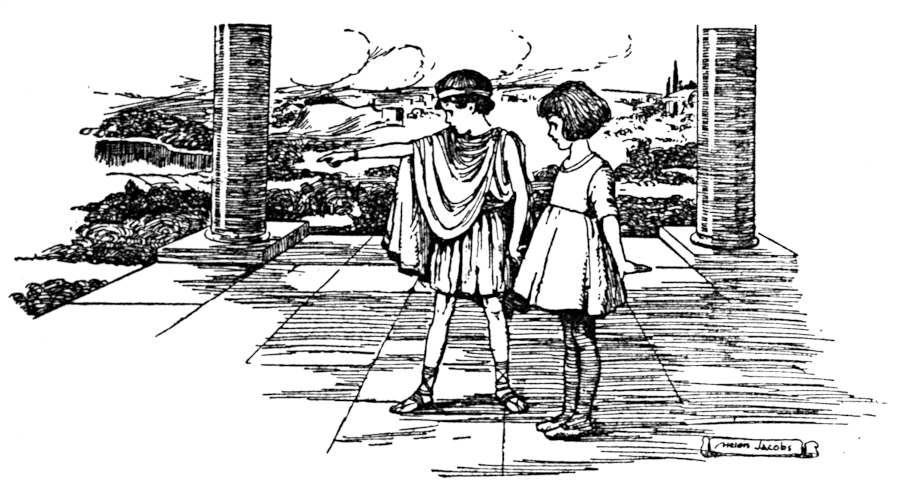
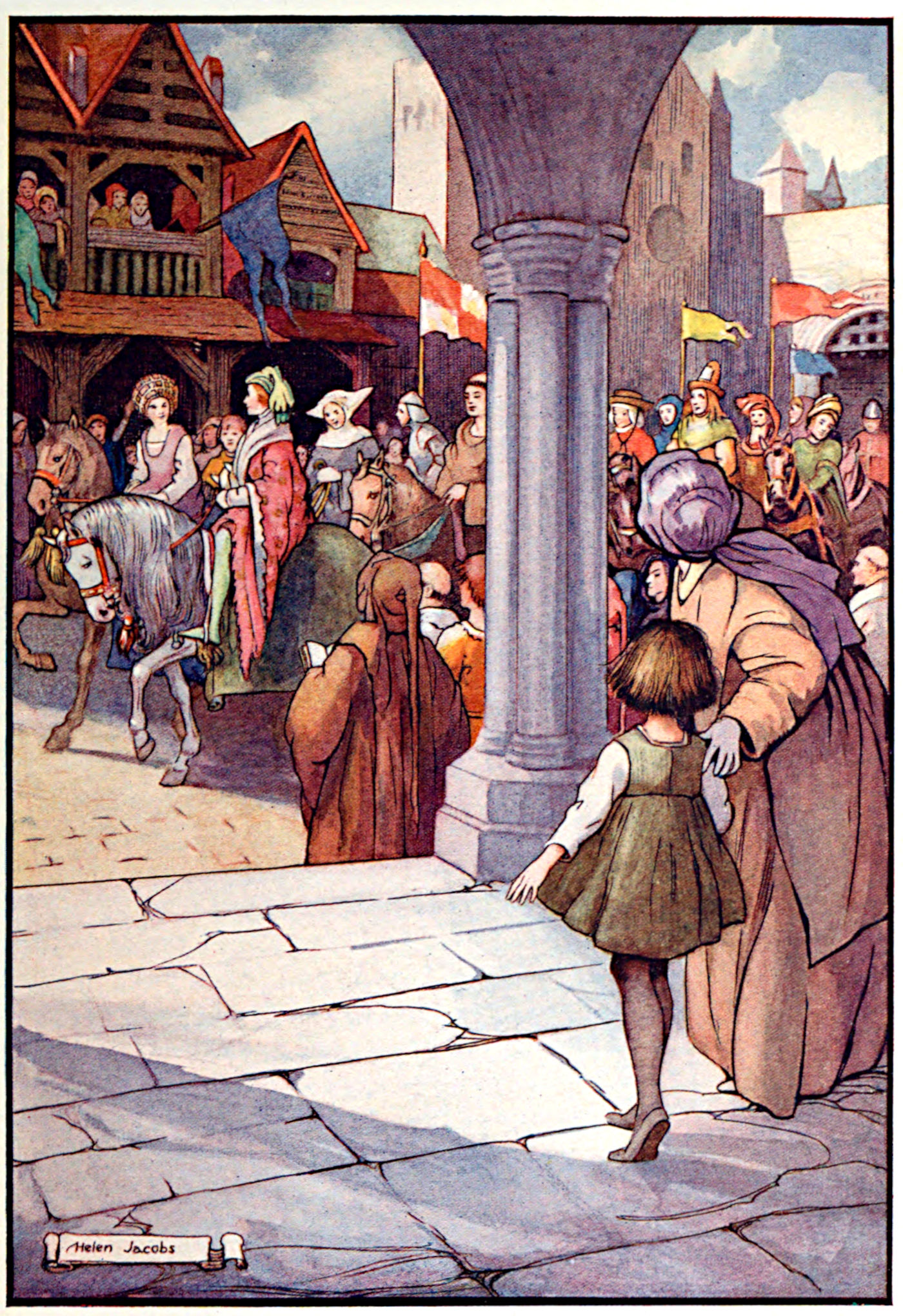
MAGIC LONDON BY NETTA SYRETT ILLUSTRATED BY HELEN JACOBS — CONTENTS — LIST OF ILLUSTRATIONS
THE
ROYAL ROAD
LIBRARY
MAGIC LONDON
THE ROYAL ROAD
LIBRARY
THE CARL EWALD BOOKS
Translated by
Alexander Teixeira de Mattos
1. TWO-LEGS
2. THE OLD WILLOW TREE
and other Stories
6. THE POND
THE NETTA SYRETT BOOKS
3. TOBY AND THE ODD BEASTS
4. RACHEL AND THE SEVEN
WONDERS
8. MAGIC LONDON
THE W. H. KOEBEL BOOKS
5. THE BUTTERFLIES’ DAY
7. THE PAGEANT OF THE
FLOWERS
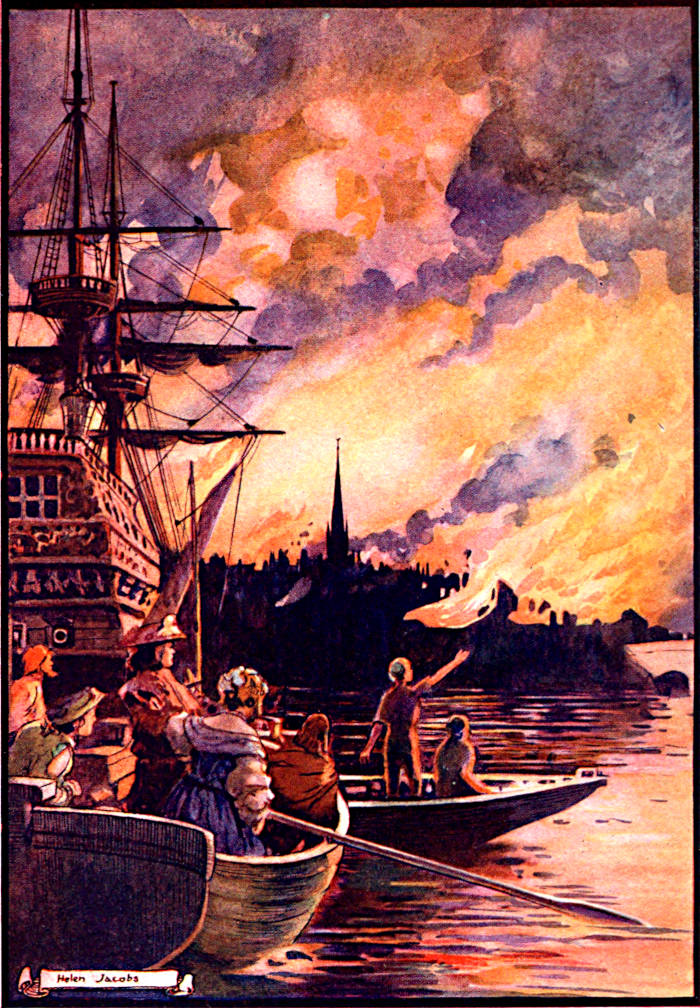
THE GREAT FIRE OF LONDON
THORNTON BUTTERWORTH LTD
15 BEDFORD ST. STRAND, LONDON W.C.2
Published 1922.
TO THE
LITTLE CITIZENS OF LONDON
THIS BOOK IS DEDICATED
May they find a “Godmother” who will take them to all the
places visited by Betty, so that, like her, they may discover
they are really living in a Magic City.
I Magic London — ROMAN LONDON — A FAIRY TALE MUSEUM
All her life up to the time she was eleven years old,
Betty had heard about, but never seen, her godmother.
The reason for this, was that until a year
ago, Betty’s home had been far away in the country, while
Godmother Strangeways lived in London. Then, just when the
child’s father and mother moved to town, Godmother decided
to travel abroad. So it happened that Betty had been more
than a year in London before she met the old lady who afterwards
made such a difference in her life.
She never forgot the first day she met her.
“Your godmother has come back,” said her mother one
morning at breakfast time, as with a curious smile she passed a
letter to her husband.
“Has she? Oh, I do want to see her!” exclaimed Betty.
“Well, you will. She wants you to spend the day with her
to-morrow.”
“Aren’t you and Dad coming too?”
“No, she wants you alone. She’s sending her car to fetch
you to-morrow at eleven o’clock. Your father and I will go to
see her another time.”
“I wish you were coming. I don’t know her, and I don’t
want to be there all day alone with her,” grumbled Betty.
“What will there be to do?”
“You’ll find she’ll provide plenty to do,” laughed her father.
“Mind you don’t tell her though, how much you dislike London!”
he added in his teasing voice.
“Why?” asked Betty.
“Because your godmother loves it. She’s a great authority
on London. What she doesn’t know about it, isn’t worth
knowing. It’s quite uncanny. I wish she’d write a book about
it.”
“I can’t think how any one can love London,” Betty declared.
“Such a horrid, big, ugly, dull place. I shall never, never like
it!”
Godmother’s little car duly came round next morning, and
after a drive, Betty found herself in a tiny room, in a tiny house,
in a tiny street close to Westminster Abbey, seated opposite to
a very handsome old lady.
“I’m sorry my godchild doesn’t like London,” this old lady
remarked suddenly, in the midst of a conversation about something
else.
Betty blushed and looked uncomfortable. She felt shy of
her godmother who, as she had always heard, was very clever
but “eccentric”—a word she thought meant different from other
people.
“It’s all so confusing and noisy and there are such lots of
ugly houses,” she began apologetically. “And I do miss the
lovely country and our beautiful garden,” she added with tears
in her voice.
“Of course you do,” said Godmother sympathetically.
“But as it’s a pity to hate the place you have to live in, I’m
going to make you think London the most fascinating town in
the world.”
She spoke confidently, and just as confidently Betty said to
herself, “You’ll never do that.”
“You think it’s ugly, don’t you?” Godmother inquired.
“Well, so it is—in parts.”
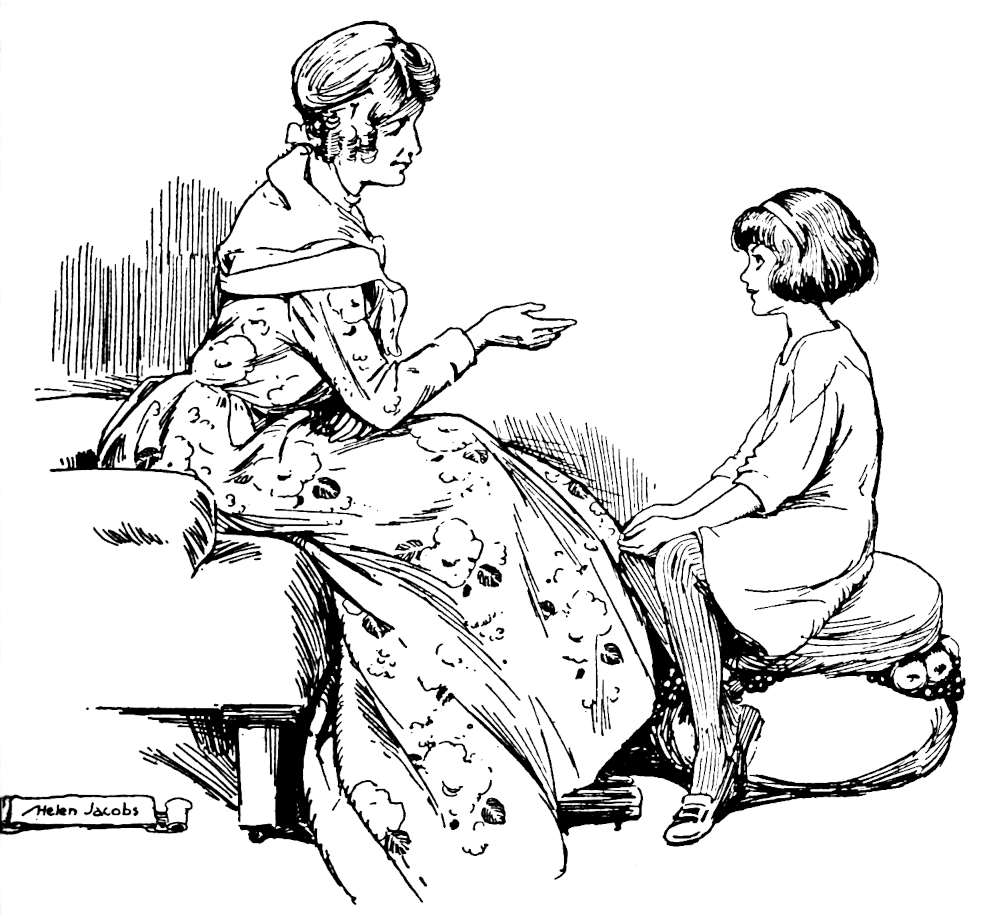
SHE WAS BEGINNING TO THINK SHE LIKED HER GODMOTHER
“Oh, it’s not all ugly,” Betty hastened to allow. “This little
street is awfully pretty—and so quiet. It’s like a street in a
country town. You can forget you’re in London. It’s a very
old street, isn’t it?” She was forgetting her shyness and
beginning to think she liked her godmother. She certainly liked
the look of her. Godmother Strangeways was dressed in a way
which Betty described to herself as “nicely old-fashioned.” She
had snow-white curls fastened back behind her ears with tortoiseshell
combs, and the ample-flowered silk dress she wore
was, as her godchild decided, “just right” for the small white-panelled
room with its old furniture and tall narrow cabinets
filled with all sorts of curious things.
“Old?” repeated her godmother. “It’s about two hundred
years old, and that, as London goes now, is rather ancient.
But it’s new compared with the age of London itself. What is
two hundred years compared with nearly two thousand?”
“Is London as old as that?”
“Where’s your history? Didn’t the Romans live here once
upon a time?” asked Godmother Strangeways briskly.
“So they did,” murmured Betty.
“Well, some of them settled in this island soon after the
birth of Christ, and that is nearly two thousand years ago.”
“But I didn’t know they lived in London?”
Godmother laughed. “They made London, child. The first
London. And just in the place where it now stands, at the
mouth of the Thames.”
“But was it called London then?”
“Something very like it. It’s earliest name was Llyn-din,
and the Romans called it Londinium. You see how easy it is
to get London out of that? They had another name for it as
well—quite a different one.—They sometimes called it Augusta.”
Betty was silent for a minute, then after a quick glance at
her godmother she said rather timidly, “Dad says what you
know about London is quite uncanny. He says he wonders you
don’t write a book about it. When you asked me to come to
see you, he was very pleased because he said if any one could
make me like London it was you. And of course as I have to
live here I should like to like it!” She sighed rather hopelessly.
The old lady began to smile, and her smile was mysterious.
“Shall I tell you why I don’t write a book about London?”
she said. “It’s because if I did, it would be considered uncanny,
as Dad says.”
Betty began to look and feel excited.
“Oh, why? Do tell me why?”
“I’m not quite sure whether it would be of any use to tell
you, but I shall know better in a few hours’ time, when I’ve
seen a little more of you. I’m going to take you out for a drive
now, before luncheon. The car is still at the door.”
Ten minutes later, Betty took her seat beside the old lady,
and the car glided out of the quiet street into a busy thoroughfare.
It was a lovely spring day, and she was glad to be out
of doors in a part of London more or less new to her. She was
also very curious about
what Godmother had recently
hinted, though she
scarcely liked to question
her on the subject.
They were passing
Westminster Abbey now,
and nodding toward it
Godmother said:
“You don’t call that
ugly?”
Before Betty could
answer, they had reached
the end of Westminster
Bridge and turned on to the
Embankment. Raised on
the end parapet of the
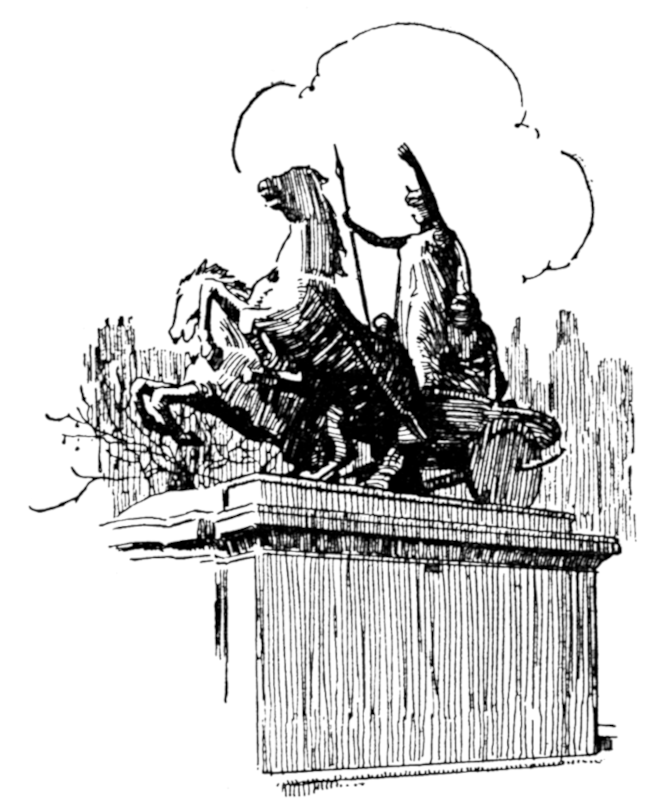
bridge, was a group of
statues in which the chief
figure was a woman in flowing
robes furiously driving
a strange-looking chariot.
“Do you know what that represents?” asked Godmother,
when she saw Betty glance at the monument with interest.
“It’s Queen Boadicea driving into battle. I only want you
just to remember her name, because you may hear something
about her later.”
Again Godmother’s voice was mysterious, and Betty glanced
at her, with more curiosity than ever.
It was delightful to be driving by the side of the river with
the spring sunlight sparkling on the water, but she wondered
where they were going.
As though she guessed her thought, Godmother said presently,
“We are going first to drive slowly over London Bridge.”
In a few minutes they were upon it, and the car was threading
its way among the crowded traffic, between great vans and
lorries and taxicabs and the carts and wagons of all sorts that
rolled along with a ceaseless roar. Betty looked up and down
the river lined with huge buildings, its surface covered with
shipping of every kind, and it struck her that London was, after
all, a wonderful city. At the other end of the bridge, Godmother
gave Williams, the chauffeur, an order to return, and to stop as
close as possible to The Monument, that enormously tall pedestal
near the Bridge, which, as Betty’s father had told her, was put
up in the reign of Charles II.
“Now I’m going to stay here comfortably in the car while
you and Williams climb to the top of that column,” said Godmother,
when the chauffeur had driven into a narrow side street.
“Neither of you will mind the steps, but I certainly should.”
Betty was only too delighted at the prospect, and with
Williams as escort, she mounted gaily higher and higher, till at
last the final step was reached, and she stepped out on to the
caged-in top of the pillar. What a marvellous view it was, of
miles and miles of streets and houses and domes and spires,
with the river running like a silver ribbon in the midst!
Williams also was impressed. “It’s a fine great city, miss!”
he exclaimed.
“Well?” demanded Godmother, when presently they returned
to the car. “What do you think of London in point
of size?”
“It takes your breath away!” was Betty’s answer, as she
settled herself comfortably for the homeward drive.
“It’s been lovely,” she declared, when they sat down to lunch
in the quaint parlour below the sitting-room. “I do believe
I’m going to like London after all, Godmother. It somehow
seems quite different seeing it with you. I have such a funny
feeling about it. Just as though it was a sort of magic place
that might be awfully surprising.”
Godmother gave her a quick look, but said nothing except
“I’m glad.”
After the meal, however, when they were once more in the
white-panelled sitting-room which Betty already loved, she
exclaimed all at once, “Now I’m going to tell you a
secret.”
You may imagine how Betty pricked up her ears. But
without giving her time to speak, the old lady went on, sinking
her voice to a most thrilling whisper: “I have a magic way of
seeing London. It’s a special gift, and I’m not going to tell
you how I discovered that I possess it. Very, very few people
have the gift, but from certain signs I think you possess it too.
Would you like to try?”
Betty’s face was a study in perplexity.
“Yes—but how?” she stammered. “I don’t understand....”
Instead of explaining, Godmother Strangeways got up,
and opened the door of a cabinet that stood between two narrow
square-paned windows, took something from a shelf and, returning,
dropped it into her godchild’s hand.
Betty gazed at the little object. “It’s a ring,” she began.
“But a very old one, isn’t it? It’s so dark and stained.”
“It’s a very old one,” said Godmother. “It’s a ring once
worn by a young Roman nobleman. Put it on to your third
finger.”
Betty obeyed. “Now say these words after me.” She
began to chant very slowly and distinctly certain words which,
though she did not understand them, her godchild knew to be
Latin.
Feeling as though she were in a dream, Betty began to repeat
them after her, looking meanwhile at the clock on the mantelpiece
which pointed to three o’clock.
Outside in the street, a boy was calling “Evening Paper!
Evening paper!”
His voice was still ringing in her ears when the white-panelled
room vanished, and she found herself standing in the sunshine
on the bank of a river....
For a moment she felt frightened and lost, till she saw that
Godmother stood beside her. “Where are we? What is this
place?” she stammered.
“London.”
Betty thought of the London through which she had driven
this very day. She saw again the crowded streets, the streams
of traffic, the long rows of shops, the huge buildings of all sorts;
the churches, the banks, the railways. How could this be
London?
She looked down at the long grass on which she was standing,—grass
that sloped to a clear river. On the opposite bank she
saw something rather like a castle or fortress, a large brick
building with zigzag battlements and turrets. This castle was
reached by a bridge made of broad beams resting on piles of wood
driven into the water, and beyond and on either side of the fort
she saw, dotted here and there, strange-looking houses, with
orchards and gardens and fields all about them.
“We drove over London Bridge this morning, didn’t we?”
Godmother asked.
“Yes,” murmured Betty, bewildered.
“Well. There it is!” Godmother pointed to the bridge
with its wooden planks and roughly-made railings of wood.
“The London you know to-day began just about where we are
standing now,” she went on, “and there”—again she pointed—“you
see the first bridge that was ever built across the river.”
“Then we’re ever so far back in the Past?” asked Betty.
“We’ve gone back to a day four hundred years after the birth
of Christ.”
Before she had time to realize the strangeness of this, Betty’s
attention was attracted by the most curious-looking boat she had
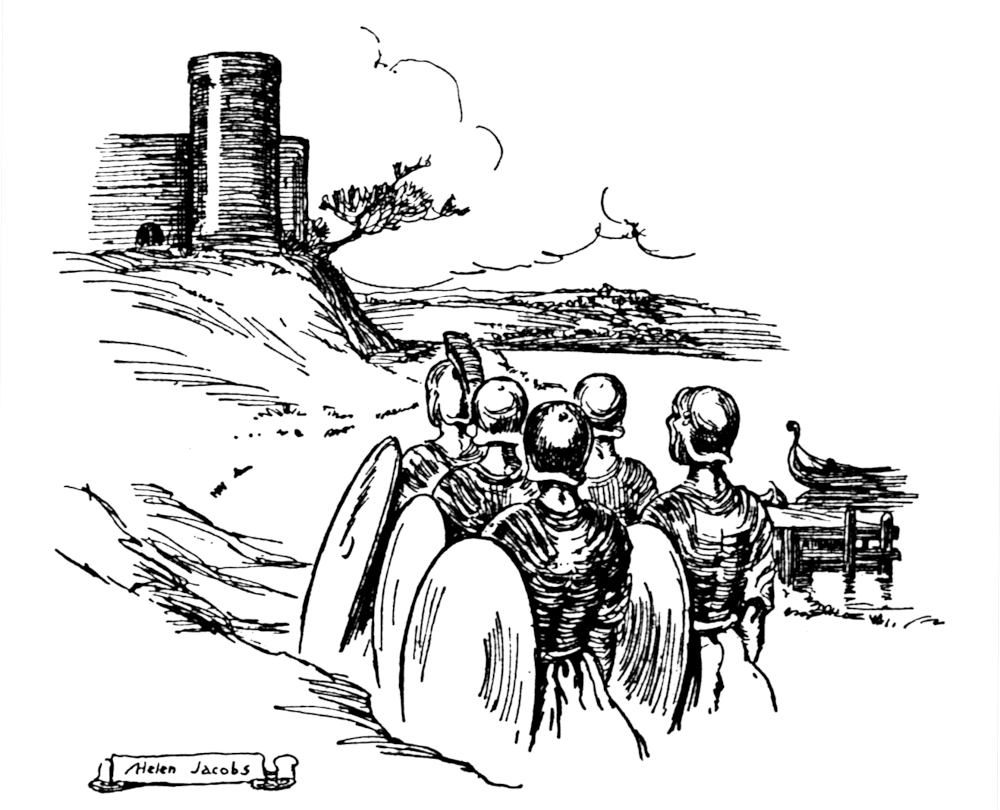
ever seen, coming round a bend of the river. It had a high
curved prow, and it was crowded with men wearing helmets
that flashed in the sun, short tunics to their knees, and plates
of brass covering their legs. Two rows of long oars stretched on
either side of the boat, and as it drew nearer Betty saw that,
though it had a sail, the helmeted soldiers were rowing it, and
thus making it move very fast.
“Oh, look! look!” she almost shouted. “Who are these
men?”
“Roman soldiers, of course,” said Godmother. “Remember
the date. It is 400 years after Christ, and our country (called
Britain then) has been conquered by, and belongs to, Rome.
Many Romans have been settled here now for as long as three
hundred years. That building,” she pointed to the Castle, “is
the fortress where the Roman soldiers live. We shall see them
disembark in a minute, and go into their barracks. This boat
of theirs is called a galley, and it was in boats like it that the first
Roman soldiers came sailing up this river Thames when they
conquered the country.”
“Yes! yes! the boat is stopping! Now they’re going into
the fortress!” exclaimed Betty excitedly, as with breathless
interest she watched the soldiers being marched along the river
bank by their officers.
“Can we go across the bridge?” she asked a moment
later.
“Of course we can. No one sees us. No one hears us. We
are invisible—for as long as we choose to be. Come, we’ll cross
over to the fortress.”
Dancing with excitement, Betty followed her on to the
bridge, over which, all the time she and Godmother had been
standing on the bank, people had been crossing and recrossing.
They were the strangest-looking folk imaginable, but so far
she had been too confused and too interested in the soldiers to do
more than glance at them.
“Let us stand here a moment, and watch,” Godmother
suggested, drawing her back against the wooden parapet of the
bridge.
“That’s a Roman nobleman,” she observed, as a fine-looking
man passed, wearing a tunic, a white cloak wrapped round part
of his body, the end flung over one shoulder, and sandals made
of twisted leather. “That’s his villa over there.” She pointed
to a house at some little distance set in the midst of blossoming
fruit-trees.
“Here’s a British merchant coming!” she went on. “Look
at his long furry trousers under the cloak, or toga as it is called,
which he is wearing in imitation of the Romans. He has become
so ‘Romanized’ that he copies the conquerors of his country in
every possible way.”
“But for all that, he doesn’t look a bit like a Roman!”
declared Betty, as she stared at the man’s red hair, which hung
to his shoulders. “Oh! do look at this dear little girl!” she
exclaimed almost in the same breath.
A woman leading a pretty fair-haired child was moving
towards them. The little girl, who was bare-footed, wore a
straight gown made of woollen material, dyed blue. She had big
blue eyes, and her tangled curly hair hung loose about her face.
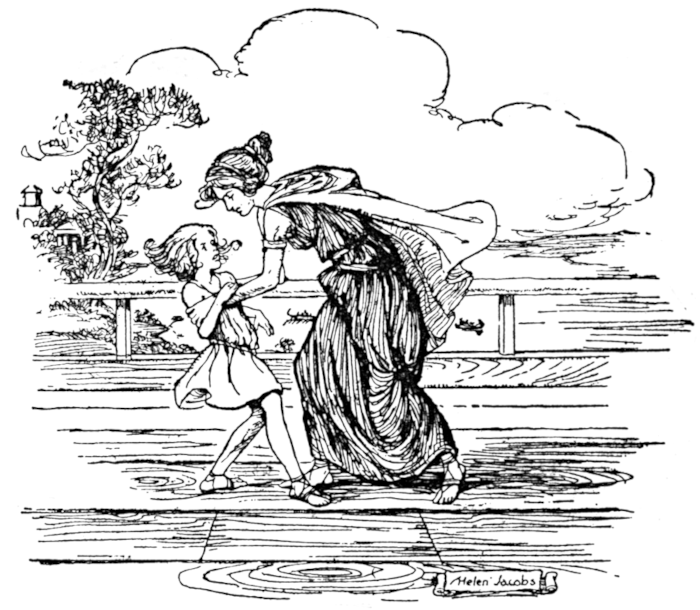
All at once, just as she passed them, a coin fell from her hand and,
dropping through a chink between the planks of the bridge, fell
into the water with a splash.
The woman, talking angrily in a language that sounded
strange and barbarous, shook the child, who began to cry.
“Oh, poor little thing!” said Betty pitifully. “Her mother
needn’t be so cross with her! They’re British people, I suppose?”
“Yes. That was the money to pay the toll at the end of the
bridge,” explained Godmother, “and now it’s at the bottom of
the river.”
But Betty soon forgot the little girl in her interest in watching
the other people who passed and re-passed, and looking at the
boats which floated up and down the stream laden with all sorts
of merchandise.
THE SLAVE MARKET
“London, as you see, was an important port even in these far-off
days, four hundred years after Christ,” Godmother remarked.
“Tin and iron and lead and oysters are going away in some of
those boats to other countries, and all sorts of things are coming
in as exchange.... Now let us go on to the fortress and climb
up to the battlements. Fortunately no one will interfere with us,
and we shall get a good view of the country from the top.”
It was a very weird experience to pass unchallenged into
the courtyard of the castle, filled with laughing, shouting and
quarrelling soldiers. These men paid no attention to them, and
Godmother led the way up a winding stone staircase to a pathway
on the inner side of the battlements. From this height they
had a wonderful view over the surrounding country, and as she
gazed, Betty was lost in amazement.
The Monument, that great column to the top of which she had
so recently climbed, was, she remembered, close to London Bridge.
Therefore she must now be standing near the very same spot as
that from which only this morning she had looked over London.
It was an amazing thought.
She remembered the countless spires and domes and towers
which rose far above their roofs, and the swarming traffic in all
the streets.
Upon what a different scene she looked now! In place of the
miles and miles of streets and houses, she saw along a narrow strip
of the shore, right and left of the wooden bridge, a few steep
lanes or alleys, lined with poor low dwellings. A few wharves
and quays stretched along the bank of the river just below.
There certainly a busy life went on, for men were loading and
unloading boats. Behind the lanes leading down to the river,
there was a belt of cultivated land, dotted over with gleaming
one-storied dwellings which Godmother said were Roman villas,
and beyond them, enclosing all the cultivated land, rose a strong
wall with towers at intervals. But behind the wall came a long
stretch of marshy ground, leading to the edge of a huge forest—a
dark and gloomy and endless forest, clothing a line of hills,
and stretching away, away, as far as eye could see.
Godmother was leaning on the parapet beside her.
“We are facing north now,” she said, and added suddenly,
“You’ve been to Hampstead Heath, of course?”
Betty could not imagine what Hampstead Heath had to do
with the scene upon which she was gazing, but she said, “Yes,
we go nearly every Sunday.”
“Well, then, you have seen a tiny bit that is left of that
great forest in front of you. There’s very little ‘forest’ about
Hampstead Heath now, certainly, but such as it is, it is the descendant
of that very one you see before you, which, a thousand years
ago, stretched for hundreds of miles over this island.”
From the other side of the fortress, to which they presently
moved, the view was equally strange, for here there was nothing
to be seen but swampy land, just emerging from the water which
everywhere surrounded it.
“We are looking south,” Godmother said, “and now that
you see this great stretch of water right and left, you will understand
why the first name of London was the lake fort.”
“Is that what Llyn-din means?” Betty asked.
“Yes. In the British language, Llyn-din means just that,
and in the Roman language the word became Londinium—the
Fortress on the Lake.”
“I do wish I could speak to some of the people,” said Betty,
after a moment during which she watched the sunlight sparkling
on the great expanse of water that ran under the oldest of all
the London Bridges.
“Well, I can manage that for you. There’s no end to magic
if you once learn how to work it,” Godmother added with her
curious smile. “Let’s go down into the market-place.”
Between the houses that sloped down to the river just below,
there was an open space, and from where she stood, Betty could
see it was filled by a lively crowd of people, some evidently
British, others Roman. They were buying and selling, and
the noise and shouting of the crowd could be plainly heard.
“What’s that large building on the little hill just above the
market-place?” Betty asked.
“That’s the Roman Hall of Justice, where people who have
done wrong are tried, and sentenced to punishment,” replied the
old lady as the child followed her to the top of the steps.
A few minutes later they stood in the market-place, where
Betty could have lingered for hours watching the strange crowd.
It was by no means entirely made up of Romans and British.
Many dark-skinned, dark-eyed men from Eastern lands were
there as well. “They are traders from lands even farther off
than Rome,” Godmother explained. “For London, you know,
has always been filled with foreign merchants. Some of these
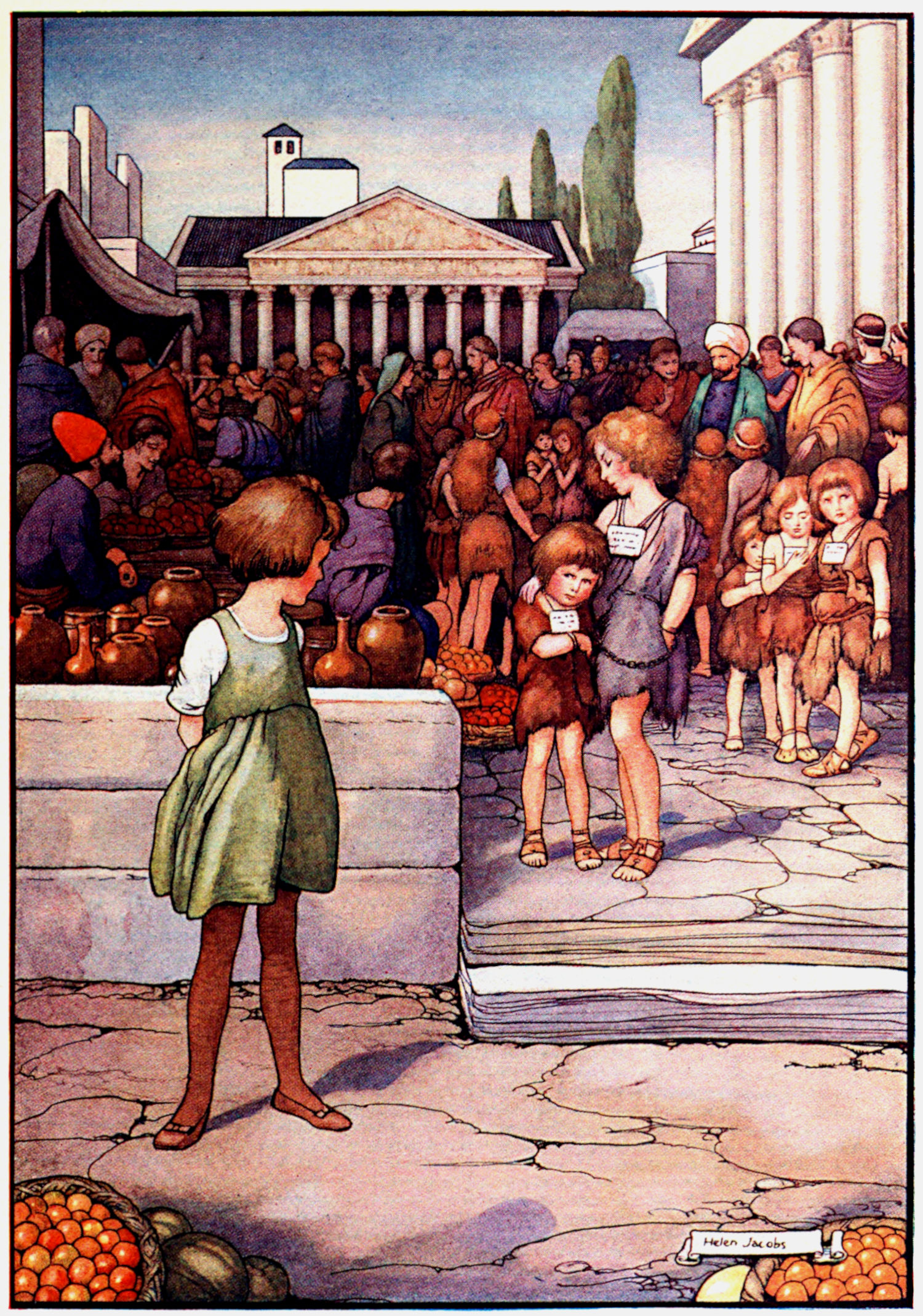
are buying British slaves to take back with them in their ships
to their own countries. You see that little group of girls and
boys over there, wrapped in rough skin coats? They come from
a part of Britain beyond the forest, and they have been bought
by that black-haired man with the turban and the gold earrings.”
Betty looked at the poor children pityingly as they stood
huddled together, confused and frightened. It was dreadful to
think of them being sold as though they were sheep or cows!
But her attention was all at once distracted by a boy of about
her own age, who, having passed quite close, all at once turned
round and stopped. It was the first time that any one had seen
her, for up to this moment both she and Godmother had been
invisible. But it was evident that, to the boy at least, this
was no longer the case. He smiled, and walking towards her,
said, “You are a stranger? You would like to see my father’s
house?”
He was a Roman boy, as Betty at once recognized, and
strangely enough she did not feel it at all odd that she should
understand his speech, though afterwards she knew it must be
Latin. At the time, however, she wondered how he guessed that
she was desperately anxious to go into one of the many Roman
houses so beautifully set among orchards and gardens.
“Yes, if you please,” was all she could find to say.
“Come then,” said the boy, smiling again pleasantly, but
paying no heed to Godmother.
Betty turned to her, puzzled and uncertain, but Godmother
only laughed.
“Don’t trouble about finding me again. It will be all right.
Go with him, and stay as long as you like. You’ll discover it’s
not so long as you imagine.”
Thus encouraged, Betty very willingly followed her guide.
He was a handsome boy, dressed very much as the Roman
nobleman on the bridge had been clothed, except that the cloak
he wore over his tunic had a broad purple band round its edge.
That, as she afterwards learnt from Godmother, being the usual
dress for Roman boys, for it was not till they were grown up, that
they wore the tunic without this purple border.
“That is our villa,” he began presently when they came in
sight of a long one-storied house surrounded by trees and shrubs.
“My father has much land here, and many farms.”
“Will you tell me your name?” asked Betty shyly.
“My name is Lucius.... I will take you first straight
through the house,” said the boy. By this time they had
reached its entrance, and Betty caught a beautiful vision of rooms
divided by pillars, each one opening into the next; of painted
ceilings and walls, of coloured stone pavements, of couches with
purple silk cushions upon them, and pedestals upon which
statues stood. It was only a flashing glimpse she had of all this,
and though she saw everything with the greatest distinctness, she
was somehow conscious that none of it was actually real; that
even Lucius was not really alive, even while she saw him as
plainly as though he had been flesh and blood. Deep down in her
mind, she knew that everything she saw and heard, was what had
once existed but was over and done with long, long ago, and was
only revived for a moment.
And yet everything looked so real. Just as this sad feeling
came to her, she was walking over a pavement made of small
coloured stones fitted together to make a pattern. This she
knew was called mosaic work, and she noticed the design of it,
which was that of a woman seated on the back of some animal
in the centre of the pavement.
By the time she had walked through the villa and out of it
upon a terrace overlooking the country, Betty had a confused
idea of great luxury and beauty, displayed in a very different
sort of house from any she had ever seen before.
“Ask me any questions you like,” said Lucius presently.
But Betty scarcely knew where to begin.
“This country is called Britain, isn’t it?” she said at last,
remembering her history. “And you Roman people conquered
it?”
“We did,” answered the boy, smiling. “Long ago. Four
hundred years ago.”
“And the British people are not angry about it anymore?”
“No. Why should they be? Everything is peaceful now.”
“But at first there was fighting, I suppose?”
“Long and bitter fighting,” said Lucius. “There is a story,
which I believe is true, that when my ancestors first came to
Britain, more than three hundred years ago, there was a British
Queen who led men to battle against us. She actually took and
burnt this town of Londinium—which was then, however, much
smaller and less important than it is now.”
“Boadicea!” thought Betty, remembering in a flash the
statue on Westminster Bridge.
But Lucius was again speaking. “My own family has been
settled here nearly two hundred years. It was my great-grandfather
who built this villa, and he was born in Londinium.”
“We call it London,” murmured Betty. But Lucius did not
seem to hear her. “Then I suppose it was a good thing for
the British to be conquered?” she inquired.
The boy laughed. “Without doubt. They were savages
when we came, and we’ve taught them everything. From us
they’ve learnt how to till the land,”—he nodded towards a field.
“Those are British labourers working there now. They’ve learnt
how to make roads after our famous Roman plan. You can see
one of our roads from this corner of the terrace. And how to
build houses and ships, and work in metal and do a thousand
other things. Some of them have grown rich, and have been
educated, so that they are as good scholars now as we are. Already
Londinium is a famous port to which foreign merchants
come bringing riches. My father says it will some day be a great
city, equal to any city in the world.”
“It has become a great city!” exclaimed Betty to herself,
remembering the London she knew. It was sad to think that if
she had spoken aloud, the boy would not have understood her,
and she hastened to ask another question.
“Are these British people Christians?”
“Oh yes!” said Lucius. “Ever since we became Christians
ourselves, you know. Of course when my ancestors first came
here, they themselves were pagans. They worshipped gods and
goddesses like Apollo and Venus. But that’s a hundred years ago.
Now Londinium is a Christian city, and we’re teaching the British
to be Christians also. It’s rather difficult though, because a great
many of them cling to their old gods. Still, most of them at least
call themselves Christians.”
“Do you like living in this country—in Britain?” asked
Betty after a moment.
“Oh yes. It’s my home. I was born here. But I should
like to go to Rome—the city from which my great-grandfather
came when he settled here, and built this villa. Perhaps I shall,
some day,” he went on dreamily. “My father often says we
may have to go back to our own land. There are troubles there.
The barbarians are growing stronger and stronger, and some
day Rome will need all the fighting men she can get to defend
her.”
“But the British will have no one to defend them if you
go,” objected Betty.
Lucius shrugged his shoulders. “No, poor things. Their
state will be very desperate if enemies come to invade them when
we are gone....”
Betty scarcely listened to the end of his sentence, for she had
made a discovery which interested her too much. On his third
finger Lucius wore the very ring which not long ago had been
in her own hand! But before she could exclaim, Betty found
herself standing once more upon London Bridge, with her Godmother
beside her, and strangely enough Godmother was repeating
almost the very words the boy had just uttered!
“Poor things! They little know what a terrible time is
before their children’s children!”
“You mean the British? When the Romans have gone?”
said Betty, who by this time was beginning to accept all the
strange things that were happening without much surprise.
“Yes. In a few years that villa you have just seen, and
all the other beautiful Roman houses, will have dropped into
decay. There will be no one left in London except perhaps a
handful of British slaves, and most of them will have to flee to
that forest over there, to escape from the murderous people who
will overrun this island....”
The people were still passing to and fro upon London Bridge,
as Betty gazed about her. The sunlight was still sparkling on
the river, and from the fortress came the sound of the tramping
feet of the soldiers.
“There’s a little boat just putting off,” said Godmother.
“The man in it is going to fish higher up the river. We’ll step
in with him. It’s a great advantage to be invisible!” she added,
smiling, as they hurried down to the bank.
It was strange nevertheless to be seated opposite a shaggy-haired,
bare-legged fisherman, who took no notice of them, but
as the boat glided on, Betty was soon so interested in the scenery
they were passing that she almost forgot the silent man who
was rowing them. Very soon they had passed all the gardens
and orchards on the banks, and now on either side there was
nothing but a waste of water with here and there a low reed-covered
island just showing above its level.
“We are now passing under Westminster Bridge,” observed
Godmother presently. “On our left is St. Thomas’s Hospital
and Lambeth Palace, and on our right the Houses of Parliament,
with Westminster Abbey behind it.”
Betty stared. She thought Godmother must be joking.
“Perfectly true,” the old lady assured her in answer to her
smile. “On that island just above the water on the right, in
another six hundred years, Westminster Abbey will rise.”
Betty heard the gurgling of the water as it washed between
the reeds and bulrushes of the island, and as she thought of the
beautiful Cathedral under whose shadow her godmother’s house
stood, it seemed a miracle that such a change could have taken
place.
“Human beings are rather wonderful, aren’t they?” remarked
Godmother, smiling, as though she read her thoughts.
“They drain wet land and make it useful for growing food, or
for buildings. They bore tunnels through solid rocks. They
build bridges over rivers, and do a thousand things to alter the
world for their own convenience. Who could have imagined
that this great London of ours, the largest city in the world,
could have grown up from this?” Godmother waved her
hand towards the swamps and streams, east, west and south
of where they sat rocking in the boat beside the swampy
island.
“Just think of it!” she exclaimed after a moment’s silence.
“This marsh, and that forest to the north, and all the open
land as far as we can see in every direction, is now covered with
streets and shops, with churches and schools and railway stations,
and is the dwelling-place of millions of people.”
“It’s almost as wonderful as this magic way of seeing it as
it used to be!” declared Betty. “Tell me again how far back
in the Past we are?”
“All this is one thousand five hundred years ago,” said
Godmother softly.
The fisherman had tied up his boat to a stake driven into
the shore of the island, where later the great Cathedral of Westminster
was to stand. The sun was setting, the water was a sheet
of gold and crimson, and above the island a flight of birds rose
suddenly with shrill cries.... The next second they stood in
the white-panelled parlour.
“Oh!” cried Betty, rubbing her eyes. She glanced at the
clock on the mantelpiece. “Why!” she stammered, “it was
three o’clock the last time I saw it, and it’s still three. It must
have stopped!”
Godmother shook her head. “It hasn’t stopped. Time is
almost as magic a thing as——”
“As all we’ve seen,” put in Betty eagerly. “Oh, Godmother,
it has been wonderful! But no one will ever believe it.”
“Don’t try to make them,” replied Godmother. “You’ll
find it quite easy not to,” she added with her queer little smile.
Then as the bell rang, “Here comes your maid to fetch you.”
“Oh, but this isn’t the end of the magic? You’ll let me
come again? You’ll let me see how London goes on?” Betty
implored.
“To-morrow I’m going to take you to a Museum,” returned
the old lady. “I don’t think you’ll find it dull,” she said comfortingly,
as Betty’s face fell. “I shall fetch you at three o’clock,
and mind you don’t keep me waiting.”
Punctually at three o’clock next day, Godmother’s pretty
little car pulled up at the door of Betty’s home in Chelsea, and a
few minutes later she was driving away with her.
“Well!” began Godmother, as she observed a curious expression
upon the face of her godchild, “did you try explaining to
people all you saw yesterday?”
“Why, Godmother, till I caught sight of you just now, I’d
forgotten all about it!” exclaimed Betty, breathless with surprise.
“I mean I’d forgotten all the magic part about the ring
and actually going back to see London as it was when the Romans
were here,” she explained. “I kept wondering why I had a
picture in my mind of London as it looked then. I simply
couldn’t think how it was I knew, and I’ve only just remembered.”
“I told you that it wouldn’t be difficult to keep the secret,”
returned Godmother, laughing.
“Oh, it’s a lovely secret!” Betty exclaimed. “Where are
we going now?”
“I’m taking you to a Museum. But as you will see, it is, in
its own way, a sort of fairy-tale place. A beautiful house, called
Lancaster House, close to St. James’s Palace, has been turned
into a kind of treasure-palace, containing all sorts of things that
have to do with London from the very earliest times up to the
present day. It is called The London Museum, and you ought to
find it even more fascinating than it appears to most other
people.”
“I generally hate Museums,” said Betty frankly. “But
then I’ve never been to one with you before.”
“You won’t hate this one,” was Godmother’s reply. They
were driving down St. James’s Street now, and in a few moments
the car stopped before a stately-looking house quite near to the
old Palace of St. James.
“Now,” said Godmother, as they went up the steps, “the
way to see Museums is to look at a very little at a time, so, though
this place is full of interesting things, I’m only going to show you
one or two of them. First of all, we go downstairs into the
basement.”
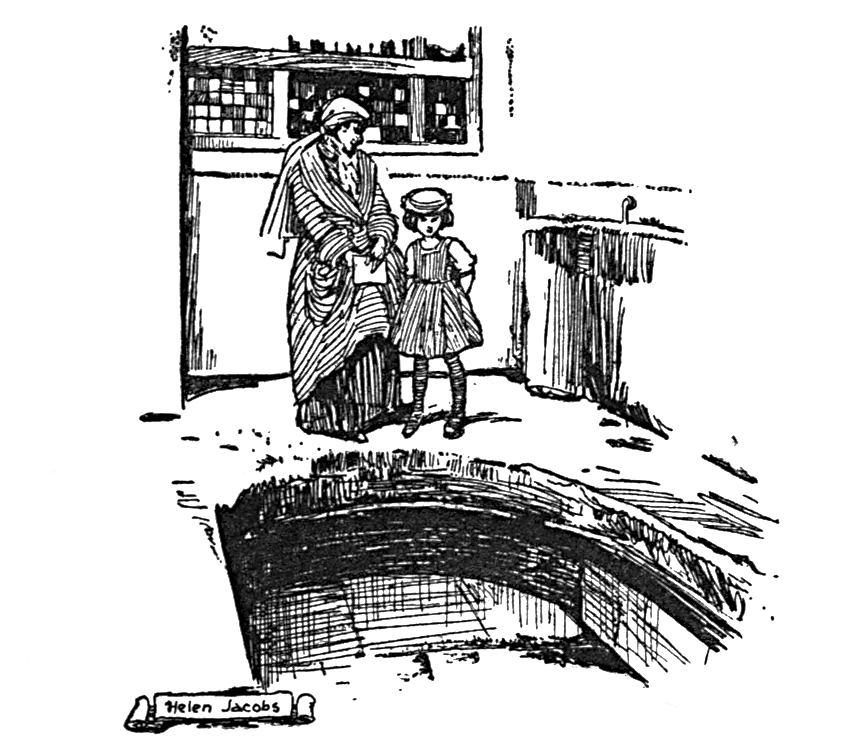
Betty followed her to the left of an entrance hall from which a
grand staircase rose, into a corridor whose windows gave her a
glimpse of a pretty green garden; then down a flight of steps
into a big hall below. The floor of this had been hollowed out
to look rather like a swimming-bath, but instead of water, the
hollow was filled up by the skeleton of a great wooden boat. It
was black with age, broken and battered, but the pieces had
been carefully fitted together, so that one might at least guess
how it looked more than a thousand years ago, when it was new.
“It’s a Roman galley!” cried Betty, who had recently seen
one, not ancient and decayed, but actually floating upon the
Thames. In her excitement she scarcely knew whether to look
first at the ancient boat, or at the picture which filled the end
wall just above it, and showed a galley rowed by Roman soldiers.
“I see! I see!” she cried eagerly. “That’s how the man
who painted that picture imagined it looked when it was new,
ages ago? He hasn’t imagined it badly, has he, Godmother?
The boat is just passing the fortress, and it’s very much
like the one we really went up, isn’t it? And he’s made the
river clear, with grassy banks, just as it was. And the soldiers
are quite good too. They did look like that! Oh! Godmother,
how did they find this boat?”
“Here’s a notice that will tell you. It was dug up, you see,
a few years ago—in 1910, to be precise—when men were at work
on a road in Lambeth.”
“Under a road?” echoed Betty. “But how did it get there?”
“Have you forgotten already what you saw yesterday?
Don’t you remember that the Thames then spread out all over
what is now Lambeth as well as over Westminster on the opposite
bank? This boat was found in what then was the bed of
the river, and is now land covered with buildings.”
“Yes, I understand. Oh, Godmother, do you think it could
be the very galley we saw? Perhaps it is!”
Godmother smiled. “I’m afraid not. It is thought that
this galley was sunk a hundred years or so earlier than the one
we saw when we stood on the first London Bridge. But it must
have been very like it.”
Betty looked up again at the picture. “It shows a piece of
the wall that went round London,” she said, gazing at it with
interest. “And in the background there is the great forest.
Oh, I think the painter has imagined it very well.”
“Considering that he hadn’t our magic advantage I think he
has,” agreed Godmother.
Betty was silent a moment, looking down thoughtfully at
the remains of the poor battered galley which once sailed so
proudly on London’s river, filled with soldiers, their armour and
helmets glittering in the sunshine of long ago. There were other
things in this basement hall that looked interesting, but Godmother
would not let her stay to examine them.
“We will go upstairs now,” she said. So up the narrow
staircase they went, into the corridor again, and thence to a
room with Roman London painted over the door.
No sooner had Betty entered it than she gave a little cry and
stood staring at the end wall, where a sort of picture in mosaic
work was hanging, filling up its whole space.
“That was in the villa that belonged to Lucius!” she
exclaimed. “I remember it quite well. It was the pavement
of one of the rooms. There’s the lady riding on that funny
animal’s back with the border round her, just as I saw it. Oh,
Godmother! Just fancy its being here after all these years and
years.”
“It is wonderful,” said Godmother. “How many of the
thousands of people who every day hurry along the streets near
London Bridge either know or remember that deep down under
their feet lies a buried Roman city? Every now and then a
fragment of it, like this one, is dug up. But there must be much,
much more hidden far beneath houses and shops and roads where
trams and omnibuses roll and rattle. By the way,” she added,
“if you want to see the actual piece of pavement that was in the
villa ‘that belonged to Lucius’ we shall have to go to the British
Museum. This one is only a copy of it.”
“I shall go one day,” Betty answered. “I should like to
see the very pavement I walked on. I’m luckier than any of
the children in London,” she added with a little chuckle of
delight.
“Now look at some of the things in these cases,” advised
Godmother. “You will find them just as interesting.”
Betty obediently examined the contents of one of the glass
boxes the room contained, and soon found occasion for a fresh
excitement. On a label beside a collection of battered coins, she
read: Found in the river bed near the present London Bridge.
Instantly a scene rose in her mind of a little fair-haired girl
crying and looking down through the chinks of a wooden bridge
into the shining water.
“Oh, Godmother, perhaps one of them is the very coin that
poor little girl dropped when her mother was so angry with her?”
she cried.
“Perhaps,” said Godmother. “She dropped it one thousand
five hundred years ago, and that’s about the date of this group
of coins.”
“How do people know that?”
“By the inscriptions on them, we discover which emperor
was ruling in Rome, and in that way we are often able to fix the
date at which the money was in use.”
In another moment Betty had discovered other things in the
cases which took her thoughts back to the “magic” experience.
These were ornamental pins for the hair, combs, and other toilet
articles which must once have been pretty and shining, but were
dull and rusty now from long burial in the earth. She thought
of the glimpse she had had of a bedroom (perhaps belonging to
the mother of Lucius), in which such things as these were lying
on a marble table. In fact, everything she saw in the cases
reminded her of Roman London, with its beautiful villas and
gardens, now buried and almost as forgotten as though they had
never existed. And she sighed.
“It’s very sad to think of,” she said.
“Yes,” answered Godmother in an understanding voice.
“But the life of London still goes on, even though it’s a different
life, and Roman London is forgotten.” They were standing by
the window of the room, and beyond the garden upon which it
looked, in the road outside St. James’s Park, people were walking,
children running, and taxicabs and motor-cars swept past
in a constant stream.
“When the Romans lived here, all this”—she waved her
hand towards the Park and the busy road—“was a dreary swamp,
impossible for human existence. Now you see it the home and
pleasure-ground of thousands of people whose turn it is to enjoy
the sunshine, the blue sky, and all the pleasant things the Romans
and the British who lived side by side in this London of ours,
enjoyed long ago.”
“This may be a Museum, but it’s an awfully nice one,”
declared Betty, as she and Godmother walked back towards the
corridor. “It wouldn’t be dull, even without the magic. But that
makes it a hundred times more fascinating, of course. Can’t we
look at some other things?”
“The only other thing I’m going to show you to-day, is a
certain picture,” returned Godmother. “But before we look at
it, I must explain a little, or you won’t understand it.”
They found a seat in the corridor, and she began at once.
“You will remember that when we saw London yesterday,
on our magic journey into the Past, I told you we were very
near the end of the Romans’ stay in Britain. Soon afterwards
they had to go back to fight against enemies in their own land,
and you know what happened when the British were left unprotected?”
“Enemies came to fight against them.”
“And who were those enemies?”
“The Jutes and the Angles and the Saxons,” replied Betty,
who was quite good at history.
“Yes, those names are all right; but the chief thing to
remember about them is that they were our forefathers, and that
before long they were known as the English people. This island,
once called Britain, became England, and the original inhabitants—those
British among whom the Romans lived—though they
were not entirely driven out of the country, were hunted as far
west as they could go, and received a different name.”
“I remember!” cried Betty, nodding. “They are called
the Welsh now, and they live in Wales.”
“Well, for the future, in thinking about London, let us leave
them there, remembering that though nowadays we scarcely
know Welsh from our own countrymen, they are not our countrymen.
They are of a different race, the descendants of the
British, and though nearly all of them now talk in English, their
native language is quite different from ours. It is really the old
British language. Now, for goodness’ sake, get that clearly into
your mind, and never let me hear you muddle up the British
with the English, in the annoying way of most children!” concluded
Godmother in her sharpest voice.
“I won’t. I promise,” Betty said, laughing, for she was
getting quite used to Godmother, and was no longer afraid of
her.
“Very well, then. Now you’re ready to look at the picture.
Come along.”
Betty followed her down a corridor till she stopped before
one of several pictures hung in a line. It represented a group
of wild-looking men standing beneath the walls of a city which
Betty at once saw was meant to represent the London or Londinium
of the Romans.
“You must imagine that the scene shown by this picture, is
about a hundred years after the Romans had gone,” said Godmother.
“Those great strong men looking up at London Wall
are our forefathers, the English. Awful things have been happening
for the past hundred years; terrible fighting between
these invaders and the British, who by now are being everywhere
defeated and driven farther and farther west. The Englishmen
in the picture, have come suddenly into sight of a walled city
that looks dangerous to approach. They are hesitating. One
of them is blowing his horn to see whether any defenders will
appear upon the battlements. No answer comes to the loud
blast, and the warriors will presently rush at that gate, batter
it down and enter. To their amazement they will find within,
beautiful houses such as they have never seen or imagined. But
all of them are empty and dropping into decay. They will see
the ruined gardens and orchards of buildings the use of which
they can’t even guess. For many, many years London has lain
deserted, because on account of the fighting in the country all
round, no food could reach it, and all its people have fled. Wondering
and afraid, believing, no doubt, all these decaying remains
of luxury to be some magic device of demons, those rough
warriors will hurry away from the silent city, leaving it to fall
into still deeper ruin.”
“Poor London!” said Betty. “But how did it ever wake
up again?”
“It had to wait till the worst of the fighting was over before
it was occupied again—this time by a different race—the English
race. Then London once more came to life. But by this time
probably nearly the whole of the Roman buildings had disappeared,
and become buried under the first rough English houses
where the new race of men lived who once more made the city
into a thriving port.”
“And these English people forgot all about the Romans, I
suppose?”
“They never knew them, you see. Even the few British
who were left (the descendants of those who had lived under
Roman rule), only had legends about them. They used the great
roads the Romans had made, but they called them by new
names—English names. Watling Street, for instance, was the
name they gave to the great Roman road that led northwards
out of London. It is now partly Oxford Street and partly
Edgware Road. Roman London disappeared as though it had
never been, till bits of it, ages later, were, and are, being dug
up.”
“Then didn’t the Romans ever have anything to do with
the English at all?”
“They had a great deal to do with them—later on. For
one thing, as you ought to remember, they converted them to
Christianity.”
“Oh yes, of course. St. Augustine came from Rome, didn’t
he, and taught the English to be Christians? But that was
a long time afterwards.”
“When we see London again, it will be a Christian city once
more, just as it was when you and I looked down upon it from
the Roman fortress.”
“Only the people in it will be English—instead of British
and Roman,” said Betty. “Oh, Godmother, when shall we
see it the ‘magic’ way again?”
“All in good time,” was Godmother’s reply, as she looked
at her watch. “I shall just have time to show you one little
bit of Roman London which remains to this day just where the
Romans left it,” she added.
“Not in a museum then?”
“No. It’s in the very midst of London, at the back of a
modern hotel. You shall see it first, and I’ll tell you what I
can about it, afterwards.”
“Stop at Strand Lane, close to Aldwych Tube Station in the
Strand,” was Godmother’s direction to the chauffeur.
They were soon there, and Betty wonderingly followed the
old lady down a winding, narrow road between houses, till she
stopped before an ordinary-looking back-door, near which a board
hung, with the words Roman Bath upon it. In another moment
Betty was in a vaulted room, gazing down at what seemed to
be a little swimming-bath. It was paved and lined with marble
slabs, but these did not reach quite to the top, and a rim of
ancient bricks was visible.
“Once upon a time, two thousand years ago, perhaps,” said
Godmother, “there was a Roman villa on this spot, and here is
the very bath belonging to it! Under those steps that go down
into the bath, there is a spring of water, constantly bubbling
up—the same spring that filled it in Roman days.”
“And Roman people bathed here ages ago!” exclaimed
Betty.
“It seems wonderful, doesn’t it? But there is the bath
that they built nearly two thousand years ago. The water that
fills it, comes from a stream forming a well, which in the Middle
Ages was called Holy Well. Only a very few years ago there
was a street over there, on the other side of the Strand,
called Holywell Street, because it was built over the old
well.”
“It’s awfully interesting to see something Roman that’s not
in a Museum,” observed Betty. “And now I can so easily
imagine the sort of villa that was here,” she added. “It had
gardens round it where all these houses go down to the river,
and the people who lived in it, saw only fields and forests,
and swampy land where now there are miles and miles of
streets and London houses. Oh, it is wonderful to think
about!”
But Godmother was again consulting her watch, and in a
moment or two Betty was being driven in the car back to her
home in Chelsea.
II The Middle Ages — THE LONDON OF DICK WHITTINGTON
All the week, Betty went to a High School, but Saturday
was a whole holiday, and greatly to her satisfaction, it
was arranged that she should spend her Saturdays with
Godmother.
It was just a week since she had visited the London of Roman
times, but not till the following Saturday, when she actually saw
her Godmother, did the memory of “the magic part” come
back to her.
“It’s so exciting to remember the secret directly I see you!”
she exclaimed. “How far back are we going to-day? Oh, do
let us begin at once, without wasting a single instant.”
Godmother laughed. “We won’t waste a single instant
certainly. But you’re not going back into the Past till this
afternoon. I’ve ordered the car, and we shall drive again into
the City.”
By “the City” Betty knew she meant all the business part
of London, to which thousands of people went every day to
work in offices or warehouses.
“Why is only this crowded part of London called the City?”
she asked presently when they were driving through bustling
streets near St. Paul’s. “I should have thought the whole of
London was a city?”
“So it is,” returned Godmother. “But as it all gradually
spread, east and west, north and south, from London Bridge, it
has become usual to speak of this busiest and earliest part of it
as the City, and of all the rest by different names, such as the
West End, North London, South London, and so forth. It’s
such a huge place, you see, that such divisions as these are
necessary.”
“Now we’re coming to London Bridge. I’m glad we’re going
over it again,” Betty said presently, as they passed the Monument
from which the previous week she had looked far and
wide.
“We will drive very slowly, and I want you to notice several
buildings that can be seen from the bridge.”
“There’s the Tower!” said Betty, looking to the left, where
the solid square of the main building, with a tower at each corner,
was visible. “And there’s St. Paul’s,” she added, turning to
the right, and gazing at its dome and cross.
“Look at all these wharves and warehouses lining each bank
of the river, with the great cranes hanging from them,” advised
Godmother. “I want you to remember this scene. Try to get
a clear picture of it in your mind.”
Betty looked with interest at the crowded shipping below
the bridge, and at the bales of goods, some being lowered into
boats, others hoisted up into the warehouses. She saw how, left
and right, the river was spanned by bridges, and how, as far as
she could see, warehouses and quays stretched in a continuous
line, while smoke from thousands of factory chimneys rose into
the air.
“Now we are on the south side of the river,” said Godmother,
when the end of the bridge was reached. “All this district is
called Southwark, and beyond it there are miles of dingy streets
and houses, making up the parts of London called Bermondsey
and Newington and Camberwell, and so forth. But it’s houses,
houses, and most of them ugly houses, all the way. That black,
dingy bridge overhead, spanning the road, belongs to London
Bridge railway station.”
“But here’s one beautiful place at least!” Betty remarked,
pointing to the right, where a fine church was hemmed in between
walls of hideous sheds and other buildings belonging to the
railway. A narrow churchyard, with a flagged path across it,
separated the church from these ugly dirty surroundings, and a
few trees just breaking into leaf showed brilliantly green against
its ancient walls.
“Yes, I particularly want you to notice that church. It’s
called St. Saviour’s, Southwark. Look at it well, and don’t
forget its name. We’ll go back now to the north end of the
bridge, and drive a little way along that street which runs beside
the river towards the Tower.”
“Thames Street,” murmured Betty, reading its name on the
wall as they turned into it.
So crowded was this particular street, so full of heavy lorries
and wagons outside its warehouses, that they were soon obliged
to leave it, and drive into Cheapside, quite close, but farther back
from the river. Through St. Paul’s Churchyard, down Ludgate
Hill into Fleet Street they drove, and straight on down the
Strand.
“There’s the Savoy Hotel, and the Savoy Theatre next to it,
where I saw ‘Alice in Wonderland’ once,” observed Betty, as
they passed these buildings.
“Remember that also,” said Godmother, “and try to get
some of the names of the streets into your head. These streets,
I mean, that lead out of the Strand. All of them, you see, go
down to the river.”
Betty had already noticed some of them, as the car passed,
and had murmured their names. They were soon in Whitehall
now, with the well-known Abbey in sight, and therefore near
home.
“Westminster Hall,” said Godmother, when they passed the
Houses of Parliament. She pointed to its long sloping roof, and
added, “That’s one of the buildings you must remember.”
Every time Godmother drew her special attention to something,
Betty gave a little smile of excitement, for she knew she
would see that particular place or building again—by magic.
And the magic made all the difference.
It was two or three hours later before she followed Godmother
into the white-panelled room.
“Oh, I do hope it will be nice this time!” she exclaimed,
full of excited anticipation.
Godmother laughed as she went to the cabinet.
“Last Saturday the talisman was a Roman ring. What is it
going to be now?” Betty asked, as her godmother selected
two objects from the cabinet. One she saw was an old book,
the other, when she held it in her hand, she found to be a
beautifully engraved gold chain.
“This book,” said Godmother, “was written by a poet—Geoffrey
Chaucer by name—who lived more than five hundred
years ago. You will discover to whom the chain once belonged,
later on. Now, shut your eyes, hold the chain in both hands,
and say, after me, these words written by old Chaucer, five hundred
years ago.”
Betty obeyed, and repeated slowly after Godmother:
“ ... When that the month of May
Is comen, and that I hear the foules sing,
And that the floures ginnen for to spring,
Farewell my booke and my devotion....”
“Open your eyes,” said Godmother, after a silence. “We
have gone back to the year 1388. Richard the Second is king.
This is London Bridge, and it is May Day.”
Betty’s eyes, now wide open, wandered right and left. The
London she looked upon, was completely changed from the
scene she had beheld on her last magic visit. Gone were the
Roman villas, gone the fortress, gone the Roman Hall of Justice.
But the wall that had then encircled the city—or one very like
it—was still there, for from where she stood, she could see parts
of it, with its massive gates at intervals opening into the green
country beyond. The bridge on which she stood, was now built
of stone, firm and strong. At either end, stood fortified towers,
with gates, and in the middle of the bridge, was a beautiful little
Chapel. Leaning over the parapet, Betty saw that the chapel
was in two parts, one built above the other, and from the lower
one, steps descended into the water.
“We’ll look at the people as they pass, before I tell you how
all this change has come about,” Godmother said. And indeed
the people were interesting and picturesque enough to occupy
all Betty’s attention.
“How gay they are! What beautiful coloured clothes they
wear!” she cried. “Oh, Godmother, do look at this young
man coming. Isn’t he splendid?”
She pointed to a boy of eighteen or nineteen who came
swinging along the bridge, dressed in a short tunic edged with
fur, and embroidered all over with flowers. The tunic had long
wide hanging sleeves tapering to a point which almost reached
the young gallant’s knee. He wore long green silk stockings,
boots ending in a peak,
and his crimped fair hair
fell on either side of his
face down to his shoulders.
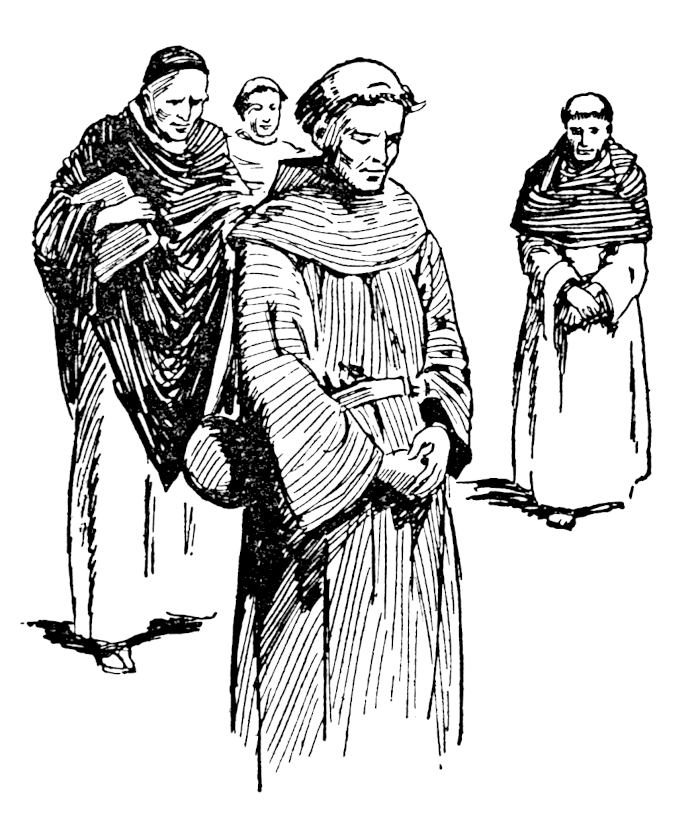
“What a lot of monks
there are!” she exclaimed,
when the beautiful youth
had gone by. Some of
these were in rough grey
habits with a knotted rope
round their waists; others
wore white robes under a
black cloak, and there were
many of them going to and
fro upon the bridge.
“The grey ones are the
Franciscans, or Grey Friars,
and those with the black
cloak are the Dominicans,
or Black Friars,” Godmother told her.... “Here is an old
countrywoman coming in from the southern gate with her
butter and eggs! Doesn’t she look comfortable?”
She was a stout old lady, with folds of white linen round her
neck drawn up on either side of her face under a flat broad-brimmed
hat. Her woollen skirt was very short, showing scarlet
stockings and buckled shoes, and she carried an enormous basket
on one arm.
“That white linen arrangement round her face is called a
wimple,” said Godmother. “Nuns, if you remember, still wear
the same sort of thing.”
“She isn’t a bit like a nun though,” laughed Betty, watching
the fat old woman as she waddled past her.
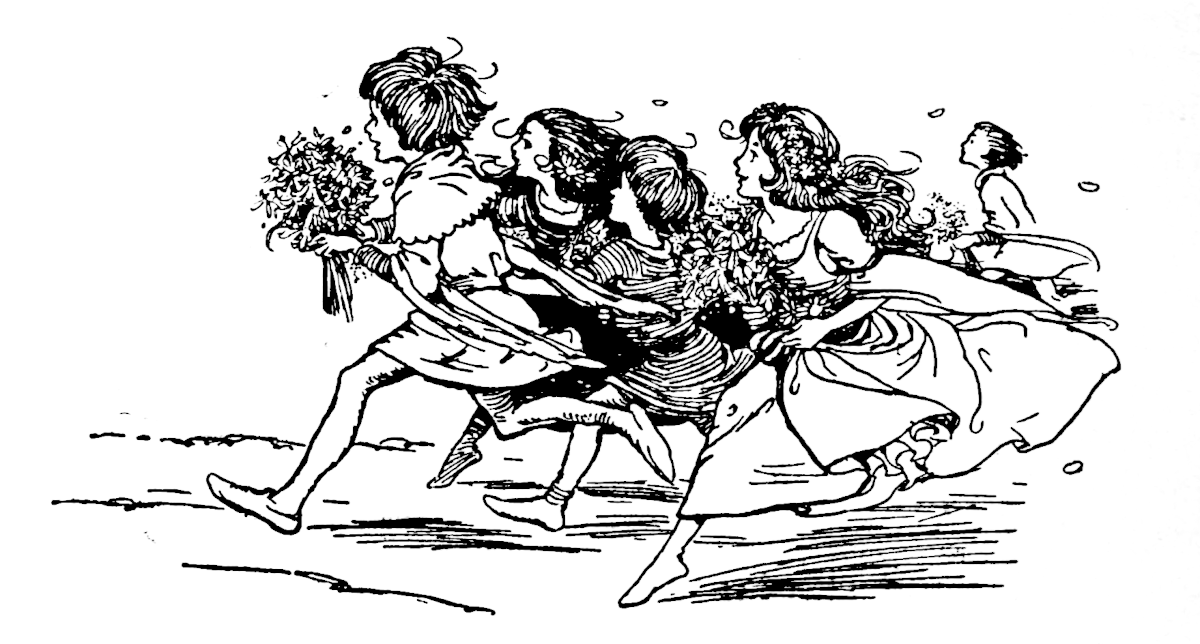
The next moment her attention was attracted by a group of
children who came running along the bridge shouting and singing.
They all had flowers in their hands, and some of the little
ones wore wreaths of bluebells or primroses.
“Oh! don’t they look pretty!” exclaimed Betty in delight.
“And they must have picked the flowers in the fields and woods
just outside that gate at the end of the bridge,” she added.
“You remember what is at the end of the bridge as we saw
it this morning? A railway station, and a railway arch over an
ugly street, with miles and miles of streets beyond. The Church
of St. Saviour’s, was the only beautiful thing visible—a change
indeed,” said Godmother.
Betty watched the children and looked at their clothes with
the greatest interest. The little girls wore frocks looped up on
one side over a girdle, some of the boys had long stockings and
short tunics and wore tiny capes of linen, with a hood buttoned
under the chin.
The whole merry party presently ran into one of the recesses
of the bridge where there was plenty of room, and began to
play a singing game, dancing as they sang.
Though some of the words sounded strange in Betty’s ears,
she understood most of them, and the verses of the song, if they
were put into the English to which we are now accustomed,
would run something after this fashion:
“London Bridge is broken down,
Dance over, my Lady Lee;
London Bridge is broken down
With a gay ladee.
How shall we build it up again?
Dance over, my Lady Lee;
How shall we build it up again?
With a gay ladee.
Build it up with stone so strong,
Dance over, my Lady Lee,
Then ’twill last for ages long
With a gay ladee.”
“That song is old even now—in this year 1388,” said Godmother.
“The great-grandmothers of these children may have
sung it. It probably celebrated the time when the last of the
timber bridges was broken down in a storm, and this stone one,
upon which we are standing, was built in its place about the
time when Richard the First was reigning.”
“And we are in the reign of Richard the Second now, nearly
two hundred years later,” Betty replied.
“The children are right when they say London Bridge will
last for ages long,” Godmother remarked. “It lasted more than
six hundred years—almost to our own time. My Grandfather,
for instance, Betty, was born the year this Bridge upon which
we are standing, was pulled down, and the one you saw this
morning, built.”
But Betty’s eyes were still fixed on the children who at
intervals in their game ran to offer their bunches of flowers to
the passers-by, shouting “May Day! May Day!”
Presently one little girl with a pretty voice, began to sing (in
words which were nearly, though not altogether, like the English
of our own day) a little song which, written down, was this:
“Summer is icumen in;
Lhude sing cuccu!
Groweth sed, and bloweth med,
And springeth the wude nu—
Sing cuccu!”
It was easy to put this into modern English, and Betty knew
what it meant:
“Summer is a-coming in;
Loud sings cuckoo!
Groweth seed, and bloweth mead,
And springeth the wood new.
Sing cuckoo!”
“That’s the first verse of a song that is more than a hundred
years old even in this year 1388 to which we’ve gone back,”
said Godmother. “Yet you can understand it pretty well,
can’t you? It shows how near to the language we speak to-day,
the speech of the fourteenth century is growing.”
“Yes. And isn’t it lovely for those children to hear the
cuckoo and pick flowers just on the other side of London Bridge?
Oh, I wish the country came right up to the City now—like
this,” sighed Betty, nodding towards the fields and woods that
made a green belt close behind the wall.
“Godmother!” she exclaimed suddenly, pointing to a sort
of castle near the river bank. “There’s something I know!
Why, surely it’s the Tower of London? Only there’s not so
much of it as there is now,” she added.
“Yes, it’s the Tower right enough—three hundred years old
already in 1388, and eight hundred years old in our own time.
But now, my dear, before you get too distracted by all you’re
seeing and hearing, I’m going to take you in here to talk history
for a few minutes.”
Betty followed her into the porch of the chapel on the Bridge,
where they sat down on a bench out of sight of all the gay life
outside.
“We left London,” Godmother began, “empty and deserted,
with a group of our Saxon ancestors whom we may call English
people, standing uncertainly outside the walls built round the
city by the departed Romans. What happened next?”
“Those English people settled in London, and in time made
it alive and busy again.”
Godmother nodded. “And what became of the British who
used to live here?”
“They were driven West, into Wales, and are the Welsh
people now.”
“Yes. And then?”
Betty reflected. “Oh! Why, the Danes came, didn’t they?
Yes. The English king, Alfred the Great, fought against them.
And then afterwards the Normans came and conquered England.
And they spoke French!... I don’t see why you call those
Saxon people who stood outside London, our ancestors, Godmother?
Because we must be all mixed up with the Danes
and the Normans—especially with the Normans, who were quite
different, and had a different language. So I don’t understand
how those first English could be our ancestors exactly?”
“I’ll tell you how. When you say the Normans spoke a
different language, you’re right. But in saying they were
‘quite different,’ you’re wrong. What does the word Norman
mean? Merely a Northman. They came from the same northern
countries as the English, and were originally of the same race.
The reason they spoke French, was, that for two or three hundred
years before they came to England they had been living in the
north of France. But when they conquered this island and
settled down here, what happened? Did the English people
learn to speak the language of their conquerors? Far from it.
The conquerors learnt to speak the tongue of the men they conquered,
‘mixed up,’ as you say, with some of their own French.
Three hundred years after William the First landed, the people—conquerors
and conquered alike—have become one people, speaking
one language, the English language. Altered, of course,
from the kind of language spoken by those wild-looking men
blowing their horns outside London walls. If you had heard
them talking, you wouldn’t have understood a word (even though
it was the foundation of the English we talk to-day). But now,
in this year 1388, three hundred years after the Norman Conquest,
you can understand most of it, can’t you? Out of the
mixture of the Norman’s French and the English people’s early
English, has come the language we now speak. Well, now that
the history lesson is over, let us see all we can of the London
the poet Chaucer knew in the reign of Richard the Second. We
may even meet Chaucer himself—if we’re lucky!” she added.
“I want to see the Tower,” said Betty. “Dad took me
there once. But it looked different, from the Tower we can see
from this bridge.”
“That’s because parts have been added to it since the reign
of Richard the Second. But you saw the keep, or White Tower,
as it is called, when you went with your father the other day.
That keep, or central tower, has been standing ever since William
the Conqueror built it. Look at the moat full of water round
the castle. That was made when Richard the First was king.”
“There’s no water there now,” Betty said. “When Dad
and I went over the Tower the other day, soldiers were drilling
in the moat! Oh, Godmother,” she went on after a moment,
“isn’t it strange and—uncanny to think that none of the people
on this bridge, know all the things that are going to happen in
that Tower?”
“The things we know because we live in a later time, you
mean? Yes. Can you think of some of them?”
“The poor little princes are soon going to be murdered there,
for one thing,” began Betty eagerly. “And Sir Thomas More,
a good deal later on, will be beheaded. And——” she hesitated.
“Ah, yes, in the years to come many, many poor prisoners
will go under the Traitor’s Gate there, never to return,” said
Godmother. “But we won’t think of them now. Let us look
at this beautiful little chapel beside us on the bridge. It’s
dedicated to the latest on the list of saints. Can you guess who
that is?”
Betty looked puzzled.
“St. Thomas à Becket. You remember all about him, and
how he was murdered in Canterbury Cathedral?”
“Yes! and there used to be pilgrimages to his tomb,” put
in Betty.
“Later on we may see some of the pilgrims starting on their
journey,” Godmother told her. “Now let us take a boat and
go westward up the river.”
“That will lead to Westminster, won’t it? Oh, Godmother,
do let us see how Westminster has got on!” exclaimed Betty
suddenly, remembering the low swampy island of Roman times.
“That’s just what we’re going to do. We’ll take a boat
from the steps down there that lead from the lower chapel of
St. Thomas to the water. We shall be in time, if we make haste,
to join that party of monks who have been to say their prayers
in the chapel, and are just going away by boat.”
Betty hurried after her from the upper to the lower chapel,
and she and Godmother stepped into the boat with three or
four of the Black Friars as they were called—a merry party,
and, as Betty thought, not at all monk-like, in their conversation.
Though she could not understand all they said, because many of
the words were pronounced in a way strange to her, she gathered
enough to know that they were talking about a pilgrimage to
Canterbury, to which they seemed to be looking forward as a
delightful pleasure trip.
Interesting as the friars were to watch, the river banks were
still more fascinating. Except for the landing-stages and a few
quays and wharves near London Bridge, they might have been
floating on a country river, and Betty thought suddenly of the
unending line of warehouses, the smoke of a thousand chimneys,
the noise and bustle near the river she had seen only this
morning.
“There’s the Strand,” exclaimed Godmother presently,
pointing towards the right-hand bank of the stream.
“The Strand?” echoed Betty, scarcely able to believe her
eyes.
The Strand along which she had so recently driven, was a
bustling street of shops and theatres, with tall-steepled churches
at the end of it. Now she saw a country road lined with hedges,
across which ran swift streams hurrying to empty their waters in
the main river. There were bridges over the streams, and along
the tree-shaded road, and across the bridges, rode or trudged a
constant procession of people.
“It’s the main road from the City to Westminster, you see,”
said Godmother, “so that’s why it’s so crowded.”
“I never knew what the Strand meant before,” declared
Betty, all at once enlightened. “A strand is a shore, isn’t it?
So that road is just the shore of the river.”
“Just as it is now,” Godmother returned. “Nearly all the
narrow streets on the right of the Strand, as you walk up it from
Charing Cross station, lead down to the river. But except for
lucky people like ourselves, it needs a great deal of imagination
to picture it as we see it here, back in the fourteenth century,
doesn’t it?”
Betty was now gazing with admiration at a line of beautiful
great houses whose gardens sloped to the water and were closed
at its brink by a stone gate.
“Those are the palaces of the great nobles,” Godmother told
her. “The one we are passing, is called the Savoy, and it belongs
to John of Gaunt.”
“Why, there’s the Savoy Hotel, and the Savoy Theatre in
the Strand now!” exclaimed Betty. “We passed them to-day.”
“Yes, they stand on part of that very ground where now
you see this grand palace. Nearly every street leading from the
Strand to the river still bears the name of some nobleman’s
palace, and shows where it stood. Essex Street, Buckingham
Street, Cecil Street—you noticed some of them this morning?
They all mark the site of some great house, now vanished. Many
of them—in this reign of Richard the Second—are not yet built,
and some of these at which we are looking, will be pulled down
and re-built before they are finally destroyed. We are only in
the fourteenth century as yet, remember.”
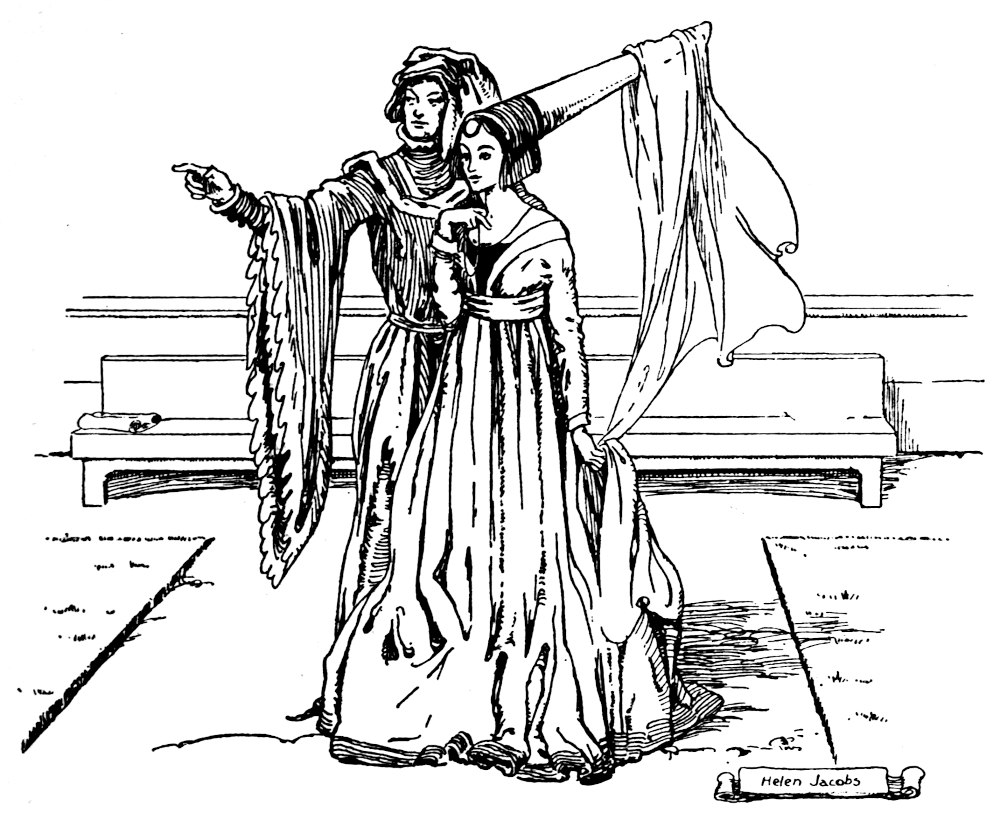
“This Savoy Palace is splendid!” Betty cried with
enthusiasm. “Look, Godmother. There are ladies and gentlemen
walking on the terrace. Oh, how beautifully they are
dressed. Aren’t the colours lovely? I do wish we had dresses
like that now, don’t you? Do look at that lady with a thing
like a sugar-loaf on her head, and a gauzy veil floating from it.”
“Yes, the costumes of this fourteenth century are certainly
beautiful,” Godmother agreed. “Now you will understand why
the English in the fourteenth century had the reputation for
being the most gaily dressed people in Europe.”
“They look simply lovely on that terrace, and it’s such
a beautiful house—that Savoy Palace, isn’t it?”
“It’s a wonderful looking place,” agreed Godmother. “I
don’t think King John of France had a bad sort of prison, do
you?”
“King John?” Betty looked puzzled.
“Don’t you remember how he was taken prisoner by John
of Gaunt’s brother—the Black Prince—at Poitiers, and how
because he was unable to pay his ransom, when he was set free,
he returned to London like an honourable gentleman, and lived
here, at the Savoy, till his death?”
“And that isn’t so very long ago, is it? I mean, counting
that we’re in the fourteenth century now?”
“Twenty years ago. The Black Prince, King Richard’s
father, has been dead about ten years, and he must often have
come to this Savoy Palace to see John of Gaunt, his brother,
and his so-called prisoner King John, of whom every one was
very fond.”
They had fortunately lingered some time before the palace
of the Savoy, to allow the Black monks to land at steps
near it. Afterwards there was a long wait while the waterman
who rowed the boat, followed them up a narrow lane over-arched
with white hawthorn, and was seen to enter a little house with
tiny latticed-paned windows and a swinging sign-board above
its porch.
“That’s a tavern, and he’s gone to drink what he no doubt
calls ‘a stoup of wine,’” said Godmother. “The muddy lane
there, all overhung with trees, is now one of the narrow streets
near the Savoy Hotel, leading into the Strand. At this moment
of the twentieth century, it is blocked with motor omnibuses and
taxicabs!” she added with a smile.
Betty was glad of the delay, for it gave her time to look long
at the stately palace, and at the other great houses lining the
right bank of the river, with their backgrounds of gardens and
orchards melting into green fields and woods where now, streets
and innumerable buildings stretch for miles and miles. Presently
the boatman returned, whistling a cheerful air, and wiping
his lips on the sleeve of his leather jerkin. Springing into the
boat he began to row very quickly, and in a few minutes, as it
seemed, Godmother said, “Here we are at the Palace of Westminster.”
All Betty could see from the river, was a strong brick wall,
turreted and pierced with gates.
“The Palace of Westminster? There isn’t one now, is
there?” she asked, as they went up steps from the river.
“Not in reality. There is no actual palace here in our
time. Yet because it stands on the same ground, another name
for our modern Houses of Parliament is ‘The Palace of Westminster.’”
“Why, yes! The wide road outside it, is called Old Palace
Yard, of course. I remember now. But there isn’t any of the
old palace left, is there?”
“There is just one building left of what was the home of all
the Kings of England from long before William the Conqueror
till the time of Henry the Eighth.”
They were passing under the arch of the gateway at the
moment—a fine stone gateway.
“This has only just been built by the present King,” Godmother
observed. “It is quite a new gate, as you see.”
But Betty gave a cry of amazement when on passing through
the gate she found herself in what was practically a little walled
town, apart from the rest of London. The wall enclosed not
only the Palace, and the great Abbey, but also little streets full
of houses in which lived carpenters, stonemasons, armourers,
jewellers, the makers of priestly robes, goldsmiths, blacksmiths—in
fact, traders of every kind who worked either for the Palace
or the Abbey, or for both.
Her thoughts went back to the swampy island of a thousand
years ago. Here she was, standing on the very same isle. Yet
how changed! Instead of a forest of reeds and bushes, here was
a stately Palace and a still more stately Abbey. Busy men
and women lived, where formerly only birds and water-rats made
their homes. The island had, in fact, become a little town,
divided from the greater city by massive walls.
“We are facing the Palace now,” said Godmother presently.
“Do you see anything about it that looks familiar?”
“Why, surely that’s Westminster Hall?” Betty exclaimed
after a moment, pointing to a long steep-roofed building in the
midst of towers and pinnacles that were strange to her.
“Yes, and the only part of the Old Palace that will remain
to the time in which you and I live. It was built by William
Rufus, so it is old, even in this fourteenth century.”
“But it looks so new.”
“That’s because it has just been altered and almost rebuilt
by the King now reigning. Let us go and look at the beautiful
inner roof of the Hall.”
“The next time I see it, when we’ve moved on to our own
time, it won’t look like this,” Betty observed, gazing up at its
rafters as they entered Westminster Hall. “It will be all dark
and old, won’t it? But it will be awfully interesting to think
I saw it just after it was rebuilt and improved.”
“That’s Richard’s coat of arms up there below the line of
windows,” said Godmother. “You see the white hart is repeated
again and again. Don’t forget to look out for it when you see
this Hall again—in ordinary circumstances, I mean, without
the ‘magic.’ And don’t forget either that, except for the
Tower, there’s no building in our history that has seen so much
misery,” she added. “Think of all the famous people who have
been tried here, and condemned to death.”
“Poor Charles the First was one, wasn’t he? Oh, Godmother,
isn’t it strange to think it hasn’t happened yet—and
won’t happen for—let me see?—about two hundred years!”
“Now for just a glimpse of the Abbey,” said Godmother
after a moment, “and then we’ll slip back into our own day
for a little while. It won’t do to see too much all at once.”
“I could stay for ever in this London!” Betty declared.
“You’ll bring me back again, won’t you, Godmother? I mean
to just this time in the fourteenth century. It’s so frightfully
interesting.”
She had turned round to gaze at the beautiful Abbey in front
of the Palace, the very Abbey so near to which her godmother
lived. But at first sight she scarcely recognized it as the old
grey place she knew, blackened by the years and the smoke of
ages.
“It looks so clean and white,” she said. “And where are
the towers that you see when you come up Victoria Street?
And where is Henry the Seventh’s Chapel?”
“Now there’s a silly child!” cried Godmother. “How
could there be a Henry the Seventh’s Chapel when we are only
at the reign of Richard the Second—nearly a hundred years
before Henry the Seventh reigned?”
“I forgot,” said Betty meekly.
“As for the towers you mention, they weren’t built till the
eighteenth century, long after Henry the Seventh’s time.”
“But though the Abbey looks different, it’s quite as big as
it is now, don’t you think so?”
“Yes, it covers quite as much ground, though, as you see, a
good deal of it looks different from the Abbey of our day. That’s
because from time to time, certain parts have been pulled down,
and built in another way. We’ll sit down here in the porch a
moment and watch the people going in.”
As they rested in the deep sculptured porch with the image
of the Virgin above it, men, women, and children of all ranks
were continually entering or leaving the Church. Now it was a
soldier in a tight leather cap, leather tunic or jerkin, and long
hose. Now a great lady arriving in a litter borne by serving-men
from which she alighted in the porch, and swept into the Church.
One of these wore a short velvet jacket edged with ermine, over
a long silken skirt. Her hair was twisted up into bosses on either
side of her ears, and covered with a golden net, and her cloak,
kept together in front with a jewelled clasp, trailed behind her as
she walked.
Following her came a boy, perhaps her son, as fantastically
dressed as the young man Betty had recently seen on London
Bridge. All of the people, she noticed, crossed themselves as they
passed the statue of the Virgin on entering the Abbey, and this
reminded her that England was still a Roman Catholic country.
She thought she would never be tired of watching the scene
before her, nor of letting her eyes wander over all the monasteries
and gardens enclosed by the walls of Westminster.
The bells began to ring for service within the Abbey....
They were still ringing when she found the white-panelled walls
of Godmother’s parlour round her, and rubbed her eyes as though
to clear them of a vision....
“The Abbey bells!” exclaimed Godmother. “Ringing just
as they rang long ago, when Chaucer was alive.”
“You said we might perhaps see him,” said Betty. “But
we didn’t.” She knew something about Chaucer, for she had
read one or two of the stories from the “Canterbury Tales,” and
now that she had looked at London as it was when he lived in it,
she was anxious to see the great poet himself.
“Plenty of time. Didn’t I promise you should go back
again? As soon as we’ve taken a little walk about the Westminster
of to-day, we can slip into fourteenth-century London
as soon as we please.”
“The best of this magic is that it doesn’t really take any
time, and yet it seems that we’ve been away hours and hours!”
remarked Betty, as they turned out of Godmother’s quiet
road.
They were in Victoria Street now, with the Houses of Parliament
shutting out the view of the river, and on their right the
Abbey. There was a roar of traffic, and all the ground on the
left was covered with great modern buildings.
Betty remembered the walled town she had just seen, with
its quaint houses, its shops full of workmen, its gardens and
monasteries. Nothing of that olden Westminster remained,
except the Abbey itself and Westminster Hall, just opposite to
her, with its sloping roof, which at the moment modern workmen,
standing upon scaffolding, were busy repairing.
She gave a long sigh. “Isn’t it wonderful to think it has
changed like this,” she said. “Even the Abbey doesn’t look the
same because of Henry the Seventh’s Chapel at the back there
and the towers in front,—which weren’t built the last time we
saw it.”
“I might go on telling you about that Abbey and its changes,
all day,” was Godmother’s answer. “There’s so much to learn
about it that I only propose to talk about a little bit at a time.
We’ll just walk through it now, and out into the cloisters.”
Betty followed her, looking up at the beautiful soaring arches
as they passed quickly across the Church and out at a little
leather-covered door into a wonderful colonnade, enclosing a
square of emerald-green grass.
“This is a very, very old part of the building,” said Godmother.
“But long before even this colonnade, or cloister as it is called,
was built, there was a church here. Sit down, and I’ll tell you
a pretty story about the first Abbey. Now,” she began, “you
must think of the swampy island you saw in Roman times, and
remember that our feet are on that very island now. Well, as
you know, time passed, the Romans went, and our ancestors, the
first English people came. They were heathens, worshipping
wild gods like Thor and Woden, of whom you may have heard.
Then, after years had gone by, they were converted to Christianity
by Roman monks, and Sebert, one of their kings (who was
really only what we should call the chief of a warlike tribe), built
a church on this very spot, which though it had become by this
time fairly dry, was so covered with rough thickets that it was
called the Isle of Thorns, or Thorney Island. The church, which
we must picture to ourselves as a very simple building, was to
be called St. Peter’s. At last it was finished and ready to be
consecrated, that is, dedicated to God, and the Bishop Mellitus,
who was the first Bishop of London, was coming to perform the
ceremony.
“Now the day before the consecration, was a Sunday, and
in the twilight that Sunday evening a certain fisherman called
Edric, was busy with his nets on the banks of this Isle of Thorns,
when he saw near the newly-built church of St. Peter a mysterious
light. Presently he saw approaching, a venerable-looking man
who asked to be rowed across a stream which lay between the
shores of the island and the church. Edric consented, and on
reaching the opposite bank, followed the stranger towards the
church. On the way the old man struck the ground twice with
his staff, and to the fisherman’s amazement, each time, a spring
of water gushed forth from the earth. But his wonder was
increased when he saw the new building a blaze of light, and on
entering, found it radiant with angels, each of whom held a candle.
Then in the midst of the heavenly light the old man went through
all the ceremonies of consecrating the church, while above its
roof in a shining stream, Edric saw angels ascending and descending.
“When this lovely vision had disappeared, Edric rowed the
old man back over the stream, and was bidden to tell the bishop
next day that the church was already consecrated by no less a
person than St. Peter himself! He was also to tell the bishop
that the church must be called the Abbey of Westminster.
“The old man, who was no other than St. Peter, also said
that Edric might always be sure of catching many fish, on two
conditions. First that he should never again work on a Sunday,
and secondly, that he never forgot to take a certain quantity of
the fish to the monks of the Abbey.
“So next day, when Bishop Mellitus came to perform the
ceremony of consecration, Edric told him all that had happened,
and showed him the crosses on the doors, and the wax spilt on
the floor from the candles the angels had held, and the springs
of water (which, as wells, remain to this day). The bishop was
convinced of the truth of the fisherman’s story, and changed the
name of the island from Thorney, to Westminster. So in remembrance
of this appearance of St. Peter to Edric, the Thames
fishermen for nearly four hundred years from that time, always
brought a tithe of their fish to the Collegiate Church of St. Peter
in Westminster, for that is the full and proper name of Westminster
Abbey.”
“It’s a nice story,” said Betty. “The fisherman in it reminds
me of the time when we came to this place in Roman days in a
fisherman’s boat. But that was long before it was called Thorney
Island, of course.”
“Well,” continued Godmother, “part of what I’ve just told
you is only a legend. Now we come to real history. That first
church built by Sebert, stood here for about four hundred years.
Then Edward the Confessor came to the throne. He, as his
name tells you, was a very pious king, and he had made a vow
to God to build a great church. So he pulled down the one already
standing on Thorney Island (as it was still called by the people)
and on its foundations built another huge one—quite as large as
this present Abbey. It was finished just before he died, and the
very next year, in 1066, William the Conqueror took possession
not only of the palace in which Edward the Confessor and the
kings before him, had lived (that old palace we have so lately
seen, you know)—but of the great new church belonging to it.
“It stood as Edward the Confessor left it, for two hundred
years. Then King Henry the Third pulled nearly all of it down,
so that very little is left of the first ancient building now. The
Chapel of the Pyx, which we will see one day, is, however, a part
of Edward the Confessor’s Abbey, and so are some of the walls
of this very cloister we are in.
“Edward the First, Henry’s son, went on with the re-building,
and while Chaucer was alive, a great deal was added to it.
The famous Jerusalem Chamber, for instance, was only just
finished when you saw the Abbey by magic this morning, and
so was the greater part of this cloister in which we are sitting.”
“No wonder the Abbey looked all bright and new,” said
Betty. “What is the Jerusalem Chamber?”
“We’ll go and see it, and I’ll tell you about it when we’re
there.”
They went through a little ancient court into a beautiful old
room with a stained-glass window at one end.
“Chaucer may have seen that glass,” said Godmother, “for
it was painted long before he was born. This room was built
during his lifetime, for the use of the Abbot’s guests when they
came to stay with him. It was probably called the Jerusalem
Chamber because there used to be tapestry on its walls showing
the history of Jerusalem. And about that there is a curious
story.”
“Do tell me!” Betty urged.
“I will, when we go home. Or rather, I’ll let Shakespeare
tell you, because he has used the story in one of his plays.
“Many things have happened in this Jerusalem Chamber
from the days when Chaucer saw it, up to our own time. Not
so very long ago, for instance, when the Bible was revised—(that
is, translated again, and much of the wording altered) the learned
men who worked at it sat here.... Now we’ve seen as much of
the Abbey as was in existence when Richard the Second was king.
But of course an enormous amount of its history comes after his
time.”
“Does the story of the Jerusalem Chamber come after?”
Betty asked.
“Yes, but so soon afterwards that we’ll read it in the play of
Henry the Fourth.”
“He was the very next king after Richard, wasn’t he? Oh
yes, of course. He was the man who usurped the throne, and
had poor Richard murdered.”
Directly they reached the parlour at home, Betty ran to the
bookcase for a “Shakespeare,” and Godmother turned to the play.
“I must tell you what had happened before the few last
words which are all I’m going to read!” she said. “King Henry
the Fourth was setting out on a journey to the Holy Land, and
just before he started, he went to pray in the Abbey. But there,
before the altar, he was suddenly taken ill, and became unconscious.
They carried him into the Abbot’s guest-chamber—the
Jerusalem Room which you’ve just seen, but later moved
him to another apartment. There when he was dying, remembering
the place to which he had first been carried from the
Abbey, he said:
‘Doth any name particular belong
Unto the lodging where I first did swoon?’
and Earl Warwick answered:
‘’Tis called Jerusalem, my noble lord.’
“Then the king, remembering a prophecy about the place
of his death, replied:
‘Laud be to Heaven!—even there my life must end.
It hath been prophesied to me many years,
I should not die but in Jerusalem;
Which vainly I supposed the Holy Land:—
But bear me to that chamber; there I’ll lie;
In that Jerusalem shall Harry die.’”
“And that’s true? He really did die there?” asked Betty.
“Yes. So in a way the old prophecy, you see, was fulfilled,
for he died in a room called ‘Jerusalem.’ There too, according
to the old story which Shakespeare also tells in the same play,
Prince Henry, when he was watching by his father’s bedside, put
on the crown he was afterwards to wear as Henry the Fifth.
But we’re getting too far away from the days of Richard the
Second, and as we’re going back to them as soon as we’ve had
tea, I mustn’t confuse you.”
Later on in the afternoon, when the magic rite of book and
chain had been duly performed, to her great delight Betty found
herself again standing at the gate leading on to London Bridge.
After a short interval of modern days, she was delighted to be
once more back in the Middle Ages.
“You remember Thames Street?” said Godmother,—“the
street so crowded this morning with motor lorries that we had to
turn out of it? Well, here it is!”
She pointed to the entrance of a lane open on one side to the
clear sparkling river, and on the other lined with the quaintest
of what Betty called “fairy-book” houses. They were built of
wood, with timber beams across the front, each story projecting
farther than the one below it, so that the topmost windows hung
far out above the street below. Boards painted with various
signs, such as fiery dragons, golden fish, and green bushes,
swung over the dark little shops on the ground floor. The street
upon which they opened, was muddy and unpaved, but it was
filled with a bustling crowd of gaily-dressed people. Recalling
the Thames Street of this morning’s visit, the river hidden by
enormous warehouses, motor vehicles blocking the roadway,
Betty could scarcely believe this to be the same spot.
“I want you to look at that house,” said Godmother, pointing
to one of the gabled dwellings that had a wine shop below it.
“Because there, Geoffrey Chaucer, the poet, was born and lived
for some years. His father, as you may guess, by the sign over
the door, was a wine merchant—or vintner as he would say.”
“Doesn’t Chaucer live there still?”
“No, he’s an old man now, and he’s living in that little walled
town of Westminster, close to the Abbey. The year we’re in—1388—is
the last year of his life, and he has still to write his most
famous poem.”
“That’s the ‘Canterbury Tales,’ I know!”
Just at the moment, and before Godmother could answer,
there was a stir and commotion in Thames Street. Children
began to run, shouting to one another, “The Pilgrims!” “The
Pilgrims come!” and there was a general rush in one direction.
Betty and her godmother followed the crowd. “Let us
stand here in the middle of the bridge, outside the Chapel of St.
Thomas,” suggested Godmother. “Then we shall see them come
in at the north gate and go out at the one at the other end of the
bridge, into Southwark.”
They had just taken their places, when an elderly quiet-looking
man dressed in a long brown garment, with a hood whose
long peak hung to his shoulder, came up, stepping softly, and
stood beside them.
“Do you know who this is?” Godmother asked. “No other
than Geoffrey Chaucer, the great poet!”
Betty was torn between her desire to look at him, and her
excitement at the approach of a train of people on horseback, who
now came clattering through the gateway on to the bridge.
“This is a company of pilgrims just setting out on their
journey to Canterbury to visit the tomb of St. Thomas à Becket,”
Godmother told her. “Do you notice how intently the poet is
watching them?”
Betty glanced at him, and saw him smiling quietly as the
procession passed by.
“He will go home presently and perhaps begin to write the
‘Canterbury Tales’ this very day, making an Introduction or
Prologue to it which will describe all those people on horseback
just as you see them.”
“Do look at that pretty nun. How she’s laughing!”
exclaimed Betty. “Oh! what a lovely coat!” she cried again,
as a handsome young man rode by, gaily and beautifully dressed.
“And look at the fat woman with the scarlet stockings, and
the enormous hat.... But what a lot of monks and nuns
there are, aren’t there?”
“Yes,” agreed Godmother, “London is full of them. Everywhere
there are great rich monasteries, and some of the monks
and nuns are becoming very lazy and neglecting their duties.
You may read in the Introduction to the ‘Canterbury Tales’
how Chaucer makes fun of them. Though he doesn’t forget to
do honour to those of them who are good,” she added. “Look
at that kind-faced priest with the shabby robe. No doubt
Chaucer is at this moment planning how he will describe that
very man as the good priest, who practises what he preaches.”
Betty glanced at the poet again, and wondered what he was
thinking.
“Let us follow the pilgrims a little way,” Godmother suggested.
“Before they actually leave London they are sure to
go into some inn to have a meal or to drink wine, and you would
perhaps be interested to see what fourteenth-century inns were
like?”
Betty was more than willing, and glancing back she saw that
the quiet-looking, brown-clad poet was following them.
“Now we are in Southwark,” Godmother said as they went
off the bridge through the gateway under the tower. “Think
of Southwark as you saw it this morning! There,” she pointed
to a meadow golden with buttercups, “ran the railway bridge
over which trains were thundering, and where as far as
you can see now, there are hedges and woods, if we had walked
this morning we should have gone through miles of streets in
Bermondsey and Newington.”
“Oh! And look at the church!” exclaimed Betty. “It’s
the St. Saviour’s we saw this morning, isn’t it? But that beautiful
great building near it is a monastery, I suppose?”
She remembered the narrow strip of churchyard she had seen
a short time previously, and gazed with astonishment at the
gardens and broad green lands that now surrounded the church.
“Oh, how different. What a pity!” she sighed. “I wish
we didn’t live at the time we do, don’t you, Godmother?”
“Our times have some advantages,” said Godmother. “We’ll
count up our blessings some day. But I agree that we
haven’t improved Southwark,” she went on, smiling. “A
few houses, but only a few, as you see, are standing on this side
of the river in the fourteenth century, and most of these, as
you may notice, are inns.”
The train of pilgrims was entering the courtyard of one of
them at the moment, and soon Betty and Godmother stood in
the archway looking round at the quaint old place.
“This inn is called the Tabard,” Godmother told her. “It is
the very one that Chaucer, now, as you observe, talking to the
fat landlord, is going to describe as the meeting-place of his
pilgrims.”
“What does the Tabard mean?” Betty asked, looking at
the sign-board over the main door. “There’s something painted
on that sign, but I don’t know what it is.”
“It’s meant for a coat worn by a herald, and sometimes also
by knights over their armour. Such a coat is called a tabard in
these fourteenth-century days. Now look well at this particular
inn, because most of the other taverns are very like it, and this
fashion of building lasted for years. In fact, there were some left
in Southwark till quite lately, and even now there is just a corner
of one still remaining. The inn you see follows three sides of
this square courtyard. Look at the curiously-carved galleries
running round two floors of it, and at the quaint gables above.”
“How pretty it looks to see all the pilgrims walking and
sitting about,” exclaimed Betty. “And how they are chattering
and laughing!”
She could have stayed for hours watching them and was
sorry when presently they all remounted and with loud farewells
to the jolly host of the Tabard, clattered out into the country
road.
“Just think what miles of dull streets they would have to
ride through if they were riding to Canterbury in our time,”
she said.
“As it is,” said Godmother, “they’re in leafy lanes already,
where the birds are singing and the banks are covered with wild
flowers. That road they are taking to Canterbury, is still called
the Pilgrim’s Way. The next time we take a country motor
drive I’ll show you the continuation of it that runs over the green
Surrey hills which by the end of the day those pilgrims will
reach....”
“What shall we do now?” Betty inquired when the long
procession was out of sight.
“Would you like to look on at a Miracle play?”
“What is a Miracle play?”
“Come and see. Fortunately there is one going on now at
the Church of St. Margaret’s, not very far from St. Saviour’s.”
“Is St. Margaret’s Church still standing? We didn’t see
it this morning when we went in the car, did we?”
“Not a stone of St. Margaret’s is left in our time. Some
day you shall see all that there is now, to remind us of a church
which in this fourteenth century is very celebrated for its Miracle
plays. They don’t as a rule begin till Whitsuntide, but there
happens to be a special performance because it’s May Day, and a
general holiday.”
“A play in a church?” exclaimed Betty.
“Yes. Most of the acting in this fourteenth century, takes
place either in churches, or in churchyards. Scarcely any of these
people you see about you, can read, and so the priests and monks
have hit upon the plan of teaching them the Bible stories by means
of acting. Sometimes religious plays are performed inside the
churches, but more often—as in the case of the one we are going
to see—outside them, where there is more room for the people.
There! isn’t that a curious sight?”
They stood before a church which seemed to be part of a
great monastery, whose buildings rose at the back of it. In front
of the church was a wide grassy space where a great crowd of
people was gathered, gazing breathlessly at strange figures moving
about upon platforms raised up on scaffolding, close to the church
door.
There were three of these platforms. On the lowest, near the
ground, swarmed a number of boys dressed as demons, dancing
round an ugly creature with claws and a long tail, who was
meant for the Devil.
“That platform represents Hell,” said Godmother. “The
next one, which as you notice is on a level with the top of the
church door, is Earth, and the two people upon it are Adam
and Eve. You see there are one or two trees, to show that it’s
meant for the Garden of Eden.”
“And there’s the serpent!” exclaimed Betty. “He’s
wriggling!”
“Yes, there’s a boy inside that painted case representing
the serpent, tempting Eve to take the apple. Now look up
at the highest platform, level with the church windows. That
is Heaven, and the figure with the golden crown, and the
priestly robe, stepping from the window on to the platform, means
God to the people. You have only to glance at them to understand
how full of awe and reverence they are.”
Looking at the faces in the crowd, Betty saw that this was
true, for the people were silent and grave. Many of the children,
frightened by the black demons and the clanking of their
chains, were hiding their heads in their mothers’ skirts, and some
were crying.
“It all seems very childish and even absurd to us, doesn’t it?
But remember these are simple ignorant people who can neither
read nor write, and to them, it is wonderful. It is through these
plays that they have learnt most of the Bible stories they
know.”
“It’s awfully interesting!” Betty murmured, feeling that
though at first she had been inclined to laugh at what seemed to
her a funny performance, the people were so serious that she
must be respectful.
“This fourteenth century is the great time for Miracle
plays,” explained Godmother, as they walked away from the
gaily-coloured crowd grouped round the church. “Most of the
people have still very childlike minds, and they depend upon
the priests and monks to teach them. We have noticed already
how full London is of these priests, and everywhere, as you have
seen, there are monasteries. Pay attention to them as we pass,
because the next time we see London, nearly all of the monasteries
will be in ruins.”
“In ruins? Why?”
“Think of your history. The Reformation is coming, when
all the monks will be turned out of their homes, and the great
buildings in which they lived will be pulled down, and all the
enormous wealth now belonging to the Church will be taken away
from it, and given to the State. England will become a Protestant
country, and the old form of worship will disappear in
London, as in every other town in the land.”
“What a pity about the monasteries,” Betty said. “They
are so beautiful and splendid. It’s awful to think of not seeing
them again.”
“Yes. You see London now when the Church is all-powerful.
The next time you come, its power will be broken, and
London will be a Protestant city....”
“Where shall we go now, Godmother?” asked Betty as they
left the south side of the city, and recrossed London Bridge.
“Well, it’s almost time we slipped back into our own day.
But before we do that, you shall just have a glimpse of the Chepe.”
“The Chepe? What does that mean?”
“Didn’t we drive down Cheapside this morning?”
“Yes. I remember it. That busy street near St. Paul’s,
was Cheapside.”
“And do you remember Bow Church in Cheapside?”
“Yes,” said Betty eagerly. “It has a lovely steeple with a
dragon on the top. I always remember it because the bells that
Dick Whittington heard, were the bells of Bow Church.”
THE CANTERBURY PILGRIMS
“Well, come and see Cheapside as it looks now at the end
of the fourteenth century. It isn’t called Cheapside yet. The
people of London call it the Chepe, which is an old English word
for market. The Chepe (Cheapside in our day) is the great
market-place of London. We needn’t walk to it. Just shut
your eyes and wish yourself there. A magic visit such as this
has many advantages. One of them is that we needn’t tire
ourselves with walking.”
Betty did as she was told, and a second later looked round
her.
“Oh, Godmother, what a nice place! But it isn’t a bit
like our Cheapside. It’s much wider, for one thing—and of
course the houses are all different. Oh! it’s lovely.”
They stood in a broad open space paved with cobblestones.
On either hand there were quaint houses like those in Thames
Street, and among them a few much finer and larger, with carved
balconies, and coloured and gilded coats of arms on their walls.
“Those are the houses of the wealthy merchants,” said Godmother,
pointing to the grander buildings. “Do you remember when
we were in the car this morning passing a street out of Cheapside
called Wood Street?”
“With a big tree at the corner? Yes!”
“Well, we are standing just about there.”
Betty gasped with astonishment.
“Oh! how difficult it would be to imagine all this if I wasn’t
actually seeing it,” she murmured.
Down the middle of the market-place, at intervals, were stone
fountains, and close to where she stood (opposite the modern
Wood Street), rose a beautiful stone cross.
“That’s one of the crosses put up by Edward the First, in
memory of his wife, Eleanor. You remember the story? And
that church on the right, is Bow Church.”
“But it doesn’t look a bit like the Bow Church I know!”
“Except for the foundations it’s not the Bow Church we know,
but another, built on its ruins. You have to remember that all
this market, and in fact nearly the whole of London, is going
to be swept away by a fire nearly three hundred years later
on.”
“In the Great Fire, you mean? In the reign of Charles II?
So I suppose that’s why London looks so different in our time?”
“It had to be almost rebuilt, so no wonder it’s different.”
“What a pity!” sighed Betty. “I like it so much better as
we see it now.” She scarcely knew which to look at first, the
quaint timber houses surrounding the market-place, or the
amusing crowd with which it was filled. In the open space before
her were arranged wooden booths upon which bread, milk,
fruit, poultry and meat were sold, just as in a modern country
market. But the crowd round the stalls was very different in
appearance from a modern crowd. The noise was terrific, for
from every booth came cries from the sellers to buy, buy, buy!
and everywhere there was laughter and screaming and singing.
“Why are the houses decorated, I wonder?” asked Betty
presently. For beautiful draperies of scarlet and blue and purple
were hung over most of the balconies, and banners fluttered from
the windows.
“Don’t forget it’s May Day. The Lord Mayor is going to
ride through the Chepe. He must be coming now. See how the
people are hanging out of the windows, and crowding on to the
balconies! Let us stand up here on the steps of the cross, and
watch.”
In a few moments a pretty May Day procession was seen
crossing the market-place, led by a boy playing on a pipe, and
followed by young girls and children crowned with flowers, and
singing. Then came the clanking of horses’ feet, and soon a
stately-looking man riding on a horse whose gay trapping hung
low, came into sight. He wore a rich crimson cloak trimmed
with fur, and a flat cap of crimson velvet with a plume, and by
his side rode several other splendidly-dressed gentlemen.
“Those are the Sheriffs, the men who help the Mayor to
govern the city,” Godmother explained. “This Lord Mayor is
very popular. Listen to the cheering of the people! And see,
they are showering flowers upon him from the windows.”
Just as he passed the cross, the Lord Mayor reined in his steed,
lifted his cap and bowed to the applauding crowd, and at the
moment, Betty caught sight of the heavy gold chain that lay
about his shoulders, and across his tunic.
“Godmother! There’s the very chain you took out of your
cabinet,” she cried.
“It is. And do you know the name of the Lord Mayor who
wears it? No? Then I’ll tell you. Sir Richard Whittington.”
Betty stared at her. “Not Dick Whittington?”
“Yes—that’s Dick Whittington grown up, and this is the
third time he’s been Lord Mayor of London.”
“Why, I’ve been to a pantomime about him!” exclaimed
Betty. “I never knew he was a real person.”
“He’s a very real person, as you see.”
“Then it’s true, about his cat, and Bow Bells ringing ‘Turn
again, Whittington,’ and Alice, the beautiful girl he married,
who was his master’s daughter?” asked Betty, all in one
breath.
“I’m afraid it’s not all true, though a great deal of it is. In
the story, he’s a poor boy who leaves London with a bundle on
his back, to seek his fortune. Stopping to rest on Highgate Hill
he hears the bells of Bow calling him to return, for he shall be
Lord Mayor of London. Well, I’m afraid he wasn’t a poor boy.
He was the son of a country gentleman, and he was sent to live
with a relation of his, a great London merchant called Sir John
Fitzwarren. Dick was an industrious boy while he was learning
his trade, and now he has grown very rich. His wife is Alice
Fitzwarren, his master’s daughter, and he is Lord Mayor. So
a good deal of the story is true after all.”
“But the cat?” said Betty. “Isn’t it true about his lovely
cat?”
“Something must be true about the cat, because later on, the
image of a cat was put on all the houses that were built with the
money Dick Whittington left for that purpose. So a cat must
have had something to do with his success. I only wish we knew
exactly what it was! Dick Whittington is now so wealthy that
he sometimes gives banquets to the King, and he has a splendid
house not far from the Chepe.”
“He looks nice and kind,” said Betty.
“He is very generous, and has done much for London.
Already he is building a monastery and some almshouses for poor
people.”
“Why, there are some Whittington Almshouses at Highgate.”
“Yes. But they were only built about a hundred years ago.
They were built, however, with Dick Whittington’s money, and
it was a nice thought, wasn’t it, to put them where, according
to the story, he heard Bow Bells?”
“They said ‘Turn again, Whittington, Lord Mayor of
London!’ And now he is Lord Mayor, and there he goes
riding by. It seems too good to be true that I’ve actually seen
him, Godmother!” declared Betty excitedly. “I used to love
the picture-book of Dick Whittington we had in the nursery when
I was little. And I loved the pantomime about him too. It
was so jolly to hear the bells ringing when Dick sat on the stile
at Highgate and listened to them.”
“There’s another old rhyme about Bow Bells, which tells a
pretty story about these young ’prentices you see all round you,
standing at the doors of their masters’ shops and shouting,
‘Buy! buy! buy!’ This is the tale. At one time an order was
given by the Lord Mayor that Bow Bell should ring every night
at nine o’clock. It was the signal for the shops to be closed.
But according to the ’prentices the bell always rang late, and so
kept them at work longer than there was any occasion. They
were angry about this, and made a rhyme which they wrote out
and put up against the clock:
‘Clerk of the Bow Bell, with the yellow lockes,
For thy late ringing, thy head shall have knockes.’
To which the bell-ringer replied in another rhyme,
‘Children of Chepe, hold you all still,
For you shall have the Bow Bell rung at your will.’”
“Oh, how nice of him,” said Betty. “I like the part about
the yellow locks. Look! there’s a young man going past now
with fair hair almost to his shoulders. He must be rather like
that clerk who had to ring Bow Bell.”
“You will remember that rhyme the next time you go down
Cheapside in an omnibus and pass Bow Church. Many other
things you may remember also. For instance, when you look at
the names of some of the streets leading out of the modern
Cheapside, they will recall this market-place of the Middle Ages.
Do you see, for instance, how certain articles of food like milk
and bread and honey are sold in separate places? All the milk
sellers have their stalls together, you see, and all the bakers are
together over there, and so on. Well, certain streets in or near
the modern Cheapside are still called by such names as Milk
Street, Bread Street, and so forth, and they mark the very
spots where now, bread and milk are being offered for sale. So
you will perhaps find Cheapside a more interesting place now
that you have seen the Chepe of which it is the remains,” added
Godmother with a smile.
“Oh, every time I see it, I shall remember this!” Betty
declared as her eyes wandered over the beautiful market-place
with its cross and fountains, its picturesque houses brilliant with
coloured draperies, and its throng of quaintly-clad lively people.
The bells of many churches were ringing and clashing merrily,
but she heard the sweet chimes of one above all the rest.
“Bow bells!” she said, looking up at the church. “I
wonder if the Lord Mayor is listening to them now, and remembering
the time when they said ‘Turn again, Whittington’!”
But the last words were uttered in Godmother’s parlour,
and outside, a newspaper boy was calling the latest racing news.
“All the winners! All the winners!” he shouted.
Two or three days later, when Betty happened to be walking
down St. James’s Street with her mother, it suddenly occurred
to her that they were near the London Museum.
“Do let us go in for a minute,” she urged. “I want
to see if there’s anything there that will remind me of the reign
of Richard the Second.”
“Why are you interested in Richard the Second?” asked
her mother. “Are you doing his reign at school?”
“No. But somehow I seem to know how London looked
then. I’ve got a picture of it in my mind, and I can’t think
why.”
“Well, we shan’t find any room labelled Richard the Second,
of course,” said her mother as they entered the building, “so
we’d better look for a room that has to do with the Middle Ages.”
“Here it is!” cried Betty presently. “It says Mediæval
London on that doorway. That’s the same as the Middle Ages,
isn’t it?”
In this room, when they had looked at cases full of things
that were made and used in the fourteenth century, such as bowls,
jugs, lanterns, keys, ornaments and a hundred other objects,
Betty’s mother all at once said, “Come and see this picture of
London in the fourteenth century. Isn’t it a little place?
How curious to think it was once like that.”
Betty gazed eagerly at a picture which represented the
painter’s idea of the appearance of London about the year 1400.
“Yes, it’s very good,” she declared. “There’s London
Bridge, with just a few old houses at one end of it. And there’s
all that was built then of the Tower. And that’s the first St.
Paul’s Cathedral, with a spire instead of a big dome. Oh!
and look, mother! There’s St. Saviour’s in Southwark at the
other end of the bridge. Behind it there’s another church
called St. Margaret’s, where they used to have Miracle plays.
Such funny plays. Only of course they taught the people about
the Bible.”
Her mother looked surprised. “You know quite a lot about
it, Betty!” she declared.
“It seems somehow as though I’d seen it,” said Betty in a
puzzled voice.
“How wonderful it is to think of the country coming up close
to that wall that goes round the tiny city,” her mother remarked,
still examining the picture. “Fancy being able to walk through
green fields in Southwark!”
“The children picked flowers there,” said Betty, rather
dreamily, “and came running back over London Bridge with
them, and sang, ‘London Bridge is broken down.’”
“My dear child, what an imagination you have!” laughed
her mother.
That same evening, Betty had another reminder of London
in the Middle Ages. In the library at home, when she was
looking for something to read, she found a book full of poems
about London. Some were by new poets and some by writers
of long ago. A rather long one was called London Lackpenny, and
though the spelling and some of the wording was curious, she
could make out its sense. It seemed to be about a poor
young man who long, long ago came to London, and found it
was a difficult place to live in unless one had plenty of pennies.
“Why, he’s talking about the very Chepe I saw!” she thought
as she came to a certain verse.
“Then to the Chepe I began me drawne
Where mutch people I saw for to stand.
One offered me velvet, sylke, and lawne,
And other he taketh me by the hande,
‘Here is Paris thred, the fynest in the lande.’
I never was used to such thyngs indede
And wanting mony I myght not spede.
Then I hyed me into Eastchepe;
One cryes rybbs of befe, and many a pye;
Pewter potts they clattered on a heape,
There was harpe, pype, and mynstrelsye.”
“What have you got hold of there?” asked her father, looking
over her shoulder. “Oh, that funny ballad written by old
John Lydgate in the Middle Ages. I expect it’s quite a good
description of Cheapside as it was then.”
“It’s just right. It was exactly like that,” Betty exclaimed,
thinking of the booths in the Chepe, piled with goods, and all
the noise and bustle and shouting, and the sound of music from
harps and pipes, mingled with the clashing of church bells.
“How do you know?” asked her father, smiling.
But Betty hadn’t the slightest idea—till she saw Godmother
again.
III In Tudor Days — THE LONDON OF SHAKESPEARE AND QUEEN ELIZABETH
“What are we going to see this morning?” Betty asked
on the following Saturday.
“We’re not going to see anything till I know
whether you remember at least the names of the kings between
Richard the Second and Queen Elizabeth,” returned Godmother
firmly.
“Oh, then, it’s to Queen Elizabeth’s time we’re going presently?”
Betty exclaimed. “I shall like that. I really do
know the kings after Richard the Second, Godmother. So
I’ll make haste about them. Henry the Fourth came next,
and he was a usurper. Then Henry the Fifth. After him,
Henry the Sixth (when the Wars of the Roses began), then
Edward the Fourth, next Edward the Fifth, the poor little
murdered-in-the-Tower king. After him, Richard the Third,
his cruel uncle. Then Henry the Seventh, Henry the Eighth,
Edward the Sixth (who died young), and then his sister Mary,
and then his other sister Elizabeth.”
“Well done!” said Godmother, laughing, as Betty rattled
off the names. “Well, the reigns of all those sovereigns took
up about a hundred and sixty years. So when we magically
see London again, it will be a hundred and sixty years older
than it was at our last visit.”
“Oh, can’t we go back at once?” Betty urged impatiently.
“Not quite at once. The car is here, and I’m going to take
you to the Royal Exchange.”
Much as she loved the magic part of these Saturdays, Betty
also enjoyed the drives through modern London, especially as
she knew the magic would come later. So she gladly followed
Godmother into the waiting car.
“The Royal Exchange?” she began, almost before they
were seated. “I’ve been past it often. It’s that big place
near the Bank and the Mansion House. But I don’t know what
it’s for.”
“It’s the great centre for English trade affairs. There,
everything that has to do with England’s commerce is discussed
by the merchants who meet to talk and arrange their business.”
In a very short time they reached that busy part of the City
where, close together, stand the Bank of England, the Mansion
House, and the Royal Exchange. But before the car drew up,
Godmother had called Betty’s attention to the names of two
streets close by, and also, a moment later, to a curious sign
hanging from a house. The first street was called Gresham
Street, and the sign not far from it was a large gilded grasshopper
over a door in Lombard Street.
“I want you to remember these,” she said. “Now we’ll
go into the courtyard of the Exchange and look at the pictures.”
Betty followed her up a flight of steps in front of the great
building, and found that the walls of a corridor running on all
four sides of the courtyard within the entrance, had large pictures
painted upon them. She soon discovered that much of the
history not only of London, but of England, was shown by these
pictures.
Before two or three of them she lingered with special interest.
“Oh, Godmother, look! Here’s the market-place of London
in Roman times. The market-place we saw.” And again,
as another scene with which she had memories caught her
eye, “Godmother, there’s dear old Dick Whittington giving
alms to the people. He was dressed just like that when
we saw him last Saturday, and so were the boys and girls in
the Chepe!”
She would like to have stayed much longer before the painted
scenes (some of them represented things that had happened
only a year or two ago, such, for instance, as the fight at Zeebrugge,
and the Thanksgiving Service after the War)—but
Godmother hurried her away.
“We’ll come again when we’ve seen a little more of London
in the Past,” she said. “I want you now, only just to remember
that you’ve seen the Royal Exchange of to-day.”
They drove back through Cheapside, Fleet Street and the
Strand into Whitehall, where
Betty looked up at that statue
of King Charles the First on
horseback, which stands with
its back to Trafalgar Square.
“As we shall be in London
of Queen Elizabeth’s time this
afternoon,” said Godmother,
“it may be useful to notice
all that we are passing now.
Where you see that statue of
Charles the First, there stood
in Elizabeth’s day, one of the
crosses to the memory of
Queen Eleanor. Remember
that, for one thing. We’re
passing the Horse Guards,
with the soldiers on horseback
outside. Remember exactly
where the gateway stands.
Now look at this line of
houses and buildings on the
left—Scotland Yard among them. Imagine them all swept
away, what would you see?”
“The river,” replied Betty. “The Victoria Embankment
first, and then the river.”
“Yes. Well, keep this picture of the present Whitehall in
your head, because you will look upon a very different one this
afternoon.”
Betty smiled in anticipation of “the magic time” that was
coming. “I do wonder what London will be like in Queen
Elizabeth’s day!” she exclaimed. “Do you think we shall
see her? And Shakespeare too, perhaps?”
“Possibly,” said Godmother. “Here we are at home, and
if you like, you may amuse yourself by looking at an old map
I’ve got upstairs, made towards the end of the reign of Elizabeth.
You will see that though London has grown bigger
since the days of Dick Whittington, it is still full of open spaces
and large gardens, even within the walls. And outside them,
where now we have miles and miles of streets, it was still nearly
all open country, except on the south side of the river, where
you will see some interesting buildings marked.”
Betty was interested in the quaint old map, but it was one
thing to look at a map, and quite another to walk in the actual
streets it represented, and she longed for the afternoon.
“How shall we get back to-day?” she asked when the time
came.
“There are many ways of getting into the Past,” Godmother
replied. “Sometimes a single word, or the sight of a picture,
or a line of poetry is the magic that will send one there in the
twinkling of an eye. To-day we will try one line from a poem
written by a man called William Dunbar. No one has ever
praised London better than this poet, who saw the city in the
sixteenth century, though about fifty years before Elizabeth
came to the throne. Shut your eyes, take this book in your
hand, and say after me the line with which each verse of Dunbar’s
poem ends:
“London, thou art the flower of Cities all,” repeated Betty
obediently....
“Now you may look!” said Godmother after a pause and
as Betty’s eyes flew open, she added, “We are in the middle of
the sixteenth century. Elizabeth is Queen, and here we are
once more on London Bridge.”
They were standing by the tower at the entrance gate,
looking towards the tower at the other end, leading into Southwark,
but Betty did not at first recognize it as the same bridge
on which she had stood in the Middle Ages.
“Why, it looks more like a street than a bridge,” she cried.
And indeed when they began to walk across it, she and Godmother
were in a street. Gabled houses lined the parapets on
either hand, shutting out any view of the river, and at the foot
of all the houses, were shops. Half-way across the bridge stood
a fantastic-looking house which Godmother said was called
Nonsuch,—a perfectly delightful name, Betty decided. Then
came an open space from which one could look up and down
the river before the houses and shops closed in again and extended
right up to the gate and towers at the Southwark end of the
bridge.
“Oh, how it’s altered!” cried Betty. “But the little Chapel
of St. Thomas is there still, and it’s the same bridge, of course,
only built over with all these funny old houses. And how the
dress of the people has altered too,” she went on. “Look at
this lady coming with the enormous ruff round her neck.”
“But they’re still very gay, aren’t they?” remarked Godmother.
“Here’s a fine young man approaching, with his long
crimson silk stockings and his slashed doublet, and the little red
velvet cloak hanging from one shoulder. You see the men are
quite as gaily dressed as the women. Just as they were in the
fourteenth century. Only now the costume both for men and
women has changed.”
“London’s grown bigger since we last saw it,” said Betty,
looking right and left up and down the river from the open space
where she stood.
“It’s had nearly two hundred years to do it in. But though
the buildings cluster more thickly, the old wall, as you notice,
still remains, and people enter or leave London through its gates.
There’s one of them, you see. It’s called Aldgate, which means
Old Gate, because it was one of the first to be built.”
“Is that where Aldgate Street is now?”
“Yes. Beyond it, as you know, in our day, London stretches
on and on, northwards and eastwards. But though there are
buildings outside the gates, as you may see, they are set in
green fields, and there is still country just beyond the gates of
London. Now let us wander about a little to discover what
changes there are since the last time we were in the Past. Let
us see how much of the old has gone, and what there is that’s
new.”
They began their walk along the river bank, and very soon
Betty saw here and there, great spaces in which sometimes a
wall, sometimes a column was left standing. Otherwise, except
for a litter of stones, nothing remained of the buildings but
ruins.
“What have they been doing here, Godmother?” she asked
in surprise.
“Pulling down monasteries, colleges for priests, and hospitals
that were looked after by monks and nuns.”
“But why?”
“Now you’ll have to think of your history. About fifty
years ago, counting that we are now in the year 1590, Elizabeth’s
father, Henry the Eighth, was reigning. Remember his quarrel
with the Pope. Remember how he made his subjects become
Protestants. The monasteries were the homes of the monks,
so they were swept away because they represented the old
Roman Catholic faith. When Elizabeth came to the throne,
London was as full of ruins as it had formerly been full of monasteries.
Now, as we shall see, new buildings are everywhere
rising on the sites of the old religious houses. But as yet there
hasn’t been time to build over all of them. This, for instance,”
she pointed to the crumbling walls and broken pillars at which
Betty was sadly gazing, “is still nothing but a heap of ruins.”
“What was it?”
“A college for priests, called the College of St. Spirit, built
by our old friend Dick Whittington.”
“Oh, what a shame!” cried Betty. “It’s dreadful to
come back to London and find so many beautiful places gone or
spoilt, Godmother.”
“Yes, it’s sad, I agree. Though it’s true that the power of
the Church had grown too great, and most of the clergy had
become rich and idle, it seems unnecessary to destroy the beauty
of churches and monasteries because the people to whom they
belonged were unworthy. However, nothing can remain as it
was for ever, you know, and though we shall find much that was
beautiful in the fourteenth century vanished for ever, we shall
also see new beautiful things that have sprung, or are springing
into life in this, the sixteenth century. Let us go and look at
some of them. We’ll go first to the Royal Exchange.”
“Why, we’ve just been there!”
“Not to the one we’re going to see, though it stands in
exactly the same place. We’ll walk to it through the Chepe.”
“It was called Cheapside this morning when we drove down
it,” said Betty, smiling. “How funny it is to think it should
be really the same place.”
“More or less on the same ground, at any rate,” Godmother
returned. “Here we are.”
“It isn’t so very much altered from the time we saw it when
Richard the Second was king, is it?” Betty remarked, looking
round. “Though some of the houses are larger and grander,”
she added.
“You see many of them are built of brick and stone now.
How handsome they are! This sixteenth century is the age for
beautifully-built dwelling-houses. We shall see many of them
along the Strand presently, and scattered about all over the City
as well.”
“There’s Queen Eleanor’s cross, and there are the fountains
and the booths and the funny shops, just as they were,” Betty
observed.
“The same crowds, the same noise, the same bustle!”
Godmother agreed. “The costume of the people is different,
that’s all. They look very well off and happy, don’t they?
England has become richer and much more prosperous lately.
There are signs of it everywhere as you will not be long in discovering.”
“But there are lots of the old houses left,” Betty said.
They had turned out of the Chepe, and were walking down a
narrow lane bordered on either side by the timber houses she
remembered from her last visit to old-time London,—houses
whose top stories so nearly met, that only a narrow strip of sky
was visible between them.
“Yes, and they will last till the Great Fire sweeps them all
away in less than a hundred years’ time. Now here we are at
the Royal Exchange.”
They were out of the narrow lane now, and there, rising in
front of them, was a fine, foreign-looking building of brick and
stone with a high sloping roof, and pinnacles at the corners, upon
each one of which was placed a huge metal grasshopper.
“Do you remember the name of the street I pointed out to
you near this spot this morning?” asked Godmother.
“Yes. Gresham Street. And we saw a big gilt grasshopper,
something like those up there, hanging out from a doorway,
in another street close by,” Betty answered.
“Well, Gresham Street is named after the man who built that
Exchange,—Sir Thomas Gresham. And the grasshopper in Lombard
Street is the Gresham crest. London in this reign of
Elizabeth has become very rich and prosperous. Well, its
riches and its prosperity have been so greatly increased by Sir
Thomas Gresham, that I must tell you something about him.
He is a great merchant who in this year, 1590, has a goldsmith’s
shop in Lombard Street at the sign of the Grasshopper. For
though he has been knighted, and now has a great house in
Bishopsgate Street, he still keeps his shop. When he was a
younger man, he went to Antwerp, where there was a fine
building for the use of the merchants in that city. Now in
London, there was no convenient place for the use of merchants
who wanted to discuss business, so on his return, Thomas
Gresham built that Exchange you see before you, and made it
as much as possible like the Exchange he had seen in Antwerp.
That, you see, accounts for its foreign appearance. He then
presented the mansion to the City of London, and invited Queen
Elizabeth to open it, and it was she who called it The Royal
Exchange—(a name our present Exchange still keeps). Well,
at the time at which we’ve arrived now, it has been open about
twenty years, and has been so useful for commerce, that the
trade of London has enormously increased. There are, of course,
other reasons for the present wealth of the City, some of which
we shall find out later. But that Royal Exchange has greatly
helped its prosperity.”
“It’s quite different from the one we have now,” said Betty,
“and it looks as though it ought to last for ages. Why isn’t
it standing in our day?”
“Because it was burnt down in the Great Fire, like so many
other beautiful and interesting things. Then another one was
built, and that also was burnt. So there have been two Royal
Exchanges on the same spot as that on which the third—our
present one—stands.”
“Sir Thomas Gresham, in this reign, is rather like what
Dick Whittington was in the reign of Richard the Second, I
suppose?” Betty remarked. “Dick Whittington was a great
merchant too, who did a lot of good for London.”
“Yes, London has been very fortunate in having generous
merchants.”
“Now let us go back to London Bridge, and see if we can
find other reasons besides the Exchange for the increase of
wealth and luxury in this city.”
As Betty followed her, she looked back at Sir Thomas Gresham’s
quaint building with its sloping roof, its high middle tower,
and the gilded grasshoppers on its pinnacles. It was a very
different place indeed from the one she had visited this very
morning with all the roar and bustle of modern London round
about it, but its purpose was the same. For now, as then, the
Royal Exchange is the centre of London’s enormous trade.
When they reached the river again, Betty noticed at once
how much more crowded the shipping had become than it was
in the fourteenth century.
On the side of the bridge towards the Tower, the broad sheet
of water was filled with ships of a shape and build strange to her
eyes, but picturesque and delightful in appearance. They were
small, and had enormously high prows, coloured and gilded, and
were hung with many gay flags and streamers.
“Some of those ships have sailed across the Atlantic to the
strange newly-discovered country of America,” said Godmother.
“Let us go down on to the quay, where you see the crowd of
little boys round that sunburnt sailor. He is telling them all
sorts of travellers’ tales, you may be sure.”
Betty ran eagerly down a slimy wooden staircase on to the
quay that was thronged with sailors unloading some ships that
had newly arrived. A rough, strong-looking man with a face
burnt almost black by the sun, and large gold rings hanging from
his ears, was talking to a group of men and boys who listened
breathlessly to stories about gold and jewels, about marvellous
animals and still more marvellous men, about wonderful islands
under hot blue skies, all of which the sailor had seen in his travels.
Glancing at his audience, Betty saw by their faces how his
words stirred their imagination and filled them with excitement.
“Such stories of foreign travel are being told in every inn by
sailors who have come back from new lands,” said Godmother.
“All through the present reign of Elizabeth, great English
sailors like Drake and Hawkins, of whom you’ve heard, have been
making voyages, and coming back to London with gold and all
sorts of merchandise.”
“That’s one of the reasons why London is getting so rich,
then?” Betty asked.
“One of the chief reasons. England has already beaten the
Spanish Armada and become ‘Mistress of the Seas,’ and the
ships you see here, go to and from this port of London increasing
its trade and its riches every day. Now you understand why
that Exchange built by Sir Thomas Gresham was so much needed
as a meeting-place for merchants to arrange the enormous
amount of business the sailors have won for them. London is
becoming more and more a city of merchants, living in beautiful
houses. We will go and look at one of them. It is called Crosby
Place, and it’s not far from the Royal Exchange which we have
just seen.”
“Crosby?” echoed Betty. “But I thought it was somewhere
in Chelsea? There’s a Crosby Hall there. I passed it
only the other day!”
“I’ll explain that to you in a minute, when we’ve seen where
the house stands now, where it was built, and where it ought
to have remained—in Bishopsgate Street.”
Before very long they had reached a most beautiful and
stately mansion. It was of immense size, with windows wonderfully
sculptured in stone-work. It had a long noble hall and
splendid gateways and outside staircases leading to doors entering
the building at different levels. A big garden surrounded it.
“Oh, what a lovely place!” exclaimed Betty.
“It has such a wonderful history,” Godmother said, “that I
must tell you at least some of it.”
“It was built by a merchant, a rich grocer called Sir John
Crosby, in the reign of Edward IV, so already in this reign of
Elizabeth it’s a hundred years old.”
“Who lives in it now?” asked Betty.
She was watching with interest the men and women moving
about the courtyard in the costume of Elizabeth’s time, the men
with slashed sleeves to their bright-coloured doublets, and the
women in brocade skirts, with big ruffs standing up at the back
of the neck.
“The Mayor of London, a merchant called Sir John Spencer,
owns Crosby Place now. You see what splendid homes the
merchants of this reign possess! The nobles are leaving London
and selling their palaces to the rich traders. But before Sir
John Spencer bought it, many famous people from time to time
had lived at Crosby Place. One of them was Richard the Third
before he became king, and it was in that great hall that he
heard the news of the murder of his little nephews in the Tower.
Another celebrated man who lived here for a time, was Sir
Thomas More, and here, as it is thought, he wrote his most famous
book.”
“You mean Utopia, don’t you?” Betty asked. “We had a
lesson about it in school yesterday!”
“Yes, I’m glad you have heard of it. After he had been here
some years, Sir Thomas More sold Crosby Place to a great friend
of his, an Italian merchant, who, after the execution of his friend,
let the mansion to the husband of Margaret Roper—More’s
daughter.”
“Poor Margaret Roper!” exclaimed Betty. “I expect she
was glad to come back to the house her father had lived in, don’t
you, Godmother? But she’s dead now, I suppose—in this
reign of Elizabeth, I mean?”
“Yes. Crosby Place belongs now to the Mayor of London,
as I’ve already said, and before long, his daughter, a very extravagant
lady, married to Lord Northampton, will come to live
here. I’ll show you (when we slip back into our own day) an
amusing letter from her to her husband in which she explains
how she must have all her houses furnished. She was so rich
that this Crosby Place was only one of them. But no doubt she
filled it with all the things she mentions in her letter, ‘cushions,
carpets, silver warming-pans, fair hangings,’ and so forth.
“Another woman of a very different sort will also come to
live here very shortly. I mean Sir Philip Sidney’s fascinating
sister, the Countess of Pembroke, of whom you will read if you
don’t know anything about her already.”
“I do know a little. Sir Philip Sidney wrote the Arcadia
for her, didn’t he? It does seem strange to think I’m in Queen
Elizabeth’s reign and that some of these famous people must
be alive,” said Betty. “But, Godmother, you haven’t told
me how the Hall of this beautiful house comes to be at Chelsea
now?”
“I must finish its story quickly. A good many years ahead
this splendid Crosby Place will be partly burnt down, though its
Great Hall will escape. It will fall partly into ruins and actually
be used as a warehouse! Then almost in my day it will be
restored, and finally become a restaurant. I remember having
lunch there not so many years ago. But at last, not long before
you were born, Betty, the Hall,—all that remained of this
Crosby Place you are magically seeing now,—was pulled down
to make room for modern buildings. But because it was so
celebrated, and held so many memories of famous people, it
was taken down carefully, and as well as possible put together
again and built up on Chelsea Embankment.”
“It’s not a bit the same thing as having it here, where it
belongs, though,” Betty objected. “It’s dreadful, I think.”
“I quite agree with you. It ought to have remained here in
Bishopsgate Street. But let us enjoy our magic sight of it while
we can, before we have to return to our own century.”
Just at the moment, Betty turned round quickly to look
after a boy who passed, wearing a long dark blue coat, with a
red leather belt round the waist, yellow stockings and a little
white tab or cravat at his neck.
“Why, there’s a Blue Coat boy!” she exclaimed. “Whatever
is he doing in London in the reign of Elizabeth?”
“He might better ask you that question,” returned Godmother,
laughing, “for he belongs to this age, and you don’t.
But he reminds me that we ought to go and look at some of the
great schools, and as you’re interested in that boy, we’ll see his
school first.”
A short walk brought them in sight of a stately pile of buildings.
“If we were back in our own century,” said Godmother,
“this spot on which we are standing, would be Newgate Street.
Remember that, and now think of London as we saw it in the
reign of Richard the Second. Do you remember the Grey
Friars?”
“Yes, the monks in grey robes, with bare feet? There were
hundreds of them about.”
“Well, that’s their splendid church and monastery, though
the monks themselves are no longer there.”
“Henry the Eighth turned them out, I suppose?” asked
Betty.
“Yes, he turned them out, and gave their dwelling to the
City of London. Then his son, the young Protestant King
Edward VI, came to the throne. Now only a few days before
he died, Edward listened to a very touching sermon from one
of the new Protestant bishops, about the need for looking after
poor children who were fatherless. He was so impressed, that
he set apart this Grey Friars’ monastery to be a school for orphan
boys for ever, and called it Christ’s Hospital.”
“And it’s still a school for them, isn’t it?” Betty exclaimed
eagerly. “Why, my cousin Dick goes to it. But it’s not in
London now. Dick goes to school somewhere in the country.”
“It’s only about twenty years ago that Christ’s Hospital,
or, as we generally call it now, the Blue Coat School, was moved
to Horsham in Sussex. Up to that time it stood here. At first,
as you see, the boys were lodged and taught in the monastery
that once belonged to the Grey Friars. Long years afterwards,
the monastery part was pulled down and new houses built.
But the school still stood on the old ground, and forty years
ago, boys played over the place where hundreds of Grey Friars
were buried. Now they play in green fields in the country, and
live in red-brick newly-built houses, and have a new red-brick
chapel instead of this ancient church.”
“Isn’t there any of it left in our time?” asked Betty.
Godmother shook her head. “Another and quite a different
church stands on its site, and instead of the old Courts of Christ’s
Hospital, you will see when you come to this place in our day,
a huge modern building—the London Post Office.”
Betty sighed. “What a pity! But even though the school
is moved, I’m glad the boys still wear the same dress as they did
in Edward the Sixth’s time. That makes even the new school
still interesting, doesn’t it?”
“There go some of them,” said Godmother, pointing to
where in the distance two or three yellow-stockinged boys were
running across a courtyard surrounded by walls that even in the
reign of Elizabeth were ancient. “I saw their descendants
playing football when I passed near Horsham in the train the
other day. And from the look of them, they might have been
the very same lads.”
“That is what’s so interesting about London,” Betty remarked.
“Though it’s so changed now—in the time to which we
belong, I mean—things that belong to the Past go on. In a
different way, of course. But there’s always something about
them to show what they had to do with the Past, isn’t there?”
“Yes, if it’s only the name of a street,” Godmother agreed.
“Nearly every name in London is a magic key unlocking a door
into some part or other of the Past. I’m glad you’re beginning
to find London not quite so dull,” she added in a teasing voice.
“It’s simply wonderful—when you see it by magic,” Betty
returned.
“Every one can see it by magic if they take a little trouble,”
was Godmother’s reply.
“Are there any more big schools we can see?” Betty asked,
as they turned away from the great monastery that once held
the Grey Friars, and was now peopled by boys.
“Several. The century we are in, the sixteenth, is the great
time for the starting of schools, many of which, like Christ’s
Hospital, are great schools to this day. For instance, close to
St. Paul’s, whose spire you can see from here, is the famous school
of St. Paul’s, begun, or founded, as we say, by Dean Colet, when
Elizabeth’s father, Henry the Eighth, was reigning. It’s been
more than fifty years in existence already.”
“And now it’s at Hammersmith. Why, my brother Harry
goes there!”
“So that makes it about four hundred years old in our day,
doesn’t it?” said Godmother. “But it’s still the same school.
Then over there, is Charter House, where the boys are lodged in a
monastery once belonging to certain monks called the Carthusians.
They remained there till my day. But now, like the Blue Coat
boys, they have moved into the country—to Godalming. They
still call themselves Carthusians, though, in memory of the old
monastery from which they came. We’ll go and see all that is
left of Charter House when we slip back into our own age. It’s
still very interesting and beautiful. Just now we must move on,
for there’s so much in Elizabethan London to look at, that we
can’t spend too long over the schools. We’ll go back to London
Bridge, because it’s on the way to something I particularly want
to show you.”
In a moment as it seemed, they were there, for one of the
convenient things about these magic visits, as Betty had of course
noticed, was that they were able to whisk from one place to
another in a few seconds, instead of having to walk a long way
to reach different parts of London.
“Are we going over to Southwark?” she asked, when they
were half-way across the Bridge.
“Yes, but before we get there I must explain what we are
going to see, and find out how much you know about the great
men who are living now in this sixteenth century with Elizabeth
reigning. We’ll sit down in the porch of the Chapel of St.
Thomas.”
“This is where we sat before, two hundred years
ago, when Richard the Second was king,” murmured
Betty.
“And there are the English people still coming and going
over London Bridge as almost in the same place they come and
go in our own century to-day! People of the same character,—the
descendants of those men and women we saw in the fourteenth
century, and of these we see now in their doublets and
hose, their ruffs and hoops. It’s only their dress that changes
after all,” said Godmother, as though speaking to herself.
“The Great War has proved that.... But I mustn’t forget
we are in the sixteenth century now, and not the twentieth,” she
added, smiling, “and you shall tell me, Betty, the names of some
of the great men who are either living in London now, or at
least often come to it.”
“Well, Sir Francis Drake, and Sir John Hawkins, and Sir
Walter Raleigh,” began Betty, thinking hard.
“Yes, those are three of the great sailors. Now let us have
some of the great writers.”
“Shakespeare, and Kit Marlowe, and——” Betty hesitated.
“Oh yes, Edmund Spenser and Ben Jonson, and——”
Godmother nodded. “There are many more, but let us
keep to the four men you’ve mentioned. Out of those four, three
of them are play-writers, Shakespeare, Marlowe, and Ben Jonson.
When you see a Shakespeare play now, you go to a big theatre,
don’t you, where according to what you can afford, you sit
either in the stalls or dress circle, or upper circle, or pit, or
gallery? Facing you, is a large stage, with scenery arranged
to represent the different scenes of the play as they pass, and
sometimes this scenery is very beautiful. Curtains go up and
down to hide, or to reveal the stage at the right moments, and
the audience sits in comfort in what is often a fine building.”
“Yes,” said Betty, nodding her head.
“Now, remembering our modern theatres, come and see the
places in which Shakespeare’s plays are acted in this sixteenth
century in which we find ourselves!”
They went on over the bridge to that part of Southwark lying
along the shore of the river, which is now called Bankside. But
instead of the modern warehouses and breweries lining the river,
with the streets of South London stretching away and away
beyond, Betty saw only a single row of small gabled houses
along the top of a mound.
“Before that bank was thrown up, all the ground on this
south side of the river was under water at high tide,” explained
Godmother. “Now, as you see, meadows and gardens stretch
behind these houses and it is all fertile land.”
“What are those funny-looking buildings dotted about in the
fields?” Betty asked. “I don’t mean the inns, because I
remember them, from the time of Richard the Second. There’s
the Tabard, where we saw the pilgrims. But there are two or
three buildings sticking up like towers. Do you see?”
“Those are the theatres. Come and see one of them. We’ll
go into one that has just been built—The Globe, as it is called.”
Betty followed the old lady wonderingly as she led the way
to the right, along a path by the river till they came close to a
curious, tall, six-sided building. Over its door was an inscription
in Latin.
“What does it mean?” Betty asked, as she gazed at this
strange “theatre.”
“Well, we may translate it ‘All the world’s a stage.’”
“Why, that’s in ‘Shakespeare!’”
“Yes, and no doubt Shakespeare had that very inscription in
mind when he wrote the line a few years ago—remember we are in
Elizabeth’s reign!—in As you Like It.”
“Are they acting now? The play can’t have begun yet.
There’s such a noise going on inside.”
Betty glanced about her at the crowd entering the theatre.
Every now and then a boat rowed across from the opposite shore,
would land a company of richly-dressed young men who, laughing
and swaggering, pushed their way through the throng and went
into the building.
“We’ll go too,” said Godmother.
In a moment Betty found herself in a round wooden place,
part of which was open to the sky, though the stage facing her,
was protected by an overhanging thatched roof. Three galleries,
one above the other, ran round the theatre, and these were
thronged with people. On the stage, which jutted out into the
open-air part of the building, another smaller stage was set with
a gallery above it, filled with musicians in funny tall hats trimmed
with ribbons. Some young men were sitting actually on the
stage itself, while the poorer people stood in the open space in
front of it, with nothing but the sky above their heads. There
was a perfect babel of noise, for hawkers were moving about
calling nuts and ale and apples to sell, the young gallants on the
stage were playing at dice and quarrelling, and the whole place
seemed in confusion. Then there was a flourish of trumpets
from the musicians’ gallery and suddenly everything was
quiet.
“There have been two trumpet sounds before we came in,”
Godmother explained. “This third one means that the play
is going to begin.”
“I know what it is,” whispered Betty. “I saw some funny
little play-bills on the door outside. It’s Richard the Second—and
that’s all about the very reign we were in when we came to
old London last time!”
Her eyes were now fixed on the stage, which was hung round
with curtains, and strewn with green rushes. There was no
scenery except one roughly-painted canvas stretched across the
back of the smaller stage, above which, on a board, was written
King Richard’s Palace.
“That was Westminster, wasn’t it?” whispered Betty, just
as King Richard himself, John of Gaunt and a train of nobles
walked on to the stage, and the King began his first speech.
“Old John of Gaunt, time-honoured, Lancaster——”
“But they’re none of them dressed a bit like the people they’re
meant to be,” she objected. “They’re wearing the same sort of
clothes as the people in the audience have on!”
“Yes, the Elizabethans don’t trouble about that,” Godmother
replied, “and neither right costume nor proper scenery
makes good acting, you know. If we had time to stay and listen,
we should hear this play very well acted. Do you notice how
breathlessly quiet the audience is?”
Betty followed her guide reluctantly out of this strange
theatre, looking back at the curtain-hung stage, with the young
men in their short velvet cloaks, seated on stools close to the
players, at the crowd standing in the open space under the blue
sky, and at the circular galleries thronged with people.
“So that’s how the theatres we go to now, began, I suppose?”
she asked.
“Not quite. Even that rough, simple sort of building we’ve
just left is an advance upon what the grandfathers of these
people saw in the way of stage performances. Till the Globe,
and one or two other theatres (which I’ll show you in a minute)
were built, a few years ago, the plays were acted in the courtyards
of inns. Let us come into the yard of this one, and I’ll explain.”
They went under an archway, and found themselves outside
the Falcon Inn.
“There,” said Godmother, pointing to the wooden galleries
into which the rooms of the tavern opened. “Inns like this
one, were the first theatres. The stage was a number of boards
laid upon trestles, and placed at the end of the courtyard. The
poorer people stood here where we are standing, in the middle
of the yard, and from the galleries, the richer people looked on.
You see how the same sort of arrangement goes on in the new
Globe theatre, only it is built in a circle, instead of in a square,
and the stage at least, is protected from the weather by
a roof. If you think of any theatre in our own day, you
will see that there’s more than a memory in it, of these inns, and
that rough building from which we’ve just come. The pit is the
yard, or open space. The Dress Circle and ‘Gallery’ correspond
to the galleries round the inn, or round a building like the
Globe. So the most modern up-to-date play-house in our century
is really only the great-great-grandchild of the play-house in
Elizabeth’s day!”
“And even before her time there were the miracle plays,
where at least there was a stage and actors,” said Betty. “Do
they still act miracle plays, now, in this sixteenth century?”
Godmother shook her head. “Not often. The people, you
see, are better educated now, and have grown out of them—especially
as they have splendid stirring plays written by great
men who are alive amongst them, like Shakespeare and Marlowe
and Ben Jonson. We may have learnt how to make fine scenery
and luxurious theatres in our day, but we can’t write plays like
William Shakespeare’s. By the way,” she added, “he lives over
here in Southwark, not far from the great church of St. Saviour’s.
He hasn’t yet left London to go back to his old home in Stratford-on-Avon.”
“I do hope we shall see him!” Betty exclaimed....
“What are these other buildings along the river, Godmother?”
“Some of them are theatres, more or less like the Globe, with
pretty names such as the Rose and the Swan. That place some way
farther up, where you see a crowd of people and a few roofs, is
the famous Paris-Gardens, where poor wretched bears are kept,
and baited for the people’s amusement. A horrible so-called
sport! But the rich young noblemen enjoy the sight quite as
much as the roughs do, and Paris-Gardens is a very fashionable
place of amusement.”
“But they have to come over the river to it every time,”
Betty observed. “I wonder why all the theatres and amusements
were put here, and not close to where the rich people
live?”
“There’s a reason for that. In London there’s a very strong
party, growing every year stronger, called the Puritan party.
These men hate the theatre, and think all amusement ‘godless,’
and as many of them are men who manage city affairs, they
won’t allow theatres in London itself. But here in Southwark,
they have no power, so that’s why the theatres are over on this
south side of the river, where the Puritans can’t prevent them
from being built.”
“Queen Elizabeth isn’t like that, though, is she? Like the
Puritans, I mean?”
“Not a bit,” laughed Godmother. “She loves every kind
of amusement, acting and dancing especially. She dances
herself, though she’s getting quite old. You remind me that
now we’ve seen something of the life of the people in their business
and pleasure, we must also take a glimpse of the Court and of
the men and women surrounding the Queen. Not that she shuts
herself away from her subjects. Far from it. Never was there
a queen so popular as ‘Good Queen Bess!’ Every time she
moves from one place to another there is a triumphal procession.
To-day, for instance, she is coming back from her palace at
Greenwich, which is down the river there, and she will ride in
state through the Chepe.”
“Oh! can’t we see her?” Betty implored.
“Certainly we will.”
They hastened over the bridge, and much more quickly
than they could have made the journey in what Betty called
un-magic time, found themselves somehow or other seated at a
window overlooking the Chepe. The market-place below was
gaily decorated and crowded by eager people. Soon cheers
announced that the Queen was in sight, and in a moment or two
she passed the window from which they were leaning, riding on
a white horse covered with splendid trappings. A very handsome
young man dressed in white and silver, with a blue velvet
cloak flung back from his shoulder, led the horse by the bridle.
“That’s the Earl of Essex,” Godmother said. “The Queen’s
present favourite.”
Betty glanced at him admiringly, and then at the Queen,
who was gorgeous in velvet and jewels, her long cloak falling in
heavy folds about her. She wore a red frizzled wig, and her
face was lined and old. Evidently the people loved her, for
they cheered themselves hoarse, and as she passed, fell on their
knees in the road. Every now and then, in answer to their
shouts of welcome, she bowed and exclaimed in a clear voice,
“Thank ye, my good people!” Following her came a crowd of
pretty ladies, some in litters, others on horseback, and all
beautifully dressed in white.
“Those are the Maids of Honour,” Godmother explained,
“and these”—as a train of gallant noblemen rode by—“are
the courtiers who always travel about with the Queen.”
THE ROYAL BARGE
“She’s going to the palace of Westminster, I suppose?”
Betty inquired.
“No. Don’t you remember I told you that the kings and
queens of England no longer live there? Since we last saw
London, a great new palace has risen—the Palace of Whitehall.”
“We drove down Whitehall this morning!”
“We did. And if you remember, I told you to imagine all
the houses on the left of it swept away so that the river could
be seen. Well, the Whitehall Palace in which Queen Elizabeth
lives part of the year, covers all the ground between St. James’s
Park and the Thames, as you will see in a moment. The Queen
will ride down to the river now, and finish the journey by water,
so let us follow her.”
The procession was out of sight by this time, but when Betty
reached the river, she saw the Queen just stepping into a huge
painted and gilded boat, drawn up against one of the landing
stages.
“That’s the royal barge,” Godmother told her. “It’s been
waiting there for her. We’ll get into this little boat and follow
it up to Whitehall. Little does our waterman know that he will
have two invisible passengers to row!”
Betty laughed as she sprang into the boat. It was the first
time to-day that she had been on the river, and she could
scarcely contain her delight at the beauty of the scene. On the
surface of the clear sparkling water, floated numberless barges
following the splendid one in which the Queen, her Maids of
Honour, and several courtiers were seated. The barges were
painted with bright colours and had gilded prows, and brilliant
canopies of silk were stretched above them. Swans with snowy
wings circled round the barges, from many of which came the
sound of music and singing.
Looking back, she saw London Bridge with its quaint houses
clinging to it like limpets, and the throngs of people leaning from
the windows watching the crowded procession of boats moving
towards Whitehall.
“Oh, Godmother, if only the river looked like this now—in
our time, I mean! All bright and clear, with no smoke about,
and with all these beautiful barges on it!”
“Yes, as you see, in Queen Elizabeth’s day people use the
river as the means of getting from one part of London to another.
It is the great water road of the city, and in this age, one takes
a boat, or enters a barge—instead of a taxi or an omnibus.”
“There are ever so many more great houses on the banks
than there were in Richard the Second’s time,” Betty exclaimed,
looking at the splendid mansions, each one standing in its own
garden, stretching in a line along the Strand. The Strand,
however, she noticed was still more or less of a country road,
with fields and orchards at the back of it.
“The Savoy Palace still stands, you see,” Godmother said,
“though it has been rebuilt. That great pile not far from it
with the round towers, is Durham House, where Lady Jane Grey
was born. Elizabeth has lately given it to Sir Walter Raleigh,
the famous sailor and writer. He has a little study up in that
turret.”
“He’s one of Elizabeth’s favourites, isn’t he? Oh yes, it
was Walter Raleigh who once put down his cloak for the Queen
to walk on. What a lovely view over the river he must have
from his study.”
“That’s York House,” Godmother went on, pointing to the
next mansion, “and there lives another famous man of Elizabeth’s
day, Sir Francis Bacon. Later on, in the next reign, it
will be the home of the great Duke of Buckingham, and there’s
still a tiny bit left of it in our own day, which you can see when
you turn down out of the Strand to go to Charing Cross Underground
Station.”
“I know! A big stone gate?”
Godmother nodded. “Which of course at that time stood
at the edge of the water. It was the Water Gate to the Duke
of Buckingham’s palace. But to-day of course we shall not see
it, for it isn’t yet built. We’ve passed Somerset House, but——”
“Somerset House?” interrupted Betty. “That’s still
standing anyway! The front of it is in the Strand, and the back
looks over the river, doesn’t it? Why, King’s College is part of
Somerset House, and people I know, go there for examinations!”
“Yes. Somerset House still stands, and is a fine place, but
it has all been rebuilt in quite a different style from the house
we’ve just passed.” There was a moment’s silence before Godmother
said: “Here is the royal landing-place for Whitehall!
The Queen and her train of attendants have gone up the steps
into the palace, which, by the way, you mustn’t think of as one
big house, but rather as a number of separate buildings, scattered
over the ground where now stand all the big Government offices
like the Foreign Office, the Home Office, the Colonial Office, where,
in our day, the business of governing our country is done. Elizabeth’s
father, Henry the Eighth, has not long ago added to, and
rebuilt much of the palace which he took from his famous
minister, Cardinal Wolsey. Whitehall belonged to Wolsey before
he fell into disgrace, and King Henry was only too glad to get
such a splendid palace. You can see from here, the line of a
great hall he added to it. It’s there that some of the masques
of which his daughter Elizabeth is so fond, are often acted.”
“Masques? What are they?” Betty inquired. “Aren’t
we going to see the palace?” she went on in the same breath.
“I think we’ll leave the palace till the next of our magic visits
to London, when we shall see it at the height of its glory. We
can land here though, and sit in this part of the royal garden
while I tell you something about the Court Masques.”
Betty followed her godmother up some steps from the landing-stage,
and sat down beside her on a marble bench behind which
ran a yew hedge, shutting off the view of the palace beyond.
“Let me see if I can guess where we are now, if we were
back in our own time, I mean,” she began. “I suppose this
shady walk would be the part of the Victoria Embankment near
Westminster Bridge?”
“That’s about right,” agreed Godmother approvingly.
“Right and left of us we should see bridges crossing the river
where now we see none at all. For London Bridge is out of
sight, and that’s the only one that yet exists.
“But now let me tell you a little about the Court Masques....
You saw how very roughly and simply the splendid plays
of Shakespeare and the other play-writers, are performed in the
newly-built theatres on Bankside? Well, there’s nothing rough
or simple about the performances called masques which take
place sometimes in the palace yonder, sometimes in one or
other of the beautiful halls of the great houses scattered about
the city. These masques are not true plays. They are generally
little scenes written for special occasions—the Queen’s birthday
perhaps, or the anniversary of the day she came to the throne,
for instance. They are usually written in the form of an allegory,
in which such figures as Justice, Mercy, or Love appear. But
they are presented with the utmost magnificence in the way
of dresses and scenery, and beautiful surroundings, and it has
become the fashion for the great noblemen as well as the Queen
to keep companies of well-trained actors ready to perform whenever
a masque or a play is to be given at Court. The Queen
has groups of children trained to act in these masques, some of
which are written by true poets, like Ben Jonson, and the scenery
and costumes are designed by true artists. Inigo Jones is one
of them. But the best of the masques written by Ben Jonson
and ‘produced,’ as we say, in our century, by Inigo Jones, will be
given in a few years’ time, when James the First is king. I want
you to remember, however, that the sixteenth century is the
great time for plays of all sorts. We saw how the theatres on
Bankside were crowded. Everywhere, not only in the theatres,
but in private houses, and public halls, acting is going on, and
plays are being written to meet the taste for it. This is the great
age of the drama and London is full of geniuses who are play-writers
and poets.”
“Oh! I think it’s even more interesting than the last time
we saw it—in the Middle Ages,” Betty declared, as they stepped
again into the boat whose waterman seemed to have been
waiting for them. “I should love to stay in Queen Elizabeth’s
London for weeks.”
“We’ve only had a glimpse of it,” said Godmother, “but
even this glimpse is enough, I hope, to show you that London is
full of life and energy in the sixteenth century. Full of great
men who love and are proud of England, and have already made
her a famous country. If we had stayed longer just now at the
Globe theatre where King Richard the Second was being played,
we should have heard what Shakespeare wrote this very year
about England. He put his own thoughts about our country
into the mouth of the dying John of Gaunt, who calls England
‘this little world, this precious stone set in the silver sea,’ and,
later in his speech,
‘This land of such dear souls, this dear, dear land,
Dear for her reputation through the world ...
... England bound in by the triumphant sea.’
It is good to think that Shakespeare is living in London now, and
has been for many years a Londoner.”
“I do wish we could see him!” sighed Betty.
It was growing dusk. Lights were already twinkling from
the windows of the great houses on the Strand, but the last glow
of sunset lingered on the river, where the swans floated between
the stately barges that passed to and fro.
“‘Sweet Thames, run softly till I end my song,’” quoted
Godmother, after a long silence.
“What is that?” Betty asked.
“It’s the line with which each verse of a beautiful poem
ends. It was written not long ago by Edmund Spenser, who
is one of the great poets of this marvellous time, and he composed
it in honour of the marriage of two girls, the ladies Elizabeth
and Katherine Somerset. We are passing their home,”
replied Godmother, pointing to Somerset House.
“The Thames is running softly,” said Betty, as they drew
near to a landing-stage on the Southwark side of London Bridge.
“Isn’t it all quiet?”
And indeed there was a strange hush everywhere. Even the
boatman’s oars made no sound as he drew them out of the water,
and when they landed and walked up a lane with a row of gabled
houses on one side of it, the people they passed, flitted by like
ghosts.
It was nearly dark now, and only one dim lantern slung on a
rope across the lane showed the way. Every now and then,
however, a man or boy passed, carrying a lighted torch which
flung a ruddy glare across the road.
“We are passing St. Saviour’s Church,” said Betty,
looking up at its tower dark against the stars.
Just as she spoke, a man wrapped in a cloak hurried by,
making no sound, and entered a house opposite the church. The
light from a torch fell for a moment upon him, giving Betty a
glimpse of him before he closed the door.
“That’s William Shakespeare,” whispered Godmother.
Betty rubbed her
eyes.
“Oh! I’m so sorry
to come back!” she
exclaimed, glancing
round the parlour.
“To come forward,
you mean,” Godmother
corrected her, smiling.
“We’ve leapt more than
three hundred years onwards
since a second
ago.”
“Can’t we go at
once to Southwark while
it’s all fresh in my
mind?” urged Betty.
“I should like to see
how that part of London
where we’ve just seen
Shakespeare, looks
now.”
“Very well. We can’t have the car out again, but we’ll go
on the top of an omnibus that runs over London Bridge, and
you shall see all that remains to be seen, of the Southwark Shakespeare
knew when he lived there.”
Rather more than half an hour later as they approached the
south end of the bridge, Godmother pointed to the right. “That’s
where you saw the Globe and the Rose theatres, and farther
down the river, you remember we saw in the distance Paris-Gardens.”
“Oh, how different it is now!” Betty said, looking at the
crowded warehouses and dingy houses along the waterside.
“There’s nothing of it left.”
“Nothing but the names of streets. Come down this one,
now called Park Street. Look. That turning is Rose Alley.”
“Then here was the Rose Theatre?” Betty exclaimed,
glancing up the dingy, grimy little road.
“Now look at the tablet on this brewery which tells us that
here stood the Globe Theatre. It may have done; though some
people think it is not the exact site.”
They walked farther along by the river’s edge, towards the
next bridge, till Betty saw painted up at the entrance to another
dingy street, Bear Gardens.
“From that name you know that you are on the spot where
some of the poor bears were baited,” said Godmother, “and
having so recently seen Southwark as it was, you can in imagination
sweep away all these dreary streets and see the green fields
and gardens round each of the separate buildings. Now we’ll
go back to London Bridge, and walk straight on from it up
what is now called the Borough High Street in Southwark.
“This,” she explained when they reached the crowded
thoroughfare, “as you remember, was the country road along
which, in the fourteenth century, the pilgrims passed on their
way to Canterbury. Look on the left of the street for names of
turnings which will bring the line of inns back to your memory.
Here,”—she stopped at a turning called Talbot Yard—“was
the Tabard you visited in Chaucer’s day, and as it was standing
when Shakespeare lived here, he too must often have visited it.”
“But why isn’t it called Tabard Yard?”
“It was burnt down about seventy years after Shakespeare’s
day, and rebuilt and re-christened, but this is the actual place
on which the old Tabard stood. Let us cross the road. Do you
see that Court nearly opposite?”
“St. Margaret’s Court,” Betty read as they turned into a
dingy-looking place with rather old but very poverty-stricken
houses on either side. “Why, this must be where St. Margaret’s
Church stood, and where we saw the Miracle play in the Middle
Ages!”
“It is. The church was still there when Shakespeare lived,
though I doubt whether he saw a Miracle play acted. They
had gone out of fashion in his day.”
“Well, I’m glad that at least the names of the old places
are kept,” sighed Betty, “for there’s nothing else, is there?
It’s all ugly and dirty and modern now. How I wish even one
bit of an old inn was left!”
“Well, you have your wish,” said Godmother. “There is
one tiny bit of an inn left standing. Come in here.”
They recrossed the road, and at No. 77 in the High Street
entered a yard, the end of which was occupied by the carts and
other belongings of a railway. But on the right, with its two
rows of wooden galleries still there, stretched one wall of an
ancient tavern.
“This is the George Inn, and, so far as I know, the only old
one left in Southwark,” Godmother said. “Having seen the
Tabard Inn as it looked in the days of Chaucer and Shakespeare,
you can sweep away in thought, all the railway part of the yard,
and see it as it used to be. But I agree with you that except
for its memories, Southwark is dreary enough, though even now
at the back of this High Street where in ancient times so many
processions have passed in and out of London, there are old
houses still standing.”
They took an omnibus again at the beginning of London
Bridge, and looking back towards St. Saviour’s Church, she
added, “There’s the only building which Shakespeare would
recognize to-day, and even that is much altered since he lived
near it three hundred years ago or more.”
“You said you’d take me to see the Charterhouse. Can’t
we go now?” urged Betty, almost before they were off the
bridge.
Godmother laughed. “Haven’t you had enough sight-seeing
yet? Well, as what we’ve just been looking at isn’t beautiful,
however interesting it may be, we’ll end our excursion at Charterhouse.
You shall see there, not only a really lovely place, but
the only one of the great London schools which in our day looks
more or less as it did in the sixteenth century. This same
omnibus will take us near it, so on the way I’ll tell you a little
of its history.”
“You said it was a monastery before it was a school, didn’t
you?”
“Yes, it was a monastery when your friend Richard the
Second was reigning, and remained a monastery till the time of
Henry the Eighth, when the monks were turned out. In Elizabeth’s
reign, the place was sold to the Duke of Norfolk, who altered
it to make it suitable for a private house. A little later—and
here the school part comes in—the Duke of Norfolk sold it again
to a rich man called Thomas Sutton, who turned it into a home
of rest for old gentlemen and a school for boys. The school, as
you know, has in our day moved into the country, but as a home
for poor gentlemen who are still called ‘the Brethren,’ Charterhouse
goes on to this day.
“We must get down here, at the Church of St. Sepulchre’s
in Holborn, and walk through Smithfield,” she broke off to say,
as the omnibus at the moment, stopped.
“Smithfield? Is this where the martyrs were burnt?”
asked Betty while they crossed a wide space in front of the
modern market.
“Yes. It’s full of memories, and all round about it there
are wonderful buildings that we shall have no time to see to-day.
Here we are at the entrance gate of the Charterhouse.”
They passed into a courtyard so quiet and old-world that
for the moment Betty forgot that “the magic” was not working
now, and thought herself once more back again in the sixteenth
century. Indeed but for the modern clothes of the porter who
showed them the place, she was as completely there, as she had
been a few hours previously.
As they presently went up a splendid carved oak staircase,
Godmother said, “You see here a beautiful private house and
the remains of a monastery and of a great school, all in one,
and that’s what makes Charterhouse specially interesting.”
A little while later Betty cried out in delight when they
entered the dining-hall where once upon a time Queen Elizabeth
was entertained by the Duke of Norfolk in the sixteenth century,
and where that very evening of the twentieth century the poor
gentlemen, “the Brethren” as they are still called, would dine
as usual.
“What a beautiful room!” she exclaimed, looking at its
arched roof and panelled walls.
“It’s a very fine example of a sixteenth-century hall,” Godmother
agreed. “There’s the minstrels’ gallery opposite us,
you see, where no doubt the musicians played their best when
Queen Elizabeth was here to listen to them.”
“I don’t know which I like best, the Chapel we’ve just seen,
or this Hall, or the Library, or the pretty Gardens where ‘the
Brethren’ are walking or sitting,” Betty declared. “What a
lovely place for them to have. I’m so glad Sir Thomas Sutton
left it to be a home always for poor gentlemen. But what a
pity that the boys have all gone!”
“Yes, it’s sad, but even the present Charterhouse boys, who
have, of course, never lived in this old place at all (because it’s
fifty years since the school was moved to Godalming), are very
proud of this ancient dwelling which they feel still belongs to
them. Did you notice that new marble tablet in the stone
passage or cloister, as it is called, leading to the Chapel? On it
are written the names of Charterhouse boys who fell a year or
two ago in the Great War and are commemorated in the old
school-house. Many famous men have been educated here, of
whom you’ll learn something when you know more about the
literature and history of our country. But there’s one of whom
you may have heard. He was a boy here and afterwards wrote
a celebrated novel in which Charterhouse plays a part.”
“Thackeray wrote about it in The Newcomes, I know! and
I’ve just read it!” Betty exclaimed. “In the book, Colonel
Newcome comes here and is one of the poor brothers. Thackeray
was alive not so very long ago, wasn’t he?”
“It seems to me a very little while ago,” Godmother answered,
“but it’s considerably over fifty years since he died, as I discovered
just now by looking at the tablet to his memory in the
Chapel Cloister.”
“Oh! I’m so glad I’ve seen this place,” Betty said as they
were leaving, and she turned at the gate to look back at a sunny
courtyard with a glimpse of green lawn beyond. “I shall read
The Newcomes again now, and imagine old Colonel Newcome
walking just here. I had no idea there were such beautiful
places in London, Godmother—even without the magic, I
mean,” she added.
“Thousands of people live in this wonderful city of ours
and never find them—never even take any trouble to know of
their existence,” was Godmother’s reply. “And that seems
strange to me, and also a great pity. They lose much pleasure.”
Betty would gladly have lingered in Smithfield, and was full
of questions about various buildings which attracted her attention,
but Godmother hurried her away even from the great
beautiful church of St. Bartholomew near the Charterhouse.
“We must visit that another time,” she declared. “We’ve
done enough for the present. But before next Saturday,” she
added, “go to the London Museum. You will find all sorts of
things in it to interest you if you keep in mind what we’ve seen
to-day. Go to the gallery in the basement and look at the model
of London in the sixteenth century. You will see the bridge
with the quaint houses clinging to it, and recognize some of the
buildings we saw on our magic visit. Then look at the big model
of the Tower in another room. Because it was more or less
like that model in Elizabeth’s day, and indeed except for the
water in the moat, it has nearly the same appearance now.
“Don’t forget also to look for the life-size figure of Queen
Elizabeth on horseback and one of the courtiers leading her horse.
That also is in the basement of the Museum, and will remind
you of how you saw her riding through the Chepe. There are,
in fact, dozens of things in the Museum belonging to London of
the sixteenth century that ought to be full of meaning to you
now.”
“And Shakespeare’s plays will be more interesting too, and
Edmund Spenser’s poetry, and all about Raleigh, and Drake,”
exclaimed Betty rather incoherently. “Oh, the magic makes
all the difference, Godmother!”
IV The Restoration — THE LONDON OF CHARLES II AND OF MR. SAMUEL PEPYS
“We can’t go for a drive to-day before the ‘magic’
begins,” said Betty ruefully on the following
Saturday,—a day of pouring rain.
“No. But how lucky that the rain won’t interfere with our
visit to the London of Charles the Second,” Godmother returned.
“Is that what we’re going to see to-day? Oh, do let’s go
at once, Godmother,” was Betty’s eager reply.
“Wait a little. I’m going to give you a short history examination
first, to make sure that you will understand what we
see, when we do see it. Elizabeth was reigning when we last
went to old London. Who was the next king?”
“Her cousin James the First, the son of Mary, Queen of
Scots,” returned Betty promptly. “We’ve just had it in the
History class,” she added, to explain her readiness.
“And then?”
“His son, Charles the First. And he was beheaded, and
then Cromwell ruled and was called the Protector, and when
he died, the people wanted a king again, so they sent for Charles
the First’s son from abroad, and he was crowned, and that was
called the Restoration,” said Betty very fluently.
Godmother nodded. “The Restoration of course meaning
the restoring of kings to the English throne. Now Elizabeth
died in the year 1603, and Charles the Second was crowned in
1660, so as the London we shall see will only be about sixty years
older than it was in the time of Elizabeth, you wouldn’t expect
to find it much altered, would you?”
“No. Except that I suppose it will be a little bigger?”
“Yet during the reign of Charles the Second, London was
almost completely changed for a reason you will understand
presently,” Godmother returned. “Now before we go back to
Restoration days, I want to tell you something about a man
who lived in London in the time of Charles the Second. His
name was Samuel Pepys. He was educated at that St. Paul’s
School we talked about when we looked at some of the great
schools that had just begun to flourish in the reign of Elizabeth.
Afterwards he went to Cambridge, and then for some years he
held posts in the Admiralty,—that is the great office in which
the affairs of the Navy are managed. We have passed the street
he lived in, many times on our journeys to London Bridge. It
is called Seething Lane, and is close to the bridge, and not far
from the Monument.”
“I remember seeing it,” Betty answered.
“Well, he was not a great man, though he was industrious
and did his work well. He was vain and stingy, and had a
great many petty faults, though on the whole he was lovable
and kind-hearted. But we can never think of the days of Charles
the Second without thinking of Samuel Pepys, and I’ll tell you
why. He had the habit of keeping a diary, and that diary,
now printed, is one of the most interesting and amusing books
you can imagine. It is also very valuable, because as Pepys
was a great gossip, and described everything he did, and everything
he saw, and every place he went to, very fully, we seem to
know the life of London in his day almost as though we had
lived it ourselves.”
“Shall we see him?” asked Betty with interest.
“We are sure to. He went a great deal to the Palace of
Whitehall, so perhaps we shall meet him there. Anyhow I can’t
imagine going to London any time between 1660 and 1670 without
seeing Samuel Pepys. I think it is he who must take us
back to Restoration London.”
Godmother went to the Cabinet where the magic talismans
were kept, and took out a book. “Here is his ‘Diary,’ Shut
your eyes, and I’ll read you what he wrote in it one May, two
hundred and sixty years ago. He is recording in his ‘Diary’
how he spent that day, now so far in the past.
“‘To Westminster. In the way meeting many milkmaids
with their garlands upon their pails, dancing with a fiddler before
them, and saw pretty Nelly standing at her lodging door....
She seemed a mighty pretty creature.’”
“Who was ‘pretty Nelly’?” asked Betty, holding the book
which Godmother put in her hand in the special “magic” way.
“You will see her if you look now.”
Betty’s eyes flew open upon a charming scene.
In place of the ordinary-looking street of Drury Lane, leading
at one end into the Strand, she saw a road lined with gabled
dwellings, rather like the old houses still left over Staple Inn in
Holborn. The houses were not very close together, and slips
of garden with trees in them, gave the “lane” a countrified
look. A group of girls wearing muslin caps, short skirts and
frilled aprons, and carrying milk-pails slung from their shoulders,
came dancing down the road to the music played on a fiddle by a
man who walked in front of them. From the milk-pails hung
garlands of bluebells and cowslips, and some of the girls carried
on their heads instead of pails, little pyramids of silver plates
adorned with ribbons and flowers.
Opposite to where Betty and her godmother found themselves
standing, leaning in the door of one of the gabled houses, was a
pretty, merry-looking little creature, who had evidently only just
got up, for she wore a flowered bed-jacket over her short skirt,
and a night-cap trimmed with pink ribbons.
“That’s ‘pretty witty Nelly,’” said Godmother. “Nell
Gwynne, the famous actress. She often plays at Drury Lane
Theatre, lower down the road, and the King greatly admires
her.”
“Why, there was a play acted in London not very long ago
called Sweet Nell of Old Drury, wasn’t there?” Betty exclaimed.
“Mother was talking about it the other day.”
“Yes, a modern play with ‘sweet Nell’ as heroine. Well,
there she is. And this is ‘Old Drury’ where she lives.”
Just at the moment, the milkmaids and the fiddler stopped
before Nell Gwynne’s house, and began to sing.
“London, to thee I do present
The merry month of May”—
Betty heard these words, but the rest of the song was drowned
by the loud music of the fiddle, and the laughter of the girls, in
which the charming little actress joined as they came crowding
round her to take the coins she distributed right and left.
“If you look round,” said Godmother, “you will see Samuel
Pepys, who is a great admirer of pretty Nelly, watching this
little scene.”
Betty turned her head, and saw a fat-faced, good-natured,
rather conceited-looking man grandly dressed in a black satin
coat with silver buttons, huge sleeves made of fine white lawn, a
lace cravat, and a wig with long curls. A sword in a scabbard
hung at his side, and he carried a tall gold-mounted cane.
“He is very gorgeous because he is going on to Court—to
the Palace of Whitehall,” said Godmother. “But we will follow
the milkmaids to the Maypole.”
“The Maypole? How lovely!” Betty exclaimed. “Where
is it?”
“Quite close. In the Strand. You know the church called
St. Mary-le-Strand? It is the first of the two churches that
stand in the middle of the road as you go up the Strand from
Charing Cross. Well, just in front of that church, we shall find
the Maypole. You can hear the shouts of the people now.”
In a minute or two they were in the Strand, and there, in the
middle of the road, with long coloured streamers hanging from
its summit, stood an enormously tall pole wreathed with flowers,
round which with laughter and shouting, men and girls were
dancing. Some of the boys had garters with bells round their
knee-breeches, and nearly all of them were waving handkerchiefs.
The whole street was crowded with noisy, merry-making people,
and one boy in particular, standing on a high wooden stool close
to the Maypole, seemed to be directing the dance.
“He is the May-Lord, and he arranges the fun,” Godmother
said. “Listen to what he is reciting.”
“Up then, I say, both young and old,
Both man and maid a-Maying,
With drums and guns that bounce along
And merry tabor playing!
Which to prolong. God save our King,
And send his country peace,
And root out treason from the land!
And so, my friends, I cease.”
“London is very gay,” Betty remarked as they walked
down the Strand towards Whitehall, passing groups of merry-makers
on the way. “But it looks just the same as it did in
Elizabeth’s day,” she added, glancing from the line of stately
mansions on the left, with wide stretches of the river visible
between them, to the fields and gardens on the right of the Strand.
“The people wear different sort of clothes now, but the town
hasn’t altered much, has it?”
“No. We are in the early years of Charles the Second’s
reign as yet, and London is as full of gaiety as a few years ago
it was dull and gloomy, when the Puritan party was powerful,
Cromwell ruled, and all amusements were forbidden. Now the
theatres have been reopened, and all the old sports and pastimes
of the people have been revived.”
“Then there will be acting going on again in those funny
theatres we saw in Southwark?”
“Yes, but these are already falling out of fashion, and will
disappear, because finer play-houses are being built on this side
of the river. Drury Lane Theatre is one of them.”
“I went there to a pantomime last Christmas,” Betty
remarked. “But of course it’s quite a different building now,
in our time, isn’t it?”
“There have been three Drury Lane theatres since the one in
which Nell Gwynne plays now. You went to the fourth building
on the same spot.... Now we’re at the end of the Strand and
I’m just going to let you have a glimpse of Whitehall Palace
which last time we saw only from the water. Look at that
beautiful monument in the middle of the road, just where in our
time, stands the statue of Charles the First on horseback. That’s
the last of the thirteen crosses put up by Edward the First to
mark the place where his wife’s body rested when it was
brought from Nottinghamshire to be buried in Westminster
Abbey.”
“It’s in Charing Cross Station yard now, isn’t it?” Betty
asked.
“Not that one. The monument outside the station in our
day, is only a copy of the cross you are looking at. I needn’t
tell you that when it was first set up, long, long ago in Edward
the First’s time, this place was all country with a tiny hamlet
called Cherringe surrounded by fields and woods, where we are
standing....
“Now look down the road, remembering that if we were in
our own day we should have our backs to Trafalgar Square and
our faces towards Westminster. On our left we should see, first
shops and houses, and then big buildings all the way down to
the Houses of Parliament. On our right, there would be the
Horse Guards and a line of Government Offices with St. James’s
Park behind them.”
But on what a different scene Betty looked! The whole of
the space stretching between the river (which she could see gleaming
on her left) and St. James’s Park in full view on her right,
was covered with houses, separated from one another by gardens
and lawns, but all belonging to, and part of, the Palace of Whitehall.
Right through the midst of this great plot of buildings,
ran a public road, over-arched by two fine gateways at some long
distance apart.
“You remember I told you that Henry the Eighth was the
first king to live in this palace?” said Godmother. “He moved
here, you remember, from the old Palace of Westminster when
Cardinal Wolsey, to whom it originally belonged, fell into disgrace,
and had to give it up to him. Henry invited the German
painter Holbein, to live at Whitehall, and began a famous collection
of pictures here. It was Henry the Eighth also who built
many of the houses you see now. They are all part of the Palace.
You know that this was one of Queen Elizabeth’s many homes,
because you saw her land from the river over there on the left.
Now look in the opposite direction. Do you see that great open
space on the right? It is called the Tilt Yard, and you have
walked through it many times—as it is now in our own day, I
mean.”
“Have I? What is it now?” Betty asked.
She was puzzled, for the whole place looked so different from
the Whitehall she knew.
“The Horse Guards Parade. The great open space at the
end of St. James’s Park, you know. It was there that Queen
Elizabeth with her Maids of Honour sat to watch one of the
masques she liked so much. It was a sort of masque and tournament
combined. The gallery in which she was seated, was called
The Fortresse of Perfect Beauty, and a company of splendidly-dressed
knights stormed it by shooting sweetly-scented powder
and perfumes at it. Then another company of knights calling
themselves ‘The Defenders of Beauty’ met the enemy in a mock
fight, and defeated them.”
“That was when she was young and beautiful, I suppose?”
Betty said. “She was quite old when we saw her.”
“Yes. She was young at the time of that particular masque,
but she kept her love for acting and for dancing almost to the
day of her death.”
“Did she die here?”
“She died at her palace at Richmond, but her body was
borne on a funeral barge down the river there, and here in Whitehall
it lay in state till she was buried in the Abbey yonder. Then
came James the First, and not content with this great palace,
he planned to build a new one! Do you remember I told you
of an artist called Inigo Jones who designed beautiful scenery for
the masques in this reign? Well, he was also an architect, and
he made a plan for a wonderful new palace, and actually began
to build it. There is the little bit he finished.” Godmother
pointed to a stately house on the left.
“Why, I remember that! It’s in Whitehall now. Opposite
the Horse Guards.”
“It is, and it’s all that’s left of Whitehall Palace in our own
day. The dream of a new palace remained a dream, for that’s
all of it that was ever built, and was only a tiny part of what
Inigo Jones meant to do. But it remains to our day, and I never
pass it without thinking of the tragedy that happened there.”
“What tragedy?”
“Don’t you remember that it was there on a scaffold put up
outside that second window at this end, that James’s son, Charles
the First, was executed?”
“I’d forgotten,” Betty said, looking with interest at the
window Godmother pointed out. “James little thought he was
having the very place built where his poor son was to die, did
he?” she added after a moment. “Then did Oliver Cromwell
come to live at Whitehall?” she asked presently.
“Yes, and he took all the royal apartments for himself and
lived in state with the poet Milton as his secretary. Here he
died, only two or three years ago, and now the Palace is filled to
overflowing with the great Court of the present King. Let us
walk across to the river front.”
They passed through many gardens and courts surrounded by
houses built in the Elizabethan fashion, with gabled roofs, and
timbered fronts, till they came to a long stone building facing
the river, but divided from it by a pretty garden.
“This is called the Stone Gallery,” said Godmother, “and here
two of the beauties of the Court have their apartments. One is
Lady Castlemaine, and the other the Duchess of Portsmouth.”
“What a lovely place to live in!” Betty exclaimed. “Overlooking
this garden and the beautiful river.”
“It has its disadvantages,” Godmother remarked drily.
“Sometimes the river floods the lower rooms at high tide. Only
yesterday, for instance, when Lady Castlemaine had invited the
King to dine with her, the cook came to tell her that the water
had put the fire out in the kitchen.”
Betty laughed. “What did she do?”
“Pepys wrote it all down in his diary this morning, so we
know. He tells us that Lady Castlemaine exclaimed, ‘Zounds!’
(a favourite word in these Restoration days), ‘you may burn
the palace, down but the beef must be roasted!’ ‘So,’ the
‘Diary’ goes on, ‘it was carried to Mrs. Sarah’s husband, and
there roasted,’ ‘Mrs. Sarah’ being the housekeeper to one of
Mr. Pepys’s friends.
CHARLES I.
“Those are the Queen’s rooms,” Godmother went on, pointing
to a row of windows some distance from the Stone Gallery,
but like it, facing the river. “Poor Catherine! she is very much
neglected, and these Court ladies’ apartments are much grander
and better furnished than hers.”
“Queen Catherine?” echoed Betty.
“Catherine of Braganza. She is a Portuguese lady whom
King Charles has lately married.”
“Shall we see the King?” Betty asked.
“We may have a glimpse of him in a moment. He is far
from being a good king, you know, though he is good-natured
and witty, and easy to get on with. He hates to be troubled
with business, and doesn’t care about the honour or welfare of
his country so long as he has plenty of money, and can spend his
time in amusement. He lives here in the greatest luxury, surrounded
by frivolous courtiers. One of them wrote some amusing
lines about him the other day which he had the audacity to
fasten up on the door of the King’s bedroom:
‘Here lies our sovereign lord, the King
Whose word no man relies on.
He never said a foolish thing
And never did a wise one.’
And that very well describes Charles the Second. Now pay
great attention to the Banqueting Hall, not long ago built by
Inigo Jones, because it’s the only bit of all this scene that you
will be able to look at when we are in our own day once more.
There, wonderful banquets are held on a magnificent scale, when
the King entertains ambassadors from foreign courts. And now
let us stroll into St. James’s Park. The King has recently laid
it out as part of the grounds of his palace, though the public is
allowed to enter it.”
“It’s quite different now,” said Betty, gazing at a long
straight canal which instead of the well-known winding lake, ran
from end to end of the Park. “Look at those stiff avenues of
trees on each side of the water! It isn’t a bit like an English
park.”
“No. That’s because while he was in exile, Charles lived in
Holland, and became very fond of the Dutch style of formal
gardening, which he has copied here. But I’ll show you something
that will be familiar to you. Do you see that little island
with the ducks and wild-fowl swimming near it. The water
birds that live in St. James’s Park now, and had such a beautiful
home before the Park was made ugly with sheds during
the war, are the descendants of those very birds belonging to
Charles the Second. He often comes here quite unattended to
feed them.”
“Godmother, I do believe he’s there now!” Betty exclaimed,
pointing to a dark, heavy-faced man with a long curling wig,
throwing bread to the ducks, as with loud quacks they came
swimming towards him. “He’s dressed like the pictures I’ve
seen of Charles the Second anyhow.”
“Yes, that’s the King. And the man beside him, with the
splendid satin coat and the wide hat with the curling red feather,
is the Duke of Rochester, one of his favourites. See how they’re
laughing together!”
One moment Betty saw them thus. Then, the whole scene
vanished, and instead of standing in the sunlight in the Park
under the trees, she found herself in a gorgeous ball-room, lighted
by hundreds of wax candles in sconces against the gilded walls.
It was filled with men and women beautifully dressed in the
costume of Stuart days, which Betty recognized from portraits
she had seen of people belonging to Restoration times. The
men carried in their hands big felt hats with sweeping feathers,
and they all wore wigs with long curls to the shoulders, while
the ladies were gay in rich brocades, and sparkled with jewels.
A buzz of talk and laughter almost drowned the music played in
a gallery above.
“They are waiting for the King and Queen to come in and
open the ball,” Godmother said. “Do you see Mr. Pepys in
that corner under the musicians’ gallery? He is talking to his
friend Mr. Povey, a member of Parliament, who has brought him
here to-night to see this particular ball.”
Presently the doors at one end of the room were flung open
and the King, leading the Queen by the hand, entered, followed
by his brother, the Duke of York, who led the Duchess.
Then the dancing began. At first it was a stately dance
called the Brantle, in which the couples followed one another
round the room, keeping step to the music.
“That’s the Duke of Monmouth bowing low to Lady Castlemaine,”
Godmother said, seeing that Betty was watching a very
handsome young man whose partner was a pretty lady in a
wonderful gown of blue and silver. “You will read about his
tragic end in your history. But now he is young and gay and in
high favour with the King.”
“Look! the King and a lady are dancing alone!” cried
Betty. “Doesn’t he dance well?”
“That dance is called a Coranto. You see that every one in
the room stands up when the King dances. There! He is
calling to the musicians for a merrier tune, and now we shall
see a country dance, very different from these stately
measures.”
In a moment or two indeed the whole gay throng was jigging
to a lively air such as Betty had heard the fiddler play for the
milkmaids in Drury Lane.
“It’s a Morris dance,” she exclaimed. “We learn it at
school.”
“Yes, there’s a fashion in our day to bring back the old-fashioned
country dances that were common in England two or
three hundred years ago. See how the King is enjoying it,” she
added. “You can understand why, in spite of his failings as a
ruler, he is so popular with his subjects. They love his free and
easy ways, and his lazy good-nature.”
“I suppose Mr. Pepys will write about this ball?” Betty
suggested.
THE KING ENTERED, LEADING THE QUEEN BY THE HAND
“Oh yes. The ‘Diary’ says, ‘Mr. Povey and I to Whitehall:
he taking me thither on purpose to carry me into the ball this
night before the King,’ and a few lines further on we read,
‘Then to country dances; the King leading the first, which he
called for.’”
“And we’ve actually seen him do it!” Betty exclaimed.
But almost before she finished speaking, a thick mist swallowed
up the ball-room with its sparkling lights and its whirling men
and women.... The sun was shining, and they were once more
in the open air.
“We are in the Chepe now,” Betty said, recognizing it
immediately, for it had scarcely changed at all since the reign of
Elizabeth.
It was decorated now in honour of May Day. Scarlet hangings
draped the front of the houses not only of the market-place
itself, but of those in the narrow streets leading from it. Wood
Street, a dirty dark lane overhung by its picturesque wooden
dwellings, was especially gay, Betty noticed. It was full of life
and bustle. At every doorway people stood talking and laughing,
and where the top stories almost met overhead, she noticed
children leaning from the windows to exchange handfuls of
flowers with little opposite neighbours who could reach them
easily.
“Now,” said Godmother, “that we have seen London gay
and merry on this May Day in the early part of Charles
the Second’s reign, I’m afraid you must have just a glimpse
of the city a few years later in terrible trouble. Shut your
eyes.”
Betty obeyed, and when after a moment Godmother said,
“Open them,” she looked round her in horror. They were
standing on the same spot in the Chepe, for there was the entrance
to Wood Street, just opposite. But what was this terrible
change? The Chepe was silent and deserted. Grass was growing
between the cobblestones with which it was paved, and the
only creature in sight, was a man walking beside a covered cart
ringing a bell. What was he repeating in that hoarse voice of
his? She listened and with a shudder heard the words, “Bring
out your dead! Bring out your dead!”
“We will walk a few steps down Wood Street,” Godmother
said.
Betty followed her along the narrow lane. The doors of the
houses were all closed. No groups of gossiping people stood
there now, and there were no laughing children high above,
throwing flowers to one another. On almost every other door
Betty saw a red cross drawn in chalk, and beneath it was scrawled
God have mercie upon us. The air was full of the sound of tolling
bells.
“Oh! how dreadful!” she cried. But the words were
uttered in Godmother’s parlour, and she was thankful to be
whisked so suddenly into her own day.
“The Plague was in London then, I suppose?” she
asked.
“Yes. A moment ago, we were in the year 1665, and the
Chepe, and Wood Street, showed you the terrible state of things
that existed then all over the city. Nearly all the richer people
had left London by the time we had that glimpse of only one of
the streets in which the disease raged. The Court had moved
from Whitehall; most of the clergy had run away. So had many
of the doctors. The people died by thousands, and still in those
narrow dirty streets the plague spread. Trade was at a standstill,
and multitudes were starving, and only kept alive by money
sent for their relief to the Lord Mayor and the Archbishop and
two or three noblemen who bravely refused to desert the
city.”
“Did Mr. Pepys go away?” Betty asked with interest.
“No. His work kept him in London nearly all the time,
and of course he tells us much about this awful year. Let us
look at his ‘Diary.’”
She opened the book which had been responsible for the
magic scenes Betty had already beheld, and began to turn
the leaves.
“Here,” she said, “on June 7th, 1665, long before the terrible
disease had reached its height, Mr. Pepys wrote, ‘The hottest
day that ever I felt in my life. This day, much against my will,
I did in Drury Lane see two or three houses marked with a red
cross upon the doors, and Lord have mercy upon us writ there.’
But though Pepys owns that he is often afraid, he keeps quite
calm, and does not forget to mention when he puts on new
clothes. (He is very vain, you know, and fond of dress.)
“On September 3rd, when the plague was at its height, this
is what appears in his ‘Diary’: ‘Up; and put on my coloured silk
suit very fine.’ He goes on to say how he dares not put on his
new ‘periwigg’ (that is the sort of long curling wig we saw him
wearing just now) because he thinks it might hold the infection.
Still Mr. Pepys was no coward during this terrible time, and
seems to have done what he could to help the poor. Well, we
will not linger over the misery of London during that awful year
of 1665. A hundred thousand Londoners died of it, and even
before it was quite over, another terrible misfortune fell upon the
poor city, of which you shall just have a second’s glimpse. Hold
this book. Shut your eyes, and think yourself on Bankside in
Southwark, near St. Saviour’s Church.”
Betty had no sooner done this, than even before she opened
her eyes she was conscious of a fierce glare. Then just for a
flashing second she saw on the opposite side of the river, London
burning. From the Tower on the right hand, across the river,
to St. Paul’s far down on the left, the city was a sheet of flame,
and the night sky overhead was deep crimson with the reflected
glare!
Before she had time to feel frightened she was in the quiet
parlour where Godmother still sat, turning over the leaves of the
“Diary.”
“How wonderful, but awful it looked, Godmother! I couldn’t
have borne to see it a second longer. What does it say about it
in Mr. Pepys’s book?”
“He describes the Fire very fully. He tells how at three
o’clock on Sunday morning, Jane, the maid, called him up, saying
there was a big blaze near them. But it is some hours
later before he understands that this is something more than an
ordinary fire. Then he goes to the Tower, and from one of the
roofs there, sees all the wharves and quays and the houses in
Thames Street (Chaucer’s street, you remember,) in a blaze.
The houses on London Bridge were beginning to burn also. He
tells of the scenes on the river where the people were rushing
from their blazing houses on the bank and crowding into boats
carrying all they could snatch up in their flight, ‘poor people
staying in their houses as long as till the very fire touched them,’ he
writes, ‘and then running into boats, or clambering from one
pair of stairs by the waterside to another. And among other things,
the poor pigeons, I perceived were loth to leave their houses, but
hovered about the windows and balconys till they burned their wings
and fell down.’”
“We went down one of those very stairs on to the quay
when we saw the sailor man telling the boys of his travels—in
Queen Elizabeth’s days,” interrupted Betty. “And I remember
the pigeons were flying about then! Do go on, Godmother.”
“Well, then Pepys goes on to say he takes a boat and rows
down the river to Whitehall and informs the King and the Duke
of York (afterwards, you know, James the Second) that this fire
is very serious. So the King orders him to tell the Lord Mayor
to have houses pulled down as fast as he can, to stop the flames,
if possible, by making big gaps in the streets. For the wooden
houses were burning furiously, as you saw just now, and the fire
leapt from one to another. Soldiers were sent to help in this
work, but all in vain, for fiery flakes were carried by the wind
and fell on other roofs which began to blaze. Then he describes
the streets blocked with carts in which furniture and treasures
were stacked, and thronged also with escaping people, crying
and lamenting. In Cannon Street he meets the distracted Lord
Mayor who exclaims, ‘Lord! what can I do?... I have been
pulling down houses, but the fire overtakes us faster than we can
do it.’
“The same night, Pepys and his wife and some friends took
a boat at Whitehall steps and rowed downstream towards the
Tower, meeting hundreds of boats loaded with people escaping
with their treasures, and seeing furniture and household goods
floating about in the water. As they drew nearer to London
Bridge, the heat from streets of flaming buildings was so great
that they were obliged to land on Bankside opposite. There,
from a little inn, they watched London burning, as you saw it
just now. When he reached home he wrote in his ‘Diary’ that
as it grew darker, the fire appeared more and more ‘and in
corners, and upon steeples, and between churches and houses, as
far as we could see up the hill of the City in a most horrid malicious
bloody flame, not like the fine flame of an ordinary fire.’
At last it seemed ‘as only one entire arch of fire from this to
the other side of the bridge, and in a bow up the hill for an arch
of above a mile long: it made me weep to see it. The churches,
houses, and all on fire and flaming at once; and a horrid
noise the flames made, and the cracking of houses at their
ruine.’”
“That was as I saw it!” cried Betty. “Was his house
burnt? Because Seething Lane isn’t far from London
Bridge.”
“No. It was in great danger, but it escaped. For two or
three days after that Sunday, Pepys worked hard removing his
treasures to a friend’s house at a distance, and burying his wine
and important papers belonging to the Admiralty in a hole he
dug in his garden. All that time London burnt, and the wildest
scenes of confusion went on all round him, as the flames, helped
by a strong wind, spread farther and farther. For nearly a week
it raged, and when at last it was stopped in Smithfield——”
“At Pie Corner,” interrupted Betty.
Godmother smiled. “No child will ever forget that the fire
began in Pudding Lane and ended at Pie Corner!” she remarked.
“Well, when at last it was stopped, nearly the whole of London
as it then existed, was in ruins, and two hundred thousand people
were homeless.”
“Whatever became of them, poor things?”
“Thousands of them camped out in tents and huts, on what
were then real fields in Moorfields, outside Moorgate (then a real
gate in the City wall). But before we learn what became of
them later, let us flash back for a moment or two and look at
the city in ruins. It will be a sad sight, but we shall understand
London better if we see it.”
The magic rite with the ‘Diary’ was once more performed, and
in a flash they found themselves standing near one of the wharves
close to London Bridge, on to which Mr. Samuel Pepys was just
stepping from a boat. He was richly and trimly dressed as
usual (having got over the fright of the Fire), and his face was
full of importance and curiosity.
“He is going to look at the ruins,” Godmother said. “Let
us follow him.”
Their unconscious guide led them over mounds of hot ashes
into Cheapside.
“Oh, Godmother, the beautiful Chepe! All in ruins!” cried
Betty. A moment later she saw what had been the Exchange,
and was now nothing but a blackened skeleton. Mr. Pepys was
standing before its remains, looking from the heaps of broken
statues on the ground to one still standing, upon which he
gazed in astonishment.
“It’s the statue of its founder, Sir Thomas Gresham—the
only one on the building not burnt, strangely enough,” Godmother
said.
“Oh! that’s St. Paul’s; with the roof all fallen in. Scarcely
any of it left,” Betty exclaimed sorrowfully.
“A miserable sight, my Lord!” she heard Mr. Pepys remark
with a low bow to a gentleman who stood near him among the
crowd of dejected sightseers.
“The old Grey Friars’ church is gone, you notice,” Godmother
said. “This, you remember, was Christ’s Hospital—the Blue
Coat School, now all in ruins. Acres of streets and houses are
destroyed, with more than eighty churches and an enormous
number of schools and hospitals and public buildings of all sorts.
In fact, old London, as you see, has practically vanished.”
“It’s too sad,” sighed Betty, looking round her at the ruin
and desolation. “I don’t want to see any more. Look at those
people crying. I suppose that heap of rubbish was their home?...
Do let us go back to our own time, Godmother!”
In another flash they were there, and Betty, as usual when
she returned so mysteriously to everyday life, rubbed her
eyes.
“Poor London!” she sighed. “First the Plague, and then
that awful Fire. I should think it was the worst fire that ever
happened to a city, wasn’t it?”
“One of the worst, certainly. But out of the evil came one
good at least. London has never since been visited by that
dreadful Plague which before the Fire was always hovering in
its narrow lanes ready to break out violently at intervals. In
sweeping away the picturesque buildings, many of which had
been standing for hundreds of years, it also swept the city free
of the poisonous germs in it, which had never before died out.
The new houses were healthier, many of the streets were made
broader. There was air and light where formerly there had
been stuffy darkness. And light and air are the good spirits
that drive away the demons of disease.”
“But how did London ever get built again? I can’t think
how ever the people found homes once more?”
“There was terrible suffering, of course, but they were
brave and energetic. They did not sit down and cry for long,
but helped by money from the rich, they began to build their
city again. The part by the riverside that was needed for
shipping and trade of all kinds, rose first out of the ashes, and
then by degrees new churches and mansions, and public buildings
arose on the ruins of the old. You must remember one man in
particular who lived at this time, because it was he who designed
most of the new churches and a great many of the public buildings.
His name was Sir Christopher Wren.”
“Oh! It was Sir Christopher Wren who built the new St.
Paul’s, wasn’t it?”
“Yes, and many of the other London churches we see every
day. After the Great Fire, when most of the city was in ruins,
it was at first proposed to rebuild it in an altogether different
way, and Sir Christopher Wren was asked to prepare a plan
for New London. If it had been built according to his drawing,
we should see a very different London now. It would be a
regular city, with broad streets all more or less similar, running
parallel to one another; rather like modern Paris or New
York.”
“But it isn’t a bit like that, is it? There are lots of little
curly streets and narrow lanes in the city in our own time,” said
Betty.
“That’s because the people couldn’t wait to build till all
these new arrangements were settled. They began putting up
their new houses in the same places, following the lines of the
old streets.”
“I’m so glad they did,” Betty remarked. “Because at
least you can tell now exactly where the old places stood. It
wouldn’t have been interesting to have a perfectly different
city.”
“Well, it has stopped raining now,” said Godmother as a
gleam of sunshine lighted her pretty parlour. “Shall we go
to Whitehall and look at the only part of the Palace that is
left?”
“Oh yes. I want to hear what happened to it after Charles
the Second’s time. It wasn’t burnt, of course, because the Great
Fire didn’t reach so far as Whitehall.”
“Not in the Great Fire certainly, but it was burnt down only
about thirty years later, in the reign of William and Mary.
Afterwards St. James’s Palace, which you know well by sight,
was the London home of royalty till Buckingham Palace took its
place.”
In less than half an hour, they were driving from Westminster
up Whitehall, and the car stopped before that building opposite
the Horse Guards which is now called the United Service
Museum.
“The famous Banqueting Hall has been turned into a
museum, you see, where all sorts of interesting relics connected
with the Army and Navy are preserved. We’ll go in and look
at it,” said Godmother.
They went upstairs into the lofty hall, and Betty gazed up
at the painted ceiling high above her head and at the flags hanging
in a line just below it.
“The ceiling is the work of Rubens, a famous Dutch painter,
and the old flags hanging up there once belonged either to famous
ships or famous regiments. Now come and look at this model
of Whitehall Palace as you saw it half an hour ago.”
Betty followed her eagerly to a glass case near the door.
“Oh, it’s a splendid model of it!” she exclaimed. “Here’s
the part that went along by the river, where the Queen lived,
and some of the beautiful ladies of the Court as well. And
there are all the gabled houses round the big garden in the
middle.”
“And that’s the building we’re standing in at the present
moment,” Godmother added, pointing out the Banqueting
Hall in the model. “The beginning of what the architect
intended as a great new palace, and the only part of it either
built or remaining now.”
“That’s where the Tilt Yard was,” Betty exclaimed, when
having examined the model, she went to one of the big windows
of the Hall and looked across at the Horse Guards, with the
scarlet-coated soldiers on their horses standing on either side
of the gateway. “And just under this window poor King
Charles was beheaded.”
There were numberless interesting things besides the model
to be seen in the Hall, but Betty’s mind was full of Restoration
days, and when Godmother proposed that they should drive to
the place where the Great Fire ended, she readily agreed.
“You know where it began, because you’ve been up the
Monument at London Bridge, and that commemorates the place
of its outbreak. We must go to Smithfield to find the spot where
it was checked.”
“Close to the Charterhouse, then?” murmured Betty.
“There!” Godmother said presently, when they reached
Smithfield from a turning out of Holborn. “The figure of that
fat boy on the corner house of Cock Lane, then called Pye
Corner, marks the place where the flames were at last quenched
by pulling down houses to make an open space.”
“I wonder what the fat boy has to do with the Great Fire?”
Betty said.
Godmother laughed. “There used to be an inscription under
the figure to say that the Fire was caused by ‘the sin of gluttony.’
But that was probably only because ‘Pudding Lane’ and ‘Pie
Corner’ suggested eating too much of either or both!” she
explained.
“Is there anything in the London Museum about the time
of Charles the Second?” Betty asked on the homeward drive.
“Yes. You’d better go there before next Saturday. You’ll
find plenty to interest you, and to remind you of the terrible
as well as of the charming things you’ve lately seen. Look for
the placards that were posted up in the streets at the time of
the Great Plague. One is headed ‘Lord have mercy upon us’
and gives some curious directions about the sort of medicine
people should take to prevent infection. Then just above these
old placards, you will see one of the very hand-bells that were
tolled in the streets when men went round with the carts crying,
‘Bring out your dead.’ Go downstairs into the basement if you
want to see a splendid model of London burning.”
“Burning?” echoed Betty in surprise.
“Yes, and very cleverly managed too, as you’ll discover.
Look at all the other models while you’re in the basement part of
the Museum. There’s one of old St. Paul’s as it appeared before
the Fire, and as you saw it for the last time in the early years of
Charles the Second’s reign.”
“London will be almost a new city the next time we see it,”
remarked Betty. “I wonder whether I shall like it so well as
the old one?”
“It will be different, certainly. And now, my dear, it’s
getting so late that I’m going to drive you straight home.”
V The Eighteenth Century — THE LONDON OF THE GEORGES AND OF DR. JOHNSON
“To-day we’re going to see London as it was after the
Fire!” exclaimed Betty, when she had recovered as
usual from her first astonishment and delight at
“remembering everything” the moment she saw Godmother.
“How are we going to get back this time?”
“Well, there’s a good deal we can see without ‘going back’
at all,” Godmother replied. “Because all that surrounds us
every day is London after the Fire. Many buildings exist now,
just as they were put up when the city began to rise from its
ashes in the latter part of Charles the Second’s reign.”
“Isn’t there to be any ‘magic’ at all to-day, then?” Betty’s
voice was full of disappointment.
“Not just yet, at any rate. We are not going back quite
so far into the Past this time. Only, in fact, about a
hundred and fifty years—to the middle of the eighteenth
century.”
“But London must have changed even in that time?”
“It has—enormously. Yet at the same time much remains
the same, and I propose to show you first what is left
in our own day of the end of the seventeenth and the whole
of the eighteenth centuries. It will only be necessary to employ
magic in the case of certain places that have altogether vanished
from the London of our own time. But before we go any further
with or without magic, we must have our usual little history
examination. So sit down and collect your thoughts.”
Betty obeyed with a good grace, for she knew she would
find all she was about to see, ten times more interesting for
not being “in a muddle” about her history.
“When we left London last time,” Godmother began,
“Charles the Second was reigning. Who was the next king?”
“James the Second, his brother,” Betty said, after a moment’s
thought.
“And then?”
“William and Mary.”
“Why didn’t the son of James the Second come to the
throne?”
“Because there was a revolution, and the people chose James
the Second’s son-in-law to be king, and he was William of Orange,
who was married to James’s daughter, Mary.”
“Very good!” exclaimed Godmother approvingly. “Queen
Anne, you remember, Mary’s sister, was the next sovereign.
And after her?”
“Let me see. She had no children, so a relation of hers,
a German man, was chosen. He was George the First. Then
came George the Second, and then——”
“That will do,” Godmother interrupted. “The reign of
George the Second brings us to the London we’re going to see
to-day, partly, but not altogether by magic. Some of it at least
we can see in the course of a walk or drive, for it still exists.
Now we’ll have the car and go as usual to London Bridge for a
general view of the city that has risen up since the Fire and has
been growing bigger and bigger for two hundred and fifty
years.”
Half an hour later they were passing the Monument at the
entrance to the Bridge, and this time Betty looked up at it with
greater interest than ever.
“That marks the place where the Fire began,” she murmured.
“How soon afterwards was it built, Godmother?”
“About eight years afterwards. Sir Christopher Wren
designed it. He, as I hope you remember, was the great architect
who practically rebuilt London. At least so far as great
public buildings are concerned. We’ll get out now, and walk
to the middle of the bridge.”
“The last time I saw it ‘magically’ the funny pretty houses
on it were burning!” Betty said. “I do wish this was the very
same bridge,” she added with a sigh.
“Well, at least it’s almost, though not quite in the same place
as the one you stood on with Chaucer, and that’s something,
isn’t it? But now look right and left, and remembering the
London you saw burning, tell me what changes you notice in the
kind of buildings you see now. There’s the new St. Paul’s, for
instance, and you remember the old one?”
“It’s quite a different sort of church now,” Betty said.
“Old St. Paul’s had a spire and pointed roofs and arches instead
of that big dome with the ball and cross on the top. All the
churches now are different,” she went on, looking from one
white steeple to another rising above the houses.
“Yes. You see, don’t you?—that the architecture of London,—that
is, the way a building is made—has changed completely.
Before the Fire, the churches and most of the other
important buildings, were in a style we call Gothic. They had
pointed arches, like Westminster Abbey, and if you keep the
appearance of the Abbey in mind, you will have a good idea
of what Gothic architecture means. See how very different is
this new St. Paul’s! It has a dome. In front of it runs a line
of pillars supporting a sort of stone triangle. Look at the
gallery of columns upon which the dome rests. It is all as
different as it can be, from the architecture of the Abbey. Now
for the sort of architecture of which the new St. Paul’s is an
example, the architects took the ancient Greek temples for their
models. Nearly all the architects who lived later than Elizabeth’s
time, built in this way, and Christopher Wren and Inigo
Jones (who designed the Whitehall Banqueting House, you
remember) were two of the men of the seventeenth century
who planned their buildings on Grecian models. Now as Wren
designed most of the important buildings, we may expect to find
London architecture after the Fire, for the most part in this new
style. It is called the classical style, and the new St. Paul’s is a
good example of it.”
“But all the crowded houses and quays and bridges that
we see now weren’t here till much later even, than George the
Second’s time, were they?”
“Indeed no, though of course London had grown bigger in
the eighteenth century than it was even after the time of the
Fire. When we make use of the ‘magic’ presently we’ll just
take a glimpse of the City from London Bridge in the eighteenth
century. I’ve only brought you here now to get a general view
of the new sort of churches.”
“Where are we going now?” Betty asked as they re-entered
the car.
“I’m going to take you to see one at least of the four Inns
of Court.”
“Inns of Court? What are they?”
“Well, they were founded to be colleges for the study of
law, and lawyers still live in them and dine in their halls, and
law students have to pass examinations set by the men who
govern the Inns. They are all rather close together, round
about Fleet Street, which as you know is a continuation of the
Strand.”
“This is Fleet Street, isn’t it?” Betty said. “Yes!
There’s the monument with the Griffin on it in the middle of
the road, outside the Law Courts.”
“And here is the entrance to the Middle Temple, quite close
to that monument,” Godmother replied, stopping the car.
“The Middle Temple is the name of one of the Inns. The others
are the Inner Temple, Lincoln’s Inn and Gray’s Inn. They are
all interesting and beautiful, but we shall only have time to
look at the two ‘Temples’—Middle and Inner—which are side
by side.”
“Oh! what a nice entrance!” Betty said as they passed
under an old brick gate and house.
“Yes. That was designed by Christopher Wren just after
the Fire.”
“Why is this place called the Temple?” Betty asked, and
almost in the same breath, “Oh, Godmother, how pretty it is!
Isn’t it wonderful to turn out of the noisy street into this quiet
place?”
“That’s one of the surprises of London town,” Godmother
said. “It’s full of charming leafy places like this—if you know
where to look for them.”
Betty was gazing at the straight-fronted houses enclosing
numberless quiet courts,—houses whose bricks were now dark
red with age, and from them she looked past a row of big, beautiful
trees to where green lawns sloped down to the Embankment
with the shining river beyond. She saw that the courts and
corridors and gardens, covered a great space between Fleet
Street on one hand and the river on the other.
“Let us sit down here under the trees in King’s Bench Walk,”
Godmother said, “and I’ll tell you a little about this place.
You asked me just now why it was called the Temple. Did you
notice the church we’ve just passed—a curious round-shaped
church? Well, that was built more than seven hundred years
ago, when Henry the Second was king, and knights from every
civilized country were going to Palestine to fight in the Crusades.
Some of these knights formed themselves into a society called
the Templars, because they had sworn to defend the Temple
of the Holy Sepulchre at Jerusalem. Well, when the English
knights belonging to this great Society, or Order as it was called,
came home, they built that church and made it round in shape,
in imitation of the Round Church of the Holy Sepulchre in
Jerusalem. Once upon a time these Knights Templars owned
all this ground upon which the lawns and houses before us now
stand.”
“But I thought you said this was a place for lawyers?”
Betty began.
“So I did, and so it is now, and so it has been ever since
the reign of Edward the Third. By that time, the Knights
Templars were no longer the good sincere men who had formed
the Society a hundred years or so before. They had become
rich and proud and greedy of power, and the society was at last
brought to an end. The property belonging to it went to the
King, and in Edward the Third’s reign, was given to certain
lawyers, and has ever since belonged to the profession of the
law. But it keeps its old name of the Temple, and so recalls
the time when it belonged to the great religious society of the
Knights Templars.”
“But none of their houses or buildings are left here now?”
Betty said.
“Nothing except the round church which they built seven
hundred years ago.”
“And even the houses here now, aren’t so old as the time
when the Temple first came to the lawyers, are they? They
are quite different from the houses of Dick Whittington’s time,
or even Elizabeth’s reign, for instance.”
“Yes. That’s because all these small houses were built
after the Fire, which destroyed most of the Temple. Fortunately
it didn’t burn the church (the oldest part of it all), nor Middle
Temple Hall, which was built in Elizabeth’s reign. We’ll go and
look at that Hall now, because besides being beautiful, it’s full
of interesting memories.”
They crossed various quiet courtyards till they came in sight
of a Hall built of dark red brick and surrounded by the delicate
green of trees, with lawns stretching in front of it towards the
river.
“That great room,” said Godmother, “has seen some wonderful
sights, especially at Christmas time, when feasting and
revelry went on within it. You remember the ‘masques’ of
Queen Elizabeth’s day? Well, Middle Temple Hall was a
favourite place for them, and the Queen herself sometimes came
to see them there. You will understand in a moment what a
splendid place it was for entertainments.”
And indeed when Betty stood under the oak rafters of the
great room, with its stained-glass windows and its wide floor, she
could imagine it filled with laughing, dancing people of Elizabethan
days, or as it looked when on a platform at one end of
it, decked with holly and garlands of ivy, the players acted a
masque before the standing crowd that filled the rest of the
hall.
“In this very place,” Godmother said, “Twelfth Night was
once acted, and it is thought that Shakespeare himself took part
in the performance of his own play. I hope the people who dine
in it now sometimes think of the folk who feasted and made
merry here hundreds of years ago.”
“Is it still the dining-room for the law people, then?”
“Yes, the governors of the Inn, the benchers as they are
called, and the students dine here, and by an old custom no
student can become a barrister unless he or she has dined a
certain fixed number of times in this Hall.”
“She?” echoed Betty.
“Yes, don’t you know that women have lately been allowed
to study for the law?” Godmother laughed. “If any of all
the famous lawyers now dead, could come back to this place,
perhaps of all the changes the one that might most astonish
them would be to find girls and women dining—‘keeping commons’
as it is called—in this Hall which for hundreds and
hundreds of years has been sacred to men alone.”
“Shakespeare wouldn’t be so very surprised, perhaps?”
suggested Betty. “He wasn’t a lawyer, of course. But he
would remember writing about Portia.”
Godmother laughed again. “Quite right, Betty. I’m sure
he would. And now that you mention Shakespeare, do you
remember anything about the Temple in his plays?”
Betty shook her head.
“These are the gardens of Middle Temple,” said Godmother,
pointing to the lawns in front of the Hall (on one of which some
young men were playing tennis). “It was the same garden that
Shakespeare, who knew it well, chose for a famous scene in his
play of Henry the Sixth when the party of Lancaster chose
the red rose and the party of York the white one for a
badge.”
“And then the Wars of the Roses began!” said Betty.
“What does Shakespeare say about it?”
“The scene goes like this. The gentlemen who take different
sides in the quarrel between the House of York and Lancaster
are just coming out of that very building,” Godmother began,
pointing to the Hall, “and one of them says:
‘Within the Temple Hall we were too loud:
The garden here is more convenient.’”
“This very garden,” interrupted Betty. “Only I expect
it was wilder and had lots of flowers in it then?”
“Evidently there were many rose bushes, for one noble, who
is on the side of the Yorkists, says:
‘Let him that is a true born gentleman
And stands upon the honour of his birth
If he suppose that I have pleaded truth
From off this briar pluck a white rose with me.’
Then Somerset, on the side of the Lancastrians, takes up the
challenge:
‘Let him that is no coward nor no flatterer
But dare maintain the party of the truth
Pluck a red rose from off this thorn with me.’
So the white and red roses are picked and stuck into the doublets
as the sides are taken, and another noble, wise enough to see
into the future, says that this quarrel in the Temple Gardens
‘shall send between the red rose and the white, A thousand souls
to death and deadly night.’ And so it did, in the dreadful long
War of the Roses, as you remember.”
“But, Godmother,” began Betty after a moment, “I thought
we were going to be in the eighteenth century to-day, and so far
we’ve been talking about much earlier times!”
“So we have! And that’s the worst, or best, of London.
When a place like this Temple, is very old, the history of a great
many ‘times’ belongs to it. But you’re quite right to remind
me that I brought you here because, except for the church, and
the Hall, and one or two other buildings, the look of the place
as it is now, is much more seventeenth and eighteenth century
than anything else, and is ‘mixed up’ as you so often say, with
the lives of many interesting eighteenth-century writers, who
lived in one or other of the houses enclosing these charming
courts. You’ll know, or you ought to know, two of them, if I
mention their names. Dr. Johnson and Oliver Goldsmith.”
“I’ve read The Vicar of Wakefield that Goldsmith wrote,”
said Betty, “and I’ve heard of Dr. Johnson’s Dictionary—but
I don’t know much about him.”
“Yet he’s the man who will help us with our magic journey
presently,” Godmother returned. “For the time you may
remember that Oliver Goldsmith was one of his friends.”
“Why, there’s his name!” Betty exclaimed as she caught
sight of a medallion on the wall of a house in an enclosure called
Brick Court.
“That’s where he lived and died, and the tablet is there to
commemorate him. He was buried in the churchyard of the
Temple Church. Come! I will show you his tombstone. You
will, I expect, read Goldsmith’s life when you are older, and find
out what a lovable man he was, in spite of many tiresome ways,”
she went on as they stood looking down at his grave.
“Perhaps we shall see him when the magic begins?” Betty
suggested. “I should love to see him. The Sixth Form acted
a scene out of She Stoops to Conquer last term. That’s one
of his plays, isn’t it?”
“Yes, and a very charming one. No doubt, as you say,
we shall actually see him later on, but we can look at a very
amusing picture of him even before the magic begins, in a house
I’m going to take you to visit now at once.”
“What house? Who lives there?” asked Betty, turning
to take a last glance at the quiet dignified old houses of the
Temple before they left it for the noise and bustle of Fleet
Street.
“No one now. But a hundred and seventy years ago Dr.
Johnson lived there with his wife. It isn’t far from here, so
we’ll walk.”
By this time they were standing under the archway at which
they had entered the Temple.
“That’s the Law Courts, isn’t it?” Betty asked, pointing
to a pile of buildings opposite. “But they’re not old, are they?”
“No. They were built about forty years ago. But near
them, are the two other beautiful old Inns I mentioned, Lincoln’s
Inn and Gray’s Inn, both of which you must see some day.
This part of London is full of buildings connected with the law.
“Now let us walk a little way up Fleet Street, and as we
go, notice what a number of narrow alleys or passages there are
on the left. All of them are interesting, but we shall only have
time for the special one we are going to see.”
“Crane Court, Bolt Court, Johnson’s Court—we’re getting
near him, aren’t we?” Betty said as she read the names aloud.
“Fleet Street is full of memories of Dr. Johnson. He had
many dwelling places, but however often he moved, he never
went far from Fleet Street.”
Godmother now led the way up a narrow alley called Bolt
Court, and in a moment they came to a little enclosure in which
one or two of the houses were of the kind Betty had seen in the
Temple, old, square, and built of dark red bricks, while others
were quite modern business places.
“This is Gough Square, and here is Dr. Johnson’s house,”
Godmother said, stopping opposite one of the old houses with
the tiniest little garden in front of it. “For years it was used
as an office for printers, and it would have been pulled down by
now if a gentleman called Mr. Cecil Harmsworth had not bought
it and given it to the nation to be kept for ever in memory of
Dr. Johnson. Now we’ll ring the bell and go in, and you shall
see what the inside of an eighteenth-century house was like.
For this one has been arranged as nearly as possible as it was
in Dr. Johnson’s time.”
Betty was delighted with the panelled rooms, with the quaint
deep cupboards in the walls, one of which, as the interesting
housekeeper who showed the place told her, was a powder closet,
where the gentlemen’s wigs and the ladies’ hair were powdered
before they went to parties or “routs,” and “assemblies,” as
in eighteenth-century days, parties were called. Upstairs there
was a big attic stretching the length of the house, and here it
was that Dr. Johnson worked at his great and famous Dictionary.
But every room was full of memories of him in the shape of
letters or books arranged in glass cases, or in pictures on the walls.
“Here is the picture I told you about, showing Dr. Johnson
and his friend Goldsmith together,” said Godmother, pointing
to one of them. “It’s very interesting because the scene it
represents, took place over there in Wine Office Court,”—she
pointed out of the window to an opposite street,—“where at one
time Goldsmith lived.”
“What are they doing?” asked Betty, looking at the painting.
“That’s Goldsmith in the funny night-cap, I suppose?”
The caretaker, who seemed to know everything that was to
be known about the house and its belongings, began to tell her
the following story of the picture.
“Though he was the kindest-hearted man in the world,
Oliver Goldsmith was so careless and happy-go-lucky that he
was always in debt, and one morning before he was dressed, he
sent over a messenger to this house in which you are standing,
to borrow a guinea from his neighbour, Dr. Johnson. Dr.
Johnson crossed this little Square which you see from the window,
and went to his friend’s lodgings opposite, to find out what was
the matter. The picture shows you why Goldsmith wanted the
money. There is his angry landlady waiting to be paid, and
there is Goldsmith in his night-cap and dressing-gown with Dr.
Johnson sitting opposite to him, looking over some sheets of
writing.”
“Why is he doing that?” Betty asked.
“Well, he knows that his friend is penniless, and even though
he now has the money to pay his landlady, he must have some
more to go on with. So he has asked him if he has written
anything that might possibly be sold. Goldsmith, you see, has
been rummaging in that box into which he has thrown stories
he has written from time to time, and the manuscript he has
just handed to Dr. Johnson is no other than The Vicar of Wakefield!
“That’s the story so far as the picture tells it. But we
know what happens next. Dr. Johnson puts the manuscript
into one of those big pockets of his, goes out, and in a short
time returns with sixty pounds—the price he has received for
the book by which Oliver Goldsmith is best known—the famous
Vicar of Wakefield.”
“And perhaps if Dr. Johnson hadn’t taken it, it would never
have been published at all?” Betty suggested.
“Very likely,” agreed Godmother. “Well, now that you’ve
seen Dr. Johnson’s house, we’ll go and look at the inn in which
he and Goldsmith often sat.”
They crossed the little Square, and found themselves almost
at once in Wine Office Court.
“Unluckily Goldsmith’s house has gone, but here is the
Cheshire Cheese, one of the oldest inns in London, for it was old,
when Johnson and Goldsmith used to come here.”
They stepped then into the quaintest of taverns! It was
dark, with low ceilings and sanded floors, and when they had
looked at everything and seen the chair pointed out as Dr.
Johnson’s, Betty could scarcely believe they were in modern
London.
“I understand now why we don’t need ‘the magic’ to see a
good deal of London as it was in the eighteenth century!” she
remarked. “There’s quite a lot of it left.”
“Much more than most people know about, because only a
few take the trouble to discover it hidden away behind modern
buildings,” Godmother returned.
“Is there any other place left in Fleet Street that Johnson
used to go to?” Betty asked. “You said he was always walking
about here.”
“I’m afraid most of the other houses with memories of him
have been pulled down, but before we leave Fleet Street let us
go into the church where Sunday after Sunday he worshipped.
You know St. Clement Danes? Here it is, standing in the
middle of the road near to the Temple—one of the seventeenth-century
churches built after the Fire.”
They entered, and Betty followed her Godmother up into
the gallery where a tablet on a certain pew near the pulpit,
marked Dr. Johnson’s seat.
“It’s interesting to know just where he sat,” Betty said,
as they left the church. “Is the next place we’re going to,
hidden away like Gough Square, Godmother?”
“Far from it. I’m going to take you now to the Adelphi,
to which business people who have offices there, go every day.”
“The Adelphi? That’s a turning out of the Strand, isn’t
it?”
“Yes. Have you ever asked what the name means?”
Betty shook her head.
“Does it sound to you like an English name?”
“Adelphi,” Betty repeated. “No, it doesn’t. What language
is it?”
“Greek. It’s the Greek word for brothers.”
By this time the car had turned up a street near Charing
Cross Station, and was moving slowly past lines of houses which
Betty recognized as belonging to the eighteenth century.
“Look at the name of that street,” said Godmother, pointing
to it.
“Durham House Street,” Betty read.
“Well now, remember the Strand as we saw it by magic
about the time of Elizabeth, when stately houses surrounded
by gardens, stood facing the river. Just here, where we are
driving through these streets of eighteenth-century houses, stood
Durham House, where Lady Jane Grey was born. We saw it,
if you remember, when we were in Queen Elizabeth’s reign.
That accounts for the name Durham House Street which you’ve
just seen. But it doesn’t account for names like Adam Street,
and James Street, does it?” As she spoke, Godmother was
pointing to them as they appeared written up on the walls of
corner houses. “I’ll explain about that in a minute, when
you’ve looked at this beautiful place we’re coming to, called
Adelphi Terrace.”
They had turned into a broad road, open on one side to the
river, and lined on the other side by a row of stately houses with
delicately ornamented flat pillars, against the walls.
“The Adelphi, as you see,” she went on, “is really a whole
district laid out in streets of eighteenth-century houses, built
over the ground where Durham House once stood. About a
hundred and fifty years ago, when Dr. Johnson and Goldsmith
were living, there was a Scotch family of four brothers in London.
Their names were John, James, Robert and William Adam.
They were all architects, and also designers of a beautiful kind
of furniture which has ever since been called Adam furniture, and
is now very valuable. These brothers built this little part of
London which was not only called the Adelphi—that is ‘the
Brothers’—in honour of them, but each brother gave his Christian
name to a street, while yet another street bears the surname
of the family. So we have Adam, James, John and Robert
Streets. There used to be a William’s Street, but that has been
changed to Durham House Street within the last few years.”
“Poor William!” said Betty. “He’s gone out of the
family! Still, the new name does remind us of Durham House
and Lady Jane Grey, doesn’t it? Oh! two of the brothers,
Robert and James, lived here, Godmother!” she went on,
pointing to a tablet on one of the houses in the terrace. “And
here’s another tablet next door. It says that David Garrick
lived in this house. Who was David Garrick?”
“A famous actor of the eighteenth century and one of Dr.
Johnson’s friends. He acted at Drury Lane Theatre where,
eighty years or so before his time, Pepys, you remember, used
to go to see the pretty actress, Nell Gwynne. But you will read
about these eighteenth-century people when you are older, and
perhaps feel as I do, that you know them all very well. Take a
last look at this Adelphi, because it’s a good example of the sort
of architecture that belongs to the time of George the Second
and Third. There are many other eighteenth-century streets
and nooks and corners scattered about London among the forest
of new buildings that has sprung up since the reign of George
the Second. But I shall leave you to find them for yourself.
It will make a nice occupation for you when you go for a walk!
Now we must rush home if we want any lunch to-day.”
“But you won’t forget the ‘magic,’ will you?” urged Betty
anxiously.
In the white parlour, an hour or two later, she sat full of
expectation, watching Godmother as she took a volume from
the enchanted cabinet.
A SEDAN CHAIR
“Here is the book that will take us back to-day,” she said.
“It’s called Boswell’s Life of Johnson, and it’s almost as good for
news of the eighteenth century, as Pepys’ Diary is, for news of
the seventeenth. Shut your eyes, hold the book in the magic
way, and say, as Johnson used to say to his friend Boswell,
‘Sir, let us walk down Fleet Street.’”
In a flash they were there, and at first sight Betty could
scarcely believe it was the same Fleet Street she had left only
a few hours previously. In a minute or two, however, she
recognized it, in spite of the changes, for she stood close to the
entrance to the Temple, and not far from it rose the church of
St. Clement Danes. But the great pile of the new Law Courts
had vanished, and so had the monument with the Griffin upon
it in the middle of the road. Where that had stood an hour or
two previously there stretched a fine stone gateway, and a line
of little shops took the place of the Law Courts.
“That’s Temple Bar,” said Godmother, pointing to the gate.
“If you had lived forty years ago, you would have seen it
without the help of magic, for it had not then been pulled down.”
“What are those long spikes for on the top?” asked Betty,
gazing up at the gate.
“For a horrible purpose. On them were fixed the heads
of men who had been executed as traitors. Johnson and
Goldsmith saw the heads of certain rebels on those spikes, only
a hundred and seventy years ago.”
“I’m glad they’re not there now,” said Betty, shuddering.
“Does Temple Bar belong to the time before the Fire?”
“No. The old one was burnt, and this took its place. But
some sort of chain or bar or gate has been on this spot for eight
hundred years to mark the place where the part of London called
Westminster ends, and the City begins. Even now, in our time,
though there’s no gate left, when the King pays a state visit to
the City, he stops here and asks the Lord Mayor who comes to
meet him for permission to pass Temple Bar!”
“Except that it’s newer, St. Clement Danes church, where
Dr. Johnson goes, looks the same,” remarked Betty, searching
for buildings with which she was familiar.
“Yes, it’s one of the many churches rebuilt after the Fire
by Sir Christopher Wren.”
“‘Oranges and Lemons,
Say the bells of St. Clement’s!’”
Betty quoted. “That’s a nursery rhyme about that very
church, isn’t it? It goes on to tell what all the other church bells
say too!” she added.
“We’ll read it when we slip back into our own day,” Godmother
answered. “Now look up and down the street.”
Glancing first at the road, Betty saw that instead of the
smooth wood pavement with motor omnibuses running quickly
over it, Fleet Street was now paved with round cobblestones
which extended right up to the shops on either hand, and only
a row of posts divided the foot passengers from the traffic.
Big lumbering coaches, with powdered footmen standing up
behind them, rolled clattering over the stones. Wagons piled
with vegetables jolted along, the horses led by carters in smock
frocks, cracking their whips. Every now and then a sedan chair
slung on poles and carried by men-servants, passed by, giving her
a glimpse of a lady within, dressed in flowered silk, her hair piled
high and powdered thickly.
Instead of gabled houses with the latticed windows of earlier
times, she saw taller, plainer houses, like those in the streets of
the Adelphi, built of small bricks, with sash windows level with
their walls, and each story exactly over the one beneath it.
There were no top windows now from which opposite neighbours
shook hands across the street. At every shop door, a sign hung
out, some painted on wood, others made of gilded metal.
“It’s all much cleaner and lighter since the Fire!” Betty
exclaimed. “And how pretty the sign-boards make the street.
And, oh, Godmother, how pretty the dresses are.”
Even the more plainly-dressed business men, she thought,
looked nice in their knee-breeches, brown stockings and ruffled
shirts. But every now and then, beautifully-dressed young men
passed her, wearing flowered waistcoats, white or coloured satin
coats and silk stockings with knee-breeches. Their swords were
fastened with broad sashes round the waist. Dainty lace ruffles
fell over their hands. Under their arms they carried three-cornered
hats, trimmed with gold lace, and their hair, rather
long and powdered, was tied with a black ribbon. Nearly all
of them carried gold snuff-boxes, and long gold-handled canes.
“The men are quite, if not more elegant, than the women,
you see—in this reign of George the Second,” said Godmother.
“Here comes one, however, who is by no means well-dressed,”
she added, smiling.
Betty looked in the direction to which she pointed, and saw
two figures approaching. One was a neat dapper gentleman,
but the other was the oddest-looking individual! He wore
shabby buckled shoes, black worsted stockings, all wrinkled,
knee-breeches, a long coat of a rusty brown, and a wig much
too small for him; old and unpowdered. He was stout, and
clumsily made, moved very awkwardly, and had a large heavy
face.
“It’s Dr. Johnson!” cried Betty. “And that’s Mr. Boswell
with him, I suppose?”
“Yes, listening intently to every word he utters. He will
rush home presently and write down every syllable of Dr.
Johnson’s conversation, and later on, publish it in that wonderful
Life of his friend. Well, now that we’ve had a glimpse of Fleet
Street as it was in the eighteenth century, I’m going to whisk
you off to look at the river. Shut your eyes and wish yourself
standing on the Embankment somewhere close to Westminster
Bridge.” ...
“Why, there’s no Embankment, and there’s no Westminster
Bridge!” Betty exclaimed when she found herself standing
at the edge of the river which washed right up to the houses on
its banks. Remembering the many bridges to be seen from
Westminster in our day, she looked right and left, but not one
was visible.
“London Bridge, out of sight because of the winding of the
river, is still the only bridge over the Thames, you will notice!”
said Godmother. “They’re just beginning to build one here,
where our Westminster Bridge now stands. But it isn’t finished
yet, and one must still row from bank to bank.”
“And it’s still country on the other side,” Betty remarked,
looking across the water at farms and clusters of cottages where
now, immense buildings line the banks on the other side of
the present Westminster Bridge. “And oh, Godmother, how
strange not to see the Houses of Parliament of our time! They
haven’t been built yet, of course? And that’s part of the Old
Palace of Westminster that stands where our Houses of Parliament
is now, I suppose?”
“Yes, and St. Stephen’s Chapel, where the House of Commons
met, was standing there, just as you see it now, ninety
years ago, in my father’s lifetime. He saw it burning, and
watched the building of the new Parliament Houses familiar to
you.
“Let us go down these steps, and take the boat that waterman
is just pushing off. We’ll first go down the river a little
way, and then up towards Chelsea.”
“The Strand begins to look like the Strand of our time,
doesn’t it?” Betty said. “Nearly all the beautiful old palaces
have gone, and what were country lanes between them are now
streets,” she sighed. “What a pity! And there are no streams
now running across the countrified Strand and emptying themselves
into the river.”
“No. But they still run underground, beneath the
houses and roads,” Godmother said. “Under Fleet Street,
for instance, flows the stream called Fleet. But instead of
dancing along in the sunlight, it runs through iron pipes
and is a sewer! A sad fate for the poor little river, isn’t
it?”
“There’s quite a lot of building going on,” said Betty presently.
“What’s that big place just begun, where the workmen
are now?”
“Don’t you recognize it? It’s going to be the Adelphi you
saw this morning.”
Betty was silent a moment. “And once it was Durham
House, and Lady Jane Grey lived there, when it was all country
round her,” she said rather sadly at last. “How London
changes, doesn’t it, Godmother?” ...
Presently the boat turned, and they rowed westward up the
river.
“We are going in the direction of Chelsea—your home,” said
Godmother. “You will find it a village among fields and
woods. Kensington is also a country village, and the lanes and
roads are terribly unsafe at night. Highwaymen often lie in
wait for coaches that may be passing, and ‘Your money or your
life!’ is what they say when they put a pistol at the heads of
travellers.”
“It is funny to think of the King’s Road in Chelsea, full of
omnibuses and taxis now, being a country lane!” Betty said,
for the boat had moved with all the swiftness to which she was
accustomed in these visits into the Past, and they were passing
Chelsea Church. “But at least I know the church! That
must have been there for hundreds of years, because Sir Thomas
More’s tomb is in it.”
“And do you see the remains of a house near the church?”
Godmother asked, pointing to all that was left of a beautiful
mansion which workmen were even then pulling down. “That’s
where Sir Thomas More lived for many years. You see it
being destroyed before your eyes in the reign of George the
Second. So it seems they were no more careful to preserve
beautiful or interesting buildings in the eighteenth century than
we are who live in the twentieth! Every time you walk down
Beaufort Street, Chelsea, you may remember that you are on the
site of that old house and its gardens.”
One other building besides the church, Betty had recognized.
Like the church, it stood surrounded by fields and gardens, instead
of by the houses and streets of modern days. This was the
Chelsea Hospital which, as she already knew, had been built by
Charles the Second as a home for the old soldiers of his day and
was still the home for the old soldiers of our own times. She
knew well by sight the old men in their scarlet coats, and almost
every day she walked through the gardens belonging to the
Hospital. But the gardens she now saw from the boat looked
much larger, and had an altogether different appearance.
“What’s that great round thing among the trees, Godmother?”
she asked.
“That’s the Rotunda of Ranelagh.”
“But what is it? It’s not there now in our time!”
“No, but in this reign it’s a very celebrated place of amusement
for all the gay world of London. The two fashionable
pleasure gardens are Vauxhall and this Ranelagh, close to
Chelsea Hospital. Do you know Doulton’s big factory on the
opposite side of the river?”
“Yes, the place with the tall terra-cotta chimney, you
mean?”
“Well, just about where the factory stands in our day,
stretches a garden laid out with winding walks and avenues of
trees. You can just see it from this point. That is the famous
Vauxhall. Eighteenth-century novels are full of mention of
Ranelagh and Vauxhall, and Boswell tells us how fond Dr.
Johnson was of both of them.”
“Oh, can’t we land, and see one of them?” Betty implored.
“You shall have a glimpse of Ranelagh by night. We
needn’t land either, for our magic is all powerful, you know.
Just shut your eyes a moment and wish yourself in Ranelagh
at ten o’clock in the evening.... Now open them and look.”
For a moment Betty was dazzled by glittering lights, but
as she looked round her she drew a long breath of delight.
“Oh, how pretty!” she exclaimed. “It’s like fairy-land.”
The “round thing” of which she had caught sight between
trees, she now saw to be a sort of dome, beneath which was a
circle of gilded and painted recesses, something like the boxes in
a theatre. From a pavilion in the middle of the covered part
of the gardens, came the sound of music, and in every recess
ladies and gentlemen were seated before little tables with glasses
and cups upon them. With the dome, or Rotunda, as Godmother
called it, as a centre, long alleys of trees stretched in
every direction, like the spokes of a wheel, and were lighted
by lamps hanging from the trees. The whole place indeed
sparkled with lights, and in their radiance walked charming
figures. Pretty ladies in gowns of brocade with powdered hair
and little black patches on their faces, were escorted by gentlemen
no less charming in their satin coats, flowered waistcoats
and three-cornered hats. They walked up and down the leafy
alleys, sometimes stopping before platforms where people were
singing or acting, sometimes greeting other parties of friends
with low curtsies from the ladies and deep bows from the gentlemen.
Betty was entranced by the charming scene.
“It’s very pretty, isn’t it?” said Godmother. “No wonder
Dr. Johnson said, ‘When I first entered Ranelagh it gave me
an expansion and gay sensation in my mind such as I never
experienced anywhere else.’”
“I wonder if he’s here to-night?” Betty replied.
“Very likely. I see many well-known people. There’s
Oliver Goldsmith in the claret-coloured velvet coat. He’s
much tidier and better dressed than usual! And do you notice
that little man, rather deformed, in black satin, with ruffles of
lace? That’s Mr. Pope, the poet. He is very witty. You see
how he is surrounded by laughing men and women? But they’re
all rather afraid of him, for he’s quite likely to make fun of them
in his next poem.”
“Oh, I should like to live in these times,” sighed Betty,
“and go to parties in a sedan chair, and be dressed like these
ladies when I grow up....”
Godmother laughed at her face of amazement when she
found herself finishing the sentence in the white parlour at
Westminster.
“There are advantages and disadvantages about every age,”
she said. “I don’t think you’d care at all for the way most
little girls of the eighteenth century were brought up. You
wouldn’t have the freedom you enjoy now, I can assure you!”
Betty sighed again, but this time because she remembered
with a pang that this was her last visit for a long time to the
little house from which she had taken so many magic journeys.
Godmother was going abroad again, and for many months her
house would be closed. Before she could speak, however, the
old lady went on: “Now mind you go soon to the London
Museum to refresh your memory about to-day’s glimpse of the
eighteenth century in this wonderful city of ours. Go into the
Costume rooms, and look at the dresses. You will find there
the very velvet coat we saw dear old Oliver Goldsmith wearing
at Ranelagh. You will see the sedan chairs in which the fine
ladies were carried, and a thousand other things belonging to
eighteenth-century London which you must find for yourself.”
“I can go on Monday,” Betty said, “because holidays are
beginning.”
“Do. And on your way home, try to imagine how all the
changes in the streets since the eighteenth century would strike
Dr. Johnson, for instance.
“You will go back by Tube, which is to you a familiar way
of getting about. But think of Dr. Johnson’s face if he could
suddenly walk into a lift and be lowered into the depths of the
earth, and then shot through a narrow tunnel from the Bank to
Marble Arch, or farther!”
Betty laughed. “And he wouldn’t recognize Marble Arch
when he got there, would he?”
“Not a bit. He would expect to see a more or less country
road where Oxford Street now runs, and close to the place where
the Marble Arch stands to-day he would look for the gallows
called Tyburn Tree, where in his time people were hanged.
Think how amazed he would be to behold motor vehicles instead
of coaches and sedan chairs in the streets.”
“Or to see trains, and telephones, and electric lights, and
telegrams and aeroplanes,” put in Betty. “They would all be
strange to him. After all, aeroplanes are still a little strange to
us!” she added.
“You’ll pass several Post Offices on your way to Chelsea,”
Godmother went on, “and to you, to drop a letter this afternoon
through a slit outside the office, and expect it to reach Newcastle
or Exeter to-morrow morning seems quite natural. To Dr.
Johnson it would appear marvellous, for in his day, letters had
to be carried by men on horseback from one town to another.
These are only a few examples of the changes which have taken
place since the eighteenth century, which in some ways seems so
near us and in other respects so far away.” ...
“Oh, Godmother, do come back soon!” Betty said, when
the sad moment for saying good-bye had come. “There are
hundreds and hundreds more things I want to see in London!”
“Then you don’t hate it quite so much as you did some weeks
ago?” asked the old lady slyly.
“Oh, I love it! But I never should have loved it without
you and the magic journeys. And now there won’t be any
more magic for ages.”
“That will be your own fault then,” returned Godmother
briskly. “With certain books, some of which you know
already, as guides, and a certain exercise of imagination which
will grow stronger if you practise it, the Present will melt into
the Past, and you will be able to call it up at your pleasure.
But never forget, Betty, that the Past has made the Present,
and when you are grown up, try to make other people reverence
the Past of London, and be unwilling, except for very pressing
reasons, to destroy what is old and full of memories. London
is changing before our eyes, and too much that is beautiful and
interesting is being swept away, often through carelessness and
indifference. I hope you’ll be one of the small group of people
who help to guard the Past, and use their influence to prevent
unnecessary destruction in our wonderful city. And remember
that you’ve only just begun to know a tiny fraction of its history.
There is enough yet left to learn to last you your lifetime.”
“I know,” said Betty. “Godmother,” she added after a
moment, “you said you would read me the rhyme about London
bells.”
Godmother went to the cabinet, out of which so many charms
had been drawn, and took out a book which she put into Betty’s
hand.
“You’ll find it in this book, which I’m going to give you in
memory of our journeys, magic and otherwise. It’s called London
in Song, and I hope it will remind you of many things we’ve
seen together. The Nursery Rhyme about the bells was written
by some unknown lover of London who lived in the eighteenth
century, and some of it at least you’ve often sung at parties
when you played ‘Oranges and Lemons.’”
So in the Tube on her way home to Chelsea, which she could
now picture as it was before it had become just a part of London
instead of a country village, Betty read the rhyme of the bells,
and amused herself by counting up how many of the churches
mentioned in it she knew.
“Gay go up and gay go down
To ring the bells of London Town.
Oranges and lemons,
Say the bells of St. Clement’s.
Bull’s eyes and targets,
Say the bells of St. Marg’ret’s.
Brickbats and tiles,
Say the bells of St. Giles’.
Halfpence and farthings,
Say the bells of St. Martin’s.
Pancakes and fritters,
Say the bells of St. Peter’s.
Two sticks and an apple,
Say the bells of Whitechapel.
Pokers and tongs,
Say the bells of St. John’s.
Kettles and pans,
Say the bells of St. Ann’s.
Old Father Baldpate,
Say the slow bells of Aldgate.
You owe me ten shillings,
Say the bells of St. Helen’s.
When will you pay me?
Say the bells of Old Bailey.
When I grow rich,
Say the bells of Shoreditch.
Pray when will that be?
Say the bells of Stepney.
I do not know,
Says the great bell of Bow.
Gay go up and gay go down
To ring the bells of London Town.”
Never again could Betty think of London as a dull, dreary
place, for though she continued to forget how she actually got
back into the Past, she kept a picture in her mind of London
through the ages.
There was the Roman city, with its fortress and its market-place
filled with the British people the Romans had conquered.
Then the city of the Middle Ages, inhabited by a different race—the
English race—the little city with its gabled houses encircled
by fields and woods. Next came the city of Elizabeth’s day,
richer and bigger now, with its ships floating up to London Bridge,
its beautiful “Chepe” or market-place crowded with prosperous
people.
Again she saw it a heap of ruins in Restoration days, with
only a few of its buildings remaining after the Great Fire that
swept it clean. Her next glimpse of it showed her London two
hundred and fifty years after the Fire—a different London, of
broader streets, and plainer and more healthy dwellings, with
churches and public buildings, different altogether in architecture
from those of the Middle Ages, or of the days of Elizabeth.
Finally there was the London of her own day, the huge city
of streets and factories and big modern buildings, among which
there still lingered not only many rows of seventeenth-and
eighteenth-century houses and many churches and other public
buildings dating from the time when London rose from its ashes
after the Great Fire, but also buildings far, far older than these.
There was the Tower; there was Westminster Abbey; there was
Westminster Hall. These had looked down for ages upon the
city by the Thames, and watched it through its many changes
from early times to the day in which Betty herself lived.
But apart from these three ancient monuments, she could
scarcely now walk through any part of modern London without
seeing something—if only the name of a street, which recalled a
memory of the Past. London had, in fact, become for her what
Godmother had once called it—the Magic City.
Printed in Great Britain by Butler & Tanner, Frome and London