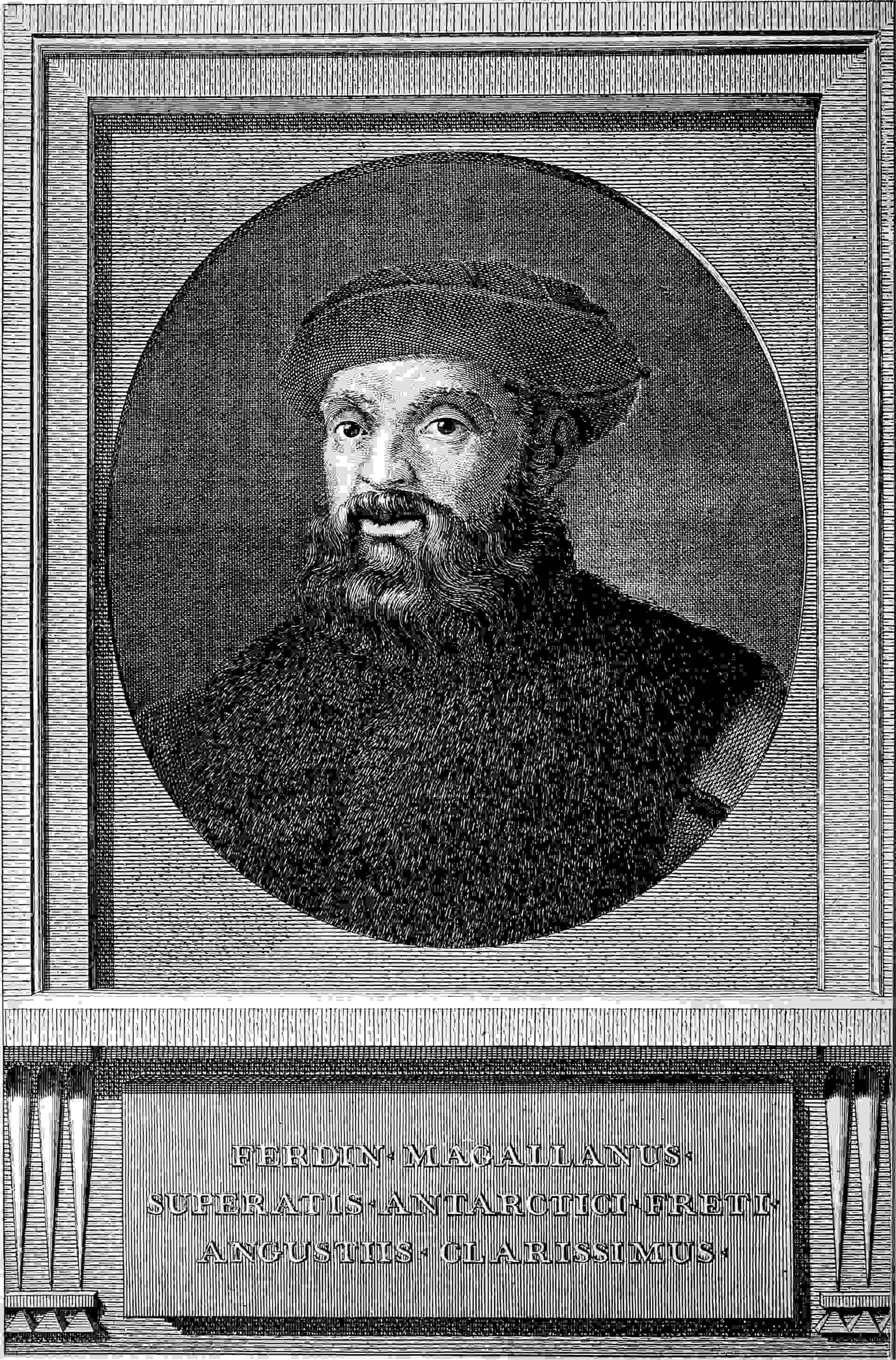
INTRODUCTION AND LIFE OF MAGELLAN . — Council held by Alfonso d’Albuquerque with the Captains with respect to going to Goa. — Letter of Alvaro da Costa, giving an Account to the King Dom Manuel of what passed with the King of Castile, to dissuade him from the discovery which he determined to order the execution of, by Fernan de Magalhaes. — Letter from Sebastian Alvarez, Factor of Dom Manuel, to the King, dated Seville, July 18, 1519.
——Teucer Salamina patremque
Quum fugeret, tamen uda Lyæo
Tempora populeâ fertur vinxisse coronâ,
Sic tristes affatus amicos:
Quo nos cunque feret melior Fortuna parente,
Ibimus, o socii comitesque!
Nil desperandum Teucro duce et auspice Teucro;
Certus enim promisit Apollo
Ambiguam tellure novâ Salamina futuram.
O fortes, pejoraque passi
Mecum sæpe viri, nunc vino pellite curas:
Cras ingens iterabimus æquor.
Though Magellan’s enterprise was the greatest ever undertaken by
any navigator, yet he has been deprived of his due fame by the
jealousy which has always existed between the two nations inhabiting
the Peninsula: the Spaniards would not brook being commanded by a
Portuguese, and the Portuguese have not yet forgiven Magellan for
having abandoned them to serve Castile. But Magellan really had no
choice; for if the western passage which he expected to discover was
to be sought for, it could only be under the auspices of Spain, within
whose demarcation those waters lay.
It would seem that D. Manuel had
only himself to blame for the loss of Magellan’s services; and, as M.
Amoretti well observes, D. Manuel ought to have been well aware of
the value of those services, since Charles V knew it, and showed his
appreciation of them. It is difficult to believe that the injury of
which Magellan complained, and which led him to seek other service, was
merely, as Osorio says, the refusal of promotion in palace rank, and
which he had well deserved, especially since the motive ascribed by
Osorio to the king’s refusal, namely the necessity of avoiding a bad
precedent, was not alone a sufficient affront to account for Magellan’s
sacrificing all his hopes and property in his own country, had he not
also felt that the king was condemning him to inaction, obscurity, and
uselessness. Barros, indeed, says that:
“The favours of princes given for services are a retributive
justice, which must be observed equally with all, with regard
to the quality of each man: and that if a man’s portion
be denied him, though he endures it ill, yet he will have
patience; but if he see the advancement of those who have
profited more by artifice and friends than by their own merits,
he loses all patience; indignation, hatred, and despair arise,
and he will commit faults injurious to himself and others. And
what outraged Magellan more than the refusal of the half ducat
a month, was that some men who were with him at Azamor, said
that his lameness was feigned to support his petition.”
The king, moreover, refused to receive Magellan, and showed his
ill-will against him. It is therefore highly probable that before
Magellan took the step of leaving Portugal, D. Manuel, prompted by his
niggardly disposition, had refused to entertain Magellan’s desire
for employment at sea, or his projects of discovery, from which
no immediate profit was to be expected. This is apparent from the
statement of Barros, Decad.iii, lib. v, cap. viii,
that letters of Magellan to Francisco Serrano were found after the
death of the latter in Maluco, in which Magellan said that he should
soon see him; and, if it were not by way of Portugal, it would be by
way of Castile, and that Serrano should therefore wait for him there.
Further on, Barros says that recourse to Castile appears from these
letters to have been in Magellan’s mind some time before the occurrence
of the king’s dismissal of his business: and that this was shown by his
always associating with pilots, and occupying himself with sea-charts.
The Portuguese exaggerated very much the injury they expected to
result, and, later, which they thought had resulted from Magellan’s
voyage, which could not change the position of the Moluccas, nor
consequently the Portuguese title to them; but the apprehensions
which they felt, arose from their fear of others sharing in the spice
trade, and from the limited geographical knowledge of the period,
which left both parties very much in doubt as to the true position of
those islands, or as to the extent of the circumference of the globe.
The question of the exact position of the Moluccas was not definitely
ascertained till much later, though a compromise was arrived at in 1529
by the treaty between Spain and Portugal, by which Charles V gave up
whatever rights to the Moluccas he imagined he possessed, to Portugal,
for a sum of three hundred and fifty thousand ducats.[1] As late as
1535, Gaspar Correa mentions, tom. iii, p. 661, a Dominican friar in
Portuguese India, who was learned in cosmography, and who asserted that
the Moluccas fell within the demarcation of Castile.
The grounds of complaint of the Portuguese against Magellan are,
perhaps, best expressed, and in the strongest terms, by Bishop Osorio,
so it may be well to quote from him the following passage. Lib.
xi, § 23.
“About this time a slight offence on the part of the king
(D. Manuel) so grievously exasperated the mind of a certain
Portuguese, that, forgetful of all faith, piety, and religion,
he hastened to betray the king who had educated him, and the
country which had brought him forth; and he risked his life
amongst the greatest perils. Ferdinand Magellan, of whom we
have before spoken, was a man of noble birth, and endued with a
high spirit. He had given proofs in India, in warlike affairs,
of courage and perseverance in no small degree. Likewise in
Africa he had performed his duties with great ardour. Formerly
it was the custom among the Portuguese that the king’s servants
should be fed in the palace at the king’s expense; but when
the number of these servants had become so great (because the
sons of the king’s officers retained the same station, and
besides, many were admitted for their services into the king’s
household), it was seen to be very difficult to prepare the
food of such a multitude. On this account it was determined
by the Kings of Portugal that the food which each man was to
receive in the palace should be provided by himself out of the
king’s money. Thus it was settled that a certain sum of money
was assigned per month to each man. That money, indeed, when
provisions were so cheap, provided abundantly for the men;
but now that the number of men, and the prices of commodities
had increased, it happened that the sum, which formerly was
more than sufficient for their daily expenses, was now much
too small. Moreover, as all the dignity of the Portuguese
depends upon the king, this small sum of money is as eagerly
sought after as though it were much more ample. And as the
Portuguese think that the thing most to be desired is to be
enrolled amongst the king’s household, so also, they consider
the greatest honour to consist in an increase of this stipend.
For, as there are various ranks of king’s servants, so the sum
of money is assigned to each servant according to the dignity
of his rank. The highest class is that of nobleman; but, as
there are distinctions of nobility, so an equal salary is not
given to all. Thus it happens that the nobility of each is
estimated according to the importance of this stipend, and
each one is held to be more noble in proportion to the more
ample stipend which he receives. This judgment, indeed, as
human affairs go, is often most false; for many obtain through
ambition and pertinacity what ought to be assigned to deserts
and innate nobleness. The Portuguese, however, since they
are over anxious in seeking this nobility, and imagine that
their nobility is increased by a small accession of salary,
very often think that they must strive for this little sum of
money, as though all their well-being and dignity depended
upon it. Now, Magellan contended that for his services, his
stipend should be increased monthly by half a ducat. The king
refused it him, lest an entrance should be opened to ambitious
persons. Magellan, excited by the injury of the refusal of this
advantage to him at that time, abandoned the king, broke his
faith, and brought the State into extreme danger. And whilst we
ought to tolerate the injuries inflicted by the State, and to
endure also the outrages of kings, who are the fathers of the
republick, and whilst we ought to lay down our lives for the
well-being of our country, which lives we owe to our country;
this most audacious man conceived such despite on account of
half a ducat, amounting to five denarii, which was refused to
him, that he opposed the State; he offended the king, who had
brought him up; and brought his country, for which he should
have died, into peril. For the affair reached such a pitch that
the danger of a perilous war impended over the commonwealth.
I do not know, indeed, whence so barbarous a custom has crept
into the State: for, whilst the name of a traitor is not only
hateful and hated, but also burns in the stain of everlasting
dishonour upon a whole posterity; yet men who determine upon
breaking their faith, and opposing their kings or states, may
reject the favours they have received by formal letters, may
abjure their fealty, and despoil themselves of the rights
and duties of the State; they bid the king keep for himself
that which belongs to him, and they attest that thenceforward
they will have nothing in common with their country: then, at
length, they contend that it is allowable for them to commence
war against their country. Be it so: reject favours if it
please you; contemn the liberality of your country; grumble
as much as you please, that a reward equal to your dignity
has not been granted. But by what means can you betray the
faith which you have plighted? My country has inflicted on me
a severe outrage; it has inflicted, indeed, the worst. But an
outrage is not to be avenged, either upon parents or upon one’s
country. I have abandoned, he says, all that I had received
from my country. Have you then rejected life, disposition, and
education? By no means. But all these things; you received
them, in the first place, from God, and then from the laws,
customs, and institutions of your country. It will never be
allowable to combat nature, to injure your country, or to
break faith, even should you be laden with every injury. Nay,
your life should be given up, and the most extreme punishments
should be undergone, sooner than break your faith, or betray
your duty. Abjure fealty as much as you please, attest your
perfidy by public letters, leave to posterity a notable memory
of unspeakable wickedness; yet you will not be able by any
such document to avoid offending the Deity, nor the stain of an
everlasting opprobrium.”
Against this view of Osorio may be set the following passage from
Vattel, which has all the more weight, in that it is simply an
enunciation of law and right, and is not written to support or to
denounce any particular person.
“Many distinctions will be necessary, in order to give a
complete solution to the celebrated question, whether a man
may quit his country, or the society of which he is
a member. The children are bound by natural ties to the
society in which they were born; they are under an obligation
to shew themselves grateful for the protection it has afforded
to their fathers, and are in a great measure indebted to it
for their birth and education. They ought, therefore, to love
it, as we have already shewn, to express a just gratitude to
it, and requite its services as far as possible by serving it
in turn. We have observed above, that they have a right to
enter into the society of which their fathers were members. But
every man is born free; and the son of a citizen, when come to
the years of discretion, may examine whether it be convenient
for him to join the society for which he was destined by his
birth. If he does not find it advantageous to remain in it,
he is at liberty to quit it, on making it a compensation for
what it has done in his favour, and preserving, as far as his
new engagements will allow him, the sentiments of love and
gratitude he owes it.”—Chitty’s translation of Vattel,
book i, cap. xix, § 220.
There are also some remarkable passages in a pamphlet by Condorcet,
dated October 25th, 1791, named Opinion sur les Emigrants. This
opinion deserves attention, both on account of its author and the time
in which it was written, when popular passions and prejudices were
much excited against those who were expatriating themselves from France.
Condorcet begins with the statement, that:
“It is a great error to imagine that the public utility is not
constantly to be found united with the rights of individuals,
or that the public well-being may demand acts of real
injustice. This error has everywhere been the eternal excuse
for the inroads of tyranny, and the pretext for the artful
manœuvres employed to establish it.[2]”
“On the contrary, in the case of every measure that is proposed
as useful, it must first be examined whether it is just. Should
it not be so, it must be concluded that it had only an empty
and fallacious appearance of utility.”
•••••
“Nature concedes to every man the right of going out of his
country; the constitution guarantees it to every French
citizen, and we cannot strike a blow at it. The Frenchman who
wishes to leave his country, for his business, for his health,
even for the sake of his peace and well-being, ought to have
the fullest liberty to do so: he ought to be able to use this
liberty, without his absence depriving him of the least of his
rights. In a great empire, the variety of professions, and
inequality of fortunes, do not admit of residence and personal
service being regarded as a common obligation which the law may
impose upon all citizens. This rigorous obligation can only
exist in the case of absolute necessity; to extend it to the
habitual state of society, and even to all periods when the
public safety or tranquillity may seem to be menaced, would
be to disturb the order of useful labours, and to attack the
sources of general prosperity.”
“Every man, moreover, has the right to change his country; he
may renounce that in which he was born, to choose another.
From that moment, as a citizen of his new country, he is only
a foreigner in the first; but if some day he returns to it, if
he has left any property in it, he ought to enjoy there to the
full the rights of man; he has only deserved to lose those of a
citizen.”
“But here a first question presents itself. Is this citizen by
his sole renunciation released from every obligation towards
the body politic which he abandons? Does the society from which
he separates himself lose immediately all its rights over him?
Doubtless, not; and I do not speak only of those sentiments
which a noble and grateful soul preserves for its country, even
though it be unjust; I speak of rigorous obligations, of those
which a man cannot fail to fulfil without becoming guilty of an
offence: and I say that there exists a time during which a man
placed between his ancient and his new country can only permit
himself to express hopes as to the differences which arise
between them: a time when that one of the two nations against
which he might bear arms would have the right to punish him
as an assassin; and when the man who might employ his riches
or talents against his former countrymen, would really be a
traitor.”
“I will add that each nation has also the right to fix the time
after which the citizen who abandons it is to be considered
as free from all obligation, and to determine what are his
duties until the expiration of that period, and what actions
it still preserves the power to forbid him. To deny this
principle, would be to break all the social bonds which can
bind men together. This period, doubtless, is not an arbitrary
one; it is that during which the citizen who abdicates can
employ against his country the means which he has received from
it, and during which he can do it more injury than could a
foreigner.”
Further on, Condorcet proposes two years as the period during which
a citizen who renounces his nationality shall engage not to enter
the service of any foreign power, unless he has been authorised so
to do by a decree of the national assembly. He also proposes various
measures for different classes of emigrants, and the full enjoyment of
their property on the same footing as foreigners, by those who sign an
engagement not to take foreign service for two years, nor during that
time to solicit the aid of any foreign power against the nation or its
constituted authorities.
Magellan fully satisfied the conditions specified by Vattel, as may
be seen by his conversations with Sebastian Alvarez, the King of
Portugal’s agent: at this date, also, it is sufficiently clear that
Magellan not only did no harm to his native country, but that he
increased its renown by his own services, and by those of the other
Portuguese officers whom he associated with his labours. If his
countrymen have preferred Gama to him, it is because he only served
the interests of science, whilst Gama served the passions of his
countrymen, and aided them to enrich themselves. After D. Manuel had
refused employment and advancement to Magellan, and seemed inclined
to leave him in the obscurity of a small garrison in Africa, the
Portuguese would seem to have no more right to complain of Magellan’s
profiting by the opportunities offered by Spain, than the Genoese
would have had, if they had reproached Columbus for availing himself
in a similar way of the resources of that country. D. Manuel, it is
true, made offers to Magellan if he would leave Spain and return to
Portugal, but it was then too late, for the great navigator had already
pledged his word to Charles V.
There is another circumstance which
justifies Magellan still more than if he had been an Englishman or
a Frenchman, a circumstance peculiar to Spain and Portugal. In the
Peninsula, the kingly power was of recent origin, and had been divided
amongst several crowns: the wearers of these crowns had been at first
only the equals of other great lords, and, after they had acquired
these crowns, they were only the first amongst their equals; and such
they recognised themselves to be by their coronation oaths, even long
after the time of Magellan. In these coronation oaths they also bound
themselves more than did other European sovereigns to respect all the
privileges of the great nobles; any infraction of which was held to
justify these in revolt from the sovereign. At the same time there
existed the custom and tradition of disnaturalisation, in accordance
with which any noble who felt aggrieved, formally renounced his fealty
to the sovereign, and betook himself to some neighbouring state. Osorio
and Mariana, who wrote when the kingly power had become consolidated,
ridicule this custom; but it must have had the advantage of giving time
and opportunity for a peaceable settlement instead of an immediate
recourse to arms. But whether the custom was good or bad, there is no
doubt that it was generally and constantly acted upon; and Magellan was
following precedents that were generally received in the Peninsula.
It is unfortunate that the document mentioned by historians, by which
Magellan formally renounced fealty to D. Manuel, is not forthcoming in
the archives either of Spain or Portugal; but it may be supposed to be
similar in substance to those renunciations which Osorio mentions and
reproves.
Among those who disnaturalised themselves may be cited various Condes
de Haro of Biscay, and Guzman, who gave his services to Marocco,
and who bears the title of El Bueno. With regard to Count Diego de
Haro, who in 1216 withdrew from Castile to Navarre, Mariana makes the
following observations.
“Several great lords of Castile, irritated against their king,
whose avarice they could not endure, had passed into the
kingdoms of Navarre and Aragon, after having renounced their
right of naturalisation by a public deed, a means formerly
in use amongst those nations, in order not to be regarded as
traitors and rebels when they quitted the states of their
sovereign.... Among the grandees who came to take refuge in
Navarre, the most illustrious beyond dispute was Don Diego
de Haro. This lord had excellent qualities: never were seen
greater constancy, probity, or zeal for the public service than
his; the slightest injustice irritated him. It was in order not
to see his country and freedom oppressed, that he abandoned
Castile.”—Mariana, History of Spain, book xiii.
“In the year 1276, Alfonso the Wise had defeated Yussuf, the
Emperor of Marocco, and made peace with him with the assistance
of Guzman: a tournament was held in Seville in celebration of
it, and King Alfonso having asked who had most distinguished
himself, was told D. Alonzo Perez. He asked which of them, and
D. Juan Ramirez de Guzman replied: ‘Alonzo Perez de Guzman,
my brother of profit.’ This answer seemed ill to all, and
especially to Guzman, who saw that a slur was cast upon the
illegitimacy of his birth, for at that time they named children
of profit (gananciu), those who were born of unmarried
women, and his mother had not been married. Guzman, irritated
at being thus spoken of before the king and the court, then
said: ‘You speak truth, I am a brother of profit, but you
are and will be one of loss; and were it not for the respect
due to the presence in which we stand, I would teach you the
manner in which you should treat me; but you are not to blame
for it, but rather he who has brought you up and taught you
so ill.’ The king, against whom this complaint appeared to be
directed, then said: ‘Your brother does not speak ill, for so
it is the custom in Castile to name those who are not children
of women married to their husbands.’ ‘So also,’ he replied,
‘is it the custom of the nobles of Castile, when they are not
well treated by their sovereigns, to go abroad to seek those
who will treat them well; I will do likewise; and I swear not
to return until with truth they may call me a man of profit.
Grant me, therefore, the term which the privilege of the nobles
of Castile gives, that I may go out of the kingdom, for from
this day I disnaturalise myself, and take leave of being your
vassal.’ The king attempted to dissuade him, but his efforts
being in vain, he had to grant him the term which he asked
for; during which Guzman sold all that he had inherited from
his father or acquired in the war, and went out from Castile,
accompanied by thirty of his friends and servants.”—Quintana,
Vidas de Españoles Celebres.
There seems to be some inconsistency on the part of those who refuse
to admit of disnaturalisation, yet at the same time maintain that
rebellion can be justified. If there is a justification of rebellion,
the right of expatriation, or of withdrawal from amongst those
who provoke rebellion, must exist; and there can be no doubt that
the peaceable withdrawal of those who are oppressed or injured is
preferable in the interests of all to armed insurrection. Even Bishop
Osorio and Mariana would probably admit that the disnaturalisation of
Prim and Serrano would have been better than their treason, which has
plunged Spain in anarchy and bloodshed for so many years.[3] Rebellions
have almost always been conducted by minorities; and as their
justification does not depend upon the numerical importance of those
engaged in them, it would follow that in the case of disnaturalisation,
where numbers are not requisite, as in the case of armed insurrection,
the right would exist equally even if the minority consisted only of
one.
There are some writers on the Law of Nations, with whom I am agreed in
general, who disapprove of the Naturalisation and Disnaturalisation
Act of the Session of 1869. I am compelled to differ from them with
respect to that measure, for the foregoing reasons, and also because
it seems to me that they have lost sight of another circumstance
which affects the question. So long as kingly power was a reality,
personal allegiance and duty to the sovereign was a reality also.
But now that modern innovation and corruption have substituted the
rule of majorities for the kingly power, the feeling of the personal
duty of the subject is almost lost; and the subject, or citizen, has
become only one of an aggregation of individuals, or of an association
of persons with equal rights; and each member of such an association
has clearly the right to choose whether he will form part of it or
not: so that whatever rights of expatriation may have existed in the
times of Magellan, Grotius, and Vattel, have become much stronger at
the present time, when the conscience of the subject is no longer
considered by some as held bound by duty to the sovereign, who has
become almost impersonal: instead of loyalty and fealty, we have the
duty of fair dealing as between partners and associates on equal terms,
as is exemplified by the argumentation of Condorcet in the passage
quoted above. That this view is in accordance with the common sense
and consent of mankind is shown by the general repudiation of the
pretension of the northern portion of the United States to term the
secession of the southern states a rebellion; and this pretension was
seen to be especially illogical on the part of those who had repudiated
the name of rebels when they departed from the duty of obedience to
their lawful sovereign.
Magellan has not had the good fortune of Vasco da Gama, whose exploits
have been narrated by Camoens and Gaspar Correa; he did not survive
to give his own account of his great voyage, and the only accounts
preserved were written by two Italians of very small literary capacity.
There are, however, more documents concerning Magellan in existence
than are to be found with respect to Gama.
The birth-place of Magellan is doubtful; according to his will executed
in Lisbon, December 29th, 1504, in favour of his sister, Theresa de
Magalhāes, wife of Joan da Sylva Telles, he was born at Villa de
Sabroza, in the district of Villa Real, Traz os Montes; in his will of
August 24th, 1519, he calls himself “Vezino de Porto,” or domiciled at
Porto; documents quoted by M. Ferdinand Denis make him to be born at
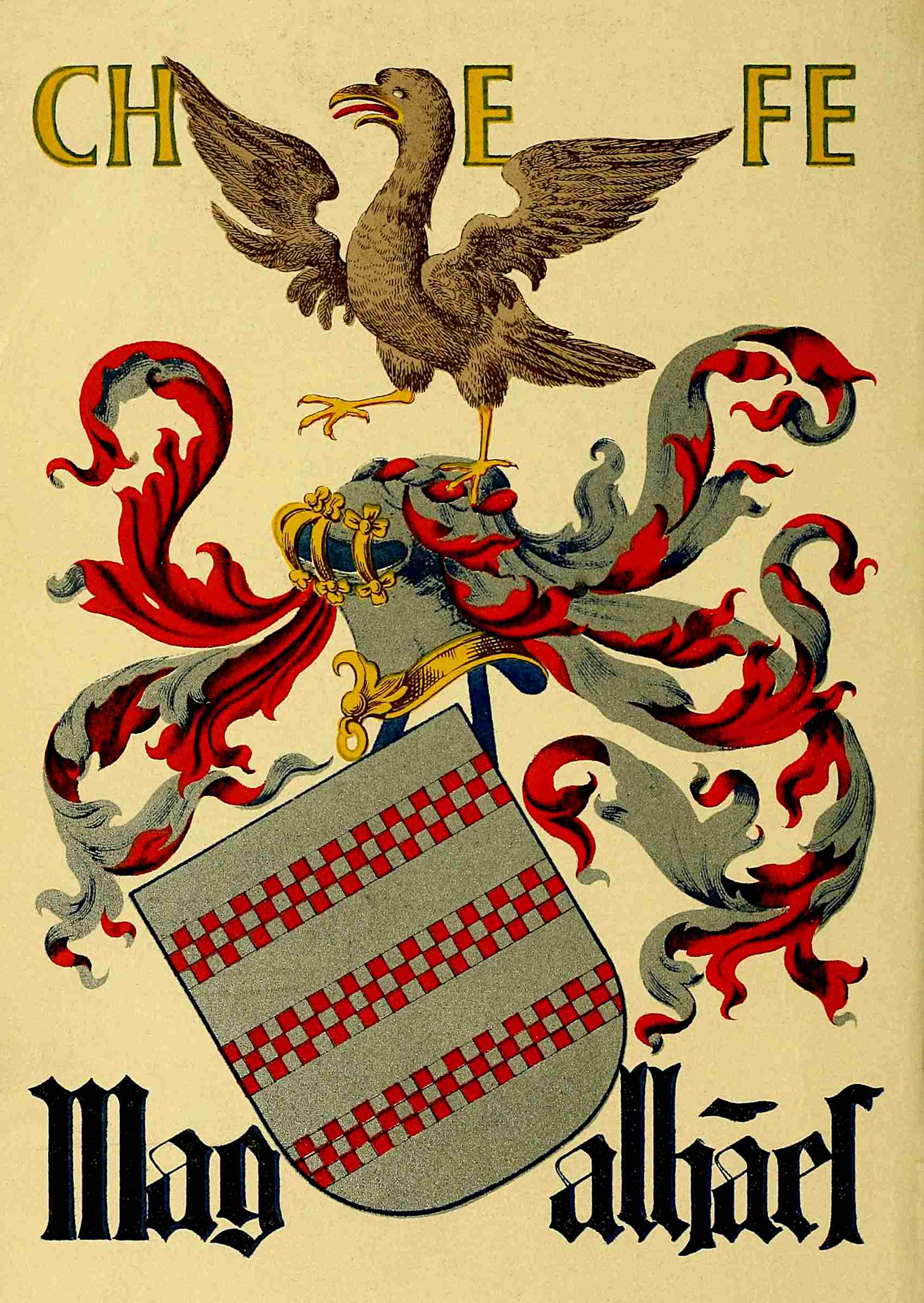
Villa de Figueiro in Portuguese Estremadura. His family was “hidalgo,”
with a known coat of arms, of which a plate is given in this volume.
The book of noble genealogies of Portugal, by Bernardo Pimenta do
Avelar Portocarrero, states, in the vol. M, done and copied in the year
1721, fo. 641, that Ruy de Magalhaēs, whose parents are unknown, was
Alcaide-mōr of Aveiro. He married Alda de Mesquita, daughter of Martin
Gonzalves Pimentel and Ignez de Mesquita. Antonio de Lima (another
genealogist) represents her as the wife of Gil de Magalhaēs, fifth son
of Gil de Magalhaēs; and he gives her the same children as others give
to Ruy de Magalhaēs: who had
Genebra de Magalhaēs, wife of Pero Cāo.
Fernāo de Magalhaēs, who married Da. Brites Barbosa, daughter of his
relation Diogo Barbosa, alcaidemōr of Seville, in the absence of D.
Alvaro of Portugal; he had
Da. Anna de Magalhaēs, his heiress, the wife of D. Hernando de Henao e
Avila, from whom his lineage continues. She was his only child.
This does not agree with the archives of Seville, from which it appears
that Beatriz Barbosa was daughter of Diego Barbosa and Maria Caldera,
and that Fernan Magalhaēs and Beatriz Barbosa had a son named Rodrigo;
and that after the death of these three, Diego Barbosa became their
heir; and he having died in 1525, his son Jayme inherited.
Fernan Magellan executed a will in Seville on the 24th day of August,
1519. He instituted by it a mayorazgo for his son, grandson, or
relation, who should bear the name of Magallanes, and who should be
bound to live in the kingdoms of Castille. He also bequeathed a sum of
12,500 maravedis to the Convent of N. S. de la Victoria in Triana.
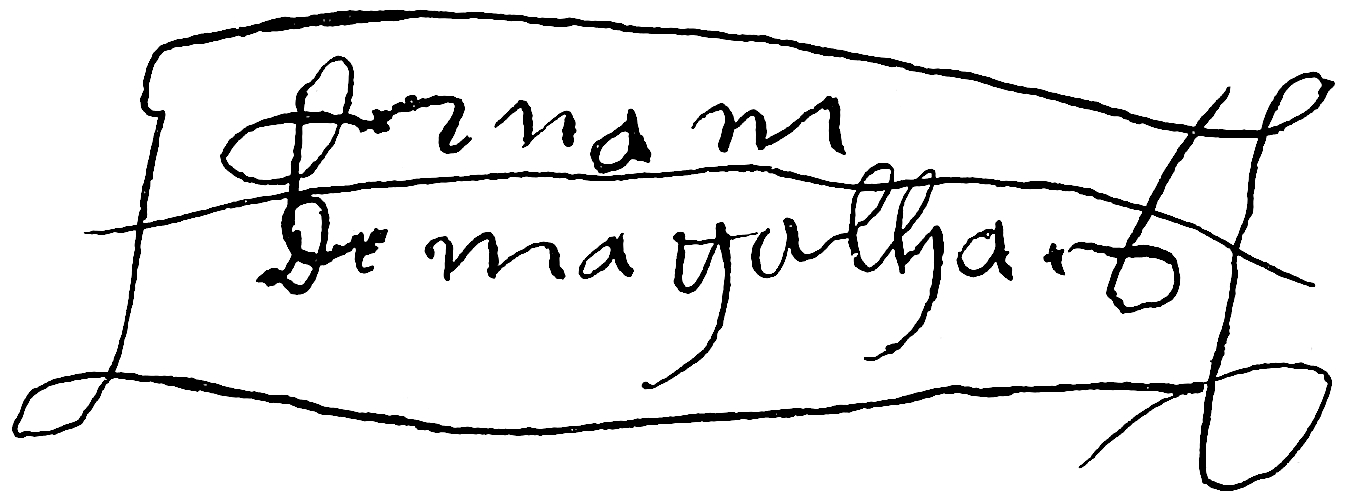
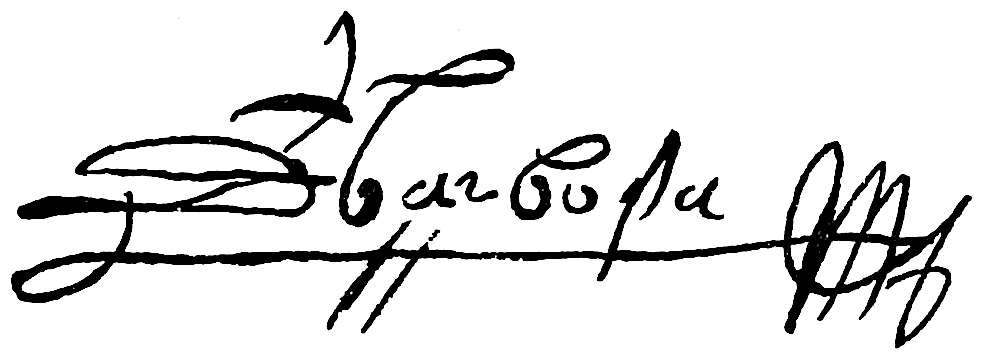
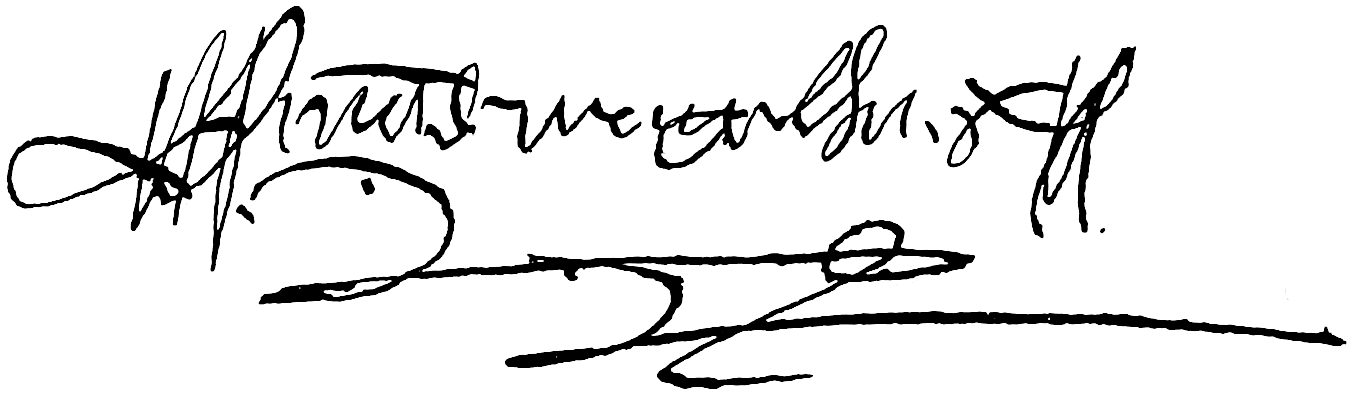
Two facsimiles of the signature of Magellan are given, one taken from
his signature to the protocol of the Council of War, held at Cochim in
1510; there is also a facsimile of the signature of another Magellan,
taken from the book of Moradias or Palace stipends, attached to a
receipt printed by Navarrete, who appears to have supposed it to
have been that of the navigator: and a facsimile of the signature of
Magellan’s brother-in-law Duarte Barbosa.
Gaspar Correa states, in his Lendas da India, tom. ii,
p. 28, that, in January of 1510, Alfonso d’Alboquerque despatched the
ships from Cochim to the kingdom.
“Two ships of Bastian de Sousa and Francisco de Sá convoyed
this fleet, and at night they both struck on the shoals of
Padua, which are opposite the Maldive Islands, and remained
aground, upright, and without breaking up. Upon this they
prepared the boats as well as they could, and raised their
sides, and put inside water and biscuit, and victuals which
did not require cooking. The captains and pilots, and as many
men as could, got into these boats and returned to Cochym. The
people who remained in the ships set shores[4] on each side
of the ships, with the yards, which they cut. All this was
arranged and commanded by an honourable gentleman, who remained
as overseer, named Fernan de Magalhaēs, who had been much
wounded in Calecut. He took much care that the chests should
not be broken, and that there should be no robbery, because
the captains were going to request ships of the governor, with
which to return to the ships to save what goods had not been
wetted. These captains reached Cananor in eight days, from
whence they sent a message to the governor, who at once sent
Gonzalo de Crasto in a caravel, with two pilots; and they went
to the ships and put the best things on board the caravel,
until they could not load it any more, and having recovered
all the men, they set fire to the ships, as they were already
full of water. So they returned to Cochim. In this Fernan de
Magalhāes worked hard, and did much service, and attended well
to everything.”
“This Fernan de Magalhāes was of the king’s household, and came
to India with the Viceroy Dom Francisco [d’Almeida], and he was
in the action with the Turks; and he was always much wounded in
the fleets and in Calecut; and in these ships he lost his small
portion of property,[5] and he went away poor to Portugal, and
went about with claims for his services, and begged of the king
a hundred reis increase of his palace stipend,[6] which the
king did not choose to grant, at which he was aggrieved, and
went to Castile to live at Seville, where he married. As he had
much knowledge of the art of navigation, and enterprise, and
devoted himself to that, he came to an understanding with the
directors of the House of Trade of Seville, so that the emperor
gave him a fleet of five ships, with which he navigated,
discovering a new way to Maluco, which was in the year 1519,
as I will relate further on in its place; with which he caused
great difficulties to Portugal.”
Correa again refers to the incident of Magellan remaining with the
wreck, in his tome ii, p. 625, where he says:
“Fernan de Magalhāes, an honourable gentleman, who served in
these parts in the time of the Viceroy Afonso d’Alboquerque,
of whom I made mention in the first book, with respect to two
ships which were going to the kingdom, which were lost on the
shoals of Padua, and their captains went back to Cochym in
their boats, and this Fernan de Magalhāes remained in the ships
with the men taking care of the ships until caravels came from
Cochim in which much property, belonging to the king and to
private individuals, was saved. This Fernan de Magalhāes, on
going to the kingdom and bringing before the king his services,
asked in satisfaction for them that he should have an increase
in his palace stipend of a hundred reis a month, which the
king refused him, because he did not find favour with him,
or because it was so permitted to be. Fernan de Magalhāes,
offended at this, because he much entreated the king to do it,
and he would not, asked his leave to go and live with whoever
would show him favour, where he might obtain more good fortune
than with him. The king told him to do as he pleased; for which
he wished to kiss his hand, which the king did not choose to
give him.”
Castanheda, in relating the wreck on the Padua banks, says (lib.
iii, cap. v):
“There were disputes as to who should go away with the captains
from the grounded vessels, and Magellan said that it was clear
that all could not go away, and that to avoid strife, which was
commencing, let the gentlemen and chief men go away with the
captains, and he would remain with the sailors and other common
people, provided they would promise to return for him, or get
the governor to send for him. This they swore to, and Fernan de
Magalhāes stayed behind, the common people consented to remain,
for otherwise there must have been strife. As Magalhāes was
in the boat, when it was nearly ready to go away, a sailor,
thinking that he repented himself of remaining, said to him:
‘Sir, did you not promise to remain with us?’ He replied: ‘Yes;
and see, I am coming;’ and went to them and remained with them.
In this he shewed great courage, and confidence in the men.”
Barros relates the incident of the two vessels wrecked on the banks of
Padua, and says that Antonio Pacheco was sent with a caravel to their
assistance; and that:
“As much honour as Antonio Pacheco gained in the method with
which he recovered these crews, with the differences which
he had with them on account of some goods which the men took
with them, so much honour also did Magellan gain by the good
management of these men, which he shewed whilst waiting with
them till they came to fetch them. And if he had had as much
loyalty to his king and country, as he observed with a friend
of his, on whose account he would not go away in company with
Bastian de Sousa [the captain]; for they did not take away the
other man, as he was not a man of much importance, perchance he
would not have lost himself with a name of infamy, as will be
seen further on.”—Decad. II, lib. iv, chap. i.
Thus Castanheda and Barros, who are both of them very hostile to
Magellan, have preserved one of the finest traits of his life. Whether
the motive of Magellan in remaining by the wreck was fidelity to the
interests of his friend, or devotion to the common seamen, or the
repugnance of an officer and a gentleman to abandon a ship which had
not broken up, this trait is alone sufficient to show that he was
incapable of disloyalty, or of being influenced by pique, as the
Portuguese historians have represented.
The next mention we find of Magellan is in the following document,
preserved in the archives of Lisbon, which contains an account of a
Council of War held by Albuquerque respecting his attack on Goa. This
document confirms what Correa says of Albuquerque’s departure from
Cochym for Goa.
Torre do Tombo. Corpo Chron. Part 2a, Maç 23, Doc. 190.
Thursday, which was the tenth day of the month of October,
of five hundred and ten, the captain-major ordered all the
captains of the king our sovereign to be summoned in Cochim,
in order to hold a council with them, to which council there
came those named below, and no others. This council was as to
whether, whilst the ships of burden remained in Cochim taking
in their cargo, it seemed good to them to carry all their crews
with them to the action of Goa, or not.
•••••
Fernan de Magalhāes said that it seemed to him that the captain-major
ought not to take the ships of burden to Goa, inasmuch as if they went
thither they could not pass this year to Portugal, since we are at the
twelfth of October; and that, making their shortest course without
touching at Cananor, nor at any other port, it was not possible to lay
the fleet before the port of Goa before the eighth of November,[7] as
the winds were now contrary for that place: and with respect to the
crews, let his worship say whether it was well that they should go,
that it seemed to him that he ought not to take them, since there did
not remain time for them to lay out their money, nor to do anything of
what was necessary for the voyage; and this said Fernan de Magalhāes.
Gonzalo de Sequeira, captain-major of the fleet which had just come from Portugal.
Affonso d’Albuquerque said at the end what he determined to do.
(N.B. Albuquerque said at the end of these opinions that he was
determined to sail on the following day, the eleventh of October, with
the captains who wished to accompany him. Therefore, we are at the
twelfth of October, means that that day was close at hand, and not
that the council was held on that day.)
Gaspar Correa says, tome ii, p. 138:
“When this was thus ended, the governor told all the captains
that he was going immediately, and that he would sail from
Cananor with all the ships and men that he could take, and go
and take Goa, as he trusted in the Lord’s Passion that He would
assist him; and he gave them notice that so he would act, and
not occupy himself with anything else: and he gave them all
this notice, because he trusted in the Lord, that he should
be able to send news to the king in these ships, that he was
taking his rest inside the city of Goa: and, as it was already
October, whoever had the will to serve the king, and win such
great honour, as it would be to find oneself in such a noble
action, would still have time enough to witness the action and
return to embark in his ship, carrying away so much honour
from having been present in the action: and each one was to act
according to his own will, for he would give an account of all
to the king in his letters. But the captains, occupied with
their profits of selling and taking in cargo, set little store
by this, and the governor departed, saying that he was not
going to take anyone away with him against his will.”
Albuquerque then went to Cananor, which G. Correa says he again left
on the 3rd October for Goa (tom. ii, p. 140); tres
is probably an error for treze, the 13th, which would be in
accordance with the statement of the document that Albuquerque sailed
from Cochim on the 11th of October. Gaspar Correa gives the following
names of captains who accompanied Albuquerque against Goa.
*Joan de Lima.
Jeronymo de Lima, his brother.
Manuel de Lacerda.
Fernan Peres d’Andrade.
Simāo d’Andrade, his brother.
Diogo Fernandes de Beja.
*Manuel da Cunha.
Duarte de Mello.
Francisco de Tavora.
Vasco Fernandes Coutinho.
*Gracia de Sousa.
Gaspar Cāo.
Lopo Vaz de Sampayo.
Ayres da Silva.
Diniz Fernandes de Mello.
Joan Serrano.
Diogo Mendes de Vascogoncellos.
Pero Coresma.
Baltesar da Silva.
Mice Vinete Cerniche.
Antonio Raposo.
*Simāo Martins.
Gaspar de Paiva.
Francisco Pantoja.
*Bastian de Miranda, d’Azevedo.
Afonso Pessoa.
Jorge Martins de Liāo.
Francisco Pereira.
Twenty-eight ships, and 1,700 Portuguese.
*The names marked with an asterisk are among those who gave an
opinion at the Council of War above mentioned.
He also mentions, p. 145, the following gentlemen as being with
Albuquerque in the attack on Goa:
Fernan Gomez de Lemos.
Nuno Vaz de Castello Branco.
*Jorge da Silveira.
Ruy de Brito.
Luis Coutinho, brother of Vasco Fernandes.
Simāo d’Andrade, brother of Fernan Peres.
Gonzalo d’Almeida.
Simāo Martins Henriques.
Payo Rodrigues de Sousa.
Diogo Pires de Miranda.
Duarte de Mello.
Alvaro Paçanha.
Luis Preto.
Pero d’Afonsequa.
Antonio de Matos.
Antonio Diniz.
And other gentlemen.
The supposition may be hazarded that it was this opinion which Magellan
gave at the Council of War in opposition to Alfonso d’Albuquerque,
which set D. Manuel against him. Such opposition was enough to have
made Albuquerque write unfavourably of Magellan to D. Manuel; and the
ill-will of D. Manuel to Magellan, and his refusal to grant him a due
recognition of his services is not otherwise sufficiently accounted
for. On the other hand, Gaspar Correa, who was Albuquerque’s secretary
at one time, does not indicate this; but Correa is the most friendly to
Magellan of all the Portuguese historians, and does not appear, like
the others, to have taxed Magellan with treason.
After this, Magellan appears to have left India, and to have been
stationed at Azamor in Morocco, where, in a skirmish with the Arabs,
he was wounded in the leg by a javelin, which left him somewhat lame.
After that, some disputes arose as to the distribution amongst the
townsmen of some cattle that had been captured from the Arabs. When
João Soarez, Captain of Azamor, left that place, and was succeeded by
D. Pedro de Sousa, Magellan left Azamor without leave from D. Pedro de
Sousa, and came to Portugal; his petition with regard to the increase
of his palace stipend had already been sent to D. Manuel; but D. Pedro
de Sousa having written to the king of Magellan having left Azamor
without leave of absence, and of the complaints made about the cattle,
the king refused to receive Magellan, and commanded him to return at
once to Azamor, and there give himself up as he was accused. When he
arrived there, as Barros says, either because he was free from blame,
or, as was mostly asserted, because the frontier officers of Azamor,
in order not to vex him, would not accuse him, he received a sentence
of acquittal, and returned with it to Portugal; but the king always
bore ill-will to him, and, Magellan’s requests not being granted, he
set about that business of which he had written to his friend Francisco
Serrano, who was in Maluco.
After Magellan had disnaturalised himself, he took refuge in Spain,
accompanied by the astrologer Ruy Faleiro, and having arrived at
Seville on the 20th of October, 1517, he entered upon negotiations with
the ministers of Charles V; and the King of Portugal did his utmost,
through his agents, to thwart him; Osorio says that the king would
have succeeded in dissuading Charles V from employing Magellan, had
not the Spanish nobles persuaded him not to lose such an opportunity
of increasing the Spanish empire. Charles V then ordered ships to be
provided for Magellan, by which he might discover a new way to the east.
Here follows an abstract of documents, copies of which are contained in
the Torre do Tombo, relating to the appointment of Magellan, and the
privileges and powers conferred upon him: these documents are dated
in the spring of 1518, more than a year before Magellan sailed; and it
appears that delay was caused partly through the procrastination of
the Spanish authorities in Seville, who were charged with equipping
the fleet, and partly by the intrigues of the agents of the King of
Portugal. These intrigues appear to have been partially successful, and
to have caused delay. A final order for the departure of Magellan was
given in Barcelona, April 19th, 1519. The original of this document
is preserved in the Lisbon archives, and it was probably carried out
with the fleet, and fell into the possession of the Portuguese in the
Moluccas after Magellan’s death; a translation of this order is given
below, and the text is in the Appendix.
After this document, translations are given of two letters (the text of
which is given in the Appendix) from Alvaro da Costa, the Portuguese
ambassador in Spain, and from Sebastian Alvarez, the Portuguese factor,
about the efforts made by them to prevent Magellan’s expedition. M.
Ferdinand Denis, in the Biographie Universelle, mentions that
Alvaro da Costa is said to have pushed his zeal to the extremity of
wishing to assassinate Magellan, and even his poor associate, Ruy
Faleiro; this, with regard to the latter, seems hardly probable,
judging from Costa’s own letter. Navarrete states that the Portuguese
agents succeeding in exciting the mob of Seville against Magellan
on the 22nd of October, 1518, under the empty pretext that he was
substituting the arms of Portugal for those of Castile in his ships.
Faria y Sousa, in his Europa Portuguese, tom. ii, pt.
iv, cap. i, p. 543, says:
“D. Fernando de Vasconcellos, Bishop of Lamego, alone expressed
the desire that the King of Portugal should either grant
favours to him (Magellan) or else have him killed, because
his intentions were most dangerous to the kingdom. The result
of this (counsel) was that the kingdom received a great
disappointment, and Magellan glorious and everlasting fame;
since, whilst the world endures it will endure in the monument
of his name, which has remained applied to all the South Sea
and to his Straits.”
Que nunca se vera tāo forte peito,
Do Gangetico mar ao Gaditano;
Nem das Boreaes ondas ao Estreito,
Que mostrou o aggravado Lusitano.
Camoens, Canto ii, 55.
And never will their prowess find its mate,
No, not from Ganges to the Gadite shore,
Not from Arcturus to the Southern Strait
Which first an injured Lusian will explore.
Quillinan.
Eis aqui as nóvas portas do Oriente,
Que vosoutros agora ao mundo dais,
Abrindo a porta ao vasto mar patente,
Que com tam forte peito navegais:
Mas he tambem razaō, que no ponente
De hum Lusitano hum feito inda vejais,
Que de seu Rey monstrandose agravado,
Caminho ha de fazer nunqua cuidado.
Camoens, Canto x, 138.
Thus hast thou all the regions of the East,
Which by thee giv’n unto the world is now:
Opening a way with an undaunted breast,
Through that vast sea which none before did plough.
But it is likewise reason, in the West
That of a Lusian too one action thou
Shouldst understand, who (angry with his king)
Achieves a great and memorable thing.
Fanshaw.
Contract and Agreement made by the King of Castile with Fernan
Magellan for the discovery which he was to make, a copy of which he
carried with him, signed by the Officers of the King of Castile,
and made by his Secretary Fernan de los Cobos, and copied word for
word.[9]
Gav. 18, Maço 10, No. 4.
Certificate given in Seville that the commendador Fernan de
Magallanes, and the bachelor Ruy Faleiro, Portuguese, presented
themselves at the Audiencia on the fourth of May, of 1518,
before Dr. Sancho de Matienzo, the contador Juan Lopez de
Ricalde, and the factor Juan de Aranda, judges and fiscals of
their Highnesses, of the India House, residing in this city, in
the presence of Juan Gutierrez Calderon, clerk of their H.H.,
and his Notary public, on behalf of Diego de Porras, chief
clerk in civil and criminal causes of the said India House;
and they presented to the judges two capitulations written on
paper and signed by his Highness, and one sealed with a seal of
coloured wax at the back and other necessary signatures, and
two royal orders (cedulas) of H.H. signed with his royal
name, all written by the secretary Fernan de los Cobos, the
tenour of all which, one after another, is as follows.
The King:
“Since you, Fernando de Magallanes, a knight, native of the
Kingdom of Portugal, and the bachelor Ruy Faleiro, also a
native of that kingdom, wish to render us a great service in
the limits which belong to us in the ocean within the bounds
of our demarcation, we order the following capitulation to be
established with you for that purpose.”
“Firstly: That you
are to go with good luck to discover the part of the ocean
within our limits and demarcation, and because it would not be
in reason that, while you go to do the above mentioned, that
other persons should cross you to do the same, and taking into
consideration that you undertake the labour of this enterprise,
it is my favour and will, and I promise that for the first ten
following years we will not give leave to any person to go and
discover by the same road and course by which you shall go;
and if anyone desire to undertake it and should ask our leave
for it, before giving it, we will let you know of it in order
that if you should be ready to make it in that time in which
they offer, you should do so, providing an equal sufficiency
and equipment, and as many ships as the other persons who may
wish to make the said discovery: but, be it understood that,
if we please to send to discover, or to give leave for it to
such other persons as we please by way of the south-west in
the parts of the islands and mainland, and all other parts
which are discovered towards the part where they are to seek
the strait of those seas (para buscar el estrecho de aquellas
mares),[10] we may order it to be done, or give leave to other
persons to do it, both of the mainland by the South Sea, which
is discovered, or from the island of S. Miguel, if they wish
to go and discover, they may do so. Also, if the governor
and people who are now, by our orders, or may in future be
in the said mainland, or other of our subjects may wish to
discover in the South Sea, they may do so, notwithstanding the
above, or any section or clause of this capitulation. Also,
you may discover in any of those parts what has not yet been
discovered, so that you do not discover nor do anything in the
demarcation and limits of the most serene King of Portugal,
my very dear and well-beloved uncle and brother, nor to his
prejudice, but only within the limits of our demarcation.”
In consideration of their good-will and services, the next
paragraph grants the right to levy upon any isles or countries
settled by them after the expenses have been paid, a twentieth
part, with the title of our Adelantados and Governors of the
said countries and isles, “you, and your sons and rightful
heirs for ever, so that they remain for us and the kings that
may come after us, and your sons and heirs being natives of our
realms and married in them; and of this we will send you your
formal letter of privileges.”
The next paragraph grants the right to invest in goods each
year the value of a thousand ducats, cost price, to sell in the
islands and countries, and bring back the returns, paying only
a twentieth in duty to the king without other payment. This
only after the return from the voyage, not during it.
Also to grant them greater favour, if more than six islands
should be discovered; after six have been set apart for the
king, they might mark out two from which they might take the
fifteenth part of all the net profits and duties of the king
after the expenses had been deducted.
Also of all the net profit that there may be for the king on
the return of the fleet, after this first voyage, deducting its
expense, they may take a fifth part.
“In order that you may better carry this out, I will order the
equipment of five ships, two of one hundred and thirty tons
each, and two others of ninety, and another of sixty tons,
provided with men, victuals, and artillery; that is to say,
that the said ships shall be supplied for two years, and there
shall go in them two hundred and thirty-four persons for their
management: amongst masters, mariners, ship-boys, and all
other people that are of necessity, according to the memorial,
and this we will order to be carried out by our officers in
Seville.”
Also if either of them died, this agreement was to be kept
with, and by the other, as it would have been kept with both if
they were alive.
The next paragraph says that a factor, a treasurer, an
accountant, and clerks of the said ships, shall keep the
accounts of all the expenses of the fleet.
“All which I promise and plight my faith and royal word that
I will order it to be observed to you, in all and for all,
according as is contained above, and upon it I have ordered
this present to be given, signed with my name. Dated in
Valladolid, the twenty-second day of March, of five hundred and
eighteen years.”
“Yo el Rey. By order of the King, Francisco de los Cobos.”
Another copy of the same document has the heading:—
Doña Juana and Don Carlos, her son, by the grace of God, Queen
and King of Castile, Leon, Aragon, the two Sicilies, and
Jerusalem, of Navarra, Granada, Toledo, Valencia, Galicia, the
Mallorcas, Seville, Sardinia, Cordova, Corsica, Murcia, Jaen,
the Algarves, of Aljazira, Gibraltar, of the Canary Isles, of
the Indies, isles and mainland of the Ocean-sea, Counts of
Barcelona, Lords of Biscay and Molina, Dukes of Athens and
Neopatria, Counts of Roussillon and Cerdaña, Marquises of
Euristan and Gociano, Archdukes of Austria, Dukes of Bergoña
and Brabant, Counts of Flanders and Tirol, etc.
Another letter, also dated Valladolid, March 22nd, 1518, and signed
by the king, and the secretary Francisco de los Cobos, and signed at
the back by Joanes Beijamanse, Fonseca Archiepiscopus, Episcopus,
registered, Johan de Samana, Guillermo Chancellor, confers upon
Magellan the power of deciding and executing short and summary justice
by sea or land in case of suits or disputes arising in the fleet.
Another royal letter of the same date as the above orders the officers
of the India House to provide Magellan with five ships, crews,
provisions, etc., according to the memorial which is signed by our
chancellor of Bargonha and by the Archbishop of Rosano and Bishop of
Burgos; and bids them use all dispatch.
Another royal letter, dated Aranda, 17th of April, 1518, to Magellan
and Ruy Faleiro, says that if, after they shall have sailed, either
or both of them should die, and that they should have given to the
people in the fleet instructions and orders which should be necessary
for the discovery; and if they, profiting by them, should discover the
isles and parts which they were going to discover, then their heirs and
successors should enjoy the favours and privileges contained in the
said capitulations.
The document then states that Magellan and Ruy Faleiro having presented
the capitulations and letters and royal orders of his highness to the
said judges, they summoned and required them to fulfil them according
to their contents, and they requested this in the presence of the
witnesses, Francisco de Santa Cruz, alguazil Lorenzo Pinelo, and
Francisco de Collantes, porter of the Audiencia of the said House.
Then the judges took the letters in their hands, and kissed them, and
put them on their heads, as the orders of their king, and natural
sovereign, whom may God suffer to live and reign many years; and they
would answer more at length in complying with the orders. Witnesses the
above-named.
After that, on Monday, at the Audiencia de la Nona, on the thirty-first
day of May of 1518, the said judges, Dr. Sancho de Matienzo and the
contador Juan Lopez de Ricalde, appeared before me, the said Juan
Gutierrez Calderon, the above-mentioned clerk and notary, and presented
an answer signed with their names to the presentation made by the
Portuguese captains of the royal orders and letters. And this reply is
as follows.
The said judges state, in reply, that the king’s letters order them
to provide five ships, and men and provisions as may be necessary, in
conformity with a memorial which the captains bring, signed by the
great Chancellor of Burgundy and by the very Reverend Archbishop of
Rosano and Bishop of Burgos, which said memorial up to this time has
not been shown to us, and without it we cannot undertake anything; so
let his Highness send us orders according to that the said despatch
signed, as has been said, by the chancellor and bishop; and we are
ready to fulfil the orders which his Highness sends, having at the time
moneys of his Highness in our power. This they said, and gave as their
answers, and signed it with their names, Doctor Matienzo, Juan Lopez de
Ricalde.
Magellan and Ruy Faleiro asked from Juan Gutierres Calderon, Clerk and
Notary Public, a certificate and legalised copy of what had passed for
the conservation of their rights, which he accordingly gave him, dated
on the said day and month (31st May) of 1518.
The letter, the text of which is given in the Appendix No.
iii, the original of which appears to have fallen into the
hands of the Portuguese at the Moluccas, is as follows:
The King:
Fernando de Magallam̄s and Ruy Faleiro, Knights of the Order
of St. James, our captains-general of the fleet, which we
command to be equipped to go to discover, and the other
separate captains of the said fleet, and pilots, masters,
quarter-masters, and seamen of the said fleet: Inasmuch as I
know for certain, according to the much information which I
have obtained from persons who have seen it by experience,
that there are spices in the islands of Maluco; and, chiefly,
you are going to seek them with this said fleet, and my will
is that you should straightway follow the voyage to the said
islands in the form and guise which I have said and commanded
to you, the said Ferdinand de Magallam̄s; moreover, I command
you all and each one of you that in the navigation of the said
voyage you follow the opinion and determination of the said
Ferdinand de Magallam̄s, in order that first and foremost,
before any other part, you should go to the said islands of
Maluco, without there being any shortcoming in this, because
thus it is fitting for our service, and after this done, the
rest that may be convenient may be sought for according to what
you have been commanded, and one and all neither do nor let
them do anything else in anywise, under pain of losing their
goods and their persons, at our discretion. Done in Barcelona,
nineteenth day of April, year of one thousand five hundred and
nineteen.
I, the King. By order of the King, Frco de los Covos.
(Docket).—In order that those of the fleet may follow
the opinion and determination of Magallan̄s, in order that
first and before anything else they go to the spices.
Translation.
Torre do Tombo. Gav. 18, Maço 8, No. 38.
Sire,
With respect to the business of Fernam de Magalhaes, I have
done and laboured very much, as God knows, as I have written
to you at length; and now, Xebres being ill, I have spoken
on this matter very firmly to the king, laying before him
all the objections that there were in it, and besides other
matters, setting forth how ill-seeming and unusual a matter
it was for a king to receive the vassals of another king his
friend, against his will; which was a thing which was not usual
amongst knights, and was held to be a great fault, and a very
ill-looking thing: also that I had just before offered to him
in Valladolid the services of your royal self, and kingdom and
lordships, while he was already receiving these men against
your pleasure; and I begged him to look well that this was not
a time for causing discontent to your Highness, especially in
a matter of such little importance to him, and of such little
certainty, and that he had many vassals and men for making
discoveries when the time came, without making use of those
who came away from your Highness discontented, and that your
Highness could not fail to suspect that these men would labour
more to do you a dis-service than for anything else; and that
his Highness had now so much to do with discovering his own
kingdoms and lordships, and settling them, that such novelties
ought hardly to come into his recollection, from which scandals
might follow, and other things which might well be dispensed
with. I also laid before him how ill this appeared in the year
and period of the marriage, and increase of family duty and
affection, and that it seemed to me that your Highness would
feel deeply the knowledge that these men asked his leave to
return, and that he did not give it; which would be two evils,
the receiving them against your will, and the retaining them
against their own wills: and I begged him on account of what
was fitting for his service, and for that of your Highness that
of two things he should do one, either give them leave to go,
or lay aside this business for this year, by which much would
not be lost, and such means might be taken that he might be
served without your Highness receiving displeasure from the
manner in which this should be done.
He, Sire, remained so surprised at what I said to him, that I
was amazed; and he replied to me with the best words in the
world, and that on no account did he desire that anything
should be done, by which your Highness should be displeased,
and many other good words; and he told me to speak to the
Cardinal, and to relate everything to him. I, Sire, had already
talked it all well over with the Cardinal, who is the best
thing here, and this business does not seem good to him, and
he promised me to labour as much as he could to avoid speaking
to the king; and for this purpose they summoned the Bishop of
Burgos, who is the person who upholds this business, and so two
of the Council again made the king believe that in this he was
not in fault towards your Highness, because he was not sending
to make discoveries except within his limit, and very far off
from the affairs of your Highness; and that your Highness ought
not to take it ill that he made use of two of your vassals,
men of little substance, while your Highness was making use of
the services of many natives of Castile; and they alleged many
other arguments: lastly, the Cardinal told me that the Bishop
and those men used so much urgency in this, that at present the
king could not take any other determination.
As long as Xebres was well I continued to set this business
before him, as I have said, and much more. He puts the blame
upon these Castilians who lead the king into this matter,
and withal that, he will speak to the king. Some days past I
entreated him much about this business, and he never took a
determination, and I think that he will do likewise now. It
appears to me, Sire, that your Highness might get back Fernam
de Magalhāes, which would be a great buffet to these people. I
do not reckon the bachelor [Ruy Faleiro] for much, for he is
almost out of his mind. I took steps with Dom Jorge[11] with
respect to the going there of his alcaide, and he says that
he will go at any rate; so, Sire, as this is in this manner,
for all that, I will never desist from striving in this to the
extent of my power.
Let not your Highness consider that I said much to the king in
what I did say to him, because, besides what I said being all
true, these people, as I say, do not feel anything, neither has
the king liberty up to this time to do anything of himself,
and on this account what he does (his affairs) need to
be felt less. The Lord increase the life and State of your
Highness for His holy service. From Saragoça, Tuesday at night,
the twenty-eighth of September [1518].[12]
I kiss the hands of your Highness.
Alvaro da Costa.
(Torre do Tombo. Corp. Chronol., Part I. Maço 13, Doc. 20.)
Sire,
On the 15th of this July I received through Chavascas, the
equerry, two letters from your Highness, one of the 18th and
the other of the 29th of last month, which I understood, and
without recapitulating the second one, I answer your Highness.
There have now arrived together in this city, Christopher de
Haro and Juan de Cartagena, the chief factor of the fleet and
captain of a ship, and the treasurer and clerk of this fleet;
and in the regulations which they bring there are clauses
contrary to the instructions of Fernan de Magalhāes; these
having been seen by the accountant and factors of the House of
Trade, they seek how they can embroil the affairs of Magellan,
and they were at once of the opinion of those who have recently
arrived.
Together, they sent to summon Fernan de Magalhāes, and
requested to know from him the order of this fleet, and the
cause why there was no captain going in the fourth ship, but
only Carvalho, who was a pilot and not a captain. He replied,
that he wished to take the ship thus for it to carry the
lantern, and for him to pass over to it from time to time.
And they said to him that he carried many Portuguese, and that
it was not well that he should take so many. He answered, that
he would do what he chose in the fleet without giving them
any account, and that they could not do it without rendering
account to him. There passed between them so many and such
evil words, that the factors ordered pay to be issued to the
seamen and men-at-arms, but not to any of the Portuguese whom
Magellan and Ruy Faleiro have got to take with them, and at the
same time a courier was sent to the Court of Castile.
As I
saw the matter was begun and the season convenient for saying
that which your Highness bade me say, I went to the lodgings
of Magellan, where I found him arranging baskets and boxes
with victuals of conserves and other things. I pressed him,
feigning, that as I found him thus occupied, it seemed to me
that the undertaking of his evil design was settled, and that,
as this would be the last conversation I should have with him,
I wished to recall to his memory how many times, as a good
Portuguese and his friend, I had spoken to him, and opposed the
great error which he was committing.
After begging his pardon, if he should receive from me any
offence in the conversation, I called to his recollection how
often I had spoken to him, and how well he had always answered
me, and that, according to his replies, I had always hoped
that at the end he would not go to the so great dis-service
of your Highness; and that what I always told him was that
he should see that this road had as many dangers as Saint
Catharine’s wheel, and that he ought to leave it and take
the straight road,[13] and return to his native country and
the favour of your Highness, where he would always receive
benefits. In this conversation I introduced all the dangers
which appeared to me, and the faults which he was committing.
He said to me, that now he could do nothing else, for his
honour’s sake, except follow his path. I said to him, that to
acquire honour unduly, and when acquired by such infamy, was
neither wisdom nor honour, but rather deprivation of wisdom and
honour, for he might be certain that the chief Castilians of
this city, when speaking of him, held him to be a vile man, of
low blood, since to the dis-service of his true king and lord
he accepted such an enterprise; and so much the more since it
was prepared, concerted, and requested by him, that he might
be sure that he was held to be a traitor in going against the
State of your Highness. Here he answered me that he saw the
fault he was committing, but that he hoped to observe the
service of your Highness, and to do you great service by his
going. I told him that whoever should praise such a speech, did
not understand the matter, because, supposing that he did not
touch any of the conquest of your Highness, how was he going
to discover what he talked of; moreover, it was to the great
detriment of the revenues of your Highness, and this would be
sustained by the whole realm and by all sorts of persons: and
that thought of his had been a more virtuous one which he had
when he said to me that, if your Highness ordered him to return
to Portugal, he would do so without any other assurance of
favours, and that should your Highness not confer them, there
was always Serradossa and seven ells of serge, and some beads
of acorns.[14] It seemed to me then that his heart was true as
to what befitted his honour and conscience; that which was said
was so much that it is not possible to write it.
Here, Sire, he began to give a sign, telling me to tell him
more, that this did not come from myself, and that if your
Highness had bidden me say it, that I should tell him, and the
favour which you would confer upon him. I told him that I was
not of so much tonnage as that your Highness should put me
into such a business; but I said it to him as I had done on
many other occasions. Here he wished to do me honour, saying
that if what I had begun with him, went forward, without other
persons intervening, that your Highness would be served; but
that Nuño Ribeiro had told him one thing, and that it was of no
importance; and Joam Mendez, another, and that these did not
agree; and he told me the favour which they promised on behalf
of your Highness. Here he made a great lamentation, and said
that he felt it all, but that he did not know of anything by
means of which he could reasonably leave a king who had shown
him so much favour. I told him that to do that which he ought
and not to lose his honour, and the favour which your Highness
would confer upon him, would be more certain and accompanied
by truer honour: and that he should weigh his coming from
Portugal, which had been for a hundred reals, more or less, of
allowances,[15] which your Highness had not granted him, so
as not to break your ordinance, and that two regulations had
arrived contrary to his, and that which he had contracted with
the King Don Carlos, and he would see whether that neglect
weighed more, for him to go and do what he ought to do, or come
here for that which he had come for.
He wondered much at my knowing so much, and here he told me
the truth, and that the courier had left: all which I knew.
And he told me that certainly there would be no reason for his
throwing over the undertaking, unless they deprived him of
anything which had been assigned him by the contract. But first
he had to see what your Highness would do. I said to him, what
more did he want to see than the instructions, and Ruy Faleiro,
who said openly that he was not going to follow his lantern,
and that he would navigate to the south, or would not go in the
fleet? also, that he thought he was going as captain-major,
whilst I knew that others were sent in opposition, whom he
would not know of except at a time when he could not remedy
his honour; and that he should not pay attention to the honey,
which the Bishop of Burgos put to his lips, and that now
was the fit time for him to see whether he would do it, and
that he should give me a letter for your Highness, and that
I from affection for him would go to your Highness to act on
his behalf, because I had no message[16] from your Highness
to occupy myself with the like, but that I only spoke what I
thought as at other times I had done. He said to me that he
would not say anything to me until he saw the message which
the courier brought: and with this we concluded. I will watch
the service of your Highness to the full extent of my power.
At this juncture, it seems to me well that your Highness should
know that it is certain that the navigation which these men
hope to perform is known to the King Don Carlos, and Fernan
Magellan has told me as much, and there might be some one to
undertake the enterprise who would do more harm. I spoke to
Ruy Faleiro on two occasions. He never answered me anything
else than, how could he do anything against the king his lord,
who did him such favour. To all that I said to him, he did
not reply anything else. It seems to me that he is like a man
deranged in his senses, and that this familiar of his has
deprived him of whatever knowledge there was in him. It seems
to me that, if Fernan Magellan were removed, that Ruy Faleiro
would follow whatever Magellan did.
The ships of Magellan’s fleet, Sire, are five; that is to say,
one of a hundred and ten tons, two of eighty tons each, and the
other two of sixty tons each, a little more or less. They are
very old and patched up; for I saw them when they were beached
for repairs. It is eleven months since they were repaired, and
they are now afloat, and they are caulking them in the water. I
went on board of them a few times, and I assure your Highness
that I should be ill inclined to sail in them to the Canaries,
because their knees are of touchwood.
The artillery which they all carry are eighty guns, of a very
small size; only in the largest ship, in which Magellan is
going, there are four very good iron cannon. All the crews whom
they take in all the five vessels are two hundred and thirty
men. The greater number have already received their pay; only
the Portuguese, who will not accept a thousand reis, and who
are waiting for the courier to arrive, because Magellan told
them that he would get their pay increased, and they carry
provisions for two years.
The captain of the first ship is Fernan Magellan, and of the
second, Ruy Faleiro; of the third, Juan de Cartagena, who
is the chief factor of the fleet; of the fourth, Quesada, a
dependant of the Archbishop of Seville; the fifth goes without
any known captain, —— Carvalho, a Portuguese, goes in her as
pilot. Here it is said that, as soon as they are out of the
mouth of the river, he will put into her, as captain, Alvaro da
Mesquita of Estremoz, who is here.
The Portuguese who have come here to sail are,
—— Carvalho, pilot.
Estevan Gomez, pilot.
—— Serrāo, pilot.
Vasco Galego, pilot; he has been living here for some time.
Alvaro de Mesquita of Estremoz.
Martin da Mesquita of Estremoz.
Francisco d’Afonseca, son of the Corregidor of Rosmaninhal.
Christopher Ferreira, son of the Corregidor of Castelejo.
Martin Gil, son of the Judge for the Orphans of Lisbon.
Pero d’Abreu, a dependent of the Bishop of Zafy.
Duarte Barbosa, nephew of Diogo Barbosa, a dependent of the
Bishop of Siguenza.
Antonio Fernandez, who lived in the Moorish quarter of
Lisbon.
Luis Affonso of Beja, who was a dependent of the Lady
Infanta, whom may God have in His keeping.
Juan da Silva, son of Nuno da Silva, of the island of
Madeira. This man has always told me that he would not go
unless, if your Highness held it to be for your service,
and he behaves as a concealed friend.
Faleiro has got here his father and mother, and brothers,
one of whom he takes with him.
Other small people of the servants of these also say that they
are going, of which I will make a report to your Highness, if
you command it, when they go.
The fifth part of this armament
is from Cristoval de Haro, who has spent on it four thousand
ducats. They say here that your Highness had ordered to take
from him there [in Portugal] twenty thousand cruzados of
property. He gives here information about the fleets of your
Highness, both of what is done, and of what is to be done. I
learned that by a servant of his whom he has got there; by
obtaining from him the letters, your Highness might be able to
know by what means he learns these secrets.
The goods which they take are copper, quicksilver, common
cloths of colours, common coloured silks, and jackets made of
these silks.
It is assured that this fleet will start down the river at the
end of this July; but it does not seem so to me, nor before
the middle of August, even though the courier should come more
quickly.
The course which it is said they are to take is straight to
Cape Frio, Brasil remaining on their right hand, until they
reach the line of the demarcation; from thence they are to
navigate to the west and west-north-west, straight to Maluco,
which land of Maluco I have seen laid down on the sphere
and map, which the son of Reynell made here, which was not
completed when his father came here for him; and his father
finished it all, and placed these lands of Maluco; and after
this pattern all the maps are made, which Diogo Ribeiro makes,
and he makes the compasses, quadrants, and globes, but he does
not go in the fleet, nor does he wish to do more than gain his
living by his skill.[17]
From this Cape Frio, until the islands of Maluco throughout
this navigation, there are no lands laid down in the maps which
they carry with them. Please God the Almighty that they may
make such a voyage as did the Cortereals,[18]
and that your
Highness may be at rest, and for ever be envied, as you are, by
all princes.
Sire, another fleet is being prepared of three small rotten
ships, in which Andres Niño goes as captain; he takes out,
inside these old ships, two other small vessels built in
pieces; he goes to the mainland which Pedre Ayres discovered,
to the port of Larym, and from thence he is to go by land
twenty leagues to the South Sea, whither he is to carry by land
the newly-built ships, with the rigging of the old ones, and to
fit them out on that South Sea, and with these vessels he is to
discover for a thousand leagues, and not more, towards the west
of the coasts of the land which is named Gataio; and in these
Gil Gonzalez, the accountant of the Island of Hispaniola, is
to go as captain-major, and they are going for two years. When
these fleets have sailed, another of four ships will then be
made to go, as it is said, on the track of Magellan; but, as
this is not yet put into gear for performance, nothing certain
is known: and this is arranged by Christoval do Haro. Whatever
more may occur, I will make known to your Highness.
As to the news of the fleet which the King Don Carlos orders
to be built to defend himself from, or to attack France, or to
go to the Empire, as it is said, I excuse myself from writing
of it to your Highness, since your Highness will obtain them
with more certainty from Nuno Ribeiro, who is in Cartagena. But
there is certain news in this city by letters, that the King of
France announces that the King Don Carlos is not going to be
emperor, and that he will be it. The Pope assists the King of
France in an honest way. He grants to him four cardinal’s hats
for him to give to whomsoever he pleases. It is said that the
King of France keeps them to give to those whom the electors of
the empire might wish. There it is assured that either the King
of France will be emperor or else the person he may choose. I
will take especial care to inform your Highness of what more
happens with these fleets, although I had become cool in this
matter, because it seemed to me that your Highness wished to
learn it from some one else; for I saw here Nuno Ribeiro and
other persons who spoke to me in a dissembling manner, and
seeking to learn about me. I kiss the hands of your Highness.
From Seville, the 18th of July, of 1519.
Sebastian Alvarez.
The long interval which elapsed before the example set by Magellan was
followed by Drake and Van Noort (for the expedition of the Comendador
Loaysa in 1527, and two others having failed, this voyage was not again
attempted in those times by the Spaniards) is a proof that greater
hardihood was displayed in Magellan’s voyage than in those of Columbus
and Gama; and the fortitude and constancy of Magellan appear strongly
from the foregoing despatches, since in addition to the physical
difficulties of his enterprise, he had to struggle against intrigues,
jealousy, and the alternate upbraiding and cajolery of the King of
Portugal’s agents. The despatch of Sebastian Alvarez to Dom Manuel,
though biassed as it naturally is, shows that whatever he and the
Portuguese of that day thought of Magellan’s design, he himself did not
consider that he was doing anything injurious to his king or country,
and Camoens, though he repeats the hackneyed accusation of disloyalty
against Magellan, yet boasts of his achievements as a lasting honour to
Portugal, in the following lines:
“Fired by thy fame,[19] and with his king in ire,
To match thy deeds shall Magalhaens aspire:
In all but loyalty, of Lusian soul,
No fear, no danger shall his toils controul.
Along these regions from the burning zone
To deepest south he dares the course unknown.
While to the kingdoms of the rising day,
To rival thee he holds the western way,
A land of giants shall his eyes behold,
Of camel strength, surpassing human mould:
And onward still, thy fame, his proud heart’s guide,
Haunting him unappeased, the dreary tide
Beneath the southern star’s cold gleam he braves,
And stems the whirls of land-surrounded waves.
For ever sacred to the hero’s fame
These foaming straits shall bear his deathless name.
Through these dread jaws of rock he presses on;
Another ocean’s breast, immense, unknown,
Beneath the south’s cold wings, unmeasured, wide,
Receives his vessels; through the dreary tide
In darkling shades where never man before
Heard the waves howl, he dares the nameless shore.
Thus far, O favoured Lusians, bounteous heaven
Your nation’s glories to your view has given.
What ensigns, blazing to the morn, pursue
The path of heroes, opened first by you!
Still be it your’s the first in fame to shine:
Thus shall your brides[20] new chaplets still entwine,
With laurels ever new your brows enfold,
And braid your wavy locks with radiant gold.”[21]
The poet of the Lusiad, who had said that the Muses sang of Gama
unwillingly, here concludes his praises of Magellan with a promise to
the Portuguese of ever renewed praise—a promise which will be fulfilled
by posterity whenever the character and enterprise of Magellan are
compared with those of his contemporaries; for whilst the cruelty and
violence of Gama, and the difficulty his companions had in restraining
him, were very serious defects in his character, Magellan gave many
noble examples of the opposite virtues and of other qualities of a
very high order. His conduct on the occasion of the shipwreck near the
Maldive Islands has been already described; the clemency with which
he tempered justice when he put down the mutiny in Port St. Julian—a
mutiny which Sebastian Alvarez, the King of Portugal’s agent, would
appear to have been privy to, if indeed he did not prepare it, shows
great self-restraint, and the whole of his conduct in the islands of
Sebu and Matan, where he fell, defending the retreat of his companions,
is more like that of the knights errant of an earlier date, than that
of his contemporaries. Pigafetta, who was with him at his death, was
deeply affected by it, and recounts his many virtues and qualities in
an appeal to the Grand Master of Rhodes not to allow Magellan’s memory
to be lost.
Most of the captains of ships at this time, and long afterwards,
were soldiers put into naval commands; but Magellan, besides being
a military officer, was also an experienced and learned navigator,
and Pigafetta’s Treatise of Navigation may be taken as the result of
Magellan’s instruction in that art.[22] The
voyage of Columbus, which employed only thirty-three days out and
twenty-eight homeward-bound, cannot be compared with that of Magellan,
and if Columbus was as good a seaman and navigator as Magellan, yet a
certain superiority must be allowed to the latter on account of his
numerous military exploits in India and Africa.
I have not been able to ascertain who was Juan Serrano, who remained in
the hands of the Sebu islanders after the massacre of Duarte Barbosa
and his companions, and in Navarrete he is sometimes spoken of as an
inhabitant of Seville and sometimes as a Portuguese. Pigafetta speaks
of him as a Spaniard, but the despatch of Sebastian Alvarez leaves
no doubt as to his being Portuguese, which otherwise might have been
inferred from his being a compadre of Joan Carvalho. It is
probable that he was a relation of Francisco Serrano, the friend and
correspondent of Magellan, who died in Ternate about eight months
before the arrival at Tidore of Magellan’s ships: it is also probable
that he was the same Juan Serrano whose voyage with Francisco Serrano
in 1512 from Malacca to the Java Seas is related in the book of Duarte
Barbosa on the coasts of East Africa and Malabar (Hakluyt Society).
Sebastian de Elcano, a native of Guetaria in Biscay, had the good
fortune to be in command of the Victoria on her return to
Seville, and though his name is not mentioned during the voyage in any
of the narratives, he reaped the principal rewards of the expedition,
and on his arrival at Court, received from Charles V a pension of
five hundred gold crowns, and was authorised to take for arms a globe,
with the motto “Primus me circumdedisti”. Amongst other sonnets to his
memory, are the following:
Por tierra y por mar profundo
Con iman y derrotero,
Un Vascongado, el primero
Dió la vuelta á todo el mundo.
Conchita.
Entraba en el breado y hueco pino,
Tomando el dulce y suspirado puerto,
Juan Sebastian del Cano, Vizcaino,
Piloto de este mundo el mas esperto,
Despuces de haber andado en su camino
Cuanto del mar se halla descubierto,
En una nave dicha la Victoria:
Hazaña digna de inmortal memoria.
Mosquera.
This volume contains six contemporary accounts of Magellan’s voyage for
the circumnavigation of the globe: one was written by a Genoese pilot
of the fleet; the second by a Portuguese companion of Duarte Barbosa,
which has been preserved by Ramusio; the third by Antonio Pigafetta
of Vicenza; and the fourth is a letter of Maximilian Transylvanus, a
Secretary of the Emperor Charles V; the fifth a log book of a pilot
named Francisco Albo or Alvaro; the sixth is taken from Gaspar Correa’s
Lendas da India.
Of Pigafetta’s account, four manuscripts are known, three of them are
in French, and one in Italian. Two of the French manuscripts are in
the Bibliothèque Impériale of Paris; one of these, numbered 5,650,
is on paper; the other, numbered 68, of the Lavallière collection,
is on vellum, and is richly illuminated; it does not contain the
Brazilian and Patagonian vocabularies given in No. 5,650, and some
rather indecent details are omitted or softened down, which leads to
the conclusion that this copy was the one presented by Pigafetta to
the Regent, Louise of Savoy. The third French manuscript, and the most
complete, was in the possession of M. Beaupré of Nancy till 1855, it
then passed into the Solar collection, and in 1861 was sold for 1,650
francs to a London book-seller, and, later, was bought by Sir Thomas
Phillipps at Libri’s sale.
M. Rd. Thomassy published a memoir in the Bulletin de la Société
de Géographie of Paris, September 1843, in which he examines the
question whether Pigafetta composed his account of his voyage in
French. He has come to a conclusion (which M. Ferdinand Denis has also
adopted) in favour of the French manuscript having been originally
composed by Pigafetta, and not translated from the Italian, on the
grounds of its being addressed to the grand master of Rhodes, Villiers
de l’Ile-Adam, who was himself a Frenchman, and that Pigafetta had
recently been made a Knight of Rhodes; and that Pigafetta used the
French language for the device which he set up over his paternal house
in the street of la Luna in Vicenza, “Il n’y a pas de roses sans
épines”; that other Italians of the time had written in French; that
the Italian MS. of the Ambrosian Library of Milan, published in 1800 by
Amoretti, is in bad Italian, mixed with Venetian and Spanish, so that
M. Amoretti saw in it rather a copy than the original of the relation
presented to the Pope or to the Grand Master; these defects M. Amoretti
removed by translating them into good Italian: also that the French
edition of Fabre, though stated to be a translation from the Italian,
was used in 1536 to publish an Italian edition; whereas if an Italian
edition had existed before, that of Fabre would not have been required.
Fabre’s edition, moreover, is very imperfect; and he puts what
Pigafetta says in the third person. M. Thomassy concludes, therefore,
that the version of Fabre was made from some Italian resumé.
In addition to the motives urged by M. Thomassy for believing that
Pigafetta himself composed the French manuscripts, there is evidence of
it in the phraseology of the MSS.; had these been translations from the
Italian, every word would have been translated into French, whereas,
instead of that, we find a great many Italian words used, especially
in the vocabularies, also some Italian idioms. It was natural that
Pigafetta, if he had not the French word at command, should write down
an Italian one, such as “calcagno” for “talon”.
For the same reason, I should be inclined to believe that the Ambrosian
MS., with its mixture of Spanish words, was composed by Pigafetta
himself, in whom such a mixture of words would be more natural after so
long a voyage in a Spanish ship, than in an Italian scribe.
That Pigafetta did compose a work in Italian appears from a document
in the archives of Venice, containing a petition of Pigafetta to the
Doge and Council of Venice, dated August 5th, 1524, applying for leave
to print his account of his circumnavigation of the globe, and to have
a privilege for twenty years. This is followed by a statement that the
prayer of the petition was granted by the Doge and 152 of the Council,
six members of which voted against Pigafetta. The text of this document
is given in the Appendix; it was communicated to me by the Geographical
Society of Paris, which has published a translation of it in its
bulletin of February 1869.
Until M. Amoretti published his edition of Pigafetta from the Ambrosian
MS. in 1800, there never was a complete or an original Italian edition
of Pigafetta; for the quarto edition of 1536 (Grenville, 6,977),
without name of author or printer, is, as is mentioned in the address
to the reader, a translation from the edition of Jacques Fabre. This
edition of 1536 had a privilege for fourteen years; it must be by
Ramusio, for the address to the reader is almost the same as his more
abridged “discourse” in his collection of travels of Venice, 1550, and
Venice, 1613, folio, 346 v. In Ramusio’s collection, and in the edition
of 1536, Pigafetta’s voyage is preceded by the letter of Maximilian
Transylvanus, Secretary of the Emperor Charles V, to the Cardinal of
Salzburg. This letter of Maximilian’s is not quite the same in the two
books in the division of the paragraphs; in Pigafetta’s voyage there is
greater similarity, and the paragraphs are numbered identically in the
edition of 1536 and in Fabre’s French edition. Ramusio says:
“Magellan’s voyage was written, with details, by Don Pietro
Martire, of the Council of the Indies of the Emperor, and
that he had examined all those who had survived the voyage,
and returned to Seville in the year 1522; but, having sent it
to be printed at Rome, in the miserable sack of that town it
was lost, and it is not yet known where it is. One who saw
it and read it gives testimony of it, and amongst the other
things worthy of recollection which the above-named Don Pietro
noted in this voyage, was that the Spaniards having navigated
about three years and a month, and the greater part of them
(as is the custom of those who navigate on the ocean) having
noted down each day of each month, when they rejoined Spain
they found they had lost one day; that is, when they reached
the port of Seville, which was on the 7th of September, by
the account which they had kept it was the 6th. Don Pietro
having related this particularity to an excellent and rare
man, Sig. Gasparo Contarino,[23] a Venetian senator, who was
then in Spain as ambassador to his Majesty from his Republic,
and having asked him how it could be, he, as a very great
philosopher, shewed him that it could not be otherwise, as they
had navigated three years, always accompanying the sun, which
was going westwards; and he said that the ancients had observed
that those who navigated to the west greatly lengthened their day.”
This book of Don Pietro’s having been lost, says Ramusio, he thought
of translating the Latin letter of Maximilian, and of adding to it the
summary of a book which was written by the valiant knight of Rhodes,
Messer Antonio Pigafetta, a Vicentine; and this said book was abridged
and translated into French by a very learned philosopher, named Messer
Jacopo Fabri, of Paris, at the instance of the most serene mother of
the most Christian King Francis, Madame Louisa the Regent, to whom the
aforesaid knight had made a present of one [of his books].
This French epitome by Fabre is a small octavo of seventy-six leaves,
in Gothic type (Grenville, 7,065); it is without date; the title is as
follows:
“Le Voyage et Navigation, faict par les Espaignolz es Isles
de Mollucques, des isles quilz out trouue audict voyage, des
Roys dicelles, de leur gouuernment & maniere de viure, auec
plusieurs aultres choses.”
“Cum Priuilegio, ¶ on les vend a Paris en la maison de Simon de
Colines, libraire iure de luniuersite de Paris, demeurāt en la
rue sainct Jehan de Beauluais, a lenseigne du Soleil Dor.”
Simon de Colines, the printer, issued his last work in 1546, and his
heirs are mentioned on a work of 1550.[24]
In 1801, a French translation of Amoretti’s edition of Pigafetta was
published by H. J. Jansen, who added a translation from the German of
M. de Murr’s Notice on the Chevalier M. Behaim. In this translation,
some liberties have been taken with the text; and it is to be regretted
that this translation was published instead of the French text
contained in the two MSS. of the Bibliothèque Impériale; these, even
were they not Pigafetta’s own composition, possess a philological
interest of their own.
An English translation of Pigafetta by Richard Wren, London, 1625, is
mentioned in l’Art de Vérifier les Dates, depuis 1770, folio,
vol. iii, p. 333. There is no copy of this in the British Museum
Library.
The other contemporaneous account of Magellan’s voyage, a translation
of which precedes that of Pigafetta’s account, is by a Genoese pilot.
This pilot probably was named Mestre Bautista, since Barros mentions
him as a Genoese who, on the death of the pilot Joan Carvalho, was
charged with piloting the Trinidad, which got as far as Ternate.
Correa (tom. ii, p. 632) also mentions that Mestre Joan Bautista was
made captain instead of Carvalho, after he had allowed the son of the
King of Luzon to escape at Borneo. Of this account, three manuscripts
exist; all three are in Portuguese. From two of these MSS. a printed
edition was published in the Noticias Ultramarinas, No.
ii, by the Academy of History of Lisbon. The text which served
for this publication was a MS. which belonged to the library of the
monks of S. Bento da Saude; and it has been supplemented and annotated
from another manuscript, which is in the Bibliothèque Impériale at
Paris, numbered 7158⁄33, a copy of which was made by Dr. Antonio Nunes
de Carvalho in 1831. A third manuscript of this pilot’s narrative
exists in the library of the Academy of History of Madrid, No. 30, Est.
11a, grada 2a.
After the Genoese pilot’s narrative follows that of an anonymous
Portuguese taken from Ramusio.
The letter of Maximilian, the Transylvanian, follows Pigafetta’s
account; this has been translated from the Latin by Mr. James Baynes,
of the Printed Book Department of the British Museum. After that comes
the log-book of Francisco Albo or Alvaro, translated from a MS. in
the British Museum, which is a copy from a document in Simancas. This
log-book has been printed, in Navarrete’s collection, apparently from
the British Museum MS., and it appears to have escaped the notice of
Captain Burney. It is especially valuable because it helps to fix the
position of the “Unfortunate Islands”, and because it establishes that
the Island of Amsterdam in the Southern Indian Ocean to the North of
St. Paul’s Island, the discovery of which is usually attributed to the
Dutch navigator Vlaming, in 1696, was discovered March 18th, 1522, by
the Victoria, the first ship which went round the world.
There is a confusion as to the names of these two islands, which are
rightly named in the Admiralty and other sea charts, but which are
wrongly named in common English maps, which place St. Paul to the
north of Amsterdam. The southern island is bare and arid, and the
northern island has bushes and a high peak visible eighteen or twenty
leagues off. Francisco Albo says this Island had no trees; but the
Victoria may not have approached near enough to see the bushes,
which, from the views of the island, appear to be near its base; it
is clear that the Victoria approached the northern island, or
Amsterdam, because not only does the latitude given by F. Albo differ
from that of modern observation by only eight miles, but also because
from the course steered by the Victoria on leaving this island,
she must have sighted the northern island had the one discovered by
her been the southern one. Plates are given of these two islands, taken
from Valentyn’s Dutch work on the East Indies. A French Geographical
Dictionary sets up a claim to these islands as belonging to the
government of the Isle of France or Mauritius; it does not say on what
grounds; but if ever they were dependencies of Mauritius, they will
have passed with that island into the possession of Great Britain.
Correa’s narrative contains two details not given in any of the other
accounts, viz., the warning given to Magellan at Tenerife by Diogo
Barbosa of the intended mutiny; and the incident of the Portuguese
ship speaking the Victoria off the Cape of Good Hope. Correa’s
having been in India at the time, and relating what he heard from the
Portuguese, would account for his misplacing the death of Magellan
as having happened at the same time as that of Duarte Barbosa. His
narrative also contains additional evidence of the violent animosity of
the Portuguese against Magellan, though he himself is more favourable
than other Portuguese historians to him who is one of the most renowned
of their countrymen, as he undoubtedly is the greatest of ancient and
modern navigators.
CHEFE MagelliāesFacsimile of the signature of Fernam de Magalhães,
son of Pero de Magalhães, to a receipt in the Book of
Moradias signed apparently in 1525, and by some
erroneously supposed to be that of the navigator.Facsimile of the signature of Duarte Barbosa,
taken from his letter to D. Manuel, dated Cananor,
January 12th 1513, printed in the Appendix to
“Vasco da Gama”, Hakluyt Society.Facsimile of the signature of the navigator Fernam
de Magalhães, at a Council of War at Cochim, 1510.Magellan’s signature to a letter to the Emperor
Charles V. dated, Seville, October 24th 1518.
NAVIGATION AND VOYAGE WHICH FERNANDO DE MAGALHĀES MADE FROM SEVILLE TO MALUCO IN THE YEAR 1519.
(BY A GENOESE PILOT.)
He sailed from Seville on the 10th day of August of the said year,
and remained at the bar until the 21st day of September, and as soon
as he got outside, he steered to the south-west to make the island of
Tenerife, and they reached the said island on the day of St. Michael,
which was the 29th of September.[28] Thence he made his course to fetch
the Cape Verde islands, and they passed between the islands and the
Cape without sighting either the one or the other. Having got as far
as this neighbourhood, he shaped his course so as to make for Brazil,
and as soon as they sighted the other coast of Brazil, he steered to
the south-east[29] along the coast as far as Cabo-frio, which is in
twenty-three degrees south latitude; and from this cape he steered to
the west, a matter of thirty leagues, to make the Rio de Janeiro, which
is in the same latitude as Cabo-frio, and they entered the said Rio
on the day of St. Lucy, which was the 13th December, in which place
they took in wood, and they remained there until the first octave of
Christmas, which was the 26th of December of the same year.
They sailed from this Rio de Janeiro on the 26th December, and
navigated along the coast to make the Cape of St. Mary, which is in
thirty-four degrees and two-thirds; as soon as they sighted it, they
made their course west-north-west, thinking they would find a passage
for their voyage, and they found that they had got into a great
river of fresh water, to which they gave the name of river of St.
Christopher, and it is in thirty-four degrees, and they remained in it
till the 2nd of February, 1520.[30]
He sailed from this river of St. Christopher on the 2nd of the said
month of February; they navigated along the said coast, and further on
to the south they discovered a point which is in the same river more
to the south, to which they gave the name of Point St. Antony; it is
in thirty-six degrees, hence they ran to the south-west, a matter of
twenty-five leagues, and made another cape which they named Cape St.
Apelonia, which is in thirty-six degrees; thence they navigated to the
west-south-west to some shoals,[31] which they named Shoals of the
Currents, which are in thirty-nine degrees; and thence they navigated
out to sea, and lost sight of land for a matter of two or three days,
when they again made for the land, and they came to a bay, which they
entered, and ran within it the whole day, thinking that there was an
outlet for Maluco, and when night came they found that it was quite
closed up, and in the same night they again stood out by the way which
they had come in. This bay is in thirty-four degrees;[32] they name it
the island[33] of St. Matthew. They navigated from this island of St.
Matthew along the coast until they reached another bay, where they
caught many sea-wolves and birds; to this they gave the name of “Bay of
Labours;”[34] it is in thirty-seven degrees; here they were near losing
the flag-ship in a storm. Thence they navigated along the said coast,
and arrived on the last day of March of the year 1520 at the Port of
St. Julian, which is in forty-nine and one-third degrees,[35] and here
they wintered, and found the day a little more or less than seven
hours.[36]
In this port three of the ships rose up against the Captain-major,
their captains saying that they intended to take him to Castile in
arrest, as he was taking them all to destruction. Here, through the
exertions of the said Captain-major, and the assistance and favour of
the foreigners whom he carried with him, the Captain-major went to the
said three ships which were already mentioned, and there the captain
of one of them was killed, who was treasurer of the whole fleet, and
named Luis de Mendoça; he was killed in his own ship[37] by stabs with
a dagger by the chief constable of the fleet, who was sent to do this
by Fernando de Magalhāes in a boat with certain men. The said three
ships having thus been recovered, five days later Fernando de Magalhāes
ordered Gaspar de Queixada to be decapitated and quartered; he was
captain of one of the ships,[38] and was one of those who had mutinied.
In this port they refitted the ship. Here the captain-major made Alvaro
de Mesquita, a Portuguese,[39] captain of one of the ships the captain
of which had been killed. There sailed from this port on the 24th of
August four ships, for the smallest of the ships had been already
lost;[40] he had sent it to reconnoitre, and the weather had been
heavy, and had cast it ashore, where all the crew had been recovered
along with the merchandise, artillery and fittings of the ship.
They remained in this port, in which they wintered, five months and
twenty-four days,[41] and they were seventy degrees less ten minutes to
the southward.[42]
They sailed on the 24th day of the month of August of the said year
from this port of St. Julian and navigated a matter of twenty leagues
along the coast, and so they entered a river which was called Santa
Cruz, which is in fifty degrees,[43] where they took in goods and as
much as they could obtain: the crew of the lost ship were already
distributed among the other ships, for they had returned by land
to where Fernando de Magalhāes was, and they continued collecting
the goods which had remained there during August and up to the 18th
September, and there they took in water and much fish which they caught
in this river; and in the other, where they wintered, there were
people like savages, and the men are from nine to ten spans in height,
very well made; they have not got houses, they only go about from one
place to another with their flocks, and eat meat nearly raw: they are
all of them archers and kill many animals with arrows, and with the
skins they make clothes, that is to say, they make the skins very
supple, and fashion them after the shape of the body, as well as they
can, then they cover themselves with them, and fasten them by a belt
round the waist. When they do not wish to be clothed from the waist
upwards, they let that half fall which is above the waist, and the
garment remains hanging down from the belt which they have girt round
them.[44] They wear shoes which cover them four inches above the ankle,
full of straw inside to keep their feet warm. They do not possess any
iron, nor any other ingenuity of weapons, only they make the points
of their arrows with flints, and so also the knives with which they
cut, and the adze and awls with which they cut and stitch their shoes
and clothes. They are very agile people, and do no harm, and thus they
follow their flocks: wherever night finds them there they sleep; they
carry their wives along with them with all the chattels which they
possess. The women are very small and carry heavy burdens on their
backs; they wear shoes and clothes just like the men. Of these men they
obtained three or four and brought them in the ships, and they all died
except one, who went to Castile in a ship which went thither.[45]
They sailed from this river of Santa Cruz on the 18th of October:[46]
they continued navigating along the coast until the 21st day of the
same month, October, when they discovered a cape, to which they gave
the name of Cape of the Virgins, because they sighted it on the day of
the eleven thousand virgins; it is in fifty-two degrees, a little more
or less, and from this cape a matter of two or three leagues distance,
we found ourselves at the mouth of a strait.[47] We sailed along the
said coast within that strait which they had reached the mouth of:
they entered in it a little and anchored. Fernando de Magalhāes sent
to discover what there was further in, and they found three channels,
that is to say, two more in a southerly direction, and one traversing
the country in the direction of Maluco, but at that time this was not
yet known, only the three mouths were seen. The boats went thither,
and brought back word, and they set sail and anchored at these mouths
of the channels, and Fernando de Magalhāes sent two ships to learn
what there was within, and these ships went: one returned to the
Captain-major, and the other, of which Alvaro de Mesquita was captain,
entered into one of the bays which was to the south, and did not return
any more. Fernan de Magalhāes seeing that it did not come back, set
sail,[48] and the next day he did not choose to make for the bays,
and went to the south, and took another which runs north-west and
south-east, and a quarter west and east. He left letters in the place
from which he sailed, so that if the other ship returned, it might
make the course which he left prescribed. After this they entered into
the channel, which at some places has a width of three leagues, and
two, and one, and in some places half a league, and he went through
it as long as it was daylight, and anchored when it was night: and he
sent the boats, and the ships went after the boats, and they brought
news that there was an outlet, for they already saw the great sea on
the other side; on which account Fernando de Magalhāes ordered much
artillery to be fired for rejoicing;[49] and before they went forth
from this strait they found two islands, the first one larger, and the
other nearer towards the outlet is the smaller one: and they went out
between these islands and the coast on the southern side, as it was
deeper than on the other side. This strait is a hundred leagues in
length to the outlet; that outlet and the entrance are in fifty-two
degrees latitude.[50] They made a stay in this strait from the 21st
October to the 26th of November,[51] which makes thirty-six days of
the said year of 1520, and as soon as they went out from the strait to
sea, they made their course, for the most part, to west-north-west,
when they found that their needles varied to the north-west almost
two-fourths, and after they had navigated thus for many days, they
found an island in a little more or less than eighteen degrees, or
nineteen degrees, and also another, which was in from thirteen to
fourteen degrees, and this in south latitude;[52] they are uninhabited.
They ran on until they reached the line, when Fernan de Magalhāes
said that now they were in the neighbourhood of Maluco, as he had
information that there were no provisions at Maluco, he said that he
would go in a northerly direction as far as ten or twelve degrees, and
they reached to as far as thirteen degrees north, and in this latitude
they navigated to the west, and a quarter south-west, a matter of a
hundred leagues, where on the 6th of March, 1521, they fetched two
islands inhabited by many people, and they anchored at one of them,
which is in twelve degrees north; and the inhabitants are people of
little truth, and they did not take precautions against them until they
saw that they were taking away the skiff of the flagship, and they cut
the rope with which it was made fast, and took it ashore without their
being able to prevent it. They gave this island the name of Thieves’
Island (dos ladrōes).[53]
Fernando de Magalhāes seeing that the skiff was lost, set sail, as
it was already night, tacking about until the next day; as soon as it
was morning they anchored at the place where they had seen the skiff
carried off to, and he ordered two boats to be got ready with a matter
of fifty or sixty men, and he went ashore in person, and burned the
whole village, and they killed seven or eight persons, between men and
women, and recovered the skiff, and returned to the ships; and while
they were there they saw forty or fifty paros[54] come, which came from
the same land, and brought much refreshments.[55]
Fernan de Magalhāes would not make any further stay, and at once
set sail, and ordered the course to be steered west, and a quarter
south-west; and so they made land, which is in barely eleven degrees.
This land is an island, but he would not touch at this one, and they
went to touch at another further on which appeared first.[56] Fernando
de Magalhāes sent a boat ashore to observe the nature of the island;
when the boat reached land, they saw from the ships two paráos
come out from behind the point; then they called back their boat. The
people of the paraos seeing that the boat was returning to the ships,
turned back the paraos, and the boat reached the ships, which at once
set sail for another island very near to this island, which is in ten
degrees, and they gave it the name of the island of Good Signs, because
they found some gold in it.[57] Whilst they were thus anchored at
this island, there came to them two paráos, and brought them fowls and
cocoa nuts, and told them that they had already seen there other men
like them, from which they presumed that these might be Lequios
or Mogores;[58] a nation of people who have this name, or
Chiis;[59] and thence they set sail, and navigated further on
amongst many islands, to which they gave the name of the Valley
Without Peril, and also St. Lazarus,[60] and they ran on to another
island twenty leagues from that[61] from which they sailed, which is
in ten degrees,[62] and came to anchor at another island, which is
named Macangor,[63] which is in nine degrees; and in this island they
were very well received, and they placed a cross in it.[64] This king
conducted them thence a matter of thirty leagues to another island
named Cabo,[65] which is in ten degrees, and in this island Fernando
de Magalhāes did what he pleased with the consent of the country, and
in one day eight hundred people became Christian, on which account
Fernan de Magalhāes desired that the other kings, neighbours to this
one, should become subject to this who had become Christian: and these
did not choose to yield such obedience. Fernan de Magalhāes seeing
that, got ready one night with his boats, and burned the villages of
those who would not yield the said obedience;[66] and a matter of ten
or twelve days after this was done he sent to a village about half
a league from that which he had burned, which is named Matam, and
which is also an island, and ordered them to send him at once three
goats, three pigs, three loads of rice, and three loads of millet for
provisions for the ships; they replied that of each article which he
sent to ask them three of, they would send to him by twos, and if he
was satisfied with this they would at once comply, if not, it might be
as he pleased, but that they would not give it. Because they did not
choose to grant what he demanded of them, Fernan de Magalhāes ordered
three boats to be equipped with a matter of fifty or sixty men,[67] and
went against the said place, which was on the 28th day of April, in the
morning;[68] there they found many people, who might well be as many as
three thousand or four thousand men, who fought with such a good will
that the said Fernan de Magalhāes was killed there, with six of his
men,[69] in the year 1521.
When Fernan de Magalhāes was dead the Christians got back to the
ships, where they thought fit to make two captains and governors whom
they should obey;[70] and having done this, they took counsel [and
decided] that the two captains should go ashore where the people had
turned Christians to ask for pilots to take them to Borneo, and this
was on the first day of May of the said year; when the two captains
went, being agreed upon what had been said, the same people of the
country who had become Christians, armed themselves against them, and
whilst they reached the shore let them land in security as they had
done before. Then they attacked them, and killed the two captains
and twenty-six gentlemen,[71] and the other people who remained got
back to the boats, and returned to the ships, and finding themselves
again without captains they agreed, inasmuch as the principal persons
were killed, that one Joam Lopez,[72] who was the chief treasurer,
should be captain-major of the fleet, and the chief constable of the
fleet should be captain of one of the ships; he was named Gonzalo Vaz
Despinosa.[73]
Having done this they set sail, and ran about twenty-five leagues with
three ships, which they still possessed; they then mustered, and found
that they were altogether one hundred and eight men[74] in all these
three ships, and many of them were wounded and sick, on which account
they did not venture to navigate the three ships, and thought it would
be well to burn one of them—the one that should be most suitable for
that purpose[75]—and to take into the two ships those that remained:
this they did out at sea, out of sight of any land. While they did
this many paraos came to speak to them; and navigating amongst the
islands, for in that neighbourhood there are a great many, they did not
understand one another, for they had no interpreter, for he had been
killed with Fernan de Magalhāes. Sailing further on amongst islets they
came to anchor at an island which is named Carpyam,[4] where there is
gold enough, and this island is in fully eight degrees.
Whilst at anchor in this port of Capyam,[76] they had speech with the
inhabitants of the island, and made peace with them, and Carvalho,
who was captain-major, gave them the boat of the ship which had been
burnt: this island has three[77] islets in the offing; here they took
in some refreshments, and sailed further on to west south-west, and
fell in with another island, which is named Caram, and is in eleven
degrees; from this they went on further to west south-west,[78] and
fell in with a large island, and ran along the coast of this island to
the north-east,[79] and reached as far as nine degrees and a half,[80]
where they went ashore one day, with the boats equipped to seek for
provisions, for in the ships there was now not more than for eight
days. On reaching shore the inhabitants would not suffer them to land,
and shot at them with arrows of cane hardened in the fire, so that they
returned to the ships.
Seeing this, they agreed to go to another island, where they had had
some dealings, to see if they could get some provisions. Then they met
with a contrary wind, and going about a league in the direction in
which they wished to go, they anchored, and whilst at anchor they saw
that people on shore were hailing them to go thither; they went there
with the boats, and as they were speaking to those people by signs,
for they did not understand each other otherwise, a man at arms, named
Joam de Campos, told them to let him go on shore, since there were
no provisions in the ships, and it might be that they would obtain
some means of getting provisions; and that if the people killed him,
they would not lose much with him, for God would take thought of his
soul; and also if he found provisions, and if they did not kill him,
he would find means for bringing them to the ships: and they thought
well of this. So he went on shore, and as soon as he reached it, the
inhabitants received him, and took him into the interior the distance
of a league, and when he was in the village all the people came to see
him, and they gave him food, and entertained him well, especially when
they saw that he ate pig’s flesh; because in this island they had
dealings with the Moors of Borneo, and because the country and people
were greedy, they made them neither eat pigs nor bring them up in the
country. This country is called Dyguasam,[81] and is in nine degrees.
The said Christian seeing that he was favoured and well treated by the
inhabitants, gave them to understand by his signs that they should
carry provisions to the ships, which would be well paid for. In the
country there was nothing except rice not pounded. Then the people set
to pounding rice all the night, and when it was morning they took the
rice and the said Christian, and came to the ships, where they did them
great honour, and took in the rice and paid them, and they returned
on shore. This man being already set on shore, inhabitants of another
village, a little further on, came to the ships and told them to go to
their village, and that they would give them much provisions for their
money; and as soon as the said man whom they had sent arrived, they set
sail and went to anchor at the village of those who had come to call
them, which was named Vay Palay Cucara Canbam,[82] where Carvalho made
peace with the king of the country, and they settled the price of the
rice, and they gave them two measures of rice which weighed one hundred
and fourteen pounds[83] for three fathoms of linen stuff of Britanny;
they took there as much rice as they wanted, and goats and pigs, and
whilst they were at this place there came a Moor, who had been in the
village of Dyguaçam,[84] which belongs to the Moors of Borneo, as has
been said above, and after that he went to his country.
While they were at anchor near this village of Diguaçam,[84] there came
to them a parao in which there was a negro named Bastiam, who asked for
a flag and a passport for the governor of Diguaçam, and they gave him
all this and other things as a present. They asked the said Bastiam,
who spoke Portuguese sufficiently well, since he had been in Maluco,
where he became a Christian, if he would go with them and shew them
Borneo; he said he would very willingly, and when the departure arrived
he hid himself, and seeing that he did not come, they set sail from
this port of Diguaçam on the 21st day of July[85] to seek for Borneo.
As they set sail there came to them a parao, which was coming to the
port of Diguaçam, and they took it, and in it they took three Moors,
who said they were pilots, and that they would take them to Borneo.
Having got these Moors, they steered along this island to the
south-west, and fell in with two islands at its extremity, and passed
between them; that on the north side is named Bolyna, and that on the
south Bamdym.[86] Sailing to the west south-west a matter of fourteen
leagues, they fell in with a white bottom, which was a shoal below
the water, and the black men they carried with them told them to draw
near to the coast of the island, as it was deeper there, and that
was more in the direction of Borneo, for from that neighbourhood the
island of Borneo could already be sighted. This same day they reached
and anchored at some islands, to which they gave the name of islets
of St. Paul, which was a matter of two and a half or three leagues
from the great island of Borneo, and they were in about seven degrees
at the south side of these islands. In the island of Borneo there is
an exceedingly great mountain, to which they gave the name of Mount
St. Paul; and from thence they navigated along the coast of Borneo to
the south-west, between an island and the island of Borneo itself; and
they went forward on the same course and reached the neighbourhood of
Borneo,[87] and the Moors whom they had with them told them that there
was Borneo, and the wind did not suffer them to arrive thither, as it
was contrary. They anchored at an island which is there, and which may
be eight leagues from Borneo.
Close to this island is another which has many myrobolans, and the
next day they set sail for the other island, which is nearer to the
port of Borneo; and going along thus they saw so many shoals that
they anchored, and sent the boats ashore in Borneo, and they took the
aforesaid Moorish pilots on shore, and there went a Christian with
them; and the boats went to set them on land, from whence they had to
go to the city of Borneo, which was three leagues off, and there they
were taken before the Shahbender of Borneo, and he asked what people
they were, and for what they came in the ships; and they were presented
to the King of Borneo with the Christian. As soon as the boats had set
the said men on shore, they sounded in order to see if the ships could
come in closer: and during this they saw three junks which were coming
from the port of Borneo from the said city out to sea, and as soon as
they saw the ships they returned inshore: continuing to sound, they
found the channel by which the port is entered; they then set sail, and
entered this channel, and being within the channel they anchored, and
would not go further in until they received a message from the shore,
which arrived next day with two paraos: these carried certain swivel
guns of metal, and a hundred men in each parao, and they brought goats
and fowls, and two cows, and figs, and other fruit, and told them to
enter further in opposite the islands which were near there, which
was the true berth; and from this position to the city there might be
three or four leagues. Whilst thus at anchor they established peace,
and settled that they should trade in what there was in the country,
especially wax, to which they answered that they would willingly sell
all that there was in the country for their money. This port of Borneo
is in eight degrees.
For the answer thus received from the King they sent him a present by
Gonzalo Mendes Despinosa,[88] captain of the ship Victoria, and the
King accepted the present, and gave to all of them China stuffs: and
when there had passed twenty or twenty-three days that they were there
trading with the people of the island, and had got five men on shore in
the city itself, there came to anchor at the bar, close to them, five
junks, at the hour of vespers, and they remained there that evening
and the night until next day in the morning, when they saw coming from
the city two hundred paraos, some under sail, others rowing. Seeing in
this manner the five junks and the paraos, it seemed to them that there
might be treachery, and they set sail for the junks, and as soon as the
crews of the junks saw them under sail, they also set sail and made off
where the wind best served them; and they overhauled one of the junks
with the boats, and took it with twenty-seven men;[89] and the ships
went and anchored abreast of the island of the Myrololans, with the
junk made fast to the poop of the flagship, and the paraos returned to
shore, and when night came there came on a squall from the west in
which the said junk went to the bottom alongside the flagship, without
being able to receive any assistance from it.[90]
Next day in the morning they saw a sail, and went to it and took it;
this was a great junk in which the son of the King of Lucam came as
captain, and had with him ninety men, and as soon as they took them
they sent some of them to the King of Borneo; and they sent him word
by these men to send the Christians whom they had got there, who were
seven men, and they would give him all the people whom they had taken
in the junk; on which account the King sent two men of the seven whom
he had got there in a parao, and they again sent him word to send the
five men who still remained, and they would send all the people whom
they had got from the junk. They waited two days for the answer, and
there came no message; then they took thirty men from the junk, and
put them into a parao belonging to the junk, and sent them to the King
of Borneo, and set sail with fourteen men of those they had taken and
three women; and they steered along the coast of the said island to
the north-east, returning backwards; and they again passed between the
islands and the great island of Borneo, where the flagship grounded on
a point of the island, and so remained more than four hours, and the
tide turned and it got off, by which it was seen clearly that the tide
was of twenty-four hours.[91]
Whilst making the aforesaid course the wind shifted to north-east,
and they stood out to sea, and they saw a sail coming, and the ships
anchored, and the boats went to it and took it; it was a small junk and
carried nothing but cocoa-nuts; and they took in water and wood, and
set sail along the coast of the island to the north-east, until they
reached the extremity of the said island, and met with another small
island, where they overhauled the ships. They arrived at this island on
the day of our Lady of August, and in it they found a very good point
for beaching the ships, and they gave it the name of Port St. Mary of
August, and it is in fully seven degrees.
As soon as they had taken these precautions they set sail and steered
to the south-west until they sighted the island which is named
Fagajam,[92] and this is a course of thirty-eight to forty leagues: and
as soon as they sighted this island they steered to the south-west,
and again made an island which is called Seloque,[93] and they had
information that there were many pearls there: and when they had
already sighted that island the wind shifted to a head-wind, and they
could not fetch it by the course they were sailing, and it seemed to
them that it might be in six degrees. This same night they arrived at
the island of Quipe, and ran along it to the south-east, and passed
between it and another island called Tamgym,[94] and always running
along the coast of the said island, and going thus, they fell in with
a parao laden with sago in loaves, which is bread made of a tree which
is named cajare,[95] which the people of that country eat as bread.
This parao carried twenty-one men, and the chief of them had been in
Maluco in the house of Francisco Serram, and having gone further along
this island they arrived in sight of some islands which are named
Semrryn;[96] they are in five degrees, a little more or less. The
inhabitants of this land came to see the ships, and so they had speech
of one another, and an old man of these people told them that he would
conduct them to Maluco.
In this manner, having fixed a time with the old man, an agreement was
made with him, and they gave him a certain price for this; and when the
next day came, and they were to depart, the old man intended to escape,
and they understood it, and took him and others who were with him, and
who also said that they knew pilot’s work, and they set sail; and as
soon as the inhabitants saw them go they fitted out to go after them:
and of these paraos there did not reach the ships more than two, and
these reached so near that they shot arrows into the ships, and the
wind was fresh[97] and they could not come up with them. At midnight of
that day they sighted some islands, and they steered more towards them;
and next day they saw land, which was an island; and at night following
that day they found themselves very close to it, and when night fell
the wind calmed and the currents drew them very much inshore; there the
old pilot cast himself into the sea, and betook himself to land.
Sailing thus forward, after one of the pilots had fled, they sighted
another island and arrived close to it, and another Moorish pilot said
that Maluco was still further on, and navigating thus, the next day
in the morning they sighted three high mountains, which belonged to a
nation of people whom they called the Salabos;[98] and then they saw
a small island where they anchored to take in some water, and because
they feared that in Maluco they would not be allowed to take it in;
and they omitted doing so, because the Moorish pilot told them that
there were some four hundred[99] men in that island, and that they
were all very bad, and might do them some injury, as they were men
of little faith; and that he would give them no such advice as to go
to that island; and also because Maluco, which they were seeking,
was now near, and that its kings were good men, who gave a good
reception to all sorts of men in their country; and while still in
this neighbourhood[100] they saw the islands themselves of Maluco, and
for rejoicing they fired all the artillery, and they arrived at the
island[101] on the 8th of November of 1521, so that they spent from
Seville to Maluco two years, two months and twenty-eight days, for they
sailed on the 10th of August of 1519.[102]
As soon as they arrived at the island of Tydor,[103] which is in half
a degree, the King thereof did them great honour, which could not be
exceeded: there they treated with the King for their cargo, and the
King engaged to give them a cargo and whatever there was in the country
for their money, and they settled to give for the bahar of cloves
fourteen ells of yellow cloth of twenty-seven tem,[104] which are worth
in Castile a ducat the ell; of red cloth of the same kind ten ells;
they also gave thirty ells of Brittany linen cloth, and for each of
these quantities they received a bahar of cloves, likewise for thirty
knives eight bahars:[105] having thus settled all the above mentioned
prices, the inhabitants of the country gave them information that
further on, in another island near, there was a Portuguese man. This
island might be two leagues distant, and it was named Targatell;[106]
this man was the chief person of Maluco; there we now have got a
fortress.[107] They then wrote letters to the said Portuguese, to
come and speak with them, to which he answered that he did not dare,
because the King of the country forbade it; that if they obtained
permission from the King he would come at once; this permission they
soon got, and the Portuguese came to speak with them.[108] They gave
him an account of the prices which they had settled, at which he was
amazed, and said that on that account the King had ordered him not to
come, as they did not know the truth about the prices of the country;
and whilst they were thus taking in cargo there arrived the King of
Baraham,[109] which is near there, and said that he wished to be a
vassal of the King of Castile, and also that he had got four hundred
bahars of cloves, and that he had sold it to the King of Portugal, and
that they had bought it, but that he had not yet delivered it, and if
they wished for it, he would give it all to them; to which the captains
answered that if he brought it to them, and came with it, they would
buy it, but otherwise not. The King, seeing that they did not wish to
take the cloves, asked them for a flag and a letter of safe conduct,
which they gave him, signed by the captains of the ships.
While they were thus waiting for the cargo, it seemed to them, from
the delay in the delivery, that the King was preparing some treachery
against them, and the greater part of the ships’ crews made an uproar
and told the captains to go, as the delays which the King made were
for nothing else than treachery: as it seemed to them all that it
might be so, they were abandoning everything, and were intending to
depart; and being about to unfurl the sails, the King, who had made
the agreement with them, came to the flagship and asked the captain
why he wanted to go, because that which he had agreed upon with him he
intended to fulfil it as had been settled. The captain replied that the
ships’ crews said they should go and not remain any longer, as it was
only treachery that was being prepared against them. To this the King
answered that it was not so, and on that account he at once sent for
his Koran, upon which he wished to make oath that nothing such should
be done to them. They at once brought him this Koran, and upon it he
made oath, and told them to rest at ease with that. At this the crews
were set at rest, and he promised them that he would give them their
cargo by the 15th December 1521, which he fulfilled within the said
time without being wanting in anything.
When the two ships were already laden and about to unfurl their sails,
the flagship[110] sprung a large leak, and the King of the country
learning this, he sent them twenty-five divers[111] to stop the leak,
which they were unable to do. They settled that the other ship should
depart, and that this one should again discharge all its cargo, and
unload it; and as they could not stop the leak, that they [the people
of the country] should give them all that they might be in need of.
This was done, and they discharged the cargo of the flagship; and when
the said ship was repaired, they took in her cargo, and decided on
making for the country of the Antilles, and the course from Maluco to
it was 2,000 leagues a little more or less. The other ship, which set
sail first, left on the 21st of December of the said year, and went out
to sea for Timor, and made its course behind Java, 2,055 leagues to the
Cape of Good Hope.[112]
They refitted the ship, and took in the cargo in four months and
sixteen days: they sailed on the 6th of April of the year 1522, and
took their course for the mainland of the Antilles by the strait
through which they had come; and at first they navigated to the North,
until they came out from the islands of Ternate and Tymor;[113]
afterwards they navigated along the island of Betachina, ten or eleven
leagues to the North-east;[114] after that they steered about twenty
leagues to the North-east, and so arrived at an island, which is
named Doyz,[115] and is in three and a half degrees South latitude
at its South-eastern side: from this place they navigated three or
four leagues eastwards, and sighted two islands, one large and the
other small; the large one was named Porquenampello,[116] and passed
between it and Batechina, which lay on their starboard side. They
reached a cape, to which they gave the name Cape of Palms, because
they sighted it on the vigil of Palms. This cape is in two and a half
degrees: thence they steered to the South to make Quimar,[117] which
is land belonging to the King of Tydor, and the said King had ordered
that they should receive whatever there was in the country for their
money, and there they took pigs and goats, and fowls and cocoa-nuts and
hava:[118] they remained in this port eight or nine days. This
port of Camarfya[119] is in one and a quarter degree.
They sailed from this port on the 20th[120] of April, and steered
for about seventeen leagues,[121] and came out of the channel of
the island of Batechina and the island Charam;[122] and as soon as
they were outside, they saw that the said island of Charam[123] ran
to the South-east a good eighteen or twenty leagues, and it was not
their course, for their direction was to the East[124] and a quarter
North-east; and they navigated in the said course some days, and always
found the winds very contrary for their course. On the 3rd of May they
made two small islands, which might be in five degrees more or less,
to which they gave the name of islands of St. Antony.[125] Thence they
navigated further on to the North-east, and arrived at an island which
is named Cyco,[126] which is in fully nineteen degrees, and they made
this island on the 11th of July.[127] From this island they took a
man, whom they carried away with them, and they navigated further on,
tacking about with contrary winds, until they reached forty-two degrees
North latitude.
When they were in this neighbourhood, they were short of bread, wine,
meat, and oil; they had nothing to eat only water and rice, without
other provisions; and the cold was great, and they had not sufficient
covering, the crews began to die, and seeing themselves in this
state, they decided on putting back in the direction of Maluco, which
they at once carried into effect. When at a distance of five hundred
leagues from it, they desired to make the island which is named
Quamgragam,[128] and as they sighted it at night, they did not choose
to make it; they waited thus till it dawned next day, and they were
unable to fetch the said island; and the man whom they carried with
them, and whom before they had taken from that island, told them to go
further on, and they would make three islands, where there was a good
port, and this which the black man said, was in order to run away at
them, as indeed he did run away. On arriving at these three islands,
they fetched them with some danger, and anchored in the middle of them
in fifteen fathoms. Of these islands, the largest was inhabited by
twenty persons between men and women: this island is named Pamo;[129]
it is in twenty degrees more or less: here they took in rain-water, as
there was no other in the country. In this island the black man[130]
ran away. Thence they sailed to make the land of Camafo, and as soon
as they sighted it they had calms, and the currents carried them
away from the land; and afterwards they had a little wind, and they
made for the land, but could not fetch it; they then went to anchor
between the islands of Domi and Batechina, and while at anchor, a
parao passed by them with some men who belonged to the King of an
island named Geilôlo,[131] and they gave them news that the Portuguese
were in Maluco making a fortress. Learning this, they at once sent
the clerk of the ship with certain men[132] to the captain-major of
those Portuguese, who was named Antonio de Bryto, to ask him to come
and bring the ship to the place where they were; because the crew
of the ship had mostly died, and the rest were sick, and could not
navigate the ship. As soon as Antonio de Bryto saw the letter and
message, he sent down Dom Gonzalo[133] Amriquiz, captain of the ship
Sam Jorge,[134] and also a fusta with some country parāos, and they
went thus in search of the ship, and having found it, they brought it
to the fortress, and whilst they were discharging its cargo, there came
a squall from the north,[135] which cast it on shore. Where this ship
turned to put back to Maluco was a little more or less than 1050 or
1100 leagues from the island.
This was transcribed from the paper-book of a Genoese pilot, who came
in the said ship, who wrote all the voyage as it is here. He went to
Portugal in the year 1524 with Dom Amriqui de Menezes.[136] Thanks be
to God.
NARRATIVE OF A PORTUGUESE, COMPANION OF ODOARDO BARBOSA, IN THE SHIP VICTORIA , IN THE YEAR 1519. ( From “Ramusio”. )
In the name of God and of good salvation. We departed from Seville
with five ships on the tenth of August, in the year 1519, to go and
discover the Molucca Islands. We commenced our voyage from San Lucar
for the Canary Islands, and sailed south-west 960 miles, where we found
ourselves at the island of Tenerife, in which is the harbour of Santa
Cruz in twenty-eight degrees of north latitude. And from the island
of Tenerife we sailed southwards 1680 miles, when we found ourselves
in four degrees of north latitude. From these four degrees of north
latitude we sailed south-west, until we found ourselves at the Cape of
Saint Augustin, which is in eight degrees of south latitude, having
accomplished 1200 miles. And from Cape Saint Augustin we sailed south
and by south-west 864 miles, where we found ourselves in twenty degrees
of south latitude. From twenty degrees of south latitude, being at
sea, we sailed 1500 miles south-west, when we found ourselves near
the river, whose mouth is 108 miles wide, and lies in thirty-five
degrees of the said south latitude. We named it the river of Saint
Christopher. From this river we sailed 1638 miles south-west by west,
where we found ourselves at the point of the Lupi Marini, which is in
forty-eight degrees of south latitude. And from the point of the Lupi
Marini we sailed south-west 350 miles, where we found ourselves in the
harbour of Saint Julian, and stayed there five months waiting for the
sun to return towards us, because in June and July it appeared for
only four hours each day. From this harbour of Saint Julian, which is
in fifty degrees, we departed on the 24th of August, 1520, and sailed
westward a hundred miles, where we found a river to which we gave the
name of River of Santa Cruz, and there we remained until the 18th of
October. This river is in fifty degrees. We departed thence on the 18th
of October, and sailed along the coast 378 miles south-west by west,
where we found ourselves in a strait, to which we gave the name Strait
of Victoria, because the ship Victoria was the first that had
seen it: some called it the Strait of Magalhaens, because our captain
was named Fernando de Magalhaens. The mouth of this strait is in
fifty-three degrees and a half, and we sailed through it 400 miles to
the other mouth, which is in the same latitude of fifty-three degrees
and a half. We emerged from this strait on the 27th of November, 1520,
and sailed between west and north-west 9858 miles, until we found
ourselves upon the equinoctial line. In this course we found two
uninhabited islands, the one of which was distant from the other 800
miles. To the first we gave the name of Saint Peter, and to the other
the island of the Tiburones. Saint Peter is in eighteen degrees, the
island of the Tiburones in fourteen degrees of south latitude. From
the equinoctial line we sailed between west and north-west 2046 miles,
and discovered several islands between ten and twelve degrees of north
latitude. In these islands there were many naked people as well men
as women, we gave the islands the name of the Ladrones, because the
people had robbed our ship: but it cost them very dear. I shall not
relate further the course that we made, because we lengthened it not
a little. But I will tell you that to go direct from these islands of
the Ladrones to the Moluccas it is necessary to sail south-west a 1000
miles, and there occur many islands, to which we gave the name of the
Archipelago of Saint Lazarus. A little further there are the islands
of the Moluccas, of which there are five, namely, Ternate, Tidor,
Molir, Machiam, Bachian. In Ternate the Portuguese had built a very
strong castle before I left. From the Molucca Islands to the islands of
Banda there are three hundred miles, and one goes thither by different
courses, because there are many islands in between, and one must sail
by sight. In these islands until you reach the islands of Banda, which
are in four degrees and a half of south latitude, there are collected
from thirty to forty thousand cantaros of nutmegs annually, and there
is likewise collected much mastic; and if you wish to go to Calicut
you must always sail amidst the islands as far as Malacca, which is
distant from the Moluccas 2000 miles, and from Malacca to Calicut are
2000 miles more. From Calicut to Portugal there are 14,000 miles. If
from the islands of Banda you wish to round the Cape of Good Hope,
you must sail between west and south-west until you find yourself in
thirty-four degrees and a half of south latitude, and from there you
sail westward, always keeping a good look-out at the prow not to run
aground on the said Cape of Good Hope or its neighbourhood. From this
Cape of Good Hope one sails north-west by west 2400 miles, and there
finds the island of Saint Helena, where Portuguese ships go to take in
water and wood, and other things. This island is in sixteen degrees
south latitude, and there is no habitation except that of a Portuguese
man, who has but one hand and one foot, no nose, and no ears, and is
called Fornam-lopem.
Sailing 1600 miles north-west from this island of Saint Helena you will
find yourself upon the equinoctial line: from which line you will sail
3534 miles north-west by north, until you find yourself in thirty-nine
degrees north latitude. And if you wish to go from these thirty-nine
degrees to Lisbon you will sail 950 miles eastward, where you will find
the islands of the Azores, of which there are seven, namely, Terceira,
San Jorge, Pico, Fayal, Graciosa, on the east, the island of Saint
Michael, and the island of Saint Mary, all are between thirty-seven and
forty degrees of north latitude. From the island of Terceira you will
then sail eastward 1100 miles, where you will find yourself on the land
of Lisbon.
NAVIGATION ET DESCOUUREMENT DE LA INDIE SUPÉRIEURE FAICTE PAR MOY
ANTHOYNE PIGAPHETA, VINCENTIN,
CHEVALLIER DE RHODES.
Anthony Pigapheta , Patrician of Vicenza, and Knight of Rhodes, to the very illustrious and very excellent Lord Philip de Villers Lisleaden , the famous Grand Master of Rhodes, his most respected Lord . [137] — CHAPTER. [201] — ( In the Milan Edition here begins Book II. ) — CHAPTER. — CHAPTER. — ( Here follows an account of a custom, for a description of which see De Morga’s Philippine Islands, p. 304. ) — ( Book III of the Milan Edition. ) — Departure from Zubu. — ( Book IV of the Milan Edition. ) — Return from the Moluccas to Spain.
Since there are several curious persons (very illustrious and very
reverend lord) who not only are pleased to listen to and learn the
great and wonderful things which God has permitted me to see and suffer
in the long and perilous navigation, which I have performed (and which
is written hereafter), but also they desire to learn the methods and
fashions of the road which I have taken in order to go thither, [and
who do] not grant firm belief to the end unless they are first well
advised and assured of the commencement. Therefore, my lord, it will
please you to hear that finding myself in Spain in the year of the
Nativity of our Lord, one thousand five hundred and nineteen, at the
court of the most serene king[138] of the Romans, with the reverend
lord, Mons. Francis Cheregato,[139] then apostolic proto-notary,
and ambassador of the Pope Leon the Tenth, who, through his virtue,
afterwards arrived at the bishoprick of Aprutino and the principality
of Theramo, and knowing both by the reading of many books and by the
report of many lettered and well-informed persons who conversed with
the said proto-notary, the very great and awful things of the ocean, I
deliberated, with the favour of the Emperor and the above-named lord,
to experiment and go and see with my eyes a part of those things. By
which means I could satisfy the desire of the said lords, and mine own
also. So that it might be said that I had performed the said voyage,
and seen well with my eyes the things hereafter written.
Now in order to decypher the commencement of my voyage (very
illustrious lord); having heard that there was in the city of Seville,
a small armade to the number of five ships, ready to perform this long
voyage, that is to say, to find the islands of Maluco, from whence
the spices come: of which armade the captain-general was Fernand de
Magaglianes, a Portuguese gentleman, commander of St. James of the
Sword, who had performed several voyages in the ocean sea (in
which he had behaved very honourably as a good man), I set out with
many others in my favour from Barcelona, where at the time the Emperor
was, and came by sea as far as Malaga, and thence I went away by land
until I arrived at the said city of Seville. There I remained for
the space of three months, waiting till the said armade was in order
and readiness to perform its voyage. And because (very illustrious
lord) that on the return from the said voyage, on going to Rome
towards the holiness of our Holy Father,[140] I found your lordship at
Monterosa,[141] where of your favour you gave me a good reception, and
afterwards gave me to understand that you desired to have in writing
the things which God of His grace had permitted me to see in my said
voyage; therefore to satisfy and accede to your desire,[142] I have
reduced into this small book the principal things, in the best manner
that I have been able.
Finally (very illustrious lord), after all provisions had been made,
and the vessels were in order, the captain-general, a discreet and
virtuous man, careful of his honour, would not commence his voyage
without first making some good and wholesome ordinances, such as it is
the good custom to make for those who go to sea. Nevertheless he did
not entirely declare the voyage which he was going to make, so that
his men should not from amazement and fear be unwilling to accompany
him on so long a voyage, as he had undertaken in his intention.
Considering the great and impetuous storms[143] which are on the ocean
sea, where I wished to go; and for another reason also, that is to say
that the masters and captains of the other ships of his company did
not love him: of this I do not know the reason, except by cause of
his, the captain-general, being Portuguese, and they were Spaniards or
Castilians, who for a long time have been in rivalry and ill will with
one another. Notwithstanding this all were obedient to him. He made his
ordinances such as those which follow, so that during the storms at
sea, which often come on by night and day, his ships should not go away
and separate from one another. These ordinances he published and made
over in writing to each master of the ships, and commanded them to be
observed and inviolably kept, unless there were great and legitimate
excuses, and appearance of not having been able to do otherwise.
Firstly, the said captain-general willed that the vessel in which he
himself was should go before the other vessels, and that the others
should follow it; therefore he carried by night on the poop of his
ship a torch or faggot of burning wood, which they called farol, which
burned all the night, so that his ships should not lose sight of him.
Sometimes he set a lantern, sometimes a thick cord of reeds[144] was
lighted, which was called trenche.[145] This is made of reeds well
soaked in the water, and much beaten, then they are dried in the sun or
in the smoke, and it is a thing very suitable for such a matter. When
the captain had made one of his signals to his people, they answered
in the same way. In that manner they knew whether the ships were
following and keeping together or not. And when he wished to take a
tack on account of the change of weather, or if the wind was contrary,
or if he wished to make less way, he had two lights shown; and if he
wished the others to lower their small sail,[146] which was a part of
the sail attached to the great sail, he showed three lights. Also by
the three lights, notwithstanding that the wind was fair for going
faster, he signalled that the studding sail should be lowered; so that
the great sail might be quicker and more easily struck and furled when
bad weather should suddenly set in, on account of some squall[147] or
otherwise. Likewise when the captain wished the other ships to lower
the sail he had four lights shown, which shortly after he had put out
and then showed a single one, which was a signal that he wished to stop
there and turn, so that the other ships might do as he did. Withal,
when he discovered any land, or shoal, that is to say, a rock at sea,
he made several lights be shown or had a bombard fired off. If he
wished to make sail, he signalled to the other ships with four lights,
so that they should do as he did, and follow him. He always carried
this said lantern suspended to the poop of his vessel. Also when he
wished the studding sail to be replaced with the great sail, he showed
three lights. And to know whether all the ships followed him and were
coming together, he showed one light only besides the fanol, and then
each of the ships showed another light, which was an answering signal.
Besides the above-mentioned ordinances for carrying on seamanship as
is fitting, and to avoid the dangers which may come upon those who do
not keep watch, the said captain, who was expert in the things required
for navigation, ordered that three watches should be kept at night.
The first was at the beginning of the night, the second at midnight,
and the third towards break of day, which is commonly called La
diane, otherwise the star of the break of day. Every night these
watches were changed; that is to say, he who had kept the first watch,
on the following day kept the second, and he who had kept the second
kept the third; and so on they changed continually every night. The
said captain commanded that his regulations both for the signals and
the watches should be well observed, so that their voyage should be
made with greater security. The crews of this fleet were divided into
three companies; the first belonged to the captain, the second to the
pilot or nochier, and the third to the master. These regulations
having been made, the captain-general deliberated on sailing, as
follows.
Monday, the day of St. Laurence, the 10th of August, in the year above
mentioned, the fleet, provided with what was necessary for it, and
carrying crews of different nations, to the number of two hundred and
thirty-seven men in all the five ships, was ready to set sail from
the mole of Seville; and firing all the artillery, we made sail only
on the foremast, and came to the end of a river named Betis, which
is now called Guadalcavir. In going along this river we passed by a
place named Gioan de Farax, where there was[148] a large population of
Moors, and there there was a bridge over the river by which one went to
Seville. This bridge was ruined, however there had remained two columns
which are at the bottom of the water, on which account it is necessary
to have people of the country of experience and knowledge to point out
the convenient spot for safely passing between these two columns, from
fear of striking against them. Besides that, it is necessary in order
to pass safely by this bridge and by other places on this river, that
the water should be rather high. After having passed the two columns
we came to another place named Coria, and passing by many little
villages lying along the said river, at last we arrived at a castle,
which belongs to the Duke of Medina Sidonia, named St. Lucar, where
there is a port from which to enter the ocean sea. It is entered by
the east wind and you go out by the west wind. Near there is the cape
of St. Vincent, which, according to cosmography, is in thirty-seven
degrees of latitude, at twenty miles distance from the said port; and
from the aforesaid town to this port by the river there are thirty-five
or forty miles. A few days afterwards the captain-general came along
the said river with his boat, and the masters of the other ships with
him, and we remained some days in this port to supply the fleet with
some necessary things. We went every day to hear mass on shore, at
a church named Our Lady of Barrameda, towards St. Lucar. There the
captain commanded that all the men of the fleet should confess before
going on any further, in which he himself showed the way to the others.
Besides he did not choose that anyone should bring any married woman,
or others to the ships, for several good considerations.
Tuesday, the 20th September of the said year,[149] we set sail from
St. Lucar, making the course of the south-west otherwise named
Labeiche;[150] and on the twenty-sixth of the said month we arrived at
an island of great Canaria, named Teneriphe, which is in twenty-eight
degrees latitude; there we remained three days and a half to take in
provisions and other things which were wanted. After that we set sail
thence and came to a port named Monterose, where we sojourned two days
to supply ourselves with pitch, which is a thing necessary for ships.
It is to be known that among the other isles which are at the said
great Canaria, there is one, where not a drop of water is to be found
proceeding from a fountain or a river, only once a day at the hour of
midday, there descends a cloud from the sky which envelops a large
tree which is in this island, and it falls upon the leaves of the tree,
and a great abundance of water distils from these leaves, so that at
the foot of the tree there is so large a quantity of water that it
seems as if there was an ever-running fountain. The men who inhabit
this place are satisfied with this water; also the animals, both
domestic and wild, drink of it.
Monday, the third of October of the said year, at the hour of midnight,
we set sail, making the course auster, which the levantine mariners
call Siroc,[151] entering into the ocean sea. We passed the Cape Verd
and the neighbouring islands in fourteen-and-a-half degrees, and we
navigated for several days by the coast of Guinea or Ethiopia; where
there is a mountain called Sierra Leona, which is in eight degrees
latitude according to the art and science of cosmography and astrology.
Sometimes we had the wind contrary and at other times sufficiently
good, and rains without wind. In this manner we navigated with rain
for the space of sixty days until the equinoctial line, which was
a thing very strange and unaccustomed to be seen, according to the
saying of some old men and those who had navigated here several
times. Nevertheless, before reaching this equinoctial line we had
in fourteen degrees a variety of weather and bad winds, as much on
account of squalls as for the head winds and currents which came in
such a manner that we could no longer advance. In order that our ships
might not perish nor broach to[152] (as it often happens when the
squalls come together), we struck our sails, and in that manner we went
about the sea hither and thither until the fair weather came. During
the calm there came large fishes near the ships which they called
Tiburoni (sharks), which have teeth of a terrible kind, and
eat people when they find them in the sea either alive or dead. These
fishes are caught with a device which the mariners call hamc, which
is a hook of iron. Of these, some were caught by our men. However,
they are worth nothing to eat when they are large; and even the small
ones are worth but little. During these storms the body of St. Anselme
appeared to us several times; amongst others, one night that it was
very dark on account of the bad weather, the said saint appeared in the
form of a fire lighted at the summit of the mainmast,[153] and remained
there near two hours and a half, which comforted us greatly, for we
were in tears, only expecting the hour of perishing; and when that
holy light was going away from us it gave out so great a brilliancy in
the eyes of each, that we were near a quarter-of-an-hour like people
blinded, and calling out for mercy. For without any doubt nobody hoped
to escape from that storm. It is to be noted that all and as many times
as that light which represents the said St. Anselme shows itself and
descends upon a vessel which is in a storm at sea, that vessel never
is lost. Immediately that this light had departed the sea grew calmer,
and then we saw divers sorts of birds, amongst others there were some
which had no fundament.[154] There is also another kind of bird of
such a nature that when the female wishes to lay her eggs she goes
and lays them on the back of the male, and there it is that the eggs
are hatched. This last kind have no feet and are always in the sea.
There is another kind of bird which only lives on the droppings of the
other birds, this is a true thing, and they are named Cagaselo, for I
have seen them follow the other birds until they had done what nature
ordered them to do; and after it has eat this dirty diet it does not
follow any other bird until hunger returns to it; it always does the
same thing.[155] There are also fish which fly, and we saw a great
quantity of them together, so many that it seemed that it was an island
in the sea.
After that we had passed the equinoctial line, towards the south, we
lost the star of the tramontana, and we navigated between the south
and Garbin, which is the collateral wind [or point] between south and
west; and we crossed as far as a country named Verzin, which is in
twenty-four degrees and a half of the antarctic sky. This country is
from the cape St. Augustine, which is in eight degrees in the antarctic
sky. At this place we had refreshments of victuals, like fowls and
meat of calves,[156] also a variety of fruits, called battate, pigne
(pine-apples), sweet, of singular goodness, and many other things,
which I have omitted mentioning, not to be too long. The people of the
said place gave, in order to have a knife, or a hook[157] for catching
fish, five or six fowls, and for a comb they gave two geese, and for a
small mirror, or a pair of scissors, they gave so much fish that ten
men could have eaten of it. And for a bell (or hawk’s-bell)[158] they
gave a full basket[159] of the fruit named battate; this has the taste
of a chestnut, and is of the length of a shuttle.[160] For a king of
cards, of that kind which they used to play with in Italy, they gave me
five fowls, and thought they had cheated me. We entered into this port
the day of Saint Lucy[161] [13th December], before Christmas, on which
day we had the sun on the zenith,[162] which is a term of astrology.
This zenith is a point in the sky, according to astrologers, and only
in imagination, and it answers to over our head in a straight line, as
may be seen by the treatise of the sphere,[163] and by Aristotle, in
the first book, De Cælo et Mondo. On the day that we had the sun
in the zenith we felt greater heat, as much as when we were on the
equinoctial line.
The said country of Verzin is very abundant in all good things, and
is larger than France, Spain, and Italy together. It is one of the
countries which the King of Portugal has conquered [acquired]. Its
inhabitants are not Christians, and adore nothing, but live according
to the usage of nature, rather bestially than otherwise. Some of these
people live a hundred, or a hundred and twenty, or a hundred and forty
years, and more; they go naked, both men and women. Their dwellings
are houses that are rather long, and which they call “boy”; they sleep
upon cotton nets, which they call, in their language, “amache.” These
nets are fastened to large timbers from one end of their house to the
other. They make the fire to warm themselves right under their bed. It
is to be known that in each of these houses, which they call “boy,”
there dwells a family of a hundred persons, who make a great noise. In
this place they have boats, which are made of a tree, all in one piece,
which they call “canoo.” These are not made with iron instruments, for
they have not got any, but with stones, like pebbles, and with these
they plane[164] and dig out these boats. Into these thirty or forty
men enter, and their oars are made like iron shovels: and those who
row these oars are black people, quite naked and shaven, and look like
enemies of hell. The men and women of this said place are well made in
their bodies. They eat the flesh of their enemies, not as good meat,
but because they have adopted this custom. Now this custom arose as
follows: an old woman of this place of Verzin had an only son, who was
killed by his enemies, and, some days afterwards, the friends of this
woman captured one of the said enemies who had put her son to death,
and brought him to where she was. Immediately the said old woman,
seeing the man who was captured, and recollecting the death of her
child, rushed upon him like a mad dog, and bit him on the shoulder.
However, this man who had been taken prisoner found means to run away,
and told how they had wished to eat him, showing the bite which the
said old woman had made in his shoulder. After that those who were
caught on one side or other were eaten. Through that arose this custom
in this place of eating the enemies of each other. But they do not eat
up the whole body of the man whom they take prisoner; they eat him bit
by bit, and for fear that he should be spoiled, they cut him up into
pieces, which they set to dry in the chimney, and every day they cut a
small piece, and eat it with their ordinary victuals in memory of their
enemies. I was assured that this custom was true by a pilot, named John
Carvagio, who was in our company, and had remained four years in this
place; it is also to be observed that the inhabitants of this place,
both men and women, are accustomed to paint themselves with fire, all
over the body, and also the face. The men are shaven, and wear no
beard, because they pluck it out themselves, and for all clothing they
wear a circle surrounded with the largest feathers of parrots,[165] and
they only cover their posterior parts, which is a cause of laughter and
mockery. The people of this place, almost all, excepting[166] women
and children, have three holes in the lower lip, and carry, hanging
in them, small round stones, about a finger in length. These kind of
people, both men and women, are not very black, but rather brown,[167]
and they openly show their shame, and have no hair on the whole of
their bodies. The king of this country is called Cacich, and there
are here an infinite number of parrots, of which they give eight or
ten for a looking-glass; there are also some little cat-monkeys[168]
having almost the appearance of a lion; they are yellow, and handsome,
and agreeable to look at. The people of this place make bread, which is
of a round shape, and they take the marrow of certain trees which are
there, between the bark and the tree, but it is not at all good, and
resembles fresh cheese. There are also some pigs which have their navel
on the back,[169] and large birds which have their beak like a spoon,
and they have no tongue. For a hatchet or for a knife they used to give
us one or two of their daughters as slaves, but their wives they would
not give up for anything in the world. According to what they say the
women of this place never render duty to their husbands by day, but
only at night; they attend to business out of doors, and carry all that
they require for their husband’s victuals inside small baskets on their
heads, or fastened to their heads. Their husbands go with them, and
carry a bow of vergin,[170] or of black palm, with a handful of arrows
of cane. They do this because they are very jealous of their wives.
These carry their children fastened to their neck, and they are inside
a thing made of cotton in the manner of a net. I omit relating many
other strange things, not to be too prolix; however, I will not forget
to say that mass was said twice on shore, where there were many people
of the said country, who remained on their knees, and their hands
joined in great reverence, during the mass, so that it was a pleasure
and a subject of compassion to see them. In a short time they built a
house for us, as they imagined that we should remain a long time with
them, and, at our departure thence, they gave us a large quantity of
verzin. It is a colour which proceeds from the trees which are in this
country, and they are in such quantity that the country is called from
it Verzin.
It is to be known that it happened that it had not rained for two
months before we came there, and the day that we arrived it began
to rain, on which account the people of the said place said that we
came from heaven, and had brought the rain with us, which was great
simplicity, and these people were easily converted to the Christian
faith. Besides the above-mentioned things which were rather simple,
the people of this country showed us another, very simple; for they
imagined that the small ships’ boats were the children of the ships,
and that the said ships brought them forth when the boats were hoisted
out to send the men hither and thither; and when the boats were
alongside the ship they thought that the ships were giving them suck.
A beautiful young girl came one day inside the ship of our captain,
where I was, and did not come except to seek for her luck: however,
she directed her looks to the cabin of the master, and saw a nail of a
finger’s length, *and went and took it as something valuable and new,
and hid it in her hair, for otherwise she would not have been able to
conceal[171] it, because she was naked,* and, bending forwards, she
went away; and the captain and I saw this mystery.[172]
Some Words of this People of Verzin.
Milan Edition.
Millet
Au mil
Maize.
Flour
Farine
Huy.
A hook
Ung haim
Pinda.
A knife
Ung coutteau
Taesse
Tarse.
A comb
Ung peigne
Chignap
Chipag.
A fork
Une forcette
Pirame.
A bell
Une sonnette
Itemnaraca
Hanmaraca.
Good, more than good
Bon, plus que bon tum maraghatom.
We remained thirteen days in this country of Verzin, and, departing
from it and following our course, we went as far as thirty-four degrees
and a third towards the antarctic pole; there we found, near a river,
men whom they call “cannibals,”[173] who eat human flesh, and one of
these men, great as a giant, came to the captain’s ship to ascertain
and ask if the others might come. This man had a voice like a bull, and
whilst this man was at the ship his companions carried off all their
goods which they had to a castle further off, from fear of us. Seeing
that, we landed a hundred men from the ships, and went after them to
try and catch some others; however they gained in running away. This
kind of people did more with one step than we could do at a bound. In
this same river there were seven little islands, and in the largest
of them precious stones are found. This place was formerly called the
Cape of St. Mary, and it was thought there that from thence there was
a passage to the Sea of Sur; that is to say, the South Sea. And it
is not found that any ship has ever discovered anything more, having
passed beyond the said cape. And now it is no longer a cape, but it
is a river which has a mouth seventeen leagues in width, by which it
enters into the sea. In past time, in this river, these great men named
Canibali ate a Spanish captain, named John de Sola,[174] and sixty men
who had gone to discover land, as we were doing, and trusted too much
to them.
Afterwards following the same course towards the Antarctic pole, going
along the land, we found two islands full of geese and goslings, and
sea wolves, of which geese the large number could not be reckoned;
for we loaded all the five ships with them in an hour. These geese
are black, and have their feathers all over the body of the same size
and shape, and they do not fly, and live upon fish; and they were so
fat that they did not pluck them, but skinned them. They have beaks
like that of a crow. The sea wolves of these two islands are of many
colours, and of the size and thickness of a calf, and have a head like
that of a calf, and the ears small and round. They have large teeth,
and have no legs, but feet joining close on to the body, which resemble
a human hand; they have small nails to their feet, and skin between the
fingers like geese. If these animals could run they would be very bad
and cruel, but they do not stir from the water, and swim and live upon
fish. In this place we endured a great storm, and thought we should
have been lost, but the three holy bodies, that is to say, St. Anselmo,
St. Nicolas, and Sta. Clara, appeared to us, and immediately the storm
ceased.
Departing thence as far as forty nine degrees and a half in the
Antarctic heavens (as we were in the winter), we entered into a port
to pass the winter, and remained there two whole months without ever
seeing anybody. However, one day, without anyone expecting it, we
saw a giant, who was on the shore of the sea, quite naked, and was
dancing and leaping, and singing, and whilst singing he put the sand
and dust on his head. Our captain sent one of his men towards him,
whom he charged to sing and leap like the other to reassure him, and
show him friendship. This he did, and immediately the sailor led this
giant to a little island where the captain was waiting for him; and
when he was before us he began to be astonished, and to be afraid, and
he raised one finger on high,[175] thinking that we came from heaven.
He was so tall that the tallest of us only came up to his waist;[176]
however[177] he was well built. He had a large face, painted red all
round, and his eyes also were painted yellow around them, and he had
two hearts painted on his cheeks; he had but little hair on his head,
and it was painted white. When he was brought before the captain he
was clothed with the skin of a certain beast, which skin was very
skilfully sewed. This beast[178] has its head and ears of the size of
a mule, and the neck and body of the fashion of a camel, the legs of a
deer, and the tail like that of a horse, and it neighs like a horse.
There is a great quantity of these animals in this same place. This
giant had his feet covered with the skin of this animal in the form of
shoes, and he carried in his hand a short and thick bow, with a thick
cord made of the gut of the said beast, with a bundle of cane arrows,
which were not very long, and were feathered like ours,[179] but they
had no iron at the end, though they had at the end some small white and
black cut stones, and these arrows were like those which the Turks use.
The captain caused food and drink to be given to this giant, then they
showed him some things, amongst others, a steel mirror. When the giant
saw his likeness in it, he was greatly terrified, leaping backwards,
and made three or four of our men fall down.
After that the captain gave him two bells, a mirror, a comb, and a
chaplet of beads, and sent him back on shore, having him accompanied by
four armed men. One of the companions of this giant, who would never
come to the ship, on seeing the other coming back with our people, came
forward and ran to where the other giants dwelled. These came one after
the other all naked, and began to leap and sing, raising one finger to
heaven, and showing to our people a certain white powder made of the
roots of herbs, which they kept in earthen pots, and they made signs
that they lived on that, and that they had nothing else to eat than
this powder. Therefore our people made them signs to come to the ship
and that they would help them to carry their bundles.[180] Then these
men came, who carried only their bows in their hands; but their wives
came after them laden like donkeys, and carried their goods. These
women are not as tall as the men, but they are very sufficiently large.
When we saw them we were all amazed and astonished, for they had the
breasts half an ell[181] long, and had their faces painted, and were
dressed like the men. But they wore a small skin before them to cover
themselves. They brought with them four of those little beasts of which
they make their clothing, and they led them with a cord in the manner
of dogs coupled together. When these people wish to catch these animals
with which they clothe themselves, they fasten one of the young ones
to a bush, and afterwards the large ones come to play with the little
one, and the giants are hid behind some hedge, and by shooting their
arrows they kill the large ones. Our men brought eighteen of these
giants, both men and women, whom they placed in two divisions, half on
one side of the port, and the other half at the other, to hunt the said
animals. Six days after, our people on going to cut wood, saw another
giant, with his face painted and clothed like the above-mentioned, he
had in his hand a bow and arrows, and approaching our people he made
some touches on his head and then on his body, and afterwards did the
same to our people. And this being done he raised both his hands to
heaven. When the captain-general knew all this, he sent to fetch him
with his ship’s boat, and brought him to one of the little islands
which are in the port, where the ships were. In this island the captain
had caused a house to be made for putting some of the ships’ things in
whilst he remained there. This giant was of a still better disposition
than the others, and was a gracious and amiable person, who liked to
dance and leap. When he leapt he caused the earth to sink in a palm
depth at the place where his feet touched. He was a long time with us,
and at the end we baptised him, and gave him the name of John. This
giant pronounced the name of Jesus, the Pater noster, Ave Maria, and
his name as clearly as we did: but he had a terribly strong and loud
voice. The captain gave him a shirt and a tunic[182] of cloth, and
seaman’s breeches,[183] a cap, a comb, some bells, and other things,
and sent him back to where he had come from. He went away very joyous
and satisfied. The next day this giant returned, and brought one of
those large animals before mentioned, for which the captain gave him
some other things, so that he should bring more. But afterwards he did
not return, and it is to be presumed that the other giants killed him
because he had come to us.
Fifteen days later we saw four other giants, who carried no arrows,
for they had hid them in the bushes, as two of them showed us, for we
took them all four, and each of them was painted in a different way.
The captain retained the two younger ones to take them to Spain on his
return; but it was done by gentle and cunning means, for otherwise
they would have done a hurt to some of our men. The manner in which
he retained them was that he gave them many knives, forks, mirrors,
bells, and glass, and they held all these things in their hands. Then
the captain had some irons brought, such as are put on the feet of
malefactors: these giants took pleasure in seeing the irons, but they
did not know where to put them, and it grieved them that they could not
take them with their hands, because they were hindered by the other
things which they held in them. The other two giants were there, and
were desirous of helping the other two, but the captain would not let
them, and made a sign to the two whom he wished to detain that they
would put those irons on their feet, and then they would go away:
at this they made a sign with their heads that they were content.
Immediately the captain had the irons put on the feet of both of them,
and when they saw that they were striking with a hammer on the bolt
which crosses the said irons to rivet them, and prevent them from
being opened, these giants were afraid, but the captain made them a
sign not to doubt of anything. Nevertheless when they saw the trick
which had been played them, they began to be enraged,[184] and to
foam like bulls, crying out very loud Setebos,[185] that is to say,
the great devil, that he should help them. The hands of the other two
giants were bound, but it was with great difficulty; then the captain
sent them back on shore, with nine of his men to conduct them, and to
bring the wife of one of those who had remained in irons, because he
regretted her greatly, as we saw by signs. But in going away one of
those two who were sent away, untied his hands and escaped, running
with such lightness that our men lost sight of him, and he went away
where his companions were staying; but he found nobody of those that
he had left with the women because they had gone to hunt. However he
went to look for them, and found them, and related to them all that
had been done to them. The other giant whose hands were tied struggled
as much as he could to unfasten himself, and to prevent his doing so,
one of our men struck him, and hurt him on the head, at which he got
very angry; however he led our people there where their wives were.
Then John Cavagio,[186] the pilot who was the chief conductor of these
two giants, would not bring away the wife of one of the giants who had
remained in irons on that evening, but was of opinion that they should
sleep there, because it was almost night. During this time the one of
the giants who had untied his hands came back from where he had been,
with another giant, and they seeing their companion wounded on the
head, said nothing at that moment, but next morning they spoke in their
language to the women, and immediately all ran away together, and the
smallest ran faster than the biggest, and they left all their chattels.
Two of these giants being rather a long way off shot arrows at our men,
and fighting thus, one of the giants pierced with an arrow the thigh
of one of our men, of which he died immediately. Then seeing that he
was dead, all ran away. Our men had cross-bows and guns,[187] but they
never could hit one of these giants, because they did not stand still
in one place, but leaped hither and thither. After that, our men buried
the man who had been killed, and set fire to the place where those
giants had left their chattels. Certainly these giants run faster than
a horse, and they are very jealous of their wives.
When these giants have a stomach-ache, instead of taking medicine they
put down their throats an arrow about two feet long; then they vomit a
green bile[188] mixed with blood: and the reason why they throw up this
green matter is because they sometimes eat thistles. When they have
headaches they make a cut across the forehead, and also on the arms
and legs, to draw blood from several parts of their bodies. One of the
two we had taken, and who was in our ship, said that the blood did not
choose to remain in the place and spot of the body where pain was felt.
These people have their hair cut short and clipped in the manner of
monks with a tonsure: they wear a cord of cotton round their head, to
this they hang their arrows when they go a-hunting....[189]
When one of them dies, ten or twelve devils appear and dance all round
the dead man. It seems that these are painted, and one of these enemies
is taller than the others, and makes a greater noise, and more mirth
than the others: that is whence these people have taken the custom
of painting their faces and bodies, as has been said. The greatest
of these devils is called in their language Setebos, and the others
Cheleule. Besides the above-mentioned things, this one who was in
the ship with us, told us by signs that he had seen devils with two
horns on their heads, and long hair down to their feet, and who threw
out fire from their mouths and rumps. The captain named this kind of
people Pataghom,[190] who have no houses, but have huts made of the
skins of the animals with which they clothe themselves, and go hither
and thither with these huts of theirs, as the gypsies[191] do; they
live on raw meat, and eat a certain sweet root, which they call Capac.
These two giants that we had in the ship ate a large basketful[192] of
biscuit, and rats without skinning them, and they drank half a bucket
of water at each time.
We remained in this port, which was called the port of St. Julian,
about five months, during which there happened to us many strange
things, of which I will tell a part. One was, that immediately that we
entered into this port, the masters of the other four ships plotted
treason against the captain-general, in order to put him to death.
These were thus named: John of Carthagine, conductor[193] of the fleet;
the treasurer, Loys de Mendoza; the conductor,[194] Anthony Cocha; and
Gaspar de Casada.[195] However, the treason was discovered, for which
the treasurer was killed with stabs of a dagger, and then quartered.
This Gaspar de Casada had his head cut off, and afterwards was cut into
quarters; and the conductor having a few days later attempted another
treason, was banished with a priest, and was put in that country called
Pattagonia.[196] The captain-general would not put this conductor to
death, because the Emperor Charles had made him captain of one of the
ships. One of our ships, named St. James, was lost in going to discover
the coast; all the men, however, were saved by a miracle, for they
were hardly wet at all. Two men of these, who were saved, came to us
and told us all that had passed and happened, on which the captain at
once sent some men with sacks full of biscuit for two months. So, each
day we found something of the ship of the other men who had escaped
from the ship which was lost; and the place where these men were was
twenty-five leagues from us, and the road bad and full of thorns,
and it required four days to go there, and no water to drink was to
be found on the road, but only ice, and of that little. In this port
of St Julian there were a great quantity of long capres,[197] called
Missiglione; these had pearls in the midst. In this place they found
incense, and ostriches, foxes, sparrows, and rabbits[198] a good deal
smaller than ours.[199] We set up at the top of the highest mountain
which was there a very large cross, as a sign that this country
belonged to the King of Spain; and we gave to this mountain the name of
Mount of Christ.
Departing thence, we found in fifty-one degrees less one-third (50°
40′ S.), in the Antarctic, a river of fresh water, which was near
causing us to be lost, from the great winds which it sent out; but
God, of his favour, aided us. We were about two months in this river,
as it supplied fresh water and a kind of fish an ell long, and very
scaly,[200] which is good to eat. Before going away, the captain chose
that all should confess and receive the body of our Lord like good
Christians.
After going and taking the course to the fifty-second degree of the
said Antarctic sky, on the day of the Eleven Thousand Virgins [October
21], we found, by a miracle, a strait which we called the Cape of the
Eleven Thousand Virgins, this strait is a hundred and ten leagues long,
which are four hundred and forty miles, and almost as wide as less than
half a league,[202] and it issues in another sea, which is called the
peaceful sea;[203] it is surrounded by very great and high mountains
covered with snow. In this place it was not possible to anchor[204]
with the anchors, because no bottom was found, on which account
they were forced to put the moorings[205] of twenty-five or thirty
fathoms length on shore. This strait was a round place surrounded
by mountains, as I have said, and the greater number of the sailors
thought that there was no place by which to go out thence to enter into
the peaceful sea. But the captain-general said that there was another
strait for going out, and said that he knew it well, because he had
seen it by a marine chart of the King of Portugal, which map had been
made by a great pilot and mariner named Martin of Bohemia.[206] The
captain sent on before two of his ships, one named St. Anthony
and the other the Conception, to seek for and discover the
outlet of this strait, which was called the Cape de la Baya. And
we, with the other two ships, that is to say, the flagship named
Trinitate, and the other the Victory, remained waiting
for them within the Bay, where in the night we had a great storm, which
lasted till the next day at midday, and during which we were forced to
weigh the anchors and let the ships go hither and thither about the
bay. The other two ships met with such a head wind[207] that they could
not weather[208] a cape which the bay made almost at its extremity;
wishing to come to us, they were near being driven to beach the
ships.[209] But, on approaching the extremity of the bay, and whilst
expecting to be lost, they saw a small mouth, which did not resemble
a mouth but a corner,[210] and (like people giving up hope[211])
they threw themselves into it, so that by force they discovered the
strait. Seeing that it was not a corner, but a strait of land, they
went further on and found a bay, then going still further they found
another strait and another bay larger than the first two, at which,
being very joyous, they suddenly returned backwards to tell it to the
captain-general. Amongst us we thought that they had perished: first,
because of the great storm; next, because two days had passed that we
had not seen them. And being thus in doubt[212] we saw the two ships
under all sail, with ensigns spread, come towards us: these, when near
us, suddenly discharged much artillery, at which we, very joyous,
saluted them with artillery and shouts. Afterwards, all together,
thanking God and the Virgin Mary, we went to seek further on.
After having entered inside this strait we found that there were two
mouths, of which one trended to the Sirocco (S.E.), and the other to
the Garbin (S.W.). On that account the captain again sent the two
ships, St. Anthony and Conception, to see if the mouth
which was towards Sirocco had an outlet beyond into the said peaceful
sea. One of these two ships, named St. Anthony, would not wait
for the other ship, because those who were inside wished to return to
Spain: this they did, and the principal reason was on account of the
pilot[213] of the said ship being previously discontented with the said
captain-general, because that before this armament was made, this pilot
had gone to the Emperor to talk about having some ships to discover
countries. But, on account of the arrival of the captain-general, the
Emperor did not give them to this pilot, on account of which he agreed
with some Spaniards, and the following night they took prisoner the
captain of their ship, who was a brother[214] of the captain-general,
and who was named Alvar de Meschite; they wounded him, and put him in
irons. So they carried him off to Spain. And in this ship, which went
away and returned, was one of the two above-mentioned giants whom we
had taken, and when he felt the heat he died. The other ship, named
the Conception, not being able to follow that one, was always
waiting for it, and fluttered hither and thither. But it lost its time,
for the other took the road by night for returning. When this happened,
at night the ship of the captain and the other ship went together to
discover the other mouth to Garbin (S.W.), where, on always holding on
our course, we found the same strait. But at the end[215] we arrived at
a river which we named the River of Sardines, because we found a great
quantity of them. So we remained there four days to wait for the other
two ships. A short time after we sent a boat well supplied with men and
provisions to discover the cape of the other sea: these remained three
days in going and coming. They told us that they had found the cape,
and the sea great and wide. At the joy which the captain-general had at
this he began to cry, and he gave the name of Cape of Desire to this
cape, as a thing which had been much desired for a long time. Having
done that we turned back to find the two ships which were at the other
side, but we only found the Conception, of which ship we asked
what had become of her companion. To this the captain of the said ship,
named John Serrano (who was pilot of the first ship which was lost, as
has been related), replied that he knew nothing of her, and that he
had never seen her since she entered the mouth. However, we sought for
her through all the strait, as far as the said mouth, by which she had
taken her course to return. Besides that, the Captain-General sent back
the ship named the Victory as far as the entrance of the strait
to see if the ship was there, and he told the people of this ship that
if they did not find the ship they were looking for, they were to
place an ensign on the summit of a small hill, with a letter inside a
pot placed in the ground near the ensign, so that if the ship should
by chance return, it might see that ensign, and also find the letter
which would give information of the course which the captain was
holding. This manner of acting had been ordained by the captain from
the commencement, in order to effect the junction of any ship which
might be separated from the others. So the people of the said ship did
what the captain had commanded them, and more, for they set two ensigns
with letters; one of the ensigns was placed on a small hill at the
first bay, the other on an islet in the third bay, where there were
many sea wolves and large birds. The captain-general waited for them
with the other ship near the river named Isles: and he caused a cross
to be set upon a small island in front of that river, which was between
high mountains covered with snow. This river comes and falls into the
sea near the other river of the Sardines.
If we had not found this strait the captain-general had made up his
mind to go as far as seventy-five degrees towards the antarctic pole;
where at that height in the summer time there is no night, or very
little: in a similar manner in the winter there is no day-light, or
very little, and so that every one may believe this, when we were in
this strait the night lasted only three hours, and this was in the
month of October.
The land of this strait on the left hand side looked towards the
Sirocco wind, which is the wind collateral to the Levant and South; we
called this strait Pathagonico. In it we found at every half league
a good port and place for anchoring, good waters, wood all of cedar,
and fish like sardines, missiglioni, and a very sweet herb named appio
(celery).[216] There is also some of the same kind which is bitter.
This herb grows near the springs, and from not finding anything else
we ate of it for several days. I think that there is not in the world
a more beautiful country, or better strait than this one. In this
ocean sea one sees a very amusing chase of fish, which are of three
sorts, of an ell or more in length, and they call these fish Dorades,
Albacores, and Bonitos; these follow and pursue another sort of fish
which flies, which they call Colondriny,[217] which are a foot long or
more, and are very good to eat. When these three sorts of fish find in
the water any of these flying fish, immediately they make them come out
of the water, and they fly more than a cross bow-shot, as long as their
wings are wet; and whilst these fishes fly the other three run after
them under the water, seeing the shadow of those that fly: and the
moment they fall into the water they are seized upon and eaten by the
others which pursue them, which is a thing marvellous and agreeable to
see.
[*] The Italian words mixed up in the French MS. show that this MS.
was written by Pigafetta, and not translated from his Italian.
[†] None of these words resemble those given by the Jesuit, Falkner,
from the language of the Moluche tribe.
All these words are pronounced in the throat, because they pronounce
them thus.
These words were given me by that giant whom we had in the ship,
because he asked me for capac, that is to say bread, since they
thus name that root which they use for bread, and oli that is
to say water. When he saw me write these names after him, and ask for
others he understood (what I was doing) with my pen in my hand.[227]
Another time I made a cross and kissed it in showing it to him; but
suddenly he exclaimed Setebos! and made signs to me that if I again
made the cross it would enter into my stomach and make me die. When
this giant was unwell[228] he asked for the cross, and embraced and
kissed it much, and he wished to become a Christian before his death,
and we named him Paul. When these people wish to light a fire they take
a pointed stick and rub it with another until they make a fire in the
pith of a tree which is placed between these sticks.
Wednesday, the twenty-eighth of November, 1520, we came forth out of
the said strait, and entered into the Pacific sea, where we remained
three months and twenty days without taking in provisions or other
refreshments, and we only ate old biscuit reduced to powder, and full
of grubs, and stinking from the dirt which the rats had made on it
when eating the good biscuit, and we drank water that was yellow and
stinking. We also ate the ox hides which were under the main-yard,[229]
so that the yard should not break the rigging:[230] they were very hard
on account of the sun, rain, and wind, and we left them for four
or five days in the sea, and then we put them a little on the embers,
and so ate them; also the sawdust of wood,[231] and rats which cost
half-a-crown[232] each, moreover enough of them were not to be got.
Besides the above-named evils, this misfortune which I will mention
was the worst, it was that the upper and lower gums of most of our
men grew so much[233] that they could not eat, and in this way so
many suffered, that nineteen died, and the other giant, and an Indian
from the county of Verzin. Besides those who died, twenty-five or
thirty fell ill of divers sicknesses, both in the arms and legs, and
other places, in such manner that very few remained healthy. However,
thanks be to the Lord, I had no sickness. During those three months
and twenty days we went in an open sea,[234] while we ran fully four
thousand leagues in the Pacific sea. This was well named Pacific, for
during this same time we met with no storm, and saw no land except two
small uninhabited islands, in which we found only birds and trees. We
named them the Unfortunate Islands; they are two hundred leagues apart
from one another, and there is no place to anchor, as there is no
bottom. There we saw many sharks, which are a kind of large fish which
they call Tiburoni. The first isle is in fifteen degrees of austral
latitude,[235] and the other island is in nine degrees. With the said
wind we ran each day fifty or sixty leagues,[236] or more; now with the
wind astern, sometimes on a wind[237] or otherwise. And if our Lord
and his Mother had not aided us in giving us good weather to refresh
ourselves with provisions and other things, we should all have died of
hunger in this very vast sea, and I think that never man will undertake
to perform such a voyage.
Pigafetta’s Map of Magellan’s Straits.
When we had gone out of this strait, if we had always navigated to the
west we should have gone[238] without finding any land except the Cape
of the Eleven Thousand Virgins, which is the eastern head of the strait
in the ocean sea, with the Cape of Desire at the west in the Pacific
sea. These two capes are exactly in fifty-two degrees of latitude of
the antarctic pole.
The antarctic pole is not so covered with stars as the arctic, for
there are to be seen there many small stars congregated together,
which are like to two clouds a little separated from one another, and
a little dimmed,[239] in the midst of which are two stars, not very
large, nor very brilliant, and they move but little:[240] these two
stars are the antarctic pole. Our compass needle still pointed a little
to its arctic pole; nevertheless it had not as much power as on its
own side and region.[241] Yet when we were in the open sea,[242] the
captain-general[243] asked of all the pilots, whilst still going under
sail, in what direction they were navigating and pointing the charts.
They all replied, by the course he had given, punctually [pricked in];
then he answered, that they were pointing falsely (which was so), and
that it was fitting to arrange the needle of navigation, because it
did not receive so much force as in its own quarter. When we were in
the middle of this open sea we saw a cross of five stars, very bright,
straight, in the west, and they are straight one with another.[244]
During this time of two months and twelve days we navigated between
west and north-west (maestral), and a quarter west of north-west, and
also north-west, until we came to the equinoctial line, which was at
[a point] one hundred and twenty-two degrees distant from the line
of repartition. This line of delimitation is thirty degrees distant
from the meridian,[245] and the meridian[246] is three degrees distant
from the Cape Verd towards the east.[247] In going by this course we
passed near two very rich islands; one is in twenty degrees latitude
in the antarctic pole, and is called Cipanghu; the other, in fifteen
degrees of the same pole, is named Sumbdit Pradit. After we had passed
the equinoctial line we navigated between west, and north-west and a
quarter west, by north-west. Afterwards we made two hundred leagues to
westwards, then changed the course to a quarter of south-west, until
in thirteen degrees north latitude, in order to approach the land of
Cape Gaticara,[248] which cape (under correction of those who have made
cosmography), (for they have never seen it), is not placed where they
think, but is towards the north, in twelve degrees or thereabouts.
After having navigated sixty leagues[249] by the said course, in
twelve degrees latitude, and a hundred and forty-six of longitude,
on Wednesday, the 6th of March, we discovered a small island in the
north-west direction,[250] and two others lying to the south-west.
One of these islands was larger and higher than the other two. The
captain-general wished to touch at the largest of these three islands
to get refreshments of provisions; but it was not possible because the
people of these islands entered into the ships and robbed us, in such
a way that it was impossible to preserve oneself from them. Whilst we
were striking and lowering the sails to go ashore, they stole away
with much address and diligence the small boat called the skiff, which
was made fast to the poop of the captain’s ship, at which he was much
irritated, and went on shore with forty armed men, burned forty or
fifty houses, with several small boats, and killed seven men of the
island; they recovered their skiff. After this we set sail suddenly,
following the same course. Before we went ashore some of our sick men
begged us that if we killed man or woman, that we should bring them
their entrails, as they would see themselves suddenly cured.
It must be known that when we wounded any of this kind of people with
our arrows, which entered inside their bodies, they looked at the
arrow, and then drew it forth with much astonishment, and immediately
afterwards they died.[251] Immediately after we sailed from that
island, following our course, and those people seeing that we were
going away followed us for a league, with a hundred small boats, or
more, and they approached our ships, showing to us fish, and feigning
to give it to us. But they threw stones at us, and then ran away, and
in their flight they passed with their little boats between the boat
which is towed at the poop and the ship going under full sail; but they
did this so quickly, and with such skill that it was a wonder. And
we saw some of these women, who cried out and tore their hair, and I
believe[252] that it was for the love of those whom we had killed.
These people live in liberty and according to their will, for they
have no lord or superior; they go quite naked, and some of them wear
beards, and have their hair down to the waist. They wear small hats,
after the fashion of the Albanians; these hats are made of palm leaves.
The people are as tall as us, and well made: they adore nothing,
and when they are born they are white, later they become brown, and
have their teeth black and red. The women also go naked, except that
they cover their nature with a thin bark, pliable like paper, which
grows between the tree and the bark of the palm. They are beautiful
and delicate, and whiter than the men, and have their hair loose and
flowing, very black and long, down to the earth. They do not go to work
in the fields, nor stir from their houses, making cloth and baskets of
palm leaves. Their provisions are certain fruits named Cochi, Battate;
there are birds, figs a palm long,[253] sweet canes, and flying fish.
The women anoint their bodies and their hair with oil of cocho and
giongioli (sesame). Their houses are constructed of wood, covered with
planks, with fig leaves, which are two ells in length: they have only
one floor: their rooms and beds are furnished with mats,[254] which
we call matting,[255] which are made of palm leaves, and are very
beautiful, and they lie down on palm straw, which is soft and fine.
These people have no arms, but use sticks,[256] which have a fish bone
at the end. They are poor, but ingenious, and great thieves, and for
the sake of that we called these three islands the Ladrone Islands. The
pastime of the men and the women of this place, and their diversion,
is to go with their little boats to catch those fish which fly, with
hooks made of fish bones. The pattern of their small boats is painted
here-after, they are like the fuseleres,[257] but narrower. Some of
them black and white, and others red. On the opposite side to the sail,
they have a large piece of wood, pointed above, with poles across,
which are in the water, in order to go more securely under sail: their
sails are of palm leaves, sewed together, and of the shape of a lateen
sail, fore and aft. They have certain shovels like hearth shovels,[258]
and there is no difference between the poop and the prow in these
boats, and they are like dolphins bounding from wave to wave. These
thieves thought, according to the signs they made, that there were no
other men in the world besides them.
Saturday, the 16th of March, 1521, we arrived at daybreak in sight of
a high island, three hundred leagues distant from the before-mentioned
Thieves’ island. This isle is named Zamal.[259] The next day the
captain-general wished to land at another uninhabited island near the
first,[260] to be in greater security and to take water, also to repose
there a few days. He set up there two tents on shore for the sick, and
had a sow[261] killed for them.
Monday, the 18th of March, after dinner, we saw a boat come towards
us with nine men in it: upon which the captain-general ordered
that no one should move or speak without his permission.[262] When
these people had come into this island towards us, immediately the
principal[263] one amongst them went towards the captain-general with
demonstrations of being very joyous at our arrival. Five of the most
showy[264] of them remained with us, the others who remained with the
boat went to call some men who were fishing, and afterwards all of
them came together.[265] The captain seeing that these people were
reasonable,[266] ordered food and drink to be given them, and he gave
them some red caps, looking glasses, combs, bells, ivory, and other
things. When these people saw the politeness of the captain, they
presented some fish, and a vessel of palm wine, which they call in
their language Uraca;[267] figs more than a foot[268] long, and others
smaller and of a better savour, and two cochos.[269] At that time they
had nothing to give him, and they made signs to us with their hands
that in four days they would bring us Umai, which is rice, cocos, and
many other victuals.
To explain the kind of fruits above-named it must be known that the one
which they call cochi, is the fruit which the palm trees bear. And as
we have bread, wine, oil, and vinegar, proceeding from different kinds,
so these people have those things proceeding from these palm trees
only. It must be said that wine proceeds from the said palm trees in
the following manner. They make a hole at the summit of the tree as far
as its heart, which is named palmito, from which a liquor comes out in
drops down the tree, like white must, which is sweet, but with somewhat
of bitter.[270] They have canes as thick as the leg, in which they draw
off this liquor, and they fasten them to the tree from the evening till
next morning, and from the morning to the evening, because this liquor
comes little by little. This palm produces a fruit named cocho, which
is as large as the head, or thereabouts: its first husk is green, and
two fingers in thickness, in it they find certain threads, with which
they make the cords for fastening their boats. Under this husk there is
another very hard, and thicker than that of a walnut. They burn this
second rind, and make with it a powder which is useful to them. Under
this rind there is a white marrow of a finger’s thickness, which they
eat fresh with meat and fish, as we do bread, and it has the taste
of an almond, and if anyone dried it[271] he might make bread of it.
From the middle of this marrow there comes out a clear sweet water,
and very cordial, which, when it has rested a little, and settled,
congeals and becomes like an apple.[272] When they wish to make oil
they take this fruit, the coco, and let it get rotten, and they corrupt
this marrow in the water, then they boil it, and it becomes oil in
the manner[273] of butter. When they want to make vinegar, they let
the water in the cocoa-nut get bad, and they put it in the sun, when
it turns to vinegar like white wine. From this fruit milk also can be
made, as we experienced, for we scraped this marrow and then put it
with its water, and passed it through a cloth, and thus it was milk
like that of goats. This kind of palm tree is like the date-palm,[274]
but not so rugged. Two of these trees can maintain a family of ten
persons: but they do not draw wine as above-mentioned always from one
tree, but draw from one for eight days, and from the other as long. For
if they did not, otherwise the trees would dry up. In this manner they
last a hundred years.[275]
These people became very familiar and friendly with us, and explained
many things to us in their language, and told us the names of some
islands which we saw with our eyes before us. *The island where they
dwelt is called Zuluam, and it is not large.*[276] As they were
sufficiently agreeable and conversible we had great pleasure with
them. The captain seeing that they were of this good condition, to do
them greater honour conducted them to the ship, and showed them all
his goods, that is to say, cloves, cinnamon, pepper, ginger, nutmeg,
mace,[277] gold, and all that was in the ship. He also had some shots
fired with his artillery, at which they were so much afraid that they
wished to jump from the ship into the sea. They made signs that the
things which the captain had shown them grew there where we were going.
When they wished to leave us they took leave of the captain and of us
with very good manners and gracefulness, promising us to come back to
see us. The island we were at was named Humunu; nevertheless because we
found there two springs of very fresh water we named it the Watering
Place of good signs,[278] and because we found here the first signs of
gold. There is much white coral to be found here, and large trees which
bear fruit smaller than an almond, and which are like pines. There were
also many palm trees both good and bad. In this place there were many
circumjacent islands, on which account we named them the archipelago
of St. Lazarus, because we stayed there on the day and feast of St.
Lazarus. This region and archipelago is in ten degrees north latitude,
and a hundred and sixty-one degrees longitude from the line of
demarcation.
Friday, the 22nd of March, the above-mentioned people, who had promised
us to return, came about midday, with two boats laden with the said
fruit cochi, sweet oranges, a vessel of palm wine, and a cock, to give
us to understand that they had poultry in their country, so that we
bought all that they brought. The lord of these people was old, and had
his face painted, and had gold rings suspended to his ears, which they
name Schione,[279] and the others had many bracelets and rings of gold
on their arms, with a wrapper of linen round their head. We remained
at this place eight days: the captain went there every day to see his
sick men, whom he had placed on this island to refresh them: and he
gave them himself every day the water of this said fruit the cocho,
which comforted them much. Near this isle is another where there are a
kind of people who wear holes[280] in their ears so large that they
can pass their arms through them; these people are Caphre, that is to
say, Gentiles, and they go naked, except that round their middles they
wear cloth made of the bark of trees. But there are some of the more
remarkable of them who wear cotton stuff, and at the end of it there
is some work of silk done with a needle. These people are tawny,[281]
fat, and painted, and they anoint themselves with the oil of coco nuts
and sesame,[282] to preserve them from the sun and the wind. Their hair
is very black and long, reaching to the waist, and they carry small
daggers and knives, ornamented with gold, and many other things, such
as darts,[283] harpoons, and nets to fish, like...,[284] and their
boats are like ours.
The Monday of Passion week, the 25th of March, and feast of our Lady,
in the afternoon, and being ready to depart from this place, I went to
the side of our ship to fish, and putting my feet on a spar to go down
to the store room,[285] my feet slipped, because it had rained, and I
fell into the sea without any one seeing me, and being near drowning
by luck I found at my left hand the sheet of the large sail which was
in the sea, I caught hold of it and began to cry out till they came to
help and pick me up with the boat. I was assisted not by my merits,
but by the mercy and grace of the fountain of pity. That same day we
took the course between west and southwest,[286] and passed amidst four
small islands, that is to say, Cenalo, Huinanghar, Ibusson, and Abarien.
Thursday, the 28th of March, having seen the night before fire upon
an island, at the morning we came to anchor at this island; where
we saw a small boat which they call Boloto, with eight men inside,
which approached the ship of the captain-general. Then a slave of the
captain’s, who was from Sumatra, otherwise named Traprobana, spoke
from afar to these people, who understood his talk,[287] and came near
to the side of the ship, but they withdrew immediately, and would not
enter the ship from fear of us. So the captain seeing that they would
not trust to us showed them a red cap, and other things, which he had
tied and placed on a little plank,[288] and the people in the boat took
them immediately and joyously, and then returned to advise their king.
Two hours afterwards, or thereabouts, we saw come two long boats, which
they call Ballanghai, full of men. In the largest of them was their
king sitting under an awning of mats; when they were near the ship of
the captain-general, the said slave spoke to the king, who understood
him well, because in these countries the kings know more languages than
the common people. Then the king ordered some of his people to go to
the captain’s ship, whilst he would not move from his boat, which was
near enough to us. This was done, and when his people returned to the
boat, he went away at once. The captain gave good entertainment to the
men who came to his ship, and gave them all sorts of things, on which
account the king wished to give the captain a rather large bar of solid
gold, and a chest[289] full of ginger. However, the captain thanked him
very much but would not accept the present. After that, when it was
late, we went with the ships near to the houses and abode of the king.
The next day which was Good Friday, the captain sent on shore the
before-mentioned slave, who was our interpreter, to the king to beg
him to give him for money some provisions for his ships, sending him
word that he had not come to his country as an enemy, but as a friend.
The king on hearing this came with seven or eight men in a boat, and
entered the ship, and embraced the captain, and gave him three china
dishes covered with leaves full of rice, and two dorades, which
are rather large fish, and of the sort above-mentioned, and he gave
him several other things. The captain gave this king a robe of red and
yellow cloth, made in the Turkish fashion, and a very fine red cap, and
to his people he gave to some of them knives, and to others mirrors.
After that refreshments were served up to them. The captain told the
king, through the said interpreter, that he wished to be with him,
cassi[290] cassi, that is to say, brothers. To which the king
answered that he desired to be the same towards him. After that the
captain showed him cloths of different colours, linen, coral, and much
other merchandise, and all the artillery, of which he had some pieces
fired before him, at which the king was much astonished; after that the
captain had one of his soldiers armed with white armour, and placed him
in the midst of three comrades, who struck him with swords and daggers.
The king thought this very strange, and the captain told him, through
the interpreter, that a man thus in white armour was worth a hundred
of his men; he answered that it was true; he was further informed that
there were in each ship two hundred like that man. After that the
captain showed him a great number of swords, cuirasses, and helmets,
and made two of the men play with their swords before the king; he then
showed him the sea chart and the ship compass, and informed him how he
had found the strait to come there, and of the time which he had spent
in coming; also of the time he had been without seeing any land, at
which the king was astonished. At the end the captain asked[291] if
he would be pleased that two of his people should go with him to the
places where they lived, to see some of the things of his country. This
the king granted, and I went with another.
When I had landed, the king raised his hands to the sky, and turned to
us two, and we did the same as he did; after that he took me by the
hand, and one of his principal people took my companion, and led us
under a place covered with canes, where there was a ballanghai, that is
to say, a boat, eighty feet long or thereabouts, resembling a fusta. We
sat with the king upon its poop, always conversing with him by signs,
and his people stood up around us, with their swords, spears, and
bucklers. Then the king ordered to be brought a dish of pig’s flesh and
wine.[292] Their fashion of drinking is in this wise, they first raise
their hands to heaven, then take the drinking vessel in their right
hand, and extend the left hand closed towards the people. This the king
did, and presented to me his fist, so that I thought that he wanted to
strike me; I did the same thing towards him; so with this ceremony, and
other signs of friendship, we banqueted, and afterwards supped with him.
I ate flesh on Good Friday, not being able to do otherwise, and before
the hour of supper, I gave several things to the king, which I had
brought. There I wrote down several things as they name them in their
language, and when the king and the others saw me write, and I told
them their manner of speech, they were all astonished. When the hour
for supper had come, they brought two large china dishes, of which one
was full of rice, and the other of pig’s flesh, with its broth[293] and
sauce. We supped with the same signs and ceremonies, and then went to
the king’s palace, which was made and built like a hay grange, covered
with fig and palm leaves. It was built on great timbers high above
the ground, and it was necessary to go up steps and ladders to it.
Then the king made us sit on a cane mat, with our legs doubled as was
the custom; after half an hour there was brought a dish of fish roast
in pieces, and ginger fresh gathered that moment, and some wine. The
eldest son of the king, who was the prince, came where we were, and the
king told him to sit down near us, which he did; then two dishes were
brought, one of fish, with its sauce, and the other of rice, and this
was done for us to eat with the prince. My companion enjoyed the food
and drink so much that he got drunk. They use for candles or torches
the gum of a tree which is named Animé, wrapped up in leaves of palms
or fig trees. The king made a sign that he wished to go to rest, and
left with us the prince, with whom we slept on a cane mat, with some
cushions and pillows of leaves. Next morning the king came and look
me by the hand, and so we went to the place where we had supped, to
breakfast, but the boat came to fetch us. The king, before we went
away, was very gay, and kissed our hands, and we kissed his. There came
with us a brother of his, the king of another island,[294] accompanied
by three men. The captain-general detained him to dine with us, and we
gave him several things.
In the island belonging to the king who came to the ship there are
mines of gold, which they find in pieces as big as a walnut or an egg,
by seeking in the ground. All the vessels which he makes use of are
made of it, and also some parts of his house, which was well fitted up
according to the custom of the country, and he was the handsomest man
that we saw among these nations. He had very black hair coming down to
his shoulders, with a silk cloth on his head, and two large gold rings
hanging from his ears, he had a cloth of cotton worked with silk, which
covered him from the waist to the knees, at his side he wore a dagger,
with a long handle which was all of gold, its sheath was of carved
wood.[295] Besides he carried upon him scents of storax and benzoin.
He was tawny and painted all over. The island of this king is named
Zuluan and Calagan, and when these two kings wish to visit one another
they come to hunt in this island where we were.[296] Of these kings the
painted king is called Raia Calambu, and the other Raia Siani.[297]
On Sunday, the last day of March, and feast of Easter, the captain
sent the chaplain ashore early to say mass, and the interpreter went
with him to tell the king that they were not coming on shore to dine
with him, but only to hear the mass. The king hearing that sent two
dead pigs. When it was time for saying mass the captain went ashore
with fifty men, not with their arms, but only with their swords, and
dressed as well as each one was able to dress, and before the boats
reached the shore our ships fired six cannon shots as a sign of peace.
At our landing the two kings were there, and received our captain in
a friendly manner, and placed him between them, and then we went to
the place prepared for saying mass, which was not far from the shore.
Before the mass began the captain threw a quantity of musk rose water
on those two kings, and when the offertory of the mass came, the two
kings went to kiss the cross like us, but they offered nothing, and at
the elevation of the body of our Lord they were kneeling like us, and
adored our Lord with joined hands. The ships fired all their artillery
at the elevation of the body of our Lord. After mass had been said each
one did the duty of a Christian, receiving our Lord. After that the
captain had some sword-play by his people, which gave great pleasure
to the kings. Then he had a cross brought, with the nails and crown,
to which the kings made reverence, and the captain had them told that
these things which he showed them were the sign of the emperor his lord
and master, from whom he had charge and commandment to place it in
all places where he might go or pass by. He told them that he wished
to place it in their country for their profit, because if there came
afterwards any ships from Spain to those islands, on seeing this cross,
they would know that we had been there, and therefore they would not
cause them any displeasure to their persons nor their goods; and if
they took any of their people, on showing them this sign, they would
at once let them go. Besides this, the captain told them that it was
necessary that this cross should be placed on the summit of the highest
mountain in their country, so that seeing it every day they might adore
it, and that if they did thus, neither thunder, lightning, nor the
tempest could do them hurt. The kings thanked the captain, and said
they would do it willingly. Then he asked whether they were Moors or
Gentiles, and in what they believed. They answered that they did not
perform any other adoration, but only joined their hands, looking up to
heaven, and that they called their God, Aba. Hearing this, the captain
was very joyful, on seeing that, the first king raised his hands to
the sky and said that he wished it were possible for him to be able to
show the affection which he felt towards him. The interpreter asked him
for what reason there was so little to eat in that place, to which the
king replied that he did not reside in that place except when he came
to hunt and to see his brother, but that he lived in another island
where he had all his family. Then the captain asked him if he had any
enemies who made war upon him, and that if he had any he would go and
defeat them with his men and ships, to put them under his obedience.
The king thanked him, and answered that there were two islands the
inhabitants of which were his enemies; however, that for the present it
was not the time to attack them. The captain therefore said to him that
if God permitted him to return another time to this country, he would
bring so many men that he would put them by force under his obedience.
Then he bade the interpreter tell them that he was going away to dine,
and after that he would return to place the cross on the summit of
the mountain. The two kings said they were content, and on that they
embraced the captain, and he separated from them.
After dinner we all returned in our dress coats[298], and we went
together with the two kings to the middle of the highest mountain we
could find, and there the cross was planted. After that the two kings
and the captain rested themselves; and, while conversing, I asked where
was the best port for obtaining victuals. They replied that there were
three, that is to say, Ceylon, Zzubu,[299] and Calaghan, but that Zzubu
was the largest and of the most traffic. Then the kings offered to
give him pilots to go to those ports, for which he thanked them, and
deliberated to go there, for his ill-fortune[300] would have it so.
After the cross had been planted on that mountain, each one said the
Paternoster and Ave Maria, and adored it, and the kings did the like.
Then we went down below to where their boats were. There the kings
had brought some of the fruit called cocos and other things to make a
collation and to refresh us. The captain, being desirous to depart the
next day in the morning, asked the king for the pilots to conduct us to
the above-mentioned ports, promising him to treat them like themselves,
and that he would leave one of his own men as a hostage. The first
king said that he would go himself and conduct him to this port, and
be his pilot, but that he should wait two days, until he had had his
rice gathered in and done other things which he had to do, begging him
to lend him some of his men so as to get done sooner. This the captain
agreed to.
This kind of people are gentle, and go naked, and are painted. They
wear a piece of cloth made from a tree, like a linen cloth, round their
body to cover their natural parts: they are great drinkers. The women
are dressed in tree cloth from their waists downwards; their hair is
black, and reaches down to the ground: they wear certain gold rings in
their ears. These people chew most of their time a fruit which they
call areca, which is something of the shape of a pear; they cut it
in four quarters, and after they have chewed it for a long time they
spit it out, from which afterwards they have their mouths very red.
They find themselves the better from the use of this fruit because it
refreshes them much, for this country is very hot, so that they could
not live without it. In this island there is a great quantity of dogs,
cats, pigs, fowls, and goats, rice, ginger, cocos, figs, oranges,
lemons, millet, wax, and gold mines. This island is in nine degrees and
two-thirds north latitude, and one hundred and sixty-two longitude[301]
from the line of demarcation: it is twenty-five leagues distant from
the other island where we found the two fountains of fresh water. This
island is named Mazzava.
We remained seven days in this place; then we took the tack of
Maestral, passing through the midst of five isles, that is to say,
Ceylon, Bohol, Canighan, Baibai, and Satighan.[302] In this island
of Satighan is a kind of bird[303] called Barbastigly, which are as
large as eagles. Of these we killed only one, because it was late. We
ate it, and it had the taste of a fowl. There are also in this island
doves, tortoises, parrots, and certain black birds as large as a fowl,
with a long tail. They lay eggs as large as those of a goose. These
they put a good arm’s length[304] under the sand in the sun, where they
are hatched by the great heat which the heated sand gives out; and
when these birds are hatched they push up[305] the sand and come out.
These eggs are good to eat. From this island of Mazzabua[306] to that
of Satighan there are twenty leagues, and on leaving Satighan we went
by the west; but the King of Mazzabua could not follow us; therefore we
waited for him near three islands, that is to say, Polo, Ticobon, and
Pozzon. When the king arrived he was much astonished at our navigation,
the captain-general bade him come on board his ship with some of his
principal people, at which they were much pleased. Thus we went to
Zzubu, which is fifteen leagues off from Satighan.
Sunday, the 7th of April, about midday, we entered the port of
Zzubu, having passed by many villages. There[307] we saw many houses
which were built on trees. On approaching the principal town the
captain-general commanded all his ships to hang out their flags. Then
we lowered the sails in the fashion in which they are struck when going
to fight, and he had all the artillery fired, at which the people of
this place were greatly frightened. The captain sent a young man whom
he had brought up,[308] with the interpreter to the king of this island
Zzubu. These having come to the town, found a great number of people
and their king with them, all alarmed by the artillery which had been
fired. But the interpreter reassured them, saying that it was the
fashion and custom to fire artillery when they arrived at ports, to
show signs of peace and friendship; and also, to do more honour to the
king of the country, they had fired all the artillery. The king and
all his people were reassured. He then bade one of his principal men
ask what we were seeking. The interpreter answered him that his master
was captain of the greatest king in the world, and that he was going
by the command of the said sovereign to discover the Molucca islands.
However, on account of what he had heard where he had passed, and
especially from the King of Mazzava, of his courtesy and good fame, he
had wished to pass by his country to visit him, and also to obtain some
refreshment of victuals for his merchandise. The king answered him that
he was welcome, but that the custom was that all ships which arrived
at his country or port paid tribute, and it was only four days since
that a ship called the Junk of Ciama,[309] laden with gold and slaves,
had paid him his tribute, and, to verify what he said, he showed them
a merchant of the said Ciama, who had remained there to trade with the
gold and slaves. The interpreter said to him that this captain, on
account of being captain of so great a king as his was, would not pay
tribute to any sovereign in the world; and that if he wished for peace
he would have peace, and if he wished for war he would have war. Then
the merchant above-mentioned replied to the king in his own language,
“Look well, oh king,[310] what you will do, for these people are of
those who have conquered Calicut, Malacca, and all greater India; if
you entertain them well and treat them well you will find yourself the
better for it, and if ill, it will be so much the worse for you, as
they have done at Calicut and Malacca.” The interpreter, who understood
all this discourse, said to them that the king, his master, was a good
deal more powerful in ships and by land than the King of Portugal,
and declared to him that he was the King of Spain and Emperor of all
Christendom, wherefore, if he would not be his friend and treat his
subjects well, he would another time send against him so many men
as to destroy him. Then the king answered that he would speak to his
council, and give an answer the next day. Afterwards the king ordered
a collation to be brought of several viands, all of meat, in porcelain
dishes, with a great many vessels of wine. When the repast was over,
our people returned, and related all to the captain; and the King of
Mazzabua, who was on board the captain’s ship, and who was the first
king after him of Zzubu, and the lord of several isles, wished to go on
shore to relate to the king the politeness and courtesy of our captain.
Monday morning our clerk went with the interpreter to the town of
Zzubu, and the king, accompanied by the principal men of his kingdom,
came to the open space, where we made our people sit down near him, and
he asked whether there was more than one captain in all those ships,
and whether he wished that the king should pay tribute to the emperor,
his master, to which our people answered, no, but that the captain only
wished to trade with the things which he had brought with the people
of his country, and not with others. Then the king said that he was
content, and as a greater sign of affection he sent him a little of
his blood from his right arm, and wished he should do the like. Our
people answered that he would do it. Besides that, he said that all the
captains who came to his country had been accustomed to make a present
to him, and he to them, and therefore they should ask their captain if
he would observe the custom. Our people answered that he would; but
as the king wished to keep up the custom, let him begin and make a
present, and then the captain would do his duty.
Tuesday morning following the King of Mazzava, with the Moor, came to
the ship, and saluted the captain on behalf of the King of Zzubu, and
said that the king was preparing a quantity of provisions, as much as
he could, to make a present of to him, and that after dinner he would
send two of his nephews, with others of his principal people, to make
peace with him. Then the captain had one of his men armed with his own
armour, and told him that all of us would fight armed in that manner,
at which the Moorish merchant was rather astonished; but the captain
told him not to be afraid, and that our arms were soft to our friends
and rough to our enemies; and that as a cloth wipes away the sweat from
a man, so our arms destroy the enemies of our faith. The captain said
this to the Moor, because he was more intelligent than the others, and
for him to relate it all to the King of Zzubu.
After dinner, the nephew of this king, who was a prince,[311] with the
King of Mazzava, the Moor, the governor, and the chief of police,[312]
and eight of the principal men, came to the ship to make peace with us.
The captain-general was sitting in a chair of red velvet, and near him
were the principal men of the ships sitting in leather chairs, and the
others on the ground on mats. Then the captain bade the interpreter ask
the above-mentioned persons if it was their custom to speak in secret
or in public, and whether the prince who was come with them had power
to conclude peace. They answered yes, that they would speak in public,
and that they had the power to conclude peace. The captain spoke at
length on the subject of peace, and prayed God to confirm it in heaven.
These people replied that they had never heard such words as these
which the captain had spoken to them, and they took great pleasure
in hearing them. The captain, seeing then that those people listened
willingly to what was said to them, and that they gave good answers,
began to say a great many more good things to induce them to become
Christians. After many other subjects, the captain asked them who would
succeed the king in their country after his death. They answered that
the king had no son, but several daughters, and that this prince was
his nephew, and had for a wife the king’s eldest daughter, and for
the sake of that they called him prince. They also said that when the
father and mother were old they took no further account of them, but
their children commanded them. Upon which the captain told them how God
had made heaven and earth and all other things in the world, and that
He had commanded that everyone should render honour and obedience to
his father and mother, and that whoever did otherwise was condemned to
eternal fire. He then pointed out to them many other things concerning
our faith. The people heard these things willingly, and besought the
captain to leave them two men to teach and show them the Christian
faith, and they would entertain them well with great honour. To this
the captain answered that for the moment he could not leave them any of
his people, but that if they wished to be Christians that his priest
would baptise them, and that another time he would bring priests and
preachers to teach them the faith. They then answered that they wished
first to speak to their king, and then would become Christians. Each
of us wept for the joy which we felt at the goodwill of these people,
and the captain told them not to become Christians from fear of us, or
to please us, but that if they wished to become Christian they must
do it willingly, and for the love of God, for even though they should
not become Christian, no displeasure would be done them, but those
who became Christian would be more loved and better treated than the
others. Then they all cried out with one voice, that they did not wish
to become Christians from fear, nor from complaisance, but of their
free will. The captain then said that if they became Christians he
would leave them the arms which the Christians use, and that his king
had commanded him so to do. At last they said they did not know what
more to answer to so many good and beautiful words which he spoke to
them, but that they placed themselves in his hands, and that he should
do with them as with his own servants. Then the captain, with tears in
his eyes, embraced them, and, taking the hand of the prince and that
of the king, said to him that by the faith he had in God, and to his
master the emperor, and by the habit of St. James which he wore, he
promised them to cause them to have perpetual peace with the King of
Spain, at which the prince and the others promised him the same. After
peace had been concluded, the captain had refreshments served to them.
The prince and the King of Mazzava, who was with him, presented to the
captain on behalf of his king large baskets full of rice, pigs, goats,
and fowls, and desired the captain to be told he should pardon them
that their present was not as fine as was fitting for him. The captain
gave to the prince some very fine cloth and a red cap, and a quantity
of glass and a cup of gilt glass. Glasses are much prized in this
country. To the other people belonging to the Prince he gave various
things. Then he sent by me and another person to the King of Zzubu a
robe of yellow and violet silk in the fashion of a Turkish jubbeh, a
red cap, very fine, and certain pieces of glass, and had all of them
put in a silver dish, and two gilt glasses.
When we came to the town we found the King of Zzubu at his palace,
sitting on the ground on a mat made of palm, with many people about
him. He was quite naked, except that he had a cloth round his middle,
and a loose wrapper round his head, worked with silk by the needle. He
had a very heavy chain round his neck, and two gold rings hung in his
ears with precious stones. He was a small and fat man, and his face
was painted with fire in different ways. He was eating on the ground
on another palm mat, and was then eating tortoise eggs in two china
dishes, and he had four vessels full of palm wine, which he drank with
a cane pipe.[313] We made our obeisance, and presented to him what
the captain had sent him, and told him through the interpreter that it
was not as a return for his present which he had sent to the captain,
but for the affection which he bore him. That done, his people told
him all the good words and explanations of peace and religion which
he had spoken to them. The king wished to detain us to supper, but we
made our excuses and took leave of him. The prince, nephew of the king,
conducted us to his house, and showed us four girls who played on four
instruments, which were strange and very soft, and their manner of
playing is rather musical. Afterwards he made us dance with them. These
girls were naked except from the waist to the knees, where they wore
a wrap made of the palm tree cloth, which covered their middles, and
some were quite naked. There we made a repast, and then returned to the
ships.
Wednesday morning, because the night before one of our men had died,
the interpreter and I, by order of the captain, went to ask the king
for a place where we might bury the deceased. We found the king
accompanied by a good many people, and, after paying him due honour,
we told him of the death of our man, and that the captain prayed him
that he might be put into the ground. He replied that if he and his
people were ready to obey our master, still more reason was there
for his land and country being subject to him. After that we said we
wished to consecrate the grave in our fashion and place a cross on
it. The sovereign said that he was content, and that he would worship
that cross as we did. The deceased was buried in the middle of the
open space of the town, as decently as possible, and performing the
above-mentioned ceremonies to set them a good example, and in the
evening we buried another. This done, we brought a good quantity of
merchandise into the town of this king, and placed it in a house, and
he took it under his charge and promised that no one would do harm or
injury to the king. Four of our men were chosen to despatch and sell
this merchandise. These people live with justice, and good weight and
measure, loving peace, and are people who love ease and pleasure.[314]
They have wooden scales, after the fashion of those of north of the
Loire,[315] for weighing their merchandise. Their houses are made of
wood and beams and canes, founded on piles, and are very high, and
must be entered by means of ladders; their rooms are like ours, and
underneath they keep their cattle, such as pigs, goats, and fowls.
The young people sound bag-pipes,[316] made like ours, and call them
Subin.[317]
In this island of the king’s there is a kind of animal carrying a shell
called carniolle, fine to look at, which cause the whale to die. For
the whale swallows them alive; then, when they are inside its body,
they come out of their shell and go and eat the whale’s heart: and the
people of this country find this animal alive inside the whale. These
animals, the carniolles, have the teeth and skin black, and their shell
is white. Their flesh is good to eat, and they call them Laghan.[318]
The following Friday we showed them a shop full of our merchandise,
which was of various strange sorts, at which they were surprised.
For metal, iron, and other big goods they gave us gold, and for the
other small and sundry goods they gave us rice, pigs, goats, and other
provisions. They gave us ten weights of gold for fourteen pounds of
iron: each weight is a ducat and a half. The captain-general would not
allow a large quantity of gold to be taken, so that the sailors should
not sell what belonged to them too
cheap from thirst for gold, and lest by that means he might be
constrained to do likewise with his merchandise, for he wished to sell
it better.
Saturday following a scaffolding
was made in the open space, fitted with tapestry and palm branches,
because the king had promised our captain to become Christian on
Sunday. He told him not to be afraid when our artillery fired on that
day, for it was the custom to load it on those feasts without firing
stones or other balls.
Sunday morning, the fourteenth day of April, we went on shore, forty
men, of whom two were armed, who marched before us, following the
standard of our king emperor. When we landed the ships discharged
all their artillery, and from fear of it the people ran away in all
directions. The captain and the king embraced one another, and then
joyously we went near the scaffolding, where the captain and the king
sat on two chairs, one covered with red, the other with violet velvet.
The principal men sat on cushions, and the others on mats, after the
fashion of the country. Then the captain began to speak to the king
through the interpreter to incite him to the faith of Jesus Christ,
and told him that if he wished to be a good Christian, as he had said
the day before, that he must burn all the idols of his country, and,
instead of them, place a cross, and that everyone should worship it
every day on their knees, and their hands joined to heaven: and he
showed him how he ought every day to make the sign of the cross. To
that the king and all his people answered that they would obey the
commands of the captain and do all that he told them. The captain
took the king by the hand, and they walked about on the scaffolding,
and when he was baptised he said that he would name him[319] Don
Charles, as the emperor his sovereign was named; and he named the
prince Don Fernand, after the brother of the emperor, and the King of
Mazzava Jehan: to the Moor he gave the name of Christopher, and to
the others each a name of his fancy. Thus, before mass, there were
fifty men baptised. After mass had been heard the captain invited the
king and his other principal men to dine with him, but he would not.
He accompanied the captain, however, to the beach, and on his arrival
there the ships fired all their artillery. Then, embracing one another,
they took leave.
After dinner our chaplain and some of us went on shore to baptise the
queen. She came with forty ladies, and we conducted them on to the
scaffolding; then made her sit down on a cushion, and her women around
her, until the priest was ready. During that time they showed her an
image of our Lady, of wood, holding her little child, which was very
well made, and a cross. When she saw it, she had a greater desire to
be a Christian, and, asking for baptism, she was baptised and named
Jehanne, like the mother of the emperor. The wife of the prince,
daughter of this queen, had the name of Catherine, the Queen of Mazzava
Isabella, and the others each their name. That day we baptised eight
hundred persons of men, women, and children. The Queen was young and
handsome, covered with a black and white sheet; she had the mouth and
nails very red, and wore on her head a large hat made of leaves of
palm, with a crown over it made of the same leaves, like that of the
Pope. After that she begged us to give her the little wooden boy to put
in the place of the idols.[320] This we did, and she went away. In the
evening the king and queen, with several of their people, came to the
sea beach, where the captain had some of the large artillery fired, in
which they took great pleasure.[321] The captain and the king called
one another brother.
At last, in eight days, all the inhabitants of this island were
baptised, and some belonging to the neighbouring islands. In one of
these we burned a village because the inhabitants would not obey either
the king or us. There we planted a cross because the people were
Gentiles: if they had been Moors, we should have erected a column, as a
sign of their hardness of heart, because the Moors are more difficult
to convert than the Gentiles. The captain-general went ashore every
day to hear mass, to which there came many of the new Christians, to
whom he explained various points of our religion. One day the queen
came with all her state. She was preceded by three damsels, who carried
in their hands three of her hats: she was dressed in black and white,
with a large silk veil with gold stripes, which covered her head and
shoulders. Very many women followed her, with their heads covered with
a small veil, and a hat above that: the rest of their bodies and feet
were naked, except a small wrapper of palm cloth which covered their
natural parts. Their hair fell flowing over their shoulders. The queen,
after making a bow to the altar, sat upon a cushion of embroidered
silk, and the captain sprinkled over her and over some of her ladies
rose water and musk, a perfume which pleases the ladies of this country
very much. The captain on that occasion approved of the gift which I
had made to the queen of the image of the Infant Jesus, and recommended
her to put it in the place of her idols, because it was a remembrancer
of the Son of God. She promised to do all this, and to keep it with
much care.
In order that the king might be more respected and obeyed, the
captain-general got him to come one day at the hour of mass with his
silk robe, and summoned his two brothers, one named Bondara, who was
the father of the prince, and the other named Cadaro, and some of his
chief men, whose names were Simiut, Sibuaia, Sisacai,[322] Magalibe,
and others whom it is unnecessary to name separately; and he made
them all swear to be obedient to their king, whose hand they all of
them kissed. He then asked the king to swear that he would always be
obedient and faithful to the King of Spain, and he took the oath. Then
the captain drew a sword before the image of the Virgin Mary, and said
to the king that when such an oath had been taken by anyone, he should
rather die than be wanting to his oath. After that he himself promised
to be always faithful to him, swearing by the image of our Lady, by the
life of the emperor his sovereign, and by the habit which he wore. He
then made a present to the king of a velvet chair, and told him that
wherever he went he should always have it carried before him by some of
his attendants, and showed him the way in which it should be carried.
The king told the captain that he would do all this on account of the
affection which he bore him, of which he wished to give him a token,
preparing for that purpose some jewels to present to him; these were
two rather large gold rings for the ears, two others for the arms,
and two for the ancles, all of them adorned with precious stones. The
finest ornaments of the kings of these countries consist in these
rings, for otherwise they go naked and barefooted, with only a piece of
cloth from the waist to the knees.
The captain-general, who had informed the king and all those who had
been baptised of the obligation they were under of burning their idols,
which they had promised to do, seeing that they retained them and made
them offerings of meat, reproved them severely for it. They thought to
excuse themselves sufficiently by saying that they did not do that now
on their own account, but for a sick person, for the idols to restore
him his health. This sick man was a brother of the prince, and was
reputed to be the most valiant and wise man in the island, and his
illness was so severe that for four days he had not spoken. Having
heard this, the captain, seized with zeal for religion, said that if
they had a true faith in Jesus Christ, they should burn all the idols,
and the sick man should be baptised, and he would be immediately cured,
of which he was so certain that he consented to lose his head if the
miracle did not take place. The king promised that all this should be
done, because he truly believed in Jesus Christ. Then we arranged, with
all the pomp that was possible, a procession from the place to the
house of the sick man. We went there, and indeed found him unable to
speak or to move. We baptised him, with two of his wives and ten girls.
The captain then asked him how he felt, and he at once spoke, and said
that by the grace of Our Lord he was well enough. This great miracle
was done under our eyes. The captain, on hearing him speak, gave great
thanks to God. He gave him a refreshing drink to take, and afterwards
sent to his house a mattress, two sheets, a covering of yellow wool,
and a cushion, and he continued to send him, until he was quite well,
refreshing drinks of almonds, rosewater, rosoglio, and some sweet
preserves.
On the fifth day the convalescent rose from his bed, and as soon as
he could walk, he had burned, in the presence of the king and of all
the people, an idol which some old women had concealed in his house.
He also caused to be destroyed several temples constructed on the sea
shore, in which people were accustomed to eat the meat offered to
the idols. The inhabitants applauded this, and, shouting “Castile,
Castile,” helped to throw them down, and declared that if God gave them
life they would burn all the idols they could find, even if they were
in the king’s own house.
These idols are made of wood, they are concave or hollowed out behind,
they have the arms and legs spread out, and the feet turned upwards;
they have a large face, with four very large teeth like those of a
wild boar, and they are all painted.
Since I have spoken of the idols, it may please your illustrious
Highness to have an account of the ceremony with which, in this island,
they bless the pig. They begin by sounding some great drums (tamburi),
they then bring three large dishes, two are filled with cakes of rice
and cooked millet rolled up in leaves, and roast fish, in the third
are Cambay clothes, and two strips of palm cloth. A cloth of Cambay
is spread out on the ground: then two old women come, each of whom
has in her hand a reed trumpet. They step upon the cloth and make
an obeisance to the Sun: they then clothe themselves with the above
mentioned cloths. The first of these puts on her head a handkerchief
which she ties on her forehead so as to make two horns, and taking
another handkerchief in her hand, dances and sounds her trumpet, and
invokes the Sun. The second old woman takes one of the strips of palm
cloth, and dances, and also sounds her trumpet; thus they dance and
sound their trumpets for a short space of time, saying several things
to the sun. The first old woman then drops the handkerchief she has
in her hand, and takes the other strip of cloth, and both together
sounding their trumpets, dance for a long time round the pig which is
bound on the ground. The first one always speaks in a low tone to the
sun, and the second answers her. The second old woman then presents
a cup of wine to the first, who, whilst they both continue their
address to the sun, brings the cup four or five times near her mouth as
though going to drink, and meanwhile sprinkles the wine on the heart
of the pig. She then gives up the cup, and receives a lance which she
brandishes, whilst still dancing and reciting, and four or five times
directs the lance at the pig’s heart, at last with a sudden and well
aimed blow she pierces it through and through. She withdraws the lance
from the wound, which is then closed and dressed with herbs. During
the ceremony a torch is always burning, and the old woman who pierced
the pig takes and puts it out with her mouth, the other old woman dips
the end of her trumpet in the pig’s blood, and with it marks with blood
the forehead of her husband, and of her companion, and then of the rest
of the people. But they did not come and do this to us. That done the
old women took off their robes, and ate what was in the two dishes,
inviting only women to join them. After that they get the hair off the
pig with fire. Only old women are able to consecrate the boar in this
manner, and this animal is never eaten unless it is killed in this
manner.
When our people went on shore by day or by night, they always met with
some one who invited them to eat and drink. They only half cook their
victuals, and salt them very much, which makes them drink a great deal;
and they drink much with reeds, sucking the wine from the vessels.
Their repasts always last from five to six hours.
When one of their chiefs dies they always use the following funeral
ceremonies, of which I was witness. The most respected women of the
country came to the house of the deceased, in the midst of which lay
the corpse in a chest; round which were stretched cords after the
manner of an enclosure, and many branches of trees were tied to these
cords: a strip of cotton was fastened to each of these branches like a
pennant. Under these the women I have mentioned sat down covered with
white cotton cloth. Each of them had a damsel who fanned her with a
palm fan. The other women sat sadly round the room. Meanwhile a woman
cut off by degrees the hair of the dead man with a knife: another who
had been his principal wife, lay extended on him, with her mouth hands
and feet on the mouth hands and feet of the dead man. When the first
woman cut off the hair, she wept, and when she stopped cutting, she
sung. Round the room there were many vases of porcelain, with embers
in them, on which, from time to time, they threw myrrh, storax, and
benzoin, which gave out a good and strong smell in the room. These
ceremonies last for five or six days, during which the corpse is kept
in the house, and I believe that they anoint it with oil of camphor
to preserve it. They afterwards put it in a chest, closed with wooden
bolts, and place it in an enclosed place covered with logs of wood.
The islanders told us that every evening towards midnight, there used
to come to the city, a black bird of the size of a crow, which perching
on the houses whistled, and caused all the dogs to howl, and these
double cries lasted four or five hours. They would never tell us the
cause of that phenomenon, of which we also were witnesses.
Friday, the 26th of April, Zula, who was one of the principal men or
chiefs of the island of Matan, sent to the captain a son of his with
two goats to make a present of them, and to say that if he did not do
all that he had promised, the cause of that was another chief named
Silapulapu, who would not in any way obey the King of Spain, and had
prevented him from doing so: but that if the captain would send him the
following night one boat full of men to give him assistance, he would
fight and subdue his rival. On the receipt of this message, the captain
decided to go himself with three boats. We entreated him much not to
go to this enterprise in person, but he as a good shepherd would not
abandon his flock.
We set out from Zubu at midnight, we were sixty men armed with corslets
and helmets; there were with us the Christian king, the prince, and
some of the chief men, and many others divided among twenty or thirty
balangai. We arrived at Matan three hours before daylight. The captain
before attacking wished to attempt gentle means, and sent on shore
the Moorish merchant to tell those islanders who were of the party of
Cilapulapu, that if they would recognise the Christian king as their
sovereign, and obey the King of Spain, and pay us the tribute which
had been asked, the captain would become their friend, otherwise we
should prove how our lances wounded. The islanders were not terrified,
they replied that if we had lances, so also had they, although only of
reeds, and wood hardened with fire. They asked however that we should
not attack them by night, but wait for daylight, because they were
expecting reinforcements, and would be in greater number. This they
said with cunning, to excite us to attack them by night, supposing
that we were ready; but they wished this because they had dug ditches
between their houses and the beach, and they hoped that we should fall
into them.
We however waited for daylight; we then leaped into the water up to
our thighs, for on account of the shallow water and the rocks the
boats could not come close to the beach, and we had to cross two good
crossbow shots through the water before reaching it. We were forty-nine
in number, the other eleven remained in charge of the boats. When we
reached land we found the islanders fifteen hundred in number, drawn
up in three squadrons; they came down upon us with terrible shouts,
two squadrons attacking us on the flanks, and the third in front.
The captain then divided his men in two bands. Our musketeers and
crossbow-men fired for half an hour from a distance, but did nothing,
since the bullets and arrows, though they passed through their shields
made of thin wood, and perhaps wounded their arms, yet did not stop
them. The captain shouted not to fire, but he was not listened to. The
islanders seeing that the shots of our guns did them little or no harm
would not retire, but shouted more loudly, and springing from one side
to the other to avoid our shots, they at the same time drew nearer to
us, throwing arrows, javelins, spears hardened in fire, stones, and
even mud, so that we could hardly defend ourselves. Some of them cast
lances pointed with iron at the captain-general.
He then, in order to disperse this multitude and to terrify them, sent
some of our men to set fire to their houses, but this rendered them
more ferocious. Some of them ran to the fire, which consumed twenty or
thirty houses, and there killed two of our men. The rest came down upon
us with greater fury; they perceived that our bodies were defended,
but that the legs were exposed, and they aimed at them principally.
The captain had his right leg pierced by a poisoned arrow, on which
account he gave orders to retreat by degrees; but almost all our men
took to precipitate flight, so that there remained hardly six or eight
of us with him. We were oppressed by the lances and stones which the
enemy hurled at us, and we could make no more resistance. The bombards
which we had in the boats were of no assistance to us, for the shoal
water kept them too far from the beach. We went thither, retreating
little by little, and still fighting, and we had already got to the
distance of a crossbow shot from the shore, having the water up to our
knees, the islanders following and picking up again the spears which
they had already cast, and they threw the same spear five or six times;
as they knew the captain they aimed specially at him, and twice they
knocked the helmet off his head. He, with a few of us, like a good
knight, remained at his post without choosing to retreat further. Thus
we fought for more than an hour, until an Indian succeeded in thrusting
a cane lance into the captain’s face. He then, being irritated,
pierced the Indian’s breast with his lance, and left it in his body,
and trying to draw his sword he was unable to draw it more than half
way, on account of a javelin wound which he had received in the right
arm. The enemies seeing this all rushed against him, and one of them
with a great sword, like a great scimetar[323] gave him a great blow
on the left leg, which brought the captain down on his face, then the
Indians threw themselves upon him, and ran him through with lances and
scimetars, and all the other arms which they had, so that they deprived
of life our mirror, light, comfort, and true guide. Whilst the Indians
were thus overpowering him, several times he turned round towards us
to see if we were all in safety, as though his obstinate fight had no
other object than to give an opportunity for the retreat of his men. We
who fought to extremity, and who were covered with wounds, seeing that
he was dead, proceeded to the boats which were on the point of going
away. This fatal battle was fought on the 27th of April of 1521, on a
Saturday; a day which the captain had chosen himself, because he had
a special devotion to it. There perished with him eight of our men,
and four of the Indians, who had become Christians; we had also many
wounded, amongst whom I must reckon myself. The enemy lost only fifteen
men.
He died; but I hope that your illustrious highness will not allow his
memory to be lost, so much the more since I see revived in you the
virtue of so great a captain, since one of his principal virtues was
constance in the most adverse fortune. In the midst of the sea he was
able to endure hunger better than we. Most versed in nautical charts,
he knew better than any other the true art of navigation, of which it
is a certain proof that he knew by his genius, and his intrepidity,
without any one having given him the example, how to attempt the
circuit of the globe, which he had almost completed.[324]
The Christian king could indeed have given us aid, and would have done
so; but our captain far from forseeing that which happened, when he
landed with his men, had charged him not to come out of his balangai,
wishing that he should stay there to see how we fought. When he knew
how the captain had died he wept bitterly for him.
In the afternoon the king himself, with our consent, sent to tell the
inhabitants of Matan, that if they would give up to us the body of our
captain, and of our other companions who were killed in this battle, we
would give them as much merchandise as they might wish for; but they
answered that on no account would they ever give up that man, but they
wished to preserve him as a monument of their triumph. When the death
of the captain was known, those who were in the city to trade, had all
the merchandise at once transported to the ships. We then elected in
the place of the captain, Duarte Barbosa, a Portuguese, and a relation
of the captain’s, and Juan Serrano a Spaniard.
Our interpreter, who was a slave of the captain-general, and was named
Henry, having been slightly wounded in the battle, would not go ashore
any more for the things which we required, but remained all day idle,
and wrapped up in his mat (Schiavina). Duarte Barbosa, the commander
of the flag ship, found fault with him, and told him that though his
master was dead, he had not become free on that account, but that when
we returned to Spain he would return him to Doña Beatrice, the widow
of the captain-general; at the same time he threatened to have him
flogged, if he did not go on shore quickly, and do what was wanted for
the service of the ships. The slave rose up, and did as though he did
not care much for these affronts and threats; and having gone on shore,
he informed the Christian king that we were thinking of going away
soon, but that if he would follow his advice, he might become master of
all our goods and of the ships themselves. The King of Zubu listened
favourably to him, and they arranged to betray us. After that the slave
returned on board, and showed more intelligence and attention than he
had done before.
Wednesday morning, the 1st of May, the Christian king sent to tell
the two commanders that the jewels prepared as presents for the King
of Spain were ready, and he invited them to come that same day to dine
with him, with some of his most honoured companions, and he would
give them over to them. The commanders went with twenty-four others,
and amongst them was our astrologer named San Martin of Seville.
I could not go because I was swelled with a wound from a poisoned
arrow in the forehead. Juan Carvalho, with the chief of police, who
also were invited, turned back, and said that they had suspected
some bad business, because they had seen the man who had recovered
from illness by a miracle, leading away the priest to his own house.
They had hardly spoken these words when we heard great lamentations
and cries. We quickly got up the anchors and, coming closer to the
beach, we fired several shots with the cannon at the houses. There
then appeared on the beach Juan Serrano, in his shirt, wounded and
bound, who entreated us, as loudly as he could, not to fire any more,
or else he would be massacred. We asked him what had become of his
companions and the interpreter, and he said that all had been slain
except the interpreter. He then entreated us to ransom him with some
merchandise; but Juan Carvalho, although he was his gossip, joined
with some others, refused to do it, and they would not allow any boat
to go ashore, so that they might remain masters of the ships. Serrano
continued his entreaties and lamentations, saying, that if we departed
and abandoned him there, he would soon be killed; and after that he saw
his lamentations were useless, he added that he prayed God to ask for
an account of his life at the day of Judgment from Juan Carvalho, his
gossip.[325] Notwithstanding, we sailed immediately; and I never heard
any more news of him.
In this island of Zubu there are dogs and cats, and other animals,
whose flesh is eaten; there is also rice, millet, panicum, and maize;
there are also figs, oranges, lemons, sugar-canes, cocos, gourds,
ginger, honey, and other such things; they also make palm-wine of
many qualities. Gold is abundant. The island is large, and has a
good port with two entrances: one to the west, and the other to the
east-north-east. It is in ten degrees north latitude and 154 east
longitude from the line of demarcation.
In this island there are several towns, each of which has its principal
men or chiefs. Here are the names of the towns and their chiefs:—
Cingapola: its chiefs are Cilaton, Ciguibucan, Cimaninga, Cimaticat,
Cicanbul.[326]
Mandani: its chief is Aponoaan.
Lalan: its chief is Teten.
Lalutan: its chief is Japau.
Lubucin: its chief is Cilumai.
All these countries were in obedience to us, and paid a kind of tribute.
Near to Zubu there is, as we said, the island of Matan, the most
considerable town of which is called Matan, and its chiefs are Zula and
Cilapulapu. The village, which we burned on the occasion of the fatal
battle, is named Bulaia.
In this island, before we lost our captain-general, we had news of
Maluco.
When we were at a distance of eighteen leagues from the island of Zubu,
near the head of another island called Bohol,[327] in the midst of that
archipelago, seeing that our crews were too much reduced in number,
so that they were not sufficient for managing all the three ships, we
burned the Conception after transporting into the other two
all that it contained that was serviceable. We then took the S.S.W.
course, coasting along an island called Panilongon,[328] where the
people were black as in Ethiopia.
We then arrived at a large island,[329] the king of which having come
on board our ship, in order to show that he made alliance with us and
would be friendly, drew blood from his left hand, and stained with it
his breast, his face, and the tip of his tongue. We then did likewise,
and when the king went away, I alone accompanied him on shore to see
the island.
We entered a river[330] where we met many fishermen, who presented some
of their fish to the king. He then took off the cloth which covered his
middle, and some of his chief men who were with him did the same, they
then all began to row and to sing. Passing near many houses, which were
on the brink of the river, we arrived at two hours of the night[331]
at the house of the king, which was two leagues from the mouth of the
river where the ships were.
When we reached the house, people came to meet us with many torches,
made of canes and palm leaves, full of the before-mentioned gum, called
anime. Whilst supper was being got ready, the king, with two of
his chiefs, and two rather handsome ladies, drank a large vase full of
palm wine, without eating anything. I, excusing myself saying that I
had already supped, only drank once. In drinking they use the ceremony
which I have already described in speaking of the King of Massava.[332]
Then the supper was brought, which consisted of rice and fish, very
much salted, in porcelain dishes. Rice with them takes the place of
bread. They cook it in the following manner, which is common to all
these countries. They place inside an earthen pot like ours, a large
leaf which lines it all round internally, then they put in the water
and the rice, and cover up the pot. They let it boil until the rice has
taken the consistency of bread, and then they take it out in pieces.
When the supper was over the king had brought a cane mat, and a mat of
palm leaf, with a cushion of leaves, and this was to be my bed. I slept
there with one of his chiefs. The king with the two ladies went to
sleep in another place.
When it was day, whilst breakfast was being prepared, I went to take
a turn in the island, and entered several houses, constructed like
those of the neighbouring islands; I saw there a good many utensils
of gold, but very little victuals. I returned to the king’s house,
and we breakfasted with rice and fish. I succeeded in making the king
understand by signs, that I should like to see the queen; and he made
a sign to me that he was content, and we set out together to the top
of a hill, under which her house was placed. I entered the house and
made her an obeisance, she did likewise to me. I sat down by the side
of her; she was weaving a palm mat to sleep upon. Throughout her house
were seen porcelain vases suspended to the walls, and four metal
timbals, of which one was very large, another of middle size, and two
small ones, and she amused herself by playing on them. There were many
male and female slaves for her service. We asked leave and returned to
the king’s house, who immediately ordered a refreshment of sugar canes.
After midday, as I wished to return to the ships, the king, with the
other chief men of the island, desired to accompany me in the same
balangai, going by the same river; on its right bank I saw on
an eminence three men hanging to a tree, the branches of which had
been cut off. I asked of the king what those unhappy people were, he
answered me that they were malefactors and thieves. These people go
naked like their neighbours. In this island are found pigs, goats,
fowls, rice, ginger, find other things which were common to the islands
named before. That which is most abundant is gold. They showed me
certain valleys, making signs that there was more gold there than hairs
on the head, but that as they had not iron to dig it out, it required
great labour to acquire it, and which they did not choose to undergo.
The king is named Raja Calanao.
This part of the island called Chipit is the same land as Butuan and
Calagan, it passes above Bohol, and borders on Massava. Its port is
good enough; it is in 8° N. latitude, and 167° of longitude from the
line of demarcation; it is fifty leagues distance from Zubu. Towards
the North-west is the island of Lozon,[333] which is at two days’
distance; a large island, to which come to trade every year six or
eight junks of the people called Lequii.[334]
On leaving this place, and taking our course between west and
south-west, we touched at an almost uninhabited island, which
afterwards we learned was named Cagayan. The few people there are
Moors, who have been banished from an island called Burné.[335] They
go naked like the others, and carry blow-pipes with small quivers at
their sides full of arrows, and a herb with which they poison them.
They have daggers, with hilts adorned with gold and precious stones,
lances, bucklers, and small cuirasses of buffaloes’ hide. These people
took us for something Divine or holy. There are some very large trees
in this island, but little victuals. It is in 7° 30′ North latitude,
and forty-three leagues from Chipit.
Continuing our voyage we changed our course to between West and
North-west, and after running twenty-five leagues, we arrived at a
large island, which we found well provided with victuals, and it was
great good fortune for us since we were so reduced by hunger and so
badly supplied, that we were several times on the point of abandoning
the ships, and establishing ourselves on some land, in order to live.
In this island, which we learned was named Palaoan, we found pigs,
goats, fowls, yams, bananas of various kinds, some of which are half a
cubit long, and as thick as the arm, others are only a span long, and
others are still smaller, and these are the best; they have cocoa nuts,
sugar canes, and certain roots like turnips. They cook rice under the
fire in bamboo canes, or wooden vessels, and it keeps longer than that
cooked in earthen pots. They draw from the rice with a kind of alembic
a wine that is better and stronger than the palm wine. In short we
found this island to be a promised land.
We presented ourselves to the king, who contracted alliance and
friendship with us, and to assure us of it, he asked for one of our
knives, with which he drew blood from his breast, with which he touched
his forehead and tongue. We repeated the same ceremony.[336]
The people of Palaoan go naked like the other islanders, they almost
all till their own fields. They have blow-pipes, with thick arrows more
than a span in length, with a point like that of a harpoon; some have
a point made with a fish bone, and others are of reed, poisoned with a
certain herb; the arrows are not trimmed with feathers, but with a soft
light wood. At the foot of the blow-pipe they bind a piece of iron, by
means of which, when they have no more arrows, they wield the blow-pipe
like a lance. They like to adorn themselves with rings and chains of
gimp and with little bells, but above all they are fond of brass wire,
with which they bind their fish hooks. They have some rather large
domestic cocks, which, from some superstition, they do not eat, but
they keep them for fighting; on such occasions they make bets and
offer prizes, which are acquired by the owner of the conquering cock.
Going from Palaoan towards the South-west, after a run of ten leagues,
we reached another island.[337] Whilst coasting it, it seemed in a
certain manner to go forward;[338] we coasted it for a distance of
fully fifty[339] leagues, until we found a port. We had hardly reached
the port when the heavens were darkened, and the lights of St. Elmo
appeared on our masts.
The next day the king of that island sent a prahu to the ships; it was
very handsome, with its prow and stern ornamented with gold; on the
bow fluttered a white and blue flag, with a tuft of peacock’s feathers
at the top of the staff; there were in the prahu some people playing
on pipes and drums, and many other persons. Two almadias followed the
prahu; these are fishermen’s boats, and a prahu is a kind of fusta.
Eight old men of the chiefs of the island came into the ships, and
sat down upon a carpet on the poop, and presented a painted wooden
vase full of betel and areca (fruits which they constantly chew), with
orange and jessamine flowers, and covered over with a cloth of yellow
silk. They also gave two cages full of fowls, two goats, three vessels
full of wine, distilled from rice, and some bundles of sugar cane. They
did the same to the other ship; and embracing us they departed. Their
rice wine is clear like water, but so strong that many of our men were
intoxicated. They call it arak.
Six days later the king again sent three very ornamented prahus, which
came playing pipes and drums and cymbals, and going round the ships,
their crews saluted us with their cloth caps, which hardly cover the
tops of their heads. We saluted them, firing the bombards without
stones. Then they made us a present of various victuals, but all made
with rice, either wrapped in leaves in the form of a long cylinder, or
in the shape of a sugar loaf, or in the shape of a cake, with eggs and
honey. They then said that their king was well pleased that we should
make provisions here of wood and water, and that we might traffic at
our pleasure with the islanders. Having heard this, seven of us entered
one of the prahus, taking with us presents for the king, and for some
of his court. The present intended for the king consisted in a Turkish
coat of green velvet, a chair of violet coloured velvet, five ells of
red cloth, a cap, a gilt goblet, and a vase of glass, with its cover,
three packets of paper, and a gilt pen and ink case. We took for the
queen three ells of yellow cloth, a pair of slippers, ornamented with
silver, and a silver case full of pins. For the king’s governor or
minister three ells of red cloth, a cap, and a gilt goblet; and for the
herald who had come in the prahu, a coat of the Turkish fashion, of red
and green colours, a cap and a packet of paper. For the other seven
chief men who had come with him, we prepared presents; for one cloth,
for another a cap, and for each a packet of paper. Having made these
preparations, we entered the prahu, and departed.
When we arrived at the city, we were obliged to wait about two hours
in the prahu, until there came thither two elephants covered with
silk, and twelve men, each of whom carried a porcelain vase covered
with silk, for conveying and wrapping up our presents. We mounted
the elephants, and those twelve men preceded us, carrying the vases
with our presents. We went as far as the house of the governor, who
gave us supper with many sorts of viands. There we slept through the
night, on mattresses filled with cotton, and covered with silk, with
sheets of Cambay stuff.
On the following day we remained doing nothing
in the house till midday, and after that we set out for the king’s
palace. We were again mounted upon the elephants, and the men with the
presents preceded us as before. From the governor’s house to that of
the king, all the streets were full of men armed with swords, spears,
and bucklers, the king having so commanded. We entered the palace
still mounted upon the elephants; we then dismounted, and ascended a
staircase, accompanied by the governor and some of the chief men, and
entered a large room full of courtiers, whom we should call the barons
of the kingdom; there we sat upon a carpet, and the vases with the
presents were placed near us.
At the end of this hall there was another a little higher, but not so
large, all hung with silk stuffs, among which were two curtains of
brocade hung up, and leaving open two windows which gave light to the
room.
There were placed three hundred men of the king’s guard with naked
daggers in their hands, which they held on their thighs. At the end
of this second hall was a great opening, covered with a curtain of
brocade, and on this being raised we saw the king sitting at a table,
with a little child of his, chewing betel. Behind him there were only
women.
Then one of the chief men informed us that we could not speak to the
king, but that if we wished to convey anything to him, we were to say
it to him, and he would say it to a chief or courtier of higher rank,
who would lay it before a brother of the governor, who was in the
smaller room, and they by means of a blow pipe placed in a fissure in
the wall would communicate our thoughts to a man who was near the king,
and from him the king would understand them. He taught us meanwhile
to make three obeisances to the king, with the hands joined above the
head, raising first one then the other foot, and then to kiss the hands
to him. This is the royal obeisance.
Then by the mode which had been
indicated to us, we gave him to understand that we belonged to the King
of Spain, who wished to be in peace with him, and wished for nothing
else than to be able to trade with his island. The king caused an
answer to be given that he was most pleased that the king of Spain was
his friend, and that we could take wood and water in his states, and
traffic according to our pleasure. That done we offered the presents,
and at each thing which they gave to him, he made a slight inclination
with his head. To each of us was then given some brocade, with cloth of
gold, and some silk, which they placed upon one of our shoulders, and
then took away to take care of them. A collation of cloves and cinnamon
was then served to us, and after that the curtains were drawn and the
windows closed. All the men who were in the palace had their middles
covered with cloth of gold and silk, they carried in their hands
daggers with gold hilts, adorned with pearls and precious stones, and
they had many rings on their fingers.
We again mounted the elephants, and returned to the house of the
governor. Seven men preceded us there, carrying the presents made to
us, and when we reached the house they gave to each one of us what
was for him, putting it on our left shoulder, as had been done in the
king’s palace. To each of these seven men we gave a pair of knives in
recompense for their trouble.
Afterwards there came nine men to the governor’s house, sent by the
king, with as many large wooden trays, in each of which were ten or
twelve china dishes, with the flesh of various animals, such as veal,
capons, fowls, peacocks, and others, with various sorts of fish, so
that only of flesh there were thirty or thirty-two different viands.
We supped on the ground on a palm mat; at each mouthful we drank a
little china cup of the size of an egg full of the distilled liquor of
rice: we then ate some rice and some things made of sugar, using gold
spoons made like ours. In the place in which we passed the two nights
there were two candles of white wax always burning, placed on high
chandeliers of silver, and two oil lamps with four wicks each. Two men
kept watch there to take care of them. The next morning we came upon
the same elephants to the sea shore, where there were two prahus ready,
in which we were taken back to the ships.
This city is entirely built on foundations in the salt water, except
the houses of the king and some of the princes: it contains twenty-five
thousand fires or families.[340] The houses are all of wood, placed on
great piles to raise them high up. When the tide rises the women go
in boats through the city selling provisions and necessaries.[341] In
front of the king’s house there is a wall made of great bricks, with
barbicans like forts, upon which were fifty-six bombards of metal, and
six of iron. They fired many shots from them during the two days that
we passed in the city.
The king to whom we presented ourselves is a Moor, and is named Raja
Siripada: he is about forty years of age, and is rather corpulent.
No one serves him except ladies who are the daughters of the chiefs.
No one speaks to him except by means of the blow-pipe as has been
described above. He has ten scribes, who write down his affairs on thin
bark of trees, and are called chiritoles.[342] He never goes out
of his house except to go hunting.
On Monday, the 29th of July, we saw coming towards us more than
a hundred prahus, divided into three squadrons, and as many
tungulis, which are their smaller kind of boats. At this sight,
and fearing treachery, we hurriedly set sail, and left behind an
anchor in the sea. Our suspicions increased when we observed that
behind us were certain junks which had come the day before. Our first
operation was to free ourselves from the junks, against which we fired,
capturing four and killing many people: three or four other junks went
aground in escaping. In one of those which we captured was a son of
the king of the isle of Luzon, who was captain-general of the King of
Burné, and who was coming with the junks from the conquest of a great
city named Laoe, situated on a headland of this island opposite Java
Major. He had made this expedition and sacked that city because its
inhabitants wished rather to obey the King of Java than the Moorish
King of Burné. The Moorish king having heard of the ill-treatment by us
of his junks, hastened to send to say, by means of one of our men who
was on shore to traffic, that those vessels had not come to do any harm
to us, but were going to make war against the Gentiles, in proof of
which they showed us some of the heads of those they had slain.
Hearing this, we sent to tell the king that if it was so, that he
should allow two of our men who were still on shore, with a son of our
pilot, Juan Carvalho, to come to the ships: this son of Carvalho’s had
been born during his first residence in the country of Brazil: but the
king would not consent. Juan Carvalho was thus specially punished, for
without communicating the matter to us, in order to obtain a large sum
of gold, as we learned later, he had given his liberty to the captain
of the junks. If he had detained him, the King Siripada would have
given anything to get him back, that captain being exceedingly dreaded
by the Gentiles who are most hostile to the Moorish king.
And, with respect to that, it is well to know and understand that in
that same port where we were, beyond the city of the Moors of which I
have spoken, there is another inhabited by Gentiles, larger than this
one, and also built in the salt water. So great is the enmity between
the two nations that every day there occurs strife. The king of the
Gentiles is as powerful as the king of the Moors, but he is not so
proud; and it seems that it would not be so difficult to introduce the
Christian religion into his country.[343]
As we could not get back our men, we retained on board sixteen of the
chiefs, and three ladies whom we had taken on board the junks, to take
them to Spain. We had destined the ladies for the Queen; but Juan
Carvalho kept them for himself.
The Moors of Burné go naked like the other islanders. They esteem
quicksilver very much, and swallow it. They pretend that it preserves
the health of those who are well, and that it cures the sick.
They venerate Mahomed and follow his law. They do not eat pig’s
flesh....[344] With their right hand they wash their face, but do not
wash their teeth with their fingers. They are circumcised like the
Jews. They never kill goats or fowls without first speaking to the
sun.[345] They cut off the ends of the wings of fowls and the skin
under their feet, and then split them in two. They do not eat any
animal which has not been killed by themselves.
In this island is produced camphor, a kind of balsam which exudes from
between the bark and the wood of the tree. These drops are small as
grains of bran. If it is left exposed by degrees it is consumed: here
it is called capor. Here is found also cinnamon, ginger, mirabolans,
oranges, lemons, sugarcanes, melons, gourds, cucumbers, cabbage,
onions. There are also many animals, such as elephants, horses,
buffaloes, pigs, goats, fowls, geese, crows, and others.
They say that the King of Burné has two pearls as large as a hen’s
eggs, and so perfectly round that if placed on a smooth table they
cannot be made to stand still. When we took him the presents I made
signs to him that I desired to see them, and he said that he would show
them to me, but he did not do so. On the following day some of the
chief men told me that they had indeed seen them.
The money which the Moors use in this country is of metal,[346] and
pierced for stringing together. On one side only it has four signs,
which are four letters of the great King of China: they call it
Picis.[347] For one cathil (a weight equal to two of our pounds)
of quicksilver they gave us six porcelain dishes, for a cathil of
metal they gave one small porcelain vase, and a large vase for three
knives. For a hand of paper they gave one hundred picis. A bahar
of wax (which is two hundred and three cathils) for one hundred and
sixty cathils of bronze: for eighty cathils a bahar of salt: for forty
cathils a bahar of anime, a gum which they use to caulk ships,
for in these countries they have no pitch. Twenty tabil make a cathil.
The merchandise which is most esteemed here is bronze, quicksilver,
cinnabar, glass, woollen stuffs, linens; but above all they esteem iron
and spectacles.
Since I saw such use made of porcelain, I got some information
respecting it, and I learned that it is made with a kind of very white
earth, which is left underground for fully fifty years to refine it, so
that they are in the habit of saying that the father buries it for his
son. It is said that if poison is put into a vessel of fine porcelain
it breaks immediately.
The junks mentioned several times above are their largest vessels,
and they are constructed in this manner. The lower part of the ships
and the sides to a height of two spans above water-line are built of
planks joined together with wooden bolts, and they are well enough
put together. The upper works are made of very large canes for a
counterpoise.[348] One of these junks carries as much cargo as our
ships. The masts are of bamboo, and the sails of bark of trees. This
island is so large that to sail round it with a prahu would require
three months. It is in 5° 15′ north latitude and 176° 40′ of longitude
from the line of demarcation.[349]
On leaving this island we returned backwards to look for a convenient
place for caulking our ships, which were leaking, and one of them,
through the negligence of the pilot, struck on a shoal near an island
named Bibalon;[350] but, by the help of God, we got her off. We also
ran another great danger, for a sailor, in snuffing a candle, threw the
lighted wick into a chest of gunpowder; but he was so quick in picking
it out that the powder did not catch fire.
On our way we saw four prahus. We took one laden with cocoanuts on its
way to Burné; but the crew escaped to a small island, and the other
three prahus escaped behind some other small islands.
Between the northern cape of Burné and the island named Cimbonbon,
situated in 8° 7′ N. latitude there is a very convenient port for
refitting ships, and we entered it; but as we were wanting many things
necessary for our work, we had to spend there forty-two days. Each one
worked at one thing or another according to the best of his knowledge
or ability; but our greatest labour was going to get wood in the
thickets, as the ground was covered with briars and thorny shrubs, and
we had no shoes.
In this island there are some very large wild boars. Whilst we were in
a boat we killed one which was crossing from one island to another.
Its head was two and a half spans long, and its tusks were exceedingly
long.[351] Here also are crocodiles; those of the land are larger than
those of the sea-coast. There are oysters and very large turtles; of
these we caught two. The flesh alone of one of them weighed twenty
pounds, and of the other forty-four pounds. We caught a kind of fish
with a head like that of a pig, and which had two horns; its body was
all covered with bone, and on its back it had a kind of saddle: this
was a small one. In this island are also found certain trees, the
leaves of which, when they fall, are animated, and walk. They are like
the leaves of the mulberry tree, but not so long; they have the leaf
stalk[352] short and pointed, and near the leaf stalk they have on each
side two feet. If they are touched they escape, but if crushed they
do not give out blood.[353] I kept one for nine days in a box. When I
opened it the leaf went round the box. I believe they live upon air.
The island in which we were is called Pulaoan.
On leaving this island—that is to say, the port which is at the
extremity of it—we met a junk which was coming from Borneo. We made
signals to it to strike its sails; but as it would not obey we overtook
it, captured and pillaged it. It had on board the Governor of Pulaoan,
with a son and a brother of his. We made them all prisoners, and put
them to ransom to give within seven days four hundred measures of
rice, twenty pigs, as many goats, and four hundred and fifty fowls.
They caused all this to be given us, and besides added spontaneously
cocoanuts, figs, sugar-canes, and vessels full of palm wine. We, in
consequence of his generosity, restored to him some of his daggers and
arquebuses; we also gave him a flag, a garment of yellow damask, and
fifteen ells of linen. We gave to his son a cloak of blue cloth, and to
his brother a garment of green cloth, and to the others other things,
and we parted good friends.
We turned backwards, passing between the island of Cagayan and the port
of Cipit,[354] taking a course east and a quarter south-east, to seek
the islands of Maluco. We passed between certain little mountains,[355]
around which we found many weeds, although there was there a great
depth. Passing between these islets it seemed that we were in another
sea.
Having left Cipit to the east, we saw to the west two islands called
Zolo[356] and Taghima,[357] near which islands pearls are found. The
two pearls of the King of Burné, of which I have spoken, were found
there, and this is the manner in which he obtained them, according
to the account which was given me of it. The King of Burné married a
daughter of the King of Zolo, who told him that her father had these
two big pearls. He desired to have them, and decided on getting them by
any means, and one night he set out with five hundred prahus full of
armed men, and went to Zolo, and took the king with his two sons, and
brought them to Burné, and did not restore them to liberty until they
gave him the two pearls.
Continuing our course east and a quarter north-east we passed near two
inhabited places called Cavit and Subanin, and passed near an island
called Monoripa, ten leagues distant from the before-mentioned islets.
The inhabitants of this island always live in their vessels, and have
no houses on shore. In these two districts of Cavit and Subanin, which
are situated in the same island[358] as that in which are Butuan and
Calagan, the best cinnamon of any grows. If we could have remained
here only two days, we could have laden the ships with it; but we did
not wish to lose time, but to profit by the favourable wind, for we
had to double a cape and some islets which were around it. Wherefore,
remaining under sail, we made a little barter, and obtained seventeen
pounds of cinnamon for two big knives, which we had taken from the
Governor of Pulaoan.
Having seen the cinnamon tree, I can give some description of it. It
is a small tree, not more than three or four cubits high, and of the
thickness of a man’s finger, and it has not got more than three or four
little branches. Its leaf is like that of the laurel. The cinnamon for
use which comes to us, is its bark, which is gathered twice in the
year. Its wood and leaves when they are green have the taste and force
of the bark itself. Here it is called Cain-mana, since cain
means wood and mana sweet.[359]
Having set the head of the ship to north-east, we made for a large city
called Maingdanao, situated in the same island in which are Butuan
and Calagan, in order to get precise information of the position of
Maluco. Following this course we took possession of a bignaday,
a vessel similar to a prahu, and being obliged to have recourse to
force and violence, we killed seven out of eighteen men who formed the
crew. These men were better made and more robust than all those we had
seen hitherto, and they were all chief men of Mindanao. There was among
them a brother of the king who said that he well knew where Maluco was.
Afterwards, following his indications, we left the north-east course
which we held, and took a south-east course. We were then in 6° 7´ N.
latitude and thirty leagues distant from Cavit.
We were told that at a cape of this island near to a river there are
men who are rather hairy, great warriors, and good archers, armed
with swords a span broad. When they make an enemy prisoner they eat
his heart only, and they eat it raw with the juice of oranges or
lemons.[360] This cape is called Benaian.[361]
Making for the south-east we found four islands, named Ciboco, Birabam
Batolac, Sarangani, and Candigar. Saturday, the 26th of October, about
nightfall, whilst coasting the island of Birabam Batolac, we met with
a very great storm, before which we lowered all our sails, and betook
ourselves to prayer. Then our three saints appeared upon the masts and
dispersed the darkness. St. Elmo stood for more than two hours at the
mainmast head like a flame. St. Nicholas at the head of the foremast,
and St. Clara on the mizenmast. In gratitude for their assistance we
promised a slave to each of the saints, and we gave to each an offering.
Continuing our voyage we entered a port between the two islands
Sarangani and Candigar, and cast anchor to the east, near a village of
Sarangani, where pearls and gold are found. This port is in 5° 9´ N.
latitude, and fifty leagues from Cavit. The inhabitants are Gentiles
and go naked like the others.
Having remained here a day we compelled by force two pilots to come
with us to show us the way to Maluco. We were directed to take a
south-south-west course, and passed between eight islands partly
inhabited, partly uninhabited, which formed a kind of street. These
were named Cheava, Caviao, Cabiao Camanuca, Cabaluzao, Cheai, Lipan,
and Nuza. At the end of these we reached an island which was very
beautiful, named Sanghir.[362] But having a contrary wind, which did
not allow us to double the cape, we tacked about backwards and forwards
near it.
On this occasion, profiting by the darkness of the night, one of the
pilots whom we had caught at Sarangani, and with him the brother of the
king of Mindanao with his little son, escaped by swimming and reached
that island; but we learned later that the son not being able to hold
on well to his father’s shoulders, was drowned.
Seeing that it was impossible to double the head of this island we
passed below it, where we saw many small islands. This large island
has four kings whose names are Raja Matandatu, Raja Laga, Raja Bapti,
and Raja Parabu. These are Gentiles. It is in 3° 30´ N. latitude and
twenty-seven leagues from Sarangani.
Continuing our course in the same direction we passed near five islands
named Cheoma, Carachita, Para, Zangalura, and Cian.[363] This last is
ten leagues distant from Sanghir. In this island there is a rather
high mountain, but not one of great extent. Its king is named Raja
Ponto. We came next to the island Paghinzara,[364] which has three
high mountains, and in it the king is Raja Babintan. We saw at twelve
leagues to the east of Paghinzara another island,
Talant, and also two islands, not large but inhabited, called Zoar and
Mean.
Wednesday, the 6th
of November, having passed beyond these two islands, we discovered four
other rather high islands at a distance of fourteen leagues towards the
east. The pilot who had remained with us told us those were the Maluco
islands, for which we gave thanks to God, and to comfort ourselves we
discharged all our artillery. It need not cause wonder that we were so
much rejoiced, since we had passed twenty-seven months less two days
always in search of Maluco, wandering for that object among the immense
number of islands. But I must say that near all these islands the least
depth that we found was one hundred fathoms, for which reason attention
is not to be given to all that the Portuguese have spread, according
to whom the islands of Maluco are situated in seas which cannot be
navigated on account of the shoals, and the dark and foggy atmosphere.
Friday, the 8th November of 1521, three hours before sunset, we
entered a port of the island called Tadore,[365] and having gone near
the shore, we cast anchor in twenty fathoms, and discharged all our
artillery. Next day the king came to the ships in a prahu, and went
round them. We went to meet him with a boat to show him honour, and
he made us enter his prahu, and sit near him. He was sitting under a
silk umbrella, which sheltered him. In front of him was his son with
the royal sceptre, there were also two men with gold vases to give him
water for his hands, and two others with gilt caskets full of betel.
The king gave us a welcome, and said that a long time back he had
dreamed that some ships were coming to Maluco from distant countries,
and that to assure himself with respect to this, he had examined the
moon, and he had seen that they were really coming, and that indeed
they were our ships. After that he came on board our ships, and we all
kissed his hand: we then conducted him to the poop, but he, in order to
avoid stooping, would not enter the cabin except by the upper opening.
We made him sit down on a chair of red velvet, and placed on him a
Turkish robe of yellow velvet. In order to do him more honour we sat
down before him on the ground. When he had heard who we were, and what
was the object of our voyage, he said that he and all his people were
well content to be the most faithful friends and vassals of the King
of Spain; that he received us in this island as his own sons; that we
might go on shore and remain there as in our own houses; and that his
island for the future should not be named Tadore, but Castile, in proof
of the great love he bore to the king our master. Then we presented to
him the chair on which he sat, and the robe which we had put on him, a
piece of fine linen, four ells of scarlet cloth, a robe of brocade, a
cloth of yellow damask, a piece of the whitest Cambay linen, two caps,
six strings of glass beads, twelve knives, three large mirrors, six
scissors, six combs, some gilt goblets, and other things. We gave to
his son an Indian cloth of gold and silk, a large mirror, a cap and two
knives. To each of the nine chief men of his suite we made a present of
a piece of silk, a cap and two knives; and to many others of his suite
we made a present, to one of a cap, to another of a knife, until the
king told us not to give any more presents. He then said that he had
got nothing worthy to be sent as a present to our king, unless he sent
himself, now that he considered him as his lord. He invited us to come
closer to the city, and if any one attempted to come on board the ships
at night, he told us to fire upon him with our guns. He came out of the
stern cabin by the same way by which he had entered it, without ever
bending his head. At his departure we fired all the cannon.
This king is a Moor, of about forty-five years of age, rather well
made, and of a handsome presence. He is a very great astrologer. His
dress consisted of a shirt of very fine white stuff, with the ends of
the sleeves embroidered with gold, and a wrapper which came down from
his waist almost to the ground. He was barefooted; round his head he
had a silk veil, and over that a garland of flowers. He is named Raja
Sultan Manzor.
On the 10th of November—a Sunday—we had another conversation with
the king, who wished to know how long a time we had been absent from
Spain, and what pay and what rations the king gave to each of us; and
we told him all this. He asked us for a signature of the king and a
royal standard, since he desired that both his island of Tadore, and
also that of Tarenate (where he intended to have his nephew named
Calanogapi, crowned king) should become subject to the King of Spain,
for whose honour he would fight to the death; and if it should happen
that he should be compelled to give way, he would take refuge in Spain
with all his family, in a new junk which he was having constructed, and
would take with him the royal signature, and standard.
He begged us to leave with him some of our men, who would always keep
alive his recollection of us and of our king, as he would more esteem
having some of us with him than our merchandise, which would not last
him a long time. Seeing our eagerness to take cloves on board, he said
that for that purpose he would go to an island called Bachian, where he
hoped to find as much of them as were wanted, since in his island there
was not a quantity sufficient of dry cloves to load the two ships. On
that day there was no traffic because it was Sunday. The holiday of
these people is on Friday.
It may please your illustrious lordship to have some description of
the islands where the cloves grow. They are five—Tarenate, Tador,
Mutir, Machian, and Bachian. Tarenate is the principal island. Its
king, whilst he lived, had almost entire dominion over the other
four. Tadore, the island in which we were, has its own king. Mutir
and Machian have no king, but are governed by the people; and when
the kings of Tarenate and Tidore are at war, they furnish them with
combatants. The last is Bachian, and it has a king. All this province
in which the cloves grow is called Maluco.
When we arrived here, eight months had not elapsed since a certain
Portuguese, Francisco Serrano, had died in Tarenate. He was
captain-general of the King of Tarenate when he was making war on
the King of Tadore; and he acted so strenuously that this king was
compelled to give his daughter in marriage to the King of Tarenate,
who also received as hostages almost all the sons of the chief men of
Tadore. Peace was then made, and from that daughter was born the nephew
Calanopagi, of whom I have spoken. But the King of Tadore never forgave
Serrano in his heart; and he having come several years later to Tadore
to traffic in cloves, the king had him poisoned with some betel leaves,
so that he survived hardly four days. The King of Tarenate wished to
have him buried according to their own usage, but three Christian
servants that Serrano had with him did not consent to it. In dying he
left a little son and a little girl that he had of a lady he had taken
in Java major, and two hundred bahars of cloves.
Francisco Serrano was a great friend and a relation of our unfortunate
captain-general, and he it was who induced him to undertake that
voyage, for when Magellan was at Malacca, he had several times
learned by letters from Serrano that he was here. Therefore, when D.
Manuel, King of Portugal, refused to increase his pension by a single
testoon[366] per month, an increase which he thought he had well
deserved, he came to Spain and made the proposal to his Sacred Majesty
to come here by way of the west, and he obtained all that he asked for.
Ten days after the death of Serrano, the King of Tarenate, named
Raja Abuleis,[367] drove out from his kingdom his son-in-law the
King of Bachian, whose wife, the daughter of the King of Tarenate,
came to Tarenate under the pretext of concluding peace, and gave
him (her father) such a poison that he only survived two days,
and dying left nine sons, whose names were told to me as follows:
Chechili[368]-Momuli, Jadore Vunghi, Chechilideroix, Cilimanzur,
Cilipagi, Chialinchechilin, Cataravajecu, Serich, and Calanopagi.
Monday, the 11th of November, Chechilideroix, one of the
above-mentioned sons of the King of Tarenate, came with two prahus to
the ships sounding drums: he was dressed in red velvet. We learned
that he had near him the widow and sons of Francisco Serrano. When we
knew him, being aware that he was an enemy of the King of Tadore, we
sent to ask him whether we might receive him in the ships, which, as
we were in his port, we would not do without his consent. The king
sent us word to do whatever we pleased. But meantime Chechilideroix,
seeing our hesitation, had some suspicion, and moved further off from
the ships. We then went to him in a boat, and made him a present of
an Indian cloth of gold and silk, with some looking-glasses, knives,
scissors, etc.: these things he accepted but disdainfully, and soon
after departed. He had with him an Indian who had become a Christian,
named Manuel, the servant of a certain Pedro Alfonzo de Lorosa, a
Portuguese, who, after the death of Serrano, had come from Bandan to
Tarenate. Manuel being able to speak Portuguese, came on board the
ships, and told us that although the sons of the King of Tarenate were
enemies to the King of Tadore, yet they were disposed towards the
service of Spain. Then, by means of him, we wrote to De Lorosa to come
to our ships without any suspicion or fear.
These kings have as many ladies as they please, but one only is the
principal wife, and all the others are subject to her. The King of
Tadore had a large house outside the city, where there were two hundred
of the ladies he was most fond of, and as many more to serve them. The
king eats alone, or with his principal wife, on a kind of raised dais,
from which he can see all the others sitting round, and he decides upon
the one who most pleases him to come to him. When the king’s dinner is
finished, the ladies all eat together if he permits it, or else each
one goes to eat in her own room. No one without special permission from
the king can see those ladies, and if anybody by day or by night were
found near their house he would be killed immediately. Each family is
bound to give one or two daughters to the king. Rajah Sultan Manzour
had twenty-six children, of whom eight were boys and eighteen girls. In
the island of Tadore there is a kind of bishop, and the one that was
there in our time had forty ladies and very many children.
On Tuesday, the 12th of November, the king had a house built in the
city for our merchandise, and it was built in one day. Thither we
carried all that we had to barter, and placed it in the custody of
three of our men, and the trade began at once. It was carried out in
this manner. For ten ells of red cloth of pretty good quality they
gave a bahar of cloves. A bahar is four quintals[369] and six pounds.
For fifteen ells of middling quality a bahar, for fifteen hatchets a
bahar, for thirty-five glass cups a bahar; and the king in this manner
had from us almost all our goblets: for seventeen cathils of cinnabar a
bahar; the same for as much quicksilver. For twenty-six ells of common
linen a bahar, and the same for twenty-five ells of finer linen; for
a hundred and fifty knives a bahar; for fifty scissors a bahar; for
forty caps a bahar; for ten Guzerat cloths a bahar; for three of their
cymbals two bahars: for a quintal of bronze a bahar. Almost all our
mirrors were broken, and the few that remained entire the king wished
to have. Many of the above-mentioned goods had been obtained by us by
the capture of the junks, which I have related; and the haste we were
in to return to Spain caused us to sell our goods at a lower price than
we should have done had we not been in a hurry.
Every day there came to the ships many boats laden with goats, fowls,
plantains, cocoanuts, and other victuals, that it was a wonder to see.
We supplied the ships with good water taken from a spring whence it
issued hot, but if it remains only one hour in the open air it becomes
very cold. They say that it comes out like that because it issues from
the mountain of the cloves. It may be seen from this how those lied
who said that fresh water had to be brought to Maluco from distant
countries.
The next day the king sent his son named Mossahap to the island of the
Mutir for cloves with which to freight our ships. We had spoken to the
king that day of some Indians whom we had captured, and he entreated us
to make a present of them to him, as he had the intention of sending
them back to their native country, accompanied by five men of Tadore,
who, on restoring them to their country, would praise and commend the
King of Spain and make a good name for the Spaniards. We gave him the
three ladies whom we had destined for the queen, as has been said
above, and all the men except those of Burné: he very much appreciated
this gift.
The king then asked another favour—that was, that we should kill all
the pigs we had on board, for which he would give an ample compensation
in fowls and goats. We gave him satisfaction in this, cutting their
throats and hanging them up under the deck, so that the Moors should
not have occasion to see them, since if by accident they see any pig
they covered their faces not to see it or perceive its smell.
In the evening of the same day Pedro Alfonso,[370] the Portuguese,
came in a prahu, but before he came on board the ships the king sent
to call him, and said to him, that although he belonged to Tarenate he
should take good care not to answer falsely to the questions we were
going to ask him. He indeed, after coming on board, told us that he
had come to India sixteen years ago, and of these years he had passed
ten in Maluco; and it was just ten years since those islands had been
discovered by the Portuguese, who kept the discovery secret from us. He
then related to us that a year, less fifteen days, had elapsed since
a large ship had come hither proceeding from Malacca, and had gone
away laden with cloves; but that, on account of the bad weather, she
had been obliged to remain some months at Bandam. He added that her
captain was Tristan de Meneses, a Portuguese, from whom, on asking what
news there was in Europe, he had heard that a squadron of five ships
had sailed from Seville to discover Maluco in the name of the King of
Spain, and that the captain of this squadron was Ferdinand Magellan,
a Portuguese, for which reason the King of Portugal, being angry that
a subject of his should attempt to do a thing so opposed to him, had
sent some ships to the cape of Good Hope, and others to the Cape Sta.
Maria,[371] where the cannibals are, to impede their passage, but they
had not fallen in with them. Having learned later that Magellan had
passed by another sea, and was making for Maluco by way of the west, he
had written to his Captain-Major of the Indies, named Diogo Lopez de
Sequeira, to send six ships to Maluco against the Spanish squadron. But
the captain-major, having at that time received information that the
Grand Turk was planning an expedition against Malacca, was obliged to
send against him sixty sail to the Straits of Mekkah, in the country
of Jiddah, where, however, they only found a few galleys which had
grounded near the beautiful and strong city of Aden, and they set fire
to them.
This enterprise, added De Lorosa, had prevented the captain-major
from immediately sending an expedition against Magellan; but a little
later he had sent to Maluco a great galloon with two rows of cannon,
commanded by Francisco Faria, a Portuguese: but neither did this one
come, for on account of the shoals and currents which are near Malacca,
and the contrary winds, it was unable to pass that promontory, and was
compelled to turn back.
He also related that a few days before a caravel with two junks had
come to these parts to get news of us. The junks had sailed to Bachian
to load cloves, with seven Portuguese on board. These men, who did
not respect the wives of the inhabitants, nor even those of the king,
notwithstanding the warning they had received from the king himself,
were all killed. The men of the caravel, on hearing of this, returned
in haste to Malacca, abandoning the junks with four hundred bahars of
cloves and as much merchandise as would have purchased another hundred
bahars. He also related that every year many junks go from Malacca to
Bandan to buy mace and nutmeg, and go thence to Maluco to purchase
cloves. They make the voyage from Bandan to Maluco in three days, and
employ fifteen in the voyage from Bandan to Malacca. He said, lastly,
that since ten years back the King of Portugal had derived great profit
from these islands, and he took especial care to keep these countries
concealed from and unknown to the Spaniards. He related many other
similar things, passing several hours in conversation with us: and we
said and did so much, offering him a large salary, that we made him
determine on coming with us to Spain.
Friday, the 15th of November, the king told us that he thought of going
himself to Bachian to get the cloves which the Portuguese had left
there, and asked us for presents to give to the two governors of Mutir
in the name of the King of Spain. Meanwhile, having come close to our
ships, he wished to see how we shot with the cross-bow, with guns,
and with a swivel gun, which is a weapon larger than an arquebuse. He
himself fired three times with a cross-bow, but he did not care to fire
with a gun.
Opposite Tadore there is another very large island, called
Giailolo[372], and it is so large that a prahu can with difficulty go
round it in four months. It is inhabited by Moors and Gentiles. The
Moors have two kings, one of whom, according to what the King of Tadore
related to us, has had six hundred children, and the other has had
five hundred and twenty-five. The Gentiles have not got so many women
as the Moors, and are less superstitious. The first thing they meet
in the morning when they go out of their houses is the object which
they worship throughout that day. The king of these Gentiles is named
Rajah Papua. He is very rich in gold, and inhabits the interior of the
island. There grow here among the rocks bamboos as thick as a man’s
leg, full of water, which is very good to drink. We purchased many of
them.
On Saturday the Moorish King of Giailolo came to the ships with many
prahus, and we made him a present of a green damask robe, two ells of
red cloth, some looking-glasses, scissors, knives, combs, and two gilt
goblets, which things pleased him very much, and he said to us that, as
we were friends of the King of Tadore, we were also his friends, since
he loved that king like one of his own sons. He invited us to come to
his country, promising to do us great honour. This king is powerful,
and held in sufficient respect throughout all these islands. He is very
old, and his name is Raja Jussu.
Sunday morning this same king came on board the ships and wished to
see how we fought, and how we discharged the bombards, at which he was
greatly pleased, for in his youth he had been a great warrior.
The same day I went on shore to see how the cloves grow, and this is
what I observed. The tree from which they are gathered is high, and its
trunk is as thick as a man’s body, more or less, according to the age
of the plant. Its branches spread out somewhat in the middle of the
tree, but near the top they form a pyramid. The bark is of an olive
colour, and the leaves very like those of the laurel. The cloves grow
at the end of little branches in bunches of ten or twenty. These trees
always bear more fruit on one side than on the other, according to the
seasons. The cloves are white when they first sprout, they get red as
they ripen, and blacken when dry. They are gathered twice in the year,
once about Christmas and the other time about St. John’s day, when the
air in these countries is milder, and it is still more so in December.
When the year is rather hot, and there is little rain, they gather in
each of these islands from three to four hundred bahars of cloves.
The clove tree does not live except in the mountains, and if it is
transferred to the plain it dies there.[373] The leaf, the bark, and
the wood, as long as they are green, have the strength and fragrance of
the fruit itself. If these are not gathered when just ripe they get so
large and hard that nothing of them remains good except the rind. It is
said that the mist renders them perfect, and indeed we saw almost every
day a mist descend and surround one or other of the above-mentioned
mountains. Among these people everyone possesses some of these trees,
and each man watches over his own trees and gathers their fruit, but
does not do any work round them to cultivate them. This tree does not
grow except in the five mountains of the five Maluco islands. There
are, however, a few trees in Giailolo and in a small island between
Tadore and Mutir named Mare, but they are not good.
There are in this island of Giailolo some trees of nutmegs. These are
like our walnuts, and the leaves also are similar. The nutmeg, when
gathered, is like the quince in form and colour, and the down which
covers it, but it is smaller. The outside rind is as thick as the green
rind of our walnuts, beneath which is a thin web, or rather cartilage,
under which is the mace, of a very bright red, which covers and
surrounds the rind of the nuts, inside which is the nutmeg properly so
called.
There also grows in Tadore the ginger, which we used to eat green;
instead of bread. Ginger is not a tree, but a shrub, which sends out
of the earth shoots a span long like the shoots of canes, which they
also resemble in the shape of the leaves, only those of the ginger are
narrower. The shoots are good for nothing; that which makes ginger is
the root. When green, it is not so strong as when it is dry, and to dry
it they use lime, or else it would not keep.
The houses of these people are built like those already described,
but are not so high above the ground, and are surrounded with canes
after the fashion of a hedge. The women here are ugly, and go naked
like the others, having only their middles covered with cloth made of
bark. The men also are naked, and notwithstanding that their women are
ugly, they are exceedingly jealous; and amongst other things which
displeased them, was that we came ashore without cloaks,[374] because
they imagined that might cause temptation to their wives. Both men and
women always go barefoot.
Since I have spoken of cloth, I will relate how they make it. They take
a piece of bark and leave it in water until it has grown soft; they
then beat it with wooden clubs to extend it in length and breadth, as
much as they please; thus it becomes like a veil of raw silk with
filaments enlaced within it, so that it appears as if it was woven.
Their bread is made with the wood of a tree like a palm tree, and
they make it in this way. They take a piece of this wood, and extract
from it certain long black thorns[375] which are situated there; then
they pound it, and make bread of it which they call sagu. They make
provisions of this bread for their sea voyages.
Every day there came from Tarenate many boats laden with cloves, but
we, because we were waiting for the king, would not traffic for those
goods, but only for victuals: and the men of Tarenate complained much
of this.
On Sunday night, the 24th of November, the king arrived, and on
entering the port had his drums sounded, and passed between our ships.
We fired many bombards to do him honour. He told us that for four days
we should be continually supplied with cloves.
In effect, on Monday he sent seven hundred and ninety one catils,
without taking tare. To take tare means to take spice for less than
what it weighs, and the reason of this is because when they are fresh,
every day they diminish in weight. As these were the first cloves
which we took on board, and the principal object of our voyage, we
fired our bombards for joy. Cloves are called Gomode in this
place; in Sarangani where we took the two pilots they are called
Bonglavan, and in Malacca Chianche.[376]
Tuesday the 26th November the King came to tell us that for us he had
done what a King never does here, that was to leave his own island; but
he had gone to show the affection he had for the King of Castile, and
because when we had got our cargo, we could sooner return to Spain,
and afterwards return with greater forces to avenge the death of his
father, who had been killed in an island called Buru, and his body had
been thrown into the sea.
He afterwards added that it was the custom in Tadore, when the first
cloves were embarked in a vessel, or in junks, that the king gave a
feast to their crews and merchants, and they made prayers to God to
bring them in safety to their port. He wished to do the same for us,
and at the same time the feast would serve for the King of Bachian,
who was coming with a brother of his to pay him a visit, and on that
account he had the streets cleaned. Hearing this, some of us began
to suspect some treachery; all the more because we learned that, not
long before, three Portuguese of the companions of Francisco Serrano
had been assassinated at the place where we got water, by some of the
islanders concealed in the thickets; also we often saw them whispering
with the Indians whom we had made prisoners. Therefore, although some
of us were inclined to accept the invitation, we concluded not to
betake ourselves thither, recollecting the unfortunate feast given to
our men in the island of Zubu, and we decided on a speedy departure.
Meantime a message was sent to the king to thank him, and to ask him
to come soon to the ships, where we would deliver to him the four men
we had promised him, with the goods which we had destined for him. The
King came soon, and on entering the ship, as though he had observed
that we had doubts, said that he entered with as much confidence
and security as into his own house. He made us feel how much he was
displeased by our unexpected haste to depart, since ships used to
employ thirty days in taking in their cargo; and that if he had made
a journey out of the island, he certainly had not done it to injure
us but to assist us, so that we might more speedily obtain the cloves
which we required, and a part of which we were still expecting. He
added that it was not then a fit season for navigating in those seas,
on account of the many shoals near Bandan, and besides it would be a
likely thing that we should fall in with some Portuguese ships. When,
in spite of what he had said, he saw we were still determined on
going away, he said that we must take back all that we had given him,
since the Kings, his neighbours, would consider him as a man without
reputation for receiving so many presents in the name of so great a
king as the King of Spain, and he had given nothing in return, and
perhaps they would suspect that the Spaniards had gone away in such
haste for fear of some treachery, so that they would fix upon him the
name of traitor. Then, in order that no suspicion might remain in
our minds of his honesty and good faith, he ordered his Koran to be
brought, and kissing it devoutly he placed it four or five times on
his head whilst whispering certain words to himself, with a rite which
they call Zambehan,[377] and he said in the presence of us all, that
he swore by Allah and by the Koran, which he held in his hand, that
he would ever be faithful and a friend to the King of Spain. He said
all this almost weeping and with so great an appearance of sincerity
and cordiality, that we promised to prolong our sojourn at Tadore for
another fortnight. We then gave him the Royal signature and standard.
We learned later, by a sure and certain channel, that some of the
chiefs of those islands had indeed counselled him to kill all of us,
by which thing he would have acquired for himself great merit with the
Portuguese, who would have given him good assistance to avenge himself
on the King of Bachian, but he, loyal and constant to the King of
Spain, with whom he had sworn a peace, had answered that he would never
do such an act on any account whatever.
Wednesday, the 27th November, the king issued a proclamation that
whoever had cloves might freely sell them to us. For which reason all
that and the following day, we bought cloves like mad.[378]
Friday, in the afternoon, the governor of Machian came with many
prahus, but he would not come on shore, because his father and his
brother, who had been banished from Machian, had taken refuge here.
The following day the King of Tadore, with his nephew, the governor,
named Humai, a man of twenty-five years of age, came on board the
ships, and the king, on hearing that we had no more cloth, sent to
fetch from his house six ells of red cloth, and gave them to us in
order that we might, by adding other objects, make a fitting present to
the governor. We made him the present, and he thanked us much, and said
that soon he would send us plenty of cloves. At his departure from the
ship we fired several bombards.
Sunday the 1st day of December, the above-mentioned governor departed
from Tadore; and we were told that the king had made him a present of
some silk cloths and drums, for him to send us the cloves sooner. On
Monday, the king himself went again out of the island for the same
object. Wednesday morning, as it was the day of St. Barbara,[379] and
on account of the King’s arrival all the artillery was discharged. The
king came to the beach to see how we fired rockets and fire balls, and
took great pleasure in them.
Thursday and Friday we purchased a good many cloves both in the city
and at the ships at a much lower price, as the time of our departure
grew nearer. For four ells of riband[380] they gave a bahar of cloves,
for two little chains of brass which were worth a marcello,[381] they
gave us a hundred pounds; and at last each man being desirous of having
his portion of the cargo, and as there were no more goods to give in
exchange for cloves, one gave his cloak, another his coat, and another
a shirt or other clothes to obtain them.
On Saturday three sons of the King of Tarenate, with their wives, who
were daughters of our King of Tadore, and afterwards Pedro Alfonso,
the Portuguese, came to the ships. We gave a gilt glass goblet to each
of the brothers, and to the three wives scissors and other things;
and when they went away we fired several bombards in their honour. We
afterwards sent on shore a present of several things to the widow of
the King of Tarenate, daughter of the King Tadore, who had not ventured
to come on board the ships.
Sunday the 8th December, we fired many bombards, rockets, and fireballs
to celebrate the Conception of our Lady. Monday in the afternoon, the
King came to the ships with three women who carried his betel. It is to
be observed that no one can take women about with him except the king.
Afterwards the King of Giailolo came to see again our gun exercise.
Some days later, as the day of our departure grew near, the king showed
us a sincere affection, and among other obliging things, said to us
that it seemed to him that he was a sucking child whom its mother was
about to leave, and that he remained disconsolate all the more now that
he had become acquainted with us and liked several things of Spain, for
which reason he entreated us not to delay our return thence to Tadore.
Meantime, he begged us to leave him some of our swivel guns[382] for
his own defence. He warned us at the same time not to navigate except
by daylight, on account of the shoals and reefs which exist in these
seas; but we answered him that because of our need to arrive in Spain
as soon as possible, we were obliged to navigate night and day: he then
added that, being unable to do anything else, he would pray God every
day to bring us home in safety.
During this time Pedro Alfonso de Lorosa had come to the ships with his
wife and property to return with us. Two days after, Kechilideroix,
son of the King of Tarenate, came with a prahu well filled with men,
and approaching the ships requested Lorosa to come into his prahu;
but Lorosa, who suspected him, refused to do so, and told him he had
determined on going away with those ships to Spain. For the same
suspicion he advised us not to receive him in the ships; and we did
not choose that he should come on board when he asked to do so. It was
known later that Kechili was a great friend of the Portuguese captain
of Malacca, and had the intention of seizing Lorosa and of conducting
him thither; and on that account he severely reprimanded those persons
with whom this Portuguese lived, for having let him depart without his
permission.
The king had informed us that the King of Bachian would soon arrive,
with a brother of his who was going to marry one of his daughters, and
had asked us to do him honour by firing bombards on his arrival. He
arrived on Sunday the 15th of December, in the afternoon, and we did
him honour as the king had desired; we did not, however, discharge the
heavier cannon, as we were heavily laden. The king and his brother
came in a prahu with three banks of rowers on each side, a hundred
and twenty in number. The prahu was adorned with many streamers made
of white, yellow and red parrot’s feathers. They were sounding many
cymbals, and that sound served to give the measure to the rowers
to keep time. In two other prahus were the damsels who were to be
presented to the bride. They returned us the salute by going round the
ships and round the port.
As it is the custom that no king disembarks on the land of another
king, the King of Tadore came to visit him of Bachian in his own prahu:
this one, seeing the other coming, rose from the carpet on which he
was sitting, and placed himself on one side to make way for the king
of the country: but he, out of ceremony, would not sit on the carpet,
but sat on the other side of it, leaving the carpet between them. Then
the King of Bachian gave to him of Tadore five hundred patol, as
if in payment of the daughter he was giving as a wife to his brother.
Patols are cloths of gold and silk worked in China, and are very
much prized in these islands. Each of these cloths is paid for with
three bahars of cloves more or less, according as they are more or less
rich in gold and embroidery. Whenever one of the chief men die, his
relations put on these cloths to do him honour.
Monday, the King of Tadore sent a dinner to the king of Bachian,
carried by fifty women clothed with silk from their waists to their
knees. They went two and two with a man between in the midst of them.
Each one carried a large dish upon which were small dishes with various
viands; ten of the oldest of these women were the mace-bearers. They
proceeded in this way to the prahu, and presented everything to the
king who was sitting on a carpet under a red and yellow canopy. As
they were returning, they caught some of our men who had come out of
curiosity and who were obliged to make them presents of some trifle
to get free. After that the king sent also to us a present of goats,
cocoanuts, wine, and other things.
This day we bent on the ships new sails, upon which was the cross of
St. James, of Gallicia, with letters which said: “This is the figure of
our good fortune.”
Tuesday, we presented to the king some pieces of artillery; that is
some arquebuses which we had taken as prizes in the Indies, and some of
our swivel-guns with four barrels of powder. We took on board each ship
eighty barrels of water. Wood we were to find at the island of Mare,
where the king had already five days ago sent a hundred men to prepare
it, and near which we were to pass.
This day, the King of Bachian, with the consent of the King of Tadore,
came on shore, preceded by four men holding up daggers in their hands,
to make alliance with us: he said, in the presence of the King of
Tadore and of all his suite, that he would always be ready for the
service of the King of Spain, that he would keep in his name the cloves
left in his island by the Portuguese, until another Spanish squadron
arrived there, and he would not give them up without his consent. He
sent through us to the King of Spain a present of a slave and two
bahars of cloves. He would have wished to have sent ten bahars, but our
ships were so heavily laden, that we could not receive any more.
He also gave us for the King of Spain two most beautiful dead birds.
These birds are as large as thrushes; they have small heads, long
beaks, legs slender like a writing pen, and a span in length; they have
no wings, but instead of them long feathers of different colours, like
plumes: their tail is like that of the thrush. All the feathers, except
those of the wings, are of a dark colour; they never fly, except when
the wind blows. They told us that these birds come from the terrestrial
Paradise, and they call them “bolon dinata” that is divine birds.
The King of Bachian was a man of about seventy years of age. Not only
did the King of Bachian recognise the King of Spain as his Sovereign;
but every king of Maluco wrote to him that he desired always to be his
faithful subject.
One day the King of Tadore sent to tell our men, who dwelt in the
magazine for the merchandise, that they should take care not to go out
of the house by night, since there were certain men, natives of the
country, who by anointing themselves, walk by night in the shape of
men without heads: and if they meet anyone to whom they wish ill, they
touch his hand and anoint his palm, and that ointment causes him soon
to grow ill, and die at the end of three or four days. But if they meet
three or four persons together they do not touch them, but make them
giddy. He added that he had a watch kept to discover them, and he had
already had several executed.
When they build a new house, before going to inhabit it, they make a
fire round it, and give many feasts there. Then they fasten to the roof
of the house a pattern or sample of everything that is to be found in
the island, persuaded that by that means none of those things will be
ever wanting to whoever inhabits the house.
Wednesday morning everything was prepared for our departure from
Maluco. The Kings of Tadore, of Giailolo, and of Bachian, and a son of
the King of Tarenate had come to accompany us as far as the island of
Mare. The ship “Victoria” made sail and stood out a little, waiting
for the ship “Trinity”; but she had much difficulty in getting up the
anchor, and meanwhile the sailors perceived that she was leaking very
much in the hold. Then the “Victoria” returned to anchor in her former
position. They began to discharge the cargo of the “Trinity” to see if
the leak could be stopped, for it was perceived that the water came in
with force as through a pipe, but we were never able to find out at
what part it came in. All that day and the next we did nothing else
but work at the pumps, but without any advantage.
Hearing this, the
King of Tadore came at once to the ships, and occupied himself with us
in searching for the leak. For this purpose he sent into the sea five
of his men, who were accustomed to remain a long time under the water,
and although they remained more than half-an-hour they could not find
the fissure. As the water inside the ship continually increased, the
king, who was as much affected by it as we were, and lamenting this
misfortune, sent to the end of the island for three other men, more
skilful than the first at remaining under water.
He came with them early the next morning. These men dived under water
with their hair loose, thinking that their hair, attracted by the
water which penetrated into the ship, would indicate to them the leak,
but though they remained more than an hour in the water, they did not
find it. The king, seeing that there was no remedy for it, said with
lamentation, “Who will go to Spain to take news of me to the king our
lord?” We answered him that the “Victoria” would go there, and would
sail at once to take advantage of the east winds, which had already
commenced. The “Trinity,” meanwhile, would be refitted and would wait
for the west winds and go to Darien, which is on the other side of the
sea, in the country of Diucatan.[383] The king approved our thoughts,
and said that he had in his service two hundred and twenty-five
carpenters who would do all the work under the direction of our men,
and that those who should remain there would be treated as his own
children, and he said this with so much emotion that he moved us all to
tears.
We, who were on board the “Victoria,” fearing that she might open,
on account of the heavy cargo and the long voyage, lightened her by
discharging sixty hundred weight of cloves, which we had carried to
the house where the crew of the “Trinity” were lodged. Some of our own
crew preferred to remain at Maluco rather than go with us to Spain,
because they feared that the ship could not endure so long a voyage,
and because, mindful of how much they had suffered, they feared to die
of hunger in mid-ocean.
Saturday, the 21st December, day of St. Thomas the Apostle, the King
of Tadore came to the ships and brought us the two pilots, whom we had
already paid, to conduct us out of these islands. They said that the
weather was then good for sailing at once, but, having to wait for the
letters of our companions who remained behind, and who wished to write
to Spain, we could not sail till midday. Then the ships took leave of
one another by a mutual discharge of bombards. Our men accompanied us
for some distance with their boat, and then with tears and embraces we
separated. Juan Carvalho remained at Tadore with fifty-three of our
men: we were forty-seven Europeans and thirteen Indians.
The king’s governor[384] came with us as far as the island of Mare:
we had hardly arrived there when four prahus laden with wood came up,
which in less than an hour we got on board. We then took the south-west
course.
In all the above-mentioned islands of Maluco are to be found cloves,
ginger, sagu, which is their bread made of wood, rice, cocoa-nuts,
plantains, almonds larger than ours, sweet and bitter pomegranates,
sugar-canes, oil of cocoa and of sesame, melons, cucumbers, pumpkins,
comilicai,[385] which is a refreshing fruit the size of a water-melon,
another fruit like a peach called guave, and other eatable vegetables.
They also have goats and fowls, honey produced by bees not larger than
ants, which make their hives in trunks of trees. There are also parrots
of many kinds, and amongst them there are white ones called Catara, and
red ones called Nori, which are the most sought after, not so much for
the beauty of their plumage, as because they talk more clearly. One of
these is sold for a bahar of cloves.
It is hardly fifty years since the Moors conquered Maluco and dwelt
there. Before that, these islands were inhabited only by Gentiles, who
did not care for the cloves. There are still some families of them who
have taken refuge in the mountains, where the cloves grow.
The island of Tadore is in 0 deg. 27 min. North latitude, and 161 deg.
west of the line of demarcation;[386] it is 9 deg. 30 min. distant from
the first island of this archipelago, named Zamal, to the south-east
and a quarter south. The island of Tarenate is in 0 deg. 40 min. of N.
latitude. Mutir is exactly under the equinoctial line. Machian is in 0
deg. 15 min. S. latitude, and Bachian in 1 deg. of the same latitude.
Tarenate, Tadore, Mutir, and Machian, are like four high and pointed
mountains,[387] upon which the clove trees grow. Bachian is not visible
from these four islands, but it is a larger island than any of those.
Its clove mountain is not so high nor so pointed as those of the other
islands, but it has a larger base.
Pursuing our voyage, after having taken in wood at the islet of Mare,
we passed between the following islands:—Caioan, Laigoma, Sico, Giogi,
Cafi, Laboan,[388] Toliman, Titameti, Bachian, Latalata, Jabobi, Mata,
and Batutiga. They told us that in the island of Cafi the people were
small and dwarfed like the Pigmies; they have been subjected by force
by the King of Tadore. We passed outside of Batutiga to the west, and
we steered between west and south-west, and we discovered some islets
to the south, on which account the pilots of Maluco said it would be
better to cast anchor so as not to drift at night among many islets and
shoals. We, therefore, altered our course to south-east, and went to
an island situated in 2 deg. S. latitude, and fifty-three leagues from
Maluco.
This island is named Sulach;[389] its inhabitants are Gentiles, and
have not got a king. They eat human flesh; both men and women go naked,
except a piece of the bark of a tree of two fingers’ breadth before
their natural parts. There are many other islands around here inhabited
by anthropophagi. These are the names of some of them:—Silan, Noselao,
Biga, Atulabaon, Leitimor, Tenetum, Gonda, Kailaruru, Mandan and
Benaia.[390] We left to the east the islands named Lamatola and Tenetum.
Having run ten leagues from Sulach in the same direction, we went to a
rather large island named Buru, in which we found plenty of victuals,
such as pigs, goats, fowls, sugar-canes, cocoa-nuts, sagu, a certain
food of theirs made of bananas called kanali, and chiacare, which here
they call Nanga.[391] The chiacare are fruit like water-melons, but
knotty on the outside; inside they have some small red fruit like
plums, they have not got a stone in the middle, but instead of that
have a certain pith like a white bean, but larger, they are tender to
eat like chestnuts. We found here another fruit which externally is
like a pine cone, and it is yellow, but white inside; on cutting, it is
something like a pear, but much softer and better tasted. Here it is
called comilicai. The inhabitants of this island are Gentiles, and have
no king: they go naked like those of Sulach. The island of Buru is in 3
deg. 30 min. S. latitude, and seventy-five leagues from Maluco.
To the east of this island, at a distance of ten leagues, there is
another one larger, and which borders on Giailolo, and it is named
Ambon.[392] It is inhabited by Moors and Gentiles, but the former
are on the sea shore, and the others in the interior; these are also
anthropophagi. The products of this island are the same as those of
Buru. Between Buru and Ambon, there are three islands surrounded by
reefs named Vudia, Kailaruru and Benaia. To the south of Buru, at a
distance of four leagues, is another small island named Ambalao.
At thirty-five leagues from Buru, south and a quarter south-west, is
Bandon, with thirteen other islands. In six of them grow mace and
nutmeg. Zoroboa is the largest of them, Chelicel, Saniananpi, Pulai,
Puluru, and Rasoghin, the other six are Unuveru, Pulanbaracan, Lailaca,
Mamica, Man, and Meut. In these islands nutmegs are not found, but only
sagu, rice, cocoanuts, bananas, and other fruits, and they are near one
another. The inhabitants of these are Moors, and have no king. Bandan
is in 6 deg. of S. latitude, and 163 deg. 30 min. longitude from the
line of demarcation. As this island was a little out of our course, we
did not go to it.
Leaving the island of Buru in the direction south-west and a quarter
west, about eight degrees of latitude,[393] we arrived at three other
islands near each other named Zolot,[394] Nocemamor, and Galian. Whilst
we sailed amidst these islands, a great storm fell upon us, for which
we made a vow of a pilgrimage to our Lady della Guida. We put the ship
before the storm and made for a rather high island, which afterwards
we learned was named Mallua, but before we could reach it, we had
to struggle much with the squalls of wind which descended from the
mountains and with the currents. The inhabitants of this island are
savages, and more beasts than men; they eat human flesh; they go naked,
except the usual piece of bark to cover their natural parts. But when
they go to fight they wear on the back, the breast, and the flanks,
pieces of buffalo hide, ornamented with shells,[395] and boars’ tusks,
and tails of goat skins, hanging before and behind. They wear the hair
raised high up by means of cane combs with long teeth, which go through
it. They wrap up their beards with leaves, and enclose them in cases or
tubes of reed, a thing which seemed to us very ridiculous. In one word
these were the ugliest men we had seen in these Indies. Both their bows
and arrows are made of reeds, and they carry their food in bags made of
leaves. When their women saw us they came towards us with their bows
drawn, but when we had given them some presents we soon became friends.
We passed fifteen days in this island in caulking the ship whose sides
had suffered. We found here goats, fowls, wax, cocoanuts, and pepper.
For a pound of old iron they gave fifteen pounds of wax or of pepper.
There are two kinds of pepper here, the long and the round. The long
pepper is like the flower of the hazel tree in winter; its plant is
like ivy, and like it clings to trees; its leaves are like those of
the mulberry tree; it is called luli. The round pepper grows like the
other, but its fruit is in ears like Indian corn, and the grains are
pulled off in the same manner; it is called lada. The fields here are
full of pepper plants.
Here we took a man to conduct us to some island where we could find
plenty of victuals.
The island of Mallua is in 8 deg. 30 min. S. latitude, and 169 deg. 40
min. longitude from the line of demarcation.
The old pilot from Maluco related to us, whilst sailing, that in this
neighbourhood there was an island named Aruchete, the inhabitants
of which, men and women, are not more than one cubit high, and they
have ears as large and as long as themselves, so that when they lie
down one serves them for a mattress, and with the other they cover
themselves.[396] They are shorn and naked, their voices are shrill,
and they run very swiftly. They dwell under ground, live on fish and
a certain substance which grows between the bark and the wood of a
tree, which is white and round like coriander comfits, and which is
named ambulon. We would have gone there willingly, but the shoals and
currents did not allow of it.
Saturday the 25th of January, (1522), at 22 o’clock,[397] we left the
island of Mallua; and the following day, having run five leagues to
the south-south-east, we arrived at a large island called Timor. I
went ashore alone to speak to the head man of a village named Amaban,
about his providing us with victuals. He offered me buffaloes, pigs,
and goats, but when it was a question of the goods which he wanted in
exchange, we could not come to an agreement, because he asked a great
deal, and we had got very little to give. Then as we were constrained
by hunger, we took the measure of detaining on board the ship the
chief of another village named Balibo, who had come there in good faith
with a son of his; and we imposed upon him as a ransom for recovering
his liberty, to give six buffaloes, ten pigs, and ten goats. He, being
much afraid that we should kill him, quickly gave orders to have all
this brought to us; and as there were only five goats and two pigs,
they gave us instead an additional buffalo. We then sent him ashore
with his son, and he was well pleased when we not only left him free,
but also gave him some linen, some Indian cloths of silk and cotton,
some hatchets, some Indian knives, scissors, looking-glasses, and some
of our knives.
The chief man, whom I went to speak to first, has only women in his
service; all were naked like those of the neighbouring islands, and
wear in their ears small gold rings with tufts of silk hanging from
them; on their arms they wear many rings of gold and copper, which
often cover them up to the elbow. The men are naked like the women, and
wear attached to their necks round plates of gold, and on their heads
reed combs ornamented with gold rings. Some of them, instead of gold
rings, wore in their ears dried necks of gourds.
In this island there are buffaloes, pigs, and goats, as has been said;
there are also fowls and parrots of various colours. There is also
rice, bananas, ginger, sugar canes, oranges, lemons, beans and almonds.
We had approached that part of the island where there were some
villages with their chiefs or head men. On the other side of the island
are the dwellings of four kings, and their districts are named Oibich,
Lichsana, Suai, and Cabanaza. Oibich is the largest place. We were told
that in a mountain near Cabanaza, very much gold is found, and its
inhabitants buy whatever they want with small pieces of gold. All the
trade in sandal wood and wax, carried on by the people of Malacca and
Java, is done here; and indeed, we found here a junk which had come
from Lozon[398] to trade in sandal wood; for white sandal wood only
grows in this country.
These people are Gentiles; we were told that when they go to cut sandal
wood, the devil appears to them in various forms, and tells them that
if they want anything they should ask him for it; but this apparition
frightens them so much, that they are ill of it for some days.[399] The
sandal wood is cut at a certain phase of the moon, and it is asserted
that if cut at another time it would not be good. The merchandise
most fitting for bartering here for sandal wood is red cloth, linen,
hatchets, iron, and nails.
This island is entirely inhabited. It extends a long way from east to
west, and little from north to south. Its south latitude is in 10 deg.,
and the longitude 174 deg. 30 min. from the line of demarcation.
In all these islands that we visited in this archipelago, the evil of
Saint Job prevailed, and more here than in any other place, where they
call it “for franki”, that is to say, Portuguese illness.[400]
We were told that at a day’s voyage, west-north-west from Timor, there
was an island in which much cinnamon grows, called Ende;[401] its
inhabitants are Gentiles, and have no king. Near this are many others
forming a series of islands as far as Java Major, and the Cape of
Malacca. The names of these islands are Ende, Tanabuton, Crenochile,
Bimacore, Azanaran, Main, Zubava, Lombok, Chorum, and Java Major, which
by the inhabitants is not called Java but Jaoa.
In this island of Java are the largest towns; the principal of them
is Magepaher,[402] the king of which, when he lived, was the greatest
of all the kings of the neighbouring islands, and he was named Raja
Patiunus Sunda. Much pepper grows there. The other towns are—Dahadama,
Gagiamada, Minutarangam, Ciparafidain, Tuban, Cressi,[403] and
Cirubaya.[404] At half a league from Java Major are the islands of
Bali, called Java Minor, and Madura, these are of equal size.
They told us that in Java Major, it was the custom when one of the
chief men died, to burn his body; and then his principal wife, adorned
with garlands of flowers, has herself carried in a chair by four men
throughout the town, with a tranquil and smiling countenance, whilst
comforting her relations, who are afflicted because she is going to
burn herself with the corpse of her husband, and encouraging them not
to lament, saying to them, “I am going this evening to sup with my dear
husband, and to sleep with him this night.” Afterwards, when close to
the place of the pyre, she again turns towards the relations, and after
again consoling them, casts herself into the fire and is burned. If she
did not do this she would not be looked upon as an honourable woman,
nor as a faithful wife.
Our old pilot related to us other extravagant things. He told us that
the young men of Java ... and that in an island called Ocoloro, below
Java Major, there are only women who become pregnant with the wind,
and when they bring it forth, if the child is a male, they kill it,
and if a female, they bring it up; and if any man visits their island,
whenever they are able to kill him, they do so.
They also related to us that beyond Java Major, towards the north in
the Gulf of China, which the ancients named Sinus Magnus, there is
an enormous tree named Campanganghi,[405] in which dwell certain
birds named Garuda,[406] so large that they take with their claws,
and carry away flying, a buffalo, and even an elephant, to the place
of the tree, which place is named Puzathaer. The fruit of this tree
is called Buapanganghi, and is larger than a water melon. The Moors
of Burné, whom we had with us in the ships, told us they had seen two
of these birds, which had been sent to their king from the kingdom of
Siam. No junk, or other vessel, can approach this tree within three or
four leagues, on account of the great whirlpools which the water makes
there. They related to us, moreover, how in a wonderful manner what
is related of this tree became known, for a junk, having been carried
there by the whirlpools, was broken up, and all the seamen perished,
except a child who attached himself to a plank and was miraculously
borne near the tree, upon which he mounted. There he placed himself
under the wing of one of these birds, which was asleep, without its
perceiving him, and next day the bird having taken flight carried him
with it, and having seen a buffalo on the land, descended to take it;
the child took advantage of the opportunity to come out from under its
wing, and remained on the ground. In this manner the story of these
birds and of the tree became known, and it was understood that those
fruits which are frequently found in the sea came from that place.
We were told that there were in that kingdom, on the banks of the
rivers, certain birds which feed on carrion, but which will not touch
it unless another bird has first eaten its heart.
The Cape of Malacca is in 1 deg. 30 min. of S. latitude. To the east
of that Cape are many cities and towns, of a few of which I will
note the names—Singapola, which is at the Cape, Pahan, Kalantan,
Patani, Bradlini, Benan, Lagon, Cheregigharan, Trombon, Joran, Ciu,
Brabri, Banga, India, Jandibum, Laun, Langonpifa. All these cities are
constructed like ours, and are subject to the King of Siam who is named
Siri Zacabedera, and who inhabits Iudia.
Beyond Siam is situated Camogia; its king is named Saret Zacabedera;
next Chiempa, the king of which is named Raja Brahami Martu. There
grows the rhubarb, and it is found in this manner: men go together in
companies of twenty or twenty-five, to the woods, and at night ascend
the trees, both to get out of the way of the lions, the elephants, and
other wild beasts, and also to be able better to smell the odour of
the rhubarb borne to them by the wind. In the morning they go to that
quarter whence they have perceived that the odour comes, and seek for
the rhubarb till they find it. This is the rotten wood of a large tree,
which acquires its odour by putrefaction.[407] The best part of the
tree is the root, but the trunk is also good, which is called Calama.
The kingdom of Cocchi[408] lies next, its sovereign is named Raja
Seri Bummipala. After that follows Great China, the king of which is
the greatest sovereign of the world, and is called Santoa raja. He
has seventy crowned kings under his dependence; and some of these
kings have ten or fifteen lesser kings dependent on them. The port of
this kingdom is named Guantan,[409] and among the many cities of this
empire, two are the most important, namely Nankin and Comlaha, where
the king usually resides.
He has four of his principal ministers close to his palace, at the
four sides looking to the four cardinal winds, that is, one to the
west, one to the east, to the south, and to the north. Each of these
gives audience to those that come from his quarter. All the kings and
lords of India major and superior obey this king, and in token of their
vassalage, each is obliged to have in the middle of the principal place
of his city the marble figure of a certain animal named Chinga, an
animal more valiant than the lion; the figure of this animal is also
engraved on the king’s seal, and all who wish to enter his port must
carry the same emblem in wax or ivory.
If any lord is disobedient to him, he is flayed, and his skin, dried
in the sun, salted, and stuffed, is placed in an eminent part of the
public place, with the head inclined and the hands on the head in the
attitude of doing zongu, that is obeisance to the king.
He is never visible to anybody; and if he wishes to see his people, he
is carried about the palace on a peacock most skilfully manufactured,
and very richly adorned, with six ladies dressed exactly like himself,
so that he cannot be distinguished from them. He afterwards passes into
a richly-adorned figure of a serpent called Naga, which has a large
glass in the breast, through which he and the ladies are seen, but
it is not possible to distinguish which is the king. He marries his
sisters in order that his blood should not mix with that of others.
His palace has seven walls round it, and in each circle there are
daily ten thousand men on guard, who are changed every twelve hours
at the sound of a bell. Each wall has its gate, with a guard at each
gate. At the first stands a man with a great scourge in his hand,
named Satuhoran[410] with Satubagan; at the second a dog called
Satuhain;[411] at the third, a man with an iron mace, called Satuhoran
with pocumbecin;[412] at the fourth, a man with a bow in his hand,
called Satuhoran with anatpanan;[413] at the fifth, a man with a
lance, called Satuhoran, with tumach;[414] at the sixth, a lion called
Satuhorimau;[415] at the seventh, two white elephants called Gagiapute.
The palace contains seventy-nine halls, in which dwell only the ladies
destined to serve the king; there are always torches burning there. It
is not possible to go round the palace in less than a day. In the upper
part of it are four halls where the ministers go to speak to the king:
one is ornamented with metal, both the pavement and the walls; another
is all of silver, another all of gold, and the other is set with pearls
and precious stones. The gold and other valuable things which are
brought as tribute to the king are placed in these rooms; and when they
are there deposited, they say, Let this be for the honour and glory
of our Santoa Raja. All these things and many others relating to this
king, were narrated to us by a Moor, who said that he had seen them.
The Chinese are white, and are clothed; they eat on tables like us.
They have crosses, but it is not known why they have them.
It is from China that musk comes; the animal which produces it is a
kind of cat, like the civet cat; it eats nothing but a certain soft
wood, slender as a finger, named chamaru. To extract the musk from
this animal they attach a leech to it, and leave it till it is full
of blood, and when they see that it is well filled, they crush it,
and collect the blood in a plate, and put it in the sun for four or
five days, moistening it every day with urine. In this way it becomes
perfect musk. Whoever keeps one of these cats pays a tribute to the
king. The grains of musk which come to Europe as musk, are only small
pieces of kid’s flesh soaked in real musk, and not the blood, since
though it can be made into grains, it easily evaporates. The cat which
produces musk is called castor, and the leech is called Linta.
Continuing along the coast of China, many nations are met with, and
they are these: the Chienchi, who inhabit the islands in which they
fish for pearls, and where the cinnamon grows. The Lecchii inhabit the
mainland: the entrance to their port is traversed by a large rock, for
which reason all the junks and vessels which wish to enter must take
down their masts. The king of this country is called Moni. He has on
the mainland twenty kings under him, and he is subject to the King of
China: his capital is Baranaci, and here is situated Oriental Cathay.
Han is a high and cold island, where there is copper, silver, pearls,
and silk; its king is named Raja Zotra. There is also Miliaula, the
king of which is named Raja Quetischeniga, and Guio, the king of which
is Raja Sudacali. These places are cold and on the mainland. Friagonba
and Trianga are two islands which also produce copper, silver, pearls,
and silk; their king is Raja Ruzon. Bassi is a low land on the
continent. There come afterwards Sumbdit and Pradit, two islands very
rich in gold, where the men wear a large ring of gold round the ankle.
In the neighbouring mountains dwell people who kill their parents when
they are old, so that they may cease from travail. All the people of
these countries are Gentiles.
Tuesday night (between it and Wednesday,) on the 11th of February of
1522, we left the island of Timor, and entered upon the great sea named
Laut Chidol,[416] and taking a west-south-west course, we left to the
right and to the North, from fear of the Portuguese, the island of
Zumatra, anciently named Taprobana; also Pegu, Bengala, Urizza, Chelim,
where are the Malabars, subjects of the King of Narsinga: Calicut which
is under the same king; Cambaya in which are the Guzeratis; Cananor,
Goa, Armus, and all the other coast of India major.
In this kingdom dwell six classes of persons, that is to say: Nairs,
Panicals, Franas, Pangelins, Macuas, and Poleas. The Nairs are the
chiefs; the Panicals are the townspeople; these two classes live and
converse together. The Franas collect the wine from the palm trees and
the bananas. The Macuas are fishermen; and the Poleas sow and harvest
the rice; these last always dwell in the fields, and never enter the
city, and when it is desired to give them anything, it is placed on the
ground and they take it. When they go along the roads they always cry
out, po, po, po, that is take care of yourself; and we were told that a
Nair who had been accidentally touched by a Polea, not to survive such
a disgrace, had himself killed.
In order to double the Cape of Good Hope, we went as far as 42° South
latitude, and we remained off that cape for nine weeks, with the sails
struck on account of the Western and North-western gales which beat
against our bows with fierce squalls. The Cape of Good Hope is in 34°
30′ South latitude, 1600 leagues distant from the Cape of Malacca, and
it is the largest and most dangerous cape in the world.
Some of our men, and among them the sick, would have liked to land at
a place belonging to the Portuguese called Mozambique, both because
the ship made much water, and because of the great cold which we
suffered; and much more because we had nothing but rice and water for
food and drink, all the meat of which we had made provision having
putrified, for the want of salt had not permitted us to salt it. But
the greater number of us, prizing honour more than life itself, decided
on attempting at any risk to return to Spain.
At length, by the aid of God, on the 6th of May, we passed that
terrible cape, but we were obliged to approach it within only five
leagues distance, or else we should never have passed it. We then
sailed towards the north-west for two whole months without ever taking
rest; and in this short time we lost twenty-one men between Christians
and Indians. We made then a curious observation on throwing them into
the sea, that was that the Christians remained with the face turned
to the sky, and the Indians with the face turned to the sea. If God
had not granted us favourable weather, we should all have perished of
hunger.
Constrained by extreme necessity, we decided on touching at the Cape
Verde Islands, and on Wednesday the 9th of July, we touched at one of
those islands named St. James’s. Knowing that we were in an enemy’s
country, and amongst suspicious persons, on sending the boat ashore
to get provision of victuals, we charged the seamen to say to the
Portuguese that we had sprung our foremast under the equinoctial line
(although this misfortune had happened at the Cape of Good Hope), and
that our ship was alone, because whilst we tried to repair it, our
captain-general had gone with the other two ships to Spain. With these
good words, and giving some of our merchandise in exchange, we obtained
two boat-loads of rice.
In order to see whether we had kept an exact account of the days, we
charged those who went ashore to ask what day of the week it was, and
they were told by the Portuguese inhabitants of the island that it was
Thursday, which was a great cause of wondering to us, since with us
it was only Wednesday. We could not persuade ourselves that we were
mistaken; and I was more surprised than the others, since having always
been in good health, I had every day, without intermission, written
down the day that was current. But we were afterwards advised that
there was no error on our part, since as we had always sailed towards
the west, following the course of the sun, and had returned to the same
place, we must have gained twenty-four hours, as is clear to any one
who reflects upon it.
The boat, having returned for rice a second time
to the shore, was detained, with thirteen men[417] who were in it. As we
saw that, and, from the movement in certain caravels, suspected that
they might wish to capture us and our ship, we at once set sail. We
afterwards learned, some time after our return, that our boat and men
had been arrested, because one of our men had discovered the deception,
and said that the captain-general was dead, and that our ship was the
only one remaining of Magellan’s fleet.
At last, when it pleased Heaven, on Saturday the 6th of September
of the year 1522, we entered the bay of San Lucar; and of sixty men
who composed our crew when we left Maluco, we were reduced to only
eighteen,[417] and these for the most part sick. Of the others, some
died of hunger, some had run away at the island of Timor, and some had
been condemned to death for their crimes.
From the day when we left this bay of San Lucar until our return
thither, we reckoned that we had run more than fourteen thousand four
hundred and sixty leagues, and we had completed going round the earth
from East to West.
Monday the 8th of September, we cast anchor near the mole of Seville,
and discharged all the artillery.
Tuesday, we all went in shirts and barefoot, with a taper in our hands
to visit the shrine of St. Maria of Victory, and of St. Maria de
Antigua.
Then, leaving Seville, I went to Valladolid, where I presented to his
Sacred Majesty Don Carlos, neither gold nor silver, but things much
more precious in the eyes of so great a Sovereign. I presented to him
among other things, a book written by my hand of all the things that
had occurred day by day in our voyage. I departed thence as I was best
able, and went to Portugal, and related to King John the things which I
had seen. Returning through Spain, I came to France, where I presented
a few things from the other hemisphere to Madam the Regent, mother of
the most Christian King Don Francis.[418] Afterwards, I turned towards
Italy, where I established for ever my abode, and devoted my leisure
and vigils to the very illustrious and noble lord, Philip de Villiers
Lisleadam, the very worthy grand master of Rhodes.
The Chevalier, Anthoyne Pigaphete.
TREATISE OF NAVIGATION OF THE CHEVALIER ANTONY PIGAFETTA . — Of Latitude. — Of Longitude. — Direction of the Ship. — Direction of the Winds.
The armillary sphere, of which the author gives a drawing, serves
to explain the system of the world according to Ptolemy, and could
also serve as an astrolabe, for one sees at the top of it a kind of
handle or ring, by which to hold it suspended, as is seen in the
above-mentioned drawing. He begins his treatise by giving us an idea of
that system, as have done all those after him, who have written of the
elements of the nautical art and of pilotage.
“The earth is round,” he says, “and remains suspended and immovable in
the midst of all the celestial bodies. The first index fixed on two
poles, the arctic and antarctic, which are supposed to correspond with
the poles of the earth. It runs from East to West, and transports with
itself all the planets and stars. Besides this there is the eighth
sphere, the poles of which are at 23 deg. 33 min.,[419] it runs from
West to East.”
“It is supposed that all the circumference of the earth is divided into
360 degrees; and each degree is of 17 leagues and a half, consequently
the circumference of the earth is 6,300 leagues. Land leagues are of
three miles and sea leagues of four miles.[420]”
“The ten circles of
the armillary sphere, of which the six major pass through the center of
the earth, serve to determine the situation of countries and climates.
The Ecliptic determines the movement of the sun and the planets: the
two Tropics indicate the point to which the sun declines from the
equator towards the North in summer, and towards the South in winter.
The Meridian, always variable, because it passes through all points of
the equator, cutting it perpendicularly, designates the longitude, and
it is on it that the latitudes are marked.”
After having well explained the armillary sphere with all its parts,
and their use according to the system of Ptolemy, the author goes on
to teach the method of taking the altitude of the pole, on which the
latitude is calculated; fixing the pole at 0° and the equator at 90°.
“The Polar star,” he says, “is not precisely on the point corresponding
to the axis of the earth; but it turns round it, as do all the other
stars. In order to know its true position with regard to the pole, it
must be observed where the Guard stars[421] stand. If these are on the
western arm,[422] the polar star stands one degree above the pole: if
they are on the line[423]
the pole star stands 3 deg. 30 min.[424]
below the pole: if they are on the eastern arm the pole star is one
degree below the pole. When one wishes to take the altitude of the pole
star, in whichever of the above-mentioned four places the Guard stars
may be, the degrees which the pole star has above the pole will be
subtracted from its altitude, or those which it has below the pole will
be added to it. I have spoken in the account of the voyage of the stars
of the Antarctic Pole.”
“The latitude of the place may also be ascertained by the sun’s
altitude. 1. If you find yourself between the equinoctial and the
arctic pole and the shadow falls towards that pole, look how many
degrees and minutes meridianal declination the sun has that day; and
this you will subtract from the altitude of the sun which you have
taken: afterwards, deducting the remaining degrees from 90 deg., you
will have in the residue the number of degrees of North latitude,
that is your distance from the equator. 2. If the sun has a boreal
declination, in such a manner that the shadow falls towards the south,
take the sun’s declination on that day, and add it to the sun’s
altitude which you have taken, from that sum subtract 90 degs., and the
remaining degrees will indicate your boreal latitude. 3. If the sun is
between the equinoctial and the antarctic, and the shadow falls towards
the antarctic, observe the sun’s declination for that day, subtract it
from the altitude taken, according to the first rule, and you will have
the degrees of south latitude. 4. If, when you and the sun are between
the equinoctial and the antarctic pole, the shadow falls towards
the north, you will add the altitude you have taken to the sun’s
declination that day, and act according to the second rule. 5. When you
have an altitude of 90 deg., you will be so many degrees distant from
the equator as there are degrees of the sun’s declination, and if the
sun has no declination you will be under the equator. 6. If you are to
the north of the equator, and the sun is in the southern signs you will
look what is its declination, you will add these degrees of declination
to those of the altitude observed, and as many degrees as are wanting
from 90 deg., so many will you be distant from the equinoctial. 7.
You will do the same when you find yourself to the south of the
equinoctial, whilst the sun is in the northern signs.”
“Longitude indicates the degrees from east to west: I have considered
many methods or means for ascertaining it, and I have found three
methods[425] fitting for that object. The last is the most convenient
for those who do not know astrology. At the present time the pilots
content themselves with knowing the latitude; and are so proud that
they will not hear speak of longitude.”
“i. From the latitude of the moon the longitude is calculated
of the place in which the observation is made. The distance of the moon
from the ecliptic is called its latitude: the ecliptic is the path of
the sun. The moon, in its movement, always increases its distance until
it reaches the furthest point of its distance: and thence it returns
back, to diminish, so to say, its latitude, until it is with the head
or tail of the dragon:[426] there it cuts the ecliptic. And since the
moon, whilst it lengthens its distance from the ecliptic, has more
degrees towards the west than towards the east, it must necessarily
have more latitude on one side (of the globe) than on the other:
and when the latitude is known, by measuring the degrees and minutes
with the astrolabe, it will be known whether it is found, and how far
it is found towards the east or the west. But in order to ascertain
the longitude, you must know in what latitude the moon ought to be at
that same moment in the place from which you sailed, for instance, in
Seville. By knowing the latitude and longitude of the moon at Seville
in degrees and minutes, and seeing also the latitude and longitude
which it has in the place where you are, you will know how many hours
and minutes you are distant from Seville; and afterwards you will
calculate the distance in east or west longitude.”
“ii. The moon furnishes another method for ascertaining the
longitude, but that is when I knew the precise hour in which the moon
observed at Seville ought to be in conjunction with a given star or
planet, or ought to be in a certain opposition to the sun, of which the
degrees are determined: and this I can know by means of an almanack.
And since that happens in the east before it happens in the west, as
many as may be the hours and minutes that may elapse from the time
when the conjunction took place at Seville, till the time in which I
observe it to take place, so much will be my longitude west of Seville.
But if I should see the conjunction take place before the hour in
which it ought to happen with respect to Seville, then my distance in
longitude will be east. For each hour, fifteen degrees of longitude are
calculated.”
“To understand this does not require any great genius. It should be
borne in mind that the moon has a motion opposed to the general motion
of the heavens; that is, it goes from west to east, and in every two
hours it progresses a degree and a few minutes; and since it is in
the first heaven, and the stars are in the eighth, it certainly never
enters in conjunction with them; but sometimes it interposes itself
before the rays which come from them to our eye: but this does not
happen at the same time to those who are at Seville, and to those who
are at Valencia. The annexed figure will give an idea of this, from
which it is seen that the ray of the star d is intercepted by
the moon c for those who are at a, and not for those
who are at b, for whom it was intercepted when the moon was at
e.”
“iii. The compass can also supply a method, still easier, for
finding the longitude of the place in which you are. It is known that
the compass, or the magnetised needle which is in it, directs itself to
a given point, because of the tendency which the loadstone has towards
the pole. The reason of this tendency is because the loadstone does not
find in the heavens any other spot in repose except the pole, and on
that account directs itself towards it. This is an explanation of the
phenomenon which I propose; and I believe it to be true, so long as
experience does not inform us of some better explanation.”
“In order to know, by means of the needle, the degrees of longitude,
form a large circle, in which place the compass, and divide it into 360
deg.: and having placed the needle at 360 deg., where it indicates the
arctic pole; when the needle is in repose, draw a thread, which should
pass from the arctic pole, pointed out by the needle to the antarctic
pole, and let this thread be longer than the diameter. After that take
the south, which you will know by the greatest altitude of the sun.
Turn the compass, until the thread which traverses it coincides with
the direction of the meridian shade; then, from the antarctic pole of
the needle, with the thread which remained over, draw another thread
to the arctic pole, that is, to the flower;[427] and you will thus
find how many degrees the needle of the compass is distant from the
meridian line, that is, from the true pole. So many will be the degrees
of longitude, which you will have from the place where the compass
begins to set itself in motion.[428] Therefore, with the more accuracy
you take the true meridian so much the more exactly will you be able
to ascertain the degrees of longitude. And from this it may be seen
that the meridian should never be taken with the compass, because it
north-easts or north-wests,[429] as soon as it goes out of the true
meridian; but take an observation of the south[430] with the astrolabe,
and judge that it is midday when the sun is at its greatest height.”
“If it is not possible to take the sun’s altitude at midday, that can
be determined with an hour-glass of sand, taking the hours of the night
from sunset till the moment of its rising. Having learned the hours
of the night, you will know how many are wanting of the twenty-four,
and these you will divide into two equal parts. When half of this has
elapsed, be sure that it is midday, and that the shadow indicates to
you the true meridian. But since the sand clock may often be inexact,
it will be better to take the sun’s altitude with the astrolabe
by means of its mediclino.[431]”
“The true meridian may also be
ascertained, or rather the equinoctial line, which cuts the meridian
at right angles, by observing the points where the sun rises and sets,
and by observing how much they are distant from the equinoctial either
to the north or to the south. For this purpose an astrolabe is formed
with the globe; that is, a circle is made representing the earth’s
circumference, divided into 360 deg. At sunrise fix two pins in the
circumference, in such a manner that a line drawn from one to the other
should pass through the centre, and place the pins so that both should
be in a line opposite the sun’s center. Place two other pins in the
same way in the circumference when the sun sets. You will thus see how
much the sun declines from the equinoctial line, either to the north
or to the south. And as many degrees as the pins are distant from the
equinoctial, so many degrees are the sun’s declination. Having found
the sun’s rising and setting, you will also find the medium distance;
that is, the meridian line, and afterwards you will see how much the
compass or magnetic needle north-easts or north-wests. You will infer
from this how far you are from the Fortunate islands; that is, from
Tenerife towards the east or the west. This method has been tried by
experience.[432]”
“If you wish to navigate to any place, you must first know its
position; that is, its latitude and longitude. Then, by means of the
compass you will point directly to that place. And since the compass
varies to east and west, you must, by the methods above described,
ascertain its variation, and subtract or add that which is necessary,
so that the ship’s head, regulated by the compass, may have the
required direction.”
“Should the compass be lost, or if its variation east or west is not
known, you may regulate yourself by the sun at midday. When you have
fixed the meridian in such a manner that it cuts the ship in its width,
it will be easy to direct the prow wherever you wish. Here is an
example: suppose you wish to go from north-east to south-west, place
the chart in such manner that the ship should have her head to west and
the poop to the east; then on the circle of the winds, divided into
360, or in four times 90, fix two pins, one at 45 degrees between east
and north, the other at 45 degrees between west and south; bring the
two pins on the line of the meridian by turning the ship’s head for
that purpose, and the prow will be directed to the place to which you
are going. If the pins do not come in a line with the meridian, it is a
sign that you are navigating in a false direction, and you must rectify
the course. When you reach land, you will see that what I have said is
true.”
“With an astrolabe made with plates,[433] observations may be taken of
the meridian line, the poles, and the equinoctial line, at any hour of
the day or night, looking at the moon or any star; and for these, place
in the middle of the astrolabe instead of the verghezita or
sight,[434] two straight bars between which you will observe the star.”
Thus the method being known by which the required direction is given
to the ship, the author teaches the method for determining the point
or degree on the chart of the winds,[435] to which the ship on leaving
a place to go to a given country should be directed. For clearness, he
gives some examples of this. “Do you wish,” he says, “to go from south
to north, or vice versâ, on the same longitude? always proceed
on the same meridian. Do you wish to go from east to west, or vice
versâ, in the same latitude? always proceed on the same parallel.
Do you wish to go from one place to another as many degrees distant
in longitude as it is different in latitude? Then take the course of
45 degrees either to the south-west or south-east, or north-west or
north-east. If the latitude is greater than the longitude, then add to
the 45 degrees as many degrees towards the nearest pole, as the number
of degrees by which the latitude exceeds the longitude. For instance,
if I wish to go from Cape St. Vincent to Cape Bojador, I reckon the
degrees of longitude and those of latitude to know the difference
between these two capes. I find that the degrees of longitude are five
and a half, and those of latitude are eleven, from which I subtract the
degrees of longitude and there remain 5 deg. 30 min. Then, instead of
going in the direction of from north-east to south-west (as I should
do if the longitude were equal to the latitude), I go from 5 deg. 30
min. above north-east towards north, to 5 deg. 30 min. below south-west
towards south. If the longitude is greater than the latitude, the
lesser number is still subtracted from the greater; and the direction
will be 45 deg. after deducting the residue. For instance, do you
want to go from the island of Ferro to Guadeloupe; you know that the
first is in 27 deg. latitude and the second in 15 deg.; then take their
difference, which is 12 deg.: look at the map for their longitude,
and you see that Ferro is in 1 deg. and Guadeloupe in 45 deg., whence
their difference is 44 deg.: subtract from these the 12 deg. residue of
latitude, and there remain 32 deg. Then you must subtract these 32 deg.
from 45 deg., and there will remain 13 deg. Therefore your course will
be from north-east 13 deg. north to south-west 13 deg. south.”
“The rose of the winds, divided into 360 deg., will give a clearer idea
of what has been here said; it being well understood that the pilot
must place the center of the winds on the point from which he starts,
or from which he takes the course, and he must fix the pole to the true
pole observed from the sun, and not trusting to the compass, which
north-easts or north-wests.”
“Then, to ascertain whence comes the wind, place a little stick with a
little sail[436] in the centre of your rose or circle of winds, divided
into 360 deg., and placed in such a manner that north and south stand
on the true Solar meridian. The direction of the vane moved by the wind
will indicate exactly which wind blows: on the equinoctial is east
and west; at 45 deg. there is north-east, south-west, north-west, and
south-east; at 221⁄2 deg. towards north you have north-north-east, and
so on with the others.”
NAMES OF THE FIRST CIRCUMNAVIGATORS.
Herrera (Decade iii, lib. iv, cap. 4) mentions
the arrival of the Victoria, and says that an accountant and
thirteen Castilians had remained behind, arrested at Cape Verde, and
that the King of Portugal’s factor sent them on to Lisbon in a ship
which came at that time from Calicut.
Herrera then gives the names of those who came in the Victoria,
and who went to Court. They were—
Miguel de Rodas, master.
Martin de Insaurraga, pilot.
Miguel de Rodas, seaman.
Nicolas Griego.
Juan Rodriguez.
Vasco Gallego (Portuguese).
Martin de Judicibus.
Juan de Santander.
Hernando de Bustamante.
Antonio Lombardo (Pigafetta).
Francisco Rodriguez.
Antonio Fernandez.
Diego Gallego.
Juan de Arratia.
Juan de Apega.
Juan de Acurio.
Juan de Zubieta.
Lorenzo de Iruña.
Juan de Ortega.
Pedro de Indarchi.
Ruger Carpintete.
Pedro Gasco.
Alfonso Domingo, seaman.
Diego Garcia.
Pedro de Valpuesta.
Ximeno de Bargos.
Juan Martin.
Martin de Magallanes.
Francisco Alvaro (probably Albo, the pilot).
Roldan de Argote (from whom must be named the mountain, which in the Strait of Magellan, is now called the Campaña de Roldan).
Juan Sebastian del Cano.
This number, 31, will agree with Pigafetta’s 13, who remained at Cape
Verde, and 18 who landed from the Victoria.
Sebastian del Cano was very well received by the emperor, and Herrera
mentions the safe arrival of some of the Molucca Indians: “One of
whom,” he says, “was so sharp, that the first thing he did was
to inquire how many reals a ducat was worth, and a real how many
maravedises, and how much pepper was given for a maravedi; and he went
from shop to shop to get information of the value of spices, and with
this he gave cause that he did not return to his country, although
the others returned.” This probably means that he was not allowed
to return, lest he should raise the price of spices in the Molucca
Islands.
CHART OF THE Pacific Ocean Showing the track of Magellan’s Ships in the Years 1519–22
ORDER OF THE DAY OF MAGELLAN,
Given in the Straits, which fell into the hands of the Portuguese,
along with the Papers of the Astrologer Andres de San Martin, at the Moluccas:
taken fromBarros, Decadeiii, Liv.v, Cap. 19.
“I Fernan de Magalhaes, Knight of the Order of St. James,
and captain-general of this fleet, which his majesty sent for the
discovery of the spices, etc. I make known to you, Duarte Barbosa,
captain of the ship Victoria, and to the pilots, masters, and
quarter-masters of that ship, as I have understood that it seems to
you all a serious matter, that I am determined to go forward, because
it seems to you that the weather is little fitted for this voyage on
which we are going; and inasmuch as I am a man who never rejected the
opinion or counsel of any one, but rather all my affairs are discussed
and communicated generally to all, without any person being affronted
by me; and since, because of that which happened in the port of S.
Julian with respect to the death of Luis de Mendoça, Gaspar de Quexada,
and the banishment of Juan de Cartagena and Pero Sanches de Reina, the
priest, you, from fear, desist from telling me, and counselling all
that may appear to you to be for the service of his majesty, and the
safe conduct of this fleet, and you have not told it me nor counselled
it: you err in the service of the emperor and king our sovereign, and
go against the oath and plighted homage which you have made to me; for
which I command you on the part of the said sovereign, and on my part
beseech you and charge you, that with respect to all that you think is
fitting for our voyage, both as to going forward, and as to turning
back, that you give me your opinions in writing each one for himself:
declaring the circumstances and reasons why we ought to go forward or
turn back, not having respect to anything for which you should omit
to tell the truth. With which reasons and opinions, I will say mine,
and my decision for coming to a conclusion as to what we have to do.
Done in the Channel of All Saints, opposite the river of the islet, on
Wednesday, twenty-first of November, in fifty-three degrees, of the
year one thousand five hundred and twenty.”
Andres de San Martin replied, giving his opinion that, though he
doubted there being any opening in the channel by which to go to the
Moluccas, yet he thought they should go forward till the middle of
January, as long as the summer and long days lasted.
Magellan, having received this and the other opinions, which he had
asked for only to please and content his people, gave a full answer,
with long reasons for going forward; and he swore by the habit of St.
James, which he wore, that so it seemed to him to be for the good of
the fleet. This opinion was notified to the fleet, and next day he set
sail.
A LETTER FROM MAXIMILIANUS TRANSYLVANUS TO THE MOST REVEREND CARDINAL OF SALZBURG, VERY DELIGHTFUL TO READ, CONCERNING THE MOLUCCA ISLANDS, AND ALSO MANY OTHER WONDERS, WHICH THE LATEST VOYAGE OF THE SPANIARDS HAS JUST DISCOVERED.
(THE TITLE IN RAMUSIO’S COLLECTION RUNS THUS)—
A Letter of Maximilianus Transylvanus, Secretary to His Majesty the
Emperor, written to the Most Illustrious and Reverend Lord
the Cardinal of Salzburg, concerning the wonderful and
astonishing Voyage made by the Spaniards in the
Year 1519, round the World.
DISCOURSE OF M. GIOVANNI BATTISTA RAMUSIO UPON THE VOYAGE MADE BY THE SPANIARDS ROUND THE WORLD.
The voyage made by the Spaniards round the world in the space of three
years is one of the greatest and most marvellous things which have been
heard of in our times; and, although in many things we surpass the
ancients, yet this expedition far excels every other that has been made
up till now. The voyage was described very minutely by Peter Martyr,
who belonged to the Council of the Indies of His Majesty the Emperor,
and to whom was entrusted the duty of writing this history; and by
him were examined all those who remained alive of that expedition,
and who reached Seville in the year 1522. But, as it was sent to be
printed in Rome, it was lost in the miserable sacking of that city; and
nothing is known even now as to where it is. And he who saw it, and
read it, bears testimony to the same; and, amongst other things worthy
of recollection that the aforesaid Peter noted concerning the voyage,
was this, that the Spaniards, having sailed about three years and one
month, and the greater part of them, as is usual amongst seafaring
men, having noted down the days of the months one by one, found, when
they arrived in Spain, that they had lost a day, for the day on which
they arrived at Seville, which was the 7th of September, was, by their
reckoning, the 6th. And the aforesaid Peter having mentioned this
peculiarity to a certain excellent and extraordinary man, who was at
that time ambassador for his Republic to His Majesty; and, having
asked him how it could be, he, who was a great philosopher and learned
in Greek and Latin literature, so that for his singular learning and
rare excellence, he was afterwards promoted to much higher rank, gave
this explanation: That it could not have fallen out otherwise, as they
had travelled for three years continuously and always accompanied the
sun, which was going westward. And he told him besides, that those
who sailed due westwards towards the sun, lengthen their day very
much, as the ancients also had noticed. Now, the book of the aforesaid
Peter having disappeared, Fortune has not allowed the memory of so
marvellous an enterprise to be entirely lost, inasmuch as a certain
noble gentleman of Vicenza called Messer Antonio Pigafetta (who, having
gone on the voyage and returned in the ship Victoria, was made
a Knight of Rhodes), wrote a very exact and full account of it in a
book, one copy of which he presented to His Majesty the Emperor, and
another he sent to the most Serene Mother of the most Christian King,
the Lady Regent. She entrusted to an excellent Parisian philosopher
called Jacomo Fabre, who had studied in Italy, the work of translating
it into French.[437] This worthy person, I suppose to save himself
trouble, made only a summary of it, leaving out what seemed fit to him;
and this was printed, very incorrectly, in France, and has now come
into our hands; and along with it a letter from one called Maximilianus
of Transylvania, a secretary of His Majesty the Emperor, to the most
Reverend Cardinal of Salzburg. And this we have wished to add to this
volume of travels, as one of the greatest and most remarkable that
there has ever been, and one at which those great philosophers of old,
hearing of it, would have been stupified and beside themselves. And
the city of Vicenza may well boast, among the other cities of Italy,
that in addition to its nobility and high qualities; in addition to
its many rare and excellent geniuses, both in letters and arms, there
has been a gentleman of such courage as the aforesaid Messer Antonio
Pigafetta, who has circumnavigated the whole globe, and has described
it so exactly. There is no doubt that the ancients would have erected
a statue of marble to him, and would have placed it in an honourable
position, as a memorial and example to posterity of his great worth,
and in acknowledgment of so stupendous an enterprise. But if, in this
letter or in the summary, there be seen any discrepancy of names or
things, let no one be astonished; for the bent of men’s minds is
various, and one notices one thing and one another, just as the things
appear most deserving of attention. Let it suffice if, in the principal
things they agree, and many parts which are left out in one can be read
at length in the other. Fabulous stories, too, are noted for what they
are. This may be safely affirmed by anyone, that the ancients never had
such a knowledge of the world, which the sun goes round and examines
every twenty-four hours, as we have at present, through the industry of
the men of these our times.
•••••
Most Reverend and Illustrious Lord, my only Lord, to you
I most humbly commend myself.
One of those five ships has lately returned which Cæsar sent in former
years, when he was living at Saragossa, to a strange, and for so many
ages, an unknown world, in order to search for the islands where spices
grow. For though the Portuguese bring a great quantity of them from
the Golden Chersonesus, which we now suppose to be Malacca, yet their
own Indies produce nothing but pepper. Other spices, such as cinnamon,
cloves, and the nutmeg, which we call muscat, and its covering (mace),
which we call muscat flower, are brought to their own Indies from
distant islands till now only known by name, and in ships which are
fastened together not by iron but by palm leaves. The sails of these
ships are round and woven, too, of the palm-fibre. This sort of ships
they call junks, and they only use them with a wind directly fore and
aft.
It is no wonder that these islands should be unknown to any human
beings almost up to our time. For whatever we read concerning the
native soil of the spices has been told us by ancient authors, and is
partly, certainly, fabulous; and, partly, so far from the truth, that
even the very countries in which they said that they grew naturally,
are but little less distant from those where it is now known that they
grow, than we are. For to omit others, Herodotus, in other respects a
most famed author, has said that cinnamon is found in birds’ nests,
to which the birds have brought it from most distant regions, and
specially the Phœnix, and I know not who has seen his nest. But Pliny,
who thought himself able to give more certain information, because,
before his time, many things had been made clear by the voyages of the
fleets of Alexander the Great and of others, relates that cinnamon
grows in Æthiopia on the borders of the land of the Troglodytæ, whilst
now it is known that cinnamon is produced very far from any part of
Æthiopia, and specially from the Troglodytæ (that is, the dwellers in
subterranean caverns). But our men, who have now returned, and who
were perfectly acquainted with Æthiopia, have been obliged to make a
complete circuit of the world, and that a very wide one, before they
could find the islands and return. As this voyage may be considered
marvellous, and not only unaccomplished, but even unattempted either
in our age or in any previous one, I have resolved to write as truly
as possible to your Reverence the course (of the expedition) and the
sequence of the whole matter. I have taken care to have everything
related to me most exactly by the captain and by the individual sailors
who have returned with him. They have also related each separate
event to Cæsar and to others with such good faith and sincerity,
that they seemed not only to tell nothing fabulous themselves, but
by their relation to disprove and refute all the fabulous stories
which had been told by old authors. For who can believe that these
were Monosceli, Scyopodæ, Syritæ, Spitamei, Pygmies, and many others,
rather monsters than men. And as so many places beyond the Tropic of
Capricorn have been sought, found, and carefully examined, both by the
Spaniards in the south-west and by the Portuguese sailing eastwards,
and as the remainder of the whole world has now been sailed over by
our countrymen, and yet nothing trustworthy has been heard concerning
these man-monsters, it must be believed that the accounts of them are
fabulous, lying, and old women’s tales, handed down to us in some way
by no credible author. But lest I, who have to travel over the whole
world, should seem too diffuse in my introduction, I return to my
story. When, nearly thirty years ago, the Spaniards in the west, and
the Portuguese in the east, began to search for new and unknown lands,
their two kings, lest one should be a hindrance to the other, divided
the whole globe between them by the authority, most likely, of Pope
Alexander the Sixth, in this manner: that a straight line should be
drawn 360 miles, which they call leucæ, west of the islands of the
Hesperides, which are now called the islands of Cape Verd; towards
the north, and another towards the south Pole, till they should meet
again, and so divide the world into two equal parts. And whatever
strange land should be discovered eastwards (of this line) should be
ceded to the Portuguese, and whatever west of it to the Spaniards. In
this manner it happened that the Spaniards always sailed south-west,
and there they discovered a very large continent and very great and
innumerable islands, rich in gold and pearls and in other wealth, and
now, quite lately, have they discovered the vast Mediterranean city,
Tenostica,[438] situated in a lake, like Venice. About this city Peter
Martyr, an author more careful about his facts than the elegance of
his style, has written many wonderful, and yet true, things. But the
Portuguese, passing southwards by the shores of the Hesperides, and
of the ichthyophagous Æthiopians, and crossing the equinoctial line
and the Tropic of Capricorn, sailed eastward, and discovered many
great and unknown islands, and afterwards the sources of the Nile and
the land of the Troglodytæ. Thence they sailed past the Arabian and
Persian Gulfs to the shores of India, within the Ganges, where there is
now the mighty emporium and kingdom of Calicut. Thence they sailed to
Taprobanes, which they now call Zamatara. For there is now no island
which either can be, or can be supposed to be, Taprobanes, in the
position in which Ptolemy, Pliny, and the other cosmographers placed
it. Going thence, they arrived at the Golden Chersonesus, where now is
situated that most famous city of Malacca, the greatest emporium of
the East. After this they entered the Great Gulf,[439] which reaches
as far as the country of the Sinæ, which they now call Schinæ, where
they found a white and tolerably civilised people, like our Germans.
They believe that the Seres and the Asiatic Scythians extend as far as
there. And though there was a certain rumour afloat that the Portuguese
had progressed so far to the east as to cross their own limits and
enter the territory of the Spaniards, and that Malacca and the Great
Bay were within our limits, still all these things were said rather
than believed, until four years ago Ferdinand Magellan, a distinguished
Portuguese, who, for many years had explored the coasts of the whole
of the East as Admiral, took a great hatred to his king, whom he
complained of as being most ungrateful to him, and came to Cæsar.
Christopher Haro, too, my own father-in-law’s brother, who had traded
for many years in the East by means of his agents, he himself staying
in Ulyssipone, commonly called Lisbon, and who had lastly traded with
the Chinese, so that he has great practice in such things, having
also been unjustly treated by the King of Portugal, came also home to
Spain. And they both showed Cæsar that though it was not yet quite
sure whether Malacca was within the confines of the Spaniards or the
Portuguese, because, as yet, nothing of the longitude had been clearly
proved, yet that it was quite plain that the Great Gulf and the people
of Sinæ lay within the Spanish boundary. This, too, was held to be most
certain, that the islands which they call the Moluccas, in which all
the spices are produced, and are thence exported to Malacca, lay within
the Spanish western division, and that it was possible to sail there;
and that spices could be brought thence to Spain more easily, and at
less expense and cheaper, as they came direct from their native place.
Their course would be this, to sail westward, coasting the southern
hemisphere (till they came) to the East. The thing seemed almost
impossible and useless, not because it was thought a difficult thing to
go from the west right to the east under the hemisphere, but because
it was uncertain whether ingenious nature, which has done nothing
without the greatest foresight, had not so dissevered the east from
the west, partly by sea and partly by land, as to make it impossible
to arrive there by either land or sea travelling. For it had not then
been discovered whether that great region which is called Terra Firma
did separate the western sea from the eastern; it was clear enough
that that continent, in its southern part, trended southwards and
afterwards westwards. It was clear, also, that two regions had been
discovered in the North, one of which they called Regio Bacalearum
(Cod-fish Land), from a new kind of fish; and the other Terra Florida.
And if these two were united to that Terra Firma, it was impossible
to get to the east by going from the west, as nothing had ever been
discovered of any channel through this land, though it had been sought
for most diligently and with great labour. And they considered it a
very doubtful and most dangerous enterprise to go through the limits
of the Portuguese, and so to the east. For which reason it seemed to
Cæsar and to his counsellors that these men were promising a thing from
which much was to be hoped, but still of great difficulty. When they
were both brought to an audience on a certain day, Magellan offered
to go himself, but Christopher offered to fit out a fleet at his own
expense and that of his friends, but only if it were allowed to sail
under the authority and protection of Cæsar. Whilst they both persisted
rather obstinately in their offers, Cæsar himself equipped a fleet of
five ships, and appointed Magellan its admiral. Their orders were, to
sail southwards along the coast of Terra Firma till they found either
its termination or some channel through which they might reach the
spice-bearing Moluccas. So Magellan set sail on the 10th of August,
1519, with five ships from Seville. A few days after he reached the
Fortunate Islands, which are now sometimes called the Canaries. Thence
they arrived at the Islands of the Hesperides,[440] from which they
took a south-western course towards that continent which we mentioned
before; and after some days’ fair sailing they sighted a promontory, to
which the name of Santa Maria has been given. Here Juan Ruy Diaz Solis
had been eaten, with some of his companions, by the anthropophagi, whom
the Indians call cannibals, whilst, by order of Ferdinand the Catholic,
he was exploring the coast of this continent with a fleet. Sailing
thence, our men coasted in an unbroken course along the coasts of this
continent, which extend a very long way south, and tend a little west,
so that they crossed the Tropic of Capricorn by many degrees. I think
that this continent should be called that of the Southern Pole. But it
was not so easy as I have said; for not till the last day of March of
the following year did they reach a bay, to which they gave the name of
Saint Julian. Here they found the Antarctic Pole star 491⁄5 degrees
above their horizon, both by the altitude and declination of the sun
from the Equinoctial, and also by the altitude of the Antarctic (Pole
star) itself. This star our sailors generally make use of more than
of any other. They state also that the longitude was 56 deg. west of
the Fortunate Isles. For, as the ancient cosmographers, and specially
Ptolemy, reckoned the longitude from the Fortunate Islands eastward
to Catigara at 180 deg., so our men, sailing as far as they could
westward also, began to reckon another 180 deg. westward to Catigara,
as was right. Yet our sailors seem to me rather to be mistaken in the
calculation of the longitudes (of distances?) than to have fixed them
with any certainty, because in so long a voyage, and being so distant
from the land, they cannot fix and determine any marks or signs for the
longitude. Still I think that these accounts, whatever they be, should
not be cast aside, but rather accepted till more certain information be
discovered.
This Gulf of Saint Julian seemed very great, and had the appearance of
a channel. Wherefore Admiral Magellan ordered two ships to explore the
Gulf and anchored the rest outside. After two days, information was
brought to him that the Gulf was full of shoals, and did not extend
far inland. Our men, on their way back, saw some Indians picking up
shell-fish on the shore; for they call the natives of all unknown lands
Indians. They were of extraordinary height, that is to say, about ten
spans, were clothed in the skins of wild beasts, and seemed darker than
would be expected from the situation of the country. When some of our
men went on shore to them and showed them bells and pictures painted
on paper, they began a hoarse chant and an unintelligible song, dancing
round our men, and, in order to astonish them, they passed arrows
a cubit and a half long down their throats to the bottom of their
stomachs, and without being sick. And forthwith drawing them out again,
they seemed to rejoice greatly, as having shown their bravery by this
exploit.
At last three came as ambassadors, and prayed our men, by certain
signs, to go further inland with them, as if they would receive them
with all hospitality. Magellan sent seven men, well armed, with them,
to investigate as carefully as possible both country and people. When
they had gone with them about seven miles inland, they came to a thick
and pathless wood.
Here was a rather low hut, covered with skins of wild beasts. There
were two apartments in it; in one lived the women with their children,
in the other the men. There were thirteen women and children, and
five men. These received their guests with a (ferali apparatu[441])
barbarous pomp, which seemed to them a royal one. An animal was
slaughtered, which seemed to differ little from the onager, and they
served it up half roasted to our men, without any other food or drink.
Our men were obliged, contrary to their custom, to sleep under skins,
on account of the severity of the snow and wind. Wherefore, before they
slept, they set watch. The Indians did the same, and lay down near our
men, snoring horribly.
When the day had broken, our men asked them to return with them
to the ships, with the whole family. When the Indians had refused
for a considerable time, and our men had insisted upon it rather
imperiously, the men entered the den-like[442] women’s apartment. The
Spaniards thought that they were consulting with their wives concerning
this expedition; but they returned covered, from the sole of their feet
to the crown of their heads, with different horrible skins, and with
their faces painted in different colours, and equipped in this terrible
and horrible garb with bows and arrows for battle, and (seemingly?) of
much greater stature than before. The Spaniards, who thought that it
would come to a fight, ordered (a shot) to be fired. Though this shot
was harmless, still the giants, who looked just before fit to contend
with Jove, were so frightened by this sound, that they began forthwith
to speak of peace. The upshot was, that three men returned with our
fellows to the ships, having sent away the rest of the family. So they
started for the ships. But, as our men could not only not keep up with
these almost giants when the latter were running, but could not, even
by running, keep up with them walking, two of them escaped upon the
march, on the pretext of pursuing an onager, which they saw feeding
at a distance upon a mountain. The third was brought to the ship,
but died, within a few days, of fasting, which he had imposed upon
himself, according to the habit of the Indians, through homesickness.
And though the admiral sent again to that hut, in order to catch some
one of these giants to take to Cæsar on account of their novelty,
yet no one was found there, but all had gone elsewhere with the hut.
Whence it seems clear that that race is a wandering one, nor did our
men ever see another Indian on that coast, though they remained in
that bay for many days, as we shall mention farther on. They did not
think that there was anything in that region of sufficient importance
to justify their exploring it and the interior any farther. Though
Magellan perceived that any longer stay there was useless, yet, as the
sea for several days was stormy and the sky threatening, and the land
stretched continuously southwards, so that the farther they went the
colder they would find that region, his departure was necessarily put
off from day to day, till the month of May was close upon them, from
which time the winter there begins to be most severe, so that it became
necessary to winter at the very time when we have our summer. Magellan
foreseeing that the voyage would be a long one, ordered provisions
to be served out more sparingly among his crews, so that the stock
might last longer. When the Spaniards had borne this patiently for
some days, fearing the severity of the winter and the barrenness of
the country, they at last petitioned their admiral, Magellan, that, as
he saw that the land stretched uninterruptedly to the south, and that
no hope remained of its terminating or of the discovery of a strait
through it, and that a severe winter was imminent, and that many of
them were dead of starvation and hardships; and declared that they
could no longer bear the rule which he had made about the allowance
of provisions (lex sumptuaria), and begged that he would increase
the allowance of provisions, and think about going home; that Cæsar
never intended that they should too obstinately attempt what nature
itself and other obstacles opposed; that their exertions were already
sufficiently known and approved of,—for they had gone farther than
either the boldness or rashness of mortals had ever dared to go as yet;
and that they could easily reach some milder shore, if they were to
sail south (north?) for a few days, a south wind being then blowing.
But in reply, Magellan, who had already made up his mind either to die
or to complete his enterprise, said that his course had been laid down
for him by Cæsar himself, and that he neither could nor would depart
from it in any degree, and that he would in consequence sail till he
found either the end of the land or some strait (through it).
That
though they could not at present succeed whilst winter was against
them, yet that it would be easy in the summer of that region. But that,
if they would continue towards the Antarctic portion of this country,
the whole of its summer would be one perpetual day. That there were
means if they would only try them, by which they might avoid famine and
the rigour of the winter, inasmuch as there was abundance of wood, and
the sea provided shell-fish and many sorts of the very best fish. The
springs there were wholesome, and birdfowling and hunting would supply
many wants; and neither bread nor wine had as yet been lacking, nor
would they lack in future if they would only bear that they should be
served out when needed, or for health’s sake, and not for pleasure or
for luxury. They had done nothing as yet worthy of admiration, or which
could serve as an excuse for their return, inasmuch as the Portuguese
crossed the tropic of Capricorn by as much as 12 deg. not only every
year, but almost every day, when they were sailing eastwards. They
would be thought worthy of very little praise who had gone only 4 deg.
southwards. He had certainly made up his mind to endure the worst
rather than return ignominiously to Spain, and he trusted that all his
comrades, or at least those in whom the noble Spanish spirit was not
yet dead, would be of the same mind.
He advised them to bear at least the remainder of the winter patiently,
and said that their rewards would be the more abundant the more
difficulties and dangers they had endured in opening to Cæsar a new
unknown world, rich in spices and gold. Magellan thought that the minds
of his crews were soothed and cheered by this harangue, but within a
few days was harassed by a shameful and foul conspiracy. For talking
began amongst the crews about the old eternal hatred between the
Portuguese and the Spaniards, and about Magellan’s being a Portuguese.
He, they said, could do nothing more glorious for his own country than
to cast away this fleet, with so many men. Nor was it credible that
he should wish to discover the Moluccas, even if he were able; but he
would think it sufficient if he could hire Cæsar on for some years with
a vain hope, and meanwhile something new would turn up, by which the
Spaniards would for the future be diverted from the search for spices.
Nor even had their course begun to turn towards those happy Moluccas,
but rather to distant snows and ice, and to perpetual storms.
Magellan, very much enraged by these sayings, punished the men, but
rather more harshly than was proper for a foreigner, especially when
commanding in a distant country. So, having planned a conspiracy, they
seize upon a ship, and make ready to return to Spain. But he, with the
rest whom he had still obedient to his commands, attacked that ship,
and put to death the head man and the other ringleaders, those even
who could not lawfully be so treated sharing the same fate. For these
were certain servants of the king, upon whom no one but Cæsar and his
Council could lawfully pronounce a sentence of death. Nevertheless,
no one from that time dared to disparage the power of the commander.
Still, there were not wanting some who whispered that Magellan would,
in the same manner, murder all the Spaniards to the last man, until he,
having got rid of them all, might return with the few Portuguese with
the fleet to his own country. And so this hatred settled more deeply in
the hearts of the Spaniards.
As soon as ever Magellan saw the storminess of the sea and the rigour
of the winter mitigated, he set sail from the gulf of St. Julian on the
24th of August. And, as before, he followed the course of the coast
southwards for many days. A promontory was at last sighted, which
they called Santa Cruz, when a severe storm, springing from the east,
suddenly caught them, and one of the five ships was cast on shore, the
men being all saved, with the merchandise and equipment, except one
Ethiopian slave, who was caught and drowned by the waves. After this
the land seemed to bear a little east and south, and this they began
to coast along as usual, and on the 26th of November certain inlets
of the sea were discovered, which had the appearance of a strait.
Magellan entered them forthwith with the whole fleet, and when he saw
other and again other bays, he gave orders that they should be all
carefully examined from the ships, to see if anywhere a passage might
be discovered; and said that he would himself wait at the mouth of the
strait till the fifth day, to hear what might happen.
One of the ships, which Alvarus Meschito, his nephew, commanded, was
carried back by the tide to the sea, to the very place where they
entered the gulf. But when the Spaniards perceived that they were
far away from the other ships, they made a plot to return home, put
Alvarus, their captain, in irons, bent their course northwards, and
were at last carried to the coast of Æthiopia (Guinea), and, having
victualled there, they reached Spain eight months after they had
deserted the rest. There they compel Alvarus to stand his trial in
chains (causam ex vinculis dicere faciunt quasi), for having, by
his counsel and advice, induced his uncle Magellan to practise such
harshness on the Spaniards.
But when Magellan had waited for this ship some days longer than the
time fixed, another returned, which had discovered nothing but a bay
full of shoals and shingle, and very lofty cliffs. The third ship,
however, reported that the largest bay had the appearance of a strait,
as in three days’ sail they had found no way out; but the farther they
had gone the narrower the sea was, and they had not been able to sound
the depth of it in many places by any length of line, and that they had
also noticed that the tide was rather stronger than the ebb, and that
so they were persuaded that a passage was open in that direction to
some other sea. He made up his mind to sail through it. This channel,
which they did not then know to be a channel, was at one place three
Italian miles wide, at another two, sometimes ten, and sometimes five,
and pointed a little westward. The altitude of the southern pole was
found to be 52 deg., and the longitude to be the same, as at St.
Julian’s Bay. The month of November was upon them (Aderat jam mensis
Novembris), the night was rather more than five hours long, and they
had never seen any human beings on the shore.
But one night a great number of fires were seen, mostly on their left
hand, from which they guessed that they had been seen by the natives
of the region. But Magellan, seeing that the country was rocky, and
also stark with eternal cold, thought it useless to waste many days in
examining it; and so, with only three ships, he continued on his course
along the channel, until, on the twenty-second day after he had entered
it, he sailed out upon another wide and vast sea. The length of the
channel they attest to be nearly a hundred Spanish miles.
There is no doubt that the land which they had upon their right was the
continent of which we have spoken, but they think that the land on the
left was not a mainland, but islands, because sometimes on that side
they heard on a still farther coast the beating and roaring of the sea.
Magellan saw that the continent stretched northwards again in a
straight line; wherefore, leaving that huge continent on the right
hand, he ordered them to sail through that vast and mighty sea (which
I do not think had ever seen either our or any one else’s ships) in
the direction whence the wind called Corus[443] generally blows—that
is, ’twixt north and west—so that he might, by going through west
to east, again arrive at the torrid zone; for he thought that it was
proved sufficiently clearly that the Moluccas were in the most remote
east, and could not be far from the equator. They kept this course
uninterruptedly, nor did they ever depart from it, except when rough
weather or violent winds compelled them to diverge; and when they had
in this manner been carried for forty days by a strong and generally
favourable wind, and had seen nothing but sea, and everywhere sea—when
they had almost reached the tropic of Capricorn once more, two islands
were sighted, but small and barren. These they found uninhabited when
they tried to land; still, they stopped there two days for their
health’s sake, and general recruiting of their bodies, for there was
very fair fishing there. They named these the Unfortunate Islands
by common consent. Then they again set sail thence, following their
original course and direction of sailing. And when, for three months
and twenty days, they had been sailing over this ocean with great good
fortune, and had traversed an immense part of the sea—more vast than
mind of man can conceive, for they had been driven almost continuously
by a very strong wind—they were now at last arrived on this side of
the equinoctial line, and at last they saw an island, called, as they
learnt afterwards, Inuagana by the natives. When they had approached
nearer, they discovered the altitude of the Arctic pole to be 11 deg.
The longitude they thought to be 158 deg. west of Gades. Then they
saw other and still more islands, so that they knew they had arrived
at some vast archipelago. When they reached Inuagana, the island was
discovered to be uninhabited. They then approached a rather small
island, where they saw two Indian canoes—for that is the name by which
this strange kind of boat is called by the Indians. The canoes are cut
and hollowed out of a single trunk of a tree, and hold one, or, at
most, two men; and they usually speak by gestures and signs, as if the
dumb were talking with the dumb.
They asked the Indians the names of the islands, and where they could
get provisions, of which they were in great want. They understood that
the island in which they had been was called Inuagana, and that the
one where they now were was Acaca, but both of them uninhabited. They
said that there was an island not far off, which was called Selani, and
which they almost showed with their finger, and that it was inhabited,
and that an abundance of everything necessary for life was to be found
there.
Our men, having taken in water in Acaca, sailed towards Selani; here
a storm took them, so that they could not bring the ships to that
island, but were driven to another island called Massaua, where lives a
king of (the?) three islands, after that they arrived at Subuth. This
is an excellent and large island, and, having made a treaty with its
chieftain, they landed immediately to perform divine service, according
to the manner of Christians, for it was the feast of the resurrection
of Him who was our salvation. Wherefore they built a small chapel of
the sails of the ships, and of boughs, and in that they built an altar
according to the Christian rites, and performed service after their
home fashion. The chieftain came up with a great number of Indians, who
seemed in every way delighted by this worship of the gods. They led the
admiral and some of the officers to the chief’s hut, and put before
them whatever food they had. Their bread, which they call sago, was
made of the trunk or wood of a tree, rather like a palm. This, when cut
in pieces, and fried in oil in a pan, supplies them with bread, a small
piece of which I send to your reverence. Their drink was a liquor which
flows and trickles from the boughs of the palm-trees when cut. Fowling,
too, supplied the feast, and the rest was the fruit of that region.
Magellan beheld, in the chief’s hut, one sick, and almost at the last
gasp. He asked who he was, and what illness he was suffering from. He
learnt that he was the chief’s grandson, and had now suffered for two
years from a raging fever. But he told him to be of good cheer, and
that he would immediately recover his health and former strength, if he
would only become a Christian. The Indian accepted the condition, and,
having adored the Cross, he received baptism, and the next day declared
that he was well, rose from his bed, walked, and took food like the
rest. He told I know not what visions to the Indians. What need I say
more? The chief himself, with two thousand two hundred Indians, was
baptized, and professed the name and religion of Christ. But Magellan,
judging this island to abound in gold and ginger, and, besides, to be
convenient from its position with respect to the neighbouring islands,
for exploring with ease their wealth and produce of the earth, goes to
the Chief of Subuth, and persuades him that as he had abandoned that
vain and impious worship of the gods, and had turned to the religion
of Christ, it was only fair that the kings of the neighbouring isles
should be subject to his rule and command; and he said that he had
resolved to send ambassadors concerning this, and compel by arms those
who did not listen to his command.
This proposition pleased the savage, and the ambassadors were sent.
The chiefs came in one by one, and did homage. The nearest island was
called Mauthan, the king of which excelled the others in number of
soldiers and in arms, and he refused to do homage to one whom he had
been accustomed for so long to command.
Magellan, who desired to finish what he had once begun, gave orders
that forty of his men, whose bravery and prowess he had proved, should
arm, and he crossed over to Mauthan in boats, for the island was very
near. The Chief of Subuth added some of his own men to show him the
situation of the island, and to fight, if matters came to that. The
King of Mauthan, seeing our men coming, draws up about three thousand
of his subjects in the field, and Magellan draws up his on the shore,
with their guns and warlike engines, though only a few; and though he
saw that he was far inferior to the enemy in number, yet he thought it
better to fight this warlike race, which made use of lances and other
long weapons, than either to return or to use the soldiers from Subuth.
So he orders his men to be of good cheer and brave hearts, and not to
be alarmed at the number of the enemy, for they had often seen, as
formerly, so in quite recent times, two hundred Spaniards in the island
of Yucatan put sometimes two or three hundred thousand men to flight.
But he pointed out to the Subuth islanders that he had brought them,
not to fight, but to watch their bravery and fighting power (robur in
acie). So, having charged the enemy, both sides fought valiantly: but,
as the enemy were more numerous, and used longer weapons, with which
they did our men much damage, Magellan himself was at last thrust
through and slain. But the rest of our men, though they did not seem
quite conquered, yet retreated, having lost their leader. And the enemy
dared not follow them, as they were retreating in good order.
So the Spaniards, having lost their admiral, Magellan, and seven of
their comrades, returned to Subuth, where they chose another commander,
John Serrano, a man not to be despised. He immediately renewed with
fresh gifts the alliance that had been made with the King of Subuth,
and promised to subdue the King of Mauthan.
Magellan had a slave, born in the Moluccas, whom he had bought in
Malacca some time back; this man was a perfect master of the Spanish
language, and, with the assistance of one of the islanders of Subuth
as interpreter, who knew the language of the Moluccas, our men managed
all their communications. This slave had been present at the battle of
Mauthan, and had received some slight wounds in it. For which reason
he lay all day long nursing himself. Serrano, who could manage nothing
without him, spoke to him very harshly, and told him that he had not
ceased to be a slave and bondsman because Magellan was dead, but that
the yoke of slavery would be heavier, and that he would be severely
flogged unless he did the services required of him more zealously.
This slave conceived an intense hatred of us from these words; but,
concealing his anger, he went a few days after to the Chief of Subuth,
and told him that the greed of the Spaniards was insatiable, that they
had resolved and determined, after they had conquered the King of
Mauthan, to make a quarrel with him and take him away prisoner, and
there was no other remedy possible than to anticipate their treachery
by treachery. The savage believed it all. He made peace secretly with
the King of Mauthan and the others, and they plotted our destruction.
Serrano, the commander, with all the rest of his officers, who were
about twenty-seven in number, were invited to a solemn banquet. They,
suspecting no evil—for the savages had cunningly dissimulated in
everything—land, careless and unsuspecting, as men who were going to
dine with the chief would do. Whilst they were feasting they were set
upon by those who had been placed in ambush. Shouts were raised on all
sides, and news flew to the ships that our men were murdered, and that
everything on the island was hostile to us. Our men see from the ships
that the beautiful cross which they had hoisted on a tree was hurled to
the ground, and kicked to pieces by the savages with great fury. But
the remaining Spaniards, who had stopped on board, when they knew of
their comrades’ murder, feared some still greater treachery. Wherefore,
when they had weighed anchor, they begin to set sail quickly. Shortly
after, Serrano was brought down to the shore bound most cruelly, and
he begged them to redeem him from so harsh a captivity. He said he had
prevailed upon them to permit his being ransomed, if our men would only
do it.
Though our men thought it shameful to leave their commander in
this way, yet, fearing fraud and treachery, they put out to sea,
leaving Serrano on the shore, weeping bitterly, and imploring the
help and assistance of his fellow-countrymen with great and grievous
lamentation. The Spaniards sailed along, sad and anxious, having lost
their commander and their shipmates, not only alarmed by their loss and
by the slaughter of their mates, but because their number was reduced
so low that it was quite insufficient for the management of three
ships. Wherefore they hold a council, and, having taken the votes, they
agree that there was nothing better to do than to burn some one of the
three ships, and keep only two.
So they go to an island near, Cohol[444] by name, and transfer the
equipment to the other two ships, and burn the third. Then they sailed
to the island called Gibeth. Though they found that it was rich in
gold and ginger and many other things, yet they thought it better not
to stay there long, because they could not, by any kindness, attract
the Indians to them. And their scantiness of number prevented their
fighting. Thence they went to the island Porne (Borneo). There are two
great and rich islands in this archipelago, one of which was called
Siloli, the king of which had six hundred children; and the other Porne.
Siloli was greater than the one called Porne. For it takes nearly
six months to sail round it, but Porne only three. But just so much
as the former is larger, so much is the latter better situated as
regards fertility of soil, and more famed also for the size of a city
of the same name as itself. And, as Porne must be considered of more
importance than any of the other islands which they had examined, and
seemed to be the source whence the others received their good customs
and civilization (cultum vitæ), I have resolved to touch, in a few
words, upon the customs and laws of these peoples. All these islanders
are Caphræ, that is, heathen, and worship the sun and moon. They
ascribe the rule of the day to the sun, but that of the night to the
moon; the former they call male, and the latter female; and them, too,
they call the parents of the stars, which they deem to be all gods,
though small ones. They salute the rising sun with certain hymns before
they worship it. This they do also to the moon, when it shines at
night, to whom they pray for children, and fruitful increase of cattle,
and abundant fruits of the earth, and other things of that sort.
But they practise justice and piety, and specially do they love peace
and quiet, but war they greatly detest, and they honour their king as
a god whilst he is bent upon peace. But if he be too desirous of war,
they rest not till he has fallen by the hand of the enemy in battle.
Whenever he has determined to wage war, which is rarely done, he is
placed by his subjects in the vanguard, where he is compelled to bear
the whole onslaught of the enemy. Nor do they fight against the enemy
with any spirit until they know that their king is dead; then, first do
they begin to fight for their liberty and for their future king, nor
has there ever been seen among them a king who began a war who has not
died in battle. Wherefore they rarely wage war, and think it unjust to
extend their territories; but the special care of all is not wantonly
to attack either the neighbouring or the distant peoples. But if at any
time they are attacked, they meet force by force (par pari referunt).
But lest the mischief should spread farther they look immediately to
making peace. There can be nothing more honourable among them than
to be the first to ask for peace, nor more disgraceful than to be
anticipated in asking for it, and they think it shameful and hateful to
refuse it to anyone, even if he had attacked them without provocation.
And all the neighbouring people unite against the one (who refuses
peace) for his destruction, as against a cruel and impious man. Whence
it happens that they almost always enjoy quiet and repose. There is no
robbery among them, and no murder. No one but his wives and children
may speak to the king, except by means of canes, which they place to
his ear from a distance, and whisper what they wish through them. They
say that man, after his death, has no feeling, as he had none before
his birth. They have small houses, built of logs and of earth, partly
roofed with rubble, and partly with palm leaves. [Ædes habent exiles ex
lignis & terra constructas, partim rudere, partim palmatis frondibus
coopertas.] It is, though, quite certain that in Porne there are twenty
thousand houses. They marry as many wives as they can afford, and live
on food, which bird-fowling or fishing supplies them with. They make
bread of rice, and a drink which drops from the severed branches of the
palm, as we said before.
Some carry on traffic in the neighbouring islands, to which they go
in junks; some devote themselves to hunting; some to fishing; and
others to agriculture. They have dresses of cotton, and almost all the
animals that we have, except the sheep, the ox, and the ass; but their
horses are very small and feeble. The produce of camphor, of ginger,
and of cinnamon, is great among them. Thence our men, having saluted
this king, and heaped him with presents, directed their course to the
Moluccas, which had been pointed out to them by the same king. They
came to the shores of the island of Solo, where they heard that there
were pearls as big as dove’s eggs, and sometimes as hen’s eggs, but
which can only be fished up from the very deepest sea. Our men brought
no large pearl, because the season of the year did not allow of the
fishery. But they testify that they had taken an oyster in that region,
the flesh of which weighed forty-seven pounds. For which reason I
could easily believe that pearls of that great size are found there;
for it is clearly proved that pearls are the product of shell-fish. And
to omit nothing, our men constantly affirm that the islanders of Porne
told them that the king wore in his crown two pearls of the size of a
goose’s egg. Hence they went to the island of Gilo, where they saw men
with ears so long and pendulous, that they reached to their shoulders.
When our men were mightily astonished at this, they learnt from the
natives that there was another island not far off where the men had
ears not only pendulous, but so long and broad, that one of them would
cover the whole head, if they wanted it (cum ex usu esset). But our
men, who sought not monsters but spices, neglecting this nonsense, went
straight to the Moluccas, and they discovered them eight months after
their admiral, Magellan, had fallen in Mauthan. The islands are five in
number, and are called Tarante, Muthil, Thidore, Mare, and Matthien:
some on this side, some on the other, and some upon the equinoctial
line.
One produces cloves, another nutmegs, and another cinnamon. All are
near to each other, but small and rather narrow.
The kings (of?) Marmin began to believe that souls were immortal a
few years ago, induced by no other argument than that they saw that
a certain most beautiful small bird never rested upon the ground nor
upon anything that grew upon it; but they sometimes saw it fall dead
upon the ground from the sky. And as the Mahometans, who travelled to
those parts for commercial purposes, told them that this bird was born
in Paradise, and that Paradise was the abode of the souls of those who
had died, these kings (reguli) embraced the sect of Mahomet, because
it promised wonderful things concerning this abode of souls. But they
call the bird Mamuco Diata, and they hold it in such reverence and
religious esteem, that they believe that by it their kings are safe
in war, even though they, according to custom, are placed in the fore
front of battle. The common folk are Caphræ, and of almost the same
manners and laws as the islanders of Porne; they are rather poor, as
would be likely with people in whose land nothing grows except spices.
These they willingly barter for poisons, namely, arsenic and what is
commonly called sublimate of mercury, and for linens, in which they
generally are dressed; but for what purpose they use these poisons,
we have not yet found out. They live on sago bread and fish, and
sometimes on parrots, and they shelter in low huts. What need of many
words. Everything there is humble, and of no value, but peace, quiet,
and spices. The best and noblest of which, and the greatest good
possible, namely, peace, seems to have been driven by men’s wickedness
from our world to theirs. But avarice and the insatiable greed of the
belly, have driven us to seek for spices in their unknown world. (Adeo
hominum protervia salubria quaeque haud longius satis nequet protudere
neque quæ luxus et libidinis appetere.) But, our men having carefully
inspected the position of the Moluccas and of each separate island, and
also having inquired about the habits of the kings, went to Thedori,
because they learnt that in that island the supply of cloves was far
above that of the others, and that its king also surpassed the other
kings in wisdom and humanity. So, having prepared their gifts, they
land, and salute the king, and they offer the presents as if they had
been sent by Cæsar. He, having received the presents kindly, looks up
to heaven, and says: “I have known now for two years from the course of
the stars, that you were coming to seek these lands, sent by the most
mighty King of Kings. Wherefore your coming is the more pleasant and
grateful to me, as I had been forewarned of it by the signification of
the stars.”
And, as I know that nothing ever happens to any man which has not been
fixed long before by the decree of fate and the stars, I will not be
the one to attempt to withstand either the fates or the signification
of the stars, but willingly and of good cheer, will henceforth
lay aside the royal pomp and will consider myself as managing the
administration of this island only in the name of your king. Wherefore
draw your ships into port, and order the rest of your comrades to land;
so that now at last, after such a long tossing upon the seas, and so
many dangers, you may enjoy the pleasures of the land and refresh your
bodies. And think not but that you have arrived at your king’s kingdom.
Having said this, the king, laying aside his crown, embraced them one
by one, and ordered whatever food that land afforded to be brought.
Our men being overjoyed at this, returned to their comrades, and told
them what had happened. They, pleased above measure with the friendly
behaviour and kindness of the king, take possession of the island.
And when their health was completely restored, in a few days, by the
king’s munificence, they send envoys to the other kings, to examine
the wealth of the islands, and to conciliate the other kings. Tarante
was the nearest, and also the smallest, of the islands; for it has a
circumference of a little more than six Italian miles. Mathien is next
to it, and it, too, is small. These three produce a great quantity of
cloves, but more every fourth year than the other three. These trees
only grow on steep rocks, and that so thickly as frequently to form a
grove. This tree is very like a laurel (or bay tree) in leaf, closeness
of growth, and height; and the gariophile which they call clove from
its likeness (to a nail, clavus) grows on the tip of each separate
twig. First a bud, and then a flower, just like the orange flower is
produced.
The pointed part of the clove is fixed at the extreme end of the
branch, and then growing slightly longer, it forms a spike. It is at
first red, but soon gets black by the heat of the sun. The natives keep
the plantations of these trees separate, as we do our vines. They bury
the cloves in pits till they are taken away by the traders.
Muthil, the fourth island, is not larger than the rest, and it
produces cinnamon. The tree is full of shoots, and in other respects
barren; it delights in dryness, and is very like the tree which bears
pomegranates. The bark of this splits under the influence of the sun’s
heat, and is stripped off the wood; and, after drying a little in the
sun, it is cinnamon. Near to this is another island, called Bada,[445]
larger and more ample than the Moluccas. In this grows the nutmeg, the
tree of which is tall and spreading, and is rather like the walnut
tree, and its nut, too, grows like the walnut; for it is protected
by a double husk, at first like a furry calix, and under this a thin
membrane, which embraces the nut like network. This is called the
Muscat flower with us, but by the Spaniards mace, and is a noble and
wholesome spice. The other covering is a woody shell, like that of
hazel-nut, and in that, as we have already said, is the nutmeg. Ginger
grows here and there in each of the islands of the archipelago. It
sometimes grows by sowing, and sometimes spontaneously; but that which
is sown is the more valuable. Its grass is like that of the saffron,
and its root is almost the same too, and that is ginger. Our men were
kindly treated by the chiefs in turn, and they, too, submitted freely
to the rule of Cæsar, like the King of Thidori. But the Spaniards, who
had but two ships, resolved to bring some of each (spice) home, but to
load the ships with cloves, because the crop of that was most abundant
that year, and our ships could contain a greater quantity of this kind
of spice. Having, therefore, loaded the ships with cloves, and having
received letters and presents for Cæsar from the kings, they make ready
for their departure. The letters were full of submission and respect.
The gifts were Indian swords, and things of that sort. But, best of
all, the Mamuco Diata; that is, the Bird of God, by which they believe
themselves to be safe and invincible in battle. Of which five were
sent, and one I obtained from the captain (con gran prieghi), which
I send to your reverence, not that your reverence may think yourself
safe from treachery and the sword by means of it, as they profess to
do, but that you may be pleased by its rareness and beauty. I send also
some cinnamon and nutmeg and cloves, to show that our spices are not
only not worse, but more valuable than those which the Venetians and
Portuguese bring, because they are fresher. When our men had set sail
from Thedori, one of the ships, and that the larger one, having sprung
a leak, began to make water, so that it became necessary to put back
to Thedori. When the Spaniards saw that this mischief could not be
remedied without great labour and much time, they agreed that the other
ship should sail to the Cape of Cattigara, and afterwards through the
deep as far as possible from the coast of India, lest it should be seen
by the Portuguese, and until they saw the Promontory of Africa, which
projects beyond the Tropic of Capricorn, and to which the Portuguese
have given the name of Good Hope; and from that point the passage to
Spain would be easy. But as soon as the other ship was refitted, it
should direct its course through the archipelago, and that vast ocean
towards the shores of the continent which we mentioned before, till it
found that coast which was in the neighbourhood of Darien, and where
the southern sea was separated from the western, in which are the
Spanish Islands, by a very narrow space of land. So the ship sailed
again from Thedori, and, having gone twelve degrees on the other side
of the equinoctial line, they did not find the Cape of Cattigara, which
Ptolemy supposed to extend even beyond the equinoctial line; but when
they had traversed an immense space of sea, they came to the Cape of
Good Hope and afterwards to the Islands of the Hesperides. And, as
this ship let in water, being much knocked about by this long voyage,
the sailors, many of whom had died by hardships by land and by sea,
could not clear the ship of the water. Wherefore they landed upon one
of the islands, which is named after Saint James, to buy slaves. But
as our men had no money, they offered, sailor fashion, cloves for the
slaves. This matter having come to the ears of the Portuguese who were
in command of the island, thirteen of our men were thrown into prison.
The rest were eighteen in number. Frightened by the strangeness of this
behaviour, they started straight for Spain, leaving their shipmates
behind them. And so, in the sixteenth month after leaving Thedori, they
arrived safe and sound on the sixth of September, at the port near
Hispalis (Seville). Worthier, indeed, are our sailors of eternal fame
than the Argonauts who sailed with Jason to Colchis. And much more
worthy was their ship of being placed among the stars than that old
Argo; for that only sailed from Greece through Pontus, but ours from
Hispalis to the south; and after that, through the whole west and the
southern hemisphere, penetrating into the east, and again returned to
the west.
I commend myself most humbly to your Reverence. Given at Vallisoleti,
on the 23rd of October, 1522.
Your most Reverend and Illustrious Lordship’s
Most humble and constant servant,
Maximilianus Transylvanus.
(Printed at) Cologne, in the house of Eucharius Cervicornus, in the
year of the Virgin’s Child, 1523, in the month of January.
EXTRACTS FROM A DERROTERO OR LOG-BOOK OF THE VOYAGE OF FERNANDO DE MAGALLANES IN SEARCH OF THE STRAIT, FROM THE CAPE OF ST. AUGUSTIN. FRANCISCO ALBO, 1519.
Copied from the Original in “Simancas en un legajo suelto”.
Additional MS., British Museum, 17, 621. (Published by Navarrete.)
Tuesday, 29th day of November, I began to take the altitude of the sun
whilst following the said voyage; and whilst in the vicinity of Cape
St. Augustine, and in 7° altitude on the S. side, and at a distance
from the said cape a matter of 27 leagues to S.W. Wednesday, 30th of
said month, I took the sun in 76°, and its declination was 22° 59′, and
its polar altitude was 8° 59′, and the course was S.S.W.
On the 1st December, Thursday, the sun had 78° meridian altitude, and
23° 4′ declination, and our distance (from the equator) 11° 4′, and the
course was S.S.W.
Friday, the 2nd of the said month, I took the sun in barely 80°, and
its declination was 23° 3′, the altitude was just 13°, and the course
S.S.W.
Saturday, the 3rd of the said month, I took the sun in 82° 15′, which
had 23° 13′ declination, and our distance was 14° 58′, and the course
was S.S.W.
Sunday, the 4th of the said month, the sun had 83° altitude, and 23°
17′ declination; and our distance came to be 16° 17′, and the course
was S.S.W.
Monday, 5th of the said month, I took the sun in barely
84°, and it had 23° 21′ declination; and our distance to the South came
to be 17° 13′, and the course was S.S.W. 1⁄4 W.
Tuesday, 6th of the said month, the sun had 85° meridian altitude, and
23° 25′ declination; and the height to the S. Pole came to be 18° 25′;
the course was S.W. 1⁄4 S.
Wednesday, 7th of the said month, I took the sun in 86° 30′, and it had
23° 29′ declination; our distance from the line came 18° 57′, and the
course was to W.S.W.
Thursday, 8th of the said month, I took the sun in 86° 30′, and it had
23° 29′ declination; and so our altitude came to be 19° 59′, and the
course was S.W., and we sounded here, and found bottom at 10 fathoms;
and this day we saw land, flat beaches, and it was the day of the
Conception of our Lady.
Friday, 9th of the said month (December), I took the sun in 88°, and
its declination was 23° 31′; and our distance from the equinoctial line
towards the South part came to be 21° 31′, and the course was S.S.W.,
and we arose in the morning to the right of St. Thomas, on a great
mountain, and south slopes along the coast in the S.S.W. direction;
and on this coast, at 4 leagues to sea, we found bottom at 25 fathoms,
free from shoals; and the mountains are separated one from another,
and have many reefs round them; and in Brazil and St. Thomas there are
many rivers and ports; and going along the coast 6 leagues there are
many shoals 2 leagues out to sea, and there is a depth of 12 fathoms on
them, and 10, and 8; but the coast runs N.E. and S.W. to Cape Frio, and
there are many islands and rivers.
At Cape Frio there is a very large river, and to the N.E., at three
leagues distance, there is the peak of a high mountain and three
islands; and the cape is in 23°, and at the said cape there are three
islands, and you leave them outside. Passing the said cape there is
a large bay, and at its entrance there is a low island, and the bay
within is very large, with many ports; it extends two leagues from the
mouth, and it is called Bay of St. Lucy; and if you wish to pass the
island, you leave it on the left hand, and (the entrance) is narrow;
but there is a depth of 7 fathoms, and a foul bottom; but outside
there is a depth of 20 to 25 fathoms, and within, where there is
anchorage, there are 18 fathoms. In this bay there are good people,
and plenty of them, and they go naked, and barter with fish-hooks,
and looking-glasses, and little bells, for victuals. There is a good
deal of brazil wood, and this bay is in 23°, and we entered here the
day of St. Lucy, and remained till the day of St. John, which is the
27th of the month of December; and we set sail the same day, and went
to W.S.W., and found seven islets, and to the right of them there is
a bay, and it is called the Bay of Kings; it has a good entrance, and
in this neighbourhood, on the 31st of the month, I took the sun in 86°
45′, and its declination was 22° 8′, and our latitude came to be 25°
23′.
Sunday, 1st of January of the year 1520, I took the sun in 84°, and it
had 21° 23′ declination; and the altitude from the pole came to be 27°
29´; and on the days after the first day we went to S.W., and the other
to W. and the fourth day to S.W. 1⁄4 S. Thursday, the 5th, the sun was in
85° 30′ of altitude, and 23° 19′ of declination; so that our distance
from the line came to be 29° 49′, and the course was S.W. 1⁄4 S.
On the 6th, the day of the Kings, the sun was in barely 80°, and had
21° 8′ of declination; and the altitude from the pole came to be 31°,
and the course was S.W. 1⁄4 W.
Saturday, the 7th, I took the sun in 78°; it had 20° 56′ of
declination, and our parallel was 32° 56′; the course was to S.W. 1⁄4 S.,
and we went along the coast.
On the 8th I did not take the sun, but we went to S.W. 1⁄4 S., and at
night we sounded and found 50 fathoms; and we altered the course, and
went on the 9th of the said month to W.S.W.; and in the morning we
sounded, and found 15 fathoms, and we went till midday, and saw land,
and there I took the sun in 76°, and it had 20° 31′ of declination; and
at night we anchored in a bottom of 12 fathoms—34° 31′.
Tuesday, 10th January (1520), I took the sun in 75°; it had a
declination of 20°, and our latitude came to 35°. We were to the right
of the Cape of Sta. Maria. Thence forward the coast runs East and West,
and the land is sandy; we gave it the name of Montevidi (now they call
it correctly Santovidio), and between it and the Cape Sta Maria
there is a river which is called (de los Patos) Duck River. From thence
we went on forward through fresh water, and the coast runs E.S.E. and
W.N.W. for ten leagues distance; after that it trends N.E. and S.W. as
far as 341⁄2°, with a depth of 5, 4 and 3 fathoms; there we anchored,
and sent the ship Santiago along the coast to see if there
was a roadstead, and the river is in 331⁄2°. To the N.E. we found
some islets, and the mouth of a very large river (it was the river of
Solis), and it went to the N. Here they turned back to the ships, and
the said ship was away from us a matter of 25 leagues, and they were
15 days in coming; and during this time two other of our ships went
in a southerly direction to see if there was a roadstead for staying
at; and those went in the space of two days, and the Captain-General
went thither, and they found land to the S.S.W., 20 leagues distance
from us, and they were four days in coming; and on returning we took
in water and wood, and we went away from there, tacking from one tack
to the other with contrary winds, until we came in sight of Montevidi;
and this was on the 2nd day of the month of February, the day of our
Lady of the Candlemas; and at night we anchored at 5 leagues from the
mountain, and it lay to the S.E. and a quarter S. of us. Afterwards,
on the morning of the 3rd, we set sail for the South, and we sounded,
and found 4, 5, 6, and 7 fathoms, always increasing in depth; and this
day we took the sun in 68° 30′; it had 13° 35′ declination, and our
latitude came to 35°.
Saturday, 4th February, we anchored in a depth of seven fathoms, the
ship San Antonio having got leaky, and we were there till the 5th, and
afterwards we weighed on the 6th, and stood on the south course, and at
night we anchored in eight fathoms, and remained there till next day.
The 7th we set sail to reconnoitre better the coast, and we saw that
it trended S.E. 1⁄4 S.; after that we took another tack and anchored
in 8 fathoms, and there we took the sun in 66° 30′, and it had 12°
15′ declination, with which our distance from the equinoctial line to
the south came to be 353⁄4°; after that we sailed the same day, and
at night we anchored in 9 fathoms, and stood for Cape Santanton [Cabo
Blanco] it was to the south in 36°, and this was Tuesday, the 7th.
On the 8th we set sail from the said point, and it is north and south
with Montevidi, and 27 leagues distant from it; this coast runs N. and
S. [the width of the Rio de la Plata is 27 leagues]; from that place
forward we went along the coast round the cape of St. Polonia; after
that the coast trends from N.E. to S.W. The said cape is in 37°, and
the land sandy and very low, it has sea of shallow depth for a distance
of two leagues from land, of 8, 9, and 10 fathoms; so we ran all this
day to the S.W., and the night and day.
Thursday, 9th of February, I took the sun in 631⁄4°; it had 111⁄2°
declination, and the altitude came to be 38° 30′; the coast can be
sounded, and not very high nor mountainous, and we made out many smokes
along the coast; this coast runs E.W. 1⁄4 N.W. S.E., and the point is
called Punta de las Arenas.
On the 10th I took the sun in 62°1⁄3, and it had 11° 8′ declination,
our distance from the equinoctial came to be 38° 48′, and the coast
runs E. W., and it is a very pretty coast for running in one or other
direction.
On the 11th of the said month, I took the sun in 62°, it had 10° 47′
declination, and the altitude came to be 38° 47′, and the course was W.
1⁄4 N.W., and the coast ran east and west from the Point do las Arenas;
to this place there is a very good coast, with soundings, with many
little green hills and low land.
Sunday the 12th, we did not take the sun, but from the day before
till midday we began to run to S.W. and to S.W. and a quarter W., and
to W.S.W., and W. and a quarter S.W., but I calculate that the whole
course was W.S.W., and this run was from midday of the 11th, till
nightfall of the 12th, and at that hour we anchored in 9 fathoms, and
further on in 13 fathoms, and after that we had anchored we saw land,
and we set sail to the N., and this was on the 13th, and in the morning
we were alongside of some shoals, where the Victoria bumped several
times.
Item, the same day we were at anchor, and we did not take the sun’s
altitude, and we were in soundings of 7 fathoms, and we remained there
till the 14th, and the said day I took the sun in 601⁄2°, and it had
9° 41′ declination, and our altitude came to 39° 11′.
On the 15th of the said month I took the sun in 60°, and it had 9° 13′
declination, and our distance came to be 39° 19′, and we sailed a south
course.
Thursday the 16th, we could not take the sun until the 18th, and on
that day we were in 391⁄4°; and the next day, the 19th, we were in
391⁄3°, and this day we went to S.W., and we went by this course, and
could not take the sun until the 20th of the month.
On the 20th I took the sun in 57°, it had 7° 27′ declination, and our
distance to the south came to 40° 17′.
On the 21st, I took the sun in 55°, it had 7° 4′ declination, our
altitude came to 42° 4′, the course was S.W. 1⁄4 W., and we sounded and
found bottom at 55 fathoms.
Wednesday the 22nd, I took the sun in 53°, it had 6° 41′ declination,
and our distance came to 43° 26′, the course was S.W. 1⁄4 W.; at night
we sounded and found bottom at 55 fathoms.
On the 23rd I took the sun in 531⁄4°, it had 6° 18′ declination, our
distance from the line came to be 43° 3′, the course was W.N.W.
On the 24th I took the sun in 53°, it had 5° 54′ declination, our
altitude from the pole came to 42° 54′, and our course was W.N.W., and
we were to the right of a very large bay, to which, we gave the name of
Bay of St. Matthew, because we found it on his day; we entered well in,
and could not find bottom until we were entirely inside, and we found
80 fathoms, and it has a circuit of 50 leagues, and the mouth is to the
N.W., and it is in the altitude of 421⁄2°.
On the 25th I did not take the sun, but I took it on the 26th, in
512⁄3°, and it had 5° 7′ declination, by which we found ourselves in
43° 27′ to the south, of the line, and the coast runs N.W. S.E. 1⁄4 N.S.
On the 27th I took the sun in 501⁄2°, and it had 43⁄4° declination,
and so our altitude came to be 44°; and here to the right hand we found
a bay, and three leagues before it there are two rocks, and they lie
East and West with the said bay, and further on we found another (bay),
and there were in it many sea wolves, of which we caught eight, and on
this land there are no people, but it is very good land, with pretty
plains without trees, and very flat country.
Tuesday, 28th, I took the sun in 481⁄2°, and it had 4° 21′
declination, and so we found ourselves in 44° 21′, and the course was
to the south, and at night we saw land to W.N.W.
On the 29th I took the sun in 481⁄2°, and this day it had 4°
declination, by which we found ourselves in 451⁄2°, and the course was
to S.S.W. and to W.S.W. and to W.N.W., and I give the whole of the run
as to W.S.W. until I took the sun, and afterwards we were two days that
we could not take it.
On Friday, 2nd of March, I took the sun in 43° 50′, it had 3° 10′
declination, with which our distance came to be 47°; and after that we
did not take the sun again until we entered a port called St. Julian,
and we entered there on the last day of March, and remained there till
the day of St. Bartholomew, which is the 24th of August, and the said
port is in 492⁄3°, and there we caulked the ships, and many Indians
came there, who go covered with skins of antas, which are like camels
without humps, and they carry some bows of canes very small like the
Turkish, and the arrows are like theirs, and at the point they have
a flint tip for iron, and they are very swift runners, and well made
men, and well fashioned. We sailed thence on the 24th of the said month
of August, and went along the coast to S.W. 1⁄4 W., a matter of 30
leagues, and found a river called Santa Cruz, and we entered there on
the 26th of August, and remained till the day of S. Lucas, which is the
18th of the month of October, and there we caught much fish, and we
took in water and wood, and this coast is well defined and with good
marks.
Thursday, the 18th of October, we sailed from the said river of Santa
Cruz, with contrary winds, we went for two days tacking about, and then
we had a fair wind, and went to the S.S.W. for two days, and in that
time we took the sun in 502⁄3°, and it was on the 20th.
On the 21st of the said month, I took the sun in exactly 52°, at five
leagues from the land, and there we saw an opening like a bay, and it
has at the entrance, on the right hand a very long spit of sand, and
the cape which we discovered before this spit, is called the Cape of
the Virgins, and the spit of sand is in 52° latitude, and 521⁄2°
longitude, and from the spit of sand to the other part, there may be a
matter of 5 leagues, and within this bay we found a strait which may
be a league in width, and from this mouth to the spit you look East
and West, and on the left hand side of the bay there is a great elbow,
within which are many shoals, but when you enter the strait, keep to
the North side, and when you are in the strait go to the S.W., in the
middle of the channel, and when you are in the strait, take care of
some shallows less than three leagues from the entrance of the straits,
and after them you will find two islets of sand, and then you will find
the channel open, proceed in it at your pleasure without hesitation;
and passing this strait we found another small bay, and then we found
another strait of the same kind as the first, and from one mouth to
the other runs East and West, and the narrow part runs N.E. and S.W.,
and after we had come out of the two straits or narrows, we found a
very large bay, and we found some islands, and we anchored at one of
them; and took the sun, and found ourselves in 521⁄3°, and thence we
came in S.S.E. direction, and found a spit on the left hand, and from
thence to the first mouth there will be a matter of 30 leagues; after
that we went to S.W. a matter of 20 leagues, and there we took the sun,
and we were in 532⁄3°, and from there we returned to N.W., a matter of
15 leagues, and there anchored in 53° latitude. In this strait there
are a great many elbows, and the chains of mountains are very high and
covered with snow, with much forest. After that we went to N.W. and
a quarter W., and in this course there are many islets; and issuing
from this strait the coast turns to the north, and on the left hand we
saw a cape with an island, and we gave them the name of Cape Fermoso
and Cape Deseado, and it is in the same latitude as the Cape of the
Virgins, which is at the beginning of the straits, and from the said
Cape Fermoso we afterwards went to N.W. and to N., and to N.N.E., and
we went in this course two days and three nights, and in the morning we
saw land of pointed hills, and it runs North and South (thus runs the
coast of the South sea) and from this land to Cape Fermoso there is a
matter of 20 leagues, and we saw this land the 1st December.
Now I will commence the course and latitude of this voyage after this
land, and the 1st day of December, when we were opposite to it; it is
in latitude 48°.
December—
On the 2nd of December we did not take the sun, but we went to the
N.N.E., and were in 471⁄4°, and this day we found ourselves that much
ahead,[446] as all this country is in the same altitude.
On the
3rd,
we went N.W.,
and found ourselves in
46° 30′.
„
4th,
to N.W.,
„
451⁄2
„
5th,
to N. 1⁄4 N.W.
„
441⁄4
„
6th,
to N.E. 1⁄4 E.
„
44
„
7th,
to N.E. 1⁄4 E.
„
432⁄3
„
8th,
to N.E. 1⁄4 N.
„
431⁄4
„
9th,
to N.N.E.
„
422⁄3
„
10th,
to N.E. 1⁄4 E.
„
42 12′.
„
11th,
to N.E. 1⁄4 E.
„
412⁄3
„
12th,
to N.E. 1⁄4 E.
„
411⁄4
„
13th,
to N.E. 1⁄4 N.
„
40
„
14th,
to N.
„
383⁄4
„
15th,
to N. 1⁄4 N.E.
„
38
„
16th,
to N. 1⁄4 N.W.
„
361⁄2
„
17th,
to N.W. 1⁄4 N.
„
341⁄2
„
18th,
to N. 1⁄4 N.W.
„
331⁄2
„
19th,
to N.W.
„
322⁄3
„
20th,
to N.W.
„
313⁄4
„
21st,
to N.W.
„
302⁄3
„
22nd,
to W. 1⁄4 S.W.,
„
302⁄3
„
23rd,
to W.N.W.
„
30
„
24th,
to W.N.W.
„
293⁄4
„
25th,
to W.N.W.
„
291⁄2
„
26th,
to N.W. 1⁄4 W.
„
283⁄4
„
27th,
to N.W. 1⁄4 W.
„
272⁄3
„
28th,
to N.W. 1⁄4 W.
„
262⁄3
„
29th,
to W.N.W.
„
261⁄3
„
30th,
to W., 12 leagues.
„
31st,
to N.W.
„
251⁄2
Year 1521—January—
On the
1st,
to W. 1⁄4 N.W.
„
25
„
2nd,
to W.N.W.
„
24
„
3rd,
to N.W. 1⁄4 W.
„
231⁄3
„
4th,
to W.N.W.
„
22
„
5th,
to W. 1⁄4 S.W.
„
23
„
6th,
to W. 1⁄4 NW.
„
22
„
7th,
to W., 25 leagues.
„
8th,
to W., 23 leagues.
„
9th,
to W. 1⁄4 N.W.
„
221⁄4
„
10th,
to W. 1⁄4 N.W.
„
22
„
11th,
to W. 1⁄4 N.W.
„
213⁄4
„
12th,
to W. 1⁄4 N.W.
„
211⁄3
„
13th,
to W. 1⁄4 N.W.
„
21
„
14th,
to N.W. 1⁄4 W.
„
201⁄2
„
15th,
to W.N.W.
„
191⁄2
„
16th,
to W.N.W.
„
19
„
17th,
to W.N.W.
„
181⁄4
„
18th,
to W.N.W.
„
171⁄2
„
19th,
to N.W. 1⁄4 W.
„
161⁄4
„
20th,
to N.W. 1⁄4 W.
„
15
„
21st,
to S.W.
„
152⁄3
„
22nd,
to S.W.
„
163⁄4
„
23rd,
to W. 1⁄4 N.W.
„
161⁄2
„
24th,
to W. 1⁄4 N.W.
„
161⁄4
And in this neighbourhood we found an islet with trees on it. It
is uninhabited; and we took soundings at it, and found no bottom,
and so we went on our course. We called this islet San Pablo, having
discovered it on the day of his conversion, and it is ...[447] leagues
from that of Tiburones.
On the
25th
of the said month,
to N.W. 1⁄4 W.,
in 153⁄4°
„
26th
„
to N.W. 1⁄4 W.,
in 151⁄3
„
27th
„
to N.W. 1⁄4 W.,
in 15
„
28th
„
to W.N.W.,
in 141⁄2
„
29th
„
to W.N.W.,
in 133⁄4
„
30th
„
to W. 1⁄4 N.W.,
in 131⁄2
„
31st
„
to W. 1⁄4 N.W.,
in 131⁄3
February—
On the
1st
„
to N.W.,
in 13
„
2nd
„
to N.W.,
in 121⁄2
„
3rd
„
to N.W.,
in 113⁄4
„
4th
„
to N.W.,
in 113⁄4
In this latitude we found an uninhabited island, where we caught many
sharks, and therefore we gave it the name of Isle of Tiburones, and it
is with the Strait N.W. and S.E. 1⁄4 E. and W., and it is in 102⁄3° S.
latitude, and is distant ... leagues from the Ladrone Islands.
On the
5th
Feb.,
to N.W.,
in 10°
„
6th
„
to N.W.,
in 91⁄4
„
7th
„
to N.W.,
in 82⁄3
„
8th
„
to N.W.,
in 72⁄3
„
9th
„
to N.W. 1⁄4 W.,
in 61⁄2
„
10th
„
to N.W.,
in 5
„
11th
„
to N.W.,
in 21⁄2
„
12th
„
to N.W.,
in 1
„
13th
„
to N.W.,
in — 30′ N. of the line.
„
14th
„
to N.W.,
in 1 N. latitude.
„
15th
„
to N.W.,
in 13⁄4
„
16th
„
to W.N.W.,
in 21⁄2°
„
17th
„
to W.N.W.,
in 31⁄2
„
18th
„
to W.N.W.,
in 5
„
19th
„
to W.N.W.,
in 53⁄4
„
20th
„
to W.N.W.,
in 61⁄2
„
21st
„
to W.N.W.,
in 8
„
22nd
„
to W.N.W.,
in 91⁄2
„
23rd
„
to W.N.W.,
in 111⁄2
„
24th
„
to W. 1⁄4 N.W.,
in 12
„
25th
„
to W. 1⁄4 N.W.,
in 121⁄3
„
26th
„
to W.,
in 12
„
27th
„
to W.,
in 12
„
28th
„
to W. 1⁄4 N.W.,
in 13
March, 1521—
On the
1st
March,
to W.,
in 13
„
2nd
„
to W.,
in 13
„
3rd
„
to W.,
in 13
„
4th
„
to W.,
in 13
„
5th
„
to W.,
in 13
On the 6th (March), to W., in 13°. This day we saw land, and went to
it, and there were two islands, which were not very large; and when we
came between them, we turned to the S.W., and left one to the N.W., and
then we saw a quantity of small sails coming to us, and they ran so,
that they seemed to fly, and they had mat sails of a triangular shape,
and they went both ways, for they made of the poop the prow, and of
the prow the poop, as they wished, and they came many times to us and
sought us to steal whatever they could; and so they stole the skiff of
the flag-ship, and next day we recovered it; and there I took the sun,
and one of these islands is in 122⁄3°, and the other in 13° and more
(N. latitude); and this island of 12° is with that of Tiburones W.N.W.
and E.S.E. (and it appears to be 20 leagues broad at the N. end), from
the island of 12° we sailed on the 9th of March, in the morning, and
went W. 1⁄4 S.W.
The islands of Ladrones are 300 leagues from Gilolo.
On the
9th
of March,
to W. 1⁄4 S.W., in 12°
„
10th
„
to W. 1⁄4 S.W., in 121⁄3
„
11th
„
to W. 1⁄4 S.W., in 111⁄2
„
12th
„
to W. 1⁄4 S.W., in 11
„
14th
„
to W. 1⁄4 S.W., in 102⁄3
„
15th
„
to W. 1⁄4 S.W., in 10
On the 16th (March) we saw land, and went towards it to the N.W., and
we saw that the land trended north, and that there were many shoals
near it, and we took another tack to the south, and we fell in with
another small island, and there we anchored: and this was the same
day, and this island is called Suluano, and the first one is named
Yunuguan; and here we saw some canoes, and we went to them, and they
fled; and this island is in 92⁄3° N. latitude and in 189° longitude
from the meridian. To these first islands, from the archipelago of St.
Lazarus....
Ytem. From the Strait of All Saints and Cape Fermoso to these two
islands, there will be 106° 30′ longitude, which strait is with these
islands in a straight course W.N.W. and E.S.E., which brings you
straight to them. From here we went on our course.
Leaving these islands, we sailed W., and fell in with the island of
Gada, which is uninhabited, and there we provided ourselves with water
and wood. This island is very free from shoals.
From here we departed and sailed W., and fell in with a large island
called Seilani, which is inhabited, and contains gold; we coasted it,
and went to W.S.W., to a small inhabited island called Mazaba. The
people are very good, and there we placed a cross upon a mountain; and
from thence they showed us three islands in the W.S.W. direction, and
they say there is much gold there, and they showed us how they gather
it, and they found small pieces like beans and like lentils; and this
island is in 91⁄3° N. latitude.
We departed from Mazaba and went N., making for the island of Seilani,
and afterwards coasted the said island to the N.W. as far as 10°,
and there we saw three islets; and we went to the W., a matter of 10
leagues, and then we fell in with two islets, and at night we stopped;
and on the morrow we went S.W. and 1⁄4 S., a matter of 12 leagues, as
far as 101⁄3°, and there we entered a channel between two islands, one
called Matan, and the other Subo; and Subo, with the isle of Mazaba and
Suluan, are E.W. 1⁄4 N.W.S.E.; and between Subo and Seilani we saw a
very high land to the north, which is called Baibai, and they say that
there is in it much gold and provisions, and much extent of land, that
the end of it is not known.
From Mazaba and Seilani and Subo, by the course which we came, towards
the south part, take care; for there are many shoals, and they are very
bad; for this a canoe would not stop which met us in this course.
From the mouth of the channel of Subo and Matan we went west in
mid-channel, and met with the town of Subu, at which we anchored, and
made peace, and there they gave us rice and millet and flesh; and we
remained there many days; and the king and the queen, with many people,
became Christians of their free will.
We sailed from Subu, and went S.W. till 93⁄4° between the head of Subu
and an island called Bohol; and on the W. side of the head of Subu
there is another, which is named Panilongo, and it belongs to black
men; and this island and Subu contain much gold and much ginger, and it
is in 91⁄3°, and Subu in 101⁄3°; and so we came out of the channel,
and came ten leagues to the S., and anchored off the island of Bohol,
and there of the three ships we made two, and burned the other, not
having crews enough; and this island is in 91⁄2°.
We sailed from
Bohol to Quipit to the S.W., and came to anchor at the same anchorage
to the right of a river; and in the offing to the N.W. part there are
two islets, which are in 81⁄2°, and there we could not get provisions,
for there were none, but we made peace with them; and this island of
Quipit has much gold, ginger, and cinnamon, and so we decided on going
to seek provisions; and from this head of Quipit to the first islands
there will be a course of 112 leagues; it lies with them E.W. 1⁄4 N.E.
S.W., and this island lies due East and West.
From thence we sailed and went to W.S.W., and to S.W. and W., until we
fell in with an island in which there were very few people, and it was
named Cuagayan; and here we anchored on the N. side of it, and we asked
where the island of Poluan was, to get provisions of rice, for there is
much of it in that island, and they load many ships for other parts;
and so they showed us where it was, and so we went to the W.N.W., and
fell in with the head of the island of Poluan. Then we went to N. 1⁄4
N.E., coasting along it until the town Saocao, and there we made peace,
and they were Moors; and we went to another town, which is of Cafres;
and there we bought much rice, and so we provisioned ourselves very
well; and this coast runs N.E. S.W., and the cape of the N.E. part is
in 91⁄3°, and the part of S.W. is in 81⁄3°; and so we returned to
S.W. as far as the head of this island, and there we found an island,
and near it there is a shoal, and in this course, and along Poluan,
there are many shoals, and this head lies E.W. with Quipit, and N.W.
S.E. 1⁄4 E.W. with Cuagayan.
From Poluan we sailed for Borney, and we coasted the above-named
island, and went to its S.W. head, and near there found an island which
has a shoal on the E.; and in 71⁄2° we had to change the course to
W., until running 15 leagues; after that we ran S.W., coasting the
island of Bornei until the city itself; and you must know that it is
necessary to go close to land, because outside there are many shoals,
and it is necessary to go with the sounding lead in your hand, because
it is a very vile coast, and Bornei is a large city, and has a very
large bay, and inside it and without it there are many shoals; it is,
therefore, necessary to have a pilot of the country. So we remained
here several days, and began to trade, and we made good agreements of
peace; and after that they armed many canoes to take us, which were 260
in number, and they were coming to us, and as we saw them we sailed in
great haste, and we went outside and we saw some junks coming, and we
went to them, and we captured one, in which was a son of the King of
Luzon, which is a very large island, and also the captain let him go
without the counsel of anyone.
Borney is a large island, and there is also in it cinnamon, mirabolams,
and camphor, which is worth much in these countries; and they say
that when they die they embalm themselves with it. Borney is in 5°
25′ latitude—that is, the port itself—and 201° 5′ of longitude from
the line of demarcation, and from here we sailed and returned by the
same road; and this port of Borney lies E.N.E. W.S.W. with the isle of
Mazaba, and in this course there are many islands; and from the cape at
the N.E. of Bornei to Quipit is E.W. 1⁄4 N.E. S.W.
We sailed from Borney, and returned by the same course which we had
come, and so we passed between the head of the isle of Bornei and
Poluan; and we went to the W.,[448] to fall in with the isle of
Cuagayan; and so we went by the same course to make for the island of
Quipit on the S. side, and in this course, between Quipit and Cuagayan,
we saw to the S. an island which they call Solo, in which there are
many pearls, very large—they say that the king of this island has a
pearl like an egg. This island is in 6° latitude; and so, going on
this course, we fell in with three small islands; and further on we
met with an island named Tagima, and they say there are many pearls
there; and this island lies with Solo N.E. S.W. 1⁄4 E.W., and Tagima is
in 65⁄6°. It is opposite the Cape of Quipit, and the said cape is in
71⁄4°, and lies with Paluan E.S.E. W.N.W.
From here we coasted the island of Quipit on the south side, and we
went to E. 1⁄4 S.E. as far as some islets; and along the coast there
are many villages, and there is much good cinnamon in this island, and
we bought some of it; and there is much ginger on this coast; and so
we went to E.N.E., until we saw a gulf; then we went to S.E. until we
saw a large island, and thence to the cape at the east of the island of
Quipit, and at the cape of this island there is a very large village,
which collects much gold from a very large river, and this cape is
1911⁄2° of the meridian.
We sailed from Quipit to go to Maluco, and went to S.E., sighting an
island called Sibuco; after that we went to S.S.E., and saw another
island, called Virano Batolague; and we went by the same course as
far as the cape of this island, and after that we saw another, which
they call Candicar; and we went to the E. between the two, until we
went ahead of it; and there we entered a channel between Candicar and
another, which they call Sarangani; and at this island we anchored and
took a pilot for Maluco; and these two islands are in 42⁄3°, and the
cape of Quipit in 71⁄4°, and the Cape of Sibuco, on the south side,
is in 6°, and the Cape of Virano Batologue in 5°, and from the Cape of
Quipit and Candicar the run is from N.N.W. to S.S.E., without touching
any cape.
We sailed from Sarangani, and went S. 1⁄4 S.E., until we came opposite
an island called Sanguin, and between the two are many islets, and
they are on the West side, and this island is in 32⁄3°. From Sanguin
we went S. 1⁄4 S.E. to an island called Sian; between them there are
many islets, and this island is in just 3°. From Sian we went to S 1⁄4
S.W., as far as an island called Paginsara, it is in 11⁄6°; and from
this island to Sarangani the run is N.S 1⁄4 N.E. S.W. in sight of all
these islands.
From Paginsara we went to S. 1⁄4 S.E., until we came between two
islets, which lie together, N.E. and S.W., and that one to the N.E. is
named Suar, and the other is named Atean, and one is in 1° 45′, and the
other in 11⁄2°.
From Atean we went S.S.E. until we sighted the Molucos, and then
we went to East, and entered between Mare and Tidori, at which we
anchored, and there we were very well received, and made very good
arrangements for peace, and made a house on shore for trading with the
people, and so we remained many days, until we had taken in cargo.
The islands of the Malucos are these: Terrenate, Tidori, Mare, Motil,
Maquian, Bachian, and Gilolo, these are all those which contain cloves
and nutmeg; and there are also several others among them, the names of
which I will mention, and in what altitude they are, and the first is
Terrenate, which is on the side of the equinoctial line.
Terrenate is in altitude of
1°
0′
Tidori„„
0
30
Mare„„
0
15
Motil is on the line
0
Maquian is to the south
0
15
Cayoan„„
0
20
Bachian„„
1
La Talata„„
1
1⁄4
La Talata (Lata-lata) lies north of Terrenate N.N.E. and S.S.W., and
that which is on the equinoctial line is 190° 30′ of longitude from
the line itself, and the island of Motil itself with Cagayan lies N.W.
and S.E., and with Tagima, which is opposite the island of Quipit, it
lies N.E. and S.W. 1⁄4 N.S., but in these courses one cannot venture to
pass, for they say there are many shoals, and so we came by another
course, coasting the said islands. From the islands of Maluco we sailed
Saturday, 21st December, of the said year 1521, and we went to the
island of Mare, and there took in wood to burn, and the same day we
sailed and went to S.S.W., making for Motil, and thence we went by the
same course, making for Maquian, and thence we went to S.W., running
by all these islands, and others, which are these:—Cuayoan, Laboan,
Agchian, Latalata, and other small islands, which remain in the N.W.
quarter, and now I will say in what latitude and longitude are each one
separately, and which are those which contain cloves and other spices.
The first to the North is Terrenate, which is in 1° North, and Tidore
40′ and Mare 15′ and Motil on the equinoctial line, and these lie North
and South. The others to the South are these: Maqui is in 20′ Cuayoan
in 40′ and Laboan in 1°, and Latalata in 1° 15′ and Bachian lies with
Terrenate E.N.E. and W.S.W.; and to the S.E. of all these islands there
is a very large island called Gilolo, and there are cloves in it, but
very few; therefore there are seven islands which contain cloves, and
those which have a large quantity are these: Terrenate, Tidore, Motil,
Maqui, and Bachian, which are the five principal ones, and some of them
contain nutmeg and mace. Motil is on the line, and is in longitude of
the meridian of 191° 45′
From Latalata we went to S.W. 1⁄4 W., and fell in with an island
which is called Lumutola, it is in 13⁄4°, and on the W. side there
is another island called Sulan, and at these islands there are many
shoals, and from hence we took the course to the South, towards an
island named Buro, and between these three, there is another island
which is named Fenado, it is in 21⁄2°, and Buro is in 31⁄2°, and it
lies with Bachian N.E. and S.W. 1⁄4 N.S. in longitude 194°; and to
the East of Buro there is a very large island called Ambon, in which
they make much cotton cloths, and between it and Buro there are some
islets; take care of them, for this it is necessary to coast the island
of Buro to the East, and to the South of it. I took the sun in 70° 24′,
it had 22° 36′ declination, and so the latitude came to be 3°. I was in
the Southern part of the island, and this was on the 27th of December,
on Friday. On the 28th of the said month, I did not take the sun, but
we were in the neighbourhood of the said isle of Buro, and Bidia,
which, lies to the eastward.
Sunday, 29th, I took the sun in 711⁄2°, it had 22° 21′ declination,
and our distance came to be 3° 51′, and we were opposite the isle of
Ambon.
On the 30th I took the sun in the altitude of the day before, in calm,
it was Monday.
On the 31st I did not take the sun, we were a matter of 12 leagues from
the Isle of Ambon E.N.E. and W.S.W., the day was Tuesday.
1522—
The 1st day of January, 1522, I took the sun in barely 73°, it had 21°
54′ declination, the altitude came to be 4° 45′.
On the 2nd of the month, I took the sun in 733⁄4°, it had 213⁄4°
declination, our distance came to be 51⁄2°, the course was to S.W.,
and it was Thursday.
Friday, 3rd, I did not take the sun, but the ship made the course of
S.S.W., in latitude of 61⁄3°, after that we took the course to N.W.
On the 4th of the month I did not take the sun, but we were in 5¾°, the
course was to N.W., and the day Saturday.
Sunday, the 5th, I took the sun in 75°, it had 21° 14′ declination, the
latitude came to 6° 14′.
On the 6th, Monday, I took the sun in 76°, it had 21° 2′ declination,
the latitude came to be 7° 2′.
On the 7th, I took the sun in 762⁄3°, it had 20° 50′ declination, the
latitude came to be 71⁄2°, and the course was to S.W. Tuesday.
On the 8th of the month, I took the sun in 771⁄2°, it had 20° 37′
declination, and the latitude came to be 8° 7′, the course was to S.W.,
and the day Wednesday, and this day we saw some islands, which lie
East and West, and this day we entered between two of them, which are
these, Lamaluco and Aliguom; between them are two little ones which
you will leave on the right hand after entering the channel, they are
inhabited; this channel lies N.E. S.W. 1⁄4 E.W., with Buro, and all
these islands are ten in number, and they lie E.W. 1⁄4 N.E. S.W., and
they have of longitude a matter of 50 leagues; we ran along them, with
very bad weather from the South; we coasted them and anchored off the
last, which is called Malua, which is in 81⁄3°, the others are named
Liaman, Maumana, Cui, Aliguim, Bona, Lamaluco, Ponon, Vera. We sailed
from Malua and went to the South, and found the island of Timor, and we
coasted the coast from east to west, on the north side of this island,
which is in the latitude of 9°, and the nearest land on the north
side, and this land will have 10 leagues journey, and this coast lies
with Buro N.E. S.W. 1⁄4 N.S., in longitude of 197° 45´, and of this
island of Timor we coasted all the coast from east to west, as far as
the village of Manvai; and first we came near the village of Queru,
and from Queru to Manvai, the coast runs N.E. S.W 1⁄4 N.S., and here I
took the sun on the 5th day of February, in 862⁄3°, and it had 12° 44′
declination, so that the latitude came to be 9° 24′, and this island is
very large and populous, and all the island has much sandal wood, and
there are many towns in it.
On the 8th of February I took the sun in 871⁄2°, and it had 11° 42′ of
declination, with which our distance came to be 91⁄6°, and we were at
the head of the island of Timor, at the West end, and from here to the
Eastern cape the coast runs E.N.E. to W.S.W., and it was Saturday.
Sunday, 9th of the said month, I took the sun in 881⁄6°, and it had
111⁄3° declination. Our latitude came to be 9° 35′, and we were at the
most salient cape of all the island, and from there it goes falling off
to the S.W. and S.
On the 10th of the same month I took the sun in 881⁄4°, it had 10° 58′
declination; our latitude came to be 9° 28′, and the head of the island
lay to the south, and the day was Monday.
On the 11th, Tuesday, I took the sun in 881⁄4°, it had 91⁄3°
declination; the latitude came to 9° 35′, and we were in calm.
Wednesday, the 12th, I did not take the sun, but we were becalmed in
the neighbourhood of where we were the the day before, or a little more.
On the 13th I took the sun in 892⁄3°; it had 9° 52′ declination; the
latitude came to 10° 32′, and we were in the neighbourhood of islands
of which we do not know the names, nor whether they are inhabited. They
lie E.S.E. and W.N.W. with the west cape of Timor, and from here we
took our course to the Cape of Good Hope, and went to W.S.W.
[After this the course was W.S.W. for several days, and there is
nothing worthy of note till Tuesday, the 18th of March, when the
Victoria discovered Amsterdam Island.]
On the 18th of the said month (March), I took the sun in 491⁄2°, it
had 2° 55′ declination, the latitude came to be 37° 35′, and whilst
taking the sun we saw a very high island, and we went towards it to
anchor, and we could not fetch it; and we struck the sails and lay to
until next day, and the wind was W.; and we made another tack to the
north under storm sails;[449] and this was on the 19th, and we could
not take the sun; we were east and west with the island, and it is
in 38°[450] to the south, and it appears that it is uninhabited, and
it has no trees at all, and it has a circumference of a matter of six
leagues.
On the 20th of the said month, Thursday, I did not take the sun, but
we were east and west with the island, and we went to N.W. and to
N.N.W. and 1⁄4 N.W., and for the whole course I put down a matter of 15
leagues to the N.N.W., and in the latitude of 351⁄2°.
On the 22nd of the said month I took the sun in 501⁄4°: it had 4° 27′
declination; the latitude came to 36° 18′. The day before we had struck
the sails until the morning of the said Saturday, and this day we set
sail and went to the N.W.
•••••
On the 8th of the said month (May) I did not take the sun; but,
according to the run we had made, we thought we were ahead of the Cape,
and on this day we saw land, and the coast runs N.E. and S.W. and a
quarter east and west; and so we saw that we were behind the Cape a
matter of 160 leagues, and opposite the river Del Infante,[451] eight
leagues distant from it in the offing; and this day we were lying to
with winds from the west and west-north-west, and it was Thursday.
On the 9th I did not take the sun, but we made land and anchored, and
the coast was very wild, and we remained thus till next day; and the
wind shifted to W.S.W., and upon that we set sail, and we went along
the coast to find some port for anchoring and taking refreshments for
the people who were most suffering, which we did not find. And we stood
out to sea, to be at our ease; and we saw many smokes along the coast,
and the coast was very bare, without any trees, and this coast
runs N.E. and S.W.: it is in 33° latitude, and it was Saturday, 10th of
May.
Het Eyland Amsterdam.Het Eyland St. Paulo.
•••••
Friday, the 16th (May), I took the sun in 331⁄4°; it had 21° 6′
declination; the latitude came to 35° 39′, and we were E.S.E. and
W.N.W., with the Cape of Good Hope twenty leagues off from it; and this
day we sprung our fore-mast and fore-yard, and we were all day hove to,
and the wind was W.
[The Victoria doubled the Cape of Good Hope between the 18th
and the 19th of May, and arrived] on the 9th of the month of July,
and anchored in the port of Rio Grande in Santiago [of the Cape Verde
Islands], and they received us very well, and gave us what provisions
we wanted; and this day was Wednesday, and they reckoned this day as
Thursday, and so I believe that we had made a mistake of a day; and
we remained there till Sunday in the night, and we set sail for fear
of bad weather and the difficulty of the port; and on the morrow we
sent our boat on shore to get more rice, which we wanted, and we were
standing off and on till it came.
On the 14th of July, Monday, we sent our boat on shore for more rice,
and it came at midday, and returned for more, and we were waiting for
it till night, and it did not come; and we waited till next day, and
it never came; then we went near the port to see what the matter was,
and a boat came and told us to give ourselves up, and that they would
send us with a ship which was coming from the Indies, and that they
would put some of their people in our ship, and that the gentlemen had
so ordered. We required them to send us our boat and men, and they
said that they would bring an answer from the gentlemen; and we said
we would take another tack, and would wait: and so we took another
tack, and we made all sail, and went away with twenty-two men, sick and
sound, and this was Tuesday, the 15th of the month of July. On the
14th I took the sun. This town is in 15° 10′.
•••••
September, 1522.
On the 4th of the said month, in the morning, we saw land, and it was
Cape St. Vincent, and it was to the north-east of us, and so we changed
our course to the S.E., to get away from that Cape.
The manuscript has at the end:
Vto Simancas, 8 Setiembre, 1783, Muñoz.
D. Juan Bautista Muñoz, who died in 1822 or 1823, made a
large collection of transcripts from the Simancas and Seville
archives, which Navarrete made use of. In 1793 Muñoz published
the first volume of his Historia del Nuevo Mundo, which
he never finished.
ACCOUNT OF WHAT HAPPENED TO THE SHIP “TRINITY” AND HER CREW
After she parted company with the “Victoria”.
From Navarrete.
After the Victoria left Tidore, the crew of the Trinity
commenced careening their ship, and took out of her and placed
in the store-house in Tidore their goods and the guns of the
Conception, which they had burned, and of the Santiago,
which was lost. Gonzalo Gomez de Espinosa determined to leave in charge
of these goods and factory the accountant, Juan de Campos, as clerk;
the officer, Luis del Molino; the servants, Alonso de Cota, Genoese,
and Diego Arias; and Master Pedro, a bombardier.
Taking leave of the King of Tidore, the Trinity sailed thence
on the 6th of April 1522, with fifty men on the muster-roll, and a
cargo of nine hundred quintals of cloves. The Trinity sailed
for forty leagues to an island named Zanufo, in 2 deg. 30 min. N.
latitude, belonging to the King of Tidore, thence to the open sea,
where they calculated they had two thousand leagues to run to Panama.
In 20 deg. they fell in with an island, where they took in a native,
and continuing a northerly course to 42 deg., they met with a storm
which lasted five days, and they had to cut away the castle at the
prow; their poop was broken; their mainmast was broken in two. The
crews fell sick, and they returned to seek the island from which they
had taken the native; but, not being able to fetch it, they arrived at
another twenty leagues distant from it. This island was named Mao,
and is to the north of the island Botaha; they are in 12 deg. and 13
deg. This island was three hundred leagues from the Moluccas, and they
were a month and a half in getting there; many of the crew died. When
they arrived and anchored at the first land, which was Zanufo, a vessel
passed by which informed them that a fortnight after the Trinity
sailed, five or seven Portuguese sail had arrived at Terrenate, whose
captain was Antonio de Brito, and that they were building a fortress
there. Barros states that the first stone of this was placed by
Antonio de Brito June 24th, 1522. The captain of the Trinity
begged the people of this vessel to take a man to Terrenate, who was
Bartolome Sanchez, the clerk of the ship, by whom he sent a letter to
the Portuguese captain, begging him, on the part of His Majesty, to
send him succour to prevent the ship being lost, for his crew was sick
and reduced in number. Gonzalo Gomez, seeing that this was delayed,
weighed, and came to anchor in the port of Benaconora. Simon Abreu, and
Duarte Roger, clerk of the King of Portugal’s factory, came there, with
other people, in a caracora, and after that came a fusta and caravel,
with other armed Portuguese, who entered the Trinity, and gave
to the captain a letter from Antonio de Brito in answer to his, dated
October 21st, 1522, which only said that people were going to bring in
his ship. By an order which they brought from Antonio Brito, they at
once took from Gonzalo Gomez all the letters, astrolabes, quadrants,
and log-books which he had made; they took the vessel and anchored her
in the port of Talangomi. There were seventeen Castilians of sound and
sick in the vessel, and they took those that were well with Gonzalo
Gomez to the fortress, and next day took the sick to the hospital.
Gonzalo Gomez complained of the violence done in taking that which
belonged to the emperor, and in his country. They replied that he had
done what the emperor, his lord, had commanded him; and they, what they
ought to do by the instructions from the king, their lord. They asked
him to give up the royal standard of Castile, and he answered that he
could not do so, neither could he defend it, since he was in their
power. Upon which they drew up some documents before a notary; and
when they discharged the cargo of the ship, he asked the Portuguese to
give him a certificate of what was in it, for him to render an account
to His Majesty; and they replied that, if he asked for this often,
they would give it him on a yard arm. In the fortress we found Juan
de Campos, Diego Arias, and Alonzo, the Genoese, sick, who were three
of those who had remained in Tidore with the goods of His Majesty.
They said that the Portuguese had knocked down the factory-house and
taken the cloves and receipts for cloves which were paid for, and all
the rigging and fittings of the ships; Luis del Molino had fled, and
Gonzalo Gomez called him to come to the fortress under safe conduct,
but when in it they put him in irons; Master Pedro had died.
When the ship was in Tidore, the pilot, Juan Lopez Carvalho, died on
the 14th February, 1522; and, between sailing thence and anchoring at
Benaconora, there died in August, September, and October, thirty-one
individuals, without counting three who ran away in the isle of Mao of
the Ladrones.
The twenty-one Castilians of the ship and factory remained about four
months as prisoners in Terrenate, until, at the end of February 1523,
Captain Antonio de Brito gave them a passage to India, sending them to
the island of Banda, which was a hundred leagues off, excepting the
carpenter Antonio, and the caulker Antonio Basazaval, whom he said
that he required. The clerk of the factory, Juan de Campos, and three
other Castilians, went in a junk, of which nothing was known nor what
became of those persons. The Castilians remained in Banda about four
months; from thence they were conducted to Java, and coasting it they
arrived at a city named Agrazue. Agrazue was a town of thirty thousand
inhabitants, Mussulmans, of great trade, to which porcelain, silks, and
other Chinese goods were brought from Borneo and other parts.
From Agrazue they went to Malacca, two hundred leagues distant, where
Jorge de Albuquerque was captain.
They were about five months at Malacca. Four Castilians died there at
the end of November 1524. The ship-boy, Anton Moreno, remained there,
who was, they said, the slave of a sister of Jorge de Albuquerque,
and the rest went on to India. They were twenty-five days in reaching
Ceylon, which was three hundred leagues, and they went a hundred
leagues more to Cochin. The clerk, Bartolomé Sanchez, and two others,
went in a junk, of which nothing more was heard. In Cochin they found
that the ships for Portugal had sailed a short time before their
arrival, and they had to wait a year for the passage of the spice ships.
After they had been ten months in Cochin, without obtaining leave to
embark, the seaman, Leon Pancaldo, and Bautista Poncero, master of the
ship Trinity, fled secretly in the ship Sta. Catalina,
which left them in Mozambique. There they were arrested and put on
board the ship of Diego de Melo to be taken to the Governor of India,
but contrary winds did not permit her departure; and, having been
allowed to go ashore, Bautista Poncero died, and Leon Pancaldo hid
himself in the ship of Francisco Pereira, which was going to Portugal.
He remained hid till they got a hundred leagues from Mozambique. When
they arrived at Lisbon they put him in prison, from which the king
commanded him to be set free.
At this time, D. Vasco da Gama arrived in India as Viceroy, and the
Castilians begged for leave to embark in the ships which were going to
Portugal, but he would not give it. The Viceroy died in twenty days,
and they elected in his stead D. Enrique de Meneses governor of Goa,
who came to Cochin. Two Castilians died there, and those that remained
had to wait for another year.
Gonzalo Gomez had done homage and could not get away until after
constant recourse and petitions to the governor, D. Enrique de Meneses,
who gave him leave, as also to the seaman, Gines de Mafra, and to
Master Hans, a bombardier, when it was known there that the King
of Portugal was married to Da. Catalina, sister of His Majesty the
Emperor. These three individuals left Cochin in the Portuguese ships,
and when they arrived at Lisbon they put them in the Limoneiro or
public prison, where Master Hans died. Gonzalo Gomez and Gines de Mafra
remained there about seven months, until they were set free by letters
from His Majesty; but Gonzalo Gomez[452] was set free twenty-seven
days before Gines, whom they supposed to be a pilot, having found some
log-books in his box and two other (books), which Andres de San Martin,
pilot of His Majesty, had made, which books and other writings they
took, and would not return to him.
From their departure from Terrenate, in the Moluccas, to Lisbon,
inclusively, there died eight individuals. What became of seven was
unknown; two remained in the Moluccas; one in Malacca; and three
reached Spain, besides the licentiate and priest, Morales.
Gaspar Correa says (tome iii, p. 109):—
“In this year 1527, one Sebastian Gabato, a Basque, and a great pilot,
sailed from Seville as captain-major of two ships and a caravel, who
was ordered by the Viceroy of the Antilles to go and take in cargo at
Maluco, and recover the property of the Castilians, which he might
find belonging to the ship of the fleet of Fernan de Magalhāes which
put in in distress; and if he found any things in the possession of the
Portuguese, he was to ask for them and require them from the captains
on behalf of the emperor, with all urbanity: and if they did not choose
to give them up, he was to ask for documents, with protests, which he
was to bring to the emperor for him to do in the matter what might be
for his service. This fleet sailed from Seville, and never more was
any news heard of what became of it, nor what end it had. This only
was known, that this fleet had thus sailed this year, through other
Castilians, who later arrived at Maluco in another fleet, as I will
relate further on in its place.”
[Correa relates, in his Tom. iii, cap. xiv, that
Charles V sent a fleet of five ships in 1527 to Maluco under
Fray Garcia de Loaysa, and that only one ship under Captain
Martim Inhigo reached Maluco: he then describes the disputes
and skirmishes between the Castilians and Portuguese.]
ACCOUNT OF THE MUTINY IN PORT ST. JULIAN.
Navarrete gives, No. XX of his documents relating to Magellan, a
copy of a document presented on Wednesday, the 22nd of May, 1521,
by a servant of Diego Barbosa, on behalf of Alvaro de Mezquita,
to the Alcalde of Seville, dated April 26th, 1520, which were the
informations taken in Port St. Julian by Martin Mendes, clerk of the
Victoria; Sancho de Heredia, king’s notary; Gonzalo Gomes de
Spinosa, Alguazil-mayor or chief constable of the fleet: he could not
write, and Domingo de Barruty signed for him.
These informations were taken in consequence of a petition from Alvaro
de Mezquita, captain of the S. Antonio, to Magellan, complaining
of Gaspar de Quesada, captain of the Conception, and Juan de
Cartagena, with about thirty armed men, having seized him the night of
Palm Sunday, April 1st, 1520, and having locked him up in the cabin
of Geronimo Guerra, the clerk of the S. Antonio. This petition
was presented to Magellan when he was on shore, after hearing Mass on
Sunday, the 15th of April, and he gave orders to the two clerks and
Alguazil to make an inquiry on board the S. Antonio. His order
was dated April 17th, and signed by himself and Leon de Speleta, clerk
of the flag-ship. The informations taken on board the S. Antonio
were dated Thursday, the twenty-sixth April, 1520.
No. XXI of Navarrete is a letter from Juan Lopez do Recalde to the
Bishop of Burgos, of May 12th, 1521, giving him an account of the
arrival of the S. Antonio at Seville, 6th May, 1521, commanded
by Geronimo Guerra, a relation and servant of Christoval de Haro, and
of the execution of Gaspar de Quesada and others. This letter relates
the story of the mutineers and those who turned back from difficulty
and danger, and is naturally unfavourable to Magellan.
According to Navarrete, the desertion of Magellan’s fleet by the ship
S. Antonio, was caused by Esteban Gomez, a Portuguese pilot,
who, from rivalry with Magellan, and envy at seeing others promoted
instead of himself, after the executions, got up a conspiracy on board
the S. Antonio, and proposed to return to Spain. The mutineers
put Alvaro de Mezquita in irons; they then went to the coast of Guinea,
and thence to Spain. When the S. Antonio arrived at Seville,
Alvaro de Mezquita was handed over to the authorities and kept in
prison until the ship Victoria arrived. Esteban Gomez, Juan do
Chinchilla, Geronimo Guerra, and Francisco Angulo, were also arrested;
and Magellan’s wife and family were put under surveillance to prevent
their going away to Portugal. According to Herrera, Juan de Cartagena
and the priest, who were left behind, did not come away with the S.
Antonio, and orders were given to send and look for them.
More ample details of the suppression of the mutiny are given by Gaspar
Correa in the following account of Magellan’s voyage, in his Lendas
da India (tome ii, cap. xiv):—
“Ferdinand Magellan went to Castile to the port of Seville, where
he married the daughter of a man of importance, with the design of
navigating on the sea, because he was very learned in the art of
pilots, which is that of the sphere. The emperor kept the House of
Commerce in Seville, with the overseers of the treasury, with great
powers, and much seafaring traffic, and fleets for abroad. Magellan,
bold with his knowledge, and with the readiness which he had to
annoy the King of Portugal, spoke to the overseers of this House of
Commerce, and told them that Malacca, and Maluco, the islands in which
cloves grew, belonged to the emperor on account of the demarcation
drawn between them both [the Kings of Spain and Portugal]: for which
reason the King of Portugal wrongfully possessed these lands: and that
he would make this certain before all the doctors who might contradict
him, and would pledge his head for it. The overseers replied to him,
that they well knew that he was speaking truth, and that the emperor
also knew it, but that the emperor had no navigation to that part,
because he could not navigate through the sea within the demarcation
of the King of Portugal. Magellan said to them: ‘If you would give me
ships and men, I would show you navigation to those parts, without
touching any sea or land of the King of Portugal; and if not, they
might cut off his head.’ The overseers, much pleased at this, wrote
it to the emperor, who answered them that he had pleasure in the
speech, and would have much more with the deed; and that they were
to do everything to carry out his service, and the affairs of the
King of Portugal, which were not to be meddled with; rather than that
everything should be lost. With this answer from the emperor, they
spoke with Magellan, and became much more convinced by what he said,
that he would navigate and show a course outside of the seas of the
King of Portugal; and that if they gave him the ships he asked for, and
men and artillery, he would fulfil what he had said, and would discover
new lands which were in the demarcation of the emperor, from which he
would bring gold, cloves, cinnamon, and other riches. The overseers
hearing this, with a great desire to render so great a service to the
emperor as the discovery of this navigation, and to make this matter
more certain, brought together pilots and men learned in the sphere,
to dispute upon the matter with Magellan, who gave such reasons to
all, that they agreed with what he said, and affirmed that he was a
very learned man. So the overseers at once made agreements with him,
and arrangements, and powers, and regulations, which they sent to the
emperor, who confirmed everything, reserving specially the navigation
of the King of Portugal; thus he commanded and prohibited, and ordered
that everything which Magellan asked for should be given him. On this
account, Magellan went to Burgos, where the emperor was, and kissed
his hand, and the emperor gave him a thousand cruzados alimony for
the expenses of his wife whilst he was on his voyage, set down in the
rolls of Seville, and he gave him power of life and death[453] over all
persons who went in the fleet, of which he should be captain-major,
with regard to which he assigned him large powers. So, on his return to
Seville, they equipped for him five small ships, such as he asked for,
equipped and armed as he chose, with four hundred men-at-arms, and they
were laden with the merchandise which he asked for. The overseers told
him to give the captaincies, with regard to which he excused himself,
saying that he was new in the country and did not know the men; and
that they should seek out men who would be good and faithful in the
emperor’s service, and who would rejoice to endure hardships in his
service, and the bad life which they would have to go through in the
voyage. The overseers were obliged to him for this, and held it to be
good advice, and decided to inform the captains they might make, and
the crews they might take, of the powers which he had received from
the emperor. This they did, and they sought in Seville for trustworthy
men for captains, who were Juan de Cartagena, Luis de Mendoça, Juan
Serrano, Pero de Quesada. This fleet having been fitted out, and the
crews paid for six months, he sailed from San Lucar de Barrameda in
August of the year 1519. So he navigated to the Canary Islands, and
took in water; whilst he was there a vessel arrived with letters from
his father-in-law,[454] in which he warned him to keep a good watch
for his personal safety, because he had learned that the captains whom
he took with him had said to their friends and relations, that if he
annoyed them they would kill him, and would rise up against him. To
this he replied, that he would do them no injuries so that they should
have reason to act thus; and on that account he had not appointed them,
but the overseers, who knew them, had given them; and whether they were
good or bad, he would labour to do the service of the emperor, and for
that they had offered their lives. The father-in-law showed this answer
to the overseers, who greatly praised the good heart of Magellan.”
“He sailed from the Canaries of Tanarife, and made the Cape Verde,
whence he crossed over to the coast of Brazil, and there entered a
river which is named Janeiro. There went, as chief pilot, a Portuguese
named Joan Lopes Carvalhinho, who had already been in this river, and
took with him a son whom he had gotten there of a woman of the country.
From this place they went on sailing until they reached the Cape of
Santa Maria, which Joan of Lisbon had discovered in the year 1514;
thence they went to the river San Julian. While they were there taking
in water and wood, Juan de Cartagena, who was sub-captain-major, agreed
with the other captains to rise up, saying that Magellan had got them
betrayed and entrapped. As they understood that Gaspar de Quesada was
a friend of Magellan’s, Juan de Cartagena got into his boat at night,
with twenty men, and went to the ship of Gaspar Quesada, and went in to
speak to him, and took him prisoner,[455] and made a relation of his
captain of the ship, in order that all three might go at once to board
Magellan and kill him, and after that they would reduce the other ship
of Joan Serrano, and would take the money and goods, which they would
hide, and would return to the emperor, and would tell him that Magellan
had got them entrapped and deceived, having broken faith with his
instructions, since he was navigating in seas and countries of the King
of Portugal: for which deed they would get first a safe conduct from
the emperor. So they arranged matters for their treason, which turned
out ill for them.”
“Magellan had some suspicion of this matter, and before this should
happen, he sent his skiff to the ships to tell the captains that the
masters were to arrange their ships for beaching them to careen them;
and with this pretext he warned a servant of his to notice what the
captains answered. When this skiff came to the revolted ships they
did not let it come alongside, saying that they would not execute any
orders except those of Juan de Cartagena, who was their captain-major.
The skiff having returned with this answer, Magellan spoke to Ambrosio
Fernandes,[456] his chief constable, a valiant man, and gave him orders
what he was to do, and to go secretly armed; and he sent a letter to
Luis de Mendoça by him, with six men in the skiff, whom the chief
constable selected. And the current set towards the ships, and Magellan
ordered his master to bend a long hawser,[457] with which he might drop
down to the ships if it suited him. All being thus arranged, the skiff
went, and coming alongside of Luiz de Mendoça, they would not let him
come on board. So the chief constable said to the captain that it was
weakness not to bid him enter, as he was one man alone who was bringing
a letter. Upon which the captain bade him enter. He came on board, and
giving him the letter, took him in his arms, shouting: ‘On behalf of
the emperor, you are arrested!’ At this the men of the skiff came on
board with their swords drawn; then the chief constable cut the throat
of Luis de Mendoça with a dagger, for he held him thrown down under
him, for so Magellan had given him orders. Upon this a tumult arose,
and Magellan hearing it, ordered the hawser to be paid out, and with
his ship dropped down upon the other ships, with his men under arms,
and the artillery in readiness. On reaching the ship of Mendoça, he
ordered six men to be hung at the yard-arms, who had risen up against
the chief constable, and these were seized upon by the sailors of the
ship, of which he at once made captain, Duarte Barbosa, a Portuguese,
and a friend of his: and he ordered the corpse of Mendoça to be hung
up by the feet, that they might see him from the other ships. He then
ordered Barbosa to prepare the men for going and boarding one of the
other ships; and to avoid doing the harm which it was in its power to
have done, and since he was a Portuguese, and the crews belonged to the
emperor, he used a stratagem, and spoke secretly to a sailor, whom he
trusted, who fled to the ship of Cartagena, where, at night when the
current set for Magellan’s ship, which was astern, the sailor seeing
his opportunity, cut the cable or loosed the ship of Cartagena, so that
it drifted upon that of Magellan, who came up, shouting: ‘Treason!
treason!’ Upon which he entered the ship of Cartagena, and took him and
his men prisoners, and made captain of the ship one Alvaro de Mesquita,
whom Cartagena had arrested and put in irons, because he found fault
with him for the mutiny which he was making. Seeing this, the other
ship at once surrendered. He ordered Cartagena to be quartered, having
him publicly cried as a traitor; and the body of Luis de Mendoça also
was quartered; and he ordered the quarters and the executed men to be
set on shore, spitted on poles. So the Castilians had great fear of
him, for he kept the mutineers prisoners in irons, and set to the
pumps, during three months that he remained in this river, in which he
careened and refitted his ships very well.”
“When he was about to set sail, he ordered the prisoners to be set at
liberty, and pardoned them, and he sent them to go along the shore,
following the bank of the river until they found the headland from
which they could see the sea on the other side; and whoever returned
to him with this news he would give him a hundred ducats as a reward
for good news. These men went for more than forty leagues, and returned
without news; and they brought back two men, fifteen spans high, from a
village which they found. He then sent Serrano, because his vessel was
the smallest, to go along the river to discover its extremity; and he
went with a strong current, which carried him without wind. And, going
along thus, his ship grounded on some rocks, on which it was lost, and
the boat returned laden with the crew. Magellan sent the boats thither,
and they saved everything, so that only the hull was lost. Then he
ordered two priests, who had taken part in the mutiny, to be set on
shore, and a brother of Cartagena, whom he pardoned at the petition of
Mesquita, and he left them thus banished.”
“Then he sailed from the river and ran along the coast until he reached
a river, to which they gave the name of Victoria, and which had high
land on either side. From this river Mesquita’s ship ran away, and it
was not known whether they had killed him, or if he had gone of his own
accord; but an astrologer and diviner told him that the captain was a
prisoner, and that they were returning to Castile, but that the emperor
would do them an injury.”
“Then Magellan, with the three ships which he had, entered the river,
through which he ran for more than a hundred leagues, and came out on
the other side into the open sea, where he had a stern wind from the
east, with which they ran for more than five months without lowering
their sails, and they fetched some uninhabited islands, in one of
which they found some savages, who lived in huts underground. They went
to another island where they gave them gold for its weight of iron, by
which means they collected much gold: the people also were of a good
disposition, and had a king. They were well governed people, who were
at war with other neighbours who were more powerful than themselves;
for which reason the king became Christian, with all his people, in
order that Magellan might assist him against his enemies. This Magellan
offered to do, and with his armed men, and the people of the country,
he went against the enemy, of whom he killed many, and burned a
village. The enemy got assistance from others, and many came to fight
with Magellan, who defeated them, and the struggle was a severe one.
They acted with cunning, for they had placed ambuscades of men hidden
in the bush, who, seeing the Castilians wearied, came out against them
and killed many, and another ambuscade came out of the bush to seize
the boats, which were on the beach without men: then the king came out,
and fought with them, and defended the boats, and brought off the men.”
“The king who had fled, seeing himself defeated, plotted treachery
with the Christian king, and made an agreement with him to give him
his daughter in marriage, and plighted his troth to him, that when he
died, for he was already old, all would remain to him, and they would
always live as friends; because the Castilians would depart, and if he
did not act thus he would always make war on him: and this was with the
condition that he was to find him means for killing the Castilians. And
the Christian king, like a brutal man, consented to the treachery, and
prepared a great feast and banquet for carrying it out, to which he
invited Magellan, who went to the banquet with thirty men, of the most
honourable and well dressed: while they were enjoying themselves at the
banquet, the armed enemies entered, and killed Magellan, and all the
Castilians, and none of them escaped, and they stripped Serrano, and
dragging him along, brought him to the beach, where they executed him,
and killed him thrown down on the ground.[458]”
“Those who were in the ships, seeing the misfortune on shore, which
the sailors who had gone in the boats related to them, raised up from
among them as captain, Carvalhinho, the pilot of the flag-ship, whom
all obeyed. He ordered one of the ships, which was very leaky, to be
stripped, and set fire to it in the midst of the sea, so that the
people on shore should not profit by the iron, and he made captain of
the ship of Serrano one Gonzalo Gomez d’Espinosa, who was a relation of
the astrologer,[459] who also died with Magellan, and did not divine
the evil which befel him.”
“The two ships departed thence, running between many islands, and they
went to one which had much very fine cinnamon. From this place they
went running through many islands to the island of Borneo, where they
found in the port many merchant junks from all the parts of Malacca,
which made frequent visits to Borneo. Here Carvalhinho sent a present
to the king of scarlet cloth, and coloured silks, and other things,
with which the king was much pleased, and he did him great honour, and
gave him leave and safe conduct to remain on shore for twenty days, for
such was their custom to give to new people, the first time that they
came to their port, in which they could buy and sell freely as much as
they pleased. But the king, knowing how much goods the ships contained,
got up a plot to kill them, and take the ships. This treachery was
concerted by the king with the Javanese who were in the port in large
junks; and for this object the king showed great honour to those who
went on shore, and sent refreshments to the ships, and leave to remain
in the port as long as they pleased. Carvalhinho became suspicious
at this, and ordered good watch to be kept day and night, and did
not allow more than one or two men to go ashore. The king perceiving
this sent to beg Carvalhinho to send him his son who had brought the
present, because his little children who had seen him, were crying
to see him. He sent him, very well dressed, with four men, who, on
arriving where the king was, were ordered by him to be arrested. When
Carvalhinho knew this he raised his moorings, and with armed men went
to board a junk which was filled with many people and ready to sail.
They entered this junk and plundered much gold and rich stuffs, and
captured a son of the King of Luzon, who was captain of the junk and of
three others which were in the port, and who had come in them to marry
a daughter of this King of Borneo. They found in this junk valuable
things of gold and jewellery which he had brought for his wedding; and
they found there three girls of extreme beauty, whom Carvalhinho took
care of, saying that he would take them to the emperor: at which all
rejoiced. But he did not act thus, but slept with them, so that the
Castilians were near killing him; but he divided with the Castilians so
liberally that they became friends; for he agreed with the bridegroom,
that he and his people should escape by night, and for that should
give him much wealth of precious stones, and by night they got away by
swimming; and Carvalhinho pretended to have been asleep, and woke up
complaining of the watch. But the Castilians understood the deceit, and
took Carvalhinho and put him in irons, and took from him all he had,
and raised up as captain one Juan Bautista, master of the ship, because
he understood pilot’s work.[460]”
“Thence they sailed and went to Maluco, Ternate, and Tidore, where
they took to the kings the presents which Magellan had set apart for
them. They paid them great honour, and received them hospitably,
for they also gave to their ministers; and to the kings they gave
an embassage on the part of the emperor, relating to them his
magnificence, so that both soon obeyed him, and did homage as vassals
for ever; and they established trade and prices for buying and selling,
and established factories on shore, and began to collect cloves, and
very much was brought to them, because the Castilians gave what they
asked, for they had a superfluity of merchandise; thus they became
lords of the land. As the ships were much injured, they patched them
up a little, the best they could, and hastened to fill both ships with
cargo, which they did in one month. When they were about to sail there
came to the Castilians a Portuguese, named Juan de la Rosa, who had
come to Ternate, saying he was a pilot, and would take them to Castile,
upon which they agreed with him to give him fifty quintals of cloves in
each ship, because he said he would take them to the island of Banda,
which had more riches than Maluco. So the Castilians rejoiced greatly
at taking this man back to the emperor, for the greater certainty as
to their discovery. This Juan de la Rosa warned the Castilians that
they would come from India and seek for them, and kill them all, for
this was spoken of in India. To this the Castilians gave much credit,
and on that account did him great honour. They settled with the King
of Tidore to leave with him a factor with the merchandise, which they
had, because many ships would soon come, sent by the emperor; for which
reason they should have much cloves collected together. They then set
sail, making de la Rosa captain of the ship of Carvalhinho.”
“When they were at sea they freed him from his irons, from the need
they felt for his navigation, and they went to the island of Banda,
where they restored to Carvalhinho his captaincy, and they went to
Banda, where they took samples of nutmeg and mace, as they had nowhere
to take in cargo of it. All having been consulted, they set sail to
make for the Cape of Good Hope, and navigate thence to Castile, for
they did not dare take any other course. Setting sail with this design,
they met with hard weather, with which the ship of Carvalhinho put into
port, and that of la Rosa continued her course. Carvalhinho put into
Maluco, where he discharged half the ship’s cargo, and heeled her over,
and repaired her as well as possible; this he did in twenty days, and
again set to taking in cargo and departing; but he fell ill with the
labour, and died on setting sail. They made Gonzalo Gomez d’Espinosa
captain of the ship again, and he, by the instructions of Carvalhinho,
took a course to search for the river (strait) through which they had
come; but when at sea, the ship again took in so much water, that they
ran before the wind to beach her on the first land they made, which
was in Batochina, where they beached the ship, and saved from her no
great quantity of goods. Whilst they were at this juncture D. Gracia
Anriques arrived at Maluco, with a ship to take in cloves, which came
from Malaca, and learning how these Castilians were there he sent to
call them under his safe conduct, that they should all come, because if
they did not he would hold them as enemies, and would go at once and
fetch them. The Castilians therefore, constrained by fortune, went to
where D. Gracia was, like as men who were lost, so that D. Gracia had
compassion upon them, and gave them a good reception, and supplied them
with necessaries, and having laden his ship, he embarked them all with
him, and they were more than thirty, and he took them to Malaca, where
Jorge d’Albuquerque was captain, who ordered the factor to give them
provisions for their maintenance, and in the monsoon to send them to
India, where D. Duarte [de Meneses] was governor. He commanded those
who chose to be written down in the rolls for pay, and he forbade
the ships of the kingdom to take them, that they might not return to
Castile; and in fact all died, only Gonzalo Gomes d’Espinosa passed to
Portugal in the year 1525, and he was made a prisoner in Lisbon, and
set at liberty by a letter which the empress sent to the king.”
“The other ship followed its course, so that la Rosa made the Cape of
Good Hope, and while she was going near the land Pero Coresma, who was
going to India in a small ship, met her, and spoke her; and he was told
she belonged to the emperor, and came from Maluco, and it did not come
into his understanding to send her to the bottom, that she might not
return to Castile, and the ship entered the watering place of Saldanha,
and thence fetched Cape Verde, where they went ashore to get wood and
water; there some Portuguese, learning that the ship came from Maluco,
took the boat when it came ashore, with twenty Castilians; and as
there was no ship in the port they got into a boat to go and capture
the ship; but the ship seeing the boat come with armed men, for the
arms glittered, weighed and set sail for Cape St. Vincent, and thence
entered San Lucar with thirteen men, for now there were no more, and it
arrived in the year 1521. From Cape Verde they wrote to the king about
the Castilians, who remained there; the king ordered that they should
let them go till they died, but never to allow them to embark for any
port; and so it was done.”
COST OF MAGELLAN’S FLEET.
From Navarrete, Document No. XVII.
The
Conception
was of
ninety tons.
„
Victoria
„
eighty-five tons.
„
S. Antonio
„
a hundred and twenty tons.
„
Trinity
„
a hundred and ten tons.
„
Santiago
„
seventy-five tons.
Summary:
Maravedis.
Five ships, with rigging, artillery, and arms, cost
3,912,241
Five ships, of 445 tons, five more or less, which makes each ton come to a cost of 8,7911⁄2
maravedis.
Various necessaries
415,060
Provisions, biscuit, wine, oil, fish, meat, cheese, vegetables, and barrels
1,585,551
Four months pay for 237 persons
1,154,504
Merchandise
1,679,769
————
Total
8,751,125
————
THE END.
APPENDIX No. I. — No. II. — No. III. — No. IV. — No. V. — INDEX.
✠
Senhor.
Acerqua do negoceo de fernam de magalhaes en tenho feito e trabalhado
quanto deus sabe, como lhe largamente tenho esprito, e agora estando
xebres doente falei niso muito ryjo a el Rei apresentando lhe todolos
enconuinientos que neste caso auia, apresentando lhe alem das outras
cousas, quam fea cousa era e quam desacostumada receber hum Rei os
uasalos doutro Rei seu amigo contra sua vontade que era cousa que antre
caualeiros se nom acustumaua e se auia por mui grande erro e cousa mui
feia e que en nom acabaua em ualhadoly de lhe oferecer uosa pesoa e
reinos e senhorios quando ele ja recebya estes contra uoso prazer que
lhe pedia que oulhase que nom era tempo pera descontentar uosalteza e
mais em cousa que lhe tam pouco inportaua e tam incerta e que muitos
uasalos e omens tinha pera fazer seuos descobrimentos quando fore tempo
e nam c os que de uosalteza uinham descontentes e de que uosalteza nom
podia de deixar de ter sospeita que auiam de trabalhar mais por uos
desseruir que por ninhūa outra cousa e que su alteza tinha ainda agora
tanto que fazer em descobrir seuos reinos e senhorios e em os asentar
que lhe nom deuiam de lembrar taes nouidades de que se podiam seguir
escandolos e outras cousas que se bem podiam escusar apresentando
lhe tambem quam mal isto parecia em anno e tempo de tal casamento
e acrecentamento de divido e amor. E que me parecia que uosalteza
syntiria muito saber que estes omens lhe pedem licença e nom lha dar
pera se tornarem que eram ja douos males recebedos contra sua uontade
e telos contra uontade deles que eu lhe pedia polo que compria a seu
seruiço e de uosalteza que de duas fizese hūa ou lhe dese licença ou
sobre-esteuese neste negocio este anno em que se nom perderia muito
e se poderia tomar tal meio como ele fore seruido e uosalteza nom
recebese desprazer do modo com que se isto faz.
Ele senhor fycou tam espantado do que lhe dyse que eu me espantei e me
respondeo as milhores palauras do mundo e que ele por ninhūa cousa nom
queria que se fizese cousa de que uosalteza recebese desprazer e muitas
outras boas palauras e que eu falase com ho cardeal e que lhe fizese
relaçam de tudo.
Eu senhor o tynha ja bem praticado com ho cardeal que he a milhor cousa
que qua ha e lhe nom parece bem este negoceo e me prometeo de trabalhar
quanto podese por se escusar. Falou com el Rei e chamaram per isto ho
bispo de burgos que he o que sostem este negocio. E asy huns douos
do conselho tornaram a fazer crer a el Rei que ele nom eraua nisto a
uosalteza porque nom mandaua descobrir senam dentro no seu lemite e mui
longe das cousas de uosalteza e que uosalteza nom auia dauer por mal
de se seruir de douos uasalos seuos homens de pouca sustancia seruindo
se uosalteza de muitos dos naturaes de castela alegando outras muitas
razōes. In fim me dise o cardeal que o bispo e aqueles insistiam tanto
nisto que por ora el Rei nom podya tomar outra detriminaçam.
Tanto que xebres foi sam lhe tornei a presentar este negoceo como digo
e muito mais ele da a culpa a estes castelhanos que pōi el Rei nisto
e com tudo que ele falara a el Rey e nos dias pasados o requeri muito
sobre isto e nunca tomou detriminaçam e asi creio que fara agora a mim
senhor parece me que uosalteza pode recolher fernam de magalhāes que
sera grande bofetada pera estes que polo bacharel nom dou eu muito que
anda casi fora de seu syso. E fiz diligencia com dom jorge acerqua da
yda laa do seu alcayde e ele diz que hira em toda maneira asy senhor
que isto esta desta maneira e com tudo eu nunca deixarei de trabalhar
nisto o que poder.
E nom cuide vosalteza que dise muito a el Rei no que lhe dise porque
alem de ser tudo verdade o que dise esta gente como dygo nom sente
nada nem el Rei tem liberdade pera dy sy fazer ate ora nada e por iso
se deue de syntyr menos suas cousas. noso senhor a uida e estado de
vosalteza acrecente a seu santo seruiço. de saragoça terça feira a
noyte xxviii dias de setembro [1518].
Beijo as māos de uosa alteza, Aluaro da costa.
(Torre do Tombo, Gav. 18, Maç. 8, No. 38.)
Sen̄or,
em xv deste Julho ꝓ chavascas moço dest’beyra R. duas cartas de vosa
alteza hūa de xviij e outra de xxix do mes pasado que entendy e sem a
segda Resumyr Respondo a vosa alteza.
Sam agora vindos em companhia a esta cidade xpovā de harōo e Jo de
cartajena feitor moor darmada e capitam de hū navio e o tesoureyo e
esc’vā desta armada e nos Regimtos que trazem ha capos contrarios
ao rregmto de frnā de magalhāes E vistos p̃llo contador e feitores
da casa da contrtaçam como posam mall engulyr as cousas de magalhaēes
foram logo da opiniam dos que novamte vieram.
E juntos mandarā
chamar frnā de magalhaēes e q̃seram dele sabr̃ a ordem desta armada e
a causa por que na qrta nāao n̄o ya capitā somte carvalho que era
piloto e nō capitam, dise que elle a queria asy levar ꝓa levar o foroll
e as vezes se pasar aela.
E lhe diseram que levava mtos portugeses e que nō era bem que levase
tantos Respondeo que ele faria na armada o q̃ qꝫsese sem lhe dar
cota e que elles o no podiam fazr sem a darē a elle pasaranse
tantas e tam mas Rezoēes q̃ os feitores mandarā pagar soldo a jente do
maar e darmas e nō a nēhūes dos portugeses q̃ frn̄a de magalhaēes e Ruy
faleiro tem ꝓa levar e a ysto se fez correeo a corte de castela.
E por eu v̄r a materia aberta e t̄po bē conveniente ꝓa dizr o que
me vosa alteza mādo me fuy a pousada de magalhaēes onde o achey
conçertando cortiços e arcas com vitoalha de consrvas e outas
cousas aprtey o fingindo que p̃llo achar naquele acto que me pareçia
conclusā da obra de seu māao ꝓposyto e por que esta seria a derradra
fala q̃ lhe faria lhe queria rreduzir a memoriam quantas vezes como bom
portuges e seu amygo lhe avia falado contrariando lhe o tam grande
erro como fazia.
E despois de lhe pedir ᵱdam se algūu escandalo de my Reçebese na
p̃tica, lhe trouxe a memoria quantas vezes lhe avia falado e quā bem
me senp̃ Respondia e que segundo sua Reposta senp̃ eu esperey q’ o
fim nō fose con tā grande dessrviço de vosa alteza e o que lhe senp̃
disera era que visse que este caminho tinha tantos perigos como a
Roda de Santa Cna e que o devya deixar e tomar o coy’brāao[461] e
tornar se a sua natureza e a ḡça de vosa alteza donde senp̃ Reçeberia
mce. nesta fala entrou meter lhe todolos temores q̃ me pareçerā e
erros que fazia dise me q̃ elle n̄o poderia ja all fazr por sua honrra
senā seguir seu caminho, eu lhe disse que ganhar onrra indyvidamte
e adq̃rida com tanta infamia nō era sabr nē honrra mas antes
privāça de sabr e d onrra por que fose çerto q̃ a jente castelhana
prinçipall desta çidade falando nele o aviam por hōme vyll e de māao
sangue poys em dessrviço de seu v̄dadro Rey e sen̄or aceptava tall
enᵱsa quanto mais semdo ᵱ ele levantada e ordenada e Requerida, que
fose ele certo que era avida por treedor por hyr contra o estado
de vosa alteza, aquy me Respondeo que ele via o erro que fazia porem
que ele esperava ḡdar muyto o srviço de vosa alteza e fazr lhe muito
srviço em sua yda. Eu lhe dise que quē lhe louvase tall dizr o nō
entenderia, por que caso q̃ ele nō tocase a conq̃sta de vosa alteza
como qr̄ q̃ achasse o q̃ dizia luogo era em grande dano das rrendas de
vosa alteza, e que este Reçebia todo o rregno e jenero de pas[462]
e que mais virtuoso pensamto era o que ele tinha quando me disse
que se vosa alteza mandase q̃ se tornasse a portugall q̃ o faria sem
outra çerteza de merçee e que quando lha nō fizese que hy estava
essa serradoosa e sete vas[463] de pardo e hūas contas de bugalhos
que entā me pareçia q̃ seu coraçā estava na vrdade do que compria a
sua honnra e conçyençia, o q̃ se falou foy tanto q̃ se nō pode esc̄ver.
a q̃i sor me começou a dar synall dizendo que lhe dissese mais que
ysto nō vinha de my e que se v. alteza mo mandava q̃ lho dissese e a
mce q̃ lhe faria, eu lhe disse q̃ eu nō era de tantas toneladas ꝓ
q̃ v. alteza me metese em tall acto mas eu como outas mtas vezes
lho dezia aquy me q̃is honrrar dizendo q̃ se o q̃ eu começey com ele
levara avante sem antrevir outas pas q’ vosa alteza fora
s̄vido mas q’ no[464] Ribeiro lhe disera hūa cousa e q’ n̄o fora nada
e Joam mendez outra q’ nō atara e diseme a merçee q’ lhe prometian
da ᵱte de vosa alteza, aqi ouve grande amiserarse e diz’ que bem
sentia tudo mas que nō sabia cousa ᵱa que cō rrezam deixase hūu Rey quo
tanta mce lhe avia feito. e eu lhe disse q’ por faz’ o que devia
e nō ᵱder sua honrra e a mce q’ vosa alteza lhe faria que seria
mais çerta e cō mais verdadeira onrra. E que pesasse ele se a vinda de
purtugall q’ fora por çem rrēs mais ou menos de morida q’ v. alteza lhe
deixara de dar por nō quebrar sua ordenança, com virem dous rregmtos
contrarios ao seu, e ao q’ ele capitolou cō el Rey dō carlos, e veria
se este desprezo pessa mais ꝓa se hyr e fazr o que deve se vyr se
por o q’ se veeo.
fez grande admiraçā de eu tall sabr̃ e aquy me disse a verdade e
como o correo era ꝓrtido q’ eu ja tudo sabia. E me disse que çerto
nō aberia cousa por q’ elle desse cō a carga em tr̃ra senā tirando
lhe algūa coussa do capitolado; porem q’ prmo abia de veer o que lhe
vosa alteza faria. eu lhe disse q’ mais q’ria veer q’ os rregmtos
e Ruy faleiro q’ dezia abertamte q’ nō avia de seguir seu foroll e
que avia de navegar ao sull ou nō hira na armada, e que ele cuidara
q’ hia por capitā moor e que eu sabia que avia outos mandados em
contrairo os quaees elle nō saberia senā a t̃po que nō pudese
Remedear sua onrra; e que nō curasse do mell que lhe punha p̃llos
beiços o bp̃o de burgos e que agora era t̃po por ysso q’ visse se o
queria fazr e que me desse carta ꝓa vossa alteza e que eu por amoor
dele yria a vossa alteza a fazr seu ᵱrtido, por que eu n’o tinha
nehūu Recado de vosa alteza ꝓa em tall entēder somte falava o q’ me
pareçia como outas vezes lhe avia falado. dyseme que nō me dezia
nada ate veer o rrecado q’ o correo trazia e nisto concludymos eu
vigiarey com toda minha posybilidade o srviço de v alteza.
neste paso me parece bem que saiba vosa alteza que he çerto que a
navegaçā q’ estes esperā fazr el Rey dom carlos a sabe e fernā de
magalhaēes asy mo tem dito e pode aveer quem tome a empresa que faça
mais dano. faley a rruy faleyro ꝓ duas vezes nunca me all Respondio
senā que como faria tall contra el Rey seu señor q’ lhe tanta mce
fazia a todo o que lhe dezia nō me rrespondia all, pareçe me que esta
como homē torvado do Juizo e que este seu famyliar lhe despontou
algūu sabr̃ se o nele avia pareçeme q’ movido fernā de magalhaēes q’
Ruy faleyro seguira o q’ magalhaēes fizr.
sor os navios da
capitania de magalhaēes sam cinqo·s. hūu de cx toneladas os
dous de lxxx cada hūu e os dous de lx cada hū pouco mais ho menos, sam
muy velhos e Remēdados por que os vy em monte corregeer, ha onze messes
que se correjeram e estā na agoa agora calafetam asy nagoa eu entrey
neles algūas vezes e çertefico a vosa alteza que ꝓa canaria navegaria
de maa vontade neles, por q’ seus liames sam de sebe.
hartelharia que todos çinq’o levā sam lxxx tiros muy pequenos somte
no maior em q’ ha de hyr fernam de magalhaēs estam quato verços
de ferro nō bōos ᵱ toda a jente que levā em todos çinq’o sam iicxxx
homēs todo los mais tem ja Reçebido o soldo somte os portugeses
que nō querē Reçebr̃ a mill Rs̄, agrdan que venha o correo por que
lhes disse magalhaēes que ele lhes farya acrecētar o soldo e levā
mātymtos ᵱa dous anos.
capitam da prma nāao fernā de magalhaēes e de segunda Ruy faleyo
da 3ra Jo de cartagena q’ he feitor moor darmada da 4a quesada
criado do arçobpo de sevilha a 5a vay sem capitam sabido vay nella
por piloto carvalho portugues, nesta se diz que ha de meteer por capitā
desque forē de foz ē fora ha alvo da mizquita d estremoz que caa
estaa os portugeses que ca vejo ᵱa hirem
§ o carvalho piloto
§ estevā gomez piloto
§ o sserrāao piloto
§ vco preto galego piloto ha dias q’ caa vive
§ alvo da myzqita d est̄moz
§ martȳ da myzqita d estremoz
§ frco d ao seca fo do cdor do rrosmaninhall
§ xpovā ferra fo do cdor de castelejo
§ martim gill fo do Juiz dos orfāaos de lixboa
§ ꝓo d abreu criado do bp̃o de çafy
§ duarte barbosa sobrinho de dio barbosa crado do bp̃o de
çiguença
§ anto frrz q’ vivia na mouraria de lixboā
§ luis ao de beja q’ foy crado da sra Ifante q’ đs tem
§ Jo da silva fo de no da silva da ilha da madeira este me
disse senp̃ q’ n’o avia de hyr salvo se vosa alteza o ouvese
por seu srviço e anda como diçipulo encuberto.
§ o faleiro tem caa seu pay e may e irmāaos hū deles leva
consigo.
outra jente miuda de moços destes tambē dizē q’ am de hyr de que
farey memoria a vosa alteza se mandar quando forē. a qinta ꝓte desta
armaçā he de xpovā de haroo q̃ nela meteo m̄j[465] ducados Diz caa q̃
vosa alteza lhe mādo la tomar x̅x̅[466] +dos de fazēda elle daa caa
os avisos d armada de vosa alteza asy da feita como da que se faz soube
q̃ ꝓ hūu criado seu q̃ la tem. avendo se as cartas deste podria vosa
alteza sabr̃ ᵱ que via sabia estes secretos.
as mercaderias que levā sam cobre azouge panos baxos de cores sedas
baxas de cores e marlotas feitas destas sedas.
certificasse que ᵱtira esta armada ᵱa baxo em fim deste Julho mas a mȳ
nō mo pareçe asy nē ate meado agosto, posto que o correo venha mais
çedo.
a rrota que se diz que han de levar he dirto ao cabo fryo ficando
lhe o brasy a māo dirta ate pasar a linha da ꝓtiçā e daly navegar
ao eloeste e loes noroeste dirtos a maluco a quall tr̃ra de maluco
eu vy asentada na poma[467] e carta que ca fez o fo de Reynell a quall
nō era acabada quando caa seu pay veo por ele, e seu pay acabou tudo e
pos estas tr̃ras de maluco e ᵱ este paderam se fazem todallas cartas as
quaēes faz dio Ribeiro e faz as agulhas quadrantes e esperas porem nō
vay narmada nem q̃r mais q̃ ganhar de comeer ꝓ seu engenho.
desd este cabo frio ate as Ilhas de maluco ᵱ esta navegaçam nō ha
nēhūas tr̃ras asentadas nas cartas que levā praza a d’s todo
poderoso que tall viajem façā como os corterrāes, e vosa alteza
fique descansado. e seja senpre asy ēvejado como he de todolos
prinçipes.
Sen̄nor outra armada se faaz de tres navios podres peq̃nos em que
vay por capitam andres ninho este leva outos dous navios pequenos
lavrados em peeças dētro nestes velhos este vay a tr̃ra fyrme q̃
descobrio pe ayres, ao porto de larym e daly ha de hyr por tr̃ra xx
legoas ao maar do sull donde se ha de levar ᵱ tr̃ra os navios lavrados
com a enxarçeea dos velhos e armalos neste maar do sull e descobrir
com estes navios mill legoas e mais nā contra o eloeste, as costas
da tr̃ra q̃ se chama gataio e nestas ha de hyr por capitam moor gill
gɫɫz contador da Ilha espanhola e vam ꝓ dous an̄os.
partindo estas armadas se faz loguo outra de quato navios ᵱa hyr
segundo se diz na esteira de magalhaēes porē como ainda ysto nō este
posto em gōço de se fazr nō se sabe cousa[468]
cousa[468]
çerta e esto ordena xpovā de harōo o que se mais pasar eu o farey sabr̃ a vosa alteza.
as novas da armada que el Rey dom carlos māda fazr ꝓa se defender ou
ofender a frança ou hyr ao empereeo como se diz escuso escrever a
vosa alteza por que de no Ribeiro que he em cartagena as tera vosa
alteza mais certas mas ha nova çerta nesta cidade ᵱ cartas que el Rey
de frança divulga que el Rey dō carlos nō ha de seer emperador e que
ele o ha de sser o papa ajuda el Rey de frança ꝓ via onesta conçede
lhe quato capelos ᵱa que os desse a quē ele q̃isesse diz se que el
Rey de frança os tem ꝓa daar a quē os elegedores do empereo ̰qiserem
donde se çertefica que ou el Rey de frança sera emperador ou quē ele
qiser, o que mais pasar nestas armadas eu terey especiall cuidado de
o fazr sabr̃ a vosa alteza ainda q̃ eu estava ja frio nisto por que me
pareçeo q̃ vosa alteza o q̃ria ᵱ outrē sabr̃ por que vy caa no Ribeiro
e outas pas q̃ comigo falavā ꝓ modo disymulado querendo sabr̃ de
m̄y. beeso as māaos de vosa alteza, de sevilha a xviij de Julho de 1519.
Sebastiā Alu̅r̅z̅.
✠
el Rey
Fernando de magallam̄s e Ruy falero cavalleros de la ordem de Santiago
ñros capitañs generales della armada q’ mandamos hasēr para yr A
descobrir e a los otros capitañs particulares de la đha armada e
pilotos e maestr̃s e contramaestres e marineros de las naos de la đha
armada por quanto yo tengo porcierto segund la mucha informaciō que
he avido de personas que por esperiencia lo An visto q’ en las islas
de maluco ay la especieria e principalment’ ys a buscar con esa đha
armada e my voluntad es que derechament’ sigais el viage a las đhas
islas por la forma e man’a quo lo lie dicho e mandado A vos el đcho
fernando de magallanis porende yo vos mando A todos e a cada uno de vos
q’ en la navegacion del đho viage sigais el parecer decterminaciō del
đho fernando de magallam̃s para que ant̄s e primero que a otra parte
alguna vais A las đhas islas de maluco sin que en ello Aya ninguna
falta porq’ asy cunple A n̄ro servicio e despues de fecho esto se podra
buscar lo demas que convenga conforme A lo q’ llevais mādado o los unos
ny los otros non fagađs nyn fagan ende Al por alguna man’a so pena de
ꝓdimyto de biens e las ꝓsonas a la n̄ra merced fecha en barcelona a
diez e nueve dias del mes de abril an̄o do myll e quiniētos e diez o
nueve an̄o
yo el rey
por mandado del rey frrco de los covos
pā q’ los del armada sigan el parecer y determynaciō de magallan̄s pā
q’ ant̄s y pmo q’ a otra p̄t vayā a la especerya.
Moradias da casa real—Maç. 1—Lo. 7, fo. 47, vo.
fernan de magalhaēs fo de po de
magalhaēs avera onze dias de Janro
deste ano e deze seys dias de mayo e
todo Junho a dous mill e trezentos
e doze r̃s pr mes cō cda arqre pr dia v̄ lxvi r̄s
Ro o sobrino ē xiiij denro de vc xx v
ꝓa ē ᵱte de tres meses q̃ lhe
ainda deve do ano de vynte e tres
dos q̃tro meses ij lhe mādava
dar de q̃ tē avydo hū mes
segdo se tudo q̃tē ē hu escryto
seu q̃ lhe deles e de mays t̄po
deu de q̃ ja he pago somte dos tres
meses q̃ lhe ainda devia Ro os cynq̃o
mill e sesenta e seys Rs ēcyma
q̃teudos.
bastm
Da costa.xiii ijc lxxxiij Fernā Roiz.
M D. xxiv de mense Augusti.
Serenissimo Principe, et excellentissimi Signori,
Supplico jo Antonio Pigafetta Vicentino Cavallier hierosolimitano che
desiderando veder del mondo nelli anni passati, ho navicato cum le
caravelli de la Maiesta Cesarea, che sono andate a trovar le Isole,
dove nascono le specie nelle nove Indie, nel qual viazo ho circumdato
tutto il mondo à torno et per esser cosa, che mai homo lha fatta, ho
composto un libreto de tutto el ditto viazo, qual desidero far stampir.
Et per ho suplico de gratia che per anni xx alcun non possi stampirlo,
salvo chi voro io, sotto pena à chi el stampasse, o stampato altrove
el portasse qui, oltra el perder li libri de esser condenato lire tre
per libro, et la executione possi esser fatta per qualunque magistrato
de questa cita à chi sara fatta la conscientia et sia divisa la pena,
un terzo al arsenal de la sublimita vostra, un terzo al acusador, et un
terzo à quelli che farano la executione, alla gratia sua humiliter mi
ricomando.
Die vto Augusti.
Aloys de priolis
ms dan d eq’s
jo Emiliano
Lazar. mocenigo
„ 234, Note, after “Great Fish River”, insert “or the Keiskamma River”.
T. RICHARDS, PRINTER, 37, GREAT QUEEN STREET.
FOOTNOTES:
[1] See Appendix V, pp. 392–396, to De Morga’s Philippine
Islands, Hakluyt Society, with respect to the negotiations about
the Moluccas.
[2] This opinion may be recommended to those who war on “pious
founders”.
[3] Thus Hazelrigg, Hampden, Cromwell, and Pym, are
said to have been prevented by the Government from emigrating to
New England in 1638. See Palfrey’s Hist. of New England, vol. i,
pp. 502, 503.
[7] Albuquerque did not arrive before Goa till the 24th
November. Correa, tom. ii, p. 145.
[8] A facsimile of this signature is given in the plate.
[9] This document has been abridged here; it is taken from
a copy in the Torre do Tombo, made from another copy, which is very
illegible. The Spanish is rather antiquated, and much debased,
apparently by Portuguese copyists, who have mixed up their own
orthography. The Secretary’s name was Francisco, not Fernan.
[10] From this it appears that Magellan anticipated that
America would end like Africa.
[12] The date of the year is not given; however, as the
despatch mentions this year as the year of the marriage, it must be
assumed to have been written in 1518. D. Manuel married the daughter
of Philip I, Da. Leonor, in Villa do Crato, 24th November, 1518. The
treaty of the marriage was made at Saragossa 22nd May, 1518, and
ratified in Saragossa 16th July, 1518.
[15] This contemporary document confirms Osorio as to the
cause of Magellan’s being disgusted with the King of Portugal; some
historians have represented the quarrel as arising from a distribution
of plundered cattle. Gaspar Correa uses a similar phrase to that in
this despatch, “a hundred reis, more or less”.
[16] Compare this statement with that in the second line of
the fifth paragraph of this despatch.
[17] Diego Ribeiro was, later, the cosmographer of Charles V,
and, with Martin Centurion in 1524, he translated into Spanish the Book
of Duarte Barbosa and Magellan on the coasts of the Indian Ocean.
[18]Id est, never be heard of again. See Major’s
Pce. Henry, p. 374.
[22] A fuller treatise of navigation, as then practised, is
contained in a book written by Francisco Faleiro, probably a brother of
Ruy Faleiro, thus described by Barbosa Machado, in his Biblioteca
Lusitana:—“Francisco Faleiro, who was equally well versed in
astronomy and navigation, gave a clear statement of his science in
those arts in the following work: Tratado de la Esfera y del Arte
de Marear, con el Regimento de las Alturas. Sevilla, por Juan
Cronberger, 1535. 4to.” This book is very rare; there is a copy in the
Hydrographer’s office at Madrid.
[23] This name is omitted in the prologue of the edition of
1536.
[24] Greswell, A View of the Early Parisian Greek
Press, vol. i, p. 94.
[25] The 10th of August was a Wednesday, and Monday was the
8th of August: all the other dates of the week and month agree and are
consistent with each other.
[26] According to Albo’s Log-Book; according to Pigafetta, May
6.
[27] These dates are according to the ship’s time, which
differed by a day from the time at the Cape Verde Islands and Seville.
[28] Pigafetta says the fleet went out of Seville on the 10th
of August, 1519; that it sailed from S. Lucar on the 20th of September,
and reached Tenerife on the 26th, and continued its voyage thence
on the 3rd of October, navigating to the South. Lisbon Academy
note.
[29] The Paris MS. has “south-west.” This must be the true
reading. Lisbon Ac. note. The Madrid MS. also has south-west.
[30] Pigafetta mentions this river, which is the Plata, in 34
deg. 20 min. Lisbon Ac. note.
[31] Paris MS. “And they found themselves amongst some
shoals.” Lisbon Ac. note. The Madrid MS. is the same.
[32] Paris MS. “is in 24 degrees,” which seems clearly an
error of the copyists. Lisbon Ac. note. The Madrid MS. is in
this case similar to the Paris MS.
[33] Paris MS. “the bay.” Lisbon Ac. note. Madrid MS.
“the bay.”
[34] We have not found mention of this name of “Bahia dos
trabalhos” in any other writer. Lisbon Ac. note.
[35] Pigafetta puts this port in 49 deg. 30 min. The
Transylvan in 49 and 1⁄3; Barros in 50 deg., and says they arrived
there on the 2nd of April. Lisbon Ac. note.
[36] Paris MS. “eight hours.” Lisbon Ac. note. The
Madrid MS. has “seven hours.”
[40] The ship which was here lost was the Santiago, the
captain of which was Joāo Serrāo. Lisbon Ac. note.
[41] There seems to be some mistake here or transcriber’s
error. It is seen by the narrative that the navigators, having arrived
at Port St. Julian at the end of March, or beginning of April, and
going out of it on the 24th of August, they wintered there for the
space of four months and twenty-four days, and this is what Pigafetta
says: “they passed there nearly five months.” Lisbon Ac. note.
[42] “E havia delles ao sull 73 gr. menos 10 minutos.” It has
been impossible for us to understand the calculations of the writer
in this place. Lisbon Ac. note. A possible explanation of this
passage may be found in a passage of Castanheda, lib. 6, cap. 13, which
describes St. Julian as distant from Seville 71 deg. from North to
South, and this calculation would refer to the distance from Seville.
[43] The anonymous Portuguese, the companion of Duarte
Barbosa, says they gave it the name of “Santa Cruz,” because they
arrived there the 14th of September, the day of the Exaltation of the
Holy Cross. Lisbon Ac. note.
[44] In the Illustrated News of March 27th, 1869,
there is a drawing of some Patagonians: these are represented almost
exactly as they are described in the text, for some of them have
their shoulders bare, and the skins let down below the waist as here
described.
[45] Probably in the ship which fled away, as will be
mentioned later. Lisbon Ac. note.
[46] Amoretti, the editor of Pigafetta, observes, that whilst
the fleet was in the river of Santa Cruz, between 50 deg. and 40 deg.
South latitude, there was, on the 11th of October, an eclipse of the
Sun, “which (he says) the Portuguese and Spanish writers
mention, and which is registered in the astronomical tables:” and
he judges it to be an error of Castanheda putting this phenomenon on
the 17th of April, and his attributing to Magellan the calculation of
longitude of which he speaks. Barros also mentions an eclipse of the
sun in April. It is noteworthy that neither our pilot’s narrative nor
Pigafetta mentions a phenomenon which still in those times did not
happen without causing some impression on men’s minds, or at least
without exciting public curiosity. Lisbon Ac. note.
I am indebted to the courtesy of the Astronomer Royal, Mr. G. B. Airy,
for the following information, which confirms Castanheda and Barros:
“1520, April 17. There was certainly (from our own calculations) a
total solar eclipse about 1.20 p.m. Greenwich time. But in the
Art de verifier les dates, in which the extreme Southern eclipses are
not included, none is mentioned for April 17: consequently the eclipse
was a Southern eclipse, crossing the South Atlantic.”
[47] This is the famous strait which till this day is named
the Strait of Magellan, for the eternal and glorious memory of the
famous Portuguese who discovered it. Castanheda says that Magellan, on
account of arriving there on the 1st of November, gave it the name of
All Saints’ bay, and in the answer which André de S. Martin gave to the
inquiries made to him about that navigation, he also names the channel
that of All Saints’ (Barros, Dec. 3, liv. 5, cap. 9). The anonymous
Portuguese, the companion of Duarte Barbosa, whom we have quoted above,
and who sailed in the “Victoria,” says that at first the navigators
called it the Strait of the Victoria, because that ship was the first
which sighted it. (Ramusio, 3rd edition, tom. i. page 370). Lisbon
Ac. note.
[48] Alvaro de Mesquita, a Portuguese, and cousin of Magellan,
was captain of this ship which went to explore the passages of the
Straits, and did not return, and its pilot was Estevan Gomes, also a
Portuguese. This Estevan Gomes had been requesting the Emperor Charles
V. to confide to him a few caravels to go and discover new lands; but
as the proposal and enterprise of Mazellan then interposed itself,
and was preferred and accepted, Estevan Gomes continued after that to
be a great enemy of the illustrious captain, and now profited by the
opportunity to revenge himself on him, and to give vent to his rabid
envy. He conspired, therefore, with others against the captain of his
ship, Alvaro de Mesquita; they put him in irons, and brought him thus
to Spain with the ship, telling the Emperor that Magellan was crazy,
and had lied to His Majesty, because he did not know where Banda was,
nor Maluco. Besides this, they brought accusations against Mesquita
of having counselled and persuaded Magellan to use the severity and
cruelty with which he punished the first conspirators, etc. (V. the
Letter of Transylvanus and Castanheda, liv. 6, cap. 8). Lisbon Ac.
note.
[49] The ships S. Antonio and Conception were
sent on this exploration of the Straits; they were with difficulty
able to double the Cape Possession, named thus in Bougainville’s map,
and in others. They at length entered a narrow opening, which in the
maps is named the first gut, and they proceeded thence to another bay,
which is named Boucant bay, or Boucam. At the end of this they entered
into another strait, named the second gut, and having passed that, they
came out into another bay larger than the former ones. Then, seeing
that the strait was prolonged and offered an outlet to the ships, they
returned with the good news to Magellan, who was waiting for them,
and on seeing him, they fired off all their artillery and shouted for
joy. The fleet then sailed together as far as the third bay, and as
they found two channels, Magellan despatched the two vessels, S.
Antonio and Conception, to examine whether the channel,
which took the S.W. direction, would issue into the Pacific sea. Here
it was that the ship S. Antonio deserted, going ahead of its
companion for that purpose. The other two ships, Victoria and
Trinity, meanwhile entered the third channel, where they waited
four days for the explorers. During this interval, Magellan despatched
a well equipped boat to discover the cape with which the strait ought
to terminate: this having been sighted, and the boat returning with
the news, all shed tears of consolation, and they gave to this cape
the name of Cape Desire; it is that which is at the outlet of the
strait on the South side. They then turned back to seek for the ships
Conception and S. Antonio, and leaving marks by which
this one might steer, in case of its having lost the way (for they were
still ignorant of its desertion), they sailed forward until they came
out into the Pacific Ocean. Lisbon Ac. note.
[50] The Paris Manuscript has “fully in 52 degrees.” Lisbon
Ac. note.
[51] Pigafetta remarks: In the strait in which they were, in
the month of October, the night was only of three hours; and Transylvan
says that, in November the navigators found the night of little more
than five hours; and that on one night they saw to the left hand many
fires. It is from this that that country came to be called Terra do
fogo. Lisbon Ac. note.
[52] The Paris MS. has, and also others which were, &c.
Pigafetta places these two islands in 15 deg. and 9 deg. South
latitude. See Amoretti’s note, p. 45, upon their situation, in which he
supposes them to be in the archipelago of the Society Islands. In some
maps they are designated by the name of Infortunadas. Lisbon
Ac. note.
[53] Some writers remark that Magellan gave to these islands
the name of Ilhas das velas, on account of the many vessels
with sails which he observed in that neighbourhood. But they continued
to be commonly called Ladrones; later they took the name of
Mariannas, in honour of the Queen D. Marianna of Austria, widow
of Philip IV, and Regent during the minority of D. Carlos II. of
Castile. Lisbon Ac. note.
[54]Parós: so our manuscripts always write it. In
the edition of Pigafetta it is constantly written praós. It is
the same kind of vessel that our writers of the affairs of Asia name
paraó, which is of various sizes, and is much used in the South
Sea Islands. Pigafetta says it is a kind of fusta or galliot. Lisbon
Ac. note.
[55] The Paris manuscript has “much refreshments of fruit.”
Lisbon Ac. note.
[56] “A primeira;” the Paris manuscript has “da primeira;”
this means, which was first sighted. See the Relation of
Pigafetta, Amoretti, p. 54, March 16, 1521. Lisbon Ac.
note.
[57] Pigafetta says: “We named the watering place of Good
Signs, because here we found two springs of excellent water, and
the first signs of there being gold in the country.” Lisbon Ac.
note.
[60] Paris MS.: “To which they gave the name of Archipelago
of St. Lazarus.” We suspect there is some error of the copyist here in
our text, not only on account of the novelty of the name Vall Sem
Periguo, but also on account of its impropriety. The Paris MS. says
simply Archipelago of St. Lazarus. Pigafetta also says, “They gave the
name of Archipelago of St. Lazarus,” as they arrived there on the 5th
Sunday of Lent, which is named of Lazarus. Now, these islands are named
Philippines, which was given them in the year 1542, in honour of D.
Philip of Austria, son of Charles V, and afterwards King of Castile.
They are between 225 deg. and 235 deg. W. long. of Ferro, consequently
between 195 deg. and 205 deg. from the line of demarcation. Lisbon
Ac. note.
[61] Paris MS.; “They ran a matter of 25 leagues from that.”
[63] It appears this cross was set up in the island of
Massaua, where Mass was celebrated on the last day of March, which in
this year was Easter Sunday. The island is set down by Pigafetta in 9
deg. 40 min., and the editor puts it in 192 deg. W. long. from the line
of demarcation.
[65] This island, which is named and written Cabo in both
MSS., is the island Zebu, one of the Philippines, which others write
Çabu, Zabu, Subsuth, Zubut, Cubo, Subo, and Zubo, for it is found in
all these forms in different writings. Lisbon Ac. note.
[66] Paris MS.: “And burned a village of those who would not
yield the said obedience.” The narrative of Pigafetta states: “He
burned twenty or thirty houses of the village.” Lisbon Ac. note.
[67] Pigafetta says: “We were 60 armed men, 48 went on shore
with Magellan; the 11 remained to guard the boats.” Lisbon Ac.
note.
[68] Paris MS.: “And went against the said place, and it was
on the 27th day of April.” Pigafetta also places this event on the
27th of April, and observes that it was on Saturday, which in
truth took place that year on the 27th, and not on the 28th of April.
Lisbon Ac. note.
[69] Pigafetta says: “With eight of our men there perished
four Indians of those who had become Christians, and we had many
wounded, I being one of them; of the enemy there fell only fifteen
men.” Lisbon Ac. note.
[70] Pigafetta says: “We then chose instead of the captain,
Duarte Barbosa, a Portuguese, his relation, and John Serrano, a
Spaniard. The first commanded the flagship.”
[71] Paris MS.: “They killed the two captains, and also 26 men
with them.” It was on this occasion that Duarte Barbosa, a Portuguese,
and brother-in-law of Magellan, was killed. He was one of the captains
here mentioned. Some of our writers have said, or conjectured, that
Duarte Barbosa was killed by poison; but this is a mistake. The
barbarians, indeed, drew the Castilians ashore under the pretext of
giving them a banquet, but it does not follow from that that they
poisoned them. The Transylvan says: inter epulandum, ab iis, qui in
insidiis collocati fuerant, opprimuntur. Fit clamor undique: nuntiatur
protinus in navibus nostros occisos. See Barros, 3, 5, 10. The
other captain, who was John Serrano, was not killed, but remained alive
in the hands of the barbarians at the time the boats made off, because,
notwithstanding the most mournful supplications which he made from the
shore for rescue, Joan Lopes de Carvalho feared further treachery, and
ordered the anchor to be weighed. Lisbon Ac. note.
[72] Paris MS.: “One Yoam Lopez de Carvalho.” Lisbon Ac.
note.
[73] Paris MS.: “Gonzalo Gomez Despinosa.” Lisbon Ac.
note.
[74] Barros says 180 men, and this seems more probable,
considering the number of the men who sailed in the fleet and of those
who might then have been lost, and those who were lost later, and
also of those who at last reached Ternate and Europe. Lisbon Ac.
note. The Madrid MS. has 180 men, written in full, “Semte he oytēta
homēs.”
[75] Pigafetta says they burned the ship Conception.
[78] Paris MS.: “which is named Cagujam, and is in seven
degrees; from this they went on further to the West North-west.”
Lisbon Ac. note. Madrid MS. seven degrees.
[79] Paris MS., “to the North-east.” Madrid MS., “North-east.”
The Lisbon Academy copyist has North-west, and has mistaken the Paris
MS. on this point.
[80] This position seems to indicate the island of Palavan,
which Pigafetta places in 9 deg. 20 min. Lisbon Ac. note.
[81] Paris MS., “Degameāo.” Lisbon Ac. note. Madrid
MS., “Dygamçam.”
[82] Paris MS., “ypalajra cara canāo.” Lisbon Ac. note.
I read this, “y palay cu cara canāo:” the Madrid MS. has “fulay cucara
cabam.” The word palay, Tagal for rice, and the next sentence in
the text seem to indicate that an offer to trade was mistaken for the
name of this island.
[83] Paris MS., “one hundredweight and fourteen pounds.”
Lisbon Ac. note.
[84] Paris MS., “Digaçāo;” it is also written Digamcā and
Digāçā. Lisbon Ac. note.
[85] Paris MS., “21st day of June.” Lisbon Ac. note.
Madrid MS., “21st day of June.”
[86] Paris MS. “The island to the North is named Bolava, and
that to the South Bamdill.” Lisbon Ac. note. Madrid MS., “Bolina
and Bamdill.”
[87] Paris MS., “the neighbourhood of the port of Borneo.”
Lisbon Ac. note.
[89] Paris MS., “with seventeen men.” Lisbon Ac. note.
I read twenty-seven in the Paris MS.
[90]Sem se aproveitar nada delle, or, without their
having made any use of it.
[91] Paris MS. “And so remained a matter of fourteen hours,
for it was low water, by which it was clearly seen that the tide was of
fourteen hours.” Lisbon Ac. note.
[102] Pigafetta says: “On Friday, 8th of November, 1521, three
hours before sunset, we entered the port of an island called Tadore ...
27 months less two days had passed that we had been seeking Maluco.”
Lisbon Ac. note.
[103] Pigafetta puts this island in 0 deg. 27 min. Lisbon
Ac. note.
[104] In the Paris MS. this word tem is wanting.
Lisbon Ac. note.
[105] Paris MS., “another bahar.” Lisbon Ac. note.
[107] This clause seems to have been added to the text by
the copyist; because the fortress of Ternate was only begun in the
year 1522, on St. John’s day, when Antonio de Brito was captain.
(Castanheda, 1. 6, cap. 12). Lisbon Ac. note. This clause may
belong to the writer, the pilot, since he mentions the fortress and
Antonio de Brito later, subsequent to July of 1522.
[108] The Portuguese here mentioned seems to be Pedro Affonso
de Lourosa, who betrayed the Portuguese and passed over to the
Castilians, according to Pigafetta’s account. Lisbon Ac. note.
[109] Paris MS., “Bargāo.” Lisbon Ac. note. I read this
Bachāo; this is the correct spelling.
[110] The flagship was the Trinidade. Lisbon Ac.
note.
[111] Pigafetta says the King sent five divers, and afterwards
three more, who could not stop the water. Lisbon Ac. note.
[112] Pigafetta sailed in this ship the Victoria. The
Trinidade, after refitting, took the opposite course and sailed
for Yucatan and the isthmus of Darien, which is here called land
of the Antilles; but it found itself obliged to put back to the
Moluccas, and whilst about to discharge its cargo at Ternate, was cast
on shore. Lisbon Ac. note.
[113] Paris MS., “Tydore.” Lisbon Ac. note. The correct
reading.
[114] Paris MS., “North-north-east.” Lisbon Ac. note.
[132] Paris MS., “certain men with letters.” Ibid.
[133] Paris MS., “Dom Garcia.” Garcia, and not Gonzalo, was
the name of this gentleman. See Barros and Castanheda. Lisbon Ac.
note.
[134] Paris MS., “Sam Joze.” Lisbon Ac. note. I read
this “Sam Jorge.”
[135] Paris MS., “a squall at night.” Lisbon Ac. note.
I read this “do norte” from the north, and not “de noite.”
[136] It is easily seen that this note does not belong to the
Roteiro, and that it was added by the copyist: we have already
noticed the difference which there is between it and another similar
note of the Paris MS. It seems that the person who wrote it made some
mistake, owing to there having been many gentlemen of the name of
Menezes at that time in India.... D. Henrique de Menezes succeeded
Vasco da Gama, in 1524, as Governor of India, and therefore could not
be the D. Amrique de Menezes who came to the kingdom in 1524, as the
note says. This deserving Governor died at Cananor on the day of the
Purification of 1526. Lisbon Ac. note.
*–*: This passage is from MS. No. 68, the Regent Louisa’s copy, for
whom it appears to have been adapted; that in No. 5650, and in Amoretti
and Fabre’s editions, is less fit for publication: the words from * to
[172] are omitted in No. 68.
[172] The 1536 edition omits the story of the girl, and
instead says:—
“Nella prima costa di terra che ariuammo, ad alcune femine schiave
che haueuamo leuate ne le naui d’altri paesi, & erano grauide vennero
le doglie del parto, per il che loro sole si uscirono di naue, &
smontorono in terra, & partorito che hebbero con li figluoli in braccio
se ne ritornarono subito in nave.”
Fabre says:—
“En la première coste que passerent aulcunes esclaves enfanterent
et quant estoient en traveil se mirent hors du basteau et après
retournerent au basteau et nourrirent leurs enfans.”
This story is improbable, as women were not allowed to come on board
ship. Fabre then relates the story of the young girl.
[184] “Bouffer”, to be angry, also to blow, to puff.
[185] Setebos, though represented by the Spaniards as a demon,
would, no doubt, be the Patagonian name of the Deity. Shakespeare has
twice brought in Setebos in the Tempest, as invoked by Caliban.
There can be no doubt of his having got the name of Setebos from the
account of Magellan’s voyage.
[206] Martin Behaim, who lived at Fayal and Nuremberg. A globe
was constructed at Nuremberg under the instructions of Martin Behaim in
1492, and given by him to the town of Nuremberg. This globe disproves
the idea that Martin Behaim or his maps had indicated to Magellan any
straits, for the whole continent of America is absent from it.
[238] The Milan edition has here the words: “All round the
earth,” which makes the meaning clearer.
[239] “Car on y veoit plusieurs estoilles petites congregées
ensemble qui sont en guise de deux nuées ung peu separées l’une de
l’autre, et ung peu obfusquées.” The Magellanic clouds.
[240] “Au milieu desquelles sont deux estelles non trop
grandes ne moult reluysantes, et petitement se mouvent.” The Milan
edition has: “Due stulle molto grande e rilucenti, che hanno poco moto.”
[241] “Nostre calamite ung peu tiroit toujours a son pol
arctique. Neantmoins navoit point tant de force comme de son coste et
sa bande.” Milan edition has: “La nostra calamita volgeasi sempre al
polo artico, deviando però alcun poco dal punto del settentrione.”
[243] “Le captaine-general demanda a tous les pillotz allant
tousiours a la voyle par quel chemyn nauigant on puntuast es cartes.
Lesquelz tous respondirent par sa voye punctuellement donnée. Et il
respondit quilz punctuoyent faulsement (chose qui estoit ainsi), et
quil conuenoit auister laigueille du nauiguer porce que ne recepuoit
tant de force comme de sa part.” The Milan edition has: “Cïo ben sapeva
il nostro capitano generale, e perciò, quando ci trovanno veleggiando
in mezzo al mare, egli domando a tutti i piloti, ai quali già indicato
aveva il punto a cui doveano tendere, per qual cammino puntassero nelle
loro carte; risposer tutti, che puntavano al luogo da lui ordinato:
ed egli disse che puntavano falso; e che conveniva ajutare l’ago
calamitato, il quale in tal posizione non era attrato con tanta forza,
quanto lo è dalla sua parte, cioè nell’ emisfero boreale.”
[244] “Et sont tres justes l’une avecques laultre.” Milan: “Ed
esattamente disposte in forma di croce.” Dante may have heard of the S.
Cross through Marco Polo.
[260] Instead of these words the Milan edition has: “Which
later we learned was named Humunù.” Amoretti says this island is
situated near Cape Guigan of the Island of Samar.
[261] Amoretti presumes this sow was brought from the
Ladrones. Desbrosses, t. 11, p. 55.
[291] The Milan edition represents the King as making the
request, and the captain-general consenting to it.
[292] The Milan edition adds here: “At each mouthful we drank
a cup of wine, and whatever remained in the cup, though that rarely
happened, was put into another vase.”
[294] It will be seen further on that these brothers were
kings or lords of two cities on the coast of Mindanao, of which one was
named Butuan, the other Calagan. The first place retains its name, the
other is named Caragua. The King of Butuan was also King of the Island
of Massaua, between Mindanao and Samar. Note, Milan edition.
[295] The Milan edition adds here: “On each of his teeth he
had three spots of gold, so that his teeth appeared to be bound with gold.”
[301] If Massaua is the island Limassava of Bellin’s map, it
is in 9 deg. 40 min. N. latitude, but in 190 deg. W. longitude from the
line of demarcation. Note, Milan edition.
[315] “Pardeça;” that is to say, “Par de ça la Loire,” or
“Langue d’oil.” Languedoc was called “Par de la.” The Milan edition
describes the scales as a wooden pole suspended in the middle, with a
basin suspended by three cords at one end, and a cord at the other end
with a weight equal to the basin to which weights are attached.
[319] The Milan edition says he was before named Raja Humabon.
[320] After the death of Magellan the image of the Infant
Jesus was preserved as an idol until the year 1598, in which the
Spaniards returned to that place with missionaries, who, having found
it, not only placed it in veneration, but gave to the city which they
founded there the name of City of Jesus, which it still preserves. Note
of Milan edition.
[321] Here ends the translation made from the French MS.; what
follows is from the Milan edition.
[322] “Si” is a prefix of honour to a proper name.
[323] Spear, like a partisan, but larger. French MS. of Nancy.
[324] The text of this appeal has been given by M. Denis in
the Univers Pittoresque, from the MS. of Nancy, now of Sir
Thomas Phillipps’ library.
[343] The Portuguese introduced Christianity into this
country, which lasted till 1590. Now the Gentiles have been obliged
to abandon the sea-coast, and have retired to the mountains.
Sonnerat, Note of Milan edition.
[344] Here some details are omitted, which, with the whole
of this paragraph, have been written by Pigafetta, because he was an
Italian, and not a Spaniard or Portuguese, in which case he would have
been better informed.
[347] “Pitis”, small coin, 600 to a dollar at Achin.
[348] The Milan edition has added to the text, “which
project outside for a counterpoise”; and supposes this refers to an
outrigger. Junks have no outriggers; prahus have projecting gunwales,
which widen the deck.
[349] This latitude is that of the northern point of Borneo;
the longitude is much diminished, as usual. Pigafetta has taken care to
mark in his map of the island of Borneo, his voyage of fifty leagues
from the point to the port, and has placed Laöe at the southern point
of the island. Note, Milan edition.
[353] Other travellers have seen similar leaves, and being
more versed in natural history than our Pigafetta, soon knew that
the motion of these leaves came from the insect which lived inside.
(Hist. Gén. des Voy., tom. xv, p. 58.) Note, Milan
edition.
[359] From this probably comes the word “Cinnamomum”.
[360] This receipt was recently attributed, in some newspaper
paragraph, to the Battas of Sumatra, 1874.
[361] Cape Benaian is the most northern cape of the island,
and has still the same name. Note, Milan edition.
[362] The islands here mentioned belong to that group in which
modern geographers reckon Kararotan, Linop, and Cabrocana; after which
is found Sanghir, the beautiful island of the author: others name it
Sanguil. This island has many islets to the S.W., which Pigafetta
mentions later. Cabiu, Cabalussu, Limpang, and Nussa, are mentioned
in the list of islands which in 1682 belonged to the King of Ternate.
Note, Milan edition.
[363] In the list of islands belonging to the King of Ternate,
are found Karkitang, Para, Sangaluhan, Siau.
[364] Pangazara, Talaut, and Mahono, are in the above quoted
list.
[379] S. Barbara is the patroness of powder magazines, which
on board French ships are called Sainte Barbe.
[380] “Frixeto,” “nastro” or “settuccia,”
“ribbon,” is so called now in Genoese. Note, Milan edition.
[381] Marcello, a coin struck at Venice by the Doge Nicolò
Marcello in 1473, of silver, weighing as much as a sequin, and worth
about sixpence. Note, Milan edition.
[386] The longitude is wrong, as usual. Note, Milan edition.
[387] The volcanoes of Ternate and Machian, which caused such
havoc in the last century by their explosions, did not then emit flames
or smoke, since Pigafetta would not have omitted to mention them.
[388] Laboan, an islet considered now as part of Bachian.
Note, Milan edition.
[389] “Xulla” of Robert’s Atlas, and “Xoula” of the Dutch.
Note, Milan edition.
[390] Comparing this with what the author writes a little
further on, there is another proof that he took down the names of the
islands, and laid down their positions, as he thought he understood the
pilots who spoke a language which he little understood. He here notes
ten islands, and he has drawn six without names to the North of Sulach,
where other geographers also lay down a few islets; but of these ten,
Tenetum, Kalairuru, Mandan, and Benaia, are again named and drawn
further on; and Leytimor is a peninsula attached to Amboina. Note,
Milan edition.
[391] The jack fruit, called Nangka throughout the Malay seas.
[392] Amboina. Pigafetta appears to refer to the large island
of Ceram. Note, Milan edition.
[393] The Milan MS. says “longitude”, which must be an error
of the scribe. Note, Milan edition.
[399] Bomare says that those who cut sandal wood fall ill from
the miasma exhaled by the wood. Note, Milan edition.
[400] A note to the Milan edition suggests that it was too
early in the century for this to be the Frank disease, and that it must
have been leprosy. This is more probable.
[407] Pigafetta has confounded rhubarb with the decayed wood
of a tree found in Siam, which, when burnt, gives a very sweet perfume,
and which sells at a high price.
[415] “Harimau,” a tiger; not a lion. All these words are
Malay, the language in which the whole of this information must have
been conveyed to Pigafetta.
[419] Now the declination of the ecliptic, which answers to
the poles of the eighth sphere of Pigafetta, is 23 deg. 28 min. 30 sec.
Note, Milan edition.
[420] Supposing that the surface of the globe under the
equator were half land and half sea, and then giving to each
league three and a half miles, we should have 22,050 miles for the
circumference of the earth: a measure very little differing from that
which results from giving to each degree at the equator sixty Italian
miles, by which the circumference is 21,600 miles. Note, Milan edition.
[421] The guard stars are β and γ of Ursa Minor, which form a
triangle with the pole and pole star; now γ of the belt of Cassiopeia
is used. Note, Milan edition.
[422] This means the arm of the instrument used; it might be
the meteoroscope of Regiomontano, which had a cross in the middle:
or an astrolabe like it; or the common astrolabe with a dioptron, or
mediclino, as Pigafetta calls it, placed on the equator. Note, Milan
edition.
[423] That is the meridian line from the pole to the equator.
Note, Milan edition.
[424] Though the radius of the circle which the pole star
goes round is now little more than a degree and a half, in the time of
Pigafetta it was 3 deg. 17 min. 37 sec., so that if he reckoned it at
3 deg. 30 min. it is wonderful that he should have made so small an
error, notwithstanding the imperfection of his instruments. Note, Milan
edition.
[425] These three methods are probably those which, according
to Castañeda, Faleiro taught to Magellan. Note, Milan edition.
[426] That is to say, the knot where the orbit of the moon
cuts the ecliptic. Note, Milan edition.
[431] I do not find any mention of the mediclino in
any writer of the times near that of Pigafetta who have treated of
the astrolabe, such as Regiomontanus, Appianus, Gimma Frisius, Danti,
Clavius, etc.; but from what our author says here and elsewhere, it
appears that the mediclino is that movable rule, fixed on the centre of
the astrolabe, which turns round it, and is named sometimes albidade,
or dioptron, or traguardo, or linea di fiducia. Note, Milan edition.
[432] Amoretti, in his introduction to this Treatise of
Navigation, in the Milan edition, observes that Pigafetta was misled
by a false theory when he supposes that there is in the heavens a
point in repose to which the magnetic needle tends, but that the exact
direction of the magnetic needle coincided, or at least approximated,
to the meridian of the isle of Ferro, which is not now the case; and
that in some other places the variations of the compass had been
observed to correspond with that of the longitude. By the table of
variations of the compass published by Lambert in the Ephemerides of
Berlin (Astronomische Jahrbuch) for the year 1779, it is seen
by an easy calculation that at the beginning of the sixteenth century
the magnetic equator or zero of deviation was very near the isle of
Tenerife. Now it is further off, and the distance increases. M. de
Bougainville found there the deviation to the west to be 14 deg. 41
min.; and Staunton, the companion of Lord Macartney, found it to be 17
deg. 35 min.
[433] We have two astrolabes in our museum constructed with
several plates: one is of brass, and another of card, for more easy
manipulation. Note, Milan edition.
[441] Literally, with funereal or lugubrious state;
but Maximilian and his translators appear to have thought that
feralis is derived from fera. Ramusion translates: “Dando
loro a mangiar carne di fiere;” and the Spanish version in Navarrete
has: “Con su aparato y cerimonias bestiales.” Ducange has an adverb,
feraliter, with the sense of beastly.
[450] It is 37° 52′. This is the northernmost of the two
islands, St. Paul’s and Amsterdam. The Dutch call the N. Island
Amsterdam, and the English call it St. Paul’s in ordinary maps.
[451] The Great Fish River or the Keiskamma River.
[452] This Gomez was the alguazil who assisted Magellan so
much in putting down the mutiny in the port of St. Julian.
[455] Correa seems to have made a mistake here. Quesada helped
to make Alvaro de Mezquita, Magellan’s relation, and captain of the
S. Antonio, a prisoner; but what Correa relates may have been
part of the plot and a stratagem of Juan de Carthagena.
[456] His name was Gonzalo Gomes de Spinosa; he returned to
Spain.