It is a fortunate provision of Providence that calamity comes
upon us, in most cases, with a force so sudden and overwhelming
that it is rather seen than felt. As we realize the full torture of
an ugly wound, not when the blow is struck, but after the
whole system has been made to languish under its effects, so a
blow struck at the heart can not make itself fully felt while the
mind is still unable to picture what the future will be like now
that the grief has come. We only taste our bitterest grief when
the mind has shaken itself aloof from the present woe, to travel
forward and question what the future can hold for us, now that
our life is bereft of this treasure.
Madeline's condition, after the departure of Olive Girard, was
an exponent of this truth. Fast and hard worked her thoughts,
but they only encountered the ills of the present, and never
glanced beyond.
She had set her lover aloft as her ideal, the embodiment of
truth, honor, and manhood. He had fallen. Truth, honor,
manhood, had passed out of existence for her. And she had
loved him so well! She loved him even yet.
The thought brought with it a pang of terror, and as if conjured
up by it, the scenes of the day previous marshalled themselves
again for review. Could it be possible? Was it only
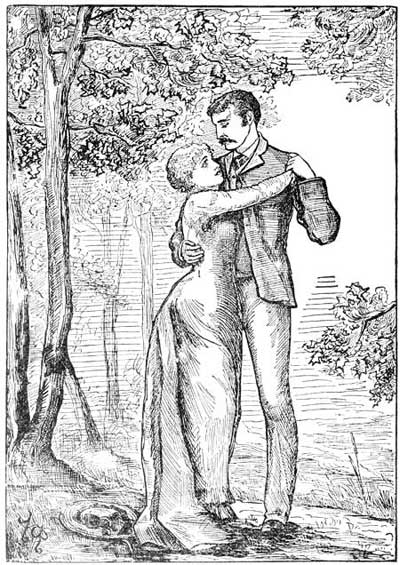
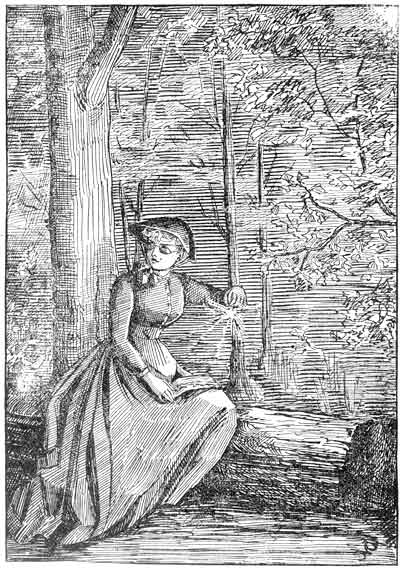
yesterday that she listened to his tender love words, beneath the
old tree in Oakley woods? Only yesterday that her step-father
was revealed in all his vileness,—his plots, his hopes, his fears.
Her mother's sad life laid bare before her; Aunt Hagar's story;
her defiance of the two men at Oakley; her flight; Clarence
Vaughan; the strange, great city; Olive Girard; and now—now,
just a dead blank, with no outlook, no hope.
And was this all since yesterday?
What was it, she wondered, that made people mad? Not
things like these; she was calm, very calm. She was calm;
too calm. If something would occur to break up this icy stillness
of heart, to convulse the numbed powers of feeling, and
shock them back into life before it was too late.
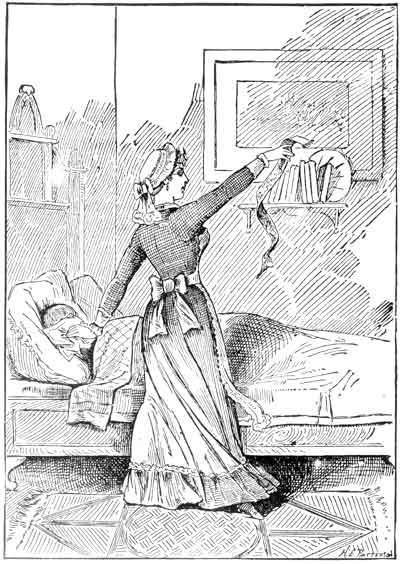
She waited patiently for the coming of her base lover, lying
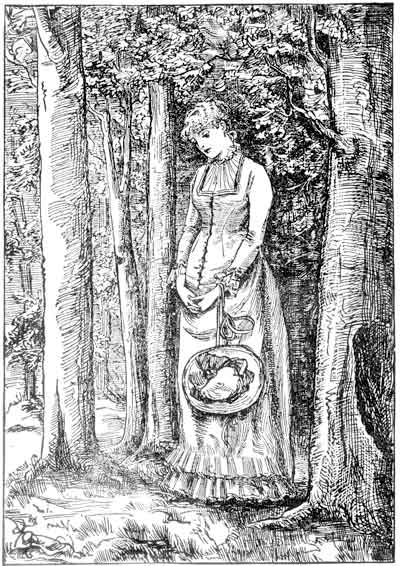
upon the soft divan, with her hands folded, and wondering if
she would feel much different if she were dead.
When the summons came, at last, she went quietly down to
greet the man who little dreamed that his reign in her heart
was at an end, and that his hold upon her life was loosening
fast.
When Madeline entered the presence of Lucian Davlin, she
took the initiatory step in the part she was henceforth to play.
And she took it unhesitatingly, as if dissimulation was to her no
new thing. Truly, necessity, emergency, is the mother of much
besides "invention." Entering, she gave him her hand with
free grace, and smiled up at him as he bade her good-morning.
He remarked on her pale cheeks, but praised the brightness
of her eyes, and accepted her explanation that the bustle and
the strangeness was unusual to her, as a natural and sufficient
reason for the pallor.
"You will soon grow accustomed to that," he said, as they descended
to the carriage, "and be the rosiest, fairest little woman
on the boulevard, for I mean to drive half the men jealous by
taking you there often."
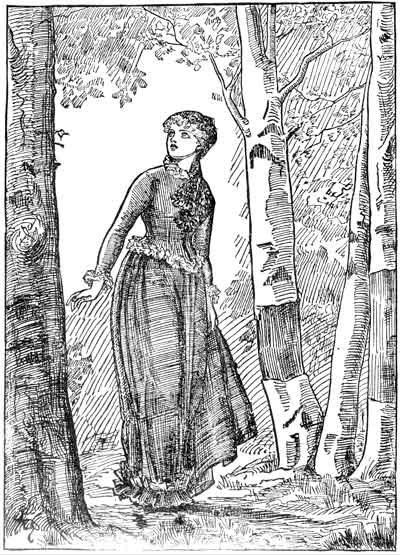
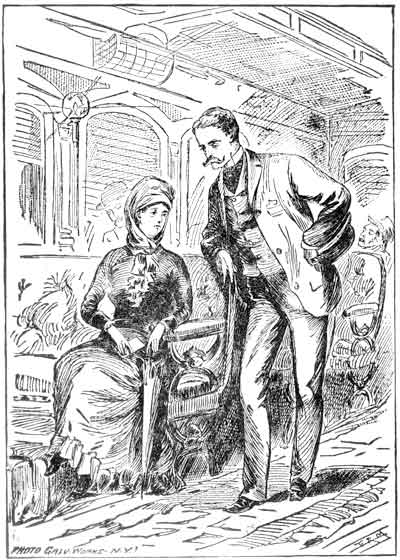
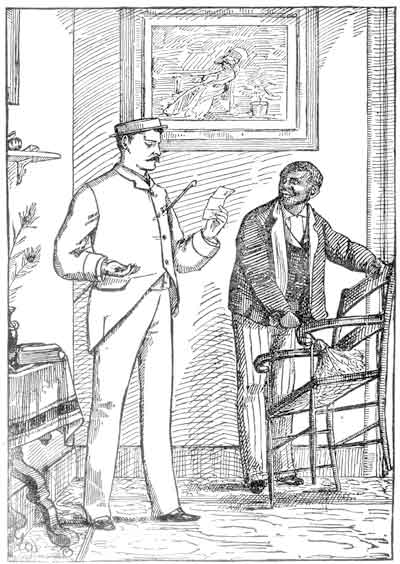
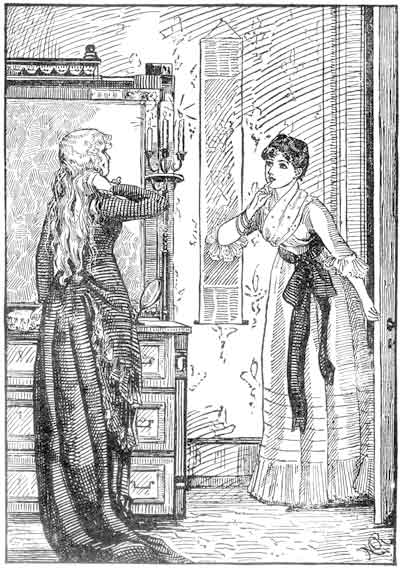
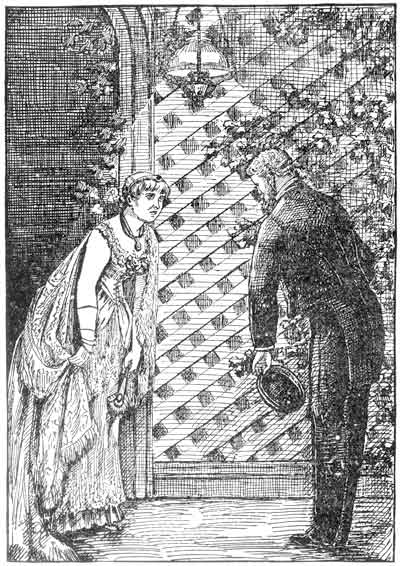
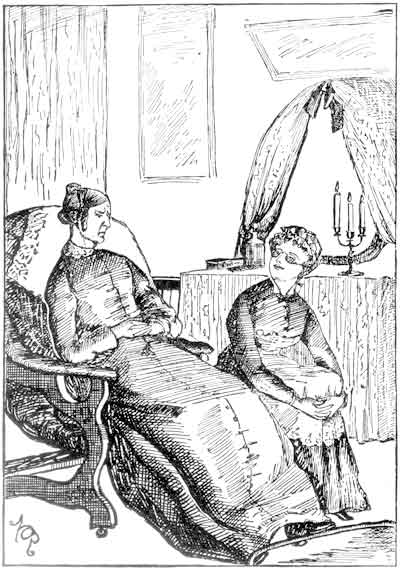
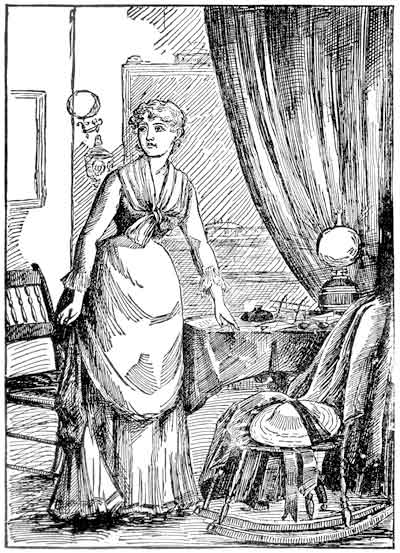
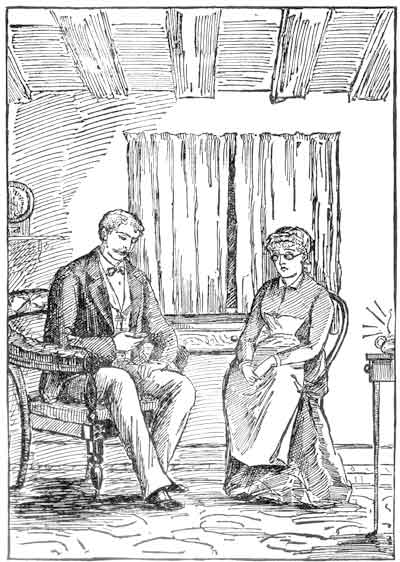
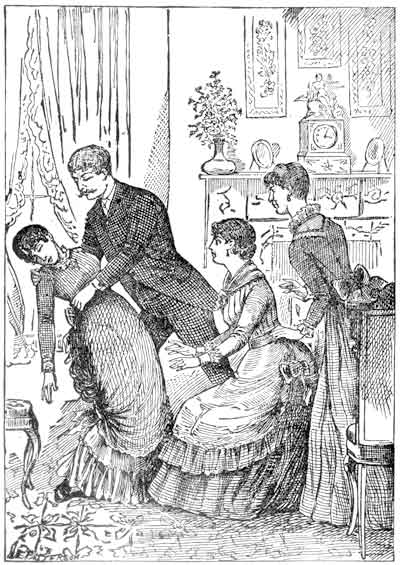
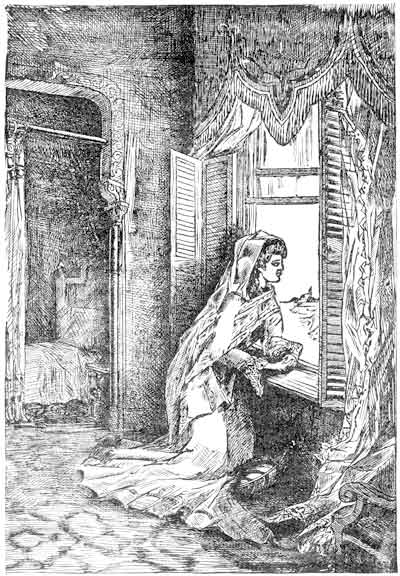
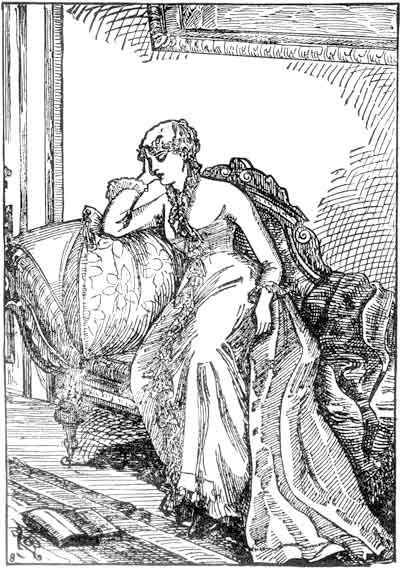 "She wondered if she would feel much different if she were dead."—page 76.
Madeline made no reply, and they entered the carriage.
Davlin was not surprised at her silence; he was prepared for
a little coyness; in fact, for some resistance, and expected to
have occasion for the specious eloquence always at his command.
Of course, the result would be the same,—he had no doubt of
that, and so in silence they reached their destination.
Up a broad flight of stairs, and then a door. Lucian rings,
and an immaculate colored servant appears, who seems as well
bred as an English baronet, and who expresses no surprise at
the presence of a lady there.
Up another flight of softly carpeted stairs, across a wide hall,
and lo! the abode of the sybarite, the apartments of the disciple
of Chance.
"Welcome to your kingdom, fair queen," says Lucian, as
they enter. "This is your abiding place, for a time, at least, and
I am your slave for always," and he kneels playfully before
her.
Madeline turns away, and, finding it easiest to do, in her then
state of mind, begins a careless tour of the rooms, making a
pretense of criticism, and finding in even this slow promenade
some relief from absolute quiet and silence.
She guarded her face lest it should display too much of that
locked, sullen calm underneath, and replied by an occasional
word and nod to his running comments upon the different
articles undergoing examination. Fingering carelessly the rare
ornaments upon a fine set of brackets, her eye rested upon an
elegant little gold mounted pistol. She turned away quickly,
and they passed to other things.
Her replies became more ready, and she began questioning
gravely about this or that, listening with childlike wonder to
his answers, and winning him into a pleasant bantering humor.
Finally he threw himself upon a chair, and selecting a cigar
proceeded to light it.
Madeline continued to flit from picture to statuette, questioning
with much apparent interest. At last, she paused again before
the bracket which held the tiny toy that had for her a fascination.
"What a pretty little pistol," she said. "Is it loaded?"
"I don't know," replied he, lazily. "Bring it to me; I will
see."
He was inwardly wondering at her cool acceptance of the
situation; and felt inclined to congratulate himself. Seeing her
look at the little weapon doubtfully, he laughed and strode to
her side, taking it in his hand.
"It is not loaded," he said. "Did you ever fire a pistol?"
"No; show me how to hold it."
He placed it in her hand, and showed her how to manipulate
the trigger, and to take aim.
"I should like to see it loaded," she said, at last.
"And so you shall."
He smiled, and crossing the room took from a little inlaid box
a handful of cartridges. Madeline watched him attentively, as
he explained to her the operation of loading. At length expressing
herself satisfied, and declining his invitation to try and
load it herself, she turned away.
Davlin extracted the cartridge from the pistol, and returned it
to its place, saying: "You might wish to practice at aiming, and
won't want it loaded."
"I shall not want such practice," she replied.
A rap at the door, and the servant announced that dinner was
come.
"I ordered our dinner here, to-day," explained Lucian,
"thinking it would be more cosy. You may serve it, Henry,"
to the servant.
Dinner was accordingly served, and Lucian found occasion
to criticise, very severely, the manner of his serving man. More
than once, his voice took on an intolerant tone.
Sitting opposite, Madeline saw the man, as he stood behind
his master's chair, dart upon him a look of hatred. Her lips
framed a smile quite new to them; and, after dessert was placed
upon the table and the man dismissed, she said:
"You don't like your servant, I judge?"
"Oh, he's as good as any," replied Lucian, carelessly. "They
are pretty much alike, and all need a setting back occasionally;—on
general principles, you know."
"I suppose so," assented Madeline, indifferently, as if the subject
had lost all interest for her.
Slowly the afternoon wore on, moments seeming hours to the
despairing girl. At length Lucian, finding her little inclined to
assist him in keeping up a conversation, said:
"I am selfish not to remember that you are very tired. I
will leave you to solitude and repose for a little time, shall I?"
"If you wish," she replied, wearily. "I suppose I need the
rest."
"Then I will look in upon some of my friends. I have almost
lost the run of city doings during my absence. Meantime,
ring for anything you may need, won't you?"
"I will ring;" and she looked, not at him, but at the bracket
beyond.
"Then good-by, little sweetheart. It is now four; I will be
with you at six."
He embraced her tenderly, and went out with that debonnair
grace which she had so loved. She looked after him with a
hungry, hopeless longing in her eyes.
"Oh, why does God make His foulest things the fairest?" she
moaned. "Why did He put love in our hearts if it must turn
our lives to ashes? Why must one be so young and yet so
miserable? Oh, mother, mother, are all women wronged like
us?"
Madeline arose and commenced pacing the floor restlessly,
nervously. She had come here with no fixed purpose, nothing
beyond the indefinite determination to defy and thwart the man
who had entrapped her. She had never for a moment feared
for her safety, or doubted her ability to accomplish her object.
A plan was now taking shape in her mind, and as she pondered,
she extended her march, quite unthinkingly, on into the adjoining
room, the door of which stood invitingly open. The first object
to attract her attention was the light traveling coat which Lucian
had worn on the previous day; worn when he was pleading his
suit under the trees of Oakley; and in a burst of anger, as if it
were a part of him she was thinking of so bitterly, she seized
and hurled it from her. As it flew across the room, something
fell from a pocket, almost at her feet.
She looked down at it; it was a telegram, the one, doubtless,
that had called him back to the city the day before. A business
matter, he had said. Into her mind flashed the words of Olive
Girard, "a professional gambler." She would see what this
"business" was. Stooping, she picked up the crumpled envelope,
and quickly devoured its contents.
Must see you immediately. Come by first train; am waiting at your
quarters.
Cora.
Madeline went back to the lighter, larger room, and seating
herself, looked about her. Again the words of Olive rung in
her ears.
"Cora!" she ejaculated. "He obeyed her summons, and
brought me with him. And she was here only last night—and
where has she gone? This must be the 'notorious,' the 'handsome.'
Ah, Lucian Davlin, this is well; this nerves me for the
worst! I shall not falter now. This is the first link in the chain
that shall yet make your life a burden."
She crossed the room and touched the bell.
"Now for the first real step," said Madeline, grimly.
The door opened and the dark face of Henry appeared, bowing
on the threshold.
"Come in, Henry, and close the door," said Madeline, pleasantly.
"I want you to do me a favor, if you will."
Henry came in, and stood waiting her order.
"Will you carry a note for me, Henry, and bring me back an
answer? I want you to take it, because I feel as if I could trust
you. You look like one who would be faithful to those who
were kind to you."
"Thank you, lady; indeed I would," said the man, in grateful
tones.
Madeline was quick to see the advantage to be gained by
possessing the regard and confidence of this man, who must,
necessarily, know so much that it was desirable to learn of the
life and habits of him, between whom and herself must be waged
a war to the very death.
She reasoned rapidly, and as rapidly arrived at her conclusions.
The first of those was, that Lucian Davlin, by his intolerance
and unkindness, had fitted a tool to her hand, and she,
therefore, as a preliminary step, must propitiate and win the
confidence of this same tool left by his master within her reach.
"And will you carry my letter, Henry, and return with an
answer as soon as you can? You will find the person at this
hour without any trouble."
"Master ordered me to attend to your wants," replied the
man, in a somewhat surly tone.
She understood this somber inflection, and said: "He 'ordered'
you? Yes, I see; is your master always as hard to please as to-day,
Henry? He certainly was a little unkind."
"He's always the same, madame," said the man, gloomily.
Her words brought vividly before his mind's eye the many instances
of his master's unkindness.
"I'm sorry he is not kind to you," said the girl, hypocritically.
"And I don't want you to carry this letter because he ordered
you. I want you to do it to oblige me, Henry, and it will make
me always your friend."
Ah, Henry, one resentful gleam from your eyes, as you stood
behind the chair of your tyrant, has given to this slight girl the
clue by which to sway you to her will. She was smiling upon
him, and the man replied, in gratitude:
"I'll do anything for you, madame."
"Thank you, Henry. I was sure I could trust you. Will
you get me some writing material, please?"
Henry crossed to the handsome davenport, and found it locked.
But when taking this precaution, Davlin overlooked the fact that
Cora's last gift—a little affair intended for the convenience of
travelers, being a combined dressing case and writing desk, the
dividing compartment of which contained an excellent cabinet
photograph of the lady herself, so enshrined as to be the first
thing to greet the eyes of whosoever should open the little receptacle—was
still accessible.
Failing to open the davenport, Henry turned to this; and
pressing upon the spring lock, exposed to the view of Madeline,
standing near, the pictured face of Cora. Spite of his grievances,
the sense of his duty was strong upon him, and he put himself
between the girl and the object of her interest. Not so quickly
but that she saw, and understood the movement. Stepping to
his side, she put out her hand, saying:
"What an exquisite picture—Madame Cora, is it not, Henry?"
She was looking him full in the eyes, and he answered, staring
in astonishment the while: "Yes, miss."
"She is very handsome," mused the girl, as if to herself: "left
just before my arrival, I think?" she added, at a venture.
Again her eyes searched his face, and again he gave a surprised
assent.
"Do you like her, Henry?" questioned she, intent on her purpose.
"She is just like him," he said, jerking his head grimly, while
his voice took again a resentful tone. "She thinks a man who
is black has no feelings."
He placed pen, ink and paper on the table as he answered,
and then looked to her inquiringly.
"You may wait here while I write, if you will," she said, and
took up the pen.
She had brought away from the G—— House, the two cards
of her would-be friends, and she now consulted them before she
asked.
"No. 52 —— street; is that far, Henry?"
"It's a five minutes' walk," he answered. "I can go and
come in twenty minutes, allowing time for an answer."
"Very good," she said, abruptly, and wrote rapidly:
Clarence Vaughan.
No. 52 —— street.
Sir—Having no other friend at hand, I take you at your word. I need
your aid, to rescue me from the power of a bad man. Will you meet
me, with a carriage, at the south corner of this block, in one hour, and
take me to Mrs. Girard, who has offered me a shelter? You know the
danger I wish to escape. Aid me "in the name of your mother."
Madeline "Weir."
This is what she penned, and looking up she asked: "What
is the number of this place, Henry?"
"91 Empire block," he replied; "C—— street."
She added this, and then folding and enclosing, addressed it
to Clarence Vaughan, M. D., etc.
"There, Henry, take it as quickly as you can; and some day
I will try and reward you."
She smiled upon him as she gave him the letter. He took it,
bowed low, and hurried away.
She listened until the sound of his footstep could be heard no
longer. Then rising quickly, she opened the receptacle that held
the portrait of the woman who, though unseen, was still an
enemy. Long she gazed upon the pictured face, and when at
last she closed the case, springing the lock with a sharp click,
she muttered between set teeth:
"I shall know you when I see you, madame."
Crossing to the pistol bracket, she took the little weapon in
her hand, and picking up one of the cartridges left by its careless
owner, loaded it carefully. Having done this she placed
the weapon in her pocket.
She paced to and fro, to and fro; nothing would have been
harder for her than to remain quiet then. Her eyes wandered
often to the tiny bronze clock on the marble above the grate.
Ten minutes; her letter was delivered, was being answered
perhaps;—fifteen; how slowly the moments were going!—twenty;
what if he should return, too soon? Instinctively she
placed her hand upon the pocket holding the little pistol.
Twenty-five minutes; what if her messenger should fail her?
And that card had clearly stated "office hours three to five."
Twenty-six; oh, how slow, how slow!—twenty-seven; had the
clock stopped? no;—twenty-eight—nine—half an hour.
Where was Henry?
She felt a giddiness creeping over her; how close the air was.
Her nerves were at their utmost tension; another strain upon
the sharply strung chords would overcome her. She felt this
vaguely. If she should be baffled now! She could take fresh
heart, could nerve herself anew, if aid came to her, but if he
should come she feared, in her now half frenzied condition, to
be alone, she was so strangely nervous, so weak!
How plainly she saw it, the face of Clarence Vaughan. Oh,
it was a good face! When she saw it again she could rest. She
had not felt it before, but she did need rest sorely.
Thirty-five minutes,—oh, they had been hours to her; weary,
weary time!
How many a sad watcher has reckoned the flying moments as
creeping hours, while sitting lonely, with heavy eyes, trembling
frame, and heart almost bursting with its weight of suspense—waiting.
Forty minutes—and a footstep in the passage! Her heart
almost stopped beating. It was Henry.
"I had to wait, as he was busy with a patient," said he,
apologetically, handing her the letter she desired.
Madeline tore open the missive with eager fingers, and read:
Miss Madeline W.:
Thank you for your faith in me. I will meet you at the place and time
appointed. Do not fail me. Respectfully,
C. Vaughan.
She drew a long breath of relief.
"Thank you, Henry. Now I shall leave this place; promise
me that you will not tell your master where I went or how.
Will you promise?"
"I will, miss," said the man, earnestly. "Is this all I can
do?"
"If you would be my true friend—if I might trust you,
Henry—I would ask more of you. But I should ask you to
work against your master. He has wronged me cruelly, and I
need a friend who can serve me as you can quite easily. I should
not command you as a servant, but ask you to aid me as a true
friend, for I think your heart is whiter than his."
And Henry was won. Starting forward, he exclaimed:
"He treats me as if I were a dog; and you, as if I were
white and a gentleman! Let me be your servant, and I will
be very faithful; tell me what I can do."
"Thank you, Henry; I will trust you. To-morrow, at noon,
call at Dr. Vaughan's office and he will tell you where you can
find me. Then come to me. You can serve me best by remaining
with your master, at present; and I will try, after I
have left this place, to reward you as you deserve."
"I will obey you, mistress," said the delighted servant. "I
shall be glad to serve where I can hear a kind word. And I
shall be glad to help you settle accounts with him. I will be
there to-morrow, no fear for me."
She turned, and put on her wrappings with a feeling of exultation.
He would come soon, smiling and triumphant, and
she would not be there! He should fret and wonder, question
and search, but when they met again the power should be on
her side.
She turned to the waiting servant, saying: "I am ready,
Henry."
He opened the door as if for a princess. Before Madeline
had lifted her foot from the carpet, her eyes became riveted
upon the open doorway.
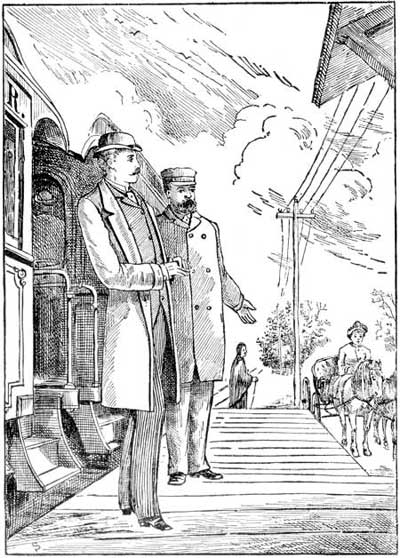
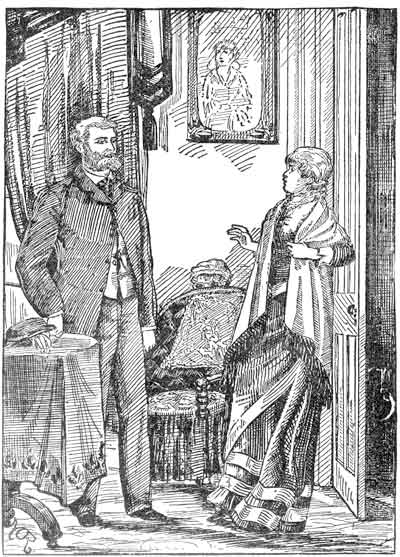
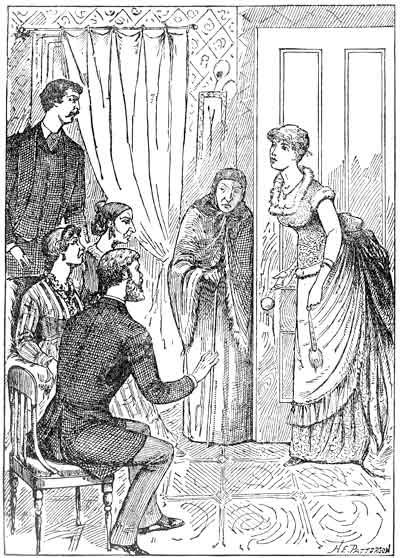
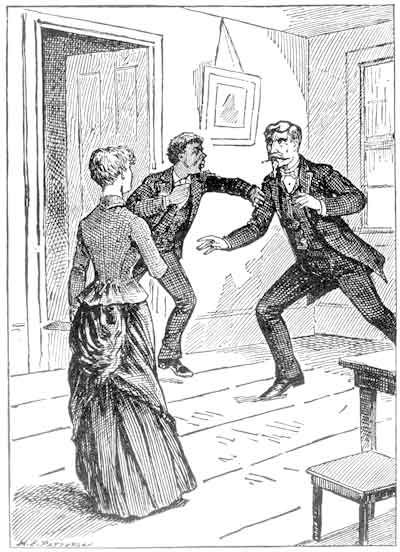
There, smiling and insouciant, stood Lucian Davlin!
Madeline stood like one in a nightmare, motionless and
speechless. Again, and more powerfully, came over her senses
that insidious, creeping faintness; that sickening of body and
soul together.
It was not the situation alone, hazardous as it certainly was,
which filled her with this shuddering terror; it was the feeling
that vitality had almost exhausted itself. She suddenly realized
the meaning of the awful lethargy that seemed benumbing her
faculties. The "last straw" was now weighing her down, and,
standing mute and motionless she was putting forth all her will
power to comprehend the situation, grasp and master it.
Like a dark stone image Henry stood, his hand upon the open
door, his eyes fastened upon the man blocking the way.
Davlin, whose first thought had been that the open door was
to welcome his approach, realized in an instant as he gazed upon
Madeline, that he was about to be defied. There was no mistaking
the expression of the face, so white and set. He elevated
his eyebrows in an elaborate display of astonishment.
"Just in time, I should say," removing his hat with mock
courtesy, and stepping across the threshold. "Not going out
without an escort, my dear? Surely not. Really, I owe a debt
of gratitude to my friends down town, for boring me so insufferably,
else I should have missed you, I fear."
No answer; no change in the face or attitude of the girl before
him.
"Close that door, sir, and take yourself off," he said, turning
to Henry.
Remembering her words, "You can serve me best here,"
Henry bowed with unusual humility, and went out.
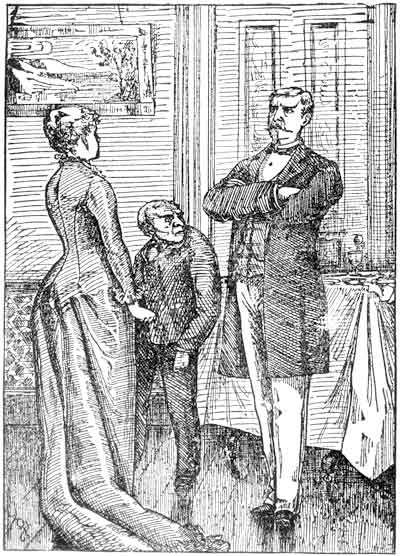
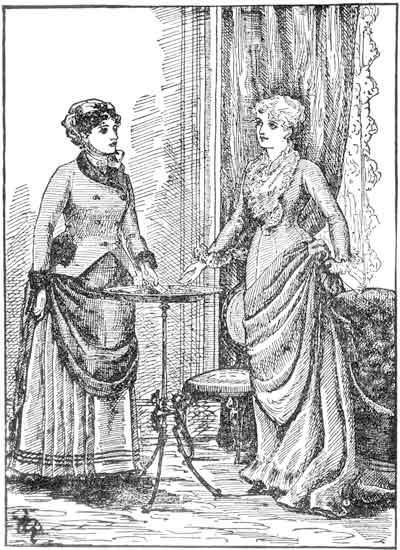
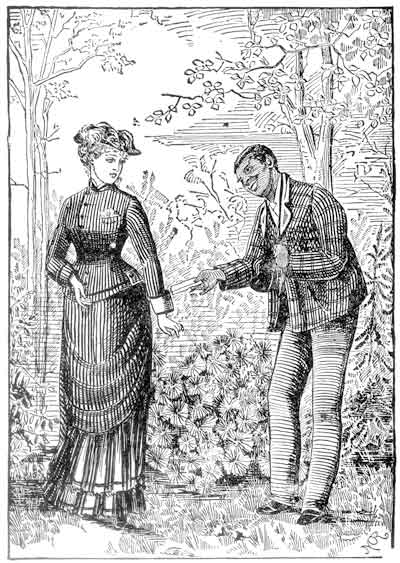
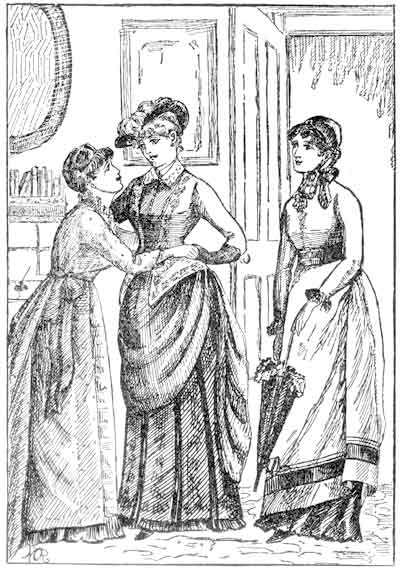
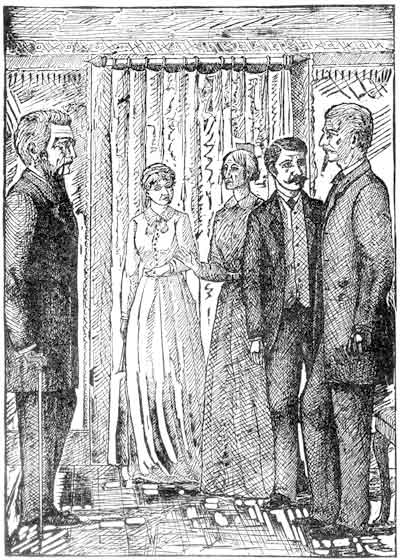
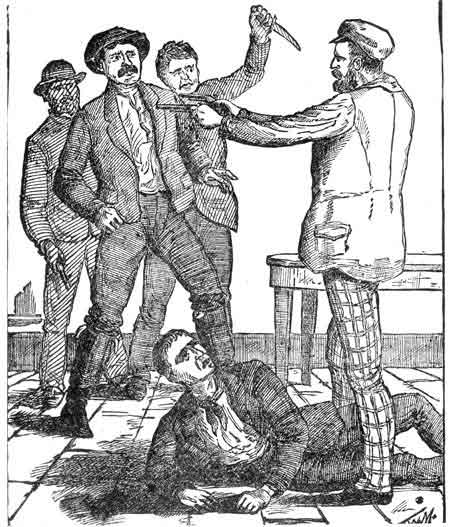
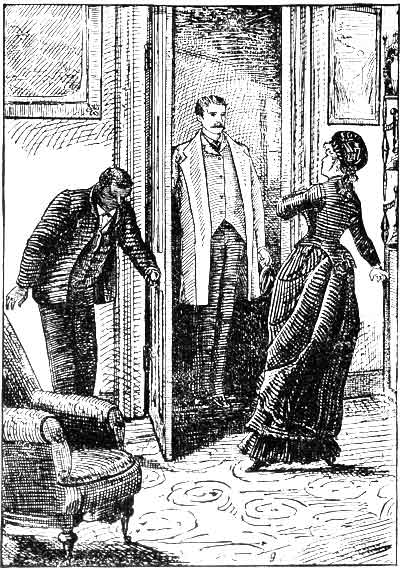 "There, smiling and insouciant, stood Lucian Davlin!"—page 88.
"I don't think she is afraid of him," he muttered, as he went
down the hall; "anyhow, I won't be far away, in case she
needs me."
Lucian Davlin folded his arms with insolent grace, and leaning
lazily against the closed door, gazed, with his wicked half
smile, upon the pale girl before him.
Thus for a few moments they faced each other, without a
word. At length, she broke the silence. Advancing a step,
she looked him full in the face and said, in a calm, even tone:
"Open that door, sir, and let me pass."
"Phew—w—w!" he half whistled, half ejaculated, opening
wide his insolent eyes. "How she commands us; like a little
empress, by Jove! Might the humblest of your adorers be permitted
to ask where you were going, most regal lady?"
"Not back to the home I left for the sake of a gambler and
roue," she said, bitterly.
"Oh," thought he, "she has just got her ideas awakened on
this subject: believed me the soul of honor, and all that. Only
a small matter this, after all."
"Don't call hard names, little woman," he said aloud. "I'm
not such a very bad man, after all. By the way, I shouldn't
have thought it exactly in your line, to order up my servant for examination
in my absence."
"I am not indebted to your servant for my knowledge concerning
you, sir. I wish to leave this place; stand aside and let
me pass."
The red flush had returned to her cheeks, the dangerous
sparkle to her eyes; her courage and spirits rose in response to
his sneering pleasantries. Her nerves were tempered like steel.
He little dreamed of the courage, strength and power she could
pit against him.
He dropped one hand carelessly, and inserted it jauntily in his
pocket.
"Zounds; but you look like a little tigress," he exclaimed,
admiringly. "Really, rage becomes you vastly, but it's wearisome,
after all, my dear. So drop high tragedy, like a sensible
girl, and tell me what is the meaning of this new freak."
"I will tell you this, sir: I shall leave this place now, and I
wish never to see your face again. Where I go is no concern
of yours. Why I go, I leave to your own imagination."
"Bravo; what a little actress you would make! But now
for a display of my histrionic talents. Leave this place, against
my will, you can not; and I wish to see your face often, for
many days to come. Where you go I must go, too; and why
you go, is because of a prudish scruple that has no place in the
world you and I will live in."
"The world you live in is not large enough for me too, Lucian
Davlin. And you and I part, now and forever."
"Not so fast, little one," he answered, in his softest, most persuasive
tone. "See, I am the same lover you pledged yourself
to only yesterday. I adore you the same as then; I desire to
make you happy just the same. You have put a deep gulf between
yourself and your home; you can not go back; you
would go out from here to meet a worse fate, to fall into worse
hands. Come, dear, put off that frown."
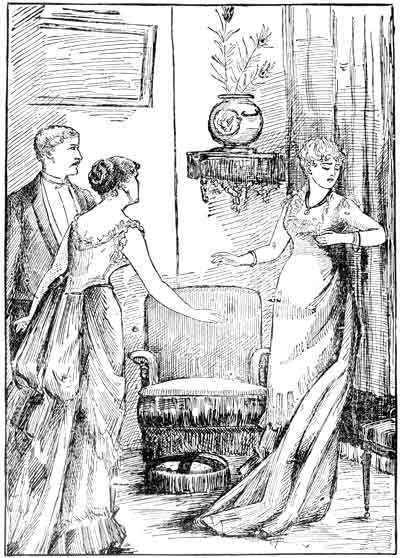
He made a gesture as if to draw her to him. She sprang
away, and placing herself at a distance, looked at him over a
broad, low-backed chair, saying:
"Not a step nearer me, sir, and not another word of your
sophistry. I will not remain here. Do you understand me?
I will not!"
Lucian dragged a chair near the door, and throwing himself
lazily into it, surveyed the enraged girl with a look of mingled
astonishment, amusement, and annoyance.
"Really, this is rather hard on a fellow's patience, my lady.
Not a step nearer the door, my dear; and no more defiance, if
you please. You perceive I temper my tragedy with a little
politeness," he added, parenthetically. "I will not permit you
to leave me; do you hear me? I will not!"
His tone of aggressive mockery was maddening to the desperate
girl. It lent her a fresh, last impulse of wild, defiant
energy. There was not the shadow of a fear in her mind or
heart now. The rush of outraged feeling took full possession of
her, and, for a second, deprived her of all power of speech or
action. In another instant she stood before him, her eyes blazing
with wrath, and in her hand, steadfast and surely aimed, a
tiny pistol—his pistol, that he had taught her to load and aim
not two short hours before!
He was not a coward, this man; and rage at being thus
baffled and placed at a disadvantage by his own weapon, drove
all the mockery from his face.
He gave a sudden bound.
There was a flash, a sharp report, and Lucian Davlin reeled
for a moment, his right arm hanging helpless and bleeding.
Only for a moment, for as the girl sprang past him, he wheeled
about, seized her with his strong left arm, and holding her close
to him in a vice-like clutch, hissed, while the ghastly paleness
caused by the flowing blood overspread his face:
"Little demon! I will kill you before I will lose you now!
You—shall—not—esca—"
A deathly faintness overcame him, and he fell heavily; still
clasping the girl, now senseless like himself.
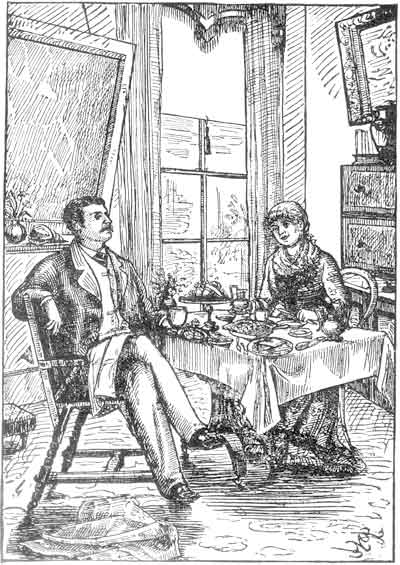
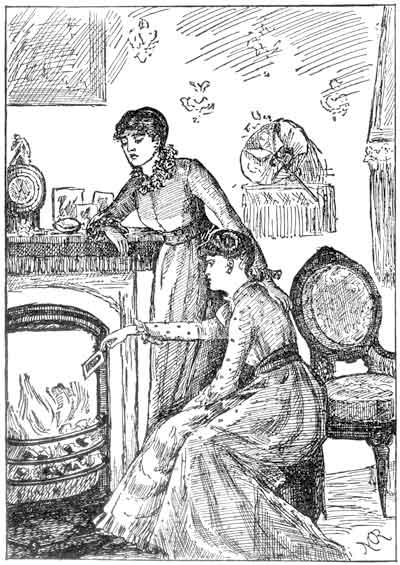
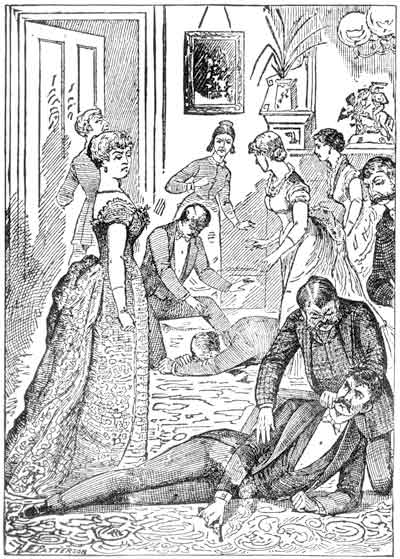
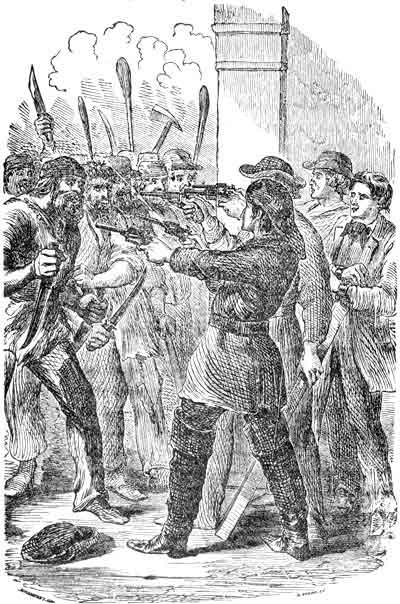
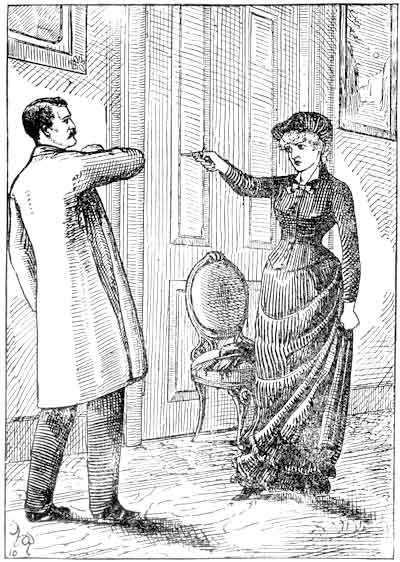 "In her hand, steadfast and
surely aimed, a tiny pistol—"—page 92.
"In her hand, steadfast and
surely aimed, a tiny pistol—"—page 92.
Hearing the pistol shot, and almost simultaneously a heavy
fall, Henry hurried through the long passage and threw open
the door. One glance sufficed, and then he rushed down the
stairs in frantic haste.
Meantime, Clarence Vaughan, punctual to the time appointed,
had driven rapidly to the spot designated by Madeline. He
was about to alight from the carriage, when he drew back suddenly,
and sat in the shadow as a man passed up the street.
It was Lucian Davlin, and he entered the building bearing
the number Madeline had given in her note.
Instantly Vaughan comprehended the situation. She had
sent for aid in this man's absence, and his return might frustrate
her plans. Pondering upon the best course to pursue, he descended
from the carriage, and paced the length of the block.
Turning in his promenade, his ear was greeted by a pistol shot.
Could it come from that building? It sounded from there certainly.
It was now five minutes past the time appointed; could
it be there was foul play? He paused at the foot of the stairs,
irresolute.
Suddenly there was a rush of feet, and Henry came flying
down, the whites of his eyes looking as if they would never resume
their natural proportions. Clarence intercepted the man
as he essayed to pass, evidently without having seen him.
"Oh, sir!—Oh, doctor, come right up stairs, quick, sir," he
exclaimed.
"Was that shot from here, my man?" inquired Doctor
Vaughan, as he followed up the stairs.
"Yes, sir," hurrying on.
"Any people in the building besides your master and the lady?"
"No, sir; not at this time. This way, sir."
He threw open the door and stepped back. Entering the
room, this is what Clarence Vaughan saw:
Lying upon the floor in a pool of blood, the splendid form of
Lucian Davlin, one arm dripping the red life fluid, the other
clasping close the form of a beautiful girl. His eyes were closed
and his face pallid as the dead. The eyes of the girl were staring
wide and set, her face expressing unutterable fear and horror,
every muscle rigid as if in a struggle still. One hand was
clenched, and thrown out as if to ward off that death-like grasp,
while the other clutched a pistol, still warm and smelling of
powder.
It was the work of a moment to stop the flow of blood, and
restore the wounded man to consciousness. But first he had removed
the insensible girl from Davlin's grasp, laid her upon a
bed in the inner room and, removing the fatal weapon from her
hand, instructed Henry how to apply the remedies a skilful surgeon
has always about him, especially in the city.
At the first sure symptoms of slowly returning life, Doctor
Vaughan summoned Henry to look after his master, whom he
left, with rather unprofessional alacrity, to attend to the fair patient
in whose welfare he felt so much interest. As he bent over
the still unconscious girl, his face was shadowed with troubled
thought. She was in no common faint, and feeling fully
assured what the result would be, he almost feared to see the first
fluttering return of life.
At last a shudder agitated her form, and looking up with just
a gleam of recognition, she passed into another swoon, thence
to another. Through long weary hours she only opened her
eyes to close them, blinded with the vision of unutterable woe;
and so the long night wore away.
Dr. Vaughan had given brief, stern orders, in accordance with
which Lucian Davlin had entrusted his wound to another surgeon
for dressing, and then, still in obedience to orders, had swallowed
a soothing potion and betaken himself to other apartments.
Henry had summoned a trusty nurse well known to Clarence
Vaughan, to assist him at the bedside of Madeline.
In the gray of morning, pallid and interesting, with his arm
in a sling, Lucian reappeared in the sick room. Evidently he
had not employed all of the intervening time in slumber, for his
course of action seemed to have been fully matured.
"She won't be able to leave here for many days, I should fancy?"
he half inquired in a low tone, sinking languidly into a sleepy-hollow,
commanding a view of the face of the patient, and the
back of the physician.
"Not alive," was the brief but significant answer.
"Not alive! Great heavens, doctor, don't tell me that my
miserable accident will cost the little girl her life!"
"Ah! your accident: how was that?" bending over Madeline.
"Why, you see," explained Davlin, "She picked up the
pistol, and not being acquainted with the use of fire-arms, desired
to investigate under my instructions. Having loaded it,
explaining the process by illustration, she, being timid, begged
me to put it up. Laughing at her fear, I was about to obey,
when moving around carelessly, my hand came in contact with
that chair, setting the thing off. The sight of my bleeding arm
frightened her so that I saw she was about to faint. As I caught
her I myself lost consciousness, and we fell together. But how
will she come out, doctor? tell me that; poor little girl!"
"She will come out from this trance soon, to die almost immediately,
or to pass through a fever stage that may result fatally
later. Her bodily condition is one of unusual prostration from
fatigue; and evidently, she has been sustaining some undue excitement
for a considerable time."
"Been traveling, and pretty well tired with the journey.
That, I suppose, taken with this pistol affair—but tell me, doctor,
what she will need, so that I may attend to it immediately."
"If she is living at noon," said Dr. Vaughan, reflectively, "it
will be out of the question to remove her from here, without
risking her life for weeks to come. If she comes out of this, and
you will leave her in my hands, I will, with the aid of this good
woman," nodding toward the nurse, "undertake to pull her
through. It will be necessary that she have perfect quiet, and
sees no face that might in any manner excite her, during her illness
and convalescence."
Davlin mused for a few moments before making answer. He
did not care to excite remark by calling in unnecessary attendants.
Dr. Vaughan he knew by reputation as a skilful physician.
As well trust him as another, he thought, and it was no
part of his plan to let this girl die if skill could save her.
In answer to his natural inquiry as to how the doctor was so
speedily on the spot when needed, Henry had truthfully replied
that he knew the medical man by sight, and that, fortunately, he
was passing when he ran down to the street for assistance. Davlin
was further convinced that he, Henry, knew nothing save that
the young lady rang for him to show her out, and he, according
to orders, had obeyed.
"Well, sir," Davlin said, at last, "I shall leave the lady and
the premises entirely in your hands, as soon as the crisis has
passed. Then, as my presence might not prove beneficial,
while I carry this arm in a sling, at least, I will run down into
the country for a few days. My man, here, is entirely at your
disposal. Don't spare any pains to pull her through safely,
doctor. I will look in again at noon."
He rose and went softly out of the room, the doctor having
answered him only by a nod of assent.
"Zounds, how weak I feel," he ejaculated. "I hope the girl
won't die. Anyhow, I have no notion of figuring at a death-bed
scene. So I'll just keep myself out of the way until the
thing is decided. Then, I'll run down and let Cora coddle
me up a bit. I can explain my wounded arm as the result of
a little affair at the card-table."
Noon came, and slowly, slowly, stern Death relaxed his grasp
upon the miserable girl, for Death, like man, finds no satisfaction
in claiming willing victims. Slowly the life fluttered back
to her heart; and because Death had yielded her up, and to retain
it would be to lose her life, reason forsook her.
Under the watchful care of the skilled nurse, and the ministrations
of the young physician, she now lay tossing in the delirium
of fever.
Nothing worse to fear, for days at least, reported the doctor.
So the afternoon train bore Lucian Davlin away from the
city and his victim, to seek repose and diversion in the society of
his comrade, Cora.
"She will come out of this now, I think," he muttered.
"Then—Oh! I'll tame your proud spirit yet, my lady! I
would not give you up now for half a million."
And he meant it.
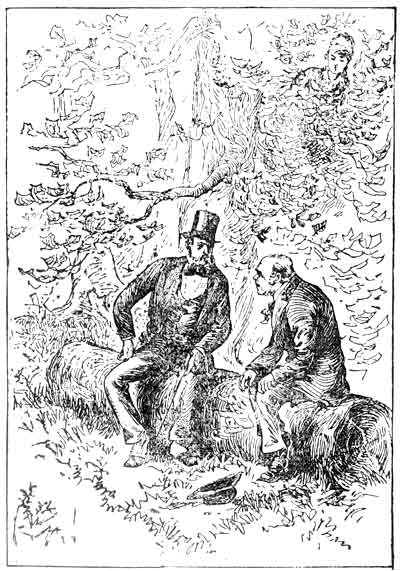
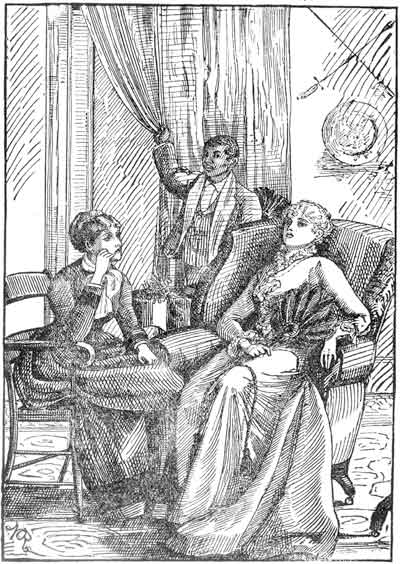
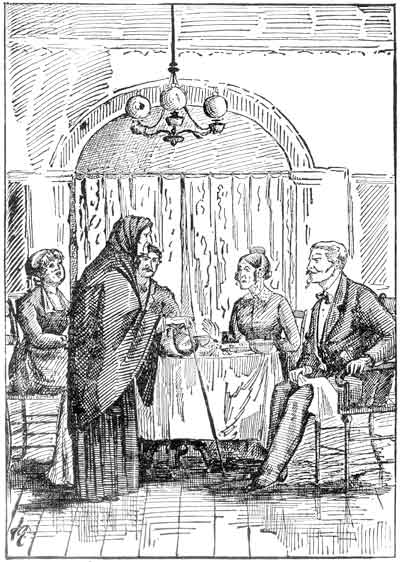
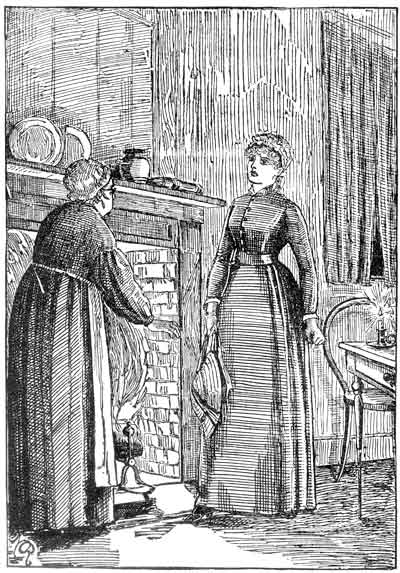
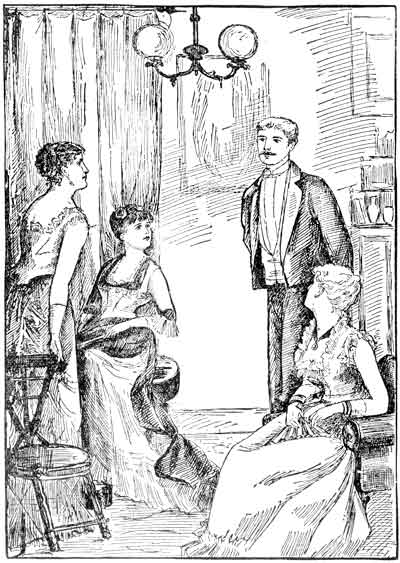
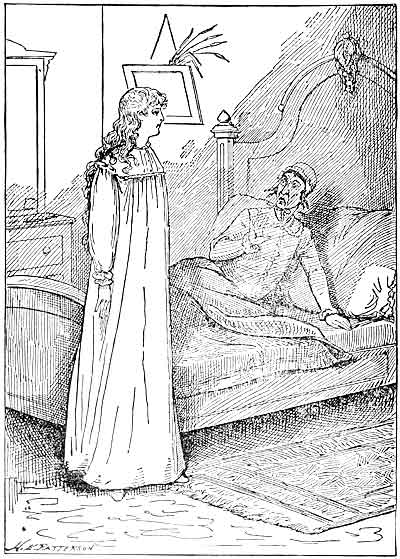
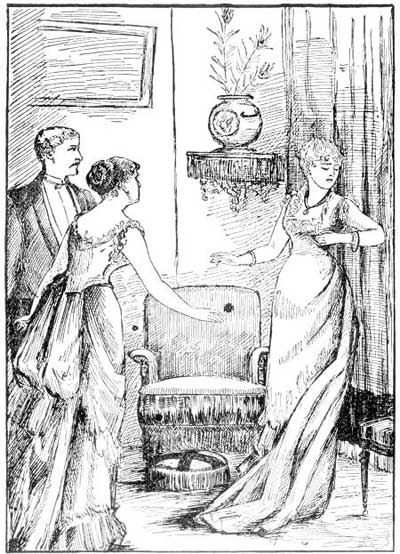 "Yes," she cried, wildly, "I know; you need not say it"—page 219.