The cover image was created by the transcriber and is placed in the public domain.
MADAME ROLAND
A BIOGRAPHICAL STUDY
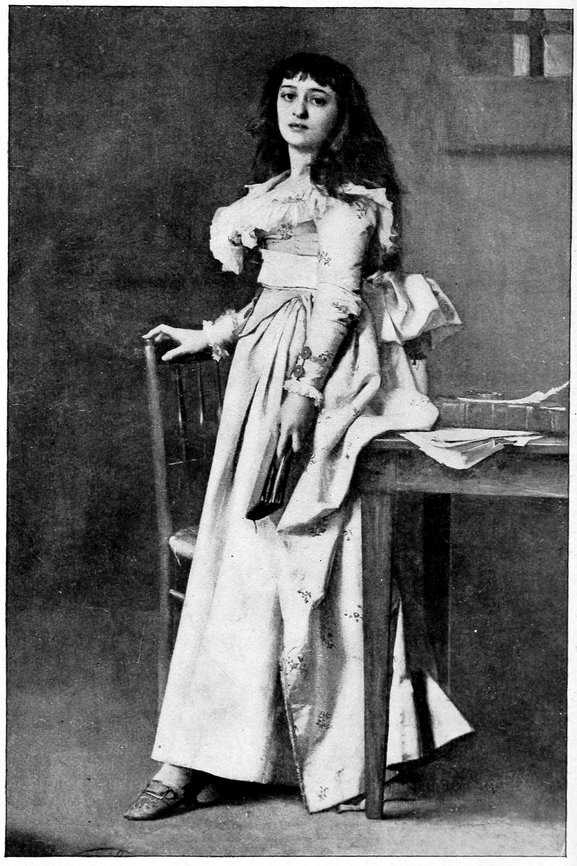
MADAME ROLAND AT THE CONCIERGERIE.
From a painting by Jules Goupil, now in the museum of Amboise.
BY
IDA M. TARBELL
NEW YORK
CHARLES SCRIBNER’S SONS
1896
COPYRIGHT, 1896, BY
CHARLES SCRIBNER’S SONS
Norwood Press
J. S. Cushing & Co.—Berwick & Smith
Norwood Mass. U.S.A.
To my dear Friend
MADAME CÉCILE MARILLIER
PREFACE
vii
Some eight years ago I undertook a study of the
women of the French Revolution, my object
being merely to satisfy myself as to the value of
their public services in that period. In the course
of my studies I became particularly interested in
Madame Roland, and when five years ago I found
myself in Paris for an extended period, I decided
to use my leisure in making a more careful investigation
of her life and times than I had been able to
do in America. The result of that study is condensed
in this volume.
Much of the material used in preparing the book
is new to the public. The chapter on Mademoiselle
Phlipon’s relations with M. Roland and of their
marriage has been written from unpublished letters,
and presents a very different view of that affair
from that which her biographers have hitherto given,
and from that which she herself gives in her Memoirs.
The story of her seeking a title with its privileges in
Paris in 1784 has never before been told, the letters
in which the details of her search are given never
having been published. Those of her biographers
who have had access to these letters have been too
viiiardent republicans, or too passionate admirers of their
heroine, to dwell on an episode of her career which
seemed to them inconsistent with her later life.
The manuscripts of the letters from which these
chapters have been written are now in the Bibliothèque
Nationale of Paris. They were given to the
library in 1888, by Madame Faugère, the widow
of M. P. Faugère, to whom they had been given by
Madame Champagneux, only daughter of Madame
Roland, that he might prepare a satisfactory edition
of her mother’s works, and write a life of her father.
M. Faugère finished his edition of Madame Roland’s
writings, but he died before completing his life of
M. Roland.
Much of the material used in the book I have obtained
from the descendants of Madame Roland, now
living in Paris. My relations with them came about
through that distinguished scholar and gentleman,
the late James Darmesteter. Learning that I was
interested in Madame Roland, he kindly sent me
to her great-grandson M. Léon Marillier, a professor
in the École des Hautes Études, of Paris.
M. Marillier and his wife were of the greatest service
to me, called my attention to the manuscripts which
Madame Faugère had turned over to the Bibliothèque,
and which had just been catalogued, and gave me for
examination a large quantity of letters and cahiers
from Madame Roland’s girlhood. There also I met
their mother, Madame Cécile Marillier. To her I
owe a debt of gratitude for sympathy and help,
ixwhich I can never repay. Madame Marillier gave
me freely the family legends of her grandmother,
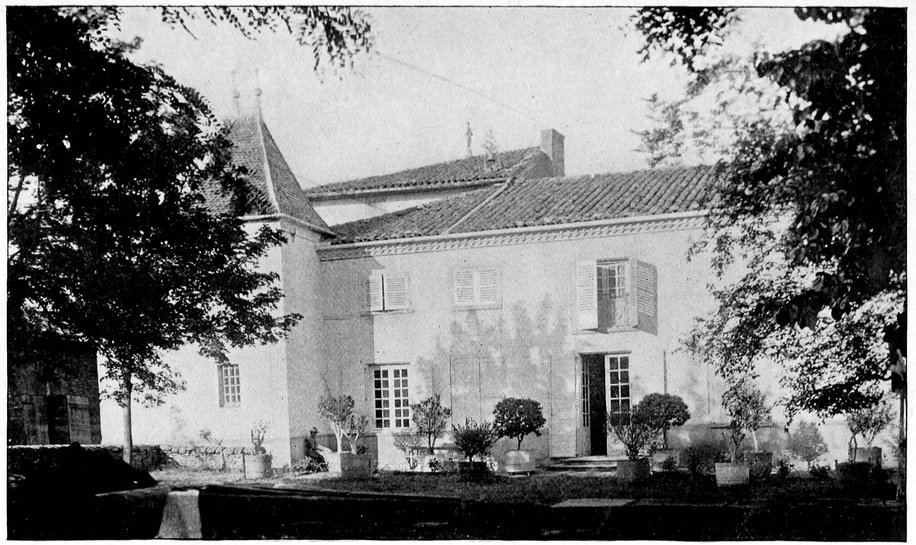
and in May, 1892, I spent a fortnight at Le Clos,
the family home of the Rolands, where Madame
Roland passed her happiest, most natural years.
The old place is rife with memories of its former
mistress, and it was there and afterwards in Villefranche
that I found material for Chapters IV.
and V.
I cannot close this introductory word without
acknowledging, too, my indebtedness to the librarians
of the Bibliothèque Nationale, of Paris. During three
years I worked there almost daily, and I was treated
with uniform courtesy and served willingly and
intelligently. Indeed, I may say the same for all
libraries and museums of Paris where I had occasion
to seek information.
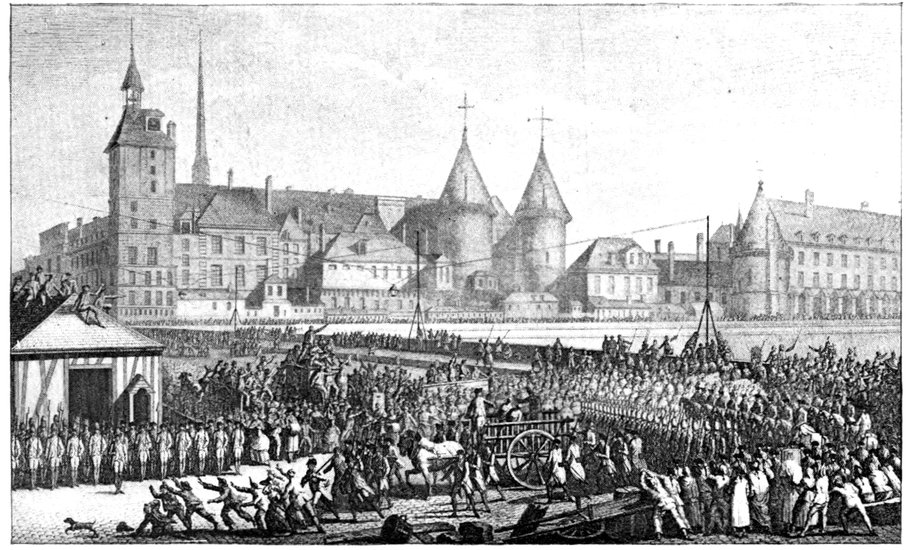
The Conciergerie in 1793—Prison where Madame Roland passed the last eight days of her captivity, and from which she went to the guillotine. Pont au Change in the foreground
Since the days when all of the city of Paris, save
a few mills, fortresses, and donjon-towers, was to
be found on the Île de la Cité, the western end of
that island has been the quarter of the gold and silver
smiths. Here, in the olden times, when this part
of the island was laid out in gardens and paths, the
sellers of ornaments and metal vessels arranged their
wares on the ground or in rude booths; later when
peaked-roofed, latticed-faced buildings filled the space,
these same venders opened their workshops in them;
later still, when good King Henry IV. filled up this
western end, built the Pont Neuf and put up the two
fine façades of red brick and stone—mates for the
arcades of the Place Royale—the same class continued
here their trade. Even to-day, he who knows
Paris thoroughly seeks the neighborhood of the Quai
de l’Horloge and the Quai des Orfèvres for fine
silverware and jewels.
Among the master engravers who in the latter part
of the eighteenth century plied their trade in this
2quarter was one Pierre Gatien Phlipon. His shop
was in one of the houses of King Henry’s façade—a
house still standing almost intact, although the
majority of them have been replaced or rebuilt so as
to be unrecognizable—that facing the King’s statue
on the west and looking on the Quai de l’Horloge on
the north.
M. Phlipon’s shop was in one of the best situations
in Paris. The Pont Neuf, on which his house
looked, was the real centre of the city. Here in
those days loungers, gossips, recruiting agents, venders
of all sorts, saltimbanques, quacks, men of
fashion, women of pleasure, the high, the low, tout
Paris, in short, surged back and forth across the
bridge. So fashionable a promenade had the place
become that Mercier, the eighteenth-century gossip,
declared that when one wanted to meet a person in
Paris all that was necessary to do was to promenade
an hour a day on the Pont Neuf. If he did not find
him, he might be sure he was not in the city.
Engraver by profession, M. Phlipon was also a
painter and enameller. He employed several workmen
in his shop and received many orders, but he
had an itching for money-making which led him
to sacrifice the artistic side of his profession to the
commercial and to combine with his art a trade in
jewelry and diamonds. We may suppose, in fact,
that the reason M. Phlipon had removed his shop to
the Pont Neuf, instead of remaining in the Rue de
la Lanterne, now Rue de la Cité, near Notre Dame,
3where he lived until about 1755, was because he saw
in the new location a better opportunity for carrying
on trade.
As his sacrifice of art to commerce shows, M.
Phlipon was not a particularly high-minded man.
He was, in fact, an excellent type of what the small
bourgeoisie of Paris was, and is to-day,—good-natured
and vain, thrifty and selfish, slightly common in his
tastes, not always agreeable to live with when crossed
in his wishes, but on the whole a respectable man,
devoted to his family, with too great regard for what
his neighbors would say of him to do anything flagrantly
vulgar, and too good a heart to be continually
disagreeable.
His vanity made him fond of display, but it kept
him in good company. If he condescended to trade,
he never condescended to traders, but carefully preserved
the relations with artists, painters, and sculptors
which his rank as an engraver brought him.
“He was not exactly a high-minded man,” said his
daughter once, “but he had much of what one calls
honor. He would have willingly taken more for a
thing than it was worth, but he would have killed
himself rather than not to have paid the price of
what he had bought.” What M. Phlipon lacked
in dignity of character and elevation of sentiments,
Madame Phlipon supplied—a serene, high-minded
woman, knowing no other life than that of
her family, ambitious for nothing but duty. She is
a perfect model for the gracious housewife in La mère
4laborieuse and Le Bénédicité of Chardin, and her face
might well have served as the original for the exquisite
pastel of the Louvre, Chardin’s wife.
Madame Phlipon’s marriage had been, as are the
majority of her class, one of reason. If she had
suffered from a lack of delicacy on the part of her
husband, had never known deep happiness or real
companionship, she had, at least, been loved by the
rather ordinary man whom her superiority impressed,
and her home had been pleasant and peaceful.
The Phlipons led a typical bourgeois life. The
little home in the second story of the house on the
Quai de l’Horloge contained both shop and living
apartments. As in Paris to-day the business and
domestic life were closely dovetailed. Madame
Phlipon minded the work and received customers
when her husband was out, helped with the accounts,
and usually had at her table one or more of the
apprentices. Their busy every-day life was varied
in the simple and charming fashion of which the
French have the secret, leisurely promenades on
Sunday, to Saint-Cloud, Meudon, Vincennes, an hour
now and then in the Luxembourg or Tuileries gardens,
an occasional evening at the theatre. As the
families of both Monsieur and Madame Phlipon
were of the Parisian bourgeoisie they had many
relatives scattered about in the commercial parts of
the city, and much animation and variety were added
to their lives by the constant informal visiting they
did among them.
5The chief interest of the Phlipon household was
centred in its one little girl—the only child of
seven left—Marie-Jeanne, or Manon, as she was
called for short. Little Manon had not been born
in the house on the Quai de l’Horloge, but in
the Rue de la Lanterne (March 18, 1754), and the
first two years of her life had been spent with a
nurse in the suburbs of Arpajon. She was already
a happy, active, healthy, observant child when she
was brought back to her father’s home. The change
from the quiet country house and garden, all of the
world she had known, to the shifting panorama of
the Seine and the Pont Neuf made a vivid impression
upon her. The change, in fact, may be counted as the
first step in her awakening. It quickened her power
of observation and aroused in her a restless curiosity.
Never having known her mother until now, she
was almost at once taken captive by the sweet, grave
woman who guarded her with tenderest care, yet
demanded from her implicit obedience. Madame
Phlipon obtained over the child a complete ascendency
and kept it so long as she lived. The father,
on the contrary, never was able to win from his
little daughter the homage she gave her mother.
Monsieur Phlipon was often impatient and arbitrary
with Manon. The child was already sufficiently
developed when she began to make his acquaintance
to discriminate dimly. While she was pliable to
reason and affection, she was obstinate before force
and impatience. She recognized that somehow they
6were illogical and unjust and she would endure but
never yield to them. Thus among Manon’s first
experiences was a species of hero-worship on one
hand, of contempt for injustice on the other.
An incessant activity was one of the little girl’s
natural qualities. This and her curiosity explain
how she came to learn to read without anybody
knowing exactly when. By the time she was four
years old nothing but the promise of flowers tempted
her away from her books, unless, indeed, it was
stories; and with these the artist friends of M. Phlipon
often entertained her, weaving extravagances
by the hour, varying the pastime by repeating
rhymes to her—an amusement which was even
more entertaining to them since she repeated them
like a parrot.
Madame Phlipon was a sincere and ardent Catholic
and she took advantage of the eager activity of
little Manon to teach her the Old and New Testament
and the catechism. When the child was seven
years old, she was sent to the class to be prepared
for her first communion. Here she speedily distinguished
herself, carrying away the prizes, much to
the glory of her uncle Bimont, a young curé of the
parish charged with directing the catechism.
M. Phlipon and his wife, delighted with the child’s
precocity, gave her masters,—one to teach her to
write and to give her history and geography, another
for the piano, another for dancing, another
for the guitar. M. Phlipon himself gave her drawing,
7and the Curé Bimont Latin. She attacked these
duties eagerly,—getting up at five in the morning
to copy her exercises and do her examples,—active
because she could not help it.
But her real education was not what she was
getting in these conventional ways. It was what
the books she read gave her. These were of the
most haphazard sort: the Bible in old French, to
which she was greatly attached, the Lives of the
Saints, The Civil Wars of Appias, Scarron, the Memoirs
of Mademoiselle de Montpensier, a treatise on
Heraldry, another on Contracts, many travels, dramas
of all sorts, Télémaque, Jerusalem Delivered, even
Candide.
The child read with passionate absorption. At
first it was simply for something to do, as she did
her exercises or fingered her guitar; but soon she
began to feel strongly and she sought in her books
food for the strange new emotions which stirred her
heart, brought tears to her eyes, and awakened her
to the mysteries of joy and sorrow long before she
was able to call those emotions by name.
In the motley collection of books read by Manon
at this period one only made a life-long impression
upon her,—it was Dacier’s Plutarch. No one can
understand the eighteenth century in France without
taking into consideration the profound impress
made upon it by Plutarch’s Lives. The work was the
source of the dreams and of the ambitions of numbers
of the men who exercised the greatest influence
8on the intellectual and political life of the period.
Jean Jacques Rousseau declares that when he first
read Plutarch, at about nine years of age, it cured
him of his love of romance, and formed his free and
republican character, and the impatience of servitude
which tormented him throughout his life. Hundreds
of others like Rousseau, many of them, no doubt,
in imitation of him, trace their noblest qualities to
the same source.
When little Manon Phlipon first read the Lives, the
stories of these noble deeds moved her almost to delirium.
She carried her book to church all through
one Lent in guise of a prayer-book and read through
the service. When at night, alone in her room, she
leaned from the window and looked upon the Pont
Neuf and Seine, she wept that she had not been born
in Athens or Sparta. She was beginning to apply to
herself what she read, to feel that the noble actions
which aroused such depths of feeling in her heart
were not only glorious to hear of but to perform.
She was filled with awe at the idea that she was herself
a creature capable of sublime deeds. A solemn
sense of responsibility was awakened, and she felt that
she must form her soul for a worthy future. When
most children are busy with toys she was trembling
before a mysterious possibility,—a life of great and
good deeds, a possibility which she faintly felt was
dependent upon her own efforts.
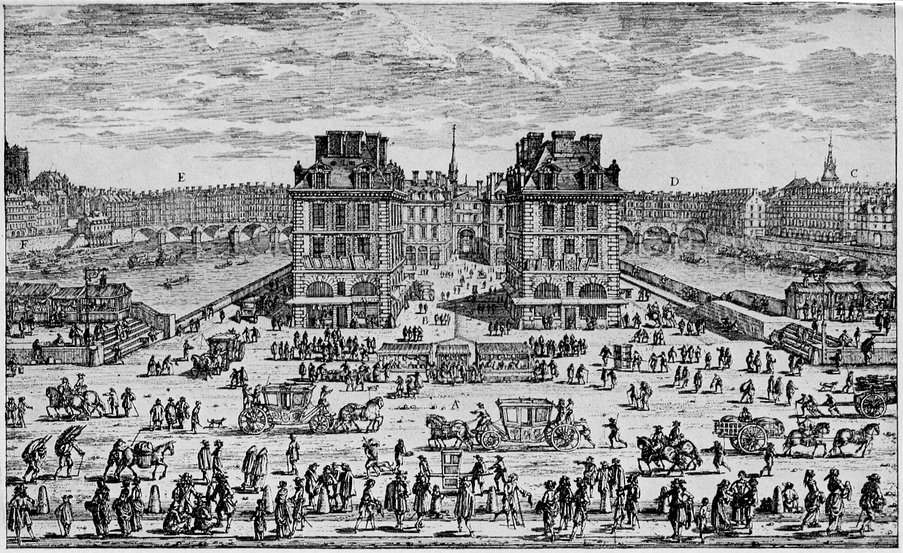
THE PLACE DAUPHINE IN THE EIGHTEENTH CENTURY.
Mademoiselle Phlipon lived in the second story of the house on the left.
9Once penetrated by this splendid ideal, however
vague it may have been, it was inevitable that the
rites of the Church, full of mysticism and exaltation,
the teachings of devotion and self-abnegation, the
pictures of lives spent in holy service, should appeal
deeply to Manon’s sensitive and untrained consciousness.
As the time of her first communion approached,
and curé and friends combined to impress upon the
child the solemn and eternal importance of the act,
she was more and more stirred by dread and exaltation.
All her time was given to meditation, to prayer,
to pious reading. Every day she fingered the Lives
of the Saints, sighing after the times when the fury
of the pagans bestowed the crown of martyrdom upon
Christians.
The necessary interruptions to her devotions
which occurred in the household, disturbed her.
At last she felt that she could not endure any
longer the profane atmosphere; throwing herself at
her parents’ feet, she begged to be allowed to go
to a convent to prepare for the sacrament. M. and
Madame Phlipon, touched by the zeal of their
daughter, consented to let her leave them for a
year.
It was not a difficult matter to find a convent
suitable for a young girl of any class, in the Paris
of the eighteenth century. That selected by the
Phlipons for Manon stood in the Rue Neuve Ste.
Étienne, a street now known as Rue Rollin and
Rue Navarre. The convent, Dames de la Congrégation
de Notre Dame, established in 1645, was well
known for the gratuitous instruction its sisters gave
10the children of the very poor as well as for the simplicity
and honesty with which the pension for young
girls was conducted, a thing which could not be said
of many of the convents of that day.
The instruction given by the Dames de la Congrégation
was not, however, any better than that of
other institutions of the kind, if the morals were.
The amount of education regarded as necessary for
a French girl of good family at this period was, in
fact, very meagre; even girls of the highest classes
being allowed to grow to womanhood in astonishing
ignorance. Madame du Deffand says that in the
convent where she was placed nothing was taught
except “reading and writing, a light, very light tinting
of history, the four rules, some needle-work,
many pater-nosters—that was all.” Madame Louise,
the sister of Louis XVI., did not know her alphabet
at twelve, so says Madame Campan. Madame de
Genlis taught her handsome sister-in-law, the favorite
of the Duke of Orleans, to write after she was
married. Madame de Genlis herself at twelve years
of age had read almost nothing.
Manon Phlipon’s acquirements when she entered
the convent, at a little over eleven years of age, were
certainly much greater than those of these celebrated
women at her age. It is probable that her instruction
was far above that not only of the girls of her
age in the school, but of the most advanced pupils,
perhaps even of some of the good sisters themselves.
The superior training of the new pupil was soon
11known. The discovery caused her to be petted
by all the sisterhood, and she was granted special
privileges of study. She continued her piano lessons
and drawing, so that she had sufficient work
to satisfy her active nature and to make the leisure
given her sweet. This leisure she never
passed with her companions. Her frame of mind
was altogether too serious to permit her to romp
like a child. The recreation hours she spent apart,
in a quiet corner of the silent old garden, reading
or dreaming, permeated by the beauty of the foliage,
the sigh of the wind, the perfume of the flowers.
All this she felt, in her exalted state, was an expression
of God, a proof of his goodness. With her
heart big with gratitude and adoration, she would
leave the garden to kneel in the dim church, and
listen to the chanting of the choir and the roll of
the organ.
Sensitive, unpractical, fervent, the imposing and
mystic services allured her imagination and moved
her heart until she lost self-control and wept, she
did not know why.
During the first days at the convent, a novice took
the veil,—one of the most touching ceremonies of
the Church. The young girl appeared before the
altar, dressed like a bride, and in a tone of joyous
exaltation sang the wonderful strain, “Here I have
chosen my dwelling-place, here I establish myself
forever.” Then her white garments were taken from
her, and cruel shears cut her long hair, which fell in
12masses to the floor; she prostrated herself before the
altar, and in sign of her eternal separation from the
world a black cloth was spread over her. Even to
the experienced and unbelieving the sight is profoundly
affecting. Manon, sensitive and overstrung,
was seized with the terrible, death-in-life meaning
of the sacrifice; she fancied herself in the place of
the young dévouée and fell to the floor in violent
convulsions.
Under the influence of such emotions, intensified
by long prayers, retreats, meditation, exhortations,
from curé and sisters, she took her first communion.
So penetrated was she by the solemnity and the joy
of the act that she was unable to walk alone to the
altar. The report of her piety went abroad in the
convent and in the parish, and many a good old
woman whom she met afterwards, mindful of this
extraordinary exaltation, asked her prayers.
Fortunately for the child’s development, this
excessive mysticism, which was developing a melancholy,
sweet to begin with, but not unlikely to
become unhealthy, was relieved a few months after
she entered the convent by a friendship with a young
girl from Amiens, Sophie Cannet by name.
When Sophie first appeared at the Congrégation,
Manon had been deeply touched by her grief at parting
from her mother. Here was a sensibility which
approached her own. She soon saw, too, that the new
pensionnaire avoided the noisy groups of the garden,
that she loved solitude and revery. She sought her
13and almost at once there sprang up between the two
a warm friendship. Sophie was three years older
than Manon; she was more self-contained, colder,
more reasonable. She loved to discuss as well as to
meditate, to analyze as well as to read. She talked
well, too, and Manon had not learned as yet the
pretty French accomplishment of causerie, and she
delighted to listen to her new friend.
If the girls were different, they were companionable.
Their work, their study, their walks, were soon
together. They opened their hearts to each other,
confided their desires, and decided to travel together
the path to perfection upon which each had resolved.
To Manon Phlipon this new friendship was a
revelation equal to the vision of nobility aroused by
Plutarch; or to that of mystic purity found in the
Church. So far in life she had had no opportunity
for healthy expression. Her excessive sensibility,
the emotions which frightened and stifled her, the
aspirations which floated, indefinite and glorious,
before her, all that she felt, had been suppressed.
She could not tell her mother, her curé, the good
sisters. Even if they understood her, she felt vaguely
that they would check her, calm her, try to turn her
attention to her lessons, to the practice of good
deeds, to pious exercises. She did not want this.
She wanted to feel, to preserve this tormenting sensibility
which was her terror and her joy.
To Sophie she could tell everything. Sophie, too,
was sensitive, devout, and understood joy and sorrow.
14The two girls shared the most secret experiences of
their souls. There grew up between them a form of
Platonic love which is not uncommon between idealistic
and sensitive young girls, a relation in which all
that is most intimate, most profound, most sincere in
the intellectual and spiritual lives of the two is exchanged;
under its influence the most obscure and
indefinite impressions take form, the most subtile emotions
materialize, and vague and indefinite thoughts
shape themselves.
The effect of this relation on the emotional nature
of Manon was generally wholesome. Her affection
for Sophie gave a new coloring to the pleasure she
found in her work, and it dispelled the melancholy
which hitherto had tinged her solitude. More important,
it compelled her to define her feelings so that
her friend could understand them: to do this she was
forced to study her own moods and gradually her
intelligence came to be for something in all that
she felt.
When the year which Manon’s parents had given
her for the convent was up, she was obliged to leave
her friend. For some time after the parting Sophie
remained at the Congrégation, so that they saw each
other often; but, afterwards, it was by letters that
their friendship was kept up. Never were more
ardent love letters written than those of Manon to
Sophie. She commiserated all the world who did
not know the joys of friendship. She suffered tortures
when Sophie’s letters were delayed, and, like
15every lover since the beginning of the postal service,
evolved plans for improving its promptness and its
exactness. She read and re-read the letters which
always filled her pockets, and she rose from her bed
at midnight to fill pages with declarations of her
fondness. This correspondence became one of the
great joys of her life. All that she thought, felt, and
saw, she put into her letters. The effort to express
all of herself clearly compelled her to a greater degree
of reflection and crystallized her notions wonderfully.
Beside making her think, it awakened in her a passion
for the pen which never left her. Indeed, it
became an imperative need for her to express in writing
whatever she thought or felt. Her emotions and
ideas seemed to her incomplete if they had not been
written out. In her early letters there is a full
account of all the influences which were acting on
her life, and of the transformation and evolution they
produced.
When Manon left the Congrégation, it was with
the determination to preserve not only her friend,
but her piety. To do the latter, she had made up
her mind to fit herself secretly to return to a convent
life when she reached her majority. She had even
chosen already the order which she should join, and
had selected Saint François de Sales, “one of the
most amiable saints of Paradise,” as she rightly
characterized him, as her patron.
For the time being, however, not a little of the
world was mixed with her preparations for religious
16retirement. When she came back to the Quai de
l’Horloge,—her first year out of the convent was
spent on the Île Saint Louis with her grandmother
Phlipon,—her father and mother began gradually to
initiate her into the round of life which presumably
would be hers in the future. M. Phlipon took especial
pride in his fresh, bright-faced daughter. By
his wish she was always dressed with elegance, and
she attracted attention everywhere. The tenderness
with which he introduced her always touched
Manon in spite of the fact that she was often embarrassed
by his too evident pride in her. The
two went together to all the Salons and the expositions
of art objects, and M. Phlipon carefully
directed her taste here where he was so thoroughly
at home. It was the only real point of contact
between them.
Sundays and fête days were usually devoted to
promenades by the Phlipons. The gayest paths,
gardens, and boulevards were always chosen by M.
Phlipon. He enjoyed the crowd and the mirth;
and, above all, he enjoyed showing off his pretty
daughter. But she, stern little moralist, when
she discovered that her holiday toilette really gave
her pleasure, that she actually felt flattered when
people turned to look at her, that she found compliments
sweet and admiring glances gratifying, trembled
with apprehension. She might forgive her
father’s vanity, but she could not forgive such a
feeling in herself. Was it to walk in gardens and to
17be admired that she had been born? She gradually
convinced herself that these promenades were inconsistent
with her ideal of what was “beautiful and
wise and grand,” and she urged her parents to the
country, where all was in harmony with her thoughts
and feelings. Meudon, still one of the loveliest of all
the lovely forests in the environs of Paris, was her
favorite spot. Its quiet, its naturalness, its variety,
pleased her better than the movement and the artificiality
of such a place as Saint-Cloud. In the forest
of Meudon her passion for nature was fully satisfied;
here she could study flower and tree, light and shade.
In her love for nature Manon was in harmony
with one of the curious phases of the sentimental
life of the eighteenth century in France. Nature as
food for sentiment seems to have never been discovered
until then by the French people. One searches
in vain in French literature before Bernardin de
Saint-Pierre and Rousseau for anything which resembles
a comprehension of and feeling for the external
world—yet unaided Manon Phlipon became
naturalist and pantheist. Never did Bernardin
de Saint-Pierre and Rousseau, in their tramps
in the environs of Paris, rejoice more profoundly
over the beauties of the world, enter more deeply
into its mysteries, than did she when in her girlhood
she wandered in the allées of the forest of Meudon
or of the Bois de Vincennes.
But Manon was to see still another side of life,—people
in their relations to one another and to herself.
18Thus far she had been easily first in her little
world. She had never known the time when she
was not praised for her superiority. Whatever
notions of equality she entertained it is certain that
she had not yet discovered that Manon Phlipon was
secondary to anybody else.
It was on the visits which she began to make
with her relatives, that she first discovered that in
the world men are not graded according to their
wisdom and their love for and practice of virtue.
She went one day with her grandmother Phlipon
to visit a rich and would-be-great lady, Madame de
Boismorel, in whose house Madame Phlipon had, for
many years after her husband’s death, acted as a kind
of governess. She was wounded on entering by a
sentiment not purely democratic—the servants, who
loved the old governess and wished to please her,
crowded about the little girl and complimented her
freely. She was offended. These people might, of
course, look at her, but it was not their business to
compliment her. Once in the grand salon she found
a typical little old Frenchwoman, pretentious, vain,
exacting. Her chiffons, her rouge, her false hair, her
lofty manner with the beloved grandmamma Phlipon
whom she addressed as Mademoiselle,—Mademoiselle
to her grandmother, one of the great personages of
her life so far,—her assumption of superiority, her
frivolous talk, revolted this Spartan maid. She
lowered her eyes and blushed before the cold cynicism
of the old lady. When she was asked questions,
19she replied with amusing sententiousness. “You
must have a lucky hand, my little friend, have you
ever tried it in a lottery?”
“Never, Madame, I do not believe in games of
chance.”
“What a voice! how sweet and full it is, but how
grave! Are you not a little devout?”
“I know my duty and I try to do it.”
“Ah! You desire to become a nun, do you not?”
“I am ignorant of my destiny, I do not seek to
penetrate it.”
Little wonder that after that Madame de Boismorel
cautioned the grandmother, “Take care that
she does not become a blue-stocking; it would be a
great pity.”
Manon went home from this visit full of disdain
and anxiety. Evidently things were not as they
ought to be when servants dared to compliment her
to her face; when her own noble ideas were greeted
coldly, and when a vain and vulgar woman could
patronize a sweet and bright little lady like her
grandmother; when her grandmother, too, would
submit to the patronage—perhaps even court it.
She was to observe still more closely the world’s
practices. An acquaintance of the family, one Mademoiselle
d’Hannaches, was in difficulty over an inheritance
and obliged to be in Paris to work up her case.
Madame Phlipon took her into her house, where
she stayed some eighteen months. Now Mademoiselle
d’Hannaches belonged to an ancient family,
20and on account of her birth demanded extra consideration
from those about her and treated her bourgeois
friends with a certain condescension. Manon
became a sort of secretary to her and often accompanied
her when she went out on business. “I noticed,”
wrote Manon afterwards, “that in spite of
her ignorance, her stiff manner, her incorrect language,
her old-fashioned toilette,—all her absurdities,—deference
was paid her because of her family.
The names of her ancestors, which she always enumerated,
were listened to gravely and were used
to support her claim. I compared the reception
given to her with that which Madame de Boismorel
had given to me and which had made a profound
impression upon me. I knew that I was worth
more than Mademoiselle d’Hannaches, whose forty
years and whose genealogy had not given her the faculty
of writing a sensible or legible letter. I began
to find the world very unjust and its institutions
most extravagant.”
Mademoiselle Phlipon had scarcely become accustomed
to these vanities in the society which
she frequented, before she began to observe equally
puzzling and ridiculous pretensions in artistic and
literary circles. Through the kindness of her masters
and of the friends of M. and Madame Phlipon,
she was often invited to the reunions of bels esprits,
so common in Paris then and now. It was not in a
spirit of humiliation and flattered vanity that so independent
an observer and judge as she had become,
21surveyed the celebrities she was allowed to look upon
and to listen to, in the various salons to which she
was admitted. She saw immediately the pose which
characterized nearly all of the gatherings, the pretentious
vanity of those who read verses or portraits,
the insincerity and diplomacy of those who
applauded. The blue-stockings who read as their
own verses which they had not always written, and
who were paid by ambitious salon leaders for sitting
at their table; the small poets who found inspiration
in the muffs and snuff-boxes of the great ladies whose
favor they wanted; the bold, and not always too
chaste, compliments,—verily, if they made the
gatherings délicieuses, as they who followed them declared,
there was a deep gulf between Manon Phlipon’s
standards and those of the society which her
family congratulated her upon being able to see.
It was during Mademoiselle d’Hannaches’ stay with
the Phlipons that Manon made a visit of eight days
to Versailles, then the seat of the French Court, with
her mother, her uncle, and their guest, to whose influence
indeed they owed their garret accommodations
in the château. Many things shocked and
humiliated her in the life she saw there, but she
did not go home nearly so bitter and disillusioned
as she tried to represent herself to have
been, nine years later, when she told the story to
posterity as an evidence of her early revolt against
the abuses of the monarchy. In fact, the reflections
which the week at Versailles awakened were very
22just and reasonable. We have them in a letter written
to Sophie some days after her return:
“I cannot tell you how much what I saw there
has made me value my own situation and bless
Heaven that I was born in an obscure rank. You
believe, perhaps, that this feeling is founded on the
little value which I attach to opinion and on the
reality of the penalties which I see to be connected
with greatness? Not at all. It is founded on the
knowledge that I have of my own character which
would be most harmful to myself and to the state
if I were placed at a certain distance from the
throne. I should be profoundly shocked by the
enormous chasm between millions of men and one
individual of their own kind. In my present position
I love my King because I feel my dependence
so little. If I were near him, I should hate his
grandeur.... A good king seems to me an adorable
being; still, if before coming into the world I
had had my choice of a government I should have
decided on a republic. It is true I should have
wanted one different from any in Europe to-day.”
Manon was twenty years old when she wrote this
letter to Sophie Cannet. Its reasonable tone is very
different from what one would expect from the passionate
little mystic of the convent of the Congrégation,
the sententious critic of Madame de Boismorel.
In fact, Manon’s attitude towards the world had
changed. By force of study and reflection she had
come to understand human nature better, and to
23accept with philosophical resignation the contradictions,
the pettiness, and the injustice of society.
“The longer I live, the more I study and observe,”
she told Sophie, “the more deeply I feel that we
ought to be indulgent towards our fellows. It is a
lesson which personal experience teaches us every
day,—it seems to me that in proportion to the
measure of light which penetrates our minds we
are disposed to humaneness, to benevolence, to tolerant
kindness.”
Nor had she at this time any bitterness towards
the existing order of government. If she “would
have chosen a republic if she had been allowed a
choice before coming into the world,” she had so
far no idea of rejecting the rule under which she
was born. Indeed, she was a very loyal subject of
Louis XVI. When that prince came to the throne
she wrote to her friend: “The ministers are enlightened
and well disposed, the young prince docile and
eager for good, the Queen amiable and beneficent,
the Court kind and respectable, the legislative body
honorable, the people obedient, wishing only to love
their master, the kingdom full of resources. Ah,
but we are going to be happy!” Nor did her ideas
of equality at this period make her see in the
mass of the common people equals of those who by
training, education, and birth had been fitted to
govern. “Truly human nature is not very respectable
when one considers it in a mass,” she reflected
one day, as she saw the people of Paris swarming
24even to the roofs to watch a poor wretch tortured on
the wheel. In describing a bread riot in 1775, she
condemned the people as impatient, called the measures
of the ministers wise, and excused the government
by recalling Sully’s reflection: “With all
our enlightenment and good-will it is still difficult
to do well.” And again, apropos of similar disturbances,
she said: “The King talks like a father,
but the people do not understand him; the people
are hungry—it is the only thing which touches
them.” Nothing in all this of contempt of the monarchy,
of the sovereignty of the people, of the divine
right of insurrection.
Manon Phlipon had in fact become, by the time
she was twenty years of age, a thoroughly intelligent
and reflective young woman. Instead of extravagant
and impulsive opinions, results of excessive emotionalism
and idealism, which her first twelve years
seemed to prophesy, we have from her intelligent
judgments. If it was not a question of some one she
loved, she could be trusted to look at any subject
in a rational and self-controlled way.
This change had been brought about largely by
the reading and reflecting she had done since leaving
the convent. For some time what she read had
depended on what she could get. Her resolution to
enter a convent eventually had made her at first
prefer religious books, and she read Saint Augustine
and Saint François de Sales with fervor and joy. With
them she combined, helter-skelter, volumes from the
25bouquinistes, mainly travels, letters, and mythology.
Fortunately she happened on Madame de Sévigné.
Manon appreciated thoroughly the charming style
of this most agreeable French letter-writer, and her
taste was influenced by it, though her style was but
little changed.
This stock was not exhausted before she had the
happiness to be turned loose in the library of an abbé—a
friend of her uncle. It was a house where her
mother and Mademoiselle d’Hannaches went often
to make up a party of tric-trac with the two curés.
As it was necessary always to take her along, all
parties were satisfied that Manon could lose herself
in a book. For three years she found here all
she could read: history, literature, mythology, the
Fathers of the Church. Dozens of obscure authors
passed through her hands; now and then she happened
on a classic—something from Voltaire, from
Bossuet. Here too she read Don Quixote.
But the good abbé died, the tric-trac parties in his
library ceased, and Manon had to turn to the public
library for books. She chose without any plan, generally
a book of which she had heard. So far her
reading had been simply out of curiosity, from a
need of doing something. Usually she had several
books on hand at once—some serious, others light,
one of which she was always reading aloud to her
mother. The habit of reading, especially aloud, was
one of the chief means advised by the French educators
of the time for carrying on a girl’s education.
26Madame de Sévigné, Fénelon, Madame de Maintenon,
L’abbé de Saint-Pierre, the authorities at Port
Royal, all had made much of the practice. Manon
read their treatises, and finding that she had herself
already adopted methods similar to those of the
wisest men and women of her country, continued her
work with new vigor.
All that she read she analyzed carefully, and she
spent much time in making extracts. Through the
courtesy of one of the descendants of Mademoiselle
Phlipon, M. Léon Marillier of Paris, I had in my
possession at one time, for examination, a large
number of her cahiers prepared at this period. They
are made of a coarse, grayish-blue paper, with rough
edges, and are covered with a strong, graceful handwriting,
almost never marred by erasures or changes,
much of it looking as if it had been engraved; more
characteristic and artistic manuscript one rarely sees.
The subjects of the quotations in the cahiers are
nearly always deeply serious. In one there are eight
pages on Necessity, long quotations on Death, Suicide,
the Good Man, Happiness, the Idea of God.
Another contains a long analysis of a work on
Divorce Legislation, which had pleased her. Buffon
and Voltaire are freely quoted from.
The passages which attracted her are philosophic
and dogmatic rather than literary and sentimental,
or devout. In fact, Manon became, in the period
between fourteen and twenty-one, deeply interested
in the philosophic thought of the day. Soon she
27was examining dispassionately, and with a freedom
of mind remarkable in so unquestioning a believer
as she had been, the entire system of religion which
she had been taught. Once started on this track, her
reading took a more systematic and intelligent turn.
She read for a purpose, not simply out of curiosity.
It was the controversial works of Bossuet which
first induced Manon Phlipon to apply the test of
reason to her faith. Soon after she began to study
the Christian dogma rationally, she revolted against
the doctrines of infallibility and of the universal damnation
of all those who never knew or who had not
accepted the faith. When she discovered that she
could not accept these teachings, she resolved to find
out if there was anything else which she must give up,
and so attacked eagerly religious criticism, philosophy,
metaphysics. She analyzed most thoroughly all she
read and compared authorities with unusual intelligence.
As her investigations went on, she found that her
faith was going, and she told her confessor, who
immediately furnished her with the apologists and
defenders of the Church, Abbé Gauchat, Bergier,
Abbadie, Holland, Clark, and others. She read
them conscientiously and annotated them all; some
of these notes she left in the books, not unwittingly
we may suspect. The Abbé asked her in amazement
if the comments were original with her.
These annotations were, in fact, calculated to
startle a curé interested in conserving the orthodoxy
28of a parishioner. Part of those she made on the
works of the Abbé Gauchat fell into my hands with
the extracts spoken of above. They are the bold,
intelligent criticisms of a person who has resolved
to subject every dogma to the test of reason. They
are never contemptuous or scoffing, though there
is frequently a tone of irritation at what she regards
as the feebleness of the logic. They are free from
prejudice and from sentiment, and show no deference
to authority.
Another result of the curé’s loan of controversial
works was to intimate to Manon what books they
refuted, and she hastened to procure them one after
another. Thus the Traité de la tolérance, Dictionnaire
philosophique, the Questions encyclopédiques, the
Bons sens and the Lettres juives, of the Marquis
d’Argens, the works of Diderot, d’Alembert, Raynal,
in fact all the literature of the encyclopedists
passed through her hands.
Manon Phlipon did not change her religious feelings
or devout practices during this period. She was
living a religious life of peculiar intensity, all the
time that she was deep in the examination of doctrines.
The one was for her an affair of the heart, the
other of the head. Her letters to Sophie, after the
question of doubt had once been broached between
them, are filled, now with philosophical analyses of
dogma, now with glowing piety, now with severe
rules of conduct. It was some time after she took
to reasoning before the subject came up. Sophie’s
29own faith was troubled and she pictured her state
to her friend. Manon, touched by this confidence,
greater than her own had been, freely portrayed
afterwards her own mental and spiritual condition.
From these letters we find that she reached,
very early in her study, certain conclusions which
she never abandoned, and upon these as a basis
erected a system which satisfied her heart and mind
and which regulated her conduct.
When she first wrote Sophie she was so convinced
of the existence of God for “philosophical reasons”
that she declared the authority of the world could
not upset her. With this went the immortality of
the soul. These two dogmas were enough to satisfy
her heart and imagination. She did not need them
to be upright, she said, but she did to be happy.
She did right because she had convinced herself
that it was to her own and to her neighbor’s interest.
She was happy because she had a reasonable basis for
goodness and nobility, and because she believed in
God and in immortality. On this foundation further
study became an inspiration. “My sentiments have
gained an energy, a warmth, a range,” she wrote to
Sophie after reading Raynal’s Philosophical History,
“that the exhortations of priests have never given
them—the General Good is my idol, because it must
be the result and the reasonable end of everything.
Virtue pleases me, inflames my imagination because it
is good for me, useful to others, and beautiful in itself.
I cherish life because I feel the value of it. I use it
30to the best advantage possible. I love all that
breathes, I hate nothing but evil, and still I pity the
guilty. With a conduct conformed to these ideas, I
live happy and tranquil, and I shall finish my career in
peace and with the greatest confidence in a God whom
I dare believe to be better than I have been taught.”
She had her fundamentals, but she had not by any
means finished her investigations. Each system she
examined, fascinated her. In turn she was Jansenist,
stoic, deist, materialist, idealist.
“The same thing happens to me sometimes,” she
wrote Sophie, “that happened to the prince who
went to the Court to hear the pleas,—the last lawyer
who spoke always seemed to him to be right.” “I am
continually in doubt, and I sleep there peacefully as
the Americans in their hammocks. This state is best
suited to our situation and to the little we know.”
Whatever her mental vagaries, she never altered her
religious practices. She did not wish to torment her
mother, or to set a bad example to those who took
her as a model; for instance, there was her bonne
whom she desired should keep her faith. “I should
blame myself for weakening it,” she said, “as I
should for taking away her bread.”
Only two months before the end of her life Madame
Roland summed up her religious and philosophical
life in a passage of her Memoirs. It is simply a
résumé of what in her girlhood she wrote at different
times to Sophie. The main points of this philosophy
have been given above.
II LOVERS AND MARRIAGE
31
Until she was twenty-one years of age, Manon
Phlipon’s life was singularly free from care.
Her studies, her letters to Sophie, her hours with her
mother, her promenades, filled it full. Suddenly in
1775 its peace was broken by the death of Madame
Phlipon. Manon’s veneration and affection for her
mother were sincere and passionate, her dependence
upon her complete. Her death left the girl groping
pitifully. The support and the joy of her life seemed
to have been taken from her. But the necessity of
action, her obligations to her father, the kindness of
her friends, her own philosophy, finally calmed her,
and she made a brave effort to adjust herself to her
new duties. Her real restoration, however,—that
is, her return to happiness and to enthusiasm, was
wrought by a book—the Nouvelle Héloïse, of Jean
Jacques Rousseau.
In the middle and in the latter half of the eighteenth
century France passed through a paroxysm
of sentiment. Man was acknowledged a reasoning
being, to be sure, but it was because he was a sensitive
32one that he was extolled. His mission was to
escape pain and seek happiness. To laugh, to weep,
to vibrate with feeling, was the ideal of happiness.
This sensitiveness to sentiment was shown in the
most extravagant ways. Words ran out in the
efforts to paint emotion. Friends no longer saluted,
they fell into each other’s arms. Tears were
no longer sufficient for grief, they were needed for
joy. Convulsions and spasms alone expressed sorrow
adequately. At the least provocation women
were in a faint and men trembling. Acute sensibility
was cultivated as an Anglo-Saxon cultivates
reserve.
The prophet of this sentimental generation was
Jean Jacques Rousseau, the hand-book he gave his
followers the Nouvelle Héloïse. Here sentimentalism
reaches the highest point possible without becoming
unadulterated mawkishness and sensuality, if, indeed,
it does not sometimes pass the limit. To France,
however, the book was a revelation. Rousseau declares
that Frenchwomen particularly were intoxicated
by it, and that there were few ladies of rank
of whom he could not have made the conquest if
he had undertaken it. It is only necessary to read
the memoirs of the day, to see that Rousseau tells
the truth. The story that George Sand tells of her
grandmother, and those Madame de Genlis relates of
the reception of the book by the great ladies of the
Palais Royal, are but examples of the general outburst
of admiration which swept through feminine hearts.
33The Nouvelle Héloïse was a revelation in sentiment
to Manon Phlipon. The severe studies of the past
few years had checked and regulated the excessive
and uncontrolled emotions of her girlhood. She had
become an intelligent, reflecting creature. But the
death of her mother had overthrown her philosophy
for the moment; then came the Nouvelle Héloïse.
Its effect on her was like that of Plutarch twelve
years before. It kindled her imagination to the
raptures of love, the beauty of filial affection, the
peace of domestic life, the joy of motherhood.
Her vigorous, passionate young nature asserted
itself; her mind burned with the possibilities of
happiness; sentiment regained the power temporarily
given to the intellect, and from that time was
the ruling force of her life.
“I fear that he strengthened my weakness,” Manon
wrote of Rousseau towards the end of her life, and
certainly he did destroy the fine harmony that she
had established between her reason and her feelings,
making the latter master. She was quite right in
thinking it fortunate that she had not read him
earlier. “He would have driven me mad; I should
have been willing to read nobody but him.”
The Nouvelle Héloïse was not, however, the first of
Rousseau she had read. Émile had passed through
her hands, and her religious convictions had unquestionably
been influenced by the Profession of Faith
of the Vicar of Savoy. But she had read him critically
so far. Now all was changed. She plunged
34enthusiastically into his works. She found there
clearly and fully stated what she herself had vaguely
and imperfectly felt; the sentiments he interpreted
had stirred her; many of the principles he laid
down for conduct she had been practising. In
less than a year she was defending his works to
Sophie.
“I am astonished that you wonder at my love for
Rousseau. I regard him as the friend of humanity,
as its benefactor and mine. Who pictures virtue in
a nobler and more touching manner? Who renders
it more worthy of love? His works inspire a taste
for truth, simplicity, wisdom. As for myself, I
know well that I owe to them all that is best in me.
His genius has warmed my soul, I have been inflamed,
elevated, and ennobled by it.
“I do not deny that there are some paradoxes in
Émile, some proceedings that our customs make
impracticable. But how many profound and wholesome
opinions, how many useful precepts! how many
beauties to save the faults! Moreover, I confess that
observation has led me to approve things that at first
I treated as foolish and chimerical. His Héloïse is
a masterpiece of sentiment. The woman who can
read it without being better or at least without
desiring to become so, has only a soul of clay, a
mind of apathy. She will never rise above the
common.... In all that he has done one recognizes
not only a genius, but an honest man and
citizen.... And a scaffold has come near being
35erected for this man, to whom, in another century,
one will perhaps raise altars!”
Manon Phlipon had found in Rousseau her guide.
The feminine need of an authority was satisfied. She
accepted him en bloc, and to defend and follow him
became henceforth her concern.
Manon’s first appreciation of Rousseau was, naturally
enough, an attempt to play Julie to a fancied
Saint-Preux. It is not to be supposed that this is
the first time in her life that her attention was
turned towards a lover. Ever since her piety began
to cool under the combined effects of study and
observation, and her natural vanity and love of attention
began to assert themselves, she had thought
a great deal of her future husband. In a French
girl’s life a future husband is a foregone conclusion,
and Manon, like all her countrywomen, had been
accustomed to the presentation of this or that person
whom some zealous friend thought a fitting
mate for her. The procession of suitors that passes
before the readers of her Memoirs is so long and so
motley that one is inclined to believe that more than
one is there by virtue of the heroine’s imagination.
Manon Phlipon was one of those women who see
in every man a possible lover.
The applications for her hand began with her
guitar master, who, having taught her all he knew,
ended by asking her to marry him. Then there was
a widower who had prepared himself for his courtship
by having a wen removed from his left cheek;
36the family butcher, who sought to win her regard by
sending her the choicest cuts of steak, and appearing
on Sunday in the midst of the Phlipons’ family
promenade, arrayed in lace and fine broadcloth; and
in turn all the eligible young men and widowers of
the Place Dauphine. They were, without exception,
peremptorily declined by the young woman through
her father. Had she read Plutarch and all the
philosophers, only to tie herself up to a merchant
bent on getting rich and cutting a good figure in
his quarter?
Her parents, flattered and amused by this cortège,
did not at first try to influence Manon to accept any
one, but at last her father became anxious. The
disdain with which she refused all representatives of
commerce annoyed him a little, too. “What kind
of a man will suit you?” he asked her one day.
“You have taught me to reflect, and allowed me
to form studious habits. I don’t know to what kind
of a man I shall give myself, but it will never be
to any one with whom I cannot share my thoughts
and sentiments.”
“But there are men in business who are polished
and well educated.”
“Yes, but not among those I see. Their politeness
consists in a few phrases and salutations. Their
knowledge is always of business. They would
be of little use to me in the education of my
children.”
“Raise them yourself.”
37“That task would seem heavy to me if it were
not shared by my husband.”
“Don’t you think L——’s wife is happy? They
have just gone out of business; they have bought
a large property; their house is well kept; and they
see a great deal of good society.”
“I cannot judge of the happiness of others, and
mine will never depend upon wealth. I believe that
there is no happiness in marriage except when hearts
are closely united. I can never give myself to one
who has not the same sentiments as I. Besides, my
husband must be stronger than I; nature and the
laws make him my superior, and I should be ashamed
of him if he were not so.”
“Is it a lawyer that you want? Women are never
too happy with such men; they are bad tempered
and have very little money.”
“But, papa, I shall never marry anybody for his
gown. I don’t mean to say that I want a man of
such and such a profession, but a man that I can
love.”
“But, if I understand you, such a man cannot be
found in business?”
“Ah! I confess that seems to me very probable;
I have never found any one there to my taste; and
then business itself disgusts me.”
“Nevertheless, it is a very pleasant thing to live
tranquilly at home while one’s husband carries on a
good business. Look at Madame A——; she knows
good diamonds as well as her husband; she carries
38on the business in his absence; she will continue
to carry it on if she should become a widow; their
fortune is already large. You are intelligent; you
would inspire confidence; you could do what you
wanted to. You would have a very agreeable life if
you would accept Delorme, Dabreuil, or Obligeois.”
“Hold on, papa; I have learned too well that in
business one does not succeed unless he sells dear
what he has bought cheap; unless he lies and beats
down his workmen.”
“Do you believe, then, that there are no honest
men in commerce?”
“I am not willing to say that; but I am persuaded
that there are but few of them; and more than that,
that those honest men have not the qualities that
my husband must have.”
“You are making matters very difficult for yourself.
What if you do not find your ideal?”
“I shall die an old maid.”
“Perhaps that will be harder than you think. However,
you have time to think of it. But remember,
one day you will be alone; the crowd of suitors will
end,—but you know the fable.”
“Oh, I shall revenge myself by meriting happiness;
injustice cannot deprive me of it.”
“Ah, there you go in the clouds.”
The first of Manon’s suitors who really interested
her was Pahin de la Blancherie, a bel esprit who frequented
a salon where she was often seen. He had
been attracted by the girl and had by a clever trick,
39which Madame Phlipon had seen fit to ignore, gained
an entrance to the house. He interested Manon
more than her usual callers. He had read the philosophers;
he expressed noble views; he had been to
America; he was writing a book. This was much
better than the young man who plied a trade and
repeated the gossip of the Pont Neuf, and when she
learned from her father that he had asked her hand,
but had been dismissed because of his lack of fortune,
she told the loss rather coldly to Sophie.
“He seemed to me to have an honest heart, much
love for literature and science, art and knowledge.
In fact, if he had a secure position, was older, had
a cooler head, a little more solidity, he would not
have displeased me. Now he has gone and without
doubt thinks as little of me as I do about
him.”
This was nearly two years before Madame Phlipon’s
death and Manon saw almost nothing of La Blancherie
until some four months after her loss, when he
came unexpectedly one evening to see her, pale and
changed by a long illness. The sight of the young
man agitated her violently. It recalled her mother,
recalled, too, the fact that he alone of all her suitors
had seemed worthy of her. Her agitation embarrassed
him. With tears she told him her grief. He
tried to console her and confided to her the proof-sheets
of his forthcoming book.
Manon described the meeting to Sophie and added
her appreciation of the book. “You know my
40Loisirs,[1] do you not? Here are the same principles.
It is my whole soul. He is not a Rousseau, doubtless,
but he is never tiresome. It is a beautiful morality,
agreeably presented, supported by facts and an infinite
number of historic allusions and of quotations
from many authors. I dare not judge the young
man because we are too much alike, but I can say
of him what I said to Greuze of his picture, ‘if
I did not love virtue, he would give me a taste
for it.’”
1. Manon Phlipon wrote before her marriage a series of philosophical
and literary essays which she called Œuvres de loisir or
Mes Loisirs. They are reflections on a great variety of subjects,
generally following closely the books she read. Fragments from
many of these essays are found in the letters to Sophie Cannet.
It was Mademoiselle Phlipon’s habit to lend the manuscript of her
productions to her intimate friends and Sophie, of course, was
familiar with them all. The greatest part of the Loisirs were
published in 1800 in the edition of Madame Roland’s works prepared
by Champagneux.
Manon’s imagination was violently excited by this
interview and she received La Blancherie’s visits
with delight. Her father, however, was displeased
and insisted that the young man cease coming to the
house. This was all that was needed for Manon to
persuade herself that she was in love. She went
farther—she was convinced La Blancherie loved
her, was suffering over their separation, and she shed
tears of sympathy for him. She comforted herself
with dreams of his noble efforts to better his situation
and to win her in spite of her cruel father.
She wrote Sophie long letters describing their mutual efforts to be worthy of each other, letters drawn
entirely from her own fancy.
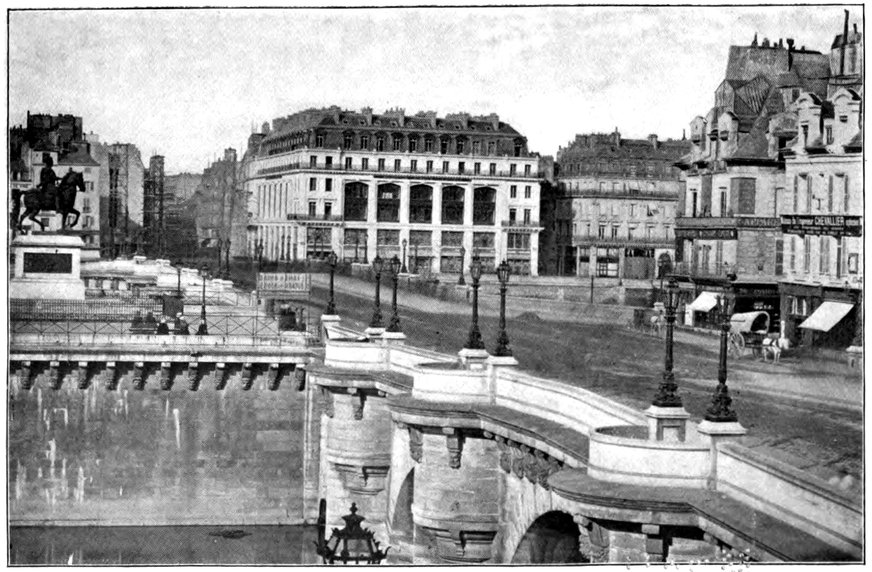
THE PONT NEUF IN 1895.
The house in which Madame Roland lived as a girl is the second of the two to the right of the picture.
41“We are trying to make each other happy by
making ourselves better, and in this sweet emulation
virtue becomes stronger, hope remains. If he has
an opportunity to do a good action, I am sure that
he will do it more gladly when he thinks that it is
the sweetest and the only homage that he can render
me.” All this she assumed, but she thought she had
sufficient reason for her opinion. “I judge him by
my own heart, nothing else is so like him. We do
not see each other, but we know we love each other
without ever having avowed it. We count on each
other. We hasten along the path of virtue and of
sacrifice that we have chosen; there at least we
shall be eternally together.”
She wrote him a fervent letter, which Sophie delivered,
telling him that it was not her will that he
was forbidden the house. She saw that he had a
card for the Mass celebrating her mother’s death.
She idealized him in a manner worthy of Julie herself,
without knowing anything in particular of him,
and without his ever having made her any declaration.
A sentimental young woman rarely conceives her
lover as he is. Certainly the actual La Blancherie
was a very different young man from the paragon of
stern virtue Mademoiselle Phlipon pictured, and
when the creation of her imagination was brought
face to face, one day in the Luxembourg, with the
42flesh and blood original, the latter made a poor showing.
To begin with, he had a feather in his cap, a
common enough thing in that day—“Ah, you would
not believe how this cursed plume has tormented
me,” she wrote Sophie. “I have tried in every way
to reconcile this frivolous ornament with that philosophy,
with that taste for the simple, with that manner
of thinking which made D. L. B. [it is thus that
she designates La Blancherie in her letters] so dear
to me.” But she did not succeed. No doubt her inability
to forgive the feather was made greater by
a bit of gossip repeated to her the same day by a
friend who was walking with her, that La Blancherie
had been forbidden the house of one of her friends
because he had boasted that he was going to marry
one of the daughters, and that he was commonly
known among their friends as “the lover of the
eleven thousand virgins.”
Her cure was rapid after this, and when, a few
months later, La Blancherie succeeded in getting
an interview with her and represented his misfortunes
and his hopes, she listened calmly, and told
him, at length, that after having distinguished him
from the ordinary young man, and indeed placed
him far higher, she had been obliged to replace him
among the large class of average mortals. For some
four hours they debated the situation, and at last La
Blancherie withdrew.
Manon’s first love affair was over, and she sat
down with rare complacency to describe the finale
43to Sophie. She had no self-reproach in the affair.
As always, she was infallible.
La Blancherie was, no doubt, an excellent example
of the eighteenth-century literary adventurer.
His first book, a souvenir of college life and his
travels in America, was an impossible account of
youthful follies and their distressing results, and
seems never to have aroused anybody’s interest save
Manon’s, and that only during one year. His next
venture was to announce himself as the General
Agent for Scientific and Artistic Correspondence,
and to open a salon in Paris, where he arranged
expositions of pictures, scientific conferences, lectures
and art soirées. In connection with his salon
La Blancherie published from 1779 to 1787 the Nouvelles
de la république des lettres et des arts, and a catalogue
of French artists from Cousin to 1783. Both
of these works, now extremely rare, are useful in
detailed study of the French art of the eighteenth
century, and were used by the De Goncourts in
preparing their work on this subject.
In 1788 La Blancherie’s salon was closed, and he
went to London. By chance he inhabited Newton’s
old house. He was inspired to exalt the name of the
scientist. His practical plan for accomplishing this
was to demand that the name of Newton should be
given alternately with that of George to the Princes
of England, that all great scientific discoveries
should be celebrated in hymns which should be
sung at divine services, and that in public documents
44after the words the year of grace should be
added and of Newton.
In short, La Blancherie was in his literary life
vain and pretentious, without other aim than to
make a sensation. In his social relations he was
a perfect type of le petit maître, whose philosophy
Marivaux sums up: “A Paris, ma chère enfant, les
cœurs on ne se les donne pas, on se les prête” (In
Paris, my dear, we never give our hearts, we only
lend them). Manon Phlipon’s idealization and subsequent
dismissal of La Blancherie is an excellent
example of how a sentimental girl’s imagination will
carry her to the brink of folly, and of the cold-blooded
manner in which, if she is disillusioned, she will discuss
what she has done when under the influence of
her infatuation.
No doubt the decline of Manon’s interest in La
Blancherie was due no little to the rise of her interest
at this time in another type of man,—the
middle-aged man of experience and culture whom
necessity has forced to work in the world, but whom
reflection and character have led to remain always
aloof from it.
The first of these was a M. de Sainte-Lettre, a man
sixty years of age, who, after thirteen years’ government
service in Louisiana with the savages, had
been given a place in Pondicherry. He was in Paris
for a year, and having brought a letter of introduction
to M. Phlipon, soon became a constant visitor
of his daughter. His wealth of observation and
45experience was fully drawn upon by this curious
young philosopher, and probably M. de Sainte-Lettre
found a certain piquancy in relating his traveller’s
tales to a fresh and beautiful young girl whose intelligence
was only surpassed by her sentimentality,
and whose frankness was as great as her self-complacency.
At all events they passed some happy
hours together. “I see him three or four times a
week,” she wrote Sophie; “when he dines at the
house, he remains from noon until nine o’clock.
There is perfect freedom between us. This man,
taciturn in society, is confiding and gay with me.
We talk on all sorts of subjects. When I am not
up, I question him, I listen, I reflect, I object.
When we do not wish to talk, we keep silent
without troubling ourselves, but that does not last
long. Sometimes we read a fragment suggested by
our conversation, something well known and classic,
whose beauties we love to review. The last was a
song of the poet Rousseau and some verses of Voltaire.
They awakened a veritable enthusiasm,—we
both wept and re-read the same thing ten times.”
To this odd pair of philosophers a third was
added,—a M. Roland de la Platière, of whom we
are to hear much more later on. Manon began at
once to effervesce. “These two men spoil me,” she
declared to Sophie; “I find in them the qualities
that I consider most worthy my esteem.”
But Roland and de Sainte-Lettre both left Paris,
the latter retiring to Pondicherry, where he died
46some six weeks after his arrival. Before going
away, however, he had put Mademoiselle Phlipon
into relation with an intimate friend of his, a M. de
Sévelinges, of Soissons, a widower some fifty-two
years of age, of small fortune but excellent family
and wide culture. This acquaintance was kept up by
letter, and in a few months M. de Sévelinges asked
her hand. Now Mademoiselle Phlipon had but a
small dot and that was fast disappearing through
the dissipation of her father, who, since her mother’s
death, had taken to amusing himself in expensive
ways. M. de Sévelinges had children who did not
like the idea of his marrying a young wife without
fortune. It was to imperil their expected inheritance.
Manon appreciated this and refused M. de
Sévelinges. But he insisted and they hit upon a
quixotic arrangement which Mademoiselle Phlipon
describes thus to Sophie:
“His project is simply to secure a sister and a
friend, under a perfectly proper title. I thank him
for a plan that my reason justifies, that I find honorable
for both, and that I feel myself capable of
carrying out.... My sentiments, my situation,
everything drives me to celibacy. In keeping it
voluntarily while apparently living in an opposite
state, I do not change the destiny which circumstances
have forced upon me, and at least I contribute
by a close relation to the happiness of an
estimable man who is dear to me.... How chimerical
this idea would be for three-fourths of my
47kind! It seems as if nobody but M. de Sévelinges
and I could have conceived it, and that you are the
only one to whom I could confide it. The realisation
of this dream would be delightful it seems to
me. I can imagine nothing more flattering and
more agreeable to one’s delicacy and confidence than
this perfect devotion to pure friendship. Can you
conceive of a more delicate joy than that of sacrificing
oneself entirely to the happiness of an appreciative
man?”
The affair with M. de Sévelinges came to nothing,
and as Manon gradually ceased to think of him she
became more and more interested in the M. Roland
already mentioned.
M. Roland de la Platière was a man about forty-two
years of age when he first met Mademoiselle
Phlipon, in 1776. He held the important position
of Inspector-General of Commerce in Picardy, and
lived in Amiens, the chief town of the province. In
his specialty he was one of the best known men in
France. His career had been one of energy and
patience. Leaving his home in the Lyonnais when
but a boy of eighteen, rather than to take orders
or to go into business as his family proposed, he had
spent two years studying manufacture and commerce
in Lyons, and then had gone to Rouen, where, through
the influence of a relative, he had passed ten years in
familiarizing himself with the methods of the factories
of Normandy, at that time one of the busiest
manufacturing provinces in France. M. Roland’s
48work at Rouen had not been of a simple, unintelligent
kind. He had studied seriously the whole
subject of manufacturing in its relations to commerce,
to government, to society, and had worked
out a most positive set of opinions on what was
necessary to be done in France in order to revive
her industries. He had already begun to write, and
his pamphlets had attracted the attention of the
ablest men in his department of science.
In 1764 he had been sent to look after the manufacturing
interests of Languedoc, then in a serious
condition, and in 1776 the position of Inspector in
Picardy, the third province of the country from a
manufacturing point of view, was given to him. For
a man without ambition, the duties of the office were
simple. They required him to see that the multitude
of vexatious rules which were attached then to
the making of goods and articles of all kinds, were
carried out; that the regulations governing masters
and workmen were observed; that the formalities
attending the establishment of new factories were
not neglected; that everything of significance that
happened in the factories in his province was reported;
and that all suggestions for improvement
which occurred to him were presented. Evidently
an ordinary man, well protected, could fill the position
of an inspector of manufactures and have an
easy life.
But M. Roland did not understand his duties in
this way. The value of the position in his eyes was
49that it permitted the regulation of disputes, allowed
criticism, invited suggestions, encouraged study, and
welcomed pamphlets. From the beginning of his
connection with Picardy he had displayed an incredible
activity in all of these directions. The various
industrial interests of the province were clashing
seriously at the moment, and the lawyers and councils
were only making the disagreement greater. Roland
dismissed all interference and became himself “the
council, the lawyer, and the protector of the manufacturer.”
He became familiar with every master
workman of Picardy, with every industry, with every
process, and in the reports sent to the Council of
Commerce at Paris, he attacked, praised, suggested
voluminously. At the same time he was studying
seriously. Nothing was foreign to his profession as
he understood it, and though already he had the reputation
of being a savant he went every year to Paris
to do original work in natural history, physics, chemistry,
and the arts.
Roland had only been long enough in Picardy to
organize his office well when he began to urge the
Council to try to introduce into France some of the
superior manufacturing processes of other countries.
The idea seemed wise and he was invited to undertake
a thorough study of foreign and domestic manufacturing
methods. This commission led him into many
countries. Before M. Roland met Mademoiselle
Phlipon, in 1776, he had been through Flanders,
Holland, Switzerland, England, Germany, and France
50in pursuit of information. He had studied lace-making
at Brussels, ironware at Nuremberg, linen-making
in Silesia, pottery in Saxony, velvet and embroidered
ribbons on the Lower Rhine, paper-making at Liège,
cotton weaving and printing in England.
His observations had been limited to no special
step of the manufacturing. He looked after the
variety of plant which produced a thread and studied
the way it was raised. He knew how native ores
were taken out in every part of Europe. The processes
of bleaching, dyeing, and printing in all countries
were familiar to him. He understood all sorts
of machines and had improved many himself. His
ideas on designing were excellent and had been enlarged
by intelligent observation of the arts of many
countries.
On all of his travels Roland had amassed samples
of the stuffs he had seen, had taken notes of dimensions,
of prices, of the time required for special
processes, of the cost of materials, had gathered the
pamphlets and volumes written by specialists, often
had brought back samples of machines and utensils.
All of this he had applied faithfully in Picardy, and
before the time he comes into our story he had had
the satisfaction of seeing, as a result of his efforts,
the number of shops in his domain tripled, the utensils
gradually improved, a great variety of new stuffs
made, the old ones improved, and many new ideas
introduced from other countries.
At the same time the full reports made of his investigations
51had won him honors; the Academy of
Science in Paris, the Royal Society of Montpellier,
had made him a correspondent; the academies of
Rouen, Villefranche, and Dijon, an honorary member;
different societies of Rome, an associate.
He had, too, something besides technical knowledge.
He was quite up to the liberal thought of
the day and had ranged himself with the large body
of French philosophers who were working for
greater freedom in commerce, in politics, in religion.
In short, M. Roland de la Platière was a man of
more than ordinary value, who had rendered large
services to his country. But with all his value, and
partly because of it, he was not an easy man to get
along with. His hard work had undermined his
health and left him morose and irritable. He was
so thoroughly convinced of his own ability and usefulness
that he could not suffer opposition even
from his superiors, and he used often, in his reports,
an arrogant tone which exasperated those who were
accustomed to official etiquette. A large quantity
of Roland’s business correspondence still exists, and
throughout it all is evidence of his pettish, unbending
superiority. In fact, some very serious controversies
arose between him and his associates at
different times, in which if Roland was usually right
in what he urged, his way of putting it was offensive
to the last degree.
Roland prided himself not only on his services,
but on his character. He was independent, active,
52virtuous. He admired noble deeds and good lives.
He cultivated virtue as he did science and he made
himself a merit of being all this. Nothing is more
offensive than self-complacent virtue. Be it never
so genuine, the average man who makes no pretensions
finds it ridiculous and is unmoved by it.
Goodness must be unconscious to be attractive.
Above all, Roland prided himself on the perfect
frankness of his character, and to prove it he refused
to practise the amiable little flatteries and deceits
which, under the name of politeness, keep people in
society feeling comfortable and kindly. Shoe-buckles
were a vain ornament, so he wore ribbons, though by
doing it he offended the company into which he was
invited. To tell a man he was “charmed” to see him
when he was merely indifferent, was a lie, therefore
he preserved a silence. He would not follow a custom
he could not defend philosophically, nor repeat
a formality which could not be interpreted literally.
By the conventional, what is there to be done with
such a character? They may respect his scientific
worth, but they cannot countenance such contempt
for the laws of life as they understand them.
Mademoiselle Phlipon, however, was not conventional.
She admired frankness and Roland’s disregard
of formalities seemed to her a proof of his
simplicity and honesty. She was not offended by
the man’s display of character. She herself was as
self-conscious, as convinced of her own worth, and
as fond as he of using it as an argument. As for his
53irritability and scientific arrogance, she had little
chance to judge of it. He was so much wiser than
she, that she accepted with gratitude and humility
the information he gave.
It was in 1776 that Roland first came to visit
Manon, to whom he had been presented by Sophie
Cannet, with whose family he was allied in Amiens.
The acquaintance did not go far; for in the fall of
that year Roland started out on one of his long trips,
this time to Switzerland, Italy, Sicily, and Malta.
It was his plan to put his observations into letter
form and on his return to publish them. He needed
some one to whom he could address the letters, who
would guard the copy faithfully in his absence, and
would edit it intelligently if he should never return.
Manon seemed to him a proper person, and so he
requested her to permit his brother, a curé in Cluny
College, in Paris, to bring the letters to her. She
naturally was flattered, and the letters which came
regularly were a great delight to her.
Now the sole object of Roland was evidently to
have a safe depot for his manuscript, yet as the trip
stretched out Manon became more and more interested.
Might it not be that this grave philosopher
had a more personal interest in her than she had
thought? Might he not be the friend she sought?
Her fancy was soon bubbling in true Rousseau style.
The long silences of M. Roland and the formal
letters he wrote were not sufficient to quiet it. An
excuse for this premature ebullition was the fact
54that Roland seemed to be the only person in her
little world upon whom for the moment she could
exercise her imagination. De Sainte-Lettre was dead,
M. de Sévelinges had withdrawn. True, there was a
Genevese of some note, a M. Pittet, at that time in
correspondence with Franklin, whom she often saw.
M. Pittet wrote for the Journal des dames and
talked over his articles beforehand with Mademoiselle
Phlipon, even answering in them objections she had
made. She was flattered, it is evident from her
letters to Sophie, by their relation and only waited a
sign to transfer her interest to this eminent Genevese,
but the sign was never given.
Another reason for her exercising her imagination
on Roland was the dulness of her life at the moment.
Though Manon had a large number of good-natured
and devoted relatives and friends who exerted themselves
to please her, she went out but little save to
visit her uncle the curé Bimont. The curé lived in
the château at Vincennes. Manon was a real favorite
with the bizarre and amusing colony of retired
officers and their wives, discarded favorites of the
Court, and nobles worn out in the service, to whom a
home had been given there. Some of the persons she
met at Vincennes are highly picturesque. Among
others were a number of Americans from Santo Domingo
on a visit to an officer. She quickly came to
an understanding with them, and questioned them
closely on the revolution in progress in the neighboring
colony.
55In Paris she went out rarely, but when she did
go it was usually for a visit which, at this distance,
is of piquant interest. An amusing attempt she
made to see Rousseau is recounted in a letter to
Sophie. Not that she was entirely original in this
effort. It was the mode at the moment to practise
all sorts of tricks to get a glimpse of the sulky
philosopher, and Mademoiselle Phlipon, devoted disciple
that she was, could not resist the temptation.
A friend of hers had an errand to Rousseau, of which
he spoke before her. He saw immediately that she
would like to discharge it in order to see the man,
and kindly turned it over to her. Manon wrote a
letter into which she put many things besides the
errand, and announced that she would go on such a
day to receive the answer. The visit she describes:
“I entered a shoemaker’s alley, Rue Plâtrière. I
mounted to the second story and knocked at the door.
One could not enter a temple with more reverence
than I this humble door. I was agitated, but I felt
none of that timidity which I feel in the presence
of petty society people whom at heart I esteem but
little. I wavered between hope and fear.... Would
it be possible, I thought, that I should say of him
what he had said of savants: ‘I took them for angels;
I passed the threshold of their doors with respect;
I have seen them; it is the only thing of which they
have disabused me.’
“Reasoning thus, I saw the door open; a woman
of at least fifty years of age appeared. She wore a
56round cap, a simple clean house-gown, and a big
apron. She had a severe air, a little hard even.
“‘Is it here that M. Rousseau lives, Madame?’
“‘Yes, Mademoiselle.’
“‘May I speak to him?’
“‘What do you want?’
“‘I have come for the answer to a letter I wrote
him a few days ago.’
“‘He is not to be spoken to, Mademoiselle, but
you may say to the person who had you write—for
surely it is not you who wrote a letter like that—’
“‘Pardon me,’ I interrupted—
“‘The handwriting is a man’s.’
“‘Do you want to see me write?’ I said, laughing.
“She shook her head, adding, ‘All that I can say to
you is that my husband has given up all these things
absolutely. He has left all. He would not ask anything
better than to be of service; but he is of an
age to rest.’
“‘I know it, but I should have been flattered to
have had this answer from his mouth. I would have
profited eagerly by the opportunity to render homage
to the man whom I esteem the highest of the
world. Receive it, Madame.’
“She thanked me, keeping her hand on the lock,
and I descended the stairs with the meagre satisfaction
of knowing that he found my letter sufficiently
well written not to believe it the work of a
woman.”
57Not all of her visits were so unsuccessful, as her
description of one to Greuze shows:
“Last Thursday, Sophie, I recalled tenderly the
pleasure that we had two years ago, at Greuze’s.
I was there on the same errand. The subject of his
picture is the Paternal Curse. I shall not attempt
to give you a full description of it; that would be
too long. I shall simply content myself with saying
that, in spite of the number and the variety of the
passions expressed by the artist with force and truthfulness,
the work, as a whole, does not produce the
touching impression which we both felt in considering
the other. The reason of this difference seems
to me to be in the nature of the subject. Greuze
can be reproached for making his coloring a little
too gray, and I should accuse him of doing this in
all his pictures if I had not seen this same day a
picture of quite another style, which he showed me
with especial kindness. It is a little girl, naïve, fresh,
charming, who has just broken her pitcher. She
holds it in her arms near the fountain, where the
accident has just happened; her eyes are not too
open; her mouth is still half-agape. She is trying
to see how the misfortune happened, and to decide
if she was at fault. Nothing prettier and more
piquant could be seen. No fault can be found with
Greuze here except, perhaps, for not having made
his little one sorrowful enough to prevent her going
back to the fountain. I told him that and the pleasantry
amused us.
58“He did not criticise Rubens this year. I was better
pleased with him personally. He told me complacently
certain flattering things that the Emperor
said to him.... I stayed three-quarters of an hour
with him. I was there with Mignonne [her bonne]
simply. There were not many people. I had him
almost to myself.
“I wanted to add to the praises that I gave him:
On dit, Greuze, que ton pinceau
N’est pas celui de la vertu romaine;
Mais il peint la nature humaine:
C’est le plus sublime tableau.
I kept still, and that was the best thing I did.”
In the quiet life Manon was leading her habits of
study and writing served her to good purpose, and
the little room overlooking the Pont Neuf, where she
had worked since a child, was still her favorite shrine.
Almost every day she added something to the collection
of reflections she had begun under the title of
Mes loisirs, or prepared something for the letters to
Sophie; for these letters to her friend, outside of the
gossip and narrative portions, were anything but
spontaneous. Her habit was to copy into them the
long digests she had made of books she read and of
her reflections on these books. Among the manuscript
lent me by M. Marillier I found several evidences
of the preparations she made of her letters.
In spite of friends, visits, books, and letters, however,
Manon was sad at this period. Her father was
leading an irregular life, which shocked and irritated
59her. No two persons could have been more poorly
prepared for entertaining each other than M. Phlipon
and his daughter. He was proud of her, but he had
no sympathy with the sentiments which made her
refuse the rich husband her accomplishments would
have won her. He found no pleasure in talking
with her of other than ordinary events. He recognized
that she felt herself superior to him in many
ways, and though he probably cared very little
whether she was or not, he was annoyed that she
felt so.
Manon, on her part, lacked a little in loyalty
towards her father, as well as in tenderness. She
considered him an inferior and always had. When
he took to dissipation, after her mother’s death, in
spite of the honest effort she made to keep his house
pleasant and to be agreeable to him, her pride, as well
as her affection, was hurt, and she sometimes took a
censorious tone which could not fail to aggravate the
case. There were often disagreeable scenes between
them, after which M. Phlipon went about with averted
eyes and gloomy brow.
Manon complained to her relatives of the condition
of her home, and the private lectures M. Phlipon
received from them only made him more sullen.
Sometimes, to be sure, there were returns to good
feeling and Manon felt hopeful, but soon an extravagant
or petty act of her father brought back her
worry. In her despair she was even tempted to give
up her philosopher and marry one of the ordinary but
60honest and well-to-do young men her friends and relatives
presented.
Manon was thus occupied and annoyed when M.
Roland came back from Italy in the spring of 1778.
As he was much in Paris, the relation between them
soon became very friendly, and he was often at the
Quai de l’Horloge. But we hear almost nothing of
him in the letters to Sophie. The reason was simply
that M. Roland had requested his new friend to say
nothing to the Cannets about his visits. Probably
he foresaw gossip in Amiens if it was known he saw
much of Mademoiselle Phlipon. Then, too, Henriette,
an older sister of Sophie, was interested in him
and he feared an unpleasant complication in case she
knew of his attentions. Manon carried out his wishes
implicitly in spite of her habit of writing everything
to her friend. She even practised some clever little
shifts to make Sophie believe that she did not see
M. Roland often and then only on business connected
with his manuscript, or to ask him some questions
about Italian, which she had begun to study.
The frankness on which she prided herself was
completely set aside—a thing of which she would
not have been capable if she had not been more
anxious to please her new friend than she was to
keep faith with the old. Probably, too, she was very
well pleased to have an opportunity to give Roland
this proof of her feeling for him.
In the winter of 1778–79 Roland told her that he
loved her. Manon, “en héroine de la délicatesse,”
61as she puts it, felt that in the state of her fortune,
which her father was threatening to finish soon, and
with the danger there was of M. Phlipon bringing
a scandal on the family, it was not right for her to
marry. She told all this to Roland, who agreed with
her, and they hit on a sort of a Platonic arrangement
which went on very well for a time. They openly
declared their affection to each other; they worked
and studied together; they confessed to each other
that the happiness of their lives lay in this mutual
confidence and sympathy. But love is stronger than
philosophy, and Roland was ardent. Manon became
unhappy. Was her dream going to fade? Restless
and uncertain, she wrote Roland, who had returned
to Amiens, of her fears, and a correspondence began
which soon put an end to their Platonic idyl, and
landed them amid the irritating details which attend
a French betrothal. As this correspondence
has never been published, and as it throws much
light on the sentimental side of Manon Phlipon’s
life, it is quoted from rather fully in the following
pages.
Roland had laughed at her first letter complaining
of his fervor. In answer she wrote him a voluminous
epistle in which she traced the birth and growth
of her sentimental nature.
“You laugh at my sermon, now listen to my complaints.
I am sad, discontented, ill. My heart is
heavy, and burning tears fall without giving me
relief ... I do not understand myself ... but let
62me tell you once for all what I am and wish always
to be.
“It is almost twenty-five years since I received life
from a mother whose gentleness, wisdom, and goodness
would be an eternal reproach if they were not
an inspiration. The death of this loved mother
caused the deepest grief I have ever known. By
nature I am sensitive (should I pity or congratulate
myself?); a solitary education concentrated my affections,
made them more fervid and profound. I felt
happiness and sorrow before I could call them by
name. It was on them that I first reflected. I was
active and isolated.... I was meditating when
usually a child is busy with toys.
“I have often told you how I was stirred by religious
ideas, and how the restless and vague sentiments
which had oppressed me were finally fixed on certain
determined objects. Soon I awoke to the joy of
friendship, and before one would have supposed that
I knew I had a heart, it was overflowing. Young,
ardent, happily situated, unconscious of the clash of
interests which makes men wicked, love of duty
became a passion with me and the mere name of
virtue aroused my enthusiasm.
“Eager to know, I began to read history. It
became more and more interesting to me. The story
of a brave deed excited me almost to a delirium.
How many times I wept because I had not been born
a Spartan or a Roman! As my horizon enlarged, I
began to think about my creed, and my faith was
63overthrown. Humanity was dear to me, and I could
not endure to see it condemned without distinction
and without pity. I threw over the authority which
would force me to believe a cruel absurdity. The
first step taken, the rest of the route was soon travelled,
and I examined all with the scrupulous defiance
which one gives to a doctrine false in an essential
point. The philosophic works that I read at this
time aided me, but did not determine me to come to
a decision. Each system seemed to me to have its
weakness and its strength. I held to some of my
brilliant chimeras; I became sceptical by an effort,
and I took for my creed beneficence in conduct and
tolerance in opinion.
“These changes in my ideas had no influence on
my morals. They are independent of all religious
system because founded on the general interest which
is the same everywhere. Harmony in the affections
seem to me to constitute the individual goodness of
a man; the justice of his relations with his kind, the
wisdom of the social man. The multiplied relations
of the civil life have also, without doubt, multiplied
laws and duties, and those peculiar to each one
should be the first subject of his study.
“The place which my sex should occupy in the
order of nature and of society very soon fixed my curious
attention. I will not say what I thought of the
question which has been raised as to the pre-eminence
of one sex over the other. It has never seemed to
me worthy of the attention of a serious mind. We
64differ essentially, and the superiority which in some
respects is yours does not alter the reciprocal dependence
in happiness which can only be the common
work of both.
“I appreciated the justice, the power, and the extent
of the duties laid upon my sex. I trembled with
joy on finding that I had the courage, the resolution,
and the certainty of always fulfilling them.... I
resolved to change my condition only for the sake of
an object worthy of absolute devotion. In the number
of those who solicited (my hand), one only of
whom I have talked to you (M. de Sévelinges)
merited my heart. For a long time I was silent,
and it was only when I realized all the barriers
between us that I asked him to leave me. I have
had reason since to congratulate myself on this
resolution, which was painful for me beyond expression.
“Many changes have come since, but I have
steadily refused to marry except for love. I have
lost my fortune and my pride has increased. I would
not enter a family which did not appreciate me enough
to be proud of the alliance or which would think it
was honoring me in receiving me. I have felt in
this way a long time, and have looked upon a single
life as my lot. My duties, true, would be fewer and
not so sweet, perhaps, but none the less severe and
exacting. Friendship I have regarded as my compensation,
and I have wished to taste it with all the
abandon of confidence. But you are leading me
too far, and it is against that that I would protect
myself.
ROLAND DE LA PLATIÈRE.
After the painting by Hesse.
65“I have seen in your strong, energetic, enlightened,
practical soul, the stuff for a friend of first rank. I
have been delighted to regard you as such, and to all
the seriousness of friendship I wanted to add all the
fervor of which a tender soul is capable. But you
have awakened in my heart a feeling against which I
believed myself armed. I have not concealed it. I
showed it unreservedly and I expected you to give
me the generous support which I needed. But far
from sparing my weakness, you became each day
rasher, and you have dared ask me the cause of my
pensiveness, my silence, my pain. Sir, I may be the
victim of my sentiments, but I will never be the plaything
of any man.... I cannot make an amusement
of love. For me it is a terrible passion which would
submerge my whole being and which would influence
all my life. Give me back friendship or fear—to
force me to see you no more.
“O my friend, why disturb the beautiful relation
between us? My heart is rich enough to repay you
in tenderness for all the privations it imposes upon
you.... Spare me the greatest good that I know,
the only one which makes life tolerable to me,—a
friend sincere and faithful. I have not enough of
your philosophy or I have too much of another which
does not resemble yours in this point only, to give
myself up inconsiderately to a passion which for me
would be transport and delirium.
66“My friend, come back more moderate, more reserved,
let us cherish zealously, joyfully, and confidently
the tastes which can strengthen the sweet tie
which unites us....”
This letter threw Roland into confusion. He had
taken her at her word when she suggested an intimate
friendship. He had taken her at her word
when she told him her affection was becoming love.
He had been, perhaps, too fervent, but how was one
to regulate so delicate a situation? He wrote her a
piteous and helpless sort of letter in which he declared
he was unhappy. Manon replied in a way which did
not help him particularly in his quandary:
“In the midst of the different objects which surround
and oppress me, I see, I feel but you. I hear
always, ‘I am unhappy.’ O God! how, why, since
when, are you unhappy? Is it because I exist or
because I love you? The destruction of the first of
these causes is in my power and would cost me nothing.
It would take away with it the other, over
which I have no longer any control.”
Even after this Roland was so obtuse that he was
uncertain of her feeling for him, but finally he asked
her squarely if it could be that all this meant that she
loved him. Very promptly she replied: “If I thought
that question was unsettled for you to-day, I should
fear it would always be.” Will she marry him then,
oui ou non? He asked the question despairingly, in
the tone of a man who expected a scene to follow,
but could see nothing else for him to do honorably.
67In a letter of passionate abandon Manon promised
to be his wife. Roland was the happiest of men.
“You are mine,” he wrote. “You have taken the
oath. It is irrevocable. O my friend, my tender,
faithful friend, I had need of that yes.”
Manon’s joy was unbounded and she told it in true
eighteenth-century style. “I weep, I struggle to
express myself, I stifle, I throw myself upon your
bosom, there I remain, entirely thine.” Immediately
they entered upon a correspondence, voluminous, extravagant,
passionate. Manon explained to Roland
the beginning and the development of her affection
for him, and labored to harmonize two seemingly
incongruous experiences,—her interest in Roland
during the time he was in Italy and the marriage she
had contemplated with M. de Sévelinges. The harmony
seems incomplete to the modern reader, but
probably Roland was not exacting since he was sure
of his possession.
In every way she tried to please him, even keeping
their betrothal a secret from Sophie—this at Roland’s
request. They planned, confided, rejoiced, and made
each other miserable in true lover-like style. For
some time the worst of their misunderstandings were
caused by delays in letters, but, unfortunately, there
were to be annoyances, in the course of their love,
more serious than those of the postman. There was
M. Phlipon; there was Roland’s family; there were
all the vexatious formalities which precede marriage
in France. M. Phlipon was the most serious obstacle
68to their happiness. Since his wife’s death he had been
constantly growing more dissipated and common.
Roland regarded him with the cold and irritating
disapproval of a man convinced of his own infallibility,
and M. Phlipon, conscious of his own shortcomings,
disliked Roland heartily. For some time
Roland refused to ask M. Phlipon for his daughter,
but he counselled her to insist upon having the remnant
of her dowry turned over.
She began to talk to her father of this, and he,
incensed at the suspicion this demand implied, became
surly and defiant. He talked to the neighbors
of his desire to live alone and accused Manon of
ingratitude and coldness. She held to her rights,
however, and succeeded finally in having her estate
settled. She found at the end that she had
an income of just five hundred and thirty francs a
year.
The disagreement with her father made her unhappy.
She wrote Roland letters full of complaints
and sighs. She saw everything black. She declared
that they were farther apart than ever, that her heart
was breaking. After a few weeks of melancholy she
came to an understanding with her father and wrote
joyously again. This occurred several times until at
last Roland grew seriously out of patience with her.
He told her that it was her lack of firmness that was
at the bottom of her father’s conduct; that she was
“always irresolute, always uncertain, reasoned always
by contraries.” His letters became brief, dry, impatient.
69Finally, however, he wrote M. Phlipon,
asking for Manon.
The difficulty that Roland had foreseen with his
prospective father-in-law was at once realized. The
old gentleman, incensed that his daughter would not
give him Roland’s letters to examine before he replied,
answered in a way which came very near ending
negotiations on the spot. Since his daughter
had taken her property into her own hands and
since she refused to let him see the correspondence
which had passed between her and Roland, she could
enjoy still further the privileges her majority gave
her and marry without his consent.
Roland wrote to Manon, on receiving this curt
response, that the soul of M. Phlipon horrified him;
that he loved her as much as ever, but—“your
father, my friend, your father,” and delicately hinted
that it would be impossible for him to present such a
man to his own family. This was in September. For
two months they lived in a state of miserable uncertainty.
Roland accused Manon of irresolution, of inconsistency,
and inconsequence; she accused him of
fearing the prejudices of society, of caring less for
her than for his family’s good-will. With M. Phlipon
Manon alternately quarrelled and made up.
Wretched as the lovers were, their letters nearly
always ended in protestations of affection and appeals
for confidence.
The first of November Mademoiselle Phlipon
brought matters to a crisis by leaving her father
70for good and retiring to the Convent of the Congregation.
She wrote Sophie, who, of course, had known
nothing of her affair with Roland, but to whom she
had often written freely of her trouble with her
father, that she had taken this resolution in order to
save her family, if possible, from further disgrace.
In going into the convent she had broken with
Roland. They were to remain friends, but dismiss
all projects of marriage; but they continued to write
heart-broken letters to each other. She told him, “I
love you. I feel nothing but that. I repeat it as if
it were something new. Your agonized letters inflame
me. I devour them and they kill me. I cover
them with kisses and with tears.”
Roland was quite as unhappy. He had taken
Manon at her word again when she declared that
their engagement was at an end, and that they
would remain friends; but he could not support her
unhappiness; he was too wretched himself. The
worst of it was that he could not make out what she
wanted: “You continually reproach me,” he wrote
her in November, “of not understanding you. Is it
my fault? Do you not go by contraries?”—“You
complain always of what I say, and you always tell
me to tell you all.... You protest friendship and
confidence at the moment you give me proofs of the
contrary. All your letters are a tissue of contradictions,
of bitterness, of reproaches, of wrangling.”
This unhappy state continued until January,
when Roland went to Paris and saw Manon. Her
71sadness and her tears overcame him, and again he
begged her to marry him. This time the affair was
happier, and in February Manon Phlipon became
Madame Roland.
Twelve years later, in her Memoirs, Madame Roland
gave an account of this courtship and marriage,
which is a curious contrast to that one finds in the
letters written at the time. If these letters show
anything, it is that she was, or at least imagined
herself, desperately in love; that after having outlined
a Platonic relation she had broken it by telling
Roland she loved him too well to endure the restrictions
of mere friendship; that she had been extravagantly
happy in her betrothal, and correspondingly
miserable in her liberation; and that when the marriage
was finally effected she was thoroughly satisfied.
But in her Memoirs she says of Roland’s first
proposal: “I was not insensible to it because I
esteemed him more than any one whom I had
known up to that time,” but—“I counselled M.
Roland not to think of me, as a stranger might have
done. He insisted: I was touched and I consented
that he speak to my father.” She gives the impression
that as far as she was concerned her heart was
not in the affair, that she merely was moved by Roland’s
devotion, and that she saw in him an intelligent
companion. Of his coming to her at the convent,
she says that it was he alone who was inflamed by
the interview, and she gives the impression that his
renewed proposal awakened in her nothing but sober
72and wise reflections: “I pondered deeply what I
ought to do. I did not conceal from myself that
a man under forty-five would have hardly waited
several months to make me change my mind, and I
confess that I had no illusions.... If marriage was,
as I thought it, a serious tie, an association where the
woman is for the most part charged with the happiness
of two persons, was it not better to exercise my
faculties, my courage, in that honorable task, than in
the isolation in which I lived?”
But at the time that Madame Roland wrote her
Memoirs she was under the influence of a new and
absorbing passion. The love, which twelve years
before had so engulfed all other considerations and
affections that she could for it break up her home,
desert her father, take up a solitary and wretched
existence, even contemplate suicide, had become an
indifferent affair of which she could talk philosophically
and at which she could smile disinterestedly.
III SEEKING A TITLE
73
The first year of their marriage the Rolands spent
in Paris. New regulations were being planned
by the government for the national manufactures,
and Roland had been summoned to aid in the work.
It was an irritating task. His principles of free
trade, and free competition, were sadly ignored, even
after all the concessions obtainable from the government
had been granted, and Madame Roland saw for
the first time the irascibility and rigidness of her
husband when his opinions were disregarded.
They lived in a hôtel garni, and she gave all her
time to him, preparing his meals even, for he was
never well, and spending hours in his study aiding
him in his work. Roland’s literary labors seem to
have awed her a little at first, and she took up copying
and proof-reading with amusing humility and
solemnity. It was not an inviting task for a young
and imaginative mind accustomed to passing leisure
hours with the best thinkers of the world. Roland
was writing on manufacturing arts and getting his
letters from Italy ready for the printer. As always,
74he was overcrowded with work. He was particular
and tenacious, careless about notes, and wrote an
execrable hand,—about the most aggravating type
possible to work with. But his wife accommodated
herself to him with a tact, a submission, a gentleness
which were perfect. He found her judgment
so true, her devotion so complete, her notions of
style so much better than his own, that he grew to
depend upon her entirely. It was the object she had
in view. She wanted to make herself indispensable
to him.
Thus the first year of her marriage was largely an
apprenticeship as a secretary and proof-reader. In
order to be better prepared for her duties, she determined
to follow the lectures in natural history and
botany at the Jardin des Plantes. This study, begun
for practical reasons, was in reality a delight and a
recreation; for she had already a decided taste for
science, and was even something of an observer.
The lectures led to her forming one of the most satisfactory
relations of her life, that with Bosc, a member
of the Academy of Sciences, and well known in
Paris for his original work. Bosc took an active
interest in Madame Roland and her husband, and
was of great use to them in their studies, as well as a
most congenial comrade. In fact, they saw almost
no one but him at this time. Absorbed in her husband
and her new duties, Madame Roland relished
no one who was not in some way essential to that
relation. Even Sophie was neglected; only six letters
75to her during the year 1780, after the marriage,
appearing in the published collection, and evidently
from their contents they are about all she wrote.
The year was broken towards its close by a two
months’ visit to the Beaujolais, where Roland’s family
lived. That she was heartily welcomed by her
new relatives and charmed by her visit, her reports
to Sophie show. “We are giving ourselves up like
school children to the delights of a country life,”
she wrote from Le Clos, “seasoned by all that harmony,
intimacy, sweet ties, pleasant confidences, and
frank friendship can give. I have found brothers to
whom I can give all the affection that the name inspires,
and I share joyfully bonds and relations which
were unknown to me.” When she returned to Paris
she declared that she was delighted with her trip, that
the separation from her new family was painful in the
extreme, and that the two months with them were
passed in the greatest confidence and closest intimacy.
From Paris they went to Amiens, which was to be
their home for some time. The old city, with its
glorious cathedral, its remnants of middle age life,
and its industrial atmosphere, interested her but
little. In fact, she never had an opportunity to get
very near to it. The first year of her stay she was
confined by the birth of her only child, Eudora.
Good disciple of Rousseau that she was, she concluded
to nurse her baby herself, in defiance of
French custom, and naturally saw little of Amiens
society.
76When she was able to go out, Roland’s work had
become so heavy that she had little time for anything
but copying and proof-reading. He was preparing
a serious part of the famous Encyclopédie
méthodique, the continuation of the work of Diderot
and D’Alembert. Of this great undertaking four
volumes—numbers 117–120—are devoted to manufactures,
arts, and trades; the first three of these
are by Roland, and appeared in 1784, 1785, and
1790.
The plan Roland followed in this work is an excellent
example of the methodic mind of the man, bent
on analyzing the earth and its contents, and putting
into its proper place there each simplest operation,
each smallest article. He devised an ingenious diagram
in which he classified according to the historic,
economic, or administrative side everything he treated—one
is obliged to master this system before he can
find the subject he wants to know about. A botanical
analysis is play beside it. Roland’s contributions
to the Encyclopédie méthodique are valuable no doubt,
but one needs a guide-book to find his way through
them.
Roland’s attempt to run over everything which
directly or indirectly concerned his subject, and the
enormous number of notes he made, encumbered his
work wofully. He could not resist the temptation to
use everything he had at hand, and as a result his
articles are frequently diffuse and badly arranged,
though always full of instruction, even if it is sometimes
77a little puerile. Neither could he resist the
temptation to condemn and to argue.
But though burdened with details sometimes irrelevant,
not properly and sufficiently digested, too personal,
indulging in much criticism of his authorities,
not to say considerable carping, the volumes on manufactures
and arts are a colossal piece of work, most
valuable in their day, but which never had their full
credit because of the stormy times in which they
appeared, and, perhaps, not a little too, because of the
chaotic series of encyclopedias to which they belonged;
for certainly there could with difficulty be a greater
mass of information published in a more inaccessible
shape than that in the Encyclopédie méthodique.
It was in arranging notes, copying, polishing,
and reading proofs of articles on soaps and oils,
dyes and weaving, skins and tanning, that Madame
Roland spent most of her time from 1780 to 1784.
A part of the work which was more happy was the
botanizing they did. During their four years at
Amiens, she made, in fact, a very respectable herbarium
of Picardy.
Of society she saw less than one would suppose,
since the Cannets were here, and since her husband
occupied so prominent a place. She did, of course,
see Sophie and Henriette, but not often. Roland
did not wish her to be with them much, and she,
obedient to his wishes, complied. They had one
intimate friend—a Dr. Lanthenas that Roland had
met in Italy, and who, since their marriage, had become
78a constant and welcome visitor in their home.
Then there were their acquaintances in the town—but
for them she cared but little.
Indeed, she was thoroughly submerged in domestic
life. She seems to have had no thought, no desire,
no happiness outside of her husband and her child.
A great number of her letters written at this period
to Roland, who was frequently away from home,
have been preserved; one searches them in vain for
any interest in affairs outside her house. She wrote
pages of her bonnes, of the difficulty of finding this
or that in the market, of the price of groceries, of
the repairs to be made, above all, of her own ills
and of those of Eudora, and she counselled Roland
as to his plasters and potions. Her absorption in
her family went so far that public questions rather
bored her than otherwise, as this remark in a letter
in 1781 shows:
“M. de Vin [one of their friends at Amiens] came
to see me yesterday expressly to tell me of our victory
in America over Cornwallis. He saluted me
with this news on entering, and I was forced to carry
on a long political conversation—I cannot conceive
the interest that a private person, such as he is, has
in these affairs of kings who are not fighting for us.”
Her calm domestic life was broken in 1784.
Roland was dissatisfied at Amiens. His health was
miserable. His salary was small. He was out of
patience with the men and circumstances which surrounded
him. His idea was to seek a title of nobility.
79Such a concession would give him the rights
of the privileged, freedom from taxes of all sorts,
a certain income, a position in society. He would
be free to pursue his studies. There were grounds
on which to base his claim. His family was one of
the most ancient of Beaujolais. Then there were
his services,—over thirty years of hard work, long
tedious travels, solely for the good of the country.
It was decided, in the spring of 1784, that Madame
Roland undertake the delicate and intricate task of
presenting the matter at Versailles. In March she
went to Paris, armed with the mémoire which set
forth Roland’s claim. It is a collection of curious
enough documents; showing how one must go back
to very ancient times to find the origin of the Rolands
in Beaujolais, how the name is “lost in the night
of time, a tradition placing it between the eleventh
and twelfth centuries.”
The memoir which presents this family tree of
Roland is further strengthened by the names of the
foremost of Beaujolais, testifying that it is “sincère
et véritable”; and by a row of big black seals. Of
actual connected genealogy the memoir goes no further
than 1574. Roland, however, took a lofty tone,
and declared his services were a more solid and real
reason for granting his request. Evidently they had
thoroughly studied the situation, had gathered all
the facts which would support their case, and had
enlisted all their relations of influence, so that when
Madame Roland began her diplomatic career she was
80furnished with all the arms which reflection on a desired
object give a woman of imagination, eloquence,
and beauty.
The daily letters which they exchanged in the
period she was in Paris, give a fresh and charming
picture of favor-seeking in the eighteenth century.
They wrote to each other with frankness and good
humor of everything—rebuffs or advancement.
They evidently had concluded to leave nothing unturned
to secure the reward which they were convinced
they deserved.
Madame Roland established herself, with her
bonne, at the Hôtel de Lyon, Rue Saint Jacques,
then the Boulevard Saint Michel of the Left Bank.
Her brother-in-law, a prior in the Benedictine Order
of the Cluny, lived near by and helped her settle;
brought her what she needed from his own apartment;
passed his evenings with her; did her errands,
and helped her generally. She seems not to have
seen her father at all.
In order to secure the grant of nobility, a favorable
recommendation to the King from the Royal Counsel
of Commerce, of which body the conseiller ordinaire
was M. de Calonne, Contrôleur-général des finances,
was necessary. To obtain this all possible recommendations
must be brought to M. de Calonne’s
attention; particularly was it necessary to cultivate
the directors of commerce, with whom the Controller-general
consulted freely, and on whom he depended
for advice. They had arranged, before she left
81Amiens, a list of the people upon whom they could
rely directly or indirectly for letters of introduction
and for other favors.
No sooner was she settled than she began the work
of seeing them. At the very commencement she encountered
prejudice and irritation against Roland.
One of her friends, who evidently had been investigating
affairs ahead, assured her that Roland was
viewed everywhere with dissatisfaction, and that the
common opinion was, though he did a great deal
of work, he did not know how to keep his place.
One of the directors told her: “Take care how
you present him to us as a superior man. It is his
pretension, but we are far from judging him as such.”
“Pedantry, insupportable vanity, eagerness for glory,
pretensions of all sorts, obstinacy, perpetual contradiction,
bad writer, bad politician, determination to
regulate everything, incapable of subordination,”
were among the criticisms upon her husband, to
which Madame Roland had to listen.
All of these complaints she faced squarely, writing
them to Roland with a frankness which is half-amusing,
half-suspicious. One wonders if she is
not taking advantage of the situation to tell her
husband some wholesome truths about himself. She
did not hesitate, in repeating these criticisms, to add
frequent counsels, which support the suspicion and
show how thoroughly she realized the danger of
Roland’s fault-finding irritation. “Above all, as I
told you before my departure, do not get angry in
82your letters, and let me see them before they are
sent. You must not irritate them any more. Your
pride is well enough known, show them your good
nature now.”
The criticisms on Roland’s character did not disconcert
her. She pressed ahead, talked, reasoned,
urged, obtained promises; in short, showed herself
an admirable intrigante. She was afraid of no one.
“As for my rôle, I know it so well that I could
defend it before the King without being embarrassed
by his crown,” she wrote Roland. After she had
secured what she wanted from each person, she did
her best to keep them friendly; for she had decided
to ask for a pension if she did not secure the letters.
She succeeded admirably, even M. de Tolozan, one
of the directors whom she called her “bear,” telling
her one day: “You have lost nothing by this trip,
Madame. We all do honor to your honesty and
your intelligence, and I am very glad to have made
your acquaintance.”
She seems not to have despised rather questionable
methods even: “Did I not let a certain person
who was asking about my family, and who was
astonished that I should take so much trouble for a
daughter, believe that I expected an heir in a few
months? That makes the business more touching.
They look at me walk and I laugh in my sleeve. I
do not go so far, though, as to tell a deliberate lie,
but, like a good disciple of Escobar, I give the impression
without talking.”
83Whenever she was successful she was frankly
delighted, and she began to think herself capable of
great things in diplomacy: “If we were at Paris with
just fifteen thousand livres income, and I should devote
myself to business—I almost said intrigue—I
should have no trouble in doing many things.” Her
friends at Paris had as good opinion of her ability as
she herself did. Bosc wrote Roland of her surprising
finesse in managing difficult relations, in interesting
people, and of turning even objections to her own
credit. “In fact, she is astonishing,” he says.
But it was not easy after all. There were delays
which wore out her spirit. And she experienced to
the full the effects of the French vice of doing nothing
on time. The continual trips back and forth to
Versailles exasperated her. Then the business of
each counsel was so great that even after she had
gotten to M. de Calonne she was obliged to wait
her turn. The money all this cost was, of course, a
constant annoyance. They were poor and could not
afford the carriage hire, the finery, and the presents
that favor-seeking in the simplest way cost. The
business of solicitation in itself was much less rasping
for her than one would suspect. In fact, she seemed
to enjoy it. Her successes set her writing bubbling
letters to Roland. She rarely showed irritation,
almost never impatience of the greatness of others,
nor any sign of feeling her position as a solicitor.
It was only the failure to see her cause advance
rapidly that disheartened her.
84The uncertainty lasted until the middle of May,
when it became evident all had been done that could
be, and that the title was impossible. She decided
to retire to Amiens and to return later to seek a
pension. Suddenly she got a new bee in her bonnet.
When making her farewell calls, she heard a bit of
news which persuaded her that changes were to be
made in the department of commerce by which
Roland might be sent to Lyons as inspector. It was
a larger and more interesting city than Amiens.
It was near his home. The salary would be larger,
the work easier. There was no time to consult
Roland. If done at all, it must be done on the
spot. She went to work and almost immediately secured
her request. The directors with whom she had
been laboring so long to secure the impossible, were
glad enough to grant her what appeared to them
reasonable. At the same time that she received
word of the appointment, a letter came from Roland
saying that the change to Lyons, of which she had
written him as soon as it came into her head, would
suit him if it would her.
Roland took this leadership and decision on the
part of Madame in most excellent spirit. The
change was the best that they could do, he wrote;
as for the work, that would go on “in slippers.”
He even showed no resentment at a curtain lecture
she gave him adroitly by the way of a third person,
telling him of his duties at Lyons. He cast out of
the account her fears for his health and peace of
85mind. It was she who occupied him—if the change
pleased her he had no other care.
Indeed, from the beginning of the campaign, Roland’s
letters to his wife were full of consideration
for her position, of anxiety for her health, of longing
for her return. Every ache or fatigue she wrote
of caused him the greatest anxiety. Throughout the
correspondence, the expression of confidence, of mutual
help, of tenderness, was perfect. Their interest
extended to every detail of the other’s life, Madame
Roland insisting upon her husband’s wearing a certain
plaster for some of his ailments, and he counselling
her not to come home without a new hat.
They gave each other all the news of Paris and
Amiens, and there are many pages of her letters,
especially, which are interesting for those studying
the life of that day: thus, during her stay in Paris,
two famous pieces—the Danaïdes of Gluck and the
Figaro of Beaumarchais—were given for the first
time, and her letters on them are long and vivid.
More curious than opera or theatre is the place
mesmerism takes in the letters; the Rolands had
taken up the new fad, presumably to see what it
would do for Roland, and were members of the
Magnetic Club of Amiens; Madame Roland repeated
to her husband everything she heard on the subject.
Wire-pulling, favor-seeking, letter-writing, theatre-going
and Mesmer-studying were over at last, and
the end of May she started home, and glad to go.
The separation had been severe for them both.
86There is scarcely a letter in the two collections not
marked by tenderness; many of them are passionate
in their warmth and longing. It is evident that at
this time Madame Roland had no life apart from her
husband.
Madame Roland reached Amiens early in June.
The first day of July she and her husband left for
a trip in England which they had long planned.
She counted much on it; for many years she had
been an enthusiastic admirer of the English Constitution
and its effects on the nation. Roland had
been there before and was somewhat known, and
naturally she saw what he thought best to show
her.
The journey lasted three weeks and she wrote
full notes of what she saw for her daughter.
These notes were published in Champagneux’s edition
of her works. They are in no respect remarkable
for originality of observation, or for wit. But
they are always intelligent and practical, a result,
no doubt, of Roland’s companionship. They touch
a wide range of subjects and they are entertaining
as a look at what an eighteenth-century traveller
saw. It is easy to see that Madame Roland, as most
travellers do, sought to confirm her preconceived
ideas. England, for her, was the country of freedom,
and she saw that which was in harmony with
her ideas.
IV COUNTRY LIFE
87
It was in September of 1784 that the Rolands
arrived in Beaujolais. Although Roland’s new
position kept him the greater part of the time at
Lyons, they settled for the winter some twenty-eight
kilometres north, in Villefranche-sur-Saône. It was
mainly for economical reasons that they did not go
to Lyons. Roland’s mother had a home at Villefranche
and they could live with her through the
winter. The summers and autumns they meant to
spend at Le Clos de la Platière, the family estate
about eleven miles from Villefranche, which had
recently come under their control. With such an
arrangement it was necessary to take only a small
apartment at Lyons. As M. Roland could come
often to Villefranche and Le Clos, Madame planned
to spend only about two months of the year at Lyons.
Villefranche, their first home in the Beaujolais, is to-day
a manufacturing town of perhaps twelve thousand
inhabitants. There is a wearisome commonplace
about its rows of flat-faced houses, a dusty, stupid,
factory atmosphere about it as a whole. It seems to
88be utterly destitute of those genre pictures which give
the flavor to so many French towns, utterly lacking
in those picturesque corners which make their charm.
Save Notre Dame des Marais and the hospital, it
has no buildings of note, but Notre Dame des Marais
makes up for a multitude of architectural deficiencies.
It is an irregular fifteenth-century Gothic church
whose unbalanced façade is enriched with an absolute
riot of exquisite carvings. Every ogive is latticed
with trefoils and flowing tracery, every niche is peopled,
every line breaks into tendrils, everywhere is the
thistle in honor of the house of Bourbon, everywhere
are saints and angels, devils and monsters. A hundred
years ago Villefranche must have been more interesting
than it is now. Certainly it was more picturesque;
for its towers and crenellated walls were still
standing, and at either extremity of its chief thoroughfare
were massive gates, doubled with iron. Its
picturesqueness interfered somewhat with its comfort
and sanitary condition in Madame Roland’s eyes.
She detested particularly its flat roofs, its little
streets, with their surface sewers. In its organization
it was much more complicated than to-day, and
it possessed at least one institution, since disappeared,
which placed it among the leading French
towns of the period, that is, an academy, one of the
oldest in the realm.
The household which the Rolands entered at
Villefranche was made up of Madame de la Platière,
Roland’s mother, and an older brother, a priest of
89the town. The latter is a pleasant example of
the eighteenth-century curé, half man of pleasure,
half priest, spirited and versatile in conversation,
something of a diplomat, faithful to his dogmas and
duties, bon enfant in morals, but in questions of
politics and religion, domineering and prejudiced.
The chanoine Roland occupied an excellent position
at Villefranche. He was one of the three dignitaries
of Notre Dame des Marais; he was the
spiritual adviser of the sisters at the hospital, and
he had been for over thirty years an Academician.
With these offices, his family, and his agreeableness,
he was of course received by all the families of the
town and country worth knowing.
Madame Roland was on very good terms with the
chanoine in all the early years in Beaujolais, caring
for him when sick, making visits with him, talking
with him over the fire winter evenings when Roland
was away from home. No doubt he found her
a welcome addition in a house which up to that
time had been under the more or less tyrannical
rule of his mother, a woman “of the age of the
century,” and “terrible in her temper.” Madame
Roland found him a welcome relief from the care of
her mother-in-law, whom she seems to have regarded
rather as an object for patience and philosophy than
for affection. The old lady was trying. She had
the child’s vice of gormandizing, and after each
petite débauche, as her daughter-in-law called it, was
an invalid for a few days. Then she invited recklessly,
90a habit that made much work and expense,
and was particularly obnoxious to Madame Roland
because the company passed all their time at cards.
To see the house filled every evening with people
who had not intellect and resources to entertain each
other intelligently was exasperating.
All these annoyances Madame Roland repeated to
her husband in the long letters she sent him almost
every day. More questionable than her habit of
writing these petty vexations to him was her retailing
of them to Bosc, with whom she was in constant
correspondence.
In spite of the drawbacks there was much brightness
in the new home, much of that close intimacy
which is the charm of the French interior. Madame
Roland realized this and frequently painted pleasant
pictures to Bosc as contrasts to the disagreeable ones
she gave him.
Although Madame Roland was greeted cordially
at Villefranche by the leading people, as became the
wife and sister-in-law of two prominent men, she
never came any nearer to what was really good and
enjoyable in the place than she had in Amiens. The
town displeased her, as it naturally would, since she
insisted on comparing it with Paris. She amused
herself in studying the soul of the place, and she
found it frequently small, false, and distorted. Now
an analysis of one’s surroundings is certainly amusing
and instructive, but if one is to be a good neighbor
and agreeable member of the society he dissects, he
91must keep his observations to himself; must place
humanity and courtesy higher than analysis. Madame
Roland did not do this; she showed often what
she thought and felt, and became unpopular in return.
Roland, too, made himself disliked in the Academy
of Villefranche by his domineering ways.
The Abbé Guillon de Montléon, of Lyons, who was
a fellow academician of Roland’s, relates that whenever
he went to the town to attend Academy meetings,
Madame Roland and her husband tried to secure
him as their guest, and he suggests that this attention
was due simply to the fact that they were on bad
terms with their townsmen and were obliged to find
their company in outsiders. It seems that a satire
on a number of the leading people of the town had
been sent from Paris, and that it was believed to be
the work of M. and Madame Roland. Whether
true or not, those who had been caricatured revenged
themselves by cutting them and by ordering sent to
them each day from Paris satirical epigrams and
songs.
The Abbé Guillon also tells that Roland left the
Academy of Villefranche in a pet because that body
refused in 1788 to adopt the subject he had suggested
for a prize contest—“Would it not serve the public
good to establish courts to judge the dead.”
However, all that the Abbé tells of Roland must
be regarded with suspicion. He wrote after the
Revolution, with his heart full of bitter contempt and
hatred of everybody who had been connected with
92the movement which led up to the Reign of Terror
in Lyons, and, at that moment, was not capable of
impersonal judgments.
Madame Roland was not much better pleased
with Lyons than with Villefranche. She did not
love the place too well. At Lyons she mocked at
everything, she said. She was well situated there,
however. Their apartment was in a fine house in a
pleasant quarter, and Madame had the equipage of
a friend to use when she would. She saw many
celebrities who passed through the town; was invited
constantly; made visits; in fact, had an admirable
social position, as became the wife of one of the
most active citizens of the town, and Roland certainly
was that. His reputation for solid acquirements had
preceded him. On arriving in Lyons he was made
an honorary member of the Academy, and afterwards
an active member, and from that time he constantly
was at the front in the work of the institution.
In the archives of the Academy of Lyons there are
still preserved a large number of manuscripts by
Roland, some of these in the hand of his wife. They
discuss a variety of subjects: the choice of themes
for the public séances of the provincial academies;
the influence of literature in the country and the capital
(this paper was given a place in the published
annals); the outlook for a universal language—to
be French of course. One peculiar paper, to come
from so dry a pen as his, is on the “Means of Understanding
a Woman.” Plutarch comes in for a
93eulogy, and there is an exhortation on the wisdom
of knowing our fellows. Most of the manuscripts
are purely scientific, and treat the subjects in which
M. Roland was particularly at home,—the preparation
of hides and leather, of oils and soaps; the processes
of drying. Others consider means for quickening
the decaying manufacturing interests of Lyons. Altogether,
it is a very honorable collection. The
annals of the Academy contain also a full printed
report of a contest over cotton velvet which had
embroiled Roland in the North. Both sides of the
discussion, which Roland’s efforts to spread the
knowledge of the new industry awakened, are given.
I have examined all of these manuscripts, as well
as Roland’s printed articles in the Encyclopédie, and
elsewhere, for a trace of the idea the Abbé Guillon
de Montléon credits to him, in his Memoirs,—that
dead bodies, instead of being buried, be utilized
for the good of the community, the flesh
being used for oil and the bones for phosphoric
acid. This idea was advanced, it is said, to settle
a dispute over the cemeteries, which had long agitated
Lyons; but as there is no reference to it in any
of Roland’s manuscripts or printed articles, it is
probable that it was never pushed to public attention,
as the Abbé would have his reader believe. The
story is told too naturally not to have at least a
shadow of truth, and such a proposition is so like the
utilitarian Roland that, if anybody in France suggested
such a thing, it probably was he.
94If their life in Villefranche and Lyons was not
satisfactory, that at their country home was entirely
so; indeed, Madame Roland seems never to have
been so happy, so natural, so charming, as she was at
Le Clos, where she spent much time each year.
Le Clos is easily reached from Villefranche. One
goes to-day, as one hundred years ago, in carriage, or,
as Madame Roland usually did, on horseback, by one
of the hard, smooth roads which have long formed a
network over the Lyonnais. The road runs from
the town along a narrow valley of luxuriant pasture
land, strewn in May, the month in which I visited
the place, with purple mints and pure yellow fleur-de-lys.
On either hand are low, steep hillsides, all
under cultivation, but so divided under the French
system of inheritance that they look like patch-work
quilts or Roman ribbons. A kilometre from town
one begins to wind and climb. Hill after hill, mountain
after mountain, is passed; the country opens
broad and generous. There is a peculiar impression
of warmth and strength produced by the prevailing
color of the soil and building-material. This part
of the Lyonnais is clad in a dark stone, and walls and
churches, roads and fields, are all in varying tones of
terra-cotta; here is the fresh, bright reddish-yellow
of a plot recently cultivated and not yet planted;
there the dull and worn-out brown of an ancient
wall; but, though the shades are varied, the tone is
never lost. The green of the foliage and fields is
peculiarly dark and positive in contrast with this
95coloring of the stone. The whole makes a landscape
of originality and a certain rude strength. It looks
like a country where men worked and where there
was little to tempt them to idleness. When one
comes to Beaujolais, after the soft gray tone of the
Côte-d’Or and the Seine-et-Marne, or the dull slate
which prevails in Bourbonnais, the contrast is harsh
and a little saddening.
It is a thickly settled country, and one passes
many hamlets, all in terra-cotta, with high walls and
old churches topped by Romanesque towers. At the
centre of these hamlets are ancient crucifixes, some
of them of grotesque carvings. On the distant hillsides
are châteaux.
After climbing many hills, one passes along the
side of a mountain ridge. At the end of this ridge
one sees a yellow town, of some fifty houses, a château
with its tower razed to the roof, and a small
chapel. It is the village of Theizé.
While his eyes are still on the village, he falls into
a hamlet, at the end of whose one street is a high
wall and gate. It is Le Clos. Shut in by high yellow
walls,—one might almost say fortifications, they
are so long and so high,—the quaint country house,
dating from the first of the last century, is a tranquil,
sheltered spot which gives one the feeling of complete
seclusion from the world. On one side of the house
lies the court, with its broad grass-plot, its low wall,
its long rows of stone farm, and vintage buildings;
on the other, lies an English garden, planted thickly
96with maples, sycamores, and hemlocks, with lilac
clumps and shrubs, with roses and vines. Enclosing
this garden on two sides is a stone terrace, forming a
beautiful promenade. From here all the panorama
of the Beaujolais hills, mountains, and valleys opens,
with their vineyards, yellow houses, forests, and here
and there a tower—the bellevue of some rich nineteenth-century
proprietor or the relic of some ancient
château. Far beyond the farthest, faintest
mountain outline rises, on clear nights, the opal crest
of Mont Blanc.
To the left of garden and house are vines and
fruit trees; to the right, a long lane and vegetable
garden; and everywhere beyond are vines, vines,
vines, to the very brook in Beauvallon at the foot of
the hillside.
In Madame Roland’s time the country about Le
Clos was much more heavily wooded than now.
There was less of vine raising and more of grain,
but many features are unchanged. These trees are
of her time no doubt, these vines, these walls, and
she doubtlessly gathered blossoms, as one does to-day,
from the long hedge of roses panachés, the wonderful
striped roses of Provence now almost unknown
in France, though still rioting the full length of one
of the walls of Le Clos,—fanciful, sweet things
which by their infinite variety set one, in spite of
himself, at the endless search of finding two alike,
as in the play of his childhood with the striped grass
of his grandmother’s yard.
LE CLOS DE LA PLATIÈRE.
97From the terrace she saw, as we do, in the valley
at the right, the château of Brossette, the friend of
Boileau; and on the hillside in front, the curious
little chapel of Saint Hippolyte; and she must often
have heard the story the country folk still tell of the
place, how centuries ago the Saracens ravaged all the
country as far as this valley, but here were driven
back. The Franks, in honor of their victory, raised
a chapel to Saint Hippolyte and many miracles
were performed there, and the people came to the
shrine in pilgrimage from long distances. Now,
certain neighbors, wishing to possess this miracle-working
statue of Saint Hippolyte, had it carried off,
but at the moment that the person carrying the saint
attempted to cross the brook in Beauvallon, the holy
image jumped from his shoulder and ran at full speed
back to the chapel. The pious thieves, seeing the
preference of the saint, like good Christians, gave up
their project.
The mountains of Beaujolais changed from faintest
violet to darkest purple for her as for us, and the
crest of Mont Pilate, or the Cat Mountain as the
Lyonnais peasants call Mont Blanc, startled and
thrilled her by its mysterious opalescent beauty when
now and then it appeared on the horizon suddenly,
like some celestial thing.
The house, a white, square structure, with pavilions
at the corners of the court side, and red tiled roof,
is unchanged without, though rearranged somewhat
within. Nevertheless, there are many things to recall
98the Rolands and their immediate friends; the ancient
well; the brass water-fountain; now and then a book,
with Roland de la Platière on the fly-leaf, in the well-filled
cases which one finds in every room; a terra-cotta
bust of Roland himself (by Chinard, dated
1777); portraits of the family, including one called
Madame Roland, which nobody supposes to be she;
photographs of the beautiful La Tour pastels of M.
and Madame Phlipon, now in the museum of Lyons;
an oil of the chanoine; a few fine old arms in the
collection which decorates the billiard room; a table
whose top is made of squares of variegated marbles
brought from Italy by Roland.
There is now and then a sign about the house of
what it suffered in the Revolution; for Le Clos was
pillaged then and stripped of its contents at the same
time that the château above had its towers razed.
On several of the heavy doors is still clinging the
red wax of the official seal placed by the revolutionary
officers. The chanoine’s crucifix is there, a graceful
silver affair darkly oxidized from long burying,
he having hid it in the garden. In the raids on the
property nearly all the furniture was taken, and for
many years the peasants were said to account for
new pieces of furniture in their neighbors’ houses by
saying, “Oh, it came from Le Clos.” Some time
after the Revolution, M. Champagneux, who married
Eudora, the daughter of Madame Roland, received a
notice from the curé at Theizé that a sum of “conscience
money” had been given him for the family.
99Life must have been then at Le Clos—a hundred
years ago—much what it is now,—a busy,
peaceful round of usefulness and kindliness, of generous
hospitality, of unaffected intelligence. Madame
Roland entered it with sentiments kindled
by Rousseau. Her imagination had never been
more actively at work than it had over the prospect
of this country retirement. She had shed
tears over the prospect of their future Clarens,
its bucolic pleasures, the delicious meditations, the
sweet effusions of friendship, the healthy duties.
And Le Clos realized many of her dreams; largely
because she took hold of the practical life of the
house and farm with good-will and intelligence.
She was no woman to allow work to master her,—she
managed it. Nor was she weak enough to
fret under it or to regard it as “beneath her.” She
respected this most dignified and useful of woman’s
employments and gave it intelligence and good-will.
This acceptance of and cheerfulness over common
duties is one of the really strong things about
Madame Roland.
Some of the prettiest passages in her letters of
this period are of her homely duties. She kept the
accounts, directed the servants, interested herself in
every detail of farm and house. She used her scientific
acquirements practically for the benefit of Le
Clos and its neighbors. Bosc she continually applied
to for information. Now it was a remedy,
“sure and easy,” against the bites of the viper, of
100which there were many in the country—and they
still exist; now for the caterpillars which were troubling
the apples; again it was against an enemy of
her artichokes that she demanded, as a service to
the province, a remedy.
She took a lively interest in agricultural discussions,
and many were the flowers, from the rich flora
of Le Clos, which she sent her friend to analyze, or
for a confirmation of her own analysis.
Her devotion to her neighbors was genuine. In
her Memoirs she speaks with pride of their love for
her, and this was no meaningless recollection. Constantly
in her letters there was question of service
rendered to this or that one, and we see that it was
not without reason that her husband was worried
lest she make herself ill in caring for the domestics
of Le Clos and the peasants of Boitier and Theizé.
She did more than care for them and instruct
them,—she set them a good example. Especially
in religious matters was she careful to do this.
One who has climbed the long steep hill from Le
Clos to the church at Theizé, has a genuine respect
for the unselfishness of a woman who would get out
of bed at six o’clock in the morning for her neighbor’s
sake,—“climbing up the rocks,” she called it.
This she did, though Le Clos possessed its own
chapel where the curé came to say the Mass.
She exercised a delightful hospitality. Le Clos
was always open for their friends. Lanthenas spent
much of his time there, and one of the apartments
101still is called by his name. Bosc she was always
urging to come, and she drew him many a pretty
picture of their summer companies. There was now
and then a friend of Bosc, from Paris, who sought
them; for in those days of stage-coaches one had
time to stop over en route. There were foreign
and French savants who had heard of Roland and
came to pay their respects, and there were the
country counts and abbés.
And there were amusements besides—an occasional
petit bal given by a locataire, where she
danced “and contre-danced,” and, in spite of her
thirty-one years, only retired at midnight from
“wisdom and not from satiety.” And there was
the watch-meeting which she kept with her people,
and the vogue, as the Beaujolais people call their
provincial fêtes. Le Clos had one peculiar to itself—a
vogue existing to-day.
It is one of the events of the year at Theizé—this
vogue—on Ascension Sunday and Monday.
The place is invaded the day before for preparation:
a stand is put up for the musicians; the wine
rooms are cleared out for the lunch tables; the
trees and walls are decorated; outside the gate, too,
before night there is sure to establish itself one of
the travelling lotteries which infest France.
The morning of Ascension Day there comes, between
masses, a committee headed by a band to
take possession of the place and present the fête
to Madame. After dinner come the merry-makers,—young
102and old from all the country round; a
friendly, pleasant company who dance and walk
and talk, only quitting their sports long enough for
the traditional service of cutting the brioche,—a
ceremony which begins with a grave promenade of
the big cake around the premises, fanfare ahead.
This done, the chief of the vogue, in the midst of a
respectful silence from all the two or three hundred
peasants looking on, cuts the cake with a flourish
so solemn that it would be worthy of a sacrifice,
and passes around the pieces among the guests.
The brioches eaten, they dance again, and that
until after the night falls and the stars come out and
the children and the old people go home—a grave
dance now and silent; for the night, the wind in
the trees, the simpler music too changes the gay and
romping mood of the afternoon to one of dreaminess
and silence. But Monday they come back gayer
than ever and the dance and romp do not end until,
late in the evening, Madame declares the vogue over.
In this life at Le Clos Madame Roland’s most
serious occupation was the education of her daughter
Eudora. She evidently hoped to find in her little
girl a second Manon Phlipon,—an infant prodigy in
sentiment and taste. She discovered early that
Eudora was a rollicking, mischievous, saucy youngster,
who would rather frolic than study and who
liked to play with her doll better than to read Plutarch.
She was in despair over this lack of feeling.
At the least sign of sentiment she wrote to her husband
103or to Bosc, but as a rule she could only complain
of the indifference of the little miss.
She had begun by nursing her baby,—Rousseau
demands it,—but when she came back from her
favor-seeking at Paris the child—three years old—did
not recognize her. “I am like the women who
do not nurse their children; I have done better than
they but I am no farther advanced.” At Le Clos
she became thoroughly discouraged and decided to
take up Rousseau again and study Émile and Julie
on the education of children. She arrived at certain
conclusions and as she was about to write her husband
of them one day received a letter from him
containing similar reflections. She replied with her
full plan. The letter, hitherto unpublished, is very
sensible.
“What a pleasure to find that we are one in our
ideas as in our feelings, and for one never to have a
plan that the other has not already thought of. For
the last twenty-four hours I have been trying the
method that you suggest with our little one. I had
re-read Julie’s plan, and I had decided that we were
too far away from it. Controlled by circumstances,
we have either thought too much or not enough of
our child. Busy in a kind of work which demands
quiet, we have kept her at her tasks and her lessons,
without taking time to cultivate a taste in
her for them, or of choosing the times when she was
the most disposed for them. When she has rebelled,
and we have wanted her to be quiet, we have been
104willing to do anything to silence her, so that we
could go on with our work.
“‘That which makes children cry,’ Julie says, ‘is
the attention that is paid to them. It is only necessary
to let them cry all day, a few times, without paying
any attention to them, to cure them of the habit.
If one pets them or threatens them, it has no effect.
The more attention that you give to their tears,
the more reason they have for continuing them.
They will break themselves of the habit very soon
when they see that no one takes notice; for, great
and small, no one cares to give himself useless
trouble.’ There, my good friend, is where we have
been wrong. Julie’s children were happy and peaceable
under her eyes, but they were subject to no
one and only obliged to allow others the same liberty
they enjoyed themselves.
“We want to be left in peace; that is just, but
sometimes we constrain our child, and she takes her
revenge as she can. Moreover, there is no use denying
it, our little one has a strong will, and she has no
sensibility and no taste. It must be that this is, in
part, our fault, and because we have not known how
to direct her. More than that, we risk making a
still greater mistake in conquering her by force or by
fear, though we have believed that it could be done
in no other way. In acting thus, we are going to be
unhappy, and our child is going to develop a hard
and an unendurable obstinacy.
“I have resolved: first, never to get angry, and
105always to be calm and cold as justice itself when it
comes to a question of correction.
“Second, never to use either whip or blow, movement
or tone, which show impatience. Blows of
whatever kind seem to me odious. They harden,
debase, and prevent the birth of sentiment. On this
score we have been guilty. When, as an infant,
Eudora put her hands on something that she ought
not to have touched, and did not take them off at
the first word, it seemed to us that a little blow on
her rebellious hand might have good effect. But
that little blow has led to the whip; the child has
become a torment, and we are annoyed by it; that
little blow was a great mistake; it is time that we
began over again, and we have not a moment to lose.
“Third, the child must be happier with us than with
any one else; it is a question then of making her time
pass more pleasantly when she is in our presence than
it does elsewhere. That would not be very difficult
if the mother was sewing or at housework, was free to
talk with her sometimes and to teach her little tasks.
In a library, between two desks, where severe research
is going on and where silence is necessary, it
is quite natural that the child grow weary; above all,
if she is forbidden to sing or to chatter, and cannot
play with any one.
“None of those persons who have written treatises
on education have considered the student or those of
a similar profession; they have treated the father or
the mother as occupied solely in carrying out their
106duties, everything else being set aside for them. But
the case is different here; you must carry on your
work, and I am only too happy to aid you in it. I
am a wife as well as a mother, and was the one before
becoming the other.
“Let us try, then, while at our desks to have our
child with us, and to see to it that she is happy
beside us. For that we must leave her free as much
as possible. If nature has not fitted her for study,
let us not insist. Let us form her character as well
as we can, and let the rest come by inspiration, not
by punishment or caresses. Let us hold ourselves to
these rules, and I am sure that the child will soon
feel the justice and the necessity as well as the effect
of our tenderness.
“For three days now I have not compelled her to
do anything. She reads five or six times a day to
amuse herself, and she seems to think that it is a
good act. Without entirely lending myself to her
little hypocrisy, I nevertheless pretend to be partially,
at least, her dupe. In the evening she begs for music
and I make a thousand excuses in order to have the
lesson short, gay, and easy. The great thing is obedience.
There have been scenes, I have punished her
and she has wept; but I have pretended not to notice
it, and have gone on with my work in perfect indifference.
She has been obliged to stop some time,
and it has never been very long.”
The success was something, for by another spring,
when the little one was “six years six months and
107two days old,” she had commenced to dislike being
blamed as much as she did being put on dry bread;
she loved a caress better than her doll; reading
amused her when she had nothing better to do; and
she loved to write and dance,—neither of which
fatigued her head,—but could not endure a story
which was more than a half hour long; and was still
“a hundred leagues from Robinson.”
Madame Roland’s return to Rousseau was not confined
to his system of education. She went back to
him at this time for inspiration. In going to Le Clos
she had an ideal,—Julie at Clarens. Probably she
found that in practice there was much more hard
work and patient endurance in her Clarens than
there were pastorals and sweet emotions. Much as
she approved these stern virtues, considered abstractly,
they aroused less enthusiasm when applied,
and she sought her prophet; not without reward, for
again and again she wrote Roland of her delight:
“I have been devouring Julie as if it were not for
the fourth or fifth time. My friend, I shall always
love that book, and if I ever become dévote, it is the
only one I shall desire. It seems to me that we
could have lived well with all those people and that
they would have found us as much to their taste as
we them to ours.”
And again after an evening in the chimney corner
with Rousseau: “I shall read him all my life, and if
ever we should be in that condition of which we no
longer think, when you, old and blind, make shoe-laces
108while I do needle-work, all the books I shall
want will be those of Jean Jacques. He would make
us shed delicious tears and would arouse sentiments
which would make us forget our lot.”
“Delicious tears” are as always her gauge of happiness.
She never learned that the amount of living
one is doing, cannot always be measured by the
emotion one experiences.
In the days at Villefranche and Le Clos, Roland
was as dear to her as ever. She served him with
touching devotion, finding her greatest delight in
being useful to him. The long and tiresome extracts
on wool and hides, bleaching and tanning, were never
too long and tiresome for her to copy, in her vigorous,
beautiful hand; the numerous academic papers and
public pamphlets never too numerous for her to apply
all her literary skill and her enthusiasm to polishing
and brightening. She arranged everything to make
his life easy and to advance his work, and her affection
was poured out as freely as in the days before their
marriage. He is the “friend par excellence.” “I
love you madly and I am disposed to snap my fingers
at the rest,” she told him. Her letter-writing, in
his absence, she calls “the dearest of her occupations,”
and it must have been, to judge from the following
letter written seven years after her marriage:
“I had told —— to go after it [Roland’s letter].
I awaited it in vain all the evening. He had forgotten
to go. I sent him again when I sat down to
supper. While I ate I waited, my heart was troubled.
109The servant seemed to me to be gone a long time.
My heart jumped at every noise I heard at the door.
Overcome, I said: News from him was never dearer,
never awaited with more tender impatience. I
scarcely heard what brother said and I answered
yes at random. It was worse still when the package
came. My heart went out to it beforehand. I examined
the writing with strange haste, I opened it,
I read. The mutual sentiment which inspires us
leaves me incapable of feeling anything else. I
scarcely spoke the rest of the evening.”
Unquestionably she believed in the endurance of
this affection for Roland, so far as there is any indication
in her letters. Perhaps something of the
secret of the peculiar tenderness between Madame
Roland and her husband at this time was that Roland
was but little at home. Where the imagination has
the habit of idealizing situations and persons, it is
difficult to quiet it—it must have its craving satisfied.
But no idealized object will resist long the
friction of every-day life and the disillusion which is
inevitable from constant association. Madame Roland
never ceased her habit of idealization, but, fortunately,
her life with Roland was so broken by his
repeated absences that her imagination did still find
pleasure in busying itself with him.
For several years after they went to Beaujolais
there was but one break in this busy life for Madame
Roland,—a trip to Switzerland taken in 1787 with her
110husband and her brother-in-law, the Curé of Longpoint.
She wrote full notes of her trip for Eudora, as
she had done of her trip to England. They were
printed by Champagneux in the year 1800. They are
less spontaneous than those on England, following
almost entirely Roland’s letters of ten years before.
This trip into Switzerland was to have been followed
by one to Italy, which never was taken.
And so their life went on from 1784 to 1789. On the
whole, it was happy, as it certainly was useful and
honorable. To be sure, they were not quite satisfied.
They still felt keenly that the title and privileges
they had asked had been refused, and they still cherished
hopes of being retired. Madame Roland, especially,
kept the matter in view and worked to bring it
about; thus, in September of 1787 we find her directing
Roland: “Write to the bear and pay him the
compliment of your encyclopedic work. I have imagined
a little letter of which I send you the idea. To
flatter a person’s pretensions is a means of capturing
his good-will. If it is true that he has a mistress,
Lanthenas must unearth her, as well as the sides on
which she is accessible. They will be convenient
notes to have in the portfolio, and can be used as one
does certain drugs in desperate cases.”
On the whole, Madame Roland was very well off,
and her life would undoubtedly have gone on thus to
the end, broken after a while, perhaps, with the much
desired pension; perhaps, by even the title of nobility;
she then would have had the “paradise” she so much
111desired—“the pretty apartment in town and a bijou
at Le Clos”; she might, on the other hand, have
had her sad sentimental picture realized and Roland,
blind, have made shoe-laces and she done needle-work,
while they both shed delicious tears over Rousseau,
had there not been something in the air which was
about to take away all from him that had and to give
it to him who had not; to make leaders of country
lawyers, and doctors, and schoolmasters, and to send
the diplomats and courtiers a-begging.
The French Revolution was coming, and to trace
briefly how it grew in the Lyonnais and how our
friends in particular regarded it and were drawn to
side with it, is our next affair.
V HOW THE ROLANDS WELCOMED THE REVOLUTION
112
Monsieur and Madame Roland had both,
throughout their lives, been intelligent observers
and critics of, as well as, to a degree, sufferers
from, the financial and social causes of the French
Revolution. They had both sympathized with the
preliminary outbreaks of that revolution which, beginning
early in the century, had recurred at intervals
throughout their lives. They both had thoroughly
imbibed the intellectual causes of the movement,
those new ideas of Voltaire, Diderot, Helvétius, Abbé
Raynal, Rousseau, which, coming after the first agitation,—there
had been many a riot in Paris, in
Lyons, in Rouen; the King had been warned many
a time that there were still Ravaillacs; the word
Révolution had been often spoken by the French of
the eighteenth century before these men wrote,—had
backed up the revolutionist with philosophy and
logic.
Roland was but ten years old, a boy in the Lyonnais,
when the war with Austria caused so much
misery, and when a new levy of men and the doubling
113of the taxes desolated and irritated the province.
Lyons was obliged to contribute two million livres at
that time to aid the King. He was seventeen when, in
1751, the misery again became so terrible that riots
occurred throughout France, and D’Argenson wrote:
“Nothing but a near revolution is talked of on account
of the bad condition of the government.”
These things could not but have affected him.
Indeed, the bad outlook at Lyons was one reason
that he left home with the idea of making his fortune
in America. As a boy, then, Roland had felt the
financial errors of the French government.
He was at Rouen when, in 1756, the Seven Years’
War broke out. At that moment the annual receipts
of the State were two hundred and fifty-three million
livres, the expenses between three hundred and
twenty and three hundred and thirty millions. That
year Roland saw the people obliged to pay a twentieth
of their revenue—the detested vingtième. No one
was exempt, and no doubt the bill fell heavily on the
manufacturing interests. This tax was in addition to
the taille, which tormented the small proprietors of
the country, and from which the nobles and clergy
were free. In addition were the special taxes of
which Roland must have felt the injury especially,
both in the Lyonnais and at Rouen. These included
the aides, or tax on drinks; the octroi, at the gate of
every city; the salt-tax; the special duties on iron,
leather, and paper; the impost on tobacco, cards,
and oils; the custom duties at the frontier of every
114province of France, as well as at the frontier of the
kingdom.
Two years later at Rouen, 1758, Roland no doubt
felt the effect in his personal expenses of the result
of the gift which the city, in common with all the
cities, boroughs, and seignioralties of the kingdom,
was obliged to pay to help on the war, and to meet
which they received permission to put a tax on all
drinks, on meat, hay, and wood. When one has to
pay more for his wood and fire, he reflects why.
Two years later the Parlement of Rouen, in common
with several others of the kingdom, flatly refused
to register the royal edicts creating new taxes,
declaring, with a hardihood superior even to that of
the Parlement of Paris, that the system of taxation
was unjust, and the people the victims of royal abuse,
and suggesting audaciously a parlement of France
composed of all the parlements of the kingdom. So
eloquent and so free was this declaration that it was
even printed and sold in Paris.
Roland’s position made him familiar with all these
revolts; he heard them discussed as well as the
King’s haughty, energetic reply to the deputation
of the Parlement. “I am your master. I ought to
punish you for the impudence of your principles.
Go back to Rouen, register my decrees and declaration
without further delay. I will be obeyed.”
He was touched, no doubt, by the remonstrance
which the same body sent to the King in 1763:
“Your people, Sire, is unhappy. Everything shows
115this sad fact. Your parlements, the only organs of
the nation, repeat it unceasingly.... A deluge of
taxes pitilessly ravages our towns and our provinces;
the property, the industry, the person of citizens, all
are a prey to these extraordinary imposts; poverty
itself, and the charity which aids it, have become
its tributaries and its victims. The farming out of
the aides, whose rules attack all conditions and commerce
in general, weighs on the poor in a most
inhuman manner. The farming of the salt-tax presents
a spectacle not less revolting.”
At Amiens, as inspector of manufactures, Roland
had a still better opportunity to see the defects of
the financial and commercial system of France. At
that time, in almost all the villages of the kingdom,
the exercise of the different arts and trades was concentrated
in the hands of a small number of masters,
united in trades-unions, who alone could make
and sell certain objects. The man who wished to
enter a trade could only do so by acquiring a maîtrise.
To do this he must go through a long and
painful apprenticeship and spend much money to
satisfy the numerous imposts and exactions. Frequently
a large part of the sum which he needed
for setting up his shop or store was consumed in
acquiring his license. Certain unions excluded all
but sons of masters, or those who had married the
widows of masters; others rejected all who were
born in another town—foreigners, as they called
them. In a number of the unions a married man
116could not be an apprentice. To practise his trade
after having served his apprenticeship, a linen-dealer
must pay twenty-one hundred livres; a dyer, thirteen
hundred and fifty; a mason, seventeen hundred;
a butcher, fifteen hundred; a potter, twenty-four hundred;
and so on through all the trades of the community.
One could not work if he would, unless
the union gave him permission, and all classes of
citizens were obliged to submit to the dictation of
the unions as to whom they should hire. So narrow
was the spirit of these organizations that women
were not allowed to carry on even such industries
as embroidery.
Worse, in Roland’s eyes, were the restrictions on
the way in which an article was to be manufactured.
These were so numerous that industrial genius and
initiative were practically prevented, that the manufacturer
could not respond to the demands of fashion
and of taste, and that competition with foreign
trade was largely cut off. He could make only certain
stuffs. The dimensions were fixed; the dyeing
and stamping must follow a certain formula; they
must bear a certain mark. If by any accident, intentional
or not, a stuff was turned out which did
not conform exactly to the rules, the severest penalty
was fixed. A system of inspection, most irritating
and frequently unjust, was made of every
piece of goods; even houses with long reputation for
honest manufacturing were subjected to this examination,
which was sometimes little more than a kind
117of spying exercised by young and incapable men
who had no commercial training. A grave injustice
was according the title of manufacture royale as a
favor, or often, to new institutions, for a sum.
Roland clashed constantly with these regulations
throughout his term in Amiens.
Mademoiselle Phlipon had likewise, in the days
before her marriage, been influenced by public affairs.
She was in a centre where the populace throbbed
continually. A stone’s throw from her house the
Parlement sat, and its every act was a sign for popular
joy or discontent. There could be no demonstration
without its passing largely under her windows.
From the first days of her life, then, her political
education commenced. A child of less intellectual
curiosity and of less sensibility would not have responded
to these popular outbursts. They would
have made but fleeting impressions. It was different
with her; she watched it all, felt the rage or joy of
the people, and brooded over its meaning. There is,
indeed, no more fascinating study in her life than the
influence which the panorama of the Pont Neuf and
the Place Dauphine had upon her.
When she was eight years old she saw the smoke
of burning volumes, as she looked from her window
towards the Place de la Grève. It was Rousseau’s
Émile going up in smoke. Every year after she
saw the same suggestive sight. Now it was remonstrances
against interferences by the King with the
rights of the Parlement which were burned; now the
118seditious utterances of the independent parlements
of Bretagne, of Rouen, of Dauphiné; now a too
liberal general history of the present condition of
Europe, translated from the English; now too bold
reflections on feudal rights; now Voltaire’s Dictionnaire
philosophique; now Holbach; now Raynal;
now Helvétius. In 1775 she heard La Harpe admonished
“to be more circumspect in the future,”
because of a daring article he had published. These
condemned authors she was beginning to read.
She began to hear from her earliest days the word
révolution. It had been pronounced frequently for a
long time in private, but it began to be said aloud.
When she was nine years old, a Paris priest declared:
“We approach a state of crisis and an age of revolutions.
I believe it impossible that the great monarchies
of Europe endure long.” The priest was
condemned at the Châtelet across the river from her
window, but his discourse was printed and scattered
right and left. She heard gossip of how the Parlement
had told the King that Frenchmen are free men
and not slaves; and a little later it is quite possible
that she saw the King on his way to the Palais de
Justice, where, under the very eyes of the Parlement,
he erased their rebellious decree, and declared:
“It is in my person alone that the sovereign power
exists; it is from me alone that my courts have their
existence and their authority; it is to me alone that
independent and indivisible legislative power belongs;
public order emanates entirely from me.”
119In 1770 she saw bread riots and seditious pamphlets
posted in Paris. In January, 1771, came the
dissolution and exile of the Parlement because of its
refusal to record Louis XV.’s humiliating decree abrogating
its power and condemning its conduct. Little
Manon saw a surging crowd of Parisians filling the
palace and its neighborhood—a crowd in which,
wrote one who watched it, “there was sometimes a
dull silence, as in times of great calamities; sometimes
a noise and a murmur like that which precedes
great revolutions.”
She saw the new and detested body—organ of the
King’s despotism—sitting in a veritable camp, and the
walls of the palace covered with abusive inscriptions.
She read, too, many of the hardy pamphlets which
flooded the country after this despotic coup d’état.
In them the doctrine of power residing in one individual
was roundly attacked; the divine authority of
kings was denied flatly, and the Constitution of England,
with the example of 1688, was held up to the
country. We know she followed the exciting seven
months of the trial of Beaumarchais and Goëzmann.
When Louis XVI. came to the throne, she shared
the general joy at his promises, and doubtless felt
that it was a true prophet who printed resurrexit on
the statue of Henry IV., in front of her door.
When in the next year the bread riots began and
across the river the people pillaged the markets, she
saw much of the disorder,—people dancing with
joy over a loaf they had secured; guards about the
120bakeries to give the bakers an opportunity properly
to bake the bread: hungry men waiting with their
eight sous, taking the loaves from the very oven;
shops closed in terror, as the rioters moved from
quarter to quarter.
Married, the Rolands saw together all the abuses
of the realm and aided in the struggles against them.
The first year of their married life Roland labored
in vain at Paris with the committee which the King
had summoned from the manufacturing centres of
France, to obtain greater freedom in the industries,
and was forced to go back to Amiens with a list of
vexatious restrictions still encumbering all varieties
of manufacturing.
After their marriage they were constantly cramped
for money, for Roland’s salary was very small, and
he had but few privileges in connection with his
position. For instance, when Madame Roland was
in Paris in 1784 seeking the letters of nobility, she
was forced to guard her expenses with the greatest
care; to avoid taking fiacres as often as possible, and
to take cheap seats at the theatre. In the Beaujolais
she had been forced to give up going to Lyons
often, on account of the expense of life there, to stay
much at Le Clos, and to administer her household
with greatest economy.
There was no complaint on their part because of
their poverty, but there was dissatisfaction with the
system which did not reward properly a man who
had given his life to the interests of his country, and
121had produced numbers of valuable works, while it
took up insignificant individuals, and, through favoritism
or for a round bribe, gave them easy and amply
paid positions, and allowed them to keep them whatever
they did or did not do; a system which, in short,
justified Beaumarchais’ characterization: “Il fallait
un calculateur pour remplir la place, ce fut un danseur
qui l’obtint.” (An accountant was wanted in
the place, a dancer received it.)
After the Rolands left Amiens, they came into
personal contact with the feudal rights; for in the
Beaujolais the peasant was still often obliged to give
personal service to his lord. It was to the lord’s
wine-press he was obliged to take his grapes, to his
mill that he must take his wheat. They saw the
effect of the wretched salt-tax, an indirect tax which
forced every inhabitant to buy seven pounds of salt
a year, and it cost eight times what it does to-day,
considering the value of money. Not only was he
forced to buy, he was forced to use it in certain ways,—not
a grain of that seven pounds could be employed
anywhere except in his table food. If he wanted to
salt pork, he must buy another kind.
They probably saw, in their rides to and from
Lyons, the peasants bent at their corvée, or road tax;
for the peasants still made the royal roads in the Lyonnais.
On an average, they gave twelve days a year,
and the use of their own implements, to the highways
which they rarely had the advantage of using.
The terrible tolls were another unjust imposition
122from which they suffered personally. They were innumerable.
Let a boat of wine attempt to go from
Dauphiné, by the Rhone, Loire, and the canal of
Briare, and it paid thirty-five to forty kinds of duties,
not counting the entrée to Paris. From Pontarlier
to Lyons there were twenty-five or thirty tolls. If
Madame Roland had bought ten cents worth of
wine in Burgundy, it would have cost her fifteen
to eighteen sous before she got it to Lyons.
Another experience which intensified their disgust
with the ancien régime was the study of the affairs of
Lyons. In a report made, in 1791, on the condition
of the city, Roland showed how Lyons, after having
been for a long time one of the most flourishing
cities of the world, because of her active and peculiar
industries, and having earned a world-wide
credit, attracted the attention of the government,
at that time completely corrupt. The State forced
the city to compromise her industries and credit
in order to lend money. She borrowed again and
again, and gave in return the saddest, most ruinous
compensation,—the permission to tax herself. This
had gone on until Lyons was bankrupt, her industries
ruined, her streets full of beggars.
This condition of finances and society they had
long seen, as had the whole country, must be
changed or there would be an upheaval. They
had even calculated on this change when Madame
Roland was soliciting the letters of nobility at Paris,
and the probability that when it came something
123would fall to them. Like all France, it was in a reform
of the finances that they saw hope, and it was
that which they demanded. They did not believe
that France was hopelessly involved, but were confident
that she could extricate herself by severe
economies in the administration, by cutting off
favoritism, by arranging a just system of taxes.
Up to 1789 that was all that was demanded.
Like all France, they participated in those outbursts
of joy which swept over the country at various
periods in the reigns of Louis XV. and Louis
XVI., when ministers of force and wisdom devised
relief.
The call for the States-General, in 1788, interested
them more deeply than ever in the reforms needed;
the effort of the Parlement of Paris to prevent the
Third Estate naming as many members as the nobility
and clergy together, and to prevent their sitting
together aroused them. When, however, in spite
of all opposition, the King issued the edict allowing
the Third Estate double representation and called
for the election of members to, and the preparation
of cahiers for, the coming gathering, the Rolands
went to work with energy. It was on the preparation
of the cahiers[2] sent to the States-General by the
Third Estate of Lyons that Roland was principally
occupied, and it was with hopefulness that he saw
124the deputies and the memorials depart for Versailles,
where, on May 4th, the twelve hundred representatives
of the nation met to begin the work of restoring
order in France and of making a constitution.
2. Memorials prepared by each of the three classes, setting forth
their grievances, their demands, and the compromises they were
willing to make.
At Le Clos the Rolands watched eagerly every act
of the States-General, of the King, and of the people.
But the drama played in Paris and at Versailles
between May 4th and July 14th, turned their hopefulness
to despair, their gratitude to suspicion, their
generosity to resentment, their pliability to obstinacy.
Suddenly, on July 14th, the Parisians, terrified at
the rumors of a conspiracy on the part of the Court
which had for its object the overthrow of the pet
minister, Necker, the adjournment of the National
Assembly, the abandonment of reforms, and the coercion
of the people by the foreign soldiers who had
been massed in and around the capitol, razed the
Bastille.
With the falling of the Bastille a new ideal arose,
full-winged, before Madame Roland. Before the
14th of July she had no idea that out of the events
she watched so eagerly anything more than a reform
of the existing régime would grow; the old régime,
stripped of its abuses and regulated by a liberal constitution,
was all she had asked. Now all was
changed; compromise, half-way measures, were at an
end. Instead of reforms she demanded “complete
regeneration.” She saw in the sudden uprising of
the people the “sovereign” exercising “the divine
right of insurrection.” It was what Jean Jacques
125Rousseau had declared in the Social Contract the
people had the right to do if the government under
which they were living was unjust. She seems to
have gone at once to the conclusion that, since the
rightful “sovereign,” had at last asserted itself, an
immediate regeneration was to follow, abuses were to
be wiped out, tyranny destroyed, selfishness annihilated,
equality created, and the world to run at last
with precision and to the satisfaction of all concerned.
To her the fall of the Bastille was the revolution of
society. “Friends of humanity, lovers of liberty,”
she wrote afterwards, “we believed it had come to
regenerate the human kind, to destroy the terrible
misery of that unhappy class over which we had so
often mourned. We welcomed it with transports.”
Their transports soon turned to irritation; for the
immediate regeneration she had pictured was replaced
by struggles more fierce than ever before.
To those of her liberal aspirations, determined on
a constitutional government, recognizing the sovereignty
of the people and the equality of men, two
political courses were open at that moment. They
could unite with the liberal party of reform in a
struggle to frame a constitution; could insist while
this was doing upon respect for the National Assembly;
could recognize the difficulty of the situation;
could respect the laws and be patient;—or they could
refuse alliance with this party on the ground that
reforms were no longer the need of France, but that
complete regeneration must be demanded; could suspect,
126and induce others to suspect, the sincerity of all
those who applied the doctrines less vigorously than
they did; could encourage by excuses or tacit sympathy
the riotous party which with incredible fecundity
was spreading over France, explaining its
actions as the lawful efforts of the sovereign people
to get rid of its oppressors and to take possession of
its own rights.
Madame Roland did not approve of the first party.
It attempted nothing but reforms. She wanted every
vestige of the old régime wiped out. She suspected
it, hated it. It had proved itself unworthy and must
be abolished. The real sovereign must be allowed
to prepare a government. She had no particular
idea of what this government should be; certainly
she did not suggest a republic. She was convinced,
however, that it would be a simple matter to arrange
something where happiness and justice and prosperity
should be the lot of all.
To obtain this ideal condition she believed riot
and civil war justifiable; indeed she believed them
necessary now that the fall of the Bastille had not
been enough. They were necessary to keep the
usurper in terror and the people suspicious. For her
part, even if she were a woman and for that reason
excluded from public activities, she meant to keep
her friends aroused to the necessity of insurrection.
There is no doubt that the policy of Roland in the
Revolution and the relations which he formed and
which shaped his course of action were due to this
127determination of Madame Roland to use her influence
in agitation. All their contemporaries remark
her ascendency over her husband. But she did not
content herself with inspiring Roland. The two
friends with whom she had been so long in regular
correspondence, Bosc and Lanthenas, she strove,
with all her eloquence, to urge to action. “I write
you now but little of personal affairs. Who is the
traitor who has other interest to-day than that of the
nation?” Once Bosc wrote her a story of an interesting
adventure; she replied: “I do not know whether
you are in love or not; but I do know this, that in
the situation where we now are, no honest man can
follow the torch of love without having first lit it at
the sacred fire of country.” She formed new political
relations—the first, with Brissot de Warville, was of
particular importance to them.
The Rolands had had a slight correspondence with
Brissot before the Revolution; for he, having been
attracted by Roland’s writings, had sent him certain
of his manuscripts as a mark of his esteem. This
had led to an exchange of courteous letters, and,
through one of their common friends in Paris, the
relation was still further cemented, and a regular correspondence
had grown up. When the Revolution
came, Brissot started Le patriote français and the
Rolands sent him “all,” said Madame Roland, “which,
under the circumstances, seemed to us to be useful to
publish.” A large number of these letters were published
in the Patriote français.
128It was not only in Paris that her letters inspired
by their ardent patriotism. They were in relation
with a young man at Lyons, called Champagneux.
The 1st of September, 1789, he started the Courrier
de Lyon, a journal something in the style of Brissot’s,
intended to preach the principles of 1789, and to show
what was passing in the National Assembly. Madame
Roland wrote often to this journal.
The most important correspondence which she
carried on at this time was with Bancal des Issarts,
a lawyer, formerly of Clermont, who had left his
profession for politics. Bancal had been a deputy
to the National Assembly, and, after the closing of
the session, had returned to Clermont, where he had
established a society of Friends of the Constitution.
Returning to Paris, he made the acquaintance of
Lanthenas and the two had planned a community
in which they wished to associate the Rolands.
Their idea was to buy a quantity of national property
and found a retreat where they could together
prosecute the work of regenerating France, while at
the same time having the delights and the stimulus
of intelligent companionship.
Lanthenas introduced Bancal by letter to the
Rolands, and a correspondence was at once begun.
Madame Roland, as a rule, wrote for both herself
and her husband. Her letters are as patriotic
and as passionately vindictive as those she wrote
Bosc.
MADAME ROLAND.
From the painting by Heinsius in the museum of Versailles.
129At the same time she preached to her acquaintances
at Villefranche and Le Clos, and solicited subscribers
for Brissot’s journal.
There was nothing vague or uncertain about her
position at this moment. Her convictions, her plan
of action, had been taken. It was uncompromising,
unflinching war against the existing government.
Twelve days after the fall of the Bastille, she wrote
to Bosc: “You are occupying yourself with a municipality,
and you are letting heads escape that are
going to conjure up new horrors. You are nothing
but children; your enthusiasm is a straw fire and if
the National Assembly does not put on trial two
illustrious heads, or some generous Decius does not
take them, you are all mad.” She made the demand
because she did not believe in the King’s and the
Court’s sincerity. Every action of theirs which was
liberal, a concession to the popular party, she scoffed
at. Of the appearance of the King and his beautiful
Queen in the Assembly she wrote: “They were
abominably frightened, that is all the business shows.
Before we can believe in the sincerity of their promise
to agree to what the Assembly shall do, we must forget
all that has passed ... the King must send
away all the foreign troops ... we are nearer than
ever to a frightful slavery if we allow ourselves to be
blinded by false confidence.”
Her dissatisfaction with the National Assembly
was complete. She sneered at the emotion when
Marie Antoinette appeared in their midst seeking
protection: “The French are easily won by the fine
130appearance of their masters, and I am persuaded
that the half of the Assembly has been bête enough
to be touched at the sight of Antoinette confiding
her son to them. Morbleu! is it then of a child of
which it is a question! It is the safety of twenty
million men. All is lost if we do not take care.”
The constitution displeased her, too: “We blush in
reading the public papers. They are plastering up
a bad constitution just as they have botched an incomplete
and faulty declaration. Am I not going
to see a demand for the revision of all?”
She saw clearly that it was not from the people of
France, as a whole, that she would get the revision of
the constitution which she asked, or a second to her
demand for the heads of the king and queen. “There
is only one hope,” she said, “it is in Paris. It is for
you, Parisians, to give the example. By a wise and
vigorous address show the Assembly that you know
your rights, that you mean to preserve them, that
you are ready to defend them, and that you demand
that it declare them. Without such a movement
all is worse than ever. It is not the Palais Royal
which must do it; it is the united districts. However,
if they do not respond, let it be done by whomsoever
it may, provided it be in sufficient numbers to
impose and to carry others by its example.” She
was even ready to go a little farther and did it cheerfully:
“A civil war is necessary before we shall be
worth anything. All these little quarrels and insurrections
seem to me inevitable; I cannot imagine
131that it is possible to come from the bosom of corruption
and rise to liberty, without strong convulsions.
They are the salutary crises of a severe sickness, and
a terrible political fever is necessary to take away
our bad humors.”
Truly, there were few better Jacobins in 1793 than
Madame Roland was two months after the fall of the
Bastille; for we have here in purity the doctrine of the
sovereignty of the people, the divine right of insurrection,
the demand for the head of Louis XVI., the
call to Paris to take into her hands what the people
of the country are not ready to do, even to use its
power of terrorism against the Assembly, composed
of the representatives of the people.
This spirit, this restless energy, never left her,
though she was buried at Le Clos almost all the
first eighteen months of the Revolution. She kept
herself aflame by correspondence with her friends
and by her propagandism among her neighbors, most
of them decidedly recalcitrant. Especially did she
incite herself by her reading. Writing to Bancal
once she told him: “I have left all the Italian
poets for the Tacitus of Davanzati. It is not permitted
in a time of revolution to turn to pleasant
studies, or objects remote from the public interest.
If I can give a little time this winter to English, I
shall read Macaulay’s history. I shall leave the historian
only for the novel of Rousseau, which is perfectly
suited to civism.”
She saw no danger in her doctrines. They moved
132to noble sentiments, to great aspirations. What
greater good? That they incited to crimes, too, she
did not admit. She was recklessly indifferent to
what is; she looked only at what might be. Her
eyes were turned to America, to Greece, to Rome,
and not to the facts of the struggles of these countries,
only to the fine actions of their heroes, the
rounded phrases of their orators.
The reasonable girl who welcomed Louis XVI. to
the throne, the politic woman who for years had been
seeking a title and its advantages, and who had been
willing to devote all her splendid power to reforming
the old régime, had become suddenly inexorable in
her demands, unyielding in her suspicions, fierce in
her thought. She believed that one must “watch
and preach to the last sigh or else not mingle with
the Revolution.” It was the revolt of the idealist
against compromises made in the past; resentment
for wrongs suffered; the “strike back” for the title
not granted, and for Roland’s talent and services unrecognized;
the hope of realizing dreams of an ideal
society.
Nor was it a momentary enthusiasm. Her conviction
never wavered. Others as firmly founded in
the doctrines as she, and as eloquent in their defence
of them, hesitated sometimes, drew back with apprehension
at the torrents of passion and of demagogy
they were loosening on France. But she never admitted
that anything but “complete regeneration”
could come of their teachings. It was the woman’s
133nature which, stirred to its depths by enthusiasm or
passion, becomes narrow, stern, unbending,—which
can do but one thing, can see but one way; that inexplicable
feminine conviction which is superior to
experience, and indifferent to logic.
VI FIRST POLITICAL SALON
134
The Rolands were not long in embroiling themselves
in Lyons and in the Beaujolais. Disorganization
and disorder were increasing daily there,
as in Paris and throughout the country. The aristocracy,
clergy, and commercial portions of the community,
irritated at the failure of the government to
restore tranquillity, and discouraged over the delay
of the National Assembly in forcing its way through
the difficulties of the situation, grew hard against
the Revolution. There was a universal demand for
order. Disorder grew from day to day.
The conservative party was firmly convinced that
the disorder was the fault of the friends of the Revolution.
There was a suspicion of everybody who
professed the new doctrines. Those who taught
them were regarded as dangerous “agitators.” The
reforms to which they had consented, and which they
had left to the National Assembly, would never be
made, they felt, unless the people could be quieted.
They saw a general and universal catastrophe awaiting
society if organization was not restored.
135On the other hand, the liberals saw in the policy
of the aristocrats and clergy a plot against the
people; sympathy with the Court. The disorders
which occurred they attributed either to the just
indignation of the long-oppressed “sovereign,” or to
hired agitators, brought in by the conservative party
to stir up riots, and thus cover the popular cause
with odium.
On either hand there were accusations without
proof, suspicions without cause, violence and hatred
instead of patience and good-will. All of the generosity,
the dignity, the reasonableness, which the
different estates had shown a year before in the
memorials which they had sent to the States-General,
had disappeared.
Roland and his wife were known to be deeply in
sympathy with democratic ideas, to preach them constantly.
In spite of the fact that his natural relations
were with the aristocratic class, Roland was
active in the people’s clubs at Lyons; he was called
the Mæcenas of Champagneux. He was suspected, if
not of inciting to disorder, yet of sympathizing with
it, and of regarding it as an instrument for forcing
the Court, and driving the Assembly. He began
to be considered a “suspect” by the conservatives.
Such was the feeling towards him when he was a
candidate for mayor, in 1789, that the most improbable
stories were circulated about him. The Abbé
Guillon declares in his Memoirs that Roland disguised
himself and went into the taverns, begging
136the people’s votes; that he joined in their orgies
and distributed among them seditious pamphlets.
These charges are so inconsistent with the real character
of Roland that it is not worth considering them,
and they are only worth quoting as a specimen of
the violent suspicions of the liberals, or révolutionnaires,
held and spread by the conservative party.
About this time a question arose in which Roland
took an active interest—that of the octroi. The
misery of the people of Lyons demanded that it be
removed. It was retained, however, and the people,
desperate, rose in revolt. This uprising, said the
patriots, was “spontaneous.” It was the “work of
agitators,” declared the conservatives. Brissot, in
the Patriote français, condemned the riot. Roland
wrote, thereupon, a long letter defending it, and
remarked in Lyons, one day, that there never had
been a revolution yet without bloodshed. This was
enough for his opponents to declare him to be the
author of the insurrection. “This report has already
[21 July, 1790] reached the capitol,” wrote Madame
Roland to Bancal, “and in three or four quarters of
Lyons, where the mercantile aristocracy is dominant,
the strangest things are said against him. You
judge that this storm disturbs us very little; we
have seen more terrible, and would not mind it if
our enemies should cause us to be called to the
bar of the National Assembly. Our friend there
would be like Scipio before the assembly of the
people.”
137Every-day matters grew more complicated. The
aristocracy, in face of the disorders, called upon
the government for troops. The people, like the
Parisians the year before, were exasperated at the
idea of guards. At the same time rumors of an
Austrian and Prussian invasion, organized by the
émigrés who had been leaving France ever since
the days of October 5th, irritated and frightened
the Lyonnais. It was said that the enemy would
enter by the way of Savoy. The idea of a counter-revolution,
centred in Lyons, was spread abroad
and inflamed more than ever the nervous and
terrified populace.
Madame Roland was convinced of the truth of
all these rumors, just as her opponents were convinced
that she and her husband meant anarchy
and violence by their patriotic and determined support
of the people and the Revolution. In every
letter to Bancal, since June 22d,—she had been
writing him constantly,—she repeated her distrust.
In her judgment, it was her duty to report very
alarming signs. Her two principles, at this, moment,
were “security is the tomb of liberty,” “indulgence
towards men in authority tempts them
to despotism.”
Throughout the summer and fall of 1790, the
rumors of counter-revolution, accusation, denials, suspicion,
terror, similar to what Madame Roland was
attempting to spread among her friends, agitated
Lyons; and the preparations for the elections of
138the year were made in savage excitement. Roland
was again a candidate for a position in the municipality
and from day to day was more detested.
Madame Roland’s name was everywhere associated
with his. “They write me from Lyons,” she says,
“that at the mention of my name the aristocrats
writhe as those possessed of devils are said to do
when holy water is sprinkled on them.”
Roland was elected a member of the municipal
government in spite of the machinations of the
aristocrats, the power of whom had been greatly
weakened by the discovery in November of an extensive
royalist plot. There was no doubt of the
plot this time, and the reaction in favor of the
Revolution was general.
They left Le Clos after Roland’s election to establish
themselves at Lyons, which they had made
up their minds not to abandon until after its complete
regeneration. So serious were the affairs of
the city that the new municipality soon decided to
send representatives to Paris to claim from the
National Assembly the payment of the debt that
the ancient régime had made her take upon herself.
Roland was one of the deputies chosen to go.
When he went up on this mission his wife accompanied
him.
The opinions on the work of the Assembly
which Madame Roland carried up to Paris were
not friendly. She had watched its work all
through the year with critical keenness. All its
139actions had been tested by her pure republican
standards, and wherever they fell short had been
sharply condemned. She had absolutely no sympathy
with delays, with compromises, with tentative
measures, and she was as aggressively
suspicious of the patriotism of the members as
she was of the sincerity of the aristocrats. The
condition of the finances troubled her. She could
see no excuse for a delay in giving the country an
exact statement of the public accounts. The press
had not enough liberty to please her. “A people
is not free,” she declared, “and cannot become so,
unless each one has the means of uncovering perfidious
designs, of revealing the abuses of talent
as well as of authority, of exposing the opinions of
everybody, of weighing the laws in the scales of
universal reason. What does it matter if one is
abused, providing one is innocent and always ready
to prove it? This kind of war on virtue seems to me
excellent; perhaps custom and security do nothing
for virtue but take away its energy. It must be
attacked to be strong, and it is danger which renders
it sublime.”
The manner in which the National Assembly did
its work inspired her contempt. It was stupid, mere
patch-work. “It jumps perpetually from one thing
to another,” she complained, “and is behind with
the things of the first importance without our
knowing why.”
On account of this feebleness of the Assembly,
140she insisted that it must be watched; that addresses
should be made to it by the clubs; that
the bons esprits should unite and sketch the objects
which it was suitable for the legislature to
consider, to the exclusion of everything else. She
failed to see that it was largely just this interference
with the Assembly which was preventing its
doing its work; that it was because the patriots
in their zeal did not mind their own business, but
encumbered the sittings with demands of the most
varied character, threatened the body with disaster
if it did not hear them, sent delegations on errands,
now of private and selfish, now of large
import, that the continuity she demanded was
wanting.
They reached Paris towards the end of February,
1791, and installed themselves at the Hôtel Britannique,
in the Rue Guénégaud, opposite the Hôtel des
Monnaies. Here she was within easy reach of all her
old neighbors, and whenever she went out on the
street which opened on the quay, she could see her
old home. She had not been in Paris for five years.
In her intimate circle great changes had taken place.
Her father had died in the rude winter of 1787–88;
her uncle Bimont, the good curé of Vincennes, and
the Curé Roland, whom they loved so well, who
made the trip in Switzerland with them, and who
had welcomed the Revolution as they did, were both
dead. There was left only “the débris of a family,
which in the last ten years had become almost
141extinct.” She took the greatest pleasure in going
over the places where her early years had been
passed, and the tears of tenderness she shed in
looking on these familiar scenes delighted her.
They proved that she had not allowed ambition,
cares, and petty passions to dry up the springs of
her soul.
Her visits to her old friends were scarcely finished
before she began to devote herself to public affairs.
The Assembly was sitting only a little distance
from her hotel, in the Manège of the Tuileries, now
destroyed, but then running along the north side of
the garden, parallel with the Rue de Rivoli, and
thither she went frequently, but her first impression
of the body saddened and irritated her. All
the opinions she had formed at Le Clos were only
intensified by the nearer view.
Two years and a half afterwards, when she recalled
these visits, she noted an impression which explains
unquestionably something of her harshness towards
the Assembly. “I saw, with secret resentment,
that if reason, honesty, principle, controlled the Left,
there were advantages on the Right, that I would
have gladly turned over to the good cause because of
their great effect on an assembly. I mean that easy
and noble elocution, that nicety of expression, that
polish in the tones of the voice,—if I am allowed to
express myself so,—which a superior education and
familiarity with good society give.”
Her pride was wounded by the evident superiority
142of the aristocrats in manner and in expression. It
aroused in her an altogether illogical bitterness
against them. She was irritated because she and her
friends, who alone, she was convinced, understood
unselfish patriotism, who alone held the doctrines in
all their purity and simplicity, should yet be inferior
in externals to their rivals. This distinction became
a personal grievance with her.
After having followed the Assembly two months,
she left a session at the end of April in anger, persuaded
that it was incapable of anything but folly,
and vowing never to look at it again,—an engagement
she faithfully kept. At the same time she told
Champagneux, with whom she and Roland were both
in correspondence, that she was not going any more
to the theatre: “It is much too frivolous for my taste
in such serious circumstances.” And to Bancal she
wrote: “In other days the fine arts and all that
concern them was the greatest charm of the capital
in my eyes, but now that I know that I have a country
I feel differently; the solicitude of the patriot
leaves but little place for matters of taste.”
To the patriotic clubs she did go, however, and
one of them, the Cercle Social, especially interested
her. She even sent letters to it sometimes, without
signing them, however. “I do not believe that our
customs permit women to show themselves yet,” she
said; “they ought to inspire and nourish the good,
inflame all the sentiments useful to the country, but
not appear to take part in political work. They can
143act openly only when the French shall merit the
name of free men; until then, our lightness, our
corrupt customs, would make what they tried to do
ridiculous; and would destroy the advantage which
otherwise might result.” While the Cercle Social
pleased them both, the Jacobins were too conservative.
“The Jacobins have lost their credit, no longer
doing, or doing badly, the duty that they took upon
themselves, to discuss the subjects before the Assembly,”
Madame Roland wrote. “They are led by
their directors’ board, which is under the thumb of
two or three individuals who are much more careful
about preserving their own ascendency than of propagating
public spirit and of serving liberty efficiently.
In the club formerly so useful everything is now
done by a clique.” “We have seen those precious
Jacobins,” Roland wrote to Champagneux. “If
objects increase in size as we approach them, it is
rare that it is not the contrary with mortals.” No
doubt much of their dissatisfaction with the Assembly
and the public was due to the difficulty Roland
had in pushing the claims of Lyons. Paris was
crowded with commissioners from all the towns
between Marseilles and Dunkirk, and there was
the greatest trouble in getting hearings from the
committee charged with such affairs, and in persuading
the deputies of the department to present
the business to the Assembly. Roland worked
night and day almost, to push the claim of his
town. “I sleep less and walk much more. Truly
144I have scarcely time to live.” He besieged the
committee rooms, waiting for hours before the
doors to collar his man as he entered or retired.
He ate his morsel of bread alone in order to run
to the Assembly, where one was obliged to arrive
early in order to find a seat.
The spirit in which he went into the work was one
of declared war to the aristocratic party at Lyons and
to the old régime. He was determined to show up
the situation, and exhorted his friends at Lyons to
uncover all the rascality and pillage of the old administration.
The deputies from the Lyonnais were
not too sympathetic. They found the persistency,
the vertu, the incessant indignation, the insistency
of Roland, tiresome. After sitting so many long
months, under such exciting circumstances, they
were weary. They saw the difficulties of getting a
hearing, too, from the Assembly.
Roland poured out all his impatience to Champagneux,
who was his confidant and sympathizer. Long
letters, written in his fine, nervous, execrable hand,
went almost daily to Lyons. They were full of
indignation at everything and everybody; especially
was the delay irritating to him. “If affairs do not
go backwards like the crab,” he says, “at least they
go no faster than the tortoise.” The delay disgusted
Madame Roland as much as it did her husband. Both
committee and Assembly were blamed by her. She
even wished that she were a man that she might do
something herself.
145Of much more importance to their political lives
at this moment than Assembly, clubs, or committee
meetings, were the frequent gatherings of patriots
held at the Rolands’ apartments, in the Rue Guénégaud.
They were “grandly lodged,” the quarter
was agreeable, and many of their friends lived but
a short distance away. As Roland found it necessary
to see the deputies frequently, he gathered them
about him in his home. Brissot was the nucleus of
the little circle. The relation with Brissot had been,
up to this time, purely by correspondence. When
they came to Paris naturally they were anxious to
see him. They liked him at once. His simple manners,
his frankness, his natural negligence, seemed
in harmony with the austerity of his principles. A
more entire disinterestedness and a greater zeal for
public affairs were impossible, it seemed to them. He
was admirable, too, as a man, a good husband, a tender
father, a faithful friend, a virtuous citizen. His
society was charming; for he was gay, naïve, imprudently
confident, the nature of a sweet-tempered boy
of fifteen. Such Brissot seemed to Madame Roland,
who esteemed him more and more the longer she
knew him.
Brissot brought several of his friends to see them.
Among the most important of these were Pétion and
Robespierre. The most interesting of the group was
Buzot, of whom we shall hear much, later. To
Pétion, Robespierre, and Buzot were added Clavière,
Louis Noailles, Volfius, Antoine, Garran (“Cato Garran”),
146Grégoire, Garaud, and several others. In
April Thomas Paine appeared. So agreeable and
profitable were these informal reunions found to be
that it was arranged to hold them four times a week.
The guests came between the close of the sessions
of the Assembly and the opening of the Jacobins.
The condition of affairs in general and of the Assembly
in particular was discussed; the measures which
should be taken were suggested, and means of proposing
them arranged; the interests of the people,
the tactics of the Court and of individuals, were constantly
criticised.
To Madame Roland these gatherings were of absorbing
interest. She calculated carefully her relation
to them, the place she ought to occupy in them,
and she affirms that she never deviated from it.
“Seated near a window before a little table on which
were books, writing materials, and sewing, I worked,
or I wrote letters while they discussed. I preferred
to write; for it made me appear more indifferent to
what was going on, and permitted me to follow it
almost as well. I can do more than one thing at
a time, and the habit of writing permits me to carry
on my correspondence while listening to something
quite different from what I am writing. It seems to
me that I am three; I divide my attention into two
as if it were a material thing, and I consider and
direct these two parts as if I were quite another. I
remember one day, when the gentlemen, not agreeing,
made considerable noise, that Clavière, noticing
147the rapidity with which I wrote, said good-naturedly
that it was only a woman’s head which was capable
of such a thing, but he declared himself astonished at
it all the same. ‘What would you say,’ I asked,
smiling, ‘if I should repeat all your arguments?’
“Excepting the customary compliments on the
arrival or departure of the gentlemen, I never
allowed myself to pronounce a word, although I
often had to bite my lips to prevent it. If any one
spoke to me, it was after the club work and all
deliberation were at an end. A carafe of water and
a bowl of sugar were the only refreshments they
found, and I told them it was all that it seemed to
me appropriate to offer to men who came together
to discuss after dinner.”
She was not always satisfied with the results of
these gatherings. There were plenty of good things
said, but they rarely ended in a systematic résumé.
Ideas were advanced, but few measures resulted. It
was fruitless conversation, in short, and she generalized:
“The French do not know how to deliberate.
A certain lightness leads them from one subject to
another, but prevents order and complete analysis.
They do not know how to listen. He who speaks
always expands his own idea; he occupies himself
rather in developing his own thought than in answering
that of another. Their attention is easily
fatigued; a laugh is awakened by a word and a jest
overthrows logic.” A more just observation on
French conversation would be impossible. It is its
148delight. A constant bound from one idea to another,
indifference to the outcome if the attention is kept,
insistence by each individual upon expressing his
thought at will, with eloquence and with fantasy,
lawlessness, recklessness of expression, characterize
all groups of clever Frenchmen who meet to talk.
But this is conversation for pleasure, not discussion
for results. It was in mistaking this intellectual
game of words and sentiments for reflections and
reason that one of the greatest mistakes of the Rolands
lay. It was these vagaries of speech in public,
in private, in print (the pamphlets which poured
from the press were little more than random bits
of conversation and as little reflective), which kept
the public, the Assembly, the Court, in a constant
state of ebb and flow. But Madame Roland herself
was a victim to this popular weakness. Her letters,
which are almost invariably outbursts of feeling
rather than of reflection, may safely be considered
an index to what she was in conversation.
Another real trouble of the moment which Madame
Roland notes, though she does not see that she
shares it, she expressed to Bancal:
“I have had the opportunity of seeing, since my
sojourn here, that it is much more difficult to do
good than even reflecting men imagine. It is not
possible to do good in politics, save by uniting efforts;
and there is nothing so difficult as to unite different
minds to work persistently for the same end. Everybody
believes only in the efficacy of his own system,
149and his own way. He is irritated and bored by
that of another, and because he does not know how
to bend to an idea a little different from his own, he
ends by going alone, without doing anything useful.
For more than a century, philosophy has been preaching
tolerance; it has begun to root itself in some
minds; but I see little of it in our customs. Our
fine minds laugh at patience as a negative virtue. I
confess that in my eyes it is the true sign of the
force of the soul, the fruit of profound reflection, the
necessary means for conciliating men and spreading
instruction, in short, the virtue of a free people. We
have everything to learn on this subject.”
Madame Roland’s letters written at this period
abound in similar just criticisms on the Revolutionary
temper. Her remarkably virile and comprehensive
intellect penetrated the real weaknesses of the movement
whenever she considered men and measures impersonally.
Then she grasped perfectly the meaning
of things, and her observations were profound, her
insight keen, her judgments wise, and her conclusions
statesmanlike.
However discreet Madame Roland may have been
at the gatherings in her salon, however silent she
may have kept, she gained at this period a veritable
supremacy over the group of patriots. There were
many reasons for this. She embodied in a sort of
Greek clearness and chastity the principles they professed.
No one had a clearer conception of the ideal
government which France should have; no one expressed
150more eloquently all this government ought
to do; no one idealized the future with more imagination,
more hopefulness. No one gave himself more
fully to the cause than this woman who would not go
to the theatre because the country was in peril; who
could not look at pictures; who was ashamed to
send Bancal a song in exchange for one he had sent
her, because it was not grave enough for the circumstances;
who was even “ashamed to write of songs.”
She became in a way the ideal Revolutionary figure,
a Greek statue, the type of the Republic of which
they dreamed.
Her inflexibility was as great a power over her
friends. They wavered, compromised, stopped at
practical results instead of pushing to ideal ones.
She had decision, firmness of purpose, the determination
to reach the end, and her influence over them
was powerful because of this unyielding attitude.
Nothing daunted her. Riot and war were sacred
necessities. To die was their duty. Nothing could
have been more inspiring than her firmness of purpose,
her superb indifference to consequences. This
high attitude had something of the inspired sibyl in
it. Their “Greek statue” became their prophetess.
Her very cruelty was divine. It was the “wrath
of the gods,” the “righteous indignation” of the
moralist.
No doubt the personal charm of Madame Roland
had much to do with her influence. All who knew
her testify to her attractiveness. Guillon de Montléon,
151by no means a sympathetic critic, speaks of
“her pleasant, piquant face, her active, brilliant
mind.” Arthur Young, who saw her in 1789, describes
her as “young and beautiful.” Dumont
declares that to “every personal charm” she joined
“all merits of character.” Dumouriez, who certainly
knew all the beautiful women of his day, found her
most attractive, and speaks especially of her taste
and elegance in dress. Lemontey says of her: “Her
eyes, her head, her hair, were of remarkable beauty.
Her delicate complexion had a freshness of color
which, joined to her air of reserve and candor, made
her seem singularly young. I found in her none of
the elegant Parisian air which she claims in her
Memoirs, though I do not mean to say that she was
awkward.” And he adds, she talked “well, too well.”
Indeed, all her contemporaries testify to her brilliant
conversation. Tissot tells of her “sonorous, flexible
voice, infinite charm in talking, eloquence which
came from her heart.” As the tradition in the
family of Madame Roland goes, she was short and
stout, possessed no taste in dress, and could be called
neither beautiful, nor even pretty. However, vivacity,
sympathy, and intelligence were so combined in
her face, and her voice was so mellow and vibrating,
that she exercised a veritable charm when she talked.
She herself considered her chief attraction to be her
conversational power. In one of the frequent self-complacent
passages in her Memoirs, she repeats a
remark of Camille Desmoulins, that he could not
152understand how a woman of her age and with so
little beauty had so many admirers, and she comments:
“He had never heard me talk.”
The portraits of Madame Roland, of which there
are numbers, nearly all show a singularly winning
and piquant face. Several good collections of these
portraits are in existence. The Coste collection of
Lyons contained thirty-three different engravings
and medallions of her, and the print department of
the Carnavalet Museum and of the Bibliothèque
Nationale have both rather good specimens. By far
the best collection, however, is in the town museum
of Versailles—a recent donation of M. Vatel, a well-known
collector of Gironde and Charlotte Corday
documents and curios.
MADAME ROLAND.
After a crayon portrait owned by the family.
153The only surely authentic portrait of Madame
Roland is that facing this page. The original is
in red crayon and much faded, but a faithful copy in
black, well preserved, bearing the date of 1822, is in
the possession of the great-granddaughter of Madame
Roland, Madame Marillier of Paris. If one compares
this portrait with that of Heinsius at Versailles, he
will see that they have nothing in common. Heinsius’
portrait was bought in Louis Philippe’s time,
and bore the name of Madame Roland up to 1865,
when the placard was taken off because nothing
proved that it was she. However, it still figures in
the catalogue as Madame Roland, and photographs
made after it are sold in all Paris shops. The director
of the Versailles Gallery was preparing in 1893
to revise the catalogue, and purposed then to take the
necessary steps to establish the authenticity of the
painting, but as late as May, 1894, it still was marked
Madame Roland. The family do not regard the
picture as authentic; one point they make against it
is that it is a full-face view, while, according to their
traditions, Madame Roland never allowed anything
but a profile to be made. It bears no resemblance to
other authentic portraits, and is especially displeasing
because of the full eyes, and the bold expression.
These characteristics, however, Heinsius gave
to all his portraits of French women; thus, the
portraits of Mesdames Victoire and Adelaide at Versailles
are almost coarse in expression, and in striking
contrast to the other pictures of them which
hang in the same gallery. The best reason for
supposing Heinsius’ portrait to be Madame Roland
is a sketch owned by the Carnavalet bearing the
inscription M. J. Phlipon, gravé par son père à
19 ans, which strikingly resembles it.
The reproduction of the painting at the Musée
Carnavalet, as well as that of the cameo head,
is due to the kindness of the director, M. Cousins.
The painting is a new acquisition of the museum,
exhibited for the first time in April, 1892. It is
more apocryphal even than the picture of Heinsius.
It is a picture of the time—that of a very
charming woman, but it has almost nothing in common
with Madame Roland. The eyes are blue and
hers were brown, the hair is lighter, the chin is not
154so round and firm, the neck is longer. Besides it is
a full-face view, thus contradicting the family tradition.
As for the cameo head, it is evidently made
after the family picture or the engraving of Gaucher,
which latter possesses all the characteristics of the
former.
One other portrait should not be forgotten; it is
that traced in June, 1793, on the records of the
prison of Sainte Pélagie by her jailer.
Marie-Jeanne Phlipon, wife of Roland, ex-minister,
aged thirty-nine years, native of Paris, living
Rue de la Harpe, No. 5.
Height, five feet; hair and eyebrows dark chestnut;
brown eyes; medium nose; ordinary mouth;
oval face; round chin; high forehead.
VII A STICK IN THE WHEEL
155
During the months that the Rolands were in
Paris, they were in constant correspondence with
Champagneux at Lyons. Their letters, for the most
part unpublished, show the state of mind into which
French idealists worked themselves in this period.
Dissatisfied because the Assembly had not been able
to complete the regeneration of France in two years,
suspicious of everybody whose views differed from
theirs, anxious to show how reconstruction should be
conducted and how easy it is to run a government
if you understand the principles and possess civic
virtue, this party of which the Rolands are excellent
types worked incessantly to discredit the government,
to arouse contempt for the work the Assembly
had been able to do, and to show that Louis XVI.
could not be in earnest in his declaration of fidelity
to reforms instituted.
The Rolands lamented daily in their letters to
Champagneux and other friends that public opinion
was languishing, that the country was falling into
the sleep of the enslaved, that the Assembly was
156worn out. They tried to arouse them to suspicion
like their own by repeating all the alarming reports
which ran the street without, of course, ever taking
pains to verify their truthfulness, and by railing at
them because they were inclined to feel that reforms
were being brought about quite as rapidly as in the
nature of the situation was possible.
It was not many months before their exasperation
had reached such a pitch that they were convinced
that civil war was necessary, and they began to look
about for reasons with which to alarm and push on
the people to it. The only adequate one they found
was to persuade the country that the King was plotting
with the émigrés on the border, and that they and
the Austrians were watching for a chance to attack
France, overturn the new government, and restore
the old régime. On June 22d an event occurred
which in Madame Roland’s opinion was ample proof
of the truthfulness of their opinions. On the morning
of that day Madame Roland opened a letter
written the day before to Bancal to say: “The King
and Queen have fled, the shops are closed, the greatest
tumult reigns. It is almost impossible that Lafayette
should not be an accomplice.”
For twenty-four hours she was in an ecstasy of
patriotic hopefulness. The flight of the King was
a renunciation of the contract he had made with his
people in taking the oath to support the constitution.
The evident duty of the country was to declare him
dethroned and to establish a republic. She was so
157excited she could not stay at home, but went among
her friends, urging them to immediate action.
Her fixed principle that a woman should take no
part in public proceedings was laid aside now. “As
long as peace lasted,” she wrote her friend, “I played
a peaceable rôle and exerted that kind of influence
which seems to me suitable to my sex. Now that
the flight of the King has declared war, it seems
to me that every one must devote himself without
reserve. I have joined the fraternal societies, because
convinced that zeal and a good thought may sometimes
be useful in a time of crisis.”
Her joy was short. The tumult which threatened
in Paris was promptly quieted by Lafayette, at the
head of the National Guards. The citizens were exhorted
to calm, to vigilance, to confidence in the Assembly.
Madame Roland writhed under this attitude.
“Is this the place to be tranquil and contented?”
she cried. She and her friends, convinced that the
measures to prevent a riot and restore order were
directed especially at themselves, gathered at Robespierre’s,
where they considered ways of driving the
people to an action of which the Assembly was
incapable.
In the midst of their activity the King was brought
back, and to their dismay they saw that he would
in all probability be kept in place without public
trial. Their alarm was intense. Without the King
they were convinced all would be well. Regeneration
was certain if royalty could be dispensed with.
158Nothing else was preventing the adoption of a Republic.
He was “worse than a stick in a wheel,”
declared Roland to Champagneux.
In the mêlée of opinion which followed the King’s
return, Madame Roland’s position was well defined:
“To put the King back on the throne,” she wrote,
“is an absurdity; to declare him incapable is to be
obliged, according to the constitution, to name a
regent; to name a regent would confirm the vices
of the constitution at a moment when one can and
ought to correct them. The most just measure
would be to try him; but the country is incapable of
anything so lofty as that. There is nothing to do
but suspend and guard him while searching those
who aided in his flight; to go on acting without
royal consent and, in order to put more regularity
and activity into the distribution and exercise of
power, name a temporary President. In this way
it would be easy to show Paris and the departments
that a king is not necessary and that the machine can
go on well enough without him.” This programme
she was willing to “preach from the roofs,” but it
was not adopted. The King was restored.
The Republic which she and her friends dreamed
of at this moment and did not hesitate to announce,
was not in the public mind, and when they insisted
upon it, they were insisting upon an individual
opinion of which the country at large had no conception,
and for which it had no sympathy. By her
own confession both the Assembly and the Jacobins
159“went into convulsions” at the mere pronunciation
of the name Republic. There were only two societies
which, after the flight of the King, dared declare
themselves tyrannicides,—the Cordeliers and a group
of private individuals. At the Cercle Social they
did discuss whether it was suitable or not to conserve
kings, but at the Jacobins the very name Republican
was hissed. Nevertheless they worked valiantly to
spread their ideas. Robert published a pamphlet
on the “Advantages of the flight of the King and
the necessity of a new government or Republic.”
Condorcet published a discussion “Whether a king
is necessary to the conservation of liberty”; and
Brissot, at the Jacobins, made a hit with a speech
in which he showed that the cry that the King was
inviolable and could not be tried was false; that even
if inviolability were admitted it did not apply in
this case; and that according to the constitution the
King could and ought to be tried.
Thomas Paine was then in Paris, believing as
Dumont says, that he had made the American Revolution
and was called upon to make another in France.
With Condorcet, Brissot, and a few others as sympathizers,
Paine formed a republican society. Their
first concern was to publish a journal, the prospectus
of which was posted by Paine on the morning of the
first of July. In it he declared that the King by his
flight is “free of us as we are of him. He has no
longer any authority; we no longer owe him obedience;
we know him now only as an individual in the
160crowd, as M. Louis de Bourbon”; and he concluded
his harangue by the announcement that “A society
of republicans had decided to publish in separate
sheets a work entitled The Republican. Its object is to
enlighten people’s minds on this republicanism which
is calumniated because it is not understood; on the
uselessness, the vices, and the abuses of the royalty
that prejudice persists in defending, although they
may be known.” This poster made a great noise in
the Assembly, where it was denounced as “worthy
of all the rigor of the law.” According to Madame
Roland, it was only by flattering the Assembly’s love
for the monarchy and by abusing republicanism and
its partisans, that it was possible to convince the
body that however ridiculous the idea might be, still
it was necessary to leave it free course.
Only two numbers of The Republican appeared,
says Madame Roland, in her Memoirs; only one,
says Moncure D. Conway, in his life of Paine. As
a matter of fact, there were at least four issues,
that number being in the collection of Revolutionary
pamphlets in the Bibliothèque Nationale.
It was soon evident that the new cause would not
be supported. Nevertheless, the new word was
launched. The effect of the injudicious, impractical
action of Paine, Brissot, and their friends, Robespierre
described a few months later when he had broken
with the Brissotins. “The mere word Republic
caused division among the patriots, and gave the
enemies of liberty the evidence they sought to prove
161that there existed in France a party which conspired
against the monarchy and the constitution;
they hastened to impute to this motive the firmness
with which we defended in the Constituent Assembly
the rights of national sovereignty against the monster
of inviolability. It is by this word that they
drove away the majority of the Constituent Assembly;
it is this word which was the signal for that massacre
of peaceable citizens whose whole crime was
exercising legally the right of petition, consecrated
by the constitutional laws. At this word the true
friends of liberty were travestied as factious by perverse
or ignorant citizens; and the Revolution put
back perhaps a half a century. It was in those
critical times that Brissot came to the society of the
Friends of the Constitution, where he had almost
never appeared, to propose changes in the form of
government, when the simplest rules of prudence
would have forbidden us to present the idea to the
Constituent Assembly.”
As soon as the Rolands and their friends saw that
the demand for the Republic was not welcomed by
the people, they turned their efforts towards securing
a trial for Louis XVI.
It seemed to be the only thing for which they
were strong enough. To do this they were willing
to unite with even demagogues, agitators, and with
the worst elements of the people. They had only
their voice and their pen, explains Madame Roland;
if a popular movement came to their aid
162they welcomed it with pleasure without looking
after, or disturbing themselves about, its origin.
Beside they could not believe that a party made up
of the idle and the violent, and led by demagogues,
could be formidable. It was a force to be used when
needed, and crushed when the result desired had been
obtained. Even when the union of the Brissotins
with the populace had produced so serious a riot
as that of July 17, the “Massacre of the Champ-de-Mars,”
as the radicals called it, Madame Roland
did not change her views. She refused to see that
the disorder was provoked in any degree by the
people, and attributed the fault entirely to the
Assembly and Lafayette.
The letters they wrote to their friends after the
riot of the Champ-de-Mars are full of alarms and
of suspicions. “In less than twenty-four hours,”
Roland wrote to Champagneux, “there have been
about three hundred imprisoned at the Abbaye and
they are kept there in secret. People are taken up
in the night. There has just passed on the Pont
Neuf [it will be remembered that the Rolands were
in the Rue Guénégaud and could easily see] three
loaded wagons escorted by many National Guards.
They say Marat is there, and different club members.
Desmoulins is said to have fled; they are
after Brissot. The patriotic journalists are in bad
repute, and frightful charges against them are being
spread. The cross of Saint Louis multiplies incredibly.
The aristocrats are more sly and insolent than
163ever. It was said yesterday in the Luxembourg that
this legislature could not endure more than six weeks
or two months; that there would be war with the
foreigners in this interval; that the King and the
ministers would come out ahead; that they would
displace everybody, annul everything; and that they
would re-establish things on the old basis, but assuredly
not less despotic than before.... There
is nothing but treason, lies, poisons. Those who live
in hotels, or who are served by caterers, are afraid. A
great number sleep away from home. There were
hundreds of deaths at the Champ-de-Mars; husbands
killed their wives; relatives, relatives; friends,
friends. Saint Bartholomew, the dragonades, offered
nothing more horrible.”
But this is an alarmist’s letter, a repetition of
rumors, not a serious effort to picture what actually
occurred. Compare simply its statement of the
number of killed at the Champ-de-Mars—“hundreds”—with
the most trustworthy accounts, and
Roland’s and his wife’s state of mind is clear. Gouverneur
Morris, who was in Paris at the moment,
went to the “elevation opposite”—the present
Trocadéro—to see the trouble. He says there were
a “dozen or two” killed; Prudhomme says fifty;
the official report gives twelve killed and the same
number wounded. The same exaggerated statements
characterize all their letters.
Before the summer of 1791 was over Madame
Roland was certain that public opinion could not be
164aroused to another revolution; that the “stick” was
going to stay in the “wheel”; that the Republic could
not be established. As this conviction grew on her,
she lost heart. “I have had enough of Paris, at least
for this time.” She wrote: “I feel the need of going
to see my trees, after having seen so many dolts and
knaves. One rejoices in this little circle of honest
souls when his cause triumphs, but when the cabale is
on top, when the wicked succeed and error is ahead,
there is nothing to do but go home and plant cabbages.”
And this she decided to do very soon, for the
beginning of September she left Paris for Villefranche.
Everything on the trip discouraged her.
She wrote Robespierre: “I find the people on the
route, as in Paris, deceived by their enemies or ignorant
of the true state of things; everywhere the mass
is well disposed; it is just because its interest is the
general interest, but it is misled or stupid. Nowhere
have I met people with whom I could talk openly
and advantageously of our political situation; I contented
myself by distributing copies of your address
in all the places through which I passed; they will
be found after my departure and furnish an excellent
text for meditation.”
It was even worse at Villefranche, where, on arriving,
she made a tour of observation. She was convinced
that the most of the inhabitants were utterly
despicable, and made so by the existing social institutions;
that they loved the Revolution only because it
165destroyed what was above them, but that they knew
nothing of the theory of free government, and did not
sympathize with that “sublime and delicious theory
which makes us brothers”; that they hated the name
of Republic, and that a king appeared to them essential
to their existence.
She was as disgusted with Lyons for its devotion
to the aristocracy. Its elections she declared detestable
and the deputies nothing but enemies of liberty.
The officers in the department were as badly chosen
as the representatives; “if one was to judge of representative
government by the little experience we have
had of it so far, we cannot esteem ourselves very
happy”; the elections were bought, so were the administrators,
so the representatives, who in their turn
sold the people. Even at Le Clos, where she went
immediately for the fall vintage, there was a cloud;
for the calumnies spread at Lyons about Roland when
it was a question of nominating him for the Assembly,
had reached the hills, and the people attributed their
absence in Paris to the supposed arrest of Roland for
counter-revolution. When she went out to walk she
heard behind her the cry Les aristocrates à la lanterne.
Although Madame Roland sighed to escape from
the “dolts and knaves” of Paris and longed for the
peace of the country, the sentiment was only a passing
one. The charm of the little circle she criticised
so freely, the friendships she had formed, her devotion
to the public cause, all these things made the
absence from Paris hard to bear. On leaving she had
166hoped it would be only temporary. Roland was
much talked of as a candidate for the new Assembly,
and if he succeeded, it would take them back to
Paris. She knew before her arrival at Le Clos that
he had failed to secure the nomination. The news
deepened her irritation at the condition of public
affairs, strengthened the sense of oppression which
the province produced, made her dissatisfied with
Le Clos, her husband’s future, Eudora.
She had not seen her little daughter for seven
months. She was deeply disappointed that she had
changed so little. It seemed to her that she had
gained nothing in the interval of separation, and that
she had no idea of anything but loving and being
loved. There was one way of awakening the child,
however, in her judgment. She told Roland of it in
one of the first letters she wrote him after reaching
Villefranche, when she said: “Hasten back so that we
may put our affairs in shape, and arrange to return
to Paris as often as possible. I am not ambitious of
the pleasures there, but such is the stupidity of our
only child that I see no hope of making anything
of her except by showing her as many objects as
possible, and finding something which will interest
her.”
For Roland, too, she felt that Paris was necessary.
She was pained at the idea that he was going to be
thrown back into silence and obscurity. He was accustomed
to public life; it was more necessary to
him than he himself thought, and she feared that his
167energy and activity would be fatal to his health, if
they were not employed according to his tastes.
When Roland came back, he shared her feelings.
He soon finished his affairs at Lyons, for the National
Assembly had abolished the office of inspector of
manufactures, and they spent the fall at Le Clos,
occupied with the vintage, but they were restless.
They had but little income and they turned their
minds again to the idea of the pension, to which
Roland’s forty years of service had certainly entitled
him. If they were at Paris, perhaps it could be
obtained. Then Roland’s work, which was simply
the encyclopædia, would certainly be easier “at the
fireside of light among savants and artists than at the
bottom of a desert”; for such their retreat seemed
to them. They felt the need, too, of being near the
centre of affairs; they ought to be where they could
“watch”; where they could help bring about the
“shock” which must come soon or the public cause
would be lost forever. Their dissatisfaction became
so great in the end, and public affairs so exciting,
that they decided to go to Paris.
VIII WORKING FOR A SECOND REVOLUTION
168
But how could they justify themselves in their
determination to bring about a new “shock,”
a second revolution? The Revolution was finished.
In the twenty-eight months that the Constituent Assembly
had been in operation, it had formed a constitution,
accepted by Louis XVI. in September, 1791,
which had cut from the nation a score of obnoxious
and poisonous social, political, and economic growths.
This constitution guaranteed, as natural and civil
rights, that all citizens should be admissible to place
and to employment without other distinction than
that of virtue and talents; that all contributions be
levied equally among the people in proportion to
their ability, and that the same violations of law be
punished in the same way. Every man might go
and come as he would, speak, write, print, what he
wished. There was no limit to the right to assemble
peaceably, or to make petitions. Property was
inviolable. Relief for the old, the weak, the poor,
was promised. Public education was to be organized.
The sovereignty rested in the nation; from
169it came all the power. The constitution was represented
by a legislative body, and the King could
not dissolve this assembly. He was King of the
French, and his person was sacred, but he was inferior
to the law, and reigned by it and in its
name.
Undoubtedly, as Étienne Dumont said, “the constitution
had too much of a republic for a monarchy,
and too much of a monarchy for a republic. The
King was a hors d’œuvre. He was everywhere in
appearance, and he had no real power,” but evidently
here was a basis which gave every man in France a
chance, and which offered the opportunity to work
out a satisfactory liberal government. To refuse to
work with this constitution was to continue and to
increase the disorganization, the hatred, the fear,
which had been agitating France for so long; it was
to prevent the new government having a fair chance,
and was to make any correction of the constitution
impossible. How could Madame Roland justify her
resolve to prevent peace?
Her ideal was not satisfied. It mattered little to
her that the people were indifferent to this ideal;
that they were satisfied with the constitution and
asked for nothing but a chance to let it work. The
satisfaction of this ideal had become a necessity, an
imperative personal need. She could not give it up.
It was too beautiful.
Even if she could support the idea of a constitutional
monarchy, she could not believe in the sincerity
170of the king and court. “I have never been
able to believe in the constitutional vocation of a
king, born under despotism, raised by it and accustomed
to exercise it.” She wrote in her Memoirs:
“Louis XVI. would have been a man much above
the average had he sincerely desired a constitution
which restrained his power. If he had been such
a man, he would never have allowed the events
which brought about the constitution.”
In her judgment the supporters of the monarchy
were “traitors,” the constitutionalists a “cabale.”
This suspicion had become a disease.
While she doubted the sincerity, the patriotism,
the unselfishness of all parties but her own, she had
profound confidence in herself. She saw no rôle
in the world she says in her Memoirs, which suited
her exactly except that of Providence. She had
penetration, and flattered herself that she knew a
“false eye” at first glance. She and Roland were
“strong in reason and in character,” but she was
convinced that she was better than he. “I have as
much firmness and more flexibility. My energy
has more agreeable forms, but it is founded on the
same principles. I shock less and I penetrate
deeper.” As for the majority of the human race,
it was a “poor” affair.
She not only suspected the old régime, and believed
herself superior to it; she cherished a personal
grievance against it. It had refused her solicitations
although they were just. She did not forgive
171the humiliation. She was near enough to the Court
now to feel her dependence upon it. Years before
she had written to Sophie: “I love my prince because
I feel my dependence but little; if I were too
near him, I should hate his grandeur.” She is “too
near” now, and her prophecy is realized. She “hates
his grandeur.” It is a species of that resentful jealousy
which distorts certain really superior natures
when they find themselves in the presence of material
splendor or of persons of lofty rank.
When the Rolands went up to Paris in December,
1791, they found there a number of important persons
who felt as they did, members of the Legislative
Assembly, which had assembled on October 1st.
They found, too, that they were already allied with
their friends Brissot, Robespierre, and Pétion, all
three of whom held prominent public positions,
Brissot being a deputy to the Assembly from Paris,
and at the head of the diplomatic committee; Robespierre,
criminal accuser; Pétion, mayor.
This party of new deputies whom they found so
congenial were known as the Gironde from the department
whence most of them had come. They
were all young and all endowed with great talent.
They had been brought up on Plutarch and Rousseau,
and their heads were filled with noble doctrines
and drafts of perfect constitutions. When
they talked, it was in classic phrases. Their arguments
were based on what happened in Greece and
Rome. Their illustrations were drawn from ancient
172heroes. There could be no doubt of the sincerity
of their patriotism, of the nobility of their aspirations,
of the purity of their lives, of their anxiety
to die, if need be, for France.
But they had no experience of politics, of men,
or of society, save what they had gotten from
short terms in provincial law offices and clubs.
They had never come into contact with other forces
than the petty agitations and wire-pulling of their
home towns. Of the force of human passions, of
the lethargy and persistence of the mass of men,
of the fine diplomacy of the trained statesman, they
had not a notion.
They knew their Plutarch well, to be sure; but
all they had drawn from him was a glibness in making
fine periods and certain lofty sentiments, a species
of patriotic emotionalism by which they could
move and thrill men. Of practical policy for difficult
and complicated situations, like the one they
had been elected to face, they had not a shadow.
In courage, in audacity, in buoyancy of spirits, in
eloquence, in bright visions, in purity of life, they
are all that one’s imagination could paint. A more
lovable and inspiring group of young men was never
called together. But there was not one of them in
whom contact with the world and sober reflection,
had developed the common sense, the clear comprehensive
judgment, the hard determination to do his
best, and the simple honesty which alone make men
fit for public office.
173They were as blindly partisan as Madame Roland,
and what Dumont said of Brissot was applicable to
the Gironde as a whole: “He was one of those men
in whom the party spirit was stronger than all moral,
or rather he saw no moral save in his own party.
No one had so much zeal of the convent as he. Dominican,
he would have burned the heretics; Roman,
he would not have been unworthy of following Cato
and Regulus; French republican, he wished to destroy
the monarchy and to reach his object did not shrink
from calumny, persecution, or death on the scaffold.”
They all had the malady of the times,—suspicion.
It had become a species of superstition with them.
“One may laugh if he will,” said Dumont, “at these
imaginary terrors, but they made the second revolution.”
It was useless to argue with them, to give
them proofs to call upon their good-will; they were
suspicious and what they imagined was as real to them
as if it had actually existed. They did not need
proofs, mistrust never does. They were possessed by
a sentiment and reason had no place.
As for their self-confidence, it was monumental.
“No argument, no criticism, was listened to by
them,” says Mme. de Staël. “They answered the
observations of disinterested wisdom by a mocking
smile. One wore himself out in reminding them of
circumstances and what had led to them; if they
condescended to answer, they denied the most evident
facts and observations and used in opposition
174to them common maxims, though, to be sure, expressed
eloquently.”
Feeling as they did, the only logical thing for them
was to struggle to obtain power. If they were the
“Providence” of France, it was their duty to get to
the front. It was not for the sake of power that
they made this effort. It was because they alone
in their own judgment were sufficiently virtuous and
enlightened to carry out the doctrines. They were
“called” to preach liberty and a republic, and they
went to their work in the same frame of exaltation
and expectation as he goes who preaches the Kingdom
of Heaven.
The only way in which they could arrive at power
was by uniting with one of the two parties in the
Assembly, with the constitutionalists or the Mountain,
as the Radicals were termed. The former was composed
of the well-to-do and the experienced men of
the Assembly. It supported the King. It was the
more honest and trustworthy, but it was accused of
“aspiring secretly to increase the royal authority and
to form two chambers.”
The Mountain was the party of the agitators and
the street. It had the audacity, the violence, and the
populace of the faubourgs. The talents, education,
eloquence, refinement, of the Gironde were in harmony
with the conservatives, but they could not believe
that there was not a secret plot hidden under the
patriotic pretensions of the constitutionalists. Their
self-pride was irritated, too, by the aristocratic traditions,
175the courtly manners, and the reasonableness of
the moderates. There was a subtile superiority in
their wisdom, their gracious bearing, their finesse
which the Girondins resented.
As for the Mountain the Girondins feared its violence,
its open advocacy of bloodshed less than
they did its suspicion. They wanted to be considered
the purest of the patriots and they could not
support the idea that there was any one who pushed
farther than they in making claims for the “sovereign”
and for the “divine right of insurrection.” They had
not the practical sense, the experience, and the disinterestedness
to judge the Mountain, to see that it was
chaotic, violent, irrational. Because it called itself
the representative of the poor and the suffering, they
imagined that it must be virtuous, and they wished
its support. They feared its opinion of them even
more than they feared the skeleton in the conservative
closet.
To gain its favor they were even willing to sacrifice
personal dignity and delicacy. The Mountain was
ragged and dirty, ill-bred and foul-mouthed, but they
shared a superstition of the day that rags and dirt,
little bread and a hut for a home, are signs of
patriotism, and if a man is poor, therefore he must
have good principles. They found the coarseness of
the Mountain more endurable than the etiquette of the
Court. Pétion, at his public dinners as mayor, received
the Gironde. Among his guests were many
“patriots” of the rudest sort, yet Condorcet, Guadet,
176Gensonné, Roland, laughed at Chabot when he put on
a bonnet rouge and went through a series of low buffoonery,
mocking the King, and applauded jests of
“shocking grossness.”
Thus suspicion drove them from the conservative
party, while fear of suspicion drove them towards
the Mountain. Resentment at superior refinement
turned their sympathy from the decent element of
the Assembly, while a superstition about the true
meaning of rags, dirt, and disorder awakened it for
the wanton element.
Just as they floated between the parties of the Assembly,
they vacillated between the clubs,—the Feuillants,
which was for the constitution, and the Jacobins,
which was for anarchy. Their object was not simply
to do what was just and honorable, it was to do
what would carry them into power. They must
have power in order to carry their cause. To serve
their party all means were justifiable. It was their
uncertainty about which side would the quicker give
them the leadership of the Assembly which explains
their wavering over all the questions which absorbed
the attention of the Legislative Assembly,—such as
the questions of the unsworn priests, the immigration
of nobles, and the declaration of war against Austria.
When the Rolands came up to Paris in December,
the Gironde was floating between the two other
parties, fearing both, suspected by both. Hate, defiance,
exaggeration, were at their height. No one
knew what would happen next. “You would say
177it was a fleet at anchor in a thick fog,” wrote Morris
to Washington. “No one dares to put up sail for
fear of running against a rock.”
When Madame Roland appeared on the scene, she
had no hesitation in deciding what should be done
by the Gironde. She had been too firmly convinced
since the fall of the Bastille of the benefits of anarchy
to fear it now. The lack of it had long been
her despair. She was too suspicious of all persons of
aristocratic origin to tolerate any union with the conservative
party. She was too firmly convinced of the
value of war as a “great school of public virtue” to
hesitate about offensive operations.
Arrived in Paris, they settled in the Rue de la
Harpe, where they lived very quietly, Roland occupying
himself with the encyclopædia, with his plan
for a pension, and with his friends. He went to the
chief places of Gironde rendezvous when he had
leisure, and they came to him sometimes. His chief
political work, however, was at the Jacobin Club,
where he was engaged on a committee.
Their life was very quiet until March, when it
suddenly changed. A friend dropping in one day
told Madame Roland that the patriots were to be
asked to form a ministry and that as they were
going to seek men of ability and courage, Roland
had been thought of for a portfolio. Some days later
(March 21, 1792) Brissot came to see her to inquire
if Roland would accept if asked. They talked the
matter over, considered its dangers, sounded its possibilities,—the
178next day Brissot was told in classic
phrase that Roland’s courage did not falter, that the
knowledge of his force inspired him with confidence
in his ability to be useful to the country and to
liberty.
The movement which had brought about the Girondin
ministry had been led by Brissot. After the
vetoes of the King to the decrees against the priests
and émigrés, every effort had been made by the Jacobins
to show that the ministry of the King was in
secret sympathy with Court and émigrés, that while
posing as constitutional, they were, in fact, anti-constitutional.
Brissot had led this movement, and had
condescended to some very low manœuvres to discredit
certain members of the ministry. His plans
had at last succeeded, and Louis XVI., hoping to
quiet suspicion, had consented to name a cabinet
which would satisfy the Girondins.
It was in this body that Roland had been asked to
take the Department of the Interior. As was to be
expected, the conservatives criticised the new ministers
harshly from the first. Roland was pictured to
the country by the Mercure as one of the principal
agitators of Lyons; “no administrative talent, no experience
in affairs of state, a hot head, and the principles
of the times in their greatest exaggeration.”
The conservative element naturally accepted this
characterization; for, outside of the manufacturing
world, Roland was utterly unknown. As for the
Jacobin element, it was a question of how far in
179anarchy the cabinet would go; if it kept up with
them, well and good; if it fell behind, then let it
take care.
With Roland’s appointment, Madame Roland was
at once put into a position of responsibility and
power. The Hôtel of the Interior, into which they
moved, was situated in the Rue Neuve-des-Petits-Champs
at the point where the Rue Ventadour now
opens. It was a fine building which had been
arranged elegantly by Calonne for the controller-general.
In going into this palace they did not give
up their apartment in the Rue de la Harpe. The
other ministers settled themselves as if they were
to remain for life, but Madame Roland saw only the
“luxury of an inn” in the gilded hôtel, and kept her
modest apartment on the Left Bank, a “retreat which
one must always have in mind as certain philosophers
their coffins,” she told Bancal.
In no way were their habits changed by their new
position. Roland was, perhaps, even a little more
severe than usual, and took virtuous delight in appearing
at Court with ribbons on his shoes instead of
buckles, to the horror of the courtiers. They called
him a Quaker in Sunday dress, with his white hair
plastered down and sparsely powdered, his plain
black coat, above all his unadorned shoes. Madame
Roland arranged her life with strict regard for her
notions of classic simplicity. She neither made nor
received visits, and never invited women to dinner.
Every Friday she had the members of the ministry;
180twice a week a mixed company of ministers, deputies,
and persons Roland wanted to see. Rarely
were there more than fifteen covers at table. One
sat down at five o’clock to a meal always simple, and
at nine o’clock this puritan household was closed.
Of course, there was the theatre, with a loge for the
minister, but it was not often that she left her duties
for it.
These duties were many; for the habit of working
with Roland, of copying, polishing, suggesting, begun
the first year of her marriage, over the dull pages of
the encyclopædia and continued at Amiens and Le
Clos, was carried into the ministry of the interior.
She went over the daily mail with her husband.
Together they noted the disorders in the country,
and together decided on the policy to pursue. She
gave her opinion on every subject, and exerted an
influence on every question of the ministry. This
was in private. In her salon she was as quiet as in
the little salon of the Hôtel Britannique; nevertheless,
she was always the spirit of the gatherings; a
skilful and gentle peacemaker in too hot disputes;
an inspiring advocate of the most radical undertakings;
an ardent defender of her own opinions.
Many of the measures to be proposed in the Assembly
by the Girondins originated in her salon; much
of Roland’s business with individuals was talked over
in her presence. It often happened that those who
had business with Roland came to her first with it.
She was especially influential when it came to
181choosing persons for the positions in the department
which Roland controlled. She flattered herself on
her ability to tell a true patriot, and criticised and
praised candidates fearlessly. A minister of war was
wanted soon after Roland’s call to the cabinet. He
thought of Servan, because the man had exposed
patriotic principles in a creditable book, because he
had a reputation for activity, because he had lost a
court position on account of civism, and above all
because he declaimed bitterly against the aristocrats.
They wished to found a journal to represent their
party, and wanted a man “wise and enlightened” as
editor. They decided on Louvet, the author of
the most licentious novel of the day, because of
his “noble forehead, the fire which animated his
eye,” and the fine and eloquent political pamphlets
he had published. Because Pache had the simplicity
suitable to a republican and the manners of the ancients,
because he came to his office at seven o’clock
in the morning and stayed until three in the afternoon
with only a morsel of bread brought in his
pocket for lunch, because he was prudent, attentive,
zealous as a clerk, he was thought fit to be a minister.
They mistrusted all their colleagues who lacked
these qualities. In the ministry was General Dumouriez,
a diplomat of skill, devoted to the constitution,
skilful with men, wise with the King. He
had come to see the Rolands in the Rue de la Harpe
with Brissot to announce to them the call to the
ministry. When he left, Madame Roland said to her
182husband: “There is a man I have seen for the
first time. He has a penetrating mind, a false eye;
perhaps it will be more necessary to suspect him
than anybody in the world. He has expressed great
satisfaction with the patriotic choice he has been
charged to announce, but I should not be astonished
if one day he caused you to be dismissed.”
She mistrusted Dumouriez at once because of his
courtly manners, and his belief that the King was
sincere in his efforts to support the constitution.
There was so great a difference between him and
Roland that she could not imagine the two working
together. In the one she saw “uprightness and
frankness personified, severe equity without any of
the devices of the courtier or of the society-man.”
In the other she believed she recognized “an intelligent
roué, a bold knight, who sneered at everything
except his own interests and his own glory.”
She did not change her idea of Dumouriez, although
obliged to confess that he had more esprit
than any one else in the ministry, that he was “diligent
and brave,” “a good general, a skilful courtier,
writing well, capable of great enterprises,” but his
“manners!” they were fit only for the ministerial
intrigues of a corrupt court.
Her suspicions extended to all his friends. “All
these fine fellows,” she said to a friend one day
à propos of Dumouriez’s followers, “seem poor patriots
to me. They care too much for themselves
to prefer the public good to their own interests. I
183can never resist the temptation to wound their self-sufficiency
by pretending not to see the merit of
which they are vainest.”
As for the good faith of the King, she would not
listen to the idea. During the first three weeks of
the ministry of Roland, he and Clavière were disposed
to think well of the King, to have confidence
in the turn things were going to take. But she
would tell them when they started out confidently to
the Council meetings: “When I see you go off in
that way, it always seems to me that you are going
to commit a sottise.” And when they came back
with less done than she expected she declared the
Council was “nothing but a café.” “It is disgraceful.
You are in good humor because you experience
no annoyance, even because you are well
treated. You have the air of doing about what you
wish in your departments. I fear that you are being
tricked.” When they reminded her that nevertheless
affairs were going well, she replied: “Yes, and
time is being lost.”
At the moment that Roland was called to office
the question of public tranquillity was most serious.
It was not alone in the cities that riots, pillage, and
bloodshed were of constant occurrence. The provinces
were in many places almost uninhabitable.
Roland, to cure the disorders, wrote circulars and put
up posters.
For example, in his own department, Rhone-et-Loire,
the question of the priests was causing more
184and more difficulty. The provocation came now
from one side, now from another. In certain parishes
the constitutional priests were supported by
the municipality, in others the unsworn were favored.
In the midst of these dissensions, births, marriages,
and deaths often went unrecorded. Here a priest
declaimed against the constitution and incited the
people not to pay their taxes, there the National
Guard and mayor combined to drive a disturber from
the community. In the district of Villefranche, the
constitutional clergé of “the former province of
Beaujolais” brought a long complaint to the authorities:
“The inhabitants of the mountains,” they
wrote, “influenced by fanaticism, are in a state of
insurrection. They believe the churches to be profaned
by the mere presence of the sworn priests; during
the services they throw stones against the doors,
interrupt the services, insult the new curés in the
midst of their duties, force the faithful to desert the
churches.... The presbyteries are no longer a
safe asylum. Those who inhabit them are forced to
keep a guard; they cannot travel alone without
being attacked and exposed to the greatest dangers.
There is not one of them who has not been driven
several times from his home. New-born children are
baptized by Non-conformists without the ceremonies
of the Church—the fanatical and barbarous mothers
declare that they would rather choke them than permit
them to be baptized by the priests.”
The religious difficulties were inflamed by the rash
185and suspicious actions of the various parties, whose
wisdom and diplomacy were annulled by excessive
party spirit. The whole department, in fact, was
racked by religious quarrels, bitter party spirit, fear
of émigrés’ plots and foreign invasion, hatred of the
constitution and “patriots.”
Roland had a formula for such a situation, and
when the directory of Rhone-et-Loire asked him for
help to restore order, he sent it to them.
“The present troubles which agitate your department
at several points,” he wrote them, April 18th,
“seem to have their source in the diversity of religious
opinions. This diversity of opinion is the fruit
of error, and the error comes from ignorance. If,
then, we enlighten men, we deliver them from prejudices,
and if the prejudices were destroyed, peace
would reign on the earth.... It is not by force of
arms that one teaches reason.... In the first place
a well-organized state has only enough troops to prevent
invasions, to meet force by force, and to enable
all the citizens to enjoy all the benefits of their own
constitution. Second, internal order should be maintained
by instruction, by public opinion, and finally
by the force of the National Guards.... Elected
by the people, you ought to have their confidence.
Your instruction ought to produce the greatest effect,
and you ought to be able through confidence and
reason to form and direct public opinion. These
means, used energetically and wisely, are sure. Is
there a rare circumstance when they are too slow?
186You have all the public force of your department;
you can use it as it is necessary, and you ought to
direct it according to the circumstances. These are
your means, sirs, and you rest responsible before the
nation and its representatives, before the King and
your constituency, for all the disorders that you do
not foresee and prevent.”
One can imagine the feelings of a board of county
directors harassed by daily riots, by incessant quarrels,
by threats and plots, on receiving such a letter from
the minister, charged with executing the laws relative
to the internal tranquillity of the State. The
directory must have been composed of men singularly
devoid of humor, if even in their grave situation
they did not laugh at Roland’s application of instruction
to the Lyons street-fights.
To a department which had asked him for troops
to restore order, and secure the free circulation of
grain in its territory, he responded that if it was
necessary to use force they must take the National
Guards, and he added: “But must I counsel this
step? So soon as one employs arms to execute the
laws, one not only proves that he has not known how
to make himself loved, but that he will never be able
to do so. A constitution which is enforced by the
bayonet only, is not a constitution. Other means are
necessary to attach a free people to the laws that it
has made.... Instruct the administrations that
you direct, and if they deviate from the observation
of the rules, use that sweetness which commands so
187easily, that persuasion which leads to the repentance
of a fault often involuntary. It is so easy for a
superior administration to make itself agreeable to
those that it has under its surveillance that, in fact,
I believe I might say it is always the fault of the
former when harmony is broken.”
And he continued this doctrinal campaign throughout
his ministry. For all the riot-ridden country he
had but one formula. And while the people burnt
châteaux, stoned priests, pillaged storehouses, waylaid
and stole grain, murdered nobles, he serenely
preached how easily the difficulty could be ended by
applying the dogma. And he believed it with the
incomparable naïveté of the theorist. If some one
called his attention to the fact that the disorders
increased in spite of his preaching, he was unmoved;
that was the fault of the “stick in the wheel.” He
was not dissatisfied that disorder should increase. It
would show the need for a new shock.
Armed with his formulas, his forty years of service,
and his “virtue,” Roland could see no reason
why he was not adequate to the situation, and why
he should not act as he saw best. The conviction of
his own sufficiency made him tactless with those who
were, in his judgment, less infallible than he. He
assumed a pedagogic tone, a severe mien, a stiff,
patronizing air towards them. He read them lectures,
posed before them as impeccable. To men of
experience, used to the world and to politics, as convinced
as Roland of their own sincere desire for the
188good of France, and of the sufficiency of their own
ideas, this attitude was exasperating beyond expression.
It was not long before Roland and Servan, who
was charged with the portfolio of war, began to
regulate the King, “to kill him by pin-pricks,” said
Dumouriez. Madame Roland was responsible, to a
large extent, no doubt, for their unpatriotic and
traitorous conduct. Servan was as completely under
her rule as Roland, and she had cured both of them
of the confidence and support they gave the King at
the beginning of their ministry, and convinced them
of his intention to betray the constitution and restore
the old régime. To deserve their support he should,
she believed, withdraw the vetoes he had put to the
measures against priests and émigrés.
From the beginning of the Gironde ministry matters
had steadily grown worse. In April war had
been declared. It had opened badly for the French
and terror and suspicion were greater than ever in
Paris. Religious troubles flamed up all over the
provinces, made more intense by the fear of foreign
invasion. As rumors ran, the army was not doing
its duty; the generals were traitors; the court party
was plotting to receive the Prussians, to massacre
the patriots, and to overthrow the constitution. To
meet the perils which threatened, Madame Roland
had two measures: the proscription of the Non-conformist
priests, and a camp of twenty thousand
soldiers, five from each canton of France, around
189Paris, to guard the city from the attack of the
foreigners.
This latter plan she persuaded Servan to present
to the Assembly on June 4th without the King knowing
anything of his minister’s plans and without any
of the Council save Clavière and Roland being in the
secret. The measure was voted by the Assembly,
but it made a noise in Paris. The National Guards
regarded it as a reflection on their patriotism and
capacity. The Feuillants raised a petition of eight
thousand names (largely of women and children,
sneered the patriots), protesting against the measure.
At the Assembly and at the Jacobins the measure
was hotly discussed; in the club it was opposed by
Robespierre, now in open rupture with the Girondins,
and almost daily attacked by Brissot in the Patriote
français.
The King hesitated to sign the measure when it
was presented to him. In Madame Roland’s eyes
this refusal was due to nothing but his disloyalty,
and she advised forcing him to a decision. She was,
she says, in a kind of “moral fever” at the moment,
and felt the absolute necessity of some kind of action
which would determine the situation. In her judgment
Roland should withdraw from the ministry if
the King did not sign the measures. But she wished
that if he withdrew everybody should know that he
did it because the King would not take his advice.
In these circumstances Madame Roland proposed
to Roland to send a letter to Louis XVI., stating his
190opinions, urging the King to consent to the proscription
of the priests and the camp about Paris, and
warning him against the consequences of a refusal.
She dashed off this letter in a single sitting, in the
passion of conviction and exaltation which possessed
her.
“Sire,—The present condition of France cannot
long endure. The violence of the crisis has reached
the highest degree; it must be terminated by a blow
which ought to interest Your Majesty as much as it
concerns the whole Empire.
“Honored by your confidence, and placed in a position
where I owe you the truth, I dare to speak it;
it is an obligation that you yourself have imposed
upon me.
“The French have adopted a constitution; there
are those that are discontented and rebellious because
of it; the majority of the nation wishes to
maintain it, has sworn to defend it with its blood,
and has welcomed joyfully the war which promises
to assure it. The minority, however, sustained by
its hopes, has united all its forces to overthrow it.
Hence this internal struggle against the laws, this
anarchy over which good citizens groan, and of
which the wicked take advantage to heap calumny
on the new régime. Hence this discord which has
been excited everywhere, for nowhere is there indifference.
The triumph or the overthrow of the constitution
is desired; everywhere people are eager to
191sustain it or to change it. I shall refrain from examining
it, and consider simply what circumstances
demand; taking as impersonal attitude as possible,
I shall consider what we can expect and what it is
best to do.
“Your Majesty enjoyed great privileges which you
believed belonged to royalty. Brought up in the
idea of preserving them, you could not see them
taken from you with pleasure; your desire to recover
them was as natural as your regret at seeing them
destroyed. These sentiments, natural to the human
heart, must have entered into the calculation of
the enemies of the Revolution. They counted then
on secret favor, until such times as circumstances
permitted open protection. This disposition could
not escape the nation itself, and it has been driven
to defiance. Your Majesty has been constantly between
two alternatives: yielding to your prejudices,
to your private preferences, or making sacrifices
dictated by philosophy and demanded by necessity;
that is, either emboldening the rebels by disturbing
the nation; or quieting the nation by uniting with
her. Everything has its course, and this uncertainty
must end soon.
“Does Your Majesty ally yourself openly to-day
with those who are pretending to reform the constitution?
Are you going generously to devote yourself
without reserve to its triumph? Such is the
true question, and the present state of things makes
a solution necessary.
192“As for the very metaphysical question, are the
French ripe for liberty, the discussion is of no importance
here; it is not a question of judging what we
shall be in a century, but of seeing of what the
present generation is capable.
“The Declaration of Rights has become a political
gospel, and the French Constitution, a religion for
which the people are ready to die. Already violence
has sometimes supplanted the law. When the law has
not been sufficiently vigorous to meet the situation,
the citizens have taken things in their own hands.
This is why the property of the émigrés, or persons
of their party, has been exposed to pillage. This is
why so many departments have been forced to punish
severely the priests whom public opinion had proscribed,
and who otherwise would have become its
victims.
“In the shock of interests, passion has controlled.
The country is not a word that the imagination
amuses itself in embellishing; it is a being for whom
one makes sacrifices, to whom one becomes attached
according to the suffering that it causes, who has
been created by great effort, and raised up in the
midst of disturbances, and who is loved for what it
has cost as well as for what it promises. Every attack
made upon it inflames enthusiasm for it.
“To what point is this enthusiasm going to rise
when the enemy’s forces, united without, intrigue
with those within to deal it the most fatal blows?
MADAME ROLAND.
From a painting by an unknown artist in the Musée Carnavalet.
193“The excitement is extreme in all parts of the
Empire; unless confidence in the intentions of Your
Majesty calm it, it will burst forth in terrible fury.
Such confidence can never be based on professions;
it must have facts.
“It is evident to the French nation that the constitution
will work; that the government will have
the necessary strength the moment that Your Majesty
sincerely desires the triumph of the constitution,
sustains the legislative corps with all your
executive power, and takes away every pretext for
uneasiness from the people and every hope from
the discontented.
“For example, two important decrees have been
passed; both concern the tranquillity and the safety
of the State. A delay to sanction them awakens
defiance; if it is prolonged, it will cause discontent;
and, it is my duty to say it, in the present
state of excitement discontent may lead to the worst.
“There is no longer time to hesitate; there is
no longer any way of temporizing. The Revolution
has been accomplished in the minds of the people;
it will be finished at the price of blood if wisdom
does not forestall the evils that it is still possible
to avoid.
“I know that it is imagined that anything can
be done by extreme measures; but when force
shall have been used to constrain the Assembly,
terror spread throughout Paris, and disunion and
stupor in the suburbs, the whole of France will rise
in indignation, and, throwing herself into a civil
194war, will develop that sombre energy always so
fatal to those who have provoked it.
“The safety of the State and the happiness of
Your Majesty are intimately allied; no power can
separate them; cruel anguish and certain misfortune
will surround your throne, if you yourself do
not found it on the constitution and if it is not
strengthened by the peace which it ought to
bring us.
“Thus the disposition of the popular mind, the
course of events, the reason of politics, the interest
of Your Majesty, make it indispensable that
you unite with the legislative corps and carry out
the desire of the nation; that which principle
shows to be a duty, the present situation makes
a necessity.... You have been cruelly deceived,
Sire, by those who have sought to separate you
from your people. It is by perpetually disturbing
you that they have driven you into a course of
conduct which has caused alarm. Let the people
see that you are determined to carry out the constitution
upon which they feel that their happiness
depends, and you will soon become the object of
their gratitude.
“The conduct of the priests in many places, the
pretext which fanaticism has given the discontented,
have led to a wise law against these
agitators. Will not Your Majesty give it your
sanction? Public peace demands it. The safety
of the priests depends upon it. If this law does
195not go into force, the departments will be forced
to substitute violent measures for it, as they are
doing on all sides; and the irritated people will
make up for it by their excesses.
“The attempts of our enemies, the disturbances
in the capital, the great unrest which the conduct
of your guard has excited, the situation of Paris,—all
make a camp in this neighborhood necessary.
This measure, whose wisdom and urgency are recognised
by all good citizens, is waiting for nothing
but the sanction of Your Majesty. Why is it that
you delay when promptness would win all hearts?
Already the efforts of the staff of the National
Guard of Paris against this measure have awakened
the suspicion that it was inspired by superior influence;
already the declamations of certain demagogues
awaken suspicions of their relations with
those interested in overthrowing the constitution;
already the intentions of Your Majesty are compromised;
a little more delay, and the people will
see in their King the friend and the accomplice
of the conspirators!
“Just Heaven! have you struck the powers of
the earth with blindness? will they never have
other counsels than those which bring about their
ruin?
“I know that the austere language of virtue is
rarely welcomed by the throne; I know also that
it is because it is so rarely heard there, that revolutions
are necessary; I know above all that it is
196my duty to use it to Your Majesty, not only as
a citizen, obedient to law, but as a minister honored
by your confidence and fulfilling the functions
which it supposes; and I know nothing which can
prevent me from fulfilling a duty which is on my
conscience.
“It is in the same spirit that I repeat what I
have already said to Your Majesty on the obligation
and the utility of carrying out the law which provides
for a secretary in the Council. The simple
existence of this law speaks so powerfully that it
seems as if its execution would follow without delay;
it is a matter of great importance to employ
all possible means to preserve in our deliberations
the necessary gravity, wisdom, and maturity; moreover,
for the ministers, some means of verifying their
expressions is necessary. If such existed, I should
not be addressing myself in writing at this moment
to Your Majesty.
“Life is nothing to the man who regards his
duties as higher than everything else; after the happiness
of having fulfilled them, the greatest good
that he can know is that he has discharged them
with fidelity; and to do that is an obligation for
the public man.
(Signed.) Roland.
“10 June, 1792. Year IV. of Liberty.”
Roland sent this letter to the King on June 11th,
although he had had the idea of reading it to the
Council the day before, but there was no opportunity,
197so says Madame Roland in her Memoirs.
According to Dumouriez, the letter was sent earlier;
for he relates that Roland read the letter at the
Council, and that when he had finished it the King
remarked with sang-froid: “M. Roland, it was three
days ago that you sent me your letter. It was
useless to read it to the Council if it was to remain
a secret between us two.”
This letter was the climax to the irritating policy
which the Gironde ministers had been pursuing with
Louis, and he decided to dismiss them.
Servan received his discharge first. “Congratulate
me,” he cried when he saw Madame Roland.
“I have been put out.”
“I am piqued,” she replied, “that you are the first
to have that honor, but I hope it will not be long
before it is accorded to my husband.” It was not,
for on the 13th Roland followed Servan. He hurried
home to tell his wife.
“There is only one thing to do,” she cried with
vivacity: “it is to be the first to announce it to the
Assembly, sending along a copy of the letter to the
King.”
The idea was put into effect at once. They were
convinced that both “usefulness and glory” would
result.
If this letter to the King began, as Dumouriez
says, with a promise of secrecy, then to send it to
the Assembly was, considering the position Roland
occupied and the oath he had taken, a most disloyal
198act. But did it begin so? Madame Roland does
not speak of such a promise in her Memoirs. The
report of the letter given in the Moniteur contains
no such opening phrase, though naturally Roland
would have cut it out in sending the document to
the Assembly. Many of the memoirs and newspapers
of the day, however, either quote the promise
or assume that the letter was private.
Dumont, in writing of Madame Roland, says that
the greatest reproach that could be made upon her
conduct during the Revolution was persuading her
husband to publish this letter, which commenced,
according to him: “Sire, this letter will never be
known save to you and me.”
Mathieu Dumas says in his Souvenirs that it was
confidential, and declares that it was read in the
Council in the presence of the King, “although the
minister had promised to keep it a secret between
himself and His Majesty.” Of the presentation to
the Assembly he adds: “It was a new violation of
the secret that the minister had imposed upon himself.
After his retreat propriety made the obligation
of secrecy much more rigorous.”
The Guardian of the Constitution of June 16th
called the letter “criminal” and its reading sufficient
cause for delivering Roland to the public prosecutor.
Among the pamphlets which the publication of the
letter called forth was an anonymous one, in which
the author told the minister that he was under the
greater obligation to keep the secret, as he had
199promised, because the letter was an attempt to regulate
the King’s private conduct and because it insinuated
that His Majesty intended to betray the
constitution.
The result Madame Roland had foreseen, followed
the presentation of the letter to the Assembly. The
reading was interrupted frequently by applause, and
it was ordered printed and distributed throughout
the eighty-three departments.
“Usefulness and glory” were attained. The Rolands
were convinced that the letter would enlighten
France; that it would serve as the shock necessary
to start the movement which would crush the remnants
of monarchical authority. Madame Roland
retired to the Rue de la Harpe more jubilant than
she had entered the Hôtel of the Interior. She had
not been proud of their appointment to the ministry;
she was of their dismissal.
What she and her friends expected would follow
the dismissal of the Girondin ministers, was a popular
uprising, forcing the King to reinstate them. The
disturbance did not come of itself, and they set about
to prepare one—the artificial and abortive riot of
the 20th of June. On this date fell the anniversary
of the oath of the Tennis Court, and the citizens of
the faubourgs Saint Antoine and Saint Marcel had
asked permission to celebrate it by presenting petitions
to the Assembly and to the King, and planting
a tree of liberty. In the effervescence of public
spirit such a demonstration might easily be turned
200into a riot, and there was opposition to it from the
authorities; however, the Gironde succeeded in securing
the permission.
On the 20th, the petitioners assembled, a motley
crowd of men, women, and children, armed and carrying
banners, and marched to the Assembly, where
they demanded admission. It was against the law,
but Vergniaud and Guadet contended that it should
be granted. It was, and eight thousand persons filed
through the hall.
From the Assembly they pressed to the palace of
the King, broke down the doors, invaded the rooms,
surrounded Louis XVI., put the red cap on his
head, but they did not strike. There was no popular
fury. There were cries of Sanction the decrees, Recall
the patriotic ministers, Away with the priests,
Choose between Coblentz or Paris, but there were no
blows. For the people, the affair was simply a species
of Mardi-gras, and when they were tired of gazing
at the splendors of the palace and at the poor
King, who, fearless and patient, let them surge about
him, they retired. The King was still king, the decrees
were not signed, the ministers were not recalled.
Said Prudhomme in his report of the day: “Paris is
in consternation, but it is at seeing that this day has
not had the effect that the friends of liberty promised
themselves.”
The reaction was terrific. Lafayette left his army
and hurried to Paris to protest before the Assembly
and to demand measures against the Jacobins.
201The Feuillants rallied their friends for a desperate
effort. The Court—openly contra-revolutionary
now—worked with the émigrés to make a coup
which would sweep out entirely the new régime.
The patriots were not idle. In their supreme last
struggle, never did Girondin eloquence and intrigue
run higher. The open contra-revolutions in Paris
and the foreign enemies now each day nearer the
city were reasons enough for action. By a burst
of magnificent eloquence Vergniaud secured a vote
from the Assembly that the country was in danger,
and a call upon France to enlist for its defence. A
movement of superb patriotism followed the declaration.
Here was an unmistakable enemy. Vague
alarms were at an end. The foreigners were actually
approaching the capital, and anybody could understand
that they were not wanted. The irritated,
harassed country opened its heart and poured out
its blood,—young and old, weak and strong, even
women and girls, offered themselves.
But this was a movement against foreign invasion—not
against the remnants of monarchical authority.
The result looked uncertain. Consternation and despair
seized the Rolands. They foresaw the triumph
of the Court, the hope of a republic lost, and they
calculated on what course the patriots ought to pursue
if the émigrés and their allies reached Paris and
combined with the Court to restore the old régime.
Walking one day in the Champs-Élysées with
Lanthenas, Roland met two Southerners who were
202in Paris on a commission from their department.
Their names were Barbaroux and Rebecqui. Since
the opening of the Revolution they had been active
in the cause of the patriots in Marseilles, Arles, and
Avignon. The overthrow of the Girondin ministry
had alarmed them. Roland’s letter to the King had
inspired them with warm admiration for his courage
and patriotism.
Like all the young blood of the country, they were
planning action against the dangers which threatened.
Their plans were well advanced when they met Lanthenas
and Roland. The latter wished to discuss
the situation seriously with them, and the next day
Barbaroux went to the Rue de la Harpe. Madame
Roland was with the ex-minister, and the three were
not long in understanding each other. Barbaroux
soon won their confidence by his enthusiasm and
eloquence. He was young, but twenty-five, and
of a beauty that won him the name of Antinoüs
from Madame Roland. He was animated, too, by a
fiery scorn of “tyrants,” “courts,” and “kings,” as
unbelieving as Madame Roland in the sincerity of
any party outside his own, profoundly convinced of
his call to reverse the monarchy, and already with a
record of services rendered to the Revolution. The
Rolands found him “active, laborious, frank, and
brave,” and they opened their hearts to him on the
means of saving France.
“Liberty is lost,” cried Roland, “if the plots of the
courts are not immediately checked. Lafayette is
203meditating treason in the North. The army of the
centre is disorganized, in want of munitions, and
cannot stand against the enemy. There is nothing
to prevent the Austrians being in Paris in six weeks.
Have we worked for three years for the grandest of
revolutions only to see it overthrown in a day? If
liberty dies in France, it is forever lost to the rest
of the world. All the hopes of philosophy are deceived.
The most cruel tyranny will reign upon
the earth. Let us prevent this disaster. Let us
arm Paris and the departments of the North. If
they fail, let us carry the statue of liberty to the
South. Let us found somewhere a colony of independent
men.”
His words were broken by sobs. Madame Roland
and Barbaroux wept with him. Rapidly then the
young man sketched his plan. It was Roland’s own.
Arm Paris; if that failed, seize the South.
A map was brought out and they traced the natural
boundaries of the new State. The Vosges, the
Jura, the Loire, and a vast plain between mountains
and river divide France. The plain they would take
for a camp; the river and mountains could be easily
defended. If this position was lost, there was a
second boundary; on the east, the Doubs, the Ain,
the Rhone; on the west, the Vienne, the Dordogne;
in the centre, the rocks and rivers of Limoges.
Farther still was Auvergne, the mountains of Velay,
the Cévennes, the Alps, Toulon. “And if all these
points were forced, Corsica remained,—Corsica where
204Genovese and French had not been able to naturalize
tyranny.”
As they traced the boundaries, they devised plans
for fortifications and for mobilizing the army, but
they concluded their council by the decision that a
final effort must be made to save Paris. There must
be another revolt if possible; the King must be deposed
and a convention called which would give
France entire a republic. Barbaroux was ready
with a plan to help bring this about and he left them,
promising to bring a battalion and two pieces of
cannon from Marseilles.
They understood that it was an insurrection that
he meant to prepare, but they did not hesitate. All
the violence, excess, passion, fear of Paris must be
excited this time; there must not be another 20th
of June; the stick must come out of the wheel now
or never; and indifferent to the possibility that the
passion they proposed to use might assert its right
to help rule if it helped create, confident in the sufficiency
of their theory and of themselves, they
awaited the promised insurrection.
But not all of their friends were so serene. Several
members of the party had begun to realize the
force of the popular fury they had been arousing.
They began to feel nervous at the prospect in Paris
of the horde of Marseillais Barbaroux had called.
The bloodthirstiness of the Cordeliers clubs began
to revolt them. They were forced to admit that
Marat’s journal was more influential than their own.
205They saw, too, a threatening thing—hitherto the
insurrectionary element had been more or less chaotic,
it was now well organized and it had at its
head a man whom they feared, Danton. What if
the mob should refuse to retire after the overthrow
of the King? Would anarchy be an improvement
on monarchy? Would a sans-culotte be a more enlightened
administrator than an aristocrat?
Vergniaud, Guadet, and Gensonné tried to frighten
Louis XVI. into recalling the ministers by telling
him how formidable the threatened insurrection appeared
to them to be, and by assuring him that it
might be avoided by restoring the Girondins. Brissot
in the Assembly denounced “the faction of regicides,
which wishes to create a dictator and establish a
republic.” He declared that men who were working
to establish a republic on the debris of the constitution
were worthy to be “smitten by the sword of
the law.” If the King was guilty he should not
be deposed in haste, but a commission should be appointed
to investigate the affair thoroughly. Pétion,
who, as mayor, had aided in bringing about the 20th
of June, became frightened, and counselled calm.
But this sudden change could effect nothing now.
It was too late for the Girondins to do anything but
join with the Jacobins, making a pretence to leadership,
although already feeling it slipping from them.
Towards the end of July the allied force summoned
France to lay down her arms. Suspicion was at its
height. Excitement and disorder were increased by
206the arrival of the Marseillais on July 30th. Either
the allies would reach Paris and save the Court, or
Paris must lay hands on the Court and go out and
subdue the allies. There was no certainty of which it
would be. At heart every faction was fearful. The
King, the Court, Lafayette, the allies, the émigrés,
the Feuillants, Girondins, Jacobins, Cordeliers, faubourgs,
all hesitated. Something was coming. What
was it? There is no period of the Revolution of
such awful tension as this,—the months between
the fall of the Gironde ministry and the 10th of
August.
In this exciting period it was the party of insurrection
which organized most thoroughly and most
intelligently. The leaders who had taken this organization
upon themselves were Barbaroux, Danton,
Camille Desmoulins, Santerre. They worked through
municipal organizations, which, instituted since the
Revolution, were turbulent, impetuous, fierce; these
were the forty-eight sections into which Paris had
been divided, and in nearly all of which the officials
were sympathizers with insurrectionary methods of
getting what they wanted. Under the influence of
the cry the Country is in danger, Paris must act, the
sections had aroused the people within their limits.
During the first days of August, frequent reunions
were held in the Place de la Bastille, at which the
most alarming rumors of the treachery of the King
and the approach of the enemy were circulated. These
sections sent deputations to the Assembly with incendiary
207addresses. They patrolled the Tuileries lest
the executive power escape, they said in unintentional
irony. They fraternized with the Marseillais, over
whom the enthusiasm in revolutionary circles was
constant. They swore repeatedly in their gatherings
to save the country.
By the 9th of August, the populace was in a
tumult of alarm and of exaltation. They were persuaded
that they were the providence of France,
and they believed every man who did not join them
was a traitor. It had taken a long time to work
up the sections of Paris to the united effort which
Madame Roland had demanded from them in 1789,
but it was done at last, and they were as convinced
of the falsity of everybody but themselves, and of
their own call to save the country, as ever Madame
Roland herself had been.
The 9th of August the ferment was perfect, and
the order was given for sounding the tocsin. At
that moment the sections decided that three commissioners
should be appointed in each quarter
of Paris to unite with the Commune, with full
powers to devise prompt means of saving the country.
The insurrectionary force thus had a legal
representation. This representation received at the
Hôtel de Ville by the regular municipal council, on
evening of August 9th, had before morning superseded
it, and was the governing force of Paris. It
was a transfer of power, probably with the acquiescence
of the legal municipality, glad to escape from
208the turmoil of things. The new body, to be known
as the Commune, was composed of men almost without
exception unknown outside of their neighborhoods,
and there only for agitation and violence.
While the new Commune was settling itself at
the Hôtel de Ville, the populace it represented was
in motion. The force with which the Court and
constitutional party attempted to control the movement
was insufficient, and in part unreliable. In a
few hours the leaders of the opposing force had
been disposed; Mandat, the commander of the National
Guards, had been murdered; Pétion had been
“chained by ribbons to his wife’s side”; Louis XVI.
and his family had taken refuge in the Assembly;
the Swiss guards, who had attempted to defend the
château, had been ordered by the King to retire to
their barracks, and had been murdered as they went;
the château had been invaded.
The mob filled not only the Tuileries, but the
Manège where the Assembly sat. That body, composed
the 10th of August of Girondins and Jacobins
alone, the constitutionals absenting themselves,
found itself under the pressure of a new force,—the
populace. They had worked for fifty days to arouse
it. They had allowed it to organize itself. They had
permitted it to do the work of the day. But what
were they going to do with it now? Could they use
it? Was there not a possibility that it may use
them? In any case, the objects for which the insurrection
had been prepared must be attained and the
209suspension of Louis XVI. was voted; the Gironde
ministers, Roland, Servan, and Clavière, were returned,
Danton, Monge, and Lebrun being added to
them.
Madame Roland’s policy had been carried out to
the letter; the united sections had acted; the King
was out of the way; the patriots were in power.
IX DISILLUSION
210
Madame Roland’s plan had carried. Since
the beginning of the Revolution she had urged
it. In 1789 when she called for “two illustrious
heads,” for “the united sections and not the Palais
Royal”; throughout 1790 in her demands for “blood,
since there is nothing else to whip you and make
you go”; in her incessant preaching of civil war;
in her remonstrances in 1791 against the seizure of
Marat’s sheets, against the arrest of the turbulent,
against shutting the doors of the Assembly on those
who prevented it doing its work; in the Hôtel of
the Interior scoffing at Roland’s weakness in believing
in the sincerity of Louis XVI.; in urging Servan
to present his plan for a camp of twenty thousand
soldiers around Paris without the King’s knowledge;
in writing the letter to the King and in pushing
Roland to present it to the Assembly; in encouraging
Barbaroux in his preparations for the 10th of
August,—she had preached the necessity and the
wholesomeness of insurrection.
Throughout this period there is not a word to show
211that she hesitated about the wisdom of her demand.
She was convinced, and never wavered. It was her
conviction which held Roland. It was her inspiration
that fired the Gironde. Now that the force that
she had evoked was organized, logically she must
unite with it.
Roland began his ministry consistently enough.
Within twelve hours after his appointment he had
changed every one in his bureaux suspected of
sympathy with the constitution. He wrote immediately
to the departments describing the Revolution
and sending copies of “all the laws and all the
pieces relative to the great discoveries of the 10th of
August,” and lest the people should not hear of them,
he urged the curés and officials to read them aloud
whenever they could secure a gathering of people.
Everywhere in the departments he upheld the
Jacobin party. Thus at Lyons where the directory
of Rhone-et-Sâone had been continually at war
with the municipality because of its moderation,
the former body was deposed and the latter put
into power with the compliment that in all cases
it had maintained peace and tranquillity in spite
of the fanaticism of the enemies of the Revolution.
Chalier, who came to Paris to represent the municipality,—Chalier,
who believed that calm could only
be obtained in Lyons by filling the streets with
“impure blood” and who led in the horrible massacres
of the city,—was, through Roland’s influence,
sent home “with honors.”
212Never was Roland’s energy greater. He worked
twenty hours out of twenty-four, and even his four
hours of repose were often interrupted. By the
20th of August he was able to present the Assembly
with a report on the condition of France. In all his
work he was logically in harmony with the Second
Revolution.
But Roland soon found himself hindered in his
activity by an important part of the insurrectionary
force which had produced the 10th of August,—the
Commune of Paris. The commissioners who had
been sent to the Town Hall the night of the 9th,
with orders from their sections to devise means to
save the country, had refused to go away; large
numbers of violent Jacobins had joined the body,
among them Robespierre and Marat. The regular
municipality had disappeared.
The Commune believed that there was more need
of it now than ever. The passions which had been
excited to call it into being were more violently agitated
than ever. The body felt, and rightly, that only
the greatest vigilance would preserve what had been
gained on the 10th of August; for now, as never
before, the aristocratic and constitutional part of
France was against the Jacobin element; now more
than ever the allied powers felt that it was the
business of kings to reinstate Louis XVI. The
Commune understood the force against it, saw that
only audacious and intrepid action would conquer
it, and went to work with awful energy to “save the
country.”
213The tocsin was set a-ringing: the conservative
printing offices were raided; passports were suspended;
barriers were put up; those who had
protested against recent patriotic measures were
declared unfit for duty; the royal family was confined
in the Temple; lists of “suspects” were made
out; houses were visited at night to surprise plots,
seize suspected persons, examine papers, and search
for firearms; a criminal court of commissioners from
the sections was chosen; the guillotine was set up
in the Carrousel. So much for the interior. To
meet the enemy without they seized horses and ammunition,
set up stands where volunteers could be
enrolled, put every able-bodied man in Paris under
marching orders. All of this with a speed, a resolution,
a savage sort of fury which terrified the
aristocrats, inflamed the populace, rejoiced Marat,
and alarmed the Assembly.
From the first Roland found himself in conflict
with this new body. He was the law now, and they
were called to act above all law. They had a reason,
the same that he had held for many months,—the
divine right of taking things into your own hands
and compelling people to be regenerated according to
your notion. But Roland had reached the point
where all the essentials in his scheme of regeneration
had been gained—the Commune had not. Suddenly
he who had been the vigorous champion of revolutions
for removing sticks from government wheels,
found himself the “stick in the wheel.” If he demanded
214information of the Commune, he did not
receive it. If he complained of its irregularities, he
was called a traitor. If he called attention to the law,
he was ignored. All through August Roland and the
Commune continued to irritate and antagonize one
another.
There was one man through whom they might
have been reconciled,—Danton, he who, with Robespierre
and Marat, formed the triumvirate of the new
party of Terror. Danton represented the insurrectionary
idea in the ministry and it was through him
alone that Roland and the Gironde might have
worked with the Commune.
But from the first Madame Roland would have
nothing to do with Danton. When it was announced
to her that he had been chosen to the ministry, she
told her friends: “It is a great pity that the Council
should be spoiled by this Danton, who has so bad a
reputation.” They told her that he had been useful
to the Revolution; that the people loved him; that it
was no time to make enemies; that he must be used
as he was. She could do nothing to keep him out,
but she was not convinced of the wisdom of the
choice.
He sought her at once; for after the suspension of
the King, Danton never ceased to repeat that the
safety of France lay in union,—in an effort of all
parties against the foreign invaders. “The enemy is
at our door and we rend one another. Will all our
quarrels kill a Prussian?” was his incessant warning.
215Few days passed that he did not drop into the
Hôtel of the Interior; now it was for the Council
meeting, to which he came early, hunting her up in
her little salon for a chat before the meeting began:
again he dropped in on the days she was unaccustomed
to receive, begging a cup of tea before he went to
the Assembly. Fabre d’Eglantine often accompanied
him. It was not a warm welcome they received.
They talked to her of patriotism, and she replied in
a tone of superiority and with a tinge of suspicion
which was evident enough to Danton and his colleague
and could not fail to irritate them. She gave
them to understand that she saw through them, that
she felt herself incorruptible, and that no consideration
would induce her to unite with an element she
suspected.
Danton soon realized her inflexibility and before
the end of August he had ceased his visits. Madame
Roland had refused the only mediator between
Gironde and Mountain, and in so doing had lighted
another interior blaze. She was too intelligent a
woman for one to suppose that she did not see the
danger in further disunion. Why then for the Republic’s
sake, for humanity’s sake, did she not unite
with him?
The only reason she gives is the physical repugnance
that Danton inspired in her. She confessed
that no one could have shown more zeal, a greater
love of liberty, a livelier desire to come to an understanding
for the sake of the public cause, than he.
216Certainly she had based her judgments thus far in
the Revolution on such indications, but Danton was
of a different nature from the men who surrounded
her. A volcanic animal tremendous in passions as
in energy, in intellect, in influence. She says that
never did a face seem to her to show brutal passion
so perfectly. Her imagination had been awakened.
All her life she had been the plaything of this
imagination, and every face that came under her
eyes had been read, its owner’s character analyzed
and his rôle in life assigned. Danton she figured
poniard in hand, exciting by voice and gesture a
troup of assassins more timid or less bloodthirsty
than he. She could not conquer the effect of this
vision and for this reason she refused his proffer of
reconciliation.
Had Danton offended her by some coarse familiarity?
The best reason for rejecting this explanation
of her dislike is that she says nothing about it.
If an unwarranted gallantry had ever occurred, we
may be positive that she would not have kept it to
herself. The “confessions” of her Memoirs make
such an interpretation impossible; even her friend
Lanthenas was not spared on this score. It is impossible
to suppose that Danton would have been.
For the first time, Madame Roland found herself
face to face with a man who was an embodiment
of the insurrectionary spirit. Hitherto that spirit
had been an ideal, a theory, an unseen but powerful
force which was necessary to accomplish what she
217wanted. Personally she had never come in contact
with it. She had idealized it as an avenging spirit,
“terrible but glorious,” cruel but just, awful but
divine. That this force had an end to reach, a
personal ambition to satisfy, an ideal to attain, that
it might come into conflict with her, she had not
calculated. In her plan it was simply an avenging
fire which she could use, and which, when she had
had enough of it, she could snuff out.
But now she saw an insurrection as a bald fact.
Danton was a positive, living incarnation of her
doctrine. Instead of rhapsodizing over the “divine
right of insurrection,” he organized the slums into
brigades; instead of talking about Utopia, he gave
the populace pikes and showed them how to use
them. His policy was one of action. It was a
fearful bloody policy, but it was definite and practical,
and a logical result of what Madame Roland
had been preaching.
The revolt she experienced against Danton’s brutality
made her unwilling that the insurrectionary
force should be longer recognized. She suddenly
became conservative, as the radical who has gotten
what he wants always must. She was jealous, too,
for her party. They were the patriots, and they
must be the ruling element in the new government.
It would be a shame to share their power with so
terrible a Hydra. It was but a little time before
Roland under her influence was at cross-purposes
with Danton in the Council.
218Roland was destined to run athwart a more relentless
and savage enemy than Danton could ever be,—Marat,
l’Ami du Peuple; that Marat the destruction
of whose journal by the “satellites of Lafayette”
Madame Roland had complained of but a year
ago. The most violent and uncontrolled type of the
Revolutionary fury, Marat had won his following
by his daring l’Ami du Peuple, where in turn he had
bombarded every personality of the Revolution who
seemed to him to favor anything but absolute equality,
who worked to preserve any vestige of the old régime,
or who hesitated at any extreme of terrorism. In the
spring of 1792, the “Brissotine faction” had been
his target. His complaint against it was the making
of the war. Roland he had practically ignored, for
until now Roland had been the defender of Marat’s
methods.
The 11th of August Marat had had his people
carry off from the national printing office four presses,—his
due, he claimed, for those that the old régime
had confiscated. It was a bit of lawlessness that
Roland felt he should rebuke. It was a first point
against the minister. Soon after the Department of
the Interior received a large amount of money for
printing useful matter. Marat considered his productions
of the highest importance to the country. He
asked for fifteen thousand livres. Roland replied
wisely that it was too large a sum for him to give
without knowledge of the object to which it was to
be put, but that if Marat would send him his manuscripts
219he would submit them to a council to see
if they were suitable to be published at the expense
of the nation. But this was questioning the purity
of Marat’s patriotism, submitting to scrutiny the
spokesman of the people, and Marat was angry.
He felt, as Roland had since the beginning of the
Revolution, that the right to cry out against all that
he suspected, and to voice all the terrors that
swarmed in his head, was unlimited and divine.
Thus Roland had antagonized the Commune, Danton,
and Marat, before the September massacres, but
he had done nothing to show the public that he
would not support their policy. On the second day
of the massacres, however, acting on the advice of
Madame Roland, he put himself in open conflict
with them.
It was on the second day of September that the
riot began. Revolted by the barbarity of the slaughter,
stung by the insult offered them in a raid on
their hôtel, half-conscious, too, that they must do
something or their power would slip from them, they
determined on the 3d, that Roland should protest to
the Assembly against the massacre. But to protest
was to put himself in antagonism with the Commune,
with Robespierre, Marat, Danton. It was to make
himself forever a suspect, to take his life in his
hand. But that was immaterial to Roland and to his
wife. To die was part of the Gironde programme,
and they were all of them serenely indifferent to
death if they could only serve the public by dying.
220Roland wrote a letter to the Assembly, which is an
admirable specimen of the way in which he applied
theories to situations which needed arms and soldiers—a
letter of platitude and generalities. He called
attention to the danger of disorganization becoming
a habit; explained where power legally belonged,
and what the duties of the people were in circumstances
like those they then faced. As for the massacre,
he said: “Yesterday was a day over whose
events it is perhaps necessary to draw a veil. I know
that the people, terrible in vengeance, showed a kind
of justice. They do not seize as victims all who fall
in their way. They take those whom they believe
to have been too long spared by the law, and whom
they are persuaded in the peril of the moment should
be sacrificed without delay. But I know that it is
easy for agitators and traitors to abuse this effervescence,
and that it must be stopped. I know that we
owe to all France the declaration that the executive
power was unable to foresee and prevent these excesses.
I know that it is the duty of the authorities
to put a stop to them or to consider themselves
crushed. I know, further, that this declaration exposes
me to the rage of certain agitators. Very well,
let them take my life. I desire to save it only to
use it for liberty, for equality.”
These were bold words considering the situation.
They were an open defiance to the Mountain. They
showed that the Minister of the Interior, hitherto the
enemy of the party of Order, had put himself at the
221head of that party; that he had suddenly determined
that he was going to snuff out the candle he had
gone to so much pains to light. He did not consider
it a serious task. It was only a question of appealing
to the people. “The docile people at the voice
of their legislators will soon feel that they must
honor their own work and obey their representatives.”
The next day, September 4th, Roland wrote to the
commander general of the National Guard, Santerre,
to employ all the forces that the law gave him to
prevent that either persons or property be violated.
He sent him a copy of the law and declared that he
threw the responsibility of all future disorder on
Santerre. It was fully two days after this however,
before the massacre was stopped.
Before the end the revolt of the Rolands was
complete and terrible. They, with the Gironde, were,
indeed, very much in the position of keepers of wild
beasts, who, to clear their gardens of troublesome
visitors, let loose the animals. The intruders are
driven out, but when they would whistle in their
beasts they find themselves obliged to flee or to be
torn in pieces in turn. “We are under the knife of
Robespierre and Marat,” Madame Roland wrote on
the 5th of September, and a few days later:
“Marat posts every day the most frightful denunciations
against the Assembly and the Council. You
will see both sacrificed. You will believe that is
possible only when you see it done, and then you will
222groan in vain over it. My friend Danton directs
everything, Robespierre is his mannikin, Marat holds
his torch and his knife; this fierce tribune reigns
and we are only waiting to become its victims. If
you knew the frightful details of this affair,—women
brutally violated before being torn to pieces by these
tigers, intestines cut off and worn as ribbons, bleeding
human flesh eaten.... You know my enthusiasm
for the Revolution. Well, I am ashamed of it. It
is stained by these wretches. It is become hideous.
It is debasing to remain in office.”
She had begun to experience one of the saddest
disillusions of life,—the loss of faith in her own
undertaking, to see that the thing she had worked
to create was a monster, that it must be throttled,
that it was too horrible to live.
The massacre was scarcely ended before Marat
attacked Roland. He called him a traitor trying to
paralyze the means necessary to save the country;
his letter to the Assembly he stigmatized as a chef-d’œuvre
of cunning and perfidy; he accused him of
securing the nomination of as many Brissotins as
possible, of scattering gold by the handful to secure
what he wanted; again it was “opium” he was scattering
to hide his conspiracy with the traitors of the
National Assembly. Madame Roland was immediately
brought to the front in Marat’s journal, he
giving her the credit of her husband’s administration.
“Roland,” he says, “is only a frère coupe-choux
that his wife leads by the ears. It is she who is the
223Minister of the Interior under the direction of L’Illuminé
L’Anténas, secret agent of the Guadet-Brissot
faction.” In the same number of his journal there is
an article under the heading “Bon mot à la femme
Roland,” where she is accused of squandering national
funds and of having Marat’s posters pulled down.
The quarrels between the various factions of the
republicans were so serious before the end of September
that the best men of all parties saw the imperative
need of sacrificing all differences and antagonisms,
in order to combine solidly against the
enemies of the new régime.
Roland made overtures to Dumouriez, then at the
head of the army, and was welcomed. Danton did
his best to persuade the Girondins to forget the
September massacres, and turn all their attention to
protecting the country. A portion of the party was
ready to compromise, but others refused; they were
the circle about Madame Roland. Dumouriez, who
came to Paris after the important victory of Valmy
in September, did his best to reconcile her. In his
judgment, “there was but one man who could support
the Gironde, save the King and his country,—that
man was Danton,” but he was unsuccessful in spite
of his diplomacy.
The experiences of September, the desperate condition
of affairs, the need of concentrating the entire
force of the nation against the invaders, the disorganization
which was increasing on account of the dissension
among the patriots, the impotence of Roland,
224the power of the Commune,—all seemed calculated
to force Madame Roland to compromise with the insurrectionary
force as represented by Danton. That
she would not see the necessity of it, that she, so
intelligent when she was unprejudiced, so good a
politician when she undertook a cause, should refuse
the only relation which could have enabled the
Gironde to keep the direction of the new government,
was no doubt due partly to the fact that she
was at this time under the influence of the deepest
passion of her life.
A woman in love is never a good politician. The
sentiment she experiences lifts her above all ordinary
considerations. All relations seem petty beside the
supreme union which she desires. The object of her
passion becomes the standard for her feelings towards
others. She is revolted by natures which are in
opposition to the one which is stirring hers. The
sentiments, the opinions, the course of action of
her lover, become personal matters with her. She
is incapable of judging them objectively. She defends
them with the instinctive passion of the
animal, because they are hers. Intelligence has little
or nothing to do with this defence. Even if she
be a cool-headed woman with a large sense of humor
and see that her championship is illogical, she cannot
give it up.
Engraving of Buzot by Nargeot, after the portrait worn by Madame Roland during her captivity.
225Madame Roland’s antipathy to Danton was intensified
by her love for a man who was in every way
his opposite. The reserved, cold dignity of the one
made her despise the tempestuous oratory of the
other. His ideals and theories made Danton’s acts
and riots more odious. His refinement and melancholy
put in insupportable contrast the brutality and
joviality of the great Commune leader. She could
not see Danton’s importance to the success of the
Second Revolution, when absorbed in a personality
so different. All political tactics and compromises
seemed to her insignificant, trivial, unworthy in connection
with her great passion. Undoubtedly, too,
she hoped to see her lover take a position in the new
legislature,—the Convention,—of which he was a
member, which would make the Gironde so strong
that it would not need Danton.
X BUZOT AND MADAME ROLAND
226
In the spring and summer of 1791, which the
Rolands spent at the Hôtel Britannique, they
formed many relations which lasted throughout the
Revolution. In this number was a member of the
Constitutional Assembly, François-Nicolas-Léonard
Buzot, a young man thirty-one years of age, coming
from Evreux, in Normandy. Buzot had had the
typical Gironde education, had been inspired by the
Gironde heroes, and had adopted their theories.
Like Manon Phlipon at Paris, Vergniaud at Bordeaux,
Barbaroux at Marseilles, Charlotte Corday at
Caen, Buzot had lived an intensely sentimental life,
nourishing himself on dreams of noble deeds and
relations; like them, he had become devoted to a
theory of complete regeneration; and like them, he
had proudly flung himself into the Revolution, aspiring,
inexperienced, impassioned, and confident.
Son of a member of the court of Evreux, Buzot
became a lawyer in that town, and took an active
interest with the liberal and enlightened part of the
community in the political struggles of the Revolution.
227When the notables were called together in
1787, he was elected one of them. He aided in naming
the deputies to the States-General, in preparing
the petition which the Third Estate sent to that body,
and later was elected a deputy. But his real political
cares began in the Constituent Assembly,
where he sat with the extreme Left. His attitude
towards the confiscation of the property of the clergy
is a specimen of his radicalism at this period. “In
my judgment,” he declared, “ecclesiastical property
belongs to the nation,” and this was at a moment
when the right of the clergy to hold property had
not been seriously questioned.
When the Rolands came up to Paris in the spring
of 1791, they found Buzot allied with that part of the
Assembly most sympathetic to them and he supported,
during the time they spent in the city, the measures
which they advocated.
He lived near the Rolands, and soon became a constant
visitor at the house. His wife, an unattractive
woman of no special intellectual cast, was nevertheless
amiable and sincere and the four fell into the
habit of visiting back and forth and of often going
in company to call on Pétion and Brissot.
Madame Roland was more and more attracted by
Buzot’s character as she watched him in the little
circle. He not only held the same theories as she,
but he developed them with ardor and a sort of penetrating
and persuasive eloquence which stirred her
sympathetic, oratory-loving nature. His courage was
228endless, and it was combined with a pride and indifference
to popular opinion, which harmonized with
her notion that the ideal was to be kept in sight
rather than the practical means of working towards
it. His suspicion of others, even of some of their
associates, based as it was on sentiments of patriotism,
struck her as an evidence of unusual insight.
Buzot had less of that gay versatility which annoyed
her in many of her circle, and which seemed to her
inconsistent with the serious condition of public
affairs. His nature was grave and he looked at life
with a passionate earnestness which gave a permanent
shade of melancholy to his conduct and his thoughts.
In affairs of great importance he became tragic in his
solemn concern. In lighter matters he was rather
sober and reflective. It was an attitude towards life
which appealed deeply to Madame Roland.
The gentleness of Buzot’s character, the purity of
his life, his susceptibility to sentiment, the strength
of his feelings, his love for nature, his habit of revery,
all touched her imagination and caused her to select
him from the circle at the Hôtel Britannique as one
possessing an especially just and sympathetic nature.
When she left Paris, in the middle of September,
1791, she found the parting with Buzot and his wife
most trying. She was more deeply attached to
them than she knew. But if the two families were
to be separated, they were not to lose sight of each
other. A correspondence was arranged between
them, which soon fell quite into the hands of
229Madame Roland and Buzot, as the correspondence
had done before between the Rolands and other of their
friends. Almost nothing remains of the letters exchanged
between them from the middle of September,
1791, when she returned to Villefranche, and September,
1792, when Buzot went back to Paris, a member
of the Convention from Evreux, where he had been
acting as president of the civil court.
But it is not necessary to have the letters to form
a clear idea of what they would be. Letters had
always been a means of sentimental expansion for
Madame Roland. She wrote, as she felt, invariably
in the eloquent and glowing phrase which her emotion
awakened; now with pathos and longing, frequently
with the real grace and playfulness which her more
spontaneous and natural moods caused. Her letters
were invariably deeply personal. It was her own
life and feelings which permeated them, and it was
the sentiments, the interests, the tastes of her correspondent,
which she sought to draw out and to which
she responded. An intimate and sympathetic correspondence
of this sort, even if the pretext for it and
the present topic of it is public affairs, as it was in
this case, soon takes a large part in a life. Close
exchange of thought and sentiment, complete and
satisfactory, is, perhaps, the finest and truest, as it is
the rarest, experience possible between a man and a
woman. When once realized, it becomes infinitely
precious. Madame Roland and Buzot poured out to
each other all their ambitions and dreams, their joys
230and their sorrows, sure of perfect understanding.
At this time the thoughts which filled their minds
were one, their emotions were one; both relied more
and more upon the correspondence for stimulus.
To Buzot, harassed by petty criminal trials, and
married to a woman who, whatever her worth, could
never be more to him than his housekeeper and the
mother of his children, this intimacy of thought, and
hope, and despair appeared like a realization of the
perfect Platonic dream, and Madame Roland became
a sacred and glorified figure in his imagination.
But if a man and woman carry on such a correspondence
for a few months and then are suddenly
thrown into constant intercourse, their relation becomes
at once infinitely delicate. It is only experience,
wisdom, womanly tact, and an enormous force
of self-renunciation which can control such a situation
and save the friendship.
When Buzot and Madame Roland first met at
the end of September, 1792, she was ill prepared
for resistance. The Revolution had suddenly appeared
to her fierce, bloody, desperate,—a thing
to disown. She could no longer see in it the divinity
she had been worshipping. Her disillusion
had been terrible. The impotence and languor
which follow disillusion enfeebled her will, weakened
her splendid enthusiasm, and threatened to drive her
to the conclusion that all effort is worthless.
It must have been already evident to her that
the men upon whom she relied as leaders were inefficient.
231Roland, who had been the idol of the
people until since the installation of the Commune,
was utterly powerless to cope with the new force.
She saw him reduced to defending his actions, to
answering criticisms on his honesty; she felt that
he was no longer necessary to the public cause; it
was a humiliation to her, and her interest in Roland
lessened as his importance decreased. Brissot
had no influence; with a part of the Gironde, Vergniaud,
Gensonné, Guadet, she was not intimate;
Robespierre was alienated; Danton she had refused
to work with. But in Buzot there was hope. He
had no record at Paris to hurt him. There were
infinite possibilities in his position in the new Convention.
Why should he not become the leader of
the party, the spirit of the war between Gironde and
Mountain, the opponent of Danton, the incarnation
of her ideals? The hope she had in him as her
spokesman, as a saviour of the situation, intensified
the interest she felt for him as a friend and comrade.
Personally, too, apart from all public questions,
Buzot attracted her. His noble face, elegant manners,
careful toilette, pleased her. She was a woman
to the tips of her fingers, and Buzot’s courtly air,
his deference to her, his attentions, flattered and
satisfied her. She found in him something of that
“superiority,” that “purity of language,” that “distinguished
manner,” the absence of which she had
regretted in the patriots of the Constituent Assembly
when she first came up to Paris. He presented, too,
232a relief to Roland’s carelessness in dress, to his indifference
to conventionalities. This superiority was
the more attractive because it was in a man so
young. Buzot’s youth explains something of the
ideality of the relation between them. A woman
who preserves her illusions, her enthusiasms, her sentiments,
as Madame Roland had, up to thirty-eight,
rarely finds in a man much older than herself the
faith, the disinterestedness, the devotion to ideals,
the purity of life and thought which she demands.
She is continually shocked by his cynicism, his experience,
his impersonal attitude, his indifference.
Life with him becomes practical and commonplace.
It lacks in hours of self-revelation, in an intimacy
of all that she feels deep and inspiring; there is
no mystery in it—nothing of the unseen. But with
a young man of a character and nature like Buzot,
she finds a response to her noblest moods, her most
elevated thoughts.
A young man sees in a relation with a woman
of such an elevation of thought as Madame Roland
the type of his dreams, the woman to whom sentiments
and ideals are of far more importance than
amusement and pleasure—the woman capable of
great self-sacrifice for duty, of untiring action for
a noble cause, of comprehension of all that is best
in him, of brave resistance to temptation—and yet
a woman to the last, dainty in her love of beauty,
flattered by his homage, untiring in her efforts to
please him, capable of a passion wide as the world.
233Buzot’s relation to Madame Roland must have
been the dearer to her because at the moment the
intimacy which she had had with several of her
friends was waning. With Roland working twenty
hours out of the twenty-four, tormented by false
accusations, conscious of his helplessness, irritated
by dyspepsia and over-work, there could have been
very little satisfactory personal intercourse. Their
relation had come to the point to which every intimate
human relation must come, where forbearance,
charity, a bit of humorous cynicism, courage,
self-sacrifice, character, and nobility of heart must
sustain it instead of dreams, transports, passion.
She was incapable of the effort.
Bosc was an old friend and a loving one, but their
friendship had reached the stage where all has been
said that could be, and while there was the security
and satisfaction in it which comes from all things to
which one is accustomed,—and it was necessary to
her no doubt,—there was no novelty, no possible
future.
Bancal was interested in a Miss Williams, and since
he had made that known to Madame Roland, she had
been less expansive. No woman will long give her
best to a man who holds another woman dearer.
Lanthenas, who had been for years their friend,
to whom she had given the title of “brother” and
received in a free and frank intimacy, had begun to
withdraw his sympathy.
When Buzot came to Paris, it was natural and
234inevitable that they should see much of each other.
All things considered, it was natural, inevitable,
perhaps, that love should come from their intimacy;
but that Madame Roland should have prevented the
declaration of this love we have a right to expect
when we remember her opinions, her habit of reflection,
and, above all, her experience.
Madame Roland had never accepted, other than
theoretically, the idea which at the end of the eighteenth
century made hosts of advocates,—that love
is its own justification; that any civil or religious tie
which prevents one following the dictates of his
heart is unnatural and wrong. Nor did she accept
for herself the practice then common in France, as it
is still, and as it must be so long as marriage remains
a matter of business, of keeping marriage ties for the
sake of society, but of finding satisfaction for the
affections in liaisons of which nobody complains so
long as they are discreet, to use the French characterization.
Her notions of duty, of devotion, of loyalty,
were those of the Nouvelle Héloïse and allowed
only marriage based on affection and preserved with
fidelity to the end. Her theory of life and human
relations would not allow her to be false to Roland.
With such opinions she could not allow Buzot to
declare the affection he felt.
Had she been an inexperienced woman, such a
declaration might have come naturally enough without
any reproach for her; she would have been unprepared
for it. Madame Roland was not inexperienced.
235She knew all the probability there was of
Buzot loving her and she was too skilled in the human
heart to believe herself incapable of a new love.
Already she had been absorbed by passions whose
realization at the moment had seemed necessary to
her life. Her Platonic affection for Sophie Cannet
was of an intensity rarely equalled by the most
ardent love. For La Blancherie she had been ready
to say that if she could not marry him she would
marry no one. Roland, before their marriage, she had
overwhelmed by her passion, and since she had followed
him incessantly with protestations of affection.
Certainly she knew by this time that impassioned
love may grow cool and that the heart may recover
its fire and vehemence.
Nor had all her experience been before her marriage.
She had not the excuse of those married
women who suppose, in the simplicity of their innocence
and purity, that once married there is no deviation
of affection or loyalty possible, and who,
when circumstances throw them into relations where
a new passion is awakened, are overpowered by shame
and surprise.
Her relations with different ones of her friends
after her marriage had reached points which ought to
have taught her serious lessons in self-repression and
in tact. Bosc, with whom she was in correspondence
from the time the Rolands left Paris for Amiens,
became deeply attached to her. Their relation seems
to have become more tender during the time that she
236spent in Paris seeking a title, and this quite naturally
because of the loss Bosc suffered then in the death of
his father, and because of the very practical aid she
had given him in taking care of his sister. Their
correspondence, which, while she was at Amiens, was
gay and unrestrained, an ideal correspondence for two
good friends and comrades, later grew more delicate.
Bosc was jealous and moody at times and caused her
uneasiness and sorrow. When they passed through
Paris, on their way to Villefranche, in September,
1784, he found at their meeting some reason for discontent
in their relation with a person he disliked,
and left them abruptly and angrily.
The quarrel lasted some two months and was
dismissed finally with good sense by Madame Roland
telling Bosc playfully, “Receive a sound boxing, a
hearty embrace, friendly and sincere—I am hungry
for an old-fashioned letter from you. Burn this and
let us talk no more of our troubles.”
After this whenever Bosc became too ardent in his
letters, or inclined to jealousy, she treated him in this
half-playful, half-matronly style. Her principle with
him remained from the first to the last that there
could be between them no ignorance of the question
of their duty.
The experience with Bosc had taught her the
strong probability that a man admitted to such intimate
relations would, at some period in the friendship,
fall more or less in love; and it had shown her,
too, that it is possible for a woman to control this
237delicate relation and insure a healthy and inspiring
relation. In short, Madame Roland had reason to
congratulate herself, as she did with her usual self-complacency,
on her wisdom and her tact in handling
l’ami Bosc. Whether she would not have been less
wise if she had been less in love with her husband, or
Bosc had been of a different nature, a little less dry
and choleric, it is not necessary to speculate here.
She was quite as happy in directing her relations
with Dr. Lanthenas, whom it will be remembered
Roland had picked up in Italy before their marriage,
who had come back with him, who had visited them
often at Amiens, and who had lived with them at Le
Clos, where an apartment on the first floor is still
called Lanthenas’ room. He was associated in all
their planning, and in 1790, when Roland, disgusted
with the turn politics had taken, sighed for Pennsylvania,
Lanthenas suggested that the Rolands, and
one of his friends at Paris, Bancal des Issarts, and he
himself should buy a piece of national property—the
State had just confiscated some millions’ worth
of clerical estates and was selling them cheap—and
should establish together a community where they
could not fail to lead an existence ideal in its peace,
its enthusiasm, its growth.
This Utopia was discussed at length in their letters,
and several pieces of property near Lyons and Clermont,
where Bancal lived, were visited. Roland
was thoroughly taken with the idea, but Madame
Roland, while she saw all the advantages, discovered a
238possible danger. If she had been able to resist the
siege to her heart by Bosc and Lanthenas, even to
win them over as allies, her relation with Bancal des
Issarts had taken almost immediately a turn more
serious for her. She was herself touched and interested,
and her policy when she felt her heart moved
was most questionable. Instead of concealing her
feelings and mastering them, she poured them out to
Bancal himself in a way to excite his sympathy and
to inflame his passion. Indeed, the turn their correspondence
took in a few months reminds one forcibly
of the letters of Manon Phlipon to M. Roland in the
days when, feeling herself moved by his attentions,
she drew a declaration out of him by portraying a
state of heart which no man who was as decidedly
interested as Roland was, could resist.
It was the new community which troubled her.
Bancal had shown himself so eager for it, she herself
saw such a charm in it, that she became alarmed.
To a letter of Bancal’s, which we can suppose to
have been fervid, but which was not so much so that
Roland was annoyed by it, it being he who had received
it and sent it on to her, she replied: “My
mind is busy with a thousand ideas, agitated by
tumultuous sentiments. Why is it that my eyes are
blinded by constant tears? My will is firm, my heart
is pure, and yet I am not tranquil. ‘It will be the
greatest charm of our life and we shall be useful to
our fellows,’ you say of the affection which unites
us, and these consoling words have not restored my
239peace. I am not sure of your happiness and I
should never forgive myself for having disturbed it.
I have believed that you were feeding it on a hope
that I ought to forbid. Who can foresee the effect
of violent agitations, too often renewed? Would
they not be dangerous if they left only that languor
which weakens the moral being and which makes it
unequal to the situation? I am wrong. You do
not experience this unworthy alternative, you could
never be weak. The idea of your strength brings
back mine. I shall know how to enjoy the happiness
that Heaven has allotted me, believing that it
has not allowed me to trouble you.”
She was quite conscious of her inconsistency, but
with the feminine propensity for finding an excuse
for an indiscretion, she charged it on the construction
of society,—a construction which, it should be
noted, she had years ago convinced herself to be
necessary, and which she had repeatedly accepted,
so that there was not the excuse for her that there
is for those who have never reflected that human
laws and codes of morals are simply the best possible
arrangement thus far found for men and women getting
on together without a return to the savage state,
and have never made a tacit compact with themselves
to be law-abiding because they saw the reason for
being so.
“Why is it,” she writes, “that this sheet that I
am writing you cannot be sent to you openly? Why
can one not show to all that which one would dare
240offer to Divinity itself? Assuredly I can call upon
Heaven, and take it as a witness of my vow and of
my intentions; I find pleasure in thinking that it
sees me, hears me, and judges me.... When shall
we see each other again? Question that I ask myself
often, and that I dare not answer.”
Bancal went to Le Clos, and evidently, from
passages in their subsequent letters, there passed
between them some scene of passion.
Later, Bancal went to London to propagate the
ideas of the patriots, but Lanthenas and Roland became
anxious that he return to Paris to help them
there. Madame Roland dared not advise him to
return, though she could not conceal her pleasure
at the idea that he might, and that, too, after she
was again at Paris.
“Do as you think best,” she wrote; “at any rate
I shall not have the false delicacy to conceal from
you that I am going to Paris, and shall even push
my frankness to confessing that this circumstance
adds much to my scruples in writing you to return.
There is, in this situation, an infinite number of
things which one feels but cannot explain, but that
which is very clear, and which I say frankly to
you, is that I wish never to see you bend to light considerations
or to half affections. Remember that if
I need the happiness of my friends this happiness is
attached, for those who feel like us, to an absolute
irreproachability.”
Inscription written by Madame Roland on the back of the portrait of Buzot which she carried while in prison.
241It was by this constant return to the subject that
she kept the relation between herself and Bancal
“interesting.” It was by holding up her duty—the
necessity of “virtue”—that she provoked him.
It was the “coquetry of virtue” which Dumouriez
found in her.
But when Madame Roland went up to Paris she
found other interests, new friends. Bancal received
less attention, and he, occupied in making new
friends, gave less attention; gradually the personal
tone dropped from their letters, and by the fall of
1792 the correspondence had become purely patriotic.
The friendship became of still less moment to
Madame Roland when Bancal revealed to her his
love for Miss Williams, a young English girl who
had been attracted to Paris by the Revolution, and
there had become associated with the Girondins.
The affair with Bancal des Issarts proves Madame
Roland to have had no more discretion than an
ordinary woman when her heart was engaged, and
drives one to the reluctant conclusion that in her
case, as in the majority of cases, she was saved from
folly by circumstances.
By experience and by reflection, then, she was
armed. Indeed, on whatever side we regard the
revelation of her love to Buzot, she was blamable
save one—and that of importance. In the general
dissolution of old ideas, in the return, in theory,
to the state of nature, which intellectual France had
made, every law of social life, as every law of government,
had been traced to its origin, and its reasonableness
242and justice questioned in the light of
pure theory. Marriage had come under the general
dissection. Love is a divine law, a higher wisdom.
It is unjust, unreasonable, unnatural, to separate
those who love because of any previous tie. It is
the natural right of man to be happy.
This opinion in the air had affected Madame Roland.
She found it “bizarre and cruel” that two
people should be chained together whom differences
of age, of sentiment, of character, have rendered
incompatible; and although she would not consent
to take advantage of this theory and leave Roland,
it justified her in loving Buzot and in telling him so.
It was not only the new ideas on love and marriage
which influenced her. In the chaos of laws,
of usages, of ideas, of aspirations, of hopes in which
she found herself, there seemed nothing worth saving
but this. The Revolution was stained and horrible.
Her friends were helpless, she herself seemed to be
no longer of any use,—why not seize the one last
chance of joy? When the efforts and enthusiasms
of one’s youth suddenly show themselves to be but
illusions, and the end of life seems to be at hand, can
it be expected that human nature with its imperious
demand for happiness refuse the last chance offered?
Remember, too, that never in the world’s history had
a class of people believed more completely in the
right to happiness, never demanded it more fully.
At all events Madame Roland and Buzot declared
their love. But this was not enough for her; she felt
243that she could not deceive Roland and she told him
that she loved Buzot, but that since it was her duty
to stay with him (Roland) she would do it, and that
she would be faithful to her marriage vows. All
considerations of kindliness, of reserve, of womanly
tenderness, of honor, should have dictated to Madame
Roland that if she really had no intention of yielding
to her love, as she certainly never had, it was
useless and cruel to torment Roland at his age, with
failing health, and in his desperate public position,
with the story of her passion. He loved her devotedly,
and she had incessantly worked to excite
and deepen this love—to be told now that she loved
another must wound him in his deepest affections.
But she had a sentimental need of frankness. She
loved expansion; she must open her heart to him.
In doing it she heaped upon the overburdened old
man the heaviest load a heart can carry, that of the
desertion of its most trusted friend and companion,
and that after years of association and almost daily
renewal of vows of love and fidelity.
Absorbed by her passion, she found it unreasonable
and vexing that Roland should take her confession
to heart, that he did not rejoice over her candor and
accept her “sacrifice” with gratitude and tears. In
her Memoirs she says of Roland’s attitude towards
the affair:
“I honor and cherish my husband as a sensitive
daughter adores a virtuous father, to whom she
would sacrifice even her lover; but I found the man
244who might have been my lover, and while remaining
faithful to my duties, I was too artless to conceal
my feelings. My husband, excessively sensitive on
account of his affection and his self-respect, could
not endure the idea of the least change in his empire;
he grew suspicious, his jealousy irritated me.
Happiness fled from us. He adored me, I sacrificed
myself for him, and we were unhappy.”
Such was the delicate and painful situation in
which Madame Roland, Buzot, and Roland were
placed during the struggle between the Gironde and
Mountain. We might expect despair and indifference
from them in the face of the enormous difficulties
in the Convention. But they never faltered.
Their courage was superb from first to last. Furthermore,
there is no sign left us of distrust and irritation
towards one another. Buzot supported Roland
in every particular. Madame Roland and her husband
were associated as closely as ever in public
work. Roland and Buzot, both of them, were held
to an almost Quixotic state of forbearance and
strength by the exalted enthusiasm of this woman
of powerful sentiments and affections. Neither of
the men ever looked upon her with dimmed love
and respect. In spite of all she made them suffer,
inspired by her faith in their virtue, they accepted
a Platonic life à trois, and for many months were
able to work together.
XI THE ROLANDS TURN AGAINST THE REVOLUTION
245
Upon Roland the effect of the atrocities of September,
and the consciousness of his own powerlessness,
was terrible. His health was undermined;
he could not eat; his skin became yellow; he did
not sleep; his step was feeble, but his activity was
feverish; he worked night and day. Having a chance
to become a member of the new legislative body, the
Convention to meet September 21st, he sent in his resignation
as Minister of the Interior. The resignation
raised a cry from the Gironde, and hosts of anxious
patriots urged him to remain.
In the session of September 29th, the question came
up in the Convention of inviting Roland, and those
of his colleagues who had resigned with him, to remain
in office. His enemies did not lose the opportunity
to attack him. Danton even went so far as to
say: “If you invite him, invite Madame Roland too;
everybody knows that he has not been alone in his
department.”
This discussion, and the discovery that his election
as deputy would be illegal, persuaded Roland to
246withdraw his resignation. He announced his decision
in an address which was an unmistakable arraignment
of the Commune and the Mountain, an
announcement that the Minister of the Interior, in
remaining in office, remained as their enemy. He
abandoned in this same address an important point
of his old policy. Formerly it had been to Paris that
he had appealed. She alone had the energy, the fire,
the daring to act. The rest of the country was apathetic,
passionless; but now he says Paris has done
all that is necessary. She must retire, “must be reduced
to her eighty-third portion of influence; a more
extensive influence would excite fears, and nothing
would be more harmful to Paris than the discontent
or suspicion of the departments—no representations,
however numerous, should acquire an ascendency
over the Convention.”
At that particular moment no policy could have
been more antagonistic to the Parisian populace.
They were “saving the country.” None but a
traitor would oppose their efforts. Roland not only
declared that they must cease their work; he called
for an armed force drawn from all the departments
and stationed about Paris to prevent the city from
interfering with the free action of the Convention.
The suspicion which before the 10th of August he
had applied to the constitutional party he now turned
upon the party which had produced that day; the
measure he had proposed to prevent the treason of
the Court, he now proposed as a guard against the
excesses of the patriots.
247He ran a Bureau of Public Opinion, which scattered
thousands of documents filled with the eloquent
and vague teachings of the Gironde schools. He
urged the pastors to stop singing the Domine Salvum
fac Regnum, and to translate their services into
French; he discoursed upon how and when the word
citizen should be used, advised a national costume,
suggested that scenes from the classics be regularly
reproduced in public to stir to patriotism, that fêtes
celebrating every possible anniversary be instituted;
but chiefly he defended himself against the charges of
his antagonists, extolling his own impeccability and
the exactness of his accounts. No sadder reading
ever was printed than the campaign of words Roland
carried on during the four months he struggled
against the Mountain. Fearless, sincere, honest, disinterested
as he was, he was still so pitifully inadequate
to the situation, so ridiculously subjective
in his methods, that irritation at his impotence is
forgotten in the compassion it awakens.
While Roland carried on his Bureau of Public
Opinion and defended his character, Buzot, in the
Convention, fought the Mountain more openly and
more bitterly. He had no excuse whatever for the
excesses of September; no veil to draw over the
first twenty-four hours, no patience, no thought of
compromise with Robespierre and Danton, the leaders
of the Commune. To his mind they were murderers
pure and simple, and the country was not
worth saving, if it could not be saved without them.
248In Roland’s case there is always the feeling that if
the Commune had regarded him as necessary, obeyed
his directions, let him run his Public Opinion Office
to suit himself, and ceased maligning his character,
he would have condoned their massacre as one of
the unhappy but necessary means of insuring the
Revolution; that if these “misled brothers,” as he
called them, had recognized their mistake, he would
have opened his arms to them. Never so with Buzot.
Sensitive, idealistic, indifferent to public applause,
from the first he took a violent and pronounced position
against the Mountain, and refused to compromise
with them. It was not hatred alone of the
excesses. It was sympathy with Madame Roland,
who had revolted against the Revolution. From
the day at Evreux, when he received a letter from
her, telling of her disgust and disillusion, and setting
up a new cause,—the purification of the country
of agitators and rioters,—Buzot’s ideas on the
policy of Terror changed. When he came up to
the Convention he immediately made a violent attack
on Robespierre, declared that the Mountain was
the most dangerous foe of the country, that Paris
was usurping the power of France, and he never
ceased his war.
The measure which Madame Roland had suggested
a few months before to protect Paris, the
patriots, and the Assembly against the aristocrats,
he now proposed to thwart the activity of Paris and
the Commune,—a guard drawn from all the departments
249for the defence of the Convention. Naturally,
this drew upon him the hatred of the sections and
leaders, and he was accounted in the Convention,
from the 1st of October, the avowed opponent of
the Terrorists.
Nothing intimidated him. He followed up the
proposition for a guard by a demand for a decree
against those who provoked to murder and assassination.
Systematically he refused to believe in the
sincerity of Robespierre and Danton,—they were
usurpers aiming at dictatorship. When in March
they sought to organize a revolutionary tribunal,
Buzot, furious and trembling, declared to the Convention
that he was weary of despotism. He signalled
the abuses that were made all over France
by the revolutionary bodies, and violently attacked
members of the Jacobin society and of the Mountain,
denouncing them as infamous wretches, as
assassins of the country. It was not only murder
of which he accused them,—it was corruption.
“Sudden and scandalous fortunes” were noted among
the Terrorists in the Convention,—and he demanded
that each deputy give the condition and origin of his
fortune.
In all these measures Buzot was in harmony with
Roland, and he fought the minister’s cause in the
Convention so far as possible. Indeed, it came to
be a sort of personal resentment he showed when
Roland was attacked in the body, and once he went
so far that they cried out to him, “It is not you we
250are talking about.” It was a lover’s jealousy against
anything which harmed his lady.
But while attacking the Terrorists Buzot was
obliged to prove his patriotism, to show that he was
a republican, and a hater of the monarchy. He did
it by radical measures. While insisting on an armed
force to protect the Convention, he demanded the
perpetual banishment of the émigrés, and their death
if they set foot in France. A few weeks later he
demanded that whosoever should propose the re-establishment
of royalty in France, under whatsoever
denomination, should be punished by death; afterwards
he asked the banishment of all the Bourbons,
not excepting Philippe of Orleans, then sitting in the
Convention.
When it came to the question of the death of
Louis XVI., Buzot wished that the King be heard
and not condemned immediately; when he came to
vote, it was for his death with delay and a referendum
that he decided.
But no amount of violence against the royalists
could now prove him a patriot. That which made
a patriot in the fall of 1792 was an altogether
different thing from what made one in the spring of
1792. Buzot, with the Gironde, was suspected. It
was not enough that he opposed the old régime and
approved a Republic, he must approve the vengeance
of Terrorism and support the Terrorists. But he
could not do it. He was revolted by the awful
excess, and he underwent a physical repulsion which
251was almost feminine and made any union with the
party impossible, whatever the demands of politics
were.
As a matter of fact, the Mountain feared Buzot
but little. His irritability, haughtiness, lack of
humor, made him of small importance as a leader
in the Gironde. He could not move the Convention
as Vergniaud; he had none of the wire-pulling skill
of Brissot; he was important chiefly as the spokesman
of Madame Roland’s measures. Buzot’s intimate
relations to the Rolands seem to have been
well understood. The contemptuous way in which
Marat treated him shows this. Marat called him
frère tranquille Buzot; and sneered at him for “declaiming
in a ridiculous tone”; said the frère tranquille
had a pathos glacial; called him le pédant
Buzot; the corypheus of the Rolands.
In this chaotic and desperate struggle neither
Roland nor Buzot were more active than Madame
Roland. She had become a public factor by Marat’s
accusations, and by Danton’s sneers in the Convention.
She kept her place. At home she was
as active as ever in assisting her husband. Many
of the official papers of this period, which have
been preserved, are in her hand, or have been
annotated by her. Important circulars and reports
she frequently prepared, and Roland trusted her
implicitly in such work. She was his adviser and
helper in every particular of the official work, and
at the same time saw many people who were essential
252to them. This social activity brought down
Marat’s abuse. She was “Penelope Roland” for
him, and in one number of the journal under the
head “Le Trantran de la Penelope Roland,” he
wrote: “The woman Roland has a very simple means
of recruiting. Does a deputy need her husband
for affairs of the department, Roland pretends a
multiplicity of engagements and begs to put him
off until after the Assembly,—‘Come and take supper
with us, citizen and deputy, we will talk of your
business afterwards.’ The woman Roland cajoles
the guests one after the other, even en portant la
main sous le menton de ses favoris, redoubles attention
for the new-comer, who soon joins the clique.”
Marat professes to have this from a deputy who
had visited her. It is abusive and false, but it is
well to remember that a year before Madame Roland
had not hesitated to believe and repeat equally ridiculous
stories of Marie Antoinette. Indeed, Madame
Roland had the same place in the minds of the
patriots of the fall of 1792, that the Queen had a
year before in the minds of the Gironde. “We have
destroyed royalty,” says Père Duchesne, “and in
its place we have raised a tyranny still more odious.
The tender other half of the virtuous Roland has
France in leading-strings to-day, as once the Pompadours
and the Du Barrys. She receives every evening
at the hour of the bats in the same place where
Antoinette plotted a new Saint Bartholomew with
the Austrian committee. Like the former Queen,
253Madame Coco (the name Père Duchesne usually
gives Madame Roland), stretched on a sofa, surrounded
by her wits, reasons blindly on war, politics,
supplies. It is in this gambling-den that all the
announcements posted up are manufactured.”
In December she was even obliged to appear before
the Convention. Roland had been accused of being
in correspondence with certain eminent émigrés then
in England, and to be plotting with them the re-establishment
of the King. One Viard was said to
be the go-between, and to have had a meeting with
Madame Roland. Roland was summoned to answer
the charge and, having responded, demanded that his
wife be heard. Her appearance made a sensation in
the Convention, and she cleared herself so well of
the charges that she was loudly applauded, and was
accorded the honors of the session. The spectators
alone were silent and Marat remarked, “See how
still the people are; they are wiser than we.”
At the beginning of the year 1793, the danger
of mob violence was added to the incessant slanders
by Hébert and Marat. “Every day,” says
Champagneux, who was then employed by the minister,
“a new danger appeared. It seemed as if
each night would be the last of her life, as if an
army of assassins would profit by the darkness to
come and murder her as well as her husband.
The most sinister threats came from all sides. She
was urged not to sleep at the Hôtel of the Interior.”
At first the alarm was so great on her account
254that she yielded to her friends’ wishes, but she
hated the idea of flight. One evening the danger
was such that every one insisted on her disguising
herself and leaving the hotel. She consented, but
the wig they brought did not fit, and in a burst
of impatience she flung the costume, wig and all,
into the corner and declared she was ashamed of
herself; that if any one wanted to assassinate her,
he might do it there; that she ought to give an
example of firmness and she would. And from
that day she never left the hotel until Roland
resigned on January 22d.
The little apartment in the Rue de la Harpe
was waiting them. To leave the Hôtel of the
Interior was no trial to them privately. No one
could have been more indifferent to considerations
of position and surroundings. Their convictions of
their own right-doing made them superior to all
influences which affect worldly and selfish natures.
It is impossible for such people as the Rolands to
“come down” in life. Material considerations are
so external, so mere an incident, that they can go
from palace to hut without giving the matter a
second thought. But retirement did not mean relief.
Roland’s reports which he had made to the
Convention, and which he felt justly were a complete
answer to the charges against him, were
unnoticed. He begged the body repeatedly to examine
them. He urged his ill-health and his desire
to leave Paris as a reason, but no notice was
255taken of him. To Roland this neglect seemed insolence.
He felt that he deserved honorable recognition.
He craved it, and was irritated and discouraged
when he did not receive it.
It was evident, too, that his retirement from
office had not made his enemies forget him. They
followed him as they had priests, émigrés, and nobles,
and Marat repeatedly denounced him as connected
with the opposition to the Mountain.
It was horrible for them to watch day after day
the struggle going on in the Convention between
Gironde and Mountain. Day by day the condition
of the former grew more desperate, their defeat
and the triumph of the policy of vengeance more
certain. The most tragic part of the gradual
downfall of the Gironde was not defeat, however.
It was disillusion—the slow-growing and unconfessed
suspicion that their dream had been an
error. It was Buzot who felt this most deeply.
In his Memoirs he confesses that gradually he
grew convinced that France was not fitted for the
Republic they had dared to give it, and that often
he had been at the point of owning his mistake:
“My friends and I kept our hope of a Republic
in France for a long time,” he writes; “even when
everything seemed to show us that the enlightened
class, either through prejudice or guided by experience
and reason, refused this form of government.
My friends did not give up this hope even
at the period when those who governed the Republic
256were the most vicious and the vilest of men,
and when the French people could be least counted
on.... For myself, I avow that I despaired several
times of the success of this project so dear to
my heart. Before my expulsion from the Convention,
not wishing to betray my conscience or my
principles, I was on the point, several times, of retiring
from a position where all the dangers, even
that of dishonoring my memory, left me no hope
of doing good; where even our obstinate and useless
resistance did nothing but increase the error
of good citizens on the true situation of the National
Convention. A kind of self-love which was
honored by the name of duty kept me at my post
in spite of myself. My friends desired it and I
stayed.... It is useless to deny it—the majority
of the French people sighed after royalty and the
constitution of 1790. There were only a few men
with noble and elevated souls who felt worthy of
having been born republicans, and whom the example
of America had encouraged to follow the project
of a similar institution in France, who thought in
good faith to naturalize it in the country of frivolities
and inconstancy. The rest—with the exception
of a crowd of wretches without intelligence, without
education, and without resources, who vomited
injuries on the monarchy as in six months they
will on the Republic, without knowing any reason
why—the rest did not desire it, wanted only the
constitution of 1791, and talked of the true republicans as one talks of extremely sincere fools.
Have the events of the 20th of June, the suffering,
the persecution, the assassinations which have followed
them, changed the opinion of the majority in
France? No; but in the cities they pretend to be
sans-culottes; those that do not are guillotined. In
the country the most unjust requisitions are obeyed,
because those who do not obey them are guillotined;
on all sides the young go to war, because those who
do not go are guillotined. The guillotine explains
everything. It is the great weapon of the French
government. This people is republican because of
the guillotine. Examine closely, go into families,
search the hearts if they dare open to you; you
will read there hate against the government that
fear imposes upon them. You will see there that
all desires, all hopes, turn towards the constitution
of 1791.”
The prison, called the Abbaye, where Madame Roland passed the first twenty-four days of her imprisonment.
257That Buzot should have remained until the end
with the Gironde, when convinced, as he here says,
that their efforts for a Republic were contrary to the
will of the country, and when, too, he was revolted
against the excesses its establishment was causing,
he explained fully, when he wrote: “My error was
too beautiful to be repented of;” and again, when
he says: “Our dream was too beautiful to be abandoned.”
The terrible whirlpool had dragged away hopes,
ambitions, dreams, from them. Into it went, too,
some of their most valued friends; men whom they
258had raised to positions of importance, but who now
that they saw the party defeated abandoned them
through fear and disillusion. At the same time that
they were experiencing all the force of their disillusion,
the relation between Roland and his wife was
becoming terribly tense and painful. They felt that
they must bring it to an end in some way, must get
away from Buzot, and they resolved to go to the
country. In May Roland wrote, for the eighth time,
to the Convention, begging that the report on his administration
be examined. His letter was not even
read to the body. It became more and more probable
that threats which had followed them a long
time would take effect soon, and Roland be arrested.
Madame Roland decided that she ought not to remain
in Paris with her daughter any longer, as Roland
could escape more easily if they were at Le
Clos. Her health, too, sadly altered by the storm of
emotions which she had passed through, demanded a
change.
The passports permitting them to leave Paris had
been delayed some days, and just as she received
them she fell ill. She was not herself again when
the 31st of May came. This day was for the Gironde
what the 10th of August had been for the King.
During the latter half of May the Convention had
been the scene of one of the maddest, awfulest struggles
in the history of legislative bodies, and the
victory had throughout leaned towards the Terrorists.
They were decided, and audacious. The indecision,
259the platitudes, the disgust, of the Gironde weakened
the party constantly. The struggle was ended by the
riot of May 31st. Before the contest was over the
Convention had voted the expulsion and trial of
twenty-two members of the Gironde. Again the
stick was out of the wheel, and the Republic was to
roll.
Roland was not in the number that the Mountain
could strike through the Convention. It had a much
more direct and simple, a more legal, method of reaching
him. Its Revolutionary committee had already
been in operation some time. Its work was arresting
those who stood in the way of the Republic.
That Roland did, Marat had proved time and again,
and now that the time had come to rid the country
of the Gironde in toto, it would never do to let him
escape.
It was on the afternoon of May 31st that the
arrest of Roland was made at their apartment in
the Rue de la Harpe. Arrests at this period were so
arbitrary a matter, the sympathy or resentment of
the officers and spectators had so much to do with
their execution or non-execution, that it is not surprising
that Roland by his own protestations and
arguments, and by the aid of the good people of the
house who were friendly to him, was able to induce
the officer in charge to leave his colleagues and go
after further orders.
Madame Roland took advantage of the delay to
attempt a coup d’état, go to the Convention, secure
260a hearing, present Roland’s case, and trust to her
beauty, her wit, and her eloquence to obtain his release.
In her morning gown, for she was only just
off her sick-bed, she sprung into a cab and drove to
the Carrousel. The front court was filled with armed
men; every entrance was guarded. With the greatest
difficulty she reached the waiting-room and attempted
to get a hearing from the president. A
terrible uproar came from the Assembly, and after
a long wait she learned what it meant,—the demand
for the arrest of the twenty-two was being made.
She sent for Vergniaud and explained the situation.
She could hope for nothing in the condition
of affairs in the Assembly,—he told her the Convention
was able to do nothing more. “It can do
everything,” she cried; “the majority of Paris only
asks to know what ought to be done. If I am admitted,
I shall dare say what you could not without
being accused. I fear nothing in the world, and
if I do not save Roland, I shall say what will be useful
to the Republic.” But what use to insist in this
chaos? Not Vergniaud, not Buzot, not the Gironde
as a body, had the power at this final moment to
secure a hearing. She was forced to give it up and
retire; not so easy a matter through the suspicious
battalions guarding the approaches to the château.
She was even obliged to leave her cab at last and go
home on foot.
Back in the apartment she found that Roland had
escaped. She went from house to house until she
261found him. They talked over the situation, he concluded
to fly, she decided to go again to the Convention,
and they parted.
In spite of weakness and fatigue Madame Roland
made, that night, another attempt to reach the Convention.
But when she reached the palace the session
was closed. After infinite difficulty from the
citizens who guarded the Tuileries she reached her
home again. She had seated herself to write a note
to Roland when, about midnight, a deputation from
the Commune presented itself, asking for Roland.
She refused to answer their questions, and they retired,
leaving a sentinel at the door of the apartment
and at that of the house. She finished her letter
and went to bed. In an hour she was awakened.
Her frightened servant told her that delegates from
the section wanted to see her. With perfect calm
she dressed herself for the street and passed into the
room where the commissioners waited.
“We come, Citoyenne, to arrest you and put on
the seals.”
“Where are your orders?”
“Here,” says a man drawing an order of arrest from
the Revolutionary committee of the Commune. No
reason of arrest is assigned in the document, which
still exists, and the order given is to place her in the
Abbaye to be questioned the next day. She hesitated.
Should she resist? But what was the use?
She was in their eyes mise hors de la loi and she submitted,
not sorry at heart perhaps, to be put into a
262position where she could resist publicly the tyranny of
her enemies. Reinforced by officers from the section,
and by fifty to a hundred good sans-culottes come to
see that the officers do their duty according to their
sovereign will, the commissioners placed seals on
boxes and doors, windows and wardrobes. One zealous
patriot wanted to put one on the piano. They
told him it was a musical instrument. Thereupon
he contented himself with pulling out a yardstick
and taking its dimensions.
In this ignorant, vulgar, and violent crowd she
came and went serenely, preparing for her imprisonment.
She even noted with amusement their curiosity
and stupidity. It was morning when she left
her weeping household. “These people love you,”
said one of the commissioners, as they went downstairs.
“I never have any one about me who does
not,” she replied proudly.
Two rows of armed men extended from the doorway
across the Rue de la Harpe to the carriage, waiting
on the other side of the street. She looked about
as she came out, at all this display of force, at the
crowd of curious Parisian badauds who watched
the scene, and with conscious dignity she advanced
“slowly considering the cowardly and mistaken
troop.” It is a short five minutes’ walk from where
Madame Roland lived to the prison of the Abbaye
and she soon was within the walls.
Two days later, June 2d, the arrest of Buzot was
decreed by the Convention. He was seized but escaped
263from his guards, and fled from Paris to Evreux,
where he was well received by the department which
believed that the Convention had been forced into
its decree against the twenty-two. Roland in the
meantime had reached Amiens. The three were
never to see one another again. The cause which
brought them together had separated them forever.
XII IN PRISON
264
It was the morning of the first day of June, 1792,
that Madame Roland was taken to the Abbaye.
The imprisonment then begun lasted until November
8th, the day of her death. The record we have of
her life during these five months is full and intimate.
Separated from her child, her husband in flight,
her friends persecuted by the Commune, she herself
only just off a sick-bed, confined in a prison which
had been from the beginning of the Revolution a
centre of riot and the floors of whose halls and courts
were still warm with the blood of the massacre of
September, the cries of à la Guillotine following her
from the street, it would not have been strange if
her courage had failed, if she had paled before the
fate which she knew in all probability awaited her.
But from the beginning to the end of her long durance
she showed a proud indifference to the result,
an almost reckless audacity in braving her enemies,
a splendid courage in suffering. She was serene,
haughty, triumphant, a man, not a woman.
She declared that she would not exchange the moments
265which followed her entrance into the Abbaye
for those which others would call the sweetest of her
life. Indifferent to her surroundings, she sank into
a revery, reviewing her past: there was nothing to
make her blush, she felt, even if her heart was the
scene of a powerful passion. She calculated the
future and with pride and joy felt that she had the
courage to accept her lot, to defy its rigors. “What
can compare to a good conscience, a strong purpose,”
she cries. There is nothing in her situation which is
worth an instant of unrest. Her enemies shall not
prevent her loving to the last, and if they destroy
her she will go from life as one enters upon repose.
And this high serenity endured even when, twenty-four
days later, she suffered one of the most cruel
and unnecessary outrages of the Revolution. On
June 24th, she was freed. Hurrying home to the
Rue de la Harpe, she flew into the house “like a bird,”
calling a gay good-day to her concierge. She had
not mounted four steps of her staircase before two
men who had entered at her heels called:
“Citoyenne Roland.”
“What do you want?”
“In the name of the law we arrest you.”
That night she slept in the prison of Sainte Pélagie,
only a stone’s throw from the convent where as a
girl she had prepared for her first communion.
The bitter disappointment of reimprisonment did
not bend her spirit. “I am proud,” she wrote, some
hours after her rearrest, “to be persecuted at a
266moment when talent and honor are being proscribed.
I am assuredly more tranquil in my chains than my
oppressors are in the exercise of their unjust power.
I confess that the refinement of cruelty with which
they ordered me to be set at liberty in order to rearrest
me a moment afterwards, has fired me with indignation.
I can no longer see where this tyranny
will go.” This indignation was so bitter that the
first night in her new prison she could not sleep.
It was only the first night, however. To allow herself
to be irritated by the injustice of her enemies
was to be their dupe. She would not give them
that satisfaction, and this intrepidity endured to the
end.
There are several reasons for her really phenomenal
fortitude. At the bottom of it was no doubt the
fact that material considerations had no influence on
her when they came into conflict with sentiments and
enthusiasms. An ordinary woman would have paled
with fear at the sound of women shouting into her
carriage à la guillotine; the crowded halls of the
Abbaye, the tocsin sounding all night, the brutality
of the officers and guards, would have sickened her
soul; the narrow and dirty staircases, the bare and
foul-smelling rooms, would have revolted her delicacy;
the dreadful associations filled her with shame
and disgust. But Madame Roland found inspiration
in the thought of enduring all this. She would not
allow her soul to be moved by filth and noise, and
she moved serenely among the lowest outcasts.
267These things were externals, mere incidents in life.
They had no real importance in themselves. She
would use them to school her soul to more steadfast
endurance,—certainly she would never allow them
to interfere with her soul’s life.
A stolid and unimaginative mind might have
endured her position with equal calm; a dull and
sluggish nature might have been equally indifferent
to the revolting sights; but never was an imagination
more responsive, a nature more vibrant and sensitive
than hers. It was no lack of life and vigor. She
was brave and indifferent because the fact of being
so stirred her imagination. This sort of endurance
seemed to her worthy of a hero of antiquity. Her
whole nature was kindled by the thought of being
superior to circumstances, of thwarting her enemies
by her courage.
The training of her whole life helped her to carry
out this idea. Rousseau never drilled and trained
Émile more rigidly in the doctrine of submitting to
necessity than she had herself. The more severe her
trial, the higher her courage rose. This she felt was
a supreme test, a martyrdom worthy of a Greek.
Her classic conception of patriotism was satisfied by
the thought that she, like the ancients, was in prison
for the country and would undoubtedly die for it.
Her imprisonment made her a prominent actor,
too, in the tragedy. Hitherto she had been behind
the scenes, an influence recognized, to be sure, by all
parties, but acting through others. A woman’s place
268was not in public, she believed, and she conformed
carefully to her idea. But in serious natures, feeling
deeply their individual responsibility, there is a demand
for action. So long as Roland was minister
she had ample chance to satisfy her patriotic longings
for helping. But after his retirement and
since the Gironde had been so demoralized that
Buzot could do little or nothing, she had felt bitterly
her impotence.
Now all was changed; she was in the fight, not as
the amanuensis of her husband, the inspirer of her
friend, but as an independent actor. She must show
an example of how a patriot should endure and die,
and she must strike a blow for truth whenever she
had a chance. What she did and said would not
only have its influence to-day, it would be quoted
in the future. This conviction of her obligation to
help the cause and make herself a figure in history,
exalted her mind. She took a dramatic pose, and
she kept it to the end. If there was a shade of the
theatrical in it,—and there is almost always such
a shading in Madame Roland’s loftiest moods and
finest acts,—there is so much indifference to self,
hatred of despotism, contempt of injustice, courage
before pain, that the lack of perfect naturalness is
forgotten.
From the beginning of her imprisonment she lost
no opportunity to give a lesson in civism to those
about her. To the guard who brought her to the
Abbaye, and who remarked on leaving her that if
269Roland was not guilty it was strange that he absented
himself, she said that Roland was just, like
Aristides, and severe, like Cato, and that it was his
virtues which had made his enemies pursue him.
“Let them heap their rage on me. I can brave it
and be resigned; he must be saved for his country,
for he may yet be able to render great service.”
She neglected no opportunity of obtaining her
liberty, not so much for the sake of liberty as that
it gave her a means of expressing her opinions. By
the advice of Grandpré, an inspector of prisons,
protected formerly by Roland, and who hurried to
her aid the first day of her imprisonment, she wrote
to the Convention. In a haughty tone she described
her arrest, the fact that no motive for it was given,
the indignities and illegalities she had suffered, and
demanded justice and protection.
So severe was the letter that Grandpré, after consulting
Champagneux, brought it back to her to
soften a little. After reflection she consented. “If
I thought the letter would be read,” she told Grandpré,
“I would leave it as it is, even if it resulted
in failure. One cannot flatter himself that he will
obtain justice of the Assembly. It does not know
how to practise to-day the truths addressed to it, but
they must be said that the departments may hear.”
Grandpré did his best to have her letter read at
the Convention, but in the turmoil of the early days
of June there was nothing to be obtained from this
body save through fear or force. Madame Roland,
270hearing that the section in which she lived had taken
her and Roland under its care, wrote to thank them,
and to suggest that they try to secure a reading of
the letter. But she took care that they should feel
that she was no tearful suppliant: “I submit this
question to your judgment; I add no prayer; truth
has only one language; it is to expose facts; citizens
who desire justice do not care that supplications
should be addressed to them, and innocence does not
know how to make them.”
The letter was read at the section and debated, but
the Terrorists from other quarters filled the hall, and
by their menaces prevented any effectual interference
by those disposed in Madame Roland’s favor.
Grandpré insisted that she should write to the
ministers of justice and of the interior. She despised
the weakness and mediocrity of both, and
declared she would write nothing unless she could
“give them severe lessons.” Grandpré found the
letters she prepared humiliating, and persuaded her
to change them. Even after the changes they were
intensely hostile and contemptuous, anything but
politic.
The “lessons” she gave in her letters she never
failed to put into any conversation she had with
public officials. One of these conversations she
relates. It was with a committee of five or six
persons who had come to look after the condition
of the prisoners.
“Good-day, Citoyenne.”
271“Good-day, sir.”
“Are you satisfied with your quarters? Have you
any complaints to make of your treatment. Do you
want anything?”
“I complain because I am here and I ask to be
released.”
“Isn’t your health good? Are you a little dull?”
“I am well and I am never dull. L’ennui is a
disease of an empty soul and a mind without resources,
but I have a lively sense of injustice. I
complain because I have been arrested without reason,
and am detained without being examined.”
“Ah, in a time of revolution there is so much to
do that one cannot accomplish everything.”
“A woman to whom King Philip made about the
same answer told him, ‘If you have not the time to
do justice you have not time to be king.’ Take care
that you do not force oppressed citizens to say the
same thing to the people, or rather to the arbitrary
authorities who are misleading them.”
“Adieu, Citoyenne.”
“Adieu.”
She had soon a more serious task than administering
gratuitous rebukes and repeating high-sounding
maxims. It was in defending herself against calumnies
and accusations. She did it with spirit and
clear-headedness, as was to be expected, and frequently
in a tone of contemptuous asperity and
superiority that could not fail to be exasperating.
It was on June 12th that she was questioned. She
272was asked if she knew anything about the troubles
of the Republic during and after Roland’s ministry,
or of the plan to make a Federal Republic; who
were the persons who came to her salon; if she knew
any traitors, or was allied with friends of Dumouriez;
what she knew of Roland’s Public Opinion Bureau
and his plan for corrupting the provinces; and lastly
where was Roland. The committee got very little
satisfaction out of their victim. They accused her
of sharpness and evasion, and probably the accusation
was just. The interview indicated to Madame
Roland the complaint of the Commune against her,
and showed her more clearly than before that there
was no definite reason for her arrest. She was a
suspect; that explained all.
To vague accusations was added direct calumny.
Père Duchesne had not forgotten la reine Roland,
and one morning she heard cried under her cell window:
Visit of Père Duchesne to the citoyenne Roland
in the prison of the Abbaye. The details of the
pretended visit were cried so that she could hear
them and at the same time the people collected in
the market of Saint Germain, held by the side of the
prison, were exhorted to avenge the wrongs Madame
Coco had done them. The article was in Hébert’s
most offensive and ribald style and told how its
author, visiting the prison, was taken by Madame
Roland for a brigand from La Vendée; how she
rejoiced with him over the losses of the Republic;
told him that aid was coming from Coblentz and
273England, and assured him that the contra-revolution
had been brought about through Roland.
At first, hot with indignation at these calumnies,
she tried to defend herself, but she soon saw that
to besiege the Revolutionary authorities any longer
was not only useless, but humiliating. It was better
suited to her proud courage to ignore them, and she
found in her silence and disdain a source of inspiration
and strength.
While natural courage, long schooling in self-denial,
submission to necessity, superiority to material
considerations, intense patriotism, a desire to vindicate
herself to posterity, explain her remarkable fortitude
in her imprisonment, they do not her triumph.
The exaltation she found in her prison was that of
love, a love which duty had thus far forbidden her
even to think of, but which now she felt she dared
yield to. Her jailers had become her liberators.
In the documents which Madame Roland addressed
from her prison to “posterity” there are frequent
allusions to her passion for one whose name she concealed.
In the collection of letters she left for
friends, under the head of “Last Thoughts,” is a
passionate and exultant farewell addressed to one
whom “I dare not name, to one whom the most terrible
of passions has not kept from respecting the barriers
of virtue.” She bids him not to mourn that she
precedes him to a place where “fatal prejudices, arbitrary
conventions, hateful passions, and all kinds of
tyranny are ended, where one day they can love each
274other without crime, and where nothing will prevent
their being united.”
That Buzot was meant, remained a secret of the
family for seventy years after Madame Roland’s
death. Her biographers frequently speculated as to
whom the object of her passion was. Lairtullier, writing
in 1840, quotes her portrait of Barbaroux and
apostrophizes her thus: “Femme, voilá ton secret
trahi.” Servan and Vergniaud have been named as
possibly her hero. The truth came out in 1864, when
a bouquiniste of the Quai Voltaire advertised for sale
a quantity of French Revolution papers among which
were mentioned five letters of Madame Roland to
Buzot. He had bought them from a young man
whose father was an amateur of bouquins. Evidently
they had been wandering among lovers of old papers
since the day they had been taken from the dead
body of Buzot. Those letters offered for sale were
bought by the Bibliothèque Nationale.
They paint, as no published letters, the exultation
of love, its power to lift the soul above all ordinary
influences, free it from accepted laws and conventionalities,
to strengthen it until it glories in suffering, if
by that suffering it can yield itself to love. They
show, too, how noble and pure a conception of such
a passion Madame Roland had. It must not interfere
with duty. Neither Roland must be betrayed,
nor the country neglected; if either happened, the
crown of their passion would be broken. Its glory
and joy was not in abandon, but in endurance.
275It was three weeks after she was confined in the
Abbaye before she heard from Buzot. Her first letter
to him bears the date of June 22d. Buzot was
at that time at Evreux, exhorting the people to take
part in a movement of federalism to arouse the departments
to act against the usurpation of Paris.
She wrote in response to the first letters from him
which her friends had been able to get to her.
“How often have I re-read them! I press them to
my heart; I cover them with kisses; I had ceased to
hope for them!... I came here proud and calm,
praying and still hoping in the defenders of Liberty.
When I learned of the decree against the Twenty-two,
I cried, ‘My country is lost!’ I was in the
most cruel anguish until I was sure of your escape.
It was renewed by the decree against you; they
owed that atrocity to your courage. But when I
found that you were at Calvados, I recovered my
calm. Continue your generous efforts, my friend.
Brutus on the fields of Philippi despaired too soon
of the safety of Rome. So long as a republican
breathes and is free, let him act. He must, he can,
be useful. In any case, the South offers you a refuge;
it will be an asylum for the country. If dangers
gather around you, it is there that you must turn
your eyes and your steps; it is there that you must
live, for there you can serve your fellow-men and
practise virtue.
“As for me, I know how to wait patiently for the
return of the reign of justice, or to undergo the last
276excesses of tyranny in such a way that my example
shall not be vain. If I fear anything, it is that you
may make imprudent efforts for me. My friend, it
is by saving your country that you deliver me. I do
not want my safety at its expense, but I shall die
satisfied if I know you are working for your country.
Death, suffering, sorrow, are nothing to me. I can
defy all. Why, I shall live to my last hour without
spending a single moment in unworthy agitation.”
She went over life in the Abbaye, and told him
what she knew of her family and friends. Of Roland
she said:
“The unfortunate Roland has been twenty days in
two refuges in the houses of trembling friends, concealed
from all eyes, more of a captive than I am
myself. I have feared for his mind and his health.
He is now in your neighborhood. Would that were
true in a moral sense! I dare not tell you, and
you alone can understand, that I was not sorry to
be arrested.... I owe it to my jailers that I can
reconcile duty and love. Do not pity me. People
admire my courage, but they do not understand my
joys. Thou who must feel them, savest their charm
by the constancy of thy courage.”
One would believe it a quotation from a letter
of Julie to Saint-Preux. The 3d of July she sent
another letter:
“I received your letter of the 27th. I still hear
your voice; I am a witness to your resolutions; I
share the sentiments which animate you. I am proud
277of loving you and of being loved by you.... My
friend, let us not so forget ourselves as to say evil of
that virtue which is bought by great sacrifice, it is
true, but which pays in its turn by priceless compensations.
Tell me, do you know sweeter moments
than those passed in the innocence and the charm of
an affection that nature recognizes and that delicacy
regulates; which honors duty for the privations that
she imposes upon it and gathers strength in enduring
them? Do you know a greater advantage than that
of being superior to adversity and to death; of finding
in the heart something to enjoy and to sweeten
life up to the last sigh? Have you ever experienced
better these effects than in the attachment which
binds us, in spite of the contradictions of society and
the horrors of oppression? I have told you that to
it I owe my joy in my captivity. Proud of being
persecuted in these times when character and honesty
are proscribed, I would have supported it with dignity,
even without you, but you make it sweet and
dear to me. The wretches think to overwhelm me
by putting irons upon me—senseless! What does
it matter to me if I am here or there? Is not my
heart always with me? To confine me in a prison—is
it not to deliver me entirely to it? My company,
it is my love! My occupation, it is to think of it!...
If I must die, very well. I know what is best in
life, and its duration would perhaps only force new
sacrifices upon me. The most glorified instant of my
existence, that in which I felt most deeply that exaltation
278of soul which rejoices in braving all clangers, was
when I entered the Bastille that my jailers had chosen
for me. I will not say that I went before them, but
it is true that I did not flee them. I had not calculated
on their fury reaching me, but I believed that
if it did, it would give me an opportunity to serve
Roland by my testimony, my constancy, and my firmness.
I would be glad to sacrifice my life for him
in order to win the right to give you my last sigh.”
She sent for his picture, and writes, July 7th:
“It is on my heart, concealed from all eyes, felt at
every moment, and often bathed in my tears. Oh, I
am filled with your courage, honored by your affection,
and glorying in all that both can inspire in your
proud and sensitive soul. I cannot believe that
Heaven reserves nothing but trials for sentiments so
pure and so worthy of its favor. This sort of confidence
makes me endure life and face death calmly.
Let us enjoy with gratitude the goods given us. He
who knows how to love as we do, carries within himself
the principle of the greatest and best actions, the
price of the most painful sacrifices, the compensation
for all evils. Farewell, my beloved, farewell.”
On July 7th, she wrote Buzot the last letter, so far
as we know, that he received from her. In it all the
exultation of her ardent passion, all the force of her
noble courage, are concentrated.
“My friend, you cannot picture the charm of a
prison where one need account only to his own heart
for the employment of his moments! No annoying
279distraction, no painful sacrifice, no tiresome cares;
none of those duties so much the more binding on an
honest heart because they are respectable; none of
those contradictions of law, or of the prejudices of
society, with the sweetest inspirations of nature; no
jealous look spies on what one feels, or the occupation
which one chooses; no one suffers from your inaction
or your melancholy; no one expects efforts or demands
sentiments which are not in your power; left
to yourself and to truth, with no obstacles to overcome,
no friction to endure, one can, without harm to
the rights and to the affection of another, abandon
his soul to its own righteousness, refind his moral
independence in an apparent captivity, and exercise
it with a completeness that social relations almost
always change. I had not looked for this independence....
Circumstances have given me that which
I could never have had without a kind of crime. How
I love the chains which give me freedom to love you
undividedly, to think of you ceaselessly! Here all
other occupation is laid aside. I belong only to him
who loves me and merits so well to be loved by me....
I do not want to penetrate the designs of Heaven, I
will not allow myself to make guilty prayers, but I
bless God for having substituted my present chains
for those I wore before. And this change appears to
me the beginning of favor. If He grants me more,
may He leave me here until my deliverance from a
world given over to injustice and unhappiness!”
“Do not pity me,” she wrote to Buzot in her letter
280of June 22. She was not to be pitied. Life and
death were kinder to her than to most of those upon
whom fall the supreme misfortune of loving where
conventionalities and law forbid love to go. It took
the struggle from her hand and prevented the disillusion
which she must have undergone had she lived.
There is no escaping the conclusion that she would
have ultimately left Roland for Buzot. Her idealization
of all relations, persons, and ideas which stirred
her; her imagination from infancy, given full play;
her passionate nature, which she knew but poorly,
though flattering herself that she was entirely its
mistress; her confidence in the superiority of sentiment
and in herself,—would have unquestionably
pushed her to a union of some sort with Buzot.
She was happy to be guillotined when she was, otherwise
she must have inevitably suffered the most terrible
and humiliating of all the disillusions of a
woman,—the loss of faith in herself, in the infallibility
of her sentiments, in her incapability to do
wrong.
There is a much more natural and simple side to
Madame Roland’s five months in prison than this one
of exaltation and endurance, which, when viewed
apart, sometimes becomes a little fatiguing. If one
regards only the heroine, her self-sufficiency is a bit
irritating at moments, much as one must admire it.
It is the arrangement of her life, her occupations, her
amusements, which appeal most to ordinary minds,
and which perhaps are a better index to her real
281force of character than her exalted periods and professions.
When first taken to the Abbaye she was obliged to
be alone in her cell, to take a tiny room with dirty
walls and a heavily grated window. It opened on
a disagreeable street, and below she could hear by
night the cries of the sentry; by day, the hawking
of Père Duchesne’s journal, and the rudeness of the
market people, cries sometimes directed against herself.
Nevertheless she decorated the little cell so
gayly with flowers and books that her jailers called
it Flora’s Pavilion.
At the Abbaye about fifty cents a day were allowed
each prisoner for his expenses, although he
could spend more if he had it. Madame Roland decided
to amuse herself by making an experiment,—to
see to what she could reduce her fare. Bread and
water was served her for her déjeuner; for dinner
(one hundred years ago the French dined at noon)
she ate only one kind of meat, with a salad; in the
evening, a little vegetable, but no dessert. After a
time she got on without wine or beer. “This
régime,” she explained, “had a moral end, and as
I should have had as much aversion as contempt
for a useless economy, I commenced by giving a
sum to the poor, in order to have the pleasure, when
eating my dry bread in the morning, of thinking
that the poor souls would owe it to me that they
could add something to their dinners.”
When she went to Sainte Pélagie, she found her
282life a little different. There the State gave nothing in
money for the prisoners, who even paid for their beds.
All that was furnished them was a pound and a half
of bread and a dish of beans each day. She made
arrangements with the concierge of the prison to
furnish her meals which were about as simple as
at the Abbaye. The prison itself she found most
disagreeable. In fact, Sainte Pélagie, which exists
to-day, though condemned to destruction, is the
most gloomy and forbidding building in Paris. Its
mere presence in the quarter where it stands gives
a dreary and hopeless air to the street. The inmates
of the prison at the period when Madame
Roland was confined there were of such a character
that she was subjected to the most disgusting annoyances.
In the corridor from which her cell opened,
their rooms separated from one and another only
by thin partitions, were numbers of abandoned and
criminal women. So obscene and revolting were
they that she rarely left her room, though she
could not shut out their noise.
From this pandemonium the concierge succeeded
in saving her for a time, giving her a large chamber
near her own, where she even had a piano; but the
inspectors, once aware of the favor, ordered her back
into the noisy corridor. Even there, however, she
had her pleasures,—her flowers and her books. The
first Bosc supplied her; the second she bought, or
begged from her friends. She had Thompson,
Shaftesbury, an English dictionary, Tacitus, and
283Plutarch. She bought pencils and drew a little
every day; altogether it was a busy life. Her day
was arranged regularly. In the morning she studied
English, the essay of Shaftesbury on virtue, and
Thompson; after that she drew until noon. Then
she had serious work, for, conscious that her imprisonment
might end in her death, she resolved
at its outset to set down as fully as she should have
time to, the facts in the political life of Roland, and
to explain her own relations to him. It is from the
material that she was able to write in this five
months and get to her friends, that most of what
we know of her life comes.
The first undertaken was her Historical Notes,
written at the Abbaye. These she did, so rapidly,
she says, and with such pleasure, that in less than a
month she had manuscript for a volume. It was
a summary of her public life, and an estimate on the
people she had known during it. She had, herself,
a very good opinion of the production: “I wrote
it with my natural freedom and energy, with frank
abandon and with the ease of one who is free from
all private considerations, with pleasure in painting
what I had felt and seen, and, finally, with the confidence
that in any case it would be my moral and
political testament. It had the originality which circumstances
lent it, and the merit of reflections born
from passing events, and the freshness which belongs
to such an origin.”
The manuscript was confided to Champagneux,
284who was still in the Department of the Interior, but
he, arrested, confided it to a person who, frightened
lest it should fall into the hands of the inspectors,
threw it into the fire. “I should have preferred
to have been thrown there myself,” said Madame
Roland, when she heard of this disaster.
Not all of the Historical Notes were destroyed,
however, the account of her own and her husband’s
arrest, of her first days at the Abbaye, and
a brief sketch of their official life being saved.
It was more than a month after she was imprisoned
at Sainte Pélagie before she determined to do
over the task. The new undertaking included a
series of portraits and anecdotes drawn from her
political life, an account of her second arrest, and
of the first and second ministries. At the same
time that she wrote this, she prepared her private
Memoirs,—a detailed history of her life up to
1777,—and notes on the time between her marriage
and the Revolution. She intended to add to her
Memoirs the story of her relations with Buzot,
giving the origin and progress of her passion, but
she was never able to finish it.
To this literary budget, already large, she afterwards
added several short manuscripts,—a set of
“Last Thoughts,” a number of letters, and a comment
on the accusation made by the Mountain
against the Gironde, that it was guilty of a conspiracy
against the unity and the indivisibility of
the Republic, and the liberty and safety of the French
people.
285Almost all of this matter was given to Bosc, who,
thanks to the concierge of Sainte Pélagie, was
allowed to see her twice a week, up to the middle
of October. But Bosc was proscribed later, and
obliged to flee. Unwilling to trust the treasures
he held to another, he hid the manuscripts in the
crevice of a rock in the depths of the forest of
Montmorency, where they remained eight months.
Later, these papers were given to Eudora. They
remained in the family until given to the Bibliothèque
Nationale, where they now are.
The difficulties under which she wrote were, of
course, great. It was essential that she should elude
her guardians. She had no notes. She was surrounded
by a ribald and noisy company. But these
disadvantages only acted as spurs. She took delight
in carrying on this forbidden work under the eyes
of her persecutors. So rapidly did she write that in
twenty-four days she produced two hundred pages
of manuscript, including all the early part of her
Memoirs. The words seemed to flow from her pen.
The bulky manuscript of seven hundred pages, preserved
at the Bibliothèque Nationale, is a marvel of
neatness and firmness. The grayish pages are filled
evenly from margin to margin in her beautiful characteristic
hand, and there is scarcely a blot or erasure,
scarcely a correction, save those made by Bosc,
who published the first edition of the Memoirs in
1795.
In style, the political writings are always clear
286and positive; often they rise to a real eloquence.
Written as they were under the force of the most
powerful emotions, unbiassed judgments cannot be
expected. She was defending her husband primarily
in this work, and she did it with the more earnestness
and warmth because she felt, as she wrote
Buzot, that this was one way of compensating him
for the sorrow she had caused him.
Her judgments on men are not always just. Indeed,
they cannot be called judgments, they are
simply her feelings towards those persons at the
moment she wrote. Her indignation against the
wrongs done her and her party is so intense that
often her tone is irritated, contemptuous, impatient.
The arrangement is not systematic, as, indeed, it was
impossible to be, under the circumstances, and her
pen bounds from one character to another,—from
hero to agitator, from apostrophe to anecdote,—in
a sort of reckless, impassioned hurry. The whole
gallery of the Gironde and its opponents, from 1791
to 1793 pass before us, every one stamped with a
positive, definite character.
That she poses throughout the narrative is unquestionable.
It is to posterity she speaks, and she
wished to appear in the eyes of the future as she
believed herself to be,—the apostle of the ideas of
liberty, equality, and fraternity, the incarnation of
patriotism, the most perfect disinterestedness, and
the highest fortitude.
It was Madame Roland’s plan, in writing her personal
287Memoirs, to cover her whole life, and to follow
Jean Jacques Rousseau’s Confessions. Although the
work was never completed, we have the first twenty-five
years. The charm of the narrative is irresistible.
Never, even in the gayest and most natural of
her letters to Bosc and Roland, was Madame Roland’s
pen so happy as in these Memoirs of her youth.
They sparkle with mirth and with tenderness. Never
did any one appreciate better his own youth, nor
idealize it more lovingly. To her these souvenirs
are radiant pictures, and she sketches them one
after another, with a full appreciation of all their
attractiveness.
Her early masters, her suitors, her youthful enthusiasm,
Sophie, the Convent des Dames de la Congrégation,
Meudon, Vincennes, La Blancherie, her
mother, the Salon, river, Luxembourg, her toilettes,
duties, sorrows, joys, the whole flows in a steady,
sparkling stream, vivid with color, pulsating with
life. She relives it all, and without reflection or
hesitation pours out everything which comes into
her mind. So full and natural are these Memoirs
that they are really the most attractive material we
have of the life of her class in the eighteenth century.
In all Madame Roland’s dramatic life there is no
more attractive picture than that which the writing
of her Memoirs brings up: this splendid, passionate
woman, glorying in her love and her courage, sitting
day after day before the little table in her prison cell,
oblivious to the cries and oaths which rise about her,
288indifferent to discomfort, forgetful of everything but
the souvenirs which her flying pen records, and which
bring smiles and tears by turn to her mobile face.
Here we have none of the stilted, prepared style of
her early writings, none of the pose of the political
memoirs. It is self-complacent, to be sure, and we
feel that she is making herself out to have been a
most extraordinary young girl, but one cannot help
forgiving her, she makes herself out so charming.
However, if one is interested in finding out the
woman as she really was, he must not trust too fully
to her interpretations. She was so interested in herself,
idealized herself so thoroughly, was so serious
in her self-confidence, so devoid of self-reproach, that
she was oblivious to her own inconsistencies and
inconsequentialities.
Rousseau’s Confessions were the model of her
Memoirs. The result was that she related some
experiences which good sense and taste, not to say
delicacy, ought to have forbidden her to repeat to
any one, above all, to the public. These passages
in her Memoirs are due to her slavish following of
Rousseau. She was incapable of exercising an independent
judgment in a matter of taste, of opinion,
of morals, where Rousseau was concerned, so completely
had she adopted him. When she came to
writing her life, she dragged to light unimportant
and unpleasant details because Rousseau had had the
bad taste to do the same before her. The naïveté,
with which these things are told, will convince any
one that cares to examine the Memoirs that they
mean nothing but she had taken the foolish engagement
to tell everything she could remember about
her life.
THE CONCIERGERIE IN 1793.
Prison where Madame Roland passed the last eight days of her captivity, and from which she went to the guillotine. Pont au Change in the foreground.
289The Memoirs, as well as her daily life, her letters,
her attitude towards the authorities, show her courage.
But they show, too, the anguish which shook
her from time to time. More than once her firm,
brilliant narrative is broken suddenly—the sentence
unfinished—to record some new outrage
against her friends, and as she expresses indignantly
her horror and her grief at the usurpers who
are ruling France, one can almost hear the sob which
shook her, but to which she would not yield. Here
and there the gray pages of her beautiful manuscript
are spotted by tear stains. Even now, a hundred
years and more after it all, one cannot read
them and see how, in spite of her iron will, her splendid
courage, her heart was sometimes so heavy with
woe that her tears would fall, without a choking in
the throat and a dimness of the eyes.
One crisis after another indeed followed throughout
her imprisonment,—the arrest of the Twenty-two;
her own release and rearrest; the pursuit of
Buzot; her friends and Roland’s declared suspect, imprisoned,
driven from Paris, sometimes even guillotined
because of their relations to her; the trial in
October of the members of the Gironde; her summons
to the trial as a witness, but the failure to call her,—a
call which she had awaited, “as a soul in pain awaits
290its liberator,” she said, so did she desire to have
the chance to render one last service to these friends,
in whom she believed so strongly, whom she deemed
so trusty; her anxiety for Eudora; the execution in
October of the Twenty-one; above all, her despair
for her country, for France, which permits the dishonor
and murder not of “her children, but of the
fathers of her liberty.”
The saddest phase of this dark side of her imprisonment
was the growing conviction that she and the
patriots had been wrong. At last she saw what she
did when in 1791 she spurned the Assembly. She
acknowledged now that she would have disdained
the members of the National Assembly less, if she
could have had an idea of their successors. She had
learned to regret Mirabeau, whose death then had
seemed to her well both for his glory and for the
cause of liberty. “The counterpoise of a man of that
force was necessary to oppose the crowd of puppets
and to preserve us from the domination of the
bandits.” She had learned that men may profess,
but when their interests and ideals are in opposition
it is the former which wins. She had discovered, at
last, that to demand speedy and immediate regeneration
of society is to break the laws of the universe;
that to take away from men what the ages have given
them is simply to restore them to the primitive state
of teeth and claws, to let loose the passions the
centuries have tamed. She saw that in politics,
in society, in individual relations, the ideal is the
291inspiration; the realization, the laborious effort of
centuries. She acknowledged that in Plutarch she
glided over the storms of the Republic, “forgot the
death of Socrates, the exile of Aristides, the condemnation
of Phocion.” She was willing at last to say
with Sully, “C’est très difficile de faire le bien de son
pays”; to confess that “if it is permitted to politics
to do good through the wicked, or to profit by their
excesses, it is infinitely dangerous to give them the
honor of the one, or not to punish them for the
other.”
Under the pressure of all these woes she sometimes
felt her resolution weaken. What wonder that when
she heard, in October, that Buzot and his friends,
now escaped to the Gascogne, were being tracked so
closely that their arrest was sure, she determined
to kill herself? “You know the malady the English
call heart-break,” she wrote; “I am attacked hopelessly
by it and I have no desire to delay its effects.”
It seemed to her now that it was weak to await the
blow of her tyrants—their coup de grâce she called it—when
she could give it to herself. Why should
she allow them to see how bravely she could die—they
who were incapable of understanding her courage?
Three months ago a noble public death might
have served for something. To-day it was pure loss.
All this she wrote to Bosc. She consented, however,
to accept his decision as to whether she ought or not
to take her own life, charging him to weigh the question
as if it were impersonal.
292This letter to Bosc bears the date of October 25th.
On October 31st, the condemned Girondins were beheaded.
On November 1st, Madame Roland, who
because of Bosc’s arguments had abandoned her resolution
to suicide, was conveyed to the Conciergerie,
a prison which in those days was but a transfer to
the cart which led to the guillotine.
But could she not have been saved? She had
friends who would have gladly dared death for her.
All Paris knew of her imprisonment—was there no
lover of justice to intercede? Her friends had tried
to save her. Buzot and Roland both contrived many
plans; she repulsed them all. They were too foolhardy
to succeed; they might implicate those who
would interest themselves in carrying them out, or
perhaps ruin guardians who had been kind to her—of
these she would hear nothing. Her old friend,
Henriette Cannet, then a widow, came from Amiens,
succeeded in reaching her in prison, insisted on changing
garments with her and on remaining in her place.
She would not consent; she would rather “suffer a
thousand deaths” than run the risk of causing that
of a friend. And then what did release mean?
Merely the taking on of her old chains. “Nothing
would stop me if I braved dangers only to rejoin
you,” she wrote Buzot; “but to expose my friends
and to leave the irons with which the wicked honor
me, in order to take on others that no one sees—there
is no hurry for that.”
Madame Roland, throughout her imprisonment, had
293hoped for a popular uprising, a revolt against tyranny,
coming from Paris or the departments, which would
release her and her friends. She never got thoroughly
over her illusion that the people, as a mass,
were the ones that were to reconstruct France; never
realized fully how the people are simply a passive
unit, asking only to be let alone, to be allowed to live
as they can without interference; that they have no
initiative, that when they act it is because they have
been aroused by leaders working on them systematically,
appealing to their wants, their desires, their
reason sometimes, but more often inflaming their passions.
She never appreciated, save dimly, the fact
that throughout the Revolution, so far, the revolt of
the people had been prepared by agitators,—prepared
as she and her friends wished to make the 20th of
July, did make the 10th of August. The people know
she is imprisoned; if they reflect at all, they know that
probably it is unjust, but they are cautious. They
have seen, ever since the Revolution commenced, that
he who tries to prevent outrage is sure to be the first
to be punished. They have concluded wisely that
the only safe plan is to let the belligerents fight it
out, to follow as well as they can their usual occupations,
and to say nothing. The mass of the Parisians
go on as usual. The Terror has become a part
of daily discussion, a part of the city’s spectacles,—that
is all. People buy and sell as usual, the theatres
do not close, not even the Sunday promenade
is omitted. They even take advantage of events to
294give a livelier interest to their amusements. The theatres,
the fairs, the cafés chantants, the maker of songs
and engravings, draw their subjects from the quarrels
of the Assembly, the persecutions of the Commune,
the events of the prisons and of the guillotine. They
even use it to advertise their wares: The real estate
agents announce, “in the new state of Kentucky, and
the ancient state of Virginia, lands in a country free
from despotism and anarchy.” The potter improves
the chance, and turns out plates and cups and saucers
by the thousands, suitable for all the varying tastes
and shades of opinion; there is elegant Sèvres with a
bonnet rouge for the rich patriot; there is a vive le roi,
with a sceptre, for the monarchist; there is a guillotine
for the bloodthirsty; there is a coarse and
vulgar joke for the ribald. The cloth-maker prints
patriotic scenes on his curtain stuff; the handkerchief-maker
decorates with transcriptions of the
droits des hommes; the hat-maker turns out idealized
bonnets rouges suitable for the street or opera;
the fan-maker illuminates with king or sans-culottes,
according to taste; the very manufacturer of playing-cards
takes off the time-honored king and queen
and knave, and replaces them with heroes, philosophers,
and Revolutionary emblems. Cabinet-maker,
jeweller, shoemaker, weaver, all turn the Revolution
to account. For whether justice reign or fall, the
world must go on, and while the few wrestle with
the pains of progress, of achievement, of aspiration,
the mass looks on and calculates what effect the
struggle will have on the price of bread.
XIII DEATH ON THE GUILLOTINE
295
The inmates of the Conciergerie were still shivering
under the horror of the death of the twenty-one
Girondins when Madame Roland appeared among
them. Her coming was an event which awakened
the liveliest interest. For eight months she had
been the most influential woman in France. She
was the recognized inspiration of the party which
had wrecked the monarchy and established the Republic,
which had been conquered by the force it had
called to life. To the majority she was but a name.
They all knew that her death was a foregone conclusion.
They felt that she, too, knew it, and they
watched, many of them with curiosity—for numbers
of the inmates were of constitutional and royalist
sympathies—for signs of revolt and of weakness.
Never, however, had she been calmer, never more
serene.
The prisons of Paris were at that time terribly overcrowded
and poorly cared for. It was the custom to
confine people together without any regard to their
character or lives. “On the same straw, and behind
296the same bars,” writes an inmate, “the Duchesse de
Grammont and a handkerchief thief, Madame Roland
and a wretch of the streets, a sister and a habitué of
Salpétrière. The quarrelling and the obscenity were
often terrible. But from the time of her arrival the
chamber of Madame Roland became an asylum of
peace in the bosom of this hell. If she descended
into the court, her simple presence restored good
order, and the unhappy women, on whom no known
power had longer any influence, were restrained by
the fear of displeasing her. She gave money to the
most needy, and to all counsel, consolation, and hope.”
Over many of the prisoners she exercised a kind of
spell. “I experienced every day a new charm in
listening to her,” says Comte Beugnot, a fellow-prisoner
who, rare thing, escaped to write his memoirs;
“less from what she said than from the magic of her
manner.” “We were all attentive about her in a
kind of stupefied admiration,” declares Rioffe.
The next day after her arrival she was questioned
for the first time; two days later she underwent a
second examination. She had gone into the tribunal
in her usual serene way. She came back deeply
moved, her eyes wet. The interrogation was indeed
most trying. The questions were so couched that
in answering them honestly she condemned herself.
Did she not entertain Brissot, Barbaroux, Buzot,
Pétion, in conference? She must admit it, and explain
the “conference” as she would, the Revolutionary
tribunal used her admission as a confession of a
297criminal relation. A letter written to a person, whom
she knew but slightly, and who had tried to secure a
reading of her letters to the Convention, was used
as evidence against her. It was useless to declare
that she simply tried through this correspondent to
reach the ear of the authorities and to obtain news
of her friends. Her friends have been guillotined as
traitors to the country, or are in open rebellion at
this moment, conspiring for the destruction of the Republic.
This person, if he were a patriot, would not
have been in communication with them. If she were
loyal, she would not want news of them. Let her try
to explain and they accuse her of evasion. Roland’s
office for creating public opinion was brought up.
Was she not the directress of this pretended Bureau
of Public Opinion, whose end was evidently to attack
the doctrines in their purest source and to bring about
the destruction of the Republic by sowing disorder?
It was useless to explain the tame and harmless
nature of this department of Roland’s work—a department
established by public decree; for they
accused her of outraging truth when she did, and
told her that everybody knew that the correspondence
carried on by the perfidious minister had for its
principal object to bring the departments to Paris
and to spread calumnies against the faithful representatives
of the people. They asked her the whereabouts
of Roland, and when she refused to tell they
informed her that she was in rebellion against the
law.
298It was evident, indeed, that whatever she might
say was useless. She was the friend of the Gironde,
and the last of the race must be exterminated just as
royalist and émigré had been. The world was being
made over, and all who objected to the transformation
and wished to fight for another order must be put
out of the way. There was not room enough in
France any longer for people of different ways of
looking at things.
The night after her second interrogation, Madame
Roland wrote a defence to read before the tribunal, in
which she indignantly denied the accusations against
her friends, and declared herself honored to perish
for her fidelity to them. The defence was in her
haughtiest, most uncompromising style, and showed
her at the very end as resolute, as proud, as triumphant,
as ever. But this defence was written in the
heat of indignation at her examination, and for the
hearing of the judges she despised. Away from her
persecutors, many times during the days which followed,
her strength failed and her fellow-prisoners
remarked, almost with awe, that she had been weeping.
The woman who served her told them: “Before
you she collects all her strength, but in her
chamber she remains often hours at a time, leaning
against the window, weeping.”
On the 7th of November, the witnesses against
Madame Roland appeared. There were three of
them;—her faithful bonne, for thirteen years in her
service, and who during her imprisonment had
299dared every danger to be useful to her, a governess
of Eudora’s, and a domestic. The weight of their
testimony was simply that the Girondins had frequented
the house.
That night Madame Roland’s lawyer, a courageous
young man, Chauveau-Lagarde by name, who was
ambitious to defend her, came to consult with her.
She listened calmly to him and discussed several
points of her defence. When he rose to go she drew
a ring from her finger and, without a word, gave
it to him. The young man divined the farewell.
“Madame,” he cried, “we shall see each other to-morrow
after the sentence.”
“To-morrow I shall not be alive. I know the fate
which awaits me. Your counsels are dear to me,
but they might be fatal to you. They would ruin
you without saving me. Let me never know the
sorrow of causing the death of a good man. Do not
come to the court, I shall disown you, but accept the
only token my gratitude can offer. To-morrow I
shall exist no more.”
The next day, November 8th, was her trial. When
she came out from her cell to await for her summons
to the court, Comte Beugnot joined her. “She was
clad carefully in white muslin, trimmed with blonde
and fastened by a girdle of black velvet.” He says:
“Her face seemed to me more animated than usual.
Its color was exquisite and she had a smile on her lips.
With one hand she held up the train of her gown;
the other she had abandoned to a crowd of prisoners
300who pressed near to kiss it. Those who understood
the fate which awaited her sobbed about her and
commended her to God.... Madame responded to
all with affectionate kindness. She did not promise
to return, she did not say she was going to her death,
but her last words to them were touching counsels.
She begged them to have peace, courage, hope, to
practise those virtues which are fitting for misfortune.
An old jailer, called Fontenay, whose good heart had
resisted the practice of his cruel trade for thirty
years, came to open the gate for her, weeping. I did
my errand with her in the passage. She answered
me in a few words and in a firm tone. She had
commenced a sentence when two jailers from the
interior called her to the tribunal. At this cry,
terrible for another than her, she stopped and, pressing
my hand, said: ‘Good-by, sir, let us make peace,
it is time.’ Raising her eyes, she saw that I was
struggling violently to keep back my tears. She
seemed moved and added but two words, ‘Have
courage.’”
The accusation waited her. It was a charge of
having “wickedly and designedly participated in a
conspiracy against the unity and indivisibility of the
Republic, against the liberty and surety of the French
people, by collecting at her home the principal leaders
of this conspiracy, and carrying on a correspondence
with them tending to facilitate their murderous projects.”
She was not allowed to read her defence, and
the judgment was pronounced at once. She was convicted
301of being one of the authors, or accomplices, in
a “horrible conspiracy against the unity and indivisibility
of the Republic, the liberty and surety of the
French people,” and was sentenced to be punished by
death.
When she came out from the tribunal the cart
awaited her in the prison court.
Standing on the Pont au Change and looking
down the Seine, is one of those fascinating river
views of Paris where a wealth of associations disputes
with endless charm the attention of the loiterer. The
left of the view is filled by the Norman Towers of
the Conciergerie, the façades of the prison, the irregular
fronts of the houses facing on the Quai de
l’Horloge, and ends in an old house of Henry IV.’s
time. It is the house where Manon Phlipon passed
her girlhood. When the cart drove across the Pont
au Change, Madame Roland had before her the
window from which, as a girl, she had leaned at
sunset, and “with a heart filled with inexpressible
joy, happy to exist, had offered to the Supreme Being
a pure and worthy homage.”
She faces death now as she faced life then. The
girl and the woman, in spite of the drama between,
are unchanged: the same ideals, the same courage,
the same faith. Not even this tragic last encounter
with the home of her youth moves her calm; for she
passed the Pont Neuf, writes one who saw her,
“upright and calm,—her eyes shining, her color
302fresh and brilliant,—a smile on her lips, trying to
cheer her companion, a man overwhelmed by the
terror of approaching death.”
It was a long and weary jolt in the rough cart
from the Pont Neuf, where M. Tissot saw her
passing, “erect and calm,” by the Rue Saint Honoré
to the Place de la Concorde, then Place de la Guillotine.
The hideous, howling crowd followed and
cursed her. But nothing earthly could reach the
heights whither she had risen. At the foot of the
guillotine, so tradition goes, she asked for a pen to
write the thoughts which had arisen in this awful
journey to death, but it was refused. Sanson, the
headsman, in a hurry, pressed her to mount the short
ladder which led to the platform; for there was a
grim guillotine etiquette which gave her the right to
die first, but she asked him to give her place to her
cringing companion and spare him the misery of seeing
her die. Sanson demurred. It was against his
orders. “Can you refuse a lady her last request?”
she said, smiling, and he, a little shamefaced, consented.
Then her turn came. As they fastened her to the
fatal plank, her eyes fell on a colossal statue of liberty
erected to celebrate the first anniversary of the
10th of August. “O liberté,” she cried, “comme on
t’a jouée.” Then the axe dropped, the beautiful
head fell; Madame Roland was dead.
XIV THOSE LEFT BEHIND
303
Madame Roland was dead, but she had left
behind the three beings dearest and closest to
her,—her husband, her child, and her lover.
Roland fled from Paris, as we have seen, on the
night of May 31st. He succeeded in reaching
Amiens, where he had lived many years and where
he had many friends; but though more than one
home was opened to him the surveillance of the
Mountain was such that he thought it wise to leave
the town. From Amiens he went westward to
Rouen, where he easily found shelter. He was here
on June 22d, when Madame Roland wrote her first
letter to Buzot. The life he led there was miserable
in the extreme. He constantly feared to be arrested;
he felt that he was jeopardizing the lives of his hosts
by his presence; he fretted under the contempt and
false accusations which the Mountain continued to
rain upon him; and, above all, he was tortured by
his inability to do anything to insure the future of
his child or to effect the release of his wife.
This anxiety had not grown less with time. The
304events of the summer and the fall of 1793 only
increased day by day his misery and apprehension.
The news of the death of the twenty-one Girondins
in October seemed to turn to bitterness the last drop
of his hope. A heavier blow awaited him. That
happened which must have seemed to his simple soul
the impossible,—his wife was guillotined. When
the fatal word reached him, she had been dead for
several days. As the news was given him he fell,
stricken with a blessed unconsciousness. When he
recovered himself, his distress was so great that he
resolved to put an end to his days. In vain did the
friends who had sheltered and cared for him all these
months urge him to give up his resolution. He
would not listen to them, but with perfect serenity
laid before them two plans which he felt he might
follow. The first savored strongly of Madame Roland’s
influence: it was to go incognito to Paris,
appear in the Convention, make an unexpected
speech in which he should tell them the truths he
felt they ought to hear, and then ask them to kill
him on the guillotine where his wife had lost her life.
The second was to kill himself.
ROLAND DE LA PLATIÈRE.
From a drawing by Gabriel.
305One consideration alone deterred him from carrying
out his first plan. The property of persons
guillotined was confiscated by the State. If he
should die in this manner, Eudora would be left
penniless, and Roland abandoned the idea. There
remained nothing for him but suicide. On the evening
of November 15th, he bade his friends good-by,
and left Rouen by the route to Paris. About four
leagues from Rouen, in the hamlet of Baudoin, he left
the highway, entered the roadway leading to a private
house, seated himself on the ground on the edge
of the avenue, and deliberately ran a cane-sword into
his breast. His death must have been immediate; for
passers-by, next morning, seeing him there leaning
against a tree, thought he was sleeping. When the
truth was discovered, a deputy from the Convention,
who happened to be at Rouen, went at once to the
spot and took possession of the papers on his person.
The only one of importance was a note which ran:
“Whoever finds me lying here, let him respect my
remains. They are those of a man who died as he
lived, virtuous and honest.
“The day is not far distant when you will have to
bear a terrible judgment; await that day; you will
act then in full knowledge of causes, and you will
understand the meaning of this advice.
“May my country soon abhor these crimes and
return to humanity and kindliness.”
On another fold of the paper was written:
“Not fear, but Indignation.
“I left my refuge as soon as I heard that my wife
had been murdered. I desire to remain no longer in
a world covered with crime.”
Eudora Roland, born October 7, 1781, was twelve
years old at the time of her mother’s death. Separated
306the night of the arrest, the two never saw each
other again. Happily, there were warm and faithful
friends ready to take care of her as soon as her
serious situation was known. Bosc, who throughout
Madame Roland’s imprisonment showed himself
of the most fearless and tender devotion, went to the
apartment in the Rue de la Harpe soon after the
arrest, and took the little girl to the home of a member
of the Convention, Creuzé-la-Touche. Here she
remained until a few days before her mother’s death.
Then it became evident that, in sheltering Eudora,
Madame Creuzé-la-Touche was compromising the
safety of her family, and she was compelled to place
her charge in a pension. She was not received there,
even, until her name had been changed. All this
was a great grief to Madame Roland in her last days.
She understood only too well now that her child was
in danger of suffering her own fate. She wrote an
anxious letter to “the person charged with the care
of my daughter,” and to Eudora herself she wrote
a courageous adieu:
“I do not know, my little girl,” she wrote, “that I
shall ever see or write to you again. Remember
your mother, that is the best thing I can say to
you. You have seen me happy in doing my duty
and in serving those who were suffering. There is
no better life.
“You have seen me tranquil in misfortune and
captivity. I could be so because I had no remorse,
and only pleasant memories of the good I had done.
307Nothing else can sustain one in the sorrows of life.
Perhaps you will never experience trials like mine,
but you must prepare for others. A busy, active life
is the best safeguard against danger, and necessity, as
well as wisdom, will compel you to work seriously.
“Be worthy of your parents. They leave you a
noble example. If you follow them, you will not
live in vain.
“Farewell, dear child. I nursed you at my breast.
I would inspire you with my aspirations. The day
will come when you will understand the effort I
am making to be strong as I think of your sweet
face.
“Would that I could fold you to my breast!
“Adieu, my Eudora.”
It was Madame Roland’s last letter to her child.
Bosc, who had been allowed to visit her twice a
week throughout the fall, was now forbidden to
see her. Letters had to be smuggled in and out
of the prison, and she soon ceased to have any
trustworthy news of her loved ones. Six days after
the above letter, she wrote to Bosc:
“My poor little one! Where is she? Tell me, I
beg of you. Give me some details that I may picture
her to myself in her new surroundings.”
It was too late. In less than a week after this
letter she was in the Conciergerie.
After the death of M. and Madame Roland,
Eudora was taken in charge by Bosc, who, in 1795,
published the first edition of Madame Roland’s Memoirs,
308to help in her support. Legend has it that
Bosc even wanted to marry the child. Later a marriage
was arranged for her with a brother of Champagneux
of Lyons, the old friend of the Rolands.
After the Revolution, Madame Champagneux recovered
her father’s property, and Le Clos, the family
estate, near Villefranche, came into her possession.
This property is still in the family, being owned
by one of Madame Champagneux’s granddaughters,
Madame Cécile Marillier of Paris.
All of the papers of Madame Roland, which had
been confided to Bosc, were given by him to Eudora,
and she seems to have experienced a certain resentment
towards her mother when she found that she
had told posterity so frankly that her only child
lacked in depth of sentiment and keenness of intellect.
This feeling only intensified her admiration
for her father, and when Lamartine’s History of the
Girondins appeared, she was deeply indignant at the
way in which he belittled M. Roland in order to
make the figure of Madame Roland more brilliant.
It was with the hope that Lamartine’s influence could
be counteracted, that she urged a friend, a grand-nephew
of Bosc, M. P. Faugère by name, to take
possession of all the family papers, and prepare a
work which would justify the memory of Roland.
M. Faugère was already busy with a new edition
of the Memoirs, but he promised Madame Champagneux
to do the work on M. Roland as soon as
that was finished. The Memoirs he completed, and
309his edition is by far the best published; but though
he began the study of Roland he died before finishing
it. The family papers remained in the possession
of Madame Faugère, who, in 1888, turned over the
most important of them to the Bibliothèque Nationale.
Madame Champagneux lived to be nearly seventy-seven
years old, dying in Paris July 19, 1858. The
last years of her life were clouded by the death of
one of her daughters, a loss from which she is said
never fully to have recovered.
Of the three left behind, the fate of Buzot was
saddest. At the moment that he escaped to Evreux,
the northwest departments felt that the Convention
had been coerced into the decree against the Gironde
and there was a general revolt against the tyranny
of Paris. Buzot and his friends who had escaped
decided, on sounding this feeling, that it was sufficiently
wide-spread and profound to justify them in
undertaking a campaign against the Convention and
in favor of federalism. Buzot began by speaking in
the cathedral at Evreux and here he was joined by
Pétion, Barbaroux, and Louvet. The agitators were
not long unmolested. The Convention turned its
fiercest anathemas against the “traitors,” as it called
them, and the Revolutionary authorities of the northwest
were ordered to crush them. At first they fled
into Brittany, evidently hoping to find a vessel there
for America, but disappointed in this, they made their
way to Gascogne, where one of their number had
friends.
310While Buzot was escaping, the patriotic saviours
of their country were exhausting themselves in fantastic
efforts to show their hatred of his “treason.”
His house was demolished amid civic rejoicings.
His effigy was burned and riddled with bullets in the
process. On the walls near his residence could be
still read a few years ago an inscription written in
the excitement.
“Buzot le scélérat trahit la liberté;
Pour ce crime infâme, il sera decapité.”
This effectual and dignified way of dealing with a
political opponent reached its climax on December
30, 1793, when Evreux held a fête of rejoicing
over the recapture of Toulon. The cathedral in
which, six months before, Buzot had spoken had
become a “temple of reason and philosophy.” On
the altars were the busts of Marat, Lepelletier, and
Brutus, where once were the forms of Virgin and
Child and peaceable saint. The latter had been
transferred to the Place de la Fédération, where,
together with effigies of Buzot and other local
celebrities who had refused to believe and vote as
the authorities desired, they were burned.
In the mean time Buzot had escaped to Saint
Émilion, where, for some three months, he and his
friends were concealed. They busied themselves,
when their places of hiding permitted it, with writing
their memoirs. Buzot discussed his political
career and made a violent, often vindictive, attack
311on his opponents. There is no direct avowal, in his
work, of his love for Madame Roland, but one feels
throughout the despairing, passionate passages the
struggling of a great emotion, stifled, but not dead.
It is said that when the news of Madame Roland’s
death reached Buzot, his friends thought he had gone
mad, and it was many days before the violence of
his grief was calmed.
At the beginning of 1794 the refugees were
obliged to change asylums, and went to the house
of a hair-dresser in Saint Émilion, where they stayed
until June of that year. At that time, however, the
Revolutionary authorities of Bordeaux decided that
they were not doing their whole duty in saving the
country, and began a house-to-house search throughout
the department. Buzot, with his friends, Pétion
and Barbaroux, were forced to fly. After days of
fatigue and fear and hunger, the end came. Barbaroux,
thinking he was discovered, attempted to
shoot himself, but succeeded only in wounding himself,
and was captured.
Just how death came to Buzot no one knows; for
when his body was found it lay beside that of Pétion
in a wheat-field, half-eaten by wolves.
In unconscious irony the peasants have since
called the field the champ des émigrés.
BIBLIOGRAPHY — NEWSPAPERS — POLITICAL PAMPHLETS
313
Appel à l’impartiale postérité. Par la citoyenne Roland, femme
du ministre de l’intérieur. 1795.
Œuvres de J. M. Ph. Roland, femme de l’ex-ministre de l’intérieur.
1800. 3 vols.
Mémoires de Madame Roland, avec une notice sur sa vie. Par
MM. Berville et Barrière. 1820. 2 vols.
Mémoires de Madame Roland. Par Ravenel. 1840. 2 vols.
Lettres inédites de Mademoiselle Phlipon. Adressées aux
demoiselles Cannet. Par M. Auguste Breuil. 1841.
Mémoires particuliers de Madame Roland. Par M. François
Barrière. 1855. 1 vol.
Mémoires de Madame Roland, écrits durant sa captivité. Par
M. P. Faugère. 1864. 2 vols.
Mémoires de Madame Roland. Par C. A. Dauban.
Lettres de Madame Roland (Mademoiselle Phlipon) aux demoiselles
Cannet. Par C. A. Dauban. 1867. 2 vols.
Étude sur Madame Roland et son temps, suivie des lettres de
Madame Roland à Buzot. Par C. A. Dauban. 1864.
Lettres autographes adressées à Bancal des Issarts. Publiées
par Henriette des Issarts et précédées d’une introduction
par Sainte-Beuve. 1836.
Papiers de M. et Madame Roland, Nouvelles acquisitions françaises,
Bibliothèque Nationale. 4 vols. In this collection
are over 250 unpublished letters of Madame Roland, a
large number by Roland, a voluminous academic and
political correspondence, many communications to the
314academies, the documents for establishing the genealogy
of the Roland family, and many other papers.
Manuscript contributed to the Academy of Lyons by Roland.
Now in the library of the Academy at Lyons.
Published Reports of the Academy of Lyons. 1785–1790.
Lettres écrites de Suisse, d’Italie, de Sicile, et de Malte. Par
M. ... à Mademoiselle ... à Paris, en 1776, 1777 et 1778.
1782. 6 vols.
Dictionnaires des Manufactures des Arts et des Métiers in the
Encyclopédie Méthodique. 4 vols. By Roland.
Madame Roland. By Mathilde Blind. 1886.
Four Frenchwomen. By Henry Austin Dobson. 1890.
Tableau de Paris. Par Mercier. 1783–1789.
Le Nouveau Paris. Par Mercier. 6 vols. 1795.
Paris tel qu’il était avant la Révolution. Par M. Thiéry.
An IV.
État ou Tableau de la ville de Paris. Par de Jéze. 1761.
Dictionnaire historique de la ville de Paris et de ses environs.
Par Hurtant et Magry. 1779.
Tableaux des Mœurs. 1600–1880. Par Paul Lacombe. 1887.
L’an 1789. Par Hippolyte Gautier. 1888.
Paris en 1789. Par Albert Babeau. 1890.
La vie privée d’autrefois. Par A. Franklin. 17 vols. 1887–1895.
Mémoires inédits de Mme de Genlis. 1825. 10 vols.
Mémoires de Mme d’Épinay.
La femme au XVIIIme Siècle. Par Edmond et Jules de Goncourt.
1874. 2 vols.
L’Éducation des femmes par les femmes. Par Octave Gréard.
1887.
315L’Art du XVIIIme Siècle. Par Edmond et Jules de Goncourt.
1874. 2 vols.
Causeries du Lundi. Par Sainte-Beuve.
Études sur la littérature contemporaine. Par Edmond Scherer.
Extrait du journal de mes voyages. 1776. 2 vols. Par
Pahin de la Blancherie.
Nouvelles de la République des lettres et des arts. 8 vols.
1779–1787. Par Pahin de la Blancherie.
Émile—Les Confessions—La Nouvelle Héloïse—Contrat
social. Par J. J. Rousseau.
Histoire Parlementaire. Par Buchez et Roux. 32 vols.
L’Esprit public au XVIIIme Siècle. Par Charles Aubertin.
1872.
L’Esprit Révolutionnaire avant la Revolution. Par Felix Rocquain.
Les causes financières de la Révolution française. Par Charles
Gomel. 1893.
De l’administration Provinciale et de la réforme de l’impôt.
Par Letrosne. 1779.
Le Paysan sous l’Ancien Régime. Par Ferdinand Brunetière.
Revue des Deux Mondes. Avril, 1883.
La Vie Rurale dans l’Ancienne France. Par Albert Babeau,
1883.
Procés verbaux de l’assemblée provinciale de Lyon. 1787.
Lettres de l’intendant du Lyonnais pendant 1780–1789.
Cahiers du Tiers État, de la noblesse, et du clergé de Lyon aux
États Généraux, 1789.
Histoire littéraire de la Convention Nationale. Par E. Maron.
1860.
L’eloquence parlementaire pendant la Révolution française.
Par F. A. Aulard. 1885–1886. 2 vols.
Catalogue d’une collection d’ouvrages historiques sur la Révolution
française. Par E. Gonon.
Les Origines de la France contemporaine. Par A. Taine.
1878–1885. 3 vols.
Considérations sur les principaux événements de la Révolution
française. Par Madame la baronne de Staël. 1843.
Letters and Speeches of Thomas Paine during the French
Revolution.
Diary and Letters of Gouverneur Morris. 1888. 2 vols.
Mémoires et correspondance (de Mallet du Pan) pour servir à
l’histoire de la Révolution française. 1851. 2 vols.
Histoire de la société française pendant la Révolution. Par
Edmond et Jules de Goncourt. 1854.
De l’autorité de Rabelais dans la révolution présente et dans la
constitution civile du clergé. Par Pierre Louis Ginguené.
1791.
La démagogie en 1793 à Paris. Charles Aimé Dauban. 1868.
Souvenirs sur les deux premières assemblées. Par E. Dumont.
Mémoires sur la Révolution. Par D. J. Garat. 1795.
J. P. Brissot député du département d’Eure et Loire à ses commettans,
sur la situation de la Convention Nationale, sur
l’influence des anarchistes, et les maux qu’elle a causés,
sur la nécessité d’anéantir cette influence pour sauver la
République. 1794.
Histoire Musée de la République française depuis l’Assemblée
des notables jusqu’à l’empire. Avec les estampes, médailles,
317caricatures, portraits historiques et autographes
remarquables du temps. Par Jean Challamel. 2 vols. 1842.
La société des Jacobins, Recueil de documents pour l’histoire
du club des Jacobins de Paris. Par. F. A. Aulard.
1889–1895. 5 vols.
Journal d’un bourgeois de Paris pendant la Terreur. Par
Edmond Biré. 1884.
Légendes révolutionnaires. Par Edmond Biré. 1893.
Mémoires du comte Beugnot, ancien ministre (1783–1815).
Publiés par le comte Albert Beugnot. 1868. 2 vols.
Englishmen in the French Revolution, 1789–1795. By John G.
Alger. 1889.
Glimpses of the French Revolution. By John G. Alger. 1894.
Le culte de la Raison et le culte de l’Être Suprême. Par F. A.
Aulard. 1892.
Études et leçons sur la Révolution française. Par F. A.
Aulard.
Dumouriez. Vie et Mémoires. 1822. 4 vols.
Mémoires inédits de Pétion et Mémoires de Buzot et de Barbaroux.
Par C. A. Dauban. 1866.
Charlotte de Corday et les Girondins. Par Charles Vatel.
1864–1872.
Histoire de la faction de la Gironde. Par Camille Desmoulins.
Les Girondins, leur vie privée, leur vie publique, leur proscription
et leur mort. Joseph Guadet. 2 vols. 1861.
Recherches historiques sur les Girondins. Par Charles Vatel.
2 vols.
Histoire des Girondins et des Massacres de Septembre. A. de
Granier de Cassagnac. 1860. 2 vols.
Protestation contre le livre intitulé Histoire des Girondins et
des Massacres de Septembre. Par Joseph Guadet. 1860.
La Légende des Girondins. Par E. Biré. 1881.
318Histoire des Girondins. Par A. de Lamartine. 1847. 8 vols.
La Grande Encyclopédie. Vol. 18. Les Girondins. Par H.
Monin.
Les ministres de la République Française. Roland et Madame
Roland. Par le Baron de Girardot. 1860.
Histoire de Lyon et des anciennes provinces du Lyonnais. Par
Eug. Fabrier. 1846. 2 vols.
Almanach de la ville de Lyon et des provinces du Lyonnais.
Par Forez et Beaujolais. 1784–86.
Histoire de Villefranche. Par Hippolyte Laplatte.
Bibliographie Historique de la ville de Lyon. Par Gonon. 1845.
Histoire de Lyon. Par Ballydier.
Histoire du commerce de l’industrie des fabriques de Lyon.
Par C. Beaulieu. 1838.
Histoire de la ville de Lyon pendant la Révolution. Par l’Abbe
Guillou de Montléon.
Les premières années de la Révolution à Lyon. Par Maurice
Wahl. 1894.
Courrier de Lyon.
Le Patriote Français.
Moniteur Universel.
Le Gardien de la Constitution.
L’Ami du Peuple.
Journal de la République Française.
La Sentinelle.
Mercure de France.
Le Père Duchèsne.
319
Correspondance du ministre de l’intérieur Roland avec le
Général Lafayette.
Lettre au Roi.
Lettre de Junius à Roland.
Lettre à M. Roland.
Lettres sur le ministère de Roland.
Rapport relatif au 20 Juin.
Adresse au peuple français.
Ni Marat ni Roland. Opinion d’Anarcharsis Cloots. 1792.
Réponses au Prussien Cloots par Roland, Kersaint, Guadet, et
Brissot.
L’ex-ministre de l’intérieur au président de la Convention
Nationale.
Observations de l’ex-ministre Roland sur le rapport fait contre
lui par le député Brival.
Lettres et pièces intéressantes pour servir à l’histoire des
ministres de Roland, de Servan et de Clavière.
Conversations et correspondance de M. Champy avec M. Roland.
À M. Roland de la Platière sur sa “Lettre au Roi,” 17 Juillet,
1792.
Almanach des Bizarreries Humaines. Par J. C. Bailleul. 1889.
INDEX
321
322Abbaye, Madame Roland imprisoned in the, 261et seq.