Professor of Energy,” a term first applied to
Napoléon I, is a title which has been bestowed on more than
one living Frenchman. None has better claim to it than
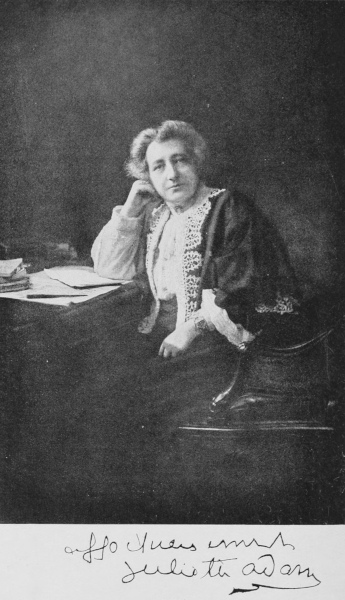
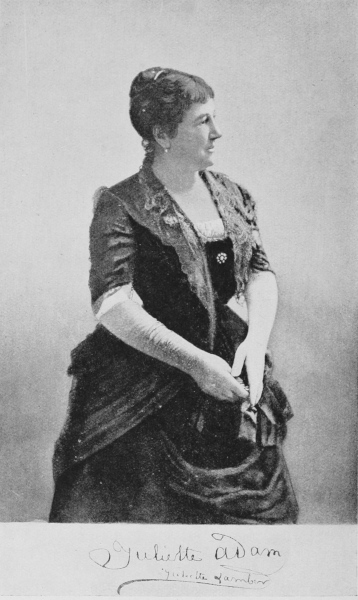
Mme. Adam, La Grande Française, as she has been happily
called, the story of whose life, which is now running into its
eighty-first year, is told in the following pages.
To write Mme. Adam’s biography is also to write one of
the most momentous chapters of French history. For this
remarkable woman has lived through the Revolution of
1848, the coup d’état of 1851, the agony of the siege of Paris,
the civil war of the Commune, and two invasions of her
beloved patrie.
As the mistress of a leading political salon, as the founder
and editor for twenty years of an influential fortnightly
magazine, La Nouvelle Revue, as for many years the intimate
friend of Gambetta, of Thiers, of other French ministers,
of the representatives of foreign powers and of such eminent
French writers as George Sand, Flaubert, Victor Hugo,
Alphonse Daudet, Pierre Loti, Paul Bourget and Maurice
Barrès, she has not only kept her finger on the pulse of
her great nation, but she has to some extent modulated its
heart-beats.
The key to Mme. Adam’s temperament and to all the
varied phases of her career is her passionate belief in self-government,
in that cause of national independence for
which the powers of L’Entente are now engaging in this
world-embracing conflict. We may call it a belief, but
originally in Mme. Adam’s case it was an instinct born in
her and inherited from her father, one of the most ardent
of revolutionaries. Mme. Adam is a revoltée to the core.
Toujours hors des rangs, Gambetta said of her. In numerous
incidents of her childhood her rebelliousness revealed
itself. The growth of her reasoning powers, however, led
her to submit to discipline, to embrace with fervour—she
can never do anything by halves—the republican creed,
and to become the irreconcilable adversary of the Second
Empire. Then the national defeat of 1871, acting upon
what she has described as her combativité rentrée (her suppressed
combativeness), turned her passion for self-government
into an ardent advocacy of the principle of nationality,
into a vehement protest against everything which could
in even the remotest manner be suspected of undermining
that principle.
Consequently we shall find Mme. Adam loudly lifting up
her voice, vigorously wielding her pen most frequently
against Prussian aggressiveness, but also against imperialistic
ideas, no matter in what shape or form, no matter in
what part of the world she can detect them. We shall find
her opposing alike the French tendency to colonial expansion
and the Austrian Drang nach Osten, Mr. Gladstone’s
later policy in Egypt and the Conservative coercion of
Ireland, the Magyar domination over the Slav peoples and
our war with the Boer Republic in South Africa. We
shall find her also ever glorifying the army and navy as
the most effective guarantee of national independence.
Nationalism is Mme. Adam’s creed, patriotism her religion.
French Nationalists, like Léon Daudet, regard her
as having been the strong tower of the French idea (la
forteresse de l’idée française) throughout the forty-four years
separating the war of 1914 from the war of 1870. If in
later years Mme. Adam has renounced her father’s agnosticism
and returned to the bosom of the Church, it is
primarily because she considers that only by submitting to
the Roman obedience can she best continue the traditions
of her country.
I am very fortunate, for Mme. Adam has throughout
taken a deep interest in this biography. We have discussed
it together at length. Despite her multifarious war
activities she has found time to write me some forty letters
in response to my questions. She has also introduced me
to her friend and collaborator in La Nouvelle Revue, Mme.
Jeanne Krompholtz, who has kindly furnished me with
valuable information.
For the greater part of Mme. Adam’s life, however, from
her birth in 1836 down to 1880, my main authority has been
her seven volumes of Souvenirs. These living documents,
written, many of them, under the immediate impression
of the events they record, I have carefully compared with
contemporary and more recent writings, indicated by foot-notes
throughout these pages. For the quarter of a century
and more which has elapsed since the close of Mme.
Adam’s Souvenirs I have consulted her numerous other
autobiographical works, her contributions to La Nouvelle
Revue and to other periodical literature, and also the
frequent references to her personally, and to her books,
which have appeared from time to time in the French press
and elsewhere.
I have to thank Sir Sidney Colvin, who frequently visited
Mme. Adam at her salon’s most brilliant moment, in the
seventies, for generously bringing forth from the rich
treasure-house of his remembrance and for permitting me
to incorporate in this book valuable recollections which
enhance, confirm and complement impressions derived
from other sources.
Had he lived to see this work completed I should have
gladly taken this opportunity to thank another of Mme.
Adam’s acquaintances and admirers, M. Elie Mercadier,
Director in London of L’Agence Havas. For to his lively
talk about La Grande Française and her circle I am indebted
for many a striking trait and useful suggestion.
Winifred Stephens.
London, 1917.
[1] “Celui qui l’a baptisée ‘la Grande Française’ a bien dit.”—Léon
Daudet, L’Entre-Deux-Guerres, 231 (1915).
Page 9, note 1, for Essay on the Spirit of Comedy read Essay on
Comedy, and the uses of the Comic Spirit.
Page 63, l. 25, for Memoirs read Mémoires.
Page 99, l. 10, for Fagwet read Faguet.
Page 194, l. 24, for parties read parts.
Page 236, Chapter motto, for heureux on read heureux ou.
Page 239, l. 8, for goutte read goûter.
Page 240, l. 6 from bottom, for Ricard read Aicard.
MADAME ADAM
CHAPTER I — FOOTNOTES:
BIRTH, PARENTAGE AND INFANCY
1836-1839
“L’émotion, l’ébullition sont en permanence dans nos âmes.”—Mme.
Adam, Souvenirs.
In the opening pages of her Recollections Mme. Adam
has told, with more vivid detail than is unhappily here
possible, the story of two generations of her ancestors.
Her own career has not lacked romance; but many of its
most thrilling incidents pale beside the experiences of her
forbears. Tracing them back to the Napoleonic Wars, she
presents us with a lively picture of domestic history, which
is as far from being commonplace as it is possible to imagine.
For it embraces moving scenes of rapturous love affairs,
extraordinary marriages, a startling infidelity, quarrels
about dowries, and the story of a son who had a rare precocious
experience. At the age of nine, he found himself
already disinherited and sent forth in the world, cast upon
the mercy of the family milkman, with whom he took
refuge. This juvenile outcast was Mme. Adam’s maternal
grandfather, of whom, under the name of Dr. Seron, we
shall hear much more anon. Only by unwavering persistence,
and stern resolution did this unhappy boy escape
from his benefactor’s vocation. Tramping to Paris, boots
in hand, to save shoe-leather, he educated himself into the
medical profession and ultimately married Mme. Adam’s
grandmother, Pélagie Raincourt. Pélagie also was a
highly romantic person, no less remarkable than her husband.
For on her wedding morning, as the result of a family
broil, by no means rare among Mme. Adam’s forbears, she
escaped in a pet from her mother’s house, and was found
sitting by the roadside, clad only in a nightcap and
dressing-gown, by her bridegroom, who had pursued her
on horseback. Swinging her into the saddle, in order to
avoid further escapades, he carried her off to the church
and there married her out of hand. Her sole bridal adornment
was a white carnation, which a woman of the people
pinned into her cap.
Juliette in later years was shown the cap and the carnation
to illustrate the story, which she heard from the runaway’s
own lips.
Mme. Seron continued all her life addicted to romance.
When it became a question of marrying her daughter,
Olympe, Mme. Adam’s mother, Mme. Seron, a catholic,
chose a son-in-law who was an agnostic, because she was
attracted by his appearance and his history. Jean Louis
Lambert, Mme. Adam’s father, had for the sake of his
opinions sacrificed brilliant ecclesiastical prospects, and
from the prospective secretary of the Archbishop of
Beauvais had become an usher in the boys’ school opposite
Mme. Seron’s house. This heroic youth was taken by
Mme. Adam’s grandmother, educated as a doctor, and
married to the reluctantly quiescent Olympe, who from that
time forward adopted that attitude of injured passivity
which was expressed by her favourite phrase “where you
have tethered the goat there it will graze.”
All this happened in Picardy, a province where people
lived well and washed sparingly. The very name of
Mme. Adam’s birthplace, Verberie, with its suggestion of
oyster patties and sauterne, made Robert Louis Stevenson’s
mouth water, as he paddled towards it in his canoe.
Juliette remembers how on Fridays at ten in the morning
the oyster cart from Boulogne would arrive, bringing
twelve dozen oysters for her family, how they would all
sit round the table, the oyster barrel in the centre, and how
each with his or her knife would open his or her oysters.
Juliette’s grandfather and father would consume four
dozen each, her grandmother and mother two dozen each,
while sometimes there would be a friend who would abstract
as many as possible from his hosts’ respective shares.
Wine flowed freely at these feasts. Dr. Seron was a twelve-bottle
man. But fortunately his beverage was only light
Macon; and this, happily for his patients, was not consumed
until he had performed his operations at the
hospital. Operations! One trembles at the very word
when associated with Dr. Seron. For, according to his
granddaughter, that country surgeon was a most diligent
cultivator of microbes. Ablutions, as we have said, were
rare in Picard households. A bath was unheard of. Dr.
Seron held that the face should be washed as little as
possible for fear of bringing out a rash. Soap was only
used on Sundays. The windows, of course, were kept
tightly shut. Physical exercise was carefully avoided.
The women of Mme. Adam’s family, like old-fashioned
Frenchwomen down to the present day, seldom went
beyond their own house and garden, declining even the
attractions of the provincial theatre, for they agreed with
Mme. de Sévigné that une grande dame ne doit pas remuer
les os (a true lady should not move about her bones).
Nevertheless, though their bodies were cribbed, cabined
and confined, these Frenchwomen’s minds moved in the
great world of romance, their fancies glowed with all the
fervent imaginings of that effervescent age. Mme. Adam’s
grandmother lived, moved and had her being in the
“Human Comedy” of Balzac. Turning over the pages of
his ninety-seven novels, or sitting over her embroidery
frame, she lived the lives of his five thousand characters.
Her unfortunate choice of a husband for her granddaughter,
Juliette, was largely dictated by the suitor’s
resemblance to one of her favourite novelist’s heroes.
Mme. Adam, as we have said, was born at the little
Picard town of Verberie, a famous place in mediæval times,
the residence of Frankish kings, whither in the ninth century
had come Ethelbald, King of Wessex, to wed his
thirteen-year-old bride, Charles the Bald’s daughter, Judith.
Verberie in the last century was a favourite place of call
for tourists, who in pre-motor-car days used to drive
leisurely from Senlis to Compiègne. Our English poetess,
Mary Robinson (Mme. Duclaux)[2], tells how from the steep
brow of a down, known as “la Montagne de Verberie,”
she saw through “the poplar screens of the precipitous
hill-side, a lovely blue expanse of country with the Oise
lying across it like a scimitar of silver”; how her carriage
dashed down the hill “and clattered along the sleepy,
pebbly ... street, past the inn, full of blouses and
billiards.”
It was in that very inn, “Les Trois Monarques,” at
Verberie that Mme. Adam was born, at half-past five on the
4th of October, 1836.
Was it a glimpse into their daughter’s future that made
her parents name her “Juliette” after that most seductive
of all the queens of French salons, Mme. Récamier?
No gold or even silver spoon was in our Juliette’s mouth
when she made her first appearance on this world’s stage.
At the time of her birth, her parents’ fortunes had reached
a low ebb. Dr. Lambert had been in practice with his great-uncle
in a village not far from Verberie, and thither to his
uncle’s house he had brought home his girl wife. For the
first years of their marriage everything had gone well with
the young couple. Then had come a deluge of misfortunes.
Their first baby, a boy, died in convulsions. Then the
uncle died, and his estate was divided among numerous
legatees. Finally, a fire broke out which nearly consumed
the whole village, and, despite Mme. Lambert’s heroic efforts,
burned her husband’s house to the ground.
Thus were Juliette’s parents driven to seek harbourage
in the inn at Verberie, where Juliette was born.
Very shortly after this event, her father, one of the most
unpractical but at the same time most attractive of scientists,
was fascinated by the report of some marvellous
scientific experiments, which were being made in the neighbouring
town of Compiègne, by a well-known chemist, a
Dr. Bernhardt. Leaving his wife and daughter to the
tender mercies of mine host of “The Three Monarchs,”
Dr. Lambert went off to join his confrère. This Dr. Bernhardt
came to be regarded by Juliette’s family as a veritable
German Mephistopheles; for the only result of his experiments
was the consumption of Mme. Lambert’s dowry.
During her husband’s scientific adventures Mme. Lambert
and her baby girl in the Verberie inn were suffering serious
privations. And they might have come near starvation
had it not been for the assistance they received from
Mme. Lambert’s parents. But this timely aid could only
be given surreptitiously; for Juliette had had the misfortune
to be born, not into poverty merely, but into one of
the numerous family feuds which were to chequer all her
childhood. Between her parents and her grandparents at
the time of the first baby’s death there had arisen a misunderstanding.
For some time there had been no communication
between the Lamberts at Verberie and the
Serons, who lived not far away at Chauny, then a flourishing
manufacturing town, now converted by German vandalism
into a heap of ruins. It was only by the curtest
of notes that Dr. Lambert had announced to Dr. and Mme.
Seron their granddaughter’s advent. Had it not been for
the report, brought by one of Dr. Seron’s patients, a
friendly commercial traveller, Juliette’s grandmother would
never have known of the sorry plight to which her son-in-law’s
scientific vagaries had reduced his wife and child.
On hearing the commercial traveller’s news, Mme. Seron,
with characteristic impetuousness, flew into a passion and
declared that she would set off at once for Verberie to
rescue her granddaughter from the parents who were
obviously incapable of taking care of her. Dr. Seron,
however, succeeded in convincing his wife that a family
scene would be injurious for the infant, whom her mother
was nursing. He reminded Mme. Seron that the first Lambert
baby had died in convulsions; and finally he induced
her to postpone her intervention until the child was nine
months old and might leave her mother without danger.
Meanwhile the landlord of “The Three Monarchs” was
secretly given to understand that Mme. and Mlle. Lambert
must be made comfortable, and that Dr. Seron might be
held responsible for the reckoning.
With great difficulty during those interminable nine
months did the ardent grandmother possess her soul in
patience. She occupied the time, however, in working
out the details of the cleverly devised plot by which she
ultimately succeeded in carrying off her grandchild.
Juliette in after years used to delight to hear her grandmother
describe all the stages of that famous coup: how
the landlord of the inn was made privy to the plot; how
there stood ready a coach, nothing less than a berline,
recalling another flight, more famous but less successful;
how in the coach had been placed a warm shawl and a
bottle of hot milk; how, while Mme. Lambert was haggling
over the bill with the landlord, Mme. Seron, bearing a
certain precious bundle, was stealthily stealing to the
berline and then speeding away with baby Juliette to join
the diligence outside the town; how ultimately the stolen
jewel was deposited safely at Chauny, whither not long
afterwards her mother followed her.
In vain did Dr. Lambert, penniless and disillusioned,
plead for the return of his wife and daughter. “Not until
you have proved yourself able to support them,” was Mme.
Seron’s stern reply; and, she added relentlessly, “I adopt
the child whom you abandoned, whom you left a prey to the
direst poverty. She is mine, and shall be as long as I live.”
Thus ended the first of those kidnappings which were
to recur at intervals through the first sixteen years of
Juliette’s life, until her first marriage. They arose not
merely from the rival claims of parents and grandparents
to possess the child, but from the fact that each of these
four persons held pronounced and divergent opinions as
to the upbringing of their adored one. In the quarrels
which ensued, Mme. Seron and Dr. Lambert were the
protagonists; Dr. Seron and Mme. Lambert played the
parts of supers, or supported one side or the other.
We are all, even the most obstinate and strong-minded,
moulded, though often unconsciously, by various intellectual
influences. To this rule Juliette, despite her indomitable
will and personal idiosyncrasy, was no exception.
And a study of her mental development shows her passing
through three distinct phases: her childhood and youth,
when her grandmother’s or her father’s influence dominated
alternately: middle life, when broadly speaking she sympathised
with her father’s opinions: her later years, after
the war of 1870, when more or less she was returning to
her grandmother’s point of view.
With these two formative forces, with these two remarkable
persons, Mme. Seron and her son-in-law, Dr. Lambert,
we must become intimately acquainted if we would understand
Juliette’s character and career. We must also remember
that the time of Juliette’s upbringing was the
hey-day of the romantic period, a time when individualism
ran rampant, when the most Utopian of dreamers believed
they were about to realise their wildest hopes. It was
true that after half a century of experiments in government
France had practically settled down for a while into
the jog-trot of Louis Philippe’s reign. But beneath the
veil of the moderate and the commonplace which this
compromise of constitutional monarchy had cast over the
country, there bubbled and boiled a welter of effervescence
which twelve years after Juliette’s birth exploded in the
Revolution of 1848.
The national temperament of France during the first
half of the last century partly accounts for the temperament
of Juliette’s family, and for the atmosphere of intellectual
and emotional feverishness in which she was brought up.
Looking back from the vantage point of old age on the
stormy scenes of her childhood, she asked: “Were we more
sensitive then, more susceptible, more dramatic than to-day?
I believe we were.”[3] It is not improbable also that
Mme. Adam, regarding her childhood through the long vista
of years, may have unconsciously exaggerated the violence
of her sentiments and experiences. One of her charms is
that feeling for the dramatic, with which Gambetta once
reproached her, saying, “Vous dramatisez trop, madame!”
“My love for my grandmother and for my daughter,”
said Mme. Adam to me shortly before her eightieth
birthday, “have been the two great passions of my
life.”
Of her grandmother, she announces in the beginning of
her Souvenirs: “I shall write of her often, but shall I
ever ... be able to make her live with that originality,
that passion for the romantic which she infused into us all,
lifting on to the plane of high romance the whole of our
family life and each one of our daily actions?”
Though Mme. Seron hardly ever went outside her own
domestic domain except to attend mass on Sunday, her
granddaughter could say that never had she met a mind
“more avid of adventure, more scornful of the every-day
and the commonplace, more eager for the romantic in life
and in literature.”
In no point, save in their passionate adoration of Juliette,
did Mme. Seron and her son-in-law agree. Yet in temperament
they were not altogether unlike; for they were both
dreamers. But Juliette’s grandmother, if she did not
possess it, at least respected that worldly wisdom which
Dr. Lambert regarded with the utmost contempt. He
was an idealist pure and simple. We have seen him sacrificing
a brilliant ecclesiastical career to conscientious
scruples. We have seen him risking the happiness of his
wife and child in his pursuit of science. We shall see him
again, more than once risking not only his family’s
happiness but his own life in the cause of political reform.
“I am the daughter,” writes Mme. Adam, “of a sincere
sectary ... of one who dreamed of absolute liberty,
absolute equality.... Only for a moment, during the
Commune, did he believe his dream realised.”
Jean Louis Lambert was one of those rare persons with
tastes both scientific and literary. But it was only classical
literature that appealed to him. He was a passionate
Grecian and an ardent admirer of the French masterpieces
of le grand siècle. In the remarkable literary works
which his own day was producing, in the novels of Balzac
and George Sand, which were his mother-in-law’s meat
and drink, he took not the slightest interest. His Homer,
on the other hand, he almost knew by heart; and he made
his little daughter as familiar with tales from the Iliad
as are most children with “Red Riding Hood” or “Cinderella.”
Dr. Lambert himself wrote verses in the classic
style, which he would recite to his mother-in-law; but there
were others which were red republican, and which he would
have kept from her hearing had not that enfant terrible of
a Juliette caught them up and repeated them parrot-like
to her grandparents. Dr. Seron, an old soldier of la grande
armée, was infuriated by poems in which his son-in-law
dared to attack his idol, the Emperor.
Indeed, the family tendency to wrangle was considerably
accentuated by the fact that three of its members
(Juliette’s mother took no interest in public affairs) held
directly divergent political opinions. Mme. Seron was a
liberal monarchist, Dr. Seron a Buonapartist, and Dr.
Lambert a social democrat. None of these fervent partisans
had the remotest idea of keeping their opinions to themselves.
Consequently, whenever Dr. Lambert and his wife
drove over from Blérancourt, a village nine miles from
Chauny, where Juliette’s father had set up in practice,
the voice of controversy rose high. These debates generally
occurred at meal time. And baby Juliette, accustomed
to have the attention of her doting elders fixed upon
herself, strongly objected to these diversions. She tells
how to restore herself to the limelight she would clamber
into the middle of the table and begin to upset the plates
and glasses. The device never failed. Discussion ceased;
the three controversialists would be overcome with laughter,
while the silent member of the group, Juliette’s mother,
would suddenly become active. Snatching her daughter
from the wreck on the table, she would be administering a
sound smacking when three pairs of hands would be eagerly
outstretched to rescue the culprit. Thus Juliette learnt
two lessons: first, not to fear her mother’s severity, from
which she might always count upon the indulgence of her
other relatives to deliver her; second, to appreciate “that
first born of common sense,” the comic spirit. In her
earliest years it was her inestimable privilege to have
“laughter for nurse, pure fun for friend.”
George Meredith, it will be remembered, divides
humanity[4] into three classes: the non-laughers, the excessive
laughers and those who stand where the comic spirit
places them, “at middle distance between the inveterate
opponents and the drum and fife supporters of comedy.”
In the table scene just described, each of these three
classes is represented. Juliette’s mother was a non-laugher,
a morbid person whose lack of fun, as is inevitable
with women, degraded her to be a mere household drudge.
Juliette’s grandfather, the jovial doctor, whose funny
stories, nicknamed Seronnades, enlivened the countryside,
was of the drum and fife order, an apostle of le gros rire.
Juliette’s grandmother and father, though differing in so
many respects, were alike endowed with the true comic
spirit. Long years later, looking back on her turbulent
childhood, Mme. Adam wrote: “I should probably have
been intolerable, had not the gay and merry temperaments
of my grandparents ... introduced into our relationship
a jocular spirit which did not admit of solemnity, even
in our grievances. Whenever I succeeded in reconciling
them after one of their disputes, it was because I had made
them laugh.”[5] “Certainly,” exclaimed a character in
one of Pierre Mille’s stories, “he was no Latin, for he took
everything seriously.”[6] Juliette Adam, Gallic by birth,
Græco-Latin by education, as she likes to describe herself,
has always been ready to see a joke, even when it was at
her own expense. Thus she is proud to relate, how when
at one of George Sand’s dinner-parties, Flaubert, in Dumas’
presence, pointed out that in one of her books she had
made a man who had lost an arm take a box in both hands,
she joined in the laugh, saying gaily, “Merci, Maître.”[7]
“De l’amour et de l’indignation furent les aliments dont on nourrit notre
jeune cœur.”—Juliette Adam, Preface to her Souvenirs, I. v.
Despite his intense desire to have his adored child in
his own home, Dr. Lambert constrained himself to permit
Juliette to remain with her grandparents until she was three.
But on his daughter’s fourth anniversary her father put in
his paternal claim.
Looking back over more than three score years and ten
Mme. Adam still sees that day as the first which stands
out clearly in her memory. She remembers it for several
reasons—because of the new white frock she wore, embroidered
by her grandmother; because the bonne Arthémise
on that day called her “Mademoiselle” for the first
time; because her grown-up friend Charles, professor at
the boys’ school opposite, embraced her; because when her
parents arrived late as usual from Blérancourt, on account
of the bad roads, her father took her up in his arms, kissed
her, and with tears in his eyes said, “Juliette, how you
have grown, it is so long since I have seen you—three
months.”
But above all that day stands engraved on Juliette’s
recollection because in the midst of the birthday feast,
there fell like a bombshell descending on the hitherto
harmonious family party, her father’s words: “This time
we shall take Juliette home with us.” Then there ensued
one of those impassioned family scenes which were so
frequent in Juliette’s childhood. Mme. Seron refused to
give up her granddaughter, Dr. Lambert protested vehemently
that he would have his child. The little girl, hardly
out of babyhood, was herself appealed to: whom did she
love most—her parents or her grandparents? Where would
she like to live—at Chauny or at Blérancourt? But in
the end Mme. Seron won the day, as she usually did, and
probably for the excellent reason that it was she who held
the family purse-strings.
There was, however, in this vehement, romantic, impulsive
lady a strain of consistency and logic. Because during
that dinner-table wrangle with her son-in-law she had
based her claim to Juliette’s remaining with her on the
fact that there were better educational facilities at Chauny
than at Blérancourt, she felt compelled to act on that
assertion. Consequently, she lost no time in sending
Juliette, tiny as she was, to school.
But this important crisis in Juliette’s career could not
pass without yet another drame de famille. To send so
young a child to the pension, to “prison,” as they called
it, seemed to the easygoing Dr. Seron and to the bonne
Arthémise, who doted on her little charge, as nothing short
of cruelty. Like a servant out of one of Molière’s comedies,
Arthémise rated her mistress soundly, whereupon she
received an entirely disregarded notice to pack up her
baggage and be off.
Of this scene the little victim was herself a spectator.
And it was as a captive, therefore, that she regarded herself,
when her grandmother led her off and delivered her
up to her schoolmistress, the grim, moustached Mme.
Dufey, who, with what appeared to Juliette a veritable
turnkey’s smile, received her with the announcement:
“I had the mother, now I have the daughter.”
Then followed a hurricane of a day. Cries, sobs and
physical protestations landed the new pupil in the school
garret, wherefrom she was extricated in the afternoon by
Arthémise, who had come to take her home. But home to
her cruel grandmother this wilful child absolutely refused
to go. No sooner was she outside the school gates than
she set off running in the direction of the village where
Arthémise lived. There Arthémise weakly followed her.
And it was only late in the evening that the runaway,
having been put to sleep in another and pleasanter garret,
was driven back to Chauny by her grandfather in his gig.
Juliette felt that she had won a victory. Her grandmother
had certainly learnt a lesson. She now realised
that her granddaughter was the kind of child she herself
had been—one of those who must be led and not driven.
Henceforth Juliette was brought up on what we now call
the Montessori system. And the time came when she
herself elected to go with one of her playmates to that same
school, which she now found quite amusing.
Indeed, considering the strongly pronounced and utterly
divergent opinions held as to her upbringing by the four
persons who desired to control her, the only possible course
was for the child, as soon as she was able, to train herself
as far as possible.
But there were certain questions which even this head-strong
little girl found settled without her participation.
There was notably the religious question. Dr. Lambert,
as we have seen, was a bitter anti-clerical, an aggressive
agnostic of the old-fashioned Voltairean stamp. Mme.
Lambert, Dr. and Mme. Seron were all catholics. And
there gnawed at Mme. Lambert’s heart the painful secret
that Juliette was still a little heathen, for, as the result of
her father’s anti-clericalism, she had never been baptized.
To remedy this omission, without confessing it to her parents,
Juliette’s mother devised a clever and effectual stratagem.
Under the pretext of being present at the wedding of one
of her mother’s friends, the little girl was brought over to
Blérancourt by her grandfather. Then at the end of the
wedding ceremony, she was hurried into one corner of the
church and held over what seemed to her a yawning gulf
of a basin, where, amidst her violent protestations, she
was transformed, as her grandfather afterwards told her,
from “a poor little unbaptized girl” into “a big, happy
baptized girl.” But this blessed conversion she was carefully
enjoined not to mention to her father, because he did
not like churches.
Whether the youthful convert would have kept the
secret is doubtful. But the opportunity of doing so was
reft from her by one of her playmates, who during the
wedding festivities called her, in her father’s presence, by
her baptismal names of “Camille Ambrosine.” This led
to inquiries and to a disclosure, followed, of course, by
the inevitable drame de famille. Fortunately for the conspirators
an accident to one of Dr. Lambert’s patients put
an end to this extremely unpleasant situation. And while
the Blérancourt doctor was at the injured man’s bedside
his father-in-law seized the occasion to drive the “little
bone of contention” back to Chauny.
Juliette, having been once captured by her catholic
relatives, Dr. Lambert agreed to surrender her mind to their
keeping until she had taken her first communion. And he
must have been pleased that Mme. Seron, with her usual
ambitious desire to force the pace in Juliette’s education,
persuaded the Dean to admit her clever little granddaughter
into the Church one year earlier than was
customary, at ten instead of eleven.
“We must furnish the little brain,” was Mme. Seron’s
favourite expression. She herself had never acquired
much book learning. But, in order to educate her grandchild,
she for a while put on one side her adored novels
and studied French history, of which she was most eager
that Juliette should take a correct view. That correct
view was, of course, Mme. Seron’s own, and was the contradiction
of her husband’s and son-in-law’s opinions.
Juliette’s grandmother taught her to regard the French
middle-class, the bourgeoisie, as the salt of the earth, and
the government of Louis Philippe as the only possible
government, infinitely superior to the Buonapartism which
Dr. Seron and to the Jacobinism which Dr. Lambert would
have liked to restore.
So Juliette, surrounded by piles of lesson-books, was
kept hard at work till late in the evening, while her grandfather
laughed at her for being a blue-stocking, and dubbed
her “Mlle. Phénomène.”
But even the jocular Dr. Seron could sometimes be serious:
and he gravely warned his wife that if she continued
thus to press the little girl beyond her years misfortune
would follow.
His warning being unheeded, the prognostication came
true. Its fulfilment was hastened by three weeks at
Blérancourt, where Dr. Lambert talked to his little daughter
as if she were grown up, and by a tempestuous journey home
with her mother, followed by an even stormier drame de
famille on her arrival at Chauny.
Juliette fell seriously ill. On her recovery, Dr. Seron,
who seems to have been the only member of the family
endowed with common sense, insisted on his granddaughter
being removed from the atmosphere of school-books and
drames de famille to a serener and healthier air.
The child was sent to visit her grandmother’s three step-sisters,
three maiden ladies who lived with their mother,
in the heart of the country, at a village called Chivres, not
far from Soissons.
“My aunts! Ah! you must love my aunts!” exclaimed
Mme. Adam, as one day, in the salon at Gif, we talked of
these delectable virgins. And indeed one could not help
loving the charming, though eccentric ladies, les demoiselles
Sophie, Constance and Anastasie Raincourt. They
represent a type totally unknown in Great Britain, though
I suspect it might not at that time have been altogether
impossible to discover their counterparts in other French
country districts, or perhaps in remote corners of New
England.
The aunts were a bundle of contradictions and surprises.
In their short gathered print skirts, aprons and kerchiefs,
they looked like peasant women, and they worked like
peasant women too, at hay-making, poultry-keeping and
fruit-farming. But so distinguished was their bearing that
in their humble attire they had the air of great ladies in
disguise, while their discussion during hay-making of
Sismondi’s Italian Republics showed them to be veritable
femmes savantes. Though living in the heart of the country,
these original spinsters took a deep interest in all the
literary and political movements of the town. Though,
with their step-sister, Mme. Seron, they were firmly convinced
that a constitutional monarchy was the only ideal
form of government, they did not altogether share Mme.
Seron’s admiration for Louis Philippe. They criticised
his policy and approved of the opposition led by M. Odillon
Barot.
In almost every respect Juliette’s life at Chivres was a
complete contrast to her life at Chauny or Blérancourt.
Instead of, as at Chauny, sitting up late over her books
and then going to bed in her grandmother’s stuffy chamber,
with the windows tightly closed and the atmosphere infested
by the midnight oil burnt to enable Mme. Seron to
read her romances, Juliette at Chivres, after a day spent
in healthy open-air exercise, lay down with the lamb and
rose with the lark, having slept by herself in a large airy
room with the windows wide open.
Whereas at Chauny no interest was taken in house
arrangement, while picturesque old family heirlooms were
regarded as lumber and relegated to the attic, and any
artistic feeling found its only expression in personal adornment,
at Chivres it was just the opposite: Juliette’s fine
clothes were all folded away, and she was dressed like her
aunts in peasant costume; but her natural love of the beautiful
was gratified by the daintiness and artistry of all the
household arrangements, by the handsome old chests and
commodes, the embroidered draperies, the nosegays of
fresh wild flowers, and the beautifully bound books ranged
trimly on their shelves.
The intellectual atmosphere of Chivres was likewise
entirely different from that of Chauny and Blérancourt.
Dr. Lambert’s heroes, Louis Blanc and Proudhon, were
anathema to such worshippers of the established order as
the aunts. In the light of her aunts’ wide interest in all
manifestations of nature, her grandmother’s concentration
on the merely human aspect of life suddenly appeared to
Juliette as intensely narrow. It was at Chivres that Juliette
first acquired that passionate love of nature which she
was later to express so eloquently in her books. It was at
Chivres that Juliette learnt to take an interest in birds and
beasts and flowers, and also in inanimate things, to find—
“... tongues in trees, books in the running brooks,
Sermons in stones and good in everything.”
In her aunts’ company the simplest actions of rural life
acquired for the little girl some deep significance: watering
flowers in the garden she seemed to be quenching their
thirst, gathering fruit in the orchard she was easing the
burden of overladen trees, cutting clover in the paddock
she was receiving a gift from bountiful earth.
For Aunt Sophie even stones and metals had a voice or
resonance. She would place upon a crystal tray various
substances differing in form, some round, some flat, and
with a little hammer would play upon them curious
melodies.
While Juliette’s father had brought her up on tales from
the Iliad, Aunt Sophie, who was an accomplished Latin
scholar, told her stories from the Æneid, which seemed to
her strangely like an echo of her beloved Homer. While
her grandmother’s favourite novelist had been Balzac, the
aunts talked to her admiringly of George Sand’s peasant
romances, and vaguely hinted at longer novels by the same
author, which they did not altogether like, but which
Juliette would read when she grew up.
But the greatest contrast of all was the atmosphere of
calm which pervaded Chivres, the harmony in which the
aunts and their mother lived, so different from the perpetual
wrangling of Chauny and Blérancourt. No wonder
that Juliette after two months of this serenity returned to
her grandmother a new creature, in mens sana in corpore
sano. No wonder that the perfect success of this first
visit caused it to be repeated annually throughout Juliette’s
childhood. Indeed, as time went on, as Juliette grew in
years, as the feverish intellectuality of Chauny and Blérancourt
intensified, the summer visit to Chivres became more
and more necessary.
Having done his best to keep his word to his mother-in-law
and to permit her to dominate Juliette’s mind until
her first communion, once that event was consummated
Dr. Lambert felt at liberty to educate his little girl in his
own way, in his own ideas, and to make her, as he expressed
it, “his daughter according to the spirit as well as according
to the flesh.”
In his earlier talks with Juliette he had endeavoured to
impose a certain reserve upon his expansive nature.
Though finding it impossible to exclude his beliefs, his hopes
and enthusiasms altogether from their conversation, he
had but alluded to them vaguely, saying, “when you are
older I will explain to you such and such, when you are
older you will understand this or that.”
This seed, though sown in an almost infantile mind, had
not fallen on barren ground. Not one of these remarks
had been lost on Juliette’s precocious and naturally speculative
intelligence. She was therefore well prepared to
receive with enthusiasm those hopeful doctrines of liberty,
fraternity and equality with which her father now set
seriously to work to inculcate his eleven-year-old little
daughter.
On Juliette’s return from Chivres in the autumn of
1847, she paid a visit to her parents at Blérancourt. And
it was then that her father said to her: “Now that you
have discharged your obligations to your grandmother’s
religion, I can speak to you frankly of mine.”
The chief articles of Dr. Lambert’s creed were a belief
in human solidarity and a conviction in the inherent goodness
of nature. With the great Jean Jacques he held
society, not nature, responsible for all the evils which have
befallen mankind. His “great negation,” as his daughter
was later to call it, consisted in the denial that the finite
can ever be capable of comprehending the infinite. Nature,
he held, was rich enough and vast enough to satisfy all
man’s craving for knowledge, sociability and love. “If
you must worship something,” he would say to Juliette,
“then worship the sun which lightens and warms you, in
whose rays all things germinate, breathe and blossom.”
While for the Christian religion Dr. Lambert had little
respect, its Founder he held in the greatest veneration.
While Christ came to obliterate all distinctions of race and
caste, Christianity seemed to Juliette’s father ever raising
barriers between man and man. “Christ,” he used to
say, “came to save what he called ‘souls,’ we [the social
democrats] come to save society (la personne sociale) by
establishing equality, fraternity, liberty.”
In days when trade unionism was beginning in Great
Britain, and when Proudhon’s teaching was laying the
foundations of future syndicalism in France, Dr. Lambert
was a firm believer in the right of all men to work, and to
insist on receiving for that work a just wage. “Juliette,”
he would say, “I rejoice to see you talking to a working-man
... as if he were your brother. I want you to be
an apostle of human happiness and universal good. I love
the weak and helpless more than myself. To see struggle
and suffering tortures me. To those who have nothing
one must give oneself up entirely, keeping nothing back.”
At such words the little girl’s heart glowed within her.
With all her passionate little soul she responded to her
father’s pity for the unfortunate, with all the determination
of her strong will she resolved to spend her life helping
them.
Though in years to come some of her father’s notions
were to appear to her quixotic, though even then she and
her grandmother laughed at his affecting the workman’s
blouse, for example, though as time went on his extravagance
and lack of common sense were frequently to make
her tremble for his safety, she never—not even when intellectually
they had drifted apart—ceased to reverence the
breadth of his knowledge, the range of his charity and his
unfailing good nature. The words apostle and charity
ever conjured up before her a vision of her father. In spite
of their perpetual disagreement, even Juliette’s grandmother
would say of her son-in-law: “He is a dreamer,
but he is sincere, and he has a heart of gold.”
Dr. Lambert was indeed one of those intellectual enthusiasts
who were largely responsible for the Revolution of
1848. For these men of 1848 Mme. Adam has always
cherished the most profound respect. Though in after life
she came to regard them as childishly ingenuous and heedless
of the possibility of realising their dreams, she has ever
venerated their “passionate altruism,” their “craving to
sacrifice themselves in the people’s cause,” their revolt
against that famous formula ascribed to M. Guizot,
“enrich yourselves.” “The men of 1848,” writes Mme.
Adam, “were apostles and saints. Never have there been
more honesty, more virtue, a nobler simplicity. They were
no mere politicians. They were souls in love with the ideal.
All those whom I have known were as sincere as my father
... and to have associated with them is to honour and
cherish their memory.”
CHAPTER III — FOOTNOTES:
HER FIRST REVOLUTION
1848
(From a Schoolgirl’s Point of View)
“Les hommes de 1848 étaient des apôtres, des saints.”—Mme. Adam,
Souvenirs.
Mme. Adam has lived through four Revolutions. The
first, that of 1848, occurred when she was eleven. In the
previous year, when she paid her usual summer visit to
Chivres, she found her aunts perturbed by the political
situation. They were eagerly devouring the columns of
the National. They were talking of politics from morn
till night. Much to their mother’s disapproval, they
brought their eleven-year-old niece into their discussions.
“You are tiring the poor little thing to death!” remonstrated
Juliette’s great-grandmother.
“No,” rejoined her daughters, “the child is quite old
enough to listen and to understand.”
“Besides,” continued Aunt Constance, who was the
ironist of the three, “it will not be unprofitable to you,
mademoiselle, to learn, if not with your ears, at least
with your mouth as you yawn, the views on public affairs
held by such highly intelligent persons as your aunts.”
“But,” writes Juliette, “I did not yawn, for my mind
was interested in all matters political and literary.”[8]
From her aunts’ point of view the child saw those
surging political movements of the day at an angle quite
different from that at which, under her father’s direction,
she had been accustomed to regard them.
At Chivres her father’s heroes, Louis Blanc, Ledru-Rollin,
Proudhon, were held in horror. As utterly subversive
of all public order the aunts regarded Ledru-Rollin’s
famous speech, when, pleading before the Court of Cassation,
the republican barrister had challenged the Procureur
Général, crying: “Procureur Général, who appointed
you?” “The Ministry.” “I, being an elector, may
dismiss ministries. In whose name do you speak?”
“In the king’s name.” “I, being an elector—history
proves it—can make and unmake kings. Procureur
Général, on your knees, on your knees before my sovereignty.”
While as for Proudhon’s famous maxim,
“Property is theft,” the aunts exclaimed: “Why, it’s
the end of the world.” Social reform had no place in these
good ladies’ political programme. They were content
with the existing order. They had no sympathy with
Dr. Lambert’s doctrine of the right to work, nor with
Ledru-Rollin when he declared: “The workers have been
slaves; they have been serfs; to-day they are wage-earners;
we must strive to make them partners.”[9] The
reforms which the aunts advocated in their talks with their
niece were merely administrative. What they desired
above all was to see Paris dethroned from her seat as the
one centre of influence in the kingdom. They wanted
decentralisation, the revival of the old provincialism.
“Remember,” said Aunt Sophie to Juliette, “a time will
come, I am sure of it, when, after various Jacobin and
Buonapartist experiments, after a series of revolutions,
you will remember how wise, how essentially French, how
truly national, were the opinions of your old aunts.”[10]
The last months of 1847 Juliette was permitted to
spend with her parents. Blérancourt in those days was
becoming, under Dr. Lambert’s influence, a centre of
violent political agitation. The number of Dr. Lambert’s
disciples was increasing daily, and his socialistic ideas
were being promulgated in the neighbouring villages.
Mme. Seron wrote constantly demanding her granddaughter’s
return. She feared that from being a Republican,
which was bad enough, Juliette would be made into
a socialist, converted from a pagan naturiste, as she called
it, into an atheist. Finally, such remonstrances passing
unheeded, she threatened that if her granddaughter were
not immediately restored she would disinherit her, and
Juliette would be reduced to depend for her dowry on
such savings as her father might accumulate. This practically
meant that Juliette would have no dowry at all.
For Dr. Lambert, far from saving, could never keep any
money in his pocket. In face of poverty and distress he
was a veritable St. Martin of Tours, and would give away
the very clothes from his back. But to one whose mind
was set so far above filthy lucre Mme. Seron’s threat was
meaningless. And to his mother-in-law’s letter he replied
that Juliette would not need a dowry as he had decided
to marry her to a working-man. But such a destiny did
not suit Mlle. Juliette at all. She had often dreamed of
a cottage, of a farm, but always with a gentleman (un
monsieur) for husband. And when her father told her of
this letter, she exclaimed: “Of course you are joking.”
“But no,” he replied; “that really is my idea.” “Then
it is not mine,”[11] retorted this eleven-year-old socialist, to
whom her father’s design seemed utterly preposterous and
cruel to the last degree.
True, she loved the people more and more every day.
True, it seemed to her in moments of exaltation that she
was ready to sacrifice herself in their service; but that
she, whom generations had raised above them, should
become one of them, no. Father and daughter were
equally violent. This, their first disagreement, was, to
say the least of it, tempestuous. And it was well that
Mme. Seron arrived the next day to take her granddaughter
back to the less exalted atmosphere of Chauny.
Though Dr. Lambert continued to cherish his dream of
a working-class marriage for Juliette, for the time being
he ceased to urge its fulfilment; and for the time being
Juliette found it not impossible to reconcile her socialism
with filial devotion.
At Chauny she found that her grandmother’s political
principles, like those of the aunts at Chivres, had undergone
a change. Mme. Seron had lost her passion for the
citizen king. She had come to realise the necessity for
reform. Juliette was delighted, and she expected her
father to be equally pleased by his mother-in-law’s partial
conversion. But she did not then know human nature.
It was not until much later that she understood how a
partisan is far more distrustful of opinions differing slightly
from his own than of those which are more remote. Dr.
Lambert mistrusted a reform movement led by M. Odillon
Barot as strongly as the aunts at Chivres mistrusted any
reform advocated by that extreme liberal, M. Ledru-Rollin.
Juliette’s schooling had been interrupted by her three
months at Chauny, and also by a visit to Boulogne, to
which we shall refer later, paid in company with her
father in the summer of 1847.
After Christmas she returned to the pensionnat. Many
changes had taken place in the school during the five
years which had elapsed since that eventful day when
she made her début as a scholar. The ogress, Mme. Dufey,
had been succeeded by two friends of Juliette’s mother,
the Mlles. André. The school had expanded, and a new
building had been erected on the site, alas! of Mme.
Seron’s garden, in which Juliette had spent some of her
most entrancing hours. On the occasion of the destruction
of this her land of delight, her “temple of verdure,”
as she called it, there had been a long and violent battle
between this little devotee of nature and her grandmother.
The excuse that the garden had been sold in order to
provide Juliette with a dowry did not appeal to her in
the least. Money had never loomed large in the child’s
imagination. She loathed the mention of it; for it always
seemed to her to lead to family quarrels. The only use
she had for it personally was for the purchase of sugar-drops,
which she distributed among her schoolfellows.
It was long before the little girl could be persuaded to
enter the building which seemed to her the grave of her
brightest dreams and her most cherished joys.
Now, in the early weeks of 1848, Juliette found her
school seething with a political excitement, which she,
with her violent views, was the last person to allay.
With an important air the young politicians of the
Pensionnat André went about announcing “l’heure des
réformes a sonné.” The playground echoed with cries of
“Vive la Réforme!” “A bas Guizot!” The sympathies
of the youthful reformers were entirely with the people,
le grand peuple. They were transported into a veritable
fury on the day when they heard that “the people” had
been massacred, the inoffensive people, engaged in a
manifestation strictly within the bounds of the law!
Upon the heels of these tidings, however, followed quickly
the news that “the people” were revenged. Louis
Philippe, after having twice failed to form a ministry,
the Duchess of Orléans, after a vain attempt to establish
a regency, were in flight. “The people” had raised
barricades, “the people” had proclaimed the Republic.
“The people,” read Juliette and her schoolfellows in the
columns of La Démocratie Pacifique, had behaved magnificently,
they had shown themselves worthy of every kind
of liberty. Not a theft, not a single violation of property,
had been committed. “The people,” in rags (loqueteux)
put up notices, “Death to Thieves,” in the corridors of
the Tuileries. “The people,” themselves penniless, had
protected the treasures in the Bank.
On the great day of the Revolution, the 26th of February,
Dr. Lambert came over to Chauny. He was in the seventh
heaven of delight. Even Mme. Seron did not seem alarmed
at the monarchy’s collapse. Her husband, however, was
less pleased. He had thought that the Revolution would
be made on behalf of his hero, Louis Buonaparte. And
this soldier of la grande armée vented his spleen on the
first republican who came to his hand. This unhappy
republican[12] chanced to be his son-in-law. “Your
Republic,” he jeered, “your stupidly democratic Republic!”
“But,” writes Juliette, “father only laughed, grandmother
smiled, and I said—
“‘Ah! my poor grandfather, your Buonaparte must be
very sick at our Republic, however socialist he has pretended
to be.’”
Juliette remembers that, towards the end of dinner on
that fateful 26th of February, her grandfather, having,
by way of consolation for his disappointment, drunk an
extra bottle or so of his petit Macon, opening his eyes
very wide, addressed his family, and said: “Well! I see
the future as clear as day!... I see your Republic, do
you hear me, Lambert? Do you hear me, Juliette? I
see it trampled under foot by my Buonaparte. I tell you,
I scream it at you: revolutions, don’t you know, always
end in empires.”[13]
At school next day Juliette found all her friends in a
state of great agitation. Half of the scholars had stayed
away. Their parents had been afraid to let them leave
home. The Revolution might spread into the provinces.
There was a glass factory in the town, and all the workmen
were in favour of the Republic. Might they not
proclaim it at Chauny, and revolt and perhaps plunder?
Hardly had Juliette arrived at school than she was
summoned to the study of the Mlles. André. There she
was questioned as to what her father thought of the
situation.
“‘Well, Juliette, your father must be highly pleased,
he who has always been a republican. Have you seen
him?’
“‘Yes, mesdemoiselles, he came yesterday, and he is
delighted. He says that at last France will show herself
worthy of her history, that she will govern herself, that
all the European nations will admire us and perhaps
follow our example, that it is the coming of the people,
the real people, which is not corrupt like the middle-class,
and which ...’
“‘That is enough,’ interrupted the eldest Mlle. André
drily. ‘I hope, Juliette, that you will keep your father’s
fine notions to yourself. I forbid you to speak of them
here.’
“‘In the schoolroom, mademoiselle?’
“‘In the schoolroom and in the playground.’
“I looked Mlle. André in the face,” writes Juliette. I
was almost as tall as she; and I replied—
“‘That, mademoiselle, I can’t promise you; for there
are a great many of us republicans in the school, and
no one can prevent our talking about the Republic and
loving it.’
“‘But France has not accepted your Republic,’ replied
the youngest Mlle. André, Mlle. Sophie.
“‘It will accept it, mademoiselle, because this time the
people will vote.’”
The Mlles. André were perplexed. They hesitated
between their desire to shut the mouth of their precocious
and self-assertive pupil, and their reluctance to be hard
on their friend’s daughter, and also to annoy the republican
parents of the other scholars.
Finally they decided to bring the interview to a close
by the following judicious remark: “When you see your
father, Juliette, you may tell him from us that we hope
his Republic will bring peace to France and not agitate
it further.”
On coming forth from the mistresses’ presence, Juliette
was, of course, the object of universal interest among the
scholars. They were burning to know what had passed
in the principals’ sanctum. But they could not satisfy
their curiosity until school was over. The lessons that
morning were not well known, and the general excuse
was the Republic. “Mademoiselle, I have not had time
to do my lessons because of the Republic.”
“Mademoiselle, I couldn’t work because of the Republic.”
“I fail to understand,” was the icy retort, “how the
Republic can be any concern of yours.”
There was a deep silence, and then a voice—it was
Juliette’s—made answer.
“But, mademoiselle, it interests us passionately.”
The end of morning school was a regular riot. The
pupils rushed out into the playground, where they surrounded
Juliette, in a crowd, clamouring to receive a full
account of her famous interview. She, on her part, was
only too eager to relate it in every detail, and to follow
it by an appeal to her comrades to bear themselves like
true and worthy republicans, not to be insolent towards
their teachers, but to make them realise that, although
younger than they, the Republic regarded them as their
elders’ equals. Then followed a babel of conversation. Each
schoolgirl had her own idea of what the Republic should
do. But all were agreed that the first reform must be
the establishment of universal suffrage. No mere tax-payers’
franchise would satisfy these ardent suffragettes.
Every one must vote, men, women, and, of course, schoolgirls.
Only thus could the Mlles. André’s pupils conceive of
a really universal suffrage, and later they prided themselves
on having invented it.
Nothing in the Revolution pleased Juliette’s father
better than the opening of the National Workshops. An
ardent believer in the right to work, he, with his idol,
Louis Blanc, had always advocated them. And though
Louis Blanc did not appear to be directly concerned with
those that the Government was establishing, Dr. Lambert,
like most people, believed that he was secretly connected
with them. They had not been running more than a
few weeks, however, when he began to suspect that he
had been mistaken. As time went on he grew less and
less satisfied with the Republic. There were too many
reactionaries in the National Assembly. This Republic,
from which he had hoped so much, was too pleasing to
comfortable middle-class people like his mother-in-law.
“Jean Louis,” she would say, “I find that I agree very
well with your Republic.” “Wait a little,” her son-in-law
would reply at first. By and by he would answer: “You
agree with it better than I do.” And finally there came
a day when he exclaimed: “No wonder you approve
of the Republic, for it is constituted for your advantage!
The Orléans may come back and they will not need to
alter anything as far as their bourgeois supporters are
concerned.”[14]
Seeing his dream of a Christian, classical, social, scientific
Republic vanish, Dr. Lambert resumed his old part
of malcontent, and, of course, Juliette followed suit. She
filled the house with her recriminations. She made herself
excessively disagreeable to her grandparents. Her
grandfather infuriated her by chuckling with delight and
repeating: “All this augurs well for the Empire.”
That which most distressed Juliette and her father was
the failure of the National Workshops. It had become
obvious that, far from being organised by Louis Blanc,
they had been initiated by his enemies. Émile Thomas,
who directed them, was suspected of being Louis Napoléon’s
agent. Far from constituting, as Dr. Lambert had fondly
dreamed, a national benefit and a model for the whole
civilised world, they proved useless and costly. They
grew like an ulcer; as many as 119,000 men were on the
pay-roll. They were a club of loafers, a reserve army of
insurrection, a perpetual strike supported out of public
money. No wonder there was talk of suppressing them.
But Dr. Lambert, though bitterly disappointed with the
way they were conducted, was horrified at the idea of
suddenly depriving of occupation and turning adrift these
thousands of workmen. It would mean, he thought,
nothing short of a sanguinary revolution. Juliette, of
course, shared her father’s horror. What had “the
people,” “the people” who had behaved so admirably
on the 26th of February, done to deserve such treacherous
treatment? She could think of nothing else. Her rage
and disappointment were such that she became absolutely
insupportable. And when her grandmother remonstrated
with her, she implored to be allowed to go to Blérancourt
to her father, who shared her disappointment. But Mme.
Seron was still living in dread of her son-in-law’s threat
of a working-class marriage for his daughter. She had
other ideas for Juliette. “Already,” she told her little
granddaughter, “you have pleased young X——, who is
seventeen; and his father, half in jest, half in earnest,
because of your age, has suggested that in a few years’
time there might be an alliance between the families.”
Moreover, Mme. Seron did not wish again to interrupt
her daughter’s studies. So she proposed a compromise.
Instead of going to Blérancourt, Juliette might become a
boarder at the pension.[15]
This suggestion was a terrible blow to Juliette. That
such a proposal should come from her grandmother, that
she, who generally complained of the length of the school
hours which deprived her of her idolised granddaughter’s
company, should now of her own free will suggest a far
longer separation, seemed incredible. The child was quick
to see that her own behaviour had brought her grandmother
to such a pass. By her ravings and recriminations
she had made herself intolerable. Her grandmother was
glad to get rid of her.
“I was thunderstruck,” she writes. “Nothing but
wicked pride kept me from throwing myself on my grandmother’s
neck and asking pardon for my folly; for I
realised how wild and extravagant I had been. But
what grandmother had told me about X——, a tall youth,
whom I thought both handsome and clever, had so puffed
me up that I could not see a young person like myself,
close upon twelve, kneeling to ask forgiveness like a little
girl. So, though my heart was in my mouth all the
while, I merely said—
“‘Very well, grandmother, it is understood, I will be a
boarder as soon as you like.’
“‘To-morrow,’ she replied.”
It will be seen from these reflections that her father’s
and grandmother’s adoration had not, as it might well
have done, completely warped their idolised Juliette’s
disposition. They had made her absurdly vain, but they
had not stifled a certain critical sense which even at that
early age the little girl was beginning to turn upon herself.
In this wholesome exercise she was encouraged by
her mother’s severity. Whenever her father praised, her
mother scolded.
“When father,” she writes, “spoke of my intelligence
and my good looks, mother declared that I was as stupid
as I was plain. It seemed to me that both of them
exaggerated. And I began to judge myself, as I have
done ever since, with a certain detachment. At heart I
am really grateful to my mother for having preserved me
from complete self-satisfaction.”[16]
Juliette’s career as a boarding-school miss, which
resulted from her enthusiasm for and her disappointment
with the scheme of National Workshops, was destined to
be as short-lived as that great national experiment.
It was bad enough to be un enfant gâté removed from
her fond relatives and subjected to all the rules of an
institution. But her personal sorrows were intensified by
the thought of hundreds of thousands of workpeople about
to be threatened with starvation. By this apprehension
Juliette’s schoolfellows were likewise depressed. An atmosphere
of gloom pervaded the playground. Instead of
playing games, the girls gathered together to discuss the
fate of their unfortunate compatriots. “There was not
one of us,” Juliette writes, “who did not deny herself
goodies in order to save a few pence with which to help
these poor people. We were always counting up our
resources. We thought we might just be able to feed one
of them. I decided that we would address an elegant
epistle to the minister Trélat,[17] whom we abhorred. For
him we held responsible for everything. We would propose
to him to undertake the support of one of the workmen
from the National Workshops. Certainly one out of a
hundred thousand (sic)[18] was not much; but if every
pension did the same, some would be saved in any case.”[19]
The composition of such a letter was not easy. In
order to bring to bear upon it as much intelligence as
possible, the republican scholars classified themselves in
groups, eleven in all. Each group drew up a draft of the
letter. These drafts were compared, the best passages
selected from each, and finally the letter was dispatched
to a friend of Juliette in Paris, that same Professor Charles
who had embraced her on her fourth birthday. He was
now a public functionary, and he was requested to deliver
to the minister the all-important missive.
“Daily,” records Juliette, “we expected the arrival of
our protégée, our atelier national, as we called him. He
had been instructed by the famous letter to present himself
at the Pensionnat André, and to announce himself as
Juliette Lambert’s protégée. His benefactresses meanwhile
were busily preparing for his arrival. Cakes and
sweetmeats were tabooed. ”Nous économisions avec
frénésie,“ writes Juliette. They also, under every imaginable
pretext, begged from their friends and relatives.
One of them had been so fortunate as to obtain a suit
of clothes belonging to her brother. Having cleaned and
mended it with the greatest care, she kept it in readiness
for the atelier national, who would doubtless arrive in rags.
Meanwhile the plot was kept a dead secret; for the
conspirators were well aware that their sympathy for
ces monstres des ateliers nationaux would meet with no
encouragement at home.
While at Chauny the Mlles. André’s pupils were eagerly
awaiting the arrival of their expected monstre, at Paris
affairs were moving quickly. The men who had been
paid forty cents a day for digging trenches in the Champs
de Mars and filling them up again were sticking to their
job in defiance of the Government’s orders to disband.
The Socialists sympathised with them and organised street
manifestations in their favour. Finally, on the 23rd of
June, the capital broke out into open insurrection. It
was at this juncture that Juliette received, not the eagerly
expected atelier national, but a letter from Professor Charles
which dashed all her hopes to the ground. He, to whom
had been entrusted that elegant epistle to the minister,
had basely deserted the young friends who had confided
in him. Professor Charles had no sympathy with the
State-employed workmen; he described them in his letter
to Juliette as ces misérables qui t’intéressent. Charles was
immediately banished from Juliette’s heart. Her ex-ami
Charles, she called him, severely, when she announced to
her comrades this terrible disappointment.
Then there followed much secret confabulation among
the Republican groups of the pension. The pupils agreed
that while blood was flowing in the streets of Paris, they
at Chauny could not remain inactive. Already the revolution
in the capital was finding an echo in the provincial
town. Bands of rebels were marching down the streets.
Why should not les demoiselles de la pension André join
them? Juliette counted among her treasures a large
handkerchief given her by her father and emblazoned
with the words: Vive la République, Démocratique et
Sociale. Attaching this emblem to a pole abstracted from
the wood-shed, the girls, under Juliette’s leadership,
organised themselves into a procession and marched
round the playground, crying: “Long live the Democratic
and Social Republic. Long live the rebels. We
will not disband. We will not disband.”
This manifestation, the tumultuous scenes to which
it led, the defiant words which she addressed to her
governesses, resulted in Juliette’s expulsion from school.
For the Mlles. André rightly regarded her as the leader
of the revolution.
Mlle. Sophie conducted her back to her grandmother’s
house. Mme. Seron was already regretting having sent
her granddaughter away. She would, therefore, have
been glad to see her back under almost any circumstances.
But to find her distinguishing herself as the originator and
ringleader of a rebellion gratified the pride and ambition
of her own rebellious heart. So, after listening to Mlle.
Sophie’s story, Mme. Seron said with dignity: “If you
regard her behaviour as a defiance of your authority, then
you are quite right to dismiss her.... But this episode
shows me Juliette as I like to see her, displaying a determination
and a courage such as are not given to every
one. Since, without my seeking her, the child has been
brought back to me, neither she nor I will be distressed.
I have rather, mademoiselle, to thank you than to ask
you to reconsider your decision.”
Thus after a few weeks terminated Juliette’s career as
a boarder, and, indeed, her schooldays, for she never
returned to the pension.
At Chivres, whither, on the 1st of July, Juliette went
for a three months’ visit, she found herself promptly
deposed from the pedestal on to which, as a reward for
her defiance of authority, her grandmother and her father,
too, had elevated her. The aunts had never heard of
such nonsense; they scolded her roundly for her conduct.
They had no sympathy whatever with the ateliers
nationaux. And, during the violent suppression of the
rising which followed, their sympathies were entirely with
the bourgeoisie. Juliette was condemned to keep her
opinions to herself, and even to read the newspaper by
stealth. Instead of arguing about things she did not
understand, she worked hard at her Latin. And in the
serenity of her aunts’ presence, contrasting with their
educated minds her own empty little head, she came to
see herself as she really was: a pretentious young person,
very ignorant, and fond of airing opinions she had borrowed
from other people.
Consequently it was in a chastened frame of mind that
Juliette returned in the autumn to Chauny. And her
grandmother found her quite willing to fall in with the
new scheme of life which she suggested. The storms of
the past had strengthened Mme. Seron’s conviction that
Juliette was a child to be led and not driven. In broaching
the subject of her future studies, therefore, Mme. Seron
began with this tactful observation—
“Now, my Juliette, you will do exactly as you like.
You will learn what you wish, or you will, if you prefer
it, learn nothing at all. But there is one thing in which
I do ask you to take an interest: that is housekeeping.
I will give you complete charge of our house for six months.
You shall be its mistress to order and to spend. I shall
merely advise you. As you are fond of the appointing,
the arrangement, the decoration of a home, you will have
full scope for the development of your taste. If you
would like lessons in cooking and sewing, you have only
to say so. I want to persuade you, too, that an art, and
above all arts, music, embellishes life. The new organist
is a remarkably good teacher. The piano bores you, but
I wish you to cultivate your voice. And then I have
another wish: I want you to try the violin. But, I
repeat, you shall do as you like in everything.”[20]
To these diplomatic suggestions Juliette was graciously
pleased to reply—
“Grandmother, I shall be delighted to keep house; it
will be very interesting. I will certainly learn the violin.
That will be quite out of the common: and I will cultivate
my voice.”
How the Seron household fared during the régime of
this young lady of twelve Juliette has not told us. But
that her grandmother’s somewhat bold experiment was
in the end eminently successful is attested by the fact
that throughout her long life Mme. Adam has been renowned
as a first-rate maîtresse de maison; and that this
reputation is fully justified is the experience of all those
who, like the present writer, have partaken of her lavish
hospitality.
As for the rest of her studies, Mme. Seron had been
well advised to leave it to her granddaughter to decide
as to whether she would continue them. Juliette was far
too ambitious to be content with her very meagre knowledge.
And it was at her own suggestion that her father
was asked to draw up a time-table for his daughter.
A professor from the boys’ school opposite was engaged
to give her lessons; and Dr. Lambert himself, when he
came to Chauny, superintended her studies. He read her
Racine, and persuaded her to copy daily five pages from
the pen of that great French classic. The doctor, as
we have said, was himself a pure classicist. He used
to say to his daughter, “Be a Grecian, Juliette, if you
desire initiation into the worship of the eternally beautiful,
into all that raises man above the age in which he
lives.”[21]
In order to accustom his daughter to what he called the
admirable sonority of notre langue initiatrice he read her
passages from Homer in the Greek original. He dictated
to her word by word translations of whole chapters of the
Iliad and the Odyssey. In these lessons, in his own reading
and in his talks with Juliette, Dr. Lambert found consolation
for his bitter political disillusionment. “Books,”
he would say, “are our greatest solace, when everything
else is taken from us they remain.”[22]
He refused to talk of politics. The collapse of the June
insurrection, its brutal suppression by General Cavaignac,
and, finally, the election on the 10th of December, 1848,
of his enemy, Louis Napoléon, as President of the Republic
had disappointed all his hopes.
In the glorious days of the Republic’s dawn Dr. Lambert
had consented to be Mayor of Blérancourt. His daughter
describes how she and her grandmother came over from
Chauny to see the Mayor, attired in a workman’s blue
blouse and wearing the tricolour scarf tied with red, plant
the Tree of Liberty, a young poplar, in the village square.
In his delight at what seemed to promise the realisation
of all his dreams, this agnostic had become reconciled even
to the curé. The village priest was present to bless the
Tree of Liberty. And in his speech this broad-minded
cleric declared that the Republic, if it practised its doctrines
of liberty, fraternity and equality, would realise
the gospel ideal, but that it could only rise to such a
height provided that all republicans in spirit, if not in
form, were as Christian as the new Mayor. Then, much
to his daughter’s astonishment, Dr. Lambert replied that
the Republic, with its principles of liberty, equality and
fraternity, had without doubt originated in Christianity;
that Jesus Christ was the first Socialist and the first Republican;
that republicans had much to learn from the Church,
but that the Church on its side had to learn from republicans
to adore nature and to follow science. “My dear
Mayor,” said M. le Curé after the ceremony, “you would
accept the Christian religion blindfold if only it would
consent to become pagan.” “Yes,” replied the Mayor,
laughing, “but I want you in return to accept my paganism,
which is founded on a love of nature, on condition that it
is inspired by Christian virtues.”
Alas! only a few months later that roseate dawn of
optimistic idealism had faded into the night of grim
reaction. One by one the socialistic experiments of 1848
had failed. The socialist leader, Louis Blanc, had been
discredited and driven into exile. The more moderate
Ledru-Rollin, having, like most moderates, failed to please
any party, had been excluded from the Government.
And by the end of the year, after all her bright dreams of
liberty, the one cry which went up from France was for a
strong government. The cry was answered by Louis
Napoléon’s election to the presidency. Old Dr. Seron’s
prophecy had come true. Encouraged by the success of
his divinations, Juliette’s grandfather continued to prognosticate.
“Sure as my name is Seron,” he declared,
“Louis Napoléon Buonaparte, from simple Prince Louis,
from simple Buonaparte, will, before the expiration of his
presidency, become Emperor Napoléon III.”[23]
“Alas! he is right,” said Dr. Lambert[24].... “All my
beautiful fabric has fallen, stone by stone; and I am
crushed beneath its ruins.... Juliette, I shall never
again talk or write to you of politics.” But, though
abstaining from political talk, Dr. Lambert could not
withdraw from interest in political affairs. Though he
had resigned his mayoralty, though he had severed all
official connection with this sad travesty of a Republic,
though the Tree of Liberty which he had planted had
been dug up, he still clung to the vestige of his political
dreams. And he continued to try to carve out a new
destiny for France. If he could not work for her in the
open, he would plot and plan in secret. Dr. Lambert,
like many another disillusioned French republican, joined
one of those secret societies which were being formed
all over France. Juliette, when she next visited Blérancourt,
found her parents’ home the centre of mysterious
meetings, her father the recipient of mysterious correspondence
which his wife urged him to destroy. One
day, rummaging in the attic, Juliette chanced upon a
hoard of papers, lists of names and letters, the import of
which, enlightened by her parents’ conversation, she was
quick to guess; and instantly there flashed on her vivid
imagination the whole danger of the situation. With
Juliette Adam action has never failed to follow swiftly
upon the heels of thought. An hour or two after that
discovery Juliette was busy making herself a big pocket,
which she tied round her waist and wore beneath her
frock. In a day or two that which she dreaded happened.
Dr. Lambert’s house was visited by the Procureur de la
République, accompanied by an escort of gendarmes. To
the dismay of Juliette’s parents the Procureur produced
a document entitling him to search the house. He began
with the doctor’s desk in the room where the family was
then sitting at lunch.
“What you are doing is not at all nice. It is even
indiscreet,” said Juliette, much to the functionary’s
amusement. It was a sultry midsummer day. Said
Juliette to her terrified mother: “May I not go and tell
Blatier” (the gardener, who, with a scared look, was
peeping through the window) “to cool some cider for
these gentlemen?” Mme. Lambert made a sign of assent.
A minute before, when she had wished to go into another
room, a gendarme had prevented her. But no objection
was offered to her little girl’s departure. All the while,
however, that she was telling Blatier to draw water from
the well she felt a gendarme’s eyes fixed upon her through
the window. While the gardener was drawing the water,
she went down into the cellar, brought up some bottles,
placed them in a pail. Intentionally prolonging the
operation, she went down to fetch another pail, then,
turning round, made as if she would return slowly to the
room. But no sooner was she out of the gendarme’s
sight than with one bound, having taken off her shoes, she
flew upstairs to the attic, seized the papers, slipped them
into her pocket, and in a trice had put on her shoes again,
was back in the sitting-room, having apparently come
straight from her cider-cooling in the courtyard. M. le
Procureur was still busily searching. Having examined
the living-rooms, he and his escort searched the stable,
the coach-house, the cellar. Then, leaving one gendarme
below, he went up into the attic.
“When father heard them go upstairs,” writes Juliette,
“he rose, he looked very agitated, and I saw mother,
saying to herself: ‘The papers must be there; we are
lost.’
“Then, taking a glass of cider, I went up to father,
whom the gendarme was closely observing. He put away
the glass I offered him, but I, as if persuading him to
drink, bent towards him and whispered: ‘Be calm. I
have the papers.’ Father drank the glass of cider at one
gulp. I embraced him. The gendarme was touched by
our affection. Father clasped[25] me in his arms so tight
that I thought I should have been stifled!...”
The Procureur de la République came downstairs.
Before leaving he said to Juliette: “Mademoiselle, I am
glad to tell you that we have found nothing to compromise
your father. Had we discovered proofs of the
matters of which he stands accused it would have been
serious. For your father’s name figures on the list of
those liable to arrest, imprisonment, or even deportation.
He is reputed a dangerous revolutionary and propagandist
to boot.”
“Thank you, sir,” replied Juliette. “As you are so
fatherly to me, you, too, must have a daughter.” The
Procureur smiled, but did not reply.
For the time, this child of thirteen had saved her father’s
liberty, perhaps his life. But she had not placed him out
of danger, because she had not cured him of plotting
against the Government. Henceforth, indeed, until Dr.
Lambert’s death, his daughter was to live in constant
dread of her father’s so embroiling himself with the
authorities as to be clapped into prison or even deported.
The episode we have just related was only the first of
many times when he narrowly escaped arrest. When,
years later, Juliette was living with her father in Paris
and he was late in returning to meals, she always expected
to hear that he was in prison.
Not long after this domiciliary visit, in the spring of
1850, Dr. Lambert entertained the idea of giving up his
practice at Blérancourt, and joining one of the phalansteries
or socialistic communities then in vogue. However,
he listened to the entreaties of his family and
renounced this project.
“Juliette,” said Mme. Seron to her granddaughter,
“how can you wish a country to be led by persons so
wild as your father?” “And, for the moment,” writes
Juliette, “I agreed with her.”
[17] Trélat, Minister of Education, so Dr. Lambert had told Juliette,
had been one of the bitterest opponents of the National Workshops.
But, seeing the danger of closing them suddenly, he had proposed to
dismiss the workmen gradually, and he had appointed his son-in-law,
Lalanne, to reorganise the whole movement. But it was too late.—Souvenirs,
I. 298-9.
[18] Nineteen hundred thousand is the number given by Professor Guérard.—French
Civilisation in the Nineteenth Century, 201.
“Je vais devenir quelqu’un. J’irai à Paris.”—Mme. Adam, Roman de
mon Enfance.
It will be seen from the events recorded in the last
chapter that Juliette at thirteen was both mentally and
morally much more developed than a young English girl
of eighteen or even twenty. Children in France, largely
because they associate constantly with their elders instead
of being relegated to the nursery, grow up more quickly
than in England. A little French girl often is quite a
little woman. She will go with her mother to pay calls,
and at home help her mother to entertain visitors. The
system in vogue in Juliette’s childhood of marrying girls
at fifteen or sixteen naturally favoured their early development.
The early marriage was the outcome of the mariage
de convenance, which was more general in Juliette’s youth
than now. When marriages were arranged by the family
it was unnecessary to wait until the young people, the bride
at any rate, was old enough to choose wisely for herself.
Though it would not have been admitted that girls were
married against their will, though their consent to the
marriage was generally asked, not by the aspirant, usually,
but by the girls’ parents, it was a mere matter of form,
everything having been settled beforehand. Moreover,
the girl in question, when appealed to in this perfunctory
manner, was not encouraged to consult her heart. Indeed,
that very uncertain and awkward factor is not supposed
to intervene in what is known as the real French marriage.
It is essentially a business affair, a matter of social position
and of pounds, shillings and pence. We shall find, for
instance, that in arranging a marriage for her granddaughter,
Mme. Seron’s chief concern was that Juliette
should have an establishment in Paris. This, in the first
place, would give her an opportunity of displaying to full
advantage her many gifts, and, secondly, would enable her
fond grandmother to shine in metropolitan circles, for
Mme. Seron hoped to make some arrangement whereby
she could for a considerable part of the year reside with
her granddaughter.
Juliette was not married until she was sixteen. But,
as we have seen, no sooner had she entered her teens than
her grandmother and father began—in divergent directions,
of course—to make plans for her alliance.
It was about this time, that the parents of young
X——, a youth of seventeen, proposed to Mme. Seron
that in a few years he should marry Juliette. The following
year brought a renewal of this proposal and also
a second offer of marriage from another quarter. Dr.
Lambert refused to listen to either of these requests for
his daughter’s hand. His persistence in his idea of a
working-class marriage for his daughter drove his mother-in-law
into a frenzy and produced another drame de famille.
Mme. Seron threatened her son-in-law with the gendarmes
if he attempted to carry out his nefarious scheme. Dr.
Lambert threatened to take Juliette abroad out of her
grandmother’s reach. But in the end Mme. Seron conquered,
and Dr. Lambert went off in a towering rage.
For several months he ceased to visit Chauny.
Juliette, who had now grown into a handsome girl,
had already attracted considerable attention at Chauny.
Those who are privileged to know her now, in her declining
years, can see how lovely she must have been in her youth.
“She has had that singular good fortune ...,” writes
one of her friends to-day, “to have been adorably
beautiful (adorablement belle).”[26] The delicately moulded
features, the animated expression, the satirical glance, the
dignified bearing, the vivacious manner, which at eighty
never fail to charm, must have indeed been dazzling in
her far-off girlhood. In a word, Juliette Lambert was as
gifted physically as mentally. No wonder that when,
wearing a pretty blonde cap with pink roses, and escorted
by her grandfather and an old friend, Blondeau, who lived
in the same house, she made her first appearance at the
Chauny theatre, there was quite a sensation, although
when she returned her grandmother had to scold her for
having marred her beauty by weeping over the play.
The quarrel between Mme. Seron and her son-in-law
having died down, Juliette was permitted to spend the
Christmas of 1850, and to stay on into the New Year, at
Blérancourt.
It was during this visit that she made the acquaintance
of the man who was to be her first husband. She was
told one day that her father expected a friend to lunch,
that the guest was an advanced republican and a Comtist
to boot. This was the first time that Juliette had heard
that name of Comte, which she was to learn to know only
too well later. The guest came. He was a barrister
(avocat) at the Paris Court of Appeal. But he lived at
Soissons, where he was conducting a series of law-suits
on behalf of an aunt. His name was Lamessine. He was
of the south Italian type, with dark eyes, olive skin and
shining black hair, for his grandfather had been a Sicilian
who had settled in France and been naturalised during the
Revolution. Dr. Lambert’s visitor was reputed a man of
talent. His brilliant conversation pleased Juliette; but
she detested the scepticism which led him to maintain
that good is merely the necessary balance to evil, and that
society must grow increasingly corrupt until it produces
a new “vegetation.” Against such doctrines Juliette could
not refrain from protesting. There was an animated
discussion between the Sicilian, who believed in nothing,
and his host’s idealist daughter, who was ready to believe
in everything that was good. The guest departed with
the words, “And I hope you bear me no grudge, Mademoiselle
la Batailleuse.” “I only pray,” she replied, “that
Heaven may reveal to you some knowledge, however
slight, of the good and the beautiful.”[27]
In the spring, while Juliette was visiting her aunts,
M. Lamessine came to Chivres. There, though he found
La Batailleuse more charming than ever in her peasant’s
costume, which by clever contrivances and adaptations
she had learnt to make extremely becoming, he met with
a cold welcome from the aunts and was not encouraged to
return. In June, however, while Juliette was at Blérancourt,
he came to see her again. Political affairs were
moving towards Napoléon’s December coup d’état and the
empire which Dr. Seron had so persistently prophesied.
There was a mysterious meeting at Dr. Lambert’s. And
the next day Juliette’s father said to her, “The crisis is
grave; but we have with us a man in whose veins flows the
blood of the carbonari. He will do something.” That
man was M. Lamessine.
In December the barrister came to plead at Chauny.
He presented a letter of introduction to Dr. and Mme.
Seron. They, unlike the aunts, received him most cordially.
Having been invited to dinner, he told Juliette that,
influenced by her arguments he had become less sceptical.
She did not believe him. She was vaguely conscious of
some ulterior motive in his words. She felt ill at ease and
left the salon early. On the morrow her grandmother
announced that M. Lamessine had asked for her hand in
marriage, that his treatment of the important matter of
settlements was satisfactory, and that he was willing
for Mme. Seron to spend every winter with her granddaughter
and her husband when they should go to live in
Paris.
But Juliette was not the kind of young person thus to
be married out of hand and merely to please her grandmother.
She was thunderstruck at such an announcement.
She would not dream, she protested, of marrying
a man who was twice her age. In vain did Mme. Seron
plead that M. Lamessine was très bien, that his coming was
providential, that resembling feature for feature one of the
heroes of her favourite novelist Balzac, he could not fail
to be the most suitable of husbands. “You must admit
that I am right, Juliette,” she said, and forthwith she took
down the volume in question and read the description.
But even this striking likeness failed to reconcile her
recalcitrant granddaughter to the match. Juliette appealed
to her grandfather and to her old friend Blondeau,
to save her from so uncongenial a mating, but to no purpose,
for Mme. Seron had already won them over to her
side. There was, however, one member of the family who
would be less easy to convince. And Juliette, as was her
custom, called in Blérancourt to redress the balance at
Chauny. Dr. Lambert, knowing more about the proposed
bridegroom than his mother-in-law, was horrified at the
idea of his marrying his daughter. A few days later when
he and his wife came over to Chauny, he was aghast to
find how far things had gone. He would, he declared,
never give his consent to the marriage.
Throughout the succeeding months there followed a
long-drawn-out war of words, enlivened by perpetual drames
de famille. At one time Juliette was forcibly carried off
by her father to Blérancourt, then brought back to Chauny
by her mother, who desired the match and kept her at
Chauny out of her father’s influence. He, unhappy man,
worn out by domestic grief and political disappointment,
fell ill, and during his illness once again narrowly escaped
arrest. Finally, his wife and mother-in-law broke down his
resistance. By their importunity they had rendered his
life unbearable. In a moment of passion he seems to have
said: “Very well, do what you will,” then to have given
his formal consent, without which they could do nothing,
and to have signed the fatal document which sealed
Juliette’s unhappiness. Almost immediately Dr. Lambert
repented; but it was too late, and all he could do was to
signify his disapproval by absenting himself from the
wedding.
The unhappy subject of so much dissension had been
reduced almost to welcome marriage even with so uncongenial
a mate as M. Lamessine as one way of escape from
perpetual family quarrels.
But alas! experience proved that Dr. Lambert’s objections
to the union had been only too well founded. “The
man whom they have chosen for your husband,” her
father had written to her, “is not one whom you can ever
love or who will ever love you.”
With a delicate hand and in a few poignant phrases
Mme. Adam in her Souvenirs passes lightly over her
married misery. Until after her daughter was born, in
September 1854, she kept her sufferings to herself, dreading
the anguish which a revelation of them would inflict on her
loved ones. It was during her confinement at Blérancourt
that Dr. Lambert discovered her unhappiness. Some
months later, while she was visiting her granddaughter,
it was borne in on Mme. Seron that she had committed the
gravest of blunders in marrying Juliette against her will.
Now that the last instalment of his wife’s dowry had been
paid, M. Lamessine shamelessly avowed that he had never
intended to keep his promise of receiving his wife’s grandmother
as an inmate of his home every winter.
“You imagine Juliette happy,” he said. “She is not.
Our misunderstandings are perpetual. If we had you as
a third, what would they be like?”
“Is it true, Juliette, that you are unhappy?”
“Yes,” she replied, “as unhappy as it is possible
to be.”
Mme. Seron rose. She leant against a piece of furniture
to avoid falling, for she shook like a tree which has been
uprooted.
She reminded her son-in-law of his promises. “They
were only necessary,” he remarked cynically, “as long
as you had not completely fulfilled yours.”
Mme. Seron left the house abruptly. Juliette never
saw her again. She went home to Chauny to die. In
eleven months she was followed by her husband, Dr.
Seron, for, as he said, he could not live without “his dear
scold” (sa chère grondeuse).
During the first three years of their married life the
Lamessines resided at Soissons. But during that time
they paid a visit to Paris; and Juliette had her first
unforgettable impression of that brilliant city which had
figured so large in the dreams of herself and her grandmother.
When Lamessine first proposed to her that she should
wean her baby, Alice, and come with him to Paris, she
trembled. For in Paris, she felt, her lot would be cast.
Paris held her destiny. Her grandmother’s spirit seemed
to dominate hers as soon as Paris entered into her life.
“Bah,” said her father, when she told him of her hesitation.
“Don’t be afraid of it. Set foot in it bravely.
Look it in the face, this Paris. One of two things will
happen: either you will make your name there, as your
poor grandmother desired, and then the trials of your
unhappy marriage will not have been in vain; or you
will break your bonds and come back to your father.
With us you will lead a life, if not happy, at least free from
those marital responsibilities which fill me with fear for
your future.”[28]
The Paris which Juliette visited in 1855 was Paris of
the early Second Empire, “still in the freshness of its hopes
and enthusiasm.” It was Paris of the first universal
exhibition, which was visited by Queen Victoria and Prince
Albert, Paris at the close of the Crimean War.
This Paris fully came up to Juliette’s expectations.
Never had she been so impressed save when as a little girl
she had caught her first glimpse of the sea at Boulogne.[29]
“It is impossible,” she writes, “to imagine the complete
amazement of a young provincial beholding Paris for the
first time, overwhelmed by myriads of sights never dreamed
of.” From that moment Juliette adored Paris with all
the enthusiasm of her passionate soul. At a closer acquaintance,
during a residence in the heart of Paris extending
through several decades, it has never loosened its hold
on her vivid imagination. We shall find her friend,
Gambetta, in future years, speaking to her of votre
Paris.
After a fortnight spent with her husband in an hotel on
the Place Louvois, she still found herself, “uninitiated
into the hundredth part of what she wanted to know.”[30]
Herein lies the secret of the overpowering impression
which Paris made upon her: “What she wanted to know!”
Paris was to her the master-key to all knowledge. In
Paris lived the great leaders of thought, with whose ideas
her father had made her familiar, the idealist politicians,
whose Utopian dreams she had made her own. In the
streets of Paris had ebbed and flowed the tide of that
wonderful revolution which had found an echo in Chauny
streets, and even in Mlle. André’s pension. In Paris might
be seen those exquisite masterpieces of Greek art, the living
symbols of her divine Homer.
Nevertheless a shadow fell even over the radiant exultation
of those first weeks in Paris. From infancy to old
age Juliette Adam has always been ambitious. It was no
mere obscure existence in the great city that she had
pictured in her youthful dreams. Hers was to be no diary
of a nobody. Encouraged by her grandmother, she longed
for fame. But alas! her hopes were dashed when she
found herself lost in the vast crowds which thronged the
boulevards, when she regarded the miles of well-filled
shelves in the immense halls of the Imperial Library. It
seemed as if the only homage Paris would ever render her
would be the admiring glances of street arabs, who distinguished
her as they had done another Juliette. The
young Mme. Lamessine despaired of ever emerging from
the mass, of ever carving for herself even the tiniest niche
in the temple of literary renown. For it was to be a
distinguished writer that she aspired. Already she had
quite a hoard of youthful scribblings, infantile verses
which her grandparents thought wonderful, romances
over whose patriotic incidents the youthful authoress had
wept bitter tears, a prize essay, written in competition with
the pupils of the boys’ school opposite her Chauny home.
During her life at Soissons, it was in study and in literary
composition that Juliette had sought distraction from
domestic unhappiness. Some of her verses, a poem
entitled Myosotis, had actually been published and set to
music by the cathedral organist.
But it was after her return from Paris that she achieved
a success which encouraged her to hope that, perhaps, after
all she might not pass her life unnoticed.
The popular novelist, Alphonse Karr, was then contributing
to the Siècle weekly articles on social subjects,
entitled “Buzzings” (Bourdonnements). A girl friend
of Juliette’s, Pauline Barbereux, used to bring her the
Siècle and together they read Karr’s articles. One of
these was on the crinoline, then at the height of its vogue.
After having thoroughly enjoyed himself at the expense
of all its absurdities, Karr declared that there was not a
single young and pretty woman in France with sufficient
independence of mind not to wear it. “There is I,” cried
Juliette. “And what if I wrote and told him so?”
For though affecting the full skirt, pretty Mme. Lamessine
had always stopped short of the crinoline. Pauline was
delighted with the idea. So together they set to work to
concoct the letter, which should, of course, be anonymous.
The writer, therefore, was able to enlarge on the charms
of this independent young female who refused to answer
to the beck and call of fashion.
“Yes, sir,” wrote Juliette, “there is a pretty woman of
twenty who does not wear the crinoline, who has never
worn it, there is one in France, in the provinces, and that
one is I, Juliette.”[31]
Mme. Adam, throughout her long life, has ever been a
fervent feminist, passionately interested in woman’s rôle
and position in society. In her childhood’s desultory
reading she had eagerly devoured a volume on the Fronde.
It interested her because women played the principal part
in it. And she was thinking of those frondeuses when she
led her schoolfellows round the playground behind the
banner of the social democratic handkerchief.
It was not unnatural, therefore, that Juliette should
insinuate into this, her first contribution to the press, her
own views on feminism, though they were expressed as
far as possible in the style of Alphonse Karr. To the
accompaniment of little Alice’s baby gurglings, she read
the rough draft to Pauline, who, having declared it superb,
dictated it solemnly while Juliette copied it on to magnificent
paper. Then the wonderful document, “the article,”
as Pauline christened it, was re-read, folded carefully, put
into an imposing envelope, signed with a beautiful seal,
which was engraved with the writer’s Christian name.
Thereupon, writes Juliette, we repaired (no word less
ceremonious could express such an act) with our precious
packet to the post.
Oh, that week, how interminable it seemed! Could it
be possible that Alphonse Karr would reply to the letter?
On the night before the Siècle’s appearance Juliette
dreamed of her poem, Myosotis. She interpreted that
dream as a good sign. The 20th of February, 1856,
dawned. Would Paris read that letter signed Juliette?...
Pauline comes in breathless, pale with excitement.
The Siècle flutters in her hand. “Juliette,” she cries,
“it is all there.” “All.” “And then,” writes Juliette,[32]
“we take two chairs and we draw them close to one
another. We unfold the paper, and each holding one
corner, we read. Yes, the whole of my letter is there. I
read it. Pauline reads it. Not a word has been changed.
I burst into tears. Pauline weeps too. Baby Alice,
playing on the carpet, when she sees us crying, begins to
howl. Her godmother, Pauline, soothes and consoles her.
I think of my grandmother ... and I cry: ‘Grandmother,
I shall be a writer.’
“I send father my article and tell him how I came to
write it.”
This somewhat severe critic replied at length, and for
the first time, it appeared, discerned in his daughter a
promise of literary talent.
For the rest of her time at Soissons Juliette read
voraciously, desiring to prepare herself for Paris. Whirled
suddenly into the great vortex of metropolitan life, as she
expected to be, she could not hope to have any time for
study. She must, therefore, work hard to fill up the gaps
in her desultory education and to equip herself for the
brilliant career awaiting her.
Finally her hopes were realised. She found herself
the mistress of a flat in Paris in the Rue de Rivoli, with a
balcony looking on to the Louvre and close to the Museum
of Antiquities, the temple of her gods. Her grandmother’s
faith in her seemed to be justified.
But alas! as the weeks went on, Juliette herself suffered
disappointment. The society in which she moved was
utterly uncongenial. Her husband’s friends bored and
revolted her; they talked of nothing but business; and
her husband himself, when not discussing affairs, was for
ever extolling the doctrines of Auguste Comte, whose
positivism seemed to Juliette the negation of all her
idealism. This disappointment, and the unhappiness of
her home life, brought on an attack of neuralgia. She
consulted the doctor of her quartier, a certain Dr. Bonnard,
who had already corresponded with her father about a
medical pamphlet, of which Dr. Lambert was the author.
The doctor was quick to see that what Juliette needed was
the physic of congenial society. He himself fortunately
was in touch with literary people. He introduced her to
two circles, one poetical, the other philosophical, where
his young patient speedily felt herself at home. It was
through Dr. Bonnard that the charming young Mme.
Lamessine became a member of L’Union des Poètes. And
it was a member of the Union, who, on a certain memorable
day, took Juliette to see her first great Paris celebrity.
This was the aged Béranger, a poet, whose name had been
one of the household words of her childhood, whose songs
exalting his adored Emperor her grandfather had known
by heart.
Never had Juliette seen “a simpler, more charming,
more paternal, more kindly satirical old man.”[33] The
poet had read some of his young visitor’s compositions.
And the verdict he passed on them was frank and somewhat
brutal.
“My child,” he said, “you will never be a poet, but you
may one day be a writer.”
Juliette’s reception of this crushing dictum, while
showing her sensitiveness to criticism, proves that her
reason had not been warped by all the extravagant adulation
she had received in childhood. For she bore the
veteran poet no grudge for his disappointment of her
hopes. But, from that day, she ceased to write poetry and
withdrew from the Poet’s Union.
As she was leaving, Béranger said to her, “Good-bye,
my child. You will soon forgive me.”
“Good-bye?” said Juliette, “why not au revoir?
Don’t you like me? Don’t you wish ever to see me
again?”
Shrugging his shoulders and looking through the open
windows, he said, “I think that I shall soon be going up
there to see the Dieu des bonnes gens.” He died shortly
afterwards at the age of seven-and-seventy, in July 1857.
Before her reluctant resignation from the Poet’s Union
Juliette had begun to frequent a philosophical circle to
which Dr. Bonnard introduced her. We have seen how
from her tenderest childhood her father had made her
acquainted with most of the numerous philosophical
systems—the ideas of Cousin, Fourier, Comte, Proudhon,
and others—which were at that time revolutionising
human thought. With her natural quickness and keenness
of intuition Juliette had comprehended their main
principles. Consequently she was not the least confused
by the learned discussions which took place in the salon
of her new friends, M. and Mme. Fauvety.
M. Charles Fauvety was founder and editor of a well-known
publication, La Revue Philosophique. Among the
chief contributors to this erudite magazine was the
philosopher, M. Charles Renouvier, the author of a learned
work, Essais de Critique Générale, in four volumes, which
he was then preparing, and which was not completed until
1864.
M. Renouvier possessed that inestimable gift of lucid
exposition, which is so essentially French. Listening to,
engaging in, and noting down his conversations with his
editor, Juliette continued and carried to a point far
advanced for one of her age and sex that philosophical
education which her father had begun. It had long been
her habit to keep a diary and to insert in it accounts of
any discussion which interested her. And it is to this
habit that we owe the reproduction in her Souvenirs of
those entrancing conversations which give us so vivid a
picture of the intellectual life of the period.
Throughout Juliette’s early womanhood and maturity
there was no one who exercised a greater influence on
French thought than Hippolyte Taine. His influence was
at its zenith in the sixties; but already in this year, 1857,
those who like Fauvety and Renouvier were gifted with
prophetic insight could discern his coming greatness.
The publication of Taine’s Essais de Critique et d’Histoire
was a great event in the circle of La Revue Philosophique.
“These young men[34] are admirable,” cried Renouvier.[35]
“And seldom has it been given to forerunners, such as I,
to take so great a delight in their disciples. For I, in a
way, hatched Taine.”
“Taine,” said the editor of La Revue Philosophique,
“will remain the hope or the anxiety of every philosophical
system. He has taken a scourge in his hands. For the
next half-century, he will enthrone himself on the judgment
seat, and he will scathe every idea which wears out with
use. I, as a philosopher, fear him and rely upon him alone.”
Mme. Lamessine was not the only woman member of
that erudite circle. There was Mme. Fauvety, a clever
woman, who had been an actress, and for a time the
rival of Rachel. She mingled intelligently in the philosophical
discussions of her husband and his friends. There
was also a certain Mme. Jenny d’Héricourt, the only
member of the circle whom Juliette disliked. She too
contributed to La Revue Philosophique; and she was
tainted with that narrow bigotry and dogmatism which
were characteristic of the publication, but from which
the broad-minded Renouvier was entirely free. A blue-stocking
of the most objectionable type, une vertu farouche,
as Juliette called her, la forte Jenny was conceited,
censorious, pedantic and an inveterate scandalmonger.
Such a person would naturally refuse to believe that
any one so young and pretty as Juliette could have
the slightest comprehension of philosophy. Nevertheless,
on one subject at least the feminine Juliette and the
Amazonian Jenny were agreed: they both detested
Proudhon. Jenny had attacked his doctrines in an
extremely able book, which Juliette had read and appreciated;
for the materialistic and purely economic ideas
of the father of modern syndicalism had never appealed
to her, and she had fought many a battle of words on that
subject with Dr. Lambert, who admired him. But, when
Juliette ventured to discuss the economist with his female
critic, Mme. d’Héricourt was furious. “Would you believe
it,” she exclaimed to Fauvety, “that young lady actually
dares to take upon herself to underline Proudhon!” It
was bold, doubtless, in one so young and so charming.
But Mme. Lamessine, nothing daunted by Jenny’s gibes,
was to be bolder still, as we shall see in the next chapter.
We should convey a very wrong impression of Juliette’s
early womanhood if we represented her as entirely absorbed
in abstruse studies and frequenting only philosophers and
blue-stockings. The lighter sides of life have always
appealed to her. As a schoolgirl she excelled in games,
and she has ever loved play as well as work. Now she was
eagerly grasping the opportunities of amusement which
Paris of the Empire knew so well how to offer, especially
to one as attractive as Mme. Lamessine.
Mme. Fauvety took her to the theatre—not to first
nights, this wise ex-actress preferred to wait until the
players had perfected their parts, and it was not until the
last performances were announced that she considered a
play really worth seeing. Alexandre Dumas fils was then
at the height of his popularity. La Dame aux Camélias,
Diane de Lys, La Question d’Argent, were the talk of the
town. Though Juliette had ceased to write poetry, she
had not ceased to associate with poets. And it was a
member of the Poet’s Union who took her to her first
fancy-dress ball, where her escort appeared as Vercingetorix,
and she herself was disguised as the Gallic Cassandra,
Vellèda. She wore a long white robe, confined by a golden
girdle from which hung a gilded scythe. Her arms were
bare to the shoulder, and it was for the first time in her
life, she writes, “for even at dances in those days we wore
sleeves.” Her light brown hair with its gleam of gold
hung over her shoulders, crowned with a wreath of mistletoe.
Meyerbeer, the musical idol of the early Empire,
happened to be present. Vellèda made a great impression
on this queer little old man. “Why! she will make me
forget my Selika!” (the composition on which he was
then engaged), he is said to have exclaimed. “I am too
old to fall in love with a new face,” and he left the ball-room
abruptly. For months afterwards every morning
Juliette received a bunch of violets with the words, Souvenir
ému à Vellèda—and one day came a ticket for a box for
the first night of the Pardon de Ploërmel. But she never
saw her aged admirer again. Some years after his death,
on the occasion of the first performance of his L’Africaine,
Juliette received a ticket for a box in a little casket with a
bunch of violets, tied with a ribbon on which was written
le dernier. “She will come to the first night of L’Africaine
wherever she is,” Meyerbeer had said.
Already the Lamessines were in the whirl of political
life. On the 14th of January, 1858, the evening of Orsini’s
attempted assassination of the Emperor, while they were
shopping in the Palais Royal, a Sicilian friend, who was
with them, was arrested. On the next morning their
flat was searched. But this time there were no compromising
documents for Juliette to conceal. M. Lamessine
had no difficulty in proving his friend’s innocence and
obtaining his speedy release.
Those were the days when the long conflict between
sermentistes and abstentionistes, which later was to rage
high in Juliette’s salon, was just beginning. The sermentistes
were those who consented to take the oath of allegiance
to the Empire, the abstentionistes those who held themselves
completely aloof.
Juliette and her friends at Mme. Fauvety’s were all
ardent abstentionistes. They were disgusted when, in June
1857, the first so-called republican, Émile Ollivier, took the
oath, on his election to the Corps Legislatif. Ollivier’s
betrayal of the republican cause, they regarded as all the
more inexcusable because his father, one of the stalwarts
of 1848, was then in exile through his loyalty to the principles
his son had sacrificed. But Ollivier and many
others, who speedily followed his example, had on their
side no less a democrat than Proudhon. That unflinching
advocate of the people’s cause maintained that to take
the oath to the Emperor was merely to recognise the people’s
sovereignty embodied in the chief of the State. Such an
argument did not raise Proudhon in the esteem of so
uncompromising a person as Juliette.
“L’œuvre de Mme. Juliette Lambert n’est que l’hymne triomphante des
sentiments humains les plus nobles et les plus joyeux.”—Jules Lemaître.
Born and bred in an atmosphere of controversy, inheriting
from her grandmother and father an argumentative
disposition, it is not surprising that in the field of polemics
Juliette won her first literary laurels. Neither was it inconsistent
with her ambitious nature that she should have
chosen for adversary the most distinguished controversialist
of the day. The socialist Proudhon was regarded not only
as an eminent economist but as a master of dialectics.
Proudhon’s masterpiece appeared on the 22nd of April,
1858. It was a work in three volumes, entitled La Justice
dans la Révolution et dans l’Eglise. Announced in 1854,
this book had been eagerly awaited by philosophic readers,
among whom was Juliette’s father.
Dr. Lambert wrote to his daughter that she must buy
La Justice at once, and that, as she finished each volume,
she must send it down to him at Chauny. It was well
that Juliette carried out her father’s recommendation, for
in a few days the book was suppressed[36] and its author, who
had fled to Belgium, condemned to three years’ imprisonment
and a fine of 4000 francs.
Juliette, as she read these pages, was compelled to recognise
the excellence of the writer’s style and the skill of his
dialectics. But the so-called “justice” which Proudhon
here metes out to women could not but infuriate so fervent
a feminist. For even a cursory survey of this book will
serve to reveal that the writer here carries the anti-feminist
argument to its extreme verge. No self-respecting woman
could possibly read these pages without being moved to
indignation, unless she resolve to treat the matter as a
huge joke; but unfortunately Proudhon, like most pure
economists, had no sense of humour: he only stumbled
into being funny. A breath of the blessed illuminating
comic spirit would have saved him from many a ludicrous
absurdity.
Juliette’s resentment of the philosopher’s sweeping
indictment of her sex was aggravated by his singling out
for special condemnation the two women whom among
her contemporaries she admired most. “J’ai la folie
d’admirer,” she has said of herself; and with all the ardour
of her passionate soul she admired George Sand and
Daniel Stern (la Comtesse d’Agoult). It was precisely
against these two distinguished writers that Proudhon
directed all the vitriol of his invective. In George Sand’s
work he would see nothing but une orgueilleuse impuissance.[37]
Daniel Stern,[38] because in her Esquisses Morales she had
ventured to maintain that woman need not necessarily be
inferior to man, he decried as une femme savante qui parle
sans raison ni conscience.[39]
Writhing under these insults, Juliette went one evening
to Mme. Fauvety’s. There she said to Jenny d’Héricourt,
“You ought to defend the women who are thus insulted,
you who know so well how to wield a pen against the
terrible Proudhon. It would be disgraceful to leave
unanswered such abominable charges.”
“George Sand and Daniel Stern,” replied this vertu
farouche, “have only what they deserve. I insist upon
virtue and I practise it. Proudhon has not dared to
insult me, I am certain of it, though I have not yet
read his book.”
“Very well,” said Juliette. “I am nobody, it is true,
although I am as virtuous as you, and I will reply to
Proudhon. Women, they must be defended by women.”
This esprit de corps, this loyalty not to her sex alone,
but to any cause or party, political, social or religious with
which she has chosen to identify herself, has ever characterised
Mme. Adam, and the conflict of her sense of
solidarity with her innate Celtic rebelliousness is one of the
most interesting traits in her psychology.
Thus bravely did this young woman of twenty-two take
up the glove thrown down by the most eminent and the most
skilful dialectician of the day. For two months she was
absorbed in the writing of this, her first book. Most of the
work was done at night. She would shut herself up in her
room, where she was alone with little Alice. Whenever she
found time to go to the Fauvety’s, M. Fauvety and M.
Renouvier inquired eagerly after the progress of the great
work. Mme. d’Héricourt continued scornful.
“Well, and this defence of your famous friends, how is
it getting on?” she would inquire derisively. “If you
succeed in carrying it through, God send those great ladies
be grateful to you, seeing all the pains you seem to be
taking.”[40]
“Madame,” replied Juliette, “I am taking great pains.
But then you must remember I am but a novice; and
you can’t expect one of my age to have the experience of
veterans.”
“Veterans! Veterans!” cried the irate lady. “You
mean me, doubtless. Well, if you defend some of us you
are very impertinent to others.”
Finally the book was finished, and entitled Idées Anti-Proudhoniennes.
It was read to M. Fauvety, who approved
and gave useful advice. But to Juliette’s dismay he
expressed a doubt whether a reply to so powerful an adversary,
so acrimonious a controversialist, so consummate a
master of dialectics would ever find a publisher.
In her passionate enthusiasm for her task, such a horrid
fear had never once entered Juliette’s mind.
“What!” she cried, “my poor book which has devoured
my nights will never see day?”
“You have made a mot,” replied the editor of La Revue
Philosophique, laughing. “But now you must captivate
some great publisher. Don’t write, but offer your manuscript
in person. Who knows? However, I doubt
whether you will succeed when your book has been
read.”
Such an opinion from so competent a critic would have
discouraged most writers. But Juliette, with a buoyant
hopefulness which has ever supported her throughout all
the trials of her long career, was not deterred. She merely
concluded that such difficulties in the way of publication
would involve her having to defray the expenses of the
book’s appearance. Consequently she went down to
Chauny to demand her father’s fulfilment of a rash promise
that should she ever give birth to a volume he would pay
for its publication.
“I told him,” writes Juliette, “that I had written a
book.” “What is it?” he asked, not unnaturally. But
the subject of her book was the last thing Juliette meant to
reveal to this disciple of Proudhon. It would seem a
thing unheard of that Dr. Lambert should be asked to pay
for the publication of a book when he was ignorant of its
contents. But this was Juliette’s request; and she knew
her father could refuse her nothing. She was encouraged,
moreover, when she heard him express his annoyance with
the philosopher for his gross attacks on such devoted
republicans as George Sand and Daniel Stern. “You
must have been sadly wounded, Juliette?” he inquired.
“Yes, I was heart-broken,” she replied. Yet she did not
enlighten him any further. Nevertheless she returned to
Paris with the thousand francs, which her doting parent
calculated would suffice for the publication of her literary
first-born.
Then followed the search for a publisher. Always
ambitious, Juliette applied to one of the greatest publishing
houses in the world. She addressed herself to M. Michel
Lévy,[41] the publisher of Victor Hugo, of Sainte-Beuve, of
Alexandre Dumas, who had recently discovered Renan
in his garret. That famous master used to declare that
Michel Lévy had been ordained by a special decree of
Providence to become his publisher. Such was not
Juliette’s experience; for M. Lévy’s reception of her was,
to put it mildly, not encouraging.[42]
“Here is a young lady,” said his clerk, and in what a
tone! “who has come about a book she has written, which
she wants the firm to publish.”
Smiling, M. Lévy looked at his visitor and asked: “The
subject of the book?”
“A reply to the attacks made on George Sand and
Daniel Stern in La Justice dans la Révolution.”
“And this reply is by you, mademoiselle?”
“Madame, sir.”
“And you think that a book like this will be published
by the house of Michel Lévy?”
“Oh, sir, I quite realise that I must bear the expense of
the publication of my first book. If you would be so kind
as to read it.”
“Useless, madame.”
“What! Do you decide without having looked at it?”
“Oh! I can see perfectly what your ... work is like
merely by looking at you. What do you think, my good
Scholl?”[43] said he, addressing some one who had just
come in.
“It would be a pity,” said Scholl, “for madame to become
a commonplace blue-stocking. You are quite right
to discourage her, my dear Lévy. She has something
better to do.”
“Monsieur Aurélien Scholl,” replied Juliette proudly,
“M. Huegel, near by, has published a poem[44] by me which
may not be as good as your Denise, but my prose may
quite well be equal to yours.”[45]
And with her heart in her mouth, her literary personality,
as she puts it, thoroughly humiliated, she left Michel
Lévy’s office. Scholl, with whom she was often to discuss
that scene in after years, told her he had advised Lévy
to call her back.
Though for the moment her hopes were all dashed to the
ground, Juliette was unconquered. Her courage has ever
been roused by opposition. And M. Lévy’s impertinence
had provided her with a further incentive to succeed:
she desired ardently to prove him in the wrong. So she
continued her search for a publisher; and always it was
the leaders of the publishing world whom she visited.
No less than eight did she approach, not omitting even
Proudhon’s own publisher. He was extremely polite, but
he said: “You will understand, madame, that such things
are not done.” At that time Hetzel, one of the most
literary of Paris publishers, was in exile at Brussels. Juliette
wrote to him. He replied:[46] “Either your book is very
bad or you use a coloured handkerchief, and possibly you
take snuff. I can’t believe a woman, who is probably ugly
and certainly middle-aged, can have any right to defend
against Proudhon the youth of George Sand and Daniel
Stern or their position in the world. You would expose
them to ridicule, and they would never forgive you. For
doubtless Proudhon would reply to you.”
Here was a dilemma. What was Juliette to do? Evidently
none of the recognised publishers would even read
her MS., for they all either found her too pretty or suspected
her of being plain.
On the ground floor of her house in the Rue de Rivoli
was a bookseller, Taride by name, of whom Juliette was
an excellent customer. She took him into her confidence.
Would he publish her book if she stood all the expense?
“Why not, madame?” he replied. “We neither of us
run any risk, for we are both unknown, and if we fail, no
one will hear of it.”
Consequently, Juliette put down eight hundred francs,
and the book appeared, in defiance of the bookseller’s
advice, in the summer, on the 15th of August, when, as the
saying went, there was not “a cat in Paris.” But the
impatient young authoress, whose hopes had been so long
delayed, refused to wait until the autumn.
On the 19th of the month Juliette installed herself in the
bookseller’s back shop, and inscribed on the fly-leaves of
fifty copies suitable dedications to the most important
figures in the world of journalism and letters: George
Sand, Daniel Stern, Littré, Émile de Girardin, Prosper
Mérimée, Edmond About, Octave Feuillet, Jules Grévy,
Hippolyte Carnot and others. Then dispatching an errand-boy
with the celebrities’ copies, she herself took a cab and
delivered the books at the newspaper offices.
This done, her next concern was to go down to Chauny
and put a volume into her father’s hands. What would he
say to her impudence in attacking so great a philosopher,
to her Idées Anti-Proudhoniennes? And, indeed, the title
was a shock to him. He took the little volume in his hand,
turned it round and round. “What if it’s bad?” he began.
“But if it’s good?” interposed Juliette. “Ah, at your
age, even if you have half a success, you are distinguished
for life.”[47]
After dinner, finding her very agitated, he sent her to
bed. “Va te coucher, Basile,” he said. “I will read your
book to-night, and tell you what I think of it in the
morning.”
“At three o’clock in the morning he came into his
daughter’s room and awakened her with the words:[48]
”It is good, it is good. But it is mine. I sowed the seed
in your mind of these Idées Anti-Proudhoniennes. My
dear child, this means your success, your salvation,[49] influential
friendships, your grandmother’s wishes realised.
Why is she not here at this moment?“
The next morning at breakfast even the usually despondent
Mme. Lambert was gay, although she could not
help her customary gloom breaking out in the exclamation,
“I tremble to think what a life of work and worry this will
mean for you.”
Dr. Lambert was eager for his daughter to be off to Paris,
there to receive the congratulations which he was convinced
were awaiting her. And he was not mistaken. Every
day brought some new proof of the attention this little
volume had attracted. The book was widely noticed
in the press. The review which pleased her most, even to
the point, she confesses, of for the moment making her lose
her head (cet article me monta un peu à la tête),[50] was by
Eugène Pelletan, in La Presse. The writer came to see her
the day after the article’s appearance: and from that
moment he became one of her most faithful and devoted
friends. The Siècle, the periodical which had published
her first prose effort,[51] in the following terms noticed her
volume only a few days after its publication—
“We received yesterday a book destined to produce a
profound sensation. It is a reply to Proudhon and to
the insulting attack upon George Sand and Daniel Stern
contained in his last work. This book, despite its virility,
is said to be by a very young woman. The title of
the volume is Idées Anti-Proudhoniennes. It is signed
‘Juliette Lamessine.’”
Virility is, indeed, the dominating feature of this,
Juliette’s first production, as it was to be of all her work.
She writes as one having authority. Her style is crisp,
terse, dramatic, vivid and, above all, forcible. It is essentially
the style of a woman of action as well as of thought.
In controversy she has always been at her best. And she
could not possibly have found a subject better suited to her
temperament and training than this answer to Proudhon’s
attack on women. That in this year, 1858, three years
before John Stuart Mill began to write his Subjection of
Women, three years before our first woman doctor, Mrs.
Garrett Anderson, began to study medicine, a young woman
of twenty-two should have been able to present a bird’s-eye
view of the whole field of feminist reform; that she
should, in such forcible terms, have enunciated feminist
principles and contended for those rights which it has
required half a century of conflict to win, was a very remarkable
achievement.
This little book of one hundred and ninety-six pages,
polished off in two months, naturally makes no pretence at
being an adequate answer to Proudhon’s great work, the
result of years of laborious effort. It is, indeed, only with
the last part of the book, that treating of women and of
marriage, that the authoress of Idées Anti-Proudhoniennes
is concerned. “Therein,” she writes, “are things which
every woman who knows how to hold a pen has the right
to regard as personal insults, and it is to these personalities
that I intend to reply.”
Nevertheless, in her first chapter, entitled “Generalities,”
she permits herself a few remarks on the main trend of her
adversary’s book. She blames the narrow dogmatism
which blinds him to the complexity of the social problem.
A pure economist, this founder of the People’s Bank had
attempted to solve the social problem in terms of pounds,
shillings and pence. This Proudhon was the J. A. Hobson
of that day. His absorption in the idea of justice caused
him to forget what is equally important, passion, affection,
solidarity and mercy. “There is no heart in your dialectics,”
writes Juliette. “Now to understand life, you
must be yourself alive. Had you the most powerful brain
in the universe, you would never comprehend man and
humanity.”
“Justice,” wrote Proudhon, “had been nothing, it must
be everything.” But for this hide-bound economist
justice could exist only between man and man, for all men
should be equal; but between man and woman, who must
ever be unequal, justice need not be considered, for man
must ever dominate woman. And why? Because man
regarded as a working member of the community is more
productive than woman, who is physically, intellectually
and morally man’s inferior. Such an argument gives us
pause in these days of the Great War, when manufacturers
are telling us that the average output of women in factories
is twenty per cent. higher than that of men.
Woman, man’s inferior physically, maintains Proudhon,
must necessarily be mentally his inferior also. For physical
strength is no less necessary to the work of the mind than
to the work of the body. Here the retort was obvious;
and we may be sure Proudhon’s young opponent did not
miss it. “What, M. Proudhon,” she rejoins; “then a
porter will be a better thinker than a philosopher. M.
Proudhon’s God is obviously the dynamometer.... Force,
always force. In force lies the millennium. That was the
opinion of the Prætorian Guard when they chose for
emperor the great Maximin, because he was stronger than
a horse.”
Instead of the subjection of woman to man, which
Proudhon maintains to be inevitable, his young adversary
contends that the progress of society requires that men and
women shall work together as equals. “A mere glance
at the history of mankind,” she argues, “will suffice to
show that among nations civilisation is in proportion to
the part played by woman, to her influence, to her moral
worth; and, as civilisation increases, the greater will be
the value set upon the position accorded to woman.” This
is an argument which no profound observer of human
nature could deny. Unless men and women laugh together
you cannot have that true comedy which is the very salt
of the intellectual life, was the opinion of George Meredith.[52]
“Where the veil is over women’s faces,” he wrote, referring
to the silence of comedy among Eastern peoples, “you
cannot have society, without which the senses are barbarous,
and the comic spirit is driven to the gutters of
grossness to slake its thirst.” Nous avons débrutalisé la
société française was the proudest boast of Juliette’s
forerunner, La Marquise de Rambouillet, foundress of the
first great French salon.
Mme. Lamessine was one of the earliest French women
writers to divine that which this war is proving: woman’s
capacity for work, for which her asserted inferiority to
man had been held to unfit her.
Anticipating John Stuart Mill, Mme. Lamessine demanded
that all the liberal professions should be thrown
open to women, and that women should be admitted to a
share, if not in the legislation at least in the administration,
of their country. The rôle of mayoress she considered
particularly appropriate to women. She demanded the
admission of women to those conseils de prud’hommes
which in France regulate disputes between employers
and employed.
“O Nazaréen incorrigible!” she exclaims, when her adversary
falls a prey to the ancient myth that woman is ever
the source of evil and the mother of impurity. “Men
who, like M. Proudhon,” she continues, “desire to restore
the patriarchate by imprisoning women in the family are
des abstractions de quintessence who are blind to all that
is going on around them, who misjudge the collective
life which is daily developing new needs, engendering new
forces, and giving rise to social institutions responding to
these needs and organising these forces. They mean well,
doubtless, and they think they are serving the cause of
progress, or at least of morality, which always comes to be
that of progress. By compelling woman to shut herself
up in her family, by limiting her to the rôle of wife and
mother, they hope to put an end to her growing passion
for luxury and dissipation.... But they are mistaken.
It is not by limiting the scope of her activity that they will
arrest this disorder, but rather by opening up new channels
for the wholesome play of her energy. Women must be
educated thoroughly, and, wherever it is possible, professionally.
They must be made productive. Work alone
has emancipated man. Work alone can emancipate woman.
Let woman provide herself by honest work with clothes
which will adorn and become her. Then, instead of dragging
in the dust of the pavement her lace shawls and her
silk skirts, she will walk free and proud in the modesty of
clothes which will reveal her beauty, without tarnishing her
virtue or selling her honour....
“But do not let me be accused of undervaluing woman’s
rôle in the family: I, like Proudhon, believe that a woman’s
first duty is to be wife and mother. But I maintain that
family life need not absorb all woman’s activities, physical,
moral and intellectual. The part of a broody hen is
honourable without doubt, but it is not suited to every one,
neither is it so absorbing as it is represented.”
In Juliette’s childhood her father had given her a catechism
embodying the principles of democratic socialism.
Now in the last pages of this book she expressed in another
catechism her views of society and of women’s rôle in it.
The question of the parliamentary franchise Mme.
Lamessine did not discuss in this volume. It is obvious
that so ardent an advocate of sex equality must have
believed in woman’s right to vote. Woman’s suffrage, we
remember, was one of the reforms demanded by the Mlles.
André’s pupils when, in 1848, Juliette marshalled them in
the playground at Chauny beneath the banner of her
father’s social democratic handkerchief. But the so-called
universal, in reality manhood, suffrage of 1851 had led to
the Empire, and Mme. Lamessine abhorred the Empire:
henceforth therefore she placed no great faith in the people’s
vote, not even if, as she believed, in all justice it should do,
the people included women.
[36] The edition from which I quote is that of 1870 in four volumes. The
suppressed edition of 1858, according to Mme. Adam’s Souvenirs, II. 66,
was in three volumes. In a few years the condemnation was removed
and permission given to Proudhon to return to France. He elected,
however, to remain in Belgium.
[37]La Justice dans la Révolution et dans l’Eglise (ed. 1870), vol. iv. 203.
[38] Her best-known works are a novel, Nélida, and her History of the
Revolution of 1848.
[41] M. Michel Lévy on his death in 1875, was succeeded as head of the
firm by M. Calmann Lévy, father of the M. Calmann Lévy, who to-day
presides over the business at 3, rue Auber.
[43] A brilliant and fashionable journalist of the day, who was also a
poet and critic. His best-known work is Le Nain Jaune. Later, Mme.
Lamessine was to see him frequently.
[51] Her reply to Alphonse Karr’s article on the crinoline. See ante, 44.
[52]An Essay on Comedy and the Uses of the Comic Spirit (1903), 57.
CHAPTER VI — FOOTNOTES:
SALON LIFE DURING THE SECOND EMPIRE
1858-1863
“Le Salon était alors ... l’ambition suprême de la Parisienne, la consolation
de sa maturité, la gloire de sa vieillesse.”—Daniel Stern (la Comtesse
d’Agoult).
Dr. Lambert was right. Juliette’s book brought her
influential friendships and distinguished acquaintances.
It flung her right into the whirl of Parisian literary and
political society.
The two women writers, whom Idées Anti-Proudhoniennes
had defended, both wrote to thank their young
champion. Of George Sand’s letter and of the friendship
which some years later ensued between her and Juliette
we shall hear much in another chapter. La Comtesse
d’Agoult (Daniel Stern), after having read Juliette’s book,
wrote to her—
“It is surprising, sir, that you should have assumed a
woman’s name, while we women write under masculine
pseudonyms.”[53]
“I replied to her,” writes Juliette, “that I was a woman,
and very much a woman.”
Then there followed an invitation to one of the great
lady’s evenings. This was a high honour. For Mme.
d’Agoult’s salon in the Rue Presbourg was not only the
centre of the Republican opposition to the Empire, it was
a brilliant and cosmopolitan assembly, a meeting-place
for many of the most distinguished men of the day. Renan,
Littré and Émile de Girardin, here foregathered with
Emerson, Heine and Kossuth. The life of Mme. d’Agoult
herself had been as eventful as that of any of her guests.
Born at Frankfort in 1805, she was the daughter of a
German banker’s daughter and the Comte de Flavigny,
a French emigré, who had been page to Marie Antoinette.
When the Revolution had subsided, the Comte de Flavigny
brought his wife and his daughter, Marie, back to France.
Marie soon grew into an intelligent and beautiful girl of
Germanic type—tall, golden-haired and blue-eyed. Having
set her heart upon a man who married some one else, she
refused offer after offer until well on in what was then
regarded as spinsterhood. At the age of twenty-two she
submitted to a mariage de convenance with the Comte
d’Agoult. In a loveless life she found consolation in that
joy of every clever Parisienne’s heart, the creation of a
salon. She delighted to gather the élite of the aristocracy
round her in her town house on the Quai Malaquais, facing
the Louvre, or in her country château of Croissy, fifteen
miles out of Paris. Soon this “Corinne of the Quai
Malaquais,” as she was called, became one of the most
attractive of Parisian hostesses. She aspired even to
emulate the seductive Mme. Récamier, whose salon at
L’Abbaye-aux-Bois was then at the height of its glory.
But the Comtesse realised that without le grand homme,
in other words, without a literary lion, a salon is nothing.
Mme. Récamier had her Chateaubriand. Mme. d’Agoult
selected for her “great man” the poet, Alfred de Vigny.
So, while Chateaubriand was entrancing Mme. Récamier’s
guests by the reading of his Mémoires d’Outre Tombe, the
Countess invited her friend, Alfred de Vigny, to read his
new poem, La Frégate, to an assembly of ambassadresses,
duchesses, and countesses at Croissy. But alas! de
Vigny, though a gifted poet, was no reader. And the
chilling silence at the end of the reading was broken
by the freezing question: “Is your friend an amateur,
madame?” “Decidedly,” said de Vigny to his hostess,
“my frigate has been shipwrecked in your salon.”
But a worse shipwreck than that of La Frégate was to
attend the fair châtelaine of Croissy. Some one had
described this statuesque beauty in terms she herself found
not inaccurate as “six inches of snow on twenty feet of
lava.” And the lava was soon to melt the snow. Mme.
d’Agoult’s apparent coldness vanished before the noontide
heat of an irresistible attraction, that of the most fatal
Don Juan of Europe, none other than the musician, Franz
Liszt, who had already melted many a distinguished
feminine heart.
Casting to the winds her social reputation, her marriage
vows, and her maternal affection (she had borne the Comte
d’Agoult two children), she suffered herself to be carried
off from a ball, and spent the next years of her life wandering
over Europe with her lover.
Then, having quarrelled with Liszt, she returned to
Paris in 1846, and settled down, in the Rue Presbourg, to
write under the pseudonym of “Daniel Stern.”
Of course all the doors of her aristocratic friends in the
Faubourg St. Germain were closed against her. But even
before her flight she had made some friends in the bourgeoisie;
and among them were M. and Mme. Émile de
Girardin. Mme. de Girardin, the Countess had known
when, as the clever and beautiful Delphine Gay, she was
the poetess laureate of the Restoration. Now, married
to Émile de Girardin, the Lord Northcliffe of that day,
Delphine was one of the most successful of Parisian hostesses.
While her mysterious husband, that Napoléon of
the Press, that homme fatal, of whose origin no one was
sure, muffled himself in a shawl and slumbered in a corner
of the salon until such time as he should go to his newspaper,[54]
the vivacious Mme. de Girardin gathered round
her all the great literary celebrities of the hour, Lamartine,
Victor Hugo, Balzac, Théophile Gautier and Eugène Sue.
And in this brilliant circle, the Countess, ostracised elsewhere,
was made warmly welcome. Here she formed her
Republican opinions, here she came into contact with the
leading figures of that Revolution of 1848, of which she
was to become the historian.[55] Here, in Mme. de Girardin’s
salon in the Rue Lafitte, the Countess replenished her
emptied visiting-list and gathered material for her second
salon.
With most of this story Juliette had become acquainted
through the gossip of Mme. Fauvety’s drawing-room. And
what she did not already know was told her by Mme.
d’Agoult’s friend, de Ronchaud, whom the Countess had
sent to escort the young Mme. Lamessine to the Rue Presbourg.
Mme. d’Agoult could not have assigned Juliette
a more congenial cavalier. De Ronchaud was a fervent
classicist, one of the founders of that new Hellenic school
which was just then coming into prominence. His delightful
talk about Greek art in the book-shop of Père France
on the Quai Voltaire had seduced young Anatole into
playing truant from the Collège Stanislas in order to spend
a whole day wandering through the Galerie des Antiques
in the Louvre. Juliette found de Ronchaud’s conversation
equally entrancing. “Our first talk,” she writes,
“was one long hymn to Greece.” De Ronchaud promised
to introduce his young friend to other Hellenists, and he
foretold that together they would bring about a second
Renaissance.
What an all-important event was Juliette’s first evening
in Mme. d’Agoult’s salon may easily be imagined. She
found the Countess, like many other distinguished Frenchwomen,
anticipating her age, for although she was only
fifty-three, she wore over her silver hair a light black lace
mantilla. At the first glance she gave Juliette the impression
of strength, almost virile, and yet of femininity.
“J’ai atteint l’âge d’homme,” she used to say, echoing
Catherine of Russia’s sentiment when she welcomed
Diderot with the words: “As man to man we can discuss
anything.” Tall and superbly graceful, it seemed to
Juliette that she had never seen a more complete great
lady. When Mme. d’Agoult described herself as a Democrat,
it was difficult to suppress a smile, so anomalous on
her lips sounded such a word. Her bearing, the pose of
her head, her features, the lines of her face which betrayed
no trace of the tempestuous passion that had swept over
her in youth; everything about Mme. d’Agoult was
aristocratic.
In the general conversation of her salon the Countess
took little part, but, seated on the right of the fireplace,
she would carry on a tête-à-tête with some single person.
Unlike many another salon lady, Mme. du Deffand or
Mme. de Staël or Juliette herself, she was no maker of
mots; nor was she ready with repartee. She herself could
never understand how she came by her reputation of a
wit;[56] for she knew that she never appeared at her best in
conversation. She was too reserved, too self-conscious
to be a vivacious talker, and she could only be eloquent
when intense feeling took her out of herself.[57]
Grave and a trifle solemn, her salon was frequented by
serious students, such as Littré, who rarely went anywhere
else, as well as by more sociable philosophers like Renan.
The subjects discussed were politics, philosophy, art (music
especially), serious literature, but seldom plays or novels.
The guests were too addicted to monologue; and too often
some weighty personage, leaning against the mantel-piece
would discourse at such length that his talk became a
veritable lecture. Sometimes Mme. d’Agoult would read
a letter from some foreign correspondent, a famous revolutionary
like Mazzini or Kossuth; for she had relations with
the whole of Europe, including those illustrious Frenchmen
whom Louis Napoléon’s coup d’état of December 1851 had
driven into exile.
Though all Mme. d’Agoult’s friends were republicans
and therefore opposed to the Empire, they were not all
agreed as to the best way of conducting the opposition.
About this year, 1858, two distinct parties were beginning
to define themselves: the extreme republicans who, like
Juliette and her father, believed in keeping entirely aloof
from imperial politics, and who regarded as traitors to
Republicanism any who should, no matter for what purpose,
consent to swear allegiance to the Emperor. These uncompromising
anti-imperialists went by the name of
abstentionistes. But there was also coming into existence
a more moderate party led by Mme. d’Agoult’s son-in-law,
Émile Ollivier.[58] They held that opposition to the Empire
could be most effectively carried out by entering the Corps
Legislatif, for which it was necessary to take the oath of
allegiance. This party, known as sermentistes, was to grow
in strength until it succeeded in forcing its so-called
Liberalism on the Emperor, and establishing what is known
as L’Empire Libéral.
Juliette’s uncompromising nature, as we have seen,
made it impossible for her to approve of the Sermentistes.
And she loses no opportunity of ridiculing les petits
Olliviers, as Ollivier’s followers were called, when they
appeared in Mme. d’Agoult’s salon. Indeed, the Countess
herself opposed her son-in-law’s policy; and, after her
daughter’s death, there was an open breach between
them.
From the very first the pretty, vivacious Mme. Lamessine
made a highly favourable impression on Mme. d’Agoult.
“She took the trouble,” writes Juliette, “to convert a
little provincial into a society lady.[59] She encouraged me
to talk of my work. When you are perplexed, come and
tell me,” she would say. “I shall be delighted to give
you the benefit of my observation of mankind and of all
I have learnt in the hard school of experience.”
Soon Juliette’s invitation to the Countess’s evenings was
extended to those smaller intimate parties, which met
around the luncheon or the dinner-table. On these occasions
the Hellenist, Louis de Ronchaud, was almost
invariably her fellow-guest.
Mme. d’Agoult laughed at Juliette’s passion for antiquity.
“My dear child,” she would say, “you must be
of your time. At your age you ought not to be so antique....
I shall take you to the Opéra Bouffes” (the Italian
theatre). “That will modernise you a little.”
“For the love of Greece, remain Greek,” pleaded de
Ronchaud. But, indeed, there was no fear of the Opéra
Bouffes perverting Juliette from Hellenism; for Offenbach’s
caricaturing of her Homeric deities in Orphée aux
Enfers so outraged her Grecian sympathies that Mme.
d’Agoult was constrained to make amends by inviting her
to a neo-Grecian dinner. “It will be a pagan party,”
the Countess said. “De Ronchaud has arranged it.”
The other guests were two brilliant Hellenists, Ménard and
Saint Victor. They began by discussing the now much-disputed
importance of a classical education. These neo-Grecians
were firmly persuaded that the classics alone can
inculcate those superior ideas of justice and heroism,
which are all the more salutary because for ages they
have permeated the race. Naturally they lamented over
what seemed to them the decadence of French society
under the Empire. Ménard maintained that periods of
intellectual decadence are invariably periods of mechanical
progress and of political despotism.
Then the worshippers of ancient Hellas fell with equal
zest and vivacity to discussing the antiquity of the Orphic
mysteries.
How intensely alive for Juliette was this Hellenic past
she has proved over and over again in her literary work,
and most notably in three novels she was to produce some
years later, Laide (1878), Grecque (1879), and Païenne
(1883).[60]
That great wave of philosophic speculation which was
sweeping through France could not fail to affect so intellectual
a salon as Mme. d’Agoult’s. An earlier dinner-party,
Juliette’s first at the Rue Presbourg, had been a
veritable symposium of philosophers. The great Littré,[61]
the eloquent exponent of Comte’s philosophy, was the lion
of the evening. His famous Etymological Dictionary of the
French Language was then going through the Press.
“Littré,” writes Juliette, “inspired me with a sentiment
which was almost worship.” When they had met before
they had talked of Greece. The editor of Hippocrates and
Pliny, though laughing at his young friend’s fervent
passion for ancient Hellas, had been able to reveal to her
things in the Iliad which neither she nor her father
had dreamed of.
Among the other guests were De Ronchaud, of course;
Hippolyte Carnot, son of the “Organiser of Victory,” and
editor of one of the leading magazines of the day, La Revue
Encyclopédique;[62] Dupont-White, the friend of John Stuart
Mill, a bold thinker and an ardent apologist of centralisation
in government. In the presence of such an august
philosophic trio Juliette for the first part of the dinner
was content to listen; and we may be sure that, like her
illustrious namesake, Mme. Récamier, she listened “with
seduction.” But towards the end of the evening we find
her warmed to take part in the discussion. Although she
admired, almost worshipped Littré, she could not tolerate
his positivism. Positivism suggested Comte, and Comte
suggested the husband whose conduct was rendering her
domestic life unbearable. But Littré seemed to her to
out-Comte even Comte; for Littré would stifle the slightest
breath of idealism. While Comte admitted that there
are as many arguments for as against the existence of an
unknowable, Littré seemed to Juliette absolutely to deny
it. This may have been so at that time; but surely
Littré must later have become less dogmatic. For we
remember Paul Bourget’s description of “Old Littré” as
a saint who spoke eloquently of that ocean of mystery
washing our very shores, but over the waters of which we
have no barque to carry us.[63]
When Littré maintained that as “light cannot exist
without a luminous body, neither can life without organs
nor spirit without matter,” Juliette protested that vehicles
are not essences. “The Homeric past,” she added, “presents
us with a poetic conception of things which encourages the
belief that the future has something better in store than
your immutable law and its brutality.”
“Yes, I agree,” replied Littré, “the immutable law is
brutal in its partial manifestations, but its general action,
based on the unvarying conditions of proportion and
order, inspires us with the idea of absolute justice.”
Against such determinism Juliette revolted with all the
fervour of her rebellious and romantic soul.
“I protest,” she said. “If I feel myself a mere atom
of dust swept about by the wind and not an intelligence
dominating matter, why should I make any effort?”
“Because action is the law of humanity.”
“Ah! but for me belief in man led by the spirit and
nature by the divine is a necessity.” Here, in these words
indicating so plainly the wish to believe, lies the key to
Juliette’s whole mental and spiritual evolution. It was a
key which her philosopher friends were quick to grasp.
“We shall see this pagan turning Christian,” said
Littré.
“And I should not be at all sorry,” remarked Mme.
d’Agoult, “if it were only for the pleasure of exasperating
that Hellenising Ronchaud.”
Juliette and her hostess would appear to have been the
only women at these dinner-parties. There may have
been others, whom Juliette does not mention. But Mme.
d’Agoult was essentially a man’s woman. The wives of her
guests, with very few exceptions, did not interest her.
There were, however, a few clever and distinguished women
who frequented her salon. There was the masculine Mme.
Royer, who was as much of a blue-stocking as her friend
Jenny d’Héricourt, and whom Juliette equally detested;
there was the heroic Mme. Hippolyte Carnot, the Cornelia
of French republicans, who, when her husband was resisting
Louis Napoléon in December 1851, said, “If you
die you will bequeath to your sons the example you inherited
from your father.” Then there was that queen of
raconteuses, the witty but rather Rabelaisian Comtesse de
Pierreclos, the poet Lamartine’s niece. This tall and
powerfully-built lady, with large prominent features, was
one of the most striking figures in salon society. She was
pleased to joke about her own appearance. Being asked
what part she would take in a play, she replied, “I think
mine should be the part of the bust of Louis Philippe.”
But if other people attempted to make fun of her she
resented it strongly. Thus when she said she had met a
certain person face to face, which in French is “nose to
nose,” and some one ejaculated, “Then it must have been
yours that conquered,” she was on the point of bursting
into tears.[64] But Mme. de Pierreclos passed as quick as
lightning from tears to laughter. She and Juliette were
equally exuberant and impulsive. Perhaps it was this
that made them sworn friends. They corresponded
regularly, and during Juliette’s frequent absences from
Paris she depended on her friend to keep her au courant
with all the doings of the metropolis, with the latest mot,
the last scandal, the newest play and the best music.
For Juliette’s interests were far from being concentrated
on philosophy or even on neo-Hellenism. Plays, picture-shows,
fancy-dress balls and the opera crowded her days,
leaving her, one might have thought, no time for literary
work. Nevertheless, she had contrived before 1863 to
produce a novel, Le Mandarin, three volumes of short
stories, Mon Village, Récits d’une Paysanne, Voyage autour
du Grand Pin, besides pamphlets on public questions and
newspaper articles.
JULIETTE LAMBER
From a portrait by Léopold Flameng, 1860
Among all these various pleasures and duties one wonders
what became of Juliette’s little daughter Alice. The child
was now old enough to notice the strained relations between
her parents, and in order to remove her from the unedifying
disputes between her mother and father, Alice had been
sent to her grandparents at Chauny.
As far as her literary and social life was concerned
Juliette’s most ambitious dreams were about to be realised.
She was on the way to become a queen of society. True,
she had enemies, chiefly pedants like Mme. d’Héricourt
and Mlle. Royer, or the friends of Proudhon. No one
so convinced, so outspoken as Juliette could avoid arousing
opposition. But, with the exception of that little coterie,
all hearts were hers, won by her good nature, her charm,
her genius for friendship, her vivacity, her intelligence and
her loveliness.
A leading French journalist, now no longer living, who
followed Mme. Adam’s career with interest and admiration,
told me that in her youth she was entrancingly beautiful.
Referring to the salon she was shortly to establish, to the
princes, ambassadors, writers and artists who crowded
round the brilliant young hostess, that journalist said:
“We were all in love with her.”
Moreover Juliette, though an advocate of the rights of
woman in days when feminists tended to affect masculine
attire, discarded none of her femininity. It has always been
her opinion that Pour une femme, c’est une infériorité que
se deféminiser. She who had been independent enough to
abstain from the crinoline, knew how to dress. One of
her gowns, velvet gorge de tourterelle, with large steel buttons,
worn at Alphonse Daudet’s dinner-party, made such an
impression on Edmond de Goncourt that he described it
in detail, in the pages of that Journal which has now become
a classic.[65]
It is not surprising that more than one distinguished
artist—Flameng, Charpentier, for example—painted Mme.
Lamessine’s portrait. Charpentier’s picture was exhibited
in the salon. Mme. d’Agoult’s friend, the famous sculptor,
Adam Salomon, photographed her in a Charlotte Corday
costume, which she had worn at a fancy-dress ball, and
wished to model her bust. The photograph was a success,
not so the bust. After having made many attempts in
clay, the sculptor gave it up. Some time later, however,
when Mme. Lamessine was in his studio, he persuaded her
to let him take a caste of her face. “It was horrible,”
she writes.[66] “I thought I should have been suffocated;
and I felt as if my eyebrows and eyelashes were being
torn off. The agony of those few seconds when Adam
Salomon was piercing holes for my nostrils and making
slits for my lips, when I could hardly breath, pursued me
for months.” “I quite understand,” she adds, “that
a cast of the head and face is not usually taken until
after death.”
It was at the Adam Salomons’ that Juliette met Lamartine.
He came there every day: and it saddened her to
see this great poet worried by financial embarrassments
and attempting to retrieve his fallen fortunes by soliciting
subscriptions to his Cours Familier de Littérature. Ce
pauvre Lamartine, wrote the witty Mme. Mohl, ce n’est
plus une lyre, c’est une tire-lire (a sealed earthen pot with a
slit into which a peasant puts his money). The poet’s
fine, handsome countenance still lit up when he spoke of
art, letters or politics, but that unhappily was but seldom.[67]
There are those for whom socially the Second Empire
signifies little more than hollow splendour, ostentatious
display and vulgar luxury. No doubt these tendencies
were strongly marked; but at the same time there flourished
a rich and original development of art, music and
literature. When Juliette was making her début in Paris
drawing-rooms, Alexandre Dumas’ La Dame aux Camélias
and his Fils Naturel were being played at Le Théâtre
Français, Millet and Puvis de Chavannes were exhibiting
their first pictures in the Salon, Renan was writing his
Vie de Jésus, Erckmann and Chatrian their Napoleonic
romances, and Victor Hugo, in exile, his Légende des Siècles.
Those were the days when two of the greatest composers
of the modern world, Berlioz and Wagner, were rivalling
one another on the Parisian operatic stage.
Juliette first met Berlioz at the representation of
Orpheo at the Théâtre Lyrique. Mme. Viardot’s sublime
rendering of the part of Orpheo avenged Juliette and her
neo-Grecian friends, Ménard and de Ronchaud, who
accompanied her, for the insults Offenbach had offered to
their Greek gods. During the song “I have lost my
Eurydice,” Juliette, overcome by emotion, paid the singer
the superb compliment of momentarily losing consciousness.
When Berlioz himself came round to their box at
the end of the act, Ménard did not neglect to tell him of the
beautiful Mme. Lamessine’s little swoon. Highly flattered
the composer took her hand in his and kept it there.[68]
“Yes,” he said, “it is quite beautiful.... Orpheo is
near enough to the real Orpheo for the expression of grief
rendered as we have just heard it to overwhelm the
senses.”
Juliette appreciated Wagner’s art, though she was far
too much of a Latin to prefer this Teuton to Berlioz.
“Berlioz,” she wrote, “is the initiator, he stands above
all others. He can well afford to let the Wagnerian
fanatics assert that Wagner’s is the music of the future.”
Juliette first met Wagner and heard him play at the
Comtesse de Charnacé’s. The Comtesse was Mme. d’Agoult’s
daughter by her husband, the Comte d’Agoult, and,
strangely enough it may seem to us, she was in the habit
of receiving her half-sister, daughter of Liszt and Mme.
d’Agoult, and wife of the celebrated pianist, Hans von
Bülow. Von Bülow was Wagner’s shadow; and it was
Von Bülow who brought Wagner to the Rue Vaugirard.
About twenty-five people were present. Juliette thought
Wagner’s enormous head not lacking in character, at
least the upper part of it. His forehead was broad and
high. His questioning eyes were now tender, now hard;
but his ugly mouth, with its sarcastic expression, seemed
to press back his cheeks and like nut-crackers to bring
together an authoritative chin and an arrogant nose.
She found him caustic and witty as he talked of everything
and seemed to know everything. Then suddenly he would
become vulgar, personal, conceited.
He played the Prelude to Lohengrin. “Never has
anything been written to equal it,” exclaimed Von Bülow.
“I alone,” said Wagner ..., “can do these things.
No one else in the world would dare to attempt them.”
Then laughing, and, with a strong Germanic accent,
he added: “People can never tell whether I am hydrocephalous
or a man of genius.”
“Something of the first,” whispered Juliette to Mme.
d’Agoult.
“A great deal of the second,” rejoined the Countess,
rather severely.
Wagner, who was extremely quick of hearing, had
caught this whispered conversation.
“He gave to each of us,” writes Juliette, “the ‘thank
you’ we deserved.” Then he talked well of Parisians and
their mocking spirit. He said how it grieved him not to
be understood in France, and to have for a rival any one so
eminent as Berlioz.
“It is impossible for you ever to understand one another,”
said Mme. d’Agoult.
Despite the personal antipathy with which Wagner
inspired her, Juliette made enormous efforts to sell tickets
for the three concerts he was to give at Paris. And she
disposed of so many that the musician actually sent de
Ronchaud to her with a message of thanks from “the
Hydrocephalous.”
The first two concerts at least were a distinct success.
At the second even Berlioz applauded.
Mme. d’Agoult, unlike most aristocratic Frenchwomen
of her day, was a brave pedestrian. That was what kept
her such a good figure, said Juliette; and her young
friend often accompanied her on her walks. In May 1859,
after having visited the Salon, they walked through the
Bois. Juliette seldom refers to her own toilettes. But
on that day, she tells us, she was wearing a specially
becoming costume, a frock of black taffetas with no trimming,
but wide sleeves of white lace, a fichu of black
chantilly and a Leghorn hat with a cluster of cornflowers
and strings of black velvet. It was a glorious May day.
All Paris seemed to be out enjoying itself. As the Countess
and Juliette walked past the Arc de Triomphe, Mme.
d’Agoult said—
“The war is imminent. Perhaps it will be declared
to-morrow. God send we may see France victorious and
Italy delivered.”[69]
For months Mme. d’Agoult and her friends had been
eagerly following Italy’s struggle for liberty. With the
whole of France they ardently desired their Latin sister’s
liberation from the Austrian yoke. The Countess herself
had Italian connections. She was related to a well-known
Florentine family, the Peruzzi.
Juliette, before she came to Paris, had known little of
foreign politics. Save for a vague prejudice against
England, the legacy of the Napoleonic Wars, a mistrust of
Prussia and a liking for the Russians because Russian
soldiers, billeted in the house of Chauny, had been kind
to her grandmother, Juliette had no very decided sympathies
or antipathies towards countries not her own.
But in Mme. d’Agoult’s salon such indifference speedily
vanished. On the very first evening in the Rue Presbourg
she met the Alsatian, Nefftzer, who had been editor of La
Presse and was later to direct Le Temps. “By him,” she
writes, “for the first time in my life I heard foreign politics
lucidly discussed, and it was then that I began to take an
interest in them.”[70]
Among the European nations outside France, Italy was
Juliette’s first love and Garibaldi her greatest hero. Next
to Italy, as one might expect from so ardent a Hellenist,
came Greece. She and her Grecian friends were highly
delighted when the Ionian Isles were reunited to Greece.
She was in the South of France at the time, but de Ronchaud
wrote announcing the good news and exclaiming
“Vive l’indépendence.”
But that was in 1862. To return to 1859 and to the
cause of Italian unity as it appealed to Mme. d’Agoult’s
salon. Napoléon’s declaration of war against Austria so
delighted Juliette and her friends that for a moment they
almost forgot their opposition to the Empire. The news
of the victories which followed increased their rejoicing,
but their joy was short-lived; for in a few weeks came a
bitter disillusionment. In July the Peace of Villafranca
was signed. Instead of fulfilling Napoléon’s proud boast
and freeing Italy from the Alps to the Adriatic, it delivered
her tied hand and foot into the power of Austria. Francis
Joseph remained master of Italy, the most powerful member
of the Italian Confederation, over which the Pope, Pio-Nono,
presided.
“Ah! we felt that Napoléon’s promises had been too
good to be true,” exclaimed Juliette and her Republican
friends. And, with more reason, “I told you so,”
exclaimed M. Thiers. For the ex-Minister had advised
the Emperor not to engage in war against Austria. Italian
unity, he foretold, would be followed by Prussian unity.
And now he pointed out that France had not only made an
enemy of Austria, but she had offended Italy, who saw that
she had been duped. Italy was still further offended
when Napoléon in direct violation of the Treaty of Villafranca
insisted on annexing Savoy and Nice. Then, not
content with ranging against him Italy and Austria, the
Emperor proceeded to alienate the Pope, whom he was
pledged to support.
Out of that mind which, as Lord Palmerston said, “was
as full of schemes as a warren of rabbits,” Napoléon III
produced at this juncture one of his numerous pamphlets.
In this one he attacked nothing more nor less than the
Pope’s temporal power, urging him to acquiesce in the
independence of Romagna. This dangerous policy of
playing first with one party then with another made Juliette
and her friends tremble for France, despite their anti-clericalism.
They were kept closely in touch with Italian affairs by
a friend of Mme. d’Agoult’s, a man equally remarkable
in the three fields of science, literature, and politics,
Alessandro Bixio, the founder with Buloz of the Revue des
deux Mondes. Born in 1808, Bixio was a Genoese by
birth, but had been educated in France. A moderate
Republican, during the terrible insurrection of July 1848,
in an attempt to keep order in Paris streets, he had been
severely wounded. Having lost consciousness he was
taken for dead, and left lying near one of the barricades.
Not having been heard of afterwards, his death was
announced, a memorial service was arranged, mourning was
ordered, when suddenly his friend Hetzel, the publisher,
received a letter from him. A concierge had found the
wounded man lying in the street, had taken him into
the house, and there, after some days of coma, he had
returned to consciousness. He wrote to Hetzel entreating
him to announce his resurrection as delicately as
possible.
Earlier in the year, Bixio had been French Ambassador
at Turin, later, during Prince Louis Napoléon’s presidency,
he was French Minister of Agriculture. After the coup
d’état he had retired into private life. But he remained
in close touch with Turin, which he visited every fortnight,
never failing on his return to bring to the Rue Presbourg
the latest news from the Piedmontese capital. On one
occasion, when Mme. d’Agoult was going to Turin to see
the performance of one of her plays, Bixio was her escort.
The Countess’s story on her return of her reception by
Victor Emmanuel and of her having seen Cavour, fanned
into yet greater ardour her guests’ passion for Italian
unity.
Alessandro’s brother, Nino Bixio, played a prominent
part in Garibaldi’s Sicilian expedition, having commanded
one of the two ships which sailed from Genoa. This
adventure he related in detail to Juliette some time later.
Nino Bixio was one of the most fearless of men; he was said
to have plucked a bullet out of his own flesh, saying to his
men, “See, such things are quite harmless.” When Juliette
in conversation with his brother, referred to Nino’s
intrepidity, “Yes, by my faith,” exclaimed Alessandro.
“Did I not bring him up not to know fear? Did I not,
when he was a boy, hold him by one foot and let him
dangle from the balcony over the street?”
Juliette eagerly and sympathetically followed Garibaldi’s
adventures. She collected all the details she could glean
about her hero, and, in 1859, published a pamphlet[71] which
caused her to be regarded as an authority on the Italian
liberator.
Her admiration for Garibaldi did not prevent her from
appreciating the services rendered to Italian liberty by the
more judicious Cavour. The tidings of Cavour’s illness,
broken to Mme. d’Agoult in a letter from Turin, cast a
gloom over the salon of the Rue Presbourg. “Cavour,”
wrote the Countess’s correspondent, “is in extremis,
the Italian doctors are killing him. They are butchers.
They have bled him fourteen times.”[72] “Alas,” adds
Juliette, “they bled him once more, and he died on the
6th of June” (1861).
Almost as fruitless as the Italian War was Napoléon III’s
expedition to Syria on behalf of the Christians of Mt.
Lebanon, threatened with extermination by a neighbouring
Mussulman tribe, the Druses. This expedition, which was
much discussed in Mme. d’Agoult’s salon, had ended in
the French, as the result largely of Lord Palmerston’s
intervention, evacuating Syria and leaving the cause of
the persecuted Christians to the Sultan’s somewhat uncertain
championship. Renan, appointed to an archæological
mission in Syria by the French Government, had
chanced to sail with the expedition. As soon as he came
back, and returned to the Rue Presbourg, he was eagerly
questioned by Juliette and her friends as to his opinion
of the settlement.
“What do you think of it?” inquired Dupont-White,
referring to the Sultan’s protectorate and the French
evacuation of Syria.
“I think well of it,” replied Renan. “It will put an
end to the massacres.”
“ What,” exclaimed Dupont-White, “then do I understand
that you were sent there to stir up religious fanaticism?
I knew you received your mission through Prince
Napoléon, so I thought your object would be rather to
come to an understanding with the infidels. For I regard
your prince and you as being two of the finest specimens
of infidelity in the world.”
“But Prince Napoléon is a deist,” said Renan.
“Very well. And you?”
“I have no objection to saying Mon Dieu,” replied
Renan. “But ...”
“I don’t see Renan going to preach a crusade in Syria
or anywhere else,” said Littré, who had seemed to be
dreaming.[73]
Two years later, on the 23rd of June, 1863, after Juliette
had separated from her first husband and was living with
her parents at Chauny, appeared Renan’s Vie de Jésus.
From the point of view of its influence on free thought Dr.
Lambert considered the publication of this book the most
significant event of the latter half of the nineteenth
century. Juliette received twenty letters from her friends,
some extolling, others attacking the book. Mme. de
Pierreclos thought it abominable and pernicious, all the
more because of the perfection of its style. Ronchaud
wrote admiring its poetry. “Even those,” he added,
“who disbelieve in the divinity of Jesus of Nazareth must
henceforth worship him.”
“Renan,” said Dr. Lambert, “was like myself, a simple-minded,
sincere and pious student of theology. But when
he found the sacred text distorted by those to whom it had
been entrusted, he lost faith as I did.”
Dr. Lambert on hearing that Renan had been deprived
of his chair of Hebrew at the Collège de France, exclaimed,
“You see, imperialism, by treating Renan as an enemy,
is pointing him out to us as our friend.”[74]
[53]Souvenirs, II. 83. Idées Anti-Proudhoniennes was signed “Juliette
Lamessine.”
[61] Born in 1801, Littré had studied and qualified as a doctor of medicine,
though he never practised his profession. He, like most of Mme. d’Agoult’s
friends, was a “man of 1848.” Immediately after the Revolution he
served for a few months as unpaid municipal councillor of Paris. But,
disillusioned after the violent suppression of the July rising, he had
retired from office and since then had lived in retirement.
[62] Hippolyte Carnot, born in 1801, had accompanied his father into
exile. After the elder Carnot’s death, Hippolyte returned to France.
There he became one of the leaders of the Saint-Simonian group of philosophers,
see post, 86-90. During the Revolution of 1848 Carnot was
Minister of Education. Like Littré, disillusioned by the reactionary movement
which followed the July insurrection, he resigned. After the coup
d’état of December 1851, he went into voluntary exile. During his absence
he was elected member of the Corps Legislatif. But although he returned
to France, he refused to take the oath to the Empire, thus forfeiting his
seat. Since then he too had lived in retirement.
“Often in the years that are darkening around me, I remember our
beautiful scheme of a noble and unselfish life and how fair in that first
summer appeared the prospect that it might endure for generations.”—Nathaniel
Hawthorne, The Blithedale Romance.
“Moi qui ait vécu une partie de ma jeunesse avec des cabétiens, des
phalansteriens, des saint-simonians.”—Mme. Adam, Souvenirs.
Juliette’s energy was crowding her life with a variety
of interests and occupations: literary work, plays, parties,
picture shows and two distinct sets of acquaintances:
Mme. d’Agoult’s rather aristocratic and elegant republican
friends, and a much less fashionable circle. While Mme.
d’Agoult and her associates concentrated on political
reform, coming more and more into prominence in Parisian
society was another group of reformers, the collectivists,
who were followers of Fourier and Saint-Simon. They,
placing little faith in politics, were working for a social
revolution. With the latter’s schemes for humanity’s
regeneration, her father’s enthusiasm had already made
Juliette familiar. But we, too, if we would enter into her
life at this time, must take note of these somewhat Bohemian
reformers and of their Utopian aspirations, which, stimulating
many of Juliette’s most intimate friends, could not
fail to affect her own mind and character.
After extreme individualism had permeated the thought
of the first half of the nineteenth century, a tendency towards
solidarity began to declare itself among certain bold
thinkers. A feeling for association was in the air. Association
of whom and with whom was perhaps not quite clear.
But, however defined, association, or, as we should to-day
describe it, human solidarity, seemed in many enlightened
circles to offer the only possible remedy for the ills of
society. Even such an ardent idealist as George Sand
had been converted to this comparatively new point of
view. “Are there not misfortunes that call more urgently
for relief than the boredom of this or the whims of that
individual?” she writes.[75] Louis Napoléon himself, before
he became Emperor, had shown in certain of those
pamphlets, for which he was famous, that he was not unaffected
by this new current of opinion. The feeling of
solidarity had declared itself definitely in the early months
of the 1848 Revolution. But its germs must be sought
much earlier. We must go back fifty years to the time
when the French Revolution was shaking society to its
foundations. Then there appeared a man, who, standing
apart, aloof from the great scuffle of parties, entertained
the daring thought of reconciling them all and making
them all pull together in a new system. That man was
François Marie Charles Fourier. Born at Besançon in
1772, the son of a tradesman from whom he inherited a
small fortune, Fourier became a commercial traveller in
the grocery line. Then he served for a while in Napoléon’s
campaigns. But, returning to his original occupation, he
found employment in a wholesale house at Marseilles.
There his employers instructed him secretly to throw into
the sea a whole cargo of rice which that firm, in order to
send up the price, had stored until it had become useless.[76]
This commission opened Fourier’s eyes to the iniquitous
waste proceeding in modern industry. Henceforth one
of the most wildly imaginative minds that has ever existed
outside a lunatic asylum was concentrated on social problems.
To the ideas that resulted Fourier gave expression
in a whole library of voluminous works, of which the best
known is his Théorie des Quatre Mouvements. In this
welter of elaborate theorising, wild schemes and absurd
prophecies, such as that the ocean may one day be replaced
by a sea of lemonade, and that humanity may once
more develop a tail, it is possible to discover certain sane
and essentially practical suggestions for social reform.
It seems incredible that this commercial traveller, who
on one side of his brain was so completely unreasonable,
should have produced a scheme which has in many respects
now come to be regarded as fundamentally right. Fourierism,
divested of its absurd extravagance, contains the
germ of much modern socialism. For Fourier was one of
the first to realise “that social organisation should rest on
a comprehensive conception of human nature.” The first
task of a reformer, he held, is to analyse human passions
and to study their combinations. But Fourier’s psychology,
as one might expect, is extremely fanciful. He
discovered twelve major passions which can be combined
into eight hundred and ten characteristic types. No one
of these types can be fully himself, nor reap the greatest
benefit from his labour in a state of isolation or in the state
of permanent warfare, which we call competition. In our
present inorganic condition, legitimate desires clash and
may often be called vices. In the free and communistic
régime of the future they will all be harmonised. Production
will be increased a thousandfold by the association of
efforts. Labour will be no longer a curse, for it will become
attractive through the free choice and constant change of
occupation.
The part of Fourier’s scheme which most appealed to
his contemporaries was his ideal community, in which
he hoped to embody his ideas in concrete form. This
community he called the Phalanstery.
Juliette well remembered how, when she was a child, a
fervent Fourierist had visited her father at Blérancourt.
He had talked in such glowing terms of this ideal community
that she forthwith resolved that on her return to
Chauny she and her schoolfellows would lose no time in
establishing a phalanstery. She was, however, reluctantly
compelled to admit the justice of her father’s remark
that at the age of nine and a half she was rather young to
launch out on so complicated an experiment. For, indeed,
simplicity was no part of the root idea of the phalanstery.
This may be seen from the following enunciation of his
principle by the master himself.
“Since there are only eight hundred and ten characters,”
argued Fourier, “a phalanx of that number (or rather one
thousand eight hundred with old men over one hundred
and twenty and children under four) will be sufficient to
realise Harmony on about a square league of ground. This
phalanx would live in a handsome and comfortable building—farm,
workshop and palace combined—called the
Phalanstery. In this association capital and talent as well
as labour would have their proper reward.”
Few of the various attempts to establish phalansteries
met with any success. Fourier himself, aided by one of his
most eminent disciples, Victor Considérant, and financed
by a French Député, endeavoured in vain to apply his
theories at Condé sur Vesgres.[77] After Fourier’s death in
1837, another vain attempt at a phalanstery was made at
Citeaux.
But it was on the virgin soil of America, in the light
of the New World’s sanguine hopefulness and fervent enthusiasm
for social progress that the phalansterians were
most confident of success. In America Fourierism had
aroused intense interest. There it had met with its most
ardent advocates and its bitterest opponents.[78] Victor
Considérant, who after Fourier’s death became the chief
apostle of Fourierism, had founded a newspaper La Démocratie
Pacifique for the advocacy of his doctrines. In the
columns of this paper in the year 1853, he sketched the
outline of an ideal community, La Réunion, to be founded
in Texas on the banks of the Red River. Subscriptions to
the experiment flowed in from all parts of the world. The
chief subscriber was a rich American, Albert Brisbane.
He had sat at Fourier’s feet in Paris. Fascinated by
this new gospel, he was spending his life translating the
reformer’s colossal and for the most part incoherent works,
vainly endeavouring to introduce into them something
like order.
But, despite its brilliant prospects, La Réunion too was
a failure. Victor Considérant, though a clever organiser,
possessed neither legislative nor administrative gifts. He
was an apostle, nothing more. And when adherents from
all parts of the world flocked to the Red River, they found
this anticipated ideal community, not, as they had fondly
hoped, the embodiment of perfect harmony, but a chaos
of hopeless confusion.
Warned by Brisbane’s experience and much to his disappointment,
George Ripley, Nathaniel Hawthorne and
others, when they were organising the comparatively
successful socialist community of Brook Farm, at West
Roxbury (Mass.), carefully kept off phalansterian lines.[79]
Thus by the time Juliette came to live in Paris the
Phalansterian Movement had been tried and found wanting.
Nevertheless it was not dead. Its spirit still breathed
in the numerous co-operative experiments, which were
being tried on every hand; and one of these, the famous
foundry at Guise, run on something approaching phalansterian
lines, met with considerable success, owing to the
organising genius of the founder, the Fourierist Godin.
It endured until shortly before the Great War.
Fourier’s disciples, when in 1858 Juliette first came into
personal contact with them, had grouped themselves into
what was called l’École Sociétaire, which numbered some
four thousand adherents. The school had its headquarters
in the Rue de Beaune, in a shop for the sale of Fourierist
literature, kept by a certain Mlle. Aimé Beuque.
It was to this shop that Juliette, soon after the publication
of Idées Anti-Proudhoniennes, was taken by her good
friend Dr. Bonnard. She found Mlle. Beuque an odd
creature. A quaint birth-marked, shrivelled-up little old
maid, wearing a rough black serge gown, a big black poke
bonnet tied with broad strings, she had invariably hanging
over her arm, a capacious bag, half satchel, half basket.
Aimé Beuque had known Fourier when he was a grocer
at Lyons. Sitting at his feet she had imbibed his doctrine
and become one of its most convincing advocates, winning
for the new philosophy many a distinguished adherent.
For in that poor little wizened unattractive body there
burned a great soul passionately convinced that perfect
harmony would one day evolve out of all our apparently
hopeless social chaos.
This little woman so charmed Juliette that she came away
from the Fourier shop feeling that in la chère petite vieille
Beuque, she had made a life-long friend. And for many
a year whenever she was downhearted, depressed by the
domestic trials which were now thickening around her,
Juliette’s due feet would not fail to cross the bridge to
Mlle. Beuque’s shop, in search of that encouragement and
consolation which the “adorable” little spinster never
failed to give her.
One of the most delightful features of Paris literary
society has ever been the habit of writers and readers to
foregather for leisurely afternoon talk in some well-known
book-shop—at Anatole France’s father’s, for example, on
the Quai Voltaire; at his successor’s, Honoré Champion’s,
on the Quai Malaquais, or at Charles Péguy’s at the office
of “Les Cahiers de la Quinzaine,” in the Rue de la Sorbonne.
Mlle. Beuque, too, had her afternoons; le Jour des amis
de notre vieille Beuque was an institution highly valued by
Juliette and her Fourierist friends.
The great and shining light, le grand homme of Tante
Beuque’s shop parlour, was the eminent writer on natural
history, Alphonse Toussenel.
His name had been a household word for Juliette in her
childhood. Out of Toussenel’s book L’Esprit des Bêtes,
Dr. Lambert had told his little girl many a thrilling tale
about the habits of insects. And when, in their walks,
they came to an ant-hill, father and daughter would both
lie down flat while the red republican parent showed the
ants at their work, designating the fighters, the layers of
eggs and so forth, and declaiming loudly against the laziness
of the queen ant as against that of all other royalties.
Now that Juliette made the acquaintance of Toussenel
in the flesh she found him no less delightful than in his
books. Though in certain respects wildly extravagant
and greatly given to paradox, in others he appeared
abundantly gifted with common sense. Some of his
theories were almost as curious as those of his master,
Fourier. In his manner of life he was as eccentric as his
devoted comrade, Mlle. Beuque. In appearance, however,
he presented a striking contrast to his meagre little companion.
For Toussenel was a fine figure of a man, an
athlete, whose face was tanned by life in the open air,
a sportsman in spite of his love for animals, and also a
bitter anti-semite[80] in spite of his aspirations after social
harmony. Toussenel’s attractive personality and eloquent
talk brought into the Rue de Beaune book-shop an
atmosphere of the most brilliant salon.
Toussenel was an enthusiastic feminist; so, of course,
he had read and appreciated Idées Anti-Prudhoniennes;
and for its charming author he speedily developed a rapturous
adoration. One of his eccentricities was to illustrate
human intelligence by that of animals. He likened Juliette
to the falcon, because in that species of birds apparently the
intelligence of the female is superior to that of the male
bird. To his “falcon,” or gerfaut, he wrote ecstatic love-letters.
Though she laughed at her elderly amoureux,
she kept his letters; and one of them, she quotes in her
Souvenirs.[81] It closes pathetically with this sentence—
“It is not your fault if you hold a larger place in my life
than I in yours. I do not write to complain, but to tell you
that, whenever any happiness comes to you, you may know
that one of my wishes has been fulfilled.
“Yours in heart, mind and soul,
”Toussenel.“
As well as in the shop in the Rue de Beaune, Fourierists
used to gather in the salon of Mme. Charles Reybaud.
She was a novelist of distinction, whom Juliette thought
the only contemporary woman of letters worthy to be
compared with George Sand.
At Mme. Reybaud’s Juliette met many prominent
socialists, belonging to various groups. Some were Saint-Simonians,
the followers of that extraordinary person
Claude Henri, Comte de Saint-Simon (1760-1825). This
philosopher, realising, like Fourier, the disastrously chaotic
condition of society, had propounded various comprehensive
schemes for its reformation. Saint-Simon’s life had
been one long series of romantic experiences, wild adventures
and hair-breadth escapes. Born of a noble family,
priding himself on being descended from Charlemagne, at
sixteen he was a volunteer under Washington. Returning
to Europe, he grew rich on land speculations and stock
jobbing under the Revolution, but was imprisoned at the
time of the Terror. In prison his ancestor Charlemagne,
appearing in a vision, revealed to his descendant that he
was destined to be a second Messiah. On his release, to
prepare for the accomplishment of this high mission,
Saint-Simon entered on a course of scientific study and
European travel. He had married; but he divorced his
wife in order to marry Mme. de Stäel, who had recently
become a widow. Journeying to Geneva, he asked the
author of Corinne to unite her life to his, for he pleaded:
“You are, madame, the most extraordinary woman in
the world. I am the most extraordinary man. Our offspring
ought therefore to be still more extraordinary.”
To such an argument, however, unfortunately for the
human race, this otherwise public-spirited lady turned a
deaf ear.
Having wasted his substance in wild schemes and extravagant
living, Saint-Simon was reduced to poverty.
At one time he attempted to blow out his brains, but only
succeeded in disfiguring himself for life and in blinding one
eye. He died in 1825, leaving behind him the reputation
of a crack-brained Bohemian.
Saint-Simon had been fortunate, however, in meeting
with clever collaborators, Augustin Thierry and Auguste
Comte. These two eminent writers helped him to formulate
his somewhat incoherent notions, and to express them
in a series of works[82] which exercised no little influence.
Some of Saint-Simon’s ideas discussed in these works,
notably the piercing by a canal of the Isthmus of Panama,
have already been carried out; others, like the institution
of a parliament of nations for the regulation of international
affairs, are still in the air.
The dominant aim of all Saint-Simon’s schemes was the
moral and physical well-being of the least favoured and
most numerous class of humanity. His doctrines had at
once a practical and a mystical tendency. This dreamer,
at a time when French industry was still in its infancy,
“had a prophetic vision of modern production, with its
scientific management and its unlimited capacity. He
communicated his enthusiasm to his disciples, most of whom
never saw him in the flesh.”
For it was not until after the apostle’s death that the
Saint-Simonian school of philosophy was formed. Its
rapid success, its acceptance by “all the superior and even
all the exceptional young men of the day,” was largely
due to the proselytising vigour and organising faculty of
Barthélemy Prosper Enfantin, a man whom Lord Morley
describes as “the most wonderful and impressive figure
of modern enthusiasm.”[83]
Father Enfantin, as he was called, had only been
introduced to Saint-Simon as he lay on his death-bed.
Barely initiated (à peine catéchisé), writes Mme. Adam,
this Elisha of Saint-Simonianism went forth to preach
throughout the towns and villages of France the golden age
of the future. Signal success attended his crusade. There
was much in the Saint-Simonian doctrine which accorded
with the romantic humanitarianism of the age. “Its key-note
was love—love and pity for the oppressed, for the
poor, for the fallen woman, for the sinner, for Satan himself.”
The service of mankind was the essence of this
religion. For Saint-Simonianism was a religion. As such,
its founder and many of its disciples regarded it. Le
Nouveau Christianisme is the title of Saint-Simon’s last
book, published in the year of his death.
But, as we have said, this new philosophy had also its
extremely practical side. Its adherents preached “the
gospel of great public works, railroads, maritime canals,
free trade.” Here again they were responding to one of
the great needs of the age.
A striking characteristic of society under the Empire
was the intensity of its material activity. Industry on a
large scale had begun to develop under Louis Philippe. It
had received a powerful impetus from railroad construction.
One of the most wonderful experiences of Juliette’s
childhood was her first railway journey. When she was
ten and a half, her father took her by train from Amiens
to Boulogne. This line, the first in France, had recently
been opened. Juliette was horribly frightened. Everything
terrified her: the snorting of the engine, the diabolical
air of the engine-driver and fireman, the piercing shriek of
the whistle, and, above all, the darkness of the tunnel, in
which, she was told, a poor lady, who had put her head
out of the window, had only that morning been guillotined
by a passing train. When Juliette returned to Chauny,
quite a heroine, because she had been in a train, this story
told to her schoolfellows had a brilliant success. That
unhappy passenger’s tragic fate remained for many a
long day an object of intense interest to the Mlles. André’s
pupils, to whose inquisitiveness it suggested all manner of
questions.
“Why did she lean out of window?” asked the elder
girls. “People who go on journeys ought to take care.”
“Had she any children?” asked the juniors, “and, if so,
were they present?”
And when Juliette replied that they were, the horror
was indescribable.
Juliette’s fame as a train traveller, however, soon faded,
for so rapid was the spread of railway construction throughout
France that train journeys soon became every-day
occurrences. Chauny was before long united by a railway
line to Paris, which Haussman was rapidly rendering almost
unrecognisable. And in all this mechanical activity the
Saint-Simonians were playing a prominent part. With
them originated many industrial enterprises: the Saint-Simonian
Pereires founded the Magasin du Louvre and
the General Transatlantic Company. Father Enfantin
himself, a capable railroad administrator, was the first
to conceive the project of the Suez Canal.
Mme. Adam inclines to the opinion that as employers
the Saint-Simonians were inferior to the Fourierists; for
the latter practised division of profits among employers
and employed, whereas the Saint-Simonians showed a
tendency to exploit their workers. They encouraged
trusts. Their system Benjamin Constant described as
le papisme industriel.
By the time that Juliette came to Paris the Saint-Simonians
had split up into two sects. The scission had
first declared itself during the Revolution of 1830, when
Enfantin insisted on standing aloof from politics, while his
colleagues, Bazard and Rodrigues, declared that the Master’s
teaching rendered it incumbent upon them to take an active
part in political affairs. Further contention occurred over
the relations of the sexes. Enfantin declared himself the
apostle of free love, Bazard and Rodrigues upheld marriage;
and it was on this point that the Saint-Simonians
finally separated into a school which was entirely political
and philosophical—that of Bazard and Rodrigues—and the
so-called church of Enfantin, which represented the mystic
and individualist side of the Saint-Simonian doctrine.
Enfantin and such followers as remained to him, only
forty in number, left the Rue Taitbout, which had been the
Saint-Simonian headquarters, and went off to the suburb
Menilmontant, where they established a settlement. Singing
songs especially composed for them, and attired in
tam-o’shanters and light blue dalmaticas, the brethren,
most of whom were university students, cultivated the
ground under the supervision of Father Enfantin, who
wore a scarlet robe with a violet girdle and a large metal
necklace, each link of which represented one of his disciples.
Father Enfantin and his followers lived in the hope of
the coming of a feminine Messiah, who, in conjunction with
the Father, was to redeem the world. But their labours
were interrupted and their hopes dashed to the ground
by the intervention of justice. In the columns of the
Saint-Simonian newspaper, Le Globe, the Father had enunciated
his views of marriage and sexual morality, with the
result that he found his settlement at Menilmontant broken
up, and himself (in 1832) condemned to a year’s imprisonment.
It was on his release that he went to Egypt and
studied the feasibility of cutting a canal through the
Isthmus of Suez.
When Juliette published her Idées Anti-Proudhoniennes
Father Enfantin was back again in Paris acting as director
of the Paris-Lyons Mediterranée Railway. Struck by the
cleverness of Juliette’s first book, he sent two of his followers
to invite the young authoress to a Saint-Simonian
banquet. But she thought it prudent to refuse the invitation,
having heard that the Father regarded her in the
same light as his Master had regarded Mme. de Staël, viz.
as a possible feminine Messiah, who with the Father should
make all things new. “Enfantin,” remarks Juliette, “at
the age of sixty-two, was somewhat late in discovering his
fellow-saviour,” though for her at twenty-two the discovery
was premature, for she did not feel herself ripe
for so exalted a mission. “Just think what I was expected
to bring to the world!” she exclaims. “Nothing less
than the golden age!”
Though Juliette had refused the invitation to the banquet,
she permitted her friend Arlès Dufour to take her
to one of Enfantin’s evening receptions, where she found
him assisted by a stout and comely lady. Arlès Dufour
had been one of those who had brought her the invitation
to the Father’s banquet. From the first he had taken a
fatherly interest in the young Mme. Lamessine; and she
felt drawn to him by a sentiment of filial devotion which
never left her. He must indeed have been an attractive
character. An ardent Saint-Simonian, a pacifist, an advocate
of women’s rights and an Anglophil, he was the friend
of John Stuart Mill and Richard Cobden. “It is charming
to see him, at sixty-five, with his heart still running
off with his head,” writes Cobden in 1860.[84] “He would not
allow the word ‘obey’ to be used by women in the marriage
ceremony, and has other very rebellious notions.”
Though in practice a staid citizen of Lyons, a devoted
husband and father of a family, theoretically Dufour, like
his master, Enfantin, believed in free love. This was the
only point on which he and his young friend Juliette
disagreed. “Woman needs a certain dignity,” she argued,
“which can never be hers if she violates convention and
neglects her duty to society.”
Arlès Dufour, a convinced free trader, was deeply interested
in his friend Cobden’s mission to Paris, for the
purpose of arranging a commercial treaty between France
and England. During these negotiations, Arlès, who was
regarded as an authority on free trade, was more than
once consulted by the Emperor, and at a restaurant
dinner in the autumn of 1860 he entertained Juliette,
Mme. Reybaud, Girardin and some Saint-Simonian friends
with the story of his imperial audiences. Unlike most of
Juliette’s acquaintances, Dufour was an Imperialist. But
he had spoken rather freely to Napoléon on the subject
of his Saint-Simonian faith and his dreams for the future.
Thereupon the Emperor had remarked, “Don’t you think,
M. Arlès, that people may not be far wrong when they call
you a crank?”
“Yes, sir,” replied Arlès Dufour, “I am a crank, but
your Majesty knows it is only the cranks who succeed.”
The Emperor laughed loudly; then he rose and said:
“Go, you bold man, and don’t return until to-morrow at
two o’clock.”
At the same restaurant dinner the talk fell on the Suez
Canal, which had been begun two years earlier. The
Saint-Simonians were aggrieved by Ferdinand de Lesseps’
appropriation of an idea which they regarded as the property
of their sect. Girardin argued that de Lesseps had
conceived the idea independently; that it was he who had
communicated it to Saïd Pasha, who had received it with
enthusiasm, and that de Lesseps alone could carry the
project through, particularly in the face of England’s
opposition. Lord Palmerston, always suspicious of Napoléon’s
designs, was, as Girardin remarked, conducting a
veritable campaign against the making of the canal.
“Come, Arlès,” said Girardin. “You know how malicious
Palmerston can be when it is a question of any
French enterprise. Your friend Cobden has suffered
enough from that. Palmerston’s campaign against the
canal ought to make you support de Lesseps instead of
attacking him.... When de Lesseps comes to Paris I
will take you to him, and you are too much of a Frenchman
not to say, ‘Succeed, and you will have deserved well of
the Saint-Simonian School in France.’”
Thus did this wily journalist of a Girardin win Arlès
Dufour to his side. But with the other Saint-Simonians
present he was not so successful; and one of them, who
had a prophetic soul, was heard to mutter: “We shall
see. But if the canal is a failure it will remain French;
if it succeeds the English will buy it, as they buy everything
that is worth buying.”
It was in this year, 1860, that Mme. Lamessine published
her second volume, Mon Village,[85] a series of charming
rural sketches, stories, dialogues, quaint old country ballads
put into the mouth of a village weaver. From the beginning
to the end of this little book, one breathes the atmosphere
of the Picard countryside, when it was still remote,
before railways and motor-cars had brought it within
reach of the capital. Juliette had written the book at
the suggestion of George Sand, who, replying to a letter
in which Juliette had said that the days spent at her village
of Blérancourt were the happiest of her life, enjoined her
to write her memories while they were fresh. “Your title
is found,” she added, “Mon Village.” The publishers
were, by a curious irony of fate, Hetzel and Lévy, the very
two who had most emphatically refused her first book.
M. Lamessine, having taken advantage of the power given
him by the Code Napoléon, had appropriated the profits
of her earlier publications. Juliette now, at Hetzel’s suggestion,
by dropping the last letter of her maiden name,
made use of the pseudonym “Juliette Lamber.” “It
is a clever trick,” said her husband. “But I will make
you pay for it.”
Juliette’s domestic life was growing steadily more and
more unhappy. Arlès Dufour, her bon père, as she called
him, advised her to separate from her husband. But to
such a course Dr. Lambert was strongly opposed. However,
the two fathers—the adopted and the natural one—met
at Chauny. There Arlès, “the white-haired old
gentleman,” whom little Alice described as un bon génie,
arranged everything, and for a time Juliette gave up her
life in Paris and returned to her parents’ home.
Mme. d’Agoult approved of the course her young friend
had taken. And Juliette for some months devoted herself
entirely to her literary work. She was writing her
third volume, a study of a Chinaman, who visits Europe
and somewhat in the manner of the travellers in Montesquieu’s
Persian Letters compares Eastern with Western
civilisation. Under the title of Un Mandarin this book
appeared in the same series as Mon Village, before the end
of the year 1860.
Juliette at Chauny, now that the railway line had been
opened, was not altogether isolated from her beloved Paris.
Her friends were able to come and visit her on Sundays.
Hetzel on his way to Brussels made a point of calling at
Chauny; and Juliette herself sometimes went to town.
On one occasion she went to Paris to visit her friend
Eugène Pelletan,[86] who was in Sainte Pélagie prison. The
Imperial Government always kept a watchful eye on the
press; and Pelletan had been sentenced to three months
imprisonment for an article attacking the Government,
entitled La Liberté comme en Autriche, which had appeared
in the Courier du Dimanche.
This was the first time that Juliette had been in a prison.
The visit left an impression of horror on her mind, which
obsessed her for many weeks. Pelletan took her to see one
of his fellow-prisoners, that famous “monomaniac of conspiracy,
Blanqui, who spent half his political life in the
prisons of four different régimes.” Juliette respected and
pitied Blanqui as a martyr to Republicanism and the only
kind of martyr with whom she could ever sympathise,
the kind that returns blow for blow. Passive resistance
never appealed to Juliette’s rebellious spirit. Not even
now, when she has become a Christian, does she believe
in the doctrine of turning the other cheek. In Blanqui
she found all the bitterness and disillusionment of the
defeated rebel. When she offered him Daniel Stern’s
History of that Revolution of 1848, in the first months of
which he had played a prominent part, he seemed to regard
it as an insult and refused even to touch the volume.
Juliette returned to Chauny depressed and ill. She had
contracted a severe cold, which speedily developed into
hæmorrhage of the lungs. She concealed this alarming
symptom from her parents, however, and made an excuse
to return to Paris, where she saw her doctor, not Dr. Bonnard,
but a throat specialist, a Dr. Cabarrus, whom she
had lately been in the habit of consulting. He thought
so seriously of her case that he hurried her off to the South
of France at once. From Paris to Cannes in those days
was a long journey. The train took a day and night to
reach Toulon, which was the terminus. Then before Cannes
was reached there were two days of driving.
The much-vaunted Riviera seemed to this young Picarde
at first extremely dull. In her Voyage autour du Grand
Pin, a book published in 1863, she writes: “I loathe
travelling. I love the things I know, old books, old friends,
familiar landscapes, familiar melodies, familiar enthusiasms....
I feel much worse at Cannes than I did at
Paris, and I can’t forgive the people who are for ever
praising Provence.... What has happened to the sun?
I have been asking. I am told that it will soon come out.
I wait. If you have heard any news of Phœbus do be kind
enough to send me a telegram. I fear that some accident
may have befallen him. Perhaps a seal may have devoured
him over there at the back of the sea, where he is said to
set in this country.”
But it was as she had been told, she had not long to
wait, Phœbus Apollo soon rose radiant from the sea; and
with the glorious sun of Provence returned Juliette’s health
and spirits.
Introductions from the north speedily surrounded her
with interesting acquaintances: her physician, Dr. Maure,
the friend of Thiers; Dr. Maure’s friends, Prosper Mérimée
and Victor Cousin; Jean Reynaud, an eminent Saint-Simonian,
but not of Enfantin’s group. At Jean Reynaud’s
villa, la Bocca, she met Lord Brougham. Mme.
Reynaud, one of Chopin’s most accomplished pupils, entranced
Juliette by her rendering of Beethoven. Jean
Reynaud took her long rambles. In one of these he related
how he had come to leave Enfantin, having found his
views on sexual morality quite impossible.
Next winter, when Juliette returned to Cannes, her little
Alice, now seven and a half, came with her and joined in
these rambles at her mother’s side. Jean Reynaud was
amused by Juliette’s respect for her daughter’s personality.
For Mme. Lamessine, mindful of the suffering
endured in her own childhood through the proselytising
ardour of her grandmother and father, was careful not to
impose on Alice any of her own ideas. With regard to
fundamental things Juliette would say to the child:
“Grandfather thinks so and so, my view is such and such.
You must form your own opinion.”
The first time Jean Reynaud heard this kind of conversation
he burst out laughing, and was about to repeat
the phrase in jest, when Juliette stopped him with a look,
and sending her little girl away to pick some flowers, said:
“Joke with me as much as you like, but not before her.
Remember she has only me to respect.”
So charmed was the young author with her life at Cannes,
so beneficial for her own health and her daughter’s did
she find the climate of Provence, that, before the end of her
second winter there, she had persuaded her father to buy
a building site on the Golfe Juan; and before her return
to the north in the spring of 1862, the walls of her villa
of Bruyères were already rising.
Dr. and Mme. Lambert were thinking of selling their
house at Chauny, in order to spend the summer months
with their daughter in a Paris flat and their winters on the
shore of the Mediterranean.
The winter of 1862-3 found Juliette and Alice installed
in their villa of Bruyères. Mme. de Pierreclos was their
first visitor. Dr. Maure called frequently, always bringing
with him his last letter from his friend Thiers, which he
was proud to read to his friends at Bruyères. But, alas!
he by whose advice Juliette had settled on the Golfe Juan,
Jean Reynaud, her “third father,” as she called him, was
no more. He had died in Paris, during the summer, after
a surgical operation. His loss left his adopted daughter
disconsolate. Her book Mon Voyage autour du Grand Pin
she dedicated to his memory; for every one of its pages,
she writes, had been inspired by their walks and talks at
Cannes.
Dr. Lambert, when he came to Bruyères, was as charmed
as his daughter and granddaughter with the villa and its
surroundings. He was delighted with the garden which
Juliette had planned. But, above all, he was enraptured
by the Mediterranean, which he saw for the first time, and
by the view of the island of Corsica in the distance.
Gazing upon this lovely prospect, the fervent classicist
cried: “Ah! this is Greece. And to think that I could
ever have imagined that I understood Homer and all he
described! Why, I must read him again, in the light of
this new experience. And I will begin this very day.
Juliette, have you our old Homer here? If not, I must go
and buy a copy at Cannes, at Nice, or even in Corsica, if
need be.”
Henceforth Dr. Lambert had no hesitation as to leaving
Chauny. He wrote to his wife that the house must be
sold. Juliette, as soon as the winter months were past,
returned to Paris to look for a flat.
Dr. Lambert, le vieil étudiant, as his daughter called him,
would have liked to settle in the Latin quarter, but Alice
was bent on the Rue de Rivoli, opposite the Tuileries
Gardens, where she loved to play. And it was Alice who
had her way. Besides, as Juliette explained to her father,
all Revolutions began in the Rue de Rivoli, and a flat in
that street would be like a place in the stalls at the theatre.
[77] With regard to this phalanstery there is a slight discrepancy in Mme.
Adam’s Souvenirs. According to vol. i. p. 342, Condé was the phalanstery
which her father, during her childhood, wished to join, whereas
according to vol. ii. p. 136, that phalanstery was Guise. Probably Guise
is correct. For the Condé movement had been abandoned before Juliette
was born.
[78] Among the latter was Donald McLaren, author of a virulent diatribe
against Fourierism, published at Caledonia, Livingstone County, in 1844,
entitled The Boa Constrictor, in which Fourier’s gospel is denounced “for
the licentiousness of its principles, its hypocrisy and sinister aims.” In
this connection it should be noticed that, as a concession to the prejudices
of the times, Fourier never attempted to give practical application to his
theories as to the relations between the sexes, to that “Phanerogamy”
which is but another name for promiscuity.
[79] Founded in 1841, the Brook Farm Community broke up in 1847. In
his delightful story, The Blithedale Romance, Hawthorne describes this
settlement.
Le Petit Salon de la Rue de Rivoli. Le Grand Salon de la Maison Sallandrouze.
Sociability has ever been one of Mme. Adam’s gifts.
It declared itself in her childhood. At school she was
always the centre of a band, grouping, organising her
schoolfellows. When she came to live in Paris, to create
a salon became her dominating ambition. And it was
no less a personage than that most distinguished and
aristocratic of salonnières, Mme. d’Agoult, who first suggested
to her young friend the possibility of realising her
aspiration.
“Mine will remain the great salon of the winter,” said
Mme. d’Agoult, who frequently left Paris during the
summer months, “and yours shall be the little summer
salon.” For Juliette, as we have seen, had begun to
spend her winters in the south.
Then the Countess proceeded to draw up a code of
rules for Juliette’s guidance in the execution of her great
social enterprise. “Mme. d’Agoult,” writes Juliette, “sent
me la très belle page suivante.[87]
“‘Happiness depends on renunciation and wisdom. If
you would gather around you a number of men and a few
intelligent women you must appear serene or happy.
“‘Your life, though in reality it may be agitated,
must appear to others to be without complications and
not lacking in unity.
“‘Friendships can only be retained in an atmosphere
which is impersonal and restful.
“‘In order that the founders of your salon may regard
themselves as such you must consult them before you
introduce any new-comers.
“‘You should avoid exchanging confidences; for they
create too close an intimacy; and they may lead you to
give advice with which some day you may be reproached.
“‘Be modest, but not self-effacing. Be simple, but
distinguished. Express your opinions with a certain
confidence. Appear firm, but also tolerant.
“‘If you would preserve your salon your first duty
should be to stimulate the intellectual curiosity of those
whom you have gathered round you.
“‘Be careful to make them feel that you are more
occupied with them than with yourself.
“‘Twenty men friends and five women will suffice to
found a salon. You have them already.’”
Juliette had not only the requisite number of friends,
but now, in the spring of 1864, she had also a home in
the very heart of Paris, where she could receive them.
And the dinner-party which, by way of house-warming,
she gave in the flat in the Rue de Rivoli may be regarded
as inaugurating her salon, that salon minuscule, as she
called it, which was to be the summer ante-chamber to
Mme. d’Agoult’s grand salon d’Hiver.
Seven out of her twenty men friends were invited to
dinner. They all accepted, and hence may be regarded
as the pious founders of Juliette’s first salon. They were
Edmond Adam, a wealthy financier, an ardent republican,
one of the men of 1848, of whom we shall hear much
later; Edmond Texier, a distinguished writer and a
brilliant wit; the amorous Toussenel, of course; Peyrat,
the most bigoted of anti-clericals; Nefftzer, now editor
of the Temps; that polished Jacobin, Challemel-Lacour;
and the ever-faithful Ronchaud.
Following Mme. d’Agoult’s instructions, and preserving,
roughly, the feminine proportion of one quarter which she
had indicated, Juliette had invited two women guests—Mme.
d’Agoult herself and Mme. de Pierreclos. But
neither was able to come. The Countess, who seldom
went out anywhere, considered herself excused from
accepting her young friend’s invitation by the recent
death of her daughter, Mme. Ollivier. Mme. de Pierreclos
was away at Macon, staying with her uncle, Alphonse de
Lamartine.
The conversation that evening gave the tone for the
conversations in all Juliette’s salons: of the little salon
in the Rue de Rivoli, of the greater salon in the Boulevard
Poissonnière, of the pre-war and the post-war salon, of
that extension of her salons which was La Nouvelle Revue,
and likewise of those latter-day assemblies which, since her
retirement from La Nouvelle Revue, seventeen years ago,
Mme. Adam has gathered round her on the terrace or in
the spacious drawing-room of her beautiful country home
in the Abbey of Gif.
Whether the late M. Émile Faguet ever visited either of
these salons, I do not know. But if he did, he must have
been ill at ease, for he was one of those who found the
political salon “uninhabitable.”[88] And at Mme. Adam’s,
though literature, art, philosophy, and other subjects were
by no means excluded, politics held the first place.
Throughout the Empire Juliette’s salon, first in the
Rue de Rivoli, later on the Boulevard Poissonnière, was a
centre of energetic republican opposition to the Empire.
The hostess’s chief desire was to reconcile the diverse
currents of republican sentiment, to blend in the broad
stream of freedom the various and too often conflicting
strands of progress.
Already on that initial evening we find three shades of
republican opposition represented in the Rue de Rivoli
salon. There was Peyrat, the most rabid of reformers,
who cared not what the Government might be so long as
it was a Republic. “Qu’elle soit d’abord la République!
on verra après,” he exclaimed.[89] There was the more
moderate Edmond Adam, who feared what he called a
pseudo-Republic; and there was the nationalist Nefftzer,
the Alsatian, who steadily refused to avert his gaze from
the peril lowering across the north-eastern frontier.
Nefftzer, though calling himself a republican, would have
supported the Emperor had he shown himself capable of
inaugurating a vigorous foreign policy. The editor of the
Temps was one of the few who in those days perceived
Bismarck’s true aims and character. “Il est plus que
dangereux, il est effrayant,” exclaimed Nefftzer that evening.
But the editor’s lugubrious prognostications were
jeered at by most of his fellow-guests. “Here comes to
life again the illustrious Jeremiah,” said Peyrat. Only
Juliette and her amoureux Toussenel experienced any
consternation at Nefftzer’s warnings. “I have long felt,”
said Toussenel, “that some one was undermining our
race, our character, our heroism.... You, Nefftzer,
declare this some one to be Prussia. You have not
wasted your time here this evening. You have warned
a patriot, and one who is not stoney-hearted. Thank
you.”[90]
In Juliette’s salon at this time everything was an open
question; for in these years, though she was swayed by
strong preferences, she had no exclusions. Different
shades of religious as well as of political opinion were
represented. Anti-clericalism, though it dominated, did
not have everything its own way.
When Juliette’s physician, Dr. Clavel, announced that
the Masonic Lodges were intending to drive Catholicism
from France, Peyrat applauded, but Saint-Victor put in a
plea for liberty.[91]
“Whether one believes or disbelieves,” said Saint-Victor,
“freedom is essential.”
Eugène Pelletan agreed with him; not so Peyrat, who
uttered his usual cry: “The Republic before everything.
And then....”
“And then what?” inquired Duclerc,[92] who was one of
the 1848 revolutionists.
“After we have extirpated all error, then...”
“But who shall decide what is error?”
“We shall.”
“Then you consider yourselves infallible?”
“Is it or is it not a question of overthrowing the
adversary?”
“Yes; but I should like to know in favour of whom
and of what the adversary is to be overthrown.”
“In favour of the principles of the Great Revolution.”
“The principles of ’92 or ’93?”
“Oh!” said Peyrat; “not the Revolution as understood
by Quinet, the Revolution emasculated of all that
was most powerful in it. Michelet ... has accepted the
Revolution, including the Terror.”[93]
“What!” exclaimed Duclerc, “the French Revolution
may not be considered apart from its ferocity?”
“Ferocity which was necessary.”
“And which may again become necessary.”
“That may be.”
“When Peyrat and Duclerc were discussing,” comments
their hostess, “arguments flew so rapidly from side to
side that we listened without interrupting. Moreover,
there was not the slightest chance of getting in a phrase
or even a word edgeways.”
Though politics held the first place in Juliette’s salon,
as we have said, literature and art were by no means
neglected.
The hostess herself, an ardent romanticist and idealist,
if ever there were one, had no sympathy with the realism
which in the middle sixties was beginning to invade
French art and literature. Manet’s “Olympia,” when
it was exhibited in the Salon, filled her with loathing.
When she first saw it, she knew not whether to laugh or
to cry.
“Quelle horreur et aussi quels rires,” she exclaims.
“Voici l’Olympia de Manet. Nue, étendue, accoudée sur
un drap blanc. Derrière elle une negresse tient un bouquet.
Sur le drap blanc un chat noir déteint et laisse la trace de ses
pattes sales. Germinie Lacerteux en littérature, le chat noir
aux pattes sales en peinture, c’est complet! O idéal, idéal!
Je vais revoir Picardia.”
The de Goncourts’ novel, Germinie Lacerteux, on its
recent appearance, had been vehemently discussed in the
Rue de Rivoli. “It is Lucrèce Borgia graillonnante,”
exclaimed Lamartine’s niece, Mme. de Pierreclos. And
most of her fellow-guests as well as her hostess were up
in arms at once when some one described the de Goncourts
and Flaubert as the leaders of the realistic school. Flaubert,
they contended, would never have condescended to wallow
in the mud which seemed as much the de Goncourts’
natural element as it was to be that of their disciple Zola.
For the author of La Terre and for all his tribe Juliette
has ever manifested an extreme aversion.
From the de Goncourts’ realism our passionate idealist
turned with relief to the classicism of her Grecian friends,
Ronchaud, Saint-Victor, Ménard, and to those poets of
the new Parnassian school who shared her enthusiasm for
the gods and ideals of antiquity.[94]
Juliette’s Salon Minuscule, as she modestly called it,
had now become a regular institution in Parisian intellectual
society. Possibly it had been a greater success
than its originator, Mme. d’Agoult, had ever anticipated.
Possibly this may have accounted for the clouds which
now began to appear on the horizon of Juliette’s friendship
with that great lady, clouds which threatened to repeat
in the nineteenth century that earlier story of the jealous
Mme. du Deffand and her gifted young protégée, Mlle.
de Lespinasse. Certain of Mme. d’Agoult’s friends were
thought to be too often in the Rue de Rivoli. Consequently,
Juliette began to be coldly received in the Rue Presbourg.
Mischief-makers were not lacking: they told the Countess
that in the Rue de Rivoli her works were somewhat severely
criticised. While Juliette was at Bruyères in the winter
of 1866-67 she received a letter from Mme. de Pierreclos[95]
warning her that somehow she was not in the Countess’s
good books.
“Attention, petite Juliette!” wrote Lamartine’s niece.
“Vous n’êtes pas en faveur. Je ne jurerais qu’à votre
retour vous ne subissiez une bourrasque qui vous écarte à
tout jamais de la Rue de Presbourg.”
In the crisis now approaching, one of the most momentous
of Juliette’s life, Mme. d’Agoult vouchsafed her young
friend no sympathy whatever.
For some years, as we have seen, Juliette had been
living apart from her husband. M. Lamessine had used
to the full the powers, which until a few years ago the
French law gave a husband, of appropriating his wife’s
earnings. Little Alice lived in terror that one day her
father might even claim that house and garden on the
Golfe Juan, the beloved Bruyères, where she and her
mother spent happy winter months. “You must make
haste and grow up,” Dr. Lambert used to say to his
granddaughter, “and then you will marry and Bruyères
shall be your dowry.”
It was in the summer of 1867 that Juliette received
from her lawyer, M. Matthieu, a letter asking her to come
and see him on a certain evening about a communication
he had received from her husband.[96] M. Lamessine, in
return for 15,000 francs, consented to relinquish his claim
to the royalties on his wife’s books published before their
separation. Distressed by the exorbitance of this demand,
Juliette and Alice, who had accompanied her, on leaving
the lawyer, tried to divert themselves by watching the
crowds of merry-makers in the Champs Elysées. All
Paris seemed en fête, for it was the summer of the Great
Exhibition. But these gay sights afforded Juliette no
solace. Tired and sad, she and Alice returned home.
On the table lay a letter marked urgent. “Never mind,”
said Juliette to herself, “I have enough worries for one
evening. I will not open the letter till morning.” It
was late. Her father and mother had gone to bed. She
wished her daughter a sad good-night and followed her
parents’ example. But she could not sleep, neither could
she forget that letter marked urgent. The writing seemed
familiar. She rose and read it. The letter was from her
lawyer.
“Dear Madam,” it ran, “among the papers which I
had set aside to finish examining to-night is a letter from
Algeria, which tells me that your husband, M. Lamessine,
died six weeks ago.... Thus the question of your royalties
is decided.[97]—Yours, etc....”
Juliette has never been one of those who feign sentiments
they do not feel. About her first husband’s death
she is in her Souvenirs perfectly frank: she makes no
attempt to conceal the feeling of intense relief which the
news brought to her. Dr. Lambert, when he heard it,
exclaimed: “I know some one who will be glad to have
me for a father-in-law.”
That “some one” was Edmond Adam. One of the
pious founders of Juliette’s salon, he had also been a
member of Mme. d’Agoult’s circle. Originally a journalist
on the staff of the famous National, he had made a
considerable fortune and had become one of the mainstays
of the Comptoir d’Escompte, a republican bank
founded by his friend Alessandro Bixio and others. But
that which had above all things attracted Juliette to the
man who was to be her second husband—for he was considerably
Juliette’s senior—was his uncompromising republicanism,
dating back to the Revolution of 1848, in which
he had played a prominent part. Edmond Adam united
to high principles and fervent idealism a distinguished
appearance and ingratiating manners. Among his friends
he passed for a pleasant fellow. “A fine old Senator”
he appeared some years later to a foreigner who visited
Mine. Adam’s salon. “The chivalrous Adam,” she herself
used to call him.
She noticed him first at a Wagner concert, standing
opposite to her by a mirror in which their eyes met.
“Who is that tall gentleman?” she inquired of Mme.
d’Agoult, who sat next to her.
“Edmond Adam,” replied the Countess. “We are
great friends. You don’t see him at my receptions because
of Girardin, whom he is always wishing to fight. He will
fight for anything or nothing. After Carrel’s death,[98] when
Adam was editor of an Angers newspaper, Armand Marrast
invited him to join the staff of the National. His friends
are Duclerc,[99] Grévy,[100] Carnot,[101] all abstentionistes, and so is
Adam, though he is essentially a man of action.... On
the 2nd of December[102] he was a Councillor of State. But
he refused to serve the Empire.... I don’t know any
man who is more highly esteemed, and I like him very
much.... He is fidelity and devotion itself.”
During the insurrection of June 1848, Adam with his
friend Bixio,[103] both of them unarmed, had gone up on to
the Paris barricades to endeavour to restore order. Afterwards,
when the National Assembly wished to decorate
the hero with the Cross of the Legion of Honour, Adam
refused it on the ground that he could not wear a decoration
won in a civil war, and, moreover, that he had merely
done his duty. “Ronchaud,” added the Countess, “has
just told me that he [Adam] has read your book,[104] and
that he would like me to introduce him to you.”
But Juliette, moved by a sentiment not uncommon in
women of deep feelings, a kind of subconscious fear of a
man who has profoundly impressed them, refused that
evening to make her new admirer’s acquaintance. Later,
on the publication of her book Mon Village, he wrote his
congratulations. She replied somewhat curtly. But her
correspondent was not discouraged. Some time afterwards,
when she was at the theatre with her friend,
Mme. Fauvety,[105] whom he knew, he joined their party.
Mme. Fauvety admired him no less than Mme. d’Agoult.
Dr. Lambert, too, had a high opinion of his daughter’s
new acquaintance. “He is pure gold,” said Juliette’s
father, “and when you see him next you can tell him your
father would like to shake hands with him; for he is one
of those—and they are few—of whom an old republican
may be proud.”[106]
Juliette’s betrothal to Edmond Adam took place on the
day after she received her lawyer’s letter. Congratulations
poured in from all her friends, with the one exception
of Mme. d’Agoult. Yet she was aware of her young
friend’s happiness. Ronchaud had told her. Since Mme.
de Pierreclos’ warning letter,[107] Juliette and her old friend
had not met. Now, with some misgiving, Juliette determined
to go and see her. She received her kindly. But
in a few minutes the discordant note was struck.[108] “The
misfortune of being a widow,” said the Countess, “is that
one is seized by a foolish desire to remarry. But I don’t
think you capable of such folly. An intelligent woman
should remain free and mistress of her own thoughts.”
“I have greater need of happiness than of freedom,”
replied Juliette.
Then followed a distressing scene. Mme. d’Agoult
completely lost her temper. She told Juliette she hoped
never to see her again. They parted; and the Countess’s
wish was fulfilled. But when, some time later, Juliette
heard that her former friend had entered as a patient the
house of the famous nerve specialist, Dr. Blanche, she
felt that Mme. d’Agoult’s lack of self-control on that
sorrowful day was accounted for.
In the spring of the following year Juliette Lamber
and Edmond Adam were married. The intervening winter
had been spent on the Golfe Juan, where Adam, like other
friends of Juliette, the Texiers, for example, had built
himself a villa, Le Grand Pin. There had been a somewhat
heated discussion as to whether after marriage the
Adams should spend their winters at Le Grand Pin or at
Bruyères. Juliette could not tolerate the idea of leaving
the house which she had built and the garden she had
planned. Though, as she had told Mme. d’Agoult, she
longed more for happiness than for freedom, she was
determined to hold her own in her new life. Already she
had consented to abandon her flat in the Rue de Rivoli
for one in a famous house, la Maison Sallandrouze,[109] on
the Boulevard Poissonnière, opposite Adam’s favourite
restaurant, the Café Brébant. She was making no small
sacrifice by consenting to leave what seemed to her the
hub of the universe, that Rue de Rivoli with its delightful
proximity to the Louvre, to the Corps Legislatif,
the doings of which this ardent young politician followed
feverishly, and to those Tuileries Gardens, where, while
Alice was at play, her mother, in conversation with members
of Parliament on their way from the Assembly, could
glean all the latest political news. Not unnaturally,
therefore, Juliette’s keen sense of justice was outraged
when Adam asked her to make the further sacrifice and
give up her beloved Bruyères in favour of Le Grand Pin,
although this villa was much more spacious and imposing
than her own dear home.
“I entreat you,” pleaded Adam,[110] “do consent to live
at Le Grand Pin for at least two or three years after
our marriage. I really cannot run the risk of being called
M. Lambert in a district where you are so well known.”
“Oh, you need not fear; I can assure you I shall be
called Mme. Adam.”
“No, I don’t think so,” persisted Adam.... “And
however I may love your name when borne by you, it
would humiliate me.”
“Very well then, I will keep it,” retorted Juliette.
They parted, and did not meet for several days. They
were both miserable. Then that kind physician, the good
Dr. Maure, Thiers’ friend, effected a reconciliation.
“Oh, you fools,” he cried, “at your age to lay down
conditions and to be obstinate. When happiness runs to
meet you, you turn away. Be reconciled at once.”
Adam holds out his arms. Juliette hesitates. Dr. Maure
makes a grimace. “He will live at Bruyères. Embrace
him. But it costs him dear. It is the greatest sacrifice
he can make.”
The quarrel was at an end. Juliette threw herself into
her lover’s arms. He asked her pardon.
“I ought to have understood, Juliette,” he said. “I
was mad. I ought to have realised that your beloved
Bruyères, which you had made with your own hands, you
could not leave for another house so close. It was with
money only that I created Le Grand Pin. To-morrow I
will summon the builders. I will enlarge Bruyères, and
next year, when we return, we shall be at home in your
own house.”
The year 1868, the year of her second marriage, opened
well for Juliette. “Tellement riante,” she writes, “que j’y
vois tout en beau. Je suis heureuse autant qu’on peut
imaginer....”[111] As she awoke on New Year’s Day,
Alice whispered, “Dear mother, I wish you what you
already possess.”
Her father, who had not come to Bruyères that year,
wrote that he, too, was the happiest of men. For cet
étudiant rive gauche, ce fanatique de science, as Juliette
called him, was now at liberty to quit cette rue impériale,
as he called the Rue de Rivoli, infestée par les allées et
venues de l’empereur et de l’impératrice, and to inhabit the
quarter of his dreams, to take a flat in the Rue S. Jacques
close to the lecture-rooms and laboratories of those eminent
scientists, Paul Bert and Claude Bernard.
In every respect it was well that the two families should
separate. The discordant temperaments of Juliette and
her mother rendered it impossible for them to agree long
together. Neither their summers in Paris nor their winters
on the Riviera had been very happy. And as for Juliette,
the bliss of life with a husband who adored her and shared
all her interests soon compensated her for the loss of her
favourite street. “Nous sommes heureux à rendre jaloux,”
she wrote soon after her marriage.[112] “But, on the contrary,
our friends enjoy our happiness. Their assiduity in visiting
us grows. They love our home, and they cannot pass
along the Boulevard Poissonnière without coming up to see
us, especially in the evening.”
Thus the minuscule salon of the Rue de Rivoli was
transformed into the Great Salon of the Boulevard
Poissonnière.
In the two troubled years which were to elapse before
the outbreak of war, the Adams’ salon was to serve, as
we have said, as a meeting-place for representatives of all
parties in opposition: for abstentionistes and for sermentistes,
for the elder republicans who followed M. Thiers,
and for les Jeunes who followed Gambetta.
“Bientôt,” writes Juliette, “notre salon réunit toutes les
opinions, depuis les orléanistes jusqu’aux irréconciliables.”[113]
Mme. Adam’s own attitude remained irreconcilably
abstentioniste. She had no sympathy whatever with those
who, like her husband’s friend, Jules Grévy, took the oath
to the Empire in order to upset it. “Prêter un serment
qu’on est résolu à ne pas tenir,” she writes, “c’est être
déloyal et coupable.”[114] Imagine her horror, therefore,
when she found her own husband wavering—first inclined
to listen to the arguments of his friend Thiers, and then,
on the eve of the 1869 election, announcing that he is
going to his native Normandy, there to stand as candidate
for the village of Brionne.[115]
“And you will take the oath—you?”
“Yes; I have thought it well over. Whatever objection
you may have to offer has been considered and
rejected.”
“It seemed,” writes Juliette, “as if a gulf had opened
between us. What I could not say to him when he started,
I wrote to him.” With her letter she enclosed others from
friends who had written expressing their astonishment at
his decision. One was from Louis Blanc.
“That the young who never witnessed the crime of
December should swear allegiance to the murderer I can
understand,” he wrote. “But how can one who saw the
blood flow, who heard the oath broken, forget, if his heart
be kind and loyal?”
One morning, shortly after this packet had been dispatched,
Mme. Adam received a telegram from Brionne
containing one word: “Come.” She and Alice obeyed.
They arrived at Brionne on the very day when Adam was
to take the oath. “I could not take it,” he said, “without
being sure that you approve and that you realise its
significance. Have you become any less narrow, any less
bigoted, Juliette?”[116]
But no, Mme. Adam was as resolute as ever. And her
husband, yielding to her arguments, or unwilling to create
between himself and his wife an impassable breach, told
his electors that he found himself incapable of taking the
oath. “The candidate who replaced him,” adds Juliette,
“did so well that the electors bore him no grudge. As
for me, I am prouder than ever to bear his name.”
Léon Gambetta was now, as the acknowledged leader
of that wing of the republican party known as les Jeunes,
attracting considerable attention. He was a complete
meridional, for his parents were a Provençal mother and
a father of Genoese origin. He was born in 1837 at Cahors,
where his father kept a small grocer’s shop. Léon and
one sister were their only children. It having been prophesied
to Mme. Gambetta, before her son’s birth, that
he would one day be a great man, she denied herself in
every way in order to give him the best of educations.
He entered the legal profession and went to Paris. There,
among the students of the Latin quarter, he rapidly made
his mark. No students’ manifestation was complete
without him, neither was any fête. He showed a marvellous
capacity for repeating verses and drinking beer.
He hated the Empire with exuberance, but not with
fanaticism. He was well read. Montaigne and Rabelais
were his favourite authors, and he was seldom seen without
a tattered copy of the latter protruding from his
slovenly coat pocket. Passionately interested in public
affairs, he hardly missed a sitting of the Corps Legislatif.
He was equally assiduous at the Café Voltaire and the
Café Procope. There, no matter what subject was under
discussion—books, plays, women, or politics—he never
failed to monopolise the conversation.
Gambetta first appears in Mme. Adam’s Souvenirs when
Eugène Pelletan describes him to her as one of the riff-raff
of the party (les voyous du parti).[117] Later Girardin in
Mme. d’Agoult’s salon had praised his exuberance tempered
by common sense.
“Vous n’imaginez pas la vitalité de ce gaillard-là,” said
Girardin.[118] “If only he were better put on, I would introduce
him to you. But it is impossible. Nevertheless, he
is a man of letters.”
But soon Juliette began to feel that without ce gaillard-là,
ce jeune monstre, ce dompteur des foules, as Gambetta was
beginning to be called, her Grand Salon was incomplete.
Adam was meeting Gambetta constantly at Laurent
Pichat’s, and was ever quoting to his wife this rising
young demagogue’s astute sayings.
“We must introduce him into our circle; you must
bring him to me,” said Juliette.[119]
“But,” objected Adam, “he is very unfledged. Neither
in manner nor in words does he know any restraint. His
accent is impossible. He is insolent in discussion. Moreover,
I do not wish you to hear him talk of the men of
1848.”
For the idealists of 1848, for their lack of worldly wisdom,
for their failure to take advantage of the situation they
had created, Gambetta did not scruple to express his
profound contempt.
“But,” interjected Juliette, “is he really out of the
common? Is he worth knowing? Yes or no?”
“Yes, he is out of the common. He is worth knowing.
But he is Bohemian, vulgar, brutal. His manner of life is
extraordinary. He is a typical man of the masses, as
Danton, plus retors. He has an air of authority and
dominates the conversation, no matter where he is.”
“We will invite him,” said Juliette. Nevertheless,
before making the final plunge, she took the precaution
of consulting her old friend, Hetzel, the publisher, who
knew about Gambetta through a mutual friend, Alphonse
Daudet, another brilliant young Provençal, who was at
that time making his mark in Paris.
Hetzel pronounced the jeune monstre to be quite impossible.
“You should hear Alphonse Daudet describe
Gambetta’s southern clan, the clan of the bas-midi, composed
of howling Gascons, of blatant windbags of Provençals.
He himself a kind of political commercial traveller
... provincial to the marrow of his bones, a provincial
grocer withal, one-eyed and chemisé et cravaté et pantalonné
en dégringolade.”
Such a picture gave Mme. Adam pause. But her
husband pronounced it a caricature. Alphonse Daudet
had only seen Gambetta at restaurants. In Laurent
Pichat’s salon he was better. Certainly he was too vehement,
but he was not a windbag. So he was invited to
one of the Adams’ famous Friday dinner-parties to meet a
number of distinguished guests, with most of whom he was
previously acquainted: his friend Laurent Pichat, Eugène
Pelletan, Jules Ferry,[120] Hetzel, who came to form his own
opinion of le monstre, those two faithful friends Challemel-Lacour
and de Ronchaud, d’Artigues, Duclerc, the Orleanist
de Reims. L’hôte exceptionnel,[121] as Mme. Adam puts it,
was another Orleanist, no less a personage than the grandson
of General La Fayette, the Marquis Jules de Lasteyrie.
He had fought in Portugal for Don Pedro in 1832; he had
sat on the left centre in the Chambre des Députés under
Louis Philippe; he had been exiled in 1852, but had returned
after the amnesty. Now, backed by Thiers, he
was endeavouring, as candidate for Seine et Marne, to
re-enter political life.
Adam had told the Marquis that he was to meet Gambetta,
and full of curiosity, congratulating his hostess on
her boldness, Lasteyrie arrived early. “I shall tell Thiers
about this party,” he said, “for he is deeply interested in
le jeune monstre.”
Gambetta, imagining that he was going to dine with
a blue-stocking, dressed anyhow. He arrived wearing a
nondescript kind of coat, with a suggestion of a flannel
shirt appearing between his high-buttoned waistcoat and
collar.[122] He looked thunderstruck when he saw every one
else in evening dress. Eugène Pelletan, who knew him
well, presented him to his hostess. Adam was talking in
another salon. Gambetta begged Mme. Adam to excuse
his not having dressed.
“If I had known,” he said.
“You would not have come,” she replied, laughing.
“That is not nice of you.”
M. de Lasteyrie, who was generally most tolerant, whispered
in her ear.... “If he had come in a workman’s
blouse, I might have passed him ... but ... that!”
Jules Lasteyrie was to have taken Mme. Adam in to
dinner.
“The only way to rehabilitate him, my dear friend,”
she said, “is to give him the first place. I deprive you of
it. But I am sure you will agree with me.”
The Marquis assumed his fine lordly air and replied:
“You are right, the servants might neglect him. Besides,
we shall see whether he understands le grand.”
The hostess took Gambetta’s arm. He was overwhelmed
at being placed on her right. Lasteyrie sat on her left.
Adam could not believe his eyes.
Hardly had they sat down at table when Gambetta,
leaning towards Mme. Adam whispered—
“Madame, I shall never forget the lesson you have taught
me.” Evidently he understood le grand.
Many another lesson was Juliette to teach her illustrious
friend. In matters sartorial and social she was to find him
an apt pupil. As Mme. d’Agoult had transformed the
provincial young person into une grande dame, so Juliette
was to turn the Provençal grocer, the political commercial
traveller, into a man of the world.
When some ten years later she saw him at the opera
faultlessly attired, with light gloves, a hat slightly tipped
over one ear, a gardenia in his buttonhole, she felt proud
of her handiwork.
While Gambetta was ready enough to employ Adam’s
tailor, he was not ready to adopt all his or his wife’s political
opinions. At that first dinner-party Mme. Adam and her
guest, as Adam had foreseen, disagreed on the question of
the oath of allegiance to the Empire and on their estimate
of the republicans of 1848.
Despite these differences, however, for the next seven
years, at least, bonds of mutual admiration united Mme.
Adam and Gambetta. During the national disasters now
approaching her esteem for him steadily increased;[123] she
admired not his patriotism only, but his wisdom, his moderation;
she came to regard him as the one hope of la patrie,
the cariatide of her beloved France.[124]
It was by his speech at the famous trial of Delescluze
that Gambetta first established his fame as an orator. The
days that proceeded that trial, writes the historian Pierre de
la Gorce,[125] in his vivid account of these incidents, were les
derniers de sa vie obscure. That trial and the incidents
leading up to it thrilled with excitement Mme. Adam’s
salon. They originated in a manifestation which had
taken place on the 2nd of November, 1868, round the grave
of the republican leader Baudin. After Louis Napoléon’s
coup d’état of December 1851, Baudin, an ardent republican
deputy, had endeavoured to incite the Parisian populace
to resist. They taunted him with caring chiefly to secure
the daily sum of twenty-five francs, which he received as
a Member of Parliament. “Why should we be killed for
your twenty-five francs?” they cried. “You will see
how one can die for twenty-five francs,” cried Baudin, and
he climbed on to the barricade, expecting the crowd
to follow him. But troops were coming up the street.
Baudin was seen to wave a flag, and then to fall dead after
having called to the people to come on. The republicans,
who gathered round Baudin’s grave in the Montmartre
Cemetery, did not lose this opportunity of expressing their
opinions of the Imperial Government and of prophesying
its speedy dissolution. They took themselves very seriously,
and rather expected their little group of some sixty persons
to be dispersed by the authorities. But what they thought
to be the roll of the guns of approaching troops turned
out to be nothing more than an announcement that it
was time to close the cemetery. Afterwards, however, it
occurred to certain Republican journalists, first to Delescluze
of Le Reveil, later to Peyrat of L’Avenir National
and to Challemel-Lacour of La Revue Politique to open a
subscription for a monument to be erected to Baudin.
The Imperial Government, ever with its eye on the press,
determined to nip in the bud this project of honouring one
of its arch enemies. Delescluze, Peyrat and Challemel,
with certain of the manifestants, were summoned before
the Sixth Chamber Correctionelle. It was Edmond Adam
who had urged Peyrat to bring L’Avenir National into
the movement. His friend Thiers had rated him soundly
for so doing. “Cette affaire est insensée,” said le grand
petit homme,[126] always the soul of moderation. “C’est de
la faction! Ces choses-là conduisent aux émeutes et aux
révolutions.”
“You are mistaken,” replied Adam calmly. “We are
placing an instrument in the hands of the opposition. You
will soon recognise it. The Empire’s enemies figure in the
subscribers’ lists, and those lists will one day furnish a basis
for a coalition, which you will find useful.”
A few days later M. Thiers admitted that Adam was right.
This eventful year was now drawing to a close. The late
autumn had come, and it was time for the Adams to shut
up their salon and go to Bruyères for the winter. “But
how,” writes Juliette, “could we discontinue our evenings
in the midst of so much agitation, when our friends passing
along the boulevard like to come up and talk in our salon?”
There was considerable discussion as to the advocate to
defend Delescluze, who was regarded as the most important
among the accused. Finally the choice fell on Gambetta.
The trial took place on the 13th of November. “La
surexcitation est extrême parmi nos amis. Les plus calmes
s’emportent,” wrote Juliette.[127]
The speeches for the defence were numerous and eloquent.
But one alone has survived. Needless to say it was Gambetta’s.
With consummate skill he converted his defence
of his client into an attack upon the Empire. Posing that
difficult question which has of late so often presented itself
in French political life, Gambetta asked, “Can there ever
be a moment, when for the sake of the public weal it is
right to violate the law, to overthrow the constitution,
to treat as criminal those who defend the right at the risk
of their lives? Louis Napoléon, when in December 1851
he effected his coup d’état, considered that such a moment
had arrived. But surely,” exclaimed this fearless republican,
“this is not the time to justify such an act, for
here we are in the prætorium of the judge, here the voice
of the law alone should make itself heard.”
These words, as it may well be imagined, created an
enormous effect in the court. There was absolute silence.
The audience seemed to hold its breath. The parts were
transposed: the defender had become the accuser. Several
times the President endeavoured to interrupt. But such
remonstrances as “Really, Maître Gambetta, you ought to
reserve that for your peroration,” as well as the objections
of the opposing counsel, passed unobserved amidst the
thunder of that tremendous voice. Gambetta merely
redoubled his vehemence. He walked up and down, he
struck with his hand on the bar in front of him. His
attitude no longer was one of defence, but rather of rebellion.
His disordered hair, his floating gown, his collar
thrown open, his crumpled cap, which he was constantly
putting on and taking off—everything betrayed the intensity
of an avenging wrath indifferent to everything save the
one matter which kindled it.
“On the 2nd of December,” cried Gambetta, “they
tried to deceive Paris with the provinces, the provinces with
Paris. Steam and telegraphy were instruments in the
hands of the new régime. Throughout the departments
ran the announcement, Paris submits. Paris submits?
Why, Paris was assassinated, shot down, cannonaded.”
Then like a defiance resounded the concluding ironical
appeal to the Empire—
“Listen; for seventeen years you have been absolute
masters, you have held France in your power.... Yet
you have never dared to place among the national festivals
that 2nd of December!... Well, we claim it, that anniversary
of the 2nd of December. We claim it for ourselves.
We shall never cease to celebrate it. Every year it will be
the anniversary of our dead, until the day when the country,
once more having become the master, shall exact from you
the great expiation in the name of liberty, equality and
fraternity.”[128]
After a long deliberation the court pronounced sentence,
and all the accused were condemned. But few thought of
them. Gambetta, though he had failed to obtain his
client’s acquittal, was the hero of the hour, for he had
brought a more serious indictment against a far greater
criminal. Fêted and congratulated on every hand, he was
conducted to the famous Restaurant Magny. No false
modesty was his. He knew he had dealt faithfully with the
tyrants, and he was not ashamed to own it. “Comme je leur
ai dit leur quatre vérités,” he exclaimed.
In Juliette’s salon that night there was wild enthusiasm.
Adam and his friends had heard the speech. They repeated
passages of it. “You must read it,” Adam said to
his wife. “But it will not be the same as having heard it.”
“The 13th of November,” writes Juliette, “was a fatal
day for the Empire.[129] ... The imperial tree had been
sapped by the little Cahors lawyer. It was not that Gambetta’s
oratory was so very exceptional. His power lay in
making his ardent soul vibrate to the emotion of the crowd.”
The Adams had found it well worth their while to postpone
their departure for Bruyères in order to be in Paris at
such a time.
Juliette, on her arrival at her villa, was overwhelmed by
the transformation which Adam had worked in it. “Mon
Bruyères,” she writes, “est embelli, transformé joliment à
l’intérieur, sans avoir perdu quoi que ce soit de sa gracieuse et
modeste physionomie.”[130]
Now that in her glorified Bruyères Juliette had three
guest-chambers instead of one, she could receive numerous
friends from Paris. During this winter Garnier-Pagès,
one of her husband’s old friends, a man of “1848,” one of
the founders of the Comptoir d’Escompte, came with his
family, and Juliette’s publisher Hetzel. On the Golfe
Juan, as at Paris, Mme. Adam gathered her friends round
her; and Bruyères became a veritable salon, with Prosper
Mérimée for its grand homme. Of this illustrious writer,
in the evening of his days, Mme. Adam in her Souvenirs[131]
paints a striking picture. She draws to the life his elegant
figure, always well put on. He affected grey trousers,
white waistcoats, large soft blue cravats tied in an artistic
bow. She describes his eyeglasses, well posed on un nez
qu’on ne voyait qu’à lui tant la forme en était particulière,
his wrinkled, careworn forehead, his thick eyebrows, which
gave him a cold, haughty and somewhat severe air. There
was something English about his appearance. His mother
was an Englishwoman, and he loved England. It was an
admirable country, he used to say, where reforms proposed
by liberals are executed by conservatives. This statement,
which like most generalisations is more striking than
accurate, was natural to an observer of British politics so
soon after the Reform Bill of 1867.
THE VILLA BRUYÈRES, ON THE GOLFE JUAN, MADAME ADAM’S RIVIERA HOME
Each winter Mérimée and Juliette Adam became better
friends. He paid her one of the compliments she appreciated
most when he told Dr. Maure that she had made him
understand fraternity.[132]
She enjoyed his conversation immensely. “A talk with
Mérimée,” she writes, “is always full of surprises,[133] so
wide is his knowledge and of a quality so superior.” His
eclecticism delighted her. He belonged to no school, but
was ready to appreciate anything that appealed to him,
modern or ancient, idealist or realist, romantic or classical.
His bête noir was exaggeration. He was artistic to the
finger-tips. He detested the photographic method of
treating life and nature. “Every artist at the beginning
of his life,” he would say, “must, I admit, be carried away
by passion, by rapture, but before long he must deny himself
any ecstasy which might cloud his imagination and dim
his vision of reality; he must retain of his passion only so
much as is necessary for its description.”
Mérimée, like Juliette’s friend Flaubert, was a heroic
worker. He would not hesitate to rewrite a page ten
times. A term erased seemed to him but “a jumping-off
place from which to reach le mot juste.” Mme. Adam highly
prized the lessons he gave her on style.
In general conversation he was not at his best. However
interesting the subject might be, he was ill at ease if the
speaker did not appeal to him. He would assume a frigid
manner. On the other hand, if the speaker pleased him,
he would hasten to pour forth all the treasures of his
accumulated reflections.
The events of the summer of 1868, and the troubles of
L’Avenir National, an opposition newspaper founded in
1865, edited by Peyrat, and in which Adam had a large
financial interest, had prevented Juliette and her husband
from taking any honeymoon immediately after their marriage.
Now, in the spring of 1869, accompanied by Alice,
they took their postponed wedding-tour to Italy. They
visited Florence, then the capital of the Italian kingdom,
Milan, Turin and Genoa. Furnished with useful introductions
by Thiers and other friends, they met many
interesting people, Cairoli, the Marquis Alfieri, Nino Bixio,
the Garibaldian soldier, whose brother Alessandro had
been so intimate a friend of Adam. At Florence they
rejoiced to meet again the Italian exiles whom they had
known in Paris. Mme. Adam, while admiring the intense
patriotism of the Italians, was grieved to perceive how
Napoléon’s papal policy had alienated them from France.
At the meetings of the Italian Chamber, the opposition’s
violent attacks on France cut her to the heart.
“C’est pour Adam et moi une grande tristesse,” she writes.
“Quoi! tout le sang versé, nos sacrifices, notre amitié, notre
dévouement, notre enthousiasme, à nous, républicains, qui nous
à fait accepter un armistice dans notre lutte contre l’Empire,
n’ont servi qu’à nous faire une ennemi violente de l’Italie.”[134]
Juliette was glad to see her last novel, L’Education de
Laure, displayed in the book-shops of Milan. Driving home,
along the Corniche Road, in company with Nino Bixio, they
had a memorable journey, to which we shall refer later.
Arriving in Paris in April, they found the capital in the
throes of preparing for the general election, fixed for the
23rd and 24th of May—the third election held since the
establishment of the Empire, the two previous had been
in 1857 and 1863. But this, remarks Mme. Adam, was the
first election which had been held since the granting of liberty
of public meetings and of the Press, two reforms which had
resulted from Ollivier’s establishment of what is known as
l’Empire Libérale.
Juliette in her salon on the Boulevard Poissonnière found
herself quite as much in the movement as she would have
been in the Rue de Rivoli. From her windows she saw,
or imagined she saw, all manner of wonderful happenings:
strange meetings and consultations after midnight between
policemen and les blouses blanches, those socialists, the
mistrusted tail of the radical party, whom Gambetta, in
his famous Belleville speech, was accused of humouring.
His more moderate friends thought he had promised too
much: tariff and tax reform, election of all Government
functionaries, suppression of standing armies. “You must
cut off this tail of yours,” remonstrated his anti-socialist
supporters. “Cut off my tail,” said Gambetta gaily, “not
as long as I live. I will tie a white sash round it and lead
it into society.”[135]
Gambetta, at the head of les Jeunes was opposing at
Belleville Hippolyte Carnot, that vieille barbe as the heroes
of 1848 were called. Baucel, another of les Jeunes in
another Paris constituency, was successfully opposing
Ollivier himself; and the founder of l’Empire Libérale was
driven to a provincial constituency in the Department of
Var. So unpopular was the minister in the capital that
his public meeting at Le Châtelet became a riot, during
which the famous beer-house Dréher was sacked before the
police could effectually intervene.
The election cries of the opposition were “Away with
personal government,” “Away with a standing army and
substitute a national militia.” With the latter neither
Juliette nor her husband were in agreement. Jules Simon
in their salon represented this party. And when Adam
argued against him, upholding a standing army, maintaining
that without it a nation is lost, Nefftzer intervened
saying, “You are right both of you. We must have a
standing army and a national militia to defend the country
against the German invasion which is approaching.”[136]
Though many of her friends were standing as candidates,
Madame Adam’s salon continued to be well frequented all
through the election. The guests, however, came later and
went away earlier. Occasionally some one would disappoint
her. Jules Ferry, for instance, in one of the most adroit
of notes excused himself at the last moment.
“Madame,” he wrote,[137] “je n’appartiens plus ni à mes
amis, ni à moi-même, ni aux choses gracieuses de la vie....
Or voici qu’une réunion d’électeurs apparaît à l’horizon, un
peu plus farouche que votre salon. L’électeur est un maître,
vous le savez, et nous ne sommes pas sur un lit de roses;
vous m’excuserez donc et vous me permettrez si ce mercredi
soir m’est enlevé, de vous porter mes excuses un matin.”
At the request of their friends the Adams, as will be
seen, had changed their day from Friday to Wednesday.
Throughout the election Juliette had been full of hope.
And the result did not disappoint her. For, although
the Government maintained a majority in the House, the
opposition had won a striking moral victory. The forces
of the opposition now led by Gambetta in the Chamber,
had shown their growing power. Many of its candidates,
Rochefort, for example, though defeated, had obtained a
large number of votes. The Empire was visibly tottering.
Napoléon, ill and irresolute, was driven to grant the
reformers concession after concession.
[92] He had held office in the Provisional Government, had attempted
to stem the tide of insurrection in the summer of 1848, and, having
failed, had retired into private life, occupying himself with the writing
of books and articles on political and economic subjects. After the
war he returned to politics, and was Minister of Foreign Affairs in
1883.
[93] Quinet and Michelet had both recently published histories of the
Revolution. The appearance of these volumes ended that close friendship
which until then had united them. For each regarded himself as having
said the last word on the subject; and according to Mme. Adam, who
disliked Michelet, the latter could not forgive his sometime friend for not
having mentioned him in his book (see Souvenirs, III. 314). Michelet
was astonished, he wrote to Quinet, “at this amazing neglect of one qui
seul avait frayé, les voies.”
“Ma grande amie maternelle a été mon guide.”—Mme. Adam, Souvenirs.
To have been intimately associated with George Sand
during the last fifteen years of that distinguished woman’s
life, Mme. Adam regards as one of her greatest privileges.
Each of Mme. Adam’s seven volumes of Souvenirs has
its hero and heroine: her grandmother, Mme. Seron,
dominates the first, Mme. d’Agoult the second, Gambetta
the four last. George Sand, while intervening in several
volumes, figures most prominently in the third, Mes
Sentiments et Nos Idées avant 1870. Here we find a striking
portrait of that celebrated novelist whom her English
critic, W. H. Myers, considers “the most noteworthy
woman, with perhaps one exception, who has appeared
since Sappho.”[138] Mme. Adam knew George Sand in the
evening of her days, when she had lived down her enemies,
partisanships, scandals, loves. They had passed away and
left her “in grand old age sitting beneath the roof that
sheltered her earliest years, and writing for her grandchildren
stories in which her own childhood lives anew.”
It is not surprising that Juliette Adam and George Sand
should have been attracted to one another; for they had
many natural affinities. They were both passionately
romantic and idealist. “Je suis restée troubadour,” writes
Mme. Sand in January 1867,[139] “c’est à dire croyant à l’amour,
à l’art, à l’idéal.” They were both incurable optimists, ardent
adorers of nature, lovers of humble folk, and of peasants
especially; delighting in simple things, in the joys of friendship,
in the pleasures of family life, though both had known
marital miseries. Their upbringing had not been unlike,
penetrated in each case with a strong strain of paganism.
Neither was a rationalist, for surging up from the subconsciousness
of them both was a keen sense of the unseen and
a lively curiosity in the occult.
Their creeds differed: George Sand was a deist, Juliette
in those days a pantheist. But Mme. Sand was not mistaken
when she prophesied that one day her young friend’s
faith would approximate more nearly to her own. “Essayez
donc de vous convertir à mon Dieu unique,” she said. “Il
y’a en votre âme un grand vide de spiritualité dont vous ne
vous apercevez pas a cette heure, parce que vous avez la vie
la plus pleine que se puisse imaginer, mais un beau jour
vous sentirez l’insufficence que vous apporte votre croyance en
l’incroyance.”[140]
It was in 1858, on the publication of her first book, Idées
Anti-Proudhoniennes, written as we have seen partly in
defence of George Sand, that Juliette first came into personal
relationship with the writer whom she had long admired.
“George Sand me remercia par une fort belle lettre pleine de
gratitude,” she writes.[141] Later the young authoress received
a visit from one of Mme. Sand’s friends, a certain Captain
d’Arpentigny, who explained to her that, as she was the
friend of the Comtesse d’Agoult, with whom Mme. Sand
had quarrelled,[142] the latter deemed it prudent that she and
her young champion should not meet. If some day Juliette
should break off her relations with Mme. d’Agoult, then
she might come to see George Sand.
Such a condition was neither petty nor vindictive, though
such at first it might seem. Considering the temperaments
of these two distinguished women—one endowed with the
passionate vehemence and frankness of the Celt, the other
not lacking in a certain Teutonic vindictiveness—for Juliette
to have been a loyal friend to them both at the same time
would have been impossible.[143]
There was no reason, however, why Juliette and George
Sand should not correspond. Mme. Sand never failed to
take an interest in her correspondent’s literary career.
She read all her books and gave the young author the
invaluable benefit of her criticism. Though her book Mon
Village was dedicated to Mme. d’Agoult, it was, as we have
seen, written at the suggestion of George Sand.
For nine years Juliette and her unknown friend, her
amie éloignée, as Mme. Sand called herself, continued to
correspond. And it was not until Juliette’s final breach
with Mme. d’Agoult, in 1867, that the former considered
herself at liberty to see in the flesh her whose spirit and
whose writings she had admired so long.
Mme. Adam’s graphic description of the memorable
meeting in the third volume of her Souvenirs[144] has become
almost a classic.
With her whole being throbbing with emotion, Juliette
went by appointment to Mme. Sand’s flat, No. 97, Rue des
Feuillantines. In a large arm-chair, which made her appear
quite a little woman, Mme. Sand sat with both arms on a
table in front of her, rolling a cigarette.
“I approached,” writes Juliette; “she did not rise,
but she pointed to a seat, which I was to take, quite near
the table. Her large kind eyes enveloped, attracted me.
My pulse beat violently.
“I made a great effort to greet her with a word. I found
nothing to say. My heart came into my mouth.
“She lit her cigarette and began to smoke. She also
seemed searching for a word to address to me; but she no
more than I could find anything to say.
“Later I knew how reserved she felt in the presence of
any one whom she saw for the first time.
“Then, realising that I must appear idiotic, my feelings
overcame me, and I burst into tears.
“George Sand threw away her cigarette and held out her
arms to me. I threw myself into them, possessed by that
filial tenderness which I had longed to experience, and
which has remained with me to this hour.”
Naturally they could not avoid talking of that disagreement
with Mme. d’Agoult which had rendered the meeting
possible.
Then they discussed a theme constantly recurring in the
conversation of serious persons in that day: the frivolity
and corruption of Parisian society under the Empire, and
the reign of opportunism.
They rejoiced at the boldness of the manager of the
Théâtre français, who had dared to represent a play by
Victor Hugo, then a political exile, and they delighted to
think of the consolation it must bring to the author in his
banishment.
“I left Mme. Sand,” writes Juliette, “after two hours
of confidences, confirmed in my adoration of her and in our
friendship.
“Would that I could tell and tell again all her delicacy
of feeling, her nobility of heart, her moral elevation, her
wide comprehension of life, her serenity learnt in so hard a
school, won at the price of such cruel experiences.”
That Juliette on her part had favourably impressed her
new acquaintance may be seen by the terms in which
Mme. Sand refers to her in her correspondence. Writing
to Flaubert in September 1867, she calls Juliette une
charmante jeune femme de lettres,[145] and again to the same
correspondent she exclaims later, Mme. Juliette Lamber
est vraiment charmante. George Sand took a deep interest
in all the members of her young friend’s family. At her
invitation Juliette’s betrothed, Edmond Adam, went to
see her. They talked of 1848. Speaking of Juliette, Mme.
Sand said to Adam, “I have waited long for cette fille
adoptive”; of Adam to his bride, “He has a loyal hand:[146]
you must be proud to give him yours.”[147] Henceforth
nothing would satisfy Juliette and her affianced but that
Mme. Sand should visit them on the Golfe Juan. Juliette
described her Bruyères as modest but gay, Adam’s villa,
Le Grand Pin, as fine and equipped with every possible
comfort and convenience. George decided for Bruyères.
“Et me voilà,” writes Juliette, “aussi joyeuse qu’Edmond
Adam va devenir jaloux.”[148] Mme. Sand, who adored
children and was never tired of talking of her own little
granddaughter Aurora, insisted on seeing Alice. With
Juliette’s daughter it was a case of love at first sight. For
Mme. Sand, who had a nickname for every one she loved,
Alice was henceforth Topaz, because of the dark olive
complexion she had inherited from her Sicilian father,
Lamessine.
Henceforth Juliette lived in the hope of that promised
winter visit to Bruyères. But before her southern flight
in November, she was to see a great deal of her friend in
Paris. In September they went together to Rouen and
Jumièges.[149] They dined together in town. Once at Mme.
Sand’s favourite restaurant, the famous Magny’s, on the
left bank,[150] Juliette met for the first time an illustrious
quartette of whom she was to see much later: Edmond
and Jules de Goncourt, Gustave Flaubert and Dumas
fils. The friendship between Juliette and Flaubert, which
dates from that evening, endured until the novelist’s
death. With Flaubert’s family Mme. Adam has continued
intimate, and the opening weeks of this year (1917) she
spent with Flaubert’s niece at her country house in the
department of Var. The talk, chez Magny, that evening[151]
was lively and frank, to say the least of it. The youth, the
beauty, the charm of Mme. Sand’s new friend, provoked
Dumas to scoff at the idea of her becoming a writer and a
bas bleu. He, like Michel Lévy of old,[152] believed, as he
put it, that she had something better to do. “Il faut
aimer, aimer, aimer,” he cried. And Flaubert and the de
Goncourts repeated, “Il faut aimer.” “To learn that,
gentlemen, I have not waited for your words of wisdom,”
replied Juliette. “I love to love whom I love, and he,
whom I love, loves to see me write.”
“The fool,” cried Dumas.
“What an extraordinary idea,” exclaimed Mme. Sand,
“to attempt to prove in my presence that a woman who is
a writer cannot love.”
“There is truth in it all the same,” said Edmond de
Goncourt.
“Never,” protested George Sand. “The reproach
which may be brought against women writers is precisely
that they have loved too much. Et la preuve, dedans moi-même,
je la treuve,” she added, relapsing into patois.
“You,” cried Dumas, “why you have never loved
anything but the prefigurings of the heroes of your future
novels, something like the marionettes,[153] whom you have
rigged out to repeat your play. Can that be called loving?”
“Come,” said Flaubert. “Now, we four are writers
of some standing. Can we be called great lovers?”
“I don’t know and I don’t care,” replied Mme. Sand.
“But, to confine oneself to recent examples, it is absurd
to maintain that Mme. de Staël, Mme. d’Agoult, Mme. de
Girardin and I have not been passionate lovers. Indeed,
on the contrary, what remains to be proved is the possibility
of a pretty woman writer, who is really gifted, continuing
a simple, loving, faithful wife like any other woman.”
“Yes, that is an interesting problem,” said Jules de
Goncourt.
That evening Mme. Sand talked more than usual.
Generally she preferred to listen, delighting to emphasise
some witty remark, which she relished more than any one
by a frank outburst of laughter or a brief exclamation.
In conversation Mme. Sand was best in tête-à-tête. Some
of the most memorable of her confidential talks with her
friend, Mme. Adam has reproduced in her Souvenirs.
One evening in Paris, when they were to have gone to
the Odéon together, the play having been suddenly changed
through an actor’s illness, “Let us stay at home and
talk, dear Juliette,” said George.
That conversation marked the beginning of George
Sand’s ascendancy over her young friend’s mind. “A
partir de cette heure,” writes Juliette, “ma grande amie
maternelle a été mon guide”.[154]
At the end of a long silence, during which she had been
smoking cigarettes, throwing them into a bowl of water
after a few whiffs, George said, as if resuming the thoughts
that had been occupying her—
“I want my life to be useful to another, to the daughter
whom I choose to adopt, to you, my child. As we learn to
know one another better, as we talk more and more to one
another, I will tell you by what paths, always roughest
when I most sought to find them smooth, I have climbed
the hill of existence.”
Through all that she has written of George Sand, we find
Juliette ever attempting to excuse, or at least to account
for, the irregularities, the ebullience, the wild passions of
her friend’s exuberant and turbulent youth. She attributes
them to the extravagance and effervescence of
that romantic movement, in the hey-day of which Mme.
Sand lived the first half of her life. For this view of
her friend’s career Juliette had the authority of George
herself.
“In my young days,” said Mme. Sand on this memorable
evening, “I moved in a purely artificial world, in which
we were all resolved to feel, to experience, to love, to think,
differently from the vulgar herd. Determined to avoid
the bank, to swim out into the open, we were constantly
losing our foothold and floundering in unfathomable
depths. Remote from the crowd, remote from the shore,
always more and more remote. How many of us have not
perished body and soul!
“And those who would not be drowned, who struggled,
who were thrown back on to the bank, they recovered their
footing, they became like other people, through contact
with the earth, and especially with the common sense of
humble folk. How often have I not become myself again
in the midst of peasants! How often has not Nohant
cured me of and saved me from Paris!”
For George Sand, as for Joan of Arc four centuries ago,
as for Anatole France to-day, the most adorable, the most
salutary, the most indispensable of all human sentiments is
pity. Looking back from the vantage point of old age on
the mad, passionate adventures of her youth, Mme. Sand
saw herself ever swayed from the bottom of her heart by
une grand pitié. It was often that pity which caused her
to quarrel with her lovers. She loved them as a mother
loves her child. But they demanded from her the love
of a mistress.
“Quand je m’examine,” she said to Juliette, “je vois que
les deux seules passions de ma vie ont été la maternité et
l’amitié.”[155]
After numerous delays and postponements Mme. Sand,
accompanied by her son Maurice and her friend Planet,
at length, in February 1868, arrived at Bruyères. The
date of the visit had been so frequently changed that
Juliette and Alice had begun to fear that it might never
take place at all. “Cold outside, comfort within, and
especially the happiness of living surrounded by one’s
family,” writes Mme. Sand to a friend in Paris,[156] “have
delayed my journey.” But on the 22nd of February she
was able to write to a friend at Toulon from “Golfe Juan,
Villa Bruyères.” “We are very comfortably installed,
very much spoilt, very energetic, very happy. The day
after to-morrow we are going to Nice, Monaco and Mentone.
We shall be away three or four days. Consequently you
must try not to let your business bring you here before the
end of the week. Friday, for example, we are always at
home. For on that day Mme. Lambert receives. But if
you come on another day you must let us know; for we
generally spend the whole day out of doors, and sometimes
go a considerable distance.”[157]
In picnics, in visits to Monte Carlo and other scenes of
gaiety, in sailing in La Petite Fadette, the yacht which had
been Edmond Adam’s New Year’s gift to his affianced bride,
the time passed very pleasantly. George Sand was a
fervent geologist and botanist. “Give me a piece of
stone,” she would say, “and I will tell you the kind of
flora it will produce.” By such means and without
visiting the country she is said to have given a background
to some of her novels. On one of their picnics Mme. Sand
suggested that they should found a new Abbey of Thelema,
in which Juliette was to be housekeeper and caterer. And
she could not have made a better choice, as will testify
all who have tasted of Mme. Adam’s hospitality.
The fortnight which Mme. Sand passed on the Golfe
Juan was for Juliette one of the happiest in that happy
year, 1868, the year of her marriage with Edmond Adam.
Bruyères was a home of delight to those who enjoyed its
charming hospitality and had the good fortune to stay
there. La Villa du Bon Repos some of them christened it,
and later it was known as “the Adam’s earthly Paradise.”
During the February of 1868 it was the gayest house on the
Riviera.
Mme. Sand was a delightful person to entertain, so
simple, so contented, so entirely occupied with other
people, never permitting her hosts to perceive in her the
slightest suggestion of care, anxiety, or fatigue. Perfectly
regular and orderly in her manner of life, every day she made
her first appearance at the twelve-o’clock lunch, and from
that hour until ten her friends had her to themselves. At ten
in the evening she bade them good-night and retired to her
room to work, frequently until the small hours of the
morning. Juliette, whose room was beneath Mme. Sand’s
and who also went to bed late, used to hear her moving
about. Her cigarettes and a glass of water were all she
required for her long vigils.
Maurice Sand, her son, himself a gifted writer, one of the
wittiest and gayest of companions, the inventor and
manager of the celebrated marionette theatre at Nohant,
entertained the company with his jokes—no one could long
be serious in his presence.
Mme. Sand’s friend Planet had been brought up to laugh
at Nohant (élevé à rire), for Mme. Sand believed in mirth as
the most effectual of sanitives. La gaieté est la meilleure
hygiène de l’esprit. “Consequently,” writes Juliette, “I
assure you we are not sad.”[158]
George Sand used to say that she was never sure of her
friends until she had stayed with them and lived some days
of their life. Her visit to Bruyères drew more closely
the cords of her intimacy with Juliette, and sealed their
friendship.
On their return to Paris, and after their marriage, which
took place in the spring, the Adams were constantly being
urged by Mme. Sand to visit her at Nohant. “Chers
enfants,” wrote George, “quand vous verra t’on? On vous
attend maintenant tout l’été, sans aucun projet que le bonheur
de vous embrasser tous trois”[159] (Edmond Adam, Juliette and
Alice). Adam had a horror of country visits. But in this
case he was willing to set aside his prejudice, and to accept
the great George’s invitation. The Adams only waited
until Juliette’s father, Dr. Lambert, had recovered from
an operation for stone. Finally, on the 4th of July, in
time for their hostess’s sixty-fifth birthday, jour de bouquets
et d’embrassades, they arrived at Mme. Sand’s picturesque
home at Nohant, in the heart of that beloved Berry, which
readers of her novels know so well.
The birthday of the mistress of Nohant was a fête for
the neighbourhood. Maurice had spent the previous night
decorating the hall and reception-rooms with garlands
woven by the peasants. In the art of decoration, the
creator of the Marionette Theatre was a past master; and
the whole house appeared a bower of flowers and verdure.[160]
The firing of a gun announced the luncheon hour.
Marshalled by Maurice, the entire household, guests, servants
and even the tiny granddaughter Aurora, holding Alice’s
hand, assembled in grande toilette. Alice and her mother
had been early out in the fields gathering wild flowers for
the birthday nosegays, which they were to present to
their hostess. Then she appeared. The servants cried:
“Vive la bonne dame.” Maurice read an address which
he had prepared for the occasion. “Ce que tu es adorablement
stupide,” cried his mother, embracing him. Then all
the guests in turn expressed their good wishes. Luncheon
passed gaily, the afternoon was spent out of doors. But
the great event of the day was the evening performance in
the marionette theatre.
To the description of this highly ingenious, perfectly
artistic and most entrancing of entertainments Mme. Adam
devotes six pages of her Souvenirs. The spectators were
encouraged to express their opinions audibly as the play
went on. Each had his favourite actor or actress. Mme.
Adam, having declared her preference for a certain Coq-en-Bois,
he from the stage invited her to dine with him in a
cabinet particulier at the Café Brébant. “Ah! no, I protest!”
cried Adam; and led by the queen of the festival,
the whole audience was convulsed with laughter.
In theory, and in practice during her early days, always a
rebel against order and discipline, in her home George Sand
had ever been the personification of orderliness. Perfect
tidiness reigned in her simply furnished study. In her
desk and her large cupboards, every drawer and shelf was
furnished with a label indicating the contents. Equally
precise was the arrangement of her bedroom, opening out of
the study, with its fine old furniture and its hangings of
blue—the colour of the Golfe Juan, as she said to Juliette.
In her gardens, where she had acclimatised an immense
variety of plants, collected during her travels, Mme. Sand
took great delight. But no one was allowed to cut the
flowers. Those used for house decoration were all gathered
in the woods and fields.
Serious conversation, profound discussions, Mme. Sand
reserved for her tête-à-têtes. The general talk at Nohant
was of the mirth-provoking order, that intelligent nonsense
which clears the brain and sharpens the wits. If any one
was inclined to be too serious, he was immediately prodded
into liveliness by one of those practical jokes in which the
mistress of Nohant revelled. The unhappy Edmond Adam
had all his worst prejudices against country-house parties
confirmed when he was roused from his slumbers by the
crowing of a cock, which Maurice had hidden in the wood-chest
of his bedroom. The wretched victim’s vociferations,
mingling with the voice of chanticleer, as in night attire
this much-tried guest searched for his tormentor, afforded
intense amusement to the household assembled in the
passage, as well as to Juliette, who, being in the secret, was
cowering beneath the sheets, trying to suppress her laughter,
and to Alice in the adjoining room.
Several days of the Nohant visit were occupied in excursions
to places of interest in the neighbourhood, to the
Druidical monuments of Crevant and to La Mare au Diable.
After they had left Nohant the Adams continued to see
a great deal of George Sand. In the autumn of 1868 they
accompanied her on a tour to the Meuse Valley, which she
intended to make the scene of her next novel, Malgré Tout.
The great George was a valiant traveller. None of the
discomforts of country tours in days when inns were close
and filthy disturbed her. With what she called the poltronnerie
of Juliette and Alice, who complained of sleepless
nights spent in hunting vermin, their friend had no
sympathy. She only jeered at them for not following
her example and keeping the pests away by smoking
cigars and cigarettes.
Mme. Sand returned with her friends to Paris. There
she established herself in a flat in the Rue Gay-Lussac,
from the windows of which she could see her beloved
Luxembourg. Her chambermaid, who had not the remotest
idea of her mistress’s distinction, always addressed her
as “Madame de Cendre,” and George forbade any one to
enlighten her.
Mme. Sand had come to Paris to assist at the rehearsals
at the Porte-Saint-Martin of her play Cadio. This indefatigable
old lady of threescore years and more, went
every evening to the theatre, where she stayed from six till
two. In her company Juliette for the first time penetrated
“behind.” She was also present on the first night. But
the play was a failure. According to the author, this was
chiefly because the principal actor, one Roger, persisted in
wearing a hat with a white feather instead of a battered
and weather-stained cap. As the curtain was about to
rise Mme. Sand tore out the feather and broke it. But
swift as lightning Mme. Roger, an ex-milliner, sewed it
together again. The actor entered beplumed. “La pièce
est perdu!” cried the authoress.
The next year the Adams were staying at Pierrefonds.
There George Sand joined them, and they spent together
a delightful fortnight there. In all that concerned her
young friend, in Juliette’s spiritual, professional, domestic
and physical welfare, Mme. Sand took the deepest interest.
She marvelled at the numerous activities Juliette continued
to crowd into her life.
“J’admire q’étant ‘mondaine’ et toujours par monts et
par vaux,” she writes, “et très occupée de la famille et du
ménage, vous ayez le temps d’écrire et de penser. Au reste,
cette activité est bonne à l’esprit, mais n’usez pas trop le
corps.”[161]
Sometimes George Sand feared for her friend the consequences
of her excitable temperament and her untiring
energy. She would have liked to have seen in her something
of the serenity which the great George had herself
acquired. But she realised that with Juliette, as with
herself, this calm, this aloofness from life’s petty worries,
would come with old age. “We must not ask youth to
anticipate age,” she wrote. “And youth’s charm is in its
impressionability.”[162] Nevertheless, she adjures her friend
to cultivate moderation in all things, not to strive after
violent sensations. “You are passionate and exalted,”
she wrote to Juliette; “that is good and beautiful, and we
love you for it.” “But,” she adds, “do not, in your craving
for emotion, afflict yourself unnecessarily. Spend yourself,
but do not waste yourself.... Your sleeplessness
is not natural to youth.” It indicated, thought Mme.
Sand, that something was wrong in Juliette’s ordering of
her life. She advised her not to work at night, but to go to
bed at eleven, to rise at six and to write then, before the
time came for her daughter’s morning lessons. The writer
of this letter did not herself follow these precepts. But
she had long passed out of Juliette’s condition of nervous
excitability. “Work,” she added, “is an act of lucidity.
Now, perfect lucidity is impossible without preliminary
rest.”
Alas! the course of international affairs was rapidly
rendering impossible that calm restfulness to which George
Sand was so wisely exhorting Juliette.
In the summer of 1870 the Adams repeated their visit to
Nohant. On the 15th of July diplomatic relations between
France and Prussia were severed. On the 25th, M. Émile
Ollivier read before the Corps Legislatif the French Government’s
declaration of war.
The house-party at Nohant immediately broke up, and
the Adams returned to Paris.
“Nous serons vaincus. Il n’y a qu’à voir le désordre, l’impossibilité des
armements.”—George Sand to Mme. Adam, August 18, 1870.
For years a few clear-sighted Frenchmen had seen the
German Peril approaching. Now it was at the gates of
France. George Sand and Edmond Adam had been more
afraid of the “Anglo-Saxon Contagion.” They had been
inclined to scoff at Nefftzer’s jeremiads;[163] but now, alas!
they proved to be only too well founded.
The Adams in the anguish of their souls recalled their
memorable drive,[164] in the spring of 1869, along the Corniche
Road, in the company of Nino Bixio, the Garibaldian hero,
who was then Commander-in-Chief of the Italian army.
Bixio had just returned from Germany, whither he had gone
at Victor Emmanuel’s command in order to ascertain the
precise condition of the Prussian army. Bixio had come
back firmly convinced that Bismarck was preparing war
against France.
“And you are not ready,” he had said to the Adams; “you
will be thoroughly beaten.”[165]
Then Adam, ghastly pale and half rising from his seat,
had cried: “Silence, Nino, or I will throw you into the
sea. France, beaten by the Prussians! Never, do you hear?
Never.”
“And do you think it would give me pleasure?” the
Italian had retorted. “But understand, if you don’t wish
to be beaten ... then make an end of your opposition’s
foolish, wicked, criminal campaign against militarism. It
is militarism which, entering into the very marrow of
Prussian bones, has for half a century been preparing her
to take her revenge for Jena. Ah! my poor Adam! How
blind is France.... Your Napoléon III is a provoker of
invasion, and you republicans, you will be ready to eat
your hearts out for having been party men before Frenchmen.
When you refuse him soldiers, you are idiotic.”
Then Bixio had spoken of the negotiations for a triple
alliance between France, Italy and Austria against Germany.
According to the Italian General, it was Napoléon’s
support of the papacy, in which he was encouraged by his
ultramontane Empress, that had rendered these negotiations
fruitless.
In order to pass on to their political friends Bixio’s
warnings, the Adams had hastened their return to Paris.
But they might have spared themselves the trouble. For,
with the exceptions of Thiers and Nefftzer, no one had
paid any heed whatever to the Italian General’s prognostications.
French politicians were then absorbed in domestic
affairs. But in a few weeks international matters forced
themselves upon their attention. For a new cloud appeared
on the horizon. This was General Prim’s offer of
the Spanish crown to a prince of the House of Hohenzollern.
With feverish eagerness Juliette and her friends had followed
these negotiations. Instead of the usual weekly
dinner-party, followed by a reception, in Mme. Adam’s salon
there had been an assembly every evening. Juliette and
her husband were full of alarm. Their German friend,
Louis Bamberger, said: “This time, my children, you will
have to give in.”[166] One evening Adam, who had been to see
Thiers in the afternoon, related how the petit grand homme
had entreated him to supplicate his friends not to play
with fire. “It is pure folly,” he exclaimed, “we are on a
volcano.”
Then had come the news that Prince Anthony of Hohenzollern
had on his son’s behalf renounced the candidature.
“The incident is closed,” said the chief minister, Émile
Ollivier. “We were on the eve of war,” said Thiers, “but
now everything is arranged.”
With immense relief, believing peace to be assured, the
Adams, who had postponed their visit to George Sand on
account of the national crisis, now left Paris for Nohant.
But, alas! their equanimity had soon been disturbed.
The French Government, not content with Prince Anthony’s
undertaking, had required from the King of Prussia a
promise that henceforth no Hohenzollern should ascend
the Spanish throne. King William’s refusal of this demand,
and the events of the following fortnight, had culminated
in the French Government’s declaration of war on July 20th.
On the afternoon of that day George Sand and her guests
were sitting in the park at Nohant. Conversation languished,
for the menace of war was in the air. Suddenly
the sound of a drum was heard. Every member of the
company trembled.... Maurice came towards them,
girded with a drum, and crying, Vive la France! George
Sand and Juliette Adam burst into tears, while all echoed
that cry Vive la France, which henceforth was to be the
motive power of all Mme. Adam’s being.[167]
On their return to Paris the Adams found awaiting them
numerous letters from their friends, containing various
opinions as to the declaration of war. France in those
days was not without her conscientious objectors. The
pacifist Arlès Dufour would have preferred civil to international
war. “The former would have cost less in men
and in money,” he wrote. M. Adam’s German friend, Louis
Bamberger, took his leave of him, saying, “Love your
country, Adam, as I love mine. I send you a last remembrance
before the shock of arms.” Bamberger, desiring
with all his heart German unity, was the fervent admirer of
Bismarck, whom he regarded as alone able to achieve it.
Hetzel reported in Juliette’s salon how he had just seen
Mérimée. In the previous winter, at Bruyères, Juliette
had found her friend obsessed by the impending calamity.[168]
“You republicans,” he had said, “you have disarmed
France; and we imperialists, asleep in our false security,
have abandoned her.” “Now,” said Hetzel, “Mérimée
is deploring his country’s unpreparedness.” “We have
soldiers, but we have no generals,” he lamented.... “Je
supplie le grand Mécanicien, si nous devons être vaincus,
de faire cesser mes tours de roue.”[169] Mérimée’s prayer was
granted: dying on the 24th of September, 1870, he did
not live to see the consummation of his country’s defeat.[170]
Paul de Saint-Victor, Juliette’s Catholic friend, was
furious against Renan, whom he accused of being pro-German.
It was true that Renan had admired much that
was German, and that he had often despaired of the future
of France. He believed that the Germans would be the
teachers of the world.[171]
“Several of the University professors,” remarks Mme.
Adam, “have not yet been able to bring themselves to
love France as much as they have admired Germany.”[172]
Nevertheless, despite these differences of opinion, a great
wave of patriotism swept through the country. “Il n’y a
plus de petits crevés,” writes Juliette, “ils ont disparu comme
par miracle et sont devenus les soldats de notre France.”[173]
“People are beginning once more to use the word patrie.[174]
It had been forgotten, buried beneath humanitarianism.
Now it returns. It is uttered with reverence and devotion.
Adam and I, when we pronounce it, feel that to us both it is
equally sacred.”
Mérimée had deplored the lack of generals in France.
Bixio had said, “You have neither a Moltke, nor a Bismarck,
nor a William.” When Bazaine was appointed to command
the Lorraine army, Mme. Adam went to see her old friend
Toussenel, who had known Bazaine at the time of the
Mexican expedition. “He is no soldier,” said Toussenel;
“I am more of one than he. He may be a politician. He
is probably not lacking in diplomacy, neither will he be
above intrigue.”[175]
The hesitations and inactivity of the French army during
the first days of the war filled with misgiving the Adams and
their friends. “We had thought,” writes Juliette,[176] “that
we could arrest the Prussian advance by throwing ourselves
before the enemy with all our furia francese and our united
forces. But already our troops are scattered. There are
marches and countermarches, but no advance. As during
the Italian war, so now, there is no unity of command.”
In those days Parisians, like ourselves during the present
war, were troubled by the lack of news. Silence, suspense,
were harder to bear than anything. “A frightful
silence fills the boulevard,” writes Edmond de Goncourt.
“There is not a carriage to be heard, not a child’s cry of joy,
and on the horizon is a Paris where sound itself seems dead.”
When it did arrive the news was as bad as could be. All
through August came tidings of defeat after defeat: Wissembourg
on the 4th; Forbach and Woerth on one day,
the 6th; then, on the 9th, the fall of Ollivier and the Ministry;
finally, on the 1st of September, the rout of Sedan.
On the evening of the 3rd, when about six o’clock the
terrible tidings began to spread like wild-fire through Paris,
people came out into the streets, crowds thronged the boulevards,
growing every hour. By ten o’clock, Paris between
the Rue Montmartre and the Grand Opéra presented the
appearance of one immense forum. Juliette went down
and mingled with the people, listening to their conversation.
Everywhere the humiliation and disgrace of France were
described as unbearable. All manner of charges were
brought against the Emperor. Napoléon was said to have
surrendered, not himself alone, but the munitions of the
army. His own personal baggage, however, that long train
of wagons encumbering the march of his soldiers, which
had won for him the nickname of Empereur Colis (Luggage
Emperor), he had saved from the hands of the enemy.[177]
“The Prussians will be at Laon to-morrow, and in three
days before Paris,” murmured one. “Wherever you look
it is ruin. Our last army has capitulated. We are a nation
no longer. We are nothing but a troop of prisoners.”
“Down with the Empire!” shouted hundreds of voices.
All the hatred of the crowd at first focussed on Buonaparte,
then it turned against the Corps Legislatif, the Parliament,
which had voted this accursed war, and by its baseness had
consummated the national disaster. The Chamber had
been hastily convoked, and at midnight it was still sitting.
“We must march against it and turn it out,” howled the
crowd. But on the point of falling in for this purpose there
was a hesitation. “What should be the rallying cry?”
Parisians more than any other people in the world have ever
been dominated by fine and appropriate words. And it
was perfectly characteristic of the Paris mob that it found
itself incapable of proceeding until it should have discovered
le mot juste, the rallying cry, which should lead it like a
banner.
“Down with the Corps Legislatif?” was suggested.
“No! No!”
“Long live the Republic?”
“No, it is too soon for that.”
“Vive la France?”
“No, that is too well known.”
“Death to the Prussians?”
“Better wait for that.”
But suddenly the crowd found the word, a word which
indicated the tenor of the Revolution which was to follow:
a word which like a ray of light was to conciliate a hundred
opinions, to gather into one collective act a hundred
individual energies, a simple, powerful, irresistible, sonorous
word, the voice of the people pronouncing the people’s
sentence upon that imperial régime, which, for close on a
score of years, had been preparing the ruin of France; the
word was déchéance (dethronement). To the refrain of
that word scanned thus—Dé—ché—ance, and sung to the
refrain of Les Lampions, the crowd thronged westward on
to the Place de la Bastille, to awake that revolutionary
quarter, the Faubourg Saint Antoine, asleep for twenty
years. Then back again it surged on to the boulevards,
there to deliberate and to postpone the attack on the Corps
Legislatif until the morrow, Sunday.
In the small hours of that Sabbath morning Juliette
from her window watched the boulevards emptying, the
people going home, but not to sleep. Lights in the
windows announced a vigil—la veillée des larmes.
“Il semble”, writes Mme. Adam, “que sous chaque toit un
malade est à toute extrêmité et qu’on passe la nuit à son chevet.
Ce malade c’est La France à l’agonie.”[178]
The 4th of September dawned resplendent, an ideal
autumn day. “The sun shines to-day,” writes Juliette
in her diary.[179] “It is the people’s sun. There is no fear
of rain damping our patriotism.”[180]
In this diary, which she kept for her daughter, who was
away in Normandy, staying near Granville with her grandparents,
Mme. Adam, as they passed, described the events of
those memorable hours. By ten o’clock all Paris was in the
streets, thronging towards the Place de la Concorde and the
bridge leading to the Chambre des Députés, where the members
of the Corps Legislatif were to meet at twelve o’clock.
Meanwhile, as the surging crowd outside grew larger and
larger and more and more clamant, in the smoking-room
of the House of Representatives perplexed deputies were
vainly seeking some new form of government to replace
the Empire. They were hurriedly turning over pages
describing those numerous constitutional experiments
which France had been trying since the Great Revolution;
between the Palais Legislatif and the Palais des Tuileries,
where the Empress was on the point of flight, all the time
despairing ministers were hurrying to and fro. To Thiers’
house on the Place St. Georges the dying Mérimée was
dragging himself to entreat, on behalf of a woman and her
son, the intervention of le petit grand homme on whose
wisdom every one counted.
Mme. Adam, from her place of vantage in a corner of
the bridge close to the balustrade and the great lamps,
listened to the talk which surged around her. Some wanted
a republic, others feared that a republic would mean a
revolution. With the fire of republicanism burning in
her own heart like a religion, Juliette felt moved to intervene
in what she describes as her first public speech.
“The Republic,” she exclaimed, “is not decreed, it is
made, it is born of yourselves. It represents the highest
degree of courage, of intelligence, of activity, of expansion
to which a nation can attain. If society be a magnified
edition of individuals, then the Republic is the result of
our noblest actions, a living assemblage of our broadest
and most progressive duties, rights and interests. Henceforth
no social malady, no monarchical canker shall kill it.
Then long live the Republic.”[181]
“My pathos,” writes Mme. Adam, “was not without
its success. But my chief delight was to hear repeated
around me by thousands of voices: Vive la République.”
From twelve till three, while ministers were deliberating
and Eugénie de Montijo was escaping from her Palace, the
mob continued to surge round the Chambre des Députés.
At half-past three the deputies heard the crashing noise
of doors being broken open: the crowd had invaded the
Chamber. But, like Charles I, the Parisians found that the
birds had flown; no ministers were present, there were
only a few deputies of the left. Among them was Gambetta.
He vainly tried to address the mob. But even that
resonant voice could not obtain a hearing. Amidst cries
of “Where are the ministers?” he was howled down. And
it was not until the ministers had reappeared, and the President
of the Chamber, M. Schneider, from his official seat,
had reminded the people of the danger threatening them,
with the enemy barely one hundred miles away, that there
was something like order. The ministers, fearing the
violence of the mob, stayed but a brief space in the Chamber.
After their departure, Gambetta entered the tribune and
declared that Louis Napoléon Buonaparte and his dynasty
had for ever ceased to reign in France.
Forthwith, at the invitation of another deputy of the left,
Jules Favre, the crowd followed Favre himself and Gambetta
to the Hôtel de Ville. There at half-past four the
Republic was proclaimed and the Government of National
Defence declared. Its President was General Trochu,
Governor of Paris and Minister of War. Of the fourteen
members, all deputies either for Paris or the department of
Seine, nine were the Adams’ personal friends. Gambetta
was Minister of the Interior, Ernest Picard of Finance,
Jules Simon of Education, Jules Favre of Foreign Affairs,
Dorian of Public Works. Garnier-Pagès, Pelletan, Emmanuel
Arago and Rochefort were all ministers without
portfolios.[182] When the Revolution broke out Rochefort was
in prison on a charge of high treason, based on his attacks
on the Empire in his paper La Lanterne. On the afternoon
of the 4th, he was liberated by the crowd and brought in
triumph to the Hôtel de Ville.
“The end of that day was splendid,” writes Juliette.[183]
“A fresh breeze blew from the old river of Paris on to the
assembled multitude. Once again the Hôtel de Ville had
become le Louvre superbe des révolutions. The last rays
of the setting sun gilded that people’s palace, played upon
its windows, causing them to sparkle with a brilliance far
surpassing the glitter of all the diamonds in the imperial
crown.”
The Revolution had passed without the shedding of a
drop of blood, without a single deed of violent disorder.
The forecast of a working man, whom Juliette had overheard
that afternoon, had come true. “Ah, well!” he
had exclaimed, looking round on the crowd,[184] “we are
all here—we, the robbers, les partageux, the assassins! Here
we are on this fine Sunday. And there will be no robbery
and no assassination.... Every one is pleased, even the
omnibus company; for not one of their ‘buses has been held
up and they have not lost a threepence.”
Indeed, there was universal rejoicing. Confidence and
determination shone on all faces. Old friends met in the
street and embraced one another. The fall of that oppressive
régime established on the 2nd of December brought
intense relief. On the day after the Revolution, George
Sand wrote to Mme. Adam from Nohant a letter of fervent
rejoicing: “Quelle grande chose,” she exclaims, “quelle belle
journée au milieu de tant de désastres! Je n’espérais pas cette
victoire de la liberté sans résistance.”[185] Even with the enemy
advancing to their gates Parisians breathed again, realising
that henceforth it was for la patrie and not for a dynasty
that they would fight.
Search as we will among the numerous records of those
memorable hours, penned by those who lived through them,
we shall find none describing more vividly than these forty
pages of Mme. Adam’s Souvenirs, the talk, the incidents
and the movements of that vast crowd, thronging the Paris
streets, all swayed by the excitement of a revolution. For
la grande Française, as Mme. Adam was later to be called,
never lives more intensely than when in a crowd. “Je vis
d’une autre existence dès que je me mèle à la foule,” she writes.[186]
The gladness of that September evening, however, was but
a rift in the clouds now rapidly enveloping Paris. The
Prussians were expected to reach the capital on Thursday,
the 8th of September. They did not arrive until the 19th.
In the interval, Mme. Adam took a hasty night journey to
Granville, in order that Alice might have a glimpse of her
mother before she was shut up in the besieged city. After
waiting five hours in a queue at the Gare Montparnasse, she
obtained tickets for herself and her maid, and caught one of
the few trains running. Adam feared that she might not
be able to return. But after spending a few hours with her
family, whom she was not to see again for many months, she
tore herself away and entered the Paris train, which was said
to be the last. Indeed, whether it would continue as far
as Paris seemed doubtful. Juliette and her maid, who, with
three fellow-travellers and a dog, were the only passengers
bound for that destination, were, however, promised by the
driver that, if compelled to abandon his train, he would take
them on his engine into Paris. This was unnecessary, for, to
the immense joy of Adam, who had almost ceased to hope
for his wife’s return, the whole train steamed into the Gare
Montparnasse.
This was on the 11th of September. During the following
days Juliette was busy stocking her larder ready for
the siege.
“Je vais, je trotte, pour compléter mes provisions,” she
writes. “Il faut tant de choses! Tout peut manquer a un moment
donné, jusqu’au sel, jusqu’au poivre, jusqu’à la moutarde.
Je déploie dans mes recherches tout mon génie domestique. Je
ne rève que mouton d’Australie, Liebig, jambon, légumes Chollet,
épicerie, comestibles. Mes poches, ma robe, mes bas, mes mains,
sont toujours encombrés quand je rentre. Si je découvre
une conserve nouvelle, je rève à l’étonnement qu’elle causera
dans trois mois, aux amis que j’inviterai à la manger! Verrai-je
des héros surgir dans mon entourage: au lieu de leur
tresser des, d’orner leur maison de guirlandes, je
leur offrirai une bouteille de jeunes carottes confites, un sac de
choux frisés: il faut qu mon héros ait accompli les plus grands
exploits pour que je lui présente un fromage tête de mort de
Hollande.”[187]
All Juliette’s friends were similarly employed. “Le
fanatisme de la provision nous possède tous!” she exclaims,
on meeting a Member of Parliament loaded with boxes
of sardines.
Having furnished her larder, Mme. Adam next volunteered
to nurse the wounded, who were pouring into Paris.
Her father’s lessons in anatomy, her grandfather’s lessons
in the dressing of wounds, now stood her in good stead. She
was appointed to install in the Conservatoire de Musique a
private hospital with fifty beds. Henceforth the provisioning
and equipping of this hospital and the others which
she organised later became her chief concern. “I hold
out my hand to every one; I beg, I write, I do everything
to get money,” she says. It was a grand day when the
hospital workers, well provided with bags, bottles and
baskets, were permitted to penetrate into the Tuileries, now
given back to the nation, and to replenish their stores from
the imperial larder. Lists had been made out of the viands
to which each hospital was entitled: macaroni for the
Conservatoire de Musique, sausages for the Picpus Hospital,
kidney beans for the Théâtre français, oil for the Grand
Orient, jam for all.
In connection with the Conservatoire Hospital, Mme.
Adam organised a workroom where the wives, mothers
and daughters of the men who were fighting, instead of
staying at home and eating their hearts out with anxiety,
could meet together, and, while sewing for the wounded,
encourage one another and sympathise with one another’s
sufferings.
Edmond Adam was a member of the Government
Committee appointed to investigate the condition of the
general hospitals. This he found so lamentable, that in
many instances, owing to the infection of wards and operating
theatres, amputation cases had no chance of recovery.
Despite the difficulties and dangers which beset her on
every hand, Mme. Adam’s heart burned with a courage and
a hope, which her friend, George Sand, appreciated to the
full, when she wrote to her from Nohant on the 15th of
September.[188]“Vous êtes généreusement exaltée par un peril
prochain et défini.” This was one of the last letters Mme.
Adam received before the gates of Paris were closed.
[179] This diary, first published in Le Rappel, was afterwards embodied in
the series of Mme. Adam’s Souvenirs, of which it constitutes the fourth
volume, entitled Mes Illusions et nos Souffrances pendant le siège de Paris.
[180] To Edmond de Goncourt (Journal under September 4, 1870) the
4th of September seemed a “grey day.” Jules Favre, Gouvernement de la
Défense Nationale, I. 64, writes, “la journée ... se leva tiède et radieuse.”
“Ce caractère parisien, qu’on peut aujourd’hui résumer en un seul mot:
héroïsme?.”—Mme. Adam, Souvenirs, December 7, 1870.
“At present,” said Mme. Adam to a friend on the 27th
of September, 1870, “we have barely endured ten days
of siege. And I will wager that in three months I shall
not be any more disgusted with it than I am at present.”[189]
Juliette won her bet, for during the first three months
of the siege she bore her sufferings cheerfully and without
flinching. And even during the fourth month, though her
health broke down, her courage did not fail.
During those interminable four months the two million
souls cooped up in Paris knew every misery which has
ever fallen to the lot of the besieged: internal discontent
and disorder, resulting in the abortive revolution of the
31st of October; extreme scarcity of food and munitions of
war for nearly three weeks, the 20th of December until the
8th of January; complete isolation from the rest of France
and from the whole outer world.[190] To these sufferings,
which Juliette shared with her fellow-citizens, was added
her personal anxiety for her daughter’s safety. She did
not even know where her daughter was. She hoped that
Alice, with her grandparents, had succeeded in crossing
to Jersey; for the Prussians were said to have invaded
Normandy. But for many a long week, from the 19th of
September until the 20th of December, no news came.
Juliette endured this agony of suspense with fortitude.
Then at length, through Mme. de Pierreclos, came tidings
that Alice was well and with her grandparents at St.
Helier. Straightway Juliette’s motherly mind flies at once
to other anxious parents in the besieged city who are still
without news of their children. For all through those
days of horror Mme. Adam’s heart never ceased to beat
in unison with the hearts of her fellow-sufferers, to bleed
with their sorrows, to throb with their anxieties and
their fears. Living thus in constant communion with her
neighbours, she was able to depict graphically in her
journal the perpetual ebb and flow of public feeling and
opinion: now it was confident and hopeful, now foreboding
and doubtful, but never, not even in the ghastly
days of the end, completely conquered by despair.
Throughout, with the exception of the actual days of
bombardment, the comic spirit, Juliette’s inseparable
friend, never forsook her; and, while feeling to the tragic
point the sufferings of others, she was able to joke about
her own sorrows and privations.
Next to her separation from Alice, the hardest to bear
of her personal trials during the siege was being compelled
to leave her flat in the Boulevard Poissonnière. On the
11th of October, Adam having been appointed Prefect of
Police, he and his wife had to take up their abode in the
Préfecture.
In the halls and corridors of that gloomy building,
what hours of weary waiting for a passport’s stamping
have not many of us endured during this war-time! We
can well sympathise, therefore, with Mme. Adam’s horror at
the idea of spending not hours only, but days, weeks and
months within the Préfecture’s lugubrious portals. We
can understand her grief at being obliged to exchange her
cheerful flat, her “dovecot” on the Boulevard Poissonnière,
for l’affreuse prison in the Rue de Jérusalem.
To any one with her vivid imagination it was a perfect
nightmare merely to watch the going and coming of the
prison-vans, lumbering into the courtyard of La Sainte
Chapelle, and to hear the cries of “No. 1 for Mazas, No. 2
for Ste. Pélagie.”[191]
It was during her residence in the Préfecture that
occurred that insurrection of the 31st of October which
proved a premonition of the Commune. The popular
discontent with the Government, and especially with its
President, General Trochu, who was also Governor of
Paris, had been growing for some weeks. It was brought
to a head by the news that Le Bourget, one of the forts
outside the capital, which had been captured from the
Prussians on the 28th of October, had been retaken on
the 29th. On the 30th, Mme. Adam, on her way to her
hospital from a concert in the Cirque Pas de Loup, found
the boulevard in an almost revolutionary ferment. The
people were exclaiming: “We do not demand successes,
but we will not have defeats resulting from our general’s
frivolity, carelessness and incapacity.”[192] Later in the
evening, when the time came for Juliette to return home,
she found the tumult had increased. As she pressed her
way through the crowd she felt its sentiments possessing
her. “My sorrows mingled with theirs,” she writes, “my
patriotism with their patriotism.”
As soon as she saw Adam she warned him of the state
of Paris. But he knew it better than she, and her warning
was unnecessary. There was a dinner-party at the
Préfecture that evening. Both at table and afterwards
in her salon, the guests, among whom was Rochefort,
complained as loudly as the crowd of the Government’s
incapacity. Every one found fault with the mismanagement
which had resulted in the loss of Le Bourget. Rochefort
and Adam were obliged to leave to attend a Cabinet
meeting,[193] held to receive the report of Thiers, who had
just returned from an official visit to the Great Powers
on the subject of an armistice. Adam did not come
back to the Préfecture until three o’clock in the
morning.
The news that he brought was of the gravest. The
Prefect of the Police placed no reliance whatever on the
repeated assurances of the Governor of Paris that he
would maintain order. Juliette had long since lost all
faith in that polished, placid person, of whom every one
said, c’est un homme très distingué. She would have preferred
an energetic corporal.[194] She had no faith in the
famous “plan.” It had never been confided to any one;
but already it was being ridiculed by the besieged in
the following couplets, sung up and down Paris streets—
“Je sais le plan de Trochu,
Plan, plan, plan, plan, plan.
Mon Dieu! quel beau plan!
Je sais le plan de Trochu;
Grâce à lui rien n’est perdu!
Quand sur du beau papier blanc,
Il eut écrit son affaire,
Il alla porter son plan
Chez maître Ducloux, notaire—
C’est là, qu’est l’plan de Trochu,
Plan, plan, plan, plan, plan.
Mon Dieu! quel beau plan!
C’est là, qu’est l’plan de Trochu;
Grâce à lui rien n’est perdu!”
Most happily, as it turned out, Adam had resolved on
taking his own measures in order to guard peaceful citizens
from the forces of violence and disorder. He depended on
the Gardes Mobiles, recruited in the provinces. The Garde
Nationale could not be trusted. It would probably side
with the populace. And a parade of regular troops would
only irritate the malcontents.
M. Thiers, after the Cabinet meeting, had taken Adam
apart and confided to him his fear that the mob, furious
against Thiers for his attempt to negotiate an armistice,
might attack his house on the Place St. Georges and
endanger the lives of his old, faithful servants. Adam
promised to have the house guarded. And he now requested
Juliette in case of danger to bring his friend’s
servants into the Préfecture.
Neither sleep nor rest was possible for the Préfet de
Police that night: reports from various parts of Paris
were coming in every moment.
Between seven and eight in the morning Adam brought
his wife the official newspaper L’Officiel. It contained
three items of news, as little calculated as might be to
calm the effervescence of the Parisian populace. It
announced the capitulation of Metz and the possibility
of an armistice, and it confirmed what had only been
rumoured the day before, the Prussian capture of Le
Bourget.
The Prefect went off at once to consult Trochu as to
the measures for controlling the manifestation of popular
fury which would be sure to greet these disastrous announcements.
He found the general, as usual, irresolute—one
moment proclaiming that the Government nominated by
public opinion must find therein its only support, the
next declaring that a hostile manifestation must be met
by a deployment of all the forces at the Government’s
disposition. Determining to give his own interpretation
to such contradictory instructions, Adam assembled twenty
battalions of the Garde Nationale to defend the Hôtel de
Ville. Thither he himself went about one o’clock. Juliette
did not see him again until six. Overcome with restlessness
and apprehension, Mme. Adam spent the afternoon
with some friends at Romainville Fort, whence could be
seen the lost Le Bourget. Returning through Belleville
about four o’clock, they found the suburb in a state of
extreme agitation. Angry crowds thronged the streets,
vociferating loudly: “We won’t have an armistice. All
our men must engage. Rather blow up Paris than
surrender.”[195]
Round the Hôtel de Ville the crowd was so dense that
it was impossible for the carriage to pass. Alighting,
Juliette mingled with the people and asked, “What was
happening?” The replies she received were so contradictory
that she could learn nothing. From the windows
of the Hôtel de Ville lists were being thrown out, containing
the names, curiously assorted, of those who were
being proposed for the new Government: on one list were
Victor Hugo, Louis Blanc, Ledru-Rollin, Delescluze; on
another, Blanqui, Delescluze, Flourens, Félix Peyrat.
Every list contained the name of Dorian, an intimate
friend of the Adams, the highly popular and capable
Minister of Public Works. On one paper was written
merely Commune décrétée, Dorian président.[196] Mingling in
that self-same crowd were other distinguished diarists of
the siege: Labouchère, then Paris correspondent for the
Daily News, and Edmond de Goncourt, both of whom
observed that list-making. De Goncourt saw workmen in
round hats inscribing in pencil on thick writing-pads a list
which was being dictated to them.[197] He caught the names
of Blanqui, Flourens, Ledru-Rollin and Motte. “That will
do now,” cried a workman in a blouse. And de Goncourt
next found himself in a group of women timorously talking
of the distribution of goods.
Up in the Hôtel de Ville, already invaded by the mob,
were deliberating, in one room, the mayors of Paris, and
in another the Government of National Defence.[198]
Where was her husband? was naturally Mme. Adam’s
chief concern. Following a company of Gardes Nationaux,
she penetrated through a little side door into the courtyard
of the Hôtel de Ville. There she saw Gustave Flourens
on horseback. He was a Revolutionist designated by one
of the lists as leader of the Commune.
“Ce pauvre Gustave, brave garçon, mais un enfant,”
murmured at her side a man who, perspiring freely and
breathing deeply, like one who had been hustled in a
crowd, seemed just to have escaped from the riot upstairs.
“You come from above, sir?” asked Mme. Adam.
“What is going on there?”
“Everything is for the best, my little lady,” he replied.
“Blanqui is proclaimed Dictator of the Commune.”
Juliette longed to ask about her husband. But she
was afraid. She only dared to inquire—
“How about Dorian?”
“What would you have, madame? He himself replied
to us, saying, ‘I refuse to preside over the Commune. I
am no politician. I found cannon, and, in my opinion,
this is a time when the country stands more in need of
cannons than of insurrections!’”
“Fine words,” exclaimed Juliette.
“Yes, madame; take them away with you,” was the
rejoinder.
Hoping that Adam had returned to the Préfecture,
Juliette made her way home, but only to find her husband
still absent. He returned, however, at half-past six. Only
a few minutes before, his wife had heard from the lips of
a friendly National Guard the news of her husband’s
arrest and of his escape, which he owed to the good offices
of the news-bearer. The Prefect had only a few minutes
to stay. His wife spoke of dinner. He would not hear
of it. He had come to take measures for the defence of
the Préfecture. Those measures the events of that black,
starless night proved to be only too necessary.[199]
But they must be read in Mme. Adam’s Souvenirs; for
the limits of this volume require us to pass over them
and to hasten on to record briefly the agreement which,
by the intervention of Adam and his friend Dorian, was
arrived at in the small hours of the morning. Standing
in a narrow staircase of the Hôtel de Ville, with the angry
riflemen of the Commune above him, and the treacherous
National Guards below, the Prefect conducted a parley.
This intervention, seconded by the negotiations which
Dorian in an upper room was carrying on between the
Government and the Revolutionists, resulted in the signing
of a convention.
By this agreement[200] the Government promised three
things: first, to hold municipal elections on the following
day; second, political elections on the day after; third,
not to prosecute the leaders of the insurrection.
After the signing of this agreement, Adam, having, with
considerable difficulty, secured the evacuation of the
Hôtel de Ville by the invaders and the re-establishment of
order, returned to the Préfecture at half-past five on the
morning of November 1st.
Barely had the Prefect thrown himself on his bed and
begun to enjoy the sleep which for two nights had been
denied him, when his wife, who was writing in the adjoining
room, heard her husband’s bedroom door violently
opened. This early morning visitor was a member of the
Government, M. Picard, who came to demand the arrest
of the rebel leaders. Picard and certain of his colleagues,
who had contrived to escape from the besieged Hôtel de
Ville, and who were, therefore, absent at the time of the
Convention’s signing, refused to hold themselves responsible
for it. Adam, however, rather than break his pledged
word, sent in his resignation. Negotiations continued
throughout the day. The Prefect was implored to reconsider
his decision; but he was deaf to all entreaties. His
wife, who was lunching with Mme. Dorian when she first
heard the news of her husband’s resignation, thoroughly
approved of his action, deploring the treachery of the
Government and its inevitably disastrous effect upon the
people.
The question arose as to what should be the attitude
of Dorian himself. He, as well as Adam, had undertaken
that the leaders of the insurrection should go free. He,
like Adam, was a man of unimpeachable honour. But
his position was somewhat different. As Minister of Public
Works he was entrusted with the all-important task of
providing with munitions the army defending Paris. In
his exercise of this function he had displayed marvellous
ingenuity, energy and organising power. He had transformed
the goldsmiths of Paris into engineers. He had
commandeered every possible assistance. He had seemed
to create guns out of nothing.[201]
“Twenty thousand shells are to-day being turned out,”
wrote Mme. Adam, “in a city where, according to the
Ministry of War, all the materials for munitions were
exhausted.”
Here was Dorian, the right man in the right place: a
minister who, if his colleagues had only possessed half his
brains and energy, might possibly have saved Paris.
What was he to do? His dignity dictated resignation.
But though modesty itself, he was not blind to his own
worth. He knew what he and he alone could do for his
country, and for the country he cared far more than for
his personal dignity. That day at lunch his wife, his son,
and his beautiful daughter, Aline Dorian, one of the most
ardent of patriots, and his daughter’s husband, Paul
Ménard, all entreated him to resign.[202] With tears in his
eyes and without the slightest hesitation, he replied:
“When I left my home and my foundries to come to
Paris, I was prepared for every sacrifice. When I consented
to enter the Government of Defence, I vowed to
the Republic’s service my fortune, my life, and yours,
Ménard, and yours, Charles. You tell me that I ought
to reserve my honour. I do not consider that my honour
is in question. Rather it is the honour of others which
is at stake. It is my dignity that is attacked. I feel it.
Nevertheless I will go so far as to make that sacrifice.
I have carved out my own part in the national task which
we are all performing. I found cannon. If I ceased to
do so, then I am persuaded not another cannon, not a
single bullet more would be manufactured.”
Dorian continued in office. Adam, as we have said,
resigned; and after three weeks’ residence in her prison
house, Juliette awoke on the morning of the 3rd of November
to find herself back again in her “dovecot” of the
Boulevard Poissonnière.
One of the privations of her sojourn across the water
had been that she saw less of her friends. The Rue de
Jérusalem was too far out of their beat. Now, sauntering
along the boulevard, coming away from dinner at Brébant’s
opposite, the Adams’ friends had only to climb their
staircase on Wednesday or Friday evenings to find them
at home and surrounded by interesting friends. Of this
restored privilege the former frequenters of Mme. Adam’s
salon were not slow to avail themselves. “Ah! que le
salon du Boulevard Poissonnière est autrement fréquenté
que celui de la Préfecture,” exclaims Juliette. On the
8th of November she writes: “This evening we have the
whole Dorian family, for whom our friendship increases
every day, also Eugène Pelletan, Rochefort, who had
resigned after the 31st of October, Chenevard and Louis
Blanc.”
As the siege dragged on and viands grew scarcer and
scarcer, Mme. Adam was often hard put to it to provide
dinners for her guests. They were dîners de guerre, which,
of course, means guère de dîner.
“I invited our friends to dinner,” writes Mme. Adam
on the 23rd of December. “But our dinners are now
veritable picnics.” Jourdan, a well-known journalist,
provided the butter, Peyrat the last box of Albert plums
in Paris, another guest a little box of kidney beans, yet
another had sent the joint—it was part of an interesting
cow which for two months had been stabled in a salon.
A few weeks later such a luxury as beef became quite
unknown. Juliette for her New Year’s dinner-party considered
herself lucky to be able to put before her friends a
joint of elephant. It was part of the famous Castor from
the Jardins d’Acclimation. The trunk of Castor’s twin,
Pollux, which an English butcher of the Boulevard Haussman
had temptingly displayed in a setting of camel kidneys,
helped to furnish forth the war dinner-tables of Labouchère
and Edmond de Goncourt. The Daily News correspondent
found it tough and oily, une pièce de résistance,
but not in the usual sense of the term.
The sufferings of the rich, however, were as nothing
compared with those of the poor. They were aggravated
by the severity of the winter and the scarcity of fuel.
Guards on the Paris ramparts were found frozen stiff.[203]
Well-dressed women were to be seen carrying bundles of
faggots along the street, or bearing home in triumph the
hoop of a cask.
Walking along the Rue St. Honoré, Juliette was terrified
to see a man fall down before her; he had fainted, and
was on the point of dying of starvation. Mme. Adam
learned that he was a whipmaker, whose occupation had
forsaken him at a time when carriage-horses fetched a
high price as a table delicacy. That day Juliette became
possessed of a stock of whips large enough to furnish
forth all the chariots of the Olympic Festival.
“When my portion of horseflesh is tough,” she writes,[204]
“I try to console myself with the thought that it is part
of one of those poor skeletons I used to see beaten almost
to death along the streets. When the meat is fat and
tender I am always afraid it comes from one of those
fine dapple greys belonging to the Western Railway Line,
which you, Alice, loved to watch ascending the slight
incline of the Boulevard Poissonnière.”
The fortitude with which all classes in Paris endured
the hardships of the siege Juliette is never tired of extolling.
“Not a woman complains,” she writes. “The prevailing
idea is devotion to la patrie. C’est une si grande
chose que la patrie quand on y pense,” exclaimed a working
man whom she met in the street.
Of course there were ugly scenes: ferocity resulting from
the pangs of hunger, wild lawlessness arising from the
relaxation of the bonds of family discipline in a time of
so much distress. Juliette, with an idealist’s determination
in an hour of heroic struggle to see only what is best
in her fellow-men, passes lightly over such incidents,
leaving them for de Goncourt’s more realistic pen. She
was even prepared to condone drunkenness, because it
frequently arose from scarcity of food.[205] Nevertheless, she
cannot refrain from remonstrating with an intoxicated
National Guard. “I cannot bear to see a citizen of the
Republic drunk,” she exclaimed. “The Republic! ...
a citizen! ... no, I will never get tipsy again,” hiccuped
the drunkard.[206]
The artists, the actors and actresses of Paris were
among those who laboured hardest at doing their bit.
“You would expect it of them,” writes Mme. Adam.
They had been so far from becoming Buonapartiste. And
she relates how Mme. Sarah Bernhardt, who had organised
a hospital in the Odéon Theatre, se conduit en femme de
grand cœur.
Juliette herself, by her untiring efforts to alleviate
distress, won for herself the title of Notre Dame de Bon
Secours. Besides having billeted on her three recruits
from Auvergne, she nursed back to health in her flat a
wounded convalescent soldier, and later, during the bombardment,
she gave harbourage to a poor girl who had
fled in panic from the outskirts of the city.
Much of Mme. Adam’s time was occupied in organising
and directing two societies, L’Œuvre des Fourneaux, which
provided the poor with cheap meals, and L’Œuvre du
Travail des Femmes, destined to help poor sempstresses
by enabling them to possess sewing-machines of their
own.
With amazing endurance, though racked by her old
enemies neuralgia and rheumatism, Mme. Adam kept up
her energy and her spirits. For nine years she had been
accustomed to spend the winter in the south. In November
1870 she had written: “In normal days we should now
be preparing to go to Bruyères.” But, alas! for her
there was to be no southern sunshine that winter. Such
a deprivation alone could naturally not fail to tell upon
her health. Then came, on the 2nd of December, the
terrible disappointment of Champigny, the sortie which
had raised so many hopes only to dash them to the ground.
But it was not until January that Juliette was driven to
admit to herself that she was ill and must stay in bed.
The bombardment of Paris had begun on the 6th of
January. It continued for a nightmare of three weeks.
As early as the 7th of November, Nefftzer, at no time
a prophet of smooth things, had foretold the bombardment.
He predicted that bombs might fall even on the
centre of Paris, probably on the Institute.
“Am I afraid?” Juliette had written in her diary under
that date.
“Well, no. Why should I fear a bombardment? The
quarters not struck and not likely to be must receive the
unfortunate inhabitants of those that are. As for the
houses! By my faith! so much the worse for them!
I would willingly sacrifice my own and a hundred others
if it would enable us to hold out two days longer.”[207]
The bombardment was less imminent than the editor
of the Temps had thought. When it began on the 6th of
January, it took the Parisians by surprise. The invaders,
with a disregard of international law to which we in these
latter days have grown accustomed, omitted to give the
usual warning. “Oh, the barbarians,” cries Juliette.
“More than three thousand bombs have fallen round the
Jardin des Plantes and the Luxembourg.... Several
persons have been killed in their beds.... Many flew
into a panic, and, instead of seeking refuge in cellars,
rushed out into the streets, where they were killed.”[208]
Nevertheless, the courage of the Parisians did not
waver.... “If the European capitals,” writes Mme.
Adam, “ask how Paris, the gay, the light-hearted, the
witty, takes this bombardment, let them know Paris is proud
to be bombarded! Let them look at her, let them behold
her calm, courageous, and let them try to emulate her.”[209]
Experts pronounced the bombardment to be unheard-of
in its violence and fury. The Prussians appeared to be
using up all their siege ammunitions in this final coup.
Forty thousand kilogrammes of powder were said to have
been fired on the plateau of Avron alone. The noise was
infernal. The tumult and the cold together were maddening.
“Impossible,” wrote Mme. Adam after an interval
of a week, “to sleep, to rest even for a moment. Parisians
have not slept for ten days. The bombardment is fearful.
How glad I am that I sent my daughter away!”
A gleam of hope came to the besieged when, on the
18th of January, another attempt was made at a sortie,
and when, on the following day, came the news that all
was going well, that Montretout had been taken, that
the Prussians had been everywhere repulsed.
“All Paris at three o’clock in the afternoon was out on
the boulevards and in the Champs Elysées. The Garde
Nationale was said to be fighting magnificently, and already
to have entered the Buzenval Park. Then suddenly the
appearance of a startling placard cast down from the
heights of sanguine anticipation into the depths of black
despair the spirits of that hopeful and expectant crowd.
Trochu announced that the attack had been abandoned.
Instead of declaring a victory he referred to an armistice,
and demanded that every cab remaining in Paris should
be sent out to bring in the wounded. Groans escaped
from every breast.
“Another enterprise, elaborately prepared, inefficiently
executed, miserably terminated,” exclaims Mme. Adam.
Indeed, an identical description might be given of every
sortie since the opening of the siege.
The talk of capitulation which now began to circulate
was unendurable to Juliette and to those who, like her,
had come to be nicknamed les à l’Outrance (to the bitter
end). “Never,” she writes, “during all the cruellest
trials of these last months, have I suffered more than at
this moment.”[210]
All Paris and the twenty mayors of Paris and the Garde
Nationale were of Mme. Adam’s way of thinking: they
also were les à l’Outrance; they preferred death to surrender.
“If the Prussians dare to defile down our
boulevards,” writes Juliette, “I believe we shall do as
the Russians did in Moscow.... Death is twenty times
less cruel than the degradation of la patrie.”[211]
The Paris mayors, convoked by the Government to
receive the announcement that further resistance was
impossible, declared they were ready to die. They preferred
the horrors of famine to the humiliation of surrender.[212]
Many of the terrors of famine the Parisians had already
endured. They had already suffered the pangs of hunger.
But those that awaited them, should this heroic recommendation
be adopted, would be unspeakably more horrible.
“The men who speak thus,” wrote Favre in his
last dispatch to Gambetta,[213] “still eat. They endure
misery; but they do just contrive to maintain life. On
the day, and that day is imminent, when they have nothing
but horseflesh, not even bread, the death-rate, now terribly
high, will become too horrible.”
On the 21st of January one of the Adams’ friends
announced in their salon that the food in Paris could not
hold out for longer than two days. That was an exaggeration.
Juliette maintained that it could last for
fifteen. Jules Favre informed Gambetta that it might
be made to suffice for ten.[214]
Had there been any chance of the capital’s deliverance
by one of the armies which Gambetta had been organising
in the provinces, then the Government might have
been justified in holding out a few days longer, but the
last hope of such a deliverance had faded when General
Chanzy had been defeated on the 11th.
Nevertheless Juliette, dragging herself from her sick-bed
out into the bitter January cold, spent the 21st visiting
first one, than another, in the forlorn hope of inspiring
some concerted anti-surrender movement.
“I have passed a horrible night,” she wrote on the
24th, “obsessed by hallucinations. The Republic, our
France, taking to itself form and visage, appeared and
spoke to me, called me....”[215]
“The Officiel this morning insults our grief. What!
Our hearts are bleeding! ... the whole population of
Paris is in despair, in tears!... And yet not a word,
not a groan, not a cry escapes from the breasts of those
who govern us. Would not M. Picard[216] and M. Vinoy[217]
permit it?”
The armistice involving the surrender of Paris was signed
on the 28th of January. The bombardment had ceased
on the 26th. “Would that I could die at this hour,”
wrote Mme. Adam.[218]
[193] The Government usually met in the evening at nine o’clock, and the
sessions always continued until after midnight, sometimes till two or
three in the morning. “From the 4th of September till the 8th of
February we never missed a day, and often we had additional meetings,”
writes Jules Favre (Gouvernement de la Défense Nationale, I. 215).
[200] The Revolutionists were discontented with the Provisional Government’s
regulation of municipal affairs. After the 4th of September the
twenty mayors of Paris had been appointed by the Minister of the Interior,
Gambetta, and the Chief Mayor, Etienne Arago.
[201] See Jules Favre, Gouvernement de la Défense Nationale, I. 300. “M.
Dorian déploya la plus louable activité pour obtenir de prompts résultats.
Cet excellent et digne citoyen ... était à ce moment entouré d’une immense
popularité.... Il semblait personnifier la défense.”
[217] Trochu, who had resigned after Buzenval, had been succeeded as
Governor of Paris by General Vinoy.
[218] Mme. Adam dates the signing of the armistice on the 26th, the day
when firing ceased. But by an arrangement between Favre and Bismarck
the bombardment closed two days before the signing of the capitulation.
See Jules Favre, Gouvernement de la Défense Nationale, II. 403.
CHAPTER XII — FOOTNOTES:
THE COMMUNE
1871
“Cette Commune qui venait de faire sombrer le Paris héroique dans le Paris
sanglant et incendiaire.”—Mme. Adam, Souvenirs.
“In each human heart terror survives
The ravin it has gorged.”—Shelley, Prometheus
For five months France had been ruled by an oligarchy.
The ministers who took office on the 4th of September were
responsible to no parliament. No legislative body had
succeeded the Corps Legislatif, the members of which, as
we have seen, had unceremoniously quitted the Palais
Bourbon on that autumn Sunday which saw the birth of the
Government of National Defence.
But now at the conqueror’s bidding there was to be a
National Assembly. A clause in the Capitulation of Paris
stipulated for its election. Accordingly, throughout France,
even in the departments occupied by the enemy, elections
were held on the 8th of February. They resulted in the
return to “Bismarck’s Parliament,” as Mme. Adam called
the National Assembly which on the 12th of February met at
Bordeaux, of about one hundred and eighty republicans—radicals
and moderates being almost equal—of about
four hundred and fifty monarchical conservatives, legitimists
and Orleanists being about equal, and finally of thirty
Buonapartists.[219]
“The final result of the elections,” writes Mme. Adam,[220]
“is heartrending. The majority is reactionary, nominated
in order to make peace. Country gentlemen and capitulards
will vote it. It is the chamber Bismarck desired. He
assisted at its nomination. He presided over the elections.
In certain towns did not the Prussians themselves distribute
the voting papers on behalf of the reactionary candidates?
Bismarck is determined that the war shall end. Germany
has had enough of it.... Coblentz has returned under
another form. Only now it is at home and not abroad that
Frenchmen have made a compact with the enemy. Old
valiant France is dying, is dead.”
Mme. Adam was now at Bruyères. Her husband had
been nominated as candidate for a Paris constituency and
for Les Alpes Maritimes. Contrary to his wife’s advice
he had insisted on leaving his Paris election to look after
itself while he went to Nice. He had started on the 2nd
of February, leaving Juliette, as she pathetically puts it,
en tête-à-tête, avec la pensée de ma pauvre chère France
vaincue, mutilée, broyée.[221]
A few days after her husband’s departure, to her grief
and loneliness was suddenly added the most agonising
apprehension. She read in the newspaper that her husband’s
train carrying twenty thousand kilos of gunpowder
had been blown up. Hastily gathering together a few
valuables, which, considering the disordered state of the
capital, she dare not leave in Paris, she was about to start
for the south, when a friend arrived with the welcome news
that her husband was alive though seriously injured. A
few hours later, accompanied by her dear little friend Bibi,
Rochfort’s eight-year-old son, who was staying with her at
the time, Mme. Adam was in the train. The journey was
terrible. Constantly she was confronted with Prussian
soldiers, who insisted on seeing her papers. “Ils me demandent
d’un ton rude mon laissez-passer. Celui qui me
le rend touche ma main. Je frissonne comme au contact
d’une bête venimeuse,”[222] she writes.
Arrived at Cannes, she is disappointed to find instead of
Adam at the station a note brought by the coachman,
explaining that her husband’s electoral duties detained him
at Nice, but that he will be home for dinner. This disappointment,
at the end of a long, fatiguing journey, exasperated
her. “I would have gone back to Paris at once if
I could,” she writes.
And Adam, when he returned, was treated to one of those
drames de famille which Juliette herself had so often witnessed
in her youth. The scene, as Mme. Adam describes
it in her Souvenirs, might strike the reader as somewhat
brutal. But one must read between the lines, and remember
Juliette’s overwrought condition. Then it is
easy to see how it came about; how at that moment the
sight of Adam’s poor scarred face, recalling how he had been
on the brink of death, would make his wife furious to think
of his disregard of her entreaties and his persistence in
undertaking that disastrous journey.
“How could you have gone off like that, leaving me the
sole guardian of our fortune?” she cried. “Why must you
insist on pursuing this visionary Nice candidature, risking
failure in Paris, where, but for me and Rochefort, you would
never have been elected?” Fortunately Adam thoroughly
understood his wife. Realising the strain already put upon
her nerves, he indulged in no self-justification, but assumed
the only possible attitude—one of lamb-like submission.
Nevertheless, her agitation distressed him, and two big
tears coursed slowly down his lacerated face.
“I am in favour of his being pardoned,” sententiously
pronounced the comical little Bibi. Bibi’s advice was
taken; and “nous dînons appaisés,” writes Mme. Adam.
After dinner her husband told the story of his miraculous
escape.[223]
In a few days when his wounds had somewhat healed
he left for Bordeaux. There the Assembly had already
held its first meeting. Its initial act had been to nominate
Thiers President of the Republic, or, to be more exact,
chef du pouvoir executif de la République Française. In
spite of his three-and-seventy years le petit bourgeois was
still in the perfection of health and vigour. He could still
say to the friends who gathered round him: C’est nous
qui sommes encore les jeunes aujourd’hui.“ Chateaubriand
used to call Thiers the ”heir of the future“ (l’héritier de
l’avenir). That future had now arrived. During his retirement
from public affairs in the early days of the Empire it
had been prophesied of him that only a great national
disaster would draw him from his obscurity. Now that
the disaster had occurred, everyone turned to le petit grand
homme as the only man in France capable of confronting
Bismarck and facing all the growing difficulties of an
almost desperate situation. It was to those difficulties
that the third Republic owed its proclamation. For at
first sight it seems incredible that an assembly in which
monarchists had a substantial majority should decree a
Republic. But neither legitimists nor Orleanists desired to
assume the terrible responsibilities which would obviously
devolve on the new ministers: to restore the monarchy
under such circumstances, when the new king’s first act
would be to sign the dismemberment of France, would be to
discredit for ever the monarchical régime.
Thiers, though holding himself aloof from all parties and
adopting no label save one, “La France,” was said to have
Orleanist leanings. That is probable. Nevertheless, he
realised that only a republic was feasible, because, as he
said, “it is the form of government which divides us least.”[224]
Mme. Adam, although at this time of her life she was
no admirer of Thiers, refrains from inveighing against the
presidency of her husband’s friend. She felt under no such
constraint, however, with regard to the chief ministers of
his cabinet: Jules Favre, who continued Minister of Foreign
Affairs, and Ernest Picard, Minister of the Interior. “Deux
clairvoyances, deux compétences rares ... comme insuffisance,”[225]
she writes. She knew them both well. They were
both habitués of her salon. She could never forgive
Favre for having negotiated the capitulation of Paris.
And she is not alone in censoring the terms of that surrender.
Neither our Ambassador in Paris, Lord Lyons,
nor Labouchère,[226] had a high opinion of Favre’s diplomatic
gifts. “He is too much led away by his feelings,” wrote
Lord Lyons to Lord Granville.[227] “He is essentially an
orator rather than a statesman,” was Labouchère’s opinion.
“When he went to meet Bismarck at Ferrières he was
fully prepared to agree to the fortresses in Alsace and
Lorraine being rased; but, when he returned, the phrase
ni un pouce du territoire, ni une pierre des fortresses occurred
to him, and he could not refrain from complicating the
situation by publishing it.”[228] M. Gabriel Hanotaux[229]
marvels to think how a man whose intelligence was so
mediocre, whose character was so weak, could ever have
risen to a position of such authority.
The historian of contemporary France also shares Mme.
Adam’s opinion of the Minister of the Interior, Picard.
“Bourgeois de Paris, homme gras et de teint fleuri, orateur
élégant et fin, esprit sceptique et dépris, il savait trouver de mots
heureux,” is M. Hanotaux’s description of the new Home
Secretary.[230] “Il ne vise qu’aux mots d’esprit,”[231] writes Mme.
Adam.
Jules Grévy, the eminent lawyer, who was now President
of the New Chamber, had in the days of her matrimonial
difficulties been Juliette’s guide, counsellor and friend,
placing at her disposal all that sagesse pondérée, that
finesse matoise,[232] with which this ideal bourgeois was so
plentifully endowed. When she had first met him in Mme.
d’Agoult’s salon, Grévy, like herself, was a republican
abstentioniste, detached from any participation in the
hated imperial régime. Mme. Adam had never forgiven
him for abandoning that position, for yielding to Ollivier’s
persuasions and entering the Corps Legislatif as one of the
famous “five,” the first republicans to take the oath of
allegiance to the Empire. “For me, henceforth,” she
said to Adam, “Grévy is no longer a man whose political
honour is intact.”[233]
These various appointments and other news sent by
Adam from Bordeaux, his wife at Bruyères discussed at
length with Thiers’ old friend, her neighbour, Dr. Maure,
and with M. and Mme. Arlès Dufour, who had come
to cheer her loneliness. Her mornings were spent in
teaching her young friend Bibi. But all the while her
heart was rent by maternal as well as national anxiety.
For weeks she had had no news of Alice.
“All my friends speak of my daughter,” she writes;
“she will soon be with you, they assure me. And the days
and the hours pass, and silence, horrible silence, weighs
upon me, broken only by the wailings of my patriotic
grief.”
On Sunday, the 26th of February, Thiers and Jules
Favre had signed the preliminaries of peace at Versailles.
The next morning, as Mme. Adam was giving Bibi his
geography lesson, she wept to see lying before her the map
of France, the tangible image of her adored and mutilated
patrie.
“Why are you crying?” asked Bibi. He also cried when
he heard the reason, and said: “They are taking from us
the heart of France.”
Adam wrote briefly announcing the terms of the treaty.
“Vae victis! I send you the text of the treaty which M.
de Bismarck has dictated. ‘Session of the whole of Alsace,
except Belfort. Session of a part of Lorraine with Metz.
Five milliards indemnity. Entrance into Paris on the
1st of March of 30,000 Prussians through the Arc de
Triomphe and as far as the Place de la Concorde, until the
ratification of the treaty.’
“Such is our fate, Juliette. It is horrible. The stories of
Bismarck’s insolence are ghastly. Indignation is universal.
Nevertheless, the majority will vote for peace. Will the
minority be large enough to show the Prussians that their
victory might have been disputed?
“Every one is afraid of what may happen in Paris when
the Prussians enter. Chanzy[234] said just now in my presence:
‘I have thought it over well. It will be better to
resume hostilities. There is still a chance of our being
able to pull ourselves together. I shall certainly feel
justified in voting against the treaty of peace.’”[235]
Adam interrupted his letter to go and vote. The poor
little minority was miserable—only 107 against 546 votes
in favour of peace. Then in heartrending terms Adam
proceeds to describe the famous protest of the twenty-five
deputies of Alsace-Lorraine, and Grosjean’s sorrowful
leave-taking uttered on their behalf and terminating with
the words: “We shall ever cherish with a filial affection
France absent from our hearths until the day when she
returns to her place there.”
“I have always foreseen it,” writes Mme. Adam. “From
the day of surrender I had grieved over that shameful,
cowardly peace. The France I idolize! Now she sees
torn from her those provinces which our husbands and our
sons might have preserved.... The days may pass and
years be added unto them, but never, until the hour strikes
for the deliverance of our brethren now handed over to
Prussia, will the wound I receive to-day be healed.”[236]
The Treaty signed by Thiers and Jules Favre at Versailles
was ratified by the Bordeaux Assembly on the 1st of March.
Henceforth there was no reason why the Parliament should
not return northwards.
“Just now,” wrote Adam to his wife,[237] “Thiers opened
the question of the town in which the Assembly shall
deliberate. He is resolved to leave Bordeaux immediately.
This is foolish, unless he is prepared to return at
once to Paris.”
But the conservative majority of the Assembly was
averse to carrying on their deliberations in the capital.
Paris they regarded as the hot-bed of revolution, creating
a new government and imposing it by telegraph[238] on the
rest of France every fifteen years. For the first time in
French history a great gulf had opened between Paris and
the provinces. Bourges and Fontainebleau were both
suggested as suitable meeting-places. But the choice
finally fell on Versailles, whose monarchical associations
harmonised so well with the hopes cherished by the party
in majority at Bordeaux.
Louis Blanc, one of the deputies for Paris, loudly protested
against this decision. Thus to abandon Paris, he
argued, would be to drive the metropolis to create a
government of its own. Alas! cette vieille barbe of 1848
proved only too true a prophet. This slight put upon Paris
was partly responsible for the institution of the Commune
and all the horrors of civil war which followed. For the
Government to turn its back upon Paris was not a measure
likely to placate the discontent with which the city was
seething, or to soothe the nerves of the heroic town all
unstrung by the horrors of the siege.
The National Assembly held its last meeting at Bordeaux
on the 11th of March. The Versailles session was to open
on the 20th. By that time Paris was in open insurrection;
and the President, who on leaving Bordeaux had with
his ministers taken up his residence within the capital,
deemed it expedient to decamp to Versailles. The declaration
that the Commune est le pouvoir unique, son autorité
est absolu appeared in the Officiel on the 26th.
“Between Paris and Versailles,” wrote Adam to his
wife, “there is something more than the Great Wall of
China, there is something more than a hundred leagues,
there is a hundred years, a whole century.”[239] Nevertheless,
throughout those hideous two months from the outbreak
of insurrection to the fall of the Commune at the end of
May, Edmond Adam, deputy of Paris, braving the dangers
of arrest and execution, continued to pass to and fro,
between the revolted city and Versailles, ever hoping that
he might be able to facilitate some compromise between the
rival authorities. From an interview with his old friend
Thiers, however, he derived no encouragement. He
feared that the President’s chief desire was to appear in
the eyes of the world as conqueror of provincial France
and of the Revolution at Paris.[240]
Of her husband’s attitude Mme. Adam strongly approved.
“You owe it to Paris,” she wrote. “For to Paris you are
indebted for everything since the day when you first joined
the staff of the National. Paris has chosen you for its
representative. Paris, though misguided, is well worth
the risk you are running for her.”[241]
But Juliette longed to share her husband’s dangers.
Alice, after weeks of agonising suspense, had been restored
to her. “Alice and Bibi might well,” she wrote to Adam,
“be left in the care of M. and Mme. Arlès Dufour,” le père and
la mère, as Juliette called them, who were still at Bruyères.
For was it not the place of a deputy’s wife to be at his
side in the city which had elected him? Banished from
Adam and from her friends her exile was intolerable. But
her husband replied that he could not endure the anxiety
of her presence in Paris; that while he was obliged to be at
Versailles the thought of her in the revolted city, a prey to
the horrors of that terrific insurrection, would drive him
mad. “My only strength,” he continued, “arises from
the thought that you are far from the terrible events which
threaten us. Our friends think it is the end of the world.
But I am resolved, even in this cataclysm, not entirely to
despair. In all the darkness and chaos, I seem to discern
a ray of hope. As for us, deputies of a capital in insurrection,
our situation becomes terrifically difficult. I am on
the boulevard this evening. But shall I be to-morrow?
Every one is trying to persuade me to abandon my daily
journey, which is so likely to be interrupted either at Paris
or at Versailles.”
While feeling that no reproach was too bitter to bring
against the leaders of the Commune, against those who,
under the conqueror’s very eye, had let loose the rabid
hounds of civil war, with Paris and the rank and file
of Parisians Mme. Adam never ceased to sympathise.
“Most of the Communards,” she writes, “... are possessed
by the madness of defeat, a madness which I understand,
for I have suffered from it myself at the close of the
siege. In that madness there is no cowardice. It consists
rather in a passionate desire to assert, no matter where and
how, the courage one has acquired, the courage which
traitors have neglected to utilise.”[242]
The correspondence between the Adams throughout these
weeks shows husband and wife in complete agreement. It
also reveals great moderation and a desire to see both
sides of many difficult questions.
It was not until the last days of May, as we have said,
that Mme. Adam returned to Paris, to a Paris desolated by
two bombardments, by ferocious street-fighting and by the
madness of a defeated mob, raging throughout the days and
nights of a hideous week of explosions and incendiarism.
Mme. Adam returned to find the blackened ruins of the
Tuileries, the smoking ashes of the Hôtel de Ville, a heap
of stones in the square where the Vendôme Column had
stood.
In the lives of many strong personalities there comes a
crisis, a parting of the ways, when in a convulsion of the
whole being character and disposition receive a new orientation.
For how many is not such a crisis presented by the
present war! In the religious world such a revolution is
described as conversion. This crisis came to Mme. Adam
through national humiliation and the civil strife which
followed the catastrophe of 1870. La patrie’s defeat had
planted deep in her nature an antagonism which will
doubtless endure to the end. Henceforth we shall find
accentuated more and more strongly in her character and
disposition the irreconcilable note. She had always been
emphatic. She was born to be as fervent a hater as she was
an ardent lover. For her there had never been many open
questions. Now in every cause she espouses she holds the
position of à l’outrance. The iron of national defeat and
civil war had entered into her soul. On the 30th of October,
1870, on learning the loss of Le Bourget Fort, she had
written:[243] “I cannot describe the vexation, the discouragement,
the wrath, the moral perturbation which possess
me.” On so patriotic and fervent a nature as hers these
experiences could not fail to imprint an indelible mark.
Her patriotism, as we have repeatedly seen, had always
been ardent. Je prétends être Français plus que personne
was her own sentiment put into the mouth of the Picard
weaver in her first novel, Mon Village. After the war,
growing with national disaster,[244] her patriotism became a
consuming fire. Of herself she might have written the
words she penned of Edmond About: “il s’est reveillé
de l’horrible cauchemar patriote fanatique.”[245] “Votre patriotisme,”
wrote her friend General Gallifet,[246] “est peint sur
vos traits et pétille dans votre conversation.”
The Commune had taught her to regard socialism and
internationalism as, after Germany, her country’s most
formidable enemies. Her horror when her father proposed
to marry her to a working man had shown that in those
early days she was not free from a certain class prejudice.
An ardent republican, she had believed in fraternity but
not in equality. For her as for Plato the ideal state
would be governed by the élite. Socialism she had ever
abhorred. And as the years went on, she came to have less
and less faith in the masses. During those disturbed months
which preceded the war, when, looking down from her
window on the Boulevard Poissonnière, she saw Paris
workmen (les blouses blanches) holding nightly conferences
with policemen, she had no doubt of their being agents
provocateurs. That the Commune’s excesses should confirm
and aggravate this suspiciousness was inevitable.
Her father’s sympathy with the revolutionists caused
her unspeakable grief. Dr. Lambert, after sending Alice
to Bruyères, had returned to Paris, where he remained to
witness and to approve the insurrection. Nothing could
ever induce him to blame the communards. He had
welcomed the movement as the dawn of social regeneration.
And for the crimes of the rebels he held Thiers and his
government responsible. How painful for Mme. Adam
was all conversation with her father at this time will
readily be imagined.
Closely associated with the communards throughout had
been members of “the Internationale,”[247] that vast cosmopolitan
organisation, inspired by Karl Marx and instituted
in London in 1862. “The Internationale” had given its
support to the Central Committee which ruled Paris, and it
had fully approved of the message sent to the German
commander assuring him that the German army had
nothing to fear from the insurrection.[248] Indeed, it seemed
to Mme. Adam that the Germans had everything to gain
from the civil strife then rending France, and that the
Communards were simply playing Bismarck’s game. Had
they not purged of danger and disorder other European
capitals by gathering into Paris from London, Rome,
Vienna, and Berlin, anarchists whose railway fares “seemed
to fall like manna from heaven!”[249]
For some years, while she had been gradually coming to
perceive the danger which threatened from German aggression,
Mme. Adam had been growing more and more suspicious
of the internationalist movement. With the Germanising
tendencies of Renan, Gaston Paris and other members
of her circle she had no sympathy whatever. After the
war she could not refrain from regarding all internationalists
as traitors to their country.[250] Any sympathy with
Germany appeared to her as nothing short of treason, and
treason of the deepest dye. The bonds of friendship which
united her to George Sand were strained almost to breaking-point
when her friend wrote that she desired peace “not for
the sake of France alone but for the sake of Germany, and
in order to avert the ruin of two civilisations.”
“This is one of my most cruel sorrows,” wrote Mme.
Adam.“ A gulf has opened between me and the friend
whom I adored. Never shall we understand one another
again. She ... has reverted to the old humanitarianism
of 1848. She, like my friend Arlès Dufour, permits herself
to be moved by pity for the Germans.”
Had Mme. Sand witnessed with Juliette all the horrors
of the siege, could she have maintained that serenity
which from henceforth she never wearied of preaching to
her young friend? “Do not let us be nervous and agitated,”
she writes, “but reasonable, for in that direction alone
lies the path of duty.”[251] In those days it seemed to Mme.
Adam that this sweet reasonableness was only possible
for those who had remained aloof from the struggle; and
between them and herself who had lived in the heart of the
inferno there was a wide gulf fixed. How wide she realised
painfully when, worn and wan, after that terrible railway
journey from Paris, she was greeted by her friends at Cannes
with the words, “Are you not glad to be at Bruyères once
more?” “Glad!” She was aghast at that word. Yet
it accorded well with their smiling faces and their perfect
health. “But are you pleased that the war is over?”
they persisted. “And our defeat?” she cried. “Do
you not realise that it is going to tear out our very flesh?”
And she dismissed them abruptly, horrified to find “French
people so detached from France.”[252] Later she wrote:
“The pure southern sky has never been defiled by the smoke
of German bivouacs. For the people of Provence the war
has been a blood-stained book, but one the pages of which
they have hardly turned over.”[253]
With Mme. Adam it was very different. For la grande
Française “the terrible year” stands out as the one ineffaceable
landmark, dominating the whole of her subsequent
career.
[219] M. Gabriel Hanotaux’s numbers are slightly different; but the main
point is that a substantial balance remained on the side of the Monarchists.
See Histoire de la France Contemporaine, I. 39.
[247] That for the Commune’s excesses the Government held “the Internationale”
partly responsible is proved by the introduction into the
National Assembly of a Bill condemning as a criminal offence membership
of this society. Favre, op. cit., III. 479.
“Adam et moi, nous n’avons pas d’autre espoir, pas d’autre culte que Gambetta.
Il est pour nous la personnification même de la France, l’expression
vivante et agissante de notre relèvement, de nos certitudes républicaines et
nationales.”—Juliette Adam.
Mme. Adam’s attitude towards Gambetta passed through
three phases. During the war she regarded him as the
incarnation of national defence, after the defeat of 1871
as l’Homme de la Revanche; finally, when la Revanche was
delayed she grew first impatient and then disappointed
with her former hero. It is with the two first of these
phases that we shall deal in this chapter.
As we have seen, Gambetta had already been admitted
to Mme. Adam’s salon before the war. But from the
opening of the siege until a year after the peace they met
but seldom if at all. After Gambetta’s courageous balloon
ascent from Paris, and his safe, if hazardous, landing in a
wood near Montdidier, all through those darkest days of
l’Année Terrible, Juliette Adam derived almost her only
consolation and hope from Gambetta’s dispatches. The
energy he was deploying in his country’s service made her
pulse throb with confidence and courage. The news
brought by carrier pigeon into the besieged capital of the
armies he was creating—Faidherbe’s in the north, Chanzy’s
on the Loire, Bourbaki’s in the east—seemed almost to
compensate for the indecision and inaction of the defenders
of Paris.
“On the 24th of November,” she wrote,[254] “this morning,
I am mad with joy, mad with hope. I read and read again
Gambetta’s dispatch to Jules Favre. I bless the great
patriot who sends it to us. If Gambetta, a republican,
were to save our France! When others doubt him and
his valour, I do not doubt.”
“Why, we have an army on the Loire two hundred
thousand men strong! In a week we shall have another
hundred thousand: two hundred thousand recruits are
clamouring to be on the march. At last!... Long live
France! ... and she will live, our patrie française. It
will not be so easy to tread upon her. Frenchmen will
be found to defend her, to prevent the invader from pillaging,
from defiling her from one end of the land to the other.
It seems to me that all Paris should thank Gambetta. I
write to him.”
And when the superb movement of French energy,
with which Gambetta alone had been able to inspire the
provinces, seemed to Juliette Adam to have been nullified
by the capital’s submission, she followed her hero more
fervently than ever in his advocacy of war to the bitter
end. She deplored the mistrust and suspicion with which
the other members of the September Government regarded
ce fou furieux, as they called him. She deplored his resignation
on the 5th of February, 1871, of the office of Minister
of the Interior.
Gambetta’s colleagues accused him of ruling France by
terror, and endeavouring to make himself a dictator. To
the statesman whom Bismarck regarded as the most
superb organiser in Europe, no portfolio was assigned in
the government Thiers was forming at Bordeaux.
So completely out of sympathy with the National
Assembly and its monarchical majority did Gambetta find
himself that, after the signing of the preliminaries of peace
and after he had taken part in that memorable protest
of the Alsace-Lorraine deputies against the session of those
provinces, he resigned his seat and for some months withdrew
from political life.
On his return to it, in the summer of 1871, he found his
friends, the Adams, in Paris, and Juliette once more the
mistress of a brilliant and influential political salon. No
sooner had she re-established herself in the Maison Sallandrouze
than her friends began to gather round her once
more.
The social life of the metropolis was gradually being
resumed. But it took at least a year before anything like
the old brilliance revived. The first sign of that revival
was when Parisian women began to care about clothes.
“Les femmes du siège,” writes Mme. Adam, “qui ne savaient
plus ce que c’était que s’habiller, s’occupaient à nouveau de
leurs robes,” of course she adds, “moi la première.”[255]
Now once again her Wednesday dinner-parties afforded
an occasion for grande toilette. On other evenings any of
the Adams’ friends, who happened to be passing along the
boulevard, were welcome to come up just as they were.
Among those evening callers was more than one well-known
Englishman. Mr. Richard Whiteing, in his book
My Harvest,[256] paints a vivid picture of Mme. Adam’s salon.
He signals her out as one of those republican women who
were reconstructing the salon on a Republican basis.
The great subjects of discussion on those Wednesday and
Friday evenings were Gambetta’s speeches. Long passages
from them were recited[257] by Spuller, the deputy who led
the most moderate section of Gambetta’s supporters.[258]
Then one day in June the orator himself arrived. He
had asked to spend the evening alone with his hosts. Adam
had not seen him since the eve of his departure from
Bordeaux.
“Cette soirée,” writes Juliette,[259] “a été longue et d’un
interêt passionant.” While not entirely approving of their
friend’s attitude, of his sympathy with the Commune, for
example, the Adams congratulated him on his recent
speech at Bordeaux.
“The level-headedness, the wisdom of that speech,”
Adam told Gambetta, “confounded your enemies. You
may now group around you a party recruited from the
left and including a few members of the left centre. Juliette
and I will be able to contrive for you a certain understanding
with the left centre on the great questions of national
policy.”
These words foretold what was to be the rôle of Mme.
Adam’s salon in the days of its greatest brilliance. As
the rallying ground for the various parties of republican
opposition to the reactionary majority in the Assembly,
it rendered important service, not only to Gambetta, but
also to the President (Thiers) in his difficult task of keeping
the peace between the discordant elements of his nondescript
and essentially provisional Government. Later,
after Thiers’ resignation, during the days of the République
Militante between 1873 and 1876, Mme. Adam’s salon
continued to hold together various sections of the republican
party: the left centre, the extreme left and the republican
union, which consisted entirely of Gambetta’s friends.
“Our house,” writes Mme. Adam, “became very useful
to Gambetta. There he met artists whom he charmed,
financiers whom he reassured, political adversaries whom
he enrolled.”[260] Sir Sidney Colvin, who[261] in those years
was often in Paris for two or three weeks at a time, used
generally to go to her evening receptions, of which he has
a very distinct recollection. He remembers Mme. Adam
as the recognised Egeria of Gambetta, as very cultivated
and intelligent. Obviously she had been very beautiful;
she was still extremely handsome, and above all things
full of graciousness and tact and good-will—the grace and
the good-will of a cultivated bourgeoise accustomed to charm
and determined to exercise her charm for a cause she had
at heart. Sir Sidney used to find it interesting to watch
her moving about, the only lady at her receptions, from
some old dry doctrinaire of the Dufaure group to some
fiery municipal Radical from the south; among deputies
of all shades, wide asunder as the poles in tradition and
feeling and temperament, and to see her throwing one after
another into good humour by sheer womanly cordiality
and grace.
Indeed, all who have seen Mme. Adam entertaining her
guests will agree that she possesses the true salon manner,
and that she is mistress of that enviable art of talking so
as to make others talk.
Had it not been for his admiration of Gambetta, Edmond
Adam would have thrown in his lot entirely with that
section of the republican party known as the left centre.
“As it was,” writes his wife, “he was to serve as a hyphen
(à trait d’union) between the left centre, the republican
union and the extreme left. There were those who thought
that Juliette was chiefly responsible for her husband’s
sympathies with the extreme wing of the republican party.
But this she will not admit,[262] though she does not deny
that her special friends were radicals, while Adam’s
were moderates. Thiers himself said to Adam one day,
”Quand votre femme rougit, bleuissez.“ And it is obvious
that Juliette with her impulsive nature not infrequently
lost patience with the grandes ombres élyséennes, as she
dubbed Laurent Pichat, Victor Hugo, Louis Blanc, and those
other vieilles barbes of 1848 who were the mainstay of the
left centre. ”For them,“ she writes, ”République is a
solemn and pompous word. The young, with Gambetta
at their head, are more practical and utilitarian.“ They
desired a government adapted to the phase of democracy
to which France had then attained. Nevertheless, there
was nothing commonplace or even opportunist in those
bright visions of the future Republic which Gambetta
painted in his speeches. ”Half smiling,“ writes Mme.
Adam, ”he came straight to my Athenian Republic.[263]...
He desired a France withdrawn into herself in order to
heal her wounds. But when he spoke of her rôle after
this enforced period of retirement, then he had a vision
of her future prestige, when the army, chief symbol of
the country’s revival, should be strengthened, glorified
every day in order to raise la patrie from defeat. Then
he saw numberless schools educating the people—the
French schoolmaster playing as prominent a part as the
German schoolmaster—secularism dissipating all the darkness
of clericalism, liberating thought, correcting the
errors of the past, until France, grown great by misfortune,
astonished the whole world by her resurrection.“
Mme. Adam used to complain that in Paris during the
first years of the Republic, while the National Assembly
continued to sit at Versailles, anything like true sociability
was impossible. And it was true that poor “capitulating
Paris” was somewhat shorn of her brightest social glories.
The whole of political society precipitated itself upon
Versailles. On the days when some great oration was
expected from Thiers, Dufaure, Batbie or Gambetta, the
railway platform at the Gare St. Lazare was thronged,
and the carriages in the Versailles train so crowded that
it was almost impossible to find a place. Versailles itself
was completely transformed. Never since its royal days
had it seen such life. It is true that the dull stream of
black coats flowing along its streets made one long for the
gay, beplumed, bejewelled courtiers of le Roi Soleil. Nevertheless,
the political whirl of the place was much greater
than ever during l’ancien régime. Constituents waylaid
deputies in the streets and poured into their impatient
ears whole cahiers of grievances. At the luncheon and
dinner-hour the Hôtel des Réservoirs was packed. It
was necessary to reserve tables days in advance. And
how delightful it was to sit and sip one’s coffee in the
delicious freshness of the park after a hot summer afternoon
passed in the close atmosphere of the parliament chamber.
In that charming verandah, which many of us know so
well, ministers and deputies met together, while the gay
frocks and the still gayer laughter of their women friends
enlivened the scene. Centuries seemed to have passed
since the evil days of l’Année Terrible. Nowhere was the
miraculous recuperative force of France more striking,
never had political society more entrain than during those
parliament years at Versailles.
Of that sparkling world Mme. Adam was one of the
brightest adornments, one of the gayest flashers, as Fanny
Burney would have said. Always perfectly gowned—elle
portrait admirablement la toilette was the opinion of every
one—she never missed an important séance. After having
dined at the Hôtel des Réservoirs in the evening, she would
be at the Gare St. Lazare at nine the next morning; and
surrounded by a coterie of eminent politicians, who were
all in love with her, would make the journey to Versailles
and take her accustomed place in a box of the theatre of
the Château, which now served as a meeting-place for the
Assembly. It had been built by Gabriel as an opera-house
for Louis XIV. While what had been the stage, now
shut off from the main building, had been converted into
a lobby, a mahogany rostrum, approached by a double
staircase of six steps, communicated to the theatre of that
most autocratic of monarchs something of the air of a
modern parliament house, and the constant movement
among the seven hundred and twenty-eight representatives
of the Republic, the perpetual lifting of the heavy red velvet
portières which led into the lobby, suggested a political
instability quite out of harmony with the traditions of
le Grand Monarque.
Among the most striking figures in the Assembly hall
were some of Juliette’s greatest friends. One might
easily recognise the Orleanist Marquis de Lasteyrie by his
green eye-shade, M. Jules Simon by his student’s stoop,
M. Dufaure by his brown frock-coat, M. Littré by his blue
velvet skull-cap, M. Garnier-Pagès by his famous faux col,
and close by him that “Bull of Bashan of politics,” M.
Gambetta,[264] by his leonine head and the half-recumbent
attitude in which he listened attentively to every word of
the debate.
Gambetta’s first appearance at Versailles in July 1871
was a great political event. At a by-election he had
been chosen by three departments, Bouches-du-Rhone,
Var and Seine. “The day of his first speech,” writes
Mme. Adam, “was a day of profound emotion for us, and
of great curiosity for others, who flocked to see the fou
furieux.” In those days Gambetta, though only three-and-thirty,
was already threatened with that stoutness
which, in a man of his stature, required all the dignity of
his strong personality to carry off. He had not yet, moreover,
been taken in hand by Adam’s tailor. His black
frock-coat, white drill trousers and panama hat made him
appear something of a Tartarin. The unsuitability of
his attire would sometimes diminish the effect of his
orations.
On the July day when this political Bohemian, emerging
from his five months’ retirement, suddenly burst upon
the cultivated audience at Versailles, his power of utterance,
his energy of thought, and above all his unexpected moderation
carried every one away.
“He roared” (il a rugi), said the wife of a conservative
deputy who sat next to Mme. Adam. “Yes,” replied
Juliette, “he is a lion.” The moment was one when the
bishops of France, led by Monseigneur Dupanloup, were
petitioning the French Chamber to restore the Pope’s
temporal power. Gambetta, while unchaining all the
fervour of his anti-clerical wrath, nevertheless supported
the government in its motion that the question, instead
of being discussed by the Assembly, should be referred to
the Minister of Foreign Affairs. His support of Thiers,
whom he and his friends were supposed to regard as nothing
but un vieillard sinistre, took every one by surprise. Coming
home in the train Adam, who was at once the friend of
Thiers and of Gambetta, was bombarded with questions—
“Come, Adam, you must be in the know! Are they in
agreement? If so, you must be acting as intermediary
between them.”[265]
But Adam shrugged his shoulders and replied: “Alas!
I only wish it were so. But it is very far from being the
case now, or likely to be in the future.”
Indeed, Thiers, throughout the difficult months which
were to follow, was to regard as a serious obstacle in his
path Gambetta’s eloquent advocacy of la Revanche, which
so delighted Mme. Adam. For at that time Thiers was
engaged in those delicate negotiations with Bismarck
which culminated in March 1873, in the paying off of the
five milliards war indemnity, and in the consequent liberation
of France from the Prussian occupation almost two
years before the time stipulated by the Treaty of Frankfort.
This magnificent consummation, far surpassing the
wildest hopes of the most sanguine, Thiers beheld constantly
endangered by Gambetta’s revanchard fervour.
The President trembled when he heard that to a deputation
from Alsace Gambetta had declared that if ever France
descended to such a depth of impiety as to put away from
her the image of bleeding, mutilated Alsace, then and then
alone might Alsatians give way to despair.[266] “This is not
the moment for such a declaration,” exclaimed Thiers. “Let
him wait. Let him wait.” The President was constantly
entreating Adam to implore his friend to be moderate.
His ideas, his speeches in the provinces, were impressing
the Germans in a manner most unfavourable to the negotiations
which were proceeding.[267] Never did the Great Tribune
appear to Thiers more of a fou furieux than during the
autumn and winter of 1872 and ’73, when the commis
voyageux de la politique (the political commercial traveller),
as he liked to call himself, was going up and down France
delivering that famous series of speeches, intended to rouse
the provinces to a great burst of republican ardour, which
should dissolve the reactionary National Assembly, get rid
of the temporising Thiers, and bring in Gambetta and his
friends.
Mme. Adam, despite her respect for Thiers, deeply
sympathised with Gambetta’s aims as he declared them
in those celebrated orations. Merely to read Gambetta’s
speeches was to lose their finest flavour. Unlike the
speeches of our own Edmund Burke and John Bright, they
will never be classics. His eloquence, for its full appreciation,
so I have heard Mme. Adam say, required the magic
of his presence, the thrill of his sonorous voice, the dramatic
emphasis of his gestures, and the inspiration of his whole
presence.
On returning from Venice to Bruyères in the autumn
of 1872, she and Adam read the first reports of these
speeches in the newspapers. Vigilance and patience were
the two qualities Gambetta most fervently enjoined on
his compatriots. And vigilance for him involved two all-important
reforms: the reorganisation of the army on
the lines of universal military service, and compulsory
education. Chaque citoyen soldat et instruit was his device.[268]
Indeed, it is largely to the Great Tribune that we owe that
systematic teaching of patriotism in French schools which
in the present war is bearing such rich fruit. “Every
child in our elementary schools,” said Gambetta, “must
be taught that a cause exists to which it must give everything,
sacrifice everything, its life, its future, its family,
and that this cause is France.”
These words Mme. Adam and her husband read over
and over again. “Yes,” exclaims Juliette, “we must
sacrifice ourselves for France; we must keep nothing back,
and we must also serve him who utters these patriotic
words,[269] and who has never despaired of his country.”
With Gambetta’s requirement that national education
must be as secular as the state itself the Adams were also
in agreement. While every religion should be assured of
absolute liberty, Gambetta declared at Havre, “the state
must not identify itself with any dogma or philosophy.
If such questions are admitted to be within its competency,
then it becomes at once arbitrary, persecuting, intolerant.”
With the importance Gambetta attached to the army
the Adams were in perfect sympathy. All three they
shared the President’s emotion when, at the close of the
Longchamps review in the summer of 1871, le petit bourgeois,
descending from his seat, grasped the hands of
Marshal MacMahon as he marched past at the head of
the army he had reformed, and in a voice choked by
a sob murmured “Thank you.” “Gambetta,” wrote
Juliette, “rejoices at the success of the review. He adores
the army.”[270]
During their first talk with Gambetta after his return
to political life the Adams had advised their friend to
found a republican newspaper. “Il vous faut un grand
journal,” said Adam.[271] “Would it not be possible,” asked
Gambetta, “to revive L’Avenir National?” Founded in
the middle sixties, largely financed by Adam, with his
wife for one of its regular contributors, and her friend Peyrat
as editor, the paper had at first been a brilliant success.
Then it fell on evil days, and in order to keep it going at
all, Adam had to subscribe large sums. Having been
hard hit by this earlier journalistic adventure, Adam
did not feel himself in a position to provide funds for a
second. He suggested, however, that Gambetta might
apply to other ardent republicans, to Dorian and to that
fervent Alsatian, Scheurer-Kestner, for example. While
for collaborators, he could not do better than appeal to
Challemel-Lacour, Spuller, Ranc, Paul Bert, etc.
The outcome of this conversation was the foundation
of La République Française. “Grandissime évènement,”
writes Mme. Adam, “La République Française a paru.”
Gambetta, assisted by Spuller, was its editor-in-chief,
Challemel-Lacour its literary editor, Proust was to contribute
articles on foreign politics. The new paper’s office
was, of course, in the Rue Croissant.[272] Where else but in
that most famous journalist street in Paris could an influential
newspaper appear! And close at hand, only
round the corner, in the Boulevard Poissonnière was the
Adams’ flat. So, equally of course, when the editors’
work was done and they required some relaxation after
their literary labours, they were always welcome to talk
and dominoes in the hospitable Maison Sallandrouze. “The
workshops of the République Française will be in the Rue
Croissant, the Salon in the Maison Sallandrouze,” writes
Mme. Adam.[273] The paper’s success justified all the hopes
inspired by the eminence of its editors and contributors.
In every detail of its organisation Mme. Adam took a
deep interest. And she was delighted when Spuller
satisfied her curiosity by describing how the office was
worked: how Challemel arrived at five o’clock, looked
through the dispatches and then summoned the various
editors to discuss the day’s events; how barely had the
conversation begun when Challemel saw, in a flash, what
would be the subject of his own article; how Isambert, the
leader-writer, invariably came late; how Paul Bert, who
contributed articles on science, was punctuality itself.
La République Française, as may well be imagined,
figured large in the conversation when in the spring of
1874 its three directors, Gambetta, Spuller and Challemel,
visited Bruyères.
Gambetta stayed there a week, going over occasionally
to visit his parents and sister, who were then living at
Nice. Mme. Adam had made their acquaintance some time
earlier. She found them excellent people of the shop-keeping
class. Mme. Gambetta, a Frenchwoman of la
bonne bourgeoisie, but with no dowry to speak of, had, as
we have said, married a grocer of Genoese origin, who
was then in business at Cahors. But when Mme. Adam
first made the family’s acquaintance they were living at
Nice. The household consisted of Gambetta’s father and
mother, a widowed sister, Benedetta, her little boy Léon,
and a servant, who, having entered the Gambettas’ service
at thirteen, was regarded as one of the family. Gambetta’s
aunt, the famous “Tata,” had followed her nephew to
Paris. His mother, Mme. Adam could see at a glance,
lived, moved and had her being in her celebrated son.
She was proud to relate how before his birth she had consulted
a soothsayer, a somnambulist, who had declared her
about to be the mother of a man who would govern France.
Gambetta’s relatives remained Mme. Adam’s life-long
friends. They frequently visited Bruyères. She helped
them in various ways, and at Gambetta’s request arranged
a second marriage for his widowed sister, who became
Mme. Léris; and when she is in the south of France Mme.
Adam never fails to go and see her. Mme. Léris is now
living at Cahors, in what was formerly a monastic dwelling.
She is surrounded by relics of her famous brother, trophies
presented to him on great public occasions, which contrast
strangely with the ecclesiastical fitments of the house.
One day in 1915, when I arrived at Gif, I found Mme.
Adam reading a letter she had just received from Gambetta’s
sister. This curious, original and highly entertaining document
I was permitted to read. It showed plainly that
though all the family money had been spent on the son’s
education, by no means all the gifts had been showered
upon him, for a plentiful dower of wit, common sense
and originality has evidently fallen to the lot of Mme.
Benedetta.
But here we are anticipating. We must leave Mme.
Léris and go back to the year 1874, when her illustrious
brother was visiting Bruyères.
Mme. Adam found Gambetta as delightful a guest as
George Sand. She, by the way, was one of his bitterest
foes. She regarded him as nothing but a windbag, un
simple utilisateur.[274]
Gambetta’s voracious appetite, challenging comparison
with that of the hero of his favourite author, Rabelais,
did full justice to the good cheer which Mme. Adam never
fails to put before her guests. He ate well, he drank well,
and he enjoyed, to the full, all the picnics and the excursions
which were planned for his entertainment, even the sailings
in the barque named after one of his arch-enemy’s masterpieces,
La Petite Fadette, and which ought, if there had been
any consistency in the cosmos, to have foundered and
shipwrecked one, at any rate, of its passengers.
Gambetta’s week at Bruyères afforded opportunities
for many serious discussions. And although the friends
were on the whole in perfect accord, we may, in the accounts
Mme. Adam gives of these conversations, discern a difference
of opinion, slight apparently, yet in reality fundamental,
which, though at first a mere rift, was to widen into a chasm
and finally to separate them. Mme. Adam even then
began to see that the Republic of Gambetta’s dreams was
not so Athenian as she thought. Between her aristocratic
ideas and his radicalism there was a pronounced difference.
She wanted to see the masses led by the élite. For Gambetta
there was to be no élite: the masses were to be educated
to guide and govern themselves. “Then we shall sink
to their level,” prophesied Juliette. “No, we shall merely
stretch out our hands to them,” was Gambetta’s reply.[275]
That spring visit to Bruyères was repeated in the following
winter (December, 1874) and many times afterwards.
Gambetta would arrive tired, worn-out by his political
battles and by his electoral campaigns. But he, like
Challemel-Lacour and many other exhausted politicians,
never failed to find Bruyères La Villa du Bon Repos. Perfect
restfulness was the order of the day. Lunch was deferred
until two, so that the tired guest might sleep till one.
Even the house-dog, “Modeste,” was banished to the
gardener’s cottage for fear his barkings might disturb the
great man’s slumbers. Everything was devised to divert
his mind from politics: plays, concerts and those charades
in which his hostess excels even to-day in her eighty-first
year. During excursions and picnics not a word so much
as bearing on politics was permitted to be spoken. Against
the crowds of supporters, admirers and curiosity-mongers
who would have invaded his solitude his host and hostess
protected him with une energie farouche.[276] But occasionally
not even their devotion could prevent his being compelled
to make a speech in the neighbourhood, or on one occasion
from the balcony of Bruyères itself. Certain reactionary
newspapers did not scruple to attribute a political significance
to Gambetta’s visits to Bruyères. They hinted
that Marshal MacMahon’s[277] government regarded with
disapproval and had even made a raid on one of these
conciliabules in order to detect and denounce a civil servant
who was present.[278]
In the intervals of these visits, and while Mme. Adam
was at Bruyères, Gambetta, despite his multifarious occupations
and interests, found time to keep her au courant with
affairs in Paris by long letters. “He made his Sévigné,”
as his friend expressed it, in a delightful manner. At the
length of his letters the Adams marvelled. In these
lively pages he discussed in detail his own opinions and
those of others of the political situation at home and
abroad. No one who is interested in Gambetta should
neglect to read this correspondence.
These letters show how serviceable was Mme. Adam to
her friend and to his party when conservative machinations
were placing the Republic in great jeopardy. The
year 1875 was a critical year for the Republic. That constitution,
which was to set it on a permanent basis, was
then being debated in the National Assembly. The President’s
powers were being defined, also his relations to the
legislative body, now consisting of a lower house, la chambre
des députés, and an upper, the senate, of which Adam
became a member. The lively discussion of all these
matters, which took place in Mme. Adam’s salon, she
reproduces in her Souvenirs. To the disappointment of
republicans, it appeared throughout the three following
years that this constitution had not placed the Republic out
of danger. More than once the conservatives seemed on
the point of substituting for it some kind of monarchical
régime.
The Republic’s greatest danger was in the spring and
summer of 1877, when MacMahon, by what is known as
his coup d’état of le seize Mai, brought in a conservative
ministry. At that time Mme. Adam was passing through
the deep waters of personal bereavement. Edmond Adam
died in May. But before his death he had been able to
render valuable service to the republican cause by helping
to unite the various sections of the republican party, les
vieilles barbes of 1848, the moderates who supported Thiers
and the extremists who were led by Gambetta. The
Adams brought about a meeting between Gambetta and
Thiers. Le fou furieux and le vieillard sinistre found themselves
called upon by the gravity of the political situation
to sink their differences, and to unite their forces in opposition
to MacMahon’s reactionary Government. This reconciliation
practically assured the triumph of the republican
cause. Adam had also been able to sell very advantageously
a newspaper which Gambetta had recently founded,
La Petite République. And the proceeds of this sale, so
Gambetta himself admitted, furnished him with the sinews
of war for his political campaign.
On the evening of Adam’s funeral his friend the ex-President
Thiers, who himself had but three months to
live, dragged his fourscore years up Mme. Adam’s staircase.
“It was his wish and it is mine,” she said to her
visitor, “that I should continue his life in my own.”
“I will help you in every way I can,” said Thiers.[279]
Then he went on to impress upon her the importance of
uniting their forces to win victory for the cause to which
Adam had devoted his life.
There lay upon the table, among the numerous letters
of sympathy Mme. Adam had received, one from Émile
de Girardin. In the days of Mme. d’Agoult’s salon they
had been great friends; but they ceased to meet when
Juliette married Adam. He, it will be remembered, could
never forgive Girardin for having killed in a duel Armand
Carrel, his friend and collaborator on the National. Now
Girardin wrote: “Adam in his life would not permit
me to love him, will you permit it now he is dead?”
“What am I to do?” Mme. Adam asked Thiers. “Let
him come,” was Thiers’ advice. “In your salon, Girardin
will feel that he is absolved from the guilt of Carrel’s
death.... Moreover, you owe it to Adam to fill that
vacancy in our ranks which his loss has created.”
Mme. Adam acted on her friend’s advice: she received
Girardin, who became henceforth a constant habitué of
her salon, and one of the most valuable assets of that
Republican party from which hitherto he had held aloof.
“Girardin is detested and at times is detestable,” wrote
Mme. Adam, “but his friendship is the most faithful and
courageous I have ever known.”[280]
Many another recruit did Mme. Adam’s charming persuasiveness
enlist on the side of the opposition. The
republican leaders were constantly appealing to her to
see what she could do with first one, then another. One
evening Gambetta said to her: “You have brought us
Girardin; you have removed Raoul Duval from hostile
influences; you are preserving for us the loyalty of many
wavering friends; you are enrolling so many recruits, that
now I ask you to do a very difficult thing—to attract
Gallifet to our group.”[281] Needless to say, Gallifet was
won over.
JULIETTE ADAM (JULIETTE LAMBER), 1879
Throughout that critical summer Mme. Adam, despite
her personal grief, followed in breathless expectation and
with feverish interest every development of political affairs.
The conservatives, dismayed by the large republican
majority returned in 1876, persuaded MacMahon to dissolve
the Chamber in the following June. They also brought
pressure to bear upon the President so as to induce him to
manipulate the new elections. But all these reactionary
efforts availed nothing. “We went out 363, we shall
return 400,” said Gambetta of the Republican deputies,
and though this prediction was not entirely fulfilled the
Republican majority remained a substantial one, only
thirty-three seats were lost. On the night of the 14th of
October, when the results of the election were coming in,
Mme. Adam was at the office of La République Française
in the salon des tapisseries.[282] Through the open door she
could hear Gambetta calling out the names of the elected.
One of Gambetta’s secretaries, the brilliant Joseph Reinach,
then a youth of twenty-one, now and again came into the
salon and confirmed what she had overheard.
Two months earlier, at the urgent request of Thiers
and Gambetta, she had reopened her salon and resumed
her Wednesday and Friday dinner-parties. Now for some
days after this triumphant election she had received her
friends every evening. Gambetta had declared his readiness
to lead the 330 republican deputies into the very
heart of the citadel. Somehow or other the conservative
ministers must be got rid of. They on their part were
trying to persuade MacMahon to carry out another coup
d’état. Gambetta and some of his friends were resolved
in such an event to appeal to force. A discussion on this
subject took place in Mme. Adam’s salon.[283] There, one
evening, Girardin announced: “Fortou is preparing his
coup d’état.” Fortou was Minister of the Interior in the seize
Mai Cabinet. “Voisin (Préfet de Police) has told me,”
continued Girardin, “that at any moment he may receive
orders to arrest us all. He will not do so; he will send
in his resignation. But on the day of that resignation
we may all be arrested. And no doubt they will select one
of Mme. Adam’s evenings for the raid.”
“Very well,” replied the Admiral Jauréguiberry, “we
must prepare to defend ourselves.”
“With arms?” inquired Girardin.
“Why, of course,” replied the Admiral briefly.
“I was disappointed,” writes Mme. Adam, “to discover
the timidity of some who were present. I became furious
and cried out: ‘After all, one risks nothing worse than
death in defending oneself.’
“My two hands were seized by General Billot and shaken
violently, with an exclamation of ‘Bravo, comrade!’ which
made me very proud.”
It was an amplification of this scene, doubtless, which
caused the appearance in one of the newspapers of an
article entitled “Attack on La Maison Sallandrouze.”
Happily, however, the expected raid never took place,
for civil strife was averted. MacMahon, far from arresting
Mme. Adam’s friends, called on them to form a government.
The Dufaure Cabinet came into office in December 1877.
Most of the new ministers were habitués of Mme. Adam’s
salon. The new Minister of Public Works, M. de Freycinet,[284]
was Gambetta’s rival in her friendship. While for her
Friday dinner-parties the Great Tribune in consultation
with his hostess chose such fellow-guests as were likely
to serve ce pouvoir occulte, which this statesman out of office
was beginning to exercise, the Wednesday dinners were
known as “The Freycinet Evenings.”
Mme. Adam’s friendship with M. de Freycinet has endured
to the present day. Already, in the middle seventies,
“so bleached,” writes Sir Sidney Colvin, “as to be known
as la souris blanche,” he has lived to be a member of the
War Cabinet of 1916.
Mme. Adam’s widowhood was still young when people
began to speak of her re-marriage. “Several times over,”
she writes, “rumour had married me to Gambetta.” Of
another charming and wealthy Republican widow, Mme.
Arnaud de l’Ariège, the same report was circulated.
“Chacune son tour,” said Mme. Adam, laughing, to her
supposed rival. And Mme. Arnaud replied: “Yes, but
we know too well where Gambetta’s affections are fixed
to believe any gossip about his marriage unless it should
be to Mlle. L——”[285]
Far from becoming more intimate, as we shall see in
the next chapter, Juliette Adam and Gambetta were now
beginning to disagree. These differences and other reasons
made her think of leaving Paris before her accustomed
time. “As I emerge from my mourning,” she writes,
“more than one among my friends begins to regard me
rather as a woman than a widow.”[286] She was planning a
new novel, Grecque; and in order to study a suitable background
she resolved to visit Naples. How strained her
relations with Gambetta were becoming was proved by
their farewell. “It would have been better for me had
you started a few weeks earlier,” said her friend. “Ah!
if you had been able to play Napoléon, you would have
been delighted to give me un petit air de Mme. de Staël,”
she retorted.[287]
[272] Here are published to-day the Echo de Paris, L’Intransigeant and many
other well-known journals. It was in a café at the corner of this street
that Jaurès was assassinated in 1914.
“The passion of revenge is habitually over-estimated as a motive,
possibly through the influence of the novelists and playwrights to whom
it is so useful. When we examine man’s behaviour objectively we find
that revenge, however deathless a passion it is vowed to be at emotional
moments, is in actual life constantly having to give way to more urgent
and more recent needs and feelings. Between nations there is no reason
to suppose that it has any more reality as a motive of policy, though it
perhaps has slightly more value as a consolatory pose.... In 1870 the
former (France) was humiliated with brutal completeness and every
element of insult. She talked of revenge, as she could scarcely fail to
do, but she soon showed that her grasp on reality was too firm to allow
her policy to be moved by that childish passion. Characteristically, it
was the victorious aggressor who believed in her longing for revenge, and
who at length attacked her again.”—Wilfred Trotter, Instincts of the
Herd in Peace and War, 199 (1916).
Mme. Adam’s attitude towards that policy known in
France as la Revanche offers an emphatic denial to one of
Germany’s numerous misrepresentations as to the origin
of the Great War. In their peace conversations with
America, as on many other occasions, the Germans have
declared that one of the chief causes of the present struggle
was the Revancharde Policy of France. Nevertheless, for
at least twenty years before the war that policy, which had
never been adopted by the French Government, had ceased
to be advocated by the majority of the French nation.
One of the countless proofs of this may be found in the title
Mme. Adam gives to the last volume of her Reminiscences,
Après l’Abandon de la Revanche. About the year 1880
she began to find that those who advocated la Revanche
were a constantly dwindling minority. This minority continued
to diminish until, in the years immediately preceding
the Great War, those whose national hopes were focussed
on the reconquest of the lost provinces (for the word revanche
means not so much “revenge” in our sense of the
word as a winning back of one’s own) came to number not
more than one per cent. of the whole population. This
was that infinitesimal group in whose Chauvinist activities
and aspirations the German Empire professed to see a
menace to the peace of Europe. And even among those
Chauvinist nationalists, of whom Mme. Adam was one of
the most fervent, there was hardly one, certainly not Mme.
Adam herself, who would have ventured to advocate an
immediate aggressive war for the purpose of reconquering
Alsace-Lorraine. Not even the leader of French
militarists, Boulanger, desired it. Nevertheless, it was
true that Mme. Adam and a few fellow idealists desired
to see la Revanche becoming once more what it had been
during the first decade after 1870, l’idée reine, the governing
idea of France.
La Revanche in this academic sense was the banner of the
Ligue des Patriotes, presided over by Paul Déroulède, of the
Action Française, a Royalist society founded by Alphonse
Daudet’s son Léon, in collaboration with that gifted writer
Charles Maurras.
But none of these people were practical politicians; and
none of them, as we cannot repeat too often, advocated
an immediate aggressive war for the reconquest of the lost
provinces. They desired above all things that the brethren
from whom they had been parted under such heartrending
conditions should not feel themselves forgotten. And it
was for the sake of these exiles that the revanchards protested
against Gambetta’s counsel, pensons y toujours n’en
parlons jamais. They spoke of them constantly, they
spoke of them loudly—too constantly, and too loudly,
perhaps; for they certainly failed to inspire the majority
of their compatriots with that consuming desire for reunion
which burnt in their own hearts.
To keep this idea alive, Mme. Adam has written and
laboured for forty-five years. With this object, as we shall
see, she founded a fortnightly magazine, La Nouvelle Revue.
In an article in this review, dated September 1881, replying
to an accusation made by the German Press that France
was likely to appeal to force, Mme. Adam writes: “We
have never ceased to ask M. Gambetta to remind our
brethren separated from us that we have never renounced
the hope of reunion with them.” Then she adds diplomatically:
“Nothing in this affirmation need alarm
Germany’s military hegemony. Nevertheless, it is well
for her to know that, though far from dreaming of a rash
war, we shall never be guilty of the crime of forgetting.”
The wave of patriotic and nationalist fervour, which,
as the result of the Tangier (1905) and Agadir (1911) incidents,
swept over France during the ten years which preceded
this war, indicated no desire for aggression even on
the part of the most rabid revanchard. It was purely for
a defensive war that France was preparing when in 1913,
in reply to Germany’s threatening military measures, she
increased to three years the term of military service,
which in 1905 had been reduced to two. By that time any
idea of la Revanche as a practical measure had vanished
from the majority of French minds.[288] It was not on her
eastern frontier so much as in her vast colonial empire that
France now saw herself threatened by Germany.
Mme. Adam, still passionately clinging to the forlorn hope
of la Revanche, had in her old age come to find herself
practically alone except for a little group of literary idealists.
Her adherence to this idea, which had been renounced
by the majority of her nation, explains her political and
religious evolution during the last thirty years.
Previous chapters of this book will have shown how
completely in accord with Mme. Adam’s passionate,
patriotic and energetic disposition was this persistent
advocacy of la Revanche. Retaliation was in her blood.
Even as a child, whenever she or any one else received an
injury or suffered an injustice her first thought had been
that some one must be made to pay for it. She had never
been able to take any wrong lying down. An eye for an
eye, a tooth for a tooth, was her motto; and nothing
appeared to her so humiliating as the Christian doctrine
of resignation.
After the war her desire for retaliation grew into a consuming
passion. “I suffer acutely,”[289] she writes, “from
that malady of defeat, that perpetual pain which maddens
a Frenchwoman who has been conquered at every turning
of the roads of Alsace, of Lorraine, who has been crushed at
Sedan, deceived and surrendered at Paris.” That suppressed
combativity (combativité rentrée),[290] which on the
capitulation of Paris she felt well-nigh bursting her head
and her heart, pursued her from February 1871 until
August 1914.
Mme. Adam argued like Mr. Wells’ Letty when she
believed her husband, Teddy, to be dead.[291] “You see, if
he is dead, then Cruelty is the Law, and some one must
pay me for his death. Some one must pay me.... I shall
wait for six months after the war, dear, and then I shall go
off to Germany.... And I will murder some German.
Not just a common German, but a German who belongs
to the guilty kind....”
On much the same lines did Mme. Adam reason when
the iron of defeat entered into her soul—she, too, would
exact payment, not for any personal wrong, but for a
national injury; she would murder some German, not only
of the guilty but of the guiltiest kind, the arch-criminal
himself—none other than Bismarck. Only she would
murder him not with the sword, but with a weapon in the
handling of which she was more expert—with her pen.
With this object, as we have said, she founded, with the
fortune her husband left her, La Nouvelle Revue. In the
pages of this magazine, in a series of powerful articles
entitled, “Letters on Foreign Politics,” she pursued unceasingly
the Man of Iron, revealing his hidden designs,
disclosing his plots, and warning France against the snares
he was perpetually laying for her.
It was impossible that so terrific a disaster as l’Année
Terrible should leave any serious-minded French person
the same as before the war. But it had not the same
effect upon every one. While most of Mme. Adam’s circle
embraced the policy of la Revanche, there were some who,
like George Sand and Arlès Dufour, turned their hatred
not so much against Germany as against war as a whole,
and who found their internationalist principles strengthened
by defeat. With such ideas Mme. Adam had not a
particle of sympathy. They sundered her from many of
her friends. They caused her to turn with more enthusiasm
than ever to the one man who seemed capable of realising
her hopes, to Gambetta, l’Homme de la Revanche. Indeed,
Gambetta’s immense energy, his marvellous organising
power, marked him as the one man in Europe capable
of confronting and checkmating that sauvage de génie,
Bismarck.
But, as we have said, Mme. Adam’s hope in Gambetta
as l’Homme de la Revanche was doomed to disappointment.
In order to see how her idol came to be dethroned from his
pedestal, we must retrace our steps, returning to that
critical year for the Republic, 1875.
During the general election for the new Chamber, which
took place after the Republic had been definitely established
by the constitution of 1875, Gambetta resumed his
provincial tours. The political bagman addressed immense
audiences at Aix, at Arles, at Lyons. “I am rapidly spending
the reserves of rest which I laid in at Bruyères,” he
writes to Mme. Adam on the 17th of January. A few days
later he is in Paris, then down in the south again at
Marseilles, then up in the north at Lille, where he addresses
four thousand persons. “Enthousiasme indescriptible,” he
writes. “I made a speech with which I am much better
contented than with my address at Aix. I explained to
them what our next majority must be: republican, democratic,
liberal, pacific. Those were the four heads of
my sermon. I think I touched their hearts and converted
many unbelievers, and some who were indifferent. The
town is decorated with flags. The streets are crowded,
despite the severe cold. I am delighted. I have ranged
their ranks in something like order. All our friends are
reconciled; and I count on having fourteen deputies out
of the eighteen.”[292] The republican majority of the new
chamber was largely owing to Gambetta’s colossal efforts.
Throughout the election the Adams had rendered their
illustrious friend invaluable service. Juliette, while she
was at Bruyères, in letters which Gambetta described as
un vrai rapport de ministre plénipotentiaire,[293] had kept him
well informed of the state of parties in the south. Adam,
a well-seasoned politician, had placed at his disposal all
the wealth of his varied political experience. He had accompanied
him on his electoral tours, and once, on the occasion
of a great meeting at Auxerre, Juliette had joined the party.
Whenever she was at Paris, Gambetta could always count on
meeting in her salon people who would be useful to him.
Every one of the triumphs of ce grand entraineur des
masses Juliette persuaded herself brought nearer the longed-for
day when her brethren would be released from their
chains and reunited to the motherland.
THE DEVICE OF THE CRUSADERS WHO ARE LED BY
MADAME ADAM AND OTHER EMINENT FRENCHWOMEN
Gambetta’s letters to Mme. Adam at this time show that
he was firmly convinced of Bismarck’s intention to renew
war. Party strife in France he believed was encouraging
the Chancellor to become more and more insolent. “Le
désarroi de la lutte anarchique de tous les partis en France,”
he writes,[294] “permet au plus terrible adversaire de Berlin de
nous presser de plus près en attendant qu’il fasse un suprême
effort pour arracher encore un lambeau de la patrie.”
Gambetta was filled with despair to think that under
such desperate circumstances the French should have placed
at their head le plus imbécile des Français. That at a
moment when they needed a Richelieu, a Villars, a Mazarin,
a Danton, or at least a Talleyrand, they should have unearthed
the most insignificant of the Empire’s knights
(reîtres de l’empire) and have confided to him the destinies
of the nation. For Marshal MacMahon and his Government
Gambetta has not a good word to say. And that,
but for the intervention of Russia and England, France in
1875 would have again been at war with Germany, there
now seems little doubt.
In a remarkable letter to Mme. Adam, written on the 24th
of October, 1874,[295] Gambetta, with a true statesman’s insight,
puts his finger on the danger spot of Europe, wherein
forty years ago lay the embryo of this present conflict.
“The powerful German Empire,” he writes, “is suffocating
in Central Europe. With all its nervous energy it is striving
to break through to the North Sea. It must have shores,
canals, straits, fleets, and a sea-going population. Its
Baltic ports are too remote from the high seas. They are
in constant danger of being choked up. The straits leading
to them are narrow and dangerous. To create a great
fleet on those desolate and sandy shores is out of the question.
Bismarck realises that he cannot raise Germany to
the rank of a first-rate Power without giving her a fleet as
formidable as her army. This design is Holland’s death-sentence.”
And Gambetta goes on to express his profound admiration
of Holland, which he has just visited, and of the
marvellous energy of the Dutch.
When the crisis of 1875 was past, when the elections of
1876 had resulted in a Republican majority in the Chamber,
although MacMahon still remained President, Gambetta
became more hopeful. At length the Republic had been
placed upon a definite footing. The four years’ provisional
government was now over. The constitution had been
established. On the eve of the election, towards the end
of the debates on the constitution, Gambetta had written
to Mme. Adam:[296] “At last we are nearing the end of our
difficulties. And despite the malcontents and the mere
office-seekers, we (i.e. the republican party) shall appear
before the country in great force, offering it the two things
we had promised—the dissolution of the Assembly[297] and the
Republic. Thus we shall place the country in a position
to send us a new political generation worthy to complete
the work and capable of successfully accomplishing the
regeneration of la patrie.”
Throughout the debates on the constitution, as we have
seen, Mme. Adam’s salon continued to serve as a lobby to
the chamber. Every new stage in the progress of that
republican constitution she had so long desired, filled her
with rejoicing. “On the 24th of February,” she writes,[298]
“was passed the law establishing the Senate. Imagine our
joy. Imagine the meetings in our salon.... Of course,
as yet our Republic is but in its infancy; but it will grow.
And we are certain that in a few days’ time the law defining
the various parties of the constitution will be passed.
All our gratitude as old republicans is due to Gambetta,
who has conducted the negotiations with marvellous tact
and diplomacy.”
Encouraged by the success of his labours, Gambetta
began to take a more hopeful view of the European situation.
The crisis of 1875 having been tided over, the French
army having attained to a high degree of excellent organisation,
something approaching universal service for five
years having been instituted, he began to see his country
in a position to hold her own against Germany. Alas!
how very far this was from being the case was born in upon
Gambetta when, in 1877, he visited that country. On his
return Gambetta sent Mme. Adam an account of his journey.
“This idea (the idea of the German visit), chère amie,” he
wrote,[299] “originated with you in a friendly conversation....
We said to one another: ‘How useful it would be ...
to go to Germany, and to take the opportunity afforded by
the manœuvres of studying on the spot, and with one’s own
eyes, the results of that vast military organisation of which
we have been the victims, and of which we remain the
objective.’
“My only difficulty was how to carry out such an idea,
how to observe closely, how to penetrate everywhere
without exciting attention and suspicion, without being
recognised.”
The simplest plan Gambetta found was to shave off his
beard, thus rendering himself—as he puts it—uglier than
ever, and quite unrecognisable even by his most intimate
friends.
The result of that tour was to fill Gambetta with admiration
of the work accomplished by M. de Bismarck. But
he was quick to see also that Germany’s prosperity depended
on the Prussian sword. Once that was allowed to rust,
then the whole mechanism of the German State would
fall out of gear. “The men of this nation,” he writes,
“were well advised to concentrate their attention on the
army. Their efforts have met with the most complete
success. Unhappily,” he continues, “we possess no force
which is worthy to be compared with the troops I have
just seen.”
There is little doubt of the profound effect produced upon
Gambetta by this and other visits to Germany. They
convinced him that France was far from ready for la
Revanche, at any rate for a revanche by force of arms. He
did not, however, abandon altogether the hope of regaining
the lost provinces by some diplomatic arrangement
with Bismarck. He could not believe that Germany would
long be able to endure the enormous burden of such vast
military expenditure. To a deputation of Alsatians who
visited him he held out this hope, adding,[300] “that the time
would come when Germany would be willing to enter into
some friendly agreement with France, and that for such
an agreement there could only be one basis.”
Meanwhile, until that happy day should dawn, Gambetta
advocated the strengthening of the French army. And
henceforth, with renewed vigour, he never ceased to urge
on the Government the necessity of perfecting every means
of defence. No doubt it was partly due to this impulsion
given by Gambetta that seven years after his death the
German military attaché in Paris was compelled to admit
to Prince von Hohenlohe that the French army was
superior to the German.[301]
But while France was improving and strengthening her
defences, Gambetta was inclined to seek elsewhere compensation
for the lost provinces. He advocated colonial
expansion. He also advocated powerful alliances, notably
with England; and with this object he more than once
met the Prince of Wales (afterwards Edward VII) in Paris.
On every one of these points, with the exception of the
strengthening of the army, he found himself in disagreement
with Mme. Adam. “If I did not regard the establishment
of a Republic as an absolute guarantee of the reconquest
of Alsace-Lorraine,” she had said to Gambetta on the eve
of the passing of the 1875 constitution, “then I would not
support the Republic.”
“I thought you were a republican above all things.”
“No. I am first a Frenchwoman, then a passionate
adorer of liberty, then a republican!”
“And you are always out of rank,” added her friend, not
without impatience.[302]
It was during a picnic at Fontainebleau that Mme. Adam
first heard Gambetta advocate the return of France to her
old colonial traditions. It seemed to Juliette that by so
doing he was postponing la Revanche.
“For love of France,” she entreated, “do not think of
these diversions.”
Neither would she hear of an alliance with England.
The Picard blood ran too strong in her veins.[303] Not until our
entrance into this great war did she consistently display
sympathy with great Britain.[304] Even during the Entente
Cordiale she wondered whether England would not, after all,
prove herself perfide Albion. Her grandmother had taught
her to mistrust the English, hate the Prussians and love
the Russians. As a young girl she detested the idea of
fighting the Crimean War in alliance with England; and
when peace came she rejoiced that now France could
return to friendship with Russia and enmity with England.[305]
So now, if France must seek for an ally, let her go to
Russia, not to England. Bismarck was eager to avert any
understanding between France and Russia. For that very
reason, she said to Gambetta, we should seek it.[306]
As to Gambetta’s real opinion of a Franco-Russian
alliance there is considerable uncertainty. André Tardieu
in his book Nos Alliances[307] quotes Gambetta as having said
to a French Ambassador, Chaudordy, about to set out for
Petrograd: appuyés sur la Russie et sur l’Angleterre, nous
serons inattaquables. Mme. Adam tells of a mysterious
journey she and her husband took with Gambetta to
Geneva, where Princess Lise Troubetzkoi had arranged for
him an interview with Gortschakoff.[308] The interview did
not take place, however. And it is perfectly clear from
Gambetta’s correspondence with Mme. Adam that then,
for the time being, at any rate, he thought France should
hold herself free from any alliances.
“La France,” he wrote to Mme. Adam, “doit se tenir à
l’écart, elle doit, tout en faisant des vœux pour la paix, ne
rien faire, ne rien dire, qui puisse de près ou de loin l’engager
même en parole avec personne.”
“Europe,” he continued, “had stood by while France
was conquered. Let Europe now arrange her own affairs.
It was the turn of France to stand aloof, to concern herself
entirely with her own resurrection, to put her own house
in order. When the day of her power and her strength
returned, then would be the time for her to make her voice
heard, and, as the price of her support to say, ‘What will
you give me?’ On that day,” wrote Gambetta, “we may
receive attractive proposals from a quarter whence we least
expect them.”
What that quarter was Mme. Adam knew perfectly.
Gambetta, it seemed to her, over-rated Bismarck’s power
and influence. Her friend, she thought, was inclined to
reduce the whole of French policy to the mere expectation
of a day when from the Omnipotent, from the quarter
“whence they were least expected,” France might receive
propositions.[309]
Mme. Adam suspected Gambetta of being influenced in
this direction by a certain salon which he had begun to
frequent. With a few exceptions, those of Duclerc, de
Reims and Gambetta, there were no people who, after
Bismarck, were more bitterly hated in Mme. Adam’s circle
than Count Henckel de Donnersmarck and his wife, the
widow of the Vicomte de Païva. Mme. Adam believed
that la Païva, as she called her, had been Bismarck’s spy
before the war; and it was rumoured that her husband,
the Vicomte, on discovering it, had hanged himself. Count
Donnersmarck was certainly on the best of terms with the
German Chancellor, who after the surrender of Metz had
made him its Prefect. The holding of such an office was
in itself enough to make the Count detested in Paris.
Nevertheless, finding Metz too hot for him, with brazen
effrontery he returned to the French capital and to the
mansion in the Champs Elysées, which before the war he
had built on the site of the Jardin des Fleurs, and which
has now been converted into the Travellers’ Club. The
rumour that he had advised Bismarck to demand five
milliards war indemnity instead of three did not increase
the cordiality of his reception. And one of Mme. Adam’s
friends, Xavier de Feuillant, so she tells us, horsewhipped
him up the Champs Elysées.[310] Other Frenchmen, however,
deemed it politic to cultivate the acquaintance of one who
was in Bismarck’s confidence. And it was apparently in
order to ascertain Germany’s real attitude towards France
that politicians like Thiers and journalists like Émile
de Girardin accepted invitations to the magnificent dinner-parties
at Païva House.
To Mme. Adam such breaking of bread at an arch-enemy’s
board was nothing short of the basest treachery. She
wrote to her friend de Reims, who had visited the Donnersmarcks,[311]
that if he continued to frequent Bismarck’s
agent she would break with him for ever and deliver him up
to Xavier Feuillant, who would treat him as he had done
Henckel.
Imagine her horror, therefore, when Spuller told her
that Gambetta, above all people, had actually dined at
la Païva’s table. Spuller swore her to secrecy. She could
not, therefore, unburden her mind in those torrential
reproaches to which she was now in the habit of treating
her former hero. But after Spuller had left her she gave way
to despair. “I felt something die within me,” she writes.[312]
Yet another blow was in store for her; and again it was
Spuller’s hand that was to inflict it. That Spuller who had
been and was still thought to be Gambetta’s devoted friend,
his right hand, his shadow, his Achates, should thus have
sowed discord between Mme. Adam and Gambetta seems
unaccountable until one considers that, while Spuller was a
fervent deist, Gambetta was constantly inclining more and
more to the extreme anti-clerical side, and to so-called
atheists, represented by such politicians as Paul Bert.
Further, after Edmond Adam’s death in 1877,[313] if rumours
may be credited, both Spuller and Gambetta aspired to
marry his widow.[314] Adam himself, in view of his wife’s
impulsive temperament, and well aware how numerous
would be the suitors who, after his death, would solicit
her hand, on his death-bed exacted from her a promise
not to remarry for three years. The promise was unnecessary.
Mme. Adam, who has always believed in a life
after death, feels that she and her husband have not been
finally parted. Nous continuerons à vivre notre vie tous
les deux,[315] were some of the last words she spoke to him.
And in that belief she has continued faithful to his memory
for forty years.
It was after Adam’s death that Spuller committed what
one cannot help regarding as a treacherous betrayal of
Gambetta’s confidence. He made a communication to
Mme. Adam which for ever destroyed her belief in Gambetta
as l’Homme de la Revanche. On the 23rd of December,
1877, Spuller wrote from Paris to Mme. Adam at
Bruyères[316] that Gambetta was contemplating an interview
with Bismarck at Varzin. Let us say at once that,
as far as we know, the interview never took place. But
that Gambetta ever should have entertained the idea was
enough for Mme. Adam. Apparently the scheme had
originated with Count Henckel and Prince von Hohenlohe,[317]
then German Ambassador in Paris. They had communicated
it to Thiers shortly before his death. He had passed
it on to Gambetta.
A few weeks after she had received Spuller’s letter,
Gambetta visited Mme. Adam at Bruyères. He was on his
way from a conference at Rome with the Italian Prime
Minister, Crispi, well known to be Bismarck’s fervent
admirer and staunch supporter. Mme. Adam determined,
without betraying Spuller’s confidence, to reproach her
friend with his politique bismarckienne. And in the last
volume of her Souvenirs[318] she relates that memorable conversation
in which she took him to task not alone for his
abandonment of la Revanche, but also for his bitter anti-clerical
policy.
They had been wandering along the shore till they found
themselves on the point which forms the extremity of the
Baie des Anges. There they sat down on a rock. Against
it, at their feet, the waves were beating persistently.
Half joking, half in earnest, Mme. Adam said to Gambetta,
“That sighing wave for ever repulsed by the rock
is I.”
“And who is the rock?”
“You and your perverse foreign policy.”
“What policy?”
To avoid a direct reply, she asked a question: “And
what was your object in going to Rome if not to seal your
Crispian and Bismarckian policy?”
“I was compelled to choose between two evils: that of
national effacement, called isolation, and that of participation
in the diplomacy of Europe. I chose the latter,
because it furnished me with a support, the importance
of which you cannot divine, in my domestic policy.”
“I do divine it,” she replied. “My Russian friends tell
me things which enable me to draw my own conclusions.
But, my dear friend, in coming to terms with Bismarck
(here Gambetta could not refrain from a movement of
surprise, which Mme. Adam feigned not to notice) you are
involving yourself in a Kulturkampf of which Bismarck
himself is weary, for it disintegrates all parties. Your
French Kulturkampf may serve Italy and her feud with the
papacy, and Victor Emmanuel must have welcomed you
as a friend. But it also benefits Paul Bert, Ranc, Ferry,
Brisson, Clemenceau. Now, although they may call
themselves your friends, they, the two last especially, have
only one idea: viz. to remove you when you have removed
all obstacles to the rise of these demagogues.”
“So you think me Bismarckian because I am anti-clerical.”
“Certain of your restrictions, the change in your way of
referring to our lost provinces, have tortured me. As soon
as you refrained from sympathising with Russia at the
beginning of the Russo-Turkish War, I concluded that you
had abandoned the idea of la Revanche; for the only way to
regain Alsace-Lorraine is by winning the hearts of nations
whose interests like our own render them the enemies of
Germany and of England. This we may do by displaying
our sympathy with those nations in their hours of trial.”
“My dear friend,” remonstrated Gambetta, “you must
know that it is madness to think of reconquering Alsace-Lorraine.”
“Now; yes, I know. But later? Duclerc, whose efficiency
and devotion as president of the army commission
you yourself have so often admired in my presence,
constantly tells me we shall be ready in 1880.”
Gambetta shrugged his shoulders and replied impatiently—
“We must experiment in a policy of expansion, we must
conquer or by a tactful neutrality win the equivalent of
that we have lost. Afterwards we shall see. As for my anti-clericalism
at home, so much the better if it furthers my
policy abroad. But rest assured, it will not blind me so
far as to risk the loss of the advantage to France of being
regarded as the upholder of Catholic traditions.”
“To carry out so double-faced a policy on a question
which is so vital, surely that is impossible?”
Gambetta was convinced that it was possible. He went
on to speak of Italy, of Victor Emmanuel, of his friendship
for France, provided she would undertake not to restore
the Pope’s temporal power, of the benefits of Italian unity.
“Italy,” said Gambetta, “is now what France once was,
a perfect organisation.”
“While with us,” replied Mme. Adam, “the loss of two
of our organs is constantly destroying our equilibrium more
and more.... Never shall we regain it until we have
reconquered Alsace-Lorraine, as Italy has reconquered
Lombardy and Venetia. Ah, my friend, how can I tell
you my grief at suspecting you more and more implicated
with Germany? You, our national defender—you, whose
words, whose acts galvanised in her humiliation the France
to whom you promised a resurrection, you are false to
your mission! You must forgive me, but the cruel words
must be spoken: you betray your destiny. Never will
Bismarck raise you to that pinnacle of greatness on which
you were placed by your fidelity to Alsace-Lorraine. But
I wound you.”
It argues well for Gambetta’s magnanimity and also for
his patriotism that he could hear such reproaches and still
remain the friend of her who uttered them.
“You cannot wound me, my dear friend,” he replied.
“For you speak to me as you must speak—you, an idealist,
whom reality does not restrain from arriving at contradictory
conclusions.... You follow the dictates of your
heart, I of my reason. We must each go our road.”
“Mine,” she replied, “is the national road, marked out
by the great proud past of my race; yours is a combinazione
with a scoundrel.”
“Whatever our differences,” replied Gambetta, smiling,
“let us promise to remain faithful to our friendship.”
“I swear it,” she replied.
In taking that oath Mme. Adam was sincere. Despite
their disagreement on such vital matters, she valued highly
Gambetta’s friendship. Nevertheless, each pursuing so
widely divergent a road, it was inevitable they should drift
apart. The one great disagreement was magnified by a
thousand minor differences. She, who had first made him
un homme du monde, grew appalled to observe his increasing
passion for luxury, for ostentation; his susceptibility
to the flatteries of fashionable women who gathered round
him; his neglect of the simple folk from whom he had
sprung; his financial and amorous embarrassments.[319] Now
that Adam was no longer at hand to extricate him from
the latter, she did what she could. But it was obvious
to Gambetta that he had forfeited her approval. Their
meetings too often passed in mutual recrimination. Mme.
Adam’s disappointment in her former hero was accentuated
by a series of events: first, when on MacMahon’s fall in
1877, Gambetta, instead of, as she hoped, becoming President
of the Republic, accepted the office of President of
the Chamber; again, when in 1879, as President of the
Council, he roused immense opposition by the irony of
appointing as Minister of Public Worship so pronounced
an agnostic as Paul Bert; finally, when after a few months
in this highest political eminence to which he ever attained,
he was defeated on a motion for electoral reform, and went
out of office.
By that time Mme. Adam and Gambetta had ceased to
correspond. They met but seldom.
Of the mystery which surrounds his death in the
December of 1882 she refuses to talk. “We never speak
of those things,” she said sadly, when one day at Gif I
referred to them. Equally silent is Mme. Adam about
that veiled figure dominating the background of Gambetta’s
later years, that Mlle. L. L——, who never missed
one of Gambetta’s speeches in the Assembly, whose letters
Gambetta used to read to Mme. Adam in the early years
of their friendship.[320]
With her innate cheerfulness she now prefers to dwell on
the early years of her friend’s career, when as an ardent
young Bohemian meridional he was first making his
appearance in her salon, or when at the height of his fame
he kept his state at her evening parties, remaining in an
ante-room apart and there receiving in solemn conclave
those whom, as likely to help him in his political designs,
his hosts thought it desirable he should meet. In those
days he was still living with his old Aunt Tata in Paris,
and in affectionate intimacy with his parents and sister in
the south. His sister’s sons are to-day as dear to Mme.
Adam as if they were her own. Of one of them, Léon,
the younger, who is now a cavalry officer at the front, she
relates with pride that he has sworn to be the first to ride
into reconquered Strasbourg.
[288] See Marcel Sembat, Faites un Roi ou faites le Paix (1915), passim.
[304] Her references to England in her articles contributed to La Nouvelle
Revue are somewhat contradictory. When a commercial treaty between
our two nations was on foot, she would argue that our interests are identical.
Generally she maintained that we are doomed to be rivals.
[319] See Mme. Adam’s story of the “Affaire de la Rue Roquépine,”
Souvenirs, VII. 55-60.
[320] See ante, 186; also Souvenirs, VI. 80, and Le cœur de Gambetta, by Laur.
CHAPTER XV — FOOTNOTES:
DISILLUSIONMENT
“Petit à petit, la guerre, nos malheurs, la Commune, l’abandon de la
revanche, m’auraient détachée du jacobinisme et de la grande Révolution.”—Mme.
Adam.
“L’âme de la France est-elle donc catholique, et ne peut-on être en contact
absolu avec elle que par le catholicisme et sa plus pure tradition?”—Ibid.
“Something is dying within me” (quelque chose agonise
en moi) Mme. Adam had written at the close of her most
memorable talk with Gambetta in 1878. That something
was not only her faith in her friend’s determination to
achieve la Revanche, it was also her hope for the establishment
of an ideal Republic. To her mind the Republic,
for the sake of whose stability Gambetta had found it
necessary to sacrifice la Revanche and to enter into an understanding
with Bismarck, was not worth having.
“One does not make use of a Bismarck,”[321] Mme. Adam
had said to her friend.
“Who knows?” was his rejoinder. “Perhaps it will
be he who will give us the Republic.”
“Then it would be fatal to us,” she replied. And that
this Republic was proving fatal to liberty and fatal to her
hopes she was becoming more and more fully convinced.
“It is disenchanting us all, alarming us all,” she wrote.
“It is disappointing our dreams of greatness at home and
showing itself incapable of any effort towards heroism and
greatness abroad.”[322]
From the time of her rupture with Gambetta until the
Great War, Mme. Adam was indeed what one of her contemporaries
has most happily called her, la grande désabusée
de la troisième république.[323]
Almost as strongly as of his abandonment of la Revanche
did Mme. Adam disapprove of Gambetta’s virulent anti-clerical
policy. She began to agree with Mérimée, who,
though an agnostic, feared lest so-called free-thinkers
might prove as intolerant as the Church. “Do you think,”
he had said, referring to the anti-clericals of those imperial
days,[324] “that these men, if they were in the Government
would ever give you liberty? They are the sons of Robespierre,
Saint-Just and Marat. If ever they come into
power, they will follow the example not merely of the
Terrorists but of the Church in its darkest days. For they
themselves, the fanatics of anti-clericalism, they are a
church, smaller than the other but equally dogmatic.”
In his first speeches after the war Gambetta had declared
himself in favour of strict liberty of opinion. But, finding
the Republic’s enemies too often in close alliance with the
Church, he had become embittered against the Catholic
party.
Thirty years later Combes’ bitter attack on the Church
was to arouse in many a free-thinker Catholic sympathies.
In like manner Gambetta’s extreme anti-clericalism helped
to make a Catholic of Mme. Adam. Towards the end of
his life he tended more and more to throw in his lot with
the extreme anti-clericals led by Paul Bert, who, adapting
to the moment Peyrat’s famous phrase, le cléricalisme c’est
l’ennemi,[325] declared le cléricalisme c’est le phylloxera.
That wily deist Spuller did not neglect this further
opportunity of stealing a march on his rival.[326] He encouraged
Mme. Adam in the idea that by waging war
against the Church Gambetta was playing Bismarck’s
game, and helping the Chancellor to carry on in France the
Kulturkampf he was conducting with so much vigour in
Germany. Had not Gambetta himself admitted that the
Kulturkampf had changed the whole aspect of the struggle
against the Church![327] In France, he had come to regard
the separation between the Church and State as an almost
necessary condition of any durable alliance with the Italian
kingdom. “As long as we remain the eldest daughter of
the Church,” he said to Mme. Adam,[328] “the papacy will
rely upon our support, and this will inevitably endanger
our friendly relations with Italy.”
Gambetta’s attitude in these vital matters was certainly
changing his friend’s religious point of view. She was
beginning to feel that she could no longer, as in 1866,
describe herself as a pagan and an anti-clerical.[329] Then to
oppose the Church had been to oppose the Empire. Now it
seemed to her that to oppose the Church was to unite with
Bismarck. The Catholic traditions of her country were
beginning to appeal to her. “I remembered,” she writes,[330]
“how for centuries Catholic France had been superbly
patriotic, how for centuries the association between God
and the King, God and la patrie, had perhaps been more
essential than I had ever believed.”
Already she had travelled far from the days of the siege
of Paris, when, in admiration of the nuns’ fearlessness during
the small-pox epidemic, she had reflected, “Ought not my
philosophy to give me as much courage as they derive from
their religion?”[331]
By a strange contradiction Mme. Adam’s passion for
revenge was carrying her towards a religion whose Founder
had refused to countenance such a sentiment. But in
wending her way Romewards she was obeying not so much
the dictates of reason as ancestral voices, impulses arising
from her subconscious self, beckonings from that Catholic
past which is never far removed from any child of France.
The years 1876 and ’77 were dark years for Juliette Adam.
They had reft from her George Sand, her father, Dr. Lambert,
and then her husband. Dr. Lambert had died early
in 1876, while his daughter was at Bruyères. Mme.
Sand’s death occurred on the 8th of June. In the August
of the following year, it fell to Mme. Adam’s lot to perform
a melancholy mission. George Sand, shortly before her
death, had expressed a wish that her study should remain
under lock and key for one year, at the end of which it
should be opened by her son Maurice and Juliette Adam.
For this purpose Mme. Adam went to Nohant, where she
found awaiting her a strange and sorrowful experience.
When the seal was broken, there was the study just as
George Sand had left it, with a partly finished manuscript
on the desk, with the arm-chair half turned round as when
its occupant had risen from it for the last time. During
those moments the spirit of the departed seemed to come
very near to her friend.
By that time Mme. Adam was a widow. Her husband
had died in the previous May. Throughout her bereavement,
there was no one to whom she turned more willingly
for consolation than to Adam’s friend Thiers. He never
tired of hearing her talk about her husband, whom he had
known long and intimately, and whom he had never
failed to appreciate. But three months after Adam’s
death, Thiers followed him to the grave.
“Blow after blow falls upon me,” writes Mme. Adam.
“Thiers’ loss creates another blank in my life.”
Her buoyant cheerfulness, however, her unquenchable
hopefulness, her innate optimism would not permit her
to remain long a prey to grief and melancholy. If earthly
things disappointed her, if she failed to find here below
the fulfilment of her hopes, the realisation of her dreams,
then she would look elsewhere. She refused to be altogether
disappointed. With Jean Jacques Rousseau she
felt that she had wept too much in this life not to believe
in another. Henceforth she began to dwell more and
more on that other world, of faith in which her paganism
had never succeeded in depriving her. With her the
unseen had ever been vividly present.
Her exuberant Celtic imagination had projected itself
into the spirit world. She believes that her grandmother
appeared to her after her death, and that many important
events of her life have been prophesied to her by some
soothsayer, palmist or somnambulist. She herself used to
tell fortunes; and, at the close of her evening receptions,
to a few favoured guests, Gambetta, Girardin, Spuller, for
example, who liked to linger after the rest had gone, she
would predict the future by cutting cards. But her own
soothsaying must not be taken too seriously. For she
admits she was glad to take this opportunity of telling some
home truths, and giving to her friends useful advice which,
administered in any other way, might have offended them.
Gambetta was frequently the recipient of such counsel.
The cards, for instance, warned him that by a meeting as
“diabolical as that of Christ’s temptation on the mountain”
he was risking the loss of his prestige.[332] He was also
enjoined to beware of women and their advice. Some
would dash him into the abyss of ruin, he was told, while
others would raise him on to dizzy heights no less dangerous.
He was bidden to be a lover and a friend, but to choose
only men for his confidants. Refusing to recognise in
such warnings anything but the advice of the fair necromancer
herself, Gambetta replied mischievously, “You are
rather hard on yourself. But perhaps it is in order that
you may be still harder on others.”
In the past, the main object of Mme. Adam’s adoration
had been la patrie. So it will continue to be until the end.
In her pagan days, after la patrie, she had adored the gods
and heroes of Greece and Rome. They had represented
to her the ideals of a civilisation which she regarded as the
highest and most complete to which humanity has yet
attained. When Mme. Adam became a Christian the gods
and heroes of antiquity made way for Christ and His Saints,
and for Mme. Adam’s patriotic soul first among the latter is
Jeanne d’Arc.[333] For even now la patrie remains enthroned
in the first place in her hierarchy. Indeed, she has returned
to the Catholic Church chiefly because thus she hopes best
to fulfil her mission as a patriotic Frenchwoman. “I
believe,” she said to me, “that a true French patriot can
no more escape being a Catholic than can a truly patriotic
Turk escape being a Mussulman.” Nevertheless, that it
may not always be easy to reconcile patriotism and religion
is suggested by the following letter, which Mme. Adam
wrote in reply to my inquiry as to her views of the reputed
pro-German attitude of the present Pope—
“Abbaye de Gif,
”14.ii.16.
“.... Pour le Pape—Je suis catholique, apostolique
et romaine. Revenue aux croyances de ma grand’mère....
Vous comprendrez que je n’ai pas, si tardive croyante, le
droit de discuter les actions du St. Père. Mais mes vœux
étaient pour le Cardinal Rampolla, que l’Autriche détestait
et que la France eut tant aimé! Là encore je dois me taire.
Vous pouvez seulement dire à quel point mes vœux accompagnaient
le Cardinal Rampolla, que j’avais la fierté de
connaître.”
(1885)
We have seen how Mme. Adam’s father had brought her
up in communion with the Hellenic soul; how in Mme.
d’Agoult’s salon she delighted to fraternise with those
enthusiastic Hellenists, de Ronchaud, Paul Saint-Victor,
and Louis Ménard. After her rupture with Mme. d’Agoult,
and throughout all the vicissitudes of the intervening years,
this Grecque ressuscitée, as Victor Hugo used to call her, had
never ceased, whenever she met her Hellenic friends, with
them to live and move and have her being in the world of
ancient Greece. Together they dreamed of seeing established
in France what they described somewhat vaguely as
“the Athenian Republic.” Together they welcomed the
advent of those young poets, “the incomparable Parnassians,”
whom Ménard fathered, François Coppée, Sully
Prudhomme,[334] Hérédia, Alphonse Daudet, Baudelaire, Villiers
de l’Isle Adam, Anatole France and Lecomte de Lisle.
Mme. Adam had been delighted when Gaston Paris brought
to her salon that wonderful Sully Prudhomme, who from
a workman in Creusot’s factory had developed into a poet,
scholar and philosopher.[335] Volume by volume, as they
appeared, she devoured Lemerre’s edition of the Parnassians’
collected works, becoming every day, she writes,
sauf quelques réserves, a convinced admirer and an ardent
propagandist of the new school of poets.[336]
The reserve she referred to was this: she could not bring
herself to admire the marmoreal immobility cultivated by
the Parnassians. “Ils ne rêvent pas comme moi” she writes,[337]
“de draperies flottantes au vent qui souffle du golfe de Phalère
ou du mont Hymette: ils veulent le pli statuaire, moi je
l’aime vivant.”
One, who attended Mme. Adam’s reception when her
salon was at the height of its political influence, tells how
eager she was to withdraw from political discussion whenever
an opportunity offered of talking about Greece and
things Greek.
Her three best novels, Laide, Grecque and Païenne, are
inspired throughout by these Hellenic sympathies. In a
delightful article on Le Néo-Hellenisme,[338] Jules Lemaître, that
most eminent of French critics since Sainte-Beuve, bestows
high praise on this trilogy of novels, which he describes as
“a rare effort of sympathetic imagination.” Nevertheless,
though in all sincerity Mme. Adam strove hard to attain to
the Greek point of view, a mind so essentially actual as hers
could not fail to introduce a certain modernity into her
portrayal of what seemed to her the Greek atmosphere and
temperament. As Lemaître points out, in these novels every
passion, every impression, every phrase, is obviously three
thousand years older than a line of Homer, twenty-four
centuries older than a line of Sophocles.
Mme. Adam, with her antipathy to everything Gothic,
Teutonic and mediæval, may try to cultivate a dislike of
romanticism, she remains notwithstanding, and her criticism
of the Parnassians quoted above proves it, a romanticist,
the child of Chateaubriand and Mme. de Staël. She
may try to ignore the Middle Ages, but she cannot suppress
them. And Jules Lemaître may well inquire whether
“if the whole Middle Ages had not groaned and bled
beneath the Cross Mme. Juliette Lambert would be able to
rejoice so rapturously in her Greek gods.” For the vague
paganism of that day depends for its very existence on the
Christianity of which it was the negation. The paganism
of Mme. Adam and her friends was provoked by the Christian’s
enmity to all things carnal. It was a protest in
favour of that joie de vivre, of that physical beauty, of those
natural joys which the mediæval Christian had condemned
as the works of the devil. When life’s joyfulness began to
fade, Mme. Adam, like so many others, turned to Christianity.
She had always, as she had confessed to Littré
at Mme. d’Agoult’s dinner-party,[339] had the will to believe.
“Would you know how and why I became a Catholic,
then you must read Chrétienne,” said Mme. Adam. And
indeed this novel describes her conversion from paganism
to Christianity. Here we see how that adoration of Greece,
which she owed to her father’s upbringing had ceased to
be a living inspiration, how it had been relegated to the
past. That old conflict of her childhood between her
father’s paganism and her grandmother’s Christianity recurring,
resulted in her grandmother’s influence gradually
alienating her soul from Greece, and transforming into
a mere literary preference what was once a religious
inspiration.
Chrétienne is the sequel to Païenne. The two novels
tell the story of a beautiful Frenchwoman, Melissandre.
She is married to a heartless rake, whom she has never
loved, a M. de Noves. She has a lover, a gifted painter,
Tiburce. Both novels are in the form of letters. They
contain few incidents. But they tell the story of a consuming
passion, which in Païenne burns with fierce ardour
and in Chrétienne cools down into serene affection. The
death of the husband, M. de Noves, which occurs in a duel
at the close of Païenne does not, as one might expect, lead
to the lovers’ immediate marriage. Before the consummation
of their legal union intervenes the whole of Chrétienne.
For religious misgivings, which have arisen in the heart of
Melissandre, cause her to banish her lover for a while. He
goes to Greece. She remains in France. In the interval,
Melissandre and Tiburce, who had both been fervent pagans,
fall under Catholic influences, which convince them that
their Hellenic ideals are only to be cherished so far as they
lead to Christ. In the words of Tiburce, they follow “the
great pagan” St. Paul on the road to Damascus.[340] And not
until they have been received back into the Church of their
fathers do they become man and wife.
In these two books Mme. Adam brilliantly displays one of
her most eminent literary gifts, which she has shown in all
her writings: her passion for the beauties of nature and
her power of describing them. It was their love of nature
that had first attracted her to the Greeks.
The idea of race has ever played a dominant part in Mme.
Adam’s mentality. “Je suis Gauloise, je suis Grecque,
Latine, mais rien d’autre,” she writes.[341] In returning to
Christianity she flattered herself that she was returning
to the traditions of her race, to the Roman Church which she
regards as the highest expression of Latin culture, and of
that Mediterranean tradition, which embodies all that she
loves and respects, and which is the direct antithesis to
the northern tradition, to the Kultur of Berlin.[342] Bismarck
she hated, not only as the conqueror of France and the
persecutor of Catholics, but as the sworn foe of Latin
culture. Spuller had told her that the Chancellor had a
horror of everything Latin, that in his Kulturkampf he was
warring not merely against the religious idea, but against
Latin influence in letters, philosophy and art.[343]
[333] Technically, Jeanne d’Arc is not a saint. At present she is only
“blessed,” having not yet attained to the third and final stage of
canonisation.
“La Nouvelle Revue devait être le foyer, de l’idée, de la revanche et le
lien de réunion de la France régenerée.”—Léon Daudet.
“La Nouvelle Revue ... was to be the organ of the young Republic in
periodical literature.”—Richard Whiteing.
Intensity is a dominant note of Mme. Adam’s nature. It
characterises alike her hatred and her loves, her preferences
and her prejudices. While, as Gambetta remarked,
she lets her rancour run dangerously near ferocity,[344] she
treasures her friendships as the most precious gifts of the
gods. Nothing pleases her better than to help her friends.
“The surest way to my friendship,” she declares, “is to
ask me to render some service.”
Sitting next to Edmond de Goncourt at one of Alphonse
Daudet’s dinner-parties, she said, “I have a hundred
friends ... and that is about the number I need....
I am always grateful to people who make demands on me.
It is my life.... My energy loves to be serviceable.”
She has ever been ready to wear herself out in the cause
of the unfortunate, pour s’intéresser aux pauvres diables,
as her friend Léon Daudet expresses it. I find in one of
her letters to me this sentence: “Chacune de vos lettres
m’attache maternellement à vous; c’est ainsi que j’aime le
plus.” In another letter she expresses this very characteristic
sentiment: “C’est tout de suite ou jamais avec
moi. Vous avez senti qu’avec vous c’était tout de suite.”
At a glance she has always decided whether she likes
or dislikes a person. If the former, then she gives her
confidence absolutely and completely. But woe to the
unhappy wight whom she finds in any fundamental matter
unworthy of that confidence. “I don’t envy any one who is
Mme. Adam’s enemy,” said Changarnier. “But,” replied
Jules de Lasteyrie, “I do envy any one who is her friend.”
In everything which concerns the welfare of her friends
Mme. Adam takes the deepest interest. I shall never
forget her solicitude for my safety in my numerous war-time
Channel crossings. Immediately the Sussex went
down, she wrote asking if I knew any one who was on
board. As the submarine menace grew more serious,
whenever I returned to England she would bombard me
with letters and postcards clamouring to be assured of
my safety: “Chère amie, ecrivez-moi vite que vous êtes
bien arrivée”; then another card: “Chère, très chère
amie, je vous supplie de m’envoyez ce simple mot sur une
carte ‘arrivée.’” Finally, after the torpedoing of a French
man-of-war and the loss of the crew of six hundred, she
writes: “Il ne faut plus venir en France sans une nécessité
absolue, car je crois que les affreux Boches ajouteront des
crimes à leurs crimes.” In another letter she had written:
“Le dieu teuton demande des crimes journaliers.”
Some of the most entrancing pages of Mme. Adam’s
Souvenirs tell the story of her literary friendships with
Victor Hugo, Gustave Flaubert, Alphonse Daudet. It
was in friendship that she found her greatest consolation
at the time of Adam’s death. Gambetta was with her
when the doctor gave up all hope of his recovery. “I
shall return this evening,” said her friend, “and many of
us will come.” Her husband during his last days liked to
know that she was receiving as usual.[345]
As the breach between Mme. Adam and Gambetta
widened, her salon underwent a change. Its mistress,
disappointed with politics, turned more and more to her
artistic and literary friends. “If in politics there is much
to sadden me,” she wrote,[346] “I have my literary consolations.”
Coquelin was now to be found frequently at her
receptions, so were the Alsatian painter, Henner, the
battle-painter, Detaille, and Carolus Duran.
“My salon is quite changed,” she writes, “but it is
no less lively than of yore. Conversation has gained in
brilliance what it has lost in weight.”[347] Artists, authors,
sculptors, musical composers were delighted to meet one
another; and the politicians who still visited her were
pleased to se dépolitiquer.
In this transformed salon there gradually materialised
an idea which Mme. Adam had long cherished.
Even before the war it had more than once been suggested
to the Adams that they should found a review.
George Sand, while she was visiting Bruyères, had tried
to induce her host and hostess to start a fortnightly
magazine which might rival La Revue des Deux Mondes,
from the tyranny of whose editor, Buloz, she was suffering
much. “Adam,” she argued,[348] “has been a journalist,
you are literary. He with his critical gift and sound
common sense would be an ideal editor, you with your
zeal and your passion for admiring would discover new
talent; you would revel, as I have always done, in the
joy of bringing others into notice.”
But Adam was too much of a politician to entertain
the idea of inaugurating a publication which should have
a strong literary as well as political strain. After Adam’s
death, however, George Sand’s words often recurred to
his widow.
She first communicated her idea to Flaubert. That
consummate master of literary style had never made much
money by his books. Mme. Adam, who had been his
friend for years, was seriously distressed by his financial
embarrassments, which he had vainly tried to conceal
from her. His pride rendered him one of the most difficult
people to help. But Mme. Adam, with his friends Taine,
Tourguénieff, and others, succeeded in persuading Jules
Ferry, then President of the Chamber, to appoint Flaubert
librarian of the Arsenal Library. It was when he came
to thank Mme. Adam for her kindness in this matter that
she broached to him the subject of a magazine, in which
he should be “the master of masters,” if he would agree
to contribute one article a month.[349]
“What!” he exclaimed in horror; “like that—by the
yard, so much a line!”
“No,” she replied, “so much the word, the letter!
For anything by Flaubert is gold, it is rubies.”
“That is enough,” he interrupted. “When I have
completed my revision of L’Education Sentimentale, of
which I am publishing a new edition, I will finish Bouvard
et Pecuchet, and you shall have that.”
“You will swear it?”
“I swear it.”
Flaubert was greatly taken with the idea of the new
venture. He demanded a place in the review for his
young disciple, Guy de Maupassant. Littré, too, approved
of the enterprise. He agreed to write articles on philosophy.
But Girardin was appalled at the capital such an
undertaking would require. Mme. Adam was known to
be wealthy, her husband having left her a considerable
fortune. Nevertheless, so many other similar enterprises—La
Revue Nationale, La Revue Germanique, La Revue de
Paris—had foundered miserably, having failed to hold
their own against the veteran Revue des Deux Mondes.
Girardin had grave doubts as to the possibility of success.
Nevertheless, he thought it an excellent idea to replace
the waning influence of her salon by that of a review in
which she could say anything and criticise everything.
He advised her to found a company, in which she should
take half the shares; and he himself promised to become
a shareholder.
Gambetta Mme. Adam found far from encouraging.
“Whatever is this mad idea of founding a review?” he
exclaimed.
“Nothing is more serious,” she replied. “As republican
politics seem to have resolved themselves into nothing
more nor less than a distribution of rewards, my political
salon has ceased to interest me. It is about to be transformed
into a literary salon with the solid support of a
review.”
“You won’t carry on your review for six months,” he
retorted.... “You don’t know what you are undertaking.
How could a woman ever possess enough authority,
knowledge, energy, and business faculty to direct a review?”
Gambetta carefully ignored the famous Revue Internationale,
founded and successfully edited for some years
by Napoléon I.’s great-niece, Mme. Ratazzi, better known
by her nom de guerre of “Baron Stock.”
“My dear friend,” replied Juliette Adam, “will you
take the trouble to remember this? I shall carry on my
review for twenty years, and I shall introduce to my readers
twenty new authors.”
The question of the title puzzled her for some time.
Then she writes—
“Tiens, j’ai trouvé mon titre La Nouvelle Revue. Ce
titre me plaît et plaît à tous. Je l’ai tant cherché, et il est
venu tout seul.”
Her old friend Laurent Pichat, one of those who had
always recommended Adam, “that millionaire in wisdom
and moderation,” as he called him, to found a review,
threw himself heart and soul into the project. “You
cannot have too many contributors,” he said.
It was chiefly among the young authors and writers
that these contributors were recruited. “Our review,”
they called it, for them it was founded. One of its main
objects was to give the chance to the young and the
unknown which La Revue des Deux Mondes denied them.
But, as we have seen, many of Mme. Adam’s old friends
were also to be represented in its pages: Challemel-Lacour,
Spuller, and her fellow-Hellenists Saint-Victor
and de Ronchaud. Nothing pleased her more than the
interest taken in it by M. Ferdinand de Lesseps, a new
acquaintance whom she owed to Girardin.
Another of her great acquisitions was Alphonse Daudet,
the writer who to her seemed more essentially French
than any other author of that day. She considered him
the equal of Balzac and Flaubert. She had hardly dared
to hope for his collaboration. All the greater, therefore,
was her joy when he assured her that any project destined
to help forward young writers might count on his support.
And Daudet was not one to give his name alone. As
long as he lived the editress of La Nouvelle Revue found in
him one of her most trusted supporters.
But the course of editing, like that of true love, does
not always run smooth; and Mme. Adam had her disappointments.
One of these was Taine’s refusal to collaborate.
On the 29th of March, 1879,[350] he wrote excusing
himself on account of bad health and absence from Paris.
Though he was by no means devoted to La Revue des
Deux Mondes, he reminded the new editress that when an
attempt had been made fifteen years earlier to give that
journal a rival, it had been calculated that such a project
could not be realised in less than six years, and would
necessitate an expenditure of a million of francs.
Mme. Adam hoped to carry out her design in two years,
and with an expenditure of five hundred thousand francs.
On this basis and before the summer of 1879 was over,
the company had been formed. In June, Mme. Adam
had left her Paris flat for a house in the Parc de Séchan
at Montmorency. But on a lower floor of the Maison
Sallandrouze she established the office of the review. All
through July, August and September she was busy buying
paper, negotiating with printers, making all the preparations
for her first number, which was to appear on the
1st of October.
Her salon—all that was left of it, for she had little
time for receiving visitors either at Montmorency or at
La Maison Sallandrouze—was becoming more and more
le Salon de la Nouvelle Revue. “Je suis tout à la littérature,”
she writes.[351] On her editor’s desk were accumulating
piles and piles of MSS.—poems, plays, stories, novels,
political articles.
There was no lack of contributors. “Les adhésions me
viennent en foule,” she writes.[352] “All those who are suffering
from disillusionment, who are indignant to see our
politicians prefer their personal interests to the national
cause, come to me.” On the whole, she displayed in her
choice of contributors a certain eclecticism. Among her
earliest collaborators we find women as well as men,
Protestants as well as Catholics, not only Frenchmen but
foreigners, the Russian novelist Tourguénieff, the Spanish
statesman Castelar, the Hungarian general Turr, the
Italian publicist Gioia, the Turk Abdul-Hakk, while
English letters were represented by Sidney Colvin. Sarcey
and Théodore Reinach were to contribute literary articles,
Theuriet, François Coppée, Lecomte de Lisle poetry,
General Gallifet and Paul Marchand military articles,
Joseph Reinach political. Science was represented by
Camille Flammarion and Stanislas Meunier, history by
Thierry and Gebhart, mythology by Elie Reclus, fiction
by Erckmann-Chatrian, and others whose names are to-day
less known.
The first number appeared, as announced, on the 1st of
October, 1879. It received an excellent welcome.
The main object of the review was avowedly nationalist,
to glorify France. “With all my heart and soul,” writes
the editor,[353] “I am determined to make my review a
credit to French letters, a reflection of republican disinterestedness,
patriotism and dignity. What should I
do ... did I not feel that I am about to create a work
which shall be essentially republican and liberal?”
Disappointed by the Government’s abandonment of the
policy of a territorial revanche, Mme. Adam set her heart
on realising la revanche intellectuelle. The more she thought
of gathering together all the talents, the more forcibly
was she impressed by the intellectual vigour, the scientific,
literary and artistic superiority of her country. “Notre
France est grande,” she exclaims. “But every one plunders
her, and no one dreams of making her wealth known. This
is what I shall do.”
Gambetta, realising how far they had drifted apart,
betrayed not a little anxiety as to the political line she
was likely to follow.
“Shall you be as hostile to me as you are to my policy?”
he asked.[354]
“The home truths that I can no longer tell you in my
salon I shall certainly tell you in my review,” she replied.
“Why, this is practically a declaration of war,” he
exclaimed.
“No, it is a proclamation of independence.”
In her opening address to her readers she did not fail
to appear as la grande désabusée. Disappointed with party
politics, she looked forward to a time when party strife
should cease and politics rise into the serene air of social
science. For the next twenty years of her life Juliette
Adam, or Juliette Lamber, as she still signed herself,
was to live her life in La Nouvelle Revue. Henceforth her
editorial duties absorbed her too completely to permit of
her taking notes of conversations and keeping the diary
which she has reproduced in her Souvenirs.[355] The last of
her seven volumes of reminiscences closes with the inauguration
of La Nouvelle Revue.
Not content with a nominal editorship, Mme. Adam
worked conscientiously in her office, herself reading most
of the MSS. sent in. Methodically planning out her time,
she rose early to read MSS., receive contributors, dictate
to secretaries. She saw her milliner at breakfast, dispatching
the meal and her orders together. To avoid
wasting precious moments in trying on her own garments,
she would criticise their fit on a dummy, another famous
mannequin d’osier, moulded exactly to her shape. Then
her work would be resumed until it was time for the afternoon
drive and dinner, followed by a party or the play.
The small hours of the morning often found her again at
her desk.
Such an expenditure of energy could not possibly continue
indefinitely without a breakdown. There came a
time when the doctor offered the alternative of rest or
death. But Mme. Adam has always been one of those
who would willingly die at her task. She prefers to wear
out rather than to rust out. The doctor found his warning
unheeded, consequently he changed his tactics. When
he threatened her with the loss of her good looks, she
immediately gave way. Leaving the review in the hands
of a competent editor, she took several months’ rest;
and when she returned to her directorship it was no longer
to work with the feverish energy of yore. By that time
she was surrounded by a band of talented and zealous
helpers, les jeunes whom she had discovered and to whom
she could entrust much of the personal supervision which
in earlier years had devolved upon her alone. One of
these lieutenants was M. Léon Daudet, the son of her
friend Alphonse, and to-day editor of L’Action Française.
In his book, L’Entre-deux-Guerres, published in 1915,
M. Daudet draws to the life la grande Française, whom
for a quarter of a century he has been proud to call ma
chère patronne.
He illustrates Mme. Adam’s social tact in the story he
tells of a dinner-party at his father’s house. That evening
the guests were the Duc d’Aumale, M. de Freycinet, the
General de Gallifet, Magnard, editor of the Figaro, the
ill-fated Calmette, who was to succeed him, and about
twenty others. Henry James used to say that French
dinner-parties always somewhat resemble a session of the
Convention. And at this party the noise of debate waxed
especially high, for the talk fell on a subject still delicate:
the Commune. And the discussion might well have culminated
in more than one of the invited sending his representatives
next morning to some fellow-guest, had not
Mme. Adam skilfully smoothed down the angles of controversy
and finally led the conversation on to less
dangerous ground.
Fulfilled beyond her greatest expectations were Mme.
Adam’s hopes that her review might serve young writers
and French literature by revealing new talent. For it
was in the pages of this magazine that French readers
first became acquainted with many of les jeunes who
to-day occupy the very first rank. Pierre Loti, Paul
Bourget, Marcelle Tinayre and Anatole France are some
of those who in La Nouvelle Revue first began to climb
the ladder of fame. Here appeared Pierre Loti’s first
novel, Le Mariage de Loti, followed by Le Roman d’un
Spahi and Fleurs d’Ennui. Those Essais de Psychologie
Contemporaine, which many regard as Paul Bourget’s
most valuable contribution to French letters, Mme. Adam
had the honour of publishing in 1884, as well as several
of the same author’s early novels: L’Irréparable, Deuxième
Amour, Cruelle Enigme, Crime d’Amour, which all appeared
in the early eighties. Many years later, in 1898, advised
by Alphonse Daudet, who had read the manuscript, Mme.
Adam introduced to her readers the first novel of that
gifted woman writer, Marcelle Tinayre.
One of Mme. Adam’s first meetings with Anatole France
was in 1879, when they travelled together to a party given
by La Société des Gens de Lettres in Edmond About’s park
at Malabry. Then, as we may well imagine, Mme. Adam
was so charmed by the gifted young French author that
she enrolled him among les jeunes of her review; and in
the next year appeared in its pages Le Crime de Sylvestre
Bonnard, followed two years later by Le Petit Bonhomme,
which was to be published in volume under the title of
Pierre Nozière.
Mme. Adam and Anatole France remained friends until
the Dreyfus affair. Then, like so many other friends,
they parted company. Mme. Adam’s nationalism involved
antagonism to the Jews, whom she believed incapable of
espousing the cause of any race but their own. It involved
also a belief that the army can do no wrong. Hence she
regarded as final the court-martial’s condemnation of
Alfred Dreyfus. Anatole France, on the other hand, who
was at that time le grand homme of a famous Semitic salon,
became a fervent Dreyfusard. The Affaire resulted in a
curious reshuffle in French social and political life. M.
France found himself ranged with some who had once
been his enemies. One of these was Émile Zola. In the
past, his gross realism had outraged the classical and
aristocratic taste of M. France as much as it had that of
Mme. Adam. But now, battling in a common cause,
these two former foes found one another by no means
antipathetic. While reconciled with old enemies, however,
M. France found himself parted from old friends;
not from Mme. Adam only, but from one who had been
a close comrade of his earlier literary career, from Paul
Bourget. With Pierre Loti and with her whom they
were both proud to call their intellectual mother, M.
Bourget took the nationalist side. He also, disappointed
with the Republic’s failure to realise his ideals, was turning
Romewards. We may regard him, with Mme. Adam,
as the first fruits of that Catholic revival which was to be
the dominant note of French intellectual society in the
early twentieth century.
“La Politique extérieure qui a toujours été la grande préoccupation, le
grand apprentissage de ma vie.”—Mme. Edmond Adam, Souvenirs, VII.
218.
A fortnight after the appearance of the first number
of La Nouvelle Revue, on the 17th of December, 1879,
Émile de Girardin gave a dinner-party; un dîner de gala
it was called by Mme. Adam, who was one of the guests.
Among other distinguished persons present were Mr. and
Mrs. Gladstone and Gambetta.[356] At dessert the talk fell
on the new review; and Mr. Gladstone asked the editress
what were its objects.
“I have three,” she replied: “to oppose Bismarck, to
demand the restoration of Alsace-Lorraine, and to lift
from the minds of our young writers the shadow of depression
cast by national defeat by giving them fame ten years
earlier than they would otherwise have acquired it.”
“And you expect to accomplish your three objects?”
Mr. Gladstone inquired.
“Perhaps not all of them,” replied Mme. Adam. “But
of one thing I am certain: that I shall see Bismarck’s
fall during the existence of the review.”
“Gambetta, who was listening,” adds Mme. Adam,
“smiled defiantly at these words. Gambetta, qui écoutait,
eut un sourire et un regard de défi.” He may have smiled.
But it is more than probable that his defiant air existed
alone in his friend’s imagination. For, as she herself has
frankly confessed elsewhere, Gambetta was never malicious.[357]
“What are you yourself going to write in your review?”
Gambetta asked. “Doubtless you will appropriate foreign
politics.”[358] Gambetta was right. And by no means
the least valuable and striking contributions to the review
were those fortnightly letters on foreign politics—Lettres
sur La Politique Extérieure, which for twenty years Mme.
Adam never ceased to contribute, and which she continued
to write for some months after the magazine had passed
out of her hands. Her last letter appeared in June 1900.
In 1916 she collected all her articles bearing on Bismarck
and his policy and published them in a volume entitled
L’Heure Vengeresse des Crimes Bismarckiens. Her articles
on the Emperor William II have likewise been collected and
published in book form under the title of Guillaume II.
(1890-1899).
In everything Mme. Adam wrote throughout these
one-and-twenty years, la Revanche was the dominating
idea. Nevertheless, we cannot too often repeat that
which we have said in a foregoing chapter:[359] she never
advocated an aggressive war with Germany, even for the
purpose of regaining the lost territory.
In 1887, at the close of the Schnœbele Incident, one of
those Teutonic pin-pricks by which Germany was for ever
stirring up French hostility, Mme. Adam wrote in La
Nouvelle Revue:[360] “Whatever our enemy may think, his
neighbours on the west have long ago lost their craving
for the battle-field. Thither they no longer hasten madly;
but thither if attacked they will march resolutely.”
Mme. Adam’s object in perpetually harping on la
Revanche was to keep France in a state of preparedness
for the attack she felt convinced could not fail to come,
and also to assure her brethren in Alsace-Lorraine that
they had not been forgotten. Her policy was the reverse
of Gambetta’s pensons y toujours n’en parlons jamais.
She believed in for ever, in season and out of season,
speaking and writing of la Revanche.
La Revanche was by no means the only subject on which
Juliette Adam and Gambetta had fundamentally disagreed.
They had differed, for instance, on the question of the
attitude which France, after her defeat, should assume
towards Europe, notably at the time of the Berlin Congress,
in 1878.
The place of the meeting alone would have sufficed to
provoke Mme. Adam’s hostility to the Congress. For
France, at the conqueror’s bidding, to go to his capital
there to discuss, without mentioning her own wrong, the
affairs of Europe on the basis of the status quo, seemed to
la grande Française nothing but a new humiliation. And
this view finds justification in Professor Oncken’s contribution
to the Cambridge Modern History.[361] Here, in
accents of pride, the German Professor describes the
Congress, which brought statesmen from every European
country to the capital of the new empire, as a magnificent
acknowledgment of the position of Germany, and one
of Bismarck’s greatest achievements. One cannot help
sympathising with Mme. Adam’s patriotism when she
protests against a French contribution to this new crown
of glory for the German Empire.
While Gambetta argued that France, by standing out
of the Congress, would lose in prestige, Mme. Adam maintained
that she would gain by standing aloof as a Power
which it was necessary to win over. Moreover, she told
Gambetta that her friend, Cialdini, the Italian Ambassador
in Paris, had assured her that if France should refuse to be
represented at the Congress Italy would follow her example.
Such having been Mme. Adam’s attitude towards the
Congress from the beginning, she naturally inclined to
find fault with all the decisions and arrangements made
at Berlin.
She was in Rome when the Congress closed on the 13th of
July. “Jour néfaste,” she writes, “s’il en fût jamais.
Le Congrès de Berlin se termine. L’encouragement aux
troubles, aux ambitions futures est signé.”[362] And now that
well-nigh forty years have passed she still regards ce jour
néfaste as a black-letter day. “Le Congrès de Berlin,” she
wrote only last year, “ma bête noire, l’un des deux motifs
pour lesquels je me suis brouillée politiquement avec mes
meilleurs amis.”[363]
As Russia’s faithful friend[364] and the ardent advocate of
a Franco-Russian alliance, Mme. Adam strongly resented
Russia’s treatment at Berlin. She suspected that one of
Bismarck’s ideas in summoning the Congress had been to
rob Russia of the fruits of her victories in the Russo-Turkish
War. She saw that as a result of the Congress
Russia had become as isolated in the East as was France
in the West. That Russians were themselves of this
opinion was proved, when on leaving Berlin the Russian
Chancellor Gortchakoff declared “the Congress to have
been the darkest page in his career.”
Gambetta’s attitude towards Russia has puzzled not
a few. It must ever be difficult to discover the personal
views of so opportunist a statesman. “The real truth
about Gambetta’s life, death and opinions will never be
known,” said recently one of those with whom he was
most intimately acquainted. In his early conversations
with Mme. Adam he annoyed her extremely by his mistrust
of Russia, which he shared with most French Radicals
of that day, and which resulted from Russia’s autocratic
Government and her treatment of the Poles. For Mme.
Adam, to be the enemy of Germany was to be the friend
of Russia. “Anti-allemande passionnée et violente, j’étais
logiquement slavophile,” she writes.[365] And in one of the
numerous quarrels with Gambetta at the time of his proposed
interview with Bismarck, she confesses that she
darted at him this insult: “You are Prussian, I remain
Cossack.” But Gambetta was well inured to such venomous
words from his too candid friend; and the patient
endurance with which he suffered them speaks volumes
both for his equanimity and for Mme. Adam’s powers of
fascination.
If France must needs emerge from her isolation and form
an alliance with some European Power, Gambetta would
have preferred that Power to be England rather than
Russia. Mme. Adam, animated by her Picard dislike of
England, unable to forgive us for standing aloof in 1870,
would not hear of an English Alliance. There came a time,
however, when Gambetta began to see that both an English
and a Russian alliance might be necessary to protect
France against German aggression. Dimly foreshadowing
the Triple Entente of a quarter of a century later, he
began to overcome his dislike of Russia. Writing to Mme.
Adam in January 1877,[366] he says in reference to Russia’s
alarm at Bismarck’s designs on the Baltic Provinces: “Le
ressentiment est flagrant chez les Russes, il s’agit de l’exploiter.”
Gambetta, however, does not take to himself the credit of
originating the idea of the Franco-Russo-British Entente.
In his recently published letters to his friend and supporter
Ranc,[367] he ascribes this idea to the Prince of Wales (afterwards
Edward VII), whom, in February 1878, he met more
than once at the Café Anglais. By the Prince’s insight
into European politics Gambetta was deeply impressed.
In this matter he was far from sharing the views of a recent
English writer on King Edward.[368] Was that growing
passion for luxury, that love of fashionable life, which
Mme. Adam so frequently deplores, casting a spell over
Gambetta and warping his judgment so far as to make
him attribute to his royal acquaintance opinions which
were really his own? We cannot say. But at any rate,
in this letter to Ranc, Gambetta describes His Royal
Highness as predicting that Russia would find her political
aspirations in the Near East thwarted by Austria, that
Austria would influence Roumania, that together Austria,
Roumania and Turkey would ally themselves against
Russia. “What a conflict!” exclaims Gambetta. “Nevertheless,
this is what the Prince of Wales foresees. He
does not share that hostility to Russia which animates
part of his nation. With all his young authority he
opposes any measures likely to injure Russia. He has in
him the stuff of a great statesman.”
That Gambetta over-rated the Prince’s “young authority”
(jeune autorité) will be obvious to all acquainted
with the British constitution, and to those who know what
was the position accorded to the Prince of Wales during
his mother’s reign.
The enthusiasm of the Prince of Wales for Russia ought
to have pleased Mme. Adam. But she does not record
that Gambetta confided it to her, although he spoke to her
frequently of his meetings with the Prince.[369] Gambetta
protested to her that the Prince was far from being what
rumour represented him, a mere festoyeur. “He loves
France seriously as well as gaily,” said Gambetta. “His
great dream of the future is an understanding (une entente)
with us.”
Thereupon Mme. Adam rejoined bitterly: “We know
what an understanding with England brings to any
country, which is so simple as to enter into it.”
In those days, when Disraeli was Prime Minister, Mme.
Adam regarded what she described as “the insatiableness
of Great Britain” with an apprehension almost as grave
as that inspired by her fear of Germany. While for our
liberal statesmen, for Mr. Gladstone and John Bright
notably, she had a profound admiration; Lord Beaconsfield
and Lord Salisbury she regarded as hand and glove
with Bismarck.
It was with this triumvirate, she believed, and not
without reason,[370] that had originated at Berlin an idea,
which, realised three years later, was to prove disastrous
not to France alone, but to the peace of Europe. This
idea was the French occupation of Tunis. The colonisation
of Tunis had long been an Italian dream. To northern
Africa Mazzini had directed the ambitions of his countrymen
as early as 1838.[371] Probably British statesmen, by
suggesting Tunis to France merely intended to give her
something which should atone to her for the British
occupation of Cyprus. But Bismarck had other designs:
he wished above all things to distract French
attention from the north-eastern frontier. As later he
was to say to a French diplomatist: “Go to Morocco, it
will help you to forget Alsace-Lorraine,” so now for the
same reason he encouraged France to go to Tunis. But
there is little doubt that when he gave this encouragement
the wily fox at Varzin was entertaining a yet subtler
design: already he had come to an understanding with
Austria, and to the German-Austrian Entente he was eager
to add Italy. By embroiling Italy with France he hoped
to achieve this object, and he succeeded. The year after
the French occupation of Tunis, Italy joined Germany
and Austria; and on the 20th of May, 1882, the Triple
Alliance was concluded. Its formation and its periodic
renewal[372] rendered yet more imperative the conclusion of
the Triple Entente. And it will generally be admitted
that one of the causes of the present conflict lies in this
unfortunate, though possibly inevitable, arrayal of the
great European Powers in two hostile camps.
Here, therefore, in the French colonisation of Tunis,
we have an event fraught with momentous consequences.
How did Mme. Adam regard it? In the last volume of
her Souvenirs, which we must remember were compiled
nearly twenty years later, she sees in it one of Bismarck’s
designs for the ruin of France. But, in her articles contributed
at the time to La Nouvelle Revue, it is interesting
to find her refusing at first to believe in the possibility of
any alliance between Italy and Austria. Bismarck may
plot if he likes; but in that direction, not even such an
arch-schemer as the German Chancellor could possibly
succeed. Mme. Adam, herself an irreconcilable Revancharde,
felt confident that her Latin brethren in Italy could
never so far forget their unredeemed territory as to ally
themselves with the Austrian plunderer, “and to consent
to be dragged behind the chariot of Hapsburgs and
Hohenzollerns.” But alas! that swift Gallic intuition,
which had often led her to see into the future of European
politics, had for the moment forsaken her. Italy was not
true to la Revanche. She came to terms with the conqueror.
When the Triple Alliance was formed Mme. Adam
saw one of her brightest dreams vanish. She had hoped
to substitute for Gambetta’s Triple Entente between
France, England and Russia another three-cornered understanding,
one between France, Italy and Russia.
Now that Italy had joined the enemy Mme. Adam turned
with more enthusiasm than ever to Russia. Writing[373] of
her articles on foreign politics in La Nouvelle Revue, she
announces that she will give Russia a prominent part.
“Pour mes lettres sur la politique extérieure,” she writes,
“mon siège est fait, la lutte à plume armée contre Bismarck
et pour l’alliance russe.”[374] Already her friendship with
Tourguénieff had taught her something of the Russian
soul. She studied Russian history, especially the history of
the revolutionary movement. She was in constant correspondence
with General Chanzy, the French Ambassador
at Petrograd. Finally, in 1882, she visited Russia.
She stayed at the Hôtel de l’Europe. There she was
visited by numerous persons of distinction. No one
impressed her so much as General Skobeleff, the heroic
defender of Plevna. They were well matched, these two
passionate patriots—this handsome Western woman, la
grande Française, and this typical Cossack, this fervent
Slav. He was called “the white General,” because it
was his custom to wear, in battle, a white coat, which
challenged the enemy’s bullets to defile its spotless purity
with blood-stains. Alike for the Russian Pan-Slavist
and the French Revancharde there was but one device,
“the German is the enemy.” No one in Russia did Mme.
Adam long more to see than this hero of the Russo-Turkish
War. Their meeting, which occurred in the vast yellow
drawing-room of the Hôtel de l’Europe in January 1882,
she has vividly described in her little book on Skobeleff,
first published in 1886, and reprinted in a revised edition
in 1916.
“We looked at one another,” she writes, “not wishing
to make any trivial remarks.... It was of his cause I
spoke to him before my own. And this is what he said to
me about the Balkan peoples: ‘I assure you they are
tyrannised over. They must fill you with pity. For
example, in Bosnia, in Herzegovina, the oppressor forces
the children to serve in the very army which has slain
their fathers and brothers. Into their hands is put a gun
all dripping with the blood of Slavs. This thought drives
me mad, as it must you when you think of the people
of Alsace-Lorraine serving in the Prussian army.’
“‘Yes, but they were actually our brethren, they were
so near to us, the Slavs of Bosnia and Herzegovina are not
so intimately related to you.’
“‘Not these Slavs! Why, they are our brethren,’
he said in a tone which thrilled me through and through.
‘Pray do not let us argue about the relative acuteness of
our suffering. Russia waged war in order to deliver the
Slavs beyond the Danube from the Turkish yoke....
And now she cannot permit Austria’s yoke to be substituted
for Turkey’s. The former is also more oppressive,
for it tyrannises not merely over the individual’s person,
but over his conscience....’
“‘Austria,’ I argued, ‘has for some years been hardly
responsible for her action in the East. It is Germany who
is urging her to dominate over the peoples of the Balkan
Peninsula, and to conquer them both by force of arms and
by diplomacy.’
“‘Germany!’ he repeated, and into that one word he
breathed all the fire of his hatred.
“The preachers of the Crusades must have looked like
that apostle of the Slavs.
“‘I no longer love war,’ said Skobeleff. ‘No, I love it
no longer; I have waged it too often,’ he added, as if
replying to his own inmost thought. ‘No victory is worth
all it costs of energy, of strength, of public money and of
men. Yet there is a war for which I should ever be ready,
and which I should never deem too costly. It is a holy
war. Sooner or later the devourers of the Slavs must be
themselves devoured. On that day, I see it, I will it, I
predict it, Germany will be devoured by the Slavs, the
Latins, the Franks.’”
Mme. Adam and her new friend had far too much in
common for their friendship to cease with her departure
from Petrograd. He followed her to Paris. There he
visited her salon. They agreed to work together, to
unite all their forces in order to oppose what Skobeleff
described as le système d’enveloppement bismarckien.
But their hopes were disappointed by Skobeleff’s early
death at the age of thirty-nine. Shortly before he died
he said to one of his compatriots: “Carry on my work,
and do not neglect to bring into all your plans our friend
in Paris.” Mme. Adam is one of those who lay at Bismarck’s
door the sudden passing of this brilliant soldier
and irreconcilable Germanophobe. But the Chancellor
has enough crimes accredited to him without this. A
distinguished French journalist, who knew Skobeleff, and in
many ways greatly admired him, wrote to me recently: “I
do not believe he was assassinated by orders from Bismarck.
I know too much of his death to believe that. Mais les
défauts de ses propres qualités l’ont conduit à une mort rapide.”
The effect of Skobeleff’s influence on Mme. Adam was
to render truer than ever the words of her friend, Mme.
Novikoff: elle a la Russie au cœur.[375] Now with all her
heart and soul she began to work for a Franco-Russian
Alliance. It was precisely this alliance that Bismarck
feared. Mme. Adam’s persistent advocacy of it in the
columns of La Nouvelle Revue, and the numerous charges
on which she never ceased to indict the Chancellor, provoked
him on one occasion to cry out: “Is there no one
who can silence cette diablesse de femme?” The German
Ambassador at Paris is said to have repeated this question
to M. Jules Ferry, then Prime Minister. “Only one
person,” he replied, “and he unhappily is dead: her
husband, Edmond Adam.” Ferry, however, Mme. Adam
has told me, desiring to obtain German support or acquiescence
in his policy of colonial expansion, and wishful,
therefore, to please the German Government, did ask
her to discontinue her Germanophobe articles. “Only
if you imprison me,” she replied. “And what an honour!
To be imprisoned for attacking Bismarck.”
Keeping closely in touch with her Russian friends Mme.
Adam was overjoyed as the years went on to find sympathy
with France growing in Russia. At first it had existed
only among Russian Revolutionaries. But it began to
spread to the conservatives, and finally to the Czar,
Alexander III, himself. Then came the glorious days of
Cronstadt and Toulon. When the French squadron, under
Admiral Gervais, entered Cronstadt harbour, on the
25th of July, 1891, Mme. Adam was in an ecstasy to
hear with what immense enthusiasm it had been received.
When, in the following August, the Treaty of Alliance
between France and Russia was signed, Count Ignatieff,
the ex-Minister of Interior, sent her a telegram beginning:
“To you is due the honour of having predicted the sentiments
which unite French and Russian hearts,” and
ending with the wish that “the bond which unites our
two countries may endure for ever.”[376]
In October 1893 a detachment of the Russian fleet
entered Toulon harbour on a return visit. Mme. Adam,
we may be sure, took care to be in the South of France
during that visit. In the festivities with which the Russian
soldiers were entertained at Toulon, and later in Paris,
she played a prominent part. On behalf of the women of
France she presented the Russian sailors with numerous
gifts, and each married officer received from her hand a
gold bracelet for his wife. On another occasion, a distinguished
Russian, visiting Paris, was proud to find that
Mme. Adam had been deputed to bestow upon him his
brevet de commandeur de la légion d’honneur.[377]
Mme. Adam’s sympathies as an ardent Slavophile were
by no means confined to Russia. No Slavonic people is
without a place in her heart. Their struggles against
Teutonism have always appealed to her. With Gambetta
she believed that one of the surest ways of pulling down
the Germanic Tower of Babel is to hold out a helping hand
to the Slavs of the Lower Danube.[378] She has ever been the
friend of Roumania. In La Nouvelle Revue she wrote
on the 1st of September, 1881: “Roumania’s attitude
will never be aggressive.” Again, in the same publication,
on the 15th of the month, she continued to preach confidence
in Roumania: “I believe,” she wrote, “that
Roumania, by reason of her smallness, constitutes the best
safeguard of international interests and the surest guarantee
of the liberty of a river (the Danube) which she has no
intention of exploiting for her own personal ends.”
Throughout the eighties and nineties, whenever she could
escape from her editorial duties in Paris, Mme. Adam would
start off on some journey to Central Europe—to Vienna,
Hungary, North Italy or Montenegro.[379] Thus she has been
able to study on the spot the Near Eastern question. And
for twenty years she conducted in Austria and the Balkans
a veritable crusade on behalf of nationalism, anti-Teutonism
and Slavism. Everywhere her charm of manner and her
acquaintance with Ambassadors in Paris obtained for her
an entry into diplomatic circles; and it may well be
imagined that the insight she thus gained into the most
complex of European problems was invaluable to her in
writing her articles on foreign politics for La Nouvelle
Revue.
In 1884, during her visit to Hungary, which she has
described in her book, La Patrie Hongroise, she found herself
up against a difficulty, the stubbornness of which she
had not suspected. She was dismayed by the Magyar
indignation at her Slavist propaganda. For the Magyars
Russia was as much “the enemy” as was Germany for
French Revanchards. Socially, the Nationalist party was
charmed to receive her; on that field, as always, she proved
irresistible; but her Slavist gospel they rejected with
scorn. After her return to Paris the leader of the Hungarian
nationalists, Count Apponyi, wrote her a letter
expressing irreconcilable antagonism to Russia. He
declared that in case of a conflict between Russia and
Germany, Hungary’s instinct of self-preservation would
lead her to place her army of 600,000 men[380] at Germany’s
disposal. Again, in June 1888, Count Apponyi wrote:
“Even under the charm of your pen, madame, the most
ingenuous of readers cannot help smiling to see the name
of Russia coupled with any ideal whatsoever.... We
for centuries have been the safeguard of civilisation.
We arrested that wave of barbarism, the inflow of the
Turks, which broke against our frontier. The same fate
will attend the Russian wave.”
In no country did Mme. Adam more passionately espouse
the national cause than in Egypt. Here her motto was,
“Egypt for the Egyptians.” She had great faith in the
Egyptian people, and she strongly approved of the French
refusal to join the British in their bombardment of
Alexandria.
Mr. Gladstone’s action in this matter was a sad blow
to her admiration of this illustrious statesman. She had
regarded him as the apostle of the oppressed, as “the
initiator of democracy.” She had admired his championship
of Armenia and Bulgaria and of Home Rule in Ireland.
Of the Irish problem, she had written: “Mr. Gladstone
is the only man, not in Great Britain alone, but in Europe,
capable of dealing with such a desperate situation.”[381]
Contrasting the British Prime Minister with the German
Chancellor, she writes:[382] “While Europeans are accustomed
to await in agonising suspense the acts and speeches
of M. de Bismarck, they await in hope and in confidence
the utterances of Mr. Gladstone.”
When she saw Mr. Gladstone taking what seemed to her
the anti-nationalist side in Egypt, she could only believe
that he had been forced into this concession fatale by
“British mercantile Chauvinists” and Palmerstonians.[383]
Mr. Gladstone’s good-will towards France she never doubted;
but she deplored that it had been unable to permeate the
British Foreign Office.[384]
The influence of mercantile Chauvinism Mme. Adam
discerned in the Fashoda Affair. It was then giving birth
to that British Imperialism, which whether advocated by
Mr. Chamberlain or Lord Rosebery[385] seemed to her equally
dangerous. In the South African War she saw what she
had described as l’insatiable ambition des agents britanniques
in Egypt, developing into la voracité scandaleuse de l’Angleterre
en Transvaal.[386]
It was with some dismay, however, that on this question
of the Boer Republic’s Independence Mme. Adam found
herself in line with her arch-enemy, the Emperor of Germany.
And one can hardly congratulate her on the
fiction with which she tried to extricate herself from such
a lamentable position; for she genuinely persuaded herself
that William II was only supporting Kruger in order to
please his subjects, and that in reality Queen Victoria’s
grandson could not fail to side with his grandmother.
Mme. Adam’s hereditary suspicion of la perfide Albion
was, as she herself confessed to me, by no means allayed
by the Entente Cordiale. It was not until Great Britain
retrieved the error of 1870, and definitely entered the
Great War as the Ally of France, that this grande Française
began to trust us.
That she has completely changed her opinion of us, and
that she is not ashamed to own it, is proved by this extract
from one of her letters written to me in 1916. She is
referring to an Englishman who had recently visited her
at Gif....
“Abbaye de Gif,
”S. et Oise,
“Le 8 octobre, 1916.
“... Comme le grand député capitaine respire la
volonté, la conviction, le patriotisme! Quelle joie d’apprendre
nos alliés si autrement que je croyais les connaître.”
One of her British confrères, she describes as le plus parfait
gentilhomme du monde. Now in 1917 she writes:
“L’Angleterre est admirable. Vive l’Angleterre. Her improvised
army is worth the most ancient of armies. Be
proud of it. Such words on my lips are not without their
value. For I was once your enemy. I blamed your
policy at the Berlin Congress and in Heligoland.” “Now,
side by side, fer à fer, France and the United Kingdom
will drive out of France, out of Lorraine, out of Belgium, the
German, who is the enemy of us all.”[387]
In conclusion, we must not omit to note that Mme.
Adam’s classical interests could not fail to lead her to
sympathise with the national movement in Greece and with
the ideals of her friend, Venizelos, with whom she has
corresponded during the present war. We are not surprised
to learn that the leader of Greek Nationalists
welcomed with enthusiasm the publication of Mme. Adam’s
book, L’Heure Vengeresse des Crimes Bismarckiens. For
his poor distracted land has indeed been one of the worst
sufferers from Bismarck’s crimes, and from the decisions
taken by that bête noir of Mme. Adam, the Berlin Congress.
[364] The Russian Revolution has but served to strengthen Mme. Adam’s
friendship for Russia. In a letter which appeared on April 4, 1917, in
the Gaulois and other French papers, she writes, “Mon activité passionnée
servira jusqu’à mes derniers jours la Russie slave, les Yougo-slaves, la cause
Tchèque.”
[372] Signed at first for five years, it was renewed in 1887 for another five
years, in 1891 for six or twelve, in 1902 for another six or twelve; and,
as we know, it endured for the longer term, until 1914.
[385]La Nouvelle Revue, Vol. I. Series 2, December 9, 1899. “L’impérialisme
de Lord Rosebery est le même que celui de M. Chamberlain d’une nuance de près.
L’un veut aggrandir à tout prix l’Angleterre, accaparer tout ce qui peut être
accaparé, et cela par tous les moyens: Lord Rosebery veut conserver tout ce
qui aura été accaparé par M. Chamberlain.”
[387] While the first quotations in this paragraph occur in Mme. Adam’s
letters to me, the last sentence is taken from her Preface to L’Heure
Vengeresse des Crimes Bismarckiens.
CHAPTER XVIII — FOOTNOTES: — INDEX — CHAPMAN & HALL’S NEW BOOKS
THE ABBESS OF GIF
“... a Soul whose master-bias leans
To homefelt pleasures and to gentle scenes.”—Wordsworth.
“La vieillesse ... cet âge heureux on l’on n’est plus qu’amie, mère et
grand’mère.”—Juliette Adam, Souvenirs, III. 211.
The editing of La Nouvelle Revue had, as we have seen,
revolutionised Mme. Adam’s life. It had put an end to
her salon and to her Mémoires. It had also prevented her
from wintering in the South of France. Only at rare
intervals could she find time to spend a few weeks at her
beloved Bruyères. As time went on and as family, as
well as business, ties multiplied in the north, Bruyères
was more and more neglected, then entirely forsaken, and
finally sold.
Now, in order to be near her work, and also to be
near her daughter and her daughter’s children, she exchanged
her villa on Le Golfe Juan for a picturesque country
house, L’Abbaye de Gif, in Seine et Oise. This new abode
is but an hour’s train journey from Paris. It also borders
on the lands of that famous convent, Port Royal des
Champs. With the spirit of the great Port Royalists, of
Pascal and of Racine, Mme. Adam communes as she writes.
It was in the Abbey of Gif that some of the nuns from
Port Royal took refuge when their settlement was broken
up and their lands confiscated by Louis-Quatorze. Now
the present Abbess of Gif, as her friends like to call Mme.
Adam, sitting up in her Abbey tower far on into the
night, watching the white mist rising from the valley,
beholds in it forms which seem to her the sisters of Old
France beckoning la grande Française away from her early
paganism.
RUINS OF THE ABBEY OF GIF IN THE PARK OF
MADAME ADAM’S PRESENT HOME
It would be difficult to imagine surroundings more
essentially French than those amidst which Juliette Adam
spends the evening of her days. High above the large
and commodious house, with its spacious salon, filled
with memorials of its mistress’s travels, rise in the park
the ruins of the Abbey refectory and chapel. The ivy
which covers them our Abbess, who has ever been an
enthusiastic gardener, tenderly trims with her own hand,
despite her fourscore years. Gradually, under her direction,
new portions of the ruins are being excavated.
Every time one visits Gif one finds some fresh part of the
Abbey has been unearthed. Each stone as it is dug up
Mme. Adam reveres as a relic of le Grand Siècle. There
is not one of those mute memorials of past glory which
Mme. Adam’s vivid Gallic imagination does not invest
with some special physiognomy; this is like Juno’s sacred
owl, that bears the semblance of a Gorgon. “And is not
this the image of le Père Eternel?” she said to me, pointing
to a rocky fragment in the centre of her bois sacré.
I, alas! was afflicted with blindness. I was as dull of
comprehension as the mother of the little boy who, asking
her son what he was drawing and being told it was God,
answered, “But no one knows what He is like,” and was
promptly crushed by the answer, “When I have finished
they will know.”
In this beautiful country home Mme. Adam practises
with a success no less signal than that of her old friend,
Victor Hugo, the art of being a grandparent.
Her daughter Alice had married in February 1873 a
brilliant young medical student, Paul Segond, who became
one of the leaders of the medical profession in France.[388]
“Do not marry your daughter into a circle too political,”
had been George Sand’s advice. But George Sand’s
young friend “Topaz” had married herself; for her
mother had suffered too much from a mariage de convenance
to wish to impose one on her daughter. Though
the bridegroom was no politician, his mother-in-law’s
political fervour could not refrain from introducing into
the wedding ceremony a political significance. The chief
witnesses who signed the marriage register were Louis
Blanc, the leader of the old Republicans, and Gambetta,
the leader of the new. At the ball in the evening the
appearance of the ex-Mayoress of the conquered town of
Mulhouse, Mme. Koechlin-Schwartz, wearing in her white
hair a tricolour cockade, reminded the guests of the
national defeat and of la Revanche. The ex-Mayoress was
escorted by her husband the Mayor, whom the Prussians
had two years before held as a hostage.
A few weeks before the wedding George Sand, in her
New Year’s letter to Juliette Adam, had written: “Who
knows whether the year which opens to-morrow may not
make you a grandmother?”[389]
“C’est aller vite,” exclaimed her friend. “My daughter
will be married in February. But if the year does not
bring me the joy of being a grandmother, it may give me
the hope of being one. In any case, it will make me the
mother of a big son, my daughter’s husband. To have
children by my two children! Ah! I should go mad
with joy. No persons in the world have I envied so
much as Mme. Sand and Mme. Dorian, who are grandmothers.
And I, who am much younger than they, I
shall see my granddaughters marry and I shall become a
great-grandmother. Ah! les superbes chaines enchainantes
que celles de la famille! And to think that there are
those who would break them! Les malheureux et les
misérables!”
Things did not move quite so quickly as George Sand
had anticipated. Three years elapsed before Juliette
Adam, at the age of forty, could revel in the raptures of
grandmotherhood, before she could place in the adorable
Moise, the gift of George Sand, Alice’s wee daughter,
Pauline. Mme. Sand sent with the cradle a long letter
of advice as to the conduct of a grandmother. Juliette
had her own views on that subject: on the day of Pauline’s
birth she began to powder her hair and to wish henceforth
to be taken not so much for a woman of charm as
for une femme de valeur.
“At what age did you first begin to love your grandchildren?”
asked Victor Hugo, during one of their long
talks on the mysteries of grandparentage.
“I loved my first little granddaughter passionately from
the very first,” Mme. Adam replied; “as soon as I
received her in my apron.”
“Ah! What blessed privileges you grandmothers
enjoy!” sighed the mere grandfather. “You who can
receive new-born infants in your apron!”[390]
Mme. Adam’s one regret as a grandmother is that her
three granddaughters did not marry earlier. Had they
only taken to themselves husbands at her own early age,
she would by now have been a great-great as well as a
great-grandmother.
Nevertheless, it is a numerous petit monde which flocks
out to Gif in the Easter and summer holidays to play
round the palm-tree from Pierre Loti’s garden in the south,
to act charades in the rustic theatre, to partake of goutte
in the cabaret with its quaintly frescoed walls, and to
awake with their merry laughter the shades of those gay
damsels of la Vieille France, Mlle. de Sévigné and Mlle.
Marie Racine, who in the days of le Grand Monarque were
educated within the Abbey walls.
“Ah! que c’est beau, que c’est Français,” we exclaim
with an eminent French artist, as we gaze down from the
terrace of Gif over the broad, fertile valley, with its white
ribbon of a road winding up from the little railway station,
to the low distant hills fringed with those graceful, feathery
trees which Corot loved to paint. Here, at the arched
Abbey gate, stands the Abbess herself, receiving her
guests with the stateliness of une grande dame, a winning
smile lighting up her grey eyes and illuminating her
clear-cut features.
Mme. Adam has never been one who could completely
cut herself off from Paris. Though she seldom goes to
Paris now, Paris comes to her. And in her salon at Gif
she keeps alive cette causerie française, which, alas! tends
to disappear from the salons of the metropolis. In the
hurly-burly of modern life that leisurely talk which alone,
writes Mme. Adam, entretient les vitalités de notre esprit
grows more and more impossible. Before the war conversation
was already a lost art. “When I begin to talk
in a modern drawing-room,” says Mme. Adam, “I am
told to be silent because I am interrupting a game of
bridge, or because some one is going to dance the tango.”
And even on those rare occasions when conversation was
permitted, it was found that the dull weight of the
Germanic spirit, then permeating French intellectual
society, had extinguished the sparkle of French talk, had
blunted the rapier of French irony. The professor with
his monologue had insinuated himself into French drawing-rooms,
silencing those scintillating interruptions, forbidding
the smart give-and-take of brilliant repartee. “We are
told,” protests Mme. Adam, “that our conversation is not
documenté.”
La causerie française, banished from the salon, was
taking refuge in the club and the café. Has not Mme.
Adam’s own fils adoptif, Léon Daudet, lately written:[391]
“Le café est l’école de la franchise et de la drôlerie spontanée,
tandis que le salon est en général l’école du poncif et de la
mode imbécile”?
But of Mme. Adam’s salon Daudet makes a notable
exception. Of the Sunday and Tuesday afternoons at
Gif he has painted a vivid picture,[392] to which may be
added not a few interesting features. While of yore to
the Sundays and Tuesdays of Gif Paris came by carriage
or train, to-day it comes by automobile. Motorists have
everything made easy for them: they are provided with
a clear road-plan printed on a neat little card indicating
the route from the Suresne Gate of the Bois de Boulogne
as far as the spot where, but a few miles from their destination,
friendly sign-posts begin to point à l’Abbaye de Gif.
Before the war, on fine Sunday afternoons, on the terrace
of Gif, might be found assembled sometimes as many as
fifty persons, Royalists and Republicans, generals and
admirals, bishops and deputies, academicians and journalists,
among whose conflicting opinions their hostess’s tact
and cordiality contrived to keep the peace in a marvellous
manner.
With a merry laugh as gay as the blue sky of France,
she would set to play together or to act in a charade
journalists and authors who but a few days before had
been at loggerheads. To Judet of L’Eclair she would give
the opportunity of being revenged at skittles on his
antagonist, that abusive Léon Daudet who in L’Action
Française was given to denouncing him as ce vain colosse,
“outvying in foppishness the goose and the peacock.”
She would compel Maurice Barrès to disguise his boredom
as he listened to the latest lucubration of his aged fellow-academician,
Jean Ricard. She would severely lecture
Paul Bourget on the looseness of that unacademical
expression cependant que. She would dispel the melancholy
of the author of Fantôme d’Orient and Fleurs d’Ennui
until, like the gayest of butterflies, he disported himself
in the sunshine of her presence. And then, with a wave
of her wand, she would summon the whole company to her
theatre to help in devising a charade which should render
that impossible word autobus set by la Duchesse d’Uzès.
In the quietude of week-days at Gif, and after she had
retired from La Nouvelle Revue in 1899, Mme. Adam found
time to review the varied episodes of her romantic life,
to sort her old papers, to fix her recollections of persons,
things and movements, and to arrange and publish them
in seven volumes of Souvenirs, which appeared at intervals
between 1902 and 1910.[393]
“It may be well,” she writes in her Preface to the first
volume, “to fix a departing age before the eyes of those
who are hurrying towards an age which is dawning. It
is the pleasure and the privilege of old people to tell of
yesterday’s happenings, especially if they do not insist
upon the superiority of and perpetually draw a moral
from that which has disappeared.”
Juliette Adam had from an early age cultivated the
excellent habit of keeping a diary, and making notes of
the interesting conversations she heard while they were
fresh in her memory.[394] Sometimes, in order to make sure
of their accuracy, she would revise these notes with friends
present on the same occasions. One of her volumes of
Souvenirs, Mes Illusions et nos Souffrances pendant le siège
de Paris, had appeared earlier, in 1871, first as a serial in
the newspaper Le Rappel, and later in volume, with the
title Journal du Siège. This part of her diary, originally
intended for her daughter, had a great success. When
it was appearing in Le Rappel, Mme. Adam’s life-long
friend, Henri de Rochefort, was undergoing imprisonment
for the part he had played in the Commune. He wrote
to her from his prison:[395] “The success of your Siège de
Paris here is insupportable. Every one tries to steal my
newspaper, and I do nothing but endeavour to recover it.
Some of our convicts are actually copying the serial.
After the next amnesty you will have the greatest difficulty
in the world in escaping nomination as candidate for the
chamber of deputies. So exactly have you photographed
the physiognomy of Paris that every day, as I read you, I
discover things which I had entirely forgotten, and which
I see again as I did when they were happening.”
Mme. Adam had distinguished herself among her fellow-countrywomen
by the foundation and brilliant editing of
La Nouvelle Revue. Now in these seven volumes of recollections,
written in a forcible and dramatic style, stamped
each one with the hall-mark of sincerity, virility and
passionate patriotism, she stood out above all other
Frenchwomen. That such striking volumes should create
a sensation, that they should cause antagonism as well as
admiration, was inevitable.
Ardent republicans of the Gambettist school accused
Mme. Adam of injustice towards one who had once been
her idol and her friend. A fellow-nationalist, M. Henri
Galli, wrote a book, Gambetta et Alsace Lorraine, with the
set purpose of proving that Gambetta had not, as Mme.
Adam declared, abandoned the policy of la Revanche.
The only answer to such a contention is that Gambetta
was an opportunist, and that passages from his speeches
may be quoted to prove the correctness of both Mme.
Adam’s and M. Galli’s points of view. To those who
accuse Mme. Adam of having vilified and belittled the
Great Tribune, we may reply that she passed over many
things, revealing only those matters of his private life
which were intimately connected with his public career.
Against the attacks made upon her, the author of Mes
Souvenirs defended herself ably in the columns of the
Figaro and the Gaulois.
The most serious of the charges brought against Mme.
Adam is that of being un génie démolisseur. To those who
make this accusation we would reply that it reveals a
complete misunderstanding of Mme. Adam’s mind and
temperament. It is true that her recollections show
la grande Française to be also la grande Désabusée, disappointed
with the imperfect realisation of those high
republican ideals held up before her youthful mind by
her revolutionary father and his comrades of 1848. But
that one in whom hopefulness and optimism had ever
predominated should now give way to despair, that one
so passionately patriotic should ever completely lose faith
in la patrie, is impossible.
Even in the days when she saw, to her sorrow, la patrie
forgetting la Revanche and pursuing what seemed to her
the disastrous dream of colonial dominion, she could still
write: “L’esprit ailé de l’avenir s’est posé aux confins de
notre horizon; il nous apparaît là-bas, là bas, mais clairement.”[396]
M. Léon Daudet believes that her great strength,
sa principale force, resides in the fact that she has never
despaired.[397]
In the most desperate of situations she is always convinced
that il y a toujours dans un coin une petite chance
que l’on n’a pas entrevue. And what is this petite chance
dans un coin which, when the war is over and Frenchmen
have time to think about domestic politics, Mme. Adam
believes may deliver la patrie from the evils of political
corruption and maladministration, the existence of which
cannot be denied by the most fervent admirers of France?
Mme. Adam’s opinion is that these serious flaws in the
body politic proceed largely from over-centralisation.
With her fellow-nationalist, Charles Maurras,[398] Mme.
Adam advocates decentralisation. She would like to see
the revival of the old provincial assemblies. When, in
Alsace, France comes into her own again, might not that
ancient institution, the Alsatian Landschutz, respected by
the autocratic Louis XIV and even to a certain extent
by the despotic German, serve as a model for similar
assemblies throughout the French provinces? Thus might
provincial France be delivered from the octopus of Paris.
Enthusiastic for “her Paris” as Mme. Adam has ever
been, she nevertheless realises that the hereditary virtues
of France are best exemplified in the provinces. With
the literary movement of “regionalism” initiated by
Taine, continued by Mistral and Maurice Barrès, she has
ever sympathised. Her own early novels are redolent with
the breath of her native Picardy, her later books with the
spirit of that gay Provence which is the land of her adoption.
We in England, with our age-long experience of local
government, are only too well aware of its drawbacks.
But institutions work differently in different countries.
And there is no doubt that the over-centralisation of
French administration does aggravate the evils of bureaucracy.
Of the multiplicity of petty officials Mme. Adam
constantly complains in her Souvenirs. Would they be
reduced if another of her favourite schemes were carried
out? With René Bazin,[399] with her dead hero Skobeleff,[400]
and other conservative reformers, she would like to see
parliamentary government replaced by an assembly
elected separately by and representing the various
interests of the different classes, professions and trades
throughout the country.
From such an assembly Mme. Adam would not exclude
women. All her life, from the days when she wrote her
first book[401] to champion George Sand and Daniel Stern,
she has been an ardent feminist. In response to my
inquiry as to whether she has in any way modified her
feminist principles, she writes—
“Callian Var,
”28.xi.16.
“No, I am no less feminist than in the beginning. I
have merely proved as editor for twenty years of an
important review ... that a woman may be something
besides a housekeeper and a courtisan.[402] I am not a
suffragette, because I am an anti-parliamentarian. I
desire to see great professional councils, of which, without
any alteration in the law, women in France may become
members. We have women bankers, women farmers and
women traders. A great national council, composed not
of the favourites of the licensed victuallers, but of men
chosen by provincial councils and of exceptional women,
would not present the lamentable spectacle offered by the
parliaments of to-day.
“After the war we shall see so many widows, sonless
mothers, taking the places of those who are dead. Woman,
alas! will have paid dearly for the place to which she has
a right, the place which she occupied in the great school
of Alexandria and during the Renaissance.”
Among the numerous organisations with which Mme.
Adam has associated herself since the war is that excellent
movement La Croisade des Femmes Françaises, the object
of which is to deny the calumnies circulated by Germans
against Frenchwomen, and intended to prove that the
typical woman of France is not, as Teutons have asserted,
“a doll without morals, without heart, without courage,
a creature of mere coquetry, an instrument of perdition.”
It was in the early months of the war that this crusade
was initiated. Since then it has been rendered superfluous
by the heroism, the endurance, the marvellous adaptability
of our French sisters, which, eliciting the admiration
of the whole world, has proved them veritable queens of
womanhood.
THE CASTLE OF VAVEY, RECENTLY CONVERTED INTO A HOME FOR PERMANENTLY
DISABLED FRENCH SOLDIERS
Mme. Adam herself, despite her eighty years, engages
valiantly in war work, toiling unceasingly in aid of those
who have suffered from Teutonic violence. One of the
works of mercy which is nearest to her heart is the voluntary
effort she has initiated for the provision of a home
and sustenance for those warriors of France who have
suffered permanent disablement in the defence of their
country. For the housing of these heroes Mme. Adam’s
friend, le Comte de Rohan Chabot, has placed at her
disposal his beautiful château of Vavey, at St. Jean-le-Vieux
in the Department of Aisne. The fees Mme. Adam
receives for her numerous articles on the international
situation, which are now appearing throughout Europe,
she consecrates to the prosecution of this good work, in
which she is supported by the generals, whom she is proud
to call her Fils d’Adoption—General Nivelle, Ex-Commander-in-Chief,
General Lyautey, ex-Minister of War,
General Marchand of Fashoda fame, Admiral Fournier,
Commandant Viaud (Pierre Loti), and many others.
Pages would not suffice to describe all of Mme. Adam’s
war activities. One might note in passing her gratification
when certain artillerymen of the 21st Army Corps
serving at the front had the happy idea of christening
with her name, “Juliette Lamber,” one of their guns on
the spot where the first Frenchman was killed in the war.
Many a distinction has been conferred upon her in her
long life. She has been godmother to a newly observed
star, a Paris street has been called by her name. But
none of these honours has pleased her like this homage
rendered to la grande Française by a few brave gunners;
not by the officers, she is proud to remark, but by les
servants, les poilus.
Marvellous as are her activities, especially for a woman
of her years, it is even more by her spirit than by
her deeds that Juliette Adam deserves well of her
country. For forty-four years she has seen this war
coming—she foresaw even the route of the invading
forces, maintaining always that they would march through
Belgium. She has realised how German aggressiveness
“was placing the peace of Europe at the mercy of an
incident.” But she has never for a moment doubted that
when the struggle came la patrie would be triumphant.
With Gambetta she has always believed that, however
dark might be la patrie’s horizon, the spirit of France
could not be overcast for ever. For this apostle of l’idée
française has never failed to read aright the history of her
noble land, to behold in it the country of reawakenings
and resurrections.
There is hardly a family in France to which the war
has not brought the sorrow of bereavement. Mme. Adam’s
family is no exception. Lieutenant Madier, her youngest
granddaughter’s husband, fell in the Battle of the Marne.
He alone of all the officers of his battalion remained alive,
when he was seriously wounded in the knee. Refusing to
allow his men to bear him to a place of safety, he endeavoured
to rise. “I am the only one left,” he cried.
“Forward!” Barely had he uttered the word when a shell
shattered the dwelling-place of this brave spirit.
Despite the unspeakable sufferings of France, despite
her personal sorrows, she whom Gambetta used to call
Madame Intégrale has ever flouted the remotest suggestion
of a premature peace. When some of the women of the
allied countries consented to go to the Hague, there to
confer with the women of Germany, Mme. Adam addressed
to them in the columns of the Figaro a stern rebuke,
explaining at the same time how impossible it was for
any Frenchwoman so much as to entertain the idea of
taking part in such a conference. The heroic endurance,
the unflinching faith of this stalwart woman animated the
victors of the Marne, the defenders of Verdun. Now in
this, the third year of the war, she is convinced that
ultimate triumph cannot long be delayed. “1917,”
exclaims la grande Française, “’71 reversed. That blessed
date rings like the joy-bells of victory in my old veteran’s
ears.”
[393]
Vol. I. Le Roman de mon Enfance et de ma Jeunesse. “ II. Mes Premières Armes Littéraires et Politiques. ” III. Mes Sentiments et nos Idées avant 1870. “ IV. Mes Illusions et nos Souffrances pendant le siège de Paris. ” V. Mes Angoisses et nos Luttes, 1871-3. “ VI. Nos Amitiés Politiques avant l’Abandon de la Revanche. ” VII. Après l’Abandon de la Revanche.
Russia as I Know It. By Harry de Windt, F.R.G.S.
author of “Siberia as it is,” etc. With Illustrations. Demy 8vo,
10s. 6d. net.
JULIUS M. PRICE
Six Months on the Italian Front: From the Stelvio
to the Adriatic, 1915-1916. By Julius M. Price, War Artist
Correspondent of The Illustrated News. With Illustrations by the
Author. Demy 8vo, 10s. 6d. net.
VLADISLAV R. SAVIC
The Re-Construction of South-Eastern Europe. By
Vladislav R. Savic. With a Preface by Sir James George
Fraser, Hon. D.C.L., LLD. With Map. Demy 8vo, 7s. 6d. net.
WINIFRED STEPHENS
Madame Adam (Juliette Lamber), La Grande Française.
From Louis Philippe until 1917. By Winifred Stephens, author
of “The Book of France,” “French Novelists of To-day,” etc.
With 8 Illustrations. Demy 8vo, 10s. 6d. net.
M. BETHAM-EDWARDS
Twentieth-Century France. By M. Betham-Edwards,
author of “In the Heart of the Vosges,” “Unfrequented France,”
“French Vignettes,” etc. With numerous Illustrations. Demy 8vo,
10s. 6d. net.
EDWARD CLODD
Memories. By Edward Clodd, author of “The Childhood
of the World.” With 12 Autographed Portraits. Third Edition.
Demy 8vo, 10s. 6d. net.
COLONEL A. M. MURRAY, C.B., M.V.O.
The “Fortnightly” History of the War. By Colonel
A. M. Murray, C.B., M.V.O., author of “Imperial Outposts.”
With Introduction by Field Marshal Sir Evelyn Wood, G.C.B.,
K.C.B., V.C., G.C.M.G. Volume I., with Maps and Plans. Demy
8vo. 10s. 6d. net.
DR. E. J. DILLON
Ourselves and Germany. By Dr. E. J. Dillon, Foreign
Correspondent of The Daily Telegraph. With an Introduction by
the Hon. W. M. Hughes, M.P., Prime Minister of Australia.
Third Edition. Demy 8vo, 7s. 6d. net.
LONDON: CHAPMAN & HALL, LTD.
Transcriber's Note:
Minor typographical errors have been corrected without note.
Others are noted below.
Ambiguous hyphens at the ends of lines were retained.
Some illustrations include handwritten notes. These were kept.
Mid-paragraph illustrations have been moved between paragraphs
and some illustrations have been moved closer to the text that references them.
Errata listed following the List of Illustrations have been
corrected in the text.
Errors corrected:
p. 14: Odillon Barot changed to Odilon Barot.
p. 21: “daughter” changed to “granddaughter” (… take her granddaughter
back….)
p. 44: “Jamessine” → “Lamessine” (… young Mme. Lamessine despaired….)
p. 54: “Saint-Beuve“ → “Sainte-Beuve” (… the publisher of Victor Hugo,
of Sainte-Beuve….)
p. 55 and others: “Lamber” → “Lambert” (… “L’œuvre de Mme. Juliette
Lambert”….)
p. 71: “feminity” → “femininity” (… discarded none of her feminity.)
p. 108: “absentionistes” → “abstentionistes” (… all parties in opposition:
for abstentionistes….)
p. 142: “courrones” → “couronnes” (…leur tresser des couronnes….
p. 145: “forboding” → “foreboding” (… now foreboding and doubtful….)
p. 197 and 251: “Gortschakoff” → “Gortchakoff” (… an interview
with Gortchakoff.)
p. 213: “crime journalières” → “crimes journaliers” (… demande
des crimes journaliers.)
Variants unchanged: Mme. Reynaud and Mme. Reybaud.