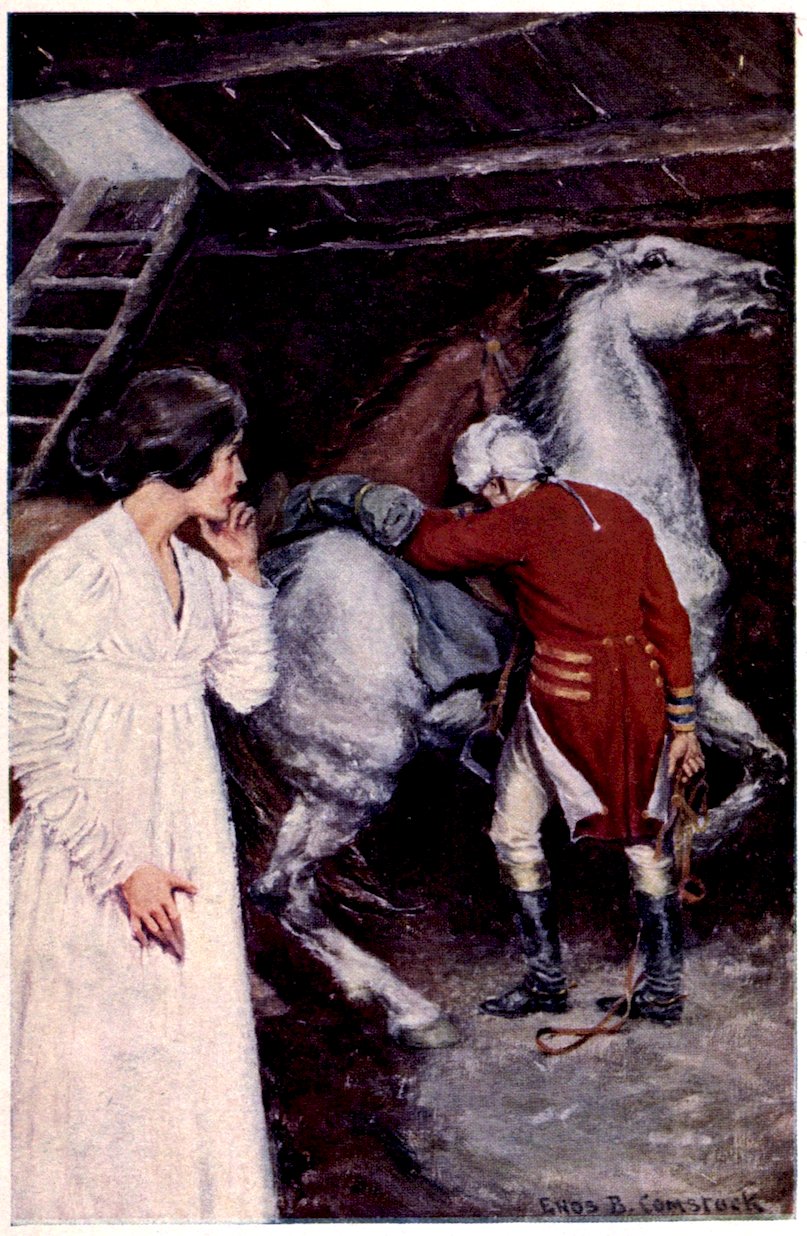
Although the Historical Manuscripts Commission
(England) has dealt with several of the Northumberland
Collections, the Commission has not
thought fit to print among the papers of the Craven
family of Osgodby, the narrative of the fifth baronet’s
experiences in South Carolina during the
War of American Independence. The reason for
this decision may be either a belief that the episode
is not of value from a historical standpoint; or a
suspicion that the facts owe something to the expansion
of a man writing many years later. However
this may be, the story seemed to the present
Editor to possess a certain poignancy, and, notwithstanding
some intimate passages, to be worthy
of a public wider than that of the County of its
birth. He has, therefore, with such skill as he
possesses prepared it for publication.
It will be noticed that Sir Edward Craven nowhere
names the regiment in which he served, but it
appears from other sources that it was the 33rd
Regiment of Foot, now styled the Duke of Wellington’s
Regiment.
The Editor has thought proper to retain the
fanciful title prefixed by the writer, but has added
some Chapter headings.
MADAM CONSTANTIA
CHAPTER I SIR EDWARD’S PREFACE
1
So here is this fatal war commenced!
‘The Child that is unborn shall rue
The hunting of that day!’
H. Walpole.
Not Lord Chatham, not Alexander the Great, nor Cæsar has
ever conquered so much territory in the course of all their wars
as Lord North has lost in one campaign!
C. J. Fox.
Six months ago I went through the old papers in
the Strongroom. I noted that neither my father
nor my grandfather had added a line, save in the
way of leases and the like, to the records which the
first and second baronets left of the Siege of Newcastle,
and of the Union troubles. It occurred to
me that we owed something to posterity; and that,
for lack of more important matter, my fortunes
en campagne in America were a part of the family
history, and proper to be preserved.
For an idle man, however, to will and to do are
two things; and I might never have proceeded beyond
the former if I had not a day or two later
taken up the Gentleman’s Magazine and learned
2that General Washington of the United States of
America had passed away at his seat at Mount
Vernon on the fourteenth of the preceding month.
That gave me the needed fillip. I never knew him;
at least I never knew him by that title, since on the
few occasions on which I met him, it was beyond
my duty as an officer in His Majesty’s service to
admit the existence of the States. I believe him,
however, to have been a gentleman of good family,
kindly and dignified, somewhat of the old school,
and of considerable military ability; one, too, whose
influence went some way towards checking within
his sphere of action the rancour that in the Southern
Colonies stained the Continental Cause and did not
spare ours. Unfortunately from ’80 onwards my
duty led me into the Carolinas; and it was to the
sad and unusual nature of the war in those provinces
that what was singular in my experiences was due.
Previously, to be brief, I had served for three
years in the north, I had suffered the humiliation
of surrendering with that gallant and loyal gentleman,
General Burgoyne, I had been exchanged.
But my experiences in Canada and on the Hudson
were those of a hundred others and I pass over
them, proposing to begin my relation at the point at
which the fortunes of war cast me adrift, and flung
me on my own resources.
3From where I write, looking out on the barren,
frost-bound hills of the Border, it is a far cry to the
rice-fields and tropical lands of the Tidewater of
Carolina; and a farther cry to the rolling country
of pleasant vale and forest that sweeps upwards to
the foothills, and so to the misty distances of the
Blue Ridge. In those days it was often a three
months’ passage, on salt meat and stale water; a
passage of which many a poor fellow never saw the
end. To-day I cross in a moment. But before I
do so, let me add a word of preface, that all who
read this may view the matter from our standpoint
in ’80, midway in the fighting, rather than from the
point at which we stand to-day, with the end behind
us and an American Minister at St. James’s.
I say nothing about the Tea Duty or the claim
to tax the Colonies. I believe that we had a right
to have money from them; our fleet covered their
trade. But whether we should not have left it to
them to tax themselves is another matter, and seems
more English. What is certain is, that we had
through the war the most worthless government
that ever held power in England; and so my father
said a hundred times—and voted for them steadily
till the day they fell!
In the City and at Brooks’s the war was never
popular. There were many in both who asked with
4Mr. Walpole what we should gain by triumph itself;
would America, laid waste, replace America
flourishing, rich and free? And here and there an
officer declined to serve against his kinsmen and was
allowed to stand aside. But for the most part we
ran to it, younger sons and eldest too, from my
neighbor Lord Percy downward, as to an adventure.
All who could beg or buy a commission
mounted the cockade. The thing was fashionable—with
two results that I came to think unhappy.
The first was that too many of our people—those
in particular who had the least right to do so—looked
down on the Colonials from a social height
as on a set of farmers and clodhoppers; forgetting
that many of them were our own cousins once or
twice removed, and that some had been bred up
beside us at Westminster and Oxford. The second
was that those of us who had seen service under the
great Frederick, or had learned our drill at Finchley
or Hounslow, sneered at the rebel officers as tailors,
called them Mohairs—God knows why!—and
made light not only of their skill but their courage,
treating even the Loyalists who joined us as of a
lower grade.
For these two prejudices we were to pay very
dearly. They not only brought into the struggle a
bitterness which was needless and to be deplored,
5but, as things turned out, they reacted very unpleasantly
on ourselves. It was bad enough to be
worsted by those whom the meaner and more foolish
among us regarded as of lower clay; it was still
more mortifying for old soldiers, who had learned
their drill in the barrack-yard, to find that it went
for little in face of the immensities of that unknown
continent; and that among the forests of the Hudson
or in the marshes of the Savannah our military
art was of far less value than the power to shoot
straight, or to lay an ambush after the Indian
fashion.
Owing to these two prejudices the lessons we had
to learn in the war were the more painful. Not
that our poor fellows did not fight. Believe me,
they fought with the most dogged courage—sometimes
when the only powder they had was the powder
on their queues, and the steel or the clubbed musket
was their only weapon. But the others fought too
and stubbornly—what else could we expect?
They were of our blood and bone; they, too, were
Britons. And they were in their own forests, on
their own rivers,—which seemed to be seas to us—they
were fighting for their homes and barns and
orchards. Whereas we were twelve weeks from
home, ill-fed, ill-found, and ill-supported, scattered
over hundreds of leagues, and lost in pathless wilds
6that grew more hostile as outrage on the one side or
the other embittered our relations.
The first half of the war was fought in the northern
colonies. It ended sadly, as all remember,
in our surrender at Saratoga, and in the retreat of
General Clinton from Philadelphia to the sea-coast.
After that, the fighting was transferred to the south,
to Georgia, the Carolinas and Virginia. We took
Charles Town, we defeated the Continental Army
at Camden, we had South Carolina in our hands,
we looked hopefully towards the north. And then,
in the late summer of ’80, when the south seemed to
be in our hands, the country on all sides rose against
us as by magic and the war took on a new and more
savage character. But enough has been said by way
of general preface.
For myself. On the fifth of October of that year
’80, I was sent from Charlotte—whither my Lord
Cornwallis had advanced on his way into North
Carolina—with important orders to Colonel Ferguson,
who at the time was covering the left flank
with a strong body of royalists. On the sixth,
accompanied by Simms, my orderly, and after
a perilous ride, I reached Ferguson’s camp on
King’s Mountain. He knew that the enemy were
in strength in the neighbourhood, and, after falling
back some distance, he had taken up a strong
7position on a ridge, which rose above the forest—a
more active and able officer was not in the service.
But this time he had either under-valued his opponents,
sturdy hunters and settlers from the Backwaters,
or he had over-estimated the strength of his
position; and the lamentable issue of the fight on
the following day is well known. After a fierce
struggle Ferguson’s men were out-flanked and surrounded,
and he himself fell, striving bravely to the
last, while the greater part of his force was captured
or cut to pieces. Of the few who had the good
fortune to break through the ring I was one. Nor
was I only fortunate for myself, for I carried off
poor Simms on my crupper. From this point my
relation starts.
CHAPTER II UNDER KING’S MOUNTAIN
8
But Major Ferguson by endeavoring to intercept the enemy
in this retreat unfortunately gave time for fresh bodies of men
to pass the mountains and to unite into a corps far superior to
that which he commanded. They came up with him and after
a sharp action entirely defeated him. Ferguson was killed and
all his party either slain or taken.
Rawdon Correspondence.
I was riding my grey, Minden, on that day, and I
never wish to ride a better nag. But the weight of
two heavy men is much for the staunchest horse,
and when it fell, as it did a few yards short of safety,
it came to the ground so heavily that the shock
drove the breath out of my body. For a moment I
did not know what had befallen me. I lay and felt
nothing. If I thought at all, I supposed that the
horse had stumbled. Then, coming to myself I
tried to rise, and sank with the sweat starting from
every pore.
Simms, three or four yards from me, lay still.
The horse lay as still, but on my right shoulder,
pinning me down and it needed no more to tell me
that my sword-arm was broken, and that I was
9helpless. The next thing that I remember, a man
was standing some paces from me and covering me
with one of their Deckhard rifles.
Instinct speaks before reason. “Don’t shoot!”
I cried.
“Why not?” he answered. “D—n you, your
time is out! It was your turn at the Waxhaws and
it’s little quarter you gave us there! It’s our turn
to-day!”
Instinct prevailed once more. I knew that I
could not rise, but I tried to rise. Then I fainted.
When I opened my eyes again—to the circle of
blue sky and the feathery tree-tops waving about
the little clearing—the man was standing over me,
a dark figure leaning on his gun. He was looking
down at me. As soon as I could direct my mind to
him, “You have the advantage of me, stranger,” he
said dryly. “A redcoat’s no more to me than a
quail. But shooting a man who shams to be dead
is not in my way. It’s you, that will pay the price,
however.”
“You’d not shoot a wounded man,” I muttered—not
that for the moment I seemed to care greatly.
“Who shot them at the Waxhaws?” he retorted
savagely. “And hung them at Augusta? And
gave them to the Indians to do worse things with?
By G—d!” and with that he stopped speaking, and
10with an ugly look, he handled his rifle as if he were
going to knock out my brains with the stock.
But I was past fear and I was in pain. “Do your
worst!” I said recklessly, “And God save the
King!”
He lowered his gun and seemed to think better of
it. He even smiled in an acrid sort of fashion, as he
looked down at me. “Well, Britisher,” he said,
“you have the advantage of me! But if you can tell
me what I am going to do with you—”
“Hospital,” I murmured.
“Hospital!” he repeated. “Jerusalem! He
says Hospital! Man, do you know that there are
nine here who lost their folks at the Waxhaws,
and thirty who are akin to them, and who’ve
sworn, every man of them, to give no quarter to a
Tory or an Englishman! And I’ll not deny,” he
continued in a lower tone, “that I’ve sworn the
same, and am perjured this moment. And he says—Hospital!”
“But the laws of war!” I protested weakly.
“Ay, you score them plainly enough on your
poor devils’ backs!”
“You make a mistake,” I said. I was becoming
a little clearer in my mind. “Those are the
Articles of war.”
“Indeed!” he replied. And he stared at me as if
11he had never seen a King’s officer before. Then
“Why did you stop to pick up that fellow?” he
asked, indicating poor Simms by a gesture. “If
you’d ridden straight away, I should have been
too late. It was your pause that gave me time to
level at your horse and bring it down.”
I raised myself on my elbow and found that the
man had released me from Minden and had lifted me
to the edge of the clearing. Simms still sprawled
where he had fallen, with his arms cast wide and his
neck awry. The horse lay half in and half out of
the stagnant pool that lapped the roots of the trees
on the farther side of the clearing.
“Is he dead?” I asked, staring at Simms.
“Neck broken,” the man replied, “Who was he?”
“My orderly.”
“Rank and file?”
“What else?” I said.
He grunted. “Is that in the Articles of War,
too?” he said. “But any way, you did him
little good, and wrecked yourself by it!” Then, in a
different tone, “See here,” he said, “you’ve tricked
me, shamming to be dead and playing ’possum. I
can’t leave you to the buzzards, nor yet carry you
to the camp, for they’ll be for shooting you—shooting
you, my friend, for certain! You’ll have
to ride if I can get you a horse. That is your only
12chance. I shall be away some time and if you wish
to live you will lie close. It’s not healthy anywhere
this side of the Catawba for that uniform!”
I was in pain, but I was sufficiently myself to be
anxious when he had left me; painfully anxious as
time went on and he did not return. I lay staring
at poor Simms; the flies were clustering on his face.
I thought of the light heart with which I had ridden
into Ferguson’s camp and joined him and his volunteers
the day before. I thought of the gay dinner
we had eaten, and the toasts we had drunk, and the
“Confusion to the Rebels” which we had planned—campaigning,
a man learns to enjoy life as it comes.
And then I thought of the day that had gone against
us, miserably and unaccountably; of poor Ferguson,
dragged and dead, with his foot in the stirrup and
enough wounds in him to let out the lives of five
men; of Husbands and Plummer and Martin—I
had seen them all go down,—those, who had escaped
in the fight, shot like rabbits in the last rush for the
horses. By the laws of war, or of anything but this
blind partisan fighting we should have won the
battle against an equal number of undrilled farmers
and backwoodsmen. We must have won. But we
had lost; and I lay there under the sumach bushes
that blended with the red of the old uniform; and
if the man who had shot poor Minden at that last
13unlucky moment did not return, the buzzards would
presently spy me out and Simms would not be the
less fortunate of the two.
For the sounds of the fight had died away. The
pursuit had taken another line, the silence of the
forest was no longer torn by shot or scream. Even
the excited chatter of the birds had ceased. The
little clearing lay lonely, with the short twilight not
far off—was that a buzzard already, that tiny
speck in the sky?
What if the man did not come back?
But, thank God, even as I thought of this, I heard
him. He came into view among the boles of the
trees on the farther side of the clearing, riding one
horse and leading another. He dismounted beside
me and hooked the reins over a bough, and for the
first time I took in what he was like. He appeared
to be middle-aged, a tallish lean man, with hair
that was turning gray. He wore a hunter’s shirt
and buckskin leggings, and with this, some show of
uniform; a blue sash and a wide-brimmed hat with
a white cockade were pretty well the sum of it. He
had steely eyes—they showed light in the brown of
his thin hard-bitten face. He stepped to the dead
man and took from him a strap or two. Then he
came to me.
“Now!” he said curtly. “Harden your heart,
14King George! You’ll wince once or twice before
you are in that saddle. But when you are there
you’ll have a chance, and there’s no other way you
will have one! Now!”
To tell the truth, I winced already, having a
horror of pain. But knowing that if I cried out,
here was this rebel Yankee—who had no more
nerves than a plantation Sambo—to hear me, I
set my teeth while, with a splint made of two pieces
of wood, he secured my arm in its due position, and
eased as far as he could the crushed shoulder. He
did it not untenderly, and when he rose to his feet,
“You look pretty sick,” he said, “as if you’d be
the better for a sup of Kentucky whisky. But
there’s none here, and there’s worse to come. So
pull yourself together, and think of old England!”
He spoke in a tone of derision, to which the
gentleness of his touch gave the lie. I rose to my
feet and eyed the saddle. “It’s that or the buzzards,”
he said, seeing that I hesitated; and he
shoved me up. I did what I could myself and with
an effort I climbed into the saddle. “That’s good!”
he exclaimed. “For a beginning.”
I cried out once—I could not refrain; but I was
mounted now if I could stay where I was. I suppose
that he saw that I was on the verge of collapse,
for “See here!” he cried roughly. “I can shoot you,
15I can leave you, or I can take you. There is no
other way. What do you say?”
“Go on,” I said. And then, “Wait!”
“What now?” he growled, suspicious, I think, of
my firmness.
“His address is on him,” I said, nodding towards
Simms. “He wanted his wife to know, if he did not
come off. It’s in his hat. I must take it.”
He stared at me. For a moment I thought that
he was going to refuse to do what I asked. Then
he went and picked up Simms’ hat and from a slit
in the looped side he drew a thin packet of letters.
“Are you satisfied now?” he said, as he handed the
packet to me.
“That’s it,” I said. “Thank you.”
“I thought you held that lot were only food for
the triangles,” he muttered. “Well, live and learn,
and the last knows most! Now, forward it is, sir,
and within five miles I’ll have you under cover.
All the same there’s a plaguy bottom to cross that
will give us trouble, or I am no prophet!”
I was soon to learn what he meant. For a certain
distance, riding where it was level through open
park-like land, that closed here and there into forest,
the going was good and the pain was bearable,
though the thought that at any moment the horse
might stumble chilled me with apprehension. But
16after a while we sank into a shallow valley, where
the air was darkened by cypress trees and poisoned
by their yew-like odor. And presently, threading
the swamp that filled the bottom, there appeared a
rivulet. It crossed our path, and my heart sank
into my boots.
“Stay here,” the man said shortly; and he left me
and rode up and down, hunting for a crossing, while
I followed him with scared eyes. At length he
found what he wanted and he signed to me to join
him. “Give me your rein,” he said, “and hold on
with all the strength you have! It’s neck or
nothing!”
We did it. But the muscles of the crushed
shoulder and, in a less degree, the broken arm gave
me exquisite pain, and I had to pause awhile on the
other side of the water, crouching on the neck of my
horse. When I had recovered, we went on and
climbed out of the bottom and in another half mile
as the light began to fail, we struck into a rough
road.
We rode along it side by side, and he looked me
over. “Major, ain’t you?” he said by and by.
I admitted it.
“Only came in yesterday, did you?”
“That’s so,” I said. “How did you know?”
“Ah!” he said. “That’s telling. But you may
17take it from me, there’s little we don’t know. Ever
been taken before, Major?”
In pain as I was I wondered what imp of mischief
had suggested the question. “If you must know,”
I said reluctantly, “I was taken at Saratoga.”
“And exchanged?”
“Yes,” I said.
He chuckled. “Jerusalem!” he said. “You take
it as easily as a snake takes skinning! Got a gift
for it seemingly! But you escaped better last time
than this, I guess?”
“Yes,” I said grudgingly—why should I explain?
And luckily at that moment a light showed a little
way before us, and relieved me from farther questioning.
The forest gave place to two or three ragged
fields, divided by snake-fences; and beyond these,
where our road crossed another, appeared a small
log-house, backed by some straggling out-buildings.
If appearances went for anything it was a tavern or
a smithy. The light shone from a window of the
house.
As we rode up to the door two or three dogs
heard us and gave the alarm. The result was not
promising. The light went out.
My companion swung his foot clear of the stirrup,
and kicked the door. “House!” he cried. “House!
Barter!”
18There was no answer.
“House!” he cried again. “It’s I! Wilmer!”
A window creaked. “Is that you, Captain?” a
thin quavering voice asked.
“Who should it be?” my companion answered.
“Don’t be a fool! I want you.”
A bar was removed—not very quickly—and
the door was opened. By such firelight as issued
from the room I saw an old man standing in the
doorway, and behind him three or four white-faced
women. He nursed a gun which he had barely the
strength to level, and which he made haste to lower
as soon as he had taken a look at us. “Lord-a-mercy,
Cap’en, what a gunning there’s been,” he
piped, peering up at us, all of a tremble. “We’ve
been sweating here for hours, not knowing what
moment the Tories and redcoats might be on us!
Lord-a-mercy! Might ha’ been the last day by the
sound of it!”
“Father, let the Captain tell us,” said one of the
women.
“We’ve beaten them soundly,” my companion
answered with less blatancy than I expected. He
seemed, indeed, to have two ways of talking, and
to be by no means without education when he
pleased to show it. “In a month or less,” he continued,
“there’ll not be a redcoat this side of the
19Santee High Hills; and if Marion does his work
as well below, we shall be in Charles Town by
Christmas! We shall have cleared Carolina, and
you’ll have no more need to sweat! But there, I
want you to take in a wounded man, Barter. He’s a
broken arm, and a shoulder that, I expect, will give
more trouble than the arm, and—”
“He’s welcome!” the woman broke in heartily.
“He’s welcome to what we’ve got, Captain, and the
Tories have left us! Let him come right in! Talking’s
poor fare, and—”
Her voice quavered away to nothing, she left the
sentence unfinished. Before I had grasped what
was amiss, or understood what was doing, the man
and the women had crowded back into the house,
the lower half of the door was closed, I heard a bolt
shot. “No, no! you’ve no right to ask us!” the old
man quavered. “You’ve no right to ask us, Cap’en!
He’s a redcoat! We’ll take in no King’s man and
no Tory! Not we!”
“We daren’t, Cap’en Wilmer,” the woman said.
“If we did the boys would take him out, and hang
him, and, as likely as not, burn the house over us!
It’s as much as our lives are worth to take him in!”
“See here,” the Captain answered, with more
patience than I expected—it was clear that in
spite of their refusal these people stood in awe of
20him. “See here! You can say that I put him
here, Barter.”
“And if you were here, it might do!” the woman
replied. “May be so and may be not. But you’re
not here, Cap’en Wilmer, and when the boys’ blood’s
up they’ll not listen to father nor to me! We’re a
parcel of women, and you’ve no right to ask it.
They’ve said, and you know it as well as I do, that
they’ll burn down any house that shelters a redcoat.
We’ll not take him!” she continued firmly, “and
small kindness to him if we did! Phil Levi was here
last Sunday and swore till he was black in the face
what he’d do if we so much as fodder’d one of
them! More by token, Cap’en, if you think it’s
safe—why do you not take him in at the Bluff?”
“It’s a mile farther,” Wilmer said, “and there
are reasons.”
“And we’ve reasons, too!” the woman retorted
sharply. “I’d not lay a hand on him myself—God
forbid I should—but I’ll not shelter him.
Jake is out with Colonel Marion below the Forks,
and father hasn’t strength to pull a trigger, and
we’re a parcel of women and ’tisn’t fair to ask us!
’Tisn’t fair to ask us, and we all alone!”
Wilmer swore softly. “D—n Phil Levi!” he
said. “He’s a brave fellow—before and after!
But I can’t say that I saw the color of his horse’s
21tail to-day!” He sat forward in his saddle, undertermined,
pondering.
I had borne up pretty well so far. Pride and the
habit of a soldier’s life had supported me under this
man’s scrutiny. I had told myself that it was the
chance of war; that I was fortunate in being alive
where so many—alas, so many!—who had sat at
table with me a few hours before, had fallen. But,
little by little, pain had sapped my fortitude. Every
second in the saddle was a second of agony; every
moment that my arm hung from the shoulder was a
grinding pang. And on the threshold of this house,
at the sound of the women’s voices, I had thought
that at last the worst was over. Here I had
promised myself relief, rest, an end. The disappointment
was the sharper. The refusal to take
me in seemed to be fiendish, heartless, cruel. At
the mere thought of it, of the barbarity of it, self-pity
choked me, and I could have shed tears. “Let
me be,” I muttered. “I can bear no more.”
“No, I’m d—d if I do,” Wilmer answered angrily.
“I had a reason for not taking you to my place,
Major, but needs must when the devil drives,
and it’s there you are bound to go. We must make
the best of it.” He took my rein. “It’s a long
way to Salem,” he continued, “but it’s the last mile.
Hold up! man, and maybe you’ll see King George
22yet. He certainly ought to be obliged to you,”
he added with a dry laugh. He kicked up his
horse.
I moved away with him, biting off the prayer
that rose to my lips that he would let me be. I
had no other thought now but to persist, to bear,
to keep the saddle; and the croak of the frogs, the
plaintive notes of the mocking bird in the thicket,
the change from clearing to forest and again from
forest to open fields—the open fields of a considerable
plantation—all passed as the scenes pass
in a nightmare; now whelming me in despair,
as the blackness of the trees closed about us, now
lifting me to hope as lights broke out, twinkling
before us. Poor Ferguson, the fight, Simms, my
fall, all receded to an infinite distance; and only
one thing, only one thought, one aspiration remained—the
craving to rest, to lie down, to come
to the end of pain. My shoulder was on fire; my
arm was red-hot iron. One moment I burned with
fever; the next I turned cold and faint and sick.
Only a mile! But from Newgate to Tyburn is
only a mile, yet how much lies between them for
the wretch condemned to suffer on the gallows.
At last I was aware that my companion had
alighted—perhaps he had done so more than once—to
pull down a sliprail. This time, whether it
23was the last, or the only time, the rattle of the timber
provoked an outburst of barking, and presently,
amid the baying of dogs, a nigger’s voice called out
to know who was there. The alarm once given—and
the hounds gave it pretty loudly—other
voices joined in, in tones of alarm as well as joy.
Lights glanced here and there; in a twinkling there
were people about us. Black faces and white eyeballs
appeared for an instant and sank into shadow.
We halted before the porch of a long wooden house,
that declared itself, here plainly and there dimly, as
the lights fell upon it.
I could only endure. But surely the end was
come now! Surely there would be rest for me here.
They would come to me, they would do something
for me presently.
Wilmer had gone up on the porch, and there was
a woman—a woman in white with her arms about
his neck. He was soothing her and she was laughing
and crying at once; and about them and about
me—who sat in the saddle below, in the dull
lethargy of exhaustion—shone a ring of smiling,
black faces. And then—here was something new,
something startling and alarming—the woman was
looking down at me, and speaking quickly and
sharply; speaking almost as those other women
had spoken at Barter’s. She was pointing at me.
24And the niggers were no longer laughing but staring,
all staring at me. I gathered that they were frightened.
It could not be that there was no rest for me here?
It could not be that they would not take me in
here! Oh, it was impossible, it was inhuman, it was
devilish! But I began to tremble. “Anywhere,
anywhere but here!” the woman was saying.
“It is madness to think of it. You know that,
father! Why did you bring him here? When you
knew! When you knew, father!”
“In the cabins, honey, if you like,” the man
answered patiently. “But he’ll not be safe out of
our sight.”
She flared up. She poured out her anger upon
him. “Safe!” she cried. “And what of you?
Where will you be safe? And what is it to me if
he be not safe? Don’t do it, father, don’t,” she
continued, her voice sinking to a note of entreaty.
“Don’t bring him here! It will end ill! You will
see, it will end ill! Let him go to Barter’s.”
“We’ve been to Barter’s—”
“And he won’t take him! No! he’s more sense,
though the risk to him is small. But you,
think how the day has gone, and left you safe
and well! And now, now at the end, you will
spoil all!”
25“Let be, Con,” the man struck in, speaking with
decision. “He must come in. There’s nothing else
for it. We’re not Cherokees, nor savages. There’s
nothing else that can be done. You must put up
with it, and—”
In a twinkling she was at the foot of the steps
and at my rein—a girl, young, slender, dark and
fiercely excited. “If you are a man,” she cried,
seizing my arm, “if you are a gentleman, you’ll
not come here! Do you hear, sir! There are
reasons, a thousand reasons why we cannot take
you in. And more—”
On that word she stopped. A change came over
her face as she looked into mine. The only answer
I could give her—she had gripped my wounded arm
and I could bear no more—was to faint away. As
the man had said, I was in sore need of a sup of
Kentucky whisky.
CHAPTER III MADAM CONSTANTIA
26
I see how she doth wry,
When I begin to moan;
I see when I come nigh,
How fain she would be gone.
I see—what will ye more?
She will me gladly kill:
And you shall see therefore
That she shall have her will.
Anon.
When I came to myself I was, by comparison, in
a haven of comfort. I was in a clean bed, in a
clean room, I was wearing a shirt that was also
clean and was certainly not my own. A negro
woman with a yellow kerchief bound about her
head was holding a lamp, while a colored man who
was bending over me, contrived a cage to lift the
coverlet clear of my shoulder and arm. The room
was small, with boarded walls, and the furniture was
of plain wood and roughly made, of the kind that is
found in the smaller plantations of this upper country.
But my eye alighted on a framed sampler
hung between two prints above the bedhead; and
this and one or two handsome mahogany pieces
27told a story of changes and journeys, which these,
the cherished relics of an older house, perhaps in the
Tidewater, had survived.
I noted these things dreamily, blissfully, resting
in a haven of ease. Presently the man stood back
to admire his work, and the woman, turning to
glance at my face, saw that my eyes were open.
She set down the lamp and fetching a cup held it
to my lips. I have reason to believe that it held
milk-punch; but for me it held nectar, and I drank
greedily and as long as she would let me. Whatever
it was, the draught cleared my mind; and
when the man turned to the table and began to
occupy himself with rolling up a monstrous length
of bandage, I saw the woman sign to him. They
looked towards the door, and I became aware of the
voices of two people who were talking in an outer
room. The speakers were the two who had debated
my fate before, while I hung, worn out, over my
horse’s neck; and the question between them was
apparently the same.
“But I can’t see it, father!” the girl was saying,
repeating it as if she had said it half a dozen
times before. “I can’t see it. What is he to us?
Why should we do it? Think of my mother!
Think of Dick! Haven’t I heard you say a hundred
times—”
28“And a hundred to that! I admit it, Con,” the
man answered, “I have. But there was something
about this fellow if you’ll believe me—”
“About him!” she retorted, blazing up. “A
weakling! A milksop! A poor thing who swoons
under a minute’s pain!”
“But if you had seen him pick the man up?” he
pleaded. “It was that that took me, honey. It
ran right athwart of all that I had heard of his like,
and had seen of some of them! It was the devil of
a mellay I can tell you! Of five who made off together
after Ferguson was down he was the only
one who fought his way through; and we were after
him whip and spur. He was all but clear of us,
when there came the other man running through
the bush and calling to him, calling to him to take
him up for God’s sake! For God’s sake! He
stopped, Con! And I can tell you that to stop
with the muzzles of our Deckhards between his
shoulderblades and not forty yards off—”
“Who wouldn’t have?” she retorted scornfully.
“Is there a man that wouldn’t have stopped? Is
there a man who calls himself a man who could
ride away—”
“Well, I fancy,” he replied dryly, “I could put
my hand on one or two, Con. I fancy I could.”
“And because he did that,” she continued stubbornly,
29“because he remembered, for just that one
moment, that he and the men whom he hires to fight
his battles were of the same flesh and blood as himself,
you do this foolish, this mad, mad thing! To
bring him here, father! To bring him to the Bluff
of all places! Why, if it were only that I am alone—alone
here—”
“There’s Aunt Lyddy.”
“And what is she?—it would be reason enough
against it! But to be left here,” the girl continued
angrily—and it seemed to me that she was pacing
the room—“alone for days together with this insolent
Englishman who looks down on us, who
calls us colonials and mohairs, and thinks us honored
if he doesn’t plunder us—and if he plunders
us, what are we but rebels? Who will hardly
stoop to be civil even to the men who are risking
their all and betraying Carolina in his cause! Oh!
it is too much!”
“He’s not the worst of them at any rate,” Wilmer
replied with good humor. “Sit down, girl.
And as to your being left with him, I don’t
know any one more able to take care of herself! If
that be all—”
“But it’s not all!” she cried. “It’s not a quarter!
If that were all I’d not say a word! But it’s not
that, you know it is not that!”
30“I know it’s not, honey!” he said in a different
tone—and I wondered to hear him, so gentle was
his voice. “I know it’s not.”
“If you were away altogether it would be different!
If you kept away—”
“But I can’t keep away,” he answered mildly.
“I must come and go. I can’t let the plantation
go to ruin. Times are bad enough and hard enough—we
may be burnt out any night. But until the
worst comes I must keep things together, Con, you
know that. It’s fortunate that we’re above King’s
Mountain. After this Tarleton and his Greens—d—n
the fellow, I wish he had been there to-day—will
spread over the south side like a swarm of
wasps flocking to the honey-pot. But they’ll be
shy of pushing as far north of Winsboro’ as this—we’re
too strong hereabouts. For the Englishman
I’d send him to the cabins at once, but he
wouldn’t be safe from our folks outside the house.”
She spoke up suddenly. “If they come for him,”
she cried, “I warn you, father, I shall not raise a
finger to save him!”
“Pooh! pooh!”
“I vow I will not! So now you know!”
“Well, I don’t think that they’ll come,” he replied
lightly. “They know me, and—”
“To shelter a Britisher!”
31“I’ve sheltered worse men,” he responded reasonably.
“At least you’ve had warning!” she retorted—and
I heard the legs of a chair grate on the floor of
the outer room. “If I have to choose, your little
finger is more to me than the lives of twenty such as
he!”
“Unfortunately,” he answered dryly, “it’s not my
little finger, my dear, that’s in peril! It’s my—”
“Father!” she cried, pain in her voice. “How
can you! How can you!”
“There, there,” he said, soothing her, “a man can
but die once, and how he dies does not matter much!
Courage, Con, courage, girl! Many is the awkward
corner I have been in, as you know, and I’ve got
out of it. You may be sure I shall take all the care
I can.”
“But you don’t!” she retorted. “You don’t!
Or you would never let this man—” I lost the rest
in the movement of a second chair.
For some minutes the two blacks had made
hardly a pretence of attending to me. They had
listened with all their ears. Once or twice when
what was said had touched me nearly they had
goggled their eyes at me between wonder and amazement.
And I, too, wondered. I, too, saw that
here was something that needed explanation. Why
32should this girl, scarcely out of her teens—I
judged her to be no more that twenty—feel so
strongly, so cruelly, so inhumanly? Why should
she show herself so hard, so unnatural, where even
her father betrayed the touch of nature that makes
us all akin? This was a question, but it was one
that I must consider to-morrow. For the present I
was too comfortable, too drowsy, too weary. Sleep
pressed on me irresistibly—the blessed sleep of the
exhausted, of the wounded, of the broken, who are
at last at rest! The room grew hazy, the light a
dim halo. And yet before I slept I had a last impression
of the things about me.
The girl came to the open door and stood on the
threshold, gazing down at me. She was tall, slender,
dark, and very handsome. She looked at me
in silence for a long time, and with such a look and
such a curiosity as one might turn on a crushed
thing lying beside the road. It hurt me, but not
for long.
For I slept, and dreamt of the Border and of
home. I was in the small oak parlor at Osgodby.
There was no fire on the hearth, it was summer and
the bow-pots were full of roses. The windows were
open, the garden, viewed through them, simmered
in the sunshine.
My mother was sitting on the other side of the
33empty hearth, fanning herself with a great yellow
fan, and we were both looking at the picture of
Henrietta Craven that is set in the overmantel.
“Ill will come of it, ill will come of it,” my mother
was repeating over and over again. And then I
found that it was not my mother who was saying it
but the portrait over the fireplace; and—which
did not seem to surprise me at the time—it was no
longer the portrait of Henrietta Craven in her yellow
sacque that spoke, but a woman in white, tall
and slender and dark and very handsome.
It was noon when I awoke; not the sultry noon
of Charles Town, for the rains had come and the
day was grey and cool. I was alone, in the pleasant
stillness, but the door into the living-room was ajar,
perhaps that I might be heard if I called. Pigeons
were cooing without, and not far away, probably on
the veranda, some one was crooning in tune to the
pleasant hum of a spinning-wheel. Sleep had made
another man of me. My head was clear, I was free
from fever, I was hungry; such pain as I felt was
confined to the shoulder and arm. Yesterday I had
come near to envying those who had fallen in the fight.
To-day I was myself again, glad to be alive, free to
hope, ready to look forward. After all, things might
be worse; our Headquarters were at Charlotte,
34barely thirty-five miles away, and if my Lord Cornwallis
moved towards King’s Mountain, to avenge
Ferguson, I might be rescued. If he did not, I
must contrive to be sent, as soon as I was well
enough to travel, to the rebel Headquarters in the
northern colony, whence I might be exchanged. I
should be safe there—I was not safe here. I must
see this man Wilmer by and by and talk to him about
it. He had shown a measure of humanity and some
generosity, mingled with his dry and saturnine
humor. And he had saved my life, I had no doubt
of that. In the meantime I was famished, positively
famished!
I called, “Hi! hi!”
The low crooning stopped, the hum of the spinning-wheel
ceased. The negro woman who had held
the lamp appeared in the doorway. “How you
find yo’self dis mawning?” she asked. And then in
a lingo which at this distance of time I do not pretend
to reproduce correctly, she asked me what I
would take to eat.
“There’s nothing I could not eat,” I said.
She showed her teeth in a wide smile. “Marse
mighty big man, dis mawning,” she answered. “He
sorter lam-like yistiddy. He mo’ like one er de
chilluns yistiddy. W’at you gwine ter eat?”
“Breakfast first!” I said. “Some tea, please—”
35She shook her head violently. “Hole on dar,”
she said. “I ’ear Ma’am Constantia say der ain’t
no tea fer Britishers! De last drap er dat tea bin
gone sunk in Cooper River!”
“Oh!” I replied, a good deal taken aback. Confound
Madam Constantia’s impudence! “Then I
will have what you will give me. Only let me have
it soon.”
“Marse mighty big man dis mawning,” the
woman said mischievously. “He’low he’ll eat de
last mossel der is. Yis’dy he mo’ like one er de
chilluns.”
Well, I had the last morsel—without tea; while
Mammy Jacks stood over me with her yellow kerchief
and her good-natured grinning black face.
“Who’s Madam Constantia?” I asked after a time.
“W’at I tole you,” the woman replied with dignity,
“She, Ma’am Constantia ter cullud folks.
She, missie ter me.”
“The young lady I saw yesterday, is she?”
“Tooby sho’.”
“She is Captain Wilmer’s daughter, I suppose?”
“Dat’s w’at I laid out fer to tell you.”
I did not want to seem curious or I should have
asked if “Madam” was married. I refrained out
of prudence. I went on eating and Mammy Jacks
went on looking at me, and presently, “I speck
36you monst’ous bad, cruel man,” she said with
unction. “I hear Ma’am Constantia say you make
smart heap uv trubble fer cullud folks, en tote em
to ’Badoes en Antigo! She say you drefful ar’ogant
insolent Englishman! You too bad ter live, I’ low.”
“And Madam Constantia told you to tell me
that?”
The woman’s start and her look of alarm answered
me. Before she could put in a protest, however,
the negro who had been with her the previous evening
appeared and relieved her from the difficulty.
He came to attend to my arm, and did his work with
a skill that would not have disgraced a passed surgeon.
While he was going about the business, I was
aware of a slender shadow on the threshold, the
shadow of some one who listened, yet did not wish
to be seen. “Confound her!” I thought. “The
jade! I believe that she is there to hear me whimper!”
And I set my teeth—she had called me a
milksop, had she?—well, she should not hear me
cry again. The shadow lay on the threshold a
short minute, then it vanished. But more than
once on that day and the two following days I was
aware of it. It was all I saw of the girl; and though
I knew, and had the best of grounds for knowing
her sentiments respecting me, I confess that this
steady avoidance of me—lonely and in pain as I
37was, and her guest—hurt me more than was reasonable.
As for Wilmer he was gone, without beat of drum,
and without seeing me; and save Mammy Jacks
and the nigger, Tom, no one came near me except
Aunt Lyddy, and she came only once. She was a
little old lady, deaf and smiling, who labored under
the belief that I had met with my injuries in
fighting against the French. She was quite unable
to distinguish this war from the old French war;
when she thought of the fighting at all, she thought
of it as in progress in Canada or Louisiana, under
the leadership of Braddock and Forbes and Wolfe.
The taking of Quebec was to her an event of yesterday,
and I might have drunk all the tea in the
world, and she would not have objected. Such
was Aunt Lyddy; and even, such as she was, I
wondered with bitterness, that she was allowed to
visit me.
Yet when I came to think more calmly, the position
surprised me less. It was in the nature of this
war to create a rancour which bred cruel deeds, and
these again produced reprisals. After the capture
of Charles Town in May and the subsequent defeat
of Gates, the country had apparently returned to
its allegiance. The King’s friends had raised their
heads. The waverers had declared themselves, opposition
38in the field had ceased. If one thing had
seemed more certain than another it was that my
Lord Cornwallis’s base in the southern province was
secure, and that he might now devote himself, without
a backward glance, to the conquest of North
Carolina and Virginia.
Then in a month, in a week, almost in a day had
come a change. God knows whether it was the
result of mismanagement on our part, or of some
ill-judged severity; or, as many now think, of the
lack of civil government, a lack ill-borne by a people
of our race. At any rate the change came. In a
week secret midnight war flamed up everywhere.
In a month the whole province was on fire. Partisans
came together and attacked their neighbors,
rebels took loyalists by the throat, burned their
houses, harried their plantations, and in turn
suffered the same things. By day the King’s writ
ran; at first it was the exception for these irregulars
to meet us in the field. But by night attacks, by
ambuscades, by besetting every ford and every
ferry, they cut our communications, starved our
posts and killed our messengers. For a time the
royalists showed themselves as active. They, too,
came together, formed bands, burned and harried.
Presently the father was in one camp, the son in
the other; neighbor fought with neighbor, old
39feuds were revived, old friendships were broken;
and this it was that gave to this blind, bloody warfare,
in the woods, in the morasses, in the cane-brakes,
its savage character.
As quickly as General Gates’s reputation had been
lost, reputations were won. Marion, issuing from
the swamps of the Pee Dee carried alarm to the
gates of Charles Town. Sumter made his name a
terror through all the country between the Broad
and the Catawba Rivers. Colonel Campbell on the
Watauga, Davy on the North Carolina border flung
the fiery torch far and wide. It was all that Tarleton
and his British Legion, the best force for
this light work that we possessed, and Ferguson
and his Provincials, now a shattered body—it was
all that these could do to make head against the
rebels or maintain the spirits of our party.
There were humane men, thank God, in both
camps. But there were also men whom the memory
of old wrongs wrought to madness. Cruel things
were done. Quarter was refused, men were hung
after capture, houses were burnt, women were made
homeless. Therefore, no bitterness of feeling, no
animosity, on one side or the other, was much of a
surprise to me; rather I was prepared for it. But
as the soldier by profession is the last, I hope, to
resort to these practices, so is he the most sorely
40hurt by them. And we, as I have said, had another
grievance. Not only were we at a loss in this
irregular fighting, but we had held our heads too
high in the last war. We had looked down—the
worst of us—on the Colonial officers. And now
this was remembered against us. We were at once
blamed and derided; our drill, our discipline, our
service were turned to ridicule. Nor was this shrew
of a girl the first who had scoffed at our courage
and made us the subject of her scorn.
Yet, though I understood her feelings, I was hurt.
When a man is laid aside by illness or by an injury,
something of the woman awakes in him, and he is
wounded by trifles which would not touch him at
another time. With Wilmer gone, with none but
black faces about me, with no certainty of safety, I
had only this girl to whom I could open my views
or impart my wishes. And enemy as she was, she
was a woman—in that lay much of my grievance.
She was a woman, and the notion of the woman as
his companion and comforter in sickness and pain is
so deeply inbred in a man, that when she stands
away from him at that time, it seems to him a thing
monstrous and unnatural.
I think I felt her aloofness more keenly because,
though I had barely seen her face, I was beginning to
know her. The living-room, as in many of these
41remote plantations, occupied the middle of the
house, running through from front to rear. There
was no second story and all the other chambers
opened on this side or that of this middle room
which served also for a passage. The business
of the day was done in it, or on the veranda, according
to the season. It followed that, though my
door was now kept shut, I heard her voice a dozen,
nay, a score of times a day. In the morning I
heard its full grave tones, mingling with the hurly-burly
of business, giving orders, setting tasks, issuing
laws to the plantation; later in the day I heard
it lowered to the pitch of the afternoon stillness
and the cooing of the innumerable pigeons that
made the veranda their home.
I heard her most clearly when she raised her
voice to speak to Aunt Lyddy; and aware that
there is hardly a call upon the patience more
trying than that made by deafness, I was surprised
by the kindness and self-control of one
who in my case had shown herself so hard and
so inhuman.
“Confound her!” I thought more than once—the
hours were long and dull, and I was often restless
and in pain. “I wish I could see her, if it were only
to rid myself of my impression of her. I don’t suppose
she is good-looking. I had only a glimpse of
42her, and I was light-headed. When a man is in
that state every nurse is a Venus.”
And then, on the fourth day, I did see her. I
heard some one approach my door and knock.
I thought that it was Mammy Jacks and I cried
“Come in!” But it was not Mammy Jacks. It was
Madam Constantia at last. She came in, and stood
a little within the doorway, looking down—not at
me but at my feet. And if she had not been all
that I had fancied her, and more, I might have had
eyes to read something of shame in her face, and
in the stiffness that did not deign to leave the threshold.
She closed the door behind her. She closed
it with care it seemed to me.
“I cannot rise,” I said, taking careful stock of
her, “honored as I am by your visit. Can I offer
you a chair, Miss Wilmer?”
“I do not need one,” she replied. She was laboring,
I could see, under strong emotion, and was in
no mood for compliments. She was in white as I
had first seen her; and the quiet tones which I had
learned to associate with her, agreed perfectly with
the small head set on the neck as gracefully as a
lily on the stem, with the wide low brow, the serious
mouth, the firm chin. “I prefer to stand,” she continued—and
still she did not raise her eyes—I
wondered if they were black and hoped but could
43hardly believe that they were blue. “I shall not
keep you long, sir.”
“You are not keeping me,” I answered with irony.
“I shall be here when you are gone, I fear, Miss
Wilmer.”
If I thought to work upon her feelings by that,
and to force her to think of my loneliness, I failed
wofully. “Not for long,” she replied. “We are
arranging to send you to Salisbury, sir. You will
doubtless be sufficiently recovered to travel by to-morrow.
You will be safer there than here, and
will have better attendance in the hospital.”
I was thunderstruck. “To-morrow!” I echoed.
“Travel? But—but I could not!” I cried. “I
could not, Miss Wilmer. The bones of my arm
have not knit! You know what your roads are, and
my shoulder is still painful, horribly painful.”
“I am sorry, sir, that circumstances render it
necessary.”
“But, good heavens!” I cried, “You don’t, you
cannot mean it!”
“The man who put your arm in splints,” she replied,
averting her eyes from me, “will see that you
are taken in a litter as far as the cross-roads. I
have arranged for a cart to meet you there—a pallet
and a—” her voice tailed off, I could not catch
the last word. “They will see you carefully as far
44as—” again she muttered a name so low that I
did not catch it—“on the way to Salisbury. Or
to Hillsborough if that be necessary.”
“Hillsborough?” I cried, aghast. “But have you
reflected? It is eighty or ninety miles to Hillsborough!
Ninety miles of rough roads—where
there are roads, Madam!”
“It’s not a matter of choice,” she replied firmly—but
I fancied that she turned a shade paler.
“And it may not be necessary to go beyond Salisbury.
At any rate the matter is settled, sir. Circumstances
render it necessary.”
“But it is impossible!” I urged. “It is out of
the question!” The memory of my ride from King’s
Mountain, of the stream I had had to cross, was too
sharp, too recent to permit me to entertain delusions.
“The pain I suffered coming here—”
“Pain!” she cried, letting herself go at that.
“What is a little pain, sir, in these days, when things
so much worse, things unspeakable are being suffered—are
being done and suffered every day?
Our men whom you delivered to the Indians at
Augusta, did they not suffer pain?”
“It was an abominable thing!” I said, aghast
at her attitude. “But I did not do it, God forbid!
I detest the thought of it, Miss Wilmer!
And you, you do not mean that you would be as
45cruel as those—” I stopped. I let her imagine the
rest. I held her with indignant eyes.
“I am doing the best I can,” she said sullenly.
But I saw that she was ashamed of her proposal even
while she persisted in it; and I grew stronger in my
resolve.
“I am helpless,” I said. “Your father can do
what he pleases, I am in his hands. But even he is
bound by the laws of humanity, which he obeyed
when he spared me. I cannot think that he did
that, I cannot think that he behaved to me as one
soldier to another in order to put me to torture!
If he tells me I must go, I must go, I have no
remedy. But until he does, I will never believe
that it is his wish!”
“You will force yourself on us?” she cried, her
voice quivering. “On us, two women as we are,
and alone?”
I pointed to my shoulder. “I am not very dangerous,”
I said.
“I do not think you are, sir, or ever were,” she
retorted with venom. And now for the first time
she met my look, her eyes sparkling with anger.
“As one soldier to another!” she said. “It is marvellous
that you should recognize him as a soldier!
But I suppose that the habit of surrender is an
education in many ways.”
46“Any one may insult a prisoner,” I said. And I
had the satisfaction of seeing the blood burn in her
face. “But you did not come here to tell me that,
Miss Wilmer.”
“No,” she answered. “I came here to tell you
that you must go. You must go, sir.”
“When your father sends me away,” I said, “I
must needs go. Until he does—”
“You will not?”
“No, Miss Wilmer, by your leave, I will not,” I
said with all the firmness of which I was capable.
“Unless I am taken by force. And you are a
woman. You will not be so untrue to yourself and
to your sex as to use force to one, crippled as I am,
and helpless as I am. Think! If your dogs broke
a raccoon’s leg, would you drag it a mile—two
miles?”
The color ebbed from her face, and she shuddered—she
who was proposing this! She shuddered at
the picture of a brute’s broken leg! And yet,
strange to say, she clung to her purpose. She
looked at me between anger and vexation, and “If
I do not, others will,” she said. “Do you understand
that, sir? Is not that enough for you? Cannot
you believe, cannot you do me the justice to
believe that I am doing what I think to be right?
That I am acting for the best? If you stay here
47after this your blood be upon your own head!”
she added solemnly.
“So be it,” I said. “It would be a very great
danger that would draw me from where I am, Miss
Wilmer. I am like the King of France, or whoever
it was, who said ‘J’y suis, J’y reste.’”
“Stubborn! Foolish!” I heard her mutter.
“I hate pain,” I said complacently.
“Do you hate pain more than you fear death?”
she asked, gazing at me with sombre eyes.
“I am afraid I do,” I replied. “I am a milksop.”
And I looked at her.
I was beginning to enjoy the discussion. But if
I hoped for a farther exchange of badinage with her
I was mistaken. She did not deign to reply. She
did that to which I could make no answer. She
went out and closed the door behind her.
CHAPTER IV AT THE SMITHY
48
Hinc Constantia, illinc Furor.
Catullus.
The way in which the girl broke off the discussion
and went out did more than surprise me. It left
me anxious and, in a degree, apprehensive. Her
proposal would have been a cruel and a heartless one
if nothing lay behind it. If something lay behind
it, some risk serious enough to justify the step on
which she insisted, then I could think better of her
but very much worse of my own plight.
Yet Wilmer had thought that I was safe in his
house, if not in the huts. And if I were not secure
here, what risks must I not run on the slow, painful,
helpless journey to Gates’s Head-Quarters, through
a district ill-affected to the British! Once there, it
is true, my life would be safe, and the Colonial
Surgeons enjoyed a high reputation for skill. But
the appliances of a rebel hospital were sure to be
few, the fare rough and scanty; it was unlikely
that I should be better off there than where I was.
In the end, doubtless, I should have to go thither;
49it was the only road to exchange and freedom, unless
a happy chance rescued me. But a life which
would be bearable when I could use my arm and
had recovered my strength would be no bed of
roses at present.
And to be quite honest I had found an interest
where I was. I had enjoyed my tussle with this
strange girl, and I looked forward to a repetition of it.
Her beauty, her disdain, her desire to be rid of me
piqued me—as whom would it not have piqued?—and
whetted that appetite for conquest which is
of the man, manly. Madam Constantia! The
name suited her. I could fancy that she governed
the plantation with a firm hand and a high courage.
On the whole I was determined, whatever the
risk, to stay where I was; and yet as the day waned
I felt less happy. My shoulder was painful, I was
restless. I told myself that I had some fever. I
was tired, too, of my own company and the house
seemed more still than usual. I hoped that the
girl would pay me another visit, would resume the
argument, and make a second effort to persuade me;
but she did not, and when my supper came Mammy
Jacks dispensed it with an air, absurdly tragic.
She heaved sighs from a capacious bosom, and looked
at me as if I were already doomed.
“Marse, you’r runnin’ up wid trubble,” she said.
50“Ma’am ’Stantia, she look like der wuz sump’n
wrong. She look like she whip all de han’s on de
plantation.”
“I dare say she is pretty severe,” I said carelessly.
“I des’low you know nothin’ ’bout it,” the woman
replied in great scorn. “She sholy not whip one
ha’f, t’ree quarters, ten times ’nough! When Marse
Wilmer come home, sez he, whip all dis black trash!
Make up fer lost time. De last man better fer it!
Begin wid Mammy Jacks! Dat’s w’at he say, but
I des hanker ter see him tech ole Mammy! I
speck sumpin’ wud happen bimeby ter ’sprise ’im.
Ef Missie got win’ uv it, she up en tell ’im!”
“Is he coming back soon?” I asked.
“Day atter to-morrow. Clar to goodness, when
he mounts dem steps, Missie’ll not mope round
no mo’! She not make like she whip de han’s
den.”
“She’s very fond of him, is she?”
“Der ain’t nobody in Car’lina fer ’er ceppin er
dad! Seem like she idol—idol—”
“Idolizes him,” I suggested.
“Mout be dat,” Mammy Jacks assented. She
repeated the word to herself with much satisfaction.
It was a long one.
The little vixen, I thought. So she would be rid
51of me before her father returned! She knew that he
would not send me away, and so—well, she was
a spit-fire!
“Look here, Mammy Jacks,” I said. “I don’t
think that I shall sleep to-night. I am restless. I
should like something to read. Will you ask Miss
Wilmer if she can lend me a book. Any book will
do, old or new.”
“Tooby sho,’” she said, and she went to do my
bidding.
I thought that this might re-open relations. It
might bring the girl herself to learn what kind of
book I would choose to have. There was not likely
to be much choice on this up-country plantation,
where I need not expect to find the “Fool of Quality”
or “The Female Quixote” or any of the fashionable
productions of the circulating libraries. But
a Pope, a Richardson, or possibly a Fielding I might
hope to have.
Alas, my reckoning was at fault. I had none, of
these. It was Mammy Jacks who presently brought
back the answer and the book. “Missie, she up ’n
say dat monst’ous good book fer you,” the negress
explained, as she set down the volume with a grin.
“Missie say it wuz ole en new, but she specks new
ter you. She tuck’n say she ’ope you read it ter
night—you in monst’ous big need uv it.”
52Puzzled by the message, and a little curious, I
took the book and opened it. It was the Bible!
For a moment I was very angry; it seemed to be
a poor jest, and in bad taste. Then I saw, or
thought that I saw, that it was not a jest at all.
This queer girl had sent the Bible, thinking to
impress me, to frighten me, to bend me at the last
moment to her will!
Certainly she should not persuade me now! Go?
Never!
After all I had a quiet night. I slept well and
awoke with a keen desire to turn the tables on her.
I counted on her coming to learn the result of her
last step, perhaps to try the effect of a last persuasion.
But she did not come near me, and the
day passed very slowly. I thanked heaven that
Wilmer would return on the morrow. I should
have some one to speak to then, some one to look at,
I should no longer be cut off from my kind. And
he might bring news, news of Tarleton, news of
Lord Cornwallis, news of our movements in the
field. Out of pure ennui I dozed through most of
the afternoon. The sun set and the short twilight
passed unnoticed. It was dark when I awoke. I
wondered for a moment where I was. Then I remembered,
and fancied that I must have slept some
hours, for I was hungry.
53And then, “Wilmer has come,” I thought; I
heard the voice of a man in the living-room. Presently
I heard another voice, nay, more than one.
“Yes, Wilmer has come,” I thought, “and not
alone. I shall have some one to speak to at last,
and news perhaps. Doubtless they are occupied
with him, but they need not forget me altogether.
They might bring me a light and my supper.”
And then—strange how swiftly, in a flash, in a
heartbeat, the mind seizes and accepts a new state
of things!—then I knew why Mammy Jacks had
brought no light and no supper. I heard her voice,
excited, tearful, protesting, raised in the unrestrained
vehemence of the black; and a man’s voice that
silenced her harshly, silenced her with an oath.
And therewith I needed no more to explain the
position. I grasped it.
When a few seconds later the door was flung
open, and the light broke in upon me, and with the
light three or four rough burly figures, who crowded
one after the other over the threshold, I was prepared.
I had had that moment of warning, and I
was ready. There were scared black faces behind
them, filling the doorway, and peeping athwart
them, and murmurs, and a stir of panic proceeding
from the room without.
“You come without much ceremony, gentlemen,”
54I said, speaking as coolly as I could. For the
moment I had only one thought, one aim, one
anxiety—that what I felt should not appear.
“Ceremony? Oh, d—n your ceremony!” cried
the first to enter. And he called for a candle
that he might see what he was doing. When it was
handed in I saw them. They were a grim, rough
group, the man who had called for the candle the
least ill-looking among them; as he was also the
smallest and perhaps the most dangerous. They
all wore wide-leafed hats and carried guns and were
hung about with pouches and weapons. They
stared down at me, and I stared steadily at them.
“You’ve got to swap your bed for the road,” the
leader continued in the same brutal tone. “We
think you’ll be safer, where we’re going to take
you, mister.”
“And where’s that?” I asked—though I knew
very well.
“To Salisbury,” he said. But his grin gave the
lie to his words.
“I am afraid that is too long a journey, gentlemen,”
I answered. “I could not go so far. I am
quite helpless.”
“Oh, you’ll be helped to make the journey,” he
retorted; and they all laughed, as at a good jest.
“You’ll not find it long, either,” he continued, “you
55can trust us for that. We’re not set on long journeys
ourselves. We must go with you a piece of
the way, so we’ll shorten it, depend upon it!”
“I am Captain Wilmer’s prisoner,” I said clutching
at what I knew was a straw. “He placed me
here, and you will have to answer to him, gentlemen,
for anything you may do.”
“We’ll answer him,” growled one of the other
men. “I don’t think you’ll be there to complain,”
he added with meaning.
I tried to calculate the chances, but there were
none. I could not resist, I was crippled and unarmed.
I could not escape. I was in their hands and
at their mercy. “I ask you to note,” I said, “that
I am a prisoner of war, duly admitted to quarter.”
“And why not?” the last speaker retorted with a
curse. “Ain’t we going to take you to Head-Quarters?
And the shortest way?” with a wink at the
others.
At this there came an interruption from the outer
room. “Why don’t you bring the d—d Tory out?”
cried a voice that scorned disguise. “What’s the
use of all this palaver, Levi? Might be a Cherokee
pow-wow by the sound of it. Come! If he don’t
know what to expect he’d best go and ask at Buford’s!
Bring him out, confound you! Here’s his horse, and
a rope and—”
56“You’ll let me dress?” I said. There was no
chance, I saw, but clearly what chance there was
lay in coolness and delay, if delay were possible.
“With a long journey before me, a man likes to
start handsomely,” I continued, addressing the
smaller man whom they called Levi. “I am sure
that Captain Wilmer would not wish to put me to
more inconvenience than is necessary. He’s been
at a good deal of trouble—”
“A vast lot too much,” the man in the outer
room struck in. “He needs a lesson, too, and we’re
the lads of mettle to give it him! Here,” with a
mingling of sarcasm and impatience, “pass along my
lord’s vally, and his curling tongs! ’Fraid we can’t
stop while he powders! Now, no nonsense, damme!
Where’s his clothes? Where’s that nigger? Tom!”
The nigger was passed in from one to another,
getting some rough usage on the way. “If you
could withdraw, gentlemen, for a minute?” I said.
Alone I might think of something.
But, “No, stranger, by your leave,” Levi replied,
with a sneer. “You’re too precious! We’re not
going to lose sight of you till—till the time comes.
Go on with your dressing, if you don’t want to go in
your shirt!”
Perhaps it was as well that they did not go, for
I was shaky on my legs and I feared nothing so
57much as that I should break down through bodily
weakness. Their presence braced me and gave me
the less time to think. Tom’s fingers trembled so
much that he was not as useful as he might have
been, but with his help I got somehow into my
clothes—with many a twinge and one groan that I
could not check. The injured arm was already
bound to my side, but by passing the other arm
through the sleeve of a coat—Wilmer’s I suppose,
for my uniform was not wearable—and looping the
garment loosely round my neck, I was clothed after
a fashion. With these men looking sombrely on,
and their shadows, cast by the wavering light of the
candle, rising and falling on the ceiling, and the
hurry and silence, broken now and again by some,
“Lord ha’ mercy” from the outer room, it was
such a toilet as men make in Newgate but surely
nowhere else.
“That’ll do,” Levi cried by and by. “You’ll not
catch cold.”
“We’ll answer for that!” chimed in another.
“Bring him on! He’ll be warm enough where he’s
going! We’ve wasted more time than enough already!”
My head swam for a moment. Then, thank God,
the dizziness left me and I got myself in hand. I
thought it right to make a last protest, however
58useless. “Note,” I said, raising my head, “all
here that I go unwillingly. These gentlemen do
not intend me to reach Salisbury, and I warn them
that they will be answerable to Captain Wilmer and
to the Authorities for what they do. I am well
known to Lord Cornwallis—”
“Enough of this palaver!” roared the brute in
the outer room. “Are you turning soft, Levi?
Why don’t you bring the man through? If he
won’t catch cold, my mare will. Make an end,
man!”
It was useless to say more. “Don’t touch me,”
I said. “I can walk.”
I went out in the midst of them into the living-room
which I had not yet seen with my eyes. There,
in the lamplight the fourth man was standing on
guard over the negro women of whom there were
three or four. Apart from them, with her back to
us, and looking through a window into the darkness,
stood Madam Constantia. I had not heard the
girl’s voice since the men had entered the house,
and so far as I could judge she had carried out
her threat, had uttered no protest, taken no side.
She had deliberately stood aloof. Now, one does
not look for protection to women. But that a
woman, a girl should stand aside at such a time,
should stand by, silent, unmoved, unprotesting, while
59her father’s guest was dragged out to death—when
even the negroes about her were moved to pity—seemed
to me an abominable thing, a thing so unnatural
that it nerved me more than I believe anything
else could have. If I were English, and she
hated me for that, she should at least not despise
me! If she thought so ill of the King’s officers that
to her they were but milksops, she should at least
find that we could meet the worst with dignity.
She was abominable in her hardness and her beauty,
but at least I would leave a thought to prick her,
a something by which she should remember me.
Better, far better to think of her in this pinch, than
of home, of Osgodby, of my mother!
There would be time to think of these in the darkness
outside.
As I entered the room—and no doubt, half-dressed
as I was, I looked pale and ill—the women
cried out. At that the men would have hustled me
through the outer door without giving me an opportunity
of speaking; but I managed to gain a moment.
Mammy Jacks was blubbering—I called her to me.
“My purse and what little money I have,” I said,
“is under my pillow. It’s yours, my good woman.
If Captain Wilmer will be good enough to let Lord
Cornwallis know that Major Craven—Major
Craven, can you remember—but he will know
60what to say. And one moment!” I hung back, as
the men would have dragged me on. “There are
some letters with the purse from a woman named
Simms, who is about the Barracks at Charles Town.
I want her to know that her husband is dead—was
killed in my presence. I promised him that
she should know. She should get a pass on the
next Falmouth packet, and—you won’t forget—Major
Craven—my address in England is in the
purse.” Then, “I am ready,” I said to the men.
I would not look again at the girl’s still figure;
I went out. Half a dozen horses stood in the darkness
before the house, watched by a fifth man. One
of these was thrust forward, and from the edge of
the porch I was able, though weakly and with pain,
to get into the saddle. The men mounted round
me. They would have started at a trot, but I told
them curtly that I could not sit the horse. On that
they moved away, grumbling, at a walk.
I cast a backward glance at the long dark line of
the house, and especially at the lighted window in
which the girl’s figure showed as in a frame. She
was watching us go, watching to the last without
concern or pity. Certainly she had warned me,
certainly she had done her best to persuade me to
go while there was time. But in the bitterness of
the moment I could not remember this. I could
61only think of her as unfeeling, unwomanly, cruel.
I had read of such women, I had never met one,
I had never thought to meet one; and I would
think of her no more. I knew that in leaving the
house I left my last hope behind me, and that outside
in the night, in the power of these men, I must face
what was before me without a thought of help.
A man dismounted to lower a sliprail, and even
while I told myself that there was no hope I wondered
if, crippled and weak as I was, I might still
find some way to elude them. Clopety-clop, the
horses went on again. The night wind rustled across
the fields, crickets chirped, the squeal of some animal
in its death-throe startled the ear. Clopety-clop!
I tried to direct my thoughts to that future now
so near, which all must sometime face. I tried to
remove my mind from the present, so swiftly ebbing
away, and to dwell on the dark leap into the unknown,
into the illimitable, that lay before me.
But I could not. Hurried pictures of my home,
of my mother, of the way in which the news would
reach Osgodby—these indeed flitted across my
mind. But though I knew, though I told myself,
that escape was hopeless, and that in a few minutes,
in an hour, according as these ruffians pleased, I
should cease to exist, hope still tormented me, still
held me on its tenter-hooks, still swung my mind
62hither and thither, as the chance of reprieve distracts
the poor wretch in the condemned cell.
What if I broke away, one-armed as I was, and
thrust my way through the men, taking my chance
of obstacles? It would be useless, reason told me;
and it might be the thing which they wished. It
would absolve them from the last scruple, if any
scruple remained. And at best I must be recaptured,
for I knew neither my horse nor the country.
Then—the mind at such times darts from subject
to subject, unable to fix itself—I caught a word or
two spoken by the riders in front.
“We can get one at the smithy,” Levi said.
“Confound you, you make me mad,” the other
grumbled. “Why break our backs just to put him—” I
missed the last word or two.
“You’re a fool, man! We must give Wilmer no
handle,” Levi replied. “Let him suspect what he
pleases, he can’t prove it. If he can’t show—” his
voice dropped lower, I lost the rest.
So they were afraid of Wilmer, after all! But
what was it that they were going to get at the
smithy? And if we stayed there, was there any
chance of help? I thought of Barter and the
frightened women. Reason told me that there was
no hope in them.
We were on the road now, riding in thick darkness
63under trees. The pain in my shoulder was
growing with the motion, and from one moment to
another, it was all I could do to restrain a groan.
Frogs were croaking—cold for them I thought,
with that strange leap of the mind from one subject
to another. The men were silent, and save for the
trampling of the horses and such sounds as I have
named, the night was silent. How far were we
going? Why need they be at the trouble of riding,
and I at the pain, when the end, soon or late, would
be the same?
Ha! there, before us was the faint glow of the
smithy fire. Apparently the forge was at work to-night.
It had not been lighted on the night of the
King’s Mountain fight.
As we sighted it, one of the men spoke. I caught
the word “Spade.” It was that which they were
going to get at the smithy, then? A spade!
The word chilled my blood—I shivered. The
glow of the smithy fire grew stronger as we advanced,
the ring of a hammer on metal reached us.
The men seemed to be disturbed by something and
spoke low to one another. They even drew rein for
a moment and conferred, but on second thoughts
they moved on. “It can’t be old Barter,” said one.
“But I’m mighty surprised if there was a fire when
we came by. Who’s lit it?”
64“Perhaps his lad’s come back?”
“Jake? Maybe. We’ll soon know.”
They drew up towards the forge at a walk.
When we were twenty yards from the doorway
whence the light issued, a man strolled out of the
shed, his hands in his pockets. He stood in the glow
of the fire, looking towards us; doubtless he had
heard the sound of the horses’ hoofs above the clink
of the hammer. He had a cigar in his mouth, and
as he stood watching our approach he did not remove
it, nor take his hands from his pockets. He
stood quietly watching us, as we came towards him.
“Halloa!” said Levi, as we pulled up two or three
paces from the stranger. “Lit the forge, have you?”
“Cast a shoe,” the man replied. He was a small
man, plainly, but, for the up-country, neatly dressed,
and wearing a black leather jockey-cap. A rather
elegant finical little man he seemed to me, and unarmed.
Such as he was, my hopes flew to him,
and rested on him, though in the way of help old
Barter could scarcely have seemed less promising.
“You alone?” Levi asked, looking him over.
“You’ve said it,” the man replied placidly. His
eyes traveled from one to another of us. He did not
move.
Levi bent his head and looked under the low
eaves of the smithy. “You ride a good horse,” he
65said. “A d—d good horse!” he repeated in a rising
voice.
The man nodded.
Levi glanced over his shoulder. “Fetch it,” he
said to one of his followers—and I knew that he
meant the spade, not the horse. Then, “What are
you doing here?” he asked the stranger.
It was on this that the first real hope awoke in
me. The man’s calmness in face of this bunch of
armed men—he had never removed his hands from
his pockets or the cigar from his mouth—and a
certain gleam in his eyes, that gave the lie to his
mild manner—these two things impressed me.
And his answer to Levi’s question.
“I’m just looking round,” he said gently.
For a moment I think that Levi was on the point
of turning on his heel, and letting the man go his
way. But his greed had been roused, I suppose, by
a second look at the stranger’s horse; and “That’s
no answer,” he said roughly. “What’s your errand
here? Who are you? What are you doing?
Come!” he continued more violently. “We want
no strangers here and no spies! We’ve caught one
already, and it’s as easy, s’help me, to find two
halters as one!”
“And there are plenty of trees,” the man answered
coolly, with his eyes on me. “No lack of them
66either! Spy is he. He might well be English by
the look of him.”
“We’ll take care of him!” Levi retorted roughly.
“Who are you? That is the point! You’re none
of Shelby’s men, nor Campbell’s! Where do you
live?”
“Well, I don’t live here.”
“Then—”
“Do you know Wilmer? Captain Wilmer?” the
stranger asked.
“Yes, but—”
“He knows me. Ask him.”
I struck in before Levi could make the angry rejoinder
which was on his lips. “I am Captain
Wilmer’s prisoner,” I cried, thrusting my horse forward.
For the moment I forgot pain and weakness.
“And I take you to witness, sir, whoever you are,
that I am no spy, and that these men have carried
me off from Captain Wilmer’s house.”
“D—n you, hold your tongue!” cried one of the
other men, pushing forward and trying to silence
me.
“I am Major Craven of the English Army!” I
persisted. “I am a wounded man, taken at King’s
Mountain, and given quarter, and these men—”
One of them clapped his hand on my mouth.
Another seized my horse’s head and dragged it
67back. They closed round me. “Knock his head
off!” cried Levi. “Choke him, some one!”
“That man, Barter—the smith!” I shouted
desperately—the old man had just come to the
smithy entrance—“he knows! He saw me with
Captain Wilmer! Ask him!”
I could say no more. One of the men flung his
arm round my neck and squeezed not only my
throat but my shoulder. I screamed with pain.
“Take him on! Take him on!” Levi cried furiously.
“I and Margetts will deal with this fellow.
Take him on!”
“Stop!” said the little man; and more nimbly
than I had ever seen it done, he whipped out a
pistol, cocked it, and covered Levi, who was sitting
in his saddle not three paces from him. “Don’t
take him,” he went on. “And stand still. If a
man goes to draw his weapon I shoot.”
Never was a surprise more complete. The man
who had tried to choke me let his arm fall from my
shoulder, the men’s mouths opened, Levi gaped.
Not a hand was raised among them.
“Wilmer’s prisoner, is he?” the little man went
on; he spoke as quietly as he had spoken before.
“And you were going to hang him? Mighty hurried,
wasn’t it?”
“What the h—ll is it to you?” Levi cried.
68The muzzle rose from his breast to his head.
“Better tell that man of yours to be still!” the
stranger said—this time he spoke rather grimly.
Then to me “Taken at King’s Mountain, sir?”
“Yes,” I said. “I’ve a broken arm and my
shoulder was crushed. I appeal to you to rescue
me from these men. If you leave me in their
hands—”
The man stopped me by a nod. He took his
cigar from the corner of his mouth, threw it away
and substituted for it something that gleamed in
the light. He whistled shrilly.
“Better stand still!” he said, as one or two of the
horses backed and sidled, “I miss sometimes, but
not at three paces.” He whistled again, more
loudly. “On second thoughts, you’ll be wise to
take yourselves off,” he added.
“Not before I know who you are,” Levi retorted
with an oath. His mean face was livid with anger—and
fear.
“Well, I’ll tell you,” the stranger answered in the
tone of a man making a concession; and to my
astonishment he dropped the muzzle of his pistol,
cooly uncocked it, and returned it to his pocket.
“I am Marion of Marion’s Rangers, Marion of the
Pee Dee River. My men will be here presently and
if you take my advice you will be gone before they
69come. There are plenty of trees about and we have
ropes. I will be responsible for your prisoner,” he
added sternly. “Leave him to me.”
Levi gasped. “Colonel Marion!” he cried.
“At your service, sir. Captain Wilmer is acting
as my guide and if he finds you gentlemen here he
may have something to say to this matter. Bring
out my horse, my friend,” he continued, addressing
the old smith.
I rode clear of Levi’s gang, no one raising a hand
or attempting to stay me. I ranged myself beside
Marion. Levi and his men conferred in low voices,
their heads together, their eyes over their shoulders.
Marion turned his back on them while the smith
brought out his horse, a beautiful black thorough-bred.
I did not wonder that at the sight of it Levi’s
greed had been whetted. “I’d have shod him with
gold,” Barter said as he held the stirrup, “if I’d
known whose he was, Colonel—and a little bit for
his own sake. I might have known when I saw him,
as he carried no common rider.”
“Thank you, my friend,” Marion said as he
settled himself in the saddle. “I won’t offer to pay
you.”
“God forbid!” cried the old man.
Marion turned to the five scowling, angry men
who still held their ground. Even they were
70ashamed, I fancy, to back down before one man.
“Gentlemen,” he said in a small hard voice. “When
I say, Go! I mean, Go.”
“You’re not on the Pee Dee now!” one of the
men answered with insolence.
“You can tell that to my men.” he replied.
“When they come.”
Far off, breaking the silence of the night, the
beat of hoofs came dully to us. Levi heard it,
and he turned his horse’s head, and muttered something
to his men. “Another day!” he cried aloud—but
only to cover his retreat. Then he and these
four brave men moved off with what dignity they
might. The beat of hoofs came more loudly, and
clearly from the eastward. The five began to trot.
Marion laughed softly. “They are grand folks—in
a tavern!” he said.
A man who has had such an escape as I had had,
and whose throat aches as he thinks of the rope that
he has evaded, is not at his best as an observer. If
he is capable of thought at all, he is prone to think
only of himself. But I had heard so much of the
partisan leader, whose craft and courage had defied
the energy of Tarleton, and whose name was a
terror to our people from the Pine Barrier to the
ocean, and from the Santee River to the Gadkin,
that I could not take my eyes off Marion. His
71marvellous escapes, the speed of his horse which
was a fable through the Carolinas, the stern discipline
he maintained, and his humanity to royalists
and regulars alike—these things had already
made his name famous. Pursued to his haunts in
the marshes of the Pee Dee, he issued from them
the moment the pressure was relaxed; and while
Sumter and Davy and Pickens, all leaders of note,
harassed us on our borders, it was Marion who
sapped the foundations of our power, cut off our
detachments, and harried our friends to the very
gates of Charles Town. Tarleton, whom he had
evaded a dozen times, called him the Swamp Fox,
and grew dull at his name. But Tarleton could
bear no rival, friend or foe, and carried into war a
spirit far too bitter. For most of us Marion’s exploits,
troublesome as they were and rapidly growing
dangerous, were a theme of generous interest
and admiration.
He saw that I was observing him and probably
he was not displeased. But after a moment’s pause,
“Are you in pain, sir?” he asked.
“Not more than I can bear,” I replied. “Nor in
any that should deter me from acknowledging the
service you have rendered me.”
“I am glad it fell out so,” he replied courteously.
“Here is Wilmer.”
CHAPTER V THE SWAMP FOX
72
Giving the rein to the most intrepid gallantry and in battle
exhibiting all the fire and impetuosity of youth, there never was
an enemy, who yielded to his valor, who had not cause to admire
and eulogize his subsequent humanity.—It would have
been as easy to turn the sun from his course as Marion from the
path of honor.
Garden.
Wilmer rode up to us a minute later, followed by
two horsemen, rough wild-looking men, who wore
leather caps like their leader’s. When he saw who
Marion’s companion was even his aplomb was not
equal to the occasion. He stared at me open-mouthed.
“What diversion is this, Major?” he
cried at last. “You here? What in the name of
cock-fighting are you doing here?”
“I am afraid Major Craven has considerable
ground for complaint,” Marion said, a note of sternness
in his voice.
“Which Colonel Marion has removed at risk to
himself,” I said politely. “I am afraid that if it
had not been for him I should have had no throat
to complain with! A man called Levi and four
73others entered your house an hour ago, Captain
Wilmer, and dragged me out, and in spite of all my
remonstrances—”
“Were going to hang him,” Marion said grimly.
“Fortunately they called at the forge, I was here,
and Major Craven appealed to me. I interfered—”
“And they cried ‘King’s Cruse,’ I warrant you!”
Wilmer struck in.
“Well, they withdrew the stakes,” Marion said
with a ghost of a smile. “They were not a very
gallant five. So all is well that ends well—as it
has in this case, Wilmer. In this case! But—”
“But what was Con doing?” Wilmer cried turning
to me. “That she let them take you out of the
house?”
I fancied that the moment he had spoken he
would have recalled his words; and acting on an
impulse which I did not stay to examine, “She did
what she could, I have no doubt,” I answered.
“What could she do? Colonel Marion may think
little of facing five men—”
“Five corn-stalks!” he interpolated lightly.
“But for a woman it’s another matter! A very
different matter!”
“And yet,” Wilmer said—but I thought that he
breathed more freely—“Con is not exactly a boarding-school
miss. She’s—”
74“She’s my god-daughter for one thing,” Marion
said with a smile.
“I should have thought that she could manage a
cur like Levi!”
“And four others?” I said. “Come, come!”
He shrugged his shoulders, but I saw that he was
relieved by my words. “Well, it’s over now,” he
said, “and she will tell us her own tale. I have no
doubt that she did what she could. For the rest,
I’ll talk to Levi, Colonel, be sure. I am with you,
that we have had too much of this. But that can
wait. The Major looks shaken and the sooner he’s
in bed again the better. Never was a man more
unlucky!”
“I am afraid that others have been still more unlucky,”
Marion said gravely. And I knew that he
referred to some incident unknown to me. “But
you are right, let us go. I am anxious to see my
god-daughter and almost as anxious to see a pair of
sheets for once.”
He said good-night to the old smith and we
started. Marion and Wilmer rode ahead, I followed,
Marion’s two men brought up the rear. So
we retraced the way that I had traveled an hour
before in stress of mind and blackness and despair.
The night cloaked me in solitude, stilled the fever
in my blood, laid its cool touch on my heated brow;
75and far be it from me to deny that I hastened to
render thanks where, above all, thanks were due. I
had been long enough in this land of immense distances,
of wide rivers and roadless forests—wherein
our little army was sometimes lost, as a pitch-fork
in a hay-stack—to appreciate the thousand risks
that lay between us and home, and to know how
little a man could command his own fate, or secure
his own life.
Clop, clop, went the horses’ hoofs. The same
sound, yet how different to my ears! The croak of
frogs, the swish of the wind through the wild mulberries,
the murmur of the little rill we crossed—how
changed was the note in all! Deep gratitude,
a solemn peace set me apart, and hallowed my
thoughts. How delicious seemed the darkness, how
sweet the night scents—no magnolia on the coast
was sweeter!—how fresh the passing air!
But as water finds its level, so, soon or late, a
man’s mind returns to its ordinary course. Before
we reached the house, short as was the distance,
other thoughts, and one in particular, took possession
of me. What face would the girl put on what
had happened? How would she act? How would
she bear herself to them? And to me?
True, I had shielded her as far as lay in my power.
I had given way to a passing impulse and had lied;
76partly in order that her father might not learn the
full callousness of her conduct, partly because I
wished to see her punished, and I felt sure that no
punishment would touch her pride so sharply as
the knowledge that I had been silent and had
not deigned to betray her. I wanted to see her
punished, but even before revenge came curiosity.
How would she bear herself, whether I spoke or were
silent? Would she own the truth to her father?
Would she own it to Marion of whom, I suspected,
she stood in greater awe? And, if she did not,
how would she carry it off? How would she
look me in the face, whether I spoke, or were
silent?
As we drew up to the house the lighted windows
still shone on the night, and a troop of dogs, roused
by our approach, came barking round us, after the
southern fashion. But no one appeared, no one met
us; doubtless the white men had ordered the negroes
to keep to their quarters. Wilmer, who was the
first to reach the ground, helped me to dismount.
“But keep behind us a minute,” he said. “We
need not give my daughter a fright.”
I assented gladly, hugging myself; I was to see a
comedy! I stood back, and Marion and Wilmer
mounted the porch and opened the door. Cries of
alarm greeted them, but these quickly gave place to
77exclamations of joy, to cries of “Missie! Missie,
he come! Marse Wilmer come!”
I pressed up to the doorway to see what was passing.
Mammy Jacks was pounding at the door of an
inner room—doubtless her mistress’s. The other
women with the vehemence of their race were kissing
the Master’s hand and even his clothes.
“Steady! Steady!” Wilmer was saying, “Don’t
frighten her!” And he raised his voice,
“Con, it’s I!” he cried. “All is well, girl. Here’s
a visitor to see you!”
She appeared. But I saw at a glance that this was
not the same girl who on the night of my arrival
had met Wilmer with flying skirts and cries of joy.
This girl came out, pale, shrinking, frightened.
True, in a breath she was in her father’s arms, she
was sobbing in abandonment on his shoulder. But,
believe me, in that short interval my desire for vengeance
had taken flight; it had vanished at the first
sight of her face. The sooner she knew that I was
safe, the better! I did not understand her, she was
beyond my comprehension, she was still a puzzle.
But I knew that she had suffered, and was suffering
still.
“There, honey, all’s well, all’s well!” Wilmer said,
soothing her. I think that for the time he had completely
forgotten me and my affairs. “What is it?
78What’s amiss, child? Here’s your god-father—a
big man now! Look up, here’s Marion!”
On that I crept away. I felt that I ought not to
be looking on. It seemed to be a—well, I gave it
no name, but I felt that I had no right to be there, and
I went down into the darkness below the veranda,
and stood a dozen yards away where I could not
hear what passed, or could hear only the one sharp
cry that the news of my safety drew from her.
Marion’s men had taken the horses round to the
cabins, and I was alone. I had the puzzle to amuse
me still, if I chose to work upon it; and I had
leisure. But it was no longer to my taste and not
many minutes passed before Wilmer summoned me.
I had no choice then, I had to go up into the room.
But so changed were my feelings in regard to this
girl that I loathed the necessity. I was as unwilling
to face her, as unwilling to shame her, as if I
had been the criminal. I would have given many
guineas to be a hundred miles away.
I might have spared my scruples for she was not
there, she was not to be seen. Instead, I met the
men’s eyes; they glanced at me, then away again.
They looked disconcerted. For my part I affected
to be dazzled by the light. “It has been a little too
much for my daughter,” Wilmer said. “I don’t
quite understand what happened,” he continued
79awkwardly, “but she seems to think, Major—she
seems to have got it into her head—”
“It was a shock to Miss Wilmer,” I said. “And
no wonder! I am not the steadier for it myself.”
“Just so,” he replied slowly. “Of course. But
she’s got an idea that she did not do all—”
“I hope that they did not strike her,” I said.
It was a happy thought. It suggested a state of
things, wholly different from that which was in their
minds. Wilmer’s face lightened. “What?” he
said. “Do you mean that there was any appearance
of—of that?”
“A cur like that!” I said contemptuously. “A
devil of a fellow in a tavern!” I looked at Marion
whose silence and steady gaze embarrassed me.
“Or among women!”
“Ah!”
“But you must pardon me,” I said. “I am done.
I must lie down or I shall fall down. My shoulder
is in Hades. For God’s sake, Wilmer, let me go to
bed,” I continued peevishly—and indeed I was at
the end of my strength. “You are worse than Levi
and company!”
They were puzzled I think. They could not
make my story tally with the words that had escaped
her. But, thus adjured, they had no choice except
to drop the subject, and attend to me. I was
80helped to bed, Tom was summoned, my shoulder
was eased, I was fed. And they no doubt had other
and more important things to consider than how to
reconcile two accounts of a matter which was at an
end and had lost its importance. I heard them
talking far into the night. Their voices, subdued
to the note of caution, were my lullaby, soothed me
to slumber, went murmuring with me into the
land of dreams. While they talked of ferries and
night attacks, of Greene replacing Gage, of this
man’s defection or that man’s persistence, of our
weakness here and strength there, of what might be
looked for from the northern province and what
might be feared in Georgia, I was far away by the
Coquet, listening to the music of its waters, soothed
by the hum of moorland bees. The vast and
troubled ocean that rolled between my home and
me was forgotten. Alas, of the many thousands
who crossed that ocean with me, how few were ever
to return! How few were destined to see the old
country again!
Late in the night I awoke and sat up, sweating
and listening, my arm throbbing violently. And so
it was with me until morning, fatigue imposing
sleep, and jarred nerves again snatching me from it.
At last I fell into a calmer state, and awoke to find
the sun up and Marion standing beside me. His
81bearing was changed, he was again the leader,
watchful, distant, a little punctilious.
“I make no apology for rousing you,” he said.
“I have to leave. I have discussed your position
with Captain Wilmer and he will be guided by my
advice. I could take you north to-day and see that
you were conveyed safely to our Headquarters;
but you are in no condition to travel. It would be
barbarous to suggest it. I propose therefore to
leave you here. In a month I or some of my people
will be passing, and the opportunity may then serve.
In the meantime I must ask you to give me your
parole not to escape, while you remain here.”
“Willingly,” I said. “From the present moment,
Colonel Marion, until—it is well to be exact?”
“Until I take you into my charge,” he replied
rather grimly. “Once in my hands, Major, I will
give you leave to escape if you can.”
“Agreed,” I said laughing. “Have you the
paper?”
He handed it to me. While he brought the ink
to the bedside, I read the form and found it on all
fours with what he had said. I signed it as well as
I could with my left hand—the exertion was not
a slight one. Then, “One moment,” I said, my
hand still on the paper, “How am I to be saved
from a repetition of yesterday’s outrage?”
82“It will not be repeated,” he answered, his face
stern. “I have taken steps to secure that.” I
handed him the paper. “Very good,” he continued.
“That is settled then?”
“No,” I said, “not until I have thanked you for
an intervention which saved my life.”
“The good fortune was mine,” he replied courteously.
And then with feeling, “Would to God,” he
cried, “that I could have saved all as I saved you!
There have been dreadful things done, damnable
things, sir, in the last week. The things that make
war—which between you and me is clean—abominable!
And they are as stupid as they are
cruel, whether they are done by your people or by
mine! They are the things of which we shall both
be ashamed some day. For my part,” he continued,
“I believe that if the war had been waged on either
side, with as much good sense as a Charles Town
merchant, Horry or Pinkney, brings to his everyday
business, the States would have been conquered or
reconciled these twelve months past! Or on the
other hand there would not have been one English
soldier south of the St. Lawrence to-day!”
I smiled. “My commission only permits me to
agree to the first of your alternatives,” I said.
“But I owe you a vast deal more than agreement.
I won’t say much about it, but if I can ever serve
83you, I hope, Colonel Marion, that you will command
me.”
“I accept the offer,” he said frankly. “Some
day perhaps I shall call upon you to make it good.”
And then, “You were with General Burgoyne’s
force, were you not?”
“I was,” I answered. “I was on his staff, and
surrendered with him at Saratoga. I have been—unlucky.”
“Confoundedly unlucky!” he rejoined with feeling.
“North and South!”
“Miss Wilmer,” I began impulsively, “seemed
to think—,” and then I stopped. Why had I
brought in her name? What folly had led me
into mentioning her?
He saw that I paused and he shrugged his
shoulders. He seemed to be willing to let it pass.
Then he changed his mind, and spoke. “Do you
know her story?” he asked. “She lost her mother
very unhappily. Mrs. Wilmer was staying for her
health at Norfolk in Virginia in ’76, when your
people bombarded it—an open town, my friend.
The poor lady, shelterless and in such clothes as
she could snatch up, died later of exposure. My
god-daughter was devoted to her, as she is to her
father. Women feel these things deeply. Can
you wonder?”
84“No,” I said gravely. “I don’t wonder. I
knew nothing of this.”
“I am sorry to say that that is not all,” he
went on. “Her only brother, a lad of eighteen,
fell into your hands in the attack on Savannah.
He was embarked, with other prisoners, for the
West Indies. He has not been heard of since, and
whether he is alive or dead, God knows. These
things eat into the heart. Do you wonder?”
“No,” I said, earnestly, “I don’t! But in
heaven’s name why did they not tell me? I am
known to the Commander-in-Chief, I have some
small influence. I could at least make inquiries
for them. Do they suppose that after the treatment
I have received at Captain Wilmer’s hands—though
it be no more than the laws of war require—do
they suppose that I would not do what I
could?”
He looked at me a little quizzically, a little sorrowfully.
“I am afraid,” he said, “that all British
officers—and all British sympathizers—are not
like you. They have come here to deal with rebels.”
His face grew stern. “They forget that their grandsires
were rebels a hundred years ago, their great
grandsires thirty years before—and rebels on
much the same grounds. They think that nothing
becomes them but severity. Ah, we have had bitter
85experiences, Major Craven, and I do not deny it,
some nobles ones! Your Lord Cornwallis means
well, but he has much to learn, and he has made
big mistakes.”
I evaded that. “I will write at once,” I said.
He raised his head sharply. “No!” he replied.
“I am afraid, I must put an embargo on that. I
have to think of Wilmer, and—” He checked
himself. “He does not want a troop of horse to pay
him a visit,” he added, rather lamely.
“Of course, I should not say where I was,” I
answered, a little piqued. “Captain Wilmer may
see the letter.”
“Of necessity,” Marion rejoined dryly. “But
there are circumstances”—he hesitated—“this is
a peculiar case, and I can run no risks. There
must be no writing, Major Craven. I will see
that news of your safety is sent in to Winnsboro’.”
“Lord Cornwallis is at Charlotte.”
“He was,” Marion replied with a smile. “But
your affair at King’s Mountain has touched him in a
tender place, and yesterday he was reported to be
falling back on Winnsboro’ as fast as he could. In
any case, word shall be sent to his quarters wherever
they are, that you are wounded, and in safe hands.
That will meet your wishes?”
86“I am afraid it must,” I said grudgingly. “If
you insist?”
“I do,” he said. “It may seem harsh, but I have
reasons. I have reasons. It is a peculiar case.
And now, good-bye, sir. In a month I hope to
travel north with you.”
“Or rather I with you,” I said, sighing.
“It’s the fortune of war,” he replied with a shrug,
and that alert movement of the hands which sometimes
betrayed his French origin. “Wilmer is going
with me to-day, but he will return to-morrow
or the next day. Then you will have company.”
He took his leave then, and though he had treated
me handsomely and I had reason to be grateful to
him, I looked after him with envy. He was free, he
was about to take the road, he had plans; the world
was before him, already a reputation was his. And
I lay here, useless, chained by the leg, a prisoner for
the second time. I knew that I ought to be thankful;
I had my life, where many had perished, and
by and by, I should be grateful. But as I thought of
him trailing over the flanks of the wind-swept hills,
or filing through the depths of the pine-barrens,
or cantering over the wide, scented savannahs, my
soul pined to go with him; pined for freedom, for
action, for the vast spaces with which two years
had made me familiar. That I sighed for these
87rather than for home or friends was a token perhaps
of returning strength; or it may be that the sight of
this man, who within a few months had written his
name so deeply on events, had roused my ambition.
Be the cause what it might I found the day endless.
It was in vain that Tom fretted me with
attentions; I was useless, I was a log, any one
might look down on me. To be taken twice!
Could a man of spirit be taken twice? No, it was
too much. It was bad enough to stand for that
which was hateful, without also standing for that
which was contemptible.
It was a grey rainy day such as we have in England
in July after a spell of heat; soft and perfumed,
grateful to those abroad but dull to the housebound.
And Wilmer was gone. I heard no voices
in the house, no spinning-wheel, the business of the
plantation was no longer transacted within my hearing.
There was nothing to distract me, less to
amuse me. I fumed and fretted. When my eyes
fell on the Bible which Madam Constantia had sent
me, it failed to provoke a smile. Instead, the sight
chilled me. How deep must be the enmity, how
stern the purpose that could foresee the night’s
work, and foreseeing could still send that book!
I asked Tom if I could get up. He answered that
I might get up on the morrow. Not to-day.
88“But I am feeling much stronger,” I said.
“Want no flust’ations,” he replied. “Marse take
dose sassaf’ac tea now.”
I swore at him and his sassafras tea. “You v’ey
big man ter-day,” Mammy Jacks said.
“And pickaninny yesterday,” I rejoined angrily.
This time she did not answer. Instead she
grinned at me.
Presently, “Isn’t Miss Wilmer well?” I asked.
“She sorter poorly,” Mammy Jacks said. “She
skeered by dat low white trash,” with a side glance
at me, to see how I took it.
“Isn’t she afraid that they may return?” I asked.
“Marse Marion see to dat,” the woman said,
with pride. “He mighty big man. He say de wud,
dey not come widin miles o’ the Bluff! You des
hev de luck uv de worl’,” Mammy Jacks continued.
“Dey hang nine, ten your folks day befo’ yistiddy.”
“Oh, confound you, you black raven!” I cried,
“Leave me alone.”
It was grim news; and for a time it upset me completely.
For a while the service which Marion had
done me and Wilmer’s humanity were alike swept
from my mind by a rush of anger. The resentment
which such acts breed carried me away, as it had
carried away better men before me. I cursed the
rebels. I longed to strike a blow at them, I longed
89to crush them. I hated them. But what could I
do, maimed and captive as I was? What could I
do? Too soon the wave of anger passed and left
behind it a depression, a despondency that the grey
evening and the silent house deepened. I had
escaped, I had been spared. But they, who might
have been as helpless and as innocent as myself, and
guilty only of owning the same allegiance, had suffered
this! It was hard to think of the deed with
patience, it was pain to think of it at all; and I was
thankful when at last the night came, and I could
turn my face to the wall and sleep.
But no man is fit to be a soldier who cannot snatch
the pleasures of the passing moment; and when the
next day saw me out of doors, when I found myself
established on the veranda and the view broke upon
me, liquid with early sunshine, and my gaze travelled
from the green slopes that fringed the farther bank
of the creek to the wooded hills and so to the
purple distances of the Blue Ridge—the boundary
in those days of civilization—I felt that life was
still worth living and worth preserving. From the
house, which stood long and low on a modest bluff,
a pasture, shaded by scattered catalpas, dropped
down to the water, which a cattle track crossed under
my eyes. On the left, in the direction of the smithy,
the plantation fields lay along the slope, broken by
90clumps of live oaks and here and there disfigured
by stumps. On the right a snake-fence, draped with
branches of the grape-vine, enclosed an attempt at
a garden, which a magnolia that climbed one end of
the veranda and a fig tree that was splayed against
the other, did something to reinforce. All under
my eyes was rough and plain; the place differed from
the stately mansions on the Ashley River or the
Cooper, as Wilmer himself differed from the scarlet-coated,
periwigged beaux of Charles Town, or as our
home-farm in England differed from Osgodby itself.
But a simple comfort marked the homestead,
the prospect was entrancing, and what was still new
and crude in the externals of the house, the beauty
of a semi-tropical vegetation was hastening to veil.
At a glance one saw that the Bluff was one of those
up-country settlements which men of more enterprise
than means were at this time pushing over the hills
towards the Tennessee and the Ohio.
That Wilmer was such a pioneer I had no doubt,
though I judged that he had more behind him than a
dead level of poverty. Indeed I found evidence of
this on the little table that had been set for me beside
my cane chair. It bore a jug of spring water, some
limes, and a book in two volumes. I fell on the book
eagerly. It was The Rambler, published in London
in 1767. Now for a house on the distant Catawba
91to possess a copy of The Rambler imported some
education and even some refinement.
No one but the girl could have put the book there;
and had she done this before the news of the murder
of my comrades reached me I should have received
the act in a different spirit. I should have asked
myself with interest in what mood she proffered the
boon, and how she intended it; whether as an overture
towards peace, or a mere civility, rendered perforce
when it could no longer be withheld.
But now I was too sore to find pleasure in such
questions. What softer thoughts I had entertained
of her, thoughts that her agitation and her remorse on
the evening of the outrage had engendered in me,
were gone for the time. I found her treatment of
me, viewed by the light of other events, too cruel;
I found it too much on a par with the acts of those
who had murdered my comrades in cold blood. I
forgot the story of her mother and her brother.
I believed even that I did not wish to see her.
For I had not yet seen her. As I passed through
the living-room I had caught a glimpse of Miss
Lyddy’s back; who, unprepared for my visit, had
fled and slammed a door upon me, as if I were indeed
the French. The negro women had grinned
and curtsied and cried, “Lord’s sake!” and fussed
about me, and been scolded by Mammy Jacks.
92But of the girl I had seen nothing as I passed
through.
Doubtless she was on the plantation taking her
father’s place and managing for him. And doubtless,
too, I must presently see her. For at the farther
end of the veranda, where the glossy leaves
of the magnolia draped the pillars and deepened the
shade, was a second encampment, a chair, a table,
a work-basket; and beside these a spinning-wheel
and an old hound. Nor even if she shunned this
spot, could she long avoid me. Though I sat remote
from the doorway, no one could enter or leave
the house without passing under my eyes.
I fancied that after what had passed she would not
be able to meet me without embarrassment, and for
this reason, she might choose to surprise me; she
might come out of the house and appear at my elbow.
But two hours passed, the beauties of Johnson were
losing their charm, even the prospect was beginning
to pall on me, and still she did not come. Then at
last I saw her on the farther side of the creek, coming
down to the ford—a slender figure in white, wearing
a broad hat of palmetto leaves. A black boy carrying
a basket ran at her side and two or three dogs
scampered about her. She was armed with a switch,
and she crossed the stream by a line of stepping-stones
that flanked the ford.
93I watched her with a mixture of curiosity and indignation,
as she tripped from stone to stone. She
had to mount the slope under my eyes, and I had
time to wonder what she would do. Would she
come to me and speak? Or would she pass me with
a bow and enter the house? Or would she ignore
me altogether?
She did none of these things. I think that she
had made up her mind to bow to me as she passed.
For at one point, where she was nearer to me, she
wavered ever so little, as if she were going to turn
to me. Then a flood of red dyed her face, and
blushing painfully, sensible I am sure of my gaze,
but with her head high, she crossed the veranda and
entered the house.
“Well, at least she can feel!” I thought. And if
I regretted anything, it was not that I had stared
at her, but that she might not now choose to come
to me. She would not soon forgive the humiliation
of her hot cheeks.
CHAPTER VI ON PAROLE
94
“But who can tell what cause had that fair maid
To use him so that loved her so well?”
Spencer.
A moment later the girl proved that her sensibility
was less or her courage higher than my estimate, for
just as I had pictured a little earlier, she surprised
me. I found her at my elbow, and I rose to my feet.
Unluckily as I did so, I struck my injured arm against
the chair, and she—winced.
That might have disarmed me, but it did not. I
remembered the nine men who had been murdered
in cold blood, and I thought of my narrow escape;
after all I was not a dog to be hung without ceremony
and buried in a ditch! And now she was in my
power, now, if ever, was the time to bring home
to her what she had done. Still, she was a woman,
I owed her courtesy, and I endeavored to speak with
politeness. “I see that you are more merciful,”
I said, bowing, “in fact than in intention, Miss
Wilmer.”
Her agitation was such—she did not try to hide
95it—that for a moment she could not speak. Then
“If you knew all,” she said in a low voice, “you
would know that I had grounds for what I did, Sir.”
“That you had good grounds, I cannot believe,”
I answered. “And for knowing all, I think I do.
I know that you have suffered. I know that you
have lost your mother and your brother. I know
that you have grievances, sad grievances it may
be against us.”
“You don’t know all,” she repeated more firmly.
“But I know enough,” I rejoined—I was not
to be moved from my purpose now. “I know
that I was your father’s prisoner and your guest;
and that you stood aside, you did not raise a
hand, not a finger to save me, Miss Wilmer. You
did not speak, though a word might have availed,
and I believe would have availed to preserve me!
You let me go out to a cruel death, you turned your
back on me—”
“Oh, don’t! don’t!” she cried.
“You quail at the picture,” I retorted. “I do
not wonder that you do. I was your guest, I was
wounded, I was in pain, alone. Has a man, when
he is maimed and laid aside, no claim on a woman?
No claim on her forbearance, on her pity, on her protection?
For shame, Miss Wilmer!” I continued
warmly, carried farther than I intended by my
96feelings. “Men, when their blood is hot, will plan
things, and do things, God knows, that are abominable.
But for a woman to consent to such, and,
when it is too late, to think that by a few tears she
can make up for them—”
“Stop!” she cried—I suppose that I had gone too
far, for she faced me now, hardily enough. “You
understand nothing, sir! Nothing! So little that
you will scarcely believe me when I say that if
the thing were to do again—I would do it.”
“I cannot believe you,” I said coldly.
“It is true.”
I stared at her; and she returned my look with a
strange mixture of shame and defiance. “Why?”
I said at last. “In heaven’s name, why, Miss Wilmer?
What have I done to you? Your mother I
know. But had I a hand in it? God forbid! Was I
within a hundred miles of it? No. Your brother—and
there again, I find that hard to forgive. Your
father had spared my life, sheltered me, brought me
here; could you not believe that I was grateful?
Could you not believe that I would do much to
serve him and something to repay him? That all
that it was in my power to do for your brother, by
my exertions or my influence, I would do? But
you did not tell me. You did not ask me?”
“No,” she said.
97“Why?” I asked bluntly. She did not answer.
“Why?” I repeated. I was at the end of my anger.
I had said what was in my mind and said it with all
the severity I could wish. And I was sure that I
had made her suffer. Now I wanted to understand.
I sought for light upon her. There was a puzzle here
and I had not the clue.
But she stood mute. Pale, forbidding, not avoiding
my eyes but rather challenging them, and very
handsome in her sullenness, she confronted me. At
last, as I still waited, and still kept silence, she
spoke. “And after I had told you?” she said.
“If you had offered help, would it then have been
easier to—to stand aside?”
“And let me go to my death?”
“Yes,” she said.
“Good God!” I cried. I could not check the
words, I was so deeply shocked. If she had deliberately
considered that, she was indeed determined, she
was indeed ruthless; and there was nothing more to
be done. “I am sorry,” I said. “I had thought,
Miss Wilmer, that I might say what was in my mind
and then let the thing be as if it had never been.
I wished to speak and then—to let there be peace
between us. I thought that we might still come to
be friends. But if we are so far apart as that, there
can be nothing between us, not even forgiveness.”
98“No,” she answered—but her head sank a little and
I fancied that she spoke sadly. “There can be nothing
between us. Nothing, sir. We are worlds apart.”
Before I could reply Mammy Jacks came to summon
her. One of the blacks wanted her, and she
broke off and went into the house.
She left me adrift on a full tide of wonder. What
a woman, I thought! Nay, what a girl, for she was
not more than twenty, if she were not still in her
teens! If all the women on the Colonial side were
like her, I thought, if but a tithe of her spirit and
will were in them, the chances of poor old England
in the strife which she had provoked were small
indeed! I could compare the girl only to the tragic
heroines of the Bible, to Judith, or to Jael, who set
her hand to the nail and her right hand to the
hammer. Very, very nearly had she driven the
nail into my temple!
And yet she had, she must have a gentler side.
She had broken down on that night, when she thought
that the deed was done. I could not be mistaken
in that; I had seen her fling herself in a passion of
remorse on her father’s breast. And then how
strong, how deep was the affection which she felt
for that father! With what tenderness, with what
tears and smiles and caresses had she flown to his
arms on his return from the field!
99She was a provoking, a puzzling, a perplexing
creature; and alas, she began to fill far more of my
thoughts than was her due. I was idle, and I could
not thrust her from them. Because she did not
come near me I dwelt on her the more. The chair
at the other end of the veranda remained empty all
that day and the next, and it was not until noon of
the third day that I again had a word with her.
Then, as she passed by me with her head high, she
saw that something was lacking on the little table
on which I took my meals, and she fetched it herself.
I wished to bring on a discussion; and as she
set the thing down, “Thank you,” I said politely.
“But can I be sure that I am safe in eating this?”
She did not fire up as I expected. “You think
that I may poison you?” she said, making no attempt
to evade the point.
“Well, you told me,” I replied, somewhat taken
back, “that you were prepared to do it again, you
know?”
She sighed. “If I meant it then, I do not mean
it now,” she said. “I have done all that I can. I
leave the rest to God!”
Certainly she said the most singular things!
However, what surprise I felt I hid, and I tried to
meet her on her new ground. “That being so,”
I said smoothly, “why should we not bury what is
100past—for the time? I have to live for a month
under your roof, Miss Wilmer. We must see one
another, we must meet hourly and daily whether we
will or not. Cannot you forget for a month that I
am an enemy?”
“No,” she answered with the utmost directness,
“You are an enemy. Why should I pretend that
you are not? We are rebels and we are proud of
the name. You are of those who are paid to reduce
us, to make war on us”—her color rose, her eyes
dilated as she spoke—“to burn our towns, to waste
our fields, to render our old homeless and our children
motherless! And why? Because you are
false to your traditions, false to your liberties, false
to that freedom for which your forefathers died, and
for which we are dying to-day!”
The spirit, the tone, the brooding fire in her eyes
filled me with admiration. But I was wise enough
to let no trace of this escape me. “I cannot admit
that,” I said, “naturally.”
“No,” she replied swiftly. “Because you are
paid to see it otherwise.”
“At any rate you are frank, Miss Wilmer,” I
said. “And you really do see in me the mercenary
of a cruel tyrant?” I smiled as I said it, and I
flattered myself that the jest pierced her armor.
At any rate she lost countenance a little. “And I
101suppose I ought to see in you a rebel,” I continued.
“But it may be that I do not in my heart think much
worse of you for being a rebel. And it is possible that
you do not think so very badly of me for being—paid!”
“It does not sound well,” she said with disdain.
“No,” I replied. “Beside romance, duty sounds
poorly, and makes a dull show.”
“The tea duty does!” she exclaimed viciously—and
saw before the words were well said that her
wit had betrayed her into familiarity. She colored
with annoyance.
I seized the chance. “And what of it?” I said.
“Tolls and taxes and the like! What are they to
us here? If I admit that a tax, which has turned
thirteen loyal colonies into what we see, was an unwise
one, surely, if I admit that, you may admit
that it is hard for a proud nation to retrace its steps.”
“I am not concerned to admit anything,” she
answered haughtily.
“Still if that is all that is between us?”
“It is not!” she exclaimed. “It is not!” For
a moment she stood a prey to strong agitation.
Then she muttered again, “It is not all!” and she
went deliberately away from me. But she went like
one under a heavy burden or the weight of a distressing
thought.
102Still I was not ill-pleased with the result of
our interview. She had stepped down from her
pedestal. She had left for a while the tragic plane on
which she had hitherto moved and from which she
had stooped to me. I had climbed a step nearer to
her. In future she would not find it so easy to keep
me at the distance that suited her pleasure and that
at the same time whetted my curiosity.
And perhaps something more than my curiosity.
For I could not deny that, handsome and perplexing,
cold, yet capable of ardor, she had taken a strong
grip upon my thoughts. I could not keep her out of
my mind for an hour together. A dozen times a
day I caught myself looking for her, listening for the
sound of her voice, watching for her appearance.
The morning was long, the hour dragged that brought
neither the one nor the other. Nay, there were
times—I was idle, be it remembered, and crippled—when
the desire to bridge the distance between us
and to set myself right with her became a passion;
when I would have given very much for a smile from
the averted face, or a look from the eyes that passed
coldly by me.
It was absurd, but I have said I was idle. And yet
after all was it so absurd? I compared her with the
women whom I had known at home; with the women
of fashion with their red and white cheeks, their
103preposterous headdresses, their insipid talk of routs
and the card table; or again with our country-bred
hoydens, honest and noisy, with scarce an idea
beyond the stillroom or the annual race meeting:
and I found that she rivaled the former in dignity
and the latter in simplicity. Adorable, inexorable
creature, she was well named Constantia! I was
glad—such a hold was she getting on my mind—when
her father returned, two days later than he had
said, and brought news that distracted my thoughts.
The check at King’s Mountain had stopped Lord
Cornwallis in his advance on North Carolina. He
had fallen back and established himself again at
Winnsboro’, so that he was still not more than
sixty or seventy miles from us. “If your bone were
set, I should send you north, Major,” Wilmer said
with a look more than commonly thoughtful. “But
I fancy that your friend, Tarleton, has learned his
lesson from Ferguson, and won’t stray far from
Headquarters. And now Greene has taken over
Gates’s command—”
“Is that so?”
“It is—he won’t leave your people so much time
to look about them. I do not think that they will
journey as far as this, but if I thought they would,
you would have to travel, my friend, fare as you
might.”
104That with a little more, not to the purpose, was
the only talk I had with him for some days. And
presently I conceived the idea that this was no
accident. I began to suspect that Madam Constantia,
not content with sending me to Coventry
herself, was bent on keeping him from me. I came
even to think that I owed to this desire on her part
the fact that I now saw something, though little more,
of her. For she would interpose between us rather
than let me talk to him. If her father, as he crossed
the veranda or came in from the fields had the air
of drifting towards me, she was sure to see it, and
to draw him aside, sometimes by a word, more often
by a look, rarely by speaking to me herself. More
than once when he approached me—he was in his
cynical way a good-natured man—she appeared so
pat to the occasion that I gave her the credit of
watching us, and believed that her eyes were upon me
more often than I knew.
I fancied even that there was an understanding
between them on this point. For when she surprised
him in my neighborhood, though he might
have stood only to say “Good morning!” or “Good
fall weather!” he would wear an air half guilty and
half humorous, as of a child caught transgressing.
And once when this happened, I had a queer illusion.
It seemed to me that the look of amusement that
105Wilmer shot at the girl, and which I was not meant
to catch, transformed his face in the most curious
way. It shortened it, vulgarized it, widened it.
For a moment I saw him no longer as the shrewd,
lean Southerner he was, but as a jovial, easy, smiling
person, for all the world like an English yeoman or
innkeeper. The fancy lasted for an instant only, and
I set it down to the shadow cast by his hat or to a
tricky cast of the sunshine as it shimmered through
the leaves of the magnolia behind him. But later
I thought of it more than once. The change in the
man, though passing, was so great that I should
not have known him for himself; and it haunted me.
I believe that it was about three days after this,
when he was abroad upon the plantation, on which
he spent most of his time, that Madam Constantia
and I came again to blows. Time lay heavy on my
hands—he may be thankful who has never known
the aimless hours and long tedium of the prisoner—and
though I had no prospect of forwarding letters,
I thought that I would amuse myself by learning
to write with my left hand. It was not a thing
to be done in a moment, but Mammy Jacks provided
the means and I fell to the task in the leisurely way
of an invalid, now scrawling a few words in round
hand, now looking away to the purple distances that
reminded me of our Cheviots on a fine October day,
106and now lazily watching the blacks who were trooping
past, bringing in the last of the cotton. It was
sunny, it was warm, and the slaves in their scanty
white clothes with baskets on their heads formed a
picture new to me. I was gazing at it, pen in hand,
when the girl came through the veranda, glanced
my way, and in a twinkling descended on me like a
whirlwind.
She snatched away the paper that lay under my
hand and before, taken by surprise, I knew what she
was about, she tore it across and across.
“Ungrateful!” she cried. “Have you forgotten
your parole, sir? Were Colonel Marion here, you
would not dare to do this!”
“To do what?” I retorted, rising to my feet.
I was as angry as she was. “What should I not dare
to do?”
“What you are doing!” she rejoined, her eyes
sparkling and her breast heaving with excitement.
“I am learning to write with my left hand. Why
not?”
“Why not?” she exclaimed. “And what did
you promise Colonel Marion?” She pointed to the
paper which she had flung on the ground. “What
did you undertake on your honor?”
“That I would not communicate with my friends,”
I answered sternly. “Nothing more!”
107“And what are you writing?” she cried. But her
tone sank by a note, and uncertainty fluttered in her
eyes.
“That is my business!” I answered. “What is
it to you, pray, what I write? Or see!” I stooped,
and with difficulty owing to my stiff arm, I recovered
one of the scraps of paper. “See! Satisfy yourself.
It is but a tag from the book that you lent me.”
She took it. “‘Sure such a various creature ne’er
was seen!’” she read mechanically, and with a
falling face. “‘Sure—’” she stopped.
“Is it sufficiently harmless?” I asked ironically.
“Is there dishonor in it? At least I can say this—I
know of no one here, Miss Wilmer, to whom the
words can be applied. From your father I have
met with consistent kindness and attention. And
from you equally consistent—but I will not define
it. I leave you to judge of that.”
She was now as angry, I believe, with herself as
with me; but she did not see how she could retract
and for that reason, whatever the original cause of
her attack, she would not own herself in the wrong.
“I believe there is such a thing,” she said stubbornly,
“as cipher writing.”
I stared at her with all the contempt I could throw
into my gaze. “Cipher writing!” I said. “Certainly
I have come into this wilderness to learn
108strange things! Cipher writing! But enough—and
too much!” I continued wrathfully. “I am
not used to have my honor doubted. When your
father returns I shall refer the matter to him and I
shall ask him if I am to be assailed under his roof—assailed
in a manner as insulting as it is outrageous!”
“I will ask him myself,” she said in a much lower
tone. “If I am wrong I am sorry. But Colonel
Marion told me—”
“That I was not to communicate with my friends?
Am I doing it? But, no,” I concluded loftily, “I
will not discuss it. I will refer the matter to your
father.”
And I turned my back on her without much
courtesy—the attack was so wanton, so silly! I
heard her move away and go into the house.
She was crazy, positively crazy, I thought.
What was it to her whether I wrote or did not write?
What was it to her if I did communicate with my
friends? She was not my keeper, she could not
judge of the risk or the importance of the step which
Marion had forbidden. Placed as we were within
less than seventy miles of the British Headquarters
and within the scope of a cavalry raid, he was
doubtless right in making the stipulation. But
what did she know of it? What was it to her?
Why should she attach importance to the matter?
109Confound her impudence! I might be one of
the bare-footed slaves trudging through the heat,
I might be a wretched Sambo fresh from Guinea,
and she could scarcely treat me with greater contumely.
She was a fury, a perfect fury, and as
passionate as she was beautiful! But I would speak
plainly to Wilmer. I would tell him that I was his
prisoner, and owed something to him, but that I
could not, and would not, be subject to his daughter’s
whims and caprices. Write? Why should I not
write? Sheets, quires, reams if I pleased, so long
as I did not forward. And how in heaven’s name
was I to forward? Through whom? Did she
suppose that the postman called once a day as in
Eastcheap and Change Alley? The whole thing
was monstrous! Monstrous!
I waited, fuming, for Wilmer’s return from the
fields, and meantime the delay brought to my mind
another grievance, though one which I could not
name. I had supposed that when he came back,
after leaving Marion, I should be invited to make
one at the common table. But no invitation had
reached me, my meals were still served apart, and
this seemed absurd in a house in which life was
pleasantly primitive. Certainly this was a minor
complaint. But he who has lived for months with
men whom a common danger has rendered respectable
110but could not render congenial, he to whom a
woman’s voice has grown strange and the decencies
of home a memory, will understand what I felt
when scraps of Aunt Lyddy’s chatter, the girl’s
grave voice, the cackle of Mammy Jack’s laughter
came to me—outside.
A small grievance and one that I could not air,
one that I must keep to myself. But it rose vividly
before me. I was sure that it was not Wilmer, I
was sure that it was the girl who shut me out and
would have none of my company.
Noon came without bringing Wilmer, and soon
I guessed that Madam had played a trick on me.
She intended to keep us apart. At that the anger
which time and thought were cooling, flamed up
afresh, and I longed to thwart her.
Hitherto I had limited my exercise to a turn or
two in front of the house. But I saw no reason
why I should not go farther, and seek Wilmer in
the fields where the blacks were picking. After
dinner, accordingly, I chose my time and set out.
She should not have it all her own way. If he
would not come to me I would go to him.
I had to cross the horse-paddock and the rails
were up. They were heavy, I had only one arm, and
bandaged as I was I could neither stoop freely, nor
use my strength such as it was; for now I moved
111I found to my disgust that I was only half a man. I
tried to shift the upper rail, but a pang that brought
the sweat to my brow shot down my arm, and I
desisted. The sun beat down upon me, the flies
swarmed about my head, the din of the crickets
filled my ears. I leant upon the rail, enraged at my
helplessness but unable for the moment to do more.
I was in that position when she found me.
“You must come in,” she said. “Let me help
you.” I suppose I looked ill for there was a tone
in her voice that I had not heard before.
“I wish to go on,” I said pettishly, turning from
her that she might not see my face. “I am going
to your father.”
“You must come in,” she replied firmly. “The
sun is too hot for you. You have never been as far
as this.”
“But I—”
“You must do as I say,” she insisted. “Lean on
me, if you please. Don’t you know that if you fell
you might hurt yourself seriously?”
“I am only a little—giddy,” I said, clinging to
the rail. “Which—I don’t seem to see—the
way?”
I went back to the house on her arm—there was
nothing else for it—but the only incident of the
journey that I could recall was that at a certain
112place I stumbled, and she held me up. I tried to
laugh. “A—a milksop! A weakling!” I said.
She did not answer.
When she reached the house she put me into my
chair on the veranda, and disappeared. She returned
with a glass of Madeira. “You must drink
this,” she said, “you are not used to the sun”;
and she stood over me until I had done so. Then
when the giddiness had passed off and things were
clear, “My father tells me,” she continued hurriedly,
“that I must ask your pardon. He says that I
ought to have taken it for granted that you would
keep your word—that nine out of ten English
officers—”
“Would do so?” I said stiffly. “We are much
obliged to him.”
“And that men can tell very quickly when they
can trust one another.”
“As a rule they can.”
“I will bring you some more paper,” she said
meekly. “And I beg your pardon.”
“Please don’t say any more,” I replied. “Can
you not believe, Miss Wilmer, that I am grateful—most
grateful for what has been done for me?
And that, enemy as I am, I would not willingly
injure the meanest person in this house.”
“I do believe that,” she said in a low voice.
113“You do?” I cried, pleased at the concession.
“Then surely—”
“But you might have no choice in the matter,”
she replied gravely. “Honor—” she paused, looking
away from me, apparently in search of a word—“is
a two-edged weapon. It protects us to-day,
sir. It may wound us to-morrow.”
“If you mean,” I answered, “that after I am
exchanged I shall fight against you, it is true. But
we can fight without ill will and suffer without
rancor. While we observe the rules of the game,
we are brothers-in-arms though we are in opposite
camps. That is the legacy, Miss Wilmer, that
chivalry has left to us.”
She seemed to think this over. “And honor?”
she resumed, her face averted. “It binds always, I
suppose? It imposes rules which it is not possible to
evade, no matter what the exigency may be? If you
had to choose between your mother’s life—shall I
say?—and your honor, what then, Major Craven?”
“I cannot conceive the situation,” I answered,
smiling at the absurdity of the idea.
“You might be on parole as you are to-day,” she
rejoined. “Suppose that your mother’s life depended,
no matter how, on your presence, on your
breach of your word? What would you do?
Would you still put your honor first?”
114“I do not know what I should do,” I answered.
“The thing is apart from ordinary experience. But
I know what my mother would say. She would
say, ‘Keep your word!’”
She was silent for a moment. “And to betray
your country even in a small matter, that too
would be a breach of honor, I suppose?”
“I am afraid that it would be a very bad one,”
I answered, smiling. “If you are thinking of bribing
me to disclose our secrets, I had better tell you at
once that I have no secrets, Miss Wilmer.”
“And if you had you would not sell them?”
“Neither sell them, nor tell them. I hope not.”
“No,” she replied. “I do not think you would.”
I heard her sigh deeply. Then, “I will take your
glass,” she said. And she took it and went into
the house.
She left me puzzled, puzzled to the last degree;
but at the same time I felt that the girl had come
nearer to me. She left a picture of herself a little
different from that which I had hitherto possessed.
Perhaps it was the hat, the wide-brimmed shadowy
hat that softened her features and by taking from
her height, lowered the stately carriage of her head.
Perhaps it was the vague elusive sadness of her tone.
Perhaps something else. She had named my
mother. I wondered what my mother would think
115of her, with her perplexing ways, her reserve, her
aloofness, the hostility which she had not stooped
to veil. Often my mother had said in jest that she
did not know where I should find a wife, since I
looked shyly on our country belles, and she would
have none of our town ladies. To which my father
had answered that such fastidiousness generally
ended in a milkmaid—and that he believed that
the next Lady Craven would be no better.
A milkmaid? Would they consider—I lost myself
in wild and extravagant dreams. Blowsabella?
Surely no one could be less like a Blowsabella. Or
for the matter of that less like the Hartopps our
neighbors, who talked of nothing but plaited bits,
lived in riding coats, and romped through a country
dance like so many Dulcineas del Toboso!
No, no one could say that she was a milkmaid.
On the other hand I doubted if she had ever seen a
Panache—the latest headdress—or held cards
at Loo, or squalled a bar of Sacchini’s music, or
chattered down players and pit at a tragedy. She
belonged to no category. She was herself, and an
odd, troubling, haunting self at that!
CHAPTER VII HICKORY KNOB
116
For I must go where lazy peace
Will hide her drowsy head,
And for the sport of Kings increase
The number of the dead.
But first I’ll chide thy cruel theft
Can I in war delight?
Who being of my heart bereft
Can have no heart to fight?
Davenant.
I don’t know how long I had been lost in these
musings when Wilmer’s return to the house put an
end to them. As he crossed the veranda, carrying
his gun and followed by a black boy trailing two wild
turkeys after him, he turned as if he were going to
join me. But he changed his mind at the last
moment and paused some paces from me. “It’s a
pity it’s that arm, Major,” he said. “There’s a glut
of turkeys in the woods. But you’ve had other
sport at home, I hear?”
A little offended I put a question with my eyes.
He grinned. “They’re hard to understand are
women,” he said. “Beyond you and me, Major.
We’ll say no more than that.”
117He nodded and went on, entering the house before
I could answer. But again I had that queer passing
impression of another man, a jovial, easy, talkative
fellow, fond of a glass and a toast. Perhaps it was
his smile. A smile would naturally shorten a man’s
face. Perhaps it was the sunlight. Or perhaps
it was just a fancy that had taken hold of me.
Wilmer, like most Southerners, had humor of a
kind, but he was certainly neither jovial nor talkative,
and I should not have described him as an
easy companion. His wit was of the dry and caustic
sort, that leaves the person addressed at a disadvantage.
He left home again three days later—to join
Davy’s band I gathered; and I had seen so little of
him, while he was at the Bluff, that I did not miss
him. I was beginning to recover my strength and
from day to day I went farther afield. Sometimes
I passed the ford and wandered up the pasture, a
vast park-like meadow, broken by clumps of oaks
and chestnuts, trees that in that country mark good
soil as poplars indicate a poor site. Or I might
venture into the forest and amid the undergrowth
of sweet-scented myrtle and dogwood and honeysuckle—and
other shrubs less healthy—I would
put up a deer or come on the tracks of a bear; or
in the sombre twilight of the pine woods, with their
118melancholy festoons of gray moss, I would hear the
tapping of the Southern woodpecker. Aunt Lyddy
made friends with me and talked of Braddock and
Washington and Wolfe and the heroes of the last war;
and at times would betray by a look of distress and a
tremor of the hands that she was conscious that
something was amiss in her world and that things
did not consort with reality as they should. On
these occasions the girl, if she were present, would
humor her and reassure her with incredible tact and
kindness; and at the same time she would dare me
with stormy eyes to come within so much as a mile
of explanation. Her patience with Aunt Lyddy
was indeed the measure of her impatience with me.
And set me far from her.
Yet at a distance we were better friends now. She
never joined me where I sat on the veranda, but she
would sometimes of an afternoon take her seat at
the spinning-wheel at the farther end by the old
blood hound; and I would, though timidly, wander
that way and draw her into unwilling talk; at any
rate it seemed to be unwilling on her side and it was
certainly jejune. She never asked me to be seated,
and seldom, while I was there, looked up from her
task; but she would answer, and bit by bit I learned
something of her family story. On her mother’s
side she was of French blood; it was on that side
119that she was akin to Marion, and the result was that
she spoke French in a way that put me to shame.
When she named her mother.
“You were greatly attached to her?” I ventured.
“She was my mother,” she answered.
“And your father?”
“He is more to me than anything in the world,”
she replied with the same simplicity. “He was my
mother’s last charge to me.”
“And no doubt you are often anxious about
him?”
“Anxious?” For once she looked at me. And
then in a tone of feeling, too tragic, as it seemed to
me, for the occasion, “God knows how anxious!”
she said. “God knows what is the weight I have
to bear!”
I thought her answer over-strained. I thought
her anxiety more than the occasion required; and
I felt about for an explanation. “You are so near
the fighting,” I said lamely, for I felt that I was
making excuse for her. “Doubtless it is more trying
to you.”
“I am so near,” she answered with the same depth
of feeling. “And so helpless! So helpless! I sit
and wait! And wait!”
“That is too often the woman’s part, I fear.”
“God forbid,” she replied with extraordinary
120bitterness, “that my part should fall to the lot of
many women. He cannot be so cruel!”
I drew away after that. I did not dare to press
her farther, for I thought that she was overwrought
and hardly herself. The note of tragedy seemed to
be out of place in face of this calm country-side, of
the still woods, of the lowing cattle, of the smiling
negroes going about their tasks under our eyes.
But all our talks were not of this nature, and
stoutly as she guarded the approaches to intimacy,
there were times when I caught her in a gentler mood
or by sheer meekness broke down the barrier of her
reserve; so that perforce she grew more kind. At
such times she listened while I talked of my home and
my people and the England, which she knew only
through the pages of Addison and Goldsmith and
Richardson; or I described the long voyage with its
stale water and sour beef which had brought me
hither; or she spoke herself, not willingly, of the
old plantation on the Ashapoo, of society on the
French Santee, where she had visited the Marions,
of her boarding school at Charles Town, of the Cecilia
Society with its concerts, and the old Provincial
Library. It was clear that Wilmer had been in
better circumstances, but when I ventured to sympathize
with her on her isolation her only answer
was, “Give us peace! Only give us peace!”
121“Peace?” I echoed. “Yes.”
And I knew that I was losing my own peace. I
knew that the pose of her small head, as it bent
over the wheel or the needle, the slender grace of her
figure, the proud sadness of her eyes were coming
between me and the rest of the world; and that beside
a kind look from those eyes, that now dwelt
absently on things unseen by me, and now viewed
me with a cold attention, hardly anything in life had
any value for me, or any sweetness. Had I met her
elsewhere and in ordinary conditions, I believe that
I should have succumbed to her charm. But here,
where she was the one woman, set in this lonely
place as in a frame, encircled by the peace of green
glades and scented hemlocks, by myrtle and reddening
sumach, and where, besides, she walked a perplexing
puzzle, a sphinx, a figure for vain imaginings—was
any other issue possible?
A rebel? The daughter of a planter? I thought
no more of such things. Here, where every morning
I looked across the valley to the far-off mountains,
where the endless spaces of the air smiled beneath
my eyes, here, within touch of the primitive forest
and the wide prairies, such distinctions lost their
meaning. The busy life of the camp, the Norfolk
Discipline—how often had I cursed it!—the
jovial dinner, the ride, the foray, faded into a dream;
122and even the quarrel which had brought us—a mere
handful of pigmies, over the boundless ocean to
this land, seemed no longer of moment, but a mere
trifle, the play of children quarreling in some squalid
alley of a distant town.
And whether in this, love opened my eyes or closed
them, whether I now saw things by the light of truth
or duped myself for a season, what matter? In a
month from my coming I had waded in over shoes,
over boots. For me the die was cast and I knew that
I dreaded nothing so much as the day that should
see my back turned on the Bluff. The old life had
lost its savour and seemed, as I looked back, an
impossible procession of dull routine and distasteful
days.
Doubtless had I been French I must have spoken.
But there is in us a vast force of silence. Where the
Frenchman is proud we, until a certain day comes,
are ashamed of passion. And apart from the distance
which she maintained between us, there was
a dignity about Constantia as she moved in the
midst of her household, and governed her slaves,
that set all thought of love at defiance. I could not
bring myself to believe that she regarded me as anything
but an unlucky encumbrance, one of the evils
of war. Indeed, as my arm improved and my
strength returned, and I stood in less need of help
123or pity, I fancied that her intolerance of my presence
grew and increased. She noted when the month
that Marion had named came to an end. She
showed trouble at his non-appearance, and fretted
without disguise at the delay. At times she was
ice to me. And then I, who would have given the
world for a kind word from her lips, could have
cursed her for her unconsciousness!
Not that I had not once or twice intoxicating
moments. Once I looked up from my book as I sat
on the porch and I found her eyes brooding upon me.
For a few seconds mine held them—it seemed as if
she could not drag hers away! Then, as she at last
turned her head, I saw the blood dye the whiteness
of her neck and cheek to the very hair; and for
a delicious minute my heart rioted madly. Again
I was standing over her one day and I had fallen
silent, gazing at and worshipping her slender neck
and high-braided head. I suppose she felt my eyes
upon her, for slowly I saw the same blush spread
over the white—slowly and irresistibly; and to
stay the foolish words that rose to my lips I had to
go away and hide myself in my room, where I sat
gripping the cold fingers of my bandaged arm until
the blood burned in them. Why, why had she
blushed, I asked myself? For when I met her next,
she was cold as Diana and distant as a star. And
124as if she were not satisfied with that, but must
punish me farther, she presently sent to me to ask
if I would be good enough to leave the veranda free
next day, as she wished to examine a small parcel of
a new staple of cotton. As the veranda was the
only place where I had the chance of seeing her, this
was enough to vex me; but I had no choice except
to obey, and I spent the greater part of the morrow
in my own room and in a bad temper. I was there
about three in the afternoon fretting and fuming and
trying to read when I heard the patter of naked
feet crossing the porch, a sound that was quickly
followed by a stir in the house. A moment later
the commotion grew to something like an alarm.
Voices rose here and there in various keys, I caught
cries of affright, a door was slammed hurriedly,
silence followed. And on that, to tell the truth,
my heart sank.
“Marion is here,” I thought. “He has come for
me.” And if Marion’s return had meant release
and freedom instead of a prison hospital at Hillsboro’
I do not know that I should have been much
better pleased!
I did not go out or make inquiry. I considered
that I had been cast on my own company with little
thought and small ceremony; and pride bade me
wait until I was summoned. I clung, too, to hope
125as long as it was possible to do so. It might not be
Marion. The stir might have nothing to do with
me. And so some minutes, five perhaps, passed.
Then with no warning there came a sharp knock at
my door, and Mammy Jacks entered. The woman
looked flustered and alarmed.
“Marse Craven”, she said, “Missie, she up’n sond
fer you. She des tarryin’ fer you de no’th aidge uv
Hick’ry Knob, en I ’low de sooner’n you go de better.
A little mo’ en you miss er en de kindlin’ll be in de
fier. You gwine?”
I stared at the woman. I fancied at first that I
had not understood her. “Hickory Knob?” I
said. “Why it is two miles from here! Madam
Constantia cannot have walked there! I heard her
voice less than—”
“Go ’long! Aint I done tell you she ridin’ Injun
Belle?” Mammy Jacks replied scornfully. “She
tuck’n sond piccaninny fer you. You gwine ter go?
Co’se,”—she turned away with great dignity—“ef
you hev udder fish ter fry, it’s notin ter Mammy
Jacks. She done tell you.”
“Stop!” I said, my mind a jumble of impossible
conjectures, “Don’t be in such a hurry. I’ll go, of
course, if I can be of use. But I don’t understand—”
“Dat’s needer yer nor dar,” Mammy Jacks
126answered. “Ef you ’er too bigitty ter go, Marse,
dar’s an eend. Eh? You gwine? Clar to goodness
den, sooner’n you skip de better! Ef you not
fine Missie no’th aidge uv de Knob you ter wait an
hour twel she come. Bimeby she trompin’ round.
She sholy boun’ ter come.”
I followed the woman from the room, still marvelling,
still questioning, my head in a whirl. She
hurried me through the living-room to the door at
the rear of the house which looked towards the
negroes’ cabins—low huts of shingle, vine-clad,
mushroom-like, dwarfed by the giant shade trees
that rose above them. Beside the house-door stood
a black boy with a single cloth about him, who still
panted from the speed at which he had come. His
face was strange to me, and I asked if he were
coming with me.
“Look like you know de track widout him!”
the woman rejoined. “Aint you bin ter de Knob
de las’ week uz ever wuz? You better run ’long er
Missie’ll be dar befo’ you! Den you’ll hear mo’
en you pleez’d ter like. Dat’s w’at I’m thinking,
Marse Craven.”
I strode off without waiting for more, passed
beside the cabins and skirted the negroes’ patches of
corn and vegetables. Beyond these I plunged into
the woods, following a fairly-marked track. The
127Knob was a rocky point, rising well over a hundred
feet above the forest roof, some two miles southwest
of the Bluff. I had visited it for the sake of the
view which I was told its summit afforded; and I
should have gone a second time if about the same
distance northwest of the Knob, there had not risen
above the trees another hill—King’s Mountain.
Its slopes were greener, it was more pleasant to the
eye. But I knew that on those slopes, above which
vultures and crows hovered in the air, the bodies of
my fellows lay unburied. And that thought had
been too much for me. I had not gone again.
But to-day that and all kindred thoughts were
far from my mind as I pushed my way along the
narrow track, now thrusting aside the scented
plants that form in Carolina so large a part of the
undergrowth, and now traversing the gloom of a
pinewood where the feet sank without a sound in
the rotting leaves. Even the heat and flies, even
the scurry of a doe and fawn across my path were
little heeded. My mind was in a tumult of wonder
and conjecture. I thought only of Constantia, of
her summons, of her possible need. I strove to imagine
what had happened, what had, or could have,
happened, to lead her to send for me; above all,
I wondered what she could want with me at Hickory
Knob, a place distant and solitary—she who had
128never offered me her company abroad, never gone
farther with me than to that sliprail?
Wondering, I sought the answer to these questions
and sought it fruitlessly. I could find no answer
that consorted with her character or was at one
with her treatment of me. Had she met with an
accident? She would not send for me. Had she
fallen into hostile hands? I could do nothing,
maimed and unarmed as I was. Was Marion with
her? Then, why did he not come to the house?
No conjecture that presented itself agreed with the
facts, and I could only hasten my pace as much as
my arm permitted, and look forward to seeing her.
Where should I find her? At the foot of the rock?
Or at the summit? Or would she perhaps be waiting
for me at a certain flat stone on a level with the
tree-tops, which formed a convenient seat, and
which a carpet of nutshells and broken corncobs
pointed out as a favorite resort of the negroes? I
could not tell. The tangle of forest vines about me
was not more blind or more confused than were my
thoughts.
I came at last, sweating at every pore, and fighting
the swarms of flies that accompanied me to the
foot of the little hill. She was not there; I could
hear nothing. The stillness of afternoon lay heavy
on the woods. Impatient of delay, I paused for a
129moment only, then I started to scale the hill and in
less than a minute I stood beside the flat stone I
have mentioned. She was not there, and I did not
tarry, I climbed on, now slipping on the shale, and
now clutching at branches of the myriad azaleas
that earlier in the year clothed the bare hill with
flame. At length I reached the summit which was
no bigger than the floor of a barn.
She was not there and I stood awhile, glad to take
breath and to cool my heated face. I looked abroad
over the silent trees, over the carpet of forest which
autumn was beginning to dye to its pattern. I
viewed for a moment the smooth green head of
King’s Mountain, that to the westward rose above
the trees. Then I turned to mark, in the direction
whence I came, the cleft in the woods which marked
the clearing about the Bluff. Beyond it the forest
sank and was replaced by the more distant view of
the mountains.
I waited, expecting, with each moment that passed,
to hear the movements of her mare on the path.
How would she look? What countenance would
she put on? What would she, what could she have
to say to me? I lost myself in a fever of anticipation.
Ten minutes passed, twenty minutes, at last
the full half hour! And still she did not come. Still
there was no sign of her, no sound of her approach.
130At length the heat of expectancy began to give
place to the chill of doubt. Had I mistaken, could
I have mistaken the place? Or was there another
path up the Knob and could she be waiting for me
at the foot of the farther side. I hurried across the
top, I descended some distance, I called, I whistled.
I strove to pierce the thickets with my eyes. Then,
harassed by the thought that while I lingered, she
might be mounting by the proper track, I toiled
again to the summit and looked abroad. She had
not appeared, and my heart sank. Doubt in its
turn began to give place to suspicion. Had I been
tricked? And if so, to what end? Desperately I
searched the trees with my eyes. She might still
come, but the hour I had been told to wait was
nearly up. Indeed in no long time the sun would
set, and twilight in Carolina is brief. If I remained
on the Knob until it was dark, I should have
small chance of returning through the woods without
a fall that in my crippled condition might be
serious.
I was now angry as well as suspicious. I had been
duped—for some reason; duped by a trick too
transparent to deceive a child. I had been sent
out of the way; I had not a doubt of it now. I only
wondered that I had been so easily gulled. Still
I would not act in a hurry. They should not say
131that I had left the rendez-vous before the time.
They should not have that excuse. So I waited
fuming and fretting until the hour expired, and then
reckoning that I should have no more daylight than
would suffice for my return, I scrambled down the
rocky slope, and in a state of cold anger very different
from the heat of anticipation in which I
had come, I made the best of my way towards
home.
A man, and a soldier, does not like to be tricked.
He does not choose to be treated as a child even for
his own good. And in this case the lure which they
had used, the bait which I had swallowed so greedily,
seemed to imply a knowledge of my feelings that
made me hot only to think of it. Had the girl
been amusing herself with me? Had she, cold
and distant as she seemed, been laughing at me?
Worst of all, had she taken that d—d grinning
black woman into her confidence? No wonder that
as I labored on I cursed the boggy piece that delayed
me, the roots over which I stumbled, the
thorns that snatched at my clothes?
I did not consider what I should say. My one
longing was to confront them. But I had not
reckoned with the darkness that fell earlier in the
woods than in the open, and soon I had to pick my
way for fear of a fall which might injure my arm.
132When I came in sight of the cabins it was dusk and
a light already shone from one of the windows of the
house.
I was making for this light, with angry words on
my lips, when a figure rose suddenly in the path
before me and barred my way. It was Mammy
Jacks. Apparently she had been crouching on the
ground on the look-out for my coming.
“Fer de Lord’s sake, stop, honey!” she gibbered,
bringing her ugly face close to mine, her eyeballs
and her teeth shining in the gloom. “Der’s Cap’en
Levi dar, en de udder rapscallions! Ef you go in,
you no mo’ chance den a rooster in de pan! Der
ain’t no Marse Marion ter ’elp you loose de rope dis
time! Ain’t you no eyes ter see de hosses?” And
she clutched me by the arm and held me.
I did see then—with a decided shock—a row
of saddled horses standing beside the porch, thirty
yards from us. With them were a couple of
men lounging, as if on guard. The row extended
round the corner of the house so that I could not
count either men or horses and the dusk made all
indistinct. The windows, now that I was nearer,
showed more than one light, though these were
darkened from time to time as a figure passed
across them. A murmur of voices, a stir of feet, the
clink of glass, and now and again a loud laugh issued
133from the windows and mingled with the jingle of bit
and stirrup-iron.
“See dat? W’at I tell you?” Mammy Jacks
repeated in terror that was certainly not feigned;
and she clung firmly to my sleeve. “You go in, en
you sholy hang! Cap’en Levi, he mighty mad atter
you en he make an eend dis time! Look like dey
sarched de cabins, en you kin hide in dar! Hide
in dar, Marse Craven! Fust thing you know de
Cap’en’ll get up en go. He go fer sho’ in ten
minutes.”
I let her push me towards the door of the nearest
hut; to hide there, as she said, seemed to be the
wisest course for the present. But either the reek
of the shack repelled me, or her insistence touched
the wrong note. My pride rose and on the very
threshold I turned. Why should I hide? I had
Marion’s word and the girl’s word. And weeks had
elapsed and nothing had happened since Levi’s
last attempt. Was this some new trick for my
good for if so, I would not stoop to it. The part
I had played at the Bluff had been poor so far; I
was not going to make it worse and disgrace myself
by hiding in a nigger’s hut from a parcel of low
rebels whom a single man with a pistol had put to
flight.
“No!” I cried; and I resisted the woman’s thrust.
134“I’ll be hanged if I do, Mammy! I’ll see Levi and
all his crew with their father the devil first!”
“Den you’ll hatter hang!” she gibbered, struggling
to detain me. “Fer de Lord’s sake, honey,
’tend ter me! Don’t go in dar!” she protested, her
voice rising to a shriek. “Don’t go in dar! Dey’ll
hang you fer sho! Dey’ll—Marse Craven—fer
de Lord’s sake—”
But I wrested myself from her hands, I flung
out of the hut. As I did so, some one in the house
laughed aloud, a pair of hands clapped applause, a
glass shivered on the floor. I was being tricked, I
was sure of it now; and I bounded across the short
space to the door, Mammy Jacks’ wail of despair
in my ears. I evaded a second figure that slipped
out of the gloom and tried to stop me, I thrust
open the door that was already ajar, and a pace
inside the room I stood, confounded.
The table was spread for a meal and spread as I
had never seen it laid at the Bluff, with glass and
silverware and all that was rarest in the house. On
it were meat and drink and whisky and even wine.
At the head of the table staring at me with laughter
frozen on her lips—aye, and with terror in her eyes—sat
Constantia. At the foot was Aunt Lyddy, I
believe, but I did not take her in at a first glance.
For between them, seated at the table were three men
135in regimentals that glittered with gold lace. Two
of them wore the green of Tarleton’s British Legion,
one was in the King’s scarlet. And my amazement
may be imagined when I saw that the one in scarlet,
was young Paton, my own particular friend on the
Staff! While of the others the nearer to me was
Haybittle, a grim, hard-bitten veteran, who had
never risen beyond a pair of colors in the regular
service, but now ranked in the Legion as a Captain.
I knew him well.
On both sides there was a moment of silence and
astonishment. I glared at them.
The first to recover from his surprise and to find
his voice was Paton. He pushed back his chair,
and sprang to his feet. “Who-hoop!” he shouted.
“Who-hoop! Run to earth, by Gad! Look at him,
Haybittle! You’d think he saw a ghost instead
of the King’s uniform. Here’s his health!” He
swung his glass round his head. “A bumper! A
bumper!”
I stood stock still. “But how—how do you
come here?” I stammered at last. I stared at Paton
in his scarlet, at the glittering table, at the candles
that shed a soft light upon it, but it was only the
girl’s stricken face that I apprehended with my
mind. And even while I put the question to Paton,
my brain asked another—what did her look of
136horror, of despair mean? “How do you come
here?” I repeated. “You are not prisoners?”
“Prisoners!” Haybittle answered in his harsher
tones. “Good G—d, no! We’ve come for you,
Major, and a deuce of a ride we’ve had to fetch you!
We’d pretty well given you up too!”
“Thanks to this young lady who lied to us!” the
third man struck in. I knew him slightly—a New
York Tory holding a commission in Tarleton’s horse
and like many loyalists more bitter than the regulars.
“It would serve Madam right,” he continued rudely,
“if we burned the roof over her head! And for my
part I’m for doing it!”
“Hold your tongue, Carroll!” Paton cried angrily.
“You’re always for burning some poor devil’s house
or playing some silly trick of that sort! Don’t be
afraid, Miss Wilmer,” he continued, “You played
your hand, and had a right to play it, and played it
well! And by jove, such a face as yours, if you will
allow me to say so, knows no laws. But I can tell
you,” he went on, addressing me, “my lady came
pretty near to bamboozling us, Major! We were
just toasting her in a last glass when you came in
looking like Banquo’s ghost—and damme, almost
as pale! Five minutes more and we should have
been off and away!”
“And we ought to be away now!” Haybittle said,
137rising to his feet. “Sergeant! Get ’em to horse.
Don’t lose a minute!”
“I’m on parole,” I said.
“Parole be hanged!” Haybittle answered bluntly.
“We retake you! Hit in the arm, eh, Major?
Well, you can ride and we’ve a horse for you. And
ride we must as if the devil were behind us. I’m
not for doing anything to this young lady,” with
an awkward look at her, “because she fibbed to us!
But I don’t trust her for that reason, and—”
“Steady, Captain Haybittle,” I said, regaining
my voice and my faculties—the girl continued to
sit and look before her with the same stricken face.
“This lady’s father saved my life when I was
wounded and helpless. He has sheltered me and
treated me more than well, and more than humanely.
Not a dog must be injured here, or a truss taken, or
you will have to reckon with me. I am the senior
officer here—”
“No, by G—d, you’re not, Major,” Haybittle
retorted bluntly. “Not till your name’s replaced
on the active list, and that can’t be till you have
reported yourself at Headquarters as returned to
duty. General Tarleton put me in charge of the
expedition, and I’ll give up the lead to no one—with
all respect to you.”
“And I’m for doing something! I’m for teaching
138these rebels a lesson!” Carroll protested, encouraged
by Haybittle’s action.
“You’ll learn a lesson yourself, Lieutenant,”
Haybittle rejoined, “and that pretty quickly if
you don’t see the men to horse. While we’re
mounting, throw forward vedettes as far as the
smithy we passed. Off, man, and see to it!” Then
to me, “We’re thirty miles from Fishing Creek,
where our supports are, and seventy miles from our
lines. Green is at Charlotte, a deal too near us for
my taste, and has thrown forward Sumter’s men.
I’ll give you three minutes, Major, by my watch to
get your things together—not a second more.
We’re only twenty, all told, and before we are ten
miles from here we shall have the country swarming
on our backs.”
He hurried out. Carroll had already gone.
Paton with a sly look at me and a glance at the girl—who
still sat silent in her chair—went after him.
I approached her diffidently, “Miss Wilmer,” I
said, “have you nothing to say to me before I go?”
She awoke as from a dream. She met my eyes.
“You are going then?” she said.
“I have no choice.”
“And your parole—is nothing?”
“It is put an end to by my re-capture,” I said.
“Colonel Marion will understand that. But I want
139you to understand something more; that nothing—nothing
can put an end to the gratitude which I
owe to your father and to you. When it shall be
safe for me to return—”
“To the Bluff?”
“Yes—for I shall return, Miss Wilmer, be sure
of that. And when I do return to the Bluff I shall
be free to tell you, and to prove to you—”
“How great is your gratitude!” she cried, rising
to her feet and substituting other words for mine—for
indeed it was of something more than gratitude I
was going to speak. “Your gratitude?” she repeated,
with a look and in a voice that cut me to
the heart. “Will it be worth more than your word?
Will it sever one of the meshes that bind you? Will
it evade one of your cruel laws? Will it save one
life? No, Major Craven! If the day comes for me
to ask a return, to crave a favor, to plead to you,
aye, even on my knees, I know that the law that
frees you to-day will bind you then! And I shall find
your gratitude no better than your word! For me,
you can take it, sir—where it may mean more!”
She pointed scornfully to the old lady who sat,
wondering and bemused, at the farther end of the
table. And yet I doubt if Aunt Lyddy was more
bemused at that moment than I was. The girl’s
outbreak was to me beyond all understanding. I
140was astonished, indignant, nay, sorely hurt! For
what had I done. What beyond that which I was
doing, could I do? “You are cruel, and unjust!”
I cried. “What have I done that you should
wound me, at this moment? Believe me, if you
could read my heart, Miss Wilmer—”
“I do not wish to read it!” she answered passionately.
“Take it there with your gratitude! I
value both at their true worth!” Again she pointed
to poor Aunt Lyddy who gazed at us, understanding
nothing of the debate. And that was the end, for
before, hurt and angry, I could find words with
which to answer the girl or to reproach her, the opportunity
was past. Haybittle bustled in, his
sword clanking on the floor.
“Time! Time!” he cried. “You must come,
Major. Not another moment!” He took me
by the sound arm and forced me towards the door.
“You are playing with lives,” he continued, “and I
don’t choose to hazard mine for the sake of a girl’s
eyes. No offence to you, Miss,” he flung over his
shoulder. “You’d make a fine tragedy queen, be
hanged if you wouldn’t. To look at you one would
think that we’d done God knows what to you, and a
good many would! There’s temptation and to spare.
Now boot and saddle, Major! We’ve risked more
than enough to get hold of you! Let us be going!”
CHAPTER VIII THE MAN WITH TWO FACES
141
This outward sainted Deputy,
Whose settled visage and deliberate word
Nips youth i’ the head and follies doth emmew
As falcon doth the fowl—is yet a Devil!
Shakespeare.
Haybittle dragged me out. From the porch I
had a last view of the room. It showed me the
table set for a feast, as I had left it, the old lady
seated in her chair, Constantia on her feet, motionless,
and gazing after us. Was it fancy or did I read
something besides scorn and defiance in the girl’s
eyes as they followed me; a shadow of fear, of appeal,
of unutterable sorrow? I could not tell, and
I had no time to dwell on the fancy. In a twinkling
I was half-lifted and half pushed into the saddle of
a troop-horse, the reins were thrust into my hand, the
word was given, we moved off, the lighted windows
faded as by magic. I had one glimpse of Mammy
Jacks’ face amid a knot of staring negroes, a moment
in which to press my purse—once before
given and returned—into her hand, and we had left
all behind, and were filing down the field road, amid
142the jingle of bits, the trampling of hoofs, the curt
orders, all the familiar sounds of a troop of horse
on the march.
I was among my own people, Paton’s cheery
tones cried, “Hark Forrard!” in my ears, his kind
hand had knotted my spare rein to his saddle. I
was free, with friendly hands and voices round me,
and a good horse between my knees. I should have
been jubilant, I should have been happy, I should
have been content at least; and Heaven knows I
was wretched. It was not only that we were parted,
but in the moment of parting the girl had judged
me unfairly and hurt me wantonly, God only knew
why! She had flung my thanks in my face and
poured scorn on the affection of which—for she
was a woman—she must at least have had some
suspicion.
Sore with the pain of parting, I cried out passionately
against her injustice: that injustice which,
had I been indifferent to her, must still have been
cruel. As it was I loved her; and at this our last
interview, when I had been on the point of telling
her, hurried and ill-timed as the moment was, something
of what I felt, she had—oh, but it was cruel!
For I might never—I might never see her again.
This might be my last memory of her.
Yet at this moment her stricken face, her eyes,
143wells of grief and appeal, rose up before me, and gave
me a strange bewildering certainty that I was loved.
That I was loved! She might pour contempt on me,
she might insult me; but the very violence of her
language proved that there was something in her
heart akin to that which swelled in mine. There
was a bond between us. Miles might part us, but
her eyes followed me, and her heart. For, here was
the old mystery, the old puzzle. But of pain is born
knowledge; and with her reproaches in my ears, and
every pace of my horse carrying me farther from her—and
never perhaps should I see her again!—I
was sure at last that I had touched her heart.
Yes, out of my wretchedness I came suddenly to
that knowledge. The eyes that had followed me
had given the lie to the eyes that accused me.
There was a mystery still, but—at this point Paton
broke in upon my thoughts.
“Major, rouse yourself!” he cried in my ear.
“Come, you’ve cheated the Jews and bilked the
sponging house, and you’re as mum as one of these
confounded trimmers who are neither on one side
nor the other! Cheer up! Your heart will be
whole as soon as your arm,
Though now they are moaning on ilka green loaning
The flowers of the Forest are all wede away!
There I’ll say no more! But you’ve never asked
144how we came to find you? It was due to me, my
lad, due to me! One of Ferguson’s men came in a
week ago. He’d been hiding by day and walking
by night. He heard from some loyalists—few
enough in this part!—who sheltered him, that there
was a wounded officer lying at a plantation not far
from King’s Mountain. Greene had let us know you
were alive—quite a courteous message it was—and
putting two and two together with the help of a
man who knew the district we fixed upon the place
where we found you. But we did not say a word—far
too much has crept out lately. I saw Tarleton
and he consented to push ten miles up Fishing Creek,
and to lie there thirty hours. He gave me Carroll
and twenty men, but—in your ear, Major—Carroll’s
too much given to burning and harrying
for my taste, and I insisted on having Haybittle as
well, who’s a good fellow, though not thorough-bred.
And here we are!”
“How’s my lord?” I asked, forcing myself—it
was no small effort—to take an interest in things.
“He has gone down the country for his health for
ten days; he has left my other lord in charge.”
“Rawdon?”
“The same—and gallant old Webster to nurse
him. Poor Ferguson’s death has set us back damnably.
You left us at Charlotte—Gates was then
145at Hillsborough a long way north. Now we’re back
at Winnsboro’ and Greene, in Gates’s place, and
worth six of him, the devil take him! is at Charlotte.
Sumter is out on the Broad, west of us, and Davy is
across the Catawba east of us, and it was no small
feat, Major, to slip in between them; they’re no
fools at the business. And we’re not out of the trap
yet. However, if you can ride through the night
in spite of your bad arm, we shall be with Tarleton
by daybreak. He’s lying, as I said, on Fishing
Creek where he defeated Sumter a couple of months
ago, but he has a party out watching the fords of
the Catawba and Davy will be clever if he surprises
him.”
“Where’s Marion?” I asked. My curiosity was
natural.
“Who can say?” Paton answered, shrugging his
shoulders. “Wemyss has been hunting him on
Lynch’s Creek but to no purpose. Tarleton fancies
that he’s back on the Pee Dee now and far to the
right of us. I hope it is so. He’s a wily old fox,
if you please.”
“Well, I must do my best,” I said, “but why have
you let Davy and Sumter push in so close to us.
That’s not Tarleton’s ordinary fashion.”
“Because they’ve more friends than we have,”
Haybittle answered dryly. He had reined his horse
146back to us. “They don’t know when they’re
beaten, these Southerners. Since we broke them
up at Camden, hanged if things are not worse instead
of better! Every hand is against us and some
of the hands are in our dish. If we bring you off
safe—which way is that fool of a guide turning?”
He broke off to shout, “Look out, Carroll, where you
are going!—it will be because we have kept a still
tongue—a still tongue, Major, and told no one
except Tarleton what we were doing!”
“Haybittle’s right,” Paton said. “Every movement
we’ve made during the last month has been
known to Sumter and Davy before we made it!”
“Aye, there’s a leak in the vessel somewhere,”
Haybittle growled. “And it’s one that nothing but
a halter will stop—six feet of hemp is what is needed.
My lord is altogether too easy. He is hail-fellow-well-met
with too many of these loyalists. There is
one or other of them at his ear from morning till
night, and not a plan is made but, in place of keeping
it to himself, he must needs discover the lie of the
land from some Jack Tory or other. My lord learns
a little and the Tory learns more, and it is my opinion,
he does not keep his knowledge to himself.
It’s either that, or we have a Benedict Arnold on our
side. And then, the sooner we catch their André
and hang him up the better. Sergeant!” raising
147his voice, “pass on to Lieutenant Carroll to be careful
that he takes the right fork at the next ford, and
loses no time in crossing that strip of hill! The
moon is shining on it.”
Trot, trot, trot, trot, through the mud, and up
the slope! There is something in a night march
across a hostile country, something in the caution
which is necessary, in the low curt orders, and the
excitement, which appeals strongly to the spirit
of a soldier. In spite of the sudden halts and
jolting starts which many a time put my fortitude
to the test, in spite of sad thoughts—for
surely to be misread by one we love is sharper than
a serpent’s tooth!—I began to take pleasure in
what was passing. Whether we wound quickly over
the flank of a hill with moonlight gleaming on spur
and bit, or tracked the course of a stream through a
fern-clad ravine, where the mimosas and the yellow
jessamine scented the spray, or plunged knee-deep
through a quaking bog where the clamor of the frogs
covered the splashing of the horses, I owned the
charm. Regret began to give place to ambition.
Since I was free I longed also to be hale and strong.
I yearned to be in the field once more. After all,
life held war as well as love; war that on such a
night puts on its fairest face, its garb of Border
story; love that on such a march seems sad and
148distant, bright and pure, as the star that gleams
through the wrack of clouds above us.
The sun was an hour high when, a long line of
crawling horses and weary men, we surmounted the
last ridge and sighted far to the south of us the dark
head of Rocky Mountain. Fishing Creek, the
bridge, and the distant valley of the Catawba lay
below us, and by and by we espied Tarleton’s
pickets thrown far out as was his custom. I could
endure the shaking no longer, and at this point I
slid from the saddle, and trudged down the last mile
on my feet. From the Camp below rose presently
a sound of cheering voices! The men had counted
our number as we descended the face of the hill, and
they had made us one more than had started on the
expedition the day before. Ten minutes later the
old flag waved over our heads, I was safe as well as
free. Tarleton, with the courteous insouciance
which was natural to him and which could at need
give place to an unsparing energy, came forward to
welcome me to his camp.
“My lord Rawdon’s compliments, sir, and he will
be glad if you will report yourself at his quarters.”
“Very good,” I said. “Does his lordship wish
to see me at once?”
“I believe so, sir.”
149“Very good, Tomkins. I will be with his lordship
as soon as I can borrow a sword.”
The order reached me early on the morning after
my arrival at Winnsboro’. But owing either to the
fatigue of the ride—though I had rested six hours
at Fishing Creek—or to other causes, I had already
begun to experience, early as the hour was, the
lassitude and ennui which await the man, who
after startling adventures returns to a dull routine.
The scarlet of the King’s uniform, peeping here and
there through the trees that shaded the village street,
the smart sentries who paced the walk before this
door or that, the Twenty-Third drilling in an open
space with their queues and ribbons and powdered
heads, the old flag flying above Headquarters—these
were sights pleasant enough. And the greetings
of old friends were welcome; the camaraderie of
an army campaigning abroad is a thing by itself.
But when that was said, all was said. A camp is a
camp, and the older it is the worse it grows. After
the life of the Bluff, with its primitive cleanliness, its
great spaces, its comfort and its stillness, the close
air and squalor of billets, the shifts and dirty floors,
the sharp orders and sounds of punishment, even the
oaths and coarse talk to which custom had once inured
me, jarred on me unspeakably. Nor was the
distaste with which I looked about me, as I passed
150along the village street, lessened by the thought
that for some time to come my wound would withhold
me from action and confine me to the narrow
bounds of the camp.
I had not many minutes to spare for these or for
any reflections. It was but a short distance, the
length of a measured stroll, from the lodging where
Paton had taken me in, to where my Lord had his
headquarters, nearly at the end of the village. I
soon arrived at the place, a low white house, set
back a little from the street and separated from it
by a row of fine shade trees which sheltered a rough
table and some benches. There was the usual
throng about the door, but I pushed my way through
it, and the orderly who had summoned me, and who
was on the look-out, ushered me without delay into
my Lord’s presence.
A man of my own age, twenty-seven or twenty-eight,
was seated at the head of a table strewn
with papers and maps. Webster, who commanded
the Twenty-Third, sat at the foot of the table and
between the two were ranged five or six men of
varying ages, of whom one or two were not in uniform.
I saw as much as this at a glance, as I
crossed the threshold. Then my Lord rose and came
forward to meet me with a cordiality that sat well
on his years without derogating from his rank.
151“My dear Craven,” he said, shaking me by the
hand, “welcome back to life! Tarleton has done
some good work, but he has never done His Majesty’s
cause a greater service than by restoring you to it.
Your arm? How is it?”
“Doing well, my lord,” I murmured. And I
thanked him.
“Excellent! Well, an express went to your father
three weeks ago enclosed in the Commander-in-Chief’s
despatches, which told him of your safety.
You will dine with me to-night and tell me about
poor Ferguson’s affair. Poor fellow! Poor fellow!
But there, sit down now! No, gentlemen, you
must keep your congratulations until later. Time
presses and the matter we are on brooks no delay.
Brigadier,” he continued, addressing Webster, “find
room for Major Craven beside you—and have a care
of his arm. He is here just in time to be of service to
us, and now—” He broke off, his attention diverted
by a movement at the table. “What is
it?” he asked, turning sharply in his chair, and
extending his arm so as to bar the way to the door.
One of the men in civilian dress, who had risen
from his seat at my entrance, muttered something.
He would be glad of his lordship’s permission to—and
with a murmur and a low bow, he was for leaving
the room.
152But my lord stopped him. “No, sir,” he cried
peremptorily. “Sit down!” And without deigning
to hear the man’s reasons, he motioned him back
to his chair. “Sit down, sir! Sit down! Nonsense,
man we shall not be fifteen minutes, and
your matter can wait. We may need you, we shall
almost certainly need you. Now Major Craven, I
require your attention. Am I right in saying that
about three months ago you rode across the country
that lies between the forks of the Congaree—from
the Enoree to the Broad River? That is so,
is it not?”
“I did, my lord,” I said. “I spent three days in
the district, mainly on the Tiger River.”
“About the level of Fishdam?”
“Yes, my lord, and a little farther north—as
far as Brandon’s Camp.”
“Then just take that map—give it him, Haldane—and
describe for us the nature of the country
west of Fishdam Ford. It’s high ground, isn’t it?
A sort of spine? Sumter is lying in that neighborhood,
as you probably know. If you don’t, it is
the fact, and we propose, all being well, to surprise
him to-night.”
“To-morrow night, by your leave, my lord,”
some one interjected.
“To-night,” Rawdon replied dryly and with
153emphasis; and he withered the interrupter with a
look. “That is a detail,” he continued, “which
I confess I have kept from you, gentlemen,—with
the exception of the Brigadier and Major Wemyss—until
this moment. A mounted force of the
63rd has gone forward, and should be already
beyond Mobley Meeting House. Major Wemyss
who is to command them rides express from here
within the hour. The attack will be made to-night,
or in the small hours of the morning, but it entirely
depends for its success on surprise. Our numbers
are not large and General Sumter is in some strength,
with reinforcements not far off—Triggs, Clarke,
and their irregulars. If he has warning he may
turn the tables on us. That being so, gentlemen, and
because so many of our plans have been disclosed of
late—God knows how!—I have advanced the
time of the attack to to-night.”
There was a general murmur of assent and approval.
“Now, Major Craven,” my lord continued, “will
you detail for us the nature of the country as you
remember it, and as precisely as you can. We have
other information, of course, but I wish to see if
it tallies with yours. Your return to-day is a piece
of good fortune.”
I explained with the map before me the main
154features, as I remembered them. My former journey
had been made at some risk just before Gates’s
advance to Camden and with a view to an advance
on our side. What I detailed seemed to confirm
the information already in our possession as well as
the report of Sumter’s position. Wemyss, who was
naturally the most deeply concerned, and who
followed my explanation with great care on another
map, put a number of questions to me; and in this
he was seconded by Webster. When I had answered
these questions to the best of my power, Wemyss
addressed the man on my right—the same who had
risen and sat down again.
I should explain that Webster, the Brigadier, was
on my left hand, sitting at the end of the table.
I could apprehend by this time who were there.
There were seven altogether, five soldiers and two
civilians.
“What I want to know is this, Mr. Burton,”
Wemyss asked. “Are you sure that Triggs and
Clarke, with the southern rebels, have not joined
Sumter? This is a point of the utmost importance.
It is life or death to us. Are you clear about it?”
“Yes, Mr. Burton, let us hear you on that,”
my lord said.
The question was put at an unlucky moment for
my neighbor had just taken a pinch of snuff which
155set him sneezing. With difficulty he managed to
say that—tishoo! on that point he was—tishoo!
clear—quite clear, my lord!
“And just one point more, my lord,” Wemyss
insisted. “Are you sure, Mr. Burton, that Triggs
and Clarke are not near enough to join Sumter
to-day? Before the time of my attack, sir, do you
see? Because that is just as important.”
“Yes, we want no more mistakes,” my lord
chimed in. “Let us be certain this time. What do
you say to that, Mr. Burton?”
Mr. Burton, a stoutish man in brown, with a neat
well-floured head—I could see so much of him, but
little more, as he was next to me—sneezed again and
violently. It was all he could do to answer in a
half-strangled voice that—’tishoo! he was sure of
that also—quite sure, my lord!
One or two laughed at his predicament, but my
lord was not pleased. “If you can’t take snuff
without sneezing,” he said sharply, “why, the
devil, man, do you take it! Why do you take it?
Now, Wemyss, have you all the information you
need, do you think? Are you sure? Don’t be
hurried. You must not let Sumter get the better
of you, as Marion did.”
I think that Wemyss was not well pleased with the
reminder that he had not been lucky on the Pee Dee.
156At any rate he did not take the hint to ask further
questions. He was already on his feet and he answered
that he thought that he now had all that he
wanted. “If I don’t do it with what I know,” he
continued rather sulkily, “I shall not do it at all.
And by your leave, my lord,” he continued, moving
towards the door, “I will lose no more time. My
horses are outside and it will be as much as I can
do to overtake my men. We can’t go by the
cross-cuts and wood-roads that these d—d fellows
use.”
“Nor by the marshes,” some one said, hinting
slyly at his Pee Dee campaign.
“No, we are not web-footed,” Wemyss grunted.
“Well, very good,” my lord answered indulgently.
“Go, by all means, and good luck to you, Wemyss.
Catch that d—d fellow Sumter if you can! By
G—d, I hope you may, and good luck to
you!”
We echoed the wish, one after another. My lord
rose from the table, others rose. There was a little
confusion. I turned to say a word to my snuff-taking
neighbor, but he had turned his shoulder
towards me and was already on his feet, speaking to
Haldane, the General’s aide, who was between him
and the door.
Webster saw that I looked at him. He winked.
157“A good man that,” he said in a low voice. “He
has given us a great deal of information, a vast lot
of information. He comes from the other side of
the hills on the Tennessee slope. He is a backwaters
man, but he knows this country well. A
strong King’s man and damned useful to us of late,
d—d useful, I can tell you.”
“If he comes from the Tennessee slope,” I said
pricking up my ears, “he may know the place I was
at. It’s on this side, but not far from the foot of
the mountains. The man’s name was Wilmer—the
man who took me. He treated me well, too,
General, very well! Shall we ask him?”
Webster was still in his seat at the table—a stout
heavy man, slow in his movements, but shrewd and
a very able soldier. He raised his voice. “Mr.
Burton!” he cried. “Hie! I want you.”
But Burton was now within a pace or two of the
door. He did not hear, and would have escaped if
he had not been forced to give place to the Chief who
was in the act of passing out at that moment. This
detained Burton, but for an instant only—he
seemed to be in a great hurry; and seeing this
and that in another moment he would be gone,
Webster appealed to Haldane who was also going
out.
“Haldane!” he cried. “Stop Mr. Burton! I
158want to speak to him. Damme, has the man turned
deaf all in a minute! What has come to him?
Here, bring him back!”
The aide did as he was told, tapping his man on
the shoulder, and pointing to us.
“The Brigadier wants you,” he said. “He’s
speaking to you.”
“D—n the man, he’s as deaf as a post! Mr.
Burton!” Webster cried. “Mr. Burton! One minute!
Didn’t you hear me call you? Major Craven
wants to ask you a question.”
Webster rose as he spoke. I rose. My lord had
disappeared, but could still be heard in the passage
speaking to some one. There were only Webster
and I, Haldane and Burton left in the room. The
civilian, thus summoned—and Webster’s voice
had grown peremptory—turned back to us; a big
clumsy figure of a man with his head sunk low
between his shoulders, an enormous stock, and a
thick queue. He looked more like a quaker than a
planter, and he seemed to be an inveterate snuffer,
for in the act of turning he had his box out again and
a pinch raised to his nose. A heavy, good-natured-looking
man he seemed; one who might have
stepped out of a counting-house in ’Change Alley,
and whose appearance would have surprised me
more if I had not seen the queer wigs and queues in
159which the New Hampshire farmers, even in the
backwoods, took the field.
“Your servant, sir,” he said, civilly enough, now
we had got him.
“You come from the Tennessee slope, Mr. Burton,
I understand?” I said.
“There or thereabouts, sir,” he answered in the
same tone. And he blew out his cheeks after a
clownish fashion.
“Do you know by any chance the man who took
me?” I asked. “His plantation lies about four
miles east of King’s Mountain and just over the
colony line. It’s on Crowder’s creek or one of the
small creeks west of the Catawba. They call the
place the Bluff and it cannot be very far west of
Wahub’s Plantation?”
He pondered, a pinch of snuff at his nose. “Well,
I am not sure, sir,” he said slowly, “I think I should
know it.”
“His name is Wilmer.”
“Wilmer? Wilmer?” he muttered. “Umph?”
“A tall, lean man,” I said, thinking to assist his
memory, which, it was plain, worked sluggishly. “I
should say a man of some standing in his district.
He treated me well. He could not have treated
me better or behaved more handsomely, indeed.
In fact, I may say that he saved my life—”
160I stopped. I stared at the man, at his short wide
face, which would have been jovial if it had not
been so heavy, at his powdered head. His fingers,
raised to convey the pinch of snuff to his nose covered
the lower part of his countenance, but I noted
that he had a shaky hand—some of the snuff fell
on his stock. He puffed out his cheeks as he prepared
to answer, but when he did so, it was only to
repeat my last words. “Saved your life, sir, did
he?” he murmured. “So I have heard. He took
you into his house, I understand?”
I stared at him. “That was so,” I said. Where
had I seen some one—some one? My heart
began to beat quickly.
He sneezed. “Of Wilmer’s Bluff?” he muttered.
“Well, I think I should know him, Major, I b’lieve
I know him. And he saved your life, sir, did he?
He saved your life?”
We stared at one another. Haldane, summoned
by a voice from the passage turned to leave the room.
Webster laughed—evidently the man’s oddities
were known to him and he saw nothing out of the
common in his manner. “Gad, Craven! You look
surprised,” he said with a chuckle. “But Mr.
Burton has a vast deal of information. He knows
what is passing as well as any man, by Gad! Well,
I must be going. See you at dinner? You had
161better be going soon, for the Chief is coming back,
and he likes to have the room to himself.”
Sharp as the shock had been, the moment of time
that Webster’s words gained for me, helped me to
collect myself. Before he was out of the room I
spoke. “Yes, Mr. Burton,” I said, “we had better
be going!”
His eyes questioned me.
“We’ll go to my quarters—in the first place,”
I said.
He had still a hope I think that I had no more than
suspicion in my mind—that I did not know; for
he fenced with me, his eyes on my face. “In an
hour, sir,” he said, “I can be at your service.
Heartily at your service, sir.”
“In an hour,” I replied gravely, “it will be too
late for either of us to be of service to the other.
You know many things, Mr. Burton,” I continued,
“but I know one thing. You will be wise to give me
your arm and to come with me to my quarters at
once. Will you go before me?”
I made way for him and followed him closely from
the room and the house. Outside I saw Paton seated
on one of the benches before the door. “Paton,”
I said, “come with me. I want you.”
My tone surprised him, and reinforced by a glance
at my face put him on the alert. He rose at once
162and joined us. By this time I had a pretty good
notion what I should do, and when we had walked
a few yards in silence, “Paton,” I said, “Mr. Burton
is going to give me some information and we want
no listeners and no interruption. I am going to
take him to our quarters and I want you to keep the
door below and to see that no one comes in or goes
out while we are together. Do you understand?”
Paton looked at me and looked at Burton and no
doubt he saw that the thing, whatever it was, was
serious. He whistled softly. “I understand!” he
said. And then, “There is my man,” he added,
“would you like him too?”
“Yes, I would,” I said. “Bid him be within call.”
Burton maintained an easy silence as he moved
beside me, and in this fashion, followed by Paton’s
man who had fallen in at a sign from his master, we
walked up the village street, threading the motley
crowd of blacks and whites who thronged it. Soldiers,
leaning against garden fences or lounging
under the trees, saluted us as we passed. Sutlers’
carts went by in a long train. In an interval between
two houses the drums were practicing. Here an
awkward squad was at drill under a rough-tongued
sergeant, whose cane was seldom idle, there a troop
of the 14th Dragoons were drawn up awaiting their
officer. A shower had fallen earlier in the day, but
163the sun had shone out and the lively scene, the white
frame-houses, the bowering foliage around them, the
bright uniforms, the movement, formed one of the
cheerful interludes of war.
In other eyes than mine. For my part I walked
through it, execrating, bitterly execrating it all—the
sunshine, the leaves just touched by autumn,
the fleecy sky—all! And fate. The mockery of
it and the irony of it, overcame me. Of what moment
are the bright hues of the trap to the wild
creature that is caught in it?
However, lamentations must wait for another
season. I had but a few moments, and I must act,
not think. A very short walk brought us to Paton’s
house in which he had secured for me the sole use of
a tiny attic, the only room above stairs in what was
but a small cottage. On the threshold I turned to
him. “You will keep the door,” I said. “No one
is to be allowed to go in or out, Paton, until you see
me. You understand? Has your man his sidearms?”
Paton looked askance at my companion. “I
understand,” he said. “You may depend upon me,
Major.”
“Now, Mr. Burton,” I said. “I will follow you,
if you please. I think that we can soon despatch
this matter.”
164We went in. I pointed to the narrow staircase—it
was little better than a ladder—and he went up
before me. The room was a mere cock-loft lighted
by a tiny square window on the level of my knee
and looking to the rear. But it was private and we
could just stand upright in the middle of the floor.
I closed the door, and turned to him.
CHAPTER IX THE COURT IS CLOSED
165
As I was walking all alane
I heard twa corbies making a mane
The tane unto the tither say:
‘Where sall we gang and dine to-day?’
‘Ye’ll sit on his white hause-bane
And I’ll pick out his bonnie blue een,
Wi’ ae lock o’ his gowden hair
We’ll theek our nest when it grows bare.’
Anon.
“We had better speak low, Mr. Burton,” I said.
“I will be as short as I can. You know the position
as well as I do, and that if I do my duty the result
will be a long rope and a short shrift before night.”
He looked about him, and drawing forward his
ample skirts, he took with much calmness—but
I suspected that he was not as cool as he looked—a
seat on my bed. “Have you not made a mistake,
Major?” he drawled.
“No,” I answered. “I have made no mistake,
I understand many things now that were dark to me
before; what your daughter feared, and why she
kept you apart from me, and—and the enemy’s
knowledge of our plans, Mr. Burton.”
166He shrugged his shoulders, and made no farther
attempt to baffle me or to deny his identity. He sat,
a little hunched up on the low bed with his hands in
his pockets; and he looked at me, quizzically.
Certainly, he was a man of great courage. “Well,”
he said, “we’re in trouble, sir. It has come to that.
Poor Con always said that it would, and that if I
took you in I should pay for it. Good Lord, if
she saw us now! But, as it turns out, the shoe is
on the other foot, Major. It is you who will have
to pay for it. I saved your life, and you cannot
give me up. You cannot do it, my friend!”
I confess that his answer and his impudence
confounded me and roused in me an anger which
I could hardly control. How I execrated alike the
ill luck that had brought my rescuers to the Bluff
and the impulse that had led them to wait for a last
stirrup-cup—and so to find me! How above all
I cursed the chance that had put it into the Chief’s
head to seek my advice that morning—that morning
of all mornings—before the news of my return had
gone abroad!
Even for the man before me I was concerned;
he had saved my life, he had treated me well, and
he had done both in the face of strong temptation
to do otherwise. But I was not so much concerned
for him as for Constantia. Poor Constantia! The
167picture that rose before me, of the girl, of her love
for her father, of her anxiety, of the Bluff, of all,
rent my heart.
“How long have you been doing this?” I asked
harshly. My voice sounded in my own ears like
another man’s.
He raised his eyebrows. He did not answer.
He left the burden on me.
“You won’t say anything?”
“Only that I saved your life, Major,” he replied
quaintly. “I’ve done my stint, it is for you to do
yours. You can’t give me up.”
He leaned back, his hands clasped about his knees,
his eyes smiling. Apparently he experienced no
doubt, no anxiety, no alarm; only some faint amusement.
But probably behind the mask, which practice
had made to sit easily on him, fear was working
as in other men; probably he felt the halter not far
from his neck. For when I did not answer, “You’ve
not brought me here for nothing, I suppose?” he
said, speaking in a sharper tone.
I had no difficulty in finding an answer to that.
“No,” I said with the bitterness I had so far repressed.
“No, if you must know, I have brought you
here, to sink myself something lower than you! To
pay the bill which I owe for my life with my honor!
Oh, its a damned fine pass, sir, you’ve brought me
168to!” I continued savagely. “To soil hands that
I’ve kept clean so far, and dirty a name—”
“Stop!” he cried. He was on his feet in a moment,
a changed man, sharp, eager, angry. “Lower
than me, you say? By G—d, let there be no mistake,
Major! If you think I’m ashamed of the
work I am doing, I am not! And I’ll not let it be
said that I am! I am proud of it! I am doing
work that not one in ten thousand could do or dare
do. Plenty will shoot off guns and face death in hot
blood—it’s a boy’s task. But to face death in cold
blood, and daily and hourly without rest or respite;
to know that the halter may enter with every man
who comes into the room, with every letter that is
laid on the table, with a dropped word or a careless
look. To know that it’s waiting for you outside
every house you leave. To face that, day and
night, week in week out—that needs nerve! That
calls for courage, I say it, sir, who know! And
what is the upshot?” He swelled himself out.
“Where others strike blows, I win battles!”
“Ay,” I cried—he had more to say, had I let
him go on—“but sometimes you lose, and this time
you have lost. And having lost, you look to me to
pay! You look to me, sir! You take the honor,
d—n you, and you leave me the dishonor! But
by G—d, if it were not for your daughter,—”
169“Ah!” he said, low-voiced and attentive.
“You should pay your losings this time, though
you saved my life twice over!”
“Oh, oh!” he said in the same low voice. He sat
back on the bed again, and stared at me, as if he saw
a different man before him. After a pause, “Well,”
he said, “I was a fool, Major, to blow my trumpet,
and ruffle your temper. If I wanted to put my head
in your folks’ noose, that was the way to do it.
But every mother dotes on her own booby. Well,
you’ll hear no more singing from me. I’m silent!”
“When I think,” I cried, “of your boasts of what
you have done!”
“Don’t think of them,” he answered. “Set me
dawn for a fool, Major, and let it rest there. Or
think of the Bluff and Con. She’s a good girl, and
fond of her father and—well, you know how it is
with us.”
I was able to collect myself within a minute or
two, and—“Mark me,” I said firmly, “I will give
you up, Wilmer, I will give you up still, if you depart
one jot from what I tell you. You will remain in
this room for twenty-four hours. By that time
Major Wemyss will have done his work, and as the
time of the attack has been advanced by a night,
what you may have communicated to your people
should not change the issue. To-morrow I will
170release you, and give you two hours start. You
will be wise to avail yourself of it, for at the end
of that time I shall see Lord Rawdon, make a clean
breast of it, and take the consequences. I shall be
dismissed, and if I get my deserts I shall be shot;
in any case my name will be disgraced. But if I am
not to give you up, there is no other way out of the
pit in which you have caught me.”
He thought for a moment. Then “I will give
you,” he said, “my word if you like, Craven, not to
pass on any more—”
“What, a spy’s word?” I cried—and very
foolish it was of me to say it. But the man had
brought so much evil on me that I longed to wound
him. “No! I’ll have no truck with you and no
bargain, Captain Wilmer. It shall be as I have
said, exactly as I have said,” I repeated, “or I call
in the nearest guard. That is plain speaking.”
He shrugged his shoulders. “As you please, my
friend,” he said. “But why not open Rawdon’s
eyes as to me—when I’m gone? and say no more?”
“And leave myself in your power?” I cried.
“No! I tell you I will make no bargain with you
and have no truck! That way traitors are made!”
“I will swear if you like, Major—”
“No,” I replied angrily, “if I do this, I will pay
for it.”
171He shrugged his shoulders once more. “Well!
it’s your difficulty,” he said dryly, relapsing into his
earlier manner. “And it is for you to get out of it.”
“Yes,” I said, “and I shall get out of it in my
own way and on my own terms.”
He did not answer and I turned to go, but I cast
my eyes round the place, before I left him. A
glance was enough to assure me that a man of his
size could not pass through the window, while there
was no other way from the room except through the
guarded door. I went down to Paton. I must
secure his help for I had still something to do.
Naturally a lively soul, he was agog with curiosity,
which the trouble in my face did not lessen. “What
is the trouble, Major?” he asked, taking my arm,
and drawing me apart. “And where’s old Snuff
and Sneeze?”
“He’s in my room and he’s going to stay there,”
I said. Then I told him a part of the truth; that
I had a clue to a spy, a man in the camp at this
moment. I added that I believed Burton also
knew the man and might be tempted to warn him,
if he were free to do so. That if Burton attempted
to leave the house, therefore, he must be arrested;
but that I aimed at avoiding this if possible, as I did
not wish to estrange the man. “I leave you on
guard,” I said. “I depend on you, Paton.”
172“But I’m on duty, Major,” he objected, “in an
hour.”
“I shall be back in half an hour,” I explained.
“After that I will be answerable.”
“Very good,” he rejoined. “But you know what
you are doing? You have no doubt I suppose?
Burton has the Chief’s ear, and Webster believes in
him and makes much of him. There’ll be the deuce
of a fracas if he’s arrested and there’s nothing in it.”
“Do you arrest him if he leaves the house,” I said,
“and leave it to me to explain. I don’t think he will,
and as long as he remains upstairs let him be.
That’s clear, is it not?”
He allowed that it was, and with a heavy heart
I left him in charge and went on my errand.
I suppose that there were the same splashes of
red among the trees, where the King’s uniform peeped
through the foliage, the same men lounging about,
the same squads practicing the Norfolk discipline,
the same rack of thin clouds passing across the sunshine,
the same drum playing the Retreat and the
Tattoo, or the plaintive notes of Roslyn Castle.
But I neither saw nor heard any of these things.
My whole mind was bent on finding my lord and
getting an express—no matter on what excuse—sent
after Wemyss to warn him, and to put him on
his guard. An orderly on a swift horse might still
173by hard riding overtake him; and such a message
as “the enemy expect you to-morrow night, but
do not expect you to-night—have a care” might
avail. At worst it would relieve my conscience,
at the same time that it lessened the heavy weight
of responsibility that crushed me.
I should then have done all that I could, and nearly
all that could be done, were the truth known.
But my lord was not at Headquarters, nor could
they say where he was; and when I sought Webster,
who had his lodgings at a tavern, a hundred yards
farther down the road, he, too, was away. He had
gone to visit the outposts eastward. Time was
passing, Wemyss had a start of two hours, and was
himself riding express; every moment that I lost
made it more doubtful if he could be overtaken.
With a groan I gave up the idea, and, turning about,
I made the best of my way back towards Paton’s
quarters.
Fifty yards short of the house whom should I meet
but Haybittle, red-faced, grey-haired, and dogged,
his green uniform shabby with hard usage. He was
riding up the street with an orderly behind him, and
when he saw me, he pulled his horse across the road
and hailed me with a grin. “Major,” he said,
“What’s this? There’s a young woman of the name
of Simms hunting you like a wild cat. It’s easy to
174see what it is she has against you! Come, I didn’t
think it of you—really I didn’t, Major! A man
of your—”
“Pooh!” I cried, “it’s her husband that she
wishes to hear of.”
“Oh, of course, it’s always the husband is the
trouble!” he laughed. “You are right there!”
“Well, come on,” I answered irritably, “I want to
hear about the woman, but I cannot stop now.
Come to Paton’s and tell me what she said. He’s
waiting for me, and he’s next for duty. I am late
as it is!”
I pushed on, and Haybittle turned his horse and
followed at my heels. Over my shoulder, “I wish
you’d seen that Quaker fellow, Burton, a minute
ago,” he said. “Lord, he was a figure, Major!
He’d borrowed a troop-horse, he told me, and it
had tripped over a tent-rope in the lines and given
him a fall. His stock was torn—”
I turned on the man so sharply, that his horse
had much ado not to knock me down. “What?”
I cried. “You met Burton—now?”
“Two minutes ago. He was riding express for—”
“Riding?”
“To be sure, riding towards Mobley’s Meeting
House, and sharp, too! Why, what is it, man?
You look as if you had seen a bailiff!”
175I did not doubt. In a moment I knew. Though
the house stood only twenty paces from us and
Paton was at the door, I did not go in to see. A wave
of anger, fierce, unreasoning, irresistible swept me
away—and yet had I reasoned what else could I
have done? I seized Haybittle’s rein with my
free hand. “Then follow him!” I cried, pointing
the way with my crippled arm. “After him! Ride
like fury, man! He’s a spy! After him! Stop
him, or shoot him!”
Haybittle stared at me as if I had gone mad. “Do
you mean it?” he asked. “Are you sure, Major?
Quite sure?” He held his cane suspended in the
air.
“Go, man, go!” I cried, wildly excited. “My
order! Follow him, follow him! Fishdam is his
point! Turn all after him that you meet. A spy!
Shout it before you as you go!”
“A spy?” Haybittle yelled. “D—n him,
we’ll catch him!” His cane fell, his horse leapt off
at a galop. The orderly followed, his knee abreast
of the Captain’s crupper. Two troopers of the
Fourteenth who were passing, heard the cry, turned
their horses, and spurred after them. With a loud
View Halloo the four pounded away down the road,
spreading the alarm before them, as they rode.
Paton who had heard what was said rushed into
176the house. He did not believe it, I think. In a
trice he was out again. “I can’t open the door,”
he panted. “The bed is against it. Round the
house, Major!”
He led the way, we ran round the house. At the
back the little window, ten feet from the ground, was
open. Below it a plot of rough orchard ground, in
which two or three trees had been felled, ran down
to a branch. On the farther side of the water were
some horse lines. We stared up at the window.
“But, d—mme, man, he couldn’t do it!” Paton
cried. “He couldn’t pass. Burton is as fat as
butter!”
I swore. “That’s what I forgot!” I said. “He’s
padded! He’s as lean as a herring!”
We ran round to the front again. The hallooing
came faintly up the road. Already all the camp in
that direction was roused and in a ferment. Two
troopers galloped by us as we reached the road. An
officer followed, spurring furiously. “That’s Swanton
on the bay that won the match last week,”
Paton said; and he yelled “Forrard away! After
him! If Burton is on a common troop-horse,”
he continued, “and he cannot have had time to
pick and choose, his start won’t save him! The
bay will be at his girths within five miles!”
“If they are to catch him they must do it quickly,”
177I groaned. “If he draws clear of the settlement,
he knows the roads and they don’t.”
“He’ll be afraid to extend his horse until the
alarm overtakes him,” Paton answered. “He would
be stopped if he did, and questioned. There are
many on the roads this morning. Haybittle noticed
him, you see. But what does it all mean, Craven?”
he continued.
We were standing, looking down the road. Half
a hundred others, all staring the same way, were
grouped about us. “He’s gone to warn Sumter,”
I said dully. The excitement was dying down in me
and I was beginning to see what lay before me—whether
he escaped or were taken. “If he reaches
Sumter before Wemyss attacks—and Wemyss may
not attack before daybreak—heaven help us!
The surprise will be on the wrong side!”
Paton whistled. “Our poor lads!” he said.
For a moment my anger rose anew. But, Paton
looking curiously at me and wondering, I don’t
doubt, why I had given the man the chance to escape,
my heart sank again. Wilmer’s determined act, his
grim persistence in his damnable mission, had sunk
me below anything I had foreseen. If he escaped,
the blood of our men lay on my conscience. If he
were taken, I had bargained with him to no purpose,
and soiled my hands to no end. My act must send
178him to the gallows, my very voice must witness
against him! And Con? Ay, poor Con, indeed, I
thought. For even as I stood stricken and miserable,
gazing with scores of sight-seers down the road, and
waiting for the first news of the issue, she rose before
my mind’s eye, tall and slender and grave and
dressed in white, as I had seen her on that evening,
when she had flung herself into her father’s arms;
the father whom I, then crouching in pain in the
saddle below, was destined to bring to this! To
bring to this! I thought with horror of my arrival
at the Bluff, of the lights, the barking dogs, the
blacks’ grinning faces and staring eyeballs! I
thought with terror of her cry that ill would come of
it—ill would come of it! I felt myself the blind
tool of fate working out a tragedy, which had begun
beside poor Simms’s body in that little clearing
fringed with the red sumach bushes!
Why, oh why had not the man been content to
stay where I had placed him? And why, oh why—I
saw the error now—had I not taken the parole
he had offered me? I did not doubt that he would
have kept it, if I had trusted him. But I had refused
it, and the chance of striking a new and final
blow had tempted him to my undoing.
So different were my thoughts from the unconscious
Paton’s, as shoulder to shoulder we stared
179down the road; while round us the crowd grew
dense and men of the 23rd tossed questions from
one to the other, and troopers of the Legion coming
up from Headquarters drew bridle to learn what
was on foot—until presently their numbers blocked
the road. Bare-armed men, still rubbing bit or
lock, made wagers on the result, and peered into
the distance for the first flutter of news. A spy?
Men swore grimly. “Hell! I hope they catch him!”
they growled.
Presently into the thick of this crowd there
rode up the Brigadier, asking with objurgations
what the men meant by blocking the road. The
nearest to him gave ground, those farther away
explained. One or two pointed to me. He pushed
his horse through the throng to my side.
“What’s this rubbish they are telling me?”
he exclaimed peevishly. “Burton, man? A spy?
It’s impossible! You can’t be in earnest?”
“Yes, sir,” I said sorrowfully; and I knew that
with those words I cast the die. “He was fighting
against us at King’s Mountain. He is disguised,
but I knew the man—after a time.”
“His name is not Burton?”
“No, sir,” I said. “His name is Wilmer.”
“What? The man who—” he stopped. He
looked oddly at me, and raised his eyebrows. My
180story was pretty well known in the camp by this
time. Paton had spread it. “Why, the very man
that you—”
“Yes, sir,” I said. “The man who captured me—and
treated me well.”
“Well, I am d—d! But there, I hope to God
they take him, all the same! Why he’s known everything,
shared in everything, sat at our very tables!
Not a loyalist has been trusted farther, or known
more! He must have cost us hundreds of our poor
fellows, if this be true. He’s—”
“He’s a brave man, General,” I said, speaking on
I know not what impulse.
“And he’ll look very well on a rope!” Webster
retorted. “Still, Craven, I’m sorry for you.”
I could say nothing to that, and a few moments
later an end was put to our suspense. A man came
into sight far down the road, galloping towards us.
As he drew nearer I saw that it was a sutler on a
wretched nag. He waved a rag above his head, a
signal which was greeted by the crowd with a volley
of cheers and cries. “They’ve caught him! Hurrah!
They’ve caught him!” a score of voices shouted.
I could not speak. Alike the tragedy of it, and
the pity of it took me by the throat, and choked me.
I could have sworn at the heedless jeering crowd,
I could have spat curses at them. I waited only
181until another man came up and confirmed the news.
Then I went into the house and hid myself.
Afterwards I learned that the horse which Wilmer
had seized was a sorry beast incapable of a gallop
and well known in the troop. Viewed before he had
gone a mile, and aware that he was out-paced, the
fugitive had turned off the road, hoping to hide in
the woods. But to do this he had had to face his
horse at a ditch, and the brute instead of leaping it,
had bundled into it. Before Wilmer could free
himself or rise from the ground his pursuers had come
up with him.
I have said that I went into the house and hid
myself. Poor Con! The girl’s face rose before me,
and dragged at my heartstrings. I saw her, as I
had seen her many times, bending her dark head
over the spinning-wheel, while the pigeons pecked
about her feet, and the cattle came lowing through
the ford, and round the home pastures and the quiet
homestead stretched the encircling woods, and the
misty hills; and I turned my face to the wall and I
wished that I had never been born! My poor Con!
Owing to my lord’s absence from the camp during
the greater part of the day a court for the trial of the
prisoner could not be assembled until four in the
afternoon. I dare not describe what those intervening
182hours were to me, how long, how miserable,
how cruelly armed with remorse and upbraidings!
Nor will I say much of the trial. The result
from the first was certain; there was no defence and
there was other evidence than mine. Since his disguise
had been taken from him two men in the camp,
one a Tory from the Waxhaws, the other a deserter,
had recognized the prisoner; and for a time I hoped
that the Court, having a complete case, would dispense
with my presence. My position, and the fact
that he had spared my life and sheltered me in his
house had become generally known, and many felt
for me. But the laws of discipline are strict, and
duty, when the lives of men hang upon its performance,
is harshly interpreted. The Court saw
no reason why I should be spared. At any rate
they did not spare me.
When the time to enter came I was possessed by
a sharp fear of one moment—the moment when
I should meet Wilmer’s eyes. They had taken his
stuffed clothes from him and brushed the powder
from his hair, and when I entered he stood between
his guards, a lean, straight sinewy Southerner, very
like the man who had stood over me with a Deckhard
in the little clearing. The light fell on his face,
and he was smiling. Whatever of inward quailing,
whatever of the natural human shrinking from the
183approach of death he felt, he masked to perfection.
As for the moment I had so much feared, it was over
before I was aware.
“Hello, Major!” he said, and he nodded to me
pleasantly. I don’t know what my face showed,
but he nodded again, as if he would have me know
that all was well with him and that he bore me no
malice. “You want another sup of whisky, Major,”
he cried genially.
“I need hardly ask you after that,” the President
said, clasping his hands about the hilt of the sword
which stood between his knees, “if you know the
prisoner?”
“I do, sir.”
“Tell your story, witness.”
The sharp, business-like tone steadied me, helped
me. With a calmness that surprised myself I
stated that the prisoner before the Court, who
passed in Camp, and in disguise, under the name of
Burton, was the same man who under the name of
Wilmer had fought against us at King’s Mountain,
and had there taken me when wounded, and cared
for me in his own house.
“You were present,” the President asked, “when
the plans for Major Wemyss’s advance were discussed
at Headquarters before my Lord Rawdon?”
“I was, sir.”
184“Was the prisoner also there?”
“He was, sir.”
“In disguise and under a false name?”
I bowed.
“He was taking part in the debate as one knowing
the district?”
“He was.”
“You recognize the prisoner beyond a shadow of
a doubt?”
“I do.”
Had the prisoner any questions to ask the witness?
He shrugged his shoulders and smiled. No, he had
none. Other formalities followed—curt, decent,
all in order. A stranger coming in, ignorant of the
issue, would have thought that the matter at stake
was trivial. The President’s eye was already collecting
the votes of the other members of the Court,
when I intervened. I stood forward. I desired to
say something.
“Be short, sir. On what point?”
The prisoner’s admirable and humane conduct to
me, which by preserving my life had directly wrought
his undoing. I desired some delay, and a reference
to Lord Cornwallis—
“The matter is irrelevant to the charge,” the
President said, stopping me harshly. “You can
stand back, sir. Stand back!”
185Finding—guilty. Sentence—in the usual form.
Execution—within twenty-four hours. All subject
to confirmation by the acting Commander-in-Chief.
“The Court is closed.”
I have but sketched the scene, having no heart for
more and no wish to linger over it. There are hours
so painful and situations so humiliating that the
memory shrinks from traversing the old ground.
Wilmer, on his side, had no ground for hope, and so
could bear himself bravely and with an effort could
add magnanimity to courage. He could smile on me,
call me “Major” in the old tone, banter me grimly.
But my part was harder. To meet his eyes, aware
of the return I had made; to know that I, whose life
he had saved and whom he had taken to his home,
had doomed him to an ignominious death; to shrink
from the compassionate looks of friends and the
curious gaze of those who scented a new sensation
and enjoyed it; and as a background to all this to see
in fancy the ashen face and woful eyes of the girl
I loved and had orphaned, the girl who far away
in that peaceful scene knew nothing of what was
passing here—with all this was it wonderful that
when I went back to my quarters Paton refused to
leave me?
“No, I am not going,” he said. “You are too
near the rocks, Major! It’s no good looking at me
186as if you could kill me. I brought you away from
that place, I know, and I’m d—d sorry that I did!
When you are next taken you may rot in Continental
dungeons till the end of time for me! I’ll not interfere
I warrant you. I’ve had my lesson. All the
same, Major, listen! You’re taking this too hardly.
It’s no fault of yours. The man himself doesn’t
blame you. He had his chance. He knew the
stake, he went double or quits, and he lost; and
he’s going to pay. Through you? Well, or through
me or through another—what does it matter?”
“And Con? His daughter?” I said. “It’s the
same to her, I suppose! Oh, it’s a jest, a d—d
fine jest that fate has played me, isn’t it!” And I
laughed in his face, scaring him sadly, he told me
afterwards.
For two or three minutes he was silent. Then he
touched me on the shoulder. “I was afraid of this,”
he said softly. “See, here, man, you’ll be the better
for doing something. Go and see my lord. He’s a
gentleman. Tell him. Tell him all. See him before
he goes out in the morning—he will be dining
now. I excused you, of course. I don’t think he’ll
grant your request; frankly I don’t think he dare
grant it—it’s a flagrant case! But you will be doing
something!”
I agreed, miserably, because there was nothing
187else I could do. But I had no hope of the result.
And the slow and wretched hours went by while I
walked the room in a fever of suspense, and Paton
in spite of my angry remonstrances stayed with me,
sometimes poring over a soldier’s song-book by the
light of the single candle, and at others going down
for a few moments to answer some curious friend.
I could not face them myself, and when the first
came, I started to my feet. “Don’t for God’s sake,”
I cried, “tell them!”
“Lord, no!” he answered. “Do you think I’m
an ass, Major? Your arm’s the size of my leg—that’ll
do for them! It’s all they’ll hear from me!”
The longest night has an end; and mercifully this
was not one of the longest. For about midnight,
worn out by my feelings and broken by the fatigue
of the journey from Rocky Mount, I lay down,
and promptly I fell asleep and slept like a log till
long after reveillé had sounded, and the camp was
astir. The awakening was dreary; but, thank God,
I drew strength from the new day. The sharpest
agony had passed, I was now master of myself, resigned
to the worst and prepared for it. True, I felt
myself years older, I saw in life a tragedy. But in
my sleep I had risen to the tragic level, and, waking,
I knew that it became me to face life with the dignity
with which her father was confronting death.
CHAPTER X THE WOMAN’S PART
188
You no doubt are acquainted with the great attention and tenderness
shown my son at Camden by all the British officers that
he has seen, and the Gentlemen of the Faculty, as well as the
maternal kindness of Mrs. Clay.
Correspondence of Mrs. Pinkney.
I was at Headquarters soon after nine in the
morning. There are joints in the armor of all, the
great have their bowels, and I have no doubt that
had he told the truth, my lord would have given
much to avoid me and my petition. But he did
not try to do so, and in the spirit which now inspired
me, I recognised the law under which we all
lay. He, I, the man who must suffer, all moved
in the clutch of remorseless duty, all were forced
on by the mind that over-rode the body and its
preferences.
Willing or unwilling, he met me with much kindness.
“What is it, Craven?” he said. “But I fear,
I very much fear that I know your errand.”
“If you could see me alone, my lord?” I said.
“Certainly I will.” He nodded to Haldane and in
a moment we were left together.
189I told him the story, all the story; and he heard me
with sympathy. I have said that he was a man of
my age, not yet thirty, but authority had given him
force and decision, and the patience that goes with
those qualities. “In Lord Cornwallis’s absence, it
lies with you, my lord,” I concluded, when I had
told my tale, “to confirm the finding and sentence.
The man’s life is forfeit, I cannot deny it. I do not
attempt to say otherwise. But the circumstances
are such—he gave me my life, I am taking his—that
I am compelled to put forward my own services
and implore on my own account what I cannot ask,
my lord, on his. If he were confined in the West
Indies, for the duration of the war, or were sent to
England—”
He stopped me. “My dear Craven, the thing is
impossible,” he said gently. “Impossible! You
must see that for yourself. In another man’s case
you would see it. I should be unworthy of command,
unworthy of the post I hold, unworthy of the
obedience of the men whose lives are in my hands, if
I listened to you! Frankly, I could not hold up my
head if I did this. And that is not all,” he continued
in a firmer tone. “I have news, by express
this moment. Wemyss’s force has been repulsed,
badly repulsed near Fishdam. He is wounded and
a prisoner. The account that we have is confused,
190but it is certain that the enemy knew that the attack
was coming and awaited it a gunshot behind
their campfires; so that when our poor lads ran in
they came under a heavy fire from the woods. I
have not a doubt, therefore, that this man, Wilmer,
had a confederate in the camp, and short as his time
was, contrived to pass on tidings of the change of
date.”
It was a home blow and I reeled under it. I had
had little hope before; I had none now. Still I
had made up my mind as to my duty, and I strove
afresh to move him. He listened for a moment.
Then he cut me short.
“No!” he replied, more curtly, “No! you have no
case. The punishment of a spy is known, fixed,
unalterable, Craven. It was carried out in the case
of Major André, a hard, an extreme case. But it was
carried out. This is a flagrant case. You ask an
impossibility, man, and you ought to know it!”
“Then I will trouble your lordship for one moment
only,” I said. “I have a duty to the King—I
have discharged it by informing against Captain
Wilmer; I have discharged it at great cost to myself.
But I have a duty, also, to the man who saved my
life at the price, as it has turned out, of his own!
That duty I have not discharged until I have done
all that it is in my power to do to save him. May
191I remind your lordship that my father has supported
the government steadily and consistently in
the House with two votes, and has never sought
a return in place or pension. Were he here, I will
answer for it, that he would not only indorse the
request I make that this man’s life be spared, but
that he would consider its allowance a full return
for all his services in the past.”
“And, by God!” Rawdon replied, striking the
table with his hand, “I would not grant that request,
no, not if Lord North himself endorsed it,
Major Craven. In his Excellency’s absence I command
here, mine is the responsibility! I will not
make that responsibility immeasurably more heavy,
sir, by stooping to a weakness which must rob me,
and rightly rob me, of the confidence of every soldier
in the camp. I should deserve to be shot, if I did
so! There, I have been patient, Craven—I have
been patient because I know your position. I have
given you a good hearing, but I can hear no more.
The thing you ask is impossible. The man must
suffer.”
“Then, my lord,” I replied, “I am compelled to
take the only other step open to me. Since neither
my own services nor my father’s are thought to be
sufficient to entitle me to a thing which I have so
much at heart, I beg leave to resign his Majesty’s
192commission. Here is my sword, my lord, and I no
longer consider myself—”
“Stop!” he replied. “This is nonsense. D—d
nonsense!” he continued angrily, “I’ll not allow
you to resign. Take up your sword, Major Craven,
or by G—d, I’ll put you under arrest!”
“You can do that, my lord,” I said, “if you please.
I, for my part believe that I am only doing what
honor requires of me.” And I turned on my heel,
and, though he called me back, I went straight out
of the room leaving my sword on the table. I
believe the act was irregular, but it was the only
way in which I could bear witness to the strength of
my feelings.
I had taken in doing this what many would consider
a foolish step; but I knew, too, that nothing
short of this would acquit me in my own mind;
and as I left the house I was at no pains to defend
the step to myself. Haldane and the others, who
were sitting under the trees before the door, looked
at me as I came out, but taking the hint from my
face, they let me pass without speech. Haldane
went in immediately, and thinking that he might be
ordered to carry out the Chief’s threat, I moved
away down the street. Not that I cared whether I
were placed under arrest or no; I was indifferent.
But to remain before the house might be taken for
193a flouting of authority not in the best taste and
beyond what I intended.
I had tried all that I could, and I had failed.
There remained only one thing which I could do
for Wilmer. I must see him. He might have
something to say, some message to leave, some
service I could perform at the last. I looked along
the village street with its thronged roadway and its
neat white houses peeping through foliage that
blew to and fro tempestuously. The dust flew,
and the flag above Headquarters leapt against its
staff, for the morning though it was not cold was
windy and overcast. As I looked down the road
my eyes stopped at the tavern where Webster had
his billet. It was nearly—not quite—opposite
the house in which I knew that Wilmer was confined;
and as I gazed, thinking somberly of the man whose
fate had become bound up with mine, and whose last
hours were passing so quickly, I saw a negro, bearing
something covered with a cloth, go across the
road from the tavern to the house. I guessed that
he was taking Wilmer’s meal to him and I turned
the other way. A later hour would suit my purpose
better. We, English, whatever our faults may be,
bear little rancor, and I had no doubt that even if
I were put under arrest, I should be allowed to see
the prisoner.
194I passed idly along the street in the direction of
Paton’s quarters. On either hand were loungers
perched on the garden fences or leaning against them.
The roadway was crowded with forage wagons driven
by negro teamsters, with carts from the country
laden with fruit and vegetables, with fatigue-parties
passing at the double. Troopers rode by me in the
green of the Legion or the blue of the Dragoons
and everywhere were watchful natives and grinning
blacks and women in sun-bonnets whose eyes little
escaped. But my thoughts were elsewhere and my
eyes roved over the scene and saw nothing, until
my feet had borne me a good part of the way to
Paton’s.
Then I saw her.
She and a negro were standing beside two horses
from which they had just dismounted. A little
circle of loiterers and busybodies had gathered round
them and were eyeing them curiously and questioning
them. The horses, jaded and over-ridden, hung
their heads, and blew out their nostrils. The black,
scared by his surroundings, glanced fearfully hither
and thither—it was clear that he felt himself to be
in the enemy’s camp. But Constantia showed no
sign of fear, or of anything but fatigue. Her eyes
travelled gravely round the circle, questioned, challenged,
met admiration with pride. And yet—and
195yet, along with the grief and despair that reigned
in her breast—that must have reigned there!—there
must have lurked, also, some seed of woman’s
weakness; for as her eyes, in leaping a gap in the
circle, met mine and held them—and held them, so
that for a moment I ceased to breathe—I felt her
whole soul travel to me in appeal.
One thing was clear to me at once: that as yet
she did not know the part I had played. For had
she known it, her eyes instead of meeting mine would
have shunned me, as if I had been the plague.
And that gave me courage. Heedless for the
moment of what might ensue, or of what she must
eventually learn, I pushed my way through the men,
I uncovered, I reached her side. Then, on a nearer
view, I saw the change that sorrow and fatigue had
wrought in her. She was white as paper, and
against the white her hair hung in black clinging
masses on her cheeks. Her eyes shone out of dark
circles, and her homespun habit was splashed with
the mud of many leagues. With all this, I was able
to address her, encouraged by her look, as simply as
if I had parted from her an hour before—as if I
had expected her and knew her plans. “My quarters
are near here,” I said. “I will take you to them,”
I added. That was all.
“Tell him,” she answered, with a glance at her
196attendant. She spoke as if, with all her courage,
she had hardly strength to utter the words.
I did so, and the idlers about us, noting my rank,
fell back. The crowd broke up. Tom—it was he—led
the horses on. We followed, both silent.
Forty yards brought us to the door of Paton’s
house.
When we were inside, “Will you give me some
wine?” she said.
I looked for the wine and as I did so, I was aware
of Paton escaping from the room with a face of
dismay. He recognized her, of course, but I had
other things to do than to think of him. I found
some Madeira and filled a large glass and gave it to
her. She took a piece of bread from her pocket and
ate a mouthful or two with the wine, sitting the
while on a box with her eyes fixed on vacancy.
I have written down all that she said; and for
my part I stood beside her, not venturing a word.
The knowledge that she must presently learn all,
and in particular must learn that it was I who had
done this, I who had put the halter round her
father’s neck, paralyzed my tongue. When she
should have learned all, I could serve her no longer,
I could do no more for her. It was not for me that
her eyes would then seek, nor from my hand that
she would take wine.
197She set down the glass. “You will take me to
Lord Rawdon,” she said.
I don’t know whether I had foreseen this; but at
any rate I took it as a matter of course and made no
demur. I suppose Paton heard her also, wherever
he was, for immediately I found him at my elbow.
“I’ll go on,” he muttered in my ear. “I’ll arrange
it. But it’s the devil, it’s the very devil!”
He did not explain himself, but I knew that he
meant it was hard, cruelly hard on us! As for her,
she seemed to be unconscious of his presence.
When he had had five minutes start we set out.
Already it had gone abroad who my companion was,
as such things will spread in a camp, and a curious
crowd stood waiting before the door; a crowd that
in the circumstances—for Wemyss’s check was no
longer a secret—could not but be hostile to Wilmer.
But when she appeared, looking so proud and pale
and composed—not even the wine had brought the
faintest color to her cheeks—it was to the credit
of our people that there was not a man who did not
stand to attention and salute. Not a gibe or a
taunt was heard, and I believe that the looks that
followed us as we proceeded along the street, were
laden with a rough but understanding pity.
Halfway she spoke to me, looking not at me but
steadily to the front. “At what hour,” she asked
198with a shiver which she could not restrain, “is it
to be?”
“Four o’clock,” I replied.
“And it is now?”
“Ten.”
A moment later, “I must see my lord alone,”
she said.
“Yes, I understand,” I replied, and so occupied
with the matter was I that, a moment later, unconscious
of what I was doing, I met with a stony stare
the astonished gaze of the Brigadier, who was riding
by and drew to the side of the road as if he made
way for a procession. “I will try to arrange it,”
I continued with dry lips. “I have seen Lord
Rawdon this morning. It was useless.” Then,
“You mustn’t hope,” I muttered. “Don’t!”
She did not answer.
Outside Headquarters officers were loitering in
a greater number than usual, drawn thither by the
news of Wemyss’s defeat. I suppose that Paton
had passed the word to them, as he went by, for
those who were seated rose as we passed between
them. Paton himself stood inside the door, talking
urgently to Haldane whom he had taken by the button,
and who reflected to perfection his face of dismay.
“This lady is Captain Wilmer’s daughter,” I
199said, as we came up to them. “She desires to see
Lord Rawdon.”
Haldane seemed to have a difficulty in speaking.
When he did, “His lordship will see her,” he said,
looking not at her but at me. “He considers it to
be his duty to do so, if the lady desires it. But I
am ordered to say that she must draw no hope from
the fact, Major Craven. I am instructed to impress
upon her that an interview can do no good. If
after that she still desires to see his lordship—”
Constantia bowed her head.
“You understand, Madam?” Haldane persisted.
“You still desire it—in face of what I have
said?”
She bent her head again. He turned on his heel,
opened the door behind him and signed to her to
enter the room. Then he closed the door upon her.
By common consent we moved away and went
outside. “Poor beggar!” Haldane muttered. “I
wouldn’t be in his shoes at this moment for all his
pay and appointments. Hanged if I would!”
Then, “Curse the war, I say!”
“I say the same!” Paton replied, and twitching
the other’s sleeve he drew him aside. They encountered
and turned back some men who were
moving towards us—I have no doubt to learn
what was on foot.
200I took my seat on the most remote bench on the
left of the door, and apart from the crowd; and I
waited. How long? I cannot say. I had no hope
that the girl would succeed; I was in no suspense on
that account. All my anxiety centered in another
matter. When she came out she would have heard
all from Rawdon. She would have learned the
truth and my part in the story. Between them the
facts must come out; they could not be hid. And
then she would stand alone, quite alone in this strange
camp, with four o’clock before her. How would
she survive it? What would become of her? The
sweat stood on my brow. I waited—waited, knowing
that that must be the end of it.
I felt that I should be aware of her knowledge
as soon as I saw her. She would feel by instinct
where I had placed myself, and she would turn the
other way. Or perhaps she would look at me once,
and the horror in her eyes would wither me. So far
there had been a strange mingling of sweet and bitter
in the confidence which she had placed in me, in the
way in which she had turned to me, trusted me,
leant on me. But when she came out, knowing all,
there would be an end of that.
Unheeding, I watched the traffic of the camp pass
before me. I saw Carroll go by, and the officer who
had presided at the court martial. Then Tom, the
201negro, passed, chattering in the company of two
other blacks, one of them a teamster. Apparently
he had plucked up courage and had found companions.
They went towards the tavern. Next
the Provost-Marshal appeared; he came towards us,
but was waylaid by Haldane and Paton who entered
into a heated argument with him—not far from me
but just out of earshot. He seemed hard to persuade
about something; he glanced my way, argued,
hesitated. Finally he yielded and turned away,
flinging a sharp sentence over his shoulder. Paton
replied, there was a distant rejoinder. The Marshal
disappeared down the road, shrugging his shoulders,
as if he disclaimed—something.
A man near me laughed. Another said that Paton
would get on.
The latter made an angry answer, looking at me.
I did not understand. I was waiting. Would she
never come? Was it possible that he was listening
to her? That he would—
Here was the Provost-Marshal returning anew.
Apparently he had thought better of it, for his face
was hard with purpose. But again Haldane and
Paton met him. They assailed him, argued with
him, almost buffeted him; finally they took him by
the arms, turned him about, and marched him off.
A ripple of laughter ran along the benches. “As
202good as a play!” some one said. I did not understand.
Surely she must come soon.
Yes, she was coming at last. I caught the tinkle
of a hand-bell, the sentry stood at attention, Haldane
hurried into the house. I rose.
She came out and, thank God, she did not know.
She did not know, for her eyes sought mine, she
turned towards me. She even gave me a pitiful
shadow of a smile, as if, after wading through deep
waters, she saw land ahead. I went to her. The
men about us rose and remained standing as we
walked away together. She turned in the direction
of my quarters.
I did not dare to question her and we had gone
some distance before she broke the silence. Then
she told me, still looking straight before her and
speaking with the same unnatural calm, that Lord
Rawdon had respited the sentence for twenty-four
hours to enable her to carry an appeal to Lord Cornwallis.
But that he had not given her the smallest
hope that the sentence would be altered. He had
impressed this upon her almost harshly.
“But His Excellency is at Charles Town!” I
protested, dumbfounded by this suggestion of the
impossible. “You cannot go to Charles Town, and
return in twenty-four hours!”
“He is at the Santee High Hills,” she answered.
203Her tone implied that she had known this and had
not learned it from Lord Rawdon. Then in a dry
hard voice she explained that she was to be allowed
to see her father at three o’clock. She would start
an hour later.
“For the High Hills?”
“Yes.”
“But you will die of fatigue,” I cried. “If you
are to do this you must rest and eat.” I knew that
she had ridden sixty miles in the last thirty-six
hours and had done it under the stress of intense
emotion.
She assented, saying meekly that she would do as
I thought best. Then, as we entered, “You will
come with me?” she said. And with that she turned
to me, and looked at me with something of the old
challenge in her eyes, looked as one not asking a
favor, so much as demanding a right. Or, if the
look did not mean that I was unable to say what it
meant, beyond this, that it gave me a sort of shock.
It was as if she had shown a different face for a
moment. Had she known the truth, then she might
have looked at me in such a fashion. But in that
case she would not have asked me to go with her, I
was sure of that.
Still the look was disturbing, and I hesitated.
I reflected that her father would tell her the truth;
204that before four o’clock she would learn all. In
the meantime, however, I could be of use to her, I
could save her from some trials. And so “Certainly
I will go,” I said, “if you wish it. If you still wish
it, when the time comes.”
“Thank you,” she answered wearily. “I do wish
it—and you owe us as much as that.”
“I owe you—”
She stopped me, raising her hand. “I cannot
take Tom,” she continued, “for reasons. And the
horses? Will you arrange about them? I am—I
am very tired.” She turned her back on me, and
with a weary sigh she sat down.
I told her that I would do everything and see to
everything, and I hastened away to find the woman
on whom we were quartered. I had a meal prepared,
and Paton’s room made ready, and water brought
and brushes and soap. To do this, to do anything
relieved my pent-up feelings, yet while I went about
the task, the look that she had given me, when she
had asked me to go with her, haunted me. What
did it mean? It had impressed itself unpleasantly
upon me as at variance with the rest of her conduct,
with her confidence, her docility, her dependence on
me. For in other matters she had turned to me as a
helpless child might turn; and though her acts
proved that she had a course of action marked out,
205and was following that course, her manner would
have appealed to a heart of stone.
Presently I was aware of Paton looking in to the
room with the same scared face. He beckoned me
to him. “You will want horses, won’t you?” he
whispered.
“Yes,” I said.
“How many?”
“Two,” I said. “Good ones.”
“I’ll arrange it,” he answered. “Leave it to me
and stay where you are. At what time?”
“Four,” I said.
He went away. The next to appear was Tom, who
talked with his mistress for some minutes while I
was above stairs, making ready for the journey.
Presently he departed. By that time the hasty
meal I had ordered was laid and I induced her to sit
down to it, while I waited on her. Need I say that
then, more than ever, the strangeness of the relations
between us came home to me? That she should be
here, in my room, in my care, eating an ordinary meal
while I attended on her, handed her this or that, and
caught now and again the sad smile with which she
thanked me—could anything exceed the marvel
of it? Her trust in me, the intimacy of it, the
silence—for she rarely spoke—all increased the air
of unreality; an unreality so great that when the
206meal was finished and she went to Paton’s room to
lie down and rest, it had scarcely seemed out of
the question had I gone in with her, covered her,
and tucked her up!
After that, through three hours of stillness and
silence I kept guard in the outer room, staring at the
door behind which she lay; and love and pity choked
me, and swelled my heart to bursting. How was
she suffering! How was she doomed to suffer!
What a night and a day were before her! What
horror, what despair! For her father was all the
world to her. He was all that she had. I could
only pray that the exertions she was making, the
fatigue that she was enduring, the pains of endless
journeys would dull the shock when it came, and
that she would not be able to feel or to suffer or to
hate as at other times.
I believe that during these hours Paton kept
guard outside, and warned off the curious. For no
one came near us, and all the sounds of the camp
seemed dull and distant and we two alone in the
world, until a little before three o’clock. Then
Tom returned. I had made a note that he must be
kept at hand, since she would need him to go with
her in my place when she knew all—as she must
know all after she had seen her father.
I cautioned him as to this, but the man demurred.
207“Marse, I’m feared ter do it,” he said, showing the
whites of his eyes in his earnestness. “Madam
’Stantia, she ordered me ter stay yer. En I’m
tired, Marse. I’m en ole nigger en dis jurney’s
shuk me. Fer sho’ it has.”
“But you rogue, your mistress!”
“I ’bliged ter stay, Marse,” he repeated doggedly.
“Dis nigger’s mighty tired.”
I should have insisted, but the girl had heard his
voice and summoned him. She opened her door
and he went into the inner room. They talked there
for some minutes, while I fretted over this new difficulty.
Presently the black came out but she still
remained within, and did not follow him for five long
minutes. When she came I saw a change in her.
Her eyes were bright, and each white cheek had its
scarlet patch. She looked like a person in a fever,
or on the edge of delirium. What the wine had not
done, something else had effected.
“Tom had better be ready to ride with us,” I said.
“No,” she answered. “It will not be necessary.
I wish him to stay here.”
She spoke with so much decision that I could not
contest the point, and we set off towards Wilmer’s
prison. All that I remember of our progress is that
once we had to stand aside while a wing of the 23rd
marched by; and that once we ran into a knot of
208blacks in front of the store. They were drunk and to
my amazement refused to make way for us. My
one arm did not avail much, but a couple of sergeants
who were passing on the other side of the way
crossed over and laying their canes about the rogues’
shoulders, sent them flying down the road. I
thanked the two, they saluted the lady, and we went
on.
That is all that I remember of our seven or eight
minutes walk. My mind was bent on the old
question—what she would do when she learned my
part in the matter. Would she take Tom—doubtless
with a little delay we could find him? Or would
she travel alone, riding the thirty-five miles, many
of them after night-fall, unaccompanied? Or—or
what would she do? Then, and all the long minutes
during which she was with her father in the house
opposite the tavern—where a sentry at the front
and back declared the importance of the prisoner—I
turned this question over and over and inside and
out. Webster’s quarters were at the tavern, a long
low straggling building, set on a corner, with two
fronts; and I might have entered and waited there.
But nothing was farther from my mind. The
thought of company, of the camp chatter, was abominable
to me; and I paced up and down in a solitude
which a glance at my face was enough to preserve.
209She came out at last when my back was turned,
and she reached my elbow unseen. “I am late,”
she said. “We should be on horseback by this
time, Major Craven. Let us lose no time, if you
please.”
Surprised, I muttered assent, and I stole a look at
her. Her eyes were bright, but with excitement
not with tears. The patches of scarlet on her cheeks
were more marked. I had expected to see her
broken and pale with weeping; instead she was
tense, borne up by the fever of some secret hope,
more beautiful than I had ever seen her, more alive,
more alert.
As for me I was now convinced that she knew all.
Nay, enlightened at last, I saw that she must have
known all from the start. Had she not foreseen
that my coming boded ill? Had she not done all
in her power to keep me at the Bluff? Had she
not on that last evening strained all to detain me?
Yes, she had known; and only my obtuseness, only
the astonishing way in which she had placed herself
in my hands and made use of me, had blinded
me to the truth.
And plainly, she was content to go with me and to
use me still. I might fancy if I chose, that she forgave
me, but I did not dare to think so. There
was a hardness in her eyes, a challenge in her voice,
210a reserve in her bearing as she walked beside me,
silent and proud, that I misdoubted. And how could
she forgive me? To her I was her father’s murderer,
a monster of ingratitude, a portent of falseness. She
could not forgive. Enough that she did not flinch
from me, that she was ready to bear with me, that
she was willing to use me a little longer.
We found the horses standing before the door at
Paton’s quarters, and Tom with them. She bade the
black farewell, after a few words aside with him,
and ten minutes later we took the road on what I, for
my part, knew to be a hopeless mission. Still it
would serve, for it would help to pass these fatal
hours; and afterwards she might comfort herself
with the remembrance that she had done all in her
power, that she had spent herself without stint or
mercy in her father’s service.
My latest impression of Winsboro’, as I looked
back before I settled myself in the saddle, was of
Paton engaged in a last desperate argument with
the Provost-Marshal. Only then did it occur to me
that the unfortunate Marshal had had orders to
place me under arrest and had been all day held at
bay by my friend’s good offices.
CHAPTER XI THE MAN’S PART
211
The High Hills of Santee are a long irregular chain of Sandhills
on the left bank of the Wateree. Though directly above the
noxious river the air on them is healthy and the water pure, making
an oasis in the wide tract of miasma and fever in which the
army had been operating.
Life of Greene.
It was not until we had left the camp a considerable
distance behind us, and were clear of the neighboring
roads with their stragglers and wagons and
forage-parties that a word was spoken between us.
Even that word turned only on the condition of the
horses, the bay and grey that Paton had borrowed
from the lines of the Fourteenth Dragoons. Let it
be said of the British that, whatever their faults,
they are magnanimous. The life of an enemy
might depend—though I did not think, and hardly
hoped that it would depend—on the speed of our
horses. Yet the dragoons had lent us the best that
they had, nor did I doubt that when the officer appeared
on parade on the morrow, he would turn a
blind eye on the gap in his ranks. It was I who
broke the silence.
212“They should carry us to the High Hills in six
hours,” I said.
The girl assented by a single word, uttered with an
indifference which surprised me. And that was all.
Her silence had at least this advantage, that it
left me free to consider her more closely, and I
dropped back a horse’s length that I might do this
at my ease. As my eyes rested on her, I do not know
whether my admiration or my wonder were the
greater. She must have been weary to the bone and
sick at heart. She must have been racked by suspense
and torn by anxiety. Every nerve in her
tender frame must have ached with pain, every
pulse throbbed with fever. Probably, and almost
certainly, she had had to face moments when hope
failed her, and she saw things as they really were;
when she tasted the bitterness of the coming hour
and recognized that all her efforts to avert it were
in vain.
Yet every line of her figure, the carriage of her
head, the forward gaze of her eyes told but one tale
of steadfast purpose. She was no longer a mere
woman, subject to woman’s weakness; but a daughter
fighting for her father’s life. She was love in action,
moulded to its purest shape. To suffer the eye
to dwell on the curling lock that stained the white of
her neck, to give a thought to the long lashes that
213shaded her cheek, to eye the curve of her chin, or
the slender fullness of her figure, seemed to be at this
moment a sacrilege. Her sex had fallen from her,
and she rode as safe in my company as if she had
been a man. More, I reflected that if there were
many like her on the rebel side—if there were others
who, daughters of our race, grafted on its virtues the
spirit of this new land, then, I had no doubt of the
issue of the unhappy contest in which we were engaged.
In that case the thirteen colonies were as
safe from us and as certainly lost to His Majesty
as if they were the six planets and the seven
Pleiades.
Nor in anything, I reflected, was her firmness
more plain than in her treatment of me. She
knew what I had done. She knew that she owed
her misery to me. She must hate me in her heart.
And doubtless when she had used me she would
cast me aside. But in the meantime and because
my help was needful to her plans, she was content
to use me. She was willing to speak to me, to ride
beside me, to breathe the same air with me, she
could bear the sound of my voice and the touch of
my hand. She could constrain herself to stoop even
to this, if by any means she might save the father
she loved and whom I had betrayed!
But while she did this, she was as cold as a stone,
214she made no pretence of friendship or of amity;
and the light was failing, we had ridden ten miles,
passing now a picket-guard, and now a lonely
vedette on a hill-top, and many a sutler’s cart on
the road, before she spoke again. Then as we
descended a gorge, following the winding of a mountain
stream that brawled below us amid mosses and
alders, and under fern-clad banks, she asked me if
we should reach the ferry on the Wateree by eight.
She spoke to me over her shoulder, for she was
riding a pace in front of me and I had made no
effort to place myself on a level with her. “I am
afraid not,” I said. “If we reach the ferry by nine
we shall be fortunate. Very soon it will be dark and
we must go more slowly.”
“Then let us push on while we can,” she replied.
And starting her horse with the spur she cantered
down the uneven winding track, flinging the dirt
and stones behind her, as if she had no neck and I
had two arms. If she gave a thought to my drawback
she must have decided that it was no time to
consider it; as from her point of view it was not.
Fortunately the sky was still pale and clear, the
light had not quite failed, and presently without mishap
we reached more level ground. Here the road,
parting from the stream, wound on a level round the
flank of a low hill, and for a mile or two we made
215fair progress. It was only when the darkness closed
in on us at last that we drew rein, and trusting our
horses’ instincts rather than our own eyes pushed
forward, now at a trot and now at a walk.
“When does the moon rise?” she asked presently.
“At eight,” I told her.
“The ferry boat runs all night?”
Now I had not thought of that. It was a much-used
ferry situate at a point where the traffic from
Charlestown separated, a part of the traffic using the
boat and crossing to the higher and drier road on the
right bank, the rest pursuing the shorter but heavier
way through Camden. As a second route the ferry
road was of value, and a considerable portion of our
supplies came in that way. I knew that there was
a half company of the 33rd posted to protect the
crossing, but I remembered that the ferry house
was on the farther or eastern bank. Probably the
detachment also would be on that side.
I had to tell her this, and that I was not sure
that the ferry ran at night. “I hope,” I added,
“that we shall be able to make the men hear, if it
does not. But if we fail we may be detained.”
“All night?” she asked and I thought that I read
in her tone not only anxiety but contempt—contempt
of my ignorance and inefficiency. “Do you
mean that?”
216I told her that I feared that we might be detained
until daybreak; and with pity I wondered how,
fatigued as she was, she would be able to endure a
night in the open. “Still, it is not more than two
leagues,” I continued, “from the river to the hills,
and when we are across the stream we should travel
the remainder of the distance in an hour.”
Her only answer was a weary sigh. A minute later
we passed from the darkness of the night, which
has always a certain transparency, into the black
depths of a pinewood. In an instant it was impossible
to see a yard before us. The carpet of leaves
deadened the sound of the horses’ hoofs, the air was
close, and great moths flew into our faces. I pictured
bats, the large bats of Carolina, swinging
past our heads. The whip-poor-will warned us
again and again from the depth of the forest. Still
for a time the horses stepped on daintily, feeling
their way and snorting at intervals. At last the
grey stopped. It refused to proceed. “We must
lead the horses,” I said.
“I will,” she cried quickly. “You have only one
arm.” And before I could remonstrate I heard her
slip from her saddle.
So she had not after all forgotten my arm.
But it was humiliating, it was depressing to follow
while she led. And the way seemed to be endless.
217Once I heard her stumble. She uttered a low
cry and the grey shied away from her. She mastered
it again, and anew she went forward, though
with each moment I expected her to propose that we
should halt until the moon rose. Still she persisted,
bent on her purpose, and after a long stage of this
strange traveling we came forth into the light again.
She climbed into the saddle. The horses flung up
their heads as they scented the freshness and perfume
of the night, and we broke into a trot. I rode
up beside her. It was then or a little later, when
we had slackened our speed on rising ground that
she began to talk to me.
Not freely, but with constraint and an under-note
of bitterness which her story explained. At dawn
on the morning after my departure from the Bluff
she had started to ride to Winnsboro’ to warn her
father of his danger. Unfortunately, when she and
Tom had traveled a dozen miles they had fallen in
with a band of straggling Tories—one of Brown’s
bands from Ninety-six, she believed. These men,
knowing her to be Wilmer’s daughter and having a
grudge against him—and doing no worse than the
other side did—had forced her and Tom to dismount
and had taken their horses, telling them that
they were lucky to escape with no other ill-treatment.
218Thus stranded on the way, the two had walked
seven miles to a friendly plantation, only to learn
that there, too, the horses had been swept off by the
same gang of Tories. In the end they had been
forced to return to the Bluff on foot. Here there
were horses indeed, but they were out on the hill
and perforce she rested while they were found and
brought in. Again the pair set out, but twenty-four
hours had been lost, and ten miles short of the
camp she learned from friends that she was too late.
A man whom she had no difficulty in conjecturing
to be her father had been seized, tried and sentenced
on the previous day.
It was a pitiful story of effort, of strain, of failure,
and she told it piece-meal, with long intervals of
silence as her feelings or the condition of the road
dictated. In the telling we covered a good part of
the journey, now riding freely over hills clothed
with low brushwood, where myrtles and dogwood
and sweet herbs, crushed by the passage of our
horses, filled the air with fragrance, now plodding
through the gloom of oak-woods where the notes of
the mocking bird brought the English nightingale to
mind; and now—this more often at the last—crossing
patches of low country where masses of tall cypress,
black in the moonlight, betrayed the presence
of swamps, and where the voices of a thousand frogs,
219challenging, insistent, unceasing, bade us look to
our going. We were descending quickly from the
uplands to the low country of South Carolina, the
home of the rice-fields and of fever; and except
the High Hills of Santee, scarcely a rising ground of
any size now stood between us and Charles Town
neck, ninety odd miles distant.
If she could not tell her tale without agitation I
could not hear it without pain, and pain that grew
the keener, as I saw that in the telling she was
working herself into a fiercer mood. Once or twice
a bitter word fell from her and betrayed the soreness
she felt; and these complaints, I came to
think, were uttered with intention. If I had soothed
myself at any time with the thought that she did
not see events as I saw them, if I had tried to believe
that she accepted my help willingly, I was now convinced
that I might dismiss the notion. It was no
fancy of mine that she shrank from me.
It was at the moment when she had let fall the
most cruel of these gibes, that she pulled up the
gray and changed the subject, asking me abruptly
if we had lately passed a road on the left.
I told her—I could not answer her with spirit—that
I had not observed one.
“What time is it?” was her next question.
It was nearly nine, I answered.
220“We pass through a village before we reach the
ferry, do we not?” she asked.
“There should be a house or two about a mile
before us,” I explained.
After that she rode on in silence. But when we
had traveled another half mile we came to a post
set up at a corner; and there a by-way on the left
did run into our road. By this time the moon was
high and the sign-post stood up white and ghastly.
“Here is the turning,” she said, reining in her horse.
“Do you know this road?”
“Only that it is not ours,” I answered wondering
what she had in her mind.
“I am not sure of that,” she replied abruptly.
“There is an old ferry half a mile up the stream,
and I am told that this road leads to it. Ten years
ago the present ferry crossed there, but it was moved
to a point lower down to shorten the road. Now do
you see?”
“What?” I asked.
“That we might cross the river there. The boat
is on this side, I believe. Whereas if we go to the
new ferry and can make no one hear, we shall be
detained until morning.”
I was considerably taken aback both by her knowledge
of the district and by a proposal so unlooked
for. Moreover, I had never heard of a second ferry,
221though there might be one. “I think if we are wise
we shall keep to the high road,” I said prudently,
“and go to the proper ferry. At any rate we ought
to go as far as the hamlet. We can learn there if
the ferry be working, and if it is not we may be able
to secure a boat. We don’t know the old crossing—”
“Are you afraid?” she asked.
The taunt did not affect me. “No,” I said, “but
a ferry at night, if it is seldom worked, and the man
is old too,—well, it is not the safest of ventures.”
“A ferry in good moonlight!” she cried in scorn.
“Are you afraid, sir? When the risk is mine and
if I do not reach the High Hills in time it will not be
you who will pay the penalty?”
I could not meet that argument, nor the passion
in her voice. Yet I remember that I hesitated. The
place was forbidding. We were halfway down the
slope that led to the river, and below us stretched
the marshes that fringed the stream, marshes always
dreary and deceitful, and at night veiled in
poisonous mists. At the foot of the sign-post, which
rose pale and stark against a background of pines,
there was something which had the look of a newly-dug
grave; while halfway up the mast a wisp of
stuff, the relic, perhaps, of a flag which had been
nailed up and torn down, fluttered dismally in the
222wind. I looked along the main road but no one
was stirring. The lights of the hamlet were not in
sight.
I suspected that, quietly as she sat her horse, she
was in suspense until I answered, and I gave way.
“Very well,” I said reluctantly. “But you must
not blame me if we go wrong. God knows I only
want to do the best for you?”
I do not know why my words displeased her, but
they seemed to prick her in some tender spot.
“The best?” she cried, “and you boast of that?
You!”
“God forbid,” I said, breaking in on her speech.
“If there were more I could do, I would do it and
gladly, but—”
“Don’t! Don’t!” she said, pain in her tone.
And she turned her horse’s head and plodded down
the side-road in silence. I followed.
Still I was uneasy. The night, the loneliness,
the scene, all chilled me; and this tardy suggestion,
this change of plan at the last moment had an odd
look. However I reflected that I had nothing to
lose; the loss was hers if we were not in time. And
though a one-armed man in an old and rotten
ferry boat—so I pictured the craft we were to
enter—is not very happily placed, if she did not
see this, I could not raise the point.
223My perplexity grew, however, when twenty minutes’
riding failed to bring us to the river, though the
road had by this time sunk to the marshes, and ran
deep and foundrous, lapped on either side by sullen
pools. The time came when I drew rein—I would
go no farther; the air was laden with ague, I felt it
in my bones. “I don’t think we are right,” I said.
“You would do so much!” she cried bitterly.
“But you won’t do this for me.”
“I will do anything that will be of service, Miss
Wilmer,” I said firmly, “but to waste our time here
will not be of serivce.”
“What will?” she wailed. “Will anything?”
Then, stopping me as I was about to answer, “There!
a light!” she cried. “Do you see? There is a
light before us! We can inquire.”
She was right, there was a light. Nay, when we
had advanced a few yards we saw that there were
two lights, which proceeded from the windows of
some building. I was grateful for the discovery,
grateful for anything that put an end to the contest
between us; and “Thank God!” I said as
cheerfully as I could. “Now we shall learn where
we are, and we can decide what to do.”
“More, there is the river,” she added; and a
moment later I, too, caught the gleam of moonlight
on a wide water, that flowed on the farther side, as
224it seemed to me, of the spot whence the lights
issued.
I was glad to see it, and I said so. I could discern
the building now—a gaunt, dark block set high
against the sky; a mill apparently, for a skeleton
frame of ribs rose against one end of it. The lights
that we had seen issued from two windows at some
distance from the ground and not far apart. As
well as I could judge, the building stood between
road and river on piles, with a rood or so of made
ground to landward, and a few wind-bent cypresses
fringing the river bank behind. It was a lonely
house, and dark and forbidding by night; but by
day it might be cheerful enough.
“I will inquire,” I said, briskly slipping from my
saddle. “You had better wait here while I go,” I
added.
I was in the act of leading my horse towards the
door, when she thrust out her hand and seized my
rein. “Stop!” she said. And then for a moment
she did not speak.
I obeyed; for the one word she had uttered conveyed
to me, I don’t know how, that a new peril
threatened us. “Why?” I muttered. “What is
it?” I looked about us. I could see nothing
alarming. I turned to her.
She sat low in the saddle, her head sunk on her
225breast, and for a moment I fancied that she was ill.
Then in a low, despairing tone, “I cannot,” she
muttered, speaking rather to herself than to me,
“I cannot do it.”
I stared at her. To fail now, to succumb now—she
who had borne up so well, gone through so
much, endured so bravely! “I am afraid I do not
understand,” I said. “What is the matter, Miss
Wilmer?”
Her head sank lower. By such light as there was
I could see that the spirit had gone out of her, that
her courage had left her, and hope. “I cannot do
it,” she said again. “God forgive me!”
“What? What cannot you do!” I asked, carried
away by my impatience.
“Let us go back,” she said. “We will go back.”
And she began to turn her horse’s head.
But that was absurd, and out of the question,
now that we were here; and in my turn I caught her
rein. Here was the ferry, here were persons who
could direct us. Had we traveled so far, and were
we at the last moment, because a house looked dark
and lonely, to lose heart and retrace our steps?
“Go back?” I said. “Surely not without some
reason, Miss Wilmer? Surely not without knowing—”
“Without knowing what?” she replied, cutting
226me short. “Why we are here?” And then in a
different tone, “Do you know, sir, why we are
here?”
“No,” I said, in astonishment. For she who had
all day been so calm, so cool, so steadfast, now
spoke with a wildness that alarmed me. “Why?”
“To put you,” she replied, “into the power of
those with whom you will fare as my father fares!
Do you understand, sir? To make you a hostage
for him, your life for his life, your freedom for his
freedom! Do you know that there are those, in
yonder house, who are waiting for you,—who are
waiting for you, and who, if my father suffers, will
do to you as your friends do to him? Do you know
that it was for that that I brought you hither; yes,
for that! And now, now that I am here, I cannot
do it—” her voice sank to a whisper—“even to
save my father!”
A dry painful sob shook her in the saddle. She
clung to the pommel, the reins fell from her hands,
the tired horse under her hung its head. “Good
Lord!” I whispered. “Good Lord! And you
brought me here for that.”
“Yes,” she said, “for that.”
“And—and Lord Cornwallis—you knew that you
had nothing to expect from him?” She bowed her
head. “But did you not know, Miss Wilmer, that
227this—this, too, was hopeless? Insane, mad? Did
you not know that Lord Rawdon would as soon
depart from his duty in order to save me, as the sun
from his course?”
“Men have been saved that way,” she cried, with
something of her old spirit. “And you are his
friend, sir, you have influence, you have rank, oh,
he would do much to save you! Yes, I might have
saved my father! I might have preserved him—and
now!” her chin sank again upon her breast.
“It was a mad plot!” I said.
“But it might have saved him,” she whispered.
“My lord spoke warmly of you, he shewed me your
sword on the table. Yes, I might have saved my
father—but I could not do it. And now—” Her
voice died away.
“It was a mad plot,” I repeated. However strong
her belief, I, of course, knew that such a step was
hopeless; that no danger in which I might stand
would turn Rawdon from his duty, but on the contrary
would stiffen him in it. It was a mad plan.
But apparently she had believed in it, apparently
she had trusted in it; and at the last she had been
unable to harden her heart to carry it through!
Why? I asked myself the question.
She sighed, and the sound went to my heart.
She gathered up her reins. “We had better go,
228sir,” she said, in a lifeless tone, “before they discover
our presence. They may hear our voices.”
She had not had the strength to carry it through!
Why? My heart beat more quickly as I pondered
the question. I no longer felt the fog on my cheek,
the ague in my bones. The note of the bull-frog
lost its melancholy, the sigh of the wind across the
marshes its sadness. Warmth awoke in me, and
with it hope, and a purpose—a purpose, wild it
might be, high-strained it might be, and extravagant,
but deliberate. For as certainly as I loved her,
as certainly as my heartstrings were torn for the
tenderness of her body broken by so many fatigues,
for the agony of her spirit which had borne her so
far, as certainly as she was heaven and earth to me—and
she loved me, I believed it now!—so surely
did I know that there was but one bridge which
could cross the gulf that divided me from her!
There was one way, and one way only, which could
bring me to her.
And that way lay through the door of the mill.
Yet first—first, strong as my purpose was, I had to
fight the temptation to pay myself a part of that
which fate might withhold from me. To clasp her
knees as I stood beside her, to draw her down to me,
to hold her on my breast, to cover her face, white
and woe-begone in the moonlight, with kisses, to tell
229her that I loved her—this had been heaven to me!
But I had to forego it. I might not pay myself
beforehand. Afterwards—but I dared not think
of afterwards. I dared not think of what lay between
the present and the future. I must act, not
think.
“We had better go,” she repeated dully.
“And you thought it might save him?” I said.
“I thought that I could do it!” she answered.
She shivered.
“You shall do it,” I replied. “Come!”
I led my horse towards the door, and had travelled
half the space that lay between us and the
threshold before she grasped my meaning; before
she moved. Then, “Stop!” she cried. She pressed
her horse abreast of me. “Don’t you understand?”
she cried. “Don’t you see—”
“Yes,” I said, “I see.” And for a moment, as we
passed from the moonlight into the shadow, and the
horses’ shoes clattered on the stones before the door,
I let my hand rest on her knee. “I see. But I also
remember. I remember that your father saved my
life. I remember that I delivered him up to death.
I remember—many things. And if any risk of
mine may avail to save him, God knows that I take
the hazard cheerfully!”
She cried, “No!” with a sort of passion, and
230she tried to draw me back. But it was too late. I
was at the door. I kicked it.
“House!” I cried. “House!” My mind was
made up. Whatever came of it, whatever the issue,
I would go through with the venture.
Immediately a light shone under the door, a voice
cried, “Halloa!” And while, stammering words half-heard,
the girl still tried to turn me from my purpose,
the door was opened, and a light was flashed
in my face. A man confronted me on the threshold,
two others slipped by me into the darkness. Probably
the purpose of the latter was to cut off my retreat,
but I paid no heed to them.
“Can you direct us to the ferry?” I said.
“Why not?” the man drawled. “Step inside,
sir. Ben will hold your horse. And a lady?
Well, we did not expect to see company and we’ll
do the best we can. We shall not be for letting you
go in a hurry,” he added with meaning in his tone.
It was not my cue to notice the sneer, or to show
suspicion, and I followed the man into the lower
room of the mill, a damp stable-like place, where the
light fell on the shining, startled eyes of a row of
horses tethered at a rack. I ran my eye along them;
it was well to know what force I had against me.
There were six. We passed behind their heels, and
picking our way over the filthy floor followed the
231man up a ladder to what appeared to be the living-room
of the place. As I climbed I heard above me
a sharp question and an exultant answer; and, I
confess, my heart sank, for I recognized the voice
that put the question. It was with no surprise, and
certainly it was with no pleasure, that emerging from
the trap I found myself face to face with my old
acquaintance, Levi.
There were two more of the gang with him—I
knew them again. The three men were seated on
boxes before a fire, the smoke from which found a
leisurely exit through a broken chimney of clay.
The walls were formed of squared logs, the shingled
roof was festooned with cobwebs. In one corner
lay a heap of dirty cornstraw, in another a pile of
drift-wood. The floor was a litter of broken casks
and cases, with some rotting gear and fishing-nets,
and a keg or two.
Levi made me a mock bow. “Evening, Major,”
he said, “Well, well, you surely never know your
luck! Never know when you’re going to meet old
friends! I’m d—d if we’ll part this time as easily
as we did last time!”
“We only want the ferry,” I said, playing out
my part.
“Oh!” he cried rudely. “Our duty to you, and
hang the ferry! We’ve wanted you mightily, Major,
232and now you are here we mean to keep you. Here,
sirree, get up,” he continued, kicking the box from
under one of the other men, “Let the lady sit down.
Cannot you see that she’s dog-weary?”
The man moved awkwardly out of the way.
“The Captain will have a high opinion of you,
Ma’am,” Levi continued in an oily tone that made
me long to wring his neck. “If you’ll be bidden by
me, you will allow me to offer you a sup of Kentucky
whisky. It’s the queen of liquors to bring the
color back to your cheeks.”
She did not decline the offer; no doubt she needed
support. He put a cloak on the box and she sat
down with her back to me, either to play her part
the better, or because she could not bear to face me.
None the less could I picture the ordeal through
which she was passing! Levi, fussing about her,
brought out a bottle and drawing the corn-cob cork
poured some of the spirit into a small bowl. She
drank it and said something to him in a low voice.
“Pete is saddling his horse now,” he answered.
“He’s a mighty good man in the saddle, and he’ll
not spare his spurs. He’ll take the message! But
we shall need a piece of the fur to prove that the
bear is trapped. Here you,” he went on truculently,
turning to me, “You are in our power and
we are going to hold you as a hostage for Wilmer.
233Do you understand? If your folks hang him, we
shall hang you! Do you see? Have I spoken
plainly, sir?”
“Plainly enough,” I said. “But you must be
very foolish if you think that that will do Captain
Wilmer any good; if you think that a threat of that
kind will make Lord Rawdon hold his hand.”
“D—n my lord and his hand!” he retorted
coarsely; and he spat on the floor. “My lord will
decide as he pleases. But as he decides, you, Major,
will hang or go free. So, by your leave do you write
and tell your folks what I say.”
“If I write,” I replied, “I shall tell his lordship
to do his duty.”
“Major,” he answered. “Do you see that fire?
We have means to persuade you and if you try us
too far—”
“I shall not write,” I said. “If I write those
are my terms. That is what I shall write. But if
it’s only proof that I am in your hands that you
require, take my ring. It will be known and will
do what you want. Only I warn you, my friend,
that the man who carries the message will slip his
neck into a noose.”
“Do you think that we don’t know that!” Levi
replied, grinning. “We need no Philadelphia lawyer
to teach us our business. This country is ours—ours,
234Englishman, and it is going to remain ours. We
have ten friends where King George has one, and we
shall know how to place your ring where we want it.
Many is the time that I’ve laughed to think of
Wilmer fighting your quails for you, and you putting
on the money, and your bird not worth a continental
cent!”
The girl raised her head. She said something that
I could not hear.
“To be sure, Miss,” he answered obsequiously.
“To be sure, time is running. Here, give me the
ring.” He weighed it a minute in his hand and his
eyes sparkled as if he had no mind to part with it.
Then he turned to the ladder. The girl rose too.
“I will speak to Pete,” she said.
“We need not trouble you,” he answered. “You
sit down, Ma’am, and rest.”
“I will speak to Pete,” she said again, as if he had
not spoken. And carefully averting her face from
me—I wondered if she knew how deeply, how pitifully
I felt for her—she followed Levi down the
ladder.
CHAPTER XII THE MILL ON THE WATEREE
235
With what a leaden and retarding weight
Does expectation load the wing of Time.
Mason.
The thing was done, for good or ill; it remained
for me to make the best of it. I was in Levi’s power,
but I might still by firmness hold my own for a time.
Thinking of this, I turned a case on end, dusted it
cooly with the skirt of my coat and setting it near
the fire, I sat down on it and warmed myself. The
men who had been left with me watched me curiously
but did not interfere. They were busy, cooking
something in a pot by the light of a wick burning in
a bowl of green wax. Meantime, the minutes passed
slowly; very slowly, while I waited and listened
for news of the others. Five, ten, fifteen minutes
went by before the clatter of horses’ shoes
on the stones of the paved yard told us that Pete
had started. A little later Constantia climbed the
ladder, and appeared, closely followed by Levi, and
by another man who was doubtless one of those
who had slipped by me at the door.
236The girl paused on reaching the floor, then deliberately
she came forward and chose a seat on the
opposite side of the fire and as far from mine as
possible. Levi grinned. “Well, Major,” he said
“Pete’s gone, whip and spur! If you’ve sense
enough you’ll wish him luck.”
“I do,” I said cooly, “but as that matter is
not very pressing, and I am hungry, uncommonly
hungry—”
“It’ll be mighty pressing this time to-morrow,”
he grinned. “You’ve twenty-four hours, and may
make the most of it! Then, if things don’t go our
way!”
“I understand,” I said. “But in the meantime,
my man, I am more interested in my supper. The
lady, too, has been riding for six hours—”
“Oh, the lady?” he sneered. “You bear no
malice it seems?”
“At any rate I will keep it until I am free,” I
answered, carefully averting my eyes from her.
“If that time comes?” he retorted.
“Just so,” I said.
I think it was his purpose to make me angry; but
at this point one of the others, the ruffian who had
kept watch in the outer room on the night of the
outrage at the Bluff, struck in. “Make an end!” he
growled with an oath. “Isn’t it enough,” addressing
237me, “that you’ve the use of your throat to-night
that you must argy, argy, argy! Keep your breath
to cool your victuals, stranger—while you have it!
And, curse me, you’re as bad, Levi! Let’s have an
end! And do you,” to the men at the fire, “get on
with that pork and hominy!”
The girl did not say a word. She sat somewhat
apart wrapped in a cloak and leaning forward. Her
elbow rested on her knee, her chin on her hand, her
eyes were fixed on the fire. The pose was one of
utter weariness and dejection, but it was so natural,
so unforced that she might have been sitting in the
room alone. She seemed to be unconscious not
only of my presence but of the presence of the men.
And they, rough and desperate as they were, stood
evidently in awe of her. As they moved to and fro
about their cooking they passed close to her, and at
times they swore. But I could see that their ease
was assumed. Her personality, her tragic position,
the respect in which women are held in the southern
colonies, were as a wall about her—for the present.
And what was she thinking, I wondered, as she
sat, apparently as heedless of me, as of the men who
rubbed elbows with her? Was she thinking only
of her father and his peril, and of the chance which
her passing weakness had come so near to forfeiting?
Was she weighing that chance between hope and
238fear, and with no thought except of him who lay in
the prison house opposite the tavern at Winnsboro’?
Or was she dreaming of me as well as of her father?
Thinking of me with pity, with gratitude, with—love?
Had I built the bridge? Had I crossed the
gulf?
I could not say, seeing her so still, so remote, so
passionless. At any rate I could not be sure. The
whole width of the hearth divided us, and she sat
with her face turned from me. Not a glance of her
veiled eyes sped my way, and apparently she was not
conscious of my presence. So that by and by that
of which I had been confident a little earlier began
to seem doubtful, a dream, a mere delusion on my
part.
And yet it might be true! It might be that I did
exist for her, largely, filling the room, shutting out
her view of the men about us, encroaching even on
her sense of her father’s peril. It might be so. At
any rate it was to this question that my whole mind
was directed—what was she thinking of me?
What were the thoughts behind that averted face?
Was I still the betrayer of her father? Or—or
what was I?
Presently the men began to pour the mess which
they had cooked into rough bowls, and for a time
the steam, savoury enough to the senses of a hungry
239man, switched off my thoughts. I took note of the
room, while I awaited my turn. The smoke of the
drift-wood fire, mingling with the fog that eddied in
from the marshes, hid the roof, but the air below
was tolerably clear. The men had propped their
guns against the wall opposite me and I counted them.
There were five. An active man, I thought, might
have cast himself between the arms and their
owners, and snatching a gun might have held off
the five—Levi, I knew, was a white-livered cur.
But a crippled man could not do this; nor, as I
found a moment later when one of the men thrust
a bowl and a hunch of corn-bread on my lap, could
he with any success cut up tough pork with a pocket-knife.
The cooking was coarse, but I was famished, and I
wrestled manfully with the difficulty. I did so to
little purpose, however. The bowl slipped on my
knees, I could not steady it. A man sniggered,
another laughed. They stopped eating to look at
me. At that I lost patience. “Will you cut it for
me?” I said, holding out the bowl to the nearest
man.
He refused—the truth was my difficulty entertained
their clownish souls. “D—n me, cut your
own victuals,” he answered churlishly. “Enough,
that I’ve cooked ’em for you.”
240“Be thankful you’ve a throat to swallow ’em
with!” said a second.
The others laughed; and at that, I who had taken
with coolness their threat to murder me, felt such a
rage rise within me, helpless as I was, that the tears
stood in my eyes. I looked at Constantia.
There was the faintest stain of color in her
cheeks, but apparently she was unconscious of what
was passing. Still and self-contained, she was eating
and drinking with the steady purpose of one who
was set on maintaining her strength. As quickly as
anger had risen, it died in me, and, alas, my heart
sank with it. The men might jeer and taunt and
laugh, I no longer cared. I finished my meal as I
could, heeding their amusement as little as she did.
For the savor had left the food. I saw that I
must have been mistaken. Yes, I must have been
mistaken. She could not care for me.
When all was eaten Levi went down with two of
the men to set a guard, and he was absent for some
time. When he returned, wood was put on the fire
and the lamp was extinguished. For a time he and
the men remained apart talking in low voices, but
soon, one by one, they left the group, pulled cloaks
or blankets about them and lay down—one of them
across the trap-door. Levi made the girl some offer
of accommodation, but she refused it, and dragging
241a second box to the fire, to eke out the first, she
made a rough couch, on which she sat with her feet
raised and her back against the wall. I lay on the
opposite side of the fire, some way from her; and at
times I fancied that her eyes dwelt on me. But I
could not be sure, for her face, half shrouded by her
cloak and in shadow, was hard to distinguish; while
I, when I looked that way, met the light.
If I had been sure that her eyes were upon me, if
I had been sure that she thought of me and thanked
me, I could have faced the prospect more lightly.
But I had no certainty of this; I had, indeed, much
reason to doubt it, and I looked forward to a night
of suspense. I foresaw that as the warmth died in
me and the small hours chilled my bones and damped
my resolution, I should repent of what I had done.
A man snored, another muttered in his sleep, the
mosquitoes troubled me. At intervals a horse moved
restlessly in the stable below. A marsh-owl, hunting
along the river bank, tore the night from time to time
with its shrill screech. I had no hope of sleep.
The danger that is thrust on a man, he must
meet. But the danger into which, being no hero,
he has thrust himself, is another matter. I knew
that long before morning, I should feel that I had
cast away my life. Thoughts of Osgodby and England,
visions of home faces, now thousands of miles
242away, would rise to reproach me. I should see—with
that terrible four o’clock in the morning clearness—that
for a fancy, for a woman’s whim, for a
fantastic point of honor, I had done what I had no
right to do; I had sacrificed my life and all that I
had valued a short time back. I should remember
that she had scarcely touched my hand in friendship,
had never listened to a word of love, never said even
that she forgave me!
But blessed be the soldier’s habit of making the
best of the present! In half an hour, before the
strangeness of the situation had quite worn off,
before her near neighborhood, at another time so
disturbing, had grown familiar, before the owl’s
sharp note had ceased to startle, I dozed. And
presently worn out by strain—for sorrow sleeps
soundly—I fell into a deep slumber which lasted
until long after daylight.
When I awoke there were only two men in the
room. They were chopping up drift-wood in a
corner, and it was the sound of their hatchets that
had roused me. The fire had burned low on the
hearth, and my teeth chattered. A fog filled the
outer world, poured in through the windows, laid
a clammy touch on everything. Firelight had done
much the night before to redeem the squalor of the
room; this morning, daylight showed it in all its
243cold and grisly reality. And where was Constantia?
Where was Levi? I crossed the room to one of the
windows and I looked out. They might be below.
But at a distance of five yards the eye plunged into a
sea of mist. I could see nothing, and I turned
about, shivering, the cold in my bones.
“You’re a mighty good sleeper,” one of the men
said as I met his eye.
“I was tired.”
“Well, it would be more than I could manage!”
he answered cryptically. “Do you think they’ll
let him go!”
“Captain Wilmer?”
He nodded. He was a shock-headed man in a
frayed hunting shirt, buckskin leggings and mocassins.
A greasy ragged unshaven figure of a man.
“No,” I said, “I’m sure they will not. Would
you?”
“D—d if I would,” he answered, grinning. “I
never let a ’possum go yet that I got a grip of!
But you’ve spunk, I’ll say that!”
The other man turned and silenced him with an
oath, but I marked the speaker for the best-natured
of the band. Something might be made of him, at
a pinch. Meanwhile the two, having finished their
task, stirred up the embers, piled on wood and started
the fire. When they had done this I crouched miserably
244enough over the blaze, while the two went
about getting a meal. I noticed that the guns had
been removed. It struck me that, were I only fifty
yards away in this fog I should be safe from pursuit.
But how was I to win those fifty yards!
As I thought of this and with my mind’s eye
measured the height from the windows to the ground,
I heard voices below, and after a short interval Constantia
came up the ladder, muffled in her cloak.
She did not look in my direction, but she came
straight to the fire and stooped over it to warm her
hands. Then, hardly moving her lips, and choosing
a moment when the two men had turned their
backs, “Be close to me,” she breathed “if trouble
comes. Keep away now.”
She moved some paces from me as soon as she
had spoken, and when Levi and the other two men
appeared, we were standing on opposite sides of the
hearth. Levi cast a sharp glance at me; I think he
had his suspicions—God knows what had roused
them when I had seen nothing! But he only swore
at the men for letting down the fire and at the fire for
giving no warmth, and at the morning for being cold.
If ever there was an ill-conditioned cur, he was one!
For me, I was no longer cold. Her words, her tone,
tingled through my veins, set my pulses beating,
did all but give strength to my useless arm. I
245could face anything now, I could face the worst now,
and hope to live through it.
My relief, indeed, was unspeakable. But apart
from me—and I masked my feelings—it was a
gloomy party that, shivering in the aguish air,
gathered about the poor meal and ate and drank in a
brutish fashion. Constantia kept her old place on
the farther side of the hearth, and muffled in her
cloak preserved a stern silence. Her face by the
morning light looked white and drawn, so that even
in a lover’s eyes it lacked something of its ordinary
beauty. But the strain which she was putting on
herself did not appear until the meal was over,
and we had risen from our seats. Then when the
men, stuffing their corn-cob pipes, had gone, some to
feed the horses, and some to lean yawning from the
windows and curse the fog, she began to walk up and
down the room; while Levi watched her openly and
I in secret. To and fro, she paced, the hood of her
cloak drawn over her head, to and fro, this way and
that, restlessly; only breaking her march at intervals
to glance from the window and sigh, and so to
resume her walk.
“There’ll be no news yet, ma’am,” Levi said after
a time. He spoke with servility but I guessed that
he was suspicious and uneasy. I wondered if he had
intercepted some glance meant for me.
246She gave him no answer by word or look. She
continued to walk up and down. Impatience seemed
to be getting the better of her. She could not be
still.
“They’ll be having the message, about this time,”
he said, glancing at me in turn. “Not a minute
earlier.”
I nodded. I had no doubt that he was right.
“Curse me,” he continued, “but as sure as there
are snakes in Virginia, you’re a cool fish, Major!
You mightn’t have a tongue in your head. What
is it, I’d like to know, you have up your sleeve?”
I laughed. It was easy to laugh since she had
spoken to me.
The man with the buckskin shirt was sitting on
the sill of the farther window, swinging his feet. He
began to whistle. The girl stopped in her walk, as if
she had been struck. She looked at him with something
in her face that was equal to a man’s worst
oath. Then, “oh, hush!” she said. “Hush!”
The fellow stared at her in astonishment, but he
ceased to whistle. She stood. For a minute or
two there was no sound in the room except the
bubbling of a foul pipe, no sound outside but the
wailing cry of a waterfowl. It was the mallard’s
cry that she had heard, perhaps; for presently she
resumed her walk, Levi still watching her with a
247crafty eye. If she was listening he was thinking, and
it was then for the first time that it struck me with
something of a shock that he was not the man to
let me go—however Wilmer might fare. A bad
thought that, to intrude at this time!
One of the horses pawed restlessly in the room
below, and the man who had gone down to feed them,
shouted a question from the foot of the ladder.
Levi answered him. The interruption this caused
brought the same look of impatience, of endurance,
of sheer suffering to the girl’s face. She stood, she
turned to me; for the first time, as if she could no
longer control herself, she spoke to me openly.
“What time is it?” she asked.
“Half past ten,” I said. “I fear that you cannot
expect news yet.” I was moved indeed, moved to
the heart with pity for her; and pained, in the midst
of my own anxiety, to think that she should pass
intolerable hours in expecting what could not come
yet—and in my view would not come at all. By
and by things would be better. The sun would suck
up the vapors, we should breathe more freely, we
should be able to look abroad, we should see something
if it were but the sun-lit marshes. As it was,
the grizzly room, the choking fog, the men, the suspense,
set the worst face on everything and filled me
with loathing.
248Presently a flight of birds passed the house with a
whirring of wings and a single note of alarm. The
man at the window leant out to follow them with
his eye. He muttered something about a gun, and
again there was silence, while Constantia resumed
her restless march, and Levi followed her with his
eyes.
A long, long quarter of an hour followed, and then
the silence was broken. Out of the fog came a
faint whooping cry, distant and tremulous. The
girl was the first to hear it and she stood, as if turned
to stone. I saw her stiffen, I saw her eyes dilate,
her lips grow white. Her gaze met mine in an
agony of questioning. For a moment she ceased to
breathe, so intently she listened. Then the cry rose
again, still distant but louder. She turned to the
trap-door, as if to go down.
But her limbs failed her—at any rate Levi was
before her. I suppose he had studied her as closely
as I had. He bounded to the head of the ladder,
and slipped down it, calling out to her that he would
see what it was, calling out to the remaining man to
look to me. The girl, thus forestalled, turned from
the ladder, and went to the window. She leant on
the sill, and I saw that she was shaking from head to
foot. “It is Tom!” she murmured.
“Tom!” I exclaimed.
249“Yes! Tom!” she said, her breath coming in sobs.
“He has news. Oh, God in His mercy grant that it
be good news!”
We saw Levi and two of the men run from the
house, and vanish in the fog that hid the road.
We heard the cry once more—it was near at hand
now—but there followed on it a confused outcry, a
thudding of feet, a shot—the flame of which for an
instant rent the mist—a struggle. The girl sank
against me, and if I had not put my arm round her
and supported her, she would have fallen. “It was
Tom!” she gasped. “It was Tom!”
“Then there’s some foul play on foot!” I cried.
“Yes, foul play,” she whispered. “They’ll not
let us have the news! They’ll keep the news from
us!” For a moment I thought that she would collapse
altogether, but as suddenly as she had given
way, she recovered. She drew a deep fluttering
breath, released herself from my arm, stood up.
She glanced, pale and frowning, at the man who
leant from the other window. He, too, was striving
to make out what was passing, and from time
to time he gave vent to his excitement in an oath.
He had forgotten us, and forgotten his duty, too,
if it was to guard us. While one might count five
she considered him; then deftly, with her eyes still
fixed on him she drew a pistol from some hidden
250place in her dress, and slipped it into my hand.
“Can you use it?” she whispered.
“Yes,” I muttered.
Then, “Now!” she said.
I cocked it, saw that the priming was in its place,
and took two steps towards the man. “Halloa!”
I cried.
He drew in his head and found himself covered by
the pistol; a pistol is a thing a one-armed man can
use. “Go down!” I said. “Quick!” He opened
his mouth to speak. “Quick, my man, go down!”
I repeated. “Or—that’s better!” I said, as, still
covered by the muzzle he moved unwillingly to the
head of the ladder, and began, swearing furiously, to
descend. “Tell your rogue of a leader,” I went on,
“to come under the window and speak to me!”
I should have followed the man down, seen him
out, and barred the outer door, thus securing the
horses; but one of the gang was in the lower doorway,
and though his attention was fixed on the scene
that was passing outside I feared to lose all by trying
to gain too much. Instead I waited until our man’s
head was below the level of the floor, then I dropped
the pistol and shut down the trap upon him. As
quickly as I did it, Constantia was at my elbow with
the heaviest case she could drag forward. We set it
on the trap-door, furiously piled a second on the top
251of it and a third on that. Then we looked at one
another. Her eyes were gloomy. “They have killed
him!” she exclaimed. “They have killed Tom!”
“I hope not,” I said. “They may have fired to
frighten him!”
“And the news!” she panted. She clasped her
hands. “He brought news!”
The news? Ay, it was that which had done it!
She was hungering, thirsting, parched for the news,
and they kept it from her! She could have killed
the men, for that! And yet, what news, I wondered,
had she in her mind? What news could she expect
at this hour of the day, when Pete could barely have
delivered his message?
Still that was a small question beside the fact
that I was out of the snare, was free, was armed.
And she was with me, one with me, leaning on my
care and protection. I looked round the dreary
room; it was changed, it was glorified, I could have
shouted with joy. Only now when it had passed
from me did I gauge the depth of the shadow of
death! Only now did I measure, with a pistol in my
hand, my fear of the rope!
True, we were still in peril, but my heart rose
to meet the danger, and exulted in it. I knew Levi
to be a cur and his men were much of the same
kidney. I reckoned that we were hardly two miles
252from the main road along which our patrols would
be constantly passing in the day-time; nor more
than four miles as the crow flies, from the detachment
at the ferry. A little shooting on Levi’s part
or ours would soon bring our people about his ears.
Still, we must, for a time, depend on ourselves and
our own resources, and we had only one pistol and
six cartridges. A second pistol was a thing much to
be desired. So while I kept watch at the window,
the girl at a word from me fell to ransacking the
men’s blankets and saddle-bags.
The search proved fruitless, but by the time it had
failed, the man had taken my message. We heard
an outburst of oaths, and the sound of feet running
along the road; a moment and several figures
showed phantom-like through the mist. There was
a second outbreak of blasphemy, then for a time,
silence.
“The rascals are consulting,” I said. “That will
not raise their courage. Councils of war never
fight.”
The girl did not answer and I looked at her. She
was sitting on a box rocking herself to and fro, her
elbows on her knees, her face hidden in her hands.
Then I understood. Our defence, our safety, what
was passing here, these were small things to her. It
was still the news, the news that she craved, the news
253for which she pined, the news that she coveted, as she
rocked herself to and fro in an agony of impatience.
I thrust my head out of the window. “Are you
coming?” I shouted.
At that Levi showed himself, timidly and at a
distance. “What cursed trick is this?” he shouted.
“What’d she reckon to fetch us here for to jockey
us in this fashion? Do you hear, if you don’t come
down, I’ll burn the whole house and you in it!
S’help me, if I won’t!”
“Then you’ll burn your horses,” I replied. “And
bring our detachment from the ferry on you. See?
And see this, too, you cowardly rogue. Give up the
messenger you’ve seized! Give him up! Or we’ll
raise such a racket as shall bring my people on you
quickly! We have your horses, and you cannot
recover them without coming under fire.”
This was true for we had found two knot-holes in
the floor, that commanded the stable below. I
fancied that this would go some way towards bringing
them to terms, for I knew that in the eyes of such
men as these their horses ranked after their own
skins.
Levi was silent a moment, digesting the information.
Then, “What is all this?” he asked plaintively.
“What messenger d’you want? We’ve
none of your messengers.”
254“The messenger is Tom, Captain Wilmer’s negro,”
I answered. “We know that you’ve seized him.
It’s no use lying to us.”
“I’ll come up and talk,” he said.
“No, you won’t!” I replied, scenting a trap.
“If you come too close I’ll put a bullet through you.
I’ll give you five minutes to decide. Move off!”
He drew off sullenly, and disappeared round the
corner of the house.
The girl still rocked herself to and fro, and after a
moment of thought I left the window—at some
risk—and touched her on the shoulder. “If it
were bad news,” I said, “they would not have kept
it from you.”
She looked up at me, a light in her eyes. “Say
it again,” she said.
I repeated it. “If I could believe that!” she
cried, and clapped her hands to her face.
“I can see no other meaning in it,” I argued.
“If he brought bad news, would he come so
early?”
She stood up. “I must know!” she cried passionately.
“I must know! I will go down! I will
make them tell me! I will wring it from them!
Am I to hide here while they know all?” And falling
impetuously upon the litter which we had piled
upon the trap-door she dragged away the uppermost
255case, heavy as it was, before I could hinder her. She
seized the next, and strove to move it.
I was between two fires. I had left the window
unguarded, and I could not tell what was passing
outside. On the other hand I could not let her go
down and place herself in the power of these miscreants,
who, unless they were fools, would hold her
as a hostage for my surrender. I caught her by the
arm. “Don’t!” I cried. “You are mad!”
But she would not listen, she persisted. She
struggled with me, and I had only one arm. I had
to use my full strength. I dragged her away at
last, and in the excitement, having the unguarded
window on my mind and the fear of what the men
might do while she kept me thus, I shook her—I
shook her angrily.
“Come back to your senses!” I said. “I am not
going to let you do it! Do you hear! You are not
going down!”
“I must!” she cried, struggling with me.
“You will not!” I said.
She ceased to struggle at that, and appeared to
come to herself. Then—I still held her firmly by
the arm—a blush dyed her face to the roots of her
hair. Her eyes fell. “Let me go,” she muttered.
“Will you do as I say?” I cried. “Will you be
guided?”
256“Yes,” she said, her lips quivering. There were
tears in her eyes.
“And give up this mad idea?”
“Yes.”
“That is better,” I replied. “Then put that case
back, if you please. The news will be neither better
nor worse because you do not hear it.” And I let
her go, and turned quickly to the window, intent, as
far as appearances went, upon Levi and the gang.
But if there had been anything to note, if Levi
had made a move at that moment, I doubt if I
should have seen it. The contest had not taken
two minutes, but it had changed all our relations.
The struggle and her surrender, the contact between
us—our hands had hardly met hitherto—had
put the spark to a train that in my case was
already laid. My blood was in a tumult, my face
as hot as hers, my heart beat furiously. What her
feelings were I could only guess. But the tell-tale
blood that had waved its signal in her cheek, her
sudden confusion, her drooping head, if these did
no more than own the man’s mastery, they were
such an advance on anything that had passed between
us that it was no wonder that I forgot the
peril, Levi, the rogues, all.
A minute or two, during which I dared not look
at her, brought me to my senses. I saw that the
257mist was thinner, that the sun was beginning to
peer through it. Soon we should be able to look
abroad, and Levi and his men, surprised in the open
and almost within view of the highway, might find
the boot on the other leg. My spirits rose; and
again I remembered, and they sank as quickly.
The news! The news that she longed for so hungrily,
from which she expected so much. How
could it be good? I knew Rawdon too well, and
the story of poor André was too fresh in my memory.
Besides, the men’s ultimatum could hardly
have been delivered. And were the news bad, as
bad it must be, it mattered little what she felt for
me now. The feeling would not survive the shock.
I stole a glance at her. She was listening. Presently
her eyes came to meet mine. “Surely,” she
urged, “the five minutes are past.”
“Yes,” I said, “they must be.” And looking
warily out of the window I shouted.
No one answered, no one appeared. But while I
hung over the sill and waited sounds that I did not
understand came to my ears, vaguely at first, but
presently more clearly. It seemed to me that a
struggle was going on not far off. “I believe Tom
has got away!” I exclaimed. “Or they are fighting
among themselves. Listen!”
The report of a gun startled us. The girl sprang
258to the window and breathless, trembling with anxiety
she leant far out; so far that I drew her back.
“Have a care!” I said. “They might take you for
me!” Then, “Who is this?” I asked.
A man had appeared at a little distance from us,
and was approaching the door. I knew at a glance
that it was not Levi; Levi would have hailed me
from a distance or sneaked up under cover. This
man came forward without fear, a little switch
in his hand. “It’s not Tom!” I said. The mist
blurred the man’s outline.
“Tom? No!” she answered looking at me
piteously. Then, “Ask him! He knows! He—”
She could not finish. She clung to me. It
was only later that I took in the full wonder and
the meaning of this. She clung to me, though the
news bad or good, was not known to her.
“Halloa!” I shouted to the man who was still a
few yards from the door but was coming on as coolly
as if he were approaching his own house. “Is it
good news?” I had no doubt of the answer but it
was best to know the worst, best to have it over.
He looked up and saw me. He nodded. “Yes,
it’s good!” he said. Then he nodded again. “Quite
good, Major.”
I stared confounded, while she—for a moment
her weight hung heavy on my arm. Then she sighed,
259stiffened herself, and drew away from me. I did
not look at her. For one thing I dared not, and for
another, what if the news were not true? Who was
this man, and what did he know?
“Is she there?” he asked, looking up and tapping
his neat boot with his switch.
“Yes,” I said, still doubting.
“Well, send her down, will you?” he replied.
“There’s somebody waiting for her at the back of the
mill.”
Then I knew the man. It was Marion—General
Marion, for he had been raised to that rank since I
had parted from him.
CHAPTER XIII CONSTANTIA AT SARATOGA
260
“We don’t think much of Miss X— Y— my dear,
Quite too fond of the British Officers.”
Life of Eliza Pinkney.
The girl’s wits were so much more nimble than
mine that she had staggered under the news, recovered
herself and done much to remove the boxes
from the trap-door before I could turn to help her.
Then it hurt me a little, I confess, that she had
not a look for me, or a word. All her thoughts
were with Marion. She flew to the ladder, descended
it, and vanished, as if I had not existed, or as if I had
not for twenty-four hours spent myself in the effort to
undo the misfortune which I had brought upon her!
It was foolish of me to feel this, and more foolish
to resent it. But I did both and that so keenly,
that I was in no haste to descend. The news was
good, her father was safe, and that was enough for
her. That was all for which she cared. Why
should I go down among them, whoever they were!
There are times when we are all children, and stand
aloof in sullenness, saying that we will not play.
261True, I had not done much for her—she had
played her own game, it seemed. But I had done
what I could.
So it was Marion who presently, cool and neat and
smoking the eternal cigar, climbed up to me. He
took in the wretched room with an appreciative eye.
“Home of the patriot!” he said, smiling. “This is
what you drive us to, Major.”
“It’s as full of fleas,” I cried peevishly, “as a
starving dog!”
“I know,” he said. “The Carolina flea is grand.
But I suppose that you’ve not heard the news?
We’ve hoodwinked you again, Craven.” This time
his tone was more grave but his eyes still twinkled.
“Wilmer walked past your sentries at nine o’clock
last night, and he’s not a hundred miles away at
this moment and as free as air.”
“Thank God!” I said. And I meant it.
“Yes, you can’t fight a people, Major,” he continued.
“You can’t fight a people. You may be
what you like on your side of the big water, but
here you’re no more than a garrison! You’re like
a blind man plunging hither and thither among
people who see!”
“Suppose you descend to particulars,” I said
coldly.
“The particular is Con, God bless her!” he
262answered. “There’s an American girl for you!
There’s a girl of spirit! Pity,” he continued demurely,
“that she’s a rebel! She wasn’t blind. By
heaven, there wasn’t a stone she left unturned from
the moment you left the Bluff! She sent to me and
drew me into her plans. She sent to Levi, and drew
him in—silly girl—as if any good could come of
those rogues! She drew you into the scheme and
made use, good use of you, Major. But all the time
she was her own best friend. She won a twenty-four
hours respite from your commander—that
was life or death to her. Then, after learning
through her nigger and others the ways of the place,
she cast dust in your folks’ eyes by riding away to
appeal to Cornwallis—it was uncommonly clever
that! And there, I give your folks credit—you
can play the gentleman when you please, Major.
If all of you played it and played it always,” he
went on with a smile, “things would be very different
south of the Dan River. I should not be web-footed
with living in the swamps of the Pee Dee;
and Sumter—” his smile broadened—“would not
be sore with riding bare-backed horses in his shirt.”
“I’m glad that you think we behaved well,” I said
dryly. “But the fact does not explain Captain
Wilmer’s escape.”
“No, but Con made her market of the fact, God
263bless her, as of other things,” he answered. And he
looked at me so meaningly that the color rose in
my face. “She used it to get her interview with her
father, and—of course you were too gentlemanly
to search her.”
“Which means?”
“That she took in a nigger outfit, and the rest of
it, under her skirts—wig, stain, and all. That
night her boy, Tom, took the place of the tavern
waiter and carried in Wilmer’s supper and stayed
while he ate it. At nine o’clock there was a fight
among some negro teamsters in front of the tavern,
and under cover of the skirmish Wilmer carried out
the tray, with a napkin in his mouth, crossed to the
tavern, walked up the yard as bold as brass, and
vanished. Clever wasn’t it? Ten minutes later
when the guard was changed his black walked out
too, carrying the plates. I suppose, first and last,”
Marion continued, thoughtfully tapping his boot,
“a dozen persons white and black, knew of the plan
before it came off—knew where the ’possum was—and
not one peached. Weigh that, Major, weigh
that, if you please, and tell me, if you can, that
you still think you will beat us! Why you’re beaten
already!”
“But Tom—”
“Oh, the nigger ran his risk,” Marion replied
264carelessly. “Wasn’t he Wilmer’s boy, born on the
place? He’d do that and more. And after all he
got clear. And by God—I don’t think that I ever
saw a more curious thing than I saw just now, and
I’ll wager something it’s a sight that I shall never
see again.”
“What was it?” I asked dully. Seven words he
had said earlier “she made use, good use of you”
were repeating themselves over and over again in my
brain.
“What was it? Why, a white woman on her
knees kissing a black man’s hands! A spoiled nigger,
Major! You may take it from me, a spoiled
nigger! Wilmer may as well free him. He’ll
never be worth a continental cent to him again.”
“It was a clever plan,” I said. But I could not
throw much spirit into my words.
“Oh, she’s a jewel is Madam Constantia!” he
answered. “It makes me laugh now to think how
she made use of us all. She wanted me to beat up
Winnsboro’ at sunrise to-day if Tom’s plan failed;
as if I were likely to venture my fellows against the
whole British army! No, I couldn’t do that, even
for Wilmer. But I told her I would move up to
Camden and be at hand at daybreak to-day in case
he was followed; and that if possible I’d fall back
by this road. As a fact Tom was here first with the
265news, but those rogues—there’s a woman’s weak
point, she don’t know whom to trust—seized him,
poor devil, for some reason of their own and when
we landed we found him tied up in a shed at the
back.”
“What’s become of Levi?” I asked. Not that I
cared one way or the other. She had made use of
me, good use of me—with the rest!
“Gone!” he said curtly. “And wise to go! We
shall take their horses. That’ll be some punishment.
I would have strung him up with good will,
but there are times when we need a dirty tool.”
“Though you prefer a clean one,” I said bitterly.
And I thought of myself.
He laughed. “Madam Con will in future,” he
said. “She’s had a lesson. But, lord, how happy
that girl is! Her father is safe, and she has saved
him!”
“Well, he’s no use as a spy any more!” I said. I
was feeling mad, as the saying is.
“That’s true,” he replied, not losing his good
humor for a moment. “As an American André—by
your leave, Major—he’s blown upon. The risk
always made the girl miserable, and many’s the
night, I fancy, that she has not slept for thinking of
him. Now that is at an end, and she’s doubly
happy. But there,” breaking off, “let us go into
266the open air. In a few minutes I must be moving.
My men are on the other bank, and when
the fog lifts we are too near your post at the Ferry
and too far from our own supports to be comfortable.
I’ve a boat behind the mill and I can cross in five
minutes, but I shall not be happy until we are on the
other side of the Black River. I would not have
come so far for any one but that girl.”
“Nor I,” I said, forgetting myself for a moment.
Fortunately he had his back to me and perhaps he
did not hear. A moment later we were outside.
“I am told that Rawdon has ordered you to be put
under arrest,” he said.
“You heard that?”
“Oh, we hear everything. The blind man’s
moves are easy to follow. For the matter of that
Con saw your sword on my lord’s table. He was
polite as pie to her,” he continued, with a chuckle.
“He was another of them! He said a good deal
about you; said that you’d thrown your commission
in his face, and he didn’t wonder—I suppose that
was a compliment to her—but that discipline must
be maintained, and he didn’t know but that he’d
have to send you home.”
“There are times when we are all fools,” I said
gloomily.
“Suppose I make you a prisoner?” he suggested.
267“You would be a mean cur, General Marion, if
you did!” I cried. For the moment I was alarmed.
Then I saw that he was smiling.
“Peppery as that are you?” he said. “I don’t
wonder that my lord was for putting you under
arrest. But don’t be afraid. You’ve set us a good
example and we are going to follow it. Your fault,
Major, is that you think you are the only gentlemen
in the world. Whereas we are of the same
blood or better!” He drew himself up, a heroic
little figure, not untouched by vanity. “Of the
same blood or better!” he repeated. “And if there
are no gentlemen south of the Potomac River, then
believe me, sir, there are no gentlemen anywhere in
the world.”
“Granted,” I said cordially. “But the misfortune
is that you are not all of a pattern.”
“No, nor you,” he riposted sharply. “There are
good and bad, fine and mean in every country, sir, and
some day we shall understand that, and shall cease
to set down the faults of the few to the account of
the many. War is tolerable, Major; war between
you and me! It is the abuse of war that is intolerable.
But I must go, or may be you will be making
me a prisoner. My compliments to Tarleton when
you see him—a good man but over sharp; over
sharp, Major! Tell him that the Swamp Fox will
268give him many a run yet, and will not be the first to
go to ground if I can help it.”
We had walked a little way from the mill, and while
we talked a couple of men had led out the horses.
I had a glimpse of them as they vanished round
the corner of the building. Marion held out his
hand.
“If we meet again, Major,” he said, “we will
shoot at one another in all good fellowship—all
soldiers of the right sort are comrades in arms.
Meantime I wish you good fortune. And if, when
the war is over—I expect that by that time you
will be once more a prisoner on parole—you have a
fancy for a little duck-shooting, there is none better
than on the Marion Plantation in St. John’s Parish.”
I could not resist his good humor and, depressed
as I was, I returned his grasp with spirit. It was
impossible not to admire what I had heard of him,
and equally impossible not to like what I had seen
of him. There was in him a sparkle and a gaiety
as well as an indomitable spirit that explained the
hold he had over his men, a hold that was firmest in
the darkest days and when the Swamp Fox’s life
was not more easy than his. “Certainly,” I said,
“I will remember the duck-shooting, General. And
if I can procure leave for you to reside on your
plantation, of which I have no doubt we shall still
269be in possession, we may have the pleasure of
shooting the ducks in company.”
“Bah!” he cried laughing. “Long live the
Thirteen States!”
“Long live King George!” I answered. “A
clement and—”
“A very stupid sovereign!” he retorted gaily.
He waved his hat, and I waved mine. I understood
that he did not wish me to learn the
strength of his party, or who were with him;
and I made no attempt to follow him. The sun
was shining through the mist as he went round
the house and disappeared in the direction of the
river.
Alas, the passing gaiety with which his good temper
had infected me went with him. For days I
had lived upon excitement. The exhilaration of
movement, of effort, of danger, had borne me on.
Above all the presence of the girl, whose nearness
set my pulses bounding, had filled my thoughts and
buoyed me up. Now in a twinkling I stood stripped
of all, and shivering. Excitement, exhilaration,
danger, Constantia, all were gone and I stood alone,
by this cursed morass. I faced a future as flat and
dreary as the prospect before my eyes; and in the
rebound, I could almost have found it in my heart
to pitch myself into one of the pale channels which
270the sunlight revealed running this way and that
across the moss. The gaunt house beside me was
not more lonely than I felt; and ungrateful as we
too often are to Providence—before whom I bow
in reverence as I write—the thought that I had
just escaped from a violent death went for little in
my thoughts.
I was digging a hole in the mud with my heel
and thinking of this when I heard footsteps behind
me. I turned sharply; who can measure the swiftness
with which hope leaps up in the heart? But
the steps were only Marion’s. He had appeared
again at the corner of the house.
He did not approach me but called to me from a
distance. “Have you any message for my god-daughter,”
he asked, “before I go?”
She has sent him back, I thought, to cover her
retreat. Something, she feels, is due to me; and
this kind of left-handed message saves her face. I
felt it, I felt it sorely, but I pulled myself together—was
I to remind her of her debt? “To be sure,” I
said as cooly as I could. “Be good enough to
congratulate her. Say how glad I am to have been
of use to her—along with others.”
“I’ll tell her,” he called out. “Very good!”
And he laughed. “Good-bye, then, till better
times. And don’t forget the duck-shooting!”
271I made him some reply. He waved his hat. He
disappeared.
So it was all over. That was all that she had to
say to me.
For a little while, for a few minutes, anger warmed
me. Then that, too, died down and left me chilled
and miserable. I ground my heel farther into the
mud. The water welled up and mechanically I
went on working at, and enlarging, the hole.
I was paying dearly for a few hours of happiness;
very dearly for the belief which had lasted no more
than a few hours, that she loved me. I wondered
now on what I had founded it. On the fact that
she had drawn back when it had come to hazarding
my life? On that moment when she had turned to
me for help? On that other when she had clung to
me? On a blush, a look? Oh, fool! These were
nothings, I saw now; things imponderable, intangible,
evasive as the air, fugitive as the wind. She had
not loved me. She had only made her market of
me. She had only made use of me. She had drawn
me into her plans with others, with Tom, with Levi,
with her god-father, with Rawdon, with Paton! She
had made her market of us all—and saved her
father’s life.
Well, I was glad she had! I would not for the
world have had it otherwise. If my love for her
272held anything that was good and honest and unselfish—and
I thought it did—I must rejoice with
her, and I would. She owed me nothing, while
I owed her father my life. And so at worst we
were quits.
By this time the sun had drunk up the last of the
fog, and showed the flats in all their ugliness. Well,
I would be going. There was no more to be done
here. It was all over.
I went into the mill and stood staring at the troop-horses.
I saw that with only one arm I should find
it no easy matter to saddle them, but it had to be
done. First, however, I went upstairs to get my
cloak, and I found not mine only—on a box beside
the expiring fire lay hers. So she had left it as
lightly as she had left me! Beside it, cast heedlessly
on the floor lay the pistol that had done so
much for us. She had not given a second thought
to that either. I took it, and hid it in my breast.
It had lain in hers when she had been unhappy,
when the heart, against which it had pressed, had
throbbed to bursting with the pain of fear and of
suspense. I would never part with it.
I went down, carrying the cloaks, and began to
deal with the horses. With some difficulty I saddled
and bridled the one I had ridden, but the gray
proved to be a rogue. As often as I forced the bit
273between its teeth it flung up its head and got rid of
it before I could secure the cheekstrap. Thrice I
tried and thrice the brute baffled me and once hit
me heavily on the chin. A fourth time I tried and
failing gave over with an oath, and laid my face
against the saddle. It was her saddle, and heaven
knows whether it was that which overcame me, or
my helplessness, or the feeling that they had left me
to do this, but—
“You must let me help you with that.”
I started. The rush of joy was so over-powering,
the shock of hearing her voice so unexpected, that it
dazzled me as if a flame had passed before my eyes.
On that instant of rapture followed another—of unreasoning
and unreasonable shame. How long had
she been there? What had she seen—she who had
once called me a milksop? “I was tightening a
girth,” I mumbled, keeping my head lowered.
“Yes,” she said, “but it has slipped again, I
think.”
I groped for it—it was indeed hanging under the
horse’s barrel. I murmured that the stable was so
dark that it was almost impossible—
“You must let me help you.”
“You shall in a moment,” I answered. “I will
just fix this.” And then—“I thought that you had
gone,” I muttered.
274“Gone?” she cried.
“With General Marion.”
“Gone without thanking you?” she exclaimed.
“Oh, impossible! You could not think that of me!
Gone without—”
“It was some mistake,” I said.
“It was a very great mistake,” she answered.
“Will you allow me to pass you?”
I made way for her to pass to the horse’s head.
The stable was dark, I have said, but as she went by,
something prompted her to turn, and look me in the
face. “The brute hit me on the chin,” I said
hurriedly.
She did not speak. I pulled down the gray’s
head, and she thrust the bit between its teeth.
Then she proceeded to fasten the cheekstrap, but
she was so long about it that I saw that her fingers
were trembling and that her breath came as short
and quick as if she had been running. “My fingers
are all thumbs this morning,” she said with a queer
laugh. “With joy, I suppose. But there, it’s done,
Major Craven. Now I must get my cloak,” she
added, and she slipped quickly by me as if she were
in a hurry.
“I have it,” I said.
“And my pistol?”
“I have that too,” I said.
275“Then I suppose that we had better be going,”
she answered. “But perhaps I ought to explain,”
she continued, as she stood in the doorway with her
back to the light. “General Marion could not take
me with him. He is making for the Pee Dee and
the great marshes, and hopes to be on the other side
of Lynch’s creek by night. He took Tom but he
said that I should embarrass him.”
“I see.”
“He thought that you would perhaps escort me
as far as Camden,” she continued soberly. “I have
friends there who will receive me for the night and
send me home to-morrow by Rocky Mount and
the fords of the Catawba. He fancied that I had
better avoid Winnsboro’.”
“I agree with him,” I said.
“I might be arrested, he fancied?”
“It is not impossible,” I assented dryly. I felt
that something was closing in on me and stopping
all the sources of speech. This ordered plan, this
business-like arrangement—I was to be of use to
the end it seemed. Just of use! I strove desperately
to resist the thought and yet I could not.
“Then if there is nothing else,” she said slowly,
“we might—be going, I suppose?”
“I suppose so,” I answered heavily. And I
turned the horses round.
276“Or—do you think,” she suggested uncertainly,
“that we had better eat something before we start?”
“Let us eat it outside, then!” I replied. “I
cannot breathe in this place.”
“Yet you were ready enough to enter it!” she
retorted. And then before I could answer, “I
must see what they’ve left!” she exclaimed. “There
must be something upstairs.”
She went nimbly up the ladder, leaving me staring
after her. I turned the horses round and secured
them. Then, in a brown study, I went out and for
the first time I passed round the building, and saw
the wide river gliding by, and beyond it across the
marshes the long low ridge that goes by the name of
the High Hills of Santee. The sun was shining on
the distant ridge, and on the water, and compared
with the prospect from the other side of the mill the
view was cheerful and even gay. I spread her cloak
on a pile of lumber that littered the wharf, and then
I went back to fetch her.
She had found some corn-bread and molasses,
and some cold cooked rice. Even with the help of
whisky of which there was more than of anything
else, it was a poor feast and she spread it in silence
while I looked on—thinking and thinking. From
here to Camden was so many hours, two or three
or four. So long I should have her company. Then
277we should part. As I rode away I should look back
and see her framed in a doorway; or I should stand
myself and see her grow small as she receded, until
she turned some corner and was gone. And I
should know that this was the end. So many hours,
two or three or four! And heavy on me all the time
the knowledge that I should spoil them by my unhappy
temper, or my dullness, or that strange feeling
that benumbed my tongue and took from me
the power of speech.
She looked up. “It is quite ready,” she said.
And then, lowering her tone to a whisper, “Let us
remember the last time we ate,” she said reverently,
“and be thankful.”
“Amen,” I said. “I thank God for your sake.”
“And I thank too,” she answered in a voice that
shook a little, “all who helped me.”
“Tom?”
“Ah, dear brave Tom!” she cried, tears in her
voice.
We were eating by this time, and to lighten the
talk, “I am not sure,” I said, “that General Marion
approved of the manner in which you thanked him.”
“Thanked Tom? Because I kissed his hand?
I believe I did,” she added ingenuously. “Oh, it
was a small thing! Surely it was a small thing to
do for him who had risked his life for me!”
278Our eyes met. For a moment the red flamed in
her cheeks but she met my look bravely. “I am
not ashamed,” she said. “I would do the same
again in the same case.”
The eyes that fell were mine. I was tongue-tied.
Here was an opening but how could I say that I was
in the same case. How could I claim that the risk
I had run was to be compared with that which Tom
had run. Or how could I claim at all as a debt—what
I wanted. Perish the thought! So I went on
eating, silent and stupid, thinking of the few, few
hours that separated us from Camden, thinking of
the long, long time that would follow. She said one
or two things disjointedly; that her father would free
Tom, of course; that he was a very clever negro,
and wonderful as a bone-setter.
“I should know that,” I said.
“Yes,” she assented; and I stole a glance at her.
She had found means to plait up her hair and arrange
her dress. She was another creature now
from the desperate, driven, tragical girl who had
clung to me that morning, whose heart had beaten
for an instant against mine, whose pistol at this
moment lay hard and cold on my breast. My
courage sank lower and lower. Of that girl I had
had hopes, on her I had had a claim. But this one
was a stranger.
279Presently we had finished, and she rose and went
down to the river to wash her hands.
When she had done this she turned and came up
the bank again, swinging her hat in her hand, and
softly crooning some song of praise. The sun flamed
from the water behind her, and out of that light she
came towards me, tall and slender and gracious,
and with such a glory of thanksgiving in her face,
that my pride, or whatever it was, that stood between
her and me, and kept me silent, gave way and
broke! What matter what she thought? What
matter if she trod me under foot, held me cheap,
disdained me? What matter? I went to meet
her.
“You did that for Tom,” I said. “Have you
nothing for me? For me, too?”
Her grave eyes met mine. She was nearly of a
height with me. “For you,” she said, “I have all
that you choose to ask.”
“Yourself?” I cried.
“If it be your pleasure.”
And that, it may be thought, should have satisfied
me, who an instant before had despaired. But
so presumptuous is success I was already jealous,
already exigent. “Ah, not as a debt?” I cried.
“If you cannot give me your love, Con?”
“I cannot,” she answered with smiling eyes. “It
280has been given to you this month past.” Then as
she hung back from me, blushing divinely, “They
have touched Tom’s black hands,” she said.
“God bless them for it!” I answered.
Later she told me that she had loved me from the
hour I had kept silence as to her part in the outrage
at the Bluff. “I was ashamed, oh, I was horribly
ashamed of it,” she said. “I knew that neither
my father nor my god-father would have done that!
Yet, I am not sure that it was not earlier than that?
I think it was your mention of the soldier’s wife when
you were yourself in—in danger—that clung to
my memory, and would not be shaken off, and—”
“Poor Simms!” I said. “And I once envied him!”
At Camden the Wateree becomes the Catawba,
and happiness becomes memory or anticipation,
according as you gaze up or down the stream. For
there, in a tiny parlor in a white frame house looking
on a poplar wood, I parted from Constantia,
and left her with the friends who were to see her as
far as Rocky Mount on her homeward journey. I
fear that they were rebels. But there are things
which it is wise to leave sub silentio; the dog that
has found a bone does not bark. And my position
was delicate.
281I felt that position grow more delicate in proportion
as, with my face turned towards Winnsboro’,
I approached the camp. I was not sad; the future
held that which would make amends for present
evils. But I knew that I had an unpleasant passage
before me, and my conscience was not quite clear.
At any rate I had misgivings, and taking care to
reach the camp at sunset, and as the guard was
changing, I made my way to Paton’s quarters without
beat of drum. I was lucky enough to find him
before the Provost-Marshal found me.
He shook with laughter when he saw me. “Upon
my honor, Major,” he said. “We are all vastly
obliged to you! You are a whole company of
players in yourself. As the hero-errant who relieves
the Distressed Damsel and releases the Beleaguered
Knight you fill the stage. The camp is
agog with you. The latest about you is that the
rebels have hung you from the roof of a remote house
in the marshes. And, lo, we are all lamenting you,
when in you walk as coolly as if the Dragon at Headquarters,
robbed of his prey, were not breathing
Court Martials and Firing Parties and the worst
threats against you.”
“I had nothing to do with it,” I said stoutly.
“Innocent!”
“That is what I am.”
282“Well, you will have to persuade my lord of it,”
he retorted. “And you’ll find your work prepared
for you! Francis Rawdon-Hastings is in no mean
rage, my lad. The sooner you placate him the
better. I hope the lady has come to give evidence
for you?”
I pooh-poohed this, but I took his hint and I
went straight to Headquarters, leaving him mightily
amused. There, the storm was not slow to break
over me. My conduct was disgraceful, contumacious,
subversive of all discipline, flat mutiny. I
had taken advantage of my position and his lordship’s
friendship, and the rest. I had collogued
with convicted rebels, I had wandered over the
country with suspected persons. I should be tried
by Court Martial, I should find, whoever I was,
that I could not do these things with impunity!
D—d if I could!
When I could be heard—and Webster, generally
kind and easy-going, was almost as bad as the
Irishman, “But, my lord,” I said, “What had I to
do with the escape? It was not I who permitted
the lady to visit her father?”
That hit them between wind and water. They
stared. “Then it was she?” my lord exclaimed.
“Who took in the disguise, my lord? As I have
since learned—it was. And I venture to say that
283there is not an officer in the service in your lordship’s
position, or in any other, who would punish a
daughter for the attempt to save her father’s life!”
“The devil is that she did save it, sir!” he answered
with vexation. But he could not regain his
old fluency, and presently he asked me to tell him
all I knew. I did so, feeling sure that he would be
unable to withhold his admiration; and the final
result as far as I was concerned was a reprimand
and ten days confinement to camp—and an intolerable
amount of jesting! Some wag, Paton, I am
afraid, discovered that her name was Constantia
and adding it to our Osgodby motto, the single
word “Virtus,” scrawled a whole series of “Virtus
et Constantia” over my books and papers. Perhaps
in a silly way I liked it.
Certainly this was the least of my troubles. The
greatest, or at any rate, that which tried me most
sharply, was the fact that I could not communicate
with Constantia without laying myself open to suspicion.
For several months I received no news of
her and had to content myself with doing all that I
could to procure the release of her brother. Of me,
indeed, she heard through the mysterious channels
which were open to her side. But she was too
thoughtful of me and too careful of my honor to
approach me through them. At length there came
284a change laden with bitter sorrow to her. Her
father fell in the engagement at Guildford Court
House in a gallant but vain attempt to stem the
flight of the Northern Militia. Stricken to the
heart—though she had the satisfaction of knowing
that he had fallen on the field of honor—she
abandoned the Bluff which, exposed to incursions
from both sides, was no longer a safe place for her.
With Aunt Lyddy and Mammy Jacks she came
down to Charles Town.
For how much the desire to see me counted in
inducing her to take this step, she knew and I
guessed. And fortune which had frowned, presently
smiled on us. I was attached to General
Leslie’s force in Charles Town, and there I saw her
almost daily and learned to know her as I had
learned to love her. I passed unscathed through
the fight at Eutaw Springs: she uninjured through
many months of devoted attendance on her sick and
wounded countrymen. A month before the evacuation
of the city by the British, and when the approach
of peace had already softened men’s minds and made
things easy which had been hard before, we were
married at St. Philip’s.
We passed our honeymoon on the Marion Plantation
in St. John’s Parish with a pass granted by
General Greene; and there Constantia’s brother,
285whose freedom I had procured two months before,
joined us. When he, with Aunt Lyddy and Mammy
Jacks, went north to take up again the threads of
life at the Bluff, we crossed to the islands and thence
sailed for Europe in the Falmouth Packet.
With all our love for one another the last night in
harbor was a sad night for both. For Constantia,
because she was leaving her native land. For me
it was saddened by the sight of the ships that lay
beside us, laden with those who had supported our
cause and must now, for other reasons than Constantia’s,
face a life of exile. My heart bled for
them; nay, as I write twenty years later, it is still
sore for them. But the wound is healing, if slowly,
and I look forward in hope and with confidence to a
day when the birth and the traditions which we share
will once more unite the two branches of our race,
it may be in a common cause, it may be in the face
of a common peril.
So may it be!
“It is one of the most beautiful romances he has produced.”
—Philadelphia Evening Public Ledger.
SIR RIDER HAGGARD’S NEW NOVEL
LOVE ETERNAL
Crown 8vo. Cloth, $1.50 net
“... a romance concerned with two great themes—reincarnation
and the persistence of personal communication
after death between persons who love each other.... it has some excellent character drawing to recommend
it, and not a little basic truth of a kind which
many persons are groping for in these days of danger, loss
and harsh handling by fate.”—San Francisco Chronicle.
“A sympathetic romance of love triumphant ...
stands well above the average of writings of this kind
and will add new credit to the repute of its versatile
author.”—The Tribune, New York.
“The reader’s attention is held, the glimpses of the
war in those early days when Godfrey was one of that
immortal band of heroes to whom we owe so immeasurable
a debt, the ‘contemptible little English army,’ are
well done, and there is much that is both touching and
beautiful in the depiction of the love—love stronger far
than death—between Isobel and Godfrey.”—The Times, New York.
“To the skeptic and doubter ‘Love Eternal’ will be
read merely as a pleasant love story; to the increasing
number who feel there is ‘something in’ psychic communications,
the book will carry a deeper significance.”—Detroit
Free Press.
Longmans, Green & Co.
New York
TRANSCRIBER’S NOTES
Silently corrected obvious typographical errors and variations in spelling.
Retained archaic, non-standard, and uncertain spellings as printed.
Read Madam Constantia (1919) by Jefferson Carter — Full Text Online Free | Open Old Books